U-M Logs Record Study Abroad as Leaders Demand Humility Over Heroism
University of Michigan
University leaders conclude that cultivating authentic global leadership requires unmediated linguistic vulnerability and decolonial humility rather than digital translation shortcuts or savior complexes.
The University of Michigan recorded historic highs in global mobility during the 2024–2025 academic year, with 5,903 Ann Arbor students completing 6,266 international trips across 126 countries—an 88% surge over the prior year. (2:48)
Outbound global mobility saw record representation from underrepresented populations, including 26% Pell Grant recipients, 23% underrepresented minority students, and nearly 16% first-generation college students. (2:48)
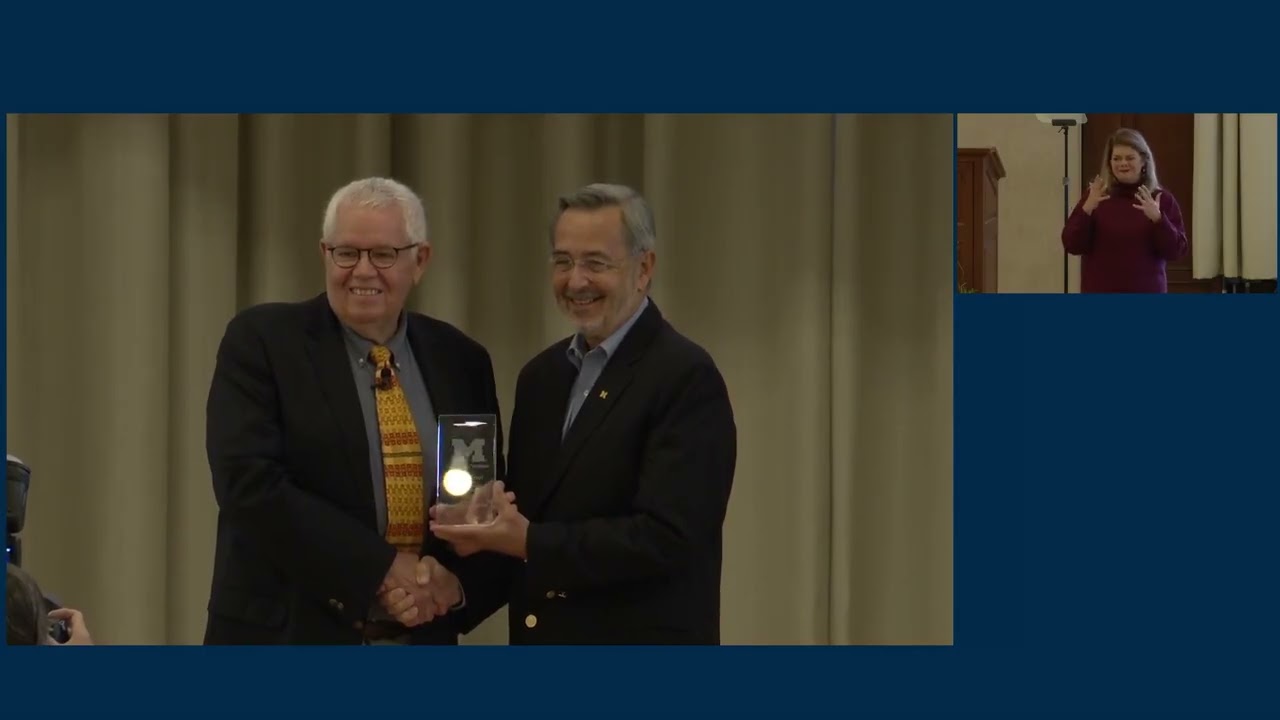
The 2026 President's Awards for Leadership in International Education honored Matthew L. Boulton for faculty distinguished service, Angelo Pitillo for staff distinguished service, and Susan Atkins as a rising professional. (9:16)
Panelists cautioned that automated AI translation cannot substitute for personal language learning, emphasizing that cross-cultural leadership requires vulnerability, authentic human effort, and cultural humility rather than heroism. (40:13)
Detailed notes
## Background
Published on YouTube by the University of Michigan on October 5, 2026, this video captures the 2026 President's Awards for Leadership in International Education ceremony held at the Rogel Ballroom in the Michigan Union on September 25, 2026. The recording highlights the annual recognition of university faculty and staff who have demonstrated extraordinary commitment to advancing global education and cross-cultural scholarship.
## TL;DR
Vice Provost Valeria Bertacco and Chancellor Domenico Grasso open the ceremony by celebrating U-M's record-breaking global mobility metrics and presenting awards to Matthew L. Boulton, Angelo Pitillo, and Susan Atkins for their leadership in public health, language education, and teacher training. The honorees then convene for a panel discussion on preparing students for an interconnected world, emphasizing intentional mentorship, pre-deployment support, and the enduring necessity of learning foreign languages despite automated translation tools. Throughout the conversation, the awardees highlight the transformative power of vulnerability, advocating for cultural humility and a decolonial mindset that prioritizes community-led partnerships over external heroism.
## Atmosphere & style
The event balances the formal prestige of an institutional awards ceremony with an affectionate, collegial warmth filled with genuine laughter. Speakers share self-deprecating anecdotes—ranging from anxieties about being called into the provost's office and ordering fast food with a heavy accent to teaching the Nae Nae to high schoolers in the Andes—which keep the proceedings approachable and grounded. The resulting mood is celebratory yet deeply reflective, moving seamlessly from institutional pride to earnest, human-centered discussions on empathy, ethics, and mutual learning.
## Bulletin
- [02:48](https://www.youtube.com/watch?v=hW-DOa2ycJU&t=168s) The University of Michigan recorded historic highs in global mobility during the 2024–2025 academic year, with 5,903 Ann Arbor students completing 6,266 international trips across 126 countries—an 88% surge over the prior year.
- [02:48](https://www.youtube.com/watch?v=hW-DOa2ycJU&t=168s) Outbound global mobility saw record representation from underrepresented populations, including 26% Pell Grant recipients, 23% underrepresented minority students, and nearly 16% first-generation college students.
- [09:16](https://www.youtube.com/watch?v=hW-DOa2ycJU&t=556s) The 2026 President's Awards for Leadership in International Education honored Matthew L. Boulton for faculty distinguished service, Angelo Pitillo for staff distinguished service, and Susan Atkins as a rising professional.
- [40:13](https://www.youtube.com/watch?v=hW-DOa2ycJU&t=2413s) Panelists cautioned that automated AI translation cannot substitute for personal language learning, emphasizing that cross-cultural leadership requires vulnerability, authentic human effort, and cultural humility rather than heroism.
## Key takeaways
- [02:48](https://www.youtube.com/watch?v=hW-DOa2ycJU&t=168s) U-M ranked as the top public institution in the United States for study abroad volume and second overall, while hosting 8,800 international students and scholars who comprise 16% of the student body.
- [09:16](https://www.youtube.com/watch?v=hW-DOa2ycJU&t=556s) Matthew L. Boulton established the School of Public Health's Office of Global Public Health, placing 356 master's and doctoral students across 68 countries over twelve years.
- [14:47](https://www.youtube.com/watch?v=hW-DOa2ycJU&t=887s) The English Language Institute, directed by Angelo Pitillo, supports international students and Graduate Student Instructors across every school and college at U-M to ensure linguistic inclusion.
- [20:41](https://www.youtube.com/watch?v=hW-DOa2ycJU&t=1241s) Susan Atkins' immersive teacher-education programs in Mexico place prospective teachers in the vulnerable position of language learners, building direct empathy for the English-language learners they will teach in U.S. schools.
- [27:51](https://www.youtube.com/watch?v=hW-DOa2ycJU&t=1671s) Supporting international students and scholars requires rejecting deficit-based frameworks and recognizing the remarkable intellectual achievement of studying in a non-native language.
- [31:24](https://www.youtube.com/watch?v=hW-DOa2ycJU&t=1884s) Authentic cross-cultural learning demands reciprocal participation and vulnerability rather than detached observation, allowing visitors and local hosts to connect beyond language barriers.
- [34:40](https://www.youtube.com/watch?v=hW-DOa2ycJU&t=2080s) Loneliness and isolation represent the most pervasive challenges during field deployments, requiring paired placements, pre-departure context, and routine mental health check-ins.
- [40:13](https://www.youtube.com/watch?v=hW-DOa2ycJU&t=2413s) Global public health leadership requires students to adopt cultural humility over heroism, applying technical skills to support community-defined priorities rather than imposing external solutions.
- [43:07](https://www.youtube.com/watch?v=hW-DOa2ycJU&t=2587s) While smartphone translation tools handle functional transactions, they bypass the cognitive benefits and interpersonal vulnerability essential for genuine cross-cultural bonding.
- [52:10](https://www.youtube.com/watch?v=hW-DOa2ycJU&t=3130s) Institutional duty of care for international placements has shifted from hands-off independent trips to comprehensive safety systems addressing physical health, mental wellbeing, and harassment prevention.
- [54:44](https://www.youtube.com/watch?v=hW-DOa2ycJU&t=3284s) Informal relational experiences outside the classroom, such as shared travel and meals, build the mutual trust necessary for effective mentorship and teaching.
- [56:10](https://www.youtube.com/watch?v=hW-DOa2ycJU&t=3370s) Cultural humility is an ongoing developmental process fostered through experiential friction, structured journaling, and peer debriefs rather than a skill mastered through short pre-departure orientations.
- [59:16](https://www.youtube.com/watch?v=hW-DOa2ycJU&t=3556s) International education should cultivate a decolonial mindset, challenging assumptions of domestic superiority and preparing students to labor alongside local partners rather than acting as external saviors.
## Detailed walkthrough
### [00:05](https://www.youtube.com/watch?v=hW-DOa2ycJU&t=5s) Welcoming Remarks and the PALIE Mission
Vice Provost for Engaged Learning Valeria Bertacco opens the 2026 President's Award for Leadership in International Education (PALIE) ceremony, greeting colleagues and distinguished guests in the Rogel Ballroom. Established in 2017, the PALIE Award honors the extraordinary dedication of University of Michigan faculty and staff in expanding global horizons and opportunities for students. Building on the recent Year of Global Engagement and an ongoing five-year Global Engagement Strategic Plan, the university has expanded the scope of these honors in recent years to include awards for Distinguished Service and Rising Professionals. Bertacco emphasizes that international education remains central to delivering a transformative college experience—one that equips students to navigate an interconnected, intricate world with "curiosity, humility, and purpose."
Each year, the University of Michigan organizes hundreds of travel and academic opportunities around the world while hosting thousands of international scholars and students in Ann Arbor, Dearborn, and Flint. Bertacco notes that selecting the 2026 honorees was a rigorous endeavor, with 39 nominations submitted from across all three campuses. She expresses deep gratitude to the nominators and the selection committee, reminding the audience that nominations remain active for two years—meaning unselected nominees from this cycle may still be considered in the coming year.
[02:48](https://www.youtube.com/watch?v=hW-DOa2ycJU&t=168s) Record-Breaking Global Mobility and Engagement Metrics
Bertacco proudly highlights that U-M's global momentum has reached historic highs. According to the most recent Open Doors report, the University of Michigan once again ranked as the number one public institution in the United States for the number of U.S. students studying abroad, and second overall nationwide. Bertacco jokingly points out that only a single private university sits ahead of them: "and that university is my target for the next year," drawing laughter from the room. Entering the fourth year of the strategic plan, the university recorded unprecedented participation across the board during the 2024–2025 academic year:
- **Student Travel Volumes:** 5,903 students from the Ann Arbor campus completed 6,266 international trips across 126 countries, marking an 88% surge over the previous year and the highest volume ever tracked in university history.
- **Inclusive Access:** Representation among historically underrepresented groups reached record levels: Pell Grant recipients accounted for 26% of outbound travelers, underrepresented minority students represented 23%, and first-generation college students made up nearly 16%.
- **Inbound Mobility:** The Ann Arbor campus hosted 8,800 international students and scholars representing 130 countries, comprising 16% of the overall student body.
- **Institutional Partnerships & Research:** The university maintains approximately 300 international partnerships across all six inhabited continents. In the past year, more than 1,500 research projects involved international collaborators, and 40% of all U-M academic publications featured an international co-author.
Bertacco stresses that beyond these impressive metrics lie profound human stories: faculty members bridging cultural divides to forge lasting collaborations, students taking their very first steps into international field deployments, and foreign scholars stepping onto campus. These initiatives depend entirely on long-term relationships grounded in mutual trust and respect. Later in the event, an awardees panel titled *Cultivating Global Leaders: Preparing the Next Generation for an Interconnected World* will explore how U-M turns this large institutional apparatus into practical impact via cross-cultural support, language immersion, and intentional guidance.
```mermaid
flowchart TD
accTitle: Overview of U-M Global Engagement Metrics (2024–2025)
accDescr: Diagram illustrating outbound and inbound student mobility and international research partnerships at the University of Michigan.
subgraph Outbound["Outbound Student Mobility"]
A["5,903 Ann Arbor Students"] --> B["6,266 Trips across 126 Countries"]
B --> C["88% Year-over-Year Increase"]
C --> D["26% Pell / 23% URM / 16% First-Gen"]
end
subgraph Inbound["Inbound Campus Community"]
E["8,800 International Scholars & Students"]
E --> F["130 Countries Represented"]
F --> G["16% of Ann Arbor Student Body"]
end
subgraph Research["Global Research Footprint"]
H["300 Global Institutional Partnerships"]
H --> I["1,500+ Collaborative Projects"]
I --> J["40% of Publications with Global Co-Authors"]
end
```
[06:16](https://www.youtube.com/watch?v=hW-DOa2ycJU&t=376s) President Domenico Grasso on Building Global Understanding
Bertacco introduces University of Michigan-Dearborn Chancellor Domenico Grasso, noting his steadfast dedication to global scholarship and referencing his early career work on an engineering team in Argentina funded by the World Bank. Grasso steps to the podium and expresses his appreciation for Bertacco’s leadership. Reflecting on his personal background as both an academic and an army officer, Grasso remarks that traveling the globe consistently revealed the richness of diverse cultures: "There is no better way to learn about the world and about oneself than to travel."
Grasso argues that engaging globally is foundational to building intellectual capacity and empathy. He envisions the world looking to Michigan as a leader in creating meaningful connections that bring communities together. In his view, the world becomes an accessible, connected space when people commit to understanding each other across linguistic boundaries, academic disciplines, and cultural backgrounds. He applauds the recipients for exemplifying this global mission before turning to present the individual awards.
[09:16](https://www.youtube.com/watch?v=hW-DOa2ycJU&t=556s) Faculty Distinguished Service Award: Matthew L. Boulton
President Grasso confers the Distinguished Service Award for Faculty upon Professor Matthew L. Boulton from the School of Public Health. Described by peers as a visionary, Boulton served as the school's inaugural Senior Associate Dean for Global Public Health and founded the Office of Global Public Health twelve years earlier. Over a single decade, his office orchestrated placements for 356 master’s and doctoral students across 68 countries, stretching from Latin America to sub-Saharan Africa and South Asia, fundamentally transforming the students and the communities they served.
Taking the stage, Professor Boulton expresses deep gratitude and humility, acknowledging the many colleagues across the university doing exceptional global work. He elicits laughter from the room by confessing his initial anxiety when summoned by the Vice Provost’s office:
> "I have to admit when an administrative assistant reached out to me to let me know that Amy Carey from the Vice Provost Office was trying to get a hold of me, my first thought was, *what have I done wrong?* So you can imagine my happy surprise when Amy and I spoke that rather than being in trouble again, I actually had won an award."
Boulton speaks earnestly about the privilege of mentoring students through international fieldwork and forming deep, enduring friendships with international colleagues. He emphasizes the dual responsibility of preparing students to be thoughtful global citizens while showing profound consideration and reciprocity to host communities abroad, to whom Michigan owes an "inestimable debt." He concludes by welcoming the new Dean of the School of Public Health, Dr. Charles Holmes, teasing that with Holmes's established international reputation, the school holds sky-high expectations: "So no pressure there, Dean Holmes."
[13:26](https://www.youtube.com/watch?v=hW-DOa2ycJU&t=806s) Matthew Boulton's Conclusion: Acknowledging Family and the Power of Alumni Events
Concluding his remarks, Matthew Boulton pauses to offer heartfelt recognition to his wife, Chitra, who was born and raised in India. He recalls that she was the one who first introduced him to the country when she brought him there to meet her parents shortly before they were married. Reflecting on his career since then, Boulton jokes that although he has made innumerable international trips on behalf of the university and the school, none provoked more anxiety than that first journey to meet his future in-laws.
Chitra is also an alumna of the School of Public Health, and the couple originally crossed paths in New York City during a University of Michigan alumni gathering in the early 2000s. Looking back across more than two decades of marriage and raising two sons together, Boulton quips that he remains a devoted proponent of U of M alumni gatherings, which serve as "wonderful opportunities for professional networking and for finding a spouse." His lighthearted disclosure draws laughter and applause from the audience as he expresses his gratitude for the award and steps away from the lectern.
[14:47](https://www.youtube.com/watch?v=hW-DOa2ycJU&t=887s) Presentation of the Distinguished Service Award for Staff to Angelo Pitillo
University leader Domenico Grasso returns to the podium to present the next honor of the ceremony: the Distinguished Service Award for Staff, conferred upon Angelo Pitillo. Grasso outlines Pitillo’s twelve-year tenure at the helm of the English Language Institute (ELI), commending his creative leadership, collaborative spirit, and unwavering dedication to the university's international scholars and students.
Grasso emphasizes the institute's critical function across campus. ELI provides essential conversational and academic English instruction, which in turn enhances the pedagogy of Graduate Student Instructors (GSIs) who teach complex subject matter in what is often their second, third, or fourth language. Beyond instructional training, strong English command enables international students and scholars to immerse themselves fully into social and academic life, helping them realize the best possible Michigan experience. Grasso jests about the acronym heavy naming of the College of Literature, Science, and the Arts—"College of LSNA—too many letters there"—before pointing out that despite being housed in LSA, ELI consistently enrolls at least one student from every single school and college across the university. With words of appreciation for his dedicated service, Grasso invites Pitillo onto the stage.
[16:35](https://www.youtube.com/watch?v=hW-DOa2ycJU&t=995s) Angelo Pitillo's Acceptance Remarks: Championing Linguistic Inclusion and Global Scholars
Taking the stage to applause, Angelo Pitillo offers his gratitude to Domenico Grasso, Vice Provost Valeria Bertacco, the selection committee, and his supervisor, Assistant Dean for Undergraduate Education Alex Puerto, along with all those who contributed letters of support. Pitillo directs the credit for the award directly to the instructors and staff of the English Language Institute, emphasizing that the honor belongs to them. He praises ELI’s lecturer faculty for creating supportive, safe environments where students can take risks, ask questions, and adapt to unfamiliar pedagogical norms, as well as the institute’s administrative staff for cultivating an authentic sense of belonging across the campus community.
Pitillo speaks passionately about the institutional and cultural significance of the award. At a cultural moment when global intellectual exchange and international education often feel vulnerable and under attack, he notes that an institutional award of this caliber sends an unambiguous message: Michigan supports global scholarship and international diversity at its highest levels. Looking out at the room, Pitillo reflects warmly on seeing longtime collaborators from the Council for Global Engagement and the International Education Network, recommitting himself to fostering a welcoming campus where linguistic diversity is celebrated rather than minimized.
- Pitillo identifies three bedrock values guiding his career: open curiosity about the world and its people, cultural humility, and the active celebration of linguistic and cultural differences.
- He notes that ELI's daily work directly empowers international scholars and students to flourish, find their voice, and make their fullest contributions on campus.
[20:41](https://www.youtube.com/watch?v=hW-DOa2ycJU&t=1241s) Presentation of the Rising Professionals Award to Susan Atkins
Domenico Grasso returns to introduce the recipient of the Rising Professionals Award, Susan Atkins, who serves as lead faculty for English language development within the Marsal Family School of Education. Grasso explains that Atkins focuses on opening immersive, field-based global learning avenues for prospective teachers, allowing them to travel abroad to learn alongside local educators and children.
To illustrate the profound impact of this experiential learning model, Grasso reads reflections from a Marsal student who studied abroad:
> "My experience in a foreign country, surrounded by a language I did not know, put me in the position of multilingual learner. I don't think I would have developed the same passion and empathy had I been in Ann Arbor during this class."
Highlighting how placing educators in the vulnerable position of language learners fundamentally shapes their empathy and teaching practice, Grasso thanks Atkins for her commitment and invites her to the stage.
[22:04](https://www.youtube.com/watch?v=hW-DOa2ycJU&t=1324s) Susan Atkins' Acceptance Remarks: Immersion, Empathy, and Preparing Future Educators
Stepping up with an enthusiastic "Whoo," Susan Atkins delivers an energetic and emotional acceptance speech, thanking Grasso, the award committee, her nominators, and campus supporters in Michigan Giving and Michigan News. She acknowledges her colleagues in the Marsal Family School of Education, highlighting how international programming creates deep collegial relationships and friendships. She gives special thanks to key partners: Amy Frontier, her co-teacher for their immersive programs in Ecuador, and Gabriel Lopez from ATEC, representing partner institutions in Cuernavaca, Mexico. Atkins stresses that she accepts the recognition on behalf of this entire collaborative network.
Reflecting on her personal trajectory, Atkins turns to her parents in the audience, thanking them for instilling in her an early curiosity and an impulse to explore other cultures and languages. She dedicates the award to her children—Owen, Lucas, and Tessa—as well as to her past and future students. Atkins expresses optimism about the rising generation of teachers, observing that while they are inheriting a world defined by unprecedented interconnectedness, they consistently treat cross-cultural differences not as barriers or points of division, but as profound catalysts for learning. Lightening the mood, she thanks event staff for mic checks and checking her teeth, remarking with a laugh that the Rogel Ballroom in the Michigan Union was likely the site of her high school prom, making it feel like a true "big-life-moment type of room."
[26:04](https://www.youtube.com/watch?v=hW-DOa2ycJU&t=1564s) Panel Transition: "Cultivating Global Leaders" Moderated by Valeria Bertacco
Following Atkins' remarks, Vice Provost for Engaged Learning Valeria Bertacco assumes the stage to transition the event from individual recognitions to a collective panel discussion featuring all three 2026 PALIE awardees: Matthew Boulton, Angelo Pitillo, and Susan Atkins. Bertacco remarks on the bright future of international education exemplified by their collective work and invites the honorees to take seats on the stage.
Bertacco introduces the overarching panel theme: *Cultivating Global Leaders: Preparing the Next Generation for an Interconnected World*. She articulates how their disparate domains coalesce around a singular mission: intentional mentorship during pivotal life transitions. Whether that involves sending education undergraduates to Ecuador (Susan Atkins), welcoming international scholars into Ann Arbor's linguistic ecosystem (Angelo Pitillo), or deploying public health interventions abroad (Matthew Boulton), all three practitioners build capacity for intercultural leadership. As the honorees take their seats, Bertacco tees up the conversation by teasing a personal story she has waited several years to share.
```mermaid
flowchart TD
accTitle: PALIE Honoree Initiatives and Mentorship Models
accDescr: Diagram illustrating how the three awardees' specific disciplines feed into the shared mission of cultivating global leaders through intentional mentorship.
subgraph Disciplines["Distinct Global Education Pathways"]
SA["Susan Atkins<br/>(Marsal School of Education)"]
AP["Angelo Pitillo<br/>(English Language Institute / LSA)"]
MB["Matthew Boulton<br/>(School of Public Health)"]
end
subgraph Initiatives["Field & Campus Initiatives"]
SA --> ED["Undergraduate teacher immersion<br/>in Ecuador & Mexico"]
AP --> ELI["Language coaching & scholar adaptation<br/>in Ann Arbor"]
MB --> PH["Public health deployment<br/>& global health fieldwork"]
end
subgraph CoreGoal["Shared Mission Moderated by Valeria Bertacco"]
ED --> GL["Cultivating Global Leaders:<br/>Intentional Mentorship During Critical Transitions"]
ELI --> GL
PH --> GL
end
```
[27:51](https://www.youtube.com/watch?v=hW-DOa2ycJU&t=1671s) Opening Remarks: The McDonald's Hamburger and Centering Humanity
Valeria Bertacco opens the panel discussion with an anecdote inspired by Angelo Pitillo and the work of the English Language Institute (ELI). Recalling her very first visit to the United States as an undergraduate presenting a research paper at a conference, Bertacco shares that she went into a McDonald's and found herself completely unable to order a hamburger because the employee could not understand her heavy accent. That formative barrier led her to take extensive ELI coursework when she returned for graduate school, joking with the audience that while she is mostly understood now, lingering challenges remain. Setting the stage for an informal and open dialogue, she invites the audience to raise their hands and interrupt with questions at any time before turning to the three panelists: Angelo Pitillo, Susan Atkins, and Matthew L. Boulton.
Bertacco poses an overarching question across their diverse disciplines: whether sending students abroad into foreign field environments or welcoming international scholars to Ann Arbor, what is the core responsibility of faculty, mentors, and academic leaders during these stressful transitional milestones?
Angelo Pitillo responds first, emphasizing the necessity of centering students' shared humanity. He observes that human beings are fundamentally "territorial animals," making relocation into an unfamiliar culture and linguistic setting an acutely stressful experience. When welcoming international students and scholars to a campus like the University of Michigan, Pitillo warns against treating them as a monolith. Mentors must appreciate the vast diversity among international arrivals, who possess widely varying resources, prior training, and familiarity with American academic culture. Crucially, Pitillo urges educators to push back against the instinct to focus purely on deficits, stresses, and language deficiencies:
- Avoid viewing arrivals solely through the lens of things that need fixing.
- Recognize that traveling to a foreign country to earn a degree in a non-native language is an extraordinary intellectual achievement.
- Actively remind students of their existing strengths, knowledge, and assets, helping them share those gifts with the broader university community.
---
[31:24](https://www.youtube.com/watch?v=hW-DOa2ycJU&t=1884s) Cross-Cultural Reciprocity: From Andean Traditions to the Nae Nae
Susan Atkins approaches the question through the lens of teacher education, highlighting the concept of faculty modeling. When preparing students to transition into cross-cultural contexts, mentors must model dispositions of genuine curiosity, respect, and non-judgmental openness, urging students not to enter foreign spaces with rigid preconceived scripts. Atkins explains that encountering contrast forces students into "thinking carefully about your thinking," bringing unexamined assumptions to the surface so that faculty mentors can help unpack them.
Beyond self-reflection, Atkins underscores the responsibility to discourage passive spectating. Students must not act as detached observers touring classrooms or communities; they are expected to be vulnerable participants who risk communicating across language barriers and actively reciprocate. To illustrate this reciprocal bond, Atkins recounts an experience with her students in the highlands of the Andes at an Indigenous Ecuadorian high school:
- The local Indigenous high school students first taught the visiting Michigan students a traditional Ecuadorian dance.
- Afterward, the local students whispered a request: they wanted the Michigan visitors to teach them American-style dancing.
- Within five minutes, the entire room of Ecuadorian students and American teachers was dancing the Nae Nae together.
- The spontaneous moment became the highlight of the trip—a non-linguistic, laughter-filled exchange where both sides abandoned the role of observer to share a joyful, vulnerable moment together.
---
[34:40](https://www.youtube.com/watch?v=hW-DOa2ycJU&t=2080s) Field Mentorship, Pre-Deployment, and Tackling Isolation
Matthew L. Boulton frames the mentor's foundational duty around institutional and ethical responsibility: ensuring that international placements are fundamentally safe, meaningful, well structured, and rigorously mentored. He breaks this lifecycle into thorough pre-deployment preparation followed by comprehensive in-field support:
```mermaid
flowchart TD
accTitle: International Placement Mentorship Framework
accDescr: Three-stage process showing pre-deployment preparation, field placement operations, and safety interventions.
subgraph MITIGATION["Combating Isolation"]
F["Pairing Students Abroad"]
G["Online Cohort Debriefs"]
end
PRE --> FIELD
FIELD --> MITIGATION
```
Boulton explains that pre-deployment mentoring must equip students with a robust contextual understanding of their host country, covering ethics, cultural norms, sociopolitical structures, demographics, and local public health conditions. Furthermore, faculty must ensure clear academic alignment between the student’s specific interests and the institutional host's practical expectations.
Once students arrive on-site, faculty responsibility shifts toward ongoing, structured check-ins that evaluate far more than project milestones. Mentors must proactively inquire about housing arrangements, day-to-day interactions with international hosts, workplace climate, and overall emotional and physical well-being. Boulton emphasizes that the single most prevalent challenge students encounter during foreign internships is self-reported loneliness and isolation. To mitigate this hazard, his program makes every effort to deploy students in pairs or, when solo placements are unavoidable, coordinates regular virtual check-ins with field cohorts so students can process their collective struggles and milestones together.
---
[36:28](https://www.youtube.com/watch?v=hW-DOa2ycJU&t=2188s) Empathy Through Vulnerability: Training Teachers in Mexico
Bertacco pivots back to Susan Atkins to explore how immersive international fieldwork alters the pedagogical practice of Michigan teacher interns once they return to domestic classrooms. Atkins clarifies the unique terminology of teacher preparation—where "interns" are University of Michigan students learning to teach K–12 "students"—and explains why she purposely anchored her program in Mexico. In US public education, 75% of immigrant students have a Spanish-speaking background, and the clear majority trace their heritage directly to Mexico. Placing teacher candidates in Mexico directly immerses them in the cultural, linguistic, and familial backgrounds of the future populations they will serve.
The central pedagogical aim of the program is to reverse positional power by placing prospective teachers in the exact vulnerable shoes of their future English-language learners. While some interns possess varying degrees of Spanish, few are fully proficient. Living with local Mexican host families and working in local schools, the candidates experience immediate, exhausting challenges firsthand:
- Struggling to perform everyday tasks like ordering food or articulating personal needs.
- Experiencing the mental exhaustion of translating speech in real time, often going to bed every night with severe headaches.
- Navigating the disorienting feeling of not understanding cultural nuances or school norms.
Atkins reflects on how this lived experience translates directly into professional empathy. Referencing an introductory remark made by President Grasso, she notes that graduates frequently reach out in the early stages of their domestic teaching careers to report that having a newly arrived student from Mexico no longer feels abstract: because they lived through that precise disorientation themselves, they understand exactly what their pupils are feeling.
[40:13](https://www.youtube.com/watch?v=hW-DOa2ycJU&t=2413s) Bridging Public Health Metrics and Cultural Humility
Vice Provost Valeria Bertacco turns the discussion to Matthew L. Boulton, noting that, as previously mentioned by Chancellor Domenico Grasso, Boulton has guided hundreds of students to international sites to carry out field-based public health initiatives. She poses a challenging question: how do faculty help students connect technical, experiential competencies—such as evaluating public health metrics—to the broader human obligations of global leadership, and how do they ensure students engage meaningfully with local communities rather than just viewing them through the lens of epidemiological data? Boulton draws hearty laughter from the room with his immediate reaction: "I think I would like an easier question."
```mermaid
flowchart TD
accTitle: Bridging Technical Skills to Global Public Health Leadership
accDescr: Flowchart illustrating the pathway from technical public health skills to authentic community leadership through cultural humility.
subgraph Technical["Technical Foundations"]
A["Scientific Training & Metrics"]
B["Field Internships & Research"]
end
subgraph ConceptualBridge["The Conceptual Bridge"]
C["Engaging Lived Experiences"]
D["Navigating Sociocultural & Economic Barriers"]
end
subgraph Leadership["Global Leadership Outcome"]
E["'Cultural Humility over Heroism'"]
F["Supporting Community-Driven Priorities"]
end
A --> C
B --> C
C --> D
D --> E
E --> F
```
Boulton explains that international placements demand an extraordinary amount from students. Placed in an unfamiliar country under the guidance of new mentors and community partners, students must simultaneously satisfy the rigorous requirements of research-based, practice-based, or community-based internships. The instructional goal is to construct an intellectual bridge connecting technical, quantitative skills to the daily lived realities of residents. This requires deep respect for local community leaders and established cultural traditions. Boulton emphasizes that students must internalize an essential maxim of ethical engagement:
> "In an oft used phrase, we want them to adopt cultural humility over heroism and to recognize their own self-limitations in terms of the support they're providing in those communities."
True global public health leadership, Boulton concludes, is demonstrated when students leverage their scientific training not to impose external agendas, but to assist local leaders in achieving their own self-identified health priorities while navigating complex sociocultural, economic, and political hurdles.
- Students must balance research, practice, and community internship requirements while adapting to new mentors and foreign environments.
- Core leadership philosophy requires prioritizing "cultural humility over heroism" and acknowledging personal and structural limitations.
- Technical public health skills are intended to support community-defined priorities rather than externally dictated solutions.
---
[43:07](https://www.youtube.com/watch?v=hW-DOa2ycJU&t=2587s) The Indispensable Value of Language Learning in an AI World
Opening the floor to the audience and finding no immediate hands, Bertacco poses a question she acknowledges feeling deeply passionate about. She challenges the panel regarding the modern relevance of language acquisition: in an era where English is widely treated as a global lingua franca and smartphone technology can translate conversational speech in real time, why should students invest the grueling effort required to learn a second language? She asks Susan Atkins and Angelo Pitillo to address what role language study and cross-cultural communication still play in nurturing personal empathy and authentic global leadership.
Pitillo answers immediately, asserting that "empathy is a necessary condition for leadership" and that true leadership cannot exist without it. Because empathy requires adopting perspectives outside one's own, the deliberate discipline of learning another language forces the brain to conceptualize the world differently. When Bertacco playfully interrupts with a devil's advocate retort—"But I can do it with my smartphone"—Pitillo counters firmly: "No, you aren't doing it. Your phone's doing it for you." He concedes that automated tools serve functional, transactional needs in a pinch—such as communicating with a taxi driver in an unfamiliar city—but argues that relying on automated intermediaries short-circuits the cognitive and human benefits of purposeful language acquisition. From prehistoric cave paintings and bone markings to contemporary generative artificial intelligence, technology has always assisted communication, yet it cannot forge an authentic, unmediated human bond.
Atkins reinforces Pitillo's argument, observing that digital translation tools can supply vocabulary or voice complete sentences, but they cannot build deep relationships. An ever-present digital intermediary prevents genuine cultural immersion. Beyond pedagogy, she highlights the innate joy of human interaction: the simple pleasure of looking someone in the eye, sharing a smile, and laughing at a joke in a common tongue. When students return from faculty-led trips abroad, they rarely dwell first on the formal academic syllabus; rather, they feel most proud of the conversational phrases they managed to pick up and the authentic, vulnerable moments they shared with local residents. Bertacco agrees, noting that automated tools produce mere functional translations while stripping away cultural nuances, idioms, and linguistic finesse.
---
[47:50](https://www.youtube.com/watch?v=hW-DOa2ycJU&t=2870s) The Human Effort of Communication and Pre-Departure Preparation
Pitillo reflects on the era before automated handheld translation, when travelers relied entirely on printed phrasebooks. He recalls that simply making the earnest, visible effort to stumble through basic courtesy phrases—such as "please may I" or "where is"—invariably prompted warm smiles and goodwill from locals. The genuine vulnerability of trying to communicate in someone else's native tongue forms the foundation of human rapport in a way that holding up a phone screen never can.
Bertacco asks how programs support students who feel paralyzed or isolated by foreign language barriers, particularly those hesitant to speak due to self-consciousness about their imperfect skills. Boulton responds that such anxieties must be anticipated and managed systematically through structured pre-departure mentoring. While certain technical or clinical placements strictly require target-language fluency before arrival, other host communities welcome students with varying levels of language competence. Over the course of placing students across 68 countries worldwide, Boulton’s programs have found that coaching students prior to departure on how to gracefully navigate linguistic limitations and embrace communicative mistakes is key to overcoming isolation.
- Genuine human effort and vulnerability in speaking a local tongue elicit trust and goodwill that automated translation devices cannot replicate.
- Pre-departure mentoring is essential for managing student anxiety and setting expectations around language barriers.
- International public health placements across 68 partner countries have successfully navigated diverse language requirements by preparing students in advance to manage linguistic differences.
---
[49:44](https://www.youtube.com/watch?v=hW-DOa2ycJU&t=2984s) Audience Q&A: Adapting to New Generations of Students
The floor is opened to the Rogel Ballroom audience, and Wendy Wu introduces herself to the room. Having recently joined the University of Michigan community as a staff member on August 24, Wu explains that she is actively learning the university's institutional culture while working across diverse student demographics. Addressing the long-serving panelists, she asks what changes they have observed across successive cohorts of students over the years, how they mentally and professionally prepare themselves to engage with younger generations, and what concrete advice they can offer to university staff navigating changing student expectations.
Bertacco passes the question to the panel, asking how their teaching and engagement methods have evolved alongside shifting generational dynamics. Pitillo responds from his vantage point directing the English Language Institute. While he does not lead cohorts abroad, he oversees continuous incoming cohorts of international scholars and students. He notes that educators must recognize that younger cohorts are digital natives with intuitive expectations surrounding technology that differ markedly from older generations. In parallel with technology adoption, Pitillo points to a striking long-term global shift in international education: English language training outside of English-speaking nations has improved dramatically over recent decades, resulting in incoming international students arriving on campus with noticeably higher levels of English proficiency than past generations.
[52:10](https://www.youtube.com/watch?v=hW-DOa2ycJU&t=3130s) Shifting Cohorts, Institutional Duty of Care, and Lifelong Development
Angelo Pitillo reflects on how international student demographics have shifted over the years, attributing changes to long-term influences like ubiquitous internet access and intentional educational policy shifts within sending countries. A noticeable positive outcome has been incoming students arriving with markedly higher English language proficiency. Despite these shifts, Pitillo emphasizes that his core pedagogical philosophy remains anchored in meeting students where they are rather than making broad assumptions. He views intercultural competence not as a static qualification that an educator ever completely masters, but as an ongoing, developmental journey. For Pitillo, acknowledging that "I never think I've got it down" ensures that he is perpetually learning from each new cohort, which in turn equips him to better support and serve them.
Valeria Bertacco invites Matthew L. Boulton to address how student cohorts and institutional practices have evolved in global public health. Boulton notes that across dozens of cohorts, the underlying constant has been students' deep passion for and commitment to global health work. What has transformed dramatically, however, is the university’s institutional responsibility and duty of care when sending students abroad for field internships. Two decades ago, the common practice was simply sending students into the field with a casual farewell: "bye, and we'll see you in eight weeks, and you can let us know how it goes."
Bertacco playfully interrupts to ask whether programs acted that way because students back then were more self-reliant or simply because faculty worried less. Boulton explains that this hands-off approach was simply the standard norm of international internship programs at the time. Today, programs take a far more proactive, holistic stance toward student safety and wellbeing. Faculty and administrators are closely attuned to monitoring physical, emotional, and mental health, ensuring students receive comprehensive preparation before departing. This modernized approach also explicitly equips students to recognize and navigate difficult challenges such as sexual harassment in international settings, making sure they know precisely where to seek institutional support and reporting resources should issues arise.
- **Key Demographic Drivers**: Global internet connectivity and targeted government policy reforms in sending nations have elevated baseline language skills and altered student needs.
- **Institutional Shift in Field Placements**: Transition from a hands-off, eight-week independent placement model to an intentional, high-support framework prioritizing mental health, physical safety, and harassment prevention.
[54:44](https://www.youtube.com/watch?v=hW-DOa2ycJU&t=3284s) Living Relational Pedagogy: Mountains, Meals, and Deeper Connections
Susan Atkins connects the realities of leading international study programs to the foundational principles of teacher education. In education coursework, faculty constantly emphasize that strong relational bonds are essential for effective teaching, working hard to instill this habit in future educators. Leading students abroad, Atkins explains, provides the rare opportunity to fully live out that principle rather than just lecture on it. When faculty and students share entire days together—not merely within structured classrooms, but out climbing mountains or sharing informal meals—the relationship fundamentally shifts.
Atkins offers a piece of advice to fellow educators: whenever students invite a faculty member out, "say yes when they invite you out, it's a compliment." These shared, informal environments allow educators and students to see each other as whole human beings rather than just instructors and pupils. Atkins emphasizes that this deeper interpersonal rapport has completely transformed how she teaches in the classroom. When students return to formal coursework after shared travel, they feel far more comfortable approaching her with academic concerns, personal issues, or vulnerable questions because an authentic foundation of mutual trust has already been established.
[56:10](https://www.youtube.com/watch?v=hW-DOa2ycJU&t=3370s) Cultivating Cultural Humility: Dialogue, Reflection, and Developmental Growth
Opening the floor for a final audience question, Valeria Bertacco calls on Donna Rich Kaplowitz, Director of Campus Dialogue Education. Reflecting on her past career leading study abroad delegations of undergraduates, graduate students, and faculty to Cuba, Kaplowitz shares an honest critique of her own early work: she had not sufficiently prepared her groups for cultural humility. Consequently, participants arrived carrying rigid, US-centric expectations regarding values and social identities, inevitably clashing with Cuban scholars who felt defensive about their own worldview. Kaplowitz asks the panel how they proactively cultivate cultural humility—both for American students traveling abroad and for international students adapting to US value systems.
Bertacco acknowledges that teaching cultural humility is a complex challenge, and Susan Atkins addresses the importance of structured emotional processing. Atkins notes that when students encounter disorienting cultural differences, reactive feelings are bound to surface. Rather than attempting to suppress these reactions, her programs establish structured reflection spaces and journaling groups where students can unpack their questions and vulnerabilities safely. Sharing these reflections in peer exchanges allows students to process complex social dynamics collaboratively before entering tense conversations with local hosts. Over years of leading trips, Atkins finds she has become much more perceptive at anticipating these friction points before they escalate.
Angelo Pitillo reinforces Atkins’ points, reminding the audience that intercultural humility and competence are developmental processes that take years to nurture. He warns against the expectation that any short pre-departure workshop or single intervention will instantly transform a student into a culturally humble traveler, noting realistically that "there's going to be no perfectly culturally humble person who is ready to go to Cuba." Instead, the international experience itself serves as the crucible where that humility begins to form. Meeting students at their current stage of awareness and establishing steady, reflective practices allows them to begin the long-term work of unlearning assumptions.
```mermaid
flowchart TD
accTitle: Developmental Arc of Cultural Humility
accDescr: Diagram illustrating the shift from initial cultural assumptions to cultural humility through reflection and community engagement.
subgraph Entry ["Pre-Departure & Arrival"]
A["Unexamined Cultural Norms & Expectations"]
end
subgraph Immersion ["Field Immersion & Friction"]
B["Exposure to Alternative Worldviews & Local Contexts"]
C["Emotional & Cognitive Dissonance"]
A --> B
B --> C
end
subgraph Processing ["Structured Reflection"]
D["Journaling & Small Group Processing"]
E["Peer Exchanges & Relational Mentorship"]
C --> D
C --> E
end
subgraph Outcome ["Long-Term Growth"]
F["Decolonial Awareness & Cultural Humility"]
D --> F
E --> F
end
```
[59:16](https://www.youtube.com/watch?v=hW-DOa2ycJU&t=3556s) Challenging Superiority: The 'Pedagogy of Love' and Decolonial Mindsets
Susan Atkins expands on cultural humility by illustrating how international schooling environments disrupt American students' perceptions of educational superiority. Because most of her teacher-education students went through US schools, they often arrive abroad assuming the American system represents the gold standard of education. However, when they visit public classrooms in Cuernavaca, Mexico, or rural schools in the high Andes, they witness educational environments defined by community farms, warmth, autonomy, fewer rigid disciplinary rules, and what has been termed a "pedagogy of love." Witnessing this profound care prompts students to re-evaluate their assumptions, realizing that remote, under-resourced schools possess vital relational strengths that modern US institutions often lack.
Matthew L. Boulton concludes the discussion by articulating the foundational philosophy guiding global health education: instilling an explicit "decolonial mindset." He stresses that students are never sent abroad under the illusion that they are there to rescue, save, or fix foreign communities. Instead, the true objective is for students to live, learn, and labor alongside local partners under the direct leadership of community authorities, supporting existing indigenous and community-led initiatives to improve public health for everyone.
Following Boulton’s remarks, Valeria Bertacco officially adjourns the ceremony, congratulating the honorees and thanking the audience for their support of international education. Amid enthusiastic applause, Susan Atkins quietly celebrates alongside her fellow awardees, whispering, "We did it."
## Notable quotes
> [02:48](https://www.youtube.com/watch?v=hW-DOa2ycJU&t=168s) and that university is my target for the next year — Valeria Bertacco
> [06:16](https://www.youtube.com/watch?v=hW-DOa2ycJU&t=376s) There is no better way to learn about the world and about oneself than to travel. — Domenico Grasso
> [09:16](https://www.youtube.com/watch?v=hW-DOa2ycJU&t=556s) I have to admit when an administrative assistant reached out to me to let me know that Amy Carey from the Vice Provost Office was trying to get a hold of me, my first thought was, what have I done wrong? So you can imagine my happy surprise when Amy and I spoke that rather than being in trouble again, I actually had won an award. — Matthew L. Boulton
> [20:41](https://www.youtube.com/watch?v=hW-DOa2ycJU&t=1241s) My experience in a foreign country, surrounded by a language I did not know, put me in the position of multilingual learner. I don't think I would have developed the same passion and empathy had I been in Ann Arbor during this class. — Marsal Family School of Education student (quoted by Domenico Grasso)
> [40:13](https://www.youtube.com/watch?v=hW-DOa2ycJU&t=2413s) I think I would like an easier question. — Matthew L. Boulton
> [40:13](https://www.youtube.com/watch?v=hW-DOa2ycJU&t=2413s) In an oft used phrase, we want them to adopt cultural humility over heroism and to recognize their own self-limitations in terms of the support they're providing in those communities. — Matthew L. Boulton
> [43:07](https://www.youtube.com/watch?v=hW-DOa2ycJU&t=2587s) empathy is a necessary condition for leadership — Angelo Pitillo
> [43:07](https://www.youtube.com/watch?v=hW-DOa2ycJU&t=2587s) No, you aren't doing it. Your phone's doing it for you. — Angelo Pitillo
> [52:10](https://www.youtube.com/watch?v=hW-DOa2ycJU&t=3130s) bye, and we'll see you in eight weeks, and you can let us know how it goes. — Matthew L. Boulton
> [54:44](https://www.youtube.com/watch?v=hW-DOa2ycJU&t=3284s) say yes when they invite you out, it's a compliment. — Susan Atkins
> [56:10](https://www.youtube.com/watch?v=hW-DOa2ycJU&t=3370s) there's going to be no perfectly culturally humble person who is ready to go to Cuba. — Angelo Pitillo
## Mentioned
University of Michigan, President's Award for Leadership in International Education (PALIE), Valeria Bertacco, Domenico Grasso, Matthew L. Boulton, Angelo Pitillo, Susan Atkins, Amy Carey, Charles Holmes, Chitra Boulton, Alex Puerto, Amy Frontier, Gabriel Lopez, Wendy Wu, Donna Rich Kaplowitz, Rogel Ballroom, Michigan Union, Open Doors report, World Bank, School of Public Health, Office of Global Public Health, English Language Institute (ELI), College of Literature, Science, and the Arts (LSA), Marsal Family School of Education, ATEC, Council for Global Engagement, International Education Network, Campus Dialogue Education
## Video description
2026 President's Awards for Leadership in International Education
September 25, 2026
Rogel Ballroom, Michigan Union
A version of this video without audio descriptions is available here: https://www.youtube.com/watch?v=5FiOqBIeatk
密歇根大学出国留学人数创纪录,校领导倡导以谦逊取代英雄主义
高校领导认为,培养真正的全球领导力需要不借助中介的语言脆弱性与去殖民化谦逊,而非依靠数字翻译捷径或救世主情结。
副教务长 Valeria Bertacco 和分校校长 Domenico Grasso 在仪式开幕致辞中庆祝了密歇根大学破纪录的全球流动性指标,并向 Matthew L. Boulton、Angelo Pitillo 和 Susan Atkins 颁发奖项,表彰他们在公共卫生、语言教育及教师培训领域的领导力。随后,获奖者参加了专题研讨,探讨如何帮助学生适应互联的世界,强调了有针对性的指导、行前支持,以及即便存在自动翻译工具也依然必不可少的外语学习。在讨论过程中,获奖者们强调了展现脆弱的变革力量,提倡文化谦逊与去殖民化思维,主张优先建立以社区为主导的合作关系,而非追求外部的英雄主义。
密歇根大学在2024–2025学年的全球流动人数创历史新高,安娜堡校区共有5,903名学生完成了前往126个国家的6,266次国际行程,较上年激增88%。 (2:48)
出国交流的学生中代表性不足群体的比例创下纪录,其中包括26%的佩尔助学金获得者、23%的少数族裔学生以及近16%的第一代大学生。 (2:48)
2026年国际教育领导力校长奖表彰了 Matthew L. Boulton(教师杰出服务奖)、Angelo Pitillo(教工杰出服务奖)以及 Susan Atkins(新锐专业人员奖)。 (9:16)
与会嘉宾告诫称,AI自动翻译无法取代个人的语言学习,并强调跨文化领导力需要敢于面对不足、真实的个人付出以及文化谦逊,而非英雄主义。 (40:13)
Reading summary
At the 2026 President's Awards for Leadership in International Education, University of Michigan leaders and honorees argued that global education must shift from transactional mobility toward structured mentorship grounded in linguistic empathy, holistic safety, and community-led cultural humility.
Scaling Institutional Reach and Inclusive Global Mobility (2:48)
Vice Provost Valeria Bertacco reported that the University of Michigan ranked as the top U.S. public institution for study abroad in the Open Doors report. Entering the fourth year of its Global Engagement Strategic Plan during the 2024–2025 academic year, the Ann Arbor campus recorded 5,903 outbound students completing 6,266 trips across 126 countries—an 88% year-over-year surge. Bertacco emphasized expanding demographic access, noting that outbound travelers included 26% Pell Grant recipients, 23% underrepresented minority students, and nearly 16% first-generation college students.
Concurrently, the Ann Arbor campus hosted 8,800 international students and scholars representing 130 countries, comprising 16% of the student body. The university maintained roughly 300 international institutional partnerships across six continents, participated in more than 1,500 research projects with international collaborators, and logged global co-authorship on 40% of its academic publications.
Linguistic Vulnerability Versus Automated Translation (43:07)
Addressing the proliferation of smartphone translation technology, English Language Institute Director Angelo Pitillo and Marsal Family School of Education faculty Susan Atkins argued that automated tools cannot replace intentional language acquisition. Pitillo asserted that empathy is an indispensable prerequisite for leadership; while automated devices handle functional, transactional tasks, relying on digital intermediaries circumvents the cognitive and human benefits of understanding alternative cultural frameworks. Both speakers observed that the visible vulnerability of attempting an unfamiliar language elicits trust and goodwill that screens cannot match.
Atkins illustrated this dynamic through her teacher preparation program in Mexico, where prospective U.S. educators experience the cognitive exhaustion, headaches, and disorientation of navigating foreign linguistic environments. Atkins explained that placing teacher candidates in the vulnerable position of language learners builds direct, lasting empathy for domestic classrooms, where 75% of immigrant students share Spanish-speaking backgrounds.
Modernizing the Institutional Duty of Care (34:40)
Reflecting on generational institutional changes, Professor Matthew L. Boulton contrasted current global health programming with practices from two decades ago, when students were often sent abroad for eight weeks with minimal faculty contact. Today, institutional responsibility requires structured pre-deployment mentoring covering host-country sociopolitical conditions, paired with holistic in-field monitoring of physical, emotional, and mental wellbeing, including clear reporting mechanisms for challenges such as sexual harassment.
To combat self-reported isolation and loneliness—which Boulton identified as the primary hazard in international placements—programs deploy students in pairs or coordinate regular virtual cohort debriefs. Atkins similarly noted that shared international travel dissolves rigid teacher-student hierarchies through informal experiences like shared meals and outdoor excursions, establishing an authentic foundation of mutual trust that persists when students return to campus.
Prioritizing Cultural Humility Over Heroism (40:13)
The panel emphasized that global leadership requires dismantling assumptions of American institutional superiority. Boulton framed this through an explicit "decolonial mindset," instructing students that they are not deployed to rescue foreign communities. Instead, ethical practice requires prioritizing "cultural humility over heroism," using technical training to support self-identified community priorities across the 68 countries his office has served.
Responding to audience inquiries on cross-cultural friction, Pitillo and Atkins noted that cultural humility is a gradual developmental process rather than a static credential achieved through a single pre-departure workshop. Atkins highlighted that structured journaling and small-group processing allow students to navigate cognitive dissonance safely—such as recognizing that resource-constrained schools in Mexico and the Andes possess distinct strengths through a relational "pedagogy of love" that challenges assumptions of U.S. educational preeminence.
While panelists observed that incoming student cohorts possess higher baseline English proficiency and digital fluency, managing cross-cultural friction remains an ongoing developmental challenge. The program concluded with an unresolved reminder that cultural humility cannot be fully front-loaded before departure; it requires sustained institutional support, reflective debriefing, and long-term unlearning during field immersion.
Source quotes
[2:48] Valeria Bertacco: and that university is my target for the next year
[6:16] Domenico Grasso: There is no better way to learn about the world and about oneself than to travel.
[9:16] Matthew L. Boulton: I have to admit when an administrative assistant reached out to me to let me know that Amy Carey from the Vice Provost Office was trying to get a hold of me, my first thought was, what have I done wrong? So you can imagine my happy surprise when Amy and I spoke that rather than being in trouble again, I actually had won an award.
[20:41] Marsal Family School of Education student (quoted by Domenico Grasso): My experience in a foreign country, surrounded by a language I did not know, put me in the position of multilingual learner. I don't think I would have developed the same passion and empathy had I been in Ann Arbor during this class.
[40:13] Matthew L. Boulton: I think I would like an easier question.
[40:13] Matthew L. Boulton: In an oft used phrase, we want them to adopt cultural humility over heroism and to recognize their own self-limitations in terms of the support they're providing in those communities.
[43:07] Angelo Pitillo: empathy is a necessary condition for leadership
[43:07] Angelo Pitillo: No, you aren't doing it. Your phone's doing it for you.
[52:10] Matthew L. Boulton: bye, and we'll see you in eight weeks, and you can let us know how it goes.
[54:44] Susan Atkins: say yes when they invite you out, it's a compliment.
[56:10] Angelo Pitillo: there's going to be no perfectly culturally humble person who is ready to go to Cuba.
Original transcript
[0:05] VALERIA BERTACCO: So good
morning, dear colleagues
[0:08] and distinguished guests.
[0:09] Thank you for joining
us today to celebrate
[0:11] the 2026 President's Award for
Leadership in International
[0:16] Education.
[0:30] My name is Valeria
Bertacco, and I
[0:32] serve as the Vice Provost
for Engaged Learning.
[0:36] The PALIE Award was
established in 2017
[0:39] to honor extraordinary
dedication of our faculty
[0:43] and staff in expanding global
opportunities for Michigan
[0:47] students.
[0:50] Building on the momentum
from our recent year
[0:52] of global engagement and
our ongoing five-year Global
[0:55] Engagement Strategic
Plan, we are
[0:58] proud to continue to recognize
our outstanding candidates,
[1:02] and we were able to
add, in the past couple
[1:04] of years, the Distinguished
Service and rising
[1:07] professional awards.
[1:14] Now, I'm sure as you all
know, international education
[1:19] is central to delivering
a transformative college
[1:22] experience, one that keeps
our students to navigate
[1:25] a complex, interconnected
world with curiosity, humility,
[1:29] and purpose.
[1:30] And my colleagues
and I get to talk
[1:32] to students who have
been abroad all the time
[1:34] and we hear that over and over
again in many different facets.
[1:40] Each year, the
University of Michigan
[1:42] offers hundreds of
unique opportunities
[1:45] to travel across the globe and
pursue academic opportunities.
[1:49] At the same time,
we also welcome
[1:51] thousands of
international students
[1:53] to our campus,
none of which would
[1:55] be possible without the
visionary faculty and staff that
[1:58] are joining us today, and
many more beyond the one
[2:02] we are celebrating.
[2:03] Indeed, selecting the winners
for 2026 was not an easy task.
[2:09] We received 39 nominations
from every corner
[2:12] of our three campuses, Ann
Arbor, Dearborn and Flint.
[2:17] And I would like to start
by taking the opportunity
[2:19] to thank every single person
who took the time and the effort
[2:23] to nominate, to
submit a nomination,
[2:25] and also to a member
of our selection
[2:27] committee for their
thoughtful time and dedication
[2:30] in identifying today's honorees.
[2:33] And as a memory, nomination
are valid for two years.
[2:42] So if your nominees
was not selected,
[2:44] be aware that we may consider
the same individuals next year.
[2:48] So today, I'm especially
proud to share
[2:51] that the U of M global momentum
has reached a historic high.
[2:55] In the last open door report,
the University of Michigan
[2:59] once again was selected as
number one public institution
[3:03] by number of students that
have an experience abroad--
[3:06] a number of US students who
had an experience abroad,
[3:09] and we are number two overall
among all US universities.
[3:13] So there is one private
university above us,
[3:16] and that university is my
target for the next year.
[3:19] [LAUGHTER]
[3:20] As we prepare to enter the
fourth year of the Global
[3:24] Engagement strategic
plan, I want
[3:26] to give you a few
of the highlights
[3:28] of the accomplishments we have.
[3:32] First of all, in the
past academic year,
[3:34] so '24-'25, the
last one we track,
[3:36] then we collect data again
during the fall semester,
[3:40] we had 5903 students from
the Ann Arbor campus,
[3:45] completely 6266 international
trips in 126 countries.
[3:53] This represents an 88%
increase from the prior year
[3:57] and is an historic
high, meaning never
[4:01] before we start tracking at
the University of Michigan,
[4:03] we had more students going
abroad in one academic year.
[4:07] In addition, we achieved
our highest representation
[4:10] of underrepresented
students today
[4:12] in participating in
education abroad programs.
[4:15] Pell Grant recipients were 26%
of the people who went abroad.
[4:19] Underrepresented minority
students were 23%,
[4:22] and first generation college
students made up nearly 16%
[4:26] of our students going abroad.
[4:31] Of course, we also tracked
8,800 international students
[4:35] and scholars coming from 130
different countries coming
[4:39] to Ann Arbor, and they comprise
16% of our student body.
[4:44] And then finally,
our global footprint
[4:48] goes far beyond student
mobility in both directions.
[4:52] We currently have
about 300 partnerships
[4:56] with international institutions,
government companies.
[5:01] We have partners across
all six continents,
[5:03] and over 1,500 of research
projects carried out last year
[5:09] had a partner who was
affiliated with an international
[5:13] institution.
[5:14] 40% of U of M publications
have an international partner
[5:18] collaborator.
[5:20] So with this matrix--
[5:22] I hope I impressed
you a little bit.
[5:26] Not many University can
flaunt all these numbers.
[5:29] But with this
matrix demonstrating
[5:31] our national leadership
in international education
[5:34] and international
collaboration, I
[5:36] want to highlight that behind
each one of these numbers,
[5:39] there is a human connection.
[5:40] There is a faculty
member who communicates
[5:43] with another faculty
member in another country
[5:45] and puts all the effort
that it takes to understand
[5:48] each other, given the
different cultural context,
[5:51] and to develop a positive,
constructive collaboration,
[5:54] whether that is research or
it's about a student exchange.
[5:57] And so students step in the
foreign field deployment
[6:00] for the first time, an
international colleague arriving
[6:02] to our classroom, a long-term
research partnership,
[6:06] they are all built on the
human to human connection.
[6:09] They are all built on the
mutual respect and trust
[6:11] that you can only attain
when you work with somebody
[6:14] for a long period of time.
[6:16] So later today, we're going
to have a panel with actually
[6:18] with the awardees titled
Cultivating Global Leaders,
[6:22] Preparing the Next Generation
for an Interconnected World.
[6:26] And we will explore
precisely how
[6:28] we translate with massive
institutional framework
[6:32] in real-world impact for our
community, for our students,
[6:35] and for our partners through
intentional guidance,
[6:40] second language learning
and cross-cultural support.
[6:44] But for now, we will start
by recognizing the awardee.
[6:47] And to present this award,
it is my distinct privilege
[6:50] to welcome President
Domenico Grasso.
[6:52] President Grasso is
a steadfast champion
[6:55] of international
education who understands
[6:57] the transformative power of
global scholarship firsthand.
[7:01] Indeed, early in his
career, he served
[7:03] on an international
engineering team in Argentina
[7:07] through a World
Bank-funded program,
[7:10] and we are very
happy to welcome him
[7:13] to his second palace ceremony.
[7:15] Please join us in giving a warm
applause to President Domenico
[7:19] Grasso.
[7:20] [AUDIENCE APPLAUDING]
[7:30] I would also like to thank
him personally for the service
[7:33] that he has given to this
university over several years.
[7:37] [AUDIENCE APPLAUDING]
[7:46] DOMENICO GRASSO: Good morning,
and thank you very much,
[7:48] Valeria, for
everything that you do
[7:51] to make international education
an integral part of the Michigan
[7:54] experience for our students,
staff, and faculty members.
[8:00] Engaging globally
is a cornerstone
[8:03] of the life-changing
education we offer.
[8:05] Interacting with other
cultures and nations
[8:09] builds intellectual
capacity and empathy.
[8:12] I did a lot of travel
both as a faculty member
[8:15] and as an army officer.
[8:17] I was always surprised and
enriched by other cultures.
[8:21] There is no better way
to learn about the world
[8:24] and about oneself
than to travel.
[8:27] I'm certain many of you have
had similarly enlightening
[8:30] experiences.
[8:32] I want the world to look to
Michigan for diverse ways
[8:36] to build meaningful partnerships
and relationships that
[8:39] better connect our communities.
[8:42] The world can be
a very small place
[8:46] if we commit to
understanding one another.
[8:49] This includes learning
about other cultures,
[8:52] speaking new
languages, connecting
[8:54] with scholars on
other continents,
[8:56] and developing an appreciation
for our similarities
[9:00] and differences.
[9:02] I applaud the work of this
year's award recipients
[9:06] and their outstanding
representation of our commitment
[9:09] to international education.
[9:11] It is my honor to share a
little about each of them.
[9:16] We'll begin with Professor
Matthew Boulton, whom
[9:20] we are honoring with the
Distinguished Service
[9:22] Award for Faculty.
[9:24] Matt has defined education
within the School
[9:29] of Public Health.
[9:30] He is the school's
first-ever Senior Associate
[9:32] Dean for Global Public
Health, and founded
[9:35] its Office of Global
Public Health 12 years ago.
[9:39] Let me share just
one set of numbers
[9:42] from Matt's impressive
supervising summer
[9:45] internship work.
[9:47] Over the course of
a decade, his office
[9:50] has placed 356 master's
and graduate students
[9:55] in 68 countries from Latin
America to sub-Saharan Africa
[10:00] to South Asia.
[10:02] Imagine the lives changed and
transformed because of this.
[10:07] Not just those of our students
who will surely always remember
[10:11] their internships, but also the
people and the communities that
[10:15] engaged with our students.
[10:17] His colleagues call
him a visionary,
[10:21] and we are pleased to affirm
this today with this award.
[10:26] Matt, would you please join me.
[10:28] [AUDIENCE APPLAUDING]
[10:49] MATTHEW L. BOULTON: Thank
you, President Grasso,
[10:51] for that very
gracious introduction.
[10:57] This is a singular award for
me, given the many faculty
[11:01] colleagues at the
School of Public Health
[11:03] and across campus
who are equally
[11:06] deserving of being recognized
for their important global
[11:10] health work.
[11:25] I have to admit when an
administrative assistant reached
[11:28] out to me to let me know that
Amy Carey from the Vice Provost
[11:31] Office was trying
to get a hold of me.
[11:33] My first thought was,
what have I done wrong?
[11:36] [LAUGHTER]
[11:37] So you can imagine
my happy surprise
[11:39] when Amy and I spoke that rather
than being in trouble again,
[11:42] I actually had won an award.
[11:46] It would be difficult
to put into words
[11:48] how transformative
it has been for me
[11:51] to have the privilege
of mentoring
[11:54] our students during their
global field placements,
[11:58] while also building long-lasting
and deep friendships
[12:03] with international
collaborators.
[12:06] I consider it a
profound responsibility
[12:09] to adequately prepare our
students for placement
[12:13] in those fields as they begin
their journey to becoming
[12:18] a global citizen.
[12:20] Equally important is
a abiding commitment
[12:25] to make every attempt to
ensure those are positive
[12:29] experiences for
both our students
[12:31] and our international
hosts, to whom
[12:34] we owe an inestimable debt for
their willingness to mentor
[12:41] and work with our students.
[12:45] I wanted to recognize
a couple people,
[12:49] as I finish up my remarks,
in the audience today.
[12:53] You may have heard
that we have a new dean
[12:55] at the School of Public
Health, Dr. Charles Holmes, who
[13:00] is an internationally
recognized global health
[13:03] scholar and researcher.
[13:06] Consequently, our faculty,
our students, and our school
[13:10] have very high expectations
for his leadership and guidance
[13:15] in continuing to build our
global health enterprise.
[13:19] So no pressure
there, Dean Holmes.
[13:21] [APPLAUSE]
[13:26] I also want to acknowledge
my lovely wife, Chitra, who
[13:32] was born and raised in India.
[13:35] And, in fact, she first
introduced me to that country
[13:38] when she took me there
to meet her parents just
[13:42] before we married.
[13:44] And I can tell you, having taken
innumerable trips on behalf
[13:48] of the university and
school since then,
[13:51] there was no trip that
was more anxiety-ridden
[13:54] about than that one.
[13:57] Chitra is also an alum of
the School of Public Health.
[14:01] And we actually met in New York
City at an alumni gathering
[14:10] in the early 2000s.
[14:12] So more than 20 years
later and two sons,
[14:16] I continue to be a tremendous
fan of U of M alumni
[14:22] events, which provide
wonderful opportunities
[14:26] for professional networking
and for finding a spouse.
[14:30] [LAUGHTER]
[14:31] So thank you again for
this wonderful recognition.
[14:34] [APPLAUSE]
[14:47] DOMENICO GRASSO:
Our next recipient
[14:49] is Angelo Pitillo, whom we are
honoring with the Distinguished
[14:53] Service Award for Staff.
[14:55] For the past dozen years, Angelo
has directed Michigan's English
[14:59] Language Institute, doing so
with creativity, collaboration,
[15:04] and a deep commitment to
our international students.
[15:08] ELI supports international
students and scholars
[15:11] in conversational
and academic English.
[15:15] This support leads
to better GSIs
[15:17] who teach in what may
be their second, third,
[15:21] or fourth language.
[15:24] A stronger command of English
helps international students
[15:27] and scholars engage more
deeply in both the classroom
[15:31] and social settings,
allowing for the best
[15:34] possible Michigan experience.
[15:36] While ELI is based in
the College of LSNA--
[15:41] too many letters there--
[15:43] it always enrolls
at least one student
[15:46] from each of our
colleges and schools.
[15:50] Angelo, thank you for
your dedicated service.
[15:59] Will you please
join me on stage?
[16:01] [APPLAUSE]
[16:35] ANGELO PITILLO: Thank
you, President Grasso,
[16:37] for those very,
very kind remarks.
[16:39] And thank you to
UoM Vice Provost
[16:42] Bertacco and the
Selection Committee
[16:44] for this incredible honor.
[16:47] I also need to thank someone
who could not be here,
[16:50] my amazing supervisor,
LSA associate-- excuse
[16:53] me, Assistant Dean
for undergraduate?
[16:55] Education Alex Puerto.
[16:57] Thank you, Alex, for
putting my name forward.
[16:59] And thanks also to everyone
who wrote a support letter.
[17:04] I am deeply grateful
to all of you
[17:06] for what I know is a
lot of time and energy
[17:08] that goes into a
process like this.
[17:16] I am here on this stage
today because of the efforts
[17:18] of my talented, hard-working,
and innovative colleagues
[17:21] in the English Language
Institute, or ELI.
[17:25] It's really their work
that this award celebrates.
[17:29] ELI's outstanding
lecturer faculty
[17:34] are transforming the lives
of their students every day
[17:37] with their classroom teaching,
mentoring, and advising.
[17:41] These superb professionals
make real personal connections
[17:45] with their students.
[17:47] And they provide safe,
supportive environments
[17:50] in which those students can ask
questions, take risks, and learn
[17:53] to navigate an
educational landscape that
[17:56] may be very different from
the one they're used to.
[18:01] ELI staff is equally
committed to this mission.
[18:04] They show up every day
to support our faculty
[18:06] and students.
[18:07] And they lead ELI's efforts
to build community and foster
[18:11] a sense of belonging among U
of M's international students
[18:14] and scholars.
[18:16] These wonderful colleagues
make my job as ELI's director,
[18:20] not just doable, possible,
but deeply gratifying
[18:25] and really a joy to perform.
[18:29] It's truly a pleasure for me
to show up to work every day.
[18:34] This recognition is
especially meaningful for me
[18:37] personally because it
affirms the values that
[18:40] underlie ELI's work
and that have guided me
[18:43] throughout my entire
professional career,
[18:46] open curiosity about the
world and real interest in all
[18:49] its peoples, cultural
humility, and the celebration
[18:53] of cultural and
linguistic difference.
[18:58] I feel extraordinarily
fortunate to be
[19:01] part of an institution that
bestows such an award, much
[19:05] less to be a recipient.
[19:09] At a time when the very idea
of international education
[19:12] and intellectual exchange,
global intellectual exchange,
[19:16] can feel under attack, this
award sends a powerful message.
[19:21] It demonstrates that
here at Michigan,
[19:23] bringing the best and
brightest students and scholars
[19:25] from around the world
together on our campuses
[19:29] is supported at the highest
level of leadership.
[19:32] And it affirms that the
work of units like the ELI,
[19:35] work that helps international
students and scholars feel
[19:38] they belong and can make
their fullest contribution,
[19:41] is recognized and valued.
[19:45] And it's incredibly
moving for me
[19:47] to be able to accept this
honor here in this room,
[19:49] among so many longtime
friends and colleagues,
[19:52] especially those
from the Council
[19:55] for Global Engagement,
International Education Network,
[19:59] including several former
recipients, from whom I have
[20:04] learned so much
and who have been
[20:06] such stalwart companions along
my own intercultural learning
[20:10] journey.
[20:11] I look forward to continuing
our work together, promoting
[20:15] an open campus that's
welcoming and celebrates
[20:18] linguistic and
cultural diversity
[20:21] and is a place where
international students
[20:23] and scholars can flourish
and feel they truly belong.
[20:28] Thank you.
[20:29] [APPLAUSE]
[20:41] DOMENICO GRASSO:
Our next honoree
[20:42] is Susan Atkins, this year's
recipient of the Rising
[20:46] Professionals Award.
[20:48] Susan serves as lead
faculty for English language
[20:52] development in the Marsal
Family School of Education.
[20:56] In this role, she creates
global learning opportunities
[21:00] for tomorrow's teachers.
[21:02] Education students travel abroad
to learn from and with children
[21:07] and educators, gaining
immersive practical experiences
[21:11] that make them better teachers.
[21:14] This experience provides
a powerful perspective
[21:18] for students.
[21:19] As one Marsal student
put it, quote,
[21:22] "My experience in
a foreign country,
[21:25] surrounded by a
language I did not know,
[21:28] put me in the position
of multilingual learner.
[21:32] I don't think I would have
developed the same passion
[21:35] and empathy had I been in
Ann Arbor during this class."
[21:41] Susan, thank you
for your commitment.
[21:43] Would you please
join me on stage?
[21:45] [APPLAUSE]
[22:04] SUSAN ATKINS: Whoo.
[22:04] OK, thank you so much.
[22:14] Thank you, President Grasso.
[22:17] I want to thank so many
people up here that I also
[22:21] see in the room.
[22:22] I'd like to thank the Award
Committee, my nominators.
[22:27] I would also like to thank
people who have really
[22:30] supported me in this work from
Michigan Giving from Michigan
[22:34] News.
[22:35] I really feel so grateful.
[22:38] I also want to thank people
from the School of Education.
[22:43] Marsal Family
School of Education
[22:45] have really supported me.
[22:46] And actually, that's been
one of the beautiful parts
[22:49] of this work, is
that I've gotten
[22:50] to interact with
so many new people
[22:52] and have new colleagues
through this work.
[22:54] And I really have really
been supported and found
[22:59] so many new friendships in this
work as well here on campus.
[23:03] In particular, I really
want to thank people
[23:07] like Amy Frontier, who is my
co-teacher in all of the work
[23:12] that I do in Ecuador.
[23:14] I also want to thank
Gabriel Lopez, who's
[23:16] here representing ATEC, and my
partners in Cuernavaca, Mexico.
[23:20] And honestly, I accept
this award on our behalf
[23:24] because I couldn't do
this work without you.
[23:28] I also want to, just
as Angela mentioned,
[23:31] recognize that this word exists.
[23:34] And that's a
beautiful thing to say
[23:35] about our institution
and the priorities
[23:38] that we hold here at Michigan.
[23:41] I also want to thank my family
and my friends that are here.
[23:47] I think you all
know me the best.
[23:49] And if you know me,
you are probably not
[23:52] very surprised that I work
in international education
[23:55] or in a global context.
[23:57] I was raised, thank you,
Mom and Dad, with this sense
[24:03] to really nurture curiosity
and explore the world,
[24:07] to think deeply about other
cultures and languages.
[24:11] And for that, I'm very grateful.
[24:13] Thank you so much.
[24:15] I guess the last thing I
would like to say is thank you
[24:18] or, really, I guess, to
dedicate this award to my kids,
[24:22] Owen, Lucas, and Tessa--
[24:24] I love you very much.
[24:25] Thank you for being here--
[24:26] and really dedicate this
award to all of my students
[24:29] from the past and
all of my students
[24:31] in the future that get to
be part of these programs.
[24:37] This new generation,
you're going
[24:40] to inherit a globe that is
more interconnected than ever.
[24:45] And through this beautiful
work that I get to do,
[24:48] I have seen your willingness
to work across boundaries,
[24:53] to pursue your
curiosity, to take risks,
[24:58] and to really see
the differences
[25:01] in these cross-cultural
contexts as points of learning,
[25:06] not as points of division.
[25:08] And so for that, I
feel so much hope,
[25:12] and I feel so much inspiration.
[25:14] And again, I just
want to thank everyone
[25:16] who's in this room for
creating this opportunity, also
[25:20] all of the staff who's put
together this beautiful room
[25:23] and supported me, from my
microphone to checking my teeth.
[25:27] So thank you so much.
[25:30] It's beautiful to
be in this room.
[25:32] I was saying that the
last time I was here
[25:34] might have been my prom.
[25:36] And so it feels like a
big-life-moment type of room.
[25:40] Anyway, thank you
so much to everyone.
[25:43] Thank you.
[25:43] [APPLAUSE]
[26:04] VALERIA BERTACCO: Thank you
so much, Susan, Matt, Angelo,
[26:06] and President Grasso.
[26:23] I think we can all
agree that the future
[26:24] of international education
at our institution
[26:27] is bright, with the
inspiring leadership
[26:29] and passion each of you bring.
[26:31] So at this time, it is
my distinct privilege
[26:34] to moderate today's panel with
our three 2026 PALIE awardees.
[26:42] You can start moving
toward the chair
[26:45] while I discuss with our
group what is the topic.
[26:50] So our theme today is
Cultivating Global Leaders:
[26:55] Preparing the Next Generation
for an Interconnected World.
[26:59] Across the University
of Michigan,
[27:01] our commitment to
international education
[27:03] takes many forms,
whether we are guiding
[27:05] undergraduate future educators
into classrooms in Ecuador,
[27:08] like Susan does, welcoming
incoming international graduate
[27:11] scholars as they
adapt to Ann Arbor,
[27:14] like Angelo, or
deploying public health
[27:17] teams to respond to real-world
global challenges, like Matt.
[27:21] So while their
disciplines differ widely,
[27:24] what unites our three
honorees is a deep commitment
[27:27] to intentional mentorship during
critical moments of transition.
[27:31] So our next few
minutes, I will explore
[27:34] how field experiences,
language acquisition,
[27:37] and cross-cultural guidance
prepare our student
[27:40] not just to navigate a complex
world, but to lead within it.
[27:43] Let's go.
[27:46] Actually, I really would
like to tell you a story
[27:48] that I've been wanting
to say for several years.
[27:51] And I'm specifically
inspired by Angelo.
[27:55] One of my very first time
in the United States,
[27:57] I was an undergraduate student.
[27:59] And I came to a conference
to present a research paper.
[28:02] And I found myself at
McDonald, and I could not
[28:06] order an hamburger because the
person working there could not
[28:11] understand my heavy accent.
[28:14] So when I finally came
for graduate school,
[28:16] I took many, many ELI
classes, and I think
[28:20] I'm mostly understood now.
[28:21] I'm sure you notice there
is still a challenge here.
[28:32] With that, we will get started.
[28:35] Have you turned on
your microphone?
[28:37] SUSAN ATKINS: Yeah,
we did already.
[28:38] VALERIA BERTACCO: Awesome.
[28:41] So one thing I
would like to tell
[28:42] you is I'm going to ask a couple
of questions to the audience,
[28:46] but then I really would
like to hear from you.
[28:48] So please raise your hand.
[28:50] We have microphones
going around.
[28:51] Feel free to interrupt.
[28:53] We don't have to
follow a script here.
[28:55] So to start us off, across
all three of your disciplines,
[29:00] whether we are sending students
into foreign field environments
[29:04] or welcoming international
scholars arriving
[29:06] in Ann Arbor, what is our core
responsibility as faculty,
[29:11] mentors, and academic
leaders to the students
[29:15] during these
sometimes challenging
[29:18] major transitional
moments in their life?
[29:22] ANGELO PITILLO: Should I--
[29:23] VALERIA BERTACCO:
Sure, go ahead.
[29:24] Any order.
[29:25] SUSAN ATKINS: He didn't know.
[29:25] VALERIA BERTACCO: Just don't
talk on top of each other.
[29:27] ANGELO PITILLO: Sure.
[29:27] Yeah, I'll go ahead.
[29:28] [LAUGHS] Well, I would
say, first of all,
[29:30] to just make sure we center
the humanity of these people
[29:33] and keep in mind that humans
are territorial animals.
[29:36] And this is an incredibly
stressful moment
[29:39] to be moving just
into a new place,
[29:41] especially if it's a new
culture, a new language.
[29:47] And are you not hearing?
[29:52] Do I need to speak up?
[29:52] Now can you hear me?
[29:54] Sorry.
[29:55] And then I think
specifically with welcoming
[29:59] international
students and scholars
[30:02] to a place like
Michigan, I think
[30:04] keeping in mind the diversity
of those students and not
[30:07] to put them all in one basket.
[30:09] And remember that there
can be great differences
[30:13] among these students in terms of
their resources, their training,
[30:16] their familiarity with
the academic culture here.
[30:20] And then finally, I think
most important is just
[30:22] to also beware of a tendency to
focus on the challenges, focus
[30:27] on the stresses and the
negative side of things,
[30:31] and really center the
amazing skills, knowledges,
[30:36] and experience that
these students bring.
[30:42] I mean, it's an
incredible achievement
[30:44] to be coming to
a foreign country
[30:48] and pursuing a degree
in another language.
[30:50] And just to recognize that
and also center that for them
[30:53] and reminding them
of the strengths
[30:55] they bring, not just the
challenges and the things
[30:58] that need to be worked on.
[30:59] VALERIA BERTACCO: It is critical
that you discuss this with them
[31:00] because they are coming to ELI
classes thinking to improve
[31:04] their English, and that's
it, but you're also
[31:07] keeping an eye that
they are settling down
[31:09] and they understand
how to navigate that.
[31:11] ANGELO PITILLO: Absolutely.
[31:12] We're helping them bring what
they have to the experience
[31:16] here for the rest of us, really.
[31:22] VALERIA BERTACCO: Yeah.
[31:24] SUSAN ATKINS: OK, so I think
about when we are preparing
[31:27] students to go abroad.
[31:29] I come out of education,
and so we talk and think
[31:32] a lot about modeling.
[31:36] And so there's
definitely behaviors
[31:39] that we try to model
for our students
[31:41] to help them make
these transitions
[31:45] into these cross-cultural
experiences,
[31:47] things like curiosity,
respect, really
[31:53] being open to the
experience that they're
[31:56] getting ready to
have, not entering
[31:59] a new space or a new culture
with a real strong sense
[32:04] of what's it going
to be like and what's
[32:07] going to happen to have that
position of taking everything
[32:13] in for what it is.
[32:16] We also talk a lot
about experiencing
[32:20] the contrast of a
cross-cultural experience
[32:23] and really thinking
carefully about your thinking
[32:28] as you're experiencing contrast.
[32:30] And as you're seeing
things go differently,
[32:32] it really brings up
in all of our students
[32:36] a recognition of the
assumptions that they hold.
[32:40] The ways that they think
things are get challenged.
[32:44] And we really need to
provide that mentorship
[32:46] to help them unpack that
and see through that.
[32:50] And I guess the one
last thing I would say
[32:53] is that when we are
with students abroad,
[32:56] we also talk a lot about giving
back or not being observers.
[33:03] We're not in these
new spaces, we're not
[33:05] in these new
countries, we're not
[33:07] in these new schools
just to watch
[33:10] and to see what's happening.
[33:12] We want to participate
and put ourselves,
[33:15] which often is a vulnerable
moment, to put ourselves
[33:19] together with the
other students,
[33:22] to take the risk of
communicating with them,
[33:24] even if that's not our native
language, and to be part of it.
[33:30] The cutest example
of this happening
[33:32] was a time that we were in
the highlands of the Andes
[33:37] in a Indigenous high school.
[33:40] And the students there, the
high school students there,
[33:44] taught our students
traditional Ecuadorian dance.
[33:47] And it was so beautiful.
[33:50] And at the end, we had a
little whisper conversation.
[33:53] And those students wanted to
learn American-style dancing.
[33:59] And so within, I don't
know, five minutes,
[34:02] all of those Ecuadorian students
were dancing the Nae Nae.
[34:06] [LAUGHTER]
[34:07] And it was the most
exciting part of that day
[34:13] because it was an example
of that true cross-cultural
[34:18] exchange.
[34:18] Even in the form of
dance, it was beautiful
[34:21] because it was not
linguistically based,
[34:24] and it was lots of
smiles and giggles
[34:28] and everybody
enjoying that moment
[34:30] of being part of
something together
[34:34] instead of being
observers of each other.
[34:38] VALERIA BERTACCO: Thank you.
[34:39] Go ahead.
[34:40] MATTHEW L. BOULTON: Yeah, at a
real fundamental level, Valeria,
[34:43] we have a
responsibility to ensure
[34:45] that these international
placements are safe, meaningful,
[34:49] well structured,
and well mentored.
[34:51] And I think that really
points to the importance
[34:54] of pre-deployment mentoring and
ensuring that our students are
[34:59] equipped with a knowledge base
around the cultural, ethical,
[35:04] sociopolitical, demographic,
and public health context
[35:08] of their destination countries.
[35:15] I think it's also especially
important to try and ensure
[35:20] there's some degree of academic
alignment between the student's
[35:24] interests and what the
international host is expecting
[35:27] out of that student.
[35:29] Once you're in
the field, there's
[35:32] ongoing responsibilities
and important check-ins
[35:35] that you want to
hold with students
[35:39] both to check on their
progress with their projects,
[35:43] but also to ask them
about their housing,
[35:46] their interactions with
their international hosts,
[35:50] their work environment,
and importantly,
[35:52] their emotional, mental health,
and physical well-being.
[35:57] I think that the number one
challenge that we encounter
[36:00] with students in the
international setting
[36:03] is self-reported isolation
and loneliness, which
[36:08] is why we always
try to send them out
[36:09] in pairs, if we possibly can.
[36:12] And if not, then facilitating
online conversations
[36:17] amongst groups of
students who are out
[36:19] in the field, who can
discuss their challenges
[36:23] and achievements during their
international internship.
[36:28] VALERIA BERTACCO:
Thank you Susan,
[36:30] I'm going to go
back to your work.
[36:32] And it's a little
bit complicated
[36:33] to discuss it because
they are your students
[36:35] that you bring to another
country to have their students.
[36:40] But the question is about your
students, the U of M students
[36:43] who go abroad.
[36:44] How does that hands-on
multicultural experience
[36:49] of having working in an
international classroom
[36:51] or out-of-this-country classroom
influence how they teach and how
[36:57] they educate once
they come back,
[36:59] especially when they are
educating international students
[37:03] in the US?
[37:04] SUSAN ATKINS: Yeah.
[37:05] I mean, your question describes
the rationale for really why I
[37:11] wanted to create this
program and welcome you
[37:15] to teacher education, where the
word students means nothing.
[37:19] So we talk about our
interns who teach students.
[37:22] And so anyway, I
created this opportunity
[37:26] to take our teacher education
students to Mexico specifically
[37:31] because 75% of the immigrant
students that they will teach
[37:37] in the United States,
assuming that they stay
[37:40] in US public schools, will have
some sort of Spanish language
[37:43] background, and the wide
majority of that 75%
[37:46] have some sort of
connection back to Mexico.
[37:48] So taking our teacher
education students to Mexico
[37:52] made a lot of sense in
terms of just getting
[37:55] them exposed to the
culture, to the language,
[37:59] to the people that will likely
represent their future students
[38:03] and families.
[38:05] And just inside your question,
what our other goal is
[38:11] is to really position them in
ways that their students will
[38:17] feel, again, in the future when
they are teaching them in class.
[38:21] So putting them in a context
where they are the multilingual
[38:24] learner.
[38:25] Most of our students
have some degrees--
[38:29] many of them have some
levels of Spanish,
[38:31] but they would never say, oh,
I'm fully proficient, most
[38:34] of them.
[38:35] We do have some students that
come to us with Spanish language
[38:38] skills.
[38:39] But immediately, they
start noticing things
[38:42] like, wow, it's really hard to
order my food, or I have a need,
[38:47] and I'm not sure
how to express it,
[38:49] or I'm translating while
you're telling me something,
[38:52] and that is really tiring.
[38:54] And so these are all
of the things that we
[38:57] want them to have empathy
for and understandings
[38:59] about when they go on
to teach those students.
[39:02] And so it really is beautiful.
[39:05] And President Grasso
introduced me with a quote
[39:08] from one of our
students, and we hear
[39:09] comments like that all the
time, like, I didn't really
[39:12] get it until I experienced it.
[39:14] VALERIA BERTACCO: Like going to
bed with a headache every night.
[39:16] SUSAN ATKINS: Exactly.
[39:17] Or just being so tired
or not understanding
[39:21] some part of the culture.
[39:28] Students in that program
are living with families.
[39:30] And so their cultural awareness,
their cultural experience,
[39:33] it really lasts all day.
[39:35] And they really
get a strong sense
[39:37] of what it's like to move
to a country themselves.
[39:41] And so now that this program
has gone on a few years,
[39:45] I hear back now
from students that
[39:47] are in the beginnings
of their careers,
[39:49] and they make this
comment all the time.
[39:51] They're like, oh,
my gosh, Susan,
[39:53] I have a student from Mexico.
[39:55] And I know exactly
how they're feeling.
[39:58] And so that, to me, is
such a beautiful noticing.
[40:02] And it's one that
is almost impossible
[40:04] to teach in a class on campus.
[40:07] And so I'm so grateful
for our ability
[40:09] to facilitate these
experiences for our students.
[40:13] VALERIA BERTACCO: Thank you.
[40:15] So, Matt, as President
Grasso mentioned,
[40:17] you brought hundreds of students
to international locations
[40:21] doing public health work.
[40:23] But my question is,
how do you connect
[40:26] those experiential technical
skills, like public health
[40:30] metrics, to the broader
human responsibility
[40:33] of global leadership?
[40:34] And I would like also
to know, how do they
[40:36] connect to the
population they are in
[40:38] rather than just
to public health?
[40:40] MATTHEW L. BOULTON: I think I
would like an easier question.
[40:43] [LAUGHTER]
[40:44] VALERIA BERTACCO: OK.
[40:46] MATTHEW L. BOULTON: Well,
when you think about it,
[40:49] we're asking a lot
of our students--
[40:52] they're traveling
to a new country,
[40:54] working with a new
mentor, new individuals,
[40:58] while at the same time,
they're attempting
[41:00] to fulfill the responsibilities
and requirements
[41:03] of a research-based,
practice-based, or
[41:07] community-based internship.
[41:11] What we try to do
is we try to get
[41:14] them to draw an intellectual
and conceptual bridge
[41:18] between those technical
scientific skills
[41:22] that they're acquiring
and their growing
[41:25] understanding of
public health metrics
[41:29] and translate that to the lived
experiences of the people who
[41:34] actually are residing in that
country, while also respecting
[41:39] the input of local leaders
and cultural traditions.
[41:45] In an oft used
phrase, we want them
[41:48] to adopt cultural
humility over heroism
[41:53] and to recognize their
own self-limitations
[41:57] in terms of the support they're
providing in those communities.
[42:02] Ultimately, what
we want them to do
[42:04] is to use that expanding
knowledge of public health
[42:08] metrics and scientific
technical skills
[42:12] to provide support to local
leaders and communities
[42:17] in their self-identified
public health priorities
[42:21] in terms of achieving
or addressing those.
[42:25] And if students can
do that, I think
[42:27] that's a critical element of
global public health leadership.
[42:32] Finally, we also
want them to think
[42:35] about the complexities of
successfully addressing
[42:39] those public health metrics,
given the sociocultural,
[42:46] economic, and social barriers
to achieving those goals.
[42:52] VALERIA BERTACCO: Thank you.
[42:55] Do we have questions
from our attendees today?
[43:03] OK, I'll ask one more
question while you think.
[43:07] And this question,
actually, I'm really
[43:09] curious to hear your answers.
[43:13] It's really for Susan.
[43:15] I guess Angelo would be the
primary, but let me get to that.
[43:17] But I heard things
from Matt that
[43:19] make me think he has
thoughts about it.
[43:21] In an era where language
study is sometimes
[43:24] devalued under the
assumption that English
[43:27] is the most common language,
that technology can translate
[43:32] in real time in both
directions-- so technically,
[43:34] I could speak to somebody
in a different language.
[43:36] We just have our
smartphone next to us--
[43:39] what's the point to
acquire a second language?
[43:43] What's the value in second
language acquisition,
[43:46] cross-cultural
communication skills
[43:49] as a pillar for true global
leadership and personal empathy?
[43:57] And I'm very opinionated
about this topic,
[43:59] so I'm not going to talk.
[44:01] ANGELO PITILLO: Well, yeah, I
mean, I love how you framed it.
[44:04] And I think Susan really
addressed this directly
[44:06] in her earlier answer.
[44:07] You can't have true
leadership without empathy,
[44:11] I think, as a starting place.
[44:12] VALERIA BERTACCO:
You cannot have what?
[44:13] ANGELO PITILLO: True
leadership without empathy.
[44:15] So empathy is a necessary
condition for leadership.
[44:18] And I think what
better way to develop--
[44:22] empathy means being able to
see things from other people's
[44:25] perspectives.
[44:26] And so what better way
to do that than to learn
[44:28] another language,
where you actually
[44:29] are learning to
think differently,
[44:31] see the world in
a different way?
[44:33] VALERIA BERTACCO: But I can
do it with my smartphone.
[44:35] ANGELO PITILLO: No,
you aren't doing it.
[44:36] Your phone's doing it for you.
[44:38] I think technologies are
wonderful in a quick moment
[44:44] for a functional
reason if you need to--
[44:46] I think of that
example I always hear
[44:48] of the taxi in a country
you don't know the language.
[44:51] But in terms of connecting
with humans and leading them,
[44:54] the idea that
technology could short
[44:58] circuit that either in the
learning process, I mean,
[45:01] I think you're losing all the
benefits of actually going
[45:03] through the process of
learning the language, which
[45:05] is where a lot of the
benefits come from, I think,
[45:09] that purposeful effort that
goes into language learning.
[45:14] But then again, the idea
that you could really
[45:17] communicate with people,
I mean, at least yet,
[45:20] the technology is
not there that you
[45:22] could make a human connection
with other human beings,
[45:26] I think, via purely
technical means.
[45:32] I mean, we've always had
technology going back
[45:35] to cave paintings and
markings on bones.
[45:38] Technology has always
been a part of language,
[45:41] a part of language learning.
[45:43] And to the extent it
assists that, it helps us.
[45:46] I think even these wonderful
new AI tools can be great,
[45:51] but they are never
going to replace, again,
[45:57] that experience of
learning a language
[45:58] and then being able to
connect with people especially
[46:01] in their language if you are
operating in a second language.
[46:05] SUSAN ATKINS: Yeah, I
mean, what Angelo said.
[46:07] [LAUGHTER]
[46:08] I mean, yeah, a
translation tool could
[46:11] help you know a word in
another language, but--
[46:17] VALERIA BERTACCO: It can
also say my sentences.
[46:20] SUSAN ATKINS: OK, so
it can say sentences.
[46:22] It can help you understand
or be understood.
[46:26] But to Angelo's point, it can't
help build that relationship.
[46:30] You can't really get to
know deeply the culture
[46:34] or have that human connection
if there's constantly
[46:37] that intermediary between
you and the person.
[46:42] And so I would argue that
that's one of the reasons.
[46:46] And then other is it feels good.
[46:50] It feels good for
people to connect
[46:52] with others in a shared language
and with good eye contact
[46:58] and a smile and a shared joke.
[47:01] And there's a beauty
in that experience
[47:05] that you can't
recreate if there's
[47:09] this constant translation
going back and forth.
[47:15] Our students, they come to
learn content with me abroad,
[47:20] but they leave feeling most
proud about the language
[47:24] that they picked up and
the moment that they
[47:26] had sharing that with somebody.
[47:28] And to me, we can't lose that.
[47:33] VALERIA BERTACCO:
And I think also,
[47:35] when you have this tool
doing the translation-- it's
[47:37] functional translation, right--
all the finesse and words
[47:42] that are created in a
language but they're not
[47:44] created in another that are
expressive of the culture
[47:47] of the language,
they're completely gone.
[47:49] SUSAN ATKINS: Yeah.
[47:50] ANGELO PITILLO: And I
think I can totally relate.
[47:52] I think most people
can relate to this.
[47:58] I mean, think about
pre-these translation tools
[48:02] being available when you
just had phrasebooks.
[48:04] The smile on people's face
in a country where you just
[48:07] were making an effort to
use their language in a very
[48:10] basic way just to say,
please may I, or where is,
[48:14] I feel like I've experienced
that firsthand over and over,
[48:18] where people just clearly have
appreciated my effort, even
[48:23] if it wasn't much more.
[48:25] It's just the genuineness and
the humanness of that effort
[48:29] to establishing a relationship.
[48:33] VALERIA BERTACCO:
So you mentioned
[48:34] the students feel isolated when
they are in another country.
[48:38] And, I mean, maybe
I'm speculating,
[48:40] but the language barrier
may be part of that.
[48:43] Many people don't feel
comfortable approaching somebody
[48:46] in another language
if they're not
[48:48] confident in their
skill in that language.
[48:52] Anything that is
done in that space?
[48:56] Any thoughts about that?
[48:57] MATTHEW L. BOULTON:
Well, Valeria, I mean,
[48:59] I think you have
to be potentially
[49:02] prepared for that eventuality.
[49:03] And it's really--
[49:04] VALERIA BERTACCO: Like
trying to speak incorrectly?
[49:06] That's what you're saying?
[49:07] MATTHEW L. BOULTON: Yeah, yeah.
[49:09] I mean, there's some
countries where it's just not
[49:11] appropriate to send
somebody who is not
[49:14] familiar with the
local language.
[49:16] And in other countries,
it's very appropriate.
[49:19] But again, that all
speaks to pre-departure
[49:22] mentoring and
ensuring the student
[49:25] is prepared in how to
navigate that when you don't
[49:29] speak the native language.
[49:32] And we manage to work
around that, I think, fairly
[49:35] successfully in many
of the 68 countries
[49:39] where we've sent our students
over the course of the years.
[49:43] VALERIA BERTACCO: Thank you.
[49:44] OK, now it's your turn.
[49:48] Questions?
[49:50] Yes.
[49:52] Can somebody bring her a mic?
[49:55] WENDY WU: Hi, everyone.
[49:56] I have a question.
[49:57] VALERIA BERTACCO:
Wait, wait, wait.
[49:59] Hold on a second.
[49:59] A mic is coming.
[50:02] STUDENT: Hi, everyone.
[50:05] Hi, everyone, my
name is Wendy Wu.
[50:07] I am really new member to
the University of Michigan
[50:11] entire community.
[50:12] I just joined the
institution on August 24.
[50:21] And so as a new member
exploring the institution,
[50:24] as a staff members, I'm
learning the new culture.
[50:27] And to the panelists,
during all those years
[50:31] of serving a multiple
cohort of the students
[50:34] and then through the title,
how do you actually preparing
[50:38] yourself engaging with the
newer generation of students?
[50:42] Did you notice anything
about the student
[50:45] changing over the years?
[50:47] And then how do you
prepare yourself for that?
[50:49] And then what kind of patterns
of the student changing
[50:52] over the years?
[50:54] And any good tips for
all of us while we're
[50:57] dealing with the newer
students coming in?
[50:59] I think age really matters
for me at this point
[51:02] while I am working with a
lot of different students
[51:05] over the time.
[51:06] Thank you.
[51:07] VALERIA BERTACCO: Thank you.
[51:07] That's a beautiful question.
[51:09] So you have been
bringing students abroad
[51:12] for many, many years.
[51:13] Have you noticed changes
through generation?
[51:16] And how do you prepare yourself
for those changing students?
[51:23] [LAUGHTER]
[51:25] ANGELO PITILLO: Oh,
you're looking at me?
[51:26] Well, I don't bring
students abroad,
[51:29] but I do work with
incoming cohorts
[51:31] of international students.
[51:33] Well, I think when
you're my generation,
[51:36] I mean, first of
all, you're just
[51:38] going to expect all younger
people are more comfortable,
[51:42] more natural with technology.
[51:44] We've talked about
technology a lot.
[51:45] So I don't presume
that they're where
[51:49] I'm at in terms of what
their expectations are around
[51:52] using technology.
[51:54] I mean, I think longer-term
trends in our field
[51:57] have been a lot-- an increase
in the level of English language
[52:02] education outside of
English-speaking countries.
[52:04] So we have seen
over time students
[52:07] coming to us with much higher
English language proficiency
[52:09] skills.
[52:10] So that's a long-ish-term
trend, I think, the internet.
[52:13] And also, just there have been
some absolutely intentional
[52:17] policy changes in some of
the countries that send us
[52:21] large numbers of students.
[52:22] So I think both of those
can be good things.
[52:27] And, I mean, certainly,
having people
[52:30] coming with higher language
proficiency is a good thing.
[52:35] I go back to my first
answer, just making
[52:38] sure we're meeting
students where they're at,
[52:40] so trying to get
to know them, not
[52:42] making assumptions about them,
and just trying to keep up.
[52:51] And again, keep learning--
[52:54] I mean, a key to
intercultural competence
[52:56] is a commitment to-- it's a
lifelong developmental process.
[52:59] I never think I've got it down.
[53:01] So I'm always
learning from them.
[53:03] And so I think if that's how I
approach any group of students,
[53:08] I think I'm going to be able
to better serve them, better
[53:11] support them if I'm
getting to know them.
[53:13] And that's, I think,
how I keep up.
[53:16] VALERIA BERTACCO: Can we
do Matt and then Susan?
[53:19] MATTHEW L. BOULTON:
Yeah, well, I've
[53:20] been through lots of
cohorts of students.
[53:23] And they have changed
over time, but what's
[53:27] been consistent is their
interest and commitment
[53:30] to global health.
[53:32] And I think we've changed quite
a bit in our responsibility
[53:39] to students when they go out
for an international internship.
[53:43] 20 years ago, we'd send
them out and say, bye,
[53:46] and we'll see you
in eight weeks,
[53:48] and you can let us
know how it goes.
[53:50] But--
[53:50] VALERIA BERTACCO: Wait, because
they knew better what to do
[53:52] or because we wouldn't worry?
[53:54] MATTHEW L. BOULTON: Because that
was the nature of the internship
[53:57] program at that time.
[54:01] And I think now we're
much more sensitive
[54:03] and attuned to the importance
of engaging and monitoring
[54:09] emotional, physical,
and mental health
[54:12] and preparing students for that.
[54:15] And also, issues around
sexual harassment,
[54:18] which sometimes happens in
the international setting,
[54:21] and helping students to
navigate through that
[54:24] and where to turn when
that becomes an issue.
[54:28] So I think that we've changed
and tried to adapt to--
[54:32] and, I think, provide a greater
level of support to students
[54:37] now than we did in the past.
[54:44] SUSAN ATKINS: I can say that
one change that I've noticed
[54:47] is-- obviously, I
come out of education.
[54:49] And we talk a lot about how
building relationships helps
[54:52] with teaching.
[54:53] And we try to instill that
behavior and that habit
[54:58] in our teacher
education students.
[55:01] And these opportunities
to travel with students
[55:04] let me actually
live that principle
[55:06] because when you are with
students all day long
[55:13] in the classroom, yes, but
also climbing mountains
[55:16] and say yes when they--
in terms of advice,
[55:19] say yes when they invite
you out, it's a compliment.
[55:24] And those are the spaces that
you get to know them as people,
[55:29] not just as your students.
[55:31] And I have seen how that
closer connection that I
[55:35] have with my students now
really has transformed
[55:37] my teaching of them.
[55:39] And so, again, it's
this ability for me
[55:41] to say, this is
important as a teacher,
[55:43] and then also say-- and
see we're doing that
[55:46] and see how this feels
and how this is different
[55:48] and how now you feel comfortable
coming to me with an issue
[55:52] or with a question because
we have that relationship.
[55:55] And so again, it's just a
really nice way to do that.
[55:59] VALERIA BERTACCO: Thank you.
[56:00] SUSAN ATKINS: Yeah.
[56:01] VALERIA BERTACCO: Do we
have one last question?
[56:05] Yes.
[56:10] DONNA RICH KAPLOWITZ: Hi.
[56:11] Thank you.
[56:11] I'm Donna Rich Kaplowitz and
direct the campus dialogue
[56:15] education.
[56:16] In a former life, I did
a lot of study abroad.
[56:19] I took undergraduates,
graduates, and faculty to Cuba.
[56:25] And one of the things
that I did not do well
[56:28] was teach them prior to leaving
about cultural humility.
[56:33] So they showed up with
US standard expectations
[56:38] for things around values,
around social identities.
[56:42] And they came into conflict
with Cuban scholars--
[56:47] it was through the
School of Education--
[56:50] who were defensive about the
way that they saw the world.
[56:55] And so I'm curious about how
you prepare students both when
[56:59] you go abroad but also, Angelo,
in your case, coming here
[57:02] to different value
expectations and how
[57:05] to practice cultural humility.
[57:11] VALERIA BERTACCO:
That's not easy.
[57:12] Let's go.
[57:13] SUSAN ATKINS: I mean, I
think the first thing that
[57:15] comes to mind is to
know, as you mentioned,
[57:19] that that is something
that will likely
[57:21] come out for some
of our students
[57:23] and to make space for it.
[57:24] And so we have journal groups.
[57:29] All of our students
have times to reflect--
[57:32] that reflection piece
is so critical--
[57:35] so that they can notice some
of the feelings or the thoughts
[57:38] or the questions
that are coming out
[57:40] and then make space for them
to explore that in a safe way.
[57:47] And a lot to my prior answer,
that relationship really
[57:52] helps and so that they
feel comfortable to talk
[57:55] about things, hopefully, with
you before the Cuban scholar.
[57:59] But giving students that space
to unpack and to ask questions
[58:06] and to really have those
questions across each other
[58:09] as well, to have
those peer exchanges,
[58:12] can be really a
critical part of that.
[58:15] But I do feel like
every year, I'm
[58:18] getting better at noticing
the experiences so that you
[58:22] can better prepare for them.
[58:25] VALERIA BERTACCO:
Like the experiences--
[58:28] SUSAN ATKINS: Yes, how
they're reacting to things.
[58:30] And so--
[58:31] VALERIA BERTACCO: You see them
coming and can prepare before.
[58:33] SUSAN ATKINS: Yeah.
[58:34] VALERIA BERTACCO: Yeah, got it.
[58:35] ANGELO PITILLO: Yeah,
I think that it's key
[58:37] also to just keep in mind that,
again, intercultural humility
[58:40] or intercultural competence
is a developmental process.
[58:43] So you have to meet
them where they are at.
[58:45] They're not going to suddenly
become interculturally humble
[58:48] through some quick intervention.
[58:51] So, I mean, that's the
goal of the experience.
[58:54] And I think Susan's spot-on
that you can get them going,
[59:00] get them thinking about
it, but it's something
[59:02] that they have to do over time.
[59:06] And so there's going to
be no perfectly culturally
[59:11] humble person who is
ready to go to Cuba.
[59:14] It's unlikely.
[59:16] SUSAN ATKINS: I will say
just one thing is that we're
[59:18] focusing on schooling.
[59:20] And so all of our students
have very fresh experiences
[59:24] in what schooling is like.
[59:27] And I think a lot of
them think that they
[59:30] had a very-- they had a
great high school experience,
[59:33] or they had-- that
they feel really
[59:35] good about their
education that they had.
[59:37] The majority of them have
had schooling here in the US.
[59:40] And they go to the rural
highlands of Andes,
[59:44] or they go to Cuernavaca,
Mexico, into a public school,
[59:48] and they see things
there that they wish
[59:52] they had in their schooling.
[59:54] So they wish they had the
warmth, the kindness, the--
[60:03] I was quoted earlier saying
the pedagogy of love.
[60:05] You feel that in classrooms.
[60:08] Teachers, the way that they
exchange, there's less rules.
[60:12] There's more warmth.
[60:13] There's freedom.
[60:15] There's a farm if
you are in the Andes.
[60:18] There's just things that make
them reflect on, you know what?
[60:24] To your point, I thought,
oh, I'm coming out
[60:27] of a US schooling system.
[60:28] There's no better.
[60:29] But honestly, in the forest,
remotest places on Earth,
[60:33] there's things to learn and wish
for in a vision of how education
[60:38] can look in the future.
[60:40] VALERIA BERTACCO: Thank you.
[60:41] MATTHEW L. BOULTON:
Yeah, I mean,
[60:42] one of the things that
we really focus on
[60:44] is getting our students to
adopt a decolonial mindset.
[60:54] They're not going
to these countries
[60:56] to save or rescue anyone.
[60:59] What they're going
for is to live, learn,
[61:02] and work under the guidance of
local leaders and communities
[61:09] and support their efforts
to help everyone everywhere
[61:14] live as healthy a
life as possible.
[61:18] VALERIA BERTACCO:
On that note, I
[61:19] would like to thank
everyone for coming today.
[61:22] I hope I will see you next year.
[61:24] And congratulations
to our awardees.
[61:27] MATTHEW L. BOULTON: Thank you.
[61:30] ANGELO PITILLO: Thank you.
[61:32] SUSAN ATKINS: Thank you.
[61:33] [APPLAUSE]
[61:37] We did it.