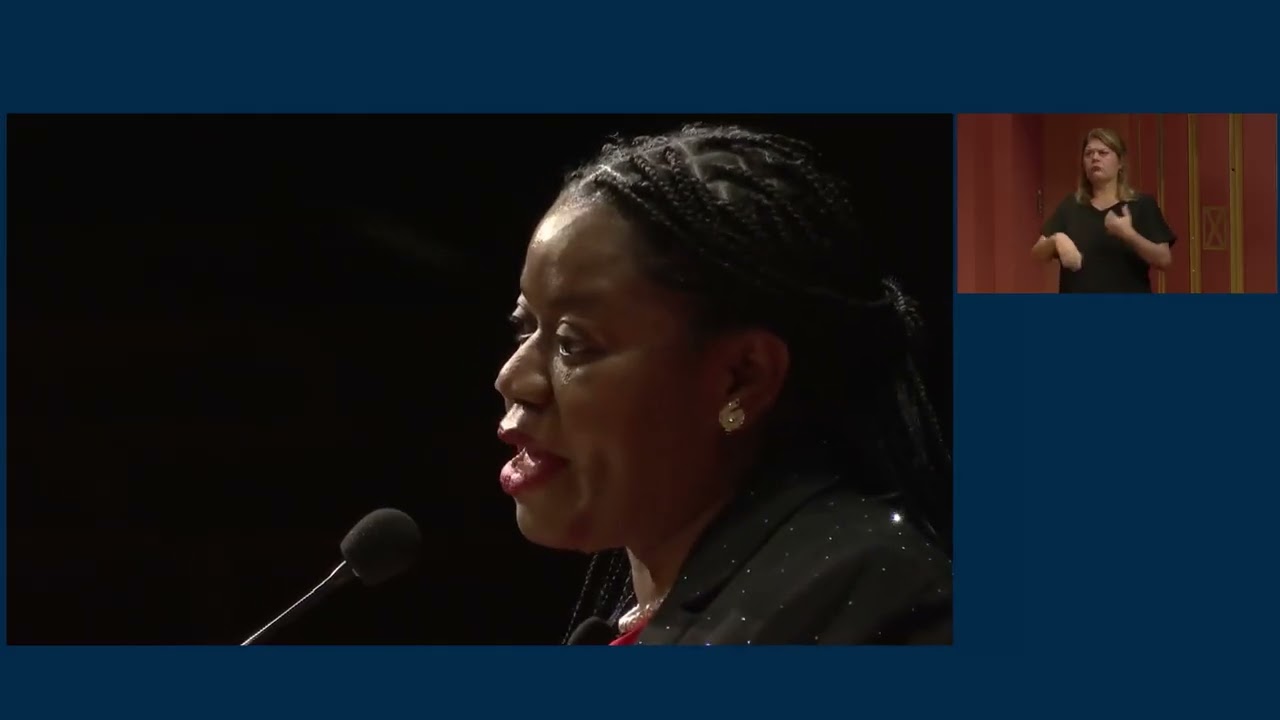
Guerline Jozef, co-founder and executive director of the Haitian Bridge Alliance, received the 2026 Wallenberg Medal at the University of Michigan for frontline humanitarian and legal advocacy on behalf of Haitian, Black, and vulnerable migrants. (4:47)
An estimated 500,000 Haitian immigrants who followed official parole and vetting procedures faced sudden, overnight revocations of their legal status within a two-month span. (28:22)
Remittances sent by diaspora members and Temporary Protected Status (TPS) holders account for over 20% of Haiti's GDP, meaning mass deportations threaten the economic stability of both Haiti and the U.S. healthcare workforce. (61:38)
Only 18% of Haitian immigrants in the United States currently have access to legal representation, leaving the vast majority without counsel against detention and deportation. (86:23)
Detailed notes
## Background
Published on YouTube by the University of Michigan on October 6, 2026, this video documents the 31st Wallenberg Medal and Lecture held at Rackham Auditorium on September 29, 2026. The ceremony features honoree Guerline M. Jozef, co-founder and executive director of the Haitian Bridge Alliance, delivering her address titled 'Written in offices but lived in communities: An immigration system in crisis.'
## TL;DR
The University of Michigan presents the 2026 Wallenberg Medal to human rights activist Guerline Jozef, honoring her frontline advocacy for Haitian and vulnerable migrants. Drawing parallels to Raoul Wallenberg's historic rescue efforts during the Holocaust, Jozef delivers an impassioned indictment of the United States immigration apparatus, detailing how sudden revocations of legal protections plunge hundreds of thousands into terror, surveillance, and despair. She illuminates the lethal human toll of administrative cruelty through the tragic story of student-athlete Pierre Damas Bell, exposes the legacy of foreign destabilization in Haiti, and urges passage of federal legislation such as Senate Bill S.4814 and the Dream and Promise Act. Throughout the lecture and following Q&A, Jozef grounds her resistance in ancestral lineage and calls on everyday citizens to reject dehumanizing political rhetoric and embody collective moral courage.
## Atmosphere & style
The presentation is deeply emotional, shifting between visceral sorrow, warm communal humor, and righteous moral urgency. Visibly moved to tears from the moment she accepts the award, Jozef rejects traditional academic detachment, leading the audience in traditional Haitian call-and-response greetings and speaking with unvarnished, raw vulnerability about systemic violence and personal loss. The atmosphere in Rackham Auditorium feels reverent yet charged, as moments of solemn silence during heartbreaking case accounts give way to spirited affirmations and mutual solidarity among students, faculty, and Haitian diaspora community members.
## Bulletin
- [04:47](https://www.youtube.com/watch?v=axPRV6TxlYo&t=287s) Guerline Jozef, co-founder and executive director of the Haitian Bridge Alliance, received the 2026 Wallenberg Medal at the University of Michigan for frontline humanitarian and legal advocacy on behalf of Haitian, Black, and vulnerable migrants.
- [28:22](https://www.youtube.com/watch?v=axPRV6TxlYo&t=1702s) An estimated 500,000 Haitian immigrants who followed official parole and vetting procedures faced sudden, overnight revocations of their legal status within a two-month span.
- [01:01:38](https://www.youtube.com/watch?v=axPRV6TxlYo&t=3698s) Remittances sent by diaspora members and Temporary Protected Status (TPS) holders account for over 20% of Haiti's GDP, meaning mass deportations threaten the economic stability of both Haiti and the U.S. healthcare workforce.
- [01:26:23](https://www.youtube.com/watch?v=axPRV6TxlYo&t=5183s) Only 18% of Haitian immigrants in the United States currently have access to legal representation, leaving the vast majority without counsel against detention and deportation.
## Key takeaways
- [00:08](https://www.youtube.com/watch?v=axPRV6TxlYo&t=8s) Raoul Wallenberg's rescue of over 100,000 Hungarian Jews during the Holocaust serves as the ethical benchmark for individual moral courage against systemic violence.
- [09:09](https://www.youtube.com/watch?v=axPRV6TxlYo&t=549s) Jozef grounds her human rights advocacy in the traditional Haitian greeting 'Onè, Rèspè,' honoring ancestral resilience, living dignity, and the needs of future generations.
- [13:28](https://www.youtube.com/watch?v=axPRV6TxlYo&t=808s) The Haitian Bridge Alliance was born out of a single emergency response to assist twelve migrants who walked for nine months from Brazil across the Darién Gap.
- [16:14](https://www.youtube.com/watch?v=axPRV6TxlYo&t=974s) American immigration policy has historically alternated between labor extraction and xenophobic targeting, from exclusion acts to contemporary scapegoating of Haitians.
- [20:29](https://www.youtube.com/watch?v=axPRV6TxlYo&t=1229s) Dehumanizing political rhetoric—such as falsehoods regarding Haitian migrants in Springfield, Ohio—is intentionally designed to strip targets of personhood to normalize state neglect and mistreatment.
- [28:22](https://www.youtube.com/watch?v=axPRV6TxlYo&t=1702s) More than 500,000 Haitians who met every administrative requirement under official parole programs were abruptly cast back into undocumented status without cause.
- [32:16](https://www.youtube.com/watch?v=axPRV6TxlYo&t=1936s) The suicide of 20-year-old student Pierre Damas Bell illustrates the severe psychological trauma inflicted by sudden status revocations and invasive ankle monitoring.
- [37:09](https://www.youtube.com/watch?v=axPRV6TxlYo&t=2229s) Undocumented immigrants who have lived and worked in the United States for decades face a legal system that offers virtually zero statutory pathways for status adjustment.
- [45:55](https://www.youtube.com/watch?v=axPRV6TxlYo&t=2755s) Ancestral figures—including Harriet Tubman, Queen Anacaona, Gran Toya, and Sanité Bélair—provide an enduring framework of moral defiance and community protection.
- [59:39](https://www.youtube.com/watch?v=axPRV6TxlYo&t=3579s) Widespread deportation fears have forced community advocacy underground, replacing open neighborhood festivals with covert, direct-to-home aid distributions.
- [01:01:38](https://www.youtube.com/watch?v=axPRV6TxlYo&t=3698s) Mass deportations threaten the U.S. domestic care economy, which relies on over 300,000 immigrant nurses and eldercare aides facing potential removal.
- [01:01:38](https://www.youtube.com/watch?v=axPRV6TxlYo&t=3698s) Haiti's current crisis is structural and historically driven by foreign interventions, including the 20-year U.S. occupation, gold reserve seizures, and the deliberate destruction of domestic agriculture.
- [01:05:08](https://www.youtube.com/watch?v=axPRV6TxlYo&t=3908s) The U.S. government maintains a Level 4 'Do Not Travel' advisory for Haiti while simultaneously flying shackled deportees into Cap-Haïtien without basic shelter or reception services.
- [01:15:34](https://www.youtube.com/watch?v=axPRV6TxlYo&t=4534s) Lived experience represents indispensable expertise, challenging traditional academic conventions that claim proximity to trauma undermines research validity.
- [01:21:36](https://www.youtube.com/watch?v=axPRV6TxlYo&t=4896s) Key federal legislative safeguards include Senate Bill S.4814 for three-year temporary status and the Dream and Promise Act, which sits just one vote shy of House passage.
- [01:26:23](https://www.youtube.com/watch?v=axPRV6TxlYo&t=5183s) International security missions and private contractors have failed to protect Haitian communities, as gang violence expands into previously secure areas like Kenscoff.
## Detailed walkthrough
### [00:08](https://www.youtube.com/watch?v=axPRV6TxlYo&t=8s) Welcome and the Legacy of Raoul Wallenberg
Siobhan D. Harlow, Chair of the Wallenberg Medal Executive Committee and Professor Emerita of Epidemiology and Global Public Health, opens the ceremony by welcoming attendees to Rackham Auditorium for the thirty-first Wallenberg Medal and Lecture. Speaking on behalf of the Executive Committee and the Donia Human Rights Center, she introduces the evening’s program honoring the University of Michigan’s most celebrated alumnus, Raoul Wallenberg. The event commences with the screening of a documentary exploring Wallenberg’s life and enduring legacy, directed by University of Michigan professors John Valadez and Carleen Hsu. Harlow takes a moment to acknowledge two distinguished guests present both in person and virtually—Professors Irene Butter and Andrew Nagy—who are highlighted in the film and whose survival is directly tied to the Holocaust era.
Harlow recounts Wallenberg’s background, noting that he was born into one of Sweden’s most prominent families. Encouraged by his grandfather to pursue his education in the United States, Wallenberg arrived in Ann Arbor in 1931 to study architecture and art. Away from the heavy expectations of his patrician lineage, he was known around campus simply as "Rudy." While he immersed himself in student life, he maintained a self-critical modesty, once confessing in a letter home, "but I'm not sure I'm doing anything useful here." That early uncertainty stood in stark contrast to the historic rescue efforts he orchestrated a decade later. While Sweden maintained neutrality during World War II, Hungary aligned with Nazi Germany, leaving Budapest home to the last major surviving Jewish population in Europe. When Nazi forces occupied Budapest in March 1944, the immediate confinement, ghettoization, and mass deportations of Jewish citizens began.
Leaving the safety of Sweden, Wallenberg arrived in Budapest on July 9, 1944, serving as a Swedish diplomat. Over a six-month period lasting until January 1945, he mobilized an operation that combined audacity, administrative ingenuity, and moral clarity. Issuing protective passports (*Schutz-Pässe*) and designating safe houses under Swedish diplomatic immunity, Wallenberg is credited with saving more than 100,000 Jewish lives. Harlow emphasizes that Wallenberg's defiance reminds the world that a single individual can tilt the scales toward justice even against overwhelming odds. She connects his historic actions to the 2026 honoree, Guerline Jozef, an activist and thought leader whose humanitarian mission began when she answered a single phone call for help. Jozef has since built an advocacy network dedicated to the rights and dignity of migrant families, reshaping public discussions on race and the American immigration system. Harlow then invites Dr. Domenico Grasso to the podium to present the award.
- **Event:** 31st Wallenberg Medal and Lecture, hosted by the Wallenberg Medal Executive Committee and the Donia Human Rights Center.
- **Documentary Filmmakers:** University of Michigan professors John Valadez and Carleen Hsu.
- **Special Guests in Attendance:** Holocaust survivors and U-M professors Irene Butter and Andrew Nagy.
- **Historical Figures & Milestones:**
- Raoul Wallenberg enrolled at U-M in 1931 to study architecture.
- Arrived as a Swedish envoy in Budapest on July 9, 1944, saving over 100,000 lives before his disappearance in January 1945.
---
[04:47](https://www.youtube.com/watch?v=axPRV6TxlYo&t=287s) Presentation of the 2026 Wallenberg Medal
Dr. Domenico Grasso expresses gratitude to Professor Harlow, the Executive Committee, and the donors who sustain the annual lectureship. Reflecting on the University of Michigan’s history of graduates who have influenced global affairs, Grasso describes Wallenberg as without question the university's most distinguished alumnus. He notes the defining moral paradox of Wallenberg's life: born into an elite world of safety and influence, he willingly placed his privilege on the line to rescue complete strangers marked for execution. Though his eventual fate and death in Soviet custody remain shrouded in mystery, his selflessness continues to serve as an ethical benchmark for what one determined person can achieve against systemic brutality.
Grasso highlights the Donia Human Rights Center’s role in administering the medal through education, research, and public debate before turning his focus to the honoree. He introduces Guerline Jozef as the co-founder and executive director of the Haitian Bridge Alliance, an organization formed to support Haitian, Black, and other vulnerable migrants arriving in the United States. Grasso praises her multifaceted leadership, which spans grassroots organizing, systemic litigation, community outreach, and immediate material assistance.
The alliance provides practical lifelines to migrants, including food distribution, legal defense, and translation services. Grasso emphasizes Jozef’s fearlessness in speaking truth to power to amplify the concerns of people who are systematically silenced, embodying the same spirit of individual conviction seen in Wallenberg's legacy. Grasso calls Jozef to the stage to receive the 2026 Wallenberg Medal, prompting sustained applause from the audience.
- **Honoree:** Guerline Jozef, Co-founder and Executive Director of the Haitian Bridge Alliance.
- **Key Focus Areas of the Haitian Bridge Alliance:** Fair immigration policies, humanitarian relief, direct aid (food, legal advocacy, language access), and federal impact litigation.
- **Award Significance:** U-M's highest human rights distinction, awarded in memory of alumnus Raoul Wallenberg.
---
[09:09](https://www.youtube.com/watch?v=axPRV6TxlYo&t=549s) "Honor, Respect": An Emotional Acceptance
Taking the podium, Guerline Jozef is visibly moved to tears, pausing as an organizer searches for tissues and joking with the room, "She's getting me tissues. She can't find it." After deep breaths and emotional pauses, she composes herself, thanking the university community, Dr. Grasso, the committee, and Professor Harlow, whom she warmly refers to as her "amazing new friend and sister." Jozef admits to feelings of shock and bewilderment over receiving the honor, asking with genuine humor, "How did you find me? How do you even know my name?"
Jozef opens her remarks by leading the audience in a traditional Haitian greeting of call-and-response:
Repeating the sequence, she explains that "Onè, Rèspè" is the foundational Haitian way of addressing people—a deliberate act of honoring those who came before, recognizing those present, and preparing the way for future generations. She thanks the filmmakers for capturing the humanity, resilience, and beauty of Wallenberg's life, but confesses an internal struggle with accepting the award. She states that she feels unworthy because so much urgent work remains unfinished, lamenting that in the year 2026, humanity is still caught in patterns where Wallenberg’s brand of dangerous, sacrificial rescue should no longer be required.
---
[13:28](https://www.youtube.com/watch?v=axPRV6TxlYo&t=808s) Running from Destiny and the Work of the Haitian Bridge Alliance
Jozef shares her personal resistance to entering frontline community work. Growing up watching her parents dedicate their lives to community service, she witnessed firsthand the toll of daily personal sacrifice and thought to herself that anyone choosing such a life must be crazy. When her immigrant parents urged her toward high-status, stable careers, she actively resisted. Her father insisted on professional tracks—pressuring her toward law school and medical school, emphasizing that immigrant families aspire to point to their children as lawyers or doctors. Jozef refused both paths precisely because she feared that becoming an attorney or physician would inexorably pull her into public service.
Despite her deliberate attempts to steer clear of social advocacy, she found that life pulled her directly toward it: "the universe had it, that even when I ran from the destiny, it brought me back to it." She describes the daily reality of the Haitian Bridge Alliance, which she characterizes as a "small yet mighty" team composed largely of directly impacted individuals. Many staff members live under legal precarity themselves, their own futures hanging in the balance, yet they show up daily to walk the streets, distribute food and clothing, provide legal defense, and advocate for families terrified of stepping outside their front doors for fear of being detained or kidnapped.
```mermaid
flowchart TD
accTitle: Guerline Jozef's Journey to Frontline Human Rights Advocacy
accDescr: A flow diagram showing Jozef's avoidance of community service, parental pressure, and eventual embrace of the Haitian Bridge Alliance.
subgraph EarlyResistance["Resistance to Public Service"]
A["Observed Parents' Sacrifices in Community Work"] --> B["Refused Law School & Medical School Paths"]
B --> C["Attempted Alternate Career Paths"]
end
subgraph TheCalling["Destiny & Founding"]
C --> D["Compelled by Single Phone Call for Aid"]
D --> E["Co-Founded Haitian Bridge Alliance"]
end
subgraph AllianceAction["Frontline Community Work"]
E --> F["Direct Relief: Food, Clothing, Shelter"]
E --> G["Legal Defense & Language Interpretation"]
E --> H["Advocacy for Immigrants in Hiding"]
end
```
---
[16:14](https://www.youtube.com/watch?v=axPRV6TxlYo&t=974s) Confronting the Immigration Narrative and America's History of Exclusion
Turning to the wider political climate surrounding migration, human rights, and racial equality, Jozef engages the audience with direct questions about heritage and origin. She asks how many in Rackham Auditorium identify as descendants of enslaved Africans, noting only two to four hands raised. She then asks if anyone in the room is Indigenous to the United States; no hands go up. From this, she establishes that virtually everyone present originated from somewhere else—whether their ancestors arrived aboard the *Mayflower*, entered through Ellis Island, fled Cuba or Haiti by boat, or are currently knocking at the U.S. southern border without a lifeline.
Jozef argues that those who are several generations removed often forget the systemic hostility their own ancestors faced. She walks through America's historical timeline of xenophobia:
- **Irish immigrants:** Met with explicit "Irish Need Not Apply" exclusion signs before being socially assimilated into Whiteness.
- **Chinese immigrants:** Targeted by exclusionary legislation until the modern construct of the "model minority" emerged.
- **Japanese Americans:** Rounded up and confined in domestic concentration camps during World War II.
- **Mexican Americans and laborers:** Targeted through mass deportation sweeps that stripped hundreds of thousands of their rights and belonging.
- **Haitian migrants today:** Facing acute, aggressive hostility, making them feel "absolutely, certainly 100% not welcomed."
Identifying herself proudly as a "Haitian American woman, fully American, fully Haitian," Jozef rejects politically manufactured narratives engineered to criminalize migrants and enforce an "othering" mindset that says, "if I do not look like you, we cannot be friends." She insists that building real bridges requires understanding the lived realities of cultural communities—whether shared over plates of rice and beans or salsa—and reiterates that "our diversity is our strength."
[20:29](https://www.youtube.com/watch?v=axPRV6TxlYo&t=1229s) Raoul Wallenberg, the Moral Foundation of Asylum, and Dehumanizing Political Rhetoric
Reflecting on the legacy of Raoul Wallenberg, Guerline Jozef recalls that when hundreds of Jewish refugees fled Nazi Germany and Eastern Europe seeking sanctuary, the United States turned them away. In response to the horror and cruelty that followed those expulsions, laws were created specifically to welcome refugees and ensure such atrocities would never occur again. Migration, she emphasizes, is a fundamental human right: whether viewed through the lens of divine creation or evolution, humanity has traveled across borders since the beginning of time in search of safety, protection, and life itself. Welcoming the most vulnerable, she notes, is "literally touching the heart of God."
Jozef then turns to contemporary political rhetoric, pausing with visible emotion as she speaks of dangerous narratives taking root across the country. She condemns remarks spread at the highest levels of political power—including rhetoric claiming immigrants arrive to "dirty the blood of Americans" and recent smears leveled at Springfield, Ohio, alleging that Haitian immigrants are eating domestic pets. These narratives are not harmless; they are designed to convince people that immigrants are inherently different, thereby justifying their abuse, brutalization, and neglect. Despite the cruelty of these tropes, Jozef takes hope in frontline advocates like Nicole Phillips and Alex Petty, who risk their own safety to stand up against falsehoods and defend immigrant communities.
- Following the rejection of Jewish refugees fleeing the Holocaust, the United States developed explicit humanitarian laws meant to prevent similar tragedies.
- Rhetorical tropes—such as claiming immigrants poison bloodlines or steal pets—function intentionally to strip targets of personhood so mistreatment appears acceptable.
- Community advocates on the ground continue to face personal risk while confronting and debunking anti-immigrant narratives.
[24:10](https://www.youtube.com/watch?v=axPRV6TxlYo&t=1450s) Racial Profiling, the "Rearview Mirror," and Moral Accountability
Jozef challenges the room to confront an erosion of basic dignity within modern America, arguing that the nation is currently experiencing systemic ethnic cleansing through widespread racial profiling. For Black and Brown individuals, routine daily life carries the imminent threat of being stopped by law enforcement, transferred directly to ICE detention, and deported. She implores listeners to recognize that immigration must not be reduced to a partisan political football; it is fundamentally a question of basic morality, dignity, and common humanity. The collective obligation is to enact policies that leave the world better than we found it, waging a broader struggle for the "soul of America."
Extending this call to personal conscience, Jozef invites every listener to look into their figurative and literal mirrors. She asks what thoughts and obligations we carry home at the end of the day—whether we settle into domestic comfort with a glass of wine or tea while forgetting those who are suffering, or whether we actively remember the community needing care. Real systemic change, she stresses, cannot wait on distant institutions: it starts inside the individual, spreads into households, schools, and neighborhoods, and eventually radiates out to reshape the entire world.
[28:22](https://www.youtube.com/watch?v=axPRV6TxlYo&t=1702s) The Overnight Revocation of Legal Status for Haitian Families
Turning to recent policy shifts, Jozef highlights the acute crisis facing approximately 500,000 Haitians whose legal status and lives were abruptly destabilized within the span of two months. She challenges the common refrain, "Why don't they come the right way?":
```mermaid
flowchart TD
accTitle: The Myth of the Right Way versus Status Revocation
accDescr: Diagram illustrating the rigorous compliance process Haitian immigrants follow, contrasted with the sudden stripping of legal status by administrative action.
subgraph Compliance["Following Every Rule"]
A["Apply for Government Program"] --> B["Biometrics, Background Checks & Yearly Fees"]
B --> C["Purchase Airfare & Enter Legally"]
end
subgraph Revocation["Administrative Shock"]
C --> D["Legal Status Revoked Overnight"]
D --> E["'Woke Up Illegal' & Vulnerable to Deportation"]
end
```
These half a million individuals did everything demanded by the legal immigration apparatus: they submitted applications, underwent thorough background checks, submitted fingerprints, paid yearly fees, and purchased plane tickets under official government-sponsored parole programs. Despite complete compliance, their security was erased overnight without cause.
Jozef recounts meeting two young Haitian women on July 27 who had arrived in the United States in 2023. For the first time in their lives, they had been able to sleep without fearing nighttime kidnappings or the sound of gunfire outside their windows. Yet on that morning, they shared their heartbreak: "we woke up illegal." Having internalized the government's sudden policy reversal, the terror of violent abduction was instantly replaced by the terror of ICE detention and deportation. After a lifetime spent running from peril, their newfound safety vanished with the stroke of an administrative pen.
[32:16](https://www.youtube.com/watch?v=axPRV6TxlYo&t=1936s) The Tragedy of Pierre Damas Bell
Jozef shares the devastating story of Pierre Damas Bell, a 20-year-old Haitian youth whose funeral she was preparing to attend in Springfield, Ohio. Bell had followed every government directive, maintained an impressive 3.8 GPA, and earned a scholarship to play collegiate soccer. After his legal status was suddenly revoked, he received an order to report to an ICE facility alongside hundreds of other immigrants. Once there, authorities gave him an ultimatum: accept immediate deportation to the danger he had fled, or submit to wearing a restrictive ankle monitor as if he were a criminal.
The device dismantled Bell's life. The ankle monitor made playing soccer impossible, as contact with a ball would trigger its alarm, screaming that he had to report to the nearest ICE office immediately or face arrest. At night, the device became painfully hot against his flesh, requiring his father to soothe his burns with lotion. When Bell tried to place a sock underneath the device to buffer his skin, ICE officers summoned him back to their office, reprimanded him, and tightened the band further under the logic that the sock proved it was too loose.
On the morning of August 31, while driving to class, Bell placed a distressed phone call to his father at 8:03 AM: "Dad, I don't think I can bear it anymore. I feel like I have lost my life." Over the following minutes, the line went dead. Two hours later, local law enforcement arrived to deliver the news: Bell had stopped his car and leapt in front of a moving truck. Jozef emphasizes that although Bell died by suicide, he was murdered by the cruelty of the system—one of hundreds of silent tragedies that never make the headlines.
- **Name**: Pierre Damas Bell
- **Age**: 20 years old
- **Academic & athletic standing**: 3.8 GPA student with a college soccer athletic scholarship
- **Enforcement actions**: Given an ultimatum of deportation or GPS surveillance; device tightened when he padded it against skin burns
- **Final contact**: Last phoned his father at 8:03 AM on August 31 before taking his life under the psychological weight of surveillance and status revocation
[37:09](https://www.youtube.com/watch?v=axPRV6TxlYo&t=2229s) Legislative Action, Structural Barriers, and the Arrest of Molis Augustine
Accepting the Wallenberg Medal on behalf of those who have died, those who are actively suffering, and those who will suffer if society remains passive, Jozef reminds the audience that migration has defined the American experience for over four centuries. While acknowledging the United States was founded on the displacement of Indigenous nations and the chattel slavery of African people, she insists hope remains if individuals commit to moral courage. She urges the audience to contact their congressional representatives—across all party lines—to pass critical legislative safeguards:
- **Senate Bill S.4814**: Urged to co-sponsor and vote yes to grant three years of protected status for Haitian Temporary Protected Status (TPS) holders and asylum seekers.
- **The Dream and Promise Act**: Urged to support legislation creating permanent pathways to legal residency for TPS holders, Deferred Action for Childhood Arrivals (DACA) recipients, Dreamers, and Deferred Enforced Departure (DED) beneficiaries.
Refuting the simplistic question of why undocumented immigrants who have lived in the country for decades do not simply apply for citizenship, Jozef clarifies that the legal system provides zero adjustment pathways for most undocumented residents.
She concludes with the story of Pastor Molis Augustine, whom she welcomed in San Diego in 2016. Augustine moved to Pennsylvania, married, and built a family, raising an eight-year-old adopted daughter and a two-year-old biological son. He meticulously pursued lawful permanent residency through his wife, successfully receiving approval on his Form I-130 petition with only the Form I-485 adjustment remaining. Despite this active legal compliance, police pulled Augustine over using the pretext of a broken taillight. Rather than issuing a standard traffic citation, officers hauled him directly into ICE detention simply because his accent led them to assume he lacked lawful presence—forcing advocates to intervene and prove that the very government holding him had already approved his residency petition.
[43:10](https://www.youtube.com/watch?v=axPRV6TxlYo&t=2590s) Denied Due Process and a Final Charge to the Audience
Guerline Jozef concludes the formal lecture portion by recounting the harrowing outcome of an asylum seeker's case. Although he was qualified to be in the United States, immigration authorities acted with callous duplicity: after initially pulling him off a deportation flight scheduled for Haiti, they abruptly reversed course just two days later, revoked and denied his application, and forced him back onto a flight to be deported. This retaliation violated both due process and the rule of law simply because "they wanted to show that he should not have spoken up" and should have instead vanished into the night without a trace. Jozef stresses that human rights and basic humanity must be disentangled from partisan politics.
Pleading with the audience, she issues a direct challenge to recognize that they represent the hope asylum seekers are searching for, urging everyone to build a society where people can live freely and with dignity. Drawing her address to a close, she leaves listeners with a poignant moral reflection: "Remember your rearview mirror. Remember who you go to bed with. Remember what you put out in the world."
[45:55](https://www.youtube.com/watch?v=axPRV6TxlYo&t=2755s) Opening the Q&A: The Ancestral Lineage of Resistance
```mermaid
flowchart TD
accTitle: Ancestral Lineage Guiding Jozef's Work
accDescr: Historical figures and ancestors cited by Guerline Jozef that provide spiritual and strategic guidance.
subgraph Ancestors["Ancestral Lineage & Guides"]
direction TB
HT["Harriet Tubman<br/>(Mother & guide of visions)"]
RW["Raoul Wallenberg<br/>(Model of courage)"]
QA["Queen Anacaona<br/>(Taíno spirit of welcome & care)"]
GT["Gran Toya & Sanité Bélair<br/>(Amazonian warrior spirit & tactics)"]
TL["Toussaint Louverture<br/>(Haitian Revolutionary leadership)"]
end
Ancestors --> CoreValues["Core Premise:<br/>Humanity centered beyond racial constructs"]
```
Following sustained applause, Sueann Caulfield, director of the Donia Human Rights Center and professor of history at the University of Michigan, opens the question-and-answer session alongside Wallenberg Committee student representatives. Acknowledging the heavy emotional, physical, and personal toll this advocacy exacts, Caulfield notes that Jozef often invokes a powerful lineage of ancestors—specifically Black women revolutionaries and historical figures from both the United States and Haiti—to avoid walking the path alone. Caulfield asks how this lineage sustains Jozef against legal and political headwinds, and specifically how the lesser-known Haitian women revolutionaries speak to her work today.
Jozef explains that Raoul Wallenberg himself joins this circle of ancestors in demonstrating courage, but begins her tribute with Harriet Tubman, whom she calls "mother." She reflects on Tubman’s fierce faith and audacity: despite being subjected to horrific abuse—including being struck in the head by an iron, which caused periodic blackouts and spiritual visions—Tubman refused to stop returning south to free others. "She's nuts," Jozef quips with affection, remarking that when one receives such a divine calling, returning into peril is not an option but a duty.
Turning to Haiti's foundational history, Jozef highlights Queen Anacaona, the Taíno leader who originally greeted Columbus and saved him from drowning, only to face slaughter—an origin story embodying a tradition of hospitality met with exploitation. She then honors revolutionary heroines Gran Toya (an Amazonian warrior brought from Africa who taught generals like Toussaint Louverture to fight) and Sanité Bélair:
- Gran Toya and Sanité Bélair represent the warrior spirit that flows directly into current frontline advocacy.
- When stepping into any hostile room, Jozef does not stand by herself but is accompanied by "a legion."
- The Haitian Revolution rejected the dehumanization of Black people, declaring all people equal regardless of ethnicity.
- Jozef underscores that "race is a false constructed notion," whereas diverse ethnicities are real, and every human being is intrinsically worthy of love and care.
[54:49](https://www.youtube.com/watch?v=axPRV6TxlYo&t=3289s) Student Voices, Overcoming Despair, and Building Power
Wallenberg Committee undergraduate representative Abigail Radcliffe steps forward to ask the first student question. Radcliffe asks what advice Jozef would offer to young people and citizens who feel discouraged and paralyzed by grim headlines, feeling that current systems are immovable and that their individual votes and actions no longer matter.
Jozef responds with heartfelt encouragement, emphasizing that youth activism is what replenishes her own hope:
- **Individual voice matters:** Jozef confesses that she often does not feel she is making a difference, but history proves ordinary people—from John Lewis to Raoul Wallenberg—catalyze systemic transformation.
- **The moral obligation of privilege:** The privilege of citizenship and safety is a resource meant to be leveraged as "the source of life for somebody else."
- **Everyday impact:** Grand gestures are not the only measure of justice; even offering "a cup of water to someone in need" touches the divine and repairs the world.
- **Organic growth:** The Haitian Bridge Alliance originated from Jozef answering a single phone call to meet twelve migrants at the border without grand plans, yet that seed grew into a movement serving millions.
[58:23](https://www.youtube.com/watch?v=axPRV6TxlYo&t=3503s) The Real-Time Crisis of Ending Protected Status
As Caulfield invites members of the audience to step up to the microphones in the auditorium aisles, she follows up on the immediate aftermath of abrupt judicial policy shifts. Specifically, she asks what transpires in the lives of real families when federal rulings or the Supreme Court allow Temporary Protected Status (TPS) or humanitarian parole programs to evaporate overnight. Caulfield asks how the alliance advises and shields families who are instantaneously cast back into legal jeopardy and the terror they thought they had escaped. Jozef begins by affirming the catastrophic, instantaneous shockwave of such rulings, noting that individuals go to sleep under the law's protection only to wake up stripped of their legal standing.
[59:39](https://www.youtube.com/watch?v=axPRV6TxlYo&t=3579s) Living in Fear: The Evaporation of Legal Status and the Shift to Covert Community Care
When legal protections vanish overnight, the immediate human consequence is sheer terror: "What do you do now? You hide. Because of the fear and the trauma." Guerline Jozef explains that the Haitian Bridge Alliance anticipated this political turn as early as 2024, foreseeing the rising cruelty and dehumanizing political narratives. Drawing a brief, humorous parallel to Harriet Tubman—"Like Harriet Tubman, I had a vision. No. [Laughs] But you could see the cruelty coming"—she notes how her team began urging immigrant families to engage in proactive family planning and emergency preparedness. Despite these warnings, many community members clung to the hope that basic human empathy would prevail, believing leadership would have a heart. Instead, "the worst became a reality," forcing families into legal removal and deportation proceedings the instant their protections were stripped away.
This pervasive fear completely upended how the Haitian Bridge Alliance serves its community. Jozef contrasts their past operations with the grim realities of today:
- In previous years, the alliance hosted vibrant end-of-month community gatherings welcoming 400 to 600 parents and children, creating a rare space of reprieve filled with cotton candy, popcorn, hot dogs, and a DJ.
- While children played, parents received essential legal advice, case navigation, and preventive medical check-ins.
- Because families can no longer risk stepping outside their front doors for fear of being apprehended, the organization had to abandon open gatherings and devise clandestine, direct-to-home methods to deliver protection, sustenance, and legal aid.
[01:01:38](https://www.youtube.com/watch?v=axPRV6TxlYo&t=3698s) The Economic Double-Edge: U.S. Care Shortages and the Historical Destabilization of Haiti
Jozef underscores the severe domestic and international repercussions of mass removals. Domestically, the expulsion of protected immigrants directly undermines American infrastructure. With more than 300,000 nurses, caretakers, and health aides facing deportation, hospitals are bleeding essential staff and the elder care system is "literally crumbling." Jozef points out the biting irony that the very politicians enacting these cruel policies rely on immigrant labor to care for themselves and their elderly family members: "The same people who are creating those cruelty, those rules, are those same people being taken care of by those immigrants."
Internationally, cutting off Temporary Protected Status (TPS) strikes a devastating blow to Haiti, where remittances from TPS holders account for more than 20 percent of the nation's GDP, sustaining churches, extended families, and local civic life. Jozef emphasizes that Haiti's current collapse is neither accidental nor purely domestic; it is the deliberate byproduct of sustained foreign policy by both Democratic and Republican administrations:
- **Financial plundering:** Haiti transformed from the hemisphere's wealthiest colony into its most impoverished nation "by design." Jozef points to the 20-year U.S. military occupation of Haiti, noting that Citibank's reserves were historically bolstered when U.S. forces entered the Haitian national bank and seized its gold reserves.
- **Agricultural sabotage:** U.S. economic interventions dismantled Haiti's native rice farming industry and eradicated native Creole pig and chicken farming, obliterating rural livelihoods and rendering local populations unable to feed themselves.
- **Humanitarian catastrophe:** These structural disruptions directly fuel the contemporary crisis, leaving 1.4 million internally displaced persons in Haiti hovering on the brink of manufactured famine.
[01:05:08](https://www.youtube.com/watch?v=axPRV6TxlYo&t=3908s) "Walking While Black": The Grim Machinery of Deportation Flights to Cap-Haïtien
Moderator Sueann Caulfield opens the floor for questions, introducing Phoebe Jean, a first-generation Haitian American and second-year Master of Social Work student, who asks Jozef to describe the conditions facing individuals recently deported back to Haiti. Jozef highlights the government's hypocrisy: while the U.S. State Department maintains a Level 4 "Do Not Travel" advisory for Haiti—explicitly instructing American travelers to leave DNA samples behind so their remains can be identified in the event of kidnapping or murder—the federal government simultaneously deports TPS holders and their minor children straight into an active war zone.
```mermaid
flowchart TD
accTitle: The Pipeline of Deportation to Haiti
accDescr: Diagram illustrating the arrest, detention conditions, transit, and perilous arrival of deportees in Haiti.
subgraph Capture["1. Apprehension & Detention"]
A["Racial Profiling / Traffic Stop<br>('Walking while Black')"] --> B["Detention without Possessions<br>(Up to 21 days without a toothbrush)"]
end
subgraph Transit["2. Shackled Transit"]
B --> C["Forced onto Charter Flights in Chains<br>(Including US-born children)"]
end
subgraph Arrival["3. Perilous Abandonment"]
C --> D["Cap-Haïtien Northern Airstrip<br>(Port-au-Prince closed / U.S. military base)"]
D --> E["Dropped on the Street<br>(No welcome centers or state protection)"]
E --> F["Kidnapping Targets<br>(Rumors of $2,500–$3,000 cash disbursements)"]
end
```
Deportees are caught abruptly—pulled over while driving, walking to class, or simply "walking while Black." They are denied the chance to return home to pack clothes or gather personal belongings; they leave the country in whatever they were wearing when detained. Inside U.S. detention facilities, individuals often languish for up to 21 days without basic hygiene necessities, even a toothbrush, a punitive regime designed to break human dignity and deter others. Deportees, including children, are shackled and flown into Cap-Haïtien on the northern coast because the primary airport in Port-au-Prince has been closed for five years and repurposed as a U.S. military hub. Upon landing, deportees are dumped onto the street without reception services, safe shelter, or state protection. Many vanish entirely, while others turn into high-value kidnapping targets due to pervasive false rumors that the U.S. government sends deportees home with $2,500 to $3,000 in cash. Jozef recounts that following a recent deportation wave routed through Puerto Rico, five deportees were discovered dead in northern Haiti shortly after arrival.
[01:09:38](https://www.youtube.com/watch?v=axPRV6TxlYo&t=4178s) From the Darién Gap to a Universal Mission: Staying for Everyone
A Haitian student named Natalia speaks through tears, sharing how deeply Jozef's lecture resonated with her and referencing the prolonged detention of her uncle, prominent Haitian businessman Dimitri Vorbe. In response, Jozef acknowledges knowing of Vorbe's case and expresses relief over his safety, while frank about how socioeconomic class shapes survival in the immigration system: "He was a very highly visible case and very privileged person. And again, privilege do help sometimes. But majority of the people don't have that privilege."
Jozef then recounts the origin story of her activism. She had never planned to become a border organizer until she encountered 12 young Haitian migrants at the southern border and asked them in disbelief what they were doing there. When they explained that they had journeyed entirely on foot from Brazil, Jozef was stunned: "And in my privilege, I was like, I don't even jog. I will take an Uber. How did you walk from Brazil?" Pulling up a map to grasp the geography, she learned that they had spent nine grueling months trekking across South and Central America, including surviving the Darién Gap—a roadless, perilous jungle stretch between Colombia and Panama where countless migrants perish.
Witnessing that level of desperation compelled Jozef to act, transforming a temporary emergency response into an enduring organization:
- Though the Haitian Bridge Alliance was formed specifically to advocate for Black and Haitian migrants, it rapidly expanded its scope to shelter and process arriving asylum seekers from across the globe.
- Her team was among the first organizations on the ground receiving displaced refugees from Ukraine, alongside asylum seekers fleeing crises in Yemen, Afghanistan, Venezuela, and Cuba.
- Jozef concludes with pride that while she initially went to the border to defend Haitians, "in true Haitian model, we stayed for everyone."
The session transitions as another student, Chelsea Rich, steps up to the microphone, prompting Sueann Caulfield to remark with a laugh on the remarkably strong Haitian turnout in the audience, met by hearty affirmations from the crowd: "We are here. We are here!"
[01:13:28](https://www.youtube.com/watch?v=axPRV6TxlYo&t=4408s) Balancing Scholarship, Lived Trauma, and Family in the Asylum Process
A second-year doctoral student steps to the microphone to pose a personal and methodological dilemma. In their classes, PhD students are pushed to articulate their scholarly identity, examine their underlying motivations for entering academia, and clarify why they occupy that space. As a Haitian person witnessing the ongoing crisis, the student feels an urgent, visceral pull to write about these realities. Yet that desire brings intense apprehension: is the student truly willing to make the personal sacrifices demanded by such scholarship?
The question is rooted in acute family precarity. The student shares that their brothers had arrived under a humanitarian parole program, but after losing Temporary Protected Status (TPS), they were plunged into an asylum application process that has proved both financially draining and emotionally grueling. The fear is constant. When one brother was recently pulled over while driving, panic rippled through the family, made worse by geographical separation—the student being in Michigan while the family is in another state, forced to navigate the psychological strain of existing in two places at once. The student asks Jozef how to balance or decide whether to pursue this work, particularly when academic gatekeepers raise questions of research validity and legitimacy, warning scholars: "hey, you are too close to this work to do it justice in a way that it could be perceived as generalized or accepted in its own form."
[01:15:34](https://www.youtube.com/watch?v=axPRV6TxlYo&t=4534s) Lived Experience as Expertise and the Strength of Visible Grief
Jozef responds with immediate empathy, assuring the student, "First of all, you're not alone." She invites the student to connect directly with her after the talk so the Haitian Bridge Alliance can review the family's situation, provide legal guidance, and offer whatever direct support they can within their capacity. Jozef pushes back firmly against traditional academic detachment:
> "The people closest to the cause are the people feeling it the most, and they are the ones who are the experts. People can study things, they can write about things, but lived experience cannot be minimized."
Reflecting on her own journey, Jozef acknowledges carrying that emotional weight everywhere. Critics have frequently told her that she cries too much and must stop. Initially, her mother gave the traditional, stern Haitian maternal advice to "tighten your belt" and never let people see you cry. Over time, however, her mother reversed her view, telling her to let them see: "Let them see the reality of the cruelty that they have created." Jozef jokes that she warned the university president before stepping on stage that "you're going to get what you're going to get today."
Turning back to the graduate student, Jozef affirms that the fear of that unexpected, life-altering phone call is completely real. Deciding to step into advocacy requires a calculated assessment of personal and legal risk, especially when family members depend on you. She turns to the audience, addressing the student’s peers and fellow doctoral candidates directly: those with privilege who are not directly under threat must surround and protect colleagues who are. Whether providing a cup of water, offering a shoulder to cry on, or mitigating isolation, the campus community must bear the burden together so no one has to walk the path alone.
[01:19:00](https://www.youtube.com/watch?v=axPRV6TxlYo&t=4740s) Legislative Action and Supporting Deportees: Questions from Carter Charles
Carter Charles, a visiting scholar in the Department of Sociology and faculty member at the University of Windsor in Canada, greets Jozef in Haitian Creole. Charles explains that he regularly commutes across the Canada–US border to lead workshops in Michigan, researches Haitian migration, and serves as an academic expert witness in immigration courts handling Haitian asylum cases. He poses a two-part question:
1. **Legislative support:** Jozef previously mentioned two pending legislative measures. How can non-Haitian allies actively support these bills beyond routine phone calls to congressional representatives to help push them across the finish line?
2. **On-the-ground aid:** For community members who wish to direct financial aid or humanitarian relief to deportees arriving back in Haiti, what trustworthy grassroots organizations can be recommended?
As Charles concludes by noting he had also seen Jozef on an international webinar call the previous day, moderator Sueann Caulfield gently intervenes, concerned about dwindling time, and suggests taking another question first. Jozef laughs and insists on answering right away, joking that her memory is too short to hold multiple questions at once.
```mermaid
flowchart TD
accTitle: Legislative Pathways and Vote Counts
accDescr: Diagram showing the voting thresholds for S.4814 in the Senate and the Dream and Promise Act in the House.
subgraph S4814["Senate: S.4814 (3-Year Temporary Protection)"]
A["Current Votes: 43"] --> B["Target: 60 Votes"]
B --> C["Needs ~13+ Republican Votes"]
end
subgraph DPA["House: Dream & Promise Act (Path to Residency)"]
D["Current Votes: 217"] --> E["Target: 218 Votes"]
E --> F["Needs 1 Bipartisan Vote"]
end
```
[01:21:36](https://www.youtube.com/watch?v=axPRV6TxlYo&t=4896s) Legislative Realities: S.4814, the Dream and Promise Act, and GARR
Jozef outlines the concrete mechanics of the two federal legislative efforts:
- **Senate Bill S.4814:** The Senate companion to historic bipartisan legislation previously passed in the House under the leadership of Representative Ayanna Pressley. The bill establishes a three-year temporary protection framework for Haitians currently residing in the United States, shielding business owners, parents, students, and workers from removal to an unsafe country. In the Senate, the measure has 43 supporters and requires 60 to overcome the filibuster, meaning roughly 13 or more Republican senators must be persuaded to sign on.
- **The American Dream and Promise Act:** Currently stalled on the House floor by the narrowest possible margin. The bill stands at 217 votes and requires exactly one more lawmaker to reach the 218-vote threshold needed for passage. If enacted, it would provide long-term residents and TPS holders with an avenue to adjust to permanent legal status—a pathway that currently does not exist.
Jozef stresses that these campaigns are not partisan maneuvers but urgent humanitarian lifelines. She speaks longingly of home, noting that it is currently the tail end of the season for mangoes, avocados, trips to the beach, and fresh conch—quipping that "mango is life." Yet despite that deep affection, the prevailing insecurity makes return impossible. Protections must remain in place until conditions permit people to return home with dignity and safety.
Addressing Charles's second question regarding relief for deportees, Jozef highlights GARR (*Groupe d'Appui aux Rapatriés et Réfugiés*). While acknowledging her exhaustion makes it hard to recall the full organizational acronym on the spot, she explains that the Haitian Bridge Alliance partners with GARR to construct welcoming mechanisms at reception points, supplying basic food, water, and necessities to individuals deported into acute instability.
[01:24:55](https://www.youtube.com/watch?v=axPRV6TxlYo&t=5095s) Addressing the Root Causes in Haiti: Inquiry from Professor Susan Page
Professor Susan Page steps forward, introducing herself as a Professor of Practice at the Gerald R. Ford School of Public Policy and the University of Michigan Law School. Having lived and worked in Haiti in earlier years—before what she describes as "the last, last, last crisis"—Page expresses concern over the root causes and international drivers of the ongoing breakdown. While legislative fixes like S.4814 and the Dream and Promise Act provide critical relief to migrants facing removal in the United States, Page asks what can be done politically and structurally within Haiti itself. Specifically, she inquires about the international gang suppression efforts (such as the UN-authorized security missions) and asks how the international community can be pushed to address the political crisis, "given that we have created so much of the chaos."
Jozef warmly welcomes Page’s intervention, playfully asking if Page runs the entire law department and insisting on exchanging contact information. Page clarifies with a smile that she is just a professor, but gestures to the front row, highlighting the presence of faculty and student attorneys from the University of Michigan Immigration Law Clinic as well as leadership from the Donia Human Rights Center. Jozef enthusiastically agrees, noting she had already begun making connections with clinic members before taking the stage.
[01:26:23](https://www.youtube.com/watch?v=axPRV6TxlYo&t=5183s) Legal Representation, the Diaspora, and Foreign Intervention in Haiti
Responding to an audience question, Guerline Jozef expresses deep gratitude to those entering the immigration field, emphasizing the dire crisis in legal aid. Recent reports indicate that only 18% of Haitian immigrants have legal representation, and that figure does not even account for the quality of that counsel. This legal vulnerability is intimately tied to the survival of Haiti itself. More than 20% of Haiti's GDP depends entirely on remittances sent by the diaspora, particularly Temporary Protected Status (TPS) holders whose labor sustains an otherwise collapsing economy in a "quasi-stable state."
At the same time, conditions on the ground in Haiti continue to spiral downward despite international intervention. Jozef points out the failure of external forces, citing shifting multinational security deployments alongside private contractors like Erik Prince operating under the guise of providing security. Far from stabilizing the nation, conditions are growing increasingly volatile. Even traditionally secure, privileged enclaves outside Port-au-Prince, such as Kenscoff—where Jozef’s own family lives—are under siege. Just the prior month, armed gangs raided the area, murdering 47 people and kidnapping more than 50, met with utter silence and inaction from both the Haitian state and the international forces stationed in the country.
- Only 18% of Haitian immigrants currently have access to any form of legal representation.
- Diaspora remittances—heavily driven by TPS recipients—account for upwards of 20% of Haiti's total GDP.
- Gang violence has breached historically safe mountain enclaves like Kenscoff, resulting in 47 deaths and over 50 kidnappings in a single month without intervention from authorities or security contractors.
[01:28:41](https://www.youtube.com/watch?v=axPRV6TxlYo&t=5321s) Self-Determination, Historical Legacy, and Closing the Crisis Loop
Jozef emphasizes that while rhetoric frequently centers on supporting Haitian-led solutions and respecting self-determination, foreign interference continually undercuts local agency. Haiti has already demonstrated its historic ability to reshape global freedom through the revolutions of 1803 and 1804, offering "the world a new flavor of what it means to be human." Yet outside powers repeatedly sabotage genuine sovereignty. Jozef stresses that the state Haiti finds itself in is not an accident of nature; rather, "it is by design that Haiti is in the state that they are—that we are."
This structural destabilization connects directly to the dehumanization experienced by migrants arriving in the United States. Jozef calls for collective thought on dismantling both the domestic policies that criminalize asylum seekers and the foreign policies that ruin their homeland. She recounts the tragic case of a young Haitian man who, upon being threatened with deportation, was fitted with an electronic ankle monitor; the unbearable public stigma of being branded a criminal drove him to take his own life. Preventing such tragedies, she argues, requires transforming systemic policy both on the ground in Haiti and inside the United States border enforcement apparatus.
[01:30:48](https://www.youtube.com/watch?v=axPRV6TxlYo&t=5448s) Concluding Remarks and Acknowledgments
Sueann Caulfield takes the podium to close the evening, thanking Guerline Jozef for an extraordinary lecture and noting that after an exhaustive schedule, she must finally be allowed some rest. Caulfield extends official gratitude on behalf of the university to several campus leaders and partners, including Chancellor Domenico Grasso, Provost Laurie McCauley, and LSA Dean Rosario Ceballo, alongside Wallenberg Medal Executive Committee Chair Siobhan Harlow, committee members, and donors.
Caulfield also highlights the behind-the-scenes staff members whose year-long efforts make the medal ceremony possible:
- Rachel Levy, administrator of the Wallenberg Medal selection and event process.
- Wes Wright, program specialist at the Donia Human Rights Center.
- Paige, documenting and filming the visit for the Haitian Bridge Alliance.
- Professors John Valadez and Roland Hsu, along with the students who produced the introductory film screened prior to the ceremony.
- The Disability Equity Office and American Sign Language (ASL) interpreters Casey Ann Watson and Casey Lundgren.
- The Global Projects Center team and the College of Literature, Science, and the Arts (LSA) advancement staff.
In closing, Caulfield invites attendees to pick up complimentary copies of the commemorative book detailing the history of the Wallenberg Medal and Lecture at the University of Michigan before sending off Jozef to warm, sustained applause.
## Notable quotes
> [00:08](https://www.youtube.com/watch?v=axPRV6TxlYo&t=8s) but I'm not sure I'm doing anything useful here. — Raoul Wallenberg (quoted by Siobhan D. Harlow)
> [13:28](https://www.youtube.com/watch?v=axPRV6TxlYo&t=808s) the universe had it, that even when I ran from the destiny, it brought me back to it. — Guerline Jozef
> [16:14](https://www.youtube.com/watch?v=axPRV6TxlYo&t=974s) if I do not look like you, we cannot be friends. — Guerline Jozef
> [20:29](https://www.youtube.com/watch?v=axPRV6TxlYo&t=1229s) literally touching the heart of God. — Guerline Jozef
> [28:22](https://www.youtube.com/watch?v=axPRV6TxlYo&t=1702s) we woke up illegal. — Guerline Jozef
> [32:16](https://www.youtube.com/watch?v=axPRV6TxlYo&t=1936s) Dad, I don't think I can bear it anymore. I feel like I have lost my life. — Pierre Damas Bell (quoted by Guerline Jozef)
> [43:10](https://www.youtube.com/watch?v=axPRV6TxlYo&t=2590s) Remember your rearview mirror. Remember who you go to bed with. Remember what you put out in the world. — Guerline Jozef
> [45:55](https://www.youtube.com/watch?v=axPRV6TxlYo&t=2755s) race is a false constructed notion — Guerline Jozef
> [01:15:34](https://www.youtube.com/watch?v=axPRV6TxlYo&t=4534s) The people closest to the cause are the people feeling it the most, and they are the ones who are the experts. People can study things, they can write about things, but lived experience cannot be minimized. — Guerline Jozef
> [01:15:34](https://www.youtube.com/watch?v=axPRV6TxlYo&t=4534s) Let them see the reality of the cruelty that they have created. — Guerline Jozef's mother (quoted by Guerline Jozef)
> [01:28:41](https://www.youtube.com/watch?v=axPRV6TxlYo&t=5321s) it is by design that Haiti is in the state that they are—that we are. — Guerline Jozef
## Mentioned
2026 Wallenberg Medal and Lecture, Abigail Radcliffe, Alex Petty, Andrew Nagy, Ayanna Pressley, Cap-Haïtien, Carleen Hsu, Carter Charles, Casey Ann Watson, Casey Lundgren, Chelsea Rich, Citibank, Columbus, Dimitri Vorbe, Disability Equity Office, Domenico Grasso, Donia Human Rights Center, Dream and Promise Act, Erik Prince, GARR (Groupe d'Appui aux Rapatriés et Réfugiés), Gerald R. Ford School of Public Policy, Gran Toya, Guerline M. Jozef, Haitian Bridge Alliance, Harriet Tubman, Irene Butter, John Lewis, John Valadez, Kenscoff, Laurie McCauley, Molis Augustine, Natalia, Nicole Phillips, Phoebe Jean, Pierre Damas Bell, Queen Anacaona, Rachel Levy, Rackham Auditorium, Raoul Wallenberg, Rosario Ceballo, S.4814, Sanité Bélair, Siobhan D. Harlow, Sueann Caulfield, Susan Page, Toussaint Louverture, University of Michigan, University of Michigan Immigration Law Clinic, University of Windsor, Wes Wright
## Video description
2026 Wallenberg Medal and Lecture
"Written in offices but lived in communities: An immigration system in crisis"
Guerline M. Jozef
Co-founder and executive director of the Haitian Bridge Alliance
September 29, 2026
Rackham Auditorium
A version of this video without audio descriptions is available here: https://www.youtube.com/watch?v=nQj5p1PfsEQ
Accepting the 2026 Wallenberg Medal, Haitian Bridge Alliance executive director Guerline Jozef argued that modern U.S. immigration enforcement and political rhetoric mirror historical patterns of exclusion, urging civic courage and legislative reform to safeguard human dignity.
Wallenberg's Benchmark and the Asylum Mandate (20:29)
Raoul Wallenberg’s rescue of over 100,000 Jewish lives in Budapest during World War II established an enduring benchmark for how individual determination can confront systemic violence. Speakers Siobhan Harlow and Domenico Grasso linked Wallenberg’s legacy of placing personal privilege at risk to the frontline humanitarian work of Guerline Jozef, who co-founded the Haitian Bridge Alliance.
Jozef observed that modern refugee protections were established after the United States turned away Jewish refugees fleeing Nazi Germany. However, she warned that this legal framework is eroding under current political rhetoric that dehumanizes immigrants through false claims, such as assertions that migrants poison bloodlines or steal pets. In her view, migration remains a fundamental human right, and public attitudes must overcome xenophobic tropes that historically targeted Irish, Chinese, Japanese, and Mexican communities.
Administrative Status Revocation and Enforcement Harms (28:22)
Jozef highlighted how sudden policy shifts plunge compliant immigrant families into immediate legal precarity. Roughly 500,000 Haitians who met every regulatory standard—completing biometric screenings, paying administrative fees, and entering via government parole programs—saw their legal status dissolved overnight by administrative reversals. This destabilization leaves individuals vulnerable to immediate detention and deportation despite active efforts to follow legal channels.
This administrative vulnerability is intensified by widespread racial profiling and electronic surveillance. As an example, Jozef cited 20-year-old college student Pierre Damas Bell, who held a 3.8 GPA and an athletic scholarship. After his status was revoked, authorities gave him an ultimatum between deportation and wearing a restrictive ankle monitor. The surveillance monitor caused physical burns, disrupted his studies, and triggered psychological distress, leading Bell to die by suicide on August 31.
Deportation Hazards and Haiti's Structural Destabilization (65:08)
The United States continues deportation flights to Haiti despite the State Department maintaining a Level 4 'Do Not Travel' advisory warning of extreme danger. Because Port-au-Prince's airport has remained closed for commercial flights, deportees are flown shackled to Cap-Haïtien. Upon arrival, individuals—often detained on routine traffic pretexts and denied access to personal belongings—are abandoned without reception shelters, rendering them targets for extortion and kidnapping.
Jozef rejected characterizations of Haiti's internal collapse as purely accidental, pointing to long-term foreign economic and military intervention. Historical actions, including the 20-year U.S. military occupation, the seizure of Haitian national bank gold reserves, and foreign agricultural interventions that crippled local rice and livestock production, manufactured ongoing instability. As a result, remittances sent by Temporary Protected Status (TPS) holders abroad now account for more than 20 percent of Haiti's national GDP, keeping essential community institutions afloat.
Legislative Imperatives and Grassroots Resistance (81:36)
To stem the immediate humanitarian emergency, Jozef outlined two concrete legislative measures awaiting congressional action. Senate Bill S.4814 would establish a three-year protected status for Haitian TPS holders and asylum seekers; it currently holds 43 votes and requires 60 to overcome the filibuster. Meanwhile, the American Dream and Promise Act, which provides a pathway to permanent legal residency, sits at 217 votes in the House, requiring a single additional vote to reach the 218-vote threshold.
Beyond federal policy, Jozef pointed to severe resource gaps on the ground, noting that only 18 percent of Haitian migrants currently have access to legal representation. In response, the Haitian Bridge Alliance shifted to direct community aid and partnerships with local groups like GARR. Jozef concluded by invoking historical resistance figures, such as Harriet Tubman and Haitian revolutionaries Gran Toya and Sanité Bélair, to argue that sustained moral advocacy must replace passive bystander behavior.
Jozef concluded by emphasizing that ending the humanitarian crisis requires dismantling both domestic detention apparatuses and foreign policies that undermine Haitian sovereignty, leaving open whether sufficient political will can be mobilized to overcome legislative gridlock.
Source quotes
[0:08] Raoul Wallenberg (quoted by Siobhan D. Harlow): but I'm not sure I'm doing anything useful here.
[13:28] Guerline Jozef: the universe had it, that even when I ran from the destiny, it brought me back to it.
[16:14] Guerline Jozef: if I do not look like you, we cannot be friends.
[20:29] Guerline Jozef: literally touching the heart of God.
[28:22] Guerline Jozef: we woke up illegal.
[32:16] Pierre Damas Bell (quoted by Guerline Jozef): Dad, I don't think I can bear it anymore. I feel like I have lost my life.
[43:10] Guerline Jozef: Remember your rearview mirror. Remember who you go to bed with. Remember what you put out in the world.
[45:55] Guerline Jozef: race is a false constructed notion
[75:34] Guerline Jozef: The people closest to the cause are the people feeling it the most, and they are the ones who are the experts. People can study things, they can write about things, but lived experience cannot be minimized.
[75:34] Guerline Jozef's mother (quoted by Guerline Jozef): Let them see the reality of the cruelty that they have created.
[88:41] Guerline Jozef: it is by design that Haiti is in the state that they are—that we are.
Original transcript
[0:08] SIOBAN D. HARLOW: Welcome to the
31 Wallenberg Medal and lecture.
[0:19] I am Siobhan Harlow, Chair of
the Wallenberg Medal Executive
[0:23] Committee and Professor
Emerita of epidemiology
[0:26] and global public health.
[0:39] On behalf of the Committee and
the Donia Human Rights Center,
[0:43] I'm delighted to welcome
you to this lecture that
[0:46] honors the University of
Michigan's most distinguished
[0:50] alumnus, Raoul Wallenberg.
[0:52] We will begin our
program with the new film
[0:56] about Wallenberg's life
and legacy, directed by U-M
[0:59] professors, Valadez and Hsu.
[1:02] Following the film, we will
present the Wallenberg Medal
[1:06] to the 2026 honoree,
Guerline Jozef.
[1:10] Following her medal
lecture, we will
[1:12] have about 30 minutes for
questions from the audience.
[1:16] Please begin the film.
[1:20] [APPLAUSE]
[1:28] We are also honored to have
in the audience tonight,
[1:32] both virtually and here,
professors Irene Butter
[1:37] and Andrew Nagy, who were
highlighted in the film.
[1:40] [APPLAUSE]
[1:47] As noted in the film,
Raoul Wallenberg
[1:49] was born to one of Sweden's
most preeminent families.
[1:55] Having been encouraged to study
in America by his grandfather,
[1:58] he enrolled at the University
of Michigan in 1931.
[2:02] But far from
expectations of family,
[2:05] a student of architecture
and art at Michigan,
[2:08] Raoul was simply Rudy.
[2:11] He took full advantage of
his time at the university,
[2:15] although in a letter home,
as they stated, he wrote,
[2:20] but I'm not sure I'm doing
anything useful here.
[2:24] In time, he left
an enormous legacy.
[2:28] As Sweden remained a neutral
nation during World War two,
[2:32] Budapest was home to the last
surviving Jewish population
[2:36] in Europe, as Hungary
had aligned with Germany.
[2:40] However, in March 1944,
the Nazis entered Budapest,
[2:44] and restrictions of movement,
ghettoization, and deportation
[2:48] of the Jewish population began.
[2:51] Leaving the safety of Sweden
and a promising career,
[2:55] on July 9, 1944,
Raoul Wallenberg
[2:58] stepped down from his train in
Budapest as a Swedish diplomat.
[3:02] And as illustrated in the film,
during the six months from July
[3:06] 1944 to January 1945, through
his dedication, boldness,
[3:12] and extraordinary
organizational skills,
[3:15] he is credited with
saving over 100,000 lives.
[3:20] Wallenberg steadfast defiance
against brutality and injustice,
[3:24] and his courage and
defense of human dignity
[3:27] remind us that no matter
how formidable the odds, one
[3:31] person can make a difference
in our struggle for a more
[3:35] just world.
[3:36] Tonight, as we once again,
remember Raoul Wallenberg,
[3:41] we honor the human rights
activist and thought leader,
[3:45] Guerline Jozef who answered--
[3:48] [APPLAUSE]
[3:56] --who answered one
telephone call for help,
[4:00] and henceforth, has
worked tirelessly
[4:02] to support the needs, rights and
dignity of migrant women, men,
[4:06] and children.
[4:10] Using her extraordinary skills
for strategic organization,
[4:14] she's amplified the voices
of the most marginalized,
[4:17] and transformed the conversation
on migration and race
[4:21] and the injustice in
the United States.
[4:24] And I now welcome to the
podium, Dr. Domenico Grasso,
[4:29] President of the
University of Michigan,
[4:32] who will introduce
Ms. Guerline Jozef
[4:35] and present her with
the Wallenberg Medal.
[4:37] [APPLAUSE]
[4:47] DOMENICO GRASSO: Thank you all
for being here this afternoon.
[4:59] This is always a special
occasion for our university.
[5:04] Thank you, Professor
Harlow for your leadership
[5:07] of the Wallenberg Medal
Executive Committee.
[5:10] We're grateful to you, your
colleagues, and our donors
[5:14] for the thoughtful work
and the generous support
[5:17] that make this program
possible each year.
[5:20] The University of
Michigan has a rich legacy
[5:24] of accomplished alumni, men and
women, who have left this campus
[5:29] and gone on to shape the world
with their ideas, their actions,
[5:34] and their leadership.
[5:35] Raoul Wallenberg
is unquestionably
[5:39] the most distinguished
of those graduates.
[5:42] His humanity helped change
the course of history
[5:46] for thousands of Hungarian
Jews, whose lives were
[5:49] imperiled by the Nazi regime.
[5:52] Born into a world of
tremendous privilege,
[5:55] he chose to put that
privilege at risk
[5:58] to save strangers who had
been condemned to death.
[6:03] His own untimely death
remained shrouded in mystery,
[6:08] but his courage,
integrity, and selflessness
[6:12] continue to illuminate
what one person can
[6:15] accomplish in the face of
extraordinary injustice.
[6:19] It is our honor
as his Alma mater
[6:23] and as a great
university dedicated
[6:25] to the public interest, to carry
forward his extraordinary spirit
[6:30] through the Wallenberg Medal.
[6:33] It is fitting that
Michigan's Donia Human Rights
[6:37] Center administers
this prestigious honor.
[6:41] Through its teaching,
scholarship, and public events,
[6:45] the center serves
as a vital place
[6:48] for deepening our
understanding of human rights
[6:51] and the challenges
facing the world today.
[6:56] We are honored to present
this year's Wallenberg
[6:59] Medal to Guerline Jozef.
[7:02] Guerline is the co-founder
and executive director
[7:07] of Haitian Bridge
Alliance, which
[7:09] supports Haitians, Black
people, and other migrants
[7:14] to the United States.
[7:17] She has been a tireless advocate
for fair and humane immigration
[7:21] policies through organizing
outreach, litigation,
[7:26] and humanitarian relief.
[7:29] Her commitment to
human dignity is
[7:32] evident in the
essential support she
[7:35] and Haitian Bridge Alliance
provide to those they serve,
[7:39] including food, legal
aid, and language access.
[7:45] She is unafraid to
speak truth to power,
[7:48] so those people without
a voice can be heard.
[7:52] Once again, we see the
extraordinary difference one
[7:55] person can make in the lives and
the futures of so many others.
[8:01] Guerline, it is our
honor to present you
[8:04] with a 2026 Wallenberg Medal.
[8:08] Would you please join me?
[8:09] [APPLAUSE]
[9:09] GUERLINE JOZEF: She's
getting me tissues.
[9:19] She can't find it.
[9:21] [LAUGHTER]
[9:39] [SIGHS] Thank you so much.
[9:42] Wow!
[9:46] Hello.
[9:51] Thank you, thank you.
[9:56] U Michigan, how are you?
[10:03] Thank you so much, president.
[10:07] Thank you, my amazing new friend
and sister, Professor Harlow.
[10:14] Thank you to the committee.
[10:18] I keep on asking,
how did you find me?
[10:21] [LAUGHTER]
[10:24] How do you even know my name?
[10:36] Sorry.
[10:42] [SNIFFLES] Well.
[10:54] [SNIFFLES]
[10:57] [SIGHS]
[11:04] Bear with me.
[11:09] [BREATHES IN HEAVILY]
[11:11] [SIGHS]
[11:13] It is really an honor and a
privilege to be in your presence
[11:20] today.
[11:22] It is a blessing.
[11:25] And to begin, I will ask
you to repeat after me.
[11:32] Honor.
[11:33] AUDIENCE: Honor.
[11:34] GUERLINE JOZEF: Respect.
[11:37] AUDIENCE: Respect.
[11:38] GUERLINE JOZEF: Honor.
[11:39] AUDIENCE: honor.
[11:40] GUERLINE JOZEF: Respect.
[11:42] AUDIENCE: Respect.
[11:43] GUERLINE JOZEF: This
is how we greet people.
[11:46] As we honor and pay respect to
those who have come before us,
[11:53] to those who are here today,
and those who are yet to come,
[11:59] we understand many have
paved the way for us
[12:05] to be able to be here today.
[12:09] And as I was watching this
film-- thank you, Professor
[12:14] John and Lynn, and for
really highlighting
[12:19] the beauty, the resilience,
and the humanity of Raoul
[12:26] Wallenberg.
[12:28] And I don't feel worthy to
receive this honor, because so
[12:39] much more needs to be done.
[12:44] So much needs to continue to do.
[12:51] It is 2026.
[12:56] It is 2026.
[13:01] And the work that he did
should not be necessary today.
[13:08] [APPLAUSE]
[13:17] The sacrifices that he made
should not be a reality today.
[13:28] And I have been tasked,
I have been called,
[13:33] I have went away from this
work because I watched
[13:39] my parents serve
communities, and I thought,
[13:43] you must be crazy to
agree to be in that type,
[13:51] in that line, in
that life where you
[13:56] sacrifice everything every day.
[14:02] So when I was pushed
[SNIFFLES] into law school,
[14:05] I said no because I knew
I would end up serving.
[14:11] When I was pushed into medical
school, I told my parents, no.
[14:18] And my father was very upset.
[14:20] [SNIFFLES]
[14:21] As immigrants, you
have to be an attorney.
[14:24] You have to be a lawyer.
[14:25] You have to be a doctor because
we have to show our kids around.
[14:30] That's what we do.
[14:31] And I refused.
[14:32] [SNIFFLES] I took a
path that I thought
[14:38] would take me away
from where I am today.
[14:42] [SNIFFLES] But jokes was
on me because faith had it,
[14:50] the universe had it, that even
when I ran from the destiny,
[14:56] it brought me back to it.
[15:02] The work that we do at the
Haitian Bridge Alliance
[15:06] with a phenomenal
group of people--
[15:10] small yet mighty--
impacted people
[15:16] whose lives are
currently in the balance,
[15:20] yet every day,
they woke up, they
[15:25] put one foot in
front of the other.
[15:27] They take the streets.
[15:29] They make sure they feed,
they clothe, they care,
[15:34] they represent for
people who are currently
[15:39] hiding under their beds, fearful
that they could be taken,
[15:46] kidnapped if they dared
to leave their homes.
[15:57] Migration, human rights, racial
justice, equity, equality,
[16:09] or the lack thereof.
[16:14] When we hear the
narrative-- specifically,
[16:18] current narratives
about immigrants,
[16:24] I would like to ask a question.
[16:28] How many of us here
identify as a descendant
[16:37] of formerly enslaved
Africans in this country?
[16:49] I see two, three,
maybe four hands.
[16:55] How many of us here identify
as an Indigenous person
[17:02] of this United States of
ours-- a Native Indigenous
[17:07] person of the United States?
[17:13] I don't see any hands.
[17:16] So therefore, almost
every single one of us
[17:21] here came from somewhere.
[17:24] Yes or no?
[17:25] AUDIENCE: Yes.
[17:27] GUERLINE JOZEF: Could have
been from the Mayflower.
[17:30] Could have been
from Ellis Island.
[17:34] Could have been on a
boat from Cuba or Haiti.
[17:39] Could have been someone
knocking at the border
[17:42] right now where there
is no lifeline for them.
[17:47] Every single one of us
have an immigrant origin.
[17:54] We could be several
generations removed, therefore,
[17:59] we don't feel the
weight of the system.
[18:04] Maybe if we were Irish
when they were just coming,
[18:10] they were a sign.
[18:13] Irish, not welcomed,
before Irish became
[18:20] White in the United States.
[18:24] Or if you're Chinese.
[18:27] Chinese, not welcome until we
become the model immigrant,
[18:37] if we are Japanese, we could be
put in encampment and interned.
[18:46] Or more recently,
you're Mexican.
[18:50] A million of them could
be put into deportation,
[18:54] denying their citizenship.
[18:59] If you're Haitian today, you are
absolutely, certainly 100% not
[19:08] welcomed.
[19:12] And I stand before
you today, [SNIFFLES]
[19:15] a Haitian American woman,
fully American, fully Haitian,
[19:23] and very proud to be that.
[19:28] [APPLAUSE]
[19:34] To be able to bridge the gap,
to bring in the understanding
[19:42] when narratives--
[19:44] created narratives purposely
to criminalize, to deport,
[19:55] and create an ordering belief,
if I do not look like you,
[20:05] we cannot be friends.
[20:11] Understanding rice and
beans, understanding salsa,
[20:19] understanding those realities
can bring us together.
[20:23] Our diversity is our strength.
[20:29] And as we talk about Wallenberg
in the work he has done,
[20:33] we also understand
that several hundreds
[20:40] of Jewish people fleeing Nazi
Germany, fleeing Eastern Europe
[20:47] came to the US only
to be turned away.
[20:51] And because of that, we
created laws to welcome people,
[20:56] so those extreme cruelties, as
a result of sending them back
[21:02] could never happen.
[21:06] Migration is a human right.
[21:11] Whether we believe in creation
or we believe in evolution,
[21:17] people have constantly,
from the beginning of time,
[21:21] migrate in search of safety,
in search of protection,
[21:28] in search of life itself.
[21:34] How we welcome the
least is literally
[21:43] touching the heart of God.
[21:51] [SNIFFLES] And today, we
see creating the belief that
[22:05] an immigrant is here [SNIFFLES]
[SIGHS] [SNIFFLES] to dirty
[22:24] the blood of Americans.
[22:28] That is a statement that
was shared by our vice
[22:36] president two weeks ago.
[22:46] When we hear in
Springfield, Ohio,
[22:51] that Haitians are
eating at your pets.
[22:58] That narrative lets you know
that those people are not
[23:03] the same as you, so
therefore, they can be abused,
[23:12] they can be brutalized,
and we do not have to care.
[23:20] I am hopeful because
I see every day.
[23:27] People like Nicole
Good, Alex Petty
[23:35] put their lives on the line
against those false narratives
[23:43] to say no.
[23:49] We see the erosion of the
very moral values of what
[23:57] we hold as human beings.
[24:03] [SNIFFLES] The lack of
care, the lack of dignity.
[24:10] The fact that we currently, in
these United States of ours,
[24:15] in 2016, experiencing
ethnic cleansing.
[24:23] I will repeat.
[24:26] In 2026, as we are celebrating
250 years of these United States
[24:35] of ours, once again, we are
experiencing ethnic cleansing,
[24:43] where if you are a
Black and Brown person,
[24:47] you will be racially profiled.
[24:53] You will be stopped.
[24:55] You will be taken by ICE.
[24:57] You will be deported.
[25:02] And at the same
time, we need to ask,
[25:06] is it really about immigration
in the United States?
[25:12] And understanding this
is not a political issue.
[25:17] Understanding that we
are doing the work,
[25:22] we are addressing, is a humanity
issue, is a morality issue,
[25:30] is a dignity issue.
[25:35] It is not a political issue.
[25:42] And when we understand
that, we will
[25:46] understand that we must
come together to push forth,
[25:54] to put in place certain
measures that we
[26:02] can look back and
understand that we
[26:05] have left the world a little
bit better than how we found it.
[26:12] [SNIFFLES]
[26:15] Right now, we are fighting
for the soul of America.
[26:25] We are fighting for
humanity, here at home
[26:32] and around the world.
[26:34] [SNIFFLES] So I
invite each one of us,
[26:40] when we look in our rearview
mirror, who and what do you see?
[26:49] You spend your day,
you go back home,
[26:54] you get your wine or a cup
of tea, then you go to bed.
[27:02] Who do you go to bed with?
[27:10] Is it the community
that you're a part of?
[27:13] The person who's suffering?
[27:17] The love, the care
that needs to be given?
[27:24] As we drive-through
this road of life,
[27:29] always remember to
look in the mirror.
[27:34] Your rearview mirror
while you drive.
[27:38] Your morning mirror.
[27:41] And make sure what you
see reflects the good
[27:46] that you want to put
out in the world.
[27:51] [APPLAUSE]
[27:59] It starts with you.
[28:02] It starts with your family.
[28:05] It starts in your neighborhood.
[28:07] It starts in your school.
[28:10] It starts within the community,
then it infects and impacts
[28:17] the world around us.
[28:22] I want to share a
couple of things
[28:24] now, because as we talk
about those issues [SNIFFLES]
[28:31] and you bring in those
realities, right now,
[28:37] we have about half a million
Haitians whose lives have
[28:43] been completely destroyed
in the past two months.
[28:46] [SNIFFLES] People who had legal
status in the United States.
[28:54] And we hear, why don't
they come the right way?
[28:59] We love immigrants, but
if they come here legally,
[29:02] then we agree.
[29:03] We don't want them to
come here illegally.
[29:05] We don't want them
to be here illegally.
[29:07] But these are people who
did it the right way, who
[29:11] followed every rule, who
had their fingerprint, who
[29:18] had their background, who paid
their fees every single year.
[29:24] And some of them used a program
created by the government.
[29:30] They applied, they qualified,
they paid their tickets,
[29:36] they came.
[29:40] Unfortunately, that was
taken from them overnight.
[29:47] I remember on July 27, I
was with two young women,
[29:53] and they shared with me that
they came from Haiti in 2023.
[30:01] That was the first time
in their young lives
[30:06] that they slept without fear of
being kidnapped the next day.
[30:14] They slept without hearing
gunshots firing outside.
[30:21] They slept knowing that
finally, they were safe.
[30:28] On July 27, they shared with me,
they went to bed and "we woke up
[30:38] illegal" [SNIFFLES]
internalizing the narrative
[30:49] of the fact that the government
has taken their legal status
[30:56] make them illegal.
[30:58] And they shared with me--
[31:01] [SNIFFLES] excuse me--
[31:08] [SNIFFLES] that morning, the
same fear of being kidnapped
[31:16] came back.
[31:20] The same fear of being put
in ICE detention came back.
[31:30] The same fear of
dying came back.
[31:36] Because they shared with me,
once their status was taken,
[31:42] they realized that they couldn't
step outside of their homes
[31:48] for fear of being taken
and deported by ICE.
[31:55] So think about it.
[31:57] You spend your
entire life running.
[32:00] You finally find safety,
only for that safety
[32:06] to be pulled from
under you overnight
[32:10] with no fault of yours.
[32:16] We are heading to
Springfield, Ohio from here.
[32:24] We are going to bury a
young man, Pierre Damas Bel.
[32:35] Say his name.
[32:38] Pierre.
[32:38] AUDIENCE: Pierre.
[32:39] GUERLINE JOZEF: Damas.
[32:40] AUDIENCE: Damas.
[32:41] GUERLINE JOZEF: Bell.
[32:42] AUDIENCE: Bell.
[32:44] GUERLINE JOZEF: A young
man of only 20 years old
[32:49] who did everything the
government asked of him.
[32:54] But upon losing his status,
he received a letter
[33:01] that called him to
go to an ICE office,
[33:08] along with hundreds of others.
[33:12] When he got there, they
told him he had two choices.
[33:20] Either be deported to
the same or that he fled,
[33:28] or be put an ankle monitor
as if he committed a crime.
[33:40] So they fitted his
ankle with that device.
[33:45] He was in our city.
[33:50] Bright man with a 3.8
GPA, with a scholarship
[33:56] to play soccer in college.
[34:00] He lost all of it overnight.
[34:03] Because how do you play
soccer with an ankle monitor?
[34:10] And if that monitor gets hit by
the ball, it starts screaming.
[34:16] It starts telling
you need to report
[34:18] to the nearest ICE office.
[34:21] And if you don't run, they
will come and take you
[34:25] and they will deport you.
[34:28] So the trauma and
the weight of it all.
[34:31] When he goes to sleep, he has to
ask his father to come and put
[34:36] lotion on it because it hurts.
[34:41] So he started putting
socks under the device,
[34:46] and they called him.
[34:47] They told him he
needed to come in.
[34:50] When he got there, he explained
to them the device hurts.
[34:56] It gets hot at night, so he puts
the socks to protect his skin
[35:04] against the monitor.
[35:10] They told them he was able
to put the sock because it
[35:13] wasn't tight enough.
[35:17] So they tightened it.
[35:22] On August 31, he got
up, was going to school.
[35:29] On the way, he called
his father at 8:03.
[35:36] And he said, dad, I don't
think I can bear it anymore.
[35:43] I feel like I have lost my life.
[35:46] [SNIFFLES] At 8:03, 8:06,
8:09, the phone went blank.
[35:56] The father called, and called,
and called, there's no answer.
[36:03] The father thinks, OK, since
he told them, go to school.
[36:06] We'll talk later.
[36:09] Two hours later, the Sheriff
came and gave him the news.
[36:19] [SNIFFLES]
[36:23] Pierre Damas Bel stopped the car
with the weight of the system
[36:30] on his back.
[36:34] With his dignity and
his humanity taken away,
[36:39] he jumped in front
of a moving truck.
[36:46] He died by suicide, but he
was killed by the system.
[36:54] And this is one of the very
hundreds of other cases
[36:59] we don't hear.
[37:01] And this is why we fight.
[37:09] This is why we push.
[37:13] And this is why I
don't believe today
[37:17] what Raoul did should
be necessary, but it is.
[37:27] And so therefore, [SNIFFLES]
I am accepting [SNIFFLES]
[37:34] this Medal [SNIFFLES]
on behalf of those
[37:42] who have lost their lives.
[37:48] On behalf of those who
continue to suffer.
[37:55] And on behalf of those who will
suffer if we don't do anything.
[38:07] Remember, our migration story.
[38:19] Remember, it might
be 400 years ago,
[38:25] it's no different than
somebody coming here today.
[38:31] We are indeed a
nation of immigrants,
[38:39] built on stolen land
of the original people,
[38:45] genocide, and under free
labor, and enslavement,
[38:53] and murdering of African
enslaved in these lands.
[39:02] And I believe there
is hope yet for us.
[39:09] There is hope at the
end of the tunnel.
[39:14] But only if we are willing
to do what must be done.
[39:20] Only if we are willing to inhale
good and exhale even better.
[39:28] Only if we are willing
to look in our rearview
[39:33] mirror and see those who do
not have the same privilege.
[39:42] So as we continue this fight, I
am asking you [SNIFFLES] to call
[39:52] on your senators, Republicans,
Democrats, others--
[40:02] because this is not
a political issue--
[40:05] asking them to co-sponsor and
vote, yes on Senate Bill S.4814.
[40:14] That will provide a
three-year protection
[40:18] for Haitian TPS holders
and asylum seekers
[40:21] in the United States.
[40:23] And we also asking you to
call your Congress members,
[40:31] [SNIFFLES] asking them to
support the Dream and Promise
[40:36] Act that will provide a pathway
to permanent protection for TPS
[40:44] holders, DACA recipients and
dreamers, and DED holders.
[40:51] People ask, if you've
been here for 25 years,
[40:56] why are you not a citizen?
[41:00] Because if you are undocumented,
there is no pathway for you
[41:06] to adjust your status.
[41:09] The very few ways that you can
do so have been taken away.
[41:15] And I will leave you
with one last story.
[41:19] [SNIFFLES] Pr.
[41:20] Molis Augustine came to
the United States in 2016.
[41:27] I had the blessed honor of
receiving them in San Diego.
[41:34] He moved to Pennsylvania
where he met his wife.
[41:40] They got married.
[41:42] They have two children.
[41:45] An eight-year-old
little girl that he
[41:48] adopted [SNIFFLES] and a
two-year-old little boy
[41:51] that they had together.
[41:56] He followed the rules.
[41:57] His wife applied
for him to adjust
[42:00] his status, which is
one of the very few ways
[42:03] that you can do that.
[42:06] He got approved for his one
I30, which is the next step.
[42:12] The final step is for
him to get approved
[42:15] for what is called a Form 485.
[42:22] As he was driving to care
for his family, [SNIFFLES]
[42:28] he was stopped under the false
pretense of a broken taillight.
[42:35] He was not given a citation.
[42:38] He was not given a ticket.
[42:41] But he was taken directly
to an ICE detention
[42:46] because he had an accent.
[42:48] So if he had an
accent, most surely,
[42:52] he does not belong
in the United States.
[42:54] [SNIFFLES]
[42:56] We were able to
advocate on his behalf
[42:59] and proved that that same
administration that just
[43:05] took him approved his
I-130, which means he's
[43:10] qualified to be here.
[43:19] They pulled him off
of the flight that
[43:21] was going to go to
Haiti, [SNIFFLES]
[43:24] only to turn around two days
later to pull his application
[43:30] and deny it, and put him back
on the flight to be deported.
[43:38] Violating his due process,
violating every single laws
[43:46] and rules, because they wanted
to show that he should not
[43:54] have spoken up.
[43:56] [SNIFFLES] He should have
disappeared into the night,
[43:58] never to be heard from again.
[44:03] Again, we move the
politics from the issues
[44:09] of human rights and humanity.
[44:12] [SNIFFLES] So I will
leave you with that.
[44:18] As you go your
way, remember, you
[44:24] are the hope that these
people are looking for.
[44:30] [SNIFFLES] So join us in
creating a world where people
[44:39] can be free, [SNIFFLES] can
live with dignity, and we,
[44:45] as a country can welcome,
and care, and love
[44:51] those who are in need.
[44:54] Remember, your rearview mirror.
[44:58] Remember, who you
go to bed with.
[45:02] Remember, what you
put out in the world.
[45:06] Again, it is an honor to be here
with you today, and thank you
[45:11] for welcoming me.
[45:13] [SNIFFLES] And thank
you for being here.
[45:19] And thank you for being on
this painful journey with us.
[45:24] Thank you.
[45:25] [APPLAUSE]
[45:55] SUEANN CAULIFIELD:
Guerline, I need a moment,
[45:59] and I know you do too.
[46:00] GUERLINE JOZEF: I do.
[46:01] [LAUGHTER]
[46:02] SUEANN CAULIFIELD:
I'm Sueann Caulifield.
[46:04] I'm the director of the
Donia Human Rights Center
[46:06] and a professor of history here
at the University of Michigan.
[46:09] And it's my honor and
privilege to speak with you,
[46:16] and [GIGGLES] open up the floor
for questions from the audience.
[46:26] We're going to start with
a few of our students
[46:29] who were representatives on
the Wallenberg Committee.
[46:31] And after then we'll privilege
students, but also those of you
[46:36] who are faculty community
members, please feel
[46:39] free to line up behind the
microphones who are here--
[46:42] which are here in
each of the aisles.
[46:45] And so I'll ask--
our first student
[46:47] is our undergraduate
representative of the Wallenberg
[46:50] Committee, Abigail Radcliffe.
[46:52] So if you're ready.
[46:56] And as we're getting ready,
and others are lining up
[46:59] the microphone, I have--
[47:04] GUERLINE JOZEF: --thank you.
[47:05] SUEANN CAULIFIELD: I will take
advantage of the privilege
[47:08] to ask the first question.
[47:10] First, I want to thank you
for that very moving talk,
[47:16] and to thank you also
for being really,
[47:18] a light in these
very dark times,
[47:20] in this dark chapter
of our history.
[47:22] A light that we can follow.
[47:23] And that reminds
us that individuals
[47:25] can make a difference in
the ways that you suggested
[47:28] and in the ways that
you're modeling.
[47:31] And it also is very
clear from your talk
[47:35] that this work takes a toll.
[47:37] It takes a personal toll.
[47:38] Of course, on the
people whose stories
[47:40] you told us about, but
also on you, personally.
[47:44] It takes an emotional toll.
[47:45] It takes a physical toll.
[47:47] And it also has to
be lonely sometimes.
[47:51] And you ask yourself, how
can I keep doing this?
[47:55] And you've spoken movingly
about how you are never alone
[48:00] in this struggle.
[48:04] That you're never alone in
the struggle for human rights
[48:07] and dignity, because whenever
you step into a room,
[48:09] you're accompanied by leaders
like Harriet Tubman, Sojourner
[48:13] Truth, Queen Anacaona, Sanité
Bélair, Défilée, Toussaint
[48:19] Louverture, and many others.
[48:23] And it's a variety of
ancestors, but what stands out
[48:30] are the Black women.
[48:34] Black women from the United
States and from Haiti,
[48:38] both sides of your identity.
[48:40] And so I wanted to ask, how does
this ancestral lineage sustain
[48:45] you and your team
when you're facing
[48:48] what are clearly overwhelming
legal and political headwinds
[48:52] today?
[48:52] And in particular,
I'd love to hear more
[48:55] about the Haitian women
revolutionaries who
[48:57] our audience might not
be as familiar with,
[49:00] and wonder if there
are particular ways
[49:02] that their historical
experiences and actions speak
[49:06] to you today.
[49:07] How do you hear their voices?
[49:09] GUERLINE JOZEF:
Thank you so much.
[49:12] Well, that's long.
[49:14] [LAUGHS] And add to that
Raoul Wallenberg, who is also
[49:22] our ancestor, in really
modeling and giving
[49:26] the strength and the courage
we need to push through.
[49:32] You mentioned, I'll
start with Harriet.
[49:38] I called her mother.
[49:41] She was a fierce
Christian woman.
[49:47] She did not allow enslavement
to be a barrier for her.
[49:52] She used that as a tool and fuel
to be able to not save herself,
[49:58] but keeps on coming back.
[50:01] She's nuts.
[50:02] [LAUGHTER]
[50:04] Why would you come back?
[50:06] But I do feel sometimes that
you don't have a choice when
[50:15] that is the calling.
[50:17] And I clearly remember
when she would have visions
[50:22] as a result of abuse-- when
she got hit by in her head
[50:27] by an iron, I believe.
[50:30] And that caused her to
pass out from time to time,
[50:36] and see visions that guide
her through the promised land.
[50:45] So really, [SNIFFLES] take
that and move through life
[50:51] as having her as a guide.
[51:00] But we go back to Anacaona,
for those who do not know.
[51:04] Anybody knows where
Haiti is in the map?
[51:06] [LAUGHTER]
[51:09] I asked because one day
I was talking to someone
[51:15] and he asked me where
in Africa Haiti was.
[51:19] [LAUGHTER]
[51:21] I said, on the Caribbean side.
[51:23] [LAUGHS] 90 minutes from Miami.
[51:30] And they still didn't get it.
[51:32] But I do ask because I
don't want to assume.
[51:36] And as Haiti is the second
country in the Americas,
[51:43] do we know who the first one is?
[51:48] AUDIENCE: US.
[51:49] GUERLINE JOZEF: The US, yeah.
[51:51] And then Haiti, the second
in the only successful slave
[51:56] revolt. In Anacaona is the
mother of Haiti, Native woman.
[52:04] The people who received Columbus
and saved him from drowning,
[52:11] and then he turned
around and killed them.
[52:14] So that is the history of Haiti.
[52:16] Have always been welcoming.
[52:18] Have always been caring.
[52:20] Have always been abused.
[52:23] And so I carried the love
and the care of Anacaona
[52:28] with me as well.
[52:29] Then I have Gran Toya
and Sanite Belair.
[52:33] These are the women
who led the revolution.
[52:36] Gran Toya is the woman
who taught the soldiers
[52:41] like Toussaint
Louverture how to fight.
[52:44] Because when she was
taken from Africa,
[52:46] she was one of the
Amazonian Warriors.
[52:50] And so the warrior
blood flows through me.
[52:56] [APPLAUSE]
[53:02] And when I step into
a room, I do have
[53:06] a legion of people with me.
[53:10] Not just one or two, a legion.
[53:14] And so therefore, the work
continues to be guided by that.
[53:18] So those women, those men who
have fought for all people,
[53:23] because when the Haitian
Revolution became
[53:26] a reality, when
enslaved people created
[53:32] a new identity, a new language,
and turn the world upside down,
[53:43] because at that time,
Black people were not
[53:47] considered human beings.
[53:51] And upon freeing
themselves, they
[53:56] said, upon this land all men
are created equal no matter
[54:04] what your ethnicity is.
[54:07] And see, I didn't
see race because race
[54:11] is a false constructed notion.
[54:15] But we do have different ethnic
background, different ethnicity,
[54:21] but not different races.
[54:23] I want to make that clear.
[54:25] So this is what guides
the work that I do.
[54:29] This is what centers humanity.
[54:32] Regardless of what
your ethnicity is,
[54:35] you are deserving of love
and you're deserving of care.
[54:39] SUEANN CAULIFIELD: Thank you.
[54:41] [APPLAUSE]
[54:49] Abby.
[54:51] AUDIENCE: Thank you so
much for being here today
[54:53] and sharing your story
with our community.
[54:55] I feel it was truly
inspiring for everyone here.
[55:03] In regards to our
society today, I
[55:06] feel that people
check our headlines
[55:08] and are immediately
discouraged, feel
[55:10] powerless within our systems,
and feel as if their vote has
[55:13] no power anymore.
[55:15] What is your advice
to these people
[55:17] who have lost the
faith in themselves
[55:19] and their ability to be a part
of making positive change?
[55:22] Thank you.
[55:23] GUERLINE JOZEF: Thank you
so much for that answer.
[55:26] And coming from what I can
see, a very young person,
[55:31] you give me hope.
[55:33] You give me hope.
[55:36] Your voice matter.
[55:39] I didn't think I could
make a difference.
[55:43] And I still don't feel
that I make a difference,
[55:45] to be honest with you.
[55:47] But I have seen people
like Raoul, John Lewis,
[55:52] and several others that
they have shown today
[55:56] through the history
of this program.
[56:01] And people-- every day people.
[56:04] Like I said, it starts with you.
[56:07] Sometimes, it feels like
your voice is not enough,
[56:12] but it is necessary for you
to continue to speak up.
[56:17] Because the privilege
that we have
[56:21] can be the source of
life for somebody else.
[56:25] So yes, it will be
hard, it will come
[56:29] at a very high price for
your own personal life,
[56:34] but we have been called
for such a time as this,
[56:40] and our vote as US citizen
is the power that we have,
[56:46] and we hand it to someone
to go represent us,
[56:51] and we must hold
them accountable.
[56:54] And so your voice-- even if
it's just even a cup of water
[57:00] to someone in need.
[57:01] You see a person who's
unhoused in or around campus,
[57:09] you give them a
cup of water, you
[57:11] are touching the heart of God.
[57:15] So your voice really
matters no matter what.
[57:21] And I know the headlines,
and I know the news,
[57:24] and I know the issues are so
big that you don't think one
[57:29] person can make a difference.
[57:30] But I will tell you, it
is absolutely untrue.
[57:36] Because I went to the border
because of a one call,
[57:40] and I met with 12
young men and women,
[57:43] and I thought that was it.
[57:46] But through building
and creating
[57:49] a home to serve, not to save,
but to serve those in need,
[57:57] right now, we have
been able to touch
[57:59] the lives of millions
of people that we never
[58:03] thought was possible.
[58:05] So don't give up.
[58:08] Continue to push through.
[58:10] And connect with me because
I have a home for you.
[58:15] AUDIENCE: Thank you.
[58:16] [APPLAUSE]
[58:23] SUEANN CAULIFIELD:
Please, anyone
[58:24] who has a question, please step
up to one of our microphones
[58:28] in the aisle here and here.
[58:30] And while I'm waiting
for additional questions,
[58:35] I actually have a whole
list of questions.
[58:38] [LAUGHS] And one
of them was also--
[58:42] one of them you answered
partly in your talk.
[58:47] It was about, what
happens immediately?
[58:50] So we see in the
news the Supreme
[58:53] Court allows the protected
status to come to an end
[58:59] overnight.
[59:01] What happens
immediately to people?
[59:05] And how are you supporting
people like the two women--
[59:10] the two young women whom you
spoke of whose whole lives are
[59:13] thrown back into the terror
that they had felt-- that they
[59:16] believed that they had escaped?
[59:18] How do you protect or
represent the families?
[59:22] What do you tell them to do?
[59:24] And if you could tell us a
little bit about the broader
[59:28] impact of that decision on the
people whom you're working with.
[59:32] GUERLINE JOZEF: Yeah.
[59:32] The decision has immediate
impact on people.
[59:36] Like the two young women
shared with me, you went to bed
[59:39] and you wake up
with this reality.
[59:41] What do you do now?
[59:42] You hide.
[59:45] Because of the fear
and the trauma.
[59:49] And it is an immediate
trauma, an immediate fear.
[59:54] And so for us at the Haitian
Bridge Alliance, one thing
[59:58] we started doing since 2024--
[60:01] because we knew this was
coming with the narrative,
[60:04] and the misunderstanding,
and all of those cruelty,
[60:08] we could see.
[60:09] Like Harriet Tubman,
I had a vision.
[60:11] No.
[60:12] [LAUGHS] But you could
see the cruelty coming.
[60:16] So therefore, we started
doing family planning.
[60:19] But people had faith that no,
this was not going to happen.
[60:25] Of course, people have a heart.
[60:27] They're not going to do this.
[60:37] And we kept on telling them
have to prepare yourself.
[60:41] We hope for the best.
[60:42] We fight for the best, but we
need to prepare for the worst.
[60:46] Unfortunately, the
worst became a reality.
[60:49] So we continue to find different
ways to support the community.
[60:55] One of the examples is that,
at the end of every month,
[60:59] we used to have a community
gathering over four to 500,
[61:03] 600, sometimes
parents and children.
[61:06] That would be a time
of reprieve for them.
[61:09] We have cotton candy, we
have a DJ, we have hot dogs.
[61:14] We have popcorn.
[61:15] And the children are
playing while the families
[61:18] are getting legal advice,
and legal support,
[61:21] and medical check ins.
[61:23] Now, we have to create different
ways to attend to the community,
[61:27] because they can no
longer leave their homes
[61:30] to come get the support.
[61:32] We have to find ways to
support and protect them.
[61:36] That's what I can
share on that piece.
[61:38] But on the legal part
of it, unfortunately,
[61:43] once the protection
is removed, they
[61:47] are immediately into removal
or deportation proceedings.
[61:55] And so therefore, in the US, we
are losing a large support when
[62:05] we have over 300,000 nurses,
and caretakers, and caregivers,
[62:11] the hospitals, the nursing
homes are suffering.
[62:15] And it's interesting because--
[62:17] [LAUGHS] oh, Lord, help us--
[62:23] the same people who are creating
those cruelty, those rules,
[62:29] are those same
people being taken
[62:30] care of by those immigrants.
[62:34] And so right now,
as a country, we
[62:37] are suffering because
our nurses, our doctors,
[62:40] our teachers are being deported.
[62:43] The elder care
system is literally
[62:46] crumbling because
of those policies.
[62:50] And on the other
side of the coin,
[62:53] in a country like Haiti, where
over 20% of the country's GDP
[62:59] is relying on those TPS holders
to care for their churches,
[63:04] communities, and loved
ones they have left behind.
[63:07] So we continue to destabilize
those countries like Haiti.
[63:12] And I want to highlight that
the conditions on the ground
[63:16] is partly due to US foreign
policies towards the country.
[63:20] [APPLAUSE]
[63:25] And we need to understand
the credit card
[63:28] that we have from Citibank was
funded by Haiti's last reserve.
[63:43] When the US invaded
Haiti for over 20 years,
[63:47] the first thing that they did
was go into the central bank
[63:51] and took everything out,
and brought it to the US.
[63:54] Understanding Haiti
being the richest colony,
[63:59] becoming the most impoverished
country in the hemisphere
[64:02] by design.
[64:04] Understanding that again,
not a political issue
[64:11] because both Republicans,
Democrats, and in between
[64:15] continue to invest in the
destabilization of countries
[64:21] like Haiti.
[64:22] When we currently
have 1.4 million
[64:24] internally displaced people in
Haiti on the verge of famine
[64:29] because the United States
destroyed the rice farming
[64:33] industry completely, making
it impossible for people
[64:36] to feed themselves.
[64:38] Understanding our government
destroyed the farming
[64:43] of pigs and chickens that
were the source of life
[64:48] for those farmers in the
rural side of the country.
[64:53] And they can no longer
feed themselves.
[64:55] We are responsible for that.
[64:59] AUDIENCE: Thank you.
[65:01] [APPLAUSE]
[65:08] SUEANN CAULIFIELD:
Please, go ahead.
[65:09] Yes.
[65:10] AUDIENCE: Good evening.
[65:12] My name is Phoebe Jean.
[65:13] I'm a first generation
Haitian American.
[65:15] [NON-ENGLISH SPEECH]
[65:19] [GIGGLES]
[65:20] And I'm also a second
year master's student
[65:23] in the school of
social work here.
[65:25] And thank you so much for
being here, and congratulations
[65:27] on your award.
[65:28] You began to respond
to the question I
[65:30] was going to ask in
your last response,
[65:32] but I just wanted you to
speak a little bit more
[65:35] to the current
realities of those
[65:37] who have been most
recently deported back
[65:40] to Haiti in the last month.
[65:45] You touched on it, but if you
can continue to speak to that.
[65:48] Thank you, Phoebe.
[65:49] [NON-ENGLISH SPEECH]
[65:49] AUDIENCE: [NON-ENGLISH SPEECH]
[65:52] GUERLINE JOZEF: So when you
ask what happened to people,
[65:56] we had always had
deportation to Haiti,
[66:00] even though the official
US government site says,
[66:06] we are at a level 4,
do not travel to Haiti.
[66:10] And if any American
citizen do travel,
[66:13] you need to leave
your DNA behind,
[66:16] so when you get
killed or kidnapped,
[66:19] you can be identified.
[66:21] That same government is taking
American children of TPS
[66:29] holders, forcing them
into a plane shackled,
[66:33] and deporting them into the
same conditions they are saying
[66:38] is practically a war zone.
[66:42] So when they get deported, they
get dropped into the street.
[66:47] The main airport
in Port Au Prince
[66:51] have been closed for
the past five years
[66:54] and has been turned,
from what we understand
[66:57] and hearing into a
US military base.
[67:03] There is a small airport
on the North side
[67:07] of Haiti in Cap-Haitien, where
they are deporting people
[67:12] without having a
welcoming center.
[67:16] So basically, they get put
in chains, into this flight,
[67:21] and then they get
deported to Haiti.
[67:24] And they drop them there, never
to be heard from or seen again.
[67:29] That includes US born
children, women, and others
[67:34] who have made a life in the US.
[67:37] Once you get taken while you
were driving, going to school,
[67:41] or walking while Black, they
don't bring you back home
[67:45] to pick up a few
pieces of clothing.
[67:49] What you wear the day you
were taken is what you wear.
[67:54] And the conditions upon
which they detain people,
[67:58] you can spend up to
21 days without access
[68:02] to even brush your teeth.
[68:04] That is in the
United States today.
[68:08] So the inhuman condition
that they put in place
[68:12] is not only to
infuse the cruelty,
[68:19] but to make sure that
they use you as an example
[68:22] and as a deterrent
for other people.
[68:24] So when you get deported to
Haiti, there is no protection.
[68:30] There is no support.
[68:32] There is no welcoming.
[68:33] And most of the
time, we do not know
[68:36] what happens to those people.
[68:38] The last thing we did here is
that unfortunately, five people
[68:43] were found dead from a
deportation of people who
[68:48] did come through Puerto Rico.
[68:52] They were deported to
Haiti, and five of them
[68:54] were found dead on the
North side of Haiti.
[68:57] But generally, we
do not know what
[69:00] happens to them
until they are able
[69:02] and unless they are able
to connect with us and say,
[69:05] here is where we are.
[69:07] But most of the time, people
are in hiding, especially now,
[69:11] because there is a false
advertisement that the US is
[69:16] giving people 25 to $3,000
when they are being deported.
[69:21] So those same people
are becoming targets
[69:25] with the false assumption that
they have money with them,
[69:30] but they could disappear, never
to be seen again, unfortunately.
[69:36] SUEANN CAULIFIELD:
Go to this side.
[69:38] AUDIENCE: Hi, my
name is Natalia,
[69:40] and I'm also a Haitian
born and raised.
[69:49] And I just want to say--
[69:50] I don't want to cry--
but you literally
[69:52] touched everyone in this
room with your speech today.
[69:58] And I just wanted to learn
more about your journey
[70:01] of getting involved--
[70:03] [CRIES] your journey--
[70:04] [SNIFFLES] your journey
of getting involved
[70:06] into stepping up, and really
pushing for these voices
[70:10] of Haitian immigrants who
are now being deported.
[70:13] And it really touches me because
this year, my uncle Dimitri
[70:17] Vorbe also went through a
detainment, which was prolonged,
[70:20] and I just want to learn
how to get involved to that.
[70:24] GUERLINE JOZEF: Yes.
[70:31] Thank you so much.
[70:32] And I know of your uncle.
[70:37] And we are grateful
that he is safe and out.
[70:44] But majority of the people
don't have that privilege.
[70:47] And he was a very highly visible
case and very privileged person.
[70:55] And again, privilege
do help sometimes.
[71:01] For me, as I shared previously,
that wasn't something
[71:06] that I ever thought I would do.
[71:08] But meeting those 12
young men and women--
[71:11] by the way, when
I met with them,
[71:13] my question was-- excuse
my language-- what
[71:16] the heck are you doing here?
[71:19] And they told me they
walked from Brazil
[71:22] to the United States.
[71:25] They walked.
[71:29] And in my privilege, I was
like, I don't even jog.
[71:37] I will take an Uber.
[71:40] How did you walk from Brazil?
[71:41] And I pulled on the
map so I could really
[71:44] see if what they said
is what I understood.
[71:47] And they worked for nine
months, some of them,
[71:50] crossing the Darién
Gap, which is
[71:52] one of the most dangerous
places on Earth.
[71:56] That is the gap between
Colombia and Panama,
[71:59] where it has been untouched
for all these years.
[72:03] And some of them survived.
[72:05] The majority of them
died on the way.
[72:08] And that's how I got involved.
[72:10] Not by choice, but because
it was necessary for me
[72:15] to call on a community
to create a safe space
[72:18] and safe home for folks.
[72:20] And that's why I said, I was
called and I went to the border
[72:24] for the Haitians.
[72:27] Then I stayed for the
people coming from Yemen,
[72:30] coming from Afghanistan,
coming from Ukraine.
[72:34] We were the first ones receiving
the people from Ukraine,
[72:37] coming from Venezuela, coming
from Cuba, coming from all
[72:41] over the world.
[72:42] We did go for Haitians,
but in true Haitian model,
[72:46] we stayed for everyone.
[72:49] So please reach out.
[72:50] We would love to talk to you
some more and get you engaged.
[72:54] AUDIENCE: Thank you.
[72:55] GUERLINE JOZEF: Thank you.
[72:56] [APPLAUSE]
[73:01] AUDIENCE: Once again,
congratulations.
[73:04] My name is Chelsea Rich.
[73:05] I am a second year PhD
student in education.
[73:10] I am also Haitian.
[73:12] I came to the States
when I was 10.
[73:13] SUEANN CAULIFIELD: Why do
we have so many Haitians?
[73:15] AUDIENCE: We are here.
[73:17] We are here.
[73:18] [APPLAUSE]
[73:20] And so the question that I
have for you is a bit personal.
[73:28] As a second year
student now, one
[73:30] of the things that we
are tasked in our classes
[73:33] is really trying to identify
our scholarly identity,
[73:37] and connecting it to
factors that have influence,
[73:40] or reasoning for being
in a space, reasoning
[73:43] for doing a PhD.
[73:48] And for me, I have been
struggling a little bit.
[73:51] And part of it is because as a
Haitian person, seeing what's
[73:58] happening right
now, I deeply want
[74:01] to write about those things.
[74:04] However, a concern
that comes up for me
[74:07] is if I am willing to
make the sacrifice that
[74:10] is necessary to do the
work that is required.
[74:14] So a bit of context.
[74:16] My brothers are in
a situation where
[74:19] they had humanitarian parole
program, and TPS was removed,
[74:24] and so they're now going through
an asylum process that is deeply
[74:28] costly, deeply stressful.
[74:35] Or even anything
that could happen.
[74:38] My brother was driving the
other day, he got stopped,
[74:40] and that became a heart
crushing issue being
[74:43] in Michigan while they
are in another state,
[74:45] and having to navigate the being
in two different spaces at once.
[74:52] So I think for me, what I'm
asking of you is really,
[74:58] how would you recommend
balancing or even
[75:02] making the choice of decision
whether or not to do this work,
[75:06] given how it's deeply
connected and even when
[75:09] we are talking about this
idea of research validity
[75:13] and legitimacy,
the critique that,
[75:16] hey, you are too close to this
work to do it justice in a way
[75:21] that it could be
perceived as generalized
[75:25] or accepted in it's own form.
[75:29] So I wonder if you would
share any insights on that.
[75:34] GUERLINE JOZEF: Thank
you so much, beloved.
[75:36] First of all, you're not alone.
[75:44] And please, let's touch base
so we can see how together, we
[75:48] can support your family,
and at least give them
[75:53] some guidance, and advice,
and things like that.
[75:56] That's part of the
work that we do.
[75:58] We do do direct
legal representation,
[76:02] but we cannot take everyone.
[76:03] So we are doing the
best that we can.
[76:08] The people closest to
the cause or the people
[76:11] feeling it the
most, and they are
[76:14] the ones who are the experts.
[76:16] People can study things,
they can write about things,
[76:21] but lived experience
cannot be minimized.
[76:26] And I do hear that a lot.
[76:30] And I carry that with me.
[76:32] And you cry, and that
becomes part of it.
[76:38] I remember, people tells
me, you cry too much.
[76:42] Stop crying.
[76:43] And my mother, in a true Haitian
woman said, tighten your belt.
[76:48] It's like, don't let
them see you cry.
[76:51] And I said, well--
[76:54] till my mother
said, let them see.
[76:58] Let them see the reality.
[77:00] [APPLAUSE]
[77:04] Let them see the reality of the
cruelty that they have created.
[77:08] And if I have to come here
and cry through this lecture,
[77:13] I did tell the
president, you're going
[77:16] to get what you're
going to get today.
[77:17] [LAUGHS] And so I think the
pain of it being so close to it,
[77:28] the fear of getting that call
of what that will mean for you
[77:35] and your family, that is true.
[77:38] And you have to share it.
[77:40] And it is a risk.
[77:42] And you have to calculate
what level of risk
[77:46] you are able and willing to
take because you have people
[77:50] depending on you.
[77:51] And so for those who are
not close to the issue,
[77:57] you have your colleagues, you
have your fellow PhD students.
[78:04] That is a way for you to let
her know that she's not alone.
[78:09] To see how you can
use your privilege
[78:12] to support her in her family.
[78:15] She might need a cup of water.
[78:17] She might need a
shoulder to cry on.
[78:19] And the loneliness
that comes with that
[78:23] is something as a community
here at the university,
[78:27] we can be a support
for and with you.
[78:34] [APPLAUSE]
[78:37] Thank you.
[78:39] And so I will say
speak to an attorney
[78:43] to see the level of
risk that you can take,
[78:47] and that will impact you and
your family, and let's talk
[78:51] and see how it can be on
this journey together.
[78:53] AUDIENCE: Thank you.
[78:54] GUERLINE JOZEF: Thank you.
[78:56] [APPLAUSE]
[79:00] AUDIENCE: Hi,
[NON-ENGLISH SPEECH]
[79:02] GUERLINE JOZEF:
[NON-ENGLISH SPEECH]
[79:03] AUDIENCE: [NON-ENGLISH SPEECH]
[79:06] [LAUGHTER]
[79:09] Lots of Haitians.
[79:12] My name is Carter Charles.
[79:13] I'm a visiting scholar in
the Department of Sociology.
[79:15] I'm a faculty member in Canada
and the University of Windsor.
[79:18] So I cross the border very
often to come to Michigan
[79:21] to lead workshops.
[79:23] And I research
Haitian migration.
[79:25] I also serve as an academic
expert in immigration courts
[79:29] to help with Haitian cases.
[79:34] It was fantastic,
everything that you did.
[79:37] Congratulations.
[79:37] [NON-ENGLISH SPEECH]
[79:41] So my question is two part.
[79:44] It's a two-fold
type of question.
[79:46] The first part is, there are
two bills that you're currently
[79:49] working on.
[79:50] And you mentioned
them in your address.
[79:54] So I would like for you to
probably speak a little bit more
[79:57] on those.
[79:58] And then in order for
non-Haitians who are interested
[80:02] here to help to know how they
can support these kind of bills.
[80:06] Obviously, they can call
on Congress members,
[80:10] they can do that,
but what can they
[80:12] do from your perspective
outside of that to help
[80:16] move this cause forward?
[80:18] And the other part
of the question
[80:20] is, for people who are
interested in helping Haitians
[80:23] in Haiti, I'm
wondering whether you
[80:25] have any organization
in mind that you
[80:28] feel like is a trustworthy
organization that you could
[80:32] share with us here,
so that people
[80:34] who are using the kindness of
the heart and want to help,
[80:39] they can also help these
people going back to Haiti.
[80:43] People who unfortunately being
deported as we're speaking.
[80:47] So thank you again.
[80:48] [NON-ENGLISH SPEECH] And this is
the second time that I feel like
[80:51] in this week I've
interacted with you.
[80:54] Yesterday, I was also on
that call from classical
[80:56] where you were also chatting.
[80:57] [LAUGHS] So we'll talk later.
[80:59] GUERLINE JOZEF:
[NON-ENGLISH SPEECH]
[81:00] [LAUGHTER]
[81:02] They are making
me speak Spanish.
[81:03] My Spanish is that long and my
daughter tells me every day,
[81:07] mommy, it's not Rosa, it's Rosa.
[81:09] So thank you for the question.
[81:12] SUEANN CAULIFIELD: A little
bit worried about time.
[81:14] I'm wondering, because
somebody has been also waiting.
[81:17] GUERLINE JOZEF: I'll be quick.
[81:18] SUEANN CAULIFIELD:
Can we-- no, I
[81:20] thought we could take
one more question
[81:21] and then you could answer.
[81:22] GUERLINE JOZEF: I told you,
my memory is not that long.
[81:28] [LAUGHTER]
[81:30] He only had two questions
that I'm going to try.
[81:36] But to go quickly on the Bills.
[81:39] Thank you so much.
[81:40] Senate Bill S.4814 is
the part of the Senate
[81:46] that has already been
passed on the house,
[81:49] which was a historic under
Congresswoman Ayanna Pressley,
[81:55] got us passed the House with
both Republican and Democrat
[81:59] votes.
[82:00] Again, not political,
human factor.
[82:05] And now we are in the Senate.
[82:07] We are currently at
43, and we need 60.
[82:11] So that means we need
about 13 plus Republicans
[82:16] to join on the Bill to
make that a reality.
[82:20] That Bill has a term
limit of three years that
[82:23] would protect
current Haitians who
[82:25] are in the United States for the
temporary protection for three
[82:30] years.
[82:31] That's the S.4814.
[82:35] And we are calling on everyone.
[82:37] Please, please, please, call
your senators, Republican,
[82:40] Democrat, independent,
anything in between,
[82:43] asking them to save the
lives of those Haitians
[82:47] who are in the country.
[82:48] Business owners, mothers,
fathers, students,
[82:52] workers to be able to protect
them right now because Haiti
[82:58] is unsafe.
[82:59] What I tell people
is that right now,
[83:02] we are at the end season
of mango, and avocado,
[83:06] and going to the beach,
and having our conch.
[83:09] I would love to be there
now because mango is life.
[83:14] [LAUGHTER]
[83:15] But I cannot be there because
of the conditions on the ground.
[83:23] So therefore, we need that
protection for the people
[83:27] while we fight, and
we work to ensure
[83:31] that Haiti move
past the conditions
[83:34] they are now, so
people can return home
[83:37] with dignity and safety.
[83:40] So that's S.4814.
[83:43] The second one is the
Dream and Promise Act.
[83:46] We are fighting to get it
passed in the House side.
[83:50] We need one more
person to say yes.
[83:54] We have 217.
[83:57] We need 218.
[83:58] Again, Republican and
Democrat bipartisan
[84:01] to get those move to protect
and provide a pathway for people
[84:07] to become eligible to adjust
to permanent residency
[84:12] because it doesn't
exist currently.
[84:16] For those supporting Haiti,
we have an organization, GARR.
[84:22] I don't remember what
the full name is.
[84:25] Again, my brain is scrambled.
[84:28] But GARR is one of
the organizations
[84:30] we are partnering
with to see if we
[84:32] can put in place some mechanism
to be able to welcome people who
[84:36] are being deported to
Haiti and provide them
[84:39] with basic necessities.
[84:41] But currently, there
is nothing in place.
[84:43] We are trying to
build those systems
[84:46] to be able to at
least welcome people
[84:50] with some kind of dignity.
[84:53] Thank you.
[84:55] AUDIENCE: I'll try to be brief.
[84:56] Thank you so much.
[85:01] My name is Susan Page,
and I'm a Professor
[85:04] of practice at the Ford
School of Public Policy
[85:07] and at the law school.
[85:09] I lived and worked
in Haiti before
[85:13] the last, last, last crisis.
[85:16] But I'm really concerned
about what more
[85:19] we can do on the side
that's in Haiti to--
[85:24] I know that there's the
UN gang suppression unit.
[85:28] And on the political side,
what else could we do?
[85:34] These Bills are
great, and they will
[85:36] help with people who are
currently in the United States
[85:40] or facing deportation, which
obviously, is really critical.
[85:45] But also, what can we do to
help the situation in Haiti,
[85:49] given that we have created
so much of the chaos?
[85:52] GUERLINE JOZEF: Thank you.
[85:53] AUDIENCE: And thank you again.
[85:54] GUERLINE JOZEF: Thank
you so much, Professor.
[85:56] And I need your information.
[85:58] You just said you are in
charge of the law department
[86:02] or something?
[86:03] [LAUGHTER]
[86:04] AUDIENCE: No, just a professor.
[86:06] But there are plenty
of people here
[86:09] who work in the
Immigration Law Clinic,
[86:12] sitting right in
the front row, who
[86:13] are the deputies for the
Donia human Rights Center.
[86:17] So we have a lot of
support in this room.
[86:20] GUERLINE JOZEF: I already
made friends with one.
[86:23] [LAUGHS] But I said
that-- honestly,
[86:29] thank you, because
we need more people
[86:31] into the field,
especially, at this point.
[86:34] For Haitian immigrants, the
last report shows only 18% of us
[86:39] have representation.
[86:40] Not even good representation.
[86:41] Only 18% have access to
legal representation, which
[86:45] means we are in desperate need.
[86:50] Again, twofold.
[86:53] Because 20% of Haiti's
GDP-- more than that--
[86:58] is literally depending on the
diaspora, specifically, the TPS
[87:04] holders.
[87:05] Supporting that keeps
the economy in somewhat
[87:12] of a quasi stable state.
[87:17] But in Haiti right now, you
mentioned the US suppression
[87:22] force that have been
changing over time based
[87:27] on what's needed on the ground.
[87:29] We also have Erik Prince in
Haiti providing quote unquote
[87:32] security.
[87:34] But things are getting
worse and worse.
[87:37] We are looking into what is
currently the government, if you
[87:44] want to say that to push to see
what can be done on the ground.
[87:51] But the things are so volatile.
[87:59] Even places like Kenscoff, which
is one of the safest cities
[88:05] outside of Port Au Prince.
[88:06] And my family lives on
the way to Kenscoff--
[88:11] very privileged area--
[88:13] yet last month, the armed
groups went and killed 47 people
[88:20] and kidnapped over 50.
[88:22] And the government did nothing.
[88:24] They said nothing.
[88:29] Yet we have a UN force, and we
have Erik Prince on the ground,
[88:34] none of them were present.
[88:41] So there's a lot that needs
to be considered in Haiti
[88:47] and how we can support.
[88:49] Unfortunately, we do not
know exactly what that is.
[88:53] There is a call to support
Haitian-led initiatives
[88:58] to allow the Haitians to
decide their own destiny, which
[89:03] is beautiful in concept.
[89:05] And we want that.
[89:07] We have proven that we
can change the world.
[89:09] We did 1803, we did 1804.
[89:12] We give the world a new flavor
of what it means to be human.
[89:16] So Haitians can do this.
[89:18] But the interference
of outside forces
[89:21] continues to undermine
the efforts of the people.
[89:27] So I think there need to be
a deeper conversation on what
[89:32] needs to look like,
and what needs
[89:35] to be put in place to really
allow Haiti to flourish,
[89:40] to really allow Haiti
to be self-determined,
[89:44] to truly allow Haiti to prosper.
[89:47] But we all know
that it is not just
[89:50] the conditions on
the ground right now.
[89:52] It is by design that
Haiti is in the state
[89:57] that they are-- that we are.
[89:59] So I would love
to think through,
[90:01] based on your
experience in Haiti,
[90:03] how and what kind of things we
can put in place to make sure
[90:09] that we move past the current
conditions that makes it
[90:14] unbearable and unlivable,
where a young man who was told
[90:20] that they were going to
send him back to Haiti,
[90:23] ended up having an ankle
bracelet that anyone who
[90:28] saw him literally labeled him as
a criminal, that took his life.
[90:33] How do we prevent
that from continuing
[90:35] to happening both on the ground
in Haiti and here in the US?
[90:39] AUDIENCE: Thank you so much.
[90:40] GUERLINE JOZEF: Thank you.
[90:42] [APPLAUSE]
[90:48] SUEANN CAULIFIELD: Guerline
Jozef, thank you so much.
[90:52] We must allow you some rest now.
[90:55] [LAUGHS] And I just want to say
a word of thanks to a few people
[91:03] before we close.
[91:08] I'd like to say thank you
to President Grasso, Provost
[91:12] Macaulay, the deans
of U-M schools,
[91:15] including Rosie
Carballo from LSNA,
[91:19] and other campus leaders
who are present tonight,
[91:22] to Siobhan Harlow, the Chair and
members of the Wallenberg Medal
[91:26] Executive Committee, donors, and
other attendees who are here.
[91:34] I also want to thank our staff,
without whom nothing happens,
[91:38] particularly,
Rachel Levy, who is
[91:41] the administrator of the
Wallenberg Medal process.
[91:45] The entire process, which
goes back much longer
[91:48] than a year for each medalist.
[91:50] And it includes also
taking care of all
[91:53] of the details of
all of the events
[91:55] that have happened through
this multi-day visit.
[91:58] And also Wes Wright, the Donia
Human Rights program specialist
[92:02] who steps in to help
whenever necessary.
[92:06] Thank you, of course,
to Guerline Jozef
[92:08] and to Paige
Chinsali, who's here
[92:11] filming right in front of us.
[92:13] [APPLAUSE]
[92:15] From the Haitian Bridge
Alliance, for your very--
[92:18] for your campus visit,
which has included
[92:20] many, many different meetings
with our students and faculty.
[92:23] And it's been extremely
inspirational and educational
[92:27] for all of us.
[92:28] I also want to recognize
Professors Valadez and Hsu
[92:31] and their students who
created the film that you
[92:34] saw before the event began.
[92:37] [APPLAUSE]
[92:40] And I must acknowledge
that funding
[92:42] for this event for the
accessibility services
[92:45] were provided through the
Disability Equity Office.
[92:47] I want to acknowledge,
in particular, our ASL
[92:50] interpreters, Casey Ann
Watson and Casey Lundgren.
[92:54] [APPLAUSE]
[92:58] Thank you to the global
project center's team,
[93:01] LSA advancement staff.
[93:05] And finally, just a final
word that, as you exit,
[93:08] we invite you to take
a commemorative book
[93:10] about the Wallenberg
medal and lecture
[93:12] at the University of Michigan.
[93:13] This is a project of the
Wallenberg Executive Committee.
[93:16] Copies are available
at the door,
[93:18] so please feel
free to take them.
[93:20] And thank you, again to
all of you for attending.
[93:22] Thank you.
[93:23] GUERLINE JOZEF: Thank you.
[93:24] [APPLAUSE]