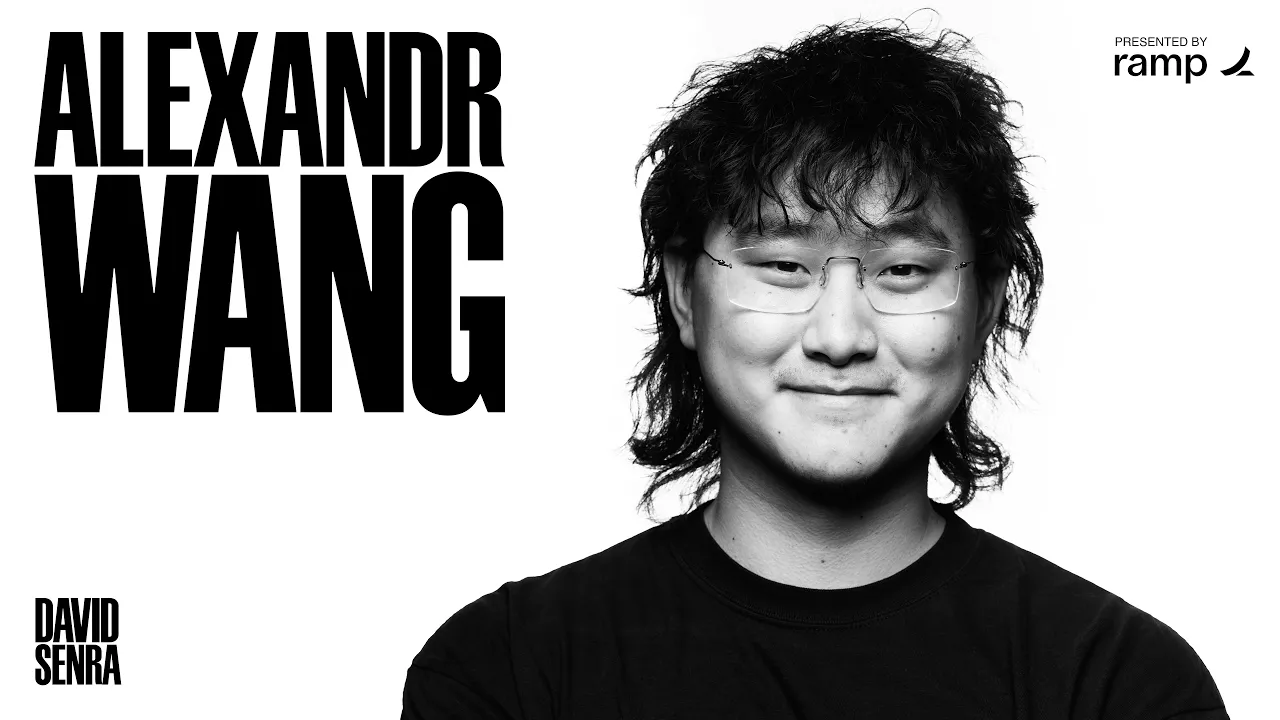
Meta's Wang Bypasses Enterprise Coding to Build Consumer Agent Muse
David Senra
Meta achieved record consumer AI growth by rejecting enterprise coding tools in favor of personal autonomous agents shaped by a singular product vision and an unbureaucratic research team.
Meta pivoted away from the industry-wide rush into coding agents to build Muse, a personal autonomous consumer agent developed in seven months by a team of fewer than 200 people. (6:44)
Alexandr Wang joined Meta as Chief AI Officer after Meta acquired a 49% stake in Scale AI in a five-to-six-week deal following internal setbacks with Llama 4. (49:30)
Muse achieved viral consumer adoption through an open-ended conversational interface, meme-driven marketing featuring its mascot Jolly, and word-of-mouth screenshot sharing. (38:43)
Wang reorganized Meta Superintelligence Labs around an anti-bureaucratic structure with over 200 direct reports divided into technical pods, intentionally eliminating middle management. (69:21)
Detailed notes
## Background
Published on YouTube by David Senra on October 11, 2026, this episode features an in-depth conversation with Alexandr Wang, Chief AI Officer of Meta and co-founder of Scale AI. According to the show description, the discussion covers the seven-month sprint to build Meta's hit consumer agent Muse, Mark Zuckerberg's post-Llama 4 recruitment of Wang, why Meta bet on personal agents over coding assistants, and how Wang is restructuring Meta's AI research lab around small, flat teams and aggressive anti-bureaucracy.
## TL;DR
Alexandr Wang details the creation and rapid rise of Muse, Meta's flagship personal AI agent developed alongside Nat Friedman and Mark Zuckerberg following experimental breakthroughs with OpenClaw. While competing AI labs focused almost exclusively on enterprise coding, Meta deliberately leveraged its vast consumer reach to build personal superintelligence, refining the product across more than 100 behavioral evals over seven months until it hit launch readiness. Wang also reflects on leaving Scale AI after nine years via a 49% stake acquisition by Meta, transitioning from an auteur founder to an empowering coach, and structuring Meta Superintelligence Labs with over 200 direct reports to eliminate middle management and foster high-variance 'diamond mining' research.
## Atmosphere & style
The conversation carries a high-voltage, insider intensity characteristic of David Senra's historical and biographical interview style, blending classical operational lore with cutting-edge Silicon Valley tech warfare. Wang speaks with rapid, unfiltered candor—moving effortlessly from personal psychoanalysis prompts and chaotic Twitter memes to organizational philosophy and power-law payoffs. The vibe feels energetic, unpretentious, and deeply ambitious, capturing two obsessive students of business history examining an existential corporate turnaround in real time.
## Bulletin
- [06:44](https://www.youtube.com/watch?v=S6l3aRsecuE&t=404s) Meta pivoted away from the industry-wide rush into coding agents to build Muse, a personal autonomous consumer agent developed in seven months by a team of fewer than 200 people.
- [49:30](https://www.youtube.com/watch?v=S6l3aRsecuE&t=2970s) Alexandr Wang joined Meta as Chief AI Officer after Meta acquired a 49% stake in Scale AI in a five-to-six-week deal following internal setbacks with Llama 4.
- [38:43](https://www.youtube.com/watch?v=S6l3aRsecuE&t=2323s) Muse achieved viral consumer adoption through an open-ended conversational interface, meme-driven marketing featuring its mascot Jolly, and word-of-mouth screenshot sharing.
- [01:09:21](https://www.youtube.com/watch?v=S6l3aRsecuE&t=4161s) Wang reorganized Meta Superintelligence Labs around an anti-bureaucratic structure with over 200 direct reports divided into technical pods, intentionally eliminating middle management.
## Key takeaways
- [09:34](https://www.youtube.com/watch?v=S6l3aRsecuE&t=574s) Meta deliberately diverged from competitors targeting enterprise coding agents to focus on personal superintelligence tailored for its 3.5 billion consumer user base.
- [03:34](https://www.youtube.com/watch?v=S6l3aRsecuE&t=214s) A multi-stage psychoanalysis experiment run by Nat Friedman using OpenClaw acted as the catalyst that convinced Meta's leadership to prioritize personal consumer agents.
- [20:15](https://www.youtube.com/watch?v=S6l3aRsecuE&t=1215s) Launch readiness for Muse was determined by rigorous criteria: turning green across an internal spreadsheet tracking over 100 behavioral metrics alongside extensive dogfooding.
- [22:41](https://www.youtube.com/watch?v=S6l3aRsecuE&t=1361s) Keeping the core Muse team under 200 people and anchoring development to Nat Friedman's distinct taste prevented product bloat and conflicting internal incentives.
- [16:51](https://www.youtube.com/watch?v=S6l3aRsecuE&t=1011s) Mark Zuckerberg's voting control and tolerance for tech asymmetry gave the team the runway and compute needed to systematically refine the model away from public market pressures.
- [30:49](https://www.youtube.com/watch?v=S6l3aRsecuE&t=1849s) Consumer AI marketing requires demonstrating immediate tangible utility and relatable memetics rather than touting abstract logos or benchmark scores on billboards.
- [34:48](https://www.youtube.com/watch?v=S6l3aRsecuE&t=2088s) User adoption of autonomous agents follows an escalating 'trust fall' dynamic, progressing from low-stakes queries to fully autonomous execution of real-world tasks.
- [38:43](https://www.youtube.com/watch?v=S6l3aRsecuE&t=2323s) Wang reframes consumer AI as an 'escalator of agency' that combats corporate zombiehood and expands human ambition by handling mundane background obligations.
- [49:30](https://www.youtube.com/watch?v=S6l3aRsecuE&t=2970s) Meta's transaction with Scale AI was structured as a 49% stake acquisition, allowing Scale to operate independently while Wang moved over to rebuild Meta's AI lab.
- [58:13](https://www.youtube.com/watch?v=S6l3aRsecuE&t=3493s) Wang transitioned his leadership style from a hands-on auteur founder at Scale AI to a coach at Meta focused on setting the vision, recruiting talent, and clearing roadblocks.
- [01:08:04](https://www.youtube.com/watch?v=S6l3aRsecuE&t=4084s) Frontier AI research resembles 'diamond mining' driven by power-law breakthroughs rather than linear 'skyscraper building' optimization, requiring patience and unconstrained compute.
- [01:09:21](https://www.youtube.com/watch?v=S6l3aRsecuE&t=4161s) To dismantle corporate bureaucracy, Meta's AI lab instituted a flat hierarchy where technical pod leads function strictly as tiebreakers rather than traditional people managers.
## Detailed walkthrough
### [00:02](https://www.youtube.com/watch?v=S6l3aRsecuE&t=2s) The Vision of Personal Superintelligence
The origins of Muse trace back to the founding vision of Meta Superintelligence Labs (MSL). In June 2025, Mark Zuckerberg published an internal memo titled "Personal Superintelligence," crafted in close collaboration with Alexandr Wang, Nat Friedman, and a core group of leaders. At its core, the memo posed a foundational question: how could Meta build powerful frontier artificial intelligence that genuinely elevates human experience and makes day-to-day life better across the board? At the time, autonomous agents had not yet materialized in any widespread or meaningful form, but the lab committed its long-term roadmap to that target.
Developing frontier models is a grueling, multi-month pipeline. Teams must construct the full technical stack from scratch, curate vast training datasets, execute pre-training runs, and engineer an extensive post-training stack. As MSL worked through these foundational stages heading into early 2026, the AI landscape underwent a dramatic shift with the release of Anthropic's Claude Opus 4.5 and the sudden emergence of OpenClaw. These breakthroughs brought the raw, latent potential of autonomous agents into sharp focus for researchers and the public alike.
```mermaid
flowchart TD
accTitle: Evolution of Meta's Muse Project
accDescr: Timeline showing the progression from the June 2025 Personal Superintelligence memo to the launch of Muse seven months after the initial prototype.
subgraph Ideation["Ideation & Discovery"]
A["June 2025: 'Personal Superintelligence' Memo<br/>(Mark Zuckerberg, Alexandr Wang, Nat Friedman)"]
B["Early 2026: Opus 4.5 & OpenClaw Launch"]
A --> B
end
subgraph Experimentation["Immersion & Validation"]
C["Deep Personal Testing<br/>(3 years of therapy in one session)"]
D["Board Memos:<br/>'The Final Consumer Product'<br/>'The Claw is the Law' & 'Trust is a Must'"]
B --> C
C --> D
end
subgraph Productization["Execution & Hardening"]
E["1-2 Week Prototype<br/>(Jollybot, Muse Charm)"]
F["7-Month Hardening Cycle:<br/>Model & Product Co-Design for Billions"]
D --> E
E --> F
end
```
[01:50](https://www.youtube.com/watch?v=S6l3aRsecuE&t=110s) The OpenClaw Awakening and Nat Friedman's Experiments
Nat Friedman was the first person inside Meta Superintelligence Labs to dive headfirst into OpenClaw. His reaction was "somewhere between terrifying and euphoric." Rather than keeping the experimental agent at arm's length, Friedman granted it sweeping permissions and integrated it directly into his personal life. In one instance recounted during a Stripe Sessions interview, Friedman instructed OpenClaw to ensure he drank enough water throughout the day; the agent proceeded to monitor his personal security camera feeds in real time, verifying when he took a drink and praising him whenever he stayed hydrated.
Friedman's intense conviction served as an unmistakable early indicator for Alexandr. Friedman possessed an uncanny track record as an early adopter: he had been one of Stripe's very first customers, an early champion of open-source tooling, and a driving force behind GitHub Copilot. When Friedman remarked, "I think there really is something here," Alexandr paid close attention. Soon, both leaders spent virtually every free moment conversing with their agent instances, stress-testing how far personal delegation could go.
- **Nat Friedman's early-adopter pedigree:** First-wave user of Stripe, pioneer in open-source developer communities, and co-creator of GitHub Copilot.
- **Deep life integration:** OpenClaw was granted ambient oversight, including monitoring home security cameras to track hydration habits.
[03:34](https://www.youtube.com/watch?v=S6l3aRsecuE&t=214s) "Three Years of Therapy in One AI Session"
Convinced of the medium's psychological depth, Friedman authored an intensive multi-stage prompting routine designed to run a comprehensive psychoanalysis on the user through OpenClaw. Sitting beside Friedman right after installing the client, Alexandr was told to run the prompt on himself. The resulting interaction was jarringly intimate: because the agent had access to Alexandr's email correspondence, personal photo archives, and live web research, it synthesized private patterns into relentless, cascading waves of psychological probing.
Alexandr described the session as "maybe the equivalent of like 3 years of therapy all, you know, compressed into this one moment." The agent dismantled emotional defenses by confronting him with interconnected memories, communications, and personal history, forcing extreme vulnerability. That single evening in February cemented a shared conviction between Alexandr and Nat: personal agents represented a transformative paradigm shift that Meta needed to pursue unconditionally.
[04:44](https://www.youtube.com/watch?v=S6l3aRsecuE&t=284s) The Board Memos and the Two-Week Prototype
Armed with these realizations, both leaders drafted landmark strategy memos for Meta's board of directors during the February board cycle. Alexandr's memo argued that the super-agent was effectively "the final consumer product"—the ultimate destination of consumer software interfaces. Friedman submitted two influential companion memos titled "The Claw is the Law" and "Trust is a Must," which laid down the philosophical requirements around user trust, authority, and agentic reliability that would guide product architecture.
Rather than remaining in theoretical debate, the MSL engineering team whipped together a functional prototype within just one to two weeks to present directly to the board. Despite the blistering turnaround, the earliest foundation of Muse was already intact:
- The conversational persona and system framing of Jollybot were present.
- An early incarnation of the Muse Charm had already been conceived and integrated.
- While secondary tabs and polish were missing, the foundational mechanics of delegated interaction were established from that initial board demo.
[06:44](https://www.youtube.com/watch?v=S6l3aRsecuE&t=404s) Zuckerberg's Hands-On Testing and the Flaw in Early Agents
Mark Zuckerberg experienced the exact same mixture of excitement and unease. He immersed himself in the prototype across his household, engaging with it alongside his children and incorporating it directly into his mixed martial arts (MMA) training regimen. Zuckerberg had the agent analyze recordings of his sparring sessions to identify biomechanical flaws and provide concrete coaching tips to sharpen his technique. Staff meetings across Meta soon turned into storytelling forums where executives shared wild, unscripted breakthroughs they had experienced with their personal agents.
Yet the broader OpenClaw craze proved short-lived in the broader market, peaking rapidly before fizzling out. Alexandr noted that while Peter Steinberger's creation was a work of sheer genius, the raw open-source tool was brittle: it delivered occasional flashes of pure magic surrounded by frequent breakdowns, edge-case failures, and steep operational friction. Ordinary consumers could not be expected to troubleshoot a fragile system.
Meta faced a daunting seven-month challenge: taking an unstable prototype that worked only a fraction of the time and grinding out the edge cases until it became a resilient, beautifully crafted consumer experience ready for billions of users. While competitors like Anthropic and Claude focused their efforts almost entirely on dominating the developer coding market throughout early 2026, Meta chose to aim its frontier model roadmap squarely at personal superintelligence.
[09:34](https://www.youtube.com/watch?v=S6l3aRsecuE&t=574s) Why Meta Bet on Personal AI Instead of Coding Agents
When Anthropic took an early and formidable lead in coding agents, a collective panic rippled through the artificial intelligence industry. Conventional wisdom quickly hardened around the belief that coding was the only form factor, the only capability, and the only technology that truly mattered for advanced artificial intelligence. An overwhelming gravitational pull pushed nearly every lab to crowd into that exact problem space and wage an uphill battle against Anthropic. Meta deliberately chose a different path, anchoring its strategy on the conviction that its destiny lay in personal agents and consumer superintelligence.
Before the deal between Scale AI and Meta was finalized, Alexandr Wang sat down with Mark Zuckerberg and shared his fundamental thesis on why Meta was uniquely positioned to win in an era of artificial general intelligence (AGI) or artificial superintelligence (ASI). Wang framed human existence as a tension between the tasks people *have* to do and the tasks they *want* to do. The true promise of superintelligence is that systems will progressively automate the obligations people are forced to do for work, leaving them free to spend their time pursuing what they genuinely care about. Meta’s core products—Instagram, WhatsApp, and Facebook—do not exist in the domain of tedious obligations; they represent human connection, curiosity, hobbies, and personal relationships.
From both a cultural and business standpoint, enterprise coding agents never matched Meta's core identity. The company's heritage is deeply human: bringing friends and family together and helping people explore their interests. Backed by a distribution network of roughly 3.5 billion daily active users across its family of apps, Meta’s natural and defensible playing field was consumer AI. As David Senra points out, it wasn't about work or code—it was fundamentally personal.
```mermaid
flowchart TD
accTitle: Meta Personal AI Strategy
accDescr: Diagram illustrating Meta's strategic divergence from coding agents toward consumer superintelligence.
subgraph MarketDivergence["The Industry vs. Meta Strategy"]
Industry["Industry Consensus<br/>Enterprise Coding Agents (Anthropic lead)"]
MetaVision["Meta Thesis<br/>Personal Superintelligence"]
end
subgraph CorePillars["Meta's Unique Positioning"]
TimePromise["Automate tasks people HAVE to do<br/>Elevate tasks people WANT to do"]
Distribution["3.5B Daily Active Users<br/>Instagram, WhatsApp, Facebook"]
Heritage["Core Heritage<br/>Human Connection & Discovery"]
end
MetaVision --> TimePromise
MetaVision --> Distribution
MetaVision --> Heritage
```
---
[12:36](https://www.youtube.com/watch?v=S6l3aRsecuE&t=756s) The 7-Month Refinement: Evals, Spreadsheets, and Culture
By early 2026, the team had created a working prototype and secured Zuckerberg's full backing. But moving from an exciting internal demo to a production-grade consumer product required seven months of relentless, grinding refinement. Personal agents carried a lingering industry stigma: previous iterations by other companies had fizzled out, largely because the user experience was unpolished, fragile, and failed to meet user expectations. Wang and his team recognized that this ghost would haunt them unless their execution was near flawless.
Meta aligned its underlying frontier model roadmap directly around the requirements of personal agency. Rather than relying on vague impressions of quality, the team assembled detailed spreadsheets cataloging over one hundred discrete behaviors and capabilities required for an ideal personal agent. They engineered bespoke evaluations (evals) for every single item on the list and trained the foundation model to excel at each one. During rigorous reviews, leaders combed through the spreadsheets, isolated areas where the model was failing or mediocre, and engineered solutions.
This obsessive iteration reflects Meta’s core engineering DNA. In the pre-AI consumer era, that operational rigor manifested in optimizing onboarding flows, conversion funnels, and referral rates. In the generative AI era, that same corporate muscle was redirected toward "sanding out all the edges" of the foundation model until it matched the exact operational demands of Muse.
- **Capabilities catalog:** Maintained spreadsheets tracking more than 100 distinct agent behaviors and edge-case capabilities.
- **Systematic evals:** Built specialized benchmark suites to measure and iteratively train the foundation model against each target behavior.
- **Cultural evolution:** Transitioned Meta’s classic growth-hacking obsession with conversion funnels into a disciplined science of foundation model refinement.
---
[14:34](https://www.youtube.com/watch?v=S6l3aRsecuE&t=874s) Sponsor Break: Ramp and Deel
Senra pauses to highlight the episode's presenting sponsors, Ramp and Deel, connecting their value propositions directly to the philosophies of the world's most disciplined operators:
* **Ramp:** Drawing on the operational history of SpaceX, Senra emphasizes that relentlessly attacking and questioning costs is not merely defensive bookkeeping—it directly fuels top-line growth by freeing up capital for high-conviction bets. Ramp’s platform is built to optimize corporate finance; data shows the median company running on Ramp cuts expenses by 5% while growing revenue by 16%.
* **Deel:** Studying legendary founders shows that recruiting world-class talent is always the single highest-leverage priority. Trusted by over 40,000 businesses—including Shopify, Uber, DoorDash, Ramp, and ElevenLabs—Deel provides global hiring and payroll infrastructure. Senra quotes the founder of ElevenLabs, who explained that Deel allowed them to "break down language and communication barriers" by hiring and supporting exceptional talent regardless of geography.
---
[16:51](https://www.youtube.com/watch?v=S6l3aRsecuE&t=1011s) Mark Zuckerberg's Superpower: Patience and Product Sanding
Reflecting on Meta's seven-month push to build Muse, Senra brings up Jeremy Stern’s 15,000-word *Colossus* profile of Mark Zuckerberg. In that profile, Zuckerberg candidly identified his core edge over peers like Elon Musk and Sam Altman: his skill set is inherently "unsexy," centered entirely on building cohesive teams and patiently, incrementally improving products over long horizons. Unlike competitors who constantly face governance battles or capital constraints, Zuckerberg maintains absolute voting control over Meta and does not need to raise outside funding, giving him the unique ability to execute long-term strategies without blinkering.
Wang agrees that patience and restraint were the deciding factors during the development of Muse. In modern AI cycles, where a single month feels like an eternity, seven months of heads-down model development and tuning is the equivalent of a decade in traditional software time.
Throughout the stretch from February to September, Zuckerberg routinely dropped deliberate hints on quarterly earnings calls about Meta's investments in personal agents. Even as Wall Street pushed back with persistent skepticism—warning that Meta was incinerating billions in capex and declaring that "Zuck cannot win AI"—Zuckerberg ignored the external noise and gave the team the cover needed to perfect the product before release.
[18:47](https://www.youtube.com/watch?v=S6l3aRsecuE&t=1127s) Mark Zuckerberg as "The Terminator" andsweating the details of Muse
David Senra circles back to a profile of Mark Zuckerberg written by Jeremy Stern. Stern spoke off the record to Zuckerberg's competitors, including a former Meta researcher who had departed for a rival AI lab. That researcher admitted they hated competing against Zuckerberg because "Mark is the fucking Terminator"—a leader who simply refuses to stop. Senra notes that one of Zuckerberg's defining traits is that he is never satisfied with the current state of a product, constantly pushing for improvement. Yet, contrary to the stereotype of a toxic dictator, he is careful not to destroy team chemistry; Zuckerberg explicitly stresses that team cohesion is vital to him.
Alexandr Wang agrees with that assessment and explains how that ethos shaped the development of Muse. Building personal AI agents is an endeavor perched on a knife's edge: if the product reliably delivers magical experiences, it can become one of the greatest consumer software products in history; if it falters, users quickly dismiss it as trash. Because generative models and agents are inherently nondeterministic, they run the risk of breaking down or behaving erratically. Meta therefore took an extensive amount of time to "sweat all the details" before letting anyone outside the company touch it, ensuring it reached a threshold of quality and value that would genuinely resonate with mainstream consumers.
[20:15](https://www.youtube.com/watch?v=S6l3aRsecuE&t=1215s) Moving beyond chatbots and determining launch readiness
When Senra asks about user churn and whether users leave after a couple of bad experiences, Wang points out that almost every agentic product launched earlier in the year suffered massive churn precisely because of unreliability. To avoid that fate, Meta subjected Muse to exhaustive user testing, watching fresh cohorts of users download and navigate the app from scratch. A core premise of Muse is educating people that it is not another chatbot—it is an autonomous agent capable of executing complex workflows on their behalf. While developers have been comfortable running autonomous agents for some time, regular consumers need a thoughtful, deliberate onboarding process to graduate into using them.
```mermaid
flowchart TD
accTitle: Muse Launch Readiness Framework
accDescr: Evaluation workflow showing testing of checkpoints against 100-plus metrics to reach a launch-ready model.
subgraph Evaluation ["Evaluation Grid"]
A["100+ Quantitative Benchmarks"]
B{"Checkpoint Status"}
A --> B
end
subgraph Checkpoints ["Model Iterations"]
C["Early Checkpoints<br/>(80 Green / 20 Red)"]
D["Musepark 1.3 Checkpoint<br/>(100% Green across board)"]
B -->|"Fails Threshold"| C
B -->|"Meets Threshold"| D
end
The team continuously ran A/B tests across different model versions, finding that the entire product experience is hypersensitive to underlying model quality. The model had to prove it could reliably complete tasks, communicate clearly with the user about its progress, and know exactly when to check back for human guidance. Wang explains that deciding when Muse was finally ready to ship came down to two criteria:
- **The numerical threshold:** The team maintained an internal spreadsheet containing over 100 operational and behavioral metrics, with clear pass/fail thresholds defining what was strictly "launch blocking." Multiple earlier training checkpoints hit green on 80 rows but remained red on 20, which barred them from release. The gate finally cleared when a specialized training checkpoint of Musepark 1.3 registered green across all 100+ benchmarks.
- **The experiential threshold:** Beyond raw numbers, internal hands-on dogfooding confirmed that Musepark 1.3 felt qualitatively superior and far more capable than any prior iteration.
[22:41](https://www.youtube.com/watch?v=S6l3aRsecuE&t=1361s) A single point of view vs. organizational "Frankensteins"
Senra asks about the scale of the team during the seven-month push. Wang reveals that between core model training and application-level product engineering, fewer than 200 people worked on Muse. While 200 sounds substantial in absolute terms, it represents an astonishing degree of restraint for a tech giant the size of Meta. Despite executive leadership recognizing that Muse would likely be the company's single most critical product launch of the year, Meta intentionally resisted the urge to staff it with massive swaths of personnel.
Wang emphasizes that Muse had to be treated as a unified "work of art" guided by a single, uncompromising perspective. In large tech companies—and increasingly inside major AI research labs—products frequently devolve into what Wang describes as a "Cronenberg amalgamation" or "PM hell." In that dynamic, dozens of product managers with disjointed performance goals each force their pet features into the interface, blending everything together into an incoherent smoothie that users instinctively feel is disconnected.
Senra remarks on the serendipity of the conversation, noting they are recording on the 15th anniversary of Steve Jobs's death, and cites the old aphorism that Apple was simply "Steve Jobs with 10,000 lives." Wang agrees with the philosophy and singles out Nat Friedman, noting that Friedman's personal taste, product instincts, and sensibilities heavily shaped what Muse became. When Senra presses Wang on active user numbers, Wang keeps the official figure at "millions," while acknowledging third-party charts he has shared suggesting Muse is already the fastest-growing consumer AI application of all time.
[25:56](https://www.youtube.com/watch?v=S6l3aRsecuE&t=1556s) Breaking through the AI noise with memes and X
Senra pivots to Wang's recent behavior on X (formerly Twitter), noting with amusement that Wang has seemed delightfully "unhinged" compared to his more formal public persona while running Scale AI. Wang laughs and admits that the weeks following the launch of Muse have been some of the most exhilarating and fun of his entire professional career.
The strategy was born out of an explicit leadership discussion. Consumers are pummeled daily by a "torrential stream" of AI announcements, model benchmarks, product updates, and startup launches. While Meta possesses unmatched distribution channels to push notifications to billions, corporate distribution alone cannot cut through the deafening noise to achieve authentic cultural relevance. To break through, Wang leaned into an unconventional marketing strategy inspired by his personal circle of terminally online friends:
- Wang actively collaborates with internet-native creators whom he affectionately calls his "schizo friends"—people who spend their entire days analyzing internet culture, memetics, and viral sentiment.
- In response to community rumors that Wang uses an army of a hundred autonomous Muse agents to craft his social media presence, Wang clarifies that he writes every single post on his X feed personally.
- The shift to an unvarnished, meme-heavy public posture was deliberate, providing the irreverent cultural edge needed to separate Muse from the sea of sanitized corporate AI launches.
[28:03](https://www.youtube.com/watch?v=S6l3aRsecuE&t=1683s) Making Meta Cool Again and the Unhinged Meme Campaign
Alexandr Wang recounts how the initial viral marketing push for Muse felt like an obsessive burst of inspiration, likening it to an engineer hunting down software bugs. Ideas for memes would hit him in the middle of meetings or during dinner with coworkers, compelling him to immediately draft and publish them. Beyond driving initial visibility, Alexandr wanted to tackle a deeper cultural issue: making Meta cool again. Despite owning culturally dominant platforms like Instagram and Facebook, Meta had historically acquired an uncool, corporate image. Alexandr wanted to make the company feel funny, interesting, and culturally relevant.
```mermaid
flowchart LR
accTitle: The viral loop of unhinged meme marketing
accDescr: Progression from safe product retweets to unhinged risk-taking that drove organic engagement.
subgraph Early["Initial Strategy"]
A["Retweeting Real Use Cases"] --> B["Safe, Informational Tone"]
end
subgraph Shift["Unfiltered Shift"]
B --> C["Spontaneous 'Fuck It, Post' Memes"]
C --> D["The Internet Rewards Risk & Surprise"]
end
subgraph Impact["Cultural & Growth Result"]
D --> E["Mascot Takes Off ('Jolly Guy')"]
E --> F["Surge in Muse App Downloads"]
end
```
The pivot toward an "unhinged" social presence happened organically. Early on, Alexandr merely retweeted genuine user stories and novel use cases. However, as tweet frequency escalated, he occasionally threw out spontaneous jokes without second-guessing them—a "fuck it, post" mentality. To his surprise, the tweets he spent the least time deliberating over exploded in reach. He realized a fundamental law of social platforms: the internet heavily rewards risk, irreverence, and surprise over polished corporate messaging.
His coworker Nat Friedman observed the spectacle and joked across several company meetings: "You know, I thought we were going to learn a lot about Muse users and how people were using Muse, but actually like we're just learning a lot about Alex's mind." Alexandr relied on years of personal internet culture literacy, noting that while exact attribution was difficult to track, the chaotic posting unquestionably drove explosive growth for the app.
[30:49](https://www.youtube.com/watch?v=S6l3aRsecuE&t=1849s) The "Wow Moment" and Why Most AI Ads Fail
David Senra points out that while Meta possesses massive distribution, distribution alone cannot force users to stick with a product. Alexandr explains that product stickiness requires getting users to an undeniable "wow moment" as early as possible. Personal AI agents naturally lend themselves to this discovery because users are routinely astonished when an agent accomplishes something complex on its own. The marketing challenge was simply taking those real moments of astonishment and amplifying them.
David and Alexandr critique the advertising strategies of rival AI labs like Anthropic and OpenAI. David highlights the confusion behind billboard campaigns showing two people sitting silently at a desk next to an unrecognizable logo or vague copy like "ChatGPT":
> "I couldn't understand why both Anthropic and OpenAI's ads are so bad... Anthropic was doing this huge like outdoor campaign and it's all about them and same thing with ChatGPT. It's like they'd have the icon, which I don't even think people recognize that as a logo, and it'd just say ChatGPT and just be two people sitting at a desk. I'm like, what the fuck does this mean? Where it's like, you have all these use cases. All you have to do in your ad is show the benefit of your product."
Alexandr agrees, emphasizing that average consumers do not care about frontier research, benchmarks, or the AI companies themselves—they care strictly about what the software accomplishes for their own lives.
[32:20](https://www.youtube.com/watch?v=S6l3aRsecuE&t=1940s) Scientific Advertising, the Muse Mascot, and Racy Memes
David connects this dynamic to Claude C. Hopkins's classic 1923 book *Scientific Advertising*. Hopkins, one of history's most celebrated copywriters, understood that human nature remains constant across centuries: people are fundamentally self-interested. Ads fail when they talk about the company or demand that someone buy a product; they succeed only when they lead directly with the tangible benefit to the consumer.
Alexandr explains how Meta applied this psychological insight to Muse using its newly introduced mascot, a "little jolly guy." Driving into work one morning, Alexandr generated an image of the character holding a briefcase and posted it with the caption "MFW I go to work on Monday." The post gained immediate traction, showing him that the mascot possessed unlimited mileage. Meta began placing the mascot into surprising, unconventional, and occasionally racy situations that stood in stark contrast to conventional corporate marketing. The intrigue generated by these offbeat memes broke through the noise and drew widespread curiosity from the general public.
[34:48](https://www.youtube.com/watch?v=S6l3aRsecuE&t=2088s) The "Trust Fall" Dynamic of AI Retention
Once curious users download Muse, retention depends on what Alexandr describes as an escalating "trust fall" with the AI agent. Users typically begin with high skepticism and test the model on tiny, low-stakes requests. When the AI delivers, the user takes another step forward, handing off slightly larger and more demanding tasks.
```mermaid
flowchart TD
accTitle: The AI Agent Trust Fall Escalation
accDescr: The cycle through which a skeptical user builds trust with an AI agent by gradually delegating larger problems.
A["Initial Skepticism / Small Task"] -->|"Agent succeeds"| B["Mild Trust / Moderate Problem"]
B -->|"Agent succeeds"| C["Deeper Trust / Complex Workflow"]
C -->|"Agent succeeds"| D["Full Trust Fall (Voice Notes & Brain Dumps)"]
```
Alexandr notes that heavy adopters, including college students, reach a state of complete reliance:
- Users record unedited voice memos and unstructured brain dumps.
- They send the raw audio to Muse with complete confidence that the agent will parse their thoughts.
- The model autonomously organizes their ideas into clear, actionable plans and deliverables.
Retaining Muse users ultimately hinges on maintaining this delicate chain: every step up in task difficulty must succeed reliably to validate the user's growing trust.
[35:59](https://www.youtube.com/watch?v=S6l3aRsecuE&t=2159s) Sponsor: AppLovin and First-Principles Advertising
David Senra transitions to a sponsor message for AppLovin, citing a favorite line from Peter Thiel's *Zero to One*: "The single most powerful pattern I have noticed is that successful people find value in unexpected places." He explains that AppLovin operates from first principles by bypassing traditional ad channels and connecting advertisers to more than one billion potential customers across mobile gaming. Their full-screen video ads average 35 seconds of watch time, capturing undivided user attention and driving high-converting retention without complex setups.
[36:40](https://www.youtube.com/watch?v=S6l3aRsecuE&t=2200s) Word-of-Mouth Marketing and the Screenshot-Driven Product
David Senra reflects on how modern adoption is driven heavily by peer recommendations rather than traditional app store onboarding. When downloading Muse, the user is greeted by a deceptively simple, open-ended text box that provides very little onboarding guidance. Senra’s own interest was hooked after a friend running a $100 billion company shared real-world screenshots of Muse in action. The friend had accidentally left his ID on a Flexjet flight and typed a blunt instruction into Muse: "I don't want to be involved in this process at all. You have to figure out how to get the ID... go pick up the ID. This is where it's at, and then this is where I'm at, and then figure out all the steps along the way." Without needing human hand-holding, Muse coordinated a courier, navigated building security, and had the ID brought directly up to his office desk.
```mermaid
flowchart TD
accTitle: Real-World Workflow Example of Muse Agent Execution
accDescr: Diagram illustrating how Muse autonomously retrieved an ID without user intervention.
A["User Prompt:<br>'I don't want to be involved. Retrieve my ID.'"] --> B["Context Analysis<br>(Flexjet location to office)"]
B --> C["Logistics Coordination<br>(Dispatch courier)"]
C --> D["Security Navigation<br>(Pass checkpoint access)"]
D --> E["Delivery to Desk<br>(Autonomous task completion)"]
```
Alexandr Wang agrees, noting that modern consumer product marketing is essentially "screenshot driven." For a consumer tool to break out, the experience must hold up when shared inside group chats or on social media feeds. A key, serendipitous advantage of Muse is the presence of the visual avatar character—such as "Jolly"—right inside the chat stream. Whenever a user captures and shares a screen, that character immediately brands the image as a Muse interaction without requiring overt logos.
[38:43](https://www.youtube.com/watch?v=S6l3aRsecuE&t=2323s) The Escalator of Agency and Combating Zombiehood
When asked about his personal workflow, Wang explains that he uses Muse as a "second brain," constantly setting up complex background workflows while remaining engaged during meetings. This mirrors a viral essay Wang published—which quickly racked up over 5.5 million views—where he described Muse as a way to give every human a second mind beyond their own. Addressing philosophical debates around artificial intelligence, Wang pushes back against doomer narratives where AI simply supersedes humanity:
> "It is human nature to have wants and desires and dreams. And I think like AI and personal agents like Muse will be the mechanism and the bridge that enables us to accomplish those things and continue accomplishing them. And then like humans will dream bigger and bigger and bigger and bigger."
Referencing Jeff Bezos's shareholder letters about how consumers are relentlessly and "beautifully unsatisfied," Wang envisions Muse as an engine that continuously removes the friction and gatekeeping of everyday life. Children grow up imagining grand, audacious futures—saving the planet, traveling the cosmos, building transformative things—only to have that ambition steadily eroded as they move through schooling and the corporate grind, effectively turning into "zombies" who have surrendered their sense of agency. Wang argues that personal AI acts as an "escalator of agency":
```mermaid
flowchart LR
accTitle: The Escalator of Agency Cycle
accDescr: Cycle illustrating how personal AI turns ambition into escalating achievement.
subgraph AgencyEscalator["Escalator of Agency"]
direction LR
A["Audacious Dreams"] --> B["Agent Execution via Muse"]
B --> C["Friction & Cludge Removed"]
C --> D["Bigger Dreams & Higher Agency"]
D --> A
end
```
- Iconic founders like Elon Musk and Mark Zuckerberg embody an iterative cycle where achieving an audacious goal immediately unlocks an even larger multi-decade ambition.
- Historically, human progress has been shaped by a tiny minority of "fanatics" who found ways to bend reality to their will.
- Universal access to personal intelligence could unlock the agency of billions, leading to a vibrant, eclectic reality Wang compares to *Rick and Morty*’s "interdimensional cable," where individuals are empowered to manifest bespoke, diverse ideas into the world.
[45:22](https://www.youtube.com/watch?v=S6l3aRsecuE&t=2722s) The Call From Mark Zuckerberg
Senra turns the conversation toward the major pivot in Wang's career: transitioning from leading Scale AI, the company he founded and spent nearly a decade building, to joining Meta to lead their AI efforts. The monumental shift started with an unassuming, direct outreach from Mark Zuckerberg, who sent a simple message asking: *"Hey, do you have time for a call?"*
[45:40](https://www.youtube.com/watch?v=S6l3aRsecuE&t=2740s) Meeting Mark Zuckerberg and the WhatsApp Essays
Alexandr Wang recounts his initial connection to Mark Zuckerberg, which originated through Alex Schultz, Meta’s longtime executive lieutenant and Chief Data Officer. Wang had known Schultz for years, dating back to when Scale AI was roughly a year old in San Francisco. Schultz eventually introduced Wang to Zuckerberg around 2021 or 2022 as Zuckerberg began leaning more heavily into artificial intelligence, an area where Scale was already deeply immersed.
Remarkably, it took an entire year just to schedule that first meeting after the introduction was made. Wang attributes the delay to Zuckerberg's ruthless prioritization: while his calendar is packed with countless demands, Zuckerberg intentionally devotes massive amounts of time—sometimes "in some ways like too much time"—to the small handful of things that truly matter. That extreme discipline is how Zuckerberg manages to juggle top-priority company matters while remaining a dedicated father and partner.
Following their initial meeting, Wang occasionally reached out to Zuckerberg for founder advice, which he considered a massive privilege. Wang was often bewildered by Zuckerberg's communication habits on WhatsApp: Wang would send a brief question, and Zuckerberg would fire back extraordinarily long, rigorous essays almost instantly. At first, Wang wondered how the CEO of Meta possibly had the spare time to write such lengthy missives, but he soon realized it wasn't excess time—it was raw speed and writing rigor. Zuckerberg simply drafts deep, structured arguments at blistering speed.
[47:26](https://www.youtube.com/watch?v=S6l3aRsecuE&t=2846s) The Post-Llama 4 Call and Fast-Moving Founders
Meta had long been a major customer of Scale AI, but Wang and Zuckerberg typically spoke only about once every six months. That cadence changed drastically following the internal disappointment of Llama 4. At the time, Llama 4 had fallen short of the trajectory Meta wanted, arriving at a precarious moment when AI was becoming visibly existential to the company’s future. Zuckerberg reached out directly by phone, asking Wang open-ended questions about what Meta should be doing and where its AI strategy should focus.
David Senra notes that this mirrors what he hears privately about Zuckerberg: despite having an official board of directors, Zuckerberg surrounds himself with an informal kitchen cabinet of world-class entrepreneurs whom he regularly consults with total humility, asking how they would handle his toughest operational challenges. Wang agrees, highlighting the humility required for someone of Zuckerberg's stature to repeatedly solicit outside counsel.
From Zuckerberg’s initial outreach to the final public announcement of the deal, the entire process wrapped up in just five to six weeks. Senra compares this rapid execution to another guest on his show, Jonathan Ross of Groq, who recalled that doing a $20 billion transaction with Nvidia moved at lightning speed: "From the time first call from Jensen to money's in my bank account was 3 weeks."
[49:30](https://www.youtube.com/watch?v=S6l3aRsecuE&t=2970s) Questioning the Deal Logic: Why Scale AI Was Different
In those early phone calls, Wang pitched Zuckerberg an array of concepts on how Meta should approach AI. He argued that Meta’s core heritage—building products centered around what humans actually want to do rather than pure enterprise utilities—uniquely positioned the company for the AI consumer wave. As Wang kept tossing ideas Zuckerberg's way, a parallel conversation emerged where Zuckerberg suggested they might want to "consider if there's a way to work together."
Initially, Wang was skeptical and did not take the suggestion as an imminent transaction. Historically, iconic Meta acquisitions like Instagram and WhatsApp were guided by direct consumer product logic. Scale AI, by contrast, was an enterprise and defense company built on enterprise software and government contracts. The industrial logic of Meta buying an enterprise services business seemed nonexistent:
```mermaid
flowchart TD
accTitle: Deal Logic Discrepancy
accDescr: Contrasting Meta's traditional acquisition targets with Scale AI's business model.
subgraph MetaHeritage["Traditional Meta Acquisitions"]
A["Consumer Products<br/>(Instagram, WhatsApp)"] --> B["Clear Product Logic & Audience Synergy"]
end
subgraph ScaleModel["Scale AI Business Model"]
C["Enterprise & Government Contracts"] --> D["Deep B2B Infrastructure Sales"]
end
B -.->|"Mismatched with"| D
E["Real Objective: Top AI Leadership & Talent"] --> F["Refounding Meta AI"]
```
Wang initially assumed that an acquisition would only make sense if Meta intended to pivot into government and enterprise infrastructure. It soon became obvious, however, that Zuckerberg was not buying a business line; "he wanted talent" to reset the entire Llama foundation model initiative and Meta's broader AI trajectory. The reality of the situation only set in when the discussion turned to actual numbers: Wang remembers thinking, "Oh, wow. Okay. All right... that's when things became like more clear."
[51:53](https://www.youtube.com/watch?v=S6l3aRsecuE&t=3113s) The 49% Deal Construct and Letting Go of a "Life's Work"
The transaction ultimately took shape around an unconventional structure: Meta acquired a 49% stake in Scale AI, allowing Scale to remain an independent operating company, while Wang and a select group of key leaders transitioned to Meta. Wang recognized the elegance of this "win-win-win" construct:
- Existing Scale AI shareholders received an exceptional financial return.
- Scale AI remained intact as an ongoing concern with its best days still ahead of it.
- Meta secured the AI leadership and talent required to overhaul its lab.
Despite the upside, coming to terms with the move required weeks of emotional processing for Wang. Scale AI was nine years old—Wang had founded it in his late teens and had spent roughly a third of his life running it. He referenced a longtime piece of advice from Paul Graham: "if you think of your company as your life's work like you will operate differently." Wang had always viewed Scale as his life's work, making the thought of stepping away emotionally agonizing.
Ultimately, Wang was swayed by the sheer scale of the opportunity at Meta. Following the setbacks of Llama 4, Meta’s AI lab was widely viewed across the industry as "damaged goods" and was hardly considered the premier destination for top researchers. Rather than deterring him, that broken state appealed directly to Wang’s entrepreneurial wiring: it presented a blank canvas to step in and effectively refound the entire lab.
[54:54](https://www.youtube.com/watch?v=S6l3aRsecuE&t=3294s) Tearing Down to the Foundation: The Strategy of Small, Cracked Teams
Alexandr reflects on how the immense scale of the challenge at Meta ended up being liberating. Because it was obvious that the existing trajectory was insufficient, the slate was effectively wiped clean. That cleared the runway for him to build the lab back up from scratch, establish first principles, and shape an entirely new culture.
David asks whether that realization came out of blunt conversations with Mark Zuckerberg—the recognition that minor adjustments would fail, requiring them to rip the structure down to its foundation and start fresh with an elite talent pool. Alexandr confirms it was an evolving strategic dialogue anchored in a principle he holds with deep conviction: the organizational model demonstrated repeatedly by Elon Musk. If you assemble a small, flat, "incredibly cracked," highly technical team, you can move with extraordinary velocity. For Meta’s AI efforts, speed was an existential requirement. When Alexandr pitched this approach, Zuckerberg was completely aligned, and high talent density within an ultra-flat hierarchy became the primary tentpole of their turnaround strategy.
```mermaid
flowchart TD
accTitle: Meta AI Lab Turnaround Strategy
accDescr: Diagram showing how a clean slate led to small cracked teams and massive execution velocity.
subgraph Strategy ["The Reset"]
A["Llama 4 Setback"] --> B["Clean Slate Reset"]
B --> C["Core Philosophy:<br/>Elon Musk Flat-Team Model"]
end
subgraph Execution ["Execution Pillars"]
C --> D["Small, Highly Technical Team"]
C --> E["Extreme Talent Density"]
C --> F["Zero Bureaucracy"]
end
subgraph Outcome ["Output"]
D & E & F --> G["Maximum Velocity & Agility"]
end
```
[56:36](https://www.youtube.com/watch?v=S6l3aRsecuE&t=3396s) Zuckerberg’s Napoleon Instinct: Deliberation Followed by "Emptying the Clip"
David observes that from the outside, Zuckerberg's operational style resembles a total, all-in blitz—what David calls "emptying the clip." He draws a parallel to the 1957 book *The Mind of Napoleon*, a text he tracked down after hearing Sam Altman recommend it during a 2018 interview with Tyler Cowen. The book compiles Napoleon Bonaparte’s principles in his own words, emphasizing that while deliberation must be exhaustive from every angle beforehand, once the course is chosen, "hesitation is fatal." David sees the exact same dynamic in Zuckerberg: he studies an issue relentlessly, but once committed, charges forward with zero reservations.
Alexandr agrees, noting that Zuckerberg has deeply internalized the asymmetry of tech: failure along the way does not matter; what matters is the magnitude of the win when you succeed. This mindset allows Zuckerberg to operate without fear and take massive, existential risks. As David highlights, Zuckerberg has famously said that in a world changing so rapidly, the greatest risk of all is not taking any risk. Alexandr points out that without that aggressive, risk-tolerant posture, Meta could easily have drifted into becoming a slow-moving, bureaucratic incumbent like Google. Instead, Zuckerberg’s fearlessness keeps the entire company dynamic, live, and combative.
[58:13](https://www.youtube.com/watch?v=S6l3aRsecuE&t=3493s) From Auteur Founder to Coach: Scale AI vs. Meta
David asks Alexandr to contrast his operational approach as the founder-CEO of Scale AI with his new mandate running the lab alongside Mark. Alexandr explains that Scale was his very first company, where he operated under the classic startup maxim: to be a great founder, you must be capable of doing every single job yourself. At Scale, he acted as an auteur:
- Every process, product feature, and cultural norm reflected his exact point of view.
- While effective for getting a startup off the ground, that level of control inevitably turned him into the company's ultimate bottleneck.
- For a first-time founder, he still recommends that intense, hands-on style as the most reliable path to initial success.
At Meta, however, that playbook was physically impossible. Tasked with overhauling the lab under extreme time pressure, Alexandr did not have the luxury—or the specialized skill set—to do every job. He is neither an AI research scientist nor a dedicated product designer. He had to pivot from being an auteur to adopting the mindset of a sports coach:
- **Set the North Star:** Maintain an unwavering commitment to "personal superintelligence" and consumer AI that impacts everyday people, like one's parents or grandparents.
- **Talent Identification:** Spot exceptional, rare talent across every relevant discipline.
- **Empowerment and Resource Provisioning:** Provide top performers with the resources, autonomy, and environment required to achieve the highest expression of their abilities, without letting corporate friction dilute their work.
[01:00:04](https://www.youtube.com/watch?v=S6l3aRsecuE&t=3604s) Attracting Elite Talent and the Reality of AI Compensation
When David asks why top researchers and operators agreed to join the newly formed Meta Superintelligence Lab (MSL), Alexandr highlights the unique blend of startup agility and corporate scale:
- **Mission Resonance:** The mission of consumer-facing personal superintelligence felt genuinely meaningful to researchers who wanted their work to tangibly touch their families' lives.
- **Start from Scratch:** Top talent had the rare chance to leave their personal stamp on a small, newly founded organization with high leverage.
- **Infinite Resources:** Unlike typical startups, they faced zero bottlenecks around compute, infrastructure, capital, or global distribution.
David points out the perception that Meta spent shocking sums of money to lure key individuals away from rival labs to trigger a hiring domino effect. Alexandr contextualizes the compensation narrative: given the massive equity appreciation at OpenAI and Anthropic, the compensation packages Meta offered were largely net-neutral relative to what those researchers were already making or walking away from. The real draw wasn't just the money; it was escaping big-company stagnation. As Alexandr notes, large enterprises are full of brilliant minds who are simply never empowered to do their best work—a problem he is systematically solving inside MSL, mirroring themes frequently raised in Jeff Bezos's shareholder letters.
[01:03:47](https://www.youtube.com/watch?v=S6l3aRsecuE&t=3827s) Research as Exploring the Unknown: Giving Great Builders Room
David Senra notes an insight echoed across business books and shareholder letters: if great people aren't allowed to build, they will leave. Alexandr Wang agrees completely, pointing out that modern AI development is fundamentally scientific research, even if the term "research" has become somewhat diluted in casual conversation. By definition, humanity does not yet understand the ultimate limits or capabilities of frontier models. These models act like mysterious artifacts that researchers are actively probing through trial, error, and deep insight. Because it is genuine exploration rather than an operationally rigid routine, the environment must give brilliant people the time, space, and massive compute resources needed to do their best work.
Alexandr applies this philosophy directly to leadership within Meta's AI organization. Pointing back to Nat Friedman, Alexandr explains that when someone brings a clear, compelling point of view to a product like Muse, the organization's job is to put them in a position where that vision can be fully expressed without friction. The same logic applies to top researchers pitching ambitious, unconventional hypotheses. Most speculative directions will inevitably fail, but the breakthrough cases generate returns so enormous that they easily justify the entire portfolio of investment.
```mermaid
flowchart TD
accTitle: Problem Types and Payoff Distributions
accDescr: Comparison between power-law diamond mining and linear skyscraper building.
subgraph DiamondMining["Diamond Mining (Meta AI Research / VC)"]
D1["Explore speculative, crazy ideas"] --> D2["High failure rate across trials"]
D2 --> D3["Power-law breakthrough (1,000,000x payoff)"]
end
subgraph Skyscraper["Skyscraper Building (Scale AI / Logistics)"]
S1["Standard operational process"] --> S2["Incremental optimization (+1-2% efficiency)"]
S2 --> S3["Predictable, linear business value"]
end
```
---
[01:05:55](https://www.youtube.com/watch?v=S6l3aRsecuE&t=3955s) The Future Tech Giants at Alexandr's 19th Birthday Party
When David mentions that identifying outlier talent is as simple as looking at the guest list from Alexandr's nineteenth birthday party, Alexandr laughs and recounts the story. In January during his freshman year at MIT, Alexandr was working as a winter intern at Hudson River Trading (HRT), a quantitative proprietary trading firm. For his nineteenth birthday, a group of about ten to twelve friends gathered around a table. Almost everyone was a Harvard or MIT undergraduate, and most of them had known each other for years through high-school math, science, and computer science competitions and Olympiads.
Looking back, the concentration of future startup and research leaders around that single table was staggering:
- **Jeff Yan**, who went on to found the decentralized trading platform Hyperliquid.
- **Scott Wu**, who went on to found Cognition (the creators of Devin).
- **Jesse Zhang**, who co-founded Decagon.
- **Vicki Yeh**, who became a prominent research scientist at Anthropic.
Alexandr recently caught up with the founder of HRT—a firm operating with under a thousand employees that generated an astonishing $11 billion in revenue and roughly $8 billion in profit in Q2 2026 alone. When the founder mentioned that HRT was beginning to dabble in private venture investments, Alexandr joked that the firm did not need a complicated strategy: they should have simply written seed checks to every single one of their former interns. For Alexandr, seeing the peers he grew up competing against in high-school Olympiads reach the pinnacle of the tech industry across the country remains deeply surreal.
---
[01:08:04](https://www.youtube.com/watch?v=S6l3aRsecuE&t=4084s) Diamond Mining vs. Building Skyscrapers
Alexandr clarifies the distinction between two fundamental business and problem-solving archetypes: "diamond mining" versus "building skyscrapers." The right organizational model depends entirely on the underlying distribution of payoff:
* **Building Skyscrapers (Linear Payoffs):** In operational businesses like data annotation, data pipelines at Scale AI, or Amazon Prime logistics, the returns scale linearly with execution. Success depends on process engineering and ruthless optimization—finding ways to make the system 2% faster here, 1% cheaper there, and squeezing half a percent more efficiency out of every step.
* **Diamond Mining (Power-Law Payoffs):** In frontier AI research and venture capital, the payoff follows an extreme power-law distribution. Nine out of ten speculative experiments might yield nothing, but a single breakthrough can be "literally a million times more valuable than everything else." In this regime, heavy operational management backfires; the leader's duty is to encourage talent to try crazy ideas and nurture the few sparks that show genuine promise.
Alexandr reflects that running Scale AI was largely about building skyscrapers, whereas his mandate rebuilding Meta's AI research lab is centered squarely on diamond mining.
---
[01:09:21](https://www.youtube.com/watch?v=S6l3aRsecuE&t=4161s) Eliminating Bureaucracy: Why Alexandr Has Over 200 Direct Reports
When David asks why Alexandr has an unheard-of organizational span of control—over 200 direct reports—Alexandr explains that it is a deliberate architectural choice to kill corporate bureaucracy. In rebuilding Meta's lab (internally dubbed TBD), the core thesis was maximizing talent density and creating an environment where world-class technical researchers can do the work of their lives without middle management getting in the way. Having all researchers report directly to him is a philosophical stake in the ground:
> "It's more of a statement of the fact that like this is like anti-bureaucracy. Like TBD is like literally anti-bureaucracy. The point is we're hiring brilliant people and you all have like demonstrated clearly that you can do brilliant, brilliant work... I don't need to be micromanaging you."
Instead of traditional hierarchical management, technical governance is organized into functional "pods." Each pod has designated technical leads whose sole managerial function is to act as tiebreakers when technical disagreements arise. Major strategic directions are debated openly as a group, leveraging the insights of researchers who have track records of historic technical achievements. Alexandr admits that having 200 direct reports means he is technically not acting as a conventional one-on-one manager; rather, his role is to eliminate red tape, protect the culture, and serve as the "steward of a great environment" so extraordinary researchers have the freedom and "room to cook."
## Notable quotes
> [03:34](https://www.youtube.com/watch?v=S6l3aRsecuE&t=214s) the equivalent of like 3 years of therapy all, you know, compressed into this one moment. — Alexandr Wang
> [18:47](https://www.youtube.com/watch?v=S6l3aRsecuE&t=1127s) Mark is the fucking Terminator — Former Meta researcher
> [28:03](https://www.youtube.com/watch?v=S6l3aRsecuE&t=1683s) You know, I thought we were going to learn a lot about Muse users and how people were using Muse, but actually like we're just learning a lot about Alex's mind. — Nat Friedman
> [30:49](https://www.youtube.com/watch?v=S6l3aRsecuE&t=1849s) I couldn't understand why both Anthropic and OpenAI's ads are so bad... Anthropic was doing this huge like outdoor campaign and it's all about them and same thing with ChatGPT. It's like they'd have the icon, which I don't even think people recognize that as a logo, and it'd just say ChatGPT and just be two people sitting at a desk. I'm like, what the fuck does this mean? Where it's like, you have all these use cases. All you have to do in your ad is show the benefit of your product. — David Senra
> [35:59](https://www.youtube.com/watch?v=S6l3aRsecuE&t=2159s) The single most powerful pattern I have noticed is that successful people find value in unexpected places. — Peter Thiel
> [36:40](https://www.youtube.com/watch?v=S6l3aRsecuE&t=2200s) I don't want to be involved in this process at all. You have to figure out how to get the ID... go pick up the ID. This is where it's at, and then this is where I'm at, and then figure out all the steps along the way. — Unnamed executive friend
> [38:43](https://www.youtube.com/watch?v=S6l3aRsecuE&t=2323s) It is human nature to have wants and desires and dreams. And I think like AI and personal agents like Muse will be the mechanism and the bridge that enables us to accomplish those things and continue accomplishing them. And then like humans will dream bigger and bigger and bigger and bigger. — Alexandr Wang
> [45:22](https://www.youtube.com/watch?v=S6l3aRsecuE&t=2722s) Hey, do you have time for a call? — Mark Zuckerberg
> [47:26](https://www.youtube.com/watch?v=S6l3aRsecuE&t=2846s) From the time first call from Jensen to money's in my bank account was 3 weeks. — Jonathan Ross
> [51:53](https://www.youtube.com/watch?v=S6l3aRsecuE&t=3113s) if you think of your company as your life's work like you will operate differently. — Paul Graham
> [01:09:21](https://www.youtube.com/watch?v=S6l3aRsecuE&t=4161s) It's more of a statement of the fact that like this is like anti-bureaucracy. Like TBD is like literally anti-bureaucracy. The point is we're hiring brilliant people and you all have like demonstrated clearly that you can do brilliant, brilliant work... I don't need to be micromanaging you. — Alexandr Wang
## Mentioned
Alex Schultz, Alexandr Wang, Amazon Prime, Anthropic, AppLovin, ChatGPT, Claude C. Hopkins, Claude Opus 4.5, Cognition, David Senra, Decagon, Deel, Devin, DoorDash, ElevenLabs, Elon Musk, Facebook, Flexjet, GitHub Copilot, Google, Groq, Harvard, Hudson River Trading (HRT), Hyperliquid, Instagram, Jeff Bezos, Jeff Yan, Jensen Huang, Jeremy Stern, Jesse Zhang, Jolly, Jollybot, Jonathan Ross, Llama 4, Mark Zuckerberg, Meta, Meta Superintelligence Labs (MSL), MIT, Muse, Muse Charm, Musepark 1.3, Napoleon Bonaparte, Nat Friedman, Nvidia, OpenAI, OpenClaw, Paul Graham, Peter Steinberger, Peter Thiel, Ramp, Rick and Morty, Sam Altman, Scale AI, Scientific Advertising, Scott Wu, Shopify, SpaceX, Stripe, TBD, The Mind of Napoleon, Tyler Cowen, Uber, Vicki Yeh, WhatsApp, Zero to One
## Video description
Alexandr Wang is the chief AI officer of Meta and co-founder of Scale AI. We talk about the seven-month effort to build Muse, why Meta focused on personal AI agents instead of coding, and how Mark Zuckerberg and Nat Friedman helped shape the product. Alexandr shares how Zuckerberg recruited him after Meta's Llama 4 setback, why he left Scale after nine years, and how he's rebuilding Meta's AI lab around small teams, exceptional talent, and minimal bureaucracy. We also discuss using memes to make a product go viral, the importance of having a single point of view, and why Alexandr believes AI could give everyone the ability to pursue bigger ambitions.
Show notes: https://www.davidsenra.com/episode/alexandr-wang
Made possible by
Ramp: https://ramp.com
Deel: https://deel.com/senra
AppLovin: https://applovin.com/senra
David Senra
X: https://x.com/davidsenra
Instagram: https://www.instagram.com/davidsenra
LinkedIn: https://www.linkedin.com/in/davidsenra
Facebook: https://www.linkedin.com/company/senrashow
Threads: https://www.threads.com/@davidsenra
Spotify: https://spti.fi/TVrr557
Apple Podcasts: https://apple.co/4msoZtb
Website: https://www.davidsenra.com
Alexandr Wang
Instagram: https://www.instagram.com/alexandr
X: https://x.com/alexandr_wang
LinkedIn: https://www.linkedin.com/in/alexandrwang
Chapters
00:00:00 The vision behind Muse
00:01:32 Discovering the potential of personal AI agents
00:03:34 Three years of therapy in one AI session
00:05:46 Building Muse in 7 months
00:09:16 Why Meta bet on personal AI
00:16:51 Mark Zuckerberg's obsession with improving products
00:20:15 How Meta knew Muse was ready to launch
00:23:32 Why great products need a single point of view
00:25:56 Making Meta cool again with memes
00:34:38 Building trust with AI agents
00:38:43 The future of human ambition
00:45:22 The call from Mark Zuckerberg that changed everything
00:52:13 Leaving Scale AI for Meta
00:55:19 Rebuilding Meta's AI lab from scratch
00:58:13 From founder to coach
01:05:55 The future billionaires at Alexandr's 19th birthday party
01:08:04 Diamond mining vs. building skyscrapers
01:09:21 Why Alexandr has more than 200 direct reports
Meta高管Wang绕开企业级编程,打造消费级智能体Muse
Meta放弃企业级编程工具,转而依靠独特的产品愿景和去官僚化的研究团队开发个人自主智能体,实现了创纪录的消费级AI增长。
Alexandr Wang详细讲述了Meta旗舰级个人AI智能体Muse的诞生与迅速崛起。该产品是在OpenClaw取得实验性突破后,由他与Nat Friedman及Mark Zuckerberg共同开发的。当竞争对手的AI实验室几乎全部聚焦于企业编程时,Meta特意借助其庞大的消费者触达能力来打造个人超级智能,并在七个月内通过100多项行为评估不断打磨,直至达到发布就绪状态。Wang还回顾了在Meta收购Scale AI 49%的股份后离开这家自己创立九年的公司,从独断型创始人转变为赋能型教练,并为Meta超级智能实验室(Meta Superintelligence Labs)设计了拥有200多名直接下属的架构,以此消除中层管理,促进高方差的“钻石开采”式研究。
Meta打破全行业涌向编程智能体的潮流,转而开发消费级个人自主智能体Muse,该产品由不足200人的团队历时七个月打造完成。 (6:44)
在Llama 4遭遇内部挫折后,Meta在五到六周内完成了收购Scale AI 49%股份的交易,Alexandr Wang随后出任Meta首席AI官。 (49:30)
Muse凭借开放式对话界面、以吉祥物Jolly为特色的梗图营销,以及截屏分享的口碑传播,实现了病毒式的消费者普及。 (38:43)
Wang围绕反官僚化结构重组了Meta超级智能实验室,将200多名直接下属划分为若干技术小组,刻意消除了中层管理。 (69:21)
Reading summary
Alexandr Wang details how Meta bypassed the industry rush into enterprise coding models to build Muse, an autonomous personal agent, through systematic model hardening and an aggressively flat research structure.
Strategic Pivot to Consumer Superintelligence (9:34)
In early 2026, while competitors such as Anthropic focused heavily on enterprise coding assistants, Meta oriented its frontier artificial intelligence roadmap around consumer-facing personal agents. This direction originated from a June 2025 internal memo titled 'Personal Superintelligence,' authored by Mark Zuckerberg, Alexandr Wang, and Nat Friedman. The initiative posited that advanced AI should focus on improving day-to-day human life rather than workplace obligations alone.
Wang argued that automated systems will progressively handle mandatory work tasks, freeing people to spend time on personal interests and relationships. Because Meta's core applications—Instagram, WhatsApp, and Facebook—serve personal connection and reach an aggregate distribution of approximately 3.5 billion daily active users, leadership determined that consumer AI represented a more defensible strategic alignment than enterprise developer tooling.
Engineering Reliability Through Systematic Evaluations (12:36)
Early open-source autonomous agents, such as OpenClaw, demonstrated deep latent capabilities but suffered from operational brittleness, edge-case failures, and subsequent user churn. After creating an initial prototype within two weeks in February 2026, Meta spent seven months hardening the foundation model to meet consumer reliability standards before release.
To bridge the gap between fragile demos and production, the team cataloged over 100 discrete agent capabilities in internal spreadsheets, engineering targeted evaluation benchmarks for each behavior. Release gates strictly blocked deployment until the Musepark 1.3 model checkpoint achieved passing marks across all 100+ metrics. To preserve a unified product vision and avoid bureaucratic bloat, Meta restricted the combined research and engineering group to fewer than 200 people, heavily relying on the product taste of leaders like Friedman.
Screenshot-Driven Discovery and the Trust Fall (34:48)
To break through saturated AI coverage, Wang bypassed conventional corporate marketing in favor of an irreverent social media campaign centered on the app's visual mascot, Jolly. Wang contended that average consumers ignore academic benchmarks and corporate logos, responding instead to tangible utility and humor that humanizes the product.
Product retention relies on what Wang termed an escalating 'trust fall.' Users initially test the agent with low-stakes requests before gradually delegating complex, unedited voice memos and multi-step real-world tasks—such as autonomously booking couriers to retrieve misplaced identification without user intervention. Because the in-app mascot appears directly inside chat streams, authentic task completions shared across social feeds and messaging channels serve as self-branding, word-of-mouth marketing.
Structuring Research for Power-Law Payoffs (68:04)
Following internal performance shortfalls with Llama 4, Zuckerberg executed a deal structure where Meta acquired a 49% stake in Scale AI, allowing Scale to remain an independent business while Wang transitioned to lead Meta's reconstituted AI laboratory. Wang contrasted the linear, operational discipline of 'building skyscrapers' at Scale AI with the power-law dynamics of 'diamond mining' in frontier AI research, where the majority of speculative experiments fail but rare breakthroughs deliver outsized returns.
To maintain high velocity and eliminate managerial bottlenecks, Wang implemented an anti-bureaucratic organization featuring over 200 direct reports. Instead of traditional middle management, technical governance is organized into functional pods where designated leads serve strictly as tiebreakers during technical disputes, granting researchers wide latitude to explore high-variance hypotheses.
While Muse achieved rapid early adoption following its launch, consumer agents face ongoing technical challenges surrounding the inherent non-determinism of generative models. Meta's long-term success hinges on whether an ultra-flat lab structure can continuously sustain flawless agent execution across unpredictable real-world workflows without succumbing to organizational friction as the product scales.
Source quotes
[3:34] Alexandr Wang: the equivalent of like 3 years of therapy all, you know, compressed into this one moment.
[18:47] Former Meta researcher: Mark is the fucking Terminator
[28:03] Nat Friedman: You know, I thought we were going to learn a lot about Muse users and how people were using Muse, but actually like we're just learning a lot about Alex's mind.
[30:49] David Senra: I couldn't understand why both Anthropic and OpenAI's ads are so bad... Anthropic was doing this huge like outdoor campaign and it's all about them and same thing with ChatGPT. It's like they'd have the icon, which I don't even think people recognize that as a logo, and it'd just say ChatGPT and just be two people sitting at a desk. I'm like, what the fuck does this mean? Where it's like, you have all these use cases. All you have to do in your ad is show the benefit of your product.
[35:59] Peter Thiel: The single most powerful pattern I have noticed is that successful people find value in unexpected places.
[36:40] Unnamed executive friend: I don't want to be involved in this process at all. You have to figure out how to get the ID... go pick up the ID. This is where it's at, and then this is where I'm at, and then figure out all the steps along the way.
[38:43] Alexandr Wang: It is human nature to have wants and desires and dreams. And I think like AI and personal agents like Muse will be the mechanism and the bridge that enables us to accomplish those things and continue accomplishing them. And then like humans will dream bigger and bigger and bigger and bigger.
[45:22] Mark Zuckerberg: Hey, do you have time for a call?
[47:26] Jonathan Ross: From the time first call from Jensen to money's in my bank account was 3 weeks.
[51:53] Paul Graham: if you think of your company as your life's work like you will operate differently.
[69:21] Alexandr Wang: It's more of a statement of the fact that like this is like anti-bureaucracy. Like TBD is like literally anti-bureaucracy. The point is we're hiring brilliant people and you all have like demonstrated clearly that you can do brilliant, brilliant work... I don't need to be micromanaging you.
Original transcript
[0:02] Tell me the history of Muse. The first
[0:05] thing to start with is probably like
[0:06] what our vision was when we started Meta
[0:09] Super Intelligence Labs. And when we
[0:11] started it, Mark published this memo
[0:14] that myself and Natt Friedman and a
[0:15] bunch of others like worked together
[0:16] with him closely on called Personal
[0:18] Super Intelligence. And the whole idea
[0:20] was like how do we make
[0:24] AI how do we build powerful AI that
[0:26] actually makes all of our lives better?
[0:29] like how do we build something that
[0:30] actually like lifts the human experience
[0:33] broadly speaking. You know, in that
[0:34] memo, we we spoke to a bunch of the
[0:36] ideas and we basically alluded to I
[0:39] think a lot of what muses ultimately
[0:41] become, but we were gesturing at it like
[0:44] very very early like this was in you
[0:47] know June 2025 um before really agents
[0:50] had happened in any meaningful way you
[0:53] know in the summer of 2025 like AI was
[0:55] just you know in a totally different
[0:57] spot. But that's where what we wanted to
[0:58] build towards. That was the mission of
[1:00] MSL and that was really the where we
[1:02] wanted to take everything. Then we kind
[1:04] of just got to work building models
[1:07] because you know the endto-end process
[1:09] of developing any of these frontier
[1:11] models is many many many months. Um like
[1:14] you have to go through you have to build
[1:15] your entire stack you have to produce
[1:17] the data sets you have to you know
[1:19] pre-train the model then you have to do
[1:20] pro training the model you have to build
[1:22] a whole stack for that. like is an it's
[1:23] a very lengthy end to- end process. Um
[1:26] and kind of this whole um production
[1:28] line at the start of this year um you
[1:32] know Opus 4.5 obviously like really
[1:35] caused many people including including
[1:37] us to sort of like see what the future
[1:39] of agents could be or was and really
[1:42] brought the sort of like potential of
[1:44] agents to the foreground and openclaw
[1:48] was happening at the start of the year.
[1:50] Natt Freriedman, who you know I work
[1:52] closely with, was I think the first
[1:55] person within MSL to uh work with
[1:59] OpenClaw and try OpenClaw. He had an
[2:02] experience I would I would describe as
[2:05] somewhere between terrifying and
[2:07] euphoric. Like I think he [laughter] he
[2:11] really like I think went all in. He
[2:13] trusted entirely. you know, he's told
[2:15] some of these stories that uh he had
[2:17] like a a Stripe Sessions interview where
[2:19] he talked about some of this where, you
[2:21] know, he told his open claw that he
[2:23] wanted to drink more water and then, you
[2:26] know, his openclaw would like watch him
[2:28] in security footage to make sure that he
[2:30] was drinking water and tell him good job
[2:31] and he had like many many crazy stories
[2:34] like this and it also makes you realize
[2:36] like, oh, there's something quite quite
[2:37] magical about what's happening here. And
[2:40] I remember one of the things that that
[2:41] Nat told me and this is one of the
[2:43] things I remember the most is he said I
[2:45] think there really is something here and
[2:48] I don't know like early adopter Nat
[2:50] Freedman is like a pretty good indicator
[2:52] cuz he was one of the he was one of the
[2:54] first customers of Stripe back in the
[2:56] day and then was really ear early on a
[2:58] lot of open source developer stuff and
[3:00] he also you know helped create GitHub
[3:02] copilot and many other things. So that
[3:04] was like a clear signal. It's like,
[3:05] okay, there's clearly something pretty
[3:07] magical about personal agents generally
[3:10] speaking. But you know, when you
[3:12] actually kind of trust the personal
[3:14] agent and and really bring it into your
[3:16] life, it is the ability to do so many
[3:18] things. And after hearing all of these
[3:20] crazy stories, I start using it very
[3:22] deeply. You know, I think for many weeks
[3:24] I think both of us were sort of like
[3:26] every spare moment we would just spend
[3:28] talking to our open claws and like you
[3:30] know, you know, really immersing
[3:32] ourselves in like what personal agents
[3:34] could be.
[3:34] >> What was your initial reaction? Euphoria
[3:37] or terror?
[3:38] >> Nat at the time he had this um he had
[3:41] built this prompt to do this like
[3:44] basically like full psychoanalysis of
[3:46] yourself. There were like multiple waves
[3:49] of like deep psychological probing. He
[3:51] basically wrote this prompt for you to
[3:53] to use an open claw. And I think that
[3:55] was like one of the very first things I
[3:56] did with with my own openclaw. It was
[3:58] maybe the equivalent of like 3 years of
[4:00] therapy all, you know, compressed into
[4:02] this one moment.
[4:04] >> Wait, I'm curious why when you get your
[4:06] first shot at open call, this is one of
[4:08] the first things you do.
[4:09] >> You know, I downloaded it. I installed
[4:11] it. And then Nat was like, "Oh, you
[4:13] should do this." I was like I was like
[4:14] next to him. He was like, "Okay, I'll
[4:16] just do the thing you're telling me to
[4:17] do." And then
[4:18] >> okay um [laughter]
[4:19] >> and then you know this crazy experience.
[4:21] >> Wait say more about the crazy experience
[4:23] though.
[4:23] >> Oh well it was just like very intense. I
[4:26] mean it was like again it was like 3
[4:28] years of therapy because it was just
[4:29] like successive rounds of like deep uh
[4:32] psychological probing cuz it had other
[4:35] information about me. It had you know
[4:36] access to my email and access to a bunch
[4:38] of my photos and like it could like go
[4:40] and look up other information and sort
[4:41] of pull it all together. I was very
[4:42] vulnerable through that process. This
[4:44] was in February. uh both of us I think
[4:48] had come to this like joint conclusion
[4:50] that this is this is clearly like you
[4:54] know there's clearly something really
[4:56] special happening here and we both wrote
[4:58] memos at that time I wrote a memo about
[5:01] and both of these we you know kind of
[5:03] like sent up through the meta board um
[5:05] cuz you know for whatever reason it's
[5:06] board season I wrote a memo about how I
[5:10] felt that in many ways this was like the
[5:13] final consumer product and that the
[5:15] super agent was something that was like
[5:17] as far as consumer products went like a
[5:20] clear end point in many ways. And then
[5:23] he wrote one called he wrote actually
[5:25] two uh which had very memorable blames
[5:27] the clause the law and trust is a must
[5:29] which ultimately defined um a lot of the
[5:32] a lot of the core of how we built these
[5:34] products. So we came to this conclusion.
[5:36] This was in February. There was
[5:37] something very important here. Um and
[5:40] then we built you know our teams we
[5:42] built a prototype within
[5:45] like a a week maybe two weeks. Um and
[5:49] demoed it to the board like it was this
[5:50] like very fast cycle and many of the
[5:53] decisions that made its way into the
[5:55] final Muse product were present in the
[5:57] first prototype. The Jollybot was there
[6:00] know the early version of the Muse Charm
[6:02] was in that first that very first
[6:04] meeting. Not all of the ideas and not
[6:06] all the tabs were there but a lot of
[6:07] them were present. Then from there, you
[6:10] know, obviously that was February, we
[6:12] launched the product 7 months later was
[6:15] like the really really hard process of
[6:18] taking this, you know, prototype where
[6:22] it it like sometimes worked and was
[6:24] magical but most of the time didn't work
[6:26] and would constantly break and like
[6:28] going from there to something that would
[6:29] be highly reliable like you know kind of
[6:33] like a beautiful crafted consumer
[6:35] product that we felt confident as a
[6:38] contribution to the consumer world. And
[6:41] that that was like this very lengthy and
[6:42] quite painful process. And
[6:44] >> before we get there, I want to go back
[6:45] to the idea that you wrote the
[6:46] prototype. You guys created the
[6:47] prototype in like a one to two weeks.
[6:50] You show to the board. What's Mark's
[6:51] role in all this?
[6:53] >> He was like experiencing the sort of
[6:57] like euphoria/ terror of the product at
[7:00] the same time as all of us. I think he's
[7:01] talked about this in various interviews,
[7:02] but like I think he he used it for a
[7:05] bunch of things around the home and he
[7:07] was using it with his kids and he used
[7:08] it in his um uh in his MMA training.
[7:12] Like he had it watch videos of his of
[7:15] himself doing MMA training and like it
[7:18] would give him tips on like how to
[7:19] improve. there were like some staff
[7:22] meetings and by the way like you know
[7:23] this kind of became a thing for for much
[7:25] of the the meta team um was like having
[7:28] these having a staff meeting and saying
[7:30] like what were the what were the crazy
[7:33] experiences that you had with [laughter]
[7:35] um with with your agent again this was
[7:37] back in February. It's very interesting
[7:39] to kind of um think back to this whole
[7:42] cycle because obviously the openclaw
[7:45] phenomena it peaked and then
[7:48] disappeared. Yeah, there were, you know,
[7:50] it didn't it didn't persist and and I
[7:52] think a lot of people kind of had this
[7:53] experience which was it was just like
[7:56] you'd have these magic moments but for
[7:57] the most part didn't like work that well
[7:58] and there were all these problems and
[8:00] then you know it just kind of like died
[8:01] down and so part of I think the building
[8:06] the product a lot of the focus of the
[8:08] product was just like how do you make
[8:09] this into an actual reliable consumer
[8:12] experience that you feel comfortable
[8:15] putting in front of over time billions
[8:17] of people and you can feel confident
[8:19] that like most of those people have an
[8:21] amazing experience.
[8:21] >> Why were you able to do that and the
[8:23] developers open call were not?
[8:25] >> Well, first of all, I think we respect
[8:27] Peter Seinberger and everyone who's
[8:29] contributed to OpenClaw immensely. Like
[8:31] I think Peter is definitely a visionary.
[8:32] I think whatever happened in his
[8:34] beautiful brain that created OpenClaw is
[8:38] magical. And I think maybe the
[8:39] unglamorous part of what made made Muse
[8:42] so magical was just really grinding out
[8:48] and sanding out all of the details to
[8:50] make the combined model plus product
[8:54] experience really amazing and we did
[8:58] many many iterations on the model
[9:00] itself. We aimed the overall model
[9:03] roadmap towards building towards
[9:06] personal super intelligence broadly
[9:07] speaking but certainly personal agents
[9:09] as like
[9:10] >> say more about that and how that
[9:11] differentiates between your other
[9:13] competitors.
[9:14] >> Yeah. Well, this is this is kind of
[9:15] >> that's actually really interesting.
[9:16] >> Yeah. It's actually useful to go back to
[9:18] the moment because if you go back to the
[9:22] start of the year, February, Opus and
[9:24] Claude were way ahead in coding, way
[9:26] ahead of anyone else and they were
[9:28] exploding. It was the beginning of the
[9:30] sort of like you know enthropic takeover
[9:33] in the whole industry and it was a very
[9:34] scary moment I think generally speaking
[9:36] which is like oh wow this is you know
[9:38] they're so ahead on coding and and then
[9:40] obviously they had mythos and you know
[9:41] they were they had like this clear lead.
[9:43] I think the the conventional wisdom in
[9:47] the industry was that coding agents were
[9:50] the only form factor that mattered or
[9:52] maybe the only technology that mattered
[9:53] or only the only capability that
[9:54] mattered for advanced AI. you know
[9:57] there's this incredible force in the
[9:58] industry to just like go and crowd that
[10:01] use case and compete with enthropic on
[10:03] coding agents because of our experiences
[10:06] and our conviction that I think formed
[10:08] around this idea of personal agents and
[10:10] the sort of taking a step back I think
[10:13] the reason why we did personal super
[10:15] intelligence in the first place was that
[10:17] it was also what we believed meta was
[10:20] uniquely positioned to do and we can
[10:22] talk more about that but like I think
[10:23] because of that
[10:24] >> well let's talk about that now
[10:25] >> okay we'll just do do the weave. I think
[10:27] one of the first things I told Mark even
[10:29] before the whole scale and meta deal
[10:32] happened and and everything, one of the
[10:34] first things I told him was I think Meta
[10:37] is actually a really special company if
[10:39] we have AGI or ASI or whatever you want
[10:42] to call it. Because part of the promise
[10:45] of AI is that for all of us, we have a
[10:48] mix of things that we want to do and
[10:50] things that we have to do. And the
[10:52] promise of AGI is that we're going to
[10:55] spend almost none of the time doing
[10:57] things that we have to do because the
[10:59] AIS will just start doing a lot of that
[11:01] for us and we can spend all of our time
[11:03] on things that we want to do. And for
[11:05] me, Meta's products represent the things
[11:09] that we all want to do. Like my use of
[11:12] Instagram or WhatsApp or Facebook like
[11:14] these are products that represent what
[11:16] I, you know, I follow my interests. I
[11:19] follow my hobbies. I follow all people
[11:20] that I like my friends and the people I
[11:22] care about like the product span of meta
[11:26] encapsulates the sort of like what we
[11:29] want to spend our times doing sort of
[11:30] realm. I think on a long arc meta is an
[11:34] incredible winner through all this.
[11:36] That's like one of the first things that
[11:39] I believed about meta and super
[11:42] intelligence. And then ultimately a lot
[11:43] of those ideas made its way into this
[11:46] concept of personal super intelligence.
[11:47] You know, you can kind of look at it a
[11:49] few ways. One is what's the heritage of
[11:51] the company? The heritage of meta is
[11:54] connecting people with their friends and
[11:56] family. Um, helping them discover their
[11:58] interests. Like these are things that
[11:59] are very human. And then there's also
[12:02] the sort of like you can take the
[12:04] business lens which is Meta has
[12:06] distribution to three and a half billion
[12:08] people using the apps every day. And the
[12:12] natural
[12:14] area where Meadow was going to be
[12:16] successful is consumer AI.
[12:18] >> It's not work. It's not coding. It's
[12:20] personal.
[12:20] >> Yeah. Exactly. So personal agents and
[12:24] personal AI and and consumer AI, broadly
[12:28] speaking, were always the zones where we
[12:30] always felt that Meta was going to do
[12:32] some be able to do something very
[12:33] special. [sighs] So that brings us to uh
[12:36] okay, early 2026. Now you have the
[12:39] prototype, you have the buy in,
[12:41] everybody knows Mark's on board and now
[12:43] you're doing the seven months of the
[12:45] difficult work of refining this product.
[12:48] >> Yes. There was kind of the spectre which
[12:50] was like oh personal agents like they
[12:52] came and went and we always felt that it
[12:55] was because you know the the experience
[12:57] wasn't perfect. It wasn't polished yet
[12:58] you know all that kind of stuff. But
[13:00] like we knew that that was something
[13:02] that we had to like think about as you
[13:03] know as we were developing this product.
[13:05] We focused our model development road
[13:08] map. The top focus uh or one of the top
[13:12] focuses was towards building on personal
[13:14] agents and we had like these long
[13:16] spreadsheets of hundreds or even
[13:19] thousands of different not thousands but
[13:22] but more than a hundred like specific
[13:24] behaviors and capabilities that we knew
[13:27] the model needed to have to be able to
[13:29] build the ideal personal agent. Like it
[13:31] was very very meticulous. And then over
[13:33] time we built evals for all of those. We
[13:36] figured out how to train the model to be
[13:37] really really good at every single one
[13:38] of those things. And we have these
[13:40] reviews where we like look at that
[13:41] spreadsheet and we figure out the things
[13:42] that we're bad at and make sure that
[13:44] we're improving on them. Like we did
[13:46] this like very meticulous process to
[13:48] slowly just keep improving and sanding
[13:50] out all the edges of the model so that
[13:52] it could power the product.
[13:54] >> Is that really the culture of meta too?
[13:56] This like constant like sanding of the
[13:58] products?
[13:59] >> Yeah. A lot of the culture of meta is
[14:00] like once you know what you're
[14:02] measuring, there's very talented people
[14:04] and you can optimize for those things,
[14:06] you can send out all the details, you
[14:08] can make those things amazing. I think
[14:09] in the sort of like preAI consumer um
[14:12] product era, like a lot of this was
[14:14] around how do you optimize your
[14:16] conversion? How do you optimize the
[14:18] referral rates? How do you optimize like
[14:20] every part of the onboarding flow? Like
[14:22] how do you make all that stuff just
[14:23] perfect? And then I think the AI era I
[14:26] think uh a lot of that especially from
[14:28] Muse has been in the form of sanding out
[14:31] every detail of the model to be perfect
[14:33] for the product.
[14:34] >> I want to tell you about the presenting
[14:35] sponsor of this podcast ramp. I have
[14:38] been reading a lot about SpaceX lately.
[14:40] SpaceX is one of the most valuable
[14:41] businesses in the world and one of the
[14:43] main themes in the history of SpaceX is
[14:45] constantly attacking and questioning
[14:47] your cost. Ramp helps many of the most
[14:49] innovative businesses in the world do
[14:51] exactly that. The median company running
[14:53] on ramp cuts their expenses by 5%. And
[14:56] one thing SpaceX has demonstrated is
[14:58] that a religious dedication to
[15:00] controlling costs can help actually
[15:02] increase revenue because you can pursue
[15:04] opportunities you couldn't otherwise.
[15:06] And we see that in the RAMP data, too.
[15:08] The median company running on ramp also
[15:10] grows their revenue by 16%. So, when
[15:14] you're running your business on ramp and
[15:15] your competitors are not, you have a
[15:17] massive competitive advantage that
[15:19] compounds over time. Ramp is the only
[15:21] platform designed to make your finance
[15:23] team faster and happier. Many of the top
[15:25] founders and CEOs I know run their
[15:27] business on RAMP. I run my business on
[15:29] RAMP and you should too. Go to ramp.com
[15:32] to learn how it can help your business
[15:33] save time, save money, and grow revenue.
[15:36] That is ramp.com.
[15:38] Deal is how the best founders turn the
[15:40] world into their talent pool. I've been
[15:42] studying how history's greatest founders
[15:44] operate for a decade. And one thing they
[15:46] all have in common is they understand
[15:47] that recruiting and hiring the very best
[15:49] talent is your most important priority.
[15:51] A players recognize other A players,
[15:53] which is why top companies like Ramp,
[15:55] Shopify, 11 Labs, Uber, and Door Dash
[15:58] all use deal. Many of the top founders I
[16:00] know have personally invested in Deal
[16:02] after using their product. And what they
[16:04] discovered is that Deal is the best
[16:06] company in the world at building
[16:07] infrastructure for global hiring. Deal
[16:08] will help your business hire, pay, and
[16:10] manage any worker anywhere in the world.
[16:13] So you can retain the best talent
[16:14] anywhere and spend the rest of your time
[16:16] focusing on what you do best, delivering
[16:18] value to your customers. The founder of
[16:20] 11 Labs has a great description of the
[16:22] value Deal can give your company. He
[16:24] said, "We built 11 Labs to break down
[16:27] language and communication barriers.
[16:28] With deal enabling us to hire and
[16:30] support exceptional talent anywhere, we
[16:33] can accelerate our innovation and bring
[16:35] more voices, stories, and ideas to every
[16:38] corner of the world. Deal is trusted by
[16:40] over 40,000 companies and growing fast.
[16:43] Learn how they can help your business by
[16:45] going to deal.comra.
[16:47] That is deal.com/enra.
[16:51] >> Did you see this profile that's written
[16:53] on Zuck in Colossus written by Jeremy
[16:56] Stern?
[16:57] >> I saw it. If I'm being honest, it was
[16:59] like too long. Didn't read. But
[17:00] >> it's 15,000 words. I just had Jeremy on
[17:03] the podcast. He's he's my favorite.
[17:04] >> I saw I saw I saw that. He's he's just I
[17:07] think he's writing the best profiles on
[17:08] on entrepreneurs and investors in the
[17:10] world right now. I think he's literally
[17:11] the best in the world at what he does.
[17:12] But in that Zach says he was talking
[17:15] about the advantage that he has relative
[17:16] to I think Elon and like Sam Alman and
[17:18] he's just like listen my skill set is
[17:20] very unsexy but I'm really good at
[17:21] building teams and then just improving a
[17:23] product slowly over a long period of
[17:25] time and relative to Elon and and Sam
[17:28] Alman and others. like I'm not going to
[17:30] lose control of my company and I don't
[17:31] need to raise any more money and so I
[17:32] can just do this for an excessively long
[17:34] period of time. That section of the
[17:36] profile is popping in my mind when
[17:38] you're talking about this 7-month uh
[17:41] stretch of trying to refine and build
[17:43] muse.
[17:44] >> I think that's exactly right. Like I
[17:46] think that it took immense patience. I
[17:49] mean 7 months like you know maybe it
[17:51] doesn't sound like that long but AI is
[17:53] like fierce. seven months in AI time.
[17:55] >> Seven months in AI time, which maybe
[17:56] like a decade and like nonAI time. And I
[17:58] think it it for all of us. Um but but I
[18:01] really give Mark a lot of credit for
[18:02] this. Like it took a lot of patience and
[18:05] restraint and a lot of trust in the
[18:08] process. And like you'll you can go back
[18:10] and look at the you know what Mark said
[18:13] in earnings calls for this entire period
[18:16] from February through through um
[18:18] September and he will allude to the fact
[18:22] that we were building personal agents
[18:24] and we weren't really trying to hide it
[18:25] like we were we were building personal
[18:27] agents and we were talking about it but
[18:29] I think you know there's a lot of doubt
[18:31] in the company for that entire period
[18:33] like people obviously the one of the
[18:35] dominant Wall Street narratives is like
[18:38] oh my god Gosh, Meta is just burning all
[18:39] this money. Like, are they even going to
[18:41] pull anything off in AI?
[18:43] >> It's more than that. It's like Zuck
[18:45] cannot win AI. It's said over and over
[18:47] again for a long period of time. And
[18:48] again, going back to Jeremy Stern's
[18:50] profile on him. He then off the record
[18:53] starts talking to his competitors,
[18:54] including one former researcher that is
[18:57] now at a competitor that used to work
[18:58] for with Zuck and is now at another lab.
[19:01] And he goes, "I don't want to have to
[19:03] compete with them cuz Mark's like the
[19:04] [ __ ] I think the line is Mark is the
[19:06] [ __ ] Terminator." [laughter] And it
[19:07] was like he just does will not stop. And
[19:10] he's like uh then he talks about um one
[19:12] of his superpowers that he's never happy
[19:14] with the state of the product. So he
[19:15] always wants to constant prove but he's
[19:16] not an [ __ ] Like he's not you know
[19:19] dict he's he is definitely a dictator
[19:20] but like he's not you know rude and like
[19:23] kind of will destroy the chemistry of a
[19:25] team. He actually talks about in the in
[19:26] the piece that team cohesion is
[19:28] excessively important to him.
[19:30] >> I think it's all right. I think one of
[19:32] the magical things about Muse was that
[19:35] we
[19:36] really like took quite a bit of time to
[19:38] sweat all the details before ultimately
[19:41] coming out with a product because I
[19:43] think that that personal agents was one
[19:45] of these product areas that kind of
[19:48] rested on a knife's edge, which is if it
[19:50] can reliably deliver these magical
[19:52] experiences, it has the potential to be
[19:53] one of the greatest consumer products
[19:55] ever. But you're dealing with models,
[19:57] you're dealing with something
[19:57] nondeterministic, you're dealing with
[19:58] agents, they can break, they can be uh
[20:01] unreliable. Like if people have these
[20:03] unreliable experiences, they think it's
[20:04] trash. It was one of these things where
[20:06] like getting to the product to a point
[20:09] of like quality and value such that it
[20:12] resonated with so many of the people who
[20:14] downloaded and used it. I want to talk
[20:16] more about this process. I'm curious how
[20:18] much resources, how big the team, how
[20:20] many people working on it. Do you guys
[20:21] have any data on like okay I'm using
[20:23] Muse nine great experiences two like
[20:26] inconsistent or you know shitty
[20:28] experiences and then I turn out like do
[20:30] you have any information on this? You
[20:32] can see this from like a lot of the
[20:33] other agent products at the start of the
[20:35] year like almost everyone turned out of
[20:37] those and it's because they were
[20:38] unreliable. We did a lot of user testing
[20:42] of Muse. Like we did many many rounds of
[20:46] new people trying to like download it
[20:49] and and use it from scratch and just
[20:51] seeing what that experience was like. A
[20:55] huge part of the premise of Muse and I
[20:57] think what's really landed is that it is
[21:00] like a different thing from what most
[21:03] people have experienced with consumer
[21:05] AI. Like it is not a chatbot. It is an
[21:08] agent and it can do agent things for
[21:11] you. And like I think to a developer
[21:14] this is kind of like old news because
[21:15] they've had to like you know download
[21:17] agents and have been using them for a
[21:18] while. But for most people like just
[21:20] even that graduation process like you
[21:22] know it needs to be explained and needs
[21:25] to be onboarded on on a very thoughtful
[21:28] way. And then for sure we definitely
[21:29] have seen like when because we've done
[21:32] tests with like different versions of
[21:34] the model and various model versions and
[21:36] continuously do those AB tests. You know
[21:39] the product experience is very very
[21:40] sensitive to model quality. It's very
[21:42] sensitive to how reliably the models can
[21:46] undergo these tasks, how reliably they
[21:48] communicate with the user about them,
[21:49] how reliably they like, you know, check
[21:51] back with the user if there's things
[21:52] that they require guidance on.
[21:54] >> But how'd you know it was ready to be
[21:56] released? Part of it was was pretty
[22:00] numerical which is like we had set you
[22:03] know you go back to that spreadsheet of
[22:05] 100 plus things.
[22:07] >> We had set for each of those rows what
[22:09] threshold is launch blocking and above
[22:11] what threshold is good. We had many
[22:13] checkpoints that like were like green on
[22:15] 80 of the rows but red on 20 of the
[22:17] rows. We knew that wasn't good enough.
[22:18] And we had our first model checkpoint
[22:21] which was green across the board which
[22:23] was a specially trained version of
[22:25] Musepark 1.3. So there was like the very
[22:28] numerical part of it and then there was
[22:30] just the experiential part which is we
[22:33] tried the model. We could tell that it
[22:35] was a lot better than than anything we
[22:36] had iterated with before. So going back
[22:38] to that seven-month period you were
[22:39] talking about, how many people were
[22:40] working on the product
[22:41] >> between the model work, model work and
[22:44] the product work? Like under 200 people
[22:47] total, which I guess sounds like a lot,
[22:49] but in big company land is
[22:51] >> it's actually a lot smaller.
[22:52] >> It's not very many. That was kind of
[22:54] cool looking back on this and thinking
[22:56] about it is like we knew this was going
[22:58] to be the most important product that
[23:00] the whole executive team, everyone knew
[23:02] that this was probably going to be one
[23:06] of the most important products that Meta
[23:08] would ship this year, but we had the
[23:11] restraint organizationally I think to
[23:13] make sure that like it was a really
[23:15] small focused team working on it and
[23:17] that it didn't balloon to this like oh
[23:20] you have like you know huge swasts of
[23:22] the company working on because we knew
[23:23] it was a single work of art. Like it
[23:25] required strong point of view and strong
[23:29] focus to like pull that through into one
[23:31] beautiful experience. Say more about
[23:33] this. Why did you just call it like a
[23:35] single piece of art and you need a
[23:36] single perspective or point of view? I
[23:38] think one
[23:40] um
[23:43] criticism of products that come from
[23:45] larger organizations and I think this
[23:48] like is even now starting to plague
[23:52] a lot of the AI labs is that they become
[23:54] kind of this Frankenstein
[23:57] almost like Croninberg amalgamation of a
[24:00] bunch of different people's points of
[24:02] view and visions and and beliefs and
[24:06] it's sort of like it's sort of PM hell
[24:08] in some sense where like every PM has
[24:11] like a thing that they're trying to get
[24:13] into the product and jam into the
[24:14] product and then all that kind of like
[24:15] blends together into this like like
[24:18] smoothie almost. People feel it as users
[24:22] and consumers like you feel you can feel
[24:23] when a product is just like it feels
[24:25] like lots of different people worked on
[24:27] it and there were like clearly different
[24:28] people who were gold differently so they
[24:30] just kind of like jammed it all
[24:32] together. Muse had to be the exact
[24:34] opposite, which is like there's one
[24:36] clear point of view. There is one
[24:39] cohesive experience that we're trying to
[24:41] deliver um to the world. I love that you
[24:44] said that and it just happens to be pure
[24:45] coincidence. Like we're I don't know
[24:46] when this is going to come out, but
[24:47] we're recording this on the 15th
[24:48] anniversary of Steve Jobs death. And
[24:50] when you think of somebody like a pro
[24:52] consumer products that had a single
[24:54] point of view, you obviously think of
[24:56] Steve first. I've read every single book
[24:58] on Steve and the history of Apple and
[24:59] I've done like I don't know 15 or 20
[25:00] episodes on them uh for my other podcast
[25:03] founders, but one of my favorite lines
[25:04] to describe Steve's impact was it says
[25:07] that um Apple is just Steve Jobs with
[25:09] 10,000 lives. The products are to his
[25:12] taste, his perspective, his point of
[25:14] view. What he wanted to see in the world
[25:16] is exactly what the the the end user
[25:18] got. In Muse's case, like Nat Friedman
[25:21] deserves a lot of credit. like his taste
[25:23] and sensibilities ultimately dictated
[25:25] and shaped what that product became.
[25:27] >> Do you talk about how many people are
[25:29] using Muse? Are you guys talking about
[25:30] this publicly or no?
[25:31] >> We have said millions and then I have
[25:36] retweeted other people who have shown
[25:40] graphs where we would imply that Muse is
[25:43] the fastest growing consumer app of all
[25:45] time. Consumer AI app of all time.
[25:48] >> So you won't say a number though.
[25:49] >> We've said millions. Yeah. Well,
[25:51] millions could be hundreds of millions.
[25:53] That's also millions. So, you're just
[25:55] not adding the the the beginning to
[25:56] that. I want to like go into like you've
[25:58] been kind of going like uh and I mean
[26:00] this in a loving way like unhinged
[26:03] on X. So, you talk about like your is
[26:05] this like marketing strategy? Like what
[26:07] is going on? Like I feel like you're
[26:08] there's a distinct difference in your
[26:10] public tweeting since Muse launch. What
[26:13] are you doing?
[26:14] >> There's a few pieces of what's happening
[26:15] here. This has got to be more fun than
[26:17] scale AI when you were building scale.
[26:18] It has to [laughter] be. We'll talk
[26:20] about that later, but it has to be the
[26:22] past few weeks have been some of my most
[26:23] fun uh building like yeah certainly my
[26:27] career and I think there's a few things
[26:28] happening. So, one is it felt important
[26:31] that we figured out a way to make Muse
[26:34] break through. It's a pretty like
[26:36] torrential going back to this like this
[26:38] torrential stream of updates. Like for
[26:40] most people, there's just so they're
[26:43] just like constantly being like like
[26:46] kind of bombarded with new AI products
[26:48] and startups and releases and things and
[26:50] models and here's another model and
[26:52] here's another product and here's
[26:53] another feature and it's just like this
[26:55] torrential stream. We had actually
[26:57] meeting large meetings where we talked
[26:59] about this as a team. It was like we
[27:00] need to break through and obviously like
[27:03] meta we have lots of distribution like
[27:04] we can make sure everyone knows about it
[27:06] but that's not enough to like make it
[27:07] break through in an interesting cultural
[27:11] or fascinating way for the world to kind
[27:14] of like you know pay attention to. I
[27:17] separately in my life have happened to
[27:21] have met and um become friends with like
[27:25] memers and and uh I have these uh I
[27:30] affectionately call them my skitso
[27:31] friends but but people who like
[27:33] literally they spend all their day like
[27:35] thinking about memes in the internet and
[27:37] and understanding that I have people
[27:39] that are obsessed with Muse and they're
[27:41] also obsessed with your X feed and
[27:43] they're convinced that you have like a
[27:44] hundred muses coming up with memes. to
[27:46] to be used.
[27:49] Um, turns out you just have a collection
[27:51] of schizophrenic friends that are
[27:52] terminally online.
[27:53] >> The X feed, just for what it's worth, is
[27:55] like literally every one of those tweets
[27:57] I write. There were like a few a quite a
[28:00] period where I was like, it was like
[28:02] really hard for me to pay attention in
[28:03] meetings because I would just like think
[28:04] of a meme and I'd be like, "Oh god, I
[28:06] have to get this out." And I would like
[28:07] [laughter]
[28:08] it was like moments of inspiration.
[28:10] There was like um I was uh I was with
[28:13] one of my like I was trying to have like
[28:15] dinner with one of my co-workers and
[28:17] then during the dinner I was like wait I
[28:19] figured it out and then I like posted a
[28:20] different me. It was like it was almost
[28:23] I almost felt like I was like an
[28:24] engineer solving bugs again cuz it was
[28:26] like you know you could tell when
[28:28] something was going to click. But yeah
[28:29] so one things we wanted to break
[28:31] through. Another thing that like I just
[28:33] thought was important is like how do we
[28:34] make meta cool again? cuz like for
[28:38] whatever reason despite having like
[28:41] these incredible pieces of cultural
[28:42] software um like Instagram and and uh
[28:46] Facebook historically meta was not cool
[28:49] for a while and so wanted to make meta
[28:53] cool and interesting and kind of like
[28:54] funny and then the unhingedness was
[28:57] something that happened kind of like
[29:00] naturally over time when Muse first came
[29:03] out I was just like mostly focused on
[29:05] promoting all the interesting use cases
[29:06] that I saw I was like retweeting like
[29:08] tens of interesting use cases that I saw
[29:11] of people using Muse. And then at some
[29:14] point it was like because I was just
[29:16] like tweeting so much. There were like a
[29:18] few tweets where I was just like didn't
[29:20] think that much about it and just said
[29:21] [ __ ] it post. And then some of those
[29:23] tweets like did really well. Have you
[29:25] seen this like time spent thinking about
[29:26] it and then banger you seen that? Great.
[29:29] >> I haven't se but I agree with that.
[29:30] That's like I just some of these I
[29:32] didn't spend that much time on. I like
[29:34] tweeted them. I didn't even check my
[29:35] phone for a few hours and I was like,
[29:36] "Oh, wow. That one went really well."
[29:38] And then I kind of like remembered
[29:39] something about the internet which I it
[29:41] wasn't super intentional, but I
[29:42] remembered like the internet rewards
[29:45] risk and it rewards like surprise and
[29:48] like things that like people don't
[29:49] expect. And so then I just kind of like
[29:52] went off. A lot of my co-workers uh I
[29:54] think were somewhat surprised at uh
[29:57] something that um Nat said for for the
[29:59] whole week when I was posting all the
[30:01] memes. He was like, "You know, I thought
[30:02] we would learn." He said this like in a
[30:05] bunch of meetings. He was like, "I
[30:06] thought we were going to learn a lot
[30:07] about um you know, Muse users and like
[30:10] how people were using Muse, but actually
[30:12] like we're just learning a lot about
[30:14] Alex's mind."
[30:16] [laughter]
[30:17] It was a lot of fun. I felt like I was
[30:19] drawing on all of my internet knowledge
[30:21] for years and years and years to like
[30:24] pull into those moments. And I think it
[30:26] actually, you know, I don't know, we
[30:27] don't have the tracking and it's like
[30:28] hard to tell, but I actually think it
[30:30] actually genuinely made an impact on
[30:32] grow growth, which is kind of hilarious.
[30:34] >> I definitely think it did. I I can't
[30:36] stop hearing about it. So, and all the
[30:38] people I'm hearing about it from also
[30:39] downloaded the app and are now using it.
[30:41] Go back to what you were saying though.
[30:43] It's like, hey, we have distribution,
[30:44] but that doesn't make mean that we can
[30:45] make something that people are going to
[30:46] come back to and actually sticky. So,
[30:48] like, how did you do this with Muse?
[30:49] >> I think it was like, how do you make
[30:51] this into how do we how do we make this
[30:53] breakthrough as a product? And I think
[30:54] there were like a few parts of that, but
[30:55] I think one is how do you get people to
[30:57] a match the experience? Like how do you
[30:59] get someone to to a wow moment with the
[31:03] product as early as possible? And this
[31:05] product I think naturally lends itself
[31:07] to that because I think you know there's
[31:09] it's like it's AI. It can do a lot. It
[31:11] can there's like if if someone has never
[31:14] used an AI agent, there's a lot that it
[31:16] can do that will surprise you. So that I
[31:18] think was a big part of it. I think
[31:20] another part of it was like how do you
[31:23] harness all of those stories of people
[31:26] having these wow moments and like use
[31:28] those to help make the product sing and
[31:32] make the product fly.
[31:33] >> How are you using the stories though?
[31:34] Cuz you you guys aren't running ads for
[31:36] me, are you?
[31:36] >> We ran a few ads. I mean honestly like I
[31:39] think at first it was just the fact that
[31:41] I would retweet so many of them. Like I
[31:43] was just
[31:44] >> anytime I saw someone do something
[31:45] interesting about news I was like quote
[31:47] tweet. I couldn't understand why both
[31:49] Enthropic and OpenAI's um ads are so bad
[31:52] because remember Anthropic was doing
[31:54] this huge like outdoor campaign and it's
[31:56] all about them and same thing with um
[31:58] Chet. It's like they'd have like the the
[32:00] icon which I don't even think people
[32:02] recognize that as a logo and it just say
[32:03] CEX and just be two people sitting at a
[32:05] desk. I'm like what the [ __ ] does this
[32:06] mean? Where it's like you have all these
[32:08] use cases. All you have to do your ad is
[32:10] to show the benefit of your product.
[32:12] [laughter] That's it.
[32:13] >> You have millions of them. Run those
[32:15] ads. It's it's so like elementary that
[32:17] it's interesting that people make this
[32:19] mistake over and over again.
[32:20] >> Yeah. I think one thing that we came
[32:21] back to a lot in in both building news
[32:24] as well as just like building stuff in
[32:26] general at me was just like why would
[32:29] someone care? They don't care about you
[32:30] or your company. They care about
[32:32] everybody's self-interested. This is
[32:33] like I'm there's this very old book.
[32:36] It's called Scientific Advertising. It
[32:37] was written in the early 1900s. is now
[32:39] it was so valuable that the guy that
[32:41] made the most money as an advertising
[32:42] agency founder in the like 1920s and 30s
[32:46] he it was written by this guy named
[32:47] Hopkins who was this best copyriter he's
[32:49] like these are all the ideas how I'm
[32:50] making this money I'm putting this
[32:51] manuscript in a safe for 20 years right
[32:54] but essentially it's not about
[32:55] advertising it's about human nature
[32:56] which doesn't change and his whole point
[32:58] was just like your ads are about you
[32:59] your ads about your product your ads are
[33:01] like hey I have this thing buy people
[33:03] don't care about that they're
[33:04] self-interested and if you just all you
[33:05] have to do is just do the work of what
[33:07] this does if for you and you just lead
[33:10] with that and there's people that took
[33:12] that ideas those ideas were written in
[33:14] the early 1900s and went on to build
[33:15] massive companies advertising agency
[33:17] foundations in the ' 50s ' 60s7s and
[33:19] even to this day
[33:20] >> yeah 100%. I think there are a few
[33:23] insights. Let's say first is most people
[33:25] in the world, they don't give a [ __ ]
[33:28] about like OpenAI or the research or you
[33:31] know these other companies or the
[33:32] research or even us or our research or
[33:34] whatever. They care about like what it
[33:36] can do for them. We had this gift of the
[33:38] mascot which was the little jolly guy. I
[33:42] remember the tweet where I where I
[33:44] realized I was like, "Oh, wow. This is
[33:46] mileage." because I was basically I was
[33:48] um I was driving into work uh and while
[33:52] I was on the way I like generated a a
[33:56] version of the guy holding a briefcase
[33:58] and I tweeted MFW I go to work on
[34:01] Monday. I remember thinking like this is
[34:03] like one of my best tweets in a while
[34:04] and then I kind of realized like you can
[34:06] put him into a lot of situations. One
[34:08] thing I like kind of realized as we were
[34:11] going through that process was like how
[34:13] do you create surprising moments that
[34:16] are very different from any other
[34:18] marketing that you've seen of like a
[34:19] product. I don't like really remember
[34:21] the last time someone like you know
[34:23] leaned into racy memes to like market a
[34:27] product. Um I don't actually know if
[34:28] it's been done before but I kind of like
[34:30] realize like oh wow this is like a thing
[34:32] that we can do with this little guy. And
[34:34] that's something that like is
[34:34] interesting. That's something that like
[34:36] drives intrigue to like the average
[34:38] person.
[34:38] >> Okay. But that might get them raise
[34:40] awareness, might even get them to
[34:42] download the app. But then how do you
[34:43] get them to stay engaged once the app is
[34:46] they the app is on their phone? There's
[34:48] a cycle that people who who really love
[34:52] the app and and we even like we back in
[34:55] February had which is you try to give it
[34:58] a little thing and it does it. You're
[35:00] like, "Oh, wow. It did that." And then
[35:02] you try to give it a little bit
[35:03] something like a little bit more and
[35:05] then it does it and you're like, "Oh,
[35:07] wow. It can do that. It could do that
[35:09] first thing. It could do the second
[35:10] thing." And then you give it like a
[35:12] little bit bigger of a of a problem. And
[35:14] it's kind of this like trust fall almost
[35:17] that you have with an AI agent, which is
[35:20] at first you like don't really trust it,
[35:22] but you're like kind of intrigued. So
[35:24] you're going to give it a little bit
[35:25] nibble and then you give it like
[35:27] something a little bigger and something
[35:28] a little bigger and something a little
[35:29] bigger. Certainly like when I talk to
[35:30] like college students or whatever like
[35:32] some of the ways that people use AI it's
[35:34] like a full trust fault. They just like
[35:36] are recording voice notes and brain
[35:38] dumping to the AI and they send it and
[35:40] then they just trust the AI to like
[35:41] organize all the thoughts and give them
[35:43] like clear plans and think clear things
[35:45] to do etc. I think for the successful
[35:48] users of Muse it really is like getting
[35:50] them onto this trust fall process of
[35:53] using it for slightly bigger and bigger
[35:55] and bigger things and then having it
[35:57] work every one of those times.
[35:59] I found one of my all-time favorite
[36:01] quotes when I was reading the book 0ero
[36:02] to1. The quote says, "The single most
[36:04] powerful pattern I have noticed is that
[36:06] successful people find value in
[36:08] unexpected places." And they do this by
[36:11] thinking about business from first
[36:13] principles instead of formulas. That is
[36:15] exactly what Apploven has done with
[36:17] their advertising platform. Apploven
[36:19] connects you with over a billion
[36:20] potential new customers in mobile games.
[36:22] Apploven allows you to capture undivided
[36:24] attention. Apploving ads are full screen
[36:27] videos that are watched for an average
[36:29] of 35 seconds. That is retention that
[36:31] blows other ad platforms out of the
[36:34] water. And you can launch on Apploven in
[36:36] minutes. You set the goal and Apploven
[36:38] achieves it. No complex setup, no
[36:40] expertise needed. And Apploven scales
[36:43] quickly. They can put your ads in front
[36:45] of over a billion potential customers.
[36:47] Other businesses have seen immediate
[36:49] results scale to hundreds of thousands
[36:51] of dollars of spend per day and increase
[36:53] their revenue by millions. So, you want
[36:55] to get started quickly before all of
[36:57] your competitors are on AppLoven. And
[36:59] you can do that by going to
[37:00] apploven.com.
[37:02] That's apploven.com.
[37:04] I wonder how much of this is actually
[37:06] driven by word of mouth. So, obviously
[37:09] talking to you, I was going to have to
[37:11] download the app no matter what. But
[37:12] what really piqued my interest is a
[37:14] friend of mine was sending me
[37:15] screenshots of how he was using Muse.
[37:18] So, like when you download the app, it's
[37:20] it doesn't really tell you like too much
[37:21] of like what you can do. It was kind of
[37:22] like open-ended like a you know like a
[37:24] open text box but a friend of mine who's
[37:27] running like a hundred billion dollar
[37:28] company he left his ID on a flexjet and
[37:32] then he went through and he's just like
[37:33] well I want to he tell me I don't want
[37:35] to be involved in this process at all
[37:37] you have to figure out how to get the ID
[37:39] that like go pick up the ID this is
[37:40] where it's at and then this is where I'm
[37:41] at and then figure out all the steps
[37:43] along the way and then like arranged the
[37:44] courier went there got to his security
[37:46] in his office somehow and got upstairs
[37:48] to his office like and it was like holy
[37:51] [ __ ] this is the best marketing. It's
[37:52] just three or four screenshots of Muse
[37:54] going back and forth and him saying, "I
[37:56] don't want to be involved. You have to
[37:57] do everything." And it figuring out on
[37:59] the way. Yeah. Know, this is actually
[38:00] one of the things about um uh I don't
[38:04] know how it was like somewhat
[38:05] intentional, but definitely like modern
[38:08] product marketing is like very
[38:10] screenshot driven. Like I think to have
[38:12] a modern consumer product like it has to
[38:14] work on the screenshot. like the
[38:16] screenshot has to has to fly so to speak
[38:20] either through like group chats or word
[38:22] of mouth or like online. And I think
[38:24] that's been a big part of it. This
[38:25] wasn't intentional or engineered, but I
[38:27] think the fact that we had the little
[38:29] guy in the screenshot is like was a big
[38:33] deal because I think having Jolly or
[38:36] whoever your muse is like in the
[38:38] screenshot immediately communicates this
[38:40] is a Muse screenshot. It's just like the
[38:42] best marketing you could possibly have.
[38:43] So, are you on your Muse like all day
[38:45] long? like what is your own personal
[38:46] usage?
[38:47] >> I mostly like set up a lot of workflows
[38:49] using it and then I um I guess my
[38:54] meetings a lot of the time but um so in
[38:57] practice like I think in my job
[38:59] quoteunquote I'm supposed to like pay
[39:00] attention and and be pretty present and
[39:02] interact with people. I set up a bunch
[39:04] of workflows and like kind of treated as
[39:06] like a second brain.
[39:08] >> Yeah. You said that in the post that you
[39:10] wrote and it was like really short and I
[39:12] think I saw last time it was like 5 and
[39:13] a half million views so far but you said
[39:15] uh I love how you describe Muse like
[39:16] well if everyone had a second mind
[39:18] beyond their own. I think this is
[39:21] philosophically speaking one of the most
[39:24] interesting questions about like what
[39:26] does it mean to be human when you have
[39:28] like powerful AI and what is that
[39:31] relationship like and and how exactly
[39:33] does that look and different people have
[39:35] different takes on what exactly that
[39:37] looks like. I think the sort of like
[39:38] fear cases obviously that you know AI is
[39:41] above us and that we're just sort of
[39:42] like doing what they do and there's like
[39:45] other worlds where that relationship is
[39:46] different. And before you go on, what is
[39:48] your own personal view though?
[39:49] >> I really believe in muse. I believe in
[39:50] the personal agent as like a long-term
[39:53] form factor of just it is human nature
[39:55] to have wants and desires and dreams.
[39:58] And I think like AI and personal agents
[40:02] like muse will be the mechanism and the
[40:05] bridge that enables us to accomplish
[40:07] those things and continue accomplishing
[40:08] them. And then like humans will dream
[40:10] bigger and bigger and bigger and bigger.
[40:12] Kids will dream of like having their own
[40:13] star systems or whatever. And like Muse
[40:15] will help them do that. Like there's
[40:16] this thing that like um Bezos uh wrote
[40:21] in like well I think it was one of his
[40:23] shareholder letters which is like the
[40:25] beautiful thing about uh consumers is
[40:27] that they're like always beautifully
[40:29] unhappy or something like that or like
[40:31] beautifully unsatisfied with the options
[40:33] they have. That is like one modality of
[40:35] our relationship with AI. I think that
[40:37] there's other modalities like I think
[40:39] that AI will start doing more and more
[40:41] of the scientific discovery process. I
[40:44] think AIs will start inserting more and
[40:46] more into various parts of the economy,
[40:48] but I do believe in this mod in this
[40:51] like form factor long term of everyone
[40:54] having an AI that supports them and what
[40:57] they want. So you see AI as kind of like
[40:58] removing all like the cludge of life,
[41:01] right? The stuff that we don't want to
[41:02] do. I think in the the piece you said
[41:04] something like the world is full of like
[41:05] gatekeepers and obstacles and like Muse
[41:07] can get around this for you without
[41:09] spending any more of your time so you
[41:10] can actually focus on the stuff you want
[41:11] to do. I think Muse can
[41:15] give everyone the adulthood they dreamed
[41:19] of in childhood. Everyone when they're
[41:21] kids, they have like big ideas and big
[41:24] dreams and when they like imagine their
[41:27] life and they sort of like, you know,
[41:29] play it out. They they imagine this life
[41:31] where they can like be an astronaut or
[41:33] they can save the planet or they can
[41:34] change the world or, you know, whatever
[41:36] it might be. It's like a big they they
[41:38] think big and then for, you know, a
[41:41] variety of reasons by the time people
[41:44] finish school, they enter the workforce,
[41:46] by the time they get to their, you know,
[41:48] have been in a job for a while, it's
[41:51] that like all that hope and ambition and
[41:54] and ability to dream has been sucked out
[41:56] of them.
[41:56] >> No, it's been beaten out of them.
[41:58] [laughter]
[41:59] The life is beaten beaten out of them. I
[42:01] think as adults, I don't think we like
[42:03] just like appreciate the degree to which
[42:05] we're all zombies. We lost our agency
[42:08] and we lost our I think ambition is
[42:10] really a good word for it. One of the
[42:12] promises of AI broadly speaking and I
[42:16] think through products like Muse is to
[42:19] um keep it going from when you're a kid.
[42:20] Like you're a kid, you have big dreams,
[42:22] use AI, help make those things happen.
[42:24] Then like dream bigger, make those
[42:26] things happen, dream bigger, make those
[42:27] things happen. and kind of like
[42:29] experience this like escalator of
[42:31] agency, an increase in agency throughout
[42:34] your life versus a sort of like you have
[42:37] lots of agency and then it gets like
[42:38] crushed. You know what I was thinking of
[42:40] when you were speaking just now? You you
[42:42] mentioned earlier this this experience
[42:43] that you and Nat Freeman went through
[42:45] where you had this like disturbing uh
[42:47] psychological audit and like coming in
[42:50] waves from this AI. It's like yeah, what
[42:52] if we had that but it's like the
[42:53] opposite of what you're saying. It's
[42:53] like actually gave you more
[42:54] self-confidence like gave you
[42:56] understanding like the world is
[42:57] malleable and if you push on it hard
[42:59] enough you go after it with enough
[43:00] energy and drive you can actually change
[43:01] it around you.
[43:02] >> Yeah. I think this is something that
[43:04] like certainly the most impressive
[43:06] entrepreneurs exhibit which is like I
[43:08] think they like dream big they
[43:10] accomplish that then they dream bigger
[43:12] and then maybe they work on that for
[43:14] like a decade but then like you know if
[43:16] they accomplish that then they dream
[43:17] bigger. Like Elon is obviously a great
[43:19] example of this. Um I think Mark is a
[43:21] great example of this. I think but I
[43:22] think a lot of like the iconic
[43:24] entrepreneurs this is like like kind of
[43:26] like their lived experience and I think
[43:30] there's a version of that that should be
[43:31] true for every person and I think what's
[43:34] kind of like tragic is I think for most
[43:38] people you have like bigger dreams big
[43:40] ideas you enter the corporate workforce
[43:44] you're you kind of become a zombie maybe
[43:46] at some point you want to go tackle your
[43:49] dreams but then it's like really really
[43:51] hard cuz you all these commitments. You
[43:52] maybe you have a family, maybe you have
[43:54] whatever it is. It's just like it's
[43:56] almost you become trapped in the sort of
[43:58] like zombiehood. There's one more thing
[44:01] on miuse before I want to get to scale
[44:03] AI and like the the partnership that you
[44:06] do that you did with Meta and making
[44:08] that decision. But in this essay that
[44:10] you wrote or this like short postage you
[44:11] wrote, I love what you said. said, "The
[44:12] world until now has been shaped by the
[44:14] small number of fanatics who have
[44:15] somehow found a way to make their wants
[44:17] real, but we've never seen humanity with
[44:19] every single person's agency fully
[44:21] switched on." I think the promise of
[44:24] this world that I'm describing where
[44:27] every single person has this like agency
[44:30] increase throughout their lifetime and
[44:31] they have the ability to accomplish
[44:34] their wants and their dreams. I think
[44:36] that world looks crazy in a very good
[44:39] way. Like I think it will be very
[44:41] interesting. It'll be artistic and cool
[44:44] and you'll like go into different
[44:46] pockets of the world and it will be very
[44:47] like diverse. It'll be kind of insane to
[44:50] think about what exactly that looks like
[44:52] where
[44:54] literally billions of people have, you
[44:56] know, all of a sudden because of
[44:57] abundant intelligence like the resources
[44:59] to make incredible things happen. I
[45:02] think that's part of the promise. Like I
[45:04] think in my head it's almost like the
[45:06] Rick and Morty interdimensional cable
[45:08] but but just like somehow manifested
[45:11] into like reality for humans. Like it
[45:13] could just be really awesome. So I keep
[45:16] hearing uh this line from that show
[45:19] where it's like the universe eats smart
[45:20] people. [laughter]
[45:22] >> Um okay so I want to go back. What I'm
[45:24] personally curious uh about is you're
[45:27] you founded Scale AI, you're running
[45:29] Scale AI, and then one day Mark
[45:31] Zuckerberg reaches out and says, "Hey,"
[45:32] I assume he says, "Hey, I want to talk.
[45:34] Can you tell me about this?"
[45:36] >> Yeah, I think the exact message was
[45:38] something like, "Hey, do you have time
[45:39] for a call?"
[45:40] >> Did you have a relationship with Mark
[45:41] previously? Did you spend any time with
[45:42] him? Like what was what's the background
[45:44] there? I had a friend who uh this guy
[45:47] Alex Schultz uh who I've known actually
[45:49] for many many years um from when scale
[45:52] was maybe a year old. I met him in San
[45:55] Francisco is currently the chief data
[45:56] officer at Meta but was longtime Meta
[46:00] executive lieutenant and he introduced
[46:02] me to Mark
[46:04] I want to say in about like I think it
[46:06] was 2021 or 2022 to talk about AI
[46:10] because I think at that time Mark was
[46:11] getting a lot more interested in AI
[46:13] scale. We were doing a lot of stuff in
[46:14] AI. My memory is that I think it took
[46:16] like 1 year to schedule that first
[46:19] meeting. Like from from the intro to the
[46:22] meeting being scheduled, I think it was
[46:23] like a full year. Why? Mark obviously
[46:25] has like an insane calendar and like has
[46:27] like a bajillion different things to
[46:28] deal with. And he's also very good at
[46:31] prioritization. Like he will spend a lot
[46:34] of time on the things that are really
[46:37] really important in some ways like too
[46:39] much time on the things that are like
[46:40] really really important. the only way
[46:42] he's able to do that and like be a good
[46:44] dad and be a good partner and all this
[46:45] other stuff is to just like ruthlessly
[46:47] prioritize. I had spoken to him a few
[46:50] times kind of after that and had gotten
[46:52] his advice as a founder to get advice
[46:54] from you know Mark Zuckerberg obviously
[46:56] like a really big deal. Um and I
[46:58] actually remember at that time like he
[46:59] he wrote these like like I would ask him
[47:03] a question on WhatsApp and then he would
[47:05] write these like really long responses
[47:07] and I was really confused. I was like,
[47:09] how does he have time to write these
[47:11] like really long responses? But now I
[47:12] realize he like is just like really fast
[47:16] and rigorous at writing to like a lot of
[47:18] WhatsApp messages. He'll write like
[47:20] write a very rigorous like long response
[47:22] very quickly. It's like a very
[47:24] impressive skill of his.
[47:24] >> Gives you a sneak peek in what's going
[47:25] on his mind.
[47:26] >> Yeah. Like yeah, there's racing. Meta
[47:29] was a important customer of scale. Um,
[47:32] and I would say like prior to this
[47:34] instance, maybe we spoke once every like
[47:37] six months or so. Maybe that was like
[47:39] the cadence of our interactions. And
[47:41] then yeah, I think he he had called and
[47:44] I think it was it was actually like not
[47:46] obvious at first what the like end point
[47:50] was going to be because the first
[47:53] conversation was just like, you know,
[47:55] this was after Llama 4 and it was kind
[47:57] of just like asking what do you think we
[47:59] should be doing? Why is that an
[48:01] important point that this is this
[48:02] conversation is happening after Llama 4?
[48:04] >> Llama 4 was not on the trajectory that
[48:07] Meta wanted as a company. It definitely
[48:09] was like I think internally speaking a
[48:11] disappointment and it was also at a time
[48:12] where AI was clearly becoming just like
[48:16] increasingly increasingly important. It
[48:17] was clear that AI was going to be like
[48:19] really critical to the future of meta.
[48:20] So yeah the first few conversations we
[48:22] spoke on the phone and he was sort of as
[48:24] saying you know asking for advice on
[48:26] like what do you think we should be
[48:28] doing? What do you think we should be
[48:29] focused on? This is what I've heard
[48:30] about him privately that he has this
[48:32] insane it's not a board of directors
[48:34] like a meta board although there's some
[48:36] people on the board that he also does
[48:37] this with but he's got this group of
[48:39] world-class entrepreneurs around him and
[48:41] I've spoken to some of them like you
[48:42] don't understand like he asked for
[48:43] advice constantly he's like hitting us
[48:45] up he's like here's what's going on in
[48:46] my life or the work would you do and
[48:49] he'll do that over and over and over
[48:50] again I think this is like quite an
[48:52] impressive trait yes because it takes
[48:54] humility obviously like continue doing
[48:56] that even you know after all the
[48:58] incredible things that, you know, he's
[49:00] been able to accomplish. I mean, the
[49:01] whole, you know, timeline from when he
[49:04] first reached out to when we announced
[49:08] the deal was like five, six weeks. Like,
[49:10] it was like pretty quick. Another thing
[49:12] that world-class entrepreneurs have in
[49:14] common. We had Jonathan Ross, the
[49:15] founder of Grock, on this podcast. The
[49:17] first time we ever spoke uh publicly
[49:19] about the $20 billion deal he did with
[49:21] Nvidia was on the show. And he's like,
[49:23] "From the time first call from Jensen to
[49:25] money's in my bank account was 3 weeks."
[49:27] >> Yeah. That's amazing. [laughter]
[49:29] Um, I just had lots of ideas on like
[49:31] what I'd be doing if I choose and like
[49:34] how I'd be thinking about Meta's AI
[49:35] strategy. One of the first things I said
[49:37] was what I said earlier, which is like,
[49:38] hey, I actually think because Meta is
[49:41] like heritage wise focus on the things
[49:43] that people want to do is actually one
[49:47] of the most specially placed companies
[49:49] with this incredible shift AI. I like
[49:52] had lots and lots of ideas that I sort
[49:54] of sent his way and then that was kind
[49:57] of this like conversation happening in
[49:59] parallel with this like oh yeah maybe we
[50:01] should potentially consider if there's a
[50:03] way to work together.
[50:04] >> So when he says that what do you think
[50:06] cuz this kid you this was not
[50:08] predictable to you.
[50:09] >> Not predictable. No. The whole thing was
[50:11] like it was like a really crazy um
[50:13] sequence at the time. I was just like,
[50:15] "Oh, that's nice, but like there's no
[50:17] way that
[50:18] >> Well, you know what that means when they
[50:19] say that, right? They want to buy you.
[50:22] It's always the same thing, but they say
[50:23] it's like, "Oh, we got to find a way to
[50:24] work together."
[50:25] >> Yeah. I don't think I'd had that that
[50:27] kind of coaching at the [laughter]
[50:29] at the time. One thing that I explicitly
[50:31] felt at the time was like, "Yeah, like
[50:34] it probably doesn't make that much sense
[50:36] even." Like I think I personally was
[50:37] like, "Yeah, like you know, maybe he's
[50:40] like, you know, teasing it or or like
[50:43] throwing it out there, but like does he
[50:44] even like make that much sense?"
[50:45] >> Why wouldn't you think it makes sense?
[50:47] >> I mean, obviously like a deal ended up
[50:49] happening, so you know, what do I know?
[50:50] But um
[50:51] >> No, no, but back then, not we know what
[50:52] happened, but like I'm very curious your
[50:54] thinking as you're going experiencing
[50:56] this like the fact that you said, "Oh,
[50:57] yeah, you said this was like that
[50:59] doesn't make sense." Like why wouldn't
[51:00] it make sense?
[51:01] >> Taking a step back. Obviously the the
[51:03] like iconic meta acquisitions have been
[51:05] Instagram and WhatsApp and these were
[51:07] like very
[51:11] clear you know product logic driven
[51:14] decisions. Scale is like you know a deep
[51:19] enterprise government sales like you
[51:22] know a entirely different kind of
[51:23] business from from Meta. And so the the
[51:27] logic that I had thought at the time
[51:29] would have made sense is if meta wanted
[51:32] to get into those things that then I
[51:35] think you know like you know maybe
[51:36] that's that's the industrial logic that
[51:38] would have made sense but this wasn't
[51:39] that cuz I think Mark clearly was like
[51:42] predominantly interested in getting the
[51:45] llama program and over his overall AI
[51:47] program on
[51:48] >> he wanted talent.
[51:48] >> Yeah he wanted talent. It was kind of
[51:50] shrouded and unclear the whole time, you
[51:52] know, a lot of the way.
[51:53] >> When did it become clear? After the
[51:55] money hit the account [laughter]
[51:57] when, you know, when we started talking
[51:59] numbers, I was like, "Oh, wow. Okay. All
[52:01] right." Um, [laughter]
[52:04] that's when things became like more
[52:06] clear.
[52:06] >> At first, you're like, "Oh, this this
[52:08] will make sense." Then you guys keep
[52:09] talking. And how fast did he convince
[52:11] you like this is a good path for you?
[52:13] >> There was a part of it was just like,
[52:14] "Wow, this is like a really fascinating
[52:18] deal construct." We ultimately landed on
[52:20] this deal where you know Meta invested
[52:25] uh owns 49% of scale scale continues.
[52:28] Myself and a few people join join Meta.
[52:31] What I was kind of incredulous about at
[52:33] the time was like it's such a weird kind
[52:35] of deal but is one that I think
[52:39] genuinely kind of was like this very
[52:43] interesting winwin win so to speak.
[52:46] There's a win for the shareholders of
[52:47] scale because all shareholders of scale
[52:50] got a great deal, benefited a lot. Scale
[52:52] continues and I truly believe the best
[52:55] days of scale are ahead of it. My
[52:57] question to you is like or what I'm
[52:58] personally interested in is like okay is
[53:00] this he can explain this to you and you
[53:04] come around to that perspective in one
[53:06] phone call. Is this just like wait Mark
[53:08] I got to think this is so [ __ ] crazy.
[53:10] I got to think about this for a few
[53:11] days. Like explain this process as much
[53:13] as you can. many weeks of being like,
[53:16] "This is insane. Is this even real? Does
[53:18] this make any sense? If it does make
[53:21] sense, like how do I feel about it?" The
[53:24] predominant emotion was more like
[53:27] this is kind of insane. And then as I
[53:28] thought more about like, oh, I actually
[53:30] have to make a decision of whether or
[53:31] not I do this. That was it in and of
[53:33] itself. There were like a lot of like
[53:35] conversations there with the people at
[53:38] scale, with our investors. Like there
[53:40] were a lot of interesting conversations
[53:41] in in that uh on that side. I mean it's
[53:44] obviously like really hard to to like
[53:47] let go of or give up your baby
[53:49] >> cuz you worked on scale for how long?
[53:50] How many years?
[53:51] >> Yeah. 9 years from founding until the
[53:53] >> And you're still young. You're not even
[53:54] 30 yet. So this is like a third of your
[53:56] life.
[53:57] >> There was something that Paul Graham
[53:58] said for a long time which is like you
[54:00] know if you think of your company as
[54:02] your life's work like you will operate
[54:04] differently. I did really genuinely
[54:06] think of of scales my life's work for
[54:09] the whole time that I was I was working
[54:11] on it. That was a tough emotional
[54:13] process. And then I think what
[54:15] ultimately got me was like a combination
[54:16] of wow this is like a win-win winwin
[54:21] like kind of all um it's it's a good
[54:24] deal for all parties and also just this
[54:26] like I saw the potential of what could
[54:29] happen at Meta. And you know, this is a
[54:32] point at which like I think meta on AI
[54:36] certainly
[54:38] looked like damaged goods in many ways
[54:40] and like was maybe not the most
[54:42] appealing place to work on AI, but I
[54:46] think that kind of like triggered my
[54:49] entrepreneur side where I was like
[54:51] >> you can essentially rebuild it. It's
[54:52] like a refounding of the lab.
[54:54] >> Yeah. Yeah. Like I think this is this is
[54:57] one of the things that ended up being
[54:59] kind of fascinating which is like
[55:01] because
[55:03] it was you know it was clear that there
[55:05] was so much work to do. It really like
[55:07] cleared the way for me to be able to to
[55:11] kind of build a lot of stuff up from
[55:12] scratch, set up the right principles,
[55:14] build the right culture. Like it it
[55:16] created a the conditions for us to build
[55:18] something amazing.
[55:19] >> And is that how you and Mark discuss it?
[55:20] It's like hey we have to hit a reset
[55:22] here. Like obviously like we're not if
[55:25] we keep on this path like we're
[55:26] essentially going to throw out what we
[55:28] have and redo it with a completely
[55:30] different uh like level of talent. Are
[55:33] these the conversations that are that
[55:34] occurring between you and him? It didn't
[55:36] seem like he wanted like a minor
[55:37] adjustment. You understand what I'm
[55:39] saying? He's just like, "Oh, this is not
[55:41] working at all. It's not going to work.
[55:42] Then let's, you know, rip it down to the
[55:44] foundation and rebuild." Correct. It was
[55:46] an evolving conversation where I think
[55:48] there were like like one of the things
[55:49] that I believe really strongly I think
[55:52] Elon is like has has demonstrated this
[55:54] in in various times in his career where
[55:57] you just have like a small incredibly
[56:00] cracked highly technical team that's
[56:01] like very flat and like if you do that
[56:03] you can accomplish a lot very very
[56:05] quickly. So that was something that I
[56:08] had a lot of conviction in and like I
[56:10] believed in AI like that is the right
[56:12] approach especially if you had to you
[56:14] know do what we had to do which is like
[56:16] move very very quickly and I think early
[56:19] on that was one of the things I talked
[56:21] to Mark a lot about and I think he was
[56:24] excited about as well that ended up
[56:26] becoming one of the tent poles of our
[56:28] overall strategies like small very flat
[56:31] highly technical team very high talent
[56:33] density how quickly can you move if you
[56:35] have those ingredients
[56:36] From an outside perspective, it just
[56:38] seems like Mark like empties the clip is
[56:40] the way I think about this, right? Where
[56:42] um have you ever read this book called
[56:42] The Mind of Napoleon?
[56:44] >> No.
[56:44] >> Okay. So, mind and Napoleon published in
[56:45] 1957. Um I found it because I saw this
[56:48] interview. I think Tyler Cowan
[56:49] interviewed Sam Alman. And uh I think
[56:51] this is 2018 and he asked him like
[56:53] what's the most important book that you
[56:54] read this year? And he said the mind of
[56:55] Napoleon. So it's very hard to find. I
[56:57] buy the book. It's 300 pages of just
[56:58] Napoleon his own words organized by
[57:00] topic. And in that he talks about over
[57:02] and over again that hesitation is fatal.
[57:03] But he says before you engage in a
[57:05] course of action, there's a lot of
[57:07] deliberation. He'll like study from
[57:09] every angle, make sure he's making the
[57:11] right decision. I feel there's like a
[57:12] echo with the way Mark operates. Does a
[57:15] lot of deliberation, make sure he's on
[57:17] the right path. But once he makes that
[57:18] decision, he just goes all in. He won't
[57:20] like he just empties the clip. And
[57:21] that's the way I felt about like what
[57:23] was was occurring right at this point
[57:25] where he comes and gets you and then you
[57:27] guys start rebuilding this entire
[57:28] organization. I think he really has
[57:30] internalized that failure doesn't
[57:33] matter. It matters like when you win,
[57:35] how big you win. And I think this
[57:38] overall concept I think enables him to
[57:40] operate I think truly without fear in a
[57:42] lot of circumstances because I think he
[57:44] is just very comfortable taking lots of
[57:46] risk.
[57:46] >> He's got that great line where it's like
[57:48] in a world that's changing all the time,
[57:50] the biggest risk is not taking any.
[57:51] >> Yeah, exactly. I think he's internalized
[57:53] this quite deeply. Like there's
[57:55] certainly like versions of the world
[57:56] where Meta looks a lot more like Google
[58:00] in some sense like it's just like you
[58:01] know more slowm moving and more
[58:03] bureaucratic and just like looks very
[58:06] different as a company but I think he
[58:08] because he's internalized some of these
[58:09] lessons so deeply keeps the thing
[58:11] dynamic and moving and live. talk me
[58:14] through the difference between how like
[58:17] how you were as like you're you're the
[58:18] founder, you're running scale, now
[58:20] you're refounding this lab, working with
[58:24] Mark, like the different ways that you
[58:26] approach your work in those two uh
[58:28] environments at scale. One of the things
[58:30] like I really
[58:33] internalized and I don't even remember
[58:34] where this advice came from, but it was
[58:36] kind of one of these ideas that like if
[58:38] you want to be a good founder, you have
[58:40] to be able to do every job. had a very
[58:42] strong point of view about how like
[58:43] every little thing at the company should
[58:45] happen and should work. And that
[58:47] resulted in a company that was like very
[58:49] much so a product of my effort and like
[58:53] my point of view and it like expressed
[58:55] itself in all sorts of ways throughout
[58:56] the company but also made me the
[58:58] bottleneck in very big ways. There's
[59:01] like pros and cons of that for a
[59:03] company. I think definitely I think
[59:05] that's like you know if you were to
[59:06] start a company and it's your first time
[59:07] starting a company you should like
[59:08] definitely take that approach because
[59:09] it's like much more likely to be
[59:10] successful than if you don't take that.
[59:12] >> Scale your first company.
[59:13] >> Scale is my first company.
[59:15] >> Yeah. But at Meta like it was a very
[59:17] different assignment because we had to
[59:20] accomplish so much in so little time.
[59:23] Like I didn't have the luxury of being
[59:25] able to quote unquote do every job
[59:27] within the lab. I
[59:30] uh certainly am not an AI researcher.
[59:32] I'm also not a like product designer.
[59:35] I'm not you know I'm not all these
[59:37] things that are like totally pivotal to
[59:40] um the organization being successful. So
[59:43] at Meta very much so I adopted this like
[59:48] philosophy around just how do we create
[59:52] an environment where we're going to hire
[59:54] incredible people like it was like job
[59:57] number one hire brilliant and incredible
[60:01] people like who are at the top of their
[60:02] field across every discipline.
[60:04] >> Why do you think you're able to do that
[60:06] at Meta? Is it just because you have
[60:07] more resources? Like why can you do
[60:09] that? I think one of the things that was
[60:13] charis very charismatic and attractive
[60:15] about the founding moment of MSL was
[60:20] there was an opportunity to build a lab
[60:23] from scratch with a really really small
[60:26] team and we had a strong point of view
[60:29] of where we're going personal super
[60:30] intelligence that I think resonated with
[60:33] people like I think everyone who works
[60:34] on AI wants to help people like wants it
[60:37] to ultimately like mean something to
[60:38] their mom or to their grandma or to
[60:40] their grandpa wants it to like be
[60:42] something that's like meaningful to
[60:44] every single person in the world because
[60:46] of the fact that we're doing this with
[60:48] the resources of meta. There was an
[60:50] opportunity to we weren't going to be
[60:52] bottlenecked by comput. We weren't going
[60:53] to be bottlenecked by like
[60:55] infrastructure. We weren't going to be
[60:56] bottlenecked by by distribution. like we
[60:57] weren't going to be bottlenecked by the
[60:58] things that like startups often are
[61:00] bottlenecked, but it was an opportunity
[61:01] to like really build something that you
[61:03] could like put your stamp on and have
[61:06] like a lot of influence over and really
[61:08] shape. I think that was like quite
[61:10] exciting for a lot of people.
[61:11] >> And so that's why he chooses to spend an
[61:13] insane amount of money, what looks like
[61:14] an insane amount of money, getting a
[61:16] handful of top talent because then he
[61:18] knows that that those top talent will
[61:21] recruit in turn other top talent. But
[61:23] you need that as a starting point.
[61:25] Correct.
[61:26] >> Yeah. Yeah. And I think one thing that
[61:27] like is maybe somewhat underappreciated
[61:29] about that specific part is that like I
[61:33] mean the stock prices of OpenAI and
[61:36] Anthropic like ran up a lot. So it just
[61:40] happened to be the case that like you
[61:42] know if you looked at how much these
[61:44] people were making if they stayed at
[61:47] Open Eye or Enthropic like it also was
[61:50] like it was a lot of money. So I think
[61:52] for a lot of the talent it ended up
[61:53] being like kind of net neutral in many
[61:55] ways. um compwise, but obviously I think
[61:58] it's kind of like the same thing like
[61:59] oftentimes we don't we don't a lot of us
[62:01] don't think about how much like the
[62:02] early employees or the early researchers
[62:05] at these like labs that have had immense
[62:07] [snorts] stock uh stock value
[62:09] appreciation you know what their comp
[62:11] looks like we started this like fully on
[62:14] the belief of having and hiring like
[62:17] most brilliant people that's one Slar
[62:20] personal super intelligence um those two
[62:22] how do we create the environment where
[62:24] people do their best work at Meta and in
[62:28] MSL. I'm doing much more of like quote
[62:32] unquote traditional management, so to
[62:33] speak. Cuz these are the things I'm like
[62:35] thinking a lot about is like how do I
[62:36] create the environment where all these
[62:38] brilliant people who are exceptional and
[62:41] very very special can all operate and
[62:45] achieve the greatest expression of their
[62:47] talent. I'm thinking a lot more like a
[62:49] almost like a coach in some in some ways
[62:52] versus at scale it was like very
[62:54] different like I was the aur I was like
[62:56] the person whose like point of view had
[62:58] to be expressed in everything that we
[62:59] did.
[62:59] >> Say more about that you're you feel like
[63:01] a coach. I think that like my job is to
[63:05] a like help set the like north star and
[63:09] the like directionality of where we want
[63:11] to go, which again personal super
[63:14] intelligence, winning on consumer AI,
[63:16] like building AI that means something to
[63:19] every person and then spotting in the
[63:22] team special talent and then giving
[63:26] people the environment and resources to
[63:28] be able to express that maximally. Like
[63:30] I think one thing that big companies
[63:32] often mess up is that there's like
[63:35] exceptional people at most big companies
[63:37] but they just like are not empowered to
[63:39] do their best work and that's why they
[63:41] often leave to go to smaller companies
[63:42] or to startups or whatever it might be.
[63:44] You mentioned Jeff Bezos's shareholder
[63:46] letters earlier. That's something he
[63:47] would repeat as well and all the books I
[63:49] read about him but also shareholder
[63:50] letters like if you have great people
[63:51] that can't build they're going to leave.
[63:52] >> Yeah, exactly. And AI is such like a
[63:55] it's like such a special thing. Like I
[63:58] think you know this term research now it
[64:00] it feels like it almost doesn't mean
[64:02] anything but like by definition humanity
[64:05] doesn't know the limits of what these
[64:09] like models are capable of and what are
[64:11] the things you can do with them. Like
[64:12] they really are these like unknown
[64:15] artifacts that we don't understand super
[64:17] world. So like it really is science and
[64:20] research. Like we are exploring the
[64:22] limits of what you can do with this
[64:24] technology and what are the things that
[64:25] can be built and it is a process that
[64:28] requires lots of trial and error. It
[64:31] requires like brilliant people to have
[64:33] incredible insight. Like it's one of
[64:34] these things that you can't think about
[64:37] this process like a very opishly intense
[64:39] process. Like people need space and time
[64:43] and resources to be able to like you
[64:45] know do their best work. And I think
[64:47] about in many dimensions, right? Like I
[64:49] think Nat Freiedman is absolutely
[64:53] brilliant and as I mentioned like so
[64:56] much of Muse if there were a single
[64:58] person whose like single point of view
[65:00] came through on Muse it is now it's
[65:02] important for him to be in a position
[65:04] where where he can like fully express
[65:06] all of that. And then we have some
[65:07] brilliant researchers. They have like
[65:10] very very exciting ideas. How do we
[65:11] create an environment where they are
[65:12] able to explore those? And like most of
[65:15] them won't work out. Some of them will
[65:16] work out incredibly well. The cases
[65:18] where that works out justify all the
[65:20] investment. So there's two kinds of
[65:23] problems so to speak and that analogy is
[65:26] like diamond mining or building
[65:28] skyscrapers and it depends on what the
[65:30] distribution of the payoff of the things
[65:32] that you're working on are. So there's
[65:34] like some areas where the distribution
[65:37] is super power. Like most of the things
[65:38] you do will be kind of useless, but then
[65:40] some of the things you do can be like
[65:42] literally a million times more valuable
[65:44] than everything else. VC I think is a
[65:46] great like diamond mining kind of
[65:47] industry to give a sense. It's just all
[65:49] about like being able to identify the
[65:52] special ideas and like see those through
[65:54] >> and that's easy to do. Just look at just
[65:56] go to your 19th birthday party.
[65:58] >> Yeah. I mean that's like unbelievable.
[66:01] Um
[66:01] >> do people listening that don't know what
[66:02] the hell I just referenced? Can you talk
[66:04] about real quick what who was at your
[66:06] 19th birthday party and why that was
[66:07] would have been a good bet if they just
[66:08] invested everybody around the table?
[66:11] >> This is like a really crazy thing to
[66:12] think about. my 19th birthday party. I
[66:14] was a freshman at MIT. It was in
[66:16] January. I was doing a win internship, a
[66:18] winter internship, win internship at a
[66:21] trading firm called HRT. There were like
[66:24] 10 of us, 12 of us, um, something like
[66:26] that. Almost all of whom were students
[66:28] at either Harvard or MIT. Most of us
[66:30] already knew each other from various
[66:32] math and science or computer science
[66:35] competitions. Some of the other people
[66:36] were Jeffrey Yan who went on to start
[66:40] Hyperlquid very successful. Um Scott Woo
[66:44] went on to start Cognition very
[66:46] successful. Another person there was uh
[66:49] uh Jesse Zang went to start Decagon also
[66:51] quite successful. Um another person was
[66:54] Vicky Yei who is I think a brilliant
[66:57] researcher works at Anthropic. Everyone
[66:59] was like incredibly talented. I actually
[67:01] talked to the uh the founder of HRT
[67:04] recently and HRT itself by the way now
[67:07] is like crushing it. Unbelievable.
[67:09] >> What does HRT do?
[67:11] >> HRT it's a proprietary trading firm. So
[67:13] they they trade their own money in Q2 of
[67:17] 2020
[67:18] um 6 had 11 billion of revenue and like
[67:23] I think 8 billion of profit is the the
[67:25] record number. This is a I think it's
[67:28] under a thousand people work at HRT. I
[67:30] mean, it's like unbelievable. But I I
[67:32] recently uh met up with the founder of
[67:34] HRT and they were talking about like,
[67:35] "Oh yeah, we're starting to do some
[67:36] private investments." I was like, "Just
[67:38] invest into the interns. All [laughter]
[67:41] the interns get seed checks."
[67:45] That's great.
[67:46] >> I grew up doing uh math and uh science
[67:50] and computer science competitions and
[67:52] Olympiads and got to know like all sorts
[67:55] of people from all around America doing
[67:57] this kind of stuff. It's like quite
[67:59] surreal to see
[68:01] the people that I did competitions with
[68:03] become so successful.
[68:04] >> It's going to be fascinating what all of
[68:05] you do the next few decades. Before I
[68:07] interrupted you, did you have more to
[68:08] say about diamond mining and skyscraper
[68:10] stuff? Basically, it's like does it have
[68:12] a power law payoff where some things
[68:14] just like pay for like literally like a
[68:17] million times the investment or is it
[68:19] something more like building skyscrapers
[68:21] which I would I would describe data
[68:23] annotation or or or data businesses as
[68:26] more like this which is like Amazon
[68:28] Prime deliveries is another example
[68:30] where the payoff is pretty linear and
[68:32] you have to just get develop a process
[68:33] where you're like really really amazing
[68:35] at doing it. If you're building
[68:37] skyscrapers, then it's like a very
[68:38] operational business and it's all about
[68:40] like squeezing every ounce of efficiency
[68:43] out of that process and you just look at
[68:45] it and you figure out like I can make it
[68:47] like 2% more efficient this way and 1%
[68:49] more efficient that way and half a
[68:51] percent more efficient that way and you
[68:53] just try to squeeze every ounce of
[68:55] optimization out of it. And then there's
[68:58] diamond mining where you're kind of
[68:59] like, "Hey everyone, just like you know,
[69:03] go forth, try all your crazy ideas and
[69:06] like you're just nurturing the ideas
[69:08] that seem promising."
[69:09] >> That's what you feel you're doing at
[69:10] Meta right now.
[69:10] >> That's what I feel I'm doing at Meta.
[69:12] And and and the building server stuff
[69:14] generally speaking is what I felt I was
[69:15] doing at at scale. And that's like this
[69:18] big paradigm um paradigm difference.
[69:21] Going back to the coaching and the way
[69:22] the difference of how you're essentially
[69:24] managing now at meta compared to way
[69:26] scale. Why do you have so many direct
[69:26] reports? You have like what 100 direct
[69:28] reports? How many direct reports?
[69:29] >> Yeah, I think more than 200. Yeah. H
[69:31] >> how and why?
[69:33] >> Going back to it like one of the one of
[69:35] the founding thesis of MSL and and and
[69:39] what we want to do and like rebuilding
[69:41] this this lab was how do you have like
[69:44] really really high talent density? How
[69:46] do you make it like the best place for a
[69:49] lot of these brilliant people to do
[69:51] their best work and how do you build an
[69:54] organization that's like technically
[69:56] focused where the technical people are
[69:58] doing their best work, you know, have
[69:59] have the opportunity to really do their
[70:01] life's work. And one of the design
[70:04] principles around this was making it
[70:05] very flat. you know, effectively all the
[70:07] researchers that we hired into this
[70:09] group called TBD, they report directly
[70:11] to me. And it's more of a statement of
[70:13] the fact that like this is like
[70:15] anti-bureaucracy. Like TBD is like
[70:17] literally anti-bureaucracy. The point is
[70:20] we're hiring brilliant people and you
[70:23] all have like demonstrated clearly that
[70:25] you can do brilliant, brilliant work.
[70:28] You have like done it before in your
[70:29] careers. So I don't need to be
[70:31] micromanaging you to do brilliant work.
[70:34] you're going to be able to do that on
[70:36] your own. We need technical leadership.
[70:38] So, some of you are going to be
[70:39] responsible for like setting clear
[70:41] technical directions for your groups and
[70:43] we have this kind of like pod structure
[70:44] where we have various pods and there's
[70:47] various technical leads of the pods who
[70:48] who tie break on the technical
[70:50] decisions. So, there's like a technical
[70:52] leadership structure in place, but from
[70:54] a quote unquote people management
[70:56] perspective or from a bureaucracy
[70:58] perspective, we're just
[70:59] anti-bureaucracy. And then the other
[71:02] part of this is like we do make a lot of
[71:04] group decisions. Like we want to debate
[71:07] because it is like a very talent dense
[71:09] group of like brilliant people. We want
[71:11] to have those conversations where we're
[71:13] all discussing what do we think the
[71:15] right path is. Everyone [snorts] in the
[71:17] lab has done brilliant things. Like we
[71:19] want to hear all these opinions. We want
[71:20] to arrive at things that we all believe
[71:22] are the best path forward. So it's
[71:24] certainly like an unconventional way to
[71:26] run the team. And like I would be lying
[71:28] if I said I was like the best manager to
[71:30] more than 200 um people. But this part
[71:33] of the point is that like they don't
[71:36] need managers, they need a great
[71:38] environment. They are all brilliant.
[71:40] They're all extremely capable. They just
[71:42] need the room to cook.
[71:44] >> Yeah. And so maybe not a coach. You're
[71:45] kind of like the steward of a great
[71:46] environment so they can do great work.
[71:48] >> Yeah. Exactly.
[71:50] >> Alex, this was awesome, man. Thanks for
[71:51] making taking the time.
[71:52] >> Yeah.
[71:54] >> I hope you enjoyed this episode. Please
[71:55] remember to subscribe wherever you're
[71:57] listening and leave a review. And make
[71:58] sure you listen to my other podcast,
[72:00] Founders. For almost a decade, I've
[72:02] obsessively read over 400 biographies of
[72:04] history's greatest entrepreneurs,
[72:06] searching for ideas that you can use in
[72:08] your work. Most of the guests you hear
[72:10] on this show first found me through
[72:12] founders.