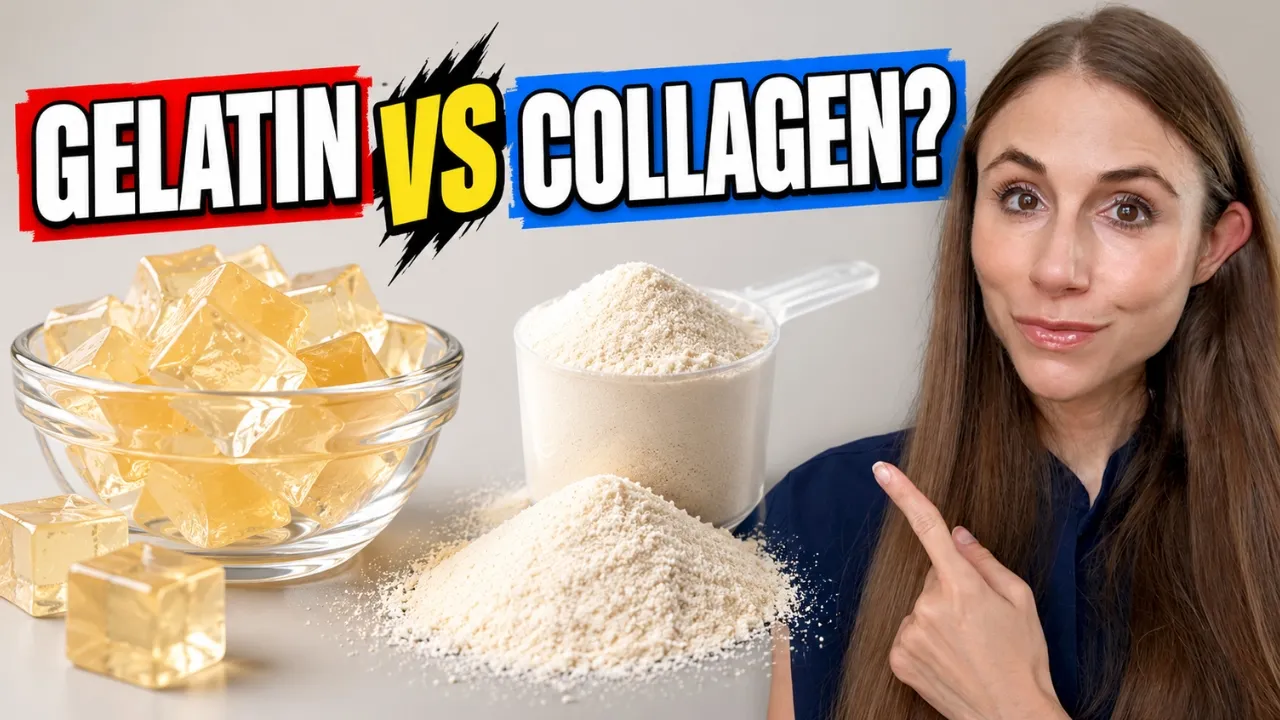
Collagen Peptides vs. Gelatin: Which Is Better for Skin?
Dr Dray
AI-assisted summary of Collagen Peptides vs. Gelatin: Which Is Better for Skin? — original source. Check the original for full context.
Source published:
Key ideas
- Hydrolyzed collagen peptides provide intact signaling fragments that can cross the gut barrier to stimulate dermal fibroblast activity, whereas dietary gelatin breaks down into basic amino acids that cannot trigger targeted collagen synthesis. (0:13)
- Topical protease enzymes offer enzymatic exfoliation at skin-compatible pH levels to reduce irritation, but their sustained penetration and risk of barrier degradation make them unsafe for eczema-prone skin. (3:30)
- "Acne-safe" is an unscientific marketing buzzword rather than a regulated medical standard; scar camouflage is better approached via DHA self-tanners, makeup, or medical tattooing on fully remodeled scars. (6:51)
- The physiological scent associated with aging is driven by the lipid oxidation product 2-nonenal starting around age 40, and premium persimmon or green tea soaps lack clinical proof of efficacy over standard cleansing. (10:00)
Detailed notes
## Background This skincare Q&A video was published by board-certified dermatologist Dr Dray on YouTube on October 4, 2026. According to the page description, Dr Dray addresses viewer questions covering the differences between collagen peptides and dietary gelatin, the mechanics and safety of topical protease exfoliants, camouflage techniques for scars and discoloration, the reformulated CeraVe Healing Ointment, and whether expensive specialty soaps can treat age-related body odor.
## TL;DR Dr. Dray clarifies that while collagen peptides and gelatin share the same amino acid profile, hydrolyzed peptides can be absorbed intact to stimulate fibroblast receptors, whereas gelatin is fully dismantled during digestion. She evaluates protease enzymes as gentle, neutral-pH exfoliants that break down stratum corneum keratin, while warning that their continuous activity makes them hazardous for compromised skin barriers like eczema. After dismissing binary 'acne-safe' marketing labels and outlining camouflage options such as sunless tanners and medical micropigmentation, she reviews the formula tweaks in CeraVe Healing Ointment. Finally, she explains that 'old person smell' stems physiologically from the lipid oxidation byproduct 2-nonenal rather than poor hygiene, noting that pricey persimmon or green tea soaps lack clinical evidence to support their anti-odor claims.
## Atmosphere & style The presentation is candid, analytical, and distinctly no-nonsense, characterized by Dr. Dray's trademark dry realism and straightforward delivery. Rather than indulging in wellness trends or cosmetic marketing hype, she anchors every answer in fundamental biochemistry, relying on relatable analogies like locks, keys, and scrap brass to demystify complex digestive and dermatological pathways. The resulting experience feels like an approachable yet unvarnished clinical consultation that leaves viewers grounded in scientific reality rather than consumer anxiety.
## Bulletin - [00:13](https://www.youtube.com/watch?v=ZQRjOlA-gjY&t=13s) Hydrolyzed collagen peptides provide intact signaling fragments that can cross the gut barrier to stimulate dermal fibroblast activity, whereas dietary gelatin breaks down into basic amino acids that cannot trigger targeted collagen synthesis. - [03:30](https://www.youtube.com/watch?v=ZQRjOlA-gjY&t=210s) Topical protease enzymes offer enzymatic exfoliation at skin-compatible pH levels to reduce irritation, but their sustained penetration and risk of barrier degradation make them unsafe for eczema-prone skin. - [06:51](https://www.youtube.com/watch?v=ZQRjOlA-gjY&t=411s) "Acne-safe" is an unscientific marketing buzzword rather than a regulated medical standard; scar camouflage is better approached via DHA self-tanners, makeup, or medical tattooing on fully remodeled scars. - [10:00](https://www.youtube.com/watch?v=ZQRjOlA-gjY&t=600s) The physiological scent associated with aging is driven by the lipid oxidation product 2-nonenal starting around age 40, and premium persimmon or green tea soaps lack clinical proof of efficacy over standard cleansing.
## Key takeaways - [00:13](https://www.youtube.com/watch?v=ZQRjOlA-gjY&t=13s) Collagen peptides and dietary gelatin share the same amino acid profile, but peptides are pre-hydrolyzed into short chains capable of crossing the gut wall intact. - [00:13](https://www.youtube.com/watch?v=ZQRjOlA-gjY&t=13s) Intact collagen peptides act as signaling molecules fitting dermal fibroblast receptors, stimulating new collagen production in a lock-and-key mechanism that digested gelatin cannot replicate. - [03:30](https://www.youtube.com/watch?v=ZQRjOlA-gjY&t=210s) Proteases like papain, bromelain, and microbial enzymes exfoliate the stratum corneum by cleaving keratin proteins rather than dissolving cell bonds through acidity. - [03:30](https://www.youtube.com/watch?v=ZQRjOlA-gjY&t=210s) Because proteases function closer to the skin's physiological pH, they avoid the sensory stinging and burning associated with low-pH alpha hydroxy acids. - [03:30](https://www.youtube.com/watch?v=ZQRjOlA-gjY&t=210s) Unlike chemical acids that lose strength as they penetrate, proteases maintain enzymatic activity inward, presenting a risk of deeper irritation if overused. - [03:30](https://www.youtube.com/watch?v=ZQRjOlA-gjY&t=210s) Applying proteolytic enzymes to eczema or an impaired skin barrier can exacerbate barrier degradation, itching, and burning. - [06:51](https://www.youtube.com/watch?v=ZQRjOlA-gjY&t=411s) Categorizing skincare products as strictly 'acne-safe' or 'acne-unsafe' lacks scientific validity, as comedogenicity is determined by overall formulation and individual biology. - [06:51](https://www.youtube.com/watch?v=ZQRjOlA-gjY&t=411s) Dihydroxyacetone (DHA) self-tanners offer a semi-permanent camouflage option for hypopigmentation and scars by forming melanoidin pigments that last for several days. - [06:51](https://www.youtube.com/watch?v=ZQRjOlA-gjY&t=411s) Medical tattooing can blend white scars and hypopigmentation, but must only be performed on fully mature scars that have finished tissue remodeling. - [08:41](https://www.youtube.com/watch?v=ZQRjOlA-gjY&t=521s) CeraVe Healing Ointment raised its active petrolatum concentration from 46.5% to 49.5% alongside preservative updates, though manufacturers have published no head-to-head clinical efficacy data comparing the two versions. - [10:00](https://www.youtube.com/watch?v=ZQRjOlA-gjY&t=600s) The characteristic odor associated with aging is caused by 2-nonenal, an unsaturated aldehyde produced by the natural oxidation of altered skin surface lipids starting around age 40. - [10:00](https://www.youtube.com/watch?v=ZQRjOlA-gjY&t=600s) 2-nonenal production is an unavoidable biological process unrelated to poor personal hygiene, meaning frequent washing cannot permanently halt its generation. - [10:00](https://www.youtube.com/watch?v=ZQRjOlA-gjY&t=600s) High-priced persimmon tannin and green tea soaps marketed to eliminate nonenal odor lack independent clinical evidence demonstrating superior results over gentle, conventional cleansing.
## Detailed walkthrough ### [00:00](https://www.youtube.com/watch?v=ZQRjOlA-gjY&t=0s) Collagen Peptides vs. Gelatin: Which Is Better for Skin?
Picking up from a previous skincare Q&A session, Dr. Dray addresses a viewer who asked whether her older video comparing the absorption of collagen peptides versus dietary gelatin is now outdated. Dr. Dray confirms that the findings remain completely up to date. While popular online narratives frequently claim that buying collagen peptide supplements is a waste of money because someone could simply go to the grocery store, buy a box of Jell-O, make some "jigglers," and eat them every day to get the exact same skin benefits, the actual biological reality is far more nuanced.
Dr. Dray makes her baseline stance on supplementation clear right away: "Listen, when it comes to supplements, I don't mess around. I don't recommend supplements. Talk to your doctor about supplements if they are indicated." However, from an objective scientific perspective, there is promising research showing that collagen peptides can improve skin moisture retention and boost collagen production. Nutritionally speaking, gelatin and collagen peptides are practically identical—they share the same profile of amino acids, and Jell-O provides little more than a tiny bit of protein. The critical divergence lies in their molecular size, digestion, and systemic absorption.
Collagen peptides are hydrolyzed collagen, meaning the protein has already been broken down into small, short-chain fragments. Gelatin, by contrast, consists of much larger protein chains that your gastrointestinal tract must laboriously digest and dismantle. Because collagen peptides are already so small, evidence suggests they can be absorbed across the gut wall intact rather than being degraded by digestive enzymes. Once in the bloodstream, these intact peptide fragments travel directly to the skin, where they act as signaling molecules that stimulate dermal fibroblasts to produce new collagen. Gelatin cannot deliver that rapid, concentrated spike of intact signaling fragments.
To illustrate this, Dr. Dray uses an analogy of a lock and key. Dermal fibroblasts have specific receptor sites—the "keyholes." When the key enters and turns, it unlocks collagen synthesis. Collagen peptides are small enough to serve as the intact key that travels through circulation directly into the keyhole. With gelatin, the digestive system dismantles the key into raw brass scraps before it ever reaches the bloodstream. Even though both substances are made of the exact same raw brass materials, the melted-down fragments from gelatin can no longer slide into the lock to trigger the response.
```mermaid flowchart TD accTitle: Absorption Pathway of Collagen Peptides vs Gelatin accDescr: Flowchart contrasting how hydrolyzed collagen peptides reach fibroblasts intact versus how gelatin is broken down into simple amino acids.
subgraph Peptides["Collagen Peptides (Hydrolyzed)"] A["Hydrolyzed Collagen Peptides"] --> B["Absorbed Intact in the Gut"] B --> C["Enter Blood Circulation"] C --> D["Fit Fibroblast Receptor ('Lock and Key')"] D --> E["Stimulates New Collagen Production"] end
subgraph Gelatin["Dietary Gelatin (Jell-O)"] F["Large Collagen Chains"] --> G["Digested by Gut Enzymes"] G --> H["Broken into Basic Amino Acids ('Raw Brass')"] H --> I["No Intact Signaling Key to Fit Receptors"] end ```
[03:30](https://www.youtube.com/watch?v=ZQRjOlA-gjY&t=210s) Protease in Skincare: Enzymatic Exfoliation and Clinical Uses
When asked whether the skincare ingredient protease is a type of exfoliant, Dr. Dray explains that proteases are proteolytic enzymes whose scientific and clinical applications are divided between cosmetic skincare and medical wound care. In topical skincare, plant-derived proteases such as papain (from papaya) and bromelain (from pineapple), as well as specialized microbial proteases, act as gentle biological catalysts for exfoliation. They function by targeting and hydrolyzing keratin proteins within the stratum corneum—the outermost layer of dead skin cells—leading to smoother skin texture, improved radiance, and refined overall tone.
Topical proteases offer a distinct theoretical advantage over traditional chemical exfoliants like alpha hydroxy acids (AHAs such as glycolic and lactic acid). AHAs require a low, acidic pH to work effectively, which frequently causes stinging, burning, and irritation. Proteases, however, operate optimally at a higher pH that sits much closer to the skin's physiological baseline. Because of this, clinical studies demonstrate that proteases can promote effective cellular turnover and even reduce visible redness without the aggressive sensory irritation common to chemical acids, making them an attractive alternative for sensitive skin types.
Beyond cosmetics, proteases have a long, well-researched history in clinical medicine for enzymatic wound debridement. Formulations such as topical collagenase are applied directly to chronic or severe wounds to liquefy and slough off non-viable, necrotic tissue. This accelerates wound healing while sparing patients the physical trauma and pain of surgical scrapings.
Despite these advantages, Dr. Dray emphasizes significant formulation challenges and safety caveats:
- **Extreme Instability:** Proteases are delicate, fickle proteins that only function within a narrow pH and temperature window. If a cosmetic product is not expertly engineered, the enzymes will denature and become completely useless. - **Unrelenting Penetration:** Unlike AHAs, which naturally lose their exfoliating potency as they penetrate deeper into the skin's layers, proteases maintain their enzymatic activity as they travel inward. If left on too long or formulated at excessively high concentrations, they can cause unexpected deeper irritation. - **Barrier Breakdown Hazard:** Protease exfoliants should never be applied to eczematous skin or during an active eczema flare-up. Adding proteolytic enzymes to an already impaired skin barrier accelerates barrier degradation and significantly intensifies burning, itching, and stinging.
[06:51](https://www.youtube.com/watch?v=ZQRjOlA-gjY&t=411s) Debunking "Acne-Safe" and Cosmetic Camouflage Options for Scars
Addressing a viewer's inquiry regarding safe cosmetic camouflage for scars and discoloration, Dr. Dray first dismantles the popular marketing buzzword "acne-safe." She firmly states that "acne-safe" versus "acne-unsafe" is not a clinically validated or scientifically legitimate concept: "Stop thinking about things as acne safe or unsafe." Whether a product exacerbates an individual's acne depends entirely on the comprehensive formulation, the patient's underlying skin biology, concurrent skincare routines, and broader personal triggers—not a blanket, binary marketing label.
When approaching the camouflage of scars, post-inflammatory hypopigmentation, or uneven discoloration, Dr. Dray details several practical approaches:
- **Sunless Tanners:** Self-tanners containing dihydroxyacetone (DHA) provide a durable camouflage effect. DHA interacts chemically with amino acids on the surface of the skin to produce melanoidins, which impart a natural-looking brown tint. Dr. Dray compares this to "long-wear makeup" that stays put for days up to a week without washing off. - **High-Coverage Cosmetic Foundations:** Traditional pigmented makeup formulations offer immediate, adjustable daily coverage for focal areas of discoloration. - **Medical Tattooing (Micropigmentation):** For persistent hypopigmentation or white scars, medical tattooing can deposit matched pigment directly into the dermis. However, Dr. Dray cautions that this procedure requires a fully mature scar that has completely finished its internal remodeling phase. Tattooing an immature scar too early can lead to distorted or unnatural results as the tissue contracts and shifts. She notes this utilizes the exact same micropigmentation principle commonly used on the scalp to disguise thinning hair.
[08:41](https://www.youtube.com/watch?v=ZQRjOlA-gjY&t=521s) CeraVe Healing Ointment: Formula Changes and Reformulation Realities
Dr. Dray reviews the updated formulation of the classic CeraVe Healing Ointment. The primary structural shift is a slight increase in the active skin protectant, petrolatum, which rose from 46.5% in the original version to 49.5% in the new formulation. Alongside this increase, several functional and preservative ingredients were rotated out in favor of new additions:
| Status in Formula | Ingredients | |:--- |:--- | | **Added / Increased** | Petrolatum (increased to 49.5%), Glycerin, Microcrystalline Wax, Triethyl Citrate, Sodium Hyaluronate, Caprylyl Glycol, Benzoic Acid | | **Removed** | Ozokerite, Dimethicone, Proline, Phenoxyethanol, Pantolactone (Panthenol component), Hydrolyzed Hyaluronic Acid (swapped for Sodium Hyaluronate) |
Dr. Dray addresses the inevitable question of whether the product is genuinely "improved." While brands routinely slap "new and improved" onto packaging, she notes that manufacturers never publish head-to-head clinical trial data demonstrating whether a new formula delivers faster barrier repair or a greater reduction in transepidermal water loss (TEWL) compared to the old one. Ultimately, "improved" boils down to individual user perception and texture preferences: online reactions are predictably split between loyalists who claim the formula is ruined, previous detractors who now love it, and everyday users—including Dr. Dray herself—who used the product without noticing any perceptible difference until reading the fine print on the ingredient deck.
[10:00](https://www.youtube.com/watch?v=ZQRjOlA-gjY&t=600s) Soap for "Old Person Smell" and the Science of 2-Nonenal
Addressing a viewer's inquiry regarding viral, expensive soaps marketed for eliminating "old person smell," Dr. Dray identifies the biological culprit as a compound known as 2-nonenal, which produces the characteristic "nonenal odor." This natural chemical compound forms as human skin ages due to shifts in skin surface lipids and sebum composition. The production of 2-nonenal typically kicks off around age 40 and progressively intensifies over time. Dr. Dray emphasizes emphatically that this scent is entirely distinct from hygiene: "It's not a hygiene issue, okay? It has nothing to do with hygiene." A person could bathe repeatedly, and the body will continue to generate it regardless of whether one uses a $2 soap, a $20 soap, or a $40 specialty cleanser.
However, routine bathing does help lower the overall accumulation and perceived strength of the scent on the body and clothing. The practical issue is that many older individuals struggle with daily bathing because mature skin has difficulty retaining moisture, rapidly becoming uncomfortably dry, itchy, and irritated from frequent washing. When washing frequency drops, 2-nonenal accumulates on the surface of the skin, clothing, and bed linens. Scent descriptions vary widely from person to person; some describe it as "musty" or "grassy," while others find those adjectives inaccurate but still "know it when I smell it."
Marketing for high-end cleansers—particularly those formulated with persimmon tannins or green tea extract—claims that topical polyphenol antioxidants prevent the lipid oxidation that generates 2-nonenal. Dr. Dray clarifies that while the theory sounds neat on paper, it completely lacks clinical validation: "Right now, it's not evidence-based. It works well for selling $20 persimmon soap, but whether or not it makes a difference, we don't have any objective evidence." Similarly, while maintaining a healthy diet rich in dietary antioxidants from fruits and vegetables is beneficial for general health and might theoretically blunt oxidative processes, high-priced persimmon bars remain purely marketing-driven. Dr. Dray recalls reviewing one of these heavily advertised persimmon soaps about a year prior and invites viewers to watch that video for her hands-on experience, reiterating that hard data behind the product claims does not exist.
```mermaid flowchart TD accTitle: Mechanism of Nonenal Odor Formation and Cleansing Limitations accDescr: Diagram showing how aging skin lipids oxidize into 2-nonenal and the limitations of specialized soaps versus bathing.
subgraph AgingProcess["Biological Aging (Starts ~Age 40)"] A["Shift in Sebum & Skin Lipids"] --> B["Lipid Oxidation"] B --> C["Formation of 2-Nonenal ('Nonenal Odor')"] end
subgraph SoapClaims["Persimmon / Green Tea Cleansers ($20+)"] D["Topical Polyphenols"] -.->|"Unproven Clinical Efficacy"| B end
subgraph PracticalHygiene["Skin Care Realities"] C --> E["Accumulation on Skin & Linens"] F["Routine Bathing"] -->|"Temporarily Reduces Odor Load"| E F --> G["Risk: Dryness & Irritation in Fragile Aging Skin"] end ```
- **Underlying compound:** 2-nonenal (an unsaturated aldehyde formed by the oxidative degradation of skin lipids). - **Typical onset:** Begins around age 40 and intensifies with advancing age. - **Hygiene reality:** The odor is physiological rather than bacterial or dirt-driven; no specialty soap cures or stops its production permanently. - **Commercial claims:** Persimmon tannin and green tea extracts claim antioxidant neutralization, but lack objective, peer-reviewed clinical support.
[12:32](https://www.youtube.com/watch?v=ZQRjOlA-gjY&t=752s) Q&A Wrap-Up and Channel Information
Dr. Dray closes out the weekend Q&A session by thanking viewers for watching to the end and encouraging them to leave their skincare questions in the comments section for upcoming segments. She explains the production schedule for newcomers: Q&A videos air every weekend on Saturdays and Sundays at 11:00 a.m. Central Standard Time. She pulls all featured questions directly from the comment sections of past Q&A videos and notes that viewers do not need to comment immediately when a video premieres, as she checks the comments for roughly a full week after posting. She signs off with her customary community reminder to like, share, subscribe, and never skip sunscreen.
## Notable quotes > [00:00](https://www.youtube.com/watch?v=ZQRjOlA-gjY&t=0s) Listen, when it comes to supplements, I don't mess around. I don't recommend supplements. Talk to your doctor about supplements if they are indicated. — Dr. Dray
> [06:51](https://www.youtube.com/watch?v=ZQRjOlA-gjY&t=411s) Stop thinking about things as acne safe or unsafe. — Dr. Dray
> [10:00](https://www.youtube.com/watch?v=ZQRjOlA-gjY&t=600s) It's not a hygiene issue, okay? It has nothing to do with hygiene. — Dr. Dray
> [10:00](https://www.youtube.com/watch?v=ZQRjOlA-gjY&t=600s) Right now, it's not evidence-based. It works well for selling $20 persimmon soap, but whether or not it makes a difference, we don't have any objective evidence. — Dr. Dray
## Mentioned Dr. Dray, Jell-O, CeraVe Healing Ointment, CeraVe, 2-nonenal, Dihydroxyacetone (DHA), Papain, Bromelain, Collagenase
## Video description In this skincare Q&A, dermatologist Dr. Dray answers questions from her followers about collagen supplements, protease exfoliants, skin camouflage, CeraVe Healing Ointment, and skincare products marketed to address age-related body odor.
Are collagen peptides better than gelatin for skin health? Is protease a type of exfoliant, and how does enzymatic exfoliation work? Dr. Dray explains the differences between collagen peptides and gelatin, discusses the potential benefits and limitations of topical proteases, and shares safe ways to camouflage skin discoloration and scars.
She also reviews the updated CeraVe Healing Ointment formula, including changes to its petrolatum concentration and ingredients, and discusses whether expensive soaps marketed for "old person smell" are actually effective. This dermatologist skincare Q&A offers practical skincare advice, ingredient education, and evidence-informed insights into popular skincare products and claims.
TIMESTAMPS
0:00 Intro 0:13 Collagen Peptides vs. Gelatin: Which Is Better for Skin? 3:30 Protease in Skincare: Is It an Exfoliant? 6:51 Safe Skin Camouflage Tips for Scars and Discoloration 8:41 CeraVe Healing Ointment: What's New and Improved? 9:56 Soap for "Old Person Smell": Is It Worth $20? 12:32 Outro
Subscribe for more dermatologist skincare Q&As, skincare ingredient explanations, product reviews, anti-aging advice, and practical tips for healthy skin.
#Dermatologist #DrDray #SkincareQandA #SkincareTips #CollagenPeptides #Gelatin #Protease #EnzymaticExfoliation #SkinCamouflage #CeraVeHealingOintment #CeraVe #AntiAgingSkincare #SkincareIngredients #BodyOdor #PersimmonSoap
FTC: This video is not sponsored. Links are commissionable, meaning I may earn commission from purchases made through links.
💜Shop my Amazon store https://o.bttn.io/0BwiPWFIZLG 💜Follow me on liketoknowit https://www.liketoknow.it/drdrayzday 💜Social media Instagram @drdrayzday Pinterest https://www.pinterest.com/drdrayzday/ Facebook @DrDrayzDay Twitter: @drdrayzday Tiktok: @drdrayzday
Disclaimer: This video is not intended to provide diagnosis, treatment or medical advice. Content provided on this Youtube channel is for informational purposes only. Please consult with a physician or other healthcare professional regarding any medical or health related diagnosis or treatment options. Information on this Youtube channel should not be considered as a substitute for advice from a healthcare professional. The statements made about specific products throughout this video are not to diagnose, treat, cure or prevent disease.
[Source](https://www.youtube.com/watch?v=ZQRjOlA-gjY)