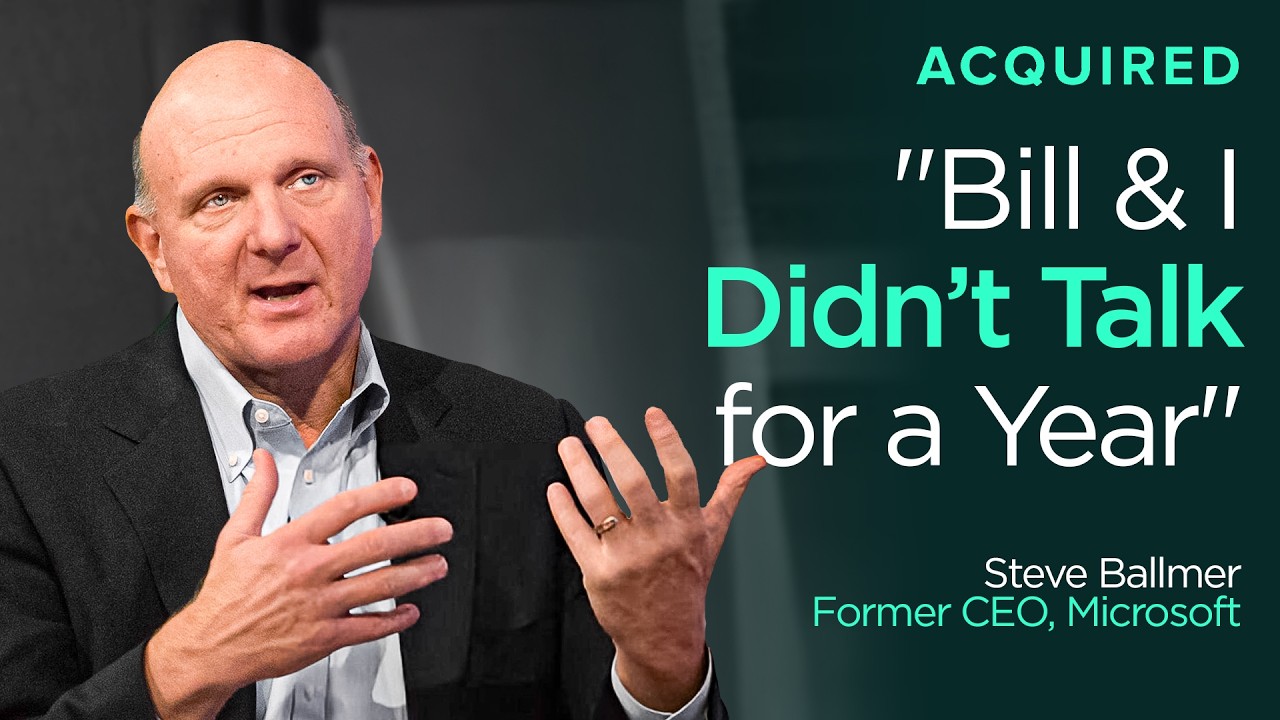
Ballmer Defends Microsoft Stock Hold After Clash With Gates Over Nokia
Acquired
Former CEO Steve Ballmer revealed he maintained his $130 billion Microsoft stake out of corporate loyalty despite stepping down after the board rejected his phone hardware strategy.
## Background
Published on YouTube by the channel Acquired on June 2, 2025, this page features an interview with Steve Ballmer, the legendary former Microsoft CEO and owner of the LA Clippers. The description highlights that Ballmer requested the interview to share his candid reflections and thoughts after listening to the channel's Microsoft history episodes.
## TL;DR
The interview provides a detailed chronological walkthrough of Steve Ballmer's 34-year career at Microsoft and his subsequent transition into sports ownership. Ballmer covers the strategic mechanics of the original IBM DOS deal, the creation of Microsoft's enterprise sales business, and critical reflections on missing major consumer tech shifts like mobile and search. Additionally, he explores the complexities of his relationship with Bill Gates, the emotional realities of stepping down as CEO, and how he applied his enterprise software frameworks to managing the Los Angeles Clippers and engineering the Intuit Dome fan experience.
## Atmosphere & style
The conversation is defined by Ballmer's patented, high-octane energy and a remarkably candid narrative style. The dynamic between the hosts and Ballmer feels like a respectful yet deeply honest debriefing, shifting from intense corporate battle stories to moments of raw emotional vulnerability when discussing his relationship with Bill Gates and the psychological struggle of detaching from Microsoft. Ultimately, it carries the vibe of a proud, fiercely loyal tech titan looking back on his legacy with a mix of hard-earned wisdom, lingering regrets, and unyielding enthusiasm.
## Key takeaways
- [00:00](https://www.youtube.com/watch?v=CYC49_aeop0&t=0s) Steve Ballmer's net worth grew from $20 billion in 2014 to $130 billion in 2025 by holding onto substantially all of his original Microsoft stock, a rare achievement for a non-founder and non-current CEO.
- [04:18](https://www.youtube.com/watch?v=CYC49_aeop0&t=258s) Ballmer's core product strategy relies on a delicate balance: providing products for consumers, a platform for developers, and tools for the enterprise.
- [10:16](https://www.youtube.com/watch?v=CYC49_aeop0&t=616s) The landmark 1980 IBM DOS deal was secured under a non-exclusive contract because IBM was desperate to bypass internal bureaucracy, which allowed Microsoft to license the OS to clone manufacturers and become the ultimate point of integration.
- [18:30](https://www.youtube.com/watch?v=CYC49_aeop0&t=1110s) Microsoft historically underestimated the scale of the PC market, even laughing at Intel CEO Andy Grove's prediction that the industry would sell 100 million PCs annually.
- [40:15](https://www.youtube.com/watch?v=CYC49_aeop0&t=2415s) Microsoft invented the Enterprise Agreement (EA) to charge a flat fee based on an organization's total computer count, shifting away from an honor system to build predictable, recurring revenue.
- [49:59](https://www.youtube.com/watch?v=CYC49_aeop0&t=2999s) The iconic 1999 'Developers, developers, developers' speech was delivered during a multi-front existential war against Linux, Open Office, and a DOJ antitrust lawsuit.
- [51:35](https://www.youtube.com/watch?v=CYC49_aeop0&t=3095s) A dogmatic internal obsession with being a platform provider caused Microsoft to suffer a corporate identity crisis, leading teams to reject aggressive product ideas.
- [57:16](https://www.youtube.com/watch?v=CYC49_aeop0&t=3436s) The 'Windows everywhere' strategy of the 2000s failed because Microsoft mistakenly forced the Windows user interface and API into paradigms where it didn't fit, such as mobile and automotive software.
- [01:04:54](https://www.youtube.com/watch?v=CYC49_aeop0&t=3894s) Microsoft delayed its response to Google's 1998 launch until 2003, scattering its engineering talent across too many initiatives instead of focusing entirely on a single search arrow.
- [01:29:45](https://www.youtube.com/watch?v=CYC49_aeop0&t=5385s) Most businesses are 'zero-trick' or 'one-trick ponies,' whereas Microsoft established two to two-and-a-half tricks with its desktop business and server/enterprise back-office business.
- [01:34:44](https://www.youtube.com/watch?v=CYC49_aeop0&t=5684s) An institutional arrogance inherited from its early strategy dictated that Microsoft had to build all software internally, causing the company to miss mobile phones and search engine advertising.
- [01:45:04](https://www.youtube.com/watch?v=CYC49_aeop0&t=6304s) The antitrust battle took a heavy toll on internal employee morale, causing top executives to feel like their personal integrity was under assault.
- [01:48:46](https://www.youtube.com/watch?v=CYC49_aeop0&t=6526s) Microsoft's stock price remained flat for a decade despite tripling the business due to high initial bubble valuations, Wall Street skepticism over aggressive spending, and structural worries over Windows.
- [01:55:23](https://www.youtube.com/watch?v=CYC49_aeop0&t=6923s) The transition of the CEO title led to a period of near-total silence and estrangement between Steve Ballmer and Bill Gates from early 2000 until 2001.
- [02:02:20](https://www.youtube.com/watch?v=CYC49_aeop0&t=7340s) Satya Nadella demonstrated ego-free leadership early on by suggesting Microsoft hire Chi Lu and offering to report to him, which turned search into a multi-billion-dollar engine.
- [02:09:48](https://www.youtube.com/watch?v=CYC49_aeop0&t=7788s) Ballmer's resignation from Microsoft was ultimately triggered when the board rejected his proposal to enter the phone hardware business to counter the Android ecosystem.
- [02:26:25](https://www.youtube.com/watch?v=CYC49_aeop0&t=8785s) Ballmer chose to hold his massive concentrated Microsoft position out of personal loyalty to the company, directly defending his strategy to an inquiring Charlie Munger.
- [02:28:27](https://www.youtube.com/watch?v=CYC49_aeop0&t=8907s) The sports industry operates structurally like the enterprise software business, where the draft and free agency act as major version upgrades and sponsorships mirror advertising streams.
## Detailed walkthrough
### [00:00](https://www.youtube.com/watch?v=CYC49_aeop0&t=0s) A Jersey and the Best Investor of the Last 20 Years
The episode kicks off with hosts Ben Gilbert and David Rosenthal sharing a lighthearted moment over a single signed Los Angeles Clippers jersey gifted to them by Steve Ballmer, featuring the name "Acquired" on it. Since there is only one, Ben jokes about playing rock paper scissors, but David graciously concedes, noting that since Seattle no longer has a basketball team, it should stay "up north" in the "Acquired Museum North." After their classic intro music ("Who got the truth?"), Ben introduces this first episode of the summer 2025 season.
Ben frames Steve Ballmer in an unconventional but data-backed way: "arguably the very best investor of the last 20 years." He backs this up with staggering figures from Forbes. When Ballmer left Microsoft in 2014, his net worth was $20 billion, almost entirely comprised of Microsoft stock. Eleven years later, it sits at a stratospheric $130 billion. Achieving this level of wealth is incredibly rare for someone who is neither the founder nor the current CEO of the company. Remarkably, this massive wealth generation stems from just one passive investment decision: simply holding onto substantially all of his Microsoft stock.
- **2014 Net Worth:** $20 billion (upon leaving Microsoft)
- **2025 Net Worth:** $130 billion
- **Primary Investment Strategy:** Holding substantially all original Microsoft stock
---
[01:47](https://www.youtube.com/watch?v=CYC49_aeop0&t=107s) Setting the Stage for the Ballmer Interview
Ben explains that after Acquired released a massive two-part history of Microsoft the previous year—covering the company up until the CEO transition to Satya Nadella—Steve Ballmer listened to the episodes. Ballmer had some thoughts and personal recollections he wanted to share, including what made Microsoft so incredibly successful, as well as his own missteps as CEO. To capture this, the hosts set up their cameras and microphones directly at Ballmer's philanthropy office, the Ballmer Group, in Bellevue, Washington.
The upcoming conversation promises to dive deep into Microsoft's mobile, search, and social misses, alongside their massive wins in enterprise and cloud. Ballmer will reflect on his business lessons, why he chose to step down when he did, his complex relationship with Bill Gates over the years, and his ownership of the Clippers—specifically the Intuit Dome, which he built and calls a "cathedral of basketball." Before jumping into the tape, the hosts plug their email list (`acquired.fm/e`) for episode hints, their Slack community (`acquired.fm/slack`), their second show ACQ2 (featuring a recent episode with Plaid CEO Zach Perret), and their upcoming live show at the 6,000-seat Radio City Music Hall in New York City on July 15th with JP Morgan Payments.
---
[04:18](https://www.youtube.com/watch?v=CYC49_aeop0&t=258s) The Late-Night PowerPoint and the Roots of Enterprise
The recorded conversation opens with Ben pointing out that Ballmer independently prepared printed materials for them. At 10 PM the previous night, Ballmer had unexpectedly sent over a PowerPoint deck, apologizing for the late delivery. Ballmer laughs it off, saying it is just a collection of thoughts on how businesses work that he has used over time. He jokes about missing a few formatting opportunities but proudly owns his reputation: "Always a cheerleader. Always."
Ben pivots to Microsoft's current valuation, noting it sits as the most valuable company in the world at nearly $3.5 trillion in market cap. He asserts that Microsoft is fundamentally an enterprise company today, largely because Ballmer was essentially the "founder of Microsoft's enterprise business"—a narrative that isn't discussed enough. Ballmer reacts with a mix of pride and humility, accepting the "fathering" title but reflecting on a lingering regret. He notes that Microsoft started as a consumer company, and while the enterprise "muscle" grew incredibly "macho," the company unfortunately lost its consumer muscle along the way. Ballmer states that his mental model relies on having products that appeal to users, a platform for developers, and tools for IT, noting that a product like Office 365 sits right in front of everyday users while serving as the very foundation for their enterprise permission.
- **Microsoft Market Cap:** Approximately $3.5 trillion
- **Ballmer's Core Framework:** Balancing users (consumers), IT (enterprise), and the developers who span both
---
[07:54](https://www.youtube.com/watch?v=CYC49_aeop0&t=474s) 1980: When IBM Was the Sun, the Moon, and the Stars
The hosts take Ballmer back to 1980, right around the time he joined Microsoft, to unpack the company's early relationship with IBM. When asked what IBM was like in that era, Ballmer recalls a phrase he used during research prep: they were "the sun, the moon, and the stars." In 1980, the computing landscape consisted of "IBM and the bunch." The "bunch" referred to a collection of lagging competitors: Burroughs, UNIVAC, NCR, Control Data, and Honeywell. IBM uniquely controlled everything—the mainframe, the software, and the service.
Ballmer notes that the only real upstart fighting them was Digital Equipment Corporation (DEC), which made mini-computers. DEC is vital to the Microsoft story because Dave Cutler, the father of Windows NT, came from there, and all early Microsoft software was actually developed on DEC computers. IBM was so massive and dominant that they had been embroiled in a grueling antitrust lawsuit since 1969, which wasn't settled until early in the Reagan administration. Ballmer recalls that the antitrust pressure eventually forced IBM to unbundle their operating system from their mainframe hardware, opening the door for competitors to build IBM-compatible mainframes.
- **"The Bunch" Competitors:** Burroughs, UNIVAC, NCR, Control Data, Honeywell
- **DEC:** Digital Equipment Corporation, creators of the mini-computers used to develop early Microsoft software
- **IBM Antitrust Lawsuit:** Initiated in 1969, lasting roughly 11 years until the early 1980s
---
[10:16](https://www.youtube.com/watch?v=CYC49_aeop0&t=616s) The Single Greatest Business Deal in History
Ballmer vividly describes the fateful day representatives from IBM reached out to Microsoft. Before even disclosing their plans, IBM forced Microsoft to sign a aggressively one-sided agreement stating that Microsoft could not use anything IBM shared, but IBM could freely use anything Microsoft disclosed. Once signed, the IBM team revealed they wanted to build a personal computer and were looking to license an operating system and language software. While popular lore suggests IBM came looking for CP/M (an operating system by Gary Kildall's Digital Research), Ballmer clarifies that IBM mistakenly thought Microsoft owned or could license CP/M because Microsoft sold a "soft card" that allowed the Apple II to run it.
Bill Gates selflessly called Gary Kildall to tell him some important visitors were coming, but the Digital Research team famously refused to sign IBM's non-disclosure agreement. Sensing a massive opportunity, Microsoft pivoted. They knew of a local outfit called Seattle Computer Products that had a CP/M clone. In what the hosts call "the single greatest business deal in history," Paul Allen and Ballmer went down to meet the founder, Tim Paterson (who later joined Microsoft), and bought the operating system outright for around $45,000 to $49,000. Ballmer recalls a heated, expletive-filled strategy meeting between himself, Paul, Bill, and Kazuhiko Nishi (their "cowboy" affiliate manager in Japan) where the consensus was a defiant, "Screw 'em. Let's just go get this operating system... We can do this." Microsoft turned around and licensed it to IBM for a fixed fee of about half what they paid, figuring they could replicate the deal 10 to 20 times with other manufacturers to turn a tidy profit.
- **The CP/M Soft Card:** A Microsoft-compiled card for the Apple II that mistakenly led IBM to believe Microsoft owned CP/M
- **OS Purchase Price:** $45,000 - $49,000 paid to Seattle Computer Products
- **Initial IBM Licensing Structure:** One-time fixed fee (per version), not a per-unit royalty initially; transitioned to per-unit licensing about 4-5 years later
---
[14:18](https://www.youtube.com/watch?v=CYC49_aeop0&t=858s) Unwittingly Ceding the Future Platform
David points out that while Microsoft didn't make an immense amount of money directly from the initial IBM deal, the true brilliance was negotiating a non-exclusive contract. IBM didn't resist this because they were desperate to move quickly, bypass their own internal bureaucracy, and build using open, industry-standard components—such as off-the-shelf Intel chips rather than proprietary IBM parts. As the IBM PC exploded in popularity, clone manufacturers rushed to adopt DOS because all the software vendors were targeting it. Microsoft suddenly became the ultimate point of integration, accruing massive platform benefits that historically would have belonged to IBM.
Ballmer introduces a "twist" to the narrative involving the BIOS (Basic Input Output System), the lowest layer of firmware built into the hardware. IBM owned its BIOS, and many early applications became dependent on it. This sparked a race to build an IBM-compatible BIOS. Microsoft deliberately chose to stay out of that intellectual property game, leaving room for companies like Compaq to step in and become the first truly IBM-compatible giants. Ballmer notes that from IBM's perspective at the time, ceding the operating system didn't seem crazy; the software industry barely existed, most programs were custom-built for mainframes, and there were no established software business or licensing models to look to. IBM assumed their proprietary BIOS would protect them from being disintermediated. Ballmer concludes by pointing to his PowerPoint slides, noting, "luck is important."
[18:30](https://www.youtube.com/watch?v=CYC49_aeop0&t=1110s) The Clone Market and Underestimating the PC
Reflecting on the nature of great companies, the discussion touches on how corporate leaders often view themselves as "masters of the universe" who possess flawless talent and never rely on luck. While talent and hard work are undeniably essential, most success stories feature a crucial element of fortune. For Microsoft, that massive stroke of luck came right before the clone market took off. During the initial negotiations and the first few years of the IBM deal, the team had no idea how massive the phenomenon would become.
In fact, Microsoft classically under-forecasted the market's potential. During the 1980s or early 1990s, Andy Grove, then-CEO of Intel, predicted that they would soon be selling 100 million PCs a year. Bill Gates and his team literally laughed at the claim, thinking Grove was crazy and that the market could never sustain such growth. Despite their skepticism, they resolved to invest heavily so they wouldn't find themselves underinvested if the prediction somehow came true.
- **Andy Grove's Prediction:** Claimed the industry would eventually sell 100 million PCs annually, a figure Microsoft's leadership initially dismissed as impossible.
- **Investment Strategy:** Microsoft leaned into big investments as a hedge, operating under a tendency to under-forecast while ensuring they had the capacity to scale.
[19:42](https://www.youtube.com/watch?v=CYC49_aeop0&t=1182s) Riding the IBM Bear and the Ecosystem Illusion
Even after shipping DOS on the IBM PC and witnessing spectacular sales, Microsoft did not feel they had leverage over the computing ecosystem. Well into the late 1980s, IBM remained "the sun, the moon, and the stars," dominating the industry landscape. Microsoft held onto the belief that IBM was the absolute center of gravity well into the 2000s, especially since Microsoft was not yet an enterprise company. Internal anxiety was incredibly high; the team frequently said they had to "hang on to IBM" tightly because if they ever let go, they would be trampled. They affectionately and fearfully nicknamed IBM "the bear."
This lack of ecosystem confidence persisted into the 1990s due to continuous waves of potential disruption. The graphical user interface (GUI) was emerging from Xerox PARC, Apple was executing its own strategy, and threats like Lotus Notes loomed in the mid-1990s. Any of these developments felt like a disruption that could completely blow up Microsoft's business, keeping the company in a perpetual state of hyper-vigilance.
- **"The Bear":** The internal nickname for IBM, symbolizing a massive force that Microsoft had to actively ride to avoid being crushed.
- **Ecosystem Threats:** Emerging graphical interfaces from Xerox PARC and Apple, alongside software like Lotus Notes, prevented Microsoft from feeling secure about its market control.
[21:29](https://www.youtube.com/watch?v=CYC49_aeop0&t=1289s) The Convoluted OS/2 Joint Development Era
The quest to step out from under IBM's thumb led to a highly complex and fragmented partnership around a new operating system called OS/2. Starting around 1982 or 1983, IBM decided they wanted to build a joint operating system. Under this highly convoluted Joint Development Agreement (JDA), Microsoft and IBM would collectively build parts of the system. Microsoft retained the rights to license the base operating system to other OEMs, while IBM built a "value ad layer" consisting of a database and a 3270 emulator. Microsoft worked on the core operating system and the Presentation Manager—the graphical user interface layer—while giving IBM rights equivalent to ownership of the code Microsoft wrote.
Managing this joint development required brutal physical logistics in an era before real email existed. Code was literally exchanged by shipping physical floppy disks back and forth across the country. One grueling stretch required 16 trips to the East Coast in 16 weeks, mostly targeting IBM facilities in South Florida and New York. A typical 24-hour turnaround meant catching an 11:00 PM Delta Dash red-eye flight to Atlanta, transferring to a 7:00 AM flight to West Palm Beach, arriving at IBM for a 9:00 AM meeting, working all day, and catching a 7:00 PM flight back home to arrive near midnight. The friction increased further when IBM decided to move the Presentation Manager development to England and their database/communications development to Texas, making the arrangement feel as massive and unwieldy as Boeing.
- **Joint Development Agreement (JDA):** A highly complex framework where IBM held rights equivalent to ownership over code written by Microsoft.
- **The Red-Eye Routine:** 16 trips in 16 weeks, utilizing Delta Dash flights through Atlanta to West Palm Beach for grueling 24-hour turnaround meetings.
- **Geographic Fragmentation:** Development was scattered across Bellevue, South Florida, New York, Texas (database/communications), and England (Presentation Manager).
[23:26](https://www.youtube.com/watch?v=CYC49_aeop0&t=1406s) The Dual-Track Strategy: OS/2 vs. Windows
To maintain speed of action during the cumbersome OS/2 project, Microsoft quietly kept working on Windows, which they had started independently. While OS/2 Extended Edition was the primary joint focus, Windows was not merely a "Plan B" or a side project for Microsoft—it was their true long-term plan. Microsoft aggressively tried to sell IBM on the idea of using Windows as their graphical user interface, but IBM continuously resisted.
Behind the scenes, management roles were shifting. After a previous manager struggled to make progress, responsibility for system software engineering management fell to leadership that had to be taught how to be effective by the engineers themselves. While Bill Gates grew increasingly frustrated with IBM and pushed Windows hard, the team couldn't simply abandon OS/2. Because it came from IBM, they suspected OS/2 could still end up the ultimate market winner. They chose to run both tracks simultaneously, determined not to freeze development for three or four years and repeat the prolonged mistakes that would later parallel the development of Windows Vista.
- **Windows 1.0 Launch:** Engineering management for Windows 1.0 was restructured internally to rescue the product and ensure it successfully shipped.
- **Parallel Track Philosophy:** Windows and OS/2 were developed side-by-side out of fear that abandoning IBM's ecosystem prematurely would destroy the company.
[25:16](https://www.youtube.com/watch?v=CYC49_aeop0&t=1516s) The Wall Street Journal Divorce and the FTC
The uneasy alliance shattered abruptly in May 1990 when IBM unilaterally ended the relationship, a move described as a sudden "divorce." While popular industry lore suggests Microsoft walked away from IBM as Windows gained strength, it was actually IBM's new leader, Jim Canavino, who threw Microsoft out. Canavino had grown deeply frustrated with Microsoft's persistent promotion and sales of Windows alongside their joint work. The shock of the public split hit Microsoft leadership unexpectedly; one executive discovered the news by picking up a copy of *The Wall Street Journal* at a restroom stop during a routine run with his wife while their house was being remodeled.
This tension also sparked Microsoft’s very first antitrust problem, long before the Department of Justice (DOJ) processor licensing battles emerged. The Federal Trade Commission (FTC) initiated an investigation around 1989 or 1990, suspecting that Microsoft and IBM were colluding to divide the market. The antitrust scrutiny was triggered simply because the two companies had published joint marketing materials outlining positioning guidelines regarding what Windows was good for versus what OS/2 was best suited for.
- **Jim Canavino:** The IBM leader who officially terminated the joint partnership and took OS/2 development entirely in-house.
- **First Antitrust Action:** An FTC investigation launched around 1989/1990 focused on market collusion and product positioning positioning, predating later DOJ cases.
[29:13](https://www.youtube.com/watch?v=CYC49_aeop0&t=1753s) Confronting the Bear as a Pipsqueak Billion-Dollar Company
Being kicked out by IBM left Microsoft in an incredibly scary and vulnerable position. Although Microsoft was scaling rapidly—ending 1992 with $2.8 billion in revenue—they still felt like a complete "pipsqueak" compared to the sheer size of IBM. Furthermore, Windows was still a fledgling idea hamstrung by the "640K barrier," meaning it could not natively address more than 640 kilobytes of conventional memory. This technical barrier was not truly broken until the release of Windows 3.1 in 1991 or 1992.
Microsoft's position was further complicated by having zero enterprise footprint, which was IBM's stronghold. At the time, Windows copies were primarily sold as individual units to hobbyists or end users through retail software outlets like Egghead Software. Employees inside large corporations would buy copies of Windows and Excel on personal expense accounts for their departments rather than through corporate IT channels. Knowing that their software was leaking into businesses via retail channels made Microsoft terrified that IBM would notice and "stomp us like a bug."
- **Financial Growth vs. Scale:** Reached $2.8 billion in revenue by the end of 1992, yet remained dwarfed by IBM's corporate dominance.
- **640K Barrier:** A strict memory limitation that severely limited Windows' capabilities until Windows 3.1 launched in '91 or '92.
- **Egghead Software:** A prominent retail software store where early business users bought individual copies of Windows and Excel.
[31:48](https://www.youtube.com/watch?v=CYC49_aeop0&t=1908s) The Birth of Enterprise Sales and the Toy Operating System
Because the core operating system (DOS) was heavily tied to OEM hardware builders who integrated the BIOS directly into machines, Microsoft's business lacked direct enterprise licensing or Chief Information Officer (CIO) relationships. One of the rare early exceptions was the United States Air Force, which served as their first major Windows customer by purchasing single copies of the software. The military proved to be a far more disciplined, professional, and advanced user of technology than civilian government sectors, proving to Microsoft that they could successfully serve large-scale institutional clients.
Following the IBM divorce, Microsoft realized it desperately needed to build out an enterprise capability. Because this corporate sales landscape was not Bill Gates' primary passion—as Gates focused his "brain cycles" on the applications group and what Windows could deliver to them—other leaders stepped forward to pioneer the enterprise sales frontier. A critical milestone was hiring Dave Cutler, the legendary architect of the VMS operating system from Digital Equipment Corporation (DEC). When Cutler bluntly stated he refused to work on "toy operating systems," Microsoft leaders jokingly agreed that it was a good thing he was joining, because a toy operating system was exactly what they currently had.
- **US Air Force:** Microsoft's first major institutional Windows customer, purchasing single copies to deploy across their disciplined infrastructure.
- **Dave Cutler:** Hired away from Digital Equipment Corporation to transform Microsoft's consumer-grade software into a robust, secure enterprise operating system.
[34:31](https://www.youtube.com/watch?v=CYC49_aeop0&t=2071s) Building Infrastructure Muscle
To truly compete with IBM's robust enterprise offerings, Microsoft had to aggressively build an entire ecosystem of backend infrastructure software from scratch. A standalone operating system was insufficient for business customers, even small operations of 20 to 50 people. Throughout the late 1980s, Microsoft scrambled to assemble these pieces, entering into a joint development agreement with 3Com for LAN Manager and partnering with Sybase to develop their SQL database technology.
This aggressive expansion aligned with a core management philosophy of "building muscle" in the weight room ahead of actual market need. This ethos traced its roots back to co-founder Paul Allen. When the Altair—the first real microprocessor-based computer—initially debuted, it was Allen who declared that Microsoft should write all the software these machines would ever need, firmly establishing that they would never become a hardware company. Allen constantly pushed the execution team throughout the early 1980s, even cracking down on leadership to jumpstart the creation of the dedicated applications group.
- **Infrastructure Partners:** Collaborated with 3Com (LAN Manager) and Sybase (SQL database) to patch early gaps in backend enterprise technology.
- **Paul Allen's Vision:** Established the foundational corporate strategy to remain purely focused on software, prompting the early development of Microsoft's applications division.
[36:16](https://www.youtube.com/watch?v=CYC49_aeop0&t=2176s) Microprocessors, Xerox PARC, and the Apps Business Expansion
Microsoft's early trajectory was heavily focused on systems, but the internal push for applications became an unavoidable necessity. The argument was clear: any code executing on a microprocessor represented a market where Microsoft needed to be a major player. At the time, early spreadsheet software like VisiCalc and primitive word processors were dominating the landscape. The company was relying heavily on fresh college hiring to build out its teams, but they lacked senior leadership for this new frontier.
The turning point came when they met Charles Simonyi through a mutual friend at 3COM Corporation who had previously been at Xerox PARC (Palo Alto Research Center). Simonyi, a brilliant computer scientist, became the first true leader of Microsoft’s applications business. During this foundational period, Microsoft licensed technology and collaborated deeply with outside companies like 3COM and 3Com's associates. While it wasn't organized under a formal JDA (Joint Development Agreement), the dynamic closely mirrored how IBM had previously leveraged Microsoft. In hindsight, this relationship between a massive established player and a nimble newcomer is highly comparable to the modern-day partnership between Microsoft and OpenAI.
---
[37:21](https://www.youtube.com/watch?v=CYC49_aeop0&t=2241s) The Uphill Battle to Prove "Enterprise Ready" Status
When the responsibility for system software changed hands in 1984, a distinctly enterprise-minded approach began to take root. Despite these early roots, a historical chart from 1992 to 1998 labeled "liftoff" reveals that the massive growth during that era was primarily fueled by Windows and consumer desktop applications rather than corporate enterprise infrastructure. In fact, deep into the late 2000s, customers routinely mocked Microsoft's corporate ambitions, flatly telling executives, "You're not an enterprise company. You're not enterprise grade. You're not enterprise ready."
This skepticism stemmed from the fact that Microsoft completely lacked the robust support infrastructure and sophisticated volume licensing models required by large corporations. At the time, true enterprise IT was dominated by mainframes, minicomputers, and deeply entrenched players like IBM and Oracle. Microsoft had to painfully evolve its licensing models twice—once in the early 1990s and again in the late 1990s—just to get a foot in the door. The absolute determination to crack this market was driven by a stark survival instinct: if Microsoft remained isolated in the consumer space, IBM would eventually "pound squish us like a bug." Before the internet and mobile eras, the consumer market simply did not yield the massive, predictable revenue pools controlled by traditional enterprise vendors.
---
[40:15](https://www.youtube.com/watch?v=CYC49_aeop0&t=2415s) From the Honor System to the Invention of the Enterprise Agreement
Microsoft's initial enterprise go-to-market motion was remarkably primitive. Originally, the company simply shipped physical floppy disks to companies. This evolved into a model known as "Select Licensing," which operated essentially on an enterprise honor system: companies were allowed to make their own copies of the software and were expected to retroactively report their usage and pay accordingly. While Windows was largely insulated from this because it was bundled directly with hardware via OEMs (Original Equipment Manufacturers), products like Microsoft Office faced a severe structural revenue threat. Upgrades were priced at less than half the cost of a new license. Consequently, unless Microsoft could infinitely acquire "new logos" at a phenomenal clip, its long-term revenue trajectory was mathematically guaranteed to shrink by half.
To solve this looming crisis, Bill Gates and his leadership team dreamed of creating a predictable, recurring revenue stream. The breakthrough solution was the Enterprise Agreement (EA). Instead of forcing corporate IT managers to meticulously count individual software installations, Microsoft simplified administration by charging a flat, predictable fee based strictly on the organization's total computer count. Customers signed a mandatory three-year commitment, paying the exact same amount annually. This structural shift allowed Microsoft to subtly adjust upgrade pricing while eliminating administrative headaches for the client.
- **Three-Year Terms:** The core foundation of the Enterprise Agreement required corporate commitments over a fixed 36-month cycle.
- **The Upgrade Trap:** New software licenses were expensive, but subsequent upgrades were sold at less than 50% of the original price, threatening long-term revenue.
- **The OEM Channel:** Basic operating system licenses bypasses Select or EA channels, as Windows was almost entirely pre-installed by the hardware manufacturer.
- **The Energizer Pilot:** Looking past standard agreements, Microsoft launched a pilot program with Energizer where Microsoft attempted to directly manage and run the client's entire internal IT department to secure total revenue locking.
---
[44:16](https://www.youtube.com/watch?v=CYC49_aeop0&t=2656s) The Psychology of "Peace of Mind" and the All-You-Can-Eat License
The genius of Microsoft's enterprise bundling strategy—initially spearheaded by Bill Gates during the creation of Office—was to include a vast suite of software within a single license, even if a company wasn't ready to deploy it. Competitors who only manufactured a single, point-solution product found themselves locked out; a corporate buyer auditing their paperwork would realize they already owned a competing tool from Microsoft "for free" as part of their existing agreement. When customers complained that certain departments didn't use Excel or PowerPoint and demanded a discount, Microsoft maintained flexible options but continuously pushed the integrated package because software possesses zero marginal cost and zero distribution costs.
This strategy capitalized on a crucial piece of enterprise psychology: IT professionals do not just buy features; they buy an "insurance policy" and "peace of mind." Corporate buyers are deeply risk-averse; they want to guarantee security, verify compliance, ensure a reliable vendor is available to call if a system crashes, and avoid looking bad for overpaying or leaving gaps in their software portfolio.
---
[47:01](https://www.youtube.com/watch?v=CYC49_aeop0&t=2821s) The Holy Trinity of Enterprise Software and the Back Office Debate
By the late 1990s and early 2000s, Microsoft's enterprise strategy began firing on all cylinders, driven entirely by the explosive boom of corporate email. Email acted as the undeniable "locomotive" pulling the rest of the software suite behind it. This period saw the solidification of what became an enterprise infrastructure monopoly: Windows, Windows Server, Active Directory, Exchange, and Office all working in tight orchestration. A regular corporate user would compose an email in Outlook (part of Office), running on a Windows desktop, which routed through an Exchange server, authenticated by Active Directory, and logged in a SQL Server database.
To handle the immense deployment demands of this highly integrated stack, Microsoft formed a massive joint venture with Accenture called Avanade in the 2000s, specifically designed to scale support and server provisioning infrastructure. Internally, this server-side software suite was branded as "Back Office," a name that outsiders frequently misinterpreted as a sign that Bill Gates didn't care about the product line. In reality, the branding was a deliberate commercial strategy. The pitch to businesses was simple: you must purchase the "Office" for your front-end users, and the "Back Office" to run your server rooms and data centers.
---
[49:59](https://www.youtube.com/watch?v=CYC49_aeop0&t=2999s) The True Context Behind "Developers, Developers, Developers"
In 1999, one of the most iconic moments in tech history occurred when the famous, high-energy "developers, developers, developers" speech was delivered on stage. While the clip is frequently viewed through a comedic or meme-centric lens today, it was born out of intense corporate tension and a multi-front war for Microsoft’s survival. In 1999, Microsoft was locked in a brutal market battle against Linux on the server side, fighting open-source alternatives like Open Office on the desktop, trying to unseat Lotus Notes in corporate communications, and staring down the culmination of the Department of Justice’s massive antitrust lawsuit, which was scheduled to conclude within the next twelve months.
The speech was delivered at an external developer conference to convince third-party creators that their software should target Windows. In a platform ecosystem, ensuring that third-party applications reinforce and add value to your base layer is paramount. However, this focus triggered an internal cultural identity crisis that plagued Microsoft for over a decade.
---
[51:35](https://www.youtube.com/watch?v=CYC49_aeop0&t=3095s) The Platform Company Identity Crisis
A platform is defined fundamentally by its "extensibility"—the structural capacity for outside partners to plug in, write applications, modify file formats, and extend the core value of the ecosystem. This definition applies not just to infrastructure plays like Azure, AWS, Unix, or Windows, but to applications themselves; Microsoft Office, for instance, is highly extensible and functions as a platform. The danger arises when a business views itself exclusively as a platform company. A healthy platform requires dominant, first-party applications to test its capabilities and drive adoption; historically, Office was the best first-party app on Windows, just as Outlook was the premier client for Exchange.
By the mid-to-late 2000s, Microsoft's internal mindset had become completely "stuck in the mud" due to a dogmatic obsession with being an underlying platform provider. Employees would frequently reject aggressive product ideas by claiming, "Well, we can't do that. We're a platform company." By 2010, leadership felt immense personal frustration regarding an inability to break through this stubborn cultural barrier. The core strategic reality remains that an organization must seamlessly merge application development with platform architecture, recognizing that external developers are vital, but first-party execution makes the platform viable.
- **The Internal Debate:** When assessing the Windows ecosystem, the Windows engineering team viewed independent software developers as their primary clients, whereas other internal factions argued that Microsoft's own Office team was the operating system's most critical customer.
[54:44](https://www.youtube.com/watch?v=CYC49_aeop0&t=3284s) The Reality Behind "Developers, Developers, Developers"
Microsoft had to work hard to communicate that they genuinely cared about outside developers. The internal Office team needed to realize that third-party developers often feared the platform was exclusively built to run Microsoft's own first-party applications. To combat this, the strategic frame required aggressively inviting outside creators. At the time, the division between being "for users and for enterprises" really meant choosing whether to answer to individual users or to corporate IT departments, and deciding if both aspects could be extended by external developers. Returning to 11999, the competitive landscape was intense: IBM was still actively selling OS/2, and Linux was fast approaching "like a freight train."
To rally support, Microsoft attempted to turn their browser into a unique platform via Netscape and ActiveX controls under the mantra of "embrace and extend." When finishing major speeches, the ultimate call to action was to tell the developer community that they were loved and wanted. This high-intensity push birthed the iconic, energetic "developers, developers, developers" chant. Around that same period, another widely circulated video surfaced where the speaker yelled "I love this company!" While often misunderstood by the public as a serious corporate address, it was actually a lighthearted, internal-only parody designed for the sales team to get people pumped up about Windows.
- **Key Competitors (1999):** IBM (selling OS/2) and Linux.
- **Platform Extensions:** ActiveX controls used to extend the browser and Windows Server.
- **The "I Love This Company" Video:** Clarified to be an internal sales parody rather than a legitimate, external public speech.
[57:16](https://www.youtube.com/watch?v=CYC49_aeop0&t=3436s) The Paranoia and Confidence of "Windows Everywhere"
The "developers" speech came from a place of fighting a brutal, ongoing "death grip" for enterprise developers against IBM, while concurrently facing the new horizons of Linux and the web for independent creators. Microsoft felt a sense of desperation to prove that their platform was the future. Despite the Department of Justice’s confident outside view that Microsoft had an unbreakable lock on the market with no real competition, the leadership team felt immense pressure and lacked total self-confidence. Ironically, despite conventional wisdom stating that companies should only focus on customers and ignore competitors, Microsoft found that being consumed by their competitors was essential to their survival.
By the 2000s, this mix of paranoia and growing confidence led to a strategic presentation titled "Windows everywhere." Microsoft became deeply wedded to extending their core asset across every emerging device category rather than jumping to entirely new paradigms. While critics often argue that Microsoft "stuck with Windows too long," the real issue was trying to force the Windows user interface and API into places where it did not naturally fit. This misstep manifested heavily in Windows Mobile, automotive software, and early versions of Media Center designed to connect PCs to televisions.
- **Internal Mindset:** Driven by a paradoxical mix of extreme competition-induced fear and overstated confidence in the Windows brand.
- **DOJ Perception vs. Reality:** The DOJ believed Microsoft faced zero competition, whereas Microsoft felt they could easily lose Windows on the client side.
- **"Windows Everywhere" Failures:** Windows Mobile, in-car software, and TV-connected Media Center interfaces.
[01:00:33](https://www.youtube.com/watch?v=CYC49_aeop0&t=3633s) Developing and Misapplying Core Capabilities
The experimentation platform Statsig recently raised a Series C round at a $1.1 billion valuation. This highlights a broader trend where experimentation infrastructure—pioneered by Web 2.0 giants like Facebook, Netflix, and Airbnb to maintain fast, decentralized engineering cultures—has become a mandatory part of the modern product stack. Instead of building these massive metric-tracking networks in-house, top contemporary teams like Notion, OpenAI, Rippling, and Figma rely on Statsig’s suite of feature flags, product analytics, and session replays.
Reflecting on Microsoft’s historical framework, the logical move with a massive, multi-sided network effect like Windows was to extend it to the next technological wave. In the pursuit of skating to where the puck is going, line extensions like adding networking to Windows or developing SQL Server and Dynamics made sense because they leveraged an existing backend ecosystem. However, mobile phones functioned more like a brand-new startup, requiring the company to hit the "weight room" to build entirely new capabilities. A primary example of this is Microsoft's modern hardware design branch. Originally stood up to support client-facing devices like the Xbox, Surface, and phones, that hardware talent and infrastructure was successfully repurposed to design chips and backend infrastructure for Azure data centers.
[01:04:54](https://www.youtube.com/watch?v=CYC49_aeop0&t=3894s) Strategic Mistakes in Search and the Danger of Spreading Too Thin
When trying to capture the mobile market, Microsoft mistakenly prioritized consistency, relying on the comfortable Windows UI and initially launching on Intel processors, both of which were wrong for phones. When an established franchise faces a new paradigm where it possesses no natural advantage, leadership must consciously step outside of what they know. Microsoft struggled with this during the rise of internet search. Google launched in 1998, and Microsoft did not make a serious push until 2003. Lacking native search capabilities, they had to pull researchers from Microsoft Research and reassign talent from unrelated internal divisions because Google had already vacuumed up the available external talent pool.
A major strategic error was a prolonged debate between Bill Gates and other executives over whether specific web "verticals" or a generic search portal mattered more. Microsoft built isolated properties like Expedia (travel), Sidewalk (local info), and CarPoint (automotive), failing to realize that the only vertical that truly mattered was "all information and all shopping." Before rebranding to Bing, everything was tightly integrated under the "Windows Live" umbrella (such as Windows Live Search and OneDrive). This reliance on Windows integration as a competitive crutch backfired. Microsoft stack-ranked their priorities incorrectly, spread their engineering talent too thin across five new initiatives instead of putting "all our wood behind one arrow," and burdened these projects with a massive, heavy cost structure from day one.
- **Google Launch vs. Microsoft Push:** Google launched in 1998; Microsoft did not counter heavily until roughly 2003.
- **Early Web Verticals:** Expedia, Sidewalk, and CarPoint.
- **The "Windows Live" Era:** Included Windows Live Search and OneDrive before the singular pivot to Bing.
- **Resource Allocation Philosophy:** Referenced Sun Microsystems CEO Scott McNealy’s phrase of getting "all your wood behind one arrow" to critique Microsoft's habit of over-scoping new projects with large cost structures.
The Rigid Models of Mobile and the Android Threat
Reflecting on the mobile landscape, the speakers break down why Microsoft struggled to find its footing. In the phone industry, only two models actually worked: Apple's approach of building the hardware and capturing the profit, and Google's Android model, which utilized a back-end monetization system that even allowed them to pay phone manufacturers. Microsoft was aligned with neither strategy. They desperately needed a new concept and
[01:28:24](https://www.youtube.com/watch?v=CYC49_aeop0&t=5304s) The Reality of the Cloud Journey and Tech "Liftoff"
The hosts point out that the cloud initiative began around 2006, a full seven to eight years before the speaker ultimately left Microsoft. This timeline challenges the common tech narrative that breakthrough products achieve popularity overnight. The speaker observes that people often assume success happens in "10 minutes"—much like the public perception that the *Acquired* podcast was started just two years prior, or that OpenAI emerged instantly, despite being founded around 2016. In reality, most major tech milestones require years of intense "blood, sweat, and tears" before they achieve what the speaker terms "liftoff."
- OpenAI was founded in 2016, taking seven to eight years to become a massive phenomenon.
- Microsoft had been working on the cloud since the "Energizer" project, dedicating eight years of foundational effort to Azure.
[01:29:45](https://www.youtube.com/watch?v=CYC49_aeop0&t=5385s) The Framework of "Trick Ponies" in Corporate Strategy
The conversation shifts to a framework evaluating businesses by how many massive, foundational revenue engines—or "tricks"—they can successfully create. The speaker notes that most businesses are "zero-trick ponies" because they never build a billion-dollar business, often producing features that get acquired by larger companies. "One-trick ponies" are highly impressive, frequently commanding $50 billion to $100 billion market caps, or even more. The speaker classifies tech giants like Google, TSMC, and Nvidia primarily as masterful one-trick ponies, sparking a lighthearted debate with the hosts over whether to count adjacent segments like YouTube, gaming, or AI as full second tricks.
- Google is characterized as a 1 to 1.5-trick pony, with roughly 80% of its revenue originating from search ads.
- YouTube and Xbox are discussed as "half-tricks," though the speaker notes Microsoft remains highly optimistic that gaming under Phil Spencer will mature into a full-blown trick.
- Amazon and Apple are distinguished as rare "two-trick ponies."
[01:33:30](https://www.youtube.com/watch?v=CYC49_aeop0&t=5610s) Analyzing Apple's Locomotive and the Dream of a Three-Trick Pony
When analyzing Apple, the hosts question whether its massive services division constitutes a third distinct trick, especially since its profit dollars have surpassed iPhone hardware profits. The speaker firmly disagrees, viewing services not as a "new locomotive" but rather as a highly effective monetization model built on top of the existing platform. "The locomotive remains the phone," the speaker argues, noting that the services business would collapse if phone volume dropped. A true second or third trick requires uncorrelated business models, similar to how Amazon Web Services (AWS) operates independently of the Amazon retail store. The speaker admits they desperately wanted Microsoft to achieve three full tricks, a feat that is historically rare and incredibly difficult to pull off.
- The speaker defines Apple's two uncorrelated tricks as the Mac versus everything iOS.
- IBM is classified historically as a one-trick pony, while Microsoft established two to two-and-a-half tricks.
- Microsoft's core tricks are defined as the desktop business (Windows and Office) and the server/enterprise back-office business.
[01:34:44](https://www.youtube.com/watch?v=CYC49_aeop0&t=5684s) The Missed Opportunities: Phone, Search, and Corporate Mindsets
The hosts ask which missed opportunity "eats you up inside" the most. The speaker immediately dismisses social media, explaining that social "doesn't feel Microsofty" and didn't align with their enterprise focus. Instead, the mistakes came from an institutional arrogance inherited from the early Paul Allen strategy, which dictated that Microsoft had to build "all the software that these things will ever need." This lack of focus caused them to miss two critical client-side shifts: the mobile phone and search engine advertising.
The speaker reflects on how astonishing it was that by around 2005, Google was likely generating more revenue from a consumer PC user through ads than Microsoft was via operating system sales. Because Microsoft viewed mobile under the existing Windows umbrella rather than as an entirely new trick with a different business model, they failed to capture the next great client device.
- Microsoft's corporate identity was deeply tied to client-side devices and productivity tools.
- The two major missed tricks were mobile hardware/operating systems and search-based advertising.
- By 2005, Google's post-sale ad monetization model on consumer PCs was challenging Microsoft's application-heavy monetization model.
The hosts take a moment to introduce their sponsor, Vercel, describing them as the modern infrastructure backbone powering web development for major sites like Walmart, Nike, Hulu, and Anthropic's Claude. Founded by Guillermo Rauch—who also created the widely popular Next.js framework—Vercel solved a major friction point for developers by unifying code creation and cloud deployment into a single, automated, globally distributed platform. The hosts highlight Vercel's explosive new AI product, V0, which allows users to generate web interfaces using plain English descriptions.
- Vercel acts as a framework-defined infrastructure platform that eliminates traditional deployment friction.
- Guillermo Rauch appeared on an episode of ACQ2 in February to discuss the company's trajectory.
- High-profile customers using Vercel include OpenAI, Runway, Chick-fil-A, and PayPal.
[01:41:32](https://www.youtube.com/watch?v=CYC49_aeop0&t=6092s) Non-Product Wins: Enterprise Sales Mastery and the Stock Option Crisis
Shifting the focus away from products, the host asks the speaker to look back at their biggest non-product executive milestones and mistakes. The speaker points to establishing Microsoft's dominant capability with corporate IT departments and professionals as their proudest achievement. They invented a unique enterprise sales, marketing, and volume licensing architecture that seamlessly transitioned from on-premise servers to the cloud. Financially, while popular narratives claim Microsoft tripled its revenue and profits during this tenure, the speaker clarifies that profits actually grew by four to five times when adjusting for a massive accounting shift: the mandatory expensing of stock options.
Inheriting Microsoft right as the dot-com bubble burst created an insidious cultural and financial crisis. Because stock options suddenly had to be counted against corporate profits while the stock price remained flat, they lost their motivational value for employees. To solve this, Microsoft became a pioneer among major tech firms by abandoning traditional stock options in favor of structured stock awards and Restricted Stock Units (RSUs) to maintain talent retention and preserve morale.
- Microsoft dramatically outperformed the "tripled profit" narrative, achieving close to a 4x or 5x financial multiple once baseline books were restated.
- The bursting of the dot-com bubble required an immediate transition from underwater stock options to modern stock awards/RSUs to manage employee motivation.
[01:45:04](https://www.youtube.com/watch?v=CYC49_aeop0&t=6304s) Employee Morale and the Cultural Toll of Antitrust
The dawn of the 2000s brought a massive shift in how employees viewed stock compensation. The sentiment flipped completely; as it is put, "poor Jud is dead... Candle light is dead." Everyone went from believing they had a massive fortune to realizing they had significantly less, creating a severe employee morale issue that required heavy internal selling to overcome.
At the exact same time, Microsoft was in the thick of its grueling antitrust battle with the federal government. Resolving this overhang was an absolute top priority, though a clear path to resolution was not immediately obvious. The true gravity of the situation became undeniably apparent during an executive retreat at the Sun River lodge in Bend, Oregon, where about 80 to 90 leaders had flown in. The very first session was intended to be a routine "report from the field," but it quickly transformed into a pivotal cultural moment.
Orlando Ayala, who was running sales at the time, stood up and delivered a striking, emotionally charged speech: "My name is Orlando Ayala. I am a proud Colombian. I am not a proud Microsofty. Today, our integrity is under assault. My personal integrity feels like it's under assault." While Ayala did not explicitly blame company leadership for bad behavior, he exposed the "elephant in the room." The antitrust battle was no longer just a dry business or market issue—it had turned into a deep cultural crisis that senior leadership was feeling on a profoundly personal level.
This raw display forced a total disruption of the retreat's planned agenda, requiring a complete remapping of breakout sessions to confront the cultural fallout head-on. Bill Gates was visibly unhappy with how the situation evolved. Having become the public face of vilification, Gates bore the crushing psychological weight of the antitrust battle, experiencing it as a direct personal attack. Meanwhile, the legal pressure escalated to a point where the federal government explicitly ordered Microsoft to be split up. Although the company never reached the stage of detailed structural planning for a breakup, the internal assumption was a clean division of domains: one leader would run operating systems while Gates would take applications.
---
[01:48:46](https://www.youtube.com/watch?v=CYC49_aeop0&t=6526s) The Flat Stock Price and Wall Street Dynamics
When stepping into the CEO role, the landscape was defined by the bursting of the dot-com bubble, an intense internal cultural crisis, and accounting headaches that impacted how corporate profitability was displayed. Despite eventually tripling the business over the subsequent decade, the stock price remained stubbornly flat. This disconnect between business growth and market valuation can be attributed to four distinct reasons.
First, there was a deliberate, institutional effort to temper external expectations. The prevailing philosophy was to never let the stock price get too high or allow expectations to outpace reality, ensuring that public investors never felt cheated. This manifested in a highly conservative approach at the annual financial analyst meetings held every July. Furthermore, mimicking a "Buffett style" of corporate communication, neither top executive ever attended quarterly analyst calls. While a company's stock price acts like a daily "sports section" scorecard for employee morale—akin to checking "how the Clips did last night"—management resisted constant market validation, even fighting internally against staff who desperately wanted to issue formal financial guidance.
The second factor was that the stock was simply priced "ridiculously too highly" when the transition occurred, creating an uphill battle against a deflating bubble narrative even after the valuation normalized within a year or two. Third, Wall Street grew highly skeptical of an aggressive corporate spending habits. Management was very loud and transparent about a willingness to spend whatever it took to achieve victory—whether in Surface or other initiatives—which clashed directly with what investors wanted to hear. This stood in stark contrast to the tighter, highly balanced capital allocation approach later popularized by Satya Nadella and Amy Hood, where every single dollar spent strictly demanded a clear return. Finally, investors harbored deep structural worries regarding the long-term viability of Microsoft's core franchises, most notably Windows.
- **Analyst Meetings:** Held every July with the explicit goal of lowering expectations.
- **Quarterly Calls:** Avoided entirely by the CEO and Bill Gates to maintain a long-term focus.
- **Franchise Concerns:** Wall Street held persistent anxiety over the future of Windows.
---
[01:53:03](https://www.youtube.com/watch?v=CYC49_aeop0&t=6783s) The Limits of Rebranding and the Need for a Clean Slate
By the conclusion of this executive tenure, the stagnant stock price had become deeply frustrating. However, resetting the dialogue with Wall Street had become an impossible task. It was clear that investors would never believe a sudden change in corporate philosophy; a leader cannot spent 30 to 35 years operating as a big spender and then convincingly declare to the market, "I'm a changed man... I worship at the altar of capital allocation now."
The historic choice to skip quarterly calls was also interpreted by the market as a form of institutional disrespect, making a sudden pivot entirely untenable. Ultimately, changing a deeply entrenched market narrative requires a total rebrand and a completely clean slate, which can only be achieved by introducing a brand-new CEO. This reality was explicitly detailed in a farewell letter to the board of directors, noting that a leadership transition offered a unique opportunity to reset images and brands that were otherwise entirely fixed. This need for a total break was reinforced by the speaker's long history with the firm, having served as the second voice of the company since 1980 before spending 14 years as the primary leader.
---
[01:55:23](https://www.youtube.com/watch?v=CYC49_aeop0&t=6923s) The Silent Year, Longhorn, and Institutional Blind Spots
The notion that the final years of leading Microsoft were entirely devoid of fun is inaccurate, though the era was defined by immense friction. The most grueling period stretched from 1998 to 2004, a painful era marked by the antitrust trial, the launch of the Xbox, and a severe breakdown in the core leadership relationship. Following the transition of the CEO title, a period of near-total silence ensued between the two top executives, lasting from roughly March or April of 2000 until 2001.
The corporate hierarchy had become deeply confusing; one did not know how to act as the boss, and the other did not know how to report to a long-time peer. When initially offering the CEO position, Gates was asked directly if he wanted a real chief executive or merely a figurehead. Gates insisted he wanted a genuine transition path, yet neither man knew how to show the other the appropriate style of corporate respect. After a year of intense estrangement, their wives finally intervened and pushed them back together, leading to a highly awkward reconciliation dinner at a local health club.
```
[March/April 2000] ─── (Period of Total Silence / No Speaking) ─── [2001]
│
Reconciliation Dinner
(At local health club)
```
Even after communication resumed, the partnership never fully recovered its original synergy. Gates assumed the role of Chief Software Architect, and management deferred heavily to his product direction. This period birthed "Longhorn" (the predecessor to Windows Vista), which is described as "the mistake of mistakes." The project suffered from a dangerous institutional blind spot—it was a classic case of an "emperor that had no clothes." The company fell victim to its own hubris regarding the centrality of Windows, mistakenly believing that customers would blindly accept massive architectural overhauls. In hindsight, it would have been far better to throw out the legacy code, strip away the accumulating software "scruff," and build a brand-new operating system entirely from scratch.
Beyond Longhorn, the two leaders suffered from a misplaced operational voraciousness, overextending the company by chasing too many initiatives simultaneously. This created severe pragmatic pain, particularly around the logistics of recruiting and hiring talent. The rift also extended into major strategic disagreements regarding hardware; the two clashed heavily over the creation of the Surface, the Windows Phone, and HoloLens. One area of total alignment, however, was the cloud. The foundation for Azure had been agreed upon back in the 1990s under the internal name "Energizer"—an architectural concept that originated entirely with Gates and was subsequently executed by the broader team.
---
[02:01:01](https://www.youtube.com/watch?v=CYC49_aeop0&t=7261s) The Flaw of Long Goodbyes and Late-Career Triumphs
By 2004, Gates began expressing a formal desire to step away from his daily responsibilities. In 2006, the company publicly announced that his departure would take place two years later in 2008. This prolonged timeline proved to be a significant organizational mistake, demonstrating that "long goodbyes are not helpful" because they blur corporate hierarchies and leave teams entirely unsure of their actual roles. In stark contrast, the subsequent CEO exit was swift and definitive, remaining on the board of directors for only a single additional meeting before cutting ties completely to ensure a clean handoff.
Free from the shadow of a prolonged transition, some of the absolute best work of this leadership era occurred in the final six years of the tenure after Gates had departed. This late-career stretch was defined by major strategic triumphs, including the rapid evolution of the enterprise business, foundational advancements in the cloud, the commercial realization of Surface, critical course corrections within Windows, and the aggressive expansion of Bing.
- **Disagreements:** Major executive rifts occurred over entering hardware markets (Surface, Phone, HoloLens).
- **Alignments:** Perfect strategic agreement on Cloud/Azure (originally conceptualized as "Energizer").
- **Best Eras:** Peak operational performance occurred while building the enterprise sales engine, managing system software, and leading the final six years post-2008.
[02:02:20](https://www.youtube.com/watch?v=CYC49_aeop0&t=7340s) The Chi Lu Meeting and Satya's Ego-Free Leadership
The hiring of Chi Lu from Yahoo stands out as one of the most pivotal moments in Microsoft's history, not just for what he accomplished, but for what the hiring process revealed about Satya Nadella. Chi was an absolute genius and a PhD in computer science who deeply understood the bits and bytes of search engineering. At the time, Satya was running Bing, and Harry Shum—who went to graduate school with Chi—suggested they fly down to California to pick his brain. Satya, Harry, and the speaker went together. After a brilliant meeting, Chi left the room, and an incredible thing happened: Satya or Harry floated the idea that Microsoft should hire Chi, and that Satya should actually report to him, flipping the entire organizational chart in a 15-minute conversation.
This selflessness left a profound impression. It proved that Satya completely lacked the protective ego that trips up many executives, showing he would always prioritize the collective good of the company over his own title. Chi Lu was brought back into the room and hired, bringing a mature veteran presence that eventually helped turn search into a multi-billion-dollar cash flow engine. Furthermore, because Chi was safely at the helm of search, it freed up executive runway to rotate Satya into other areas of the business.
* **The Succession Strategy:** The transition allowed Satya to be moved to head the Server and Tools division, a deliberate move to give him the broad experiential portfolio needed to become a viable CEO candidate.
* **Annual Succession Planning:** Corporate planning factored in two distinct candidate tracks: an emergency backup plan if an executive was "hit by a bus," and a long-term strategic plan for a leader serving a full, multi-year term.
* **Bob Muglia's Trajectory:** Bob Muglia was running Server and Tools at the time of the shift and went on to find massive success later as the CEO of Snowflake.
---
[02:07:38](https://www.youtube.com/watch?v=CYC49_aeop0&t=7658s) Acquired Show Sponsor: Anthropic
The hosts take a moment to introduce their newest sponsor, Anthropic, the creators of the Claude AI assistant. Flipping the script on standard advertisements, they reveal that Claude actually wrote the core of the sponsor read itself after being analyzed with previous scripts. The tool serves as an incredibly organized, highly tasteful co-worker capable of managing complex code debugging, sorting through 100-page documents, and bridging data across multiple platforms.
* **The Model Context Protocol (MCP):** Claude utilizes MCP to unify fragmented enterprise software—including CRMs, email systems, and internal documents—into a singular command center.
* **Snowflake's Use Case:** Instead of manually writing complex SQL queries, Snowflake employees use Claude to answer pressing business questions using standard English text.
* **Zoom's Automation:** Zoom feeds whole meeting recordings directly into Claude to seamlessly extract summaries and clear action items.
---
[02:09:48](https://www.youtube.com/watch?v=CYC49_aeop0&t=7788s) The Friction Point: Why Ballmer Resigned
Leaving Microsoft was driven by a handful of overlapping frustrations, with the company's mobile strategy serving as the primary breaking point. There was a deep conviction that Microsoft absolutely had to build its own physical phone hardware to survive the "Android/Arch game" and maintain a consumer footprint. Long before the Nokia acquisition, multiple trips were taken to Taiwan to evaluate buying HTC, the dominant Windows Phone manufacturer at the time, though worries over international corporate integration ultimately stalled the deal. This aggressive push for hardware severely "exacerbated" an already bumpy, non-linear relationship with Bill Gates, echoing fights that reached all the way back to a near-resignation just five weeks into starting at the company.
The final straw occurred when the management team was brought in to discuss entering the phone hardware business, and the board ultimately rejected the proposal. The bureaucratic process leading up to that rejection felt deeply disrespectful, heavily influenced by the ongoing grinding friction with Bill. Recognizing that his best consumer plays—the Yahoo acquisition attempt and the phone initiative—were effectively blocked, it became the natural juncture point to step down. The cloud era was emerging, necessitating a fundamental shift in corporate capabilities and accounting models that prioritized hyper-efficient gross margin volume over raw revenue growth.
* **Locomotives vs. Cabooses:** To survive in consumer tech, a company must own a powerful market driver ("the locomotive"). Products like the Zune were merely "cabooses" sitting at the back of the train.
* **The Nokia Dilemma:** While Nokia was a close partner, they lacked the deep financial pockets required to fund massive global marketing campaigns.
* **The Math of Hardware:** A licensing partnership couldn't yield enough return; Microsoft needed the full margin dollars generated directly from the physical hardware sales to justify the required cash investments.
* **Shareholding Longevity:** Upon exiting, the former CEO held onto his entire financial position, remaining the largest individual shareholder in Microsoft outside of major index funds like Vanguard.
[02:18:57](https://www.youtube.com/watch?v=CYC49_aeop0&t=8337s) The Psychology of Financial and Emotional Detachment
Leaving a company where one has spent decades requires a challenging process of emotional detachment. When an individual is no longer inside the organization, they lose the ability to control its trajectory, making it painful to stay overly attached. The speaker admits to struggling with this transition initially, aiming to be "the best investor" by reading everything and attending conferences just as they used to. However, after attending one shareholder meeting and acting "kind of a dick" due to being too emotionally invested, it took about a year to fully embrace emotional detachment. Despite this intentional separation, a deep underlying loyalty remained, preventing a complete sale of the stock.
```
┌────────────────────────────────────────┐
│ The Emotional Detachment Process │
└───────────────────┬────────────────────┘
│
┌──────────────────────────────┴──────────────────────────────┐
▼ ▼
[ Phase 1: Over-Attachment ] [ Phase 2: Detachment ]
• Tried to know everything • Took ~1 year to achieve
• Attended conferences/meetings • Prompted by acting "like a dick"
• Felt urge to "fix everything" at a shareholder meeting
```
The situation shifted when the speaker and his wife, Connie, accelerated their philanthropy. Needing to unlock asset value to fund these initiatives, they began moving shares into a donor-advised fund and executing small sales around 2015 or 2016. As the dollar values grew, the speaker wrestled with the idea of selling everything to achieve "full emotional detachment." Microsoft had been his "baby"—and though not technically a founder, he felt like one because he joined so early and recruited nearly the entire senior leadership team.
- **Leadership Shift:** Today, only about 10% of the current workforce or senior leadership consists of people from the speaker's era.
- **The Core Motivation:** The struggle to hit the sell button had nothing to do with money; it was entirely an emotional wrestling match.
---
[02:21:26](https://www.youtube.com/watch?v=CYC49_aeop0&t=8486s) The Stock Pick and the Strategy of Loyalty
Just as the speaker was ready to pull the trigger on a total sale, an internal finance professional—an ex-Microsofty who tracks the company's financial data—along with her boss, intervened. She adamantly insisted, "You can't sell. This is going to be worth a lot more." Driven by a mix of personal loyalty and strong financial conviction, she essentially made a highly successful Microsoft stock pick for the office. This recommendation shifted the speaker's perspective, leading him to conclude that his foundational loyalty ultimately trumped his emotional attachments.
> "Look, my loyalty trumps my emotional attachment. I can get through my emotional attachment, but my loyalty... matters."
Throughout this financial journey, Microsoft was viewed as a "two-headed hydra" capable of either exploding in value or crashing to nothing. This extreme duality was precisely why management historically tamped down the stock price, always conscious of two radically different outcomes. Ultimately, the speaker decided not to sweat the potential upside or downside. Because his family's personal financial baseline was completely secure, even a worst-case scenario would still leave them with one of the greatest philanthropies of all time. Connie was perfectly comfortable with this risk, noting humorously that she already found it difficult to give away their current volume of wealth and wouldn't have minded a slightly smaller problem to solve.
---
[02:23:14](https://www.youtube.com/watch?v=CYC49_aeop0&t=8594s) Shoveling the Dividend Door
An interviewer notes that over the last three years, the philanthropy has been distributing roughly a billion dollars annually in "cash out the door," yet the speaker's net worth continues to balloon even faster due to the Microsoft holding. The speaker clarifies a critical, often overlooked detail powering this engine: the sheer size of the dividend check. Between Microsoft and his other assets, the incoming dividend payments are remarkably close to the total amount given away each year.
This dynamic allows the entire philanthropy to operate continuously without requiring the sale of additional shares. Outside of Microsoft and his ownership of the Los Angeles Clippers and their arena, the speaker's portfolio is remarkably simple, consisting almost entirely of index funds. The single exception is an investment in Stagwell Media, a modern-day marketing services firm run by his college friend and former Microsoft colleague, Mark Penn. This minimalist investment style stands in stark contrast to other ultra-wealthy individuals on the top pages of global wealth lists, who typically operate massive family offices deeply entangled in private equity funds.
- **Concentrated Wealth Peers:** The speaker notes that while he is unusual, other figures like Mark Zuckerberg, Michael Bloomberg, and potentially Larry Ellison and the Google founders maintain highly concentrated positions, often because "there's one thing that is everything."
- **The Capital Gains Tax Hurdle:** From a purely logical financial standpoint, selling a massive concentrated position incurs heavy capital gains taxes. A holder must believe the asset will underperform the broader index by more than the tax rate to justify liquidating.
---
[02:26:25](https://www.youtube.com/watch?v=CYC49_aeop0&t=8785s) A Confrontation with Charlie Munger
The speaker shares an anecdote from a country club Q&A session he hosted in Los Angeles alongside a friend who was the club's president. Legendary investor Charlie Munger, a member of the same club whom the speaker knew through Bill Gates and Warren Buffett, approached the host before the event. In his characteristically blunt style, Munger stated that if he were called on during the audience portion, he had a specific question to ask.
When the time came, Munger walked up to the microphone and publicly challenged the speaker: "Steve, you know, I'm wondering why you held on to your Microsoft stock when your partners over there didn't. I know you're not that smart." The speaker instantly retorted, "No, Charlie, but I'm loyal." While the speaker confesses he cannot speak for why Bill Gates or Paul Allen chose to divest their shares, his own holding remains a "from the heart kind of thing." Even in the impossible scenario that Microsoft went to zero, his family would live comfortably and continue their charitable giving.
---
[02:28:18](https://www.youtube.com/watch?v=CYC49_aeop0&t=8898s) Team Assets and Stadium Debt Mechanics
Shifting focus to sports investments, the speaker confirms that the Los Angeles Clippers franchise is completely paid off. Although he initially utilized some short-term debt at purchase to avoid selling stock, that liability has long been cleared. The new Intuit Dome, however, carries strategic corporate debt. This structural choice was made to intentionally lower the upfront cash requirement for any future buyer if the speaker's wife, Connie, ever had to sell the venue in his absence.
| Financial Component | Debt Status | Strategic Reasoning |
|:--- |:--- |:--- |
| **L.A. Clippers Franchise** | **Fully Paid Off** | Short-term acquisition debt was swiftly cleared using dividend cash flow. |
| **Intuit Dome Arena** | **Leveraged with Debt** | Broadens the future buyer pool ($X$ billion value minus $Y$ billion debt requires less raw cash). Secured at an optimal time and rate. |
| **Personal Balance Sheet** | **Minimal Margin Debt** | Utilized strictly as a temporary timing tool to avoid liquidating equities, paid down continuously by incoming dividends. |
The speaker notes that unlike a technology corporation, a premier sports franchise cannot realistically drop to zero value. The structural scarcity of NBA teams creates an absolute floor for the asset; as long as global wealth increases, the pool of billionaires competing for these rare cultural assets expands. Teams are rarely bought for their immediate earnings or cash flow realities; instead, they are treated much like fine art. This stability is enhanced by operating in Los Angeles—the ultimate destination market alongside Miami where elite players actively want to play and foreign buyers want to invest, ensuring minimal volatility for what the speaker calls his "nice retirement fund."
---
[02:31:27](https://www.youtube.com/watch?v=CYC49_aeop0&t=9087s) Software Version Upgrades in Professional Sports
The most surprising revelation of owning a professional basketball team is how structurally identical the sports industry is to the enterprise software business. The speaker views the annual NBA calendar through the precise lens of product development and release lifecycles.
> "We do version upgrades just like you do... You do major version upgrades over the summer. That's the draft and free agency and trades. And you do a minor version upgrade at the time of the trade deadline."
The traditional basketball season operates as a standard six-month shipping cycle. The trade deadline functions exactly like a software service pack release ("SP1 and SP2"), while modern "agile development" maps directly to coaches dynamically modifying game plans on a game-by-game basis. Even the baseline revenue models perfectly mirror tech ecosystems: team sponsorships represent advertising streams, ticket sales act as classic software licenses, and league broadcast revenues function as a high-margin OEM (Original Equipment Manufacturer) distribution business.
---
[02:32:48](https://www.youtube.com/watch?v=CYC49_aeop0&t=9168s) The Extreme Accountability of the Shot Clock
While the economic models align, sports introduces organizational complexities completely alien to Microsoft. The presence of a powerful players' union governs operational limits through a strict Collective Bargaining Agreement, dictating maximum salaries and trade rules. Furthermore, sports ownership forces an environment where you are explicit business partners with your direct competitors, regularly meeting to collaborate on league health while simultaneously trying to destroy them on the court.
Talent management is similarly constrained. At Microsoft, a growing company domain meant an executive could always find a new, massive role to keep a bored engineer engaged. In the NBA, there are strictly 30 head coaching jobs in existence. If a talented assistant wants to advance their career and the top spot is occupied, they must leave the organization entirely.
The starkest divergence, however, is the terrifying level of transparency and pacing found in athletics:
* **The 24-Second Report Card:** Corporate executives frequently rely on quarterly adjustments to hide bad performance, promising to make it up next quarter. In basketball, an explicit report card lands every 24 seconds via the shot clock, and a definitive win-loss record is locked in every 48 minutes. Once a game is lost, it sits permanently on the record and cannot be engineered away.
* **Symmetrical Information:** In business, corporate leaders can hide behind proprietary research and claim, "Wait until you see what we have in the lab." In professional sports, the customers possess 100% of the exact data used by management. Advanced tracking statistics—down to the exact number of miles James Harden ran in the previous game—are instantly public knowledge.
[02:35:45](https://www.youtube.com/watch?v=CYC49_aeop0&t=9345s) Extreme Teamwork and Accountability in the NBA
In professional basketball, the level of organizational visibility and immediate feedback is unparalleled compared to traditional corporate structures. While an NBA fan can easily pull up exact pick-and-roll metrics or read player body language on the sidelines to see who is "charged up" or feeling down, the internal accountability within a team is even more intense. In typical businesses, a teamwork dispute between departments can result in polite deflection and a cycle of endless meetings that stretch on for months under the guise of "collaboration." In the NBA, feedback must be delivered in real-time, every single minute on the floor. Players cannot "lolly gagger" or simply "rub each other's belly"; the best teams feature total peer-to-peer accountability where non-stars hold superstars to the same high standards as the coach does.
This stark difference in execution led to a structural shift during the Microsoft days, where the generic corporate value of "teamwork" was deliberately eliminated from the company culture. The term often defaults to merely treating everyone "nice, nice," which can obscure real issues. Instead, the value was rewritten to focus on being "open and respectful and dedicated to making others better." Teamwork itself is not the final goal, but rather an "implementation detail" meant to drive a specific successful output. Unlike the old-school Hewlett-Packard "I'm okay, you're okay" philosophy that has crept back into modern corporate culture, professional sports serves as the ultimate bastion of extreme, uncompromised accountability because the final win-or-loss result is decided in a definitive two-hour window.
[02:39:44](https://www.youtube.com/watch?v=CYC49_aeop0&t=9584s) The High-Stakes Crucible of NBA Drafting and Analytics
The precision and depth of personnel scouting in professional sports vastly exceeds standard corporate hiring practices. Standard business reference checks are notoriously flawed, usually relying on "front of sheet" references or people hesitant to give honest answers out of legal fears. In contrast, NBA teams compile an overwhelming amount of raw reference material, embedded tracking, and direct observations before making a draft selection. Scouts spend years visiting practices, watching game tape, and interviewing former coaches, teammates, and even parents. While free agency introduces players with an established, predictable body of professional work, the annual draft allows each team a standard allotment of two choices, making it a high-stakes, "crucible decision." This forecasting is further complicated by the reality of human biology; a prospect's brain is often not fully developed until age 25, forcing front offices to project how a 19- or 20-year-old athlete will progress before hitting their physical prime around age 27.
The strategy documents backing these personnel and game-planning decisions are immensely complex, frequently requiring executives to digest 35 to 40 PowerPoint decks compiled by advanced analytics departments, which can include specialized staff like PhD physicists. Data science in sports generally serves two distinct operational paths:
* **Game Planning:** Analyzing hyper-specific scenarios, such as determining the absolute best mathematical way to guard an elite opponent like Anthony Edwards in a given situation.
* **Drafting and Trading:** Attempting to project roster changes, though analytics are inherently less reliable here because they struggle to predict the chemistry of how unique personalities and playstyles will mix if they have never shared a court before.
Ultimately, raw data is considered "table stakes" across the league rather than a source of proprietary alpha. Every arena utilizes identical ceiling-mounted camera arrays handled by tracking providers like Hawkeye and Second Spectrum, which apply machine learning layers over motion data. Because every team licenses the exact same software packages, competitive advantages do not stem from a breakthrough data source, but rather from how deeply a head coach embraces the insights, whether the analytical staff can truly "mindmeld" with the coaching staff, and the specific diagnostic techniques a franchise prioritizes—such as whether a front office favors formal psychological testing over raw player interviews during the draft combine.
[02:45:26](https://www.youtube.com/watch?v=CYC49_aeop0&t=9926s) Engineering the Ultimate Fan Experience at Intuit Dome
The architectural and operational philosophy behind the Intuit Dome was driven by a singularly focused product vision: creating the absolute best venue for a hardcore basketball fan, specifically a Los Angeles Clippers fan. Because the Clippers do not share the building with a co-tenant hockey franchise, zero design compromises had to be made to accommodate a larger ice rink, allowing the entire arena seating layout to be optimized tightly around a basketball court. To maximize the live event energy and generate a reverberating home-court advantage, an entire side of the building was engineered to mimic a steep, intimate college gym. This massive, unbroken 51-row grandstand features a dedicated 4,000-seat home fan section known as "The Wall," which includes a standing-room-only "student section" dubbed "The Swell."
* **The Swell Fan Requirements:** Fans must agree to stand, cheer, arrive early on a first-come, first-served basis, and avoid wearing any opposing team gear, or face relocation to another part of the building.
* **Ticket Pricing:** Season tickets for this passionate section are priced at an accessible $1,000 per year, averaging out to just $25 per game.
* **Acoustic Engineering:** The Wall is positioned directly on top of the visitor’s bench to funnel crowd noise straight into the opposing team's huddles, and directly behind the backboard to disrupt opposing free throw shooters. Early data indicates the strategy is working, showing that visiting teams hit their lowest free throw percentages in the league when shooting against The Wall.
Building a venue solely for the spirit of basketball required sacrificing immediate revenue opportunities. The design features fewer luxury suites than standard modern arenas, and because California law prohibits public funding for sports stadiums, the multi-billion-dollar project was entirely privately financed, resulting in a slower financial payback period. Every structural choice prioritizes keeping fans in their seats watching the game. The arena features roughly three times the average number of toilets found in standard venues to eliminate long concourse lines. Furthermore, traditional concession stands were replaced with a entirely frictionless checkout system; fans simply register their face or tap their phone on the way in, grab their items, and walk out. To prevent bottlenecking, the venue avoids an eclectic menu and serves an identical lineup of high-quality staples across all stands, capitalizing on the operational reality that 85% of all stadium purchases consist of just five core items: hamburgers, hot dogs, nachos, chicken tenders, and fries.
[02:51:57](https://www.youtube.com/watch?v=CYC49_aeop0&t=10317s) Designing an Arena with a Basketball Obsession
Steve Ballmer expresses a genuine pride in the positive feedback received for the Clippers' new home arena, noting that players find it "really cool" now. He details the extensive amenities built directly into the player facilities—what he calls the players' offices—including a high-end training area, practice area, an outdoor pool, sauna, cold plunge, a state-of-the-art weight room, and a sports performance center. Ballmer notes that their commitment extends to everyone involved in the game, prompting them to call the referee union to ask what they needed, resulting in what he believes is the best refs' room in the league. The visiting locker rooms and weight rooms were similarly designed to be the best in the NBA, serving as a direct sales pitch to visiting superstars to show that the organization cares about everyone, keeping the focus entirely on "the basketball in and out."
The design philosophy weaves basketball into the physical architecture and legally mandated public art pieces. The major piece of public art is a massive Clipper ship whose masts are backboard replicas of basketball hoops from around the world. Inside the building, the walls are lined with high school basketball jerseys from every single high school in the state of California, which doubles as an artistic wall of color. When the interviewer observes that the building feels like Ballmer’s personal traits of competitiveness, loyalty, and customer fixation translated into a physical structure, Ballmer agrees. He compares it to tech startups where a founder builds the exact product they wanted to use rather than surveying the market, noting that figures like Mark Zuckerberg and Bill Gates did the exact same thing. He designed the space for himself, which naturally resonated with the long-suffering, die-hard Clipper fan base.
* **Facilities included:** Outdoor pool, sauna, cold plunge, weight room, sports performance center, top-tier visiting locker room, and a custom referee room.
* **Art installations:** A Clipper ship with basketball backboards from around the world as masts, and high school basketball jerseys from every California high school.
* **Fan culture trivia:** Die-hard fans introduce themselves by saying "I'm 89," meaning they have held season tickets since 1989.
* **Team performance:** The Clippers have expanded significantly over the past 14 years without a single losing season.
[02:54:59](https://www.youtube.com/watch?v=CYC49_aeop0&t=10499s) The Long-Term Battle for Los Angeles
When pressed on when the Clippers will finally overtake the rival Los Angeles Lakers, Ballmer channels his tech industry background, emphasizing the necessity of patience and a long-term outlook. He acknowledges that having two teams in one city is a unique dynamic, but points out that Los Angeles County has roughly the same population as the entire state of Ohio, meaning there are plenty of fans to go around. He asserts that the Clippers refuse to accept being a "little brother" or settling for a modest 20% market share.
While acknowledging that the Lakers have a rich tradition and have earned their championships, Ballmer underscores a relentless, "hardcore approach" reminiscent of his days at Microsoft. The ultimate goal is to be long-term grinders, win every matchup on the court, and capture their fair share of the market by continually pushing forward.
[02:56:02](https://www.youtube.com/watch?v=CYC49_aeop0&t=10562s) Host Reflections and the Microsoft Legacy
After thanking Ballmer and concluding the interview, the hosts share their excitement and personal reflections on the conversation. One host recalls his time as a junior employee at Microsoft, tracking the incredibly complicated landscape Ballmer had to navigate, balancing product decisions, developer relevance, the future of Windows, board politics, and the ultimate CEO transition to Satya Nadella.
The hosts reminisce about starting their podcast in Seattle in 2015 when the Microsoft transition was the dominant topic of conversation within the local tech ecosystem and venture capital circles like Madrona. They note that back then, it was not a guarantee that Microsoft would transform into the massive juggernaut it is today. While the public was early in understanding Nadella's cultural transformation, Ballmer already possessed deep conviction regarding how massive Azure would ultimately become.
* **Show history:** The podcast was founded in Seattle in the year 2015.
* **Tech landscape context:** Mention of Madrona Venture Group as a hub of Seattle tech ecosystem discussion during the early days of Satya Nadella's tenure.
[02:57:31](https://www.youtube.com/watch?v=CYC49_aeop0&t=10651s) Closing Announcements and Sponsorships
The hosts wrap up the episode by inviting listeners to their upcoming live event in New York City at Radio City Music Hall, directing fans to their website for tickets and details. They extend gratitude to their seasonal corporate partners before guiding listeners to additional content within their network. They recommend their two-part historical series on Microsoft, noting that part one focuses on the Bill Gates era while part two covers the Steve Ballmer era. They also plug ACQ2, their dedicated interview show for modern founders, alongside their community Slack channel and email newsletter.
* **Live Event Venue:** Radio City Music Hall in New York City (accessible via `acquired.fm/nyc`).
* **Season Partners:** JP Morgan Payments, Statsig, Vercel, and Anthropic (creators of Claude).
* **Media Assets Mentioned:** Microsoft History (Part 1: Bill Gates era, Part 2: Steve Ballmer era), ACQ2 interview show, Email list (`acquired.fm/e`), and Community Slack (`acquired.fm/slack`).
## Notable quotes
> [07:54](https://www.youtube.com/watch?v=CYC49_aeop0&t=474s) IBM and the bunch. — Steve Ballmer
> [10:16](https://www.youtube.com/watch?v=CYC49_aeop0&t=616s) Screw 'em. Let's just go get this operating system... We can do this. — Steve Ballmer
> [29:13](https://www.youtube.com/watch?v=CYC49_aeop0&t=1753s) stomp us like a bug. — Steve Ballmer
> [31:48](https://www.youtube.com/watch?v=CYC49_aeop0&t=1908s) toy operating systems — Dave Cutler
> [37:21](https://www.youtube.com/watch?v=CYC49_aeop0&t=2241s) You're not an enterprise company. You're not enterprise grade. You're not enterprise ready. — Customers
> [54:44](https://www.youtube.com/watch?v=CYC49_aeop0&t=3284s) I love this company! — Steve Ballmer
> [01:45:04](https://www.youtube.com/watch?v=CYC49_aeop0&t=6304s) My name is Orlando Ayala. I am a proud Colombian. I am not a proud Microsofty. Today, our integrity is under assault. My personal integrity feels like it's under assault. — Orlando Ayala
> [02:21:26](https://www.youtube.com/watch?v=CYC49_aeop0&t=8486s) Look, my loyalty trumps my emotional attachment. I can get through my emotional attachment, but my loyalty... matters. — Steve Ballmer
> [02:26:25](https://www.youtube.com/watch?v=CYC49_aeop0&t=8785s) Steve, you know, I'm wondering why you held on to your Microsoft stock when your partners over there didn't. I know you're not that smart. — Charlie Munger
> [02:26:25](https://www.youtube.com/watch?v=CYC49_aeop0&t=8785s) No, Charlie, but I'm loyal. — Steve Ballmer
> [02:28:27](https://www.youtube.com/watch?v=CYC49_aeop0&t=8907s) We do version upgrades just like you do... You do major version upgrades over the summer. That's the draft and free agency and trades. And you do a minor version upgrade at the time of the trade deadline. — Steve Ballmer
## Mentioned
Steve Ballmer, Ben Gilbert, David Rosenthal, Los Angeles Clippers, Satya Nadella, Ballmer Group, Bill Gates, Intuit Dome, Zach Perret, Plaid, JP Morgan Payments, IBM, Burroughs, UNIVAC, NCR, Control Data, Honeywell, Digital Equipment Corporation, Dave Cutler, Windows NT, Gary Kildall, Digital Research, CP/M, Apple II, Seattle Computer Products, Paul Allen, Tim Paterson, Kazuhiko Nishi, Intel, Compaq, Andy Grove, Xerox PARC, Apple, Lotus Notes, OS/2, Presentation Manager, Jim Canavino, The Wall Street Journal, Federal Trade Commission, Department of Justice, Egghead Software, Excel, United States Air Force, 3Com, LAN Manager, Sybase, SQL database, Altair, VisiCalc, Charles Simonyi, OpenAI, Oracle, Microsoft Office, Energizer, PowerPoint, Windows Server, Active Directory, Exchange, Outlook, Accenture, Avanade, Linux, Open Office, Azure, AWS, Unix, Netscape, ActiveX, Windows Mobile, Media Center, Statsig, Facebook, Netflix, Airbnb, Notion, Rippling, Figma, SQL Server, Dynamics, Xbox, Surface, Google, Microsoft Research, Expedia, Sidewalk, CarPoint, Bing, Windows Live, Windows Live Search, OneDrive, Sun Microsystems, Scott McNealy, Android, Acquired, TSMC, Nvidia, YouTube, Phil Spencer, Amazon, Mac, iOS, Vercel, Walmart, Nike, Hulu, Anthropic, Claude, Guillermo Rauch, Next.js, ACQ2, Runway, Chick-fil-A, PayPal, Restricted Stock Units (RSUs), Orlando Ayala, Sun River lodge, Satya Nadella, Amy Hood, Longhorn, Windows Vista, Windows Phone, HoloLens, Chi Lu, Yahoo, Harry Shum, Snowflake, Model Context Protocol, SQL, Zoom, Microsoft, Nokia, Taiwan, HTC, Zune, Vanguard, Connie Ballmer, Hewlett-Packard, Mark Penn, Stagwell Media, Mark Zuckerberg, Michael Bloomberg, Larry Ellison, Charlie Munger, Warren Buffett, NBA, Miami, James Harden, Anthony Edwards, Hawkeye, Second Spectrum, California, Los Angeles Lakers, Ohio, Seattle, Madrona Venture Group, Radio City Music Hall, New York City
In an interview with Acquired, former Microsoft CEO Steve Ballmer argues that the company's enterprise licensing and infrastructure bets established its long-term corporate power, while platform dogmatism and misaligned incentives caused costly failures in mobile and internet search.
Enterprise Licensing and the Recurring Revenue Engine (40:15)
Early corporate customers routinely dismissed Microsoft as not being enterprise-ready, while the business relied on software distributed through retail channels or an honor-based 'Select Licensing' system. Because software upgrades were priced at less than half of original licenses, Bill Gates and corporate leadership recognized that revenue would mathematically shrink by half unless Microsoft perpetually acquired new clients at a rapid pace. To solve this risk, Microsoft instituted the Enterprise Agreement (EA), a three-year contract charging a predictable flat annual fee based strictly on an organization's total computer count rather than tracking individual software copies.
This pricing model was supported by the 'Back Office' suite—comprising Windows Server, Active Directory, SQL Server, and Exchange—which was pulled into corporate environments by the rapid adoption of email. Ballmer asserts that while external commentary claims Microsoft merely tripled its revenue and profit during his tenure, adjusting for the mandatory expensing of employee stock options actually revealed a fourfold to fivefold increase in corporate profits.
Platform Dogmatism and Missed Client-Side Shifts (51:35)
Microsoft's major failures in mobile devices and internet search were driven by organizational dogmatism and an over-extension of existing franchises. By the mid-2000s, internal culture had become paralyzed by a belief that Microsoft had to function strictly as a platform provider, leading employees to dismiss direct product applications. Under the 'Windows everywhere' doctrine, leadership attempted to force the Windows desktop interface and API into mobile phones and consumer electronics rather than engineering dedicated paradigms suited for new form factors.
In internet search, Microsoft delayed a focused effort until 2003, having spent previous years building fragmented verticals like Expedia, Sidewalk, and CarPoint rather than recognizing that search and advertising formed a singular, unified horizontal market. Ballmer identifies mobile hardware and search-based advertising as the two critical client-side 'tricks' Microsoft failed to master. His conviction that Microsoft needed to build its own phone hardware to counter Android was rejected by the board of directors, which served as the catalyst for his resignation.
Executive Friction, Valuation Stagnation, and Resetting Narratives (115:23)
Ballmer details severe management friction following his appointment as CEO, leading to a period of near-total silence between himself and Gates from early 2000 into 2001, resolved only after their wives arranged an intervention dinner. Despite significant underlying revenue and profit expansion, Microsoft's stock price remained flat over Ballmer's 14-year tenure. Ballmer attributes this to deflating valuations after the dot-com bubble, coupled with a policy of skipping quarterly earnings calls and refusing to issue formal earnings guidance to avoid chasing Wall Street expectations.
Ballmer ultimately concluded that an entrenched market narrative cannot be altered by an incumbent chief executive, requiring a fresh leadership slate to reset public perceptions. In contrast to historical executive friction, Ballmer praises Satya Nadella's ego-free management style, recalling a meeting where Nadella voluntarily offered to report to Yahoo recruit Chi Lu to secure senior search engineering leadership for the company.
Capital Retention, Dividend Mechanics, and Sports Management (151:27)
Following his 2014 retirement, Ballmer saw his net worth expand from $20 billion to $130 billion by 2025 simply by retaining substantially all of his original Microsoft equity. Publicly challenged by Charlie Munger on why he held the stock while other founders diversified, Ballmer attributed the decision to emotional loyalty. This position generates recurring dividend payments that almost completely match the Ballmer Group's approximately $1 billion in annual philanthropic distributions, funding operations without liquidating shares.
Applying his management background to the Los Angeles Clippers, Ballmer views sports operations through the lens of enterprise software: off-season drafts and trades operate like major version upgrades, the trade deadline mirrors service pack releases, and in-game tactical shifts resemble agile development. Unlike corporate software where poor performance can be smoothed over across quarters, professional athletics enforces unyielding operational transparency via the 24-second shot clock and permanent win-loss records.
Ballmer's account demonstrates that while Microsoft's enterprise licensing and server infrastructure established durable, compounding cash flows, dogmatic adherence to the Windows ecosystem and executive misalignment created critical delays in mobile and web platforms.
## Background
该视频由知名商业播客《Acquired》(主持人 Ben Gilbert 与 David Rosenthal)于 2025 年 6 月 2 日在 YouTube 平台发布。节目简介显示,本期特邀微软前首席执行官兼洛杉矶快船队老板史蒂夫·鲍尔默(Steve Ballmer)展开史诗级深度对谈,完整回顾其在微软 34 年的职业生涯。内容涵盖奠定基业的 IBM DOS 交易内幕、从零打造企业级帝国的全过程、对错失移动与搜索的坦诚反思、与比尔·盖茨的复杂关系,以及卸任后坚定持有微软股票使净资产增至 1300 亿美元的传奇投资经历。
## TL;DR
史蒂夫·鲍尔默系统复盘了微软从个人软件先驱成长为数万亿美元市值超级巨无霸的进化之路。他深入拆解了早期以 5 万美元买断 86-DOS 并与 IBM 斗智斗勇的商业博弈,详述了通过 Windows NT、全家桶绑定与企业协议(EA)建立企业级霸权的底层逻辑。同时,他直面反思了将手机错误视为现有业务延伸、搜索资源分散等战略误判与“创新者的窘境”,并阐述了早年沉淀的硬件团队与云基础设施如何为萨提亚·纳德拉时代的全面爆发与企业文化重塑奠定坚实地基。
## Atmosphere & style
整场对话洋溢着鲍尔默标志性的澎湃激情与“拉拉队长(Cheerleader)”般的爆棚能量,语调高亢有力且极具感染力。鲍尔默甚至在前一晚亲自制作了演示文稿来梳理商业认知框架,让谈话在嬉笑自嘲的快节奏交锋与商学院顶级案例课般的深度复盘之间自如切换。从当年狂吼“Developers”的偏执热血,到坦言与“巨熊”IBM 决裂以及错失移动端风口时的深刻反省,整个过程坦诚通透,让听众深刻体会到一位掌舵巨轮数十载的商业巨擘在回望惊涛骇浪时的从容与纯粹热爱。
## Bulletin
- [00:00](https://www.youtube.com/watch?v=CYC49_aeop0&t=0s) Steve Ballmer 卸任后通过坚持一股未卖持有微软股票,个人净资产在过去 11 年间从约 200 亿美元暴增至 1300 亿美元,成为过去十年全球回报率最高的个人投资者之一。
- [11:00](https://www.youtube.com/watch?v=CYC49_aeop0&t=660s) 1980 年微软以约 5 万美元买断 86-DOS 并坚持非独占、固定费用授权模式,在规避 IBM 内部官僚阻碍的同时,为后续兼容机浪潮与现代独立软件开发者(ISV)产业生态奠定了基石。
- [40:12](https://www.youtube.com/watch?v=CYC49_aeop0&t=2412s) 针对早期软件授权难以审计与升级收入断层的困境,盖茨与 Ballmer 设计出按设备或员工数绑定的企业协议(EA),通过打包零边际成本产品与锁定三年期平滑现金流重构了企业级软件商业模式。
- [01:11:01](https://www.youtube.com/watch?v=CYC49_aeop0&t=4261s) 微软在移动终端的惨败不仅源于生搬硬套 PC 交互的“Windows Everywhere”认知锁定,更因错失手机载体而失去了收集真实世界高频信号、持续打磨语音识别与地理位置等关键 AI 技术的战略土壤。
## Key takeaways
- [00:00](https://www.youtube.com/watch?v=CYC49_aeop0&t=0s) 卸任十年财富增长逾千亿:Ballmer 自 2014 年卸任 CEO 后几乎未减持微软股票,凭借对微软商业飞轮的深度信任,实现了全球罕见的个人长期资本增值。
- [19:42](https://www.youtube.com/watch?v=CYC49_aeop0&t=1182s) “骑在巨熊背上”的生存哲学:面对 1980 年代处于绝对垄断地位的 IBM,微软在保持极度敬畏的同时推行双轨策略,表面维系 OS/2 合作,暗中坚守 Windows 作为核心主线(Plan A)。
- [29:10](https://www.youtube.com/watch?v=CYC49_aeop0&t=1750s) “影子 IT”逆向撬动企业市场:遭 IBM 单方面决裂后,缺乏大客户销售体系的微软依靠员工自费在零售店购买 Windows 并带入办公室的草根自下而上渗透,反向倒逼企业 IT 标准化采购。
- [32:54](https://www.youtube.com/watch?v=CYC49_aeop0&t=1974s) 引入 Dave Cutler 补齐企业级内核:为撕掉外界嘲讽的“玩具操作系统”标签,微软从 DEC 挖来传奇架构师 Dave Cutler,在保留前端熟悉体验的同时打造出高可靠与安全的企业级 Windows NT。
- [40:12](https://www.youtube.com/watch?v=CYC49_aeop0&t=2412s) 重构商业模式的企业协议(EA):微软通过推出三年期统一签约、提供免费版本升级的 EA 授权,解决了 IT 审计难题,并用零边际成本的套件打包策略为企业提供“确定性与安心”。
- [47:02](https://www.youtube.com/watch?v=CYC49_aeop0&t=2822s) 企业级全家桶的“神圣同盟”:Windows Server、Active Directory、Exchange 与 Office 构成无缝咬合的后端闭环,精准承接了 1990 年代末至 2000 年代初的“电子邮件大爆炸”红利。
- [49:59](https://www.youtube.com/watch?v=CYC49_aeop0&t=2999s) 开发者生态与“纯平台论”的反思:Ballmer 狂吼“Developers”展现了在开源与反垄断双重危机下对外部生态的极度渴求;他同时反省平台不应脱离顶级第一方应用(杀手级应用)的真实淬炼。
- [58:04](https://www.youtube.com/watch?v=CYC49_aeop0&t=3484s) “Windows Everywhere”的认知盲区:垄断地位催生了路径依赖,微软过度迷信既有 PC 资产的延伸性,错误地把移动业务视为已有产品线的延续而非从零初创,在新硬件形态上遭遇重挫。
- [01:02:37](https://www.youtube.com/watch?v=CYC49_aeop0&t=3757s) 自研硬件基因意外反哺云计算:Ballmer 执政期力排众议打造的 Xbox 和 Surface 硬件工程团队,日后意外沉淀为微软 Azure 自研服务器架构、数据中心部署和定制芯片的核心技术底座。
- [01:11:01](https://www.youtube.com/watch?v=CYC49_aeop0&t=4261s) 移动端商业模式范式的错配:手机市场最终仅跑通了苹果(硬件终端溢价)与谷歌(开源免费+广告变现分成)两种商业模式,微软恪守传统软件授权费导致其彻底错失与 Verizon 联手抗衡 iPhone 的战略窗口。
- [01:14:55](https://www.youtube.com/watch?v=CYC49_aeop0&t=4495s) 错失移动端对底层前沿技术的长期损伤:移动载体的缺失不仅意味着失去入口,更直接斩断了高频真实世界行为数据的回流,重创了微软在语音识别、地图导航等关键底层能力的打磨历程。
- [01:20:35](https://www.youtube.com/watch?v=CYC49_aeop0&t=4835s) 初代 Azure 的 PaaS 执念与 Windows 羁绊:微软云计算最早通过 Bing 与 Office 365 验证规模,但初版 Azure 因过分执着于保护 Windows 开发者生态押注 PaaS,低估了后端向 Linux 开源和通用 Web 基础设施迁移的速度。
- [02:57:31](https://www.youtube.com/watch?v=CYC49_aeop0&t=10651s) 纳德拉时代的文化重构与云端崛起:萨提亚·纳德拉执掌后打破了以往的博弈内耗,以成长型思维全面拥抱开源与云优先战略,促使 Azure 与微软云业务迎来历史性爆发。
## Detailed walkthrough
### [00:00](https://www.youtube.com/watch?v=CYC49_aeop0&t=0s) 开场趣事:一件签名的快船球衣与“最佳投资人”
节目在轻松的打趣中拉开序幕。Ben Gilbert 与 David Rosenthal 拿出一件特别的纪念品——Steve Ballmer 赠送给他们的洛杉矶快船队(LA Clippers)球衣,上面特意印着播客名字“Acquired”。由于现场只有一件球衣,两人甚至开玩笑要用“石头剪刀布”决胜负,最终决定留在西雅图,存放于“Acquired 北方博物馆”中,因为西雅图如今已没有自己的 NBA 球队。
随着标志性片头音乐响起,两位主持人正式开启 2025 年夏季赛季。他们抛出了一个极为引人深思的观察:如果按投资回报率与回报总额来看,Steve Ballmer 完全算得上过去二十年间全球最杰出的投资人之一。这一说法的背后有着惊人的真实数据支撑:2014 年 Ballmer 卸任微软 CEO 时,其身家约为 200 亿美元,且绝大多数由微软股票构成;11 年过去,根据《福布斯》的统计,他的身家已暴涨至约 1300 亿美元。在商业史上,既非公司绝对创始人、又早已不再担任 CEO 甚至不再是公司雇员,却能仅仅凭借一项核心投资决策——“在离开后几乎完整持有一家公司的绝大部分股票”——就积累如此庞大的财富,实属凤毛麟角。
- 2014 年 Steve Ballmer 卸任微软 CEO 时身家:约 200 亿美元
- 2025 年净资产:约 1300 亿美元(增长达 1100 亿美元)
- 财富暴增核心逻辑:在过去 11 年中几乎一股未卖地死守微软核心股票
---
### [01:49](https://www.youtube.com/watch?v=CYC49_aeop0&t=109s) 对话缘起:34 年微软岁月与亲手准备的 PPT
这次重磅访谈的契机源于 Acquired 此前制作的微软两部曲历史专题节目(一直讲到 Ballmer 将帅印交给 Satya Nadella)。Ballmer 本人亲自听了这期播客,并主动联系制作团队,希望能补充他视角下的事实还原与商业思考。于是,节目组带着全套摄像与录音设备,来到 Ballmer 位于华盛顿州贝尔维尤(Bellevue)的慈善机构“Ballmer Group”办公室,面对面录制了这场长达近三小时的坦荡对话。
对话内容涵盖了微软波澜壮阔的 34 年:从错失移动操作系统、网络搜索到社交领域的遗憾,到在企业级市场(Enterprise)与云计算领域的巨大胜利;从他为何在特定时间点卸任 CEO,到他与 Bill Gates 之间长年错综复杂的私人与商业关系(包括两人曾整整一年互不说话的至暗时刻),以及他倾注心血重金打造的快船队新主场——英图特穹顶球馆(Intuit Dome)。
在正式开聊前,Ben 披露了一个充满“Ballmer 风格”的细节:在前一天晚上 10 点,Ballmer 竟然通过邮件主动发来了一份亲手制作的 PowerPoint 演示文稿,并留言说:“抱歉这么晚才发,我给你们做了一些 Slides。”两位主持人当时面面相觑,深感不可思议。Ballmer 则笑着解释,这是他多年来思考商业运作规律时沉淀的一些框架,既凝聚了他在微软的沉浮经验,也融合了经营快船队的领悟。David 随之调侃道,Ballmer 骨子里永远都是微软和商业精神的最佳“拉拉队长”(Cheerleader),而 Ballmer 自豪地回应:“没错,我准备的 PPT 里面还真就白纸黑字写着‘Cheerleader’这个词!”
```mermaid
flowchart TD
accTitle: Steve Ballmer 的商业思维框架
accDescr: 展示以用户体验为核心,横跨企业IT与开发者平台的产品生态闭环架构
subgraph UserLayer["用户层 (User / Consumer)"]
Consumer["消费者 / 终端用户产品<br/>(Office 365, Windows 等)"]
end
subgraph ITLayer["企业与 IT 支撑层 (IT / Enterprise)"]
Enterprise["企业后端与 IT 管理工具<br/>(企业合规、基础设施、管理服务)"]
end
subgraph DevLayer["生态粘合剂 (Developers)"]
Dev["开发者生态平台<br/>(针对用户构建 / 针对 IT 构建)"]
end
Consumer <--> Enterprise
Dev -->|赋能前端体验| Consumer
Dev -->|提供后端支撑| Enterprise
```
---
### [05:10](https://www.youtube.com/watch?v=CYC49_aeop0&t=310s) 微软的企业级基石:傲人的肌肉与丢失的消费者基因
访谈切入微软当下的商业地位。微软市值在当下已逼近 3.5 万亿美元,位列全球最具价值企业榜首,而世人普遍公认它是一家由企业级业务(Enterprise)主导的超级巨头。Ben 指出,许多人忽略了一个历史事实:Ballmer 本人实际上正是微软企业级业务的真正奠基人与开创者。
面对这一赞誉,Ballmer 的态度既欣慰又交织着深刻的反思。他承认企业级业务确实是在他主导下一手带大的,但微软最初实际上是一家纯粹的“消费者/个人软件公司”。微软正是凭借在早期消费者市场的惊人成功,才拿到了后来进入企业级市场的关键入场券。他最大的遗憾之一,恰恰是微软在随后的扩张中逐渐丧失了敏锐的“消费者肌肉”(Consumer Muscle)。在他看来,微软虽然极其伟大,但如果能同时保持消费者端与企业级端两块肌肉强劲发力,公司的格局还会更为惊人。现实却是微软的企业级肌肉变得无比粗壮雄浑(“muy macho”),而消费者基因却日渐退化。
Ballmer 进一步剖析了“企业级”的本质定义。他指出,外界往往将企业级狭隘地理解为冰冷的后端服务器或 IT 运维架构,但真正的支柱却往往是直接面向用户的产品。以 Microsoft Office(如今的 Office 365)为例,它是微软进入大型企业采购清单的核心通行证,然而它每时每刻都在直面最普通的终端员工。因此,一个健康的商业心智模型必须由三环构成:
1. 终端用户(Consumers / Users)真正热爱的产品;
2. 满足企业 IT 部门可管理性与安全合规要求的企业后端;
3. 横跨两端、能围绕上述两层为用户及 IT 部门持续构建应用的开发者生态平台。
---
### [07:54](https://www.youtube.com/watch?v=CYC49_aeop0&t=474s) 1980 年代产业格局:巨人 IBM 与其垄断阴影下的计算机界
为了还原这套企业级体系是如何生根发芽的,对话回溯到了 1980 年 Ballmer 初入微软的蛮荒年代。当时创建于 1975 年的微软还只是一家体量微小的初创软件公司,而整个计算机工业的天空唯有一颗绝对的主宰星辰——IBM。Ballmer 形象地将其比作当时的“太阳、月亮与群星”(The Sun, the Moon, and the Stars)。
在那个时代,业界将整个计算产业划分为“IBM 与其附庸群”(IBM and the BUNCH)。“BUNCH”是五家大型计算机公司的首字母缩写:
- **B**urroughs
- **U**NIVAC
- **N**CR
- **C**ontrol Data
- **H**oneywell
但在 IBM 面前,这五家巨头仅仅是无足轻重的陪衬。IBM 垄断了一切:从大型机硬件制造、专有操作系统开发到全套企业咨询服务,整个产业链被其牢牢焊死在手中。当时唯一能算得上具有颠覆性挑衅者姿态的,是一家名为数字设备公司(Digital Equipment Corporation,即 DEC)的小型机制造商。DEC 制造的小型机虽然体积小于整个机房,但也远比个人电脑庞大。DEC 在微软的命运中扮演了至关重要的角色:微软早期的绝大部分软件代码都是在 DEC 的小型机上编写的,后来主导开发 Windows NT 操作系统的核心架构师 Dave Cutler 也是从 DEC 挖来的传奇人物。
彼时的 IBM 权倾天下,以至于在 1969 年遭到美国司法部发起的旷日持久的反垄断诉讼,这场马拉松式的反垄断官司一直打到里根政府上台后才了结,前后长达 11 年之久。反垄断调查逼迫 IBM 不得不将其大型机硬件与操作系统进行一定程度的解耦分拆(Unbundling),从而催生了兼容大型机的市场缝隙。正是在这样的历史背景下,IBM 的代表给初出茅庐的微软打来了一通改变科技历史进程的保密电话。
---
### [10:16](https://www.youtube.com/watch?v=CYC49_aeop0&t=616s) IBM 登门拜访:苛刻的单向保密协议与操作系统迷局
Ballmer 回忆道,就在他加盟微软后不久,IBM 的高管们突然联系微软,表示想派人亲自过来洽谈业务,但前提是微软必须签署一份极其霸道且完全不对等的单向保密协议(NDA)。协议的核心条款近乎羞辱:微软不能向外泄露或使用 IBM 透露的任何一丁点信息,而对于微软告知 IBM 的任何想法与信息,IBM 却享有完全自由支配与使用的权力。
在微软签下这份苛刻的协议后,IBM 的谈判代表终于摊开底牌:他们秘密计划打造一款划时代的个人电脑(IBM PC),希望能从微软这里采购编程语言工具,同时还希望微软能够为其提供核心操作系统。
面对主持人的提问——“IBM 最初不是只来找你们买编程语言吗?”Ballmer 直言予以否认。他明确指出,IBM 当时找上门来,目标就是希望同时解决编程语言与操作系统。然而在当时,业界都清楚微软本质上是一家做 BASIC、Fortran 等编程语言的公司,根本没有自己的独立操作系统产品。微软当时在市场上与操作系统略微沾边的,仅仅是一款名为“CPM SoftCard”(针对 Apple II 电脑的扩展卡硬件产品)的特殊软硬件组件。这一阴差阳错的历史节点,最终拉开了微软联手西雅图计算机产品公司(SCP)买断 86-DOS、进而借由 IBM PC 平台实现惊天跃升的商业传奇。
### [11:00](https://www.youtube.com/watch?v=CYC49_aeop0&t=660s) 错位与契机:从错过 CP/M 到买断 86-DOS
这一切的开端充满戏剧性。当时微软为 Apple II 研发了一款可以插入扩展槽的 Z80 软卡(SoftCard),让它能够运行 Gary Kildall 旗下 Digital Research 公司的 CP/M 操作系统。当 IBM 找上门来时,竟误以为 CP/M 是微软自家的产品并提出授权意向。比尔·盖茨和鲍尔默赶紧澄清,表示微软只能授权编程语言解释器,并指引 IBM 去加州太平洋丛林(Pacific Grove)找 Digital Research。盖茨甚至亲自给 Gary Kildall 打电话引荐,说:“有几位非常重要的人想和你们面谈。”然而,IBM 代表抵达后,对方却因为法务分歧迟迟不肯签署保密协议(NDA)。
与此同时,西雅图本地有一家名为西雅图计算机产品(Seattle Computer Products, SCP)的公司,其工程师蒂姆·帕特森(Tim Paterson)编写了一套被称为“QDOS”(快速脏乱操作系统,即 86-DOS)的 CP/M 克隆系统。当 IBM 的需求再次落空时,保罗·艾伦和鲍尔默直接前往 SCP 与创始人兼蒂姆·帕特森洽谈(帕特森后来也加入了微软),最终以大约 4.5 万至 4.9 万美元(约合 5 万美元)买下了这套系统的全部权利。
在敲定该决策前,比尔·盖茨、保罗·艾伦、鲍尔默以及微软日本分支机构的负责人西和彦(Kazuhiko Nishi)开过一次极其激烈的战略会议。西和彦是个不折不扣的“牛仔式”人物,会上充斥着各种粗话。鲍尔默回忆道,当时大家的心态就是:“去他妈的,去他的(Screw them. Screw him)!我们自己去把操作系统搞定,我们能做到,干就完了!”当时微软的盘算非常质朴:将系统以大约一半的买入价(约 2.1 万美元)授权给 IBM,然后凭借非独占权,在市场上再向其他硬件厂商授权 10 到 20 次;如此一来,以 5 万美元的买入成本就能换回超过 40 万美元的收入,“这笔买卖相当划算”。
- 微软最初并未拥有自己的操作系统,仅通过 Apple II SoftCard 硬件转售 CP/M。
- 微软买断 86-DOS 的成本仅为约 45,000 至 49,000 美元。
- 参与关键决策的核心四人:比尔·盖茨、保罗·艾伦、史蒂夫·鲍尔默与日本 ASCII 创始人西和彦(Kazuhiko Nishi)。
---
### [13:30](https://www.youtube.com/watch?v=CYC49_aeop0&t=810s) 商业模式的真相:固定费授权与非独占协议
针对 Acquired 主持人所谓“史上最伟大商业交易”的评价,鲍尔默直言:微软在合作初期根本没有从这笔交易中赚到大钱。当时微软并非按照今天人们熟悉的“按设备台数(Per-unit royalty)”抽成,而是采用固定价格(Fixed price):IBM 支付一笔一次性费用,交付一个版本便结清一笔账;若有新版本,再收一次费。这种模式与微软早期的 BASIC 语言相同,因为当时硬件厂商普遍将微软视作其“外部研发部门的替代品”,按项目结算开发费。直到四到五年后,微软才真正转向按出货量计费的现代软件授权模式。
至于为何 IBM 能够欣然接受一份“非独占(Non-exclusive)”协议,原因在于 IBM 内部当时急于摆脱庞大官僚机制的掣肘。IBM 的个人电脑项目旨在快速突围,因而全面拥抱行业标准现成元件(Off-the-shelf components)——硬件上选用英特尔(Intel)的通用芯片而非 IBM 专属芯片,软件上也认可 Digital Research 和微软这类独立供应商的非独占通用属性。IBM 并未要求英特尔做定制芯片,同样也未强求微软独家供货。
```mermaid
flowchart TD
accTitle: IBM PC 产业链分工与商业模式转变
accDescr: 展示微软通过固定费获取非独占权,随后随个人电脑产业向按台计费转变的过程
subgraph DealPhase ["早期项目制研发模式 (1981年前后)"]
direction TB
IBM["IBM PC 部门<br/>追求敏捷交付/规避内部官僚"]
Intel["Intel 8088<br/>标准采购/非定制芯片"]
MS["微软 (Microsoft)<br/>充当外部研发部门替代品"]
IBM -->|采购标准硬件| Intel
IBM -->|一次性固定费用授权| MS
end
subgraph ModelShift ["商业模式进化 (4-5年后)"]
direction TB
CloneEcosystem["PC 兼容机生态普及"]
PerUnit["按每台设备抽成 (Per-Unit Royalty)<br/>撬动软件飞轮"]
CloneEcosystem --> PerUnit
end
DealPhase -->|非独占条款生效| ModelShift
```
---
### [15:58](https://www.youtube.com/watch?v=CYC49_aeop0&t=958s) 兼容机浪潮与被低估的“运气”:BIOS 的博弈
在 IBM PC 销量暴增后,应用软件厂商纷纷瞄准 DOS 开发应用,使微软逐步演变为事实上的平台整合者。但在早期,IBM 自信地认为自己筑起了高墙——即刻录在硬件最底层的专属固件 BIOS(基本输入输出系统)。许多应用程序为了追求性能会绕过操作系统直接调用 IBM 的 BIOS。IBM 坚信:即便微软向外授权 DOS,没有 IBM 的专有 BIOS,任何人都无法制造出真正可用的个人电脑。微软为了避免陷入知识产权纠纷,明确决定不碰兼容 BIOS 的开发。
这一垄断随后被康柏(Compaq)打破。康柏通过“洁净室(Clean room)”逆向工程编写了第一款与 IBM 完全兼容的 BIOS,揭开了 PC 兼容机时代的大幕。在此之前,许多运行 MS-DOS 的电脑根本无法做到 100% 兼容 IBM PC。
鲍尔默严肃指出,当时 IBM 绝非“犯蠢”。在 1980 年代初,“软件产业”根本不存在;除了少数给大型机写定制包的企业以及 Apple II 上的 VisiCalc 之外,世人对独立软件开发商(ISV)和通用标准化软件毫无概念。指望 IBM 在当时预见到未来的标准化操作系统帝国,需要不可思议的认知跃迁。鲍尔默引用了自己在演示文稿中的一句话:“运气在伟大公司的创立中至关重要(Luck is important in the creation of great companies)。”他调侃道,许多人功成名就后总爱以“宇宙的主宰(Masters of the universe)”自居,声称一切皆在精算之中、全凭过人天赋与勤勉,但对微软而言,拿到这笔交易并迎来 PC 爆发,就是那份至关重要的天赐运气。
这种不确定性也体现在两家对市场规模的预测上。当时英特尔掌门人安迪·格鲁夫(Andy Grove)曾放言:PC 很快将达到每年 1 亿台的销量。比尔·盖茨和鲍尔默听闻后哈哈大笑,私下认为“格鲁夫疯了,市场绝不可能涨成那样”。虽然微软为了防患未然坚持大规模投资,但鲍尔默坦承,微软在骨子里有着“习惯性低估市场容量(Classically under forecast)”的倾向。
---
### [19:42](https://www.youtube.com/watch?v=CYC49_aeop0&t=1182s) 骑在熊背上:对 IBM 的敬畏与混乱的 OS/2 合作
被问及微软何时意识到自己拥有了主导产业生态的杠杆时,鲍尔默打破了外界的后验叙事:整个 1980 年代中后期,微软内部从未觉得自己掌握了话语权。“当时 IBM 依然是天上的太阳、月亮与繁星。”鲍尔默坦承,微软对 IBM 的战战兢兢一直延续到 1990 年代甚至 2000 年代初。在企业级市场,IBM 始终是绝对主宰,微软内部流行着一个比喻:IBM 是一只庞大的“熊(The Bear)”,微软必须竭尽全力抓紧这只熊的皮毛骑在它背上,“因为一旦摔下来,熊就会把我们踩成肉泥”。
加之施乐帕克研究中心(Xerox PARC)与苹果公司引领的图形用户界面(GUI)革命呼啸而至,以及 1990 年代中期莲花公司(Lotus Notes)的逼近,微软时刻处于可能被行业洗牌吞噬的危机感中。
正是在这种如履薄冰的心态下,微软在 1982 至 1983 年间卷入了与 IBM 极其纠结的下一代操作系统——OS/2 的联合研发。该协议错综复杂到令人发指:
- **权责划分**:IBM 坚持做出一款既属于他们又不完全属于他们的系统。微软负责底层操作系统以及名为 Presentation Manager 的图形界面层;IBM 则构建名为“增值层”的专有数据库与 3270 大型机终端模拟器。
- **产权纠葛**:微软有权将核心系统授权给其他厂商,但 IBM 对微软编写的代码享有等同于所有权的权益。
- **沟通拉锯**:这种错综复杂的架构带来了灾难性的跨机构沟通,鲍尔默在合作期间不得不往返美国西海岸与东海岸多达 16 次,拼尽全力维系这层脆弱而混乱的合作。
### [22:24](https://www.youtube.com/watch?v=CYC49_aeop0&t=1344s) 跨越大西洋的“联合开发协议”与与熊共舞
在短短16周内,史蒂夫·鲍尔默(Steve Ballmer)往返飞行了多次,大部分是飞往南佛罗里达,少数几次去纽约。由于当时根本没有真正意义上的电子邮件,微软和 IBM 协作开发软件的方式原始而繁重——团队完全靠物理寄送磁盘来回同步代码。鲍尔默的典型行程堪称极限特种兵:晚上11点左右搭乘达美航空(Delta Dash)的红眼航班,清晨5点到达亚特兰大,早晨7点转机飞往西棕榈滩,正好赶上上午9点在 IBM 的会议;在现场工作一整天后,再坐晚上7点的航班回程,夜里10点半或11点落地西雅图,24小时之内打一个来回。
更折磨人的是,IBM 决定将图形界面呈现管理器(Presentation Manager)放在英国开发,导致团队不得不频繁横跨大西洋飞往英国;而数据库和通信模块又被 IBM 放在了得克萨斯州。Acquired 主持人忍不住调侃这听起来就像波音公司造飞机一样繁复,鲍尔默苦笑着承认这就是著名的“联合开发协议”(Joint Development Agreement),是微软为了能继续和 IBM 绑在同一辆战车上所必须付出的高昂代价。为了保持行动敏捷,微软在暗中一直推进自己早先启动的 Windows 项目。当时外界所熟知的是 OS/2,甚至还有包含 IBM 专有特性的 OS/2 扩展版(Extended Edition)。主持人询问 Windows 当时是不是微软的“B计划”,鲍尔默立刻纠正:“不,Windows 才是我们的核心计划(Plan A)。”微软一直试图向 IBM 推销带有图形用户界面的 Windows,但 IBM 始终抵触,执意要做全新的 OS/2。
```mermaid
flowchart TD
accTitle: OS/2 跨国分散开发架构与 Windows 路线对比
accDescr: 展示 IBM 与微软联合开发 OS/2 时分散在全球各地的开发架构,以及微软内部坚持自主推进的 Windows 路线
subgraph IBM_OS2 ["IBM 主导的分散式开发体系"]
A["美国西棕榈滩 / 纽约<br>操作系统核心与协调"]
B["英国 Hursley<br>Presentation Manager 图形组件"]
C["美国得克萨斯州<br>数据库与网络通信模块"]
A <-->|"物理寄送磁盘 / 红眼航班"| B
A <-->|"跨州协调"| C
end
subgraph MS_WIN ["微软自主推进体系"]
D["雷德蒙德总部<br>Windows 团队敏捷独立迭代"]
end
IBM_OS2 -.->|"摩擦不断 / 进展迟缓"| E["1990年分道扬镳 (IBM 收回 OS/2)"]
MS_WIN -->|"持续突破 (打破 640K 限制)"| F["Windows 3.0 / 3.1 奠定霸权"]
```
### [24:10](https://www.youtube.com/watch?v=CYC49_aeop0&t=1450s) 掌管工程团队与在夹缝中“骑着熊前行”
在外界看来,微软配合 IBM 搞 OS/2 就像是在哄着这位喜怒无常的巨头。但鲍尔默解释说,当时的情况远比“敷衍”复杂得多。那时他已经负责管理系统软件部门,兼任工程管理工作。尽管大众脑海中都是他在 Windows 1.0 发布会上如同电视推销员般疯狂嘶吼的著名影像,但实际上他在幕后亲自带研发团队。上一任工程主管推进不力,而系统必须按期交付,这让非技术出身的鲍尔默不得不在工程师的言传身教下迅速摸索如何管理软件工程。
当时微软内部的气氛极度紧绷:比尔·盖茨(Bill Gates)对 IBM 的官僚和迟缓感到无比抓狂,鲍尔默同样感到沮丧,但他深知自己的首要使命是“骑着这头巨熊”(ride the bear)。盖茨在大力推 Windows,但所有人心里都清楚,由无可匹敌的行业霸主 IBM 亲自背书的 OS/2 极有可能成为最终赢家。微软绝不能在这个关键节点停滞三四年,决不能犯后来开发 Windows Vista 时遭遇的长周期泥潭错误。于是,微软采取双轨制,硬着头皮同时推进 Windows 和 OS/2。
- 鲍尔默不仅是销售天才,也是亲自下场抓交付的 Windows 1.0 工程经理。
- 微软管理层内部存在分工与拉扯:盖茨猛推 Windows,鲍尔默负责维系与 IBM 的合作并压制工程风险。
- “骑熊策略”(Riding the bear):既然无法击败 IBM 这头巨兽,就必须紧贴在它背上,借助其势能前行,同时防备被其甩下踩死。
### [25:16](https://www.youtube.com/watch?v=CYC49_aeop0&t=1516s) 晨跑时的震撼弹:IBM 单方面宣布“离婚”与首次反垄断风波
两家巨头的蜜月期最终在1990年5月戛然而止。IBM 派出了强硬派高管吉姆·卡纳维诺(Jim Cannavino)接管个人系统业务。由于微软始终没有放弃销售和宣传 Windows,卡纳维诺对微软的不顺从越发不满。更具讽刺意味的是,这段时期微软引来了人生第一桩反垄断调查——美国联邦贸易委员会(FTC)注意到微软和 IBM 曾就“Windows 适合什么场景、OS/2 适合什么场景”做过市场定位划分,FTC 据此怀疑两家巨头在私下勾结、瓜分市场。这是在后来臭名昭著的司法部针对处理器授权反垄断案之前,微软首次遭到监管机构的重拳盯防。
真正的决裂来得猝不及防。当时鲍尔默正与妻子装修房子,暂住在公寓里。一天他和妻子出门晨跑,中途停下来去洗手间,顺手拿起一份当天的《华尔街日报》(The Wall Street Journal),头条赫然写着:IBM 决定与微软断绝合作,将 OS/2 全面收归内部独立运营。外界常以为是微软羽翼丰满后主动摆脱 IBM 这个老大哥,但鲍尔默直言事实完全相反:“是 IBM 拔枪击倒了我们,他们把我们扫地出门,直接踹掉了微软。”
### [26:41](https://www.youtube.com/watch?v=CYC49_aeop0&t=1601s) 赞助商插播:摩根大通支付(JP Morgan Payments)
- **开发者本色**:节目回顾了鲍尔默在1999年极具代表性的“开发者、开发者、开发者”(Developers, Developers, Developers)狂热演讲,并指出重视开发者生态在今天依旧是科技行业的基石。
- **摩根大通的科技投入**:摩根大通每年在技术与研发上的投入高达170亿美元,专门打造了开发者门户网站,致力于消除全球支付中的复杂性与合规壁垒。
- **企业出海与跨国支付案例**:针对跨境电商需要验证海外供应商账户和币种清算的需求,摩根大通提供统一的全球支付 API(Single Global Payments API)与账户验证服务,让企业不必在金融科技的创新灵活与跨国银行的安全性之间做二选一。
### [29:10](https://www.youtube.com/watch?v=CYC49_aeop0&t=1750s) 巨熊醒来:从恐惧中崛起的零售与草根“影子IT”
得知被 IBM 抛弃的那一刻,鲍尔默形容整个微软陷入了一种交织着极度亢奋与巨大恐惧的状态:“天哪,现在我们必须正面迎战这头巨熊了。”当时微软虽然营收已达数亿美元(到1992财年更是冲到了28亿美元),但面对如日中天的万亿级帝国 IBM,微软依然只是个无足轻重的“小不点”(pipsqueak)。更致命的是,微软在当时几乎没有企业级市场的立足点,而 IBM 拥有整个企业计算世界的绝对统治权。如果 IBM 铁了心要碾碎微软,微软看起来就像一只微不足道的虫子。
彼时的 Windows 还极度脆弱,尚处于雏形阶段,受制于臭名昭著的“640KB内存屏障”(直到后来的 Windows 3.1 才彻底打破这一硬件枷锁)。微软的商业模式与 IBM 截然不同:DOS 主要是绑定硬件厂商的 OEM 授权(需要硬件制造商将 BIOS 固化到主板上),而 Windows、Excel 以及各类编程语言工具主要走零售渠道。当时根本没有所谓的“企业批量授权协议”(Enterprise Agreements),也没有大客户销售团队和 CIO 关系网。
然而,野蛮生长的草根力量挽救了微软。大量企业员工通过报销凭据,自己跑到 Egghead Software 等软件零售连锁店,买回一台 PC,自费购买一套 Windows 和 Excel,偷偷带进公司部门使用。这种自下而上的“影子 IT”(Shadow IT)行为在企业内部遍地开花,让微软意识到虽然自己没有企业销售网络,但软件已经悄然渗透进了企业的心脏。在这片拓荒期中,微软迎来的第一个大客户并非传统企业,而是美国空军(US Air Force),他们成套购买独立包装的 Windows 软件。鲍尔默感慨,军队是纪律性更严明、技术应用更前沿的专业级用户,正是这些意料之外的草根与军方买家,在 IBM 的合围中为微软凿出了一条生路。
- **内存枷锁**:早期的 Windows 受限于 MS-DOS 的 640KB 常规内存上限,直到 Windows 3.0/3.1 引入保护模式才实现质的飞跃。
- **销售渠道割裂**:DOS 依赖 OEM 厂商预装;Windows 和应用软件则主要依赖零售商(如 Egghead Software)摆在货架上卖盒装拷贝。
- **早期企业级客户**:美国空军成为 Windows 早期规模最大的单一客户,采购方式也是采购大量的单套零售软件,反映出当时微软企业软件分销机制的原始状态。
### [03:02:54](https://www.youtube.com/watch?v=CYC49_aeop0&t=10974s) 招揽戴夫·卡特勒:为“玩具操作系统”注入企业级内核
微软在早期仅有美国空军等极少数政府机构客户,这些订单更多是为了对外证明自己“确实具备服务大型机构的能力”。然而,当微软与 IBM 最终彻底决裂(divorce)之后,史蒂夫·鲍尔默(Steve Ballmer)迎来了一次关键的个人觉醒:他必须亲自去摸索如何把 IBM 做的事情做成。彼时,比尔·盖茨(Bill Gates)的大脑算力主要集中在应用软件团队(apps group)以及思考 Windows 能为应用生态赋予什么能力,而企业销售和后端架构并不是盖茨最倾注热情的地方。于是,鲍尔默主动挑起了拓展企业级市场的重担。
为了让微软的产品具备真正的企业级底气,鲍尔默在 1988 年做出了一项关键引援——挖来了数字设备公司(DEC)VMS 操作系统的传奇架构师戴夫·卡特勒(Dave Cutler)。当时微软手里只有 DOS 和早期的 Windows,卡特勒在初次接触时傲气十足地撂下一句话:“我可不打算给什么玩具操作系统打工(I don't want to work on any toy operating systems)。” 鲍尔默则幽默而机敏地接话道:“那可太巧了,因为我们手头正好就是一个玩具操作系统(Good thing, 'cause we have a toy operating system)。”
鲍尔默清晰地意识到卡特勒是带领微软实现蜕变的核心钥匙。微软给卡特勒的使命十分明确:必须打造一套全新的企业级操作系统(即后来的 Windows NT),其 API 和用户界面必须与原有的 Windows 保持一致,从而让开发者无需适应新的环境就能快速上手并开发应用;但在底层架构上,它必须彻底摆脱玩具形态,具备强悍的稳定性、多任务处理能力和安全内核。
- 关键引援:戴夫·卡特勒(Dave Cutler),原 DEC VMS 操作系统首席架构师,后成为 Windows NT 之父。
- 核心要求:在保持 Windows 既有 API 与 UI 兼容性的同时,从零构建拥有独立安全内核与企业级可靠性的底层架构。
---
### [03:04:31](https://www.youtube.com/watch?v=CYC49_aeop0&t=11071s) 补齐基础设施与在“健身房提前练就肌肉”
在 80 年代末,微软的企业级产品组合还处于东拼西凑的极其原始的状态。操作系统本身并不足以支撑起企业客户的需求,企业还需要一整套后端基础设施。为此,微软不得不四处寻求外部合作:与 3Com 签署联合开发协议推出网络操作系统 LAN Manager;与 Sybase 签订技术合作协议,引入其技术以开发自己的 SQL 数据库(即 SQL Server 的雏形)。在当时,微软甚至连拥有 20 人或 50 人的小型企业都无法完整服务,更谈不上满足巨型企业的需求。
这种提前布局各产品线的思维,根植于微软早期的管理哲学——“在健身房提前练就肌肉(building muscle in the weight room ahead of what you need)”。鲍尔默强调,这一战略理念的灵魂人物实际上是保罗·艾伦(Paul Allen)。在 Altair 8800 微电脑问世之初,艾伦就拍板定调:微软绝不做硬件公司,而是要编写微处理器所需要的一切软件。80 年代初,正是艾伦不断督促鲍尔默:“史蒂夫,快行动起来!不能只做系统软件,任何在微处理器上运行的代码,我们都必须占据一席之地。” 当时市场上已经出现了 VisiCalc 电子表格和各类字处理软件,艾伦催促微软立刻网罗人才组建应用部门(Apps Group)。
通过 3Com 一位曾在施乐帕克研究中心(Xerox PARC)工作的朋友牵线,微软引进了查尔斯·西蒙尼(Charles Simonyi),由他执掌应用软件业务,开启了 Word 和 Excel 的辉煌之路。鲍尔默指出,微软当年与 Sybase、3Com 合作汲取技术养分,就像 IBM 当年与微软合作一样;大公司与新兴公司联手以加速布局,这种动态关系与如今微软和 OpenAI 之间的合作架构颇有异曲同工之妙。
```mermaid
flowchart TD
accTitle: 微软早期企业级基础设施构建路径
accDescr: 展示保罗·艾伦的软件全覆盖构想如何通过外部联合研发与关键人才引进,补齐微软的企业级产品版图
subgraph Strategy["核心战略思想"]
A["保罗·艾伦的愿景:编写微处理器所需的一切软件<br/>在健身房提前练就肌肉 (Building Muscle)"]
end
subgraph External["外部联合开发 (JDA / 合作模式)"]
B["与 3Com 合作<br/>开发局域网管理器 (LAN Manager)"]
C["与 Sybase 合作<br/>获取关系型数据库技术 (SQL Server)"]
end
subgraph Internal["关键人才引进与自主研发"]
D["引进查尔斯·西蒙尼 (Charles Simonyi)<br/>组建应用团队:Word / Excel"]
E["引进戴夫·卡特勒 (Dave Cutler)<br/>自主研发企业级安全内核:Windows NT"]
end
A --> External
A --> Internal
```
---
### [03:07:27](https://www.youtube.com/watch?v=CYC49_aeop0&t=11247s) 被嘲讽“非企业级”的二十年与防范 IBM 的生存之战
1984 年,鲍尔默正式接手系统软件业务,开始全面推行更偏向商业机构的产品路线。在微软的发展图谱中,1992 年至 1998 年被定义为“起飞阶段(liftoff)”,而鲍尔默也由操作系统部门负责人转向统领全球销售。然而鲍尔默坦言,这一时期的“起飞”几乎完全由桌面端 Windows 和 Office 应用所拉动,微软根本算不上真正的企业级软件公司。
甚至直到 2000 年代中后期(2005 年之后),在鲍尔默已经出任 CEO 的很长一段时间里,依然有大量客户当面嘲讽道:“你们根本不是一家企业级公司,你们的产品根本没有达到企业级水准(enterprise grade)或企业就绪(enterprise ready)。” 当时企业市场被 Oracle、IBM 大型机(Mainframe)和小型机(Minicomputer)牢牢统治,那些系统才被视为企业级的标杆。而微软不仅缺乏企业级的技术支持体系,在授权模式上也是一团混乱。直到 2000 年代后半段,微软才真正坐稳了企业级公司的交椅。鲍尔默觉得如今外界简单地将微软固化为“纯粹的企业级公司”有些荒唐,但他承认这确实是微软身上最强健的一块肌肉。
至于为什么在 1992 至 1994 年前后,鲍尔默会发了疯似地执着于攻打企业市场,原因只有一个:生存威胁。如果微软只守着消费级市场,IBM 可以在企业端“像碾死一只臭虫一样把微软碾碎(IBM could pound squish us like a bug)”。在移动互联网和现代互联网尚未爆发的年代,虽然通过 ComputerLand 等零售网点购买电脑软盘的个人消费市场不小,但其体量与利润比起 IBM 垄断的企业级市场根本不在一个数量级。微软若拿不下商业企业客户,就永远无法摆脱被巨头扼杀的阴影。
- 关键认知:“不是企业级公司”的质疑声从 80 年代一直持续到 2005 年之后,耗费了微软二十余年的时间来扭转观念。
- 战略动力:避开 IBM 的致命打击。如果不进入企业市场建立防线,仅依赖零售和消费级市场,微软随时可能被 IBM 彻底压垮。
---
### [04:00:12](https://www.youtube.com/watch?v=CYC49_aeop0&t=14412s) 颠覆商业模式:企业协议(Enterprise Agreement)的诞生
在进入企业市场的产品端就绪后,微软面临的最大挑战变成了商业化路径与销售体系的重构。微软最早的企业软件销售方式极其原始——纯粹靠卖物理介质的光盘或软盘(discs)。随后,微软推出了“选择性许可”(Select Licensing):允许企业客户自行复制安装软件,客户只需定期向微软汇报自己制作了多少份拷贝并结账即可。
这种模式被主持人戏称为“企业君子协定(enterprise honor system)”,很快就暴露了两个致命弊端:
1. **审计困难**:微软根本无法准确统计和验证客户到底私下刻录并部署了多少份软件。
2. **收入断崖**:软件升级(upgrade)的价格通常还不到全新许可证(new license)的一半。这意味着随着市场渗透率提高,除非微软能以极其恐怖的速度源源不断斩获全新大客户,否则老客户全面转向升级购买后,整个公司的软件营收将会直接萎缩一半。
为了摆脱这种可能导致营收腰斩的商业陷阱,比尔·盖茨和鲍尔默一直在苦思如何建立“经常性收入(recurring revenue)”机制。他们最终设计出了一套颠覆性的解决方案——**企业协议(Enterprise Agreement, 简称 EA)**。
在 EA 模式下,企业无需再去繁琐地统计到底刻录了多少张软件光盘,而是直接按照企业拥有的电脑台数(per machine)进行计量。客户签署为期三年的合同,每年为每台机器支付一笔固定且数额相同的费用;作为交换,客户在三年合约期内可以免费获得所授权产品的所有最新升级版本。这套设计巧妙地变相拉高了升级授权的有效价格,消除了版本升级带来的收入低谷,同时彻底解决了企业 IT 部门与微软双方的管理与审计噩梦。此后,微软还演化出了更为激进的“全包式(all-you-can-eat)”许可,直接按企业员工总数计费,允许全员使用微软的全套产品套件。鲍尔默总结道,微软销售模式演进的核心逻辑,就是将复杂的软件授权变得“越来越简单、越来越纯粹”。
- 早期销售模式缺陷:
- 零售软盘/光盘:不符合大中型企业的批量部署习惯。
- Select 许可:依赖客户自觉上报刻录数量,难以审计;且升级价格仅为新授权的不到一半,存在严重的“营收腰斩”结构性隐患。
- 企业协议(EA)核心机制:
- 计量简化:按电脑设备数量(per machine)或员工人数计费,无需清点单次拷贝。
- 经常性收入:签订三年期合约,每年等额付款。
- 权益捆绑:合同期内无缝享受所选软件(如 Windows、Office)的所有版本迭代升级,从而锁定了高客单价并平滑了财务现金流。
### [43:33](https://www.youtube.com/watch?v=CYC49_aeop0&t=2613s) 企业级持续收入的萌芽与“打包兜售”的艺术
Steve Ballmer 谈到了微软早年向“企业级常态化循环收入”(recurring revenue)探索的过程。当时微软虽然还没有现代意义上的云计算,无法做到按需在线分发软件,但商业模式的演进方向早有预谋——通过企业协议(Enterprise Agreement)提供类似“任你畅用”的升级支持,建立不会随时间萎缩的稳定收入流。Ballmer 回忆起与劲量电池(Energizer)的标志性合作:劲量当时不仅采购了微软的企业协议,更成为首个由微软直接接管运营其 IT 部门的试点客户。Ballmer 亲自说服了对方,核心目的就是把 IT 变成一种长效的订阅式服务业务。
主持人们提到微软商业模式中最精妙的一手:在企业软件许可中打包进大量的软件套件,哪怕客户当下根本用不上。一旦客户日后产生新需求、考虑向垂直领域的竞品单一软件商采购时,翻开合同才会发现——“原来微软的许可里早就免费包含了这项功能”。由于软件开发具有边际成本几乎为零、分发成本极低的特性,微软只要不断开发新软件塞进全家桶,就能永久把竞争对手挡在门外。针对这一策略的由来,Ballmer 指出这一切始于 Office(由 Bill Gates 大力推动整合成套件,将 Word、Excel、PowerPoint 等捆绑):
- **化解用户异议**:最初部门客户常抱怨“我们部门不需要 Excel,凭什么要付钱”,微软虽然提供分拆授权,但很快发现企业内部跨部门需求各异,全量打包能为 IT 采购彻底消除协调麻烦。
- **兜售“确定性与安心”(Peace of Mind)**:企业 IT 采购人员的核心诉求本质上是买“保险”。他们需要保障系统安全、管理合规、有人兜底支持,害怕因买漏了软件或多花了预算而被问责。在 Ballmer 看来,向企业销售的本质就是卖心安。
- **零边际成本的飞轮**:向客户多塞几张安装盘成本几乎为零,而在企业协议普及后,连寄送光盘的物理分发成本都彻底省去了。
---
### [47:02](https://www.youtube.com/watch?v=CYC49_aeop0&t=2822s) 企业级“神圣同盟”:电子邮件浪潮与 Avanade 的诞生
谈到微软企业业务何时真正“全马力运转”,主持人抛出了由 Windows、Windows Server、Active Directory、Exchange 和 Office 组成的“神圣同盟”(Holy Trinity)概念。所有这些软件形成了一套精密咬合的机器:普通员工在 Windows 电脑上使用 Office 里的 Outlook 发收邮件,后端连接 Exchange 邮件服务器,用户身份与权限受 Active Directory 管理,数据层则对接 SQL Server。
```mermaid
flowchart TD
accTitle: Microsoft Enterprise Synergy
accDescr: 微软企业级软件生态从桌面端到后端服务器的协同闭环架构
subgraph Desktop["桌面与终端应用层"]
WIN["Windows 操作系统"]
OFFICE["Office 生产力套件"]
OUTLOOK["Outlook 客户端"]
end
subgraph Backend["企业后台基础设施 (BackOffice)"]
EXCH["Exchange 邮件服务器"]
AD["Active Directory (目录/权限管理)"]
SQL["SQL Server 数据库"]
SRV["Windows Server 系统"]
end
OFFICE --> WIN
OUTLOOK -.-> OFFICE
OUTLOOK ==>|收发邮件| EXCH
WIN ==>|网络认证与打印控制| AD
EXCH --> SRV
AD --> SRV
SQL --> SRV
```
Ballmer 指出,这整套全家桶迎来真正的爆发拐点是在 1990 年代末到 2000 年代初的“电子邮件大爆炸”(Email Boom)。对企业而言,电子邮件不仅是拉动整套基础设施采购的火车头,更让 Active Directory 的账号认证、文件共享和网络打印机管理成为刚需。
面对企业安装部署服务器的庞大需求,微软自身的实施产能严重不足,于是与埃森哲(Accenture,当时刚更名独立)合资成立了专门负责微软企业级方案实施的 Avanade,Ballmer 本人也曾出任埃森哲董事。针对播客此前调侃微软把这一套产品线命名为“BackOffice”(听起来像无足轻重的后勤部),Ballmer 澄清这完全不是 Bill Gates 对此漫不经心,而是深思熟虑的对位命名:前端员工看得见的是 Office,后台机房与数据中心里运转的则是 BackOffice。如今虽然机房已迁入云端,这套协同架构的底层商业逻辑依然如出一辙。
---
### [49:59](https://www.youtube.com/watch?v=CYC49_aeop0&t=2999s) 1999 年狂吼“Developers”的历史切片与平台的本质
播客将话题引向 1999 年科技史上最著名的狂热演讲名场面——Steve Ballmer 在舞台上汗流浃背、边拍手边疯狂高喊“Developers, developers, developers!”。为了还原当时的真实战况,Ballmer 梳理了 1999 年前后微软四面受敌的压抑处境:
- **IBM 竞争未平,Linux 狼烟四起**:Linux 已经在服务器端与 Windows Server 激烈交锋,并开始向桌面端侵蚀;开源阵营的 OpenOffice 正在叫板 Office;Lotus Notes 的企业协同地位尚未被彻底扳倒。
- **反垄断风暴压顶**:美国司法部(DOJ)对微软的反垄断诉讼正处于决战关头,距最终判决仅剩不足 12 个月。
在内外交困下,微软唯一的制胜法宝就是争夺第三方开发者,让第三方生态巩固自己的平台。
```mermaid
flowchart LR
accTitle: Platform and First-Party App Symbiosis
accDescr: 平台与第一方应用之间的相互强化与正向反馈机制
subgraph Symbiosis["平台与应用的共生飞轮"]
PLAT["平台 (底层框架/系统)<br/>具备 Extensibility (可扩展性)"]
APP["第一方杀手级应用<br/>(First-Party App)"]
THIRD["第三方生态与扩展<br/>(Third-Party Ecosystem)"]
end
PLAT -->|提供运行环境与 API| APP
APP -->|以最高标准验证并磨砺| PLAT
APP -->|开放接口与文件格式| THIRD
THIRD -->|增强网络效应与黏性| PLAT
```
针对什么是“平台”,Ballmer 给出了一针见血的定义:**所谓平台,本质就是具备“可扩展性”(Extensibility)的系统**。平台绝不仅限于 Azure、AWS、Windows 或 Linux 这样的底层系统;应用本身同样可以是平台。例如 Office 开放文件格式和插件接口,生态伙伴在其上构建行业应用,Office 就变成了平台。
在此基础上,Ballmer 作出了深刻的反思:微软后来陷入了严重的思想僵化——不少员工盲目信奉“我们只是一家平台公司”(We're a platform company),以此作为不做具体业务的借口,甚至到 2000 年代中后期用来阻抗新产品决策。Ballmer 强调:
- 任何平台都必须拥有属于自己的顶级“第一方应用”(First-Party App),例如 Windows 依赖 Office,Exchange 依赖 Outlook;没有顶尖的第一方应用反复磨砺平台边界,底层平台根本无法做到极致。
- 他在 2010 年时对这种企业文化深感沮丧,认为自己未能成功将管理团队从“纯平台论”的思想泥潭中拽出来。当年在开发者大会上近乎癫狂的呼喊,正是他试图对抗公司内部官僚傲慢、拼命向全公司与全行业强调“第三方生态才是一切根基”的真实情绪爆发。
### [54:40](https://www.youtube.com/watch?v=CYC49_aeop0&t=3280s) “Developers, Developers, Developers” 背后的真实焦虑与呼喊
在外界看来,微软在 Windows 上的成功仿佛理所当然,但在内部,不同业务部门之间的拉扯非常剧烈。Windows 团队认为一切的核心在于开发者,而 Office 团队则催促平台必须满足其特定需求。Steve Ballmer 强调,当时微软必须对外传递一个极其明确的信号:微软真心在乎非微软自家的第三方开发者。外部开发者普遍怀疑微软做平台的唯一目的就是为了运行自家的 Microsoft Office,因此 Ballmer 和团队必须一次又一次声嘶力竭地告诉外部生态:“我们需要你们!我们想要你们!”("We want you. We want you. We want you.")Ballmer 反思道,微软当时甚至一度陷入了只顾讨好第三方开发者,而忽略了自身第一方应用协同的误区。在 Ballmer 的认知框架里,一家科技公司必须明确自身定位:究竟是服务终端用户并兼顾企业(IT 部门),还是只顾用户而抛弃 IT 部门?同时,平台必须允许业务的方方面面都能被外部开发者扩展。
时间的指针拨回 1999 年,那并非微软高枕无忧的黄金时代,而是危机四伏的决战前夜。在操作系统领域,IBM 仍在积极推销 OS/2,而开源的 Linux 已经像一列呼啸而来的货运火车般逼近地平线。与此同时,互联网浪潮开始猛烈冲击微软的神经。微软当时正竭力说服开发者为 Windows Server 编写程序,通过 ActiveX 控件扩展应用,并试图在与 Netscape 的浏览器大战中将自家的 Internet Explorer 打造为一个独特的平台——即著名的“拥抱并扩展”(Embrace and Extend)策略:全面拥抱互联网,再通过 ActiveX 等技术进行扩展。当时.NET 框架也呼之欲出。面对这种局面,Ballmer 拿出了他标志性的狂热风格。在他看来,结束一场演讲最好的方式,就是直接向听众宣泄爱意,告诉他们微软有多需要他们。这便是那段日后风靡全网、青筋暴起的“Developers, Developers, Developers”演讲的真正源头。
- 很多人误以为 Ballmer 那些夸张的视频全是在公开演讲中失控,例如著名的“卖 Windows”(低价大甩卖)视频,实际上那是微软纯内部用来调动员工和销售团队情绪的恶搞短片(parody),并非面向公众的正经讲话。
- 1999 年前后,微软在后端面临严峻的技术栈挑战。LAMP(Linux, Apache, MySQL, PHP/Perl/Python)等基于 Linux 的开源基础设施正在迅速崛起,成为大量独立开发者构建网站后端和未来应用平台的首选。
```mermaid
flowchart TD
accTitle: 1999 年微软面临的开发者生态保卫战
accDescr: 展现微软在 1999 年面对来自 IBM、Linux 和 Web 的威胁时,如何通过技术与呼吁争取开发者。
subgraph External_Threats ["外部竞争压力"]
IBM["IBM OS/2<br/>争夺企业级开发"]
Linux["Linux & 开源生态<br/>后端基础设施崛起"]
Web["Web 浪潮 & Netscape<br/>新型应用平台分流"]
end
subgraph MS_Response ["微软的应对举措"]
Platform["拥抱并扩展战略<br/>(ActiveX / Windows Server /.NET)"]
Pitch["高呼 'We Want You!'<br/>Ballmer 标志性开发者动员"]
end
subgraph Goal ["核心诉求"]
Defend["捍卫 Windows 开发者生态<br/>防止失去企业与未来开发者"]
end
IBM --> Platform
Linux --> Platform
Web --> Platform
Platform --> Pitch
Pitch --> Defend
```
### [58:04](https://www.youtube.com/watch?v=CYC49_aeop0&t=3484s) 偏执的竞争意识与“Windows 无处不在”的战略迷失
商业界常有句流行格言叫“只看客户,莫管对手”,Ballmer 对此并不认同。他直言,现实中必须同时死盯着客户与竞争对手。当时的微软对竞争对手极为痴迷甚至充满偏执,这在 Ballmer 看来至关重要:在企业级市场,微软刚刚起步、根基未稳;在客户端市场,Windows 随时可能被掀翻。尽管美国司法部(DOJ)在反垄断诉讼中咬定微软是不可动摇的垄断巨头、日子过得轻松惬意,但微软管理层内心却充满了危机感,甚至极度缺乏安全感。
然而,这种从极度偏执到过度自信的转变,在 2000 年代悄然发生。当时微软内部有一张著名的宣讲幻灯片,名为“Windows Everywhere”(Windows 无处不在)。管理层开始坚信,微软所有的权力与资本都来源于 Windows 这个“与生俱来的权利”(birthright),只要把任何新设备“Windows 化”,胜利便唾手可得。主持人提到《Acquired》往期节目中认为微软“抱死 Windows 太久”,Ballmer 纠正了这一观点:问题不在于抱死 Windows,而在于“试图把 Windows 生硬地塞进根本不适合它的地方”,并且在 API 和用户界面(UI)上过度执念于保留 Windows 传统。从 Windows Mobile、车载系统(Car),到为了把 PC 连上电视而开发的 Windows Media Center,微软被自身的不安全感与过度膨胀的自信心所裹挟,误以为 Windows 的外延是无限的,最终在新兴领域遭遇重挫。
- 司法部的认知与微软的自我认知存在巨大鸿沟:监管机构坚信微软垄断地位稳如泰山,而微软内部每天都在担忧丢失客户端与企业市场。
- 微软过度执念于“Windows 化”,在手持设备、汽车中控和客厅电视等完全不同的使用场景中,生搬硬套 Windows 的桌面 API 和交互逻辑,导致产品水土不服。
### [01:00:33](https://www.youtube.com/watch?v=CYC49_aeop0&t=3633s) 赞助商播客插播:Statsig
节目在此处插入了关于赞助商 Statsig 的讨论。Statsig 近期完成了 C 轮融资,估值达到 11 亿美元,这证明了实验基础设施(Experimentation)在现代产品栈中的核心地位。这一趋势始于 Facebook、Netflix 和 Airbnb 等 Web 2.0 巨头。当公司规模扩张至数千人时,如何保持敏捷、去中心化的工程文化?它们的答案是建立统一的实验系统,向全员开放从浏览量到使用时长的核心指标。团队只需设定公司级目标(例如提高在 App 内的使用时长),成千上万的工程师和产品经理就能各自通过 A/B 测试验证方案,从而驱动指数级增长。如今,诸如 Notion、OpenAI、Rippling 和 Figma 等顶尖团队不再自研此类复杂系统,而是直接采用 Statsig,并结合其功能旗标(Feature Flags)、产品分析与会话回放等全套工具加速决策。
### [01:02:37](https://www.youtube.com/watch?v=CYC49_aeop0&t=3757s) 能力建设:把做手机当成创业,以及硬件基因的意外开花
回到商业反思,Ballmer 探讨了核心能力建设与业务性质的匹配问题。在企业经营中,业务形态分为几种完全不同的范畴:
1. **现有业务的持续增强**:常规产品迭代,守住基本盘;
2. **产品线延伸(Line Extension)**:例如给 Windows 增加网络功能,它依然叫 Windows,技术高度兼容;
3. **相关的新业务(Related but New)**:例如 SQL Server,虽然是全新的数据库产品,但依托于 Windows 后端平台;又如 Dynamics 软件套件,利用了既有的企业销售渠道;
4. **彻底的初创业务(Startup)**:例如智能手机业务。
Ballmer 深刻反思道,微软当时没有意识到手机业务实际上是一场彻底的“内部创业”(Startup),而是错误地将其当成了一次简单的 Windows 平台延伸。进入全新领域,企业必须问自己究竟需要什么新能力,并像“走进健身房”(get in the weight room)一样踏踏实实去锻造肌肉。微软当时确实锻造了一项关键能力,但其最终的爆发点却完全出人意料——那就是硬件设计能力。
为了支持客户端设备(如 Xbox、Surface 和后来的手机),Ballmer 当年力排众议为微软引入并建立了硬件工程团队。令人意想不到的是,这项硬件能力在当今微软的版图中成为了最核心的基石之一:原本负责 Xbox 硬件设计的高管与大量硬件设计人才,如今正全面主导微软 Azure 云计算数据中心、后端服务器架构以及自研芯片的底层硬件研发。虽然当年微软在移动端未能建立足够的能力以看清大势,但当年种下的硬件能力种子,最终在云计算时代长成了参天大树。
### [01:04:54](https://www.youtube.com/watch?v=CYC49_aeop0&t=3894s) “无处不在的 Windows”执念与移动端范式的错配
在复盘微软早期移动战略的失误时,史蒂夫·鲍尔默坦承公司一开始就走偏了方向:团队试图在手机上强行保留大家熟悉的 Windows 用户界面(UI),因为潜意识里认为用户容易理解,但这根本不适合移动设备。甚至在硬件架构上,微软起初选择的处理器很可能还是 Intel,而这同样是一场灾难。鲍尔默深刻剖析了这种心态背后的双重矛盾心理:一方面源于内心深处的恐惧,害怕脱离了既有的 Windows 帝国就失去了立足与存在的合法性;另一方面则源于盲目的自负,坚信微软必须将 Windows 塞进世界上的每一个角落、每一台设备中。
主持人随即抛出一个经典的商业命题:当一家公司拥有一个极其庞大且赚钱的既有主营业务时,到底该在何时说出“不,我们绝不能把既有的特许经营权(franchise)强行延伸到这个新世界”?尤其是当这个新世界被一种你毫无先发优势的全新范式所主宰时,巨头该如何抉择与参与?鲍尔默指出,彼时在移动端和搜索业务上,微软都面临同样的困境:企业很容易陷入克里斯坦森所谓的“创新者的窘境”变体中——你被自己已有的资产、已有的认知、既有的能力彻底捆绑。你必须清醒且显式地跳出来审视这些问题。
- **保留 Windows 体验的代价**:试图在移动端延续 PC 端 Windows UI 逻辑,早先甚至押注 Intel 芯片,忽视了移动设备的功耗、交互与生态完全是另一套规则。
- **PPT 上的幻象**:内部甚至长期有一张名为“Windows Everywhere”(Windows 无处不在)的战略幻灯片,但在现实中完全撞了墙。
- **认知的锁定**:既有业务的光环让团队误以为靠过去的护城河就可以轻取新战场,缺乏从零定义全新能力的勇气。
---
### [01:06:40](https://www.youtube.com/watch?v=CYC49_aeop0&t=4000s) 基础设施能力与战略绑架:从 Windows Live 到 Bing
谈到在线服务与搜索,鲍尔默指出,微软当时确实打造出了极具价值的大规模互联网基础设施能力。外界常以为微软的超大规模云基础设施经验主要来自 Azure,但鲍尔默纠正道,真正让微软早期跑出临界规模(Critical Mass)的,其实是 Office 365(如今的 Microsoft 365)后端以及 Bing 搜索引擎,它们甚至比 Azure 更早扛起极大规模的网络流量。然而,尽管具备了强大的底层技术底座,微软却没能以正确的方式将其产品化,原因就在于战略再次被既有的 Windows 体系所“绑架”。
在 Bing 品牌确立之前,微软所有的在线服务都被冠以“Windows Live”的前缀——从 Windows Live Search 到文件共享,事事都要贴上 Windows 标签。虽然微软团队内部会自我合理化这种做法:面对 Google 在搜索领域看似不可阻挡的技术成熟度、极佳的用户体验与庞大规模壁垒,微软唯有利用 Windows 的庞大分发网络“从侧翼发动突袭”,或许才能有一线生机。但后来的事实证明,这种依赖 PC 优势反哺线上搜索的逻辑根本行不通,反而模糊了搜索本身作为独立平台的定义。
```mermaid
flowchart TD
accTitle: 微软基础设施与战略捆绑演进
accDescr: 展示微软在后端基础设施上的能力积累与前端战略上过度捆绑Windows的矛盾
subgraph Capability["底层基础设施能力的建立"]
O365["Office 365 / M365 后端<br/>率先达成临界规模"]
BING_INFRA["Bing 搜索基础设施<br/>沉淀互联网级规模能力与AI雏形"]
AZURE["Azure 云计算服务<br/>逐步扩展"]
O365 --> INFRA_SCALE["沉淀互联网超大规模基础设施经验"]
BING_INFRA --> INFRA_SCALE
AZURE --> INFRA_SCALE
end
subgraph Strategy_Lockin["战略认知的捆绑阻碍"]
INFRA_SCALE --> WIN_BIAS["战略偏见:过度依赖 Windows 渠道"]
WIN_BIAS --> WIN_LIVE["'Windows Live' 时代<br/>Windows Live Search / 文件共享"]
WIN_LIVE --> MISS_FOCUS["未能以独立产品逻辑正面对决<br/>错失搜索生态真正爆发点"]
end
```
---
### [01:08:17](https://www.youtube.com/watch?v=CYC49_aeop0&t=4097s) 搜索战役的迟到与资源分散:把所有木头放在一支箭后面
微软进军搜索的节奏比 Google 晚了整整 5 年(Google 成立于 1998 年,微软直到 2003 年前后才真正发力)。鲍尔默承认,在这场较量中微软没有任何“与生俱来的权利(birthright)”或先发优势,既缺乏在互联网世界里成长起来的人才,也面临人才早已被 Inktomi 或 Google 抢夺一空的尴尬。微软只能从微软研究院(MSR)和内部其他部门抽调人手拼凑战队,起步极其艰难。
更严重的问题在于战略重心的错配与战线分散。当时鲍尔默和比尔·盖茨内部反复争论:通用搜索和门户网站到底与垂直领域服务孰轻孰重?微软当时做了一系列分散的垂直产品:做差旅的 Expedia、做本地信息的 Sidewalk、做汽车交易的 CarPoint 等等。事后用“后见之明”来看,唯一真正关键的垂直领域其实只有“全网购物(All Shopping)”,本质上就是全网信息检索与全网电商,微软在错误的项目上进行了错误的优先级排序(Stack Ranking)。鲍尔默引用了 Sun Microsystems 联合创始人斯科特·麦克尼利(Scott McNealy)的名言:“必须把所有的木头都放在同一支箭后面(Get all our wood behind one arrow)。”微软在没有足够多顶尖专项人才的情况下,一口气扑进四五个新领域,而且每一项都按照微软的习惯投入了极高的成本结构,最终导致力量被严重摊薄。
- **迟到的 5 年**:从 1998 年 Google 诞生到 2003 年微软严肃投入,5 年的差距在高速迭代的互联网搜索领域是巨大的鸿沟。
- **垂直领域的迷失**:耗费大量精力在 Expedia、Sidewalk、CarPoint 等细分垂直产品,却忽视了通用搜索入口对整个信息流与商业流的统治力。
- **重成本与试错机制**:不像亚马逊以极低的初期成本结构开展大量小规模试错,微软一进场就是大投入、全押注的打法,一旦方向有偏差就极难掉头。
---
### [01:11:01](https://www.youtube.com/watch?v=CYC49_aeop0&t=4261s) 手机世界的两种赢家模式与 Verizon 窗口期的错失
从宏观商业逻辑来看,鲍尔默直言手机行业最终只跑通了两种成功模式:第一种是像苹果那样,自研硬件、掌控体验并赚取丰厚的硬件终端利润;第二种是像 Google/Android 那样,打造出强大的后端广告变现系统,不仅系统免费开源,甚至有能力反向给手机制造商分成。而微软当时哪一种都不是,既没有硬件供应链的极致把控,也没有能给 OEM 带来真金白银的变现后端,却依然固守传统的操作系统软件授权许可模式。
主持人指出,微软在移动端真正的克星并非 iPhone,而是 Android。鲍尔默对此表示赞同,并回忆起一个至关重要的历史转折点——电信运营商 Verizon 的“反击战”。2007 年 7 月苹果 iPhone 在 AT&T 独家发售,导致 Verizon 感受到了前所未有的被动挨打局面,迫切需要一款旗舰产品来阻击 AT&T。大约在 2008 年或 2009 年的圣诞销售季,原本存在一个极短的窗口期:如果微软能够按时拿出 Verizon 所需要的高性能手机操作系统,Verizon 完全愿意采用微软的方案来制衡硬件厂商。然而,微软在关键时间节点上拿不出合格的产品,Verizon 最终全面拥抱了 Android。从此,移动操作系统的天平彻底倾斜。
鲍尔默反思道,如果当时能把自己不仅仅定义为一家底层“平台公司”,而是定义为一家“应用与平台公司(App and platform company)”,微软也许就能放下身段,拥抱竞争对手的平台并做出出色的软硬件体验。当被问及如果他继续担任 CEO 微软手机会走向何方时,鲍尔默坦言自己性格一贯是“硬核到底、持续学习并修正”,也许最后微软也会选择做一款基于 Android 的设备,但当时深植于骨子里的平台执念,彻底锁死了战略转向的可能。
### [01:14:55](https://www.youtube.com/watch?v=CYC49_aeop0&t=4495s) 为什么错失手机是致命的:从语音、地图到打破自我舒适区
史蒂夫·鲍尔默(Steve Ballmer)深刻反思了移动端对现代科技底层能力的不可替代性。如今有许多核心技术不仅难以普及,甚至如果你没有手机载体,你连把算法和体验做好的资格都没有。以“语音识别”为例,要想打造顶级的语音技术,必须依赖海量的高频交互信号,而这些真实世界的信号只能来自用户随身携带的智能手机,绝不可能仅靠用户对着台式电脑或笔记本说话就能够实现。地图等基于地理位置的服务亦是同理。鲍尔默甚至以特斯拉(Tesla)为例,指出车载软件本质上是另一种形态的移动计算,因此特斯拉能在特定的软件与移动场景中建立优势。
当被问及微软当年错失移动互联网后是否应该继续死磕时,鲍尔默坦然表示这已经不是他的决定,而是留给了后来的萨提亚·纳德拉(Satya Nadella)与首席财务官艾米·胡德(Amy Hood)等团队去评估。但他直面了一个大企业创新的终极难题:大公司往往习惯于在既有优势上添砖加瓦,这本身并非总是错的,但往往极度危险。核心在于领导者能否跳出组织内部的固有框架,自上而下打破体制惯性,并果断判定:“我们虽然是从老模式起步的,但它已经行不通了。”
### [01:16:09](https://www.youtube.com/watch?v=CYC49_aeop0&t=4569s) 亲自拍板 Surface:打破 OEM 舒适区,正面硬刚 Mac
正是基于打破内部旧模式的决断,鲍尔默当年力主推出了 Surface 硬件。当时苹果的 Mac 在高端个人电脑市场攻城略地,而在微软的 Windows 生态中,根本没有任何一款能够真正与苹果匹敌的高端 PC。尽管 ThinkPad(从 IBM 易手至联想 Lenovo)拥有部分高端产品线,但它们属于冰冷的商用 IT 设备,人们几乎不可能在大学校园或咖啡馆里看到它们的身影。鲍尔默迫切希望微软不仅是一家面向企业 IT 的公司,更是一家能够打动普通消费者的终端产品公司。
然而,传统的 Windows OEM 商业模式决定了 PC 厂商根本不可能去承担打磨极致高端硬件以及开展浪漫化品牌营销("romancing")的高昂成本。鲍尔默清醒地意识到,指望戴尔、惠普或联想等 OEM 伙伴打造出抗衡苹果的标杆产品是死路一条,微软必须亲自下场做第一方硬件。虽然初代产品受制于 iPad 竞争等因素经历了调整和阵痛,商业成果也需要时间验证,但他深信战略逻辑是清晰的:继续沿用依赖 OEM 授权的旧模式绝对行不通。
### [01:17:17](https://www.youtube.com/watch?v=CYC49_aeop0&t=4637s) Azure 的破局:召唤传奇工程师 Dave Cutler 与 Amitabh Srivastava
在谈及移动、搜索、社交以及收购雅虎未果等数十亿美元级业务的曲折之后,话题转向了微软真正成功的另一个数万亿美元级支柱——云计算 Azure。时间回到 2005 至 2006 年左右,亚马逊 AWS 刚刚崭露头角。鲍尔默强调,云计算对微软来说绝非晴天霹雳式的突然袭击。早在 1990 年代中期的内部项目“Energizer”时期,微软就已经在描绘分布式云基础设施的蓝图,后来也通过 Windows Server、SQL Server 以及将 Exchange 搬上云端积累了深厚的后端技术基础。
```mermaid
flowchart TD
accTitle: Azure 项目初期的领导层与组织架构
accDescr: 展示鲍尔默联合内部核心骨干启动 Azure 平台的初始人事架构
subgraph Leadership["发起与决策层"]
SB["Steve Ballmer<br/>(推动打造平台)"]
BG["Bill Gates<br/>(退休交接期深度参与)"]
end
subgraph TechnicalTitans["技术领军人物"]
DC["Dave Cutler<br/>(Windows NT 之父 / 顶级系统底座架构师)"]
AS["Amitabh Srivastava<br/>(前 MSR 资深技术领袖)"]
end
subgraph CoreTeam["研发与工程团队"]
CutlerTeam["Cutler 的精锐班底<br/>(底层系统全明星工程师)"]
CloudPlatform["初代 Azure 平台项目<br/>(聚焦 PaaS 架构路线)"]
end
SB --> DC
SB --> AS
BG -. 战略支持.-> DC
DC --> CutlerTeam
AS --> CloudPlatform
CutlerTeam --> CloudPlatform
```
然而,当时微软缺少的是一个面向现代开发者的云计算“平台”(Platform)。鲍尔默决定直接动用微软内部的最高技术王牌:被称为“Windows NT 之父”的传奇架构师戴夫·卡特勒(Dave Cutler),以及此前在微软研究院(MSR)任职、被鲍尔默认为潜力被严重低估的阿米塔布·斯里瓦斯塔瓦(Amitabh Srivastava)。卡特勒不仅是极具统治力的底层操作系统专家,更是鲍尔默在工作与生活中的密友——两人不仅一起看球、多次结伴打高尔夫球,卡特勒至今依然在微软一线写代码。鲍尔默笑称卡特勒在职场上是出了名的硬骨头("hard ass")和直肠子,宛如一匹烈性纯种赛马:如果他不认同某个方案、觉得领导错了或是同事不称职,他会毫不留情地当面直言。卡特勒的加入迅速产生虹吸效应,吸纳了微软最拔尖的底层系统工程师,Azure 项目由此全速启航。彼时即将卸任全职工作的比尔·盖茨(Bill Gates)也深涉其中,全程提供了战略指导。
### [01:20:35](https://www.youtube.com/watch?v=CYC49_aeop0&t=4835s) PaaS 路线的执念:Windows 遗产、开发者阵营与后端的现实碰撞
Azure 创立之初做出了一个明确且事后充满争议的战略选择:全力押注 PaaS(平台即服务),而非像 AWS 那样以 IaaS(基础设施即服务)为核心。鲍尔默解释了这一决策背后的逻辑与时代局限:
* **防御并延展 Windows 资产**:IaaS 从本质上讲是中立且多平台的,它必须去接纳包括 Linux 在内的各类异构操作系统。如果只做底层算力租借的 IaaS,微软独有的 Windows 特许经营优势(Windows Franchise)就无法得到施展;而做 PaaS 平台,则能将微软强大的底层操作系统开发能力与 Windows 开发者生态直接连接起来。
* **“一切为了开发者”的执念**:微软深信云计算的胜负手在于开发者("it's all about the developers")。他们假设大量针对 Windows Server 构建应用的开发者群体依然具有不可撼动的统治力。
* **开发范式的激烈分歧**:当时虽然 Windows 在客户端前端占据绝对统治,但在服务器后端,Unix/Linux 的势力早已极其强盛。更关键的是,2006 至 2007 年间,Web 正在迅速崛起成为不可阻挡的新兴开发平台。尽管鲍尔默指出,在当时的生产力工具(Productivity)与大型游戏领域,受制于当年网络带宽、延迟和连通性不可靠的客观现实,本地原生应用仍是绝对主力,但这确实让微软低估了后端向开源和 Web 快速倾斜的趋势。
### [01:22:30](https://www.youtube.com/watch?v=CYC49_aeop0&t=4950s) 云服务的学习曲线:从自下而上的开发者到真正的万亿业务雏形
通过将企业级协作软件 Exchange 搬上云端以及搭建 Azure,微软开始经历云服务运营模式的残酷洗礼与学习曲线。团队必须从零摸索云时代的工程与运营基本功:如何实现极致秒级的资源置备(provisioning speed)?如何服务完全不同于传统企业采购的非企业型开发者?
鲍尔默强调,开发者存在两个完全不同的群体:一类属于传统大型企业内部,遵循自上而下的 IT 采购;另一类则是学生、独立黑客和初创公司创始人。这类“个人/独立开发者”拥有截然不同的行为模式,必须通过“提供充足的免费试用额度(free usage tier)”来让他们率先拥抱、自下而上地自发传播。在理解现代开发者销售动能(sales motion)的过程中,微软逐步磨练出了真正的云端技术底座与服务能力。鲍尔默坦承,当他在 2014 年卸任微软 CEO 时,Azure 已经建立了初步的商业增长势头,但真正让其成长为如今庞然大物的狂飙突进,完全归功于在他离开后由纳德拉团队所领导的辉煌十一年。
### [01:24:45](https://www.youtube.com/watch?v=CYC49_aeop0&t=5085s) 云端转型的阵痛与逼内部就范的公开演讲
主持人和史蒂夫·鲍尔默谈到,对于微软这样体量的巨无霸而言,同时向移动、搜索、硬件等多个迥然不同的维度发起进攻已是极度艰难,而云计算(Azure)的出现更是对微软原有的“服务器与工具业务部”(Server and Tools Business)构成了颠覆性的威胁。鲍尔默坦承这确实是一场巨大的冲击,但微软在企业级市场积累的认知是完全可以迁移到云上的。真正的难点在于如何让整个公司打破原有心智模式:在 2008 至 2009 年前后,“放弃本地部署的物理服务器、转向云端运行”对大部分人来说根本不是显而易见的选择,当时亚马逊的 AWS 主要用户群还只是初创企业,亚马逊自身也还不是一家企业级软件公司。
为了打破既得利益和惯性思维,鲍尔默在公司内部发起了一场剧烈的文化震荡。他当时的核心信息直截了当:“该死的,这就是我们的未来!我们不仅能保住并壮大这些业务,还能从整个生态中攫取更多价值——因为客户不必再自己花大钱买服务器、雇人搭架构了,原来花在人力和硬件上的预算,未来都会流进微软的口袋。冲啊,我们必须干!”然而,即便 CEO 亲自推动,内部依然存在顽固的阻力("la resistance")。
于是,鲍尔默选择前往华盛顿大学(University of Washington)发表了一场著名的公开演讲,高调宣称微软将“全方位押注云端”("All in on the cloud")。他解释说,在大公司里,员工往往“信报纸上白纸黑字的报道多过信公司内部发来的邮件”;这场对外公开演讲实际上是给内部所有人下的通牒——“要么跟上节奏,要么赶紧让路”。这就像当年史蒂夫·乔布斯发起著名的“Think Different”广告战役,其针对苹果内部员工士气与认知的意义,甚至远大于对普通公众的影响。
---
### [01:26:56](https://www.youtube.com/watch?v=CYC49_aeop0&t=5216s) Azure 的独立孵化:给“婴儿”避风港与八年起飞期
主持人指出,Azure 最早并未诞生在庞大的服务器与工具业务部,而是由雷·奥齐(Ray Ozzie)带领一个完全独立的团队孵化出来的。鲍尔默指出这在商业管理上并不反常,而是非常经典的做法——就如同当年 Windows 和 Windows NT 最初也是在不同的部门分别开发。为了让新生业务在成长阶段免受既有利益的扼杀,绝不能过早将它塞进已成型的成熟部门。“如果你想保护一个‘婴儿’长大,就不能把它和现成的庞然大物放在一起。”
这一安排也有现实的管理考量:雷·奥齐需要对新项目拥有独立的运营掌控权,如果直接将 Azure 放在主管服务器与工具部的鲍勃·穆格利亚(Bob Muglia)麾下,事情会变得极其难办;此外,如果项目被传统服务器团队的条条框框束缚,传奇工程师戴夫·卡特勒(Dave Cutler)恐怕也不会愿意加入。事实证明,即便 Azure 本质上代表着服务器业务的未来,将它分拆孵化依然是最正确的决定。
公众往往有一种错觉,以为科技行业的新风口都是“十分钟内爆红”的。鲍尔默强调,从 2006 年雷·奥齐开始立项探索云,到他 2014 年卸任 CEO,微软在 Azure 和云端化上苦战了整整八年。就像 OpenAI 成立于 2016 年左右,也是熬了七八年才真正大放异彩;甚至播客节目《Acquired》也是历经数年耕耘,才被人误以为是“两年前突然火起来的”。任何所谓的“平地惊雷”,背后都凝聚着团队数年乃至近十年的血汗与眼泪,才能迎来鲍尔默所谓的“起飞阶段”(liftoff)。
---
### [01:29:50](https://www.youtube.com/watch?v=CYC49_aeop0&t=5390s) 鲍尔默的“商业绝活论”:零招、单招与双招企业
鲍尔默分享了他对企业商业模式的独到划分——“绝活/把戏理论”(Pony & Trick Theory)。绝大多数创业公司是“零把刷子”(Zero-trick ponies),它们要么一无所获,要么充其量只是为大公司的生态做了一个小功能然后被收购。能练出“一把绝活”(One-trick pony)的公司就已经极其令人肃然起敬了,往往能支撑起 500 亿到 1000 亿美元乃至更高的市值;比如台积电(TSMC)专注于芯片代工就是顶级的单绝活公司;谷歌很大程度上也是“一招到一招半”,其 80% 的营收依然依赖搜索广告,YouTube 充其量算半个绝活;英伟达起家于游戏显卡,如今扩展到 AI 算力芯片,可以算从一招半演进为两招。
而真正能练出“两把绝活”(Two-trick ponies)且常青不衰的企业,注定要名垂商业史册。比如亚马逊拥有电商与 AWS 两大支柱;苹果则拥有以 Mac 为代表的高功耗计算平台和以 iPhone/iOS 为代表的低功耗移动平台两大核心。主持人询问苹果的高利润服务业务(Services)是否算第三招,鲍尔默给出了坚决的否定:服务业务只是移动平台衍生出的一种变现手段(Monetization model),并非独立的动力引擎。“如果 iPhone 的出货量崩盘,服务业务很快也会灰飞烟灭。火车头依然是手机,服务只是它拉着的车厢。”
```mermaid
flowchart TD
accTitle: 鲍尔默的企业绝活理论分类图
accDescr: 展示从零把刷子到三把刷子的企业能力分类与典型代表
subgraph ZeroOne["基础层次"]
Z["零招企业 (Zero-trick)"] -->|功能型产品 / 被并购| ZDesc["无法独立支撑长久大业务"]
O["单招企业 (One-trick)"] -->|极高壁垒的单一现金牛| ODesc["500亿-1000亿美元+ 市值<br/>例如:台积电、早期IBM、谷歌(搜索占80%)"]
end
subgraph TwoThree["殿堂层次"]
T["双招企业 (Two-trick)"] -->|两台完全独立的业务火车头| TDesc["商业史史诗级巨头<br/>亚马逊: 电商 + AWS<br/>苹果: Mac + iOS移动端<br/>微软: 桌面业务 + 服务器企业业务"]
TH["三招企业 (Three-trick)"] -->|终极追求| THDesc["鲍尔默梦寐以求但极难实现的高度"]
end
```
---
### [01:31:37](https://www.youtube.com/watch?v=CYC49_aeop0&t=5497s) 微软的两招半与鲍尔默未竟的“第三招”之梦
在对微软自身算账时,鲍尔默将微软定义为“两招到两招半”的公司:
1. **第一招:桌面客户端业务(Desktop)**——包括 Windows 与 Office 客户端软件,如今衍生为 Windows OEM 与部分客户端订阅。
2. **第二招:企业后台与服务器业务(Back Office / Server & Enterprise)**——包括 Windows Server、SQL Server、Exchange、Active Directory 等,如今全面转型蜕变为 Azure 与 M365。这两大业务具有完全不同的营收模型、许可授权模式以及底层销售动能。
3. **半个绝活:游戏业务(Gaming / Xbox)**——鲍尔默认为它目前类似于谷歌的 YouTube,是一个极有规模但利润与战略协同性上只能算“半个绝活”的板块。尽管他在高尔夫球场遇到主管菲尔·斯宾塞(Phil Spencer)时,斯宾塞非常乐观地坚信游戏能成为微软一整套独立的商业支柱,但鲍尔默目前依然审慎地视其为半招。
鲍尔默直言不讳地承认,作为掌舵者,他曾经疯狂渴望("Abs-freaking-utely")为微软打造出“第三把绝活”。当主持人追问到底哪一个失去的赛道最让他耿耿于怀时,鲍尔默立刻排除了社交网络(Social Network)。他认为社交产品骨子里就“不够微软”(not Microsofty),微软当年即便曾试图考虑相关收购,也只是延续保罗·艾伦(Paul Allen)时代那种“凡是科技前沿我们都得插一脚”的遗留策略,而真正让他刻骨铭心的失利显然另有其核心领域。
- **核心数据与观点总结**:
- **云转型历时**:从 2006 年雷·奥齐启动云端孵化到 2014 年鲍尔默交棒,微软布局 Azure 整整历经 8 年血汗投入才实现起飞。
- **单绝活与多绝活判定标准**:是否构成能够独立拉动整列列车的“商业火车头”(Locomotive),且新旧业务之间必须具备不相关性(Uncorrelated)。
- **苹果服务业务定性**:即使服务业务利润已超越 iPhone 硬件本身,它仍然依赖 iPhone 装机量存在,属于变现杠杆而非第二/第三火车头。
- **微软业务内核演进**:曾经的 Windows + Office 桌面生态对应今天的 M365 客户端与 OEM;曾经的本地 Server & Tools 对应如今的企业级云底座 Azure。
### [01:35:00](https://www.youtube.com/watch?v=CYC49_aeop0&t=5700s) 微软的傲慢与错失的双重战场:手机与搜索广告
史蒂夫·鲍尔默反思了自己在微软接任 CEO 时的公司心智模式。在当时,微软内部深植着一种观念:世界上未来所需要的一切软件,微软都理应去涉足、去开发。鲍尔默坦承,这种心态既带有一种不可一世的“傲慢”(arrogance),也包含着一种永不满足的“饥饿感”(hunger),潜台词就是“天下没有我们不该碰的业务”。但他现在意识到,在他掌舵的时期,这种缺乏聚焦的心态其实是一个严重的战略错误。这种思维习惯深植于比尔·盖茨的脑海中,也同样深植于鲍尔默自己的血液里。
当主持人问及在各种错失的机遇中如何权衡时,鲍尔默戏称这就像是“在几个表现差劲的孩子之间做抉择”。但他明确指出,微软真正错过的、最痛彻心扉的只有两件事:**手机**和**搜索**。原因在于这两项业务直击微软的基本盘:
1. **手机**属于客户端设备(Client-side device),而微软向来精于客户端软件与设备生态;
2. **搜索**本质上是一个全新的工作与生活生产力工具(Productivity tool),而生产力软件正是微软赖以安身立命的核心(Office 系列)。
为什么微软会在这两块主场战场上失利?鲍尔默解释说,虽然客户端设备本应是微软的思维舒适区,但他们未能及时意识到手机的软硬件底层技术、交互形态乃至商业模式与传统 PC 完全不同。而在搜索领域,其商业化逻辑同样令微软措手不及。大约在 2005 年前后,不可思议的转折出现了:Google 凭借搜索广告业务,在每台 PC 用户身上榨取的收入,甚至可能已经超越了微软通过销售操作系统与应用程序所赚到的钱。微软习惯的商业模式是“售出系统后靠生产力应用(Office)继续变现”,而 Google 则是“靠搜索工具引流并用广告变现”。微软错失了一个划时代的生产力入口,也错失了下一代核心客户端设备。
```mermaid
flowchart TD
accTitle: 微软错失两大核心战场的核心逻辑
accDescr: 展示手机与搜索如何直击微软核心盘以及为何失利
subgraph Base ["微软核心基盘"]
C1["客户端设备操作系统<br/>(Windows 模式)"]
P1["生产力工具体系<br/>(Office 模式)"]
end
subgraph Missed ["错失的新范式"]
C2["移动手机 (Client Device)<br/>× 技术架构不同<br/>× 商业模式完全不同"]
P2["搜索引擎 (Productivity Tool)<br/>× 广告变现取代应用授权<br/>× 单用户变现效率反超 PC 软件"]
end
C1 -.->|"未能跳出 PC 思维"| C2
P1 -.->|"未能拓展变现逻辑"| P2
```
---
### [01:37:12](https://www.youtube.com/watch?v=CYC49_aeop0&t=5832s) 商业奇迹的极限:从“两板斧”到科技帝国的边界
谈及为什么没能抓住更多赛道,主持人评价说“微软原本有机会成就‘四板斧’(Four tricks),但最终拿下了两板斧”。鲍尔默坦然赞同,并指出部分症结在于微软当时甚至没把移动端视为一个独立的赛道,而是狭隘地将它归在现有的“Windows 板斧”之下。
鲍尔默进而提出了商业史上极具洞察力的观点:放眼全球商业界,几乎不存在拥有“三板斧”(Three-trick pony)的巨头。
- **全球顶尖公司的极限**:微软仅凭两套超级业务(Windows 与企业/Office)就一度登顶全球市值最高的公司。如果你去翻看全球市值排行榜,几乎找不到任何一家巨无霸企业真正拥有三套同等体量的超级核心业务。
- **马斯克帝国与索尼的对比**:或许埃隆·马斯克旗下的版图未来可能具备三板斧(汽车、星链互联网络与太空运输),但在传统金融或工业领域极难实现。以索尼(Sony)为例,索尼虽然在游戏、消费电子、电影(Sony Pictures)、音乐和金融这五大业务上分布均衡,但单看索尼影视,它的体量根本无法支撑起所谓核心“大招/绝技”(trick)的定义,市值规模也无法与微软等巨头相提并论。
- **关于收购构建核心业务**:鲍尔默强调,利用并购来开辟新业务绝非丢人的事,但不能把所有衍生业务都夸大为核心板斧。例如 Google 收购了 Android,但 Android 并不是 Google 独立的第二或第三套绝技,它在战略上归根结底只是为 Google 的核心搜索引擎提供源源不断的流量获取渠道(Lead generation)。
---
### [01:38:57](https://www.youtube.com/watch?v=CYC49_aeop0&t=5937s) 赞助商时刻:Vercel 与现代 Web 开发变革
节目在此处插播了赞助商 Vercel 的介绍。Vercel 已经成为支撑现代 Web 开发的基础设施中坚力量。在 Vercel 出现之前,Web 开发者不得不兼顾两份截然不同的工作:一是编写业务代码,二是负责将代码部署到复杂的生产基础设施中,后者不仅令人分心,还常常引入漏洞、延迟和可靠性问题。
Vercel 打造了“框架定义的基础设施”(Framework-defined infrastructure),彻底消除了部署门槛,开发者只需推送代码,系统便会自动将其转化为高性能、全球分布式部署的生产级应用。Vercel 创始人吉列尔莫·劳赫(Guillermo Rauch)正是开源框架 Next.js 的开创者,目前 Next.js 已被沃尔玛、Nike、The Verge、Anthropic 的 Claude 等广泛采用。此外,Vercel 旗下最新的 AI 开发工具 v0 更进一步,允许用户通过自然语言直接生成前端网页与应用,不仅降低了部署的门槛,也在特定场景下打破了编写代码本身的壁垒。
---
### [01:41:32](https://www.youtube.com/watch?v=CYC49_aeop0&t=6092s) 非产品维度的最大胜绩:建立企业级 IT 帝国与营收暴增真相
主持人将话题引回鲍尔默的 CEO 生涯,请他跳出单纯的产品层面,复盘他在非产品维度(组织、商业化、运营)上的最大成就与失误。鲍尔默毫不犹豫地指出,从他负责销售部门,到升任总裁,再到出任 CEO 期间,他毕生最大的功绩就是:**带领微软攻克了企业 IT 部门与专业 IT 人员,从零构建起庞大的企业级商业模式与销售营销组织**。
鲍尔默指出,这一企业软件的商业模式是微软独创发明的。甲骨文(Oracle)虽有先行动作,但微软摸索出了一套专属于自己的完整架构,并培养了一支战斗力极强的地面团队,随后还成功将这套体系平滑过渡到了云计算时代。
谈及外界对其任内财务表现的评价,鲍尔默纠正了一个广为流传的误区:
- 外界常称鲍尔默在任期间“让微软的营收和利润实现了大约三倍的增长”。
- 实际上,利润的真实增幅远超三倍,甚至达到四倍到五倍以上。
- 造成这一统计偏差的关键,在于鲍尔默刚接任 CEO 不久时遭遇的重大会计准则改革:**企业必须将股票期权(Stock Options)计入财务支出**。
- 在鲍尔默接手之前,期权是不计入损益表成本的。如果按照后来的会计准则去追溯重述他接手当天的利润,微软当年的起始利润基数会显著降低;因此在他任期结束时,实际创造的真实利润增长倍数要惊人得多。
---
### [01:43:34](https://www.youtube.com/watch?v=CYC49_aeop0&t=6214s) 互联网泡沫破裂后的薪酬变革:率先转向 RSU(受限股票单位)
紧随会计准则变化而来的,是 2000 年互联网泡沫的彻底破灭。这一连串事件给微软带来了一场致命的内部治理危机:
1. **财务与激励脱节**:一方面,新会计规则强制微软在账面上为股票期权列支巨额费用;另一方面,随着互联网泡沫破灭,微软原本高估值的股价大幅回调并陷入长期横盘,导致员工手里的期权大面积“潜水”(Underwater)。员工完全感受不到期权的价值,但公司账面却必须承担昂贵的会计成本。
2. **员工士气与文化危机**:在泡沫破灭前夕,员工心浮气躁,纷纷琢磨着跳槽去外面的互联网点通(.com)初创公司;而在泡沫破灭后,手里的期权变成废纸,员工动力骤降。
为了根治这个棘手的毒瘤,鲍尔默在科技巨头中率先作出了一个极为大胆的断腕之举:**彻底废除股票期权,全面转型为受限股票奖励(Stock Awards / RSUs)**。
事实证明,微软是全行业第一家走出这一关键步伐的大型科技企业。如今,除了极少数高管以外,RSU 已经成为全科技行业(无论成熟巨头还是后期初创公司)最核心、最标准的薪酬激励模式。鲍尔默接任之初正值微软股价与市盈率的历史巅峰,他顶住泡沫破灭的巨大震荡,一手重塑了硅谷沿用至今的现代薪酬体系。
### [01:44:55](https://www.youtube.com/watch?v=CYC49_aeop0&t=6295s) 互联网泡沫破裂与反垄断阴影下的文化阵痛
随着互联网泡沫破裂,微软内部的员工士气跌入谷底。在繁荣时期,人们总是幻想着能够赚取难以置信的财富,但泡沫破灭后,期权和股票补偿的价值大幅缩水。史蒂夫·鲍尔默(Steve Ballmer)打趣地引用百老汇音乐剧《俄克拉荷马!》(*Oklahoma!*)里的唱段“可怜的贾德死了”(Poor Jud is dead)来形容当时大家对股票薪酬的幻灭感。那段时期,稳定团队士气、重新向员工推销公司的愿景,成了鲍尔默刚接任 CEO 时必须处理的首要难题之一。
比薪酬缩水更沉重的,是反垄断诉讼对公司企业文化造成的内耗。鲍尔默接任 CEO 时,反垄断的阴霾几乎笼罩了一切,甚至看不到明确的解决路径。他回忆起接任后不久在俄勒冈州本德市(Bend, Oregon)的太阳河度假村(Sunriver Lodge)举行的一场高管静修会(Executive Retreat),当时公司包了一架飞机,载着大约八九十位核心高管前往参会。会议的第一项议程是由负责销售业务的奥兰多·阿亚拉(Orlando Ayala)汇报前线反馈。然而,阿亚拉走上讲台的第一句话就震惊了全场:
> “我叫奥兰多·阿亚拉。我是一个骄傲的哥伦比亚人,但我今天不是一个骄傲的微软人。今天,我们的诚信正在遭受围攻,我的个人声誉也感受到了被攻击。”
阿亚拉这番发言并没有指责管理层做错了什么,却道出了所有人心中最深层的痛苦:反垄断从来不只是一个商业纠纷或法律官司,它是一场针对组织信誉和员工个人尊严的道德打击。鲍尔默不得不临时彻底推翻原定的所有会议议程,打乱分组讨论,将整场静修会的主题转向如何正面应对这个“房间里的大象”。比尔·盖茨(Bill Gates)对此感到非常不悦与痛苦,因为在外界的舆论风暴中,比尔成为了整场反垄断诉讼中被妖魔化的具体象征,承受着极大的个人心理重负。不久之后,联邦法院甚至一度下达了强制拆分微软的裁决(计划将公司拆分为操作系统业务与应用程序业务两家独立公司)。虽然两人的具体分工并未正式进入执行阶段,但内部普遍默认鲍尔默将掌管操作系统公司,而比尔·盖茨将负责应用程序公司。
- **太阳河高管会议的震动**:销售主管奥兰多·阿亚拉公开表达因公司信誉受损而产生的耻辱感,迫使管理层暂停既定战略研讨,紧急转向文化和价值观危机应对。
- **反垄断的真实代价**:市场通常认为反垄断只会拖慢公司决策节奏(“这能否做、那能否做”的合规迟疑),但鲍尔默指出,反垄断给核心管理层与工程师文化带来的心理挫败感要深重得多。
- **潜在的业务拆分假想**:在反垄断裁决最危险的时刻,司法机关一度命令拆分公司,内部默认鲍尔默领军 OS,盖茨领军 Office 等 Apps。
---
### [01:48:46](https://www.youtube.com/watch?v=CYC49_aeop0&t=6526s) 业绩翻三倍股价却趴了十年:鲍尔默反思四大根源
主持人提出一个巨大的反差:在鲍尔默担任 CEO 的那十余年间,微软的营收和利润翻了三倍,但公司的股价却近乎横盘了整整十年。面对华尔街为何长期不买账的疑问,鲍尔默系统性地归纳了四大核心症结:
```mermaid
flowchart TD
accTitle: 微软十年股价平盘的四大症结
accDescr: 结构化展示鲍尔默分析的微软股价十年低迷的四项原因
subgraph Valuation["1. 起点估值虚高"]
A["2000年接任时处于科技泡沫顶峰<br/>市盈率与预期极端脱离现实"]
end
subgraph Expectation["2. 预期管理过于保守"]
B["巴菲特式管理风格<br/>拒绝季度电话会 & 不给业绩指引"]
C["每年7月分析师会主动泼冷水<br/>压低市场预期"]
end
subgraph Perception["3. 华尔街眼中的‘挥霍者’画像"]
D["公开宣称‘为获胜不惜一切代价投入’<br/>资本开支理念缺乏纪律性背书"]
end
subgraph Franchise["4. 核心护城河担忧"]
E["市场对 Windows 等核心资产<br/>在移动与互联网时代的未来深感焦虑"]
end
A --> Result["十年业绩翻三倍<br/>但估值倍数严重压缩、股价长年横盘"]
B --> Result
C --> Result
D --> Result
E --> Result
```
第一,微软高层长期刻意压低市场预期。从盖茨与鲍尔默共同掌舵时期开始,微软就坚持不希望股价被炒得过高,担心推高买入成本后让股民感到“受骗”,潜意识里也在降低自身的压力。每年七月的年度财务分析师大会上,他们总是不厌其烦地告诫投资者“不要太乐观”。更关键的是,盖茨和鲍尔默双双效仿沃伦·巴菲特(Warren Buffett)的风格,坚决不参加季报电话会,也不向市场提供前瞻指引(Guidance)。鲍尔默甚至多次驳回内部团队提供业绩指引的提议,主张“只拿实际业绩说话”。然而,鲍尔默后来意识到,股价本身就是员工士气的一部分,日日关注股价就如同球迷每天早晨翻看体育版关心快船队赢球一样正常;长期不与公开市场进行制度化沟通,在华尔街看来反倒成了一种“不尊重”。
第二,起点估值过高。鲍尔默接任时正值 2000 年泡沫顶峰,尽管泡沫在一两年内迅速破裂,但极高估值的消解过程演变成了一场长期的叙事困境。
第三,“不计代价的花钱者”(Spender)人设。鲍尔默从不掩饰他在战略投资上的激进,常公开放话“为了赢下 Surface 或其他战役,我们需要投入多少就花多少”。相比后来萨提亚·纳德拉(Satya Nadella)沉稳的沟通风格,以及首席财务官艾米·胡德(Amy Hood)对每笔支出锱铢必较、要求明确回报的严谨资本配置,鲍尔默在华尔街眼中成了一个缺乏节制的重度开支者,在资本开支纪律上彻底失去了投资者的信任。
第四,市场对核心业务未来的恐慌。投资者普遍对 Windows 等核心支柱在技术变迁下的前景充满了持续的疑虑。
到了任期末尾,长期停滞的股价也开始让鲍尔默本人感到身心俱疲。但他心里很清楚,自己不可能在一夜之间推翻三十余年的既定形象,跑去华尔街声称“我已经改头换面,从今以后虔诚崇拜资本配置的祭坛”。这种深层固化的投资者刻板印象无法靠原地转型来扭转。正如他在写给董事会的告别信中所坦陈的:微软需要一个全新的 CEO,只有借助换帅提供一个彻底的“全新起点”(Clean Slate),才能彻底刷新整个品牌的叙事与市场的信任。
### [01:55:06](https://www.youtube.com/watch?v=CYC49_aeop0&t=6906s) 接任 CEO 与和比尔·盖茨长达一年的“冷战”
史蒂夫·鲍尔默(Steve Ballmer)回顾道,自己从 1980 年就加入了微软,在整整 20 年的时间里他一直稳居公司的第二把交椅;而在接下来的 14 年里,理论上他是公司的“第一声音”,但这种权力的交接其实极其复杂。当主持人推测他在后期是否已经觉得这份工作不再有趣时,鲍尔默断然否认,并指出整个职业生涯中最艰难的阶段其实是 Windows Vista 的发布,以及从 1998 年到 2004 年初创期的动荡岁月——当时不仅要应对美国司法部(DOJ)反垄断调查的重压,还要开辟 Xbox 业务,而他本人也在此期间重返公司总裁并最终接任 CEO。
更鲜为人知的是,从 2000 年 3、4 月到 2001 年,鲍尔默与比尔·盖茨(Bill Gates)陷入了整整一年几乎互不搭理、完全不说话的冷战状态。当时盖茨深受反垄断诉讼困扰,当盖茨提出让他担任 CEO 时,鲍尔默曾当面确认:“你是真的想让我成为 CEO,还是只想让我当一个傀儡(figurehead)?”盖茨坚定地回答:“不,我希望你成为真正的 CEO。”然而现实却极为残酷:鲍尔默不知道该如何去当昔日领袖的上级,盖茨也不知道该如何做一个下属;双方都不适应这种全新的尊重方式。过去作为二号人物,鲍尔默在面对分歧时可以“先身体对抗(body punch)表达反对,最后立正敬礼服从执行”,但成为一把手后,这种默契彻底破裂。最后是在两人妻子的极力撮合下,他们才在附近一家健身俱乐部进行了一顿极度尴尬的晚餐,由此恢复了对话,但昔日那种绝妙的合作氛围(mojo)却再也没能彻底找回。
- 鲍尔默在微软任职长达 34 年:前 20 年为二号人物,后 14 年担任 CEO。
- 盖茨交权给鲍尔默时明确承诺让他担任“真正的 CEO”,而非虚职。
- 2000 年春至 2001 年间,两人因权力角色重组陷入长达一年的互不讲话状态,最终由两人的妻子出面挽回关系。
---
### [01:57:45](https://www.youtube.com/watch?v=CYC49_aeop0&t=7065s) Longhorn 灾难与战略分歧:皇帝的新衣与硬件之争
在盖茨退居首席软件架构师(Chief Software Architect)后,鲍尔默在产品战略方向上非常尊重盖茨的意见,而盖茨当时正全力主导代号为 Longhorn(即后来的 Windows Vista)的开发。鲍尔默毫不避讳地承认:“Longhorn 是一个巨大的错误……这是错误中的极品(mistake of mistakes)。”作为 CEO,鲍尔默认为自己负有不可推卸的责任,盖茨同样责任重大。Longhorn 就像是“没穿衣服的皇帝”,团队盲目沉迷于 Windows 的中心地位,以为无论捆绑什么新技术用户都会全盘买单,同时引入了过于庞杂的变动,试图在一个老旧代码库上修修补补,而不是推倒重来从零构建。
除了操作系统上的失误,两人在是否进军硬件领域爆发了持续的重大分歧:
- **Surface 平板电脑**:存在巨大分歧(big disagreement)。
- **Windows Phone 手机业务**:存在巨大分歧。
- **HoloLens 头显设备**:存在巨大分歧。
- **Azure 与云计算**:两人意见完全一致(Bill was fine with Azure);早在 90 年代双方就对云端战略达成共识,甚至代号为“Energizer”的项目最初也是盖茨的构想,鲍尔默负责落地执行。
鲍尔默反思,当时两人都陷入了一种错位的野心(misplaced voraciousness),摊子铺得太大、要做的事情太多,而系统内部却缺乏健康有效的对抗与争论机制。鲍尔默凭直觉感到 Vista 会出严重问题,内心隐隐作痛,但出于对盖茨等顶级技术天才的信任,没能及时踩下刹车。
---
### [02:01:04](https://www.youtube.com/watch?v=CYC49_aeop0&t=7264s) 盖茨的“漫长告别”与鲍尔默最具成效的六年
到了 2004 年,盖茨开始私下向鲍尔默透露离开的意向,并在 2006 年正式对外宣布将于 2008 年退休。鲍尔默痛定思痛地指出,这种“漫长的告别(long goodbye)”完全是个巨大的战略失误:“漫长的告别毫无益处,那会让组织里的所有人都搞不清楚自己的角色定位。”相比之下,鲍尔默在 2014 年卸任时走得极其干脆利落——只再多参加了一次董事会便彻底退出。
盖茨完全放手后的最后六年,反而成为鲍尔默自认为在微软表现最出色的时期之一。鲍尔默将自己职业生涯的高光划分为三个阶段:
1. **企业业务拓荒期**:掌管销售部门,从零打下微软庞大的企业级软件帝国。
2. **系统软件主管期**:负责基础系统软件运营阶段。
3. **掌舵后期的最后六年(约 2008–2014 年)**:全面推动 Azure 云计算转型、推出 Surface 硬件线、重构 Windows 质量体系,以及发力 Bing 必应搜索。
---
### [02:02:13](https://www.youtube.com/watch?v=CYC49_aeop0&t=7333s) 陆奇加盟 Bing 的传奇内幕:萨提亚·纳德拉的无私与领导力试金石
在打造 Bing 搜索引擎的过程中,鲍尔默经历了他在微软见证过的最关键转折点之一——挖角陆奇(Qi Lu)。当时陆奇正准备从雅虎(Yahoo)离职,在微软研究院工作多年、后调往必应团队的沈向洋(Harry Shum)恰好与陆奇是研究生时期的校友。沈向洋当时向正主管必应的萨提亚·纳德拉(Satya Nadella)极力推荐:“陆奇是个绝顶天才,我们必须把他招进来,或者至少当面向他请教。”
鲍尔默、萨提亚和沈向洋三人专程飞往加州与陆奇会谈。当三人领略了陆奇令人惊艳的技术洞察后,陆奇暂时退出了会议室。在陆奇离开房间的短短 15 分钟里,发生了一件戏剧性的重组事件:萨提亚主动提议:“我们应该把陆奇招进来,由我来做他的下属。”沈向洋也立刻表示全盘赞成。原本向萨提亚汇报的架构在几分钟内被彻底倒置,沈向洋随后打电话叫陆奇回房间,当场抛出了这份邀请。
```mermaid
flowchart TD
accTitle: 陆奇加盟前后必应团队汇报架构对比
accDescr: 展示了在短短15分钟内,萨提亚·纳德拉主动让位、将原本向自己汇报的架构倒置给陆奇的过程
subgraph Before["会面前原有汇报架构"]
A["萨提亚·纳德拉<br/>(主管 Bing)"] --> B["沈向洋<br/>(搜索研发主管)"]
end
subgraph After["15分钟内决定的新架构"]
C["陆奇<br/>(在线服务部门总裁)"] --> D["萨提亚·纳德拉<br/>(高级副总裁)"]
C --> E["沈向洋<br/>(搜索研发主管)"]
end
```
鲍尔默指出,陆奇加盟后不仅带来了顶尖的搜索技术体系,并最终帮助必应成长为能够产生数十亿美元现金流的业务;但整场事件中真正让他震撼的,是萨提亚展现出的品格。萨提亚完全摒弃个人虚荣(ego),毫无保留地以公司利益为最高优先级,甚至主动要求让位给更适合的技术专家当副手。这种罕见的无私胸襟和战略格局,让鲍尔默彻底认定萨提亚是可以托付整个微软未来的真正领袖,直接促成了鲍尔默在此后为萨提亚安排更重大的核心重任,并最终推举他登上了微软 CEO 的宝座。
### [02:05:43](https://www.youtube.com/watch?v=CYC49_aeop0&t=7543s) 萨提亚·纳德拉的轮岗与微软接班人规划
Steve Ballmer 解释了当年将 Satya Nadella(萨提亚·纳德拉)调往“服务器与工具部门”(Server and Tools Business, STB)的战略考量。当时微软引入了陆奇(Qi Lu)来负责在线服务与搜索业务,这为纳德拉调往新岗位创造了空间。Ballmer 认为,要想让纳德拉具备出任 CEO 的资格,就必须让他积累更多维度的管理经验。在微软当时的年度接班人计划中,纳德拉已经位列三到四个内部候选人的名单之上。Ballmer 提到,接班人计划通常分为两种预案:一种是“如果现任 CEO 遭遇意外被公交车撞了(hit by a bus)”的紧急应急方案;另一种则是现任 CEO 正常任期届满后的长期培养方案。这两种场景对应的合适人选往往完全不同。
此前纳德拉既没有独立统领过应用业务(Apps),也没有掌管过服务器与工具。当时负责服务器与工具部门的是 Bob Muglia(鲍勃·穆格利亚)——Ballmer 对其评价极高,称他是自己最喜欢的合作伙伴之一(Muglia 后来出任了 Snowflake 的 CEO)。随着业务轮岗,纳德拉接替了该部门的最高管理职责,事实证明这一历练对其未来接掌整个微软至关重要。Ballmer 借用篮球哲学打比方:“是团队第一,还是个人第一?”纳德拉始终坚持“团队第一”(team first),陆奇加入后搜索业务蒸蒸日上,而纳德拉在服务器和云端基础设施业务上的历练,彻底为他接棒 CEO 铺平了道路。
- **接班人两套预案**:企业通常设立“突发意外(hit by a bus)”接班人与“任期平稳过渡(served term)”接班人,两者考量的人才特质与时间窗口截然不同。
- **业务版图互换**:通过陆奇接管搜索、Bob Muglia 交棒,纳德拉得以进入企业级核心引擎(Server and Tools),补齐了软件架构与企业服务经验的关键短板。
---
### [02:07:35](https://www.youtube.com/watch?v=CYC49_aeop0&t=7655s) 中场赞助:Anthropic 与 Claude
节目主播 Ben Gilbert 和 David Rosenthal 插入了一段赞助口播,隆重介绍了新赞助商 Anthropic 及其核心 AI 产品 Claude。两位主播透露,这段赞助词草稿几乎完全由 Claude 参照以往的节目口播风格自动生成,两人仅做了微调,其耗时甚至比下楼冲一杯咖啡还要短。
口播重点介绍了 Claude 在处理硬核任务上的准确性与代码构建能力,特别强调了近期大火的 MCP(Model Context Protocol,模型上下文协议)。借助 MCP,Claude 能够将企业的 CRM、日历、邮箱、项目管理系统以及内部文档深度串联,充当统一的指挥中心。例如 Snowflake 利用 Claude 直接用自然语言查询业务数据而免去手写 SQL,Zoom 则将会议录音注入 Claude 以自动生成高价值的行动清单。
---
### [02:09:48](https://www.youtube.com/watch?v=CYC49_aeop0&t=7788s) 手机败局、HTC 谈判与收购诺基亚的董事会危机
回到关于微软生涯的最终话题,主播询问 Ballmer 当年辞任 CEO 的深层原因。Ballmer 直言,当时有两三件事交织在一起,而其中最折磨他、在他脑海中挥之不去的就是**智能手机业务**。Ballmer 坚信纯软件授权的模式在移动时代行不通,微软必须做手机硬件。由于微软缺乏 Google 那样庞大的搜索变现机器来支撑免费的 Android 商业飞轮,而在移动操作系统领域全球注定只会留下两到三家主流玩家(不可能由苹果一家独吞市场),微软必须掌控自己的硬件生态。
Ballmer 透露了一个播客此前节目未曾提及的内幕:在推动收购 Nokia(诺基亚)的数年之前,微软就一直在寻找收购手机硬件公司的标的。Ballmer 曾与负责 Windows Phone 业务的 Terry Myerson 三四次飞往台湾,严肃探讨收购 HTC(宏达电)的可能性。HTC 当时是最大的 Windows Phone OEM 厂商,Ballmer 与 HTC 执行长周永明(Peter Chou)进行了多次深入交涉,但最终因担心跨国文化与组织整合过于艰难而作罢。
这一对硬件战略的执念,进一步激化了他与 Bill Gates 之间的摩擦。Ballmer 直言,他和 Gates 的关系从来不是一条平坦的大道(甚至早在加盟微软第四五周时他就因内部冲突差点辞职,一年后又因财务问题大吵过一架)。每次触及硬件业务,两人之间就剑拔弩张。当收购诺基亚手机业务的提案摆上董事会时,Ballmer 组织了完整的管理层汇报并允许团队内所有人畅所欲言。然而,从方案演示到董事会最终投票否决收购的整个流程,Ballmer 感到“非常缺乏尊重”(didn't find the process very respectful)。尽管董事会并没有赶他走,甚至希望他留任,但他意识到:手机和雅虎(Yahoo)是他为微软押注移动与搜索消费者未来的两记关键重炮;如果手机硬件路线被彻底否决,他在消费级市场上的核心蓝图便无法施展。
```mermaid
flowchart TD
accTitle: Ballmer Mobile Strategy and Resignation Decision
accDescr: 展示鲍尔默从探索手机硬件整合到遭遇阻力最终决定交棒的决策逻辑链
subgraph HardwareExploration["硬件业务探索与推演"]
A["意识到纯软件模式失效<br/>无法靠搜索变现抗衡 Android"] --> B["赴台接触 HTC 寻求收购<br/>(因跨国整合风险作罢)"]
B --> C["全力推进 Nokia 硬件部门收购"]
end
subgraph InternalConflict["治理摩擦与路线分歧"]
C --> D["与 Bill Gates 及董事会<br/>就硬件战略爆发剧烈分歧"]
D --> E["董事会否决收购提案<br/>(决策流程缺乏对 CEO 的尊重)"]
end
subgraph StrategicShift["战略认清与退场交棒"]
E --> F["消费级两大重炮(搜索/手机)受阻<br/>难以继续施展战略设想"]
F --> G["云计算浪潮来临<br/>企业底层财务与毛利模型面临重塑"]
G --> H["主动辞职交棒<br/>由新一代领军人开创云时代"]
end
```
---
### [02:14:18](https://www.youtube.com/watch?v=CYC49_aeop0&t=8058s) 商业模式重构:走向低毛利的云计算与主动交棒
除了手机战略受挫与董事会流程带来的挫败感,Ballmer 决定退场的另一个核心动力在于**云计算时代的全面降临**。Ballmer 敏锐地意识到,微软正从过去接近 100% 毛利率的纯软件授权时代,全面转向低毛利率的云基础设施与服务模式。这种根本性转型需要公司建立一套全新的组织能力,甚至连底层的财务报表、收入与成本核算体系都必须彻底重构。
在云时代,企业必须严密监控毛利润增长(Gross Margin Growth)而不是单纯紧盯总营收(Revenue)。Ballmer 当年就曾公开向华尔街分析师解释:未来微软的毛利率必然会下滑,但公司将依靠极度庞大的规模效应“薄利多销”(make it up in volume),就像沃尔玛虽然净利率仅有 1.5% 到 2%,却依然是一家极具统治力的庞大商业帝国。Ballmer 清楚地认识到,既然原有的消费级战略受限,而底层商业模式又面临翻天覆地的代际跃迁,那么这正是全身而退的最佳时机——应当让新一代领导者在现有的技术与客户积淀之上,从零搭建属于下一个世代的能力体系。
- **财务指标重心转移**:Ballmer 明确表示,自己后期已不再重点关注微软的单一总收入指标,而是将全部注意力放在云驱动下的**毛利润绝对值增长**上。
- **薄利多销(Make it up in volume)的云逻辑**:云服务伴随重资产数据中心和运营运维成本,毛利率显著低于盒装软件;微软必须靠吞吐全球企业工作负载的巨量规模来换取利润绝对值的扩张。
### [02:15:36](https://www.youtube.com/watch?v=CYC49_aeop0&t=8136s) 消费级市场的“火车头”与收购诺基亚的商业逻辑
史蒂夫·鲍尔默坦言,自己始终未曾放弃让微软成为一家直接面向终端用户的消费级公司的渴望;没能让公司维持在这条航道上,让他感到痛苦万分——“这快把我折磨死了(It killed me)。”在他看来,做消费业务不能只拥有一堆“车厢”(caboose),必须找到能拉动全局的“火车头”(locomotive)。像 Zune 这样的产品本质上只是车厢,而当时能成为火车头的唯二引擎只有搜索(Search)和移动(Mobile)。在搜索领域,微软短期内看不到突破的路径;而在移动领域,鲍尔默在内心深处坚信,如果不涉足实体硬件,就无法借助终端入口在移动搜索上突围。
然而,董事会起初否决了做硬件和收购的提案。鲍尔默与比尔·盖茨之间陷入了漫长而痛苦的内耗与摩擦("grinding, grinding")。双方都感到极度沮丧,鲍尔默觉得自己的构想一再受阻,意识到这是一个合适的抽身节点,于是决定退让并辞职。令人唏嘘的是,在他辞职已成定局之后,董事会反而改变主意批准了对诺基亚手机业务的收购。鲍尔默解释说,外界或许以为可以继续沿用深度合作模式,但事实是诺基亚根本没有足够的资金去打高强度的市场营销战。微软拥有雄厚的财力,但如果仅仅作为操作系统授权方(每部手机只收几美元授权费),却要承担巨额的渠道与推广支出,商业回报模型根本无法闭环。要想做成,微软就必须把硬件利润(margin dollars)全部拿到手,因此摆在面前的选项只有两个:要么全资收购,要么彻底放弃。
```mermaid
flowchart TD
accTitle: 微软移动战略的双重困局
accDescr: 展示了微软在移动业务中必须全资收购诺基亚而非维持普通合作的经济逻辑链路。
subgraph Problem["战略与商业闭环困境"]
A["移动生态需要巨额市场营销投入"]
B["诺基亚资金匮乏,无力独自承担"]
C["微软资金雄厚,但仅靠系统授权费(每台约数美元)无法收回成本"]
end
subgraph Solution["破局抉择"]
D{"二选一抉择"}
E["全资收购诺基亚:获取全部硬件利润以覆盖巨额开销"]
F["彻底退出手机业务"]
end
A --> B
B --> C
C --> D
D --> E
D --> F
```
- 消费级业务的核心哲学:单点的小产品(如 Zune 播放器)只是“车厢”,只有搜索和移动操作系统/硬件这种底层入口才能充当“火车头”。
- 诺基亚合作的财务死局:仅凭微薄的软件授权费无法支撑百亿美元级别的移动生态争夺战,必须依赖硬件毛利进行再投资。
---
### [02:18:17](https://www.youtube.com/watch?v=CYC49_aeop0&t=8297s) 离开微软后的情感剥离与“一股不卖”的抉择
从微软卸任后,鲍尔默做了一件非同寻常的事:他完整保留了持有的微软股票,成为仅次于先锋领航(Vanguard)等被动指数基金之外、全球最大的微软个人股东与机构级单体投资者。面对主持人对这背后心理历程的追问,鲍尔默分享了他如何艰难地完成“情感剥离”(emotional detachment)。不再担任掌舵人意味着失去控制权,如果依然过度关切,就会忍不住想冲回去指手画脚。他曾参加过一次微软股东大会,事后自嘲当时自己的表现“简直像个混蛋”,原因就是自己依然陷在过深的情感依恋中。他花了一整年的时间,才真正学会放下执念、退回单纯的投资人视角。
到了 2015 至 2016 年前后,随着妻子康妮(Connie)与他的慈善基金会规模迅速扩大,他们需要变现资产来进行大额捐赠。当时鲍尔默内心甚至产生了“干脆把微软股票全部卖光、彻底在情感上斩断联系”的冲动。毕竟微软就像他的孩子一样,虽然他不是创始人,但他加入极早,公司几乎所有高级管理层都是他亲手招聘和提拔的。就在他纠结要不要按下清仓按钮的关键时刻,他家族办公室里负责跟踪微软财务的一位前微软女员工与她的主管力劝他绝不能卖。对方坚信微软未来的价值远不止于此,这既是一份对老东家的忠诚,更是一次极其精准的股票投资判断。最终,鲍尔默被这番分析说服,认定忠诚与商业前景超越了情感脱钩的焦虑,决定继续一股不卖地重仓持有。
- 资产集中度:鲍尔默的财富高度集中于微软单一标的,他将科技投资视为“双头九头蛇”(two-headed hydra)——要么归零,要么爆发式增长,他选择坦然承受上下波动的风险。
- 情感脱钩与忠诚的平衡:即便管理层后来大换血(原班人马占比已不足 10%),对公司的忠诚度最终战胜了因过度关心而引发的焦虑。
---
### [02:23:14](https://www.youtube.com/watch?v=CYC49_aeop0&t=8594s) 巨额分红资助慈善与极简的个人投资版图
谈及鲍尔默家族基金会的运作,主持人提到鲍尔默夫妇目前每年真金白银捐出去的善款已接近 10 亿美元,但由于微软股价长期强劲攀升,他的个人净资产增长速度远远甩开了捐款速度。鲍尔默揭示了许多人忽略的一个财务关键点——**微软的股息分红**。光是微软以及少量其他资产每季度支付给他的股息现金,就几乎完全覆盖了他每年的慈善捐赠额度。这意味着,基金会无需抛售任何一股微软核心持股,仅凭源源不断的股息分红现金流,就足以支撑全美最大规模之一的慈善支出。
与其他身处全球财富金字塔顶端的富豪大相径庭,鲍尔默没有设立复杂的庞大家族办公室去大范围布局私募股权(PE)或风投(VC)基金。他的资产结构极其精简,除了持有的微软核心股权外,其余资产主要由三大部分构成:洛杉矶快船队(LA Clippers)及其耗费巨资打造的直客通球馆(Intuit Dome)、标准普尔等指数基金(Index Funds),以及一家由他大学好友、前微软高管马克·佩恩(Mark Penn)创办的现代营销与广告服务集团 Stagwell Media。在顶级富豪行列中,除了扎克伯格(Mark Zuckerberg)或拉里·埃里森(Larry Ellison)等极少数人之外,几乎没有人像鲍尔默这样维持如此高度集中的资产配置风格。
- 现金流闭环:慈善支出无需卖出底层资产,光靠分红支票(dividend check)即可实现每年近 10 亿美元的现金离场捐赠。
- 极简投资组合构成:
- 微软核心股权(流动资产与分红核心来源);
- 体育与不动产资产:洛杉矶快船队与 Intuit Dome 智能球馆;
- 传统配置:被动指数基金;
- 唯一个人直投企业:Mark Penn 执掌的 Stagwell Media。
### [02:25:14](https://www.youtube.com/watch?v=CYC49_aeop0&t=8714s) 重仓微软股票与芒格的尖锐提问
在探讨极度集中的个人财富持仓时,史蒂夫·鲍尔默(Steve Ballmer)坦言,除了彭博(Michael Bloomberg)或谷歌的创始人们可能也高度集中之外,他的财富几乎完全系于微软一家。从纯粹的财务理性来看,如果选择卖出股票套现,首先就得缴纳巨额的资本利得税;除非你笃定微软的长期表现会大幅落后大盘基准,其跑输的幅度甚至能抵消掉资本利得税的损失,否则抛售毫无意义。鲍尔默解释道,自己根本不需要这笔钱,日常生活的资金充裕得很;未来这些巨额财富一部分会留给孩子,但绝大部分最终都会流向政府税收或慈善事业。“如果我们真想把钱回馈社会,为什么要在中途卖掉股票、平白交税,导致未来能捐给慈善事业的资金缩水呢?”
鲍尔默分享了一段他在洛杉矶一家乡村俱乐部遭遇查理·芒格(Charlie Munger)的真实趣事。当时俱乐部邀请鲍尔默和一位曾任俱乐部主席的朋友做一场问答交流,芒格当时也在场。活动开始前,芒格私下走过来对主持人说:“待会儿如果你点我,我有一个问题想问——”语气完全是经典的芒格风格。到了台下观众提问环节,年事已高的芒格缓缓走向麦克风,毫不客气地当众发难:“史蒂夫,我一直纳闷,为什么你的合伙人们都把微软股票卖了,而你却一直死死攥着不放?我知道你可没聪明到那个地步。”台下一片哗然,鲍尔默立刻笑着回击道:“没错,查理,但我足够忠诚(No, Charlie, but I'm loyal)。”
谈及比尔·盖茨和保罗·艾伦为何大幅减持微软股票,鲍尔默表示自己并不清楚他们的具体考量。但对他自己而言,保留微软持股是一种发自肺腑的信念与情感归属。哪怕面临极端的下行风险,他也十分坦然:“最坏的情况是什么?微软股价归零?这概率微乎其微。即使真归零了,我和我的家人依然能生活得很好,依然能捐款。无论事情怎么发展,我都完全能接受。”
---
### [02:28:18](https://www.youtube.com/watch?v=CYC49_aeop0&t=8898s) 快船队与直觉穹顶的财务架构与资产安全感
主持人询问洛杉矶快船队(LA Clippers)以及耗巨资新建的主场直觉穹顶(Intuit Dome)是否已经完全还清贷款。鲍尔默拆解了其背后的财务逻辑:当年收购快船队时,他为了避免在不恰当的时机抛售微软股票,选择了以股票作抵押借入部分资金,这笔债务早已还清。至于直觉穹顶球馆,目前账面上确实背负着一些债务,其中一部分是他个人为了资金周转使用的保证金借贷(margin debt),随着微软每年的分红入账,这笔个人债务正逐步被削减。
而球馆本身之所以要刻意背负商业债务,则是一种深思熟虑的资产流动性设计。鲍尔默指出,假设哪天自己遭遇不测,妻子康妮(Connie Ballmer)需要出售球馆,如果资产估值为 X 亿美元,上面带有 Y 亿美元的优质长期负债,那么接盘买家实际只需要掏出 (X - Y) 亿美元的现金。由于买方需要筹集的现金门槛大幅降低,潜在买家的受众范围就会显著扩大;加之他在极为有利的市场时机锁定了极低的融资利率,这份低息债务本身对买家而言就是巨大的附加价值。
鲍尔默强调,如果纯粹从资产安全的视角来看,拥有 NBA 顶级球队甚至比持有微软股票还要稳固得多:
- **资产价值绝不可能归零**:像微软这样的科技公司理论上存在被颠覆归零的风险,但顶级体育俱乐部绝对不会。
- **极致的供给稀缺性**:世界上无法制造出更多的 NBA 球队,其逻辑更接近传世艺术品的收藏。只要全球财富仍在增长,买家群体就会越来越富裕,哪怕球队运营产生现金流赤字,也不会影响其资产估值的飞升。
- **无可匹敌的地理区位优势**:洛杉矶与迈阿密是全联盟职业球员最渴望加盟的城市,同时也是全球顶级富豪与海外买家最向往的置业胜地。
---
### [02:31:27](https://www.youtube.com/watch?v=CYC49_aeop0&t=9087s) 运营篮球队与科技巨头的惊人相似与本质差异
当被问及执掌快船队过程中最令人意外的发现时,鲍尔默将体育运营与他在微软三十多年的科技管理经验进行了深度对比。他惊讶地发现,两者的商业逻辑与产品迭代竟然存在着高度的同构性:
```mermaid
flowchart LR
accTitle: 体育联盟与软件企业的业务模型对比
accDescr: 展现NBA球队运作与微软企业运营在产品发布、收入结构等方面的对应关系。
subgraph Sports["NBA 体育运营"]
A["夏季选秀 / 自由市场 / 大交易"]
B["赛季中期交易截止日调整"]
C["教练针对每场比赛调整战术"]
D["门票收入 / 赞助广告 / 电视转播"]
end
subgraph Software["软件企业运营 (微软)"]
E["大版本升级 (Major Release)"]
F["补丁包发布 (Service Pack 1 & 2)"]
G["敏捷开发 (Agile Development)"]
H["软件许可 / 广告赞助 / OEM 授权"]
end
A <--> E
B <--> F
C <--> G
D <--> H
```
除了产品交付与商业模式的暗合,体育竞技与传统商业公司之间也存在着剧烈的体制反差:
1. **球员工会与劳资协议(CBA)的复杂限制**:传统科技公司没有工会制度,而 NBA 拥有极其繁琐的集体劳资协议,对顶薪上限、交易配平、合同年限设立了严苛的制度红线。
2. **竞争对手同时也是真正的商业合伙人**:在微软工作时,鲍尔默绝不可能坐下来与竞争对手把酒言欢;但在 NBA,联盟各支球队的老板和管理者必须定期聚会、共同商讨联盟大局,在合作中展开你死我活的竞争。
3. **晋升空间的物理天花板**:在微软,业务版图和组织规模不断扩张,一名优秀的工程师厌倦了现有工作,管理层随时可以将其调去开辟新产品线;但在 NBA,全联盟只有 30 个主教练职位,管理层核心岗位更是极其固定。如果内部优秀人才想要成为主教练或篮球运营总裁,很多时候只能被迫放其跳槽到其他竞争对手球队。
4. **残酷至极的实时问责制(Accountability)**:企业界总喜欢把“敏捷”、“结果负责”挂在嘴边,但在鲍尔默看来,跟职业体育相比,商业公司的问责制简直就像小儿科。在篮球场上,每 24 秒(进攻违例时钟)就是一张成绩单;每场 48 分钟打完,输了就是输了,这一场败绩会永远钉在赛季排行榜上,绝不可能像商业汇报那样找借口说“我们这个季度虽然没达标,但下个季度一定能补回来”。最关键的是,客户(球迷)在看台上目睹了球场上发生的一切细节,管理者根本无法躲进研发实验室里关起门来掩盖失败。
### [02:35:30](https://www.youtube.com/watch?v=CYC49_aeop0&t=9330s) 职业体育的极致透明度与实时反馈
在职业体育界,一切数据与表现都是毫无遮掩地暴露在聚光灯下的。史蒂夫·鲍尔默谈到,快船队掌握的每一项数据统计,球迷和客户同样一清二楚:无论是詹姆斯·哈登(James Harden)在一场比赛中跑了多少英里、球队打了多少次特定类型的挡拆(pick-and-roll)、对手是如何防守的,还是快船在面对这种防守时的得分效率如何,外界随时都能查阅得到。甚至连场边的肢体语言也无所遁形——球迷只要坐在那里看比赛,就能立刻看出谁情绪高涨、谁在为队友拼命欢呼、谁又神情沮丧。除了外界看不到日常训练之外,这里所承担的责任感(accountability)与反馈节奏是极端高速且公开的。
这种环境彻底颠覆了传统企业中对“团队合作”(teamwork)的模糊理解。鲍尔默对比了普通商业组织的合作模式:大家总喜欢把团队合作挂在嘴边,但在很多公司里,所谓的合作往往是客客气气、拖泥带水的——“嘿,本,我觉得我们这里可以配合得更好一点”,然后对方回一句“啊,其实是你们团队做事有问题”,接着两人约好下个月再找时间细聊,最后大家对外宣称“我们团队之间协作非常愉快”。然而在 NBA,这种温吞的做法根本无法生存。在球场上的每一分钟,球员必须给出绝对实时的反馈:“传球!”或者“这套打法行不通,你必须去防 X!”这里容不得任何粉饰太平的敷衍。要让团队变强,每个人都必须对彼此负责:不仅是教练要求球员,最优秀的球队里,球员之间会相互问责;更重要的是,不仅明星球员能批评普通球员,替补和角色球员也必须能够向超级巨星提出要求并给予直接反馈。
```mermaid
flowchart TD
accTitle: 传统企业与NBA团队反馈机制对比
accDescr: 对比传统企业慢节奏委婉的反馈循环与NBA球场上毫秒级的实时问责机制
subgraph Corporate["传统企业模式(低频与礼貌妥协)"]
C1["委婉提出分歧"] --> C2["互相推诿或推迟会议"]
C2 --> C3["数周/数月后复盘"]
C3 --> C4["表面和谐的虚假合作"]
end
subgraph NBA["职业体育模式(高频与极致问责)"]
N1["场上瞬间决策与失误"] --> N2["实时口头反馈与呼应"]
N2 --> N3["全员双向问责<br/>角色球员亦可问责巨星"]
N3 --> N4["战术微调与胜负即时验证"]
end
```
### [02:38:06](https://www.youtube.com/watch?v=CYC49_aeop0&t=9486s) 重新定义“团队合作”:致力于让彼此变得更好
鲍尔默在微软担任 CEO 期间,甚至直接把公司官方核心价值观中的“团队合作(teamwork)”给删掉了。他解释说,因为“团队合作”听起来太容易变成“大家彼此客客气气、一团和气”,就像当年惠普(HP)那种“我好、你好、大家都好”的温和文化,而这种文化如今在年轻一代的职场叙事中又有所回潮。相反,鲍尔默在微软确立的新准则是:“开放、尊重,并致力于让彼此变得更好”(Open, respectful, and dedicated to making others better)。
“开放”意味着必须畅所欲言、指出真正的问题;“尊重”是不可或缺的基底;而最核心的目标是“致力于让彼此变得更好”。正如主持人所总结的,“团队合作”本身只是实现目标的实施细节,绝非终极目的,企业的终极追求永远是产出与成功。在职业体育中,成败更为残酷,无需等待数个季度的财报,每场比赛两个半小时之后,大屏幕上的比分就会给出最公正无情的裁决。在鲍尔默看来,职业体育几乎是保留“极致问责”与“硬核团队协作”的最后阵地。
### [02:39:44](https://www.youtube.com/watch?v=CYC49_aeop0&t=9584s) 极致背调:从选秀到年轻球员的成长推演
鲍尔默从运营球队中学到的另一个深刻经验是背景调查(Reference Checking)。在普通商业公司中,背景调查的有效性极低,大多数人只是照着候选人简历上提供的推荐人名单打电话,或者接电话的人因为担心吃官司而不敢说出实情。但在职业篮球领域,选秀前的背景调查细致到了不可思议的地步:球探和管理层不仅会与年轻球员的历任教练、前队友长谈,甚至会直接家访、与球员的父母深入交流,并常年跟防他们的日常训练和比赛细节。
这种如临大敌的严苛审查源于选秀决策的巨大风险:
- **自由球员签约 vs. 选秀大会**:自由球员通常已有成熟的职业战术履历(Body of Work),表现相对可预测;而选秀每年各队正常只有两个选秀权(如果不算交易送出的签位),这是决定球队未来命运的关键抉择。
- **生理成熟度与潜力的推演**:鲍尔默的妻子常提醒他,男孩子的大脑通常要到 25 岁左右才完全发育成熟,而 NBA 选中的新秀多为 19、20 或 21 岁。
- **跨越成长周期的预判**:管理层必须依据眼前的碎片信息,推演球员在 23、24 岁时的竞技状态,并预测其在 27 岁左右步入黄金巅峰期时的形态。因此,深入至其家庭背景与心理特质的极端背调成为了必修功课。
### [02:42:05](https://www.youtube.com/watch?v=CYC49_aeop0&t=9725s) 体育数据分析(Analytics)的真正壁垒与应用
很多人以为体育竞技非常简单直接,但鲍尔默透露,球队的复杂性绝不亚于科技企业。快船队的一份策略报告(Strategy Deck)随随便便就有 35 到 40 页 PowerPoint,涵盖各种复杂的“如果……怎么办”应对推演;快船的数据分析团队中甚至包括一名全职的物理学博士,专门主导分析系统的研发与建模。当被问及体育数据科学中真正的超额收益(Alpha)究竟来自哪里时,鲍尔默将数据分析划分为两大场景:
| 应用场景 | 实际效用与局限 | 数据分析所占的权重 / 价值 |
|:--- |:--- |:--- |
| **比赛战术规划 (Game Planning)** | 针对具体情境分析防守策略(例如面对爱德华兹 Anthony Edwards 时的最佳防守布阵)。关键在于分析师能否与教练组达成默契(Mind-meld),让战术真正落地。 | **极高**。数据本身是基础门槛,如何提出正确问题并将洞察转化为临场战术才是区分胜负的关键。 |
| **选秀与交易决策 (Drafting & Trading)** | 难以准确预测不同球员组合产生的化学反应(例如张三配李四 vs. 张三配王五),且大学与职业联赛的竞技对抗层级差距巨大。 | **相对较低**。分析模型虽有辅助作用,但无法完全捕捉人际化学反应与对抗强度的转变。 |
鲍尔默指出,如今在原始数据层面,各支球队其实不存在专属的信息差。球馆上空悬挂的高速摄像系统(如 Hawkeye、Second Spectrum)为全联盟记录着同样的比赛动态,各队普遍采用相同的标准机器学习软件来处理运动轨迹数据。真正的差异在于各队在评估时侧重何种维度:有些球队在选秀时极度依赖标准化的心理测试问卷;有些球队则将重心全部放在深度面对面访谈或专业心理学家的评估上。这些底层评估哲学的不同,构成了各队认知资产的分野。就在讨论深入之际,话题自然引向了鲍尔默倾注巨大心血的全新主场——直觉穹顶(Intuit Dome)。
### [02:45:44](https://www.youtube.com/watch?v=CYC49_aeop0&t=9944s) 直奔篮球内核:Intuit Dome 的极致产品愿景
Steve Ballmer 坦言,自己向来不太喜欢自诩为“远见卓识者(visionary)”,尽管他在微软主导定义过很多产品(无论是 Windows 还是大量底层的后端企业级基础设施产品)。然而,在洛杉矶快船队全新的主场场馆——直觉巨蛋(Intuit Dome)的构思上,他拥有了这辈子最清晰、最坚定不移的产品愿景。虽然在考察了许多其他现代体育馆后设计做过一些演进,但他极其笃定自己想要服务哪类用户。
当被问及 Intuit Dome 的核心设计理念时,Ballmer 斩钉截铁地回答:把它打造成铁杆篮球迷、尤其是铁杆快船球迷的圣殿。这里是快船队的专属主场,球馆的所有设计都纯粹为了篮球服务——无论是未来承接洛杉矶奥运会的全部男女篮比赛,还是大学和高中的经典赛事,场馆的底色永远是“篮球、篮球、篮球”。在现场看比赛,必须有极致的能量与压迫感,整个空间被设计得紧凑而陡峭,如同一个巨大的大学球馆,让球迷的呐喊在耳边回荡共振。
```mermaid
flowchart TD
accTitle: Intuit Dome 设计哲学架构图
accDescr: 展示以篮球为绝对核心的场馆设计分支,包括球迷助威墙、观赛便利性以及配套设施
Core["极致纯粹的篮球圣殿<br/>Intuit Dome"] --> FanWall["主场压迫感:The Wall"]
Core --> TechMedia["全沉浸观赛体验"]
Core --> FanOps["无摩擦运营:全速回座"]
Core --> Facility["职业级专业配套"]
subgraph TheWall["球迷之墙 (The Wall)"]
W1["51层不间断陡峭看台"]
W2["核心死忠区:The Swell (站立助威)"]
W3["严禁客队装备 / 直面客队罚球线"]
end
subgraph MediaTech["视听技术"]
T1["近1英亩 4K Halo 环形大屏"]
T2["海量实时比赛数据展现"]
end
subgraph Frictionless["无摩擦动线"]
F1["3倍于普通球馆的洗手间配置"]
F2["刷脸/刷手机即拿即走无感支付"]
F3["统一供应前五大爆款热食"]
end
subgraph ProOps["硬件标准"]
P1["全联盟最佳裁判室与媒体区"]
P2["顶级客队更衣室与健身房 (吸引球星)"]
end
FanWall --> TheWall
TechMedia --> MediaTech
FanOps --> Frictionless
Facility --> ProOps
```
### [02:48:32](https://www.youtube.com/watch?v=CYC49_aeop0&t=10112s) 球迷之墙“The Wall”与主场优势
整个场馆最引人注目的结构是被称为“球迷之墙(The Wall)”的看台侧。这一侧完全摒弃了带来丰厚收入的豪华包厢,由整整 51 层未经打断的陡峭看台一贯到底,容纳 4,000 个席位,并且正对着客队替补席。在严苛的规则下,任何坐在这一侧的人绝对不允许穿戴客队的球衣或配饰,否则直接被迁往别处。看台的正中央被称为“The Swell”(取意浪涌,契合快船 Clipper 的航海隐喻),这是专属的死忠球迷站立区:
- **铁律承诺**:选座这里的球迷必须签署承诺书,全场必须全程站立、大声呐喊并携带助威道具。
- **极致性价比与超售机制**:这一区域的季票仅售 1,000 美元(打完整个赛季平均每场仅约 25 美元),但采用先到先得的排队入场机制。如果迟到,即使买了票也无法进入该核心区,以此确保场场爆满且充满战斗力。
- **战术压迫感**:The Swell 正好对准客队罚球时视野正前方的篮板后方。实战数据证明,客队在面对“The Wall”时的客场罚球命中率降到了全联盟最低。
Ballmer 坦承,为了这种纯粹的现场压迫感,他在商业回报上承受了直接损失:减少了昂贵的豪华套厢席位,给出了极低门槛的季票,再加上加州法规不允许使用公共财政补贴修建球馆,整个项目完全由他自掏腰包,投资回收期会被显著拉长。但他毫不后悔:“因为这是关于篮球本身。”
### [02:50:51](https://www.youtube.com/watch?v=CYC49_aeop0&t=10251s) 一切为了不耽误看球:无摩擦设施与细节打磨
为了让球迷能把每一秒都留给场上比赛,Intuit Dome 在动线与服务上做了革命性的简化与提速:
- **洗手间数量翻倍**:全馆安装的卫生间数量几乎是普通球馆的三倍,最大程度减少排队时间,让球迷迅速上完厕所立刻返回座位。
- **无感快捷购物**:摒弃传统点餐柜台,采用人脸识别或手机轻触进门、拿了就走的无感支付模式。
- **反“精品多样化”菜单**:场馆不搞稀奇古怪的高端特色小吃,全场所有售卖点提供完全一致的核心食品。因为数据统计显示,球馆 85% 的食品销量集中在汉堡、热狗、玉米片(nachos)和炸鸡柳(chicken tenders)等五样大单品上,统一供应让球迷完全不需要花时间在馆内四处寻找。
在专业运动员和工作人员的配套上,Ballmer 同样拉满了规格。球馆不仅拥有一流的训练馆、户外泳池、冷热水疗池和运动表现中心,他还特意致电裁判工会,倾听需求,建造了全联盟最好的裁判更衣室,并为客队打造了全联盟顶级的更衣室与健身房——Ballmer 笑着承认,让客队球星每次来访都能享受顶级待遇,本身也是招募自由球员的绝佳销售说辞。
在艺术与文化细节上,整个场馆同样被篮球图腾填满:场外的标志性公共艺术是一艘快船,船桅全部由世界各地的篮球架背板复刻而成;场内走廊则挂满了加利福尼亚州每一所高中的篮球战袍,拼成壮观的色块长廊。
### [02:53:34](https://www.youtube.com/watch?v=CYC49_aeop0&t=10414s) 创始人的偏执映射:在洛杉矶做长线“研磨者”
节目主持指出,Intuit Dome 就像是 Ballmer 个人性格在实体建筑上的具象化——极度的竞争心、忠诚度以及对核心用户价值近乎偏执的聚焦。Ballmer 对此非常认同。他认为很多优秀的初创企业之所以能成,往往是因为创始人出于狂热的个人爱好,做出了自己最想用的产品(就像 Mark Zuckerberg 或 Bill Gates 当年写代码一样),而不是机械地做市场调研。他没有把场馆设计成当下流行的商务社交休闲酒廊风格,而是“很大程度上为我自己这样的死忠粉量身定制的”。
这种调性与快船队的骨灰级球迷完全契合。快船曾经历过漫长的低谷期,那些自称“我是89年入坑”(即自 1989 年开始购买季票)的老球迷见证了苦难与坚守。而在过去的十几年里,快船甚至没有经历过一个胜率低于五成的失败赛季,现在只差一座总冠军奖杯。
当被问及何时能在洛杉矶彻底超越同城宿敌湖人队(Lakers)时,Ballmer 展现出了科技行业巨头特有的战略定力:在科技界,面对某些旷日持久的争霸战,唯一的法则就是保持耐心与长远眼光。一座城市拥有两支球队注定是一场长跑,而快船的目标就是做长期耐心的“研磨者(grinders)”,一步一个脚印地去赢得属于自己的时代。
### [02:55:19](https://www.youtube.com/watch?v=CYC49_aeop0&t=10519s) 拒绝做“小老弟”:快船队的洛杉矶争锋与长期主义
史蒂夫·鲍尔默(Steve Ballmer)在谈到洛杉矶快船队(LA Clippers)与洛杉矶湖人队(LA Lakers)的同城竞争时,展现出与当年执掌微软时如出一辙的斗志与狼性。他直言不讳地表示,每次踏上球场,目标都只有一个,那就是把湖人队彻底打趴下。鲍尔默认为,洛杉矶县(Los Angeles County)的人口规模几乎相当于整个俄亥俄州,庞大的受众体量完全足以同时容纳两支深受喜爱的超高人气球队。但他绝不满足于只当一个偏安一隅的附庸,更拒绝外界给快船贴上的“小老弟(little brother)”标签:“我们不想做那种只要拿到20%市场份额就沾沾自喜的球队。不,我们要去争取属于我们的应得份额!”
虽然鲍尔默也坦承,快船可能永远拿不到100%的份额,毕竟湖人队底蕴深厚,手握那么多座总冠军奖杯,那是他们用荣誉赢来的地位;但这丝毫不影响快船以一种持续发起冲击的姿态步步紧逼。鲍尔默将建设球队的心态比作在微软开疆拓土——必须采取“耐心、长期、硬核(patient, long-term, hardcore)”的战法。即使对手声名显赫,快船也不会退缩半步,而是会像潮水般“一波接一波地不断发起进攻”。在酣畅淋漓的表态之后,鲍尔默在两位主持人的连声致谢与喝彩中为这场史诗般的对话画上了圆满的句号。
- **同城格局与市场体量**:洛杉矶县拥有等同于一整个州的庞大人口基数,足以支撑两支顶级豪门。
- **竞争野心**:快船绝不甘心当所谓的分羹20%的“小老弟”,而是要依靠持久战拿下属于自己的版图。
- **商业与竞技哲学**:延续微软时期的硬核长期主义,尊重对手赢得的历史荣誉,但永不停歇地在球场上争夺胜利。
---
### [02:56:06](https://www.youtube.com/watch?v=CYC49_aeop0&t=10566s) 主持人复盘:鲍尔默时代的复杂巨局与微软重生的火种
访谈结束后,主持人本·吉尔伯特(Ben Gilbert)与大卫·罗森塔尔(David Rosenthal)难掩内心的激动,大呼过瘾。本感慨道,自己早年在微软只是一名初级员工,但他当时就能深切体会到鲍尔默所置身的是一个何其复杂的棋局:既要平衡庞杂的产品线、稳固开发者生态的号召力,又要应对脚下迅速崩塌与重构的计算版图;既要面对“Windows 是否依然是未来最值得押注的筹码”这一灵魂拷问,还要在盘根错节的高管人事纠葛、董事会政治博弈以及最终艰难的 CEO 权力交接中掌舵前行。本坦言,那绝对是一个普通人避之唯恐不及、难度极高的“地狱级工作”。
大卫随之回溯了《Acquired》播客创办初期的渊源。2015年他们在西雅图起步时,无论是当地的风投机构 Madrona 还是整个西雅图科技圈,大家空气中弥漫、口中热议的核心焦点全都是微软的历史性大转折——鲍尔默的退场与萨提亚·纳德拉(Satya Nadella)的接棒。大卫指出,在那个时间节点,没有任何人敢断言微软未来能蜕变成今天这般势不可挡的超级巨无霸。萨提亚上任之初,外界虽然抱有厚望,且他也着手推进了文化重塑,但微软后来所取得的巨大成功,根基其实早早深植于鲍尔默在企业级服务和云计算领域埋下的火种。正如大卫一针见血的总结:“鲍尔默当时就知道 Azure 未来会有多伟大,只是当时的全世界其他人都还未曾看懂而已。”
```mermaid
flowchart TD
accTitle: 微软转折期承前启后脉络
accDescr: 展示鲍尔默打下的企业级与云基石如何过渡至萨提亚时代的重生与腾飞
subgraph BallmerEra["鲍尔默时代:筑基与阵痛"]
A["复杂局势攻坚<br/>开发者生态 / 产品线抗衡 / 移动端失势反思"]
B["播下战略种子<br/>深耕企业级市场 + 倾力布局初期 Azure"]
A --> B
end
subgraph Transition["权力交接(2014-2015)"]
C["CEO 权力平稳过渡<br/>西雅图科技圈核心焦点:纳德拉接棒"]
end
subgraph SatyaEra["纳德拉时代:爆发与重塑"]
D["企业文化根本转变<br/>从博弈内耗转向成长型思维"]
E["Azure 与云服务彻底爆发<br/>成长为全球科技超级巨无霸"]
D --> E
end
B --> C
C --> D
```
---
### [02:57:31](https://www.youtube.com/watch?v=CYC49_aeop0&t=10651s) 尾声:线下盛会预告与播客社区结语
节目的最后,两位主持人向听众分享了一系列近况预告与鸣谢。他们首先宣布《Acquired》即将在纽约无线电城音乐厅(Radio City Music Hall)举办盛大的现场活动(acquired.fm/nyc),期待与听众共同见证难忘的一夜。紧接着,两位主播对本季的核心合作伙伴表达了诚挚感谢:
- **J.P. Morgan Payments**:提供可靠且值得信赖的大规模企业级全球支付基础设施。
- **Statsig**:为产品团队提供先进的 A/B 测试、实验平台与功能管理工具。
- **Vercel**:赋能现代 Web 开发全生命周期的一站式前端部署与构建平台。
- **Anthropic**:前沿人工智能研究机构,Claude 系列大语言模型的缔造者。
两位主持人最后建议意犹未尽的听众回顾播客早期的“微软双部曲”——第一部聚焦比尔·盖茨(Bill Gates)时代的崛起与垄断风云,第二部则深挖鲍尔默作为 CEO 的执掌岁月;同时也推荐了关注新一代创业者的衍生访谈节目《ACQ2》。他们号召大家加入《Acquired》邮件通讯(acquired.fm/email)以获取更新彩蛋、纠错与下期预告,并前往 Slack 社区(acquired.fm/slack)与其他听众展开深度探讨。在标志性的片头尾节奏中,这场耗时近三小时、信息量拉满的鲍尔默专访正式落幕。
## Notable quotes
> [01:49](https://www.youtube.com/watch?v=CYC49_aeop0&t=109s) 抱歉这么晚才发,我给你们做了一些 Slides。 — Steve Ballmer
> [11:00](https://www.youtube.com/watch?v=CYC49_aeop0&t=660s) Screw them. Screw him — Steve Ballmer
> [15:58](https://www.youtube.com/watch?v=CYC49_aeop0&t=958s) Luck is important in the creation of great companies — Steve Ballmer
> [22:24](https://www.youtube.com/watch?v=CYC49_aeop0&t=1344s) Windows 才是我们的核心计划(Plan A)。 — Steve Ballmer
> [25:16](https://www.youtube.com/watch?v=CYC49_aeop0&t=1516s) 是 IBM 拔枪击倒了我们,他们把我们扫地出门,直接踹掉了微软。 — Steve Ballmer
> [32:54](https://www.youtube.com/watch?v=CYC49_aeop0&t=1974s) I don't want to work on any toy operating systems — Dave Cutler
> [32:54](https://www.youtube.com/watch?v=CYC49_aeop0&t=1974s) Good thing, 'cause we have a toy operating system — Steve Ballmer
> [34:31](https://www.youtube.com/watch?v=CYC49_aeop0&t=2071s) 史蒂夫,快行动起来!不能只做系统软件,任何在微处理器上运行的代码,我们都必须占据一席之地。 — Paul Allen
> [37:27](https://www.youtube.com/watch?v=CYC49_aeop0&t=2247s) 你们根本不是一家企业级公司,你们的产品根本没有达到企业级水准(enterprise grade)或企业就绪(enterprise ready)。
> [37:27](https://www.youtube.com/watch?v=CYC49_aeop0&t=2247s) IBM could pound squish us like a bug — Steve Ballmer
> [49:59](https://www.youtube.com/watch?v=CYC49_aeop0&t=2999s) Developers, developers, developers! — Steve Ballmer
> [54:40](https://www.youtube.com/watch?v=CYC49_aeop0&t=3280s) We want you. We want you. We want you. — Steve Ballmer
> [01:08:17](https://www.youtube.com/watch?v=CYC49_aeop0&t=4097s) Get all our wood behind one arrow — Scott McNealy
## Mentioned
3Com, 86-DOS, Accenture, Acquired, ACQ2, Active Directory, ActiveX, Amitabh Srivastava, Amy Hood, Andy Grove, Anthropic, Apple, AT&T, Avanade, BackOffice, Ballmer Group, Ben Gilbert, Bill Gates, Bing, Charles Simonyi, Claude, Compaq, CP/M, CPM SoftCard, Dave Cutler, David Rosenthal, DEC, Dell, Digital Research, Energizer, Enterprise Agreement (EA), Excel, Exchange, Gary Kildall, Google, HP, IBM, Intel, Intuit Dome, J.P. Morgan Payments, Jim Cannavino, Kazuhiko Nishi, LA Clippers, LAN Manager, Lenovo, Lotus, Microsoft, Microsoft 365, Microsoft Azure, Microsoft Office, MS-DOS, Netscape, .NET, Office 365, OpenAI, Oracle, OS/2, Outlook, Paul Allen, PowerPoint, Presentation Manager, QDOS, Radio City Music Hall, Satya Nadella, Scott McNealy, Seattle Computer Products (SCP), Select Licensing, Slack, SQL Server, Statsig, Steve Ballmer, Surface, Sybase, Tesla, Tim Paterson, US Air Force, Vercel, Verizon, Windows, Windows 1.0, Windows 3.0, Windows 3.1, Windows Live, Windows Media Center, Windows Mobile, Windows NT, Windows Server, Windows Vista, Word, Xbox, Xerox PARC
## Video description
We sit down with Steve Ballmer, the legendary former Microsoft CEO and owner of the LA Clippers, for an epic conversation covering his 34 years at Microsoft. Steve listened to our Microsoft episodes and had some thoughts to share — and boy, did he deliver. Steve takes us point-by-point through the original IBM DOS deal that started everything, how he built Microsoft's enterprise business from scratch, and offers his candid reflections on missing mobile and search. We also cover the story behind “developers, developers, developers”, the complexities of his relationship with Bill Gates (including a year where they didn't speak), and why he ultimately decided to step down as CEO. Plus, we learn why Steve has held onto his Microsoft stock through it all — giving him arguably the best investment track record in the world over the last 10 years with his net worth growing from $20B to $130B since leaving. And of course, we couldn't resist also talking about his other passion: the Clippers and Intuit Dome. Hit play and get ready to experience the patented Steve Ballmer energy and fun on full display!
*More Acquired:*
- Get email updates https://www.acquired.fm/email and vote on future episodes!
- Join the Slack http://acquired.fm/slack
- Check out the latest swag in the ACQ Merch Store https://www.acquired.fm/store!
_Note: Acquired hosts and guests may hold assets discussed in this episode. This podcast is not investment advice, and is intended for informational and entertainment purposes only. You should do your own research and make your own independent decisions when considering any financial transactions._
[Source](https://www.youtube.com/watch?v=CYC49_aeop0)
Source quotes
[1:49] Steve Ballmer: 抱歉这么晚才发,我给你们做了一些 Slides。
[11:00] Steve Ballmer: Screw them. Screw him
[15:58] Steve Ballmer: Luck is important in the creation of great companies
[22:24] Steve Ballmer: Windows 才是我们的核心计划(Plan A)。
[25:16] Steve Ballmer: 是 IBM 拔枪击倒了我们,他们把我们扫地出门,直接踹掉了微软。
[32:54] Dave Cutler: I don't want to work on any toy operating systems
[32:54] Steve Ballmer: Good thing, 'cause we have a toy operating system
[34:31] Paul Allen: 史蒂夫,快行动起来!不能只做系统软件,任何在微处理器上运行的代码,我们都必须占据一席之地。
[37:27] 你们根本不是一家企业级公司,你们的产品根本没有达到企业级水准(enterprise grade)或企业就绪(enterprise ready)。
[37:27] Steve Ballmer: IBM could pound squish us like a bug
[49:59] Steve Ballmer: Developers, developers, developers!
[54:40] Steve Ballmer: We want you. We want you. We want you.
[68:17] Scott McNealy: Get all our wood behind one arrow
Source quotes
[7:54] Steve Ballmer: IBM and the bunch.
[10:16] Steve Ballmer: Screw 'em. Let's just go get this operating system... We can do this.
[29:13] Steve Ballmer: stomp us like a bug.
[31:48] Dave Cutler: toy operating systems
[37:21] Customers: You're not an enterprise company. You're not enterprise grade. You're not enterprise ready.
[54:44] Steve Ballmer: I love this company!
[105:04] Orlando Ayala: My name is Orlando Ayala. I am a proud Colombian. I am not a proud Microsofty. Today, our integrity is under assault. My personal integrity feels like it's under assault.
[141:26] Steve Ballmer: Look, my loyalty trumps my emotional attachment. I can get through my emotional attachment, but my loyalty... matters.
[146:25] Charlie Munger: Steve, you know, I'm wondering why you held on to your Microsoft stock when your partners over there didn't. I know you're not that smart.
[146:25] Steve Ballmer: No, Charlie, but I'm loyal.
[148:27] Steve Ballmer: We do version upgrades just like you do... You do major version upgrades over the summer. That's the draft and free agency and trades. And you do a minor version upgrade at the time of the trade deadline.
Original transcript
[0:00] All right. So, David, Steve gave us the
[0:04] signed Clippers jersey with the name
[0:06] acquired on it. There's only one jersey.
[0:09] What are we going to do about this?
[0:12] Should we rock paper scissors for it?
[0:15] What? Well, you know what? No. No. You
[0:17] keep it. There's no Seattle basketball
[0:19] team.
[0:21] Keep it there up north. All right. All
[0:22] right. It'll It'll go in acquired Museum
[0:25] North. Great. Perfect. All right. Let's
[0:27] do it. Let's do it. Who got the
[0:30] truth? Is it you? Is it you? Is it you?
[0:34] Who got the truth?
[0:36] Now, is it you? Is it you? Is it you?
[0:39] Sit me down. Say it straight. Another
[0:42] story on the way. Who got the truth?
[0:45] Welcome to episode one of the summer
[0:48] 2025 season of Acquired, the podcast
[0:51] about great companies and the stories
[0:53] and playbooks behind them. I'm Ben
[0:55] Gilbert. I'm David Rosenthal. and we are
[0:57] your hosts. Steve Balmer is among other
[1:00] things arguably the very best investor
[1:03] of the last 20 years. It sounds a little
[1:06] funny to frame it that way, but here are
[1:08] the numbers. In 2014, when Steve left
[1:11] Microsoft, his net worth was $20
[1:14] billion, almost entirely comprised of
[1:16] Microsoft stock. Today, 11 years later,
[1:20] it is a staggering $130 billion
[1:23] according to Forbes. It is incredibly
[1:26] rare to reach this stratospheric level
[1:29] when you are a not the founder of the
[1:31] company and b no no longer CEO or even
[1:34] employed by the company. And all of this
[1:37] comes from just one investment decision.
[1:40] Just keep holding substantially all of
[1:44] his Microsoft stock. Incredible. We uh
[1:47] chat about it with him in the
[1:48] conversation to come. Now, as most of
[1:49] you know, we did a big two-part
[1:51] Microsoft series last year on the
[1:53] history of the company up through when
[1:54] Steve transitioned the CEO role to Satia
[1:57] Nadella. Steve listened to those
[1:59] episodes and uh he had some thoughts
[2:02] that he wanted to share with his
[2:03] recollection of how things went down,
[2:06] you know, things like what made
[2:07] Microsoft so fabulously successful, what
[2:09] his missteps were as CEO. We wanted to
[2:12] share that as a recorded conversation
[2:15] with all of you. So, we set up our
[2:17] cameras and our mics at his office, his
[2:19] philanthropy office, Balmer Group, in
[2:21] Belleview, Washington, and we pressed
[2:23] record. So, we'll go into everything
[2:25] from the misses on mobile, search,
[2:28] social, the huge wins in enterprise and
[2:31] cloud. Steve also reflects on his
[2:33] business lessons learned. He goes into
[2:35] why he stepped down as CEO, when he did,
[2:37] and he talks about his relationship with
[2:39] Bill Gates over the years. And of
[2:41] course, we had to talk with him a little
[2:42] bit about the Clippers and the new arena
[2:45] that Steve built and personally owns,
[2:48] too. Yeah. Into a Dome. Incredible
[2:50] place. A cathedral of basketball, as
[2:53] Steve would put it. Listeners, if you
[2:55] want to know every time an episode
[2:56] drops, check out our email list. It's
[2:58] the only place where we will share a
[3:00] hint of what our next episode will be.
[3:02] We'll share episode corrections,
[3:03] updates, and little tidbits that we
[3:05] learn from all of you about previous
[3:07] episodes. Come join the Slack to talk
[3:09] about this with us and the whole
[3:11] acquired community. That is
[3:14] acquired.fm/slack and the email list is
[3:17] acquired.fm/e. If you want more acquired
[3:19] between our monthly episodes, check out
[3:21] ACQ2. We just released one with Zach
[3:24] Pere, the co-founder and CEO of Plaid.
[3:27] And we've got some banger ACQ2 episodes
[3:30] coming up. Yes, we do. Well, as most of
[3:33] you know, we are doing a massive,
[3:35] massive live show at the 6,000 seat
[3:38] Radio City Music Hall in New York City
[3:41] on July 15th with our friends at JP
[3:43] Morgan Payments. There are just a few
[3:46] seats left, so get yours before they are
[3:48] gone at
[3:50] acquire.fm/nyc. The lineup for the night
[3:52] is going to be something very special,
[3:54] and we cannot wait to see you there.
[3:56] Yes. And speaking of, just like how we
[3:59] say every company has a story, every
[4:01] company's story is powered by payments.
[4:03] And JP Morgan Payments is a part of so
[4:05] many of their journeys from seed to IPO
[4:07] and beyond. So with that, this show is
[4:09] not investment advice. David and I may
[4:11] have investments in the companies we
[4:12] discuss. And this show is forformational
[4:14] and entertainment purposes only. On to
[4:16] our conversation with Steve
[4:18] Balmer. Well, Steve, first of all, I
[4:21] noticed you you prepared some printed
[4:23] materials here for us. Listeners should
[4:25] know, we didn't ask for this in any way,
[4:28] but at 10 PM last night, you sent us a
[4:31] PowerPoint deck and said, "I I made you
[4:32] some slides. Sorry it got here so late."
[4:35] And Dave and I are looking at each other
[4:36] like, "We we didn't ask you to, you
[4:39] know, prepare for this as thank you from
[4:40] the materials." Oh, it's just some stuff
[4:43] that I've used kind of with thoughts
[4:46] about how businesses work. And I kind of
[4:49] think of this as a time to reflect on
[4:51] things I've learned primarily at
[4:53] Microsoft, but also the Clippers about
[4:54] business. I figured, eh, I'll send them
[4:57] to you and their PowerPoint. Yeah,
[5:01] I tell you, you mixed a few different
[5:03] opportunities. Yeah. Yeah. Always a
[5:05] cheerleader. Always. There you go. I
[5:07] think the word cheerleader is actually
[5:08] in the PowerPoint deck, though. Yes.
[5:10] Great. Well, Steve, speaking of
[5:12] reflecting, we sit here today, Microsoft
[5:15] is the most valuable company in the
[5:17] world, almost $3.5 trillion in market
[5:20] cap. And I think everybody would agree
[5:24] it's an enterprise company, and that's
[5:27] largely thanks to you. It is reasonable
[5:31] to call you the founder of Microsoft's
[5:33] enterprise
[5:34] business. That is not a narrative that
[5:37] is often discussed. And we wanted to ask
[5:39] you how do you feel about the fact that
[5:42] it basically defines the business today.
[5:45] Yeah. Uh
[5:47] interesting. Uh very kind fathering
[5:51] something. I feel good about that and I
[5:53] think there's a lot of truth to that. Of
[5:55] course, there are many fathers to the
[5:56] enterprise business at Microsoft and I
[5:58] feel both good and bad about it because
[6:00] the truth is Microsoft started out as a
[6:02] consumer company and we built a very
[6:07] important consumer
[6:09] business. That success translated into
[6:12] the opening to go build an enterprise
[6:15] business. And one of my regrets is we
[6:18] lost the consumer muscle along the way
[6:21] because I think the ability to be ultra
[6:24] ultra I mean we're a great company.
[6:25] Microsoft's a great company but to have
[6:28] both of those muscles totally firing if
[6:30] I'd been able to sustain that consumer
[6:33] muscle and and I had some ideas about
[6:35] why why that didn't happen. But the
[6:37] enterprise
[6:38] muscle mu
[6:40] macho it got very big and very
[6:44] strong and um so I'm very proud of that
[6:48] and the fact that you know it's also
[6:51] funny when you say consumer and
[6:53] enterprise what does it mean really to
[6:56] say enterprise sometimes it can sound
[6:58] just like backend stuff and the truth of
[7:02] the matter is Microsoft
[7:04] Office 365 whatever exactly it's called
[7:08] today is super important. It was the
[7:11] foundation for having permission to be
[7:14] in the enterprise and yet it's a product
[7:16] that sits right there in front of users.
[7:19] So the question is do you think about
[7:21] users or consumer and do you think about
[7:24] enterprise or do you think about
[7:27] it? And then there's developers that
[7:30] span both. And so that's kind of my
[7:32] mental model. Do you have products that
[7:35] appeal to consumers that it can handle
[7:39] and a platform that lets developers
[7:42] build around those and based around
[7:44] those whether they're building for
[7:47] users, users and it or in some instances
[7:50] just for IT people because there's a lot
[7:52] of tools that are just for IT people.
[7:54] Yep. Well, to contextualize all this, we
[7:57] want to go back almost all the way to
[7:59] the beginning, right around the time you
[8:01] joined Microsoft, and talk about
[8:03] Microsoft's relationship with IBM,
[8:05] before the IBM PC and before DOSs. Can
[8:10] you catch listeners up who weren't
[8:11] around at that time? What was IBM in
[8:14] that era? Yeah, I think you called it to
[8:16] us uh and when we were talking to you
[8:18] for research, the sun, the moon, and the
[8:20] stars. Yeah, I did. thing. Well, it's
[8:24] 1980
[8:26] uh when I when I get here and the
[8:27] company started obviously in
[8:29] 1975
[8:31] and there were IBM computers. Oh, yeah.
[8:35] And a couple others, but literally
[8:38] people would say there's
[8:39] IBM and the bunch. And the bunch was
[8:43] Burroughs, UNIVAC, NCR, Control Data,
[8:46] and Honeywell. But they were just the
[8:48] bunch. IBM and IBM did the mainframe and
[8:53] it did the software and it did the
[8:55] service. It did everything in computing,
[8:58] everything. Everything. And then you had
[9:00] this little upstart try again called
[9:03] digital equipment. Yep. Very important
[9:05] in our story because Dave Cutler, who
[9:07] was kind of the father of NT, Windows
[9:09] NT, he came from digital equipment. And
[9:12] they were they were fighting. They were
[9:13] scrappy. They were mini computers, so
[9:16] smaller than a room, but definitely
[9:19] bigger bigger than a p if you will. And
[9:24] all the initial Microsoft software was
[9:26] developed actually on deck computers.
[9:28] Digital equipment equals deck. And deck
[9:30] had a nice business, but it was a lot
[9:33] smaller than IBM. If IBM breathed, that
[9:36] was the direction the computer industry
[9:38] would go. And IBM was the subject of an
[9:42] antitrust lawsuit. shockingly in
[9:46] 1969 that didn't actually get settled I
[9:49] think to shortly after I got here in the
[9:51] term of Reagan. So 11 years they'd been
[9:54] living because they were that big and
[9:56] bad and mighty. And what was the result
[9:59] of that antirust action? What did they
[10:01] have to do? Ah I don't remember. It may
[10:04] be when they had to unbundle. In fact, I
[10:06] think it was when they had to unbundle
[10:08] the operating system from the mainframe
[10:10] hardware so people could build IBM
[10:14] compatible mainframes. And then one day
[10:17] shortly after I got here, some guys from
[10:20] IBM call and they say, "Hey, can we come
[10:22] see you and you're going to have to sign
[10:25] an agreement that says you can use
[10:27] nothing we tell you. Anything you tell
[10:29] us, we can use." And so these guys
[10:33] showed up and they told us after we
[10:35] signed their agreement that they wanted
[10:38] to build a PC and they were hoping to
[10:40] get the operating system and some of our
[10:43] language software for it and they were
[10:44] coming to you for the language software.
[10:46] No, they came to us for the operating
[10:49] system. Ah now why you'd say we weren't
[10:51] in the operating system business. We had
[10:54] a card called the CPM soft card or the
[10:57] soft card for the Apple 2. It was a card
[11:00] that plugged into an Apple 2 that
[11:04] ran CPM, not our operating system. Gary
[11:09] Kildall Digital Research was the name of
[11:11] the company, but we had licensed it to
[11:14] put on this card that plugged in the
[11:16] Apple 2. And somehow IBM thought they
[11:18] could license CPM, even though it wasn't
[11:22] our product. They thought they could
[11:23] license it from us. And we said, 'N no,
[11:25] no, no, but you can license our language
[11:27] software, but there are these guys down
[11:29] in Pacific Grove, California, you know,
[11:32] and Bill called Gary Kildall and said,
[11:34] "There's some guys. They want to talk to
[11:36] you. They're important." And Gary, they
[11:41] went down there and they didn't sign the
[11:44] non-disclosure agreement. And in the
[11:47] meantime, there was a company here in
[11:49] Seattle called Seattle Computer Products
[11:51] that had a little CPM clone. And so the
[11:54] licensing of Microsoft DOSs, which
[11:59] didn't even exist when IBM approached
[12:02] you about licensing some things, is the
[12:04] single greatest business deal in
[12:06] history. The licensing of that software
[12:08] on our episodes. Well, I just think you
[12:10] look $ three.5 trillion later at
[12:12] Microsoft's market cap. This kickstarted
[12:14] all pretty good.
[12:18] There was a company that happened to be
[12:19] here in town. Paul Ellen and I went down
[12:23] there and we met with the founder who
[12:26] later came to work at Microsoft, a guy
[12:28] named Tim Patterson, and we offered him,
[12:30] I think we paid
[12:31] 45 or
[12:34] 49,000 for this operating system because
[12:38] we told IBM, no, no, we can uh take care
[12:40] of it. There was kind of a famous
[12:42] meeting amongst me and Paul uh and Bill
[12:46] and this guy Kazahiko Nishi who ran our
[12:48] kind of affiliate in Japan uh where we
[12:51] were talking about this and there was a
[12:53] lot of let's just say four-letter words
[12:56] thrown around. Screw them. Screw them
[12:58] five letters but you get the you get the
[13:00] drift. Screw them. Screw him. Let's just
[13:02] go get this operating system. Screw
[13:03] them. We can do this. Let's
[13:06] go. That was kind of the the theme. Kazo
[13:09] was kind of a cowboy. It was kind of
[13:10] Yeah. Yeah. Nishi is absolutely a
[13:12] cowboy. So we went we sold it to him
[13:15] half of what we paid for it and we
[13:16] thought we can do this 10 20 times. Um
[13:20] 20 times 21,000 400,000 against you know
[13:24] 50,000 we paid for it. Pretty good deal.
[13:27] So yeah, it was a little better than
[13:29] that as you said. Talk us through the
[13:30] structure and how you guys thought about
[13:32] this because Yeah, I'm sure you're
[13:34] right. You did not make a lot of money
[13:35] directly from this deal. No, we did not.
[13:38] We remember the key thing was we didn't
[13:41] charge for the operating system on an
[13:44] ongoing basis. We charged for it one
[13:47] time. If you got a new version, we
[13:49] charged another time. And we did the
[13:50] same thing for basic and everything else
[13:54] because at the time you could think we
[13:57] were like a substitute for an R&D
[13:59] department, which means we were fixed
[14:01] price. It was
[14:04] only, I don't know, four or five years
[14:06] later that we actually switched to
[14:09] licensing per unit as opposed to just
[14:12] fixed fee. Here it is. Pay us once and
[14:15] we're done. But the ultimate thing that
[14:17] you guys negotiated was a non-exclusive
[14:20] deal. You could sell this operating
[14:22] system and your language interpreters
[14:24] but
[14:35] also they'd said look instead of us
[14:38] building everything all custom we want
[14:40] to use some industry standard parts
[14:43] components because that'll let us be
[14:46] more agile etc. So they didn't come in
[14:49] loathed to any of this. They knew that
[14:51] was our business. They know that was
[14:53] Digital Research's business. And you
[14:56] know, they wanted to use an Intel part
[14:58] versus their own proprietary part. They
[15:00] didn't ask Intel to do them a custom
[15:02] part either. The notion was we'll move
[15:05] fast. We'll get away from the IBM
[15:08] bureaucracy by taking this approach. So
[15:10] I wouldn't say that was the hardest
[15:12] convincing, if you will, in the in the
[15:15] story. But what ended up happening after
[15:17] all these years, and I I imagine it only
[15:19] took a few years to see it play out,
[15:22] was IBM sold a ton of IBM
[15:26] PCs and DOSs was the opportunity and
[15:30] then everybody else adopted DOSs because
[15:33] all the application makers, all the
[15:35] software vendors were targeting DOSs as
[15:38] the platform and so Microsoft sort of
[15:41] acred a huge amount of benefit. you
[15:44] became the point of integration. Yeah.
[15:45] In the old world, IBM would have acred
[15:47] that sort of platform benefit. Did they
[15:49] see they were selling a lot of computers
[15:51] and making profit also they would have
[15:54] been making more profit than we were at
[15:56] the time just the way pricing worked.
[15:58] There was a little twisty in here though
[16:00] I should throw at you if you're curious.
[16:02] These things had something called the
[16:04] BIOS basic input output system which was
[16:07] the lowest lowest layer of firmware sort
[16:11] of first level software built into the
[16:13] hardware and IBM had its own BIOS and
[16:16] some applications became BIOS dependent
[16:19] and so then the question is who was
[16:21] going to do an IBM compatible BIOS we
[16:24] weren't going to get into that game we
[16:26] didn't want to have that intellectual
[16:28] property other arguments but there were
[16:30] people then combat was important
[16:32] ultimately became the big company.
[16:33] Compact became the big company. Uh I
[16:36] don't remember whether they wrote their
[16:38] own compatible bios, but they were the
[16:41] first one to be IBM compatible. There
[16:43] were plenty of people who ran MS DOS who
[16:45] are actually not IBM compatible because
[16:47] they didn't do a compatible BIOS. I see.
[16:51] So IBM sort of thought, oh, we've got
[16:53] some protection from Microsoft kind of
[16:56] disintermediating us from all the
[16:58] developers and all the potential
[16:59] customers because targeting our BIOS is
[17:02] going to be important and unreplicable.
[17:05] Now the one thing you have to remember
[17:06] because you know we live in the modern
[17:08] world now when you say all the
[17:11] developers that wasn't a long
[17:15] list.
[17:16] Remember there was no software industry
[17:19] to speak of when we got the creation of
[17:21] the software industry. There were a
[17:22] couple of software companies that made
[17:24] packages for IBM mainframes but almost
[17:27] everything was custom. So really I would
[17:30] say we few other companies but I'm going
[17:33] to say we we defined what a modern
[17:35] software business looked like and the
[17:39] notion that there could be lots of
[17:41] developers and yeah there were some but
[17:43] it's not like we think today oh there
[17:46] was developers doing lots of standard
[17:49] applications. No uh and there was no
[17:52] licensing model no business model no no
[17:54] nothing. VisiCalc was around. So it
[17:56] would have been counterintuitive or
[17:58] required too many mental hops to think
[18:00] we're IBM. Wait, are we giving away the
[18:03] future by allowing someone to distribute
[18:06] a wide operating system that ends up
[18:08] being the target that everyone
[18:09] standardizes on which eventually, you
[18:11] know, created all of modern Microsoft.
[18:14] Exactly. I mean, just you you sort of
[18:18] can't blame them because there was
[18:20] nothing to build off of. But yeah, one
[18:24] of the things my little PowerPoint here
[18:26] says is luck is important in the
[18:30] creation of great companies. It is. And
[18:32] a lot of people, you know, sort of say
[18:34] we're masters of the universe. We figure
[18:36] everything out. We never have any luck.
[18:39] And it's because we're so talented. And
[18:42] sure, there are talented people and
[18:44] hardworking people. Most people have a
[18:46] little luck in their story. And this
[18:48] this was our big luck clearly. But when
[18:51] you were negotiating this, signing it,
[18:53] and then those first couple years before
[18:55] the clone market really took off, like
[18:58] did you think that this could
[19:01] happen?
[19:02] No. I can't remember what year it would
[19:05] have been, but Andy Grove, who was
[19:08] running Intel at the time, said, "Yeah,
[19:10] pretty soon we'll be selling a hundred
[19:13] million PCs a year." I don't know,
[19:17] sometime in the 80s, I think. I It might
[19:18] have even been in the 90s. And Bill and
[19:20] I laughed and said, "Ah, that's not
[19:22] going to happen." We invested big time
[19:27] and if it did happen, we said, "That's
[19:29] great. We're not going to
[19:31] underinvest." But we thought, "Ah, he's
[19:34] crazy. This market will never grow like
[19:36] that." Uh, I would say we classically
[19:39] under forecast. That was kind of our
[19:41] tendency.
[19:42] So the deal gets signed with IBM, you
[19:46] end up shipping DOSs. It goes on the IBM
[19:49] PC. It's selling like gang busters. When
[19:51] did you start to
[19:52] realize, wo, what we have here is
[19:57] actually leverage over the ecosystem. We
[20:00] actually are becoming the important
[20:02] layer that ties this whole computing
[20:05] world together with the operating
[20:06] system, personal computing layer. Well,
[20:08] I think
[20:09] by the mid to late 80s, I mean, you you
[20:13] make it sound very strong. No, we didn't
[20:16] feel very strong. Uh there was IBM, man.
[20:20] IBM was still the sun, the moon, and the
[20:23] stars. That didn't change.
[20:26] You know, I would say we didn't drop
[20:29] that
[20:30] theory. Well, well, into the
[20:35] 2000s. Into the 2000s, you know, Lotus
[20:38] Notes was coming for us, and that was
[20:40] mid 90s and and beyond. And but maybe
[20:44] maybe you could say late but we weren't
[20:45] an enterprise company. If you looked at
[20:47] the enterprise the enterprise was still
[20:49] IBM IBM we used to say we had to hang on
[20:53] to IBM that if we ever let go they might
[20:56] trample us. We called them the bear and
[20:58] you know the bear you had to stay on and
[21:01] of course graphical user interface it's
[21:05] kind of coming out of Xerox Park at the
[21:07] time and you know Apple's doing their
[21:10] thing and we start that's another
[21:12] disruption could blow everything up. So,
[21:14] I would say uh no sense of confidence
[21:18] about controlling the ecosystem well
[21:22] into the '9s before I think any of that
[21:25] or at least for me. When did you start
[21:29] to feel like
[21:32] we're getting out from under the thumb
[21:34] of IBM and maybe walk us through a
[21:36] little bit the OS2 Windows world? So,
[21:40] we've been staying with IBM.
[21:42] uh they decided they wanted to build
[21:44] something that was sort of their
[21:46] operating system and sort of not. This
[21:49] is
[21:50] 8283. We and they would collectively
[21:53] build part of it. We would be able to
[21:55] license it to others. They would build a
[21:58] value ad layer that was a database and a
[22:01] 3270
[22:03] emulator. Crazy to say now we were going
[22:06] to work on the operating system and what
[22:08] was called presentation manager. call
[22:10] that the graphical user interface and
[22:12] they were going to have rights
[22:14] equivalent to ownership in the code we
[22:16] wrote. This sounds so convoluted. It was
[22:18] so convoluted, man. There was a time
[22:20] when I made 16 trips to the East Coast
[22:24] in 16 weeks, most of them to South
[22:28] Florida, a couple of them to New York.
[22:31] leave on the redeye, the Delta Dash
[22:34] flight at around 11:00, get into Atlanta
[22:37] around 5, get the flight to West Palm
[22:39] Beach at about 7, get in and be able to
[22:43] be at a meeting at 9:00 at IBM, and then
[22:46] work all day, catch the 7:00 flight
[22:49] home, be here about 10:30 or 11, 24
[22:52] hours down and back because you if
[22:54] you're building something together,
[22:56] remember, there's no real email at the
[22:58] time, right? We were literally shipping
[23:01] discs back and forth and then they
[23:04] decided they were going to do the
[23:05] presentation manager piece in England.
[23:07] So there were also then a lot of flights
[23:09] to England. So we were trying to and
[23:11] then Texas is where the database and and
[23:15] the communication IBM this sounds like
[23:18] Boeing. Yeah. We call it it was the you
[23:20] know you know joint development
[23:21] agreement and it was the price of
[23:23] staying involved with IBM and it was
[23:26] convoluted and we did then keep for for
[23:30] speed of action we kept going on Windows
[23:33] which we had started for the listeners
[23:35] everything we're talking about is OS2
[23:38] operating system that basically there
[23:40] was OS2 extended edition or something
[23:41] which it had their addition and Windows
[23:43] was like your plan B it was like your
[23:45] side no Windows was our plan and then
[23:48] they wanted they they wanted to do this
[23:50] new operating system and we convinced
[23:52] them you got to have a graphical user
[23:54] interface and we tried to sell them
[23:58] Windows and they were resisting. Okay.
[24:01] So, it almost seems like you're humoring
[24:03] IBM at this point with, "Yeah, let's do
[24:06] OS2 together. We really think the future
[24:08] is Windows."
[24:10] Humor. It's more than I would say, you
[24:14] know, my job was managing by then system
[24:17] software. So, I had Windows. I had
[24:20] shipped when I'd been the development
[24:21] manager for Windows 10. The great videos
[24:24] of you from the Windows 1.0 launch. But
[24:28] that's the sales side. I actually
[24:29] managed the engineers. Yeah. Because the
[24:31] guy who was doing it wasn't being
[24:33] successful and we had to ship the thing.
[24:36] And so that's when I learned some about
[24:39] engineering management from the
[24:40] engineers basically had to teach me to
[24:43] be effective. We're trying to keep with
[24:45] OS2. Bill's very frustrated with IBM.
[24:49] I'm frustrated, but I know my job is to
[24:51] ride the bear. And so Bill's pushing
[24:54] Windows hard, but we still suspected OS2
[24:57] could be the winner because it came from
[24:59] IBM. But we couldn't just like stop for
[25:02] three or four years. We couldn't make
[25:04] the mistake we sort of made uh in the
[25:07] thing that became Vista Vista. So we
[25:11] kept going with Windows, we kept going
[25:12] with OS2, and then May
[25:16] 1990, they come along and shoot us. I
[25:20] read I was out running with my wife. I
[25:22] shot IBM shot you. Yeah, they divorced
[25:25] us. They threw us out. I thought the
[25:28] story was you all Windows was getting
[25:31] gathering strength and you all thought
[25:33] like, you know, maybe we can step out
[25:35] from the little brother. They came after
[25:38] you. No, no, no, no. They had a new
[25:41] leader by then, a guy named Jim
[25:43] Canavino. And he was getting frustrated
[25:47] with us because we were still selling
[25:48] Windows. we were still promoting Windows
[25:50] and they I mean look this was our first
[25:52] antitrust problem. I don't know if you
[25:53] guys know this is the FTC at the time
[25:56] thought we and IBM were working to uh
[25:59] divide the market because we had done
[26:02] some positioning. What's Windows good
[26:03] for? What's OS2 good for? We and IBM had
[26:06] done that because and then they said no
[26:08] you guys are colluding and that's when
[26:10] we first got attention from antitrust
[26:12] authorities. This is even before the
[26:14] prop processor licensing issue. Yeah,
[26:16] that came later. That came with the DOJ.
[26:18] This was an FTC case and they started it
[26:22] in in basically 90 just as we were
[26:24] getting I think 90 maybe ' 89 as we were
[26:27] getting our divorce. My wife and I were
[26:30] remodeling our house. We were living in
[26:32] in a condo. We stopped on a run, use a
[26:35] restroom or something. I pick up the
[26:37] Wall Street Journal and I read that
[26:38] IBM's divorcing us. All right,
[26:41] listeners. Now is a great time to thank
[26:44] our friends at JP Morgan Payments. You
[26:46] almost certainly have seen Steve's
[26:49] famous 1999 developers developers
[26:52] developers chant, which we will talk
[26:54] about with him later in the episode. The
[26:57] ethos though of focusing on developers
[26:59] was valid when he said it in 1999 and
[27:02] still holds true today. Like Steve, JP
[27:05] Morgan Payments recognizes that
[27:06] supporting developers is a long-term
[27:08] investment. We've talked about the $17
[27:11] billion that JP Morgan invests in
[27:13] technology and R&D and for payments.
[27:16] That means dedicated teams focused on
[27:18] making developers lives easier. Last
[27:20] year, we discussed JP Morgan payments
[27:22] developer portal. And at a high level,
[27:24] their platform essentially empowers
[27:26] developers to operate securely while
[27:29] abstracting away the complexities of
[27:31] global payments. If you look at the
[27:32] suite of tools available on that
[27:34] platform, the takeaway is JP Morgan has
[27:36] continued to roll out more and more
[27:38] technical solutions to effectively
[27:40] accept, manage, and send payments on a
[27:42] global scale. Their APIs come with all
[27:44] the technical documentation you'd expect
[27:46] with detailed testing guides and
[27:48] explaining payments concepts to build
[27:50] your application as you scale your
[27:52] business. So, let's say you work at say
[27:54] an e-commerce company, for example. You
[27:57] need to restock your products, but your
[27:58] vendor is based in another country.
[28:00] Before any transaction happens, you'd
[28:02] want to use the validation services API
[28:04] to verify account ownership and ensure
[28:06] that your payment is directed to the
[28:08] correct vendor. Then you've got to pay
[28:10] them in their local currency. And you
[28:12] don't have time to evaluate multiple
[28:14] solutions and stitch together various
[28:15] APIs. So JP Morgan's single global
[28:18] payments API can help you take care of
[28:20] all that, including multiple payment
[28:22] rails and methods easily. And that's
[28:24] just one use case. Developers across
[28:26] industries traditionally had to choose
[28:28] between the innovation and flexibility
[28:30] of a fintech and the security and scale
[28:32] of a global bank. JP Morgan Payments is
[28:35] on a mission to eliminate that choice
[28:36] and offer you both. If you're a
[28:38] developer working within a fintech or
[28:40] looking to embed payments within your
[28:42] software, head on over to
[28:44] JPorggan.com/acquired to learn more
[28:46] about their ever growing list of APIs.
[28:48] And if any listeners remember the meetup
[28:50] that we did after our Chase Center show,
[28:52] we're actually going to do it again.
[28:54] We're planning another meetup the day
[28:56] after Radio City on the 16th. We will
[28:59] share more details soon in the Slack
[29:01] community, but wanted to give folks a
[29:02] heads up in case you were planning for
[29:04] travel. Evening of July 16th, a great
[29:07] meet up with our friends at JP Morgan
[29:09] Payments. I pick up the Wall Street
[29:11] Journal and I read that IBM's divorcing
[29:13] us. And so what does that mean? Walking
[29:16] away from the OSG collaboration.
[29:20] Huh? Basically, they kicked you out.
[29:23] kicked Microsoft out, said, "We're we're
[29:25] taking OS2 in-house." Exactly.
[29:28] Exactly. And so you're sitting there,
[29:31] Windows isn't powerful Windows yet.
[29:33] Windows is this fledgling kind of idea.
[29:36] We still had something called the 640K
[29:38] barrier. You couldn't speak to more than
[29:40] 640K of memory. We didn't break the 640K
[29:44] barrier until I think Windows 3.1, which
[29:47] I want to say was 91 or 92. So you're on
[29:50] this run. You see IBM is divorcing us.
[29:52] You don't really have confidence in
[29:54] Windows yet. What are you feeling? And
[29:56] what do you think the pass possible?
[29:59] Mr.
[30:01] Wizard. Whoa. Shoot. Oh my god. We were
[30:06] so We were so, you could say, energized
[30:09] if you like. Scared also works. It's
[30:11] like, oh my god, now we have to confront
[30:14] the bear. You're already like a billion
[30:16] dollar business at this point. By 92,
[30:18] you end 92 at 2.8 8 billion in revenue
[30:20] now IBM it's still but you're still a
[30:23] pipsqueak we're still pipsqueak to IBM
[30:25] and remember we have no enterprise
[30:27] presence and IBM has all dominant
[30:32] enterprise presence so who's using
[30:34] Windows and how are you selling to them
[30:35] at this point interesting single copies
[30:38] some hobbyists and end users somebody
[30:40] who says hey I really want to use a
[30:42] spreadsheet and a lot of users in
[30:47] enterprises so it wasn't going through
[30:49] it. You'd have a user that would buy a
[30:52] PC on the expense account probably for
[30:54] the department, buy a copy of Windows,
[30:57] buy a copy of Excel, like at an egghead
[31:00] software. Mhm. Was a software retailer
[31:03] at the time and bring them in and use
[31:05] them. And then it started to get nervous
[31:09] about that. We knew most of the copies,
[31:12] not most, but many of the copies were
[31:13] winding up in businesses. What the hell?
[31:16] Well, IBM's going to stomp us like a
[31:18] like a bug. You just took as a give an
[31:21] assumption that if IBM wants to stamp
[31:23] out this happening, it's going to
[31:25] happen. So, we Oh, yeah. If we want a
[31:26] future, we got to play with them. Yeah.
[31:28] That's what that's why we were quote
[31:30] riding the bear the whole time because
[31:32] it they'd stomp us out and they divorce
[31:34] us in 90 and then we say, "Oh my god."
[31:38] Okay. So at this point your business
[31:40] even though it's you know billion plus
[31:42] scale it's selling to retailers to sell
[31:45] software copies of software DOSs windows
[31:48] languages apps not DOSs doss was always
[31:51] sold to OEM yeah not always but so much
[31:55] the lion share it's worth saying it was
[31:57] only sold because you needed a BIOS
[32:00] remember you needed a BIOS so you had to
[32:03] have the hardware vendor build the BIOS
[32:05] into the machine basically so you've got
[32:07] that the OEM business which was the
[32:10] biggest part of the business. Y and then
[32:12] we had this retail business and there
[32:14] was no notion of enterprise licensing.
[32:16] Yeah. You've got no CIO relationships,
[32:18] no enterprise agreement, no We had a
[32:21] couple CIO relationships. The Air Force
[32:23] was the first big uh Windows customer.
[32:27] Your first enterprise customer was
[32:28] government. Our first big Windows
[32:31] customer, at least as I remember it, was
[32:33] the US Air Force and they were buying
[32:35] single copies of Windows. You know, when
[32:37] you say government, there's really two
[32:39] governments in this country. There's
[32:40] government and there's the military. And
[32:42] the military is a very is a much more
[32:46] disciplined advanced user of it. They're
[32:50] just they're just better. They're more
[32:52] professionally run than most parts of
[32:54] government. So, yeah, it was the Air
[32:56] Force. So, you got like a little bit,
[32:59] but yeah, we had like one or two
[33:01] customers just to prove we could
[33:03] actually serve big customers. as we
[33:05] understand it, you kind of had this
[33:07] realization at this point once the
[33:08] divorce happens, well, I'm going to go
[33:10] figure out how to do what IBM does, like
[33:12] you personally. And to put a finer point
[33:14] on it, the thing that we said in our
[33:15] episode, and I'm curious if it's true or
[33:17] not, is this was not Bill's passion
[33:19] area, and you sort of raised your hand
[33:21] and said, "I'll go figure out enterprise
[33:24] sales."
[33:26] Oh, yeah. No, no, that that's for sure
[33:27] true.
[33:29] Bill's passion. Look, Bill had passions
[33:32] a lot of places, but you know, you'd say
[33:34] the apps group and what Windows could
[33:38] deliver to the apps quite quite
[33:39] appropriately. I'd say that's where
[33:42] where a lot of Bill's brain cycles went.
[33:45] You know, I had also hired Dave Cutler.
[33:48] Dave Cutler had been the uh architect of
[33:50] the VMS operating system for digital
[33:52] equipment. And you know, we had DOSs and
[33:55] Windows. And when we were talking to
[33:56] Cutler about coming here, he says, "I
[33:59] don't want to work any toy operating
[34:01] systems." And I had to say to Dave,
[34:04] "Good thing, cuz we have a toy operating
[34:08] system." But Dave is the key to getting
[34:11] us there. You know, we said, "Look, you
[34:14] got to build an operating system whose
[34:16] API looks like Windows and whose user
[34:19] interface looks like Windows so
[34:21] developers can be familiar with it and
[34:23] write apps for it." Yeah. And you might
[34:24] make some changes cuz you have to, but
[34:26] it's got to be a robust operating
[34:28] system. It's got to have a secure
[34:29] kernel. It's got to have all of these
[34:31] things. The product set that you had
[34:33] wasn't really enterprise grade yet. No,
[34:36] we had a joint development agreement, a
[34:38] joint agreement on land manager with a
[34:40] company called Threecom. It wasn't all
[34:42] our stuff. We had a a development
[34:44] agreement with a company called Caibase
[34:47] to do the SQL database because we were
[34:49] trying to figure out all these pieces
[34:51] IBM would have. Uh and we we didn't have
[34:55] any of that. An operating system alone
[34:56] is not going to do it. You need all
[34:58] these other components. Yeah. If you
[34:59] want to have back-end infrastructure, we
[35:02] started scrambling on that in the 80s.
[35:04] So we had all these infrastructure
[35:05] pieces that we had to build if we wanted
[35:07] to sell to I'll say business customers.
[35:10] We weren't even thinking about when you
[35:12] say enterprises. Sometimes people think
[35:15] very large companies, but we couldn't
[35:17] sell the companies of 20 people without
[35:18] some of this stuff or 50 people. You
[35:21] talk a lot now about um this sort of
[35:24] management concept of building muscle.
[35:26] Is this where this came from of like
[35:28] that you should always be you use the
[35:30] phrase in the weight room building
[35:31] muscle ahead of what you need? Were you
[35:34] and Bill thinking this way in the 80s of
[35:36] like hey we need to be building up this
[35:39] muscle across all parts of computing and
[35:42] business computing. Well Paul
[35:44] Allen I mean Paul's the key. Paul is the
[35:48] one who said build said we're never
[35:50] going to be be a hardware company and
[35:53] when the Altter came out the first real
[35:56] sort of microprocessorbased computer
[35:58] Paul says okay let's write all the
[36:00] software that these things will ever
[36:03] need so you know Bill and I had a lot of
[36:06] the execution around that but you know
[36:09] that that was the push so and Paul was
[36:12] cracking on me in the early 80s to start
[36:14] building an apps group come on Steve
[36:16] come on Steve it's not just systems We
[36:17] need to have applications also any code
[36:19] that executes on a microprocessor we
[36:22] should have a player in that market and
[36:23] there was a visical spreadsheet come on
[36:26] the word processor come on come on come
[36:28] on let's get the talent let's get going
[36:31] and you know we were doing mostly
[36:33] college hiring at the time and so you
[36:35] know okay and then we met this guy
[36:37] Simony who had been at Xerox Park
[36:39] Charles Simony right Charles Simone
[36:41] exactly and he came we met him through a
[36:45] mutual friend at 3COM Corporation who'
[36:47] Bennett Park and he really was the first
[36:50] leader of the apps business but we
[36:52] licensed I mean look we worked with
[36:54] other people the way IBM worked with us
[36:57] right we went to Caiase and 3COM and
[37:00] let's work together and it wasn't
[37:02] exactly a JDA joint development
[37:05] agreement but you know we worked with
[37:07] those guys the way IBM worked I mean
[37:10] look the analogy now is a little bit
[37:12] Microsoft working with open AI you know
[37:15] when the the big company works with the
[37:18] new company.
[37:21] How does that all play out over
[37:24] time? Uh, but you know, I I took over
[37:27] system software in '
[37:29] 84. So that's when we're starting all
[37:32] this stuff and you could say I was a
[37:35] little bit more enterprisey. So yeah, I
[37:38] I'm looking at your chart here that you
[37:40] made for us. You've got 92 to98 titled
[37:43] liftoff and that's after the era where
[37:46] you talk about enterprise start and you
[37:48] have your role switching from your role
[37:50] as OS division in the previous era to
[37:53] sales. The liftoff there though is
[37:55] mostly
[37:56] on Windows and applications. The liftoff
[38:00] isn't really enterprise. I mean look it
[38:03] was not until the late 2000s. People
[38:05] would say you guys might find this funny
[38:08] or maybe you even know it. Customers say
[38:10] you're not an enterprise company. You're
[38:12] not an enterprise company. As late as
[38:14] when? Oh, late 2000s. Really?
[38:18] Absolutely. Absolutely. You're not
[38:20] enterprise grade. You're not enterprise
[38:23] ready. Oh, I heard that so
[38:25] much. Who is? Yeah. You had Oracle out
[38:29] there. Remember, there were still
[38:30] mainframes and minicomputers and people,
[38:33] you know, those things were enterprise
[38:34] ready. IBM had product still. you didn't
[38:38] have enterprise support. You know, our
[38:41] licensing, we had to evolve in the early
[38:43] 90s and then again in the late 90s. No,
[38:46] we didn't have those things. So, no, we
[38:49] weren't an enterprise software company.
[38:52] 2000s,
[38:54] you know, certainly it wasn't before
[38:56] 2005. It wasn't at the beginning of my
[38:58] tenure. We were still trying to prove
[39:00] that we were an enterprise company. And
[39:02] now I just find it cuckoo that, you
[39:05] know, all Microsoft is characterized as
[39:07] is an enterprise company, which I'm not
[39:10] I mean I think it's more complicated
[39:11] than that, but I'm I'm not going to say
[39:13] that that's not the primary muscle. For
[39:15] sure it is. But, you know, I I me the
[39:19] company I mean I I was hellbent and
[39:21] determined to prove we were an
[39:22] enterprise company. Why was that? Why
[39:25] did you feel like this, let's call it
[39:27] 92, 93, 94, why did you feel like it's
[39:30] so important for us to attack that
[39:33] market? Easy. Because that's where IBM
[39:36] could pound squish us like a bug.
[39:40] If we couldn't sell our stuff to
[39:41] businesses, only to
[39:43] consumers, we knew that by then. We'd
[39:46] only get so far because enterprises
[39:49] wanted some features and enterprise
[39:52] don't like, you know, okay, you can go
[39:54] to computer land and buy a few copies
[39:57] and the consumer market, I mean, we're
[39:58] pre-Mobile, right? So like pre-Mobile,
[40:01] the consumer market, pre- internet,
[40:03] yeah, is big, but like it's nowhere near
[40:06] IBM's market and the enterprise market
[40:09] by revenue, no, for sure not. So, we've
[40:12] talked a lot about the products.
[40:15] Let's talk about the go to market motion
[40:17] and this sort of invention of the
[40:19] enterprise agreement. What are the key
[40:22] pillars that you sort of came up with
[40:24] for the enterprise agreement and why did
[40:25] they exist? Okay, our first sort of
[40:30] software pricing packaging model for the
[40:32] enterprise was not the enterprise
[40:35] agreement. First, it was you know we
[40:38] sold you discs. Second, we came up with
[40:41] this notion of what we called select
[40:44] licensing and you could make your own
[40:47] copies and you just report how many
[40:51] copies you
[40:52] sold and sounds rife with with
[40:55] challenges here. You tell us how many
[40:56] copies and just pay us what you what you
[40:58] did. The enterprise honor system.
[41:02] Astonishing. Uh, and that's of Windows,
[41:05] that's of Office, that's of Windows
[41:07] typically by then came with the
[41:09] hardware. So you were mostly using the
[41:11] OEM channel for Windows. Yeah. Okay.
[41:14] Yeah. Even to this day, you know,
[41:17] upgrades and stuff are sold direct
[41:19] enterprises, but you know, basic
[41:22] computer that comes to an enterprise
[41:23] would have the operating system licensed
[41:25] to the OEM. And so we were on, you can
[41:28] call it the honor system, but we just
[41:30] couldn't make people like buy discs from
[41:32] us or CDs
[41:33] from enterprises didn't like that. So we
[41:36] had this thing called select and select
[41:38] had two problems with it. Number one,
[41:42] very hard to copies the software you
[41:44] print. And number two problem, we were
[41:47] selling uh upgrades and new licenses.
[41:52] and upgrades were less than half the
[41:55] price of new licenses. So what does that
[41:58] mean? The company was headed to a world
[42:00] where its revenue was half of its
[42:04] existing revenue. Yeah. Unless you're
[42:06] growing new customers, new logos,
[42:08] phenomenal clip. So it was a real
[42:10] problem looking thing. And uh Bill and
[42:14] I, we'd always dreamed of this thing
[42:15] where you get some recurring revenue.
[42:18] And then we came up to say, okay, well,
[42:20] why don't we just do a
[42:21] license that you didn't have to count
[42:24] the number of licenses you printed, just
[42:26] the number of computers. It made life
[42:28] simpler. And we said instead of doing
[42:31] sell you a new license and then god
[42:33] knows when we would sell you another
[42:35] upgrade or whatever, we'll do something
[42:37] that just says, hey, look, you sign up
[42:38] for three years, you pay us, you know,
[42:41] per machine, and you just pay us the
[42:43] same amount of money each year for three
[42:45] years. And it sort of let us jimmy up
[42:50] the price of the upgrade.
[42:53] You said you price problem
[42:56] and we solve the difficulty of
[42:59] administration problem and that was the
[43:01] enterprise agreement. And was it from
[43:03] the beginning of you get everything? No,
[43:06] that was a special enterprise agreement.
[43:08] So you got all the upgrades during that
[43:10] three-year period to the products you
[43:12] licensed. But you were still picking and
[43:14] choosing, oh, I want Excel. Oh, I want
[43:16] you could we were encouraging you to buy
[43:18] office. Y but we also had this all you
[43:21] can eat license. I can't remember what
[43:23] we called that but basically then I
[43:24] think you counted the number of
[43:25] employees and you could use any of our
[43:27] software for anybody. So we just tried
[43:30] to go simpler and simpler and simpler in
[43:33] the
[43:33] administration recurring revenue that
[43:36] didn't decline over time and you know
[43:40] sort of as much as you wanted to eat the
[43:43] upgrades everything we did want
[43:46] essentially what you have now which is a
[43:48] recurring services business but we
[43:50] didn't have the cloud we weren't
[43:51] delivering things but we're already on
[43:53] that path I think we started the
[43:55] Energizer you guys mentioned what we do
[43:57] with Energizer which is where we wanted
[43:59] to run their IT department, right? They
[44:02] were the pilot customer for this
[44:03] concept, right? They were the first
[44:04] customer. I talked them into it and this
[44:07] is beyond the enterprise agreement. This
[44:09] is where we actually want to run their
[44:10] stuff because we did want to get to this
[44:13] recurring revenue thing. And David was
[44:16] referring to this concept earlier. We
[44:17] talked about it a lot in our Microsoft
[44:19] episode and then on our Epic episode.
[44:21] this sort of genius idea
[44:23] of you will get included in your license
[44:27] a whole bunch of software even if you're
[44:30] not ready to use it yet. So if at any
[44:32] point you're considering buying this
[44:34] different software package from this
[44:36] other vendor who's a you know they just
[44:38] make this one thing yep and then they
[44:41] look in their paperwork and they're like
[44:42] oh wait actually we get that from
[44:43] Microsoft for free as a part of our the
[44:45] thing we're already doing let's just do
[44:47] that and as long as you're developing a
[44:49] lot of software every year you can sort
[44:51] of
[44:52] indefinitely just make more and more and
[44:54] more stuff so that your customers don't
[44:57] need to look elsewhere as they expand
[44:59] their software needs. How did that come
[45:02] about? Let's start with Office. When we
[45:05] created Office, that bill really drove
[45:08] drove that
[45:11] integr PowerPoint and then we put these
[45:14] things together and people would
[45:15] complain and we didn't always sell
[45:17] Office people say our customer our uh
[45:20] users don't use Excel so we don't want
[45:23] Excel included. Okay, we had a licensing
[45:25] option for you. But it became easier and
[45:28] easier.
[45:30] people then departments departments
[45:32] always and and were in running it at the
[45:35] time still now this day. So we did sell
[45:38] you things that you might not be using
[45:40] but it also if you're trying to you know
[45:43] depart the departments we already got it
[45:45] all for you. You may want something
[45:48] different than this department but you
[45:49] know we got it all for you. That was an
[45:52] attractive thing for people.
[45:55] And you know, there's an insurance
[45:58] aspect that I learned that IT people
[46:01] really want. They want peace of mind.
[46:06] That's part of what it means to be an
[46:08] enterprise. I want to make sure
[46:09] everything's secure. I want to make sure
[46:12] that everything is well managed. I want
[46:14] to make sure everything is well paid
[46:15] for. I want to make sure there's
[46:17] somebody to call if things go wrong. I
[46:21] want to make sure I bought everything. I
[46:24] don't want to look bad because either I
[46:26] paid too much or I, you know, I have
[46:28] holes in what I bought for people. So, I
[46:31] view this and I my I probably evolved my
[46:35] view to this over time. When you sell
[46:37] the enterprise, you have to provide
[46:40] peace of mind, which is kind of like an
[46:42] insurance policy. So buying more than
[46:45] you might be using or some users are
[46:47] using, it's an insurance policy. And
[46:49] software has zero marginal cost and zero
[46:51] distribution cost. And so we're happy to
[46:54] mail you a few more discs if you need
[46:55] them. But we weren't even mailing discs
[46:57] by then because we had the enterprise
[46:59] agreement in place. M so at a certain
[47:02] point along the way you get to well I
[47:04] want to say the holy trinity but I think
[47:06] there more than three pieces of this but
[47:08] the real killer suite in enterprises
[47:12] which is
[47:14] Windows Windows Server Active Directory
[47:18] Exchange Office and all of these pieces
[47:22] of software
[47:24] all work in orchestration to run your
[47:28] enterprise. You know your users they do
[47:31] their email on Outlook which is part of
[47:33] Office which runs on Windows which uses
[47:36] Exchange which uses active directory
[47:39] which server the SQL server all these
[47:42] things. How long did it take to get to
[47:44] that point and what went into where I
[47:48] mean to my mind that's when the
[47:50] enterprise is firing on all cylinders
[47:52] here. Okay. So that really comes with
[47:55] email boom and email
[47:59] boom is late 90s slash beginning of
[48:03] 2000s because email is sort of the cart
[48:05] that pulled the whole Oh yeah. No, it's
[48:07] the locomotive. Enterprises wanted
[48:10] email. Yeah. When Accenture became a
[48:12] company, we started a joint venture
[48:13] called Avanad to help do essentially the
[48:17] holy trinity to help install because you
[48:21] had we needed support infrastructure and
[48:23] partners who knew how to set up the
[48:25] servers, provision, email, put all that
[48:28] in. We needed partners and we didn't
[48:30] have enough capacity. Uh and that's why
[48:33] we started this thing Avanad with uh
[48:35] which is big big company at this stage
[48:38] with Accenture and that was in the
[48:40] 2000s. I went on the board of Accenture.
[48:42] But all this to say, the way you could
[48:44] kind of pitch an enterprise is rather
[48:47] than any of these other value
[48:48] propositions, David listed off a whole
[48:50] bunch of software. You could say, "You
[48:52] guys want some email, right? We have the
[48:55] most reliable, robust way for your
[48:57] enterprise to adopt email and it's going
[48:59] to come with all this other great
[49:00] stuff." and everything was nicely
[49:01] integrated because remember you needed
[49:03] active directory to manage you know file
[49:07] shares to manage um uh printers I mean
[49:11] it was used for a lot of lot of
[49:13] different things so it really did all
[49:15] kind of come together as part of the
[49:18] integrated proposition like you say you
[49:20] guys you guys sort of uh made fun of the
[49:24] notion that we called all that stuff the
[49:26] back office as if that was the ministry
[49:29] interview.
[49:30] Oh, so wrong. So wrong about that. He
[49:32] took that as a signal that Bill just
[49:34] didn't care about this. Oh, completely
[49:36] not right. Ah, I wanted it to call it
[49:38] the back office because you needed to
[49:40] buy the office and the back office and
[49:42] the user, the
[49:44] consumer saw the office and the back
[49:47] office were the things that were in, you
[49:50] know, kind of the server rooms slashdata
[49:53] centers, but a lot of them were server
[49:54] rooms. It's the same thing these days,
[49:57] but cloudized. All right. So, as we were
[49:59] preparing for this, there was there's a
[50:01] bunch of big questions that we just
[50:02] desperately want your take on. A big one
[50:05] is around one of your most iconic
[50:07] moments, 1999, the developers developers
[50:11] developers speech. I've probably watched
[50:13] this clip 20, 30 times. Almost everyone
[50:15] listening has seen this clip. What is
[50:18] missing from this clip is all the
[50:20] context around Microsoft and what's
[50:22] going on in the world at this time and
[50:24] what you need to accomplish as a leader
[50:27] of this company. Help us set that stage
[50:30] and then understand why you went on
[50:32] stage that way. Well, remember by this
[50:37] time we're not through our IBM
[50:39] competition and we got Linux competition
[50:43] now on the docket because Linux is
[50:45] competing with Windows Server. Linux is
[50:47] competing with Windows and there's a
[50:49] thing called Open Office, open- source
[50:52] software for Office is competing with
[50:54] Office. So, we have all these things
[50:56] going on. We haven't beat Lotus Notes
[50:58] yet. And you've got antitrust count. We
[51:01] have antitrust issues of course by then.
[51:03] The culmination of the DOJ suit is
[51:05] happening within 12 months of this
[51:07] moment. Correct. But I mean, it's clear
[51:10] in all these competitions, the thing you
[51:12] need is third parties that reinforce
[51:16] what you've got. Add value around what
[51:19] you've got. And I could say run on your
[51:21] platform, but I'll come to that later if
[51:24] you want to what a platform is and
[51:25] isn't. And if you want to do that, it's
[51:28] kind of interesting, I think,
[51:29] particularly since everything's called a
[51:31] platform these days. But anyway, so
[51:33] let's take an aside here. Give us your
[51:34] definition of a platform.
[51:36] You could call it anything that is
[51:38] extensible and it's the
[51:41] extensibility that quote makes it a
[51:43] platform because you're going to get
[51:45] people to extend the value you add. The
[51:48] question is and the reason that's
[51:50] important is applications are platforms
[51:53] too, not
[51:55] just developer platforms. When people
[51:58] say that they might mean Azure, AWS or
[52:01] in the old days Windows or Windows
[52:03] Server or Unix uh then Linux. Yes, those
[52:08] are platforms. You extend
[52:10] them, but you also extend
[52:14] Office. You add value. Partners plug in,
[52:18] they write applications, they use the
[52:20] file formats. All of this stuff is
[52:24] platform. And part of the issue I think
[52:29] for
[52:31] Microsoft is if you see yourself as just
[52:34] a platform
[52:37] company a platforms need apps. You want
[52:41] to have the top first party app that
[52:44] runs on your platform. Otherwise your
[52:45] platform can't get good. Office was the
[52:48] best firstparty app on Windows and
[52:50] that's how things get good.
[52:54] Outlook was the best first-party app on
[52:57] Exchange. There were other clients at
[52:58] one point, by the way. So, you really do
[53:01] want extensibility in your apps in
[53:04] addition to your quote platform. You
[53:06] want to make sure you own firstparty app
[53:08] in addition to quote platform. And I
[53:12] think you can get stuck in the mud if
[53:14] you say we're just a platform company.
[53:17] And I think we got it into our corporate
[53:20] mindset that we were quote a platform
[53:23] company far more than I ever intended. I
[53:26] mean, there were people telling me in
[53:28] the later in the mid to late 2000s,
[53:31] "Well, we're we can't do that. We're a
[53:33] platform
[53:34] company." I said, "Yes, we can do that."
[53:38] And and by 2010, I was just frustrated
[53:41] with myself and my inability to get
[53:44] people out of the we're just a platform
[53:48] company. And I think to this day, you
[53:51] have to think app with platform. You
[53:55] have to think extensibility of the app
[53:57] and the quote platform. And I think we
[54:01] got caught on that. Maybe I got caught
[54:04] on it for a while. And I certainly got
[54:05] caught in my inability to tell people
[54:08] what the company needed to do because
[54:10] people had such a culture then of saying
[54:13] we're a platform company. We're a
[54:14] platform. And so now I go back to yeah
[54:18] developers developers developers. I'm
[54:20] trying to tell people at that time that
[54:24] third parties really mattered and you
[54:26] you got different opinions inside
[54:28] Microsoft. And what event was this at? A
[54:31] developer conference I think. So it's
[54:33] for external developers. External
[54:34] developers. And you know who's Windows
[54:37] number one client? Is it Office or is it
[54:40] all developers? You ask the Windows
[54:42] team, it's all developers. You ask the
[54:44] Office team, come on, you got to do for
[54:46] us what we need to do. You know, you
[54:48] have to you have to be able to
[54:51] communicate that you really care about
[54:53] developers who are not your own, that
[54:55] you really want these things because
[54:57] they may think, "Oh, it's all about
[54:59] running Microsoft Office." And we just
[55:02] had to tell people, "We want you. We
[55:04] want you. We want you. We want you." And
[55:08] I think we got caught in thinking it's
[55:11] all about third parties and not also
[55:13] about our first party apps. And that's
[55:16] why you say are you a the word consumer
[55:19] sounds like unserious are you for users
[55:23] and for enterprises sl which really
[55:27] means IT departments or are you for
[55:29] users and not IT
[55:31] departments and do you allow both all
[55:35] aspects of what you do to be extended by
[55:37] developers that's the frame I believe in
[55:41] you know we had some issues over the
[55:43] course of where we went in the 200 We
[55:45] can talk about that if you want to, but
[55:47] go back to 99. You know, come on. We
[55:50] need you. We need you guys on Windows.
[55:52] IBM's still selling OS2. Linux is right
[55:56] there on the horizon. It's it's coming
[55:58] like a freight train. Is the web
[55:59] starting to enter your psyche at all?
[56:01] Like web's part of that, right? We're
[56:02] trying to get people to write for
[56:04] Windows Server. Good point. We're trying
[56:06] to get them to extend ActiveX controls.
[56:10] I think this is a part of Netscape,
[56:11] right? We're the part of the browser. Uh
[56:14] so we were trying to get our browser to
[56:16] be a platform a unique platform sorry
[56:20] embrace and extend I think is what we
[56:22] said we'll embrace the internet and
[56:23] we'll extend with these activex controls
[56:25] we need developers to do active x we
[56:28] need them to do windows server we're
[56:30] just sort of getting ready on net and
[56:32] you know I have my own kind of wild
[56:34] style and you know really how do you how
[56:37] do you end a speech you tell people you
[56:39] love them that you want them that's sort
[56:42] of the call to action
[56:43] And that's where I think the developers
[56:45] develop developers thing came. I
[56:48] mean there before that one there was a
[56:51] different video that people sort of
[56:53] characterized. I love this company. No,
[56:56] there was my Windows video. I don't know
[56:57] if you've ever seen. Oh, of course. But
[56:59] wasn't that a parody? Don't people
[57:00] misunderstand? It was for fun. It was
[57:02] just a fun thing. It was not a real
[57:04] speech and it was for internal
[57:06] consumption where you're saying Yeah. It
[57:07] was for sales for this low low price.
[57:10] Yeah. I mean, there's a lot of little
[57:11] nuances in there. We were trying to get
[57:13] our people pumped up about Windows. So,
[57:16] what I was looking for there is the
[57:18] developers developers developer speech
[57:20] is one where you feel like we haven't
[57:23] really won the last battle yet. We're
[57:24] still in this death grip for enterprise
[57:27] developers or this death fight against
[57:29] IBM. And yet, there's now Linux and the
[57:33] web for these more sort of like
[57:35] independent or platform of the future
[57:37] looking developers. And in some ways,
[57:40] we're desperate to sell to win to say,
[57:42] "Hey, we have a great platform here. You
[57:44] need to come use our stuff." Exactly. I
[57:47] can't remember whether we're prelamp or
[57:49] lamp by then, but I don't remember.
[57:52] There's some infrastructure on top of
[57:53] Linux that people are using to write,
[57:56] you know, let's say their backends, not
[57:58] their userfacing code. And, you know, we
[58:02] had we had tons of competition. You know
[58:04] the interesting thing is people say only
[58:07] think about your customer never think
[58:08] about your competitor. I actually think
[58:10] you have to think about both. And
[58:14] ironically we were pretty consumed with
[58:17] our competitor which which I think was
[58:20] essential uh and we were pretty consumed
[58:23] about doing new things but the
[58:25] competitor thing wound up being very
[58:28] important. I mean we we have no
[58:29] business. We're not in the enterprise.
[58:31] We could lose windows on the client. we
[58:34] have to, you know, and and the company,
[58:37] we weren't like really
[58:39] self-confident. The DOJ was really
[58:41] self-confident that we were kind of a
[58:43] lock and there was no competition and,
[58:46] you know, life was easy. That's not
[58:48] where our heads were. Now there is some
[58:51] time in the 2000s where I think we
[58:55] do I do we do we we think that extending
[59:01] we did a slide once called Windows
[59:03] everywhere. We used to use this on all
[59:05] these devices and we became too wed to
[59:10] extending what we had versus jumping to
[59:14] something new because in a sense we were
[59:17] too confident. H we were too confident
[59:20] if we only windowsized something. You
[59:23] guys make a point in your your uh
[59:25] episode on us. Uh you guys call sticking
[59:27] with windows too long, but that may be
[59:30] it. But I think I don't think we stuck
[59:32] with windows too long. I think what we
[59:35] did is we tried to put windows in places
[59:37] that it didn't it didn't naturally go
[59:40] and we tried to be too Windows both in
[59:43] the API and the UI in some things.
[59:46] mobile being an obvious Windows Mobile.
[59:48] Exactly. And the car and the car. Uh we
[59:52] did a layer on Windows that when you
[59:54] hooked your PC up to the TV, it had a
[59:56] simplified user interface for this. It
[59:59] wasn't just media center, right? It was
[60:00] some media center. Okay. Media center.
[60:02] Yeah. Media center. Exactly. Right. So
[60:05] we became convinced either out
[60:07] of to some degree paranoia and some
[60:10] degree confidence you know okay well our
[60:13] birthright here comes from windows
[60:15] that's our permission to enter the area
[60:18] but then we also in some areas it just
[60:21] wasn't going to be extensible. So there
[60:23] was both a like a fear and a you know
[60:27] overstated confidence in trying to take
[60:30] windows uh everywhere. All right,
[60:33] listeners. It's time to talk about
[60:35] another one of our favorite companies,
[60:37] Statsig. Since you last heard from us
[60:40] about Statsig, they have a very exciting
[60:42] update. They raised their series C,
[60:44] valuing them at $1.1 billion. Yeah, huge
[60:48] milestone. Congrats to the team. And
[60:51] timing is interesting because the
[60:53] experimentation space is uh really
[60:55] heating up. Yes. So, why do investors
[60:57] value Stat Sega at over a billion
[60:59] dollars? It's because experimentation
[61:00] has become a critical part of the
[61:02] product stack for the world's best
[61:04] product teams. Yep. This trend started
[61:06] with web 2.0 companies like Facebook and
[61:09] Netflix and Airbnb. Those companies
[61:11] faced a problem. How do you maintain a
[61:14] fast decentralized product and
[61:16] engineering culture while also scaling
[61:18] up to thousands of employees?
[61:20] Experimentation systems were a huge part
[61:22] of that answer. These systems gave
[61:24] everyone at those companies access to a
[61:26] global set of product metrics from page
[61:28] views to watch time to performance. And
[61:31] then every time a team released a new
[61:33] feature or product, they could measure
[61:35] the impact of that feature on those
[61:36] metrics. So Facebook could set a
[61:38] companywide goal like increasing time in
[61:41] app and let individual teams go and
[61:43] figure out how to achieve it. Multiply
[61:44] this across thousands of engineers and
[61:46] PMs and boom, you get exponential
[61:49] growth. It's no wonder that
[61:50] experimentation is now seen as essential
[61:52] infrastructure. Yep. Today's best
[61:55] product teams like Notion, OpenAI,
[61:57] Ripling, and Figma are equally reliant
[62:00] on experimentation. But instead of
[62:02] building it inhouse, they just use
[62:04] Statsig. And they don't just use Statsig
[62:07] for experimentation. Over the last few
[62:09] years, Statig has added all the tools
[62:11] that fast product teams need like
[62:12] feature flags, product analytics,
[62:14] session replays, and more. So, if you
[62:16] would like to help your team's
[62:18] engineers, and PMs figure out how to
[62:19] build faster and make smarter decisions,
[62:22] go to
[62:23] statsig.com/acquired or click the link
[62:25] in the show notes. They have a super
[62:27] generous free tier, a $50,000 startup
[62:30] program, and affordable enterprise
[62:32] contracts for large companies. Just tell
[62:34] them that Ben and David sent you. Let's
[62:37] jump to this point, but what is the
[62:39] generalizable lesson here? You have
[62:41] Windows, this
[62:43] amazing piece of software with this
[62:45] tremendous multi-sided network effect
[62:47] around it. The logical thing to do is to
[62:51] continue to try and extend it and say,
[62:53] "Geez, wouldn't it be nice if the next
[62:55] great technology wave was also Windows
[62:58] and that worked for us on Windows
[63:00] Server." So, it's not like we didn't
[63:02] have an existence proof that the thing
[63:04] could work, but you know, if you're
[63:07] going to in my little deck I gave you.
[63:10] Yes, please. You know, if you're trying
[63:11] to skate to where the puck is, if you're
[63:14] trying to recognize, what did I call
[63:16] this about
[63:18] capabilities, you know, if you're a
[63:20] startup in something, there's an ongoing
[63:23] business, you just figure keep enhancing
[63:25] your products. There's a line extension,
[63:27] okay, we're going to add networking to
[63:29] Windows, no problem. You still call it
[63:32] Windows. It's related but new. SQL
[63:36] Server for example was that for a while.
[63:38] It was related because we had a back-end
[63:39] platform. Dynamics somewhat related our
[63:43] accounting etc stuff. Uh because you
[63:46] know there was some enterprisey sales
[63:48] but it was really new and it turned out
[63:50] the phone was more like a startup. H the
[63:53] phone was more like a startup and
[63:57] recognizing and thinking about things
[63:59] and then asking yourself what
[64:01] capabilities do you
[64:03] need? You know, I say get in the weight
[64:05] room. You got to develop capability. You
[64:08] know, take a look at a capability we
[64:10] developed that is now
[64:12] essential. We didn't build it for this
[64:14] reason. Hardware design. Microsoft's a
[64:17] major hardware design company now. Now I
[64:21] I started it out mostly on the CL you
[64:23] know to help client side devices surface
[64:26] Xbox Surface phone and guess what they
[64:30] use that mostly now in Azure data
[64:33] centers I think the guy who work
[64:35] actually runs hardware design used to be
[64:37] on Xbox
[64:39] you know the backend hardware design for
[64:41] the data center the chip etc
[64:42] infrastructure I'm pretty sure there are
[64:44] a lot of talent we brought in so
[64:46] building capabilities is important
[64:49] We built some capability, but we didn't
[64:52] build enough capability. We didn't see
[64:54] things as different
[64:56] enough. Okay, let's try to keep the
[64:59] comfortable Windows user interface
[65:01] because people understand it. It wasn't
[65:03] right for the phone. I don't even
[65:06] remember what processors we started out
[65:08] on, but I'm pretty sure we started out
[65:10] on Intel. Of course, that wasn't right.
[65:13] We tried to keep too much consistency
[65:16] both out of sort of a fear that this was
[65:19] our permission to to exist and out of a
[65:22] self-confidence that you know we had to
[65:25] put windows everywhere. So when should a
[65:29] company that has an existing fantastic
[65:31] business say no no
[65:33] no we cannot extend our existing
[65:36] franchise to this new world. this new
[65:39] world is going to be dominated by some
[65:41] new paradigm where we have no advantage.
[65:44] How do you play that? Then then do we
[65:45] choose to get in? Exactly. Then you have
[65:48] to choose to get in. I would
[65:51] say two things were true at the time for
[65:54] us. And this is specifically about
[65:55] mobile.
[65:58] It's also about something else. It's a
[66:00] little bit about search too. There were
[66:02] two things that are true.
[66:05] Number one, you have to be focusing
[66:08] consciously on the
[66:10] issue. It's easy to get caught up in,
[66:13] you know, there's innovators dilemma.
[66:15] It's a little different, but you get
[66:17] caught up in what you have. You get
[66:18] caught up in what you know. You get
[66:20] caught up in the capabilities
[66:23] and and you that's why I say to myself,
[66:26] you explicitly have to think about it.
[66:28] And look, if we hadn't developed a bunch
[66:29] of the capabilities we had, the com, you
[66:32] know, AI, if we hadn't built Bing,
[66:34] company wouldn't have capabilities. I
[66:36] was going to get into uh yeah, you built
[66:37] some capabilities in online services
[66:38] that we'll uh we'll come back to that.
[66:40] We built some important
[66:42] capabilities, but we didn't realize the
[66:45] businesses were enough
[66:47] different to harness those in the new
[66:50] ways. I'm proud of the capabilities we
[66:52] built. Didn't apply them the way we
[66:55] should have. You know where did we learn
[66:56] to build internet scale
[66:58] infrastructure? Well, some some with
[67:01] Azure some even more than Azure. No,
[67:05] even more than Azure to get started.
[67:08] The Office three what's now
[67:11] M365 the office back end because that
[67:15] got critical mass as a cloud
[67:16] infrastructure before Azure did and even
[67:19] more so with Bing. So we developed the
[67:22] capabilities but then you look at the
[67:24] product and what was our strategy for
[67:27] Bing. Well there's too much based upon
[67:30] Windows integration.
[67:32] You have to say this is a separate
[67:34] before the Bing rebrand it was like
[67:36] Windows Live, right? Windows live
[67:37] search, right? Everything was Windows
[67:38] Live One Drive with Windows Live. But
[67:41] the file sharing I mean look Google's
[67:43] done the same thing. And you got to ask
[67:46] where do you run out of gas? Yeah. Yeah,
[67:48] cuz you could make the counter argument,
[67:49] shoot, Google is running away with the
[67:51] market. It's very good technology.
[67:53] They've perfected the user experience.
[67:55] They have scale and and you need scale
[67:57] in this business. Uh-oh, it's a runaway
[68:00] train that we're never going to catch.
[68:01] Thank god we have Windows to be able to
[68:04] have some way we can, you know, attack
[68:06] them from the side. And with Windows
[68:08] integration, maybe that gives us a
[68:09] fighting chance. That didn't end up
[68:11] being true, but you can paint that
[68:13] narrative at least of we can't fight
[68:15] Google. Tell yourself that. Look, how
[68:17] late were we to search? The answer is,
[68:20] you know, when did Google start? 98 98.
[68:23] Okay. And we jumped in in 2003, I think
[68:27] we pushed. Now, you'd say 5 years is a
[68:29] lot, or you could say 5 years isn't that
[68:31] much. You could say we had no
[68:32] birthright. I mean, it's just a
[68:34] completely separate thing. We had no
[68:36] capability. We had nobody who'd grown up
[68:39] in that world. And you know, we had some
[68:42] re uh guys in Microsoft research who
[68:45] could sort of start getting us there. We
[68:47] took talent that was doing other things
[68:50] in Microsoft. Uh it's hard to go get new
[68:53] talent because search is brand new. Uh
[68:55] there were people from Inc. to me.
[68:57] Google had sort of sucked them up. So it
[68:59] took us a while to get off the ground.
[69:01] It took us a while even to be fair. I
[69:04] think this is something both both Bill
[69:06] and I debated not just with each other
[69:09] but just we kicked around too much how
[69:12] much quote the
[69:15] verticals in online services would be
[69:18] important versus search and portal is
[69:21] generic. So search and portal is generic
[69:24] but remember we had a thing called
[69:25] Expedia. We built a travel site. We
[69:28] built a local information site called
[69:30] sidewalk. We had a car shopping site.
[69:32] What did we call that thing? CarPoint.
[69:35] Uh, how much would the verticals be
[69:38] worth? And there was one vertical that
[69:42] mattered except it wasn't really
[69:43] vertical. It's called all shopping.
[69:45] There was all information and all
[69:47] shopping. And you got doing all these
[69:49] detailed specific things. Remember, we
[69:52] did a portal, we did that, and then
[69:56] eventually we all then we did search a
[69:58] few years later. No, we we were just
[70:01] off. We had the wrong thing stack ranked
[70:05] in the wrong way my opinion with 2020
[70:09] hindsight. Uh and we were spread too
[70:12] thin. So you said when should you get
[70:13] into a new thing? Well you probably
[70:15] shouldn't get into five new things if
[70:17] you really only have the talent for one
[70:19] two new things. That's number one. You
[70:22] know Scott McNeel's son used to have
[70:24] this expression is we got to get all our
[70:26] wood behind one arrow. You know, it's
[70:28] nice to try. I mean, I was listening to
[70:32] you guys talk about Amazon and how they,
[70:34] okay, we're going to try small things,
[70:35] but they also put in small cost
[70:37] structure. We put in big cost structure
[70:39] because we were already all in when we
[70:42] got into something. And so, in this
[70:45] particular case, a few years later, and
[70:48] then what do you do? You get stuck.
[70:50] Well, we we have permission to come from
[70:52] behind in a certain way here because
[70:54] we've got windows. It's your point.
[70:56] exactly your point. So, there are
[70:59] lessons to be learned, but for a company
[71:01] that's got an established business,
[71:04] being able to get all the way outside of
[71:08] yourself and say, "Is this really like
[71:11] what we're doing?" Because you really
[71:14] want it to be. You really want it to be.
[71:17] Or does this really require a different
[71:20] approach that all doesn't totally ignore
[71:24] but doesn't take into account what you
[71:26] own any more than the person starting it
[71:31] aresh can you hire new capability or how
[71:35] do you build new capability because if
[71:37] it's not like what you're already doing
[71:39] it must require new capability if it's
[71:41] exactly like like what you're doing then
[71:44] you'd be doing it and you should be
[71:46] great at and you'd be great at it. So,
[71:48] it's it's the things, you know, just
[71:51] look two models worked in phone. Build
[71:54] the hardware, capture the profit, have a
[71:57] back-end monetization system that even
[72:00] let you pay the phone manufacturer. That
[72:02] worked. Android/Google. So, two things
[72:05] worked. That's it. And we weren't in
[72:08] either one. We needed new capability. We
[72:10] needed a new idea. We couldn't use the
[72:12] Windows user interface. I mean, there
[72:15] were a bunch of things, but you have to
[72:16] go all the way. And yet, we had a
[72:18] Windows Everywhere slide.
[72:21] It was on the slide. I don't understand
[72:22] why it didn't work.
[72:24] You get locked. You know, I wrote this
[72:25] thing down here. You get locked in your
[72:27] model. We're a platform company. No,
[72:30] we're an app and platform company. On
[72:33] our episode, we threw out the idea that
[72:36] Microsoft's competitor, like the truest
[72:40] form that it should have taken on
[72:42] mobile, was not actually Apple. The
[72:44] iPhone is not the the bogey. It's it's a
[72:47] pretty different thing. At that point,
[72:48] you were not a hardware company. The
[72:49] bogey was Android. I mean, they were
[72:51] monetizing a different way through
[72:54] advertising and through giving away for
[72:55] free. And Microsoft always monetized
[72:56] through licensing revenue. It seems like
[73:00] until Android took off, Microsoft
[73:03] actually did have an opening to become
[73:05] Okay, that's second Christmas. What year
[73:08] Christmas was this? There was a the
[73:10] Christmas of blah blah blah year and it
[73:13] was being on time with the stuff we
[73:15] needed for Verizon.
[73:17] There was a Verizon design win because
[73:20] Verizon by now is really feeling like
[73:22] it's getting its ass kicked. iPhone
[73:24] launches on AT&T July of 2007 and it
[73:28] might have been Christmas even 2008.
[73:30] Yeah, cuz App Store Christmas 2008. Y
[73:33] possibly even 09 but I think 08 cuz
[73:36] mobile was like this when it started.
[73:38] Could have been could have even been 09
[73:40] but Verizon the emperor had the empire
[73:43] had to strike back against AT&T and
[73:45] there was a window. Yeah. And they went
[73:47] with they have our stuff. Look, they
[73:49] would have taken our stuff because they
[73:50] could put pressure back on the
[73:52] manufacturers, but we didn't have the
[73:54] stuff they wanted at the right time.
[73:55] They went Android. And then, you know,
[73:59] we we kept pushing because that's, you
[74:01] know, I believe in staying hardcore and
[74:04] then learning and fixing. The problem
[74:07] was we were so locked into our model. It
[74:08] was hard to to say, "Hey, we're going to
[74:10] learn and fix." You know, would
[74:13] Microsoft, you know, I don't know where
[74:16] we would have gone with things. uh on
[74:18] phone if I had stuck around but I
[74:21] probably would have stayed at it and
[74:23] maybe it it would be an Android phone at
[74:25] this stage who knows uh and maybe not if
[74:29] you think of yourself as just a platform
[74:30] company you say we can't do that if you
[74:34] can think of yourself as an app and
[74:35] platform company with apps that are
[74:38] extensible ah then you can say hey we we
[74:41] actually have a pretty cool user
[74:42] experience that can also leverage some
[74:44] things that we do and can leverage our
[74:46] software skills
[74:48] And it's okay to embrace that competitor
[74:53] and extend, but there's so many
[74:55] technologies that are hard to not just
[74:59] popularize, but even get good at unless
[75:01] you have a phone these days. Just take
[75:04] voice. You know, if you want to really
[75:06] be good at
[75:07] voice, you got to get enough signal and
[75:10] you'll get the signal off the phone. You
[75:12] can't say talking to my PC is
[75:14] sufficient. And and it's not the only
[75:17] you know if you want to get good at maps
[75:18] if you want there's so many things where
[75:21] being on phones and there's some some
[75:25] things even you can make happen by being
[75:27] on cars you know I think Tesla gets good
[75:30] at certain things in software because it
[75:32] is a different form of mobile so they
[75:34] get good at different things but we
[75:38] missed should the company have kept
[75:40] after it I don't know that's not my you
[75:42] know Sachin and Amy and company they
[75:45] where they were. But to your original
[75:48] question, big companies deciding, well,
[75:51] it's not always a mistake to build off
[75:52] what you got, but it can be. Try to get
[75:56] out of inside of yourself. If you get
[75:58] in, do you have the ability from the top
[76:02] to shake the system and say, "No, we
[76:05] started with our old model, but it ain't
[76:07] going to
[76:09] work." And that's what that's what I did
[76:11] with Surface. M I didn't wind up it
[76:14] hasn't played out and you know partly
[76:18] um you know I didn't have that much as
[76:21] much time with it but the you know there
[76:23] were no high-end PCs that would really
[76:26] compete with Mac and we I decided the
[76:29] only way we were going to get there we
[76:30] couldn't sit there with our OEM model
[76:32] and have it work if we're going to have
[76:34] high-end PCs that appealed to users
[76:38] because I wanted us to be a consumeruser
[76:40] company not just an IT Because ThinkPad
[76:43] had you know IBM then by then Lenovo had
[76:46] some higherend computers but you never
[76:48] saw them you never saw them in schools
[76:50] you never saw them in coffee shops we
[76:53] needed a high-end PC and the economics
[76:55] weren't going to let of marketing and
[76:58] romancing it wasn't going to that was
[77:00] not going to be an option for our OEMs
[77:02] and I said we got to go do
[77:03] Surface now we you know again would we
[77:07] have tweaked things done things a little
[77:08] bit better you know or part of that iPad
[77:10] sure But the model was not going to
[77:14] work. Okay. So, we spent a lot of time
[77:17] talking about all these bets that sound
[77:20] very reasonable to make in mobile, in
[77:22] search. We didn't talk about social, but
[77:24] in social and all the dancing you did
[77:25] with Mark Zuckerberg over the years, in
[77:27] Yahoo, in all these things that ended up
[77:30] not panning out. And these were trillion
[77:32] dollar companies that were built not
[77:34] inside of Microsoft.
[77:36] We talked about one multi-t trillion
[77:39] dollar thing that did work with the
[77:40] enterprise. There's another one with
[77:43] Azure. Can you tell us the story of how
[77:46] Azure really got started? Yeah.
[77:50] So we are in probably 2005
[77:56] 2006. Uh AWS has a little liftoff. I
[78:00] think AWS comes to market what around
[78:03] then. around then. And it's not like the
[78:07] cloud is some surprise to us. The
[78:09] Energizer, if you go all the way back to
[78:11] that Energizer thing from the mid '90s,
[78:13] it's all about the cloud. It's before it
[78:15] was called the cloud. It's before all
[78:17] the infrastructure that becomes the
[78:19] cloud. So, it's not like we say, oh,
[78:20] woke up one day, oh, there's AWS. We
[78:23] didn't wake up one day and say, oh,
[78:24] there's backends to applications, too.
[78:26] We've been doing that with Windows
[78:28] Server and SQL Server. We've been in the
[78:30] cloud, blah, blah, blah. But at that
[78:33] point, I think we might have already had
[78:35] Exchange in the cloud as a standard
[78:38] product, which you have to remember is
[78:40] super important because I really want to
[78:42] give you my sense of what Microsoft's
[78:44] businesses are. And but we didn't have a
[78:48] platform. And so I said, "We got to do
[78:51] one. Let's go get
[78:53] Cutler. Let's just go get Cutler." So I
[78:56] say, "Okay, we got to get Cutler on."
[78:57] And Cutler and I have a great
[78:59] relationship. We to this day we have a
[79:01] great relationship. We personal friend.
[79:03] He's still writing code at Microsoft.
[79:04] He's still writing code at Microsoft.
[79:06] But I mean, you know, Cutler and I have
[79:08] been to basketball game together. We've
[79:09] played golf a number of times. We've
[79:11] done golf trips together. So, but you
[79:13] know, Cutler's he's a hard ass at work.
[79:16] I mean, if he doesn't want to do
[79:17] something, he'll tell you. If he thinks
[79:18] you are wrong, he'll tell you. If he
[79:21] thinks somebody else in the organization
[79:22] is bad, he'll tell you. I mean, he's
[79:25] he's like a thoroughbred horse, you
[79:26] know?
[79:27] He can run really fast, but you got to
[79:29] get him lined up. Very blunt. You know,
[79:32] this great athlete in college, two
[79:34] sports, I think he played maybe three
[79:36] even in college. Uh, but anyway, so I
[79:39] get Cutler and there's a guy working in
[79:42] MSR who I think is underutilized, too.
[79:44] This guy Amatab Servasta who you guys
[79:47] talk about. I thought he was
[79:48] underutilized doing what he's doing. So,
[79:50] grab him. Grab Cutler. Uh, bring them
[79:54] both onto this project. I think Bill is
[79:58] Billy still with the company. He's about
[80:00] to transition out. He's about to leave,
[80:02] I think. Yeah. Yeah. I think he had
[80:04] probably told you that he was leaving.
[80:05] He told me, but you
[80:07] know, talk about that. But he told me,
[80:09] but hadn't left yet. So, he was involved
[80:12] until until he left. And even then, you
[80:16] know, different nature of involvement.
[80:18] But anyway, um, so I get Cutler and
[80:22] Amitab to go do this thing. And then
[80:25] Cutler brings some of his I'll call
[80:28] gang, his favorite guys. He brings them
[80:30] over because he's a magnet for talent.
[80:32] And we get started. And we made an
[80:35] explicit decision. And I guess you could
[80:37] say it's also a function of thinking
[80:39] Windows first. I think you you guys may
[80:42] have talked about this in your episode.
[80:44] We say we're going to build platform as
[80:46] a service because it's a Windows
[80:48] platform. Infrastructure as a service a
[80:51] little bit. If you think about it,
[80:53] you're you're sort of by nature
[80:55] accepting everybody's infrastructure.
[80:58] It's by nature multi- quote
[81:01] multi-platform. You become a different
[81:03] kind of a platform because you're
[81:04] running other people's Linux and
[81:06] whatever. It doesn't leverage
[81:07] Microsoft's strength of owning the
[81:09] Windows franchise if you're just going
[81:10] to be infrastructure. does leverage our
[81:12] strengths in the sense that we've got
[81:14] great low-level operating system people.
[81:16] So, we have all the talent to go do it,
[81:19] but you know, we say, "Hey, we're going
[81:20] to do and it was explicit. We wanted to
[81:22] do platform as a service." Uh, we said,
[81:25] you know, a they're doing it and b it's
[81:27] all about the developers. And if it's
[81:30] all about the developers, then you got
[81:31] to have platform as a service, not just
[81:33] infrastructure as a service. Well, that
[81:35] assumes that the developers targeting
[81:38] Windows Server are still a big, strong,
[81:40] important, relevant developer group,
[81:43] which they they were and they weren't.
[81:46] Windows Server had a strong developer
[81:49] group. Unix had a strong developer
[81:52] group. And on the front end, Windows was
[81:55] definitely stronger. On the back end,
[81:57] Unix was definitely stronger. But on the
[82:00] front end by
[82:01] 20067 the web was clearly the emerging
[82:05] developer platform of choice. Emerging.
[82:08] Okay. Emerging. Absolutely emerging. Not
[82:11] fully emerged. Yes. Emerging. I would
[82:13] challenge you to say like what in 2006
[82:15] what amazing uh Windows apps were coming
[82:19] out that would sweep the world and go
[82:21] get 100 million users because they were
[82:22] great. Hard for me to remember. I'm I
[82:24] think if you if you go to the field of
[82:27] productivity the answer is yes there
[82:30] were still the problem is if you left
[82:32] the areas of productivity and gaming
[82:36] productivity and gaming yes if you leave
[82:38] productivity and gaming I think the
[82:39] answer was no I mean we we we talked
[82:41] about
[82:42] this lots of it you know people remember
[82:46] people were the web wasn't good for a
[82:49] number of things for it because people
[82:51] couldn't count on people didn't feel
[82:54] like they could count on the
[82:55] connectivity either the amount of
[82:57] bandwidth or latency or just its very
[82:59] existence. We were still at that point.
[83:01] So I'm not saying fair we were right in
[83:05] the way we thought about not saying
[83:06] that. But I'm also saying there was a a
[83:09] Windows there was still a great Windows
[83:12] sort of developer ecosystem. It didn't
[83:14] go from you know a lot in 99 to nothing
[83:18] by '05. Totally fair. And then on
[83:21] Windows Server, Unix was stronger on the
[83:23] back end. And of course, we're trying to
[83:25] make Windows strong and we're trying to
[83:26] get to the cloud. And then we're
[83:28] learning more things about the cloud
[83:30] from both Exchange in the cloud and
[83:33] Azure in the cloud. How do you make it
[83:35] easy to provision? What's the speed of
[83:38] provisioning? You know, what do you do
[83:40] to serve developers? the notion that you
[83:42] give them you know a number of you know
[83:44] sort of a set of free usage and then let
[83:48] them embrace because developers have two
[83:50] two aspects too. There's developers who
[83:52] are not part of enterprises and there's
[83:54] developers who are and the developers
[83:57] who are not part of enterprises need a
[83:58] whole different sales motion. You can
[84:00] call them consumer develop not
[84:02] developers of consumer apps but they are
[84:05] like and they are not like big
[84:08] corporations in terms of the way they
[84:10] they use students are an example but
[84:12] there's plenty of others uh who are
[84:14] trying to do startups and blah blah
[84:16] blah. Um so in any event you know we
[84:21] kind of get going. We're learning you
[84:23] know how to do the things we're building
[84:25] capability for sure in the cloud through
[84:27] both products.
[84:29] uh and uh you know by the time I leave
[84:32] we have some some some momentum with
[84:34] Azure but some
[84:37] momentum the big momentum really is in
[84:40] the last you know 11 years since I left
[84:43] I think you're bypassing and underelling
[84:45] here it really struck me as you were
[84:47] describing the challenges around with a
[84:50] big company like Microsoft and
[84:52] attacking wildly different vectors like
[84:55] mobile like search like hardware Azure
[84:58] was that the cloud was I mean it was
[85:00] extremely disruptive to server and tools
[85:03] extremely disruptive but it wasn't yes
[85:06] and no the things we
[85:09] understood were translatable now getting
[85:13] the company people get locked into a
[85:16] model you had to replace server we
[85:19] accept things that run in the cloud that
[85:21] was not obvious back in 2008 2009 it's
[85:25] not like you know Amazon was an
[85:27] enterprise company at the time. It was
[85:29] mostly for startups and you know that
[85:32] that's who was using AWS at the time.
[85:34] And so no, I agree. I do agree with you.
[85:40] It we had to shake up our internal
[85:42] culture. God dang it. This was my basic
[85:45] message. God dang it. This is our
[85:48] future. We can preserve and enhance
[85:52] these businesses. We can take more value
[85:55] out of the system because other people,
[85:58] the customers don't have to set up their
[85:59] servers anymore. They don't have to do
[86:01] all this work. Essentially, money that
[86:04] would have been spent on people and and
[86:06] hardware will get spent with us. Come
[86:08] on, we're going to do
[86:11] this. And it was hard for me even
[86:15] telling our people there was still, you
[86:17] know, la resistance as they say. And
[86:21] that's why I did the speech at UDub
[86:22] where we talked about the fact that
[86:25] we're all in on the cloud. It was partly
[86:27] to reminder to people, you know, get
[86:30] with it or get out of it, you know, get
[86:31] out of the way. Making an external
[86:33] speech to communicate something to your
[86:35] internal employees. In a big company,
[86:37] man, I'll tell you, it's very uh some of
[86:40] what you have to do because people
[86:41] believe the newspaper more than they'll
[86:43] believe an internal email. Well, the
[86:44] people always talk about how the think
[86:46] different campaign that Steve Jobs did
[86:48] was for Apple employees as much as it in
[86:50] fact way more than for the the general
[86:52] public. Going back to the core initial
[86:56] start of Azure, I find it very
[86:58] interesting that Microsoft had a
[87:00] business called server and tools
[87:01] business and that is not where Azure
[87:03] started. Azure started as a incubation
[87:06] by Ray Azie with a completely separate
[87:09] team than your existing like actual
[87:12] product group selling server and tools.
[87:15] But this that's sort of a classic thing
[87:17] that's not it shouldn't be mind-blowing.
[87:20] I mean Windows and Windows NT were in
[87:22] different groups too.
[87:25] Sometimes in order to protect the sort
[87:28] of baby while it grows up, you can't put
[87:32] it with the thing that's established. I
[87:35] mean, you could say it's part of the
[87:36] issue with Windows when we tried to use
[87:38] Windows on things for which we probably
[87:40] should have started. Yeah, I was going
[87:41] to ask you out differently if you'd
[87:44] taken this approach with We did break it
[87:46] out, but we constrained it with Windows.
[87:49] We broke Windows NT out and constrained
[87:52] it with Windows. it worked fine because
[87:54] windows belong. So you know how you
[87:57] do those incubations and in this case I
[88:01] just said look it'll it'll get probably
[88:04] subsumed. I don't know. Partly Ry
[88:06] wanted, you know, Ry was Ry wanted some
[88:09] operating control over the thing and
[88:12] putting it under Muggley would have made
[88:14] it harder for Ry. And, you know,
[88:17] obviously it was less palatable. And I'm
[88:20] not sure Cutler would have gone to work
[88:23] on
[88:24] it if it was all, you know, all server
[88:28] tools, but um it was the right it was
[88:30] the right thing to do even though it was
[88:32] quote part of the future of server. You
[88:34] know, it was the future of server and
[88:36] tools essentially. And so this is pretty
[88:39] lost in the common narrative. If this is
[88:41] 2006, that is seven, eight years before
[88:44] you left Microsoft. Yeah. Eight years.
[88:48] Eight years. No, we we'd been working on
[88:50] the cloud since Energizer. We'd been
[88:52] working on Azure for eight years. You
[88:55] know, people think everything in tech
[88:58] gets popular in 10 minutes.
[89:01] It's kind of people think acquired was
[89:03] founded two years ago.
[89:05] Good point. Different scale. When was
[89:08] open AI actually founded? 2016 I think.
[89:11] Okay. Yeah. So, seven or eight years
[89:14] after it really became something. Okay.
[89:18] Fair fair to say. And I give them all
[89:20] the credit in the world. Seven or eight
[89:22] years. Most things take a while. Even
[89:25] things that are quote, "Oh, they just
[89:28] burst on the scene." People have been
[89:30] sweating, you know, ble, you know,
[89:32] blood, sweat, and tears for years before
[89:36] these things get liftoff, as I call it,
[89:38] my little deck here. And so, yeah, we we
[89:42] were starting to get to liftoff, but
[89:45] yeah, eight years. And we had more in on
[89:49] exchange. Most businesses are zero trick
[89:52] ponies. You never create a billion
[89:54] dollar business. You never create Yeah.
[89:56] You might create something that goes
[89:57] nowhere. You might create what's
[89:59] essentially a feature for somebody
[90:01] else's business and get acquired. Um,
[90:04] right. You you might I'll call that zero
[90:07] tricks. Then you get a one-trick pony.
[90:10] And onetrick ponies are amazing.
[90:14] Amazing. I mean, people should be in awe
[90:16] of one trick ponies. They're they're not
[90:18] one-trick ponies are 50 to 100 billion
[90:20] dollar market cap companies. Or could
[90:22] be. No, could be more. Yeah. Or more.
[90:24] Yeah, could be more. Not many. I'd argue
[90:27] that Google's a one to one and a half
[90:30] trick pony still. I mean, if you just
[90:32] look at its revenue, it's 80% search ad
[90:35] revenue. I mean, you can call YouTube
[90:39] call YouTube half a trick or you can
[90:41] call it a second trick, but it's it's
[90:43] not clearly a second trick. And they're
[90:46] huge and they have great market cap.
[90:49] TSMC, you did an episode on them.
[90:51] They're one trick pony. Very successful
[90:53] one trick pony. Nvidia is a one trick
[90:57] pony. Well, gaming and AI. Okay. Two
[91:00] trick pony. But the first trick, I'll
[91:01] give them two tricks. First trick was
[91:03] not that big. Yeah, you can decide
[91:05] whether to call it a trick or not. But
[91:06] I'm not taking anything away from Nvidia
[91:08] and I should know the company better.
[91:10] But so you say one trick ponies, they're
[91:14] amazing. Like everybody should be in awe
[91:16] of a one trick pony.
[91:19] Now two trick ponies. Woo la la la la la
[91:22] la la la la la la la la la la la la la
[91:22] la la la. Those people tend to go down
[91:24] in business history, especially if those
[91:27] tricks stay stay alive for a long time.
[91:31] IBM was a one-trick pony.
[91:34] Microsoft two to two and a half tricks.
[91:37] All right, give us your trick
[91:38] accounting. Okay, you could do it a
[91:40] little differently. I'm going to call
[91:42] the desktop business which I include
[91:45] Windows and Office and the
[91:49] serverenterprise business back office
[91:52] two tricks. Now they both tricks could
[91:55] have died if they didn't get moved to
[91:56] the cloud and I knew they could die but
[91:59] they're two tricks. Two different
[92:01] revenue models, two different licensing
[92:03] models essentially different sales
[92:05] motions that even the way Microsoft
[92:08] sells those stuff. I don't know about
[92:09] today, but when I left, they were kind
[92:11] of different muscles. One account
[92:13] manager, two different muscles because
[92:15] one, you're selling applications and one
[92:17] you're just selling, hey, this is to
[92:19] serve your users. You need an AD
[92:21] account, an Exchange account. It's
[92:22] exactly Windows and I mean, that's what
[92:25] you need. Uh that's what M365 you could
[92:28] call the two the the modern translation
[92:30] of those two things are the Windows OEM
[92:33] business and M365 and Azure. And then
[92:37] you could say, "Is gaming its own
[92:38] trick?" I call it a half a trick. Just
[92:40] like YouTube, it's a half a trick. This
[92:42] is an update since we last talked. I
[92:44] feel like we had a conversation at one
[92:46] point we were where we both kind of
[92:47] landed in uh unclear how profitable that
[92:50] business is for Microsoft relative to
[92:52] I'm going to call it a half trick or you
[92:54] could say it could be a trick. I mean,
[92:55] look, I would
[92:58] say I would say Microsoft is optimistic
[93:01] it'll be a full-on trick.
[93:04] Okay. Oh, yeah. I hope it is. I run into
[93:07] Phil Spencer at the golf course and you
[93:08] know he's a real optimistic guy and it
[93:11] could be. All right, I'll give you this.
[93:13] If we call Nvidia's first trick a full
[93:15] trick, then Xbox is a full trick. There
[93:17] we go. Whatever you want to call it. You
[93:19] said it's a small trick and I think
[93:20] that's probably right. Um, so I that's
[93:24] amazing. Amazon's two tricker. AWS and
[93:28] and the store, they're two tricker.
[93:30] Apple's two tricks. What's your trick
[93:33] accounting there? Mac and mobile if I
[93:36] you want to say it's high power
[93:38] consumption and low power consumption.
[93:40] Is it fair to call services a third and
[93:43] I by my estimates their profit dollars
[93:45] from services have now eclipsed iPhone
[93:47] hardware profit. I consider it just part
[93:50] of the trick. It's if you go by your
[93:53] platform a trick they've just monetized
[93:57] it. It's kind of like us adding things
[93:59] to Office and redoing the EA and
[94:03] it's a monetization model. It's a monet
[94:04] it's an additional monetization model,
[94:07] but it's not a new locomotive. A
[94:09] locomotive is a the business that can
[94:11] pull the cabooseas and the locomotive
[94:13] remains the phone. You know, the
[94:16] services business go away pretty quick
[94:18] if the phone volume fell apart. So I I'm
[94:21] going to call I'm gonna it's additional
[94:23] very important but not uncorrelated the
[94:26] way that AWS and and I get the sense and
[94:29] I think Mac Mac versus everything iOS is
[94:32] also uncorrelated. Yep. So I get the
[94:35] sense you you really wanted three
[94:38] tricks. Abs are
[94:41] freakingutely. Abs are freakingutely.
[94:44] What's the one that eats you up inside?
[94:45] Which one do you think you were closest
[94:46] to getting that you didn't get? Not
[94:48] social. Okay, forget social doesn't feel
[94:51] Microsofty. You wanted to buy I'm going
[94:53] to tell you why. It's either Sure.
[94:56] Because they were still on the Paul
[94:57] Allen strategy. We've got to do all the
[95:00] software that these things will ever
[95:02] need. I mean, it was still of the
[95:03] mindset that said and that there's an
[95:06] arrogance to that and there's a hunger
[95:08] to that that says there's just nothing
[95:10] we shouldn't do. And I don't think that
[95:12] was a good mindset by the time I took
[95:15] over. And yet it was still sort of baked
[95:18] in with Bill, baked in with me. And I
[95:21] think that was a mistake. Got not focus.
[95:23] Social doesn't. But so you can, you
[95:26] know, this is like asking me to pick
[95:29] between negative children. I don't know.
[95:32] But the
[95:35] phone because it was a clientside
[95:38] device or search because it was a
[95:41] productivity
[95:43] tool. Microsoft both of those were
[95:45] Microsoft big businesses. Yep. The
[95:48] desktop, the
[95:50] phone or office or you know client side
[95:56] devices we had done well with the
[95:57] certain model. client side devices our
[96:00] mind should have been able to wrap
[96:01] around but we had to tell ourselves it
[96:03] didn't look the same it's not technology
[96:06] didn't look the same nor did business
[96:09] model then business model astonishingly
[96:12] for search advertising call it 2005 I
[96:16] think Google was making more money off
[96:19] of a PC user than Microsoft was cuz
[96:23] their business model generated more
[96:25] search revenue by05 I don't think so not
[96:28] later on. I think so, but not by '05. I
[96:31] would suspect not. I mean, you can go
[96:32] check. But isn't that astonishing that
[96:33] of the Pi and for enterprise PCs, PCs
[96:37] bought by businesses, it certainly would
[96:38] have been the case for consumer PC, it
[96:41] could well have already been the case,
[96:43] right? I mean, it actually is a a
[96:45] notable difference because of everything
[96:47] else. We we our post sales monetization
[96:50] was with applications, theirs were with
[96:52] ads, but it was a new productivity app.
[96:56] we put office on the back by then we
[96:58] would have had to put productivity
[97:00] elsewhere. So in the sense that we
[97:02] missed a major productivity area and
[97:05] we're in the productivity business and
[97:07] we were in the client area and we missed
[97:10] a client device. Those are the two. So
[97:12] you feel like nothing else we met we met
[97:15] quote missed. You had an opportunity for
[97:18] four tricks and you got two. Yeah. Part
[97:21] of the problem was we didn't see uh
[97:23] particularly we didn't see mobile as a
[97:25] different trick. We thought of it as
[97:28] underneath the Windows trick if you
[97:29] will. No, but I mean you can go through
[97:31] I don't know that I could come up with a
[97:33] three-trick pony for you. H I mean it's
[97:36] possible that at the Elon level the Musk
[97:39] empire could have three tricks, right?
[97:42] Cars, connectivity, and um
[97:46] in finance you can do it. finance. I
[97:48] don't I I don't think there are multiple
[97:50] tricks. And you could say asset
[97:52] management versus investment banking is
[97:54] different. Maybe maybe I don't know. I'm
[97:57] not convinced. But I I hear you
[97:59] possibly. I think this makes sense
[98:00] because Microsoft is the most valuable
[98:02] company in the world with two. So if
[98:03] anybody Yeah, if you look at the most
[98:05] valuables, you're not going to find
[98:07] three. That's a good point. Sony is
[98:09] nowhere near the market cap of these
[98:10] companies, but it's like pretty evenly
[98:12] diversified across their five segments
[98:14] from gaming to consumer electronics,
[98:19] movies, music, finance. Yeah, they have
[98:21] a remarkable they bought businesses in
[98:24] multiple areas, but I can't call Sony
[98:26] Pictures Yeah. a trick. Fair. A it. It's
[98:30] just not big enough. What you can
[98:31] acquire to start a trick. I mean, that
[98:33] that part I have no, you know, I there's
[98:36] no pride. There should be no pride in
[98:38] having a trick that starts with
[98:40] something small. Android's a great
[98:41] example. They Google bought Android, but
[98:43] they but that's a trick for them. Well,
[98:45] Android's not a trick. Okay. As you
[98:47] highlighted, Android is a piece of the
[98:50] search trick. It's uh lead genen. Yeah.
[98:53] Yeah. Exactly. Lead generation for
[98:54] search. Yeah, that's right. Okay,
[98:57] listeners, now is a great time to thank
[99:00] one of our longtime friends of the show,
[99:01] but actually firsttime sponsor,
[99:04] Verscell. Yeah, Verscell is an awesome
[99:07] company. Over the past few years,
[99:09] they've become the infrastructure
[99:11] backbone that powers modern web
[99:13] development. If you visited a fast,
[99:15] responsive website lately, there's a
[99:17] good chance it was built and deployed on
[99:19] Verscell. Yeah. And the reason for this
[99:21] is Verscell has completely reimagined
[99:23] the entire web developer experience. In
[99:26] the old world before Verscell, if you
[99:28] were a web developer, you basically had
[99:30] two completely different jobs you had to
[99:31] do. One was write code and then you had
[99:34] to deploy the code to your production
[99:35] infrastructure which a was not a simple
[99:38] task and distracted you from what you
[99:39] were really good at and b usually
[99:42] introduced all sorts of bugs and
[99:43] reliability or latency issues that you
[99:45] had to iron out. Yep. Verscell did away
[99:48] with this distinction entirely. They've
[99:51] built what they call the complete
[99:53] platform for the web, which is a
[99:55] framework defined infrastructure that
[99:57] transforms your code into live globally
[99:59] distributed production applications
[100:02] automatically. So for developers,
[100:04] there's no more wrestling with
[100:05] deployment nonsense. You just push your
[100:07] code and it runs fast. Yeah, it's a
[100:10] pretty incredible technical
[100:12] infrastructure, which is no surprise
[100:13] because Versel's founder, Guermo Roush,
[100:16] is himself a pioneering web developer in
[100:18] the modern era. He started Nex.js. JS,
[100:20] which is one of the world's most popular
[100:22] open- source frameworks used by folks
[100:24] like Walmart, The Verge, Nike, Hulu,
[100:27] Anthropics Claude, the list goes on.
[100:30] Yep. We did an ACQ2 episode with GMO
[100:33] back in February. Go check it out. You
[100:35] can't listen to that and not walk away
[100:36] going, "Wow, this guy and this company
[100:39] are unbelievably compelling." We will be
[100:41] talking about Verscell all season,
[100:42] including their newest product that is
[100:44] just blowing up called Vzero, which is
[100:47] an actual AI web developer that you can
[100:49] just ask in plain English to build
[100:51] websites for you. Yep, it's wild. Go
[100:54] listen to the ACQ2 episode and it'll
[100:55] become obvious why GMO and Verscell
[100:57] didn't stop at just, oh, let's eliminate
[100:59] deployment as a barrier to people
[101:01] building fast websites. Let's also now
[101:03] go eliminate writing code as a barrier
[101:06] as well. In some cases. In some cases.
[101:09] Well, if you want to learn more about
[101:10] what Verscell can do for web development
[101:12] at your company and join customers like
[101:15] OpenAI, Granola, Runway, Supreme,
[101:17] Chick-fil-A, Ramp, PayPal, Under Armour,
[101:19] and NerdWallet. Gosh, that is a lot.
[101:21] Head on over to
[101:23] verscell.com/acquired. That is
[101:27] vercel.com/acquired and just tell them
[101:29] that Ben and David sent you. Okay. So,
[101:32] we've been dwelling here in the products
[101:34] and reflecting back on big wins and
[101:37] misses. During your tenure as CEO, can
[101:40] you reflect back on your nonproduct wins
[101:44] and mistakes?
[101:46] Look, my biggest hit from my time
[101:48] running sales to president to CEO is
[101:51] establishing us with IT departments, IT
[101:56] professionals, you can call that the
[101:57] enterprise, uh, if you will, and putting
[102:00] in the framework from a sales and
[102:02] marketing perspective, the staff, it's a
[102:04] capability we had to to develop. Nobody
[102:08] developed that software model but us. We
[102:10] invented essentially how you do that. um
[102:14] Oracle had done some invention but we
[102:16] came on and and did our own invention uh
[102:19] we took it to the cloud we were able to
[102:21] successfully n navigate that with I mean
[102:24] look from a sales there's a product part
[102:28] to that which you highlight but but
[102:31] that's a that's a big deal and I feel
[102:33] very very proud about that from a
[102:37] financial
[102:38] standpoint you know everybody likes to
[102:40] say we about tripled revenue and tripled
[102:43] profit. The truth is we dramatically
[102:46] increased profit more than a triple
[102:48] because people forget there was a major
[102:50] change that came along early in my
[102:54] tenure and that's the move to have to
[102:56] expense stock options. Ah so if you had
[103:00] restated our books to the time I
[103:03] actually took over stock option expense
[103:05] would have reduced profits
[103:08] notably. Stock options were unaccounted
[103:11] for. So if you look at what starting
[103:13] profitability would have looked like if
[103:16] stock options had it would have been
[103:18] lower and the multiple over my tenure
[103:20] would have been much more than three.
[103:24] Okay. So three plus
[103:26] I think you might say three in revenue
[103:28] and probably closer to four plus five
[103:31] maybe even on profit about the same time
[103:34] the dot bubble busts. So you have two
[103:37] problems. Number one, now we're showing
[103:41] our books all this expense for stock
[103:44] options. Okay, but people don't value
[103:47] those things that what we have to
[103:49] expense and the stock is flat so they
[103:51] value them even less. This is a really
[103:54] insidious problem. You got to get rid of
[103:55] stock options. And we transitioned then
[103:58] from stock options to stock awards which
[104:01] if you notice I think we were the first
[104:03] to make that as a major transition but
[104:05] everybody's made the same transition you
[104:07] know with the exception of a few senior
[104:10] executives options are not the primary
[104:12] form of compensation little different in
[104:14] startups but when you look at larger
[104:16] companies everybody even startups are
[104:17] now doing RSUs like RSUs so and we had
[104:21] to start that I didn't realize that
[104:23] Microsoft started that you can check but
[104:26] I know we moved move before most of the
[104:28] tech companies. It's a tough thing to
[104:30] have to inherit right at the beginning
[104:31] of your tenure coming off of an already
[104:33] all-time high multiple of the stock
[104:35] price. The dot bubble bursting meant our
[104:38] stock price bursted too. But I think to
[104:40] your point what you're saying is like
[104:42] this became a employee motivation
[104:45] cultural issue. Like it's not just we
[104:48] had two problems before the dot bubble
[104:51] burst. You have everybody saying, "Oh,
[104:53] maybe we should go to a dot company
[104:55] because we're going to make a lot more
[104:56] money." Then the bubble bursts and
[104:59] everybody says, you know, sort of you
[105:01] guys movie Oklahoma, but there's a song
[105:04] poor Jud is dead. Poor Jud is dead.
[105:06] Absolutely. Candle light is dead. And
[105:09] that was kind of the way people felt
[105:11] about sort of stock compensation. And
[105:14] not just at our place, people were down
[105:16] because, you know, everybody thought
[105:18] they had a ton and then they thought
[105:19] they had less. So yeah, it was a real
[105:22] employee morale issue in the early
[105:25] 2000s. We had to really sell this stuff
[105:27] in. That's a big thing I had to work on.
[105:32] Obviously, the
[105:34] antitrust the antitrust issues. I mean,
[105:37] when you took over as CEO, what we said
[105:40] in our episodes was that was actually
[105:41] your number one priority was just end
[105:44] this.
[105:45] It was right up there. Yeah. I mean, it
[105:48] it was up there. I mean, it
[105:51] I think when I took over, I'm not even
[105:53] sure we saw a path to
[105:56] resolution, but having it an overhang,
[106:00] I'll give you I give you a story because
[106:01] it was after I took over as CEO. We had
[106:03] an executive retreat. We did it down in
[106:06] Bend, Oregon. Uh I can't remember the
[106:08] name of the lodge, Sun River, I think.
[106:10] And we all fly down there. We rented a
[106:13] plane to fly everybody down there. I
[106:16] don't know how many people by then. It
[106:17] was probably 80, 90, something like
[106:19] that.
[106:20] And the first session was supposed to be
[106:22] a report. We did this a report from the
[106:25] field. What are people seeing out there?
[106:27] What's the environment? And this guy
[106:29] Orlando Ayala was running sales at the
[106:32] time. And he gets up and you know this
[106:36] is probably 02ish 012. We're still in
[106:39] the throws of the thing. My name is Ora
[106:41] Lando Ayala. I am a proud Colombian. I
[106:44] am not a proud Microsofty. Today, our
[106:48] integrity is under assault. My personal
[106:51] integrity feels like it's under assault.
[106:53] Now, he didn't blame
[106:55] us for having behaved
[106:58] badly, but he highlighted the thing
[107:01] that's on everybody's mind, which is it
[107:03] wasn't
[107:04] just like a business issue that needed
[107:07] to be taken care of. It was a culture
[107:08] issue. It was bothering people,
[107:11] particularly senior people, very
[107:12] personally. So, I had this whole agenda
[107:16] had to blow the thing up and reorient to
[107:21] to to to address that elephant in the
[107:23] room. It was not where I was going with
[107:25] this thing. Completely remap, change the
[107:28] breakout sessions, focus in on this
[107:30] issue. Bill was not happy with the whole
[107:34] thing. You know, Bill bore the weight of
[107:37] the antitrust thing very hard because
[107:40] for him, I think it also felt like a
[107:42] personal attack, of course, and
[107:44] everybody took it personally. Bill took
[107:47] it even more personally because, you
[107:49] know, he he was the face of
[107:50] vilification, if you will, uh, for this,
[107:54] but it's a reminder that it was a
[107:56] cultural issue to take care of, not just
[107:58] a market issue. And people focus in on
[108:01] the, oh, were you moving slowly? Yeah,
[108:04] there was some of that too. People say,
[108:06] "Oh, I wonder if we can do this." That
[108:08] was an issue. The cultural issue, I
[108:11] think, was even bigger. So, he said,
[108:12] "Yeah, we got to get this thing
[108:13] resolved." And then there was the order
[108:15] to break us up. I forget what year that
[108:17] was. You were going to run one company
[108:18] and Bill was going to run the other
[108:20] company. Yeah. We never really got to
[108:21] the point of really planning that
[108:23] through. But that's what the federal
[108:24] government like ordered, right? Yeah.
[108:26] No, they ordered it split. They didn't
[108:27] say who had to run run which I think it
[108:30] was just that you couldn't be at the
[108:31] same you couldn't be at the same I would
[108:33] run operating systems and Bill would
[108:34] take applications.
[108:37] Uh so I mean it just gives you a sense
[108:40] of each where each of us were associated
[108:44] with in the mind of the company. So
[108:46] that's your starting place as you're
[108:48] taking over from CEO as CEO. The the
[108:50] dotcom bubble's bursting antitrust is
[108:52] dominating the company's culture and the
[108:54] external narrative. you have this big
[108:56] accounting headache that you now have to
[108:58] deal with that affects the the way your
[109:00] profitability is
[109:01] shown. But then there's a decade after
[109:03] that where you triple the business, but
[109:07] the stock price is flat. Mhm. Why didn't
[109:10] Wall Street get I'm going to give you
[109:16] uh three
[109:18] reasons. Reason number one, and it's
[109:21] material, Bill and I always, so Bill and
[109:24] I, and then me and Bill when I became
[109:27] CEO, we always were trying to tell
[109:29] people, don't get our stock price too
[109:31] high. Don't have too big expectations
[109:33] for us. You know, we never wanted people
[109:35] to feel like they got cheated buying our
[109:39] stock. And partly probably, we're trying
[109:41] to lower the expectations on ourselves.
[109:44] I never thought of it that way. I don't
[109:45] think Bill did, but essentially that was
[109:48] part of it. So we do this financial
[109:50] analyst meeting every July and we'd
[109:52] always warn people, you know, don't get
[109:54] too excited. That's one. As part of that
[109:58] whole theme, Bill never went to a
[110:01] quarterly analyst call and I never went
[110:04] to a quarterly analyst call. And if you
[110:07] really think about it, part of morale is
[110:09] the stock
[110:10] price. It is. And it took me a while to
[110:16] realize that, but I then never broke my
[110:18] pattern. You know, it's sort of like
[110:20] going to the newspaper every day. You
[110:22] don't sell stock every day, so you
[110:23] really should only care what the stock
[110:24] price is when you sell stock. But people
[110:26] go every day and it's kind of like, oh,
[110:28] did my team win last night? It's like
[110:30] going to the sports section, say, "How
[110:32] did the Clips do last night?"
[110:35] And so talking more regularly to
[110:38] investors and talking with not not a pie
[110:41] but a a realistic view guidance. We gave
[110:45] no
[110:46] guidance. I had to fight people. They
[110:49] wanted to give guidance and I didn't
[110:50] want to give guidance. Why? Just deliver
[110:52] the results you get. I mean you know
[110:54] there was a bit of a Buffett style
[110:57] Totally. I mean this thing going on
[110:59] because Bill and Warren were were very
[111:01] good friends and Warren didn't go to
[111:02] quarterly calls. I don't think and but
[111:05] you know he's warned I don't even know
[111:06] if they do quarterly calls I don't I
[111:09] don't think they do. Yeah. So if they do
[111:11] the annual meeting obviously
[111:13] um
[111:14] so that's a that's a let's call that a
[111:18] first
[111:19] reason. A second reason is yes I did
[111:22] take over when the stock was
[111:24] ridiculously too highly priced. Yep. But
[111:27] that normalized within a year or two.
[111:29] The bubble burst. it normalizes some but
[111:32] it creates sort of another
[111:35] narrative about about things. Um so that
[111:40] I'd say is well no I'll give you four
[111:42] reasons then next I was hardcore about
[111:46] telling people I'm going to spend to do
[111:48] the things we need to do to succeed.
[111:50] That's not what Wall Street likes to
[111:51] hear. No. But I was viewed as a
[111:55] spender and I was much louder on this
[111:58] than than Satcha is on anything
[112:01] financial because I'm it's kind of how
[112:03] I'm programmed. He's programmed a little
[112:05] differently. And Amy is more balanced. I
[112:08] mean, she'll talk about balance and I
[112:11] would say we're going to win with
[112:13] surface. I mean, whatever it is. If I
[112:16] could paraphrase my view of it, you were
[112:18] willing to say we're going to spend
[112:20] whatever it takes. And Amy goes and
[112:22] says, "I'm gonna account for every
[112:23] dollar of spend real tight and make sure
[112:25] that every dollar demands a return."
[112:27] Yeah. And so I had no credibility in
[112:30] terms of what some investors wanted to
[112:33] hear. Okay. Uh and my
[112:37] actions were consistent with that. It's
[112:39] not like they were inconsistent. And
[112:40] then lastly, people did worry about the
[112:43] future of a couple of our franchises,
[112:46] most notably Windows.
[112:49] So you get all these things
[112:52] narrative transition from high
[112:54] price some issue about franchises and me
[112:58] being a big
[112:59] spender. No wonder the stock stayed flat
[113:03] and you know by the end of my tenure it
[113:07] was even bothering me. Yeah. When did it
[113:09] start to bo towards the end? I mean, at
[113:12] some point I just got too tired. But by
[113:14] then, it was also probably hard for me
[113:18] to reset that dialogue for me to go to
[113:21] investors and say, "I'm a changed man.
[113:23] I'm not going to spend anymore." Nobody
[113:25] was going to believe that They
[113:27] just wouldn't have believed it, right? I
[113:29] mean, you can't come in and say, "Well,
[113:31] I've been a certain way for about 35
[113:33] years, but or 30 years, but I'm a, you
[113:36] know, hey, I'm a new man. I'm reformed.
[113:40] It it that doesn't work that way. If
[113:42] you're a spender, I worship at the altar
[113:43] of capital allocation now. If you're a
[113:45] spender, you're a spender. If you're not
[113:48] good with
[113:50] investors, they're not going to buy in
[113:52] overnight that you've changed. You know,
[113:54] there's a certain, and I didn't intend
[113:56] it that way, but there's a certain
[113:57] disrespect by not going to quarterly
[114:00] calls. With hindsight, people aren't
[114:02] going to say, "Oh, he's showing up. He's
[114:04] he's a changed man. You know, he he used
[114:07] to tell us the stock price was too high
[114:09] or worry about it. Now he's going to
[114:11] tell us, "No, the stock should be okay.
[114:13] It should be higher." No, there was no
[114:16] way to reset
[114:18] my the investor view of me. You need a
[114:23] full rebrand, full clean slate. Well,
[114:25] you probably need a full new CEO. I mean
[114:28] when I wrote my letter of you know sort
[114:30] of goodbye to the board I did say hey
[114:33] look this is a unique opportunity
[114:36] there's a lot of things in our brand in
[114:38] our image that would only be able to be
[114:42] reset by a new CEO by having a new CEO
[114:46] because people don't walk in and say oh
[114:49] yeah you know guys are changing so it's
[114:51] hard to change the narrative if you
[114:53] without the change now I'm not saying
[114:56] that means CEO should go every time
[114:58] there's a bad narrative. That's not
[114:59] really my point. But it's it just gets
[115:02] harder particularly since look I've been
[115:04] I might have only been CEO since 2000
[115:06] but it's not like I wasn't been there
[115:08] since 1980. Yeah. Yeah. I was there
[115:10] since 1980 and essentially I'd been the
[115:12] you know second voice of the company for
[115:14] 20 years and then for 14 I was the first
[115:17] voice theoretically. Uh although that
[115:21] that had some complexity too. I kind of
[115:23] get the sense by the end it wasn't fun
[115:25] for you anymore too. No, that's not
[115:29] true. No, no, it
[115:32] look the toughest
[115:36] time was probably the ship of
[115:39] Vista. Yeah, that was probably the
[115:43] toughest time that in the early 2000s
[115:47] uh when I took over on my little my
[115:50] little sheet here. I highlight that 98
[115:53] to 2004 were kind of tough years plus
[115:57] Xbox because that's the antitrust.
[116:00] That's where I moved back to be
[116:01] president of the company and then CEO
[116:03] and Bill and I went through a year where
[116:05] we didn't speak really. Yeah. I think it
[116:09] was basically from sometime in about
[116:11] March or April of 2000 to 2001. I mean
[116:16] literally we weren't speaking. I didn't
[116:19] know how what it meant to be his boss
[116:21] and he didn't know what it meant to work
[116:22] for me. You know, when he asked me to be
[116:25] CEO, I said to him, "Look," and I knew
[116:28] he was struggling with the DOJ and all
[116:30] this. I said, "Do you really want me to
[116:32] be
[116:33] CEO or do you just want me to be a
[116:35] figurehead?" And he said, "No, I want
[116:37] you to be a real
[116:39] CEO." Okay, that meant something to me.
[116:42] I I would probably have said yes even if
[116:44] he'd said be a figurehead. But he he
[116:46] said what he wanted and probably him
[116:49] saying to himself, "Hey, I've got to
[116:51] have a a transition path." So I said,
[116:55] "Okay, I'll do that."
[116:57] Well, he didn't know how to show me a
[116:59] different kind of respect. I didn't know
[117:00] how to show him a different kind of
[117:02] respect. There were things that I
[117:04] thought, you know, where I just
[117:05] disagreed with him. And now I expected
[117:07] it to go the other way. I was always
[117:09] happy. I was happy being a number two
[117:12] guy. It was fine. Salute. I don't like
[117:14] the decision. and I either salute or I'd
[117:16] body punch and then salute or body punch
[117:18] and he'd agree with me. Body punch means
[117:20] it's a slower process. And then, you
[117:24] know, we didn't know how to do that. We
[117:27] just didn't know how to do that. And
[117:30] after a year, we started started talking
[117:32] again. Basically, our wives were the
[117:34] ones who pushed us back together. We had
[117:36] a very awkward dinner at a health club
[117:37] down the street here. But you know, we
[117:40] we we get back together, but we never
[117:42] really got the right
[117:45] mojo. I mean, Bill was chief software
[117:47] architect and I was very differential
[117:49] then to, you know, sort of product
[117:52] direction from Bill and that he's
[117:55] working on Longhorn at this point
[117:56] because it's post XP which was a
[117:58] mistake. Longhorn was a big mistake. I
[118:01] have to take accountability. I was a
[118:03] CEO. Bill's got to take a lot of
[118:05] accountability. And it was the mistake
[118:07] of
[118:09] mistakes and between the company, you
[118:13] know, Bill and I to the, you know,
[118:15] disagreed about whether we should do
[118:17] hardware, that was a big one. We did,
[118:20] you know, surface was a big
[118:22] disagreement. Uh, phone big
[118:26] disagreement. Uh, hollow
[118:29] lens, big
[118:30] disagreement. What about Azure? Were you
[118:33] aligned? Bill was fine with Azure. the
[118:36] cloud Bill and I had agreed on in the
[118:38] 90s, right? I mean, Energizer,
[118:40] Energizer, I think Energizer could have
[118:41] been Bill's idea, not mine. Yeah, pretty
[118:43] sure it was Bill's idea, not mine. I
[118:45] executed, but Bill's idea, not mine.
[118:47] But, you know, we never hit it. There
[118:50] were places there should have been more
[118:52] contention, maybe even during the late
[118:54] 90s, I don't know, but there were
[118:56] certainly places where there should have
[118:57] been more contention. And I I you know I
[119:01] my gut I was you know these are the
[119:04] smart technical guys Bill and some and
[119:07] I'm trusting Vista I'm beginning to have
[119:09] a pit in my
[119:11] stomach but we didn't have the right
[119:14] contention I mean was it the and this is
[119:17] not directed at Bill personally it's
[119:18] directed at all of us. We kind of had an
[119:21] emperor that had no clothes. Yeah, that
[119:23] was Longhorn was the emperor that had no
[119:25] clothes. And partly it was the
[119:27] centrality of Windows and the notion
[119:29] that Windows would say central,
[119:32] therefore people would all want this new
[119:33] stuff. Partly there was sort of a
[119:37] there's too much change all at one time.
[119:40] We didn't do a new operating system, but
[119:42] we were kind of doing a new operating
[119:44] system. We would probably have been
[119:45] better. It may not have sold it all, but
[119:48] we probably would have done better just
[119:50] windows. Yeah. Yeah. No, forget what we
[119:52] called it. Just starting from scratch.
[119:55] Maybe keeping parts of the kernel, but
[119:57] otherwise starting from scratch and
[119:58] throw out all that co, you know, all the
[120:01] the scruff. Now, I don't think we would
[120:03] have popularized it. Um, and if we'd
[120:06] looked at that way, we probably wouldn't
[120:08] have built it. But by then, you know,
[120:10] we're a little cocky about Windows and
[120:12] it was our thing. So, I don't think we
[120:15] had the right grind in our system there
[120:19] in the early
[120:20] 2000s. I just between Bill and I and you
[120:24] know, did we make some good decisions?
[120:26] Yeah, we did make a good decision to do
[120:30] Xbox. Were we doing too many things?
[120:33] Yeah, we were doing too many things. And
[120:35] I would say there was probably a
[120:37] voraciousness misplaced by Bill and me.
[120:41] um maybe you know I I had to be deal
[120:45] with some of the pragmatics of hiring
[120:47] people and stuff so I probably I didn't
[120:49] push back on it but I I probably felt
[120:52] the pain a little bit more in terms of
[120:53] trying to hire people.
[120:56] Um, and you know, so that's kind of 2000
[121:00] to
[121:01] 2004. And then by ' 04, Bill was
[121:04] already, you know, sort of talking to me
[121:07] about wanting, you know, wanting to be
[121:09] able to go. And in ' 06, we announced
[121:12] that he was going to go in ' 08. I also
[121:14] think we screwed that up. You can't have
[121:16] a long goodbye.
[121:18] Long goodbyes are not helpful. Yeah.
[121:21] Yours was short. Yeah, it was goodbye.
[121:26] You know, I stayed on the board for one
[121:28] more board meeting after I left. That
[121:31] was it. But a long a long
[121:35] goodbye. Then nobody that nobody knows
[121:38] their
[121:39] role. I think I did some of my very best
[121:42] work after Bill left. If you ask me,
[121:45] when do I think I did my best work? when
[121:47] I
[121:48] started when I was running sales and
[121:51] sort of evolving this enterprise
[121:52] business
[121:54] um some when I ran system software and
[121:57] then the last last six years I was there
[122:01] that's cloud
[122:03] uh that's surface that's some of the
[122:05] improvements in Windows I feel really
[122:08] good about my
[122:10] last last six years Bing that's when we
[122:13] hire I think that's when we hire Chileu
[122:15] Chileu yeah Chile
[122:17] Do do you guys know the story of Chile
[122:19] at Microsoft?
[122:20] Chile was one of the most
[122:22] pivotal pivotal things at Microsoft.
[122:26] Okay. Why? I knew he was important, but
[122:28] tell us the story. Pivotal in a way you
[122:30] in in a way you may not even know. First
[122:32] of all, a brilliant guy, great guy. Uh,
[122:35] so she's talking about leaving Yahoo.
[122:38] He's at Yahoo at the time. and she I
[122:41] think went to graduate school with Harry
[122:43] Shum who had been in Microsoft research
[122:46] and Harry was now working on search and
[122:49] he was working for Satcha who was
[122:51] running Bing and Harry says which that's
[122:54] an amazing sentence all in itself. Oh,
[122:56] Satcha the guy who was running Bing. He
[122:58] was running Bing. And
[123:00] um Harry says she's a genius. We've got
[123:04] to hire Chi or you know we we and we
[123:08] don't know if Chi really wants to work
[123:10] or we got to pick Chi's brain. We got to
[123:13] we just have to learn from Chile. Okay.
[123:16] So Satcha, me, Harry fly down to
[123:19] California and we meet with Chile and we
[123:22] talk to Chi and Chi's brilliant. We're
[123:25] learning all this stuff about Chi andQi
[123:27] leaves the room. God, there's a lot. And
[123:30] I don't know who throws the idea out at
[123:32] first. Maybe Satcha, we should hire Chi
[123:35] and I should work for him.
[123:39] Whoa. So Harry and Harry was all in.
[123:43] Harry worked for Saja who worked for
[123:45] Chi. Now we flipped it around. You
[123:48] flipped the whole reporting structure to
[123:49] hire Chi in the room. After Chi walked,
[123:53] we talked for about 15
[123:55] minutes and then Harry calls Chi and
[123:57] said, "Do you mind coming back?"
[124:00] Wow. Wow. I forget where Chi was
[124:03] thinking he'd take his next job. He he
[124:04] had a next job in mind. Maybe it was
[124:06] with uh BU. I can't remember. Someplace.
[124:10] Wow. So then what did what did he do at
[124:11] Microsoft that made him so
[124:13] impactful? It's the story I just told
[124:15] you. It's what it told me about Satcha.
[124:18] Ah I mean I loved Satcha. We were giving
[124:21] him you know more and more
[124:22] responsibilities anyway. Uh but it told
[124:26] me this guy will do the right thing for
[124:28] the company.
[124:30] He'll prioritize that. He doesn't have
[124:32] an ego that gets in the
[124:35] way. And Chi did great work. I mean, Chi
[124:39] knew about search. He could bring in a
[124:41] different, you know, he he was he was an
[124:43] old pro at it. And it started like cash
[124:46] flowing billions of dollars eventually.
[124:48] Eventually. I mean, and she's an I mean,
[124:50] Satcha is not an engineer by training.
[124:53] She's an engineer. I mean, he's a PhD in
[124:54] computer science. Uh, and he had a lot
[124:58] to bring. uh such has been great at
[125:01] managing product development. That's
[125:03] that's for sure. But um you know she's
[125:07] like digging the bits and bites kind of
[125:10] thing. So but the meeting is the thing
[125:12] that was important. She was important.
[125:15] Sure. But what Satcha and Harry did that
[125:18] day where they just found a guy and said
[125:20] we'll hire please Steve go hire him as
[125:22] our boss. Yeah. You don't hear that very
[125:25] often. No. When what year was that?
[125:28] Let's see. What year would she have
[125:29] come? 0. It was probably it was it was
[125:32] after Yahoo. Yeah. 08 09. Six years
[125:34] before 09. Yeah. Satya became CEO or
[125:37] five years. And that let me then be able
[125:40] to
[125:41] also say now I can give Satcha more
[125:43] responsibility doing something else. Why
[125:45] did you move him to server and tools? I
[125:47] thought it would be great to we had chi
[125:51] so we we could probably move him. I
[125:54] thought it would be important to give
[125:55] him other experiences to try to get him
[125:57] right to, you know, be able to be CEO
[126:00] because he was on a list of three or
[126:02] four internals at that time who he said
[126:04] he'd been on a list of guys we had been
[126:06] talking about because we did an annual
[126:08] succession plan thing. Uh, you know,
[126:11] succession plan has two candidates. It's
[126:13] what happens if you get hit by a bus and
[126:15] what happens if you get served to term,
[126:17] whatever term feels like. And though
[126:20] they're different people, right? If you
[126:22] get Satcha gets by bus, if Satcha serves
[126:24] another five years, it's probably a
[126:26] different person. Um, now I think that's
[126:29] true in most most companies, you got to
[126:30] think about it differently. Anyway, uh,
[126:33] so I said, "Hey, we'll get him another
[126:35] experience." You know, he hasn't worked
[126:37] in apps, hasn't worked in server and
[126:40] tools. And it was kind of a good time to
[126:42] sort of switch things around. You know,
[126:44] Bob w up obviously being super
[126:46] successful because Bob was running uh,
[126:49] uh, server and tools at the time. And uh
[126:52] I love Bob. Bob's one of my favorite
[126:54] guys I've ever worked with. Went on to
[126:56] be CEO of Snowflake. Snowflake. Yeah,
[126:57] absolutely. Worked out for everybody.
[126:59] He's done done fantastically well. But
[127:02] uh we moved Satcha into that job. But
[127:05] you know, and then that was he was he
[127:07] was on a great path and cheese hire made
[127:11] search as stronger stronger. Showed just
[127:15] how right Sacha was. We talk about this
[127:19] in basketball. you know, is it all about
[127:21] team first or not? All about team first,
[127:24] which is
[127:25] essential. And we were able to give him
[127:28] the additional experiences which were
[127:30] super helpful in terms of him then
[127:32] taking over as CEO
[127:35] was turbocharging. Yeah. All right,
[127:38] listeners, we want to thank our newest
[127:39] sponsor and friend of the show that we
[127:41] are very excited about, Anthropic. Yes.
[127:44] Anthropic is the team behind Claude. And
[127:47] whether you're running a business today
[127:48] or flying solo, Claude isn't just
[127:51] another AI tool, it's becoming the
[127:53] central operating system for how
[127:55] forward-thinking companies work.
[127:57] Listeners, there's something you should
[127:58] know. Claude actually helped us create
[128:00] this sponsor read. We uh fed it a few
[128:03] past sponsor reads as examples, and it
[128:05] came back with basically this before a
[128:08] little bit of tweaking from David and I.
[128:09] This itself is a pretty great
[128:11] demonstration of how Claude can be
[128:13] useful and took less time than running
[128:15] upstairs from my studio to grab coffee.
[128:17] What makes Claude different is the
[128:19] quality. It handles the hard stuff.
[128:21] Writing and debugging code to build
[128:22] software, analyzing 100page documents,
[128:25] managing complex multi-step projects,
[128:27] but more importantly, it does them well.
[128:30] Claude is designed to be more accurate,
[128:32] more trustworthy, and tasteful than any
[128:34] AI you've ever tried. Yep. Think of
[128:36] Claude as that impossibly organized
[128:38] co-orker who knows every project, has
[128:41] read every document, and can find that
[128:43] email from 6 months ago. But here's the
[128:45] game changer. Claude connects to
[128:47] everything. Your CRM, calendar, email,
[128:50] project tools, internal docs. Claude
[128:52] unifies them all into one place through
[128:54] something called MCP, the model context
[128:57] protocol, which everyone seems to be
[128:59] talking about this week. Claude can
[129:01] build any MCP connection you need. You
[129:03] just have to ask. Instead of juggling
[129:05] tools, Claude becomes your command
[129:07] center, pulling data from everywhere,
[129:10] spotting patterns across all your
[129:11] software and surfacing insights that you
[129:13] would never find manually. It's super
[129:16] cool. Major companies are already seeing
[129:18] results from connecting all their
[129:19] systems. Snowflake uses Claw to answer
[129:21] key business questions with just English
[129:23] instead of writing SQL. Zoom feeds their
[129:26] meeting recordings into Claude to
[129:28] automatically create summaries and
[129:29] action items, turning hour-long calls
[129:31] into clear next steps. Yeah, if you're
[129:34] ready to stop switching between tools
[129:35] and start using AI as your business hub,
[129:38] get started at
[129:40] claw.ai/acquired. That's cl
[129:44] aud.ai/acquired. And just tell them that
[129:46] Ben and David sent you. We want to talk
[129:48] a little bit about your post Microsoft
[129:50] term, but let's sort of leave Microsoft
[129:53] with a final question
[129:55] of why did you resign? Yeah, I a couple
[129:59] things.
[130:00] Um, a two or three things. Uh, number
[130:04] one, the phone was very on my brain when
[130:07] you said, "Are you having fun?" Um, that
[130:09] was the thing that was eating at me the
[130:11] most was the phone. And I decided we
[130:15] needed to flip the model around. Your
[130:17] episode's pretty good about all that
[130:18] happened, so I'm not going to go through
[130:19] all that. But I knew we had to do
[130:22] hardware. I knew it. There was just no
[130:24] question. We weren't going to be be able
[130:27] to play the search game, the
[130:29] Android/Arch game, because we just
[130:30] didn't have the power of monetization
[130:32] that they did. And Apple's Apple, but
[130:36] they're going to be two phones. It's not
[130:38] like there'd only be one phone that was
[130:40] popular in the world. And you know, this
[130:44] is something you guys didn't put in the
[130:45] episode. I'd been trying to buy a hard I
[130:47] had talked about buying a phone company
[130:49] for years, a number of years before the
[130:53] Nokia deal. I forget what year it was. I
[130:56] flew to Taiwan and we were trying
[130:58] looking at buying HTC. They were the
[131:01] biggest Windows phone OEM at the time.
[131:04] Nokia wasn't signed up.
[131:06] I finally just decided I Terry Mey Myers
[131:09] and I would I had three or four trips to
[131:11] Taiwan to talk to Peter, look at the
[131:15] organization and I just decided it would
[131:18] be too tough to buy a Taiwanese company
[131:21] that it would be I would worry too much
[131:23] about the integration. I liked Peter Cho
[131:25] who run ran HDC. I don't know if that
[131:28] name means anything to you guys. Yeah,
[131:29] of course. But I'd been looking at that
[131:31] thing for two or three years maybe
[131:34] before. And you know, Bill and I had had
[131:37] all continue to have all the tension we
[131:39] had about anything that had hardware in
[131:41] it. Uh so, you know, it's not like our
[131:45] relationship was calm and is is clear.
[131:48] It had it had always been bumpy. I mean,
[131:52] even back to the beginning, I almost
[131:54] quit after four weeks because we were in
[131:56] it. Uh, five weeks, maybe. Uh, so it's
[132:01] not like it had ever been. That would
[132:02] have been a very poor economic decision.
[132:04] It had never been linear. Uh, we had
[132:06] another big fight a year after about
[132:08] financial stuff. So, it had never been
[132:10] linear. It had been it had helped build
[132:13] Microsoft, but that didn't mean it had
[132:14] always been easy for him or me. Um, so
[132:18] the hardware thing was exacerbating our
[132:21] our relationship. I thought we really
[132:24] needed to do a phone. And
[132:28] um then the board said, "No, we don't
[132:32] want to do a phone." And and I was very
[132:34] transparent with everybody.
[132:37] Here's, you know, we brought the
[132:40] manager, you got this right. We brought
[132:41] the management team in. And I don't know
[132:43] if it was more wanted to buy or didn't
[132:45] want, but I let everybody speak. I mean,
[132:47] it's a big decision to be in the phone
[132:49] hardware business. And then the process
[132:52] from we do the presentation and the
[132:55] process from there to the time the board
[132:58] says
[132:59] no, I didn't find very
[133:03] respectful. Board didn't ask me to leave
[133:05] the board. I just didn't find the
[133:07] process very respectful. And I I
[133:09] probably won't go into the detail of
[133:10] that. So, and and a lot of it has to do
[133:13] again with my relationship with Bill
[133:17] because, you know, we're and and look, I
[133:19] knew Bill didn't love the idea and I was
[133:22] willing to sort of accept whatever the
[133:25] board decided. I was no no question
[133:28] about that, but the process wasn't very
[133:31] good. Uh and and I I was not happy with
[133:35] the process and u but they wanted me to
[133:38] stay. But the pro I just decided two
[133:40] things. If we're not going to buy
[133:43] phones, that's kind of my best
[133:45] shot for a consumer future for the
[133:48] company right now. That's my best
[133:51] shot. I tried to fire the Yahoo shot,
[133:54] the phone shot. Those were my two
[133:56] things. Remember, mobile and search. And
[133:58] so I said, "Look, this might be this
[134:00] might be the right time. We can't we
[134:03] can't make my play here. Not not out of
[134:05] peak. It's just, hey, I thought about
[134:08] this in advance and said, look, if it
[134:10] doesn't work, it doesn't work. If the
[134:12] board doesn't want to do it, fine. Uh,
[134:15] and so I said, this is a good time. It's
[134:18] also a good time because the cloud's
[134:19] just coming on. And I'm saying to
[134:21] myself, look, we're going to have to
[134:22] build new capabilities. Even the way you
[134:25] we're moving to a gross mar to a non you
[134:30] something below 100% gross margin
[134:32] business. We have whole new capabilities
[134:35] we need to build up around that. I even
[134:38] think of it through the lens of the
[134:39] accounting system like how do
[134:43] you we have these revenue and cost
[134:45] reports. They have to change in the
[134:47] world of the cloud because you really
[134:49] have to get tight on gross margin not on
[134:51] not on revenue revenue. I I don't really
[134:54] pay much attention to Microsoft's
[134:55] revenue. Uh I pay attention to the gross
[134:57] margin growth these days. You're saying
[135:01] those days when I said the move to the
[135:03] cloud I used to say this to analysts you
[135:05] should expect us you want us to have
[135:07] lower gross margins going forward but
[135:09] we'll make it up in
[135:11] volume right I mean that that is the
[135:13] whole proposition
[135:15] you know lower gross margins you know
[135:17] it's like Walmart's an okay company even
[135:20] though it's you know net margins
[135:22] whatever a percent and a half 2% you
[135:23] just got to make it up in volume so I
[135:26] knew it was a good time to let the new
[135:29] person sort of build from what we had to
[135:34] sort of the next generation of all the
[135:36] machinery that would have to happen to
[135:38] make cloud happen. Phone was I never
[135:42] lost my desire to be an enduser
[135:45] company. I bemoaned the fact that I
[135:47] couldn't keep us focused on being an
[135:49] enduser company
[135:52] slashconsumer. It killed
[135:54] me. And it's sort of you don't just I
[135:57] want to be a consumer company. No, you
[135:59] got to find the locomotive, not just a
[136:01] bunch of
[136:02] cabooseas. You know, at the end of the
[136:04] day, Zoo was a caboose. A lot of the
[136:06] things we invested in were cabooseas. We
[136:08] had to find the locomotive. And there
[136:10] only two possible locomotives that made
[136:11] any sense. And I didn't have a play that
[136:14] I thought was going to break through
[136:15] anytime soon in search.
[136:17] mobile was going to be really hard, but
[136:20] I knew in my heart of hearts that
[136:21] without physical hardware, we weren't
[136:23] going to break through there either
[136:24] because of search. Board said no. I said
[136:27] okay. Bill and I are It's not really the
[136:30] board being disrespectful. Like maybe it
[136:32] is, but it's mostly me and Bill. We're
[136:34] grinding, grinding, and that's never fun
[136:36] when we grind. And I say, "Okay, we're
[136:38] grinding. Uh I know it's frustrating for
[136:40] him, it's frustrating for me. We're
[136:43] grinding. Here goes my idea. Here goes
[136:45] my idea. and oh by the way this is a
[136:47] great juncture point U. So I said okay
[136:51] I'll I'll I'll
[136:53] pass and then the board changed changed
[136:57] his mind. Yeah. So why did they end up
[136:59] buying Nokia then after your decision
[137:02] was final? You were out.
[137:05] Oh I don't know. Maybe you don't know.
[137:06] Yeah. I don't I don't really know. I
[137:09] mean, I'm not sure they really
[137:10] understood what I had told them about,
[137:12] you know, we had a deep partnership with
[137:14] Nokia, and I'm not really sure, maybe
[137:16] guys really understood. I had done a
[137:18] good job explaining how close the
[137:19] partnership was. So, there was really no
[137:22] go back to Nokia and see if we can have
[137:24] a bigger
[137:26] partnership. The problem with the
[137:28] partnership with Nokia is they didn't
[137:30] have the money to invest in marketing.
[137:33] We did. We did. They didn't have the
[137:37] market to go. They did not have the
[137:39] ability to go deep pockets. We did, but
[137:42] if we didn't have the monetization
[137:44] capability back through the phone, we
[137:47] weren't going to be able to make it work
[137:48] as a partnership because we had to put
[137:50] in the cash and therefore we had to get
[137:51] the return and it it wasn't going to
[137:54] work. And it reached a point where you
[137:56] had to buy the company or or just cut
[137:58] bait totally on the whole. Yeah. Just
[137:59] because the the money the math wouldn't
[138:01] work. What we had to do to be successful
[138:03] was beyond their financial capacity. But
[138:06] if we were going to do what it took to
[138:07] be successful, we couldn't do it on like
[138:09] $4, right? You needed the margin dollars
[138:12] from the hardware, too. Exactly.
[138:14] Exactly. So, you
[138:17] left. You did a pretty incredible thing.
[138:20] Or or really, you didn't do an
[138:23] incredible
[138:25] thing. You held everything. You're still
[138:28] the largest individual shareholder in
[138:29] Microsoft. I think I might be other than
[138:31] index funds, the largest institutional
[138:34] investor, too. And basically besides
[138:36] Vang that part, but yeah, it could be on
[138:39] the one hand I imagine that was very
[138:40] simple and you've given reasons in other
[138:42] interviews in the past. You're a loyal
[138:43] guy etc. Just talk us through like the
[138:46] emotions thinking about that like I
[138:48] imagine that was not so simple. No, not
[138:53] I
[138:54] leave and then what does it mean to
[138:57] emotionally
[138:58] detach? Because if you're not there, you
[139:01] have to emotionally detach. You can't
[139:03] say because you don't you can't control
[139:06] anything anymore. So, it's hard. You
[139:08] don't want to stay quite that
[139:09] emotionally attached because it's like,
[139:11] oh, I got to get back in and fix
[139:13] everything. Uh, but I said, I'm going to
[139:16] be the best investor. We're going to
[139:17] know everything about this company.
[139:19] We're going to go to I'm going to read
[139:21] everything just like I used to. We're
[139:22] going to go to conferences just like we
[139:24] used to. I went to one shareholder
[139:27] meeting and I was kind of a dick in my
[139:29] opinion. I mean, literally one of the
[139:32] shareholder shareholder meetings and I
[139:35] just I was too emotionally
[139:37] attached. And so, you know, it took me
[139:39] about a year to say I I just have to
[139:42] emotionally detach. So, it took some
[139:45] work, but I kind of was able to get
[139:48] there, but I'm still loyal. Didn't want
[139:51] to sell. There's one. Then we get our
[139:55] philanthropy started
[139:57] and then I do need to do something
[140:00] because we do need some of the asset
[140:02] value to give away. So I went through a
[140:06] a bit where
[140:08] um we gave some away i.e. we put it into
[140:12] our donor adise fund. Uh and I also you
[140:16] know sold a little bit at the time and I
[140:18] was thinking this is like 2015ish.
[140:21] Yeah. might have been even 16, something
[140:23] like that. And then, you know, because
[140:26] our philanthropy was just ramping up. Uh
[140:28] I mean, Connie had been giving away
[140:30] money, but the dollar value was ramping
[140:31] up. And and then I said, maybe I should
[140:35] just sell it all.
[140:37] Full emotional detachment. Wow. Let's do
[140:40] full emotional detachment because look,
[140:42] it was my it was my baby. It's my baby.
[140:46] I mean, I'm not a founder, but I think
[140:48] of myself as a founder. I was there so
[140:50] early and I hired basically everybody
[140:53] and you know everybody was a senior
[140:56] leader. I'd recruited and you know it's
[140:59] not true anymore. Now things have
[141:01] changed. There's probably only 10% of
[141:03] the people who are there now were there
[141:05] when I was there or something higher at
[141:06] the senior levels. I mean I can go
[141:08] through the math on why that's true but
[141:09] that would have been very understandable
[141:11] decision of you know it's just nothing
[141:14] to do with money. My only thought
[141:16] process was emotional detachment. I was
[141:18] I was I was wrestling. And you're ready
[141:21] to hit the button. You're ready to hit
[141:23] the I was wrestling. I was wrestling.
[141:26] And then lady who works here uh ex
[141:29] Microsofty in who works here in finance
[141:32] who's the woman who sort of really
[141:34] charts what's going on financially at
[141:36] Microsoft. Uh she and her boss who's
[141:38] another ex-Microsofty who used to work
[141:40] with me most closely on the financial
[141:43] stuff. But she says you can't
[141:46] sell. you can't sell. This is going to
[141:48] be worth a lot more. You can't sell. You
[141:52] can't. So, she effectively made a
[141:54] Microsoft stock pick. She made us and
[141:57] she was recommending she had some she
[141:59] has loyalty, too. It's not like, you
[142:00] know, we have a bunch of Microsofties
[142:02] here. And it's not like they lack
[142:04] loyalty either, but it was a little bit
[142:06] loyalty and a lot a
[142:08] pick. And I I said, "Look, my
[142:13] loyalty trumps my emotional attachment.
[142:16] I can get through my emotional
[142:18] attachment, but my loyalty. And look, I
[142:20] think of the thing as I think of the
[142:22] thing as like a two-headed hydra. I
[142:24] thought about this the whole way. Things
[142:27] could go to nothing or things could
[142:29] explode. That's partly why we tamped
[142:32] down the stock because we always saw the
[142:34] possibility for either of two radically
[142:36] different outcomes. And then finally, I
[142:38] say, "Look, I don't really I'm not going
[142:40] to sweat whether we're going to get the
[142:42] downside or the upside.
[142:45] I'm just going to be loyal and I'm going
[142:47] to be enough emotionally detached for
[142:49] this to be okay. Because for you it kind
[142:51] of doesn't matter there. There's not a
[142:53] downside that could be so bad money off
[142:56] the table that it's not like my family's
[142:58] going to You could still run one of the
[142:59] best philanthropies of all time even if
[143:01] the we could be our I mean Connie would
[143:05] have been okay with it. I mean she finds
[143:07] it difficult to give away as much money
[143:09] as we have. So she wouldn't have mind a
[143:11] smaller problem to start with. She would
[143:13] have been okay. I've been charting it
[143:14] over the last three years. You guys are
[143:16] giving away almost somewhere in the
[143:18] neighborhood of a billion dollars a
[143:19] year. Cash out the door. But your net
[143:22] worth is ballooning every year way
[143:24] faster than you can give money away
[143:26] because of the Microsoft hold. Yeah. And
[143:28] one other thing that Yeah. Microsoft
[143:30] hold. But you may be missing one thing
[143:32] on the Microsoft hold that's important.
[143:34] And that's the size of the dividend
[143:35] check.
[143:38] Ah, the divid between Microsoft and the
[143:42] other stuff I own, the dividend checks
[143:47] are pretty close to what we give away.
[143:50] So, you can look at the appreciation,
[143:52] but you know, we're we're we're just
[143:54] above the dividend tax. You're just
[143:56] trying to shovel the money that is
[143:58] coming in the door out the door. So, you
[143:59] can fund the whole philanthropy without
[144:01] selling additional shares.
[144:03] Well, there's two things that are going
[144:04] on. one, the dividend checks are pretty
[144:07] good. And number two, uh, I do have
[144:10] stuff that's not in Microsoft. So, you
[144:13] hold, I think, mostly index funds
[144:14] outside of the Clippers. Is that right?
[144:16] Yeah. Clippers/Arena index funds. I have
[144:19] one business I invested in with a guy
[144:22] who I went to college with who worked at
[144:25] Microsoft. Uh, it's called Stagwell
[144:27] Media. It's a marketing services
[144:28] company. You call it a modern-day ad
[144:31] agency, but it's not really an ad
[144:32] agency. uh a guy named Mark Penn. So I
[144:36] do have some money that's not in index
[144:38] funds, but mostly I'm in index funds.
[144:40] And uh which I mean that anybody else,
[144:43] you know, in your um the same couple top
[144:45] pages of, you know, list that you're on,
[144:48] you must be the only one that operates
[144:49] like this. You know, everybody else huge
[144:51] family offices, lots of investments,
[144:54] private equity funds. Yeah. But if you
[144:56] look at the guy, I mean, look, I would
[144:58] say you probably would find that
[145:00] Zuckerberg is pretty concentrated. I I
[145:03] don't know this, but I'm going to guess
[145:05] you would find I don't know about
[145:07] Ellison, but you know, obviously some of
[145:10] the guys who own more privately held
[145:12] businesses
[145:14] pretty concentrated to be concentrated.
[145:15] Yeah. You know, yeah. Who else? The
[145:17] Google guys I imagine are concentrated,
[145:20] but I don't know that. I mean, I I can't
[145:22] speak for anybody else. Uh obviously
[145:25] Bloomberg is concentrated. Right. Right.
[145:28] So, well, I think in practice it all
[145:30] works out the same way of like there's
[145:32] one thing that is everything. And look,
[145:34] if you sell it, you're just going to pay
[145:35] capital gains taxes. So, you really, if
[145:38] you're really just being a financial
[145:39] monster about it, you got to decide,
[145:42] will Microsoft underperform the index by
[145:44] enough to
[145:47] right capital gains taxes. I don't need
[145:50] the money. I got plenty to live on
[145:52] without selling anything. That's number
[145:55] one.
[145:56] financially. Where's that money going to
[145:59] go? Some will go to my kids, but most of
[146:02] it's going to go to the government or to
[146:05] philanthropy. So, why would I sell so we
[146:10] have less less to give to philanthropy
[146:12] someday? Unless I really think
[146:14] Microsoft's going to underperform the
[146:16] market by essentially the capital gains
[146:18] rate. So, I feel like I'm watching a
[146:21] live USA Yeah. uh video right here.
[146:25] Yeah, I got this question once. I'm a
[146:27] member of a country club in LA and one
[146:29] of the things country clubs do sometimes
[146:31] is they'll do Q&A with members to
[146:34] entertain and I did a Q&A uh with a
[146:38] friend of mine at the club and who had
[146:41] been president of the club actually and
[146:43] also is a kind of knows Charlie Munger
[146:46] pretty well and Charlie Munger's uh
[146:48] there as well and Charlie Munger comes
[146:51] up to him beforehand and to me I know
[146:53] Charlie through Bill and Warren and says
[146:57] If you call on me, I have a
[146:59] question as only Charlie can. So, so you
[147:03] did a Charlie episode. So, you know, so
[147:06] we do the Q, we do our panel thing, the
[147:09] two of us, and then Q&A and Charlie, you
[147:13] know, gets up to the mic. He's not
[147:14] moving super well, but he gets up to the
[147:16] mic and oh, Charlie, we can call on you.
[147:21] And Charlie says,
[147:25] "Steve, you know, I'm wondering why you
[147:28] held on to your Microsoft stock when
[147:31] your partners over there didn't. I know
[147:34] you're not that
[147:38] smart." I said, "No, Charlie, but I'm
[147:41] not
[147:42] loyal." Wow. I don't know why why Paul
[147:46] and Bill didn't hang on. I don't know.
[147:48] You'd have to ask them. But for me,
[147:50] it's, you know, it's sort of a from the
[147:53] heart kind of thing. And, you know, I
[147:55] think it'll be fine finan screw anything
[147:57] up financially. I mean, what's the worst
[147:59] thing that happens? You know, Microsoft
[148:01] goes to zero, probably not. But even if
[148:04] Microsoft goes to zero, me and my
[148:06] family, we can live, we can give away
[148:08] money, we, you know, it's not going to
[148:11] go to zero. And, and I'm okay either any
[148:15] any way it goes, I'm fine. And are the
[148:18] Clippers and the Intuit dome fully paid
[148:19] off at this point? Uh the Clippers are
[148:22] fully paid off. I paid them off the day
[148:24] I bought them. Uh that's not true. Uh I
[148:28] didn't want to sell stocks at the time.
[148:30] So I borrowed some money which is long
[148:32] paid off. Inuit Dome. We borrowed some
[148:34] money against Intuit. So I don't owe any
[148:37] money on it. Oh, that's not true. I owe
[148:39] some. I have some margin debt uh that I
[148:42] used to but again it's just a timing
[148:45] thing. I didn't want to sell stock. So
[148:47] took some margin debt which as dividends
[148:50] come in I'm reducing the margin debt. Uh
[148:54] but the building itself has debt on it.
[148:55] Why? Because to sell the building let's
[148:58] say something was to happen to me and
[149:00] Connie uh my wife had to sell sell it.
[149:03] It obviously has a lower val the buyer
[149:07] would have to come up with less cash
[149:09] because it has debt on it. So call it
[149:11] worth X billion right? You just roll and
[149:13] it's got Y billion on debt on it. You're
[149:15] only selling it for X minus Y. You're
[149:17] not selling it for X. Meaning the
[149:20] universe of buyers is bigger because it
[149:22] has debt on it. And oh, by the way, I
[149:23] happen to get the debt at a very good
[149:26] time at a very good rate. So, it's sort
[149:28] of a double value to a potent, you know,
[149:30] to a future buyer. So, that's the reason
[149:33] we put debt on the building. Uh, and the
[149:36] margin debt was just a timing issue, if
[149:38] you will. I feel like I've done you or
[149:40] we've done you a great disservice by
[149:42] going into the Clippers and into it dome
[149:44] through the element financial lens.
[149:47] Yeah. Uh can I ask you now that I do not
[149:50] own for financial purposes?
[149:53] Well, hey and and I will also tell you
[149:56] unlike Microsoft it cannot go to zero.
[150:01] Yeah. Yeah. Like the asset value not a
[150:05] chance. It is far more secure than
[150:08] Microsoft. H why not making more of
[150:10] them. They're not making more of them.
[150:13] And as long as anybody in the world's
[150:15] getting richer, the buyer pool will only
[150:18] go up and people don't buy them for
[150:21] their earnings. I wish we had more
[150:23] earnings, but the end of the day, people
[150:26] are buying them because almost more like
[150:28] a piece of art. I mean, not everybody.
[150:32] Some people don't like negative cash
[150:34] flow, blah blah blah. But at the end of
[150:36] the day, and and I have, you know, the
[150:39] Clippers, we have the best market in the
[150:42] world. I mean, you don't want to own a
[150:44] basketball team other than maybe Miami.
[150:47] The only I mean, the place players want
[150:50] to play is LA. And if you look at
[150:53] buyers, you know, if you're a buyer and
[150:56] you where do you want to go? If you
[150:58] don't live in LA, where do you want to
[151:00] go? Well, you want to go to LA or you
[151:02] want to go to Miami. You don't want to
[151:04] go to New York in the wintertime. And if
[151:06] you're a foreign buyer, you know,
[151:09] potentially you want to go to LA. So
[151:11] that asset value, I mean, we should get
[151:13] on to something other than asset value.
[151:15] And I'm not selling the thing. My estate
[151:17] may sell it. I don't know what the
[151:19] Connie and the kids will want, but at
[151:21] the end of the day, that one does not
[151:23] have a lot of volatility in it. It's a
[151:25] nice retirement fund. What's been the
[151:27] most surprising thing in your Clippers
[151:29] journey?
[151:31] I'll give you two parts of the answer.
[151:32] First is how the I relate to that
[151:35] business versus the businesses I've
[151:38] known. Number one, there are more
[151:40] similarities than I ever thought. I
[151:43] mean, we do version upgrades just like
[151:44] you do what's a version upgrade? You do
[151:47] major major version upgrades over the
[151:49] summer. That's the draft and free agency
[151:53] and trades. And you do a minor version
[151:56] upgrade at the time of the trade
[151:57] deadline. So that Yeah. Yeah, it's very
[152:00] simple. You got a six month ship cycle.
[152:02] It's your your service pack. You have a
[152:04] major release. SP1 and SP2. And oh, by
[152:07] the way, you know how people like agile
[152:09] now development. Guess what? That's
[152:11] called changing the game plan per you
[152:14] know the coaches are always modifying in
[152:16] that sense. So it's a little bit
[152:18] similar. Ah, I never thought about that.
[152:21] Uh the business is just like Microsoft.
[152:25] We sell both advertising and that's
[152:27] called sponsorship and we sell tickets.
[152:31] Software licenses. Software. Oh no,
[152:35] that's like software licenses. And we
[152:36] have an OEM business that's called
[152:38] broadcast revenue. It's
[152:40] 100% it's called
[152:43] remarkably similar. Yeah. I mean just in
[152:45] terms of business modeling. Um we do
[152:49] have a union that's very different. what
[152:53] that means in terms of the complexity
[152:55] through the collective bargaining
[152:56] agreement. It also covers things like
[152:58] what's max salary, what trades can you
[153:00] make, all that very different. Uh you
[153:03] actually kind of you really are business
[153:05] partners with your with your
[153:07] competitors. That's different. I mean,
[153:10] you actually get together and talk to
[153:12] them. I never did that when I was at
[153:13] Microsoft. Uh but you you get together
[153:16] and you talk to them, but you're trying
[153:18] to compete.
[153:20] Um, if you have somebody who wants to
[153:22] advance through their career, often
[153:25] times the best way for them to advance,
[153:27] they have to go to another team. I mean,
[153:29] we have a president of basketball. It's
[153:30] not an open job. And I don't plan for it
[153:33] to be an open job. I don't want to lose
[153:35] anybody, but if you
[153:37] know, a lot of the career moves people
[153:40] make would be to other other
[153:42] organizations. We we don't like that,
[153:44] but we want to have the talent everybody
[153:46] loves, right? At Microsoft, your domain
[153:48] is always growing. And so there's always
[153:50] the domain is growing or number of
[153:52] people. You can move people. Oh, you're
[153:54] an engineer. You you you're board,
[153:57] you've worked on X, we'll move you to
[153:59] work on a different product, for
[154:00] example. It's different the way you
[154:02] think about people because primarily
[154:04] because of the union, but also, you
[154:07] know, just there's only 30 head coaching
[154:10] jobs. There just are. So if somebody
[154:13] wants to be a head coach and they're not
[154:14] our head
[154:15] coach, they have to find a job someplace
[154:17] else. Again, not what we want. But the
[154:21] reality is we don't want people held
[154:22] back in their career. It's not like
[154:24] Microsoft where I felt like I could
[154:25] always find a job that somebody should
[154:27] want. Uh so that's that's different. I
[154:31] give you I give you another one to think
[154:32] about. You know, business likes to say,
[154:34] "Oh, we're accountable. We're agile.
[154:36] We're this. We're that."
[154:39] I've sports is so much more accountable
[154:43] than business. It's like a joke. I'm
[154:46] being a bit extreme for for fun, but
[154:50] every 24 seconds you get a report card.
[154:54] Basketball shot clock. Every 48 minutes.
[154:57] You can't say, "I'm going to make it up
[154:59] next quarter. We missed, but I I got it
[155:01] next quarter." No. You lost that game.
[155:04] that game is on your loss come for the
[155:06] rest of the season. You cannot dig
[155:08] yourself out of that one game loss hole.
[155:11] You can't. It's gone. And you can
[155:12] probably also be reasonably confident
[155:15] about each individual's contribution to
[155:17] that win or loss. Well, now let now let
[155:19] me get to
[155:20] that. Your customers know everything you
[155:24] know. It's not like you could say,
[155:26] "Well, back in the lab. You wait until
[155:30] you see what we got in the lab."
[155:33] No, every statistic we have, our
[155:37] customers have. You want to know how
[155:39] many miles uh uh James Harden ran last
[155:42] game comes out of the statistical
[155:45] systems, you can you can find that out.
[155:46] If you want to know how many pick and
[155:48] rolls we ran of a certain type and how
[155:50] they were gardened and how we did
[155:52] scoring against them, don't worry. You
[155:54] can read about it. You want to look and
[155:56] see what the dynamics look like on the
[155:58] sidelines. You can just sit there and
[156:00] watch our players and say, "Oh, I don't
[156:02] know everything. I don't know what
[156:03] they're saying, but I can see their body
[156:05] language. Oh, so and so seem fairly
[156:07] charged up. Oh, that's great. So and so
[156:09] cheers for their teammates. So and so
[156:10] seemed down. There's almost
[156:14] nothing. I mean, we get to watch
[156:16] practice. Our fans don't. But the level
[156:19] of accountability is so high. The speed
[156:23] is high. Think of
[156:25] teamwork. Teamwork,
[156:27] man. It's all on display. Not only is it
[156:30] on display, but you absolutely know you
[156:34] need teamwork. One star does
[156:37] not can't bail you out. You may have one
[156:41] star, but then the pieces have to fit
[156:43] around the star. You know, it's just
[156:46] it's just kind of the way it is. You
[156:49] can't take you know how businesses you
[156:51] say okay everybody wants to talk about
[156:53] teamwork and in a lot of places that
[156:56] would mean hey Ben you know I I don't
[157:01] know we could work better on this and
[157:04] then Ben can say ah your team's doing
[157:07] things wrong and then we can get back
[157:09] together and talk a little more and then
[157:12] a month later we can talk about it some
[157:15] more.
[157:16] Probably you've seen this in some
[157:18] organizations and then at some point
[157:20] we'll talk about it as we're a great
[157:21] collaboration right between our two
[157:23] teams and you know what has to happen in
[157:24] our
[157:25] business every minute you have to
[157:28] actually say it pass the ball or you
[157:31] know hey this isn't working you got to
[157:33] do X you got to give real time feedback
[157:37] it can't you can't lolly gagger ah well
[157:40] you know let's rub each other's belly no
[157:43] if you want that team to be better you
[157:45] have to hold one another accountable.
[157:47] Not just the coach, the best teams, the
[157:50] players hold each other accountable. And
[157:52] not just the best player holds everybody
[157:54] else accountable, but the guys who are
[157:57] not stars have to be able to
[157:59] hold everybody's got to hold everybody
[158:02] accountable, which means really means
[158:04] give the
[158:06] feedback. In Microsoft, I we got rid of
[158:08] the value called teamwork. I didn't want
[158:10] that one. I said, uh, open and
[158:14] respectful and dedicated to making
[158:16] others
[158:17] better. Because teamwork could sound
[158:19] like a treat everybody nice, nice, open,
[158:22] yes, you got to say what's on your mind.
[158:25] Respectful, yes. But number one,
[158:28] dedicated to to making each other
[158:30] better, which I think is what the
[158:33] purpose of teamwork is as opposed to the
[158:35] word teamwork. Oh, that's interesting.
[158:36] Teamwork is a like an implementation
[158:39] detail, but that's not actually the
[158:41] goal. We don't seek to have an
[158:43] organization full of teamwork. It's
[158:44] teamwork because we want some output.
[158:47] Exactly. And and you know, I think back
[158:49] to the old HP team, you know, I'm okay,
[158:53] you're okay. Let's all be nice to each
[158:55] other. And, you know, there's a little
[158:57] bit of that that's kind of come back
[158:58] into the general uh narrative of culture
[159:01] today. and you know, generations young,
[159:04] much younger than me. But at the end of
[159:07] the day, if you want to succeed, you're
[159:08] right, the goal is succeeding. Yeah. And
[159:11] in play well together, and in an NBA
[159:14] team, you're going to know in two and a
[159:16] half hours or so, two hours, you're
[159:19] going to know. It's interesting. Yeah.
[159:21] Professional sports is kind of like
[159:23] maybe like the last bastion of there's
[159:26] not room for the I'm okay, you're okay.
[159:29] Let's talk this out. Oh, your team's
[159:31] talked too much. It's like extreme
[159:33] accountability. Extreme accountability,
[159:35] extreme teamwork. So, you I learned some
[159:38] things that would have been very helpful
[159:41] for me to understand at Microsoft. I'll
[159:44] give you another one. Reference
[159:45] checking. Everybody does reference
[159:47] checking, right? How good is the
[159:50] reference checking in most businesses?
[159:52] Not good. Well, most people call front
[159:53] of sheet references, which has never
[159:55] made sense to me. or you call somebody
[159:57] who probably doesn't feel like they can
[159:59] give you an honest answer because they
[160:00] don't want to get sued or blah blah
[160:01] blah.
[160:03] Basketball, you should see the amount of
[160:07] reference material we we have on a guy
[160:10] before we draft him. I mean, people have
[160:13] talked to their old coaches, they've
[160:15] talked to their teammates, they Right.
[160:17] You know, and it's not just I mean,
[160:19] that's kind of scouts do. They've
[160:22] watched them play. They've been to
[160:24] practices. They kind of know what
[160:26] they've talked to references about work
[160:29] after. Imagine if you could scout your
[160:30] future employees. You could just go hang
[160:32] out at their current job. Yeah. Or you,
[160:34] you know, you talk to their parents. I
[160:37] mean, there's so many things. The draft
[160:40] choices are such a crucible decision,
[160:42] right? Because free agency, I mean, you
[160:45] mostly know what you're getting, right?
[160:46] Like you're you they have a body of
[160:48] work. You can see the body of work. You
[160:50] may know what happens behind the scenes.
[160:53] You may not, right? So there's some risk
[160:55] to it, but there's a body of work. Yeah.
[160:57] A draft you get two choices every year.
[161:01] Well, we traded some away, but yes.
[161:03] Right. Right. Right. But in theory, yes,
[161:05] David, you know, in in aggregate, every
[161:07] team gets two choices every year, and
[161:09] you could choose to deal those choices.
[161:11] So that's part of Yeah. Yeah. But like
[161:12] that's uh and that's hugely hugely
[161:15] impactful. And you Well, and you're
[161:18] dealing with one other thing. Uh my wife
[161:20] reminds me boys brains don't fully
[161:23] develop until they're what 25 and we're
[161:25] drafting guys who are 19 20 21. Yeah. So
[161:29] you you're also having to say by
[161:31] everything I know what do I project that
[161:34] guy looks like as they get into their
[161:37] you know you could say you enter your
[161:39] prime around 27. What do you start
[161:41] looking at though? You're going to look
[161:43] pretty good or not by 23 24 25. So you
[161:46] have to sort of have a progression of
[161:48] what you think happens to the young man
[161:50] uh when you draft him. And so the more
[161:52] so reference
[161:55] checking bigger much bigger deal I found
[161:59] uh and you know people say h well you
[162:02] know it's simple it's sports the
[162:05] strategy decks I
[162:07] get 35 powerpoints 40 powerpoints
[162:12] easily to go through okay here's our
[162:15] strategies what about this what if what
[162:17] about this what do we do here the
[162:19] complex we have a PhD D uh physicist who
[162:24] you know is a key part of our our
[162:26] analytics group uh focuses on our
[162:28] analytic systems and it's not like you
[162:32] know this stuff's not complicated. It is
[162:34] analytics has become this really big
[162:36] buzzword in sports. Where do you see
[162:38] real alpha actually happening in data
[162:41] science and sports versus what's just
[162:42] like table stakes at this point?
[162:45] There are two ways to use analytics. One
[162:49] is for game planning. You know,
[162:51] literally what does this tell us about
[162:53] the best way to guard uh Anthony Edwards
[162:56] in this situation or these situations?
[162:59] Very helpful for
[163:01] that. I'd say the data is probably table
[163:06] stakes honestly. The way you use it, not
[163:09] so much. Do you ask the right questions?
[163:13] Maybe not. you know, does coach really
[163:16] understand and embrace? Are the
[163:18] analytics people really uh able to
[163:21] mindmeld with coach so that coaches, you
[163:25] know, get the insights they can for game
[163:27] planning? The second is what about for
[163:30] drafting and trading.
[163:33] analytics are actually a little less
[163:35] important in that in that instance
[163:39] because they don't really tell you how
[163:40] if you mix Charlie with Harry it's
[163:42] different than if you mix Charlie with
[163:44] Bobby and Charlie and Harry haven't
[163:46] played together before. So it's a little
[163:50] different. They are helpful. We have
[163:52] analytics for example and all the kids
[163:54] we're going to draft less less valuable
[163:57] than on pros because you're playing
[163:59] against a different level of
[164:00] competition.
[164:02] Um, do people have differential data?
[164:05] Not much. I mean, the same cameras in
[164:08] the ceiling are recording the same
[164:10] games. Most of the analytics data now
[164:12] gets processed through standard, you
[164:15] know, sort of software packages that get
[164:17] licensed to everybody. So, there's a
[164:20] company called Hawkeye Second Spectrum
[164:23] and basically, you know, they've built
[164:26] machine learning layers on top of on top
[164:28] of the raw motion data, etc. and you
[164:32] know so every team winds up with the
[164:34] same tools. Uh doesn't mean you don't
[164:37] need smart guys. It doesn't mean to do
[164:39] you don't do analysis on top of it. Has
[164:42] anyone had a breakthrough form of
[164:43] measurement? Is is there an example in
[164:45] the last 5 years of a team that's had a
[164:47] great data source emerge? A different
[164:49] data source than other people have? No,
[164:51] I don't think so at all. It's the things
[164:54] people
[164:55] emphasize in terms of what they look
[164:58] like look at could be different. I think
[165:00] very much by by teams there are teams at
[165:03] the draft who just have you take a
[165:04] psychological test. You get to interview
[165:07] a set of kids and they might just have
[165:08] you take a test. Other teams it's all
[165:11] about the interview. Some people I don't
[165:13] know if they have them see
[165:14] psychologists. I don't I don't know. But
[165:16] people will use different techniques to
[165:19] try to to do some of that. It's a little
[165:21] different than analytics but it gives
[165:22] you the sense of what is you know how do
[165:24] you assess what's important.
[165:26] Fascinating. Interesting. How does int
[165:30] fit into all this? I love
[165:34] intuit since we talked a lot about
[165:37] products and I've been involved in, you
[165:40] know, I'll say the the visioning and I
[165:44] call myself a visionary, but what should
[165:46] this product look like? And particularly
[165:49] those, you know, a number of them, both
[165:51] Windows, but also certainly on the
[165:54] backend products. Backend meaning
[165:55] they're not customer visible. But I
[165:57] would say Intuit's probably the product
[165:59] for which I had the clearest vision I've
[166:02] ever had. I knew what I wanted. Uh it
[166:06] evolved some because we went and looked
[166:07] at, you know, a bunch of other arenas,
[166:10] but I I I had a point of view. I know
[166:13] what user I wanted to make make happy.
[166:17] So I bet a lot of people aren't
[166:18] familiar. What is the thesis behind
[166:21] Intuit? I wanted to make Intuitit
[166:24] Dome the best place for the hardcore
[166:27] basketball fan and particularly the
[166:30] hardcore Clippers fan, right? Sure.
[166:33] Sure. Sure. Of course, cuz we're the
[166:35] only team that plays there. U you got
[166:37] another team who plays there every
[166:38] night. You're visiting team. Yeah. Like
[166:41] not trying to help them. You're not
[166:41] trying to help them. So, you know, Yeah.
[166:44] Yes, Clipper fans. But I wanted you
[166:46] We're going to have the Olympics. We'll
[166:48] have every Olympic basketball game and
[166:50] into it. I want it to be great for those
[166:52] environments. We have some college games
[166:54] or high school games in there.
[166:56] Basketball, basketball, basketball. So,
[166:58] you sit in there and you're a fan. You
[167:00] want it's a live event. Got to have
[167:03] energy. Got to have intensity. If you're
[167:05] a basketball fan, come on, let's go. And
[167:08] so, you want it tight. You want to have
[167:10] it reverberating with people who are
[167:12] cheering. We built essentially uh a
[167:16] whole side of the building is structured
[167:18] more like a college gym. Long and steep.
[167:21] There's no there's no uh suites on the
[167:24] side. We even built a student section
[167:27] right in the middle, i.e. it's standing
[167:29] room only. You must stand. That's what
[167:31] you have to agree to if you're going to
[167:33] sit there or be there. You have to agree
[167:35] to stand. You have to agree to cheer.
[167:38] And if you don't, we'll find you another
[167:39] place in the building to sit. But you
[167:41] can't wear visiting gear paraphernalia
[167:44] on that whole side. 4,000 seats. We'll
[167:47] move you if you know otherwise. Wow.
[167:50] It's small. Not the number of seats is a
[167:53] little small, but the way we pulled it
[167:54] together. There's no hockey. I didn't
[167:56] want hockey. Not that hockeyy's not a
[167:58] great sport, but um compromises you'd
[168:00] have to make to the You have to You have
[168:02] to spread it out. You have to spread
[168:03] people out because the rink is better
[168:04] bigger than the court. Very different.
[168:07] Basketball. We put in this. We have an
[168:10] acre of scoreboard. Yeah. Okay. Yeah.
[168:13] The Halo board is unreal. More
[168:15] statistics. More statistics. We did we
[168:18] we we went 4K from the start. I didn't
[168:21] realize it's an acre. You have an acre
[168:23] between the inside and the outside. It's
[168:25] almost an acre. It's the largest indoor
[168:27] screen in the world. Yeah. Yeah. For
[168:29] sure. Uh for sure. And what you were
[168:32] describing before is the wall. So I for
[168:34] for any fans that haven't or listeners
[168:36] who haven't seen a game there or seen
[168:38] anything you've done interviews about
[168:40] this. It's an unbroken 51 rows
[168:44] unbroken all the way up student I call
[168:47] it the student section. We call it the
[168:48] swell clippers waves. Get it? Swell. The
[168:51] swell is right in the middle. They do a
[168:54] chant before the game starts. They're
[168:56] chanting. They're making noise. a bunch
[168:59] bunch of them. They'll find weird things
[169:01] they want to bring to games, funny
[169:03] posters, but every and you you basically
[169:08] sign up first come first serve. If
[169:09] you're not there early, you're not in
[169:11] the swell that game. So, we oversell the
[169:13] section. It's a,000 bucks for the year,
[169:16] which is only 25 bucks a game. Hell of a
[169:18] price, but you're expected to go to an
[169:19] NBA game for 25. You're expected to
[169:21] deliver the goods. You have to You got
[169:23] to bring the value. You got to bring the
[169:25] value. And the thesis behind the wall,
[169:26] if I'm sort of understanding correctly,
[169:28] is it should be easy to be a Clipper
[169:31] player, but hard to be an opposing
[169:33] player. We put it right on top of the
[169:35] visitor side, so it makes noise right
[169:37] into the visitor's huddle. We put the
[169:40] swell right behind the backboard, so
[169:43] basically when you're shooting free
[169:44] throws on that end, you're looking right
[169:46] at the swell. And it makes a difference.
[169:47] I saw data that said that the lowest
[169:50] free throw shooting percentage of the
[169:51] league for the visiting team was against
[169:53] the wall.
[169:55] Like Steve, this I mean it worked.
[169:56] That's what I wanted. What do the other
[169:58] owners think about this? We've had a
[170:01] bunch of people come through and look at
[170:03] the building and would I be surprised if
[170:05] a number of the new arenas get built
[170:07] don't have a wall? No. I would be or at
[170:09] least But at least you've got a duration
[170:12] of your advantage because not every
[170:14] other team can build or remodel an
[170:16] arena. But you also have to remember I I
[170:18] took some financial hits on this. We
[170:20] have fewer
[170:21] suites, less revenue, and we only charge
[170:24] a thousand bucks for a season ticket
[170:26] that gets you pretty close to the damn
[170:28] floor. And you didn't have any public
[170:30] funding for it. So, in terms of the
[170:31] cash, California, you can't have public
[170:34] funding for arenas. That's why we don't.
[170:35] So, you paid for the whole arena at and
[170:38] you're going to have slower payback on
[170:39] that because you have less revenue
[170:41] opportunity. Yeah, we we took a revenue.
[170:44] Definitely we could have made more
[170:45] revenue on that side if we had done
[170:47] things a little bit differently. But
[170:48] it's about basketball. We have a lot of
[170:51] toilets. Three times the average or
[170:53] something like that. Something like
[170:54] that. Why? It's about basketball. Get
[170:58] out and get back into your seat. Don't
[170:59] miss the action. We We started out with
[171:02] a lot more concession stands and then we
[171:04] said, "No, no, let's just do this
[171:05] completely frictionless. So if you
[171:08] register your face, you just walk in,
[171:09] grab what you want, and leave. If not,
[171:12] you could just tap your phone on the way
[171:13] in, grab your stuff, and leave. Uh
[171:16] there's no checkout. We don't serve
[171:19] eclectic food. Little everything. Same
[171:22] thing everywhere. Why? We don't want you
[171:25] walking around having to look for your
[171:27] favorite food. No, you're going to get
[171:28] the same great stuff everywhere. Turns
[171:31] out 85% of what gets bought is in five
[171:34] items anyway. It's a hamburger. It's a
[171:36] hot dog. It's uh nachos. uh chicken
[171:39] tenders and I don't know I'm not
[171:41] remembering off the top of my head. Um
[171:43] is part of the calculus of this for
[171:45] attracting players too? Sure. If you
[171:48] look at our back end spaces like our
[171:50] practice facility la I think most people
[171:54] that but I'm thinking even like if you
[171:55] know your opponent's going to have a
[171:56] lower free throw shooting percentage in
[171:57] your home arena. I sure I think people
[171:59] think players have said they think it's
[172:01] really cool
[172:04] now and and that's good. That's good.
[172:09] Players offices are also good i.e. the
[172:11] training facility. I mean the training
[172:14] area, the practice area, our outdoor
[172:16] pool and sauna and cold plunge, uh our
[172:20] weight room, our sports performance
[172:23] center. So that that stuff's all I would
[172:26] say pretty uh pretty good as well. U
[172:30] very good. So we've done a bunch of
[172:31] things. We have the best refs room I
[172:33] think in the league. We called the ref's
[172:36] union and and said uh you know what do
[172:40] you guys need the media area we said
[172:43] let's look if we're going to build a new
[172:45] arena our visiting locker rooms the best
[172:47] in the league best wait room that's your
[172:51] sales pitch to visiting stars exactly
[172:54] yeah we say hey we care and we care
[172:57] about everybody and then we make it
[172:59] about the basketball in and out oh
[173:01] what's our artwork I mean we have public
[173:03] art is required. Uh some of which is
[173:06] basketball oriented. But our major piece
[173:09] of public art is a Clipper ship whose
[173:12] masks are backboard replicas of
[173:14] basketball boards from around the world.
[173:17] Basketball. Basketball. Basketball. Our
[173:20] art inside the building. We have a J
[173:23] high school basketball jersey from every
[173:25] high school in the state of California.
[173:27] It looks like art almost because it's
[173:28] nice colors on the wall. Basketball,
[173:31] man. It's about the basketball. This
[173:34] building feels like your personality
[173:37] into a physical structure like the the
[173:40] competitiveness, the loyalty, the like
[173:43] fixation on what matters on the
[173:45] customer. Yes. Yeah, it is. Look, I knew
[173:49] you know how often times startups come
[173:51] about because the founder like is in
[173:54] love of some topic and builds the
[173:55] product they wanted to use. I think that
[173:57] happens a lot. I don't think people
[173:59] start back and look at the market. They
[174:01] say ah I think you know I think
[174:02] Zuckerberg did that bill did that
[174:05] programming everybody does it right
[174:08] that's what you did I didn't I didn't
[174:10] try to go out and survey we could have
[174:12] designed for the let me call it the
[174:14] contemporary audience we would have had
[174:16] more lounge space we could have designed
[174:18] for what I'd call traditional long-term
[174:21] that's kind of how I think about it we
[174:23] could have designed in a lot of ways I
[174:26] designed for me in some large measure
[174:29] guys like
[174:30] And it turns out Clipper fans are a
[174:32] little bit are like me because some of
[174:36] them are long-suffering. The team wasn't
[174:38] good there for a number of years. People
[174:40] are die hard. They'll come up to you and
[174:42] say, "I'm 89." Which really means they
[174:45] bought their season tickets in 1989 and
[174:47] they've been there. Now we've exploded
[174:50] in the last whatever 14 years. We
[174:52] haven't had a losing
[174:54] season. U so hopefully a championship
[174:57] here at some point. Yeah. When are you
[174:59] going to overtake the Lakers?
[175:03] You know, there are battles in tech
[175:06] where you just have to be patient and
[175:09] long-term. Our goal in LA, it's weird to
[175:12] have a a town with two teams. Our goal
[175:15] is to be long-term grinders on that. And
[175:19] we want to beat them every time on the
[175:21] court. It's It's okay to have two
[175:23] popular teams. Los Angeles County, for
[175:25] gosh sakes, has the same number of
[175:27] people as the state of Ohio pretty much.
[175:29] So there's plenty of people to be fans.
[175:31] We don't want to be quote little
[175:33] brother. We don't want to be the team
[175:35] with 20 a nice 20% market share.
[175:38] No, we want to get our fair share. We're
[175:41] never going to get 100. The Lakers have
[175:43] tradition. So, you know, just like at
[175:45] Microsoft, patient, long-term, hardcore
[175:49] approach. And if we don't do that, no,
[175:52] we we the Lakers have their position.
[175:54] They've earned it. They got a lot of
[175:56] championships. That don't mean we're not
[175:58] going to keep coming and coming. Steve,
[176:02] thank you so much. Thanks, man. Thanks,
[176:04] David. Thanks, Steve. Appreciate it.
[176:06] Woo, David, that was fun. Yes, it was.
[176:10] I've always wanted to interview Steve
[176:12] Balmer. In fact, when I was at
[176:14] Microsoft, I you know, I wasn't a
[176:15] podcaster then, but at the time I was
[176:18] such a junior employee, but man, there
[176:20] was a complicated landscape that Steve
[176:22] was navigating between, you know, the
[176:25] product set, between developer
[176:27] relevance, between the sort of shifting
[176:30] landscape underneath him and will
[176:33] Windows be the interesting bet to make
[176:35] going forward, you know, personnel
[176:37] stuff, board stuff, eventually CEO
[176:39] transition. That is not a job I want.
[176:42] It's kind of fun for us as a show too. I
[176:45] mean, obviously this is meaningful for
[176:47] you personally, but when we started the
[176:50] show in Seattle in 2015, I mean,
[176:54] Microsoft, the Microsoft transition,
[176:56] Steve, Satia, this is what was in the
[176:59] water. This is what we all talked about
[177:00] at Madrona or Seattle in the tech
[177:02] ecosystem. And it's not clear that
[177:04] Microsoft was going to be this amazing
[177:06] juggernaut that it turned into. I mean,
[177:09] obviously Steve had planted some seeds
[177:10] in enterprise and what would become the
[177:13] juggernaut of Azure, but we were early
[177:16] in Satia's tenure when we started the
[177:18] show. Everyone had high hopes. He had
[177:20] started to transform the culture, but
[177:22] it's come a long way. Steve knew how
[177:25] great Azure was going to be, but the
[177:28] rest of the world didn't yet. Yep. So
[177:31] fun. All right. Well, listeners, a few
[177:33] things before we wrap. One, New York
[177:36] City. We would love to see you at Radioc
[177:38] City Music Hall.
[177:41] Acquired.fm/nyc is where you can get all
[177:44] of the information, tickets, etc. about
[177:46] that. And it's going to be quite a
[177:49] night. A night to remember. Yes, it will
[177:52] be. Can't wait. Can't wait. Well, thank
[177:54] you to our partners this season. JP
[177:56] Morgan Payments, trusted, reliable
[177:58] payments infrastructure for your
[178:00] business, no matter the scale. Statsig,
[178:02] the best way to do experimentation and
[178:05] many more things as a product team.
[178:07] Verscell, your complete platform for web
[178:09] development and Anthropic, the makers of
[178:12] Claude. You can click the links in the
[178:13] show notes to learn more about any of
[178:16] these great companies. If you like this
[178:18] episode, go check out our two big
[178:20] episodes on the history of Microsoft.
[178:22] Part one is basically the era where Bill
[178:25] Gates was CEO. Part two is basically the
[178:27] era where Steve was CEO. And if you want
[178:29] more acquired between the monthly
[178:30] episodes, check out ACQ2, our interview
[178:33] show where we talk with founders
[178:34] building their businesses today, often
[178:36] in spaces that we've covered on the
[178:38] show. If you want to know more, every
[178:39] time an episode drops, check out our
[178:41] email list. That's
[178:43] acquired.fm/e. Get updates, get
[178:45] corrections, get hints at what the next
[178:47] episode will be. We announce all kinds
[178:49] of cool stuff in there. When you finish
[178:51] this episode, come discuss it with the
[178:52] other smart members of the acquired
[178:54] community at
[178:55] acquired.fm/slack. And with that,
[178:57] listeners, we'll see you next time.
[178:59] We'll see you next time.
[179:02] [Music]
[179:03] Is it you? Is it you? Is it you? Who got
[179:06] the truth now? Huh?
[179:09] [Music]