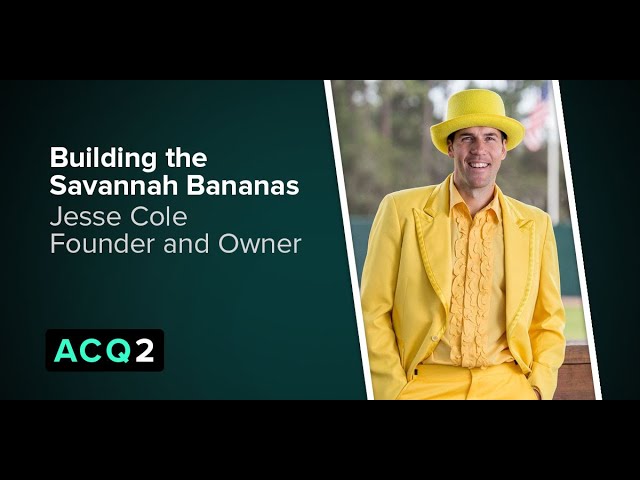
## Background
Published on YouTube by the Acquired channel on June 16, 2025, this ACQ2 audio episode features an interview with Jesse Cole, the founder and owner of the Savannah Bananas. The page description highlights how the franchise reimagined baseball into an ultra-fast, highly entertaining sport called 'Banana Ball' that has built a 3.2-million-person ticket waiting list by relentlessly prioritizing a 'fans first' business model.
## TL;DR
In this episode, Jesse Cole traces the decade-long journey of experimentation that transformed a failing college summer league team into a massive national entertainment phenomenon. He details the severe early financial struggles in Savannah, including selling his home and surviving on a $30 weekly grocery budget, before finding an instant product-market fit with a unique all-inclusive food and ticket model. Rejecting traditional sports business norms, the organization operates entirely debt-free without corporate sponsorships, manages its own in-house broadcast network, and relies on an asset-light model to sell out major football and MLB stadiums across the country.
## Atmosphere & style
The conversation is bursting with high energy, unbridled passion, and mutual excitement as the hosts dive into what they consider one of their most fun episodes ever. Jesse Cole brings an infectious, fast-paced showman's enthusiasm to the table, pairing lighthearted humor about early logistical failures with a deeply grounded focus on long-term fan loyalty. Listeners can feel the emotional weight of the franchise's cinematic arc—moving from the literal lowest point of sleeping on a cockroach-ridden airbed to the triumphant, goosebump-inducing spectacle of thousands of fans singing together in legendary ballparks.
## Key takeaways
- [00:00](https://www.youtube.com/watch?v=u6u7vV19j90&t=0s) The Savannah Bananas transformed traditional baseball into "Banana Ball," a fast-paced entertainment spectacle featuring choreographed dances, strict time limits, and unique rules designed entirely to prioritize fan engagement over traditional sports conventions.
- [02:08](https://www.youtube.com/watch?v=u6u7vV19j90&t=128s) Founder Jesse Cole spent a decade using a struggling minor league team, the Gastonia Grizzlies, as an unnoticed laboratory to test wild promotions and entertainment strategies before launching the Bananas.
- [04:50](https://www.youtube.com/watch?v=u6u7vV19j90&t=290s) Cole's philosophy was inspired by his own boredom sitting in a professional dugout and Walt Disney's realization that entertainment spaces should actively engage both adults and children together.
- [11:59](https://www.youtube.com/watch?v=u6u7vV19j90&t=719s) The early launch of the Savannah Bananas was a massive financial and critical failure, resulting in local public backlash and pushing the founders to sell their home and survive on a $30 weekly grocery budget.
- [15:33](https://www.youtube.com/watch?v=u6u7vV19j90&t=933s) To bypass generic naming ideas and establish an immediate visual identity, the parent company was rebranded to Fans First Entertainment and a high-end designer was hired to craft a premium "badass banana" logo.
- [18:48](https://www.youtube.com/watch?v=u6u7vV19j90&t=1128s) To combat early local skepticism and slow sales, Cole engineered an artificial scarcity strategy by condensing the game schedule and severely capping early ticket package quantities to trigger "sold out" announcements.
- [22:02](https://www.youtube.com/watch?v=u6u7vV19j90&t=1322s) $15 all-inclusive tickets on opening night offering unlimited food created a magical value proposition for fans, establishing instant word-of-mouth success despite massive initial operational and logistical strain.
- The team successfully rejected the traditional minor league business model by avoiding corporate sponsorships, stadium ads, and hidden ticketing fees, choosing to monetize strictly through high-volume merchandise sales and affordable tickets.
- The Banana Ball business operates on a self-reinforcing flywheel model where live events generate engaging content, which drives massive viral traffic, which in turn fuels intense ticket demand.
- [52:40](https://www.youtube.com/watch?v=u6u7vV19j90&t=3160s) Operating under a single-entity ownership model allows the league to prioritize competitive parity and narrative entertainment over individual team success, establishing a sustainable, fan-first league architecture.
- [55:59](https://www.youtube.com/watch?v=u6u7vV19j90&t=3359s) The franchise successfully expanded into major football stadiums through an asset-light model where the team pays no rent, allows the venue to keep concessions revenue, and relies on its immense drawing power to pack seats.
- [01:01:27](https://www.youtube.com/watch?v=u6u7vV19j90&t=3687s) To protect their fan-first pricing philosophy, the Bananas wage a continuous battle against secondary market scalpers who list speculative, fraudulent tickets online for hundreds of dollars.
- [01:04:36](https://www.youtube.com/watch?v=u6u7vV19j90&t=3876s) The Bananas consistently reject lucrative, exclusive broadcast rights contracts, opting instead to invest millions in-house via BTV to stream games ad-free and entirely free on YouTube.
- Major traditional networks are forced to adapt to the Bananas' terms, broadcasting the in-house media feed with commercial breaks while the team simultaneously streams uninterrupted on YouTube.
- The organization views operational failures—like misspelled merchandise, ticketing cyberattacks, and broadcast outages—as necessary stepping stones that are quickly forgiven by a intensely loyal fan base.
- Inspired by Costco's wholesale membership model, the "K Club" fan community offers guaranteed ticket access for an annual fee, passing scale efficiencies and supply control savings directly down to consumers.
## Detailed walkthrough
### [00:00](https://www.youtube.com/watch?v=u6u7vV19j90&t=0s) Introduction to Banana Ball and the "Most Unlikely Success Story"
The hosts kick off the episode expressing immense excitement for welcoming Jesse Cole—the owner, founder, and mastermind behind the Savannah Bananas and "Banana Ball"—noting that this is perhaps the most fun and unexpected success story they have ever covered. For listeners unfamiliar with the phenomenon, there are generally two camps: those who believe the entire world already knows about the Savannah Bananas, and those who are hearing about them for the very first time. Banana Ball is baseball reimagined with pure entertainment: it features players on stilts, choreographed dances, a rule where a batter is out if a fan catches a foul ball, and an automatic ejection for bunting, alongside 15 other unorthodox rules.
The growth of the franchise has truly caught fire, scaling from selling one million tickets last year to two million tickets this year. Cole chimes in to update that their massive waitlist has now reached 3.2 million people, jokingly adding, "but who's counting?" On social media, the Bananas have amassed over 15 million followers, which includes more TikTok followers than every single Major League Baseball (MLB) team combined. Despite this massive demand, tickets are kept affordable at around $35 with no hidden fees, and they include unlimited food and drinks. While some media outlets and even the hosts on a past episode have compared them to the "Harlem Globetrotters of baseball," the conversation sets out to explore why the Bananas are actually an entirely different kind of business model.
[02:08](https://www.youtube.com/watch?v=u6u7vV19j90&t=128s) The 10-Year Laboratory: Gastonia Grizzlies and Learning the Entertainment Business
When asked to share the narrative origin of Banana Ball, Cole takes the hosts back to his first job as a 23-year-old general manager for a failing team in Gastonia, North Carolina. The team was averaging a mere 200 fans per game, had only $268 left in its bank account, and was losing $150,000 a year. This was college summer baseball, which Cole describes as being near the very bottom of the baseball hierarchy, far below Triple-A, Double-A, and rookie ball. He jokes that the only way a 23-year-old gets hired as a GM is if the team is one of the worst in the country. After facing endless rejections and being hung up on during sales calls, Cole realized they could never survive as a standard baseball team because they would never have the best players. They had to become an entertainment company instead.
Cole began studying the showmanship of P.T. Barnum, Walt Disney, Cirque du Soleil, Saturday Night Live, and the WWE. To generate sheer attention, the team launched wild promotions: Grandma Beauty Pageants, Flatulence Fun Nights, Salute to Underwear Nights, and a "Dig to China" night where they buried a certificate in the infield dirt for a real trip to China—which hilariously turned out to be a one-way flight with no return ticket or accommodations. They also mock-fired their mascot for using "Bear Growth Hormone" (BGH) during the height of MLB's HGH scandals and offered George Bush an internship after his presidency.
* **Experimentation:** This era lasted for 10 years, serving as an unnoticed testing ground for integrating entertainment, including teaching the baseball players how to execute choreographed dances during the games.
* **Business Outcome:** The Gastonia Grizzlies eventually climbed to fourth in the country for attendance and began selling out games. The team became highly profitable, though they only received one major media story over the entire decade because they were located in a small suburb of Charlotte.
* **The Blueprint:** While the college summer team no longer exists, its commercial success eventually led to the team being sold and paved the way for a brand-new professional baseball stadium in Gastonia.
[04:50](https://www.youtube.com/watch?v=u6u7vV19j90&t=290s) The Epiphany in the Dugout and the Inspiration of Walt Disney
Cole explains that his philosophy was deeply shaped by his own background as a Division I college pitcher. He was being scouted by professional teams and thought playing in the majors was his ultimate dream. When injuries shifted his path into coaching, he found himself in the dugout of the prestigious Cape Cod League—the premier college summer league in the country. Even though he was sitting next to the best future players in the world with the absolute best seat in the house, Cole found himself completely "bored out of my mind." He realized that while playing baseball is thrilling, watching traditional baseball is an entirely different story. He began thinking that if he, a lifelong baseball lover and coach, was sitting in the dugout counting down the minutes until the three-hour game ended, there was a fundamental problem with the sport's pacing for everyday fans.
This realization mirrored a famous historical anecdote about Walt Disney, whom Cole has studied extensively. Disney famously recounted sitting on a bench at Griffith Park on a Saturday watching his daughters ride a carousel, wishing there was a place where adults and children could have fun *together*. Cole had that exact same vivid epiphany in the dugout, wishing that the game of baseball could be genuinely fun for everyone watching, not just for the people playing it. Armed with this perspective, Cole eventually transitioned from being an employee to a managing partner in Gastonia, eventually buying the franchise via owner-financing in 2014.
[07:54](https://www.youtube.com/watch?v=u6u7vV19j90&t=474s) A Field Proposal, a Trip to Savannah, and Finding Historic Grayson Stadium
The pivot toward Savannah began on the final game of the 2014 season. Cole had met his future wife, Emily McDonald, when he hosted a minor league sports seminar at age 24 purely because he wanted to learn from others in the industry. Emily, who was working for Ripken Baseball and the Augusta Green Jackets at the time, attended the seminar. When her boss heard Cole talk with unbridled passion about his Grandma Beauty Pageants, she called Emily and told her, "I just met the guy you're going to marry." The two connected over business, hit it off, and Emily later came to work with Cole as Gastonia's "Director of Fun." To establish her own independent reputation in the industry, they kept their romantic relationship a complete secret for an entire year while she built deep ties with local community organizations like the YMCA and United Way.
During the middle of the sixth inning at the final game of 2014, Cole completely stopped the game for 20 minutes to publicly thank his staff, family, and players, before dropping to one knee to propose to Emily with a ring hidden inside a baseball as fireworks erupted. The umpires impatiently asked when play would resume, but Cole insisted they own the moment. To celebrate, Emily planned a romantic weekend getaway to Savannah, Georgia. Cole insisted they take a side trip to look at the local minor league stadium. Walking into historic Grayson Stadium—a historic ballpark built in 1926 where legends like Babe Ruth, Hank Aaron, and Jackie Robinson had played—Cole fell in love with the history but noticed the modern reality: it was a beautiful 80-degree night, yet there were fewer than 200 fans in the stands, making it feel like a ghost town where a "tumble weed" could roll through.
* **The Opportunity:** Cole immediately called their league commissioner, stating that if Savannah's New York Mets affiliate team ever left, they wanted the market.
* **The Exit:** Only a month later, the minor league affiliate demanded a brand-new $38 million stadium from the city. When the city refused, the team relocated to Columbia, South Carolina, leaving the historic venue vacant.
* **The Lease:** Cole and Emily stepped in and successfully convinced the city of Savannah to grant them a lease to launch a new college summer league team, securing the venue for a highly affordable $20,000 per year by using their Gastonia financials as a precedent.
[11:49](https://www.youtube.com/watch?v=u6u7vV19j90&t=709s) The Colossal Failure of the Early Savannah Launch
One of the hosts shares a personal connection to Cole's journey, noting that his own father was a founder of the Atlantic League of Professional Baseball, and his childhood was spent traveling to municipalities pitching local governments to bring baseball back to empty stadiums just like Cole did. Cole laughs and shares that when they finally took over the Savannah stadium, the exiting minor league team had vindictively cut the phone and internet lines and stripped everything of value out of the ballpark. The new front office was incredibly young and lean: Cole was 31, Emily was 28, their team president was 24, and they had three 22-year-old interns straight out of college.
Despite having grand visions of launching a revolutionary model featuring all-inclusive tickets and non-stop entertainment, they were met with immediate community resistance and financial disaster. Local fans were furious that they had lost their official affiliated minor league team to South Carolina and viewed Cole's new venture as an inferior, cheap college stunt. The local market completely rejected them at the start.
* **Disastrous Ticket Sales:** The team managed to sell a grand total of only two tickets during their first three months of operation, alongside one small sympathy donation.
* **The Failed Launch Event:** They hosted a promotional launch party offering free food and alcohol, even resorting to knocking door-to-door at local shops and restaurants to drum up interest. Only about 100 people showed up to the massive venue. The conference center hosting the event felt so incredibly bad for the young crew that they didn't even charge them for the catered food and alcohol.
[13:24](https://www.youtube.com/watch?v=u6u7vV19j90&t=804s) The Lowest of Low: Selling the House and Sleeping on a Twin Airbed
The initial response from the Savannah community was overwhelmingly negative, with people actively questioning why they should support what they saw as the "lowest of low." At this point, Jesse Cole still owned both the Savannah team and the Gastonia Grizzlies, commuting between North Carolina and Georgia. The new venture was failing so drastically that on January 15, 2016, just over three months after launching on October 4–5, 2015, the Coles received a phone call stating their account was completely overdrafted. With a handful of tickets sold and absolutely no money left, Jesse's wife, Emily, looked at him and said, "Jesse, we have to sell our house. We have no other options."
Instead of cutting their losses and retreating to the reasonably decent and somewhat successful college summer team in Gastonia, they chose to go all in. The Gastonia team's cash flow was restricted because money only came in during its 30-game summer window, leaving them entirely broke in January. Responsible for six employees in Savannah alongside their staff in Gastonia, they sold their North Carolina home, emptied their savings, and moved into a disgusting, converted garage studio in Savannah. The space was so foul and cockroach-ridden that they had to sleep in their socks on a tiny twin airbed. Inspired by a chapter on the joy of saving in Mike Michalowicz’s book *Profit First*, they survived for months by telling themselves "one more day, one more day," ignoring their fraying phone chargers and strictly limiting their grocery budget to $30 a week—navigating Walmart with just a $20 and a $10 bill to cover 42 weekly meals.
- **Launch Dates:** October 4–5, 2015
- **Financial Crash Date:** January 15, 2016 (Account overdrafted)
- **Weekly Grocery Budget:** $30 total ($20 bill and $10 bill at Walmart) for 42 meals
- **Living Conditions:** A converted garage studio with cockroaches; slept in socks on a twin airbed
[15:33](https://www.youtube.com/watch?v=u6u7vV19j90&t=933s) channel PT Barnum, Walt Disney, and the "Badass Banana" Logo
Despite the harrowing financial strain, Jesse was constantly studying legendary showmen like PT Barnum and Walt Disney, drawing comfort from the fact that Disney himself had gone bankrupt with Laugh-O-Gram Studio. Realizing that "marketing is not what you say. Marketing is what you do," Jesse knew they needed to create a remarkable, attention-grabbing experience. Because the temporary marketing placeholder name "Savannah Baseball 2016" had no ring to it—drawing comparisons to the dry Washington Football Team format—and their parent company name, Team Cole and Associates, sounded like "a terrible law firm," they pivoted. They rebranded the parent company to Fans First Entertainment to serve as their north star. They then launched a team-naming contest, which yielded 1,000 generic ideas like Spirits, Ports, Anchors, and Braves. The breakthrough came when a 62-year-old nurse named Lynn Moses suggested "Bananas." The name unlocked an immediate flood of creative promotional ideas, including a senior citizen dance team called the Banana Nanas, a male cheerleading squad named the Mananas, a mascot named Split, and the catchphrase "Can't stop the peeling."
To make the wild name work, Jesse knew the visual branding had to be flawless and beyond reproach. Despite intense pushback from his cash-strapped team, Jesse insisted on bypassing local options to hire Studio Simon, a premier firm renowned for animated food logos. The designer quoted $12,000, an impossible sum when the Coles only had $30 for groceries. Jesse negotiated the fee down, telling his worried staff, "We won't eat this week. We'll figure it out." He demanded a "badass banana" featuring tropical fun colors rather than something soft. The gamble paid off beautifully; the finished logo was so strong that critics could not find a way to pan it.
- **Rebranded Parent Company:** Fans First Entertainment
- **Name Contest Winner:** Lynn Moses, a 62-year-old nurse who suggested "Bananas"
- **Logo Designer:** Studio Simon
- **Original Logo Quote:** $12,000
[18:48](https://www.youtube.com/watch?v=u6u7vV19j90&t=1128s) Public Backlash, Boos at the Parade, and the Sellout Strategy
The host pauses the conversation to highlight just how rare and privileged this deep-dive format is, noting that while the Bananas have been featured on an ESPN show, *60 Minutes*, and Disney Plus, Jesse is sharing rarely heard internal details. The host even shares a serendipitous morning encounter seeing a Bananas hat at his local Starbucks, prompting Jesse to quote Walt Disney's famous line, "It all started with a mouse," noting that for them, "it all started because of a mouse"—or rather, a banana. When they officially announced the team name on February 25, 2016, the backlash from the tradition-steeped Southern community of Savannah was immediate and brutal. Citizens felt the ownership was turning a historic baseball town where Babe Ruth and Hank Aaron once played into a total joke. Angry locals commented that the owner should be thrown out of town, the creator of the name should be fired, and that they were an embarrassment to the city who would never sell a ticket.
The ultimate test of resolve came during Savannah’s massive St. Patrick's Day parade, an event drawing hundreds of thousands of people. When the 31-year-old Jesse, his 28-year-old wife, and their 22-year-old staff proudly marched down the street in their brand-new Bananas t-shirts, they were roundly booed by the crowds. Locals argued the name made no sense, prompting some to falsely rationalize that Savannah must be a major banana port. Though deeply stung by the criticism, Jesse recognized that the public had a right to be skeptical because the team hadn't earned or proven anything yet. To combat the slow ticket sales, Jesse engineered a "sellout mentality" behind the scenes. He successfully convinced the league—who needed him to succeed since he bought the franchise from them and owed them hundreds of thousands of dollars—to condense their 28-game schedule down to 22 games by implementing Wednesday doubleheaders. They then capped their initial 5-game ticket plans at just 250 packages, allowing them to quickly and legitimately announce that the plans were "sold out" to manufacture high consumer demand.
- **Team Name Announcement Date:** February 25, 2016
- **Jesse and Emily's Ages (2016):** Jesse was 31; Emily was 28
- **Schedule Compression:** Cut the schedule from 28 games to 22 games using doubleheaders to eliminate low-demand Monday/Wednesday games
- **Scarcity Tactic:** Limited early ticket plans to a cap of 250 to trigger fast "sold out" announcements
[22:02](https://www.youtube.com/watch?v=u6u7vV19j90&t=1322s) Opening Night Chaos, the Dancing Nanas, and $15 All-Inclusive Food
The engineered buzz reached a fever pitch when ESPN's *SportsCenter* featured the team for 15 minutes, displaying the logo with the caption "logo of the year?". Though they hadn't played a single game yet and were still getting booed on local streets, the national spotlight helped them push all their chips into selling out opening night. Jesse went all-out with the entertainment roster, preparing the Banana Nanas, the Banana Baby ritual (lifting a costumed infant to the song *Nats Sylvania*), a breakdancing coach, a literal banana throw instead of a first pitch, and green uniforms to symbolize that the college roster "wasn't quite ripe." Recruiting top-tier college players to play for a team named after a fruit was a massive hurdle. When the players finally arrived, the staff spent a day and a half putting them through media training to teach them how to embrace the joke rather than say they hated it. They fully leaned into the concept during their first filmed practice, using real bananas for batting, throwing, and catching drills.
Opening night was a beautiful, chaotic disaster. The team committed six errors on the field, and a sudden downpour caused a major rain delay. Seizing the moment, Jesse ordered the Banana Nanas out onto the field. The image of the senior citizen dance team performing in soaking-wet white jerseys in the pouring rain created an accidental, massive viral sensation. Meanwhile, the stadium's groundbreaking "fans first" all-inclusive food model—offering unlimited burgers, hot dogs, chicken sandwiches, soda, water, popcorn, and dessert for a $15 ticket—faced severe logistical strain. Having no idea what they were doing, the staff burned through 10,000 pieces of meat in the very first hour, causing hungry fans to wait two to three hours in line. While onlookers assumed the team "lost their shirt" on the deal, Jesse explains that from a cost-goods perspective, high-quality burgers only cost $1 to $2, hot dogs cost 80 cents, and sodas cost 20 to 30 cents, meaning they didn't actually lose money. More importantly, it established a magical consumer mindset where fans felt they were actively taking advantage of the team. By the end of the night, as players handed out roses to little girls in the crowd, the extraordinary experience sparked immediate word-of-mouth success, establishing an instant product-market fit that would sustain a consecutive streak of sellouts. Still, at that specific snapshot in history, Jesse remained buried under a personal debt load well over seven figures, owing massive startup costs, continuous payments to the league, and lingering debts to Ken Silver for the Gastonia franchise. Relief only began to emerge when their merchandise sales exploded far beyond expectations following the official February 25 launch.
- **Opening Night Ticket Price:** $15 (including all-inclusive food)
- **Food Consumption:** 10,000 pieces of meat served in the first hour
- **On-Field Performance:** 6 player errors committed on opening night
- **Personal Debt Load:** Over seven figures ($1,000,000+) owed across league fees, startup costs, housing, and the Gastonia acquisition from Ken Silver
The Explosion of the Lifestyle Brand
The Savannah Bananas quickly transcended their local roots to become a national phenomenon. Fueled by features on the front page of Yahoo! and ESPN's *SportsCenter*, merchandise began selling instantly across all 50 states and multiple international countries. The speaker reflects on how "crazy" the reception was, noting a fascinating paradox: while the brand was loved on a national level, it faced resistance and was "not loved" locally in those early days—a national-versus-local dynamic that the organization still navigates as it grows. The scale of the merchandise operation blew past all expectations, with the Bananas generating more sales in a matter of hours than their previous team in Gastonia ever did in its biggest day.
This massive retail success turned the Savannah Bananas into what is described as a "lifestyle brand." Wearing the Bananas logo became less about indicating a love for baseball and more about making a personal statement. Fans frequently share that whenever they want to feel good about themselves, they put on a Bananas shirt because it inevitably sparks joy and conversation, with strangers shouting, "Go bananas! Have you seen them?" This accidental lifestyle branding has since expanded to encompass their newer spin-off teams, such as the Party Animals.
* **Geographic Reach:** Merchandise sold to all 50 states and various international countries immediately.
* **Media Highlights:** Featured on Yahoo!'s front page and *SportsCenter*.
* **Revenue Growth Comparison:** Single-hour merchandise sales routinely outperformed the best full-day sales figures ever recorded by the ownership's previous team in Gastonia.
---
Rejecting the Traditional Minor League Business Model
The business strategy behind the Bananas marks a radical departure from the traditional four-pillar revenue model of minor league baseball: tickets, merchandise, food and beverage, and advertising/sponsorships. Early on, the team combined tickets with food and beverage, making ballpark basics all-inclusive while treating alcohol, ice cream, and specialty items as
The Chaos of the First Fan Games and the Flywheel Model
The true origin of Banana Ball in front of a live crowd didn't happen until 2020, following a couple of years of workshopping the rules with college players from the Lander team in 2018. Due to the pandemic, Georgia was one of the few places permitting fans, allowing about a thousand people into the stadium to witness the experiment. The game immediately plunged into absolute, fast-paced chaos; on the first or second play, a batter hit a "ball four sprint home run," leaving everyone entirely confused about what to do. The game wrapped up in just about an hour and 45 to 50 minutes. The sheer excitement convinced the team that they were on to something special, leading to a "one city world tour" in 2021 based on the philosophy: "start small but think big."
This tour laid the groundwork for a highly successful business flywheel where live events serve as the ultimate driver. The loop functions strictly in a specific order: live events drive content, content drives outrageous traffic, and that traffic drives the intense demand that forces the
[52:40](https://www.youtube.com/watch?v=u6u7vV19j90&t=3160s) Disruption and Building a Sustainable League
The speakers reflect on the philosophy of self-disruption. In the past, when the team played college summer ball in the Coastal Plane League, they won back-to-back championships under a highly profitable business model where players couldn't be paid due to NCAA regulations. Despite this success, they chose to disrupt themselves by creating a new league that no one was asking for. Traditional sports leagues over the past 30 years typically secure a TV rights deal and sponsorships first, hoping the fans will follow. The Indian Premier League (IPL) succeeded because fans were starved for cricket, but even their foundation relied heavily on massive TV rights and jersey sponsorships. The Bananas took the opposite approach: "why don't we create the fans first?"
By building a massive fan base across multiple brands, they established a far more sustainable model. The speaker highlights that if you secure the audience first, everything else follows naturally. This single-entity ownership model sparked a discussion about whether owning all the teams is better or worse for competition. The host points out that in big leagues, separate owners often look to lock in their own advantages. In contrast, the Bananas' model means they economically do not care which specific team wins, as long as the games remain competitive, fun to watch, and continue to accrue fans.
* **Social Media Reach:** The Savanah Bananas have 18 million followers, the Party Animals have over 5 million, the Firefighters (launched 12 months ago) have over 1 million, and the newly launched Tailgators are growing rapidly.
* **Storylines over Traditional Metrics:** The league focuses heavily on creating entertainment and narrative depth, aiming to develop coaches who act as heroes and villains to drive engagement, similar to the "Deion Sanders effect".
* **Long-Term Strategy:** The organization prioritizes "long-term fans over short-term profits," absorbs all sales taxes on merchandise and tickets themselves, and avoids charging extra fan fees.
---
[55:59](https://www.youtube.com/watch?v=u6u7vV19j90&t=3359s) Conquering Football Stadiums and the Asset-Light Model
Transitioning into major league and football stadiums presented significant hurdles, primarily due to exclusive ticketing contracts held by giants like TicketMaster, Tickets.com, and SeatGeek. The Bananas bypassed this by leveraging their proprietary ticketing platform. They negotiated a way in by demonstrating that their advance-sale model didn't compete with traditional stadium sales, even allowing stadiums to keep control over premium suites. Inspired by Sam Walton's advice to "go where others won't go"—a strategy famously shared by Kmart and Sears in their early days, as well as IKEA—they set their sights on football stadiums, a venue type entirely ignored by the rest of the baseball world.
The strategy has paid off massively by keeping operations asset-light. The speaker reveals that they do not pay rent at any venue they visit. Instead, they structure win-win partnerships where the stadium retains 100% of the lucrative food, beverage, and premium seating revenues while the Bananas handle the netting, build out the field, and sell out the tickets. This immense drawing power has turned Banana tickets into a highly sought-after perk that major venues use as a selling point for their own customer bases. Tourism boards and cities are now eager to invest because a single visit creates an immense economic impact, drawing tens of thousands of out-of-state visitors who treat the event as a bucket-list trip.
* **Clemson Stadium Success:** Played in front of 81,000 fans, featuring a unique field layout with a 190-foot down-the-field line, an outfield wall 350 feet down one line and 200 feet down the other, a 50-foot net supplied by Netting Pros, and 11 home runs. The game concluded in just 1 hour and 43 minutes.
* **Clemson Economic Impact:** 60% of the 50,000 attendees traveled from outside the state of South Carolina.
* **Touring Scale:** The Bananas travel with a massive cast of 200 to 220 people (compared to the Harlem Globetrotters who travel with 30), including their own broadcast crew, dancers, and bands. Travel costs alone average $35,000 to $40,000 per person annually.
* **Local Employment:** The tour hires 300 to 400 local workers per stop to act as "nano scanners," don banana costumes, and run merchandise stands.
* **Player Compensation:** Unlike traditional minor league salaries, which often hover near the poverty line (with Triple-A capped around $35,000), most Banana players are on track for six figures or more while playing half the games (mostly Thursday through Sunday).
---
[01:01:27](https://www.youtube.com/watch?v=u6u7vV19j90&t=3687s) The Economics of Tickets, Merchandise, and the Ticket Scalping Battle
The host pushes to understand the financial engine behind these high player salaries and large-scale productions, especially given the lack of corporate sponsorships. The speaker breaks down the top-line revenue, which is anchored by selling 2.2 million tickets priced strictly between $35 and $60, alongside an incredibly high volume of merchandise sales. At a typical major league stadium, between 40% and 50% of the 15,000 to 20,000 attendees buy multiple items. To maintain goodwill, a $30 shirt costs exactly $30 at checkout, with no hidden fees or added taxes.
The greatest operational headache for the business is the secondary ticket market. Because secondary sites allow speculative listings without verifying ownership, thousands of fake tickets are sold for hundreds of dollars the moment the team announces its schedule. The speaker details their "world tour draft"—a massive, Steve Jobs-style live event that draws fans from 38 states just to watch the schedule release. Within 48 hours of the event, 2 million people join the ticket lottery list. Unfortunately, unsuspecting fans buy speculative tickets online and fly across the country, only to find out at the gate that their tickets are fraudulent. The host shares a parallel experience, noting they recently saw a seat listed for an exorbitant price on a secondary site for an upcoming Radio City show, despite knowing for a fact that a camera was assigned to that exact spot.
* **Ticket Tier Pricing:** $60 for the lower bowl, $50 for the middle tier, and $40 for the top deck.
* **Secondary Market Reality:** Average resale prices on StubHub, Vivid Seats, and SeatGeek exceed $300, despite the Bananas' best efforts to keep prices low. Every night, the team manages defrauded fans by offering standing-room accommodations to preserve their "fans first" philosophy.
---
[01:04:36](https://www.youtube.com/watch?v=u6u7vV19j90&t=3876s) Rejecting the Media Rights Status Quo
When discussing their broadcast and media rights strategy, the Bananas look at the landscape through the eyes of the consumer, identifying commercials and fragmented paywalls (such as games scattered across Peacock or HBO) as major pain points. While acknowledging that organizations like the NFL and NASCAR maximize revenue through these channels, the Bananas chose to stream every single game for free on YouTube. Even though YouTube monetization yields "very, very little" financial return—amounting to only a few hundred dollars per game—the accessibility it provides to fans is treated as paramount.
For years, national networks approached the team offering substantial broadcast deals, but the Bananas steadfastly refused any contract that demanded exclusivity. Because the company operates with zero debt, has never taken equity capital, and is owned entirely by the speaker and his wife, they had the financial freedom to repeatedly say no. This insistence on protecting the fan experience eventually forced the hand of traditional sports institutions, who realized they could no longer ignore the cultural phenomenon.
> "Our business is not built on that. We're profitable and successful and healthy based on tickets and merchandise."
Holding Ground on Broadcast Rights and Going In-House
When major networks like ESPN approached the Savannah Bananas about broadcasting their games, they insisted they couldn't ignore the team's massive success any longer. However, Jesse Cole held his ground on a massive condition: the games had to remain free to watch on YouTube. Although the networks claimed they had never done anything like that before, they ultimately made an exception. Under this unique arrangement, broadcast partners pay for the rights to air the games across their own apps and ecosystems, where they monetize via commercials, while the Bananas stream the exact same games ad-free on YouTube. This ensures that fans watching the YouTube stream get to experience every single piece of promotion, halftime show, and in-between entertainment without interruption.
This commitment to the fan experience comes with a massive financial investment. The Bananas spend millions of dollars on broadcasting, investing over \$5 million in the current year alone to build their own control rooms and support multiple simultaneous tours. The broadcasting operation does not cover its own costs yet, but Cole is confident it eventually will. When a broadcast partner airs a game, they do not bring in their own cameras or crews; instead, they take a direct media feed produced entirely in-house by the team's media arm, BTV. Cole recalls a funny story from their first game on ESPN in 2022 when an outside crew was brought in to assist. The first batter struck out in a mere 10 seconds across three pitches, causing the outside director to sweat bullets and declare, "I can't do this. This is too fast." Traditional baseball directors are used to players stepping out of the box and adjusting their batting gloves, so a seasonal intern had to step in and lead the fast-paced show.
* **Original Rule Book:** The Baseball Hall of Fame holds Cole's original idea book where he first wrote the rules and called the sport "show ball," which even included concepts like the golden batter before it was officially introduced.
* **Broadcasting Investment:** Over \$5 million invested in building in-house control rooms and managing multiple tour broadcasts.
* **Media Feed Model:** Unlike traditional sports leagues like the NFL where networks like Fox and CBS bring in astronomical setups, partners utilize the Bananas' in-house BTV crew output.
Embracing Failure and the Long Game Vision
The path to success has been paved with constant mistakes, which Cole openly embraces. During their first primetime game on ESPN, the transmission cut out completely for the first 10 minutes. The ESPN anchors had to awkwardly tell viewers to go to YouTube, joking that the Bananas couldn't handle them, and even when the feed returned, it heavily buffered. Cole notes that people quickly forget these failures because the team simply moves on to the next at-bat. He jokes that their very first shipment of merchandise actually misspelled the team name by including too many N's in "bananas." Even worse, during their first Major League stadium game in Houston, their ticketing system suffered a major cyberattack and failed the entire night, leading Cole to despair that they would never play a major league stadium again.
Looking to the future, Cole's broadcast vision focuses on making the viewing experience completely must-watch. He wants to explore a couple of years down the line how to mic up every single player or allow fans to tune into specific individuals. He believes modern sports fans are becoming much larger fans of individual players than the actual teams. The hosts observe that by leaving massive amounts of profit on the table everywhere, Cole is effectively charging up a massive battery of stored potential energy and building incredible Net Promoter Score (NPS) and fan loyalty. Cole agrees, highlighting how their fans fiercely defend them online without the front office ever needing to intervene.
* **Merchandise Mishap:** The first-ever shipment of team t-shirts misspelled "bananas" with too many N's.
* **Houston Ticketing Failure:** A live cyberattack completely shut down the ticketing system during their first major league stadium game.
* **Individual Player Followings:** Star players like Jackson Olsson, KJ Jackson, and Coach Rack pull millions of followers, driving the need for individual-centric broadcast options.
The Costco Model and Chasing Moments
Behind closed doors, the Bananas have quietly grown a massive community called the "K Club" (using the chemical symbol for potassium). For \$59 a year, thousands of members gain complete ticket access to any game and join a highly active, supportive Facebook community where they coordinate special meetups. The hosts compare this strategy to Costco's "scaled shared economies" model, where a business is minimally value-extractive and passes savings directly to consumers to build a durable relationship. Cole reveals that his staff actually studied the Acquired podcast episode on Costco, admiring how the retail giant went all the way in to control their own supply chain just to keep their hot dog at \$1.50. The Bananas aim to replicate this complete control with merchandise, tickets, and eventually combating the secondary ticket market. Because Cole and his wife Emily no longer live out of an air mattress and have no shareholders or investors to appease, they are entirely content operating with minimal annual profits to win the long game.
Ultimately, Cole explains that the entire venture is about chasing pure energy and creating unforgettable human moments for future generations. He describes the goosebumps he gets every single night when thousands of fans stand together after a game to sing "Stand by Me" or light up an entire stadium with their phone flashlights to sing Coldplay's "Yellow." It was a dream come true for Cole, who grew up south of Boston, to look out at 38,000 people singing together at Fenway Park. The hosts joke that while he didn't get to pitch baseballs there, he certainly got to pitch at Fenway in a "PT Barnum" way. The episode wraps up with the hosts expressing their immense excitement to see the full show early—including the pre-game parade starting at 2:00 PM—when the tour hits T-Mobile Park in Seattle this September.
* **The K Club:** A private fan membership costing \$59 a year that guarantees ticket access and fosters a nationwide community.
* **Costco Inspiration:** The team explicitly uses Costco's business model as inspiration for controlling operations to keep consumer costs low.
* **Seattle Tour Stop:** The hosts are scheduled to attend the upcoming September game at T-Mobile Park.
> [52:40](https://www.youtube.com/watch?v=u6u7vV19j90&t=3160s) why don't we create the fans first? — Jesse Cole
> [55:59](https://www.youtube.com/watch?v=u6u7vV19j90&t=3359s) go where others won't go — Sam Walton
> [01:04:36](https://www.youtube.com/watch?v=u6u7vV19j90&t=3876s) Our business is not built on that. We're profitable and successful and healthy based on tickets and merchandise. — Jesse Cole
> [01:04:36](https://www.youtube.com/watch?v=u6u7vV19j90&t=3876s) I can't do this. This is too fast. — Outside director
## Mentioned
Savannah Bananas, Jesse Cole, Banana Ball, TikTok, Major League Baseball, MLB, Harlem Globetrotters, Gastonia Grizzlies, P.T. Barnum, Walt Disney, Cirque du Soleil, Saturday Night Live, WWE, George Bush, Cape Cod League, Emily McDonald, Ripken Baseball, Augusta Green Jackets, YMCA, United Way, Grayson Stadium, Babe Ruth, Hank Aaron, Jackie Robinson, New York Mets, Atlantic League of Professional Baseball, Mike Michalowicz, Profit First, Walmart, Laugh-O-Gram Studio, Fans First Entertainment, Lynn Moses, Banana Nanas, Mananas, Split, Studio Simon, ESPN, 60 Minutes, Disney Plus, Starbucks, St. Patrick's Day, Ken Silver, SportsCenter, Yahoo!, Party Animals, Lander, Indian Premier League, IPL, Deion Sanders, Firefighters, Tailgators, TicketMaster, Tickets.com, SeatGeek, Sam Walton, Kmart, Sears, IKEA, Clemson Stadium, Netting Pros, StubHub, Vivid Seats, Radio City, Peacock, HBO, NFL, NASCAR, YouTube, BTV, Fox, CBS, Baseball Hall of Fame, Houston, Jackson Olsson, KJ Jackson, Coach Rack, K Club, Facebook, Costco, Acquired, Coldplay, Fenway Park, T-Mobile Park, Seattle
Jesse Cole argues that traditional baseball alienates casual audiences through slow pacing, requiring clubs to operate as entertainment businesses rather than conventional sports teams. By eliminating equity investors, ticket surcharges, and traditional venue leasing, the Savannah Bananas built a profitable, asset-light entertainment franchise focused on long-term fan goodwill.
Reimagining Baseball as an Entertainment Spectacle (2:08)
Cole's entertainment philosophy originated while coaching in the Cape Cod League, where he found himself bored in the dugout despite watching elite Division I talent. Mirroring Walt Disney's desire to create shared family entertainment at Griffith Park, Cole concluded that traditional baseball was exciting to play but tedious to watch. He spent a decade refining promotions at the summer-league Gastonia Grizzlies—a team carrying $268 in the bank and losing $150,000 annually—drawing inspiration from P.T. Barnum, Saturday Night Live, and WWE to stage outrageous stunts like Grandma Beauty Pageants.
These experiments culminated in "Banana Ball," a fast-paced format governed by over 15 unorthodox rules. Matches conclude in under two hours and incorporate players on stilts, choreographed mid-game dances, an automatic ejection for bunting, and an active rule where a fan catching a foul ball counts as an out. Rather than relying on elite prospects, the organization shifted focus entirely toward stagecraft, pacing, and narrative storylines.
Overcoming Near-Bankruptcy with Engineered Scarcity (13:24)
After acquiring the Savannah lease at historic Grayson Stadium for $20,000 annually in 2015, Cole and his wife Emily faced immediate financial collapse. The local market rejected the collegiate venture after losing its affiliated minor league franchise, resulting in just two ticket sales over three months. By January 15, 2016, the organization overdrafted its bank account. The Coles sold their home, moved into a cockroach-infested converted garage studio, and limited their grocery budget to $30 a week.
Local residents actively protested the "Bananas" moniker—suggested by 62-year-old nurse Lynn Moses—even booing staff at Savannah's St. Patrick's Day parade. To establish credibility, Cole negotiated a discounted rate with Studio Simon for a sharp visual identity. To counter slow demand, he persuaded the league to condense Savannah's 28-game schedule to 22 games via doubleheaders and capped initial five-game ticket packages at 250, creating genuine scarcity and momentum that ignited consecutive sellouts.
Low-Extraction Economics and the Costco Model (61:27)
On opening night in 2016, the Bananas pioneered an all-inclusive ticket model: unlimited burgers, hot dogs, chicken sandwiches, soda, water, and popcorn for $15. Although critics assumed the team lost money after serving 10,000 pieces of meat in the first hour, Cole notes wholesale food costs remained modest—burgers cost $1 to $2, hot dogs 80 cents, and sodas 20 to 30 cents. The policy generated instant consumer trust by making fans feel they received outsized value.
Studying Costco's low-margin, scaled-shared-economies model, the franchise maintains transparent pricing. Tickets sell strictly between $35 and $60 with zero convenience fees, all merchandise sales taxes are absorbed by the team, and a $59 annual "K Club" fan membership guarantees direct ticket access. This pricing discipline persists despite massive secondary ticket market markups exceeding $300 on resale platforms, with the Bananas regularly accommodating defrauded ticket holders with standing-room access.
Asset-Light Touring and Media Self-Sufficiency (55:59)
To expand into major league and football stadiums—such as Clemson's 81,000-seat venue—the Bananas adopted an asset-light operational structure. Rather than paying stadium rent, the franchise forms partnerships where venues retain 100% of food, beverage, and premium suite revenues, while the Bananas handle field setup, custom netting, and ticketing. The touring company travels with 200 to 220 personnel, generating substantial economic impact that attracts host cities, while paying most players six figures for playing weekend-heavy schedules.
The organization maintains full media independence by refusing broadcast exclusivity. Despite investing over $5 million in their in-house "BTV" production setup, Cole streams every game live and uninterrupted on YouTube for minimal immediate revenue. When commercial networks such as ESPN broadcast games, they must use the Bananas' in-house feed and take commercial breaks while the online YouTube audience continues watching unbroken entertainment.
The Savannah Bananas demonstrate how rejecting traditional sports broadcast rights, debt, and value-extractive surcharges can create a profitable touring business powered by fan loyalty. However, the model faces ongoing friction from widespread secondary-market ticket fraud and the financial pressure of self-funding a multi-million-dollar touring and broadcast infrastructure without institutional equity.
## Background
本期内容由知名商业播客节目《Acquired》(旗下 ACQ2 频道)于 2025 年 6 月 16 日在 YouTube 平台发布。节目简介指出,萨凡纳香蕉队(Savannah Bananas)打破传统棒球沉闷冗长的常规,自创了快节奏且极具娱乐性的“香蕉球(Banana Ball)”,本期专访邀请到创始人兼老板杰西·科尔(Jesse Cole),深入拆解他如何从睡充气床垫、每周 30 美元菜金的濒临破产困境,一路逆袭打造出拥有数百万候补购票名单、场场爆满并坚持“球迷第一”的体育娱乐商业帝国。
## TL;DR
节目全面复盘了萨凡纳香蕉队及其衍生体育项目 Banana Ball 的创立与崛起之路。杰西·科尔(Jesse Cole)结合在低级别大学夏季联赛十年的摸索,借鉴迪士尼乐园和马戏之王巴纳姆的娱乐逻辑,对传统棒球比赛规则进行了颠覆式重塑——设立两小时严格时限、消除死寂时间、推行全包式亲民门票并彻底取消商业广告与赞助。团队在零风投、零负债且全资控股的前提下,通过建立自营票务与转播制作体系(BTV)、打造多球队对抗生态并挺进十万人巨型橄榄球场,开创了完全以球迷情感和长期主义为核心的全新体育商业范式。
## Atmosphere & style
整场对话洋溢着极具感染力的狂热激情与充沛能量,身着标志性黄色燕尾服的杰西·科尔谈吐幽默、妙语连珠,两位主持人 Ben 和 David 也完全被其纯粹的企业家精神所折服。叙事节奏轻快起伏,既有初创期挤在漏气充气床垫、被全城嘘声淹没的辛酸与狼狈自嘲,也有转播翻车与黑客攻击的惊险实战,更有数万人在巨型球场点亮灯海齐声合唱的高光感动。整期播客听来如同置身一场酣畅淋漓的嘉年华,既是一堂硬核反传统的商业战略课,又充满浪漫而纯粹的造梦者情怀。
## Bulletin
- [00:00](https://www.youtube.com/watch?v=u6u7vV19j90&t=0s) 萨凡纳香蕉队(Savannah Bananas)凭借创新的“Banana Ball”规则与全娱乐化体验风靡全美,门票年销量达 200 万张,候补名单突破 320 万人,全网粉丝超 2500 万。
- [27:41](https://www.youtube.com/watch?v=u6u7vV19j90&t=1661s) 香蕉队推行极致的“球迷第一”商业模式:首创包含全套餐饮的 35 美元全包门票,不仅免除一切服务手续费并自掏腰包代付销售税,还于 2020 年彻底取消球场所有商业广告赞助,门票与周边商品贡献了超过 95% 的总收入。
- [56:03](https://www.youtube.com/watch?v=u6u7vV19j90&t=3363s) 团队开创橄榄球场“零场租”合作模式,自负改装并包揽门票,将全部餐饮与豪华包厢收益让渡给场馆方,单场在克莱姆森大学吸引 8.1 万名观众,成为现象级体育文旅IP。
- [01:04:36](https://www.youtube.com/watch?v=u6u7vV19j90&t=3876s) 杰西·科尔(Jesse Cole)与妻子持有球队 100% 股权,零外部融资与债务,坚持在全美巡演期间通过 YouTube 全程免费且无广告直播,迫使 ESPN 和 TNT 破例接受非独家转播授权。
## Key takeaways
- [34:20](https://www.youtube.com/watch?v=u6u7vV19j90&t=2060s) Banana Ball 对传统棒球规则进行激进颠覆,设立打者擅自踏出打击区直接计好球、触击即驱逐、球迷接界外球打者出局以及单场严格限时两小时等规则,彻底消除冗长死寂时间。
- [04:50](https://www.youtube.com/watch?v=u6u7vV19j90&t=290s) 创始人 Jesse Cole 在执教大学顶级联赛时痛感比赛冗长乏味,借鉴沃尔特·迪士尼与 P.T.巴纳姆的娱乐思维,将低级别竞技棒球转型为面向全家群体的纯粹沉浸式快乐秀场。
- [13:31](https://www.youtube.com/watch?v=u6u7vV19j90&t=811s) 创业初期遭遇严重财务危机:进驻萨凡纳前三个月仅售出 2 张门票,团队靠卖房、睡充气床垫和每周 30 美元伙食费苦撑,借钱定制硬核香蕉 Logo 在圣帕特里克节大游行中顶着全城嘘声破局。
- [24:09](https://www.youtube.com/watch?v=u6u7vV19j90&t=1449s) 门票全包餐采用逆向心理学设计,以汉堡约 1-2 美元、汽水 20-30 美分的底牌成本,创造让观众感到“狠狠占便宜”的极致情绪价值,实现场场售罄的口碑破圈。
- [27:41](https://www.youtube.com/watch?v=u6u7vV19j90&t=1661s) 坚决拆除球场所有商业赞助广告牌改造为免费签名墙,践行拒绝中介插在球队与球迷之间榨取价值的原则,使周边零售与门票成为 95% 以上收入支柱并形成生活方式品牌。
- [36:12](https://www.youtube.com/watch?v=u6u7vV19j90&t=2172s) 构建独创的计分与防大比分机制:实行局分制(单局胜者得1分),在第九局引入实际得分换算局分与“黄金打者规则”,确保任何落后队伍都能保留压哨逆转悬念。
- [41:29](https://www.youtube.com/watch?v=u6u7vV19j90&t=2489s) 现场活动作为内容发动机驱动商业飞轮运转:现场赛事催生社交网络病毒式内容,巨额线上流量拉动狂热门票需求与周边销售,进而反哺更大规模的线下巡演。
- [46:06](https://www.youtube.com/watch?v=u6u7vV19j90&t=2766s) 深度借鉴《周六夜现场》(SNL)的创意工作流,由专职编导每日为球员魔鬼排练舞蹈与特技,使普通棒球运动员蜕变为坐拥数百万粉丝的体育超级网红。
- [48:56](https://www.youtube.com/watch?v=u6u7vV19j90&t=2936s) 成功孵化穿着露脐装的叛逆宿敌“派对动物队(Party Animals)”等对手矩阵,坚持真实竞技而非假球剧本,构筑多阵营独立巡演售罄的香蕉球联盟生态。
- [50:22](https://www.youtube.com/watch?v=u6u7vV19j90&t=3022s) 吸取 1940 年代哈林篮球队因巡演剧本化与缺乏自主联盟被 NBA 边缘化的历史教训,香蕉队坚持单一实体(Single-Entity)所有权,拒绝引入追求短期利益的独立老板以捍卫品牌纯粹性。
- [56:03](https://www.youtube.com/watch?v=u6u7vV19j90&t=3363s) 错位竞争进军超大型美式橄榄球场,以自带 200 余人巡演班底和定制超大安全网的“重型重投入”模式,换取零场租入驻与全美跨州文旅拉动效应。
- [01:06:33](https://www.youtube.com/watch?v=u6u7vV19j90&t=3993s) 自投超 500 万美元全盘自建“BTV”制播体系,摆脱传统电视转播无法跟上闪电节奏的困境,向全员佩戴无线麦克风与球星定制视角深度探索。
- [01:09:50](https://www.youtube.com/watch?v=u6u7vV19j90&t=4190s) 低调运营万人“K俱乐部”建立坚不可摧的铁杆社群护城河,效仿 Costco“规模经济共享”哲学,追求全产业链垂直整合并将全部价值让渡给球迷,坚持不卖公司的百年长期主义。
## Detailed walkthrough
### [00:00](https://www.youtube.com/watch?v=u6u7vV19j90&t=0s) 重新发明棒球:Savannah Bananas 的病毒式狂潮
播客联合主持人 Ben Gilbert 和 David Rosenthal 迎来了一位非常特别的嘉宾——Savannah Bananas(萨凡纳香蕉队)的创始人兼老板、同时也是“Banana Ball”(香蕉球)规则的创造者 Jesse Cole。主持人难掩兴奋之情,直言这是 ACQ2 节目开播以来最不可思议、也最充满乐趣的一个成功故事。棒球运动在很多观众眼中往往处于两个极端:一派人认为“萨凡纳香蕉队早就人尽皆知,网络上铺天盖地全是他们”,另一派人则是一头雾水,疑惑为何主持人会觉得全世界都已经听过这支球队。
所谓 Banana Ball,从本质上讲依然是棒球,但规则却被进行了极其颠覆性的重塑与娱乐化改造:
- 场上会有踩着高跷的球员参与比赛;
- 球员在打席之间会跳起精心编排的舞蹈;
- 如果观众在看台上接住了界外球,场上的击球手直接被判出局;
- 击球手严禁使用触击球(Bunt),一旦触击就会被直接驱逐出场;
- 比赛严格限制在两小时之内结束,还有多达 15 条以上打破常规的独特规则。
这不仅是棒球,更是纯粹的快乐秀场。然而最震撼人心的还是其惊人的商业火爆程度:
- 球队上一年度售出了 100 万张门票;
- 录制当年的门票销量已经达到 200 万张;
- 候补购票名单(Waiting list)上排队的人数突破了 320 万;
- 社交媒体总粉丝量超过 1,500 万,在 TikTok 上的粉丝数甚至超过了全部 30 支 MLB(美国职业棒球大联盟)球队的粉丝总和;
- 票价保持在极其亲民的 35 美元左右,并且实行“全包式”服务,包含场内无限制的食品与软饮,没有任何隐藏手续费。
外界经常用“棒球界的哈林环球旅行者篮球队(Harlem Globetrotters of baseball)”来形容他们,甚至 Acquired 在此前的 IPL(印度板球超级联赛)专题中也做过类似的对比。但 Jesse Cole 指出,虽然这是外界最容易理解的类比,但两者的底层逻辑和比赛本质截然不同,香蕉球依然是具备真刀真枪对抗性的比赛。
---
### [02:08](https://www.youtube.com/watch?v=u6u7vV19j90&t=128s) 加斯托尼亚的十年试验场与狂想式营销
当被问及这一切究竟如何起源时,身着标志性黄色燕尾服的 Jesse Cole 将故事拉回到了起点。23 岁那年,他成为了北卡罗来纳州加斯托尼亚市(Gastonia)一支棒球队的总经理(GM)。这支球队当时的处境堪称绝境:每场比赛只有大约 200 名观众入场,银行账户里仅剩区区 268 美元,每年还要净亏损 15 万美元。由于这是最底层的大学夏季棒球联赛(级别远低于 MLB、AAA、AA、高阶 A、1A、菜鸟联盟及独立联盟),正常的优秀管理人才根本不会考虑,只有如此糟糕的烂摊子才会让一个 23 岁的年轻人当上总经理。
刚接手时,Jesse 疯狂约见客户和打电话拉赞助,但经常被人直接挂断电话。他迅速意识到一个残酷的商业现实:由于联赛层级极低,他们永远不可能招揽到世界上最好的棒球运动员,因此单纯靠“竞技体育”这条路走不通,唯一的生路是转型为“纯粹的娱乐”。
为此,Jesse 开始废寝忘食地研读 P.T. Barnum(马戏之王)、沃尔特·迪士尼(Walt Disney)、太阳马戏团(Cirque du Soleil)、《周六夜现场》(SNL)以及 WWE(世界摔角娱乐)的商业运作与娱乐手法,并决定在球场上彻底“放飞自我”。他们推出了一系列匪夷所思的狂欢主题之夜:
- **祖母选美大赛(Grandma Beauty Pageants)**;
- **放屁狂欢之夜(Flatulence Fun Nights)** 与 **向内裤致敬之夜(Salute to Underwear Nights)**;
- **“挖到中国去”之夜(Dig to China Night)**:团队在内野的红土深处埋下一张去往中国的兑换凭证,赛后号召全体球迷拿着铲子挖土。搞笑的是,这确实是一张真实的机票,但 Jesse 戏谑地透露那只是“去中国的单程机票,不包返程,也不包住宿”;
- 蹭当时 MLB 广泛讨论的生长激素(HGH)热点,以服用“熊生长激素(BGH)”为由公开开除球队吉祥物;
- 在美国前总统乔治·W·布什卸任后,公开发函邀请他来球队当实习生,并承诺给接待家庭提供生活补贴。
在此期间,他们也开始尝试让球员在比赛中跳舞,将传统棒球比赛逐步包装成一场欢乐的秀。这支名为加斯托尼亚灰熊队(Gastonia Grizzlies)的队伍,在整整 10 年的时间里默默进行各种先锋实验。最终,他们的场均上座人数攀升到了全美大学夏季联赛第四名,场场爆满。虽然身处夏洛特周边的一个微型小镇、10 年间几乎只有过一次主流媒体报道,但球队扭亏为盈,取得了切实的商业成功,甚至为加斯托尼亚日后建设全新职业球场奠定了基础。
---
### [04:50](https://www.youtube.com/watch?v=u6u7vV19j90&t=290s) 沃尔特·迪士尼的顿悟:从看台之痛到自立门户
Jesse Cole 本人曾是 NCAA Division 1(一级联盟)的大学棒球投手,曾受到职业球探的关注,原本的梦想是进入职业联盟打球。在因伤告别球员生涯后,他转型做教练,曾执教于全美顶级大学夏季联赛——科德角联赛(Cape Cod League)。然而正是在那里,他迎来了人生的转折点。
当时他身处球员休息区(Dugout),身旁坐着全球最具天赋的年轻球员,拥有全场最好的观赛视角,但他却感到“无聊到了极点”(bored out of my mind)。他敏锐地察觉到:打棒球和看棒球是两码事。连他这样一个深谙战术、正在执教球队的教练,都在心里暗暗祈祷“这三个多小时的漫长比赛赶紧结束吧”,那些根本不懂棒球规则的普通观众坐在看台上会有多煎熬?
Jesse 想起自己最崇拜的偶像沃尔特·迪士尼的一则轶事:当年迪士尼带着两个女儿在格里菲斯公园(Griffith Park)坐旋转木马时,萌生了一个念头——“为什么世界上没有一个地方能让大人和孩子一起开心地玩耍呢?”这正是迪士尼乐园的灵感雏形。而在棒球场休息区里的 Jesse 也产生了同样的顿悟:“我希望比赛能给所有人带来快乐,而不仅仅是让场上打球的人感到快乐。”
```mermaid
flowchart TD
accTitle: 从传统棒球之痛到娱乐化商业闭环
accDescr: 展现 Jesse Cole 从痛感比赛冗长无聊,到借鉴迪士尼娱乐思维,最终改造商业棒球的演进路径。
subgraph Problem["痛点洞察 (Pain Point)"]
A["棒球比赛冗长沉闷\n(单场动辄超过3小时)"] --> B["执教顶级联赛亦感枯燥\n普通球迷极度缺乏参与感"]
end
subgraph Inspiration["灵感跨界 (Cross-industry Inspiration)"]
C["研读 P.T. Barnum / Disney / WWE"]
D["迪士尼旋转木马顿悟:\n打造全家共享的快乐空间"]
B --> C
C --> D
end
subgraph Execution["十年灰熊队试验 (Grizzlies Era)"]
D --> E["极端噱头营销与主题之夜\n(单程飞中国、辞退吉祥物)"]
E --> F["场上娱乐化演练\n(球员编舞跳舞、互动秀)"]
F --> G["小镇逆袭: 场场售罄\n上座率跃升全美第四"]
end
```
在加斯托尼亚灰熊队工作的前几个月,Jesse 甚至拿不到薪水。但随着业绩改善,他从总经理逐步晋升为管理合伙人,获得部分股权。到了 2014 年,他通过卖方融资(Owner financing)正式买下了这支球队。尽管他开玩笑说,正是因为自己把球队从一文不值做成了票房爆款,导致自己后来收购时不得不支付数十万美元,但前老板对他极为支持,日后甚至在加斯托尼亚的主场草坪上为 Jesse 和妻子主持了婚礼。
2014 年 8 月 4 日,赛季最后一场比赛结束后,Jesse 的人生翻开了新的一页。当时他结识了女友 Emily McDonald(后来成为他的妻子,也是球队的“首席狂欢官” Director of Fun)。Emily 当时在卡尔·瑞普肯(Cal Ripken)旗下的体育机构工作,服务于奥古斯塔绿夹克队(Augusta GreenJackets)。两人志同道合的结合,成为日后孕育萨凡纳香蕉队与 Banana Ball 奇迹的核心契机。
- **关键历史背景数据**:Jesse 入局的 2007 至 2008 年正值 MLB 现场观赛的巅峰期,年观赛人次高达 8,000 万左右(如今下滑至约 7,000 万);然而即使在行业顶峰,他也坚信传统棒球冗长无聊的底层体验亟待彻底改造。
### [08:17](https://www.youtube.com/watch?v=u6u7vV19j90&t=497s) 命中注定的相遇与球场上的硬核求婚
杰西·科尔(Jesse Cole)与妻子艾米莉(Emily)的缘分始于一场略显荒诞的行业分享会。当时杰西年仅 24 岁,本着“想向所有人学习”的心态,他发起了一场面向小联盟棒球队同行的免费研讨会,并在台上眉飞色舞地介绍自己办过的各种奇葩活动——比如“老奶奶选美大赛”(Grandma Beauty Pageants)。艾米莉的老板听完后走出会议室,立刻给她打去电话直呼:“我刚刚见到了你未来的丈夫!”老板对艾米莉形容,台上的年轻人拥有常人难以企及的活力与热情,建议她立刻去联系杰西。两人顺理成章搭上线,随后在另一场小联盟营销峰会上再次相遇并迅速坠入爱河。
为了在体育行业建立属于自己的专业声誉,艾米莉加入加斯托尼亚灰熊队(Gastonia Grizzlies)担任“快乐总监”(Director of Fun)时,两人决定对所有人严格保密恋爱关系。整整一年时间里,他们在工作中保持着滴水不漏的职业化界限。艾米莉凭借自身能力扎根社区,加入了基督教青年会(YMCA)和联合劝募会(United Way)等各类董事会。
保密持续了一整年,直到那个赛季的最后一场比赛。当时主场球票全部售罄,在第六局比赛中段,杰西突然按下了暂停键。他当着全场爆满的观众,逐一向所有球员、演职人员和工作人员致谢,最后将目光投向了艾米莉,深情说道:“我们就是在这个球场相遇的。今天,在我家人、你家人以及全场棒球家人的见证下,你愿意让我成为全世界最幸运的人吗?”杰西单膝跪地,从一个特制棒球里取出戒指,现场瞬间燃放起盛大的烟花。整场比赛被强行中断了整整 20 分钟,裁判在旁边无奈地催促“到底还打不打球”,而杰西霸气回应:“这一刻属于我们!”艾米莉欣然应允。
### [09:56](https://www.youtube.com/watch?v=u6u7vV19j90&t=596s) 萨凡纳探路:踏入一座被遗弃的历史球场
求婚当晚,沉浸在幸福中的艾米莉为杰西精心规划了一趟萨凡纳(Savannah)周末度假之旅。一到萨凡纳,职业病发作的杰西便提议去看看当地的小联盟球场——格雷森球场(Grayson Stadium)。走进这座建于 1926 年的古老球场,厚重的历史扑面而来:贝比·鲁斯(Babe Ruth)、汉克·阿伦(Hank Aaron)、杰基·罗宾森(Jackie Robinson)等传奇巨星都曾在这片场地上挥棒。
然而,在这个气温 80 华氏度的宜人夜晚,看台上竟然一片死寂,满打满算只有大约 200 名观众,“就像沙漠里的风滚草从看台穿过一样凄凉”。杰西当即给自己的联盟主席打电话放话:“如果这支隶属于纽约大都会队的小联盟球队搬走,萨凡纳的市场我们要定了!”联盟主席当时权当一句玩笑。不料仅一个月后,该球队就向当地政府下达最后通牒:要么斥资 3800 万美元给他们建一座新球场,要么立刻搬迁。萨凡纳市政府干脆地回绝了拨款要求,球队随即打包迁往南卡罗来纳州的哥伦比亚市。
拥有 90 年职业小联盟棒球历史的萨凡纳瞬间失去了球队。杰西抓住机会与市政府展开谈判,凭借此前在加斯托尼亚建立的先例,成功以极低成本拿下了球场的长期租约:
- **球场租金**:以每年仅 20,000 美元的低廉租金签下格雷森球场的租约。
- **谈判筹码**:杰西以加斯托尼亚的小型大学夏季联赛运营成本为先例,诚恳打动了急于填补球场空缺的市政府。
- **联盟传承的共鸣**:节目主持人借此感慨,自己的父亲当年联合创立独立小联盟大西洋联盟(Atlantic League)时,童年也是这样跟随父亲在失去球队的城市和地方政府之间奔走游说。
### [12:21](https://www.youtube.com/watch?v=u6u7vV19j90&t=741s) 开局绝境:被切断的线路与零星的门票
当杰西团队正式接管球场时,展现在他们眼前的却是一片狼藉。前任球队撤离时手段极其决绝,不仅搬走了球场里所有能带走的设备,甚至将电话线和网线彻底剪断。此时杰西的先遣团队仅有六人:31 岁的杰西、28 岁的艾米莉、一名 24 岁的球队总经理,以及三名刚走出大学校门的 22 岁实习生。
他们怀揣着颠覆棒球比赛的宏伟蓝图——推行“全包制门票”(门票内含餐饮)、打造毫无冷场的不间断娱乐秀。但现实给了一记响亮的耳光。当地球迷对官方小联盟球队的离去满腔怒火,在他们眼中,引进大学夏季联赛简直是“降级中的降级”,是对萨凡纳棒球传统的侮辱:
- **灾难般的出票量**:在启动运营的前三个月里,他们一共只卖出了两张球票,其中一张还是某位好心市民出于同情的“施舍捐赠”。
- **惨淡的发布会**:团队挨家挨户敲开沿街餐馆和商铺的门邀请市民,提供完全免费的酒水和美食,最终仅有约 100 人到场;会议中心的工作人员见状深表同情,甚至免收了全部餐饮费用。
- **冷漠的市场反馈**:“我们以前看的是职业棒球,凭什么花钱看业余大学生的比赛?”这种敌意与抗拒充斥在城市的每个角落。
### [13:31](https://www.youtube.com/watch?v=u6u7vV19j90&t=811s) 破产边缘:变卖家产、双人充气床与 30 美元菜金
灾难在 2016 年 1 月 15 日彻底爆发。杰西接到了银行的透支通知单——球队账上已经彻底见底,一分钱都不剩。虽然加斯托尼亚灰熊队仍在运营,但大学夏季联赛只有 30 场比赛,现金流全集中在夏季,严冬时节两头都不见进项,而萨凡纳和加斯托尼亚两边的团队薪水与开支依然在持续消耗。面对绝境,艾米莉平静而坚定地对杰西说:“我们必须把房子卖了,我们没有别的退路。”
```mermaid
flowchart TD
accTitle: 萨凡纳香蕉队初创财务危机流程图
accDescr: 展示杰西·科尔团队接手球场后遭遇票房崩盘、账户透支并最终卖房背水一战的过程。
subgraph Launch["进驻萨凡纳"]
A["接盘格雷森球场<br/>设施被前任搬空/剪断"] --> B["推行全包票构想<br/>惨遭当地市民抵制"]
B --> C["三个月仅售出2张票<br/>面临巨大运营开销"]
end
subgraph Crisis["财务崩盘"]
C --> D["2016年1月15日<br/>银行账户彻底透支"]
D --> E["加斯托尼亚现金流断档<br/>六人核心团队等待发薪"]
end
subgraph Survival["背水一战与极简求生"]
E --> F["卖掉加斯托尼亚房产<br/>掏空全部个人积蓄"]
F --> G["租住车库改造房<br/>挤单人充气床/蟑螂横行"]
G --> H["践行《Profit First》原则<br/>每周30美元采购42顿饭"]
end
```
两人卖掉了加斯托尼亚的房产,取光了全部积蓄,在萨凡纳租下了一间由废弃车库改装成的单间工作室,开启了极度屈辱而艰苦的底层求生生活:
- **糟糕的居住条件**:屋里蟑螂遍地,肮脏到睡觉时连袜子都不敢脱;艾米莉买了一张甚至不是双人规格、而是极狭窄的单人充气床垫(Twin air bed),两人挤在上面度日。
- **《Profit First》的省钱法则**:杰西当时在读迈克·米卡洛维茨(Mike Michalowicz)的畅销书《利润优先》(*Profit First*),书中强调“要享受节俭胜过享受消费”、“再坚持一天”。他们连开裂掉皮的手机充电线都舍不得换,每天默念“再撑一天”。
- **每周 30 美元伙食费**:两人每周只揣着一张 20 美元和一张 10 美元的纸币走进沃尔玛,精打细算买齐维持一整周的口粮,平均解决两个人一周 42 顿饭的需求。
### [15:33](https://www.youtube.com/watch?v=u6u7vV19j90&t=933s) 汲取造梦大师灵感:以离经叛道之名破局
在车库公寓的至暗时刻,杰西并未丧失信念。他日以继夜地钻研 P.T.巴纳姆(P.T. Barnum)与沃尔特·迪士尼(Walt Disney)的生平。他深知,即便是迪士尼也曾经历过 Laugh-O-Gram 工作室破产的至暗时刻,巴纳姆的一生也充满了破产与翻盘的跌宕起伏。问题的根源并不在于大学棒球本身,而在于“萨凡纳人还从未真正体验过我们的产品”。
杰西深刻意识到:“营销绝不是你说了什么,而是你做了什么;你必须创造出非同凡响、值得被奔走相告的体验(Remarkable Experience)。”既然默默无闻只会被彻底无视,他们决定彻底撕掉传统棒球严肃沉闷的伪装,效仿马戏之王巴纳姆的眼球经济学——第一步,就是打破所有常规,为这支濒临死亡的球队起一个离经叛道、荒诞不经且足够吸睛的名字。
### [16:12](https://www.youtube.com/watch?v=u6u7vV19j90&t=972s) 寻找队名与“香蕉”的诞生
在萨凡纳(Savannah)的初期,团队的推广四处碰壁。当时他们甚至没有正式队名,对外临时称作“Savannah Baseball 2016”,听起来就像毫无特色的“华盛顿橄榄球队(Washington Football Club)”。在此之前,Jesse Cole 创立的公司名叫“Team Cole and Associates”,听起来像个毫无生气的差劲律所或会计师事务所。来到萨凡纳后,他们将公司正式更名为“Fans First Entertainment”(球迷第一娱乐公司),确立了以球迷为本的北极星愿景。但当时当地人根本没见识过他们的理念,于是团队举办了一场“给球队起名”的征名征集活动。
征集收到了上千个平庸且缺乏创意的建议,比如“Spirits(精灵)”、“Ports(港口)”、“Anchors(锚)”,甚至很多人要求叫“Braves(勇士队)”——而佐治亚州早就有一支大名鼎鼎的亚特兰大勇士队(Atlanta Braves)了。直到一位 62 岁的护士 Lynn Moses 提议了“Bananas(香蕉队)”。这个词其实之前在内部讨论中一闪而过,如今真的有球迷提出来,团队的创意阀门瞬间被拧开:
- 老年女子舞蹈队:“Banana Nanas(香蕉奶奶)”
- 男性拉拉队:“Mananas”
- 吉祥物:“Split”(香蕉船/劈叉)
- 球场口号与互动:“Go Bananas”、“Can't stop the peeling(谐音 Can't stop the feeling)”、中场把香蕉塞进裤子里接球的趣味挑战
Jesse Cole 意识到,这个看似荒诞离奇的名字,完全有可能创造奇迹。
---
### [17:33](https://www.youtube.com/watch?v=u6u7vV19j90&t=1053s) 孤注一掷:借钱定制“凶悍香蕉”Logo
敲定队名后,面临的最大难题是设计队徽 Logo。当时团队穷困潦倒,Jesse 和妻子睡在充气床垫上,每周仅有 30 美元的买菜预算。团队成员、总裁以及妻子都极力劝阻他外包昂贵的设计,建议随便找个当地人便宜应付一下。但 Jesse 坚信 Logo 关乎生死存亡:一个荒唐的名字必须配上一个顶级且无可挑剔的视觉形象,否则整件事就会彻底沦为笑柄。
Jesse 找到了专门制作高水准卡通食物形象的 Studio Simon 工作室。对方报价 12,000 美元,这在当时对他们而言简直是天文数字。Jesse 向设计师讲述了自己的全部愿景,反复讨价还价,虽然最终砍下了一些费用,但对他们干瘪的钱包而言依然是一笔巨款。Jesse 甚至对大家放话:“哪怕这周饿肚子,也必须把它做出来!”他对设计师明确提出要求:“我要一个凶悍硬派的香蕉(badass banana),绝不能软绵绵的;配上热带的欢快色彩,视觉必须极具冲击力。”
最终的设计方案彻底惊艳了 Jesse。他深知人们绝对会疯狂抨击“香蕉”这个队名,但面对这个制作精良的霸气 Logo,谁也挑不出毛病。2016 年 2 月 25 日,球队举办了隆重的队名揭晓发布会。
---
### [19:13](https://www.youtube.com/watch?v=u6u7vV19j90&t=1153s) 满城倒彩:圣帕特里克节大游行的全城嘘声
发布会后,现实泼了一盆刺骨的冷水。外界的舆论完全失控,萨凡纳当地居民愤怒至极,甚至痛骂:“这个球队老板应该被赶出这座城市!”“想出这个名字的人必须被开除!”“你们是整座城市的耻辱,你们一张票也别想卖出去!”
在萨凡纳拥有百年历史、全美规模名列前茅的圣帕特里克节(St. Patrick's Day)大游行上,数百万人涌上街头。当时 31 岁的 Jesse、28 岁的妻子带着一群平均年龄才 22 岁的小团队,满怀自豪地穿着印有“Bananas”的 T 恤走上街头,结果走到哪里,整条街的观众就在哪里疯狂狂嘘。萨凡纳是一座极其优雅古老、传统底蕴深厚的南方历史名城,贝比·鲁斯(Babe Ruth)和汉克·阿伦(Hank Aaron)都在这里打过棒球,当地人觉得香蕉队亵渎了这座城市的棒球殿堂,把传统当成了彻头彻尾的笑话。尽管有些人自我安慰“可能萨凡纳是香蕉进口大港”,但 Jesse 心里清楚这纯属无稽之谈。面对铺天盖地的嘲讽,Jesse 明白:他们还没用实际行动证明过自己,挨骂是完全合理的。
```mermaid
flowchart TD
accTitle: 从更名香蕉队到首秀考验
accDescr: 展示萨凡纳香蕉队确立品牌后所遭遇的公关危机与逆势破局举措
subgraph 舆论危机与反弹
A["公布队名与硬核 Logo<br/>(ESPN 评为年度最佳 Logo)"] --> B["传统球迷强烈反弹<br/>(游行遭全城观众狂嘘)"]
end
subgraph 操盘饥饿营销
B --> C["制造爆满心理氛围<br/>(赛程缩编为双重赛/限量五场球票)"]
C --> D["全力押注开幕之夜<br/>(将全部门票资源向前集中)"]
end
subgraph 队伍建设与首秀
D --> E["大学球员特训<br/>(全香蕉训练法与公关媒体话术培训)"]
E --> F["开幕夜现场试炼<br/>(未熟透绿球衣、6次失误与雨中狂欢)"]
end
```
---
### [21:06](https://www.youtube.com/watch?v=u6u7vV19j90&t=1266s) 操盘爆满:缩编赛程与 ESPN 报道
为了生存,Jesse 启动了一套制造抢手预期的“爆满心理战术”(sellout mentality):
- **主动缩减比赛场次**:原定 28 场主场比赛被压缩到 22 场,把乏人问津的周一、周三场次合并成周三的双重赛(double-headers)。比赛场次减少了 6 场,单场比赛售罄的概率大大增加。
- **限量发售制造稀缺**:推出“五场套票计划”,但刻意只卖 250 套,售完便立即对外高调宣布售罄。
由于这支球队是 Jesse 从沿海平原联盟(Coastal Plain League)手中买下的,他每年还倒欠联盟几十万美元的款项。凭借 Jesse 此前在加斯托尼亚(Gastonia)成功运营 10 年的信誉,加上联盟也迫切希望这支新军成功收回资金,联盟同意了他们这些古怪反常的赛程调整。
不久,ESPN 的《SportsCenter》节目打出大字幕:“年度最佳 Logo?”,在节目中专门讨论了香蕉队整整 15 分钟。对于一支普通的大学夏季联赛球队来说,这是前所未有的全国曝光度。即便在本地街头依然嘘声不断,但全国性关注与好奇心开始发酵,不少居民抱着看热闹的心态打算买票。团队决定全力倾斜资源,把所有关注度和票务都集中在开幕之夜(Opening Night)。
---
### [22:31](https://www.youtube.com/watch?v=u6u7vV19j90&t=1351s) 未成熟的开幕之夜与香蕉训练营
为了让开幕之夜一炮打响,Jesse 策划了一整套无厘头娱乐节目:
- 让吉祥物和“Banana Nanas”老奶奶舞蹈队全副武装就位;
- 赛前抱着穿香蕉装的婴儿举过头顶致敬《狮子王》(Banana Baby);
- 引入会跳霹雳舞(breakdance)的教练;
- 取消传统的“开球仪式”(first pitch),改为向本垒“扔香蕉(first banana)”;
- 全队换上**青绿色球衣**出战,寓意香蕉“还没成熟(not quite ripe)”。
招募高水平大学球员是另一大挑战。顶尖大学球员都希望打入职棒大联盟,生怕加入一支叫“香蕉”的恶搞球队会毁掉自己的前途与声誉。Jesse 团队不得不花费一天半的时间,对这批懵懂的大学球员进行严格的公关媒体培训,手把手教他们如何回应外界“为一种水果打球是何感受”的嘲讽。第一次合练时,全队拍摄宣传片:全部用真香蕉进行击球、投球和接球训练,完全拥抱这个滑稽的设定。
开幕之夜当天,球队果然在场上接连出现 6 次失误,完美呼应了“还没成熟”的绿球衣。紧接着,天公不作美下起了倾盆大雨,比赛进入漫长的雨天延迟(rain delay)。就在观众快要散场、被大雨浇透时,Jesse 灵机一动,直接对老奶奶舞蹈队喊道:“Nanas,上场跳舞!”身穿白球衣的老奶奶们毫不犹豫冲入泥泞的暴雨中欢快起舞,瞬间引爆了全场的气氛。
### [24:09](https://www.youtube.com/watch?v=u6u7vV19j90&t=1449s) 混乱的“首秀全包餐”与让观众“占便宜”的哲学
萨凡纳香蕉队(Savannah Bananas)的成名伴随着许多意料之外的病毒式传播瞬间,比如老奶奶舞蹈队“Banana Nanas”在因雨暂停期间,穿着白色球衣在倾盆大雨中滑稽起舞。但在球场运营的第一晚,Jesse Cole 尝试推行“粉丝第一(Fans First)”模式中的重头戏——全包门票制度。当时一张球票仅售 15 美元,却包含场内无限量供应的汉堡、热狗、鸡肉三明治、汽水、饮用水、爆米花和甜品。
由于缺乏大型餐饮管理经验,开赛第一个小时球场就消耗掉了 10,000 份肉类,场面一度陷入混乱,排队领餐的观众甚至要等上两到三个小时。库存告急后,团队不得不把所有储备食物全部拿出来应付。虽然看似亏损惨重,但 Jesse 指出账面逻辑并非如此:人们的食量终究有限,一个高品质汉堡的成本在 1 到 2 美元之间,一杯汽水成本仅需 20 到 30 美分,优质热狗也只要 80 美分。他们对外常调侃自己“快亏得当裤子了”,但实际在财务上并不会赔本。这种定价策略的核心在于逆向心理学:创造一款让顾客觉得自己“狠狠占了便宜”的产品。当观众兴致勃勃地想着“我今晚一定要吃回本”时,这种兴奋感就彻底转化成了情绪价值。
除了食物,球员们主动走进看台给小女孩送玫瑰花,全场穿插无休止的舞蹈与喜剧表演。那一夜结束后,口碑迅速引爆,萨凡纳市民开始口口相传“这辈子没见过这种比赛”。尽管当时香蕉队还在打传统大学夏季联赛规则的棒球,但在经历了一场比赛的实际体验后,球迷迅速找到了真正的 PMF(产品市场匹配),球场自此开启了场场售罄的狂潮。
- 初始全包门票价格:15 美元,包含所有核心主食、小吃与无酒精饮料。
- 开门首小时消耗:10,000 份肉品,因供不应求导致观众排队时长达 2 至 3 小时。
- 核心餐饮单件成本底牌:汉堡约 1-2 美元,热狗约 0.80 美元,汽水仅 20-30 美分。
---
### [26:00](https://www.youtube.com/watch?v=u6u7vV19j90&t=1560s) 百万债务压力与意外爆发的“生活方式品牌”
球场内场场爆满,但在财务资产负债表上,Jesse Cole 此时正背负着超过七位数的巨额债务(超过 100 万美元)。这些债务来自拖欠联盟的款项、初创团队的启动开销、两处居所的安家费,以及之前欠原加斯托尼亚(Gastonia)球队老板 Ken Silver 的旧账。尽管门票被抢购一空,但由于门票附带全包餐饮,单靠门票现金流很难立刻填平高额欠款。
拯救现金流的是周边商品(Merchandise)的爆发式增长。2016 年 2 月 25 日球队名称一经公布,就登上了全美热门节目 SportsCenter 和当时的流量巨头 Yahoo 首页,来自全美 50 个州乃至海外的周边订单纷至沓来。曾几何时,在加斯托尼亚球队历史上一整天的商品销售额纪录,在香蕉队这里仅需几个小时就能被打破。
这种周边狂热让香蕉队意外演变成了一个“生活方式品牌(Lifestyle Brand)”。许多人走在大街上穿戴香蕉队的明黄色衣服或后来衍生的对手品牌“派对动物(Party Animals)”周边,并不是为了彰显自己热爱棒球,而是借此表达一种快乐、外向且有趣的人格特质。带有香蕉标志的服装成为了绝佳的社交破冰利器,走在路上常有陌生人主动打招呼喊出“Go Bananas!”。
- 个人与团队当时背负的债务水平:突破七位数(>$1,000,000)。
- 知名度扩散契机:登上 ESPN SportsCenter 专题报道以及 Yahoo 首页头条推荐。
- 商业形态转变:从地方棒球队衍生品升华为跨越 50 个州的情绪表达与生活方式符号。
---
### [27:41](https://www.youtube.com/watch?v=u6u7vV19j90&t=1661s) 砍掉广告与赞助:95% 营收来自纯粹门票与周边的商业闭环
在传统小联盟棒球体系中,营收通常依赖四大支柱:门票销售、周边商品、球场餐饮以及场地广告赞助。然而香蕉队彻底推翻了传统结构:全包门票直接将餐饮与球票合二为一(除啤酒烈酒和特制冰淇淋等极少数品类需额外付费外,基础餐饮完全免费);而对于广告赞助,Jesse 则做出了更为极端的决定。
在最初几年,赞助商收入大约占香蕉队总收入的 15% 到 20%。2020 年 2 月 25 日,就在全球新冠疫情暴发前整整两周,球队做出了一个在体育界近乎疯狂的声明:永久取消球场内所有广告赞助。球队认为没有观众买票来球场是为了被推销或看广告的,他们把历史悠久的球场外墙广告牌全部拆除,宁愿扔掉每年数十万美元的赞助收入,改建为一面让所有入场球迷免费签名的“粉丝墙(Fan Wall)”。Jesse 坚信球队唯一的服务对象就是球迷,传统赞助商的逻辑是从球迷身上榨取注意力与价值,而香蕉队的目标是全心全意提供价值。目前,门票与周边商品构成了香蕉队整体业务收入的 95% 以上。
```mermaid
flowchart TD
accTitle: Savannah Bananas Revenue Model Shift
accDescr: Diagram showing how Savannah Bananas eliminated ads and consolidated food into tickets, leaving only tickets and merchandise.
subgraph Traditional["传统小联盟收入结构"]
T1["门票 (Tickets)"]
T2["商品 (Merchandise)"]
T3["餐饮 (Food & Beverage)"]
T4["广告与赞助 (Sponsorship / Ads)<br>占 15-20%"]
end
subgraph BananasModel["香蕉队极致极简商业模型"]
B1["统一全包门票<br>(门票 + 核心餐饮合一)"]
B2["周边商品零售<br>(生活方式化,销往全球)"]
B3["广告赞助归零<br>(改为无商业价值的球迷签名墙)"]
end
Traditional -->|推翻重构| BananasModel
```
- 核心商业模式原则:“没有任何中介允许插在我们和球迷之间,也没有人被允许从这种关系中榨取价值。”
- 关键改革时间点:2020 年 2 月 25 日宣布打造全无广告球场(Ad-free Stadium)。
- 当前营收占比:门票和周边两大支柱贡献全队 95% 以上的收入。
---
### [30:01](https://www.youtube.com/watch?v=u6u7vV19j90&t=1801s) 效仿沃尔特·迪士尼的端到端控制,以及“热狗与酱料”的困境
面对这种近乎偏执的纯粹性,Jesse Cole 将灵感追溯到沃尔特·迪士尼(Walt Disney)。当年迪士尼在加州修建迪士尼乐园(Disneyland)时只有约 190 英亩土地,乐园周边很快被杂乱的廉价旅馆所包围,被迪士尼本人称为“霓虹丛林(Neon Jungle)”。为了彻底掌控全局体验,迪士尼在佛罗里达筹建神奇王国(Magic Kingdom)时不仅买下了大片土地,甚至在芦苇溪改良区(Reedy Creek Improvement District)成立了自己的管理特区,自主掌控从建筑许可、烟花燃放到投票的一切环节。香蕉队同样奉行这种“全流程掌控体验(End-to-End Control)”的哲学,即使未来受邀去外部大球场巡演,甚至筹划未来的“香蕉乐园(Banana Land)”,核心诉求都是扫除任何影响观赛体验的外部干扰。
然而,哪怕球场场场售罄、每半局都有精心编排的滑稽戏与娱乐互动,团队在复盘时却发现了致命的漏洞。Jesse 经常戴着帽子与眼镜乔装打扮成普通球迷,跟观众一起排队进场、找车位、买吃食、挤在看台。他们发现,到了晚上九点左右,即使场面依然欢腾,依然有大量球迷在比赛未结束前提前退场离席。
Jesse 由此提出了一个生动的比喻:香蕉队的娱乐表演就像是纽约街头热狗摊上的顶级配料——酸菜、芥末酱、番茄酱应有尽有且无可挑剔,但中间夹着的那根“热狗本体”——也就是节奏冗长、充斥着暂停的传统棒球比赛本身——品质依然不合格。要让球迷真正从头坐到尾,光靠外围娱乐修修补补已经不够,他们必须向棒球这项运动的底层规则开刀,这成为了日后彻底颠覆传统的“香蕉球(Banana Ball)”规则诞生的根本契机。
### [32:02](https://www.youtube.com/watch?v=u6u7vV19j90&t=1922s) 监控看台观众流失与“逆向思考”清单
在萨凡纳香蕉队(Savannah Bananas)的早期运营中,杰西·科尔(Jesse Cole)敏锐地观察到一个残酷的现象:球迷总是提前退场。为了彻底搞清观众究竟在何时离开,球队甚至动用了类似安防监控的手段——安排工作人员在长达一整年的时间里,每隔 30 分钟拍摄一次看台角落的照片与视频。每天晚上杰西复盘这些影像,数据揭示了一个不可否认的事实:每到晚上 9:00 或 9:15,看台上就会出现一波整齐划一的人流涌向出口,仿佛观众潜意识里觉得“时间到了,该撤了”。
这让杰西陷入深思:球队当时不仅拉满了所有能想象到的娱乐花活,甚至赛场战绩也非常出色、不断赢得总冠军。既然既有极致娱乐又在赢球,问题究竟出在哪里?他最终意识到根源在比赛本身。杰西秉持的核心哲学是“如果某件事是常态,就做完全相反的动作”(Whatever is normal, do the exact opposite)。如果站在球迷的角度思考,棒球比赛到底有哪些最无聊的环节?怎样才能把规则改得足够刺激,让大家不论娱乐活动如何都想把比赛看完?
从 2016 至 2017 年开始,杰西开启了自己的“点子笔记本”(Idea Book),强迫自己每天写下 10 个创意。他坦言这里面 70% 到 80% 都是烂点子,但他坚信“创意肌肉”(Idea Muscle)必须像健身一样每天训练打磨;只有在绞尽脑汁挤出第 7、第 8、第 9 个想法时,思维才能真正突破并成长。正是在这本笔记本中,杰西开始逐条解构传统棒球中最令人生厌的规则。
- **投手丘会商(Mound Visits)**:没有任何一个球迷会买票来看教练或内野手走上投手丘窃窃私语,这种无谓的中断必须彻底砍掉。
- **打者退出打击区(Stepping out of the Batter's Box)**:杰西以道奇队球星亚西尔·普伊格(Yasiel Puig)的一打席为例,他曾掏出手机掐表计时,发现普伊格每次退出打击区调整都要耗费 25 到 35 秒,一个 6 球的打席里竟有 3 分钟根本不在打击区内。香蕉球规则对此零容忍:打者一旦擅自踏出打击区,直接记一枚好球(Strike)。
---
### [34:20](https://www.youtube.com/watch?v=u6u7vV19j90&t=2060s) “四坏球冲刺”、球迷接界外球判出局与两小时限时
```mermaid
flowchart TD
accTitle: Banana Ball Core Fast-Paced Rules
accDescr: Diagram illustrating how Banana Ball reinvents dead-time rules in traditional baseball.
subgraph SpeedUp["消除死寂时间"]
A["打者踏出打击区"] -->|立即判罚| B["直接计 1 好球"]
C["四坏球保送 (Walk)"] -->|逆向转变为全速冲刺| D["四坏球冲刺 (Ball Four Sprint)"]
D -->|防守机制| E["球必须传经场上每位守备员<br/>打者可无限争夺垒包"]
end
subgraph FanEngagement["球迷深度介入与紧凑节奏"]
F["看台球迷接住界外球"] -->|Fans First 规则| G["击球手直接出局 (Out)"]
H["传统比赛冗长超3小时"] -->|严格倒计时| I["单场严格限制在 2 小时"]
end
```
杰西进一步审视传统棒球术语。“保送”在英文里被称作“Walk”(走路),在对抗激烈的体育比赛中居然存在一种名为“走路”的规则,这在他看来缺乏竞技美感且极其乏味。既然“Walk”的反义词是“Sprint”(冲刺),香蕉球便应运而生了**四坏球冲刺(Ball Four Sprint)**规则:投手投出第四个坏球后,击球手立即全力狂奔冲垒;与此同时,捕手必须把球顺次传给场上的每一名防守球员,防守方才算形成活球状态,在此之前击球手可以争夺任意多的垒包。早期这经常演变成二垒打甚至三垒打,即便现在防守配合已极其娴熟,每场比赛也总能见到一次打者借此冲上二垒的精彩场面。
为了彻底落实“球迷至上”(Fans First)的信条,球队不仅免去所有购票手续费、服务费并拒绝商业赞助,甚至让看台上的观众直接参与到比赛裁决中:**如果看台上的球迷接住界外球,击球手直接判出局**。杰西习惯先在大脑中勾画极致的戏剧化场景——“如果一个球迷在比赛最后一刻接住界外飞球终结比赛、被全场冲上来簇拥庆祝、赛后接受媒体专访,那该多酷?”现实中这一幕真的上演了:在一场比赛中,一名 15 岁少年在妹妹头顶正上方飞身接住平飞界外球,赛后全场为之沸腾,他的照片登上了次日当地报纸的头版头条。
在比赛时长上,当时 MLB 比赛平均耗时 3 小时 12 分钟,身边所有人都劝杰西将时长定为两个半小时,但他力排众议坚决卡死在**整整 2 小时**。杰西的逻辑非常纯粹:来看球的大多是全家出动,带孩子的家庭根本经不起比赛拖到晚上 10 点以后;更重要的是,永远要让观众意犹未尽,“你绝不会去看一场电影,看了一半走出来说‘这电影太棒了,所以我提前走了’”。
---
### [36:12](https://www.youtube.com/watch?v=u6u7vV19j90&t=2172s) 局分制破除大比分碾压、黄金打者与数字 11 的魔力
传统棒球另一个劝退观众的痛点是“悬殊大比分”(Blowout)。如果一支球队在早前局数就以 8 比 0 或 10 比 0 遥遥领先,整场比赛后半段便索然无味。杰西在与热爱高尔夫的父亲推敲后,决定借鉴高尔夫比洞赛(Match Play)的思维,采用局积分制:**每一局独立计分,单局得分更多的队伍仅得 1 分**。哪怕某队在单局狂砍 7 分,最终在计分板上也只是拿到 1 点局分。
但这带来了新 Bug:前 7 局打完如果出现 4 比 0,后攻球队即便赢下第八和第九局也只能拿 2 分,比赛提前失去悬念。杰西反复演算后,引入了关键的“逆转机制”(Comeback Mechanic):**进入第九局(最后一局),每一个实际跑垒得分都直接换算为 1 点局分**。这使得任何落后的队伍都有机会在最后一局狂揽 3 至 4 分实现惊天逆转,保证每一场香蕉球比赛都紧咬至最后一刻。
随后香蕉球又引入了**黄金打者规则(Golden Batter Rule)**,球队可以在第九局钦点己方最强打者出场对决对方王牌投手;同时还赋予球迷**挑战裁判判罚(Fan Challenge)**的权力。最终,香蕉球确立了 11 条核心规则。杰西解释道,“11”是香蕉队的图腾数字:字母表第 11 个字母是 K(也是元素钾的化学符号,香蕉富含钾),因此香蕉球拥有 11 条竞赛规则、11 条球迷至上原则,且每场比赛开场都会从 11 开始倒数计时。
---
### [38:19](https://www.youtube.com/watch?v=u6u7vV19j90&t=2299s) 2018 年闭门实测:9 局比赛 99 分钟的震撼
虽然外界以为香蕉队是在 2022 年离开联赛时突然转向搞怪棒球,但这项玩法的秘密实测早在 2018 年就已经展开。当时他们尚未定名“香蕉球”,私下用“极速球”(Speedball)或“表演球”(Show Ball)来指代。杰西先找了母校沃福德学院(Wofford College),却不幸遭遇雨天取消;随后他转道前往兰德大学(Lander University),通过以前的助理教练组织了一场非公开测试赛。
这场闭门赛几乎没有外人,只有几位球员的女朋友坐在看台上一边陪同、一边做作业。令人意想不到的是,整整 9 局的高强度对抗在短短 **99 分钟**内便全部打完。原本只是打算坐在室外写作业的女朋友们,全程身体前倾、屏住呼吸紧盯赛况,惊呼“以前看训练赛或对抗赛无聊透顶只能做功课,这还是第一次全程挪不开眼”。走下赛场的球员们也兴奋地向杰西反馈:这是他们人生中打过最过瘾、最有趣的一场棒球赛。这次验证彻底坚定了杰西将香蕉球推向世界的决心。
### [03:29](https://www.youtube.com/watch?v=u6u7vV19j90&t=209s) 香蕉棒球的诞生与“单城世界巡回赛”
香蕉棒球(Banana Ball)最初在 2018 年与兰德大学(Lander University)的大学球员一起进行闭门测试与打磨,直到 2020 年疫情期间才首次在观众面前亮相。当时佐治亚州球场仅获准入场约 1,000 名观众,然而比赛从第一、二个球开始就陷入了彻底的“混乱与狂欢”——四坏球冲刺(Ball Four Sprint)与场内本垒打让全场不知所措。整场比赛节奏极快,仅耗时 1 小时 45 分钟到 1 小时 50 分钟。 Jesse Cole 和团队意识到这个赛制大有可为。到了 2021 年,他们决定保留沿海平原联盟(Coastal Plain League)的大学夏季联赛球队,同时大胆推出了仅去一个城市的“单城世界巡回赛”(One City World Tour),贯彻他“从小处着手,往大处着想”(Start small, think big)的哲学。
这一巡回赛背后蕴含着香蕉队的商业核心飞轮:现场活动驱动内容,内容驱动流量,流量驱动需求,而巨大的需求反过来倒逼举办更多现场活动。在巡回赛刚公布时,并没有城市了解香蕉棒球,但阿拉巴马州莫比尔市(Mobile)的市长此前读过 Jesse 的第一本书,主动抛来橄榄枝并询问:“需要什么条件你们才肯来?”莫比尔市旅游局随即提供了小额投资支持。虽然当地球场受防疫政策限制,每晚只能开放 3,500 个座位,但香蕉队连开两晚全部售罄,正式跑通了巡回赛的商业模式。
首站比赛充满了草创期的滑稽与混乱:现场音响突发故障,特邀国歌演唱者被堵在路上无法赶到,Jesse 临场将麦克风交给播音员 Shark 带头领唱。结果 Shark 情绪激昂地数着拍子:“一、二,一、二、三、四——带我去球场(Take me out to the ball game)……”一张嘴直接唱成了棒球金曲,逼得 Jesse 焦急地在一旁大喊:“Shark!唱国歌!求你唱国歌!”此外,当时团队还在尝试摸索如何直播,只用 Facebook 进行了免费推流。尽管出现了各种技术意外,现场球迷不仅全程没有离席,反倒彻底被点燃了热情,这也让团队下定决心在 2022 年进一步扩大规模。
```mermaid
flowchart TD
accTitle: 香蕉棒球的增长飞轮
accDescr: 展示现场活动、内容、流量和需求之间的正向循环关系
subgraph Flywheel ["香蕉棒球商业增长飞轮"]
A["现场赛事活动<br/>(Live Events)"] --> B["病毒式传播内容<br/>(Viral Content)"]
B --> C["巨额线上流量<br/>(Traffic & Attention)"]
C --> D["爆炸性市场需求<br/>(Fan Demand & Ticket Waitlist)"]
D --> A
end
A -.-> E["衍生收益:线上周边零售<br/>(Online Merch)"]
```
- **初始受众规模**:2020 年首场面对公众的测试赛约有 1,000 名观众入场,比赛时长仅约 1 小时 50 分钟。
- **莫比尔站数据**:原本容纳 5,000 人的球场因疫情限制开放 3,500 席,两晚共售出 7,000 张门票,全场告罄。
- **核心商业逻辑**:Jesse 强调,虽然线上周边商品(Merchandise)如今已成为超乎预期的庞大业务,但它完全属于现场赛事和曝光的下游副产品;如果没有线下活动制造内容,整个飞轮就无法运转。
---
### [42:24](https://www.youtube.com/watch?v=u6u7vV19j90&t=2544s) 拓展七城巡回赛与大联盟规则变迁
在莫比尔大获成功后,团队在 2022 年将版图拓展至 7 个城市,并在此期间毅然决定放弃传统的夏季大学联赛,彻底押注全职的香蕉棒球。在场馆选择上,香蕉队走的每一步都是为未来几年做测试。为了日后能与 MLB(美国职业棒球大联盟)建立合作,他们特意挑选了春训基地球场进行实测,例如承办休斯敦太空人队与华盛顿国民队春训的西棕榈滩球场,以证明他们具备售罄门票并为场馆创造极高客单消费(per cap)的能力。他们甚至早于大联盟,抢先造访了伯明翰拥有 8,000 个座位的全美最古老球场里克伍德球场(Rickwood Field),用历史情怀制造话题。
当主持人问及大联盟后来推行的“投球计时钟”(Pitch Clock)等改革是否受到了香蕉棒球的影响时,Jesse 表现得非常谦逊。他认为 MLB 拥有极为聪明的管理层,但大联盟的体量庞大,推行变革牵一发而动全身,需要同时协调球员工会、各队老板、联盟总裁办公室以及转播商等多方利益,因此耗时漫长。此前大联盟比赛平均时长高达 3 小时 12 分钟,改革提速是必然趋势。不过 Jesse 指出,如今传统棒球中越来越多的花哨庆祝动作和趣味技巧球,确实开始转向以球员为中心(Player-focused),这让比赛重拾了童年纯粹的乐趣。
- **2022 年巡回赛规模**:走访 7 座城市,场次全部售罄。
- **战略测试场地**:包括佛罗里达州西棕榈滩的 MLB 春训基地以及伯明翰历史悠久的里克伍德球场(Rickwood Field)。
- **MLB 传统痛点**:正规大联盟赛事此前平均时长达 3 小时 12 分钟,过慢的节奏迫使其不得不推行投球倒计时来加快比赛节奏。
---
### [44:06](https://www.youtube.com/watch?v=u6u7vV19j90&t=2646s) 招募“踩高跷打者”与借鉴 SNL 内容创作模式
在香蕉棒球刚起步时,球员招募异常艰难。2022 年巡回赛前,团队说服 ESPN+ 拍摄了一部名为《香蕉乐园》(*Bananaland*)的五集纪录片,并邀请了性格张扬的前大联盟球星 Eric Byrnes 出任教练。当时为两支球队招募球员,整场选拔试训居然只有大约 50 名球员参加,只要愿意来基本就能入选。当时球员不仅要在春季腾出七个周末的时间,还得愿意在球场上跳舞、穿奇装异服,完全放下身段。
试训过程中发生了一件戏剧性的转折事件:一名高中毕业后就没正经打过球的普通年轻人来到现场,由于球技平平眼看就要被淘汰,他鼓起勇气走到 Jesse 面前说:“我有高跷,你想看我踩高跷吗?”Jesse 随口回道:“除非你能踩着高跷击球,否则我不想看。”年轻人一口咬定自己能打,随即走入打击区。事实上,他自 12 岁起就再没踩过高跷,更从未踩着高跷击球过,纯粹是他母亲在网上看到试训消息后逼他报名,坚信香蕉队想要“球场上前所未见的事物”。在全场注视下,该球员踩着高跷站进打击区,竟然接连轰出扎实平飞球,令全场教练组目瞪口呆。试训结束后,教练们一致认为他在专业层面上不够资格留队,Jesse 当场下达最后通牒:“他能踩着高跷击球!我不管你们怎么称呼这个位置,就叫‘娱乐球员’(Entertainment Player),必须给他造一个名额,想不出来我不回去。”最终这名被昵称为“高跷哥”(Stilts,即 Dakota Albritton)的球员顺利留队,并成为了香蕉队早期最具爆发力的全网爆款。
随着社交媒体知名度的暴涨,球员招募迎来质的飞跃。如今的大名单中充斥着前 MLB 一二三轮选秀秀以及游走在职业边缘的顶尖球员。为了保证每一晚都能向观众呈现前所未见的表演,香蕉队深度借鉴了《周六夜现场》(Saturday Night Live, SNL)的编剧工作机制:在比赛前一周,团队会像喜剧节目一样组织创意提案(Pitching)、剧本通读(Table Reads)和剧本创作会议,将整场棒球赛当作严密策划的高能娱乐秀来运营。
- **早年招募困境**:50 人选拔两支球队(萨凡纳香蕉队及其对手派对动物队 Party Animals),生源混合了前职业球员、大学球员及前高中球员。
- **高跷哥(Stilts)传奇**:Dakota Albritton 踩高跷连续击出平飞球,迫使管理层专门设立“娱乐球员”(Entertainment Roster Spot)席位。
- **创意生产机制**:完全模仿《周六夜现场》(SNL)的创意流程,每周提前召开创意提案会、围读会及剧本打磨,系统化制造球场热梗与高难度绝活。
### [47:17](https://www.youtube.com/watch?v=u6u7vV19j90&t=2837s) 球员娱乐化重塑:从棒球运动员到百万级网红与舞者
萨凡纳香蕉队(Savannah Bananas)的内容飞轮始于极其严谨的日常编排:每场比赛前,团队都会准备 10 到 15 个想在赛场中落地的创意点子,全员反复排练、完美执行,随后录制并迅速分发到各大社交网络。这一模式推动香蕉队的粉丝体量呈指数级爆发,从最初的 100 万、200 万一路飙升至 2500 万到 2700 万。传统棒球界普遍认为球员缺乏第二技能与舞台魅力,但杰西·科尔(Jesse Cole)指出,你其实并不需要全联盟的球员都具备这种天赋,只需要打造几支完整的精锐花名册。在这个环境里,“你就是你身边最常接触的五个人的平均值”——当球员们每天置身于顶尖娱乐者中间,看到身旁的队友在社交网络上坐拥数百万粉丝(甚至远超绝大多数 MLB 职业大联盟球星),他们便会迅速学会如何创作内容与互动。
团队为此配备了专职的舞蹈编导教练——已随队多年的“跳舞一垒教练”马塞奥(Maceo)。在他的日常魔鬼训练下,哪怕刚进队时完全不会跳舞的粗粝球员,后来走进乡村酒吧跳排舞(line dancing)时,都能直接掌控全场舞池。科尔将这种蜕变比作“锻炼创意肌肉”:球员们每天排练,当晚就要登台表演一套全新舞步,次日晚上又要换成另一套动作。除了精湛球技,他们每天还在学习特技打法、社交媒体爆款制作、香蕉球规则,以及如何践行“球迷至上(Fans First)”——比如走向观众席为现场粉丝送上玫瑰花。他们接受的不是纯粹的竞技棒球训练,而是成长为世界顶级的体育娱乐者。
- **社交媒体体量**:香蕉队全网粉丝规模达到 2500 万至 2700 万以上,旗下多位球员个人账号粉丝量超越顶级职业棒球大联盟球员。
- **训练体系重构**:由专职编舞教练马塞奥每日带队排练,球员每晚都需要在实战中执行全新的舞蹈套路与特技配合。
---
### [48:56](https://www.youtube.com/watch?v=u6u7vV19j90&t=2936s) 派对动物队(The Party Animals)的崛起与反派生态
为了给香蕉队打造宿敌,团队在 2020 年创立了“派对动物队(The Party Animals)”。最初他们只是作为配角、下风者甚至是“反派”登场,但其独特的野性风格迅速捕获了大众。到了 2023 年,派对动物队直接夺得了巡回赛冠军。针对外界“香蕉球就像哈林篮球队(Harlem Globetrotters)打假球”的质疑,科尔坚决反驳:“香蕉队根本不可能每场都赢!”事实上,到了 2025 年,派对动物队在竞技层面几乎占据统治地位——他们手握多名棒球首轮秀选手,频频轰出全垒打,实力极其强悍。
在商业和品牌层面,派对动物队穿着露脐装棒球服(crop tops),标榜“体育界最疯狂的派对”,以离经叛道的形象彻底爆火。如今他们在 TikTok 上的粉丝量已突破 500 万至 600 万,超过了所有 MLB 大联盟球队。2024 年团队试水了派对动物队的独立巡回赛,门票全部售罄;随后开启的 21 场独立巡回赛同样全线售罄,候补购票名单激增至 50 万人。随着香蕉队声量不断壮大,他们也像纽约洋基队(New York Yankees)一样开始招致部分传统派的厌恶,而派对动物队、消防员队(The Firefighters)、后尾门党队(The Tailgaters)等后续队伍的加入,正在共同构筑一个自洽的多阵营香蕉球联盟生态。科尔强调,即使剥离掉所有舞蹈和噱头,香蕉球本身紧凑激烈的对抗规则,也是一项极具观赏性的纯粹体育竞技。
```mermaid
flowchart TD
accTitle: Banana Ball Multi-Team Ecosystem
accDescr: Diagram illustrating the expansion of the Banana Ball ecosystem from the original team into distinct rival brands.
subgraph Core["联盟核心品牌"]
BB["萨凡纳香蕉队<br/>Savannah Bananas<br/>(1800万+ 社交粉丝 / 绝对顶流)"]
end
subgraph Rivals["竞争对手矩阵"]
PA["派对动物队 The Party Animals<br/>(反派叛逆风 / 500-600万粉丝 / 独立巡演售罄)"]
FF["消防员队 The Firefighters<br/>(成立12个月 / 粉丝破100万)"]
TG["后尾门党队 The Tailgaters<br/>(最新孵化队伍 / 快速增长)"]
end
Core <-->|"真实竞技对抗<br/>(非剧本编排)"| Rivals
```
---
### [50:22](https://www.youtube.com/watch?v=u6u7vV19j90&t=3022s) 哈林篮球队的历史教训与自我颠覆的“2026愿景”
针对“香蕉球是否模糊了体育与娱乐边界”的探讨,科尔直言 WWE 是最直观的参考系,但 WWE 的胜负结局全由剧本决定,而香蕉球是百分之百真实的硬核竞技。科尔回顾了他在 2022 年写给全公司的一份长达三页的“2026 愿景备忘录”。在信中,他深入剖析了哈林环球旅行家篮球队(Harlem Globetrotters)在 20 世纪 40 年代的统治级神话:当年哈林队在柏林面对 7.5 万名观众打球;NBA 甚至需要邀请哈林队打垫场赛,观众才会留下来看 NBA;威尔特·张伯伦(Wilt Chamberlain)在进入 NBA 之前选择先加盟哈林队;哈林队甚至堂堂正正击败过拥有乔治·麦肯(George Mikan)的湖人队。当时哈林队是无可争议的全球第一体育大牌,其声势甚至盖过纽约洋基队。
然而,哈林队的传奇老板阿贝·萨珀斯坦(Abe Saperstein)随后做出了致命抉择:为了全球巡演最大化变现,他组建了二队、三队像百老汇巡演剧目一样四处走穴,并将比赛彻底“剧本化”以确保每晚输出固定的娱乐秀。此后,NBA 吸纳了哈林队的娱乐元素(如胯下运球、华丽传球),并凭借真实的顶级竞技对抗抢走了顶尖球员,哈林队由此失去了竞技相关性与球衣号召力。科尔在愿景备忘录中提出了一个震撼的问题:“**如果哈林篮球队在 20 世纪 40 年代创建了自己的联赛,今天世界上还会有 NBA 吗?还是说哈林联赛会成为全球最具娱乐性和竞技性的第一体育联盟?**”
正因如此,香蕉队选择在仍有充足跑道时主动颠覆自己。正如他们早年在海岸平原联盟(Coastal Plain League)打大学夏季联赛时一样,当时球队背靠背夺冠,且大学联赛受 NCAA 规则限制无需支付球员薪资,商业模式利润极佳。但香蕉队毅然打破舒适圈开创香蕉球;而如今,在无人催促的情况下,他们再次决定不等外部危机倒逼,率先自我革新创立香蕉球联盟。
---
### [53:54](https://www.youtube.com/watch?v=u6u7vV19j90&t=3234s) 粉丝优先与单一实体所有权(Single-Entity Model)
过去 30 年间创立的绝大多数新兴体育联盟,走的都是一条固化的资本路径:先锁定转播权合约、拉满商业赞助、圈完投资人的钱,然后“祈祷观众会买单进场”。哪怕是极为成功的印度板球超级联赛(IPL),其底层逻辑也是庞大的转播权和球衣赞助驱动。而香蕉队的战略路径完全相反:**先创造狂热的球迷基础**。目前香蕉队全网社交粉丝超 1800 万,派对动物队超 500 万,成立仅一年的消防员队粉丝突破百万,后尾门党队也在爆炸式增长。当球迷资产盘子足够牢固时,联盟的可持续性将远超传统模式。
对于大型体育联盟普遍采用的“各队独立老板”机制,主持人探讨了“由香蕉队单一实体掌控所有球队”是好是坏。科尔承认这带来了故事线编排的挑战,必须学习迪昂·桑德斯(Deion Sanders)效应或英超/IPL 的造势手法,通过塑造个性鲜明、自带正反派属性的教练与领军人物来激发火药味与话题度。但科尔坚信,单一实体运营是捍卫品牌纯粹性的唯一方式。如果放开特许经营权引入外部资本,任何追求短期利益的独立老板都会立刻要求:“卖电视版权、招引赞助商、加收高额票务手续费、把税费转嫁给球迷”。而香蕉队目前为球迷代付门票和周边商品的每一分销售税,绝不加收任何杂费——外部老板会认为这完全是不可理喻的疯子行径,但香蕉队正是靠这种反常规的“长期主义(Long-term Fans Over Short-term Dollars)”,筑起了牢不可破的品牌护城河。
### [55:09](https://www.youtube.com/watch?v=u6u7vV19j90&t=3309s) 联盟生态模式:超越单一球队的品牌扩张
萨凡纳香蕉队(Savannah Bananas)的商业模式与传统职业体育有着根本性的不同。在传统体育联盟中,常常会出现极具统治力的球队老板试图固化自身优势;而在香蕉球(Banana Ball)的生态里,杰西·科尔(Jesse Cole)在经济层面上并不偏袒任何一支单一球队。只要比赛保持高度竞争性和观赏性,每一支球队——无论是香蕉队还是狂欢动物队(Party Animals)——都在持续积累自己的狂热粉丝。正如播客主持人所指出的,杰西投资的是这项“运动本身”,而不是某一家特定的俱乐部。
杰西坚信,联盟旗下的每一支队伍未来都具备独立扩张的潜力。狂欢动物队同样可以单独立足并售罄大联盟球场;未来的巡演更不应局限于香蕉队单打独斗,包括去往墨西哥、澳大利亚或日本,各支球队都能引发狂热追捧。这种模式打破了传统单一球队的增长天花板,通过多阵营的对抗持续推高整体的观赛需求与市场兴奋度。
### [56:03](https://www.youtube.com/watch?v=u6u7vV19j90&t=3363s) 破局巨型场馆:从棒球专属合约到零租金挺进橄榄球场
进军大型场馆的历程充满挑战。传统美职棒(MLB)大联盟球场普遍与票务巨头(如 Ticketmaster、Tickets.com、SeatGeek 等)签署了严格的独家排他性票务协议。香蕉队坚持自主研发并掌控票务平台,为了敲开大门,他们向场馆方明确表态:香蕉队不是竞争者,所有常规门票均已提前预售完毕,场馆方仍可保留豪华包厢(Suites)的销售权。在树立了首批合作先例后,杰西进一步思考:如果未来无法继续使用职棒球场,还有什么增长空间?
答案指向了此前鲜有人涉足的巨型美式橄榄球场(Football Stadiums)。杰西借鉴了沃尔玛创始人山姆·沃尔顿(Sam Walton)“去别人不去的地方”的经营哲学:
- **错位竞争策略**:当年西尔斯(Sears)和凯马特(Kmart)扎堆一线大城市,沃尔顿却深耕无人问津的近郊与小城镇,宜家(IKEA)亦是如此。香蕉队不愿被局限在标准棒球场内,决定把香蕉球实验性地搬进橄榄球场。
- **颠覆性的“零租金”合作机制**:香蕉队为场馆带来了前所未有的商业条款——场馆负责按规格铺设场地,香蕉队自费解决安全网工程,包揽所有门票销售;香蕉队**不向场馆支付任何场租**,而场馆方则独享全部餐饮销售额(Food & Beverage)以及高价豪华包厢收益。
这一模式创造了惊人的经济效应。在克莱姆森大学(Clemson University)的纪念体育场,现场涌入了 81,000 名观众,其中整整 60%(约 50,000 人)是专程从南卡罗来纳州以外赶来的跨州游客。香蕉队俨然化身为“体育界的时代巡回演唱会”(The Eras Tour of sports),巨大的旅游拉动效应让全美各地城市与文旅部门争相抛出橄榄枝。
```mermaid
flowchart TD
accTitle: 香蕉球橄榄球场合作模式
accDescr: 展示香蕉队与橄榄球场馆之间的资源置换与收益分配机制
subgraph VenueSide["场馆方收益与投入"]
A["铺设比赛场地"]
B["独占全部餐饮与酒水收益 (F&B)"]
C["独占高端豪华包厢 (Suites) 售票收益"]
end
subgraph BananaSide["香蕉队运作与掌控"]
D["自研票务直营 (零中介费/免税)"]
E["联合 Netting Pros 定制特大防护网"]
F["自带 200+ 人巡演演职全班底"]
end
Collaboration{"颠覆性协议:零场租入驻"}
Collaboration --> VenueSide
Collaboration --> BananaSide
```
### [58:14](https://www.youtube.com/watch?v=u6u7vV19j90&t=3494s) 独特的场地改造与“不惜代价”的重型巡演运营
在橄榄球场打棒球带来了极其戏剧化的场地构造:由于现代橄榄球场看台无法像旧式多功能市政体育场那样向外推移,左右外野的距离严重不对称。克莱姆森球场的边线一侧只有 190 到 200 英尺,另一侧却深达 350 英尺,外野甚至立起了一堵高达 50 英尺的巨幅安全网(由合作伙伴 Netting Pros 量身定制)。在这样奇特的场地上,全场共轰出了 11 记全垒打,但整场比赛仅用时 1 小时 43 分钟便宣告结束,气氛火爆异常。这也促成了随后田纳西泰坦的主场日产体育场(Nissan Stadium)以及夏洛特黑豹体育场(Bank of America Stadium)等十万人级场馆的接连签约。
虽然外界常将香蕉队的巡回模式比作 P.T. 巴纳姆(P.T. Barnum)传承百年的马戏团巡演,但香蕉队的团队配置要沉重得多:
- **庞大的同行班底**:哈林环球旅行者篮球队(Harlem Globetrotters)巡演一般仅有 30 人,而香蕉队随行固定人员高达 200 至 220 人,涵盖两支球队球员、完整转播制作组、现场演职演员、伴舞团和现场乐队。
- **高昂的随行成本**:每位随行人员一年的差旅费用高达 35,000 至 40,000 美元,仅差旅一项就是数百万美元的开支。此外,每到一个城市还会临时雇佣 300 至 400 名身穿香蕉服的本地检票员(Banana Scanners)和周边零售人员。
- **反传统的高薪待遇**:与常年在贫困线挣扎的美职棒小联盟(MiLB)球员相比(3A 级别年薪往往仅有 35,000 美元左右),香蕉队多数核心球员未来年收入可达六位数(10 万美元以上),并且每周仅在周四至周日比赛,周一至周三彻底休息。杰西强调,香蕉队坚持“做那些不可规模化的重投入”,将省下来的场租全部反哺给员工、球员和现场体验。
### [01:01:25](https://www.youtube.com/watch?v=u6u7vV19j90&t=3685s) 极简票价下的商业飞轮与狂热的周边经济
在拒绝商业赞助和中介票务抽成的前提下,支撑起丰厚球员薪酬的是极其健康的底层客单与规模经济:
- **门票规模与阶梯定价**:年度巡演售出约 220 万张门票。在大型美职棒与 NFL 橄榄球场,香蕉队将票价严格划分为三档:顶层看台 40 美元、中层 50 美元、下层内场看台 60 美元(门票全包,无隐藏手续费,免税)。相比动辄数百美元且层层加价的 NFL 门票,这堪称降维打击。
- **现象级的周边衍生品变现**:周边产品是公司最核心的盈利引擎之一。单场大联盟球场比赛中,有 15,000 至 20,000 名观众购买周边,转化率高达 40% 到 50%,且许多人一次性购买多件商品。即便在周边上,香蕉队依然坚持透明原则——一件标价 30 美元的 T 恤,实付就是 30 美元整,税费全包。
### [01:02:30](https://www.youtube.com/watch?v=u6u7vV19j90&t=3750s) 二级市场的投机乱象与“香蕉世界巡演选秀日”
尽管香蕉队在自营渠道极力压低门票门槛,但二级票务市场的猖獗投机却成了杰西最头疼的挑战。StubHub、Vivid Seats、SeatGeek 等二级票务平台耗费数百万美元竞价霸占 Google 搜索首位,导致许多不明真相的球迷误以为高昂的黄牛票是官方定价。杰西苦笑着提到,网络上甚至出现了把他做成“身陷囹圄”的表情包,调侃“杰西·科尔应该因为票价太贵被关进监狱”。
这种二级市场的失控在每年的“世界巡演选秀日”(World Tour Draft)尤为突出。香蕉队将传统球队枯燥的新赛季赛历发布升级为类似乔布斯发布会(Steve Jobs Macworld)风格的狂欢盛典,吸引了全美 38 个州的球迷飞抵现场。然而,就在当晚甚至官方门票尚未正式开售、仅刚宣布赛程与新球队的几分钟内,各大二级票务网站上就已经凭空冒出了成千上万张标价数百美元的“投机性虚假门票”(Speculative Tickets),成为香蕉队落实“球迷至上”理念路上极具挑战的行业难题。
### [01:03:27](https://www.youtube.com/watch?v=u6u7vV19j90&t=3807s) 二级票务市场的乱象与“球迷至上”的兜底保障
萨凡纳香蕉队(Savannah Bananas)的门票火爆程度令人咋舌,抽签名单开放仅48小时,就有多达200万人涌入登记。然而这种极端供不应求的局面,也催生了二级票务市场严重的投机与假票乱象。许多球迷直接在搜索引擎上查找香蕉队门票,随即在各类未经授权的二级票务网站上买下了所谓的“门票”。这些网站甚至允许卖家在根本没有持有现票的情况下挂牌预售(投机性挂售)。结果几乎在每一个比赛日,都会发生令人心碎的场景:整整一家人专程坐飞机飞抵比赛城市,满心欢喜地来到球场门口,才得知早上收到的电子票根本是无效的假票。
面对这些受骗落泪的家庭,杰西·科尔(Jesse Cole)和团队坚持“球迷至上”(Fans First)的原则,哪怕每晚球场早已座无虚席,也会竭尽全力在现场为他们腾出站席或想方设法安排入场。在二级市场上,一张香蕉队门票的转售价经常被炒到300美元以上,但香蕉队官方坚决不以此牟利,依然维持亲民的基础票价。播客主持人随即分享了他们在纽约无线电城音乐厅(Radio City Music Hall)举办现场秀时的类似遭遇:当时他们在某二级票务平台上赫然看到有人在以1000美元的天价售卖某个座位,而他们非常清楚那个位置实际上早就被规划用来架设专业摄像机,根本不可能对外售票。杰西坦言,打击黄牛和解决假票是团队正在全力攻克的长期难题。
- **抽签狂潮**:购票资格抽签通道仅开放48小时,登记人数便突破200万。
- **二级市场溢价**:转售平台上的平均二手票价高达300美元以上,而官方坚守平价策略绝不随波逐流。
- **投机性售假**:第三方网站允许无票挂售,导致大量跨城跨州家庭飞抵现场后发现持有的门票无效。
- **现场紧急救援**:团队每晚安排专人应对受骗球迷,通过增设站票等方式尽量让受骗家庭不虚此行。
---
### [01:04:36](https://www.youtube.com/watch?v=u6u7vV19j90&t=3876s) 拒绝转播独占:零负债底气下的 YouTube 免费直播之路
在谈及香蕉队的媒体转播与版权战略时,杰西同样要求团队完全换位思考——站在普通球迷的角度看问题。球迷在看传统体育转播时最痛恨什么?第一是没完没了的垃圾广告插播,第二则是碎片化、高门槛的付费订阅墙(Paywalls),球迷往往根本搞不清比赛到底被分销到了Peacock、HBO还是哪家流媒体。虽然杰西十分钦佩NFL和NASCAR等传统体育联盟将商业价值最大化的商业运作,但他为香蕉队设定的原则却是极简且反传统的:每一场比赛都必须在YouTube上向全球观众免费无广告直播。
尽管在YouTube上单场直播带来的直接收益微乎其微(每场仅有几百美元),但这种做法彻底打破了观赛门槛。当各大全国性电视网络闻风而来寻求转播合作时,他们都提出了行业惯例——“独家全平台版权”(Exclusive Rights)。杰西的回复非常坚决:“我们唯一的合作条件,就是不能独占,YouTube直播绝不会关停。”各家机构甚至开出了令人心动的巨额版权费,杰西依然果断拒绝。香蕉队拥有独一无二的财务自由度:杰西和妻子艾米丽拥有球队100%的股权,创业至今从未引入过任何外部风险投资,也没有背负一分钱债务。纯靠门票和周边衍生品销售,球队就维持着极为健康的盈利状态。正是这种财务自主,让他们有底气多次对全国转播巨头说“不”。
随着香蕉队影响力的爆发,甚至连美国国家棒球名人堂(National Baseball Hall of Fame)也主动打来电话,感叹“我们再也无法忽视香蕉队的存在了”,并将杰西最初手写比赛规则的那本灵感笔记(当时规则还被命名为“Show Ball”,甚至早早就构想了“黄金击球手”等机制)正式收入名人堂展出。最终,连ESPN也做出了史无前例的让步,打破了电视行业几十年来的排他独家规则。
```mermaid
flowchart TD
accTitle: 香蕉队媒体转播双轨模型
accDescr: 展示香蕉队如何在保留YouTube免费无广告直播的同时,向ESPN和TNT提供非独家信号。
subgraph Core["自研转播体系 (BTV)"]
A["自建移动导播间与制作团队"] --> B["自制高节奏、全场麦克风信号源"]
end
subgraph Distribution["双轨分发渠道"]
B --> C["官方 YouTube 频道<br/>(免费全球公映 / 无广告商业插播)"]
B --> D["ESPN / TNT 等主流电视网<br/>(非独占授权 / 自行填充商业广告)"]
end
subgraph Fans["受众终端体验"]
C --> E["全球普通球迷:无门槛即时观看,无缝观赏半场秀与场间互动"]
D --> F["传统电视受众:扩大品牌触达,主流渠道引流"]
end
```
---
### [01:06:33](https://www.youtube.com/watch?v=u6u7vV19j90&t=3993s) 倒逼传统电视网妥协与全自建“BTV”制作体系
在达成这项开创性的合作后,ESPN在自己的App和电视生态内转播比赛并自行招商插入商业广告变现;而在YouTube端,香蕉队则同步输出原汁原味、毫无广告打断的完整盛宴,包括局间表演、特色促销和半场秀。随后,华纳兄弟探索旗下的TNT等转播商也纷纷效仿接受了这一模式。为了支撑日益庞大的全美巡演,香蕉队仅在今年就重金自投了500多万美元,用于搭建专属的移动导播车、控制室与技术设施。整个媒体转播业务目前仍处于净投入阶段,但杰西深信自控版权是维护球迷长期利益的必由之路。
在信号制作上,香蕉队彻底打破了传统体育联盟外包给第三方转播团队的惯例,一手打造出属于自己的制播团队“BTV”。杰西分享了一个啼笑皆非的真实故事:2022年香蕉队首次登上ESPN转播时,合作方安排了一组传统的外部电视制作班底。结果比赛刚刚开始,第一名打者在短短10秒内就被3球三振出局。导播室里的外部专业导演瞬间汗流浃背、精神崩溃,当场大喊:“我根本拍不了这个!这比赛节奏快得离谱!”因为传统棒球转播的节奏是打者悠闲地走出打击区、调整打击手套,导播有充裕的时间切回放;而香蕉球(Banana Ball)闪电般的节奏让传统导播完全乱了阵脚。最终,团队里的一名年轻季节性实习生临危受命接管了现场导播。自此,杰西下定决心必须将转播的所有环节全数收归内部自营。
- **500万美元硬件重投**:单年度投入逾500万美元打造专业移动转播车与分布式控制室,满足多支巡演队伍同时开赛的需求。
- **10秒三振打破传统**:传统转播团队因无法适应快节奏而当场失灵,促使香蕉队全盘自研并成立专属的BTV团队。
- **自主掌控生产流程**:不同于NFL依靠CBS或Fox高成本制作,香蕉队将内容产出全掌控在自己手中,实现敏捷迭代。
---
### [01:08:06](https://www.youtube.com/watch?v=u6u7vV19j90&t=4086s) 在试错中狂奔:摔跤、自嘲与“下一棒”的韧性
杰西毫不避讳地承认,在通往成功的每一个台阶上,团队都曾经历过极其难堪的溃败,但香蕉队的核心哲学就像打棒球一样——“永远只专注于下一个打席”(Move on to the next at bat)。公众往往只看到当下的风光,却忽视了背后的种种坎坷:
- **黄金档断流惨剧**:去年香蕉队首次登上ESPN正印主频道(而非ESPN 2)黄金档直播,结果开播前10分钟信号传输线路彻底崩溃瘫痪。ESPN的主播在全国观众面前尴尬地圆场:“大家快去看他们的YouTube吧,看来香蕉队现在还接不住这波泼天富贵。”虽然随后信号恢复,但画面依然频繁卡顿掉帧。
- **荒唐的拼写错误**:球队成立之初订购的第一批品牌文化衫,工厂竟然把香蕉的英文名字给拼错了,硬生生多印了一个字母“N”(印成了类似“Bannanas”)。
- **MLB球场首秀遭遇网络攻击**:第一次进驻休斯敦美汁源球场(MLB休斯顿太空人主场)举办万人大巡演时,当晚球队的整套电子检票系统惨遭黑客网络攻击彻底瘫痪,验票闸机全线罢工,现场一片混乱,杰西一度绝望地认为自己的巡演之路可能要就此终结。
杰西总结道,正是由于团队没有任何外包依赖,他们才能在一次次惨痛的翻车事故中快速吸取教训、疯狂进化。展望未来,杰西在2022年写下的愿景正在逐步变为现实:实现全场所有球员无死角佩戴无线麦克风、推出针对单一球星视角的专属定制镜头。在杰西看来,新一代年轻球迷对个性鲜明的个体偶像(例如在社交媒体拥有数百万粉丝的Jackson Olson、KJ Jackson或是Coach Rack)的狂热度,已经超越了对球队本身的归属感,自建转播系统正是为了在未来几年内满足这种定制化、高互动的观赛体验。
---
### [01:09:50](https://www.youtube.com/watch?v=u6u7vV19j90&t=4190s) 放弃眼前暴利充能超级蓄电池,神秘的“K俱乐部”
在主持人看来,香蕉队的商业决策在传统CFO眼中简直不可理喻——他们几乎在每一个商业触点上都主动放弃了唾手可得的超额利润。然而这种“把钱留在桌上不捡”的执拗,绝非单纯的理想主义情怀,而是在以极致的净推荐值(NPS)和极致的球迷黏性,为香蕉球这项运动蓄积无比庞大的“势能电池”。这种长线思维筑起的情感护城河坚不可摧:一旦社交网络上出现对香蕉队的质疑或非议,杰西甚至会严令官方团队不得私自下场回复,因为成千上万忠诚的死忠球迷会自发组成防线,在评论区用亲身体验为球队捍卫口碑。
这种深厚的粉丝势能,最直接的载体便是球队秘密运营的“K俱乐部”(K Club,取自香蕉中富含的化学元素钾“Potassium”的元素符号K)。香蕉队从未对外打过广告,也极少在公开场合大肆宣扬这个组织,但其会员规模已经达到了数万人,并且正在全美范围内迅猛扩张。会员只需每年缴纳59美元的会费,便能加入私密的社群交流圈、受邀参加专属的线下见面会,并享有香蕉队全美任意巡演场次的保底购票特权。杰西指出,这支自发裂变、遍布全美的铁杆群体,其凝聚力和忠诚度早已超越了传统职业体育联盟中任何一支球队的季票持有者群体。
### [01:11:09](https://www.youtube.com/watch?v=u6u7vV19j90&t=4269s) 效仿 Costco 的规模经济共享与长期主义
在讨论香蕉队的商业模式时,主持人和 Jesse Cole 提到了会员制与极低价值索取的理念。这种模式在本质上与 Costco 的哲学高度契合:追求规模经济共享(Scale Economies Shared),尽可能将利益让渡给球迷,从而建立起稳固且充满狂热忠诚度的持久关系。Jesse 透露,他们甚至把 Acquired 做的那期 Costco 播客分享给了全体团队成员,尤其是学习 Costco 为了把热狗套餐价格死守在 1.50 美元、把烤鸡维持在极低价格,宁愿一路向产业链上游整合、自建加工厂全流程控制的做法。Jesse 表示,香蕉队未来也会在周边商品(Merchandise)上走同样的深度整合之路;他们在电视转播与票务上已经推行这种极致掌控,接下来要攻克的就是二级票务市场,彻底遏制黄牛剥削。
只要企业运营保持健康,Jesse 和妻子 Emily 完全愿意贯彻长期主义。他们现在已经不再需要像创业初期那样睡在充气床垫上,家里有了真正的床,生活很幸福;更关键的是,他们没有任何外部投资人,也不需要讨好股东去追求财报表现。即便每年只保留极微薄的利润,只要决策是为了长远大局,最终就一定会赢。主持人感叹,根本不需要问 Jesse 是否打算卖掉公司套现离场,因为显而易见他一辈子都会做这件事,他不可能再去做别的行业。
```mermaid
flowchart TD
accTitle: Savannah Bananas 长期主义飞轮
accDescr: 展示香蕉队通过自控供应链与低索取,将价值让渡给球迷并实现长期正向循环的架构
subgraph Operations ["运营与控制"]
A["拒绝外部资本 / 无股东压力"] --> B["全链路深度掌控<br/>(票务、转播、周边商品)"]
end
subgraph FanValue ["球迷价值让渡"]
B --> C["极低价值索取<br/>(平价全包、自付税费、去黄牛)"]
C --> D["深厚持久的球迷信任与忠诚"]
end
subgraph LongTerm ["长期飞轮"]
D --> E["打造百年企业<br/>留给子孙后代"]
E --> A
end
```
- **摆脱资本羁绊**:没有外部风险投资和股东季度盈利指标的束缚,香蕉队可以坦然接受极低的年利润率,把一切盈余重新投入到粉丝体验中。
- **产业深度垂直整合**:借鉴 Costco 甚至自建肉联厂以锁定 1.5 美元热狗成本的思路,香蕉队也致力于从门票、转播一直到周边生产实现完全自主,以此切断中间商加价。
### [01:12:24](https://www.youtube.com/watch?v=u6u7vV19j90&t=4344s) 追逐感动瞬间:从芬威球场的合唱到西雅图巡回赛
Jesse 坦言,他做这一切不是为了短期利益,而是想把这份事业一直传承给自己的孙辈,打造一件真正热爱的东西。对他来说,商业的终极追求在于“追逐那些感动的瞬间(Chasing moments)”。例如在比赛结束后,球场内数千人自发齐声合唱经典老歌《Stand by Me》,那种强烈的集体归属感和涌动的能量是无可替代的。在拥有 8 万人的大型美式橄榄球场巡演时,全场观众点亮手机闪光灯,在灯海中一起高唱 Coldplay 的《Yellow》(“Look at the stars, look how they shine for you”);Jesse 直言,这听起来可能有点像理想主义的“Kumbaya”,但每一场他都会起鸡皮疙瘩。作为一个在波士顿南部长大的孩子,他自幼梦想着登上芬威球场(Fenway Park)的投手丘,而当他站在芬威球场、环顾看台上 3.8 万名观众齐声合唱《Yellow》时,内心无比笃定“全世界没有任何其他地方比这里更值得我驻足”。
主持人打趣道,Jesse 如今确实在芬威球场完成了“投球”,只不过这是一种 P.T. 巴纳姆(P.T. Barnum,马戏传奇人物)式的全新表演与投递(Pitch)。节目最后,两位主持人兴奋地与 Jesse 约定 9 月份在西雅图 T-Mobile 球场观赛。Jesse 热情提醒他们务必下午两点就早点入场,因为整场狂欢从下午的入场游行就开始了,不仅全程娱乐无休,而且“步数绝对会刷爆”,但这一切体验绝对物超所值。录制在欢声笑语和对西雅图之行的期待中圆满结束。
- **球场万人大合唱**:每场比赛标志性的感动时刻包括全场点亮手机闪光灯合唱 Coldplay 的《Yellow》,以及赛后全场球迷自发同唱《Stand by Me》。
- **芬威球场圆梦**:在波士顿红袜队主场芬威球场,Jesse 面对 38,000 名球迷创造了万人合唱的震撼场面,换了一种方式兑现儿时的棒球之梦。
- **全天候沉浸式体验**:比赛日的娱乐活动从下午 2 点的巡游就全面铺开,提前为入场球迷打造全流程狂欢。
## Notable quotes
> [04:50](https://www.youtube.com/watch?v=u6u7vV19j90&t=290s) bored out of my mind — Jesse Cole
> [04:50](https://www.youtube.com/watch?v=u6u7vV19j90&t=290s) 我希望比赛能给所有人带来快乐,而不仅仅是让场上打球的人感到快乐。 — Jesse Cole
> [08:17](https://www.youtube.com/watch?v=u6u7vV19j90&t=497s) 我们就是在这个球场相遇的。今天,在我家人、你家人以及全场棒球家人的见证下,你愿意让我成为全世界最幸运的人吗? — Jesse Cole
> [09:56](https://www.youtube.com/watch?v=u6u7vV19j90&t=596s) 如果这支隶属于纽约大都会队的小联盟球队搬走,萨凡纳的市场我们要定了! — Jesse Cole
> [15:33](https://www.youtube.com/watch?v=u6u7vV19j90&t=933s) 营销绝不是你说了什么,而是你做了什么;你必须创造出非同凡响、值得被奔走相告的体验(Remarkable Experience)。 — Jesse Cole
> [17:33](https://www.youtube.com/watch?v=u6u7vV19j90&t=1053s) 哪怕这周饿肚子,也必须把它做出来!我要一个凶悍硬派的香蕉(badass banana),绝不能软绵绵的;配上热带的欢快色彩,视觉必须极具冲击力。 — Jesse Cole
> [27:41](https://www.youtube.com/watch?v=u6u7vV19j90&t=1661s) 没有任何中介允许插在我们和球迷之间,也没有人被允许从这种关系中榨取价值。 — Jesse Cole
> [32:02](https://www.youtube.com/watch?v=u6u7vV19j90&t=1922s) 如果某件事是常态,就做完全相反的动作(Whatever is normal, do the exact opposite)。 — Jesse Cole
> [34:20](https://www.youtube.com/watch?v=u6u7vV19j90&t=2060s) 你绝不会去看一场电影,看了一半走出来说‘这电影太棒了,所以我提前走了’。 — Jesse Cole
> [44:06](https://www.youtube.com/watch?v=u6u7vV19j90&t=2646s) 他能踩着高跷击球!我不管你们怎么称呼这个位置,就叫‘娱乐球员’(Entertainment Player),必须给他造一个名额,想不出来我不回去。 — Jesse Cole
> [50:22](https://www.youtube.com/watch?v=u6u7vV19j90&t=3022s) 如果哈林篮球队在 20 世纪 40 年代创建了自己的联赛,今天世界上还会有 NBA 吗?还是说哈林联赛会成为全球最具娱乐性和竞技性的第一体育联盟? — Jesse Cole
> [01:04:36](https://www.youtube.com/watch?v=u6u7vV19j90&t=3876s) 我们唯一的合作条件,就是不能独占,YouTube直播绝不会关停。 — Jesse Cole
> [01:08:06](https://www.youtube.com/watch?v=u6u7vV19j90&t=4086s) 永远只专注于下一个打席(Move on to the next at bat)。 — Jesse Cole
> [01:12:24](https://www.youtube.com/watch?v=u6u7vV19j90&t=4344s) 追逐那些感动的瞬间(Chasing moments)。 — Jesse Cole
## Mentioned
Savannah Bananas, Banana Ball, Jesse Cole, Emily Cole, Ben Gilbert, David Rosenthal, Acquired, ACQ2, Gastonia Grizzlies, Grayson Stadium, Coastal Plain League, Fans First Entertainment, Banana Nanas, Mananas, The Party Animals, The Firefighters, The Tailgaters, K Club, BTV, ESPN, SportsCenter, TNT, YouTube, MLB, NFL, NBA, Harlem Globetrotters, WWE, Cirque du Soleil, Walt Disney, P.T. Barnum, Studio Simon, Costco, Ticketmaster, SeatGeek, StubHub, Vivid Seats, Netting Pros, Fenway Park, T-Mobile Park, Clemson University, Memorial Stadium, Nissan Stadium, Bank of America Stadium, Rickwood Field, Lander University, Wofford College, Dakota Albritton, Eric Byrnes, Maceo, Jackson Olson, KJ Jackson, Coach Rack, Babe Ruth, Hank Aaron, Jackie Robinson, George W. Bush, Mike Michalowicz, Profit First
## Video description
The Savannah Bananas have created a whole new sport. It’s baseball, but it’s not. It’s fast-paced, exciting, and incredibly entertaining. For example, if you're batting, and you step out of the batter’s box... it’s a strike. If you bunt, you’re out. If a fan catches a foul ball… you’re also out. Games are capped at two hours with no exceptions. It’s sacrilegious to traditional baseball fans everywhere. But it’s hard to argue with their numbers: they have 3.2 million fans on a waiting list to see them and have been selling out 80,000-seat football stadiums over the past few months!
Today, we sit down with Jesse Cole, founder of the Savannah Bananas and creator of Banana Ball. We unpack the whole story, staring with a failing college summer league team, an air mattress, and a $30 weekly grocery budget. But these days... it's safe to say that Jesse and his wife don’t have to sleep on an air mattress anymore! And they have built the business in their own way, fully under their control, and uniquely “fans first”. They have a unique all-in ticketing model, where your game ticket gets you full access to food along with your seat. There are no ads or sponsorships. There are no ticket fees or middlemen. And in fact, Jesse and crew will even pay the sales tax on your ticket for you! Jesse is just totally obsessed with delighting fans, controlling the end-to-end experience, and thinking long term… even if it means leaving (a lot) of money on the table today.
This may be our most fun ACQ2 (or Acquired!) episode ever. Enjoy!
*More Acquired:*
- Get email updates https://www.acquired.fm/email and vote on future episodes!
- Join the Slack http://acquired.fm/slack
- Check out the latest swag in the ACQ Merch Store https://www.acquired.fm/store!
_Note: Acquired hosts and guests may hold assets discussed in this episode. This podcast is not investment advice, and is intended for informational and entertainment purposes only. You should do your own research and make your own independent decisions when considering any financial transactions._
[Source](https://www.youtube.com/watch?v=u6u7vV19j90)
Source quotes
[4:50] Jesse Cole: bored out of my mind
[4:50] Jesse Cole: 我希望比赛能给所有人带来快乐,而不仅仅是让场上打球的人感到快乐。
[8:17] Jesse Cole: 我们就是在这个球场相遇的。今天,在我家人、你家人以及全场棒球家人的见证下,你愿意让我成为全世界最幸运的人吗?
[9:56] Jesse Cole: 如果这支隶属于纽约大都会队的小联盟球队搬走,萨凡纳的市场我们要定了!
[15:33] Jesse Cole: 营销绝不是你说了什么,而是你做了什么;你必须创造出非同凡响、值得被奔走相告的体验(Remarkable Experience)。
[17:33] Jesse Cole: 哪怕这周饿肚子,也必须把它做出来!我要一个凶悍硬派的香蕉(badass banana),绝不能软绵绵的;配上热带的欢快色彩,视觉必须极具冲击力。
[27:41] Jesse Cole: 没有任何中介允许插在我们和球迷之间,也没有人被允许从这种关系中榨取价值。
[32:02] Jesse Cole: 如果某件事是常态,就做完全相反的动作(Whatever is normal, do the exact opposite)。
[34:20] Jesse Cole: 你绝不会去看一场电影,看了一半走出来说‘这电影太棒了,所以我提前走了’。
[44:06] Jesse Cole: 他能踩着高跷击球!我不管你们怎么称呼这个位置,就叫‘娱乐球员’(Entertainment Player),必须给他造一个名额,想不出来我不回去。
[50:22] Jesse Cole: 如果哈林篮球队在 20 世纪 40 年代创建了自己的联赛,今天世界上还会有 NBA 吗?还是说哈林联赛会成为全球最具娱乐性和竞技性的第一体育联盟?
[64:36] Jesse Cole: 我们唯一的合作条件,就是不能独占,YouTube直播绝不会关停。
[68:06] Jesse Cole: 永远只专注于下一个打席(Move on to the next at bat)。
[72:24] Jesse Cole: 追逐那些感动的瞬间(Chasing moments)。
Source quotes
[0:00] Jesse Cole: but who's counting?
[4:50] Jesse Cole: bored out of my mind.
[7:54] Emily McDonald's boss: I just met the guy you're going to marry.
[13:24] Emily Cole: Jesse, we have to sell our house. We have no other options.
[13:24] Jesse and Emily Cole: one more day, one more day
[15:33] Jesse Cole: marketing is not what you say. Marketing is what you do
[15:33] Jesse Cole: We won't eat this week. We'll figure it out.
[18:48] Walt Disney: It all started with a mouse,
[18:48] Jesse Cole: it all started because of a mouse
[22:02] SportsCenter: logo of the year?
[22:02] Jesse Cole: wasn't quite ripe.
[52:40] Jesse Cole: why don't we create the fans first?
[55:59] Sam Walton: go where others won't go
[64:36] Jesse Cole: Our business is not built on that. We're profitable and successful and healthy based on tickets and merchandise.
[64:36] Outside director: I can't do this. This is too fast.
Original transcript
[0:00] All right, acquired listeners. We have a
[0:03] very special treat with you today. We
[0:04] have Jesse Cole, the owner and founder
[0:07] of the Savannah Bananas and the creator
[0:09] of Banana Ball with us here today. I
[0:11] don't think I've ever been so excited
[0:12] for an ACQ2 episode ever. This story is
[0:16] the most unlikely success story and the
[0:19] most fun. It is baseball. For anyone who
[0:22] hasn't paid attention, like a lot of you
[0:24] have probably you're out there thinking,
[0:25] "Oh, Savannah Bananas, everyone knows
[0:27] about that." A lot of you are also
[0:29] thinking, wait, how have I never heard
[0:30] of this if Ben and David are treating it
[0:32] like the whole world has heard. There's
[0:33] these weirdly two camps. People that
[0:36] think everyone knows about Banana Ball
[0:38] and people that this is your first
[0:39] experience. It's baseball, but there's a
[0:42] guy on stilts. There's choreographed
[0:44] dances. If a fan catches your foul ball,
[0:48] you're out. If you bunt, you're ejected.
[0:53] And there's like 15 more rules like
[0:54] this. It's baseball but fun. But fun.
[0:57] The craziest thing though is how much
[1:00] it's really caught fire. And that's I
[1:02] think one of the things we're going to
[1:02] talk about today. Last year they sold a
[1:05] million tickets. This year they've sold
[1:07] 2 million and they have an additional 3
[1:10] million person waiting list. Is that
[1:12] right, Jesse? Somewhere in that
[1:13] neighborhood. 3.2 now. But yes, but
[1:16] who's counting? The Bananas now have
[1:18] over 15 million followers on social
[1:20] media, including more Tik Tok followers
[1:22] than every MLB team combined. Tickets
[1:25] are $35 to gamesish. There's unlimited
[1:28] food and drinks. There's no hidden fees.
[1:30] Jesse has read the quote, "Built the
[1:33] Harlem Globe Trotters of baseball." And
[1:35] I think we even referred to that kind of
[1:37] on our IPL cricket episode, but it's
[1:40] not. And we're going to talk today about
[1:41] why it's not that. So anyway, we've got
[1:44] the man in the yellow tuxedo. Jesse,
[1:46] thank you so much for joining us. Truly
[1:48] fired up to be with you guys. As I
[1:50] shared in our first call, big fan, been
[1:52] a listener of the podcast, learned so
[1:53] much and shared your podcast with many
[1:56] people on our team. So excited to be
[1:57] with you. Turn it around a little bit
[1:58] today. Well, we hope we can atone for
[2:00] calling you the Harlem Global Chatters
[2:01] of of baseball.
[2:04] A lot of people call us that. It's it's
[2:05] the easiest comparison. So, I get it.
[2:08] Okay. You're like a student of business
[2:10] history. We have so many interesting
[2:12] business angles to analyze the bananas
[2:14] from, but I want this in narrative form.
[2:16] So, take me back. How did Banana Ball
[2:19] start? Oh geez. Well, well, let's start
[2:21] as a 23-year-old general manager of a
[2:24] team in Gastonia, North Carolina that
[2:26] had 200 fans coming to their games and
[2:28] $268 in the bank account and was losing
[2:30] $150,000 a year. That was my first job.
[2:33] And this wasn't even the minor leagues.
[2:35] This was like a a college summer league,
[2:36] right? Yeah. There's like major league
[2:38] AAA, double A, high A, regular A, rookie
[2:41] ball, independent ball, and then there's
[2:42] like college summer baseball way down
[2:43] there. So, we were one of the lowest
[2:45] levels of baseball and the team was
[2:47] there and failing. The only way you get
[2:48] a job as a general manager at 23. It has
[2:50] to be one of the worst teams in the
[2:52] country. And that's how I got the gig.
[2:53] We had to turn it around and I started
[2:55] meeting with everyone. I got hung up on
[2:56] numerous phone calls. People weren't
[2:58] interested in working with us. And I
[3:00] realized that we couldn't be a baseball
[3:01] team. We had to make it more about
[3:03] entertainment because we were never
[3:04] going to have the best baseball players.
[3:05] So that's when I just started reading
[3:07] every book about PT Barnum, Walt Disney,
[3:09] Circus LA, SNL, WWE, and I just said,
[3:12] "Let's get crazy." And yeah, we started
[3:15] doing Grandma Beauty pageantss,
[3:16] flatulence fun nights, salute to
[3:18] underwear nights, a dig to China night
[3:20] where we actually buried a certificate
[3:22] to China in the infield dirt. And after
[3:24] the game, we had everyone dig to China,
[3:27] like an actual trip to China. Yeah. But
[3:29] it was just a one-way flight to China.
[3:31] No flight back and no accommodations. So
[3:33] Oh my god. We fired our mascot for uh
[3:35] bear growth hormone BGH when that was
[3:37] remember HGH was really big. So we did
[3:39] that. We offered George Bush after his
[3:41] term was over an internship with us.
[3:43] We're going to give a host family a
[3:44] stipen. So we just started doing
[3:46] everything to create attention. In this
[3:49] era you were doing like crazier but
[3:51] typical minor league baseball stuff,
[3:52] right? Like you were still just playing
[3:54] baseball but doing stunts, right? It was
[3:56] traditional baseball which had to get
[3:58] people excited about it. And so it was
[4:00] really what people don't realize it was
[4:01] 10 years there of experimenting, you
[4:03] know, with the pregnant nights and you
[4:05] name it. I mean, we did everything. And
[4:07] that's when people started to say, "I'm
[4:09] coming to the show. I'm coming to have
[4:11] fun." And that was the first time we had
[4:12] players dance. I actually had players
[4:15] learn how to dance during the game. So,
[4:16] we started really experimenting for 10
[4:19] years there with very little notice.
[4:20] Now, we climbed up to be fourth in the
[4:22] country in attendance. We started
[4:23] selling out games, but it was in a
[4:25] little tiny suburb of Charlotte. And I
[4:26] think we had one media story in my 10
[4:28] years. Like that was it. But the team
[4:30] was profitable. It was successful. It
[4:32] was doing very well. And what was the
[4:34] team called? The Gastonia Grizzlies. Now
[4:36] they no longer exist. So I guess they
[4:38] didn't do as well as I hoped. But we did
[4:39] a good job with them. And then they
[4:40] ended up getting sold and now they got a
[4:42] professional team in Gastonia. So it
[4:43] actually helped steer the way to
[4:45] building a whole brand new stadium in
[4:46] professional baseball. But the actual
[4:48] college summer team no longer exists.
[4:50] And you had a background as a player,
[4:52] right? You were a pitcher. Yeah. So, I
[4:54] played and I played division one college
[4:55] ball. Uh I was getting seen by
[4:57] professional scouts. I thought that was
[4:58] my dream and that's where I was going to
[5:00] go. Before I went to Gastonia, I went
[5:02] into coaching and you know, you don't
[5:04] play, you go coach. But I realized there
[5:06] I was coaching in the Cape Cod League,
[5:07] which you guys may know is probably one
[5:09] of the best. That's kind of the premier
[5:10] college summer league, right? Correct.
[5:12] And I was sitting there literally next
[5:14] to the best players in the world in the
[5:15] dugout with the best seat in the house
[5:17] and I was bored out of my mind. there's
[5:20] a difference when you're playing the
[5:21] game versus when you're watching the
[5:23] game. And I was like, "All right, I know
[5:24] we're going to hit and run here. All
[5:25] right, this hitter's coming up. We're
[5:26] going to bring in this guy." And I'm
[5:27] like still bored. And I'm like, I can't
[5:29] imagine the fans that don't love
[5:31] baseball how they're feeling. And that
[5:33] was kind of the little start to all of
[5:35] that. And I studied Walt Disney probably
[5:37] more than anyone. And he said when he
[5:39] was at Griffith Park watching his two
[5:40] daughters, Saturday was Daddy Day with
[5:43] Walt. and he went to the carousel at
[5:45] Griffith Park and he said, "Man, I wish
[5:47] there was a place adults and kids could
[5:48] have fun together." And that was where
[5:50] the idea of Disneyland started. And I
[5:53] remember vividly being in that dugout
[5:54] and just saying, "I wish the game was
[5:56] fun for everyone and not just people who
[5:58] were playing the game." And that's kind
[5:59] of where it started. And Gastonia was 10
[6:01] years of experimenting before the
[6:03] colossal failure of the beginning of the
[6:05] Savannah Bananas. Have you always had
[6:07] this personality type? Most people would
[6:09] observe,
[6:11] you know, this isn't that fun, but hey,
[6:13] this is the industry I'm in. This is the
[6:15] game I'm in. This is the sport. Most
[6:16] people would never plant a ticket in the
[6:18] infield and say, you know, let's do a
[6:19] dig to China.
[6:21] I wanted to be successful. I wanted to
[6:23] figure out how to make it work. I wanted
[6:24] to put my name on something and create
[6:26] something special. But I started in
[6:28] 2007208. That was the peak of Major
[6:30] League Baseball. 80 million fans were
[6:32] going to baseball, like Major League
[6:34] Baseball games, you know, now it's
[6:35] around 70 million, I think. But it was
[6:37] dominating. I still saw something
[6:39] because I played the game and I was
[6:41] watching and it was just it wasn't that
[6:43] exciting. The game's got to be over
[6:45] three hours long. I mean, that's a long
[6:47] game. And I was sitting there, I was
[6:48] like, "God, I can't wait till this
[6:49] game's over." And I'm coaching the team.
[6:51] If you're coaching the team and on the
[6:53] dugout and you can't wait till the
[6:54] game's over, there's got to be a
[6:55] fundamental problem. And that was kind
[6:56] of the start of let's make something
[6:58] fun. Let's try something. Let's
[7:00] experiment. And Gastonia, you're
[7:02] employed. I didn't get paid the first
[7:03] few months. Yes. But I eventually got
[7:05] paid. Yes. Somebody else owned the team
[7:06] and they employed you as the GM. I was
[7:08] employed as the GM. I became the
[7:10] managing partner and got a piece of
[7:11] ownership and then ended up buying that
[7:12] team. So after 10 years, but yes, it was
[7:15] 10 years of a slow build from losing
[7:18] hundreds of thousands of dollars to
[7:19] making a little bit of money. How does
[7:21] it work to buy that team? Was that a
[7:23] risk for you financially? You know
[7:24] what's so funny? The team was worth
[7:26] probably nothing when I started, which
[7:28] was crazy. The owner, who I'm so close
[7:30] with, and he actually ended up marrying
[7:32] my wife and I at our field in Gastonia.
[7:34] So, like that's how full circle it is.
[7:37] But I joke because I had to pay hundreds
[7:38] of thousands of dollars for this team
[7:40] that was worth nothing when we started,
[7:42] but because we made it to one of the
[7:43] high I was like I hurt myself colossally
[7:45] there. But no, we made a good deal owner
[7:47] financing. He helped me get started and
[7:49] and I took it over in uh I think 2014 is
[7:52] when I bought that. Okay. So, how does
[7:54] that lead to the Savannah Bananas?
[7:57] So, long story short, the last game of
[7:59] 2014, August 4th, 2014, I had met my
[8:03] well, she was my girlfriend at the time,
[8:05] our director of fun, Emily McDonald.
[8:08] Now, how did I meet her? I was hosting a
[8:10] seminar our first year and she was
[8:12] working for Cal Ripken and Ripken
[8:13] Baseball, working for the Augusta Green
[8:15] Jackets. And so, she was in minor league
[8:17] baseball. And I hosted a seminar. This
[8:19] is how crazy I'm 24 years old. And I'm
[8:21] like, I'm going to host a seminar. I
[8:23] only hosted it because I wanted to
[8:24] learn. So, I was like, "Can I get
[8:25] everyone here from minor league
[8:26] baseball? Like, pay nothing. Just come.
[8:28] We'll do a seminar." And luckily, I got
[8:30] some people to come. And I'm talking
[8:31] about our grandma beauty pageantss. And
[8:33] her boss left the conference and called
[8:35] her and said, "I just met the guy you're
[8:36] going to marry." And Emily's like, "What
[8:38] are you talking about, Amy?" Like, and
[8:40] she's like, "No, he's got the energy,
[8:41] the enthusiasm, the passion. He's all in
[8:43] it like you are. Just reach out to him.
[8:45] Ask some business questions and maybe
[8:47] you guys can connect." So, she reached
[8:48] out. I I told her about our grandma
[8:50] beauty pageantss and our craziness, and
[8:52] we just stayed in touch. Then we met
[8:54] again at a minor league promo seminar.
[8:56] Hit it off. She came to work for us. We
[8:58] didn't tell anybody. Like literally was
[9:00] like she wanted to build herself in the
[9:01] industry. So she was like we had to keep
[9:03] it secret. So for a whole year she's
[9:06] literally our director of fund. We are
[9:08] the most professional relationship like
[9:10] no anything. And she's working. She's
[9:12] joins every board like the YMCA, the
[9:14] United Way. She's a part of everything
[9:15] in the community. Builds herself up. And
[9:17] then after a year, we tell people I
[9:19] think a year later on the last game of
[9:21] the year because I met her at our
[9:22] stadium in Gastonia, the first time I
[9:24] met her in person in front of a soldout
[9:26] crowd. I uh stopped the game in the
[9:28] middle of the sixth inning. And I'm
[9:29] thanking all of our players, all of our
[9:31] cast, all of our staff. And I say, "Last
[9:33] but not least," and I went into her and
[9:35] I told, "We met here at this field. This
[9:36] is the first time in front of my family,
[9:38] your family, and our entire baseball
[9:39] family. Will you make me the luckiest
[9:41] guy in the world?" Dropped down to a
[9:42] knee, had the ring inside a baseball,
[9:44] had fireworks go off in the middle of
[9:45] the game. So, like just delayed the game
[9:48] completely. Like 20 minutes. I'm like,
[9:49] "This is our moment." And the umpires
[9:51] are like, "Are we going to play soon?"
[9:52] I'm like, "Just let us own this moment."
[9:54] Thank goodness. She said yes. So then
[9:56] that night she was just so excited. I
[9:58] went to sleep after the game. She
[10:00] planned a trip to Savannah. She's like,
[10:01] "You did this epic proposal. I want to
[10:03] plan a weekend for us to have fun." And
[10:05] so we went down to Savannah. I was like,
[10:07] "M, we got to check out the minor league
[10:08] stadium." I mean, we never been there.
[10:09] She's like, "Yeah." Just like, "Oh, like
[10:10] it's a beautiful place. Beautiful place
[10:12] to go." Like a weekend together. Like
[10:13] that was it. Nothing. But I was like,
[10:14] "M, we got to check out this stadium."
[10:16] She's like, "All right." So, we went to
[10:16] the minor league stadium and I'll never
[10:18] forget. We walk in, you could feel the
[10:21] history. It was like 1926 ballpark. Babe
[10:23] Ruth played there. Hank Aaron played
[10:25] there. Jackie Robinson played there. It
[10:27] was amazing. And then we walk in, it's a
[10:29] beautiful night, 80°, and there's nobody
[10:31] there. I mean, like 200 people max. You
[10:34] can almost picture a tumble weed just
[10:36] going through the grand stand. Like,
[10:37] what is going on? And so I immediately
[10:39] called the commissioner of our league
[10:40] and I said, 'If this team, this minor
[10:42] league team, New York Mets affiliate,
[10:43] ever leaves, we're calling this market.
[10:45] And he's like, "Sure, Jesse. Whatever
[10:47] you say. It's a minor league market." A
[10:49] month later, they say, "We want a brand
[10:50] new stadium, $38 million, or we're
[10:53] leaving." The city's like, "We're not
[10:54] building you a $38 million stadium." And
[10:56] they're like, "Peace out. We're gone."
[10:58] And I'm like, where did they go to?
[11:00] Columbia, South Carolina. Huh. And so
[11:02] they left. And we then convinced the
[11:05] city of Savannah to give a lease to us
[11:08] to start a college summer team. They had
[11:09] minor league baseball for 90 years and
[11:12] we convinced them to let us have a
[11:13] college summer team at this old majestic
[11:17] stadium. And that's when it got really
[11:19] really hard. But that's that's how it
[11:20] started. And I was reading that's a
[11:22] $20,000
[11:24] per year lease that you signed. Is that
[11:26] right? Yes. And that was just what we
[11:28] had in Gastonia. So again, I've learned
[11:30] if you have a good precedent, share it.
[11:31] Like if you have a very good precedent,
[11:33] share it. And I was like 20,000 a year.
[11:34] I was like, "This is what we pay. You
[11:35] know, we're just a small little college
[11:37] summer team. Please help us." And and
[11:39] they worked with us and shared it. And
[11:40] so they said yes and we convinced them.
[11:43] But that's when it got really hard.
[11:44] Emily said yes. They said yes.
[11:46] Everybody's saying yes at this point
[11:47] except for the fans. The fans all said
[11:49] no immediately. I got to stop you for
[11:51] for one minute. Actually, I can't
[11:52] remember we talked about this before.
[11:54] You're just bringing back like so many
[11:55] memories of my childhood. My family's in
[11:57] the baseball business. My dad was one of
[11:59] the founders of the Atlantic League,
[12:01] which is one of the big independent
[12:03] minor leagues. And so, yeah, my whole
[12:05] childhood was going around with my dad
[12:06] to these cities that either had minor
[12:08] league baseball teams in the past, the
[12:10] team had left, or great cities where
[12:12] they were in the territory of a major
[12:14] league team and so couldn't have a minor
[12:15] league team, and we would go pitch these
[12:17] municipalities exactly like you were
[12:19] doing. Yeah. So, we pitched them, they
[12:21] said yes, and then we showed up and the
[12:23] former team cut the phone lines, they
[12:24] cut the internet lines, they took
[12:26] everything out of the ballpark. There
[12:27] was nothing left. And so we walk in,
[12:31] it's myself, my wife. I'm 31 at the
[12:34] time. Emily's 28. Our team president is
[12:37] 24 years old and we have three 22 year
[12:39] olds straight out of college who were
[12:41] interns. So this is our crew and we're
[12:43] like, we're going to take this on. We
[12:44] had this big vision. I was like, if we
[12:45] could start from scratch, if we could
[12:47] make the team any way we want to and
[12:48] like all-inclusive tickets, non-stop
[12:50] entertainment, I like we were ready. And
[12:52] then we proceeded to sell two tickets in
[12:54] the first three months. A guy gave us a
[12:56] donation. It was like, "Here you go." We
[12:59] had a launch event where we gave out
[13:00] like free food, free alcohol. We were
[13:02] going onto doors and knocking, like
[13:04] literally knocking at restaurants,
[13:05] knocking at shops. They were like,
[13:06] "We're not interested." About a hundred
[13:08] people showed up for a free event. And
[13:10] the conference center felt so bad they
[13:12] didn't even charge us for all the food
[13:13] and all the alcohol. It was so bad,
[13:15] guys, on how we started. And the fans
[13:17] were were pissed that they'd lost their
[13:19] official minor league team. Yeah. And so
[13:21] they're like, "Oh, this is some college
[13:22] thing coming in." We got college summer
[13:24] baseball. We had professional baseball.
[13:26] This is the lowest of low. Why would we
[13:28] support this? We're not interested. And
[13:30] we heard it everywhere. Help me
[13:32] understand. Did you still own the
[13:34] Grizzlies at this point? Yes. So, I had
[13:36] both teams. So, at that point, you know,
[13:38] I was living in Gastonia and just coming
[13:40] back and forth to Savannah, but we were
[13:42] failing so bad that on January 15th,
[13:45] 2016, we got the phone call that we'd
[13:47] overdrafted our account and we were
[13:49] completely out of money for the bananas.
[13:50] We launched on October 4th, October 5th,
[13:53] 2015. Within three months, we sold a
[13:55] handful of tickets. By January, we were
[13:57] completely out of money. And so Emily
[13:59] turned to me and said, "Jesse, we have
[14:00] to sell our house. We have no other
[14:02] options." So, we sold our house up in
[14:05] Gastonia. We emptied out our savings
[14:06] account. We found a dump down in
[14:08] Savannah. It was an old garage, guys. It
[14:10] was a garage turned into a studio. And
[14:12] so, wait, you could have just said,
[14:14] "Hey, the Savannah team's not working
[14:16] out. I own and have a like reasonably
[14:19] decent team over with the Grizzlies.
[14:21] Let's just cut our losses." but instead
[14:23] you sell your house. The Gastonia team
[14:25] was kind of successful. Now it wasn't
[14:26] like there wasn't cash flow like crazy
[14:28] and it's a college summer team. You play
[14:30] 30 games, the money comes in during the
[14:31] summer. So that time there's no money
[14:33] anywhere. Like we're just like we don't
[14:34] have money at all. And we got all these
[14:36] people were responsible for the six
[14:37] people in Savannah and then we have our
[14:39] people in Gastonia. Our option was sell
[14:40] our house. So we sold our house, emptied
[14:42] our savings account, found a dump. Emily
[14:44] went and got a twin air bed. Not even
[14:46] like a queen or a king air bed. She got
[14:48] a twin air bed. And this is how gross
[14:50] this place is, guys. Like we had to
[14:52] sleep in our socks. Like you never sleep
[14:53] in your socks. Like that is crazy talk.
[14:55] It was disgusting. There were
[14:57] cockroaches. It was gross. We were
[15:00] reading at the time a book by Mike
[15:01] Macauitz, Profit First. And that there
[15:03] was a chapter in there about saving. You
[15:05] need to enjoy saving more than spending.
[15:07] And it's just one more day, one more
[15:08] day. And so we had phone chargers that
[15:10] were like falling apart. And we just
[15:12] kept saying one more day, one more day.
[15:14] And we'd grocery shop with just $30 for
[15:17] a whole week. We'd go into Walmart with
[15:18] a $20 bill and a $10 bill. And so we
[15:21] have 42 meals for a week and that's what
[15:23] we were doing for months because we
[15:25] couldn't sell anything. People hadn't
[15:26] experienced us. We were just a college
[15:28] summer team. Wow. Okay. So the state of
[15:33] play 2016. Were you already studying PT
[15:36] Barnum and Walt Disney at this point in
[15:38] time? Like did you have the vision? Yes.
[15:40] Oh, I was reading everything on them. I
[15:41] just knew we we had to get fans to
[15:43] experience it. Walt had his I mean
[15:45] literally he went bankrupt with laughs.
[15:46] He had his struggles. PT Barn Everyone
[15:48] had their struggles. It was just
[15:51] no one had experienced our product in
[15:53] Savannah. And so we were just this and
[15:55] marketing is not what you say. Marketing
[15:57] is what you do. You have to create an
[15:59] experience that is remarkable. And so we
[16:01] hadn't done that. That's where we had to
[16:03] take a page out of PT Barner's book and
[16:05] said, "How are we going to create
[16:06] attention? We need to name the team
[16:08] something completely different and wild
[16:10] to get attention because right now
[16:12] nothing's working. I can tell them about
[16:13] what we're doing, but no one cares."
[16:15] What was the like temporary name that
[16:16] you were using when you were marketing
[16:17] to the community? Savannah Baseball
[16:20] 2016. I mean there there was no name
[16:21] like the Washington Football Club,
[16:24] right? Real ring to it. The year before
[16:26] when I started like our company, it was
[16:28] like team Cole and Associates, like a
[16:29] terrible law firm, our accounting
[16:30] office. Eventually when we came to
[16:32] Savannah, we changed it to Fans First
[16:34] Entertainment because that's our
[16:35] mission. Fans first. Everything we do is
[16:37] fans first. So Fans First became our
[16:39] guiding light, our northstar, but fans
[16:41] hadn't experienced what we've done. So
[16:43] we were like, okay, we got to name the
[16:45] team. We do a name the team contest. We
[16:47] got a thousand generic suggestions.
[16:49] Spirits, ports, anchors. Everyone's
[16:51] like, "You got to be the Braves." I'm
[16:53] like, "There's a Braves team in Georgia.
[16:55] We're not going to be the Braves." All
[16:56] right. It's not going to happen, guys.
[16:58] And then one suggestion, a 62-year-old
[17:01] nurse, Lynn Moses, suggested bananas.
[17:04] Had you already been thinking bananas?
[17:05] Had it crossed your mind or It had been
[17:07] thrown around and we thought about it,
[17:08] but we're like, "Well, anybody suggest
[17:10] it, you know?" And then she suggested it
[17:12] and we looked. We had Yes. Yes. A senior
[17:15] citizen dance team. The Banana Nanas, a
[17:18] male cheerleading team, the Mananas, a
[17:20] mascot named Split. Go Bananas. Bananas
[17:23] in the pants that people catch it during
[17:25] promotions. Can't stop the peeling. We
[17:27] started thinking of everything. And I
[17:29] was like, "This is crazy enough. It
[17:32] could work." This was actually
[17:33] interesting. I haven't told many people
[17:34] about this. So, we had to get a logo
[17:36] designed, right? And we had no money.
[17:39] And so, everybody said, "Just work with
[17:41] someone local and do the logo." Anyone
[17:43] on our team, my wife, our president,
[17:44] everyone was like, "Jesse, we don't have
[17:45] the money." And I'm like, "Guys, we have
[17:47] to get the logo right. Like, this is
[17:48] important or it's not going to work."
[17:50] And they're like, "We don't have money."
[17:52] There was one group, Studio Simon, that
[17:54] does like really good food animated
[17:57] logos. And I went to him and he was
[17:58] like, "It's $12,000." I'm like, "We
[18:01] don't have that anywhere. We don't have
[18:03] $1,000. I have $30 to grocery shop,
[18:06] guys. We won't eat this week. We'll
[18:07] figure it out." I told him the vision
[18:09] and I negotiated him down. It was still
[18:11] high figure. And our team was like,
[18:12] "Jess, we can't." I'm like, "Guys, we
[18:14] have to. This is it. we just have to.
[18:16] So, we put everything into this logo
[18:18] that we had. And the first time he
[18:20] showed it to me, I was like,
[18:23] "Yes." Like, "This is it, guys." Excuse
[18:25] my language, but I said, "I want a
[18:26] badass banana. This can't be a soft
[18:28] banana. I need a badass banana. Tropical
[18:31] fun colors. It needs to work." And he
[18:34] delivered. I knew when we had that, I
[18:35] was like, "All right, people are going
[18:37] to criticize us like crazy for the name.
[18:39] You can't criticize this logo. This logo
[18:41] is good." And I was like, "You can't
[18:43] criticize it." I was right. We named the
[18:45] team. We had a big event February 25th,
[18:48] 2016. I just have to stop listeners to
[18:50] have Jesse say, "I haven't told this
[18:51] story before or I haven't told the story
[18:53] to many people." There's an ESPN show
[18:55] about the bananas. They were just on 60
[18:57] Minutes. You're on Disney Plus. Like,
[18:59] yeah, you have told the story that this
[19:01] is a rare privilege for us to get to
[19:02] talk to you in a format like this.
[19:04] Jesse, I have to tell you, this morning
[19:05] I I went to my local Starbucks and as I
[19:08] am ducking out, I see someone wearing a
[19:09] banana's hat and I was just like, "This
[19:11] is too perfect." I love it. I love it.
[19:13] It's the power of the banana, man. Walt
[19:15] Disney said, "It all started with a
[19:16] mouse. It all started because of a
[19:17] mouse." And it's crazy. We were on an
[19:20] airbed grocery shopping with $30. But
[19:22] when we named the team bananas on
[19:24] February 25th, 2016, everything started
[19:27] to change. Now, at first, terribly, the
[19:30] criticism we received for naming the
[19:32] team bananas. To give you an example,
[19:34] that night, the owner should be thrown
[19:36] out of town. Whoever came by the name
[19:37] should be fired. You're an embarrassment
[19:38] to the city. You'll never sell a ticket.
[19:40] They had the big St. Patrick's Day
[19:42] parade in Savannah. Now, this is like
[19:44] hundreds of thousands of people come.
[19:45] It's like one of the biggest in the
[19:46] country. So, we proudly, myself and our
[19:49] staff. That was it. We wore our t-shirts
[19:51] down to the parade. We were getting
[19:53] booed everywhere we walked. Imagine
[19:56] walking down the street. All right. You
[19:58] I'm 31. My wife's 28. We got 22 year
[20:01] olds. We were just getting booed for
[20:03] what we're wearing. I was like, "This is
[20:05] brutal." My mental image of Savannah is
[20:07] this like beautiful old school southern
[20:10] very tradition steeped community and
[20:14] here you are you took their beloved
[20:16] baseball team where like Babe Ruth
[20:17] played there and Hank Aaron played there
[20:19] and like we're making this the bananas.
[20:21] We made it a joke. It was like this has
[20:23] to be a joke. We made it a joke and you
[20:25] know everyone's like it doesn't even
[20:26] make sense bananas. And some people said
[20:27] no we're one of the biggest ports of
[20:29] bananas. I'm like yep 100%. Like not at
[20:31] all. Like that is not true. Like it
[20:33] sounded awesome and we had an amazing
[20:34] idea to build this into a fun brand with
[20:37] all the different things. The banana
[20:39] baby that we lift up before the game
[20:40] with a baby in a banana costume and sing
[20:42] nah Sylvania like all these ideas that
[20:46] we wanted to put into our show. But they
[20:48] they had a reason. They had a reason to
[20:49] criticize. We hadn't earned anything. We
[20:51] hadn't done anything. You know, we were
[20:53] just talk and we had a big vision and to
[20:55] make it fun, but they had to experience
[20:57] it. We were criticized. We were ripped
[20:59] apart. Now people started to like maybe
[21:01] I should buy tickets. Maybe I should see
[21:02] what they're all about. Maybe I should
[21:04] listen. We created a sellout mentality.
[21:06] So people don't know this either. Yeah.
[21:08] Gez, I'd share this internal. Sorry
[21:10] guys, I'm getting into it a little bit.
[21:11] So we had 28 games on the schedule. We
[21:13] condensed it to 22 and made double
[21:15] headers so we could create some more
[21:17] demand and excitement because no one
[21:18] wants to come to a Monday or Wednesday
[21:20] game. So we said, let's create double
[21:22] headers on Wednesday so we have six less
[21:23] games and a bigger chance of selling out
[21:25] more games. So that was the first thing
[21:27] we did. And then we said, "Okay, what if
[21:29] we build five game plans, but we only
[21:31] sell 250?" And then we announced those
[21:33] are sold out. But you don't control the
[21:35] league. You're working with the league
[21:36] to do some wonky scheduling and have
[21:38] them just roll with your ideas. Luckily,
[21:41] with 10 years in Gastonia, we've built
[21:43] some success. They started to give me a
[21:44] little bit more opportunity. I said,
[21:45] "Hey, we need this to work, guys. This
[21:47] is a big win." And I actually bought the
[21:49] team from the league. So, I owed them
[21:51] money every single year, hundreds of
[21:52] thousands of dollars. So, they needed
[21:54] this to win. And so like that's some of
[21:57] the inside game as well. They were like
[21:58] we'll work with you and we know there's
[22:00] creating some excitement and energy. So
[22:02] when we announced the team ESPN Sports
[22:04] Center put on it said logo of the year
[22:05] question mark with the bananas. So we
[22:07] were on Sports Center for like 15
[22:09] minutes which is like for us a college
[22:12] summer team. That's as big as it gets.
[22:13] Like we were like game over guys. We did
[22:15] it. We did it. Haven't played a game yet
[22:17] but it's over. We and we walked around
[22:19] town and got booed. So it was like
[22:20] really up and down between how we were
[22:22] feeling in the first weeks. But we
[22:24] convinced enough people to come out. We
[22:25] pushed all the tickets to opening night.
[22:27] We're like, we're going to get everybody
[22:28] to come to opening night, create this
[22:29] unbelievable thing, and like go all in.
[22:31] So, you knew you needed a great show
[22:33] opening night. 100%. And so, that's why
[22:35] we had our banana nanas, so we had them
[22:37] ready to go. We had the banana baby. We
[22:38] had a break dancing coach. We went all
[22:40] in. We had the first banana instead of
[22:42] the first pitch. So, you throw a banana.
[22:44] I mean, we were thinking about it. And
[22:45] then the team was wearing green uniforms
[22:47] because we weren't quite ripe. So, like,
[22:49] we literally went we went all out. This
[22:51] is a new team. This is all college
[22:53] players. Anybody who watches the Bananas
[22:55] now, like these are incredible
[22:57] entertainers. I assume you didn't have
[22:59] any of that. Like these guys didn't know
[23:00] how to dance. They were just like
[23:01] college summer baseball players. But
[23:02] they're good baseball players. Yes. But
[23:04] we had to convince them to play for a
[23:06] team called the Bananas. So like the
[23:07] recruiting was harder than it ever was.
[23:09] And literally when they showed up, we
[23:10] spent a day and a half teaching them and
[23:12] coaching them when they get criticism.
[23:14] How does it feel playing for a team
[23:15] named after a fruit? We had to coach
[23:16] them media training and say like, "Hey,
[23:18] do you hate the name, too?" And it's
[23:19] like, "Guys, no, we don't say we hate
[23:21] the name. We're excited to have fun.
[23:22] Like we try to teach them to embrace it.
[23:24] Our first practice we filmed, they did
[23:26] it with just bananas. So we did batting
[23:27] practice with bananas. We did throwing
[23:29] with bananas. We did catching with
[23:30] bananas. We fully embraced it and just
[23:33] made it fun. And are they worried about
[23:34] destroying their reputation? Like
[23:36] they're trying to get recruited by major
[23:38] league teams and are they worried about
[23:40] the perception of being part of a joke?
[23:42] Maybe, but it's college summer ball.
[23:43] Anything kind of goes in the college
[23:45] summer ball. Yeah. They're all playing
[23:46] at these top level colleges and somehow
[23:47] we actually got good players. But that
[23:49] first night, we made six errors. So,
[23:51] we're playing in green uniforms cuz
[23:52] we're not quite ripe and we made six
[23:54] errors, but a few crazy things happened.
[23:56] So, we had a rain delay. The first thing
[23:58] I said is it's a graining and everyone's
[24:00] there just getting poured on. And I
[24:01] said, "Nanas, just go out and dance."
[24:03] And they went out in the field and
[24:04] dance. And they were wearing white
[24:05] jerseys and it's pouring rain and it's
[24:07] banana nanas. So, talk about another
[24:09] viral moment that was unintentional.
[24:11] Okay. The nanas being the grandma dance
[24:12] team. The banana nanas. Our senior
[24:14] citizen dance team is dancing in white
[24:16] jerseys as it's raining on them during
[24:18] the rain delay. All right. Ridiculous.
[24:20] So, we had the first night all you can
[24:21] eat. And again, that was part of our
[24:23] fans first model that you briefly
[24:24] mentioned before. We made every single
[24:26] ticket all- inclusive. So, all your
[24:28] burgers, hot dogs, chicken sandwiches,
[24:29] soda, water, popcorn, dessert,
[24:31] everything inclusive. It was $15 when we
[24:32] started, but we had no idea what we were
[24:34] doing. So, we went through 10,000 pieces
[24:36] of meat in the first hour. I mean, it
[24:38] was a disaster. People were waiting like
[24:40] 2 to 3 hours. We end up going through
[24:42] with like every other type of food we
[24:43] had because people couldn't get it. So I
[24:45] assume you lost money because people did
[24:47] all they can eat more than Yes and no.
[24:49] People don't realize you can't eat that
[24:51] many burgers and hot dogs and even if a
[24:53] burger a really high quality burger is
[24:54] one or $2 and sodas are 2030 cents. A
[24:57] good hot dog's 80 cents. We'd always act
[24:59] like yeah we're losing our shirt on
[25:01] this. Theoretically you're not really.
[25:03] But you want to make a product that
[25:04] people feel like they can take advantage
[25:06] of you. I love the idea of making a
[25:08] product that people get so excited.
[25:09] They're like I'm going to take advantage
[25:10] of them. I'm going to get it. I'm like,
[25:11] "Yes, you go get it, man. You go get
[25:13] it." It's just that mindset. But they
[25:15] watched, you know, the players go into
[25:16] the crowd and deliver roses to little
[25:18] girls. They watched the dancing. They
[25:19] watched the entertainment. And after
[25:21] that night, they started telling people
[25:23] like, "We've never seen anything like
[25:24] this." And that changed everything. They
[25:27] had to experience it first. And that was
[25:29] kind of the start of playing traditional
[25:31] baseball at that point. But fans were
[25:33] coming in now and we were starting to
[25:34] sell out game after game after game. So,
[25:37] it sort of worked out of the gate. Well,
[25:38] it didn't work until the first gate and
[25:40] then the first gate it worked at. Is it
[25:42] right to say you kind of had product
[25:44] market fit with fans from your first
[25:45] game on? Yes. As soon as they
[25:48] experienced it. Yes. I would say right
[25:50] out of the gate the airbed and the
[25:51] grocery shop. Yes. There was not. But it
[25:52] after six nine months once they started
[25:54] seeing it they're like this is something
[25:55] different. This is good for Savannah.
[25:57] Savannah's a fun city. People want to
[25:58] have fun. It worked out. So what's your
[26:00] debt load personally look like at this
[26:02] snapshot in history? Oh jeez. I'm I'm
[26:04] over seven figures in debt. It was tough
[26:06] cuz you owed money to the league. Ow
[26:09] money to the league. Owed money to start
[26:10] up. We had to get a place to live. I
[26:12] mean, it was it was a lot of things.
[26:13] Money to put in, money to start, owing
[26:15] money for the league. Then I actually
[26:17] still owed Ken Silver, the owner of
[26:19] Gastonia. So, I still had that team. I
[26:20] mean, it was it was a piles of piles of
[26:22] debt. So, this must be a pretty wild
[26:24] thing that you're sitting on owing all
[26:26] these payments to all these different
[26:28] parties and you have a thing that's
[26:30] really working, but it's not like super
[26:32] cash generative even though it has great
[26:34] product market fit. what was happening.
[26:36] Merchandise was bigger than we ever
[26:38] imagined. So like even when we were
[26:40] first launched on February 25th, we did
[26:41] merchandise from all 50 states and
[26:43] different countries immediately. Now
[26:44] Sports Center, we were national. I mean
[26:46] it was Yahoo's front page, which Yahoo
[26:48] was a big thing, you know, back then. We
[26:50] were everywhere. And so merchandise was
[26:52] selling. And it was crazy. Nationally,
[26:54] the brand was loved. Locally it was not
[26:56] loved, which to be honest is still kind
[26:58] of a thing like national, local. There's
[26:59] there's all these different mindsets of
[27:01] us as we've grown and as we've developed
[27:03] into what we are. But yeah, merchandise
[27:05] was bigger than we ever imagined. Like
[27:07] our biggest day in Gastonia ever, we
[27:09] were doing that in hours. It was just it
[27:12] was it wasn't even a comparison what the
[27:13] Bananas were doing in merchandise.
[27:16] You've created almost a lifestyle brand.
[27:18] If I wear the Savannah Bananas logo, it
[27:20] says more about me than it does about me
[27:23] liking baseball. That's a good point. We
[27:25] have people come up to us every day and
[27:27] they say whenever they want to feel good
[27:28] about themselves, they wear our shirt
[27:29] cuz people will come up to them and say,
[27:30] "I love your shirt. Go bananas. Have you
[27:31] seen them?" It creates conversation.
[27:33] Even today every time people wear the
[27:35] shirts are now the party animals and our
[27:36] other brands are happening that so yeah
[27:38] I think lifestyle brand was an
[27:39] accidental thing that happened. I want
[27:41] to spend one more minute on business
[27:42] model here. I mean I remember from my
[27:44] youth and my family there's four main
[27:47] revenue lines for minor league baseball.
[27:50] There's tickets, there's merchandise and
[27:53] then there's food and bev and
[27:56] advertising. Even in those early days
[27:58] and I think certainly now you basically
[27:59] cut off the last two. No advertising, no
[28:02] sponsorship and food and bev is
[28:04] included. Yeah, tickets and food and bev
[28:06] came together. Now again, there was
[28:07] auxiliary, you know, there was alcohol
[28:09] and some specialty items, ice cream and
[28:11] other all the ballpark basics were
[28:13] included. So there was a little bit of
[28:14] food and be but basically that covered
[28:15] your cost and then sponsorship we had in
[28:17] the first few years but it wasn't much.
[28:20] Our first few years it was probably
[28:23] 15 20% of our our total business. And
[28:26] then you ultimately cut it all off,
[28:27] right? Yeah. We thought two weeks before
[28:29] a global pandemic might as well
[28:31] eliminate another big source of revenue
[28:32] for the team. Yes. It was February 25th,
[28:35] 2020 that we made an announcement that
[28:37] we don't believe anybody comes to a
[28:38] ballpark to be sold to, marketed to, or
[28:40] advertised to. And we want to give this
[28:42] historic ballpark back to the fans.
[28:44] We're creating an ad-ree stadium here in
[28:46] Savannah. And we eliminate all the ads.
[28:49] And right there, hundreds of thousands
[28:50] of dollars we just threw away. We
[28:52] actually created a fan wall. So instead
[28:54] of ads, fans get to sign the wall and
[28:56] put their name on the wall. So where
[28:57] there's zero revenue, but what we wanted
[28:59] to do was that we work for one person
[29:02] and it's the fan. Like that's who we
[29:04] work for. And a lot of times when you
[29:05] have sponsors and advertisers, they try
[29:07] to extract value from fans. We want to
[29:09] give value to fans with everything we
[29:11] do. And what do we believe we can be the
[29:12] best in the world at? It's putting on
[29:14] the greatest show in sports. It's not
[29:15] selling ads. Three, four, five years
[29:17] ago, everyone started going to digital.
[29:19] If you're an advertiser, do you want to
[29:20] put an ad at a stadium? Is that the best
[29:22] use of your 10, 2020$20,000 or whatever?
[29:24] And so we just started to put ourselves
[29:25] in our fans shoes in every way and we
[29:27] just said no, we're going to lean in all
[29:29] in on that. So yes, tickets and
[29:31] merchandise that is 95% of our entire
[29:34] business model. I'm going to foreshadow
[29:36] something we'll get to later in the
[29:37] episode around ticketing, but when we
[29:39] were chatting before this, you sort of
[29:41] have this principle that shows up in a
[29:44] lot of different mechanics in your
[29:45] business, which is no one is allowed to
[29:48] sit in between us and our fans and no
[29:51] one is allowed to extract value out of
[29:53] that relationship. It is a pure product
[29:56] that we make for them that they pay for.
[29:58] You're more obsessed with that than any
[30:00] entrepreneur I've ever met. Well, go
[30:02] back to Walt Disney. control the
[30:03] endto-end experience. And he learned
[30:05] that with his final masterpiece, you
[30:07] know, Magic Kingdom. I mean, he even
[30:09] built his own government inside the Rudy
[30:11] Creek district inside Disney World so he
[30:13] could control getting permits, putting
[30:15] out fireworks, doing all the voting.
[30:17] Like, that's what he learned when he
[30:18] built Disneyland. It was only 190 acres
[30:20] or so. And literally became, he called
[30:22] it the neon jungle. Everyone just moved
[30:24] around, all these hotels, and he had to
[30:26] build a wall to keep it out so he could
[30:27] control the experience. And so, he
[30:29] learned that every step of the way. And
[30:30] I was like, well, how do we do that? If
[30:32] you want to create a truly great
[30:33] experience, you have to do it end to
[30:34] end. And we're still struggling with
[30:36] that when we go to other stadiums.
[30:38] That's why eventually when we build a
[30:40] potential banana land, you know, we
[30:42] would control every end to end
[30:43] experience. Yeah. Yeah. Yeah. Yeah. Keep
[30:45] thinking about how this business model
[30:47] is going to apply to other stadiums.
[30:48] Pivotal moment that we haven't talked
[30:50] about yet. At some point, you stopped
[30:53] playing college summer league baseball
[30:55] and started playing banana ball. Yeah.
[30:56] When was that? How did that happen? What
[30:58] did it look like mechanically? So we
[31:01] literally put ourselves in our fans
[31:02] shoes. So people don't realize we go
[31:03] undercover. So we walk up with the fans,
[31:06] we drive park with the fans, we sit with
[31:09] the fans, we eat with the fans, and
[31:10] after every game we talk about what are
[31:12] the friction points of the experience.
[31:13] We believe that's a starting point of
[31:15] all innovation to create a fan for life
[31:17] is to eliminate all the friction. So we
[31:18] were doing this and you know I have
[31:20] videos of myself coming in hat classes
[31:22] and walking in and experiencing it. And
[31:24] what I realized was people started to
[31:26] get my voice. So I had to be I had to be
[31:27] strategic on when I talked and when I
[31:29] didn't talk. But we noticed that I
[31:32] started watching and fans even with all
[31:34] the entertainment and I guys I mean we
[31:35] have a promotion every half inning and
[31:36] promotion I mean like a crazy skit. You
[31:38] name it. It's wild. And people were
[31:41] still leaving games early. And so what I
[31:43] started to realize that it's a
[31:45] fundamental problem with the game. You
[31:46] know I think about like New York City
[31:48] hot dog stand, right? You got the great
[31:49] condiments, you got the sauerkraut, you
[31:51] got the mustard, you got the ketchup,
[31:52] you got all the good stuff, right?
[31:53] That's all our entertainment. But the
[31:55] hot dog still needs work and that's
[31:57] baseball. And so when I started watching
[31:59] this, I was like, "All right, there's a
[32:00] challenge here." So around nine o'clock
[32:02] fans would start leaving games. 9:15
[32:04] more. You were like monitoring security
[32:06] camera footage to try to figure out when
[32:09] do people start leaving. We had people
[32:10] on our team every 30 minutes, they would
[32:12] take a picture and a video of the corner
[32:14] of the grandstands. Every 30 minutes.
[32:16] This was a whole year of doing this.
[32:18] That night he would send me the visuals
[32:19] and the pictures and we have that and we
[32:20] started tracking on when they're
[32:21] leaving. But you could see literally at
[32:24] 9:00 you would watch just a rush of
[32:25] people get up. It was like they just
[32:27] knew 9:00 we're good. And so I'm
[32:29] watching this over and over again and
[32:30] I'm like all right we're putting every
[32:32] form of entertainment possible. We're
[32:33] winning championships too. Like we're
[32:35] winning games entertainment there is a
[32:36] problem. So then I just went to the you
[32:39] know the mindset we look at everything.
[32:40] Whatever is normal do the exact
[32:41] opposite. And if we were to put
[32:43] ourselves in our fans shoes what are all
[32:45] the boring parts of a baseball game?
[32:47] What are all the things that we could
[32:48] change to make it so exciting, so fun
[32:50] that every night, regardless of the
[32:52] entertainment, people want to watch the
[32:54] game? So, I started an idea book in
[32:57] 2016, 2017. So, write down 10 ideas
[32:59] every day. And guys, that's a lot of bad
[33:01] ideas. I mean, I'm talking about 70 80%
[33:03] bad ideas. You were writing down 10
[33:05] ideas every day starting in 2016. Yeah,
[33:09] I believe you got to work your idea
[33:10] muscle. If you want to have great ideas,
[33:11] you got to work your idea muscle. And so
[33:13] what I realized is people that work out,
[33:15] they work out every day and they get
[33:16] their reps in and it gets really hard at
[33:18] six, seven, eight, nine, but that's how
[33:20] they push through. That's how they grow.
[33:21] That's how they develop. So the same
[33:22] thing with ideas. So I just said, "We
[33:24] got to start writing down ideas." And I
[33:26] still do it to this day. But what I
[33:28] realized is from the idea book, I was
[33:30] like, "All right, let's think about
[33:30] baseball. What are the boring rules of
[33:32] baseball? What are the boring parts of
[33:34] baseball?" So start writing down mound
[33:36] visits. Not one fan gets excited about a
[33:38] mound visit. There's not one fan's like,
[33:40] "Ah, I can't wait. I need more mound
[33:41] visits. Let's get some money. I wonder
[33:42] what they're talking about out there.
[33:43] Oh, yeah. I can't wait. Oh, seventh
[33:44] inning. We're gonna get some more mound
[33:45] visits now. It's that time. It just
[33:47] doesn't happen. I watched the game. I'll
[33:48] never forget. It was the Dodgers
[33:50] playing. Yasil Pig, you know, remember
[33:51] he was like a superstar for like a flash
[33:53] in the pan. And I watched he'd get in
[33:55] the box and then he'd step out and I was
[33:56] like, "Whoa, that was a lot of time." So
[33:58] then I grabbed my phone. I started
[33:59] timing it and it was 25 to 35 seconds
[34:01] every time he stepped out. And he had a
[34:03] six pitch at bat. So 3 minutes of the
[34:06] bat, he wasn't even in the batters box.
[34:08] I go, "There's not one fan in the world
[34:10] that likes watching guys step out of the
[34:11] box. Eliminate that." And so I just kept
[34:13] looking. I said, "Walks. You're out if
[34:15] you step out, right?" That's the banana
[34:16] ball rule. It's a strike. It's a strike.
[34:18] Okay. Yeah. If you step out, it's a
[34:20] strike. And then I started keep
[34:21] thinking. I was like, "Walks." I go,
[34:22] "There's a rule or a play in sports.
[34:25] It's actually called a walk, which is so
[34:26] unathletic. It's called the walk. Like,
[34:29] what is wrong with us?" And so I was
[34:30] like, "Well, what's the opposite of a
[34:31] walk? A sprint." And I started thinking,
[34:33] "All right, how can we create a sprint
[34:34] action? What can we do? You punish the
[34:36] pitcher. You create this." And so that's
[34:37] where we developed the ball four sprint.
[34:38] So on the ball four, literally the
[34:40] catcher has to throw the ball to every
[34:41] person in the field before it's live and
[34:43] the hitter can get as many bases as he
[34:44] wants. You know, that was turning into a
[34:46] double, a triple. Now the defense is
[34:47] ridiculous. So it's it's hard now, but
[34:49] you'll see it once a game. Usually
[34:50] someone get a double out of him. So
[34:52] that's where it started. And then fans
[34:54] first are guiding light on everything.
[34:55] No ticket fees, no convenient fees, no
[34:57] service fees, no sponsorship. And then
[34:59] we just kept thinking it's like, well,
[35:00] what's a fans first rule? Well, let's
[35:02] fans play the game. Let's have them be a
[35:04] part of the game. So if a fan catches a
[35:05] foul ball, it's an out. The way I
[35:07] learned to do this is always picture
[35:09] what the perfect scenario is. So what
[35:12] would be like the perfect scenario is a
[35:13] fan catch a foul ball to win the game
[35:16] and then he's rushed on the field. He or
[35:18] she is doing the media interviews.
[35:19] That's what I pictured. And so he said,
[35:21] "If that were to happen, would it be
[35:23] amazing?" And we said, "Yeah." And so lo
[35:25] and behold, two years ago, a 15-year-old
[35:26] kid caught a line drive in front of his
[35:28] sister's head, caught it. We rushed him
[35:31] on the field. He's running up and down.
[35:33] is on the front page of the paper the
[35:34] next day. I was like, "It happened. We
[35:36] did it." It's so those little things,
[35:38] but then also the time, the two-hour
[35:40] time limit. Everyone was telling me,
[35:42] Jesse, you got to do two and a half. You
[35:43] know, the games were 3 hours and 12
[35:44] minutes in Major League Baseball. Go to
[35:45] two and a half and I'll make it. I go,
[35:46] no, two. You want people to want more.
[35:49] You don't go to a movie in the middle of
[35:51] the movie and say, "That was a great
[35:52] movie. I left in the middle." Also, I
[35:54] mean, like, this is a family thing,
[35:56] right? People are bringing their kids.
[35:57] You don't want your kids up till 10:00.
[35:59] Like, that's miserable. Like, you got to
[36:01] get them home. You got to get them to
[36:02] bed. Like 100%. I want people to want
[36:04] more and not a great comedian or
[36:06] anything. You're not going to like, oh,
[36:07] it was awesome. I just want to get out
[36:08] early, though. Like, you don't do that.
[36:09] But baseball games, it happens all the
[36:10] time. And then the last thing I said,
[36:12] well, what's really bad on a game that
[36:14] people don't want to come to? It's a
[36:15] blowout. You know, if team's up by eight
[36:17] runs, 10 runs, they're not going to
[36:18] play. So, I said, well, how do you
[36:19] change the scoring? And this is where my
[36:21] dad came into play. Me and my dad were
[36:22] as close as it could be. We talk all the
[36:24] time. I said, "Dad, what could we do
[36:25] with scoring?" And he started, he's a
[36:27] big golfer. He's like, "Well, what about
[36:28] match play or something? What if we did
[36:30] something?" And we started talking. We
[36:31] what about every inning? What if every
[36:33] inning counts for a point? And so even
[36:34] if a team scores seven runs, they can
[36:36] only get one point and it'll never ever
[36:38] be a blowout because you can only get
[36:40] one point an inning. It keeps the game
[36:41] more competitive. 100%. And so but the
[36:44] challenge was for the first year a team
[36:47] could have four points in the seventh
[36:49] inning and the game was over because you
[36:51] win the eighth and the ninth, you could
[36:52] only get two more points. You need a
[36:54] comeback mechanic. I was writing and
[36:55] writing and writing and writing and I
[36:57] called our coaches. I go, I got it. They
[36:58] go, what? I go the last inning, every
[37:00] run counts as a point. So no matter
[37:03] what, the last inning, the ninth inning,
[37:04] if you score three or four runs, you can
[37:07] still come back and win. And it always
[37:08] comes down to the last inning. Every
[37:10] game in Banana Ball always comes down to
[37:12] the last inning and being close. So you
[37:13] destroy the blowout problem without
[37:16] eliminating the comeback mechanic that
[37:17] naturally exists in baseball. Correct.
[37:19] And then we threw in one more final one
[37:21] on there. We said, "Well, what about
[37:23] getting your best hitter the opportunity
[37:25] to hit in the ninth inning no matter
[37:27] what?" Oh, the golden batter. The golden
[37:29] batter rule. So, your best hitter
[37:31] against your best pitcher. That's
[37:33] action. And so, how do you make it the
[37:34] ninth inning, again, you talk about TV,
[37:36] a lot of your podcasts, you know, you
[37:37] talk about the TV rights, how big it is.
[37:40] That's a whole another story how we're
[37:41] doing on YouTube, but how do you get
[37:42] people to want to watch to the end? Now,
[37:44] you have the ninth inning coming down to
[37:46] everything. A fan can catch a foul ball
[37:47] to win a game. You have a golden batter
[37:49] who can come up, and the fans can even
[37:51] challenge a play. So, literally, we have
[37:53] a fan challenge rule. If the fans don't
[37:54] like a call, they can literally
[37:56] challenge the rule. So, we built this
[37:58] and with 11 rules. Again, 11's a big
[38:00] number for us. The 11th letter of the
[38:01] alphabet is K, the symbol of potassium.
[38:04] We have 11 rules in Banana Ball. We have
[38:07] 11 fans first principles. We count down
[38:09] from 11 every game. 11's really big to
[38:11] us. So, there's a little symbol there as
[38:12] well. So, there you go. Taylor Swift has
[38:14] 13. Banana Ball has 11. There you go. It
[38:17] all started because of a banana. Okay.
[38:19] So, you kind of have this idea that
[38:22] baseball can be more fun and that the
[38:25] Bananas should play a variant of
[38:27] baseball. What does it look like to
[38:29] leave a league and you know, you need
[38:32] someone to play and then tell your fan
[38:34] base, you thought we were wacky before
[38:36] like, well, people don't realize is we
[38:38] tested this in 2018. We didn't leave the
[38:41] league until 2022. So, in 2018, we we
[38:44] went to a small division 2 college.
[38:46] Well, first we went to Watford, my
[38:47] school, cuz my coach was like, "Yeah,
[38:49] Jesse, we'll give it a shot in
[38:50] practice." And then we got rained out.
[38:52] So people say rain out is a good luck, I
[38:54] guess. So our first ever banana ball
[38:55] game got rained out. So then I went to
[38:57] Lander cuz one of my other assistant
[38:58] coaches was there. He's like, "Jesse,
[39:00] we'll give it a shot." And so we told
[39:01] the guys, we didn't have a name for the
[39:02] game yet. We were calling it like
[39:04] speedball or show ball. We were messing
[39:05] around. And we played the game with them
[39:08] and it was behind closed doors except
[39:10] some of the girlfriends were there like
[39:11] watching and doing homework. And this
[39:13] was great cuz we played nine innings in
[39:15] 99 minutes. And the girlfriends were up
[39:17] on the edge of their seat watching.
[39:19] Instead of doing their homework, they're
[39:20] like, "We've never watched practice or
[39:22] scrimmage. We just come here to get be
[39:23] outside and do our homework." And we
[39:25] played nine innings, 99 minutes. And the
[39:26] guys said it was the most fun they've
[39:28] ever had playing baseball. And so that
[39:29] was in 2018 with college guys lander. It
[39:32] wasn't until 2020 we played one in front
[39:34] of fans. So you were workshopping for
[39:36] two years. Workshopping playing regular
[39:38] conventional baseball. And then we did
[39:40] it 2020 again co year. We were one of
[39:42] the few teams that we in Georgia, we had
[39:44] like a thousand people and they watched
[39:46] it. The first play or the second play
[39:48] was a ball for sprint home run. It just
[39:50] no one knew what to do. Like it was just
[39:51] chaos. It was fast. It was like an hour
[39:53] and 45, hour and 50. It was exciting and
[39:56] we're like all right there's something
[39:57] here. Test it again. Then 2021 we're
[39:59] like let's just keep the Coastal Plane
[40:01] League team, the college summer team,
[40:03] but let's just do a one city world tour.
[40:05] So I always believe in uh start small
[40:07] but think big. Start small, think big.
[40:10] So we announced the one city world tour.
[40:12] Now again here's a little inside the
[40:14] business. So again goes back to demand
[40:16] and that's part of our flywheel. So we
[40:18] got live events drives content. Content
[40:20] drives traffic. Traffic drives demand.
[40:23] Demand forces you to do more live
[40:24] events. That all goes together. So if
[40:26] you push on the demand button that will
[40:28] push live events. Live events always
[40:30] drives content. Content drives
[40:31] outrageous traffic because the only way
[40:33] you can make revenue is live events. You
[40:35] don't do live events. You're not live
[40:36] events is everything. Yeah. That's it
[40:38] drives everything. I mean, obviously
[40:39] merchandise online is a bigger business
[40:41] than we ever anticipated. That's
[40:42] downstream of live events and people
[40:44] seeing the game. Exactly. So, we
[40:46] announced the One City World Tour and
[40:47] the idea was no one wanted us. No one
[40:49] knew what Banana Ball was, but could we
[40:50] get one city to want us and so we
[40:53] announced this and we said, "We're going
[40:54] to go to one city." And I'll never
[40:56] forget the city of Mobile. They were
[40:58] like interested. And again, Mobile was
[40:59] never on the radar, but the mayor had
[41:01] read my first book and he was a fan of
[41:03] what we're doing. And he goes, "What?
[41:06] What will it take?" And I go, "What do
[41:08] you mean what it'll take?" Go on. Go on.
[41:11] And he goes,"Well, you know, I know it's
[41:13] co and there's challenges, you know, is
[41:14] there some form of investment?" I go,
[41:15] "What are you thinking?"
[41:18] And so he threw out a small number and
[41:20] they got tourism involved and they just
[41:21] invested a little bit in it and we sold
[41:24] all the tickets and it's a 3500 seat
[41:26] stadium, something like that. Yeah, it
[41:28] was it could have been five, but because
[41:29] of COVID, we were only allowed to do
[41:30] 3500 each night with some spreading out.
[41:33] So, we said we need to do two nights.
[41:34] So, we did 3500 each night, sold them
[41:36] out, and that started the business
[41:38] model. Now, the sound went out. I had
[41:40] our announcer try to sing the national
[41:42] anthem because the anthem singer got
[41:44] caught in traffic. He couldn't make it
[41:46] because all the traffic. So, when he
[41:47] went to sing the national anthem, I go,
[41:49] "Shark, let's lead everybody. We're back
[41:51] together here. Let's all sing the
[41:53] national anthem." And he goes, "A 1, a
[41:55] two, a 1, 2, 3, 4. Take me out to the I
[41:59] go, Shark national anthem, please." So
[42:02] that's how our first One City World tour
[42:03] started with a start of taking me out to
[42:05] the ball game into the national anthem.
[42:06] And at that time we were broadcasting
[42:08] ourselves too. We were putting it up
[42:09] free on Facebook I think because we were
[42:11] trying to learn how to broadcast the
[42:12] game as well. So a lot of things didn't
[42:14] go well but fans showed up and they
[42:17] stayed and they were into it and they
[42:18] were fired up and we're like those two
[42:20] games proved let's extend this a little
[42:22] more. And so that's when we said all
[42:24] right 2022 let's do seven cities see
[42:27] where that is versus the Coastal Plane
[42:28] League team. And then we saw the success
[42:30] and we said 2022 we have to leave and go
[42:33] all in. And seven cities. What type of
[42:35] ballparks are you playing in in those
[42:36] seven cities? Everything we do is a test
[42:38] for the future years. So we tested major
[42:40] league spring training homes. So we're
[42:42] like, could this help us get
[42:43] relationships with major league teams?
[42:45] Do it right. Do it well. Show that we
[42:46] can sell it out, get a good per cap for
[42:48] them, all of that. So we did West Palm
[42:50] Beach. And so we work with them. Home of
[42:52] the Astros and the Nationals. And if you
[42:54] look last year, two of our first first
[42:56] stadium we ever went to was Houston. We
[42:58] did the Rickwood before Major League
[43:00] did. So we the old ballpark in
[43:01] Birmingham, the old 8,000 seat oldest
[43:04] ballpark in America to create a story.
[43:05] So we did a few different places, but
[43:06] again just found places that were
[43:08] interested in us that were willing to
[43:10] say, "Hey, we want to give you a shot."
[43:11] It was anybody that was willing and then
[43:13] we had to prove our concept. So after we
[43:15] proved sold out all seven of those, then
[43:17] it started opening up pretty heavily.
[43:19] Was Major League Baseball starting to
[43:20] take notice? Because everyone who's a
[43:23] baseball fan who's listening to this
[43:25] will say, "Wait a minute. Some of this
[43:26] stuff kind of started to show up in
[43:29] Major League Baseball a few years
[43:30] later." Like the pitch clock, is that at
[43:33] all motivated by the success of the
[43:34] bananas? No. I mean, I I appreciate that
[43:36] and I I do hear that Major League
[43:38] Baseball has a lot of smart executives
[43:39] and smart people on them and it just
[43:40] takes time because they got to work with
[43:41] so many parties. The union, the owners,
[43:43] the commissioner's office, the f there's
[43:44] so many parties. It takes time. The
[43:46] Major League Baseball games are 3 hours
[43:47] and 12 minutes. Something had to happen.
[43:49] I may have seen it, but I think they
[43:51] knew they had to make the games faster.
[43:52] I think when you see more of the
[43:54] celebrating and when you start to see
[43:55] some trick plays coming into the game, I
[43:57] think that's coming player focused. I
[43:59] think people are starting to see that.
[44:01] That's the part of the game. That's how
[44:02] you get kids excited to play is you show
[44:04] them having fun. Like that's why we play
[44:05] it as a kids. Okay. On the player side,
[44:08] as you're transitioning to banana ball
[44:10] and you know already you're becoming
[44:11] more popular, like how has player
[44:14] recruitment evolved? I assume you have a
[44:16] lot of people who want to play for you,
[44:17] but to play for the Bananas or the Party
[44:20] Animals or your other teams, you need to
[44:22] be multi-talented. You can't just be a
[44:24] good baseball player, right? Like, so
[44:26] yes, at first it was very hard to
[44:28] recruit players. So during this time
[44:30] before the 2022 tour, we convinced ESPN
[44:33] to do a series, The Banana Land, to do
[44:35] like a five episode series. It helped
[44:37] because we had Eric Burns, a former
[44:38] major leager. He was like, he's like,
[44:39] "I'll give it a shot. I'll coach the
[44:40] guy." So, we had a kind of a character
[44:42] to coach and we had like only 50 players
[44:45] show up for a try out for like two
[44:47] teams. Literally, most guys are going to
[44:49] make the team if you show up because
[44:50] it's weird. You're playing in the middle
[44:52] of the spring. It's only seven weekends.
[44:54] It was really hard. And you had some
[44:56] guys who played pro ball, you had some
[44:57] guys who played college, and some guys
[44:59] who played high school. There were no
[45:00] trick plays back then. Like, that didn't
[45:02] exist. It was just can you have fun? Can
[45:04] you dance? Or will you wear costumes?
[45:06] They were wearing costumes. Are you
[45:07] willing to not take yourself too
[45:08] seriously? And so that first try out was
[45:10] episode one, I think, of Banana Land.
[45:12] And one of the big things that happened
[45:14] was a young kid showed up. He was an
[45:16] average ball player. Hadn't played since
[45:18] high school. At the end of try out, he
[45:19] wasn't going to make it. He just wasn't
[45:20] good enough. And he came up to me and
[45:21] said, "Hey, I got stilts. You want me to
[45:23] wear them?" And I said, "No, not really,
[45:26] unless you can hit in them." And he
[45:27] goes, "I can hit in them." "Yes, sir." I
[45:29] go, "All right, get in the batters box.
[45:31] Let's see what you got." And I didn't
[45:33] know this. He had never hit in stilts
[45:35] ever. He actually hadn't worn stilts
[45:37] since he was like 12 years old. But his
[45:39] mother saw the try out, signed him up,
[45:41] and said, "You got to go to this." And
[45:43] they said, "They want you to be
[45:44] different and do things people have
[45:45] never seen before on a baseball field."
[45:46] Because that was my whole thing. I want
[45:47] to see things I've never seen before. He
[45:49] gets into the batters box, and he starts
[45:51] actually hitting the ball and hitting
[45:52] line drives. And everyone stops what
[45:55] they're doing. Like, it is just shock,
[45:57] disbelief. They're blown away. I mean,
[45:59] it is it is special. I'll never forget
[46:01] right afterwards, all the coaches got
[46:03] together and they said, "We can't take
[46:05] him." I go, "Guys, he hits on stilts."
[46:08] What do you mean you can't take him?
[46:10] They go, "Well, he just can't play at
[46:12] this level. We don't have a roster
[46:13] spot." I go, "Make a roster spot for
[46:15] him. I don't care what you call it. Call
[46:16] it the entertainment player." I go, "I'm
[46:18] going to walk out. You guys figure it
[46:20] out." And I walked out. I came back and
[46:21] 20 minutes later, they said, "Okay,
[46:22] we'll create this entertainment roster
[46:24] spot." And then Stilts became like the
[46:26] first big viral thing with what we were
[46:28] doing. And so, we started seeing those
[46:29] people show up. And then after that we
[46:32] started getting more more and better
[46:33] players and showing them, hey, you got
[46:35] to be entertained. You got to start
[46:36] doing trick plays. You got to show that.
[46:38] And so each year now we have first
[46:40] rounders, second rounders, third
[46:41] rounders. I mean, we have pro guys who
[46:43] just didn't make it, but they're right
[46:44] on that cusp. And that's who's now
[46:46] joined a lot of the banana ball teams.
[46:48] The social media flywheel is helping
[46:50] here too, right? Like people are like,
[46:51] you're becoming bigger on social.
[46:53] Players are becoming bigger on social.
[46:54] People are seeing opportunity. Hey, like
[46:56] if I'm talented, I I should come do
[46:58] this. 100%. Every night it was what can
[47:00] we show tonight that people had never
[47:02] seen on a baseball field before. And so
[47:04] every night we were trying to come up
[47:05] with things. So people don't realize we
[47:06] spent time the week before coming up
[47:08] with all the ideas. So we followed SNL.
[47:10] We studied the Saturday Night Live model
[47:12] of pitching, table reads, writing. We
[47:14] followed their model. And so we would
[47:15] come up with these ideas. We'd go into
[47:17] the games with 10 15 ideas of things we
[47:19] want to do during the game. And if all
[47:20] we got to do is capture them. You got to
[47:22] rehearse them. You got to nail them.
[47:23] Capture them and put it out. Like that
[47:24] was our whole model. and immediately
[47:26] started getting a million followers, two
[47:27] million, and now you know 25, 26, 27. It
[47:30] just keeps growing. It's insane. And
[47:31] it's an interesting insight that most
[47:33] baseball players don't have a second
[47:37] great skill and they don't necessarily
[47:39] have the most charisma, but you need a
[47:41] couple of rosters full. And as your
[47:44] notoriety grows, it's pretty easy for
[47:46] you to field a team of all talented
[47:48] baseball players who all have crazy
[47:50] other skills. It's not like you need
[47:53] every baseball player to have that. You
[47:54] just need a couple rosters full. It's
[47:56] you're the average of the five people
[47:57] you surround yourself with. So, think
[47:59] about these guys. Every day they're
[48:00] surrounding themselves by people that
[48:02] are entertainers that are doing it at
[48:03] high level. Not just the baseball, but
[48:05] these guys have millions of followers on
[48:06] social media. You know, they have more
[48:08] followers than major league players. And
[48:10] so, they're seeing how to create
[48:11] content, how to do this. And we have a
[48:13] dance instructor, a choreographed dance
[48:15] instructor. He's our dancing first base
[48:17] coach, Macio. He's been with us many
[48:18] years. You know, he works with the guys
[48:20] daily. And I've watched guys who when
[48:22] they showed up couldn't dance. They'll
[48:23] go out to country bars and line dancing
[48:25] and they'll take over the whole dance
[48:26] floor. It is unbelievable to see because
[48:28] again it's just like working your ideal
[48:30] muscle. They've been working every day,
[48:32] every rehearsal they're learning dance
[48:34] moves, new dance moves that night that
[48:36] they have to perform and then the next
[48:37] night a whole other dance. So think
[48:39] about that. And so they're learning all
[48:41] this trick plays, dancing, social
[48:43] content, how to play banana ball, how to
[48:45] be fans first and go up to the crowd and
[48:47] deliver roses and do things every day.
[48:49] It's a different track. They're not just
[48:50] trying to be the best baseball player.
[48:51] They're trying to be the greatest
[48:52] entertainer, the most fans first. It's
[48:54] just a different thing we're teaching.
[48:56] And so at this point, had you created
[48:58] the Party Animals yet to create the the
[49:00] opponent for the Bananas? Yeah, the
[49:02] Party Animals 2020. So we had to have
[49:04] another team for them to play. So in
[49:05] 2020, those first few games, they they
[49:07] started, but they were just the
[49:08] secondary brand. They were just quote
[49:10] unquote the underdog or even the villain
[49:12] at that point. But then they took off.
[49:15] So in 2023, they actually won the tour.
[49:18] That's when people call us the Globe
[49:19] Troters. I'm like, "Guys, the Bananas
[49:21] don't win every game." In fact, this
[49:23] year in 2025, the Party Animals almost
[49:24] have been dominating. I mean, they have
[49:26] the first round picks. They hit home
[49:27] runs. They're just unbelievable. And so,
[49:30] they started creating a following. And
[49:31] what was wild is now they have over
[49:33] five, six million followers. They have
[49:35] more followers than every Major League
[49:36] Baseball team on TikTok. It's crazy. So,
[49:39] we tested last year their own tour. They
[49:42] sold it out. And now they have 21 game
[49:44] tour, sold it out. They have 500,000
[49:46] people on their weight list because
[49:47] they've created their own identity of
[49:49] fun entertainment. They're the greatest
[49:51] party in sports and they're wearing like
[49:52] crop top like baseball uniforms. They're
[49:55] their own form of sacrilege. Yes, they
[49:57] definitely uh go against the grain in
[49:59] many ways and it's fun to watch. You
[50:01] know, as you think about this, the
[50:02] Yankees when they have success, you have
[50:04] people start turning against them. And
[50:06] we've started seeing more hate towards
[50:07] the bananas recently as we've got
[50:08] bigger, but now you have this other team
[50:10] or you have the firefighters or the
[50:12] tailgator or teams five, team six. So,
[50:14] we're trying to build this ecosystem of
[50:15] Banana Ball because we believe the game
[50:17] is truly entertaining. Take away all the
[50:19] dancing and entertainment. It's an
[50:21] awesome game to watch and we believe in
[50:22] it. Has anybody else ever blended
[50:26] entertainment and like actual sport like
[50:29] this? Sport is entertainment. That's the
[50:31] whole thesis of all the episodes we've
[50:33] done on acquired. But like it is a
[50:35] competitive sport that you guys are
[50:36] playing at a high level. Yeah. So
[50:39] obviously the easiest is to look at it's
[50:41] WWE but WWE scripts the outcomes. So
[50:43] that's where the biggest difference is
[50:45] but I wrote this in the 2022 I wrote a
[50:48] vision for 2026 and I wrote a three-page
[50:51] thing and I shared it with our team and
[50:52] I talked about the Har Globe Troters and
[50:54] I said guys right now that's the
[50:56] comparison we see and we have a runway
[50:58] so did the Globe Troters in the 1940s.
[51:00] The Globe Trotters played in front of
[51:01] 75,000 people in Berlin. The NBA was
[51:04] booking the Globe Trotters to play so
[51:07] they would actually get fans to stay for
[51:09] the NBA game. Wilt Chamberlain chose the
[51:12] Globe Trotters before going into the
[51:15] NBA. The Globe Trotters beat the Lakers
[51:18] with George Mikin. The Globe Trotters
[51:20] were playing competitive games all over.
[51:21] They were the biggest team in sports,
[51:23] bar none. They were biggest team in
[51:25] sports, arguably even bigger than the
[51:26] Yankees. They were huge. And then
[51:29] something happened. I don't think most
[51:30] people know that. No, they don't. Then
[51:32] what happened? They did something. Abe
[51:33] Sabberstein, very unique owner, great
[51:36] promoter. He said, "Ah, well, we can do
[51:38] this all over the world. Why don't we
[51:39] just make another Globe Trotters team
[51:40] and then make another Globe Charters
[51:42] team and we have three Harlem Globe
[51:43] Charters playing everywhere and let's
[51:45] script it so we can control the outcomes
[51:47] and make it a great show every night."
[51:49] Like the traveling shows of like
[51:50] Broadway, you have a Broadway hit and
[51:51] then you do a second cast and that goes
[51:53] on the road. Yeah. Yeah. 100%. And they
[51:55] dominated for years. The 40s, the 50s,
[51:58] they were rolling in it, dominating
[52:00] because it was still a new thing. And
[52:01] then the NBA started to take some of the
[52:03] fun things from the Globe Trotters like
[52:05] through the legs, the entertainment of
[52:07] the game, made it more fun and they got
[52:09] the higher level ball players because of
[52:10] the competitiveness. The Globe Troters
[52:12] are no longer competitive. And then the
[52:13] Globe Troters, hey 100 years, I will
[52:15] always say a ton of respect. They are
[52:17] still in business. 100 years, very few
[52:19] businesses can do that. But not many
[52:21] people are wearing Globe Troder jerseys
[52:22] anymore because the relevance is not
[52:24] there. So, what I wrote in that piece,
[52:26] that three-page piece, was what if the
[52:28] Globe Trotters created their own league
[52:30] in the 1940s? Would there be an NBA or
[52:33] would the Globe Trotter League be the
[52:35] most entertaining competitive league in
[52:37] sports? And so, I said, "We have a
[52:40] runway, but why don't we disrupt
[52:42] ourselves before we have to?" Because
[52:44] that's what we did when the Coastal
[52:45] Plane League when we were playing
[52:46] college summer ball. We had won
[52:47] back-to-back championships. We had no
[52:49] cost. You couldn't pay the players back
[52:51] then. It was a great business model. Oh,
[52:52] that's right. college summer leagues,
[52:54] you you actually can't pay the players
[52:55] because it's NCAA violations. Can't pay
[52:57] the players. Yeah. Great business model
[52:59] if you're selling tickets. Great
[53:00] business model. We disrupted that to do
[53:02] something that no one was asking us for.
[53:04] And we went to it. And then now no one
[53:07] was asking us for a league, but we said,
[53:09] "What if we did it now and learn?" And
[53:11] instead of everyone else who starts a
[53:13] league, think about any league that
[53:14] started over the last 30 years.
[53:15] Generally, if they start the league,
[53:16] they get a TV rights deal, they get
[53:18] sponsorship, and they say, "Let's hope
[53:20] the fans come." But we got our money.
[53:22] This is IPL. Yeah, we got our money. You
[53:24] know, IPL does a great job, but some of
[53:25] the other ones that have started more
[53:26] recently in the last 10, 15 years. But
[53:28] even IPL, like the whole thing was the
[53:29] TV rights, like the TV rights and the
[53:31] jersey sponsorships, they knew they were
[53:33] going to get fans cuz it was just like
[53:34] the fans were so starved for cricket.
[53:36] But like, so our mindset is why don't we
[53:37] create the fans first? If the bananas
[53:39] have 18 million on social media, the
[53:40] party animals have over five, the
[53:42] firefighters we just launched 12 months
[53:43] ago have over a million, the tailgators
[53:44] we just launched, they're growing like
[53:46] crazy. If you create the fans first,
[53:49] then focus on everything else, could you
[53:51] have a more sustainable league in the
[53:52] future? And that was the mindset. All
[53:54] right. Here's an interesting, you have
[53:56] an opinion on this, I'm sure, because
[53:57] you have taken aside. All big successful
[54:01] sports leagues, every team is owned by a
[54:03] different owner. Is it better or worse
[54:05] for the game and for the competition of
[54:07] the league that you own all the teams?
[54:10] We think about that regularly. So, a
[54:12] single entity, will there be the story
[54:14] lines? Everyone cares about story.
[54:15] That's where this is going to drive. We
[54:17] got the entertainment. I believe in the
[54:18] game, but it's going to come down to
[54:19] storylines. So, you got to create
[54:21] coaches, the Deion Sanders effect, you
[54:24] know, you got to create coaches that are
[54:26] the the heroes and the villains. Yeah.
[54:28] Storyline in the sense that they're
[54:29] going to be the one talking. They're the
[54:30] one going to be doing all this getting
[54:32] people fired up. And so, we think about
[54:34] that. And there's a few other ideas.
[54:36] Obviously, there's some things that the
[54:38] Premier League, Indian Premier League do
[54:39] that's very interesting on Korean
[54:40] storylines, which you know, we may look
[54:42] into. You've got to create that. So, I
[54:44] think it will be hard, but we will be
[54:46] able to control the experience, the end
[54:47] to end better and not let another owner
[54:50] do something that might not be truly
[54:51] fans first cuz every other owner would
[54:53] say TV rights sponsorship. We're going
[54:56] to charge ticket fees. What do you mean
[54:58] we're going to charge taxes for our
[54:59] fans? Why are you paying all the taxes?
[55:01] Like, that is crazy. We pay all the
[55:02] taxes on every merchandise item, every
[55:04] ticket item. That is crazy. They would
[55:06] do it for short-term revenue, but we're
[55:07] focused on long-term fans over
[55:09] short-term profits. It's a big
[55:11] difference. The other thing that your
[55:13] model benefits from is you can never
[55:16] have an owner of a really successful
[55:18] team who then wants to lock in their
[55:21] advantage. You economically don't care
[55:24] which of these teams becomes the most
[55:26] successful as long as the game stays
[55:28] competitive. Each team is acrewing a
[55:30] bunch of fans. It's fun to watch and
[55:32] competitive on the field. Like you're
[55:34] more invested in the sport than any
[55:36] given team, which is different than
[55:38] other other sports leagues. I mean, can
[55:40] each team upscale? So, like for
[55:41] instance, can the party animals start
[55:42] selling out major league stadiums? And
[55:45] my thought would be yes. Could each team
[55:47] start selling out? Could not just the
[55:49] bananas go to Mexico or go to Australia
[55:51] or go to Japan and sell out? And so, you
[55:53] start building that where it creates
[55:54] more excitement and demand. It's not
[55:56] just one team. So, okay, catch us up.
[55:59] You're selling out football stadiums
[56:00] now. What What did the next few years
[56:01] look like?
[56:03] Well, that's been hard, just so you
[56:05] know. I bet. So, at first, we weren't
[56:06] sure we could do major league stadiums.
[56:08] Major League stadiums, all of them have
[56:10] exclusive ticket deals. This is what we
[56:12] foreshadowed earlier. We built our own
[56:14] ticket platform. And by exclusive ticket
[56:16] deals, you mean like Ticket Master or
[56:17] another platform have the exclusive
[56:19] rights to all events. Ticket Master,
[56:21] Tickets.com, Seek, they have all these
[56:23] every single event they have. And so we
[56:25] we weren't sure we would be able to do
[56:26] this. We had to find a way in and
[56:29] basically say, "We're not competing.
[56:30] Every ticket sold in advance. You can
[56:32] still sell some of the premium suites on
[56:34] yours. We're going to sell it." So, we
[56:35] found a few that said, "We'll do it.
[56:38] Find that right precedent." We found
[56:39] that right precedent. And then we said,
[56:40] "All right, well, if something happened
[56:42] where we couldn't work with Major League
[56:43] Baseball anymore, what else do we have
[56:45] to grab onto?" And no one's really
[56:47] looking at football stadiums at all. And
[56:49] I've always learned from Sam Walton, go
[56:52] where others won't go. Kmart and Sears
[56:54] were obsessed with going to the cities
[56:56] where everyone was, and Sam goes, no,
[56:58] we're going to go to these suburbs where
[56:59] no one is right now, and we're going to
[57:01] build it such a great experience.
[57:02] Obviously IKEA has followed that model
[57:03] and so and so and so go where others
[57:05] won't go. We can go to every city in the
[57:07] country, small cities, big cities, but
[57:08] it's not just baseball stadiums. We said
[57:10] what if we experimented with going to a
[57:12] football stadium with banana ball? Could
[57:14] it be a great show? We got one that was
[57:17] like allin and they they set a deal for
[57:19] us that was a great deal, a great
[57:20] precedent. We said, "Let's do it. You
[57:22] build the field. We'll take care of the
[57:23] netting. We sell all the tickets.
[57:25] There's no rent. Let's find a deal that
[57:27] works out. You'll make all the food and
[57:28] bev etc." And so that's one of the
[57:30] things people realize. don't pay rent
[57:31] anywhere we go, but they make huge money
[57:33] on food and pav and some of the premium
[57:35] tickets. And teams are now using the
[57:38] ability for their fan base or, you know,
[57:41] customer base to have access to banana
[57:45] tickets as a like selling point, right?
[57:48] And think about this. So we went to
[57:49] Clemson, 60% 50,000 people came from
[57:53] outside of the state of South Carolina
[57:54] to Clemson. Talk about economic impact.
[57:58] And so we're seeing that everywhere we
[57:59] go. So cities, tourism now want to
[58:02] invest because when we come in, people
[58:03] are coming in for this bucket list trip
[58:04] because there's 3 million people on the
[58:06] wait list. If you get a chance to go,
[58:08] we're fortunate people are coming.
[58:09] You're the era's tour of sports. Well, I
[58:12] would never. She's the best there is. So
[58:14] we said, could it work at a football
[58:16] stadium? And we went to Clemson, 81,000
[58:18] fans, 190 ft down the field line. There
[58:21] were 11 home runs,
[58:25] but the game was played in an hour and
[58:26] 43 minutes and it was one of the most
[58:29] exciting banana ball games we've ever
[58:30] had. And I was like, heck yes. And since
[58:33] then, we've heard from every stadium
[58:34] over 100,000. Is the left field outfield
[58:37] wall like ridiculously far? Oh yes.
[58:40] One's like 350 down the line and one is
[58:42] like 200 down the line and then we have
[58:44] a 50ft net. Oh, it's crazy. I mean, it's
[58:47] it's it's laughable cuz in the old days
[58:49] when they had municipal stadiums, they
[58:51] would sort of accommodate where you
[58:52] could push out one of the walls for
[58:54] baseball and Yep. No, we we can't move
[58:56] anything at football stadiums. No, it's
[58:58] just, hey, here's the field. Let's put
[58:59] the field in. Here's a giant net and
[59:01] let's do it. And and again, we found a
[59:03] partner, Netting Pros, that would say,
[59:05] hey, we'll supply the net. We'll do some
[59:06] partnerships. That was a unique
[59:07] partnership that we were able to make
[59:09] work. And it worked. And then we did
[59:11] Nissan and Tennessee and and we're doing
[59:13] two at the Panther Stadium in Charlotte.
[59:14] And so now we have a lot of
[59:16] opportunities looking in the future.
[59:17] Your business requires way less risk and
[59:20] way less operating capital and it's much
[59:23] more asset light than traditional sports
[59:26] businesses because you have this
[59:28] advantage like this leverage where you
[59:30] can say look people really really really
[59:31] want to see the bananas. They can't see
[59:33] them in their city. I bet I can lure
[59:35] close to 100,000 people into this
[59:36] stadium to have a unique amazing
[59:38] experience. You should give me the
[59:39] stadium for free. And people go they're
[59:42] not using it. You know, you're looking
[59:43] at these assets. We've often called a
[59:45] circus. PT Barnum 146 years of touring
[59:49] and now they went out for a few years.
[59:51] Now they're back. You know, touring
[59:52] model can work if you minimize your
[59:54] expenses. But we travel with 200 plus
[59:57] people. So when you talk about
[59:58] minimizing expenses, comparison, the
[60:00] Globe Troters travel with 30. We travel
[60:02] with 200 to 220.
[60:04] We do the whole broadcast, both teams,
[60:07] all the entertainment. We hire three to
[60:09] 400 locally nano scanners, people in
[60:11] banana costumes scanning your tickets.
[60:13] We hire people to do merchandise. It's
[60:15] very big operation. It costs each person
[60:17] that travels
[60:19] 35 to $40,000 a year in just travel
[60:22] expenses for each person. So if you're
[60:24] traveling with 200 people, that's a huge
[60:26] expense. But we believe in doing the
[60:28] unscalable to make sure they feel our
[60:29] presence there from everything. Our
[60:32] entertainment, our cast, I mean, we
[60:34] travel with a whole cast. I mean, you
[60:35] name it, our dancers, our bands,
[60:37] everything. And so that's worth it for
[60:39] us. There's different models. We spend
[60:40] more here. We spend less here. But also,
[60:42] we pay the players dramatically more
[60:45] than minor league baseball. Not even
[60:47] close. The average minor league player
[60:48] is making not even like there's caps on
[60:50] this stuff. I remember like from my
[60:53] family did like minor league players you
[60:54] you get a signing bonus when you get
[60:56] drafted, but then your salary is like if
[60:58] you're lucky, poverty line, you know, if
[61:00] you're lucky. Yeah. They increased it
[61:01] like AAA is like 35,000 and you help out
[61:04] there. But like you know we have
[61:05] numerous players and I mean most players
[61:07] in the future are six figures plus and
[61:09] so you get paid well and they play half
[61:11] the games. We only play on Fridays,
[61:13] Saturdays and Sundays, maybe a Thursday.
[61:14] No Monday, Tuesday, Wednesdays. So we
[61:17] try to put our money into our people
[61:18] into the experience and not put the
[61:20] money in things like a rent or something
[61:22] that we can't actually make a huge
[61:24] impact with. All right. So I'm dense.
[61:27] Help me understand this. You're paying
[61:29] your players like three times as much.
[61:31] What's the top line that supports that?
[61:32] Where's all the profitability come from
[61:34] that allows you to invest in your
[61:35] players more because you don't have
[61:37] sponsorships? So, you sell 2.2 million
[61:39] tickets. Ticket prices are between $35
[61:41] and $60. So, major league stadiums,
[61:44] football stadiums, $60 for the lower
[61:46] bowl, 50 for the middle, 40 for the top.
[61:49] And then merchandise, we're very
[61:50] fortunate. That is our model. So, we can
[61:52] serve 15 to 20,000 people per game of
[61:56] merchandise. In a football stadium, it
[61:58] could be even more. So, like at a major
[62:00] league stadium, you can look at 15,000
[62:01] people, you know, which is 40% 50% are
[62:04] buying merch, not just for themselves,
[62:05] but potentially they buy multiple items.
[62:08] I mean, you've seen the numbers on the
[62:09] Masters, obviously, what they do in 4
[62:11] days. We're not like that, but it's a
[62:13] big part of our business. Um, and we
[62:14] keep our prices low. A $30 shirt is $30
[62:17] with no tax and no extra fees. So, what
[62:20] did you say the tier pricings are for
[62:21] football stadiums? 40, 50, and 60. My
[62:25] god, go to an NFL game. like you're not
[62:27] getting a $40 ticket anyway. Yeah. And a
[62:29] $60 ticket is $60. And so what's the
[62:31] challenge for us and the next fans first
[62:32] thing we got to figure out is the
[62:34] secondary market. People look at us, I
[62:36] hear every day, your tickets are the
[62:38] most expensive in the world. And that
[62:39] probably makes you crazy. There's memes
[62:42] of me behind bars, guys, and saying
[62:43] Jesse Cole should be put in jail for his
[62:45] ticket pricing. The secondary market,
[62:47] how much do you think StubHub, Vivid
[62:48] Seat, Seek invest to be the top tier on
[62:51] Google? I bet you it's millions of
[62:52] dollars. And so even though you have
[62:54] your own ticketing platform, you still
[62:57] can't totally control second dairy
[62:59] market. No, because it's speculative. So
[63:01] what'll happen on October 9th, we do a
[63:03] world tour draft, which this is one of
[63:04] my favorite events. So most teams, they
[63:06] do a schedule release. We actually make
[63:07] it into a live event. So we had fans
[63:09] flying from 38 states to find out where
[63:11] we're going to play. And we make it a
[63:12] huge big event, very Steve Jobs, Mac
[63:14] World. I want to make it big. We
[63:15] announced the new teams that night.
[63:17] There are no tickets available except on
[63:20] all those secondary websites. There's
[63:22] thousands of fake tickets, speculative
[63:24] tickets that are being sold for hundreds
[63:27] and hundreds of dollars. That night, our
[63:30] lottery list opens. Two million people
[63:31] will join the lottery list in 48 hours.
[63:33] But everyone else who just searches
[63:35] tickets or banana ball tickets, they see
[63:36] all those and then they're buying fake
[63:39] tickets. Oh, so they're not even real
[63:40] tickets. They're speculative. Every
[63:42] night we have people fly into town, show
[63:45] up, and that morning they got their
[63:47] tickets. They said, "Sorry, these
[63:48] weren't real tickets." They brought
[63:49] their whole family. And so every night
[63:50] we have to figure out how to take care
[63:52] of them fans first, whether it's
[63:53] standing room or do something every
[63:55] single night. So we're going to figure
[63:56] out how to solve this problem. We got
[63:58] some ideas. So average ticket price on
[64:00] the secondary market is $300 plus
[64:01] dollars. So that's what we could charge
[64:03] tickets for, but we don't. That's a big
[64:05] problem we're trying to solve. Is it
[64:07] just cuz those websites allow you to
[64:08] list tickets without verifying that you
[64:10] actually have the tickets? Correct.
[64:12] We've actually seen this for our
[64:14] upcoming Radio City show. I logged on to
[64:17] secondary a non- ticket master secondary
[64:19] site and I looked at a seat and it was
[64:22] very expensive and I thought, "Huh, I
[64:24] know for a fact there is going to be a
[64:25] camera in that seat. That seat is
[64:27] actually not available. I sure hope no
[64:29] one pays $1,000 for that seat." There
[64:31] you go. There you go. So again, it's
[64:33] part of the model. We're going to get
[64:34] there. It just takes time. Yeah. So,
[64:36] okay, tell us about broadcast. Like,
[64:38] what is your broadcast and meteorite
[64:39] strategy? So, again, put yourself in the
[64:41] fan shoes. What do people hate about
[64:43] broadcast? Commercials. Nobody likes
[64:45] commercials. So, how could we create an
[64:47] ad free experience? What else do people
[64:49] hate? Pay walls. Where's the game on? I
[64:51] don't know. Peacock, HBO, I don't know.
[64:54] God bless it. I I understand the NFL,
[64:56] NASCAR, like I have so much respect and
[64:58] admiration. They are maximizing every
[64:59] opportunity and they're learning from
[65:01] it. It's great for us. I'm putting
[65:03] myself in our fan shoes. It's like, what
[65:05] if we keep every game for free on
[65:06] YouTube? Every single game. Now, there
[65:08] is very little money on YouTube. I mean,
[65:10] we're talking hundreds of dollars a
[65:11] game. Very, very little. But for the
[65:13] fans makes it easy. And so I believed
[65:16] that at some point we could have games
[65:18] on national networks, but only if it was
[65:22] on our terms. And so the first few years
[65:25] talking to all these groups, they were
[65:26] like, "No, it's exclusive. We've never
[65:29] done it that way." I go, "Well, we'll
[65:30] only do it if it's not exclusive." And
[65:32] they go, "We're offering you this much
[65:34] money." I go, "Doesn't matter. We're
[65:35] good. Our business is not built on that.
[65:37] We're profitable and successful and
[65:39] healthy based on tickets and
[65:40] merchandise." So I said, "No, you've
[65:43] never taken equity capital and you've
[65:45] never raised debt. This is a no
[65:47] debt-free business that you operate."
[65:48] It's my wife and I. We have the team.
[65:50] Like that's it. So we just kept saying
[65:52] no. And finally they were like, "We
[65:54] can't ignore you guys anymore." That was
[65:55] actually how I got the phone call from
[65:56] the National Baseball Hall of Fame
[65:58] aside. They said, "We can't ignore the
[65:59] bananas anymore. We have to put you guys
[66:01] in the Hall of Fame." I was like, "This
[66:02] wasn't how I this wasn't how I expected
[66:04] to get that call." But it was it was uh
[66:07] fun fact they guys they have the
[66:08] original idea book where I I wrote the
[66:11] rules. I called show ball back then and
[66:13] it's got even the golden batter which we
[66:15] didn't introduced to last year but a lot
[66:16] of the original rules are in there and
[66:18] it's got you know some really cool
[66:19] things. But anyways ESPN and some of
[66:22] these others said we can't ignore you.
[66:23] And I said guys we have to keep it we
[66:25] have to keep it on YouTube. They said
[66:27] we've never done anything like that. I
[66:28] go well. And they said all right I guess
[66:31] we can make the exception. And they made
[66:33] the exception. So, they're paying you
[66:35] for broadcast rights that they're going
[66:37] to put on their apps and ecosystems.
[66:39] They're going to run ads against or
[66:40] they're going to monetize however
[66:41] they're going to monetize. And you are
[66:43] broadcasting the exact same games ad
[66:44] free on YouTube. So, every game is on
[66:46] YouTube. So, all the promotions, the in
[66:48] between, the halftime shows that we do,
[66:49] you can watch on YouTube or you can
[66:51] watch on ESPN and there'll just be some
[66:53] commercials filled in it. So, we were
[66:54] able to hold our ground and now we have
[66:55] same thing with TNT and some others
[66:58] we're about to announce. It's been a
[66:59] long process and we still spend millions
[67:01] of dollars on a broadcast. Like the
[67:03] broadcasting itself right now is not
[67:05] making money. We're investing $5 million
[67:07] plus just this year alone building
[67:09] control rooms. We have multiple tours
[67:10] going on. So, it's not covering itself
[67:12] yet, but it will and it's best for fans.
[67:14] Does the broadcast partner take your
[67:17] media feeds or do they bring in their
[67:18] own duplicative cameras and crews and
[67:20] control rooms? Here's a funny story. So,
[67:22] our first game on ESPN, this was 2022
[67:24] and this was when we were still working
[67:25] on it. They brought in a crew from the
[67:27] outside. All right. This wasn't ESPN,
[67:29] but they brought in a crew to help do
[67:30] it. And the first hitter struck out in
[67:33] 10 seconds. So, three pitches in 10
[67:35] seconds. The guy directing it is
[67:37] sweating bullets. He goes, "I can't do
[67:38] this. This is too fast. I can't."
[67:40] Because they're used to a baseball game.
[67:42] Stepping out of the box, adjust the
[67:44] batting gloves, you know, do that. So,
[67:47] we had an intern, a seasonal person step
[67:49] in and start leading that show. And now
[67:52] we're like, we just got to do this
[67:53] in-house. And so, now we've built it
[67:54] all. BTV, we've built it all in house.
[67:57] Whoa. And so when it's broadcast on
[67:59] these partners, it's using the output of
[68:01] your control room. It's our entire It's
[68:03] our entire team. And but guys, we have
[68:06] failed every step of the way. That's not
[68:08] how the NFL works. No. Most most places
[68:10] they have. I mean, some like I think UFC
[68:12] does their own. I think some do their
[68:14] own, but a lot of times it's all hired
[68:15] out. It's just too expensive. It doesn't
[68:17] make sense. Yeah. Fox and CBS are coming
[68:19] in and doing the NFL and it's
[68:20] astronomical. But people don't realize
[68:22] this. our first game on prime time ESPN,
[68:24] not ESPN 2 last year. The transmission
[68:27] went out for the first 10 minutes. So,
[68:29] the ESPN anchors were like, "Go to
[68:30] YouTube." Well, looks like the bananas
[68:33] can't handle us right now. And we
[68:35] finally got back on and it was buffering
[68:37] and we were struggling. My point is, we
[68:40] failed every step of the way. Just
[68:41] people don't remember the failures
[68:43] because we move on to the next at bat.
[68:44] Our first shipment of t-shirts, guys,
[68:46] had too many N's in bananas. We
[68:48] misspelled our own name with our first
[68:50] shipment of t-shirts.
[68:52] our first major league game, our ticket
[68:54] system got hacked and so literally our
[68:55] ticket system in Houston got hacked. It
[68:58] wasn't working the whole night. I was
[68:59] like, "We're done. We're never doing a
[69:00] major league game again." It got hacked.
[69:01] Cyber attack people on the ground. It
[69:04] was crazy. But like we have failed every
[69:06] step of the way, but we're willing to
[69:07] get to the next bat. And I think that's
[69:08] where it's like all this, you know, we
[69:10] don't know how to do all this. We're
[69:11] learning it. So what's the vision for
[69:13] broadcast going forward? Again, and the
[69:15] vision that I wrote in 2022 was like,
[69:18] well, how do you create a broadcast that
[69:20] again is mustwatch? It's not just the
[69:22] game, you know, could every player be
[69:24] miked up? You have your favorite player
[69:25] that you could be tuned in. What are
[69:27] these other things that can make the
[69:28] game so interesting? Because right now,
[69:30] I believe people are bigger fans of
[69:33] individuals than they are teams. It's
[69:34] becoming that way because as
[69:36] individuals, Jackson Olsson's got a
[69:37] couple million followers. KJ Jackson,
[69:39] Coach Rack, it's like, how do I get a
[69:40] full access of watching him? And there's
[69:42] these different ways. So, we need to
[69:44] learn how to do that. That's going to
[69:44] take a couple years. All these ways of
[69:46] looking at it. We just want to control
[69:48] it so we can learn faster. And that's
[69:50] that's the model. You are leaving money
[69:52] on the table and profit dollars on the
[69:54] table everywhere. Yeah. CFO's hand. And
[69:56] I get the sense you are aware of this
[69:59] and love this because there's two ways
[70:02] of saying it. One, it's for the fans.
[70:03] It's your northstar. All that is true.
[70:06] But two, man, does this build sort of a
[70:09] stored potential energy into Banana Ball
[70:13] as a sport, into these teams, into the
[70:15] the relationship with the fan, into NPS.
[70:18] You're charging up a massive battery
[70:20] right now in the profit dollars you
[70:22] choose not to collect.
[70:25] I mean, I think that's part of it. I
[70:26] mean, what's so great is to see our fans
[70:28] defend us when any people get after us.
[70:31] I tell our team, don't write back. Let
[70:33] our fans defend us. Let our fans back us
[70:36] up because that's powerful. And what
[70:38] we've been doing behind closed doors as
[70:39] well, we haven't promoted it. We have a
[70:40] K club. Again, K symbol potassium. We
[70:44] have thousands of members. Thousands. I
[70:47] we haven't released numbers yet, but
[70:48] it's growing. We don't advertise or
[70:50] promote it, but it's your way to
[70:51] guarantee tickets to any game and you're
[70:53] part of this community on Facebook and
[70:55] they talk and they share everything and
[70:57] we do special things for them. We get to
[70:59] have special meetups and all this. We're
[71:01] building this loyal bigger than any
[71:02] season ticket holder base, you know, in
[71:05] the country. And now it's all over the
[71:06] country, this K club group. They pay $59
[71:09] a year and they get complete access and
[71:12] they they can get any ticket they want
[71:14] to any game. And it's all part of this.
[71:16] There's so many elements even before you
[71:17] said the membership thing I was going to
[71:18] say there's so many elements of Costco
[71:20] here where you are minimally value
[71:23] extractive. It's the idea of shared
[71:25] economies scaled or scaled shares
[71:27] economies where you're passing as much
[71:28] as possible on to the fans and trying to
[71:31] build this durable relationship that
[71:34] they're super big fans of. And we've
[71:36] shared that Costco episode from you guys
[71:38] with our whole staff and just the fact
[71:39] that they were even literally processing
[71:41] their own. They went all the way in to
[71:43] control it to keep that hot dog at $150
[71:45] and keep the chickens at their price.
[71:46] They went all the way. And so there'll
[71:48] be a point where we do that with
[71:49] merchandise. We're already doing it with
[71:50] with with TV tickets. We're already
[71:52] doing it, but we need to figure out the
[71:53] secondary market. So you'll play the
[71:55] long game. If the company is healthy
[71:56] enough, me and Emily don't need we're
[71:58] not in an airb anymore. We have a real
[71:59] bed. We're happy. Okay. We don't need
[72:01] any. We don't have to appease any
[72:02] shareholders. We don't need to appease
[72:03] any investors. So, if we have minimal
[72:05] profits every year, but we're doing
[72:06] things for the long game, it it's going
[72:09] to win in the end, and that's what we
[72:10] believe in. I don't even need to ask you
[72:11] the question. Like, I know that, you
[72:13] know, you're you're doing this for the
[72:14] rest of your life. I can't imagine you
[72:16] doing anything else with your days.
[72:17] You're not looking to exit or like
[72:19] maximize short-term profits. So, like,
[72:22] why wouldn't you operate this way? I
[72:24] want this for my grandkids. I want to
[72:26] create something that we love. It's all
[72:27] about chasing moments, guys. You bring
[72:28] people together. Like there's nothing
[72:30] like it when you see after a game
[72:32] thousands of people singing Stand by Me,
[72:34] which out of all things, it's wild. They
[72:36] feel like they're a part of something.
[72:38] It's those moments that I'm chasing,
[72:39] that energy. And so, why would you ever
[72:41] give it up? So, we're going to keep
[72:42] building. And each team has their own
[72:44] moments that they're creating. I mean,
[72:45] seeing a football stadium, 80,000
[72:47] people, and everyone's got their
[72:48] flashlights on their phone, and
[72:50] everyone's singing yellow, look at the
[72:51] stars. Look how they shine for you. It
[72:54] sounds kumbaya. I get it. But every
[72:56] night, I get goosebumps. And when I was
[72:58] at Fenway Park, which you know, I grew
[72:59] up south of Boston, a dream to pitch at
[73:00] Fenway. And I looked around 38,000
[73:03] people at Fenway all singing yellow. I
[73:05] was like, there's nowhere else in the
[73:07] world I'd rather be. And I think that's
[73:08] what our fans feel like. Well, you do
[73:09] pitch at Fenway now. Just a different
[73:11] definition of pitch. Different way. You
[73:14] PT Barnum pitch at Fedway. Well, Jesse,
[73:17] I know we got to let you go. David and I
[73:18] cannot wait. He's going to come up to
[73:20] Seattle for the the T-Mobile Park game.
[73:22] I don't know how many you're doing here
[73:23] in September. I can't wait. It's got to
[73:26] be fun. We'll get you guys there early
[73:27] so you can see the full show cuz we get
[73:29] we start early. I mean, it's entertain
[73:31] always. There's like a parade and starts
[73:33] like 2 p.m., right? 2 p.m. And yeah.
[73:34] Yeah. Just you'll get your steps in.
[73:36] It'll be it'll be worth it, though.
[73:37] Amazing. Can't wait. Amazing. Can't
[73:39] wait. All right, everyone. Jesse Cole
[73:41] listeners, we'll see you next time.
[73:43] We'll see you next time.