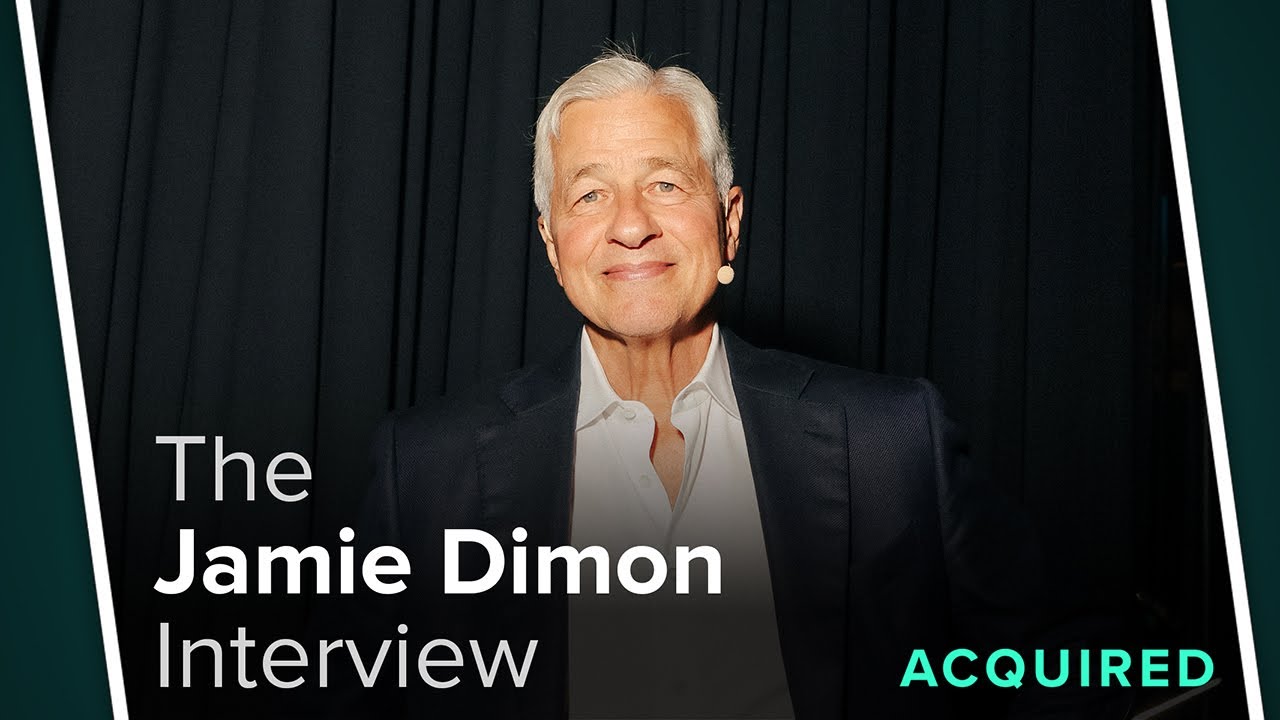
Dimon Targets Cyber Warfare as Top Risk, Flags White House Ambition
Acquired
JPMorgan Chase's unmatched market dominance relies on a fortress balance sheet optimized for historical worst-case stress tests rather than short-term profitability.
## Background
Published on YouTube by the channel Acquired on July 16, 2025, this page captures a live interview with Jamie Dimon at Radio City Music Hall. The description details Dimon's career journey from his 1998 firing at Citigroup to building JPMorgan Chase into the world's most powerful, systemically important bank through strategic turnarounds, a "fortress balance sheet" strategy, and pivotal financial crisis acquisitions.
## TL;DR
The episode delivers a comprehensive breakdown of Jamie Dimon's 25-year career playbook, charting his path from being ousted at Citigroup to orchestrating a massive operational turnaround at Bank One. It explores the core tenets of his "fortress balance sheet" philosophy, which prioritizes strict risk management and conservative accounting to withstand worst-case market scenarios. The walkthrough covers the logic behind the 2004 JPMorgan Chase merger, the high-stakes emergency acquisitions of Bear Stearns and Washington Mutual during the 2008 financial crisis, and his perspective on modern macroeconomic challenges like the 2023 banking crisis and cyber warfare. Ultimately, Dimon attributes his enduring drive to a deep sense of purpose, a personal hierarchy centered on family and country, and a commitment to operational excellence.
## Atmosphere & style
The presentation carries the electric, high-energy vibe of a late-night talk show, recorded live in front of an enthusiastic crowd of 6,000 fans at an iconic New York venue. The host-guest dynamic blends sharp, investigative corporate storytelling with warm, good-humored banter, allowing Dimon to deliver serious financial wisdom alongside witty, personal anecdotes about his family's reactions to his career upheavals. The narrative arc moves from a vulnerable reflection on sudden professional defeat to a commanding, patriotic meditation on leadership, leaving the audience with an evocative, powerful nod toward his potential political ambitions. It ultimately feels like a masterclass in resilience—candid, deeply philosophical, and grounded in a fierce, lifelong work ethic.
## Detailed walkthrough
### A Piece of Lost History
The summer 2025 season of *Acquired* opens with a candid confession from hosts Ben Gilbert and David Rosenthal: they completely blew their chance during a recent meet-and-greet in Jamie Dimon’s office. The duo realized too late that they forgot to ask about a famous piece of American history housed directly within the JP Morgan headquarters—the dual pistols used in the legendary 1804 duel between Alexander Hamilton and Aaron Burr.
Rosenthal remarks that they will simply have to request a viewing when the bank completes its new headquarters, assuming the historic artifacts will be prominently displayed on the executive floor. Brushing off the missed opportunity with good humor, they transition directly into the main narrative of the episode.
### The Rise, Fall, and Dominance of Jamie Dimon
Gilbert and Rosenthal formally introduce the episode as a deep dive into the corporate playbook of Jamie Dimon. The story follows a rising star on Wall Street in the 1980s who helped build a massive financial conglomerate alongside his mentor during the 1990s, only to be unexpectedly fired. After casting about for his next move, Dimon accepted a turnaround role at a struggling Midwestern bank in 2000, setting off a 25-year run that stands as one of the most dominant chapters in banking and corporate history. Dimon systematically pieced together the modern financial leviathan, JP Morgan Chase, out of the "beleaguered component parts" of Bank One, JP Morgan Chase, Bear Stearns, Washington Mutual, and First Republic.
Today, Dimon is the longest-serving CEO of any major Wall Street bank, famously recognized as the "great stabilizer of the American financial system" during the 2008 financial crisis. To illustrate the scale of his success, the hosts highlight the sheer magnitude of JP Morgan Chase's current market footprint. Recorded live in front of 6,000 fans at Radio City Music Hall in New York City, this special iteration of the podcast features a direct conversation with Dimon himself to dissect exactly how he prevented the bloating and spectacular blow-ups that typically destroy large financial institutions.
- **Market Cap:** JP Morgan Chase sits atop the US banking sector with a market cap exceeding $800 billion.
- **Relative Scale:** The bank's market value is more than twice that of its nearest competitor, making it the only bank comparable in size to the trillion-dollar tech giants.
- **Geographic Dominance:** It stands as the most valuable company east of the Mississippi River and the only one in that region worth more than half a trillion dollars.
- **Event Context:** The episode features a unique "late-night talk show" second act with guests including New York Times CEO Meredith Kopit Levien and IAC Chairman Barry Diller.
### The Citigroup Conglomerate and the Sunday Ouster
The conversation with Dimon begins by rewinding to 1998. For 13 years, Dimon and his mentor, Sandy Weill, had been constructing the ultimate financial blueprint. However, this blueprint was not JP Morgan Chase—it was Citigroup. Wall Street fully expected Dimon to be named CEO of Citigroup in short order. Instead, he was abruptly fired, forcing him to reconstruct his life and career from scratch. Dimon explains that the Citigroup model—built through sequential mergers of Commercial Credit, Primerica, Travelers, and ultimately Citibank—was a financial conglomerate that bought, turned around, and profited off varied businesses. Dimon notes he had a "small disagreement with Sandy" because he wanted to skinny the company down, shedding non-strategic parts while keeping core pieces together.
Dimon recalls the exact, surreal details of the afternoon he was ousted. He was hosting an active recruiting event for roughly 100 students inside his New York City apartment when Sandy Weill and John Reed called a 4:00 p.m. Sunday management meeting, asking Dimon to arrive early. As the President and Chief Operating Officer, Dimon drove up to meet them. They sat him down and announced three structural changes: two management reshuffles that Dimon internally viewed as "stupid decisions," followed immediately by the request for his own resignation. Recognizing that the board votes were tallied and the press releases already written, Dimon accepted the news gracefully, wished the incoming management team the best, and went home to break the news to his family.
- **The Family Reaction:** Upon hearing the news, Dimon's youngest daughter asked, "Daddy, do we have to sleep on the streets?", his middle daughter asked if she could still go to college, and his oldest daughter joked, "Great. Since you don't need a cell phone, can I have your cell phone?"
- **The "Wake":** That evening, about 50 members of the management team he had just left came over to his apartment bringing whiskey, which Dimon describes as "like having your own wake."
- **Philosophical Takeaway:** Reflecting on the abrupt fall from being the heir apparent of the world's largest bank, Dimon remarks to the crowd, "it's your my net worth, not my self worth that was involved."
### 18 Months in the Woods and the Amazon Alternative
Following his departure from Citigroup, Dimon spent roughly 18 months figuring out his next chapter. After taking a long family vacation, he set up a temporary workspace in the Seagram's Building by September, maintaining a strict 9-to-5 routine and eating lunch daily downstairs at the Four Seasons. At 42 years old, he explored a wide array of options, including starting his own merchant bank, retiring to teach, or entering entirely different sectors. He reveals that he personally visited Jeff Bezos, who was actively seeking a president for Amazon at the time. While the two hit it off and remained lifelong friends, Dimon felt moving to e-commerce was "a bridge too far." Laughing about the cultural shift, he remembers thinking, "my god, I'll never wear a suit again. I'm going to live in a houseboat."
Other major financial offers came his way, but Dimon turned them down due to cultural mismatches or structural concerns. Hank Greenberg of AIG offered him a prominent role, which Dimon declined, joking that choosing to go from Sandy Weill straight to Greenberg would require having his "head examined." He also turned down lucrative overtures from subprime mortgage companies and held a memorable dinner in Atlanta with Home Depot founders Ken Langone, Bernie Marcus, and Arthur Blank. Though he loved Home Depot's distinct culture, he had to confess to the founders that he had never actually stepped foot inside a Home Depot store until they called him. Ultimately, a headhunter approached him regarding Bank One, which felt like his natural habitat.
### Going Down with the Ship at Bank One
Bank One presented a starkly different environment than the glamorous, $200 billion Citigroup machine Dimon had left behind. Based in Chicago, Bank One was a troubled financial institution with a market cap floating around $20 to $21 billion. Moving his family and three daughters (then aged 14, 12, and 10) out of New York into a Chicago rental—and later a brownstone—was incredibly tough, but Dimon believed "life is what you make it." To signal his absolute, long-term commitment to the shareholders and employees, Dimon took the extraordinary step of investing half of his personal net worth into Bank One stock right before his first day on the job.
Upon arrival, Dimon inherited a operational nightmare. High-profile analyst Mike Mayo had recently published a scathing report on Bank One, featuring the memorable line: "Even Hercules couldn't fix it." The institution was a messy, unintegrated amalgamation of Bank One, First Chicago, and the National Bank of Detroit. Because the previous leadership had never properly integrated the legacy companies, the bank was plagued by multiple competing statement systems, processing systems, payment systems, and SAP setups. It operated under fragmented regional brands, was actively losing customer accounts, and was forcing widespread branch closures. Dimon immediately rolled up his sleeves and met with the board of directors to begin addressing the foundational crisis.
- **Personal Investment:** Dimon purchased $60 million of Bank One stock using half his net worth, despite sensing it might be slightly overvalued due to acquisition rumors.
- **Leadership Strategy:** Dimon wanted to make it clear he was "in 100%. Lock, stock, and barrel," telling the audience, "I was going to be the captain of the ship. I was going to go down with the ship or go up with the ship."
- **Operational Chaos:** The bank's lack of integration meant basic back-end platforms, accounting systems, and public-facing brands were completely fractured and disconnected.
[15:13](https://www.youtube.com/watch?v=AR_1IPhzAtU&t=913s) The Chaos and Culture Shock of Bank One
Upon taking over Bank One, Jamie Dimon stepped into a highly dysfunctional boardroom composed of 21 directors. Due to a series of past merged acquisitions, the board was heavily divided into tribal factions where "11 hated the other 10." Dimon knew about this internal warfare before walking in from his extensive research and bank connections, but accepted it as an unvarnished reality, noting that people today mistakenly look to be handed something perfect. When offered the job, he shook the hands of six directors and promised them total transparency: "I'm going to tell the truth, the whole truth, nothing but the truth, the good, the bad, the ugly."
The functional environment was equally jarring. Left alone on the executive floor without even knowing where to go, Dimon had to knock on the HR head's door just to request an office and an assistant. He flatly refused the traditional corner chairman's office, opting instead to be placed right in the middle of the floor so he could see people whenever he stuck his head out. His first meeting with the management team took place in a conference room featuring pristine, white plush carpets. When Dimon walked in carrying a cup of coffee, the executives warned him, "Jamie, we don't drink coffee here [for] obvious reasons." Dimon looked at them, took a sip, and replied, "You do now."
- The Bank One board consisted of 21 members divided into bitter, tribal factions.
- Dimon chose a centrally located office over the corner chairman's office to maximize visibility and team interaction.
- The company's systems were terrible, it was losing money, and its credit card company had completely collapsed.
[17:16](https://www.youtube.com/watch?v=AR_1IPhzAtU&t=1036s) Remaking the Risk Culture at Bank One
Dimon's primary focus shifted toward managing risk, which he clarifies does not mean eliminating risk entirely, but rather properly pricing it and understanding potential outcomes. He quickly discovered that Bank One was carrying more US corporate credit risk than Citibank, masked by "unbelievably aggressive" accounting practices. The bank was reporting unprofitable operations as lucrative while maintaining inadequate capital and reserves. Panicked by these findings, Dimon went through every single loan on the books, marked them down, established heavier reserves, and notified the board.
To shift the business toward earning more revenues per dollar of risk, Dimon overhauled their middle market lending approach. Initially, for every dollar of net interest income (NII) generated from a loan, the bank only brought in about 20 cents of non-banking revenue (such as payments). By the time Bank One later merged with JPMorgan, they flipped the ratio to 40% NII from the loan and 60% non-interest revenue (NIR) from auxiliary services, ensuring they were actually being compensated for the underlying risk. Dimon constantly stress-tested these scenarios for the board to demonstrate exactly how much credit losses would spike during an economic downturn. To execute this cleanup, he hired Linda Bammann after agreeing to her strict conditions allowing her to sell and hedge loans, ultimately reducing the bank's balance sheet by $50 billion just ahead of an ensuing recession.
- Bank One initially held more US corporate credit risk than Citibank despite being smaller.
- Middle market revenue structure shifted from 80% loan NII / 20% other revenue to 40% loan NII / 60% NIR.
- Chief Risk Officer Linda Bammann successfully reduced the bank's balance sheet exposure by $50 billion.
- The bank weathered the subsequent recession relatively well, with its only major casualty being United Airlines, which went bankrupt and was briefly owned by the bank.
[19:15](https://www.youtube.com/watch?v=AR_1IPhzAtU&t=1155s) The Philosophy of "Don't Blow Up"
A foundational "Jamie Dimonism" is the absolute rule to "don't blow up" at all costs. While the broader financial ecosystem frequently falls prey to the dangerous mentality of "everyone's doing it" or "this time is different," Dimon relies heavily on market history. He attributes his perspective to his father, who was a stockbroker. Dimon bought his first stock at age 14, observing firsthand how the stock market hit 1,000 in 1968 and 1972, only to plummet 45% by 1974—an era that erased Wall Street limousines and shuttered restaurants. He witnessed the market bottom out at 800 in 1982 (lower than it was in 1968), the 25% single-day crash of 1987, and the 1990 real estate crash that brought banking titans like JPMorgan, Citi, Chase, and Chemical to their knees, reducing their valuations to around $1 billion each ($3 billion for Citi).
Because history repeatedly rhymes with "too much leverage, too much risk," Dimon rejects standard industry assumptions. When he arrived at JPMorgan, he discovered the firm's internal stress tests only modeled a 40% credit spread move for high-yield bonds, pushing a 400 basis point spread to 560. Risk managers assured him the worst-ever historical spread of 17% would never happen again due to market sophistication. Dimon overrode them, insisting their benchmark must be the absolute "worst ever." During the 2008 financial crisis, high-yield spreads blew past that to hit 20%, rendering the bond market completely illiquid. Dimon targets the "fat tails"—such as modeling a 50% market drop, 8% interest rates, and worst-ever credit spreads—to ensure the business survives even if short-term profitability suffers.
- Dimon bought his first stock at age 14 in 1970, guided by his stockbroker father.
- Wall Street history cited includes: 1974 market crash (-45%), 1987 Black Monday (-25% in one day), and the 1990 real estate crash.
- During the Great Depression starting in 1929, the stock market sequentially dropped 20%, 30%, and 20%, ultimately cratering 90% from its peak.
- JPMorgan's legacy stress tests modeled high-yield spreads moving to 560 basis points; Dimon forced them to prepare for the historical 17% worst-case scenario, which was eclipsed when spreads hit 20% in 2008.
[22:49](https://www.youtube.com/watch?v=AR_1IPhzAtU&t=1369s) The Fortress Balance Sheet and Conservative Accounting
Operating with a conservative risk profile means accepting a minor trade-off in short-term profitability during boom years. Dimon points out that up until 2007, many aggressive banks were posting spectacular 30% returns on equity, yet most of those institutions eventually went bankrupt. By contrast, Bank One and JPMorgan Chase maintained lower returns during the peak years but remained perfectly intact throughout 2008 and 2009. This strategy is anchored entirely by the concept of the "fortress balance sheet," a term Dimon has utilized since his days at Primerica in the 1990s.
A true fortress balance sheet relies on robust margins, strong liquidity, high capital, and ultra-conservative accounting. Dimon jokes that accountants hate when he says it, but "you can drive a truck through accounting rules." He intentionally avoids front-loading profits, choosing to spread them over time instead. He notes that bad loans look like great, highly profitable revenues for a temporary window before they inevitably fail and kill the institution. Furthermore, Dimon emphasizes that a bank's stability is a direct reflection of the character of its clients, meaning compensation frameworks must be constantly reviewed so they never incentivize unethical or foolish behavior that could cause a destructive loss of public trust and subsequent bank runs.
- Prior to the 2008 crash, rival banks generated up to 30% return on equity via high leverage before collapsing.
- The "fortress balance sheet" philosophy originated during Dimon’s tenure at Primerica in the 1990s.
- Key pillars of the strategy: high liquidity, strong capital buffers, rigorous client vetting, and structurally matching compensation to ethical, long-term performance.
[25:12](https://www.youtube.com/watch?v=AR_1IPhzAtU&t=1512s) Sponsor Break: Vercel and Anthropic Claude
The hosts take a brief interlude to thank their corporate sponsors, Vercel and Anthropic. Vercel is highlighted as the modern infrastructure backbone powering web development and hyper-personalized, agentic AI native apps for major entities like Under Armour, PayPal, Notion, Runway, Decagon, and Browserbase. Their framework-defined infrastructure simplifies backend, frontend, and deployment workflows seamlessly. Meanwhile, the hosts credit Anthropic’s AI assistant, Claude, as an invaluable asset for conducting the deep research required for high-stakes interviews like this one. Utilizing Claude's "extended thinking mode" and the Model Context Protocol (MCP), they were able to trace decades of banking regulations and financial crises across their entire 10-year base of organizational knowledge.
[28:36](https://www.youtube.com/watch?v=AR_1IPhzAtU&t=1716s) The Road to the JPMorgan Chase Merger
Dimon ran Bank One from Chicago for four years before executing a massive strategic merger with JPMorgan Chase in 2004. Though labeled by JPMorgan Chase at the time as a "merger of equals," Bank One shareholders commanded a significant 42% stake in the combined entity. Dimon expresses mild irritation when commentators state he has only been running the firm since 2006 or 2007, reminding them, "I was running 40% of the company for the whole time."
From the moment he arrived at Bank One, Dimon viewed JPMorgan as the ultimate, logical strategic partner. He emphasizes that a genuine fortress balance sheet must be paired with clear, long-term strategies that don't constantly "flip and flop." His initial dream of a merger seemed crushed early on when news broke that JPMorgan Chase was merging with another entity, causing their valuation to soar to $80 billion or $90 billion while Bank One sat at $25 billion. However, over the next four years, Bank One's stock roughly doubled, putting them squarely back into a viable target range. Dimon had quietly spent a year and a half holding discussions with Bill Harrison, the chairman of JPMorgan Chase, who recognized the business sense of the combination and was actively seeking a successor CEO. When asked if the 42% equity split was granted purely because JPMorgan needed a CEO, Dimon chuckles and remarks, "There were two lawsuits. Okay, so we got the premium."
- The merger between Bank One and JPMorgan Chase took place in 2004.
- Bank One shareholders received 42% of the combined company's equity, capturing a premium.
- Dimon had been secretly negotiating the merger with JPMorgan Chairman Bill Harrison for roughly 18 months prior to the official announcement.
[30:16](https://www.youtube.com/watch?v=AR_1IPhzAtU&t=1816s) Boardroom Provisions and Business Logic
The merger agreement between Bank One and JPMorgan Chase contained an almost unprecedented provision to secure leadership continuity: to prevent Jamie Dimon from automatically becoming CEO 18 months post-merger, a strict 75% supermajority of the board would have to vote him out. The 16-member board was evenly split between eight Bank One individuals and eight JPMorgan people, many of whom already respected Dimon. Reflecting on the immediate post-merger environment, Dimon notes the paradox of corporate transactions, joking that JPMorgan "got sued for paying too much to buy me" while he "got sued for not taking enough."
When looking at potential partners, Dimon notes that while the JPMorgan brand was a "Tiffany name," he didn't factor that premium directly into the deal valuation. He resisted the internal and external pressures to immediately start hunting for more acquisitions, telling his board at the time, "No, we suck. We don't—we haven't earned the right to run someone else's company yet." Instead, his focus centered on cold business logic and structural execution. Both firms had overlapping, underperforming consumer and credit card segments that offered massive cost-saving synergies, while Bank One’s massive U.S. corporate bank perfectly complemented JPMorgan’s powerful investment banking services.
- **Board Structure:** 16 total members (8 from Bank One, 8 from JPMorgan).
- **Synergy Targets:** Combined overlapping consumer lines, paired Bank One's corporate lending base with JPMorgan's investment banking suite.
- **Strategic Principle:** Prioritized internal operational excellence and strict cost-consolidation over relying on brand prestige alone.
[32:28](https://www.youtube.com/watch?v=AR_1IPhzAtU&t=1948s) Resisting the Go-Go Incentives of 2006
By 2006, Dimon was officially chairman and CEO of the combined JPMorgan Chase during a hyper-leveraged "go-go" era on Wall Street that mirrored the excess of the 1980s. Despite facing the exact same structural incentives to maximize short-term profits as his competitors, Dimon aggressively pulled JPMorgan back from risk. Cracks were already emerging in late 2006, notably subprime mortgage deterioration and systemic quant issues. While Dimon admits he wishes he had pulled back even further to completely eliminate losses, his conservatism ensured JPMorgan maintained about a third of the leverage of rival investment banks alongside a massive stockpile of liquidity.
Dimon highlights how flawed accounting rules and Basel I regulations allowed major investment banks to balloon their leverage from 12 times to an astonishing 35 times equity. In 2007, Wall Street’s aggregate bridge loan book peaked at $450 billion, compared to just $40 billion in 2026. When asked why he resisted the behavior driving the rest of the market, Dimon emphasizes an absolute cultural stance: "I don't care what the incentive is, don't do the wrong thing. And don't do the wrong thing to a client." He systematically dismantled internal side deals, private multi-year compensation arrangements, and individualized profit pools for senior bankers to ensure employees weren't incentivized to court catastrophic leverage for personal bonuses.
- **Wall Street Leverage Shift:** Industry averages climbed from 12x to 35x leverage leading up to the crash.
- **Bridge Loan Book Collapse:** Total Wall Street bridge book exposure plummeted from $450 billion in 2007 to $40 billion by 2026.
- **Incentive Reform:** Eliminated individualized 20% profit pool payouts and banned "winks, nods, and side deals" in senior banking compensation.
[36:21](https://www.youtube.com/watch?v=AR_1IPhzAtU&t=2181s) The Sudden Collapse and Emergency Purchase of Bear Stearns
On Thursday night, March 13, 2008, Dimon was celebrating his birthday at Avra, his parents' favorite restaurant on 47th Street, when he received an emergency call from Bear Stearns CEO Alan Schwartz. Bear Stearns' stock, which had traded at $150 a share months prior, had just closed at $57 but was facing a fatal liquidity run. Schwartz told him, "Jamie, I need $30 billion tonight before Asia opens." Lacking a mechanism to instantly provide that capital, Dimon mobilized his team, bringing 100 executives back to the office overnight while looping in Treasury Secretary Hank Paulson and New York Fed President Tim Geithner to architect an unprecedented weekend emergency loan structure.
Over a frantic 48-hour window, thousands of JPMorgan employees conducted hyper-speed due diligence on Bear Stearns' entire balance sheet, covering derivatives, lawsuits, and assets. JPMorgan initially agreed to buy the failing firm for $2 a share—a price later raised to $10 a share to secure shareholder votes. Dimon notes that Treasury Secretary Paulson originally questioned why JPMorgan was paying anything at all, but Dimon knew he had to keep the deal public and avoid an chaotic industrial bankruptcy that would collapse the global financial system. JPMorgan wrote off Bear Stearns' entire $12 billion tangible book value to cover liquidation, hedging, severance, and legal costs.
- **Bear Stearns Valuation Crash:** Plunged from $150/share down to a $2/share initial purchase agreement over the weekend, later adjusted to $10/share.
- **Asset Scope:** JPMorgan took on $300 billion in Bear Stearns assets backed by a temporary Federal Reserve collateralized loan structure.
- **Real Estate Value:** Bear Stearns' corporate headquarters building was valued at $1 billion on the balance sheet but effectively absorbed at zero cost.
[40:35](https://www.youtube.com/watch?v=AR_1IPhzAtU&t=2435s) System Bails, Government Lawsuits, and "Surrendering" to Eric Holder
Despite absorbing Bear Stearns to save the wider financial system from an unmitigated chain reaction, JPMorgan was later sued by the federal government over Bear Stearns' legacy mortgage practices. Dimon was deeply offended by the legal assault, viewing it as a breach of trust by a shifting political apparatus. "I don't know how to say this. I wouldn't really trust the government again," Dimon remarks, explaining that incoming political administrations feel zero obligation to honor the verbal or systemic arrangements made by their predecessors. The government ultimately forced JPMorgan to pay a $5 billion penalty explicitly for bad mortgages written by Bear Stearns before the acquisition.
To resolve the mounting legal gridlock, Dimon personally traveled to Washington to meet with Attorney General Eric Holder. Rather than fighting a protracted legal battle that could result in a corporate-killing criminal indictment, Dimon walked into the room and stated directly, "Eric, I am here to surrender. I cannot fight and I cannot win against the federal government." He laid out the reality that 80% of the toxic assets the government was penalizing them for belonged to Bear Stearns and Washington Mutual (WaMu)—not JPMorgan Chase. Though the process left deep reputational scars, Dimon admits his patriotism means if the country faced a similar crisis and called again, he would answer, though he would navigate the legal terms far more defensively.
- **Mortgages Legal Penalty:** $5 billion fine levied against JPMorgan Chase for legacy Bear Stearns mortgage liabilities.
- **The "Surrender" Strategy:** Handled personally by Dimon and his lead director to eliminate the existential threat of a federal criminal indictment.
[43:40](https://www.youtube.com/watch?v=AR_1IPhzAtU&t=2620s) Turning the Tide via Washington Mutual
Just six months after the Bear Stearns crisis, a week after Lehman Brothers collapsed, Dimon received another call regarding the imminent failure of Washington Mutual. While most corporate boards refused to move in such a volatile environment, JPMorgan recognized WaMu as a highly valuable, legitimate retail acquisition. The deal instantly planted JPMorgan's flag in booming, high-growth states where they previously lacked a footprint, including California, Nevada, Georgia, and Florida, instantly adding 2,300 bank branches to their network.
JPMorgan thoroughly understood WaMu's severe mortgage impairments from prior analysis, buying the firm clean by leaving its legacy corporate debt behind and acquiring it at a $30 billion discount to its tangible book value. To insulate the firm against further market deterioration, Dimon executed an extraordinary maneuver just two days later: he went out into the frozen capital markets and raised $11 billion in fresh equity. Relying on deep relationships and hard-earned institutional trust, Dimon pitched institutional investors on a brief slide deck, securing the capital overnight to ensure JPMorgan's balance sheet emerged from the transaction stronger than it was before.
- **Branch Expansion:** Added 2,300 retail banking branches across major Western and Southern states.
- **Capital Raise:** Secured $11 billion in common equity in the open market during the peak of the 2008 financial panic.
- **Deal Mechanics:** Formulated a $30 billion discount on WaMu's tangible book value while leaving the holding company's debt behind.
[45:54](https://www.youtube.com/watch?v=AR_1IPhzAtU&t=2754s) The Fortress Balance Sheet and Managing Financial Risk
Integrating and consolidating acquired systems is a massive operational hurdle that requires extensive coordination across compensation programs, settlement processes, and payment architectures. Following the acquisition of Washington Mutual (WaMu), the entire consolidation process was remarkably wrapped up within nine months. Getting every legacy branch and user onto a unified system in under a year directly paves the way for vastly improved, cohesive customer service.
Maintaining a "fortress balance sheet," raising equity capital early, preserving an intentional margin of safety, and practicing deeply conservative accounting may look like entirely obvious, baseline protocols in hindsight, but history shows how frequently financial institutions abandon them. Many market players succumb to the temptation of aggressive accounting and fail to stress test their operations against real-world catastrophe. Over-indexing on interest rate risk, carrying massive credit exposure, or mismanaging optionality risk continuously derails institutions. Novel, hyped financial instruments frequently trigger downfalls because they haven't been battle-tested by a full economic cycle. This cyclical amnesia and product-driven overexposure caused historic blowups in equities in 1929, and later with options, equity derivatives, traditional mortgages, leverage lending, and quantitative models like Long-Term Capital Management (LTCM). Even government-guaranteed Ginnie Maes triggered a collapse at one point due to structural flaws.
- **WaMu Integration Speed:** The entire system consolidation for Washington Mutual was completed in just 9 months.
- **Historic Financial Ruptures:** New or unchecked products historically triggered collapses across 1929 equities, options, equity derivatives, mortgages, Ginnie Maes, quant strategies, and LTCM.
---
[47:26](https://www.youtube.com/watch?v=AR_1IPhzAtU&t=2846s) Evaluating the Private Credit Market and Today's Macro Risks
While there is active debate over whether private credit represents the modern equivalent of a systemic asset bubble, the current market—estimated around \$2 trillion—does not mirror the structural fragility of the pre-2008 mortgage crisis. The sector has undoubtedly experienced rapid, concerning expansion, creating a bifurcated environment of highly disciplined operators and less experienced actors who could face future headwinds. However, private credit generally lacks the extreme, embedded leverage that defined the mortgage market, which stood at a staggering \$9 trillion and suffered roughly \$1 trillion in losses when it collapsed. True danger often stems from hidden, off-balance-sheet leverage that market participants obscure from view. Outside of leverage, current asset prices present a clear asymmetry; with price-to-earnings (PE) ratios hovering around 23 compared to a historically safer baseline of 15, there is minimal upside and a substantial distance to fall. Credit spreads reflect similar tightness, necessitating rigorous defensive measures like executing 100 distinct stress tests weekly to model diverse macroeconomic shocks.
The most profound, existential threat facing the financial system today is cyber warfare. While top-tier financial institutions like J.P. Morgan Chase commit roughly \$800 million annually to cybersecurity and maintain constant collaboration with government intelligence agencies, the broader civilian infrastructure remains deeply vulnerable. In a kinetic conflict involving state actors like China or Russia—where Russian cyber activity is heavily dominated by criminal enterprises—national power grids, telecom networks, water treatment facilities, and elements of the military establishment lack the robust defenses required to withstand a coordinated cyber campaign.
- **Private Credit Scale:** Valued at approximately \$2 trillion, making it far smaller and less leveraged than the pre-crash mortgage market.
- **The 2008 Mortgage Benchmark:** The mortgage market sat at roughly \$9 trillion when it collapsed, resulting in a loss of over \$1 trillion.
- **Valuation Metrics:** Modern PE ratios sit at an elevated 23, whereas a ratio of 15 would signify significantly lower systemic risk.
- **Stress Testing Cadence:** J.P. Morgan Chase runs roughly 100 unique stress tests every single week to prepare for market shifts.
- **Cybersecurity Spend:** J.P. Morgan Chase invests approximately \$800 million per year directly into its cyber defense infrastructure.
---
[49:35](https://www.youtube.com/watch?v=AR_1IPhzAtU&t=2975s) The 2023 Banking Crisis: SVB, First Republic, and High-End Concierge Banking
The dramatic banking failures of 2023 showcased a very specific, modern structural vulnerability rather than a direct rerun of 2008. Both Silicon Valley Bank (SVB) and First Republic Bank built highly successful franchises, but they were fatally exposed to "concentrated deposits"—a distinct phenomenon from standard uninsured deposit risk. Hundreds or thousands of highly interconnected venture capital firms advised their respective portfolio companies to withdraw their capital simultaneously, sparking catastrophic electronic bank runs. For instance, Silicon Valley Bank, which held roughly \$200 billion in total deposits, watched an unprecedented \$100 billion vanish in a single business day. This liquidity drain exposed severe underlying operational flaws: they lacked immediate liquidity access, failed to pre-post adequate collateral at the Federal Reserve, and carried massive interest rate exposure. This rate risk was masked via held-to-maturity (HTM) accounting, which permits banks to avoid marking U.S. Treasuries to market on their books. While HTM accounting artificially inflates regulatory return metrics, it creates an extreme gap between reported and tangible value; marking those books to market would have revealed that tangible book values had plummeted from a nominal 100 down to 50, 40, or even 30 cents on the dollar. This vulnerability was compounded by regulatory messaging that interest rates would remain permanently low, prompting these banks to load up on 3% mortgages that deteriorated to 50 or 60 cents on the dollar when the Fed aggressively raised rates to 5%.
Recognizing First Republic’s impending collapse as a "melting ice cube," J.P. Morgan proactively engaged with Treasury Secretary Janet Yellen to offer a private sector resolution before the damage escalated. Following the acquisition, J.P. Morgan completely stabilized the institution within days by hedging out its asset exposures, writing down problematic books, and integrating its back-end infrastructure. Beyond absorbing the crisis, the transaction yielded immense strategic value, particularly First Republic's highly praised, high-net-worth wealth management model which relied on a single point of contact and premier concierge services. J.P. Morgan is scaling this model by launching a network of branded J.P. Morgan Financial Centers on premier corridors like Madison Avenue. These high-level service hubs act as an integrated physical front door, seamlessly blending small business advisory, mortgages, consumer banking, and premium travel perks under a single roof.
- **SVB Capital Flight:** Experienced an unprecedented single-day deposit withdrawal of \$100 billion out of a \$200 billion total deposit base.
- **Devaluation of Low-Rate Assets:** 3% fixed-rate mortgages lost massive value, dropping to 50 or 60 cents on the dollar when market interest rates climbed to 5%.
- **Innovation Banking Expansion:** J.P. Morgan established a dedicated campus in Palo Alto and hired 500 specialized innovation bankers to capture the venture capital ecosystem.
- **Financial Center Rollout:** The bank has established 20 flagship J.P. Morgan Financial Centers based on the First Republic high-touch model, with long-term aspirations to expand to 300 locations over the next 20 years.
---
[53:22](https://www.youtube.com/watch?v=AR_1IPhzAtU&t=3202s) Ad Break: Statsig
> "Statsig has rebuilt the entire suite of data tools that previously was only in use at the biggest tech giants as a standalone product."
The podcast hosts pivot to highlight Statsig, a comprehensive product development and data experimentation platform adopted by high-growth companies including OpenAI, Notion, Rippling, Brex, and Atlassian. Historically, major technology enterprises spent years of engineering time and millions of dollars building bespoke internal infrastructure to handle feature flags, A/B testing, logging services, and product analytics. Statsig eliminates this engineering overhead by offering a unified, standalone product suite that integrates product experimentation, safe deployment feature flags, session replays, and advanced analytics over a single pool of product data. Crucially for enterprise and finance organizations, Statsig operates as a warehouse-native architecture. It plugs directly into existing data storage layers like Snowflake or BigQuery without requiring data extraction to external third-party tools, maximizing data privacy, security, and compliance. The company offers a generous free tier alongside a \$50,000 startup program.
---
[54:45](https://www.youtube.com/watch?v=AR_1IPhzAtU&t=3285s) Corporate Strategy: Avoiding Hobbies and Maximizing the Efficiency Ratio
To understand why an institution separates itself completely from its competitive peer group, one must look directly at its core corporate architecture. A truly elite global bank functions much like a traditional, localized community bank, but supercharged with a world-class investment banking division. In a classic community bank, the entire client relationship—from business accounts and consumer banking to private wealth trusts—is managed seamlessly, often relying on the organic "CRM" inside a banker's head rather than a software platform like Salesforce. A premier corporate strategy ensures that every single business line organically feeds, supports, and cross-sells into the others. This stands in stark contrast to legacy conglomerates like Citigroup under Sandy Weill, which collected unrelated "hobbies" and non-core businesses such as consumer finance, life insurance, property casualty insurance, and even truck leasing via American General. Accumulating random operations makes it functionally impossible for executives to properly evaluate, track, and stress-test risk across the portfolio.
- **The Cross-Border Corporate Engine:** J.P. Morgan's global investment bank leaders, Doug Petno and Troy Rohrbaugh, have successfully scaled commercial banking branches throughout Europe to drive international cross-selling.
The ultimate financial proof of this integrated, disciplined strategy is revealed in the bank's efficiency ratio. J.P. Morgan operates with a structural advantage that allows it to keep roughly 15 cents more of every single dollar earned as pure profit compared to its direct competitors. This margin outperformance provides an extraordinary compounding engine for ongoing reinvestment. Remarkably, this superior margin is sustained while simultaneously funding massive, multi-billion-dollar long-term investments in tech infrastructure, new physical branches, and top-tier talent. While a company can easily manipulate its short-term margins upward by slashing marketing budgets or halting branch expansions to save billions next year, doing so severely damages long-term compounding and terminal growth rates. True operational excellence requires looking clean through the economic cycle, remaining intensely curious, rejecting arrogant chest-pounding cultures, and ensuring that every employee—from high-earning investment bankers to the security guards and receptionists—is treated with equal dignity and respect.
[59:57](https://www.youtube.com/watch?v=AR_1IPhzAtU&t=3597s) The Culture "Sauce" of Business vs. Sports
The discussion begins with a comparison between building an elite corporate culture and running a sports team. In sports, every player must give their best every day during practice, a lesson exemplified by legendary figures like Tom Brady. If people do not give their absolute best, constructing a truly great team is impossible.
While this dynamic applies to the corporate world, business carries a distinct difference: people can "BS about it all the time" and invent fabricated stories to mask poor performance. In sports, however, the playing field strips away all deception. You can instantly see whether a group has a cohesive team and whether they play together. The members do not even need to be friends, but they must practice and master their specific team roles. When a company manages to capture this level of execution, it acts like a special corporate "sauce" that drives enduring success, a phenomenon observed across various successful enterprises well beyond just JPMorgan Chase.
---
[01:00:27](https://www.youtube.com/watch?v=AR_1IPhzAtU&t=3627s) Why Jamie Dimon Keeps Going: Purpose, Family, and Country
The hosts transition to their final question, looking back to the financial crisis of 2008. They point out that all other prominent leaders involved in that turbulent era have long since retired, as have many of Jamie Dimon's own long-term colleagues at JPMorgan Chase. Yet, Dimon continues to work just as hard as ever. When asked what keeps him going, Dimon opens by giving a heartfelt thank you to his wife, Judy, who was present in the audience. He acknowledges that she has "suffered through all this with me all these years" and underscores that he could not have accomplished any of it without her.
Reflecting deeply on his personal drive, Dimon traces his work ethic back to his grandparents, who were all Greek immigrants who never finished high school. He credits a foundational "Greek ethic" passed down from his parents and mirrored by his wife's parents: the imperative to have a clear purpose and to give life everything you have. Whether that purpose is found in art, science, the military, business, or simply being an exemplary parent or teacher, the core rule is to avoid constant complaining and give total effort. This upbringing also instilled a fierce mandate to treat everyone properly and to never tolerate a bully, requiring him to always stand up for someone being picked on.
Dimon outlines a strict "hierarchy of life" that governs his choices:
* **Family:** The absolute most important piece of his life.
* **Country:** The United States, which he calls the "indispensable nation" that brought freedom of speech, freedom of religion, and freedom of enterprise to the world.
* **Purpose:** His professional contribution through JPMorgan Chase, allowing him to directly help cities, states, schools, companies, and employees.
While his family constantly wishes he would come home earlier every day, Dimon admits he gets the "biggest kick" out of the tangible impact his corporate work achieves. As long as he maintains his energy, he intends to keep moving forward. He notes with a laugh that he does not play golf and does not buy fancy cars. When one of his daughters told him he desperately needed hobbies, he countered that he already has plenty: hanging out with family, traveling, barbecuing, enjoying wine, exploring whiskeys, hiking, and studying history, which he calls "the greatest teacher of all time." He can no longer play tennis due to a bad back, but his job provides a vital sense of life purpose. Looking ahead to eventual retirement, Dimon rejects the idea of sitting idle: "I'm not going to twiddle my thumbs and smell the flowers." Instead, he expects he will transition to teaching and writing, jokingly referencing that he might write a book similar to the work of financial journalist Andrew Ross Sorkin.
---
[01:03:33](https://www.youtube.com/watch?v=AR_1IPhzAtU&t=3813s) Political Ambitions and the Final Sign-Off
The interview reaches a dramatic peak when the hosts bring up the fact that many influential figures have floated Dimon's name for major political or policy roles over the years. They pose a pointed final question, suggesting that there is realistically only one single job in existence that could possibly impact the United States on a bigger scale than the massive platform he currently commands as the head of JPMorgan Chase. When asked if he agrees with that assessment, Dimon simply responds, "Right now, yeah," leaving the crowd with a powerful, open-ended nod to the American presidency.
The hosts conclude the interview by thanking Dimon for his time. Dimon graciously returns the praise to the hosts, Ben Gilbert and David Rosenthal, telling the crowd, "these guys are great by the way," amidst enthusiastic applause.
Following the interview, the hosts deliver their traditional sign-off to their massive audience, expressing immense gratitude to the 6,000 listeners who showed up to watch the live recording in person. They wrap up the episode by thanking their seasonal corporate sponsors, highlighting past landmark interview episodes with tech and business icons, and inviting listeners to join the active Acquired community Slack channel before closing out with their signature musical outro tag.
* **Acquired Season Sponsors:** JPMorgan, Statsig (product experimentation platform), Vercel (web development platform), and Anthropic (makers of the Claude AI model).
* **Research Acknowledgement:** Arvin Navaratnam at Worldly Partners for his comprehensive write-up on the Jamie Dimon years at JPMorgan Chase.
* **Recommended Past Episodes:** The Google series launch, the Rolex profile, and executive interviews featuring Steve Ballmer, Mark Zuckerberg, and Howard Schultz.
* **ACQ2 Spin-Off Show Feature:** A recent interview with Jesse Cole, the yellow-hat-wearing founder and owner of the Savannah Bananas baseball team.
* **Community Link:** acquired.fm/slack
## Notable quotes
> it's your my net worth, not my self worth that was involved. — Jamie Dimon
> [15:13](https://www.youtube.com/watch?v=AR_1IPhzAtU&t=913s) I'm going to tell the truth, the whole truth, nothing but the truth, the good, the bad, the ugly. — Jamie Dimon
> [15:13](https://www.youtube.com/watch?v=AR_1IPhzAtU&t=913s) Jamie, we don't drink coffee here [for] obvious reasons.
> [15:13](https://www.youtube.com/watch?v=AR_1IPhzAtU&t=913s) You do now. — Jamie Dimon
> [28:36](https://www.youtube.com/watch?v=AR_1IPhzAtU&t=1716s) There were two lawsuits. Okay, so we got the premium. — Jamie Dimon
> [30:16](https://www.youtube.com/watch?v=AR_1IPhzAtU&t=1816s) No, we suck. We don't—we haven't earned the right to run someone else's company yet. — Jamie Dimon
> [32:28](https://www.youtube.com/watch?v=AR_1IPhzAtU&t=1948s) I don't care what the incentive is, don't do the wrong thing. And don't do the wrong thing to a client. — Jamie Dimon
> [36:21](https://www.youtube.com/watch?v=AR_1IPhzAtU&t=2181s) Jamie, I need $30 billion tonight before Asia opens. — Alan Schwartz
> [40:35](https://www.youtube.com/watch?v=AR_1IPhzAtU&t=2435s) I don't know how to say this. I wouldn't really trust the government again — Jamie Dimon
> [40:35](https://www.youtube.com/watch?v=AR_1IPhzAtU&t=2435s) Eric, I am here to surrender. I cannot fight and I cannot win against the federal government. — Jamie Dimon
> [53:22](https://www.youtube.com/watch?v=AR_1IPhzAtU&t=3202s) Statsig has rebuilt the entire suite of data tools that previously was only in use at the biggest tech giants as a standalone product.
> [01:00:27](https://www.youtube.com/watch?v=AR_1IPhzAtU&t=3627s) I'm not going to twiddle my thumbs and smell the flowers. — Jamie Dimon
> [01:03:33](https://www.youtube.com/watch?v=AR_1IPhzAtU&t=3813s) these guys are great by the way — Jamie Dimon
## Mentioned
The Jamie Dimon Interview: How JP Morgan Became an $800 Billion Bank, YouTube, Acquired, Ben Gilbert, David Rosenthal, Jamie Dimon, Alexander Hamilton, Aaron Burr, JPMorgan Chase, Bank One, Bear Stearns, Washington Mutual, First Republic, Meredith Kopit Levien, Barry Diller, Sandy Weill, Citigroup, Commercial Credit, Primerica, Travelers, Citibank, John Reed, Jeff Bezos, Amazon, Hank Greenberg, AIG, Ken Langone, Bernie Marcus, Arthur Blank, Home Depot, Mike Mayo, First Chicago, National Bank of Detroit, SAP, Linda Bammann, United Airlines, Chemical, Chase, Vercel, Anthropic, Claude, Under Armour, PayPal, Notion, Runway, Decagon, Browserbase, Bill Harrison, Basel I, Alan Schwartz, Hank Paulson, Tim Geithner, Federal Reserve, Eric Holder, Lehman Brothers, Ginnie Mae, Long-Term Capital Management, Snowflake, BigQuery, OpenAI, Rippling, Brex, Atlassian, Statsig, Salesforce, American General, Doug Petno, Troy Rohrbaugh, Tom Brady, Judy Dimon, Silicon Valley Bank, Janet Yellen, Andrew Ross Sorkin, Arvin Navaratnam, Worldly Partners, Jesse Cole, Savannah Bananas, Steve Ballmer, Mark Zuckerberg, Howard Schultz
Under Jamie Dimon, JPMorgan Chase became an $800 billion institution by anchoring growth in conservative risk modeling and operational integration, rather than short-term leverage. Dimon attributes the bank's endurance to a non-negotiable "fortress balance sheet" that enabled aggressive, stabilizing acquisitions while competitors collapsed.
The Fortress Balance Sheet and Fat-Tail Stress Testing (19:15)
Dimon's operating philosophy centers on the non-negotiable rule to "don't blow up," shaped by witnessing severe historical downturns like the 1974 bear market, 1987's Black Monday, and the 1990 real estate crash. Prior to the 2008 crash, rival investment banks generated 30% returns on equity using high leverage, only to face bankruptcy when conditions turned. In contrast, Dimon maintained lower short-term profitability to protect capital, liquidity, and reserves.
To institutionalize this resilience, Dimon rejects industry-standard assumptions that fail to model extreme tail risks. Upon arriving at JPMorgan, he overruled internal risk managers who modeled high-yield credit spread widening only to 560 basis points, mandating that the bank prepare for the worst-ever historical spread of 17%—a threshold eclipsed when spreads reached 20% in 2008. This builds on his earlier turnaround at Bank One, where Chief Risk Officer Linda Bammann cut the balance sheet by $50 billion ahead of a recession, and where the middle-market lending mix was restructured from 80% loan net interest income to 60% fee-based non-interest revenue.
Reforming Executive Incentives and Operational Culture (32:28)
During the credit boom of 2006, Wall Street leverage expanded from 12 times to 35 times equity, and the aggregate bridge loan book peaked at $450 billion. Dimon resisted the pressure to chase high-risk profits by overhauling JPMorgan's internal culture. He banned individualized 20% profit pools, multi-year guarantee packages, and opaque side arrangements for senior bankers to ensure employees were not incentivized to compromise client interests or balance sheet safety for annual bonuses.
Dimon draws a distinction between business and sports culture: while underperforming corporate teams often use fabricated stories to obscure failure, sports teams are strictly accountable to on-field execution. He established high transparency upon arriving at Bank One, rejecting the traditional executive corner office for a central desk on the open floor and demanding unified back-end systems. Dimon traces his work ethic to his Greek immigrant grandparents and parents, adhering to a personal hierarchy prioritizing family, country, and institutional purpose.
Opportunistic Crisis Acquisitions and Rapid Integration (36:21)
JPMorgan transformed into an industry giant by absorbing failing institutions during liquidity panics. In March 2008, JPMorgan acquired Bear Stearns, taking on $300 billion in assets backed by emergency Federal Reserve collateral, writing down Bear Stearns' entire $12 billion tangible book value to absorb liquidation and legal expenses. Six months later, Dimon acquired Washington Mutual at a $30 billion discount to tangible book value, leaving its holding-company debt behind and immediately raising $11 billion in common equity in the frozen capital markets to maintain capital ratios. WaMu’s 2,300 branches and systems were fully integrated within nine months.
In 2023, Dimon applied the same playbook to rescue First Republic following electronic bank runs triggered by concentrated deposits and unrealized rate losses on fixed mortgages. Dimon stabilized the franchise, deploying its concierge wealth management model into flagship J.P. Morgan Financial Centers. However, Dimon notes that state-assisted interventions carry long-term fallout: following the Bear Stearns rescue, the federal government penalized JPMorgan $5 billion for Bear Stearns' legacy mortgage originations, prompting Dimon to resolve the litigation personally with Attorney General Eric Holder.
Interconnected Banking Strategy Over Conglomerate Hobbies (54:45)
Dimon attributes JPMorgan's operational outperformance to an integrated corporate model that avoids the conglomerate structure of Citigroup under Sandy Weill. Whereas Citigroup accumulated non-core operations such as truck leasing and property-casualty underwriting, Dimon argues such "hobbies" make it functionally impossible for executives to evaluate and stress-test enterprise-wide exposure. Instead, JPMorgan operates like a scaled community bank, ensuring commercial, retail, and wealth management lines organically feed into its global investment banking division.
This structural focus manifests in JPMorgan's efficiency ratio, allowing the bank to retain roughly 15 cents more profit per dollar earned than its direct competitors. Dimon stresses that this margin differential provides a self-funding reinvestment engine for technology, new branches, and cyber defenses—where the bank invests approximately $800 million annually—without resorting to short-term cost cuts that degrade terminal enterprise value.
While Dimon's conservative playbook shielded JPMorgan through multiple crises, the bank's post-2008 regulatory entanglements—specifically the $5 billion penalty for inherited Bear Stearns liabilities—eroded his trust in government partnerships during systemic bailouts. Looking forward, Dimon views the $2 trillion private credit market as less leveraged than the pre-2008 mortgage sector, but warns that tight market valuations and nation-state cyber warfare represent escalating vulnerabilities outside traditional banking balance sheets.
## Background
本期节目由知名商业播客《Acquired》于2025年7月16日在YouTube平台发布。节目记录了主持人Ben Gilbert和David Rosenthal在纽约无线电城音乐厅面对6000名观众与摩根大通董事长兼CEO杰米·戴蒙(Jamie Dimon)进行的特别现场对话,内容涵盖他1998年被花旗集团解雇、入主第一银行力挽狂澜,以及一手打造出市值超8000亿美元全球金融帝国的传奇历程。
## TL;DR
杰米·戴蒙系统复盘了他执掌摩根大通长达二十余年的核心经营哲学与风控底牌。他详述了自己早年在花旗遭扫地出门后的蛰伏抉择,如何通过大刀阔斧重组第一银行确立“不自爆”的风险意识,并以精巧的治理设计推动其与摩根大通对等合并。对话深入拆解了他在2008年次贷危机中闪电救助贝尔斯登、兼并华盛顿互惠银行,以及在2023年区域银行业危机中接盘第一共和银行的惊险内幕,生动阐明了“堡垒式资产负债表”、杜绝激进会计和抗周期再投资如何让摩根大通穿越多次经济风暴并持续领跑同业。此外,戴蒙还坦率分享了其希腊家族传承的使命感、人生排序以及对未来公职影响力的犀利态度。
## Atmosphere & style
全场对话在6000名现场观众的热烈掌声与欢呼声中展开,氛围宏大、沉稳而富有感染力。戴蒙展现出极具个人魅力的华尔街老将风范,谈吐既有直面危机与生死博弈时的铁腕从容,又穿插着自掏腰包押上身家、打翻咖啡打破衙门习气等举重若轻的幽默自嘲。两位主持人与戴蒙节奏默契、层层递进,既有对极端肥尾测试和金融工程的硬核专业推演,也有对家庭、国家与人生使命的真情流露,整场收听体验如同一部波澜壮阔又充满烟火气的现代金融史诗。
## Bulletin
- [00:00](https://www.youtube.com/watch?v=AR_1IPhzAtU&t=0s) 杰米·戴蒙回顾了从1998年被花旗解雇到执掌第一银行,再通过与旧摩根大通、贝尔斯登、华盛顿互惠及第一共和银行的兼并重组,一手打造出市值超8000亿美元全球金融巨无霸的25年历程。
- [58:08](https://www.youtube.com/watch?v=AR_1IPhzAtU&t=3488s) 摩根大通的经营效率比率赋予其每赚取1美元收入比同行多留存15美分净利润的护城河,支撑其在经历多轮危机中仍能持续进行技术、网点与人员的跨周期逆势再投资。
- [21:09](https://www.youtube.com/watch?v=AR_1IPhzAtU&t=1269s) 戴蒙强调“堡垒式资产负债表”和极致保守会计准则的生命线地位,主张绝不为短期ROE加杠杆,每周进行约100次极端“肥尾”情境压力测试以抵御系统性自爆风险。
- [49:35](https://www.youtube.com/watch?v=AR_1IPhzAtU&t=2975s) 剖析2023年区域银行业闪崩时,戴蒙指出硅谷银行与第一共和的核心死穴是创投生态存款过度集中与HTM会计掩饰下的单向巨额利率错配,而非单纯的未投保存款问题。
## Key takeaways
- [00:00](https://www.youtube.com/watch?v=AR_1IPhzAtU&t=0s) 摩根大通当前市值突破8000亿美元,是全美第二大银行的两倍以上,也是密西西比河以东市值最高且唯一破5000亿美元的企业。
- [07:00](https://www.youtube.com/watch?v=AR_1IPhzAtU&t=420s) 1998年被花旗突然辞退后,戴蒙坚持“受损的只是净资产,而非自我价值”,拒绝了亚马逊、AIG及家得宝的跨界CEO邀约,选择回归商业银行基本盘。
- [11:44](https://www.youtube.com/watch?v=AR_1IPhzAtU&t=704s) 接掌濒临混乱的第一银行(Bank One)前,戴蒙自掏腰包约6000万美元(近半数身家)购入其股票,以破釜沉舟的姿态与股东及员工利益深度绑定。
- [18:06](https://www.youtube.com/watch?v=AR_1IPhzAtU&t=1086s) 戴蒙执掌第一银行后立即整肃派系内耗与繁文缛节,打破掩盖亏损的激进会计,将中端市场业务的净利息收入占比由80%降至40%,转而以低风险的服务与支付非息收入为主(60%)。
- [19:15](https://www.youtube.com/watch?v=AR_1IPhzAtU&t=1155s) 戴蒙主义的核心在于“绝不自爆”:经历半个世纪多次崩盘后,他深刻认识到过度杠杆与激进会计的致命性,坚决防范发生概率远高于正态分布假设的“肥尾”极端风险。
- [28:36](https://www.youtube.com/watch?v=AR_1IPhzAtU&t=1716s) 2004年第一银行与摩根大通对等合并时,戴蒙通过设置“需董事会75%绝对多数票才能阻止其18个月后接任CEO”的罕见条款,彻底锁定了领导权。
- [32:28](https://www.youtube.com/watch?v=AR_1IPhzAtU&t=1948s) 2006年华尔街集体加杠杆狂欢时,摩根大通将杠杆率严格控制在大型独立投行三分之一的水平,并全面废除按杠杆单笔利润提成的薪酬机制,从根本上遏制道德风险。
- [39:32](https://www.youtube.com/watch?v=AR_1IPhzAtU&t=2372s) 2008年闪电收购贝尔斯登后,摩根大通一次性注销冲干其全部120亿美元有形账面价值以消化清算成本,戴蒙对联邦政府事后反诉并罚款50亿美元深感冒犯,坦言对政府的契约信任破裂。
- [43:44](https://www.youtube.com/watch?v=AR_1IPhzAtU&t=2624s) 在雷曼倒闭仅一周的恐慌顶峰接盘华盛顿互惠银行后,摩根大通逆市闪电增发配售110亿美元普通股,用极端保守的流动性储备继续焊死“堡垒资产负债表”,并在9个月内彻底完成全系统整合。
- [47:26](https://www.youtube.com/watch?v=AR_1IPhzAtU&t=2846s) 戴蒙研判当前私人信贷虽有局部暴雷风险但缺乏多层杠杆故不构成系统性危机;相较之下,当前标普23倍市盈率的高估值下行深渊与全美基础设施的网络安全漏洞才是更严峻的隐患。
- [51:49](https://www.youtube.com/watch?v=AR_1IPhzAtU&t=3109s) 2023年收购第一共和银行后,摩根大通吸收其高端礼宾与单点触达基因,面向零售高净值客群推出打破传统业务壁垒的“摩根大通金融中心”,计划未来布局达300家。
- [05:45](https://www.youtube.com/watch?v=AR_1IPhzAtU&t=345s) 拒绝“把业务当成业余爱好”,摩根大通摈弃花旗式的盲目拼凑收购,打造零售、商银、全球投行与财富管理高度互哺交叉赋能的业务生态闭环。
- [01:00:27](https://www.youtube.com/watch?v=AR_1IPhzAtU&t=3627s) 戴蒙将个人人生优先级严格排序为“家庭第一、国家第二、个人使命第三”,并将执掌摩根大通作为赋能社会与经济实体发展的载体。
- [01:03:33](https://www.youtube.com/watch?v=AR_1IPhzAtU&t=3813s) 面对未来是否可能涉足公职的尖锐提问,戴蒙坦承全美当下唯有一份公职(暗指总统)的权能与责任能够超越执掌摩根大通。
## Detailed walkthrough
### [00:00](https://www.youtube.com/watch?v=AR_1IPhzAtU&t=0s) 开场趣事与华尔街巨擘的传奇序曲
节目开场,主持人 Ben Gilbert 和 David Rosenthal 互相打趣,笑称他们刚去 Jamie Dimon 的办公室拜访交流,却“彻底搞砸了”——因为他们竟然忘了提出想亲眼看一看那对著名的决斗手枪。这对历史上亚历山大·汉密尔顿(Alexander Hamilton)与阿龙·伯尔(Aaron Burr)决斗所使用的手枪,如今正是摩根大通的藏品并存放在其总部。两人调侃道,等摩根大通的新总部大楼彻底落成、高管办公楼层就绪后,一定要再去亲眼瞻仰这件美国历史的见证物。
随后两位主持人正式拉开本期节目的序幕。本期聚焦的是现代商业史上最具传奇色彩的篇章之一:一位 1980 年代在华尔街冉冉升起的新星,与他的导师并肩作战,通过一系列大刀阔斧的并购在 1990 年代登顶金融之巅;然而就在全华尔街都认为他即将出任花旗集团(Citigroup)CEO 时,他却出人意料地被导师解雇;在经历了一段迷茫与重新审视后,他在 2000 年接手了一家深陷泥潭的美国中西部银行——第一银行(Bank One)。在此后漫长的 25 年里,Jamie Dimon 编织出银行业乃至整个商业史上罕见的辉煌奇迹,由 Bank One、旧摩根大通、贝尔斯登(Bear Stearns)、华盛顿互惠银行(Washington Mutual)和第一共和银行(First Republic)等危机重重的碎片,一手锻造出如今价值超 8000 亿美元的现代金融巨无霸。
这是 Acquired 播客团队在纽约无线电城音乐厅(Radio City Music Hall)面对现场 6000 名观众录制的特别现场节目。Ben 与 David 特别强调了如今摩根大通的恐怖体量:市值超过 8000 亿美元,是其最接近竞争对手的两倍以上,不仅是唯一一家市值足以比肩万亿美元科技巨头的银行,更是美国密西西比河以东市值最高的公司,也是该地区唯一市值突破 5000 亿美元的企业。
- **历史藏品**:摩根大通总部收藏着 1804 年汉密尔顿与伯尔生死决斗时使用的原始手枪。
- **摩根大通的体量地位**:全美最大银行,华尔街主要大行中任期最长的 CEO,密西西比河以东最高市值企业。
- **活动背景**:录制于纽约 Radio City Music Hall 现场,吸引了 6000 名观众,摩根大通为本期呈现合作伙伴。
### [04:43](https://www.youtube.com/watch?v=AR_1IPhzAtU&t=283s) 登台寒暄与花旗集团的扩张模式
在满场掌声中,Jamie Dimon 登台就座。看到西装革履的两位主持人,Dimon 幽默地打趣大家今天都穿得格外隆重,并对 Acquired 在商业深度内容领域的建设给予了高度肯定。作为公认的历史迷,Dimon 欣然应允将与主持人们一同复盘这 20 年间他如何将摩根大通从群雄并起中的普通一员,打造成全球最具系统重要性金融机构的历程。
对话的起点设在了转折前夜的 1998 年。此前 13 年里,Dimon 与他的伯乐兼导师桑迪·威尔(Sandy Weill)联手打造了一个横跨各领域的庞大金融控股集团,为今日现代金融帝国的模式奠定了雏形。但这套实验的载体并非摩根大通,而是花旗集团。全华尔街都在等待 Dimon 顺理成章接任花旗 CEO,但他迎来的却是一纸解雇通知。
```mermaid
flowchart TD
accTitle: 花旗集团早期的并购扩张演进
accDescr: 展示从 Commercial Credit 到花旗集团的并购历程以及 Dimon 与 Weill 的战略分歧
subgraph Expansion["金融控股并购历程 (1986-1998)"]
A["商业信用公司 Commercial Credit"] --> B["收购 Primerica 与 Travelers"]
B --> C["兼并花旗银行 Citibank"]
C --> D["巨型金融联合体 花旗集团 Citigroup"]
end
subgraph Strategy["核心战略分歧"]
D --> E["Sandy Weill 路线: 追求庞大金融超市模式"]
D --> F["Jamie Dimon 路线: 剥离无关资产, 聚焦战略协同核心"]
end
```
在谈到当年花旗的运作模式时,Dimon 澄清那其实与今天的摩根大通并不完全一致。当时他们从商业信用公司(Commercial Credit)、Primerica,再到旅行者集团(Travelers),本质上是一家不断通过买入多元资产、重组改造并实现盈利的金融集团。当最终与花旗银行合并后,Dimon 的战略主张是应当做“减法”——剥离与整体协同无关的细枝末节,仅保留在战略上真正应该在一起的核心资产。而这种经营哲学的不同,正是他与 Sandy Weill 之间诸多分歧的一大根源。
### [07:00](https://www.youtube.com/watch?v=AR_1IPhzAtU&t=420s) 猝不及防的解雇与家人的幽默反应
回忆起被扫地出门的那个星期天下午,Dimon 依然历历在目。当时他正在自己位于纽约的公寓里招待约 100 名参加校招的学生。下午 4 点左右,时任联席 CEO 的 Sandy Weill 和 John Reed 打来电话,催促担任总裁兼首席运营官的他提前到会议室碰面。Dimon 驱车赶到现场,Weill 和 Reed 开门见山表示要做出三项重大人事调整:前两项涉及 Dimon 并不认同的管理层任命(包括更换他当时分管的全球投资银行负责人),第三项则是冷酷的结论——“我们希望你辞职”。
Dimon 瞬间明白一切早已成定局:董事会已私下表决完成,新闻通稿已写好,其余高管正在上楼的路上。他没有争吵,平静地回答了一句“好的(Okay)”。他在会议室等待其他管理层抵达,坦荡地祝福大家,并告诉团队:“你们有机会打造一家真正伟大的公司。”
带着被解雇的消息回到家中,Dimon 面对的是妻子和三个当时分别只有 10 岁、12 岁和 14 岁的女儿。小女儿听闻父亲被炒鱿鱼,第一反应是惊恐地问:“爸爸,那我们以后得睡在大街上吗?” Dimon 安慰她说不至于;二女儿向来对读大学充满执念,立刻追问:“那我还上得起大学吗?”在场的长女则更直接地幽默了一把:“太棒了,既然你不用上班了,那你的手机能给我用了吧?”
当天夜里,大约 50 位刚刚散会的高管和老同事带着威士忌涌入 Dimon 的公寓,场景宛如在为他举行一场生前守灵会。一位身材高大的密友走进门时,Dimon 的女儿好奇地抬头问对方是谁,好友答道:“我以前为你爸爸工作。”女儿机敏地反问了一句:“那你现在不用了,对吧?”
面对人生的骤变,Dimon 展现出极高的人生态度。他总结道,在那一刻必须要明白,“受损的只是你的净资产(Net worth),而不是你的自我价值(Self-worth)”。在此之后,他签署了苛刻的离职协议,并开启了一段长达 18 个月的漫长休假与沉淀,为下一次王者归来蓄力。
- **解雇现场**:1998 年一个星期天的下午,Dimon 在毫无预警的情况下被 Sandy Weill 和 John Reed 要求辞职。
- **从容心态**:Dimon 面对巨变坚持“受影响的是个人资产净值,而非自我价值”("It's your net worth, not your self-worth that was involved")。
- **休整过渡**:在正式离开花旗后,Dimon 经历了大半年的长假休整,经历了长达约 18 个月寻找方向的过渡期。
### [09:54](https://www.youtube.com/watch?v=AR_1IPhzAtU&t=594s) 被花旗解雇后的蛰伏与抉择:从亚马逊到家得宝的橄榄枝
1998 年底被花旗集团解雇后,42 岁的杰米·戴蒙(Jamie Dimon)并没有停下脚步。他在纽约著名的西格拉姆大厦(Seagram Building)租了一间办公室,坚持每天朝九晚五地上班,中午就去楼下的四季餐厅(The Four Seasons)吃午餐。在这段过渡期里,他一边规律健身,一边广泛联络业界同行,思考人生的下一步。凭借积累的财富与声誉,他完全可以选择彻底退休、去大学教书、或者全职做个人投资,但他心里清楚自己依然渴望掌舵实体企业。
在此期间,猎头与各路商界巨头纷至沓来。其中最引人注目的一通电话来自正在为亚马逊物色总裁的杰夫·贝索斯(Jeff Bezos)。戴蒙亲自飞往西雅图拜访贝索斯,两人一见如故并结下了延续至今的深厚友谊。戴蒙回忆称贝索斯是位极其杰出的人,但当时跨界去西雅图对他而言有些步子迈得太大——他打趣道,当时电影《西雅图夜未眠》风靡一时,他脑海中浮现出自己从此告别西装革履、搬到西雅图水上船屋生活的画面;如果当年真去了亚马逊,如今的世界将会呈现一个完全不同的平行宇宙。
除了科技新贵,华尔街与其他行业的巨头也极力招揽他。AIG 掌门人汉克·格林伯格(Hank Greenberg)亲自致电邀请他加盟,戴蒙当时的心理活动则是:“刚逃离了桑迪·韦尔(Sandy Weill)的控制,再去投奔你?那我脑子一定是坏掉了。”此外,家得宝(The Home Depot)的三位创始人肯·朗格尼(Ken Langone)、伯尼·马库斯(Bernie Marcus)和阿瑟·布兰克(Arthur Blank)也盛情邀请他出任 CEO。戴蒙飞赴亚特兰大与他们共进晚餐,席间他坦诚坦白:“在你们给我打电话之前,我这辈子从没踏进过任何一家家得宝。”尽管他深受家得宝实干文化感染,甚至在朋友督促下跑去店里采买花草与工具,但他最终还是推掉了这些跨界邀约以及数家次贷机构的试探,决定回归自己最熟悉的领域——商业银行与金融服务。
### [11:44](https://www.youtube.com/watch?v=AR_1IPhzAtU&t=704s) 押注全副身家执掌第一银行:迁往芝加哥与6000万美元买入股票
最终打动戴蒙的是陷入困境的芝加哥第一银行(Bank One)。尽管这是一家区域性银行,且深陷各种整合泥潭,但银行业始终是戴蒙真正的“自然栖息地”。接受这份工作意味着全家人必须离开纽约搬迁至芝加哥。对于家中有三个当时正处于青春期(分别约为 14 岁、12 岁和 10 岁)的孩子而言,举家搬迁极为不易;全家在租住了一段时间后才买下一栋褐石联排屋,但他们最终深深爱上了芝加哥这座城市。
在规模和声势上,第一银行当时远逊于戴蒙的前东家。花旗集团彼时的市值高达 2000 亿美元,而第一银行经过拆股等调整后的实际市值仅约 200 亿到 210 亿美元。但戴蒙展现出了典型的务实作风,他直言自己从不为“打翻的牛奶”抱怨嗟叹,既然做了决定,就必须穿好裤子全心投入,去创造属于自己的局面。
为了向所有人证明自己破釜沉舟的决心,戴蒙在正式上任前做出了一个华尔街极为罕见的举动:自掏腰包斥资约 6000 万美元大举买入第一银行的股票,这相当于押上了他当时近一半的身家净资产。尽管当时外界有传言称第一银行可能被收购,导致股价存在高估风险,但戴蒙完全不以为意。他希望让全体员工和股东明确看到:新任 CEO 绝不是拿高薪混日子的外来客,而是将全副身家与公司命运死死绑在一起的船长,必须与这艘船同生共死。
```mermaid
flowchart TD
accTitle: Jamie Dimon Bank One Commitment Decision
accDescr: 展现杰米·戴蒙在面对多方邀约后选择执掌第一银行并全资押注的决策逻辑
subgraph Offers["多方抉择"]
A["跨界巨头邀约: Amazon / Home Depot"]
B["其他金融机构: AIG / 顶级投行 / 次贷公司"]
C["芝加哥第一银行 Bank One"]
end
subgraph Rationale["决策考量"]
D["回归熟悉领地: 专注商业银行与信贷系统"]
E["克服客观阻力: 举家搬迁芝加哥 / 应对管理烂摊子"]
end
subgraph Commitment["极致绑定"]
F["斥资约6000万美元购入股票"]
G["押上个人近半数净资产"]
H["确立长期主义: 誓与第一银行同沉浮"]
end
C --> D
D --> E
E --> F
F --> G
G --> H
```
### [14:26](https://www.youtube.com/watch?v=AR_1IPhzAtU&t=866s) 烂摊子第一银行:“连大力神赫拉克勒斯也收拾不了”
戴蒙第一天到第一银行履职时,面对的是一个比外界想象中更为棘手的烂摊子。华尔街著名银行业分析师迈克·梅奥(Mike Mayo)曾在研究报告中写下一句极具代表性的论断:“这家银行面临的乱局,哪怕是希腊神话里的大力神赫拉克勒斯下凡也收拾不了。”
第一银行本质上是由原第一银行(Bank One)、芝加哥第一国民银行(First Chicago)以及底特律国家银行(National Bank of Detroit, NBD)在仓促合并后拼凑而成的畸形产物。前几任管理层从未完成实质性的底层业务整合,导致整家机构处于严重的碎片化运转状态:
- 内部并存着多套互不连通的对账单系统、后台清算系统、支付系统以及 SAP 财务系统;
- 旗下品牌各自为政,分支机构管理混乱并频繁闭店,核心储蓄账户与客户持续流失;
- 董事会派系斗争白热化:21 名董事分别代表被并购的不同前身银行,形成了互相对立的帮派部落,“其中 11 个人对另外 10 个人恨之入骨”。
### [15:42](https://www.youtube.com/watch?v=AR_1IPhzAtU&t=942s) 第一天的整肃与破局:“从现在开始,你们可以喝咖啡了”
在接受任命的第一天,戴蒙见到了负责面试考核他的 6 位董事。他与每个人握手致意,当场立下规矩:“我会竭尽所能做好工作,并且我向各位承诺,我只会对你们讲真话、全盘讲真话、只讲真话——不管是好的、坏的还是丑陋的真相,我都不会隐瞒。我们要在这里打造一家卓越的公司,但我需要你们的全力支持。”在简短交流后,董事们便转身离去,留下戴蒙一个人孤零零地站在高管楼层的大厅里,甚至不知该往哪里走。
戴蒙敲开了人力资源主管的门,表示自己需要一间办公室和一名助理。行政部门原本为他准备了位于楼层拐角处的豪华董事长办公室,戴蒙却当场拒绝:“不,我不要角落。把我的工位安排在最中间,这样只要我一探头,就能看到每一个人。”
紧接着,戴蒙前往会议室召集高管团队开会。那间会议室铺着极为高档考究的白色长绒地毯,戴蒙手里端着一杯热咖啡径直走了进去。在座的高管们立刻神色紧张地出言提醒:“杰米,我们在这个会议室里从不喝咖啡,原因显而易见(怕弄脏地毯)。”戴蒙看着这群谨小慎微的高管,当场喝了一口手里的咖啡,平静地回敬道:“从现在开始,你们可以喝了。”他用这种极具个人风格的方式,瞬间打破了这家机构长期形成的繁文缛节与衙门习气。
### [17:16](https://www.youtube.com/watch?v=AR_1IPhzAtU&t=1036s) 确立风险文化:发现比花旗更危险的隐秘雷区
在深入核查业务后,戴蒙发现公司的实际财务状况千疮百孔,特别是信用卡业务(收购的 First USA)已基本陷入崩塌状态,而这恰好是他此前涉猎最少的一个领域。在筹备本次访谈时,主持人曾询问戴蒙摩根大通基业长青的最核心支柱是什么,戴蒙毫不犹豫给出的首要答案就是“对风险的管理”。而在第一银行,戴蒙开启了他系统性重构金融机构风险文化的征程。
戴蒙明确阐述了他的风控哲学:风险意识绝不意味着一味逃避风险、不承担风险,而是必须对风险进行精准而公允的定价,并彻查各种极端情境下的潜在推演结果。顺着资产负债表层层摸底后,戴蒙震惊地发现:
- 规模远小于花旗的第一银行,其承担的美国本土企业信用风险敞口居然比整个花旗集团还要巨大;
- 银行内部的会计核算与拨备计提方式极度激进盲目,资本金与风险准备金严重不足;
- 账面上许多被标注为高利润的信贷资产,一旦剔除不切实际的激进会计粉饰,在现实中全都在持续流血亏损。
戴蒙由此意识到,这家银行已经坐在了一座随时可能引爆的信用火药桶之上,如果不迅速从根基上扭转风控与会计逻辑,整家银行将万劫不复。
- 关键指标与事实备忘:
- 1999–2000 年花旗集团市值约 2000 亿美元,第一银行实际市值约 200 亿至 210 亿美元;
- 杰米·戴蒙入职第一银行前自掏腰包购买 6000 万美元公司股票;
- 第一银行董事会由 21 位来自三家合并银行的前董事组成,派系割裂为 11 对 10 的严重内耗僵局;
- 第一银行当时承担的企业信用违约风险总量反常地超越了全美第一大行花旗银行。
### [18:06](https://www.youtube.com/watch?v=AR_1IPhzAtU&t=1086s) 改造 Bank One:重构贷款组合与风险收益结构
杰米·戴蒙(Jamie Dimon)接手陷入困境的 Bank One 后,面对账目上的巨大风险感到有些恐慌。他没有选择粉饰太平,而是亲自逐笔审查了资产负债表上的每一笔贷款,进行全面减记并大幅提高坏账拨备,随后将实情向董事会作了汇报。他的战略核心是:提升每一美元风险资产所带来的收益回报。以当时的中型市场(Middle Market)业务为例,原先每产生一笔贷款净利息收入(NII),有 80% 依赖高风险的信贷利差收益,只有 20% 来自支付等非利息收入(NIR)。到了与摩根大通(JPMorgan Chase)合并时,戴蒙将这一比例彻底扭转为 40% 的利息收入和 60% 的非利息收入。这种结构转型的关键在于,让银行不仅从高风险信贷中赚钱,更要靠风险极低的服务与支付网络获得稳定利润。
为了从根本上控制信用风险,戴蒙引入了资深风险管理专家琳达·巴曼(Linda Bammann)。在加盟前,巴曼提出了苛刻的前提条件,询问戴蒙是否允许她直接出售贷款甚至对冲风险,并试探性地问是否能做 100 亿美元的规模。戴蒙全部爽快答应,并直言:“做。”在她的主导下,Bank One 将资产负债表规模削减了约 500 亿美元。这一前瞻性断臂求生的举措让银行成功抵御了随之而来的经济衰退。尽管在此期间联合航空(United Airlines)破产导致银行承受了一笔巨额坏账,并短暂接管了部分资产,但整体资产质量已经远优于同行。
```mermaid
flowchart LR
accTitle: Bank One 营收与风险结构转变
accDescr: 展示从高风险贷款利息为主转变为以稳定非息收入为主的业务结构变化
subgraph S1["早期高风险结构"]
A1["净利息收入 (NII)<br/>80% 承担高信用风险"]
B1["非利息收入 (NIR)<br/>20% 支付等低风险业务"]
end
subgraph S2["合并前稳健结构"]
A2["净利息收入 (NII)<br/>降至 40%"]
B2["非利息收入 (NIR)<br/>升至 60% 稳定手续费"]
end
S1 -->|去杠杆与业务多元化| S2
```
---
### [19:15](https://www.youtube.com/watch?v=AR_1IPhzAtU&t=1155s) 戴蒙主义核心:见证半个世纪金融危机的“绝不自爆”哲学
节目主持人总结戴蒙的管理精髓其实就是一条根本原则——“绝不自爆”(Don't blow up)。相比华尔街许多自诩擅长风险定价、总是试图把杠杆推向悬崖边缘的竞争对手,戴蒙始终与危险线保持绝对距离。戴蒙解释称,金融业围绕风险总有一种盲目从众的生态圈,市场上到处充斥着“大家都在这么做”、“这次不一样”的自我麻痹言论。而他的风险意识,根植于家族传承与亲历的历史残酷周期。
戴蒙的父亲是一名股票经纪人,戴蒙在 14 岁时就买入了人生第一只股票。他亲眼目睹了历史的波谲云诡:道琼斯指数在 1968 年突破 1000 点后,1972 年再次触及千点,但到了 1974 年暴跌 45%,华尔街上的豪华轿车一夜之间消失无踪,高级餐厅大批倒闭。到了 1982 年衰退期,指数甚至跌破 800 点,比 1968 年还要低;1987 年“黑色星期一”单日暴跌 25%;1990 年商业地产危机爆发,花旗(Citi)、大通(Chase)、汉华(Chemical)和 J.P. 摩根等银行巨头几乎全线跪地,市值跌到只剩 10 亿至 30 亿美元左右;随后是 1997 年亚洲金融风暴、2000 年互联网泡沫破裂以及 2008 年次贷危机。戴蒙特别提及现场的安德鲁·罗斯·索尔金(Andrew Ross Sorkin)近期送给他的 1929 年大萧条著作,感叹历史总是在不断押韵——过度的杠杆与过度的冒险,加上市场沉浸在永不暴跌的盲目狂欢中,最终迎来的却是股市连年暴跌 20%、30%、20%,峰值跌幅达 90% 的灭顶之灾。
- 1968–1972 年美股冲上千点大关,随后在 1974 年崩跌 45%。
- 1982 年经历接连衰退后美股跌至 800 点,十四年涨幅化为乌有。
- 1990 年商业地产崩盘重创各大银行,花旗当时市值跌至约 30 亿美元,其他老牌大行沦落至仅值 10 亿美元上下。
- 1929 年美股崩盘后连续数年暴跌,最大累计跌幅高达 90%。
---
### [21:09](https://www.youtube.com/watch?v=AR_1IPhzAtU&t=1269s) 极端“肥尾”压力测试与金融机构的生命线:信任与低杠杆
戴蒙的信条是:最坏的情况不仅会发生,而且发生频率远高于所谓正态分布的统计假设。他绝不依赖“四西格玛(4-sigma)以外奇迹不会发生”的侥幸心理,而是为真正的极端“肥尾”(Fat Tails)做准备。他回忆自己刚进入摩根大通时,发现内部高收益债(垃圾债)的压力测试仅仅假设信用利差扩大 40%(即利差从 400 个基点扩大到 560 个基点)。戴蒙当场推翻,要求以历史最恶劣水平——1700 个基点(17%)——进行测试。当时团队反驳称“现在的市场比过去成熟精密得多,绝不可能再发生”,然而 2008 年金融危机期间利差一举冲破 2000 个基点(20%),甚至完全丧失了二级市场流动性。
戴蒙明确指出,压力测试不是为了精准预测未来,而是确保极端灾难发生时机构能够硬抗过去,从而保住基业继续扩张。他关心的不是美联储官方给出的温和测试指标,而是真正的极端冲击:美股腰斩 50%、基准利率飙升至 8%、信用利差打回历史极值。金融行业有两大致命毒药:过度杠杆和激进会计处理。更致命的是信心危机:金融机构一旦巨额亏损见诸报端,客户就会迅速动摇并失去信任,从而引发不可逆转的银行挤兑。在繁荣时期,一些靠狂加杠杆的同行净资产收益率(ROE)曾高达 30%,摩根大通当时的短期账面回报虽略逊一筹,但在 2008 和 2009 年的风暴席卷全球时,那些依靠杠杆堆砌虚假繁荣的银行纷纷破产,唯有摩根大通屹立不倒。
---
### [23:47](https://www.youtube.com/watch?v=AR_1IPhzAtU&t=1427s) “堡垒式资产负债表”的真谛与保守会计的价值
当主持人问及戴蒙何时提出这一标志性的“堡垒式资产负债表”(Fortress Balance Sheet)时,戴蒙表示这可以追溯到上世纪 90 年代 Primerica 时期,甚至源于早年从父亲身边感受到的市场严酷现实。所谓“堡垒”,其核心并不仅是账面数字,而是由优质客户、健康利润率、充足流动性和稳固资本构成的完整体系。
戴蒙在会计上推崇极致的保守主义,坚决拒绝提前确认未来利润,坚持在时间跨度上平摊。他调侃称会计师们极度反感他的一句名言:“你可以开着卡车穿过会计准则的漏洞(You can drive a truck through accounting rules)。”在他看来,现行会计准则往往把对未来的良性投资计为眼下的费用,却把放出的高危坏账包装成当期光鲜的亮眼收入;不良贷款在毒发身亡前,表面上总显得收益丰厚。此外,银行的品格最终取决于其客户的品格——选择与谁同行、以何种操守开展业务,以及设计出绝不奖赏愚蠢或不道德行为的薪酬激励机制,才是维系堡垒不倒的制度基石。
---
### [25:12](https://www.youtube.com/watch?v=AR_1IPhzAtU&t=1512s) 赞助商赞助时段:Vercel 与 Anthropic Claude
节目进入赞助插播,两位主持人推介了现代网络基础设施与 AI 部署平台 Vercel。Vercel 已从传统的前端开发基础设施,全面扩展至支持后端负载与 Agentic 工作流的“AI 云”(AI Cloud),帮助团队无需陷入繁复的多服务拼接,实现“写代码即上线”(You write code, you ship it),为包括 Under Armour、PayPal、Notion 以及 Runway 等企业提供强大的云端支持。随后,主持人推介了 Anthropic 的 AI 助手 Claude,分享制作组在深度梳理杰米·戴蒙数十载银行业生涯的大量史料与背景研究时,Claude 所提供的强大工作流支持。
### [27:09](https://www.youtube.com/watch?v=AR_1IPhzAtU&t=1629s) 节目赞助:Anthropic Claude 的复杂分析能力
节目在此处插入了一段来自 Anthropic 的赞助内容。主持人谈到分析银行业的百年历史、复杂的监管政策变迁、应对三场重大金融危机以及打造“堡垒般的资产负债表”(fortress balance sheet)时,这类高密度的战略推理正是 Claude 所擅长的领域。Acquired 主持人团队过去坚持不聘请研究助理,力求事必躬亲,而 Claude 的“扩展思考模式”(extended thinking mode)和模型上下文协议(MCP, Model Context Protocol)让他们能够接入过去 10 年积累的节目知识库,清晰查看每一步推理路径,兼具精准度与掌控力。
- Claude 提供了与 Gmail、Google Docs 以及 Jira、Asana、Linear 等工具的预置集成,亦支持连接私有内部工具。
- 节目为听众提供了专属优惠链接(claude.ai/acquired)。
---
### [28:36](https://www.youtube.com/watch?v=AR_1IPhzAtU&t=1716s) 2004 年摩根大通与第一银行合并的内幕与治理结构
对话回到 2004 年那场震动华尔街的并购案。Jamie Dimon 在掌管芝加哥第一银行(Bank One)四年后,推动其与摩根大通(JPMorgan Chase)达成了所谓的“对等合并”(merger of equals),第一银行股东最终获得了合并后公司 42% 的股份。Jamie 坦言,外界常说他“自 2007 年起领导摩根大通”,这其实让他略感恼火,因为他从合并第一天起就实际掌管着整个集团的相当一部分业务。早在他刚接管第一银行时,就凭借对全美各大金融机构的深刻洞察,将摩根大通列为了最具逻辑性的战略合并目标;尽管中间经历过摩根大通市值飙升至 800-900 亿美元而让第一银行看似高不可攀的阶段,但随着四年内第一银行股价翻倍,双方的估值重新拉平到合理区间。
在与摩根大通当时的董事长比尔·哈里森(Bill Harrison)长达一年半的接触中,双方都清楚两家银行合并在商业逻辑上完美契合,且摩根大通当时急需一位强有力的 CEO 接班人。合并协议中包含了一项极为罕见的治理条款:第一银行不仅获得了溢价,还约定在 18 个月后 Jamie 必须接任集团 CEO,除非董事会有高达 75% 的绝对多数票反对;而新董事会由双方各出 8 人平等组成。这项条款几乎锁定了 Jamie 的领导权,引发了两起互为对立的诉讼——摩根大通被股东指责“花太高溢价买 Jamie”,第一银行则被股东指责“卖得太便宜”。
```mermaid
flowchart TD
accTitle: Bank One and JPMorgan Chase Merger Governance Structure
accDescr: 2004年第一银行与摩根大通对等合并的关键条款与权力结构图
subgraph Merger["2004年合并交易架构"]
B1["第一银行 (Bank One)<br/>股东获得 42% 股权 (溢价)"]
JPM["摩根大通 (JPMorgan Chase)<br/>保留集团名称与纽约总部"]
end
subgraph Governance["合并后治理与接班安排"]
Board["董事会构成: 16 个席位<br/>8位来自 Bank One / 8位来自 JPM"]
CEOClause["接班约束条款:<br/>18个月后 Jamie Dimon 默认接任 CEO"]
Veto["罢免门槛:<br/>必须获得 75% 董事会反对票"]
end
B1 --> Board
JPM --> Board
Board --> CEOClause
CEOClause -.-> Veto
```
- **第一银行估值逆袭**:第一银行最初市值约 250 亿美元,与摩根大通差距悬殊,但四年重组让其市值翻番,重获谈判主动权。
- **不可替代的治理保险**:75% 的董事会罢免门槛,在对等合并双方董事各占一半的情况下,实质上确保了 Jamie Dimon 的 CEO 继任权不可动摇。
- **双向诉讼窘境**:交易公布后两边均遭起诉——买方嫌出价过高,卖方嫌要价过低,Dimon 幽默地感慨“在这种交易里你怎么做都免不了被告”。
---
### [31:02](https://www.youtube.com/watch?v=AR_1IPhzAtU&t=1862s) 并购的第一原则:商业逻辑与执行力远胜品牌光环
当被问及“JPMorgan”这一金字招牌是否是促成交易的决定性诱因时,Jamie 明确表示,尽管摩根大通是名副其实的“蒂芙尼级”(Tiffany name)顶级品牌,但在实际交易估值中他并没有为其品牌溢价买单。他向第一银行董事会贯彻的核心原则始终是:首先必须把自己的公司经营好;当第一银行自身业务还一团糟时,“我们根本还没有赢得去经营别人公司的资格”。只有自身运营稳固,才能去考虑并购整合。
在筛选合并对象时,Jamie 遵循的三重评估模型是商业逻辑、执行能力和交易价格:
1. **商业逻辑互补**:双方均拥有庞大的零售业务和亟需整顿的信用卡业务;摩根大通拥有雄厚的投资银行,而第一银行拥有庞大的美国本土企业银行客群,两者能够完美交叉销售;同时两家都有财富管理业务,后台重叠能带来极其可观的协同降本空间。
2. **执行能力**:并购最大的陷阱在于执行失败——无数交易由于系统无法打通、管理层缺乏决断力或陷入如同花旗集团(Citigroup)那样的严重内耗而崩盘。
3. **交易价格**:若商业逻辑不成立或执行崩塌,再耀眼的品牌光环也毫无价值。
---
### [32:28](https://www.youtube.com/watch?v=AR_1IPhzAtU&t=1948s) 2006 年狂热市场中的逆行:严控杠杆与囤积流动性
时间推进到 2006 年,Jamie 正式出任合并后摩根大通集团的董事长兼 CEO。当时的华尔街沉浸在类似 1980 年代狂躁的盛宴之中,机构普遍追求极速扩张。然而,在全行业享受相同顺周期红利、掌握相同信息的情况下,Jamie 却踩下了急刹车,果断收缩摩根大通的风险敞口。
他在 2006 年底敏锐察觉到了多重量化策略(quant)出现的微小裂痕,并观察到次级抵押贷款(subprime)资产质量的迅速恶化。尽管 Jamie 事后反思称“我真希望当时砍得更彻底一点,虽然我们挽回了一半的损失,但其实还是承受了一定代价”,但摩根大通采取的防御策略已经与同行拉开了质的差距:
- **大幅降低杠杆**:彼时华尔街大型独立投行在会计准则和巴塞尔协议(Basel I / 资本规则调整)的推波助澜下,杠杆率从正常的 12 倍一路飙升至 35 倍;而摩根大通的杠杆率维持在仅约大型投行三分之一的审慎水平。
- **囤积流动性储备**:在流动性极度泛滥时,摩根大通逆市储备超额现金与高流动性资产,为抵御系统性危机做准备。
- **撤离高危过桥贷款**:2007 年华尔街的过桥贷款(bridge loan book)规模高达 4500 亿美元,充斥着高风险杠杆收购;相比之下如今全市场仅约 400 亿美元。当时的摩根大通主动避开了这些在随后市场崩盘中将大量投行拖入深渊的资产。
---
### [34:28](https://www.youtube.com/watch?v=AR_1IPhzAtU&t=2068s) 拆解扭曲机制:改革薪酬激励,杜绝内部道德风险
面对“为何在相同的利益驱动下只有你能保持克制”的提问,Jamie 阐述了摩根大通从根本上重塑风险管理与激励机制的硬核哲学。行为往往由激励塑造,许多机构的交易员之所以肆无忌惮地加杠杆,是因为薪酬制度在奖赏盲目冒险。Jamie 从入主第一天起就彻底清理了潜藏在各类业务中的畸形激励——就像他此前整顿汽车贷款业务一样,让人员意识到:如果加上严格的风险资本拨备和跨越全周期的盈利能力(earnings through the cycle)考量,那些虚假的高回报业务根本不赚钱。
为了杜绝投机,Jamie 在摩根大通内部展开了激进的薪酬改革:
- **消灭私下交易与单项分成**:过去华尔街投行普遍为资深高管提供 3 至 5 年的私下对赌、抽屉协议(side deals)或基于特定交易的巨额分成。Jamie 彻底取缔了这些私下勾兑,“在摩根大通没有使眼色、点头默许,也没有私下协议”,几乎没有任何人能仅靠某一单笔业务的利润提取专有奖金。
- **打破“杠杆放大奖金”的恶性循环**:在当时的资产证券化与房贷部门,如果业务享有 30 倍杠杆并提取 20% 的利润池,交易员为了多拿 25% 的年终奖,会有极强冲动将杠杆强推到 40 倍,全然不顾极端情况下将机构拖入万劫不复。Jamie 坚决废除了 20% 利润池机制并强制压降杠杆,即便为此承受部分核心团队离职的代价也绝不动摇。
- **文化红线**:Jamie 给全员树立了不容妥协的原则——“不管奖金机制怎么定,绝不能对客户做错事,绝不能为了眼前的激励牺牲公司控制风险的大局”。
### [36:16](https://www.youtube.com/watch?v=AR_1IPhzAtU&t=2176s) 生日夜的紧急求救:贝尔斯登濒临崩溃
2008年3月13日星期四,华尔街的危机正在暗流涌动。贝尔斯登(Bear Stearns)的股价收于每股57美元,而在短短几个月前,它还在150美元上方交易。当晚,正在第47街的 Avra 希腊海鲜餐厅与全家人为自己庆祝生日的杰米·戴蒙(Jamie Dimon),接到了贝尔斯登首席执行官艾伦·施瓦茨(Alan Schwartz)打来的紧急求救电话。由于此前已经注意到贝尔斯登旗下对冲基金的暴雷迹象,戴蒙深知对方深陷泥潭。施瓦茨在电话那头焦急地表示:“杰米,我在亚洲市场开盘前需要300亿美元。”戴蒙直截了当地回答:“我不知道去哪里给你弄300亿美元。你联系保尔森(Hank Paulson,财政部长)或者盖特纳(Tim Geithner,纽约联储主席)了吗?”
戴蒙匆匆扒了几口饭便与家人告别,火速赶回摩根大通总部,同时紧急召集管理团队。当晚大约有100名员工被紧急叫回办公室,大家重新穿戴整齐投入战斗。面对贝尔斯登事实上的破产危局,所有人清楚必须设法为市场争取时间——至少让贝尔斯登撑到周末,以便利用周六和周日进行全面评估。
- **三方周转贷款机制**:贝尔斯登无法直接向市场融资,摩根大通不能直接借出300亿美元,而美联储在技术层面也无法直接向一家非银投资银行放贷300亿美元;最终各方达成精巧结构:美联储通过贴现窗口向摩根大通贷款,摩根大通以贝尔斯登资产为抵押,向贝尔斯登提供仅限一天的隔夜过渡贷款,换取了周末谈判的窗口期。
### [37:44](https://www.youtube.com/watch?v=AR_1IPhzAtU&t=2264s) 闪电尽调与每股2美元的“救市交易”
在这个争分夺秒的周末,数千名摩根大通员工进入贝尔斯登进行史无前例的极速尽职调查。团队在短短两三天内,彻底梳理了贝尔斯登的每一笔贷款、每一项资产、资产负债表上的所有衍生品、潜在诉讼以及人力资源政策。最终,摩根大通决定以每股2美元的价格收购贝尔斯登。财政部长汉克·保尔森当时甚至质问戴蒙:“你为什么要为它付钱?为什么不直接归零?”戴蒙解释,由于这是一笔针对上市公司的公开交易,必须通过股东投票批准,且接手后势必面临股东诉讼,必须给予合法对价以确保交易能够合规交割。
金融机构的崩溃不同于普通实体制造企业,一旦陷入无序破产,交易对手方迅速挤兑,资产与流动性瞬间蒸发。后来的雷曼兄弟破产正是这一噩梦的预演——资金被全方位冻结,恐慌迅速蔓延。戴蒙指出,周末救助贝尔斯登虽然避免了类似雷曼式的灾难性休克,为其他金融机构争取了六个月增厚流动性、补充资本的宝贵时间,但由于系统性压力巨大、巨额亏损注定爆发,这笔收购终究无法完全阻止危机全面爆发。
```mermaid
flowchart TD
accTitle: 救助贝尔斯登流动性过桥与资产收购流程
accDescr: 展示2008年美联储、摩根大通与贝尔斯登之间过桥贷款及后续收购整合过程
subgraph Phase1["周四夜间:紧急过桥融资"]
FED["美联储 / 纽约联储"] -->|"贴现窗口授信"| JPM1["摩根大通"]
BS1["贝尔斯登"] -->|"资产质押"| JPM1
JPM1 -->|"1天期隔夜过渡贷款"| BS1
end
subgraph Phase2["周末:闪电尽调与收购"]
JPM2["摩根大通团队<br/>(数千人尽调)"] -->|"全面穿透衍生品/贷款/诉讼"| BS2["贝尔斯登资产负债表"]
JPM2 -->|"最初以每股$2达成收购协议<br/>(后调整至每股$10平息反弹)"| BS2
end
subgraph Phase3["账面清算与后续代价"]
BS2 --> WRITE["冲销全部$120亿有形账面价值"]
WRITE --> COSTS["承担对冲、遣散与诉讼清算成本"]
WRITE --> GOV["后续面临政府合规诉讼与$50亿罚款"]
end
```
### [39:32](https://www.youtube.com/watch?v=AR_1IPhzAtU&t=2372s) 120亿账面价值归零:痛苦的代价与信任破裂
交易达成约一周后,由于股东反弹强烈,收购价格被重新协商调整为每股10美元(而该股此前曾高达120美元以上)。贝尔斯登拥有约3000亿美元资产和120亿美元的有形账面价值。在交易完成时,摩根大通将整整120亿美元的有形账面价值全部一次性注销冲干,用于消化资产清算、头寸对冲、员工遣散费以及潜在诉讼等庞大开销。最终,摩根大通仅支付了约10亿美元的股权对价,便拿下了一家不久前市值还高达200亿美元的投行,将其原价值10亿美元的总部大楼以净零成本纳入资产负债表,并吸收了优秀的业务团队。
但这笔表面上极度廉价的交易,背后却是一场漫长而痛苦的折磨。市场估计摩根大通后续处理贝尔斯登遗留烂摊子的实际成本高达150亿至200亿美元。最令戴蒙深感愤怒和冒犯的是,在摩根大通挺身而出救市之后,联邦政府随后却因贝尔斯登当年遗留的劣质抵押贷款起诉摩根大通,并强迫其支付了50亿美元的巨额罚金。戴蒙痛陈:“这让我说出了那句话——我再也不会这么做了,我不会再真正信任政府。”
- **换届导致的不确定性**:新一届政府往往认为自身对前任政府达成的默契与协议没有任何道义或契约约束,在不同司法部门的管辖权下,甚至可以发起等同于企业间“侵权干预”的行政施压。
- **与司法部长霍尔德的交涉**:为了解决抵押贷款指控,戴蒙亲自会见司法部长埃里克·霍尔德(Eric Holder)。霍尔德原以为戴蒙会拍桌反抗,但戴蒙当面直言:“埃里克,我是来投降的。我无法对抗也赢不了联邦政府,刑事起诉足以摧毁我的公司,我绝不会让我的公司或国家陷入毁灭。但我投降前希望你明白,你们所指控的80%问题来自贝尔斯登和华盛顿互惠银行,而非摩根大通本身。”然而,司法部自始至终未曾给出合理的责任核算依据。
- **爱国情怀与两难**:尽管戴蒙强调对政府缺乏契约信任,甚至打趣说以后这种救市协议需要“国会75%投票保证不起诉”的条款保护,但他也坦承:如果国家真的再次面临存亡危机向他求助,出于爱国者的本能,他依然会选择出手,只是会设法建立更严密的自我保护机制,以规避后续政府的“惩罚”。
### [43:44](https://www.youtube.com/watch?v=AR_1IPhzAtU&t=2624s) 闪电拿下华盛顿互惠银行与危机中的110亿募资
在贝尔斯登事件6个月后,雷曼兄弟倒闭仅一周,另一家巨头华盛顿互惠银行(Washington Mutual,简称 WaMu)轰然倒塌。在整个金融体系命悬一线、几乎所有银行董事会都吓得不敢动弹的极度恐慌中,摩根大通果断出手接盘。与贝尔斯登仓促被动的救急不同,WaMu 对摩根大通而言是一笔极具战略价值的收购。
摩根大通长期深耕分析过 WaMu 的账目,对其底层抵押贷款资产的风险了如指掌。WaMu 在加利福尼亚州、佛罗里达州、佐治亚州以及内华达州等高成长地区拥有约2,300家零售网点,这些都是摩根大通此前未能覆盖的核心市场。摩根大通以300亿美元的有形账面价值折价接盘,将原本的次级债务留在破产实体中,用这300亿美元的折价空间直接对冲掉约300亿美元的潜在抵押贷款坏账损失,从而在账目层面实现“干净收购”。
- **逆势股权融资110亿美元**:在拿下 WaMu 的一两天后,戴蒙做出了一个令全市场震惊的决定:在金融危机最惨烈、流动性最枯竭的时刻,直接面向市场闪电增发配售了110亿美元的普通股。
- **巩固“堡垒资产负债表”**:戴蒙解释,摩根大通当时其实并不缺这笔资本,但出于骨子里的保守主义,他不允许危机进一步恶化时出现任何资本或流动性短缺,必须确保收购后的资产负债表与收购前一样坚不可摧。
- **股东信任与执行力**:在市场信心彻底崩塌的节点能够顺利筹集到110亿美元,得益于摩根大通多年来在股东心中建立的牢固信誉与无与伦比的整合执行力。股东们看过简短的方案演示后便踊跃认购,为这项重塑美国银行业版图的扩张提供了决定性的资金后盾。
### [45:49](https://www.youtube.com/watch?v=AR_1IPhzAtU&t=2749s) 华盛顿互惠银行的闪电整合与“堡垒式资产负债表”
在谈到大规模并购后的整合能力时,杰米·戴蒙(Jamie Dimon)展现出了极强的执行力底气。将一家体量庞大的机构并入摩根大通,意味着需要协调 50,000 名员工,整合超过 5,000 个应用程序,以及理顺分支机构网络、薪酬激励方案、清算机制与底层支付系统。这是一项繁重且高难度的系统工程,但摩根大通展现了惊人的执行速度——以 2008 年收购华盛顿互惠银行(Washington Mutual, WaMu)为例,整个整合工作在短短 9 个月内便全部尘埃落定。所有业务迅速迁移至统一的技术系统平台,使银行能够立即着手升级客户服务水平并释放协同效应。
主持人在探讨中提出疑问:如今看来,“堡垒式资产负债表”(fortress balance sheet)、提前募集股权资本、构筑极高的安全边际以及采取极其审慎保守的会计准则,显然是掌管巨型金融机构的立身之本,为什么当时其他同行没有效仿?如今同行与监管层是否真正吸取了教训?戴蒙坦言,当下的银行家和监管机构整体上确实比以往更加审慎,但金融业周期性复发的“顽疾”并未根除——机构管理层依然容易深陷激进会计手段的诱惑,缺乏对自身业务开展真正严苛的压力测试。
金融史上不断上演的悲剧往往源于同质化的错误:承担过度的利率风险、信用风险或期权衍生品敞口。戴蒙特别指出,在金融服务业中,率先引爆危机的常常是那些未经完整经济周期检验的“创新产品”。从 1929 年的大崩盘,到后来的期权、股票衍生品、次级抵押贷款,甚至连带有政府背书的吉利美(Ginnie Mae)抵押支持证券都曾遭遇危机,随后的量化基金崩盘、长期资本管理公司(LTCM)破产以及杠杆贷款危机无一不是如此。只有当惨痛的清算降临之后,市场各方才会短暂回归理性,重新审视资产负债表的风险边界。
- 华盛顿互惠银行(WaMu)所有系统与业务整合在 9 个月内全面完成,消除了双轨运行带来的服务与系统摩擦。
- 银行业屡次陷入危机的核心机制:依赖激进会计掩盖损失、利率与信用敞口失衡、对未经周期考验的新金融产品盲目乐观加杠杆。
---
### [47:26](https://www.youtube.com/watch?v=AR_1IPhzAtU&t=2846s) 私人信贷的真实风险、高估值隐患与网络安全威胁
针对当下华尔街最为热议的私人信贷(Private Credit)是否会重蹈覆辙成为下一个“火药桶”,戴蒙给出了相对客观冷静的研判。私人信贷规模虽然已膨胀至约 2 万亿美元且增速迅猛,但他并不认为这构成系统性风险。他分析指出,私人信贷领域存在一批深谙信贷运作的高水平操盘机构,底层客户也高度认可这类定制化资金服务;当然,随着规模激增,难免混入缺乏风控能力的平庸玩家,未来必然会出现个别暴雷问题。但将其与 2008 年次贷危机相提并论是不恰当的——当年房贷市场规模高达 9 万亿美元,直接引发了超过 1 万亿美元的巨额净亏损(且彼时 1 万亿美元的购买力远超当下);更重要的是,当前的私人信贷普遍没有叠加极端的多层杠杆。不过,金融系统中永远存在不透明的“隐形杠杆”,这也正是戴蒙始终保持警惕的原因。
当被问及当前市场上真正的潜在隐患时,戴蒙重点指出了资产估值与网络安全两大风险:
1. **资本市场估值偏高**:戴蒙强调当前美股整体估值水位过高,信用利差也极其收紧。若市盈率(P/E)处于 15 倍左右,下行空间有限且向上具备充足安全边际;而在 23 倍的高估值区间下,“向上的想象空间极小,而向下跌落的深渊却极其漫长”("not a lot of upside and there's a long way to fall")。为此,摩根大通保持着极度苛刻的风控节奏,每周运行约 100 次不同场景的压力测试,确保在极端市场动荡下安然无恙。
2. **极端严峻的网络安全挑战**:戴蒙直言网络安全是他心目中最为严峻的威胁。摩根大通自身每年在网络防护与技术防御上的投入高达约 8 亿美元,并与各大政府机构保持紧密联动与员工安全培训。然而,戴蒙深感担忧的是国家整体的基础设施防御——涵盖全美电网、通信枢纽、供水系统以及部分军工体系,其现有防护水准在面对潜在的国家级网络战时严重不足。他特别提到外部对手的网络作战能力极其顶尖,而俄罗斯网络威胁则更偏向于高危害性的犯罪集团性质。
---
### [49:35](https://www.youtube.com/watch?v=AR_1IPhzAtU&t=2975s) 2023年硅谷银行倒闭的根源剖析
```mermaid
flowchart TD
accTitle: 硅谷银行与第一共和银行倒闭机制解析
accDescr: 展示两家银行从负债端存款高度集中、资产端严重利率错配与HTM会计掩饰,到恐慌挤兑与净资产瞬间归零的连锁崩溃过程。
subgraph Liabilities["负债端脆弱性"]
A["存款高度集中于创投生态<br/>(VC及被投企业群)"]
B["VC机构发布恐慌预警<br/>要求创始人火速提款"]
end
subgraph Assets["资产端严重错配"]
C["重仓低息资产<br/>(3%利率长久期国债/房贷)"]
D["HTM到期持有会计隐瞒<br/>未按市价浮亏记账"]
end
subgraph Collapse["危机全面爆发"]
E["美联储激进加息至5%+<br/>资产实际价值跌至50-60美分"]
F["单日遭遇惊天挤兑<br/>(SVB单日提款1000亿美元)"]
G["真实有形账面价值骤降<br/>未在美联储备足有效抵押品导致崩盘"]
end
A --> B
C --> D
D --> E
B --> F
E --> G
F --> G
```
话题随后转向 2023 年春季爆发的美国区域性银行业危机。谈及硅谷银行(Silicon Valley Bank, SVB)与第一共和银行(First Republic Bank)的闪崩,戴蒙给出了极其专业且一针见血的剖析。许多外界评论将焦点归咎于“未投保存款占比高”,戴蒙纠正道,真正的致命死穴是“存款高度集中”(Concentrated deposits)于单一且高度联通的风险投资(VC)生态圈。数十甚至上千家大型风投机构一旦发现苗头不对,瞬间在社群与电话中统一步调,勒令其所有被投创业公司立即撤资。这种前所未见的流动性挤兑极具毁灭性——硅谷银行总计约 2,000 亿美元的存款,在一天之内就被提走了惊人的 1,000 亿美元。
除负债端极度脆弱外,这两家银行在资产负债管理上犯下了不可饶恕的基础性错误:
- **流动性与合格抵押品缺失**:两家机构均未能提前在美联储贴现窗口完成足额抵押品登记,导致危机来临时无法获得紧急流动性支持。
- **巨大的单向利率风险敞口**:受监管机构此前宣称的“超低利率将长期持续”所误导,这些银行在资产端疯狂买入收益率仅 3% 左右的长期抵押贷款与国债。当美联储基准利率骤升至 5% 以上时,这些固定收益资产在二级市场的实际内在价值直接折价至原本面值的 50 到 60 美分。
- **“持有至到期”(Held to Maturity, HTM)会计规则的自欺欺人**:银行利用 HTM 无需按公允价值记账的漏洞掩盖巨额浮亏。戴蒙痛批自己向来极度厌恶 HTM 会计分类,因为它虽然美化了名义监管资本回报率,但若将资产按实际市价进行穿透重估(Mark-to-market),银行原本名义上为 100 美元的有形账面价值(Tangible Book Value)实际上早已腰斩至 50 美元甚至仅剩 30 到 40 美分。这种管理层与监管机构此前心知肚明却不加干预的巨大风险敞口,一旦遭遇流动性踩踏便注定无可挽救。
---
### [51:49](https://www.youtube.com/watch?v=AR_1IPhzAtU&t=3109s) 闪电兼并第一共和银行与重塑摩根大通财富业务
面对硅谷银行业态的瓦解,摩根大通吸取了该生态运作的底层逻辑,迅速加大在科技创新金融领域的布局。摩根大通随后在帕洛阿尔托(Palo Alto)建立了专属园区,吸纳招募了 500 名顶尖的“创新银行家”(Innovation Bankers),全面对接风险投资与初创企业客户群。戴蒙客观评价道,虽然目前在部分垂直生态服务上与深耕数十年的专业机构相比仍有进步空间,但摩根大通正通过组织架构的快速迭代迅速赶超。
在第一共和银行濒临绝境之际,戴蒙敏锐预见到了系统性蔓延的后果。他早在初期就直接致电美国财政部长珍妮特·耶伦(Janet Yellen),发出明确预警:“这家公司以及另外一两家机构已经身处绝境。如果你们需要,我们可以介入接盘,彻底消除这个系统性风险。”遗憾的是官方行动稍显拖沓,致使其沦为不断缩水的“融化冰块”(melting ice cube)。在最终正式接管的第一天,摩根大通便凭借强大的金融工程实力,在数日内完成了全部风险敞口的套期保值与资产账面减记,第一共和银行的系统性危机瞬间烟消云散。
戴蒙并未将此次兼并视为单纯的接盘救市,而是深度挖掘了第一共和银行的独特价值。不同于传统并购中对被收购方团队与业务的大幅裁撤,摩根大通高度重视其在超高净值客户群体中建立的服务口碑——包括单点触达(Single Point of Contact)与尊享礼宾服务(Concierge Services)。摩根大通将这一卓越的服务基因全面吸收,并顺势推出了品牌升级之作——“摩根大通金融中心”(J.P. Morgan Financial Center)。
- 位于纽约麦迪逊大道等黄金地段的金融中心,是摩根大通首次使用“J.P. Morgan”这一偏向高端机构与私人银行的顶级品牌直接面向大众与高端零售客群。
- 该实体网点打破业务壁垒,客户步入其中即可一站式打通并处理其小型企业贷款、个人房贷、零售财富管理乃至专属高端旅行权益等综合服务。
- 截至对谈时,摩根大通已设立约 20 家金融中心进行商业模型验证。戴蒙对此战略创新寄予厚望,指出若模式成功跑通,未来二十年内将在全美铺设至 300 家规模。
---
### [53:22](https://www.youtube.com/watch?v=AR_1IPhzAtU&t=3202s) 赞助商播客插播:现代产品实验平台 Statsig
在对话告一段落之际,播客切入节目核心赞助商——产品开发与数据分析基础设施提供商 Statsig。
- **超高成长型科技公司的共同选择**:包括 OpenAI、Notion、Rippling、Brex 以及 Atlassian 在内的顶尖科技企业均已将 Statsig 作为核心产品开发底座。
- **破解重复造轮子的痛点**:传统科技大厂往往需要耗费数年时间独立搭建诸如特性分支开关(Feature Flags)、产品 A/B 测试引擎、日志上报系统及产品分析看板等内部工具。Statsig 将过去仅有超大型科技巨头才能自研的全套企业级数据开发工具链,重构打包为开箱即用的现代化产品。
- **全栈式与数仓原生设计**:Statsig 融合了前沿的产品实验框架、安全灰度发布开关、用户会话回放(Session Replay)与深度行为分析,底层基于统一的产品数据流运作。此外,其具备数据仓库原生(Warehouse-native)架构优势,帮助工程与产品团队以最高效的方式迭代构建卓越产品。
### [05:45](https://www.youtube.com/watch?v=AR_1IPhzAtU&t=345s) 摩根大通的战略脱颖而出:拒绝“业余爱好”,打造相互赋能的业务生态
播客主播将话题拉回到当下:纵观摩根大通(JPMorgan Chase)的发展史,外界最核心的疑问在于,摩根大通究竟是如何从同业竞争中彻底拉开差距,成为一个与花旗、美银等完全不同维度的金融巨无霸?杰米·戴蒙(Jamie Dimon)解释道,这首先归功于一种被很多人忽略的清晰战略。在他看来,摩根大通从本质上做的事情,其实和一家普通社区银行别无二致——社区银行了解客户的个人账户、企业账户,提供私人信托服务,甚至连 CRM 软件都不需要,因为当地行长的脑子就是活的客户数据库;唯一的区别在于,摩根大通把这种关系型金融模式推向了全球投行的广阔尺度。
更关键的差异在于“业务契合度”。戴蒙强调,摩根大通旗下的每块业务彼此之间都在相互输送养分:中端市场企业客户需要全球投行业务的产品,普通零售消费客户需要外汇服务,资产管理与财富管理相互交融,全行不存在任何无关的赘肉。戴蒙尖锐地对比了老东家花旗集团(Citigroup)的桑迪·韦尔(Sandy Weill):桑迪当年沉迷于无休止的并购扩张,把不契合的消费金融、人寿保险、财产险一股脑塞进集团,甚至通过美国通用金融(Commercial Credit / American General)去买卡车租赁业务。这种盲目追求规模的“业余爱好”,不仅让外界乃至管理层根本无法看清潜在的底层风险,也最终导致花旗不得不将它们一一剥离。
摩根大通则在砍掉一切不符合战略的杂质后,坚守“堡垒式资产负债表”(fortress balance sheet)与“堡垒式会计准则”,并围绕核心业务持续深耕。戴蒙谈到,市场本身就像手风琴一样不断膨胀与收缩,企业要做的就是“坚守本行”(sticking to your knitting),不在景气时头脑发热,也不在萧条时畏缩不前。他特别点名了在台下就座的投行联席主管道格·佩特诺(Doug Petno)与特洛伊·罗尔鲍(Troy Rohrbaugh),称赞他们正稳健地将商业银行业务分支拓展到整个欧洲,进一步为全行生态注入动力。
```mermaid
flowchart TD
accTitle: J.P. Morgan Cross-Feeding Business Model
accDescr: A diagram illustrating how J.P. Morgan's core divisions reinforce and feed each other.
subgraph CoreEngine["摩根大通生态协同核心"]
Consumer["零售与消费者金融<br/>(Consumer Banking)"]
Commercial["商业与中端市场银行<br/>(Commercial Banking)"]
CIB["企业与全球投资银行<br/>(Global Investment Banking)"]
Wealth["资产管理与信托财富<br/>(Asset & Wealth Mgmt)"]
end
Consumer -- "提供外汇及财富托管需求" --> Wealth
Commercial -- "中端企业升级发债与并购" --> CIB
CIB -- "高管流动性与企业流动资金" --> Wealth
Wealth -- "综合资金沉淀与零售网络支持" --> Consumer
Commercial -- "供应链网络交叉服务" --> Consumer
```
- **社区银行的现代化投射**:除了不具备全球投行能力外,传统社区银行深度整合个人储蓄、商业贷款与信托资产的逻辑,正是摩根大通一体化业务的雏形。
- **剔除杂念与业务试错**:“我不喜欢把业务当成业余爱好(I don't like hobbies)。”集团虽然不可避免会犯错并持续测试新业务,但所有留下的板块必须高度协同。
- **逆周期投资与从消费者视角出发**:无论顺境逆境,摩根大通始终在人才、网点与技术三方面持续投资;面对客户时“不榨干最后一分钱利润”,从而建立长期的信赖关系。
---
### [05:48:08](https://www.youtube.com/watch?v=AR_1IPhzAtU&t=20888s) 经营效率比率的秘密:绝不为短期利润牺牲跨周期再投资
当深入分析摩根大通的财务报表时,最醒目的指标莫过于其惊人的经营效率比率(Efficiency Ratio)。主播指出,横向对比竞争对手,摩根大通每赚取 1 美元收入,就能比同业多留下足足 15 美分的净利润,这种惊人的超额收益经年累月地复合增长,成为了其巨大的再投资引擎。戴蒙直言,这套效率优势的底层逻辑并不神秘,关键在于“持续不断地在边际上扩大业务规模,绝不反反复复、半途而废”。
戴蒙揭示了财报数字背后的反直觉真相:许多公司追求短期高利润率,只要明天砍掉数十亿美元的市场营销费用、明年暂停新开分支机构,立刻就能省下大笔现金,账面利润率应声暴涨。然而,这种短视行为是以扼杀未来增长为代价的,长远看其利润率终将大幅滑落。摩根大通的管理方式是直接“穿透周期”(look right through the cycle),着眼于业务真实的底层经济账与会计实质,即使在常年保持巨额再投资的前提下,依然能维持行业领先的利润率。
戴蒙打趣道,银行内部当然有一些不能外传的“独家秘方”(secret sauce),甚至每逢公司年度投资者日,坐在台下的他看到各个业务主管在幻灯片里详细拆解运营细节时,都会忍不住暗自嘀咕:“老天,我们透露的商业秘密实在太多了。”随后,戴蒙借在场的好友、星巴克创始人霍华德·舒尔茨(Howard Schultz)为例,指出无论是开咖啡馆还是一家家建立银行分支网点,依靠的都是日复一日的专注、好奇心与试错后向前推进的韧性。他借用体育比赛作比:一支充斥着混蛋、或者平时训练不肯竭尽全力的球队(正如汤姆·布雷迪日复一日在训练场苦练那样),在赛场上绝不可能成为传奇;商业也是同样的竞技场,唯一的差别只在于商业世界里有太多人用花言巧语编造故事,但冰冷的数据与执行力最终会揭开一切伪装。
- **15 美分的利润优势**:相比竞争对手,摩根大通的效率比率赋予其每美元多保留 15% 利润的护城河,为技术、人员和实体网络提供了充沛的资本支持。
- **看透经济周期的投资定力**:拒绝为了迎合华尔街短期季度财报而削减营销和网点资本开支,以维持长期结构性增长。
- **体育竞技般的团队文化**:卓越的组织并不要求成员人人成为亲密朋友,但要求每个人在“日常训练”中倾注全力、拒绝自吹自擂的空谈,并彻底剔除自负骄横的毒瘤。
---
### [01:00:27](https://www.youtube.com/watch?v=AR_1IPhzAtU&t=3627s) 跨越 2008 年的常青领袖:希腊血统、使命感与人生序位
对话进入尾声,主播提出了最后一个深刻的问题:回望 2008 年全球金融危机,距离现在已经过去了漫长岁月,当年并肩作战或博弈对决的金融领袖、甚至摩根大通内部的许多高管早已退休离开舞台,而戴蒙不仅依然掌舵,工作起来还一如既往地充满拼劲与狂热——究竟是什么支撑着他坚守至今?
戴蒙首先深情致谢了坐在台下的妻子朱迪(Judy Dimon),直言她陪伴自己熬过了这些年所有的波折与风浪,“没有她,我不可能走到今天”。谈到内在的原动力,戴蒙追溯到了自己的家族根源:他的祖父母全都是没有读完高中的希腊移民,但血脉中流淌着深厚的希腊伦理观念——人的一生必须拥有“使命感”(have a purpose)。这种使命无关领域高低,无论是从事艺术、科学、军事、商业,还是成为一名优秀的家长或教师,核心都在于倾尽全力去做到极致,绝不做怨天尤人的抱怨者。同时,做人要平等对待每一个人,从身边的门卫、前台接待员到普通基层员工;如果在生活中遇到恃强凌弱的霸凌者,必须毫不犹豫地挺身而出予以反击。
最后,戴蒙清晰地列出了自己人生的优先级准则:排在首位的是“家庭”,这是生命永恒的基石;排在第二位的是“国家”,他坚信美国是给世界带来言论自由、信仰自由与企业创新活力的“不可或缺之国”(indispensable nation);而排在第三位的就是他的“个人使命”。他动容地表示,虽然家人每天都盼望着他能早点回家,但执掌摩根大通正是他践行个人使命、回报社会的载体——通过这家银行的金融力量,他得以源源不断地为全美乃至全球的城市、州政府、学校以及各类企业注入繁荣与发展的生机。
- **家庭伦理与移民基因**:未完成高中学业的希腊移民先辈,将坚韧务实、严守责任感与尊重普通人的底层价值观注入其成长轨迹。
- **反对职场与社会霸凌**:坚持无论身处何种高位,都要尊重基层员工,绝不容忍欺压弱者的行为。
- **人生优先级结构**:
1. **第一位:家庭(Family)**,永远是个人最不可动摇的情感支柱;
2. **第二位:国家(Country)**,捍卫并传播保障自由竞争与创新的体制;
3. **第三位:使命与企业(Purpose & JPMC)**,将银行作为赋能实体社会与公共事业发展的工具。
### [01:02:38](https://www.youtube.com/watch?v=AR_1IPhzAtU&t=3758s) 杰米·戴蒙的生活哲学与未来打算:拒绝闲适,保持行动
杰米·戴蒙在谈及日常工作时坦言,与员工并肩作战、看到员工的成长是他最大的乐趣来源;只要自己依然精力充沛,就会一直干下去。与许多华尔街高管不同,他对高尔夫毫无兴趣。他笑着分享了与女儿的一段趣事:女儿曾对他说:“爸爸,你需要发展点个人爱好(Dad, you need some hobbies)。”戴蒙对此回答,自己其实有很多爱好——陪伴家人、全家旅行、户外烧烤,品尝葡萄酒和近来迷上的威士忌,还有阅读历史与徒步旅行。他由衷感慨“历史是有史以来最伟大的老师”,虽然因为背部伤病无法再打网球,但他对豪车这类奢侈品一概不感兴趣。
掌舵摩根大通不仅赋予了他超越家庭与国家的强烈使命感,更让他能够通过这份工作为国家做出许多实实在在且富有意义的贡献。谈到未来的退休规划,戴蒙明确表示自己绝不可能无所事事地安享晚年:“我不会闲坐着转大拇指、闻闻花香(I'm not going to twiddle my thumbs and smell the flowers)。”当从首席执行官的位子上退下来后,他可能会选择去大学教书,或者像安德鲁·罗斯·索尔金(Andrew Ross Sorkin)那样动笔写书,无论如何,他必须让自己始终处于行动与创造的状态之中。
- **个人消遣与偏好**:不玩高尔夫、不买豪车;热爱家庭旅行、烧烤、葡萄酒与威士忌;因背伤放弃网球转向徒步;推崇阅读历史书籍。
- **退休愿景**:拒绝虚度光阴,计划投身教学或撰写商业著作。
---
### [01:03:33](https://www.youtube.com/watch?v=AR_1IPhzAtU&t=3813s) 政治猜想与巅峰谢幕:唯有一份工作的权责能超越当下
多年以来,政界和华尔街始终流传着杰米·戴蒙可能出任内阁高官甚至竞选公职的传闻。主持人顺势提出了一个尖锐而微妙的问题:纵观全美,或许只有一份工作的公职影响力能真正超越他目前作为摩根大通掌门人的权能,他是否认同这一说法?(暗指美国总统职位)。戴蒙毫不避讳地给出了爽快干脆的回答:“就目前来说,确实如此(Right now, yeah)。”这句意味深长的回应瞬间引爆了全场气氛,主持人随即笑称这无疑是全场对话最完美的收尾节点,现场数千名观众爆发出热烈掌声。戴蒙亦在告别之际高度赞扬了主持人本·吉尔伯特与大卫·罗森塔尔的专业采访水准。
---
### [01:04:10](https://www.youtube.com/watch?v=AR_1IPhzAtU&t=3850s) 播客尾声:无线电城音乐厅现场致谢与节目推荐
随着对杰米·戴蒙的专访圆满结束,Acquired 主持人本·吉尔伯特与大卫·罗森塔尔向亲临纽约无线电城音乐厅(Radio City Music Hall)现场的 6,000 名观众致以诚挚谢意,感叹在如此标志性的场馆举办现场对谈令人心潮澎湃。随后,两位主持人按惯例对本季度的合作伙伴进行了鸣谢,包括摩根大通(JPMorgan)、产品实验与开发平台 Statsig、Web 开发平台 Vercel,以及人工智能大模型 Claude 的研发公司 Anthropic。同时,他们特别感谢了 Worldly Partners 的阿文·纳瓦拉特南(Arvin Navaratnam),感谢其撰写并公开分享了详尽的《摩根大通与杰米·戴蒙数十年发展研究报告》。
在节目的最后,主持人向新老听众推荐了频道近期的重磅剧集与过往代表作。若是渴望继续收听商业历史,可以探索近期热播的谷歌(Google)系列以及劳力士(Rolex)专题;如果偏好商业领袖深度对谈,则可以回顾对史蒂夫·鲍尔默(Steve Ballmer)、马克·扎克伯格(Mark Zuckerberg)及霍华德·舒尔茨(Howard Schultz)的专访。对于追完正剧的听众,主持人还推荐了旗下聚焦新兴与非传统商业故事的子播客《ACQ2》,最新一期节目采访了萨凡纳香蕉棒球队(Savannah Bananas)的古怪创始人兼老板杰西·科尔(Jesse Cole)。节目最终在标志性的听众社区 Slack 推广与片尾曲中落下帷幕。
- **现场规模**:纽约无线电城音乐厅线下观众达 6,000 人。
- **主要赞助商**:JPMorgan、Statsig、Vercel、Anthropic(Claude 开发商)。
- **学术与研究支持**:Worldly Partners 的 Arvin Navaratnam(提供摩根大通长篇研究报告)。
- **推荐剧集清单**:
- 深度商业复盘:谷歌(Google)系列、劳力士(Rolex)特辑。
- 核心领袖访谈:史蒂夫·鲍尔默、马克·扎克伯格、霍华德·舒尔茨。
- 衍生播客《ACQ2》:萨凡纳香蕉队创始人 Jesse Cole 专访。
## Notable quotes
> [07:00](https://www.youtube.com/watch?v=AR_1IPhzAtU&t=420s) It's your net worth, not your self-worth that was involved — Jamie Dimon
> [15:42](https://www.youtube.com/watch?v=AR_1IPhzAtU&t=942s) 从现在开始,你们可以喝了。 — Jamie Dimon
> [19:15](https://www.youtube.com/watch?v=AR_1IPhzAtU&t=1155s) Don't blow up — Jamie Dimon
> [23:47](https://www.youtube.com/watch?v=AR_1IPhzAtU&t=1427s) You can drive a truck through accounting rules — Jamie Dimon
> [39:32](https://www.youtube.com/watch?v=AR_1IPhzAtU&t=2372s) 我再也不会这么做了,我不会再真正信任政府。 — Jamie Dimon
> [39:32](https://www.youtube.com/watch?v=AR_1IPhzAtU&t=2372s) 埃里克,我是来投降的。我无法对抗也赢不了联邦政府,刑事起诉足以摧毁我的公司,我绝不会让我的公司或国家陷入毁灭。但我投降前希望你明白,你们所指控的80%问题来自贝尔斯登和华盛顿互惠银行,而非摩根大通本身。 — Jamie Dimon
> [47:26](https://www.youtube.com/watch?v=AR_1IPhzAtU&t=2846s) not a lot of upside and there's a long way to fall — Jamie Dimon
> [55:45](https://www.youtube.com/watch?v=AR_1IPhzAtU&t=3345s) I don't like hobbies — Jamie Dimon
> [55:45](https://www.youtube.com/watch?v=AR_1IPhzAtU&t=3345s) sticking to your knitting — Jamie Dimon
> [01:02:38](https://www.youtube.com/watch?v=AR_1IPhzAtU&t=3758s) I'm not going to twiddle my thumbs and smell the flowers — Jamie Dimon
> [01:03:33](https://www.youtube.com/watch?v=AR_1IPhzAtU&t=3813s) Right now, yeah — Jamie Dimon
## Mentioned
Jamie Dimon, Ben Gilbert, David Rosenthal, JPMorgan Chase, Citigroup, Sandy Weill, John Reed, Bank One, Bear Stearns, Washington Mutual, First Republic Bank, Silicon Valley Bank, Jeff Bezos, Amazon, Hank Greenberg, AIG, Ken Langone, Bernie Marcus, Arthur Blank, The Home Depot, Mike Mayo, Linda Bammann, Bill Harrison, Hank Paulson, Tim Geithner, Alan Schwartz, Eric Holder, Janet Yellen, Howard Schultz, Doug Petno, Troy Rohrbaugh, Judy Dimon, Andrew Ross Sorkin, Statsig, Vercel, Anthropic, Claude, Worldly Partners, Arvin Navaratnam
## Video description
We sit down with Jamie Dimon for a live conversation at Radio City Music Hall, covering the incredible journey from his 1998 firing at Citgroup (where he was widely expected to become CEO) to building the most powerful bank in the world. Today JPMorgan Chase is a juggernaut — the most systemically important non-governmental financial institution in the world, with over twice the market capitalization of its nearest competitor. But it certainly wasn’t always this way! Jamie takes us from his career restart at the struggling Chicago-based Bank One through how he transformed that platform into the foundation for the modern JPMorgan Chase. We dive into the “fortress balance sheet” strategy that has defined his tenure, and cover blow-by-blow Jamie’s approach to the Great Financial Crisis, Bear Stearns, WaMu, First Republic and more. Tune in for an incredible conversation, live from New York City’s most iconic venue!
*Links:*
- Worldly Partners' Multi-Decade J.P. Morgan Chase Study: https://worldlypartners.com/wp-content/uploads/2025/07/JP-Morgan-Chase.pdf
*More Acquired:*
- Get email updates https://www.acquired.fm/email and vote on future episodes!
- Join the Slack http://acquired.fm/slack
- Check out the latest swag in the ACQ Merch Store https://www.acquired.fm/store!
_Episode image photo credit: Rockefeller Center_
_Note: Acquired hosts and guests may hold assets discussed in this episode. This podcast is not investment advice, and is intended for informational and entertainment purposes only. You should do your own research and make your own independent decisions when considering any financial transactions._
[Source](https://www.youtube.com/watch?v=AR_1IPhzAtU)
Source quotes
[7:00] Jamie Dimon: It's your net worth, not your self-worth that was involved
[15:42] Jamie Dimon: 从现在开始,你们可以喝了。
[19:15] Jamie Dimon: Don't blow up
[23:47] Jamie Dimon: You can drive a truck through accounting rules
[39:32] Jamie Dimon: 我再也不会这么做了,我不会再真正信任政府。
[39:32] Jamie Dimon: 埃里克,我是来投降的。我无法对抗也赢不了联邦政府,刑事起诉足以摧毁我的公司,我绝不会让我的公司或国家陷入毁灭。但我投降前希望你明白,你们所指控的80%问题来自贝尔斯登和华盛顿互惠银行,而非摩根大通本身。
[47:26] Jamie Dimon: not a lot of upside and there's a long way to fall
[55:45] Jamie Dimon: I don't like hobbies
[55:45] Jamie Dimon: sticking to your knitting
[62:38] Jamie Dimon: I'm not going to twiddle my thumbs and smell the flowers
[63:33] Jamie Dimon: Right now, yeah
Source quotes
Jamie Dimon: it's your my net worth, not my self worth that was involved.
[15:13] Jamie Dimon: I'm going to tell the truth, the whole truth, nothing but the truth, the good, the bad, the ugly.
[15:13] Jamie, we don't drink coffee here [for] obvious reasons.
[15:13] Jamie Dimon: You do now.
[28:36] Jamie Dimon: There were two lawsuits. Okay, so we got the premium.
[30:16] Jamie Dimon: No, we suck. We don't—we haven't earned the right to run someone else's company yet.
[32:28] Jamie Dimon: I don't care what the incentive is, don't do the wrong thing. And don't do the wrong thing to a client.
[36:21] Alan Schwartz: Jamie, I need $30 billion tonight before Asia opens.
[40:35] Jamie Dimon: I don't know how to say this. I wouldn't really trust the government again
[40:35] Jamie Dimon: Eric, I am here to surrender. I cannot fight and I cannot win against the federal government.
[53:22] Statsig has rebuilt the entire suite of data tools that previously was only in use at the biggest tech giants as a standalone product.
[60:27] Jamie Dimon: I'm not going to twiddle my thumbs and smell the flowers.
[63:33] Jamie Dimon: these guys are great by the way
Original transcript
[0:00] David, we completely blew it. We went
[0:03] into Jamie Dimon's office, had our
[0:04] little meet and greet. We did not ask
[0:06] about the dual pistols.
[0:09] Yeah, from the duel, Alexander Hamilton
[0:12] and Aaron Burr, which JP Morgan owns and
[0:15] keeps in their headquarters. And we blew
[0:18] it. We didn't ask to see them.
[0:20] We'll just have to come back. When they
[0:21] finish the new building, I'm sure they
[0:23] will be in the executive floor. We can
[0:25] go get a viewing of the you know, piece
[0:28] of American history.
[0:29] All right. Speaking of American history,
[0:31] let's do it. Let's do it.
[1:01] Welcome to the summer 2025 season of
[1:03] Acquired, the podcast about great
[1:05] companies and the stories and playbooks
[1:07] behind them. I'm Ben Gilbert. I'm David
[1:09] Rosenthal. And we are your hosts.
[1:12] Today's episode is the story of a rising
[1:15] star on Wall Street in the 1980s, who
[1:17] worked with his mentor to merge and
[1:20] acquire their way to the top of the
[1:21] financial world in the 90s. Who then got
[1:24] fired unexpectedly by that same mentor,
[1:28] who cast about deciding what to do next.
[1:31] And then in 2000, accepted a job turning
[1:33] around a poorly run Midwestern bank.
[1:37] Then over the next 25 years, he would
[1:39] orchestrate one of the most remarkable
[1:41] runs in banking history and really all
[1:44] of corporate history. This is the story
[1:47] of Jamie Dimon and how he created the
[1:49] modern financial behemoth JP Morgan
[1:51] Chase out of the beleaguered component
[1:53] parts of Bank One, JP Morgan Chase, Bear
[1:57] Stearns, Washington Mutual, and First
[2:00] Republic.
[2:01] Jamie is now the longest serving CEO of
[2:04] any major Wall Street bank and is viewed
[2:06] as kind of the great stabilizer of the
[2:08] American financial system, especially
[2:11] during the 2008 financial crisis. He now
[2:13] sits atop the largest bank in the US
[2:16] with an over $800 billion market cap,
[2:19] which is more than twice their nearest
[2:21] competitor. They are the only bank
[2:23] within spitting distance of these sort
[2:24] of big trillion-dollar tech companies
[2:26] that we've covered here on Acquired. And
[2:28] to really put a finer point on the
[2:30] dominance, they are the most valuable
[2:33] company east of the Mississippi in the
[2:35] United States and the only company east
[2:37] of the Mississippi worth more than half
[2:39] a trillion dollars. Incredible. So, the
[2:41] question, of course, is how did he do
[2:44] it? I mean, banks fail. Financial firms
[2:46] often have spectacular blow-ups and
[2:49] large organizations, period, financial
[2:51] or not, can often get so bloated that
[2:53] they slow down to a crawl. So, what did
[2:55] Jamie Dimon do differently? Well,
[2:58] today's episode, we have Jamie with us
[3:00] himself to tell the story. We recorded
[3:02] this live in front of 6,000 Acquired
[3:04] fans at Radio City Music Hall in New
[3:06] York City. So, you'll notice it's a
[3:08] different format than our usual episode.
[3:10] We're always trying to figure out what
[3:11] version of Acquired works live with an
[3:13] audience and this is our latest
[3:15] iteration. The Radio City show also had
[3:18] a second act, a late-night talk show
[3:20] where we had conversations with the CEO
[3:21] of The New York Times, Meredith Kopit
[3:23] Levien, and the chairman of IAC, Barry
[3:26] Diller, plus some cameos from around the
[3:28] Acquired Cinematic Universe. And we
[3:30] cannot wait to share all of that with
[3:32] you at a later date.
[3:35] Well, if you want to know every time an
[3:36] episode drops, check out our email list,
[3:38] acquired.fm/email.
[3:40] Come join the Slack
[3:42] and talk about this with us afterwards,
[3:43] acquired.fm/slack.
[3:45] If you want more Acquired between each
[3:47] monthly episode, check out ACQ2, our
[3:49] interview show where we talk with
[3:51] founders and CEOs building businesses in
[3:52] areas we've covered on the show. And
[3:54] before we dive in, we want to briefly
[3:56] thank our presenting partner, JP Morgan.
[4:00] Yes, the same JP Morgan, which is funny
[4:03] because when we started planning this
[4:04] show together, gosh, almost a year ago,
[4:07] it was immediately clear to Ben and me
[4:09] that the very best person who Acquired
[4:12] could interview in New York
[4:14] also happened to be their CEO. And as
[4:15] you all know from the episodes over the
[4:17] last couple years, JP Morgan has been a
[4:18] fantastic partner of ours and their
[4:20] payments team demoed all kinds of cool
[4:22] technology at the event. Our huge thanks
[4:24] to the JP Morgan team for putting on the
[4:25] show with us. And if you ever want to
[4:27] learn more, just click the link in the
[4:28] show notes and tell them that Ben and
[4:30] David sent you.
[4:31] So, with that, this show is not
[4:32] investment advice. David and I may have
[4:34] investments in the companies we discuss
[4:36] and this show is for informational and
[4:38] entertainment purposes only. On to our
[4:40] conversation with Jamie Dimon.
[4:43] Well, this feels appropriate.
[4:45] You guys dressed up for me.
[4:49] You dressed up for us, too. Thank you.
[4:51] Last year, we had you on the video board
[4:53] at at Chase and you were looking very
[4:55] summery there.
[4:57] You look great tonight. Thank you.
[4:58] >> Yes. Well, we know you're a big history
[5:00] buff and we consider ourselves
[5:02] historians above all else. So,
[5:04] what we'd like to do here tonight is
[5:07] walk through the 20-year story with you
[5:10] of sort of how you turned JP Morgan
[5:11] Chase from a bank among many a bank
[5:14] among many to the most systemically
[5:16] important financial institution in the
[5:17] world. Are you game?
[5:20] Sound good? Sounds great. Thank you.
[5:24] Uh we want to start in 1998.
[5:28] You and your mentor, Sandy Weill, have
[5:30] just spent the past 13 years building
[5:33] the modern financial institution
[5:36] conglomerate. Really the the the the
[5:37] blueprint for what JP Morgan Chase is
[5:40] today.
[5:41] Except it's not JP Morgan, it's
[5:43] Citigroup. And everybody on Wall Street
[5:46] in the entire world expects that you are
[5:49] going to be named CEO of Citigroup in
[5:51] short order. This is 1998.
[5:53] >> 1998. This is not what happens. Instead,
[5:56] you get fired.
[5:57] And you have to restart your whole
[5:59] career, everything, your whole life from
[6:02] scratch.
[6:03] Sorry to start here, by the way.
[6:06] But but but before we get into what you
[6:08] do next,
[6:09] what was the model that you and Sandy
[6:11] built at Citigroup? Okay. First of all,
[6:13] I am thrilled to be here. I want to
[6:15] congratulate these guys for building the
[6:16] Acquired.
[6:19] It's a it's a great intelligent addition
[6:21] to what we need to learn in society. And
[6:24] so, I would say it wasn't quite the
[6:26] model because if you look at what we did
[6:27] at Commercial Credit, Primerica was then
[6:30] Travelers and merged. We were a
[6:31] financial conglomerate. We bought lots
[6:33] of companies and lots of different
[6:35] businesses. We fixed them up, we turned
[6:36] around, we made money.
[6:38] And then we merged it with Citibank,
[6:40] which obviously was a huge bank. And you
[6:42] know, my view is I was going to we
[6:44] should skinny it down and kind of shed
[6:45] the parts that aren't that important to
[6:47] the rest of the company and keep the
[6:48] things that strategically belong
[6:50] together together. It was one of my
[6:51] small disagreements with Sandy about the
[6:53] future of the company. And so,
[6:56] but it was big, it was making a lot of
[6:57] money, it was quite successful at the
[6:59] time.
[7:00] Uh and then I got fired.
[7:02] So, so how are you feeling in that
[7:04] moment?
[7:05] When I got fired?
[7:06] >> Yeah, that moment. Well, you know, my
[7:08] wife is here and I was hosting 100
[7:10] people uh
[7:12] recruiter recruiting kids in my
[7:14] apartment in New York City, same
[7:15] apartment I have now.
[7:17] And they called me We had a management
[7:18] Sunday at 4:00 p.m. that night. And
[7:21] Sandy and John Reed called me and said,
[7:22] "Can you come a little early? We got a
[7:24] bunch of stuff to talk about." I was the
[7:26] president chief operating officer. I
[7:28] drove up I said, "I can't." They said,
[7:29] "What's really important." So, I drove
[7:31] up there. Uh and I sat down in the room
[7:33] with Sandy and John and they said they
[7:35] want to make a few changes.
[7:37] And there are three of them and they
[7:39] said we one one we want to make this
[7:41] person in charge of that. I said,
[7:43] "Okay." Well, that didn't make sense to
[7:45] me. The second one they wanted to make
[7:47] someone in charge of the global
[7:47] investment bank, which I was running. I
[7:50] thought it was another stupid decision.
[7:52] And the third is they said they want you
[7:53] to resign.
[7:55] And I said, "Okay."
[7:57] Cuz you know, at that moment, I knew it
[7:58] was all arranged. The board had voted,
[8:00] the press release was written, the
[8:02] management team was coming up. So, I
[8:04] waited uh
[8:05] you know, for the management team to
[8:06] come up. I wished them the best. I said,
[8:08] "You guys have a chance to build
[8:11] one of the great companies." Uh they all
[8:13] thanked me. Uh they Sandy said, "You
[8:15] want to do the Uh so, I went home,
[8:17] went to see my kids. They were like One
[8:19] of my daughters is here, too. They were
[8:20] like 12, 14, 12, and 10. And I walk in
[8:23] the front door and uh I tell them, you
[8:26] know, I I was fired. And the youngest
[8:29] one says, "Daddy,
[8:30] uh
[8:31] do we have to sleep on the streets?" I
[8:33] said, "No, no, we're we're okay." And
[8:35] the middle one, who was always obsessed
[8:36] with college for some reason, "Can I
[8:37] still go to college?" I said, "Yeah."
[8:39] And the one who was here, who was the
[8:40] oldest one, said, "Great. Since you
[8:42] don't need a have your cell phone,
[8:46] And then that night, about 50 people
[8:49] came over. All the same people I just
[8:51] met, all the management team, bringing
[8:52] whiskey. It was like having your own
[8:54] wake. And there's one really tall guy
[8:56] who came in, very good friend of mine,
[8:58] and he looks and my daughter looks up at
[9:00] him and says, "Who are you?" He says, "I
[9:01] used I work for your daddy." And she
[9:03] says, "Not anymore, you don't."
[9:06] And uh
[9:07] that was it. I was okay. You know, I was
[9:09] like I tell people it's your my net
[9:11] worth, not my self worth that was
[9:12] involved.
[9:13] And for anyone who doesn't sort of
[9:15] already know Jamie's story, you were the
[9:17] rising star. I mean, you were
[9:20] City was the biggest bank.
[9:22] You were the heir apparent. I mean, this
[9:24] is this was like unfathomable and for
[9:26] you to take it this gracefully,
[9:28] uh
[9:29] you know, it says a lot.
[9:30] So,
[9:32] you're sort of wandering in the woods as
[9:34] I best I can kind of reconstruct it for
[9:35] about 18 months. Is that right? Figuring
[9:37] out what's next? Yeah. I you know, it
[9:40] took me a while to ex- exit and sign
[9:42] agreements and get out. They were kind
[9:44] of mean.
[9:45] Uh but and then I stepped into office
[9:47] and it was late. I took We went for a
[9:48] nice long vacation and stuff like that.
[9:51] Uh when I got back in September, so that
[9:52] was six months later, I went to my I
[9:54] started going to work. out. nothing to
[9:55] do, but I went from you know, 2:00 to
[9:57] 9:00 to 5:00 and started calling people
[9:58] and thinking about what I'm going to do.
[10:00] It was in the Seagram's building, so I
[10:01] could go for lunch uh downstairs every
[10:03] day. And I and I
[10:04] >> Four Seasons? At the Four Seasons. And I
[10:06] explored everything. I started my own
[10:08] merchant bank. I could have retired just
[10:10] teaching, uh just investing, but I was
[10:13] 42.
[10:14] >> And you you took a call about running
[10:15] Amazon, right?
[10:16] >> again? You took a call about running
[10:18] Amazon, didn't you? I went to I loved I
[10:20] went to visit Jeff Bezos, who was
[10:22] looking for a president at the time. He
[10:24] and I hit it off. We've been friends
[10:25] ever since. He's an exceptional human
[10:27] being. Uh but it was like a bridge too
[10:29] far, even though that movie just come
[10:30] out, When Harry Met Sally. I was
[10:32] thinking, my god, I'll never wear a suit
[10:33] again. I'm going to live in a houseboat.
[10:35] Yeah, yeah. This would be really great.
[10:37] Uh What a what an alternate universe
[10:39] we'd be living in.
[10:39] >> It would have been an alternate
[10:40] universe, but I'm still good friends
[10:41] with Jeff, so I got at least one good
[10:43] thing out of it. Uh and then I would
[10:45] then I got serious, you know, and I was
[10:47] I was offered jobs to run, you know, big
[10:49] other big global investment banks.
[10:51] Uh
[10:52] Hank Greenberg, who ran AIG, called me
[10:53] up and said, "You should come join us."
[10:55] I was thinking, "I'm going to go from
[10:56] Sandy Weill to you? I mean, I'd have my
[10:58] head examined to do something like
[11:00] that."
[11:00] Uh
[11:02] I didn't know the AIG story.
[11:03] >> Then Yeah, well, that that happened
[11:05] years later, too. And then uh and I got
[11:07] a phone call from a headhunter about
[11:09] Bank One. And I was also you guys A lot
[11:11] of you probably know Ken Langone and
[11:12] Bernie Marcus and Arthur Blank, who ran
[11:14] Home Depot. My wife I loved them.
[11:17] But at my first dinner with them, I went
[11:18] to see them in Atlanta. I said, "I have
[11:19] to make a confession. Until you guys
[11:21] called, I'd never been in a Home Depot."
[11:24] And
[11:25] We were actually wondering. David and I
[11:26] were debating.
[11:27] >> my friend my friend made me go up My
[11:29] friend made me go up there and get some
[11:31] equipment and plants and stuff like
[11:33] that.
[11:34] So, but I loved their culture, their
[11:36] attitude. They wanted me to do it. Ken
[11:38] Langone says, "You still should I still
[11:40] should have gotten you. I wasn't going
[11:41] to pay you enough." Of course, it had
[11:42] nothing to do with anything like that.
[11:44] Uh and I had Bank One, but Bank One
[11:46] was my habitat. I was used to financial
[11:49] companies, you know, services, banking.
[11:51] It wasn't quite global. It was a little
[11:52] global at the time. Uh and you know, it
[11:55] was a troubled bank. And you know, I
[11:57] decided that you know, life is what you
[11:58] make it. It was hard on my family. I had
[12:00] a we had to move, I think, for
[12:03] anyone who's going to move kids that,
[12:04] you know, that I think they were 14, 12,
[12:05] and 10 or something like that. It's
[12:07] hard.
[12:07] >> context on Bank One for for folks who
[12:09] are not familiar.
[12:11] It's not in New York.
[12:12] It's a large bank, but it's a troubled
[12:14] bank.
[12:15] >> Yeah.
[12:16] It's based in Chicago.
[12:17] >> David, it's a it's a $30 market cap
[12:19] bank. Citigroup, where you just had been
[12:21] before, was a $200 Yeah. billion-dollar
[12:24] bank.
[12:24] >> 21 billion at the time, cuz it had You
[12:26] you have the right numbers, but it did a
[12:28] split, and so if you look back, it was
[12:29] more like 20 20 billion or something
[12:30] like that. Yeah.
[12:31] And City was 200, but you know, I I
[12:33] didn't worry about that. I was like, you
[12:34] know, in life, you make things what they
[12:36] are. I don't like complaining about
[12:38] overspilled milk, you know, you just put
[12:40] on your pants, you get going, you see
[12:41] what you can make out of it, and uh But
[12:43] you It sounds like you had opportunities
[12:45] to stay in New York to run bigger, more
[12:48] glamorous things.
[12:49] >> one I was going to run the company. The
[12:50] other ones would have been some
[12:51] investment banks. I didn't really trust
[12:53] some of the people who were talking me
[12:54] about that. And there's a whole bunch of
[12:56] other stuff that I explored. I took
[12:58] phone calls, some small companies, some
[13:00] big companies. There were a couple of
[13:01] subprime mortgage companies who called
[13:02] me, and I was like, "Absolutely not."
[13:06] We'll get to that. We'll get to that.
[13:07] >> We'll get to that. And uh so, I just
[13:09] thought this was a chance, you know, and
[13:11] uh you know, if the family's willing to
[13:12] move, uh we got a nice took us a while.
[13:15] We had to live in a rental for a while,
[13:16] but we got a nice brownstone, and you
[13:18] know, we love ended up loving Chicago.
[13:20] Chicago's a wonderful city in a lot of
[13:22] different ways, and and you know, I
[13:24] guess it is what you make it. You know,
[13:26] and I I put half my money in the stock
[13:28] at the time. Yeah, you
[13:30] >> my I was going to be the captain of the
[13:32] ship. I was going to go down with the
[13:33] ship. You know, I made it clear to
[13:35] everyone I was here permanently, and
[13:36] it'll be what it is, and so I got to
[13:39] work, like literally the next day. Did
[13:41] we do the math right that right before
[13:42] you joined Bank One, you bought $60 of
[13:45] stock? I did.
[13:47] I mean, I that's I've never heard of
[13:49] someone taking a CEO job and saying,
[13:51] "I'm going to invest half my net worth
[13:52] in this company now." Yeah.
[13:55] And I I thought it was I thought it
[13:56] might be overvalued a little bit,
[13:57] because there was people thought it
[13:58] might be sold or something like that,
[14:00] but I didn't care about that. You know,
[14:02] if you work at a company and the new CEO
[14:04] comes in, he's from out of town,
[14:06] uh and you're going to have a lot of
[14:07] shareholders, and you know, I knew I
[14:08] knew a lot of the shareholders. I was
[14:10] going to know a lot of the shareholders.
[14:11] I wanted to know I was in 100%.
[14:13] Lock, stock, and barrel. There was no
[14:15] question I would never sell that stock,
[14:17] and I'm going to go down with the ship
[14:19] or go up with the ship. And they also
[14:20] you as making decisions that I thought
[14:22] were right for long-term health of the
[14:23] company, and I'm not for a short-term
[14:26] type of thing. So So, what did you find
[14:27] when you got there? Day one on the job,
[14:29] you start investigating. Is it better or
[14:32] worse the same than you thought? You
[14:33] know, there there had been an analyst
[14:35] called Mike Mayo done a report. I
[14:37] remember one of the great lines in the
[14:38] report, "Even Hercules couldn't fix it."
[14:40] It had been an amalgamation of Bank One,
[14:42] First Chicago, National Bank of Detroit.
[14:44] They'd never put the companies together,
[14:46] so they had multiple statement systems,
[14:48] processing systems, payment systems,
[14:51] you know, SAP systems.
[14:54] Uh they had different brands, you know,
[14:56] services coming down. We were losing
[14:58] accounts. They were closing branches. It
[15:00] was a mess. But you know, it was all of
[15:02] it, systems, people, ops. But again, I
[15:04] just you know, I just I met the
[15:06] management team. I It's hard. You know,
[15:09] I walked in. I met six of the directors.
[15:12] I
[15:13] There were 21 directors. 11 hated the
[15:16] other 10.
[15:18] Yeah, wait Wait wait wait wait. There
[15:19] were 21
[15:21] board members. 21 board members from the
[15:23] merged multiple acquisitions. They they
[15:26] were tribal. They ended up hating each
[15:27] other. I knew that when I went in, cuz I
[15:29] knew one people, and you know, I spoke
[15:31] to a lot of people, did research in the
[15:33] bank. But again, in life, you get handed
[15:35] these things. It's not perfect. You
[15:37] know, even today, people want to be
[15:38] handed something perfect. It's not
[15:40] perfect. And I was So, I met six of the
[15:42] directors. I walked in. When I got
[15:44] offered the job, I shook all their
[15:45] hands. I told them I would do the best I
[15:46] do. I'm going to tell the truth, the
[15:47] whole truth, nothing but the truth, the
[15:48] good, the bad, the ugly. We're not going
[15:50] to We're going to try to build
[15:51] a great company. I'm going to need your
[15:52] help.
[15:53] And uh
[15:55] And then they they said
[15:57] they left.
[15:59] So, now I'm on the executive floor. I
[16:01] don't even know where to go.
[16:03] You know, and so I kind of knocked on
[16:05] someone's door, the head of HR. I said,
[16:06] "I do need an office, and I really need
[16:08] an assistant."
[16:09] And they were going to give me the
[16:10] chairman's office in the corner. I said,
[16:12] "No, no. I want to be like right in the
[16:13] middle, so I can see people when I stick
[16:15] my head out." Uh and then I
[16:17] went to meet the management team. I went
[16:19] to this They put them all in this
[16:21] conference room, with nice white plush
[16:23] carpets.
[16:24] I walked in with a cup of coffee, and
[16:26] they said, "Uh Jamie, we don't drink
[16:28] coffee here obvious reasons."
[16:31] So, I looked at them. I had the coffee.
[16:33] I looked at them. I said, "You do now."
[16:38] And then I then I just started meeting
[16:39] with them all, and the systems were
[16:41] terrible. The company was losing money.
[16:43] I didn't know all the businesses really
[16:44] well. So, the credit card company had
[16:46] collapsed. That's probably the business
[16:47] I knew the least.
[16:49] Uh but again, it didn't that didn't
[16:50] matter to me. I was going to try to fix
[16:52] it. It had some good assets and things
[16:54] like that. So, I rolled up my sleeves
[16:55] and went to work, and
[16:57] One of um
[16:58] as as when we were chatting a couple
[17:00] weeks ago in preparing for this, um
[17:02] we asked you in the context of JP
[17:05] Morgan, like what what are the critical
[17:07] things in your mind that has made JP
[17:08] Morgan what it is. Saying the first
[17:09] thing you said was risk. And was risk
[17:13] and the culture around risk and the way
[17:14] you treat risk.
[17:16] >> by management of risk. Yeah. When you
[17:18] got to Bank One,
[17:20] I think this is where you first started
[17:22] putting into practice the culture around
[17:24] risk. What was the risk culture at Bank
[17:26] One, and how did you change it? Yeah, I
[17:28] you know, I've always been very
[17:29] risk-conscious. And risk-conscious does
[17:31] not mean getting rid of risk. It means
[17:34] properly pricing it and understanding
[17:35] the potential outcomes. Uh
[17:38] uh and so, when I got there, you know, I
[17:40] just started meeting people and going
[17:41] through. I quickly realized that Bank
[17:44] One had more US corporate credit risk
[17:47] than Citibank did.
[17:49] And they the way they accounted for it
[17:52] was unbelievably aggressive. And you
[17:55] know, so they had less capital, less
[17:56] reserves, less this. They They were
[17:58] calling these things profitable. They
[17:59] were basically losing money. Uh and you
[18:01] know, loans in real a lot of business.
[18:03] You have to be very careful about the
[18:04] credit business. And once I found out
[18:06] that, I kind of panicked a little bit.
[18:08] And I went through every single loan in
[18:10] the books. I marked them all down, put
[18:12] up more reserves, told the board uh
[18:14] about it, and then wanted to earn more
[18:17] revenues per dollar of risk. So, for
[18:19] example, in the middle market business,
[18:21] we had for every loan NII, we had like
[18:24] 80 cents and 20 cents
[18:26] >> income for the non-banking
[18:27] >> income from the loan, and 20 cents of
[18:29] other revenue, like payments.
[18:31] By the time we merged with JP Morgan, we
[18:33] had 40% NII from the loan and 60% NII
[18:36] NIR from other type of things, like
[18:38] payments. And one, you're being paid for
[18:41] the risk, and one, you're being paid
[18:42] little for the risk. And I always stress
[18:44] tested, and I showed the board that if
[18:46] we ever recession, and we're about to
[18:47] have one,
[18:48] uh how much money we'd lose in credit.
[18:51] So, I hired a woman called Linda
[18:52] Bammann, who said, "Okay, if you're
[18:53] going to if you're going to let me do
[18:55] credit, you're going to let me sell
[18:56] loans." I said, "Yes." "Are you going to
[18:58] let me hedge loans?" "Yes." "Can I do 10
[19:00] billion?" I said, "Yes."
[19:01] She said, "Okay, I'll join." We probably
[19:03] reduced the balance sheet by 50 billion,
[19:05] because and then we did have a
[19:06] recession, but we were kind of okay by
[19:08] then. With one big bad one, which is
[19:10] United, which went bankrupt, and we
[19:12] basically owned it for a small period of
[19:14] time. There seems to be kind of a
[19:15] fundamental Jamie Dimon Jamie Dimonism,
[19:18] which is don't blow up.
[19:20] I mean, a lot of other people I've
[19:22] gotten decent at pricing risk, but
[19:24] everyone else seems to be willing to get
[19:26] closer to the line than you.
[19:29] Where did you sort of develop this don't
[19:31] blow up at all costs Yeah, so there's
[19:33] you know, around risk, there's always
[19:34] this ecosystem. You always heard it.
[19:36] Everyone's doing it. Everyone's okay.
[19:38] This is going to work. This time is
[19:39] different. And you know, history tells
[19:42] you learn teaches you a lot. And I
[19:43] always say, if you read it, and my dad
[19:45] was a stockbroker.
[19:47] And so, I bought my first stock when I
[19:48] was 14. In 1972,
[19:51] the stock market hit a thousand. It hit
[19:53] a thousand in 1968. I was already
[19:56] helping a little bit with stuff.
[19:59] By 1974, it was down 45%.
[20:02] All the limousines in Wall Street were
[20:04] gone. Restaurants were being closed. You
[20:07] know, markets move violently. And then,
[20:10] you know, we had kind of a recovery in
[20:11] 1980, had a recession. 82, you had a
[20:14] recession. In 82, it was lower than it
[20:16] had been in 1968. And it it hit 800. And
[20:20] then, in 87, the market was down 25% in
[20:22] one day. In 1990, all these banks, JP
[20:25] Morgan, Citi, Chase, Chemical, were all
[20:27] taken to their knees by real estate
[20:29] losses. And they're all worth about a
[20:30] billion dollars. I mean, I think Citi
[20:33] was 3 billion at the time, and the other
[20:34] ones were about a billion dollars. And
[20:36] then, you had the 90 7,
[20:39] also real estate related thing. You had
[20:40] the 2000 internet bubble. You know, and
[20:43] then, you had the great financial
[20:44] crisis. And I could If you go through
[20:46] history, there's tons of these things.
[20:48] Andrew Ross Sorkin is in here, and I
[20:49] just read his book. He was nice enough
[20:51] to send it to me. 1929, and man, history
[20:54] does rhyme.
[20:56] Too much leverage, too much risk.
[20:58] Everyone thinks it's going to be great.
[20:59] No one thinks it's going to go down a
[21:00] lot. You know, that stock market went
[21:02] down 20% one year, 30% next year, 20%
[21:05] next year. At one point, it was down
[21:07] 90%.
[21:08] You know, happens.
[21:09] >> It seems like your philosophy is
[21:12] that the most the worst thing will
[21:14] happen. So, just plan for it. Don't
[21:16] don't say, "Oh, we're good as long as
[21:18] this crazy insane, you know, four sigma
[21:21] event doesn't happen." You're like, "No,
[21:22] that will happen, and it happens often."
[21:24] Yeah, so when I got when I look at it, I
[21:26] always ask like when I do stress testing
[21:28] or risk for high yield, the worst I
[21:30] remember getting to JP Morgan and going
[21:32] through the risk books, and their their
[21:35] stress test was that high yield would
[21:37] move 40% the credit spread. That's good
[21:40] and at the time it was at 400 or
[21:41] whatever it was. That means five 560.
[21:45] Okay? And I said, "No, our stress test
[21:47] is going to be worst ever." Worst ever
[21:49] was 17%.
[21:50] And they said, "That'll never happen
[21:52] again. The market's more sophisticated."
[21:53] Well, in '08, it hit 20%, and you
[21:56] couldn't have sold a bond. There was no
[21:58] market. So, you know, those things do
[22:00] happen. And the point isn't that you're
[22:02] trying to guess The point is you
[22:04] you can handle them, so you continue
[22:06] build your business. And so, I always
[22:07] look what I call the fat tails and
[22:09] manage that we can handle all the all
[22:11] the fat tails. And not the stress test
[22:13] the Fed gives us, but all the fat tails.
[22:15] Markets down 50%, interest rates up to
[22:17] 8%, credit spreads back to worst ever.
[22:20] Of course, your results will be worse,
[22:21] but you're there. And and the thing
[22:23] about financial services, leverage
[22:26] kills you. Aggressive accounting can
[22:27] kill you, which a lot of companies do
[22:29] do. Um
[22:31] And you know, the goal should be And
[22:33] also, confidence. If you lose money as a
[22:35] financial company, I always knew this,
[22:36] too. People The headlines are, you know,
[22:38] people read that. And if they're relying
[22:40] on putting their money with you, they
[22:42] look at that different. So, I They lose
[22:43] trust. They lose trust. And that's what
[22:45] caused you seeing runs on banks, and you
[22:47] saw some recently.
[22:49] Uh because people run take their money
[22:51] out. So, the one There's a thing that
[22:53] you just said, which is
[22:56] that you might do worse, but you're
[22:58] there. There There's sort of this
[23:00] trade-off that you make where you're
[23:01] less profitable in the short term, but
[23:03] at least you stick around. If you look
[23:05] back at the companies that you've run,
[23:08] big one, JP Morgan Chase, is that true
[23:10] in the good years that you've actually
[23:11] been less profitable than those who are
[23:14] kind of risk on?
[23:15] >> Yeah, a little bit. He's saying that,
[23:16] you know, if you look at the history of
[23:18] banks from up until 2007, a lot of banks
[23:21] were earning 30% equity.
[23:23] Most of them went bankrupt. We never did
[23:25] that much. Okay, but in '08 and '09, we
[23:28] were fine, and they weren't. And so, but
[23:31] you want to build a real strong company
[23:34] with real margins, real clients,
[23:35] conservative accounting, where you're
[23:37] not relying on leverage. And it's very
[23:39] easy to use leverage to, you know, to
[23:41] jack up returns in any business, you
[23:43] know, and but in in banking, it could be
[23:45] particularly dangerous. So, it seems
[23:47] like a core
[23:49] part, if not the entirety of this
[23:52] distilled into your operating strategy
[23:55] is the fortress balance sheet.
[23:57] >> Yeah.
[23:58] When did you first hear about the
[24:00] fortress balance sheet?
[24:01] >> I've been talking about I go way back to
[24:02] Primerica. I used to talk about that.
[24:04] You're going to be able to survive the
[24:06] tough times.
[24:07] It probably the 1990s, and like I said,
[24:10] I grew up with my father, and I went
[24:11] through those market things. I remember
[24:13] how hard it was on people in Wall
[24:15] Street. Uh but but the fortress balance
[24:17] sheet is that you run a company serving
[24:20] clients well, you have good margins,
[24:23] good liquidity, good capital. I'm as
[24:25] conservative in accounting as you can
[24:26] find. I don't up-front profits when I
[24:29] can spread them over time. And
[24:30] accounting, you of course accountants
[24:32] hate it when I say this, you can drive a
[24:33] truck through accounting rules. And
[24:35] accounting itself, you know, that
[24:37] certain things are considered expenses,
[24:39] but they're good. They're an investment
[24:40] for the future, but they're called an
[24:41] expense. And then, revenues, you know,
[24:43] if I make bad loans, they are bad
[24:45] revenues. They will kill you, but for a
[24:47] while, they look pretty good. So, I It's
[24:49] all those things, margins, clients. You
[24:51] know, in the banking business, the
[24:52] character the clients you have will
[24:54] reflect in your bank. So, the first
[24:56] thing is who you're doing business with,
[24:58] how you're doing business, and
[25:00] you know, and also making sure your
[25:01] compensation plans aren't paying people
[25:03] for stuff which is stupid or unethical.
[25:06] And you know,
[25:07] and you always have to review these
[25:08] things to make sure you have them right,
[25:09] cuz they they change all the time.
[25:12] All right, listeners. Now is a great
[25:13] time to thank one of our favorite
[25:15] companies, Vercel. Yes, Vercel is an
[25:18] awesome company. Over the past few
[25:20] years, they've become the infrastructure
[25:22] backbone that powers modern web
[25:23] development and now the AI wave. If you
[25:26] visited a fast, responsive, modern
[25:28] website lately, or used a slick AI
[25:31] native app with agents and
[25:32] hyper-personalized interfaces, there's a
[25:34] good chance it was built and deployed on
[25:36] Vercel. So, for the past decade, they've
[25:38] been on a mission to democratize the
[25:40] lessons of the giants, companies like
[25:42] Google and Amazon and Meta. And the idea
[25:44] is developers shouldn't have to spend
[25:46] weeks and engineering resources to
[25:49] stitch together dozens of services just
[25:51] to launch a web app. Vercel made it
[25:53] simple. You write code, you ship it.
[25:55] Fast, globally distributed, and without
[25:57] developing a second skill set in the
[25:59] nuances of deployment. That's the magic
[26:01] of their framework-defined
[26:03] infrastructure, which basically lets
[26:05] developers and large teams go from idea
[26:07] to production without any friction. So,
[26:09] as you may know, Vercel has been
[26:11] synonymous with front-end development,
[26:13] but now they do back-end and agentic
[26:15] workloads as well. Vercel calls this the
[26:17] AI cloud, purpose-built for the next era
[26:20] of apps, and already in production
[26:22] across companies like Under Armour,
[26:24] PayPal, Notion, and AI startups like
[26:27] Runway, Decagon, and Browserbase. Yep,
[26:30] the AI cloud takes removing deployment
[26:32] friction even one more step. In some
[26:34] cases, developers don't even need to
[26:36] push code anymore. Agents can release
[26:38] features continuously, infrastructure
[26:40] configures itself, and interfaces adapt
[26:42] to how you work. If you want to build
[26:44] the future of software, head to
[26:45] vercel.com/acquired.
[26:47] That's v e r c e l.com/acquired.
[26:50] And just tell them that Ben and David
[26:53] sent you. Now is also a great time to
[26:55] thank another of our favorite companies,
[26:57] Anthropic, and their AI assistant,
[27:00] Claude. Claude has really transformed
[27:02] our workflow here at Acquired. Preparing
[27:04] to interview Jamie Dimon requires
[27:06] serious research. Obviously, decades of
[27:09] banking history, regulatory changes,
[27:11] three financial crises, building the
[27:13] fortress balance sheet. This is exactly
[27:16] the kind of complex analysis that Claude
[27:18] is excellent at. Ben and I have never
[27:20] had assistants here because we think
[27:22] it's important for us to do the research
[27:23] ourselves, but Claude now gives us the
[27:25] best of both worlds. It's an extra set
[27:27] of hands that we have full control and
[27:29] visibility into what it's doing and how.
[27:32] So, where Claude is especially great for
[27:34] me is extended thinking mode. When I
[27:36] asked it to analyze JP Morgan's strategy
[27:38] through multiple financial crises, I
[27:40] could watch Claude's reasoning through
[27:42] each decision point step by step. And it
[27:44] has full context by connecting to our
[27:46] entire 10-year base of knowledge here at
[27:48] Acquired through something called MCP,
[27:51] which you might have heard about, the
[27:52] model context protocol. They have
[27:54] pre-built integrations with Gmail and
[27:56] Google Docs, and also services like
[27:58] Jira, Asana, Linear, Square, PayPal, as
[28:01] well as custom integrations for any
[28:02] internal tooling that you have. And
[28:04] Claude is built by Anthropic with a
[28:06] laser focus on accuracy and
[28:07] trustworthiness, which is exactly what
[28:09] we need. Yep, if you want to start using
[28:12] Claude yourself or for your
[28:13] organization, go to claude.ai/acquired,
[28:17] and they've got a special offer for
[28:18] Acquired listeners, half-price Claude
[28:20] Pro for 3 months, which gets you access
[28:22] to all the features mentioned above. So,
[28:24] whether you're preparing for your own
[28:26] high-stakes meetings, interviews, or
[28:28] conversations, or you just need an AI
[28:30] you can trust with serious work, Claude
[28:32] thinks with you, not for you. That's
[28:34] claude.ai/acquired.
[28:36] All right, David, catch catch us up to
[28:38] the merger. So, you run Bank One for 4
[28:41] years from Chicago. And then, in 2004,
[28:45] you merge with JP Morgan Chase in what
[28:49] is termed at the time a merger of
[28:51] equals. I think JP Morgan Chase referred
[28:53] to it as that. Bank One shareholders get
[28:56] 42%
[28:58] of the combined company. I mean, I think
[28:59] people don't realize how much of JP
[29:00] Morgan Chase is Bank One today.
[29:03] >> That's what I said, a little irritating
[29:04] when they say, "You've been running it
[29:05] since '07." I was running JP Morgan I
[29:07] was running 40% of the company for the
[29:08] whole time.
[29:09] And uh
[29:11] When I got to Bank One, and I'm not
[29:13] working around the clock, I I already
[29:15] knew that a logical strategic merger
[29:17] might be JP Morgan. Okay, I know all
[29:19] these companies, and that's the other
[29:21] thing about fortress balance sheet, is
[29:22] you also have real strategies that
[29:24] survive the test of time. And you know,
[29:26] you're not flipping and flopping. Um And
[29:29] then, I'm sitting there, and then of
[29:30] course, the tape comes, JP Morgan Chase
[29:32] to merge. So, we're worth like 25
[29:34] billion, they're now worth like 80
[29:36] billion or 90 or whatever the number
[29:37] was. I'm like, "Well, there goes that
[29:39] dream." But 4 years later, our stock was
[29:42] up to you know, doubled or something
[29:44] like that. There's actually come in, and
[29:47] it was in the target range and I'd been
[29:49] meeting with Bill Harrison the current
[29:51] chairman of of JP Morgan at the time. We
[29:54] were talking about it. We both knew it
[29:55] made business sense. They were kind of
[29:57] looking for a CEO.
[29:59] So we were we had been talking probably
[30:01] for a year and a half before that. That
[30:02] they're looking for a CEO.
[30:05] Did
[30:06] Did they give Bank One shareholders 42%
[30:09] cuz they were looking for a CEO? There
[30:11] were two lawsuits. Okay, so we got the
[30:15] premium.
[30:16] They got the name and the location and I
[30:19] I effectively had kind of control from
[30:20] day one because inside the merger
[30:23] agreement and this is almost unheard of
[30:25] when we get the premium is that to not
[30:28] have me become CEO 18 months later 75%
[30:32] of the board would have to vote me out.
[30:33] And the board The default was you were
[30:35] going to become CEO. And the board was
[30:37] eight Bank One people and eight JP
[30:39] Morgan people.
[30:40] I knew a lot of the JP Morgan board
[30:42] members too who who respected me and
[30:44] Bill Harrison I were very close. But
[30:46] that was the agreement. They got sued
[30:48] for paying too much to buy me. I got
[30:52] sued for not taking enough.
[30:55] You know you get sued
[30:56] you can't win at these things. I I think
[30:58] every shareholder is probably But it
[31:00] worked it worked out. Yeah. All right.
[31:02] 2006?
[31:04] Before we get to 2006
[31:06] When you're going through that process
[31:08] and even maybe the couple years before
[31:10] you and Bill were talking you're
[31:11] starting to think about JP Morgan as a
[31:12] partner.
[31:13] I'm curious did the brand did the name
[31:17] JP Morgan factor into your thinking at
[31:19] all? Did you view that as an asset? I
[31:21] mean JP Morgan brand is a Tiffany name.
[31:24] I didn't value it in the deal and what
[31:26] we what I looked at I had given my board
[31:28] I think it's I think the first thing is
[31:30] run your company well and people thought
[31:32] I was going to start doing deals
[31:32] immediately. I was like no we suck. We
[31:35] don't we haven't earned the right to run
[31:36] someone else's company yet. When we're
[31:38] running a good company we can merge with
[31:40] somebody and but I but the first thing I
[31:43] looked at was business logic. And that
[31:45] every business we had a consumer
[31:46] business they had a consumer business we
[31:48] had a credit card business they were
[31:49] both terrible. They had a credit card
[31:50] business. They had a big investment bank
[31:52] we had a big US corporate bank that
[31:55] needed some of those investment banking
[31:56] services. We both had a wealth
[31:57] management business. I was I knew we
[31:59] could save a lot of cost saves. So the
[32:01] business logic was pretty impeccable.
[32:04] Then there's the ability to execute.
[32:05] Like can you actually get it done
[32:07] because you've all seen a lot of deals
[32:08] where they fall apart. They don't have
[32:10] management they don't consolidate the
[32:12] systems or they have in-fighting as that
[32:14] kind of happened at City.
[32:16] And so you don't effectuate and then
[32:18] there's the price. So I knew we had a
[32:20] Tiffany brand. But it didn't value cuz
[32:23] if everything else didn't work out I
[32:24] don't think it would have mattered that
[32:25] much. Interesting. All right. So
[32:28] I'm going to fast forward a couple
[32:29] years. It's 2006. You're officially
[32:32] chairman and CEO of the combined JP
[32:34] Morgan Chase. And and 2006 on Wall
[32:36] Street is like go go go baby. It's like
[32:39] you know 1980s all over again.
[32:42] I think you had the same incentives as
[32:45] everybody else but you behaved very
[32:48] differently. Am I missing something? Did
[32:50] you have the same incentives or You
[32:52] pulled JP Morgan back hard on the risk
[32:54] side in 2006.
[32:56] So there there were cracks out there in
[32:58] 2006. May remember the quants there
[33:01] started to be a quant problem in late
[33:02] 2006. We definitely saw a subprime
[33:05] getting bad. And that's I pulled back on
[33:07] subprime. I wish I'd done more cuz if
[33:09] you look what I did you say okay well
[33:11] you had saved half the money but you
[33:13] would have saved more. You still lost
[33:14] some losses. But but but we also had
[33:18] I'm going to say less
[33:19] maybe a third of the leverage of the big
[33:22] investment banks.
[33:24] And a lot more liquidity. So in 2006 I
[33:27] started to stockpile liquidity and you
[33:30] know looking at the situation I was
[33:31] quite worried. The leverage if you you
[33:34] may not remember this but the leverage
[33:36] because of accounting rules and Basel
[33:38] III Basel I investment banks
[33:40] particularly the banks the big
[33:42] investment banks went from 12 times
[33:43] leverage to 35 times leverage.
[33:46] And and it was go go. So for every one
[33:49] dollar you were putting in you had
[33:50] bridge loans the whole thing like in '07
[33:54] the bridge book of Wall Street was $450
[33:56] billion.
[33:58] Today it's 40 billion. JP Morgan can
[34:00] take on the whole 40 billion today
[34:01] though we're not the 40 billion today.
[34:04] And they were much more leveraged deals
[34:06] and a lot of them fell apart collapsed
[34:07] and
[34:08] and then of course and that was before
[34:10] you had the collapse in the mortgage
[34:11] markets which really took down a lot of
[34:13] these banks. But but you did have the
[34:15] same incentives
[34:17] and you had the same
[34:19] access to information that a lot of
[34:20] these other folks did but you didn't
[34:22] blow up.
[34:23] What explains this cuz usually behavior
[34:26] follows incentives.
[34:28] Yeah well first of all if you work for
[34:30] me I would tell you
[34:32] I don't care what the incentive is don't
[34:33] do the wrong thing.
[34:35] And and don't do the wrong thing to a
[34:36] client. And treat yourself if you're the
[34:38] client how would you want to be treated?
[34:40] And I I'd gotten rid of I mentioned that
[34:42] one risk thing there were multiple risk
[34:44] things like that they were being paid to
[34:45] take the risk. You were you were telling
[34:47] us about the the auto loan business.
[34:49] Yeah but they were being paid but the
[34:52] second I put in all these new risk
[34:53] controls all of a sudden you weren't
[34:54] making money by taking that leverage
[34:57] because I was looking at how much
[34:58] capital could actually be deployed if
[34:59] things get bad and so I was looking at
[35:01] earnings through the cycle
[35:03] and then but very importantly all of
[35:06] these investment banks were doing side
[35:07] deals private deals three year deals
[35:09] five year deals. I got rid of almost all
[35:11] of them. This is for comp
[35:13] for senior bankers. So today at JP
[35:15] Morgan Chase there are no
[35:17] you know we do do things but and I know
[35:18] some of my partners in the room here but
[35:20] we all know about it. There are no winks
[35:22] there are no nods there are no side
[35:24] deals there's almost no one paid on a
[35:26] particular thing because if you're paid
[35:28] on a particular thing you can do the
[35:30] wrong thing and meanwhile not helping
[35:32] the company you know manage its risk or
[35:33] something like that. So we changed the
[35:35] incentive programs. And I'm quite
[35:37] conscious about incentive programs that
[35:38] they don't create mis you know
[35:40] misbehavior but it's also very important
[35:43] if you're in a company and you say the
[35:44] incentive program is doing that you
[35:45] should tell the company this incentive
[35:48] plan is not incentivizing the right
[35:50] behavior versus the the customer. And a
[35:52] lot of it was leverage. So you if you
[35:53] look at the leverage in some of these
[35:55] securitization books and mortgage books
[35:57] if you have 30 times leverage and you're
[36:00] getting 20% of the profits you'll go to
[36:02] 40 times leverage. It's just going to
[36:04] it's literally will add you know 25% to
[36:07] your bonus. And so I got rid of the
[36:09] profit pool 20% and the leverage. And I
[36:12] lost some people too in the meantime.
[36:15] JP Morgan is part of the system had the
[36:16] same incentives but you changed the
[36:18] incentives for
[36:19] team within the company. Okay.
[36:21] All right. We got to go to 2008.
[36:24] March
[36:25] 13th
[36:26] Thursday 2008.
[36:29] Thursday night you get a call from Bear
[36:32] Stearns CEO. The stock closed that day
[36:35] at $57 a share. It's like 150 a couple
[36:38] months before.
[36:40] Three days later
[36:42] got to remember it like yesterday. I was
[36:43] working on Park Avenue on Wall Street. I
[36:45] remember that night
[36:47] $2 a share you're buying Bear Stearns.
[36:50] Tell us the story. I was at Avra on 47th
[36:52] Street with my parents in my parents'
[36:53] favorite restaurant. My whole family was
[36:55] there. It happened to be my birthday. I
[36:58] I I don't normally get emergency calls.
[37:01] And Alan Schwartz who was the current
[37:04] CEO we'd seen their stock go down. I
[37:06] knew they had some real problems cuz we
[37:07] saw their hedge funds and some of the
[37:09] things that were taking place there and
[37:11] he said Jamie I need $30 tonight before
[37:15] Asia opens. To which I said I don't know
[37:17] how to get $30 for you.
[37:19] And have you called Paulson or you
[37:21] called Tim Geithner? So we all called. I
[37:24] called up the management team. I went
[37:25] back in. I probably had a bite and said
[37:28] goodbye. Went back to the office.
[37:29] Probably had 100 people come in that day
[37:32] that night. They all got dressed they
[37:33] went back to work cuz it's an emergency.
[37:35] We now rang all
[37:36] bells for emergency. Bear Stearns went
[37:38] bankrupt. Spoke to the Fed about let's
[37:40] just get them to the weekend. We had one
[37:42] day and we needed a Saturday and Sunday
[37:44] and we concocted this loan. So we
[37:47] couldn't lend the 30 billion. And the
[37:49] Fed technically couldn't lend the 30
[37:51] billion but the Fed could lend to us
[37:53] technically and I could technically use
[37:55] the collateral of Bear Stearns so that
[37:57] so we got the literally one day loan
[38:00] and then the next day I had we had
[38:01] thousands of people come and do due
[38:03] diligence and we went through every loan
[38:04] every asset every balance sheet all the
[38:06] derivatives all the lawsuits all the HR
[38:09] policies. Like real due diligence in a
[38:11] two or three day period and bought the
[38:12] company at that night $2 a share. Hank
[38:15] Paulson was saying why are you paying
[38:17] anything for it? I said well I do have
[38:19] to get shareholder votes.
[38:20] And which became
[38:22] shareholder
[38:23] it was a public deal and the worst part
[38:26] of it is I was going to get the lawsuits
[38:27] from the Bear holders. And I knew that.
[38:30] But but we couldn't let it go bankrupt.
[38:31] It wasn't like an industrial company you
[38:33] can buy and bankruptcy it would be gone.
[38:35] And the crisis would have just unfolded
[38:36] so Okay.
[38:38] Two questions.
[38:40] One
[38:42] what would have happened if
[38:44] if if it if it went down?
[38:47] Two afterwards did you think it was
[38:49] over?
[38:50] No. So we already had so that was March.
[38:54] You know what happened with Lehman it
[38:55] was an uncontrolled failure. There was
[38:57] money locked up everywhere. People
[39:00] panicked they started pulling money out
[39:01] of everything. That would have happened
[39:02] with Bear. So it did stop that and I
[39:05] would have thought that it gave other
[39:06] people other time to clean up their act.
[39:08] So literally six months later I would
[39:10] have thought some of these other firms
[39:11] were much had more liquidity and more
[39:13] capital and a little bit more prepared
[39:15] for what might be happening. We already
[39:17] had the stress in the system which you
[39:20] saw it already. It was going to mount it
[39:21] wasn't going to go away. There were
[39:22] tremendous losses coming. So
[39:26] we bought it and you know probably did
[39:28] help but in hindsight it didn't stop you
[39:30] know it didn't stop the crisis from
[39:31] unfolding.
[39:32] We bought it
[39:34] and then like a couple like a week later
[39:35] we changed to $10 a share. It had been
[39:37] at 120. And the way to think of it is it
[39:40] was 300 billion of assets
[39:42] and a $12 billion book tangible book
[39:45] value. We wrote off the whole tangible
[39:47] book value in the
[39:49] when we bought the company to pay we had
[39:51] to liquidate the loans, we had to hedge
[39:52] stuff, we had severance costs, lawsuit
[39:55] costs, and we basically used all that.
[39:57] So, we paid we paid a billion dollars
[39:59] for a company that had been worth uh
[40:02] 20 billion dollars recently. The
[40:03] building we're in now was worth a
[40:05] billion dollars on the balance sheet for
[40:07] zero. And we got the fact we got some
[40:09] very good people and we got some good
[40:11] businesses, but it was a extremely
[40:13] painful process. I I've seen estimates
[40:15] that in the fullness of time after
[40:18] really dealing with unwinding all the
[40:20] stuff there, it cost you 15 to 20
[40:22] billion dollars. So, it cost you 20
[40:24] anyway. It was the it was the 12 billion
[40:26] we wrote off. That didn't cost us. We
[40:27] didn't really pay for it. And then the
[40:29] government sued us on the mortgages,
[40:31] which I was quite offended by.
[40:35] And I really was. I thought it was a I
[40:36] thought it was But this is this is the
[40:38] government. When you
[40:40] you know,
[40:41] whatever government you you did a deal
[40:42] with, that's not the government down the
[40:44] road who decides, I don't care. We're
[40:46] going to come after you anyway. So, you
[40:47] while we kind of saved the system a lot,
[40:49] we bailed a lot of people out, they made
[40:51] us pay 5 billion dollars on the more the
[40:53] bad mortgages that Bear Stearns had
[40:55] done. And that's what made me make the
[40:57] statement I wouldn't do it again. I
[40:58] wouldn't Put it this way. I don't know
[41:00] how to say this. I wouldn't really trust
[41:02] the government again.
[41:08] Would
[41:10] um it I got to I got to ask a follow-up
[41:12] question to that.
[41:13] Um
[41:15] It Is that a
[41:18] structural thing? Just the way that
[41:21] we're set up with a new administration
[41:22] every 4 years?
[41:25] Yeah, they they don't feel obligated to
[41:28] what the prior administration did.
[41:30] And you know, contract even some
[41:32] contracts were violated in this thing,
[41:34] which I won't go through.
[41:35] Uh literally contract. I mean, it would
[41:37] have been tortious interference had it
[41:38] been company to company. But they
[41:40] basically, you know, since you
[41:42] operate under their laws, you know, they
[41:45] can basically take you down. So, you you
[41:47] know, I I went to see Eric Holder trying
[41:49] to settle all this mortgage stuff, which
[41:50] we settled. I put my lead director. He
[41:52] expected me to come and be pounding my
[41:54] chest and
[41:55] uh and I went in and said, "Eric,
[41:59] I am here to surrender.
[42:01] I cannot fight and I cannot win against
[42:03] the federal government. You know that a
[42:05] criminal indictment can sink my company.
[42:07] I will not do that to my company or my
[42:09] country.
[42:10] I'm here to surrender. Before I
[42:12] surrender, I want you to know the
[42:14] circumstances by which we bought WaMu
[42:16] and Bear Stearns cuz 80% of what they
[42:18] were asking for related to Bear Stearns
[42:20] and WaMu, not J.P. Morgan Chase.
[42:22] And I went through the whole thing. You
[42:24] know, he said, "Thank you.
[42:27] I'll take into consideration." But they
[42:28] never gave me the accounting, so I don't
[42:30] know what they did. Uh and so, it is
[42:32] what it is. It was quite painful. Uh
[42:35] but got to move on. We'll we'll move on
[42:37] from this.
[42:40] We'll move on from the specifics.
[42:42] I do I do have one more thing. Uh um
[42:46] Whether you would have done it again
[42:47] wouldn't have, you know,
[42:49] very clear. It was not a great deal on
[42:52] paper for J.P. Morgan.
[42:54] But as we look at it now,
[42:58] the reputational value that J.P. the
[43:01] reputation of J.P. Morgan now
[43:03] is unlike any other in the industry.
[43:05] Part of why you're worth 800 billion
[43:07] dollars is that reputation. A lot of
[43:09] what created that reputation was was
[43:11] that weekend. Yeah, I I know if if you
[43:13] Yes, I know I said I wouldn't trust the
[43:15] government again. If the government
[43:16] called me up they did they did it again.
[43:18] If they called me again and said, "We
[43:19] need your help to save our country."
[43:20] Well, of course I'm going to I'm a
[43:22] patriot that way. I just I would just
[43:25] try to come up with some ways to avoid
[43:26] the punishment by the next president.
[43:30] I would come up with something. You need
[43:32] You know what? You need like the version
[43:33] of the merger agreement with J.P. Morgan
[43:35] Chase where it's like a 75% of Congress
[43:37] needs to vote not to sue you.
[43:40] And the default is you're not going to
[43:41] get sued. All right. All right. So,
[43:44] Bear Stearns happens. Six months later
[43:46] you get another phone call. WaMu is
[43:49] going under. You do buy WaMu.
[43:52] Contrary to everything we're talking
[43:53] about with Bear, WaMu was actually a
[43:55] great acquisition, right?
[43:57] Yeah. So, this is a a legitimate
[43:58] acquisition.
[44:00] It's very hard that Remember, we bought
[44:01] WaMu a week after Lehman went bankrupt.
[44:05] And and most boards wouldn't have
[44:07] touched that at all. Cuz the whole
[44:09] system feels But the whole system was in
[44:11] trouble, but WaMu put us in California,
[44:14] uh parts of Nevada, Arizona, not
[44:17] Arizona, Georgia, Florida, which we
[44:19] weren't in. So, think of these really
[44:21] healthy states.
[44:23] And they had, you know, 2,300 branches.
[44:25] They were And they had they had huge
[44:27] mortgage problems. But we had looked at
[44:29] it over and over and over.
[44:32] So, we knew their mortgage books called
[44:35] and we wrote it off we bought it for
[44:38] we bought it for 30 billion dollars
[44:39] discounted tangible book value
[44:42] because they had debt. And we left the
[44:44] debt behind. And so, and that 30 billion
[44:47] was approximately what the mortgage loss
[44:49] was going to be. So, we bought the
[44:50] company Think of it we bought a company
[44:52] clean. We wrote off all that stuff. The
[44:54] books were clean. And then we did
[44:56] something unheard of, too. The next day
[44:58] or 2 days later I went in the market
[44:59] raised another 11 billion dollars of
[45:00] equity, which I didn't really need, but
[45:03] again, this my conservatism,
[45:06] I was like, "You know what? This could
[45:07] get even worse and and I don't want to
[45:10] be short capital liquidity." So, we you
[45:12] know, we raised that to make sure our
[45:13] balance sheet was just as strong as it
[45:15] was after WaMu than it was before WaMu.
[45:18] And you already had the reputation to
[45:19] pull this off, right? I'm imagining
[45:22] in the worst month of the financial
[45:24] crisis, who can go out and raise 11
[45:26] billion dollars of equity? Yeah.
[45:28] It was Yeah. People people trust you.
[45:31] Well, yeah, we knew a lot of the
[45:32] shareholders and you you earn your trust
[45:34] over time with shareholders and you
[45:36] know, we explained we we gave them a a
[45:37] quick little presentation over the you
[45:39] know, what
[45:40] Uh uh yeah, and a lot of them stepped up
[45:42] and said, "This is great." Um
[45:44] And they also know we could execute it
[45:45] cuz with behind the Bear Stearns, people
[45:47] forget the work is the next day you got
[45:49] 50,000 people consolidating, you know,
[45:52] 5,000 applications, branches,
[45:54] compensation programs, uh
[45:57] you know, settlement programs, you know,
[45:59] payment systems. It's a lot of work. But
[46:01] we obviously have the capability to do
[46:03] that and we had the capability to do
[46:04] WaMu. I think we finished the WaMu
[46:06] consolidations in 9 months, all of them.
[46:09] So, that within 9 months they were all
[46:10] on the same systems, which allows you to
[46:12] start doing a better job on customer
[46:14] service uh and things like that. So,
[46:16] this fortress balance sheet strategy and
[46:18] raising this equity capital and, you
[46:20] know, having additional margin of safety
[46:22] and conservative accounting, in
[46:23] retrospect, it seems like the obvious
[46:26] right strategy for running a large
[46:28] financial institution. Why wasn't
[46:30] everyone else copying it? Have people
[46:33] changed and does everyone else run their
[46:34] banks like this now? I think people
[46:37] the people are more conservative today.
[46:38] I think regulators are more conservative
[46:40] today. But again, I go back to people
[46:43] get involved in aggressive accounting.
[46:45] They don't look at stressing their own
[46:47] bank in a real way.
[46:50] You know, you saw
[46:51] people take too much interest rate risk,
[46:52] too much credit exposure, too much
[46:54] optionality risk. And or or sometimes
[46:57] it's new products. So, if you look at
[46:58] the financial services, very often it's
[47:00] the new products that blow up. It takes
[47:02] a while. They haven't been through a
[47:04] cycle. And you had you had that with
[47:06] equities way back in 1929. You had it
[47:08] with options. You had it with equity
[47:11] derivatives. You had it with mortgages.
[47:12] You had with Ginny Even Ginny Mae's at
[47:14] one point blew up, even though they're
[47:15] government guaranteed. Arguably you had
[47:17] it with quant and with LTCM.
[47:20] >> It happened with quant. It happened with
[47:21] leverage lending. And then people then
[47:23] become more rational how they run these
[47:24] balance sheets and how they think
[47:25] through the risk.
[47:26] >> so I have to ask you, is this private
[47:27] credit today?
[47:29] Say it again. Is this private credit
[47:31] today?
[47:32] I I don't really think so. I I don't
[47:34] think it's 2 trillion dollars. It's
[47:37] grown rapidly, that's an issue. But what
[47:39] happens The other thing about markets,
[47:41] there's some very good actors in it who
[47:43] know what they're doing. Customers like
[47:45] the product. So, I was able to customers
[47:47] like it. And but there are also people
[47:49] who don't know what they're doing. And
[47:50] it's grown rapidly. So, there it may
[47:52] there may be something in there that
[47:53] would become a problem one day. I don't
[47:55] think it's systemic. So, that 2 trillion
[47:58] the mortgage market when the time it
[47:59] blew up was
[48:00] I'm going to say 9 trillion. And a
[48:02] trillion dollars was lost.
[48:04] This is, you know, and it was and I A
[48:06] trillion dollars was also more than a
[48:07] trillion dollars back then.
[48:09] A lot of these private credits are not
[48:11] leveraged like that. But that doesn't
[48:13] mean there won't be problems, but it's
[48:14] it's slightly different. We You got to
[48:15] but you look at the whole system, there
[48:17] are other things out there that, you
[48:19] know, are leveraged that, you know, can
[48:20] cause problems. Of course, people will
[48:22] take secret leverage in a way you don't
[48:23] necessarily see it. What what are some
[48:25] of these in your mind that are
[48:27] potentially problematic today?
[48:30] Well, I look I I look at when you look
[48:32] at asset prices, they're rather high.
[48:34] Now, I'm not saying it's bad, but if we
[48:36] if if today PEs were 15 as opposed to
[48:40] 23,
[48:41] I say that's a lot less risk. A lot less
[48:44] to fall and you have some upside. I
[48:46] would say at 23, there's not a lot of
[48:48] upside and there's a long way to fall.
[48:49] And that's true with credit spreads. So,
[48:51] and we and we look at we stress test
[48:53] everything. We do like 100 stress tests
[48:55] a week. You know, and to make sure we
[48:57] can handle a wide variety of things. And
[49:00] then the other thing and the biggest
[49:01] risk to me is cyber. I mean, I I think
[49:03] this cyber stuff
[49:05] is, you know, we we're very good at it.
[49:06] We work with all the government
[49:07] agencies. They would say that J.P.
[49:09] Morgan Chase we spend 800 million
[49:11] dollars a year or something on it. We
[49:12] educate people how we just do.
[49:14] But it is you're talking about grids and
[49:17] communications companies and water uh
[49:20] and even part of the military
[49:22] establishment, that the protections are
[49:24] not what we need if we ever get in any
[49:26] kind of war where cyber's involved. And
[49:28] China is very good at it.
[49:30] And so is Russia, but Russia's mostly
[49:32] criminal, which is slightly different.
[49:35] All right. I'm going to pull us back to
[49:36] the story. We're going to fast forward
[49:38] to 2023. We're not really equipped to
[49:40] talk about yeah, Russia. So
[49:43] It's not what we do on acquired, but but
[49:45] they um Silicon Valley Bank Yeah. and
[49:48] First Republic both fail.
[49:51] You're there again.
[49:52] Did you see it coming? What lessons did
[49:55] you learn from how 2008 went that you
[49:58] could apply in 2023? Obviously, you
[50:00] bought First Republic.
[50:01] >> Yeah.
[50:02] As a Silicon Valley Bank, you know, they
[50:03] both Silicon Valley Bank First did some
[50:05] very good stuff.
[50:06] But they they both had something
[50:08] something unique that we didn't know at
[50:10] the time. I'm going to call them
[50:11] concentrated deposits. Not uninsured cuz
[50:14] people are misstating that,
[50:15] concentrated. And also a lot of venture
[50:17] capital. What happened to Silicon Valley
[50:19] Bank and kind of First Republic is some
[50:21] of these large venture capital companies
[50:24] call them there hundreds of them, maybe
[50:25] a thousand, told their constituent
[50:27] clients that they invested in, who all
[50:29] banked at Silicon Valley and First
[50:30] Republic, the banks aren't safe, get
[50:32] out.
[50:34] And they all removed their deposits. And
[50:35] Silicon Valley Bank, I think they had
[50:37] 200 billion deposits, 200 billion, 100
[50:39] billion in one day.
[50:41] And that caused the problem, but they
[50:42] also had other problems. They didn't
[50:44] have proper liquidity.
[50:46] Uh they didn't have their collateral
[50:47] posted at the Fed. And they had taken
[50:49] too much interest rate exposure.
[50:51] And the interest rate exposure was
[50:52] hidden by accounting. It was called held
[50:54] to maturity, where you don't have to
[50:56] mark even treasuries to market. And I
[50:58] always hated held to maturity because
[51:01] uh but it gives you better regulatory
[51:02] returns and stuff like that. But when
[51:04] that held to maturity, the tangent If
[51:06] you said, "What's the tangent of a book
[51:07] value of one of these banks?" You said
[51:08] it was a hundred. Well, all of a sudden,
[51:10] it was fifty if you just marked that one
[51:11] thing to market. And and there's now
[51:14] here now you're into judgment land. At
[51:15] what point, if you saw a bank where just
[51:17] that one mark had the tangible book
[51:19] value drop to forty or thirty cents on
[51:21] the dollar, would you panic? I would
[51:23] have said, "That's too much risk."
[51:25] And you know, the regulators helped us
[51:27] because they said rates are going to
[51:28] stay low forever. So, these banks bought
[51:30] a lot of three percent mortgages.
[51:32] And when you know, three percent
[51:34] mortgages when rates went up to five
[51:35] percent, you know, worth sixty cents on
[51:37] the dollar or fifty cents. And that was
[51:39] it. And so, both those had they took too
[51:42] much interest rate exposure, known to
[51:43] management, and it was known to the
[51:45] regulators. And you know,
[51:47] unfixable. So, you know, we we knew
[51:50] about a little bit about Silicon Valley
[51:51] Bank. We were trying to compete in that
[51:53] area, so we learned a lot afterwards
[51:55] about how to do a better job for that
[51:57] ecosystem of venture capital. We have a
[51:58] whole campus in Palo Alto now. We hired
[52:01] five hundred innovation bankers. We
[52:02] cover uh venture capital companies.
[52:05] We're not as good as they are yet. We're
[52:06] we're going to get there cuz we're we're
[52:07] organized slightly differently. And we
[52:09] knew First Republic. We were watching
[52:11] it. I called Janet Yellen that I said
[52:13] that that company's in trouble and one
[52:15] or two others. If you want to, we'll
[52:17] take a look. We could probably buy it
[52:19] and eliminate the problem. They waited a
[52:21] little bit too long. It's kind of a
[52:22] little melting ice cube. Uh but you can
[52:24] imagine, the day we bought it, you never
[52:25] heard about it again.
[52:26] We hedged all their exposures in a
[52:28] couple of days. And you know, we merged
[52:30] everything. We wrote everything down.
[52:32] And but we did get some good stuff from
[52:34] it. We actually got some good people.
[52:35] You know, the the normal thing in
[52:37] acquisition is they're terrible, get rid
[52:38] of them, or they failed. But we also
[52:40] looked at what they did, how they dealt
[52:42] with clients. Some of you may be clients
[52:43] here. They did a great job with high net
[52:45] worth clients. Single point of contact,
[52:48] you know, concierge services. So, now if
[52:50] you go down Madison Avenue, you see
[52:51] things called JP Morgan Financial
[52:53] Center. That's your first JP Morgan
[52:56] branded consumer effort, right?
[52:57] >> Yes.
[52:58] Because it's it's kind of based on that.
[53:00] Then when you walk in there, we know
[53:01] your small business, we know your
[53:02] mortgage, we know your consumer banking.
[53:05] Uh we can get you travel. We can do a
[53:06] whole bunch of different stuff. So,
[53:07] we're very high level
[53:09] uh services. We I think we have twenty
[53:10] of them now. But I love it. And if it
[53:13] works, you know, in twenty years we'll
[53:14] have three hundred. And so, these things
[53:16] are opportunities. And I hope it works.
[53:18] You know, you don't always know they're
[53:18] going to work for a fact. But but so
[53:20] far, so good.
[53:22] All right, listeners. Now it is time to
[53:24] talk about one of our favorite
[53:25] companies, Statsig. Statsig is the tool
[53:29] of choice for product development teams
[53:30] at hundreds of great companies,
[53:32] including OpenAI, Notion, Rippling,
[53:34] Brex, Atlassian, and more. So,
[53:37] why are all of these hypergrowth
[53:38] companies using Statsig? Well, in the
[53:40] past, every major tech company spent
[53:42] years rebuilding the same internal data
[53:45] tools like feature flags, product AB
[53:47] testing, logging services, product
[53:49] analytics dashboards, you name it. But
[53:51] the latest generation of great companies
[53:53] are just using Statsig. Yep. Statsig has
[53:56] rebuilt the entire suite of data tools
[53:58] that previously was only in use at the
[54:00] biggest tech giants as a standalone
[54:02] product. This includes cutting-edge
[54:04] product experimentation, feature flags
[54:06] for safe deployments, session replays,
[54:08] analytics, and more. All backed by a
[54:10] single set of product data. It's a
[54:12] holistic suite to build better products.
[54:14] Statsig is also warehouse native, so it
[54:16] can plug directly into your existing
[54:18] data in Snowflake, BigQuery, whatever
[54:20] you're using. That means way more
[54:22] privacy and security, great for any
[54:24] finance listeners out there, plus no
[54:26] sending your data to yet another tool.
[54:28] So, if you're ready to give your product
[54:29] and engineering teams access to great
[54:32] data tools, go to statsig.com/acquired
[54:35] to get started. That's s t a t s i
[54:37] g.com/acquired.
[54:39] They have a generous free tier and a
[54:40] $50,000 startup program. Just remember
[54:42] to tell them that Ben and David sent
[54:44] you.
[54:45] All right, so we're we're effectively
[54:46] caught up to today. And if we're trying
[54:48] to and now we've got the whole story.
[54:49] We've got a lot of context. Obviously,
[54:51] we didn't go into every detail. But if
[54:53] we're now trying to answer Yes, if we're
[54:55] now trying to answer the question, how
[54:57] did you separate from the pack? Why did
[54:59] you become a completely different animal
[55:00] than your whole competitive set?
[55:02] What are the things in your mind that
[55:04] led to this success?
[55:07] Well, I I don't know I I I I I I
[55:08] I mean, I don't I don't know totally.
[55:10] First of all,
[55:11] cuz we skipped over strategy a little
[55:12] bit. And this is important for you all
[55:14] that we we we have what we do is the
[55:17] same thing that a community bank does
[55:18] other than investment bank, global
[55:20] investment banking.
[55:21] Okay? So, if you walk into a small
[55:23] community bank, they know your business
[55:26] account, they know your consumer
[55:27] account. They usually have a trust
[55:28] company. They used to they used to call
[55:30] it trust. They'd manage your private
[55:32] affairs. They'd set up a trust for you
[55:33] and they'd do stuff like that. And their
[55:35] CRM is up here. They don't need a
[55:37] Salesforce CRM cuz they know everyone in
[55:38] town.
[55:39] And they didn't do big time global
[55:42] investment banking. But the strategy,
[55:45] those businesses fit together, they feed
[55:46] each other, and so does investment
[55:48] banking. A lot of our middle market
[55:50] clients use investment banking products.
[55:52] A lot of our consumer clients use some
[55:54] effects. So, all of our businesses feed
[55:56] each other. There's no extraneous. We
[55:58] got rid of everything that didn't fit a
[56:00] strategy. And then you start building
[56:02] client businesses and client services,
[56:05] fortress balance sheet, fortress
[56:06] accounting, all those various things.
[56:08] And and you know, I I and I've always
[56:10] talked about
[56:11] So, it's it's it's holding a portfolio
[56:13] of things that actually feed each other.
[56:15] >> fit. Whereas, you know, Citi had consu-
[56:18] commer- consumer finance, that didn't
[56:20] fit. Life insurance, that didn't fit.
[56:22] Property casualty, that didn't They
[56:23] eventually got rid of them all. Sandy
[56:24] just wanted to do more of them. You
[56:26] know, he bought American General which
[56:27] did uh truck leasing, for God's sake. I
[56:30] mean, and you know, once you get
[56:32] involved in these things, it's hard for
[56:33] people to understand the risk in each
[56:34] one of these businesses. When But all of
[56:37] ours fit. I don't like hobbies. I don't
[56:39] like things. You know, we made and we've
[56:40] made plenty of mistakes cuz you have you
[56:42] have to try and test things. And then
[56:44] you're always investing for the future.
[56:45] That investment is always people,
[56:48] branches, and technology. And that's
[56:50] true whether investment banking people
[56:52] or consumer bank people or opening
[56:54] consumer branches or I think Doug Petno
[56:57] is here and Troy Rohrbaugh who run the
[56:59] global investment bank, but they've
[57:00] opened, you know, commercial banking
[57:02] branches all over Europe. And I think
[57:05] you're telling me I mean, it's it's it's
[57:06] going great. You know, and it's feeding
[57:08] all other parts of the company. So, just
[57:10] sticking to your knitting, constantly
[57:12] investing, you know, not overreacting to
[57:14] the market. You know, markets are like
[57:15] accordions. Uh and then sometimes, you
[57:18] know, it's a if you're strong when
[57:19] others aren't, you have a chance to buy
[57:20] things you want to buy. And then always
[57:22] look at the world from the point of view
[57:23] of the consumer. What do you want? How
[57:25] do you want it? How do you want to get
[57:26] it? Can we provide it to you uh uh in a
[57:29] way that makes sense for us, too. You
[57:31] know, not going for the last dollar and
[57:32] not nothing like that. And so, uh and
[57:35] building teams of people. You know, our
[57:36] people are curious and smart. They have
[57:39] heart. They have soul. They give a damn
[57:41] about uh you know, the guards in the
[57:43] company and the receptionists and the
[57:45] you know, it's not just about the big
[57:47] time bankers and people pounding their
[57:49] chests. You know, we don't try not to
[57:50] put up with that. And we have big time
[57:52] bankers. They are exceptional. You know,
[57:54] and
[57:55] uh but the company, you know, serves the
[57:58] clients. And we have uh and I think the
[58:00] clients know that. When when you really
[58:01] dig in to start analyzing JP Morgan's
[58:04] financials, you kind of see this one
[58:06] thing that jumps right out at you, which
[58:07] is the efficiency ratio.
[58:09] For every dollar that you make compared
[58:12] to your competitors, you get to keep
[58:14] fifteen cents more of that dollar as
[58:16] profit.
[58:17] It's not hard to see how that compounds
[58:19] and how that allows reinvestments. And
[58:22] why is your efficiency ratio so much
[58:24] better than competitors? It's it is
[58:26] literally continuously investing and
[58:29] gaining business at the margin and not
[58:32] stopping and not stop starting and You
[58:35] know, the thing is the thing about
[58:36] margins, too, is that we we have that
[58:38] margin while investing a lot. It's much
[58:40] easier to have that margin and just, you
[58:42] know, we can cut billions of dollars of
[58:43] marketing out tomorrow. We can stop
[58:45] opening branches and save a billion
[58:47] dollars next year. We could do a lot of
[58:48] things. Your margins will go up. Your
[58:50] growth will go down. Your long-term
[58:51] margins will probably get worse. Uh so,
[58:53] we kind of look right through the cycle
[58:55] and we look at the actual economics of
[58:57] the accounting of what we do. Uh
[59:00] and you know, we have you know, we built
[59:02] it over time. You know, we have great
[59:03] people and great products. And there's
[59:05] there's some secret sauce I'm not going
[59:07] to tell you about. We do invest today.
[59:09] And we tell everyone everything. And I'm
[59:11] sitting there watching my I never do
[59:13] presentations. I'm watching them do the
[59:15] presentations. I'm saying, "Oh God,
[59:16] we're just giving away too many secrets
[59:18] here." But
[59:19] but So, there's secrets as to why the
[59:21] efficiency ratio is so good.
[59:22] >> Howard Schultz here before, you know,
[59:23] and uh I'm not supposed to say that,
[59:25] probably.
[59:26] It's okay. It's okay.
[59:29] No, but We're glad you invited your
[59:30] friends.
[59:30] >> Look what he built over the years. You
[59:32] know, the consistency, the curiosity,
[59:34] the heart, the you know, branch by
[59:36] branch products. It's just always doing
[59:39] that, knowing you're going to make
[59:40] mistakes, but building the culture that
[59:42] just kind of plows through that. And you
[59:44] all know I I do use sports. Sports is a
[59:46] great analogy. If you have a a sport
[59:49] team with a bunch of real jerks on it,
[59:50] are they going to be a great team?
[59:52] Almost never.
[59:54] You know, if a
[59:55] if the team members aren't giving it
[59:57] their their best every day during
[59:58] practice, you learn at the time Brady.
[60:00] Every day at practice you worked hard.
[60:02] You know, if people are not giving their
[60:03] best, how you going to have a great
[60:05] team? It's not that different in
[60:06] business. The difference in business you
[60:08] can BS about it all the time.
[60:10] You can make up stories, but in sports
[60:11] you see it, you know, on the playing
[60:13] field.
[60:14] Do they have the team? Do they play
[60:15] together? They don't even have to be
[60:16] friends. They have to practice, know
[60:18] their teams. And so I do think companies
[60:20] have that. It's like a sauce that works.
[60:22] You've seen it in lots of different
[60:23] companies, you know, not just JP Morgan
[60:25] Chase.
[60:26] So
[60:27] All right, we've got
[60:29] one last question for you.
[60:31] Uh
[60:32] if you look back to 2008, which was a
[60:35] long time ago now The 2000 what? To
[60:37] 2008.
[60:38] Which was a long time ago now.
[60:41] All of the other
[60:43] leaders that were involved in that era
[60:46] have long since retired. I mean I think
[60:48] many folks within JP Morgan Chase have
[60:50] long since retired since then.
[60:53] It seems like you're working as hard as
[60:55] ever and in it as much as ever.
[60:59] Why are you still here? What keeps you
[61:00] going?
[61:00] >> Yeah.
[61:01] Uh
[61:02] so I want to thank my wife was here too,
[61:04] who suffered through all this with me
[61:05] all these years and probably couldn't
[61:07] have done it
[61:09] couldn't have done it without her.
[61:11] Uh
[61:13] I don't know. Look, I
[61:15] I I don't know, but I do believe
[61:18] My my grandparents all Greek immigrants
[61:20] There we go. My grandparents all Greek
[61:22] immigrants who didn't finish high
[61:23] school. Uh but there's a Greek ethic,
[61:26] you know, which I and I don't even
[61:27] realize you learn it from your parents,
[61:29] you know, from the ground up. And Judy's
[61:30] parents, my wife's parents were the
[61:31] same, which is, you know, have a
[61:33] purpose.
[61:35] You know, have a And that it could be
[61:36] art, it could be science, it could be
[61:37] military, it could be business, it could
[61:39] be it could it could be just being a
[61:40] great parent, a great teacher, you know,
[61:43] but have a purpose and then do the best
[61:45] you can.
[61:47] You know, give it give it your all.
[61:48] Don't like be one of those people who
[61:49] complain all the time, you know, you
[61:50] give it your best and uh and then treat
[61:53] everyone properly. Everyone. You know,
[61:56] like if I and including like if there's
[61:58] a bully, being up on someone, you had to
[62:01] stand up for the someone.
[62:02] You were not allowed to allow a bully to
[62:04] do it. So
[62:05] how you treat people, what you do. And
[62:07] so in in my hierarchy of life, the most
[62:09] important thing is my family.
[62:11] Uh still is. The second thing is my
[62:14] country cuz I think this country is the
[62:16] indispensable nation that brought
[62:18] freedom of speech, freedom of religion,
[62:19] freedom of enterprise.
[62:21] Uh
[62:22] which we have to teach everywhere we go
[62:24] about how important it is cuz I don't
[62:25] think people fully understand it
[62:27] sometimes. And then my purpose cuz you
[62:29] know, they My family is wanting me home
[62:31] every day. And this is this is my
[62:32] contribution through this company. I can
[62:35] help cities, states, schools, companies,
[62:38] employees. And I I get the biggest kick
[62:40] out of that. And so
[62:42] uh that's what I do. And as long as I
[62:43] have the energy, I'm going to do it. I
[62:45] can't imagine I'm not I don't play golf.
[62:47] You know.
[62:48] My daughter, one of my daughters said,
[62:51] "Dad, you need some hobbies." And I
[62:52] said, "I do. We
[62:54] hanging out with you, family travel,
[62:56] barbecuing, wine. We now like whiskeys."
[62:58] And I love I love history. I think
[63:01] history is the greatest teacher of all
[63:02] time. Hiking. I can't play tennis
[63:04] anymore cuz of my back, but those are my
[63:06] hobbies. I don't buy fancy cars and
[63:09] stuff like that, but this gives me
[63:10] purpose in life beyond family and beyond
[63:13] country. Plus I think this helps the
[63:15] country. You know, I get to do a lot of
[63:17] things for our country
[63:18] that I just think are quite meaningful
[63:20] from this job. And so when I'm done with
[63:22] this, I don't know. I'll teach and
[63:23] write. I may write a book like Andrew
[63:24] Ross Sorkin did.
[63:26] I'll do something, but I got to do
[63:27] something.
[63:28] I'm not going to twiddle my thumbs and
[63:30] smell the flowers.
[63:33] There are a lot of people who have
[63:34] floated your name for political or
[63:36] policy roles over the years.
[63:39] It is hard There is only one job that
[63:41] could possibly impact the country in a
[63:43] bigger scale than you're currently
[63:44] doing. Do you agree?
[63:46] Right now, yeah.
[63:51] Well,
[63:52] that's probably a great place to leave
[63:56] Jamie, thank you so much for joining us.
[63:58] David, Ben, these guys are great by the
[64:00] way. So thank you.
[64:10] Well, that is it for our conversation
[64:12] with Jamie Dimon, listeners.
[64:14] Thank you so much to all 6,000 of you
[64:17] who came to watch in person. It was so
[64:19] cool. So cool.
[64:21] Well, we have some thank yous. First to
[64:24] our partners this season, JP Morgan, an
[64:26] incredible partner to us here at
[64:27] Acquired. Statsig, the best way to do
[64:30] experimentation and more as a product
[64:32] development team. Vercel, your complete
[64:35] platform for web development. And
[64:36] Anthropic, the makers of Claude. You can
[64:39] click the links in the show notes to
[64:40] learn more about each of them. As
[64:43] always, a huge thank you to Arvin
[64:44] Navaratnam at Worldly Partners for his
[64:46] excellent write-up on the Jamie Dimon
[64:48] years of JP Morgan, which is linked in
[64:50] the show notes.
[64:52] If you liked this episode, go check out
[64:54] other recent episodes like the start of
[64:56] our Google series, which is off to a
[64:58] screaming start. Our Rolex episode,
[65:00] which is another one of our biggest
[65:03] ever. And then our interviews, Steve
[65:05] Ballmer, Mark Zuckerberg, Howard
[65:06] Schultz. If you're new to the show, I
[65:08] think all of those are great places to
[65:10] start.
[65:11] After this episode, if you are still
[65:13] looking for more and you're like I've
[65:14] already listened to all of those other
[65:16] episodes, we have a second show for you,
[65:17] ACQ2. The most recent is an episode with
[65:20] Jesse Cole, the founder and the CEO,
[65:23] founder and owner? Owner. Yeah. Yeah, he
[65:26] wears a lot of hats, all of them are
[65:27] yellow, at the Savannah Bananas. For
[65:29] something completely different. Yes. And
[65:32] if you want to talk about this with the
[65:33] Acquired community, come join the Slack,
[65:35] acquired.fm/slack.
[65:38] And with that, listeners, we'll see you
[65:40] next time. We'll see you next time. Who
[65:42] got the truth?
[65:45] Is it you? Is it you? Is it you? Who got
[65:48] the truth now? Huh.