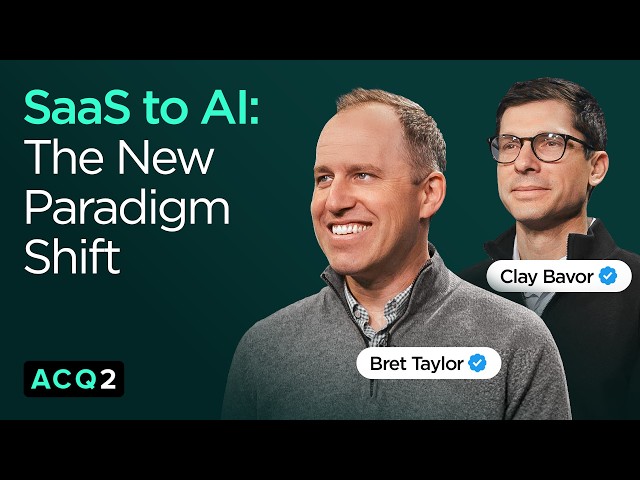
OpenAI Chair Taylor, Google Veteran Bavor Form AI Venture Sierra
Acquired
The tech industry's transition from software tools to autonomous agents will permanently fracture the internet funnel, rendering standard enterprise pricing models and traditional digital marketing strategies obsolete.
## Background
Published on August 18, 2025, by the Acquired channel on YouTube, this episode features an interview with tech product builders Bret Taylor and Clay Bavor. The description highlights their extensive backgrounds at Silicon Valley giants like Google, Facebook, Salesforce, Twitter, and OpenAI, framing a conversation focused on whether AI is a standard software evolution or an entirely new paradigm, alongside nostalgic historical tech stories.
## TL;DR
In this episode, Sierra co-founders Bret Taylor and Clay Bavor break down the unique infrastructure and economic realities driving the modern AI wave, predicting that autonomous agents will fundamentally disrupt traditional internet discovery and enterprise software. They introduce Sierra's radical pivot toward outcome-based pricing, shifting vendor accountability from seat licensing to verified business results. Reflecting on their deep tech history, they contrast current AI scaling dynamics and intense corporate competition with past structural shifts like the early web adoption, mobile revolutions, and the Google+ versus Facebook social media wars.
## Atmosphere & style
The conversation carries a highly collaborative, nostalgic, and deeply insightful tone, driven by the genuine 20-year friendship and casual banter between Taylor and Bavor. It features a compelling intellectual contrast between Bavor’s optimistic tech expectations and Taylor’s self-described realistic, analytical pessimism. Listening feels like sitting in on an exclusive, high-level Silicon Valley retrospective, transitioning from lighthearted office anecdotes about celebrating a flip-flop warranty claim to sobering, first-principles philosophical debates about the societal and cultural disruption of plentiful intelligence.
## Key takeaways
- [09:23](https://www.youtube.com/watch?v=Qt3_bK46il0&t=563s) The transition to AI introduces a new paradigm where software shifts from being a human productivity tool to autonomously executing and completing work.
- [04:44](https://www.youtube.com/watch?v=Qt3_bK46il0&t=284s) AI adoption is scaling faster than previous computing waves because it launches into a pre-built infrastructure of ubiquitous networks and smartphones.
- [09:23](https://www.youtube.com/watch?v=Qt3_bK46il0&t=563s) The emergence of personal AI agents could completely fracture the internet's current discovery, advertising, and marketing funnels.
- [19:05](https://www.youtube.com/watch?v=Qt3_bK46il0&t=1145s) The rapid democratization and commoditization of human intelligence through AI poses deep identity, psychological, and labor transition challenges.
- [28:11](https://www.youtube.com/watch?v=Qt3_bK46il0&t=1691s) The software market is divided into three layers: foundation models, tooling and infrastructure, and applied vertical applications.
- [30:02](https://www.youtube.com/watch?v=Qt3_bK46il0&t=1802s) Investing in proprietary, in-house foundation models for applied AI startups is a financial trap due to their incredibly short shelf-life.
- [31:20](https://www.youtube.com/watch?v=Qt3_bK46il0&t=1880s) The market is moving toward a matrix of specialized models optimized across specific cost, latency, and reasoning needs rather than a single monolithic model.
- [34:33](https://www.youtube.com/watch?v=Qt3_bK46il0&t=2073s) Building frontier AI models requires massive, ongoing capital commitments (CapEx) for data centers and chipsets, altering traditional software margins.
- [39:26](https://www.youtube.com/watch?v=Qt3_bK46il0&t=2366s) Sierra is pioneering 'outcome-based' pricing, charging customers only when an AI agent successfully resolves a task without human intervention.
- [49:32](https://www.youtube.com/watch?v=Qt3_bK46il0&t=2972s) Outcome-aligned business models break the traditional 'post-sale' phase, requiring immediate, rapid deployment of the technology.
- [51:43](https://www.youtube.com/watch?v=Qt3_bK46il0&t=3103s) During massive technological disruptions, the enterprise procurement cycle swings heavily toward specialized, best-of-breed vendors over incumbents.
- [01:10:01](https://www.youtube.com/watch?v=Qt3_bK46il0&t=4201s) The urgency and frantic alignment within major tech incumbents around AI matches the intensity of the early 2010s Google+ vs. Facebook social war era.
## Detailed walkthrough
### [00:00](https://www.youtube.com/watch?v=Qt3_bK46il0&t=0s) Legendary Careers and a New Venture
The hosts welcome Brett Taylor and Clay Bavor, teasing an episode filled with insights on the evolution of AI and deep tech history. Both guests previously provided invaluable research assistance for the show's episodes on Google, a company where both men began their storied tech careers as Associate Product Managers (APMs). Over the past two decades, they have navigated some of the most prominent corners of Silicon Valley. Clay spent over 18 years at Google, leading product development for foundational applications like Gmail, Google Drive, and Google Docs—which eventually consolidated into Workspace—before running Google Labs and working on hardware, VR, and AR.
Meanwhile, Brett's career has intersected with almost every major tech milestone: he co-founded Google Maps, created Friend Feed (which was later acquired by Facebook), served as the CTO of Facebook, founded Quip (acquired by Salesforce), and later became the co-CEO of Salesforce. Even with these executive credentials, Brett still actively writes code. Today, he serves as the chairman of the board at OpenAI and previously chaired Twitter during its final tumultuous moments as a public company. Now, the two tech veterans have teamed up as co-founders of Sierra, an AI enterprise company.
* **Clay Bavor's Google Tenure:** Began in the APM program and lasted over 18 years, starting in ads and culminating in leading Google Labs.
* **Brett Taylor's Corporate Milestones:** Co-founded Google Maps, served as CTO of Facebook, co-CEO of Salesforce, former chairman of Twitter, and current chairman of OpenAI.
* **The Market Cap Question:** The hosts joke about a fun debate saved for the end of the episode: whether Brett created more market cap through his serial entrepreneurial journey or if Clay generated more simply by "cranking on Google" for nearly two decades.
[03:03](https://www.youtube.com/watch?v=Qt3_bK46il0&t=183s) Jargon, "Spyware," and the Architecture of AI Nouns
The conversation sparks a lighthearted debate when the host uses the word "spyware" to describe the early Google Toolbar bundling strategies, prompting a quick, humorous correction from the guests that it was simply a "bundle." This trip down memory lane leads into a deeper reflection on how internet terminology shifts over time. They reminisce about antiquated terms like "information superhighway" and remember when "webmaster" was a ubiquitous, legitimate job title.
Turning their attention to modern jargon, Brett notes that one of his favorite pastimes is using the Internet Archive’s Wayback Machine to watch corporate websites systematically alter their vocabularies. Companies routinely transition their branding from ML to AI, then to Gen AI, and eventually to terms like "agents" and "agentic." While much of the current phrasing can feel like transient hype, Brett strongly believes that the word "agent" is a noun that will permanently stick to the lexicon. Much like the web has "sites" and mobile has "apps," AI has "agents." Over time, the term will lose its shiny novelty and simply become a standard noun describing a digital autonomous thing.
[04:44](https://www.youtube.com/watch?v=Qt3_bK46il0&t=284s) Riding the Coattails of Technological Infrastructure
Clay clarifies Sierra's core mission: helping companies build custom, customer-facing AI agents to manage all facets of their customer experience. He boldly predicts that a company's AI agent will eventually become more vital than its website or its mobile app, serving as the primary medium for consumer interaction. When Sierra launched 15 to 16 months prior in 2024, the founders initially worried that the public wouldn't understand what an "agent" meant. In a remarkably short span, the term has become so ubiquitous that corporate executives are already suffering from jargon fatigue. Clay shares an anecdote where a CIO of a major retailer explicitly thanked him just for "not saying the word agentic in the first 15 minutes."
Brett explains that the explosive growth of AI companies like Sierra is a direct consequence of historical tech trends compounding on top of one another. The PC revolution required physical supply chains and chip cost reductions to put two billion computers on desks. The internet then rode the coattails of that PC infrastructure. Later, smartphones capitalized on pre-existing websites and networks. Today, AI is launching into a world that already has more smartphones than people. This pre-built plumbing allows consumer applications to scale instantly, explaining why ChatGPT achieved 100 million users faster than any technology in history. Sierra scales rapidly because the target enterprises already have phone systems receiving 100 million calls a year—the infrastructure is waiting to be hooked up.
* **The Web's Adoption Timeline:** The first website went online around 1991, but it took until 2002 (roughly 11 years) for 10% of the world to use the web weekly.
* **The Commercial Web Ban:** Brett points out an obscure historical fact that it was actually illegal to use the internet for commercial activity in 1991, a restriction lifted by an act of Congress in 1993.
* **ChatGPT's Growth Curve:** In stark contrast to the early web, ChatGPT took only 5 days to reach 1 million users and roughly 2 months to cross the 100-million-user mark, capturing 10% of global weekly usage in about 25 months.
[09:23](https://www.youtube.com/watch?v=Qt3_bK46il0&t=563s) Software Completing Work and the Impending Funnel Upheaval
Reflecting on the dot-com crash of 1998, Brett observes that while people mentally associate that era with catastrophic failures like Pets.com or Webvan, the historical exuberance was ultimately justified. The underlying thesis was correct: the internet did fundamentally reshape global commerce and finance. He views the current AI landscape similarly—amidst the modern "snake oil" and buzzwords, true foundational value is being generated. The core paradigm shift is that software is no longer just a tool to increase human productivity; it is actually "completing work," which is where concepts of agency and reasoning originate. As a self-identified computer programmer, Brett jokes that his favorite hobby faces structural obsolescence, comparing programmers to the human "computers" who manually calculated numbers before digital calculators emerged.
This shift promises to profoundly upend how the internet handles demand and discovery. Currently, the internet funnel is clearly divided: demand generation is dominated by social media ad networks, demand fulfillment is anchored by search engines and AdWords, and transactions are handled by commerce systems. If personal AI agents begin navigating the web on behalf of humans, this entire funnel fractures. Advertisers will face the bizarre challenge of generating demand not for human consumers, but for the autonomous agents making decisions for them. Furthermore, classic psychological pricing strategies—like anchoring an expensive product next to a slightly cheaper option—may completely lose their efficacy if buying decisions trend toward a mathematically optimal agent evaluation. This introduces an organic tension between brands, who fear being commoditized, and platform providers, whose systems naturally disintermediate consumer relationships.
[15:06](https://www.youtube.com/watch?v=Qt3_bK46il0&t=906s) The Future Economy of the Internet and Agentic Bets
The discussion begins with a forward-looking prediction about the internet economy over the next five years. The speaker notes that the market will shift drastically, drawing a parallel to how retailers today must choose between relying on Instagram ads or first-party discovery channels. Predicting these shifts is incredibly difficult, even for industry insiders; nobody fully anticipated the secondary and tertiary consequences of mobile app stores or social networks. This upcoming transformation is expected to profoundly upend the digital landscape.
Amidst this uncertainty, Brett and Clay have placed a friendly wager regarding the speed of adoption. They have a bet on the specific year when more than 50% of the customer service conversations happening with Sierra-built agents will actually be conducted with a user's *personal* AI agent—essentially, agents talking to agents. While they laughingly keep the exact date a "secret" so as not to prematurely influence the market, it highlights their internal dynamic. Clay has won all three of their previous bets because, as they joke, "Clay is more optimistic" than Brett, and in technology, optimism frequently wins out.
* **The 50% Bet:** A wager on the year when the majority of Sierra agent interactions will be B2B/P2P AI-to-AI conversations.
* **The Optimism Factor:** Brett acknowledges he acted as the "pessimist and realist," while Clay's high expectations have consistently proven correct.
---
[16:09](https://www.youtube.com/watch?v=Qt3_bK46il0&t=969s) Exceeding Expectations and AI Interacting with the Physical World
Clay recalls one of their very first bets, which centered on what percentage of incoming customer service issues a Sierra agent could autonomously resolve. Brett guessed a conservative 50%, while Clay optimistically bet they would surpass 80% by the end of the year. Not only did Clay win, but the technology blew past expectations "by a significant margin" across their entire customer base. The real magic, they explain, is that these agents aren't just regurgitating text answers; they are performing complex execution tasks across systems.
To illustrate, Clay shares a couple of striking examples. They built "Harmony," the agent for SiriusXM, which can autonomously send a satellite signal from space to refresh the encryption keys in a subscriber's vehicle when they switch cars. Similarly, the agent built for ADT can troubleshoot a customer's beeping security panel, identify which of the 52 different panel models they own, and automatically mail out a replacement battery. Brett highlights how wild this is: "You're talking to an AI that's talking to a satellite that's sending something to your car, like no people involved." What would have sounded like pure science fiction three years ago is now treated as an ordinary, everyday occurrence.
* **Resolution Rate:** Sierra agents successfully bypassed the 80% resolution threshold for customer issues, beating Brett's 50% estimate.
* **SiriusXM (Harmony):** Communicates with satellites to update encryption keys inside vehicles.
* **ADT Agent:** Diagnoses hardware from 52 distinct panel variants and triggers physical fulfillment of parts.
---
[17:36](https://www.youtube.com/watch?v=Qt3_bK46il0&t=1056s) The Office Celebration and the Culture of Trivial Successes
Clay shares a fond memory from Sierra's early days involving a customer named Olukai, a company that sells flip-flops. The office erupted into cheers the day their AI agent completely managed a warranty claim on its own. The agent had to visually inspect photos sent by the customer to confirm it was the authentic product, approve the claim, and initiate the shipment of a brand-new pair of replacement shoes without a single human intervention.
Brett chimes in with a hilarious behind-the-scenes anecdote. He was in the middle of interviewing a job candidate when the entire office suddenly burst out celebrating. When he went to see what happened, the team enthusiastically exclaimed, "We exchanged some flip-flops! Woo!" Brett laughs about how absurd and trivial it felt to explain that milestone to an outside candidate: "Let me explain why flip-flops are a big deal to us, but trust me, this is a big deal." The host notes that disrupting a candidate's interview with raw corporate excitement is actually a fantastic, unintentional way to showcase company culture. It draws a historical comparison to the epic hackathons at Facebook during its early Microsoft ad negotiations, where house music blasted and middle-aged executives walked in wondering, "What the hell is happening here?"
* **Olukai Milestone:** The AI processed an end-to-end warranty return by evaluating product photos and triggering physical fulfillment.
* **Facebook Parallel:** The energy recalled the legendary Facebook hackathons where Mark Shrepel would DJ while high-stakes deals were being hammered out.
---
[19:05](https://www.youtube.com/watch?v=Qt3_bK46il0&t=1145s) The Plentiful Intelligence Paradigm Shift
The conversation shifts to a deep, first-principles philosophical debate about the true nature of AI. The host admits to waking up on different sides of the argument depending on the day. On some days, AI feels like an unprecedented, terrifyingly disruptive force that will shatter labor productivity and break every existing societal model by rendering human labor obsolete. On other days, it feels like "just software"—simply a more powerful iteration of SaaS, cloud, or mobile apps evolving alongside Moore's Law.
Clay looks at the issue by analyzing what happens when a historically scarce resource suddenly becomes plentiful. He points to energy—which was scarce for hundreds of years but is now so ubiquitous in the West that we flip a light switch without a second thought. Food followed a similar trajectory; before modern agriculture, acquiring food dominated daily human thought, whereas now food insecurity, though still present, is no longer the defining driver of daily life for the majority. We are now entering an era where human intelligence is transitioning from scarce to plentiful.
* **Scarce to Plentiful:** Historical transitions include electricity and agriculture, which reshaped the baseline of human worry and daily occupation.
* **The Identity Crisis:** Because people heavily anchor their personal self-worth and identity to their intelligence, a world of plentiful intelligence poses deep psychological questions about individual contribution.
---
[21:37](https://www.youtube.com/watch?v=Qt3_bK46il0&t=1297s) The Silicon Valley Irony and Societal Disruption
Brett highlights a bizarre, meta-irony unfolding right now in Silicon Valley: the very people building this technology—software engineers—are aggressively automating their own profession. Software engineering sits right at the top of the list of jobs most likely to be disrupted by this wave of AI. Brett notes that while this self-disruption is "certainly unusual," he is confident humanity will emerge on the other side as a "higher leverage species," spending time on more meaningful endeavors. He views the commoditization of expertise as a massive democratizing force that will grant universal access to medical, legal, mental health, and educational resources that were once reserved only for the wealthy.
However, Brett doesn't sugarcoat the pain of this transition. Just as the Luddites rebelled during the Industrial Revolution, or globalization lowered the price of TVs while devastating local factory towns, macro productivity metrics like GDP often obscure real, localized human suffering. The transition will be highly uncomfortable because individual self-worth and employment structures are being upended simultaneously. "It could be great in 10 years but really hard over the next 2 years," Brett muses, noting that Silicon Valley sits dead center in the storm.
* **Automation of the Automators:** Software engineers are uniquely positioned as creators of the tools threatening to disrupt their own roles.
* **Expertise as a Commodity:** AI will democratize high-cost services like legal counsel, education, and healthcare advice.
* **Rate Limiters:** Despite rapid technical progress, societal absorption of super-intelligence will be slowed down by structural bottlenecks like regulation, cultural resistance, and operational timelines (e.g., clinical trials).
---
[24:49](https://www.youtube.com/watch?v=Qt3_bK46il0&t=1489s) Human Capital, Code Leverage, and "The Machine" Philosophy
When asked how Sierra manages its own human capital given that AI can do so much engineering work, Clay emphasizes that great talent remains their core force multiplier. Since launching in March of 2023, Sierra has faced overwhelming demand and is scaling across geographies and industries. To maximize efficiency, their teams aggressively lean into AI tools like Cursor. While the exact percentage of code written by AI changes daily, it is incredibly high. Clay shares an anecdote about their very first engineering hire, who deployed an autonomous coding agent over a single weekend to generate a dozen pull requests (PRs). "Half of them were great, a quarter of them were total garbage, and a quarter needed some work," but it effectively allowed a single engineer to guide a massive weekend of development.
Brett double-clicks on this concept, sharing a foundational "Clayism" from the birth of the company: "We're building a machine to produce happy customers." This structural framework dictates how they handle AI failures. If their AI co-pilot, Cursor, produces faulty code, their philosophy dictates that engineers should never just fix the broken code. Instead, they must fix the *context* or the system that allowed the AI to make the error in the first place. Treating the business as a rigid machine to be tuned prevents employees from just fixing surface-level outputs and creates a highly actionable framework for implementing AI systemically.
* **Cursor Implementation:** Sierra uses AI coding tools as core force multipliers for senior engineering staff.
* **The Context Principle:** "Don't fix the code, fix the context that Cursor had that produced the bad code."
* **The Machine Metaphor:** A foundational company mantra prioritizing systematic architectural corrections over surface-level patches.
---
[28:11](https://www.youtube.com/watch?v=Qt3_bK46il0&t=1691s) The Three Categories of the AI Software Market
The discussion wraps up with Brett analyzing the macro realities of tech hiring and company positioning. The host points out the elephant in the room: AI talent packages at frontier labs are hitting astronomical levels (upwards of $300 million), making it hard for normal startups to compete. Brett demystifies this by clarifying that Sierra is an "applied AI company" and breaks the broader AI ecosystem down into three distinct tiers to explain why they don't need to compete for the same ultra-scarce research talent.
First are the frontier and foundation model companies (like OpenAI, where Brett serves as Board Chair), which are heavily mission-driven, highly capitalized, and chasing Artificial General Intelligence (AGI) or commercial model leasing. The second tier consists of the tooling and infrastructure providers—the proverbial "pickaxes in the gold rush"—who build vector databases, data labeling services, and infrastructure for retrieval-augmented generation (RAG). The third tier consists of vertical application players like Sierra (for customer experience), Harvey (for legal), or Writer (for marketing). These vertical applications sit downstream, composing the best foundational models to create premium, specialized end-user experiences. Brett equates building a vertical app company from scratch using proprietary data centers to a SaaS startup trying to build its own physical servers instead of simply renting from Amazon.
* **Tier 1: Foundation Models:** Frontier labs (e.g., OpenAI) competing for deep research talent to construct core models.
* **Tier 2: Tooling & Infrastructure:** Providers of data warehouses, vector databases, and pickaxes for developers.
* **Tier 3: Applied Vertical AI:** Enterprise application builders (e.g., Sierra, Harvey) focused on compiling models into high-value customer workflows.
[30:02](https://www.youtube.com/watch?v=Qt3_bK46il0&t=1802s) The Mirage of In-House Foundation Models
The landscape of applied AI has shifted dramatically from the trends of 2023. The hosts recall a past episode where Clem from Hugging Face firmly argued that every applied AI company needs to build their own foundational model to be viable. Today, that perspective meets fierce resistance, with one speaker stating, "I could not disagree more strongly with a single sentence." In 2023, startups like Adept, Character, and Inflection chased the prestige of having proprietary foundation models, but those ventures ultimately ended very differently than planned.
Unless a company enjoys long-term patent protections like a pharmaceutical giant, investing heavily in a proprietary foundation model is increasingly seen as a financial trap. Multiple investors have noted that foundation models are "the fastest deteriorating asset of all time." Burning through tens or hundreds of millions of dollars before achieving product-market fit yields little value when the resulting asset's competitive edge lasts "like a week." The speakers joke that building one is akin to buying a "very expensive carton of milk" due to its incredibly short shelf life and the massive token generation required to amortize the upfront costs.
---
[31:20](https://www.youtube.com/watch?v=Qt3_bK46il0&t=1880s) The Nuance of Frontier Models and Architectural Shifts
When considering the usable life of a frontier-class model, the speakers note that the strategy depends entirely on the type of model being built. They draw a sharp line between standard foundation models and true frontier models—the absolute "best of the best" that labs like OpenAI strive to maintain. Having the top-performing model functions similarly to Apple’s hardware strategy, attracting a premium customer tier. However, the market is rapidly moving away from a one-size-fits-all paradigm toward specialized architectures, influenced heavily by trends like distillation and post-training optimization.
Distillation allows developers to take a high-parameter model and condense it into a smaller, cheaper model that retains roughly 80% of the performance, a tactic DeepSeek leveraged effectively using open source. Concurrently, post-training processes like reinforcement learning (RL) on chains of thought form the backbone of advanced models like o3 and o4. This creates a matrix of variables across cost, performance, quality, and reasoning. The market is evolving much like the database sector; just as developers choose distinct databases for large-scale analytics versus transactional data stores, they will soon select AI models based on specific transactional needs.
* **Latency vs. Intelligence:** For a seamless voice conversation, low latency is a more critical quality metric than sheer raw intelligence. A model that requires a 30-second pause before replying is commercially non-viable for customer service.
* **Cost Efficiency:** For companies looking to replace or supplement inexpensive offshore contact centers, the AI must cost less than human labor. A model costing $2,000 per phone call fails basic business viability.
* **Strategic Portfolios:** Large foundation model companies will likely offer a portfolio of products tailored to varied use cases, ranging from hyper-intelligent systems for drug discovery to low-cost, low-latency models for transactional phone calls.
---
[34:33](https://www.youtube.com/watch?v=Qt3_bK46il0&t=2073s) Infrastructure Scaling and the CapEx Realities
The math behind building frontier models dictates heavy market consolidation. To recoup the massive capital required for pre-training and post-training runs, only a few dominant players can realistically exist to collect "taxes" from the companies building applications on top of them. For a standalone startup, trying to go it alone is "completely nonviable in every dimension." Even if a startup magically secured $50 billion in CapEx to build a frontier model, the ongoing operational expenses—including paying elite researchers upwards of $300 million a year to maintain and improve it—are staggering.
While finding the rare talent capable of architecting multi-trillion parameter models is a massive initial constraint, the talent wars are ultimately a "rounding error" compared to pure infrastructure costs. The dominant expense remains CapEx for data centers, power delivery, and specialized chips. Highlighting this astronomical scale, the speakers point to Google’s recent earnings report, where the tech giant casually noted an additional $10 billion infrastructure buildout for the year, bumping their total spend from roughly $75 billion to $85 billion. This represents a fundamental shift in tech economics; the historically beloved software model of asset-light, low-CapEx, and 85% gross margins has been replaced by massive, ongoing capital commitments.
---
[37:00](https://www.youtube.com/watch?v=Qt3_bK46il0&t=2220s) Lessons from Silicon Valley's Ghost Campuses
While the intensive CapEx requirements alter traditional software valuation models, they also erect massive barriers to entry. The speakers contrast this with the social media landscape, where new services pop up constantly because the barriers to entry are comparatively low. To contextualize the cyclical and fragile nature of tech giants, a speaker shares a poignant, firsthand story from their early career. They started at Google when it moved from a small building in Mountain View into a larger campus—which happened to be the former campus of Silicon Graphics (SGI).
The transition was stark and awkward. SGI was dying and selling off its campus for parts, yet their remaining employees still occupied a couple of buildings on the edge of the property. The speaker recalls the profound awkwardness of eating free food in the shared cafeteria while the struggling SGI employees had to pay for their meals. Years later, the same speaker experienced a parallel transition at Facebook, which moved from downtown Palo Alto to an old HP building, and eventually into the abandoned, former headquarters of Sun Microsystems. Both SGI and Sun Microsystems had sat at the absolute top of the stock market during their peaks, only to be cleared out within a generation.
> "Both of those companies in my lifetime were at the top of the stock market and then had sold their campus for parts and then we were taking it over... how many technology companies have lasted more than 40 years?"
Despite these sobering reminders of tech mortality, the speakers defend the hyperscalers' aggressive CapEx spending. The ultimate expected value of achieving Artificial General Intelligence (AGI) is so massive that the financial bet is entirely justified. In the current landscape, the risk of falling behind and failing to exist in 30 years far outweighs the risk of overspending on a spreadsheet today.
---
[39:26](https://www.youtube.com/watch?v=Qt3_bK46il0&t=2366s) Sierra's Radical Bet on Outcome-Based Pricing
Shifting focus to business strategy, the hosts press Brett, the former co-CEO of Salesforce, on the radical pricing model he and Clay are introducing at their new venture, Sierra. For decades, enterprise software has been defined by the rigid parameters of Software as a Service (SaaS). However, Sierra is throwing out the traditional seat-based and consumption-based (per token or per message) metrics. They started from first principles by analyzing what AI agents actually do: unlike historical software bought at Fry's Electronics to make a human marginally more productive, agents are "actually getting the job done for you." You are essentially hiring the software as an employee.
This realization led Sierra to pioneer "outcome-based pricing" or "resolution-based pricing." Under this framework, Sierra only charges the customer when the AI agent successfully resolves a task end-to-end with zero human intervention. This shifts the operational risk entirely onto Sierra's shoulders, serving as a powerful expression of confidence in their platform's capabilities.
* **Incentive Alignment:** Traditional vendor relationships can be adversarial, but outcome pricing turns Sierra into a true partner. Customers want to utilize the agent as much as possible to save money, while Sierra is heavily incentivized to build the most robust, high-performing reasoning agents possible.
* **The Comp Analogy:** Just as human enterprise sales teams are incentivized via a 50/50 salary and commission split, software should be compensated based on performance. If an agent is designed to make a sale, it should earn a commission; if it handles customer service, it should only be paid when it solves the problem.
* **Clear ROI:** Customers can immediately calculate value by comparing the fixed cost of a Sierra resolution against the expensive $10 to $20 cost of a human phone call or a multi-hundred-dollar service truck roll.
The hosts compare this shift to the historic evolution of online advertising, which moved from CPM (pay per impression) to CPC (pay per click), and finally to pay-per-conversion. By aligning pricing directly with verified utility, Sierra is betting that outcome-based metrics will upend the enterprise software market just as profoundly as Marc Benioff's SaaS model did in the early 2000s.
[45:17](https://www.youtube.com/watch?v=Qt3_bK46il0&t=2717s) Shift from On-Premises to SaaS and the Evolution of Responsibility
Historically, when a company purchased a traditional piece of on-premises software, a dedicated internal team was required to install it, maintain it, manage the upgrade processes, and run the physical servers. The advent of Software as a Service (SaaS) was fundamentally disruptive not just because it shifted corporate finances from capital expenditures (capex) to operating expenditures (opex) through subscription licensing, but because it radically reshaped organizational roles. By offloading the lower-level technical machinery to a SaaS vendor, enterprises suddenly realized they no longer needed site reliability engineers or entire data center teams to keep services running.
Despite these infrastructure changes, clients still had to navigate installation and heavy customization. A persistent problem was the "arms-length accountability" of the software vendor. Using the analogy of a Customer Relationship Management (CRM) platform, if a company installs a CRM and its sales do not improve, the blame rarely falls on the software itself. The vendor's job ends at providing the tool, and the client is left to figure out the execution. Jokingly asked if he was speaking from personal experience, the speaker denies it with a laugh, clarifying that while they happily use and love Salesforce, the reality remains that standard enterprise software requires throwing code over a wall and wishing the customer luck.
- On-premises software historically necessitated internal teams for server management, maintenance, and upgrade processing.
- SaaS eliminated the need for data center teams and site reliability engineers by moving technical machinery to the vendor.
- Traditional software accountability remains disconnected from business outcomes; if sales do not improve after installing a CRM, the vendor still gets paid.
[46:58](https://www.youtube.com/watch?v=Qt3_bK46il0&t=2818s) The Outcome-Driven Relationship of AI Agents
The introduction of conversational AI agents radically alters the vendor-customer dynamic and redefines the traditional "post-sales process." Because AI companies like Sierra operate under business models where they only succeed—and get paid—if the agent actually delivers results, they cannot simply step away after a contract is signed. This dynamic forces software vendors to become deeply invested partners in their customers' long-term success. While highly technically sophisticated clients may choose to operate independently without ever speaking to the vendor, other firms with minimal IT support require hands-on partnership to ensure their agents function properly.
This shifting relationship mirrors the historic transition from on-premises software to SaaS, but goes a step further by introducing the concept of hiring an autonomous agent to fulfill a specific job outcome. This evolution alters the expectations of procurement teams, who now focus heavily on accountability, risk management, and concrete outcomes. Looking ahead ten years, the goal for frontier companies is to transcend the label of a simple software vendor and instead become foundational, strategic advisers in AI. While elite enterprise software sales leaders have always strived to be strategic partners, the underlying business models were never structurally aligned to incentivize it.
- AI agent procurement focuses on vendor accountability and shared business risk rather than static software licensing.
- Sierra acts as an outcome-based partner, varying its support from zero-touch for highly technical clients to deep integration for lean IT teams.
- One large furniture retailer partner pays Sierra on a direct sales commission basis when the AI agent successfully attaches premium delivery packages to furniture orders.
[49:32](https://www.youtube.com/watch?v=Qt3_bK46il0&t=2972s) Breaking the Pre-Sale and Post-Sale Divide
The shift toward outcome-aligned business models renders old enterprise terminology like "post-sale" completely obsolete. In traditional SaaS, a firm dividing line exists where a deal is signed, and the post-sale phase is merely managed toward an annual or multi-year renewal. With an outcome-based AI model, signing a deal does not mean the money has been made; as the speakers note, "sales don't happen until their sales happen." Because revenue generation is tied directly to the live performance of the agent, the timeline demands rapid implementation and immediate deployment.
To prevent revenue from lagging, companies must bypass the agonizingly slow IT loops of the past, where business requirements were thrown over a wall to tech teams, implemented incorrectly, and passed back and forth. For an agile firm, going live can take as little as two to three weeks, while a more traditional company burdened with internal gates might take a couple of months. To accelerate this timeline, Sierra heavily utilizes no-code tools that empower customer experience and business marketing teams—the actual domain experts who understand the nuances of things like premium delivery packages—to build and modify agents directly without requiring technical AI expertise.
- The traditional concept of "post-sale" is broken because revenue is gated by the agent's live performance rather than the contract signing.
- Deployment timelines range from two to three weeks for agile firms to a few months for traditional enterprises with rigorous internal gates.
- No-code tools allow business and customer experience teams to build agents themselves, eliminating the slow requirements-gathering loop between tech and marketing units.
[51:43](https://www.youtube.com/watch?v=Qt3_bK46il0&t=3103s) The Best-of-Breed vs. Best-of-Platform Pendulum
The low risk of outcome-based contracts theoretically opens the door for rapid corporate experimentation, enabling companies to adopt multiple vendors simultaneously to see who truly moves the needle, much like the cloud allowed engineers to instantly spin up servers. However, this freedom faces a bottleneck of human focus, and technology leaders currently suffer from "proof of concept" fatigue without seeing enough live, successful deployments. When advising clients, the recommendation is to target a singular business metric top-down and aggressively achieve it rather than running endless disjointed experiments.
This tension sits at the heart of the classic enterprise software debate: "best of platform" versus "best of breed." Best of platform relies on the old adage that "no one gets fired for buying IBM," leaning into massive enterprise license agreements with incumbents like Microsoft to secure commodities of scale and avoid security onboarding friction. However, when disruptive technologies emerge, the pendulum swings aggressively toward best-of-breed startups because incumbents face structural, technical, and business-model impediments to adaptation. Currently, the sheer value of an AI agent displacing labor costs dwarfs the cost of the software itself, driving buyers to prioritize highest-quality, best-of-breed vendors like Sierra. This technical moat is a race against time; eventually, creating AI agents will become commonplace, the pendulum will swing back to platforms, and startups must establish massive scale within the decade to become the new incumbents.
- The enterprise software procurement cycle constantly swings between all-in-one platforms and specialized, best-of-breed solutions.
- Incumbents face strategic and technical impediments to adopting new AI architectures and risk-sharing business models.
- Historically, technological disruptions have given birth to generational giants: the internet created Salesforce, Google, and Amazon, while mobile phones enabled WhatsApp, Uber, DoorDash, and Instacart.
[55:54](https://www.youtube.com/watch?v=Qt3_bK46il0&t=3354s) Leadership at the Frontier of the Barely Doable
Leading an AI startup like Sierra requires operating at an entirely different, tighter scale than the massive corporate hierarchies the founders previously managed at Salesforce or Facebook. This environment demands an intense proximity to detail and a shared sense of being "in a very small boat together." On any given Sunday night, it is common to find one co-founder checking in a thousand lines of pristine code while the other is deeply buried in the weeds of pricing proposals, contracts, and exact marketing copy.
To maintain control over their technological destiny in the zone of "the barely doable," Sierra maintains a small, specialized research team—a rarity for an applied application-layer company. Rather than pre-training foundational models from scratch, this team innovates a click or two down the stack, designing novel agent architectures to achieve reliability and cost savings. This process feels deeply familiar to veterans of frontier technologies like AR and VR, characterized by hypothesis testing, discovery, and science rather than standard keyboard programming. Unlike hardware engineering where development cycles for a waveguide or display take a decade, AI offers exhilarating immediacy: a breakthrough achieved on Monday can be implemented on Tuesday and deployed to hundreds of customers by Wednesday.
- Startup leadership requires founders to remain deeply in the details, balancing core code contributions with granular contract and marketing reviews.
- Sierra operates a small internal research team to build unique agent architectures rather than focusing on building foundational base models.
- Unlike the long, multi-year cycles of hardware development, AI software allows a single week to encompass architectural breakthrough, implementation, and live customer deployment.
[59:43](https://www.youtube.com/watch?v=Qt3_bK46il0&t=3583s) Cultivating an AI-First Culture
Creating an enterprise in the age of AI fundamentally impacts every organizational role, not just software engineering. Culturally, this environment requires lean, active, and sometimes awkward conversations about how to use AI to completely redefine how everyone does their jobs. The expectations for productivity have fundamentally shifted; for instance, a software engineer who fails to leverage advanced AI tools like Cursor is likely operating at half the efficiency, or worse, of what is possible in the modern landscape.
- AI tool adoption is treated as a cultural mandate across all job descriptions to maximize organizational output.
- Software engineers utilizing AI-assisted development tools like Cursor experience dramatic leaps in baseline productivity.
[01:00:22](https://www.youtube.com/watch?v=Qt3_bK46il0&t=3622s) Change Management and the In-Office Mandate
The conversation shifts toward the immense difficulty of driving technological and cultural change within massive corporations. Brett Taylor reflects on the delicate balance required when rolling out new workflows, noting that you want people to adopt these tools voluntarily, but leadership also needs to "voluntel" them to do it. For a company like Sierra, being the "poster child for automation" is existential. Taylor shares a deeply empathetic perspective on the sheer friction of corporate scale, bringing up the real-world example of Salesforce, which ballooned to 80,000 employees after the pandemic. Getting that massive workforce back into the office was a "total pain in the ass" due to lifestyle changes and geographic relocation. He remarks that observers who claim these transitions are easy simply haven't run an 80,000-person enterprise.
By contrast, Taylor notes how effortless these cultural dictates are at a smaller scale. At Sierra, they established a strict "in the office" policy from day one, giving employees a simple choice: "if you don't want to be in the office, don't work here." Similarly, it is easy for Sierra to ensure every single person leverages ChatGPT deep research before a sales meeting, but rolling that out as a best practice across 10,000 salespeople in a legacy firm is an entirely different beast. Having transitioned from giant tech ecosystems, Taylor holds deep respect for the leaders managing large-scale cultural change management.
- Salesforce grew to 80,000 employees following the pandemic, making its return-to-office transition remarkably complex.
- Sierra operates strictly as an in-office company, utilizing its small scale to seamlessly enforce operational best practices.
[01:01:59](https://www.youtube.com/watch?v=Qt3_bK46il0&t=3719s) A 20-Year Partnership in the Making
The hosts ask about the highly intentional nature of Brett Taylor and Clay Bavor joining forces as co-founders. Given their illustrious careers, neither needed the other to secure venture capital; in fact, the hosts joke that they could have successfully raised money using nothing but a slide featuring their names. Taylor jokingly reveals that starting a company together was "the only way I could convince Clay to actually work with me," capping off a pursuit that began in 2007 when Taylor left Google. Their friendship dates back to Google's legendary Associate Product Manager (APM) program, where Marissa Mayer hired them both. The close-knit alumni group sustained a monthly poker game that, due to everyone's chaotic schedules, realistically only happened "roughly twice a year."
Throughout their separate journeys, Taylor would consistently call Bavor to recruit him, but Bavor was highly valued by Google leadership, including Sundar Pichai, making it impossible to pull him away. The stars finally aligned in December 2022 when Taylor announced his departure from Salesforce. The duo met for a long lunch just a week after ChatGPT launched, discovering a shared, urgent obsession with large language models. While Taylor had initially viewed Bavor primarily as an "AR/VR guy," Bavor had been secretly nurturing a passion for language models within Google Labs, incubating projects like NotebookLM. Over that single lunch, they hatched plans to build a company around the premise that LLMs would completely reshape the business landscape, deciding to "ride into the darkness and figure it out later."
- Brett Taylor and Clay Bavor met at Google under Marissa Mayer's APM program.
- Taylor attempted to recruit Bavor repeatedly from 2007 until their fateful lunch in December 2022.
- The concept for Sierra was formed right after the release of ChatGPT, though the exact business model wasn't finalized until March 2023.
[01:04:47](https://www.youtube.com/watch?v=Qt3_bK46il0&t=3887s) Reflecting on Silicon Valley Greatness
The hosts point out that unlike the typical "singular founder" archetype seen with figures like Mark Zuckerberg or Bill Gates, Taylor and Bavor represent a true co-leadership model, likely influenced by observing Larry Page and Sergey Brin during their formative years at Google. Bavor admits that people frequently view them as a locked unit, joking that they spend "way too much time together." Instead of a traditional holiday party, Sierra hosts an annual "birthday party" every March. At a recent celebration, a spouse commented on their great dynamic, to which Bavor replied, "it helps that we actually like each other." The hosts praise Taylor as potentially having "the single best career of anyone in Silicon Valley in the last 50 years," noting the incredible market cap both founders created—Taylor by moving across hyper-growth tech giants, and Bavor by staying dedicated to Google's core engines.
Taylor humbly pushes back against the praise, expressing deep gratitude for his time spent acting like an "anthropologist" inside iconic corporations. He colorfully compares his first Salesforce management meetings to "Jane Goodall observing the gorillas," taking meticulous notes to decipher an enterprise go-to-market playbook that looked entirely alien compared to his consumer-tech background at Quip, Facebook, and Google. He considers it a profound privilege to have contributed alongside tech icons like Marissa Mayer, Larry Page, Sergey Brin, Mark Zuckerberg, and his close mentor, Marc Benioff.
- Clay Bavor spent over 18 years at Google, working across Search, Ads, Workspace (previously G Suite), Google Lens, and Google Labs.
- Bavor's tenure included building hardware from scratch and visiting assembly lines in China to oversee headsets and wearables.
- Brett Taylor founded Quip, served as Co-CEO of Salesforce, and held high-level executive positions at Facebook and Google.
[01:10:01](https://www.youtube.com/watch?v=Qt3_bK46il0&t=4201s) The Google+ vs. Facebook Social War Era
The interview wraps up with a nostalgic look back at the intense, existential rivalry between Facebook and Google during the launch of Google+. The hosts playfully point out the historical irony: while Taylor was scaling Quip, Bavor was managing Google Apps, creating a funny competitive dynamic where "Quip was so small" compared to Bavor's enterprise giant—described jokingly as "the Notion of its time." Despite the corporate rivalries, the social circles overlapped heavily; Lars Rasmussen, a co-creator of Google Maps, moved to Facebook and joined their shared poker games, proving that relationships ran deeper than corporate battles.
Taylor and Bavor recall how terrifyingly real the stakes felt at the time. At Facebook, Google+ was perceived as an "existential threat," leaving teams terrified that Google would successfully leverage its massive footprint to lock down the social graph. Meanwhile, inside Google, the famous "Earthquake memo" completely reoriented the company's entire priority architecture for three years to nail social networking. While history often looks back at Google+ as a "nothing burger" and an easy target for jokes, Taylor notes that it was born from a mix of "corporate strategy" and "pure ego." He draws a direct parallel to the current AI landscape, warning that modern incumbents are experiencing their own internal "Earthquake" moments as they recognize a massive paradigm shift that will fundamentally alter markets.
- Lars Rasmussen, co-creator of Google Maps, was part of the cross-company Facebook and Google poker circle.
- Google reoriented its entire corporate priority structure for three years following the internal "Earthquake memo" to combat Facebook.
- The speakers equate the current frantic corporate race for AI dominance to the intensity of the social networking wars of the early 2010s.
## Notable quotes
> [04:44](https://www.youtube.com/watch?v=Qt3_bK46il0&t=284s) not saying the word agentic in the first 15 minutes.
> [16:09](https://www.youtube.com/watch?v=Qt3_bK46il0&t=969s) You're talking to an AI that's talking to a satellite that's sending something to your car, like no people involved. — Brett Taylor
> [17:36](https://www.youtube.com/watch?v=Qt3_bK46il0&t=1056s) We exchanged some flip-flops! Woo!
> [17:36](https://www.youtube.com/watch?v=Qt3_bK46il0&t=1056s) Let me explain why flip-flops are a big deal to us, but trust me, this is a big deal. — Brett Taylor
> [21:37](https://www.youtube.com/watch?v=Qt3_bK46il0&t=1297s) It could be great in 10 years but really hard over the next 2 years — Brett Taylor
> [24:49](https://www.youtube.com/watch?v=Qt3_bK46il0&t=1489s) Half of them were great, a quarter of them were total garbage, and a quarter needed some work — Clay Bavor
> [24:49](https://www.youtube.com/watch?v=Qt3_bK46il0&t=1489s) We're building a machine to produce happy customers. — Clay Bavor
> [24:49](https://www.youtube.com/watch?v=Qt3_bK46il0&t=1489s) Don't fix the code, fix the context that Cursor had that produced the bad code.
> [30:02](https://www.youtube.com/watch?v=Qt3_bK46il0&t=1802s) I could not disagree more strongly with a single sentence.
> [37:00](https://www.youtube.com/watch?v=Qt3_bK46il0&t=2220s) Both of those companies in my lifetime were at the top of the stock market and then had sold their campus for parts and then we were taking it over... how many technology companies have lasted more than 40 years?
> [49:32](https://www.youtube.com/watch?v=Qt3_bK46il0&t=2972s) sales don't happen until their sales happen.
> [01:00:22](https://www.youtube.com/watch?v=Qt3_bK46il0&t=3622s) if you don't want to be in the office, don't work here.
> [01:01:59](https://www.youtube.com/watch?v=Qt3_bK46il0&t=3719s) the only way I could convince Clay to actually work with me, — Brett Taylor
> [01:01:59](https://www.youtube.com/watch?v=Qt3_bK46il0&t=3719s) ride into the darkness and figure it out later.
> [01:04:47](https://www.youtube.com/watch?v=Qt3_bK46il0&t=3887s) Jane Goodall observing the gorillas, — Brett Taylor
## Mentioned
Bret Taylor, Clay Bavor, Sierra, Google, Google Maps, FriendFeed, Facebook, Quip, Salesforce, Twitter, OpenAI, Gmail, Google Drive, Google Docs, Google Workspace, Google Labs, Wayback Machine, ChatGPT, Pets.com, Webvan, AdWords, SiriusXM, ADT, Olukai, Moore's Law, Luddites, Cursor, Harvey, Writer, Amazon, Clem, Hugging Face, Adept, Character, Inflection, DeepSeek, o3, o4, Apple, Silicon Graphics, HP, Sun Microsystems, Fry's Electronics, Marc Benioff, IBM, Microsoft, WhatsApp, Uber, DoorDash, Instacart, Marissa Mayer, Sundar Pichai, NotebookLM, Mark Zuckerberg, Bill Gates, Larry Page, Sergey Brin, Jane Goodall, Google+, Notion, Lars Rasmussen
Sierra co-founders Bret Taylor and Clay Bavor argue that AI differs from previous computing waves because software is shifting from merely assisting human productivity to autonomously executing complete work across existing infrastructure.
Compounding Infrastructure and Autonomous Task Execution (4:44)
Taylor attributes the unprecedented adoption curve of generative AI to decades of prior technological buildout. While the web required roughly 11 years (1991 to 2002) to reach 10% global weekly usage, ChatGPT reached 100 million users in about two months and hit that same 10% benchmark in roughly 25 months because it leveraged billions of pre-existing PCs, smartphones, and telecommunications networks. For enterprise software, this means AI agents can immediately plug into existing corporate infrastructure, such as call centers handling 100 million inquiries annually.
Unlike traditional tools that simply streamline digital tasks, enterprise AI agents directly execute end-to-end work across digital and physical domains. Bavor notes that Sierra-built agents bypassed initial conservative estimates to exceed an 80% autonomous resolution rate across their client base. Examples include SiriusXM's agent transmitting satellite signals to update vehicle encryption keys, ADT's agent diagnosing hardware issues across 52 security panel models to mail out replacement parts, and footwear brand Olukai's agent evaluating warranty photos to approve and dispatch replacement shoes without human staff.
Three-Tier Market Architecture and Frontier CapEx (28:11)
Taylor organizes the AI software ecosystem into three distinct tiers: frontier foundation model labs chasing general intelligence (e.g., OpenAI), developer tooling and infrastructure providers offering vector databases and retrieval-augmented generation systems, and vertical applied software firms (e.g., Sierra, Harvey) that direct foundational models into specialized business workflows. Taylor strongly rejects the premise that enterprise application startups must build proprietary foundation models, characterizing them as rapidly depreciating assets whose competitive edge can vanish in a week without patent protection.
The foundation model layer requires massive, ongoing capital expenditure for data centers, compute, and energy that only hyperscalers can comfortably support. Bavor and Taylor point to Google's recent infrastructure spend increasing from roughly $75 billion to $85 billion as evidence that the asset-light, 85% gross margin profile of legacy software has been supplanted by capital-heavy operational realities. Standalone startups attempting to fund pre-training runs and multi-hundred-million-dollar compensation packages face prohibitive unit economics, cementing hyperscaler consolidation.
Disrupting SaaS Through Outcome-Based Pricing (39:26)
Because AI agents function as autonomous labor rather than productivity software, Sierra is replacing traditional seat-based and token consumption metrics with outcome-based or resolution-based pricing. Under this model, clients only pay when an agent fully resolves an inquiry or completes a transaction end-to-end without human intervention. Taylor argues this aligns vendor incentives with client value, mirroring performance compensation in enterprise sales teams or the historical evolution of online advertising from cost-per-impression (CPM) to pay-per-conversion.
This pricing paradigm fundamentally alters enterprise software procurement by breaking down the divide between pre-sale contracting and post-sale account management. Because software revenue does not materialize until customer interactions succeed, deployment velocity is prioritized; agile firms launch in two to three weeks using no-code interfaces that allow marketing and customer experience teams to configure domain logic directly. While incumbent vendors push unified platforms to preserve account control, Taylor and Bavor observe that disruptive technological shifts historically drive enterprises toward best-of-breed startups capable of directly reducing labor expenses.
Workforce Upheaval and the Plentiful Intelligence Shift (19:05)
Bavor compares the emerging AI era to historical transitions in energy and agriculture, where scarce resources became plentiful commodities that altered societal baselines. However, because human identity and economic standing are closely tethered to intellect, commoditizing specialized cognitive expertise—including legal, medical, and technical knowledge—creates severe friction. Taylor highlights the unique irony of software engineers aggressively automating their own profession, forecasting that while universal access to high-value services will create broader social leverage over a ten-year horizon, localized labor disruptions will cause substantial short-term pain.
Within technical organizations, the founders argue that integrating AI tools like Cursor is already mandatory for competitive productivity. Operating within an applied AI company, Sierra addresses code generation errors not by manually rewriting faulty code lines, but by modifying the underlying contextual data supplied to the model. However, Taylor observes that while agile, in-office startups can mandate comprehensive AI workflows overnight, sprawling legacy enterprises face significant organizational resistance when attempting to scale operational changes across tens of thousands of distributed workers.
The ultimate trajectory of consumer discovery and enterprise software hinges on how quickly personal AI agents begin transacting with corporate agents. While Bavor and Taylor forecast that multi-agent interactions will eventually dominate digital commerce and dismantle search and ad funnels, the exact timeline remains uncertain and constrained by regulatory, technical, and organizational inertia.
精炼阅读摘要
Sierra 联合创始人 Brett Taylor 与 Clay Bavor 认为,当前人工智能浪潮有别于以往技术周期的关键,在于软件正从辅助人类生产力的工具演变为直接独立交付工作成果的智能体,这将深刻颠覆软件的交付形态、商业模式与互联网经济漏斗。
技术底座叠加下的指数级渗透与漏斗重构 (4:44)
Brett Taylor 指出,AI 应用之所以能打破历史普及速度,是因为它直接建立在过去数十年相互叠加的硬件与网络基础设施之上。个人电脑时代耗费多年建立供应链并部署了数十亿台电脑,互联网借势 PC 基础设施扩张,而移动互联网又承接了网页体系。早期万维网从 1991 年上线耗时约 11 年(到 2002 年)才达到全球 10% 的周活跃度,且 1991 年商业使用甚至违法,直到 1993 年国会法案才解除限制;而 ChatGPT 仅用 5 天突破 100 万用户,约 2 个月达到 1 亿,并在约 25 个月内触及全球 10% 周使用率。如今移动设备数量已超过全球人口,AI 能够直接接入成熟的硬件和企业电话系统。
随着自主智能体代替人类处理工作,既有的互联网商业漏斗面临破裂危机。传统链条中,社交媒体网络负责需求生成,搜索引擎与关键词广告负责需求匹配,电商系统完成交易结算。如果未来由个人 AI 代理代表用户自主浏览与决策,广告商将面临如何向机器而非人类激发购买意向的困境。此外,经典的心理锚定定价策略在理性运算的最优决策下可能失效,这引发了担心被商品化的品牌方与天然会隔断用户直接关系的平台方之间的内在博弈。
物理世界执行力与人机交互演进 (16:09)
智能体的核心变革在于完成跨系统的实际执行,而非仅仅生成文本。Clay Bavor 透露,在设立 Sierra 初期,Taylor 曾保守预测自主解决率为 50%,但实际成效大幅突破了 80% 的门槛。例如为 SiriusXM 打造的智能体 Harmony 可自主向卫星发送信号以刷新车载加密密钥,为 ADT 搭建的系统能够从 52 种硬件面板中识别型号并自动邮寄替换电池,而在鞋履品牌 Olukai 的案例中,AI 能够独立通过照片验证正品保修并触发实体换货流程。
关于未来的交互形态,Bavor 与 Taylor 设立了一项内部赌局,下注在哪一年 Sierra 处理的客户服务交互中将有超过 50% 是由用户的个人 AI 代理与企业的 AI 智能体直接对话(即 Agent 对 Agent)。Bavor 预测,企业的客户级 AI 智能体最终将比其官方网站或移动 App 更为核心,成为消费者触达企业的第一交互介质。
大模型资产分层与巨额资本支出困境 (30:02)
针对应用层企业是否需要自研基础模型的争论,Taylor 与 Bavor 明确反驳了“必须自研基础模型”的观点,认为专有基础模型在缺乏专利保护的情况下会是“贬值速度最快的资产”,其竞争领先窗口往往仅能维持数周,盲目烧钱自研犹如购买昂贵的易质牛奶。Taylor 将 AI 市场划分为三层:追逐 AGI 的前沿基础模型公司(第一层)、提供向量数据库等 RAG 设施的工具层(第二层),以及 Sierra、Harvey、Writer 这样将模型编排进特定工作流的垂直应用层(第三层)。
前沿大模型的竞争已演变为巨额资本支出的消耗战。研发顶尖模型的算力集群、数据中心与电力投入规模已将人才成本衬托为“四舍五入的零头”。例如 Google 在财报中单次上调 100 亿美元基建开支,使其年度总支出由约 750 亿美元攀升至约 850 亿美元。尽管巨额资本支出颠覆了传统软件高毛利、轻资产的财务模型,甚至硅谷历史上曾登顶市值的 Sun Microsystems 与 SGI 园区均被后继者瓜分接管,但科技巨头仍认为追逐 AGI 带来的预期价值巨大,当前承担超额支出的风险远小于错失技术浪潮而在未来数十年被淘汰的风险。
结果导向计费与企业软件责任重塑 (39:26)
在商业模式上,Sierra 摒弃了传统 SaaS 软件按席位(seat-based)或按用量(token/message)收费的传统,转向按业务结果(outcome-based / resolution-based)计费。企业只有在 AI 智能体端到端独立解决问题且无人类介入时才支付费用。这种模式改变了以往企业购买 CRM 等工具后软件商“概不负责”的松散责任制,使软件供应商直接分担商业风险,类似于按转化付费的广告模式或销售佣金制。例如某大型家具零售商客户即按照 AI 成功附加高端配送包的销售额向 Sierra 支付佣金。
这种商业机制彻底打破了企业软件原有的“售前与售后”界限。由于软件商的收入依赖于上线后的实际表现,产品交付周期被迫大幅缩短。借助无代码工具让业务运营专家直接参与构建,敏捷客户可在两到三周内上线,传统大型企业通常也仅需数月。在采购决策上,虽然科技巨头依靠平台打包(best-of-platform)试图固守领地,但当前 AI 替代人力成本产生的巨大价值差距,正驱使企业优先选用能够立竿见影的垂直单点顶尖方案(best-of-breed)。
智能泛滥对劳动力结构的冲击与组织适应 (19:05)
从哲学与社会演化视角来看,Bavor 将 AI 视作稀缺资源向充裕资源过渡的历史进程,如同电力与农业技术的突破彻底改变了人类的基本生存焦虑。如今,人类智能正从稀缺走向充裕。由于现代人习惯将自我价值与智力相锚定,智能的普及不可避免地引发存在危机。Taylor 强调了当下的行业讽刺:正是软件工程师自身在积极构建自动化其职业的工具,尽管这长期来看会使专业知识如医疗、法律和教育大众化,但在短期内必将引发类似工业革命卢德运动或全球化冲击地方工厂时的剧烈阵痛。
面对组织内部的效率变革,Sierra 实践着严谨的系统化管理。团队遵循“不修补错误代码本身,而是修正导致 Cursor 生成错误代码的上下文与系统机制”的准则。面对大型组织重塑工作习惯的巨大阻力(例如 Salesforce 疫情后规模膨胀至 8 万人时推行回办公室政策的艰难),初创企业能够凭借全员到岗的强硬制度和小型团队的执行力,要求全员强制将深度 AI 工具作为基准生产力杠杆,以避免在大规模变革的摩擦中丧失效率优势。
Taylor 与 Bavor 总结认为,当前巨头在 AI 领域的白热化竞争,高度重演了当年 Google 动员全公司打响 Google+ 战役对抗 Facebook 的“地震级”焦虑。然而,即便技术更迭迅速,超级智能在全社会的全面渗透仍将受制于法规监管、文化阻力及操作落地周期(如临床试验)等现实瓶颈。
Detailed notes — zh
## Background
本期节目由知名商业播客 Acquired(主播 Ben Gilbert 与 David Rosenthal)于 2025 年 8 月 18 日在 YouTube 平台发布。节目邀请了企业级 AI 初创公司 Sierra 的联合创始人 Bret Taylor 与 Clay Bavor,围绕“AI 究竟是更好的软件,还是带来全新范式的技术革命”这一核心议题,结合两人的硅谷履历与科技史典故展开深度对谈。
## TL;DR
Bret Taylor 与 Clay Bavor 从第一性原理出发,剖析了 AI 凭借底层基建复利以历史极速扩散的内在逻辑,指出 AI 的本质是推动“智能”从极度稀缺走向极度充裕,并将软件角色从辅助提效演进为独立交付结果。结合 Sierra 的工程与商业实践,他们阐明了垂直应用层无需自建前沿大模型的经济学考量,并提出按实际商业结果计费将彻底颠覆传统 SaaS 的按席位模式。同时,两人回顾了在 Google、Facebook、Salesforce 的职涯起伏与巨头对决往事,警示当下科技巨头在面对 AI 存在性危机时,正经历着与当年移动和社交大战同等量级的战略重组与战备动员。
## Atmosphere & style
整场对话在轻松诙谐的怀旧叙事与高密度的商业思辨之间自如切换。两位嘉宾展现出硅谷老友间数十载形成的惊人默契与幽默自嘲,既有技术缔造者亲历历史内幕(如 Facebook 浩室音乐黑客松与 Google+ 生死危机)的生动妙趣,又有站在万亿技术前沿操盘实战时的冷静与敬畏。听众在沉浸于顶级产品家敏锐洞察的同时,能深切感受到一股由技术范式剧变所带来的时代紧迫感与兴奋感。
## Bulletin
- [06:05](https://www.youtube.com/watch?v=Qt3_bK46il0&t=365s) ChatGPT 仅用约 25 个月便实现了全球 10% 的周渗透率,而万维网(Web)在 1991 年上线后耗时 11 年才达到该水平;这种极速扩张得益于 PC、互联网与超 80 亿台已联网智能手机基础设施的复利叠加。
- [39:22](https://www.youtube.com/watch?v=Qt3_bK46il0&t=2362s) 企业级 AI 软件正在打破传统 SaaS 的席位制(Seat-based)模式,Sierra 等新兴厂商转向基于端到端解决结果(Outcome-based)计费,只有在无人工介入且彻底完成任务时才收费,厂商直接承担全链路推理与研发风险。
- [28:11](https://www.youtube.com/watch?v=Qt3_bK46il0&t=1691s) Bret Taylor 强烈反对应用层 AI 公司自建基础模型,指出基础模型是快速折旧且高资本消耗的资产;应用型企业应利用模型蒸馏与后训练强化学习(Chain of Thought RL)在延迟、质量与成本间进行多维调优,而非重复自建基座。
- [12:05](https://www.youtube.com/watch?v=Qt3_bK46il0&t=725s) 随着个人专属 Agent 的普及,传统的“发现-履约-交易”互联网漏斗面临瓦解,未来将演进为个人 Agent 与企业 Agent 直接交互的理性博弈,传统心理学定价与信息流广告等商业逻辑将被深度重构。
## Key takeaways
- [02:20](https://www.youtube.com/watch?v=Qt3_bK46il0&t=140s) AI 时代的核心交付实体是智能体(Agent),正如同互联网时代催生了网站(Site)、移动时代定义了应用(App)一样,Agent 将成为未来企业与消费者之间最重要的第一触点。
- [09:16](https://www.youtube.com/watch?v=Qt3_bK46il0&t=556s) 软件的角色正经历历史性代际跃迁:从以往辅助员工提升边际生产力的“工具”,转变为具备推理与行动能力、能够独立完成端到端工作的“代理人(Agent)”。
- [12:05](https://www.youtube.com/watch?v=Qt3_bK46il0&t=725s) 未来的商业分发可能演进为“Agent 对话 Agent”的形态,个人 Agent 追求数学最优决策,将绕过传统的消费心理定价技巧,激化平台抹平渠道与品牌抗拒被中介化之间的矛盾。
- [15:41](https://www.youtube.com/watch?v=Qt3_bK46il0&t=941s) 企业级客服 Agent 展现出突破性的物理世界交付能力,如 Sierra 打造的 Agent 已能自主调度卫星重置车载硬件密钥,或核验保修照片后全自动触发海外仓补发商品。
- [19:05](https://www.youtube.com/watch?v=Qt3_bK46il0&t=1145s) AI 的本质在于将曾经极度稀缺的“智能”转化为极度充裕的资源,尽管它会带来知识工作者身份认同危机与就业阵痛,但临床试验、监管和物理世界摩擦会成为实际落地的现实限速器。
- [27:04](https://www.youtube.com/watch?v=Qt3_bK46il0&t=1624s) AI 原生公司的工程哲学倡导“修机器,而不是修产物”:当 AI 编写错误代码时,工程师应反思并补全系统缺失的上下文,而非仅仅手动改掉代码,以此打造能持续输出正确结果的高杠杆组织。
- [28:11](https://www.youtube.com/watch?v=Qt3_bK46il0&t=1691s) AI 软件市场已清晰分化为前沿模型层、工具基础设施层与垂直应用层三大板块;由于极高的固定成本与稀缺顶尖人才,前沿模型赛道必将走向寡头垄断,依靠大规模调用向行业征收“模型税”。
- [31:07](https://www.youtube.com/watch?v=Qt3_bK46il0&t=1867s) 前沿模型不再是“一刀切”的标准品,模型蒸馏让低成本、低延迟的轻量推理普及,而思维链强化学习则提升深度推理能力,应用场景需在延迟与算力成本间权衡取舍。
- [35:54](https://www.youtube.com/watch?v=Qt3_bK46il0&t=2154s) AI 巨额 Capex 投入打破了华尔街对传统软件“轻资产、85% 高毛利”的偏好,但超大规模数据中心基建也构建起强大的护城河,巨头以此对冲未来 30 年被颠覆的灭顶风险。
- [48:52](https://www.youtube.com/watch?v=Qt3_bK46il0&t=2932s) 以结果为导向的商业模式彻底消融了软件“售前与售后”的传统分界,签约只是合作起点,上线速度与无代码业务调优工具成为保障客户快速变现的核心支柱。
- [53:46](https://www.youtube.com/watch?v=Qt3_bK46il0&t=3226s) 技术演进存在周期性“钟摆法则”:在新技术颠覆初期,老牌巨头因商业包袱动作迟缓,最佳单点工具(Best of Breed)凭借极致 ROI 占据优势;但随着技术门槛降低,钟摆最终将荡回集成平台(Best of Platform)。
- [58:06](https://www.youtube.com/watch?v=Qt3_bK46il0&t=3486s) 大语言模型带来的科研探索具有极高的即时反馈性,与耗时数年的前沿硬件研发不同,团队在 Agent 架构上的理论突破可在几天内直接推送到数百家生产客户环境中验证并产生实际效益。
- [01:11:29](https://www.youtube.com/watch?v=Qt3_bK46il0&t=4289s) 当前科技巨头在 AI 领域的全员备战状态重现了当年 Google 与 Facebook 的社交网络大战,颠覆性范式转移引发的强烈存在性危机感正在全面驱动科技巨头进行新一轮组织重组。
## Detailed walkthrough
### [00:00](https://www.youtube.com/watch?v=Qt3_bK46il0&t=0s) 硅谷传奇双人组:Bret Taylor 与 Clay Bavor 的履历与聚首
Acquired 主持人 Ben Gilbert 和 David Rosenthal 以极其热烈的开场欢迎了本期重磅嘉宾——Sierra 联合创始人 Bret Taylor 与 Clay Bavor。在筹备 Google 上下集节目的研究过程中,这两位硅谷资深缔造者提供了大量一手资料与洞见。两人的职业生涯起点惊人地一致:早在 Google 创立初期,他们就以 APM(Associate Product Manager,助理产品经理)的身份加入了公司。
回顾过去二十年的科技史,两人的履历堪称硅谷的“全明星金曲集”。Clay Bavor 在 Google 坚守了 18 年之久,早期从广告业务起步,随后主导了 Gmail、Google Drive、Google Docs 等核心产品,将它们整合为后来的 Google Workspace;在离开 Google 之前,他还执掌了 Google Labs 以及硬件、VR/AR 和下一代显示计算等前沿探索。Bret Taylor 的轨迹则串联了多家巨头的关键转折点:他在 Google 联合创造了 Google Maps,离开后创立了社交先驱 FriendFeed 并被 Facebook 收购,随后出任 Facebook CTO;之后他创立协作软件 Quip,被 Salesforce 收购后一步步升任 Salesforce 联席 CEO;与此同时,他还在 Twitter 处于退市动荡的最后阶段担任其董事会主席,如今则是 OpenAI 的现任董事会主席。
除了辉煌的管理履历,Bret 至今依然热爱亲自上手写代码。节目录制时,主持人还打趣道,节目尾声不妨算一算他们俩谁在职业生涯中创造的市值更高——是 Bret 辗转各大巨头与明星初创公司创造得多,还是 Clay 扎根 Google 18 年持续深耕创造得多。这次对话的核心议题围绕 AI 展开:AI 究竟是改变世界范式的巨大阶跃,还是仅仅代表着“更好的软件”?随着技术浪潮汹涌而至,又会带来哪些深远的二阶效应?
- **Clay Bavor 的 Google 履历**:以 APM 身份加入,在 Google 效力超过 18 年,先后负责广告业务、Gmail、Google Drive、Docs 及整个 Workspace,后领导 Google Labs、硬件及 AR/VR 项目。
- **Bret Taylor 的创业与管理履历**:Google Maps 联合创造者、FriendFeed 联合创始人、Facebook 前 CTO、Quip 创始人、Salesforce 前联席 CEO、Twitter 最后一任上市董事会主席、OpenAI 现任董事会主席。
---
### [02:20](https://www.youtube.com/watch?v=Qt3_bK46il0&t=140s) 术语大洗牌:从“信息高速公路”到“Agent”
对话从轻松的科技史叙事切入。嘉宾们对 Acquired 制作的 Google 专题第一集赞不绝口,特别是关于 Google 早期如何凭借分发策略破局的段落——通过 Google Toolbar(工具栏)、Google Pack 以及 Google Earth 的安装打包走向大众。David 顺势调侃起当年 Google Earth 安装程序里捆绑 Toolbar 的做法简直像“间谍软件(spyware)”,Clay 连忙笑着纠错:“David,用词可得小心点,那是‘软件捆绑包(bundle)’!”
这种词汇的变迁引发了 Bret 对科技发展周期的思考。在早期互联网时代,曾充斥着大量现已彻底消失的过时行话,比如“信息高速公路(information superhighway)”和“网站管理员(webmaster)”——David 随即插话道,自己的第一份工作头衔恰好就是 Webmaster。反观如今的 AI 领域,各种新词层出不穷:从 AI 工程师、AI 架构师,到 Prompt 工程师的迅速流行与退潮,大家都在揣测哪些词汇能沉淀下来,哪些会沦为当代的“信息高速公路”。
Clay 提到,自己最喜欢去 Internet Archive 的 Wayback Machine 翻看各家公司的官网文案演进:最初是 ML(机器学习),接着改成 AI,随后变成 Gen AI(生成式 AI),最近又集体换成了 Agent 和 Agentic。面对行业内泛滥的行话,Bret 提出了自己的判断:他认为“Agent(智能体)”这个名词最终会扎下根来。正如互联网时代诞生了网站(Sites)、移动时代诞生了应用(Apps)一样,AI 时代的核心交付物就是智能体(Agents)。就像“App”在 2013 年左右的 VC 圈是炙手可热的性感词汇、如今已平民化为一种普通软件包装形式一样,“Agent”当前看似充满未来感与神秘感,未来也会成为随处可见、数量庞大的标准数字实体。
```mermaid
flowchart LR
accTitle: 各大计算浪潮的核心交互实体演进
accDescr: 展示互联网、移动互联网与AI时代分别对应的核心名词(Site、App、Agent)演进过程。
subgraph WebEra ["互联网时代"]
W["Web 基础设施"] --> WS["核心交付实体: Site (网站)"]
end
subgraph MobileEra ["移动时代"]
M["智能手机与应用商店"] --> MA["核心交付实体: App (应用程序)"]
end
subgraph AIEra ["AI 时代"]
A["大模型与推理计算"] --> AA["核心交付实体: Agent (智能体)"]
end
WS -. 演进.-> MA
MA -. 演进.-> AA
```
---
### [04:44](https://www.youtube.com/watch?v=Qt3_bK46il0&t=284s) Sierra 的定位与降温的行话
谈及两人共同创立的 Sierra,Clay 概括了公司的核心使命:帮助企业为客户体验的各个环节构建专属的、面向客户的 AI 智能体(customer-facing AI agents)。Sierra 坚信,在未来,企业的 AI Agent 将比官方网站更重要,甚至比手机 App 更重要,它将成为企业与客户之间最核心的直接交互界面。
有趣的是,尽管 Sierra 正式向外界公开产品才过去了短短十几个月,但周围的语言环境已经发生了翻天覆地的变化。2024 年初产品上线发布时,团队在官博写下“每家公司都需要一个 Agent”时还忐忑不安,担心公众根本理解不了这个概念;然而仅仅一年多过去,整个行业已经被“Agent”全面淹没。
行话的泛滥甚至让一线企业客户产生了审美疲劳。Clay 分享了一个生动的真实插曲:他与一家全美顶尖大型零售商的 CIO 开会,对话进行到大约 15 分钟时,对方突然打断并感慨道:“Clay,我能不能先由衷地感谢你一下?开会整整 15 分钟了,你居然一次都没提‘Agentic’这个词!”这也让团队更加坚定用务实、直白的方式与客户沟通,不被花哨的概念裹挟。
---
### [06:05](https://www.youtube.com/watch?v=Qt3_bK46il0&t=365s) 复利叠加的 S 曲线:AI 为何能以历史极速席卷全球
Sierra 之所以能在创立不足一年半的时间内迎来爆发式增长,在 Bret 看来,根本原因在于科技浪潮之间存在强大的“层叠与复利效应(layering and compounding)”。新技术从来不是凭空孤立诞生的,它们始终在坐享前几代基础设施投资带来的巨额红利。
为了说明这种指数级的加速度,Bret 梳理了计算产业的层叠逻辑:
1. **PC 革命**:微软最初的愿景是“让每张桌子上都有一台运行微软软件的电脑”(后来在司法部反垄断调查的压力下拿掉了软件限定)。为了达成这个目标,整个产业经历了数十年的硬仗,必须从零建立全球 PC 供应链、持续降低芯片成本,最终普及量达到了约 20 亿台,并未真正覆盖全球每一个人。
2. **互联网浪潮**:互联网能够爆发,完全依托于 PC 时代铺设好的终端基础。它首先连接了高校与办公室,随后逐步渗透进普通家庭。
3. **智能手机时代**:乔布斯在 2007 年发布第一代 iPhone 时,将其定义为“浏览器 + iPod + 手机”。iPhone 能迅速风靡,是因为它直接复用了已经建成的网络基础设施和成熟的网站生态。
4. **AI 浪潮**:当 AI 爆发时,全球智能手机的保有量已经超过了全球总人口,几乎所有人通过高速网络时刻在线。
正因如此,当 ChatGPT 横空出世时,它从零增长到 1 亿用户的速度打破了人类科技史上的所有记录。这并非单凭 AI 本身,而是它站在了数十年互联网与智能手机基建的肩膀上。对于 Sierra 而言也是同理:现成的企业客服热线每年接收数以亿计的电话呼叫,通信管道早已成熟,只是成本高昂且用户体验糟糕,企业迫切需要接入 AI 来重构这一环节。
在讨论技术传播速度时,Clay 抛出了一组对比数据:1991 年世界上第一个网站上线,直到 2002 年(历时约 11 年),全球每周使用 Web 的人口才达到 10% 左右(Ben 补充指出,1991 年美国在法律上甚至禁止将互联网用于商业活动,直到 1993 年相关法案出台后才正式解禁,Bret 听闻自嘲竟然不知情);而 ChatGPT 从完全不存在到全球每周约 10% 的人口使用,仅仅用了大约 25 个月。从电力、互联网、智能手机到 AI,普及曲线的斜率正变得越来越陡峭,几近垂直,人类获取并认知新事物的周期已经被压缩到了前所未有的极限。
- **PC 终端总量**:全球 PC 普及规模大约停留在 20 亿台左右。
- **智能手机渗透**:全球已联网的智能手机数量已超过世界总人口,为 AI 提供了史无前例的即时分发网络。
- **10% 周渗透率耗时对比**:
- **万维网(Web)**:从 1991 年第一个网页上线到 2002 年覆盖全球约 10% 周活用户,耗时约 11 年。
- **ChatGPT**:从无到有达成约 10% 的全球周活渗透率,仅耗费约 25 个月。
### [09:16](https://www.youtube.com/watch?v=Qt3_bK46il0&t=556s) 互联网历史的镜像:从互联网泡沫到 AI 的生产力飞跃
对话从产品用户与收入的爆发式增长速度展开。当讨论到是否有公司能在一天内达到十亿用户时,大家回顾了当下的增长纪录:例如 Lovable 仅用 8 个月就达到了 1 亿美元的年化收入里程碑,而 ChatGPT 更是创下了历史上最快的用户增长神话。Bret Taylor 回顾道,当人们提起 1998 年 Google 诞生的互联网泡沫(.com)时代,大家的条件反射往往是 Pets.com 或 Webvan 这样的惨痛失败案例;但若放眼如今的标准普尔 500 指数(S&P 500),那些在当时泡沫中诞生的企业创造了海量价值。回看历史,当年的狂热和炒作本质上是合理的,因为互联网确实彻底重塑了商业系统、金融体系以及社会运作的方方面面。
Bret Taylor 认为当前的 AI 浪潮正处于类似的历史阶段:虽然行业里不乏“吹得天花乱坠的万灵药(snake oil)”,大家也开始对张口闭口“Agentic(智能体化)”感到审美疲劳,但这股浪潮伴随着实打实的价值爆发——ChatGPT 成为史上用户增长最快的消费级产品,Sierra、Lovable 等 B2B 软件公司的收入增长也极其迅猛。更核心的变革在于,软件的角色从以往“为组织和个人提供辅助工具提升生产力”,跨越到了能够独立“直接完成工作(completing work)”。这就是“Agent”概念中“Agency(自主性)”与“推理(reasoning)”的本质。
作为一名在内心深处依然将自己认同为“程序员”的工程师,Bret 幽默地自嘲这种认同感就像以前那些在没有机械计算器时代被称为“人类计算员(computer/calculator)”的人一样,正在被新技术所颠覆和淘汰。但这也解释了为何这些 AI 工具能如此迅速地被全社会接纳——它们就像穿在每个人身上的“钢铁侠战衣(Iron Man suit)”。未来人们回看今天,或许会像调侃过时的“信息高速公路(Information Superhighway)”一样调侃当下的一些热词,但这无疑是与互联网诞生同等量级的划时代社会与科技拐点。
- **ChatGPT 增长纪录**:仅用 5 天突破 100 万用户,2 个月突破 1 亿用户。
- **软件定位的代际转变**:从单纯辅助员工提高效率,转变为自主承担并完成端到端的工作任务。
---
### [12:05](https://www.youtube.com/watch?v=Qt3_bK46il0&t=725s) 漏斗瓦解:AI 驱动的互联网经济重构与“Agent 对话 Agent”
当探讨未来 AI 应用层的分发机制时,David 指出未来的 AI 平台(如 ChatGPT)可能会直接将各种服务无缝整合在底层,用户甚至不再需要经历传统的营销漏斗(认知、兴趣、决策、行动),AI 就会主动解决需求并完成交付。Bret 分析认为,这将在根本上颠覆现有的互联网经济结构。当前的互联网商业闭环主要由三大环节构成:
1. **需求产生与发现(Demand Generation & Discovery)**:目前被社交媒体平台及其背后的广告网络所垄断;
2. **需求履约(Demand Fulfillment)**:以 Google 的搜索和 AdWords 竞价广告为代表;
3. **交易转化(Transactions)**:即各类电子商务交易系统。
```mermaid
flowchart TD
accTitle: Internet Funnel Disruption by Personal Agents
accDescr: Comparison of traditional internet funnel versus the future AI personal agent-driven economy.
subgraph TRAD["传统互联网营销漏斗"]
D1["需求产生与发现<br/>(社交媒体 & 信息流广告)"]
D2["需求履约<br/>(搜索引擎 & AdWords)"]
D3["商业交易与转化<br/>(电商结账系统)"]
D1 --> D2 --> D3
end
subgraph AI_ERA["个人 Agent 主导的未来生态"]
PA["用户个人 Agent<br/>(评估需求与数学最优解)"]
EA["企业级 Agent<br/>(Sierra 等品牌交互实体)"]
PA <-->|"Agent 对话 Agent<br/>(绕过传统心理定价与广告)"| EA
end
```
如果未来人人都拥有自己的个人专属 Agent,整个漏斗将面临前所未有的重构:商家究竟是在向人类激发需求,还是向个人的 Agent 激发需求?如果决策是由理性、追求数学最优解的 Agent 做出的,传统商业中那些利用消费者心理学的定价策略(例如设置超高标价再配合稍低价格的锚定效应)可能彻底失效。这必然激化平台与品牌之间的深层张力——品牌极力抗拒被中介化(disintermediated)和商品化(commoditized),而平台方则天生倾向于抹平渠道差异。五到十年内,整个互联网广告与零售商业生态的二阶、三阶效应将难以预测,甚至比当年移动应用商店或社交网络的爆发更具颠覆性。
- **跨 Agent 交互趋势**:Bret 与 Clay 甚至就一个问题打了赌——哪一年在 Sierra 构建的企业级 Agent 中,有超过 50% 的对话不是来自人类,而是直接与用户的“个人 Agent”交互?
- **预测难度**:正如当年极少有人能精准预见移动 App Store 对整个线下服务业和消费业态的二阶重构,AI 带来的经济格局演变同样处于迷雾之中。
---
### [15:41](https://www.youtube.com/watch?v=Qt3_bK46il0&t=941s) 乐观主义者的胜利:Sierra Agent 深入物理世界的端到端解决能力
谈到两人之间的赌约,Bret 笑称 Clay 在两人的所有三次赌约中保持全胜,究其原因在于“Clay 总是比我更乐观,而乐观主义往往会赢”。他们最初打的一个赌是:到年底时,Sierra 构建的客服 Agent 能够独立解决客户全部进线问题的比例有多高?作为现实主义者(甚至略带悲观)的 Bret 押注在 50% 左右,而 Clay 坚信会突破 80%。最终结果证明 Clay 不仅赢了,而且以大幅超越预期的表现完胜,证明了企业级 Agent 在真实生产环境下的解决率天花板远超想象。
Clay 和 Bret 分享了 Sierra 旗下 Agent 在现实客户业务中几个近乎“科幻照进现实”的落地案例:
- **SiriusXM 的 Agent “Harmony”**:当车主更换新车需要迁移卫星广播订阅时,Harmony 能够直接调度系统、向外太空的卫星发送信号,刷新车辆的车载硬件加密密钥,全程毫无人工客服干预。三人感叹道,这在三年前听起来完全是天方夜谭,如今大家却习以为常地接受“AI 正在直接跟轨道卫星对话并操控汽车”。
- **ADT 安防系统的专属 Agent**:如果用户的报警主机突然蜂鸣报警且不知原因,该 Agent 能够指导用户排查,并在系统支持的 52 种不同型号报警面板中精准识别出用户家里装的具体型号;一旦确认是电池故障,它会自行在后台生成订单,将适配的备用电池直接邮寄到用户家中。
- **高端鞋履品牌 OluKai**:在处理售后保修索赔时,Sierra 的 Agent 能够直接接收并检验用户上传的故障照片,进行视觉识别与核验确认属于该产品,审核通过后全自动触发海外仓发货流程,将一双全新的替换鞋寄给用户。在系统首次全流程自主完成这一操作的当天,Sierra 全体办公室甚至爆发出了热烈的掌声与欢呼。
### [18:04](https://www.youtube.com/watch?v=Qt3_bK46il0&t=1084s) 面试插曲与 Facebook 经典黑客松轶事
Clay Bavor 分享了一段在 Sierra 办公室发生的真实趣事:当时他正在面试一位求职者,突然整个办公室爆发出一阵狂欢欢呼,大家兴奋地大喊:“耶!我们成功换了一双人字拖(flip-flops)!”对于不知情的候选人来说,走出面试间看到这一幕简直像走进了某种离奇邪教,满脸写着“这到底发生了什么”。但 Clay 解释说,这种时刻恰恰是向候选人展示企业文化的绝妙方式——尽管向外人解释“为什么换成一双拖鞋对我们来说是件天大的大事”显得有些琐碎和滑稽,但这正是团队攻克技术难关时的真实雀跃。
这个场景随即勾起了大家对硅谷早期狂野文化的回忆。节目主持人联想到当年 Facebook 的经典一幕:当时微软的一群中年高管正坐在 Facebook 办公室里就重大广告交易展开严肃谈判,而当晚 Facebook 正好在举办上线国际化版本的全员黑客马拉松。整个办公室伴随着震耳欲聋的浩室音乐(House music),由知名工程师兼 DJ Mark Slee 在现场打碟,一边是微软西装革履的高管们目瞪口呆、不知所措,另一边则是全神贯注疯狂敲代码的年轻人。那种纯粹的技术狂欢与商业谈判交织的张力,至今仍是硅谷津津乐道的传奇。
### [19:05](https://www.youtube.com/watch?v=Qt3_bK46il0&t=1145s) 时代之辩:AI 究竟是颠覆一切的革命,还是又一次普通的软件迭代?
随后播客切入了本期的核心命题。Ben Gilbert 坦言,自己每天醒来都会在两种极端观点之间反复摇摆:一种观点认为 AI 是一项前所未有的革命性技术,它极大提高劳动生产率,以至于社会不再需要那么多人来制造产品,旧有的社会模型将被彻底击碎;另一种观点则认为它本质上“就只是软件”——就像当年的移动应用、SaaS 和云计算一样,遵循摩尔定律的发展,只是功能更强、更复杂了而已。
Bret Taylor 给出了他从第一性原理出发的思考框架:观察一项技术变革,关键在于看它把什么曾经“极其稀缺”的资源变成了“极度充裕”,以及这给人类社会带来了怎样的连锁反应:
- **能源的充裕**:数百年来能源曾是稀缺品,如今走进房间随手按下电灯开关,人们甚至不会多想一秒(尽管在 AI 数据中心时代,电力稀缺的幽灵又重新浮现)。
- **食物的充裕**:在现代农业和现代食品物流出现之前,大部分人类每天的主要精力都要用来思考如何获取食物;如今在西方发达社会,食物保障虽有不公,但已不再是困扰绝大多数人日常生存的绝对中心。
- **智能的充裕**:如今世界正迈入一个“智能(Intelligence)”从极度稀缺走向极度充裕的拐点。Bret 认为,AI 绝不仅仅是普通的软件升级,它正带来一场同等量级的深刻社会变迁。
### [21:00](https://www.youtube.com/watch?v=Qt3_bK46il0&t=1260s) 智力充裕带来的身份认同危机与现实阻尼
Bret 进一步剖析了为何这波 AI 浪潮在心理层面上让人极其不适。几乎所有硅谷科技从业者和播客听众,在某种程度上都将个人身份与“智力”深度绑定——考上名校、拿到高薪工作、获得社会地位,无不依赖智力优势。一旦智力变为俯拾皆是的廉价资源,人们必然会陷入“如果智力充裕了,我是谁?我还能贡献什么?”的深层自我怀疑。更具讽刺意味的是,当前最容易被这代 AI 自动化的岗位恰恰就是软件工程本身——这群正在打造 AI 技术的技术精英,亲手发明了正在颠覆自己职业的工具。
虽然过渡期注定伴随着类似工业革命卢德派(Luddites)的反抗和阵痛,但 Bret 坚信人类最终会成为一个更具杠杆效应的物种(higher-leverage species):
- **专业知识的大众化**:心理健康辅导、高质量教育、医疗建议、法律援助等原本只有富人才能充分享受的高门槛专业技能,正在被快速商品化与全民普惠化。
- **阵痛与宏观指标的背离**:如同全球化让电视机变得便宜,却摧毁了本土工厂工人的生计一样,GDP 和生产率等冰冷宏观数字往往会掩盖具体个体的失落与痛苦。
同时 Bret 强调,社会的现实吸纳能力远比通用人工智能(AGI)狂热者想象的要慢。他举了一个生动的类比:你可以凭借超强算力和智能在一瞬间发明出成千上万种全新药物,但如果临床试验和人体双盲依然需要数年时间,新疗法的上市速度就不会发生质的飞跃。监管体制、文化抗拒和物理世界的摩擦,都是智能转化为生产力时的天然限速器(rate limiters)。
### [24:49](https://www.youtube.com/watch?v=Qt3_bK46il0&t=1489s) Sierra 的工程实践:人机协同与“制造满意客户的机器”
面对 AI 对人力资本的重塑,Clay Bavor 介绍了 Sierra 内部的实际运转状态。尽管 AI 能够替代大量传统白领工作,但 Sierra 依然在以极快的速度在全球招募顶尖人才,因为公司的核心产品必须依靠极度聪明、有自驱力的人去攻坚。与此同时,团队几乎将 AI 杠杆推到了极致:
- **深度整合 AI 编程工具**:工程团队全员极度激进地使用 Cursor 等 AI 编程辅助工具,日常代码库中有极高比例的代码直接由 AI 生成,且这一比例每天都在攀升。
- **周末 Coding Agent 实验**:Sierra 创始团队后的第一位资深核心工程师,在周末派出一个编码 Agent 去自主修复系统问题并提 PR(Pull Request)。结果令人惊艳:最终生成的十几个 PR 中,有一半质量极佳可直接采用,四分之一完全是胡说八道的垃圾,剩下四分之一稍加修改即可合并。
```mermaid
flowchart TD
accTitle: Weekend Coding Agent Experiment Results
accDescr: A breakdown of PR quality produced by an automated coding agent over a weekend.
subgraph AgentTask["工程师派出 Coding Agent (周末处理待办事项)"]
PR["生成十几个 Pull Requests (PRs)"]
end
subgraph Evaluation["产出质量评估"]
Half["50%: 质量极佳 (Great)"]
QuarterBad["25%: 完全无用 (Total garbage)"]
QuarterFix["25%: 需微调修补 (Needed work)"]
end
PR --> Half
PR --> QuarterBad
PR --> QuarterFix
```
Bret Taylor 补充道,他和 Clay 经常讨论所谓“AI 原生公司(AI-first company)”的真正内核:一家 AI 原生公司的本质,应当被视为“一台制造满意客户的机器”。如果流水线末端吐出了一件有缺陷的产品,优秀的工程师绝不应该只是上去手工修补这个瑕疵,而是必须反推整个系统——追查是这台机器的哪一个传动齿轮、哪一段自动化管线发生了故障,并从根本机制上修复生产流程本身。
### [27:04](https://www.youtube.com/watch?v=Qt3_bK46il0&t=1624s) “修机器,而不是修产物”:AI 时代的工程哲学与组织杠杆
在谈到当前工程师团队使用类似 Cursor 等具备 Agent 属性的编程工具时,Bret Taylor 分享了 Sierra 内部一个极其鲜明的哲学:如果 AI 编写出了错误的代码,“不要去修代码本身,要去修它所处的上下文(Context)”。在他们看来,如果工程师只是顺手改掉错误代码,并没有为组织沉淀出任何杠杆;相反,退回一步去质问“这个编程 AI 缺少了什么关键上下文,导致它给出了错误答案”,并把这个缺失的上下文补齐,机器才能在未来的每一次运行中都输出正确的代码。
这种理念深植于 Sierra 的组织底层。Bret 提到了 Clay Bavor 在创立公司之初就常挂在嘴边的一句“Clay 名言”(Clayism)——“我们正在打造一台制造快乐客户的机器(We're building a machine to produce happy customers)”。这句话当时就让技术极客出身的 Bret 产生了强烈的共鸣。虽然员工们听多了偶尔会翻白眼,但其精髓在于:永远致力于“修机器,而不是只修机器吐出来的产物”。然而,具有讽刺意味的是,尽管 AI 赋予了巨大的杠杆效率,不论是 Sierra 还是各大 AGI 实验室,眼下都在以极快的节奏疯狂招人,这成了行业内人尽皆知却颇具戏剧性的现实。
```mermaid
flowchart TD
accTitle: AI 时代的工程与组织杠杆循环
accDescr: 展示遇到错误代码时修复上下文而非修代码的闭环改进逻辑
subgraph BrokenLoop ["低杠杆方式(仅修产物)"]
E1["AI 产出错误代码"] --> E2["工程师手动修正代码"]
E2 --> E3["问题解决,但系统并无演进"]
end
subgraph LeverageLoop ["高杠杆方式(修复机器与上下文)"]
A1["AI 产出错误代码"] --> A2["反思:AI 缺少了什么上下文?"]
A2 --> A3["补全架构规范 / 文档 / 提示词上下文"]
A3 --> A4["机器升级:未来持续产出正确代码"]
end
```
### [28:11](https://www.youtube.com/watch?v=Qt3_bK46il0&t=1691s) AI 软件版图的三层划分:为什么应用层自建基座模型是灾难
作为 OpenAI 的董事会主席,Bret Taylor 对当下一线实验室动辄开出 3 亿美元顶级薪酬包抢夺顶尖研究员的狂热现象有着近距离观察。主持人好奇 Sierra 作为资金充裕的明星公司如何参与竞争,Bret 直截了当地指出,Sierra 是一家应用型 AI(Applied AI)公司,从根本上就不需要这批顶级预训练研究员。他将整个 AI 软件市场清晰地划分为三个生态层级:
1. **基础模型与前沿模型公司(Foundation & Frontier Model Companies)**:诸如 OpenAI 等致力于攻克 AGI 的使命驱动型实验室,或是以模型授权租赁为核心商业模式的厂商,它们彼此间展开对全球极度稀缺人才的白热化争夺。
2. **工具层(Tools / Pickaxes)**:淘金热中卖铲子的角色,包括数据标注服务、支撑检索增强生成(RAG)的向量数据库(Vector Database)以及各类开发基础设施。
3. **垂直应用与 Agent 层(Vertical AI Applications)**:例如专注客户体验与客服的 Sierra、面向法律领域的 Harvey,以及面向营销团队的 Writer。
```mermaid
flowchart TD
accTitle: AI 软件市场三层架构
accDescr: 展示前沿模型层、工具基础设施层与垂直应用层之间的供给关系
subgraph Frontier ["1. 前沿与基础模型层"]
F1["OpenAI / Anthropic 等 AGI 实验室"]
end
subgraph Tools ["2. 工具与基础设施层(卖铲人)"]
T1["向量数据库 (RAG)"]
T2["数据标注与处理工具"]
T3["AI 开发与评测平台"]
end
subgraph Applied ["3. 垂直应用层 (Applied AI)"]
A1["Sierra (客户服务体验 Agent)"]
A2["Harvey (法律领域)"]
A3["Writer (营销领域)"]
end
Frontier --> Tools
Tools --> Applied
```
Bret 打了个极其贴切的比喻:如果现在有一家 SaaS 初创团队去找风险投资人,声称“第一步我们要自建数据中心”,投资人肯定会觉得荒谬至极,直接质问为什么不去租 AWS 或 Azure 的服务器。应用型 AI 公司自建基座模型同样不可理喻。主持人提到 Hugging Face 的联合创始人 Clem 曾坚称“每家应用 AI 公司都需要自建基础模型”,Bret 毫不客气地反驳:“我不可能更强烈地反对这句话了。”他尖锐地指出,2023 年整个创投圈都在鼓吹这种虚荣的风潮,仿佛不宣称做基座模型就不够酷(如 Adept、Character.ai、Inflection 等),但随后的结局大家都看到了。
- **快速折旧的资产**:与受专利长期保护的制药行业截然不同,基础模型被多位投资人视为“人类有史以来贬值最快的资产(the fastest deteriorating asset of all time)”。
- **昂贵的保质期**:如果一家初创公司在尚未找到产品与市场契合点(PMF)之前,就烧掉几千万甚至数亿美元去训模型,而该模型的领先优势只能维持短短数周,那它无异于“一盒极其昂贵、瞬间变质的牛奶”。
### [31:07](https://www.youtube.com/watch?v=Qt3_bK46il0&t=1867s) 前沿模型不是“一刀切”:推理成本、延迟与垂直场景的权衡
当谈到今天训练一个前沿级别(Frontier-class)的模型其有效生命周期到底有多长时,Bret 认为不能一概而论。市场上对基础模型(Foundation models)和前沿模型(Frontier models)需要做出区分:前沿模型是百里挑一、最顶尖的智慧结晶,追求最高认知水平,走的是类似于苹果的高端设备战略;而普通模型则逐渐走向大宗商品化。当前模型架构正在经历两大核心趋势的分化,使得“单一大模型通吃所有场景”的假设彻底破灭:
- **模型蒸馏(Distillation)**:将超大参数量的高端模型能力,浓缩提炼到极小参数量的模型中,虽可能牺牲一点点综合表现(例如达到原模型的 80%),但推理(Inference)成本与运行开销得以大幅暴跌(如 DeepSeek 所展现的路径)。
- **思维链强化学习后训练(Post-training RL on Chains of Thought)**:这是诸如 OpenAI o3、o4 等超强推理模型的底层基石,让模型在回答前通过更长的思考链条自我推演。
这两项技术的交织,使得模型在“成本、质量、推理深度、延迟”之间有了极多维度的调节旋钮。Bret 将其比作数据库行业的演进:做大规模数据分析有专用的数仓,做事务型操作则有专门的事务数据库。在 Sierra 所处的智能语音客服场景下,“延迟”和“成本”往往比单纯的高智商更致命——如果在电话那头 AI 需要深度思考 30 秒才说话,对话就完全崩溃了;如果一次通话的 AI 成本高达数千美元,企业客户宁愿继续雇佣便宜的离岸呼叫中心。因此,高智商用来攻克药物研发,低延迟、低成本模型用来承载实时交易交互,市场正在催生出多样化的产品组合。
### [33:34](https://www.youtube.com/watch?v=Qt3_bK46il0&t=2014s) 极其残酷的经济学账本:为什么前沿实验室只能高度集中
前沿大模型的赛道最终必将走向极少数玩家的高度集中与寡头垄断。从第一性原理来看,预训练和后训练需要投入天文数字般的固定成本,整个市场必须依赖极少数巨头向所有上游应用征收“模型税(collecting taxes)”,通过极其庞大的调用量去快速摊销这些成本,否则在商业数学上根本算不过账。
对于普通创业团队而言,单打独斗去训前沿模型在所有维度上都是死路一条:
- **资本与运营的双重陷阱**:就算天上掉馅饼,某家初创公司奇迹般地拿到了 500 亿美元的 Capex(资本支出)去训前沿模型,这些模型造出来也不能就地闲置。后续支撑其持续运转、迭代优化的 Opex(运营支出)同样是个无底洞,这也是为什么市场上顶尖工程师能拿到数亿美元年薪的原因。
- **真正的稀缺瓶颈是顶级大脑**:限制前沿模型诞生的首要瓶颈根本不是钱,而是人。全世界真正通晓如何设计模型架构、如何调优万亿参数预训练、如何驾驭后训练强化学习算法的人才极其罕见。
- **垂直整合的极致工程**:为了在极其短暂的窗口期内完成算力与资金的摊销,仅存的几家前沿实验室不得不将技术栈垂直打穿——从最底层的内存架构、定制芯片、电力供应与数据中心设计,一路垂直整合到算法顶层,只有这样才能挤出最后一滴效率红利。
### [035:54] AI 基础设施的巨额资本开支与科技公司的半衰期
对话首先聚焦在 AI 领域极度昂贵的成本结构上。尽管媒体连篇累牍地报道 AI 顶尖人才的天价薪酬,但与庞大的基础设施开销相比,人才成本不过是一个“微不足道的四舍五入误差”(rounding error)。就在录制当天,Google 刚在财报中披露其全年的资本支出(capex)预算将再追加 100 亿美元,整体规模直接从约 750 亿美元激增到 850 亿美元左右。这深刻改变了过去二三十年间资本市场所熟悉的游戏规则:曾经深受华尔街追捧的科技公司以“轻资产、低资本支出”为核心特征,主要成本只是雇佣软件工程师的人力资本,一旦软件编写完成,就能享受高达 85% 左右的毛利率并获得极高的估值倍数;而如今的大型科技公司必须持续注入天量资金维持基础设施建设。
```mermaid
flowchart TD
accTitle: 传统软件与 AI 巨头的成本与护城河演变
accDescr: 对比传统轻资产 SaaS 模式与如今超大规模 AI 资本开支所形成的进入壁垒
subgraph TRAD["传统软件 / SaaS 模式"]
A["人力资本投入<br>(编写软件)"] --> B["极高毛利率<br>(~85% Gross Margin)"]
B --> C["轻资产运营<br>(低资本支出/低壁垒)"]
end
subgraph AI["AI 巨头超大规模模式"]
D["天量 Capex 投入<br>(算力与数据中心基建)"] --> E["极高进入壁垒<br>(类似 AWS 早期飞轮)"]
E --> F["追求 AGI 期望价值<br>(对冲 30-40 年灭绝风险)"]
end
```
Bret Taylor 指出,这种重资产化是一把双刃剑:它虽然改变了估值模型(DCF 分析),但也树立了极高的行业进入壁垒,其形态类似于过去三十年里最令人瞩目的商业奇迹之一——Amazon Web Services (AWS);相比之下,纯应用软件甚至社交服务(如 Facebook 等)的准入门槛要低得多。从更长远的宏观视角来看,科技公司的“半衰期”其实非常短暂,能跨越 40 年长盛不衰的属于极少数特例。Bret 分享了自己的亲身经历:
- 他刚加入 Google 时,公司还在加州山景城的一处小建筑内,后来搬进现在的园区,而那里原本是硅谷巨头 Silicon Graphics (SGI) 的总部。当时 SGI 濒临破产,正在拆分变卖资产,其员工与 Google 员工甚至在同一间食堂里吃饭——Google 员工享受免费餐食,而正在衰亡的 SGI 员工却要自掏腰包付费,场面既残酷又尴尬。
- 后来 Bret 去到 Facebook,先是在市中心办公,接着搬到斯坦福旁边原惠普(HP)的旧楼,最后迁入了 Sun Microsystems 的旧园区。Sun Microsystems 在 Bret 有生之年也曾是市值登顶的科技霸主,最终却落得园区被瓜分变卖的结局。
因此,Bret 完全赞同当下超大规模云服务商(hyperscalers)激进进行资本支出的决策。一方面,通用人工智能(AGI)带来的潜在价值极其巨大,从期望值公式来看绝对值得下注;另一方面,这种规模效应本身就是极其重要的战略护城河。对于科技巨头而言,最大的风险根本不是电子表格里的财务折旧,而是在未来 30 年内彻底失去生存资格。
### [039:22] Sierra 的第一性原理:颠覆 SaaS,推行结果计费制
随后,话题转向 Sierra 激进的商业模式与定价策略。主持人 David 强调,Bret 此前曾担任 Salesforce 的联席 CEO(co-CEO),而 Salesforce 正是定义了现代 SaaS(软件即服务)类别的开山鼻祖。因此,Bret 和 Clay 选择抛弃传统的按席位付费(seat-based)模式,对企业级软件行业而言具有里程碑式的颠覆意义。Clay Bavor 阐述了他们从第一性原理(First Principles)出发的思考过程:
1. **工具与代理的区别**:几十年前从 Fry's Electronics 货架上购买的盒装软件或现今的 SaaS,本质上都是协助人类提高边际生产力的“工具”;而 AI Agent(智能代理)的本质是“代替人类把任务彻底完成”。企业雇佣 Agent,是让它承担一份具体的工作。
2. **定价维度的失效**:如果按席位收费,“一个席位”对不需要座位的数字员工毫无意义;如果按调用量收费(无论按 token、按消息条数还是按会话次数计费),这些技术指标与客户实际获得的商业价值完全脱节。
3. **按结果定价(Outcome-based / Resolution-based Pricing)**:基于“按交付价值付费”的逻辑,Sierra 最终确立了仅在 Agent 成功、独立完成任务时才向客户收取费用的模式。
```mermaid
flowchart LR
accTitle: 企业软件定价模式演进与 Sierra 结果计费
accDescr: 展示从传统席位计费到用量计费,再到 Sierra 按最终解决结果计费的演进与对比
A["传统 SaaS<br>按席位计费 (Per Seat)"] --> B["算力/消耗模式<br>按 Token/消息计费"]
B --> C["Sierra 商业模式<br>按结果/解决率计费"]
subgraph SierraFlow["Sierra 计费判定条件"]
D["Agent 接收任务"] --> E{"是否完全解决<br>且无人类介入?"}
E -- "是" --> F["收取服务费<br>(交付端到端价值)"]
E -- "否" --> G["不向客户收费<br>(Sierra 承担全部成本风险)"]
end
C -.-> SierraFlow
```
在 Sierra 的定义中,“成功完成”有着严苛的客观标准:整个处理流程中**完全没有人类员工介入**。这种设计直击传统客服中“体验质量”与“服务成本”难以两全的经典死结——除非是像爱马仕(Hermès)或四季酒店(Four Seasons)这样的超高端奢华品牌,普通企业根本无法承担全天候人工客服的巨额成本(一次人工客服电话成本往往高达 10 至 20 美元,派出一辆现场维修服务车更需数百美元)。AI 的出现打破了这种权衡:它具备推理与决策能力、能调用外部工具采取行动、精通人类语言、永不疲劳、永远保持耐心,最重要的是能够端到端交付结果。这让 Sierra 与客户从零和博弈的“买卖方关系”转变为利益深度绑定的合作伙伴。
- **承担全链路风险**:正如 Ben 所指出的,Sierra 实际上自己承担了前期所有的模型推理费用、软件研发成本与人才开销;如果最终漏斗底端的目标没有达成,Sierra 就得不到一分钱。
- **与销售佣金的类比**:Bret 提到,这类似于企业销售团队的薪酬结构(通常是 50% 底薪 + 50% 绩效提成)。对于人类员工,管理学长期通过绩效考核来激励期望行为;AI 软件也应当如此——如果 AI Agent 是为了成单,就拿成单抽成;如果是为了解决售后,就按解决问题收费。如果什么价值都没产出,企业就不应付费。
- **直接的 ROI 测算**:客户能清晰量化出 Sierra Agent 带来的净价值。由于替代了高昂的人工客服开销,Sierra 已经为客户直接节省了数亿美元的运营支出(OpEx),同时显著拉高了客户满意度。
### [044:18] 互联网广告演进的镜像与商业模式的二阶效应
David 将 Sierra 的这一颠覆性模式与互联网广告计费的演进历程进行了精彩的类比:广告业从最初的展示计费(CPM),演进到按点击计费(CPC),最终走向按实际效果转化付费(Pay-per-conversion / CPA)。商业模式离最终交付的真实业务价值越近,它所能释放的商业能量与价值就越巨大;同时,这种机制也构成了倒逼机制——它强迫服务商必须持续交付过硬的真实价值,否则自身就无法在市场上存活。
当 David 进一步追问这种商业模式将会对整个科技生态激发出怎样的二阶、三阶深层效应时(正如当年 Marc Benioff 开创 SaaS 不仅改变了软件交付方式,更重塑了整个硅谷的创投生态),Bret 回应称,Clay 所说的“软件公司从 Vendor(供应商)蜕变为 Partner(合伙人)”绝非一句客套的修辞,它代表着企业级软件契约关系的底层重构。Bret 随后回顾了企业软件长达几十年的发展史,准备从最早期的永久许可证(Perpetual License)时代开始,剖析这种商业契约关系是如何一步步演变至如今的代理革命。
### [45:15](https://www.youtube.com/watch?v=Qt3_bK46il0&t=2715s) 软件责任模型的演变:从本地部署、SaaS 到结果导向的 AI Agent
在传统的本地部署(On-premises)软件时代,企业购买特定版本的软件许可,往往需要配备专门的内部团队负责安装、打补丁、升级以及在数据中心维护物理服务器。随后,SaaS(软件即服务)的普及不仅是一次从资本性支出(CapEx)向运营性支出(OpEx)的会计结算转变,更深刻重塑了企业的组织架构与人才需求——企业不再需要专职的站点可靠性工程师(SRE)或庞大的数据中心运维团队来保障系统可用性,这些底层技术基建全由 SaaS 厂商接管。然而,SaaS 并没有消除客户与软件之间的权责割裂:企业仍需自行配置和定制系统。Bret Taylor 拿 CRM 软件打了个生动的比方:如果一家企业采购了 CRM 软件后销售业绩毫无起色,“大概没人会去怪 CRM 软件本身,大家只会觉得可能是销售人员水平不行”。作为 Salesforce 的前联合 CEO,Bret 笑着澄清自己没有任何影射,并由衷表达了对 Salesforce 的认可,但他指出这种传统商业模式天然带来了一种“保持距离的免责关系(arms-length accountability)”——厂商只负责交付软件,效果如何全凭企业造化。
```mermaid
flowchart LR
accTitle: 软件交付与责任机制演变
accDescr: 展示从本地软件到SaaS再到AI Agent在成本、运维与业务责任上的演进流程。
subgraph OnPrem["本地部署 (On-Premises)"]
A1["永久许可 (CapEx)"] --> A2["自建机房 / SRE 维护"]
A2 --> A3["客户承担全部软硬件及业务风险"]
end
subgraph SaaS["SaaS 模式"]
B1["订阅制计费 (OpEx)"] --> B2["厂商托管云端与高可用"]
B2 --> B3["软件责任与业务效果割裂"]
end
subgraph Agent["AI Agent (Sierra 模式)"]
C1["按业务结果计费 (佣金/成效)"] --> C2["赋能业务团队直接构建与调优"]
C2 --> C3["厂商与客户深度共担商业风险"]
end
OnPrem --> SaaS
SaaS --> Agent
```
对于 Sierra 而言,按业务成效付费的机制彻底打破了这一界限。正如 Ben Gilbert 所指出的,如果系统无法产生实际成效,Sierra 就无法获得收入,这迫使 AI 厂商必须从底层重构售后服务。Bret 强调,厂商无法再将软件扔过墙就对客户说“祝你好运”,因为客户的成功直接与自身的营收绑定。为此,Sierra 投入与售前同等、甚至更多的精力充当客户上线后的战略合作伙伴。面对技术底蕴深厚、希望独立探索的极客团队,Sierra 给予充分自主;而面对甚至连 IT 团队都极其薄弱、渴望得到全流程护航的客户,Sierra 则直接介入保障落地。Clay Bavor 补充道,这种关系的质变在于企业并非在“安装一套软件”,而是在“雇佣一个 Agent 来完成一项具体工作”。Bret 展望未来,希望十年后当《Acquired》为 Sierra 录制专属专题节目时,客户对其商业模式的评价不仅是一家单纯的软件供应商,更是一家不可替代的“AI 战略顾问(Strategic Adviser in AI)”。
- **权责分界演进**:本地软件要求企业自管机房与 SRE;SaaS 解放了底层基础设施却仍将业务成效风险完全留给客户;AI Agent 则转向按实际解决的问题或创造的收益收费。
- **客户技术画像两极化**:既有技术极度成熟、不需要厂商介入的客户,也有几乎没有 IT 团队、高度依赖 Sierra 协助落地的企业。
- **商业本质的跃迁**:从被动的工具交付,转变为分担风险、保障业务产出闭环的深度战略合作。
### [48:52](https://www.youtube.com/watch?v=Qt3_bK46il0&t=2932s) 商业模式重构:颠覆传统“售前与售后”与交付周期
这种以结果为导向的商业构想已经落实在了 Sierra 的实际业务当中。Clay Bavor 分享了一个具体客户案例:Sierra 正在为一家超大型家具零售商提供服务,其商业结算方式就是直接抽取销售提成——当 Sierra 的面向客户的 Agent 成功向购买家具的用户追加销售了高级配送服务(Premium Delivery Service)时,Sierra 就能按比例赚取佣金。Clay 表示,这种机制极大地拓宽了软件发挥作用的视野,让 Agent 能够以最得体、流利的方式渗透到客户生命周期的各个触点,真正帮企业把事情办成。
这一商业模式让传统软件行业中的“售前(Pre-sale)”与“售后(Post-sale)”概念彻底失效。Ben Gilbert 敏锐地指出,在传统的 SaaS 模式中,销售签单即代表收入落袋,所谓的售后主要目标是为了 1 年或 3 年后的合同续约;而在成效计费模型下,签约只是开始,如果 Agent 没有产生商业转化,交易就根本没有发生。Bret 指出,这种绑定直接倒逼出 Sierra 产品的两大核心特性:**极高的上线速度**与**极低的构建门槛**:
- **闪电交付**:敏捷型企业的 Agent 项目仅需两到三周即可正式上线;即便是内部审批流程繁冗的传统大企业,周期通常也被压缩在几个月内,因为拖延上线就意味着拖延厂商自身的变现。
- **消除技术隔阂的无代码工具**:传统的 IT 项目推进之所以缓慢,核心痛点在于业务团队需要提需求、技术团队接单实现、业务测试后发现不符、再返工修改的低效死循环。在上述家具零售商案例中,真正懂得高阶配送服务精髓与过往转化经验的人是业务与客户体验(CX)专家,而非技术工程师。Sierra 提供了完备的无代码工具,让没有 AI 背景或深厚编码知识的业务团队能自主调配和发布 Agent,实现业务逻辑的高效对齐。
### [52:19](https://www.youtube.com/watch?v=Qt3_bK46il0&t=3139s) POC 疲劳与企业选型:“最佳平台”与“最佳单品”的博弈
按成效付费和低门槛交付在理论上应当为客户打开大规模实验的大门。Ben 提出,如果企业无需预先签署巨额合同、承受长期厂商锁定和漫长部署期,客户理应像当初拥抱云计算(工程师只需轻点鼠标就能调起算力,而无需费时配置物理服务器)那样,同时引入四五家供应商赛马,看谁能真正拉动业务增长。然而,现实却更加复杂。Bret 坦言,这把双刃剑的另一面在于**概念验证(POC)疲劳**。如今大型企业的技术主管(Head of Technology)普遍做过了太多的 POC 测试,却鲜有能够真正在生产环境中成功上线并产生商业价值的案例。因此,Sierra 给客户的建议往往不是漫无目的地铺摊子做实验,而是明确一个自上而下必须达成的核心业务指标,然后全力以赴去实现它。
与此同时,企业在采购决策上始终面临着“最佳平台(Best of Platform)”与“最佳单品(Best of Breed)”的经典拉锯:
- **最佳平台(Best of Platform)的防守优势**:源自那句著名的硅谷谚语——“没有人会因为购买 IBM 而被开除(No one gets fired for buying IBM)”。如果一家企业已经与微软等科技巨头签订了庞大的企业许可协议(ELA),当巨头推出诸如 ERP 系统的新功能时,采购人员直接选用巨头产品是绝对安全的,没有任何 CEO 会质疑这一决策。
- **规模与采购摩擦的制约**:Bret 分析指出,一项技术越是被市场视为通用的大宗商品(Commodity),采购流程就越倾向于向核心大平台收拢,因为企业可以通过规模效应在大许可协议中压低折扣,同时还能省去对新供应商极其严苛且繁琐的安全审查与准入流程。如何在对抗这种“大平台惯性”的同时证明自身作为独立 AI 解决方案的独特价值,成为新一代 AI 企业必须应对的采购现实。
### [53:46](https://www.youtube.com/watch?v=Qt3_bK46il0&t=3226s) 钟摆周期:最佳单点工具与平台的较量,以及 AI 的代际机遇
Bret 阐述了他对科技演进规律的核心观察:每当颠覆性新技术爆发时,产业的钟摆总会迅速从“集成平台”(Best of Platform)偏向“最佳单点方案”(Best of Breed)。这种周期性现象的根源在于老牌巨头(Incumbents)天然在新技术面前动作迟缓且饱受掣肘。一方面是商业模式的包袱——传统的 SaaS 软件商若转而拥抱按结果或消耗计费的新模型,存在巨大的战略阻力;另一方面则是技术认知的鸿沟,一家擅长在云端搭建 ITSM 数据库系统的老牌巨头,绝不意味着他们懂得如何构建高可靠性的自主对话式 AI Agent。当前企业之所以疯狂尝试新兴工具,是因为 AI Agent 替代人力成本所创造的巨大经济价值,远远超越了采购软件本身的预算。在这种悬殊的 ROI 面前,客户会本能地投向能提供最高交付品质的单点厂商(如 Sierra)。
然而,Bret 清醒地指出,这种“单点方案红利期”并不会永久持续。未来终会有一天,开发 AI Agent 变得不再具有极高的技术门槛,“就像我们录播客时随口会说:‘哦,AI Agent 啊,我这周末随手就搭了 12 个’”。届时,产业钟摆必将重新荡回集成平台。因此,这本质上是一场与时间的竞速赛:像 Sierra 这样的先行者,能否在巨头回过神来、技术沉淀为通用常识之前的这几年窗口期内,积累起足够庞大的客户群、落地实践与客户成功案例,从而在十年后蜕变为新一代的行业巨头?
回顾科技史,几乎所有伟大公司的诞生地都坐落于技术范式转移的断层线上:互联网浪潮孕育了 Salesforce、Google 与 Amazon;移动互联网浪潮催生了 WhatsApp、Uber、DoorDash 和 Instacart。如今的 AI 变革正是孕育下一批参天大树的肥沃土壤,满地都是初生的幼苗。Bret 强调,虽然 Sierra 凭借对极高交付品质的执着迎来了爆发式增长,但没有谁天生注定能在未来十年稳坐王座,唯有迅速做大规模,才能在技术平民化的大潮中立于不败之地。
```mermaid
flowchart LR
accTitle: 技术演进中的钟摆周期模型
accDescr: 展示新技术爆发引发单点方案崛起,随后随技术常态化荡回平台巨头的竞速动态。
subgraph Phase1 ["新技术颠覆期"]
A["技术范式转移<br/>(如互联网、移动、AI)"] --> B["巨头面临双重壁垒<br/>(商业模式固化 + 技术认知代差)"]
B --> C["客户追求极致品质与ROI<br/>(单点最佳工具占优)"]
end
subgraph Phase2 ["竞速与常态化"]
C --> D["技术门槛逐步降低<br/>(Agent 构建日常化)"]
D --> E["钟摆荡回平台生态<br/>(平台吸纳最佳实践)"]
end
subgraph Outcome ["终局竞逐"]
E --> F["胜出初创企业跃迁为新巨头"]
E --> G["被吸纳或淘汰的平庸厂商"]
end
```
- **劳动力替代 vs 软件支出**:AI Agent 帮企业削减的劳动力成本量级,远高于企业支付给软件工具的授权费用,这驱动企业客户不计代价选择目前市场上质量最过硬的单点方案。
- **历史周期的投射**:互联网成就了 Google、Amazon 与 Salesforce;移动生态孵化了 Uber、DoorDash、WhatsApp、Instacart。AI 浪潮正在按照相同剧本重塑产业格局。
---
### [55:54](https://www.youtube.com/watch?v=Qt3_bK46il0&t=3354s) 从大厂掌舵人到初创团队:亲历细节与“勉强可行之境”的技术掌控
主持人将话题转向组织领导力:Bret 和 Clay 过去都曾统领过规模庞大的组织,也曾执掌过硅谷传奇级的先锋孵化项目——Bret 曾主导 Google Maps 早期开发,后在 Facebook 担任 CTO,并在 Salesforce 担任联合 CEO;Clay 则在 Google 掌管 Workspace(Gmail、Drive、Docs)、Google Labs 以及代号为 Project Starline(现被称作 Google Beam)的前沿硬件项目。主持人好奇,在 AI 时代创立 Sierra,两人的领导方式与以往带大团队相比有何不同?
Clay 指出,最根本的差异在于运作规模发生了几个数量级的骤降。这种体量让创始人必须以极近的距离深扎到业务的每一个毛孔之中。在 Sierra,领导力意味着与团队同坐一条极小的战船、身先士卒:在典型的周日深夜,Bret 会亲自向代码库提交上千行“整洁无瑕的高质量代码”,而 Clay 自己则会埋首于具体的客户报价方案、合同条款细节、以及市场宣传文案的字词微调之中。这种对业务全貌与细节的极高亲密度,是庞大组织所无法赋予的。
与此同时,Clay 和 Bret 刻意将以往带领大型研发体系的深层掌控力带入了这个初创团队。当业务聚焦在“可能与尚未可能”(what is possible and what is not yet possible)的交界处、游走在“勉强可行之境”(the zone of the barely doable)时,企业必须在最大程度上掌控自己的技术宿命。尽管 Sierra 是一家应用层公司,并且坚决不做底层基础模型的预训练,但他们却异乎寻常地设立了一支小而精的专属研究团队(Research Team)。正是通过深入底层技术栈一到两层去探索创新的 Agent 架构,Sierra 才得以攻克可靠性与成本难题,交付巨头所无法企及的落地质量。
- **极度扁平的实干作风**:联合创始人没有任何管理架子,周日夜晚 Bret 亲自提交上千行核心代码,Clay 亲自打磨合同文本与营销 Copywriting。
- **反常规的应用层研究团队**:与大多数纯调用外部 API 的应用层套壳公司不同,Sierra 组建专属研究团队下潜至技术栈底层,靠自主设计的 Agent 新型架构构筑护城河。
---
### [58:06](https://www.youtube.com/watch?v=Qt3_bK46il0&t=3486s) 从前沿硬件到生成式 AI:前沿探索的科学性与无与伦比的即时反馈
当被问及这种前沿探索的感觉是否与过去掌舵 AR/VR 时相似时,Clay 给予了极其热烈的肯定。他坦言,自己在 Sierra 最享受的状态,正是置身于技术荒原的最前沿:面对一个未知的问题,没有人知道它究竟能否被可靠地解决。因此,打造 Sierra 绝不是常规意义上的敲键盘写代码,更不是“对着 Cursor 随意提问直到拼凑出一个可用软件”,而是一场不折不扣的科学探索——不断提出假设、搭建实验、验证或推翻假设,最终将科学发现转化为客户触手可及的商业价值。
然而,生成式 AI 与 Clay 过去从事的增强现实(AR)硬件研发有着天壤之别,最令他着迷的正是 AI 研发所带来的**“极致即时反馈”**(Immediacy)。在 AR 领域,研发一块新型光波导(Waveguide)或高端微型显示屏,往往需要耗费数年甚至近十年的漫长研发周期;而在 Sierra 的软件与模型架构探索中:
> “我们周一在 Agent 架构上取得突破,周二就能将代码实现,周三就能直接推送到数百家企业客户的生产环境中,并立刻亲眼见证这项创新的实际影响。”
这种兼具科学探索未知的迷人魅力与改写现实生产力的即时成就感,被 Clay 盛赞为他在创办 Sierra 过程中“最觉好玩、最享受的核心体验”。
---
### [59:43](https://www.youtube.com/watch?v=Qt3_bK46il0&t=3583s) AI 时代的管理变革:全员激进应用、文化重塑与大厂转型的同理心
针对领导力变革,Bret 补充了另一维度的深度洞察。AI 颠覆的不仅是软件工程本身,而是正在彻底重构公司里每一个人的工作方式。在 Sierra 的企业文化中,全员必须公开、甚至有些“尴尬而直白”地探讨如何用 AI 工具重塑自己的岗位日常。在 Bret 看来,如果一名软件工程师今天还不懂得借助像 Cursor 这样的 AI 辅助工具写代码,其生产力可能直接折半甚至更低。因此,管理者不仅要鼓励团队主动拥抱工具,有时更需要一种“被自愿”(voluntell)式的推力:
> “如果我们自身无法成为各行各业全方位自动化的典范(poster child),我们这家公司就绝无可能取得成功。”
小团队的轻装上阵让这种文化推行变得极其顺畅,而这种顺畅也让 Bret 对大企业的组织变革产生了极大的同理心。Bret 以自己在 Salesforce 担任一把手的经历举例:疫情结束后,Salesforce 拥有多达 80,000 名员工,光是推行“重返办公室”(RTO)这一项政策就变成了一件“痛入骨髓的苦差事”(total pain in the ass)——员工迁徙、生活方式剧变,任何企图宣称管理 8 万人企业很容易的人,都是因为他们从未真正掌舵过这个量级的航母。
反观 Sierra,作为一家从零起步的新公司,管理机制纯粹而简单。公司自第一天起便确立为“全员全职在办公室办公”,如果不愿来办公室,直接选择不加入即可。同样,在日常销售场景中,Bret 可以要求全公司“去参加大客户销售会议之前居然没有先用 ChatGPT Deep Research 做足深度功课?这绝不可接受”并迅速固化为最佳实践;但如果把这一套强推给大厂里的 10,000 名销售人员,其转型阻力将是指数级的。Bret 由衷表示,正是亲身经历过大公司的人事与文化惯性,他深切理解向复杂企业文化中注入新技术是何等艰难,并对那些能在超大规模下推动组织变革的企业领袖抱有由衷的敬意。
- **组织自动化的范本定位**:Sierra 要求自身在销售、市场、工程等所有业务线上都成为 AI 自动化的极致践行者。
- **船大难掉头 vs 轻舟过重山**:大企业(如 8 万人的 Salesforce)推行办公室复工或技术转型往往牵一发动全身,面临巨大的文化变革阻力;而 Sierra 依靠小团队的纯粹性,从一开始就确立了高密度的线下协作与全员 AI 工作流。
---
### [01:01:59](https://www.youtube.com/watch?v=Qt3_bK46il0&t=3719s) 缘起 Google APM:长达二十年的合伙之约
访谈尾声,主持人抛出了关于两人联合创业由来的探问:无论是 Bret 还是 Clay,两人的履历都在硅谷位列殿堂级,任何一人单独出山创业,甚至连商业计划书都不需要,单凭一张写着自己名字的“团队介绍页”(Team Slide)就能轻松募集海量资金。既然各自都拥有呼风唤雨的号召力,为什么必须走到一起共同创立 Sierra?
Bret 幽默地揭开了谜底:“自 2007 年我离开 Google 以来,我几乎每天都在试图说服 Clay 跟我一起干,但从未成功过。想要真正说服 Clay 跟我一起共事的唯一方法,就是拉着他合伙创办一家公司。所以我只能认栽:‘好吧,那就办一家!’”
两人的革命友谊实际上跨越了整整二十年。当年,他们经由 Marissa Mayer 的严格选拔,作为早期管培生共同加入了 Google 传奇的 APM(Associate Product Manager,助理产品经理)项目。那个早期精干的核心圈子走出了硅谷往后二十年的一大批顶尖领袖,而 Bret 和 Clay 自那时起便成为了挚友,这场关于 AI 的共同征程,实则是两位硅谷顶级产品缔造者蓄谋了二十年的合流。
### [01:02:58](https://www.youtube.com/watch?v=Qt3_bK46il0&t=3778s) 2022年底的午餐会面与Sierra的诞生:合伙人文化的力量
Bret Taylor 和 Clay Bavor 的交情已维系多年,他们之间曾有一个“名义上的月度德州扑克局”,但由于彼此工作过于繁忙,实际上一年只能聚上一两次。在职业生涯的每一个阶段,Bret 每换到一个新地方,都会打电话极力拉拢 Clay,对他说:“你一定要来这里,这里太棒了!”然而 Google CEO Sundar Pichai 对 Clay 的器重丝毫不亚于 Bret,拉人计划一次次落空,Bret 自嘲自己在 Clay 那里“一直在被拒绝”。转机出现在 2022 年 12 月,Bret 正式宣布将辞去 Salesforce 联席 CEO 的职务,大约一周后 ChatGPT 轰动问世。两人相约吃了一顿漫长的午餐,交流中他们惊讶地发现,彼此都对大语言模型(LLM)展现出了极度的痴迷与狂热。
虽然外界大多认为 Clay 过去专注在 AR/VR 领域,但他当时在 Google Labs 内部其实一直深度投入语言模型的研究,日后大火的 NotebookLM 也是从该部门孵化出来的。午餐期间,两人一致认定这项技术正在重构整个商业世界的版图,当即拍板决定联合创立一家公司(即后来的 Sierra)。当时他们并未完全想好具体的产品形态,正如 Bret 所言,那是“先冲进黑暗中,然后再把路摸清楚”。在离开原职并处理完交接后,他们直到 2023 年 3 月才最终明确方向。Bret 强调了创业合伙人(Partnership)的不可替代性:创业极度艰难且压力巨大,创始人往往把所有问题归结于自身,能够拥有一个在情绪濒临崩溃、想要“对着天空怒吼”时随时可以通电话吐槽宣泄的合伙人,是他无法想象单打独斗去创业的关键原因。
```mermaid
flowchart LR
accTitle: Bret Taylor 与 Clay Bavor 联合创立 Sierra 的路径
accDescr: 展示两人分别从 Salesforce 与 Google Labs 出发,因大语言模型爆发而在 2022 年底汇合创立 Sierra 的过程。
subgraph BretPath["Bret Taylor"]
B1["宣布离开 Salesforce (2022.12)"]
end
subgraph ClayPath["Clay Bavor"]
C1["负责 Google Labs 及 LLM 探索 (NotebookLM)"]
end
subgraph Trigger["催化契机"]
T1["ChatGPT 问世 (2022.12)"]
T2["长午餐会面:对 LLM 的共同狂热"]
end
subgraph Outcome["创立 Sierra"]
S1["2023年3月:确立企业级 AI 代理方向"]
end
B1 --> T2
C1 --> T2
T1 --> T2
T2 --> S1
```
- **创办时间线**:2022 年 12 月敲定合伙意向,2023 年 3 月明确产品形态并正式启航。
- **合作动因**:对大模型商业潜力的极致共识,以及分担创业心理重压的合伙人信任机制。
---
### [01:04:47](https://www.youtube.com/watch?v=Qt3_bK46il0&t=3887s) 媲美佩奇与布林的搭档默契,以及两种截然不同的硅谷登顶路径
播客主播指出,硅谷历史上许多声名显赫的公司都带有强烈的“单一创始人”色彩(例如 Mark Zuckerberg 掌舵 Meta),即使是微软,Bill Gates 也占据绝对主导;而 Bret 与 Clay 都成长于 Google,深受 Larry Page 与 Sergey Brin 那种真正平起平坐的“双核心合伙人文化”熏陶。两人在业界常被视作一个不可分割的整体,“Bret 和 Clay”与“Clay 和 Bret”的叫法频繁互换,甚至身边的同事朋友经常打趣他们待在一起的时间实在太长了。Clay 讲了一个趣事:Sierra 每年 3 月都会举办公司周年庆来代替传统年终派对,在一次致辞后,有位员工家属由衷感叹两人的互动氛围太默契了,Clay 当场笑着回应:“这全靠我们是真的喜欢彼此,而且真的享受在一起共事的时间。”
两位主持人和嘉宾随后调侃起两人在 Google APM(产品经理培训生)项目毕业后截然相反的发展轨迹:
- **Bret Taylor 的“跳跃式路线”**:先后经历早期 Google、创立 FriendFeed 并被收购成为 Facebook CTO、创立 Quip 并被收购晋升至 Salesforce 联席 CEO,一路在不同的巨头企业中创造了惊人的市值增量。
- **Clay Bavor 的“守成式路线”**:在 Google 稳扎稳打坚守长达 18 年之久,依靠主导核心产品同样为公司创造了极高的商业价值与市值。
- **主持人的评价**:调侃这两种选择究竟哪一个更高明——事实证明无论留在 Google 还是流转于 Facebook 与 Salesforce,两者最终都站上了硅谷科技巨头市值的巅峰。
---
### [01:06:16](https://www.youtube.com/watch?v=Qt3_bK46il0&t=3976s) Bret Taylor的“人类学家”视角:亲历巨头内部并见证卓越的Go-to-Market
面对主播关于“Bret 是否拥有硅谷过去 50 年来最耀眼职业生涯”的赞誉,Bret 表现得非常谦逊,表示自己感到最幸运的是能以内部视角深入观察并参与这些非同寻常的伟大公司。他将自己在各家公司的经历比作人类学家珍·古道尔(Jane Goodall)观察黑猩猩:每当进入一个新环境,他都会像观察未知生态系统一样认真做笔记。比如刚进 Salesforce 参加高管管理层会议时,他完全看不懂眼前的运转逻辑,一切都与 Google、Facebook 或是自己创办的 Quip 截然不同,但它却是一家极其成功的企业。
这种多维经历让 Bret 深刻理解了消费级公司与企业级软件公司在组织架构与文化肌理上的本质差异。他坦言:“在去 Salesforce 之前,我以为自己懂什么是顶级的市场拓展(Go-to-Market),到了那里我才明白,我以前根本连卓越的门槛都没见过。”他深感荣幸能先后从 Marissa Mayer、Larry Page、Sergey Brin、Mark Zuckerberg 以及商业导师 Mark Benioff 等业界传奇人物身上汲取智慧,并亲身参与书写硅谷核心巨头的商业历史。
- **多元巨头组织文化的体验**:横跨消费端(Google、Facebook)与企业级软件(Salesforce、Quip),观察截然相反的管理哲学与成功范式。
- **核心商业启示**:Salesforce 展现的 GTM(Go-to-Market)执行力彻底刷新了他对企业级销售与客户触达的认知天花板。
---
### [01:08:07](https://www.youtube.com/watch?v=Qt3_bK46il0&t=4087s) Clay Bavor在Google的18年:横跨Workspace、硬件与AI孵化
在 Bret 经历多家公司的同时,Clay 则把 Google 内部的各个核心命脉摸得一清二楚。在超过 18 年的 Google 生涯中,他几乎涉足了公司的每一个核心板块:早期从事 Search 与 Ads 系统研发;随后统领 Workspace 的产品与设计,见证了它从早期的 Google Apps for Work、尴尬的过渡命名 G Suite,最终演进为如今成熟的 Google Workspace。Clay 笑称自己当年仿佛是在“电视上客串扮演了几年企业级软件的高管”,同时跨界兼顾着数亿消费级应用与 B 端企业套件。
在此后的近 10 年时间里,Clay 直接向 Sundar Pichai 汇报,负责带领团队押注各种前沿技术创新:
- **硬件与应用探索**:全面主导 Google 的 AR 与 VR 项目,曾亲自前往中国深入硬件代工厂流水线,监督头显设备与穿戴设备的组装测试;
- **早期 AI 落地**:打造 Google Lens,成为 Google 早期应用型 AI(Applied AI)的标杆产品之一;
- **前沿孵化器 Google Labs**:在近年重启了 Google Labs 这一品牌,将其打造为 Google 探索激进创新押注的试验田,并成功孕育出 AI Studio 和 NotebookLM 等新一代 AI 明星产品。
Clay 感慨,在一家公司里度过了 18 年,却仿佛体验了三四段截然不同的人生,从编写广告算法到去工厂造硬件,再到领导大模型应用的前沿孵化,能够打造出被数以亿计甚至十数亿人使用的产品,是一段极其珍贵且充满感恩的旅程。
---
### [01:10:01](https://www.youtube.com/watch?v=Qt3_bK46il0&t=4201s) 昔日巨头对决:Google+时期的至暗竞争与扑克桌上的友谊
在节目即将收尾时,主播抛出了一个充满八卦意味的焦点话题:在当年 Facebook 与 Google 展开惨烈的“Google+ 社交大战”期间,两人的私下聚餐和扑克牌局又是怎样一番景象?Bret 当时是否已经笃定 Facebook 会赢得这场全面战争?
当时的局面错综复杂且充满戏剧性:
- **业务直接对撞**:Bret 当时不仅在 Facebook 应对 Google+,后来创立 Quip 时,又正面对上了 Clay 负责的 Google Apps(Docs/Drive 等办公套件)。主播打趣道,当年 Google Apps 是庞然大物,而 Quip 只是小不点,Bret 随即反驳称 Quip 是“那个时代的 Notion”。
- **扑克牌桌上的战友与宿敌**:当年与 Bret 共同打造 Google Maps 的核心作者 Lars Rasmussen 后来也转投 Facebook,同样是他们扑克牌局的固定成员。私下里大家虽然偶尔会互相打趣调侃,但从不打探商业机密,深厚的私人情谊完全超越了商业战场上的你死我活。
谈及 Google+ 的那段岁月,Clay 直言:“我在 Google 最喜欢的岁月,绝对不是 Google+ 盛行的那几年。”Bret 则揭示了当年外界难以想象的紧张战况:在 Facebook 内部,Google+ 被管理层定性为生死存亡的“灭顶之灾”(Existential Threat),公司一度拉响全员最高警戒的“封锁令”(Lockdown),极度担忧 Google 真的彻底攻破社交网络;而在 Google 内部,高层下达了震动全公司的“地震备忘录”(Earthquake Memo),长达三年的时间里全公司的所有核心优先级全部被强行重组,誓死拿下社交领域。这段巨头巅峰对决的惊心动魄,唯有身处风暴核心的当事人才能体会其深刻战栗。
### [01:11:29](https://www.youtube.com/watch?v=Qt3_bK46il0&t=4289s) 从社交大战到 AI 浪潮:巨头面临颠覆时的危机感与执念
回顾当年 Google 与 Facebook 在社交领域的正面交锋,双方曾将彼此视为最核心的战场。尽管站在今天的视角来看,这场旷日持久的对抗在某种程度上显得雷声大雨点小,甚至被戏称为一个毫无实质成果的“无事生非之举”(nothing burger),但在当时的环境下,它对两家巨头而言都关乎生死存亡。当全行业最顶尖的聪明人意识到潜在市场的庞大规模,并看到用户在私域网络和社交图谱内的分享行为正在剧烈冲击传统网页与搜索生态时,所有人都感受到了扑面而来的“存在性危机”(existential threat)。虽然现在人们很容易事后诸葛亮般地去调侃、讲各种关于 Google+ 的段子,但在当时,这绝非儿戏,而是一场倾注了全部心血的真实较量。
面对颠覆性技术浪潮,科技巨头内部的博弈往往呈现出惊人的历史相似性。回顾微软的发展史,尽管其 Windows Mobile 在早期一度领先于市面上的其他操作系统,但微软最终还是在移动浪潮中遗憾折戟;与此相对,微软在云计算领域的转型却取得了巨大成功。无论是移动还是云,当时在微软内部都被赋予了极高的战略权重与严肃性。而在 Google 与 Facebook 的社交对决中,这种紧张感还叠加了两家公司之间频繁的人才流动与错综复杂的高管个人恩怨。彼时的对抗既源于深思熟虑的“公司商业战略”(corporate strategy),又不可避免地混杂着顶级科技精英之间“纯粹的自尊心与胜负欲”(pure ego)。
这种动态在当下的 AI 浪潮中正在完全重现。几乎所有科技公司的高层都已经清晰地意识到,生成式 AI 将彻底重塑整个软件与科技市场的格局。每家公司都在焦虑地重新思考“长大后自己究竟想成为什么样的公司”。面对这场剧烈的范式转移,行业内正在涌现出大量类似于当年 Google 全员备战社交网络的“地震级”(Earthquake)战略动员与内部重组。
```mermaid
flowchart TD
accTitle: 科技巨头应对技术浪潮的博弈机制
accDescr: 展示从范式转移、存在性威胁到全员战略动员与分化结局的完整逻辑闭环
subgraph S1["驱动因素"]
A["技术范式转移<br/>(移动 / 社交 / 云 / AI)"] --> B["存在性危机感<br/>(颠覆核心商业模式)"]
C["人才流动与胜负欲<br/>(战略规划 + 个人自尊心)"] --> B
end
subgraph S2["巨头应对与结局"]
B --> D["全员级别战略动员<br/>(如代号 Earthquake 式工程)"]
D --> E["分化结局<br/>(如微软云转型成功 vs 移动端失利)"]
end
```
- **历史视角的偏差**:在事后看来很多巨头动作容易被轻视或沦为笑柄(如 Google+),但置身于当时的局中人,面对可能颠覆搜索与网页分发逻辑的私域社交图谱,所承受的战略压迫感是极其真实的。
- **微软的前车之鉴**:移动操作系统(Windows Mobile / Windows Phone)虽然起步极早却最终溃败,而云计算转型则大获全胜,展示了技术巨头在面对多波外部技术浪潮时截然不同的执行结果与宿命。
- **AI 时代的再现**:当前的 AI 浪潮正在驱动各大科技巨头进入新一轮剧烈的战略重组期,所有人都在重新定位自身的商业壁垒与未来形态,当年社交大战时期的全员战备状态如今已全面蔓延至 AI 领域。
### [01:13:10](https://www.youtube.com/watch?v=Qt3_bK46il0&t=4390s) 结语与致谢
在深度复盘了科技史上的诸多关键战役、产品演进逻辑以及对当前生成式 AI 发展范式的思考后,主持人 Ben Gilbert 与 David Rosenthal 向本期嘉宾 Bret Taylor 与 Clay Bavor 表达了诚挚的感谢。Bret 与 Clay 同样感谢了节目的邀请,并与主持人和听众们热情道别,为整场访谈画上了圆满的句号。
## Notable quotes
> [02:20](https://www.youtube.com/watch?v=Qt3_bK46il0&t=140s) David,用词可得小心点,那是‘软件捆绑包(bundle)’! — Clay Bavor
> [04:44](https://www.youtube.com/watch?v=Qt3_bK46il0&t=284s) Clay,我能不能先由衷地感谢你一下?开会整整 15 分钟了,你居然一次都没提‘Agentic’这个词! — 大型零售商 CIO
> [15:41](https://www.youtube.com/watch?v=Qt3_bK46il0&t=941s) Clay 总是比我更乐观,而乐观主义往往会赢。 — Bret Taylor
> [27:04](https://www.youtube.com/watch?v=Qt3_bK46il0&t=1624s) 不要去修代码本身,要去修它所处的上下文(Context)。 — Bret Taylor
> [27:04](https://www.youtube.com/watch?v=Qt3_bK46il0&t=1624s) 我们正在打造一台制造快乐客户的机器(We're building a machine to produce happy customers)。 — Clay Bavor
> [28:11](https://www.youtube.com/watch?v=Qt3_bK46il0&t=1691s) 我不可能更强烈地反对这句话了。 — Bret Taylor
> [58:06](https://www.youtube.com/watch?v=Qt3_bK46il0&t=3486s) 我们周一在 Agent 架构上取得突破,周二就能将代码实现,周三就能直接推送到数百家企业客户的生产环境中,并立刻亲眼见证这项创新的实际影响。 — Clay Bavor
> [59:43](https://www.youtube.com/watch?v=Qt3_bK46il0&t=3583s) 如果我们自身无法成为各行各业全方位自动化的典范(poster child),我们这家公司就绝无可能取得成功。 — Bret Taylor
> [01:01:59](https://www.youtube.com/watch?v=Qt3_bK46il0&t=3719s) 自 2007 年我离开 Google 以来,我几乎每天都在试图说服 Clay 跟我一起干,但从未成功过。想要真正说服 Clay 跟我一起共事的唯一方法,就是拉着他合伙创办一家公司。所以我只能认栽:‘好吧,那就办一家!’ — Bret Taylor
> [01:06:16](https://www.youtube.com/watch?v=Qt3_bK46il0&t=3976s) 在去 Salesforce 之前,我以为自己懂什么是顶级的市场拓展(Go-to-Market),到了那里我才明白,我以前根本连卓越的门槛都没见过。 — Bret Taylor
> [01:10:01](https://www.youtube.com/watch?v=Qt3_bK46il0&t=4201s) 我在 Google 最喜欢的岁月,绝对不是 Google+ 盛行的那几年。 — Clay Bavor
## Mentioned
Bret Taylor, Clay Bavor, Ben Gilbert, David Rosenthal, Sierra, Google, Google Maps, Google Workspace, Gmail, Google Drive, Google Docs, Google Labs, Google Toolbar, Google Pack, Google Earth, Google Lens, Google+ , FriendFeed, Facebook, Quip, Salesforce, Twitter, OpenAI, ChatGPT, Lovable, Harvey, Writer, Cursor, DeepSeek, Microsoft, Amazon Web Services (AWS), SiriusXM, ADT, OluKai, Silicon Graphics (SGI), Sun Microsystems, HP, Marissa Mayer, Larry Page, Sergey Brin, Sundar Pichai, Mark Zuckerberg, Marc Benioff, Lars Rasmussen, Mark Slee, Project Starline (Google Beam), NotebookLM, AI Studio
## Video description
Is AI just better software? Or something completely different that requires a new paradigm to understand? Today we sit down with Bret Taylor and Clay Bavor, two of the best product builders in the world to tackle that question. Bret and Clay are the co-founders of the AI company Sierra.
Brett's resume reads like a greatest hits of Silicon Valley: co-creator of Google Maps, founder of FriendFeed (acquired by Facebook where he became CTO), founder of Quip (acquired by Salesforce where he became co-CEO), former Chairman of the Board at Twitter, and current Chairman of the Board at OpenAI. Clay spent 18+ years at Google, starting as an APM alongside Brett and eventually running product for Gmail, Drive, Docs (all of Google Workspace), Google Labs, and the company's AR/VR efforts.
In addition to AI, today’s conversation has some great tech industry history discussion and old Google stories, perfect to tide us all over between Google Part I and Part II!
*Links:*
* Sierra ( https://sierra.ai/ )
*More Acquired:*
- Get email updates https://www.acquired.fm/email and vote on future episodes!
- Join the Slack http://acquired.fm/slack
- Check out the latest swag in the ACQ Merch Store https://www.acquired.fm/store!
_Note: Acquired hosts and guests may hold assets discussed in this episode. This podcast is not investment advice, and is intended for informational and entertainment purposes only. You should do your own research and make your own independent decisions when considering any financial transactions._
[Source](https://www.youtube.com/watch?v=Qt3_bK46il0)
[4:44] not saying the word agentic in the first 15 minutes.
[16:09] Brett Taylor: You're talking to an AI that's talking to a satellite that's sending something to your car, like no people involved.
[17:36] We exchanged some flip-flops! Woo!
[17:36] Brett Taylor: Let me explain why flip-flops are a big deal to us, but trust me, this is a big deal.
[21:37] Brett Taylor: It could be great in 10 years but really hard over the next 2 years
[24:49] Clay Bavor: Half of them were great, a quarter of them were total garbage, and a quarter needed some work
[24:49] Clay Bavor: We're building a machine to produce happy customers.
[24:49] Don't fix the code, fix the context that Cursor had that produced the bad code.
[30:02] I could not disagree more strongly with a single sentence.
[37:00] Both of those companies in my lifetime were at the top of the stock market and then had sold their campus for parts and then we were taking it over... how many technology companies have lasted more than 40 years?
[49:32] sales don't happen until their sales happen.
[60:22] if you don't want to be in the office, don't work here.
[61:59] Brett Taylor: the only way I could convince Clay to actually work with me,
[61:59] ride into the darkness and figure it out later.
[64:47] Brett Taylor: Jane Goodall observing the gorillas,
Original transcript
[0:00] Hello acquired listeners. We have a very
[0:03] special treat for you today. We have an
[0:05] episode here with Brett Taylor and Clay
[0:07] Bavor. David, this is an awesome
[0:10] conversation.
[0:11] >> Oh, we've gotten to know Brett and Clay
[0:13] a bit over the years and especially in
[0:15] doing research for our Google episode.
[0:17] They were both incredibly helpful
[0:19] because they both started their storied
[0:21] careers as APMs, associate product
[0:24] managers at Google back in the early
[0:26] days. helped with part one, they're
[0:28] helping with part two, they're now
[0:31] co-founders of Sierra together, but
[0:33] really, I mean, they both have had like
[0:35] among the most incredible careers in
[0:37] tech in the last 20 years.
[0:38] >> Yes, Brett's done various things. Clay
[0:41] has done one thing or many things inside
[0:43] Google, but Clay was at Google for over
[0:44] 18 years, started in the APM program,
[0:47] worked on everything from ads at the
[0:49] beginning,
[0:49] >> led product for Gmail, Drive, Docs, all
[0:53] the apps, everything that became
[0:54] Workspace. eventually ran Google Labs,
[0:57] did a bunch in their hardware, VR, AR,
[1:00] futurelooking screens. Brett, his name
[1:04] pops up in like every episode research.
[1:07] He was at one point the CTO of Facebook.
[1:10] This is after his Google days where he
[1:12] of course co-founded Google Maps. He was
[1:14] the co-founder of Friend Feed, which I
[1:17] loved Friended was a big user before
[1:19] that was bought by Facebook. started
[1:21] Quip, got acquired by Salesforce,
[1:23] >> and then became the co-CEO of of
[1:25] Salesforce, still actively writes code,
[1:28] by the way, referenced on this episode.
[1:30] >> We have a fun little bit at the end
[1:31] where we're like, okay, which of you
[1:32] created more market cap in your career?
[1:34] You know, Brett through your incredible
[1:36] journey or Clay just by cranking on
[1:38] Google.
[1:39] >> And Brett is the current chairman of the
[1:42] board at OpenAI and I think we didn't
[1:43] talk about on this episode, but is also
[1:45] crazy was the chairman of the board at
[1:47] Twitter in its final moments as a public
[1:49] company. So two legendary figures to sit
[1:52] down and talk with this episode. We talk
[1:54] about everything AI. There's the great
[1:57] conversation of is it AI a giant step
[2:00] forward change in the world or is it
[2:02] just better software and what are all
[2:03] the second order effects of all the
[2:05] change that's going on with AI. We talk
[2:07] about Sierra the company that they are
[2:09] currently building together and a lot of
[2:11] little tech history tidbits especially
[2:13] as it relates to our Google episode 2.
[2:16] So, please enjoy our conversation with
[2:18] Brett Taylor and Clay Bavore. Great to
[2:20] have you guys here.
[2:21] >> Thanks for having us.
[2:22] >> Thanks for having us.
[2:23] >> This feels like a special moment for us
[2:26] here at Acquired. You both have helped
[2:28] so much with past episodes. You have
[2:30] sent us nice little notes with
[2:32] corrections and tidbits and here's how
[2:34] we think about it. So, thank you both
[2:36] for that.
[2:37] >> Oh, it's so fun to be a part of it. And
[2:38] I I thought part one just nailed it in
[2:41] in particular in the later parts of it,
[2:43] just how Google really got distribution
[2:45] right. Toolbar and Google pack and
[2:48] Google Earth and so on. So I loved
[2:49] listening to it.
[2:50] >> Oh man, the Google Earth story of the
[2:53] spyware of toolbar included in the
[2:56] install package.
[2:57] >> Careful, David, with that spyware word.
[2:59] >> It's a bundle. It's a bundle, David.
[3:01] >> Yeah. Yeah. Yeah.
[3:03] That's a word that has disappeared from
[3:05] the lexicon. I've been thinking about
[3:06] that actually in the age of AI because
[3:08] if you look at the early internet, you
[3:10] had archaic terms like information
[3:12] superighway and remember web masters.
[3:13] >> Oh yeah,
[3:14] >> those were like the people who maintain
[3:15] websites.
[3:16] >> That was my first job title.
[3:17] >> And I wonder now with AI, we have all
[3:20] these terms AI engineer, AI architect,
[3:23] all these things. You wonder what's
[3:24] going to stick and what's going to feel
[3:26] like information superighway. So anyway,
[3:28] I think a lot about that.
[3:29] >> Do you have any beliefs? It seems like
[3:32] we've already seen prompt engineer kind
[3:34] of enter and exit the lexicon.
[3:36] >> One of my favorite things to do is go to
[3:40] the internet archives way back machine
[3:42] and look at a company's website and when
[3:44] they transition from ML to AI and then
[3:47] AI to Gen AI and then from Gen AI to
[3:51] agents and agentic and so there is a lot
[3:54] of jargon in the space right now and we
[3:57] try to keep it simple. I don't know what
[3:58] the information superhighway equivalent
[4:00] is yet, but I'm sure it's there.
[4:03] >> My hypothesis is actually the word agent
[4:05] will stick. I think I like the nouns of
[4:09] these technologies. So, web has sites,
[4:12] mobile has apps, AI has agents, and I
[4:15] think it's going to stick for that
[4:16] reason. But a little bit like app, the
[4:18] word app in like the VC community and
[4:21] like, you know, 2013 was a hot word. Now
[4:24] it's just a noun that describes like a
[4:26] packaging for a piece of technology. So
[4:28] I think agent will go that way. It'll
[4:30] feel extremely novel and and shiny and
[4:33] complex now and then it will start to be
[4:35] oh this is just the digital autonomous
[4:38] thing like we have a billion of in our
[4:40] lives. So I think the word agent will
[4:41] stick but we can talk in 10 years and
[4:43] we'll see if I'm right.
[4:44] >> Have you evolved the lexicon of how you
[4:46] describe Sierra? I mean, you haven't had
[4:48] that long of a life as a company, but it
[4:50] seems like there's already been a
[4:52] tremendous amount of change in AI since
[4:54] you started.
[4:55] >> In a nutshell, what what we help
[4:57] companies do is build their own
[5:00] customerf facing AI agents for all parts
[5:02] of their customer experience. And we
[5:04] think in the future, your AI agent will
[5:06] be more important than your website,
[5:08] more important than your app. It'll be
[5:10] the main way you interact with your
[5:11] customers. And in terms of how we've
[5:14] talked about it outwardly, actually when
[5:16] we launched the company just over 15 or
[5:18] 16 months ago in 2024, we were worried
[5:21] when we said in the launch blog post,
[5:23] every company needs an agent that people
[5:25] wouldn't know what we're talking about.
[5:27] And so fast forward, you know, just 12
[5:30] 15 months, my goodness, agents are
[5:32] everywhere. I think people understand
[5:34] it.
[5:34] >> No, it's like ah the word agent again,
[5:37] you know, but it was really cool 15
[5:39] months ago. So,
[5:40] >> I was speaking with the CIO of one very
[5:43] large retailer and he stopped me about
[5:46] 15 minutes in and said, "Clay, can I
[5:48] just thank you for not saying the word
[5:49] agentic in the first 15 minutes here?"
[5:53] So, just trying to keep it
[5:54] straightforward.
[5:55] >> I can't believe that Sierra is only
[5:58] what, like less than 18 months old.
[6:00] >> We started the company a little before
[6:01] that, but we like told the world what we
[6:03] were doing less than 18 months ago. And
[6:05] it's insane. The way I think about these
[6:07] technology trends is they layer on top
[6:10] of each other and sort of compound. So,
[6:12] you know, to put a PC on every desktop,
[6:14] which was, I believe, Microsoft's
[6:16] mission in the early days,
[6:18] >> on every desktop running Microsoft
[6:20] software,
[6:21] >> of course,
[6:22] >> that was stripped out once the DOJ
[6:23] started snipping around.
[6:25] >> Yeah. You had to actually make a supply
[6:28] chain of of PCs. You had to lower the
[6:31] cost of the chips. You had to and you
[6:33] know, we got to basically two billion
[6:35] PCs is my understanding. We didn't
[6:36] actually get it to everyone in the
[6:38] world. Then you developed the internet
[6:40] and you know it got to ride on the
[6:42] coattails of the PC revolution. So you
[6:45] know at least in most workplaces there
[6:47] were PCs and you were able to connect it
[6:49] in universities and workplaces and then
[6:50] eventually people's homes. And then when
[6:52] the smartphone came out you had the
[6:54] internet already. So you know if you
[6:56] remember Steve Jobs pitch it was a
[6:57] browser with a iPod with I can't
[7:00] remember the whole thing. It was a great
[7:01] a great keynote pitch, but he could ride
[7:04] on the coattails of all of that
[7:05] infrastructure buildout, the networking,
[7:07] the existing websites. And now with AI,
[7:10] where we only had two billion PCs, we
[7:12] have more smartphones than people in the
[7:15] world already connected by the internet.
[7:17] So when you make something like chat
[7:19] GPT, you can go from to zero to 100
[7:22] million users faster than any technology
[7:24] in history because of the other
[7:26] technologies though. like you couldn't
[7:27] have gotten there if not for the build
[7:29] out of the internet, if not for the
[7:30] smartphone. And so for a company like
[7:32] Sierra, we're growing so quickly because
[7:36] the plumbing is already there. People
[7:38] already have a phone number that's
[7:40] getting, you know, 100 million phone
[7:41] calls a year and it costs a lot of money
[7:44] and people don't like it very much and
[7:45] the technology is available. So I don't
[7:48] mean you can just turn it on. Obviously,
[7:49] there's a little bit more work to it
[7:50] than that, but we're just riding on the
[7:53] coattails of all these amazing
[7:55] technology investments. So, these new
[7:57] technologies can be adopted faster than
[7:59] any of the previous ones in history. And
[8:01] I love those graphs of like electricity,
[8:03] internet, smartphones, and they just all
[8:06] so get so steep. They lines just look
[8:08] vertical, you know, by the end of the
[8:09] graph. And I we're just living in that
[8:10] world, which is fun and insane.
[8:13] >> What do you think the natural limit of
[8:14] that is? Will we see something that gets
[8:17] a billion users in a day five years from
[8:19] now?
[8:20] >> Yeah, we're already like so compressed.
[8:22] It's like,
[8:23] >> well, one stat I look at all the time is
[8:25] the first website came online in and
[8:28] around 1991. It wasn't until 2002 that
[8:30] you had about 10% of the world using the
[8:34] web in a given week.
[8:35] >> It was illegal in 1991 to use it for
[8:37] commercial activity.
[8:38] >> No, there you go.
[8:39] >> Really?
[8:40] >> Yeah. 1993 was the act.
[8:42] >> That's that's why is a thing like
[8:44] commercial. God, I can't believe I
[8:45] didn't know that. Now everyone knows
[8:47] that I didn't know it, too. I'm on a
[8:49] podcast.
[8:49] >> It's okay. It's okay,
[8:50] >> Brett. And in comparison, Chat GBT took,
[8:52] you know, 25 months or something to go
[8:54] from not existing to something like 10%
[8:57] of the world using it in a given week.
[8:59] And so, a billion users in a day, Ben,
[9:02] I'm not sure about that. But I do think
[9:04] the compounding kind of scurves layering
[9:07] one on top of another just drives
[9:09] distribution. Also, awareness, right?
[9:12] the ability for someone to become aware
[9:13] of a new thing has shortened from, you
[9:16] know, potentially years to months to
[9:18] minutes with just ubiquitous social
[9:21] media and all of the distribution
[9:22] channels there are.
[9:23] >> So, okay, what's the current record? If
[9:25] we're going to say no, it could never
[9:26] possibly be a billion users in a day. I
[9:29] think I saw
[9:31] Lovable 8 months in. I'm sorry, this was
[9:34] a revenue milestone. It was 100 million
[9:36] in revenue. But what's the fastest
[9:38] company you've ever seen to a 100
[9:39] million users? It's got to be chat GPT,
[9:42] right? I mean, I I don't know this, but
[9:44] it's has to be. And when we go back to,
[9:47] you know, talking about Google, which
[9:48] started in 1998, and, you know, sort of
[9:51] one of the darlings of the dot era, one
[9:54] of the things I think a lot about is if
[9:56] I mention the word dot phrase, that
[9:59] word.com phrase to you, most people
[10:02] mentally associate with pets.com and,
[10:05] you know, all the the companies that
[10:07] failed.
[10:08] >> Web van. Web van two in there.
[10:09] >> Web van. Yeah, exactly. And almost to a
[10:12] tea, if you say.com, people come back
[10:14] with the failures. If you look at the
[10:16] S&P 500 now and you look at the amount
[10:19] of value from companies created in that,
[10:21] one could argue that actually almost all
[10:23] of the exuberance and hype was totally
[10:25] warranted and it in fact did change
[10:27] commerce in fundamental ways. It did
[10:29] change the financial system in
[10:30] fundamental ways. It changed everything.
[10:33] My guess is we're sort of in a similar
[10:35] era. You have a lot of snake oil, the
[10:37] jokes we were just saying about people,
[10:38] god say the word agentic again. Oh my
[10:40] god. You know, but it's coupled with
[10:42] chat GPT growing faster than any
[10:44] consumer product in history. You look at
[10:46] the revenue growth of companies like
[10:48] Sierra, you mentioned lovable, all these
[10:50] other B2B software companies. I think
[10:53] there's very real value being created
[10:55] here. And fundamentally software is not
[10:58] just adding productivity, you know, to
[11:01] workplaces and to individuals, but
[11:03] actually completing work. And that's
[11:05] where the word agent comes from, agency
[11:07] and reasoning. And I think we're going
[11:09] to see this really significant uptick in
[11:11] productivity. And that's going to be
[11:13] coupled with B2B software companies who
[11:15] are selling this, you know, sharing some
[11:17] of the the upside of that productivity
[11:19] enhancement. And for consumers, I
[11:22] self-identify as a computer programmer.
[11:24] like the the thing I love to do the
[11:26] most. And I'm like, man, that's sort of
[11:28] like saying I'm do you remember like the
[11:30] calculators, the people who like
[11:32] calculated things before we had
[11:33] calculators? I'm like, am I that?
[11:35] >> And they were computers, too. They were
[11:37] also called computers, people who
[11:38] comput.
[11:38] >> Yeah. So, yeah, my the thing I
[11:40] selfidentify with is like being obiated
[11:42] by this technology. So, it's like the
[11:43] reason why I think these tools are being
[11:45] embraced so quickly is they truly are
[11:46] like an Iron Man suit for all of us as
[11:48] individuals. So I think we're going to
[11:50] look back at this era and we're going to
[11:51] joke around about whatever turns into
[11:53] information superighway like the terms
[11:55] that get antiquated but I think we'll
[11:57] also look back and say this was an
[11:59] inflection point in society and
[12:00] technology and I think it will be as
[12:02] significant as the advent of the
[12:04] internet.
[12:05] >> Yeah it's wild. I mean thinking about
[12:06] the acceleration of adoption of these
[12:09] successive waves
[12:10] >> which by the way I looked it up chat GPT
[12:12] was 5 days to a million users and two
[12:15] months to 100 million users.
[12:17] >> That sounds right. I don't think we're
[12:19] quite there yet. I mean, you guys would
[12:21] know better than us if we are or aren't
[12:23] and what it's going to look like. But
[12:24] once we figure out distribution of like
[12:27] the equivalent of an application layer
[12:29] on top of AI, you know, chatgbt, etc.,
[12:33] all the friction to adoption and
[12:35] distribution is just gone. Even in the
[12:38] com website, you could argue there's no
[12:39] friction to type in a website or, you
[12:41] know, go to a service. But the human has
[12:43] to like become aware, have interest, you
[12:46] know, the whole like, you know, sales
[12:47] pro interest, awareness, decision,
[12:49] action, that's just gone.
[12:51] >> Why, David? No, no, no. You still have
[12:53] to learn that a thing exists.
[12:55] >> No, no, no. I mean, say chat GPT, if
[12:58] that becomes the front door adoption for
[12:59] new services and businesses built
[13:02] integrated into it, well, GPT is just
[13:04] going to figure it out and serve it to
[13:05] you. We saw this with Studio Gibbly,
[13:07] right?
[13:07] >> Well, actually, I think it's going to
[13:08] really upend the internet in pretty
[13:11] meaningful ways. So you talked about the
[13:13] awareness, adoption etc. Like if you
[13:15] look at the market on the internet now
[13:18] you have demand generation and discovery
[13:21] which is right now dominated by social
[13:24] media and the ad networks affiliated
[13:26] with social media. Then you have demand
[13:28] fulfillment which you know used to be
[13:30] search and adwords and and all of this
[13:32] and that used to be still is obviously
[13:35] and then you have the actual
[13:36] transactions themselves like the
[13:38] commerce systems and other things like
[13:39] that. And you know, right now you could
[13:42] say AI is impacting all of those
[13:45] products in very meaningful ways, but as
[13:48] you alluded to, David, let's just say
[13:49] that personal agents become a thing. How
[13:52] does that impact that entire funnel?
[13:54] Because when you're generating demand,
[13:56] that probably will still be relevant for
[13:59] individuals, but are you going to be
[14:00] generating demand for people? Are you
[14:02] going to be generating demand for their
[14:03] agents? What does that even mean? And if
[14:05] it's other agents making the decision of
[14:06] whether to interact or not, you know,
[14:08] that whole demand genen cycle like that
[14:10] takes time with humans.
[14:11] >> Oh, without question. And you all have
[14:12] discussed pricing strategy in a bunch of
[14:14] your different shows, which is really
[14:16] interesting. And you know, there's a
[14:17] classic like have a really expensive
[14:19] product and one slightly less expensive
[14:21] below that and how people react to it
[14:23] psychologically and all these other
[14:24] things. And if it's an agent, you know,
[14:26] what happens there? Will these things
[14:28] sort of trend towards the mathematically
[14:31] optimal? Because you think about these
[14:33] platforms, you know, brands don't want
[14:34] to be disintermediated and they don't
[14:36] want to be commoditized. And then the
[14:37] platform providers, they don't
[14:39] explicitly say it, but they're like sort
[14:41] of want to disintermediate and
[14:42] commoditize everything, you know, and
[14:44] and it's not like a formal strategy, but
[14:46] that's sort of the natural tension of
[14:47] these platforms with personal agents and
[14:50] and agents like Sierra builds for
[14:52] companies that represent their customer
[14:53] experience. I think the second and third
[14:55] order effects are very hard to predict
[14:57] here. And you know, what does it do for
[14:58] the demand generation, demand
[15:00] fulfillment ad market? What does it do
[15:02] for these platforms? Which companies
[15:04] will have their own agents and have
[15:06] enough brand equity to have their own
[15:07] agents and which companies will be
[15:09] dependent on it's a little bit like
[15:11] saying which retailers depend on say
[15:13] Instagram ads versus firstparty
[15:15] discovery. So I think we're at the cusp
[15:18] of something that will in 5 years we
[15:20] will have a very different market on on
[15:23] the internet. And I think even for
[15:25] people in the middle of it like Clay and
[15:26] me it's very hard to predict. I don't
[15:28] think many of us predicted many of the
[15:30] second or third order effects of the
[15:32] mobile mobile app store or social
[15:34] networks correctly and I think this
[15:36] one's even harder to predict but I think
[15:38] it's going to really upend I think the
[15:39] economy of the internet in significant
[15:41] ways.
[15:41] >> Brett and I like betting and one of the
[15:43] bets we have is the year in which
[15:46] greater than 50% of conversations with
[15:49] agents built on Sierra are with people's
[15:51] personal agents. So agents talking to
[15:53] agents.
[15:53] >> Okay. Yeah. So what's the bet? What's
[15:55] the overall
[15:55] >> Oh, we can't reveal No, we can't reveal
[15:57] the number. can't reveal the can't
[15:58] reveal the date secret
[15:59] >> because you think you'd impact the
[16:00] outcome or
[16:01] >> Clay has so far won all three bets that
[16:04] we've had.
[16:04] >> Really? What are some of the other ones?
[16:06] >> The theme is Clay is more optimistic
[16:08] than I am.
[16:09] >> Optimism always wins.
[16:11] >> One of the first was we had a bet as to
[16:14] what percent of kind of all incoming
[16:16] customer issues one of our agents could
[16:19] resolve. And Brett was maybe the
[16:21] pessimist and realist favorably
[16:24] charitably. And I bet we'd exceed 80% by
[16:28] the end of the year and we did. And it
[16:30] it just exceeded every expectation where
[16:33] >> I was at 50 just for reference and Clay
[16:35] like not only won the bet but like won
[16:37] handily
[16:38] >> by a significant margin.
[16:39] >> And this is across all your customers
[16:41] whenever a new issue is originated with
[16:43] one of their customer service requests.
[16:45] How often the Sierra agent could handle
[16:47] it.
[16:48] >> That's right. And looking at a
[16:49] particular customer and these agents,
[16:50] it's so neat. They're not only answering
[16:52] questions, but doing things like if you
[16:55] are moving from car A to car B and have
[16:57] a SiriusXM subscription. Harmony, which
[17:00] is SiriusXM's agent, can actually send a
[17:03] satellite signal from space to refresh
[17:05] the encryption keys on your car. ADT's
[17:08] agent that we built with and for them.
[17:11] if your alarm panel starts beeping, you
[17:13] don't know why, it can troubleshoot,
[17:15] could figure out which of the 52
[17:16] different panels you have, and then mail
[17:19] you a battery itself, if that's the
[17:21] issue.
[17:21] >> By the way, just think about that for a
[17:22] second. You're talking to an AI that's
[17:24] talking to a satellite that's sending
[17:26] something to your car, like no people
[17:27] involved. Yeah, you're probably like,
[17:29] "Yeah, of course it does that." But like
[17:31] this is like science fiction 3 years
[17:32] ago. Now you're like, "Yeah, of course
[17:34] the AI is talking to a satellite. No big
[17:35] deal." You know,
[17:36] >> I remember one of our earlier customers,
[17:38] Olai. They sell great flip-flops, by the
[17:41] way, if you're in the market. And on the
[17:44] day that we successfully, one of our
[17:46] agents successfully processed a
[17:48] warranty, looking at photos, inspecting
[17:50] the photos to make sure it was the
[17:52] product in question, and then shipped
[17:54] out a new pair of replacement shoes all
[17:57] on its own. There was cheering in the
[17:59] office. And it's just neat these these
[18:01] agents interacting with the physical
[18:03] world.
[18:04] >> By the way, this is a true story. So,
[18:05] I'm in an interview with a candidate and
[18:07] the whole office is like, "Yeah." And I
[18:10] come in and they're like, "We we
[18:12] exchanged some flipflops. Woo." And so,
[18:16] uh, it was a moment. It you had to be
[18:18] there. But it was a very exciting moment
[18:20] for us. So,
[18:21] >> which must be an amazing way to
[18:22] demonstrate culture to a candidate, by
[18:23] the way, that they come out of an
[18:25] interview, they're like, "What the hell?
[18:26] What's going on?"
[18:26] >> Yeah. Yeah. No, it's fun. I mean, it was
[18:29] just a hilarious moment because it was
[18:30] so like explaining it felt so trivial.
[18:32] Let me explain why flip-flops are a big
[18:34] deal to us, but trust me, this is a big
[18:35] deal. So,
[18:37] >> that's like the uh Were you there? It
[18:39] might have been a little before your
[18:40] time, but when Facebook was negotiating
[18:43] with Microsoft for the ad deal, and they
[18:46] were having the hackathon to launch
[18:48] international that same night, and it
[18:50] was all orchestrated all together, and
[18:51] there's like house music playing and all
[18:53] the, you know, middle-aged Microsoft
[18:55] execs like, "What the hell is happening
[18:56] here?"
[18:57] The hackathons at Facebook were epic.
[19:00] And yeah, there's always someone there's
[19:01] usually Mark Sley de DJing and yeah, it
[19:04] was great. It was fun.
[19:05] >> Some days I wake up and I'm on one side
[19:07] of this debate and some days I wake up
[19:08] on the other side of this debate. The
[19:11] first way is AI is such a
[19:13] transformational technology. It is
[19:16] different than anything that's ever come
[19:18] before it. Let's just look at labor
[19:20] productivity. It makes people so much
[19:21] more productive that you need way fewer
[19:23] people to make things. It's going to put
[19:25] all these people out of work. Every
[19:26] societal model that we've had in the
[19:28] past is now broken because this is such
[19:30] a giant step change for everything. The
[19:34] other days I wake up and I'm like it's
[19:35] just software. Mobile apps were great
[19:38] software. SAS was great software. Cloud
[19:40] was an amazing way to run your software.
[19:42] Software gets better with Moors law and
[19:45] more powerful more sophisticated. And
[19:46] this is just more powerful software. How
[19:49] do you guys think about that? The first
[19:52] principles way I think about it is what
[19:55] are you making plentiful that now that
[19:58] was scarce before and how does that
[20:00] impact society? So I think about taking
[20:04] energy and making it scarce to plentiful
[20:06] to the point now where you walk into a
[20:08] room and you flip on a light switch and
[20:10] you don't think anything about it. But
[20:12] for hundreds of years that was a scarce
[20:14] resource
[20:15] >> and it is now again with data centers.
[20:18] >> Yeah, that's right. Yeah, we're doing
[20:20] our best.
[20:21] >> Where are the tokamock fusion reactors?
[20:23] >> I think in the western world similarly,
[20:25] you know, food access is food is largely
[20:28] plentiful. Food insecurity while present
[20:30] isn't a dominant part of society as it
[20:32] once was. And and now we're going to a
[20:35] world where intelligence has gone from
[20:37] something scarce to something plentiful.
[20:39] I think it's very hard to imagine. Prior
[20:41] to modern farming and food distribution,
[20:45] most people spent a lot of their time
[20:47] thinking about food. you know, that was
[20:48] like a big part of just living and now
[20:50] it's something that is for a lot of
[20:53] people not a central part of their
[20:55] day-to-day like plan is like, you know,
[20:57] acquiring food. First, I I think we have
[21:00] gone through transitions as significant
[21:03] of this in the past as society, but I
[21:06] think it's very significant. I I don't
[21:08] think it's just software. That's my my
[21:09] personal opinion. Although I do waver
[21:11] like you, Ben, some days I'm on one side
[21:13] of of this on the other. I think it's
[21:16] pretty significant because I know I
[21:18] personally and probably everyone on this
[21:20] podcast like identifies to some degree
[21:23] their identity with their intelligence,
[21:24] right? You know, it's a big part of why
[21:26] people listen to your podcast. It's how
[21:28] you got into university and got a job
[21:30] and got all these other things. You say,
[21:31] gosh, if this is now plentiful, who am
[21:34] I? What do I contribute? I and I brought
[21:37] up the kind of like personal thing. It's
[21:39] really interesting. There's this meta
[21:41] thing in in the Silicon Valley right
[21:43] now, which is if you tell what what jobs
[21:46] are most likely to be automated with the
[21:49] current generation of technology, you
[21:51] would probably put software engineering
[21:53] right at the top. The people building
[21:55] this technology or building the
[21:57] technology that is disrupting their own
[21:59] profession. And that's I'm not sure
[22:01] unprecedented, but certainly unusual
[22:03] with technology disruption. So I think
[22:06] this idea of like identity and
[22:08] intelligence and the technology
[22:10] impacting our own perception of
[22:12] self-worth is happening in a very
[22:14] personal way for a lot of the people
[22:16] working on it. I am very confident that
[22:19] on the other side of this just like
[22:21] we've gone through with the industrial
[22:22] revolution and the agricultural
[22:24] revolution all these other things we'll
[22:25] come out the other side and just end up
[22:26] like higher leverage species. Like we'll
[22:29] spend our time on different things than
[22:31] we did before. But I believe that this
[22:34] will make us just like happier, more
[22:37] productive, have more plentiful. Like we
[22:40] will just have access to more things. I
[22:42] just think about like really simple
[22:43] things like access to mental health
[22:44] care, access to education, access to
[22:47] medical advice, access to legal advice.
[22:50] We're essentially taking expertise and
[22:52] making it a commodity. And I think that
[22:54] will is generally democratizing. I think
[22:56] many of the things I mentioned, if you
[22:58] have wealth, you have a lot of access to
[22:59] and if you don't, you don't. What a cool
[23:02] thing that we've made this like
[23:03] universally accessible. But just like
[23:05] you had the lites and the industrial
[23:06] revolution, you're going to have this
[23:08] very this period of transition where
[23:09] it's saying like how I've come to
[23:12] identify my own worth either as a a
[23:15] person or as an employee has been
[23:17] disrupted. That's very uncomfortable.
[23:20] And that transition isn't always easy.
[23:22] If you look at globalization, it lowered
[23:24] the cost of a television set, but it was
[23:26] hard if your the factory in your town
[23:28] was shut down, right? And so if you look
[23:30] at things like GDP numbers or
[23:32] productivity numbers, it it obscures the
[23:34] individual impact that is not always fun
[23:37] or easy or good. And then similarly, it
[23:40] could be great in 10 years but really
[23:42] hard over the next 2 years, you know,
[23:44] and I think probably all of those things
[23:46] are true.
[23:47] >> It's Silicon Valley is like right in the
[23:48] middle of it.
[23:49] >> Yeah, it's you're just in the middle of
[23:50] it. My view is it is as transformational
[23:54] as the the former of what you said, Ben.
[23:56] Like I think it is truly
[23:57] transformational. I also think the
[23:59] transition will be awkward and probably
[24:02] slower than people think. In the last
[24:03] comment because it was a long too long
[24:04] of an answer, but I don't think all
[24:06] parts of the economy can absorb
[24:07] intelligence equally. So let's just say
[24:10] we develop fairly generalized super
[24:12] intelligence. I always use the analogy
[24:14] like you can invent a lot of drugs, but
[24:16] if clinical trials still take a long
[24:18] time, you're not necessarily going to
[24:19] get new therapies rapidly. You have
[24:22] regulation, you have cultural
[24:23] resistance, you have all these other
[24:25] things. The technology is
[24:27] transformational. I think probably it
[24:28] will impact society on a more measured
[24:31] pace than I think a lot of the folks in
[24:33] the AGI community think just because of
[24:35] the natural rate limiters of society
[24:38] around. It's not like intelligence is
[24:40] the only input to to productivity
[24:42] growth. But I really do think it's
[24:43] transformational and I think it's both
[24:45] in a great way and a kind of
[24:46] uncomfortable way. I think it's
[24:48] transformational.
[24:49] >> Specifically for you guys, I'm so
[24:50] curious. What is the state of human
[24:52] capital at Sierra? You're, you know, one
[24:55] of the leading AI companies. You could
[24:56] probably recruit anybody you want. I
[24:58] mean, given who you guys are, but at the
[25:00] same time, you were just saying, Brett,
[25:02] AI can probably do a lot of what people
[25:04] at Silicon Valley companies used to do.
[25:05] Like, what what are you guys doing?
[25:06] You're living it dayto-day.
[25:08] >> Well, first of all, everything we do as
[25:10] a company is going to be the, you know,
[25:12] direct or at least indirect result of
[25:14] talented, smart, amazing people who are
[25:17] motivated to accomplish an important
[25:18] mission doing great work. And so since
[25:22] starting the company in March of 23,
[25:25] we've grown immensely. We're the leaders
[25:27] in the space and the demand for what
[25:30] we've built has been overwhelming and we
[25:31] are just growing the company in terms of
[25:34] people and geographies and industries as
[25:37] quickly as we possibly can. And on top
[25:40] of that though, it's like we look for
[25:42] every point of leverage we can find with
[25:45] AI. And so we aggressively use cursor in
[25:49] our engineering teams. And I don't know
[25:51] what the percentage today of lines of
[25:53] code written by cursor is, but it's
[25:55] pretty darn high and getting higher by
[25:57] by the day. To Brett's previous point,
[25:59] it is today this immense force
[26:01] multiplier for talented people who one
[26:04] of our most senior engineers, actually
[26:06] the first person who joined the company
[26:08] after Brett and me, basically sent a
[26:11] coding agent over the weekend to just
[26:13] come up with a dozen PRs for things that
[26:16] he wanted to fix. And it came back and
[26:18] half of them were great, a quarter of
[26:21] them were total garbage and a quarter
[26:23] needed some work. But like it was, you
[26:26] know, in a way him working the entire
[26:27] weekend with, you know, guidance from
[26:29] him.
[26:29] >> Let me double click on the cursor thing
[26:31] though for a second though cuz Clay and
[26:32] I talk a lot about this. So we always
[26:34] like to say the way we think about an AI
[26:37] first company is we're building a
[26:38] machine to produce happy customers. So
[26:40] that's the way we think about it. And I
[26:42] think that's important because it's like
[26:44] if something comes off the assembly line
[26:46] of machine that's like malformed, you
[26:48] don't just fix that thing. You say what
[26:50] part of the machine broke to produce the
[26:51] malformed item. And so just as it
[26:54] relates to for example software
[26:55] engineering we have this philosophy like
[26:58] when cursor which is the most popular
[27:00] co-pilot for software engineers to like
[27:02] write code and now having some sort of
[27:04] more agentic flavors of it if it
[27:06] produces incorrect code our philosophy
[27:08] is don't fix the code fix the context
[27:13] that cursor had that produced the bad
[27:16] code and I think that's a big difference
[27:18] when you're trying to make like a
[27:19] company driven by AI and just use AI
[27:22] because you So essentially, if you just
[27:24] fix the code, you're not adding
[27:25] leverage. If you go back and say, what
[27:27] context did this coding AI not have that
[27:30] had it had it, it would have produced
[27:32] the correct code. So I don't want to
[27:33] pretend we're perfect here, but that's
[27:34] the way we think about it. I really like
[27:37] thinking of our business as a machine.
[27:39] This is a clayism. He said this once
[27:41] like right when we're starting the
[27:42] company. He said, "We're building a
[27:44] machine to produce happy customers." And
[27:45] like nerds snipe me. And I'm like, "Oh,
[27:47] we are 100% building a machine."
[27:49] Employees roll their eyes, but it's like
[27:51] fix the machine. fix the machine. Don't
[27:53] just fix like the output of the machine.
[27:55] And I think with AI, it actually creates
[27:57] a very actionable framework for how to
[28:00] bring AI into the company. But somewhat
[28:02] ironically, like as Clay said, we are
[28:03] hiring a lot of people. Notably to me,
[28:06] all the AGI labs are hiring a lot of
[28:07] people. So there's some I don't know,
[28:09] the elephant in the room is it's not
[28:10] quite
[28:11] >> You guys are in the center of this. I
[28:12] mean Brett, you're the board chair at
[28:13] OpenAI. Like what do you guys do as
[28:15] Sierra? You're incredibly wellunded, you
[28:17] know, etc., etc., But like you can't
[28:19] compete with a $300 million comp package
[28:23] for some like what is going on with
[28:25] hiring?
[28:25] >> I assume you don't need those people.
[28:27] >> Yeah. So we're an applied AI company.
[28:29] Let me just give you my view of the
[28:31] market. This is something you all could
[28:32] debate. So I think there's basically
[28:34] kind of three big categories of AI
[28:37] software companies. First are the
[28:38] foundation and frontier model companies.
[28:41] These are the folks that are somewhat
[28:43] infamously or famously competing for
[28:45] these scarce resource of these great
[28:47] researchers. Many of them like OpenAI
[28:50] are missiondriven and trying to create
[28:52] artificial general intelligence. Some of
[28:54] them are more commercially minded and
[28:56] essentially building these models which
[28:57] they then license or lease out to to
[28:59] companies like ours. Then there's a
[29:01] category of people who make tools on top
[29:03] of it. So the proverbial pickaxes in the
[29:06] gold rush, you need data labeling
[29:08] services and you need a data warehouse
[29:11] on which you can you know or you need a
[29:13] retrieval augmented generation like a
[29:15] vector database to support retrieval
[29:17] augmented generation and all these
[29:18] things like just I'll say all these
[29:21] tools that one uses when you're you're
[29:23] building an AI platform and then there's
[29:25] companies like Sierra where we make AI
[29:27] agents for customer service customer
[29:29] experience Harvey who makes AI agents
[29:31] for the legal profession I think of
[29:33] companies like writer do it for
[29:35] marketing you know so there's just all
[29:36] these sort of I'll say vertical AI
[29:38] applications and we're downstream of a
[29:42] lot of that if we're doing our job you
[29:43] know we're taking the best of these
[29:46] models and composing them to make these
[29:48] amazing experiences just like if you
[29:51] were VCs and someone a software as a
[29:53] service company came up to you and said
[29:55] step one is we're going to build our own
[29:56] data centers you'd look at them very
[29:58] skeptically you'd be like really like
[30:00] why not just rent a server from Amazon
[30:02] web server or Azure. I think the same is
[30:05] true of applied AI companies. It may not
[30:07] have been true a year and a half ago,
[30:08] two years ago where I think everyone
[30:10] wanted to like pretend they were cool.
[30:12] Like,
[30:12] >> oh shoot, I mean, we had Clem from
[30:14] Hugging Face on and he was like, I
[30:16] deeply believe that every applied AI
[30:19] company needs their own foundational
[30:20] model, needs to build it themselves.
[30:22] >> I could not disagree more strongly with
[30:24] a single sentence.
[30:25] >> That was the trend in 2023. Like, you
[30:27] weren't cool if you didn't have your own
[30:29] foundation model and adept and character
[30:31] and inflection. And it's like those all
[30:33] ended differently.
[30:34] >> It turns out that unless you're a
[30:35] pharmaceutical company and you get
[30:38] pharmaceutical companies get like you
[30:39] know protection from patents for an
[30:42] asset like that you know has value for a
[30:44] long period of time. I mean I've heard
[30:46] from multiple investors that foundation
[30:47] models are the fastest deteriorating
[30:49] asset of all time. And so if step one of
[30:52] your business is to burn through tens of
[30:53] millions or hundreds of millions of
[30:54] dollars of capital before you find
[30:57] product market fit and that asset has
[30:58] value for like a a week, I'm not sure
[31:01] it's like a great business model. And so
[31:02] yeah, I could not
[31:03] >> It's a very very expensive carton of
[31:06] milk.
[31:07] >> Let's use the hypothetical example of
[31:09] training a frontier class model today.
[31:11] What do you think the usable life of
[31:13] that is? like you got to amortize a lot
[31:16] of token generation in a pretty short
[31:18] period of time to make that worth it.
[31:20] >> It's complicated. There's different ways
[31:22] of looking at it. So, I'll start with
[31:23] like there isn't one it depends what
[31:26] type of model you're building. You know,
[31:27] Deepseek somewhat famously in their
[31:29] paper talked about reducing the costs of
[31:31] building these models. But I think
[31:33] there's a difference between foundation
[31:34] models and frontier models. Frontier are
[31:37] really the best of the best. And this
[31:39] is, you know, what labs like OpenAI
[31:41] aspire to always have. And when you have
[31:43] the best model, you attract different
[31:46] customer base. It's sort of, you know,
[31:47] always been Apple's strategy with their
[31:49] devices and things like that. You know,
[31:51] it's there's a difference. It's if you
[31:53] think of these things as commodity,
[31:54] you'll take a different strategy. You
[31:55] say our goal is to have the most
[31:57] intelligent model. There are downstream
[31:59] benefits of that. You know, beyond the
[32:01] cost of those individual models. I
[32:03] actually think there's not a
[32:05] one-sizefits model for most tasks. Now
[32:07] there's a really interesting trend in
[32:09] model building called distillation where
[32:11] you can take a very high parameter count
[32:13] model and essentially make a smaller
[32:15] parameter count model that's call it 80%
[32:17] as good and I'm just making up that
[32:19] number it really varies
[32:20] >> and deepseeek did this right based on
[32:22] open source
[32:23] >> well there's two interesting trends and
[32:26] and probably the researchers will sort
[32:27] of wse at my simplification here you
[32:29] have distillation on one hand which can
[32:31] take a very expensive model and make
[32:33] something that's almost as good but much
[32:35] cheaper for inference and Then you have
[32:37] this post-training process which is
[32:40] reinforcement learning on chains of
[32:41] thought which is the basis of things
[32:43] like 03 and 04 and these really advanced
[32:45] models. The two together has just you
[32:47] just have so many variables of like cost
[32:50] performance quality reasoning all these
[32:52] other things. And actually the reason I
[32:53] think it's exciting is if you look at
[32:55] like the database space right now
[32:57] there's not one database. If you want to
[32:59] do largecale data analytics you'll
[33:01] choose one thing. If you want to do a
[33:03] transactional data store you'll do
[33:04] another. I think we're moving to that
[33:06] area of models and like when Clay and I
[33:08] talk about how to produce like a
[33:10] delightful low latency phone
[33:12] conversation, you care a lot about
[33:14] latency. That's one metric of quality
[33:16] that isn't intelligence, but it's
[33:18] important. And put another way, if you
[33:20] had to think for 30 seconds before
[33:21] responding on a phone call, you know,
[33:24] that might not be a viable. And then
[33:26] similarly, you know, if let's say you're
[33:28] a company who has a relatively
[33:31] inexpensive offshore contact center and
[33:34] you need your cost of your AI to be
[33:36] lower than that, well cost matters, too.
[33:38] If it cost, you know, $2,000 per phone
[33:41] call, it might not actually be viable as
[33:43] a business. So, I say all that because
[33:45] I'm not sure there's one answer to your
[33:46] question, Ben, because it really depends
[33:48] on like who you're selling it to and
[33:50] what their goals are. But I think that's
[33:52] good because sometimes you want
[33:54] something for drug discovery and you
[33:56] want the most intelligent model.
[33:57] Sometimes you want something for a low
[33:59] latency transactional phone call and you
[34:01] care about latency and cost more. It's
[34:03] creating a market for these things where
[34:05] I think if you're one of these big
[34:07] foundation model companies, you actually
[34:09] can have a portfolio of products. But to
[34:11] your point like broadly like first
[34:12] principles I think the reason why
[34:13] there's you know Clay mentioned the
[34:15] consolidation in the space it has to be
[34:18] consolidated because to basically make
[34:20] the money back on the pre-training and
[34:23] post-training process you need
[34:25] relatively few players that are
[34:27] collecting taxes you know from all the
[34:29] players on top or you just can't make
[34:31] the the math work.
[34:33] >> Yeah. for startups going it in on your
[34:36] own is just completely nonviable in
[34:38] every dimension because there's the
[34:39] capex but there's also the opex you
[34:41] could spend the capex let's say you
[34:43] magically got $50 billion as a startup
[34:45] to you know build a frontier model well
[34:48] you can't just like let it sit there
[34:50] right operating that model and having it
[34:53] continue to run and continue to improve
[34:54] on it that's what people are getting
[34:55] paid $300 million you know a year to do
[34:59] >> the primary constraint I don't think is
[35:01] capital it starts with the people and
[35:03] there's a small set of people who know
[35:05] how to architect these models, do the
[35:07] pre-training runs, do post-training RL
[35:10] runs and and so that would be the the
[35:13] starting place and then to to your point
[35:15] the capital outlay for building a a data
[35:18] center that can train these multi-
[35:20] trillion parameter count models is just
[35:22] enormous and you have to amortize the
[35:25] cost of the people, amortize the cost of
[35:27] the capital to build out the data
[35:29] centers and then do that to your point
[35:32] in a pretty short period of time in
[35:34] order to make the math work. And so I do
[35:37] think there there will be a very small
[35:39] number of these frontier models and
[35:41] research labs producing them. You know,
[35:43] they will optimize all the way down to
[35:46] the memory, the chips, power delivery,
[35:49] and build this highly vertically
[35:51] integrated stack to get as much value
[35:54] out of the model as quickly as possible
[35:56] and at at lowest cost possible. And by
[35:58] the way though, just with all the press
[36:00] around the talent, it's still a rounding
[36:03] error compared to the infrastructure. So
[36:05] I think it's worth keeping that in mind.
[36:07] It's just very expensive period just
[36:09] because it's a salacious story. The
[36:12] capex is still the dominant cost.
[36:14] >> Just earlier today in Google earnings,
[36:16] right, they say, "Oh, we're going to
[36:17] spend an extra $10 billion on
[36:20] infrastructure buildout this year."
[36:22] >> Going from like 75 to 85, something like
[36:24] >> 75 to 85. It's like, "Oh, by the way,
[36:27] we're spending another 10." That's the
[36:29] scale at which these buildouts are
[36:30] occurring.
[36:31] >> Which is so interesting because these
[36:33] tech businesses that everyone loved and
[36:36] applied these really high multiples to
[36:38] for so long were these asset light, low
[36:41] capex requirement businesses where your
[36:44] expensive thing was your human capital
[36:46] to produce software and then once you've
[36:48] paid for your human capital, you just
[36:49] have this 85% gross margin amazing
[36:52] business model of software. That's not
[36:55] really true anymore. These big tech
[36:57] companies have massive ongoing capex.
[37:00] >> It is. I mean, it probably cuts both
[37:02] ways, too. I think it represents
[37:04] significant barriers to entry, too. And,
[37:06] you know, I think just look at Amazon
[37:08] Web Services, which is like one of the
[37:10] more impressive businesses built over
[37:12] the past, you know, 30 years. And in
[37:15] contrast, if you look at the trends of
[37:17] like how often do you see a new social
[37:19] service, pretty often, right? like over
[37:20] that 30-year period, it doesn't mean
[37:22] that products like Facebook have gone
[37:24] away, but it's the barriers to entry are
[37:27] much lower as well. So, you're right,
[37:29] Ben, that like the the way you model
[37:31] these businesses changes. It is a
[37:34] significant barrier to entry as well.
[37:36] And so, I'm not sure how to think about
[37:38] it strategically because you can look at
[37:39] like a DCF analysis in one way. I think
[37:42] it's important to zoom out. The halflife
[37:44] of technology companies is not that
[37:46] long. There are a few, but they're the
[37:48] exception. And I I've brought this story
[37:50] up before. This is 100% true. I started
[37:51] at Google. We're in this small building
[37:53] in Mountain View and we moved into a
[37:55] campus and it was the Silicon Graphics
[37:57] campus. Amusingly, by the way, they were
[38:00] still using a couple of buildings on the
[38:01] end. So, you had this company that was
[38:02] literally dying and selling their campus
[38:05] for parts.
[38:06] >> I didn't realize SGI was still there.
[38:07] Oh, that must have been so sad.
[38:09] >> Oh, we go into the cafeteria and we had
[38:12] free food and they were paying for their
[38:13] food in the same cafeteria. I mean, it
[38:15] was just super awkward.
[38:16] >> Oh, brutal. And then though at Facebook
[38:19] we were at this first the office
[38:20] downtown then the old HP building next
[38:23] to Stanford and then we moved into Sun
[38:25] Micros campus which had also died. So
[38:28] like both of those companies in my
[38:30] lifetime were at the top of the stock
[38:31] market and then had sold their campus
[38:34] for parts and then we were taking it
[38:35] over. So I say all that because it's
[38:38] useful to look at like 85% margins blah
[38:41] blah blah but like how many technology
[38:43] companies have lasted more than 40 years
[38:45] and obviously these technologies are
[38:47] new. So I think it's just complicated as
[38:49] you look at these things. I I would make
[38:51] the same decisions as a lot of the
[38:52] hyperscalers in terms of capex. I think
[38:54] first the promise of the value of
[38:57] artificial general intelligence is so
[38:59] great. I think it is worth the expected
[39:02] value equation is absolutely worth it in
[39:05] my in my opinion. And then similarly, I
[39:07] do think the scale afforded by these
[39:10] investments represents a lot of
[39:12] strategic value as well. I totally get
[39:13] why it's complicated for investors, but
[39:15] I think it's just the landscape changes
[39:17] and I think there's probably a bigger
[39:18] risk of not existing in 30 years than,
[39:21] you know, sell in a spreadsheet.
[39:22] >> Well, if you look at their market caps,
[39:24] investors are giving them a a pass for
[39:26] now. Speaking of strategy, you guys have
[39:29] talked about this plenty elsewhere, but
[39:31] I really want to double click with you.
[39:33] Your business model and pricing strategy
[39:36] at Sierra is radical. Brett, you were
[39:40] most recently the co-CEO of Salesforce.
[39:42] I could not imagine a more deeply like
[39:45] invented software as a service category.
[39:47] And so you guys making the decision to
[39:49] throw out that business model and do
[39:51] something else for enterprise software
[39:54] is radical.
[39:56] is very telling at the very least. Lay
[39:58] it on us. What's the strategy and why'd
[40:00] you do it?
[40:00] >> Well, we started from first principles
[40:02] and asked what are agents actually
[40:05] doing? And in contrast to software as a
[40:08] service or software you'd buy off a
[40:10] shelf at, you know, Fry Electronics, you
[40:13] know, decades ago, which might help you
[40:15] be marginally more productive, help you
[40:17] get a job done. Agents, in contrast, are
[40:20] actually getting the job done for you.
[40:23] And so you're in essence hiring software
[40:25] to accomplish a task and get it done
[40:27] well. And so we as we were thinking
[40:30] about how do you price this? What is the
[40:32] business model? Seat based. Well, what
[40:35] is a seat? That doesn't make any sense.
[40:37] Consumption where it's like is it per
[40:39] message? Is it per token? Is it per
[40:41] conversation? And none of these things
[40:44] actually mapped very well to getting a
[40:46] job done and getting a job done well.
[40:48] And so going to kind of principles of
[40:51] value based pricing and you know pricing
[40:55] against value delivered we arrived at
[40:57] what we call outcomebased pricing or
[40:59] resolution based pricing where we only
[41:02] charge our customers when their agent
[41:05] successfully completes the task that uh
[41:07] it's set out to do. So you know the ADT
[41:10] case
[41:10] >> and that's defined as human does not get
[41:13] involved.
[41:14] >> That's correct. So completely gets the
[41:16] job done. And the reason this is
[41:18] important is what we're trying to do in
[41:21] a way is resolve this age-old tension
[41:23] between the cost and quality of customer
[41:26] experience where I think every great
[41:28] business wants to deliver an amazing
[41:29] experience to their customers. But
[41:32] unless you're like Hermes or the Four
[41:34] Seasons, it's too expensive to do. A
[41:36] phone call might cost 10 or 15 or $20 or
[41:40] rolling a truck, a service truck might
[41:42] cost hundreds of dollars. And so how do
[41:44] you bridge that gap? And and we think
[41:46] that AI changes that. And AI, it turns
[41:50] out, can do things that people value
[41:52] very much. It can reason and decide. It
[41:55] can take action. It can speak your
[41:57] language. Uh it never gets tired. It
[41:59] it's always patient. And most
[42:01] importantly, it can get this job done.
[42:03] And what we love about the model is it
[42:06] deeply aligns with our incentives with
[42:08] our customers, right? They want to lean
[42:11] on their Sierra agent as much as
[42:13] possible because when they do, we
[42:15] deliver a better customer experience and
[42:17] save the money. We're motivated to build
[42:19] the most performant, capable agents that
[42:21] we can. So, it ends up a very different
[42:24] relationship where as opposed to kind of
[42:27] vendor customer, we are partners trying
[42:29] to build this incredible agent to
[42:31] elevate the customer experience and and
[42:33] also save cost.
[42:34] >> Well, you guys are effectively carrying
[42:35] the risk. You're incurring all these
[42:38] costs of doing all this AI, of building
[42:39] all this software, of hiring all these
[42:41] people, but you're not getting paid
[42:42] unless the like ultimate bottom of
[42:44] funnel thing happens.
[42:45] >> That's right. It's an expression of
[42:47] confidence that our platform will
[42:49] deliver and our agents will be the best
[42:52] and that they can deliver. And so again,
[42:55] I think it's a strong signal of the
[42:57] quality that we can deliver, our
[42:59] confidence in the technology. And again,
[43:01] the incentives alignment is is extremely
[43:04] powerful. If you talk to like a comp
[43:06] expert, if you look at like take a
[43:08] enterprise software sales team, usually
[43:11] their compensation is 50% salary, 50%
[43:15] performance base based on quota
[43:17] attainment. With people, we've always
[43:19] thought about like how do you
[43:20] incentivize the behaviors you want and
[43:23] it's a huge topic and uh executive
[43:25] compensation, you know, for different
[43:27] roles. We really just want to move
[43:30] software in that direction. So, like if
[43:32] the AI agent is supposed to make a sale,
[43:33] it should be paid a commission. If the
[43:35] AI agent is supposed to handle customer
[43:37] service, it should be paid when it
[43:38] solves the problem. If it doesn't, it
[43:40] didn't do its job. If what didn't do
[43:42] anything valuable for you, shouldn't pay
[43:44] for it. To your point, Ben, we're taking
[43:45] on the risk, but I also think as a
[43:48] consequence, we're making something more
[43:49] valuable. You know, it's very easy for
[43:50] our customers to know the value of their
[43:53] Sierra agent. They know how much it
[43:55] would have cost to have a phone call
[43:56] with a person. They know how much it
[43:59] costs to have the Sierra agent solve it.
[44:01] We're saving our customers hundreds of
[44:03] millions of dollars in operating
[44:04] expenses and improving their customer
[44:06] experience. And to your point, David,
[44:07] when you brought up the software as a
[44:09] service revolution in the early 2000s, I
[44:11] mean, I'll I'll pause. You can take this
[44:13] any direction you want, but I think this
[44:14] will upend the business model of
[44:16] enterprise software in a really positive
[44:18] way.
[44:18] >> Oh, I so want to ask about this. There's
[44:20] the analogy with ads, online ads, where
[44:23] we move from CPM to CPC to pay per
[44:27] conversion. And as you move closer and
[44:30] closer to the actual value, you can
[44:32] deliver a much more valuable service
[44:34] >> and you have to it forces your company
[44:37] to deliver value otherwise you go out of
[44:39] business.
[44:40] >> Have you guys started to see or discover
[44:44] little glimpses? I mean really to
[44:46] underscore radical and you know Brett
[44:47] you said it like if this model takes
[44:49] it's going to change everything this
[44:51] isn't just like a pricing model when
[44:53] Mark Beni off invented SAS you know it
[44:56] changed everything about Silicon Valley
[44:57] not just how software is delivered have
[44:59] you guys started to see or get inklings
[45:01] of what the second and third order
[45:03] effects of the business model is going
[45:04] to be
[45:05] >> Clay have mentioned that we're more
[45:07] partner than vendor I'm going to give my
[45:09] historical context which might be
[45:11] slightly embellished but you can poke at
[45:13] it so if you look perpetual license
[45:15] software where you bought, you know, a
[45:17] version of a piece of software. What you
[45:20] do is a company would buy it and then
[45:22] typically you'd have a group of people
[45:23] at the company who installed it and
[45:25] maintained it and managed the upgrade
[45:27] process and ran the servers and and did
[45:30] a lot of stuff. When you had the
[45:32] equivalent of that that was software as
[45:34] a service, it wasn't just that you
[45:36] switched from capex to OPEX and you had
[45:38] a perpetual license and you went to a
[45:40] subscription software which changed
[45:41] accounting and all that. It also changed
[45:43] the people you needed. You didn't really
[45:45] need the site reliability engineers to
[45:47] keep the service up because that was
[45:49] actually something that you got from
[45:50] your software as a service vendor. You
[45:52] didn't actually have to worry about the
[45:54] servers either. So you could actually
[45:56] probably get rid of a data center
[45:57] actually. If you switched entirely to,
[46:00] you know, software as a service, you
[46:01] probably don't even need a data center
[46:03] team at all. So you end up where not
[46:06] only do you change the way you pay for
[46:07] the software, but you actually change
[46:09] like the roles and responsibilities for
[46:11] it. With software as a service, you kind
[46:14] of like obiated the need for a lot of
[46:16] the lower level kind of technical
[46:18] machinery of running this software, but
[46:20] you still had to install it and
[46:22] customize it and all these other things.
[46:24] And I always use the analogy, let's just
[46:25] take like a, you know, CRM software or
[46:28] something and you install it and your
[46:30] sales don't improve. Like well, whose
[46:32] fault is it? And I don't think many
[46:33] people would blame the CRM software.
[46:35] It's like maybe you're a bad
[46:36] salespeople. I don't know. It's not
[46:37] >> Are you talking from experience? No.
[46:39] >> No. No. It's just, you know, No, it's
[46:41] 100%. You know, it's like we use
[46:42] Salesforce here. It's a great CRM. I
[46:44] love it. It's like I'm very loyal to
[46:45] that place. It's more just like an
[46:47] accountability thing, right? Like it's,
[46:49] you know, the software vendor provides
[46:50] the software. It's up to you to make it
[46:52] work. And there's this like arms length
[46:55] accountability for it. As you said, Ben,
[46:57] we don't get paid if it doesn't work. So
[46:58] it actually like really changes the
[47:00] shape of what I think a software vendor
[47:02] would call like a post sales process
[47:03] because you know you can't just throw
[47:05] software at the wall and say good luck
[47:06] to you because it's actually in our
[47:08] interest to make you successful too you
[47:10] know and so if you don't know how to
[47:12] make your agent work like we want to
[47:14] come help you do that so we spend as
[47:17] much time thinking about how to be
[47:18] partners to our customers after they
[47:21] purchase our software as we do before
[47:23] and uh you know and we have customers
[47:26] like you know who are extremely
[47:27] technically sophisticated who like don't
[47:30] even want to talk to us and that's
[47:31] great. We have some who, you know,
[47:33] barely have an IT team, you know, and
[47:35] they like help us like we want you to
[47:37] make it work and we need to make sure
[47:39] that we match sort of like meet those
[47:41] needs as they come up. I think that's
[47:43] exciting because I think the
[47:44] relationship that companies will have
[47:46] with Sierra will just be will be as
[47:48] different as the difference in
[47:50] relationship that they we went through
[47:52] with the on premises software as a
[47:54] service vendor. And I think it will mean
[47:56] sort of as Clay said, you're hiring an
[47:58] agent to do a job. And that's just a
[48:00] very different relationship than
[48:01] installing a piece of software. And so I
[48:03] think it's exciting. I And I think the
[48:05] second of four order effects will be how
[48:07] procurement teams think of what they
[48:09] expect of their software vendors towards
[48:12] outcomes, accountability, as you said,
[48:13] Ben, risk is fundamentally the the role
[48:16] here. But I also hope that if we fast
[48:18] forward 10 years and maybe we have the
[48:20] privilege of being you know the you're
[48:22] doing an acquired on us and the magic of
[48:24] our business model is when you talk to
[48:26] our customers like we're the strategic
[48:29] adviser in AI you know it's like a
[48:31] deeper more foundational relationship
[48:33] than simply a software vendor
[48:35] >> which is funny I feel like the best
[48:36] enterprise software organizations and
[48:39] and sales folks and leaders have always
[48:42] been that to their customers but the
[48:44] business model wasn't aligned. They
[48:46] weren't really directly incentivized to
[48:48] >> you ask ahead of like when you get the
[48:50] bill of materials and like like what is
[48:52] this stuff?
[48:52] >> Brett mentioned commission. We work with
[48:54] one very large furniture retailer. We're
[48:57] paid on commission if we attach a
[48:59] premium delivery service to furniture
[49:02] delivery. And so it was like we're
[49:03] literally paid on sales commission
[49:05] today. And so it just broadens the
[49:07] aperture of what's possible with the
[49:09] software. What are all the jobs that a
[49:11] customer-f facing agent could do? And
[49:14] that's where we get really excited about
[49:15] the possibilities here. It's like what
[49:17] will that look like when a company can
[49:18] show up kind of at its best in every
[49:21] moment with its customers with an agent
[49:24] that is fluent and helpful and can
[49:27] actually get stuff done for you across
[49:28] kind of all parts of the customer life
[49:31] cycle.
[49:32] >> You know what's funny is we just used an
[49:34] old word that is already obsolete in
[49:36] your model which is post sale. You were
[49:39] talking about how, oh, post sale, you
[49:41] know, we're incentivized to go and work
[49:43] with our customers. In fact, we demand
[49:44] it. We have to because it's it's our
[49:46] revenue, too. It's actually not post
[49:47] sale. You signed a deal, but you haven't
[49:50] made the money,
[49:51] >> right? Sales don't happen until their
[49:52] sales happen.
[49:53] >> It's so that the whole notion of like
[49:55] there's this firm dividing line between
[49:57] pre-sale and then the sale and then post
[49:59] sale kind of being about renewal.
[50:01] Ultimately, what post sale is about is
[50:03] are we going to get the renewal next
[50:04] year or in 3 years or whatever. This
[50:06] kind of breaks that. It does and
[50:08] actually leads to a couple other things
[50:09] which is like two things which is speed
[50:12] to delivery matters a ton and making it
[50:15] super super easy to set up matters a ton
[50:17] too because to your point Ben if it's
[50:19] like complicated or slow you're not
[50:21] earning money till it's live and and
[50:23] successful. So like we focused on a
[50:25] couple things like we're typically going
[50:26] live in a small handful of of weeks. It
[50:29] can be as low as like two or 3 weeks for
[50:31] a agile firm. you know, can go as high
[50:34] as a couple months for, you know, maybe
[50:36] a more, I'll say, traditional company
[50:38] that has a lot of internal gates to go
[50:41] live. The other thing though is spend a
[50:44] lot of time to enable not just
[50:46] technology teams to make these agents,
[50:48] but also their customer experience
[50:50] teams. One of the reasons why it
[50:52] projects go slowly is you end up with
[50:54] this kind of slow loop of like figure
[50:56] out what the requirements are, throw
[50:58] them over the wall, have someone
[50:59] implement it, go, "No, that wasn't
[51:01] right." go back and forth and do this
[51:02] loop,
[51:03] >> talk separately to the marketing team.
[51:05] >> If you think about the furniture
[51:06] retailer Clay mentioned, and like who's
[51:08] the expert in, you know, these premium
[51:11] delivery packages, what's been effective
[51:12] in the past, that's someone on the
[51:14] business team, not someone on the tech
[51:15] team. So, we have all these no code
[51:17] tools, so these teams can go in and
[51:18] actually build their agents themselves.
[51:20] No AI expertise, no tech expertise, but
[51:22] it all goes back to the thing you said,
[51:24] Ben, which is like we need these, we
[51:26] need to empower customers to make these
[51:28] successful interactions live because it
[51:29] is a gate to our revenue model. But it
[51:31] aligns all these incentives. The reason
[51:33] why we're so focused on going live in
[51:35] days or weeks is because we're as
[51:38] interested in you in that being the
[51:40] case. And I really love the incentive
[51:42] alignment that it drives in our product.
[51:43] >> And in theory, it should open up way
[51:45] more experimentation for customers. If
[51:49] you don't have to sign a big contract
[51:50] and then be locked into that vendor and
[51:51] have a big implementation time and owe
[51:53] them a certain amount of money no matter
[51:55] what. It's like okay I'll adopt five
[51:56] vendors and like we'll see which one
[51:58] actually moves the needle for our
[51:59] business. Now that ignores the
[52:00] complexity of like there is real setup
[52:02] time and there's human focus as your
[52:03] sort of bottleneck. But if we can solve
[52:06] some of these problems then in theory
[52:08] companies should just you know adopt way
[52:09] more partners and see what works in the
[52:12] way that cloud allowed you to just allow
[52:14] your engineers to quickly spin something
[52:16] up versus provisioning a server. It cuts
[52:19] both ways too. You know, I think one
[52:20] thing if you talk to like a head of
[52:22] technology at a big firm right now,
[52:24] they've probably done too many proofs of
[52:26] concept and don't have enough live
[52:28] successful. So, it cuts both ways. Like,
[52:31] you know, it's fine to experiment if you
[52:33] have the wherewithal to like make
[52:34] decisions and move quickly. When we
[52:36] advise our clients, we often say like,
[52:39] you know, have the business metric
[52:41] you're going to go achieve and just go
[52:42] achieve it, you know, and running a lot
[52:44] of experiments can be useful, but often,
[52:47] you know, just having the like top down
[52:49] initiative to do it is just as
[52:51] important. But then there's this other
[52:52] thing I think related to what you said.
[52:54] There's this term in enterprise
[52:56] software, best of platform or best of
[52:58] breed. Best of platform is sort of like
[53:01] that proverb, no one gets fired for
[53:02] buying IBM. It's basically saying like
[53:05] look if you have a huge enterprise
[53:07] license agreement with you know one of
[53:08] the big incumbent vendors Microsoft or
[53:10] whatever and you know they have a new
[53:13] offering for an ERP system buying that
[53:17] like no one's going to your CEO is not
[53:18] going to be like you bought a ERP system
[53:20] for Microsoft what are you crazy like no
[53:22] one will ever say that so that that's
[53:25] where like I think procurement processes
[53:27] and purchasing processor tend towards
[53:29] platforms you know and so the more a
[53:31] technology is considered a commodity I
[53:33] think the more it tends towards best of
[53:35] platform because you get essentially
[53:37] commodities of scale. You can, you know,
[53:39] in your big enterprise license
[53:41] agreement, you can get better discounts.
[53:42] You can do all these things. You don't
[53:44] need to onboard a new vendor security
[53:46] blah blah blah. When new technologies
[53:49] come out, this pendulum swings from best
[53:50] of platform towards best of breed. And
[53:52] the reason for that is incumbents
[53:54] typically aren't that great at these new
[53:55] technologies. We talked about business
[53:57] model changes. says if you're a software
[53:58] as a service vendor, you kind of have a
[54:00] strategic impediment to embracing new
[54:02] business models. Similarly, just because
[54:05] you're good at making a database in the
[54:07] cloud for ITSM system doesn't mean
[54:10] you're necess
[54:12] agents, right? So, there's technology
[54:14] barriers, there's business model
[54:15] barriers. And so right now I think to
[54:17] your point Ben people are experimenting
[54:19] a lot more but also bluntly put the
[54:22] value of the AI agent in displacing
[54:25] labor costs is so much greater than the
[54:27] software costs that you know people will
[54:29] go towards the highest quality software
[54:31] right now which is in companies like
[54:34] Sierra. I don't think that will happen
[54:35] forever. You know at some point it we'll
[54:37] be talking on this podcast and it's like
[54:39] oh yeah AI agents I made one I made 12
[54:41] this weekend. you know, it's like not
[54:42] it's not will no longer be technically
[54:44] hard and then you start to swing back
[54:46] towards platforms and this is the race.
[54:48] So like right now there are best of
[54:51] breed companies like Sierra can we gain
[54:55] enough of a clientele and customer base
[54:57] and customer success that in 10 years we
[54:59] are the incumbent or will we not prove
[55:03] our value to enough people such that
[55:04] when the best practices these
[55:06] technologies become more commonplace
[55:08] that you know incumbents can adopt it.
[55:10] And you see this time and time again. I
[55:11] think it's why almost every great
[55:14] technology company was born in a period
[55:16] of technology disruption. The internet
[55:18] gave birth to everything from Salesforce
[55:20] to Google to Amazon. The mobile phone
[55:23] gave WhatsApp, Uber, Door Dash,
[55:25] Instacart. And so right now it's like I
[55:28] just look at all these like saplings
[55:30] that are growing right now and like
[55:32] which of them will grow into the next
[55:34] generation. So anyway, that's how I
[55:36] think about it for what it's worth is
[55:37] like it's like a race right now. Quality
[55:40] is all that matters and it's why you
[55:42] know our company's growing so well, but
[55:44] it is not something we're entitled to
[55:46] for a decade. We need to essentially
[55:48] create the kind of scale that is
[55:50] necessary as as this technology becomes
[55:53] commonplace.
[55:54] >> So you've both led really big teams and
[55:58] you both have been sort of the like
[56:00] crack incubation project in the past.
[56:02] Brad, I'm thinking Google Maps or Clay,
[56:05] you know, recently with Project
[56:06] Starline, which is now Google Beam. Is
[56:08] that the right
[56:09] >> Google beam? Yeah, beam me up, Scotty.
[56:11] >> Sweet. In building Sierra in this AI
[56:14] era, is there anything different about
[56:16] being leaders of people and and leaders
[56:18] of teams versus sort of these almost
[56:22] famous teams that you've led in the
[56:23] past? I think first and foremost in
[56:26] building a startup you operate just at
[56:28] an entirely different scale like orders
[56:30] of magnitude smaller scale than Brett
[56:32] and I were operating at in certainly our
[56:34] most recent jobs and so there's a a
[56:38] proximity to all of the details all of
[56:40] the work that is important in building
[56:43] and running the business and that I
[56:44] think is part of leadership and
[56:46] demonstrating is like look we are in a
[56:49] very small boat together and out to
[56:51] build something great Brett will on a
[56:54] Sunday night check in, you know, a
[56:56] thousand lines of pristine code and I
[56:59] will be in the weeds of pricing
[57:00] proposals and our contracts and the
[57:03] exact copy and our marketing language
[57:06] and and so on. So, I think first and
[57:08] foremost, it's it's just a level of
[57:10] being in the details. I think one thing
[57:12] we've tried to bring to Sierra that I
[57:15] think echoes running these larger teams
[57:18] with uh broader sets of functions is
[57:21] when you're operating at the kind of
[57:23] intersection between what is possible
[57:25] and what is not yet possible. This kind
[57:28] of zone of the barely doable, it's super
[57:31] important that to the largest extent
[57:33] possible, you be able to kind of control
[57:34] your own technology destiny. And so we
[57:37] talked earlier, we don't do our own
[57:38] pre-training. don't build our own
[57:40] foundation models. We do have a small
[57:42] research team. And I think that's
[57:44] somewhat uncommon for an applied
[57:46] application layer company, but many of
[57:49] the breakthroughs that we've had that
[57:51] have enabled us to to deliver such
[57:53] quality and cost savings and more have
[57:56] come through novel agent architectures
[57:58] and and really going down a click or two
[58:02] in in the stack to innovate at at lower
[58:04] levels of the technology stack.
[58:06] >> Has that felt familiar to you? because
[58:08] it seems like your whole career has kind
[58:09] of been in frontier technologies if you
[58:11] look at all the AR and VR and
[58:13] >> very much so that's actually one of the
[58:16] one of the parts I love most about
[58:19] building Sierra is you are at this
[58:22] frontier where it's like can we even
[58:24] make this work can we get this thing to
[58:26] to do this thing reliably and and well
[58:29] and so it's not a simple matter of
[58:31] programming it's not you know typing
[58:33] into a keyboard until or or I guess
[58:35] asking cursor to do something until a
[58:37] piece of software emerges, it's
[58:39] exploration, it's discovery, it's posing
[58:42] hypotheses and validating or
[58:43] invalidating those again and again and
[58:45] again. And so there's a real element of
[58:48] science and exploration and figuring out
[58:51] how to make this thing work in addition
[58:53] to then translating those inventions
[58:56] into things that are directly useful for
[58:59] our customers. contrasting what we do
[59:02] today with you know augmented reality
[59:04] glasses kind of the development cycle
[59:06] for a waveguide or a display is like
[59:10] years or you know maybe just under a
[59:12] decade. What I love about this is the
[59:14] immediiacy. We can have a breakthrough
[59:16] in our agent architecture on Monday
[59:18] implemented on Tuesday and have it
[59:20] deployed with hundreds of our customers
[59:23] on Wednesday and directly see the impact
[59:26] of of that work. I love the immediiacy
[59:29] of that and to have both this kind of
[59:31] invention and discovery and the unknown
[59:33] which is very exciting to to be in and
[59:36] the direct you know practical
[59:38] application of it. It's super fun and
[59:41] and one of the best parts of building
[59:42] the company.
[59:43] >> Brett, how's leadership felt different
[59:45] for you this time around versus
[59:47] Salesforce or Facebook or
[59:50] >> so plus one to everything Clay said? I
[59:52] think creating a company in the age of
[59:54] AI is interesting because we talked
[59:56] about how software engineering is
[59:58] impacted by AI, but everyone's job is as
[60:00] well. So, I think one thing culturally
[60:03] that feels meaningful is having active
[60:07] conversations about how to use AI to do
[60:09] our jobs differently. It's an awkward
[60:11] conversation, but you know, it's like if
[60:13] you're a software engineer and you're
[60:14] not using something like cursor to do
[60:17] your job, you're probably being half as
[60:19] productive or even worse than you could
[60:22] be. And so there's almost this like you
[60:25] want people to sort of adopt these tools
[60:26] because they want to and you sort of
[60:28] need to sort of voluntel them to do it
[60:30] too. You know, it's like I don't think
[60:32] we can succeed as a company if we're not
[60:34] the poster child for automation and
[60:37] everything that we do. And that feels
[60:38] really different. And I have a lot of
[60:39] empathy because I'll just take like a
[60:42] real simple example. Like Salesforce had
[60:44] 80,000 employees after the pandemic.
[60:46] Getting people back to the office was a
[60:48] total pain in the ass. You know, like
[60:49] just people had moved, people this
[60:51] lifestyle changes, all these things.
[60:53] Every big company goes through it. And
[60:54] people who say it's easy like haven't
[60:56] run an 80,000 person company. You know,
[60:57] it's like and different people have
[60:59] different approaches. It's just hard. At
[61:01] Sierra, we're in the office company. And
[61:02] we just said if you don't want to be in
[61:04] the office, don't work here. It's super
[61:05] easy. Like we're a new company. So it's
[61:07] just so easy to do these things at a
[61:09] small scale. I observe just like having
[61:12] everyone in our company, you know, you
[61:15] didn't use chat GPT deep research before
[61:18] your sales meeting. Are you kidding me?
[61:20] Like that's a best practice that
[61:22] everyone should do. Imagine doing that
[61:25] with, you know, 10,000 salespeople, you
[61:27] know, to roll that out. So I think about
[61:30] it a lot and then just having the
[61:32] vantage point of having come from larger
[61:34] I just have a ton of empathy for for
[61:36] lack of a better word like the cultural
[61:37] change management of absorbing these
[61:40] technologies into larger organizations.
[61:42] So we're trying to be the poster child
[61:44] of it and then because we are a partner
[61:46] to so many larger firms. I have a lot of
[61:48] empathy for the challenges of adopting
[61:51] technology into cultures. I think it's
[61:54] really really hard and I have a ton of
[61:56] respect for leaders who are able to do
[61:57] it at a larger scale.
[61:59] >> I'm curious maybe as a good final
[62:01] question for you guys on this front
[62:03] about you guys as co-founders. I imagine
[62:06] that must have been extremely
[62:08] intentional because it's not like either
[62:10] of you given your careers couldn't have
[62:12] just gone and built a company yourself,
[62:14] probably funded it yourself. You didn't
[62:16] need like the team slide to raise money
[62:18] so to speak, you know, having you both
[62:19] on there.
[62:20] >> Or better put, you could have only had
[62:22] the team slide.
[62:22] >> Yeah. You're right. For for either of
[62:24] you, it would have sufficed. It must
[62:26] have been very intentional. How did you
[62:28] guys think about it?
[62:29] >> I've been trying to work with Clay
[62:31] unsuccessfully
[62:32] every single day since I left Google in
[62:34] 2007.
[62:36] >> This was 20 years in the making.
[62:37] >> The short version of this is the only
[62:40] way I could convince Clay to actually
[62:42] work with me to start a company with
[62:43] him. So, I was like, "Fine, I'll do it."
[62:45] I'm just kidding. It was sort of like
[62:46] that, though. So, we started in the same
[62:48] program. Marissa Meyer hired us both at
[62:50] Google as associate product managers. We
[62:53] were more or less friends ever since. It
[62:54] was like a relatively small group of
[62:56] people.
[62:56] >> Legendary program.
[62:58] >> Oh, totally. And we had this monthly
[63:00] poker game that happened roughly twice a
[63:02] year. Uh just because people were busy.
[63:04] But so we've been friends for a while
[63:07] and every single place I went I would
[63:09] call Clay and be like, "You got to come
[63:10] here. It's great." Clay was like, "Sunar
[63:13] has as high of opinion as Clay as I do."
[63:15] And it was just like hard to, you know,
[63:16] make everything work. And so we had lots
[63:18] of dinners and Clay may have a different
[63:20] version of this, but I'm just like I
[63:21] just kept on getting rejected. And so
[63:23] then when I said I was leaving
[63:25] Salesforce, we ended up having this long
[63:27] lunch and we both found out we shared a
[63:30] passion for large language models.
[63:32] >> What year was this?
[63:33] >> This was December 2022.
[63:36] >> Okay. So Chad GPT had just come out.
[63:38] >> Just come out. I had announced I was
[63:39] leaving Salesforce. ChatV comes out like
[63:41] a week later and we're all just talking
[63:42] about it and I was like I didn't know
[63:44] what I was going to do, but now I know
[63:45] I'm going to work on this. I don't know
[63:46] what yet.
[63:47] >> You thought I was kind of the ARVR guy,
[63:49] which I was, but also in labs, I had
[63:52] been obsessed with language models and
[63:54] things like notebook LM, which came out
[63:56] of it. And we were both like, okay, we
[63:58] are both obsessed with what is unfolding
[64:00] right now in technology and where this
[64:03] goes. And over that lunch, Hatch plans
[64:07] to start the company together.
[64:08] >> We had no idea what we're going to do.
[64:09] We figured it out like much later in
[64:11] like March cuz you you got to get out of
[64:13] your job, do all these things. We just
[64:14] knew, we just had the premise which is
[64:16] this technology is going to change
[64:17] everything. It's going to create a bunch
[64:19] of business opportunities. Let's go ride
[64:21] into the darkness and figure it out
[64:22] later. But just to met a point, I'm just
[64:24] a huge believer in the power of
[64:26] partnership. I mean, you've interviewed
[64:28] a lot of entrepreneurs. It's hard. It's
[64:30] like stressful. You take everything
[64:32] personally. It is so nice to have a
[64:35] partner to do it with because, you know,
[64:37] when you're having the moment and you
[64:39] need to like just like rant at the sky,
[64:41] you can we can call each other up. I
[64:45] just couldn't imagine doing it solo. I
[64:47] just don't Well, it's funny. Part of the
[64:49] reason I asked the question, I didn't
[64:50] want to lead the witness too much, but
[64:52] you we talked about at the beginning of
[64:53] our Google episode, the vast majority of
[64:56] companies we cover is the, you know, the
[64:58] singular founder, the Mark Zuckerberg,
[65:00] the I mean, even Microsoft, like, you
[65:02] know, Bill had Paul Allen.
[65:04] >> They have co-founders, but they're not
[65:06] the main
[65:06] >> the main guy. You guys grew up at
[65:09] Google, which was like a true
[65:10] partnership. Yeah. I would just wonder
[65:12] if like that, you know, formative
[65:14] experience and seeing Larry and Sergey
[65:15] together rubbed off on you a little bit.
[65:18] It it's actually funny you say that too
[65:19] because Clay and Brett, Brett and Clay,
[65:21] it has Larry and Sergey like people talk
[65:23] about us as a unit. They joke around
[65:25] that we spend way too much time
[65:27] together. So
[65:28] >> so much time together. Instead of having
[65:30] a holiday party, we have a Sierra
[65:32] birthday party every year in March. And
[65:34] Brett and I said a few remarks and
[65:36] someone said, "You guys seem to have a
[65:38] really nice dynamic." This was one of
[65:40] the spouses there. And I said, "Yo, it
[65:42] helps that we actually like each other
[65:44] and like spending time together." The
[65:46] other funny thing is like I'm not sure
[65:48] which of you made the better decision
[65:50] after your APM stint of like Brett, you
[65:54] obviously created a lot of market cap
[65:55] where you went. Clay, you you also like
[65:58] by not going anywhere created a lot of
[66:01] market cap.
[66:02] >> Yeah. It turns out both Facebook and
[66:04] Google are pretty good companies. So
[66:06] >> Brett, in many ways I feel like you have
[66:07] the single best career of anyone in
[66:10] Silicon Valley in the last 50 years.
[66:12] like do you ever like reflect on that
[66:14] and pinch yourself and go how the hell
[66:15] did this happen?
[66:16] >> Uh well that's very kind of you. The
[66:18] thing actually I feel most grateful for
[66:20] is to have been inside of some of these
[66:23] remarkable companies. There is a
[66:25] parallel to actually the acquired
[66:26] podcast. What I've always loved about
[66:27] listening to your overviews of companies
[66:30] is the genuine sort of like affection
[66:33] for the companies and business models
[66:35] and what makes them great and what makes
[66:37] them tick. like it exudes from the way
[66:39] you talk about these companies and I
[66:40] feel that way about Google and
[66:43] Salesforce and Facebook and and my own
[66:45] companies that I've started because
[66:47] they're all so different yet they're all
[66:49] successful and you know I remember first
[66:51] going into like a Salesforce management
[66:53] team meeting and being like I don't
[66:55] understand anything going on here. It
[66:57] was just so different than you know
[67:00] certainly Quip the company I had started
[67:01] but like Facebook and Google yet it was
[67:04] this remarkably successful company. So,
[67:06] so I was like an anthropologist, you
[67:08] know, it's like Jane Goodall observing
[67:10] the gorillas or something like what is
[67:12] going on here? I'm like taking notes.
[67:13] I'm like, so when he says this, this
[67:16] person does that and why is that good? I
[67:18] need to figure this out. And so you end
[67:20] up realizing just like the shape of
[67:22] consumer companies and enterprise
[67:24] companies. And I thought I knew what
[67:26] great go to market looked like until I
[67:28] went to Salesforce and realized that I
[67:29] had just simply never seen greatness
[67:31] before. I just feel like it's been such
[67:34] a privilege to learn from people like
[67:35] Marissa and Larry and Sergey and and
[67:37] spend a lot of time with Mark Zuckerberg
[67:38] and Mark Beni off who's one of the
[67:40] closest mentors I've had in business. So
[67:43] yeah, the the resume
[67:45] whatever it's and very kind words you
[67:47] said, but actually for me just having
[67:49] been there and actually gotten to see
[67:51] what you all cover every day, but first
[67:53] person and like actually contribute to
[67:54] it, what a privilege. So it's like been
[67:57] a fun just to observe some of the great
[67:59] companies of Silicon Valley. And
[68:00] meanwhile, Clay, you you got to know the
[68:02] absolute crap out of Google while Brett
[68:04] is doing all that.
[68:07] >> 18 years, is that right? over 18 years I
[68:10] worked on basically every part of the
[68:11] company search and ads and then uh ran
[68:15] product and design for workspace and
[68:18] kind of played an enterprise software
[68:19] person on TV for a couple of years
[68:22] because it was both the consumer
[68:23] applications and and then Google apps
[68:26] for work and then there was that awkward
[68:28] period of G Suite before it was
[68:30] workspace a name I I much prefer and
[68:33] then spent most of the last 10 years
[68:35] working for Sundar building
[68:36] forward-looking things for the company
[68:38] AR R and VR, Google Lens, one of the
[68:41] earlier applications of applied AI, and
[68:43] then most recently rehydrating Google
[68:46] Labs, at least the name, as kind of a
[68:50] incubator of forward-looking bets for
[68:52] the company. And that's where, you know,
[68:53] things like AI Studio and Notebook LM
[68:56] and some of the more recent AI
[68:57] applications came out of. touching on a
[69:00] similar thread as Brett. I just feel
[69:02] such gratitude to have seen greatness up
[69:07] close to have been a some small part of
[69:11] building the company and to have had
[69:14] within 18 years at Google in a way you
[69:16] know I don't know two three four
[69:18] different careers or jobs where I built
[69:21] hardware from scratch and you know
[69:23] visited assembly lines in China to see
[69:25] you know headsets and wearables being
[69:28] assembled and that was something that
[69:30] when I joined in 2005 as an APM working
[69:33] on some part of the ad system you never
[69:36] would have occurred to me. And so the
[69:38] flexibility, the opportunity and and the
[69:41] privilege of operating with such scale,
[69:43] building something and having it in the
[69:45] hands of hundreds of millions, if not
[69:47] billions of people, it's truly
[69:49] something. I love my time there and I'm
[69:52] immensely grateful for everything I I
[69:54] learned and most of all the friends and
[69:57] and just amazing colleagues I I made
[70:00] along the way.
[70:01] >> Amazing. All right. Wait, I got one more
[70:02] question before we wrap. I can't let
[70:05] this be friend lunches, poker games
[70:08] during the plus era.
[70:11] What was your conversation like then?
[70:14] You know, Brett, did you know you were
[70:15] going to win?
[70:16] >> We've woven in and out. Like when I
[70:18] started Quip, Clay was working on Google
[70:20] apps, so we were still cordial. You
[70:23] know, we didn't talk shop very much
[70:24] during it.
[70:25] >> Well, he was a giant and Quip was so
[70:27] small. I mean, at that time it was like,
[70:29] sorry, sorry.
[70:31] >> It was the notion of its time.
[70:33] >> That's this is Ben's strategy. He builds
[70:34] you up and then he cuts you down. Like
[70:36] >> and it was interesting our poking like
[70:38] Lars Rasmmanson who was one of the guys
[70:40] who created Google Maps with me also
[70:42] went to Facebook and was part of our
[70:43] poker circle too. And so we mixed a lot
[70:46] and actually testament to like
[70:48] relationships being deeper than rivalry
[70:50] in some of these places. It it was still
[70:52] very fun. We gave each other a little
[70:54] you know, so it was fun.
[70:55] >> My favorite years at Google were
[70:57] definitely not the plus years. I'll I'll
[70:59] just say that.
[71:02] >> Yeah. Brett, you probably weren't even
[71:04] allowed out of the building to go play
[71:05] poker because it was, you know,
[71:07] >> the code lockdown, right? Yeah. Totally.
[71:09] This is something that I think is
[71:10] totally lost to history unless you guys
[71:12] lived it like you. At Facebook, it was
[71:15] an existential threat. We are so scared
[71:18] that Google's actually going to get this
[71:19] right. And at Google, the the earthquake
[71:21] memo. I mean, Google for three years
[71:24] completely reoriented priorities as a
[71:26] company saying we have to nail social.
[71:28] It wasn't just like a side thing for
[71:29] either company. This was like the
[71:32] battlefield. And it ended up actually
[71:34] being a nothing burger, but at the time
[71:36] it really mattered to both sides.
[71:38] >> It did. I mean this is the thing like
[71:39] this is what's going on with AI right
[71:41] now too. I mean when smart people at all
[71:45] these companies realize the size of
[71:46] these markets and you know at the time
[71:50] how will sharing within these social
[71:53] graphs and private networks impact the
[71:55] net and search and all these other
[71:57] things like it it feels existential on
[71:59] all sides and you know I think it's
[72:01] easier to trivialize it's very easy to
[72:02] make plus jokes but but it was like a
[72:06] genuine effort and
[72:07] >> easy for you to make sure.
[72:08] >> Yeah certainly. Uh so it's like you know
[72:11] um and I've certainly had my my mistakes
[72:13] in the past. We wanted you to go through
[72:14] those all today. I think there are a lot
[72:16] of parallels though because when you
[72:18] have a technology incumbent faced with a
[72:20] big new wave of technology. You know
[72:22] Microsoft famously I think fumbled on
[72:25] mobile despite Windows phone and Windows
[72:28] Mobile being ahead of many of the other
[72:30] operating systems at one point did very
[72:33] well in cloud but both were treated with
[72:35] a lot of gravity at that company. And
[72:37] right now just that analogy part of it
[72:41] was born of the like personal rivalries
[72:43] and and the staff weaving between
[72:46] Facebook and Google which was somewhat
[72:47] unique uh to that time. Uh you know put
[72:49] another way I think I joke there's like
[72:51] a corporate strategy and then there's
[72:53] like pure ego and I think it was a mix
[72:55] of a lot of the two but I think you can
[72:57] see the same thing in AI right now.
[72:58] Everyone's trying to like recognize this
[73:00] wave of technology is going to
[73:02] dramatically change markets and what do
[73:03] we want to be when we grow up and you're
[73:05] going to see the equivalent of
[73:07] Earthquake at a lot of different
[73:08] companies right now given the wave of
[73:10] AI.
[73:10] >> Well, Brett, Clay, thank you so much for
[73:12] coming on with us.
[73:13] >> Thanks for having us.
[73:14] >> Thank you so much for having us.
[73:16] >> Listeners, we'll see you next time.
[73:18] >> We'll see you next time.