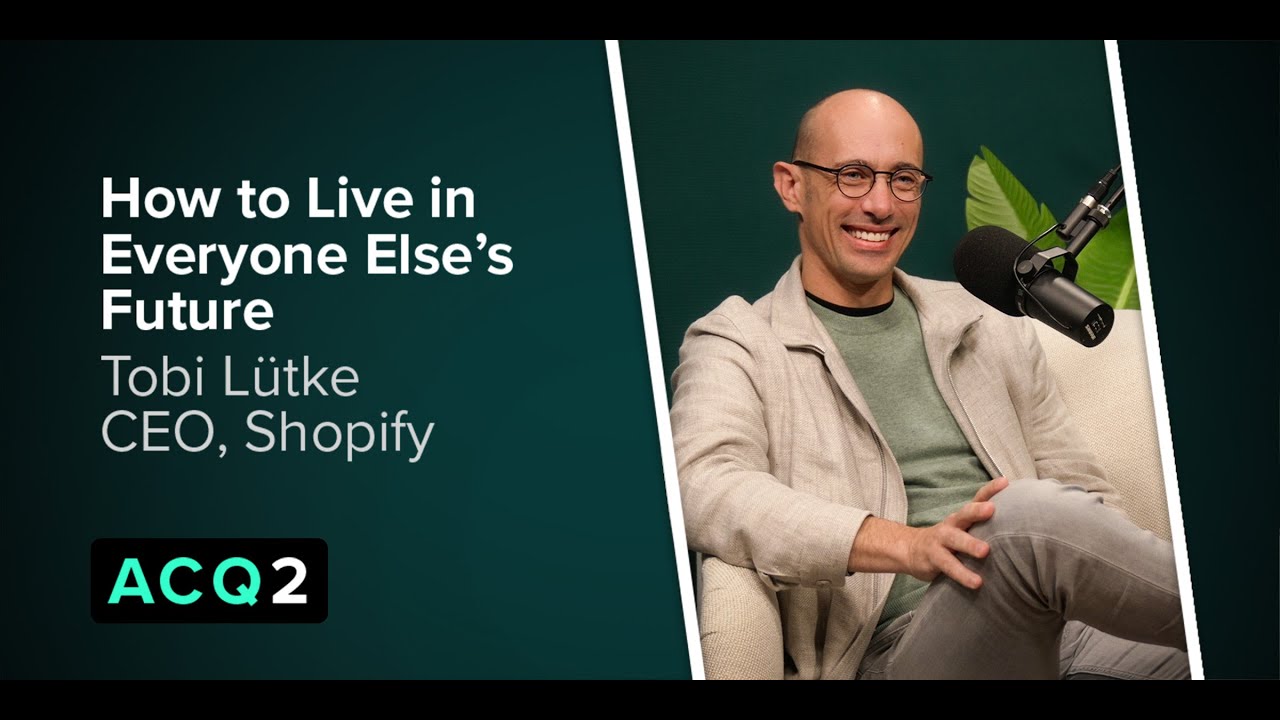
Shopify CEO Lütke Replaced Post-2021 Executive Team Over Management Style
Acquired
Lütke argues that consensus-driven decision-making represents the total absence of leadership and artificially caps a company's maximum potential productivity.
## Background
Published on YouTube by the Acquired channel on September 18, 2025, this episode of ACQ2 features an interview with Shopify CEO Tobi Lütke. The description highlights Lütke's unique trajectory as a programmer-turned-CEO steering a near-$200B enterprise by embracing AI-driven technological shifts and navigating massive stock market volatility with disciplined leadership principles.
## TL;DR
The conversation explores how Shopify and Tobi Lütke are navigating the AI era through active experimentation, 'context engineering,' and organizational mandates that replace traditional, rigid corporate structures. Lütke details Shopify's growth from its 2015 IPO to its 2021 meme-stock peak and subsequent crash, emphasizing how the company recovered by anchoring to robust underlying business metrics. He argues against consensus-driven management, advocating instead for founder-led legitimacy, fluid hierarchies, and product principles that raise a system's floor without capping its creative ceiling. Ultimately, the discussion balances tactical software engineering insights with broader philosophies on human agency, product design, and minimizing the gap to one's maximum potential.
## Atmosphere & style
The dialogue feels intellectually rigorous yet deeply conversational, driven by Lütke's analytical mind and reflective demeanor. There is a palpable sense of mutual respect between the hosts and the guest, shifting naturally from technical, first-principles dissection of software architecture to philosophical musings on sci-fi and parenting. It carries an optimistic, forward-looking energy that treats major market disruptions with an entrepreneurial, level-headed pragmatism.
## Key takeaways
- [00:00](https://www.youtube.com/watch?v=ewnNv8pxdM0&t=0s) Shopify went public in 2015 at a $1.5 billion valuation and has since scaled into an enterprise valued at nearly $200 billion, with its post-COVID stock recovery driven by strong underlying business metrics rather than market speculation.
- [01:18](https://www.youtube.com/watch?v=ewnNv8pxdM0&t=78s) Tobi Lütke manages rapid AI advancements by building a personalized evaluation framework called 'Tobi eval' to interview and test new models against specific expected results.
- [03:33](https://www.youtube.com/watch?v=ewnNv8pxdM0&t=213s) Software engineering projects in the 1990s resembled civil engineering with hard end dates, but contemporary software faces 'bit rot' because human expectations and user interface paradigms constantly evolve.
- [04:55](https://www.youtube.com/watch?v=ewnNv8pxdM0&t=295s) To accurately design for the future, leaders and teams must build courage and conviction by actively running raw developer beta software on their primary everyday devices.
- [07:47](https://www.youtube.com/watch?v=ewnNv8pxdM0&t=467s) Early adoption of faulty, lossy abstractions hides underlying system capabilities and damages software engineering, akin to building a house on a kitchen table instead of a proper foundation.
- [11:38](https://www.youtube.com/watch?v=ewnNv8pxdM0&t=698s) While engineering tools are often selected to raise the productivity floor for safety, they frequently lower the ceiling of maximum potential; AI shifts the entire scatter plot to raise the floor without constraining peak creative vision.
- [15:15](https://www.youtube.com/watch?v=ewnNv8pxdM0&t=915s) Traditional software required users to manage complex systems step-by-step via hill climbing, whereas AI allows users to feed high-level goals directly into software to immediately generate actionable prototypes.
- [19:15](https://www.youtube.com/watch?v=ewnNv8pxdM0&t=1155s) The Turing test was comfortably passed by older models like GPT-3.5 without public uproar or front-page news, demonstrating how quickly the hedonistic treadmill of human expectation normalizes technological breakthroughs.
- [26:29](https://www.youtube.com/watch?v=ewnNv8pxdM0&t=1589s) Modern architectural marvels are abstract systems—such as operating system kernels, web browsers, silicon lithography, data centers, and foundational models—rather than physical monuments like bridges or steel mills.
- [39:21](https://www.youtube.com/watch?v=ewnNv8pxdM0&t=2361s) Shopify instituted a company-wide AI mandate requiring employees to utilize AI as a first pass on every project, ensuring they adapt to evolving career baselines and help generate internal evaluation datasets.
- [45:52](https://www.youtube.com/watch?v=ewnNv8pxdM0&t=2752s) Mastering 'context engineering'—the skill of articulating a problem with enough clear background that a task can be resolved without follow-up questions—improves human communication and eliminates corporate politics.
- [55:34](https://www.youtube.com/watch?v=ewnNv8pxdM0&t=3334s) Lütke experienced a complete leadership philosophy shift from believing employees dislike being managed to realizing that people thrive under a well-led group with a clear vision and effective delegation.
- [01:04:28](https://www.youtube.com/watch?v=ewnNv8pxdM0&t=3868s) A technology company functions best when viewed as a jazz band, where leadership shifts dynamically based on merit and individual contribution within basic constraints, rather than a rigid Ford-style assembly line.
- [01:07:28](https://www.youtube.com/watch?v=ewnNv8pxdM0&t=4048s) Video games like Minecraft and rogue-lite typing games serve as powerful tools for child development, encouraging creative direction and providing a soft environment for learning to fail productively.
- [01:13:06](https://www.youtube.com/watch?v=ewnNv8pxdM0&t=4386s) Following an 80% market drawdown after 2021's meme stockification, Shopify restructured its executive team to eliminate managers who optimized for 'managing up' in favor of leader-driven context engineering.
- [01:13:06](https://www.youtube.com/watch?v=ewnNv8pxdM0&t=4386s) Founder-led companies possess an absolute legitimacy that allows for radical course corrections and restructuring during market volatility, a stark contrast to managerial companies where legitimacy lies solely in the pre-existing plan.
- [01:13:06](https://www.youtube.com/watch?v=ewnNv8pxdM0&t=4386s) Leadership and consensus exist on completely opposite ends of a spectrum; relying on consensus decisions guarantees a mediocre safety floor while systematically compressing the ceiling of true outlier success.
- [01:13:06](https://www.youtube.com/watch?v=ewnNv8pxdM0&t=4386s) The ultimate test of a CEO involves managing massive operational scale; Shopify coordinates a framework reviewing 1,000 ongoing projects while processing roughly $400 billion in sales and a GMV equal to a third of Canadian GDP.
- [01:46:37](https://www.youtube.com/watch?v=ewnNv8pxdM0&t=6397s) The core framework for a successful life involves minimizing the variance between your actual self and your maximum potential 'game over screen' self, while regularly checking in with your inner 16-year-old self.
## Detailed walkthrough
### [00:00](https://www.youtube.com/watch?v=ewnNv8pxdM0&t=0s) The Massive Growth and "Meme Stock" Era of Shopify
The conversation begins with an look back at Shopify's explosive evolution. Six years prior, Shopify was covered on the show as a much smaller entity; it had gone public in 2015 with a valuation under \$1.5 billion—a figure described as "very cute by today's standards." Today, Shopify has scaled into a massive public enterprise valued at nearly \$200 billion, generating roughly \$10 billion in annual revenue. The hosts note that their original intent for this session was a standard update on recent business developments, but the discussion quickly transformed into a deep, philosophical exploration of the state of computing and how artificial intelligence is altering what is possible to build.
The hosts reflect on the intense volatility the company and its CEO, Tobi Lütke, navigated over the past few years. They recall how Shopify essentially "almost became a meme stock," experiencing a dizzying valuation spike where its revenue multiple skyrocketed from a pre-COVID baseline of around 20x all the way up to a staggering 70x. Predictably, a sharp post-pandemic crash followed. However, the business has successfully rebounded and is trading near its all-time high once again. Crucially, this modern recovery is driven by robust underlying business metrics and actual revenue growth rather than the speculative, pandemic-fueled bets of the past.
- **2015 IPO Valuation:** Less than \$1.5 billion.
- **Current Valuation:** Nearly \$200 billion.
- **Annual Revenue:** Approximately \$10 billion.
- **Multiple Peak:** Rose from 20x revenue pre-COVID to 70x revenue during the peak.
---
[01:18](https://www.youtube.com/watch?v=ewnNv8pxdM0&t=78s) Interviewing the Software: Tobi’s Personal AI Evaluation Harnesses
When asked where he has spent a disproportionate amount of his mental cycles over the past month, Tobi responds with immense gratitude, stating it is the "privilege of a lifetime" to witness and participate in another foundational computing platform shift. He observes how remarkably fast human beings normalize completely futuristic breakthroughs. While most people quickly adapt to casual tasks like pasting text into ChatGPT, Tobi is deeply hung up on a more profound paradigm shift: "there's software that no one wrote, and I have to interview it to figure out its capability."
Because of this shift, Tobi spends a massive amount of time treating new AI models as raw entities that need to be evaluated. He wants to help turn these models into idealized, non-judgmental teachers for people. To do this systematically, Tobi reveals that he has built his own personalized testing framework, jokingly dubbed "Tobi eval." This framework consists of a folder of specific prompts paired with expected and judged results, which he runs against every new model that is released. He notes that while this concept of building "evals" is a niche, data-batching product inside the machine learning world, it represents a natural evolution of how engineers must interact with non-deterministic software.
---
[03:33](https://www.youtube.com/watch?v=ewnNv8pxdM0&t=213s) The Evolution of Software Engineering and the Trap of "Bit Rot"
The discussion shifts to how engineering paradigms have evolved over the decades, drawing a parallel between modern AI evals and the rise of automated unit tests in the late 1990s and early 2000s. Tobi shares an anecdote from his early days as an apprentice at Siemens. His *Meister* (master craftsman) used to tell him that an engineer has exactly two years to develop a piece of software, after which "it's like someone pours cement into it" and it will never change again. In the 1990s, software engineering was treated much like civil engineering—you built the bridge, the project had a hard end date, and if you wanted to change it drastically, you had to rewrite it from scratch, just as Microsoft did with major versions of Windows.
Tobi notes that modern software is supposed to evolve forever, yet it remains plagued by the mysterious phenomenon of "bit rot." He questions why a great piece of software often feels completely unusable or deteriorated a decade later despite the code itself remaining unchanged. The hosts point out that as soon as a new iOS version is announced, the previous one instantly feels like garbage. Tobi agrees, explaining that it is not a matter of the hardware slowing down, but rather that our human expectations and user interface paradigms have expired.
- **Apprenticeship Background:** Tobi's formative engineering perspectives were shaped during his time at Siemens.
- **Historical Analogy:** Software engineering in the 1990s behaved like civil engineering, treating codebases as rigid, finished physical structures.
---
[04:55](https://www.youtube.com/watch?v=ewnNv8pxdM0&t=295s) Living in the Relative Future via Beta Software
Tobi confesses to an unstoppable personal habit that serves as both a vice and a critical leadership tool: he physically cannot restrain himself from clicking the "update to latest beta" button the second it appears on any of his devices. Despite being the CEO of a massive public company, he runs raw developer betas on his primary, everyday phone. When bugs strike or essential daily apps crash, he does not complain or pull strings—noting he doesn't have Apple's Craig Federighi on speed dial—but instead views the disruption as a "delightful opportunity to learn about new apps" and explore interesting constraints.
This practice is core to how Tobi approaches product reviews at Shopify. For instance, while using Apple's new, initially maligned "liquid glass" UI paradigm, he realized how quickly new design standards can induce bit rot on everything else around them. During design reviews, Tobi pushes his own teams to run beta software so they can design for the device as it *will* be experienced by users in the future, rather than building for a world that is already being left behind. Tobi asserts that leading an industry doesn't require complex wizardry or perfect predictions: "If you just live in everyone else's relative future, which really is just a couple of... high conviction, high courage... update to beta clicks. It's not that hard."
---
[07:47](https://www.youtube.com/watch?v=ewnNv8pxdM0&t=467s) Lossy Abstractions and the "Kitchen Table" Foundation
The conversation transitions back to code production, with the hosts pointing out that because an immense amount of code is now generated by AI rather than humans, updating and maintaining software has become trivial. Tobi observes that while high-leverage, core architectural systems still require traditional, meticulous human craftsmanship, the glue code surrounding infrastructure can now be treated freely as a disposable first draft. This leads to a philosophical debate on the nature of abstraction in software. Tobi defines abstraction as "just another word for pretension," because every abstraction inherently pretends a system is simpler and different from how it actually operates.
When an abstraction is poorly designed or "lossy," it hides the true capabilities of the underlying system, resulting in a fragile "spider web of cables" and spaghetti code. The hosts bring up historical examples of the "write once, run anywhere" mobile development debacles from around 2012, such as PhoneGap, Xamarin, and Facebook's early, failed reliance on HTML5 to mimic native applications. Because the phones at the time were slow and the abstractions were incredibly lossy, developers lost access to the core capabilities of the hardware. Tobi summarizes the catastrophic danger of choosing a faulty abstraction early in a project with a vivid analogy: "It's like building your house on top of your kitchen table instead of on the foundation of your house."
- **Historical Cross-Platform Examples:** PhoneGap, Xamarin, and HTML5 mobile apps from circa 2012.
- **The Core Issue:** These platforms over-simplified the environment, blocking engineers from reaching the high-performance native features required for world-class software.
---
[11:38](https://www.youtube.com/watch?v=ewnNv8pxdM0&t=698s) Raising the Floor Without Lowering the Ceiling
Tobi expands on how software choices dictate the quality of a final product using a scale from 1 to 10, where 1 is horrible and 10 is a world-class masterpiece. Most businesses choose infrastructure and tools to "bring the floor up," ensuring that even with zero custom work, the project achieves a safe passing grade (like a 7 out of 10). This is exactly why merchants use Shopify; instead of embarking on a high-risk "death march" project to build an e-commerce platform and payment checkout from scratch, Shopify guarantees an incredibly high baseline of quality out of the box.
However, Tobi points out that a critical mistake toolmakers make is that the very systems designed to raise the floor often inadvertently "bring the ceiling down," capping the maximum potential of what a master craftsman can build. The ultimate goal for an infrastructure provider is to build a tool that radically raises the floor without constraining the ceiling. Tobi highlights that modern operating systems like Linux or Windows have achieved this balance after decades of trial and error. This is why he finds AI so profoundly exciting: its fundamental capability is to shift the entire scatter plot of human productivity, allowing creators to fully realize a perfect 10 out of 10 vision without being artificially constrained by the computer. "Computers should never... constrain people," Tobi concludes. "The computer is to get people to build things that they could not possibly imagine."
[15:15](https://www.youtube.com/watch?v=ewnNv8pxdM0&t=915s) Building Software with Human Goals in Mind
Computers exist to amplify human capabilities, "never to constrain what humans can do." When software achieves a perfect "10 out of 10" rating, it often happens because creators have broken away from standard expert conventions. While some users completely dedicate themselves to mastering incredibly complex software, the true role of software should be to minimize that exact necessity. The goal is to make platforms approachable so users can easily get online, set up a checkout system, and sell the products they spent so much time creating. If users have extra time to invest, they can then begin a process called "hill climbing" to further optimize their setup.
With the advent of AI, software can now directly ask users what their goals are, or deduce them from user behavior. While a lot of previous software avoided asking for goals because it could not actually execute a response—often leaving users with a stagnant, un-actionable to-do list—modern AI flows allow systems to fully action these requests. To build a stellar product, software creators must "sit on the same side of the table" as the user during intake, naturally gathering what they want to accomplish to generate an immediate prototype embedded with obscure best practices.
* **The Concept of "Hill Climbing":** A process where users initially launch their basic setup and then incrementally optimize their digital storefront as they find more time.
* **The Limitation of Pre-AI Software:** Traditional software could assist with basic record-keeping or host a static to-do list, but lacked the capability to automatically action user goals.
---
[17:02](https://www.youtube.com/watch?v=ewnNv8pxdM0&t=1022s) How AI-Driven Customization Tripled Sales for a Carpet Retailer
A concrete example of this AI capability involves a customer selling high-end carpets (initially referred to as "rugs," though the speaker corrects himself to better suit his accent). The business was making zero progress with its European expansion strategy and was on the verge of pulling out completely. They decided to utilize some newly rolled-out imagery tools. Without conducting a brand-new, expensive photo shoot, they used AI to seamlessly update their product images, changing the backgrounds from Malibu beach houses to Parisian apartments.
As a direct result of altering these background contexts, the company's sales tripled. While this type of rapid image manipulation is considered standard or "boring" today, it would have been technically impossible just three or four years ago. Previously, changing a strategy like this would require allocating significant capital, organizing a physical shoot in Paris, and pulling valuable team attention away from other parts of the business. The technology is now so advanced that the results are completely indistinguishable from real photography, meaning even the largest companies no longer need physical shoots.
* **The Scale of Impact:** Switching background environments via AI directly tripled the carpet company's European sales.
* **The Corporate Precedent:** Large corporations like IKEA already operate this way; the IKEA catalog features renders rather than real photographs. Similarly, modern car commercials feature digital renders of vehicles rather than actual cars driving on closed roads.
---
[19:15](https://www.youtube.com/watch?v=ewnNv8pxdM0&t=1155s) Passing the Turing Test Without a Parade
Reflecting on the trajectory of technology, the speaker recalls growing up on optimistic, far-future science fiction books by authors like Isaac Asimov and Robert Heinlein. His personal favorites include *Snow Crash* and William Gibson's *Neuromancer*, which he recently reread. In many classic sci-fi novels, authors included a "catch-up chapter" to establish the timeline, frequently predicting that humanity would pass the Turing test in a far-off year like 2110, sparking massive celebrations in the streets.
In reality, the Turing test was bypassed completely without anyone truly noticing. There was no *New York Times* front-page article or massive tech-community uproar; society simply accepted that we had entered the generative AI era. Even an older model like GPT-3.5—which is significantly weaker than models that can run locally on a modern smartphone—passed the Turing test with flying colors. When it happened, the tech world was so hyper-focused on arguing whether the model was a viable path to Artificial General Intelligence (AGI) that they completely overlooked the milestone.
* **Sci-Fi Favorites Mentioned:** *Snow Crash* and *Neuromancer*.
* **The Reality of the Milestone:** GPT-3.5 comfortably cleared the historical benchmark of the Turing test, yet the achievement received "no parades, no front-page news, no ticker-tape parades."
---
[21:10](https://www.youtube.com/watch?v=ewnNv8pxdM0&t=1270s) The Moving Goalposts of Human Expectation
Humans possess an incredible ability to continuously move the goalposts of achievement, behaving much like an "expectation-related version of a hedonistic treadmill." Society adjusts to changing circumstances and technological marvels incredibly quickly. Almost everyone alive today is living what would have been considered their own "dream life" from a few years ago, yet people rarely stop to appreciate it. Because it is deeply difficult to objectively judge our own immediate environment, society now criticizes the Turing test as an insufficient metric for intelligence simply because we have surpassed it.
While the general public treats these massive shifts as ambient background noise, a few tech CEOs recognize that we are currently living through a monumental platform shift. Cheap and plentiful technology is routinely taken for granted. For instance, remarkable augmented reality and virtual reality devices—like the Meta Quest or Meta glasses—are widely available for around $299, yet they quickly blend right into the ordinary world.
* **The Hedonistic Treadmill of Tech:** Human expectations adjust so rapidly to breakthroughs that revolutionary platforms are instantly integrated into the ambient environment.
* **The Cost of Innovation:** Devices featuring highly advanced mixed-reality hardware are accessible to consumers for as low as $299.
---
[23:45](https://www.youtube.com/watch?v=ewnNv8pxdM0&t=1425s) The Golden Age of Humanity and Virtual Reality Simulations
To illustrate our relationship with technology, the speaker highly recommends a VR game called *Job Simulator*. The game offers a satirical look at a far-future museum where humans go to discover what having a job was actually like. It places the player in a corporate cubicle where they must figure out how to work a computer, forcing them to manually plug a physical power cable into the wall to turn it on. The game is brilliant because it plays on how future historians and robots will inevitably get historical details slightly wrong.
This concept suggests that future generations will look back at our present era as the true "golden age of humanity" or "the end of the beginning." A thousand years from now, historians will study our current decades with the same gravity used to study Cicero and the end of the Roman Republic. While the evening news focuses heavily on contemporary political strife and current affairs, those events will eventually fade into simplistic historical terms. The lasting legacy of this era will be the rapid delivery of incredible technology that grants immense agency to individuals with a vision. Everything people truly love is the ultimate residue of someone else's passion, reminding the speakers of a favorite quote by John Collison on X: a museum is simply a collection of "other people's passion projects."
* **Historical Parallel:** The current technological era will likely be studied in 1,000 years the same way modern historians study Cicero and the collapse of the Roman Republic.
* **The Core Gift of the Era:** The primary outcome of the current technological wave is giving massive agency to individual human vision.
---
[26:29](https://www.youtube.com/watch?v=ewnNv8pxdM0&t=1589s) Abstract Monuments and the Great Works of Software
When looking at a life that spans founding a company in the early web era, guiding it through the mobile transition, maintaining hobbies like racing simulation, and raising a family, the surrounding world is undergoing the most transformative shift seen in hundreds of years. In response to living through such a crucible moment, the speaker views it as his duty to "transmit some of the awe" he feels about these times.
Humanity has developed a flawed self-narrative of decline. People point to the past, noting how the Golden Gate Bridge was built in just a few years, and lament that society can no longer achieve great physical works on par with Bethlehem Steel or Henry Ford's factories. However, humanity is still building monumentally great works; they are simply abstract. Today's great works are operating system kernels, web browsers, complex software platforms, silicon lithography, foundational models, and the immense data centers built to support them.
* **The Shift in Human Achievement:** Modern "great works" have shifted from grand physical infrastructure to digital architecture, such as OS kernels, browser technology, and silicon lithography.
* **The Hidden Giants:** Unlike historic factories or refineries, which look physically imposing and require zero explanation to appreciate, modern data centers are deliberately hidden. They lack ornamentation, bear no outward corporate logos, and are frequently omitted from public maps, leading the general public astray regarding the scale of what is being built.
[31:13](https://www.youtube.com/watch?v=ewnNv8pxdM0&t=1873s) The Concrete vs. The Abstract in Technology
Software lacks the immediate, tangible appeal of the physical world, making it a highly abstract medium that human brains are not naturally preloaded to appreciate. While anyone can look at an architectural wonder like the Pantheon and immediately appreciate its beauty—backed by thousands of years of mathematical ratios explaining its perfection—software does not enjoy the same clarity. Describing why a piece of software is truly "good" remains an elusive task rooted in cultivated taste. This poses a unique challenge for tech founders, who must actively rewire their brains to find value in an intangible product, an arduous process that might not even be worth the immense time it takes.
This tension between the concrete and the abstract is vividly apparent in retail. Shopify merchants love building physical, brick-and-mortar stores because they can physically stand inside them, touch the inventory, rearrange the layout daily, and personally watch how customers handle the clothing or choose what to look at first. By contrast, an online store abstracts this human behavior into numbers, graphs, and live visitor stats that fail to trigger the same sensory satisfaction. Even if an entrepreneur trains themselves to be entirely data-driven, an fMRI scan of their brain analyzing a day's stats would show only the narrow prefrontal cortex lighting up. In contrast, remembering a day spent talking to people inside a physical shop would light up the entire brain.
This cognitive disconnect resonates deeply with the experiences of podcasters. When an episode of *Acquired* is released, its dashboard metrics instantly skyrocket to hundreds of thousands or millions of downloads, yet looking at those massive numbers often evokes zero emotional response. However, hosting a live, in-person event at Radio City Music Hall for a tiny fraction of that digital audience blows up the entire brain, triggering unprecedented emotions, building relationships, and leaving the hosts on "cloud nine" for weeks. This fundamental human constraint may be entirely unresolvable because human hardware is hardwired for physical reality; while the highly malleable frontal cortex can be convinced to intellectually appreciate abstract data, the primitive lizard brain remains completely unmoved. While some wonder if a future filled with immersive virtual reality (VR) could bridge this gap by rendering digital storefronts as physical crowds of shoppers, it is highly unlikely that technology can ever truly replace or replicate genuine physical experiences.
---
[35:10](https://www.youtube.com/watch?v=ewnNv8pxdM0&t=2110s) Finding a Human Mission in the Age of AI
As the technological landscape undergoes a historic shift, the most fulfilling position an individual can take is to anchor themselves to a mission they deeply care about and help bridge the future to others. Rather than viewing the rapid evolution of technology as an existential threat, people should focus on integrating these new capabilities while identifying the distinctly human elements that machines cannot replicate. Music and writing are experiencing massive disruptions due to AI's ability to generate text or create extraordinary audio directly from neural inputs, but this transformation should be treated as an invitation to master new creative instruments rather than a reason to despair.
The world of chess serves as a perfect historical precedent for how humanity reacts to superior machine capabilities. For the past 20 years, the absolute best, most complex games of chess have been played exclusively by machine against machine, yet no one watches or studies those matches because there is no human stakes involved. Instead, global audiences remain captivated by human grandmasters like Magnus Carlsen. People do not care about the perfect execution of chess in a vacuum; they care about the human drama of humans playing chess. Treating new AI capabilities as instruments to be played allows individuals to steep themselves in spaces that were previously impossible, solving hard problems while they are still novel, and teaching others along the way.
The financial technology backbone Plaid serves as an excellent example of invisible but ubiquitous modern infrastructure. Roughly one in two Americans has used Plaid without even realizing it when linking their traditional bank accounts to digital applications like Robinhood, Venmo, or Chime. Beyond simplifying bank connections, Plaid acts as the technical foundation for thousands of companies looking to build faster, safer, and more seamless financial experiences. They convert old-school banking protocols into instant processes while actively reducing fraud and accelerating user onboarding.
* **Product Enhancements:** Plaid rolled out cash flow data systems to improve credit underwriting decisions, AI-driven anti-fraud tech, and enhanced analytics for bank payments.
* **Expansion:** They are expanding features across all three core categories and helping businesses manage direct billing for recurring subscriptions.
* **Resource:** For a deeper dive into how Plaid scaled one of the largest networks in financial services, listeners can check out the recent *ACQ2* interview with Plaid’s founder and CEO, Zach Perret.
---
[39:21](https://www.youtube.com/watch?v=ewnNv8pxdM0&t=2361s) The Shift from Solutions to Problems and the Mandate for AI
The competitive landscape of AI is shifting rapidly from an individual edge to an industry baseline. A tech CEO recently built a custom AI agent to run his fantasy football draft by scraping the internet and calculating overlooked variables, such as a player's exact propensity to get injured. After the agent completely crushed the league, every single participant returned the following year armed with their own AI agents, raising the baseline of play. This pattern demonstrates that within five years, success will not belong to unassisted creators, but to those who are the absolute best at operating these tools. In tech, the decade spanning roughly 2015 to 2021 was a period of relative stability where companies simply scaled mobile platforms born in the prior decade, but today's accelerating pace of change splits professionals into two distinct camps: those who fall in love with solutions, and those who fall in love with problems.
Falling in love with specific solutions leads to inevitable grief when those solutions become obsolete. For veteran programmers, low-level algorithmic implementation has undergone an artistic loss; typing a function name now auto-generates gray text that implements the code instantly upon hitting the tab key—often better than a naive human first attempt. However, individuals who love the core problem itself find themselves immensely enabled. Early in a career, it is impossible to fall in love with solutions because you don't know them yet, but over time, corporate job descriptions and hyper-specific titles like "sales operations expert" calcify people into rigid paths. Workers must shed these restrictive titles, step back to when exploring their craft was genuinely fun, and focus entirely on how they can dynamically contribute their human talents to a broader mission.
To enforce this cultural shift, Shopify issued a company-wide memo making it a formal requirement for employees to reflexively reach for AI as a first pass on every project. While leaked in bad faith and met with outside controversy, the policy simply establishes that failing to adopt AI is unfair to the workforce, as those who embrace it will naturally sequester the best career opportunities for themselves. The mandate isn't about the ultimate quality of the initial AI prototype; if the AI performs terribly, employees are encouraged to make fun of it. The true value lies in the exercise itself, which either uncovers surprising capabilities or generates a robust "Eval" (evaluation test) to measure the next generation of AI models.
---
[45:52](https://www.youtube.com/watch?v=ewnNv8pxdM0&t=2752s) Context Engineering and Corporate Politics
The foundational skill of the modern AI era is "context engineering," which represents the ability to state a problem with enough comprehensive background context that the task is entirely solvable without requiring a single piece of follow-up information. While advanced autonomous agents are becoming highly proficient at identifying missing data and retrieving it themselves, learning to write prompts that do not require an agent to guess remains an invaluable human skill. Mastering context engineering yields higher success rates and lowers compute costs, but its most profound benefits manifest in purely human interactions.
Perfecting the discipline of context engineering drastically improves everyday professional communication, leading to significantly better emails by forcing the writer to recognize exactly how much context is typically left unsaid in standard instructions. Ultimately, a massive portion of what corporate employees traditionally complain about and describe as "politics" within their companies is actually just the toxic byproduct of bad context engineering.
[47:18](https://www.youtube.com/watch?v=ewnNv8pxdM0&t=2838s) Codifying the "Secret Sauce" for AI
The conversation begins with a realization about digging into root-cause problems, where one often discovers a fundamental disagreement on what "good" looks like for a specific area. The hosts share that they have recently begun writing down instructions for AI to execute tasks they previously considered part of the "secret sauce" of their podcast, *Acquired*. They discovered that their creative process was actually less magical than they thought; it was simply a failure of prior introspection. Once a process and its evaluation framework are explicitly written down, an AI can execute them remarkably well.
At Shopify, this concept is taken even further. They use a tool inspired by Anthropic's terminology called "constitutions." These documents avoid meaningless corporate platitudes by focusing exclusively on real choices—specifically, trade-offs where another company could plausibly choose the exact opposite side. Writing down your uniqueness creates an incredible context window. You can even upload transcripts of your favorite episodes and ask the AI what is missing from the constitution, which yields fascinating, and sometimes scary, suggestions for improvement.
* Shopify uses "product principles" that are continuously refined in a collaborative "hill-climbing" feedback loop with AI.
* Internal projects at Shopify are run against these principles during review time to spark interesting discussions rather than act as a control mechanism.
* Writing for AI requires deterministic instructions for a non-deterministic machine, which can uniquely test the creator by pointing out hidden contradictions.
[51:51](https://www.youtube.com/watch?v=ewnNv8pxdM0&t=3111s) Interviewing the Idealized Self and the 15-Year Archive
The discussion shifts to how the latest series of AI models excel when they are properly interviewed. With the reasoning capabilities seen in recent models, the speaker notes that they now ask the AI what their *next* question should be, frequently receiving better prompts than they could have come up with themselves. Because the AI is trying to predict the best outcome without relying on the biases of a human memory bank, it effectively executes against an idealized, average-proof version of the user.
This leads to a staggering revelation: the speaker has secretly run a keyboard logger, active window tracker, and automated screenshot tool on their personal machine every 10 minutes, archiving their daily digital activity for going on 15 years. The hosts are completely floored, calling it a "moment by moment source of truth" and an incredible gift that virtually nobody else possesses.
* The 15-year archive captures the exact digital timeline of how Tobi became Shopify, and how Shopify became Shopify.
* Weekend projects now consist of using AI tools to clean up the dispersed formats, calendar items, email headers, and noisy keyboard buffers (including messy Vim commands).
* The data is stored in text files because it is "the best format in the world" for long-term digital preservation.
* The original motivation for the tracker was simply a personal curiosity to see what applications and tasks were consuming daily time.
[55:34](https://www.youtube.com/watch?v=ewnNv8pxdM0&t=3334s) The Brain as a Press Secretary and the Leadership 180
Reflecting on the data from the archive, the speaker notes how fascinating it is to chart their personal transition from full-time programmer to fundraiser, and ultimately to CEO. The data allows them to objectively track how their beliefs changed over time, which stands in stark contrast to how human memory works. The human brain is not a chronological data bank; rather, it functions as a "backwards facing narrative consistency optimization device." They reference the book *The Elephant in the Brain*, which compares a portion of the mind to a corporate press secretary—always generating a perfectly rational, retrospective explanation for a decision that it wasn't actually present for when the choice was made.
When pressed by the hosts about what specific beliefs have undergone a complete 180-degree turn since the early founder days, the speaker admits that they originally did not believe in the value of leadership at all. They used to think that if you simply gathered exceptional individuals, they would naturally move in the right direction because people universally disliked being managed.
* The speaker has completely changed their mind, stating, "I think people love leadership." They note that being part of a well-led group with a clear vision is deeply fulfilling.
* As a personal getaway, the speaker loves attending hackathons just to take a vacation from leading and tell others, "you tell me what to do."
* In the earliest days of Shopify, the first 10 or so employees all made the exact same salary to avoid difficult conversations.
* While acknowledging how "egalitarian socialist" that salary structure sounds, the speaker values having tested it from first principles and rejecting it sequentially, rather than just adopting derivative corporate ideas.
[01:02:47](https://www.youtube.com/watch?v=ewnNv8pxdM0&t=3767s) Liberating Through Delegation and the Founder Archetype
Tobi reflects on how he used to approach tasks he disliked, noting that while anyone can quickly get to 80% of the state of the art on any topic, he found himself miserable doing certain things. Ironically, he had no problem delegating things he actually enjoyed because he knew they were fun, but he stubbornly handled the tasks he disliked himself out of a sense of guilt. He overdid this to such a degree that it eventually "broke," which he views as a positive turning point. He notes that if something just sort of works, you don't feel the need to counteract it, but when it completely breaks you, it forces you to examine the entire picture. This led to the incredibly liberating realization that "everything I don't like is someone else's dream job," which has since inspired him to create plenty of beautiful dream jobs out of things he wants no part of.
When people ask him why he still enjoys programming and finds value in it, Tobi explains that his mind simply cannot find fun in things that aren't valuable; to him, fun and value are essentially the same. He trusts his mind's intuition, viewing a sudden pull toward a specific direction as a premonition of future value, whether it provides a fresh perspective, an analogy, or a networking opportunity. He identifies this perfect alignment as the core of the successful founder archetype: "having that intuition where the overlap of things that are interesting and exciting to you and value creative just like happen to be perfectly overlapping."
---
[01:04:28](https://www.youtube.com/watch?v=ewnNv8pxdM0&t=3868s) The Jazz Band Metaphor for Technology Companies
Tobi explains that a lot of his leadership philosophy actually stemmed from learning to play the guitar. Though he claims to be "very bad at it," he became fascinated by music theory and different genres, which completely transformed what he got out of music. This passion eventually led him to spend time with top-tier jazz musicians. It was only after seeing how a jazz band functions that he truly understood what leadership should look like, arguing that the traditional corporate world's rigid "chain of command" is fundamentally incorrect.
In a jazz band, there is a clear leader, but that leadership dynamically shifts and moves around. A true leader does not dictatorially mandate what to play, what to eat, or how to spend time. Instead, they invite people of merit and ask everyone to contribute what they have to a very basic set of conventions—such as a specific key and a tempo. The music is entirely emergent, created in the moment, and dependent on the skill and taste of the individuals who show up. Tobi asserts that this is the absolute best metaphor for a great team. While there must be constraints, group members can propose changes, transition to a new set of chords, or move from major to minor. Musicians will even play dissonance to intentionally create tension against the rules before beautifully bringing the music "back home," which requires true mastery.
David immediately connects with this idea, stating that it "sounds to me like the definition of a technology company." Tobi enthusiastically agrees, noting that while Henry Ford's assembly line required every worker to do the exact same thing to ensure identical cars came out, software simply does not work that way. When organizations try to force software development into a rigid widget-turning assembly line, they only get about 2% out of the incredible individuals they hired. Leaders must give people the room to contribute and then hold them to it.
---
[01:07:28](https://www.youtube.com/watch?v=ewnNv8pxdM0&t=4048s) Raising Kids with Video Games and the Steam Deck
Transitioning to a topic he has learned a lot from, Tobi highlights how video games have taught him about business. David, asking for personal research, queries Tobi on exactly when and how he started playing video games with his kids. Tobi notes that his family avoided screens until the kids were two years old, though he admits he doesn't necessarily know if that's definitive good advice. He recalls sitting on the couch with his two-year-old on an iPad, loading up *Minecraft*, and letting the child point at the screen to dictate what to build. Even though two-year-olds only know a handful of words, Tobi found that letting them act as the "jazz director" of the play session yielded incredibly creative structures, like elaborate treehouses, that he never would have imagined on his own. He pushes back against the common maligning of video games, arguing that they provided crucial creative downtime for him to shut off his brain and connect with his child.
This gaming routine intensified significantly during the COVID-19 lockdowns. Tobi was deeply worried about the impact of isolation on his boys at an age where "failing softly" and making mistakes is a critical part of growing up. Tobi credits his own success to having failed more than most people, and he wanted to cultivate that same comfort with being bad at things in his children. David chimes in to share that his daughter is about to turn four and has just entered this stage. He previews an ongoing saga from his podcast regarding whether or not he would buy a Steam Deck, revealing that he finally has one. He describes the joy of watching his daughter go from looking "like a monkey try to use a joystick" to successfully moving characters around and figuring out how to precisely press the A button rather than just spamming it. Tobi agrees that it is incredibly hard but vital to avoid jumping in to do it for them, opting instead to give pointers.
- Tobi's middle child, who is dyslexic like Tobi and another sibling, used a rogue-lite typing game found on Steam to overcome his frustration with typing.
- The game features enemies pulling words toward the player, requiring them to type the words to shoot them down while unlocking upgrades.
- The typing game successfully engaged all of Tobi's kids; the middle son improved his typing speed from 16 words per minute to roughly 70 words per minute in just a single month.
---
[01:13:06](https://www.youtube.com/watch?v=ewnNv8pxdM0&t=4386s) Living Through the 2021 Market Drawdown
David steers the conversation back to Shopify's specific corporate journey, asking Tobi what it was like to live through the "meme stockification" of 2021, which was followed by a staggering 80% market drawdown. David frames it as a "public market valley of despair" and asks what Tobi would tell his past self if he had a time machine. Tobi admits the question often stumps him because, from the inside, the experience actually "wasn't that interesting." If he could use a time machine, his only advice to himself would be to quickly establish the necessary credit ratings and facilities to opportunistically execute a massive stock buyback when the price bottomed out. David laughs, calling the response "spoken like a true entrepreneur" who just wanted to own more of his own company.
Tobi emphasizes that while the stock price plummeted, the actual fair market value and internal operations of Shopify did not change at all. The price drop was entirely driven by external market dynamics and shifting investor convictions. When low-conviction investors outweigh high-conviction ones, the clearing price naturally shifts down. This shift wasn't due to Shopify's performance, but rather because the general "vibe changed," interest rates shifted, and macro events like Russia's invasion of Ukraine moved every single stock across the entire market.
The only group Tobi feels genuine frustration toward is sell-side analysts who continued to issue buy ratings when tech companies were trading at absurd valuations, such as 70-plus times revenue. He views that as a clear failure of professional advice, noting that firms like Goldman Sachs would perform fundamental analysis, realize a stock was overvalued, and sell it to everyday retail investors who ultimately "lose their shirt." Conversely, Tobi takes immense pride in having made a lot of money for early, high-conviction investors, noting that Shopify stands out from its peer cohort because they chose to go public remarkably early, in 2015.
- Shopify originally launched its product in 2006, which Tobi marks as the true beginning of the company.
Going Public with Conviction
Shopify went public about nine years after its initial journey began, which stands in stark contrast to the modern environment where companies wait up to a decade or longer. Impressively, they went public with every single dollar they had ever raised still sitting untouched in the bank, debuting at a valuation of $1.5 billion. While the hosts note that a $1.5 billion valuation sounds "crazy low" by today's hyper-inflated standards, the facility of public markets is highly praised. Being a public company allows the general public to directly participate in the company's growth, giving everyday investors the opportunity to buy shares based on raw conviction and hold them long-term in tax-free savings accounts.
There is an active desire to encourage other entrepreneurs to take their companies public, reframing it as "the right thing to do" rather than an insurmountable hurdle. Although the process is occasionally annoying, it forces a company to mature structurally. For Shopify, the path to going public served as an unexpected forcing function for operational excellence. While 20% of the process felt miserable and self-pitying, the remaining 80% was utterly invaluable, completely transforming Shopify into a truly data-driven organization.
- Shopify went public 9 years into its journey at a $1.5 billion valuation.
- Every dollar previously raised by the company was still in the bank at the time of the IPO.
- The speaker estimates that 80% of the IPO process was highly valuable for company development, while 20% was simply tedious.
The 2021 Transition and Context Engineering
Looking back at the tumultuous period around 2021, the hosts highlight how outside analysts were issuing constant buy ratings while internal leadership felt the company was not being run as well as it could be. This realization sparked significant structural and personnel changes. Having 21 years of history with Shopify provides a massive advantage in "context engineering," since decades of important strategic decisions are pre-loaded into memory, allowing for quick adjustments to product and strategy.
Aside from Harley, the company's president who has provided 15 to 16 years of incredible storytelling and internal capacity-building, almost the entire executive team has been replaced with more recent hires. The previous team members weren't bad people, but over time, they had developed an optimization function designed to manage up. They learned exactly how to present their departments in a rigorous light to deliberately steer attention away from their areas. When the disruptions of COVID-19 hit, this abstract management style evaporated. Leadership deep-dived into every project, spoke directly with teams, and went straight to the engineers whenever a project got stuck. Today, Shopify operates on a strict four-week review cycle powered by an internal ledger called "GSD" (Get Shit Done), where AI analyzes every project against core product principles to ensure cohesive execution.
- Harley has been the President of Shopify for 15 to 16 years, acting as a key internal partner.
- Except for the president, every current executive at Shopify is a more recent hire compared to the pre-2021 team.
- Project tracking is managed via an internal ledger called "GSD," which uses AI to evaluate projects against product principles every four weeks.
The Power and Legitimacy of Founder-Led Companies
The ability to radically restructure a high-performing company during a period of market enthusiasm is a luxury unique to founder-led businesses; a traditional corporate manager would have likely been fired for attempting it. There is a massive distinction between founder-run companies and managerially run corporations, to the point where they almost deserve completely different corporate classifications. While traditional managerially run companies look highly professional and "have their [stuff] figured out," the most valuable companies in the world consistently lean toward founder-led structures because they are fundamentally better at adapting to rapid market shifts.
In a managerially run company, nobody—not even the CEO—carries absolute legitimacy. Instead, "the plan carries the legitimacy," and the corporate CEO acts merely as an avatar or an advocate for that pre-approved plan. Changing course requires an immense amount of activation energy. Conversely, when legitimacy is fully invested in a single individual, a company can pivot on a dime. This model succeeds when the leader is highly conscientious, data-driven, and subscribes to the philosophy of having "strong opinions weakly held." It operates on a high batting average where the monumental breakthroughs easily compensate for any minor experimental downsides.
Re-founding Events and the Future of Corporate Trust
Recording from the Sequoia Capital offices, the conversation turns to what makes a great leader, recalling an Amazon leadership principle popularized by Jeff Bezos: leaders simply "have to be right a lot." The participants debate whether this level of trust can be earned by non-founders, pointing to Satya Nadella at Microsoft and Jamie Dimon at JPMorgan Chase as prime examples of traditional CEOs who transcended managerial limitations. These leaders achieved this by executing "re-founding events," breaking cleanly from the past to completely rewrite their companies' cultures. For example, under Satya, Microsoft shifted to being deeply pro-open source, famously adopting WebKit for its browser over Internet Explorer and building a powerhouse business without even owning the dominant consumer platform of the era.
This concept of a re-founding event is an employable, albeit risky, strategy that requires immense intestinal fortitude from both the incoming leader and the shareholders who must hand over absolute control. This approach is becoming more common, as seen with former Shopify executive Kaz moving to OpenDoor under a founder-like compensation structure featuring a $0 base salary tied entirely to stock performance. While this high-alpha approach introduces massive upside and downside risks that conservative investors traditionally avoid, the ongoing platform shifts in the technology world are making this high-trust, founder-style framework absolutely essential for survival.
- The recording took place at the Sequoia Capital offices due to home construction.
- Satya Nadella (Microsoft) and Jamie Dimon (JPMorgan Chase) are cited as premier examples of non-founder CEOs who enacted "re-founding events."
- Former Shopify executive Kaz transitioned to OpenDoor under a high-stakes, $0 salary compensation structure tied strictly to stock equity performance.
The Anti-Correlation of Consensus and Leadership
The discussion transitions into how a founder-run business should operate as an actual company rather than a chaotic beta project. Reflecting on a personal realization that made him feel "very very dumb" for taking so long to discover, Tobi argues that leadership and consensus exist on entirely opposite ends of a spectrum. "Every time consensus makes a decision, it's the absence of leadership," he notes, suggesting that people frequently abnegate their leadership responsibilities simply to prioritize group agreement over finding the absolute best solution.
When asked if alarm bells go off when he senses consensus forming at Shopify, Tobi admits to using it strategically to stall initiatives. For example, he believes most companies overcomplicate their products by constantly tweaking pricing and A/B testing discounts, which cheapens the brand and muddies data. To combat this, he institutes a strict rule: pricing is evaluated from first principles only once every five years. To keep people from distracting the company with pricing ideas in the interim, he employs a highly efficient corporate move: he creates a "pricing council." Because the council operates by consensus, they rarely reach a decision, and if they do, it is incredibly easy for him to just say no.
* **The Pricing Council Tactic:** A deliberate use of committee consensus to prevent unnecessary product and pricing adjustments.
* **The Five-Year Rule:** Pricing at Shopify is set and then sent "back into firmament" for a five-year period to preserve company focus.
---
Fluid Hierarchies and Rule by Fiat
The speakers debate the efficacy of "V teams" (virtual teams) and committees. While some view them as a sign that a task belongs to nobody, Tobi maintains they can work beautifully if there is an extremely clear, single leader. He invokes the classic Apple and Amazon concept of the DRI, or "directly responsible individual," emphasizing that someone's name must be explicitly tied to the responsibility. Hierarchy should remain fluid; Tobi notes that he regularly participates as a standard team member—not the leader—during company hack days. He also warns against the default corporate habit where the highest-paid person in the organization (the HIPPO) automatically makes the decisions, jokingly adding that he takes a \$1 salary partly to disrupt that signal and encourage a healthy "conflict of opinions."
Returning to the consensus spectrum, Tobi explains that consensus decisions usually land as a safe six or seven out of ten. By design, the process optimizes for a lack of downsides, achieving a baseline floor but severely "cramming that ceiling down." True outliers—the eights, nines, and tens—can only be built via a single vision executed by a team, rather than a vision negotiated by a committee.
* **The DRI Concept:** Strongly utilized by companies like Apple and Amazon to ensure singular accountability.
* **The HIPPO Effect:** The tendency for the Highest Paid Person's Opinion to dominate a room, which Tobi actively works against.
* **The Score Spectrum:** Consensus guarantees a safe floor (6 or 7 out of 10) but prevents a company from hitting a 10 or "dying trying."
---
Creative Autocracy and Great Partnerships
To illustrate why extreme outliers require an auteur vision rather than a collaborative compromise, Tobi points out that great books are virtually never written by large committees; they require a single author, with the editor serving strictly in a supportive role. This prompts the host to ask a compelling counter-question: how can they champion auteur-driven systems when they themselves successfully operate a two-person partnership where neither is the absolute boss? The host jokes that they are like a "married couple" with a "fused brain."
Tobi counters that a great two-person partnership is not a consensus committee. Instead, it relies on deep mutual trust and recognizing who has the higher batting average in specific areas. The host agrees, noting that their iMessage history would show that if either partner genuinely wants to pursue an idea, they simply do it. Tobi shares a parallel from Shopify’s early history with his co-founder and former Chief Design Officer, Daniel Weinand. While Tobi wrote the code and decided what to build, Weinand held absolute veto power over features if the user experience (UX) wasn't perfect. This strict division of ownership allowed Shopify to stand out as "the Linear of our time with Figma" due to its brilliant UX in 2006.
* **Daniel Weinand's Role:** Co-founder and Chief Design Officer who held absolute veto rights over feature UX.
* **Shopify's 2006 Advantage:** Differentiated itself entirely based on brilliant, auteur-driven user experience design.
* **Idea Liquidity:** Tobi's preferred model of pulling decision-making inward to a high-context environment rather than pushing it top-down or grass-roots.
---
Massive Scale and the Ultimate Test of a CEO
The conversation shifts to the staggering societal weight of Shopify's infrastructure. Tobi describes the grueling review cycles he runs, which involve tracking a thousand ongoing projects from 8:00 a.m. to 10:00 p.m. for three days every month. He admits he simply loves the work, which is essential given that Shopify has evolved into a critically important piece of global software. If Shopify disappeared overnight, multiple countries would suffer an immediate drop in secondary GDP growth. The platform handles roughly \$400 billion in sales, making its gross merchandise value (GMV) equivalent to about a third of the entire Canadian GDP, and ranking its checkout system among the top three busiest on Earth.
This immense scale informs how Tobi evaluates leadership. He rejects the traditional managerial metric where a CEO is judged or fired solely based on short-term results. Instead, he believes a leader must ask: "Out of what opportunity did you carve what company?"
To highlight the consequences of squandering an opportunity, he points to eBay. In its prime, eBay owned PayPal and boasted a staggering talent density that included Peter Thiel, Elon Musk, Max Levchin, and David Sacks. Because it was an asset-light business with first-mover advantage, eBay logically should have captured all of internet commerce, yet it failed to maximize that massive potential. Similarly, he notes how Microsoft missed a multi-trillion-dollar opportunity by not leveraging the PC to run an absolute app store marketplace, a model Apple later used to charge a 30% fee on platform economic activity.
* **Shopify's Economic Footprint:** Represents a massive checkout scale and an aggregate GMV of roughly \$400 billion.
* **The PayPal Mafia Era:** eBay once held an unmatched talent density including Musk, Thiel, Levchin, and Sacks, but failed to sustain its total commerce dominance.
* **Stored Potential Energy:** The theory that every legendary company leaves latent economic value on the table that it chooses not to actively exploit.
[01:46:37](https://www.youtube.com/watch?v=ewnNv8pxdM0&t=6397s) Minimizing the Potential Gap and Consulting the Inner 16-Year-Old
The conversation shifts into a deeply philosophical reflection on personal potential and decision-making framework. Tobi shares his unique mental model for life, which echoes a concept often discussed by Jeff Bezos, though Tobi approached it from a more philosophical angle before knowing Bezos's framing. He describes a striking "game over screen" scenario at the end of one's life. In this visualization, you are met with the absolute best version of yourself that you could have possibly become. Tobi believes that the core work of a human being on planet Earth is to actively minimize the difference between who they actually ended up being and that ideal potential. While he admits this framework is not an objective truth, he emphasizes that it is "a very valuable story to believe" and one that provides immense personal utility.
Expanding on this concept of temporal self-reflection, Tobi argues that minimizing future regret on a deathbed is only half the equation. He introduces a critical counterweight: the necessity of consulting your inner 16-year-old self. He notes that we live in exceptionally amazing times and have accomplished so much, pointing out that almost everything we currently possess is something we dreamed of having at some earlier point in our lives. By checking in with that younger version of ourselves, we can appreciate the fulfillment of those past dreams. The hosts find this a perfect, profound note to conclude the discussion, calling it a "cheap way to make better decisions" that they wish more people would utilize. The episode wraps up with warm expressions of mutual gratitude, as Tobi praises the podcast and thanks the hosts for allowing listeners to be a fly on the wall during their discovery journeys into storied companies and individuals.
- **The Game Over Screen Concept**: A visualization where a person meets the absolute best version of themselves they could have become at the end of life.
- **The Core Goal**: To minimize the variance between your actual self and your maximum potential self.
- **Dual-Perspective Decision Making**: Balancing the perspective of the future deathbed self with the dreams of the inner 16-year-old self.
## Notable quotes
> [01:58](https://www.youtube.com/watch?v=ewnNv8pxdM0&t=118s) there's software that no one wrote, and I have to interview it to figure out its capability. — Tobi Lütke
> [03:33](https://www.youtube.com/watch?v=ewnNv8pxdM0&t=213s) it's like someone pours cement into it — Tobi Lütke
> [04:55](https://www.youtube.com/watch?v=ewnNv8pxdM0&t=295s) If you just live in everyone else's relative future, which really is just a couple of... high conviction, high courage... update to beta clicks. It's not that hard. — Tobi Lütke
> [07:47](https://www.youtube.com/watch?v=ewnNv8pxdM0&t=467s) It's like building your house on top of your kitchen table instead of on the foundation of your house. — Tobi Lütke
> [11:38](https://www.youtube.com/watch?v=ewnNv8pxdM0&t=698s) Computers should never... constrain people — Tobi Lütke
> [11:38](https://www.youtube.com/watch?v=ewnNv8pxdM0&t=698s) The computer is to get people to build things that they could not possibly imagine. — Tobi Lütke
> [19:15](https://www.youtube.com/watch?v=ewnNv8pxdM0&t=1155s) no parades, no front-page news, no ticker-tape parades. — Tobi Lütke
Shopify CEO Tobi Lütke argues that enduring technological leadership requires living in the future through early technical adoption, harnessing non-deterministic AI via rigorous context engineering, and preserving founder-driven conviction over organizational consensus.
Evaluating AI and Context Engineering Over Politics (1:18)
Lütke views modern artificial intelligence as an unprecedented platform shift characterized by software nobody explicitly wrote, requiring engineers to 'interview' models to discover their capabilities. To assess these systems systematically, he created 'Tobi eval,' a personalized benchmarking harness of prompts and judged outputs. At Shopify, he instituted a policy requiring employees to reflexively test AI as a first draft on tasks, not to replace craftsmanship, but to identify capabilities and build systematic evaluation tests. Lütke highlights 'context engineering'—the discipline of articulating a problem with complete, self-contained background information—as the most vital human skill in an AI-driven environment. He asserts that a vast portion of internal friction typically labeled as corporate politics is simply the toxic byproduct of poor context engineering and ambiguous instructions.
Living in the Future and Avoiding Lossy Abstractions (4:55)
To counter software 'bit rot'—the phenomenon where functional code feels obsolete because user interface paradigms and expectations have shifted—Lütke habitually runs developer betas on his daily devices. He contends that industry leaders do not need predictive wizardry if they simply operate inside the emerging environment before mainstream adoption. In product architecture, Lütke stresses that software tools must raise the baseline floor of user capability without capping the ceiling for master craftsmen. He warns against 'lossy abstractions' that obscure hardware capabilities under the pretense of simplicity, citing early cross-platform mobile failures around 2012 like PhoneGap, Xamarin, and Facebook's initial HTML5 apps as cautionary examples of building systems on fragile foundations.
Founder Legitimacy and the Pitfall of Consensus (64:28)
Lütke rejects managerial consensus, arguing that when consensus makes a decision, it represents the absence of leadership. Committee-driven compromises optimize to eliminate downsides, reliably yielding mediocre outcomes rated six or seven out of ten while crushing outlier potential. In contrast, breakout products require an auteur vision backed by directly responsible individuals (DRIs). Lütke models tech leadership after a jazz ensemble rather than an industrial assembly line: individual contributors operate with agency and fluid hierarchy within agreed-upon constraints like tempo and key. He maintains that founder-led enterprises consistently out-adapt traditional corporations because legitimacy resides in the individual rather than a rigid corporate plan, enabling decisive pivots during structural shifts.
Capturing Macro Opportunity Across Market Cycles (73:06)
Reflecting on Shopify's evolution from its 2015 IPO at a sub-$1.5 billion valuation to an enterprise valued near $200 billion processing approximately $400 billion in gross merchandise value, Lütke frames public market turbulence as separate from operational execution. During the 2021 pandemic peak, Shopify's valuation surged to 70 times revenue before experiencing an 80 percent market drawdown, a cycle Lütke attributes to shifting interest rates, geopolitical disruption, and low-conviction investors rather than changes in internal fair value. He argues that corporate leadership should ultimately be judged by what share of an addressable opportunity a company carved out, pointing to eBay's failure to capture all of e-commerce despite early dominance and ownership of PayPal as a case of squandered potential.
Lütke anchors his operational philosophy to a personal mental model of minimizing the gap between one's actual life and an idealized maximum potential, counterbalanced by consulting one's adolescent aspirations. The overarching question remains whether non-founder leaders can replicate this level of decisive, high-alpha agility without the structural legitimacy and long-term runway unique to company founders.
## Background
本期节目由知名商业科技播客 Acquired 于 2025 年 9 月 18 日发布于 YouTube 频道的 ACQ2 专栏。节目围绕 Shopify 创始人兼 CEO Tobi Lütke 展开深度对谈,简介指出内容分为两大部分:前半部分聚焦于 Tobi 在 AI 时代的个人习惯重塑、对技术解锁人类潜能的哲学思考;后半部分则深入探讨他如何带领 Shopify 应对 2021 年估值乘数从 20 倍飙升至 70 倍随后暴跌的资本过山车,以及依靠独特的产品与领导原则带领公司重返巅峰的实践。
## TL;DR
Tobi Lütke 深度分享了他如何通过构建个人评测集(Tobi Eval)走在技术最前沿,并深入剖析了软件工程中有损抽象的陷阱与 AI 时代“上下文工程”(Context Engineering)的本质价值。在商业与组织层面,他坦诚复盘了疫情期间狂热扩招的误区,指出股价波动并未改变公司内在价值,并借爵士乐队即兴合奏的隐喻重新定义了卓越团队的治理结构。对话还尖锐批判了平庸的共识决策文化,对比了创始人掌舵企业与职业经理人模式的合法性本质,最终落脚于利用游戏化机制育儿试错,以及一生致力于缩小现实与自身最大潜能差距的哲学思考。
## Atmosphere & style
整场对话洋溢着极客智慧与深刻内省的通透感,既有顶尖技术专家对代码与底层架构的纯粹热爱,又有一线掌舵者褪去公关滤镜后的直率与反叛。Acquired 主持人与 Tobi 拥有深厚的信任与默契,使得对话摆脱了常规商业访谈的刻板陈词,在神经认知、宏观估值、团队政治与科幻哲学之间行云流水般穿梭。聆听体验如同置身于一场高认知密度的深夜围炉漫谈,令人强烈共情于那种对未来充满好奇与敬畏的探索者心境。
## Bulletin
- [44:25](https://www.youtube.com/watch?v=ewnNv8pxdM0&t=2665s) Shopify CEO Tobi Lütke 透露,公司内部已推行全员 AI 强制令,要求所有员工在开展任何工作时本能地以 AI 作为第一步,并强调“上下文工程”(Context Engineering)是善用 AI、消除组织内部沟通摩擦的底层核心能力。
- [11:39](https://www.youtube.com/watch?v=ewnNv8pxdM0&t=699s) Tobi 深入剖析软件架构与组织决策中的“抬高下限 vs 压低上限”陷阱:劣质抽象与妥协性共识虽然能将底线拉升到及格线(6-7分),却会彻底锁死诞生 10 分杰作的天花板,商业史上所有顶级异常值均源自单一清晰愿景而非委员会妥协。
- [01:19:06](https://www.youtube.com/watch?v=ewnNv8pxdM0&t=4746s) 在经历疫情期间市销率飙升至 70 倍随后暴跌 80% 的估值过山车后,Tobi 反思了盲目扩员与放宽招聘的错误,通过大换血高管层并建立“GSD”(把事搞定)内部台账与 AI 产品原则自动审查机制,重回业务一线细节。
- [01:23:13](https://www.youtube.com/watch?v=ewnNv8pxdM0&t=4993s) 针对企业治理与领导力,Tobi 提出“共识是领导力的缺席”,并指出创始人模式与职业经理人模式的本质差异在于“合法性货币”是沉淀在创始人个人身上还是年度计划上,这决定了企业在面对 AI 等剧烈范式转移时能否具备瞬间调头的敏捷度。
## Key takeaways
- [01:18](https://www.youtube.com/watch?v=ewnNv8pxdM0&t=78s) 通过“Tobi Eval”自动化测试集“面试”前沿模型,探明黑盒软件的能力边界并不断突破认知。
- [04:33](https://www.youtube.com/watch?v=ewnNv8pxdM0&t=273s) 优秀的领袖必须“替其他人生活在他们相对的未来里”,通过持续体验开发者预览版软件以建立敏锐的前沿品味。
- [11:39](https://www.youtube.com/watch?v=ewnNv8pxdM0&t=699s) 软件设计与平台工具切忌在“抬高下限”的同时“压低上限”,优秀的基础设施必须对 10 分杰作的诞生保持无限开放。
- [14:33](https://www.youtube.com/watch?v=ewnNv8pxdM0&t=873s) AI 颠覆了软件“待办清单”范式,能够直达商业目标,如 Shopify 商家一键将地毯实拍图替换为巴黎公寓风使欧洲销售额翻三倍。
- [19:15](https://www.youtube.com/watch?v=ewnNv8pxdM0&t=1155s) 人类存在“不断后移球门柱”的心理机制,图灵测试在无声无息中被 GPT-3.5 跨越,社会却迅速习以为常并转向追问 AGI。
- [24:47](https://www.youtube.com/watch?v=ewnNv8pxdM0&t=1487s) 世界本质上是“他人激情项目的博物馆”,AI 的真正价值在于作为乐器赋予个体极大的能动性,消除将愿景变为现实的阻力。
- [27:36](https://www.youtube.com/watch?v=ewnNv8pxdM0&t=1656s) 现代社会陷入了对工程伟业的“衰退叙事”幻觉,操作系统、光刻机与 AI 模型是当代不亚于金门大桥但更为隐秘的抽象丰碑。
- [30:57](https://www.youtube.com/watch?v=ewnNv8pxdM0&t=1857s) 科技从业者需克服仅对具象事物产生共鸣的生理局限,刻意训练前额叶皮层对纯粹代码与软件抽象品味的鉴赏力。
- [41:19](https://www.youtube.com/watch?v=ewnNv8pxdM0&t=2479s) 未来成功的人必然是擅长 AI 辅助的人,职业发展应摆脱狭隘岗位头衔与解法惯性,真正沉迷于“解决问题本身”。
- [44:25](https://www.youtube.com/watch?v=ewnNv8pxdM0&t=2665s) 推行“上下文工程”并编撰带有清晰取舍的组织“宪法”,破除不可言说的经验迷信,倒逼流程形式化与清晰沟通。
- [52:51](https://www.youtube.com/watch?v=ewnNv8pxdM0&t=3171s) Tobi 连续 15 年记录个人键盘输入、截屏与窗口时长,借助 AI 激活庞大数据以戳破大脑事后合理化的叙事陷阱。
- [01:04:27](https://www.youtube.com/watch?v=ewnNv8pxdM0&t=3867s) 卓越的团队协作应像爵士乐队即兴合奏而非福特装配线,通过调性与节奏设定底线约束,但赋予乐手即兴创造与制造张力的自由。
- [01:10:07](https://www.youtube.com/watch?v=ewnNv8pxdM0&t=4207s) 电子游戏是低成本试错与技能训练的安全沙盒,Tobi 患阅读障碍的儿子借助 Steam 打字游戏在一个月内将打字速度提升数倍。
- [01:14:05](https://www.youtube.com/watch?v=ewnNv8pxdM0&t=4445s) 面对 2021 年股票估值狂热到崩盘的动荡,内在公允价值未变,关键在于抵御低信念资本抛售的心理鞭挞并反思组织膨胀弊端。
- [01:19:06](https://www.youtube.com/watch?v=ewnNv8pxdM0&t=4746s) 通过“GSD”内部台账与 AI 自动化匹配产品原则,Tobi 每四周对全公司项目进行地毯式审查,彻底戳破管理层汇报滤镜。
- [01:23:13](https://www.youtube.com/watch?v=ewnNv8pxdM0&t=4993s) 创始人模式与经理人模式的本质差异在于“合法性货币”的载体不同:沉淀于个人让组织能瞬间调头,而沉淀于计划则让变革极其迟钝。
- [01:32:47](https://www.youtube.com/watch?v=ewnNv8pxdM0&t=5567s) 共识是领导力的缺席,共识机制产出的是规避下行风险的折中产物,Tobi 甚至曾利用成立“定价委员会”达成共识来阻碍不必要的定价变更。
- [01:35:40](https://www.youtube.com/watch?v=ewnNv8pxdM0&t=5740s) 推行 DRI(直接责任人)制度,并警惕 HIPPO(最高薪者说了算),领导权应向内拉动给拥有最高上下文和掌控力的具体人员。
- [01:46:13](https://www.youtube.com/watch?v=ewnNv8pxdM0&t=6373s) 评判 CEO 的标准应是“面对历史机遇塑造出了怎样的公司”,人生决策应结合倾听 16 岁少年的初心与缩小同生命尽头潜在最佳自我的差距。
## Detailed walkthrough
### [00:00](https://www.youtube.com/watch?v=ewnNv8pxdM0&t=0s) 开篇:Shopify 的蜕变与反常识的访谈主题
节目一开始,Acquired 主持人回顾了六年前他们首次制作 Shopify 专题时的场景。当时的 Shopify 还只是一家规模相对较小的公司——2015 年上市时估值不到 15 亿美元,用今天的标准来看简直“小巧玲珑”(very cute)。而如今,Shopify 的市值逼近 2000 亿美元,年营收约 100 亿美元,已成长为举足轻重的科技巨擘。主持人表示,他们与 Shopify 创始人兼 CEO Tobi Lütke 及其团队建立了深厚交情,Tobi 是一位极为罕见、极具独立思考能力的商业与技术领袖。
主持人透露,这次对谈原本计划聚焦于 Shopify 的业务最新动态与发展,但对话很快转入更深层、更具哲学意味的技术探讨:计算(computing)的演变现状、人工智能(AI)如何正在重塑一切,以及 AI 赋予了未来软件开发哪些全新可能性。同时,节目也探讨了 Tobi 在掌舵过程中经历的惊险时刻——例如疫情期间 Shopify 险些沦为散户狂热的“Meme 股票”(meme stock),市销率(P/S)从原本的 20 倍一路狂飙至 70 倍,随后又遭遇剧烈回调。而如今 Shopify 股价重回历史高位,不再依赖狂热泡沫,而是靠扎扎实实的业务增长与亮眼的财务业绩。
- **2015 年上市估值**:不足 15 亿美元
- **当前公司体量**:市值近 2000 亿美元,年营收约 100 亿美元
- **估值过山车**:疫情前营收倍数约 20 倍,狂热期飙升至 70 倍后崩跌,如今靠真实业务重返高点
---
### [01:18](https://www.youtube.com/watch?v=ewnNv8pxdM0&t=78s) 与模型对话:构建“Tobi Eval”与评测的艺术
当被问及过去一个月中大脑算力都分配在哪里时,Tobi 感慨道,能够亲身经历又一次底层计算平台范式转移(platform shift)是“一生的荣幸”。但他发现,人类的适应力极其惊人——往往一种颠覆性、极具未来感的技术刚出现,大家便迅速习以为常,心想“无非就是把东西贴进 ChatGPT 里提问罢了”。然而对 Tobi 而言,他始终对一件事感到震撼与着迷:**“现在出现了一种根本没有人写过的软件,而我必须通过‘面试’它,才能搞清楚它的能力边界。”**
为此,Tobi 花费了大量时间与精力去“面试”各种新出炉的模型,探索如何让它们成为人类理想中的、不带评判色彩的导师(idealized non-judgmental teachers)。他为自己搭建了一套严谨的个人评测系统——“Tobi Eval”。这本质上是一套存放在本地文件夹中的 Prompt 集合,配有标准预期与评判标准。每当市面上有新模型发布,他便写代码自动化运行这套测试基准,快速探测模型的能力边界是否被进一步推高。
主持人好奇地打断并询问这是否类似于软件工程中的单元测试(unit tests),Tobi 给予了肯定。他回忆起自己在德国西门子(Siemens)做学徒时的经历:当时他的师傅(Meister)曾告诫他,软件项目立项后只有两年窗口期可以自由迭代,两年一过,就如同“有人往代码里浇注了混凝土”(someone pours cement into it),再也动弹不得。20 世纪 90 年代的大型软件几乎都像土木工程,搭好桥梁便宣告完工;若想改版,往往只能从零重写(如 Windows 的早期大版本更新)。但如今,软件持续进化,而机器学习领域的“Evals”(自动化批量评测作业)正成为探测这种黑盒软件能力的全新手段。
```mermaid
flowchart LR
accTitle: Tobi 的模型评测与探索流程
accDescr: 展示 Tobi 如何将新模型输入自己的自动化评测体系中探测边界并迭代认知
subgraph Input["模型输入"]
M["新发布的前沿模型<br/>New LLMs"]
end
subgraph Framework["评测基准 (Tobi Eval)"]
P["Prompt 测试集文件夹<br/>Folder of Prompts"]
E["预期标准与裁决规则<br/>Expected / Judged Results"]
B["自动化批处理测试<br/>Automated Batch Run"]
P --> B
E --> B
end
subgraph Output["认知升级"]
O1["探明能力边界<br/>Find the Edges"]
O2["发现全新能力跃迁<br/>Identify Breakthroughs"]
end
M --> B
B --> O1
B --> O2
```
---
### [04:33](https://www.youtube.com/watch?v=ewnNv8pxdM0&t=273s) 软件的“位衰变”与执迷于 Beta 版的未来视角
谈及软件的生命周期,Tobi 抛出了一个深思:为什么好端端的优秀软件在十年后会变得极度难用?代码本身并未损坏,发生“位衰变”(bit rot)的实际上是人类的心理预期。正如 iOS 一旦发布新版本,旧版本立刻显得陈旧不堪。Tobi 自嘲有一个改不掉的“坏习惯”——只要屏幕上出现“更新至最新 Beta 版”的按钮,他就像听到了塞壬的歌声(siren's call)一样,哪怕明知是第一版开发者预览版(Developer Beta),也必须第一时间按下去。
作为一家千亿美元市值上市公司的 CEO,Tobi 常常面对主力手机因 Beta 系统突发崩溃、几款日常核心 App 闪退的尴尬境遇。但他坚决拒绝打小报告给苹果高管(如 Craig Federighi)开后门走捷径,而是乐在其中地把 Bug 当成探索新 App 的契机。他举例谈到苹果引入的全新“Liquid Glass”(流体玻璃)界面风格,刚推出时虽饱受争议,但苹果有一种不可思议的能力——推出某种新事物后,虽然未必全方位更好,却能直接在整个行业中催生相对的“位衰变”,让旧有的一切立刻显得过时。
Tobi 强调,身处产品评审会时,如果团队还在基于即将被淘汰的世界做设计,那是不及格的。他给设计师下的死命令是:**必须亲自使用 Beta 版软件**。在 Tobi 看来,无论是他个人对 Shopify 还是 Shopify 对商家,最关键的职责就是**“替其他人生活在他们相对的未来里”**(living in everyone else's relative future)。想要预见未来,其实根本不需要高超的算命技巧,只需要足够的勇气,连续点下几次更新至最新 Beta 的按钮,先一步去忍受未知、建立对未来的品味(taste),进而做出正确的战略决策——Shopify 内部推出的 AI 助手 Sidekick 正是这种思维方式的产物。
---
### [07:47](https://www.youtube.com/watch?v=ewnNv8pxdM0&t=467s) 编程范式转移:廉价的代码与“抽象”的双刃剑
话题回到 AI 时代的软件构建机制。Tobi 犀利地指出,软件行业正迎来根本性的巨变:在过去几十年中,代码始终是整个研发体系中最昂贵、门槛最高的产物;但如今,大量的代码已经不再由人类亲手敲出,而是由机器瞬间生成。对于最底层承重墙级别的核心架构,极其严谨的人工编写依然至关重要;但对于围绕在外围、用于胶合各种基础设施的代码而言,人类已经可以彻底将它们当作“初稿”(first draft)来随手迭代和重构。
这一变化引发了关于“抽象”(abstraction)本质的深刻讨论。Tobi 分析称,每一款伟大的软件内部几乎都有一道清晰的裂纹与分层——以 Linux 为例,Linux 内核必须以一套极度严苛的逻辑来编写,而运行在其上的操作系统层则假装所有计算机硬件都是统一标准的,内核给上层创造了一个便于理解的“伪装世界”(pretend world)。
在 Tobi 看来,**抽象本质上就是一种“伪装/伪饰”(pretension)**。好的抽象能够极大降低人们理清逻辑的负担,让人在理想化的模型中快速构建上层建筑;但抽象也是一把双刃剑,因为所有抽象都在假装底层世界的运作方式与其实际形态不同。一旦抽象层脱离现实或者掩盖了致命的复杂性,它就会变成软件架构的沉重枷锁。
### [09:12](https://www.youtube.com/watch?v=ewnNv8pxdM0&t=552s) 有损抽象与软件设计的“降低上限”陷阱
Tobi Lütke 深入探讨了软件架构中“抽象层”(abstractions)的双刃剑效应。虽然有一些抽象确实经受住了时间的检验,但许多抽象本质上是“有损抽象”(lossy abstractions)。这种抽象假装底层系统比实际情况简单、功能较少,在上面层层叠加后,开发者最终会发现自己站在一座脆弱的“抽象之塔”顶端;一旦需要使用底层某个具体能力,就不得不绕过抽象向下直连,最终整套架构变成毫无章法、到处缠绕的“意大利面条式乱麻”(spaghetti code)。
```mermaid
flowchart TD
accTitle: 有损抽象与架构劣化的演进过程
accDescr: 展示从有损抽象起步,最终导致绕过抽象、架构演变为面条式代码的恶化路径
subgraph Problem["初始选择"]
A["有损抽象 (Lossy Abstraction)<br/>'假装底层更简单'"]
end
subgraph Consequence["架构劣化"]
B["抽象之塔 (Tower of Abstractions)<br/>层层叠加,脱离底层能力"]
C["直接穿透连接<br/>绕过抽象拉'飞线'"]
D["面条代码 (Spaghetti)<br/>架构失控,上限被锁死"]
end
A --> B
B --> C
C --> D
```
Acquired 主持人补充了一个极具共鸣的行业历史:2012 年左右移动端大火的“一次编写,到处运行”(write once, run anywhere)思潮,例如 PhoneGap、Xamarin,以及后来被证明是灾难的“全用 HTML5 替代原生 App”方案。Lütke 指出,像 Facebook 这样顶尖的公司早期也曾押注这一方向。当时移动设备性能极弱,跨平台抽象层损耗过大,使得应用永远无法达到真正的原生体验。即便现代手机芯片快得惊人,混合应用在质感上依然差强人意。
- **过早选择错误抽象的代价**:一旦团队在项目启动时选错了抽象工具(如当年的 Xamarin),无论工程师团队多么优秀,这个软件就注定无法达到顶级水平,其潜力在第一天就被锁死了。
- **生动的比喻**:主持人打趣道,这就像“把房子建在厨房餐桌上,而不是建在地基上”。Lütke 对此深表赞同,强调这正是过早做出的结构性妥协所致。
### [11:39](https://www.youtube.com/watch?v=ewnNv8pxdM0&t=699s) 抬高下限 vs. 压低上限:工具制造者的核心难题
在 Shopify 内部,有一个衡量架构和产品选择的核心框架:如果把产品的质量划分为 1 到 10 分(10 分是世界级杰作,1 分是糟糕透顶),绝大多数工具和抽象的价值在于“抬高下限”(bring the floor up)。比如将下限提升到 7 分,确保即便用户不做深度定制、不写底层代码,做出来的电商商店也具备可用的结算、支付和展示功能,达到“及格线”。如果每家非技术公司都要从头开发全套电商引擎,往往会沦为像“Windows Vista”那样无休止追加资源、必须顶级人才才能勉强抢救的“死亡行军”(death march)灾难项目。
然而,Lütke 强调,许多人在做工具或架构时忽视了致命的反面效应:**抬高下限的系统,往往也在无形中“压低了上限”(bring the ceiling down)**。
| 评估维度 | 传统有损抽象 / 劣质工具 | 优秀的基础设施 / 操作系统 |
|:--- |:--- |:--- |
| **下限(Floor)** | 显著抬高(保证 6-7 分的及格体验) | 显著抬高(提供开箱即用的健壮能力) |
| **上限(Ceiling)** | **被严重压低**(无法做出 10 分的极致作品) | **无限开放**(绝不限制 10 分的杰作诞生) |
| **设计难度** | 容易实现,通过裁剪功能与强制预设实现 | 极难,需数十年对问题领域的深刻认知 |
| **典型代表** | 早期的移动跨平台框架(如 Xamarin) | 现代操作系统(Windows、Linux、macOS)、成熟的底层基建 |
Lütke 认为,现代操作系统(Windows、Linux、POSIX 等)历经数十年摸索,终于学会了既提供强大的系统 API,又不对软件可能达到的性能和体验设限。作为工具制定者,Shopify 追求的正是这种境界:把下限拉高,同时绝不压低上限。不仅如此,平台还必须警惕用户分布的“散点图”(scatter plot)状态——如果系统的下限是 7 分,但所有用户都被锁死在 7 分,只有极少数一两个人能勉强通过“黑客手段”突破到 10 分,这套系统依然是失败的。
### [14:33](https://www.youtube.com/watch?v=ewnNv8pxdM0&t=873s) 计算机的本质与 AI 带来的“目标直达”范式
Lütke 旗帜鲜明地阐述了他的技术哲学:“计算机绝不应该用来限制人类,这根本不是计算机的角色。计算机的存在是为了让人类构建那些原本无法想象能够解决的事物。”在过去,用户要想把软件体验做到满分 10 分,往往只能依靠少数不惜代价钻研复杂系统每一个隐秘细节的超级专家;而软件的终极使命,应当是把这种专业门槛彻底抹平。
这正是 Lütke 对 AI 感到无比兴奋的原因——AI 能够彻底改变这一分布格局,让每一个拥有愿景的用户直接命中他们心目中的 10 分成果,而不是受制于软件操作的壁垒。
- **AI 如何改变人机交互范式**:以往的软件由于缺乏理解和执行能力,充其量只能为用户提供一个待办清单(to-do list)用来记录;而如今借助大语言模型与复杂工作流,软件可以直接主动询问用户的真实商业目标,或者从用户的行为中推导意图,并直接交付可执行的原型。
- **巴黎公寓地毯案例(The Rugs / Carpets Story)**:
- Shopify 曾有一家地毯销售客户,由于其展示图片均为“加州马里布海滩别墅”(Malibu beach houses)风格,在欧洲市场的拓展严重受阻,正打算彻底放弃欧洲业务。
- 随后该商家使用了 Shopify 刚推出的图像生成/替换 AI 工具,没有安排任何昂贵的线下拍摄,而是直接指令 AI 将所有地毯的背景场景一键替换为典型的“巴黎公寓”(Parisian apartments)内饰风。
- 这一极其简单的图像调整,直接让该商家在欧洲的销售额翻了三倍(sales tripled)。
- Lütke 感慨道,仅仅三四年前,要做到这件事必须成立专门的项目组织、划拨资本预算、把地毯实物运到巴黎、雇佣当地摄影团队进行实景拍摄;而今天,用 AI 瞬间完成全套资产替换已经变成了“最平淡无奇的事情”(the most boring thing you can imagine),这真实展现了技术进步对商业可能性的颠覆。
### [18:05](https://www.youtube.com/watch?v=ewnNv8pxdM0&t=1085s) 从宜家画册到汽车广告:数字化渲染与AI重构生产流程
在电商场景中,AI 生成商品图片的能力已经得到了充分验证。中小商家往往缺乏重新拍摄全套商品图的资金和资源,而 AI 图像处理技术抹平了这一差距,甚至大企业也越来越难以分辨真实拍摄与算法生成的区别。托比·卢特克(Tobi Lütke)指出,全球顶尖的巨头早就采用了类似的底层逻辑:例如宜家(IKEA)的产品目录中几乎没有任何真实的摄影照片,全部是高精度的 3D 渲染图。
汽车广告同样如此。如今电视上呼啸而过的汽车广告早已不再是在封锁路段上实拍的真车,而是高度逼真的数字化模型渲染。一个鲜为人知的细节是:过去汽车广告底部总会强制标注“封闭路段,专业车手操作(Professional driver on closed road)”的免责声明,而现在这行小字已经彻底消失了——因为镜头里根本不存在真实的车辆,更没有任何人类车手在驾驶。技术在悄无声息中替代了复杂的实体操作,并演变成了行业常态。
- 宜家商品目录全系采用高精度 3D 渲染,早已告别传统影棚实拍。
- 汽车商业广告已全面转向 CGI 数字化渲染,广告法所要求的“专业车手封闭道路拍摄”免责声明随之消失。
- AI 生成工具让无力承担高昂重拍成本的中小企业获得了媲美全球巨头的视觉呈现能力。
---
### [19:15](https://www.youtube.com/watch?v=ewnNv8pxdM0&t=1155s) 悄然跨越的图灵测试与被不断后移的预期门槛
谈到技术渗透的隐秘性,托比回忆起自己年轻时沉迷的科幻小说。他是阿西莫夫(Isaac Asimov)、罗伯特·海因莱因(Robert Heinlein)作品的忠实读者,最喜爱的书是尼尔·斯蒂芬森的《雪崩》(*Snow Crash*),最近还重读了威廉·吉布森的《神经漫游者》(*Neuromancer*)。在海因莱因等古典科幻大师笔下,故事开篇往往有一章“背景介绍”,铺陈时代大事件,例如“2110 年人类通过图灵测试,街道上举行盛大游行庆祝,随后世界迎来剧变”。
然而,没有一位科幻作家预料到现实的走向:人类跨越图灵测试的那一刻,竟然在无声无息中溜走了。《纽约时报》头版没有任何醒目标题,技术社区也没有举行盛大的庆祝狂欢,人们只是平静地感叹“哦,我们进入生成式 AI 时代了”。事实上,即使是如今在手机本地运行都显得落后的 GPT-3.5,也早已轻松通关了经典的图灵测试。人类并没有为此驻足惊叹,而是迅速将目标转移到了下一个悬念——“这到底能不能通向 AGI?”
人类拥有一种极其擅长“后移球门柱(Moving the goal post)”的心理机制,就像一种关于预期的“享乐跑步机(Hedonic treadmill)”:无论环境发生多么剧烈的跨越式跃升,我们都能以惊人的速度将其合理化并习以为常。就如同当今的大多数人其实都已经过上了自己多年前梦寐以求的生活,却很少有人会停下脚步意识到这一点。
```mermaid
flowchart TD
accTitle: 目标门槛后移机制
accDescr: 展示人类如何将图灵测试等历史性突破迅速常态化,并无休止后移评估标准的心理飞轮。
subgraph SciFiExpectation ["传统科幻小说的想象"]
A["通过图灵测试"] --> B["万人空巷、满街游行庆祝"]
B --> C["载入史册的历史拐点"]
end
subgraph RealityShift ["技术演进的真实轨迹"]
D["GPT-3.5 轻松通过图灵测试"] --> E["社会无声接受并视作常态"]
E --> F["门槛后移:这能算真正的 AGI 吗?"]
F --> G["不断后移的预期跑步机"]
end
```
---
### [22:19](https://www.youtube.com/watch?v=ewnNv8pxdM0&t=1339s) 《工作模拟器》、VR与被习以为常的科技丰裕
托比感慨,当今世界只有极少数 CEO 真正敏锐地意识到眼下正在发生的是一场全方位的平台转移(Platform shift)。这种对科技奇迹的麻木也体现在其他领域,例如 VR 头显(如 Meta Quest)。托比自己经常使用 VR 设备为赛车模拟器训练做准备,他赞叹这样一台仅售 299 美元的精巧硬件如今唾手可得,甚至 Meta 的智能 AR 眼镜也即将发售,但整个社会几乎是理所当然地接受了这种廉价且丰裕的技术奇迹。
在探讨虚拟现实体验时,托比极力推荐了一款名为《工作模拟器》(*Job Simulator*)的讽刺风格 VR 游戏。游戏的设定是在遥远的未来,人类需要走进博物馆才能了解古代人到底什么是“工作”。玩家身处一个格子间里,为了开机甚至必须亲手把电源插头插进墙壁插座,否则电脑就无法启动:
> “这款游戏最绝妙的地方在于,它调侃了未来的历史学家和机器人总是把历史细节搞错。但我认为它精准捕捉到了一个本质概念:在未来的某一天,人们一定会通过 VR 模拟来重现我们现在生活的这个时代。”
- 消费级 VR 设备仅需约 299 美元即可获得极高精度的空间计算与赛车模拟体验。
- 托比力荐 VR 讽刺游戏《工作模拟器》(*Job Simulator*),认为其以幽默方式预言了未来人类回望当下的视角。
---
### [24:47](https://www.youtube.com/watch?v=ewnNv8pxdM0&t=1487s) 人类的黄金时代:“他人激情项目的博物馆”与个体的能动性
在托比眼中,当前绝非混乱衰颓的时期,而是“人类的黄金时代(Golden age of humanity)”,甚至可以说是一个伟大篇章“序幕的终点(The end of the beginning)”。虽然新闻头条充斥着眼前的争端与社会撕裂,但千年之后的人类回望当下,这些微观琐事终将褪色,就像今天的人们研究西塞罗(Cicero)与罗马共和国晚期历史一样,人们只会将这个时代视作人类真正认清自我、技术迎来终极解放的关键枢纽。
这场技术跃进最纯粹的善意,在于它赋予了拥有愿景的个体前所未有的能动性(Agency)。托比提到了 Stripe 联合创始人约翰·科里森(John Collison)在 X 平台上发表的一条被他誉为“全平台最佳推文”的观点:世界本质上是“他人激情项目的博物馆(Museum of other people's passion projects)”。世间一切真正受人珍视的产品、体验与发明,从来不是凭空出现的自然法则,而是极少数人为了内心的炽热激情抗争打磨后的沉淀物。而 AI 与尖端工具的普及,正以前所未有的方式降低个体将愿景变为现实的摩擦力。
---
### [26:29](https://www.youtube.com/watch?v=ewnNv8pxdM0&t=1589s) 历史的分水岭时刻:面对新时代该如何生活与行动
主持人在梳理托比的个人轨迹时指出:托比在 Web 互联网时代创立了 Shopify,带领公司平稳穿越了移动互联网浪潮,如今兼顾家庭与赛车等爱好,同时掌舵着庞大的商业帝国。面对这场数百年一遇的技术剧变,一个普通人究竟应当如何安排自己的生活,又该采取怎样的行动?
主持人开玩笑地问,托比现在是不是每天都在“面试模型(Interviewing models)”。托比笑着纠正道,这里所说的“模型”必须加上绝对的前置定语——是“内部充满浮点数的基础模型(Foundational models with floating points)”,而不是时装秀场上的模特。面对这个历史分水岭时刻,托比开始坦诚分享自己面对时代巨浪时的真实日常实践与行动哲学。
### [27:36](https://www.youtube.com/watch?v=ewnNv8pxdM0&t=1656s) 历史的幻觉:重塑对现代伟大工程的敬畏
托比·吕特克(Tobi Lütke)直言,向外界传递自己对这个时代所感受到的“敬畏感”(awe)已经成了他的一种使命。在当下的公众话语中,人们对历史的理解往往陷入了一种“衰退叙事”(narrative of decline)。大众动辄感叹过去两三年就能建成金门大桥,建造出伯利恒钢铁厂(Bethlehem Steel)或亨利·福特那气势恢宏的汽车工厂;老一辈经历二战、大兴土木,留下了一批又一批肉眼可见的物理丰碑。于是很多人悲观地断定:“现代人已经丧失了这种大兴土木、创造宏伟工程的能力。”
但托比认为,一千年后的人如果玩起“2020 年代模拟器”,看这段历史时会有完全不同的视角。现代人类其实每天都在建造同样波澜壮阔的工程奇迹,只是这些作品不再是纯粹的砖石钢铁,而是操作系统的内核、网页浏览器、遍布全球的软件平台、智能手机、极致精密的半导体光刻工艺(silicon lithography),以及由庞大数据中心支撑并训练出来的大型 AI 模型。
主持人补充道,哪怕退回到物理层面,支撑这一切的能源基础设施、发电与输电网络、散热与液冷系统也是极其庞大的建设;要知道不到三年前,ChatGPT 甚至都还不存在。但托比指出了两者的心理落差所在:数据中心外表看起来毫无压迫感。一排排在机架走廊里闪烁的指示灯固然迷人,但比不上一座天然气液化厂(LNG plant)或炼油厂带来的原始震撼——那些物理巨构不需要任何比喻或抽象思维,任何人站在它们面前都会本能地倒吸一口凉气。人类过去的桥梁不仅为了实用,还追求纯粹的美学与浮雕装饰(ornamentation),而承载未来“超级智能”(superintelligence)的数据中心不仅毫无装饰,甚至为了安全刻意抹去公司 Logo,连在地图上都尽可能隐藏起来。
```mermaid
flowchart TD
accTitle: 物理丰碑与抽象丰碑的感知对比
accDescr: 对比传统物理工程与现代数字化/AI工程在人类感知层面的差异
subgraph Physical["具象工程(直观感知)"]
P1["金门大桥 / 钢铁厂 / 炼油厂"]
P2["宏伟体量与浮雕美感"]
P3["激发全脑与蜥蜴脑共鸣"]
P1 --> P2 --> P3
end
subgraph Abstract["抽象工程(心智重塑)"]
A1["系统内核 / 光刻机 / AI 模型"]
A2["隐秘的数据中心与纯粹代码"]
A3["仅前额叶皮层进行逻辑欣赏"]
A1 --> A2 --> A3
end
```
---
### [30:57](https://www.youtube.com/watch?v=ewnNv8pxdM0&t=1857s) 具象的本能与抽象的品味:从罗马万神殿到电商后台
托比分析指出,正是这种“看不见摸不着”的特性把人们引向了认知偏差。所有科技从业者都必须刻意训练自己对“抽象事物”的鉴赏力,而人类天生自带的硬件系统只对“具象事物”有本能的共鸣。普通人看罗马万神殿(Pantheon),哪怕不懂数学也能感知到它的巍峨,更何况人类花了数千年时间用几何与比例公式来证明其结构之美;但看一段优秀的代码或软件架构,普通人无法感知其好坏。软件的优劣很大程度上取决于品味(taste),这种鉴赏力极难培养,甚至需要对大脑进行激进的神经重塑。
托比在 Shopify 的商家身上每天都能观察到这种生理层面的鸿沟:
- **实体店的魔力**:店主热爱开实体零售店,因为他们能肉身站在店铺里,亲手触摸陈列的面料与货架,眼睁睁看着顾客推门进来、观察他们第一眼看什么、拿起了什么衣服、感受质地后再放下的全过程。店主甚至每天乐此不疲地重新调整货架,整个大脑都在高速运转。
- **网店的虚无感**:而在 Shopify 等线上电商后台,哪怕平台用尽浑身解数提供极其绚丽的实时访客数据与分析图表,它在神经层面依然只是一串冷冰冰的抽象数字。托比打趣说,如果把一个人放进功能性磁共振成像仪(fMRI)做扫描,看一整天的后台数据分析,亮起来的只有一小块前额叶皮层(frontal cortex);而如果让他回忆在实体店里与真实顾客面对面交谈的一天,整个大脑都会亮起璀璨的光芒。
Acquired 的两位主持人对此感同身受地大笑,并分享了播客制作中的绝佳例证:每当一期 Acquired 新单集上线,下载量在后台瞬间突破数十万,随后的几个月飙升到几百万,但看着仪表盘上的数字,内心毫无波澜;然而当他们在纽约无线电城音乐厅(Radio City Music Hall)举办现场活动,面对的观众人数虽然只是下载总量的沧海一粟,现场涌动的掌声、眼神接触、情感与记忆却“彻底炸开了整个大脑”,让两位主播在云端兴奋了好几个星期。
托比总结道,人类极其可塑的前额叶皮层能说服自己理解抽象的伟大,但深层的“蜥蜴脑”(lizard brain)对此完全无动于衷。即便未来 VR(虚拟现实)尝试在虚拟空间中模拟出店里站着多少顾客的具象场景,也不可能真正替代真实物理接触带来的神经冲击,这是人类生物学硬件的天然限制。
---
### [35:10](https://www.youtube.com/watch?v=ewnNv8pxdM0&t=2110s) 国际象棋启示录:AI 时代人类的真正生态位
面对这样一个剧烈变化的时代,普通人如果认同当下具有深远的历史意义,究竟该做些什么?托比给出的建议极其质朴:“找到一件你真正热爱的事物,然后架起一座桥梁,将属于未来的可能性带给你所关心的那些人。” 这正是他做 Shopify 的初心——摸索未来的模样,为身处变革中的人赋能。
托比指出,这种实践绝不仅限于软件行业,比如现在的神经网络已经可以直接生成惊艳的音乐,很多文字生成也已非常普及。很多人把 AI 视作生存威胁,但托比认为核心在于“整合”(integration),人类必须去弄清楚属于人类的独特性究竟藏在哪里:
- **计算器与数学**:计算器发明以后,人类早就不是算得最快或最准的了,但人类对数学的探索从未停止。
- **国际象棋的镜鉴**:过去二十年里,世界上水准最高的每一盘国际象棋对决,全部都发生在机器对机器之间。然而托比犀利地指出:“根本没人看机器互掐,大家根本不在乎机器下了什么,每个人都在看马格努斯·卡尔森(Magnus Carlsen)。” 人类在乎的从不是纯粹的国际象棋本身,而是“人类在下国际象棋”。
托比强调,人们在理解 AI 时犯的最大错误,就是忘记了人类对同类的共情与执念。正确的做法是将 AI 的新能力视作“我们可以演奏的乐器”(instruments that we can play),去尽情探索那个全新的创作疆域,并教导其他人如何使用。“在那些曾经不可能的事情依然很艰难的时候,深深沉浸其中”,这才是当下最让人充实、最令人兴奋的生活姿态。
### [37:40](https://www.youtube.com/watch?v=ewnNv8pxdM0&t=2260s) 赞助商插播:Plaid 与金融基础设施
对话在轻松的氛围中继续。主持人和 Tobi Lütke 探讨了研究新技术、弄清其运行机制并分享给他人是多么令人满足的事情。随后,播客插入了赞助商 Plaid 的介绍。
作为现代金融科技背后的基础设施,Plaid 已经无缝融入了大众的生活。无论是使用 Robinhood、Venmo 还是 Chime,只要用户将自己的银行账户与应用关联,背后很可能就是由 Plaid 提供支持——在全美范围内,每两个人中就有一人使用过 Plaid 的服务。
- **基础设施赋能**:Plaid 不仅简化了银行账户连接流程,更作为数千家企业的底层支柱,协助防范欺诈、加快用户入职核验,并将陈旧缓慢的传统银行流程转变为即时、无缝的数字化体验。
- **产品持续升级**:Plaid 过去一年推出了用于优化信贷决策的现金流数据分析、基于 AI 的反欺诈技术以及银行端支付分析工具;今年更是对这三大核心产品进行了重磅更新,并协助企业管理订阅模式下的直接账单扣款业务。
- **拓展内容**:主持人建议对金融基础设施与庞大服务网络构建感兴趣的听众,可以回顾此前 ACQ2 对 Plaid 创始人兼 CEO Zach Perret 的专访。
---
### [39:21](https://www.youtube.com/watch?v=ewnNv8pxdM0&t=2361s) 范式转变:从独享先机到全员普及的 AI 工具
主持人分享了前一天与另一位 CEO 的趣谈:这位狂热的美式橄榄球爱好者在上一赛季利用 AI Agent 协助打理他的 Fantasy Football(梦幻体育联盟)选秀。该 Agent 全网搜集海量数据,重点抓取那些普通玩家未曾留意的变量——例如球员的伤病倾向概率。最终这位 CEO 凭借该工具彻底碾压对手,赢得整个联盟的冠军。然而到了今年,整个联盟里的所有参赛者都在使用类似的 AI Agent 进行选秀,昔日的信息与工具壁垒瞬间被抹平。
```mermaid
flowchart LR
accTitle: AI 工具红利周期的演进
accDescr: 展示从个人凭借 AI 获取独特优势,到工具普及全员应用,促使人类从特定方案转向根本问题的演进流程。
subgraph S1["第一阶段:独特优势"]
A["利用 AI 挖掘盲点数据<br/>(如球员伤病倾向)"] --> B["获取不对称信息差<br/>赢得比赛/业务领先"]
end
subgraph S2["第二阶段:均势普及"]
B --> C["全员引入 AI 辅助<br/>红利期抹平"]
end
subgraph S3["第三阶段:能力重塑"]
C --> D["不再拼单一解法<br/>聚焦于问题本身与 AI 工具驾驭度"]
end
```
这个现象引发了对当前技术浪潮的深入探讨:当你第一次见识到最新 AI 产品的全貌、获得内部 Demo,或者以他人从未尝试过的方式运用 AI 时,往往会产生一种强烈的认知——“我掌握了独特的竞争优势,能够做到前人认为不可能的事”。
主持人提出一个关键观点:从现在起哪怕看未来短短五年,那些最终取得成功的人,绝不可能是依靠“无辅助”方式完成工作的,一切创作与工作都会全面走向“AI 辅助”。因此,世界顶级人才的定义必然会重构为“最懂得如何极致使用这套工具的人”。
---
### [41:19](https://www.youtube.com/watch?v=ewnNv8pxdM0&t=2479s) 迷恋“问题”还是迷恋“解法”:破除职业路径与工具惯性
面对主持人提出的“善用 AI 是否是新时代人类的准入门槛”这一问题,Tobi 给予了肯定,但他认为背后的原因更加深远,不能仅从 AI 工具本身来理解。在 2010 年代(大致从 2015 到 2021 年),科技行业经历了一段相对长久而稳定的阶段——移动互联网与云平台已经确立,行业主要在扩展上一个十年就已诞生的理念,技术范式并没有发生颠覆性震荡。
但在变革加速的动荡期,两类人的分野会变得无比鲜明:
1. **迷恋问题本身的人(Fallen in love with problems)**;
2. **迷恋具体解法的人(Fallen in love with solutions)**。
Tobi 直言,那些极度依恋特定解决方案的人,一旦原有的解法不再是最优解甚至彻底失效,往往会陷入长期的悲伤与痛苦之中。就连 Tobi 自己也有过这种情绪:他极度热爱从零编写底层计算机代码,但如今他可能再也不会亲手去实现大部分经典算法了——只要键入一个函数名,编辑器里就会自动泛出灰色的补全文字,敲一下 Tab 键代码便已完整生成,而且往往比自己初次随手写的还要完善。虽然这让编程失去了一丝艺术感,某些磨砺多年的手工技巧也不再被需要,但那些“热爱解决问题”的人却借此迎来了最强大的赋能。
在职业生涯的起点,没有任何人一开始就是去爱上某个刻板解法的,每个人都是从直面问题出发;但随着时间推移,人们往往陷入身份层面的“钙化”(Calcification):
- **岗位标签的禁锢**:企业创造了各种狭隘的职位头衔,比如“销售运营专家”(Sales Operations Expert),这本质上只是公司在某一历史时期为了解决特定运营问题所采用的“某一种解法”的代名词。
- **回归员工本质**:一个人被招进企业,是因为他是一个出色的人才,公司期望他用自身拥有的能力最大化赋能核心使命,而不是局限于头衔。人们私下里常常和朋友宣泄、探讨公司哪里可以做得更好,那么在工作中也应当跳出头衔约束,真正去关注怎样用一切可用工具来解决实际问题。
---
### [44:25](https://www.youtube.com/watch?v=ewnNv8pxdM0&t=2665s) Shopify 的全员 AI 强制令与“上下文工程”的底层艺术
鉴于上述逻辑,Tobi 在数月前向整个 Shopify 团队发送了一封明确的备忘录:**要求全体员工在开展任何工作时,必须下意识地、本能地把 AI 作为第一处理步骤(reflexively reach for AI as your first pass)**。
这项在最初看似引起微澜、被少数人以消极心态外泄的举措,如今已成为理所当然的行业共识。Tobi 解释了这项硬性要求的出发点:
- **职业发展的公平性**:如果不把这项要求明确规定下来,对员工其实是不公平的;因为只有那些主动拥抱 AI 工具的人,才会掠走未来职场中最优质的职业机会。
- **建立基准与评测集(Evals)**:哪怕某个新项目的初步原型 AI 做得很烂、值得被大家嘲弄也没关系。核心目的不在于 AI 初次生成的产物有多完美,而在于员工迈出了“用 AI 尝试”这一步。如果当下的 AI 在这项任务上表现糟糕,它就自动成为了评估下一代模型能力的一道基准测试题(Eval),为自己的工具箱积累更丰富的方法论。
在具体使用技巧上,Tobi 提出了**“上下文工程”(Context Engineering)**这一核心概念,并认为它是用好 AI 最根本的能力。
| 核心维度 | 上下文工程的定义与价值 |
|:--- |:--- |
| **本质定义** | 能够清晰准确地阐述一个问题,并在提示词中提供充实且恰当的背景上下文,使得模型在无需任何额外信息补充的情况下,任务在逻辑上是**可被推导和解决的**。 |
| **模型能力 vs 人类技巧** | 虽然当前许多高阶 AI Agent 已经擅长自行察觉缺少哪些信息并自行抓取,但人类最应当训练的技巧,是**尽量做到不需要模型去费力猜测或自主搜索**即可把上下文给足。 |
| **直接收益** | 大幅降低模型的调用成本(Token 消耗与推理步数更少),显著提升任务一次性解决的成功概率。 |
| **附带收益(溢出效应)** | 成为优秀的“上下文工程师”后,个人的综合表达与思考能力会全面升级。Tobi 表示自己在掌握上下文工程后,连**写日常邮件的水平都大幅提高**,因为他终于敏锐察觉到了人类日常发号施令与沟通时,究竟隐藏并漏掉了多少“未言明”的关键信息——而这恰恰是许多公司内部所谓“政治”与沟通摩擦产生的根源。
### [47:15](https://www.youtube.com/watch?v=ewnNv8pxdM0&t=2835s) 糟糕的“上下文工程”与破除不可言说的“秘方”神话
很多组织层面的冲突或困境,表面上看是人际沟通或执行力的问题,深挖一两层后就会发现,其本质是“上下文工程”(Context Engineering)做得太差——团队对该领域“到底什么是‘好’”存在根本性的认知分歧。Acquired 播客的主持人提到,他和 David 最近终于迈出了一步:把过去自认为是“Acquired 独家秘方、灵感火花”的东西写成了具体的指导指令交给 AI。结果他们惊讶地发现,这套东西其实远没有想象中那么神秘莫测;很多人之所以觉得自己的工作无法被自动化,纯粹是因为缺乏内省(failure of introspection),从来没有认真提炼和沉淀出自己把事情做好的具体流程与评估框架。一旦清晰地写下来,AI 实际上非常善于执行这些标准。
```mermaid
flowchart TD
accTitle: 提炼独家秘方与内省的闭环
accDescr: 展示从无法言说的个人经验到形式化指令、进而通过AI执行和评估的完整内省流程。
subgraph S1["第一阶段:内省与提炼"]
A["潜意识的'独家秘方'与魔法感"] --> B["批判性内省:到底什么是'好'?"]
B --> C["明确具体权衡与非陈词滥调的取舍"]
end
subgraph S2["第二阶段:AI协同与执行"]
C --> D["形式化指令与'宪法'文档"]
D --> E["注入 AI 上下文窗口进行执行"]
E --> F["AI 反馈悖论/盲点,持续'爬坡'迭代"]
F --> D
end
```
---
### [48:23](https://www.youtube.com/watch?v=ewnNv8pxdM0&t=2903s) Shopify 的“宪法”与产品原则的爬坡迭代
Tobi 借用 Anthropic 的术语,将这类指导性文档称为“宪法”(Constitutions)。他强调,一份真正有价值的“宪法”绝不能充斥着没有信息量的陈词滥调(platitudes)——比如“注重团队合作”这种没有任何正常公司会反选的话就是废话;真正的原则必须是**别人极有可能选择站在对立面、带有鲜明取舍(trade-offs)**的决策。只有把你的独特性与取舍精准写下来,才能放进 AI 的上下文窗口中发挥威力。更精彩的用法在于“逆向提炼”:将过去最满意的案例(例如播客最经典的 Costco 单集文稿)喂给 AI,让 AI 对照文档寻找“宪法里还遗漏了哪些隐性标准”,甚至反思“当时的 Costco 单集是否还能改得更好”。
这种编写宪法的过程是一个持续的“爬坡”(hill-climbing)过程,最终会演化成极其严密的准则。在 Shopify 内部,Tobi 亲自操刀撰写并持续迭代了产品原则,内部系统的任何项目在进入评审环节时,都可以自动对照整套产品原则及业务子域的专门原则进行校验。这并不是为了冷冰冰的管理控制,而是为了精准锚定“哪些地方值得展开深度讨论”。
- **打破假大空的原则**:传统原则为了兼顾广大受众往往写得过于宽泛笼统,缺少限定前提(provisos);AI 的介入迫使人把每一个信念的边界条件与反例都精确落到纸面上。
- **确定性指令与非确定性机器**:用高度确定性的指令(deterministic instructions)去引导一台非确定性的机器(non-deterministic machine),反过来能倒逼人发现文档中的内在矛盾,极大减少人类员工日常沟通中的误解。
---
### [51:51](https://www.youtube.com/watch?v=ewnNv8pxdM0&t=3111s) 让人工智能来提问:与超越平均水平的“理想自我”对话
随着以具备深度思考能力的最新模型(如类 GPT-5 思考模型)问世,Tobi 观察到了人机交互范式的质变。过去他自认为已经极其擅长提问、能够把对话引导到深刻的境地,但现在他开始要求 AI:“针对当前的话题,我的下一个问题应该问什么?”AI 往往能提出比他当下想到的更精彩、更具穿透力的问题。
其背后的底层逻辑在于:大语言模型具备极强的预测能力,当一个人处于状态巅峰时固然能提出绝佳的问题,但人在日常平均状态下的表现总有起伏;AI 能够在对话中锚定你思维的最佳边界,扮演一个“理想化自我”(idealized version of yourself),将讨论直接拉升到最高水平的认知维度。
---
### [52:51](https://www.youtube.com/watch?v=ewnNv8pxdM0&t=3171s) 15年的数字生活切片与突破大脑叙事陷阱
谈及上下文的终极形态,Tobi 透露了一个惊人的个人习惯:在过去的 15 年里,他一直在个人电脑上后台运行按键记录器(keylogger)、活动窗口追踪器,并且每隔 10 分钟自动截屏一次。这是一份连续 15 年记录他所有日常数字活动的超大规模个人档案。当年启动这个项目的动机非常朴素,只是想量化自己到底把时间花在了哪里,并出于早期极客对隐私的坚持,将所有数据以最朴素、最具持久性的纯文本格式保存在本地机器上。
如今随着现代 AI 工具的爆发,这份曾经充满 Vim 键位杂音、零散格式变化、混杂着日历与邮件头信息的庞大数据矿藏被彻底激活。Tobi 将周末项目的精力全投入于用 AI 清洗、提炼这些长达 15 年的个人时间线。这份数据最珍贵之处在于它完整呈现了**一个程序员如何转变为筹资者、再演化为大公司 CEO** 的客观认知轨迹:
- **观察信念的真实跃迁**:人类大脑本质上是一个“向后追溯的叙事一致性优化工具”(backwards facing narrative consistency optimization device),而非一个客观的时序数据库。
- **“大脑里的新闻秘书”**:正如书籍《脑中的大象》(*The Elephant in the Brain*)所述,当别人询问你当初为什么做出某个决策时,大脑里的“新闻秘书”机制会编造出一套自圆其说的合理化说辞,但这个机制在做出决策的当下根本就不在场。
- **客观镜像的力量**:唯有 15 年不间断记录的纯粹按键、截图与应用使用时长,能剥离事后粉饰的记忆泡沫,真实映照出一个人和一家千亿级企业究竟是如何一步步演变而来的。
### [56:43](https://www.youtube.com/watch?v=ewnNv8pxdM0&t=3403s) 个人档案与对自我认知的审视
当谈到自己积累的庞大工作笔记与输入档案时,Tobi Lütke 感慨这不仅是一个记录,更是一面能检验认知一致性的镜子。面对公司发展过程中遇到的形形色色问题,重温自己当年敲下的文字往往令人着迷,但要真正做好这种复盘并不容易,甚至需要“吃一点谦逊的苦头”(eat a bit of humble pie)。Acquired 主持人感叹,大多数公司的所谓档案不过是冰冷的董事会会议纪要,而 Tobi 拥有的却是一个按时间轴实时记录的、关于公司如何一步步走过来的“第一手真相来源”。
以此为引子,主持人将话题引向了认知转变:每个人都难免在获得新证据后推翻曾经坚信的观点。2021 年疫情期间,Shopify 成为资本市场狂热追捧的宠儿,其市销率(P/S 倍数)从原本已经很高的 20 倍飙升到不可思议的 70 倍。人们根据疫情居家隔离的叙事,认定电商全面取代线下已成定局。主持人体贴地提醒,虽然 Shopify 内部有一条铁律是不在公司里讨论股价,但如今面对股价在暴跌后又重新逼近历史高点的大起大落,Tobi 是否愿意借着这个时代背景,聊聊自己随着时间推移彻底改变信念的事情。
### [58:23](https://www.youtube.com/watch?v=ewnNv8pxdM0&t=3503s) 股票市场的博弈震荡与疫情期间的人员扩张反思
Tobi 坦言,回看自己脑海中的叙事,他对股价与公司内在价值一直有着非常清晰的区隔。他始终聚焦于公司的公允市场价值(Fair Market Value),尽管内在价值本身是一个不可测的未知数,而公开股票市场本质上只是一个针对公允价值进行持续下注的预测博弈场。因此,股价必定会围绕着公司内在价值剧烈上下摆动。疫情发生时,电商的战略重要性陡增,确实提升了 Shopify 的内在公允价值,公司过去的长期积累就像是专门为了那一刻而受训。
然而,股价随之经历了从冲上云霄到跌入谷底的极端过山车,在组织内部造成了剧烈的“鞭挞效应”(whiplash)。反思那段狂热时期,Tobi 承认自己真正被裹挟并犯错的地方,在于当时整个科技圈蔓延的一种泡泡式信念——大家普遍认为必须大幅扩大公司规模、疯狂增加人员编制(headcount)以应对需求,甚至为此放宽了招聘标准。Tobi 强调,自己时刻准备着在有人拿出充分扎实的数据时推翻既有观点,这种不断根据新现实调整信念的能力,是企业生存发展的核心支柱。
- **估值泡沫与回落**:Shopify 的收入估值倍数在 2021 年顶峰时一度从 20 倍激增至 70 倍左右。
- **内在价值与股价的本质**:股价是围绕公司公允价值不断波动的博弈市场,外部震荡会对组织心理产生强烈的鞭挞效应。
- **关键决策偏差**:在疫情增长狂潮中低估了组织膨胀的负面效应,误以为必须通过大幅扩充团队和放宽招聘门槛来接住流量红利。
### [01:00:19](https://www.youtube.com/watch?v=ewnNv8pxdM0&t=3619s) 从排斥管理到认同领导力:180 度的认知反转
当主持人问及从早期创始人向成熟管理者和企业领袖蜕变过程中,哪件事让他经历了最彻底的“180 度大转向”时,Tobi 直言不讳地回答:“我曾经打心底里不相信领导力(Leadership)。”在创业初期,作为程序员出身的他坚定地认为领导力根本不重要,只要把极度聪明的个体聚在一起,让他们朝同一个方向发力,甚至就算不刻意指引,正确的事情也会自然发生。当时的他觉得大家都讨厌被管束,只要没有自上而下的领导,对的人自然会主动现身。
然而今天,Tobi 认为当年的想法大错特错。现实中人们其实非常渴望优秀的领导力;虽然大家依然喜欢抱怨管理层(这也完全合理,领导力理应接受一切审视与批评),但在一个方向明确、领导有方的团队中并肩作战,体验是无与伦比的美妙。在 Shopify 之外的场合,Tobi 本人更享受只做一个单纯的团队成员,比如参加黑客马拉松时,他会欣然卸下领导者的担子,对组长说:“就当我在休假,你直接告诉我该做什么就行。”
这种反传统的反思还体现在早期的薪酬机制上。在 Shopify 最初只有十人左右的阶段,所有人领取的薪水完全一模一样,目的是为了避开棘手的利益博弈和评价考核。Tobi 笑着回忆道,虽然这在今天看来充满了一种近乎平权社会主义的幼稚理想,但从这样的原点出发去碰壁并一步步摈弃无效假设,是一场绝佳的第一性原理实验,避免了从一开始就生搬硬套别人的二流想法。
```mermaid
flowchart TD
accTitle: 认知转变模型
accDescr: 展示 Tobi 从早期无管理状态向成熟组织管理演进的思想路径。
subgraph EarlyStage["早期初创理念(原点实验)"]
A["排斥自上而下的管理层"]
B["全员统一固定薪酬"]
C["假设顶尖个体自组织即可成事"]
end
subgraph ShiftTrigger["现实碰撞与反思"]
D["避免了教条套用标准模式"]
E["亲身体会自组织在规模化下的瓶颈"]
end
subgraph ModernStage["成熟领导力认知"]
F["优秀的团队渴望有清晰愿景的指引"]
G["建立合理的差异化与激励框架"]
H["兼顾愿景引领与团队赋能"]
end
EarlyStage --> ShiftTrigger
ShiftTrigger --> ModernStage
```
### [01:02:23](https://www.youtube.com/watch?v=ewnNv8pxdM0&t=3743s) 委派的突破:自己厌倦的事正是别人的“梦想工作”
在探索如何成为合格 CEO 的过程中,Tobi 曾陷入一个严重的心理误区:他一度发现自己的日常工作中全都是自己极度厌恶的事情。原因在于,任何他喜欢做的事情,因为深知其中充满乐趣,他都能毫不犹豫地授权委托给他人;而那些繁琐、令人不适的工作,他觉得向别人开口强加于人是不道德的,于是全部留给自己硬扛。
最终,这种自我压榨达到了承受能力的极限。Tobi 指出,把事情做到彻底崩溃反而是件好事,因为如果系统只是勉强凑合运转,人就会选择迁就;只有当它彻底崩解,你才不得不推倒重来并审视全局。就在崩溃的节点上,他获得了一个彻底解放自己的顿悟:“所有让我痛不欲生、避之不及的工作,恰恰是这世界上某个人的梦想工作(dream job)。”从那之后,他开始心安理得地将这些业务分拆并打包成一个个极具吸引力的高管和专业岗位,放手交给那些真正热衷于此的优秀人才。
谈及外界经常好奇他身为千亿市值企业 CEO 为什么依然保持写代码的习惯,Tobi 解释说,他的大脑构造决定了他无法在毫无价值的事情上找到乐趣。当直觉驱使他去探索某项技术细节时,这往往预示着未来某种潜在的价值连接。主持人对此深表认同,指出顶尖创始人的核心特质,正在于其个人好奇心、兴奋点与商业价值创造之间往往能够产生完美的重叠。
### [01:04:27](https://www.youtube.com/watch?v=ewnNv8pxdM0&t=3867s) 领导力的隐喻:爵士乐队而非金字塔命令链
关于领导力的真谛,Tobi 最终从自己并不擅长但极度喜爱的吉他演奏以及音乐理论中找到了终极隐喻。在与众多顶尖爵士吉他大师深入交流后,他才彻底看透了商业领导力该有的形态。商业世界往往沉迷于刻板严苛的“指挥链”(Chain of Command),如同军队般自上而下发号施令,在他看来这完全是对协作的扭曲理解。
相比之下,一支真正的爵士乐队展现了高级领导力的形态:
- **流动的指挥权**:乐队虽然有领队,但聚光灯和主导地位会根据演奏的段落即兴流转切换。
- **非独裁式的框架搭建**:领队绝不是以独裁者姿态去强制规定每个人每一秒该弹什么、该吃什么,而是根据大家想要达成的音乐意境,物色并邀请具备相应造诣的演奏家加入。
- **极简的共识边界**:领队只需要设定好最基础的协作规范——比如确定这一曲采用的调性(Key)和基础节拍节奏(Tempo),剩下的便是让每位乐手在框架内尽情倾注自己的才华,完成灵动而默契的即兴合奏。
### [01:05:46](https://www.youtube.com/watch?v=ewnNv8pxdM0&t=3946s) 软件工程不是流水线,而是爵士乐队的即兴合奏
Tobi 延续了爵士乐队的隐喻:优秀的团队必须有约束条件——就像音乐必须有基调和节奏一样,但伟大的乐手随时会提议改变。乐手们可以在大调与小调之间切换,甚至故意演奏不和谐音(dissonance)来制造张力,然后再将旋律完美引向归宿(bringing it back home)。这种打破规则后再融合归位的能力正是真正的“大师境界”(mastery)——只有透彻理解规则,才知道何时以及为何可以打破规则。
```mermaid
flowchart LR
accTitle: 汽车装配线模式与爵士乐团队模式对比
accDescr: 对比传统工业装配线模式对员工潜力的压抑与爵士即兴合奏对个人才华和创新的释放
subgraph AssemblyLine["工业装配线模式 (传统流水线)"]
A["严格统一动作与标准件"] --> B["追求千篇一律与无偏差"]
B --> C["仅发挥员工 2% 的潜力"]
end
subgraph JazzBand["爵士即兴合奏模式 (软件创新)"]
D["基调与节奏作为边界约束"] --> E["允许不和谐音与即兴打破规则"]
E --> F["充分释放员工才能与创造力"]
end
```
在主持人指出这正是科技公司的本质时,Tobi 深表赞同。亨利·福特当年设计流水线是因为每个工人必须重复完全相同的机械动作,确保产出的每一辆车都毫无二致(“只要是黑色,顾客想要什么颜色都行”)。然而,软件研发绝非流水线作业。很多公司试图将软件开发强行改造成汽车装配线的流程,把每个人死死钉在一个单一的零部件(widget)工位上。这种做法直接导致公司只能榨取员工 2% 的潜能。优秀的工程师带着丰富的经验、认知与创造力加入团队,管理者应该给予他们施展才华的空间并建立问责机制,而不是将他们变成流水线螺丝钉。
- **核心观点**:卓越的软件团队如同爵士乐队,有底线约束,但更依赖现场即兴合奏与彼此倾听。
- **管理弊端**:将软件团队按装配线模式管理,会让员工损失 98% 的创造潜能。
---
### [01:07:31](https://www.youtube.com/watch?v=ewnNv8pxdM0&t=4051s) 从电子游戏中汲取的育儿与商业哲学
Tobi 透露自己从电子游戏中汲取了巨量关于商业运作的认知。面对主持人关于“何时以及如何开始带孩子玩游戏”的育儿请教,Tobi 分享了自己的经历。尽管家里曾遵循过 2 岁前不碰屏幕的常规做法(但他现在觉得这并不算什么金科玉律),在孩子们两岁左右刚开始会说话时,他就尝试用 iPad 和孩子一起玩《我的世界》(Minecraft)。当时他们一起蜷在沙发上,Tobi 握着设备充当“工具人”,让孩子动嘴指挥盖什么、指向哪里就建造在哪里。
这种互动让两岁的孩子成了整个游戏环节的“爵士乐总指挥”。Tobi 惊叹于孩子的想象力:他自己以前玩过无数次《我的世界》,却从未建造出孩子构想出的奇特建筑,比如在树屋顶上再叠盖树屋。他认为社会上对电子游戏的批评往往流于肤浅;关键在于游戏替代了什么。对于一个高压工作下的 CEO 来说,下班后与其自己去独自放空,不如与两岁的孩子一起沉浸在充满创意的互动中。
到了疫情封控期间,游戏时间变得更加密集。Tobi 极其担忧长期的社交隔离对孩子成长的损害,尤其是男孩子们当时正处于需要学会“软着陆式失败”(failing softly)的关键年龄段。他直言自己的成功正是因为比别人经历了更多的失败,他甚至享受失败和做自己不擅长的事。游戏恰恰提供了一个低成本犯错、反复拉伸自我边界的安全沙盒。
- **早教协作方式**:孩子担任创意总监下达指令,家长负责具体操作建造,启发空间思维。
- **核心育儿观**:让孩子在安全环境下体验失败并学会试错,避免过度保护导致不敢挑战未知。
---
### [01:10:07](https://www.youtube.com/watch?v=ewnNv8pxdM0&t=4207s) 控制父母的干预冲动与用游戏化攻克打字障碍
主持人 David 分享了自己快满四岁的女儿最近开始接触 Steam Deck 的趣事:从看爸爸玩,到自己想要操控摇杆,动作从笨拙摸索到熟练移动。Tobi 强调,在这个过程中做父母的**绝对不要插手替他们做**。即使父母能做得快得多、好得多,也必须强忍住代劳的冲动,只给出必要的提示,让孩子自己去连接因果关系。
随后 Tobi 分享了一个具体的家庭育儿案例:他自己患有阅读障碍(dyslexia),三个孩子中有两个也遗传了阅读障碍,这导致他们在学校的学习生活面临不少挑战。他的二儿子曾因为打字速度太慢而感到极度沮丧。为了建立练习习惯,儿子最初使用传统的打字训练软件,但每天枯燥的 10 分钟练习非常折磨人。
为了解决这一痛点,Tobi 坚信 Steam 上一定有开发者做出了更好的解决方案。他最终搜寻到了一款类 Rogue(rogue-lite)机制的打字射击游戏:玩家置身屏幕中央,敌人身上带着单词向玩家涌来,玩家必须迅速且准确地敲击键盘消灭敌人,并在通关过程中选择技能升级。结果这个游戏在全家风靡开来,连原本不需要特训的孩子也抢着玩。在短短一个月内,二儿子的打字速度从最初每分钟仅 16 个词(WPM)飞跃到了 70 WPM,达到了成年人的优秀水准。Tobi 感叹,社会至今未能正确理解和整合电子游戏的真正价值;这种借助游戏机制解决现实技能缺陷的手段,是他实践中最强大的“育儿秘诀”(parenting hack)。
- **家庭技能突破**:二儿子利用 Steam 上的打字游戏,在 1 个月内将打字速度从 16 WPM 提升至 70 WPM。
- **工具认知**:游戏不是洪水猛兽,而是一种具有即时反馈和高沉浸度的强大训练工具。
---
### [01:13:06](https://www.youtube.com/watch?v=ewnNv8pxdM0&t=4386s) 面对 2021 年模因股狂热与 80% 暴跌的平静心态
话题随后被切回到 Shopify 公司的发展历程。主持人提问:2021 年牛市顶峰时,Shopify 似乎被卷入了类似“模因股”(meme stock)的极度狂热之中,随后股价在加息周期中经历了高达 80% 的惨烈回撤,跌入公开市场的“绝望之谷”(valley of despair)。外界普遍认为这是一场天翻地覆的生死考验,主持人问 Tobi 亲历这场风暴时内心究竟是什么感受,如果能坐时间机器回去会对当年的自己说什么。
然而,Tobi 的回答出乎意料。他表示自己在对话中通常喜欢给出新颖、引人入胜的解答,但这道题目却经常难倒他——因为事实在内部“真的没有外界想象的那么惊心动魄或有趣”。对于坚守长期基本面的管理者而言,股价在公开市场上的疯狂上蹿下跳,其内部感受其实极其平淡,甚至近乎枯燥。
- **市场极端波动**:Shopify 在 2021 年估值飙升至极高倍数后遭遇了 80% 的市值回撤。
- **掌舵者心态**:外界视为惊涛骇浪的资本市场过山车,在保持长期愿景的创始人眼中,远没有外界描绘得那么戏剧化。
### [01:14:08](https://www.youtube.com/watch?v=ewnNv8pxdM0&t=4448s) 股价崩盘背后的市场情绪与卖方分析师的失职
谈到 2021 年股票估值狂飙随后腰斩的剧烈动荡,Tobi Lütke 幽默地表示,如果自己有一台时光机,他唯一想告诉过去自己的就是:赶紧把信用评级和信贷额度准备好,在股价暴跌时果断进行大规模股票回购。主持人笑称这是“纯正的创业者本色”,Tobi 也由衷感慨,持有更多自己公司的股份,绝对是他这辈子做过的最划算的一笔投资。然而从理性角度来看,他指出在股价暴跌期间,公司的内在公允价值(Fair market value)其实根本没有下降。真正发生改变的是二级市场里参与交易的人群与情绪——市场上永远有人带着坚定的信念买入,有人怀着脆弱的信念卖出;当市场上低信念的抛售者变多时,出清价格自然大幅下移。
这种信念的崩塌往往与公司本身的实际业务毫不相干。Tobi 分析道,很多时候仅仅是因为宏观“氛围变了”(the vibe changed),大家对明天是否还会有人接盘失去了信心;抑或是美联储加息、俄乌冲突爆发,导致全市场各类资产普跌,除了极少数军工承包商外,绝大多数公司的真实商业价值并未受损。因此在他看来,市场价格的上下翻飞并不真正反映企业实质,虽然这种阴云总是不可避免地笼罩在公司头顶。
真正让 Tobi 感到愤慨的是华尔街的卖方分析师(sell-side analysts)。当 Shopify 的市销率被推高到 70 多倍时,这群唯一的“以向公众提供良好专业建议为职责”的人,竟然还在接二连三地给出“买入”评级。这本应是对分析师预测能力的根本性考验,但荒谬的是,给出这种荒唐评级的人竟然毫无后果。像高盛等投行内部很清楚基本面估值已经严重过高,却依然把股票推销给不明真相的散户,导致大批普通人在随后的暴跌中“把衬衫都亏光了”(lost their shirt)。Tobi 强调,他最引以为傲的是为那些早期就对 Shopify 怀有坚定信念的长期投资者创造了丰厚回报,看到普通人因为信任被误导而血本无归,让他觉得极其糟糕。
- **估值泡沫峰值**:Shopify 的交易乘数在 2021 年高点一度达到惊人的 70 多倍市销率(P/S)。
- **外部宏观冲击**:利率环境剧变与地缘冲突引发市场流动性逆转,低信念持有者集体出逃导致清算价格暴跌,但企业的实际公允价值并无实质波动。
---
### [01:17:05](https://www.youtube.com/watch?v=ewnNv8pxdM0&t=4625s) 极早 IPO 的选择与让散户分享价值的执念
在同代科技独角兽普遍选择在非公开市场长时间停留、疯狂融私募资金的大背景下,Shopify 走了一条完全相反的道路:极早上市。Tobi 回顾道,Shopify 真正作为产品启动是在 2006 年,仅仅 9 年后的 2015 年,公司就敲钟上市,当时的估值仅为 15 亿美元。主持人惊呼,以今天的标准来看,15 亿美元简直低得不可思议——如今许多独角兽甚至扬言要等到创业的第三个十年才考虑 IPO。更令 Tobi 自豪的是,Shopify 在上市时,创业以来融到的每一分钱都还完好无损地躺在银行账户里,公司根本不是为了续命而上市。
Tobi 极力推崇上市公司的制度设计。他认为公开市场的核心魅力在于“所有人都能参与你的成长”。任何一个普通人只要喜欢 Shopify 的产品和市场定位,都可以在免税储蓄账户(TFSA/401k)中买入股票并长期持有,这激励着 Tobi 不断为那些高信念股东创造更多价值。正因如此,他总是积极鼓励其他创业者尽早带领公司敲钟。虽然上市流程中大概有 20% 的繁文缛节让人非常痛苦、感到自怨自艾,但剩下的 80% 却为公司注入了极高的管理纪律。Tobi 原以为他们在上市前就已经算是“数据驱动”了,但正是完整经历了一次严苛的 IPO 考验,才真正脱胎换骨,学会了用极其严密的逻辑和数据去审视业务。
- **上市时间节点**:2006 年产品正式上线,2015 年正式 IPO,历时 9 年。
- **IPO 关键财务状态**:以 15 亿美元估值挂牌上市,此前所有轮次募集的资金在上市当天依然全额存留在账上。
---
### [01:19:06](https://www.youtube.com/watch?v=ewnNv8pxdM0&t=4746s) 危机重构:戳破管理层滤镜,重回一线细节与“GSD”系统
即便在 2021 年外界疯狂给出买入评级、公司市值达到顶峰之际,Tobi 敏锐的内心却清楚地意识到:当时的 Shopify 运营得并不好。随着市值泡沫破裂,他开始彻底重塑自己在公司内部的工作方式。Tobi 拥有执掌公司 21 年所积累的独一无二的优势——他见证了这家公司的每一个历史版本,脑海中内建了全部关键决策的上下文,他的个人“上下文工程”(Context Engineering)早已完成预加载。在管理团队中,除了共事 15、16 年、擅长讲故事并能独当一面处理外部事务的总裁 Harley Finkelstein 保持稳定外,Tobi 几乎换掉了所有的执行层高管。
这一大换血并非因为前任高管们是坏人,而是因为老团队内部不知不觉形成了一种有害的“最优化函数”:大家逐渐摸清了一套专门应付 Tobi 的汇报套路,懂得如何用极具说服力、看似无懈可击的话术包装自己的业务,使 Tobi 觉得这里运转良好、不是当前最大的核心问题,从而把视线转向别处。疫情的到来彻底打破了这种管理隔阂,由于无法忍受注意力被分流和粉饰,Tobi 抛弃了过去那种退居幕后的“抽象管理”,重新一头扎进一线:逐个排查所有项目,直接找一线团队沟通;当工程遇到瓶颈时,他就直接拉上工程师死磕细节。
如今的 Shopify 建立起了一套高度自洽的一线审查机制。公司内部构建了一套被称为“GSD”(Get Shit Done,把事搞定)的内部数字台账。每隔四周,Tobi 都会亲自审查全公司的每一个项目;这些项目全部录入系统,由 AI 对照公司既定的全部产品原则进行严苛的匹配分析。Tobi 兴奋地形容公司目前的状态是“火力全开”(cooking with gas),彻底围绕产品创造的底层信念建立起了高度协同的流水线。
```mermaid
flowchart TD
accTitle: Tobi 从抽象管理回归一线的流程机制
accDescr: 展示 Tobi 如何破除管理层汇报滤镜,重构以 GSD 台账和 AI 审查为核心的一线深入机制。
subgraph Problem["管理隐患:旧有过滤模式"]
A["高管优化汇报话术"] --> B["表面严谨无懈可击"]
B --> C["掩盖核心问题 / 视线被引开"]
end
subgraph Solution["破局:创始人重返一线"]
D["总裁 Harley 承担外部事务"] --> E["Tobi 聚焦公司内部核心"]
E --> F["跳过中间层:直接对话一线工程师"]
end
subgraph System["全新运作架构:GSD 体系"]
G["内部数字台账 GSD"] --> H["每4周全量项目复盘"]
H --> I["AI 对照产品原则自动化分析"]
I --> J["精益执行与全公司协同"]
end
Problem --> Solution
Solution --> System
```
- **高管团队架构**:除任职超 15 年的总裁 Harley Finkelstein 外,几乎所有业务高管均在动荡期后完成换血。
- **GSD 复盘节奏**:取消层层抽象汇报,每 4 周由 Tobi 亲自拉通全公司项目,利用 AI 审查是否契合产品战略与原则。
---
### [01:22:30](https://www.youtube.com/watch?v=ewnNv8pxdM0&t=4950s) 创始人管理与职业经理人模式的本质分野
当主持人复盘 Tobi 面对股价暴跌和组织剧变的态度时,感叹道“这一切其实没那么严重”的从容心态,只有真正的创始人掌舵企业(Founder-led company)才能拥有;如果是职业经理人掌权的公司,遭遇如此剧烈的估值缩水和组织动荡,CEO 早就被董事会直接解雇了。
Tobi 对此表示百分之百认同。他坚信创始人掌管的公司与职业经理人运营的公司(Managerially run companies)存在着天壤之别,两者甚至不应该被放在同一个词汇——“公司”——下来讨论。传统职业经理人公司完全依赖可预测的流程和规避风险的官僚系统运转,而创始人领导的企业则拥有完全不同的自由度和行动力:创始人凭借深厚的历史信誉和控股机制,敢于推翻被证明无效的优化模式,敢于在逆境中对组织动大手术,并以极度个性化、甚至看似反常规的产品哲学重塑整家企业。这种根本机制上的自由度,是普通职业经理人架构永远无法奢求的。
### [01:23:13](https://www.youtube.com/watch?v=ewnNv8pxdM0&t=4993s) 合法性作为货币:创始人公司与职业经理人公司的本质差异
当今全球市值最高的企业几乎全由创始人掌舵,或是带有强烈的创始人运作风格。Tobi Lütke 指出,职业经理人管理的传统公司有一套行之有效的标准规范(Playbook),但在应对新事物时却极不擅长,其核心症结在于企业内部“合法性”(Legitimacy)的归属。在公司政治中,合法性是一种硬通货。在经理人主导的公司中,没有任何一个个体拥有绝对的合法性,即便 CEO 本人也不具备;此时,合法性被寄托在“计划”(The Plan)上。整个组织对未来一年乃至数年的规划唯命是从,CEO 只不过是这份计划的化身(Avatar)与代言人。因此,推翻已有计划去做出改变需要耗费极大的启动能量(Activation energy)。
相反,在创始人领导的公司中,合法性直接沉淀在创始人个人身上。这种个人权威赋予了团队在瞬间掉头转向(Pivot on a dime)的敏捷度。那些无法忍受这种随时可能变动的员工自然不会留下,留下来的人则对这种工作模式拥有高度共识。尽管将权力完全倾斜给个人往往也会伴随巨大的决策风险,但如果掌舵者极其尽责,且保持高度开放(“观点鲜明但立场灵活,遇到更好数据随时修正”),就能维持极高的击球率(Batting average)。其创造的巅峰成果与突破性业绩,足以轻松抹平犯错带来的代价。
两位主持人聊到,这呼应了风险投资机构与科技巨头的核心哲学。正如红杉资本在评估创始人时沿用或呼应了亚马逊 Jeff Bezos 的领导力准则——“必须在绝大多数时候是正确的”(Be right a lot)。作为创始人公司的投资人,核心判断就在于你是否相信这位创始人在面临关键抉择时能保持极高的正确率。
```mermaid
flowchart TD
accTitle: 组织治理模式与决策合法性对比
accDescr: 对比职业经理人模式与创始人模式在合法性载体、决策灵活性及风险特征上的差异。
subgraph Managerial ["职业经理人模式 (Managerially-run)"]
direction TB
M1["合法性载体:年度/多年规划 (The Plan)"]
M2["CEO 角色:计划的化身与倡导者"]
M3["变革成本:需要极高的启动能量"]
M4["组织特征:擅长执行已有套路,面对剧烈变化反应迟钝"]
M1 --> M2 --> M3 --> M4
end
subgraph Founder ["创始人模式 (Founder-run)"]
direction TB
F1["合法性载体:创始人个人 (Individual)"]
F2["领导特征:拥有完整合法性与绝对话语权"]
F3["决策灵活性:能够瞬间调头 (Pivot on a dime)"]
F4["成功条件:高胜率决策与敏锐反馈机制弥补犯错成本"]
F1 --> F2 --> F3 --> F4
end
```
---
### [01:25:37](https://www.youtube.com/watch?v=ewnNv8pxdM0&t=5137s) “再创办事件”:当外部管理者重塑公司灵魂
当谈到职业经理人与创始人的界限时,主持人提出 Satya Nadella 并非微软创始人,但如今的微软却充满创始人领导的特质。Tobi 深表赞同,并将 Satya Nadella 与摩根大通(JPMorgan Chase)的 Jamie Dimon 视为极少数超脱了传统经理人范畴的典范。为了准确概括这种现象,Tobi 提出了“再创办事件”(Re-founding event)这一概念:这些卓越领导者通过大刀阔斧的改革与彻底打破旧有惯性的举措,实质上成为了公司现有文化的“重新奠基者”。
虽然 Satya 对微软的重塑不像 Warren Buffett 将伯克希尔·哈撒韦(Berkshire Hathaway)改头换面那样翻天覆地,但其思想内核与曾经的微软已截然相反:
- **拥抱开源与外部标准**:微软彻底抛弃了过去的封闭执念,不仅将 Edge 浏览器核心切换至 WebKit/Chromium 阵营,更一跃成为比苹果还要积极的开源倡导者。
- **脱离单一时代平台的依赖**:微软当年的辉煌完全建立在对核心操作系统平台的垄断之上,而在失去移动时代平台垄断地位的今天,它依旧凭借 Azure 等业务重塑了平台能力,稳居全球市值前列。
这种“再创办”的策略同样体现在 Frank Slootman 式的空降重构,以及 Shopify 高管 Kaz Nejatian 赴任 Opendoor 担任 CEO 的案例中。对于陷入困境、各方公认必须经历彻底重组才有生存机会的企业,股东需要像面对不可逆的“单向门”(One-way door)一样,把绝对控制权全盘让渡给能带来重塑事件的领导者。这伴随着激进的薪酬对齐机制,例如 0 美元底薪、完全与股价和公司表现挂钩的股权激励模式。正如 Jamie Dimon 当年将自己半数身家押注在接盘公司上一样,Tobi 感叹道:“人们往往严重低估了对冲风险(Hedging)所带来的昂贵代价;全心押注才是创始人式的投入方式。”
---
### [01:29:26](https://www.youtube.com/watch?v=ewnNv8pxdM0&t=5366s) 时代演变下的信任机制与科技巨浪中的生存法则
过去数十年间,硅谷 VC 的经典策略往往是“第一步,开除创始人换上职业经理人”。但随着数十年的商业演变与反复模拟验证,资本市场逐渐意识到:将信任完全赋予一个兼具愿景与执行力的个体,其长期价值远胜过官僚体系的平庸管理。尽管在未来可能会探索出某种折中形态——为高能动的核心人才充分赋能,容忍局部的错误以换取整体朝向巨大成功的倾斜——但眼下,除了真正的创始人外,外部职业经理人极难获得股东如此彻底的授权与信任(即便是 Steve Jobs,重返苹果也是以传奇创始人的身份回归,而非作为普通空降职业经理人)。
让渡信任伴随着巨大的不对称风险与极高的 Alpha 潜力。若重组失败,促成这笔交易的投资人和董事会就会显得极不光彩,因而绝大多数机构习惯性地选择规避这种双刃剑风险。然而,在以 AI 为代表的技术平台发生剧烈范式转移的今天,企业已经没有退路:
- **无法依靠常规管理渡过变革**:如果企业只是一家向通用汽车(General Motors)供应标准零部件的工厂,追求纯粹的运营效率与流程合规或许足够;
- **科技公司的生死时刻**:身处日新月异的技术狂潮中,只有打破常规、具备极高决策合法性与冒险精神的创始人模式,才能在复杂激荡的巨浪中完成快速适配与自我迭代。
### [01:31:52](https://www.youtube.com/watch?v=ewnNv8pxdM0&t=5512s) 创始人模式与传统泰勒制管理公司的本质差异
讨论延续了创始人掌舵企业与职业经理人模式的对比。当一家企业进入成熟甚至极其成熟的传统模式——如同泰勒制管理(Frederick Taylor stopwatch)那样,对流水线上的每一个细枝末节卡秒表度量时,推行“创始人模式”并不会带来任何优势,反而会制造无法预料的混乱和质量失控。这类极度标准化、追求确定性的组织,天然适合作为标准的传统公司运作。正因如此,Tobi 认为那些由创始人领导的公司(哪怕已经上市),本质上更应被称作“创业探索”(Ventures)或“使命组织”(Missions),而非普通意义上的管理型公司。尽管这种概念上的区分在现实中很难完全推广并确立,但它准确揭示了两者在灵魂上的不同。
随后,对话切入了一个 Tobi 耗费了大约 30 年时间才真正顿悟的核心认知:到底什么是领导力?Tobi 坦言,当自己最终想通这一点时,觉得自己“非常非常蠢”(felt very very dumb)。因为纵观自己的人生经历,其实早该在很年轻的时候就洞悉这一规律,却偏偏走了极漫长的路才看透。
---
### [01:32:47](https://www.youtube.com/watch?v=ewnNv8pxdM0&t=5567s) 共识是领导力的缺席:用“定价委员会”推迟决策的智慧
Tobi 揭示的顿悟在于:**领导力(Leadership)与共识(Consensus)是同一个光谱的两极,两者完全互斥、毫无交集**。在现实语境中,“达成共识”常被粉饰为一个积极正向的词汇,但在组织运作的底层逻辑中,每一次依赖共识做出的决策,都意味着领导力的彻底缺席。所有人都放弃了自己的领导职责,将“达成共识”的形式优先于“找到最佳解决方案”。极少数人能够高明地操控共识流程,引导团队得出自己预设的结论,但在绝大多数场景下,追求共识就是在放弃领导责任。
主持人们好奇地问,如果在 Shopify 内部察觉到某种“共识”开始蔓延,Tobi 是否会拉响警报?Tobi 给出了一个更反直觉且充满戏谑的回答:他甚至会主动**利用共识机制来阻碍决策的产生**。
- 绝大多数软件和电商公司都陷入了“过度折腾定价”(over-playing with pricing)的误区,没完没了地搞 A/B 测试、发放折扣,这不仅扰乱底层数据、破坏可预测性,还会让用户形成观望折扣的心态,贬损产品价值。
- Tobi 的原则是每 5 年才会从第一性原理(first principles)彻底审视一次定价体系;如果结论是当前定价合理就原封不动,若有改动则执行调整后重新将其打入“冷宫”(firmament),未来 5 年内绝不再碰,以免分散全公司的精力。
- 过去 Tobi 只是简单粗暴地禁止团队研究定价,但现在他有了一个更高效优雅的手段:**成立一个“定价委员会”(Pricing Council)**。只要要求委员会成员必须通过“共识”来形成方案,方案才能递交给他,他们就几乎永远无法达成统一意见;就算真有提议递交上来,拒绝也变得极其容易。这种通过体制性共识来防止不必要变动的做法,被称为看穿运作指标后才能掌握的高阶高效招式。
---
### [01:35:40](https://www.youtube.com/watch?v=ewnNv8pxdM0&t=5740s) 责任人制度(DRI)与打破最高薪者说了算(HIPPO)
针对大公司常见的多职能虚拟团队(V team)或各种委员会容易导致“三个和尚没水喝”(无人负责)的现象,Tobi 强调虚拟团队要想有效运作,核心在于必须有明确的领导者——即苹果公司和亚马逊极其推崇的 **DRI(Directly Responsible Individual,直接责任人)**,所有事情必须明确落实到具体某个人的名下。
组织决策机制的健康度还可以通过一个标准来检验:
- 在许多平庸公司中,默认模式是所谓的 **HIPPO(Highest Paid Person's Opinion)**,即会议室里薪酬最高的人说了算。
- Tobi 提出一个自检标准:如果某个业务领域的实际决策领导者,总是跟全场最高薪的人完全重合,那么这个组织并没有真正做出正确的领导力分权。
- Tobi 笑着提到自己为什么在 Shopify 只拿 1 美元象征性年薪:虽然从股权上他获得的最大收益毋庸置疑,但这种象征意义有助于打破“最高薪者自然拥有绝对真理”的心理暗示。他乐于展现出自己观点的偏颇与冲突,目的就是为了激发团队拿出更好的方案来反驳和说服他。
```mermaid
flowchart TD
accTitle: Leadership vs Consensus Spectrum
accDescr: Diagram illustrating the spectrum between consensus-driven decisions and leadership-driven outlier outcomes.
subgraph ConsensusFlow ["共识决策机制 (Consensus)"]
C1["消除潜在下行风险 (Downside Avoidance)"] --> C2["妥协折中方案 (Score: 6-7 / 10)"]
C2 --> C3["保障安全底线,但大幅压低天花板<br/>(High Floor, Low Ceiling)"]
end
subgraph LeadershipFlow ["领导力决策机制 (Leadership)"]
L1["清晰单一愿景 / 铁腕定夺 (Rule by Fiat)"] --> L2["追求极致突破 (Score: 8-10 / 10)"]
L2 --> L3["创造极端异常值<br/>(Extreme Outlier / Best Products)"]
end
```
---
### [01:37:06](https://www.youtube.com/watch?v=ewnNv8pxdM0&t=5826s) 极端异常值源于单一愿景而非集体妥协
在 1 到 10 分的质量评分区间内,共识决策的产物通常落在 6 分或 7 分。共识机制的本质是**优化“缺乏下行风险”的折中结果**,它几乎总是好于 5 分(避免了最坏的灾难),但它在抬高底线(Floor)的同时,也硬生生压死了天花板(Ceiling),得到的是一个人人都能勉强接受的中间版本。
相反,在真正的领导力主导下,结果可以涵盖从 1 到 10 的任意位置。如果你立志要做出一款 8 分、9 分甚至 10 分的卓越产品,或者成为一家划时代的伟大公司,就必须承担失败并依靠裁断与领导力(Rule by fiat / Single vision)。商业史上所有顶级的极致异常值(Extreme Outliers),无一例外都是由具备单一清晰愿景的团队所践行出来的,而不是由一个互相妥协的“委员会达成的一致愿景”塑造出来的。正如世界上从未有一本传世名著是由众人大型协作集体创作而成——书籍之所以优秀,往往因为它是单一作者(Single author)的意志结晶,而编辑等协作角色仅仅发挥支持与辅助职能。
当 Acquired 主持人提出他们两人的播客合伙关系并非由单人集权主导,而是像“一对夫妻或共用一个大脑的融合体”时,Tobi 指出这与官僚化的共识体制截然不同:
- 优秀的合伙关系建立在极度的信任与尊重之上,两人清楚彼此在不同领域的“击球率”(Batting average),并愿意让胜率更高的一方拍板。
- 主持人也认同:他们日常绝不是靠折中妥协,而是采用“只要其中一人强烈想做,那就直接去做”的原则推进。
- Tobi 举了 Shopify 早期与联合创始人兼首席设计官 Daniel Weinand 的协作方式为例:两人曾是仅有两个人的核心团队,Tobi 负责写绝大多数代码并决定构建哪些功能,但他赋予了 Daniel 对任何上线特性的**一票否决权(Veto rights)**。哪怕 Tobi 亲自写好的功能,Daniel 也可以出于设计与体验的极致坚持直接喊停。这种基于各自领域的绝对权威与否决边界,恰恰是高效专业领导力而非平庸共识的绝佳证明。
### [01:40:42](https://www.youtube.com/watch?v=ewnNv8pxdM0&t=6042s) 优秀的用户体验与“内向拉动”的决策机制
Tobi 谈到,Shopify 早期有一项功能长期压着不发布,原因就是迟迟没能找到足够出色的用户体验(UX)方案。在 2006 年 Shopify 创立之初,其核心杀手锏就是极致优异的 UX——正如今天的 Linear 或 Figma 在当下软件生态中的地位一样。Tobi 坚信,把决策权交给对具体业务环节拥有最高认知上下文(Context)和最强掌控力的人,根本不是妥协型的“共识机制”,而是纯粹的领导力体现,因为在那一特定领域中,那个人就是实质上的领导者。
不过,Tobi 明确澄清,外界不应误以为“必须事事亲力亲为、像 Tobi 一样在所有事情上当领袖”。他既不赞同自下而上(Grassroots)、将决策权单纯向外推到边缘组织的模式,也反对盲目的自上而下(Top-down)压制;他所奉行的是“向内拉动决策”(pulling decision-making inwards)。其核心在于打造一个拥有最高“想法流动性”(idea liquidity)的环境,在这里权责边界无比清晰——谁负责决策、谁参与咨询一目了然。支撑这一机制运转的,正是高强度的项目审查:每个月会有连续三天,从早上 8 点一直持续到晚上 10 点,对多达一千个项目进行细致的复盘与审查,周末往往还会跟进复核。
- Shopify 在 2006 年脱颖而出的根基是无与伦比的 UX 设计,堪称那个时代的 Linear 或 Figma。
- Tobi 的管理哲学是向内拉动决策,构建高认知、高想法流动性的审查场域,而非传统的放权下沉或粗暴集权。
- 密集的审查周期每个月进行 3 天,每日耗时从 8:00 到 22:00,纵向穿透约 1000 个项目。
### [01:42:25](https://www.youtube.com/watch?v=ewnNv8pxdM0&t=6145s) 规模化的责任感与对 CEO 价值的重新评判
面对这种近乎严苛的工作负荷,Tobi 坦言自己纯粹是发自内心地热爱工作。尽管最初创业并未预设如此宏大的目标,但如今 Shopify 已然成长为具有系统重要性的社会级基础设施软件。如果把 Shopify 从世界上抽离,很多国家的 GDP 增长将陷入停滞。Shopify 平台所驱动的商品交易总额(GMV)达数千亿美元级别(相当于加拿大全国 GDP 的三分之一以上);如果将其视作单一零售实体,其规模足以跻身全球前二或前三。从交易流量来看,Shopify 的结算结账系统(Checkout)在全世界最繁忙的结账通道中名列前三,且增速可能问鼎全球第一。
这种巨大的社会责任,促使 Tobi 反思 CEO 到底该如何评价自身价值。他认为主流商业界“业绩差就解雇职业经理人 CEO”的逻辑极其浅薄。评判一名 CEO 的真正标准应该是:“面对摆在眼前的历史机遇,你究竟从中塑造出了怎样一家公司?出于何种目的塑造了它?”作为反面例证,eBay 在早期几乎掌握了统治互联网电商的一切底牌——轻资产商业模式、先发优势、收购了 PayPal,并且网罗了 Peter Thiel、Elon Musk、Max Levchin、David Sacks 等顶尖人才,甚至孕育出了 YouTube 的创始团队。然而面对这样巨大的机遇,eBay 却未能成长为应有的商业巨擘。
```mermaid
flowchart TD
accTitle: CEO Evaluation Metric
accDescr: 传统考核模式与 Tobi 提倡的潜力与机遇兑现模式的对比架构
subgraph Traditional["传统职业经理人模式"]
M1["短期财务与经营结果"] --> M2["业绩不达标即更换 CEO"]
end
subgraph TobiView["Tobi 倡导的评价维度"]
O1["历史机遇与时代红利"] --> O2["从中雕琢出怎样的公司形态?"]
O2 --> O3["潜能转化与社会基础设施价值"]
end
```
- Shopify 平台的总体规模折算后约 4000 亿美元级别,在结账流量上常年位居全球前三。
- 对比案例:eBay 坐拥早期互联网红利与 PayPal 黑手党全明星阵容,却未能将其转化为对整个互联网商业的统治力。
- 微软曾在 PC 时代因捆绑软件陷入反垄断风波;如果当年微软建立了类似现代应用商店的机制并抽取 30% 分成,全球商业版图将不可想象。
### [01:46:13](https://www.youtube.com/watch?v=ewnNv8pxdM0&t=6373s) 潜能最小化差距与倾听“16 岁的自己”
对话转入对决策框架的哲学探讨。主持人提及 Jeff Bezos 著名的“遗憾最小化框架”(Regret Minimization Framework),Tobi 提出了自己更为深刻的变体。他认为单向考虑“未来的遗憾”容易失真或流于空泛。他心中的终局画面更像游戏的“Game Over 结算界面”:在生命的终点,你将会遇见那个“原本可能成为的最好的自己”;而人生的终极使命,就是竭尽全力去缩小真实的自己与那个潜在最佳版本之间的差距。
除了仰望未来的潜在自我,Tobi 强调了一个极易被忽略的要素——在做重大决策时,必须同时向“内心那个 16 岁的自己”咨询。现代社会成就了极多的奇迹,当下人们习以为常的现实,很多都是年少时梦寐以求的幻想。让 16 岁的初心与临终时的终极潜能共同参与当下的抉择,是低成本却极度通透的决策工具。对谈在热烈的致谢与互赞中落下帷幕,Tobi 感谢 Acquired 节目对商业史与传奇人物的深度挖掘,主持团队亦对 Tobi 的坦诚分享表达了高度赞赏。
- Tobi 的人生哲学模型:在生命的终点遇见“潜在最优秀的自己”,人生所做的一切工作就是最小化现实与潜能之间的方差。
- 决策双向校验机制:既要面向生命尽头反观遗憾,也要俯身倾听内心 16 岁少年的渴望与理想。
- 节目在对商业认知与成长历程的探讨中圆满收尾。
## Notable quotes
> [01:18](https://www.youtube.com/watch?v=ewnNv8pxdM0&t=78s) 现在出现了一种根本没有人写过的软件,而我必须通过‘面试’它,才能搞清楚它的能力边界。 — Tobi Lütke
> [04:33](https://www.youtube.com/watch?v=ewnNv8pxdM0&t=273s) 替其他人生活在他们相对的未来里(living in everyone else's relative future)。 — Tobi Lütke
> [14:33](https://www.youtube.com/watch?v=ewnNv8pxdM0&t=873s) 计算机绝不应该用来限制人类,这根本不是计算机的角色。计算机的存在是为了让人类构建那些原本无法想象能够解决的事物。 — Tobi Lütke
> [22:19](https://www.youtube.com/watch?v=ewnNv8pxdM0&t=1339s) 这款游戏最绝妙的地方在于,它调侃了未来的历史学家和机器人总是把历史细节搞错。但我认为它精准捕捉到了一个本质概念:在未来的某一天,人们一定会通过 VR 模拟来重现我们现在生活的这个时代。 — Tobi Lütke
> [24:47](https://www.youtube.com/watch?v=ewnNv8pxdM0&t=1487s) 他人激情项目的博物馆(Museum of other people's passion projects)。 — John Collison
> [35:10](https://www.youtube.com/watch?v=ewnNv8pxdM0&t=2110s) 根本没人看机器互掐,大家根本不在乎机器下了什么,每个人都在看马格努斯·卡尔森(Magnus Carlsen)。 — Tobi Lütke
> [44:25](https://www.youtube.com/watch?v=ewnNv8pxdM0&t=2665s) reflexively reach for AI as your first pass(在开展任何工作时,必须下意识地、本能地把 AI 作为第一处理步骤)。 — Tobi Lütke
> [01:02:23](https://www.youtube.com/watch?v=ewnNv8pxdM0&t=3743s) 所有让我痛不欲生、避之不及的工作,恰恰是这世界上某个人的梦想工作(dream job)。 — Tobi Lütke
> [01:32:47](https://www.youtube.com/watch?v=ewnNv8pxdM0&t=5567s) 领导力(Leadership)与共识(Consensus)是同一个光谱的两极,两者完全互斥、毫无交集。 — Tobi Lütke
> [01:42:25](https://www.youtube.com/watch?v=ewnNv8pxdM0&t=6145s) 面对摆在眼前的历史机遇,你究竟从中塑造出了怎样一家公司?出于何种目的塑造了它? — Tobi Lütke
## Mentioned
Shopify, Tobi Lütke, Acquired, David Rosenthal, Ben Gilbert, Siemens, Apple, Craig Federighi, Sidekick, Linux, PhoneGap, Xamarin, Facebook, IKEA, Isaac Asimov, Robert Heinlein, Neal Stephenson, Snow Crash, William Gibson, Neuromancer, Meta Quest, Job Simulator, John Collison, Stripe, Cicero, Magnus Carlsen, Plaid, Zach Perret, Robinhood, Venmo, Chime, Anthropic, The Elephant in the Brain, Minecraft, Steam Deck, Goldman Sachs, Harley Finkelstein, Satya Nadella, Microsoft, Jamie Dimon, JPMorgan Chase, Warren Buffett, Berkshire Hathaway, Frank Slootman, Kaz Nejatian, Opendoor, Steve Jobs, Jeff Bezos, Amazon, Daniel Weinand, Linear, Figma, eBay, PayPal, Peter Thiel, Elon Musk, Max Levchin, David Sacks, YouTube
## Video description
Tobi is one of the most thoughtful people in the technology industry. He's also one of the very few people who started as a programmer -- just trying to solve his own problem -- and still runs his company as CEO today even as it approaches a $200B market cap. Tobi has done this in two big ways: first, a willingness throw away his past beliefs in the face of new data, growing into the leader the company needed. And second, by remaining a close observer (and participant!) in how new technology emerges that changes what is possible.
Today on ACQ2, we talk with him about both. The first half of the episode is about what has changed for him in the AI era. How he spends his time with AI throughout the day, how he thinks about what AI unlocks philosophically, and what he thinks the impact will be on all of us and what we build. The second half is more about Shopify. How he dealt mentally with the explosion in stock price in 2021 from a 20x revenue multiple to a 70x revenue multiple. And then, what he subsequently did when it all came crashing down. We also talk with him about the leadership and product principles that he's employed to steadily grow the company's revenues to an all-time high today.
*Links:*
- John Collison's Tweet: "Museum of Passion Projects": https://x.com/collision/status/1529452415346302976?ref_src=twsrc%5Etfw%7Ctwcamp%5Etweetembed%7Ctwterm%5E1529452415346302976%7Ctwgr%5E08edc4b87834ff432c39ba053887b46c6b3991fc%7Ctwcon%5Es1_&ref_url=https%3A%2F%2Fwww.driverlesscrocodile.com%2Fsustainability-and-change%2Fjon-collison-things-dont-just-happen-or-the-museum-of-passion-projects%2F
*More Acquired:*
- Get email updates https://www.acquired.fm/email and vote on future episodes!
- Join the Slack http://acquired.fm/slack
- Check out the latest swag in the ACQ Merch Store https://www.acquired.fm/store!
0:00 How Tobi Lütke is changing his life and habits with AI, and how he "lives in the future" to try and see what's coming next
6:41 How Abstraction Layers Shape (and Limit) Software's Potential
14:33 AI's Role in Unlocking Human Potential and Unnoticed Shifts
22:19 Why This Era is the Golden Age of Humanity and How to Engage with AI
37:46 How AI Tools Redefine Success and Empower Problem Solvers
44:25 Shopify's AI Mandate and what Tobi calls "Context Engineering"
57:26 Shopify Stock and how Leadership is like a Jazz Band
1:07:31 Video Games, Parenting, and Learning
1:13:06 The Fundamental Differences Between Founder-Led and Managerial Companies
1:32:47 Consensus is the Opposite of Leadership, and an Alternative to the Regret Minimization Principle
_Note: Acquired hosts and guests may hold assets discussed in this episode. This podcast is not investment advice, and is intended for informational and entertainment purposes only. You should do your own research and make your own independent decisions when considering any financial transactions._
[Source](https://www.youtube.com/watch?v=ewnNv8pxdM0)
Source quotes
[1:18] Tobi Lütke: 现在出现了一种根本没有人写过的软件,而我必须通过‘面试’它,才能搞清楚它的能力边界。
[4:33] Tobi Lütke: 替其他人生活在他们相对的未来里(living in everyone else's relative future)。
[14:33] Tobi Lütke: 计算机绝不应该用来限制人类,这根本不是计算机的角色。计算机的存在是为了让人类构建那些原本无法想象能够解决的事物。
[22:19] Tobi Lütke: 这款游戏最绝妙的地方在于,它调侃了未来的历史学家和机器人总是把历史细节搞错。但我认为它精准捕捉到了一个本质概念:在未来的某一天,人们一定会通过 VR 模拟来重现我们现在生活的这个时代。
[24:47] John Collison: 他人激情项目的博物馆(Museum of other people's passion projects)。
[35:10] Tobi Lütke: 根本没人看机器互掐,大家根本不在乎机器下了什么,每个人都在看马格努斯·卡尔森(Magnus Carlsen)。
[44:25] Tobi Lütke: reflexively reach for AI as your first pass(在开展任何工作时,必须下意识地、本能地把 AI 作为第一处理步骤)。
[62:23] Tobi Lütke: 所有让我痛不欲生、避之不及的工作,恰恰是这世界上某个人的梦想工作(dream job)。
[92:47] Tobi Lütke: 领导力(Leadership)与共识(Consensus)是同一个光谱的两极,两者完全互斥、毫无交集。
[102:25] Tobi Lütke: 面对摆在眼前的历史机遇,你究竟从中塑造出了怎样一家公司?出于何种目的塑造了它?
Source quotes
[1:58] Tobi Lütke: there's software that no one wrote, and I have to interview it to figure out its capability.
[3:33] Tobi Lütke: it's like someone pours cement into it
[4:55] Tobi Lütke: If you just live in everyone else's relative future, which really is just a couple of... high conviction, high courage... update to beta clicks. It's not that hard.
[7:47] Tobi Lütke: It's like building your house on top of your kitchen table instead of on the foundation of your house.
[11:38] Tobi Lütke: Computers should never... constrain people
[11:38] Tobi Lütke: The computer is to get people to build things that they could not possibly imagine.
[19:15] Tobi Lütke: no parades, no front-page news, no ticker-tape parades.
[55:34] Tobi Lütke: backwards facing narrative consistency optimization device
[55:34] Tobi Lütke: I think people love leadership
[62:47] Tobi Lütke: everything I don't like is someone else's dream job
Tobi Lütke: Every time consensus makes a decision, it's the absence of leadership
[106:37] Tobi Lütke: a very valuable story to believe
Original transcript
[0:00] Hello, Acquired listeners. Since we did
[0:02] our episode on Shopify 6 years ago, they
[0:05] have turned into a giant public company.
[0:08] They went public in 2015 for less than
[0:10] 1.5 billion dollars, very cute by
[0:12] today's standards. They're worth nearly
[0:15] 200 billion dollars now and doing about
[0:17] 10 billion dollars a year in revenue.
[0:20] We've gotten to know Toby and the team
[0:21] pretty well since then, and Toby is an
[0:24] incredibly unique thinker. We originally
[0:26] thinking, let's do an ACQ2 episode on
[0:29] Shopify's recent developments, sort of
[0:31] everything that's happened since, which
[0:32] ended up turning more into a
[0:34] philosophical conversation about the
[0:36] state of computing, how AI changes
[0:38] everything, and what's possible to build
[0:40] in the future because of AI. Yeah. We
[0:43] also got into some of the more insane
[0:45] moments for Toby as a CEO over the past
[0:47] few years, like when the company almost
[0:49] became a meme stock, going from trading
[0:52] around a 20x revenue multiple before
[0:55] COVID up to 70x, then crashing back down
[0:59] after COVID and insert. Today though,
[1:01] they're nearly back at an all-time high,
[1:03] but this time because the business and
[1:04] the revenues are actually doing great,
[1:08] not because of a COVID insert fueled bet
[1:10] on the future. Yes. So, please enjoy our
[1:13] conversation with the founder and CEO of
[1:15] Shopify, Tobi Lütke.
[1:18] Where have you spent a disproportionate
[1:20] amount of your mental cycles in the last
[1:22] month?
[1:23] It is a privilege of a lifetime to to be
[1:26] part of an another platform shift. And
[1:28] man, like it's just every single time I
[1:30] think I have my head wrapped around it,
[1:32] it's like
[1:34] it it's remarkable how quickly one
[1:37] normalizes to um
[1:39] uh completely
[1:41] futuristic new things appearing. They're
[1:44] all kind of like, yeah, I guess I can
[1:46] just paste this into chat GPT and like
[1:48] ask it questions about it. I'm still
[1:50] hung up on like
[1:52] there's software that no one wrote, and
[1:54] I have to interview it to figure out its
[1:56] capability. So, my my time is like
[1:58] really just interviewing uh
[2:00] at like these um
[2:02] like new models that are coming out for
[2:04] their capabilities and like I'm just
[2:06] trying to figure out how to um
[2:08] um make them idealized non-judgmental
[2:11] teachers for people. They keep getting
[2:12] better and how to create structure
[2:14] around
[2:15] uh judging new models for their
[2:18] capabilities, figuring out where the
[2:20] edges are of what they can do right now,
[2:22] but also make it so that I can very
[2:24] quickly retest any new model coming
[2:26] against those edges to figure out if if
[2:28] if if we've crested another Do you have
[2:30] your own personal like test harnesses
[2:32] built to try to understand capabilities
[2:34] of
[2:34] >> That's exactly it. This is sort of what
[2:35] I'm describing, but you're like nailing
[2:37] it. Like I I I now um have um
[2:40] like a uh like a Tobi eval that they're
[2:42] like it's it's like literally a folder
[2:44] of um prompts um with uh expected and
[2:47] judged results. And I'm like I I run it
[2:49] against every model. Like if at some
[2:51] point I'm like
[2:52] yes, I have these chats and I have these
[2:54] standard questions, and then I sort of
[2:56] make decisions based on this. I can
[2:58] write code that does this for me and run
[3:00] this against every model. And like it's
[3:01] just like it's funny how your thinking
[3:03] evolves while engaging with these tools,
[3:05] right? Like this is like not how I would
[3:07] have approached this before, but like
[3:08] speaking with um a lot of machine
[3:11] learning um
[3:12] uh experts um
[3:14] this is how they have been doing this.
[3:15] These these ideas of um
[3:17] building evals, uh they're called,
[3:19] right? Like
[3:20] um that's not a term to most people and
[3:23] it's sort of a niche product of the
[3:25] machine learning world because it's
[3:27] essentially just batch jobs which just
[3:29] try to do the same thing over and over
[3:31] again and then judge results. Yeah, I
[3:33] know that there's unit tests
[3:34] >> Exactly. So, yeah, exactly. So, you you
[3:37] you you unit tests were around and were
[3:39] were like kind of a revolution um in um
[3:42] early 2000s, end of '90s. The I I
[3:44] remember when people sort of proposed
[3:46] automated unit tests as a as as a thing
[3:48] and
[3:49] I talked um with you before about my um
[3:52] uh wonderful uh Meister at where I where
[3:55] I did my apprenticeship um with at
[3:57] Siemens and he always said like you have
[3:59] 2 years um to develop software after you
[4:01] start, and afterwards it's like someone
[4:02] pours cement into it, right? Like you're
[4:04] never going to change it again.
[4:05] And um
[4:07] that was like that was true at in the
[4:09] '90s. That's how people thought about
[4:10] software. Um Right, software engineering
[4:13] was like civil engineering. It's like
[4:14] you build the bridge, the bridge is
[4:15] done. Exactly. It was as an end date to
[4:17] it. And then um
[4:19] um if you wanted to evolve it, you
[4:21] rewrote it, right? Like um uh you know
[4:24] like Windows was a rewrite every
[4:26] every major version was actually start
[4:28] from They took some of it, but like it's
[4:30] mostly start from scratch. Software
[4:31] evolves forever. Um I mean, I still
[4:33] can't really explain why bit rot exists.
[4:36] Like why does a great piece of software
[4:38] is really really bad like a decade
[4:40] later, right? Like it's like it doesn't
[4:41] changed. We have changed, right? Our
[4:43] expectation have changed maybe, but like
[4:45] um As soon as the new iOS is announced,
[4:48] the old iOS feels like garbage.
[4:49] >> Right. And it's not that your phone got
[4:51] slower, and it's not that those it's
[4:53] those you UI paradigms sort of expired.
[4:55] That's right. And and and and I see this
[4:57] like really vividly. This is a good
[4:58] example because you know, I do all these
[5:00] product reviews and um I'm also like
[5:03] I mean, it's so it's it's such a bad
[5:06] thing to do, but I I just I I physically
[5:08] can't restrain myself from hitting that
[5:10] update to latest beta button when it
[5:13] appears anywhere. Right? Like it's just
[5:14] like I cannot. I I
[5:15] like it's like this is siren's call.
[5:17] There's no amount of
[5:18] >> Do you Do you run beta software on your
[5:20] phone and Yeah. First version. Like I
[5:21] just I can't. I can't not. I'm like and
[5:24] I I I have I have a single phone and I'm
[5:25] like I'm I'm just going to
[5:26] I I find all the bugs that are waiting
[5:29] for me as interesting constraints that I
[5:30] can like play with. You know, just like
[5:33] You have Craig Federighi on speed dial
[5:35] and you're like sending him screenshots
[5:36] of Nope. Nope. No externalities. Uh I'm
[5:39] just like I own it. I own my own
[5:40] problems. I I'm going to the first
[5:42] developer beta, and if five of my apps
[5:44] that I need every day don't work, I use
[5:46] it as delightful opportunity to learn
[5:48] about new apps, right? So, it's just
[5:50] like You're a public company CEO and
[5:52] sometimes your phone is just randomly
[5:53] crashing.
[5:54] >> work. But that actually is avoidable and
[5:56] but not for you. Yeah, it's it's
[5:58] Whatever the consequences on This is why
[6:00] Tobi is special.
[6:03] So, anyway, I just like live in um you
[6:05] know, uh as much as you know, iOS is
[6:07] just updating to a new UI paradigm
[6:09] called liquid glass, which was very much
[6:11] maligned right off the bat by uh people
[6:14] um and some somewhat rightfully so in
[6:16] some instances. But to be fair, like
[6:18] Apple has an uncanny ability to figure
[6:20] out like introduce things that
[6:21] afterwards seem that was clearly the
[6:24] right thing and actually have an like
[6:26] it's not even clear that they are
[6:27] better, it's just they clear that they
[6:29] make everything else It's it's induced
[6:31] bit rot on everyone else in a way. It's
[6:33] like just So, I I I've been living with
[6:35] this
[6:36] changed you UI for for a while and I'm
[6:39] in these product reviews with my own
[6:40] teams and
[6:42] um you know, we're looking at designs
[6:44] which are clearly sort of uh s- um good
[6:47] designs in the context of the world that
[6:49] we are now leaving, you know, in a way.
[6:51] And like it it's incredible what it
[6:53] does. Like because I'm like, hey
[6:54] designers, I know you
[6:56] I need you on betas. You kind of you
[6:58] need to design for um the device as it
[7:02] will be experienced by people in the
[7:04] future, right? And so um I find that is
[7:08] just like the biggest job
[7:10] that um
[7:12] uh you know, I personally can do for the
[7:14] company and then my company can do for
[7:16] my customers, which is like living
[7:17] everyone else's relative future.
[7:20] You don't even need to predict the
[7:22] future that well. If you just live in
[7:23] everyone else's relative future, which
[7:25] really is just a couple of um
[7:27] high conviction high courage uh update
[7:30] to beta
[7:31] clicks. It's not that hard to live in
[7:32] the future. It really isn't. Yeah. Yeah,
[7:35] exactly. You just go experience, you
[7:36] know, develop taste for it and figure
[7:38] out how to make your own decisions. And
[7:39] this is of course extraordinary through
[7:42] making, you know, sidekick inside of
[7:44] Shopify and like having the AI assistant
[7:46] which is now like massive.
[7:47] >> Okay, so yeah, tell us about that and
[7:49] like back to bit rot. I mean, that was
[7:50] what I was going to ask before.
[7:52] Uh
[7:54] a lot of code is now not written by
[7:56] humans and it's trivial to just be like,
[7:58] yeah, update this, make this better.
[8:00] What's going on in Shopify?
[8:01] >> exactly. Like what what a what a
[8:03] incredible change. Code used to be by
[8:05] far the most expensive thing and uh to
[8:07] produce, right? I think um
[8:09] really really good code for low-bearing
[8:11] things is still exactly like this, but
[8:12] like around around the margins there's a
[8:14] lot of a lot of a kind of code that
[8:16] glues together um
[8:18] inspired infrastructure is uh can can
[8:20] can now just be treated as
[8:23] like like a like a first draft, right?
[8:24] Like for for something. And I think
[8:26] that's actually extremely healthy. Like
[8:28] this is a property of almost every great
[8:29] piece of software. Um there's a thing
[8:32] there's there's a very clear split um
[8:34] somewhere. There's a layer like the
[8:36] Linux kernel needs to be developed in
[8:38] one way, and and and then the Linux
[8:41] operating system is like
[8:43] just uses the kernel's infrastructure
[8:45] and pretends like every computer is the
[8:46] same because you don't you can you can
[8:48] like it it creates a pretend world
[8:50] that's easier to reason about so that
[8:52] then
[8:53] the software can be implemented.
[8:54] Abstraction. It's a beautiful thing.
[8:56] Yeah. Abstraction, but inspired
[8:57] abstraction. Abstractions can also be
[8:59] bad because like
[9:00] abstraction is a just another word for
[9:03] uh pretension. It's it pretends like
[9:05] everything that abstracts something just
[9:06] pretends
[9:07] um it's different from how it actually
[9:09] is.
[9:10] And so, abstractions can be incredibly
[9:12] powerful and uh there there there's some
[9:15] one could name which have like really
[9:17] stood the test of time. But a lot of
[9:19] abstractions are um lossy abstractions.
[9:21] They actually pretend the system is
[9:22] something um
[9:24] uh it it it is a lot less powerful than
[9:27] it what it actually is, which really
[9:29] really matters if you have both things
[9:30] on top. And then you end up on this like
[9:32] tower of uh um
[9:34] abstractions you sit on top. You want
[9:36] something for which you would actually
[9:38] have to go down here and connect. And
[9:39] then you have this sort of
[9:40] a spider web of cables left and right,
[9:42] and it's just like it's it's it's all
[9:44] it's all like spaghetti in the end. Um
[9:46] This was like the world of uh to make it
[9:48] concrete for listeners, the uh write
[9:50] once, run anywhere mobile idea where oh,
[9:53] we'll just cross-compile to all of the
[9:55] different phones back in 2012 or so. It
[9:58] was PhoneGap or Xamarin. Yeah, and the
[10:01] the abstractions ended up being too
[10:02] lossy where you didn't actually be a
[10:04] have access to the capabilities.
[10:06] >> debacle of like, "Oh, great. We'll just
[10:08] write for HTML5 and then it'll run like
[10:09] a native app." And you know, like
[10:11] no. Yeah, and and and you know, very
[10:14] very good software companies believed
[10:15] that to be the way, right? Like hybrid
[10:16] applications were all the rage in the
[10:18] beginning. And you remember the phones
[10:19] were really really slow back then. The
[10:21] phones are insanely quick and even today
[10:23] hybrid apps are not that great. So, you
[10:25] know, Facebook famously was all in on
[10:27] this idea and
[10:29] Xamarin is a good example. So, there's a
[10:31] lot of these kind of um
[10:33] picking the wrong abstractions early
[10:35] really constrains
[10:37] uh the um what you can do on top. Uh
[10:40] But and very often when the abstraction
[10:42] is wrong,
[10:43] it means you can't actually reach great
[10:46] software anymore. More you you actually
[10:48] pretended the world is simpler, but like
[10:50] you don't actually allow all the
[10:53] most load-bearing uh pieces into this
[10:55] pretension a pretended world um that uh
[10:59] at some point required to making the
[11:01] software just really really good.
[11:03] And so, you know, again, I'm a tool
[11:05] maker, right? Let's keep beating on this
[11:06] Xamarin thing that no one's heard of,
[11:08] but like just I think we've described it
[11:09] enough so that people might have an idea
[11:11] for what it might be. Just imagine you
[11:12] use very bad software and um the team
[11:15] that started the project decided early
[11:16] to use Xamarin and then they never had a
[11:18] chance of making this
[11:20] as good as all the other things you
[11:21] really appreciate on your phone due to
[11:23] this decision no matter how good they
[11:24] are.
[11:25] It's like building your house on top of
[11:26] your kitchen table instead of on the
[11:28] foundation of your house. That's a very
[11:30] good analogy. Um it's it's you can't
[11:32] They They are early decisions that will
[11:35] constrain how good you can make
[11:37] something. In our parlance at Shopify,
[11:39] that means
[11:40] certain ideas, certain abstractions,
[11:42] certain choices um
[11:45] uh bring the ceiling down as in like if
[11:48] you have a scale from 1 to 10 of how
[11:49] good something can be. A 10 is
[11:51] world-class masterpiece and a one is
[11:54] like like horrible. Um
[11:57] what you hope to do is that you use
[11:58] abstractions to make it easier to which
[12:01] to to to reach a good number. It brings
[12:03] the floor up. It's at least this good,
[12:06] right? That's what most abstractions do.
[12:07] And from business value, this is a lot
[12:09] of businesses choose tools to make it at
[12:12] least this good because that is sort of
[12:13] a passing grade, right? Like it it
[12:15] clears the hurdle. Why why would any
[12:17] customer use Shopify? It's like, well,
[12:19] okay, I could go build my own e-commerce
[12:22] checkout payment system. My store's
[12:24] going to be at least this good even if I
[12:25] do zero customization. Right. And well,
[12:27] if you set out to do your own like um
[12:30] from scratch,
[12:32] and this is not your your core business,
[12:34] what you get back might actually be like
[12:36] completely underperforming what you
[12:38] wanted. Right? Like so you can't even
[12:39] use it. It might be will be. Yes. Very
[12:42] very very likely. And um it becomes one
[12:44] of those ever like death march projects
[12:46] that you just pour resources in. It
[12:48] takes incredibly good people to rescue a
[12:51] bad project, which is like hard to even
[12:53] convince good people to do this. Windows
[12:55] Vista uh Yeah. Yeah. So, um you end up
[12:58] in this world where you know, so bring
[13:00] bring the floor down is what people hope
[13:01] for. What a lot of people miss is very
[13:04] often the same systems bring the ceiling
[13:05] down.
[13:06] And so, um what you are try like trying
[13:09] to do as a tool maker, as an
[13:10] infrastructure builder, um as a product
[13:12] maker
[13:13] is you want to make a uh tool that
[13:15] brings the floor up significantly,
[13:18] but doesn't constrain the ceiling. And
[13:20] that is extremely hard. I think it takes
[13:23] sometimes it takes um
[13:25] it it might not take decades to build
[13:27] it, but it does take decades to
[13:29] build the mental um
[13:32] picture to really understand all the
[13:34] aspects of a problem domain um in such a
[13:37] way that you know you you you have to
[13:39] look around five corners to know am I
[13:41] going to restrict someone's potential
[13:42] with making this sort of choice that's
[13:44] here ahead of me. Uh modern operating
[13:46] systems are wonderful. They don't
[13:47] usually lower the ceiling. Um uh they
[13:50] like you you can build any amazing piece
[13:52] of software on top of uh you know,
[13:54] Windows, Linux, and all the 6 now. We we
[13:55] figured out how to do this because we've
[13:57] been building operating systems for a
[13:58] very long time and there were clearly um
[14:01] attempts that were wrong.
[14:03] You know, there's many such spaces,
[14:05] e-commerce software being being being
[14:07] one of them. Um like there it's just
[14:09] like yes, we want we want to build
[14:10] something that's that looks like this.
[14:13] However,
[14:15] it also matters how likely it is. Like
[14:17] what is the distribution inside of you
[14:19] the users of the system of who people
[14:21] who hit 10 out of 10 versus like if your
[14:24] floor is 7 out of 10, which is really
[14:25] good,
[14:26] is is is everyone clustered there and
[14:28] one or two people managed to take it to
[14:30] the storied heights? That's also bad.
[14:33] And again, this is why I think um
[14:35] um
[14:36] AI is so exciting because I think it's
[14:38] its principal ability is really to help
[14:41] um massively shift the sort of scatter
[14:43] plot of where people end up in as
[14:45] compared to their own vision. I want
[14:47] people if they have like whatever their
[14:49] vision is unencumbered is a 10 out of 10
[14:52] um on the scale. I want them to hit it.
[14:55] And I just like
[14:56] if they don't, there needs to be good
[14:58] reasons and ideally their own. Like um
[15:00] the choices they made may may made
[15:02] mistake. Maybe their product's not good.
[15:03] >> Not that the platform constrained them
[15:05] into not being able to make something
[15:07] great.
[15:07] >> Computers should never to constrain
[15:08] people. It's like this is not the
[15:09] computer's role. The computer is to get
[15:11] people to build things that they could
[15:13] not possibly imagine putting having
[15:15] having solved otherwise. It's like this
[15:16] is like this is the sorting. This is the
[15:18] ordering. Like computers are there to
[15:20] make
[15:21] humans better, never to constrain what
[15:23] humans can do. What does that look like
[15:25] from a product? I could imagine, but
[15:27] what sort of products are you building
[15:28] that take advantage of that? Usually
[15:30] when it is a 10 out of 10, very often um
[15:33] um
[15:34] people have broken with, you know,
[15:35] experts. Some people will really
[15:36] dedicate themselves to really really
[15:38] understanding all the ins and outs of
[15:40] of a really complex piece of software.
[15:42] In many cases, that's the only way we
[15:43] could get there. Although I think this
[15:45] the role of software is to minimize the
[15:46] need for this kind of thing. And we want
[15:48] to make it approachable so that people
[15:49] can sort of
[15:50] again, accomplish their initial goal,
[15:52] get online, have a checkout, be able to
[15:54] sell the product that they spent a lot
[15:56] of time with. And if they have
[15:57] additional time to invest, be able to
[15:59] start um
[16:00] we call this hill climbing, right? So,
[16:02] now with
[16:03] like
[16:04] you have now AI you can ask. In fact, we
[16:06] are going to increasingly ask you
[16:09] um
[16:10] what your goals are, right? Or at least
[16:12] we we have to try find ways to uh deduct
[16:15] that from what people are doing with the
[16:16] software or just straight up ask. My my
[16:19] my theory is that people are very happy
[16:20] to tell us what their goals are. And a
[16:22] lot of software just doesn't do it
[16:23] because it can't action it. But it
[16:27] maybe it a lot it has a We could put a
[16:29] to-do list there and
[16:31] help you with the record keeping,
[16:33] but it can't be uh
[16:35] we can't do anything about a to-do list
[16:36] before AI. And now again, with these
[16:38] gigantic flows, we increasingly can. So,
[16:41] um
[16:41] yeah, like in like I think the way to
[16:43] get to 10 out of 10 is just like really
[16:46] sit on the same side of the table, have
[16:48] an like we have an intake. We we you
[16:50] very naturally tell us what you're
[16:52] trying to accomplish,
[16:53] and then we can show you here's what a
[16:55] prototype would look like of this idea
[16:57] that
[16:58] that you have. And just like
[17:00] also implement just these obscure best
[17:02] practices, right? I've spoken with one
[17:04] of our customers. They're selling rugs
[17:05] and um Rugs? Like sorry, rugs. Oh, rugs.
[17:08] Okay. The woolly stuff on the floor.
[17:10] >> Yeah, yeah, yeah. Like beautiful
[17:11] carpets, really. Um I should I should I
[17:12] should use the word carpets because that
[17:14] works better with my accent.
[17:15] They were just not making progress in um
[17:18] in in with their Europe strategy and
[17:19] kind of about to pull out and then they
[17:21] used some tools that uh we we we rolled
[17:24] out not really knowing what it would be
[17:25] used for to um
[17:27] just change the pictures. Like literally
[17:29] just
[17:30] upgrade update the the images of all
[17:33] their products away from Malibu beach
[17:35] houses to Parisian apartments. Um like
[17:38] this was not a new photo shoot. This was
[17:39] actually just like do this for me. Wow.
[17:42] And their sales tripled because 4 years
[17:45] ago, 3 years ago, this would actually
[17:47] technically not have been possible to
[17:48] do. Now it's about the most boring thing
[17:50] you can imagine, right? Like this is how
[17:51] much the world has changed. I mean, at a
[17:53] minimum it would have been like, "Okay,
[17:55] let's book a photo shoot in Paris and
[17:56] let's like, you know, yeah. Like
[17:58] allocate some capital, organization,
[18:00] like it's it's needs some attention,
[18:02] probably someone
[18:03] >> product there. Let's try out the yeah.
[18:05] And so now now now this is just done and
[18:07] like this has proven out. And again, I'm
[18:09] I'm sure they don't run these
[18:12] AI changed
[18:14] product pictures now um in production.
[18:16] I'm sure they did the shoot afterwards.
[18:18] Um
[18:18] but
[18:20] they also discovered something over
[18:21] their business which would have been
[18:22] entirely obscure to it. But this is a
[18:23] applicable lesson across the entire
[18:25] platform and something we can absolutely
[18:27] help. There's more businesses that don't
[18:29] have the resources to go reshoot all
[18:30] their pictures. Well, and and shoot,
[18:32] like the stuff is now so good that like
[18:35] you probably don't need to do the shoot.
[18:36] Right? Like even if you are uh
[18:38] the biggest business in the world, like
[18:41] differences is indiscernible. Yeah. I I
[18:44] I and you know, like if when you talk
[18:45] about the biggest business in the world,
[18:46] they they already operate like this.
[18:48] Like IKEA does not um
[18:50] that is like the IKEA catalog is not has
[18:52] no photos in it. It's all renders. Um
[18:54] they they just like they create really
[18:56] really good versions of Oh, car
[18:58] commercials are not videos of cars
[18:59] driving. It's renders of the cars. And
[19:01] you only know because um
[19:03] the uh professional drivers on on on
[19:05] closed roads has disappeared, which was
[19:06] required before, right? Like so that
[19:08] that just doesn't They don't need to
[19:09] show us anymore because I hadn't noticed
[19:11] that. Like there's no one actually
[19:12] driving.
[19:13] >> giveaway. Yeah, yeah, yeah. So, I think
[19:15] the way this really like hits for me the
[19:17] most is um again, I grew up on like all
[19:19] the sci-fi books that uh everyone in my
[19:21] generation really grew up on or many of
[19:23] many did anyway. Um The sort of like
[19:25] very very optimistic, but also far
[19:27] future like
[19:29] Asimov and so on. What What's your
[19:31] favorite, by the way? Um I I I I'm my
[19:33] favorite. That's actually
[19:36] My I think Snow Crash is my favorite.
[19:37] It's just And And Neuromancer is uh I
[19:41] recently reread Neuromancer. It's a good
[19:42] really really good book.
[19:43] >> That's a giveaway. Yeah, I know. Yeah.
[19:45] In so many cases,
[19:47] like
[19:49] especially Heinlein did this. Like
[19:50] there's usually like a catch-up chapter.
[19:53] Here's how the
[19:54] we get to the starting point of a book.
[19:57] And um
[19:58] one of the events is always
[20:00] in 20
[20:02] uh 2110
[20:05] we pass the Turing test. And like there
[20:07] are celebrations in the streets and then
[20:08] something turns out right usually right
[20:09] after, right? Like um to set the stage.
[20:12] And you know what no sci-fi author dared
[20:15] to predict is that the Turing tests
[20:19] just passes by.
[20:20] >> We just blow by it and nobody noticed.
[20:22] >> No one can There was no New York Times
[20:24] front page article that we passed the
[20:26] Turing test. There's no It's not even
[20:28] like the tech community was exploding
[20:29] about it. We all were just like, "Oh
[20:31] yeah, we're in the generative AI era
[20:32] now."
[20:32] >> But if you just think
[20:34] clearly GPT 3.5 which is like like it's
[20:38] significantly worse than something you
[20:39] can run on your phone right now locally
[20:42] like pass the Turing test with flying
[20:44] colors. And it's it's it's this is
[20:45] crazy. Like this is this is the craziest
[20:48] thing about the actual world if you
[20:50] think about It's interesting that
[20:53] uh if I
[20:54] maybe I'll take back my previous
[20:55] comment. What was actually happening
[20:56] when we passed the Turing test and no
[20:58] one cared was we were all so focused on,
[21:00] "Oh, is this the path to AGI?"
[21:02] I kind of wonder if AGI will be the same
[21:04] thing where we do actually achieve ABI
[21:06] AGI but we'll actually be talking about
[21:08] some other future milestone that we're
[21:09] wondering about.
[21:10] >> I think humans are incredibly good at
[21:12] moving the goal post.
[21:14] Yeah.
[21:14] >> It's like the there's some kind of
[21:16] expectation-related version of a
[21:17] hedonistic treadmill that we sometimes
[21:19] talk about which is like just like it
[21:20] moves forward. It's like we adjust we
[21:22] adjust to our circumstances incredibly
[21:24] quickly. Um and so um
[21:27] like I mean
[21:28] almost everyone listening lives uh um
[21:32] their own dream life from many years
[21:34] ago, right? Like people accomplish their
[21:36] goals and um
[21:37] we we kind of never stop to think about
[21:39] it. And I think this is like it's really
[21:40] really hard for us to judge our
[21:42] our own um our own environment and
[21:45] what's going on around us. So I think in
[21:47] a in a like on a societal level this
[21:49] even seems to replicate. And
[21:51] again, the Turing test was one of the
[21:54] best takes we've had and people can like
[21:57] now people criticize it because it's not
[21:58] good enough because of I suppose it
[22:00] wasn't.
[22:01] But like um it was still the best test
[22:03] uh that that people generally refer to
[22:05] about figuring out if something is
[22:07] intelligent. And we passed it and um
[22:09] there was no
[22:10] no parades no
[22:13] uh front page news
[22:15] No no no ticker tape parades. You know,
[22:17] it's like it's we should have Yeah. Um
[22:19] >> seem though that there are like there
[22:21] are a few CEOs of which you are one
[22:25] that
[22:26] uh
[22:27] noticed this. And like you're behaving
[22:30] You started this
[22:31] by saying you have the privilege now of
[22:33] living through another platform shift. I
[22:34] don't think any the world has quite
[22:36] realized yet that it's a platform shift.
[22:38] Yeah. I um
[22:41] I I I but I wish people would. And I
[22:43] wish people would like sort of seep in
[22:44] the remarkableness of it. Like it's just
[22:47] like I don't like
[22:50] I don't know if you've ever done this.
[22:51] Like I mean I love the the the VR Google
[22:54] Meta Quest and so on. Um
[22:56] I I I
[22:57] uh
[22:58] use it more than most because I use it
[23:00] for like um
[23:01] uh
[23:02] uh racing simulator preparations and so
[23:04] on. It's it's it's a it's an incredible
[23:06] device which also like VR was another
[23:07] one of those things which we thought we
[23:09] would get at some point and then it came
[23:11] and like it's kind of like there. People
[23:13] use it sometimes for like their fitness
[23:14] work or whatever. It's just like it's a
[23:16] like it it just folded into uh the
[23:19] ambient world
[23:20] >> at least for some.
[23:20] >> it wildly for granted that that
[23:21] technology is cheap and plentiful Yeah,
[23:24] exactly. $299 or whatever like for for
[23:26] like remarkable device, right? You know,
[23:28] augmented reality. Like also something
[23:31] people talk about. You you you can buy
[23:32] them next week. Like it's just like the
[23:34] event next week
[23:36] after we film this and then afterwards
[23:37] you can just purchase VR goggles video
[23:40] thing.
[23:40] >> Yeah, the Meta glasses. Yeah, yeah. It's
[23:41] amazing. Um uh and so um
[23:45] that's all around us. And you know, one
[23:48] thing that really struck me is when when
[23:50] when you play with the um
[23:53] uh Meta Quest um and then and the VR
[23:55] goggles, there's one game that I really
[23:56] highly recommend people. There's
[23:58] It's called Job Simulator. Have you Have
[24:00] you ever encountered Job Simulator?
[24:02] Okay, you have to try it out. Job
[24:04] Simulator is like this sort of satirical
[24:06] take of like a like it pretends we're in
[24:08] the far future and there's museums
[24:10] um where uh uh people go to figure out
[24:13] what a job was.
[24:14] Yes. And it starts you on a cubicle. And
[24:17] you know, like you have to turn on the
[24:19] computer. And uh you have to like to
[24:21] turn it on you actually have to plug a
[24:23] um
[24:24] uh uh power cable into the wall, right?
[24:26] And it's like otherwise it doesn't work
[24:27] and you just think it's broken. And it
[24:30] it it it's it's so wonderful because
[24:32] like it plays on the future historians
[24:36] and robots kind of getting details
[24:38] wrong. I actually think it's like
[24:40] profound uh
[24:42] um and and actually brilliant commentary
[24:44] on on on on on on on on the world. But I
[24:47] think what idea this nailed is that
[24:50] I think we will have um VR simulations
[24:54] of these times. I think we do like I I
[24:56] think this is golden age of humanity
[24:59] right now. It's the I think it's the end
[25:00] of the beginning. And and so I think we
[25:03] will um I think people in 1,000 years
[25:05] will um study these times uh the way we
[25:08] are studying um Cicero's times of the
[25:11] end of the Roman Republic and um as as a
[25:13] significant part of history. And um
[25:16] because it's kind of where we
[25:18] figured ourselves out in a lot of ways.
[25:20] And yes, there's like people look at you
[25:21] know, you look at the news there's lots
[25:22] of
[25:23] um uh
[25:25] like there's a lot of current affairs
[25:26] and bends. I I think they will um
[25:28] um fade out um
[25:30] uh behind
[25:31] simplistic terms like obviously there
[25:33] was like strife in any kind of time
[25:35] doing uh doing great change. But it's so
[25:37] unmitigatedly good. It's like there's so
[25:40] many things we are we are um
[25:42] bringing to the world these gifts of
[25:44] incredible technology um and progress um
[25:47] that are coming rapidly that are all
[25:48] kind of the types of things that are
[25:50] going to make um
[25:52] uh give individuals with vision so much
[25:56] more agency which is like the thing that
[25:58] like it's always at the top of a funnel
[26:00] of anything
[26:02] like that people truly care about. Like
[26:03] it's it's I everything that people
[26:05] really love are the products of
[26:07] experiences uh other people's uh like
[26:09] it's I think that people fought for as a
[26:10] passion the results and the residue in
[26:12] museum of
[26:13] uh it's a museum of other people's
[26:15] passion projects as John Collison put
[26:17] it. Um Such a good quote. Such a good
[26:19] one.
[26:20] >> I think that is probably the best tweet
[26:22] on the entire X platform. Like he's uh
[26:25] is so good. Um We'll we'll we'll link to
[26:27] it for listeners who haven't seen it.
[26:29] The
[26:29] I'm sitting here thinking if if I could
[26:32] kind of describe your life you started a
[26:34] company in the previous technology era,
[26:37] the web era, and then you know, took it
[26:39] into the mobile era.
[26:41] Um you have a family.
[26:43] Uh you have hobbies. You talked about
[26:45] racing. Um
[26:47] and
[26:49] the entire world is going through what I
[26:51] think you think is the most
[26:53] transformative change in the last
[26:55] hundreds of years.
[26:56] >> Yeah.
[26:58] What should you do with your current
[27:00] life in reaction to that knowing that
[27:02] you live at one of the most like
[27:04] crucible moments in history when we look
[27:06] back at it.
[27:07] >> or is my advice
[27:09] >> and then like generalize it. What should
[27:10] people do if they believe this? It
[27:12] sounds like you're interviewing models
[27:13] every day. Yeah, like like but but but
[27:16] but once the floating points in them
[27:18] just to be clear.
[27:20] Cuz uh Oh yeah yeah yeah yeah.
[27:23] You were interviewing
[27:24] foundational models.
[27:25] >> Exactly yeah yeah. Good
[27:27] important uh distinction. Good
[27:29] distinction. So yeah, like
[27:31] I mean here's I
[27:33] here here is what I'm doing. I I am very
[27:36] much uh
[27:38] this comes fairly natural to me and I
[27:40] think it's a little bit a job for me to
[27:42] transmit some of the awe I feel um about
[27:45] the times, right? Like I
[27:47] I think that um
[27:49] what we think of history currently is
[27:52] wrong um and again, the people in 1,000
[27:55] years from now who are also going to
[27:57] play 2020 simulator um
[28:00] Uh uh I'm never going to get this image
[28:02] out of my head. I love it. They they
[28:04] they will think about uh
[28:06] these decades and this time differently
[28:09] because what we will
[28:10] do
[28:11] in due time is reintegrate um
[28:14] uh technology into our own history. Our
[28:17] own self history is one of sometimes
[28:20] decline, right? Like it's
[28:22] we are talking about um
[28:24] uh the Golden Gate Bridge being built in
[28:26] in in whatever two three years. We we we
[28:29] are rightfully saying we can't do this
[28:30] anymore. Um we um
[28:32] we are looking at great works and
[28:33] infrastructure projects and our like uh
[28:36] the great generation, the wars, and
[28:37] these kind of things. And look at this
[28:39] and say, "Well, um
[28:41] uh we we can't experience a world right
[28:44] now where um
[28:46] people built Bethlehem Steel or people
[28:49] built Henry Ford's factories or um uh
[28:52] they they are just like physical
[28:54] manifestations of the incredible
[28:56] uh uh power of you know, human beings
[28:59] coming together and creating things is
[29:01] sort of manifest for us to see in front
[29:03] of our eyes.
[29:04] Um and so therefore people judge that we
[29:07] no longer do this. However, we are
[29:08] actually absolutely doing this. It's
[29:10] just the great works are
[29:12] kernels of operating systems, the
[29:13] browser, the um
[29:16] lots of the software platforms, the
[29:17] phones, the um the incredible advances
[29:20] in uh silicon lithography and the um the
[29:24] the again, the models that we create and
[29:27] train and uh the data centers that
[29:29] support them.
[29:30] >> of it is actually physical building,
[29:31] laying the energy infrastructure and the
[29:33] power the power generation, the power
[29:35] transmission, the building themselves,
[29:37] the heat management, the cooling. I
[29:39] mean, less than 3 years ago ChatGPT
[29:41] didn't exist.
[29:42] Yeah.
[29:43] But but it is physically not as
[29:45] imposing. So like like the data center I
[29:47] I I love a blinking light down the
[29:49] aisle, but man, have if you have been to
[29:52] a what a what a what a refinery looks
[29:54] like or or or natural gas liquidation
[29:58] plant.
[29:59] Um
[30:00] It like it just hits you on a level that
[30:03] is it it's it's
[30:05] it requires zero analogy to understand
[30:08] how incredible
[30:09] of an achievement each of these things
[30:11] is. Like the bridges we drive over um
[30:15] are like they they're just like man,
[30:17] this is this is this is humans being
[30:20] their best selves creating
[30:22] you know, shaping things not just like
[30:24] and like very often not stopping at
[30:27] utility, but also going for for for
[30:30] for just beauty by itself. Like the
[30:32] ornamentation is load-bearing in because
[30:35] we're not just recreating things.
[30:37] So, like there's no ornamentation on the
[30:39] outside of a like of a of a data center
[30:42] that eventually will
[30:44] train superintelligence if that were to
[30:47] In fact, we hide it. We we don't put
[30:48] logos on it. We don't even we we try not
[30:50] to be have on maps. Yes, exactly. It's
[30:52] it's going to be as obscure as you can
[30:54] make it.
[30:55] So,
[30:57] so I think this is one of those things
[30:59] in the world that makes that sends
[31:01] people astray. So, back to what I like I
[31:03] I want I I love to transmit um
[31:06] this because I have cultivated
[31:08] um like every technologist has to an
[31:11] appreciation for the abstract in the
[31:13] same way that people naturally come
[31:15] preloaded with an appreciation for the
[31:17] concrete. Like I I can look at a
[31:20] piece of software and appreciate it in
[31:22] the same way how I can look at at the
[31:24] Pantheon. And unfortunately, that is not
[31:26] something that comes easy. In fact, that
[31:28] is that requires
[31:30] in like and is also probably not value
[31:33] worth the time that it takes. You really
[31:35] have to rewire your brain in a very
[31:37] significant way. People who build tech
[31:39] tech companies
[31:40] >> can look at the Pantheon and be like
[31:42] but not any human can look at a piece of
[31:44] software and say well. Exactly. And we
[31:46] can we even have the thousands of years
[31:49] of um
[31:50] understanding about why the Pantheon is.
[31:52] Like we can we can we can we can start
[31:54] with math to tell you why the ratios are
[31:55] correct.
[31:57] Um
[31:58] We are now we are close in the
[32:00] in the in the abstract realm. We we we
[32:03] like we we can't describe why software
[32:05] is good truly. We like it's taste. It's
[32:08] it's some people know it when they see
[32:09] it. It's something you cultivate. Um
[32:12] And so it's it's just abstract on top of
[32:15] abstract. If you build a tech company,
[32:17] you kind of have to do what I'm talking
[32:18] about to yourself because again, I I see
[32:21] this in my customers when they
[32:23] The reason why my customers love
[32:26] building physical stores, retail stores
[32:28] is because they can stand in them. They
[32:30] can see them. They can
[32:31] they can judge every piece by like
[32:33] touching it. They they can they can they
[32:35] can watch their customers come in and
[32:36] like look at things. They look at they
[32:38] they learn what the first thing is they
[32:40] look at um
[32:41] and
[32:42] how they handle it. Do they pick it up?
[32:44] Is it clothing? Does it feel right? And
[32:46] and do they put it down? Is that
[32:47] something for them?
[32:48] And they will rearrange the store every
[32:50] day. They they will climb inside of it
[32:51] because they can judge everything. It's
[32:53] concrete. With a with an online store,
[32:55] it's not. Like
[32:57] we we try really hard to tell you sort
[32:58] of live how many people there are and
[33:00] tell you stats about it. It's always
[33:02] abstract. It's numbers. It's it's it's
[33:04] not real. It's not it doesn't hit us. It
[33:06] Even if you cultivate an an appreciation
[33:09] for looking at the numbers and looking
[33:11] at stats and become data-driven um if
[33:13] some if you would do an analysis of how
[33:16] a day went um um in your mind while
[33:19] sitting while being in a in an fMRI
[33:21] machine, it would be a very small it
[33:23] would be neural frontal cortex only that
[33:25] would light up. If you would think about
[33:28] your day in the shop talking with
[33:30] people, it's the entire brain lighting
[33:32] up. It's just
[33:34] we we are predisposed to appreciate
[33:37] the concrete, of course of course we
[33:38] are. We we have this exact thing with
[33:41] Acquired. We release an episode. Numbers
[33:43] instantly hit hundreds of thousands and
[33:45] then over the course of months hit
[33:47] millions. And like I look at the
[33:48] dashboard and I feel nothing. Yes. And
[33:50] then David and I do
[33:51] >> But then then we do an event
[33:52] >> an in-person thing at Radio City Music
[33:54] Hall.
[33:54] >> tiny fraction of those people and it's
[33:56] like
[33:56] >> And it's like my whole
[33:58] >> blows up the whole brain.
[33:58] >> Like every emotions I've never
[34:00] experienced before, memory is created,
[34:02] nostalgia is created, relationship is
[34:04] created. You're on cloud nine for weeks
[34:06] and you're like that was nothing
[34:08] compared to what was in the dashboard,
[34:09] but Yes. is so true. And it's it's like
[34:12] I I don't know how to solve it and I
[34:14] think it might be not solvable because
[34:16] it kind of depends on like it might it
[34:18] might honestly depend on our hardware at
[34:19] some point. Like it's just like
[34:21] the the the the we can convince our
[34:25] incredibly malleable
[34:28] frontal cortex of anything and it can
[34:30] learn to appreciate the abstract, but
[34:31] the lizard brain is not convinced. Uh is
[34:35] the age of
[34:36] VR the answer? Like is the next stage
[34:39] after charts and graphs and tables to
[34:42] like create
[34:45] full like abstract experiences?
[34:48] >> there there Yeah, like this is how many
[34:50] people if you were standing in your
[34:51] store right now, this is what it would
[34:52] look like as people were shopping.
[34:53] >> your Shopify store would be. I feel like
[34:56] I I I actually think I think it will be
[34:57] get better and then uh
[35:00] not nearly the same. I just don't think
[35:02] it's reachable. I don't I don't I don't
[35:03] not think you can replace it. And I
[35:05] think that's that
[35:07] that's a real constraint and we just
[35:08] have to like look at our data.
[35:10] >> though that you were saying a minute ago
[35:11] about like part of your job and part of
[35:14] the industry's job is
[35:16] to
[35:17] convey that Yes. and describe that to
[35:21] the world. Okay, so what do other people
[35:24] what should other people do if they
[35:25] agree with you that this is this moment
[35:27] of great historical significance? The
[35:29] actual thing I I do is I found myself a
[35:32] thing I really really care about and try
[35:35] to bridge from the future to people I
[35:38] like I care about. It's like
[35:40] I built Shopify.
[35:42] I I I try to understand what future
[35:44] looks like in any with any trick I I in
[35:46] the book um and I want to
[35:49] I I I I want to help with what's going
[35:51] on and I
[35:52] having finding a task that you care
[35:54] about inside of the change is is I think
[35:57] the best position anyone anyone can
[35:59] take. It doesn't have to be a software
[36:01] company like
[36:03] so much of
[36:04] music is going to change because we can
[36:06] generate quite extraordinary music from
[36:08] neurons directly.
[36:10] That's seen as a threat and like similar
[36:12] to how words can be generated with with
[36:15] AI in a even more obvious way.
[36:18] It's integration. Like what like help
[36:20] everyone figure out
[36:22] what is like the
[36:23] the clearly human part because here's a
[36:26] funny thing. Like there's a couple of
[36:28] worlds where AI has already massively
[36:32] you know, obviously math. Like the
[36:33] calculator has been there for a long
[36:35] time and the best calculations and
[36:37] fastest calculations were clearly not
[36:38] done by humans any for ever since the
[36:40] calculator came around, right? So,
[36:42] chess is such a good example of this.
[36:43] Like the best
[36:44] game of chess in every year of the last
[36:46] 20 years has been played by machine
[36:49] against machine.
[36:51] And no one gives a No one no one
[36:53] no one watches those matches. No one
[36:54] looks at it. We know it. Studies them.
[36:56] About everyone knows who who Magnus
[36:57] Carlsen is, right? Like we we actually
[36:59] care not about chess. We care about
[37:01] humans playing chess. And
[37:03] that's this is the one thing we people
[37:05] really do get very wrong here.
[37:07] We need to figure out how how how how to
[37:10] treat what the new capabilities as
[37:13] instruments that we can play um and then
[37:16] um
[37:16] uh
[37:17] like explore that space and teach
[37:20] others. And I think that's I think
[37:22] that's going to be the most fulfilling
[37:24] and fun position because it it it it it
[37:27] allows you to
[37:28] um
[37:29] steep yourself in the things that were
[37:33] um
[37:34] previously impossible
[37:36] um while they are still hard
[37:40] and and figure them out, which is always
[37:42] one of the most fun things and then
[37:44] teach others. I can highly recommend it.
[37:46] It is incredibly fulfilling.
[37:48] All right, listeners. This is a great
[37:50] time to thank friend of the show Plaid.
[37:53] Yes. Odds are you've used Plaid without
[37:55] even realizing it. If you've ever linked
[37:57] your bank account to apps like
[37:58] Robinhood, Venmo, or Chime, you're one
[38:01] of the millions of people, like one in
[38:03] every two Americans, who've already used
[38:05] Plaid. I feel like I've grown up in the
[38:07] tech industry alongside Plaid. So many
[38:10] modern experiences are powered by them.
[38:12] And at its core, Plaid isn't just about
[38:15] making it easier to connect to your
[38:16] bank. It ends up being the backbone of
[38:18] thousands of companies building faster,
[38:21] safer, and more seamless financial
[38:23] experiences. Whether it's reducing
[38:25] fraud, speeding up onboarding, or
[38:27] turning old-school banking processes
[38:29] into something that feels instant and
[38:30] effortless, Plaid is making it happen.
[38:33] So, last year Plaid rolled out some
[38:35] powerful tools. Think cash flow data for
[38:38] better credit decisions, anti-fraud tech
[38:40] with AI, and analytics for bank
[38:42] payments. And this year, they're
[38:44] leveling up again with major updates
[38:46] across all three of those products. And
[38:48] they're even helping businesses manage
[38:49] things like direct billing for your
[38:51] subscription. So, the bottom line is
[38:53] Plaid is making it easier for companies
[38:54] to build smarter, safer, and more
[38:57] personalized financial experiences that
[38:58] just work. If you're building financial
[39:00] tools or infrastructure, Plaid's data
[39:02] analytics can give you a serious edge.
[39:04] Whether it's fighting fraud,
[39:05] underwriting smarter, or managing
[39:07] payments more efficiently. And if you
[39:09] want to learn more about how Plaid
[39:10] created one of the biggest networks in
[39:12] financial services today, listen to our
[39:14] recent ACQ2 episode with Plaid's founder
[39:17] and CEO, Zach Perret. Our thanks to
[39:19] Plaid.
[39:21] It's funny. We were talking to another
[39:22] CEO yesterday who um
[39:25] is a huge football fan. Uh American
[39:27] football fan. And uh last year wrote an
[39:31] AI agent to do his fantasy draft for
[39:34] him.
[39:35] And like scour the whole internet, take
[39:36] into account all the likelihoods to be
[39:38] injured and all that.
[39:40] >> great that people generally First, he
[39:41] was like, "What do people not
[39:43] incorporate in their fantasy drafts?"
[39:45] Well, first it was what do people
[39:46] incorporate but they actually don't know
[39:47] all the information. Go great. Go and
[39:49] just all that information. Now, what are
[39:51] the factors that I think people aren't
[39:52] thinking about?
[39:53] >> Yeah, yeah, yeah. And so like one of
[39:55] those was like propensity to be injured.
[39:56] Like
[39:58] Yeah, that does seem really important.
[39:59] Most people don't account for that.
[40:00] Great. Write an AI agent does that. Like
[40:03] Or if they do, they have incomplete
[40:04] information and you could go get more.
[40:06] Yep. So, wrote it, crushed it, you know,
[40:08] like won the league, you know, all that.
[40:10] Like
[40:11] this year
[40:12] everybody in his league is using an AI
[40:14] agent. Yes, yes, yes.
[40:16] I mean, so then they were like, you
[40:18] know, well, shoot. Shouldn't like NFL
[40:20] head coaches do that, too? Like
[40:22] One one thing on this
[40:24] this like well, great. Now everybody's
[40:25] doing it. This thing I've been thinking
[40:26] about is
[40:28] um
[40:29] when you really see
[40:31] the full capabilities of the latest
[40:34] thing in AI and you you you get a demo
[40:36] of something or you get to use something
[40:38] for the first time that you're like,
[40:39] this isn't how I was using it before and
[40:41] this is not how other people use AI. You
[40:43] think
[40:44] whoa, I have an edge. Yeah. I actually
[40:47] can do something that people didn't
[40:48] think was possible.
[40:50] It it's become clear to me that even 5
[40:52] years from now, people who are
[40:53] successful
[40:56] it's not going to be people that are
[40:57] making things in an unassisted way.
[40:58] Everything is going to be
[41:00] assisted. And so, the best people in the
[41:03] world at anything necessarily will be
[41:05] the people who best know how to use
[41:07] these tools. Mhm.
[41:09] Do you agree that like
[41:11] this is this is the new bar to be a
[41:13] human out in the world is understand how
[41:16] to best be a user of AI tools?
[41:19] Yes, uh but like I think for a bigger
[41:21] reason than just the
[41:23] like AI tool. I think in terms of
[41:25] stability, which even our industry had,
[41:27] like the things were just like not
[41:29] changing that much.
[41:29] >> 2015 to 2021.
[41:31] >> Exactly. So, that's that time like I
[41:33] think that entire 2000 like 2010's
[41:36] decade in tech was
[41:38] I mean, obviously people will rattle off
[41:39] a couple of things that changed. But
[41:41] like we had the mobile phone, we had the
[41:42] platform and we just sort of scaled. Um
[41:44] the ideas that all come from a previous
[41:46] decade.
[41:47] Um
[41:49] there it's pretty obscure, but when when
[41:52] things become change faster, it becomes
[41:54] very obvious. And there's two groups of
[41:56] people are people who fundamentally have
[41:58] fallen into in in love with problems and
[42:02] people who fundamentally have fallen in
[42:03] love with solutions.
[42:05] And I think that sometimes like of
[42:07] course the people who really fall in
[42:09] love with solutions obviously then grief
[42:11] if our solutions and become unideal.
[42:14] That makes perfect sense and I'm sure it
[42:16] sucks.
[42:17] It's happened to me, too. I love
[42:18] computer programming like like low-level
[42:21] stuff for just like for for for for no
[42:24] reason. I I will never implement most
[42:27] algorithms again because I can just like
[42:29] when I type of the function name
[42:32] there's gray text already and I can hit
[42:34] tab and then it's implemented.
[42:36] And sometimes better than probably my
[42:37] naive first implementation would have
[42:38] been anyway. So, like there's some
[42:40] artistry
[42:42] lost and some skills that I no longer
[42:43] need. Um
[42:45] But again, the people who love to solve
[42:47] problems are the ones who are just so
[42:49] enabled right now and I think everyone
[42:51] starts there. No one is falls in love
[42:53] with solutions at the beginning of their
[42:55] careers.
[42:56] It's like you can't.
[42:58] And so, I think people need to remember
[43:00] how they got to where they are right now
[43:04] and
[43:04] realize that um
[43:07] this is just a bit of a calcification of
[43:09] who they were and they need to take a
[43:11] step back and realize
[43:13] probably life was more fun when I
[43:16] was walking around looking for how I
[43:19] will do my craft, right? Like how I will
[43:21] do my my my thing.
[43:23] Like like this even gets so far like
[43:26] even in the corporate world like jobs,
[43:28] job descriptions, like job titles. We've
[43:31] gotten incredibly we are almost pushing
[43:34] people into this like in into falling in
[43:36] love with solutions. Like
[43:38] um you know
[43:40] you you are you are a sales operations
[43:43] expert, right? Like what is that? That's
[43:45] that's that that's
[43:46] like a title for a particular way how
[43:49] companies end up solving a particular
[43:51] operational problem they had at some
[43:52] point.
[43:53] What you actually are like is like
[43:55] you're an amazing human being that
[43:58] got hired into a company and the company
[44:01] wants you to add as much of what you've
[44:03] got to the mission, right? And like
[44:06] clearly
[44:07] you can you can zoom out. Everyone does
[44:10] of us been going out with friends and
[44:11] venting, right? Like it's like you you
[44:13] talk about how the place could be
[44:14] better. Well
[44:16] forget about the title. Like let let
[44:18] figure out like how can you contribute?
[44:20] Like and and everyone who's like really
[44:22] immersing themselves like in in in in
[44:24] these tools,
[44:25] I I sent a memo to my company
[44:28] like and we set the expectation that
[44:31] we require that people reflexively reach
[44:34] for AI now and and we require it because
[44:37] it's unfair not to because the people
[44:39] who do otherwise going to be the people
[44:41] who sequester all the best careers to
[44:43] themselves, right? Like and
[44:45] I think it's fair to tell everyone that
[44:46] that's what it takes now.
[44:47] >> for everyone who didn't see or or forgot
[44:50] the memo from like just a couple months
[44:52] ago but feels like a few years ago, uh
[44:55] you're now required in Shopify to use AI
[44:58] as your first pass at everything, right?
[45:01] >> Which was controversial when you sent it
[45:03] and now seems obvious. It's like yeah,
[45:05] exactly. I didn't think I was sending a
[45:07] terribly controversial message to begin
[45:09] with, but then someone told me that it's
[45:11] like being leaked in bad faith. I think
[45:13] so and then I just like posted it so
[45:15] that I think it worked quite well at
[45:16] least
[45:17] there.
[45:18] I was surprised how many people cared
[45:20] about that.
[45:21] And cuz it it says a couple of things.
[45:24] Don't don't
[45:25] if you if you said at the beginning of a
[45:26] project use AI to prototype it
[45:29] and then if AI is really bad at
[45:31] prototyping, it make fun of AI. I just
[45:33] want it's not about what you
[45:36] make with it, it's what that you did it
[45:38] because it might surprise you and also
[45:42] very earlier in the conversation we
[45:44] talked about Evals.
[45:45] If AI is bad at the thing that you asked
[45:47] it to do, now you have an Eval for the
[45:48] next AI that's coming out. So, you're
[45:50] building your quiver of tests. What are
[45:52] what are some of your Evals? Like you
[45:53] you you mentioned you have this like
[45:55] folder of instructions. What are some of
[45:56] your tests?
[45:57] >> of this is like things where you know,
[45:59] like from coding for instance where I
[46:01] just like misunderstand a certain prompt
[46:03] which it had enough context. I I like
[46:05] the term context engineering because
[46:08] I think the fundamental skill of using
[46:10] AI well
[46:12] is
[46:13] to be able to state a
[46:16] problem
[46:17] with enough context in such a way
[46:20] that
[46:22] without any additional piece of
[46:23] information, the task is plausibly
[46:26] solvable. Right? That's actually
[46:29] a really tricky thing and now with a lot
[46:31] of agents, the agents end up being
[46:33] pretty good at figuring out what's
[46:34] missing and go get it themselves.
[46:37] But I think that's
[46:38] I mean, the crazy thing about AI is like
[46:40] it can do this.
[46:42] I think I think the skill people should
[46:43] build is trying to not require it to to
[46:47] do it. Why is this a useful skill to
[46:49] build? First of all, it makes it much
[46:51] cheaper to use AI, it makes much higher
[46:53] likelihood of
[46:54] success. But
[46:56] this is really funny. I think it makes
[46:58] you better in so many other ways that
[47:00] has nothing to do with AI. I write much
[47:02] better emails since I became a good
[47:03] context engineer. I just like I now
[47:05] realize how much is unsaid in
[47:08] instructions.
[47:09] Why is so many things so much of what
[47:12] people describe in companies as politics
[47:15] is actually bad context engineering.
[47:18] It's really funny that like because I I
[47:20] I so often end up doing the what is the
[47:23] root note of a problem here that that we
[47:25] all have. And you realize
[47:27] after digging one two layers down,
[47:29] there's just a fundamental dis
[47:31] disagreement on an assumption about how
[47:33] to do like what is good what is good
[47:35] look like for for this area. David and I
[47:38] have just finally started
[47:40] taking some things that we previously
[47:42] thought, oh that's part of the secret
[47:43] sauce of acquired and who knows why my
[47:45] neurons fire that way, it just comes out
[47:47] and it's part of the magic.
[47:49] We started actually writing down
[47:50] instructions so that AI can do things
[47:52] that we previously thought were like
[47:54] part of our magic and it like it's it's
[47:56] less magical than you think. We've just
[47:58] never had to actually codify how the how
[48:00] we do the job before and I think that's
[48:02] probably a lot of people who are like
[48:05] it's a failure of introspection of what
[48:09] actually makes the work that you make
[48:11] good
[48:13] and once you actually write down your
[48:15] process and all that, you actually and
[48:17] have an evaluation framework for what
[48:18] makes it good, it actually is quite
[48:20] executable by AI. 100% and and
[48:23] you're I don't know how far you're down
[48:25] this journey now, but like
[48:27] there's an entire world that opens
[48:28] itself up to you when once you start
[48:30] doing this because
[48:31] like I
[48:33] I have this tool and we have this at
[48:34] Shopify. We we we
[48:36] um
[48:37] use Anthropic's term for we we call
[48:38] these things constitutions
[48:40] which is maybe a little bit too grand,
[48:42] but like
[48:43] figuring out a document that is actually
[48:45] like sort of
[48:47] all the things that are not platitudes
[48:49] whereas like all the things where
[48:51] someone else like some other company
[48:54] would plausibly take the other side of
[48:56] and
[48:57] but that's but those are the real
[48:58] choices, right? Like if no one would
[49:00] take the other side, it's a platitude.
[49:01] But teamwork is clearly something every
[49:04] company wants, right? Usually the
[49:06] company values end up being just
[49:07] platitudes. It's very funny. Um
[49:10] So so you end up like creating a list of
[49:11] these kind of things that you uniquely
[49:13] would pick a side on.
[49:15] The trade-offs that you're choosing.
[49:16] Yeah, exactly.
[49:18] What makes you know, basically like
[49:20] write down your uniqueness.
[49:22] And then you get in an absolutely
[49:23] fascinating world because first of all,
[49:25] you can use it. You can hold up to your
[49:26] work and just saying, okay, well, help
[49:27] me here with this and these are things
[49:29] you need to know in your again, context
[49:31] engineered window.
[49:34] But it it It way more interesting when
[49:36] you use
[49:37] you know your favorite episodes
[49:39] transcripts. You add this and say
[49:42] what what's missing from the document.
[49:44] And you get suggestions. And you're
[49:46] like, could we have made Costco better
[49:47] in some way?
[49:49] Yeah, right. It's scary, right? Like
[49:51] yeah. And and so um
[49:54] um
[49:55] what you will realize is this sort of
[49:59] this is another hill climbing exercise
[50:01] because this constitution will get much
[50:02] much longer. And you actually have a
[50:04] collaborative AI on it. Um because
[50:06] um these things are incredibly valuable.
[50:09] They they are um
[50:10] um you know, just like
[50:13] you know, anyway, there's so many
[50:15] This gets too much into the weeds, but
[50:17] like like inside of Shopify there's so
[50:19] many things that can be done like this.
[50:20] We have product principles which I wrote
[50:22] at some point and have since been hill
[50:23] climbing this all
[50:25] in a in a in a in a loop like this. Um
[50:29] And any project in our internal systems
[50:31] now like when it goes into like to
[50:33] review time is like we can run against
[50:36] the product principles and and also
[50:38] specific principles against office area.
[50:41] And it's not like
[50:43] some control mechanism. It's in fact
[50:45] it's it's honestly just like here is
[50:47] where
[50:49] um interesting discussion should happen.
[50:50] It guides the conversation because they
[50:52] often what we find is
[50:54] product principles are wrong or
[50:55] imprecise or stated too broadly with not
[50:59] enough provisos.
[51:00] And because you want to write for a
[51:01] large audience in generalities, but like
[51:03] when you do work with AI can actually
[51:05] say, okay, well, actually let's write
[51:07] all these statements next to the
[51:08] convictions, right? Like because
[51:11] It's interesting you need deterministic
[51:12] instructions for a non-deterministic
[51:14] machine. Right. Because yeah, like and
[51:18] um
[51:19] um and they are of course
[51:20] non-deterministically interpreted in in
[51:23] the end. But this is also the beauty of
[51:25] it because sometimes it's like
[51:28] it it it tests you. Sometimes it says,
[51:29] hey, this is contradictory and it isn't.
[51:31] And then you have to have a conversation
[51:32] with it about it. And like you realize
[51:36] you know what? That mistake in the way
[51:38] you wrote that you made probably is
[51:41] that happens non-zero times with humans
[51:43] too, right? Like so finding a more
[51:45] precise version of stating the thing
[51:47] that you're trying to go for or better
[51:49] examples is also really valuable. All
[51:51] All this to say
[51:52] increasingly I find that um
[51:55] um
[51:56] And this is why I'm saying you have to
[51:58] interview these things. Like one thing
[51:59] that I'm really noticing with the latest
[52:01] series of models is specifically GPT-5
[52:04] thinking and
[52:05] is that um
[52:07] you know, I I feel like I'm pretty good
[52:09] at asking questions and I I can have
[52:11] like I can take these conversations with
[52:12] AI into very very very interesting
[52:14] places.
[52:15] I have started now asking the AI what my
[52:17] next question should be. And I get
[52:18] better ones very often. And that's
[52:20] pretty impressive. Um
[52:22] because again, it is it wants to
[52:24] predict.
[52:26] And they have no memory very often with
[52:27] all your private conversations. So they
[52:29] they are some like
[52:31] you know, I probably
[52:34] when I'm at my absolute best I ask
[52:35] better questions when I'm at my average.
[52:37] And so it can uh
[52:39] execute against my
[52:41] like against a idealized version of
[52:43] myself
[52:45] like
[52:46] it's it's really really fascinating and
[52:47] and and really valuable. I have run
[52:51] a like a keyboard logger
[52:54] and a sort of what is the active window
[52:57] and take a screenshot of a window like
[53:00] of my of my machine every 10 minutes.
[53:02] And archive this for going on 15 years
[53:04] now. Like it's it's something I've
[53:06] always been running and it's just for my
[53:07] own purposes.
[53:08] >> archive of
[53:11] your daily digital activity of the last
[53:13] 15 years.
[53:13] >> Yes. Yes.
[53:14] >> Holy crap. Wow.
[53:15] >> And and I also I
[53:16] >> What a gift. Like
[53:17] >> Yeah. Nobody has that.
[53:18] >> I I would never imagine this ends up
[53:20] being as valuable as it is. Um
[53:22] um and It's like how Tobi became
[53:24] Shopify. How Shopify became Shopify.
[53:26] >> It's basically that. And I now I um
[53:30] it's my all of my weekend projects are
[53:31] actually just like you know, running
[53:33] through all of this and putting it
[53:35] together because of course it's
[53:36] dispersed keyboards. Lots of noise in it
[53:38] and Different formats over time.
[53:40] >> Yeah, and like every once in a while I
[53:42] use Vim at which point there's a lot of
[53:44] like a lot of what's in the keyboard
[53:46] buffer is complete nonsense.
[53:48] But like the nice thing is
[53:49] with enough uh
[53:51] um
[53:52] AI tools you can turn this into pretty
[53:54] clean timelines.
[53:55] >> Right. Without you having to write a
[53:56] script that's like, okay, every time I'm
[53:57] hitting Q that disregard.
[53:59] >> Yeah. And and and of course the format
[54:01] changed a million times and has missing
[54:02] bits and pieces. And then I have my
[54:04] calendar which I can
[54:06] which I'm now adding to it over the
[54:08] times and a lot of emails
[54:10] like what just headers of
[54:12] who I converse with and so on. So
[54:14] do you have that in a repository and
[54:16] then you can just like whenever you say
[54:18] like
[54:19] whatever AI model you're using like,
[54:21] hey, I need you to make something like
[54:23] Tobi just look at this. And then do it
[54:25] like this. Yeah. This is exactly it. So
[54:27] like it's I mean I the actual format was
[54:29] I just always turned it into text files
[54:31] with which are like the most lasting
[54:33] bits of artificial like It's it's the
[54:35] best format in the world because it
[54:36] lasts forever. And now I've like
[54:38] been working on doing more and more work
[54:41] on just like analyzing it and and
[54:43] cleaning it and adding more things
[54:45] because the value of this is getting
[54:47] incredibly
[54:49] high. Um I've also been like always
[54:51] doing like my notes I kept them and so
[54:53] like there's their times and so on. So I
[54:55] have a
[54:56] I'm I'm I have a lot of digital
[54:57] artifacts about myself which
[55:00] you know, again I'm
[55:01] >> you to start doing that? My initial
[55:03] thing was I just wanted to know what I
[55:05] meant spending my time on in general.
[55:07] And
[55:08] there were some tools that came out
[55:10] >> kind of stuff. Like
[55:11] >> Exactly. That's like I forgot the names
[55:13] of them. But there were some tools. But
[55:15] then I I
[55:16] I've always been
[55:18] like the things directly about me
[55:19] personally I want to keep on my machine.
[55:21] That's been sort of a bias which
[55:22] probably comes from when I started using
[55:24] computers. Um So um and these are
[55:27] interesting challenges, right? So
[55:29] anyway, so so I have always I don't even
[55:30] know how I specifically got there.
[55:32] But um What's the most useful thing that
[55:35] you found to input that into? I have a
[55:37] period of time where I went from
[55:39] full-time programming to um
[55:41] uh fundraising to To CEO. company things
[55:46] more more clearly.
[55:48] And just like charting it as a time
[55:50] spent in different applications is
[55:51] interesting. It's also like um
[55:54] I mean I from seeing what I typed into
[55:56] what applications like text
[55:59] a docs and stuff like this. I also like
[56:01] um
[56:02] I can I can track some of my beliefs
[56:04] changing which is that's a really
[56:06] interesting experience because it's it's
[56:08] I mean the brain is fundamentally
[56:10] thought to be a backwards facing um
[56:14] uh narrative consistency optimization
[56:16] device rather than actually a
[56:18] chronological data bank. I read a great
[56:20] book recently that described a key
[56:22] element of the brain as the press
[56:23] secretary. When anybody asks you why you
[56:25] did something, the book's called The
[56:26] Elephant in the Brain.
[56:27] >> Yeah. Uh you have this like press
[56:29] secretary that comes up with the
[56:31] rational answer of why you probably did
[56:33] it.
[56:33] >> Yeah. But that part of your brain was
[56:34] actually not present at the time of
[56:36] decision. Yeah. Yeah, and I think that's
[56:38] very very funda-
[56:39] ex-
[56:40] like the brain optimizes for narrative
[56:43] consistency. Um
[56:44] and so um having some of the
[56:48] you know, just like things I typed um
[56:51] you know, like I I
[56:53] like on on on many issues that that face
[56:56] face a company it's just like
[56:58] fascinating. I don't I I haven't come to
[57:00] real conclusion, but I have ability to
[57:02] do it. I might be a bit
[57:05] um slow to really do the study well.
[57:08] Like it's it's like it's
[57:10] you you just have to kind of
[57:13] eat a bit of humble pie. Like like it's
[57:14] >> What an amazing at at a minimum what an
[57:16] amazing archive, right? Like you think
[57:18] like companies have archives, right? And
[57:19] it would be like board minutes, you
[57:21] know, like you have
[57:22] a moment by moment source of truth of
[57:25] how this happened. Can I ask
[57:28] I'll ask you the question and then I'll
[57:29] give you some context or try to lead the
[57:30] witness a little bit.
[57:32] What are some of those things that you
[57:34] think you changed your mind on over time
[57:36] that you used to feel strongly on and
[57:37] you feel differently now? And maybe to
[57:40] give the the context uh everyone
[57:43] remembers 2021
[57:45] Shopify is like the media darling, you
[57:48] know, crazy stock run up. Multiple goes
[57:50] I think revenue multiples went from 20x
[57:52] to 70x. Something crazy like that.
[57:55] >> narrative, you know, human brains and
[57:57] narratives. Covid happens, people at
[57:59] home.
[58:00] Shopify. Yeah, right. Does this then
[58:03] does that and you like slowly, you know,
[58:06] you're you're within
[58:08] I think you have an internal rule at
[58:09] Shopify you don't talk about the stock
[58:11] price. Will you talk about it here on
[58:12] air?
[58:13] Spitting distance of all-time highs
[58:14] again. Yeah. Um I just want to throw
[58:16] that out as some context if you choose
[58:18] to adopt it for the answer to the
[58:19] question of what is what are some things
[58:20] you used to believe that you no longer
[58:21] believe?
[58:23] Yeah, I I um so this is interesting
[58:25] because now
[58:27] I can do like I've been talking about my
[58:29] archive. I can now go and check this.
[58:30] But like here's what my brain
[58:32] potentially narratively lays out for me
[58:35] um is that
[58:36] um
[58:37] I was quite
[58:39] uh
[58:40] I have always seen the stock price
[58:42] extremely different from like I work on
[58:44] the fair market value of a company and
[58:46] which is an unknown thing, but the stock
[58:48] is essentially trying to the stock is a
[58:51] betting market on the on the fair market
[58:52] value, right? So so it will oscillate
[58:54] over the thing. And so so I I I
[58:57] personally didn't like I I I felt the
[58:59] company was
[59:01] like I mean obviously fits better in the
[59:03] times because now e-commerce is more
[59:04] important and I think that is like
[59:06] actually increases the fair market value
[59:08] of a company. We basically It was like
[59:09] we trained for this moment for us,
[59:11] right?
[59:12] Um but you know, I I
[59:14] it went really really high and it went
[59:16] really really low. And and this is like
[59:17] the oscillations over this. It's it's
[59:19] it's whiplashy inside of companies,
[59:22] but it's
[59:23] um I don't know. I feel I feel like
[59:25] through this I ended up um
[59:28] have it like my convictions were pretty
[59:31] uh
[59:32] The thing that what happened is um where
[59:35] I got caught up is there was like a a
[59:37] bubble of uh
[59:39] a belief that uh we just had to like
[59:42] massively increase
[59:44] the size of a company, the headcount,
[59:46] and so on to like to to to deal with
[59:48] this and for that it would be okay to um
[59:51] um change like the the the hiring
[59:54] standards. But I I I I changed my mind
[59:57] on a lot of things. In fact, I think I
[59:58] changed my mind on
[60:00] I I I would change my mind on every
[60:02] opinion I have if if someone shows up
[60:04] with good um
[60:06] data on it. And I think that's actually
[60:07] really really important. Um so um Can
[60:10] you remember something from the sort of
[60:12] early founder type days before you
[60:14] became like a manager and an executive
[60:17] and a leader that you've that you've one
[60:18] done a 180 on?
[60:19] >> Like straight up, I didn't believe in
[60:20] leadership. I I I I just didn't think
[60:22] leadership was important. I I I felt um
[60:25] um that uh
[60:27] it's if if you get really good
[60:29] individuals um and and um can point them
[60:32] in the same direction or even without
[60:34] that like all right things will happen.
[60:35] And um
[60:37] I I I I I I thought this partly because
[60:40] um
[60:42] people really disliked uh
[60:44] leadership. Um so clearly the right
[60:46] people would show up.
[60:48] I believe those things are utterly
[60:50] incorrect now. I I I I think people love
[60:52] leadership. Like they like they they
[60:54] love complaining about it, too, which
[60:56] they should. And it like it deserves all
[60:58] criticism it gets, but like there's
[61:00] something absolutely wonderful being
[61:02] part of a group that's being led. And
[61:03] obviously I'm not obviously a leader,
[61:04] like especially outside of Shopify. Like
[61:06] I love just being part of a team. And
[61:07] nothing more fun than having someone who
[61:09] has a vision um like and and and and and
[61:11] building something. Every hackathon I
[61:13] go, I'm just like "Hey, I'm taking a
[61:14] vacation from leading. I'm just like you
[61:16] tell me what to do." That's so good. Um
[61:18] so you know, that's a that's a that's a
[61:19] distance traveled. That's an almost 100%
[61:21] swing on on on on this particular issue.
[61:24] Um
[61:24] at the first version of Shopify,
[61:25] everyone made the same salary, right?
[61:27] Like just like we we kind of like "Hey,
[61:29] let's not have difficult conversations
[61:30] but just paying everyone exactly the
[61:31] same. We'll figure this out." I I mean
[61:33] >> How long did that go for? Well, like
[61:35] like not long.
[61:37] Uh but like my first 10 people or so I
[61:39] was going to say "Bet that I do the
[61:40] same." Yeah, yeah. We were just like
[61:41] "Hey, everybody at the company makes the
[61:42] same." So so it's like it's it's just
[61:44] like and and and you know, I think
[61:45] that's it I actually really like this.
[61:47] Uh
[61:48] I now know how uh egalitarian socialist
[61:50] that's coded, but like I love starting
[61:53] there, right? Like because
[61:55] I think that would be cool if that would
[61:56] be perfect way a good way of doing it.
[61:58] But like actually rejecting these things
[61:59] one step at a time is actually perfect
[62:01] because now you don't have a derivative
[62:03] idea of something. Now you actually have
[62:05] some uh uh you've you've run the test
[62:07] for you. It strikes me that when you
[62:10] started the company, you knew nothing
[62:11] about building a company or leadership
[62:14] or having anything of this scale. And
[62:16] you had to sort of from first principles
[62:19] have go from doing it wrong to doing it
[62:21] right Uh along the way. Where are some
[62:23] places where you found shortcuts where
[62:25] you didn't have to learn it yourself and
[62:27] you could look to some other leader or
[62:28] bring in someone great and that person
[62:30] actually just had like a whole bundle of
[62:33] shortcut. One of my my my most important
[62:36] realizations at some point um like I I
[62:38] found myself at some point uh only doing
[62:41] things I dislike doing um and
[62:45] I I'd like to think that even the things
[62:47] I dislike doing, I can learn to like I I
[62:50] I think everyone can get sort of to 80%
[62:52] of state of the art pretty quickly on
[62:53] any topic.
[62:55] But like I was just a kind of miserable
[62:56] at doing this. And the reason why like
[62:58] everything I like doing
[63:01] I I had no problem delegating to other
[63:02] people because I I know it's fun.
[63:05] Everything I didn't like doing Mhm. I
[63:06] did myself because I didn't feel like I
[63:08] should ask people to do it. And luckily
[63:10] I did it I overdid this to a degree that
[63:12] I had to um that it broke. It's really
[63:15] really it's really good to overswing,
[63:18] right? Like it's I find that if
[63:19] something just sort of works, you don't
[63:21] have to counteract. But if something
[63:23] really breaks you, then you just like
[63:24] have to examine the entire picture. And
[63:27] I I just ended up like realizing
[63:29] everything I don't like is someone
[63:31] else's dream job.
[63:33] And that's like incredibly liberating.
[63:35] So so since then I've been creating lots
[63:37] of
[63:38] beautiful dream jobs of stuff that I
[63:39] don't want to
[63:41] So and that's like it it this is People
[63:43] ask me a lot about "Hey, Tobi, why why
[63:45] do you actually still like do
[63:47] programming and why do you find it
[63:48] valuable?" Like
[63:50] I my I mean I have a mind I can't find
[63:53] things that aren't valuable um fun
[63:55] either. Like it's sort of ends up being
[63:57] the same to me. Um I did I do trust that
[63:59] if my mind wants me to go in a certain
[64:01] direction that there's a premonition
[64:03] that it will be valuable in some odd way
[64:05] and uh even as analogy or so
[64:08] as like perspective um or because I meet
[64:11] people um that are just um That's
[64:13] probably the successful founder
[64:15] archetype, by the way. If if it really
[64:16] comes down to one thing, I think it's
[64:18] having that intuition where the overlap
[64:21] of things that are interesting and
[64:22] exciting to you and value creative just
[64:24] like happen to be perfectly overlapping.
[64:26] >> Mhm. And um for instance, the leadership
[64:28] thing a lot of this came from uh
[64:31] learning an instrument um
[64:33] and uh I really like playing guitar. Um
[64:35] I'm very bad at it, but like the funny
[64:37] thing then is um
[64:39] I got fascinated with music theory and
[64:41] different genres and I got so much more
[64:43] out of music um
[64:45] and eventually we uh got to spend some
[64:47] time with um uh jazz musicians who were
[64:50] um very high near the top of the pecking
[64:52] order in that in that world, especially
[64:54] guitar related.
[64:56] Um and so
[64:58] only after I understood how a jazz band
[65:00] works, did I realize what leadership
[65:01] actually is. Mhm. Because the because
[65:03] this is where like the business world is
[65:04] just incorrect, I feel. Like it's it's
[65:06] so chain of command um
[65:10] But it but it but a jazz band is you
[65:12] have a clear leader and sometimes the
[65:14] leadership changes and shifts around.
[65:16] But like what the leader does is not um
[65:19] dictatorially say what is we're playing
[65:23] and how we're spending our time and
[65:24] what, you know,
[65:25] what to eat. They just invite other
[65:27] people uh that that have merit for what
[65:31] we want to do. In fact, it may be not
[65:33] even just invite any people and ask
[65:35] everyone to add what they've got to a
[65:38] very basic set of con con con con um
[65:42] uh conventions where it's it's going to
[65:43] be in a key um it's going to be a tempo.
[65:46] It's emergent. It's it's like the piece
[65:48] of music is being created at the moment.
[65:50] And the next note is entirely dependent
[65:52] on the on on on the merit, skill, and
[65:54] taste of the of the people who are
[65:55] showing up. And I think this is the best
[65:58] metaphor for the great team is like.
[66:00] Like a a lead like there got to be
[66:02] constraints. It needs to be in a key. It
[66:04] needs to be at a tempo.
[66:06] But sometimes even the members of a
[66:08] group propose changes. We go to a
[66:10] different core set of cores. We go to a
[66:12] different key. We go from major to
[66:14] minor. We like people play um
[66:17] dissonance to um create tension, which
[66:21] is against the rules to then cause like
[66:24] an like a
[66:26] um
[66:27] merging back of the music. Like like
[66:29] bringing it back home feels incredibly
[66:31] powerful to everyone listening. And And
[66:34] that's mastery. Know knowing the rules
[66:35] so that you know when you can break them
[66:37] and why. Well, this sounds like this
[66:38] sounds to me like the definition of a
[66:39] technology company. Exactly.
[66:41] >> Like uh
[66:42] Henry Ford couldn't set up the assembly
[66:43] line like this cuz every, you know,
[66:45] worker needed to do the same thing and
[66:47] every car needed to come out the same
[66:48] way. And it had to be any color you want
[66:50] as long as it's black. But like yeah,
[66:53] software doesn't work that way. Software
[66:55] doesn't work this way. People do try to
[66:56] build software um this way and really
[66:59] really uh
[67:00] give like try to turn it into something
[67:03] that actually resembles what a
[67:06] car assembly line looks like after it's
[67:07] created. Like that's really really
[67:09] dialed in and like everyone has like
[67:10] does one widget.
[67:12] And you get like
[67:14] 2% out of the individuals that you
[67:16] hired, right? Because like they are
[67:18] incredible. They have a lot to give.
[67:20] They have a lot of priors. They they
[67:22] like give them the room to contribute.
[67:25] Uh but then hold them to it. But you
[67:27] would be amazed how often this happens.
[67:28] I've learned so much from video games
[67:31] about business. Yeah, yeah. You talked
[67:32] about this a lot. I Okay,
[67:34] when you said
[67:35] asking for personal research here. When
[67:37] did you start playing video games with
[67:39] your kids? And how did you do it? Just
[67:40] basically as soon like I I mean we I
[67:43] think we didn't do screens until they're
[67:44] 2 years old, which is sort of picked um
[67:47] um
[67:48] uh and I don't think that's necessarily
[67:50] even good advice. I think maybe it's
[67:53] it's fine.
[67:53] >> a 2-year-old kid playing video games.
[67:54] Like uh my daughter's four and it's like
[67:56] she's just on the cusp of where we
[67:57] started. So just so so like the way we
[67:59] played video games was um we used an
[68:01] iPad. We were lying on the couch
[68:03] together um and uh I I start Minecraft
[68:06] and they tell me what to build. They
[68:08] point at things, I build them. Right? So
[68:10] that's this is us playing video games
[68:11] together. Um and those are some of my
[68:13] most fun memories because even
[68:16] 2-year-olds who just basically just know
[68:19] words, like letting them
[68:21] choose what we built. Like we I I I
[68:24] played Minecraft a lot before before
[68:26] that um in various instances. I never
[68:29] built such interesting things as the
[68:30] kids told me to do. Like we built tree
[68:32] houses and uh like things on top of tree
[68:36] houses. Like it's just I wouldn't have
[68:37] imagined this because there's so much
[68:38] creativity there. And so um um you know,
[68:41] that's already a small team. Like I I
[68:43] let them to be the jazz director of our
[68:45] play session. And I think I I think
[68:48] video games are like very maligned and
[68:50] like again,
[68:51] nothing is
[68:52] like some of it deserves criticism. But
[68:55] it's always a question what does it
[68:56] replace, right? Like um
[68:58] in the in those moments
[69:00] it um
[69:04] I probably needed some downtime. Right?
[69:06] Like and this was some way for us to do
[69:08] this. Like I have a I have a tricky job
[69:09] and sometimes I need to shut off my
[69:11] brain, too. I'd rather do it doing
[69:14] something together with a 2-year-old um
[69:15] being creative than um being upstairs
[69:18] playing Minecraft or so. You know, like
[69:19] what I mean not exactly what I would be
[69:21] playing, but so I think I think this is
[69:23] the most important question. So we We
[69:25] this very early.
[69:26] And then it became much more intensive
[69:28] uh during COVID because uh um
[69:31] I was really worried about how could
[69:33] cool and everyone was. I was um
[69:35] like really worried about like the
[69:37] lockdowns and what they would do to
[69:38] kids, especially in that Well, my boys
[69:40] were like in that in in ages where
[69:43] um
[69:44] failing softly was just really important
[69:47] for them. Like you just like have to
[69:48] kind of make mistakes. Like I I I I I've
[69:50] gotten where to a where I'm at by just
[69:53] having failed more than others most of
[69:54] the most of the time. And I I I invited
[69:56] a I like failing at things. I like being
[69:58] bad at things. So, um
[70:00] uh which is something I want to
[70:01] cultivate with them, too. I would be
[70:03] very authentic and avoid making lots of
[70:04] choices where you would stretch
[70:06] yourself.
[70:07] It's over. I I don't like such I was so
[70:09] pre-biased this way anyway, but uh my
[70:12] daughter's like just just at the this
[70:14] age. She's about to turn four. And like
[70:16] even just in the last week, she's We
[70:19] have a Steam Deck. I'm going to
[70:20] previewing my carve-out for the next
[70:21] episode. This this ongoing saga of
[70:23] David's carve-outs about Will he or
[70:25] won't he get a Steam Deck?
[70:27] Uh and it's gone from like me playing
[70:29] this thing to her being like I want to
[70:31] move the character. And then like
[70:32] watching her figure out how to use a
[70:33] joystick. And like the first night is
[70:35] like
[70:36] you know, it's like watching a monkey
[70:37] try to use a joystick. And now she's
[70:39] like moving the character around and
[70:40] it's all like whoa, you know. It's so
[70:43] cool. And it's so it's so important to
[70:44] not jump in and do it for them. If you
[70:46] like you obviously you you can do
[70:47] everything better, but like this is such
[70:49] an important thing to let them actually
[70:52] like
[70:54] They they ask me for help and I I give
[70:55] them pointers of how to do it better and
[70:56] it's like it it takes a lot. Like it's
[70:59] so hard. Awesome. Yeah. You want to
[71:01] short circuit it. Um Last night she was
[71:02] like, "Oh, I want to talk to these
[71:03] people." And I was like, "Okay, hit the
[71:04] A button." And she's like, you know,
[71:06] it's then watching her figure out what
[71:08] the A button is. And first she's just
[71:09] like spamming the A button. And I'm
[71:10] like, "Okay, no no no no like
[71:12] Did you see her figure it out? precise
[71:14] instructions Hit the A button.
[71:17] Need better context into it.
[71:19] The funny So, like I just like a recent
[71:21] thing is I I'm dyslexic. Two of my kids
[71:23] are also dyslexic and it's it's
[71:25] frustrating because like it just sort of
[71:26] gets you um like it makes some things
[71:28] quite harder.
[71:29] Then in school it's wonderful. Um
[71:31] My middle kid finally got frustrated
[71:33] with just not being able to type well.
[71:35] I'm like, "Okay, well, what are you
[71:36] going to do about it? Um let's build a
[71:37] habit somehow to do it." And then, you
[71:40] know, he he was doing a typing trainer.
[71:42] And it's just my god, I
[71:44] he was very good at it, but
[71:45] with it and
[71:47] do it for 10 minutes a day, but man is
[71:49] that boring.
[71:50] So, then I went out and like clearly
[71:52] someone has must have solved this. Um
[71:55] and so
[71:56] ended up finding on Steam a game called
[71:58] I I
[71:59] um
[72:00] can't remember the name, but it's like
[72:02] it's like a rogue-lite typing game.
[72:04] They're like you're in the middle and
[72:06] like words come at you in enemies and
[72:09] you need to type them to shoot them. And
[72:10] then you can choose upgrades and like
[72:12] it's like
[72:14] Now, all my kids are playing this type
[72:16] trainer. Yeah.
[72:17] And it's just like even though the other
[72:18] ones don't need to learn how to do it.
[72:19] Yeah, like now like the the the younger
[72:20] one's also getting good at typing now
[72:22] because they were all like doing 10 10
[72:23] finger typing and getting to like he's I
[72:25] think I think he went from 16 words a
[72:27] minute when he started. He's now at like
[72:29] 70. Like he types like
[72:32] average speed of most people.
[72:34] And that was like a month. And I'm like,
[72:35] "Man,
[72:37] how many people think like I wish I
[72:38] would have learned to type better?"
[72:39] Well, I let me tell you there's a video
[72:41] game you're going to fall into this
[72:42] thing and you come out on the other side
[72:43] being an excellent typer. And just like
[72:45] again, we have not integrated video
[72:47] games correctly into our society ever.
[72:49] Like we are just like we're treating
[72:50] them too frivolously. And as a family
[72:53] who solves problems with choosing video
[72:56] games as a thing that we've done
[72:57] periodically, um
[72:59] this has been just one of those
[73:02] talk about it parenting hack. It's like
[73:04] amazing. So, it works super well. Okay,
[73:06] so I have a to bring it back to Shopify.
[73:08] Is that okay? So, I have a company
[73:10] specific or company journey specific
[73:12] question for you. If if you're an
[73:13] outside observer to the company, it
[73:15] seems like
[73:17] this
[73:18] meme stockification thing that happened
[73:20] in 2021
[73:22] is a very consequential event to the
[73:24] company. And like then you have this 80%
[73:26] drawdown, you're in this like public
[73:29] market valley of despair situation.
[73:32] What is it like living through that? And
[73:34] if you could build a time machine, what
[73:37] would you go tell yourself?
[73:40] Um
[73:42] Yeah, so like look I I this is it is
[73:44] very hard for me to
[73:47] I'm trying to like key an interesting
[73:51] answer to almost any question um because
[73:54] that makes it sort of that's sort of a
[73:56] puzzle of a good conversation, right?
[73:57] Like how to how to take this in the most
[73:58] interesting direction. I I find this one
[74:01] is really kind of stumping me very often
[74:02] because it just wasn't that interesting.
[74:04] And maybe maybe the most interesting
[74:05] thing about what you're describing is
[74:07] that it wasn't interesting um in in in a
[74:08] significant way. If I would have a time
[74:10] machine, I would make I would tell I
[74:12] mean, I guess the only thing I would
[74:13] tell myself is that um
[74:16] I should get like
[74:18] quickly get the credit rating and the
[74:20] sort of
[74:21] facilities done to do a buyback where
[74:23] like what once it goes down
[74:25] But like
[74:26] it just like
[74:28] like I would be up to opportunistic
[74:29] about it. Um Like I think that um I love
[74:33] that. Spoken like a true entrepreneur.
[74:35] Uh it's like
[74:36] Own more of my company. Yeah, yeah, it's
[74:38] awesome. Love love this company. Best
[74:39] investment I ever made for sure.
[74:43] I don't think it was interesting. I I I
[74:44] think it was um um inside of a company
[74:49] We we were
[74:50] fair market value of a company, it was
[74:52] something it actually didn't go down in
[74:54] this time that the stock went down.
[74:56] Right? Like it it did did not change.
[74:58] So, um it was all other people
[75:01] Yeah. Everyone in the market are
[75:03] wonderful because people buy and sell
[75:04] and someone buys it with
[75:06] a high conviction and someone sells it
[75:07] with low conviction. If you have a lot
[75:09] more people with low conviction, um then
[75:12] price is going down because the clearing
[75:13] price shift. And
[75:15] the
[75:16] low conviction is
[75:18] not due to the companies what the
[75:20] company do very often. Low conviction
[75:22] might be just because the vibe changed.
[75:24] And because people's conviction that
[75:25] they will be biased tomorrow changed.
[75:27] And interest rates changed. Interest
[75:29] rates changed.
[75:30] Russia invaded Ukraine and every stock
[75:34] moved in the entire market. But none of
[75:36] those companies has shifted in fair
[75:38] market value outside of maybe military
[75:40] contractors. So, um
[75:43] it just doesn't it it it isn't that
[75:45] interesting and it isn't it doesn't
[75:47] affect um
[75:48] I I think the company a lot. But it sort
[75:51] of hangs over company comes up a lot.
[75:53] And the group I'm sort of
[75:56] usually someone upset with is um
[75:59] uh you know, sell-side analysts who gave
[76:01] buy ratings at these ratings. Right?
[76:03] Like it's just like they are the only
[76:04] professionals whose job is to inform the
[76:07] public with good advice. And like
[76:10] telling people to continue buying if
[76:12] companies go to 70 something times
[76:15] revenue like feels um
[76:17] I mean, I feels like an asset test for
[76:19] your quality of your predictions. Right?
[76:21] Like so I but like somehow ends up being
[76:24] entirely
[76:27] unproblematic for people doing that
[76:29] where somehow the fact that
[76:32] they did that and made
[76:34] some people purchase at these valuations
[76:37] which then lost a lot of money
[76:40] afterwards,
[76:41] you know, on the sell side was probably
[76:43] you know, Goldman Sachs because they do
[76:44] fundamental analysis and say and and
[76:46] realize that it's probably overvalued
[76:48] and sell it to people who then lose
[76:51] their shirt.
[76:52] That feels bad. I I want um you know, I
[76:55] I I love the fact that I've made a lot
[76:57] of money for a lot of people who had
[76:58] conviction in the company and um
[77:01] um you know, who purchased Shopify
[77:03] early. I made sure I I
[77:05] The most different thing I've probably
[77:07] done to most companies of my cohort is
[77:10] that I went public very early. Right?
[77:12] Like I went Right, right. It's like over
[77:13] 10 years ago.
[77:15] 2015. Depending on how you count, it's
[77:16] like a really Shopify sort of 2006
[77:19] launched the product Shopify which
[77:21] really is the beginning of
[77:23] Like of that we were public um
[77:25] I guess 9 years later from from from
[77:27] there. Um But again, Yeah, short. Yeah,
[77:30] today it's like you know, well, maybe
[77:31] maybe in decade three we'll go public.
[77:33] Yeah, yeah, yeah. We went public with
[77:35] every dollar that we ever raised still
[77:37] in the bank and uh
[77:39] um at at a
[77:42] billion and a half valuation. Right?
[77:44] Like so You went public at a $1.5
[77:47] billion valuation.
[77:49] Yeah. Yeah. And I I
[77:50] >> we did a Shopify episode and I that is
[77:52] still not
[77:54] That's a crazy low number by standards.
[77:56] Yeah, and I love it because it means
[77:57] like, "Hey, uh I I I love the facility
[78:00] of public companies. I think it's so
[78:01] cool
[78:02] You're public. What means people
[78:03] participated in your growth? People can
[78:05] buy it on conviction and like say, "I
[78:08] like what this company's doing. I like
[78:10] its positioning." And um
[78:12] I'm going to put this into you know, my
[78:15] hopefully tax-free savings account for a
[78:17] long time. And um
[78:19] I
[78:20] am very motivated by building something
[78:22] that becomes of more and more value to
[78:24] the people who have high conviction. And
[78:26] um so so I I I I
[78:27] love it. I
[78:28] I'm the person trying to convince
[78:29] everyone else to
[78:31] uh
[78:32] take their companies public because I
[78:33] think it's just like the right thing to
[78:35] do. Again, it's it's also valuable for a
[78:37] company in in many ways and it's like
[78:40] again, it's it's not difficult. It's
[78:42] just like sometimes it's annoying.
[78:43] That's true, but everything is What you
[78:45] point about like for every job you
[78:47] dislike, there's somebody else whose
[78:48] dream job that is. Exactly. Exactly. And
[78:50] frankly, I thought we were data-driven
[78:52] before we went public and we really got
[78:53] data-driven through process of taking
[78:55] the company public. And I I learned a
[78:56] lot. Again, 20% of the process was like
[79:00] I felt pretty sorry for myself for
[79:01] having to do, but 80% ended up being
[79:03] utterly valuable and just like every
[79:05] challenge you set yourself. What are
[79:06] some other things in this 2021 period um
[79:11] sort of as historians, David and I can't
[79:13] help but zoom in on these moments of
[79:14] like great tumult for companies and see
[79:16] how they changed. So, I'm curious
[79:19] uh one thing you shared with us before
[79:20] is that it
[79:23] even though everyone's issuing all these
[79:25] buy ratings, you actually felt like
[79:26] we're not a very well-run company, and
[79:29] you actually had to change a bunch of
[79:30] stuff, including people. Can you walk us
[79:32] through some of the things in that 2021
[79:35] forward period where you look back and
[79:37] go, "Okay, we're a much more resilient
[79:38] company today because we took XYZ
[79:40] actions?"
[79:41] >> Yeah. Well, I I mean, I'm I I changed
[79:43] the way I work inside of a company
[79:45] because I I I I just felt like I need to
[79:47] like I I I have special um
[79:50] um
[79:51] uh special privileges uh in Shopify's
[79:54] history, such as I've seen every version
[79:55] of it, and therefore I have an enormous
[79:57] amount of context. Like, I my own
[79:58] context engineering is like easy because
[80:01] it's all pre-loaded with
[80:03] uh every important decision that I've
[80:05] been doing Shopify for 21 years. That's
[80:07] helpful. Um that helps a lot in product,
[80:10] and it helps a lot in strategy, and it
[80:12] helps a lot in these kind of things. So,
[80:14] um anyway, but during this time, I I
[80:17] mean,
[80:19] Harley uh who I've been working for 15,
[80:21] maybe 16 years now, is uh um
[80:24] um He's the president of He's president
[80:26] of Shopify. He's uh
[80:29] absolutely wonderful uh human being, and
[80:32] incredible storyteller, and uh you know,
[80:34] just creates lots of capacity for me to
[80:37] um
[80:37] um be more internal focused. And um um
[80:41] uh other than Harley, uh every other
[80:44] executive is uh more recent now, and
[80:47] it's um um it's a combination of things.
[80:50] Like, I I'm like
[80:52] it's not because anyone's bad people,
[80:54] but like the the everyone of a previous
[80:57] team, it became a really, really good
[81:00] optimization function to learn a
[81:02] particular way to make me look another
[81:04] way. Like, like, like, like, to speak
[81:06] about your area in a way that
[81:09] I was
[81:10] this sounds really rigorous and good. I
[81:12] probably you're probably not presiding
[81:14] over my current biggest problem, which
[81:16] is one I want to work on. Therefore, I'm
[81:17] going to look elsewhere. Mhm. And and
[81:19] what what the thing that um COVID did is
[81:21] like there was just no uh possibility of
[81:24] uh me being devoted in attention because
[81:28] I just went through everything. And
[81:29] like, went through every project, every
[81:32] spoke with every team directly. When
[81:34] when something was really like stuck in
[81:36] engineering, I talked with engineers,
[81:37] and so on. Um this is how I used to run
[81:40] the company um before I got into like
[81:43] taking like a little bit more of an
[81:45] abstract view of a company.
[81:47] Um um and so, I I I I did more of it.
[81:50] Listen, realized this is what I love
[81:51] doing. I I it's incredibly
[81:54] it's tons of work, but
[81:57] I would probably do it if you wouldn't
[81:58] pay me for it. No, Shopify works like
[81:59] this. I Every 4 weeks, I review every
[82:01] project. We have internal ledger like
[82:04] this GSD thing where like every project
[82:06] goes in, AI analyzes it against all um
[82:10] uh our product principles. It's we are
[82:12] cooking with gas now, and it's just like
[82:14] building a company that's just like
[82:16] fundamentally built around a certain
[82:18] conviction about how like a cohesive way
[82:21] of how great products are created. Um
[82:23] and getting to explore if if if you're
[82:25] right about it and finding figuring this
[82:27] out, is is this actually a good way to
[82:28] work together? It's cool, and it's
[82:30] something that is unique to I think
[82:32] founder-run companies that are
[82:34] they are which are enabled in such a way
[82:36] that like you can really build them
[82:38] differently. Yeah, that was the thing
[82:40] when when you you when you started the
[82:41] answer of like, well, the thing about
[82:43] this uh period in history was it
[82:45] actually like wasn't that big a deal,
[82:47] and it was it just smacked me in the
[82:49] face of like only a founder-led company
[82:51] could say. Yeah, cuz if you weren't a
[82:52] founder-led company, you would have
[82:53] gotten fired. Yeah. Like
[82:55] >> Yeah, exactly. Exactly. 100%. That's the
[82:56] craziest thing. Again, I really make a
[82:58] massive distinction. Like, founder-run
[83:00] companies, ideally we find a different
[83:02] term than companies even. They they just
[83:03] they're just so different from uh more
[83:06] managerially run companies, than more
[83:08] traditional companies. They're just
[83:09] completely crap in so many ways if if
[83:12] you judge them basically just from the
[83:13] perspective of companies. They they
[83:17] Companies are all like have their
[83:19] figured out and are professional and
[83:20] like
[83:21] And yet, all the most valuable companies
[83:23] in the world are founder-run, or look
[83:25] kind of founder-run in some way.
[83:26] >> Yeah, because there's playbook for
[83:28] managerially run companies, and
[83:30] and they are bad at adapting to the new
[83:32] things because they're fundamentally
[83:33] again, no one carries the full
[83:36] legitimacy inside of a company.
[83:37] Legitimacy is a currency in a companies.
[83:39] No one carries the full legitimacy in a
[83:41] company, even the CEO. The CEO just has
[83:44] a lot of input on the plan. The plan
[83:46] carries the legitimacy. Right? And so,
[83:49] um uh the the in in a managerially run
[83:52] company, the the plan for the next year
[83:56] or years, if they're in a good one, um
[83:58] it's the thing that everyone defers to,
[84:01] and the CEO is an avatar, an advocate
[84:03] for the plan.
[84:04] And so, um uh
[84:06] changing anything requires enormous
[84:08] activation energy, where like again, if
[84:10] if if the legitimate legitimacy is
[84:12] invested in an individual,
[84:15] then you can pivot on a dime. And um the
[84:18] people who don't like this don't work on
[84:20] these in these companies. So, you have
[84:22] like broad agreement on on like on
[84:24] that's that's the way to work. Um that
[84:27] leads to bad outcomes often, but like
[84:30] you know, if the individual who's
[84:32] playing this role is very conscientious
[84:34] and is
[84:35] very open to feedback, and like change
[84:38] mind their mind, like have strong
[84:39] opinions weekly held if better data
[84:41] shows up, and so on, it can operate at a
[84:44] quite a good batting average, which
[84:46] makes the the the highlights and the
[84:48] accomplishments will end up making up
[84:50] easily for the for the downside.
[84:52] >> I'm remembering it. Maybe it was a Don
[84:53] Valentine thing, or maybe a Mike Moritz
[84:56] thing. That's right. We're sitting here
[84:58] folks who are watching. Yeah, we're
[84:59] we're recording in Sequoia's offices
[85:00] because
[85:02] my home is under construction, so.
[85:04] So, here we are.
[85:05] Uh and uh but I think Sequoia had a rule
[85:09] or one of their, you know, playbooks of
[85:10] evaluating founders of um
[85:13] has to be right a lot. Like, that that's
[85:15] the that's the judgment you need to make
[85:17] as a shareholder in a founder-led
[85:18] company. Like, do I believe this founder
[85:19] is going to be right a lot? Mhm.
[85:22] If that's the case, then like Yeah,
[85:23] exactly. That's that's that's what you
[85:25] need to aspire to. Which actually I
[85:26] guess that was borrowed from Bezos,
[85:27] right? That's a Bezos-ism.
[85:28] >> I think be right a lot is an Amazon
[85:30] leadership
[85:30] >> That's right. I think I think that's
[85:31] right. Which and it's it's it's a really
[85:33] good one. Like, it's it's it's so to the
[85:35] point.
[85:37] Um what do you think? Let's draw a
[85:39] clearer distinction between managerially
[85:40] led companies and founder-led companies.
[85:42] Cuz I would argue, you know,
[85:45] Satya is not Microsoft's founder, but
[85:47] it's starting to feel a lot like a
[85:48] founder-led company.
[85:49] >> Mhm. Or um
[85:53] I'm trying to come up with another good
[85:54] example.
[85:54] >> is a thing. So, Satya Satya is my go-to
[85:56] example of someone who's transcended it.
[85:58] Jamie Dimon. Yeah, right.
[86:00] Both of them have like and this maybe is
[86:03] a bit cute with language, but here's the
[86:04] way I would I would frame it just to to
[86:06] to have some term to hang um
[86:09] an analysis on which can incorporate
[86:11] people uh in extraordinary individuals
[86:13] like this.
[86:14] I think both of them have given
[86:15] re-founding events to their companies. I
[86:16] think they are actually um
[86:19] uh they have made such large changes
[86:21] with such clear breaks from the past
[86:23] that they are actually are the authors
[86:25] of their companies' cultures now.
[86:26] >> Certainly, certainly in JP Morgan's
[86:28] case. We went through the whole thing
[86:28] with him with like the Bank One. This is
[86:30] Jamie Dimon.
[86:31] >> I I think also like I I I know lots of
[86:33] people uh have from Microsoft uh and
[86:36] absolutely like um like Satya did, too.
[86:38] Yeah. And uh these things aren't as
[86:41] significant as like what Warren Buffett
[86:43] did to Berkshire Hathaway. You know,
[86:45] it's like completely unrecognizable.
[86:46] Microsoft still resembles the Microsoft
[86:49] of old. Um but it's it's it's it's
[86:51] diametrically opposite on many
[86:53] convictions. It's like
[86:55] using um WebKit for its browser, not
[86:57] Internet Explorer. It's it's like it's
[86:59] very pro open source. It's more open
[87:01] source uh than
[87:03] I mean, Apple is, for sure. It's
[87:05] shocking that they've become a great
[87:07] business without owning the important
[87:09] platform of the era. Yeah. Like, that
[87:11] was the entire thing that their success
[87:12] was predicated on in their heyday. They
[87:14] don't have
[87:15] that importance now, that relevance, and
[87:18] yet it's still a great business.
[87:19] >> Yeah. Yeah. Yeah. I mean, they
[87:21] you could argue Azure is actually more
[87:23] of a platform now. I I don't know.
[87:26] I
[87:27] I mean, this is not the episode about
[87:28] Microsoft. I appreciate Microsoft
[87:30] deeply, and and and
[87:31] full of incredible like individuals, and
[87:34] it's like hard to find fault there.
[87:35] Like, it's it's just like such an
[87:36] incredible company, and such a storied
[87:38] business, and again, I aspire to build a
[87:40] company that lasts for a long time. So,
[87:42] like um Microsoft has been incredibly
[87:44] successful at this, and and managed to
[87:46] reinvent itself. And it's like second
[87:49] most valuable company in the world, I
[87:50] think, for you for you or something.
[87:52] >> like there's
[87:53] um it's interesting to hear you like you
[87:55] know
[87:57] include CEOs like that in the category.
[88:01] There's there's there's a group there's
[88:02] a group of
[88:02] >> Yeah. Frank would be would you need a
[88:04] better Frank would go in companies and
[88:06] turns them into like like sufficiently
[88:08] more spam um
[88:10] to be given re-founding events. So, I
[88:12] think I think this is actually an
[88:13] employable strategy. It requires
[88:15] enormous intestinal fortitude, and it
[88:17] probably not work often. And the
[88:19] existing shareholders handing over the
[88:21] control for someone to Yeah. like
[88:24] in a one-way door manner, take the
[88:26] company over. Yeah. My sense is you'll
[88:29] see a lot more of it.
[88:30] I um like, you know, one of my
[88:33] executives, Cass, is like going to
[88:35] OpenDoor, and um you know, like again,
[88:37] obviously that story will have to be
[88:39] written about how this goes, but that's
[88:40] a
[88:41] that I think that is a business that
[88:43] everyone agrees requires a re-founding
[88:46] event to have a have a shot. And
[88:49] you'll see more um
[88:51] recognition of that coming of with them
[88:53] coming in, and like
[88:55] I think uh your compensation system even
[88:57] set up to uh facilitate this kind of
[89:00] thing. So, it's It's $0 salary, and it's
[89:02] all based on the the if the stock does
[89:05] well. Something like that.
[89:06] >> Which is I mean, again, that's that's a
[89:08] founder type conversation like a
[89:09] conversation that's similar to start.
[89:11] Yeah, I mean, I was seeing it with Jamie
[89:12] Dimon of like, I'm going to put half my
[89:14] net worth into this company that I've
[89:16] just joined as CEO. That's right. Yeah,
[89:18] like
[89:19] like all in this. Like people
[89:22] people underestimate how uh uh
[89:24] uh
[89:24] expensive hedging is.
[89:26] But all this to say, so we we've come
[89:27] here to talk about like
[89:29] founder-led companies and and and and
[89:31] managerially companies. Currently,
[89:33] people don't unders- understand how
[89:35] stratospherically different they are. I
[89:36] think the thing that will contribute to
[89:39] um
[89:40] understanding this in the future is
[89:42] because we actually I think will um
[89:44] determine that there's sort of a middle
[89:46] ground here that is sort of
[89:48] you can get it from both sides that is
[89:50] um
[89:51] um
[89:52] like super highly enabled um
[89:55] uh individuals
[89:57] and with an acceptance for
[89:59] um
[90:00] things going wrong as long as the
[90:02] balance arcs towards great success uh um
[90:06] is is is is what you want. Right now,
[90:08] the only people who are
[90:10] in a position to ever get there are the
[90:12] founders of companies because the
[90:13] shareholders didn't traditionally let
[90:15] them, right? And and so I think like
[90:18] Jobs got back there but wouldn't have if
[90:19] he would have come in as a new hire,
[90:21] right? Like at Apple. Um so
[90:24] I think uh I think we'll find new tools
[90:25] and then I think people will
[90:27] >> appreciate this now
[90:28] in a way that they didn't before. Yeah.
[90:30] I mean, hell, the playbook of VCs used
[90:32] to be step number one, fire founder, you
[90:34] know. It's like we've seen enough
[90:35] iterations of the simulation now where
[90:37] you can say, "Oh, actually it it is
[90:39] worth it to vest all of our trust into
[90:41] this one person."
[90:42] >> Yeah. But Yeah. And and there's going to
[90:44] be plenty of individuals who are not
[90:46] worth that trust, right? So this is
[90:47] again, it will fail and it's risky and
[90:50] people don't like taking risks,
[90:51] especially investors, cuz again, like if
[90:54] if open door not isn't working, the
[90:56] people who um you know, made this deal
[90:58] with Cars are going to not look very
[91:00] smart, right? Like so um
[91:02] um so it's it's it's high alpha
[91:05] upside downside which many people avoid.
[91:08] But like I think again, we will see this
[91:11] being de-risked um
[91:13] and so anyway, it'll be more common.
[91:16] Um But we're also, you know, we're
[91:17] operating in the
[91:19] More and more companies are operating in
[91:21] the technology world. Yeah. Uh
[91:23] which is going through this ridiculous
[91:25] crazy platform shift as we talked about
[91:27] in the first half of this
[91:28] conversation.
[91:30] And this is the Yeah, you have to
[91:31] operate this way as You have to. Right.
[91:33] So in this is super important like
[91:34] because we're not talking about a
[91:36] generic um like there's no question of
[91:39] where in the spectrum you want to be if
[91:41] you're if if if your business is making
[91:44] um is is is a widget supplier to uh you
[91:46] know, General Motors or something. Like
[91:48] it's like
[91:49] like just operational effectiveness
[91:52] like sweat every detail, Frederick
[91:55] Taylor stopwatch everywhere. Like being
[91:57] founder-run beta doesn't do anything. It
[91:59] just like adds chaos and adds hard to
[92:01] predict like quality control, I imagine.
[92:03] So
[92:04] um
[92:05] um there might be some someone hearing
[92:08] this that might be an industry that's
[92:09] being reinvented right now. And like
[92:11] may- maybe, but like
[92:13] I think the default position should be
[92:14] you want these to be actual companies.
[92:17] Um this is why I also feel like
[92:19] it's actually better to call the
[92:21] founder-run even public companies kind
[92:23] of
[92:24] ventures or missions or something. It's
[92:26] like
[92:27] probably nonsensical to make try to make
[92:29] that change and make that stick cuz
[92:31] it'll never stick, but like
[92:32] >> 30-year process of discovering that like
[92:34] leadership is important and uh
[92:37] for you and for Shopify. Yeah, yeah,
[92:39] absolutely because
[92:41] I feel like I
[92:42] um
[92:44] I felt very very dumb the moment I made
[92:46] this realization. Like I I feel like
[92:48] I've had everything basically through
[92:50] most of my life to to to make this
[92:52] realization very very early and uh
[92:55] it took me way too long.
[92:57] But it's that
[92:58] um
[92:59] leadership
[93:01] and consensus are two sides of the same
[93:03] spectrum.
[93:05] Like they don't intersect at all. It's
[93:08] like
[93:09] every time consensus makes a decision,
[93:11] it's the absence of leadership. And so
[93:14] um
[93:15] I also think I I not enough people know
[93:17] this and I don't think I I I still feel
[93:19] like it's a bit of a secret um because
[93:22] even in our language, consensus is a
[93:24] positive term. It's
[93:26] maybe it's fine, but consensus is always
[93:28] the absence of leadership. No one like
[93:31] everyone abnegated their
[93:32] um
[93:33] uh leadership responsibilities to cause
[93:35] a consensus um to to emerge and
[93:38] prioritized um
[93:39] the the presence of a consensus
[93:42] um to finding a best solution. Some
[93:45] people are so clever that they can
[93:47] manufacture consensus around what they
[93:48] would have chosen anyways and operate
[93:50] this way, but like in that that's sort
[93:52] of the only time these things combine
[93:54] and usually it's you decide one thing or
[93:56] another. So do your alarm bells go off
[93:59] if you start sensing consensus around
[94:01] something in Shopify?
[94:02] >> even worse than that. I I actually use
[94:04] it when I don't want decisions to be
[94:06] made. Like if I if I Like if you want to
[94:08] punt something, you're like, "Kumbaya,
[94:10] we're all going to get in the room and
[94:11] like I I think most companies play too
[94:13] much with pricing all the time. It's
[94:16] like it just like causes all these
[94:17] problems with data and like it makes it
[94:19] hard to predict and then suddenly you
[94:21] you do you AB test discounts and then
[94:23] you cheapen the product because now
[94:24] people are just going to wait for the
[94:25] next discount and stuff like this.
[94:27] Um I mean, obviously all these things
[94:28] are valuable strategies, but like I I
[94:30] think people overdo it um and make like
[94:32] full-time positions
[94:34] changing pricing and so on.
[94:36] And I I I I I basically like every 5
[94:39] years I say, "Okay, let's look at
[94:40] pricing. Let's from first principles
[94:43] like um
[94:44] uh get to a pricing. If it happens to be
[94:46] the same we have today, we don't do
[94:48] anything. In other cases, we we we we
[94:50] make changes and then it goes back into
[94:53] firmament and we're not looking at
[94:54] pricing again for 5 years just because
[94:56] otherwise it's uh too distracting to a
[94:57] company and um
[94:59] I used to just forbid it from doing
[95:01] pricing. Now I have a much better way. I
[95:03] create a pricing council.
[95:07] And the council the council can if if it
[95:09] could if it if it come to a consensus
[95:11] that something is a better idea, they
[95:13] can then pitch me on it. It's like super
[95:15] easy to say no at this point and they
[95:17] don't get to a decision anyway, so like
[95:18] I don't have to deal with it anyway.
[95:20] Which is perfect. You're not going to
[95:22] get to a decision. And then you still
[95:23] have Yeah, yeah, yeah. Once you once you
[95:24] once you see through metrics, you can uh
[95:27] there's moves become available to you
[95:29] which are highly efficient. This is like
[95:30] whenever a company tells us that there's
[95:32] a V team forming to look into something
[95:35] or some sort of like a committee or like
[95:39] What? So it's nobody's job.
[95:40] >> Yeah. No, I think that V teams can super
[95:42] work. It just you have to have a leader,
[95:44] right? Like that it but needs to be
[95:45] extremely clear who's responsible and
[95:48] who This is the old Apple thing, the
[95:49] DRI, the directly responsible individual
[95:51] and like it has to have someone's name
[95:53] next to it. Is it Yeah.
[95:55] I mean, Apple might be too, but like
[95:57] Amazon is definitely big on the DRI
[95:59] thing, yes. Um
[96:01] Exactly. So so yeah. I'm I'm a fan of
[96:04] making this quite fluid. I think it's
[96:05] like
[96:07] like I said, I'm I'm going to be a team
[96:08] member in a hack day project. I'm I'm
[96:10] I'm not the leader. Um
[96:12] um I I think very often it's
[96:15] it it
[96:16] like if not in
[96:17] commonly the person who's the leader of
[96:20] an area is
[96:22] different from the highest paid person,
[96:23] you're not actually uh making the choice
[96:26] uh of of leadership sufficiently is my
[96:28] is is is one test I apply.
[96:31] Cuz uh by default MO in every company is
[96:33] the highest paid person is making
[96:34] decisions, right? This is actually why I
[96:36] take a $1 salary because I'm not so just
[96:38] to like
[96:39] Well, but that I mean
[96:42] you benefit by far the most of the
[96:43] company as well.
[96:44] >> of course and of course it's like I can
[96:45] and like it's fun and anyway, whatever.
[96:49] Um What's the term? The HIPPO, the
[96:51] highest paid person in the organization
[96:52] is always the person that's right in
[96:54] right in a room. Yeah. I want to signal
[96:57] that I I have a conflict of opinions. I
[96:59] want everyone to give me better ones
[97:01] because that's fun. Um
[97:03] So anyway, um so consensus
[97:06] decision-making and leadership uh I
[97:08] think a spectrum. If you see instance of
[97:10] leadership, you also saw um a company
[97:13] that has ability to avoid needing to
[97:16] make every one of its decisions via
[97:18] consensus.
[97:19] The problem with consensus decision is
[97:22] on that um spectrum from 1 to 10, it's
[97:24] usually a six or seven. Mhm.
[97:28] You just like you by the very process of
[97:31] um
[97:32] making it
[97:34] need for making a consensus, you
[97:35] optimize for lack of downsides. So
[97:38] people are almost always better than
[97:39] five. The because
[97:41] they really like they they don't get the
[97:44] middle. You get like some
[97:46] the the best version that everyone can
[97:48] agree on.
[97:49] It's like back to the floor and the
[97:50] ceiling thing. I'm like, "Yeah,
[97:51] consensus will get you a floor, but
[97:53] it'll
[97:53] cram that ceiling down."
[97:54] >> Floor, exactly. Exactly. That's exactly
[97:56] what it does. While in the presence of
[97:58] leadership, you can hit any number 1 to
[97:59] 10.
[98:00] Um and if you're a company that wants to
[98:02] hit
[98:03] 8 9 10
[98:05] or die trying
[98:07] then you kind of have to in Rule by
[98:09] fiat. It's the only answer.
[98:10] >> only answer. Or but but more and more
[98:12] charitably like um
[98:14] uh
[98:16] we are
[98:17] when we're looking at creating the best
[98:18] products and the biggest companies and
[98:20] the most successful organizations, what
[98:22] you are looking to do is create an
[98:23] extreme outlier. And extreme outliers
[98:26] can only be created you know, pick your
[98:29] term whether it's by an auteur designer
[98:31] or rule by fiat or leadership, you know,
[98:34] rather than consensus.
[98:36] Uh
[98:36] Outliers come from
[98:39] like a single vision
[98:41] executed by a team of people not an
[98:45] agreed-upon vision executed by a team of
[98:47] people.
[98:47] >> That's that is 100% true and that's this
[98:49] is like
[98:51] very very very consistently demonstrated
[98:53] in every area where it's quantifiable
[98:55] how good things are, right? It's just
[98:56] like
[98:58] like
[98:59] I don't think a great book has been
[99:00] written
[99:02] as a big collaboration between multiple
[99:04] people. It's like
[99:06] books are hit it are as good as they are
[99:08] because they're always single author. Um
[99:11] there's a
[99:13] supportive agent in a in the in the
[99:15] editor, clearly. Um, but that's a that
[99:18] is a supporting role.
[99:20] >> This is so interesting cuz I completely
[99:21] agree and I'm like obsessed with auto or
[99:24] driven things.
[99:25] And yet, we operate a partnership where
[99:28] neither of us are the boss. Yeah, but
[99:30] but we're the it's it's a totally
[99:31] different thing. We're a two-person
[99:32] partnership. We are one person.
[99:34] >> I suppose a two-person committee. We're
[99:35] like a married couple at this point.
[99:37] It's like a fused brain.
[99:38] >> I I don't I I doubt that you wrote by
[99:40] committee. I I I I think you like every
[99:43] single time I see a great partnership,
[99:44] it's when I it's when I see people who
[99:46] are actually learned to respect and
[99:48] trust whoever other person like the like
[99:50] each other over in which areas they tend
[99:53] to have a bit higher batting average.
[99:55] That's actually true.
[99:56] That's not it. We don't operate by
[99:57] consensus at all.
[99:59] We operate by if one of us wants to do
[100:01] something, we do it.
[100:02] >> We should search our iMessage thread for
[100:03] for you. Yeah, yeah, that's just like
[100:05] anytime one of us wants to we do so
[100:07] we're both we're both, you know,
[100:08] founders and so anytime one of us wants
[100:10] to do something, we do it. That's just
[100:12] what it is.
[100:12] >> Exactly. Exactly. And I work very
[100:14] closely with lots of people that that
[100:16] were just over
[100:17] were given rights over ruling me. Like
[100:19] my my co-founder of Shopify Daniel
[100:21] Weinand was a
[100:22] um brilliant designer, chief design
[100:23] officer eventually. And
[100:26] he had um veto rights over every feature
[100:29] we shipped. And like this this was I
[100:31] made the decision on what was what we
[100:33] were building and I wrote most of the
[100:35] code even especially because we were I
[100:36] mean, at some point it was just the two
[100:37] of us only.
[100:38] And um
[100:40] he said no to features that I wrote and
[100:42] was wanted to ship because we couldn't
[100:44] figure out how to make the UX good for
[100:46] it. And and that was important because
[100:49] Shopify's killer feature in 2006 was we
[100:50] had brilliant UX. Like this was, you
[100:53] know, we we were the linear of our time
[100:55] with Figma. Um, and uh it's always been
[100:58] incredibly important. I I I giving um
[101:02] the people who have a highest context
[101:04] and greatest over off of ship over
[101:06] aspects of a company is also that's not
[101:09] consensus. That is actually straight-up
[101:11] leadership again, right? Like you the
[101:13] the leader on that aspect becomes that
[101:15] person. And so um it it it's it's
[101:18] important that uh you need to be able to
[101:20] realize
[101:20] >> listen to this and be like, "Oh, I need
[101:22] to be like Tobi and I need to be the
[101:24] leader on every single thing." And
[101:26] become like that's not the I'm not.
[101:28] I I I I I absolutely am not. I I I uh
[101:32] what I don't believe in is pushing
[101:34] decision-making outwards, sort of this
[101:36] grassroots or down in organization idea.
[101:38] I also don't believe in top-down idea. I
[101:41] believe in pulling decision-making
[101:43] inwards. I I I create um the highest
[101:46] idea liquidity environments in which we
[101:48] can make very good decisions quickly,
[101:51] but that's very clear who's making
[101:52] making decisions and who's consulting on
[101:54] it. And this is again these like review
[101:57] cycles I talk about are that. Like we
[101:59] are going through a thousand projects.
[102:01] It is a crazy thing to do. It's like
[102:02] takes starts at like 8:00 a.m. and
[102:04] usually runs to 10:00 at night three
[102:07] days out of every month. And um
[102:10] uh and and and the follow-ups from this
[102:12] are probably for a weekend I do
[102:13] follow-up reviews and stuff. It's just
[102:15] like I like I have happened to like
[102:17] working, which is good. And and and
[102:19] >> locked It's like it's good. It's like
[102:21] this is what I want to do. And like I
[102:22] think it's uh
[102:24] it's it's I I
[102:25] I'm doing a thing that I didn't set out
[102:26] to do. I'm trying to build at massive
[102:28] scale like a societally important piece
[102:30] of software. Like it's like there's a
[102:31] lot of if you subtract Shopify out, like
[102:34] like if it disappears overnight, there's
[102:36] a lot of uh countries which would have
[102:39] no GDP growth. Second order GDP because
[102:41] of Shopify is massive from all of our
[102:43] customers.
[102:44] >> Yeah, it's like it's just like plain uh
[102:46] GMV uh like gross pro- profit dollars,
[102:49] like just sales across the platform is
[102:51] like I think a third or more of the
[102:53] Canadian entire GDP. I mean, I if you if
[102:55] you calculate it, it's like 400 billion
[102:58] kind of things. Like it's it's just
[102:59] absolutely crazy. I Again, I didn't
[103:02] hardly makes it so I I I don't I think
[103:04] that would make you either the second or
[103:06] third largest retailer in the world if
[103:08] all of that GMV was accredited to one
[103:10] retailer instead of Yeah, but but
[103:12] obviously it isn't. So this is a highly
[103:13] virtualized uh uh way to think about it.
[103:16] But like in terms of the checkout that
[103:17] Shopify ships, it is the
[103:19] in the top three busiest checkouts on
[103:21] planet Earth. Um, um and and at a growth
[103:25] rate that it might end up being the
[103:26] biggest. And so um it's uh
[103:29] that's a that's a that's a tremendous
[103:30] responsibility which I
[103:32] man, I don't operate too much like on
[103:34] regret minimization. I actually like
[103:36] like slightly different framework where
[103:38] um
[103:38] Bezos famously um talked about uh
[103:42] um future regret minimization. What is
[103:44] the nuance? Um I I I'll I'll get into
[103:46] this because it's fun. Um, and um but
[103:49] it's uh
[103:51] my my my biggest regret would just be
[103:52] like, "Hey, I didn't
[103:54] take it seriously and like
[103:56] responsibility seriously enough." Right?
[103:57] Like I I I um I think it sucks when
[104:00] people use bad software. I think it
[104:01] sucks when uh anyone's underperforming
[104:04] their own potential due to tools. I I
[104:06] like I I can do so much here, so I
[104:08] of course I'm dedicating myself to
[104:10] um to this kind of thing. Very early we
[104:12] talked about founder run companies uh
[104:14] versus managerial companies and how in
[104:16] in management uh
[104:17] like a CEO is is being fired when
[104:19] results are bad, which I think is
[104:20] fundamental that's multiple levels of
[104:22] wrong. Um, but like
[104:25] the way to judge a CEO is like out of
[104:27] what opportunity did you carve what
[104:29] company?
[104:30] Um and maybe even for what reasons. Um
[104:34] and uh you know, like you you look at
[104:36] something like um
[104:38] uh you know, eBay which
[104:41] by rights should have all of commerce on
[104:43] the internet, right? Like they were they
[104:44] were first and had everything figured
[104:46] out.
[104:46] O- owned PayPal. Um, like Incredible
[104:49] business model, asset light. Shopify
[104:51] does not own Stripe. It's like it's like
[104:53] they had the entire thing. They In the
[104:56] PayPal acquisition, like think of the
[104:57] staff. It's like Peter Thiel coming in,
[104:59] Elon Musk, you know, Max Levchin, and
[105:01] like a million others besides. Um
[105:04] David Sacks started YouTube. Yeah,
[105:06] exactly. So it's like like think about
[105:08] the talent density that they've got. So
[105:10] from that moment um
[105:11] what what's eBay now? So Not that. Yeah.
[105:14] >> Right. And so um I mean, you can even
[105:17] play this with the craziest thing. Um,
[105:19] you can even play that game with
[105:20] Microsoft, right? Like it's like
[105:22] obviously the
[105:23] courts have now said that Apple can
[105:25] charge 30% um
[105:27] on all the economic activity on those
[105:29] platform with, you know, some emergent
[105:31] provisos um and maybe carve-outs. Um
[105:34] that means Microsoft could have done
[105:36] this with a PC.
[105:38] Right? Um
[105:39] uh they got in antitrust over shipping
[105:42] of that product, which is so insane if
[105:43] you think about it, right? Like it's
[105:44] like they what they should have done is
[105:46] have an app store and charge 30% of
[105:47] literally all the money on planet Earth
[105:48] right now, right? Like that So what kind
[105:50] of trillion-dollar company would that
[105:52] be? So obviously I'm not advocating for
[105:54] this particular reality. I'm very glad
[105:56] this didn't happen. Uh
[105:58] uh and I think maybe entire all of
[106:00] planet Earth is
[106:01] off better because this didn't happen.
[106:02] >> Well, we have a Ben you have you have
[106:04] your theory that uh every great company
[106:07] has latent uh economic value within it
[106:10] that it chooses not to exercise. Stored
[106:11] potential energy. Stored potential
[106:13] energy.
[106:13] >> 100%. So um so out of what opportunity
[106:16] did you carve what is actually the right
[106:18] question. Of course, much harder to
[106:19] judge, but at least for purposes of
[106:23] every CEO evaluating themselves on the
[106:25] job, that is the question they should
[106:27] ask themselves. So I certainly the
[106:28] question I ask myself. Okay, give it
[106:30] give us your version of the regret
[106:32] minimization framework.
[106:33] >> Okay, well, I mean, so I I I
[106:35] I do agree with it. Like like in in in
[106:37] general, I think it's just lossy and I
[106:39] think it's much to um
[106:41] enhanced. So
[106:42] the way I I before I knew that was the
[106:44] way uh um Jeff talks about it. I I
[106:48] always
[106:49] somewhat maybe more sort of
[106:51] um philosophical. I I I just feel at the
[106:54] end of life you meet the people the
[106:55] person you could have become. Um, and uh
[106:58] I So so you I think the work in life is
[107:02] try to minimize the difference between
[107:03] um that person and and who you actually
[107:05] ended up being. Um, so that's certainly
[107:07] what I do.
[107:08] I I think one ingredient in this um Say
[107:11] that one more time. At at Is it at the
[107:12] end of life?
[107:13] >> Yeah, at the end of life you get the
[107:14] essentially like the game over screen is
[107:16] like you you get this like you get to
[107:19] meet the person you could have become if
[107:20] you would have um The best version you
[107:22] could have been.
[107:22] >> Best version you could have possibly
[107:23] been been. And I think your your goal on
[107:26] planet Earth is to minimize the
[107:27] difference between that and that
[107:29] potential. So I like
[107:31] again
[107:32] do
[107:33] this is not uh I I I don't think this is
[107:35] a truth of any kind, but it's a very
[107:37] very valuable story to believe. And sort
[107:40] of the thing that I I I get a lot of
[107:42] value out of.
[107:43] I think one of the most important
[107:44] ingredients is not just think about
[107:46] future self regret. Don't think about
[107:49] what you at a deathbed you would have
[107:50] wanted to. You need to consult your
[107:52] inner 16-year-old, too. This is it's so
[107:55] important. We live in such amazing times
[107:57] and in in we have accomplished so much.
[108:00] Many people like everything we currently
[108:02] have is something that we dreamed of at
[108:03] some point. Um, and uh um it's it's it's
[108:07] it's important.
[108:08] That's certainly what a perfect place to
[108:10] end in a Yeah, couldn't agree more. It
[108:12] feels like such a
[108:13] cheap way to make better decisions, but
[108:15] I wish more people would do it. Yeah.
[108:18] Well, Tobi, thanks for doing this with
[108:19] us. This was good fun. Loved that. It
[108:21] was great conversation. Thank you very
[108:22] much. Thanks for your platform. I again
[108:24] keep saying this, but I love your
[108:25] podcast. So Great book. Thanks.
[108:28] >> Thanks for letting us be a fly on the
[108:29] wall on
[108:30] your own discovery journeys on these
[108:32] storied companies and uh people.
[108:35] Thank you.
[108:35] >> Thanks, Tobi.
[108:36] >> Awesome. All right, listeners, we'll see
[108:38] you next time. We'll see you next time.
[108:40] Mhm.