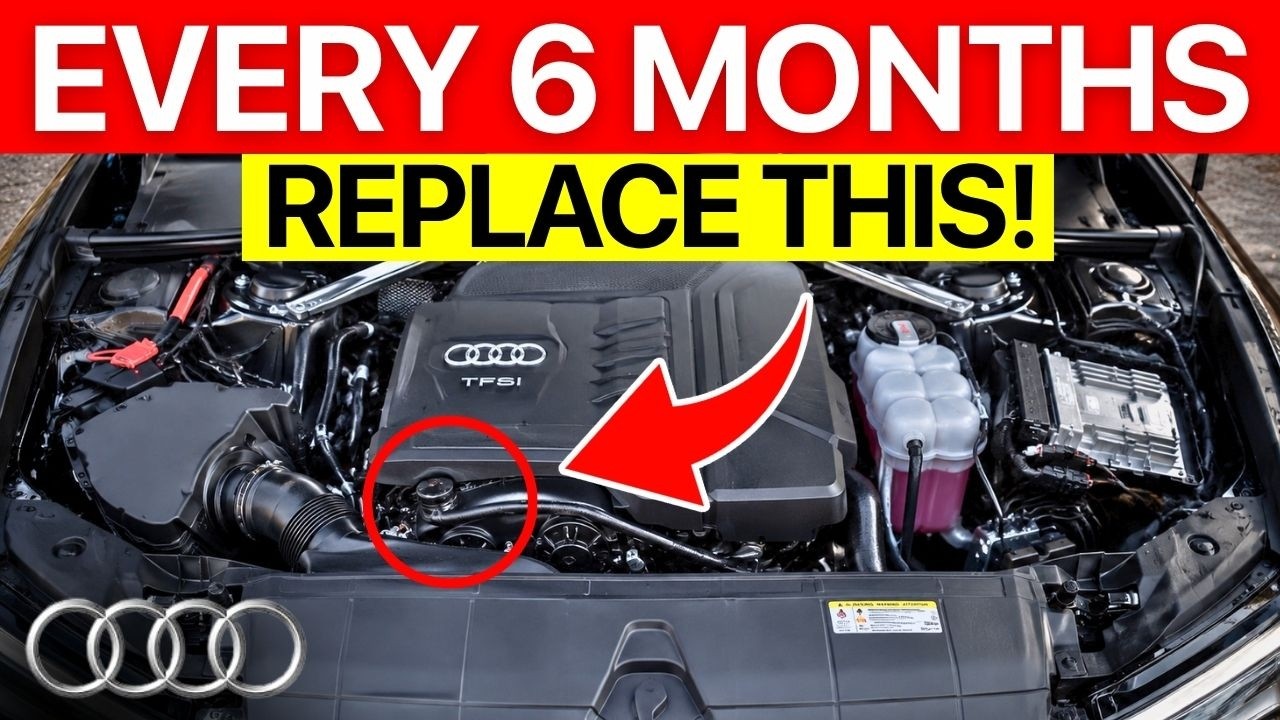
Audi Maintenance Schedules Trigger Avoidable Drivetrain Failures
Everything Audi
Factory schedules designed around dealership logistics neglect critical transmission flushes and carbon cleanings, turning routine wear into multi-thousand-dollar drivetrain failures.
Standard factory 10,000-mile oil intervals fail to account for fuel dilution during short urban trips, requiring real-world intervals of 5,000 to 7,500 miles and strict adherence to exact VW specifications like 502.00, 504.00, or 508.00. (0:42)
While Audi labels the ZF 8-speed automatic a "lifetime" fluid transmission, transmission manufacturer ZF recommends servicing fluid and dropping the sump pan filter every 40,000 to 50,000 miles to avoid major mechanical failures. (3:52)
Direct-injection TFSI engines experience unmitigated intake valve carbon buildup that necessitates walnut blasting around 55,000 to 65,000 miles, during which replacing the PCV valve prevents crankcase pressure spikes from destroying the rear main seal. (7:34)
Timing chain elongation on EA888 engines can be monitored digitally before physical failure using diagnostic measuring value IDE00182, where camshaft adaptation past -4 degrees indicates an urgent need for replacement. (11:48)
Transverse quattro models with Haldex couplings require fluid and pump strainer maintenance every 3 years or 18,000 to 40,000 miles to prevent friction material from silently starving and burning out the $1,200 pre-charge pump. (18:31)
Detailed notes
## Background
Published on YouTube by Everything Audi on July 27, 2026, this guide features independent specialist Marcus sharing an adjusted maintenance schedule tailored to North American driving conditions. The video explains why official dealership service intervals often align with booking logistics rather than mechanical longevity, outlining specific service intervals needed to help platforms like the A4, Q5, and S4 reach 200,000 miles without catastrophic failure.
## TL;DR
Drawing on 22 years of repair and rebuilding experience, Marcus contrasts Audi's official maintenance timelines with real-world workshop realities. He details why direct-injection engines require shorter oil change intervals, exposes the fallacy of 'lifetime' transmission fluids across ZF 8-speed and dual-clutch units, and explains critical unlisted maintenance like walnut shell carbon blasting and Haldex fluid flushes. The guide also provides diagnostic instructions for monitoring timing chain stretch via live diagnostic readings to prevent multi-thousand-dollar engine rebuilds before they occur.
## Atmosphere & style
The presentation carries the authoritative, pragmatic tone of a veteran mechanic speaking plainly from the workshop floor. Rather than relying on alarmist rhetoric, Marcus methodically compares dealer invoices and internal manufacturer specifications with real customer case studies to demonstrate the cost of deferred maintenance. The delivery feels educational, direct, and mechanically reassuring, empowering owners with actionable technical knowledge to avoid expensive dealership upsells and unexpected breakdowns.
## Bulletin
- [00:42](https://www.youtube.com/watch?v=DeRoRWt1ghA&t=42s) Standard factory 10,000-mile oil intervals fail to account for fuel dilution during short urban trips, requiring real-world intervals of 5,000 to 7,500 miles and strict adherence to exact VW specifications like 502.00, 504.00, or 508.00.
- [03:52](https://www.youtube.com/watch?v=DeRoRWt1ghA&t=232s) While Audi labels the ZF 8-speed automatic a "lifetime" fluid transmission, transmission manufacturer ZF recommends servicing fluid and dropping the sump pan filter every 40,000 to 50,000 miles to avoid major mechanical failures.
- [07:34](https://www.youtube.com/watch?v=DeRoRWt1ghA&t=454s) Direct-injection TFSI engines experience unmitigated intake valve carbon buildup that necessitates walnut blasting around 55,000 to 65,000 miles, during which replacing the PCV valve prevents crankcase pressure spikes from destroying the rear main seal.
- [11:48](https://www.youtube.com/watch?v=DeRoRWt1ghA&t=708s) Timing chain elongation on EA888 engines can be monitored digitally before physical failure using diagnostic measuring value IDE00182, where camshaft adaptation past -4 degrees indicates an urgent need for replacement.
- [18:31](https://www.youtube.com/watch?v=DeRoRWt1ghA&t=1111s) Transverse quattro models with Haldex couplings require fluid and pump strainer maintenance every 3 years or 18,000 to 40,000 miles to prevent friction material from silently starving and burning out the $1,200 pre-charge pump.
## Key takeaways
- [00:00](https://www.youtube.com/watch?v=DeRoRWt1ghA&t=0s) Official dealership service schedules are primarily designed around booking logistics rather than mechanical longevity, frequently triggering preventable repair bills exceeding $3,000.
- [00:42](https://www.youtube.com/watch?v=DeRoRWt1ghA&t=42s) Short trips and cold starts dilute engine oil with fuel on turbocharged TFSI engines, making a 5,000-to-7,500-mile oil change interval necessary for city driving.
- [00:42](https://www.youtube.com/watch?v=DeRoRWt1ghA&t=42s) Using oil lacking the exact required VW approval (such as VW 502.00 or 508.00) can degrade timing chain tensioners and cause thousands in preventable engine rebuild costs.
- [03:52](https://www.youtube.com/watch?v=DeRoRWt1ghA&t=232s) ZF 8-speed transmissions require fluid replacement and a sump pan/filter drop every 40,000 to 50,000 miles despite Audi's "lifetime fluid" marketing designation.
- [03:52](https://www.youtube.com/watch?v=DeRoRWt1ghA&t=232s) Dual-clutch S tronic transmissions can suffer severe shudder from degraded fluid and clutch debris, which is frequently misdiagnosed as mechatronic failure when a fluid flush and adaptation would resolve it.
- [07:34](https://www.youtube.com/watch?v=DeRoRWt1ghA&t=454s) Direct fuel injection prevents detergents from washing intake valves, causing power-robbing carbon deposits that require walnut shell media blasting every 55,000 to 65,000 miles.
- [07:34](https://www.youtube.com/watch?v=DeRoRWt1ghA&t=454s) A failing PCV valve diaphragm can overpressurize the crankcase and blow out the rear main seal, resulting in a 6-to-10-hour labor bill that could be avoided with a proactive $80–$150 PCV replacement.
- [11:48](https://www.youtube.com/watch?v=DeRoRWt1ghA&t=708s) Live measuring value IDE00182 in VCDS or OBDeleven tracks camshaft adaptation to measure physical timing chain elongation electronically.
- [11:48](https://www.youtube.com/watch?v=DeRoRWt1ghA&t=708s) A camshaft adaptation angle between 0° and -3° indicates normal timing chain health, while drifting past -4° demands chain replacement and past -5° requires parking the vehicle immediately.
- [14:23](https://www.youtube.com/watch?v=DeRoRWt1ghA&t=863s) Cold start rattles on 2011–2015 EA837 3.0T supercharged V6 engines stem from upper timing chain tensioners addressed under Audi TSB 2039995 using updated tensioner part numbers.
- [15:31](https://www.youtube.com/watch?v=DeRoRWt1ghA&t=931s) Brake fluid must be flushed every two years regardless of mileage because hygroscopic water absorption degrades boiling points and risks pedal failure under heavy braking.
- [15:31](https://www.youtube.com/watch?v=DeRoRWt1ghA&t=931s) Engine coolant corrosion inhibitors deplete after five years, turning acidic and requiring a drain and refill every 5 years or 50,000 miles using G13 or G12 Evo fluid.
- [15:31](https://www.youtube.com/watch?v=DeRoRWt1ghA&t=931s) EA888 water pump housings with composite components frequently begin weeping coolant between 60,000 and 100,000 miles and should be replaced proactively before overheating.
- [18:31](https://www.youtube.com/watch?v=DeRoRWt1ghA&t=1111s) BorgWarner Haldex couplings in transverse AWD models (A3, Q3, TT) shed clutch friction material that clogs the pre-charge pump strainer, causing silent AWD loss if not serviced every 3 years.
- [20:52](https://www.youtube.com/watch?v=DeRoRWt1ghA&t=1252s) Spark plug replacement is due at 40,000 miles on 2.0 TFSI engines and 30,000 miles on performance 3.0T and V8 engines, despite frequent dealer attempts to invoice them earlier.
- [20:52](https://www.youtube.com/watch?v=DeRoRWt1ghA&t=1252s) Ignition coil packs on EA888 engines should be proactively replaced as a full set once the first coil fails to avoid roadside breakdowns and potential catalytic converter damage.
- [20:52](https://www.youtube.com/watch?v=DeRoRWt1ghA&t=1252s) Engine air filters last 55,000 to 60,000 miles, while cabin air filters require renewal every 20,000 miles or 2 years, making bundled dealer replacements unnecessarily expensive.
Independent Audi specialist Marcus, who has spent 22 years repairing and rebuilding Audi engines and transmissions, explains why the factory-recommended maintenance schedule falls short. Dealership service intervals are structured around booking logistics rather than the mechanical survival of the vehicle. While unaddressed maintenance patterns lead to preventable repair bills exceeding $3,000, adhering to a schedule based on real-world workshop findings allows these platforms to routinely cross 200,000 miles without catastrophic drivetrain failures.
[00:42](https://www.youtube.com/watch?v=DeRoRWt1ghA&t=42s) The Real Oil Intervals and Critical Oil Specifications
The factory Audi schedule dictates an engine oil service every 10,000 miles or one year. Marcus notes that this interval is only tolerable if the car is driven almost entirely on highways in warm climates, allowing the engine to reach full operating temperature on every cycle. However, the 2.0 TFSI (EA888 platform)—found across the A4, A5, Q5, and wider lineup—uses direct injection and turbocharging. Cold starts and short urban commutes dilute the engine oil with unburned fuel and introduce moisture that never boils off, quickly degrading the protective oil film required by the timing chain tensioner.
Real-world driving profiles require tighter oil change intervals:
- **City driving and frequent cold starts:** 5,000 to 7,500 miles
- **Mixed driving:** 7,500 miles
- **Predominantly highway driving (full operating temperature):** Up to 10,000 miles
Marcus stresses that getting the exact manufacturer specification right matters even more than the mileage interval:
- **VW 502.00 or VW 504.00:** Required for most petrol EA888 engines (always check the bonnet sticker or engine data label, as requirements vary by engine code and emissions tier).
- **VW 508.00 (0W-20):** Mandatory for newer 2019+ Gen 3B "B-cycle" engines. These formulations are strictly non-interchangeable.
To illustrate the consequences, Marcus describes a customer with a 2014 Audi A4 at 91,000 miles with a complete dealership paper trail showing 10,000-mile services. The car arrived with camshaft adaptation drift and a variable valve timing (VVT) solenoid fault. A review of the customer's receipts revealed that for nine straight years, the dealership had poured oil lacking the VW 502 approval. The chain tensioner did not fail from missed intervals; it was ruined by nine years of unapproved oil chemistry. The resulting timing system rebuild cost $3,200—an expense that could have been avoided for essentially zero added cost had the approved bottle specification been respected.
[03:52](https://www.youtube.com/watch?v=DeRoRWt1ghA&t=232s) The "Lifetime" Transmission Myth: ZF 8-Speed, S tronic, and Multitronic
The most expensive deferred maintenance issues involve transmissions that Audi brands as having "lifetime fluid." Chief among these is the ZF 8-speed torque-converter automatic, found across longitudinal quattro models (A4, A6, Q5, Q7) from roughly 2013 onward. Audi claims it is filled for life, whereas ZF—the company that designs and builds the gearbox—recommends service every 50,000 to 75,000 miles depending on use. Marcus considers 80,000 miles on factory fluid the threshold where internal mechanical wear escalates rapidly.
A proper transmission service cannot be a simple drain-and-fill; it requires dropping the sump pan and renewing the internal filter:
- **ZF 8-Speed Automatic:** Service every 40,000 to 50,000 miles using fluid spec **G 060 162 A2** or **ZF Lifeguard 8**.
- **DL501 7-Speed Wet Dual-Clutch (S tronic):** Found in the S4, S5, and select A6/A7 models. Audi does mandate service here: first at 35,000 miles, then every 40,000 miles thereafter, using fluid spec **G 052 529 A2**. The internal filter must be replaced with the fluid.
- **Multitronic CVT (Front-Wheel Drive B8/B8.5):** Requires service at 35,000 miles, and every 40,000 miles thereafter, using fluid spec **G 052 516 A2**.
- **Manual Gearboxes:** Audi labels manual gear oil as "lifetime," but Marcus recommends replacement at 60,000 miles using fluid spec **G 055 532 A2**.
Marcus highlights the financial risk of dealership misdiagnosis through a 2015 Audi S4 owner at 78,000 miles. The DL501 transmission had never been serviced, causing harsh gear engagement and a violent 1st-to-2nd gear shudder. The dealership presented a $4,800 quote to replace the mechatronic unit. Marcus drained the factory fluid—which came out dark brown and full of suspended clutch friction material—installed fresh fluid, and executed an adaptation reset. The transmission smoothed out completely, resolving the issue for a final invoice of $410 instead of $4,800.
| Transmission Type | Applications | Audi Schedule | Specialist Interval | Fluid Specification | Filter Replacement Required? |
|:--- |:--- |:--- |:--- |:--- |:--- |
| **ZF 8-Speed Tiptronic** | A4, A6, Q5, Q7 (quattro, ~2013+) | "Lifetime" (No service) | 40,000 – 50,000 miles | G 060 162 A2 / ZF Lifeguard 8 | Yes (drop sump pan) |
| **DL501 7-Speed S tronic** | S4, S5, select A6/A7 | 35k mi, then every 40k mi | 35k mi, then every 40k mi | G 052 529 A2 | Yes (internal filter) |
| **Multitronic CVT** | B8 / B8.5 FWD models | 35k mi, then every 40k mi | 35k mi, then every 40k mi | G 052 516 A2 | Yes |
| **Manual Transmissions** | Various longitudinal manual | "Lifetime" (No service) | 60,000 miles | G 055 532 A2 | N/A |
[07:34](https://www.youtube.com/watch?v=DeRoRWt1ghA&t=454s) Carbon Buildup and the Overlooked PCV Valve
Because every modern TFSI engine uses direct injection, fuel is sprayed directly into the combustion chamber rather than across the intake port. Consequently, fuel detergents never wash over the back of the intake valves. Instead, blow-by oil vapors vented by the positive crankcase ventilation (PCV) system bake onto the hot intake valves. Audi's official schedule never mentions intake valve carbon buildup, even though fuel trim adaptations can only mask the problem for so long.
By 60,000 to 70,000 miles (or as early as 40,000 miles on short-trip city cars), carbon deposits choke intake airflow, triggering cold-start misfires, hesitation, and a rough idle. Because fuel additives cannot physically reach the valves, the only effective remedy is walnut shell media blasting, which strips the carbon without marring the aluminum head:
```mermaid
flowchart TD
accTitle: Intake Manifold Service Overlap
accDescr: Demonstrates which parts should be replaced together when the intake manifold is removed for carbon cleaning.
subgraph Access["Manifold Removal (High Labor Cost)"]
M["Intake Manifold Removed"]
end
subgraph Service["Simultaneous Service Items"]
W["Walnut Shell Media Blasting"]
P["Replace PCV Valve (if original > 60k mi)"]
T["Replace Injector Teflon Seals"]
G["Replace Intake Manifold Gasket"]
end
M --> W
M --> P
M --> T
M --> G
```
Marcus highlights that whenever the intake manifold is pulled off for walnut blasting (ideally between 55,000 and 65,000 miles), several related components must be replaced simultaneously to avoid paying for the same teardown labor later:
- **Intake manifold gasket**
- **Injector Teflon seals**
- **PCV valve assembly** (if past 60,000 miles on the original unit)
The EA888 PCV valve diaphragm degrades from engine bay heat. When it tears, uncontrolled crankcase pressures accelerate carbon accumulation. On Gen 2 engines, severe crankcase pressure spikes will blow out the rear main seal. Replacing a rear main seal demands transmission removal and $1,000 to $1,800 in labor (6 to 10 hours), whereas a new PCV valve costs just $80 to $150 and takes less than an hour to swap. Marcus advises inspecting the PCV at every oil change past 60,000 miles and replacing it proactively between 80,000 and 100,000 miles regardless of how it looks.
Marcus recalls a 2017 Audi A4 owner at 73,000 miles experiencing hesitation between 2,000 and 3,000 RPM along with a rough idle. The dealer had shrugged off the complaint at the previous oil service. A borescope inspection at Marcus's shop revealed heavy carbon deposits on the valves; a $540 walnut blast cured the issue entirely.
[11:48](https://www.youtube.com/watch?v=DeRoRWt1ghA&t=708s) Live Timing Chain Diagnostics: The IDE00182 Reading
Unlike old maintenance approaches that wait for an engine rattle or a check engine light, timing chain wear on the EA888 can be tracked electronically before parts collide. Using diagnostic tools like VCDS or OBDeleven, owners and technicians can monitor chain stretch via live engine data:
1. Access module **`01 - Engine`**.
2. Select live measuring value **`IDE00182`** (Camshaft adaptation value in degrees).
This value records how far the camshaft phaser must adjust to compensate for physical chain elongation:
- **0° to -3°:** Normal, healthy chain system.
- **-3° to -4°:** Early wear. Marcus recommends shortening oil change intervals and logging the reading again within 5,000 miles.
- **-4° or worse:** Timing chain replacement should be actively scheduled.
- **-5° or worse:** Park the vehicle; limit all non-essential driving and transport the car directly to a specialist.
Marcus emphasizes that tracking the adaptation *rate of change* across consecutive services is far more informative than a single snapshot: a vehicle holding steady at -2.5° over multiple years is stable, whereas an engine drifting from -1.0° to -3.8° across 15,000 miles is stretching fast and heading toward mechanical failure.
Finally, Marcus notes that the Gen 1 EA888 (found in 2008–2012 A3, A4, A5, and Q5 models) featured an infamous mechanical tensioner design flaw. While that issue was previously subject to a Technical Service Bulletin and a 10-year/100,000-mile warranty extension in the US market, that factory warranty window has now fully expired.
[14:23](https://www.youtube.com/watch?v=DeRoRWt1ghA&t=863s) EA837 3.0T Upper Timing Chain Tensioners and the Cold Start Rattle
If you purchase an Audi equipped with an engine of unknown chain tensioner history, getting that physical inspection completed is "the first service priority on the list, not the second." Shifting focus to the EA837 3.0T supercharged V6—a staple powerplant found across the B8 and B8.5 generations of the S4, S5, Q5, Q7, A6, and A7—there is a well-documented cold-start rattle covered under Audi Technical Service Bulletin (TSB) 2039995. This distinct rattle originates directly from the upper timing chain tensioners fitted to 2011 through 2015 model-year vehicles.
Fortunately, this condition is not an immediate catastrophic emergency, but it should be addressed if the rattle makes itself heard and the tensioners have never been swapped for the superseded parts. The definitive fix requires updating both cylinder banks with Audi's revised tensioners: part number 06E 109 217 AH for Bank 2, and part number 06E 109 218 AJ for Bank 1.
- **TSB Reference:** Audi TSB 2039995 (cold start rattle on EA837 3.0T V6 engines, model years 2011–2015)
- **Superseded Part Numbers:** Bank 1: `06E 109 218 AJ`; Bank 2: `06E 109 217 AH`
- **Urgency Level:** Non-emergency, but highly recommended if cold start noise is present and original tensioners are still installed
---
[15:31](https://www.youtube.com/watch?v=DeRoRWt1ghA&t=931s) Brake Fluid and Coolant: Critical Time-Based Intervals
Two vital services on an Audi run strictly on calendar time rather than mileage. Dealerships routinely bungle both items, either pushing them aggressively when unnecessary or neglecting them entirely when they are legitimately due. Brake fluid is one rare area where the official Audi schedule and specialist recommendations agree without reservation: flush and replace every two years, regardless of how few miles the car has logged. Brake fluid is hygroscopic, meaning it continuously pulls moisture out of the air through microscopic pores in rubber hoses and hydraulic connections. Over time, that water degrades fluid performance; under hard braking during an emergency or descending a steep mountain grade, old fluid will vaporize in the caliper. Because vapor compresses, the brake pedal drops straight to the floor without stopping the car.
```mermaid
flowchart TD
accTitle: Coolant Degradation and Water Pump Failure Lifecycle
accDescr: Diagram tracing how coolant chemical breakdown and plastic water pump fatigue lead to costly engine repairs if ignored.
The factory schedule falls short on coolant. Audi designates engine coolant as a simple "check level and top up" item, failing to list any actual replacement interval. In modern Audi systems running G13 coolant, the corrosion inhibitor package depletes after several years. Once those chemical additives exhaust themselves, the fluid's pH drops, transforming it from a protective shield into a mildly acidic, corrosive agent. A garage queen driven only a few thousand miles over five years possesses the exact same compromised coolant chemistry as a highway cruiser racking up 30,000 miles a year. Flush and refill the system every five years or 50,000 miles using only G13 or G12 Evo-compatible fluid, and never mix differing chemistries based on matching dye colors. Concurrently, owners of EA888 Gen 1 and Gen 2 engines must watch for weeping around the factory water pump housing between 60,000 and 100,000 miles. Because these pumps utilize plastic impellers and composite housings, waiting for an overheating light is reckless: "A water pump caught early is a repair. A water pump that fails on a motorway is a tow, potential engine damage, and an invoice that did not need to happen."
- **Brake Fluid Specification:** DOT 4 or Super DOT 4 LV
- **Brake Fluid Threshold:** Replace immediately if tester indicates >3% moisture content, or at the strict 2-year calendar limit
- **Coolant Flush Interval:** Every 5 years or 50,000 miles (whichever occurs first)
- **Approved Coolants:** G13 or G12 Evo (never cross-mix coolant generations)
- **EA888 Water Pump Advisory:** Inspect for telltale seepage from 60,000 to 100,000 miles; replace before catastrophic impeller or housing failure
---
[18:31](https://www.youtube.com/watch?v=DeRoRWt1ghA&t=1111s) The Haldex Quattro Service Most Owners Have Never Done
Transverse-engine Audis—specifically the A3, Q3, and TT quattro models—do not use the traditional Torsen mechanical center differential found in larger Audis. Instead, they rely on a BorgWarner Haldex all-wheel-drive coupling mounted at the rear axle. When front wheel slip is detected, an electric hydraulic pump rapidly pressurizes a wet clutch pack to direct torque rearward. This system requires dedicated BorgWarner/Audi hydraulic fluid (part number G 060 175 A2). Crucially, this fluid is not a conventional gear lubricant; it is an engineered friction-hydraulic medium formulated to let wet clutch plates bite and slip smoothly.
```mermaid
flowchart LR
accTitle: Haldex AWD Maintenance vs Failure Path
accDescr: Flowchart contrasting the inexpensive proactive Haldex service against the costly pump failure caused by neglected fluid.
A["Wet Clutch Pack Operates"] --> B["Normal Friction Plate Wear"]
B --> C["Particulates Suspend in Fluid"]
C --> D{"Serviced on Schedule?<br/>(3 Years / 20k–40k mi)"}
D -->|"Yes"| E["Fluid & Strainer Cleaned<br/>Total Cost: ~$180"]
E --> F["Coupling Fully Restored"]
D -->|"No"| G["Pump Strainer Clogs"]
G --> H["Loss of Pre-Charge Pressure"]
H --> I["No Warning Light / Sudden AWD Loss"]
I --> J["Burnt Pre-Charge Pump<br/>Total Cost: ~$1,200"]
```
Because clutch material naturally sheds into the fluid during daily driving, microscopic friction debris accumulates inside the casing. While a small internal strainer screens the intake of the pre-charge pump, that screen eventually chokes if the oil is ignored. When the strainer clogs, the pump starves and burns out, causing rear-wheel engagement to disappear entirely without generating a single dashboard warning light. BorgWarner's own technical documentation recommends servicing Generation 5 Haldex couplings every 18,000 to 25,000 miles, and Generation 4 couplings every 40,000 miles. Audi’s official 2016 maintenance manual outlines a strict 3-year interval regardless of mileage, recognizing the time-dependent degradation of the fluid chemistry.
To illustrate the stakes, a client recently brought in a 2016 Audi Q3 with 81,000 miles and three years of ownership under his belt. He had never been notified that his Haldex system needed attention. In the shop, testing confirmed the rear differential was already experiencing erratic engagement because the pump was struggling to build sufficient pre-charge pressure. By flushing the old fluid, cleaning out the strainer screen, and carrying out a digital system adaptation, full rear-drive performance was restored before the hardware seized. The owner was approximately 4,000 miles away from outright pump death. "His bill, $180. The pump would have been $1,200. The difference between those two outcomes is a conversation his dealer never had with him."
- **Applicable Platforms:** Audi A3, Q3, TT Quattro (transverse layout)
- **Fluid Part Number:** `G 060 175 A2` (dedicated friction hydraulic fluid)
- **Manufacturer Service Guidance:**
- *BorgWarner Gen 5:* Every 18,000–25,000 miles
- *BorgWarner Gen 4:* Every 40,000 miles
- *Audi Factory Schedule (2016+):* Every 3 years, regardless of mileage
- **Failure Mode:** Friction material blinds the pump strainer screen, leading to silent hydraulic pump starvation and total loss of all-wheel drive
---
[20:52](https://www.youtube.com/watch?v=DeRoRWt1ghA&t=1252s) Spark Plugs, Coil Packs, and Filter Replacement Schedules
Spark plug intervals on modern Audis are clean-cut on paper, but dealer service drives routinely mishandle them. On standard 2.0 TFSI EA888 engines (found in high-volume sellers like the A4, A5, and Q5), Audi specifies plug replacement at 40,000 miles or six years, whichever arrives first. On higher-output applications—such as the EA837 3.0T supercharged V6 or high-performance twin-turbo V8 models like the S6, S7, RS6, and RS7—that window tightens to every 30,000 miles. The issue is rarely the published interval itself; rather, dealership service writers habitually push new spark plugs at every "major" minor service visit long before the car's mileage warrants it.
Ignition coil packs on EA888 engines are established wear components with finite lifespans. When high-mileage coil packs begin to degrade, they rarely fail in isolation: the moment one cylinder starts misfiring under load, the remaining packs are living on borrowed time. Proactively swapping out the entire set of four coils the moment the first one dies costs between $120 and $180. Attempting to milk dying coils until you experience an aggressive highway misfire under heavy boost will cost significantly more "in every way that matters"—from dangerous roadside breakdowns to towing fees and potential catalytic converter damage.
| Maintenance Item | Application | Factory Schedule | Specialist Recommendation |
|:--- |:--- |:--- |:--- |
| **Spark Plugs (Standard)** | EA888 2.0 TFSI (A4, A5, Q5) | 40,000 mi / 6 years | Replace at 40,000 mi or 6 years; decline premature dealer upsells |
| **Spark Plugs (Performance)** | EA837 3.0T, V8 (S6, S7, RS6, RS7) | 30,000 mi | Replace strictly at 30,000 mi |
| **Ignition Coil Packs** | EA888 (All variants) | "Replace as failed" | Replace full set ($120–$180) proactively when the first coil fails |
| **Engine Air Filter** | EA888 / General Audi lineup | 55,000–60,000 mi | Replace at 55,000–60,000 mi |
| **Cabin Air Filter** | Interior HVAC housing | 20,000 mi / 2 years | Replace at 20,000 mi or 2 years |
Air filtration presents another common dealer upsell trap. The engine intake air filter has a long lifespan, rated at 55,000 to 60,000 miles across most EA888 applications. The cabin dust and pollen filter, positioned behind the glove box, operates on an entirely distinct 20,000-mile or 2-year timeline. Dealers routinely bundle both filters together at arbitrary intervals, billing owners for fresh intake elements long before the old ones are loaded. Understanding exactly which filter is being invoiced prevents throwing money at clean paper. The Audis that successfully achieve 200,000 miles in peak mechanical health do so because their drivers understand that these discrepancies between the official dealer schedule and genuine mechanical needs are not minor technicalities: "It is the difference between a car that generates repair bills in year six and one that is still worth driving in year 16."
## Notable quotes
> [14:23](https://www.youtube.com/watch?v=DeRoRWt1ghA&t=863s) the first service priority on the list, not the second. — Marcus
> [15:31](https://www.youtube.com/watch?v=DeRoRWt1ghA&t=931s) A water pump caught early is a repair. A water pump that fails on a motorway is a tow, potential engine damage, and an invoice that did not need to happen. — Marcus
> [18:31](https://www.youtube.com/watch?v=DeRoRWt1ghA&t=1111s) His bill, $180. The pump would have been $1,200. The difference between those two outcomes is a conversation his dealer never had with him. — Marcus
> [20:52](https://www.youtube.com/watch?v=DeRoRWt1ghA&t=1252s) in every way that matters — Marcus
> [20:52](https://www.youtube.com/watch?v=DeRoRWt1ghA&t=1252s) It is the difference between a car that generates repair bills in year six and one that is still worth driving in year 16. — Marcus
## Mentioned
Audi, Everything Audi, Marcus, EA888, ZF, ZF 8-speed, ZF Lifeguard 8, DL501, Multitronic, S tronic, BorgWarner, Haldex, Torsen, VCDS, OBDeleven, EA837 3.0T, Audi A3, Audi A4, Audi A5, Audi A6, Audi A7, Audi Q3, Audi Q5, Audi Q7, Audi S4, Audi S5, Audi S6, Audi S7, Audi RS6, Audi RS7, Audi TT
## Video description
The ONLY Audi Maintenance Schedule You'll Ever Need (Why the Dealer's Version Is Costing You Money)
Most Audi owners are following a maintenance schedule designed around dealership booking calendars — not around what these engines actually need to survive.
Audi owners following the official schedule often face $3,000+ repair bills that were entirely preventable. Owners on the correct schedule regularly hit 200,000 miles without major drivetrain work.
Video covers:
✅ The oil interval the factory schedule gets wrong for most North American driving conditions
✅ The ZF 8-speed transmission service Audi calls "lifetime" — and what ZF themselves actually recommend
✅ The carbon buildup interval that Audi never put on the schedule
✅ How to monitor timing chain health with VCDS or OBDeleven before it becomes a repair
✅ Brake fluid and coolant — the two intervals that run on time, not mileage
✅ The Haldex quattro service most A3, Q3, and TT owners have never done
✅ Spark plug and air filter intervals the dealer consistently gets wrong
Whether you own an A4, A5, A6, Q5, Q7, S4, or S5 — this is the maintenance schedule that keeps these cars alive.
📖�THE 500,000-MILE AUDI BLUEPRINT - THE COMPLETE MAINTENANCE GUIDE FOR 2009-2021 OWNERS: Get yours now! - https://everythingaudi.gumroad.com/l/juybwm
📖 The Maintenance Manual Your Audi A4 Dealer Should Have Given You (2013–2016 owners) - https://everythingaudi.gumroad.com/l/A4SurvivalGuide2013-2016
Subscribe for weekly Audi maintenance content from an independent specialist with 22 years of experience.
What service has your dealer never mentioned? Drop it in the comments.
00:00 - Intro
00:41 - The Oil Interval They Actually Designed For Your Engine
03:52 - The Transmission The Dealer Never Told You To Service
07:34 - The Carbon Interval Audi Never Put On The Schedule
11:48 - The Timing System Reading Your Dealer Never Pulls
15:35 - Brake Fluid & Coolant: The Time-Based Services
18:36 - The Quattro Service Most Owners Have Never Done
20:56 - Spark Plugs, Coils & Filters They Get Wrong Every Time
Independent Audi specialist Marcus argues that factory maintenance schedules prioritize dealership logistics and marketing over drivetrain longevity, leading to preventable multi-thousand-dollar repairs. Based on 22 years of repair experience, he demonstrates that adjusting service intervals, respecting exact fluid chemistries, and utilizing digital diagnostics allows Audi platforms to routinely exceed 200,000 miles.
Engine Oil Intervals and Exact Chemical Specifications (0:42)
While Audi specifies a 10,000-mile or one-year oil change interval, Marcus asserts this schedule is viable only for vehicles driven predominantly on highways in warm climates. On direct-injected turbocharged engines like the EA888 2.0 TFSI, short urban trips dilute oil with unburned fuel and condensation, degrading the lubrication needed for the timing chain tensioner. He recommends changing oil at 5,000 to 7,500 miles for city driving, 7,500 miles for mixed driving, and up to 10,000 miles only for consistent highway use.
Adhering to precise manufacturer oil specifications is equally critical. Most petrol EA888 engines mandate VW 502.00 or 504.00, whereas 2019+ Gen 3B engines require non-interchangeable VW 508.00 (0W-20). Marcus cites a 2014 Audi A4 owner whose vehicle received 10,000-mile dealer services for nine years but was filled with unapproved oil, causing camshaft adaptation drift, variable valve timing faults, and a $3,200 timing system rebuild.
Dispelling the "Lifetime" Transmission Fluid Myth (3:52)
Audi designates several transmissions as having "lifetime" fluid, most notably the ZF 8-speed automatic found in longitudinal quattro models since roughly 2013. In contrast, manufacturer ZF recommends servicing the unit every 50,000 to 75,000 miles, while Marcus identifies 80,000 miles on factory fluid as the threshold where internal wear accelerates. A proper ZF service requires dropping the sump pan, replacing the internal filter, and refilling with spec G 060 162 A2 or ZF Lifeguard 8 every 40,000 to 50,000 miles. Manual transmissions labeled as lifetime should also receive fresh G 055 532 A2 fluid at 60,000 miles.
Dual-clutch and CVT platforms require strict servicing every 35,000 miles initially, then every 40,000 miles. For the DL501 7-speed S tronic, using fluid G 052 529 A2 and replacing the internal filter resolves common drivability problems. Marcus highlights an unserviced 2015 Audi S4 at 78,000 miles quoted $4,800 by a dealership for a mechatronic unit replacement; a $410 fluid change and software adaptation reset completely eliminated its violent gear shudder.
Carbon Buildup, PCV Failure, and Timing Diagnostics (7:34)
Because TFSI engines inject fuel directly into the cylinder, fuel detergents never wash over intake ports. By 40,000 to 70,000 miles, oil vapors from the positive crankcase ventilation (PCV) system bake onto the intake valves, causing rough idle and misfires. Marcus considers walnut shell blasting every 55,000 to 65,000 miles the only effective remedy. When pulling the manifold, he stresses replacing the manifold gasket, injector Teflon seals, and the PCV valve assembly ($80–$150). Heat degrades the PCV diaphragm, and severe crankcase pressure spikes can blow the rear main seal, which incurs $1,000 to $1,800 in labor.
Timing chain wear can be proactively diagnosed before catastrophic engine failure using diagnostic tools like VCDS or OBDeleven. In module 01 - Engine, value IDE00182 tracks camshaft adaptation degrees: 0° to -3° indicates normal wear, -3° to -4° signals early stretch, -4° warrants replacement scheduling, and -5° requires immediately parking the vehicle. On EA837 3.0T supercharged V6 engines (2011–2015), cold-start rattles covered under TSB 2039995 should be addressed by installing revised upper tensioners (part numbers 06E 109 218 AJ and 06E 109 217 AH).
Time-Based Fluids and Transverse Haldex Servicing (15:31)
Brake fluid and engine coolant operate on calendar limits rather than mileage. Brake fluid is hygroscopic and must be flushed every two years or whenever moisture exceeds 3% to prevent vapor lock. While Audi lists coolant as a "check and top up" item, corrosion inhibitors in G13 fluid deplete by year four or five, turning the fluid acidic. Marcus advises flushing coolant every five years or 50,000 miles with G13 or G12 Evo, while monitoring EA888 composite water pump housings for weeping between 60,000 and 100,000 miles.
On transverse models (A3, Q3, TT), the BorgWarner Haldex all-wheel-drive coupling relies on specialized friction-hydraulic fluid (G 060 175 A2). Clutch wear particles accumulate and choke the pre-charge pump strainer screen, starving the pump and disabling all-wheel drive without triggering warning lights. While BorgWarner advises service every 18,000 to 40,000 miles and Audi specifies every three years, dealers frequently overlook it. Cleaning the strainer and replacing fluid costs roughly $180, preventing a $1,200 pump replacement.
Ignition Lifespans and Air Filtration Distinctions (20:52)
Audi schedules spark plugs at 40,000 miles or six years on EA888 2.0 TFSI engines, and 30,000 miles on performance engines such as the EA837 3.0T and twin-turbo V8s. Dealerships often push premature plug replacements during minor services. Conversely, factory schedules treat ignition coil packs as replace-on-failure; Marcus advises proactively replacing all four packs ($120–$180) once a single coil fails to prevent misfires under boost and subsequent catalytic converter damage.
Marcus also cautions against bundled air filter replacements. Engine intake air filters last 55,000 to 60,000 miles, whereas interior cabin filters require renewal every 20,000 miles or two years. Distinguishing between these distinct service schedules prevents owners from prematurely paying for fresh intake filters.
Marcus concludes that bridging the gap between factory showroom schedules and real-world mechanical requirements is the single factor determining whether an Audi platform becomes an expensive liability in year six or remains reliable past 200,000 miles.
[14:23] Marcus: the first service priority on the list, not the second.
[15:31] Marcus: A water pump caught early is a repair. A water pump that fails on a motorway is a tow, potential engine damage, and an invoice that did not need to happen.
[18:31] Marcus: His bill, $180. The pump would have been $1,200. The difference between those two outcomes is a conversation his dealer never had with him.
[20:52] Marcus: in every way that matters
[20:52] Marcus: It is the difference between a car that generates repair bills in year six and one that is still worth driving in year 16.
Original transcript
[0:00] Your Audi dealer gave you an oil change
[0:02] reminder. What they did not give you is
[0:04] a schedule that actually keeps these
[0:06] cars alive.
[0:08] My name is Marcus.
[0:10] I have been working on Audis for 22
[0:12] years.
[0:14] I run an independent Audi specialist
[0:16] shop, and I have rebuilt enough of these
[0:18] engines and transmissions to know
[0:20] exactly where the official schedule
[0:22] stops and where real longevity begins.
[0:26] This is the complete schedule I use in
[0:28] my own shop. Every interval, every
[0:31] fluid, every system that keeps Audis
[0:35] alive.
[0:36] Subscribe now. New Audi content every
[0:40] week.
[0:42] The oil interval they actually designed
[0:44] for your engine.
[0:46] The official Audi schedule for most
[0:48] petrol models says oil every 10,000 mi
[0:51] or 1 year, whichever comes first.
[0:55] That number is not unreasonable if you
[0:57] are doing predominantly highway miles in
[0:59] a warm climate with the engine fully
[1:01] warmed up on every drive.
[1:04] But that is not most Audi owners, and it
[1:07] is not the driving profile of someone
[1:09] doing short daily commutes.
[1:12] The EA888 engine, the 2.0 TFSI in the
[1:16] A4, A5, Q5, and most of the modern Audi
[1:21] lineup is a direct injection
[1:23] turbocharged engine.
[1:25] Fuel can introduce dilution into the oil
[1:28] during cold running.
[1:30] Short trips mean the engine never fully
[1:32] warms up, moisture never burns off, and
[1:35] the oil is asked to protect a timing
[1:37] chain tensioner on a degraded film.
[1:41] The 10,000 mi number was designed around
[1:43] ideal conditions.
[1:45] My working recommendation, based on what
[1:48] I see in the shop, city driving and
[1:50] frequent cold starts, 5,000 to 7,500
[1:55] mi.
[1:56] Mixed driving, 7,500.
[2:00] Predominantly highway at full operating
[2:02] temperature, up to 10,000.
[2:06] The specification matters more than the
[2:08] interval.
[2:09] VW 502.00
[2:12] or 504.00
[2:14] for most petrol EA888 engines. Always
[2:18] verify on your own bonnet sticker or
[2:21] engine data label because it is engine
[2:23] code and emissions generation specific.
[2:26] VW 508.00
[2:29] at 0W20
[2:31] for newer 2019 and later GEN 3B cycle
[2:36] applications.
[2:38] These are not interchangeable.
[2:40] Wrong oil in the wrong engine is a slow
[2:43] form of damage [music] that shows up at
[2:45] 80,000 miles, not 800.
[2:49] I had a customer with a 2014
[2:52] A4, 91,000 miles.
[2:56] Full dealership service history showing
[2:58] oil changes every 10,000 miles.
[3:01] He came in with timing chain adaptation
[3:04] drift and a VVT solenoid fault.
[3:07] When I pulled his service records, every
[3:10] single receipt showed a product that did
[3:12] not carry the VW 502 approval.
[3:16] Wrong spec for 9 years.
[3:20] That tensioner did not fail because he
[3:22] missed oil changes.
[3:24] Wrong specification oil was the
[3:26] consistent factor across his entire
[3:29] service history.
[3:30] And what I found at the tensioner
[3:32] reflected it.
[3:34] Timing system service,
[3:36] $3,200.
[3:40] The cost of using the correct approved
[3:42] oil over those years, essentially
[3:45] nothing.
[3:46] The approval number on the back of the
[3:48] bottle is not optional on these engines.
[3:52] The transmission the dealer never told
[3:55] you to service.
[3:57] This is the one I get the most calls
[3:59] about and the single most expensive
[4:01] piece of deferred maintenance I see in
[4:03] my shop.
[4:05] The ZF 8-speed automatic fitted to the
[4:08] majority of Quattro automatic Audis from
[4:11] around 2013 [music]
[4:13] onward in the A4, A6, Q5, and Q7 is
[4:19] classified by Audi as lifetime fluid.
[4:23] No service required. Filled for life.
[4:27] ZF, the company that designed and
[4:30] manufactures that transmission,
[4:32] publishes their own service guidance at
[4:34] 50,000 to 75,000 mi depending on
[4:38] application.
[4:40] That is the engineering position of the
[4:42] company that built the unit.
[4:45] The gap between that and Audi's lifetime
[4:47] classification is where repair bills get
[4:50] written.
[4:52] A complete ZF 8-speed service means
[4:55] removing the sump pan and replacing the
[4:57] internal filter.
[4:59] A drain and refill without pan removal
[5:02] is not a complete service.
[5:05] Fluid specification.
[5:07] G 060162A2
[5:12] or ZF Lifeguard 8.
[5:15] My recommended interval based [music] on
[5:17] observed outcomes, every 40,000 to
[5:20] 50,000 mi.
[5:23] At 80,000 mi on original fluid, the risk
[5:26] of internal wear rises significantly.
[5:30] The DL501
[5:32] 7-speed wet dual clutch S tronic in the
[5:36] S4, S5, and certain A6 and A7 models is
[5:42] one case where Audi actually publishes a
[5:44] service interval.
[5:46] First service at 35,000 mi, every 40,000
[5:51] mi after.
[5:53] The internal filter must be replaced at
[5:56] each change. A fluid change without it
[5:59] is not complete.
[6:00] Specification
[6:02] G052529A2.
[6:05] [music]
[6:07] A customer brought me a 2015 S4 with
[6:10] 78,000 mi.
[6:13] He had never had the DL501
[6:16] serviced and came in with a clunking
[6:17] engagement and a shudder between first
[6:20] and second.
[6:21] We drained the fluid, dark brown with
[6:24] friction debris.
[6:26] Fresh fluid and an adaptation reset
[6:28] resolved the symptoms completely.
[6:32] Before coming to me, a dealer had quoted
[6:34] him $4,800
[6:37] for a mechatronic replacement.
[6:39] His invoice at my shop,
[6:41] $410. [music]
[6:44] Four years of servicing at that dealer,
[6:47] not one mention of the
[6:50] Not once.
[6:53] For the multitronic CVT in front-wheel
[6:56] drive automatic Audis,
[6:58] first service at 35,000 mi,
[7:01] every 40,000 mi after.
[7:05] Specification
[7:06] G052516A2.
[7:12] Platform specific for the B8 and B8.5
[7:16] only.
[7:17] Manual gearbox owners
[7:20] Audi calls the gear oil lifetime.
[7:23] My recommendation is 60,000 mi. [music]
[7:27] Specification
[7:29] G055532A2.
[7:34] The carbon interval Audi never put on
[7:37] the schedule.
[7:39] Every TFSI engine Audi builds is a
[7:42] direct injection engine.
[7:44] Fuel goes directly into the combustion
[7:46] chamber and never washes over the intake
[7:49] valves.
[7:50] >> [music]
[7:51] >> Oil vapor from the crankcase ventilation
[7:53] system accumulates on the back of those
[7:55] valves on every cold start and bakes on
[7:59] over time.
[8:00] The official Audi maintenance schedule
[8:02] does not address this at all.
[8:05] There is no carbon cleaning interval on
[8:07] any Audi service document I have ever
[8:10] read.
[8:11] The engine compensates through fuel trim
[8:14] adjustments as deposits build.
[8:16] The car drives normally.
[8:18] By 60 or 70,000 mi on a city driven car,
[8:22] deposits are thick enough to restrict
[8:24] airflow meaningfully.
[8:26] Cold start misfires, reduced throttle
[8:29] response, a rough idle in traffic.
[8:32] The fix is walnut shell media blasting.
[8:36] Pressurized walnut shell particles strip
[8:39] the deposits from the intake valve faces
[8:41] without damaging the metal.
[8:44] Fuel additives cannot reach valve faces
[8:46] on a direct injection engine.
[8:48] In city-heavy cars with frequent short
[8:51] trips, I typically see meaningful
[8:53] buildup anywhere from 40,000 to 70,000
[8:57] mi depending on driving pattern and PCV
[9:00] health.
[9:01] Predominantly highway driving pushes
[9:03] that later.
[9:05] 55,000 to 65,000 mi is a reasonable
[9:08] planning window.
[9:10] When the manifold is already off for
[9:12] this service, replace the PCV valve if
[9:15] it is original and past 60,000 mi.
[9:19] Replace the injector Teflon seals and
[9:22] replace the intake manifold gasket at
[9:24] the same time.
[9:26] The labor access is already open.
[9:29] Doing them separately costs three times
[9:32] the labor.
[9:33] The PCV valve on the EA888
[9:36] is a known degradation item that the
[9:39] official schedule never flags.
[9:42] The diaphragm inside it degrades with
[9:44] heat over time. [music]
[9:46] When it fails, crankcase pressure
[9:49] regulation becomes erratic. Carbon
[9:52] accumulates faster, and on the GEN2
[9:55] engine, elevated crankcase pressure can
[9:58] place additional stress on oil seals,
[10:01] including the rear main seal over time.
[10:04] Replacing a rear main seal requires
[10:07] transmission removal, 6 to 10 hours of
[10:10] labor,
[10:11] typically $1,000 to $1,800.
[10:16] A PCV valve assembly is $80 to $150,
[10:21] and takes under an hour.
[10:23] Inspect it at every oil change past
[10:26] 60,000 mi.
[10:28] Replace it proactively at 80,000 to
[10:31] 100,000 mi, regardless of appearance.
[10:35] I had a customer with a 2017 A4, 73,000
[10:40] mi, complaining of a rough idle and
[10:43] hesitation between 2,000 and 3,000 RPM.
[10:47] Borescope confirmed heavy carbon.
[10:50] Walnut blast resolved it completely.
[10:54] He told me he had mentioned that rough
[10:56] idle to his dealer at his previous oil
[10:58] change.
[10:59] The dealer had not recommended anything.
[11:03] His cost at my shop,
[11:05] $540.
[11:08] And if you want a complete reference for
[11:10] what the EA888's maintenance picture
[11:12] actually looks like across all the
[11:15] systems we are covering today,
[11:17] oil specs, carbon intervals, timing
[11:20] procedures, the full fluid guide,
[11:23] I put it all into a guide called the
[11:25] 500,000 mi Audi blueprint.
[11:29] It covers 2009 through 2021,
[11:33] A3, A4, A5, A6, Q3, Q5, Q7, S4,
[11:42] >> [music]
[11:43] >> S5, and TT.
[11:46] The link is in the description. The
[11:47] timing system reading your dealer never
[11:50] pulls. The EA888 has a timing chain, and
[11:54] timing chains in these engines reward
[11:57] proactive monitoring.
[11:59] The most practical tool you have is VCDS
[12:02] or OBD11.
[12:05] Navigate to address 01 engine.
[12:09] Find the measuring value IDE00182.
[12:16] That is the camshaft adaptation value in
[12:18] degrees.
[12:20] It reflects how far the variable valve
[12:22] timing system has compensated for chain
[12:24] stretch.
[12:26] I treat these values as trend
[12:28] indicators, not fixed pass/fail limits.
[12:32] With that said, here is how I read them
[12:34] in practice.
[12:36] 0 to -3°,
[12:39] healthy.
[12:40] -3 to -4,
[12:43] early wear. Shorten your oil interval
[12:46] and recheck in 5,000 mi.
[12:49] At -4° or beyond, plan a timing chain
[12:53] service.
[12:55] -5° or beyond, limit non-essential
[12:58] driving and get the car to a specialist.
[13:02] These are directional thresholds drawn
[13:04] from specialist practice on the GEN1
[13:08] and GEN2 EA888,
[13:11] not published Audi specifications.
[13:14] The trend across successive readings
[13:17] matters more than any single number.
[13:20] I pull this reading on every EA888 past
[13:23] [music] 60,000 mi that comes into my
[13:26] shop.
[13:27] Not once.
[13:29] Every visit.
[13:31] A single reading tells you where the
[13:33] chain is.
[13:34] Successive readings tell you how fast it
[13:37] is moving.
[13:39] A car sitting at -2.5°
[13:42] across three consecutive readings is a
[13:44] different situation than a car that went
[13:47] from -1 to -3.8
[13:50] in 15,000 miles.
[13:53] The trend is the data.
[13:55] The Gen 1 EA888
[13:58] fitted to A3s, A4s, [music] A5s, and Q5s
[14:03] from approximately 2008 through 2012
[14:07] had a documented tensioner failure mode
[14:10] covered by VW Group Technical Bulletin
[14:13] and a warranty extension in the US
[14:15] market to 10 years or 100,000 miles.
[14:20] That period has now elapsed. But if you
[14:23] own one of these cars with unknown
[14:25] tensioner history, that inspection is
[14:27] the first service priority on the list,
[14:31] not the second.
[14:33] On the EA837
[14:35] 3.0T
[14:37] supercharged V6 fitted to the B8 and
[14:40] B8.5 [music]
[14:42] S4, S5, Q5, Q7, A6, and A7,
[14:49] a cold start rattle documented under TSB
[14:54] 2039995
[14:57] originates from the upper chain
[14:59] tensioners on 2011 through 2015 models.
[15:04] The fix is updated tensioners. Bank two,
[15:08] part number 06E
[15:11] 109217AH.
[15:15] Bank one, 06E
[15:18] 109218AJ.
[15:23] Not an emergency. But worth installing
[15:26] if the rattle is present [music] and the
[15:27] tensioners have not been updated.
[15:31] Brake fluid and coolant. The internals
[15:34] that run on time.
[15:36] Two items on your Audi's maintenance
[15:38] schedule run on time, not mileage.
[15:42] The dealer tends to get both of these
[15:44] wrong, either pushing them when they are
[15:47] not due or missing them entirely when
[15:50] they are.
[15:51] Brake fluid.
[15:53] Audi specifies every two years
[15:55] regardless of mileage.
[15:57] This is one interval where the official
[16:00] schedule and my shop recommendation
[16:02] align without qualification.
[16:05] Brake fluid is hygroscopic.
[16:08] It absorbs moisture continuously through
[16:10] every permeable connection in the
[16:12] hydraulic system.
[16:14] That moisture lowers the boiling point.
[16:17] Under hard braking on a mountain descent
[16:20] or in an emergency stop, brake fluid
[16:23] past its service life can vaporize
[16:26] inside the caliper.
[16:28] Vapor compresses. The pedal goes to the
[16:31] floor.
[16:33] Specification.
[16:34] DOT4
[16:36] or super DOT4 LV.
[16:40] Above 3% moisture content on a tester,
[16:44] replace regardless of service date.
[16:47] Two years on the calendar, no
[16:50] exceptions.
[16:52] Coolant.
[16:53] The official schedule lists it as a
[16:55] level check with top-up as needed. No
[16:59] replacement interval.
[17:01] The G13 coolant Audi uses in modern
[17:04] models contains a corrosion inhibitor
[17:07] package that depletes over time
[17:09] regardless of mileage.
[17:12] When those inhibitors are exhausted, the
[17:14] pH shifts and the coolant [music]
[17:17] becomes mildly corrosive rather than
[17:19] protective.
[17:21] Time is the dominant variable, not
[17:24] mileage.
[17:25] A car that covers low distance over 5
[17:28] years has the same depleted coolant
[17:31] chemistry as one that does 30,000 mi per
[17:34] year.
[17:36] Flush and refill every 5 years or 50,000
[17:40] mi, whichever comes first.
[17:43] Use only G13
[17:45] or G12 Evo compatible fluid.
[17:49] Do not mix types regardless of color or
[17:53] concentration claims.
[17:55] And while we are on the cooling system,
[17:58] the plastic impeller water pump on EA888
[18:02] Gen1
[18:04] and Gen2 engines typically presents its
[18:08] first symptoms between 60,000 and
[18:11] 100,000 mi as a minor weep from the pump
[18:15] housing.
[18:16] Do not wait for overheating.
[18:19] A water pump caught early is a repair.
[18:22] A water [music] pump that fails on a
[18:24] motorway is a tow, potential engine
[18:27] damage, and an invoice that did not need
[18:30] to happen.
[18:31] The Quattro service most owners have
[18:34] never done.
[18:36] On transverse engine Audis, the A3, Q3,
[18:40] and TT with Quattro,
[18:43] the all-wheel drive system is Haldex
[18:45] based.
[18:46] A rear coupling unit from BorgWarner
[18:49] engages the rear wheels on demand via a
[18:51] hydraulic pump and a wet clutch pack.
[18:55] That clutch pack uses dedicated fluid,
[18:58] G060175A2,
[19:02] that most owners have never serviced and
[19:05] have never been told about.
[19:08] The Haldex fluid is not a lubricant. It
[19:11] is a friction
[19:12] hydraulic fluid that allows the wet
[19:15] clutch plates to engage correctly.
[19:18] As those plates wear during normal use,
[19:20] friction particles accumulate.
[19:23] The pump has a strainer that catches
[19:25] them, but once that strainer clogs, the
[19:28] pump fails.
[19:30] Rear drive engagement disappears without
[19:33] warning.
[19:34] BorgWarner's published service guidance
[19:38] GN5 Haldex, approximately every 18,000
[19:42] to 25,000 mi.
[19:45] GN4 Haldex, every 40,000 mi.
[19:50] The official Audi 2016 schedule
[19:53] specifies every 3 years for the A3, TT,
[19:57] and Q3, regardless of mileage.
[20:00] That time-based interval reflects what
[20:03] the chemistry actually requires.
[20:06] A customer came in with a 2016 Q3,
[20:10] 81,000 mi, 3 years of ownership.
[20:14] He had never heard of the Haldex
[20:16] service.
[20:17] Rear drive engagement was already
[20:19] inconsistent.
[20:21] The coupling was struggling to
[20:23] pre-charge.
[20:24] We serviced the fluid and filter,
[20:26] adapted the system, confirmed rear
[20:29] engagement returned.
[20:31] He was 4,000 mi from a pump failure that
[20:34] his car would never have warned him
[20:36] about in advance.
[20:38] His bill, $180.
[20:42] The pump would have been $1,200.
[20:45] The difference between those two
[20:46] outcomes is a conversation his dealer
[20:49] never had with him.
[20:52] The spark plugs and filters they get
[20:54] wrong every time.
[20:57] Spark plugs on the standard EA888,
[21:00] the 2.0 TFSI in the A4, A5, and Q5 are
[21:06] specified by Audi at 40,000 mi or 6
[21:10] years, whichever comes first.
[21:13] On high output variants, the RS6, RS7,
[21:18] S6, S7,
[21:20] the interval is 30,000 mi.
[21:23] The EA837
[21:25] 3.0 supercharged V6 is in a similar
[21:29] bracket.
[21:30] What the dealer gets wrong is not
[21:32] usually the interval. It is recommending
[21:35] new plugs at every major service
[21:38] regardless of where you are on the
[21:40] mileage clock.
[21:42] On the EA888,
[21:44] ignition coil packs are a documented
[21:46] wear item.
[21:48] When the first coil fails on a high
[21:50] mileage EA888,
[21:52] the others are close behind.
[21:55] Replacing the full set proactively when
[21:58] the first one goes costs [music] 120 to
[22:01] 180 dollars.
[22:04] The highway misfire incident when a
[22:06] second coil fails [music]
[22:08] costs more than that in every way that
[22:11] matters.
[22:12] The engine air filter is specified at
[22:15] 55,000 to 60,000 mi on most EA888
[22:19] applications per the official Audi
[22:22] schedule.
[22:23] The cabin filter behind the glove box is
[22:26] a 20,000 mi or 2 year interval.
[22:30] These are two different filters on two
[22:32] different timelines. The dealer upsells
[22:36] both together at every service
[22:38] regardless of what is actually due.
[22:41] Know which one they are selling you
[22:43] before you sign.
[22:46] There is a second subscribe button on
[22:48] this channel and I want you to hit it.
[22:51] Because what comes next on this channel
[22:53] goes even deeper on these systems every
[22:57] week.
[22:58] The cars that reach 200,000 mi in good
[23:02] mechanical condition share one thing.
[23:05] Their owners understood that the gap
[23:08] between the dealer schedule and what the
[23:10] car actually needs is not a
[23:13] technicality. It is the difference
[23:15] between a car that generates repair
[23:17] bills in year six [music] and one that
[23:20] is still worth driving in year 16.
[23:24] Every interval in this video is that
[23:26] [music] gap.
[23:28] You have it now.