Dermatologist Backs Urea Ointments Over Foot Peels for Cracked Heels
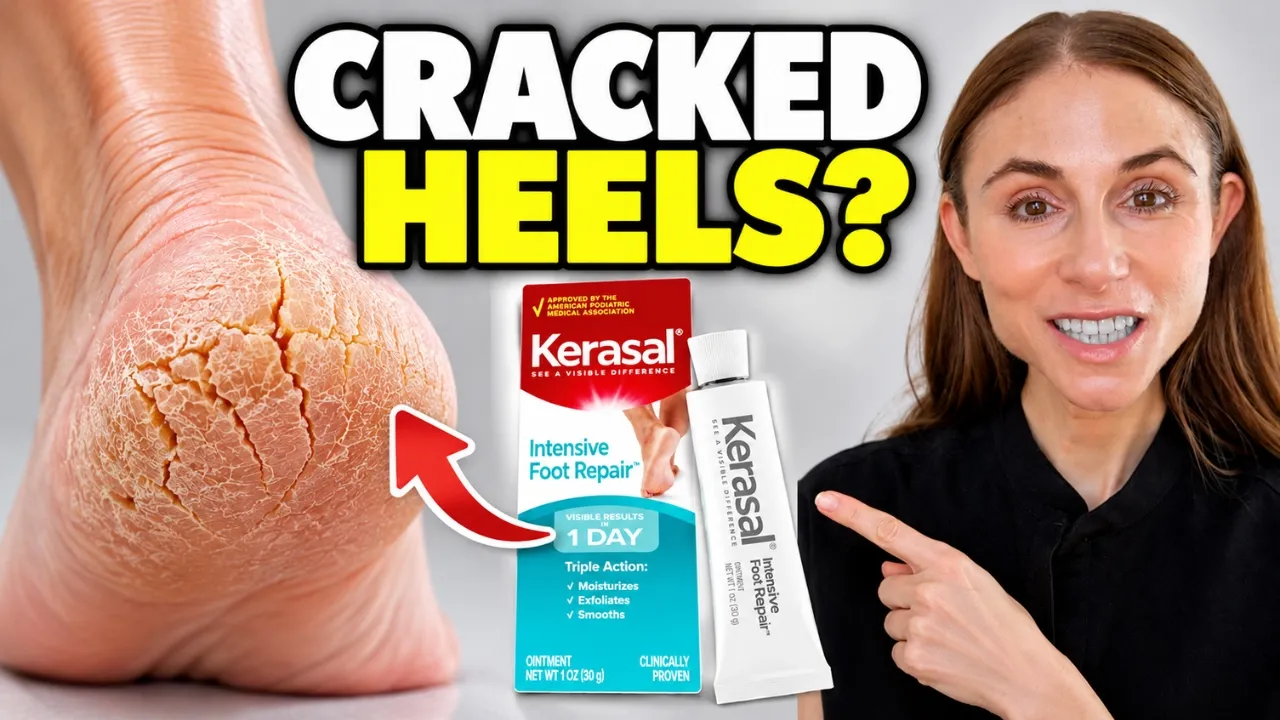
Dr Dray
Petrolatum-based urea formulations dissolve thick calluses and restore barrier hydration far more effectively than mechanical salon shaving, which offers only temporary relief before cracks return.
AI-assisted summary of Best Treatment for Dry, Cracked Heels? A Dermatologist Explains — original source. Check the original for full context.
Source published:
Key ideas
- Urea is the primary evidence-based ingredient for hyperkeratotic heels, functioning as a humectant at low concentrations and as an active keratolytic between 10% and 25% to break down intercellular adhesion in stubborn calluses. (3:52)
- Petrolatum-based ointment vehicles significantly outperform lighter creams and lotions by facilitating deeper penetration through thick skin, resisting friction from walking, and delivering maximal occlusive moisture retention. (9:11)
- Underlying causes of heel cracks extend beyond mechanical pressure to include menopausal keratoderma climactericum, inflammatory dermatoses, and athlete's foot (tinea pedis), which requires targeted antifungals rather than urea alone. (5:27)
- Keratolytic foot repair ointments combining urea and salicylic acid should be used nightly during a two-week corrective phase before tapering to once or twice weekly for maintenance to prevent excessive skin thinning and friction blisters. (13:03)
Detailed notes
## Background Published on YouTube by board-certified dermatologist Dr. Dray on October 13, 2026, this video addresses effective, evidence-based treatments for dry, rough, and cracked heels. The accompanying description highlights why urea is a premier skincare ingredient for hyperkeratotic feet, explains how to choose appropriate product formulations and concentrations, and details underlying causes ranging from mechanical stress to diabetes and menopause.
## TL;DR Dr. Dray explains that cracked heels develop when thick, callused stratum corneum loses elasticity under repetitive mechanical strain or underlying conditions like diabetes, eczema, and keratoderma climactericum. She highlights urea as the premier, research-backed ingredient that acts as a humectant at lower concentrations and a potent keratolytic between 10% and 25% to chemically dissolve compacted dead skin. Emphasizing that petrolatum-based ointment vehicles outperform creams by enhancing penetration and resisting friction, she recommends applying products like Kerasal nightly under socks during a corrective phase before tapering to maintenance to avoid friction blisters.
## Atmosphere & style The presentation is clinical, authoritative, and direct, cutting cleanly through marketing hype and viral internet trends with no-nonsense dermatological expertise. Dr. Dray communicates in a calm, instructional tone peppered with dry humor and grounded everyday analogies, such as comparing barrier hydration to powdered drink mix. The experience feels educational and empowering, reassuring viewers with clear scientific mechanisms and structured regimens rather than costly salon procedures or gimmicks.
## Bulletin - [03:52](https://www.youtube.com/watch?v=GKwS9hUfQuw&t=232s) Urea is the primary evidence-based ingredient for hyperkeratotic heels, functioning as a humectant at low concentrations and as an active keratolytic between 10% and 25% to break down intercellular adhesion in stubborn calluses. - [09:11](https://www.youtube.com/watch?v=GKwS9hUfQuw&t=551s) Petrolatum-based ointment vehicles significantly outperform lighter creams and lotions by facilitating deeper penetration through thick skin, resisting friction from walking, and delivering maximal occlusive moisture retention. - [05:27](https://www.youtube.com/watch?v=GKwS9hUfQuw&t=327s) Underlying causes of heel cracks extend beyond mechanical pressure to include menopausal keratoderma climactericum, inflammatory dermatoses, and athlete's foot (tinea pedis), which requires targeted antifungals rather than urea alone. - [13:03](https://www.youtube.com/watch?v=GKwS9hUfQuw&t=783s) Keratolytic foot repair ointments combining urea and salicylic acid should be used nightly during a two-week corrective phase before tapering to once or twice weekly for maintenance to prevent excessive skin thinning and friction blisters.
## Key takeaways - [00:00](https://www.youtube.com/watch?v=GKwS9hUfQuw&t=0s) The exceptionally thick stratum corneum on the soles of the feet undergoes constant mechanical pressure and friction, producing hard calluses that lose elasticity and split into painful fissures under walking strain. - [01:56](https://www.youtube.com/watch?v=GKwS9hUfQuw&t=116s) Urea is an endogenous component of the skin's natural moisturizing factor that hydrates at lower percentages and acts as a keratolytic at higher concentrations by chemically loosening stuck-together dead skin cells. - [01:56](https://www.youtube.com/watch?v=GKwS9hUfQuw&t=116s) Applying human urine to the feet is an unhygienic and ineffective folk remedy compared to formulated topical urea products. - [03:52](https://www.youtube.com/watch?v=GKwS9hUfQuw&t=232s) Over-the-counter products require roughly 10% to 25% urea to achieve a true keratolytic effect on thickened calluses, though chasing higher percentages like 40% is unnecessary if the vehicle is well-formulated. - [03:52](https://www.youtube.com/watch?v=GKwS9hUfQuw&t=232s) The inactive vehicle carrying an active ingredient is as crucial as the concentration itself because it determines skin contact time and depth of penetration through dense tissue. - [05:27](https://www.youtube.com/watch?v=GKwS9hUfQuw&t=327s) Heel fissures can stem from diverse medical conditions, including perimenopausal keratoderma climactericum, eczema, psoriasis, and athlete's foot. - [05:27](https://www.youtube.com/watch?v=GKwS9hUfQuw&t=327s) Moccasin-type tinea pedis mimics simple dry skin; applying urea can soften the scales but will not clear the underlying fungal infection without an antifungal agent. - [07:28](https://www.youtube.com/watch?v=GKwS9hUfQuw&t=448s) Because diabetic neuropathy and poor circulation elevate the risk of non-healing ulcers and bloodstream infections, diabetic patients with open, red, or warm fissures should seek medical care rather than using foot creams. - [07:28](https://www.youtube.com/watch?v=GKwS9hUfQuw&t=448s) Diabetic xerosis represents the most extensively researched patient population for urea, establishing its safety and clinical efficacy for dry, cracked skin. - [09:11](https://www.youtube.com/watch?v=GKwS9hUfQuw&t=551s) Petrolatum ointment vehicles are uniquely suited for feet because they maximize active penetration, resist being rubbed off by movement, and form a powerful occlusive moisture seal. - [09:11](https://www.youtube.com/watch?v=GKwS9hUfQuw&t=551s) Aggressive and prolonged use of high-strength keratolytics without scaling back can over-thin the soles, making the skin vulnerable to painful friction blisters. - [12:16](https://www.youtube.com/watch?v=GKwS9hUfQuw&t=736s) Kerasal Intensive Foot Repair Ointment is widely recommended by dermatologists due to its synergistic formulation of urea, salicylic acid, and a petrolatum base. - [13:03](https://www.youtube.com/watch?v=GKwS9hUfQuw&t=783s) A phased treatment routine involves applying keratolytic ointments nightly for about two weeks to dissolve calluses, followed by maintenance use once or twice per week. - [13:03](https://www.youtube.com/watch?v=GKwS9hUfQuw&t=783s) Wearing socks after applying petrolatum-based ointment to clean, damp feet prevents product transfer to bedding and continuously redistributes the formula across the heels overnight.
## Detailed walkthrough ### [00:00](https://www.youtube.com/watch?v=GKwS9hUfQuw&t=0s) The Reality of Foot Care Marketing vs. Evidence-Based Ingredients
Board-certified dermatologist Dr. Dray introduces the widespread problem of dry, rough, and cracked heels, highlighting how consumers are constantly bombarded by skin care products promising "baby soft feet." The market is saturated with exfoliating masks, foot peels, heavy creams, ointments, and mechanical gadgets, making it remarkably difficult for the average shopper to distinguish legitimate treatments from pure hype. Rather than falling for marketing buzzwords, consumers should focus their attention on the single most well-studied, evidence-based ingredient for targeting rough, dry foot skin: urea.
The skin on the soles of the feet is biologically unique compared to the rest of the body. Its outermost protective shield, the stratum corneum, is exceptionally thick. It constantly endures immense mechanical pressure from standing, paired with persistent friction from walking or running. Over time, these forces trigger the accumulation of thick, dead skin known as calluses. When this hardened skin dries out, it loses its elasticity and suppleness, ultimately splitting open into deep, painful cracks called fissures. Continued walking places repetitive mechanical strain directly onto these cracks, widening them and intensifying the pain. While mild surface dryness can easily be resolved with a standard daily moisturizer, stubborn thickening and cracking require an active, targeted approach.
```mermaid flowchart TD accTitle: Progression of Dry Callused Feet to Painful Fissures accDescr: Flowchart illustrating how mechanical pressure, friction, and lack of hydration turn thick skin into deep fissures. A["Mechanical Stress & Pressure<br>(Standing, walking, running)"] --> B["Thickened Stratum Corneum<br>(Callus formation)"] B --> C["Moisture Loss & Reduced Flexibility"] C --> D["Deep, Painful Fissures<br>(Heel cracks)"] D -->|"Repetitive walking strain"| E["Worsening, Deeper Cracks"] ```
[01:56](https://www.youtube.com/watch?v=GKwS9hUfQuw&t=116s) What Is Urea and How Does It Work on Rough Skin?
Urea is far from a synthetic foreign compound; it is naturally synthesized by the human body and present within the outermost layer of the skin as a natural moisturizing factor (NMF). It is highly hygroscopic, meaning it actively attracts and binds water to maintain optimal hydration within the stratum corneum. Dr. Dray emphasizes that water content in this outermost layer is fundamental to overall barrier function, offering a vivid comparison: it is the difference between trying to drink powdered Kool-Aid straight out of a dry packet versus drinking it smoothly through a straw once the correct amount of water is mixed in. A depleted stratum corneum cannot function. Addressing an infamous internet myth, she directly dispels the bizarre folk remedy circulating on social media: while urea is indeed excreted in urine, "putting your own urine on your feet is not the best way to take advantage of the hygroscopic properties of urea."
Topical urea exerts a unique dual-action mechanism that varies according to its concentration: - **Humectant Action (Lower Concentrations):** Acts similarly to classic hydrators like glycerin and hyaluronic acid, pulling ambient moisture into the epidermis to replenish barrier hydration. - **Keratolytic Action (Higher Concentrations):** Directly performs keratolysis by chemically breaking down the intercellular adhesion—the "stuck-together dead skin"—allowing stubborn, heaped-up calluses to shed efficiently. - **Barrier Recovery:** Removing the dense barrier of dead cells enables the skin beneath to retain moisture effectively, jumpstarting normal hydration and epidermal repair.
[03:52](https://www.youtube.com/watch?v=GKwS9hUfQuw&t=232s) Understanding Urea Concentrations and Formulation Vehicles
In over-the-counter foot care, urea concentrations dictate whether a product is simply hydrating or actively sloughing off dead tissue. Products with lower percentages primarily hydrate, which is beneficial for minor maintenance. However, to achieve a true keratolytic effect capable of dissolving dense, cemented calluses, formulations generally need to feature concentrations between 10% and 25% urea.
Dr. Dray warns consumers against becoming "hyper-fixated" on chasing the highest number on the label. A 40% or 30% urea cream will not automatically outperform a 20% formulation. The vehicle—the inactive base or background formulation carrying the urea—plays an equally critical role: - The base determines how long the product clings to the skin, maximizing contact time. - The vehicle directly influences how deeply and effectively the urea penetrates through the dense stratum corneum. - While seeing the exact percentage is a helpful guide (aiming for 10% or higher for thick calluses), consumers should not dismiss products that do not disclose their precise percentages, provided the vehicle and overall formulation are well-engineered.
[05:27](https://www.youtube.com/watch?v=GKwS9hUfQuw&t=327s) Identifying the Root Causes of Cracked Heels
Before rushing out to buy treatments, individuals must understand why their heels are cracking. Dr. Dray compares this to cooking: trying to pick products before knowing the underlying condition is "like trying to buy ingredients for a recipe before you've decided what recipe you're going to make." Just as hair loss serves as an umbrella term covering various distinct conditions, cracked heels can stem from several distinct etiologies:
- **Mechanical Overload:** Prolonged standing on hard surfaces for work, intense athletic activity (running, walking), and the combined friction of footwear mixed with foot sweat. - **Keratoderma Climactericum:** A poorly understood yet common condition occurring around perimenopause and menopause. Dropping estrogen levels are believed to trigger dense, stubborn, thick calluses on the soles. While hormone replacement therapy lacks definitive research regarding its impact on this presentation, topicals containing urea or other keratolytics remain the frontline standard of care. - **Inflammatory Dermatoses:** Eczema, allergic contact dermatitis, and foot psoriasis, all of which compromise skin barrier integrity and drive excessive scaling. - **Tinea Pedis (Athlete's Foot):** A fungal infection that mimics simple dry skin by creating a flaky, thickened "moccasin-type" appearance. Although urea can soften and moisturize the scaling, it lacks antifungal properties; relying on urea alone allows the fungal infection to thrive unchecked.
[07:28](https://www.youtube.com/watch?v=GKwS9hUfQuw&t=448s) Special Foot Care Considerations for Diabetics
Diabetes mellitus warrants special dermatological caution. As a systemic metabolic disease, diabetes frequently causes severe dry skin, especially along the lower extremities. In diabetic patients, cracked heels are compounded by peripheral neuropathy (loss of protective sensation) and peripheral vascular disease (poor circulation). This triad makes diabetics exceptionally vulnerable to minor heel cracks that rapidly escalate into non-healing ulcers and severe infections.
Interestingly, diabetes is the exact patient population where urea has been most thoroughly evaluated in scientific literature, proving safe and efficacious for treating xerosis and fissures in both type 1 and type 2 diabetes. However, Dr. Dray issues an urgent clinical warning: if cracked heels present alongside signs of active infection—such as an open wound, localized warmth, spreading erythema, swelling, or bleeding—patients must bypass foot creams entirely and consult a medical doctor immediately, as untreated diabetic foot infections carry a high risk of spreading hematogenously to the bloodstream.
When shopping for foot products, consumers should ignore extravagant marketing claims and instead inspect the active ingredient panel for proven keratolytics. While urea is the gold standard, it is frequently combined with complementary chemical exfoliants, such as alpha hydroxy acids like glycolic acid and lactic acid, to provide enhanced peeling power.
[09:11](https://www.youtube.com/watch?v=GKwS9hUfQuw&t=551s) Why the Vehicle Matters: Ointments vs. Creams
When evaluating foot care formulations alongside active keratolytics like salicylic acid or ammonium lactate (a salt of lactic acid), consumers frequently make the mistake of obsessing over ingredient rankings on the label under the assumption that "if it's up high, it must be better." In reality, the vehicle—whether a product is formulated as an ointment, cream, lotion, or toner—is just as critical as the actives themselves. For the thick skin of the feet, petrolatum-based ointments are far superior to lighter vehicles for three distinct reasons:
```mermaid flowchart TD accTitle: Advantages of Petrolatum Ointment Vehicles for Foot Care accDescr: Flowchart illustrating the three main benefits of using a petrolatum ointment vehicle for cracked heels: enhanced penetration, surface longevity, and moisture retention.
subgraph Vehicle["Petrolatum Ointment Base"] direction TB V1["Enhanced Penetration"] V2["Surface Longevity"] V3["Maximal Hydration"] end
V1 -->|"Overcomes"| E1["Ultra-thick stratum corneum on soles"] V2 -->|"Resists"| E2["Continuous mechanical walking stress"] V3 -->|"Forms"| E3["Heavy occlusive moisture barrier"] ```
First, an ointment vehicle actively enhances the cutaneous penetration and localization of active ingredients like urea into the exceptionally dense stratum corneum found on the soles. Second, ointments provide sustained longevity on the skin, staying put much better than creams despite the constant mechanical friction and stress caused by walking. Third, petrolatum ointment on its own—even without added urea, lactic acid, glycolic acid, or salicylic acid—is one of the most effective occlusives available to prevent transepidermal water loss and restore hydration to parched skin.
- **Keratolytic vs. Maintenance Strengths:** When dealing with thick, accumulated calluses, prioritize higher, keratolytic-strength urea formulations rather than paying a nail salon to mechanically shave them down, which only offers temporary relief before they recur. - **Risk of Blisters:** Once the calluses have resolved, scale back the treatment frequency or switch to lower non-keratolytic percentages for maintenance. Dr Dray notes that being on one's feet constantly while using potent keratolytics too aggressively can over-thin the skin and lead to friction blisters.
[12:16](https://www.youtube.com/watch?v=GKwS9hUfQuw&t=736s) Recommended Product: Kerasal Intensive Foot Repair Ointment
When asked "What is the best product for cracked heels?", dermatologists must clarify that clinical research evaluates active ingredients rather than specific commercial brands. However, based on both her clinical practice and personal use, Dr Dray highlights **Kerasal Intensive Foot Repair Ointment** as a gold-standard over-the-counter recommendation widely favored by U.S. dermatologists.
The effectiveness of Kerasal boils down to its synergistic formulation: it combines urea with salicylic acid inside a rich petrolatum ointment base. This combination delivers moisture, chemically exfoliates compacted dead skin cells, and seals the skin surface without needing separate product steps.
[13:03](https://www.youtube.com/watch?v=GKwS9hUfQuw&t=783s) Step-by-Step Application Protocol and the "Sock Strategy"
How often you use a keratolytic foot ointment depends on whether you are correcting severe build-up or maintaining smooth skin:
- **Corrective Phase:** Apply nightly for a couple of weeks until thickened cracks and rough build-up significantly soften. - **Maintenance Phase:** Scale back application to just one or two nights per week to prevent irritation and blister formation.
For optimal absorption, apply the ointment at night right before going to bed. Take a bath or shower, pat the skin dry so there is no pooling water, and smooth the ointment directly over the heels while the skin is still freshly hydrated.
Immediately cover the feet with a pair of socks. The socks serve a vital mechanical purpose: they prevent the petrolatum from smearing off onto your floors and linens, while any ointment that absorbs into the inner fabric remains in close contact with the heels, constantly redistributing onto the stratum corneum overnight. For those who dislike sleeping in socks, Dr Dray recommends keeping them on for at least an hour while relaxing before taking them off for sleep.
[14:27](https://www.youtube.com/watch?v=GKwS9hUfQuw&t=867s) The Evidence for Urea and Final Foot Care Tips
A comprehensive search of review papers on PubMed confirms that urea remains the undisputed, research-backed heavy hitter for treating hyperkeratotic, cracked heel conditions. Because scientific studies evaluate the mechanism of urea as an endogenous component of natural moisturizing factor rather than specific brand names, focusing on the ingredient itself is the most dependable path to smooth skin: "urea, urea, urea is what I recommend. It's what the research supports. It gets results."
To wrap up, Dr Dray urges viewers to leave comments sharing what products have worked for them and directs them to an end-screen video detailing non-product lifestyle habits to combat heel cracks for free, concluding with her signature sign-off: "don't forget sunscreen and subscribe."
## Notable quotes > [01:56](https://www.youtube.com/watch?v=GKwS9hUfQuw&t=116s) putting your own urine on your feet is not the best way to take advantage of the hygroscopic properties of urea. — Dr. Dray
> [03:52](https://www.youtube.com/watch?v=GKwS9hUfQuw&t=232s) hyper-fixated — Dr. Dray
> [05:27](https://www.youtube.com/watch?v=GKwS9hUfQuw&t=327s) like trying to buy ingredients for a recipe before you've decided what recipe you're going to make. — Dr. Dray
> [09:11](https://www.youtube.com/watch?v=GKwS9hUfQuw&t=551s) if it's up high, it must be better. — Dr. Dray
> [12:16](https://www.youtube.com/watch?v=GKwS9hUfQuw&t=736s) What is the best product for cracked heels? — Dr. Dray
> [14:27](https://www.youtube.com/watch?v=GKwS9hUfQuw&t=867s) urea, urea, urea is what I recommend. It's what the research supports. It gets results. — Dr. Dray
> [14:27](https://www.youtube.com/watch?v=GKwS9hUfQuw&t=867s) don't forget sunscreen and subscribe. — Dr. Dray
## Mentioned Dr. Dray, Urea, Kerasal Intensive Foot Repair Ointment, Salicylic acid, Lactic acid, Glycolic acid, Ammonium lactate, Petrolatum, PubMed
## Video description Kerasal Intensive Foot Ointment: https://amzlink.to/az05VWDfND6wS
Struggling with dry, rough, or cracked heels? Dermatologist Dr. Dray explains why urea is one of the most useful skincare ingredients for treating dry, thickened skin on the feet and what to look for when choosing a foot cream or ointment.
Urea is a humectant that helps the skin retain moisture. At higher concentrations, it also acts as a keratolytic, helping soften and loosen excess thickened skin. This makes urea particularly useful for rough, callused heels that are prone to cracking.
In this video, Dr. Dray discusses how urea works, which concentrations may be helpful for dry and rough feet, and why the formulation matters just as much as the active ingredients. She also explains other potential causes of cracked heels, including mechanical stress, aging, keratoderma climactericum associated with menopause, eczema, psoriasis, and athlete's foot.
People with diabetes should take particular care of their feet because cracks can increase the risk of infection, especially when neuropathy or circulation problems are present.
Dr. Dray also reviews Kerasal Intensive Foot Repair Ointment, a product she likes for thick, rough heels. Its combination of urea, salicylic acid, and an ointment vehicle helps hydrate and soften thickened skin while reducing moisture loss.
Discover why urea is worth looking for in foot care products, how ointments compare with creams and lotions, and how to care for dry, cracked heels without relying on aggressive exfoliation or marketing claims.
TIMESTAMPS
0:00 Intro: The Best Ingredient for Dry, Cracked Heels 1:10 Why Do Heels Get Dry and Cracked? 1:56 What Is Urea? 2:56 How Urea Works on Dry, Rough Skin 3:52 What Concentration of Urea Should You Look For? 5:27 Other Causes of Dry, Cracked Heels 7:28 Diabetes and Cracked Heels: Important Foot Care Considerations 8:41 What to Look For in a Foot Cream or Ointment 12:16 Kerasal Intensive Foot Repair Ointment Review 13:03 How to Use Foot Repair Ointments 14:27 Final Tips for Smoother, Softer Heels
#CrackedHeels #DryFeet #UreaCream #UreaForFeet #Kerasal #KerasalFootRepair #FootCare #FootCareTips #DrySkin #CallusedFeet #HeelCracks #Dermatologist #DrDray #SkincareIngredients #salicylicacid
FTC: This video is not sponsored. Links are commissionable, meaning I may earn commission from purchases made through links.
💜Shop my Amazon store https://o.bttn.io/0BwiPWFIZLG 💜Follow me on liketoknowit https://www.liketoknow.it/drdrayzday 💜Social media Instagram @drdrayzday Pinterest https://www.pinterest.com/drdrayzday/ Facebook @DrDrayzDay Twitter: @drdrayzday Tiktok: @drdrayzday
Disclaimer: This video is not intended to provide diagnosis, treatment or medical advice. Content provided on this Youtube channel is for informational purposes only. Please consult with a physician or other healthcare professional regarding any medical or health related diagnosis or treatment options. Information on this Youtube channel should not be considered as a substitute for advice from a healthcare professional. The statements made about specific products throughout this video are not to diagnose, treat, cure or prevent disease.
[Source](https://www.youtube.com/watch?v=GKwS9hUfQuw)