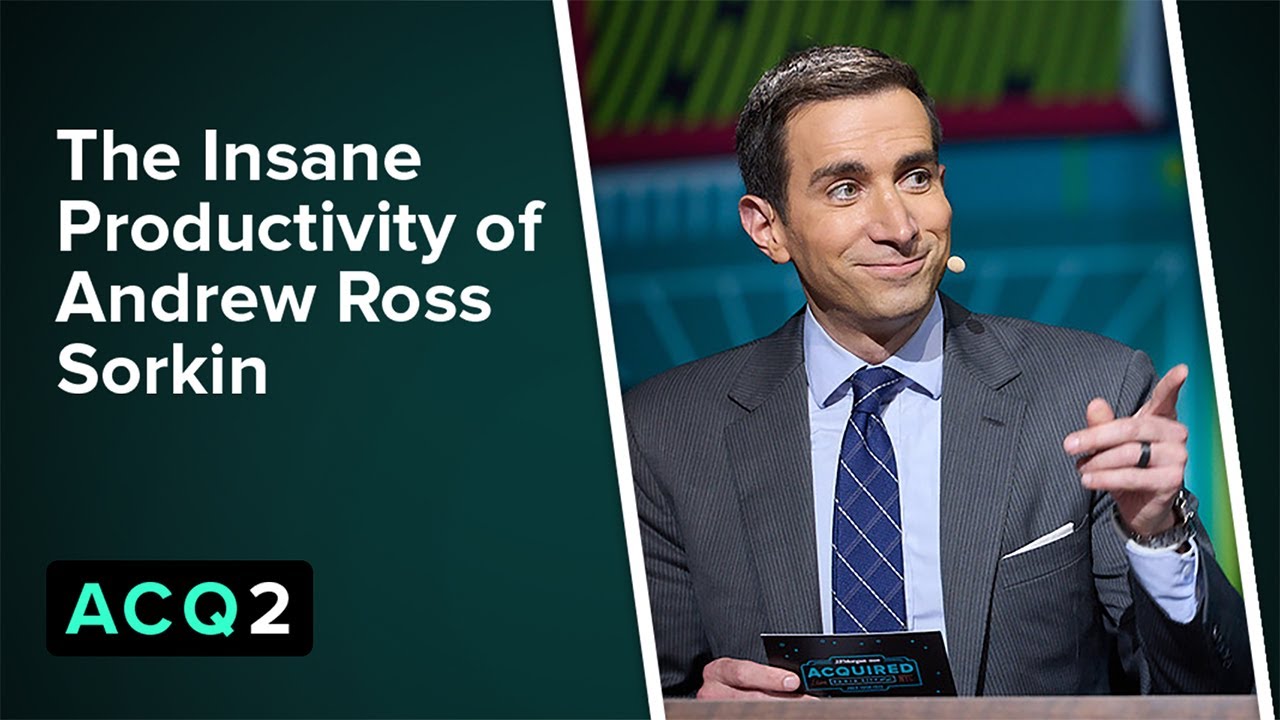
## Background
Published on YouTube by the channel Acquired on December 8, 2025, this video features an interview with Andrew Ross Sorkin. According to the page description, the episode explores Sorkin's massive daily portfolio—including DealBook, CNBC's Squawk Box, the DealBook Summit, and his books—to understand his insane productivity and daily routine.
## TL;DR
In this interview, Andrew Ross Sorkin breaks down his early career at the New York Times as an 18-year-old freelancer and the 2001 origin story behind launching the DealBook newsletter. He details his intense daily routine, which balances early-morning live television anchoring at CNBC with running a global remote newsroom. Sorkin also shares his tactical preparation strategies for the high-stakes DealBook Summit, his creative leap into co-creating the TV show Billions, and his human-centric approach to writing his historical book, 1929.
## Atmosphere & style
The conversation is characterized by a warm, respectful, and highly collegial dynamic, shifting fluidly between humorous banter about wardrobe choices and deep, intellectual dives into media architecture. Sorkin brings a passionate, self-deprecating energy to the discussion, revealing a vulnerability regarding his creative risks while maintaining an intense journalistic focus. It feels like an authentic, behind-the-scenes masterclass where industry peers share a mutual respect for the grueling craft of high-level research and storytelling.
## Key takeaways
- [00:00](https://www.youtube.com/watch?v=ZbER_DeLA0w&t=0s) Andrew Ross Sorkin manages a massive daily workload that includes anchoring CNBC's Squawk Box, writing the New York Times DealBook newsletter, running the DealBook Summit, and writing major books.
- [02:08](https://www.youtube.com/watch?v=ZbER_DeLA0w&t=128s) Sorkin stepped into his co-anchor role on CNBC's Squawk Box around 2011 following the tragic passing of legendary co-anchor Mark Haines.
- [14:00](https://www.youtube.com/watch?v=ZbER_DeLA0w&t=840s) DealBook was founded in 2001 to compete with the Wall Street Journal's physical dominance on morning commuter trains by sending a comprehensive digital briefing straight to professionals' inboxes.
- [16:02](https://www.youtube.com/watch?v=ZbER_DeLA0w&t=962s) In its infancy, DealBook faced newsroom skepticism because its core hyper-linking philosophy actively directed New York Times readers to competitors like the Wall Street Journal and Financial Times.
- [17:17](https://www.youtube.com/watch?v=ZbER_DeLA0w&t=1037s) DealBook launched during the bleak post-dot-com bust and was required to be profitable on day one via advertising; its first advertiser was Brooks Brothers.
- [06:30](https://www.youtube.com/watch?v=ZbER_DeLA0w&t=390s) The 2008 financial crisis acted as a massive catalyst that expanded DealBook's core audience from strict dealmakers to a broader audience at the intersection of business, finance, and public policy.
- [19:43](https://www.youtube.com/watch?v=ZbER_DeLA0w&t=1183s) The DealBook inbox turned into an extraordinary reporting channel because corporate titans and insider sources began replying directly to the newsletters with real-time feedback and leaks.
- [22:54](https://www.youtube.com/watch?v=ZbER_DeLA0w&t=1374s) Great scoops are rarely broken by calling top executives, but are instead built from the bottom up by working with junior staff or 'jilted lovers' like passed-over bankers and lawyers.
- [31:24](https://www.youtube.com/watch?v=ZbER_DeLA0w&t=1884s) The DealBook Summit was created in 2011 to bring the pages of DealBook to life, establishing a high-profile forum at the confluence of finance, tech, and Washington policy.
- [36:49](https://www.youtube.com/watch?v=ZbER_DeLA0w&t=2209s) Sorkin spends 15 to 30 hours of preparation for each summit guest and maintains a strict journalistic rule of never sharing specific questions with guests or PR teams in advance.
- [51:06](https://www.youtube.com/watch?v=ZbER_DeLA0w&t=3066s) Sorkin uses a 'depersonalization' technique when asking tough questions on stage by reading critical public domain quotes aloud, shifting the framing from a personal attack to an examination of public discourse.
- [58:33](https://www.youtube.com/watch?v=ZbER_DeLA0w&t=3513s) DealBook operates on a purely sponsor-supported model rather than a direct consumer paywall, prioritizing massive public reach and releasing all summit videos for free within 24 hours.
- [01:01:05](https://www.youtube.com/watch?v=ZbER_DeLA0w&t=3665s) Sorkin co-created the hit TV series Billions entirely 'on spec,' writing the pilot with zero upfront studio development backing after his agent initially dismissed the project as a bad idea.
- [01:08:27](https://www.youtube.com/watch?v=ZbER_DeLA0w&t=4107s) Sorkin structures his reporting and projects around human psychology and personal incentives rather than dry economics, believing individual choices drive massive economic shifts.
- [01:11:14](https://www.youtube.com/watch?v=ZbER_DeLA0w&t=4274s) Sorkin rejects standard corporate advice to 'not take things personally,' arguing instead that the most successful people care so deeply about their craft that they must take everything personally.
- [01:11:14](https://www.youtube.com/watch?v=ZbER_DeLA0w&t=4274s) Sorkin defends his close relationships with high-profile sources by stating a journalist must act as a 'fair weather fan'—giving credit when they do right and explaining why it's wrong when they fail.
## Detailed walkthrough
### [00:00](https://www.youtube.com/watch?v=ZbER_DeLA0w&t=0s) The Insane Productivity of Andrew Ross Sorkin
The Acquired hosts kick off the interview by expressing absolute marvel at how guest Andrew Ross Sorkin manages his staggering daily workload. While the hosts feel completely spent producing just a single show, Sorkin juggles a dizzying array of major commitments every single day. His daily and ongoing portfolio includes writing the New York Times *DealBook* daily newsletter, hosting the annual DealBook Summit every December, co-creating the hit Showtime TV series *Billions*, co-anchoring CNBC’s *Squawk Box* live every morning from 6:00 a.m. to 9:00 a.m. Eastern, and authoring major bestselling books like *Too Big to Fail* and his newest release, *1929*.
The conversation aims to pull back the curtain on his "insane productivity," but also uncovers a historical narrative that Sorkin has never fully shared before: the origin story of how he launched a pioneering business daily email newsletter all the way back in 2001. The hosts point out that this was a decade before *Stratechery* and 15 years before the modern Substack boom, making Sorkin an incredibly early pioneer in the email media landscape. Over nearly a quarter-century, he built *DealBook* into what the hosts call the "flagship canonical business interview forum in the world," bridging business, technology, and politics.
- **DealBook Daily Newsletter:** Founded in 2001 inside the New York Times.
- **Squawk Box:** Live broadcast 3 hours a day, 5 days a week (6:00 a.m.–9:00 a.m. ET).
- **DealBook Summit:** Flagship global forum held every December.
- **Books Authored:** *Too Big to Fail* and his latest book tour release, *1929*.
---
[02:08](https://www.youtube.com/watch?v=ZbER_DeLA0w&t=128s) A Day in the Life: From Pajamas to Squawk Box
The banter shifts to Sorkin's immediate appearance. The hosts joke about his wardrobe, noticing he is dressed down compared to his usual television attire. Sorkin laughs and admits he changed into a sweater specifically for them, fearing that if he showed up in his usual standard uniform, he would look like "some like old man in a suit" while the podcast hosts looked cool. He jokes that he practically "sleeps in a suit with a tie" because he is in one almost all day.
Sorkin then explains how his morning routine operates and how his various roles complement one another. He joined *Squawk Box* as a full-time co-anchor around 2011. Before that, he was a frequent guest on the show. When legendary co-anchor Mark Haines tragically passed away, CNBC reshaped their programming, moving co-host Carl Quintanilla to *Squawk on the Street*. CNBC asked Sorkin to step into the vacant chair on *Squawk Box*. At first, Sorkin thought the idea was "insane" because he had never read a teleprompter or anchored live TV. However, because the New York Times allowed him to keep his reporting role, he realized he could have the "best of both worlds."
- **Wake-up Time:** Sorkin's day begins around 4:30 a.m. Eastern Time.
- **Early Routine:** He spends his first moments in bed under the covers checking emails, texts, and Slack messages related to *DealBook*.
- **The DealBook Hook:** Sorkin personally writes the "Good morning, Andrew here" introductory hook every single morning between 5:00 a.m. and 6:00 a.m. to pitch the day's narrative and optimize the newsletter's subject line.
---
[06:30](https://www.youtube.com/watch?v=ZbER_DeLA0w&t=390s) Running a Global Remote Newsroom in 2001
When asked if he sends the newsletter directly from the CNBC news desk, Sorkin reveals the behind-the-scenes workflow that keeps the operation running seamlessly while he is getting ready for live television. The physical "send" button is actually pressed in Europe by long-time colleagues Michael de la Merced, who has been with *DealBook* for nearly 20 years, and Bernard Warner, who operates out of Italy. Working overnight relative to New York, the European team and a copy editor take the content generated in the U.S., clean it up, add updates, and sometimes "completely rewrite and changing the mess that we've made."
Sorkin discusses how the core target audience and content philosophy of *DealBook* evolved over its 25-year history. The baseline goal has always been to make the reader "armed and dangerous" before their 9:00 a.m. morning meetings or breakfasts. Originally designed strictly for an ecosystem of dealmakers—M&A bankers, lawyers, and accountants—the readership organically expanded over time to include CEOs, board members, corporate strategy groups, and eventually regulators and politicians. The seismic catalyst for this shift was the 2008 financial crisis, after which *DealBook* consciously pivoted to capture the massive, consequential intersection of business, finance, and public policy.
> "In the beginning it was really for the world of dealmakers. It was M&A bankers and lawyers and accountants... especially after the financial crisis of 2008 [we shifted] to really sort of try to capture the intersection of business and policy and really connect the dots."
---
[08:34](https://www.youtube.com/watch?v=ZbER_DeLA0w&t=514s) The 18-Year-Old New York Times Reporter
The hosts pull the conversation back to Sorkin's teenage years to understand how a kid from Scarsdale, New York, managed to get his foot in the door at the world's most prestigious newspaper at age 18. Sorkin explains that by age 15, he was obsessed with the media industry—specifically the business side of media and audience aggregation rather than traditional journalism. In high school, he created *The Sports Page* magazine, selling ads for $900 to $1,200 a page and distributing copies to high schools nationwide to capture the elusive teenage male demographic. The venture eventually folded due to "rookie errors," such as wastefully shipping packages via Federal Express just to look professional and completely miscalculating printing costs when shifting from black-and-white to full color.
However, the high school venture caught the attention of the New York Times, which wrote a small piece about it. Obsessed with Stuart Elliott, the legendary advertising columnist for the Times, Sorkin would cold-call him from home after high school trying to land a gig. Eventually, Elliott took him to lunch, and alongside business editor Glenn Kramon, allowed Sorkin to hang around the newsroom. Showing up every day on a temporary visitor's pass to xerox and staple papers in a suit and tie, 18-year-old Sorkin benefited from a case of mistaken identity in 1995. An editor overheard him talking about a new thing called "the internet," assumed he was a college-educated news clerk, and assigned him his very first article.
- **First Article Subject:** A 1995 explanatory piece about the high-pitched screeching noises that dial-up modems make when connecting to one another.
- **Sorkin's Analogy:** He famously explained to his editor that the sound was the two modems "mating" and talking to each other.
- **College Years:** Sorkin attended Cornell University, continuing to freelance for the Times during college and later writing daily dispatches from London while studying at the London School of Economics (LSE).
---
[14:00](https://www.youtube.com/watch?v=ZbER_DeLA0w&t=840s) Bypassing the Physical Paper
The walkthrough of Sorkin's early career culminates in the specific lightbulb moment that birthed *DealBook* in 2001. After returning to New York from London to cover mergers and acquisitions, Sorkin found himself struggling to compete with the Wall Street Journal. He would pitch himself to top-tier institutional bankers and lawyers, only to receive a "dagger to the heart" response: they would read the front page or sports section of the Times at home, leave the paper with their spouses, and take the Wall Street Journal with them on the commuter train.
Realizing that Wall Street professionals were leaving the physical Times behind but spending an inordinate amount of time hunting for digital nuggets of information online, Sorkin realized he could compile a comprehensive daily briefing and bypass the physical print product entirely by going straight to their digital inboxes. The concept was so early that it predated the widespread adoption of digital corporate infrastructure; Sorkin laughs remembering that in the earliest days of *DealBook*, prominent Wall Street subscribers would have their secretaries call the news desk to ask, "Could you fax us DealBook?"
- **Launch Year:** 2001, born out of a structural need to compete with the *Wall Street Journal*'s physical grip on morning train commuters.
- **Historical Medium:** The primary alternative business newsletters of the era were research papers delivered via office fax machines.
[16:02](https://www.youtube.com/watch?v=ZbER_DeLA0w&t=962s) The Early DNA and Newsroom Discomfort of DealBook
In the early days of DealBook, the original concept faced a distinct culture clash within *The New York Times*. The core premise involved aggregating and linking out to other sources—a concept that traditional newsroom figures struggled to grasp. There was a running joke where it had to be explained that if readers clicked the links, they could read the whole story, which did not immediately click with the staff. While there was marginal support inside the paper, a deep sense of discomfort lingered because DealBook actively directed readers to competitors like *The Wall Street Journal*, the *Financial Times*, and various local papers that were delivering exceptional business coverage at the time.
The strategy was highly localized and dynamic. For instance, when the French company Alcatel was acquiring Lucent, DealBook would translate portions of *Le Monde* or link readers directly to the *Trenton Times* to capture the local community's perspective. If an oil patch story broke in Dallas, they pointed readers straight to Texan sources or directly into SEC filings. This hyper-linking philosophy was entirely counter-cultural to a traditional newsroom that preferred to keep readers strictly within its own pages.
[17:17](https://www.youtube.com/watch?v=ZbER_DeLA0w&t=1037s) Post-Dot-Com Economics and Finding a Monetization Model
The business landscape into which DealBook launched was incredibly bleak, emerging directly from the ashes of the dot-com bust. Market anxieties were high; *The New York Times* had even scrapped plans for a tracking stock dedicated to its digital business due to the downturn. In terms of Total Addressable Market (TAM)—a term the speakers note wasn't even part of the lexicon back then—the internal expectation was that DealBook might top out at a meager 30,000 subscribers for a free product. Hearing this, the hosts laughingly relate it to their own early podcasting journey, remembering when they capped their own expectations at 10,000 to 20,000 listeners. Today, DealBook boasts over a million subscribers.
Financially, the goal was never to charge readers, but rather to use advertising to cover costs while projecting the New York Times brand in front of a high-value audience. A firm promise was made to management that the project wouldn't launch unless it was profitable on "day one"—and it was. Brooks Brothers signed on as the very first advertiser, a brand that remains in business today, though as a joke notes, "only by a hair" after navigating multiple bankruptcies.
- **Original TAM estimate:** 30,000 free subscribers.
- **Current subscriber count:** Over 1 million.
- **First advertiser:** Brooks Brothers, accompanied soon after by a currency exchange.
- **Organizational structure:** A strict "church and state wall" separated the journalism from the ad sales team.
[19:43](https://www.youtube.com/watch?v=ZbER_DeLA0w&t=1183s) The Source Meta-Game and Inside the Reporting Loop
Within a couple of months, DealBook "caught fire," prompting a flood of subscription requests and frantic calls from CEOs asking for editions to be faxed to their bosses. The most rewarding evolution, however, was the immediate, unprecedented feedback loop created by the audience. Long before the era of Twitter or X, corporate titans were hitting reply on the newsletters. This turned the inbox into an extraordinary reporting channel. Insiders would email PDFs of pitch decks for mergers slated two days away, or reply directly to articles saying, "I'm involved in this transaction and by the way you didn't get this right."
Navigating these replies requires a sophisticated understanding of source motivation. Every source is assumed to be self-motivated, often driven by a desire to benefit themselves or actively "screw somebody else over"—even colleagues in adjacent offices. To guard against misinformation, a strict rule of confirming details with two, three, or four separate sources, or securing hard documentation, is maintained.
[22:54](https://www.youtube.com/watch?v=ZbER_DeLA0w&t=1374s) Corporate Egos and the Architecture of a Scoop
The messy, human reality of corporate dealmaking often stands in stark contrast to polished press releases. The hosts bring up a prime example from their recent Coca-Cola episode: the night the CEO of Coca-Cola announced a joint deal to buy Quaker Oats (primarily to acquire Gatorade), only for the Coca-Cola board to sensationally kill the deal *after* the public announcement, leaving Pepsi to swoop in and secure a legendary corporate home run. Behind these massive events are clashing personalities, which is exactly where a reporter finds the best stories.
Discovered intelligence rarely comes from simply calling the "tippy top" executives to ask for a confirmation or denial. Instead, great scoops are built from the bottom up, often starting with junior staff or what is dubbed the "jilted lover"—a banker, lawyer, or accountant who spent years courting a CEO only to watch Goldman Sachs win the business. These individuals have no skin in the game other than a desire to disrupt the situation. Once a reporter works through their network to piece together 80% to 90% of the narrative—including prices, stock-for-stock ratios, collars, and meeting timelines—they finally approach the company for comment. At that stage, companies typically find it "behooves" them to participate so they can have a hand in shaping the narrative.
[27:07](https://www.youtube.com/watch?v=ZbER_DeLA0w&t=1627s) Business History, Archival Magic, and the Language of Drama
While the hosts view themselves as business historians looking at the past, they note that their work deeply rhymes with contemporary journalism. Reflecting on a recently completed book about 1929, the speaker describes the contrasting challenges of both mediums. Reporting on today allows for real-time interviews, whereas chronicling a century ago leaves a writer entirely dependent on letters, diaries, memos, and archival materials. The key to powerful storytelling in both domains is empathy—putting oneself entirely in the shoes of the characters to understand their psychology and translate it for a modern audience.
History books can often feel stiff and unapproachable due to the formal language of the era. To make figures from eras like Standard Oil truly resonate, the presentation needs to strip away the stilted prose and expose the raw, ruthless corporate drama beneath. It is far more engaging to frame historical maneuvers with contemporary energy, telling the audience, "you're not going to believe what Henry Flagler did next. Like what an animal that guy".
The podcast takes a moment to thank its long-time sponsor, Shopify. The hosts recount their multi-year friendship with the company, highlighting a recent interview with founder Tobi Lütke on ACQ2 regarding AI advancements and the insane transformation the enterprise has undergone in the six years since it was first featured on the main show. While Shopify remains the definitive platform for small entrepreneurs, it has scaled spectacularly to become the world's leading commerce infrastructure for multi-billion-dollar enterprise giants like Everlane, Vuori, and Mattel, all while keeping its core soul and mission intact.
The engineering power of the platform lies in its omnipresent ecosystem and superior conversion capabilities. Rather than wasting resources building proprietary, subpar e-commerce software—or "doing what doesn't make your beer taste better"—brands leverage Shopify to sell seamlessly across their own sites alongside platforms like Instagram, YouTube, TikTok, Roblox, Roku, ChatGPT, and Perplexity.
- **Shop Pay Feature:** Accelerated checkout mechanism with a built-in user base of 200 million people with pre-stored payment credentials.
- **Call to Action:** Listeners are directed to visit `[shopify.com/acquired](https://shopify.com/acquired)` to signal that Ben and David sent them.
[31:24](https://www.youtube.com/watch?v=ZbER_DeLA0w&t=1884s) Bringing the Pages to Life: The DealBook Summit
In 2011, exactly ten years after the launch of the newsletter, the franchise expanded into live events with the creation of the DealBook Summit. The guiding philosophy behind the summit was simple: "can we bring the pages of DealBook to life?" The goal was to take the fascinating cast of characters who populated the daily columns and unburden them from the text of an email inbox. By putting these business leaders live on a stage, the summit aims to interview them in a genuinely human way, allowing the general public to see exactly how they think and wrestle with the biggest, most pressing issues of the day.
[32:05](https://www.youtube.com/watch?v=ZbER_DeLA0w&t=1925s) Inside the Psyche of Influence: The True Value of Long-Form Interviews
The speakers explore the deeper purpose behind high-profile business interviews, noting that the goal isn't necessarily to break immediate news, but to understand why influential people think the way they do. An hour-long interview allows listeners to peer inside the psyche of figures like Elon Musk, Sundar Pichai, or Jeff Bezos, providing a "richer texture" of their motivations. While these summits might not function as standard daily reporting, they offer unique insights that explain past behavior and often foreshadow future actions. Little quotes and "nuggets" dropped during these sessions regularly find their way into news headlines six months down the line when a new venture or strategy is officially announced.
The conversation turns to a fresh morning headline regarding a new venture by Jeff Bezos. This development directly mirrors a past interview where Bezos leaned heavily into artificial intelligence—a focus that initially surprised the interviewer given that Amazon was perceived to be lagging behind in large language models while Bezos himself was publicly focused on space exploration. During that previous talk, Bezos remarkably described AI as being as foundational and important "like fire." The logic clicks into place with the recent news that Bezos is taking a hands-on role to become the co-CEO of this new company, marking a massive personal double-down since he hadn't served as a CEO since leading Amazon, having previously hired an outside executive to run Blue Origin.
* The Dealbook Summit interviews typically run between 30 minutes to an hour.
* Content creator Alex Cooper once famously "dropped her energy drink" announcement during a summit moment.
* Jeff Bezos previously compared the significance of artificial intelligence to the discovery of fire.
[35:08](https://www.youtube.com/watch?v=ZbER_DeLA0w&t=2108s) The Confluence of Markets, Tech, and Washington: The Origins of Dealbook
Reflecting on the inception of the Dealbook Summit back in 2011, the host recalls navigating a landscape that had far fewer business conferences than exist today. At the time, the dominant event was the Wall Street Journal’s D Conference—which eventually transitioned into Recode—but its focus was strictly limited to the tech sector. The vision for Dealbook was to build a premier alternative at the unique "confluence of finance and Wall Street, tech, and policy out of Washington."
The summit found its footing by curating an elite, diverse lineup from day one. The inaugural event kicked off with JPMorgan Chase CEO Jamie Dimon as the opening speaker, alongside heavyweight contemporary leaders like Lloyd Blankfein, Marc Andreessen, Eric Schmidt, and Dick Costolo, who was running Twitter at the time. By its second year, the summit expanded its reach even further into hedge funds and federal enforcement, bringing on Ken Griffin, Dan Loeb, and Preet Bharara, who was leading the Southern District of New York at the point.
[36:49](https://www.youtube.com/watch?v=ZbER_DeLA0w&t=2209s) The Backstage Art of Preparing for a Media Marathon
The discussion shifts to the intense logistics of executing eight high-caliber interviews back-to-back in a single day, a feat described as "sprinting a marathon." The host reveals that each individual interview demands between 15 to 30 hours of meticulous preparation. To manage this throughout the year, he maintains a running notes app on his phone filled with articles, quotes, and observations for an ongoing wish list of prospective onstage guests. Beyond studying hard data, a significant portion of the prep involves talking to people who know the subjects personally to gauge their baseline disposition, motivations, and emotional drivers.
A strict journalistic rule is maintained: specific questions are never shared with guests or their PR teams ahead of time. However, the host does discuss overarching themes in advance to get the subjects thinking and ensure they do not come into the conversation completely cold. The speakers share a laugh over a rare exception involving Barry Diller at Radio City Music Hall, who repeatedly declined any pre-show briefing calls with a dismissive "no, no, no," resulting in a frantic, last-minute sync from the dressing room during rehearsals.
* Interview preparation ranges from 15 to 30 hours per guest.
* The host has conducted every single onstage interview himself since the summit's third year.
* The physical stage marathon lasts from roughly 9:00 a.m. to 6:30 p.m.
[39:06](https://www.youtube.com/watch?v=ZbER_DeLA0w&t=2346s) Meeting Guests Where They Are: The Commercial Break Phenomenon
The most critical window of an interview often happens in the final two minutes before the cameras roll or during television commercial breaks. Guests frequently arrive at the set carrying immense anxiety, making it the interviewer's primary job to settle their nerves and "meet them where they are." On the set of *Squawk Box*, the banter and chaotic energy that unfolds while the commercials are airing is often just as wild and entertaining as the broadcast itself. The host notes that a simple handshake in the wings can tell you exactly what to expect: "You get a sweaty hand, you know what's about to happen."
The guests contrast this with a cold experience they had at a different network, where the host completely ignored them to stare down at an iPad from one foot away. By comparison, *Squawk Box* prioritizes a premium guest experience, providing car services, greenroom greeters, and dedicated makeup artists to ensure attendees feel valued rather than treated as "commodity filler" for a ten-minute segment. The host emphasizes that every single participant, whether a high-profile titan like Jamie Diamond or a niche stock analyst, holds equal value to the integrity of a three-hour broadcast, though he admits that breaking news occasionally forces anchors to stare at their screens during breaks to absorb information rapidly.
[43:05](https://www.youtube.com/watch?v=ZbER_DeLA0w&t=2585s) Redlining the Brain: The Upcoming Dealbook Lineup and Tactical Tips
Looking ahead to the imminent Dealbook Summit release, the host previews a packed, high-stakes lineup spanning politics, corporate power, and cutting-edge tech. The roster features Scott Bessant discussing tariffs and Washington policy, David Ellison fresh off his Paramount acquisition and ongoing AI collaborations via Oracle, and Erica Kirk, the widow of Charlie Kirk, who is taking over the influential Turning Point organization. Corporate manufacturing giant Mary Barra of General Motors is scheduled alongside Anthropic's Dario Amodei, a pivotal AI pioneer whose fingerprints are on Google, OpenAI, and Anthropic alike, and who holds highly provocative views on the political implications of tech hardware.
The marathon schedule continues with Palantir co-founder Alex Karp, a unique joint pairing of finance's "young OG and old OG"—Brian Armstrong of Coinbase and Larry Fink of BlackRock—digital megastar Jimmy "Mr. Beast" Donaldson, California Governor Gavin Newsom, and actress Halle Berry. To prevent his mental CPU from "redlining" during such a dense succession of elite psychological deep-dives, the host explains his core tactical trick: he must absorb the mountain of research so deeply that it becomes visceral. Because there is zero time to recalibrate between stages, he cannot rely on physical notes, choosing instead to navigate purely on instinct and a deep, pre-studied familiarity with the subjects.
* **Scott Bessant:** Discussing the economy, Washington policy, and tariffs.
* **David Ellison:** Addressing the Paramount acquisition, Warner Discovery dynamics, and TikTok.
* **Erica Kirk:** Sharing an incredible story of forgiveness regarding her late husband's killer and leading Turning Point.
* **Mary Barra:** Providing insight into American manufacturing and global trade.
* **Dario Amodei:** Discussing foundational AI players, Nvidia, and geopolitical tech dynamics.
* **Alex Karp:** Exploring Palantir's status as one of the country's hottest stocks.
* **Brian Armstrong & Larry Fink:** Brought together as a historic finance pairing.
* **Jimmy Donaldson (Mr. Beast):** A massive draw for audiences, including the host's own children.
* **Gavin Newsom:** Representing the outspoken political opposition to the Trump administration.
[48:16](https://www.youtube.com/watch?v=ZbER_DeLA0w&t=2896s) Mapping the Interview Flight Path and the Bill Gates "Tell"
An interview, much like a flight, requires a mapped-out path while remaining fully adaptable to changing weather conditions. The process begins with a clear origin and destination, plotting key midpoints along the way like hubs at O'Hare, Atlanta, Denver, or Dallas, while remaining fully aware that air traffic control or a sudden storm might force a massive detour. The ultimate trick to a brilliant interview is deep listening, which allows a prepared host to be inspired by surprising new details and drop pre-planned questions on a dime. Connecting these dots in real-time can make the subject smile with genuine surprise, instantly turning them into a fan and making the remaining conversation far more engaging.
A memorable illustration of this dynamic occurred during an interview with Bill Gates years ago. The breakthrough moment wasn't marked by a smile, but rather by a physical shift: Gates slouched so deeply into his chair that it was as if he had "turned the chair into a hammock" and was simply lying there. That dramatic relaxation of posture served as the ultimate green light that the interview had reached a breakthrough level of comfort. While a host might never be as smart, maniacal, or empire-building as these elite figures, being better researched about their specific journey than anyone else creates a powerful "game recognized game" moment of mutual respect.
- **Interview Preparation Strategy:** Having a pre-planned path but dynamically listening and abandoning talking points when fresh, inspiring information surfaces.
- **The Bill Gates "Tell":** Slouching completely back in his chair like a hammock, signaling he was fully engaged and comfortable.
- **The Core Advantage:** Competing with hyper-successful subjects not on intellect or power, but on superior research to achieve a "game recognized game" breakthrough.
[51:06](https://www.youtube.com/watch?v=ZbER_DeLA0w&t=3066s) The Logistics and "Depersonalized" Art of the Dealbook Summit
The operational machinery behind the New York Times Dealbook Summit operates quite differently from a standard, highly produced television studio environment. While a dedicated, fantastic events team orchestrates the massive organizational logistics for hundreds of audience members, task forces, and groundbreakers on the main stage, the substantive preparation remains incredibly lean. There is no massive corporate apparatus manufacturing questions or scripting teleprompters. Instead, the process relies on personal research and direct collaboration with beat reporters at *The New York Times* who live and breathe specific business sectors, asking them for the top five essential questions to uncover where a subject's hidden "speed bumps" are located.
Navigating these sensitive areas requires structural finesse to prevent an interview from becoming awkward or causing the subject to shut down. The goal is to maintain a fluid "tennis rally" where the ball goes back and forth seamlessly; even when hitting a ball deep into the corner, the host is actively rooting for the interviewee to successfully return it. To get prominent figures to grapple with difficult issues without feeling attacked, a highly effective technique is to read a critical quote from the public domain aloud. This completely depersonalizes the interrogation—shifting the framing from a personal accusation to an examination of a widespread public perspective. David chuckles during this explanation, noting that he has actively tried to steal this "Andrew Ross Sorkin phrasing" because it cleverly leverages a quote the subject has likely already been brooding over for weeks.
- **Dealbook Preparation Apparatus:** Driven primarily by self-created notes, a single research assistant, and collaborative insights sourced directly from expert *New York Times* beat reporters.
- **The Tennis Rally Metaphor:** Crafting tough questions that challenge the subject but are placed perfectly so they can successfully "hit the ball back" with a revealing answer.
- **The Depersonalization Technique:** Reading external, critical quotes aloud to frame tough questions as existing public domain discourse rather than personal attacks.
[55:59](https://www.youtube.com/watch?v=ZbER_DeLA0w&t=3359s) Designing the Set and Curation of the Dealbook Audience
The composition of the audience at an event like the Dealbook Summit is explicitly designed to be just as vital as the figures on stage. The room is intentionally curated to establish an elite peer group, blending top-tier business executives, the political class, the academic universe, and prominent journalists or public intellectuals. Because the crowd is filled with individuals who could easily be on stage themselves, the interviewees are inherently driven by a strong desire to win over the respect of their peers in the room.
The physical environment is heavily intentional, utilizing the Appel Room at Jazz at Lincoln Center, which stands out as one of the most stunning spaces in New York City. The room features immense natural light and overlooks Columbus Circle, providing an intimate atmosphere that comfortably holds 400 to 500 people without ever feeling vast or cold. The stage set itself is remarkably sparse, relying on a massive, highly recognizable LED background graphics package that has remained consistent for over a decade. This branding is so distinct that photos from the summit are instantly identifiable from a mile away and are recycled in media throughout the year, effectively typecasting the room for a specific intersection of business, technology, and politics.
- **Audience Mix:** A highly curated room of 400 to 500 peers spanning business leaders, politicians, academics, and public intellectuals.
- **Venue of Choice:** The Appel Room at Jazz at Lincoln Center, chosen for its intimacy, natural light, and sweeping views of Columbus Circle.
- **Visual Branding:** A highly identifiable, decade-old LED graphics package that makes Dealbook imagery instantly recognizable globally.
[58:33](https://www.youtube.com/watch?v=ZbER_DeLA0w&t=3513s) The Monetization Business Model of Dealbook
When analyzing the foundational economics of the Dealbook franchise, the business operates entirely on a sponsor-supported framework rather than direct consumer monetization. The core of the brand is its flagship newsletter, which publishes six days a week to an elite audience of over one million of the most influential policy, business, and culture leaders across the globe. Rather than locking this premium content behind a separate, paid subscription paywall, the business prioritizes massive reach among global decision-makers.
Advertising and high-level sponsorships completely power the financial engine of both the newsletter and the flagship summit. While integrated into the broader *New York Times* advertising apparatus, dedicated teams focus specifically on selling these high-value Dealbook sponsorships, which frequently carry over from the digital newsletter straight onto the live stage. While the public can technically apply to buy a ticket to attend the live event in New York, the overarching goal remains maximum public availability. To maintain this ethos, full video recordings of every single high-profile interview are pushed out completely free of charge on YouTube and the Times' platforms within 24 hours of the event's conclusion.
- **Newsletter Distribution:** Published 6 days a week to a subscription-free readership exceeding 1 million global influencers.
- **Monetization Structure:** 100% sponsor and advertising supported; no direct subscription paywall for the newsletter or exclusive pay-to-watch models for summit content.
- **Public Accessibility:** Live summit interviews are unlocked and distributed completely free on YouTube and digital platforms within 24 hours.
[01:01:05](https://www.youtube.com/watch?v=ZbER_DeLA0w&t=3665s) Taking Leaps: From Writing 'Too Big to Fail' to Handling Public Fame
Reflecting on the nature of entrepreneurship, the hosts note that while outsiders often praise them for taking a massive, risky leap by leaving venture capital to build their platform, their journey actually felt incredibly conservative, slow, and low-risk. When asked what a true professional leap looked like for him, Andrew identifies several major creative endeavors where he had to completely bet on himself. Writing the definitive financial crisis book *Too Big to Fail* was an immense risk; upon receiving the initial book advance, he was so gripped by imposter syndrome that he confessed to his wife they would likely have to return the money because he wasn't sure he could pull it off. Similarly, writing his book *1929* felt terrifying because he had never written historical prose about individuals who were no longer alive, leading his children to openly tease him that he was wasting an extraordinary amount of time.
Another massive leap was co-creating the hit television series *Billions* alongside Brian Koppelman and David Levien. The team wrote the entire original pilot script completely "on spec"—meaning they funded and executed the grueling creative work entirely on their own time without any upfront development deals, studio backing, or guaranteed buyers. Transitioning into a prominent television host on CNBC was a parallel risk that could have ended in public failure. While his face is now globally recognizable, this public profile evolved gradually. As far back as 2002 and 2003, he was regularly appearing on *The Today Show* with Katie Couric and Matt Lauer, or joining Charlie Rose to break down the Martha Stewart trial. He admits he remains deeply amused and slightly detached from his own celebrity, finding it genuinely weird when strangers approach him in public, recalling how his kids used to innocently ask on the street, "Dad, is that a friend of yours?"
- **Creative Speculation:** Co-creating the show *Billions* entirely on spec, writing the pilot with zero initial studio development fees or guarantees.
- **Literary Risks:** Overcoming deep self-doubt during *Too Big to Fail* and venturing into historical writing with *1929*.
- **Early Media Roots:** Developing a public profile over decades, dating back to 2002-2004 commentary on high-profile events like the Martha Stewart trial.
[01:04:51](https://www.youtube.com/watch?v=ZbER_DeLA0w&t=3891s) The Making of *Billions* and the Allure of Television
The conversation pivots gracefully to television as the host expresses a deep love for the drama series *Billions*, praising its first few seasons as some of the finest television ever created alongside *Succession*. Intrigued by how a serious journalist balances creating a fictional universe with reporting the hard truth, the host asks about the professional risks involved. The guest recalls his entry into Hollywood as a co-producer for HBO's *Too Big to Fail*, where Paul Giamatti played Ben Bernanke long before stepping into the role of Chuck Rhoades on *Billions*. That extraordinary experience on set sparked an ambition to capture the high-stakes, unmapped world of hedge funds on screen.
Initially, the guest's agent in Los Angeles tried to shoot the idea down, calling it a "terrible idea" because people supposedly hated Wall Street and watching characters stare at computer screens all day would be incredibly boring. The breakthrough came when the guest returned home to find his wife watching a rerun of *Law and Order* on the USA Network. He realized that audiences love procedural legal shows, prompting him to pit the financial and legal worlds directly against each other. By framing white-collar crime through a lens where prosecutors are not always purely righteous and hedge fund billionaires have captivating personal lives, a compelling dynamic was born. The guest credits showrunners Brian Koppelman and David Levien for taking the concept and truly running with it across its highly successful seasons.
- Paul Giamatti starred as Ben Bernanke in the HBO movie adaptation of *Too Big to Fail* before being cast in *Billions*.
- The guest's agent initially rejected the concept of a hedge fund show, predicting it would be too dry and boring.
- The creative spark for the show's dual legal-financial structure came from watching a *Law and Order* rerun on the USA Network.
- The guest denies that any character in the series was intentionally cast or written to mimic his own persona, stating "I never thought about it that way."
[01:08:27](https://www.youtube.com/watch?v=ZbER_DeLA0w&t=4107s) The Andrew Ross Sorkin "Media Empire" and the Human Lens
The host enumerates the guest's sprawling professional portfolio—DealBook, CNBC, the DealBook Summit, best-selling books, and *Billions*—asking how he strategically manages what looks from the outside like a massive "media empire." The guest rejects the grandiosity of the term "empire," insisting he views himself quite simply as a working journalist who reports on the real-time collision of business and policy. For him, a fictional TV show or a historical book project are not calculated corporate expansions, but rather different "canvases" to paint the same fundamental human experience.
The guest explains that while an economist looks at catastrophic years like 1929 or 2008 through the dry mechanics of economic cycles and systems, his own approach centers strictly on human psychology. He believes that specific individual decisions, driven by personal incentives and motivations, are what ultimately create those massive economic shifts. By humanizing these figures, the complex machinery of global finance becomes accessible. The hosts validate this approach, noting that the most respected, high-performing media creators never chase trends or add platforms merely because an agent gave strategic advice; rather, they are universally driven by an obsessive desire to unearth human truths across different mediums.
[01:11:14](https://www.youtube.com/watch?v=ZbER_DeLA0w&t=4274s) Countering Canonical Advice: Taking It Personally and Managing Sources
When asked about the standard industry best practices he openly rejects, the guest notes that despite appearing to do everything, he heavily protects his time by saying "no to a lot a lot a lot of things." He insists that high-quality work demands an extraordinary, sometimes painful amount of focus, noting it took him a full eight years to complete his book *1929*. He then challenges the canonical corporate wisdom of "don't take things personally," arguing instead that "you have to take everything personally." In his view, the most wildly successful people in the world care so deeply about their craft that a separation between the personal and professional is impossible, even if it hurts sometimes.
The conversation shifts to a common critique directed at the guest within the journalism community: that he is simply "too close" to his high-profile sources. The guest defends his methodology passionately, countering that knowing his sources intimately is the only viable way to tell a deeply nuanced, authentically human story. He firmly believes objectivity can be maintained despite close relationships. He describes a great journalist's role as being a "fair weather fan," meaning "if they do something right, you should say attaboy. And if they do something wrong, you should explain why it's wrong." One of the hosts chimes in to validate this, sharing that he has spoken directly with subjects reported on by the guest who confirmed that even when the coverage was critical, they deeply respected the fairness of the reporting.
[01:14:52](https://www.youtube.com/watch?v=ZbER_DeLA0w&t=4492s) Defining Success and a Warm Farewell
Reflecting on the philosophy of taking everything personally, the host asks what the ultimate goal of this intense drive is—whether it is to leave a legacy of doing great work, living a fun life with family, or explicitly making the world a better place. The guest admits he hopes to accomplish a little bit of each, but emphasizes that doing great work and finding joy in that pursuit are central. He reiterates that leaving the world a bit better off at the end of the day would be the ideal outcome, none of which would be possible without investing himself personally.
The episode draws to a warm conclusion as the hosts thank the guest for the unique interview, laughing about how they had originally wanted to book him right when *1929* launched but delayed the appearance because they were "woefully behind" on reading the advanced copy. The guest expresses genuine gratitude, closing the conversation by revealing that he has been a long-time listener of their program. He congratulates them on the remarkable platform they have built, stating it is an honor to pivot from an anonymous listener to a peer and a friend.
## Notable quotes
> [06:30](https://www.youtube.com/watch?v=ZbER_DeLA0w&t=390s) In the beginning it was really for the world of dealmakers. It was M&A bankers and lawyers and accountants... especially after the financial crisis of 2008 [we shifted] to really sort of try to capture the intersection of business and policy and really connect the dots. — Andrew Ross Sorkin
> [27:07](https://www.youtube.com/watch?v=ZbER_DeLA0w&t=1627s) you're not going to believe what Henry Flagler did next. Like what an animal that guy — Andrew Ross Sorkin
> [29:06](https://www.youtube.com/watch?v=ZbER_DeLA0w&t=1746s) doing what doesn't make your beer taste better
> [31:24](https://www.youtube.com/watch?v=ZbER_DeLA0w&t=1884s) can we bring the pages of DealBook to life?
> [32:05](https://www.youtube.com/watch?v=ZbER_DeLA0w&t=1925s) like fire. — Jeff Bezos
> [36:49](https://www.youtube.com/watch?v=ZbER_DeLA0w&t=2209s) sprinting a marathon.
> [39:06](https://www.youtube.com/watch?v=ZbER_DeLA0w&t=2346s) You get a sweaty hand, you know what's about to happen. — Andrew Ross Sorkin
> [48:16](https://www.youtube.com/watch?v=ZbER_DeLA0w&t=2896s) game recognized game
> [01:01:05](https://www.youtube.com/watch?v=ZbER_DeLA0w&t=3665s) on spec
> [01:04:51](https://www.youtube.com/watch?v=ZbER_DeLA0w&t=3891s) I never thought about it that way. — Andrew Ross Sorkin
> [01:11:14](https://www.youtube.com/watch?v=ZbER_DeLA0w&t=4274s) don't take things personally
> [01:11:14](https://www.youtube.com/watch?v=ZbER_DeLA0w&t=4274s) you have to take everything personally. — Andrew Ross Sorkin
> [01:13:14](https://www.youtube.com/watch?v=ZbER_DeLA0w&t=4394s) fair weather fan — Andrew Ross Sorkin
> [01:13:14](https://www.youtube.com/watch?v=ZbER_DeLA0w&t=4394s) if they do something right, you should say attaboy. And if they do something wrong, you should explain why it's wrong. — Andrew Ross Sorkin
## Mentioned
Andrew Ross Sorkin, DealBook, The New York Times, DealBook Summit, Billions, Showtime, Squawk Box, CNBC, Too Big to Fail, 1929, Stratechery, Substack, Mark Haines, Carl Quintanilla, Squawk on the Street, Michael de la Merced, Bernard Warner, The Wall Street Journal, Financial Times, Le Monde, Trenton Times, Alcatel, Lucent, Brooks Brothers, Coca-Cola, Quaker Oats, Gatorade, Pepsi, Goldman Sachs, Standard Oil, Henry Flagler, Shopify, Tobi Lütke, ACQ2, Everlane, Vuori, Mattel, Instagram, YouTube, TikTok, Roblox, Roku, ChatGPT, Perplexity, Shop Pay, Elon Musk, Sundar Pichai, Jeff Bezos, Amazon, Blue Origin, Alex Cooper, D Conference, Recode, JPMorgan Chase, Jamie Dimon, Lloyd Blankfein, Marc Andreessen, Eric Schmidt, Dick Costolo, Twitter, Ken Griffin, Dan Loeb, Preet Bharara, Southern District of New York, Barry Diller, Radio City Music Hall, Scott Bessant, David Ellison, Paramount, Oracle, Warner Discovery, Erica Kirk, Charlie Kirk, Turning Point, Mary Barra, General Motors, Dario Amodei, Anthropic, Google, OpenAI, Nvidia, Alex Karp, Palantir, Brian Armstrong, Coinbase, Larry Fink, BlackRock, Jimmy Donaldson, Mr. Beast, Gavin Newsom, Halle Berry, Bill Gates, Appel Room, Jazz at Lincoln Center, Columbus Circle, Brian Koppelman, David Levien, The Today Show, Katie Couric, Matt Lauer, Charlie Rose, Martha Stewart, HBO, Paul Giamatti, Ben Bernanke, Chuck Rhoades, Succession, Law and Order, USA Network
Andrew Ross Sorkin attributes his multi-platform output across journalism, television, and books to viewing diverse mediums as canvases for human psychology, supported by deep preparation and an audience-centric reporting loop.
The Evolution and Mechanics of DealBook (14:00)
Sorkin created DealBook in 2001 to bypass print delivery constraints and compete with The Wall Street Journal on morning commuter routes. Emerging from the dot-com bust, the product was initially projected to cap out at 30,000 free subscribers, but it ultimately surpassed one million. While early newsroom staff expressed discomfort with aggregating and linking directly to competitors and local papers, the newsletter established profitability from day one via sponsors like Brooks Brothers. The editorial mission later shifted from narrow M&A coverage to the intersection of business and policy following the 2008 financial crisis.
Operationally, Sorkin begins his routine around 4:30 a.m. ET, drafting the introductory hook between 5:00 a.m. and 6:00 a.m. before co-anchoring CNBC's Squawk Box. A European team, including long-time colleagues Michael de la Merced and Bernard Warner, manages the overnight editing and distribution. Crucially, the newsletter became an inbound reporting tool: executives began replying directly with tips, corrections, and pitch decks, establishing a feedback loop that Sorkin verifies through multiple independent sources or documentation.
Interview Craft and Summit Execution (31:24)
Launched in 2011, the annual DealBook Summit expanded the franchise onto the stage, curating audiences of 400 to 500 peers in spaces like the Appel Room at Jazz at Lincoln Center. Sorkin prepares 15 to 30 hours per subject, maintaining background notes year-round and consulting beat reporters at The New York Times to locate sensitive topics. Specific questions are withheld from subjects to keep exchanges organic, though overarching themes are shared in advance.
Sorkin treats long-form interviews like dynamic flight paths where hosts must listen closely and abandon planned questions when fresh details surface. To challenge powerful figures without prompting defensiveness, he reads critical external quotes from the public domain aloud, depersonalizing the line of inquiry. The summit's interviews are released freely online within 24 hours rather than being gated behind paywalls, matching the ad-supported, accessible reach model of the newsletter.
Creative Bets and Narrative Philosophy (61:05)
Beyond daily journalism, Sorkin expanded into entertainment and book publishing through speculative bets. He co-created the Showtime drama Billions with Brian Koppelman and David Levien, writing the pilot on spec despite agent skepticism about hedge fund subject matter. His literary projects, including Too Big to Fail and 1929—which took eight years to complete—required navigating severe self-doubt and shifting from live interviews to archival research.
Sorkin rejects standard advice to separate the personal from the professional, arguing that world-class work requires taking everything personally. Defending against industry critiques that he remains too close to his high-profile subjects, Sorkin maintains that deep familiarity is necessary to capture authentic nuance. He defines his role as a 'fair weather fan' who aims to praise subjects when warranted while clearly pointing out where they have gone wrong.
Sorkin dismisses the label of a media empire, viewing his television, event, and literary work as unified reporting on human motivations behind economic choices, though this approach relies on maintaining a rigorous standard of objectivity while staying deeply embedded with powerful sources.
精炼阅读摘要
Andrew Ross Sorkin在对谈中回顾了其横跨《纽约时报》DealBook、CNBC晨间旗舰节目《Squawk Box》、商业专著写作及热播剧《Billions》的高效职业路径;他认为其庞大产出并非源于刻意的商业帝国扩张,而是立足于穿透商业与公共政策交汇处的人性动机,并践行极度专注与“将一切视为切肤之痛”的专业哲学。
突破纸媒限制与DealBook模式创新 (14:00)
DealBook于2001年在《纽约时报》内部创办,其直接诱因是Sorkin观察到华尔街精英常在通勤列车上舍弃《纽约时报》而阅读《华尔街日报》。为绕过印刷媒介,他选择以电子邮件直达读者收件箱。在初期,通过超链接将读者导向竞争媒体(如《金融时报》及地方报纸)的聚合做法在传统编辑部引发了文化冲突,甚至有部分华尔街秘书打电话要求将邮件传真至办公室。
在网络泡沫破灭后的严峻环境下,DealBook上线前向管理层承诺必须“首日实现盈利”,首家赞助商为Brooks Brothers。内部最初预计该免费产品的潜在受众上限仅为3万人,如今订阅量已突破100万。2008年金融危机成为关键转折点,DealBook的定位从最初服务并购银行家与律师的垂直资讯,战略性扩展为串联商业、金融与公共政策的核心平台,且始终保持对公众免费开放的广告赞助模式。
晨间高压时间线与跨时区编辑协作 (2:08)
Sorkin的高产依托于高度规律的晨间流程。他的日程通常始于美东时间凌晨4:30,在床上处理与DealBook相关的邮件与Slack信息;清晨5:00至6:00之间,他会亲自撰写邮件开篇导语以确定当日叙事并优化标题。随后,他无缝切入CNBC直播演播室,在6:00至9:00主持长达三小时的《Squawk Box》。这一电视主持角色始于2011年,并获得《纽约时报》允许其保留记者身份的特殊支持。
每日时事通讯的最终发送并非在CNBC主播台完成,而是由身处欧洲的长期核心成员(如常驻意大利的Bernard Warner及供职近20年的Michael de la Merced)在纽约夜间进行接力。欧洲团队负责审校初稿、增补即时动态并重构文本。这种跨时区协作确保了全球企业高管与决策者能在早间9:00的重要会议前获取关键行业情报。
独家内幕的架构与信源心理博弈 (19:43)
商业交易报道的独家突破极少来自于向企业最高管理层的直接求证。Sorkin指出,最核心的情报往往由下而上建立,源于基层员工或所谓的“失意竞标者”——例如长期接洽客户却在最后一刻败给对手的投行家、律师或会计师。信源普遍存在自利或针对竞争对手的动机,因此报道流程严格遵循获取两到四个独立信源交叉印证或掌握确凿文件的原则。
DealBook自早期起便依托邮件建立了即时反馈机制,高管经常直接回复邮件甚至提供尚未公开的并购PPT。在处理棘手的深度采访时,Sorkin倾向于公开朗读外界的负面评论。这种技巧将尖锐质问非个人化,从主观攻击转化为对公开议题的探讨,使采访形成类似网球对攻的良性动态,促使受访者正面回应痛点。
DealBook峰会的对谈筹备与心理洞察 (36:49)
创办于2011年的DealBook Summit旨在将通讯报道中的核心人物带入现实舞台。自第三届起,Sorkin便独自承担全天8场马拉松式的高强度对谈(通常从上午9:00持续至下午18:30)。每位嘉宾的前期筹备需耗费15至30小时,包括建立长期备忘录以及向《纽约时报》各行业一线跑口记者汲取核心问题。采访严格遵守不提前向嘉宾或公关团队透露具体问题的铁律。
面对高压的舞台对谈,Sorkin将过程比作必须根据天气即时调整航线的飞行。深度倾听与挖掘新细节能让受访者产生被充分理解的共鸣。他举例回忆在采访Bill Gates时,对方从紧绷状态彻底放松并向后仰靠在椅子上如同置身吊床,这一肢体语言成为谈话取得互信突破的标志。峰会所有访谈录像均在活动结束后24小时内向公众免费发布。
跨媒介跃迁与“切肤之痛”的专业哲学 (61:05)
从顶着冒名顶替综合征写下《Too Big to Fail》,到历时八年沉淀历史专著《1929》,再到在没有制片厂预先出资的情况下纯自费创作美剧《Billions》试播集,Sorkin将每一次跨界视为全力以赴的职业跳跃。他主张,无论是历史非虚构还是虚构影视,本质上都是为了穿透宏观经济的枯燥数字,剖析具体个人动机如何酿成重大经济历史事件。
Sorkin公开反驳了职场中常见的“切勿感情用事(don't take things personally)”的戒律,主张卓越成果恰恰要求创作者“把一切都当成切肤之痛”,全身心投入。面对新闻界关于他与高层信源走得过近的传统质疑,他将记者的专业定位解释为“晴天球迷(fair weather fan)”——在对方行事得当时予以肯定,在犯错时冷静指出其根源,在保持亲近理解的同时坚守公正平衡。
该对谈描绘了一个在传统严肃新闻与现代全媒体形态间持续穿梭的实践样本。Sorkin所展现的高效能不仅依赖跨时区工作机制的支撑,更建立在对信源心理的深刻理解与高度个人化的投入之上;然而,其将深度信源关系与报道客观性紧密捆绑的模式,在传统新闻伦理层面仍是一个需要持续平衡的命题。
Detailed notes — zh
## Background
本期内容由知名商业播客频道 Acquired 于 2025 年 12 月 8 日在 YouTube 平台发布。节目简介指出,特邀嘉宾安德鲁·罗斯·索尔金(Andrew Ross Sorkin)一人承担着约五个人的超高强度工作量——他既是《纽约时报》DealBook 商业通讯的创始人与主笔、CNBC 早间王牌节目《财经论谈》(Squawk Box)的主播,也是 DealBook 峰会的核心掌舵人、热门美剧《亿万》(Billions)的主创以及畅销历史巨著《大而不倒》和《1929》的作者;本期访谈旨在深度拆解他如何凭借独特的访谈哲学与日常作息将这些庞大业务浓缩在 24 小时之内。
## TL;DR
在访谈中,安德鲁拆解了自己从凌晨 4:30 查阅情报、撰写晨间导语到与欧洲团队跨时区协作并在 CNBC 连续直播三小时的精密工作流。他回顾了自己 18 岁以高中创业经验敲开《纽约时报》大门并在 2001 年开创性创办 DealBook 的历程,阐释了如何在自利与博弈错综复杂的商业世界中通过“拼图法则”核实独家信源。随后,他分享了 DealBook 峰会一人挑大梁专访全美政商领袖背后的极限制备体系,以及跨界创制美剧《亿万》和潜心 8 年撰写《1929》的心路历程。安德鲁总结指出,自己庞大媒体版图的核心始终是用“人性视角”穿透商业与政策,并主张在工作中颠覆“对事不对人”的陈词滥调,坚信唯有“把一切都当作针对个人的事”才能打磨出极致卓越的作品。
## Atmosphere & style
整场对话充满着惺惺相惜的“行家切磋”(Game recognizes game)氛围,两位主播与安德鲁在幽默风趣的着装调侃中开场,迅速切入商业新闻与媒体制作的底层肌理。访谈节奏明快且极具专业信息浓度,既有对华尔街内幕博弈与演播室广告间隙趣闻的生动揭秘,又有对深度调查伦理与长篇写作孤独感的坦诚剖白。听感上既像是一堂顶级调查记者的实战大师课,又带着同行好友深夜围炉促膝长谈的真挚与温情,将追求极致职业水准背后的执着与敬畏感展现得淋漓尽致。
## Bulletin
- [05:36](https://www.youtube.com/watch?v=ZbER_DeLA0w&t=336s) 安德鲁·罗斯·索尔金(Andrew Ross Sorkin)身兼数职,每天凌晨 4:30 起床撰写 DealBook 导语,并借助欧洲编辑团队的时差完成终审,随后在清晨 6 点至 9 点无缝接轨主持 CNBC 旗舰直播《Squawk Box》。
- [16:14](https://www.youtube.com/watch?v=ZbER_DeLA0w&t=974s) 创立于 2001 年的 DealBook 比 Substack 浪潮早了 15 年,最初管理层预估潜在市场规模仅 3 万人,如今其免费广告订阅规模已突破 100 万大关,且上线首日便依靠广告赞助实现盈利。
- [36:49](https://www.youtube.com/watch?v=ZbER_DeLA0w&t=2209s) DealBook 峰会坚持由索尔金一人在一天内背靠背完成全部 8 场以上的顶级政商领袖对谈,每场对话均需投入 15 至 30 小时进行前置调研,并严守绝不提前透露具体问题的记者底线。
- [01:10:44](https://www.youtube.com/watch?v=ZbER_DeLA0w&t=4244s) 索尔金颠覆了职场“对事不对人”的陈词滥调,主张“把一切都当作针对个人的事(Take everything personally)”,认为对工作极度较真与走心是追求卓越的唯一路径。
## Key takeaways
- [05:36](https://www.youtube.com/watch?v=ZbER_DeLA0w&t=336s) 索尔金的高效清晨工作流兼顾了产品定调与电视备战:亲自撰写开篇导语既定调了邮件主题行,又将隔夜全球重大政商资讯内化为随后三小时电视直播的底气。
- [14:00](https://www.youtube.com/watch?v=ZbER_DeLA0w&t=840s) DealBook 的诞生源于打破纸媒局限:华尔街精英常把纸质《纽约时报》留给家人而带《华尔街日报》通勤,直达收件箱的超链接简报成功绕开实体报纸占领了读者的早晨。
- [16:14](https://www.youtube.com/watch?v=ZbER_DeLA0w&t=974s) 早期的聚合模式打破门户之见:DealBook 大方外链竞争对手、法国媒体及地方小报的并购线索,开创了现代商业 Newsletter 的信息整合范式。
- [20:50](https://www.youtube.com/watch?v=ZbER_DeLA0w&t=1250s) 最优质的商业独家爆料往往来自“被抛弃者”:竞购失利方、被抢单的中介律所投行以及遭遇挫折的基层员工,常因强烈的利益动因向记者透露关键线索。
- [25:35](https://www.youtube.com/watch?v=ZbER_DeLA0w&t=1535s) 拼图式调查原则:在向目标公司正式发出置评请求前,必须通过基层和外围信息将交易细节拼凑至 80% 到 90% 的完整度,迫使公司配合纠偏而非矢口否认。
- [35:08](https://www.youtube.com/watch?v=ZbER_DeLA0w&t=2108s) DealBook 峰会的跨界定位打破了单一行业闭门会局限,将纽约华尔街金融界、西海岸硅谷科技圈与华盛顿政治决策层置于同一聚光灯下。
- [38:55](https://www.youtube.com/watch?v=ZbER_DeLA0w&t=2335s) 专访前两分钟的候场艺术至关重要:在台侧幕后或进广告的间隙“在对方所处的心理状态中迎接他们”,往往比台上抛出的具体问题更能决定整场访谈的成败。
- [48:16](https://www.youtube.com/watch?v=ZbER_DeLA0w&t=2896s) 深度访谈规划如同“飞行路线”:提前设定航线节点,但必须通过极致倾听随时根据受访者的突发信息备降并修正路径,用扎实功课赢得对方的行家认可。
- [54:09](https://www.youtube.com/watch?v=ZbER_DeLA0w&t=3249s) 去个人化提问法:通过引用第三方公开的尖锐批评来发问,既摆脱了主持人的指控者角色,又直击受访者长期思考并极欲辩护的痛点。
- [01:05:12](https://www.youtube.com/watch?v=ZbER_DeLA0w&t=3912s) 美剧《亿万》(Billions)的灵感源于打破非黑即白的叙事:将自利驱动的对冲基金巨鳄与手段同样灰色的联邦检察官置于前线博弈,颠覆了传统华尔街戏剧结构。
- [01:08:27](https://www.youtube.com/watch?v=ZbER_DeLA0w&t=4107s) 所谓的“媒体帝国”本质上是对人性的微观透视:无论是即时新闻、严肃专著还是影视剧,索尔金都坚持以微观个体的动机与决策来解释宏观商业运转。
- [01:10:44](https://www.youtube.com/watch?v=ZbER_DeLA0w&t=4244s) 卓越产出的核心在于学会拒绝:索尔金为撰写《1929》耗时 8 年,在此期间坚定拒绝了开办个人播客或扩大峰会规模等大量诱惑,以捍卫交付质量。
- [01:13:01](https://www.youtube.com/watch?v=ZbER_DeLA0w&t=4381s) 新闻信源的“顺境球迷”准则:真正有信誉的记者不应盲目批判或一味吹捧,在当事人做对时予以赞许,做错时毫不留情剖析,以此建立起深厚持久的职业信任。
## Detailed walkthrough
### [00:00](https://www.youtube.com/watch?v=ZbER_DeLA0w&t=0s) 惊人的生产力:身兼数职的安德鲁·罗斯·索尔金
本期 ACQ2 访谈的嘉宾是著名财经记者与媒体人安德鲁·罗斯·索尔金(Andrew Ross Sorkin)。Acquired 两位主播 Ben Gilbert 与 David Rosenthal 在此前的纽约无线电城音乐厅(Radio City Music Hall)专场活动中就曾与安德鲁有过合作。当时安德鲁出版了厚达 600 页、记录 1929 年华尔街大崩盘的全新力作《1929》,并正在进行新书巡回宣传。然而两位主播认为,与其单纯聊书,不如探讨一个更让人好奇的问题:在这个每天只做一个播客节目就让人精疲力竭的时代,安德鲁究竟是如何同时维持四五份高强度全职工作的?
安德鲁不仅在《纽约时报》(The New York Times)创办并长期主笔旗舰商业通讯《DealBook》,每年 12 月统筹主持政商界首屈一指的重磅论坛“DealBook 峰会”(DealBook Summit),参与主创了热门美剧《亿万》(Billions),出版过金融危机扛鼎之作《大而不倒》(Too Big to Fail)与新书《1929》,更在每个工作日清晨 6 点到 9 点准时坐在 CNBC 的演播台前主持整整三小时的直播节目《财经论谈》(Squawk Box)。更令人惊叹的是,他在 2001 年就创立了 DealBook 每日商业电子邮件通讯——这比著名科技商业博客 Stratechery 早了十多年,比 Substack 时代的兴起早了整整 15 年,且是在全美乃至全球最具影响力的大报体系内部完成的开拓。面对如此庞大且跨领域的业务版图,他是如何几十年如一日保持极高专业水准的,成为本期节目的核心主线。
### [02:08](https://www.youtube.com/watch?v=ZbER_DeLA0w&t=128s) 演播室之外的着装幽默与入驻 CNBC 的始末
访谈以轻松的着装调侃开场。两位主播注意到,安德鲁此时穿了一件休闲毛衣,与早间在 CNBC 演播厅里西装革履的严肃形象截然不同。安德鲁风趣地解释称,他平时几乎全天都穿西装,甚至夸张地形容自己“睡觉都系着领带穿着西装”;但他考虑到 Acquired 是个很酷的播客节目且配有视频录制,猜想两位主播大概率会穿休闲卫衣或套头衫,为了避免自己看起来像个格格不入的“西装老古董”,才特意在录制前换上了这件毛衣。
谈到主持 CNBC 晨间王牌栏目《财经论谈》(Squawk Box)的契机,安德鲁回忆这始于大约 15 年前(2011 年左右)。在此之前,他只是该节目的常客嘉宾。当时 CNBC 内部发生了一系列变动:传奇财经记者、Squawk Box 最初的主持人马克·海因斯(Mark Haines)不幸去世,电视台随后调整了旗下另一档早间节目《街头论坛》(Squawk on the Street)的阵容,原 Squawk Box 的三位联合主持之一卡尔·昆塔尼利亚(Carl Quintanilla)调往新节目,演播席因此出现空缺。
CNBC 随即致电安德鲁邀请他出任正式主播。安德鲁的第一反应是“这太疯狂了”,因为他自 18 岁起就是一名纯粹的报纸文字记者,既没有系统做过电视直播主持,也从没读过提词器。但各方达成了极具弹性的安排:早间节目并不妨碍他在《纽约时报》的本职工作,反而让两份工作相互促进。唯一的硬性门槛在于他能否在清晨极早的时间清醒过来并进入工作状态。幸运的是,为了保证 DealBook 在早晨 7 到 8 点之间准时发送,安德鲁本就习惯了早起;唯一的区别在于,过去他是在家里穿着睡衣撰稿,而现在必须在凌晨顶着摄影棚的强光和全套妆容出现在镜头前。
```mermaid
flowchart LR
accTitle: 安德鲁清晨工作流架构
accDescr: 展示安德鲁从凌晨4:30起床、撰写时事导语,到欧洲团队协同编辑排版,再到CNBC早间直播的协同闭环。
subgraph WakeUp["凌晨 4:30 - 5:00 起床与通读"]
A["醒来并在被窝中查阅邮件/短信/Slack"] --> B["研判隔夜重大政商突发事件"]
end
subgraph DealBookLead["凌晨 5:00 - 6:00 晨间导语撰写"]
B --> C["亲自撰写开篇'Good morning, Andrew here'"]
C --> D["敲定头条选题与邮件标题以提升打开率"]
D --> E["完成电视直播前的'预读备课'"]
end
subgraph GlobalCollab["跨时区欧洲编辑协作"]
E --> F["移交欧洲团队进行终审与修改"]
F --> G["时差优势:欧洲编辑已饮咖啡且完全清醒"]
G --> H["意大利/欧洲团队点击最终发送按钮"]
end
subgraph TVShow["早晨 6:00 - 9:00 电视直播"]
E -.-> I["进入 CNBC 演播室进行 Squawk Box 三小时直播"]
end
```
### [05:36](https://www.youtube.com/watch?v=ZbER_DeLA0w&t=336s) 凌晨 4:30 的流水线:从床头到跨国编辑协作
安德鲁详细拆解了他每日清晨如精密发条般的作息表。他的闹钟通常在凌晨 4:30 左右响声,醒来后的第一件事并非起床,而是躲在被窝里用手机快速扫过隔夜累积的海量未读信息——包括深夜涌入的电子邮件、短信以及 DealBook 团队的 Slack 讨论。
在早晨 5:00 到 6:00 前往 CNBC 演播室前后的这一小时里,安德鲁负责为即将发出的 DealBook 撰写最关键的开头部分。熟悉该通讯的读者都知道,每期邮件开头都会写着“早上好,我是安德鲁”(Good morning, Andrew here)。这篇几百字的开篇导读全由他在清晨根据最新形势亲笔敲定。这个过程兼具双重价值:
- **读者端的产品思维**:根据当日最具张力的政商动态调整切入角度和邮件主题行(Subject Line),为整封通讯定调,最大程度吸引读者点击与持续阅读。
- **电视端的高强度“预读”**:通过亲自提炼和润色晨间头条,他得以在电视直播开播前把当天全球市场最重磅的新闻脉络全部吸收内化,成为他在电视上访谈嘉宾最直接的“底气”。
针对两位主播关于“他是否在 CNBC 演播台亲自点击发送按钮”的疑问,安德鲁透露,DealBook 背后其实有一套高效运转的跨时区协作流水线。最终的发送键实际上是在欧洲按下的:
- 长期搭档迈克尔·德拉梅塞德(Michael J. de la Merced,已在 DealBook 工作约 20 年)与身在意大利的高级编辑伯纳德·沃纳(Bernard Warner)负责通宵对接。
- 借助欧美时差,欧洲同事在清晨工作时早已喝完早咖啡、处于最清醒敏锐的状态,他们与文字校对人员配合,快速纠错、重写并规整纽约夜间赶工留下的草稿杂乱之处,最终通过 Slack 实时沟通完成终审确认并分发。
### [07:12](https://www.youtube.com/watch?v=ZbER_DeLA0w&t=432s) DealBook 的演变:从并购内参到政商交汇的旗舰平台
谈到 DealBook 的内容定位,安德鲁指出,团队的目标并不是简单拼凑昨天的热门商业新闻,而是致力于让读者在踏入清晨 9:00 的早会或早餐会前,就已经被武装到牙齿("armed and dangerous"),能够洞悉全局。
在创办近 25 年的历程中,DealBook 经历了一次深刻的读者圈层演进:
- **初期形态(2001 年起步阶段)**:纯粹面向华尔街核心交易撮合圈(dealmakers),核心受众局限在并购投资银行家、公司法律师、会计师等垂直生态人群。
- **第二阶段(企业高层扩展)**:财富 500 强企业的 CEO、董事会成员以及企业战略发展部门(Corporate Strategy/Corp Dev)开始日常订阅。
- **关键转折(2008 年金融危机后)**:政府监管机构和政界政策制定者大规模涌入成为忠实读者。DealBook 顺势扩充报道广度,聚焦商业、科技与宏观政策交汇的十字路口,致力于在一系列看似零散的事件之间“穿针引线”(connect the dots)。每天的晨间内容既追求独家重磅内幕报道(scoops),也极力追求在已有公共新闻的基础上推演其未来走势(spin it forward)。
### [08:35](https://www.youtube.com/watch?v=ZbER_DeLA0w&t=515s) 18岁进入《纽约时报》的起源故事:高中办杂志的商业少年
当主播追问他当年是如何以不可思议的 18 岁年纪就进入《纽约时报》工作时,安德鲁将时间线拉回到了自己的 15 岁。他坦言,自己高中时的梦想确实是进入媒体行业,但他最初感兴趣的并不是坐在打字机前当一名文字记者,而是媒体背后的**商业运作与广告变现**。
安德鲁在纽约州斯卡斯代尔(Scarsdale)读高中时,先是负责为校报拉广告赞助,随后便自主创办了一本名为《体育版杂志》(The Sports Page Magazine)的独立刊物。这本杂志从一开始就带着清晰的商业构想:
- **定位与商业闭环**:该刊物的核心目的不仅是刊登青少年撰写的专业体育报道(风格模仿《体育画报》Sports Illustrated),更在于构建一个精准的广告投放渠道——在全美多所高中校园内分发,专门锁定当时广告商极难规模化触达的高中男生群体。
- **全国分发网络**:由全美各高中的学生撰稿人供稿,商业广告商为此付费,杂志直接投递进各高中校园。
这门在高中校园里捣鼓出来的商业创新项目在运营一年后引起了主流媒体的关注,连《纽约时报》都在报纸上专门辟出篇幅对这群年轻人的创业举措做了一次报道。安德鲁回忆,当时还是未成年人的他,需要母亲开车带着他往返曼哈顿,而正是这次早期的媒体聚焦,为他日后以 18 岁极低年龄正式迈入《纽约时报》的大门埋下了至关重要的伏笔。
### [09:56](https://www.youtube.com/watch?v=ZbER_DeLA0w&t=596s) 高中创业的教训与踏入《纽约时报》的大门
安德鲁·罗斯·索尔金(Andrew Ross Sorkin)回忆起自己在高中时创办出版物的经历。当时他奔波于纽约市各大广告公司拉赞助,以每整页广告 900 至 1,200 美元相对低廉的价格兜售。到了他大约 18 岁的时候,这个项目在取得一定成果的同时也走向了失败:尽管成功说服了多所高中订阅,但他们犯下了一堆典型的“初学者错误”。比如,为了让公司显得极其专业,他们居然用 FedEx 联邦快递来寄送普通信件;后来他们聘请了当时负责印刷《连线》(Wired)杂志的印刷厂,试图从黑白印刷全面升级为全彩印刷,结果严重低估了整体成本,项目由此终结。
然而,这成了索尔金人生中最宝贵的一堂商业教育课,也为他 18 岁敲开《纽约时报》(The New York Times)的大门埋下了伏笔。当时他在高中时极其崇拜《纽约时报》的广告专栏作家斯图尔特·埃利奥特(Stuart Elliott)。多数人看报纸会翻开头版或体育版,而索尔金一上来就直奔 C6 版去研读埃利奥特的专栏,以此在广告代理公司的会议中“假装自己很懂”。一心想为埃利奥特工作的索尔金,每天放学回家就给对方打电话毛遂自荐,最终打动了埃利奥特请他吃午餐并同意让他留下。随后商业版负责人格伦·克拉扬(Glenn Cramon)也默许了他的存在。当时报社工会对这种非正式实习并不赞成,索尔金便每天戴着访客胸卡悄悄进出,负责复印和装订文件,压根不敢奢望能动笔写文章。
- **早年高中创业刊物**:整页广告刊例价约 900 至 1,200 美元;因过度讲求形式(用 FedEx 寄信)以及盲目转向全彩印刷导致成本失控而关停。
- **初入时报路径**:凭借对商业广告专栏作家 Stuart Elliott 的执着电话自荐打动对方,以每天领访客证、负责复印装订杂活的形式无正式名分地“潜伏”在时报编辑部。
---
### [12:12](https://www.youtube.com/watch?v=ZbER_DeLA0w&t=732s) 一次误会促成的处女作与大学时期的记者养成
索尔金在《纽约时报》的第一篇文章纯属一场“误会”。1995 年的一天,一位女编辑完全不知道他真实的年龄——当时索尔金穿着西装打着领带,看起来俨然像个成熟职场人。在无意中听到索尔金谈论当时刚兴起的“互联网”(Internet)后,编辑误以为他是刚从大学毕业的年轻新闻助理,觉得他懂新技术,便随手给他派了一个报道任务。
这篇文章的主题颇具时代感:解释当年调制解调器(Modem)拨号上网时发出的那种尖锐刺耳的奇怪声响。在那个年代,报纸上写到调制解调器还得加上“一种通过电话线传输数据的设备”这类注解,索尔金在文章里生动地将这种声音比喻成“两台调制解调器在交配沟通”。这篇趣味小文成了他人生中发表的第一篇时报报道。原本索尔金计划那个夏天去当夏令营辅导员,但报社随后邀请他留下来做完整个夏天。之后他前往康奈尔大学(Cornell University)就读,大学期间继续为时报供稿;大三时他前往伦敦政治经济学院(LSE)交换,由于英国学校每天下午两点半左右就放学(恰逢纽约时间上午九十点),他便利用时差每天下午为《纽约时报》撰写短篇商业报道,完成了扎实的新闻写作历练。
- **发表第一篇报道契机**:1995 年因西装革履和畅聊互联网被编辑误判为大学毕业生,受命解释调制解调器拨号发出的杂音(“两个 Modem 在交配互通”)。
- **求学历程与供稿节奏**:康奈尔大学期间保持自由撰稿;在伦敦政经(LSE)交换期间利用伦敦与纽约的时差,每天下午高频为时报撰写跨国报道。
---
### [14:00](https://www.youtube.com/watch?v=ZbER_DeLA0w&t=840s) DealBook 的萌芽:从传真时代到早于 Substack 的商业 Newsletter
2001 年,从康奈尔毕业并在伦敦做过并购报道的索尔金回到纽约,准备在本土大展拳脚负责并购(M&A)新闻。然而现实很快给了他一记重击:当他拜访华尔街的投行家、律师等核心群体时,对方常常说:“索尔金,你人挺不错,但我们在家里收《纽约时报》,我读完头版和体育版后就把报纸留给妻子,自己带着《华尔街日报》(The Wall Street Journal)上通勤火车。”这番话像一把尖刀刺痛了索尔金,促使他思考如何突破物理报纸的限制。
索尔金意识到,自己每天要花大量时间在互联网上到处搜刮最新的商业内幕与并购动态碎片,而所有从业者也都在做着同样疲惫的信息检索。如果能把这些优质碎片汇编成一份每日简报,直接发送到他们的电子邮件收件箱,就能绕过实体报纸直接占领这群精英读者的早晨。当时的华尔街虽然有投行研报简报的传统,但主要通过传真机(Fax)发送。当 DealBook 刚上线时,许多高管的秘书甚至频繁打电话询问:“能不能把 DealBook 传真给我们?”索尔金不得不哭笑不得地解释,简报里包含超链接,点击链接才能跳转阅读全文。
```mermaid
flowchart TD
accTitle: DealBook 诞生背景与传播路径转化
accDescr: 展示索尔金如何将华尔街精英留在家中的纽约时报实体报纸转化为直达收件箱的数字链接简报
subgraph PainPoint ["传统阅读习惯痛点"]
A["高管在家里看 NYT 头版/体育"] --> B["将 NYT 留在家里给家人"]
B --> C["带《华尔街日报》上通勤火车"]
C --> D["《纽约时报》商业版失去核心读者"]
end
subgraph Solution ["DealBook 解决方案"]
E["索尔金全网搜集 M&A 与商业碎片"] --> F["整合为精选 Email Newsletter"]
F --> G["绕开实体报纸,直达办公桌面收件箱"]
G --> H["用超链接替代传统传真 (Fax)"]
end
PainPoint -.->|"催生突破尝试"| Solution
```
- **时代背景前瞻性**:DealBook 创办于 2001 年,远早于 2013 年 Ben Thompson 的 Stratechery 以及 2016-2017 年兴起的 Substack 热潮。
- **早期的传播阻力**:华尔街习惯于传真机时代,简报早期常有秘书来电要求把邮件“传真过来”,对超链接交互完全没有概念。
---
### [16:14](https://www.youtube.com/watch?v=ZbER_DeLA0w&t=974s) 破除报业壁垒:外链竞争对手、TAM 预估与首日盈利
在《纽约时报》内部,DealBook 最初并未受到全力支持,甚至伴随着新闻编辑部的明显不适与怀疑。首先,当时大部分人不理解邮件简报的概念;更具争议的是,DealBook 的核心卖点之一是给“竞争对手”导流——简报中不仅大方链接到《华尔街日报》、《金融时报》(Financial Times),还会翻译法国《世界报》(Le Monde)的报道(例如阿尔卡特收购朗讯的跨国交易),甚至链接到《特伦顿时报》(Trenton Times)或达拉斯本地报纸关于油气田交易的报道,以及各类 SEC 监管备案文件。这种主动把读者引向外部媒体的做法在当时的传统新闻界显得离经叛道。
此外,当时恰逢互联网泡沫(Dot-com bust)破灭,整个市场对网络经济模式极其悲观,时报原本计划为数字业务发行的追踪股票(Tracking Stock)也搁浅了。管理层对 DealBook 的潜在市场规模(TAM)极度悲观,甚至认为免费订阅的上限可能也就 3 万人左右(相比之下,如今订阅量已突破百万大关)。索尔金顶住压力向报社承诺:绝不会让 DealBook 亏损,项目将完全依靠广告赞助且“第一天就会盈利”。他的承诺兑现了,老牌男装品牌布鲁克斯兄弟(Brooks Brothers)成为了 DealBook 的首位广告主。同时,索尔金也强调时报严格恪守采编与经营分离的传统(“Church and State”),他本人并不插手具体的广告销售事务。
- **开创性聚合模式**:打破门户之见,主动推荐《华尔街日报》、FT、地方小报(如 Trenton Times)及法国媒体,并附带 SEC 官方监管文件链接。
- **保守的规模预估 vs 现状**:初创期管理层估算潜在市场规模(TAM)最高仅 30,000 免费订阅者;目前 DealBook 订阅规模已超 100 万。
- **商业化承诺与开门红**:坚持免费依靠广告变现,上线第一天即盈利,首个品牌广告赞助商为 Brooks Brothers;采编与广告销售严格隔离。
### [19:13](https://www.youtube.com/watch?v=ZbER_DeLA0w&t=1153s) DealBook 的爆发式增长与前所未有的邮件即时反馈
在早期的广告主名单中,除了投行,还包括一家外币兑换机构。推出仅仅几个月内,DealBook 便呈现出全面爆发的势头。Andrew Ross Sorkin 的收件箱开始被海量的订阅申请淹没,甚至有各大企业的高管纷纷致电询问如何订阅,或者要求:“能不能把这份简报传真给我老板?” 整个业务迅速进入了快车道。更让 Sorkin 感到兴奋的是这群核心读者所带来的特殊互动生态——那些经常被报道的华尔街巨头、商业精英本人不仅每天阅读,而且会直接点击“回复”邮件。
在当时,这种由收件箱带来的直接互动堪称奇观。在推特(X)及各类社交媒体尚未诞生的 25 年前,大众媒体几乎不存在即时的读者反馈闭环,而 DealBook 却构建起了一个极其敏锐的新闻线索渠道。Sorkin 至今仍会收到重磅交易的核心材料:有时是某人提前两天悄悄发来的机密演示文稿(PDF Deck),有时是内幕人士的爆料,或是当事人直接回复反驳:“我亲自参与了这笔交易,你们报道的角度不对,让我告诉你究竟发生了什么。” 这种秒级的情报与指正反馈,彻底重构了记者的信息采集方式。
### [20:50](https://www.youtube.com/watch?v=ZbER_DeLA0w&t=1250s) 消息源的“元博弈”:人性、恩怨与爆料动机
面对那些声称“你写错了,事实是这样”的主动爆料者,背后不可避免地存在动机与利益考量。对此,Sorkin 坦言,每一个愿意与记者交谈的消息源都有其自身诉求,且绝大多数情况下是出于自利。理解爆料者的意图固然关键,但 Sorkin 并不因对方抱有私心而拒绝信息,只要该事实能通过三到四个独立信源交叉验证,或是有确凿的文件证据支持即可。事实上,“很多最优质的线索恰恰来自那些动机最卑劣、怀揣不可告人目的的人”。在高度承压的商业世界里,隔壁办公室的同僚可能会为了踩倒同僚而告密,甚至表面上的挚友也会为了自身利益反目成仇。
Sorkin 分享了董事会博弈中的经典场景:在一个 11 人的董事会中,10 名董事赞成并购,唯独 1 人极力反对;这名反对者为了阻止交易,会故意将消息捅给媒体,寄希望于方案见光后公开市场的股东们会“惊慌抗议”,迫使公司放弃。反过来也有完全相反的情况:CEO 认为董事会在阻挠自己,坚信只要市场提前获知该动向便会起立鼓掌,于是通过向媒体放风将董事会逼入不得不批准交易的死角。听到这里,David Rosenthal 提到了 Acquired 刚录制完的 Coca-Cola 节目:当时 Coca-Cola 首席执行官与目标公司 Quaker Oats(旗下拥有 Gatorade)达成并购并共同起草了新闻通稿,结果其董事会在声明即将发布之际强行叫停了这笔交易,最终让 Pepsi 捡漏买下 Quaker Oats,成就了一记商业“大满贯”。Sorkin 笑着回应自己对那晚的惊心动魄记忆犹新,这正是商业并购幕后的常态——外表光鲜体面、通稿严谨周密,内部却充斥着不同个性的激烈碰撞与各怀心事的角力。
优质独家报道往往并不来自聚光灯下的顶层,而是来自被 Sorkin 称为“被抛弃者”(the jilted somebody)的群体:
- **竞购失败方**:在某场资产竞拍中铩羽而归的买家,心怀怨气,没有任何顾虑,只想搅黄赢家的局。
- **失落的中介机构**:连续十年给某位 CEO 寄节日贺卡、招待滑雪旅行或高端峰会的银行家、律师或会计师,满以为能拿下业务,转头却发现单子被高盛(Goldman Sachs)抢走;失去利益关联后,他们往往会主动暗示记者:“嘿,Sorkin,去查查那档子事。”
- **底层员工的情绪宣泄**:那些极度厌恶老板或深爱老板的初级员工,在遭遇倒霉的一天时,往往会在漫不经心的闲聊问候中透露出最关键的交易端倪。
```mermaid
flowchart TD
accTitle: 商业交易爆料的心理动因与线索流转路径
accDescr: 展示自利动机如何驱动不同层级的人员向记者爆料,并促成新闻调查。
subgraph Sources["典型爆料群体与驱动力"]
A["竞购失利者<br/>(无利益顾虑,意图搅局)"]
B["被抢单的中介<br/>(投行/律所,因落选心生怨气)"]
C["董事会反对派<br/>(企图利用市场舆论施压)"]
D["基层与初级员工<br/>(因职场矛盾或闲聊无意透露)"]
end
subgraph Verification["Sorkin 的信息核实法则"]
E["辨别诉求与动机<br/>(不排斥有私心的信源)"]
F["交叉比对证据<br/>(2至4个独立信源 / 书面文档)"]
end
Sources --> E
E --> F
F --> G["锁定独家商业重磅报道"]
```
### [25:35](https://www.youtube.com/watch?v=ZbER_DeLA0w&t=1535s) 拼图式调查:掌握 80% 至 90% 的事实后再去求证
当记者从失落者口中获取了一条模糊的线索时,接下来的核实步骤至关重要。Sorkin 指出,绝不能一开始就直接找目标公司的最高层求证,如果直接跑去问 CEO:“我听说了某件事,你能确认还是否认?”对方只会矢口否认并迅速封锁消息。高明的调查方式是在自己多年积累的人脉网络中抽丝剥茧,自下而上地拼凑出事件全貌。
记者必须在基层或中间层探明具体的交易细节:秘密会议的地点选在哪里?公司计划在哪个具体时间节点官宣?收购价格是多少?若是换股交易(Stock-for-stock deal),股票交换比例是多少?其中是否包含领口保护机制(Collar)?Sorkin 强调,唯有将事实拼图完成到 80% 至 90% 的完整度时,才是正式向当事公司发出置评请求的合适时机。当记者带着如此详尽的事实找到企业时,局面便彻底逆转了——公司通常会意识到事情已经瞒不住,为了防止媒体发布单方面或有偏差的揣测,他们更倾向于配合记者说出真实内情,从而参与到叙事的塑造中。Sorkin 认为,无论是正面还是负面报道,吸纳对立双方的视角不仅是职业准则,更能让整个故事更加扎实可信。
### [27:07](https://www.youtube.com/watch?v=ZbER_DeLA0w&t=1627s) 当代新闻与历史写作的共鸣:从现场采访到《1929》的档案重建
谈及采写与叙事的异同,播客主持人们指出,Acquired 虽然专注于商业历史,但其研究方法与 Sorkin 的深度商业报道在本质上是相通的。Sorkin 借此提到了他刚刚完成并亲自朗读有声书的新作《1929》(聚焦 1929 年华尔街大崩盘的巨著)。他剖析了采写当代新闻与打捞百年历史之间的核心差异:
当代新闻报道允许记者直接对话事件亲历者,捕捉当事人在特定情境下的实时情绪与主观视角;但面对 100 年前的大崩盘,所有当事人皆已作古,写作者必须完全扎进浩瀚的书信、日记、备忘录、档案纸页等原始史料之中。Sorkin 强调,无论面对活着的人还是故去的人,最核心的创作心法始终是“将自己代入当事人的处境”:站在当年的时空背景下,那些人当时在想什么?他们为什么会做出那样的决策?这些动机如何与现代读者的心理产生共鸣?Ben Gilbert 与 David Rosenthal 对此深有同感,并表示他们讲述历史商业巨头(例如标准石油 Standard Oil)时,也是致力于将刻板、晦涩的古老文本还原为人性鲜活的真实对话,让历史人物以现代人能理解的方式重新鲜活起来。
### [28:48](https://www.youtube.com/watch?v=ZbER_DeLA0w&t=1728s) 商业历史叙事的语言张力与赞助商时间
在聊到如何讲述跌宕起伏的历史商业故事时,本·吉尔伯特(Ben Gilbert)和大卫·罗森塔尔(David Rosenthal)指出,历史中充满了令人难以置信的戏剧性与冷酷无情的博弈。当年商业大亨们所使用的语言,在今天看来可能略显晦涩难懂,但完全可以用现代人极具画面感的方式表达出来——比如“你绝对不敢相信亨利·弗拉格勒(Henry Flagler)接下来干了什么,这家伙简直就是个猛兽!”这种极具张力的口语化叙事让硬核的历史细节瞬间变得生动易懂。
随后播客进入了赞助商环节。两位主持人重点介绍了他们长期的合作伙伴与挚友 Shopify。不久前 Shopify 创始人托比·吕特克(Tobi Lütke)刚做客 ACQ2,畅谈了人工智能的最新动向以及自节目六年前首次报道 Shopify 以来公司发生的翻天覆地的蜕变。在 IPO 之初,Shopify 是初创企业和小商户出海和上线独立站的首选;而如今,它已一跃成为全球所有规模企业的领先商业平台。最难能可贵的是,像 Everlane、Vuori 甚至美泰(Mattel)这样的巨头如今都在 Shopify 上创造数十亿美元的营收,但公司始终“保持灵魂”,从未偏离托比创立第一天的初心——“让世界上出现更多创业者”。通过集成 Shop Pay 这一拥有 2 亿已存支付信息用户的加速结账工具,以及打通 Instagram、YouTube、TikTok、Roblox、Roku 甚至是 ChatGPT 和 Perplexity 等全渠道生态,Shopify 帮助企业实现了无处不在的极高转化率。
---
### [31:24](https://www.youtube.com/watch?v=ZbER_DeLA0w&t=1884s) 创办 DealBook 峰会:让纸面人物走上舞台
话题回到安德鲁·罗斯·索尔金(Andrew Ross Sorkin)的职业生涯。在创办 DealBook 通讯约十年后,安德鲁于 2011 年推出了首届 DealBook 峰会(DealBook Summit)。创办峰会的初衷非常纯粹:既然团队每天都在报道这些极具影响力的人物,而且这些商业领袖常常会直接给安德鲁发邮件回复探讨,那么“我们能否把 DealBook 的页面内容搬到现实生活中来?”安德鲁渴望把这些平日里呼风唤雨的人物请上聚光灯下的舞台,以一种极其人性化、接地气的方式与他们对谈,让公众看清他们在面对时代重大议题时究竟是如何思考的。
安德鲁坦言,比起单纯获取某些事实信息,他更痴迷于探寻“人们为什么会持有某种观点”。即便你不同意一位权势人物的看法,理解其背后的思维脉络和决策心理,对于全社会的集体认知也具有巨大的价值。本也感慨道,看这几年 DealBook 峰会上的深度访谈——无论是埃隆·马斯克(Elon Musk)、桑达尔·皮查伊(Sundar Pichai)还是杰夫·贝索斯(Jeff Bezos)——这些对话的目的并不是像常规新闻报道那样去现场“抢头条”或“挖猛料”,而是在长达半小时乃至一小时的对谈中,真正剖析对话者的内心世界,勾勒出他们行事逻辑的丰富肌理。安德鲁补充道,虽然有时嘉宾在现场随口的一句话就会成为次日轰动的新闻头条(比如亚历克斯·库珀(Alex Cooper)在台上宣布推出能量饮料品牌),但这种深度对话的本质是一种“解释性报道”:不仅解释了他们过去为何这样做,甚至在六个月之后当这些大佬宣布重大战略动向时,峰会上的微小语录和细节碎片往往会成为主流媒体回溯、解读其动机的关键线索。
---
### [33:33](https://www.youtube.com/watch?v=ZbER_DeLA0w&t=2013s) 贝索斯的 AI 预言与 DealBook 峰会的时代前瞻
安德鲁以当天早晨刚曝出的关于杰夫·贝索斯(Jeff Bezos)新动向的重磅新闻为例,印证了峰会对话的前瞻性。当时安德鲁在峰会上对谈贝索斯时,贝索斯异乎寻常地主动把话题往人工智能上引,并直言他认为“AI 的重要性堪比人类发现火种”。这在当时让安德鲁感到非常意外:彼时的亚马逊在自研大语言模型上并没有确立绝对的领先地位,外界甚至认为亚马逊在 AI 竞赛中已经落后,而贝索斯本人公开宣称的精力重心又在太空探索公司蓝色起源(Blue Origin)上。
直到新闻曝光贝索斯要亲自出任一家新 AI 公司的联合首席执行官(Co-CEO),所有的拼图才严丝合缝地对齐。安德鲁感叹道,贝索斯此前在蓝色起源虽然是创始人,但雇佣了职业经理人担任 CEO,他上一次真正执掌 CEO 大权还要追溯到管理亚马逊的岁月。这一重大举动表明,贝索斯决定亲自把个人精力全面押注在 AI 赛道上,而这一切的底层思考逻辑,其实早在 DealBook 峰会舞台上的那场深入对谈中就已现出端倪。
---
### [35:08](https://www.youtube.com/watch?v=ZbER_DeLA0w&t=2108s) 2011 年商业峰会的格局与跨界定位
回顾 2011 年峰会破土动工时的行业图景,安德鲁表示当时的峰会生态远没有今天这般繁荣。彼时最具影响力的科技商业峰会当属《华尔街日报》由莫斯伯格和卡拉·斯维什尔主持的 All Things D 峰会(即后来的 Recode 峰会),但其视野基本局限在科技行业内部。
安德鲁敏锐地捕捉到了一个结构性空白:将纽约的华尔街金融界、西海岸的硅谷科技圈与华盛顿特区的政治决策层紧密融合。 DealBook 峰会从一开始就定位在这个宏大的跨界交汇点上:
- **首届重磅嘉宾**:摩根大通(JPMorgan Chase)掌门人杰米·戴蒙(Jamie Dimon)担任开幕演讲嘉宾,随后的阵容包括高盛集团的劳埃德·布兰克费恩(Lloyd Blankfein)、风险投资家马克·安德森(Marc Andreessen)、谷歌董事长埃里克·施密特(Eric Schmidt)以及时任 Twitter 首席执行官迪克·科斯特洛(Dick Costolo)。
- **次年延续辉煌**:第二年则进一步囊括了 Citadel 创始人肯·格里芬(Ken Griffin)、对冲基金传奇丹·勒布(Dan Loeb)以及时任纽约南区联邦检察官的普里特·巴拉拉(Preet Bharara)。
这种多维度的跨圈层对话迅速拉开了 DealBook 与传统行业闭门会的差距,将其推向了全美乃至全球顶尖政商领袖的思想制高点。
---
### [36:49](https://www.youtube.com/watch?v=ZbER_DeLA0w&t=2209s) 一天连打八场顶尖专访背后的极限制备流程
本·吉尔伯特提出,对 Acquired 团队而言,做一场顶级商业大佬的深度访谈可能就要耗费大半年心力作为当年的年度压轴大戏,而安德鲁居然能够在 DealBook 峰会的一天之内,背靠背连续完成多达八场这种高规格的巅峰对决。面对如此不可思议的产出效率,安德鲁拆解了自己精密的幕后准备体系。
```mermaid
flowchart TD
accTitle: Andrew Ross Sorkin DealBook Prep Workflow
accDescr: 展现安德鲁·罗斯·索尔金准备 DealBook 峰会深度访谈的完整信息流与阶段步骤
subgraph Phase1["全年常态化积累"]
A["备忘录常驻追踪<br/>(记录语录、报道与心愿名单)"]
B["外围关系网摸底<br/>(向其熟人打听真实动机与性格)"]
end
subgraph Phase2["会前破冰与接触"]
C["会前初步破冰沟通<br/>(Zoom/简短会面建立初步连接)"]
D["对接公关团队确定核心宏观主题<br/>(启发思路,杜绝完全盲对)"]
end
subgraph Phase3["严格的记者准则与现场"]
E["坚决不提前泄露具体提问清单<br/>(守住新闻记者的专业底线)"]
F["15 至 30 小时极限高强度专案制备"]
G["登台进行深度人性化对话"]
end
A --> B
B --> C
C --> D
D --> E
E --> F
F --> G
```
安德鲁透露,峰会上的**每一场对话,他平均都要投入 15 到 30 个小时进行硬核准备**:
- **全年的“备忘录法则”**:他的手机备忘录里按人名建有海量的档案,不仅包括最终确认登台的嘉宾,还有漫长的“心愿单”候选人。整整一年中,只要看到相关的精妙引言、媒体特写或突发线索,他都会随时随地随手扔进对应的档案里,留待日后回溯。
- **摸清底层心理与行事动机**:安德鲁会花大量时间与熟悉这些嘉宾的圈内人长谈。对他来说,知道冷冰冰的财务数据固然重要,但真正关键的是看清“他们的性格特质到底如何,究竟是什么在驱动他们、激励他们”。
- **建立前置信任但不越雷池**:对于从未谋面的嘉宾,安德鲁会尽量在会前通过 Zoom 打个照面或通过其公关团队建立连接,以确保走上舞台时不至于完全形同陌路。在会前,他会与嘉宾团队沟通宏观的“讨论主题”,目的是“让他们提前进入思考状态,而不是在台上被问得猝不及防”。
- **坚守新闻伦理红线**:安德鲁强调,作为一名专业新闻记者,他有一条绝对不可逾越的铁律——“永远绝不提前向任何人透露具体的采访问题”。对话需要的是思想的碰撞与真情实感的流露,而不是照本宣科的公关通稿演练。
### [38:55](https://www.youtube.com/watch?v=ZbER_DeLA0w&t=2335s) 访谈前两分钟的艺术与迎候之道
安德鲁·罗斯·索金(Andrew Ross Sorkin)与 Acquired 主持人 Ben Gilbert、David Rosenthal 探讨起访谈前期的准备与临场心理。Ben 提到他们曾经反复联络受访嘉宾,询问是否需要提前沟通对稿、寄送背景资料,对方却一口回绝:“不,不用。” 直到彩排时,双方才在更衣室通了个简短的电话。
安德鲁指出,一场访谈中最关键的时刻,往往出人意料地发生在上场前的那两分钟里。在《DealBook》峰会上,因为他绝大部分时间都在舞台上,串场休息只有短短一两分钟,这让热身变得尤为困难;而在主持 CNBC 的《Squawk Box》电视直播时,最重要的窗口期正是进广告的间隙。嘉宾坐上转椅时通常神情紧绷、心怀焦虑,主持人能否在广告时段帮他们放松下来、发挥出最佳状态,其重要性甚至超过了随后在台上提出的具体问题。关键在于“在对方所处的心理状态中迎接他们”(meet them where they are)。Ben 也深有共鸣地提到,他们在旧金山 Chase Center 采访马克·扎克伯格(Mark Zuckerberg)时,整场精彩对谈的基调其实全是在候场侧幕(wings)中奠定的。
每个人走进演播厅或侧幕时的状态截然不同:有人能量爆棚,有人则被吓得魂不附体。安德鲁打趣说,光是握手就能掌握海量信息——如果摸到一把冷汗,你就立刻明白接下来的局势了。
```mermaid
flowchart LR
accTitle: 访谈前两分钟心理建设流程
accDescr: 展示从候场握手评估到广告间隙情绪疏导,最终达成高水平对谈的路径。
subgraph Prep["临场破冰"]
A["后台/侧幕握手"] --> B["评估心理状态<br/>(紧张/手心出汗 vs. 亢奋)"]
B --> C["广告间隙两分钟疏导<br/>(使其放松定神)"]
end
subgraph Stage["正式对谈"]
C --> D["在最佳状态切入核心议题"]
D --> E["产出深度洞见与交锋"]
end
```
### [40:28](https://www.youtube.com/watch?v=ZbER_DeLA0w&t=2428s) 《Squawk Box》的嘉宾体验与“无无关紧要的填充物”
Ben 和 David 回忆起自己以商业史创作者的身份登上《Squawk Box》演播室的感受。他们看过无数期节目切片,真正走上摄影棚时,感觉像踏进了某种商业世界的“迪士尼乐园”,既震撼又紧张。然而现场团队的专业接待迅速化解了局促感,这与其他电视台形成了鲜明反差——在另一家电视台录制时,当班主持人从头到尾低头紧盯 iPad,即使隔着一英尺也全程无视他们。
安德鲁笑称,《Squawk Box》进广告期间台上发生的趣事往往比正片还要疯狂搞笑,他们甚至想专门为广告时段开一档流媒体直播。虽然有时候是因为突发重大新闻(Breaking News),主持人必须争分夺秒地利用 90 秒广告阅读最新快讯,但他绝不希望忽视身边的嘉宾。Acquired 团队特别赞赏节目的接待流程:不仅有专车接送、舒适的等候室、饮品招待和专人引路,甚至还贴心地安排了化妆,完全不用自己动手化。
安德鲁强调,这种悉心关照正是嘉宾愿意反复做客的核心原因——即使在直播中有激烈辩论甚至交锋,整体体验依然必须是富有乐趣的。Ben 感慨道,他们作为嘉宾感受到了被重视,而不是仅仅被当作填补 10 分钟垃圾时段的“平庸填充料”(commodity filler)。安德鲁直言:
> “在我们的节目里,根本不存在什么‘填充料’。无论面对的是巴里·迪勒(Barry Diller)、杰米·戴蒙(Jamie Dimon),还是某位追踪具体股票的分析师,在长达三小时的直播中,每一个板块都对整场节目具有举足轻重的价值。”
### [43:05](https://www.youtube.com/watch?v=ZbER_DeLA0w&t=2585s) 全明星阵容:一人独挑大梁的 DealBook 峰会
随着新一届 DealBook 峰会临近,安德鲁揭晓了本届堪称重量级的全明星访谈名单:
* **斯科特·贝森特(Scott Bessent)**:深入探讨宏观经济走向、华盛顿政策以及关税议题。
* **大卫·埃里森(David Ellison)**:刚完成对派拉蒙(Paramount)的收购,又在谋划华纳兄弟探索(Warner Bros. Discovery)等好莱坞棋局,同时其父拉里·埃里森(Larry Ellison)领导的甲骨文(Oracle)正全面押注 AI 并涉足 TikTok。
* **埃里卡·柯克(Erika Kirk)**:查理·柯克(Charlie Kirk)遗孀。安德鲁与查理生前相识,对她在葬礼上展现出的宽恕凶手的言辞深感震撼。如今她接掌对保守派与共和党极具影响力的 Turning Point 组织。
* **玛丽·博拉(Mary Barra)**:通用汽车(General Motors)掌舵人,全美最具权势的女性 CEO 之一,正处于美国制造业重塑与关税政策旋涡的最前线。
* **达里奥·阿莫代伊(Dario Amodei)**:Anthropic 创始人兼 CEO。安德鲁视其为 AI 领域最具思想深度的人物之一,敢于直言不讳地指出 AI 的深远社会影响,并对英伟达及政界的行动提出尖锐观点;从 Google、OpenAI 到 Anthropic,底层主流模型均留有他的深刻印记。
* **亚历克斯·卡普(Alex Karp)**:与彼得·蒂尔(Peter Thiel)共同创立 Palantir 并担任 CEO,掌管着当前全美最受瞩目、涨势最猛的明星科技公司。
* **金融两代对谈:布莱恩·阿姆斯特朗(Brian Armstrong)与拉里·芬克(Larry Fink)**:安德鲁将 Coinbase 创始人与贝莱德(BlackRock)掌门人的同台戏称为“金融界的青年 OG 与老派 OG”的思想碰撞。
* **吉米·唐纳森(Jimmy Donaldson,即 MrBeast)**:当今全球最具号召力的顶级网红,也是安德鲁的孩子们今年极力想去峰会现场的原因。
* **加文·纽森(Gavin Newsom)**:加利福尼亚州州长,也是对抗特朗普政府政策最旗帜鲜明、最直言不讳的民主党政治人物。
* **哈莉·贝瑞(Halle Berry)**:知名奥斯卡影后,商业与文化跨界嘉宾。
令 Acquired 震惊的是,安德鲁从峰会创办第三年起便坚持由自己一个人包揽舞台上的**全部**对谈。整个峰会从早上 9 点持续到傍晚 6 点至 6 点半,强度无异于“全速冲刺一场马拉松”。更不可思议的是,在如此高负荷的峰会清晨,他甚至还要先连线《Squawk Box》进行 5 分钟的清晨前瞻预告。
### [46:52](https://www.youtube.com/watch?v=ZbER_DeLA0w&t=2812s) 融会贯通:高强度访谈的事前内化策略
Ben 惊叹于这种庞大的准备工作量。在准备马克·扎克伯格、史蒂夫·鲍尔默(Steve Ballmer)或黄仁勋(Jensen Huang)的访谈时,自己的大脑 CPU 已经“濒临红线”爆表。Acquired 团队内部由 David 负责故事主线叙事,Ben 负责反思与分析提炼,目标是让听众获得全新、深刻的底层认知与收获;而 DealBook 每一场访谈都是这种级别的高浓度心智交锋。Ben 随即向安德鲁请教备战顶级访谈的独家秘诀。
安德鲁表示,由于密集轮换的各场对谈之间几乎没有停顿去重新调整脑回路,因此他必须在登台前将所有信息“彻底消化并内化”(absorb in advance)。这种掌握必须达到一种下意识的直觉深度(visceral level),使自己在台上无需低头翻看提纲笔记,也能随时顺应对话流向自如应变。他将大量案头工作与思考前置,穷尽推演对谈可能走向的所有分支路径。
### [48:16](https://www.youtube.com/watch?v=ZbER_DeLA0w&t=2896s) 采访的“飞行路线”与倾听的艺术
Andrew Ross Sorkin 用飞行航线来比喻深度采访的逻辑架构:他会在脑海中和纸面上规划好整场访谈的“飞行路径”(Flight Path)。比如计划从 JFK 机场起飞,最终降落在 LAX,中间打算经停芝加哥奥黑尔(O'Hare)、亚特兰大(Atlanta)、丹佛(Denver)或达拉斯(Dallas)。然而天气随时可能发生突变,空管(ATC)路线也可能随时调整。一旦遇到突发情况,原本直飞芝加哥的计划可能需要果断放弃,转而备降亚特兰大,然后再视情况决定如何绕回原先的核心话题。
在访谈中,拥有大致路线只是基础,更关键的是全身心投入“倾听”。访谈对象随时会抛出意料之外的全新信息,只要准备充分,这些突发信息就能瞬间激活脑海中储备的另一块拼图。当主持人能顺势把未公开的背景细节或隐秘线索串联起来时,受访者往往会报以会心一笑,震惊于“你居然连这个都知道”。那一刻,访谈双方的信任建立,受访者甚至瞬间转变成你的粉丝,接下来的整场对话便会进入完全不同的深度。
```mermaid
flowchart LR
accTitle: 采访路线与倾听调整机制
accDescr: 展示从初始规划到基于倾听和突发信息进行路线修正的完整访谈流程
subgraph Plan["航线规划"]
Start["出发点 (JFK)"] --> Mid["拟定经停节点 (O'Hare / Atlanta)"]
Mid --> Dest["最终目标 (LAX)"]
end
subgraph Adapt["动态调整"]
Weather["突发天气 / 新增信息"] --> Pivot["备降与路径修正"]
Listen["极致倾听"] --> Connect["串联深度背景数据"]
Connect --> BuyIn["受访者叹服认可 (Game Recognize Game)"]
end
Plan --> Adapt
```
- **比尔·盖茨的微表情信号**:Acquired 主持人分享了多年前采访 Bill Gates 的轶事。当时盖茨给出的反馈不是微笑,而是直接在椅子上彻底瘫坐下来(slouch),把椅子坐得像张吊床一样放松。主持人瞬间意识到:“成了,我们真正进入状态了。”
- **“英雄惜英雄”的共鸣**:主持人感慨自己或许不如商业巨头们精明或充满帝国野心,但在研究受访者生平轨迹的功课上,可以做到比任何人都扎实。那种“行家见行家”(Game recognizes game)的瞬间,正是高质量访谈的魅力所在。
- **无法被 AI 取代的研究**:Andrew 盛赞 Acquired 团队在播客中展现出的扎实功底。那些巧妙嵌入提问与叙事中的海量信息,必须经过极其繁重、肉身投入的深度调研才能获得,绝非现阶段 AI 生成所能比拟。
---
### [51:06](https://www.youtube.com/watch?v=ZbER_DeLA0w&t=3066s) DealBook 峰会的幕后制作与提问拆解
聊到大型活动的组织运作,CNBC 的《Squawk Box》配有庞大的制作人团队、提词器与系统性备课支持,而《纽约时报》DealBook Summit 的幕后模式则截然不同。DealBook 拥有极其出色的活动执行团队,负责统筹管理数百位现场观众、主舞台嘉宾以及专题工作组(Task Forces)和创新先锋论坛(Groundbreakers)等复杂环节。
然而对于舞台上的核心专访,Andrew 几乎完全依靠自己手写准备笔记。虽然有一位制作人协助收集初期背景资料,但并没有庞大的幕后智囊团替他撰写提问稿。他的秘密武器是《纽约时报》各领域的顶尖一线跑口记者(Beat Reporters)。在采访关键人物前,Andrew 会向长期深耕该行业的记者请教:“哪五个问题是这次必须问的?有没有什么独特的切入切片?”这能帮助他精准避开对方情绪防线的“减速带”(Speed Bump),顺畅切入核心议题。
- **对等回球的双向博弈**:Andrew 喜欢把尖锐采访比作网球拉锯战(Tennis Rally)。即便把球打到刁钻的底线角落,让对方不得不狂奔救球,内心依然希望对方能稳稳将球回击过来,而不是直接把天聊死。
- **让对话保持生产力**:面对极具争议性或让受访者不适的难题,记者的职责是促使对方直面审视,同时又不能让对方产生防御心理或觉得被恶意围攻,最终目的是挖出对方真实的思维运作方式。
---
### [54:09](https://www.youtube.com/watch?v=ZbER_DeLA0w&t=3249s) 去个人化提问法:“听到这句话,你会怎么说?”
为了在不引发对立的前提下抛出极其尖锐的问题,Andrew 分享了一个行之有效的实战技巧:引用第三方公开且尖锐的批评言论并当场朗读。
这一技巧具备双重心理学优势:
1. **彻底去个人化(Depersonalize)**:提问者摆脱了“指控者”的身份,把问题转化为“这是公域舆论正在热议的话题,大家都在思考,你怎么看?”
2. **直击受访者长期思考的痛点**:被引用的往往是那些让受访者耿耿于怀数周甚至数月的批评。对方早已在脑海中反复推演过反驳逻辑,因此绝非无法回答的死局,反而能激发他们强烈的倾诉欲与辩护欲。
> “David 在那边偷笑,是因为我早就从你这偷学了这招特定句式:把问题去个人化,不是你在发难,而是引用某句话,然后补上一句:‘当你听到这个,你会怎么说?(When you hear that, you would say what?)’”
Andrew 笑称这已经成了自己的招牌句式,甚至在日常生活中对家人朋友也频繁使用,以至于妻子听这期播客时肯定会忍不住大笑,身边的朋友也经常拿他这种职业习惯性的反问语气开玩笑。
---
### [55:59](https://www.youtube.com/watch?v=ZbER_DeLA0w&t=3359s) 舞台美学与受众定位:林肯中心 Appel Room 的气场
关于 DealBook Summit 现场环境的打造,Andrew 强调观众群体的分量丝毫不亚于台上的嘉宾。台下坐着的人,其地位和资历完全有资格坐在台上受访;而台上的商业与政界领袖之所以渴望登台,很大程度上正是为了折服台下这群势均力敌的同行与精英。
峰会每年都致力于维系极高水准的参会者跨界组合:
- **商业与科技巨头**(Business Leaders)
- **政界与决策阶层**(Political Class)
- **顶尖学术圈层**(Academic Universe)
- **资深媒体人与公共知识分子**(Journalists & Public Intellectuals)
在场地选择上,Andrew 对林肯中心爵士乐堂的阿佩尔厅(Appel Room at Jazz at Lincoln Center)情有独钟。该场地面朝哥伦布圆环(Columbus Circle),坐拥无敌自然采光与曼哈顿街景。即便容纳近四五百人,依然能营造出如同客厅对谈般的私密感(Intimate)。舞台背景则常年沿用标志性的大型高饱和 LED 视觉系统。这套经典的视觉语言沿用了十年以上,以至于任何行业人士在社交媒体上扫一眼舞台抓拍,甚至无需看文字,就能瞬间认出“这绝对发生在 DealBook 峰会现场”。这间玻璃环绕的殿堂级展厅,在政商科技精英的心中已经与 DealBook 深度绑定。
### [58:29](https://www.youtube.com/watch?v=ZbER_DeLA0w&t=3509s) DealBook 与 DealBook Summit 的商业模式
Acquired 播客的核心一向是剖析商业模式,主持人顺势探究起 DealBook 这一媒体帝国与其年度峰会(DealBook Summit)究竟如何运转。安德鲁·罗斯·索尔金(Andrew Ross Sorkin)解释道,DealBook 的核心支柱是每周发布六天的电子邮件通讯,其订阅读者超过百万人,汇聚了全球最具影响力的一批政商要人、政策制定者与文化领袖。与许多媒体设置付费墙不同,DealBook 通讯完全由广告与赞助驱动,不设立单独的付费订阅。广告销售由《纽约时报》的大广告团队统筹,同时配有专注于 DealBook 项目销售的专属人员。
作为通讯在现实中的延伸,DealBook Summit 同样极度依赖企业赞助,许多长期支持通讯的品牌也会同步赞助峰会。在票务方面,峰会并不对外随意公开发售门票,而是面向读者与公众开放申请通道;团队对入场人员进行严格的审核与筛选(curating the room),以确保参会者的高水准。索尔金强调,他们的首要诉求是在全球最有影响力的人群中“以小博大、跨阶层发声”(punch above our weight),因此扩大传播影响力远重于单纯的门票收益。为了让优质内容惠及大众,在峰会闭幕后的 24 小时内,所有重磅对谈视频都会免费公开发布在《纽约时报》官网以及 YouTube 等平台上。
```mermaid
flowchart TD
accTitle: DealBook 商业模式与生态闭环
accDescr: 展示 DealBook 从高净值受众、无壁垒分发到顶级赞助商变现的飞轮机制。
subgraph Audience ["核心受众与影响力"]
A["超100万全球政商、政策与文化领袖"]
B["严格筛选的高规格线下参会嘉宾"]
end
subgraph Product ["核心产品矩阵"]
C["DealBook 免费通讯<br/>(每周6期)"]
D["DealBook Summit 年度峰会"]
E["24小时内全网免费视频分发<br/>(YouTube / NYT)"]
end
subgraph Monetization ["商业变现驱动"]
F["品牌广告与长期赞助商"]
G["顶级企业峰会专属冠名赞助"]
end
C --> A
D --> B
D --> E
F --> C
G --> D
A & B -.->|"极致影响力变现"| F & G
```
---
### [01:01:05](https://www.youtube.com/watch?v=ZbER_DeLA0w&t=3665s) 人生中真正的“重大飞跃”:在不确定性中押注自己
主持人谈到很多外界人士常把他们视为敢于辞去风险投资工作、毅然“纵身一跃”(take the leap)的勇敢创业者,但他们自己清楚,Acquired 的演进极其缓慢、近乎意外发生,且风险偏好极低。他们借此询问索尔金:在耀眼的职业履历中,究竟哪些时刻是他真正将自己置于险境、下重注赌在自己身上的“重大飞跃”?
索尔金坦言,对他而言真正的飞跃往往伴随着深深的恐惧:
- **撰写《大而不倒》(Too Big to Fail)**:在拿到第一笔图书预付款时,索尔金一度恐慌万分,甚至认真地告诉妻子:“我们恐怕得把预付款退回去了。”他当时完全不知道自己是否真的有能力写出一本完整的长篇巨著。
- **撰写《1929》**:尽管外界可能觉得他已是成名作家,但他此前从未写过历史题材,更没写过全员作古的历史人物。在动笔的前几年里,他一直被自我怀疑笼罩,甚至不确定能否完稿,他的孩子们一度以为他在严重浪费时间。
- **联合创制美剧《亿万》(Billions)**:他与布莱恩·科佩尔曼(Brian Koppelman)、大卫·莱维恩(David Levien)在没有任何影视制片厂提供前期开发费用(development deal)的情况下,全凭自费预先投入(on spec)写完了试播集剧本,全然不知是否会有买家接盘。
- **走向电视镜头**:长期担任电视主播随时都有惨败收场的可能,这本身就是一次毫无退路的冒险。
---
### [01:03:20](https://www.youtube.com/watch?v=ZbER_DeLA0w&t=3800s) 从严肃记者到公众名人:电视名气与现实生活
主持人提及,记者通常只需居于幕后笔耕不辍,而成为家喻户晓的电视名人本身就伴随着个人生活被暴露的巨大代价。索尔金对此表示,这种转变是潜移默化的,而非一夜之间的突变。早在 2002 至 2004 年间,他就经常以《纽约时报》记者身份登上 NBC 的《今日秀》(Today Show),与凯蒂·库里克(Katie Couric)、马特·劳尔(Matt Lauer)同台分析商业新闻,还曾坐上查理·罗斯(Charlie Rose)的访谈桌,并在玛莎·斯图尔特(Martha Stewart)案审判期间频繁出镜。
因此,早在几十年前,他在纽约乘坐地铁时就偶尔会被路人认出。随着主持 CNBC 早间旗舰节目《财经论坛》(Squawk Box),知名度确实水涨船高,但他自身对“名人身份”其实相当迟钝,外出就餐时往往感受不到旁人的目光。他分享了一个温馨的细节:以往带着年幼的孩子们走在街上时,常有陌生路人热情上前打招呼,孩子们总会疑惑地问:“爸爸,那个人是你的朋友吗?你怎么认识他的?”索尔金只能笑着回答:“我也不认识,他们可能只是早上看了我的电视节目吧。”索尔金感到非常欣慰的是,正如 Acquired 吸引了极具智慧与好奇心的听众一样,街头偶遇的主动打招呼者通常也都友善真诚,大家击掌致意,交流体验十分积极。
---
### [01:05:12](https://www.youtube.com/watch?v=ZbER_DeLA0w&t=3912s) 《亿万》(Billions)的诞生:对冲基金与检察官的猫鼠游戏
主持人盛赞 Showtime 经典美剧《亿万》(Billions)前几季是电视史上的巅峰之作,对鲍比·阿克塞尔罗德(Bobby Axelrod)这一复杂迷人的对冲基金巨鳄角色推崇备至,并追问索尔金是如何在繁重的新闻工作中挤出时间参与该剧的创制,以及涉足虚构戏剧是否会削弱他作为严肃调查记者的真实性品牌形象。
索尔金回顾了这一构想的萌芽过程:
- **HBO 电影版《大而不倒》的洗礼**:索尔金曾担任该片的联合制片人,近距离接触片场运作与剧本打磨。在片中饰演美联储主席本·伯南克(Ben Bernanke)的保罗·吉亚玛提(Paul Giamatti),日后成为了《亿万》中联邦检察官查克·罗兹(Chuck Rhoades)的扮演者。这次深入影视工业的体验让索尔金彻底迷上了影视叙事。
- **好莱坞经纪人的冷水**:当索尔金最初前往洛杉矶向经纪人推销“围绕对冲基金家族展开的电视剧”时,遭到了当头棒喝。经纪人直接泼冷水称这是个糟糕透顶的点子:“全天下的人都恨华尔街,而且这帮交易员整天就盯着电脑屏幕敲键盘,拍出来绝对枯燥乏味至极。”
- **灵感顿悟与叙事破局**:一次回到家后,索尔金看到妻子正在看 USA 电视台重播的《法律与秩序》(Law & Order)。他猛然意识到,律政程序剧(procedural drama)拥有极具黏性的群众基础。他随之推导出一个全新的戏剧结构:将对冲基金大佬与联邦检察官推向针锋相对的冲突前线。索尔金长期报道白领犯罪案件,深知现实中自诩正义化身的公权力检控官为了赢取战果,其手段往往也难言光明磊落。这种打破传统非黑即白二元对立的灰色设定,最终孕育出这部商业神作的雏形。
### [01:07:52](https://www.youtube.com/watch?v=ZbER_DeLA0w&t=4072s) 《亿万》(Billions)的幕后合作与角色影射的误解
在谈及美剧《亿万》(Billions)的诞生过程时,安德鲁·罗斯·索尔金(Andrew Ross Sorkin)强调自己主要负责项目早期的搭建与立项推动,随后他结识了布赖恩·科佩尔曼(Brian Koppelman)与戴维·莱维恩(David Levien)。这两位核心剧集运作人(showrunners)接手并全权主导了整部剧的开发与创作,安德鲁由衷地表示,如果观众喜欢这部播出了多季的精彩剧集,最大的功劳应归于他们两人。
针对主持人群体普遍好奇的一个八卦——剧中是否有一个以安德鲁为原型的角色,以及自己挑选演员来扮演“自己”是否感觉奇怪——安德鲁笑着予以否认。他坦言自己从未觉得剧里的那个财经记者角色是在演自己,也从没有产生过这种代入感,“我知道你们指的是谁,但出于某种原因,我从来没觉得他在假扮我”。
---
### [01:08:27](https://www.youtube.com/watch?v=ZbER_DeLA0w&t=4107s) 所谓“个人媒体帝国”的本质:以人性视角穿透商业与政策
面对主持人抛出的一连串清单——DealBook 通讯、CNBC 晨间主播、DealBook 峰会、两部重磅大部头著作《大而不倒》(Too Big to Fail)与《1929》,外加热门美剧《亿万》——并询问他如何定义自己庞大的“个人媒体帝国”时,安德鲁明确拒绝了“帝国”这一标签。他认为自己的底层身份永远是一名记者,核心工作是在商业与政策交汇的迷人领域中,实时观察、报道并剖析正在发生的一切。电视直播、报纸专栏是日常的主阵地,而书籍和虚构影视剧则是叠加在这一核心之上的延伸表达。
安德鲁阐释道,所有这些媒介形式在底层都是相通的,只是在用不同的画框向更多受众讲述故事。比起经济学家习惯于从经济周期、制度结构和系统性指标来抽象分析世界,安德鲁则坚定地采取“人性与角色”的切入视角。他坚信是具体的人在做出好或坏的决定,正是这些微观决策最终汇聚成了宏观的经济波动与体制沿革。无论是读过他在《纽约时报》十年前的一篇报道、在流媒体上反复刷十遍电影《大而不倒》,还是翻开新作《1929》,只要受众能真正理解那些关键人物的动机、激励机制与内心驱动,就能彻底看懂复杂的商业世界。
```mermaid
flowchart TD
accTitle: 安德鲁·罗斯·索尔金的内容创作架构
accDescr: 展现安德鲁如何以“人性与决策动机”为单一内核,辐射到新闻报道、深度写作与影视制作等多重媒介。
subgraph Core["核心驱动力"]
A["理解人性的微观动因<br/>与决策机制"]
end
subgraph Media["跨媒介表达形式"]
B["即时报道<br/>CNBC & DealBook 通讯"]
C["重磅专著<br/>《大而不倒》 / 《1929》"]
D["顶级活动<br/>DealBook 年度峰会"]
E["虚构叙事<br/>Showtime 美剧《亿万》"]
end
A --> B
A --> C
A --> D
A --> E
```
- **统一的创作视角**:安德鲁不从战略层面的“矩阵放大”去算计媒介布局,而是用人性视角这把尺子去度量不同载体。
- **长尾叙事影响力**:比起稍纵即逝的新闻热点,他极为珍视那些历经十余年仍被读者铭记的调查报道或影视改编作品。
---
### [01:10:44](https://www.youtube.com/watch?v=ZbER_DeLA0w&t=4244s) 颠覆常规准则:学会拒绝,以及“把一切都当作针对个人的事”
当主持人问及他有哪些与大众常理相悖的做事哲学时,安德鲁指出了世人对他“无所不包、没有取舍”的误解。外人常以为他在无限拓展边界,但事实是他对绝大多数诱惑与邀请都断然拒绝。安德鲁指出,任何事情要想做好,都必须投入异乎寻常的专注与时间成本——比如《1929》这本书他就整整写了 8 年。正因如此,当外界频繁建议他“为什么不做个个人播客”或者“为什么不在全球多办几场 DealBook 峰会”时,他都坚定说不,因为精力根本无法支撑同等水平的交付质量。
另一条被安德鲁彻底颠覆的世俗信条,是职场常说的“别把事情往心里去 / 对事不对人”(Don't take it personally)。安德鲁直言:“我认为你必须把所有事情都当作针对你个人的事(Take everything personally)。”在安德鲁的观察中,全世界最顶尖、最卓越的成功人士无一例外都对工作极其较真、极度走心,因为他们“在乎得太深了”。尽管这种把一切倾注于心、视同身受的做法有时会让人受伤,但他认为这是追求卓越唯一的路径,“如果不把它当成关乎你个人的事,我都不知道你到底在干什么”。
---
### [01:13:01](https://www.youtube.com/watch?v=ZbER_DeLA0w&t=4381s) 直面新闻界争议:与信源的距离以及“顺境球迷”原则
针对新闻界同行对他最常见的批评——“与采访信源走得太近”,安德鲁给出了坦诚的回应。一部分传统记者主张与报道对象保持冷酷疏离,但安德鲁认为,要描摹出人性深处微妙而复杂的思考方式,唯一的途径就是真正去深入了解他们。他坚信深入了解与维持客观并不冲突,自己经常需要撰写极具批判性、负面甚至立场截然相反的调查报道。
安德鲁提出,真正顶尖的记者在某种程度上应当像一个“顺境球迷”(fair weather fan):
- 当报道对象做出正确的事情时,应当不吝赞美(“Attaboy”);
- 当他们做错时,必须毫不留情地剖析其错在何处。
如果一个记者只是一味批判或者一味吹捧,那才真正陷入了职业信用的泥潭。根据主持人的印证,许多被安德鲁写过尖锐负面报道的商界名流,非但没有与他反目,反而更加尊重他的专业操守,因为安德鲁的报道展现了扎实的事实理解与基于人性的公允剖析。
---
### [01:14:52](https://www.youtube.com/watch?v=ZbER_DeLA0w&t=4492s) 终极追求与对谈收尾
围绕“把一切都当作针对个人的事”这一哲学,对话升华到了人生的终极追求:在墓志铭上,人们究竟希望被评价为“完成了伟大的事业”、“享受了充实精彩的人生与家庭时光”,还是“让世界变得更好”?安德鲁表示,这三者他都希望能兼顾一部分,但核心依然包含“做出真正卓越的成果”(doing great work),并且在创造卓越的过程中乐在其中,顺带让世界变得更美好一点。如果不把事情当成自己的头等大事去较真对待,这一切都不可能实现。
在节目的尾声,主持人感谢安德鲁在《1929》新书发售期间做客节目。安德鲁对 Acquired 节目团队致以极高评价,坦言自己长期以来一直是节目的忠实听众,对主持人所打造的内容成就深感钦佩,并为双方能从相识走到互为好友感到荣幸与欣慰。双方在热烈友好的氛围中互道感谢并结束了本场对话。
## Notable quotes
> [05:36](https://www.youtube.com/watch?v=ZbER_DeLA0w&t=336s) Good morning, Andrew here — 安德鲁·罗斯·索尔金
> [14:00](https://www.youtube.com/watch?v=ZbER_DeLA0w&t=840s) 索尔金,你人挺不错,但我们在家里收《纽约时报》,我读完头版和体育版后就把报纸留给妻子,自己带着《华尔街日报》上通勤火车。 — 华尔街高管
> [20:50](https://www.youtube.com/watch?v=ZbER_DeLA0w&t=1250s) 很多最优质的线索恰恰来自那些动机最卑劣、怀揣不可告人目的的人 — 安德鲁·罗斯·索尔金
> [40:28](https://www.youtube.com/watch?v=ZbER_DeLA0w&t=2428s) 在我们的节目里,根本不存在什么‘填充料’。无论面对的是巴里·迪勒、杰米·戴蒙,还是某位追踪具体股票的分析师,在长达三小时的直播中,每一个板块都对整场节目具有举足轻重的价值。 — 安德鲁·罗斯·索尔金
> [54:09](https://www.youtube.com/watch?v=ZbER_DeLA0w&t=3249s) When you hear that, you would say what?(当你听到这个,你会怎么说?) — 安德鲁·罗斯·索尔金
> [01:05:12](https://www.youtube.com/watch?v=ZbER_DeLA0w&t=3912s) 全天下的人都恨华尔街,而且这帮交易员整天就盯着电脑屏幕敲键盘,拍出来绝对枯燥乏味至极。 — 好莱坞经纪人
> [01:10:44](https://www.youtube.com/watch?v=ZbER_DeLA0w&t=4244s) 我认为你必须把所有事情都当作针对你个人的事(Take everything personally)。 — 安德鲁·罗斯·索尔金
> [01:10:44](https://www.youtube.com/watch?v=ZbER_DeLA0w&t=4244s) 如果不把它当成关乎你个人的事,我都不知道你到底在干什么 — 安德鲁·罗斯·索尔金
## Mentioned
安德鲁·罗斯·索尔金(Andrew Ross Sorkin), 本·吉尔伯特(Ben Gilbert), 大卫·罗森塔尔(David Rosenthal), 马克·海因斯(Mark Haines), 卡尔·昆塔尼利亚(Carl Quintanilla), 迈克尔·德拉梅塞德(Michael J. de la Merced), 伯纳德·沃纳(Bernard Warner), 斯图尔特·埃利奥特(Stuart Elliott), 格伦·克拉扬(Glenn Cramon), 托比·吕特克(Tobi Lütke), 埃隆·马斯克(Elon Musk), 桑达尔·皮查伊(Sundar Pichai), 杰夫·贝索斯(Jeff Bezos), 亚历克斯·库珀(Alex Cooper), 杰米·戴蒙(Jamie Dimon), 劳埃德·布兰克费恩(Lloyd Blankfein), 马克·安德森(Marc Andreessen), 埃里克·施密特(Eric Schmidt), 迪克·科斯特洛(Dick Costolo), 肯·格里芬(Ken Griffin), 丹·勒布(Dan Loeb), 普里特·巴拉拉(Preet Bharara), 马克·扎克伯格(Mark Zuckerberg), 巴里·迪勒(Barry Diller), 斯科特·贝森特(Scott Bessent), 大卫·埃里森(David Ellison), 拉里·埃里森(Larry Ellison), 埃里卡·柯克(Erika Kirk), 查理·柯克(Charlie Kirk), 玛丽·博拉(Mary Barra), 达里奥·阿莫代伊(Dario Amodei), 亚历克斯·卡普(Alex Karp), 彼得·蒂尔(Peter Thiel), 布莱恩·阿姆斯特朗(Brian Armstrong), 拉里·芬克(Larry Fink), 吉米·唐纳森(MrBeast), 加文·纽森(Gavin Newsom), 哈莉·贝瑞(Halle Berry), 史蒂夫·鲍尔默(Steve Ballmer), 黄仁勋(Jensen Huang), 比尔·盖茨(Bill Gates), 凯蒂·库里克(Katie Couric), 马特·劳尔(Matt Lauer), 查理·罗斯(Charlie Rose), 玛莎·斯图尔特(Martha Stewart), 保罗·吉亚玛提(Paul Giamatti), 本·伯南克(Ben Bernanke), 布赖恩·科佩尔曼(Brian Koppelman), 戴维·莱维恩(David Levien), 纽约时报(The New York Times), CNBC, Squawk Box, Squawk on the Street, DealBook, DealBook Summit, Billions(美剧《亿万》), Too Big to Fail(《大而不倒》), 1929(新书), Stratechery, Substack, 康奈尔大学(Cornell University), 伦敦政治经济学院(LSE), 华尔街日报(The Wall Street Journal), 金融时报(Financial Times), 世界报(Le Monde), 布鲁克斯兄弟(Brooks Brothers), 高盛(Goldman Sachs), 摩根大通(JPMorgan Chase), Shopify, Shop Pay, Blue Origin(蓝色起源), Anthropic, Palantir, Coinbase, BlackRock(贝莱德), 林肯中心(Lincoln Center)
## Video description
Andrew Ross Sorkin does the work of about five people. He founded and writes the DealBook newsletter for the New York Times. He hosts Squawk Box on CNBC every morning at 6am. He runs the DealBook Summit, which has become the premier annual interview event across business, policy, and technology. He co-created the TV show Billions. He wrote the definitive account of the 2008 financial crisis, "Too Big to Fail", and now he's written "1929," a 600-page epic about the greatest crash in Wall Street history. So how does he actually do *all* of this?
Today we sit down with Andrew to answer exactly that question. We dive into his philosophy on interviewing, his start as a teenage freelancer at the New York Times, how he built DealBook from a daily column into a media empire, and his actual daily routine that somehow fits all of this into 24 hours!
Links:
- Andrew’s new book 1929 https://www.amazon.com/1929-Inside-Greatest-History-Shattered/dp/0593296966
- DealBook https://www.nytimes.com/section/business/dealbook
- The DealBook Summit https://www.nytimes.com/events/dealbook
- Squawk Box https://www.cnbc.com/squawk-box-us/
Sponsors:
- Shopify https://bit.ly/ShopifyACQ25
[Source](https://www.youtube.com/watch?v=ZbER_DeLA0w)
Source quotes
[5:36] 安德鲁·罗斯·索尔金: Good morning, Andrew here
[14:00] 华尔街高管: 索尔金,你人挺不错,但我们在家里收《纽约时报》,我读完头版和体育版后就把报纸留给妻子,自己带着《华尔街日报》上通勤火车。
[20:50] 安德鲁·罗斯·索尔金: 很多最优质的线索恰恰来自那些动机最卑劣、怀揣不可告人目的的人
[40:28] 安德鲁·罗斯·索尔金: 在我们的节目里,根本不存在什么‘填充料’。无论面对的是巴里·迪勒、杰米·戴蒙,还是某位追踪具体股票的分析师,在长达三小时的直播中,每一个板块都对整场节目具有举足轻重的价值。
[54:09] 安德鲁·罗斯·索尔金: When you hear that, you would say what?(当你听到这个,你会怎么说?)
[65:12] 好莱坞经纪人: 全天下的人都恨华尔街,而且这帮交易员整天就盯着电脑屏幕敲键盘,拍出来绝对枯燥乏味至极。
[70:44] 安德鲁·罗斯·索尔金: 我认为你必须把所有事情都当作针对你个人的事(Take everything personally)。
[70:44] 安德鲁·罗斯·索尔金: 如果不把它当成关乎你个人的事,我都不知道你到底在干什么
Source quotes
[6:30] Andrew Ross Sorkin: In the beginning it was really for the world of dealmakers. It was M&A bankers and lawyers and accountants... especially after the financial crisis of 2008 [we shifted] to really sort of try to capture the intersection of business and policy and really connect the dots.
[27:07] Andrew Ross Sorkin: you're not going to believe what Henry Flagler did next. Like what an animal that guy
[29:06] doing what doesn't make your beer taste better
[31:24] can we bring the pages of DealBook to life?
[32:05] Jeff Bezos: like fire.
[36:49] sprinting a marathon.
[39:06] Andrew Ross Sorkin: You get a sweaty hand, you know what's about to happen.
[48:16] game recognized game
[61:05] on spec
[64:51] Andrew Ross Sorkin: I never thought about it that way.
[71:14] don't take things personally
[71:14] Andrew Ross Sorkin: you have to take everything personally.
[73:14] Andrew Ross Sorkin: fair weather fan
[73:14] Andrew Ross Sorkin: if they do something right, you should say attaboy. And if they do something wrong, you should explain why it's wrong.
Original transcript
[0:00] Hello acquired listeners. We are coming
[0:03] to you today with a very fun ACQ2
[0:06] interview with our buddy Andrew Ross
[0:09] Sorcin. Yep. We got to know Andrew over
[0:11] the summer for our Radio City show where
[0:14] we had a delightful cameo with us and
[0:17] he's got a new book 1929 and he's doing
[0:21] a book tour and we said hey do you want
[0:23] to come on ACQ2 given you're doing the
[0:25] book tour and rather than just talking
[0:27] about the book why don't we talk about
[0:29] how the heck do you do all of this that
[0:32] you do like we're dying just making one
[0:35] show you know you do like four things
[0:38] every day. So, there's the New York
[0:39] Times Deal Book, the Daily Newsletter.
[0:41] There's the Dealbook Summit, which
[0:42] happens every December. There's, of
[0:45] course, that he co-created the show
[0:47] Billions. He is every single morning
[0:50] from 6:00 a.m. to 9:00 a.m. Eastern on
[0:53] CNBC doing Squawkbox. He's written Too
[0:56] Big to Fail and 1929,
[0:59] >> two major books. Yeah, this was a very
[1:01] fun conversation.
[1:02] >> So, today's conversation is a little bit
[1:05] how does he do it all? But also we
[1:07] realize Andrew's never actually told
[1:09] this story before of how it all came to
[1:12] be. How did he start a business daily
[1:16] email newsletter in 2001? I mean this is
[1:20] over a decade before strategy. I don't
[1:22] know 15 years before the era of Substack
[1:25] doing it inside
[1:27] now the biggest newspaper in the US I
[1:29] think in the world and now every
[1:32] December doing Dealbook Summit which to
[1:34] me is kind of the flagship canonical
[1:38] business interview forum in the world I
[1:41] mean that's more than that business
[1:42] technology politics so listeners this
[1:44] conversation was especially interested
[1:46] to David and I for naval gazing reasons
[1:48] but we think Andrew's story is just
[1:50] fascinating it really illustrates the
[1:52] shift in the media landscape and I am
[1:55] just so interested in how he maintains
[1:57] the quality bar that he does across such
[1:59] a wide wide set of activities. So please
[2:02] enjoy our conversation on the insane
[2:05] productivity of Andrew Ross Sorcin.
[2:08] Andrew, you're wearing something
[2:09] different than you were wearing on
[2:11] Squawkbox this morning. How does that
[2:13] work?
[2:13] >> Yeah. What's your wardrobe change
[2:14] throughout the day look like?
[2:16] >> So I did that for you to be honest with
[2:18] you.
[2:19] >> Really?
[2:19] >> Yes. Usually I'm in a suit basically all
[2:22] day. I kind of sleep in a suit with a
[2:25] tie. [laughter]
[2:26] And then I thought to myself, we're
[2:28] doing this podcast. There might be
[2:30] video. These guys are probably going to
[2:32] wear like sweaters or look cool and I'm
[2:35] going to look like some like old man in
[2:38] a suit. I'll put a sweater on. So that's
[2:40] what's going on here. [laughter]
[2:42] >> Okay. So Andrew, I've always thought of
[2:44] you as a New York Times reporter. I've
[2:46] thought of you as the founder of
[2:47] Dealbook. You also do Squawkbox.
[2:50] How do you think about that? Especially
[2:52] since that's over by what, 9:00 a.m.?
[2:55] >> It is over by 9:00 a.m., but it's a full
[2:56] 3 hours. Uh, which often times feels
[2:59] like um a lot longer than that. Not in
[3:02] the moment. I think we have a ball in
[3:03] the moment. But for me, it's the way I
[3:06] begin my day and all the things that I
[3:09] try to do. You know, in many ways I'm
[3:11] doing Dealbook oftentimes finishing it
[3:13] up even before Squawkbox starts and then
[3:16] doing Squawkbox and then going back to
[3:17] Dealbook and going to other projects and
[3:19] they all sort of inform each other in
[3:22] interesting ways. About 15 years ago, I
[3:26] want to say in 2011, I used to be a
[3:30] guest on Squawkbox often and they they
[3:33] called me up and they said, "Hey, would
[3:35] you want to be the host of the show?"
[3:37] And I thought, "That's crazy. I I can't
[3:40] read a teleprompter. I've never done
[3:41] this before. This is insane.
[3:44] >> Was one of the other hosts retiring or
[3:46] like how did this
[3:47] >> A couple things had happened actually. I
[3:48] don't know if you remember a legendary
[3:50] journalist named Mark Haynes who was the
[3:53] original host of Squawkbox and then was
[3:55] on a show called Squawk on the Street
[3:57] passed away and they were going to
[4:00] reshape Squawk on the Street and Carl
[4:03] Kentia who was one of the three hosts of
[4:05] Squawkbox was going to move to that show
[4:07] and so they were looking for somebody to
[4:10] put in in his chair and I thought you
[4:12] know I love my job at the times. I'd
[4:14] been there since I was 18 years old and
[4:18] they were willing to have me do the show
[4:21] in the morning and also allow me to
[4:22] continue doing a lot of the other work
[4:24] that I enjoy doing, I could have the
[4:27] best of both worlds. This would be
[4:28] great. And as long as I could be awake
[4:32] at that hour. Now, I was always up
[4:33] early. So, the the up early was not the
[4:35] hard part, though. I don't think I was
[4:36] up early with makeup on and lights. I
[4:39] was always up early because I was
[4:40] publishing Dealbook, our newsletter,
[4:42] which typically was going out between 7
[4:44] and 8 o'clock in the morning. So, I
[4:45] always did have to get up early, but I
[4:47] was often in my pajamas. I wasn't, you
[4:49] know, interviewing people.
[4:51] >> And if you need that time to publish
[4:53] Dealbook, now you don't have that time.
[4:55] >> Yes and no. So, a couple of things. The
[4:58] Dealbook team has grown. So, that
[5:00] actually was a huge benefit.
[5:03] And also I end up spending usually about
[5:06] an hour in the morning before Squawkbox
[5:09] starts sort of making last tweaks and
[5:13] and things to the Dealbook newsletter.
[5:16] And that's actually one of the great
[5:17] ways that I sort of read in as they say
[5:19] in the TV business to learn about
[5:21] everything that's going on sort of as
[5:23] I'm doing my last licks at at the
[5:26] newsletter to make sure every
[5:27] everything's in order.
[5:28] >> What time are you getting up? What time
[5:30] is your day starting?
[5:31] >> Right. This is 5 to 6:00 a.m. now that
[5:33] you're doing the last minute tweaks. 5
[5:35] to 6:00 a.m. Eastern.
[5:36] >> So, my day usually begins around 4:30 in
[5:39] the morning. That's usually when I wake
[5:40] upish. I'd say I lie in bed with my
[5:44] phone under the covers like looking at
[5:47] email texts that came in overnight,
[5:49] Slacks often times around dealbook and
[5:53] things like that. And then I'm
[5:54] oftentimes writing, if you read dealbook
[5:56] at the top, it says, "Good morning,
[5:58] Andrew here." I'm writing that in the
[6:00] morning every morning. That's because I
[6:01] need to see where we are in terms of
[6:03] like what we're going to really, you
[6:05] know, lean into for the top of the
[6:07] newsletter. Oftentimes trying to change
[6:08] the subject line or other things like
[6:10] that as we try to get more readers.
[6:14] Yeah. It's very clear whenever I open it
[6:16] up that that is a lead. That is a hook.
[6:18] This is a pitch to me of the rest of
[6:21] this newsletter is interesting. Here's
[6:22] why. Read on.
[6:25] >> That's the goal. So if that's working
[6:26] for you, that will knock on the wood.
[6:29] [laughter] That's great.
[6:30] >> So are you sending that from the news
[6:34] desk at CNBC?
[6:36] >> No. So the button is being pressed
[6:38] actually in Europe by two of my
[6:40] colleagues, Michael Dillered, who's
[6:42] actually been with me in Dealbook for
[6:43] about 20 years now, and Bernard Warner,
[6:45] who work overnight, he lives in Italy,
[6:48] actually. and they're working with a
[6:50] copy editor doing some of the last
[6:52] minute changes and then usually we're
[6:53] doing a little bit of slacking back and
[6:55] forth in the morning before before
[6:58] things go out.
[6:59] >> They're later in the day. They've had
[7:00] their coffee when they're hitting the
[7:02] >> they've had their coffee. They they've
[7:03] been fixing, adding, sometimes
[7:07] completely rewriting and changing the
[7:09] mess that we've made, you know, out of
[7:11] New York overnight.
[7:12] >> How do you think about the content of
[7:15] the newsletter? Are those stories
[7:17] created in service of creating a
[7:19] cohesive newsletter or are you trying to
[7:21] create a newsletter out of the most
[7:23] interesting business stories of
[7:24] yesterday?
[7:25] >> Combination of both. So I think for the
[7:28] purpose of the newsletter, we're
[7:30] thinking about how can we make the
[7:32] reader armed and dangerous before their
[7:36] 9:00 meeting or their breakfast in the
[7:39] morning or wherever they're headed off
[7:41] to. Deal book actually transformed
[7:44] itself over the last and we're coming up
[7:46] on 25 years of doing this. You know, in
[7:48] the beginning it was really for the
[7:50] world of dealmakers. It was M&A bankers
[7:53] and lawyers and accountants and people
[7:54] in in that ecosystem.
[7:56] And then increasingly CEOs started to
[7:58] read it and board members and strategic
[8:01] dev groups and then regulators and
[8:03] politicians started to read it. So I
[8:06] think we sort of shifted our focus
[8:08] especially after the financial crisis of
[8:10] 2008 to really sort of try to capture
[8:13] the intersection of business and policy
[8:16] and really connect the dots between lots
[8:18] of different storylines. And so every
[8:21] morning I think we're trying to find you
[8:23] know as much scoopy original stories but
[8:26] also be able to try to take a story
[8:29] that's in the news and spin it forward
[8:32] if we can. Hm. We're sort of starting in
[8:35] media rest here. Let's go back to the
[8:37] beginning. Let's go back to the start of
[8:39] Dealbook, the newsletter before there
[8:41] was a summit. I don't think people
[8:44] realize how early you were to the email
[8:47] game
[8:47] >> or to the times. I mean, you made the
[8:49] quip earlier in our conversation about
[8:52] you started at, you know, when you were
[8:54] 18 at the time. You literally started at
[8:55] age 18, right, at the New York Times.
[8:58] That's not a joke.
[8:59] >> All right, let's go there. How'd that
[9:01] happen? Okay, so backstory is I'm 15
[9:04] years old. I got to go back three years.
[9:06] All I wanted to do is be in media. Not
[9:08] necessarily as a journalist. Actually,
[9:09] the business side of media was more
[9:11] interesting to me. And I was selling ads
[9:14] for the school newspaper and then
[9:16] ultimately created my own magazine in my
[9:17] high school in Scarsdale, New York
[9:19] called the Sports Page magazine. And the
[9:21] purpose of the magazine was as much
[9:24] about sports journalism as much as it
[9:26] was about selling ads and trying to
[9:28] capture a particular audience. In this
[9:31] case, high school-aged boys, which were
[9:32] harder to get to than high school-aged
[9:34] girls at the time. The magazines would
[9:36] be distributed across the country.
[9:37] Inside high schools, advertisers would
[9:39] pay, kids would write the articles about
[9:42] professional sports as if they were
[9:43] writing Sports Illustrated.
[9:46] So, we did it and about a year into this
[9:48] project, New York Times wrote a little
[9:50] article about this little endeavor.
[9:54] My mother used to drive me down to the
[9:56] New York City to different advertising
[9:58] agencies because I'd have to go sell my
[10:00] ads and they were cheap. I mean, cheap
[10:01] on a relative basis, like 900 bucks,
[10:03] 1,200 bucks for a full page ad, blah,
[10:06] blah, blah.
[10:06] >> Yeah. But for you as a high school
[10:08] student, this is amazing.
[10:10] >> Huge. Anyway, it succeeded and failed by
[10:14] the time I was about 18 years old.
[10:17] [laughter]
[10:17] It succeeded in that we we had gotten
[10:19] all these high schools to agree to to
[10:21] take it. Some schools were getting it.
[10:23] Some schools weren't. And I will be
[10:26] honest, we made a whole bunch of rookie
[10:29] errors that that a great business leader
[10:32] would not have. We used to send mail by
[10:34] Federal Express, for example, because we
[10:36] thought that that would make it look
[10:37] like we were really like professional.
[10:40] >> Meanwhile, your mail, which
[10:41] >> was a great mistake. And then we had
[10:44] hired a printer, actually, the same
[10:46] printing company that was printing Wired
[10:49] magazine at the time. And we were
[10:51] supposed to drop ship. We were moving
[10:52] from black and white to full color and
[10:55] we totally just misestimated
[10:58] what the cost was going to ultimately be
[11:00] and that was the end of that. But it was
[11:03] one of the great educations of my life
[11:05] and as a result it helped me I think get
[11:08] my little foot in the door of the New
[11:10] York Times when I was 18 years old. I
[11:13] used to read a guy named Stuart Elliot
[11:14] who was the advertising columnist at the
[11:16] New York Times. He I mean he was like a
[11:19] god to me. I mean, most people, you
[11:20] know, read the front page of the paper,
[11:21] the sports section. I would go to like
[11:23] page C6 to read what Stuart had to say.
[11:25] So, I could go down to these meetings
[11:27] with the advertising agencies and
[11:28] pretend like I knew what I was talking
[11:29] about. And all I wanted to do was work
[11:32] for this guy. And I was trying to find
[11:34] all these different ways to get into the
[11:36] Times and get to him. And I used to go
[11:38] home during high school and call him on
[11:40] the telephone to try to try to get a
[11:43] gig. And then finally he took me out to
[11:45] lunch and somehow I convinced him to let
[11:49] me stay. And then there was a guy named
[11:50] Glenn Crayon who was running the
[11:51] business section and he let me stay. And
[11:54] so I used to come every day with a
[11:56] visitor pass. There's a union at the
[11:58] time. So they didn't really like this
[12:00] whole idea. So they didn't really know
[12:02] about it actually. I just would come
[12:03] every day and I'd stand and I'd xerox
[12:05] and staple. I had no intention of
[12:06] putting two words together let alone a
[12:08] sentence. This is 1995
[12:11] and
[12:12] happily an editor who had no idea how
[12:15] old I was. I was wearing a suit with a
[12:16] tie back then and she thought I was like
[12:18] a real person and she assigned me a
[12:20] story to write and that's how it all
[12:22] started.
[12:22] >> No way. Like a mistaken identity thing
[12:25] is how you wrote your first piece at the
[12:27] time.
[12:27] >> I think she thought I was like a young
[12:29] maybe news clerk graduate from college.
[12:31] She overheard me talking about this
[12:33] thing called the internet back in 1995
[12:36] and she thought, "Oh, he may he seems to
[12:38] know what's going on."
[12:39] >> Do do you remember the piece?
[12:40] >> Oh, absolutely. It was the silliest
[12:42] piece, but it was I mean, I love it so
[12:44] much. It was You're going to laugh. It
[12:47] was a piece about the noise that modems
[12:50] make back when we used to
[12:52] >> where we actually used to write the word
[12:54] modem, a device that transmits data over
[12:57] a phone line. [laughter] And all these
[12:59] adults
[12:59] >> Well, now you need that again. Nobody
[13:01] knows what it is. So,
[13:02] >> nobody even knows what my kids don't
[13:04] know what a modem is. And she wanted to
[13:06] understand what that noise was. That
[13:08] like,
[13:09] >> you know, that that weird little high
[13:10] pitch noise. And I was trying to explain
[13:12] to her that the noise was they were
[13:14] mating the two the two modems were
[13:17] talking to each other. [laughter]
[13:20] >> And that's that was the first first
[13:22] article out out of the game.
[13:23] >> So, did you start full-time like
[13:25] >> No, sorry. I went to Cornell. I was
[13:27] going to be like a camp counselor that
[13:29] summer and then they asked me to stay
[13:30] for the rest of the summer. Then I went
[13:32] off to Cornell and then as I at Cornell
[13:34] I would continue writing for for the
[13:35] paper freelance stories and things and
[13:37] then my junior year I went off to London
[13:39] school economics for part of the year
[13:41] and ended up writing a lot in the
[13:43] afternoons because school as you might
[13:46] imagine was like over in London at like
[13:48] 2:30 in the afternoon which was like 9
[13:49] or 10 in the morning. So I would often
[13:52] be writing articles almost every day,
[13:55] little articles, but it was just a great
[13:58] sort of education for me.
[14:00] >> I want to go to the beginning of
[14:01] Dealbook.
[14:03] I am still astonished at how early this
[14:06] was in email. I mean you look at when
[14:08] did Substack start? 2016 17
[14:11] >> 2016 17. Yeah.
[14:13] >> Ben Thompson started writing 2011.
[14:16] >> 2013 I think it was 2013. Yeah. I had no
[14:19] idea that Dealbook predated all of this.
[14:22] >> That was a really remarkable period. So,
[14:24] yeah, it's 2001.
[14:26] I had lived in London after I went to
[14:28] Cornell. I've been covering mergers and
[14:30] acquisitions, trying to break his
[14:32] stories and be as competitive as we
[14:34] could be. I get back to New York. I'm
[14:37] supposed to cover M&A. I'm thinking,
[14:39] okay, this is this is going to be easy
[14:41] pickings. I thought it was hard in
[14:42] London because the New York Times, you
[14:44] know, wasn't the local paper. And I
[14:47] started to meet bankers and lawyers and
[14:48] people in that whole netherworld and
[14:51] they'd say, "Sorcin, you seem like a
[14:52] nice kid, but you know, we get the Times
[14:54] at home and I read the front page,
[14:56] sometimes in the sports section, and
[14:58] then I leave it with my wife and I take
[15:00] the Wall Street Journal with me on the
[15:02] train." And that was like a dagger to
[15:04] the heart. That was like dagger to the
[15:06] heart. I was like, "Oh my god, how am I
[15:09] going to make this work?"
[15:11] And I thought, "Well, you know what? I
[15:13] spend an inordinate amount of time
[15:14] racing around the internet trying to
[15:16] find little bits and nuggets of things
[15:18] and everybody else is doing the same
[15:20] thing. And if I could put that in a
[15:22] report every day and then effectively
[15:25] almost bypass the physical paper and go
[15:27] straight to their inbox since they seem
[15:29] to be claiming that they're leaving the
[15:31] paper at home, maybe this is the answer.
[15:35] >> And there have been a history of
[15:36] newsletters on Wall Street, but they
[15:38] were faxes, right?
[15:40] >> Yeah. Yeah, I mean you could get all
[15:41] sorts of, you know, analyst reports back
[15:42] then, people would fax the analyst
[15:44] reports for the most part. A lot of
[15:45] stuff was going by fax. In fact, when we
[15:47] first started Dealbook, if I remember
[15:50] correctly, there was a number of
[15:52] subscribers who had their, you know,
[15:54] assistants back then, they called them
[15:56] secretaries, call and say, "Could you
[15:58] fax us dealbook?" That was like a
[16:01] regular thing. Could you please fax us
[16:02] dealbook? And I remember always being
[16:04] like, "Well, but there are links in it,
[16:06] and if you click on the links, you can
[16:07] read the whole story. [laughter]
[16:11] and they didn't really get that. So that
[16:14] was the sort of original conceit and and
[16:17] inside the times
[16:19] I will say there was sort of support but
[16:23] sort of marginal because
[16:25] I think most people didn't understand
[16:27] what we were trying to do and the other
[16:29] piece was part of the conceit was we
[16:31] were going to link you oftentimes to our
[16:34] competitors. So we were going to provide
[16:36] links to the Wall Street Journal or the
[16:37] Financial Times or oftentimes back then
[16:39] there were a lot of local papers that
[16:40] were doing actually incredible business
[16:42] coverage. So, you know, when Lucent was
[16:44] buying Alcatel,
[16:46] or rather I should say Alcatel was
[16:47] buying Lucent, you know, we would
[16:49] translate parts of Leond, we would send
[16:52] you to the Trenton, you know, Times,
[16:56] give you what they were saying about a
[16:57] deal or what the local issue was in
[16:59] Dallas if there was some, you know,
[17:02] something going on in the oil patch or
[17:04] something like that. So, we were linking
[17:05] people all over the place and into SEC
[17:07] filings and other things like that. But
[17:09] I think as a newsroom there was a little
[17:12] bit of discomfort let's just say about
[17:15] that whole concept for a while.
[17:17] >> There must have also been a ad sales and
[17:19] business model question too right
[17:22] >> well in the beginning. So a couple
[17:24] things I was really trying to launch
[17:27] this thing in the ashes of what was this
[17:30] was the dotcom bust had just happened.
[17:32] And it wasn't that we were in still in
[17:33] the boom. The bust had happened and
[17:35] there were real concerns just about the
[17:37] economics of everything. The New York
[17:39] Times actually had what was going to be
[17:41] a tracking stock for its dot business
[17:47] and that looked like it was starting to
[17:49] go off the table, if you will, given
[17:51] what was happening in the marketplace.
[17:54] In any event, their view, I think, if I
[17:58] got to go back and look, I was actually
[17:59] trying to find some of these old notes.
[18:02] I think they thought that the TAM to put
[18:04] that in a I don't think we ever used the
[18:05] phrase TAM back then was 30,000
[18:08] subscribers [laughter] for free.
[18:11] >> And what what is it today if you're
[18:12] willing to share?
[18:13] >> Oh, we're we're over a million. We're
[18:15] over a million subscribers.
[18:17] >> This sounds very like Ben and my own
[18:19] journey. You know, in the early days, we
[18:21] used to be like, oh, there's, you know,
[18:22] there can't be more than 10,000.
[18:25] >> There's 10 20,000 people who will listen
[18:26] to this.
[18:26] >> Who would listen to this? Yeah.
[18:28] [laughter] Yeah. So, you know, and I had
[18:30] this thought that we get the whole thing
[18:32] paid for by advertising. I I was not
[18:34] looking to, you know, charge for it.
[18:36] Really, the whole goal was to get the
[18:38] brand of the New York Times out in front
[18:40] of this audience more than anything
[18:42] else.
[18:44] And I told them that we were going to
[18:45] make money on day one. I said we would
[18:47] not do this unless we made money on day
[18:49] one. And we we did. Our original
[18:52] advertiser was Brooks Brothers was our
[18:54] first advertiser. Awesome. Brooks
[18:56] Brothers is still in business, but only
[18:59] by a hair, I think. I mean, I think
[19:00] they've gone in and out of business a
[19:02] couple of times.
[19:03] >> Were you doing the ad sales?
[19:05] >> I was not doing the ad sales. So, the
[19:06] good news about the New York Times at
[19:08] that point, and at continues to be the
[19:11] case, but there really is a a church and
[19:13] state wall between between the two, we
[19:16] also had a currency exchange, if I
[19:20] remember, was another advertiser that
[19:22] was one of the early ones. But anyway,
[19:25] within a couple of months, it felt like
[19:28] the thing had sort of caught fire and
[19:30] all of a sudden there were people who
[19:31] were, you know, sending me emails
[19:33] saying, you know, how do I subscribe?
[19:34] I'd like to subscribe. We get the, as I
[19:36] said, the phone calls from different
[19:37] CEOs saying, can you fax it to my boss
[19:39] or whatever it is? And we were we were
[19:42] off to the races.
[19:43] >> Was there a cool dynamic where people
[19:46] who you were covering would subscribe
[19:49] and then would reply to the emails?
[19:51] >> Oh, yeah. Yeah, I mean that was actually
[19:52] I mean even to this day that's the
[19:54] coolest part about it which is just the
[19:56] audience is so crazy crazy I mean in
[19:59] some of the names that that get it every
[20:01] day that often times they would reply I
[20:03] mean people used to send us they still
[20:05] do I get PDFs of decks you know about a
[20:08] deal that's going to be coming within
[20:10] two days or you know ahead of time
[20:12] someone's leaking us something or people
[20:15] are replying to this saying you know I'm
[20:16] invol I'm involved in this transaction
[20:18] and by the way you didn't get this right
[20:19] I want to tell you what actually really
[20:20] happened
[20:20] >> what a great reporting channel just the
[20:22] replies to
[20:23] >> Yeah. Yeah. No, the replies are a huge
[20:26] since just that immediate feedback that
[20:28] you get and that actually was a huge
[20:30] sort of plus. I think it's funny now I
[20:32] think that is so common and normal but
[20:34] back then 25 years ago there was no
[20:37] feedback loop in that way. This really
[20:39] was one of the first because you know we
[20:40] didn't have Twitter or or X or any of
[20:44] these other social media platforms
[20:46] didn't exist back then. So this was sort
[20:47] of like an original way to do that.
[20:50] >> All right. All right, I got to ask like
[20:52] what is the meta game here? What's going
[20:54] on when you do get a reply that said,
[20:57] "Actually, I'm involved in this deal.
[20:59] You're not getting this right. Here's
[21:00] the real thing." Obviously, there's an
[21:03] incentive at play to share that with
[21:05] you. How does that enter into how you
[21:08] decide to absorb information when you
[21:10] get it?
[21:11] >> So, my view is that every source
[21:14] has some motivation for why they're
[21:17] talking to you. And often times, if not
[21:21] all the time, it is self motivated,
[21:23] meaning like there is something that
[21:26] they believe benefits to them. I think
[21:29] it's important to understand what their
[21:31] motivation is, but ultimately
[21:35] as long as I can confirm the information
[21:40] typically from two, three, four
[21:42] different sources or I can get
[21:44] documentation of the issue. I try not to
[21:48] worry too much about what their ultimate
[21:51] incentives are because some of the best
[21:54] sources have completely terrible and
[21:57] ulterior motives. I can't tell you how
[22:00] many times I've had people who want to
[22:03] screw somebody else over, even people
[22:05] that you thought were their friends,
[22:08] people in offices that literally were
[22:10] next to each other and [clears throat]
[22:11] somebody's ratting out the other. I had
[22:14] situations where I've talked to board
[22:16] members. I remember 11 member board,
[22:20] 10 people want to do a deal. One of them
[22:22] thinks the deal is terrible idea. Thinks
[22:24] if the deal is somehow in the public
[22:26] domain that they're even considering it,
[22:28] the public shareholders will, you know,
[22:31] freak out, rebel, and that will turn on
[22:34] the company. I've had the opposite
[22:35] happen. I've had CEOs who thought that
[22:40] their board was against them and but was
[22:43] convinced that if the public markets
[22:45] understood that they were contemplating
[22:46] this, they would cheer and the board
[22:49] would actually be sort of put into a
[22:52] corner the opposite way to do a deal.
[22:54] >> We just finished recording our Coca-Cola
[22:56] episode. I don't know if you remember
[22:57] this. The CEO of Coca-Cola
[23:01] struck and announced announced a deal to
[23:04] buy Quaker Oats. I worked on it that
[23:06] night. I remember that night. I remember
[23:07] that night like it was yesterday.
[23:09] >> Yeah. And Quaker Oats owned Gatorade,
[23:10] which was the the reason to do it.
[23:12] >> The press releases were ready.
[23:13] >> The two CEOs did a joint announcement
[23:16] and then the Coca-Cola board killed it
[23:18] after the announcement. [gasps]
[23:21] Unbelievable. And then Pepsi ended up
[23:23] buying Quaker Oats and Gatorade and it's
[23:24] been a home run grand slam for them.
[23:27] >> David, I love that you're telling Andrew
[23:29] this. [laughter] I'm pretty sure Andrew
[23:30] knows. No, but it's it's a great No, but
[23:32] it's a great story and it's an example
[23:34] of just how these things happen where,
[23:38] >> you know, from the outside it all looks,
[23:40] you know, very organized. Often times
[23:42] you see a big announcement and there's a
[23:44] press release, but behind the scenes
[23:46] invariably there's a lot of different
[23:48] egos and personalities that have their
[23:51] own sort of plans, if you will. And as a
[23:55] reporter, that's where most of the
[23:58] stories come from. sometimes very senior
[24:00] people, sometimes junior people. By the
[24:02] way, junior people who hate their boss
[24:05] or people who love their boss. It's up
[24:07] and down. I think people have this view
[24:09] that, you know, maybe you talk just to
[24:11] the most senior people. That's typically
[24:13] not the case. Oftentimes, a great story
[24:15] starts at a very junior level. Often
[24:18] times, a great story starts with I I
[24:20] call the jilted somebody. So, there
[24:24] could be an auction for something.
[24:25] Someone's now lost the auction. Now,
[24:27] they're jilted. the the jilted lover and
[24:30] now if they have any incentive in life,
[24:32] you know, they have no skin in the game
[24:33] except maybe to upset the situation. Or
[24:36] maybe there's a banker or a lawyer or an
[24:39] accountant or somebody else who thinks
[24:41] they've spent the last 10 years, you
[24:43] know, sending Christmas cards to some
[24:44] CEO thinking that this is their client,
[24:47] taking them on some, you know, annual
[24:49] conference or ski trip or something and
[24:51] then all of a sudden finds out that, you
[24:53] know, Goldman Sachs got the business and
[24:55] not them. Well, now they have no skin in
[24:58] the game and so they may be more
[24:59] inclined to say, "Hey, Sorcin, you
[25:02] should look into this." By the way, it's
[25:03] very rare that someone just calls you up
[25:05] and tells you this stuff. But I think if
[25:08] you're sort of like in the in the flow
[25:10] calling around talking about different
[25:12] things, sometimes it just comes up in
[25:14] conversation where, you know, people are
[25:17] maybe willing to say or it's like one of
[25:19] those they're having a bad day. You
[25:20] might be talking about something else
[25:21] and you might say, "What else is going
[25:23] on?" And they might say, "Well, you
[25:25] know, I got to tell you, I just got
[25:27] totally screwed on this situation. You
[25:28] should check out this other thing
[25:30] because that's, you know," and that's
[25:31] how a lot of
[25:32] >> stories like this start.
[25:35] >> You get a beat like that. You say, you
[25:37] know, you need to confirm it with two,
[25:39] three, four other sources.
[25:41] How do you decide who to then call next?
[25:43] Well, then I start to think through,
[25:46] okay, who in my sort of network that
[25:48] I've tried to develop relationships with
[25:50] might [snorts] know about this before
[25:53] going to the the tippy top. I always
[25:54] think if you go straight to the top, you
[25:56] will probably not
[25:59] >> I know X. Can you confirm or deny?
[26:01] >> Yeah, that doesn't really work. You sort
[26:03] of need to get enough information,
[26:06] usually at lower levels, to know, you
[26:08] know, where the meetings are happening,
[26:10] when they're planning on announcing,
[26:12] what's the price, if there's a if it's a
[26:14] stock for stock deal, what's the ratio,
[26:16] is there a collar to the ratio. I mean,
[26:18] I always say you want to get 80 to 90%
[26:20] of the way there before asking the
[26:23] company for comment, if you will. And I
[26:25] will say that once you if you get to 90%
[26:27] of the way there, oftentimes it behooves
[26:30] the company in some ways to tell you
[26:33] what's actually happening at that point.
[26:36] >> Yeah. They'd rather have a hand in
[26:37] shaping the narrative versus
[26:40] not
[26:41] >> typically.
[26:42] >> Yeah.
[26:42] >> You know, most companies do want a hand
[26:45] in at least to tell you what's going on.
[26:47] And look, my view is it makes a story
[26:50] stronger. I want to know what what folks
[26:52] think. I want to know what folks think
[26:54] in a positive story. I definitely want
[26:56] to know what folks think in a negative
[26:58] story. And you know, I think it makes it
[27:01] a better story to include whatever the
[27:03] other side of the the story is.
[27:07] >> Yep. Okay. So that we could talk about
[27:11] this forever. And I'm interested in part
[27:13] because David and I don't think about
[27:15] ourselves as journalists and and yet we
[27:18] have a lot of the same what we do rhymes
[27:21] as sort of this business historians even
[27:23] though we're not. just doing it about um
[27:25] the past not the [laughter]
[27:27] but it's similar you know different
[27:28] people remember things very differently
[27:30] as you know you know you're a historian
[27:31] too
[27:32] >> well it's very interesting to try to
[27:33] think back I mean I just finished this
[27:35] 1929 book
[27:37] >> which is fantastic by the way I'm in the
[27:38] middle of it for anyone who hasn't read
[27:40] it yet or listened it's it's great by
[27:42] the way that I love that you narrate it
[27:43] too in the audio book
[27:45] >> you guys are in the audio books I'd
[27:46] never done anything like that before but
[27:48] what I was going to say is stories about
[27:50] today you can go obviously talk to
[27:52] people who are involved in them and they
[27:54] can give you their perspective in the
[27:55] moment. Stories 100 years ago, you know,
[27:58] you're dependent on letters and diaries
[28:00] and memos and notes and all this
[28:01] archival material which you guys have
[28:03] unearthed a whole number of times when
[28:05] you guys have been working on uh
[28:06] projects around companies that you know
[28:08] have lengthy histories. I always try to
[28:11] put myself in the shoes of the people
[28:13] who are living and I found myself trying
[28:15] to put myself in the shoes of the people
[28:17] who were not living back then. What
[28:19] would they be thinking? Why would they
[28:21] be thinking it? How would that relate to
[28:22] somebody who's alive today? I don't know
[28:24] if you guys ever think about that, but
[28:27] >> we definitely try to modernize is the
[28:30] wrong word, but like make these
[28:32] characters real, you know, talk about
[28:35] them, reenact conversations like in the
[28:38] way that people would naturally have
[28:39] them today as opposed to, you know, you
[28:42] read a history book and it sounds very
[28:44] stilted. Trying to think of an example.
[28:46] Maybe like Standard Oil. It really is
[28:48] like incredible drama, right? and like
[28:50] ruthless stuff that's happening. And
[28:52] there's a way to talk about that in the
[28:54] language they were using at the time
[28:55] that might be a little less accessible
[28:57] today. And there's a way to talk about
[28:58] it of like you're not going to believe
[29:00] what Henry Flagler did next. Like what
[29:02] an animal that guy, you know? [laughter]
[29:06] >> All right, listeners. Now is a great
[29:08] time to thank one of our favorite
[29:10] companies, Shopify.
[29:11] >> Yes. And this is really fun because we
[29:14] have been friends and fans of Shopify
[29:16] for years. We just had Toby on ACQ2 to
[29:19] talk about everything going on in AI and
[29:22] everything that has happened at Shopify
[29:24] in the six years now since we covered
[29:27] the company on acquired.
[29:28] >> It's been a pretty insane transformation
[29:30] for them.
[29:30] >> Yeah. So, back at their IPO, Shopify was
[29:34] the go-to platform for entrepreneurs and
[29:36] small businesses to get online. What's
[29:39] happened since is that is still true.
[29:41] And Shopify has also become the world's
[29:44] leading commerce platform for
[29:46] enterprises of any size, period.
[29:48] >> Yeah. So, what's so cool about the
[29:50] company is how they've managed to scale
[29:52] without losing their soul. Even though
[29:54] companies like Everlane and Vori and
[29:56] even older established companies like
[29:58] Mattel are doing billions of revenue on
[30:01] Shopify, the company's mission is still
[30:03] the same as the day Toby founded it to
[30:05] create a world where more entrepreneurs
[30:07] exist.
[30:08] >> Oh, yeah. Ben, you got to tell everyone
[30:09] your favorite enterprise brand that is
[30:12] on Shopify.
[30:13] >> Oh, I'm saving that for next episode. I
[30:15] have a whole thing planned for episode
[30:17] two of [laughter] this season.
[30:18] >> Okay. Okay, great. Anyway, the reason
[30:21] enterprises are now also using Shopify
[30:23] is simple. Because businesses of all
[30:25] sizes just sell more with Shopify. They
[30:28] built this incredible ecosystem where
[30:30] you can sell everywhere. Obviously, your
[30:33] own site. That's always been true. But
[30:35] now with Shopify, you can easily sell on
[30:37] Instagram, YouTube, Tik Tok, Roblox,
[30:40] Roku, Chat GPT, Perplexity, anywhere.
[30:45] Plus, with Shop Pay, their accelerated
[30:47] checkout, you get amazing conversion,
[30:50] and it has a built-in user base of 200
[30:53] million people who have their payment
[30:54] information already stored with it.
[30:56] Shopify is the ultimate example of not
[30:58] doing what doesn't make your beer taste
[31:00] better. Even if you're a huge brand,
[31:03] you're not going to build a better
[31:04] e-commerce platform for your product.
[31:06] But that is what Toby and Shopify's
[31:08] entire purpose is. So, you should use
[31:10] them.
[31:11] >> Yes. So, whether you're just getting
[31:12] started or already at huge scale, head
[31:14] on over to shopify.com/acquired.
[31:17] That's sopy.com/acquired.
[31:21] And just tell them that Ben and David
[31:23] sent you.
[31:24] >> Well, Andrew, I was going to ask you,
[31:25] how many years was it of the newsletter
[31:27] before starting the Dealbook Summit? So
[31:30] we started the summit in 2011 in fact.
[31:35] So we'd basically been doing it 10
[31:37] years, 10 years in. And really the
[31:40] summit was just the idea of can we bring
[31:42] the pages of Dealbook
[31:44] to life, right? Could we actually take
[31:47] all of these characters who we were
[31:49] writing about every day who oftentimes
[31:50] were replying to us on the email and put
[31:53] them on a stage and talk to them in a
[31:56] really human way so that people could
[31:58] and the public could sort of see them
[32:00] and see the way they think about the big
[32:03] issues of the day. That's I always love
[32:05] conversations about ultimately why
[32:07] people think what they think less about
[32:09] I mean I care about you know the
[32:10] information they're imparting but I feel
[32:13] like especially when you think about
[32:15] people of great influence and power and
[32:17] all of that even if you disagree with
[32:20] them understanding why they think what
[32:22] they think I think has huge value just
[32:25] to our collective understanding. I I've
[32:28] thought that watching the last few years
[32:29] of Dealbook Summit interviews, I mean
[32:31] whether it's Elon or Sundar or Jeff
[32:34] Bezos, it's not like they're sitting
[32:36] there breaking news. It's not an act of
[32:38] reporting to do the summit, but you
[32:41] really do get inside the psyche. You get
[32:44] a much like richer texture of why
[32:46] they're doing what they're doing from a
[32:49] hourong interview.
[32:50] >> A lot of them go between a half hour and
[32:52] an hour. And in in terms of the
[32:55] reporting, you're right. It's not, you
[32:57] know, oftentimes news of the moment,
[32:59] though sometimes they do make news in
[33:00] that moment that make headlines.
[33:02] >> Alex Cooper dropped her uh energy drink.
[33:04] >> She did. She did. But to me, ultimately,
[33:07] it's it's reporting that ends up
[33:10] explaining what they did in the past and
[33:13] oftenimes gets used later in what they
[33:16] do in the future. So sometimes you'll
[33:18] see little nuggets, little quotes,
[33:20] little other things that end up in the
[33:22] newspaper, you know, six months later
[33:24] after they've announced something else
[33:25] that they're doing or or something
[33:27] happens and and those quotes are used as
[33:31] a way to explain them.
[33:33] >> You know, it's funny. I haven't had a
[33:34] chance to read today's dealbook yet, but
[33:37] I'm very curious in the story that you
[33:39] helped report around Jeff Bezos's new
[33:41] venture that that I saw just a headline
[33:43] of this morning. Does that call back at
[33:45] all to your interview with him where
[33:47] he's talking about all the heavy
[33:49] industry that they want to move off
[33:51] Earth and what's going to be necessary
[33:53] to to accomplish all that?
[33:56] >> Yes. and yes and because he made a
[34:00] particular point of leaning in to AI and
[34:04] I remember being a little surprised
[34:07] about sort of his interest in artificial
[34:09] intelligence and how he he clearly
[34:11] wanted to talk more and more about
[34:14] artificial intelligence and I remember
[34:16] thinking to myself well you know Amazon
[34:18] doesn't have its own large language
[34:19] model right now you know arguably it's
[34:22] behind I mean I think a a lot of people
[34:24] thought that at the time And here's a
[34:26] guy who's says he's focused on space. So
[34:29] why is he all of a sudden talking about
[34:31] AI and talking about how he thinks AI is
[34:33] like fire? I remember him saying he
[34:36] thinks it's, you know, it's that
[34:37] important.
[34:39] So last night when I learned about this,
[34:42] I thought, "Oh, okay. This all makes a
[34:44] little bit more sense now." Well, and
[34:46] he's going to become the co-CEO of the
[34:47] company, which to me is remarkable
[34:48] because he hasn't been the he was not
[34:51] the CEO of Blue Origin. He was the
[34:53] founder, but he he had he had hired
[34:54] someone to be the CEO. And the last time
[34:57] he'd been the CEO of a company obviously
[34:59] was was Amazon. So the the idea that
[35:02] this is what he's effectively doubling
[35:03] down on and where he's going to focus
[35:05] his own personal energy, I think is
[35:07] pretty interesting.
[35:08] >> When you were starting the summit back
[35:10] in 2011, did you think about it as like
[35:15] we have this amazing
[35:17] readership and engagement of people
[35:20] replying and like let's bring it to
[35:21] life. let's make something really
[35:23] amazing around this. Or did you think
[35:26] about it as like, hey, there are a bunch
[35:28] of these business summits out there
[35:32] to varying degrees of great and maybe
[35:34] there's an opportunity for us to become
[35:36] the premier version of this.
[35:38] >> I think it was a combination of both of
[35:40] those things. And the truth was back
[35:42] then there weren't nearly as many
[35:44] conferences either. The biggest at the
[35:47] time was probably what was the Wall
[35:52] Street Journal D conference which
[35:54] ultimately turned into Recode and that
[35:56] was focused really on tech more than
[35:58] anything. And I think we thought the
[36:00] opportunity was this sort of confluence
[36:02] of you know finance and Wall Street tech
[36:06] and policy out of Washington. So our
[36:09] first deal book Jamie Diamond I think
[36:11] was the opening speaker. Lloyd
[36:14] Blankfine, Mark Andre,
[36:18] Eric Schmidt, Dick Costello who's
[36:20] running um Twitter at the time. Those
[36:23] were some of like the big leaders back
[36:25] then who we had. And then I think you
[36:27] know the second year Ken Griffin and Dan
[36:32] Loe Pep Barara who was at that point
[36:35] running the Southern District of New
[36:37] York.
[36:39] So [snorts] that was really the the
[36:41] backstory of what we were we were trying
[36:43] to do and we thought we thought there
[36:44] was an opportunity to elevate all of
[36:46] this but I I don't think we knew where
[36:48] it could all go.
[36:49] >> To me this is the flagship set of
[36:52] interviews for the year. I mean each
[36:53] interview that you do is on par with the
[36:58] one big interview that David and I would
[37:00] do for the year. We will maybe do two
[37:02] and you do eight of them backtoback in
[37:06] one day. How do you prep for that? What
[37:09] does this process look like?
[37:11] >> I would say each interview usually takes
[37:14] me anywhere between 15 and maybe 30
[37:18] hours of prep. Typically, first of all,
[37:22] I keep a little notes app in my phone
[37:25] for all sorts of people. Some the people
[37:26] who make it to the stage, some people
[37:29] who are sort of on my wish list that for
[37:31] whatever reason don't happen. But I keep
[37:33] little notes throughout the year of
[37:35] little quotes of little articles, little
[37:39] notes and things about them so that I
[37:42] can sort of go back to that later on. I
[37:45] end up spending a lot of time talking to
[37:47] other people who know different
[37:48] individuals about them. Sometimes it's
[37:51] as much about knowing certain facts as
[37:53] it is about like their disposition and
[37:56] sort of what's really driving them or
[37:57] motivating them. Just trying to
[37:59] understand them. Some of these people
[38:00] I've known myself for many years. Some
[38:02] of them I've never met in my life
[38:03] before.
[38:05] I do try to talk to them if I have never
[38:08] met them before prior like on a zoom or
[38:10] something or maybe try to meet them.
[38:12] Oftentimes they do have teams, you know,
[38:14] PR teams and other people who who reach
[38:17] out and so I do like to sort of
[38:19] understand them if I can so that it's
[38:23] not totally cold uh for the first time.
[38:27] I I never share questions with anybody
[38:29] as as a policy and as a rule as a
[38:31] journalist.
[38:33] We do often talk about themes like
[38:35] thematically, you know, probably want to
[38:36] like touch a couple of things just
[38:38] because you also want to get them
[38:39] thinking a little bit, you know, in that
[38:42] moment ahead of time so that they're not
[38:44] coming to all of this completely cold. I
[38:47] don't know if you ever interviewed
[38:48] somebody where they had no clue why
[38:50] you're you're planning to talk to them.
[38:51] [laughter]
[38:52] >> You know, the closest was Barry Diller
[38:53] at Radio City, but he's so great. you
[38:55] know, we kept trying to reach out like,
[38:57] "Hey, do you want to chat? You want to
[38:58] prep? We can send you stuff." And he's
[39:00] like, "No, no, no."
[39:02] >> We we did ultimately do a quick call
[39:03] from our dressing room when we
[39:04] [laughter] were in rehearsal.
[39:06] >> Right. But it's just even even that, by
[39:08] the way, like I often think that the
[39:11] most important time of an interview,
[39:13] oddly enough, and it's actually hard in
[39:14] in the context of dealbook because I'm
[39:16] on stage most of the time and I'm only
[39:17] sort of coming off for a minute or two
[39:19] after, you know, in between sets
[39:20] sometimes, is in those two minutes
[39:23] prior. You know, on TV when we're doing
[39:25] squawk, I often think that the most
[39:26] important time is while the commercial
[39:29] break is happening and someone's sitting
[39:30] in the chair because people come in,
[39:32] they're a little anxious, a little
[39:34] nervous, and trying to get them to
[39:36] settle and trying to get them to be the
[39:38] best they can be, I think, is almost
[39:41] more important than what ultimately I
[39:45] end up asking them on the stage. Like,
[39:47] however you can sort of meet them where
[39:49] they are before it begins, I think is a
[39:51] is a huge thing that I try to do. That's
[39:53] so true. Uh, Chase Center. Mark Ben made
[39:56] our conversation with Mark Zuckerberg at
[39:59] Chase Center. It was it was all in the
[40:01] wings beforehand. Andrew, I'm sure you
[40:03] have this every time in the wings.
[40:06] >> No. And it's like, how do you meet that
[40:07] other person where they are? And and
[40:09] everybody comes to it totally
[40:11] differently. There's some people who
[40:12] come, you know, either with great
[40:14] energy.
[40:16] There are other people who come, you
[40:17] know, completely scared out of their
[40:18] mind. You you can learn a lot by shaking
[40:21] a hand. By the way, you get a sweaty
[40:22] sweaty hand, you know what's about to
[40:24] happen. Um, [laughter]
[40:28] >> so our our Squawkbox experience, we felt
[40:31] very I mean, look, David and I are
[40:33] business historians and we've watched so
[40:34] much tape of Squawkbox and walking onto
[40:36] the set almost felt like this weird like
[40:40] Disneyland experience, like whoa, this
[40:41] is what it looks like in real life. Uh,
[40:43] and so there's a little bit of this
[40:45] heightened energy for me walking in. You
[40:47] guys did a great job of making us feel
[40:49] very at ease. We had another TV
[40:51] appearance where we walked in and the
[40:53] host just stared down at his his iPad
[40:56] the whole time and like literally
[40:58] ignored us one foot away and Oh, wow.
[41:00] >> It was complete night and day
[41:02] experience.
[41:03] >> Well, thank you for that. We we always
[41:04] say we we think we should start a
[41:06] streaming show during the commercial
[41:08] breaks because we what happens during
[41:10] the commercial breaks is oftenimes as
[41:12] fun if not crazier than what happens and
[41:15] we're all on it's like very rare where
[41:17] we're just looking down an iPad.
[41:19] Sometimes I I I will empathize or
[41:21] sympathize with whatever that person was
[41:23] that your experiences with because there
[41:25] there have been times where I've some
[41:27] like news is breaking or something's
[41:28] happening and you feel like you have
[41:30] this like 90 seconds between commercial
[41:33] and you have to like study the thing so
[41:34] you know what's going on. I don't know
[41:36] if that was your circumstance
[41:38] >> that this was not that. But I could see
[41:40] that being a very valid reason to
[41:42] >> I've I've had that and I've felt bad
[41:44] about it because I there have been a
[41:45] couple of times where I've like stared
[41:47] straight at the screen and not really
[41:49] looked up and I probably should have and
[41:51] and maybe the person next to me was like
[41:53] what is going on here? And I've been
[41:54] like in my own thoughts.
[41:55] >> You guys in Squawkbox like you put a lot
[41:57] of thought and effort into the guest
[42:01] experience. Like you had a car pick us
[42:02] up, you know, we were greeted in the in
[42:05] the waiting room. It's very nice there.
[42:06] We're offered something to drink. We're
[42:08] escorted in. We all say hi. Like it's
[42:10] just uh
[42:11] >> Oh, you don't have to do your own
[42:12] makeup.
[42:12] >> Yeah, you don't have to do your own
[42:13] makeup. Like this is night and day
[42:15] versus the rest of the industry.
[42:17] >> We want it to be fun. And and I think
[42:19] actually one of the reasons people keep
[42:21] coming back and want to come on the show
[42:22] is like for the most part I think people
[42:25] have a ball doing it. Even by the way
[42:27] when we have disagreements or debates or
[42:29] whatever it is, the experience is is is
[42:33] a fun experience. Well, I can tell you.
[42:34] I mean, as as guests, it felt like you
[42:36] really valued our time and experience.
[42:40] It didn't feel like we were the
[42:43] commodity filler for, you know, the the
[42:46] that 10-minute segment. It was like,
[42:47] >> but that's the thing. There is no
[42:49] commodity filler. I mean, honestly, you
[42:51] know, whether you're Barry Diller or
[42:53] Jamie Diamond or, you know, an analyst
[42:56] who's who's studying a stock, I think we
[42:59] all think that each of these component
[43:01] parts over the course of the three hours
[43:03] has huge value to the broadcast.
[43:05] >> Okay. So, going back to prep.
[43:06] >> Okay.
[43:07] >> Give us the lineup for Dealbook this
[43:08] year. It's about to happen. We're
[43:10] recording this. I think we're going to
[43:11] release it right after the the videos
[43:12] come out.
[43:14] So, we've got everybody from Secretary
[43:17] Bessant, which I imagine is going to be
[43:19] a conversation about obviously our
[43:21] economy, what's going on in Washington,
[43:22] tariffs.
[43:24] We've got an interview coming up with
[43:25] David Ellison, who of course is in the
[43:27] middle of having just bought Paramount,
[43:30] trying to buy Tom Warner Discovery, and
[43:33] whatever you think the rest of the chess
[43:35] board looks like. You know, obviously
[43:37] his father at Oracle is involved with
[43:40] all sorts of AI efforts. They're getting
[43:42] involved with Tik Tok. I'm going to be
[43:45] talking to Erica Kirk, the widow of
[43:47] Charlie Kirk,
[43:49] which I'm really looking forward to. I
[43:52] actually knew Charlie. You know, I
[43:53] remember watching her
[43:56] at the funeral. I think her words and
[43:59] the way she talked about wanting to
[44:01] forgive the killer of her husband, I
[44:04] thought was unbelievable.
[44:06] and you know she's now going to be
[44:08] running turning point which is hugely
[44:09] influential in the conservative
[44:11] Republican movement. So I think trying
[44:12] to understand the way she's thinking
[44:13] about that could be really really
[44:15] interesting.
[44:17] Mary Bar probably the most influential
[44:21] powerful female CEO in America runs
[44:22] General Motors. She's in the middle of
[44:24] it all. I mean talk about manufacturing
[44:26] in America and the whole tariff story.
[44:29] Um Dario Modi who runs Anthropic.
[44:33] I think he's one of the most personally
[44:35] interesting people in artificial
[44:36] intelligence and he's been willing to
[44:38] speak out and say things that I think a
[44:40] lot of others have not. He has some very
[44:42] provocative views about the implications
[44:45] of AI, even what some of the things like
[44:48] Nvidia and others and the political
[44:50] class is doing. President Trump has made
[44:52] some comments about him. So, I'm I'm
[44:53] very curious. He's also had a large hand
[44:55] in every single one of the major
[44:58] foundational AI, you know, players.
[45:01] Google, [clears throat]
[45:01] OpenAI, Anthropic, all have his
[45:04] fingerprints on them.
[45:06] >> All have his fingerprints. So, I think
[45:07] spending some time with him, I think, is
[45:09] going to be really interesting. Alex
[45:11] Karp, who's the co-founder with Peter
[45:13] Teal of Palunteer, runs Palunteer, and I
[45:16] think that's been considered one of the
[45:17] hottest stocks clearly, but also one of
[45:19] the most interesting stories and
[45:21] companies in the country. Uh, we're
[45:23] going to do a conversation with what I
[45:26] call the young OG and the old OG of
[45:28] finance. So, we're going to put Brian
[45:30] Armstrong and Larry Frink together.
[45:32] [laughter]
[45:33] >> Are you doing every one of the
[45:35] interviews you mentioned so far?
[45:37] >> I do all of the interviews. So, every
[45:39] interview on the stage I do. We started
[45:42] doing that maybe in the third year of
[45:44] the conference.
[45:45] >> Okay. So, keep going. And then we've got
[45:48] arguably the most influential,
[45:51] powerful influencer in the world, Jimmy
[45:54] Donaldson, better known as Mr. Beast.
[45:58] So, my children want to come to Dealbook
[45:59] this year, uh, for that very reason.
[46:03] And then we're going to have a
[46:04] conversation with Gavin Newsome, of
[46:06] course, the governor of California,
[46:09] who's probably been the most outspoken
[46:11] and viciferous politician when it comes
[46:14] to being on the other side of the Trump
[46:17] administration.
[46:18] >> Okay, you're doing all this in one day.
[46:22] >> And Halib Berry, Halib Berry, Halib
[46:24] Berry, [laughter] Halib Berry.
[46:26] >> How could you forget Halib?
[46:28] >> Can't forget Halle B. So, yeah. So, I'm
[46:30] going to do this. I'm usually on stage
[46:32] from, call it, 9 in the morning to 6:00
[46:34] or 6:30 p.m. And it's an all day
[46:38] marathon. It's like sprinting a
[46:39] marathon.
[46:40] >> I assume you're going to take the day
[46:42] off from Squawkbox.
[46:44] >> I take the the morning off. I usually go
[46:46] on for like five minutes in the morning
[46:47] and sort of tease what's going on all
[46:49] day.
[46:49] >> But yeah, okay. You go on Squawkbox
[46:51] before all this. This is insane.
[46:52] >> Yeah. But I'm just thinking about the
[46:54] just the amount of prep and like I mean
[46:56] truly my the CPU of my brain is
[46:58] redlinining going into a Zuckerberg
[47:01] interview or a Balmer interview or a
[47:03] Jensen interview where like my job and
[47:06] David's job David's job is more the
[47:08] story. My job is to more the reflection
[47:09] and the analysis is to make sure that we
[47:11] leave that interview with did we give
[47:15] the listener important takeaways? Like
[47:17] do they have something where they're
[47:18] like whoa I learned something new I
[47:21] didn't know before. I understand this at
[47:22] a deeper level and it it takes
[47:25] everything I have to do that and I
[47:28] really do feel the the dealbook
[47:31] interviews are of that caliber where you
[47:33] get to indulge in this person's psyche
[47:36] for that period of time. What are your
[47:38] tips and tricks?
[47:40] >> For me, I have to absorb all of the
[47:42] information in advance. I need to almost
[47:45] like know it at a visceral level
[47:48] so that it's not about notes or anything
[47:51] else. It's it's just like you know it.
[47:53] Um because there often isn't a lot of
[47:55] time even between interviews to sort of
[47:57] recalibrate and rethink sort of okay
[47:59] I've got to start this new one. So it it
[48:02] really is for me about sort of feeling
[48:05] it if if you will and having read so
[48:07] much and having spent so much time
[48:09] thinking about the different ways it
[48:10] could go. And I do think a little bit
[48:13] the sort of analogy I often use is I try
[48:16] to plot out in my mind and on paper
[48:20] actually what the flight path is knowing
[48:23] that the weather's going to change. But
[48:24] you know I know that I'm starting at JFK
[48:26] and I know I'm ending at LAX and I know
[48:29] I'm probably going to land at O'Hare,
[48:32] maybe Atlanta, Denver and you know
[48:36] Dallas and we may not pay ATC along the
[48:39] way. So, who knows what detours are
[48:40] going to happen,
[48:41] >> but I also know the weather's going to
[48:42] change. And so, you know, my ambition to
[48:44] get to O'Hare first might get abandoned
[48:48] pretty quickly and we might have to
[48:50] divert to Atlanta first and then how am
[48:52] I going to pivot back if I need to if I
[48:54] want to go back there. So, I think that
[48:56] for me it's sort of like having a little
[48:58] bit of a path, but then listening to me
[49:01] and you guys do this so brilliantly. I
[49:03] think the whole whole trick is to listen
[49:07] because there's going to be so much new
[49:09] information that's going to come up
[49:11] that's going to surprise you. But then
[49:13] if you've if you're prepped, that new
[49:16] information is going to inspire you to
[49:19] then maybe drop some other piece that
[49:22] you had read about or thought about
[49:24] before in that moment. And if you can
[49:27] get the subject to sort of smile and be
[49:31] like, "Wait, you you knew that or you
[49:33] were able to connect that dot, then the
[49:35] whole rest of the interview is going to
[49:36] be much more interesting because
[49:37] suddenly they're a fan."
[49:40] >> I remember uh interviewing Bill Gates is
[49:44] many, many years ago.
[49:46] And I'll tell you what the tell was. It
[49:49] wasn't a smile. It was he slouched in
[49:52] the chair. At one point in the
[49:54] conversation, it was as if he had turned
[49:56] the chair into a hammock and he was just
[49:59] lying there and I thought, "Okay, we're
[50:02] here now. We can do this." I just feel
[50:05] like I I'm never as smart or as maniacal
[50:08] or as empire building or as any of these
[50:10] people, but I can be
[50:13] better researched about their journey
[50:14] than just about anyone out there. And so
[50:16] if you can get that like game recognized
[50:18] game moment where they're like, "Oh, you
[50:21] you really did a lot of work on this, I
[50:25] just feel like that that's where a lot
[50:26] of the the beauty comes from after
[50:28] that."
[50:29] >> Well, I think that a lot of people have
[50:30] an enormous amount of mutual respect for
[50:31] you guys because they they see it. They
[50:34] see the work and the work is so evident
[50:36] when they listen to you because the
[50:39] embedded both in questions when you're
[50:41] doing interviews or obviously embedded
[50:43] in the storytelling that you do is all
[50:46] of this information which can only be
[50:48] acquired by demonstrable research that
[50:51] frankly can't be done by AI.
[50:53] >> That's a great point. You're bringing
[50:54] your whole body of work to the interview
[50:58] and your subjects have that experience,
[51:02] too.
[51:03] >> Hopefully. Yeah. I mean, that's what
[51:05] that's what you want. Yeah.
[51:06] >> All right. Let's let's talk logistics
[51:07] and then I want to talk about the
[51:09] business. So, at CNBC, you have a
[51:11] producer team. We got to interface with
[51:13] some great people who helped us prepped
[51:15] who who prepped you. There's
[51:16] teleprompterss, there's notes. What does
[51:19] the producer side of Dealbook Summit
[51:21] look like? So the producer side of
[51:24] Dealbook is we do have a a fantastic
[51:27] events team that's doing a lot of sort
[51:29] of the organizational work just because
[51:31] there's obviously you know hundreds of
[51:33] people in the audience. There's all the
[51:36] participants who are on the main stage.
[51:38] We also have a series of these things
[51:40] called task forces and groundbreakers.
[51:42] There's a lot of sort of moving pieces
[51:44] for the for the interviews that I do.
[51:48] Most of the notes I'm creating myself. I
[51:52] do have a producer who helps me with
[51:54] some things, some, you know, early
[51:55] research as I'm sort of gathering to put
[51:58] things together.
[52:00] But that's really the the extent of of
[52:03] the setup. It's not like there's some,
[52:05] you know, huge apparatus that's that's
[52:07] building building notes or questions. I
[52:10] often by the way do lean on there's some
[52:12] great great beat reporters at the times
[52:15] who obviously live and breathe
[52:17] particular topics and and cos and
[52:20] businesses and I'll reach out to them
[52:22] and say you know what are the five
[52:24] questions you think absolutely you know
[52:26] need to be asked or are there particular
[52:29] places
[52:31] that you think I can go or or different
[52:34] ways to get there because sometimes it's
[52:36] about knowing where the speed bump is
[52:39] for the other person and then figuring
[52:41] out a way how to get to the same place
[52:43] without them feeling that bump.
[52:46] >> I know exactly what you're talking
[52:47] about. There's an area of sensitivity
[52:50] for a person that is adjacent to a topic
[52:52] that's really interesting. And how do
[52:54] you get to that really interesting topic
[52:56] without making the whole thing awkward
[52:58] and and and depriving the audience of a
[53:00] good interview,
[53:02] >> you know? And and I want the other
[53:03] person to hit the ball back. Like I
[53:05] always say, you know, here we are
[53:07] talking about airplanes. It's also a
[53:09] little bit like a tennis rally. You want
[53:11] the ball to go back and forth. So even
[53:13] if I hit the ball into the corner of the
[53:15] court and yeah, we're we're seeing the
[53:17] person run to go get the ball, I'm still
[53:19] rooting for them to hit the ball back.
[53:20] Like I do want them to hit the ball
[53:22] back. And so it's a question of, you
[53:24] know, how do you place the ball there so
[53:26] that they can hit it back in many ways
[53:30] and that you're going to get a really
[53:31] revealing interesting answer as a
[53:34] result. And sometimes it's complicated
[53:36] because I do feel again and I'm curious
[53:39] how you guys think about it in the
[53:40] context of, you know, I'm a journalist.
[53:42] You guys say you're not a journalist.
[53:43] And sometimes there's questions or
[53:46] issues that are really difficult that I
[53:48] want to and feel like I I want the
[53:50] interviewee to grapple with. And how do
[53:53] you get them to grapple with it in a way
[53:56] where they don't necessarily either feel
[53:58] defensive or they don't feel they're
[53:59] being attacked or or what have you, but
[54:02] that you're actually learning about the
[54:03] way they think about that particular
[54:05] issue. I find, by the way, one technique
[54:09] that does work is sometimes I'll find a
[54:13] quote that somebody else has written or
[54:16] said that's critical either about the
[54:20] company or the person or some issue or
[54:23] raises an issue. And I'll read the quote
[54:26] aloud. And by doing that, two things are
[54:29] happening. One is it's it's not me
[54:32] saying this. It's not here I am accusing
[54:34] you of something. It's there's this
[54:37] thing. It's in the public domain. The
[54:39] public is thinking about this. So it's
[54:41] also we're all everybody's thinking
[54:43] about this. How do you think about it?
[54:45] [snorts]
[54:46] And the other reason why I find it's
[54:49] actually very effective is typically the
[54:51] other person has thought about it a lot.
[54:53] Even if it's somewhat triggering or
[54:55] painful, it's that they've they've read
[54:57] the quote. They've grappled with that
[54:59] quote oftentimes for weeks on end
[55:00] because they're either annoyed by it or
[55:02] they think there's another another. And
[55:04] so, so it's not an impossible question
[55:07] to answer. David's over there chuckling
[55:10] because I have tried to steal a very
[55:13] specific phrase from you, which is you
[55:17] depersonalize it. You you bring
[55:19] something up and it's not Andrew saying
[55:21] it. It's there's this quote. When you
[55:23] hear that, you would say what?
[55:25] >> You would say what? Yeah. Yeah. Yeah.
[55:26] [laughter]
[55:28] I just love it.
[55:28] >> You literally call it, you know, the
[55:30] Andrea Rosar kid phrasing. [laughter]
[55:34] >> My My wife is going to laugh when she
[55:36] listens to this part of the podcast.
[55:39] >> Why? Tell us.
[55:40] >> Because I use that with a lot of things.
[55:43] [laughter]
[55:44] >> I could imagine if you are your, you
[55:45] know, your spouse that would be
[55:47] extremely annoying.
[55:49] >> What would you say? How do you think
[55:51] about that?
[55:52] >> Yeah. Yeah. No, I have a whole I have a
[55:54] whole bunch of friends who who always
[55:55] sort of mock little phrases. [laughter]
[55:59] >> How do you guys think about the set and
[56:00] setting for these? Like you have a whole
[56:02] set of choices that you could make about
[56:05] number of int of attendees, who those
[56:07] attendees are, the stage design. You
[56:09] like it's very sparse, but you could be
[56:11] more intricate. I'm sure these are all
[56:13] intentional choices.
[56:14] >> So, I think the audience is as important
[56:17] as who's on the stage. And I often say
[56:19] that a lot of the people in the audience
[56:20] could clearly be on the stage. And one
[56:23] of the reasons that I think people who
[56:24] are on the stage want to be on the stage
[56:26] and often times want to win over the
[56:28] people in the audience is because they
[56:30] are peers in many ways. I think we try
[56:34] to
[56:36] have a good mix between
[56:39] sort of business leaders,
[56:41] the political class,
[56:44] the sort of academic universe,
[56:47] the sort of journalist in public
[56:49] intellectual culture
[56:52] kind of kind of group so that there's
[56:54] sort of a really interesting mix in the
[56:57] room. And I think we've every year tried
[57:00] to to elevate that. I love the Appel
[57:03] Room at Jazz at Lincoln Center. I think
[57:06] it's just one of the most beautiful
[57:08] rooms in New York City. It overlooks
[57:10] Columbus Circle. It has natural light.
[57:13] There's something super intimate about
[57:15] it. You can put close to 4 or 500 people
[57:18] in that room and it doesn't feel like
[57:20] that. So, I think there's something very
[57:22] special about that. And then the truth
[57:26] is we just use a sort of massive LED
[57:29] screen behind us because you can almost
[57:33] paint whatever you want on it at any
[57:35] moment and that's the set.
[57:37] >> And yet it mostly has this one
[57:39] particular graphics package that is
[57:41] heavily identifiable has been this way
[57:43] for a decade or or more and I feel like
[57:46] I can spot a photo from the Dealbook
[57:48] Summit a mile away. That's just like a
[57:50] branding like we because and those
[57:52] pictures get used repeatedly throughout
[57:54] the year and and I think now people look
[57:57] at that background and they just know oh
[57:59] that happened at Debook.
[58:00] >> I was actually at a gala dinner in that
[58:04] room a couple months ago and it was like
[58:06] the most bizarre thing of like you know
[58:08] it's a totally different setup. There
[58:09] are all these round gala tables there.
[58:11] there's you know like a uh and it's like
[58:14] this feels very familiar you know
[58:17] [laughter]
[58:18] but an entirely different context
[58:20] >> for a certain business political
[58:22] technology segment of the world that
[58:26] it's almost like that room is typ cast
[58:27] like that that room can't have another
[58:29] role in the world
[58:31] >> for our crowd yes
[58:32] >> yes [laughter] yes
[58:33] >> okay so this is acquired what we do is
[58:36] we analyze businesses what is the
[58:38] business of dealbook and and and the
[58:40] Dealbook Summit, how does it play a
[58:42] role?
[58:42] >> So, look, I think the business of
[58:44] Dealbook is the newsletter franchise,
[58:47] which you know, we publish six days a
[58:50] week to effectively over a million of
[58:54] what I think of as some of the most
[58:55] influential people in the world, both
[58:57] business leaders, policy people, culture
[59:00] leaders, and it's just a spectacular
[59:03] audience. It's driven by uh advertising.
[59:07] It is not a it's not a paid you know
[59:09] separate paid subscription.
[59:12] >> Is it a dealbook specific advertising
[59:14] team or part of the times all up
[59:15] advertising?
[59:16] >> It's part of the times but there are
[59:18] people who are more focused on selling
[59:21] advertising and sponsorship related to
[59:22] dealbook but clearly across the board
[59:26] there's people in the advertising
[59:27] department that that work on that. And
[59:29] then the event itself is really as I
[59:32] said a manifestation of the newsletter
[59:34] and and that unto itself also has a huge
[59:37] sponsorship component. A lot of the
[59:39] sponsors who are involved in that are
[59:41] involved in the newsletter and other
[59:43] parts of the times and things like that.
[59:45] So that is the business.
[59:48] >> So 100% sponsor supported no direct
[59:52] monetization of the the entire thing.
[59:54] >> There's no subscription model for the
[59:56] newsletter for me.
[59:59] The truth is we've always wanted if we
[60:02] could to punch above our weight in terms
[60:05] of reaching the most influential people
[60:07] in the world. That that was really our
[60:09] goal more than anything else. It was it
[60:11] was really just it it was about reach
[60:14] and [clears throat] we found that we can
[60:16] make the economics of the business work
[60:17] pretty well under this scenario.
[60:21] >> And does that apply to Summit too? Like
[60:22] can you buy a ticket to Summit or you
[60:25] don't buy tickets? It's only
[60:26] sponsorships. our readers can apply
[60:31] effectively to buy a ticket for the
[60:34] event. And so we do maintain a a group
[60:37] of tickets that are available for
[60:39] readers and the public who want to
[60:41] participate.
[60:42] >> But you're still curating the room.
[60:44] >> But we're still curating the room. And
[60:46] we're also super intent on making the
[60:50] event as public and available as
[60:52] possible to the public. So, you know,
[60:55] within 24 hours of the event, you know,
[60:58] all of the interviews are available for
[61:00] free, not just on NY Times, but on
[61:03] YouTube and other platforms.
[61:05] >> I was thinking about what David and I
[61:07] have done, and people will often
[61:10] describe us as founders or entrepreneurs
[61:13] or, you know, talk about taking the
[61:16] leap, leaving venture capital to take
[61:18] the leap to do this. I really don't feel
[61:20] we took a leap. I I feel we are the sort
[61:23] of least risk tolerant founders I've
[61:26] ever met. This this all happens slowly,
[61:29] accidentally, and with almost no risk.
[61:31] And other than our time, I'm curious for
[61:33] you, Andrew, what to you has been a
[61:36] leap? When have you really put yourself
[61:38] out there? When have you bet on yourself
[61:39] versus,
[61:41] you know, it was actually a pretty
[61:43] conservative choice and it just happened
[61:44] to work out well? I think for me
[61:46] probably the biggest leaps
[61:49] were writing Too Big to Fail. I think
[61:52] that was a leap for me. I remember when
[61:55] I first got the advance for the book. I
[61:57] thought I remember telling my wife,
[61:58] "We're going to have to give the money
[61:59] back." Like I I wasn't sure I could
[62:02] write a book. I didn't know if it would
[62:04] work. I just thought there's just no way
[62:06] that I'm going to be able to do this.
[62:09] So, I think writing that book was a
[62:10] leap. I think actually writing 1929 was
[62:13] a leap. You might not think it was a
[62:15] leap, but for me it was a huge leap
[62:16] because I had never actually really
[62:17] written about history and people that
[62:19] weren't alive. And I was super scared
[62:21] the whole time. And really the first
[62:23] couple years I wasn't even sure I was
[62:24] going to really write the book. I didn't
[62:27] know what I was doing. I think my kids
[62:29] thought I was wasting an extraordinary
[62:30] amount of time.
[62:32] I think one of the leaps when I
[62:34] co-created Billions, I wrote that with
[62:36] Brian Koffman, Dave Lavine, and we did
[62:38] that all on spec. That original pilot
[62:41] script was total leap. Like we had no
[62:44] idea whether we were going to get anyone
[62:46] to buy that thing
[62:47] >> on spec means you you do all the work to
[62:49] to write it.
[62:50] >> You didn't have a studio giving you a
[62:52] development fee.
[62:53] >> No, you didn't have a development deal
[62:54] or something in advance. It was
[62:56] literally you were writing and hoping
[62:58] that somebody would buy the work, would
[63:01] buy the project once you once you had it
[63:03] all on paper. So I think those things
[63:06] were probably a leap by the way. To me,
[63:08] maybe even going on TV was was a leap. I
[63:12] didn't know whether that would work or
[63:13] not. That could have failed pretty
[63:15] miserably. Still could, right? Um,
[63:18] >> seems unlikely at this point, but
[63:19] >> Well, actually, I I thought this was the
[63:21] direction you were going to go because I
[63:22] was going to ask, it seems like a risk
[63:23] to become a celebrity. Before you were a
[63:26] journalist, your face wasn't everywhere.
[63:28] Now you're Andrew Ross Sorcin. Did TV do
[63:31] that? So, it's a little complicated for
[63:34] me to answer this only because
[63:37] I was going on TV to talk about my
[63:40] articles for a very long time. So, you
[63:43] know, back in 2002, 2003 and four, I was
[63:49] going on the Today Show back when Katie
[63:51] Kirk and Matt Lowour were the hosts and
[63:52] back with Charlie Rose. And I remember
[63:55] during the Martha Stewart trial, sitting
[63:56] at the desk there with with Katie.
[64:00] And so for a long time I felt like there
[64:03] were times I would, you know, get on the
[64:04] subway and someone would say, "Oh, I
[64:06] just saw you on, you know, such and such
[64:08] or this thing or that thing." So it's
[64:11] probably elevated today to some degree.
[64:15] I think there's more people who saw me
[64:17] on the subway now. I don't think I ever
[64:19] really thought about that part. I don't
[64:21] think I've ever really thought about
[64:23] that part. It's maybe to my own
[64:25] detriment because I don't realize I
[64:26] think a lot of people if you if we were
[64:28] to like go out to dinner I don't really
[64:30] realize
[64:31] that there are people who know who you
[64:33] are. I find it weird and so I don't even
[64:36] really think about it or acknowledge it
[64:38] until I sort of have to. I guess I used
[64:41] to have people come up to me on the
[64:42] street with my kids and my kids would
[64:44] always say, "Dad, is is that a friend of
[64:46] yours? How do you how do you know that
[64:48] person?"
[64:49] >> Yeah.
[64:50] >> And I'd be like, "I don't know. I think
[64:51] maybe they watch the show in the
[64:53] morning. I'm not sure.
[64:54] >> Well, hopefully you have um the same
[64:56] version of this that we have, which is
[64:59] our audience are like super smart, super
[65:02] curious, super wonderful people who
[65:04] we're always happy to talk to.
[65:06] >> Totally. I mean, it's I find it so
[65:08] exciting when people come up to you and
[65:09] they want to give you a high five or
[65:10] they say they see you on the show or
[65:12] this or that.
[65:12] >> And while we're on the topic of TV, I do
[65:14] want to ask you about Billions. I loved
[65:17] Billions, especially I think the first
[65:19] few seasons are the some of the best
[65:21] television that has ever been created.
[65:23] That succession, I mean, I'm I'm a
[65:25] sucker for that genre, but god, uh,
[65:28] Bobby Axelrod is such an amazing
[65:29] character. How did you work that into
[65:34] your
[65:35] life? And what was your level of
[65:37] involvement in Billions? How did you
[65:39] work it into everything else you were
[65:40] doing? And did you think in any way that
[65:42] it was a a risk? Yeah, you might start
[65:45] getting some replies from your, you
[65:46] know, your sources via like, you rip me
[65:48] off for this, you know, character
[65:50] >> or that affects your your brand as
[65:53] someone who covers the truth, not who
[65:56] makes up these fantastical worlds.
[65:58] >> So, I had been a co-producer of Too Big
[66:01] to Fail. We had made a movie of Too Big
[66:03] to Fail for HBO. Paul Gamati, who ended
[66:06] up in Billions, obviously is Chuck
[66:08] Rhodess, was Ben Bernanki in in Too Big
[66:12] to Fail. I loved that whole process of
[66:17] being on set and working on that film. I
[66:19] thought I learned more. I thought the
[66:21] people at HBO were amazing. Everything
[66:24] about that uh was such an extraordinary
[66:26] experience. And so I was thinking to
[66:27] myself, you know, is there some other
[66:29] kind of project I could do that's in the
[66:31] television world. And at the time,
[66:36] you know, I had not really seen a show
[66:38] that put the world of hedge funds on
[66:40] their on its feet. And I thought that
[66:42] could be a really exciting genre and
[66:44] world. The truth is actually when I
[66:46] first went to LA to visit with my agent,
[66:49] he told me this was a terrible idea
[66:51] because people hate people on Wall
[66:53] Street. They just look at computer
[66:56] screens all day. It's got to be it's
[66:58] going to be boring. Blah blah blah blah
[66:59] blah. And back then I was just really
[67:02] thinking more about a maybe a character
[67:04] that's kind of like Bobby Axar and sort
[67:05] of like around a family, a hedge fund
[67:08] and their family. And then I remember
[67:10] coming home and my wife was watching a
[67:12] rerun of Law and Order on USA Network
[67:15] and I said to her, "You know what kind
[67:17] of shows work? Legal shows work. People
[67:19] love a great procedural. Why is that?
[67:21] They just like like eat these shows up."
[67:24] And then I thought, okay, what happens
[67:25] if you could set these two worlds
[67:27] against each other and maybe you'd fall
[67:28] in love with the hedge fund uh guy and
[67:32] maybe and I had, by the way, covered a
[67:34] lot of white collar crime, too, where
[67:35] sometimes the prosecutors who you
[67:37] thought were doing things in the name of
[67:38] right weren't always doing things right.
[67:41] So I thought that was sort of like a
[67:42] unique way to to approach the issue. I
[67:45] don't think I was so worried about the
[67:48] fictional nature of it. And my role was
[67:52] really in in helping sort of put the
[67:53] whole thing on its feet. And then of
[67:54] course I met Brian and David and they
[67:57] were the showrunners of the program and
[67:58] they really took the whole thing and ran
[68:00] and and were really great. I mean if you
[68:02] love the show over all those seasons uh
[68:05] give them the credit.
[68:06] >> Was it strange casting yourself?
[68:09] >> Strange casting myself
[68:11] >> there. There is a character that seems
[68:13] to rhyme [clears throat] with what you
[68:15] >> I didn't think he really was me. I never
[68:17] thought about that way. No, I never
[68:19] really did. I know you're talking about,
[68:20] but I never I for whatever reason I
[68:23] never thought he was pretending to be
[68:26] me.
[68:27] >> Okay, so we got Dealbook, CNBC, The
[68:31] Summit, The Books, Billions.
[68:35] How do you think about the business that
[68:37] you are running? Like what is the
[68:39] business of Andrew Rossin?
[68:41] >> There is a media empire here.
[68:43] >> I don't know if it's an empire. I think
[68:44] of it more as I'm a journalist. I'm
[68:47] writing and reporting on and talking
[68:50] about what's happening in real time in
[68:53] this fascinating universe of sort of
[68:57] business meets policy both in terms of
[68:59] what I do on television, what I do at
[69:01] the New York Times, and then are there
[69:05] things I can do that layer on top of
[69:08] those things? And they're all
[69:09] interrelated really, whether it be,
[69:13] you know, a fictional TV show or a book
[69:16] project or something else.
[69:20] It's just another way of telling the
[69:22] story and reaching more people and
[69:26] reaching them in different ways. I love
[69:29] when someone comes up to me on the
[69:30] street and tells me that a story that
[69:32] they read that I wrote in the New York
[69:34] Times like a decade ago that somehow,
[69:36] you know, meant something to them. But I
[69:39] also love the idea that somebody could
[69:41] watch Too Big to Fail on HBO, you know,
[69:45] on the streaming service now. You go
[69:47] back and watch it and they're like, I've
[69:49] watched it 10 times and it gave me, you
[69:51] know, I remember this and this and this
[69:52] and this. or someone who reads 1929 and
[69:57] learns about these different characters
[69:58] and people. I think I'm just sort of
[70:00] trying to take this lens that I have on
[70:02] the world, which is typically the lens
[70:04] of people and characters and trying to
[70:07] understand what incentivizes people and
[70:08] motivates people to do things
[70:11] and trying to apply that to all sorts of
[70:13] things. You know, an economist might
[70:14] look at the world of 1929 or 2008 or a
[70:17] lot of the things that are going on our
[70:18] world and talk about in the context of
[70:21] economic cycles and systems and all
[70:22] sorts of things like that. And I don't
[70:24] really think about it like that. I think
[70:25] that that people make decisions, some
[70:27] good decisions, some bad decisions that
[70:29] lead to economic cycles and systems and
[70:32] all sorts of other things. And if you
[70:34] can understand the people and why they
[70:36] do what they do and you can really feel
[70:38] them,
[70:40] it'll change your outlook on everything
[70:42] and make it a lot more understandable.
[70:44] We get to meet amazing folks like you in
[70:46] the media world. And the people who are
[70:49] the very best, the most respected,
[70:51] produced the great work across different
[70:54] mediums
[70:55] basically have the same answer as you of
[70:57] like, "No, I'm not thinking about this
[70:59] strategically of like, oh, my agent said
[71:01] I should add a podcast and so that'll
[71:03] amplify." It's like, "No, no, no. I'm
[71:05] I'm doing like there's a there's a thing
[71:06] that I'm trying to do. I'm trying to get
[71:07] to some aspect of the human experience
[71:10] and I can paint in some different
[71:11] canvases doing that, but I'm always
[71:13] doing the same thing." What are some uh
[71:15] recommended best practices that you
[71:18] disagree with? What are some things that
[71:20] as canonical wisdom or like like David
[71:23] threw out?
[71:24] >> Oh yeah. Oh, you should have authors,
[71:26] you know, amplify what you're doing.
[71:28] >> Well, so you guys probably think I do a
[71:30] lot of things.
[71:31] >> I think you do a tremendous amount of
[71:32] things and I'm trying to figure out what
[71:33] the trade-offs are. There seems to be no
[71:35] trade-off anywhere.
[71:36] >> Well, no. What I was going to say is I I
[71:38] feel like I do a lot of things and then
[71:40] I say no to a lot a lot a lot of things
[71:44] and that I can't do anything well unless
[71:47] I spend an extraordinary amount of time
[71:50] on each of the things. So,
[71:54] you know, people have said, "Oh, should
[71:55] you do a podcast or something like
[71:57] that?" And I'm like, "How would I do a
[71:58] podcast? That that takes an
[71:59] extraordinary amount of time. Um could
[72:01] you do more Dealbook Summits, you know,
[72:03] around the world or something?" And I'm
[72:04] like, "Well, how are you?" So what I'm
[72:06] trying to do is but it took me 8 years
[72:09] to write that book 1929. So I feel like
[72:12] in my own way each thing takes a sort of
[72:15] remarkable amount of focus for me to do
[72:19] it well. People say all the time you
[72:24] should not take things personally.
[72:27] You hear that a lot like don't take it
[72:28] personally.
[72:30] I think you have to take everything
[72:32] personally. [laughter]
[72:34] I think that the The people that I know
[72:37] who are the most successful people in
[72:39] the world take everything personally.
[72:42] And it's because they care. They care so
[72:45] deeply.
[72:47] And
[72:48] I know that for me, I take it all
[72:50] personally. And it hurts sometimes to
[72:52] take it that personally. But I think
[72:54] that
[72:56] it's the only way. It's if if you're not
[72:59] taking it personally, I don't I don't I
[73:00] don't know what you're doing. I' I've
[73:01] just tried to think of like what a what
[73:02] a common criticism of Andrew Rossin
[73:04] could be. What what do you hear?
[73:06] >> So, you know, within the journalistic
[73:09] world, there are people who think that
[73:11] you you shouldn't know your sources or
[73:14] not know your sources, but some people
[73:15] would say you know your sources too too
[73:17] well.
[73:19] You're too close to your sources.
[73:22] So, I'd say within the world of
[73:23] journalism, you know, one critique is
[73:26] you're too close to your sources. You
[73:29] know, my view is
[73:31] that the only way to tell the sort of
[73:33] truly human nuance story of the way they
[73:36] think is to know them. You have to know
[73:38] them somehow.
[73:40] And I think you can do that and still be
[73:43] objective. You know, there's lots of
[73:45] times, and it's complicated for me. Um,
[73:48] there are lots of times where I have to
[73:50] write stories that are negative or
[73:53] critical or where I even myself just
[73:56] fundamentally disagree with the other
[73:57] person on a particular issue.
[74:01] And I think or I like to think that the
[74:04] people that I report on
[74:07] respect that and actually respect it
[74:08] more. one man's view. But
[74:11] >> I I've I've had conversations with
[74:12] people who you've reported on where they
[74:14] have said that to me of like yeah man
[74:17] [sighs]
[74:18] hate the like I you know I understand it
[74:21] you know like if they were talking about
[74:23] a piece on them by somebody else be like
[74:25] ah that you know so or whatever but like
[74:28] with you it's like they respect they
[74:30] don't understand.
[74:30] >> Yeah. Yeah. Yeah.
[74:31] >> You know I think a great journalist in a
[74:33] way is is a fair weather fan. And what
[74:36] that means though is, you know, if they
[74:39] do something right, you should say attab
[74:41] boy. And if they do something wrong, you
[74:44] should explain why it's wrong. Now, if
[74:46] you're just doing one or the other,
[74:48] that's where I think journalists get
[74:51] into trouble.
[74:52] >> That's a great framework on the take
[74:55] everything personally. And when you
[74:57] said, you know, what are you doing? It
[74:58] sort of gets at what is the purpose of
[75:01] all this? Is it to do great work? Like
[75:04] on your tombstone, do you want to die
[75:06] and it says he did great work? Is it he
[75:09] lived a great life like he had a lot of
[75:11] fun, he spent time with his family, he
[75:12] did the things he enjoyed, or he made
[75:14] the world better. Whether the like don't
[75:17] take it personally advice kind of really
[75:19] depends on which of those things you
[75:22] think this is all for. And if the goal
[75:24] is do great work, you have to take
[75:26] everything personally. Yeah, I hope I'm
[75:29] trying to do a little bit of each of
[75:31] those things, but I think one of them
[75:32] clearly is doing great work. Hopefully,
[75:35] one of them is having a lot of fun doing
[75:36] that great work. And if I can leave the
[75:39] world a little bit better off at the end
[75:40] of the day, even better. So, and I think
[75:44] it'd be very hard to accomplish any of
[75:46] those things if you didn't take it
[75:47] personally. [snorts]
[75:50] >> Yeah. Well, Andrew, I just want to thank
[75:52] you so much for having this conversation
[75:54] with us. We said, "We would love to have
[75:56] you on right when 1929 came out." And I
[75:58] realized I kind of had no unique angle
[76:00] to talk about 1929 because I was
[76:02] woefully behind on reading the the
[76:04] pre-advanced copy. So hopefully um
[76:06] listeners, you learned something from
[76:08] this because this was our attempt to
[76:09] say, "Andrew is so interesting. We we
[76:12] loved having you at Radio City. We love
[76:13] getting to spend time with you this
[76:14] summer. What could we do together that
[76:17] would feel timely, cool, unique, and
[76:19] this is what we came up with."
[76:20] >> Well, this has been a ball for me. And
[76:22] you guys know I've been listening to you
[76:23] for a very very long time and I think
[76:25] it's remarkable what you've created and
[76:26] it's just such a a privilege to to now
[76:29] know you and to to call you friends. So
[76:31] thank you.
[76:31] >> Thanks Andrew.
[76:32] >> Likewise. Thank you.