Acquired Podcast Scales Revenue via Luxury Brand Scarcity Playbook
Acquired
The technology history podcast maintains a multi-million dollar boutique media operation by capping its output to under twelve handcrafted, long-form episodes per year to maximize sponsor lifetime value and audience trust.
## Background
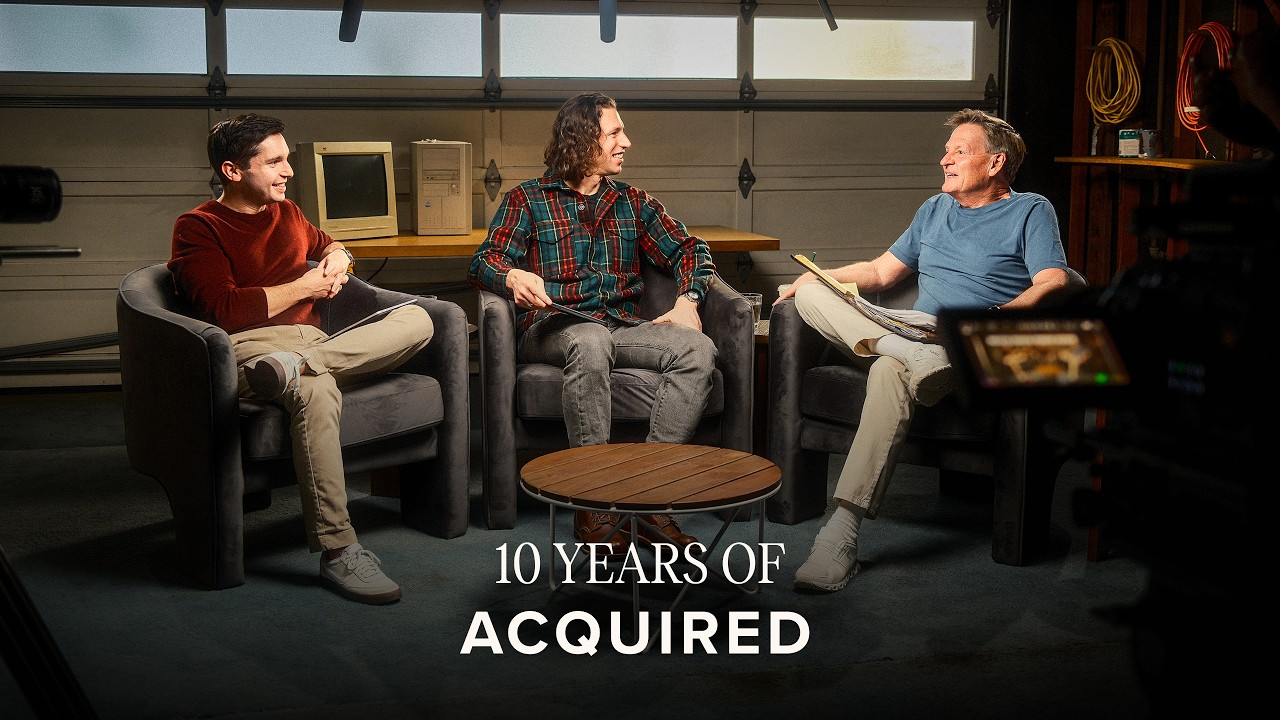
Published on December 15, 2025, on YouTube by the channel Acquired, this episode celebrates a decade of the podcast with a special recording in the garage where Google was founded. It features acclaimed author Michael Lewis acting as a guest interlocutor to unpack the unique paradox of the show's massive success despite its unconventional, long-form playbook.
## TL;DR
In this milestone episode, hosts Ben Gilbert and David Rosenthal turn the analytical lens on their own business model, mapping out the strategic lessons, handcrafted constraints, and ruthless editing philosophies that powered Acquired's growth over ten years. Guided by Michael Lewis's perspective, they explore how applying frameworks like Hamilton Helmer's '7 Powers' and choosing deliberate scarcity helped them build a high-quality, durable media boutique. The discussion ranges from their early host chemistry and technical research evolutions to the positive framing of corporate histories and the rollout of their live event strategy. Finally, the group shares personal product recommendations and creative philosophies on capturing conceptual joy before signing off on their first decade.
## Atmosphere & style
The tone is deeply reflective, celebratory, and intellectually playful, fueled by a rare sense of creative kinship between the hosts and Michael Lewis. It feels like a masterclass in narrative craftsmanship, where self-deprecating humility about early 'fraud syndrome' seamlessly balances with rigorous, high-stakes business analysis. The dynamic is improvisational and warm, capturing the genuine enthusiasm of spontaneous debate while evoking the historic, ground-up energy of its literal Google garage setting.
## Key takeaways
- [13:58](https://www.youtube.com/watch?v=d6EMk6dyrOU&t=838s) Acquired operates on a model of intentional scarcity, reducing episode volume to maximize depth and leverage, a strategy heavily inspired by the constraint models of luxury brands like Hermès.
- [30:21](https://www.youtube.com/watch?v=d6EMk6dyrOU&t=1821s) The podcast enforces a strict rule of timelessness, requiring every episode to retain 80% of its relevance five years post-release, contrasting with fast-decay traditional media.
- [32:12](https://www.youtube.com/watch?v=d6EMk6dyrOU&t=1932s) Great long-form subjects require three specific criteria: a compelling protagonist, a secret hiding in plain sight, and global importance.
- [34:39](https://www.youtube.com/watch?v=d6EMk6dyrOU&t=2079s) To preserve genuine surprise and spontaneous on-air debate, the hosts conduct extensive research in isolation and are forbidden from sharing specific narrative details prior to recording.
- [59:38](https://www.youtube.com/watch?v=d6EMk6dyrOU&t=3578s) Applying Hamilton Helmer's 7 Powers framework provided the necessary analytical filter that transformed the show from simple chronological tracking to high-level strategic conclusions.
- [01:08:29](https://www.youtube.com/watch?v=d6EMk6dyrOU&t=4109s) The business scales independent of operational input because global internet architecture allows highly specialized, narrow niches to find massive, high-leverage audiences without increasing internal corporate overhead.
- [01:13:47](https://www.youtube.com/watch?v=d6EMk6dyrOU&t=4427s) The editing philosophy requires listening to drafts at 1x speed to actively feel where listener interest drops, adhering to a default rule of always cutting to keep the focus tight.
- [01:18:38](https://www.youtube.com/watch?v=d6EMk6dyrOU&t=4718s) By targeting B2B sponsors with exceptionally high customer lifetime value, the show generates positive ROI from a small number of custom, analytical mini-case studies rather than programmatic ad networks.
- [01:27:23](https://www.youtube.com/watch?v=d6EMk6dyrOU&t=5243s) The hosts intentionally cap their corporate growth and ad load to avoid building a bureaucratic 'successful prison,' choosing instead to remain a tight, high-quality boutique.
- [01:41:21](https://www.youtube.com/watch?v=d6EMk6dyrOU&t=6081s) Deep audience connection and creator passion consistently outperform shallow distribution metrics; highly niche, lower-performing episodes frequently yield the highest-value long-term relationships.
- [01:45:42](https://www.youtube.com/watch?v=d6EMk6dyrOU&t=6342s) Instead of building a frequent, routine habit, the show deploys a high-impact 'live event strategy' modeled after major sports broadcasts to generate cultural momentum.
- [02:15:32](https://www.youtube.com/watch?v=d6EMk6dyrOU&t=8132s) Because language functions as a lossy compression of thought, the ultimate existential risk to high-end creative work is internal—specifically, if the creators run out of steam or lose the capacity for genuine discovery.
## Detailed walkthrough
### [00:00](https://www.youtube.com/watch?v=d6EMk6dyrOU&t=0s) A Milestone Anniversary in a Historical Garage
Ben Gilbert and David Rosenthal kick off their fall 2025 season finale by celebrating the 10-year anniversary of *Acquired*. To mark the occasion, David brings Ben down to a secret location in Silicon Valley rather than recording at his usual home studio. Ben jokingly guesses they might be at the famous "Eric Bachman Aviato" house from the show *Silicon Valley*, but David reveals he has booked an even more legendary tech venue: the literal garage of the house Susan Wojcicki had just purchased when she sublet space to Larry Page and Sergey Brin. Google pulled their original first desks and an authentic door out of storage specifically for the duo to use for the day. Recording the conclusion of their three-part Google series in the exact birthplace of the nearly $4 trillion company serves as a fitting tribute to their decade-long journey.
The hosts explain that this holiday special will break from tradition. For years, listeners have requested an episode dissecting *Acquired* itself to understand why it succeeded when 99% of podcasts fail. While Ben admits he previously shied away from analyzing their own business, the 10-year milestone and a recent reflection on their Coca-Cola episode convinced them it was time to pause and look inward. To guide this deep dive, they brought on acclaimed author and podcast host Michael Lewis (*Moneyball*, *Liar's Poker*, *The Blind Side*), whom both hosts have revered for years.
- **Email List Overhaul:** The hosts announce the first major upgrade to `acquired.fm/e` in five years, featuring episode summaries, key takeaways, and exclusive research photos.
- **Community & Side Shows:** Listeners are invited to join the conversation on `acquired.fm/slack` and check out their interview show, *ACQ2*, featuring a recent episode with Andrew Ross Sorkin.
- **Sponsor & Disclaimer:** The episode is presented by JP Morgan Payments, with the standard disclaimer that the show is for informational/entertainment purposes and not investment advice.
---
[04:11](https://www.youtube.com/watch?v=d6EMk6dyrOU&t=251s) The Princeton Connection and an Unexpected Discovery
Before diving into the interview, David presents a bottle of Moët & Chandon's newly released 2015 vintage Dom Pérignon to celebrate. The year 2015 matches the exact year *Acquired* was founded, but the bottle holds deeper personal meaning. Both David and Michael Lewis attended Princeton University, where David was a French literature major. David reveals that he "conned the French department" into letting him write his senior thesis on the marketing history of Dom Pérignon. While a bit less academic than Michael's background, David notes that this exact research laid the groundwork years later for *Acquired's* massive LVMH episode. Michael observes that listening to *Acquired* feels like listening to someone who has worked up to a thesis due to its deep immersion, which Ben equates to the high-stakes feeling of "cramming for finals the night before."
Michael admits he is a very recent listener, having only discovered the podcast in July during "Google Camp." A prominent CEO at the camp recommended the show, prompting Michael to start with the Morris Chang/TSMC episode. Since July, Michael has binged about 10 episodes, totaling dozens of hours of listening. He shares his initial shock that the hosts were successfully "getting away with a four-hour podcast," noting that even after four hours, he found himself wanting more. Michael commends them for creating a captivating narrative environment that mirrors what he attempts to do in his books. "You grab the listener like I try to grab a reader," he notes, praise that underscores their ability to make audiences care about complex topics they didn't even know they wanted to learn.
---
[07:39](https://www.youtube.com/watch?v=d6EMk6dyrOU&t=459s) Dissecting the Chemistry and Overcoming Fraud Syndrome
Michael reveals that out of curiosity, he went back and listened to the very first episode of *Acquired* to compare it to their current work, declaring with a laugh, "It is shocking how different it is... There's no way that first thing you did was ever going to become a hit." He challenges the duo to share 10 lessons from their 10-year journey, framed around how studying the world's best companies has bled into their own operations by osmosis. David posits that the foundational element present from day one is the magical chemistry between him and Ben. They first met at a Passover seder and later became colleagues at a venture capital firm. They wanted to spend more time together, describing their bond as a non-romantic second marriage where they even shared a corporate bank account before sharing accounts with their respective wives.
Michael digs into this dynamic, drawing a parallel to the intense, sometimes competitive collaboration between psychologists Daniel Kahneman and Amos Tversky, whom Michael profiled in *The Undoing Project*. David and Ben dismiss any notion of internal rivalry or status differences, noting they have only had two or three real fights in 10 years. However, both admit to early feelings of inadequacy. Ben felt like a tech guy who didn't fully grasp the mysteries of finance and looked up to David's venture capital expertise. Conversely, David—the French lit major who had worked on Wall Street—felt like a "fraud" as a VC because he had never built a product, whereas Ben had created platforms used by millions of people. Michael notes that David's broader curiosity outside of pure business heavily shines through the podcast's narrative depth.
---
[13:58](https://www.youtube.com/watch?v=d6EMk6dyrOU&t=838s) The Power of Scarcity: Operating Like the NFL
Ben introduces their first major business lesson, drawing an analogy to the NFL. Unlike Major League Baseball, which plays a grueling 162 games a year as "America's pastime," the NFL thrives because its product is intentionally scarce. By limiting the schedule, the NFL turns every single game into a massive, high-stakes event. Ben explains that *Acquired* has applied this exact playbook to podcasting, which runs completely counter to standard industry advice. While most creators are told they must publish constantly to stay relevant, *Acquired* has spent the last three years releasing only 12 episodes per year. Next year, they plan to scale down even further to just eight episodes for the entire year.
Michael, who labels himself a "hobbyist podcaster," agrees that standard industry pressure dictates being on the air all the time. He notes that he does very little preparation for his own conversational episodes because he treats podcasting as a secondary or tertiary project. In contrast, Ben and David treat each scarce episode of *Acquired* as a major, meticulously researched production, choosing quality and event-driven hype over raw volume.
The Power of Constraints and "Made with Love" Products
The discussion opens with a contrast between different styles of storytelling. While some creators focus on narrow, short narratives, the *Acquired* hosts recall their early days of massive production volume. They used to pump out 26 episodes a year, with lengths ranging anywhere from 40 minutes to an hour and twenty minutes. Their eventual pivot to a model centered on extreme quality and scarcity wasn't something they overnight engineered; rather, it was a slow realization heavily validated by confirmation bias. For instance, studying a luxury brand like Hermès clarified their own evolving philosophy: that constraint could be a highly lucrative business model.
Four or five years prior, the hosts felt they were "bad at podcasting" because they lacked a large production team, professional ad sales, or the ability to churn out content constantly. They were not even full-time for a long stretch. Everything changed when they decided to lean completely into their limitations. They resolved that every single episode would be entirely handcrafted by them—from deep-dive research to the recording process. While their audio engineer Stephen handles the literal waveform editing, the hosts themselves manually highlight around a thousand cuts per transcript per episode. This meticulous, "made with love" approach proved that a massive platform and a robust business could be built out of a heavily constrained product.
---
Reversing the Journalistic Lens: Why Things Work
The narrative shifts back to the true origin of the podcast, described humorously as two guys who met and essentially "got a crush on each other" because they simply loved spending time together. They hit on the idea of launching a podcast tracking corporate acquisitions—specifically, the ones that actually *worked*. This was a counterintuitive premise at the time, given that the mainstream media was overwhelmingly focused on tearing apart failed corporate mergers.
The hosts explain that their positive framing stemmed directly from their backgrounds as venture capitalists. Their professional goals were centered on building companies, creating value, and engineering successful exits or public offerings. Because acquisitions happen when things are going right, they wanted to reverse-engineer that success. It is noted that this starting point is fundamentally different from traditional journalism. If mainstream journalists adopted a purely positive framing, they would instantly be accused of writing hagiographies; however, because the hosts approached the subject from a highly practical, execution-oriented perspective, they successfully carried it off.
---
Michael Lewis’s Warren Buffett Apology and the $18 Billion Secret
The conversation moves to lessons learned from their three-part series on Berkshire Hathaway, prompting a deep, personal tangent from author Michael Lewis. Although Lewis is a major investor in Berkshire, he admits he hasn't listened to the episodes yet. He recalls buying his "A-shares" right in the absolute depths of the 2008 financial crisis. Strikingly, right before the crisis, Lewis had written a biting cover story for *The New Republic* titled "The Temptation of St. Warren," which painted Buffett as a cynical market force whose money operated on entirely different rules than everyone else's. Lewis was deeply bothered by Buffett's handling of the Salomon Brothers and Goldman Sachs deals, particularly his choice to keep a problematic CEO in place.
However, Lewis’s cynicism was short-lived. He quickly realized during the crash that Buffett’s credit and capital were exactly what the cratering financial system needed. Feeling he had wildly overdone his initial critique, Lewis did something he had never done before: he went right back to *The New Republic* and published a massive, 5,000-word apology to Warren Buffett. Years later, while working on his book *Going Infinite* about Sam Bankman-Fried, a publicist who also represented Buffett passed along a shocking question from the billionaire himself: "Is he the Michael Lewis who bought shares back in 2008 at book value?" Buffett was actively tracking Lewis's trades, explicitly wondering why Lewis had sold blocks of shares two and four years prior. Lewis had to clarify that he hadn't sold them for profit, but had actually donated them to charity—a detail that reportedly brought Buffett great relief.
* **The "Too Hard" Pile:** Inspired by Warren Buffett and Charlie Munger's decision-making frameworks, the *Acquired* hosts adopted the concept of a "too hard pile" to protect their circle of competence.
* **The Hollywood Trap:** The hosts reveal they frequently pass on glamorous Hollywood offers—such as developing TV shows, documentaries, or film adaptations of their episodes—because the time investment is a "rabbit hole" that yields low returns compared to simply making another podcast episode.
* **The Compounding Asset:** Unlike authors who feel every new book is a isolated "startup" where they must rebuild an audience from scratch, podcasting offers a literal, compounding subscriber base via direct feeds on Apple Podcasts and Spotify.
---
The Weight of Trust and a Vegas Residency
The immense scale of the podcast has brought a parallel growth in psychological pressure. The hosts admit that they are far more terrified today than they were two years ago, viewing every single minute of an episode as a potential "churn opportunity" where they might let down their audience. They explain that what listeners are truly buying into is not just the corporate subject matter, but the hosts' authentic interest in the subject matter. This baseline of terror keeps them hyper-focused on maintaining quality.
The segment transitions into a mid-show acknowledgment of their presenting partner, JP Morgan Payments, highlighting a recent live show series at the Venetian Theater during AWS re:Invent in Las Vegas. The hosts look back at their high-profile interviews with the CEOs of Netflix, Perplexity, AWS, and JP Morgan Payments. They share a humorous note about Greg Peters, the co-CEO of Netflix, who maintained a flawless poker face while discussing Hollywood’s future just hours before Netflix announced its major Warner Brothers acquisition. They also highlight a fascinating breakdown of JP Morgan Payments itself, noting that if the unit—which generates $18 billion in annual revenue and pioneers blockchain infrastructure through JPMCoin—were a standalone company, it would easily clear the Fortune 500.
[30:21](https://www.youtube.com/watch?v=d6EMk6dyrOU&t=1821s) The Hard Pile and the Rule of Timelessness
The conversation pivots around the lessons learned from Warren Buffett and Charlie Munger, specifically the value of having a "too hard pile." When asked if they have ever abandoned a subject because it was simply too difficult, the hosts admit they once got deep into researching an episode on the Federal Reserve before ultimately walking away from it. While they might return to it when the moment is right, they express relief at having shelved it, even though it originally challenged their core philosophy of avoiding strictly "newsy" topics.
For the *Acquired* podcast, timelessness is an absolute requirement. They design their content so that if a listener tunes into an episode five years after its release, it remains roughly 80% as relevant as the day it dropped. They contrast this with a typical financial news article from CNBC, which might lose 98% of its original value within a single month. This standard requires them to select institutions they are confident will endure, a challenging task given the natural volatility and churn within the tech and finance sectors.
* **The 80/5 Value Rule:** An *Acquired* episode must retain 80% of its relevance 5 years post-release.
* **The CNBC Contrast:** Typical financial news articles retain only about 2% of their value after a month.
* **Timeless and Timely:** Their most successful "banger" episodes, such as their coverage of Google, successfully hit the intersection of being both enduringly important and topically relevant.
[32:12](https://www.youtube.com/watch?v=d6EMk6dyrOU&t=1932s) Obscurity vs. the Secret Hiding in Plain Sight
The discussion shifts to how the speakers select their book and podcast subjects. One speaker shares that they know a subject is a winner when it captures their personal obsession but makes everyone else’s eyes glaze over at a dinner party within 60 seconds. They have learned to stop talking about their early-stage projects because watching others lose interest can inadvertently kill their own excitement. They prefer not to rely on the world to tell them what matters, making a lack of public interest a positive signal.
The hosts point out a key operational difference between writing narrative books and hosting *Acquired*. While a book might unearth a completely obscure story and transform it into a well-known phenomenon—much like *Moneyball* did—the podcast intentionally targets massive, well-loved corporations like Trader Joe's or Costco. The goal of the show isn't to introduce an unknown entity, but rather to reveal the complex structural machinery hiding in plain sight.
* **Three Criteria for a Great Acquired Episode:**
1. **A compelling hero/protagonist:** A narrative journey tracking an entity from total obscurity to complete ubiquity.
2. **A secret hiding in plain sight:** Exposing the underlying gears and operational mechanics of a consumer giant that ordinary people love but don't fully understand.
3. **Global importance:** The subject must be genuinely impactful and "worthy of the Acquired stage," moving away from the $10 million minor acquisitions they covered in their earliest days.
[34:39](https://www.youtube.com/watch?v=d6EMk6dyrOU&t=2079s) The Equal Partnership and the Improv High-Wire Act
The hosts reflect on the commercial evolution of the show, noting that one partner committed full-time to *Acquired* in 2020, while the other did not make the transition until late 2023 or early 2024. Despite this three-year structural asymmetry where one partner relied on the show for their livelihood while the other worked part-time, they maintained a strictly equal 50/50 business partnership. The issue of splitting the pie unevenly never even crossed their minds, with the hosts remarking that calculating separate carve-outs based on individual output would feel "profane" and ultimately break their true collaboration.
An interviewer interjects with an observation about the show's artistic growth, noting that in their very first episode, the hosts sounded flat, choked, and deeply unsure of themselves. Despite one host having a background in theater as a kid, the early performance completely lacked emotion. The interviewer points out that the show's "secret sauce" is actually their shared emotion and how they respond to each other, which signals to sophisticated listeners exactly when they should get excited about a dry financial fact, such as a company doubling its revenues every year for a century.
* **Separate Research Documents:** To preserve genuine surprise and spontaneous debate, the hosts stopped sharing a single Google Doc and now research entirely in isolation.
* **The Six-Month-Old Production Rule:** One week before recording, they are required to hold a production meeting to align on the episode's structural framework, but they are strictly forbidden from sharing specific narrative details or data points.
* **The Super Bowl Analogy:** Reading directly from a scripted speech is compared to "pre-announcing the score of the Super Bowl"—it removes all risk and causes the audience's interest to sink because they know nothing unexpected can happen.
* **Impostor Syndrome:** Early performances were kept intentionally flat due to a lingering fear that overenthusiasm would expose a lack of formal training in reading financial statements.
[42:00](https://www.youtube.com/watch?v=d6EMk6dyrOU&t=2520s) Broadening the Format and Surviving the 2022 Reset
The historical trajectory of the podcast shows a steady breaking of artificial constraints. They originally restricted themselves to corporate acquisitions, transitioned into tech IPOs during the booming 2017–2018 window—covering eight major consecutive IPOs including Uber, Pinterest, and Slack—and eventually expanded to broad corporate histories. By the end of 2020, they pulled off back-to-back episodes on DoorDash and Airbnb on their respective IPO days. Eventually, they realized their audience was "foul-hooked"—caught not by a narrow interest in tech transaction mechanics, but by a deep appreciation for gifted storytelling, strategy, and corporate biographies, even leading them to profile figures like Taylor Swift under a corporate framework.
This evolutionary confidence was tested at the end of 2022 when the macroeconomic environment fractured. As the crypto bubble burst, tech stocks plummeted, and the podcast advertising market fell off a cliff, their revenue instantly dropped by 40%. Rather than chasing easy, short-term money to "keep the music playing," the hosts radically narrowed their focus. They eliminated generalized interview episodes and undifferentiated topics, choosing instead to double down exclusively on enduring, heavy-hitting corporate biographies and secure deep commercial relationships with top-tier partners.
* **Key 2023 Breakthrough Episodes:** The pivot toward elite corporate storytelling culminated in monumental episodes covering LVMH, the NFL, and Porsche.
* **The 40% Revenue Drop:** Occurred rapidly overnight at the end of 2022 due to the broader crash in tech and podcast advertising budgets, forcing the structural reset of their content strategy.
The Power of Durability and the "Cigarette Burn" Mindset
The conversation shifts to how *Acquired* garnered serious commercial attention—such as securing JP Morgan as a sponsor in January 2024—only after they committed to making exceptionally long, deep-dive episodes. The hosts reflect that this shift occurred when they leaned heavily into building a brand centered on durability and compounding over decades or centuries. Initially, they did not appreciate the value of this long-form format, nor was it what the show was originally about.
They pivot back to lessons learned, drawing a stark contrast between their own trajectory and that of the venture capital firm Sequoia Capital. Recalling their interview with Doug Leone, they describe how Sequoia responded to the dot-com crash. While every other venture firm took "mulligan funds" and asked LPs for a fresh start with promises of future discipline, Sequoia absolutely refused to lose money for their investors. Leone told them the best line ever uttered on *Acquired*: "We looked at each other and you could burn cigarettes on our arms and we wouldn't flinch." Sequoia spent the next five years foregoing fees and working tirelessly with their portfolio to bring the fund back into the black, cementing a legendary reputation.
The hosts realized through studying these corporate giants that the only thing that truly matters is the late years of compounding. They point out that a Magnificent Seven company can bring in more profits in a single year than its first 20 years of existence combined. Surviving the economic chasm and keeping a respected brand for 5, 10, or 20 years down the line became their singular focus, completely eclipsing short-term financial gains. Even though it felt ridiculous at the time to compare a fledgling podcast to a tech giant, they possessed that same unyielding, "burn cigarettes on our arm" conviction to do the right thing.
- **JP Morgan Partnership:** Joined as a sponsor in January 2024 after a year of building out the long-form format.
- **Sequoia Capital's Turnaround:** Spent roughly five years after the dot-com crash without raising a new fund or taking fees to make their bubble-era fund profitable.
---
The Evolution of the Research Process and Scaling Access
The interviewer notes that the show's earliest 30-minute episodes were not nearly as compelling because the hosts simply didn't know as much yet, jokingly adding that those early videos had more ads than content. In response, the hosts outline how their research process radically evolved from the early days. Their initial strategy was simply the "AI part"—reading absolutely everything available on a company, tracking down preexisting canonical works, and following algorithmic spiderwebs through old YouTube videos.
A major shift occurred around 2023 when they began picking up the phone to call industry insiders. They emphasize that they never call uninformed; they only reach out once they already know everything publicly available, using the calls to pick the brains of people who hold unwritten knowledge. The interviewer points out the sheer compounding effect of their scale economy, marveling at how casually they can now just call up the CEO of Google.
The hosts pinpoint their Microsoft series as the moment they realized they could reach that high. Relying on a cold email to former Microsoft CEO Steve Ballmer, they were initially met with a delay. Ballmer admitted he didn't listen to podcasts but trusted a few close advisors who told him *Acquired* was great. He granted them three to four hours of conversation purely for background research, which completely transformed their perspective.
- **Research Shift (2023):** Began integrating extensive phone interviews, which now account for roughly 50% of the synthesis process.
- **Google & Microsoft Research:** Involved calling high-level executives like Sundar Pichai and Steve Ballmer, with the Google episode involving roughly 40 calls across the research phase.
---
The Storytelling Edge and Setting the Record Straight
The hosts detail their interactions with Nvidia and CEO Jensen Huang to illustrate the unique value of their format. In 2021, they mistakenly believed that securing high-profile interviews was the key to success. When they reached out to Nvidia through a warm connection, they received a polite rejection stating Huang was too busy. They went ahead with their standard research process anyway, releasing a multi-part narrative on the company.
Shortly after, Nvidia contacted them because Huang had listened to the episodes. He wanted to know who their inside sources were because it was "the most correct telling of Nvidia's story ever." The hosts laughingly reveal they had no inside sources at the time; they were entirely flying by radar, merely connecting the dots from public university talks and obscure interviews. This opened the door to a formal interview with Huang. However, they discovered that while big-name interviews spike fast, they do not retain audiences long-term. Their core storytelling episodes—like their deep dives on Costco, LVMH, Rolex, and Hermès—act like a backlist of books, continuously gaining streams over multiple years.
They discuss the surprising weakness of primary source materials, noting they recently received an email from a company pointing out an error that the hosts had unwittingly repeated from a published book. To combat this, they maintain an "Errata" section for their email list. Their modern approach relies on asking sources a central question: "What is most misunderstood and what incorrect stories are out there where we can set the record straight?" They approach these conversations earnestly, aiming to approximate the ultimate truth and build a definitive, pure narrative.
- **Nvidia Breakthrough (2022):** Jensen Huang requested a meeting after their public-data-only deep dive was deemed the most accurate corporate history of Nvidia.
- **Evergreen Episodes:** High-performing catalog episodes like Costco, LVMH, and Rolex continue to compound listenership years after release.
---
Killing Projects and the Necessity of Monopolistic "Fat"
The dialogue turns to the sheer fun of learning and the discipline required to kill episodes that lack a compelling narrative arc. The hosts admit they have abandoned several topics, including an episode on the Federal Reserve and a heavily researched project on Bell Labs. They killed the Bell Labs episode because they simply could not find a clean narrative throughline amid a massive sea of disparate characters and stories. While one could trace the history of the transistor, doing so would mean missing out on radar and other vital breakthroughs.
They contemplate the decline of open-ended corporate experimentation in America, noting that few companies "fiddle around" to see what they can find anymore. Drawing on an insight from their friend Hamilton Helmer, they argue that there is a distinct social benefit to monopolies. Monopolies generate massive, stable cash flows capable of funding highly inefficient, basic scientific research. To move society forward, corporate giants require a certain amount of institutional waste and "fat." They point to Google as a prime example of this phenomenon, noting that its scale allows it to confidently fund moonshots like Waymo and Gemini.
- **Abandoned Episodes:** Shelved projects include the Federal Reserve and Bell Labs due to narrative complexity.
- **Google's Scale:** Highlighted by its first-ever $100 billion quarter, providing the financial buffer to bankroll basic research and long-term tech innovations.
---
<ElicitationsGroup message="What would you like to do next?">
<Elicitation label="Draft an executive summary of this transcript part" query="Draft an executive summary of this transcript part" query_intent="CLICKABLE_SUGGESTION" />
<Elicitation label="Extract all corporate strategy lessons mentioned" query="Extract all corporate strategy lessons mentioned" query_intent="CLICKABLE_SUGGESTION" />
<Elicitation label="Analyze the interview techniques used by the speakers" query="Analyze the interview techniques used by the speakers" query_intent="CLICKABLE_SUGGESTION" />
</ElicitationsGroup>
[59:38](https://www.youtube.com/watch?v=d6EMk6dyrOU&t=3578s) Discovering Hamilton and the "7 Powers"
The conversation shifts to the analytical frameworks used to study a business's durability, specifically Hamilton Helmer’s "7 Powers." The hosts note that before discovering this framework around 2020, they struggled to "land the plane" at the end of their podcast episodes. They had previously experimented with various analytical conclusions—such as buy/sell/hold recommendations, bull and bear cases, or letter grading—but found them ultimately unsatisfying. Embracing Helmer’s concept of "power" provided the perfect answer to the ultimate "so what?" question regarding a company's long-term competitive advantage.
While some find the business terminology confusing initially, describing it as "gobbly hook," the hosts explain that in plain English, the 7 Powers simply represent a comprehensive list of how an industry-leading company remains more profitable than its competitors over time. It is the definitive modern manual on what creates a corporate moat.
- **Discovery Date:** The hosts found Hamilton Helmer's framework in 2020.
- **Previous Episode Outros:** Included bull/bear cases, buy/sell/hold ratings, and grading scales before switching to the "7 Powers."
- **Core Concept:** Power is defined as the underlying cause of a business's long-term durability.
---
[01:01:27](https://www.youtube.com/watch?v=d6EMk6dyrOU&t=3687s) The Recycling Filter of Manual Note-Taking
A critical part of the creative process involves passing information through multiple cycles of manual filter systems. One host traces his personal method back to writing his senior thesis at Princeton, noting that he avoids AI note-taking entirely. Instead, he writes physical notes in hardcopy books, believing that the mechanical act of moving thoughts from the brain through the fingers and onto a page is the only way the material truly sinks in.
The guest strongly echoes this sentiment, recalling that he discovered his own passion for writing during his senior thesis. His method relies on a strict multi-tier filtration process. He starts by recording observations on a notepad, noting that "it takes effort to put it down on the page," which acts as an automatic filter for what is genuinely interesting. Later, he transfers those thoughts into a digital Word document, filtering the material a second time. By the time a book project is well underway, this running document can easily stretch over 500 pages of raw observations before he even begins to structuralize the overarching narrative framework.
---
[01:03:00](https://www.youtube.com/watch?v=d6EMk6dyrOU&t=3780s) Finding the Shape of a Story: Sam Bankman-Fried and FTX
The process of framing a narrative can take months, and sometimes authors spend a massive amount of time on a project before realizing there is no cohesive story to tell. The guest shares a prominent example: he spent an entire year embedded with Sam Bankman-Fried without knowing what the final book would actually be. He regularly confessed to his editor, "I just don't know where this is going. I don't know what the end is. When I don't know what the end is, I don't know what the beginning is." It wasn't that he smelled fraud; rather, the experience felt like an endless, shapeless series of individual episodic events, comparing it to "Don Quixote, but the first chapter over and over and over."
The book would have been completely killed and never published if the FTX crypto empire hadn't unexpectedly blown up. That explosive event instantly gave the narrative its missing structure. While the preceding year provided endless fascinating scenes, the guest notes that "scenes don't make a play"—they are necessary but ultimately insufficient without a clear arc. The hosts admire this patient approach to gathering facts before jumping to judgments, comparing it to being "the world's best student" so that people actively want to teach you.
---
[01:04:43](https://www.youtube.com/watch?v=d6EMk6dyrOU&t=3883s) Capturing the Enthusiasm of Learning
Notes are primarily taken under two distinct scenarios: identifying how a complex system works, or making a sudden, unexpected connection. One host recalls the pure joy of figuring out the mechanics of a watch escapement for their Rolex episode, or decoding the underlying logic of the "Costco ballet." Even if a technical detail is technically irrelevant to a company’s financial success, the sheer excitement of understanding it makes it worth explaining on air.
The second trigger for a note happens dynamically, such as during a run while listening to a third consecutive audiobook on a topic. When a sudden connection clicks, the host will stop to jot down a quick Apple Note with a timestamp. Later, they will look up the reference in a Kindle edition to figure out the best way to explain the concept. The goal of this meticulous process is to bottle up the genuine enthusiasm of that initial "aha!" moment and seamlessly transfer it to the listener.
---
[01:06:05](https://www.youtube.com/watch?v=d6EMk6dyrOU&t=3965s) Sponsor Break: WorkOS and Moving Up-Market
The hosts take a moment to highlight their sponsor, WorkOS, noting the fitting irony of recording the episode in the historic garage where Google was founded. While iconic tech giants like HP, Apple, Google, and Amazon began in physical garages, modern startups are more likely to scale out of a San Francisco apartment, a coffee shop, or a hacker house. The core challenge for any scaling company after achieving product-market fit is moving up-market to secure lucrative enterprise customers.
WorkOS provides drop-in APIs that allow small teams to instantly offer complex enterprise compliance features like Single Sign-On (SSO), SAML, SCIM corporate provisioning, audit logs, and role-based access control (RBAC). The hosts point out that in the modern AI era, enterprise security features are the basic "price of admission," because AI products require deep integration with sensitive corporate data. They cite their own Google podcast series as a cautionary tale: by initially ignoring the enterprise market with Google Docs and G Suite, Google left the door wide open for Microsoft to catch up and counter-attack with Office 365.
- **Enterprise Essentials:** Features like SSO, SAML, SCIM, RBAC, and audit logs are required by IT admins' checklists.
- **AI Clients:** High-profile AI companies using WorkOS include OpenAI, Anthropic, Cursor, Perplexity, Sierra, Replit, and Vercel.
- **Sponsor URL:** workos.com
---
[01:08:29](https://www.youtube.com/watch?v=d6EMk6dyrOU&t=4109s) The Infinite Scalability of Internet Niches
Reflecting on lessons from past episodes, the hosts credit technology writer Ben Thompson, the founder of *Stratechery*, with proving that internet niches are vastly larger than people think. While a highly specialized topic might only interest six people in a local town, the global internet community of roughly 4 billion people ensures that even the narrowest niche can command an audience of millions.
The profound corollary for digital media and podcasting is that business outputs (audience size, revenue, real-world impact) can scale completely independently of operational inputs. The hosts reveal that they perform the exact same core labor today as they did two years ago to produce a single episode, yet the financial and cultural returns are exponentially higher. By remaining hyper-focused on a dedicated niche of smart people who care about how business history works, they can scale globally without expanding their internal corporate overhead.
---
[01:10:07](https://www.youtube.com/watch?v=d6EMk6dyrOU&t=4207s) The Maniacal Editing Process Behind a 5-Hour Episode
Despite their massive reach, the podcast operates as an incredibly lean operation. Rather than employing a massive corporate team, the hosts work out of modest home setups—one in a basement studio office, the other in a custom-built backyard studio. Aside from a temporary production crew hired for special video events, their entire enterprise relies on a single independent contractor named Steven, who acts as their sole audio and video editor.
The transformation from raw audio to a finished episode is an intense, iterative process:
* **The Raw Input:** The hosts record 8 to 9 hours of raw audio for a single episode.
* **The Retakes:** The recording contains dozens or even hundreds of retakes. The hosts actively produce each other in real-time. If a point isn't landed clearly, if an explanation turns into a boring monologue that kills the energy, or if one host accidentally repeats a point because they were looking at their notes, they stop, re-write lines, and record a condensed version.
* **Release Candidate 1:** Steven painstakingly cuts the 8 to 9 hours of raw audio down to roughly 5 hours of intelligible content.
* **The Final Polish:** The hosts then spend days using a text-based editing tool called Descript to listen, watch, and make an additional 500 to 800 surgical cuts, slicing away another full hour to ensure maximum narrative flow.
[01:13:47](https://www.youtube.com/watch?v=d6EMk6dyrOU&t=4427s) Cutting to the Bone: The Editing Philosophy
The speakers dive into the intense reality of their post-production process, explaining that editing typically takes a full three days and involves two complete cycles of back-and-forth review. Ben takes on the heavy lifting here, listening to the raw tape at 1x normal speed. He describes the process as an intuitive exercise where "you have to like feel where you get bored" or where interest drops, pushing yourself to get so tired of the material that you begin "cutting bone." Michael Lewis expresses sheer awe at this discipline, calling Ben a "hero" and admitting he could never do it himself, confessing that he can only bring himself to listen at 2.5x speed.
Ben highlights a universal truth in editing: "you can cut the beginning of almost everything," as speakers almost always start with a "throat clear" or a long wind-up before getting to the actual point. Once the fluff is stripped away and the narrative starts to feel taut, the process becomes incredibly rewarding. He finds that original drafts often contain remnants of points they *thought* they were going to make, but by the time they reach the end, those setups are no longer important or have already been woven into the story in more subtle ways. Their editing dynamic is highly collaborative, with David often highlighting sections and asking if they are "belaboring" a point. If that question is raised, the default rule is absolute: "Always cut." Through this ruthless trimming, they manage to condense five hours of raw recording down to their sweet spot of about three and a half hours.
- **Editing Cycle:** Two complete rounds of editing over a strict three-day period.
- **The Sweet Spot:** Trimming a 5-hour raw recording down to a finished 3.5 to 4 hours.
- **The Golden Rule:** The team's operating default is always to cut out the wind-up and excess setup.
[01:15:27](https://www.youtube.com/watch?v=d6EMk6dyrOU&t=4527s) The Gift and Curse of Hard Deadlines
When asked how they know when a show is truly finished, the response is a pragmatic one: "deadlines." They admit that creative work is never genuinely done, and they would always love just one more edit, but the relentless schedule of an upcoming episode acts as both a "gift and a curse." This prompts a playful exchange with Michael Lewis, whom they assume operates on an infinite timeline as an author. Lewis quickly corrects them, revealing his own shockingly rigid, highly structured writing routine.
Lewis explains that he operates under a drop-dead deadline where a book due on June 1st—to be published on September 29th—starts its writing phase precisely on January 5th. He writes the manuscript in five distinct chunks, delivering one at the end of each month without the luxury of going back to alter previous sections. He takes his deadlines "deadly seriously" and refuses to violate them, noting that when you respect a timeline that strictly, your mind naturally adapts and "finishes when it needs to finish." In fact, he usually finds himself tracking a couple of days ahead of schedule.
- **Michael Lewis's Timeline:** Writing begins January 5th, with monthly chunk deliveries until a hard final deadline on June 1st for a September 29th publication.
[01:16:40](https://www.youtube.com/watch?v=d6EMk6dyrOU&t=4600s) Rethinking the Podcast Business Model
The conversation shifts toward the business side of the franchise, which Michael Lewis remarks has become incredibly lucrative. He observes that unlike standard media properties, this show doesn't subcontract its ad sales to third-party networks, nor are the hosts "promiscuous" with their choice of advertisers. Instead, they cultivate deep stability with just a few major partners each season. Intrigued, Lewis asks for a live sales pitch, telling them to pretend "Michael Lewis, Inc." is a prospective anchor tenant they want to bring into their building.
The underlying philosophy is to build a durable business while treating the audience with respect. Ben expresses deep frustration with the broader podcast industry, noting that he feels "so disrespected" when a show features "diamond quality" content but interrupts it with jarring, poorly produced McDonald's ads featuring cheap background jingles. Lewis heartily agrees, noting that ad quality is the single biggest complaint he receives about his own podcast. From their very first sponsor, the goal was different: they asked themselves what partner they could bring on that would actually make people perceive their show as a *higher* quality brand.
- **Ad Philosophy:** Avoid generic, third-party programmatic ads in favor of highly curated, host-read partnerships.
- **The Ad Disconnect:** Michael Lewis shares that his own podcast relies on a separate company to sell ads, creating a structural barrier to matching his personal preferences.
[01:18:38](https://www.youtube.com/watch?v=d6EMk6dyrOU&t=4718s) The Search for "Switzerland" and High-ROI Partnerships
Michael Lewis reveals that he once tried to pitch a list of products he genuinely loves and uses in real life—humorously mentioning his desire to tell the world about his favorite "ExOfficio underpants"—but he couldn't even get the company to return his calls. The hosts explain that relying on an outside ad agency is a major structural blocker to fixing that experience. For their own show, the trade-off is an immense time investment: they write a custom, two-minute analytical read for every single sponsor, treating it like a mini-case study of what makes that business interesting.
When selecting partners, they look for companies that feel like "Switzerland"—meaning they don't want to pick sides in contentious industry dynamics, such as endorsing a specific venture capital firm over its rivals. Instead, they strategically target business-to-business (B2B) companies with exceptionally high customer lifetime value (LTV). Because these sponsors close multi-million dollar annual deals, the show only needs to deliver a couple of incremental clients for the entire relationship to yield a massive return on investment (ROI). In fact, many sponsors become ROI-positive after signing just a single large customer who discovered them through the podcast.
- **The B2B Strategy:** Prioritizing companies selling multi-million dollar annual contracts rather than low-cost consumer goods.
- **Sponsorship Integration:** Moving beyond simple audio reads to integrated multi-day events, customer dinners, fireside chats, and annual conferences.
[01:22:36](https://www.youtube.com/watch?v=d6EMk6dyrOU&t=4956s) Closing the Loop with an Investment Fund
The true power of the business model stems from its audience, which the hosts describe as "the most valuable audience in the world," packed with founders and executive decision-makers. Because the hosts started out as venture capitalists rather than traditional media professionals, they naturally approached their advertisers as strategic partners rather than just ad buyers. They rejected the classic media model that completely separates commercial activity from editorial content—a division they acknowledge is a vital societal benefit for pure investigative journalism, but one that isn't strictly necessary for an analytical business show.
This partner-first mentality came full circle a couple of years prior when they launched their own investment fund. Rather than remaining a passive advertising vehicle, they now actively invest millions of dollars directly into their private company sponsors when those businesses raise new funding rounds. Because they already spend an immense amount of time vetting these businesses for the show, making an equity investment requires no incremental workload. It creates a seamless, hyper-aligned ecosystem where companies gladly make room for them on their cap tables because the show's success directly drives the company's growth.
- **The Acquired Fund:** An ecosystem play where the hosts invest directly in the funding rounds of their private B2B sponsors.
[01:25:32](https://www.youtube.com/watch?v=d6EMk6dyrOU&t=5132s) The Blueprint for a Conversational Audio Book
Michael Lewis asks how deep this market runs and why more shows haven't successfully duplicated this business model. The hosts break down their core blueprint: two independent researchers coming together to blend deep narrative storytelling and sharp analysis, ultimately creating a "conversational audio book." They argue that this heavy-research format could easily be applied to other high-ambition verticals like sports teams, movies, or political parties, though they note that the business and tech sectors naturally command the highest ad dollars.
They attribute the lack of copycats to a severe "cold start" problem. Because building a highly educated, massive audience around long-form content takes years of unmonetized work, it requires an immense runway. The show's success was deeply path-dependent on the hosts keeping their day jobs in the venture capital industry early on. Those day jobs provided them with the industry know-how, the conceptual shorthand, and the foundational relationships necessary to pull off the deep-dive analysis in the first place, making it a tough model for an outsider to build from scratch.
[01:27:23](https://www.youtube.com/watch?v=d6EMk6dyrOU&t=5243s) Scarcity, Incentives, and Resisting the Financial "Sugar High"
The discussion begins with the disclosure that the *Acquired* podcast is heavily oversubscribed, with approximately three to four times more potential sponsors waiting than the show accepts. When asked why they do not simply produce extra episodes or spin off additional shows to capitalize on this demand, the hosts clarify that they intentionally choose to "do less" to avoid becoming standard CEOs managing an enterprise. This sparks an exchange about the creative freedom of having "no bosses," only incentives. It is a long-term strategy centered on maintaining scarcity and quality. As one speaker notes, a publisher could offer a "gazillion dollars" for a book that is destined to suck, but at a certain level of success, extra money has zero marginal value and can even possess negative value if it distorts one's character.
The hosts distinguish between simply milking the market and making the fundamental choice between building a massive corporate enterprise or staying a high-quality boutique. They routinely face criticism from observers warning them about "keyman risk" and their business having a low enterprise value because it depends entirely on them. However, they laugh off the critique, noting that even if they sold the business, they would just turn around and start *Acquired* all over again because they are already living their dream.
- *Acquired* is currently 3x to 4x oversubscribed on potential sponsors.
- The hosts emphasize an intentional choice to stay a boutique rather than scale into a management-heavy enterprise.
- They argue that marginal dollars eventually lose their utility and that great businesses should maintain "stored potential energy" instead of constantly chasing immediate profits via ad network integrations or endless spin-offs.
[01:30:47](https://www.youtube.com/watch?v=d6EMk6dyrOU&t=5447s) Lesson 5: Founder Control and Avoiding "Successful Prisons"
Moving to their fifth major lesson, the hosts highlight the immense value of founder control, a pattern they observed while analyzing major companies like Google, Meta, Rolex, Trader Joe's, and IKEA. They note that while major public corporations are necessary for the world, incredible things can be built by staying private, family-owned, or keeping tight founder voting control. Reflecting on their own journey, they share a vulnerable moment from the previous year during their research on Bell Labs when they suffered a mild crisis, wondering if they were being "business wussies" by refusing to expand to Hollywood, hire large teams, or launch secondary shows.
To resolve this anxiety, they sought advice over dinner from one of the world's most prominent investors. Expecting to be told to "dream bigger," they were surprised when the investor paused and observed, "I have seen so many founders become trapped in prisons of their own making in their own companies." He congratulated them on avoiding that exact fate, warning them not to go down the road of building a successful prison. The hosts admit that while they are capitalists who occasionally "indulge"—such as adding a fourth ad slot to bring their ad load to a still-low 4.5% compared to the industry standard of 15%—the decision to keep their potential energy bottled ultimately preserves their freedom and long-term goodwill.
- **Lesson 5:** Founder control and remaining boutique vs. expanding into a bureaucratic enterprise.
- Mentioned controlled or private entities: Google, Meta, Rolex, Trader Joe's, IKEA, and Bell Labs.
- Industry standard ad loads hover around 15%, whereas *Acquired* recently bumped theirs from 2-3% up to 4.5% by adding a fourth slot.
[01:35:14](https://www.youtube.com/watch?v=d6EMk6dyrOU&t=5714s) Sponsor Breakthrough: The Sentry Journey
The hosts transition into a dedicated sponsor segment for Sentry, comparing the software monitoring platform's organic growth trajectory to their own ten-year journey with *Acquired*. Founded in 2008 as a tiny, open-source project rather than a venture-backed corporate initiative, Sentry was built by a developer simply looking to solve a single problem: getting alerted when code breaks. Over 17 years of compounding improvements, the product evolved by listening directly to developer needs—adding deeper language support, latency tracking, and session replays.
- Sentry started in 2008 as an open-source project and has compounded over roughly 17 years.
- The platform is utilized by over 150,000 organizations, including major names like Disney Plus, Duolingo, Vercel, Anthropic, Cloudflare, GitHub, and Atlassian.
- Sentry's new AI agent, Seir, can pinpoint root causes and suggest code fixes with nearly 95% accuracy by analyzing errors, logs, traces, and pull requests.
[01:37:37](https://www.youtube.com/watch?v=d6EMk6dyrOU&t=5857s) The Flop of Part Twos and an Unexpected Cricket Investment
Returning to their reflections, the hosts dive into a sub-topic about releasing episodes that they love but which underperform commercially. A prime example is their deep dive into Nintendo. Despite Nintendo being a durable, century-old "n of one" company with a fascinating history, the episode underperformed their standard benchmark by 20%. In an attempt to "dig ourselves out," they stubbornly made a Part Two, which underperformed even more. They joke about the strategic absurdity of following up a slow Part One with a Part Two, noting that audiences never tune into a sequel if they bypassed the original. They briefly reminisce about Nintendo's wild roots as a playing-card manufacturer catering to the Yakuza after gambling was outlawed during the Meiji Restoration, alongside their core philosophy of "lateral thinking with withered technology"—using older, stable tech like calculators to build hits like the original Game Boy.
Another passionately produced episode that underperformed was their coverage of the Indian Premier League (IPL) cricket. However, the episode paid off in an unexpected way: it turns out to be the exact episode that introduced their current guest to the podcast. The guest shocks the hosts by revealing that he is actually a minority owner of the IPL's Rajasthan Royals. He explains that two trusted friends approached him about an owner who wanted to turn the franchise into the "Moneyball of cricket"—effectively the Oakland A's of the IPL. He invested because he trusted his friends' filters and figured that even if the venture went completely wrong, "it would be an amazing story."
- The Nintendo episode underperformed the show's baseline benchmark by 20%, and its Part Two underperformed further.
- Nintendo's historical strategy is highlighted as "lateral thinking with withered technology" (e.g., the Game Boy and the Wii).
- The guest is a partial minority owner of the Rajasthan Royals IPL cricket team, which was pitched to him as the "Moneyball" or Oakland A's of the league.
[01:41:21](https://www.youtube.com/watch?v=d6EMk6dyrOU&t=6081s) Passion Over Performance: The True Metric of Success
The speakers dive into how passion often matters far more than raw download numbers, laughing off the fact that certain deeply compelling stories initially "underperformed" relative to their average charts. They point to their episodes on Nintendo and the Indian Premier League (IPL) as prime examples. Both were relative "duds" in terms of broad reach, yet they served as the very first listening experiences for immensely influential people who went on to change the entire trajectory of the *Acquired* franchise.
Specifically, the Nintendo episode caught the attention of a single executive on the Meta team who passed it along to the entire leadership circle. This organic connection laid the foundation for a relationship that paid off massively down the line. When JP Morgan called *Acquired* to offer them the Chase Center for a event and asked what they wanted to do, the hosts reached out to their Meta contact to pitch Mark Zuckerberg. The contact checked immediately, and Zuckerberg agreed—a milestone moment that wouldn't have happened without an underperforming episode about video games.
The ultimate takeaway they learned from researching LVMH is that if even one host feels incredibly passionate about a niche topic, they have to run with it. When a creator feels that intense curiosity, it translates into a magnitude of feeling for a small, highly leveraged audience. "If you feel a lot, someone's going to feel something," they agree, emphasizing that depth of connection beats wide, shallow distribution every time.
- **Key Examples:** The Nintendo and IPL episodes underperformed publicly but brought in executive listeners from Meta and JP Morgan.
- **The Zuckerberg Connection:** A Meta executive listened to the Nintendo episode, shared it with the executive team, and later personally fast-tracked Mark Zuckerberg’s appearance at the 6,000-person Chase Center show.
- **The LVMH Lesson:** A pitch that was initially dismissed multiple times taught them to always trust their passion, as genuine excitement always resonates with the right people.
---
[01:43:33](https://www.youtube.com/watch?v=d6EMk6dyrOU&t=6213s) The Mysteries of Wall Street and the Jim Simons Book That Got Away
The conversation shifts to Renaissance Technologies, an episode where passion and massive listener performance actually aligned perfectly. The speakers trade jokes about the absolute secrecy of the firm, calling it one of the "two great mysteries on Wall Street"—the other being the true identity of Bitcoin creator Satoshi Nakamoto. They marvel at the mind-blowing theory that Renaissance essentially invented an early, predictive form of machine learning decades before the rest of the tech world, successfully hiding the market signals they discovered at the exact same time they found them. While that strategy worked flawlessly through the 1990s, they note how incredibly difficult it is to maintain that level of absolute edge today with heavy hitters like Jane Street and Citadel hunting for every single scrap of marketplace alpha.
This brings up a major professional regret. One of the hosts reveals that he desperately wanted to write a book on Renaissance Technologies and its legendary founder, Jim Simons. Because Jim Simons' grandson was in the same high school class as his oldest child, he had a direct line of contact. He approached the family, explicitly stating he wouldn't do it without their blessing and insider collaboration.
Simons' son gave a firm but humorous rejection, advising him that attempting to write about their opaque business "by radar completely from the outside" would only lead to getting crucial details wrong and embarrassing himself. Ultimately, the author decided against chasing it blindly because he didn't care about exposing state secrets; he simply wanted to capture the twilight of Simons' career with his cooperation.
- **Wall Street Mysteries:** Renaissance Technologies' secret trading algorithms and the identity of Satoshi Nakamoto are framed as the ultimate financial enigmas.
- **The Missing Book:** The host passed on writing a book about Jim Simons after the billionaire's son warned that writing from the outside would lead to inaccuracies.
- **Market Evolution:** The hosts note that keeping signal hidden was possible in the 1990s but is nearly impossible now against modern algorithmic giants like Citadel and Jane Street.
---
[01:45:42](https://www.youtube.com/watch?v=d6EMk6dyrOU&t=6342s) The NFL Playbook: Creating Spectacle and the Art of the Surprise Guest
Turning to their next big lesson, the hosts discuss how the NFL taught them to ditch the traditional podcast playbook. While most shows desperately try to build a predictable, routine habit for listeners, *Acquired* threw that strategy out the window because their deep-dive episodes are too infrequent. Instead, they pivot to a "live event strategy" modeled after Monday Night Football and the Super Bowl. They aim to make every single release a massive, watercooler cultural event that everyone in their ecosystem is forced to talk about simultaneously.
They address the sheer impact of their massive live shows at landmark venues like the Chase Center and Radio City Music Hall. Even though the 6,000-person crowd at Radio City represents a tiny fraction—roughly 0.4%—of their total listening audience, the "heat and light" generated by the sheer spectacle builds the *Acquired* franchise more effectively than an entire standard season of episodes. They laugh about a "rude question" regarding whether the massive crowds showed up for them or for their iconic, unannounced guests like Jamie Dimon, New York Times CEO Meredith Kopit Levien, and Barry Diller. The hosts proudly reveal they deliberately kept the lineup a total secret until the curtain went up, proving the audience sold out the world's largest indoor theater purely for *Acquired* itself.
Looking forward, they reveal they are continuing this trajectory by MCing the NFL's official Innovation Summit in San Francisco, held the Friday before the 2026 Super Bowl. The exclusive, streamed event at SFMOMA will feature high-profile partners alongside NFL Commissioner Roger Goodell.
- **Audience Metrics:** The 6,000 attendees at Radio City Music Hall represented a mere 0.4% of the show's total audience but generated disproportionate brand equity.
- **The Radio City Surprise:** Guests like Jamie Dimon (JP Morgan Chase CEO), Meredith Kopit Levien (New York Times CEO), and Barry Diller were completely unannounced; the show sold out entirely on the *Acquired* name alone.
- **Upcoming Events:** The hosts will serve as MCs for the NFL's invite-only Innovation Summit at SFMOMA featuring Roger Goodell on the Friday before the Super Bowl.
---
[01:49:43](https://www.youtube.com/watch?v=d6EMk6dyrOU&t=6583s) Costco's Secret Weapon: The Magic of Low SKU Count
The conversation moves to their late-2023 episode on Costco, which was born out of intense creative burnout. Fresh off a highly pressurized, grueling preparation for an episode on Nike—where the hosts read a combined 11 books and felt the final product came out frustratingly "flat"—they decided to "play loose" with Costco. Instead of drowning in endless literature, they restricted themselves to Sol Price’s autobiography and an incredible, exclusive afternoon with Costco's CFO, Richard Galanti, who whiteboards the company's entire economic model for them.
They admit they knew virtually nothing about the internal mechanics of the company going into the project, only diving in because it was the favorite company of Berkshire Hathaway's Charlie Munger. The core epiphany that changed their entire worldview was how a low SKU (Stock Keeping Unit) count drives every single economic advantage the retail giant holds. While a competitor like Walmart juggles between 100,000 and 200,000 individual items on their shelves, Costco strictly limits their selection to roughly 4,000 items.
This hyper-focused strategy forces a profound alignment of incentives. Because Costco buys so few distinct products, they instantly become a massive, mission-critical buyer to every single one of their vendors. Furthermore, instead of a Walmart buyer managing hundreds of chaotic vendor relationships, a Costco merchandiser might only manage seven. This allows them to know the absolute details of the supply chain, tracking underlying commodity markets like raw cocoa prices to ensure they are getting the best deal possible.
- **Preparation Divergence:** The hosts read 11 books for their Nike episode and felt it was flat; for Costco, they relied heavily on one primary book and a single afternoon whiteboard session with the company's CFO.
- **SKU Comparison:** Walmart carries 100,000 to 200,000 SKUs, whereas Costco aggressively caps its inventory at just 4,000 SKUs.
- **The Analogy:** The hosts note that Costco's low SKU count mirrors *Acquired's* own low episode volume strategy—doing fewer things at a much higher leverage.
---
[01:53:06](https://www.youtube.com/watch?v=d6EMk6dyrOU&t=6786s) Negative Working Capital and the Psychology of Choice
The speakers dive deeper into the staggering macroeconomic side effects of Costco's low SKU count, explaining how it turns traditional retail cash flow completely on its head. Because items fly off the shelves at blistering speeds, Costco boasts an average inventory sell-through rate of just 27 days. Given that they secure standard net-30 payment terms from their suppliers, they consistently enjoy a three-day grace period where their inventory is effectively financed entirely by the vendors themselves. Certain high-velocity items sell in a matter of two days, turning over ten times a month. This creates a beautiful business model with virtually zero working capital requirements outside of constructing physical warehouses.
They connect this back to human psychology and their own content creation model. While it feels unnatural for a business to intentionally sell fewer things, limit options, or produce fewer podcast episodes, consumers genuinely love the absence of choice. They cite classic consumer research proving that supermarkets displaying 30 different kinds of jam actually sell significantly less product than those displaying only three, because buyers become completely paralyzed by choice. When a member walks into Costco, they feel a deep sense of relief knowing that an expert curator has already made the high-leverage decision for them.
- **Negative Working Capital:** Costco takes an average of 27 days to sell its inventory while operating on net-30 payment terms, meaning vendors fund their operational cycle.
- **The Jam Study:** Academic research shows that offering 3 items instead of 30 results in higher overall sales because it prevents consumer choice paralysis.
- **High-Leverage Curating:** Both Costco and *Acquired* rely on a high-leverage strategy where a lower volume of offerings places a massive onus on making exceptional choices.
### [01:54:56](https://www.youtube.com/watch?v=d6EMk6dyrOU&t=6896s) The Core Lesson from Morris Chang
The conversation shifts to a personal anecdote regarding a meeting with Morris Chang, the founder of TSMC. During their discussion, Chang revealed that one of TSMC's historical mistakes was trying to exit or diversify away from the integrated circuit market into sectors like solar and memories. None of those alternative spaces proved to be as lucrative. The critical insight from that encounter was profound: "you're already in the best business." Because integrated circuits represented the future, Chang realized TSMC was already the best at them and needed to stop trying to do other things. The *Acquired* hosts internalize this bias deeply, realizing that every time they look at outside opportunities, they remind themselves that they are already doing exactly what they should be doing, rather than pursuing something they are less skilled at or would find less enjoyable.
### [01:55:51](https://www.youtube.com/watch?v=d6EMk6dyrOU&t=6951s) The Reality of Venture Capital and Podcasting Work
Michael brings up the fact that the hosts have recently decided to become venture capitalists again, prompting a question about how their preparation differs from that of a standard Silicon Valley VC before deploying capital. The hosts argue that there is a widespread top-level misconception that venture capital is purely an analytical industry centered around diligence. While diligence happens, they characterize growth-stage venture capital primarily as an "access business" where anyone can identify the good companies, but few can actually get into them. At the early stage, picking is a "super art" rather than a strict analytical understanding of a company.
When asked if the research required to produce a four-hour podcast episode bears any resemblance to VC investment diligence, Ben notes that they are fundamentally different. Reflecting on his early-stage career, he recalls writing numerous investment memos that were essentially "making stuff up" at the napkin stage, trying to dream up what a market might look like when it materialized. VCs often act like they know a business to the third or fourth decimal place when they barely know the first. Ultimately, studying mature businesses for *Acquired* has taught them far more about industry dynamics than any investment memo ever did, meaning the podcast actually helped make them better investors rather than the other way around.
- Early-stage investing relies heavily on an imprecise founder bet supported by structural guesswork.
- Understanding a market at maturity provides deeper insights into industry dynamics than looking at early-stage companies that do not know the future.
### [01:59:04](https://www.youtube.com/watch?v=d6EMk6dyrOU&t=7144s) Crafting a Narrative and Cultural Tailwinds
Reflecting on how their storytelling has evolved over ten years, the hosts note a massive shift in how they conceptualize narrative structure and acts. Many corporate history books simply catalog events chronologically, tracking how one thing happened after another. The hosts realized that a true story requires exploring the "why" and the underlying flow. They cite a classic literary distinction: "The queen died and then the king died is not a story the queen died and then the king died of heartbreak is." Michael notes that if someone had told him a decade ago that two guys with no literary or podcasting experience would successfully mesmerize audiences with a four-hour conversation about a single company, he would have refused to invest in it, calling it counter-intuitive to shortening modern attention spans.
The unexpected success of the show relies heavily on technological and cultural tailwinds. A year after *Acquired* launched, Apple released AirPods, making it socially acceptable to constantly consume audio while moving through the world, driving a car, or doing dishes. This effectively gave humans two input channels, allowing them to pair physical tasks with listening. Additionally, institutional platform shifts over the last decade accelerated their growth. Spotify entered the podcasting landscape in 2018, bringing hundreds of millions of new listeners to the medium and capturing over half of the market, while Apple Podcasts remained a durable space to accumulate highly loyal, valuable listeners.
### [02:01:54](https://www.youtube.com/watch?v=d6EMk6dyrOU&t=7314s) Corporate America and The Power of Partnership
Beyond technology, the hosts point out that corporate America has become increasingly important and mysterious to the general public. People do not feel like companies such as Tesla, Nvidia, Microsoft, and Google are cleanly explained to them. While the show did not launch in 2015 with the explicit promise of helping people "understand why the world is arranged the way it is," it has absolutely become the core value proposition they deliver on today. Above all else, they credit the longevity of the show to their absolute alignment as partners. They joke that they are aligned like they "burn cigarettes on our arms," noting that a weaker partnership would have fractured a million times over the last decade.
### [02:03:08](https://www.youtube.com/watch?v=d6EMk6dyrOU&t=7388s) Applying the Seven Powers: Scale Economies and Counterpositioning
To wrap up the conversation without hitting a three-hour runtime, Michael asks the hosts to apply Hamilton Helmer's *Seven Powers* framework directly to *Acquired*. The hosts first identify as a **Scale Economies** business. Because they have a massive listener base, they can amortize their heavy operational inputs across a huge audience, allowing them to put an "unreasonable amount" of work into each episode that a newcomer could not sustain without immediate scale. To illustrate, they explain that if *Acquired* and a brand-new podcast recorded the exact same words in the exact same way, the *Acquired* episode is fundamentally more valuable because it instantly reaches 1.5 million subscribers.
The second power discussed is **Counterpositioning**, which occurs when a business model is structured in a way that competitors simply cannot copy or respond to due to collateral damage or mixed incentives. As an external example, they point to Southwest Airlines launching with an exclusive fleet of 737s, which legacy carriers with diversified fleets and sunk costs could not replicate. For *Acquired*, counterpositioning manifests in their ad sales and production volume. While most podcasts sell ads on a traditional CPM (cost per mille) basis and are incentivized to pump out as many episodes and ad slots as possible, *Acquired* operates on a structurally different model. They do not have shareholders, meaning they can make non-economic lifestyle decisions—such as intentionally capping production to just four high-quality episodes a season. They even maintain a strict rule of refusing to work with advertising agencies to avoid middlemen, a luxury that corporate podcast networks cannot afford to emulate.
- **Scale Economies**: Large listener base allows intense up-front research costs to be amortized efficiently.
- **Counterpositioning**: A business model focused on low episode volume and direct sponsor relationships that traditional ad-supported media networks cannot mimic without breaking their own business models.
### [02:06:31](https://www.youtube.com/watch?v=d6EMk6dyrOU&t=7591s) Network Economies, Switching Costs, Branding, and Cornered Resources
Continuing through the framework, the hosts evaluate the remaining powers. They describe **Network Economies** as a weak but present power for them, visible in the "water cooler effect" where listeners within tech companies discuss the episodes, making the show more valuable as more peers listen to it. Conversely, they admit they have zero **Switching Costs**. Explaining the concept, they point to Salesforce; once an organization implements a CRM, the economic tax and sheer pain of changing systems creates an immense barrier to leaving. For a podcast, a competitor is always just one click away, meaning listeners face no structural cost if they choose to replace *Acquired*.
David admits that evaluating their own business through this lens feels intensely terrifying and self-aggrandizing, joking that it feels like declaring, "What a great painting I have made." Nevertheless, they push through to the final powers. They acknowledge **Branding** as a major force, noting that the *Acquired* name itself carries a premium of trust that guarantees higher engagement than the exact same product released under an unknown title. Finally, they touch on **Cornered Resource**, defined as preferential access to a coveted asset like intellectual property, patents, or Disney owning Mickey Mouse. In the case of the podcast, the business effectively owns Ben and David themselves, operating under the assumption that the hosts' unique chemistry makes them the non-replicable, cornered assets driving the value of the show.
[02:08:40](https://www.youtube.com/watch?v=d6EMk6dyrOU&t=7720s) The Magic of Format and the Illusion of No Process
The discussion shifts to the "magic" behind *Acquired* and whether its success stems from the unique chemistry of the hosts or the format itself. Ben suggests that while their chemistry matters, the format possesses its own intrinsic value, citing the example of their friend Ben Idolson’s new podcast, *The Step Change Podcast*, which has shown remarkable success with only three episodes. A guest notes with a laugh that if there is a core resource, it is either the hosts or their elusive, unnamed editor. This leads directly into analyzing "process power"—a competitive advantage most businesses lack, but that *Acquired* possesses in spades. The hosts admit they often struggle to articulate how mechanically an episode comes together, leading to an open exploration of what actually happens behind the scenes.
Michael attempts to guess their exact method, imagining a highly strategic division of labor mixed with calculated improvisation. He assumes one host owns the historical narrative while the other handles the current business analysis, with both storing a few key insights in the back of their heads, waiting for a casual moment to drop them naturally. Michael notes that the hardest part of improvisation is "disposing of all the things you imagine that were going to happen in a conversation before they happen," acknowledging the persistent tension between a script and organic dialogue.
* *The Step Change Podcast*: A show by Ben Idolson that achieved early success with just three episodes, demonstrating format-driven magic.
* The Improvisation Dilemma: The difficulty of shedding premeditated conversation paths to allow a genuine, organic interaction to happen between co-hosts.
[02:11:10](https://www.youtube.com/watch?v=d6EMk6dyrOU&t=7870s) The Script, the Edit, and Lossy Compression
David reveals the surprising reality behind his preparation: he writes an extensive, full-sentence script consisting of 10,000 to 20,000 words. Though he doesn't read it verbatim, he keeps it open across three screens during recordings as a vital intellectual crutch. The real safety net, however, is the sheer volume of material they record—often talking for nine hours to produce a polished four-hour episode. Ben acts as a real-time feedback agent, aggressively cutting dead weight or tedious prehistory. The audience only ever hears the seamless, enthusiastic highlights, completely blind to the messy hours left on the cutting room floor. Meanwhile, Ben manages his side of the show using a massive TextEdit document packed with mechanical bullet points and specific story interventions designed to mesh with David's narrative.
The conversation evolves into a deeper philosophical look at why this process cannot easily be replicated. Michael brings up the concept of trust, noting that the ownership of the Philadelphia 76ers wanted Sam Hinkie's process but ultimately "didn't trust the process," highlighting that copy-pasting a methodology without emotional alignment usually acts as a handicap. Ben introduces a technical analogy, comparing the explanation of a creative process to "lossy compression" in computer science. Just as a JPEG or an MP3 discards data that the human eye or ear barely misses, explaining a process inherently leaves out critical, unquantifiable details.
* Script Length: David writes 10,000 to 20,000 words in full sentence form for an episode.
* Recording Ratio: The hosts routinely record for up to nine hours to edit down to a final four-hour episode.
* Ben’s Prep Tool: A giant, bulleted TextEdit document focusing on mechanical points and analytical interventions.
* The 76ers Analogy: Reference to Sam Hinkie and Daryl Morey to illustrate how replicating a process fails without fundamental trust.
[02:15:32](https://www.youtube.com/watch?v=d6EMk6dyrOU&t=8132s) Language as Thought Compression and the Failure Mode of Acquired
Michael builds on the compression analogy, observing that "language is a lossy compression of thought." In communication, a speaker compresses a thought into speech, and the listener uncompresses it into their own brain, often arriving at a completely different meaning. Michael embraces this phenomenon in his own book-writing process, intentionally leaving "a hole for the reader to go in" so they can reassemble the story themselves. He argues that the less an author tries to forcefully impose an editorial view, the more alive and resonant the story becomes. Ben and David agree, stating that their goal is for listeners to deeply enjoy an episode and learn from it regardless of whether they leave thinking a company is righteous or terrible. Michael calls this "dancing with a reader instead of like hurling them all over the dance floor."
Turning to the long-term future of *Acquired*, Ben dismisses the idea that they will be taken down by external platform shifts or short-form trends like TikTok. Instead, he asserts that the true existential threat to the podcast is internal. If they lose the capacity to be genuinely delighted by the new things they discover during research, they will have nothing unique to deliver. Michael strongly validates this perspective, noting that creative expiration happens when a creator "run[s] out of gas or run[s] out of material that made your socks go up and down."
* Creative Philosophy: Trusting the reader to interpret the story freely rather than forcing an explicit editorial stance makes the final work far more engaging.
* The Ultimate Failure Mode: The primary threat to *Acquired* is losing personal wonder and curiosity during research, not changes in media consumption platforms.
The show pauses for a sponsor shout-out to Shopify. Ben and David note that they recorded this session with Michael the week right after Thanksgiving, a period when the Shopify corporate team was operating at peak capacity handling Black Friday and Cyber Monday. The hosts share extraordinary final performance metrics released by Shopify's CEO, Tobi Lütke, highlighting the explosive scale of modern e-commerce.
The hosts marvel at how the platform has grown since they first covered the company on *Acquired* years ago. They highlight a major new innovation: for the first time, select merchants were able to complete entire checkout flows directly inside ChatGPT via a partnership with OpenAI, removing the need for external links or redirects. High-profile brands like Glossier, Away, Nike Strength, Mejouri, Spanx, and Skims utilized this artificial intelligence integration.
* Black Friday/Cyber Monday Weekend Sales: Shopify merchants achieved \$14.66 billion in sales, marking a 27% year-over-year increase.
* Merchant & Shopper Scale: Over 15,000 entrepreneurs secured their first-ever sales, and 81 million unique shoppers purchased from Shopify merchants over the weekend.
* Historical Context: The four-day holiday sales volume nearly doubled Shopify’s entire annual volume from when they went public in 2015.
* ChatGPT Checkout Integration: A live holiday partnership with OpenAI allowed frictionless shopping inside AI conversations for brands including Glossier, Away, and Spanx.
[02:21:03](https://www.youtube.com/watch?v=d6EMk6dyrOU&t=8463s) Demystifying the "Carveouts"
As the episode nears its conclusion, Michael asks how they typically end the show, prompting the hosts to introduce their closing segment: "Carveouts." Perplexed by the term, Michael asks what it actually means. David explains the origin story, attributing the idea to his wife early in the podcast's history. She was a regular listener of Slate’s *Culture Gabfest*, which famously ended its episodes with casual "cocktail chatter" about topics entirely unrelated to the main episode. She suggested the *Acquired* duo adopt a similar tradition.
To make the segment fit the show's business identity, they sought out a corporate branding angle. They settled on "carveout," an M&A (Mergers and Acquisitions) term describing a specific portion of a purchase price set aside for distinct shareholders or employees for special reasons. David laughs and admits the name is a total "residue of [their] former incarnation" when they felt compelled to brand every single element of the show—such as the "LP Show" or their "Playbook" sections—though today it simply functions as a fun space to share random things that delight them.
* Origin: Inspired by the "cocktail chatter" segment on Slate's *Culture Gabfest*, recommended by David's wife.
* M&A Terminology: Named after a transactional "carveout" where parts of a purchase price are isolated for specific stakeholders.
* Branding Legacy: The segment title remains a nostalgic artifact from an older era of the podcast when corporate terminology was applied to every segment.
[02:22:19](https://www.youtube.com/watch?v=d6EMk6dyrOU&t=8539s) Books: Epic Fantasy Unblocking and Research-Heavy Reading
The speakers kick off a year-end review of media and products, starting traditionally with books. The conversation quickly turns to the contrast between their reading habits, with one speaker humorously pointing out how many of his guest's books have been "archived over the years." The guest confesses that it has been a "very weak reading year" due to being deep in two massive work projects, leaving him reading almost exclusively for research. However, he highlights a massive, 800-page fantasy novel called *The Name of the Wind* by Patrick Rothfuss, which he picked up after his high school son wouldn't stop enthusing about it. He expresses awe at how compelling it is, while lamenting that Rothfuss has famously stalled and never released the trilogy's third book. The guest jokes that he hopes Rothfuss is a listener, saying, "I can come help get you unblocked. I know how to unblock writers. I have a secret power here."
Switching gears to something completely different, the guest mentions a short but highly relevant book by Vannevar Bush, whom he credits with essentially creating the American Science Project. Initially drafted as a memo to FDR before his death and later delivered to Harry Truman, the text outlines what America could achieve if the government backed science the right way. The core insight was a bottom-up rather than top-down approach: look at what was achieved with the Manhattan Project, fund the scientists, and let them figure out what they need to work on. The other hosts resonate with the heavy research load, mentioning that between their deep-dive episodes and having young kids, their reading lists have been strictly professional. One host highlights *Last Man Standing*, a total page-turner he read to prepare for their Jamie Dimon interview, alongside Morgan Housel’s new book, *The Art of Spending Money*, noting with a laugh that it gives him his "latent ideas of, 'Hey, hey, dummy, money is not going to make you any happier.'"
- *The Name of the Wind* by Patrick Rothfuss (800-page epic fantasy novel recommended by the guest's son).
- Vannevar Bush's historical memo to Truman regarding government funding and bottom-up autonomy for the hard sciences.
- *Last Man Standing* (used as research preparation for the hosts' interview with Jamie Dimon).
- *The Art of Spending Money* by Morgan Housel.
- *Emperors of Chocolate* by Joel Glenn Brenner (a dual history of Hershey and Mars, described as a "masterpiece").
- Morris Chang’s autobiography (currently available only in Chinese; the hosts read a custom English translation accelerated for them as a pet project by a woman named Karina Bao).
---
[02:26:20](https://www.youtube.com/watch?v=d6EMk6dyrOU&t=8780s) Podcasts: Physical Analogies and the Privilege of the "Acquired" Model
Moving to the podcast category, the guest delivers an easy "layup," declaring that the hosts' own show (*Acquired*) has been the massive new addition to his rotation since July, having binged about 10 episodes. When pressed on what else he listens to "against the rules," he lists Malcolm Gladwell’s *Revisionist History*, *Smartless* (which he was recently a guest on), *The Daily*, and occasionally Bill Simmons when time permits, though he jokes to the hosts, "You have eaten my podcast hours." He notes how place-specific podcast memories are, vividly remembering walking on a treadmill in Denmark when he listened to their Indian cricket episode.
One of the hosts shares a major takeaway from a marathon interview with Graham Duncan on the *Invest Like the Best* podcast. Duncan introduced the concept of having the "correct grip" on your work—neither gripping so tightly that it feels mechanical and unnatural, nor so loosely that you aren't minding the shop. This triggers a philosophical reflection from the guest about how incredibly useful sports analogies are to the mental strain of writing. He shares a personal anecdote about his creative process: "When I write a book, I'm on a pitcher's mound. It takes me back to pitching in high school... I'm thinking of the reader as the hitter." He explains that delivering meaning to a reader is just as tricky as trying to fool a hitter.
The segment wraps up with a nod to *The Glue Guys* podcast, which both the guest and hosts appeared on, and which served as the original catalyst for them meeting. The hosts praise the rare, magical dynamic of the three creators. This leads to a moments of self-reflection about the podcast business model. The guest notes that the hosts have figured out how to run a media business in a way that "depress[es] everybody else," but one host quickly pushes back with humility, explaining that their model isn't a universally superior formula. He stresses that they have an "enormous amount of privilege" to run their business without the tight constraints most creators face, clarifying, "It's not that we're right and everybody else is wrong."
---
[02:30:32](https://www.youtube.com/watch?v=d6EMk6dyrOU&t=9032s) Video: Mind-Blowing Performance Art and Car Review Bedtime Rituals
In the movies and TV category, the guest enthusiastically recounts going to a movie theater with his whole family to see Noah Baumbach’s new film *Jay Kelly*, starring George Clooney. He describes Clooney as playing a famous actor going through a midlife crisis, trying to sort out the meaning of his life. The guest calls it a magical, highly ambitious film that explores the literal and figurative distance fame puts between a movie star and the world, forcing a broader conversation about the boundaries we all choose to keep.
One of the hosts pivots to television, declaring *The Rehearsal* Season 2 by Nathan Fielder as "the greatest performance art I've ever seen in my entire life." He explains that his jaw was left on the floor by the sheer scale of ambition, calling Fielder a "complete psycho" with the highest level of commitment to a comedic bit ever recorded. The show hits close to home, as the hosts collaborated with the show's producer, Eric Notarnicola, and A24 Films to shoot the concert-film segment of their Radio City show.
On a lighter note, the other host confesses he is primarily a YouTube watcher, choosing Doug DeMuro as his top creator of the year. He admits that he frequently watches DeMuro’s mid-range SUV reviews to fall asleep at night. This prompts amused teasing from the guest, who asks if it influences his dreams and whether he has "Lightning McQueen dreams." The host explains that DeMuro's genius is appealing to regular people buying family vehicles rather than just car enthusiasts. To close out the section, a lightning round of binge-worthy recommendations is thrown out for holiday viewers.
- *Jay Kelly* (Noah Baumbach film starring George Clooney).
- *The Rehearsal* Season 2 (Nathan Fielder / A24).
- Doug DeMuro's YouTube automobile review channel.
- *Tires* (comedy TV show).
- *F1* (the movie, noted for beautiful production quality and a rumored $40 million sponsorship by Expensify for a fictional team).
- *Andor* (Disney Plus).
- *Fallout* Season 2 (Amazon Prime, by Jonah Nolan and Lisa Joy).
- *Severance* and *Silo* (Apple TV+).
---
[02:34:57](https://www.youtube.com/watch?v=d6EMk6dyrOU&t=9297s) Video Games: A Father-Daughter Co-Op Milestone
The final category belongs strictly to one host, who celebrates a major breakthrough in his parenting journey: successfully introducing his four-year-old daughter to video games. They now play together every single night, a milestone he jokingly admits he has been waiting for his entire life.
The gateway game happened completely by accident during a family vacation in Santa Barbara. While he was playing *Sea of Stars*—an indie throwback RPG—on his Steam Deck, his daughter walked up, asked what he was doing, and organically took an interest in playing it herself. Now, they have transitioned to playing *Kirby and the Forgotten Land* in co-op mode on the Nintendo Switch, which he describes as absolutely perfect for their dynamic. The guest gently teases that at four years old, daughters will do anything just to be close to their dads, but the host laughs it off, countering, "You don't know my daughter. She is extremely independent," making the shared gaming bond a truly rare and awesome occurrence.
- *Sea of Stars* (an indie throwback RPG played on the Steam Deck).
- *Kirby and the Forgotten Land* (a cooperative game on the Nintendo Switch).
[02:36:07](https://www.youtube.com/watch?v=d6EMk6dyrOU&t=9367s) Product Recommendations: Pens, Cameras, and Socks
The conversation shifts into a lighter segment as the hosts ask Michael Lewis about any products he has bought in the last year that have genuinely improved his life. Lewis reveals that he found a new pen that meets his exacting requirements: a fine point that is "kind of generous with ink" but crucially does not smear or explode on an airplane. He pulls it out to identify it as the RS Tekka roller ball pen 7 fine, adding that he loved it so much he ordered an entire case. One of the hosts jokes to the listeners that "if you want to write like Michael Lewis, we have the answer," teasing that this is a classic example of unpacking someone’s creative process.
The hosts share their own favorite products from the year. David highlights the Fujifilm X100 VI, a camera he has started carrying around to capture high-quality family pictures of his two-year-old rather than relying solely on a smartphone. Meanwhile, Lewis shares a serendipitous wardrobe discovery from a trip to London. After running out of white athletic socks, he stopped by a Uniqlo store. They were out of standard athletic socks, so he bought a different style that turned out to be far better. They serve as a hybrid dress and athletic sock in colors like light gray. Lewis admits his immediate reaction to finding a product he loves is to buy out the store before it gets discontinued, which is exactly what he did.
- **Michael Lewis's Pen:** RS Tekka roller ball pen 7 fine (ordered by the case).
- **David's Camera:** Fujifilm X100 VI, used for high-quality family photography.
- **Clothing Find:** Uniqlo multi-purpose socks purchased out of necessity in London.
[02:38:11](https://www.youtube.com/watch?v=d6EMk6dyrOU&t=9491s) Footwear and the Roger Federer Connection
Lewis shifts the attention to his feet, showcasing his white On running shoes. He notes that he actually spent a couple of days with tennis legend Roger Federer over the summer, and having just discovered the brand, their "On conversation" made him feel "kind of acceptable to him." Lewis notes that he used to be a Hoka guy—which he still thinks is a great brand—but suggests Nike "basically blew it" by closing physical stores and over-indexing on online sales, leaving room for On and Hoka to roll in.
The white On shoes have become such a staple for Lewis that he wears them everywhere, even in place of dress shoes. He laughs about wearing them during an appearance on *The Late Show with Stephen Colbert*, which prompted eight separate phone calls from people telling him, "You can't do that again," because they do not look right on television. The hosts chat about the brilliance of Federer's early equity deal with On, noting that Federer famously aligns only with companies whose products he genuinely likes, such as Rolex.
- **Footwear Choice:** White On running shoes, which Lewis wears to major media appearances like *The Colbert Report*.
- **Market Commentary:** Discussion on Nike losing ground to On and Hoka due to retail strategy shifts.
- **Endorsement Note:** Acknowledgment of Roger Federer's early equity partnership with the On brand.
[02:39:36](https://www.youtube.com/watch?v=d6EMk6dyrOU&t=9576s) Travel Gear and Parenting Hacks
The product discussion turns to travel luggage and parenting utilities. One of the hosts shares his excitement over purchasing a Rimowa suitcase this year, noting how LVMH bought the German aluminum-shell suitcase company. He explains that he has spent his entire life practicing maximum efficiency as a minimal, backpack-only traveler, but buying a nice piece of luggage has brought unexpected happiness to his travel routine. Lewis jokes about the sight of "middle-aged men sitting around talking about luggage on the podcast," while the hosts defend the simple joy of finding a great bag.
Shifting to parenting gear for young children, the hosts trade notes on what works for toddlers. David shares two tech and media recommendations: utilizing the "guided access" accessibility setting on the iPad to lock down screen interactions on airplanes, and introducing his child to the movie *Toy Story*. His son completely fell in love with it, affectionately calling Mr. Potato Head "Tapo Head" and running into the room demanding to watch "Tapo head TV." Ben then chimes in with a recommendation for the SlumberPod, a total blackout tent designed to fit over a portable crib. While his independent older daughter completely rejected it with an "absolute nuclear" reaction, it worked beautifully as a sensory deprivation pod for his younger daughter on a recent trip.
- **Luggage:** Rimowa aluminum-shell suitcase (an LVMH brand).
- **iPad Feature:** Guided Access setting to lock down buttons and taps for children.
- **Children's Media:** The movie *Toy Story*, a favorite of David's toddler.
- **Parenting Gear:** SlumberPod blackout tent paired with a white noise machine for traveling with infants.
[02:42:07](https://www.youtube.com/watch?v=d6EMk6dyrOU&t=9727s) The Global Phenomenon of Bluey
Michael Lewis watches the hosts exchange these free product recommendations and jokingly asks if this segment is a triumphant "end zone dance" for their business model. He teases that they are throwing out free endorsements with a flick of the wrist just to show they "don't even need the advertising revenues." Ben laughs it off, explaining that they just do it because it is fun and they genuinely like the products. This leads Ben into his final recommendation, a tie-in to their live show at Radio City Music Hall: the Australian children's animated series *Bluey*.
When Lewis admits he has never heard of it, Ben declares it "the greatest kid show ever made, bar none." He explains that it was created by Joe Brumm in Brisbane, who previously worked as an animator for *Peppa Pig*. Ben highlights the massive corporate battle over the intellectual property, noting that Disney has been trying to buy *Bluey* for years for escalating amounts of money. They recently struck a historic deal to feature *Bluey* IP inside the Disney universe—specifically coming to Animal Kingdom in Disney World—without Disney actually owning the rights. Ben compares it to the modern-day Pixar or Jim Henson's Muppets, recommending that any parents with kids under eight years old take them to the "Camp Bluey" recreation of Bluey's house in Union Square, New York. Lewis smiles and notes that his own older kids would probably find that a little strange.
- **Show Creator:** Joe Brumm, a former *Peppa Pig* animator based in Brisbane, Australia.
- **Disney Partnership:** A unique IP licensing agreement bringing *Bluey* to Disney World's Animal Kingdom without transferring full ownership.
- **Experiential Attraction:** Bluey's House recreation located in Union Square, New York City.
[02:44:07](https://www.youtube.com/watch?v=d6EMk6dyrOU&t=9847s) Final Sign-Offs and Credits
As the episode draws to a close, the hosts thank Michael Lewis for giving up his evening to join them. Lewis remarks with a laugh, "This is the longest I've spoken to anyone in the last four years," and bids them farewell, promising to see them again for their 20th anniversary show. Reflecting on the conversation, the hosts express a sense of disbelief. They marvel that if someone had told them ten years ago, back when they were recording their Pixar episode, that they would one day sit down with Michael Lewis to analyze their own creative processes, they never would have believed it.
The hosts wrap up by giving a special shout-out to Shep Films, the production crew responsible for the episode's high-end cinematic look, noting that unlike previous interviews with Steve Ballmer or Morris Chang where they handled the cameras themselves, this episode was a fully produced affair. They extend their gratitude to their season sponsors—JP Morgan Payments, Sentry, WorkOS, and Shopify—and direct listeners to check out past benchmark episodes like TSMC, Hermes, Costco, the NFL, and Berkshire Hathaway. Finally, they promote their companion podcast, ACQ2, featuring an interview with Andrew Ross Sorkin, and invite listeners to join their Slack community or sign up for their newly overhauled email system at acquired.fm/e, teasing even more upgrades to the "chrome around Acquired" coming later in the year.
- **Production Company:** Shep Films, known for full-length films and high-production sci-fi media.
- **Season Sponsors:** JP Morgan Payments, Sentry, WorkOS, and Shopify.
- **Featured ACQ2 Guest:** Andrew Ross Sorkin.
- **Digital Channels:** The Acquired Slack community and the upgraded email platform at `acquired.fm/e`.
## Notable quotes
> [04:11](https://www.youtube.com/watch?v=d6EMk6dyrOU&t=251s) You grab the listener like I try to grab a reader — Michael Lewis
> [07:39](https://www.youtube.com/watch?v=d6EMk6dyrOU&t=459s) It is shocking how different it is... There's no way that first thing you did was ever going to become a hit. — Michael Lewis
> [01:01:27](https://www.youtube.com/watch?v=d6EMk6dyrOU&t=3687s) it takes effort to put it down on the page — Michael Lewis
> [01:03:00](https://www.youtube.com/watch?v=d6EMk6dyrOU&t=3780s) I just don't know where this is going. I don't know what the end is. When I don't know what the end is, I don't know what the beginning is. — Michael Lewis
> [01:03:00](https://www.youtube.com/watch?v=d6EMk6dyrOU&t=3780s) scenes don't make a play — Michael Lewis
> [01:13:47](https://www.youtube.com/watch?v=d6EMk6dyrOU&t=4427s) you have to like feel where you get bored — Ben Gilbert
> [01:13:47](https://www.youtube.com/watch?v=d6EMk6dyrOU&t=4427s) cutting bone — Ben Gilbert
> [01:15:47](https://www.youtube.com/watch?v=d6EMk6dyrOU&t=4547s) finishes when it needs to finish — Michael Lewis
> [01:30:47](https://www.youtube.com/watch?v=d6EMk6dyrOU&t=5447s) I have seen so many founders become trapped in prisons of their own making in their own companies.
> [01:59:20](https://www.youtube.com/watch?v=d6EMk6dyrOU&t=7160s) The queen died and then the king died is not a story the queen died and then the king died of heartbreak is
> [02:08:25](https://www.youtube.com/watch?v=d6EMk6dyrOU&t=7705s) disposing of all the things you imagine that were going to happen in a conversation before they happen — Michael
> [02:15:32](https://www.youtube.com/watch?v=d6EMk6dyrOU&t=8132s) language is a lossy compression of thought — Michael Lewis
> [02:27:25](https://www.youtube.com/watch?v=d6EMk6dyrOU&t=8845s) When I write a book, I'm on a pitcher's mound. It takes me back to pitching in high school... I'm thinking of the reader as the hitter
> [02:42:25](https://www.youtube.com/watch?v=d6EMk6dyrOU&t=9745s) the greatest kid show ever made, bar none — Ben
> [02:44:15](https://www.youtube.com/watch?v=d6EMk6dyrOU&t=9855s) This is the longest I've spoken to anyone in the last four years — Michael Lewis
## Mentioned
Ben Gilbert, David Rosenthal, Michael Lewis, Larry Page, Sergey Brin, Susan Wojcicki, Google, Acquired, Coca-Cola, Moneyball, Liar's Poker, The Blind Side, ACQ2, Andrew Ross Sorkin, JP Morgan Payments, Moët & Chandon, Dom Pérignon, Princeton University, LVMH, Morris Chang, TSMC, Daniel Kahneman, Amos Tversky, The Undoing Project, Hermès, Berkshire Hathaway, Warren Buffett, Charlie Munger, The New Republic, Salomon Brothers, Goldman Sachs, Going Infinite, Sam Bankman-Fried, Apple Podcasts, Spotify, Venetian Theater, AWS re:Invent, Netflix, Perplexity, AWS, Greg Peters, Warner Brothers, JPMCoin, Federal Reserve, CNBC, Trader Joe's, Costco, Uber, Pinterest, Slack, DoorDash, Airbnb, Taylor Swift, Porsche, Sequoia Capital, Doug Leone, Steve Ballmer, Microsoft, Sundar Pichai, Nvidia, Jensen Huang, Rolex, Bell Labs, Hamilton Helmer, Waymo, Gemini, 7 Powers, FTX, Don Quixote, Apple Notes, Kindle, WorkOS, HP, Apple, Amazon, Single Sign-On (SSO), SAML, SCIM, OpenAI, Anthropic, Cursor, Sierra, Replit, Vercel, Google Docs, G Suite, Office 365, Ben Thompson, Stratechery, Steven, Descript, McDonald's, ExOfficio, Acquired Fund, Meta, IKEA, Sentry, Disney Plus, Duolingo, Cloudflare, GitHub, Atlassian, Seir, Nintendo, Game Boy, Wii, Yakuza, Meiji Restoration, Indian Premier League (IPL), Rajasthan Royals, Oakland A's, JP Morgan, Chase Center, Mark Zuckerberg, Renaissance Technologies, Satoshi Nakamoto, Bitcoin, Jane Street, Citadel, Jim Simons, NFL, Monday Night Football, Super Bowl, Radio City Music Hall, Jamie Dimon, Meredith Kopit Levien, New York Times, Barry Diller, Innovation Summit, SFMOMA, Roger Goodell, Nike, Sol Price, Richard Galanti, Walmart, Silicon Valley, AirPods, Tesla, Seven Powers, Southwest Airlines, 737, Salesforce, Ben Idolson, The Step Change Podcast, TextEdit, Philadelphia 76ers, Sam Hinkie, Daryl Morey, Shopify, Thanksgiving, Black Friday, Cyber Monday, Tobi Lütke, ChatGPT, Glossier, Away, Nike Strength, Mejouri, Spanx, Skims, Slate, Culture Gabfest, The Name of the Wind, Patrick Rothfuss, Vannevar Bush, FDR, Harry Truman, Manhattan Project, Last Man Standing, Duff McDonald, Morgan Housel, The Art of Spending Money, Emperors of Chocolate, Joel Glenn Brenner, Hershey, Mars, Karina Bao, Malcolm Gladwell, Revisionist History, Smartless, The Daily, Bill Simmons, Graham Duncan, Invest Like the Best, The Glue Guys, Noah Baumbach, Jay Kelly, George Clooney, The Rehearsal, Nathan Fielder, Eric Notarnicola, A24 Films, Doug DeMuro, YouTube, Lightning McQueen, Tires, F1, Expensify, Andor, Fallout, Amazon Prime, Jonah Nolan, Lisa Joy, Severance, Silo, Apple TV+, Sea of Stars, Kirby and the Forgotten Land, Nintendo Switch, Steam Deck, RS Tekka roller ball pen 7 fine, Fujifilm X100 VI, Uniqlo, London, On, Hoka, Roger Federer, The Late Show with Stephen Colbert, Rimowa, iPad, Guided Access, Toy Story, Mr. Potato Head, SlumberPod, Bluey, Joe Brumm, Brisbane, Peppa Pig, Disney, Animal Kingdom, Disney World, Pixar, Jim Henson's Muppets, Camp Bluey, Union Square, New York, Shep Films
Acquired 播客借鉴奢侈品稀缺策略实现营收增长
该科技历史播客通过将年产量控制在12期以内精心制作的长节目,维持着数百万美元的精品媒体运营,以最大化赞助商生命周期价值与听众信任。
在这期里程碑式的节目中,主持人 Ben Gilbert 和 David Rosenthal 将分析视角转向自身的商业模式,系统梳理了推动 Acquired 十年增长的战略经验、手工雕琢式的限制以及严苛的剪辑哲学。在 Michael Lewis 视角的启发下,他们探讨了如何通过运用 Hamilton Helmer 的“7种力量”(7 Powers)等分析框架和选择刻意稀缺,构建起高品质且具有持久生命力的精品媒体。讨论内容涵盖了早期的主持搭档默契、技术调研的演进,以及对企业历史的正面叙事建构和线下活动策略的展开。最后,大家分享了个人产品推荐以及关于捕捉概念愉悦感的创作哲学,为其第一个十年画上句号。
在创办十周年之际,Acquired 团队在 Google 起源的车库内与作家 Michael Lewis 展开对谈,分享借鉴自 NFL 与 Hermès 的“刻意稀缺”策略:通过将年更新量削减至 8 到 12 期,以手工艺式的极致深度对抗常规播客的高频产出模式。 (13:58)
节目严格执行“80/5”的长效法则,要求单期内容发布 5 年后仍须保留 80% 的实用价值;其选题坚持三大标准,即必须包含极具魅力的主角、显而易见的隐秘商业机制,以及经得起推敲的全球影响力。 (30:21)
为了在录音中保留最真实的戏剧张力与思维碰撞,两位主持人在前期调研中完全独立推进且互不通气,并在录音前一周的结构会议中严禁提前分享具体事实或叙事细节。 (34:39)
团队在 2020 年引入了 Hamilton Helmer 的“7 Powers”(七大力量)分析框架,以此取代传统的评级或买卖建议,使节目从简单的时间线记录跃升为对企业护城河与持久竞争优势的深度推演。 (59:38)
Reading summary
Reflecting on a decade of building Acquired, co-hosts Ben Gilbert and David Rosenthal argue with author Michael Lewis that running against prevailing media conventions—prioritizing extreme content scarcity, exhaustive research, and boutique B2B monetization—created an enduring, highly defensible business model.
Event-Driven Scarcity and the NFL Playbook (13:58)
Rather than following standard media advice to release high-frequency content to preserve relevance, Gilbert and Rosenthal intentionally engineered scarcity, comparing their schedule to the NFL's event-driven season rather than baseball's 162-game calendar. After reducing their output from 26 episodes annually to 12, they announced plans to cut back further to eight releases per year. The hosts assert that this scarcity converts each release into a high-stakes cultural spectacle, mirrored in landmark live shows at venues like the Chase Center and Radio City Music Hall that sell out before guest lineups are revealed.
Despite potential sponsors outnumbering available slots by three to four times, the hosts reject expanding headcount, launching spin-offs, or licensing network sub-brands. They view excess revenue that requires building a conventional corporate management structure as holding zero or even negative marginal value, choosing instead to protect creative independence and maintain a boutique operation.
Labor-Intensive Craft and Surgical Post-Production (70:07)
Acquired operates with an exceptionally lean infrastructure, relying on home studios and a single contract editor, Steven. Gilbert and Rosenthal treat each installment as an artisanal production rather than a casual chat. Production begins with independent research to keep on-air debates and realizations spontaneous, with Rosenthal writing a 10,000-to-20,000-word full-sentence script as an intellectual safety net while Gilbert tracks mechanical bullet points and interventions.
The hosts record eight to nine hours of raw audio, actively directing each other through hundreds of real-time retakes to eliminate boring monologues or awkward phrasing. After their editor cuts the material down to a five-hour first draft, the hosts spend days making an additional 500 to 800 cuts in Descript. Gilbert describes this intuitive editing process as listening at standard speed until boredom surfaces, methodically stripping away throat-clearing and unessential exposition.
Narrative Filter and the Seven Powers Framework (32:12)
Subject selection requires meeting three criteria: a compelling protagonist tracking from obscurity to ubiquity, a secret operational mechanism hiding in plain sight, and genuine global importance. Gilbert and Rosenthal discard heavily researched projects that lack a clean narrative throughline, citing abandoned deep dives into the Federal Reserve and Bell Labs. Lewis draws a parallel to his book on Sam Bankman-Fried, which felt shapeless until the sudden collapse of FTX provided an overarching dramatic structure.
To resolve early difficulties with concluding their analyses, the hosts adopted Hamilton Helmer's '7 Powers' framework in 2020. Helmer's definitions replaced subjective letter grades, buy/sell recommendations, and bull/bear cases with an objective assessment of durable corporate moats. The hosts argue that analyzing how corporate giants sustain superior profitability over decades gave their marathon historical narratives a rigorous, definitive analytical finish.
High-LTV Monetization and Strategic Counterpositioning (78:38)
The hosts attribute Acquired's commercial viability to a complete rejection of programmatic advertising and traditional cost-per-thousand (CPM) volume pricing. Instead, they write bespoke, two-minute analytical case studies for neutral B2B partners whose enterprise contract sizes have high customer lifetime value (LTV), such as JP Morgan Payments, WorkOS, Sentry, and Shopify. Because these sponsors sell multi-million-dollar software or payments services, closing only one or two enterprise clients can make an annual sponsorship entirely ROI-positive.
Evaluating their business through Helmer's concepts, Gilbert and Rosenthal cite Scale Economies and Counterpositioning as their primary moats. Scale economies allow them to amortize weeks of research over 1.5 million subscribers, an equation impossible for new entrants. Simultaneously, their low-volume, high-depth approach counterpositions them against legacy podcast networks: traditional media businesses cannot easily imitate Acquired's four-hour, eight-episode model without sacrificing their high-frequency, programmatic advertising revenues.
The hosts credit their longevity to equal partnership alignment and the luxury of entering podcasting without immediate pressure to monetize. However, they acknowledge the model carries persistent key-person risk and psychological pressure, as listener trust relies entirely on the hosts' personal research rigor and unscripted chemistry.
精炼阅读摘要
在《Acquired》开播十周年之际,主持人 Ben Gilbert 和 David Rosenthal 携手知名作家 Michael Lewis 复盘了该播客的发展历程与核心逻辑,指出其成功并非依靠高频更新或工业化扩张,而是通过极致的稀缺性、严苛的手工打磨与高价值 B2B 深度合作,将长篇商业播客打造成具备复利效应与竞争壁垒的“事件型产品”。
稀缺性策略与“超级碗”式的事件化运营 (13:58)
不同于传统播客行业追求高频发布以维持存在感的惯例,《Acquired》主动借鉴了 NFL 的稀缺性商业法则。Ben Gilbert 指出,如同 NFL 放弃美国职业棒球大联盟(MLB)单季 162 场常规赛的打法、依靠极少场次将每场比赛打造成万众瞩目的盛事一样,该节目在过去三年内将发布频率压缩至每年仅 12 期,并计划在次年进一步降至 8 期。通过人为制造稀缺,团队将单期时长达 4 到 5 小时的深度研究节目转化为行业内的重要文化事件。
这种策略延伸到了线下的大型现场演出。团队曾在 Chase Center 以及纽约无线电城音乐厅(Radio City Music Hall)举办数千人规模的现场活动。尽管无线电城音乐厅的 6000 名现场观众仅占其总听众规模的约 0.4%,但其制造的轰动效应远超一整季常规节目的影响力。值得注意的是,主办方在演出开场前对 Jamie Dimon、Barry Diller 等重磅嘉宾名单完全保密,借此验证听众是对播客品牌本身保持极高忠诚度,而非仅仅追逐个别明星嘉宾。同时,这种主动限制选择的做法也契合了消费心理学中避免“选择过载”的规律。
极简团队架构与精细至毫秒的手工剪辑 (70:07)
虽然节目触达广泛,但《Acquired》始终维持着极度精简的微型团队架构。除了偶尔聘请外部摄制组负责视频活动外,全职核心仅有两位主持人,并长期合作一位名叫 Steven 的独立音频剪辑师。主持人拒绝依赖庞大的制作团队,坚持从选题、调研到录制全流程纯手工交付,甚至早期在长达数年内均处于兼职状态,直到后期才先后转为全职投入。在商业股权上,尽管两人全职转型的时间相差数年,但双方始终坚持五五平分的平等合伙制,视精细切分利益为破坏合作默契的禁忌。
在制作细节上,单期节目的原始录音通常长达 8 至 9 小时,录制期间包含数百次即时重录与相互打磨。初版音频经剪辑师初剪为约 5 小时后,主持人还会使用基于文本的工具 Descript 逐字审查数天,进行 500 至 800 次外科手术式的人工删减,剔除冗长陈述与开篇套话,再削减整整 1 小时内容。David Rosenthal 会为单期准备 1 万至 2 万字的长篇逐字稿,而 Ben Gilbert 则手持大量结构化要点予以配合。两人刻意保持独立调研,以确保录制现场产生真实的思想碰撞与叙事张力。
摒弃传统流量变现与深耕高终身价值客户 (76:40)
在商业化路径上,《Acquired》完全打破了行业通行的程序化广告与每千人成本(CPM)计费模式。Ben Gilbert 强调,在优质内容中插入廉价突兀的标准化广告是对听众的不尊重。团队转而选择与“瑞士”般中立、客单价高且具备高客户终身价值(LTV)的企业服务(B2B)巨头建立长期合作,如 JP Morgan Payments、WorkOS、Sentry 和 Shopify。由于这些赞助商单笔合同价值往往高达数百万美元,节目只需促成极少数企业客户签约,即可让赞助方实现高额投资回报(ROI)。
为了保障商业合作质量,主持人为每家赞助商量身定制长达两分钟的商业案例分析式口播。目前节目处于赞助需求严重过剩的状态,排队赞助商数量达实际接纳量的 3 至 4 倍。然而,主持人明确拒绝通过增加剧集或衍生子节目来追求短期的财务“糖瘾”(sugar high),选择抵制外部关于其业务存在“关键人风险”和企业估值受限的批评,坚守精品化工作室模式而非沦为常规的企业管理者。
引入“七大权力”框架与长期复利思维 (123:08)
在分析方法上,团队自 2020 年引入 Hamilton Helmer 的《七大权力》(7 Powers)框架后,彻底放弃了买入/卖出评级或字母打分等传统结语,将其确立为解构企业长期竞争壁垒的底层逻辑工具。将该框架套用于《Acquired》自身,其首要壁垒在于规模经济(Scale Economies):面对超过 150 万订阅者,庞大的内容研发成本被大幅摊薄,使后来者难以在无同等体量的情况下承受单期数周的高昂准备成本;其次是逆向定位(Counterpositioning):依赖 CPM 走量模式的传统媒体网络因商业模式与激励机制受限,无法承担缩减节目数量并进行无限期深度调研的潜在损失。
此外,台积电创始人张忠谋关于“你已经在做最好的业务”的诫勉,让团队坚定了深耕核心主业的定力,抵制了盲目涉足其他不擅长领域的诱惑。红杉资本在互联网泡沫破裂期展现出的极致韧性,也加深了他们对“复利后期效应”的理解。曾从事早期风投的主持人反思道,传统的投资备忘录在早期阶段充斥着推演与想象,而通过长篇节目对成熟商业巨头历史机制的深度解构,反而为其重返风投领域积累了更为坚实的商业认知。
《Acquired》十年的演进展示了深度长音频在注意力碎片化时代反常识的成功路径。然而,其模式深度锚定于两位主持人的协同默契与不可替代的个人时间投入,本质上承受着极高的关键人风险。正如节目研究所揭示的,其未来的核心挑战在于能否在拒绝工业化扩张的前提下,持续维系对商业世界的纯粹好奇心与严苛品控,并在有限的生命周期内最大化知识复利的价值。
Detailed notes — zh
## Background
该内容由知名商业播客频道 Acquired 于 2025 年 12 月 15 日发布在 YouTube 平台。适逢节目创立十周年,两位主播 Ben Gilbert 和 David Rosenthal 特别选在 Google 创立初期的车库旧址,邀请非虚构作家 Michael Lewis 作为对谈审问者,共同探讨为何这档单期动辄四小时且更新极低频的长播客能够在反行业常规的情况下取得巨大成功。
## TL;DR
在长达近三小时的对谈中,主播 Ben 与 David 借由 Michael Lewis 的深度提问,系统复盘了 Acquired 十年来的成长历程与核心商业教训。他们拆解了从早期 40 分钟并购复盘到打造四小时长青商业史诗的定位转变,探讨了坚持极简双人军团、不融资不扩张、拒绝广告代理网络以及对标爱马仕工匠模式的经营哲学。两人还结合《七大权力》等商业理论,深入剖析了规模经济、稀缺性护城河、50/50 绝对对等合伙制以及“情感烈度远胜传播广度”的创作心法,并在结尾保留了标志性的好物分享环节。
## Atmosphere & style
整场对话洋溢着智性碰撞的兴奋感与回顾十年创业长跑的温情,置身于 Google 诞生地车库的复古布景更为交流增添了一层向硅谷极客精神致敬的浪漫底色。Michael Lewis 犀利、松弛且带着好奇的作家视角,与两位主播兼具严谨商业工程思维与人文叙事热情的互动形成奇妙的化学反应。现场既有抽丝剥茧拆解底层商业模型的硬核思辨,也有老友围炉畅谈创作直觉、为人父母与生活哲思的幽默松弛,整体听感深邃、真挚而充满能量。
## Bulletin
- [00:00](https://www.youtube.com/watch?v=d6EMk6dyrOU&t=0s) Acquired 在 Google 诞生地车库录制十周年特辑,由著名作家 Michael Lewis 担任对话者,系统拆解该播客如何凭借极低更新频次(将降至每年 8 期)与每期长达 4 小时的硬核商业史诗,打破 99% 播客难以存活的行业铁律并实现商业与口碑双重成功。
- [14:03](https://www.youtube.com/watch?v=d6EMk6dyrOU&t=843s) 团队坚守爱马仕式单人工匠与零全职员工的极简模式,拒绝外部融资、衍生节目与第三方广告代理网络,将势能深度封存,仅靠两位合伙人亲自深度调研,并通过直接签约高 LTV 的顶级 2B 赞助商实现极高商业转化。
- [20:43](https://www.youtube.com/watch?v=d6EMk6dyrOU&t=1243s) 从台积电、Costco 和伯克希尔哈撒韦的商业实践中,Acquired 确立了极简 SKU、负营运资本、“留在最好的生意里”以及果断放弃边缘事务的“太难堆”哲学,将内容打造为具有长期复利价值的经久长青资产。
- [38:36](https://www.youtube.com/watch?v=d6EMk6dyrOU&t=2316s) 内容创作已从最初死板的并购复盘进化为兼具戏剧因果与“留白”的商业史诗;通过建立调研隔离机制和引入现场未知的即兴碰撞,主持人成为引导听众理解商业数据的“情绪向导”。
## Key takeaways
- [14:03](https://www.youtube.com/watch?v=d6EMk6dyrOU&t=843s) 商业教训一:制造稀缺性。Acquired 放弃传统播客高频更新的打法,更新频次从最初每年 26 期降至 12 期,未来计划进一步减至 8 期,将每一次上线打造成类似超级碗的行业盛事。
- [14:03](https://www.youtube.com/watch?v=d6EMk6dyrOU&t=843s) 爱马仕工匠模式与极简运转:两位创始人坚持无全职员工、无行政助理,仅配备一名合作工程师,所有商业谈判、文案撰写与剪辑微调(每期在文本上手工精剪 500-800 处细节)均亲力亲为。
- [20:43](https://www.youtube.com/watch?v=d6EMk6dyrOU&t=1243s) 伯克希尔哈撒韦的“太难堆”哲学:面对好莱坞影视化改编等机会成本极高的诱惑,Acquired 果断将其归入“太难堆”,全力聚焦能够沉淀长期复利价值的去中心化 RSS 播客主业。
- [30:06](https://www.youtube.com/watch?v=d6EMk6dyrOU&t=1806s) 长青内容(Timeless)重于时效快讯:CNBC 类快讯一个月后信息价值衰减 98%,而 Acquired 追求单集在 5 年后仍保有 80% 核心价值,旧内容会像图书长尾(Backlist)一样持续沉淀复利播放量。
- [32:06](https://www.youtube.com/watch?v=d6EMk6dyrOU&t=1926s) 选题的三大支柱标准:引人入胜的英雄之旅主角、隐藏在显而易见处的商业秘密、以及在跨球商业图景中举足轻重的影响力。
- [34:39](https://www.youtube.com/watch?v=d6EMk6dyrOU&t=2079s) 绝对平等的合伙制与互信基石:尽管 David 早期全职而 Ben 兼职长达数年,两人始终恪守 50/50 绝对对等分成,认为计较短期付出比例是对深度信任关系的亵渎。
- [38:00](https://www.youtube.com/watch?v=d6EMk6dyrOU&t=2280s) 打破无菌室与引入即兴张力:早期共用 Google Doc 抹杀了真实的情绪反应,后期确立大纲隔离机制,录制前敲定宏观架构但对彼此保留细节悬念,使现场的惊叹成为普通听众的“情绪向导”。
- [04:48:56](https://www.youtube.com/watch?v=d6EMk6dyrOU&t=17336s) 蜘蛛网式调研法:先通读权威著作与报告,顺藤摸瓜检索模糊历史影像,在调研进度达 50% 建立骨架后再启动针对核心当事人的背景访谈,直击“外界对你们最大的误解是什么”。
- [01:16:40](https://www.youtube.com/watch?v=d6EMk6dyrOU&t=4600s) 颠覆传统广告行规:坚决拒绝代理网络与动态插入廉价贴片,每季度仅直选 2-4 家拥有数百万美元级合同的高 LTV 2B 品牌作为主力租客,按投后合伙人标准定制两分钟深度商业口播。
- [01:27:17](https://www.youtube.com/watch?v=d6EMk6dyrOU&t=5237s) 警惕过度扩张与“成功的牢笼”:面对 3-4 倍的赞助超额认购,坚决不孵化矩阵衍生节目以避免沦为管理者;谨记顶尖投资教父告诫,切勿自投罗网被困在自己亲手打造的成功牢笼中。
- [01:41:50](https://www.youtube.com/watch?v=d6EMk6dyrOU&t=6110s) 情感烈度远胜传播广度:创作者的满腔热忱具有穿透力,任天堂特辑虽然常规播放量遇冷,但其引发的极高情感共鸣促成了 Meta 扎克伯格在 Chase Center 的大型现场对谈。
- [01:49:40](https://www.youtube.com/watch?v=d6EMk6dyrOU&t=6580s) Costco 极简 SKU 与高周转启示:Costco 仅备约 4,000 个 SKU 却实现 27 天全库存周转与负营运资本;Acquired 借鉴此策略实施极致策展,以极简高品质打消听众决策瘫痪。
- [01:55:03](https://www.youtube.com/watch?v=d6EMk6dyrOU&t=6903s) 留在最好的生意里:吸取张忠谋反思台积电盲目进军太阳能与内存市场的教训,Acquired 警醒自己坚守播客叙事主业,不三心二意涉足不擅长领域。
- [02:03:08](https://www.youtube.com/watch?v=d6EMk6dyrOU&t=7388s) 用《七大权力》剖析自身壁垒:固定研发精力被 150 万高净值订阅者完全摊销带来规模经济;极低频高品质直客模式形成逆向定位;同时具备独特的个人品牌与不可替代的独占研究资源。
- [02:13:45](https://www.youtube.com/watch?v=d6EMk6dyrOU&t=8025s) 叙事留白与与读者共舞:语言是思想的有损压缩,顶级创作者必须克制强加结论的冲动,在叙事中为读者“留出一个空缺”,以优雅呈现全貌的方式与读者共舞。
## Detailed walkthrough
### [00:00](https://www.youtube.com/watch?v=d6EMk6dyrOU&t=0s) 硅谷车库:在 Google 诞生地录制十周年特辑
Ben Gilbert 和 David Rosenthal 来到了加州硅谷,准备录制他们十周年纪念的假日特别节目。Ben 一直神神秘秘地邀请 David “只要飞过来录音就行”,但当他们停在一处普通的住宅前时,David 意识到这显然不是 Ben 的家,甚至开玩笑问这里是不是美剧《硅谷》(Silicon Valley)里埃利希·巴赫曼(Erlich Bachman)创办 Aviato 的那栋极客合租屋。
真相很快揭晓:Ben 借下了一个对科技史具有里程碑意义的特殊场地——Google 诞生之初的第一个办公室,也就是当年苏珊·沃西基(Susan Wojcicki)自住房子的车库。当年沃西基刚买下房子,为了贴补房贷在斯坦福大学校内张贴招租启事;被斯坦福办公室赶出来的拉里·佩奇(Larry Page)和谢尔盖·布林(Sergey Brin)随即租下了这里作为最初的创业基地。Google 甚至特地为了这次录制,从计算机历史博物馆的创始人藏品库中搬出了当年的原装锯木架桌板和台式电脑。
### [01:20](https://www.youtube.com/watch?v=d6EMk6dyrOU&t=80s) 为什么是 Acquired?特邀对话者 Michael Lewis
节目在标志性主题曲中正式拉开 2025 年秋季季终集的序幕。Ben 和 David 坦言,多年来听众一直强烈要求他们做一期“Acquired 讲 Acquired 自身”的节目,去拆解为什么在 99% 的播客都难以生存的情况下,Acquired 却异军突起获得了商业与受众的双重成功。此前两位主持人始终对“自我剖析”感到别扭和抗拒,但适逢开播十周年,正如他们在可口可乐特辑中提到的那样,这成了一个绝佳的“停顿与反思”时刻。
为了避免陷入自我吹嘘,他们决定寻找一位拥有无与伦比的洞察力、擅长化繁为简、能精准解构团队与公司运转机制的顶级非虚构作家担任“对话者/审问者”(Interlocutor)。唯一的最佳人选就是 Michael Lewis——《魔球》(Moneyball)、《说谎者的扑克牌》(Liar's Poker)、《弱点》(The Blind Side)、《盲视》(The Undoing Project)等畅销巨作的作者,同时也是播客《Against the Rules》的主持人。在一家市值逼近 4 万亿美元巨头的发源地车库里录制,也为他们刚刚完成的 Google 三部曲画上了最完美的句号。
- **社群与延伸内容**:听众邮件列表(acquired.fm/email)进行了五年来的首次全面改版,新增单期摘要、核心商业收获以及独家幕后调研照片;旗下访谈节目 ACQ2 最新一期对话了《纽约时报》DealBook 创始人、CNBC《Squawk Box》主播 Andrew Ross Sorkin。
- **赞助伙伴**:本期由 J.P. Morgan Payments 联合呈现,正如每家公司都有自己的故事,所有商业故事的背后都由支付提供动力。
### [04:11](https://www.youtube.com/watch?v=d6EMk6dyrOU&t=251s) 普林斯顿、香槟与“毕业论文式”沉浸研究
节目正式开始前,David 与同为普林斯顿大学校友的 Michael Lewis 寒暄起来。David 分享了一桩改变了他人生与播客轨迹的往事:当年他在普林斯顿主修法国文学,毕业论文写的是唐·培里侬香槟王(Dom Pérignon)的历史与营销演变。虽然这是一篇让导师有些意外的选题,但十余年后,正是这段积累催生了 Acquired 极具分量的“路威酩轩”(LVMH)特辑。巧合的是,酩悦香槟(Moët & Chandon)刚刚发售了 2015 年份香槟,而 2015 年恰恰是 Acquired 创立的年份。
Lewis 听到这里会心一笑,指出听 Acquired 节目最强烈的感受,正是听两个人在做极度硬核的大学毕业论文——那种对一个主题进行地毯式、穷尽一切细节的“沉浸式研究”。Ben 也承认,每次录音日前夕,他们都像面临期末考试通宵突击一样,整个制作过程充满了一种严谨而又狂热的学院派气息。
### [05:37](https://www.youtube.com/watch?v=d6EMk6dyrOU&t=337s) Google Camp 上的偶遇与四小时播客的魔力
谈到为何会参与这期节目,Lewis 透露他其实直到 2025 年 7 月在西西里岛参加“Google Camp”时才第一次听说 Acquired。当时一位知名大厂 CEO 极力向他推荐这档节目,他半信半疑地听了第一期(很可能是台积电创始人张忠谋的那期特辑),瞬间大受震撼,在随后几个月里一口气狂补了 10 期节目,耗费了数十个小时。
```mermaid
flowchart TD
accTitle: Michael Lewis 发现并痴迷 Acquired 的路径
accDescr: 展示 Michael Lewis 从 Google 营地被推荐,到试听台积电单期,再到狂补数十小时节目的心理历程。
A["2025年7月 Google Camp"] --> B["知名科技 CEO 极力安利 Acquired"]
B --> C["初听:张忠谋 / 台积电(TSMC)特辑"]
C --> D["震撼体验:4小时长播客却让人欲罢不能"]
D --> E["几个月内狂刷10期大部头节目"]
```
Lewis 坦言,作为一名职业作家,他最难以置信的是 Acquired 竟然能“肆无忌惮地制作长达 4 个小时的播客”,而且最神奇的是在听完 4 个小时后,听众非但没有疲惫,反而意犹未尽。他评价道,Ben 和 David 在播客里营造的沉浸感与他写书时追求的境界完全一致:“牢牢抓住听众,就像我试图抓住读者一样,把他们带入一种全然信任的心理状态,随你领着他们去往任何领域,去探索那些他们甚至事先不知道自己想学习的深层知识。”
### [07:40](https://www.youtube.com/watch?v=d6EMk6dyrOU&t=460s) 从第一集到十年沉淀:二人搭档的奇妙化学反应
为了准备这次对话,自称“从不备课”的 Lewis 特地去干了一件残忍的事——找出 Acquired 在 2015 年录制的第一集从头听了一遍。Lewis 直言不讳地调侃道,现在的 Acquired 和十年前相比变化之大令人瞠目结舌,“按照你们第一集的那个水平和形式,这档节目无论如何都绝不可能成为爆款”。
Lewis 决定将这场对话的主线设定为:拆解二人从这十年历程中学到的“10 大教训”。当他反问两人究竟是什么核心特质支撑了这一切时,David 认为,尽管形式和制作天差地别,但从第一天起就唯一不变的核心资产,是他和 Ben 之间那种奇妙的“化学反应与默契”。两人的缘分始于一场逾越节家宴(Passover Seder),随后在西雅图的风投机构(Madrona Venture Group)共事。面对 Lewis 调侃两人是不是某种超越友谊的亲密关系,他们大笑解释,彼此都是异性恋且已有家庭,但他们在工作层面上常常开玩笑说彼此就像是对方的“第二位配偶”。
### [09:34](https://www.youtube.com/watch?v=d6EMk6dyrOU&t=574s) 共享账户、妻子与最初的默契
本·吉尔伯特(Ben Gilbert)和戴维·罗森塔尔(David Rosenthal)之间的亲密合作甚至早于他们各自的婚姻生活——本打趣道,他和戴维共同开设银行账户的时间,比他跟自己妻子建立共同账户还要早。当迈克尔·刘易斯(Michael Lewis)半开玩笑地询问两人的配偶是否曾为这段紧密的伙伴关系感到“受威胁”时,戴维笑着表示,从单纯耗费的时间角度看或许有一点点,但他的妻子其实非常支持,因为过去本总喜欢把播客里聊的这套商业历史向妻子滔滔不绝地灌输,如今终于有了戴维作为宣泄口。
本也坦承,自己的妻子甚至不爱听他们最终发布的节目,因为作为“测试听众”,妻子在成片出炉前往往要被迫听完四个粗糙糟糕的初稿版本。“正是因为她忍受了那些半成品并提出了反馈,听众们最后才能听到更成熟的版本。”在轻松的调侃中,两人展现出十年来坚如磐石的默契,这种甚至让伴侣“退避三舍”的深度交流,成为日后产出数小时深度内容的情感基础。
### [10:15](https://www.youtube.com/watch?v=d6EMk6dyrOU&t=615s) 工程师与文科生:打破“冒牌者综合征”的互补关系
两人的化学反应始于对商业与科技的共同痴迷。最初让他们紧密联结的纽带,是对苹果公司传闻的实时追踪,以及对本·汤普森(Ben Thompson)所撰写的科技商业分析博客《Stratechery》的研读。然而在光鲜的表象下,两人刚认识时内心都充斥着强烈的“冒牌者综合征”(Imposter Syndrome)。本当时是一名纯粹的软件工程师,刚被一家风险投资机构聘用从事孵化工作,对风险投资的真实运作机制一无所知;在他眼中,略长他几岁的戴维正是那个能够随时答疑解惑、让人仰视的专业 VC。
戴维却向刘易斯吐露了自己当年的自卑与心虚。毕业于普林斯顿大学的戴维主修法国文学,先后在华尔街和《华尔街日报》短暂停留,随后进入风投行业。戴维直言自己从未真正写过代码、做出过任何东西,因此当他看到本不仅开发过名为“this for that”的创意网站,还曾亲手打造过多款拥有数百万用户的真实产品时,戴维觉得自己只是在风投行业里“装模作样”。迈克尔·刘易斯指出,正是戴维的法国文学背景,赋予了《Acquired》一种跳出单纯商业与技术框架的广阔好奇心与人文底蕴;而本直到播客开播数年后,才偶然得知戴维大学居然是文科出身。
### [12:09](https://www.youtube.com/watch?v=d6EMk6dyrOU&t=729s) 合作的艺术:无竞争的《撤销项目》
迈克尔·刘易斯将两人的合作模式与自己著作《撤销项目》(*The Undoing Project*)中的主角——认知心理学家丹尼尔·卡尼曼(Daniel Kahneman)与阿莫斯·特沃斯基(Amos Tversky)进行了对比。刘易斯提到,在那段改变人类对不确定性认知的学术合作中,两人彼此激发出了更好的自我,但也伴随着极端的紧张与竞争:外界普遍将阿莫斯视为更聪明的天才,导致卡尼曼长期感到被边缘化和地位不对等,甚至连双方配偶都清晰感受到了那份凌驾于婚姻之上的压抑张力。
戴维和本明确表示,他们之间从不存在那种零和博弈式的竞争或地位差距。尽管本承认早期因为不懂财务金融而在商业分析环节偶有自卑,但随着节目的演化,两人自然形成了高度协同的分工:本成为了“商业分析的守门人”,而戴维则专注于“叙事脉络的掌舵者”。在整整十年的高强度合作中,他们发生真正争吵或严重摩擦的次数屈指可数,仅有两到三次。
### [14:03](https://www.youtube.com/watch?v=d6EMk6dyrOU&t=843s) 商业教训一:向 NFL 与爱马仕借智——将稀缺与手工做到极致
话题转向十年来从研究全球顶尖企业中学到的商业智慧。戴维率先抛出了他们从美国职业橄榄球大联盟(NFL)领悟到的核心战略——**制造稀缺性**。相比于美国职业棒球大联盟(MLB)一年打满 162 场比赛的“消磨时间”属性,NFL 故意将比赛打造成极度稀缺的超级事件(Event-driven)。作为播客,这一法则彻底颠覆了行业惯例:
- **反常规的发布节奏**:在倡导“日更或周更、持续刷存在感”的播客行业,《Acquired》从最初的每年 26 期(单期 40 至 80 分钟),缩减到过去三年的每年仅 12 期,并在接下来的一年进一步缩减为全网罕见的每年仅 8 期。
- **精品手工制作(Craftsmanship)**:四五年前,他们一度因为产量低、缺乏大型制作团队和专业广告销售而怀疑自己“不擅长做播客”,但随后他们从爱马仕(Hermès)的商业逻辑中获得了确认偏误(Confirmation Bias)般的顿悟——爱马仕的每个铂金包都由单一工匠手工缝制,并围绕这种产能瓶颈建立了高利润商业模式;《Acquired》同样决定接纳并放大自身的产能约束,坚持每期节目全部由两人亲力调研、撰写大纲与录制。
- **严苛的后期打磨**:尽管音频工程师斯蒂芬(Stephen)负责波形剪辑,但本和戴维仍会在文本稿上手工标出多达上千处剪切细节,将每一期长达三四个小时的音频打造成兼具爱马仕式“匠心爱意”与高商业价值的内容产品。
```mermaid
flowchart LR
accTitle: 播客运营模式对比
accDescr: 展现传统高频流水线模式与Acquired稀缺手工作坊模式的区别
subgraph Standard["传统工业化播客模式"]
A["高频产出<br/>(每周/每日更新)"] --> B["外包调研与制作团队"]
B --> C["流水线化流水内容<br/>(流量与完播率驱动)"]
end
subgraph Acquired["Acquired 稀缺匠人模式"]
D["极限稀缺<br/>(每年8-12期)"] --> E["两人深度亲历调研<br/>(爱马仕式单人工匠)"]
E --> F["超级事件化长音频<br/>(NFL式高客单高留存)"]
end
```
### [17:19](https://www.youtube.com/watch?v=d6EMk6dyrOU&t=1039s) 播客的初心:反向解构“成功的商业并购”
刘易斯随后将话题拉回播客的原始起点。十年前,这两个互生敬意、渴望共事的年轻人凑在一起时,想出的点子竟然是专门做一档分析“成功商业并购案例”的播客。刘易斯直言,主流科技与商业媒体往往更热衷于讽刺与挖掘糟糕失败的并购案,那里的素材也多得多。
戴维解释道,这种独特的积极视角正是源于他们当时的 VC 经历与创业者思维。本当时在尝试孵化企业,核心诉求是创造出具备真正价值、能够被大公司收购或成功上市的商业实体;而企业愿意花费巨资收购,必然是因为被收购标的做对了某些极其关键的事情。他们创办《Acquired》的初衷,正是为了通过“逆向工程”(Reverse Engineer)来拆解那些成功的深层逻辑。刘易斯评价,正是这种聚焦于“成功本质”的追问,构成了《Acquired》与传统新闻主义批判视角截然不同的底层基因。
### [18:21](https://www.youtube.com/watch?v=d6EMk6dyrOU&t=1101s) 伯克希尔哈撒韦与“圣沃伦的诱惑”
迈克尔·刘易斯(Michael Lewis)回顾了《Acquired》做节目的独特视角:大多数新闻调查记者若以这种方式开篇,难免会被指责为“为传主歌功颂德”(hagiography),但两位主播从极为务实的角度切入——“这事到底为什么能成?”——反而走通了这条路。当被问及第三期让他们领悟深刻商业教训的节目时,主播提到了耗时三期制作的伯克希尔·哈撒韦(Berkshire Hathaway)特辑。
刘易斯透露自己是伯克希尔·哈撒韦的重仓投资人,他在 2008 年金融危机正酣时买入了伯克希尔 A 股。在这笔投资之前,他与沃伦·巴菲特(Warren Buffett)曾有过一段微妙的交锋:刘易斯曾在《新共和》(The New Republic)杂志撰写封面文章《圣沃伦的诱惑》(The Temptation of St. Warren),尖锐抨击了巴菲特在资本市场上的角色蜕变。
刘易斯当时的论点在于:
- **资金性质的异化**:巴菲特早已不再是当年纯粹的价值投资者,他的资本在市场上拥有特殊特权与不同定价。
- **交易妥协**:他在所罗门兄弟(Salomon Brothers)等危机交易中的处理方式令人不满,甚至力保了本该被撤换的管理层(当时刘易斯恰好身处所罗门兄弟并亲历其中)。
这篇文章彻底惹恼了巴菲特,也让刘易斯一度对巴菲特陷入短暂的冷嘲态度。但随后多年观察下来,刘易斯发现自己依然由衷地喜欢巴菲特。在反思后,刘易斯破例在《新共和》写了一篇 5000 字的长文,事实上为当年的过度苛责向巴菲特致歉。当金融危机来袭、市场极度渴求流动性与信贷时,刘易斯认定巴菲特的资本将具备无与伦比的定价权,于是在危机的最底部买入了伯克希尔 A 股。
### [20:43](https://www.youtube.com/watch?v=d6EMk6dyrOU&t=1243s) 巴菲特的盯盘与“太难堆”(Too Hard Pile)
刘易斯分享了一则鲜为人知的巴菲特轶事。在撰写关于萨姆·班克曼-弗里德(Sam Bankman-Fried)的传记《走向无限》(Going Infinite)期间,刘易斯与一位公关交谈,对方碰巧也代理巴菲特的事务。公关告诉刘易斯:“巴菲特知道我和你联系后,让我转问你一个问题:‘他就是当年在最低市净率谷底精准买入伯克希尔股票的那个迈克尔·刘易斯吗?那他为什么在两年前和四年前卖掉了一些?’”
刘易斯哑然失笑,答复自己只是把那些股份捐给了慈善机构;公关回应称巴菲特听到这个原因一定会松一口气。刘易斯惊叹于身家千亿的巴菲特竟然对每一位 A 股持有者的进出动向了如指掌、持续追踪——这生动印证了巴菲特与查理·芒格(Charlie Munger)的原则:不要分散买一堆指数基金,而是集中下注少数几只股票,然后像鹰一样盯紧它们。
```mermaid
flowchart LR
accTitle: 决策分类模型
accDescr: 展示巴菲特与芒格的三分决策框架:Yes、No 与 Too Hard
subgraph DecisionFramework["决策分类框"]
A["Yes 堆<br/>绝佳机会"]
B["No 堆<br/>明确放弃"]
C["Too Hard 堆<br/>超出能力圈 / 复杂度过高"]
end
Input["外部机会 / 项目"] --> DecisionFramework
C -.-> Output["极高机会成本下<br/>直接弃置不用"]
```
《Acquired》团队从伯克希尔学到的核心精髓正是**能力圈(Circle of Competence)**与**“太难堆”(Too Hard Pile)**:
- 面对庞杂的项目机会,除了“同意(Yes)”和“拒绝(No)”之外,必须坦然承认大量的科技与商业领域应当被归入“太难了,搞不懂”。
- 只要手头正在做的事情极其出色,机会成本极高,直接把耗费心力的事情丢进“太难堆”反而是一种巨大的解放。
### [23:50](https://www.youtube.com/watch?v=d6EMk6dyrOU&t=1430s) 好莱坞诱惑与播客的复利飞轮
在具体业务中,好莱坞的各种诱惑就是典型的“太难堆”案例。《Acquired》曾频繁收到好莱坞将节目内容改编为电视节目、纪录片或电影的合作邀约。然而团队在评估后发现,光是理清好莱坞复杂的法律权益、商业条款与沟通成本,就得耗费数月甚至数年,最终几乎必然是浪费生命且一无所获。主播与刘易斯达成高度共识:面对好莱坞的热情引诱,唯一的正确答案就是**“我们还是回去再录一期播客吧”**。
```mermaid
flowchart TD
accTitle: 出版与播客资产对比
accDescr: 对比传统出书与播客在受众留存与复利效应上的差异
subgraph Publishing["传统图书模式(单点重置)"]
P1["撰写新领域单本图书"] --> P2["吸引该领域特定读者"]
P2 --> P3["下一本书跨界,受众重新归零"]
end
subgraph Podcasting["Acquired 播客模式(强复利飞轮)"]
B1["深度调研制作单期节目"] --> B2["听众点击订阅加入底盘"]
B2 --> B3["跨题材发布新期(从 LVMH 到 Epic)"]
B3 --> B4["去中心化 RSS 带来无算法阻隔的高复留存"]
B4 --> B2
end
```
两位主播与刘易斯深入探讨了图书出版与播客之间商业模式的本质差异:
- **写书缺乏直接复利**:刘易斯原本以为自己涉足华尔街、硅谷、华盛顿特区、体育界等不同领域,能把这些不同圈子的受众串联汇聚起来,但现实证明《点球成金》(Moneyball)的读者不会自然流转为《第五重风险》(The Fifth Risk)的读者,每一本书都像是一次必须从零开始冷启动的“全新创业”。
- **播客是终极复合资产**:播客每期耗费的案头调查堪比撰写一本书,但一旦产出,听众点击订阅便永久留在底盘中。当团队从奢侈品巨头 LVMH 跨界讲到医疗软件 Epic Systems 时,原有的受众依然会紧跟而来。更重要的是,播客基于开放的分发渠道,不像 YouTube 或 Twitter(X)那样存在算法平台进行中间抽成与流量隔断,订阅关系具有极高确定性与黏性。
### [27:29](https://www.youtube.com/watch?v=d6EMk6dyrOU&t=1649s) 播客信任机制与每一分钟的“流失恐惧”
Michael Lewis 与两位主持人深入探讨了播客受众的忠诚机制。当听众在 Apple Podcasts 或 Spotify 点下订阅时,他们实质上建立了一种深层的信任契约——听众相信只要主持人感兴趣的内容,自己也一定会感兴趣;听众购买的并非特定话题本身,而是主创对该话题倾注的热情与品味。然而,这种信任在 Ben Gilbert 心中却演变为一种强烈的恐惧:“每一次制作节目,我都视其为一次流失(churn)机会。”如果节目未能达到听众极高的预期,就会彻底透支信任,导致听众永久离开。
Ben 和 David Rosenthal 直言,在分析“Acquired 为何成功”的底层框架中,“恐惧感”占据了极其核心的位置。随着节目受众规模成倍扩大,这种“每一分钟都在面临流失、生怕辜负听众期待”的战战兢兢非但没有消退,反而在过去两年中与日俱增。Michael 打趣道,保持适度的紧张感是好事,但恐惧无休止地膨胀下去最终可能会走向反面,甚至导致创作者因畏手畏脚而陷入重复自我的陷阱。
---
### [28:14](https://www.youtube.com/watch?v=d6EMk6dyrOU&t=1694s) 赞助商插播:J.P. Morgan Payments 与 re:Invent 现场对话
节目录制期间插入了特约合作伙伴 J.P. Morgan Payments 的赞助信息。David 提及他们上周在拉斯维加斯 AWS re:Invent 大会期间于威尼斯人剧院(Venetian Theater)举办的现场专场。他们在现场对四位重磅商业领袖进行了深度访谈:Netflix 联席 CEO Greg Peters、Perplexity 创始人 Aravind Srinivas、AWS CEO Matt Garman 以及 J.P. Morgan Payments 全球联席负责人 Max Neukirchen。
对话中充满了商业戏剧性:在采访 Greg Peters 探讨 Netflix 如何重塑好莱坞仅仅数小时后,Netflix 就对外正式宣布了对华纳兄弟(Warner Bros.)相关资产的重磅并购要约,足见其卓越的“扑克脸”。此外,Ben 重点分享了与 Max Neukirchen 的交流,揭示了一个鲜为人知的商业奇迹:J.P. Morgan Payments 作为一个独立的技术业务部门,其年营收竟高达 180 亿美元。如果将其单独拆分,足以轻松跻身《财富》500 强。对话还深入涉及了由 Kinexys 开发的 JPM Coin,以及它如何推动甚至改变了 Jamie Dimon 对区块链基础设施变革全球金融体系的认知。
---
### [30:06](https://www.youtube.com/watch?v=d6EMk6dyrOU&t=1806s) “太难处理的卷宗”与跨越五年的“经久不衰”原则
话题重新回到查理·芒格与巴菲特的“太难堆”(Too Hard Pile)哲学。Michael 追问 Acquired 是否也存在因难度过高而中途放弃的选题。David 和 Ben 承认确有其事——他们曾投入大量精力深入调研美联储(The Fed),但最终选择搁置并彻底抽身,因为金融监管机构的复杂性和制度特性在当时极难讲透。
这一取舍直接引出了 Acquired 最底层的选题法则:**内容必须具备经久不衰的生命力(Timelessness)**。Ben 强调,节目拒绝追逐转瞬即逝的快讯或时效性新闻:
- CNBC 的财经快讯在一周到一个月内,其信息价值就会跌去 98%,仅剩 2%。
- Acquired 追求的单集内容,在发布 5 年后仍必须保留至少 80% 的核心价值与时代相关性。
这要求他们所研究的商业机构不仅能在动荡的科技与金融浪潮中存活下来,还能持续作为全球经济的关键支柱。而最具爆发力的爆款节目(如今年重新复盘 Google 的特辑),往往同时具备了“经久不衰的历史厚度”与“切中时代脉搏的即时热度”(Timeless and Timely)。
```mermaid
flowchart LR
accTitle: 选题时间价值衰减对比
accDescr: 对比传统财经新闻与 Acquired 节目的价值随时间衰减曲线
subgraph 传统财经快讯
A["CNBC 等每日快讯"] --> B["1 个月后价值仅剩 2%"]
end
subgraph Acquired 深度单集
C["Acquired 商业特辑"] --> D["5 年后依然保留 80% 价值"]
C --> E["经久不衰 + 切中当下"]
end
```
---
### [32:06](https://www.youtube.com/watch?v=d6EMk6dyrOU&t=1926s) 选材哲学分歧与打造爆款单集的“三大支柱”
Michael Lewis 分享了自己挖掘非虚构写作选题的标准:当他在晚宴上提到自己的新书构思,如果 60 秒内对方眼神涣散、满脸写着“他为什么会对这种枯燥事物感兴趣”时,他反而会异常兴奋("socks start to go up and down")。他的几乎所有名作(如《魔球》(Moneyball))都是在外界无人关注的冷门晦涩角落中挖掘故事,待其成书后才将隐秘现象推向公众视野。
David 随即指出了 Acquired 与 Michael 选材逻辑的鲜明差异:Acquired 的研究对象通常家喻户晓(例如 Trader Joe's、Costco 或 Google),人人皆知且热爱,但绝大多数人对其底层运转逻辑一无所知。由此,David 总结了支撑一期伟大 Acquired 单集的“三大标准”:
1. **引人入胜的主角与英雄之旅(Hero's Journey)**:记录一家企业从默默无闻(Obscurity)走向无处不在(Ubiquity)的挣扎突围过程。
2. **隐藏在显而易见处的商业秘密(Secret Hiding in Plain Sight)**:揭开大众熟知品牌背后的精密机器运转齿轮。普通人看 Costco 只是物美价廉的超市,而听众听完节目后看到的是会员费驱动、极低 SKU 与负营运周期的商业闭环。
3. **在全球商业图景中举足轻重(Important in the World)**:随着每期制作周期拉长到整整两个月,研究标的必须具备足够的体量与分量,值得登上 Acquired 的大舞台,彻底告别早期播客阶段讨论 1000 万美元小型并购的局限。
---
### [34:39](https://www.youtube.com/watch?v=d6EMk6dyrOU&t=2079s) 50/50 绝对对等合伙制:无条件的信任基石
Michael 探究播客如何从纯粹的副业爱好演化为一家具备商业变现能力的成熟机构。在梳理时间线时,一个至关重要的治理细节浮出水面:
- David Rosenthal 于 2020 年(节目开播第 5 年)正式全职投入 Acquired。
- Ben Gilbert 直到 2023 年底/2024 年初才辞去其他全职工作,全身心加入。
在整整长达三到四年的时间窗口内,David 依靠播客维持生计且全职投入,而 Ben 仍是兼职身份。然而,两人自始至终保持着严格的 50/50 股权对等与收益平分。David 从未动过一次“我全职依赖这个谋生,应该拿更多分成或股权”的念头;对他而言,去斤斤计较彼此投入的百分比是一种对合伙关系的“亵渎(profane)”。两人一致认为,正是这种甚至超越计较本能的绝对信任与平等,维系了 Acquired 纯粹的创作核心;一旦开始精算谁付出更多,这档节目原有的默契与魅力便会瞬间崩解。
### [36:10](https://www.youtube.com/watch?v=d6EMk6dyrOU&t=2170s) 2022 年底的营收悬崖:从 40% 暴跌到彻底重构
对谈围绕着真正协作的边界展开——在一种近乎 Benchmark 风险投资机构合伙人制的平等合作中,不存在“我做了这个,因此我该分这块蛋糕”的计较。正是在这种高度信任的背景下,节目迎来了它的重大危机时刻。2022 年底,加密货币交易所 FTX 轰然倒塌,美联储持续激进加息,整个播客广告市场随之坠入冰点。在 2020 年至 2022 年期间,Ben Gilbert 全职投入,节目商业化运转得极其顺利;然而一夜之间,Acquired 的广告营收直接蒸发了整整 40%。这一突如其来的断崖式下跌,成为他们全面彻底反思并重构节目方向的转折点。
```mermaid
flowchart TD
accTitle: Acquired's Strategic Evolution
accDescr: Diagram tracing Acquired's topic scope from corporate acquisitions to durable mega-histories
subgraph ScopeExpansion["选题框架演进 (2015 - 2023)"]
A["企业并购 (2015)<br/>40分钟/每期探讨并购成败"] --> B["独角兽 IPO 系列 (2017-2020)<br/>Uber, Pinterest, Slack, Airbnb..."]
B --> C["科技巨头深度史 (2019-2021)<br/>特斯拉开启的技术商业史"]
C --> D["全商业与时代人物 (2023起)<br/>LVMH, 保时捷, NFL, 泰勒·斯威夫特"]
end
subgraph Catalyst["2022 商业危机触发变革"]
E["FTX 暴雷 / 利率飙升"] --> F["播客广告市场崩盘<br/>营收暴跌 40%"]
F --> G["放弃平庸内容与随缘专访<br/>全面转向极致的长青之作"]
end
Catalyst --> ScopeExpansion
```
### [37:00](https://www.youtube.com/watch?v=d6EMk6dyrOU&t=2220s) 选题边界的拓展:从“非法挂钩”到真正的叙事者
在 2021 年前后,他们保持着极高频的更新,但早已不再单纯局限于最初狭窄的“企业并购”领域。早在 2018 至 2019 年做特斯拉(Tesla)那期节目时,David Rosenthal 就提出了一个核心假设:听众打开这档播客,绝不仅仅是想评估一桩科技收购案算不算划算,他们真正渴望听到的是全球最重要科技公司的完整故事与底层战略。
Michael Lewis 形象地打了个比方,形容他们当时像是用“非法挂钩”(foul hook,钓鱼时鱼钩意外挂到鱼肚皮而非正中鱼嘴)意外钩住了听众。听众被牢牢吸引,并在后续的无数邮件与线下交流中反复告诉他们:“我们迷上的是你们讲的故事,你们是天生的故事讲述者。”听得多了,Ben 与 David 终于开始相信这一点。
- **早期的定位枷锁**:最初限定在科技公司 M&A(并购交易)成败复盘。
- **关键转折节目**:2018/2019 年的特斯拉专题打破了并购的单一框架。
- **听众真实心声**:相较于死板的交易条款,听众更着迷于波澜壮阔的商业与技术叙事。
### [38:00](https://www.youtube.com/watch?v=d6EMk6dyrOU&t=2280s) 消除即兴表演的无菌室:早期播客的平淡与“冒充者综合征”
回顾最初的几期节目,Michael Lewis 敏锐地指出,早期的他们显得极度不自信、身体僵硬且缺乏情绪波动。即便 Ben 有戏剧背景、打小在舞台上演出,早期播客听起来依旧毫无波澜(flat and effectless)。Michael 分析道,Acquired 如今最大的“独门秘方”其实是情绪感染力——两位主持人在抛出震撼数据时对彼此的真实生理反应,实际上在充当听众的“情绪向导”。例如,当听到某家公司连续一百年营收每年翻一番这种逆天事实时,很多缺乏背景的听众未必能立刻领会其震撼程度,是主持人的惊呼与激动提醒了听众:“注意了,这非同小可!”
而在最初几年,他们甚至共用同一份 Google 文档做研究,把收集到的所有细节都倾倒在一个共享页面里。等到真正开录时,所有底牌早已摊开,没有任何意外,也没有任何分歧。因为彼此心知肚明,任何假装惊讶的表演都显得拙劣。再加上 Ben 当时觉得自己毫无正规财务报表分析训练,生怕自己表现得过于热血会被科班背景的 David 当场戳穿,这种“冒充者综合征”(impostor syndrome)进一步压抑了情绪释放。
### [39:36](https://www.youtube.com/watch?v=d6EMk6dyrOU&t=2376s) 引入走钢丝般的即兴危险:节目制作机制的进化
为了打破这种毫无生气的平静,他们开始主动给录制引入“不确定性”与“风险感”。Michael Lewis 指出,这就像台上的演讲者是手捧讲稿念台词、还是毫无讲稿脱口而出——捧着讲稿就像是提前通报超级碗的比分,台下观众毫无期待;而空手走上讲台时,观众会紧张地意识到“天哪,这随时可能演变成一场灾难”,正是这种未知的悬念带来了极致的吸引力。
大概在四五年前,Ben 和 David 立下了不成文的规矩:各自独立准备研究文档,录制时向对方保留悬念与惊喜。如今每次录音都像在走钢丝。不过,完全放任即兴也曾导致某些节目的叙事节奏彻底崩坏。因此,他们在半年前确立了全新的流程——“制作协调会”(Production Meeting):
- **录制前一周**:双方必须碰头,敲定整期节目的主线骨架与叙事结构。
- **细节绝对隔离**:只对齐宏观架构,绝对不提前透露各自掌握的具体事实细节、高光桥段或数据,最大程度保留现场录音时的真实碰撞感与戏剧张力。
### [42:00](https://www.youtube.com/watch?v=d6EMk6dyrOU&t=2520s) 拆除一切框架:从 IPO 浪潮到全商业乃至人类个体史诗
在摆脱了早期的畏首畏尾后,两人的题材边界经历了一轮轮自我松绑:
1. **企业并购阶段(2015 年)**:每期约 40 分钟,严格探讨交易细节。
2. **独角兽 IPO 狂潮阶段(2017 - 2020 年)**:踩中了科技史上的黄金风口,连续制作了 Uber、Pinterest、Slack 等八家重量级公司的上市专题,并在 2020 年底以 DoorDash 和 Airbnb 同期上市达到高潮(甚至为了赶上挂牌当天,创下隔天连续上线两期重磅节目的纪录)。
3. **商业巨头与时代人物(2021 年至今)**:彻底推翻科技与公司的标签,不仅讲述全行业的商业史诗,更拓展至泰勒·斯威夫特(Taylor Swift)等巨星个人。Michael Lewis 笑着评论道,他们内心深处似乎仍觉得需要“把人框在一家公司来分析”的某种形式感,但实际上其内核早已演化为更加开阔的人物传记,未来势必还会进一步蜕变。
### [43:31](https://www.youtube.com/watch?v=d6EMk6dyrOU&t=2611s) 危机中的逆向押注:2023 年长青战略的彻底确立
2022 年底至 2023 年初,随着科技股暴跌、加密泡沫破灭与全行业广告预算骤缩,播客圈哀鸿遍野。许多同行为了苟延残喘,开始拼命接廉价烂广、盲目接活以维持现金流。而 Ben 和 David 彼此对视后,极其默契地达成了共识:“派对结束了,我们必须回归根本。”
他们做出了一个极其果断的减法决策:
- **砍掉平庸内容**:彻底废弃此前被称为“特辑”(Specials)的杂乱访谈和同质化选题,规定以后只做具备唯一性(“只有我们能做,且必须做到顶尖”)的内容。
- **重构商业模式**:放弃散碎的广告中介模式,直接与顶级长青品牌(如 J.P. Morgan 等)确立长期深度合作,让商业合作方的声誉与节目严肃、历久弥新的内容品牌相匹配。
在这一破釜沉舟的方针下,他们于 2023 年接连推出了 LVMH、保时捷(Porsche)以及 NFL(国家橄榄球联盟)等数小时的宏大史诗,以无可辩驳的超高质量确立了如今 Acquired 独树一帜的行业地位。
### [04:51:12](https://www.youtube.com/watch?v=d6EMk6dyrOU&t=17472s) 长期复利与红杉资本的“手臂灭烟”精神
当节目转向真正长篇深入的内容后,商业层面的关注度随之爆发,摩根大通(J.P. Morgan)也在 2024 年 1 月正式成为赞助商。迈克尔·刘易斯敏锐地指出,播客是在真正做长之后才迎来了这种商业吸引力。本·吉尔伯特与大卫·罗森塔尔坦言,在早期他们并不理解这一点,直到后来他们彻底将 Acquired 定位为一个探寻“商业持久性”与“跨世纪复利”的品牌。在商业世界里,任何大赢家(如美股“七巨头” Mag 7)最后一年的利润往往超过创业前 20 年的总和;真正关键的不是今年能赚多少钱,而是能否在经济周期的深渊之后依然受人尊敬地活下来。
为了阐释这种对声誉和持久性的极端偏执,大卫分享了他们采访红杉资本(Sequoia Capital)前掌门人道格·莱昂内(Doug Leone)时的震撼细节。在互联网泡沫破裂后,几乎所有风投机构都向 LP(有限合伙人)要求打“一杆出界免罚分”(Mulligan),把旧基金一笔勾销重新募资;但红杉坚决拒绝让投资人亏钱。道格说出了 Acquired 录制史上最硬核的一句话:“我们面面相觑,当时哪怕你把烟头掐灭在我们的胳膊上,我们也绝不会眨一下眼睛。”在随后的整整五年里,红杉没有募集新基金,甚至主动停收管理费,全力以赴扑进被投企业进行抢救,最终硬是将这支处于泡沫漩涡中的基金做成了正收益。
```mermaid
flowchart TD
accTitle: 红杉资本应对危机与Acquired信条
accDescr: 展示红杉在互联网泡沫后的选择,以及Acquired从中汲取的声誉与复利信条。
subgraph SG1["红杉资本在互联网泡沫破裂后的抉择"]
A["2000年互联网泡沫破灭"] --> B{"行业常规操作 vs 红杉抉择"}
B -->|"普通风投机构"| C["要求打免罚杆:封存旧基金并募新基金"]
B -->|"红杉硬核原则"| D["绝不让投资人亏损<br/>'烟头烫在手臂上也不眨眼'"]
D --> E["5年不募新基金 + 停收管理费 + 挽救被投企业"]
E --> F["最终基金扭亏为盈,赢得无可撼动的极高声誉"]
end
subgraph SG2["Acquired 团队的领悟"]
F -.-> G["声誉千金难买,极易毁于一旦"]
G --> H["关注5-10-20年后的长尾复利<br/>而非眼前一年的短期变现"]
end
```
- **极端信念**:红杉合伙人在泡沫破灭后顶住巨额亏损压力,数年不拿管理费,凭借“把烟头烫在手臂上也不眨眼”的狠劲,最终将基金业绩拉回黑字。
- **复利的尾部效应**:科技巨头在成熟期的单年利润常常超过早先十数年总和,Acquired 团队意识到内容品牌同样依赖跨周期的耐力与声誉积累。
---
### [04:48:56](https://www.youtube.com/watch?v=d6EMk6dyrOU&t=17336s) 蜘蛛网式调研法:如何解剖一家商业帝国
迈克尔·刘易斯将话题拉回到 Acquired 的核心竞争力上:早期的节目只有 30 分钟,广告塞得比正文还满,内容毫无深度;而如今他们以全行业最低的广告密度和最扎实的调研著称。面对刘易斯关于“你们到底如何研究一家企业”的提问,本与大卫给出了极为朴素却繁复的答案——“阅读关于他们的一切”。刘易斯会心一笑,表示这也是他自己的非虚构写作方法。
大卫解释说,整个研究过程就像编织一张巨大的蜘蛛网:首先通读该领域公认最权威的经典著作与报告(Canonical work),从中捕捉线索;然后顺藤摸瓜去扒数年前模糊的 YouTube 视频,再从视频中某人随口提到的一句话继续延伸。直到研究进行到大约 50% 的进度、整个企业的来龙去脉在脑海中有了基本骨架后,他们才会拿起电话去采访当事人。
- **不打无准备之仗**:在拨通关键知情人的电话前,必须掌握所有公开领域能查到的知识,绝不在缺乏信息储备的情况下消耗受访者的时间。
- **信源扩展路径**:从最核心的书籍、论文,延伸到鲜为人知的大学演讲与历史音视频,逐层抽丝剥茧。
---
### [04:50:03](https://www.youtube.com/watch?v=d6EMk6dyrOU&t=17403s) 从鲍尔默到黄仁勋:当公开信息比内部人更懂公司
随着节目影响力的飞轮不断加速,Acquired 获得的高层触达权令迈克尔·刘易斯叹为观止。当本和大卫随口提到他们为做研究而直接打电话给 Alphabet 首席执行官桑达尔·皮查伊(Sundar Pichai)或前微软首席执行官史蒂夫·鲍尔默(Steve Ballmer)时,刘易斯笑着吐槽:“你们在科技界报出的名字,比好莱坞那些名字有分量得多——好莱坞明星毫无意义,而你们口中的这些人比他们富有上千上万倍,却低调得多。”
在准备微软专题时,他们通过一封冷邮件(Cold email)联系鲍尔默。鲍尔默隔了一天才回复,坦承自己从不听播客,也没听过 Acquired,但他向身边信任的智囊打听后,对方极力保证“这两个人非常出色”。最终,鲍尔默在录制前就慷慨地给了他们三到四个小时进行电话背景深访。
更有戏剧性的是英伟达(NVIDIA)的经历。2021 年 Acquired 曾尝试透过熟人引荐采访黄仁勋,但被公关以“Jensen 太忙”为由礼貌回绝。团队毫不气馁,完全依靠公开资料、黄仁勋多年来在各所大学的冷门演讲以及财报蛛丝马迹,拼凑出两集极为详尽的深度英伟达特辑。节目发布后,英伟达主动发来邮件:“Jensen 听完了全集,他非常想知道你们的内部消息源究竟是谁,因为这是全网对英伟达创业史最真实、最精准的一次还原!”正是这种扎实到令创始人本人折服的公开调研,最终敲开了面对面专访黄仁勋的大门。同时,他们也迎来了一个极具启发性的商业领悟:即使能拿到最顶级的 CEO 专访,观众最认可、播放表现最好的,永远是本和大卫自己深度挖掘、双人叙事的标准深度故事集——这才是 Acquired 独一无二的“N=1 产品”。
- **史蒂夫·鲍尔默的背景深访**:依靠在精英圈层沉淀的口碑背书,即便不听播客的商业巨擘也愿意抽出三到四个小时倾囊相授。
- **黄仁勋的震撼反馈**:Acquired 仅凭公开资料和逻辑推演拼出的英伟达史,被黄仁勋评价为“全网最精准叙事”,甚至怀疑他们安插了高层内线。
- **独家叙事与名人效应的平衡**:团队意识到,追逐外部大牌嘉宾并不是护城河,他们两人打磨的四小时叙事产品才是真正不可替代的核心资产。
### [53:54](https://www.youtube.com/watch?v=d6EMk6dyrOU&t=3234s) 长青内容与采访效应:长销书与播客“尾部效应”的共振
探讨访谈类播客与深度叙事播客的差异时,本·吉尔伯特和戴维·罗森塔尔指出,访谈类内容(比如他们采访黄仁勋的英伟达特辑)虽然能在科技行业热度最高时迅速引爆流量,成为当时播放量最高的一期,但这类节目的听众流失也更快,缺乏长期留存。相反,像开市客(Costco,两年前半前录制)、LVMH、爱马仕(Hermès)或劳力士(Rolex)这类深入剖析长青商业巨头的剧集,播放量却长盛不衰、稳步累积。
迈克尔·刘易斯对此深有共鸣。他以图书出版行业作比:每当他出版一本新作,所产生的引流效应与播客完全一样——新书不仅自身热销,还会带动以往所有旧书(Backlist)的再次热销。这种“常青内容资产”随着时间不断复利增长的商业与创作规律,在两人所处的介质中展现出了惊人的一致性。
---
### [54:31](https://www.youtube.com/watch?v=d6EMk6dyrOU&t=3271s) 深度调研的陷阱:二手材料的虚妄与严苛的电话求证
迈克尔·刘易斯询问他们研究一家企业的具体流程。戴维谈到,他们一开始的做法是“通读所有现存的资料”,但在这一过程中必须保持审慎。戴维笑着提到,自己的妻子受过严格的学术训练且拥有博士学位,曾严厉督促他们必须规范标明信源。更具挑战性的是二手参考资料本身的脆弱与谬误:就在录制当天,他们还收到了一家近期刚报道过的公司发来的邮件,指出节目中讲述的一个细节在事实上是完全错误的——而那个错误恰恰来自一本公开出版的商业传记,该企业当年曾明确警告过传记作者该说法失实,但作者依然将其出版,最终导致节目也误信并传播了该错误。现在节目不仅设立了勘误(Errata)板块,很多时候甚至成了在帮原作者修正历史谬误。
正因如此,节目在 2023 年发生了根本性的策略转向:开始极其重视直接的背景电话采访。一期节目往往需要通 25 通以上的调研电话,而在制作谷歌(Google)特辑时,访谈对象更是多达约 40 人。在接触这些内幕人士时,他们的核心策略极为真诚朴素:
- 声明所有交流均为非公开发表的“背景调研”(On Background),目的单纯是为了理解真实脉络;
- 抛出最核心的问题:“外界对你们最大的误解是什么?有哪些广为流传的故事其实根本不符合事实,需要借此厘清?”
- 迈克尔·刘易斯对此极为赞同,指出这与他自己长久以来的非虚构写作方法如出一辙:在采访初期绝不死板预设故事结论,而是放低姿态求教,“大家对什么事情存在最愚蠢的成见?”
戴维与本强调,这绝非单纯为了套话的社交小把戏(Not a trick),而是一种极其真诚的态度——现实中每个人对“真相”都各执一词,创作者要做的就是广泛汲取各方带有主观色彩的真实声音,尽可能逼近并还原出最贴近事实全貌的叙事。
---
### [57:35](https://www.youtube.com/watch?v=d6EMk6dyrOU&t=3455s) 选题取舍与“垄断之恶”背后的创新红利
在选题的标准上,主持人们极度依赖自身在探索过程中的“兴奋感与乐趣”。一旦缺乏趣味或理不清主线,他们会毫不犹豫地枪毙选题。例如他们曾放弃过做美联储(Federal Reserve),也因为贝尔实验室(Bell Labs)人物线索过于庞杂、缺乏一条贯穿始终的戏剧主线(Throughline)而中途搁置——尽管贝尔实验室诞生了晶体管、雷达等无数改变人类文明的伟大发明,充满迈克尔·刘易斯式的非虚构戏剧张力。
```mermaid
flowchart TD
accTitle: 商业垄断向基础科研转化的良性循环机制
accDescr: 展示超额现金流如何支撑贝尔实验室与谷歌等机构进行长周期、高浪费容忍度的基础科学研发。
subgraph Capital ["超额资本积累"]
A["行业垄断 / 超强护城河"] --> B["巨额自由现金流与冗余资金<br/>(Fat / Waste)"]
end
subgraph R_and_D ["前沿探索与基础研发"]
B --> C["容忍失败的漫无目的探索<br/>(Boondoggle Basic Research)"]
C --> D["催生突破性核心底层技术<br/>(晶体管 / 现代AI / Waymo)"]
end
D --> E["推动整体社会与产业跃迁"]
style Capital fill:#f9f9f9,stroke:#333,stroke-width:1px
style R_and_D fill:#eef2ff,stroke:#6366f1,stroke-width:1px
```
由贝尔实验室和施乐帕克研究中心(Xerox PARC),话题延伸到了当前科技巨头的研发现状。迈克尔·刘易斯指出,如今的大多数美国企业早已失去了漫无目的“到处摆弄摸索、看看能发现什么”的先锋精神,但谷歌等极少数巨头依然保留着这种基因。本·吉尔伯特借用商业战略学者汉密尔顿·赫尔默(Hamilton Helmer)的观点指出:
- 垄断地位在客观上带来了一个巨大的正面副产品:只有拥有近乎垄断的充沛现金流,企业才有多余的“冗余资产与脂肪”(Fat and Waste),去资助那些看似不着边际、耗资巨大的基础科学研发(Boondoggle Basic Research);
- 正是得益于类似谷歌单季度突破 1000 亿美元营收的超强造血能力,才使得需要海量资本投入的 Gemini 基础模型与自动驾驶项目 Waymo 能够持续推进。
---
### [01:00:00](https://www.youtube.com/watch?v=d6EMk6dyrOU&t=3600s) 借助“7种力量”平稳落地,以及普林斯顿毕业论文的思维印记
迈克尔·刘易斯对他们在节目结尾高频使用的“7种力量”(7 Powers)框架感到好奇,戏称这些术语对普通人来说如同天书。戴维和本解释,他们大约在 2020 年读到了汉密尔顿·赫尔默的这本书。该框架本质上是用严谨的逻辑回答了一个关键商业问题:“一家行业龙头究竟凭什么能够比竞争对手赚取更高的利润,并且能够长久地守住这种超额利润?”
```mermaid
flowchart LR
accTitle: Acquired 单集收尾分析框架演变
accDescr: 展示播客早期采用的买卖评级形式如何演变至采用 7 Powers 分析企业长期续航力。
subgraph EarlyStage ["早期收尾尝试"]
A["买入 / 卖出 / 持有评级"]
B["多空论辩 (Bull & Bear)"]
end
subgraph MatureStage ["成熟期定位"]
C["聚焦长期续航能力 (Durability)"]
D["引入 7 Powers 解释核心壁垒"]
end
EarlyStage -->|内容成熟与深度化| MatureStage
```
引入这一框架解决了节目长期以来的收尾难题——在讲完跌宕起伏的历史之后,如何给听众一个令人满意的落脚点(“Landing the plane”)。过去他们尝试过股票评级、多空分析、打分等形式,但显得肤浅;而“力量”(Power)正是解释企业为何能够长青(Durability)的深层因果关系。
在探讨个人思考机制时,戴维和迈克尔·刘易斯发现两人竟然有着惊人相似的学术与写作习惯:
- **思想的三重过滤循环**:戴维透露,他的研究习惯始于当年在普林斯顿大学写毕业论文(Senior Thesis)的经历。原始资料必须反复经过“信源材料输入大脑 $\rightarrow$ 手指落在键盘输出 $\rightarrow$ 重新在大脑与文档中回溯咀嚼”的过程,通常需要反复循环三遍。他坚决不用 AI 笔记软件,而是用笔在纸质实体书上做笔记;
- **手写记事本作为认知过滤器**:迈克尔·刘易斯当即表示自己完全一样,他也是在普林斯顿撰写毕业论文时突然发现自己热爱写作,沉迷于思想在笔尖与大脑之间被不断重新提炼与打磨的过程。他在采访时始终随身携带实体记事本,依靠手写落笔的物理阻力作为自然的心智过滤器(Filter)——只有真正足够有趣、有力量的信息,才配被落实在纸页之上。
### [01:02:29](https://www.youtube.com/watch?v=d6EMk6dyrOU&t=3749s) 迈克尔·刘易斯的创作工序与 SBF 传记背后的惊险反转
迈克尔·刘易斯(Michael Lewis)详细拆解了他严苛的多重笔记过滤法。他在白纸上手写笔记后,回家会趁热打铁将它们快速录入电脑;如果某段内容在纸上足够吸引他,让他愿意花精力敲进 Word 文档,这就构成了第一轮认知筛选。在漫长数月的调研期内,这种笔记文档会累积到五百多页甚至更长,全是他搜罗的碎片事实。直到这个阶段,他才会真正停下来拷问故事的核心骨架到底是什么。刘易斯透露,这种漫长的摸索常伴随着巨大的风险——有时候调研数月才发现根本支撑不起一本书。最惊心动魄的莫过于写萨姆·班克曼-弗里德(Sam Bankman-Fried, SBF)的那本传记:他贴身跟访 SBF 长达整整一年,却始终不知道这个故事该走向何方,直到 FTX 彻底暴雷轰然倒塌,他才倒抽一口凉气惊呼:“天呐,我拿到真正的故事了!”
当被问及如果 FTX 没有暴雷、故事是否会被彻底废弃时,刘易斯坦诚地承认“大概率会放弃”。他回顾当时与编辑日复一日的死循环对话:“我完全不知道故事的结局是什么;而如果我不知道结局,我就根本不知道该从何讲起。”这并非因为他早早嗅到了欺诈的气味,而是当时的素材完全没有叙事弧光,只是充斥着接二连三的流浪汉奇遇式切片,“就像反反复复只读《堂吉诃德》的第一章”。现场对“素材充沛”与“成型故事”做出了精辟的互文总结:精彩的场景固然不可或缺,但“光有场景并不等于排成了一出戏剧”(Scenes don't make a play)。
- 笔记筛选流程:纸质手写记录 $\rightarrow$ 当天二次筛选录入 Word $\rightarrow$ 累积超 500 页的素材库 $\rightarrow$ 寻找叙事闭环与结局。
- SBF 传记波折:跟访 12 个月毫无方向,商业帝国的戏剧性崩盘才让整部书的结构找到了真正的终点与起点。
### [01:04:11](https://www.youtube.com/watch?v=d6EMk6dyrOU&t=3851s) 做“全世界最好的学生”:将顿悟的兴奋感装进瓶子里
刘易斯将视线转回到 Ben 和 David 身上,认为 Acquired 的创作脉络与自己的写作方法有着强烈的共鸣:在过早做出价值评判之前先尽情汲取,抱着谦逊开放的心态成为“全世界最好的学生”,因为只有当你真正渴望学习,懂行的人才会毫无保留地倾囊相授。Ben 随之分享了自己记笔记的两个核心顿悟时刻:第一种是“终于搞清楚某套机械或商业原理是怎样运转的”,比如花时间钻研劳力士(Rolex)内部的机械擒纵机构(escapement)是如何精妙协作的,或是拆解好市多(Costco)独特的货盘流转芭蕾。即便这套机械细节对劳力士的商业版图而言并不算决定性因素,但那种彻底弄懂原理的狂喜,会驱使他们在节目中倾尽全力讲透。
另一种记录冲动则源自奔跑途中思维火花的串联。Ben 常常在晨跑时听完关于某个主题的第三本有声书,某个瞬间突然顿悟“原来这才是背后的根因!”他会立刻停下脚步,在 iPhone 的备忘录中飞速记下有声书的时间戳和核心线索,随后翻找 Kindle 电子书求证原文,并在节目里构思如何把这种认知跃迁解释清楚。他强调,这种表达的核心在于“必须在顿悟的当下把内心的兴奋与狂喜原汁原味地装进瓶子里”,唯有如此,在麦克风前录制播客时,听众才能真真切切地感染到同等强度的求知热情。
```mermaid
flowchart LR
accTitle: 播客内容提炼与兴奋感传递模型
accDescr: 展现从大量输入、触发顿悟到原汁原味向听众传递热情的内容生产闭环
subgraph Input["大量输入与调研"]
A["大量阅读/有声书/访谈"] --> B["成为全世界最好的学生"]
end
subgraph Insight["双重顿悟时刻"]
B --> C["原理机制击穿<br/>(如机械腕表/擒纵结构)"]
B --> D["跨界关联串联<br/>(晨跑听书时的 Aha Moment)"]
end
subgraph Output["情感封装与输出"]
C --> E["封存当下求知的兴奋感"]
D --> E
E --> F["高能量输出给听众<br/>(Acquired 深度单集)"]
end
```
### [01:06:05](https://www.youtube.com/watch?v=d6EMk6dyrOU&t=3965s) 赞助商时刻:WorkOS 与走出车库后的企业级进阶
节目在此处穿插了赞助商 WorkOS 的深度解读。鉴于本期节目特意选在 Google 诞生的传奇车库现场录制,两位主播顺势探讨了初创企业走出“车库阶段”或旧金山黑客公寓(Hacker House)、迈向真正商业体时的关键跃升:跨入中大客户市场(Up-market)并拿下首批企业级客户。在当今 AI 时代,大模型应用因需要深度接触核心业务数据,像单点登录(SSO)、SCIM 目录同步、RBAC 细粒度权限以及审计日志(Audit Logs)等功能早已是跨入企业采购门槛的入场券。
Ben 和 David 借此回顾了他们在 Google 专题史诗集中的论点:即便 Google 如今极为成功,但当年早期版本 Google Docs 与 G Suite 曾因过度忽视企业级功能,给微软留下了反攻的窗口期,最终促成 Office 365 卷土重来。WorkOS 创始人 Michael Grinich 曾对此感慨,若非缺乏早期企业级产品意识,Google 原本可以在基于 Web 的生产力软件领域形成绝对垄断。包括 OpenAI、Anthropic、Cursor、Perplexity、Sierra、Replit、Vercel 等绝大多数顶级 AI 独角兽如今都选择直接接入 WorkOS 的即插即用 API,用几行代码搞定繁复的合规核对清单。
### [01:08:29](https://www.youtube.com/watch?v=d6EMk6dyrOU&t=4109s) 本·汤普森定律:互联网小众市场的无垠边界与产出解耦
当迈克尔·刘易斯要求他们分享从节目制作中学到的第四个核心商业启示时,Ben 提到了知名科技战略分析博客 Stratechery 的创始人本·汤普森(Ben Thompson):**互联网上的小众市场远比你想象的要庞大得多(Internet niches are way bigger than you think)**。在一个坐拥 40 亿全球网民的网络世界中,某类极其垂直的兴趣圈层在本地小镇可能仅有寥寥数人感兴趣,但一旦放眼全球互联网,这群人便以百万计。
更重要的推论在于媒体与播客模式的输入/产出非线性解耦:在数字媒体行业,受众群体、商业变现与社会影响力完全可以呈指数级扩张,而生产端的基础投入却无需同比例扩大。Ben 指出,他和 David 今天做出一期单集所付出的核心精力、流程和时间,与两年前相比几乎完全一致,但受众基数的指数级爆发让商业回报与影响力产生了天翻地覆的差异。他们不再为“迎合更广泛的大众”而稀释内容,而是坚定坚守深度硬核:全球渴望探寻顶级企业运作机制与商业权力结构的精英群体体量极大,只要持续打磨最高品质的内容,听众自会成为最坚定的自传播节点。
### [01:10:07](https://www.youtube.com/watch?v=d6EMk6dyrOU&t=4207s) 双人军团的极简运转体系:没有下属、全情拥抱商业
面对现场庞大的拍摄摄制团队,迈克尔·刘易斯打趣地追问 Acquired 平日里真实的“后台运转机制”。Ben 揭秘道,他们根本没有任何臃肿的团队架构:Ben 在自家地下室办公,添置了几盏灯和一台摄像机;David 则在后院亲手搭建了一个微型录音棚。整套制作流程中唯一的外部协同者是他们的长期独立音频/视频剪辑师 Steven。Steven 是独家服务于 Acquired 的独立合同工,极度痴迷于将视听品质打磨到极致。
更让刘易斯惊讶的是,这档头部商业播客既没有助理,也从不雇佣广告销售代理团队。包括寻找赞助商、洽谈商务条款、设计原生定制广告在内的全部商业闭环,均由 Ben 和 David 二人亲自包揽。他们坦承,自己热爱操盘这门商业生态的热情,丝毫不亚于坐在麦克风前创作节目;唯有内容创作与商业经营在身心层面高度统一,作品与商业模式的同频共振才能维系最纯粹的张力。
- 极简硬件配置:地下室改造办公室(Ben)与后院独立工作室(David)。
- 人员编制:无全职员工,无行政助理,仅有一位外部独家声音与视频工程师 Steven。
- 零中介商业闭环:两位创始人亲自对接所有品牌合作与商业谈判,保持内容与商业模式的绝对一致性。
### [01:11:09](https://www.youtube.com/watch?v=d6EMk6dyrOU&t=4269s) 极致打磨的剪辑工艺:从八九个小时原片到几百次重录
在聊完幕后关键人物 Stephen 之后,话题顺理成章地延伸到了商业与内容的紧密共生。Ben 坦言,他们在准备这期十周年节目时其实一直很想大谈特谈商业本身,因为他们对商业运作的热爱丝毫不亚于做节目,但平时在正片中几乎绝口不提。Michael Lewis 敏锐地抓住了这一点,指出 Stephen 处于一个极其特殊的生态位——他是唯一协助 Ben 和 David 打造出这档庞大节目的外部协作者(除了本次在车库特别雇佣的 Shep Films 摄制团队)。Michael 很好奇,两位主播交到 Stephen 手里的原材料,与最终听众听到的成片之间,究竟有多大的差距。
Ben 和 David 揭开了一个令人瞠目的数字:每一期播客录制时,他们都会产生长达 8 到 9 个小时的原始音频,期间伴随着数十次甚至数百次的重录(retakes)。听到“数百次”这个词,Michael 震惊不已,连连感叹这完全超出了常规认知。Ben 和 David 解释说,这种重录并不是为了追求无意义的字词完美,而是两位搭档在录音过程中互相充当对方的制作人(produce each other as we go)。有时候 David 刚讲完一段话,Ben 就会打断说:“等等,这段我想用更标准的‘Acquired 语调’重新接一下”;或者当 Ben 埋头看自己的笔记走神、不小心重复了 David 刚刚得出的结论时,David 就会提醒:“你好像漏听了我刚才说的,能不能把最后一句改成叹词然后继续往下走?”
更常见的情况是某一方洋洋洒洒解释了一大段背景,另一方听得快要睡着了,直接直言不讳:“你刚才完全是在单口独白,我们得让故事继续往前推。”被提醒的人也会立刻承认:“没错,我写在笔记里时觉得超兴奋,但现在身临其境一讲,我能明显感到叙事节奏被拖慢了。”于是他们会停下来花两分钟当场修改笔记、精简提炼表达,用最凝练流畅的方式重录,以确保故事能量不出现断崖式下跌。
```mermaid
flowchart TD
accTitle: Acquired Episode Editing Pipeline
accDescr: A flow chart illustrating the three-stage editing process of an Acquired podcast episode from raw audio to final release.
subgraph Raw["录制阶段"]
A["8-9 小时原始录音<br/>(数百次重录与实时互监)"]
end
subgraph Editor["Stephen 初剪"]
B["RC1 候选版本<br/>(精简至约 5 小时)"]
end
subgraph Hosts["主播精修(Descript 工具)"]
C["Ben & David 500-800 处细剪<br/>(历时 3 天,经历 2 轮迭代)"]
D["成片输出<br/>(锁定 3.5 - 4 小时黄金时长)"]
end
A --> B
B --> C
C --> D
```
- **初剪降噪**:Stephen 的任务是将这 8 到 9 个小时的混乱素材整理成理顺脉络的“Release Candidate 1”(软件工程概念中的首个候选发布版本),时长通常会压缩到 5 个小时左右。
- **精细修剪**:随后 Ben 和 David 会接手,利用 Descript 这款文字/视音频编辑软件,对照着文稿与声音画面进行 500 到 800 处二次修剪,再硬生生砍掉整整一个小时。
- **三天的磨砺**:整个精修过程需要耗费足足三天,通常要来回打磨两个完整周期。
- **1 倍速与 2.5 倍速的分工**:David 自嘲根本没有耐性以正常语速回听,只能开 2.5 倍速快进;而 Ben 则承担了“扑手雷”的苦差事,坚持以 1 倍速全程监听。Ben 强调,只有以正常语速听,你才能真实感受到听众在哪个节点会感到乏味,直到自己听素材听到快要吐了,才能毫不留情地“剔骨削肉”。
- **修剪法则**:开头的清嗓子、漫长的情绪铺垫(throat clears & windups)统统砍掉,直奔主题;初稿中那些为了后来证明不重要的观点所做的冗长铺垫也一并删除。David 经常在文本上做高亮批注:“@Ben 此处过于赘述,是否可删?”两人的共识永远是——“默认就该删(Default is always cut)”,直到把片长浓缩到 3.5 至 4 小时的甜点区间。
---
### [01:15:27](https://www.youtube.com/watch?v=d6EMk6dyrOU&t=4527s) 截稿日期的诅咒与解药
面对“你们怎么知道什么时候才算真正剪完了”的追问,Ben 和 David 苦笑坦白:其实永远没有真正完成的一天,如果可能的话他们永远希望能再多做一轮修改。然而,周期性的更新与下一期节目的逼近,既是诅咒也是拯救——这迫使他们必须在特定节点停手交卷。
当 Ben 以为像 Michael Lewis 这样的顶级非虚构作家拥有无限宽裕的时间时,Michael 却坚决否认了这一点。Michael 透露,自己的写作同样受到严苛得近乎死板的死线约束:
- **固定的出版时间表**:如果一本书定于 9 月 29 日上市,他必须在 6 月 1 日交付终稿;
- **流水线式的写作节奏**:从 1 月 5 日正式动笔起,全书被切分为 5 个独立的模块(chunks),每个月月底必须交付一部分,且交出后绝不回头推翻重写;
- **不可逾越的红线**:Michael 认为,克服拖延和无限追求完美的关键,在于将截稿日期视作神圣不可侵犯的生死线。只要在前期花上一整年做足调研、素材储备充分,一旦确立了合理的期限,大脑就会奇迹般地在需要收工的时刻自动交卷,而他本人甚至往往能提前几天完工。
---
### [01:16:40](https://www.youtube.com/watch?v=d6EMk6dyrOU&t=4600s) 颠覆行规的商业哲学:绝不出售平庸广告
随后 Michael 将话题引向了他最陌生的领域——Acquired 惊人的商业变现能力。在播客行业中,绝大多数创作者要么把广告位打包外包给第三方广告代理网络,要么来者不拒地接下各种杂七杂八的品牌投放。但 Acquired 反其道而行之:每一个季度只选定两到四家顶级赞助商作为“核心主力租客”(anchor tenants),维系着极高稳定性的长期合作,并赚取了丰厚的利润。
为了弄清楚这套模式的奥秘,Michael 开玩笑地做了一个角色扮演:假设“Michael Lewis 股份有限公司”是 Acquired 极力争取的金主目标,Ben 和 David 该如何向他做销售路演?
Ben 阐述了这套体系底层的核心哲学:打造一个既对他们自身持久健康、又对听众极其尊重的商业闭环。作为播客资深听众,Ben 最深恶痛绝的体验,就是前面明明听着钻石级别、精雕细琢的高质量内容,中间却突然毫无预警地插播一段麦当劳的劣质贴片广告——通常不是主播亲自口播,还配着廉价嘈杂的广告背景音乐,这简直是对听众审美的极大冒犯。
Michael 对此感同身受,大倒苦水称这也是他的听众对自己播客(如《Against the Rules》《Revisionist History》等)最大的抱怨点。Michael 曾试图抗争,向制作团队列出一份自己真正在日常生活中狂热喜爱的产品清单,希望能在节目里分享自己由衷认可的东西(比如他极其钟爱的 ExOfficio 品牌内裤),结果对方甚至连电话都没人给他回。
David 和 Ben 一针见血地指出了问题症结:Michael 所在的播客制作公司本身并不自营广告销售,而是将广告招商全部外包给了第三方。这种中介化的组织架构,从根本上阻断了主播与品牌建立深层连接的可能性,注定无法为听众带来丝滑自然的商业体验。而 Acquired 宁愿付出巨大的时间成本与管理代价,也坚持全程亲自与赞助商深度沟通,确保每一笔商业合作都能反哺而不是稀释节目的品牌价值。
- **初次招商的初心**:Acquired 在卖出人生第一笔商业赞助时确立的原则是——什么样的赞助商能让听众觉得 Acquired 的品牌格调变得更高?他们追求的是通过品牌合作实现声誉的双赢,而非单纯兑现流量。
- **模式的根本代价**:拒绝外包、坚持自研招商意味着主播必须耗费海量的心力去直接对接企业、定制脚本、打磨文案,这是追求极致体验必须付出的组织成本。
### [01:19:19](https://www.youtube.com/watch?v=d6EMk6dyrOU&t=4759s) 定制广告口播与“瑞士原则”:Acquired 的赞助商挑选哲学
Ben 和 David 深入剖析了他们独特的赞助商合作模式。在 Acquired,每一个赞助商在每一期节目中都会获得一段量身定制的口播文案(custom read)。他们撰写赞助词的方式就像是在做微型商业分析,用两分钟时间提炼出这家公司真正有趣且吸引人的核心亮点。这种合作并非单方面的强硬推销,而是经过双方沟通博弈,但最理想的状态始终是赞助商充分信任他们:“你们最了解听众,听众也最愿意听你们用自己的话来解读。”他们目前的广告规划甚至已经提前一到两年,正在提前筹划 2027 或 2028 年的战略合作伙伴版图,确保挑选出来的品牌能与节目高度契合,并从中获得巨大的投资回报率(ROI)。
```mermaid
flowchart LR
accTitle: Acquired 赞助商筛选与合作逻辑
accDescr: 展示从赞助商选择标准到高客单价转化及线下深度合作的全流程。
subgraph S1["筛选机制"]
A["高 LTV 2B 业务"] --> B["中立 '瑞士原则'"]
end
subgraph S2["定制赋能"]
B --> C["每期深度商业口播分析"]
C --> D["线下深度参与:晚宴/峰会/赛事"]
end
subgraph S3["商业回报"]
D --> E["促成百万级订单"]
E --> F["单一大客直接收回广告成本 (ROI正向)"]
end
```
当 Michael Lewis 敏锐地发问,他们是否曾担心为了迎合广告主而妥协节目的客观性时,两人给出了否定的回答。他们坚持一种被称为“瑞士原则”(Switzerland)的立场——即保持绝对的中立与超然。例如,有些机构虽然急切想投广告,但如果其属性带有站队色彩(比如某家顶级风险投资机构想赞助并宣称自己是业内最佳),Acquired 就会断然拒绝,因为他们不想在充满争议或博弈的行业内站队挑选阵营。
- **广告前瞻规划**:合作排期甚至推演到了 2027 至 2028 年,提前评估品牌价值与契合度。
- **“瑞士原则”**:拒绝引发派系争议或非中立属性的赞助商,绝不在高争议的潮流话题中站队。
- **定制化叙事**:拒绝通用广告词,每期根据品牌特性撰写 2 分钟商业透视式口播。
---
### [01:21:08](https://www.youtube.com/watch?v=d6EMk6dyrOU&t=4868s) 顶级 B2B 客户与深度线下绑定:从广告到做朋友
在赞助商类型上,Acquired 极具针对性:他们不做普通的快消品(例如男士内衣 ExOfficio),而是极度聚焦于拥有极高客户终身价值(LTV)的 B2B 企业。他们的目标客户通常拥有大量数百万美元级别的年度合同。对于这些企业而言,只要 Acquired 的听众里有一两个决策者签下订单,这笔广告投放的 ROI 就瞬间转正了。
更特别的是,Acquired 的赞助权益远不止于音频口播,线下深度活动占据了关键比重。为了帮助赞助商攻下潜在的大客户,Ben 和 David 会亲自参与赞助商的高规格活动:
1. **高管与客户晚宴**:与核心潜在客户同桌交流,充当润滑剂。
2. **年度客户大会**:发表主旨演讲或主持炉边对谈(Fireside Chat)。
3. **顶级体育赛事陪伴**:陪同赞助商及其核心 VIP 客户在赛场度过数天,甚至现场访谈赞助商的 CEO 或体育传奇人物。
Michael Lewis 听后打趣道:“这么说如果我雇你们,你们不仅奉陪好几天,还保证在交易里顺便成为我的朋友?”两人大笑承认:“当然,我们和很多赞助商都成了非常要好的朋友。”究其根本,是因为 Acquired 拥有全球商业价值最高的一批听众——大量的科技创始人、高管与企业核心决策者。
- **目标画像**:客单价极高(百万美元级 Deal)的企业级软件与金融产品。
- **高杠杆 ROI**:广告主往往仅凭节目转化的一单大客户,即可完全覆盖全部广告投入。
- **超长陪伴式服务**:提供包括大型行业峰会主持、私享晚宴、陪同顶级客户观赛在内的全方位公关赋能。
---
### [01:22:56](https://www.youtube.com/watch?v=d6EMk6dyrOU&t=4976s) 打破“编商分离”传统:设立自营基金反向投资赞助商
传统新闻机构(如《纽约时报》)严格将商业经营与采编内容割裂(Separation of church and state),Michael 询问为何其他播客没有采用 Acquired 这种深度合作模式。Ben 认为,新闻业的“编商分离”对社会公众而言是极为必要的崇高规范,但许多商业与娱乐媒体盲目照搬,实则作茧自缚。Ben 和 David 出身于风险投资行业,从来不是传统媒体人;他们把赞助商当成创业投资中的“投后合作伙伴”,亲自深入理解对方的商业模式、帮助对方获客和招募人才。
这种投资人思维最终在几年前形成了一个闭环——他们成立了自己的投资基金(Acquired 投资资金)。对于非上市公司的赞助商,两人会直接开出支票参与其融资轮次:
- **投资与筛选协同**:如果一家公司优秀到值得作为长期赞助商,那它往往也值得被投资。
- **零额外尽调成本**:挑选赞助商时所做的全面商业研究,自然构成了完美的投资尽调。
- **共赢的资本认购**:赞助商在启动新一轮融资(如数亿美元融资轮)时,往往主动致电,并乐于在股权架构表(Cap Table)中为他们预留几百万美元的额度,让利益捆绑更加牢固。
- **上市公司特例**:对于像 J.P. Morgan(摩根大通)、Shopify、ServiceNow 这类公开上市的行业巨头,则作为成熟基石伙伴合作。
目前基金运作一年多,已累计投资了五家赞助商,部分被投公司的估值相比入股时已经迎来了显著上涨。
---
### [01:25:38](https://www.youtube.com/watch?v=d6EMk6dyrOU&t=5138s) “有声商业书”的行业护城河与冷启动壁垒
讨论转向商业模式的可复制性时,Michael 追问:这种模式的市场空间究竟有多大?为什么其他领域没有涌现出成百上千个“Acquired”?
Ben 拆解了 Acquired 的核心制作配方:**两位主持人各自进行独立的深度案头研究,随后通过充满戏剧张力的叙事(Narrative Storytelling)和敏锐的商业分析相互碰撞,共同打磨出一本 conversational(对话体)的有声书。** 这一公式理论上完全可以迁移至其他领域——体育球队的兴衰、好莱坞电影制作、政党演变,甚至是任何“充满野心的竞技场”(Arenas of Ambition)。
然而,之所以缺乏复制者,关键在于巨大的**冷启动门槛(Cold Start Problem)**:
1. **漫长的零回报期**:打造此类深度长内容,需要经历数年没有任何收入或微薄商业回报的冷板凳期。一般创作者更倾向于快速加入 The Ringer 等现有播客网络以求即时变现。
2. **对正职工作的路径依赖**:Acquired 的成功高度依赖两人早期的全职 VC 工作。正是因为有一份业内本职工作,他们才不需要靠播客立刻养家糊口,同时在行业实战中积累了大量人脉、深刻认知与行话默契。
3. **科技与商业的高金矿属性**:商业、科技与金融领域的资本密度远高于体育或娱乐,使得高客单价的 B2B 广告转化变现模式在科技商业垂类展现出了无可比拟的变现暴击力。
### [01:27:17](https://www.youtube.com/watch?v=d6EMk6dyrOU&t=5237s) 抵制过度商业化:稀缺性与“边际美元”的虚无
迈克尔·刘易斯(Michael Lewis)切入 Acquired 的商业合作细节,询问他们究竟拒绝了多少潜在赞助商。本·吉尔伯特(Ben Gilbert)与戴维·罗森塔尔(David Rosenthal)透露,节目的赞助需求大约超额认购了 3 到 4 倍;只要他们点头,有大批优质客户能立刻转化为实际赞助商。刘易斯顺势抛出一个尖锐问题:“那你们为什么不顺水推舟,再孵化一两个新的 Acquired 衍生节目呢?”戴维与本立刻笑着拒绝:如果那样做,Acquired 就失去了原本的纯粹,他们就不得不去扮演四处管人的企业 CEO,而这恰恰违背了他们“做减法”的初衷。
```mermaid
flowchart TD
accTitle: Creative Freedom vs Commercial Maximization
accDescr: 创意自由模式与商业最大化模式在激励机制、组织形式及长期产出上的对比
subgraph Freedom["创意自由路线(Acquired & 迈克尔·刘易斯)"]
A1["无老板、自控激励"] --> A2["维持稀缺性与极高质量"]
A2 --> A3["储存势能与读者/听众商誉"]
end
subgraph Commercial["传统商业扩张路线"]
B1["追逐边际美元"] --> B2["招募员工 / 成为管理层 / 增加广告载荷"]
B2 --> B3["陷入自我构筑的成功牢笼"]
end
```
刘易斯对此深有共鸣。他指出,Acquired 团队没有老板,只有激励;而他自己的写作生涯也是如此——有激励,无老板,也不去当别人的老板。在任何创意领域,拒绝迎合纯粹的财务诱惑、不去榨干市场的最后一分钱,不仅是在刻意制造稀缺,更是为了保全品质。刘易斯坦言,虽然不敢说自己写的所有书都是杰作,但他绝不会动笔去写一本他预先觉得无法成为杰作的书。戴维补充道,一个作者一辈子可能就剩 20 到 30 年的黄金创作期,耗费一年半载去写一本烂书,简直是在浪费极其有限的生命额度。
三人进而探讨起金钱对生活品质的递减效应:
- **出版诱惑与烂书陷阱**:出版商即便开出天价稿酬,如果选题本身很烂、写作过程毫无乐趣,刘易斯也绝不接手,因为那些巨额资金对改善他当前的生活品质毫无帮助(效用为零)。
- **边际美元的负面价值**:刘易斯举例,大学橄榄球名帅雷恩·基芬(Lane Kiffin)从密西西比大学(Ole Miss)跳槽路易斯安那州立大学(LSU),或者许多职业运动员为多赚几百万美元而举家搬离深爱他们的城市,往往导致家人生活痛苦。一旦让纯金钱驱动行为,人就会沦为金钱的奴隶,高额边际美元反而带来负价值。
- **精品店 vs 庞大企业**:外界常质疑 Acquired 存在致命的“关键人物风险(Key-man risk)”,如果两位主持人离开,企业价值就归零;但本和戴维反驳道,哪怕真的以高估值把公司卖了,拿到钱后他们想做的下一件事依然是“去创办 Acquired”——既然当下已经在做终极梦想本身,何必拐弯抹角去放大所谓的企业价值。
### [01:30:48](https://www.youtube.com/watch?v=d6EMk6dyrOU&t=5448s) 核心教训之五:创始人控制权与“成功的牢笼”
戴维抛出他们从研究众多商业传奇中提炼出的第五个核心教训——**创始人控制权(Founder Control)**。这一认知贯穿了他们研究的一系列经典商业案例:Meta、劳力士(Rolex)、乔氏超市(Trader Joe's)、宜家(IKEA),乃至于谷歌(Google)。无论是保持私有化、家族所有,还是像 Meta、Google 那样通过特殊股权结构上市,创始人牢牢把握控制权,都是企业免受资本市场短期干扰、维持独特竞争力的关键。刘易斯也补充认为,在私有与公有兼存的行业中,私有公司通常运营得更好,因为上市往往伴随着糟糕而痛苦的妥协。
本坦承,去年他们在调研贝尔实验室(Bell Labs)期间,曾经历过一次“生存危机”般的内心拷问:看着别人做大做强、进军好莱坞、矩阵化做节目,自己坚守小团队、沉溺于钻研小众而深奥的历史题材,是不是在当“商业上的懦夫(business wussies)”?为此,他们专门约了一位全球顶尖、家喻户晓的投资教父共进晚餐寻求建议:
- **预期 vs 现实反馈**:他们原本以为投资人会鼓励他们“放大梦想、放手一搏,别当懦夫”,不料这位资深投资人沉默良久后告诫他们:“我见过太多创始人,最终被困在自己亲手打造的牢笼里——而且那些全都是‘极其成功的牢笼’。你们已经成功避开了这种命运,千万别自投罗网。”
### [01:33:14](https://www.youtube.com/watch?v=d6EMk6dyrOU&t=5594s) 商业势能的储存与偶尔的资本家本能
谈及抗拒扩张诱惑,戴维分享了他近期思考的一个概念——**“储存的势能(Stored Potential Energy)”**。伟大的公司和杰出的人才一样,都拥有无法在当前财务报表中直接体现的深厚势能与储备。很多企业一有变现机会就拼命泄压:增加衍生节目、接入广告联盟的动态插入广告、拉高广告密度,把短期利润推向亢奋的“糖潮(sugar high)”。相比之下,Acquired 选择把势能最大限度地密封储存起来,不急于套现。一旦跨过了“金钱无法让你更快乐”的临界点,将这部分能量转化为受众对品牌的巨大信任与好感度,才是最具长期价值(乃至对自己最自私的明智)选择。
当然,本幽默地打圆场称他们绝非不食人间烟火的圣人,骨子里依然是运转商业项目的理性资本家:
- **团队外包**:他们偶尔也会花钱聘请像 Shep Films 这样专业的外部制作团队来提升录制质感。
- **谨慎增加广告槽位**:此前节目每期仅有 3 个广告位,去年考虑到单集动辄长达四小时,全集广告时长占比仅有 2% 到 3%(行业常规水平普遍在 15% 左右),他们才“放纵”地增设了第 4 个广告位,将广告占比微调至 4.5%。
- **赞助商插播(Sentry)**:本借此契机自然切入赞助商环节,向开发者应用监控与排错平台 Sentry 致谢,并回顾这家伴随开发者十余年的基础设施工具。
### [01:35:38](https://www.youtube.com/watch?v=d6EMk6dyrOU&t=5738s) 赞助商 Sentry:从开源工具到现代软件基础设施
本段节目首先插播了赞助商 Sentry 的发展历程。Ben 和 David 指出,Sentry 的成长轨迹与 Acquired 的故事十分相似:它始于 2008 年的一个微小开源项目,当时甚至算不上一家正规公司,其初衷极其朴素——仅仅是为了解决一个简单痛点:“系统崩溃时通知我”。它没有雄厚预算、风险投资,也没有战略研讨会,只是一名开发者看到现实中的缺陷并动手修复。在此后的 17 年间,Sentry 认真倾听开发者的需求,持续支持更多编程语言、提供错误发生前的上下文追踪、受影响人群分析以及具体 Bug 归属,凭借每周迭代的微小复利逐渐壮大。
如今,已有超过 15 万家机构信赖 Sentry,客户涵盖 Disney+、Duolingo、Vercel、Anthropic、Cloudflare、GitHub、Atlassian,以及无数在凌晨两点部署功能的独立开发者。Sentry 已经成长为现代软件构建的关键环节,从最初的错误报警扩展至链路追踪(tracing)、性能分析(profiling)和会话回放(session replays)。同时,Sentry 推出了 AI Agent“Seer”,依托日志、错误、堆栈追踪与代码库,能以接近 95% 的准确率定位根本原因并提出修复建议,甚至在 Pull Request 阶段直接拦截 Bug,实现真正的错误预防而非嘈杂的代码审查。
### [01:37:37](https://www.youtube.com/watch?v=d6EMk6dyrOU&t=5857s) 任天堂之劫:当满腔热忱撞上数据低迷与“第二集诅咒”
回到对谈,Michael Lewis 抛出一个尖锐问题:有没有哪期节目是两人满怀热忱、自认为绝妙无比,但在收听数据上却遭遇滑铁卢的极端案例?David 笑着解释,播客行业的好处在于波动区间通常在 20% 到 30% 之间,不会彻底暴跌,但任天堂(Nintendo)确实是一次典型的“滑铁卢”。任天堂拥有超过百年历史,经历了数次商业转型与起伏,是极具传奇色彩的独一无二标杆企业,然而第一期节目的播放量却比当时的基准数据低了整整 20%。更绝的是,两人不仅没止步,还硬着头皮制作了第二集,“把自己越埋越深”。
两人笑称,在增长逻辑里,最愚蠢的操作莫过于在一期数据惨淡的节目之后推出“第二集”——因为听众绝不会跳过第一部直接听续篇,“就像讲了一个没人笑的笑话,你不仅不收手,反而说‘我再讲一遍,第二遍肯定更好笑’”。即便如此,两人依然享受其中。他们如数家珍地向 Michael 讲述任天堂的传奇发家史:明治维新后日本严禁赌博,任天堂通过制作“花札”(Hanafuda)纸牌起家,日本黑帮(Yakuza)曾是其主要核心客群;后来任天堂涉足玩具制造,并在设计哲学上确立了传奇的“枯萎技术的水平思考”(Lateral Thinking with Withered Technology)——不盲目追求前沿尖端硬件,而是挖掘成熟甚至淘汰数代的陈旧技术并突破常规应用,初代 Game Boy(本质上只有两颗按键、无彩屏的计算器架构)和任天堂 Wii 便是这一哲学的终极体现。
```mermaid
flowchart TD
accTitle: 任天堂从黑帮花札牌到枯萎技术创新的演变路径
accDescr: 展示任天堂从明治维新后的花札牌生产,经由黑帮核心客群与玩具转型,最终形成枯萎技术的水平思考哲学的演变过程。
subgraph Origin["明治维新与黑帮纸牌"]
A["明治维新颁布禁赌令"] --> B["制作花札纸牌"]
B --> C["日本黑帮成为核心客户"]
end
subgraph Transition["品类跨界探索"]
C --> D["转型玩具制造"]
D --> E["进军电子游戏领域"]
end
subgraph Philosophy["核心哲学:枯萎技术的水平思考"]
E --> F["横井军平提出设计哲学"]
F --> G["初代 Game Boy\n(黑白屏/双按键/计算器级芯片)"]
F --> H["Nintendo Wii\n(体感技术赋能成熟硬件)"]
end
```
### [01:40:07](https://www.youtube.com/watch?v=d6EMk6dyrOU&t=6007s) 印度板球超级联赛(IPL)与 Michael Lewis 的意外入局
紧接着,两人提到了另一个数据未达预期的代表作——印度板球超级联赛(IPL)特辑。然而话音未落,Michael Lewis 兴奋地打断他们,直呼自己极度热爱这期节目,甚至这正是他收听 Acquired 的“入坑之作”。Ben 和 David 惊讶地发现自己的坚持得到了最不可思议的回报。更具戏剧性的是,Michael 透露自己竟然是 IPL 球队拉贾斯坦皇家队(Rajasthan Royals)的小股东之一。
Michael 分享了自己参股的趣事:当年拉贾斯坦皇家队的大股东 Manoj Badale 想要打造一支“板球界的《点子成金》(Moneyball)”,也就是 IPL 版的奥克兰运动家队(Oakland A's)。Michael 的两位好友打来电话牵线搭桥,Michael 认为如果这两位极为精明的朋友都看好,这个项目本身就已经受过了最严格的智商筛选;况且投资份额不大,哪怕血本无归,也绝对能成为一个精彩绝伦的故事题材。虽然至今 Michael 仍未能完全弄懂板球的复杂规则,也从未涉足印度赛场,但这桩奇妙的投资让他对这门生意印象深刻。一期在大众层面反响平平的冷门题材,却精准击中了顶尖非虚构作家的心智。
- **入局契机**:大股东 Manoj Badale 试图将《点子成金》(Moneyball)的低成本数据分析模型植入板球联赛,由此吸引了 Michael Lewis。
- **题材反差**:尽管 IPL 属于绝对的商业奇迹与复杂商业构架,但在非板球文化圈的常规受众中转化率极低,呈现极端的分化评价。
### [01:41:50](https://www.youtube.com/watch?v=d6EMk6dyrOU&t=6110s) 核心认知:受众的情感烈度远胜传播广度
通过任天堂和 IPL 的经历,Ben 和 David 总结出一条对 Acquired 发展至关重要的核心法则:创作者自身的满腔热忱(Obsessive Passion)具有超强的穿透力,其产生的影响力不能仅靠浅层的播放量衡量。以任天堂那两期相对低迷的节目为例,Meta 高管团队的一名核心成员收听后大受震撼,将其转发给了整个 Meta 执委会。正是这段因任天堂节目建立起的深厚信任关系,当摩根大通(J.P. Morgan)提出在旧金山大通中心(Chase Center)联合举办一场万人活动时,Acquired 得以直接向该高管发问:“马克(扎克伯格)愿意来大通中心作为嘉宾对谈吗?”对方立即答复并促成此事,最终促成了那场震撼全行业、容纳 6000 名现场观众的重磅访谈。
Michael 深刻总结了这一逻辑:在内容创作中,“如果你自己都毫无感觉,听众就绝不可能有任何触动;但只要你投入了极其充沛的情感,就一定会有人被深深击中。”这种少数关键受众被激发的“情感烈度”(magnitude),其长远价值往往远远胜过单期节目在普通大众中的“传播广度”(spread)。两人还提到了 LVMH 和文艺复兴科技(Renaissance Technologies)的节目——有时候这种偏执的激情不仅能打动核心人物,还会恰好撞上时代情绪成为爆款(Banger),而文艺复兴科技也正是让 Michael Lewis 深深沉迷的另一期代表作。
### [01:43:44](https://www.youtube.com/watch?v=d6EMk6dyrOU&t=6224s) 华尔街的两大谜团与未成书的吉姆·西蒙斯传记
对谈从华尔街的两大终极谜团切入:一个是神秘的中本聪(Satoshi)究竟是谁,另一个则是文艺复兴科技公司(Renaissance Technologies)究竟是如何做到长期获取惊人超额回报的。三人探讨了一种假说:文艺复兴科技或许早在当今大语言模型(LLM)兴起前一二十年,就秘密发明了极其前沿的机器学习技术;他们善于在看似微弱的噪音中提取出具有预测性的 Alpha 信号,更不可思议的是,这套方法由于极度保密,多年来竟未被简街(Jane Street)或城堡投资(Citadel)等顶级量化巨头完全破解或套利抹平。
迈克尔·刘易斯(Michael Lewis)坦言,文艺复兴科技的创始人吉姆·西蒙斯(Jim Simons)是他未曾动笔但深感遗憾的书籍选题之一。他讲述了背后的机缘与阻碍:
* **接触契机**:吉姆·西蒙斯的儿子恰好与迈克尔·刘易斯的大女儿是高中同班同学。
* **写作原则**:刘易斯曾主动接触并提出合作意向,但他坚持原则——如果传主本人不全力配合,这种项目便毫无意义。
* **错失原因**:西蒙斯明确拒绝了完全合作。刘易斯认为,如果仅靠外部“雷达式扫描”进行拼凑,必然会在量化交易的精密细节上频频出错并当众出丑。他渴望在西蒙斯职业生涯末期,与其面对面挖掘核心秘密,但由于对方未点头,这部本该惊艳问世的传记最终只能擦肩而过。
---
### [01:45:42](https://www.youtube.com/watch?v=d6EMk6dyrOU&t=6342s) 从 NFL 学到的法则:放弃日常习惯,制造轰动盛事(Spectacle)
随后,本·吉尔伯特(Ben Gilbert)与大卫·罗森塔尔(David Rosenthal)分享了从 NFL(美国国家橄榄球联盟)借鉴而来的核心经验——“制造轰动盛事”(Create Spectacle)。这构成了 Acquired 如今独特的线下现场活动策略。
```mermaid
flowchart TD
accTitle: Acquired 现场盛事运营策略
accDescr: 展示从摆脱高频播客习惯转向聚焦重大线下盛事以提升品牌声量的策略演变
subgraph Mindset["理念转变"]
A["放弃日常习惯养成"] --> B["单集即'周一橄榄球之夜'<br/>引发全网谈资"]
B --> C["年度'超级碗'旗舰盛事"]
end
subgraph Milestones["现场活动进阶路径"]
D["西雅图气候宣言竞技场<br/>初试竞技场规格"] --> E["旧金山 Chase Center<br/>扎克伯格现场对谈"]
E --> F["纽约无线电城音乐厅<br/>6,000人座无虚席"]
end
subgraph Impact["品牌势能放大"]
F --> G["线下仅占受众 0.4%"]
G --> H["产出的光芒与关注度<br/>超越整整一季节目"]
end
Mindset --> Milestones
Milestones --> Impact
```
传统播客通常致力于通过高频更新培养受众的日常收听习惯,但 Acquired 彻底摒弃了这一路线,转而将每一次更新打造成同温层朋友圈和茶水间热议的“周一橄榄球之夜”(Monday Night Football),并力求每年举办一次属于自己的“超级碗”。
* **场馆跃迁**:从最初在西雅图气候宣言竞技场(Climate Pledge Arena)包下单个看台进行试水,并借此建立起“我们有能力办竞技场级别演出”的说服力;到后来进军旧金山大通中心(Chase Center),再到纽约无线电城音乐厅(Radio City Music Hall)。
* **以点带面**:无线电城音乐厅作为全球最大的室内剧院之一,能容纳约 6,000 名观众。尽管现场人数仅占其每月庞大听众总量的约 0.4%,但该活动所爆发的公众关注度与品牌势能,远比单独制作一期单集甚至一整季播客对确立 Acquired 行业地位的影响力更为深远。
---
### [01:47:31](https://www.youtube.com/watch?v=d6EMk6dyrOU&t=6451s) 无线电城的底气与 NFL 创新峰会
针对无线电城音乐厅那场集结了摩根大通 CEO 杰米·戴蒙(Jamie Dimon)、《纽约时报》CEO 梅雷迪思·科皮特·莱文(Meredith Kopit Levien)以及 IAC 董事长巴里·迪勒(Barry Diller)的盛会,迈克尔·刘易斯直率提问:“现场观众究竟是冲着这些商界巨头去的,还是冲着你们俩去的?”
两位主播道出了幕后细节:在 Chase Center 邀请马克·扎克伯格(Mark Zuckerberg)登台后,他们内心曾一度隐隐自我怀疑——观众到底是因为海报上印着扎克伯格而来,还是真心为 Acquired 捧场?为了彻底消除这种心结,无线电城音乐厅的门票在对外发售直至全部售罄的过程中,**自始至终未公布任何特邀嘉宾姓名**。所有门票纯粹依托观众对 Acquired 本身的狂热信任被抢购一空,嘉宾阵容成了当晚舞台上揭晓的惊喜。
谈及未来的盛事,两位主播透露他们即将主持 NFL 官方在超级碗前夕(周五)于旧金山现代艺术博物馆(SFMOMA)举办的首届“创新峰会”(Innovation Summit)。该活动面向 NFL 高管及其顶级商业合作伙伴,虽然不对公众开放门票但将提供线上直播,Acquired 借此以另一种形式登上了真正“超级碗”的舞台。
---
### [01:49:40](https://www.youtube.com/watch?v=d6EMk6dyrOU&t=6580s) 从耐克的挫败到开市客的顿悟:低 SKU 驱动一切
回顾内容创作的心路历程,本与大卫谈到了 2023 年下半年的转折点——耐克(Nike)单集与随后的开市客(Costco)单集。在筹备耐克单集时,两人合计研读了多达 11 本书,全神贯注且承受了过大心理压力,导致最终成片显得僵硬平淡,身心俱疲。
痛定思痛后,他们在制作 Costco 单集时决定转变打法,从紧绷的“发力过猛”切换到松弛从容的探索状态:
* **抓住核心单一信源**:不再漫无目的地泛读十几本书,而是直接聚焦索尔·普莱斯(Sol Price,仓储会员店鼻祖)的自传。
* **深度的第一手访谈**:Costco 时任首席财务官理查德·加兰蒂(Richard Galanti)邀请本前往总部办公室,用整整一个下午的时间在白板和 PPT 前拆解 Costco 的底层商业模式。
面对广泛流传的分析文章和查理·芒格对 Costco 的盛赞,本在跑步时迎来了豁然开朗的顿悟时刻——**“极低的 SKU(库存量单位)数量驱动了一切”**。与沃尔玛(Walmart)等传统商超动辄拥有 10 万到 20 万种琳琅满目的 SKU 不同,Costco 极致精简货架选择,这种截然相反的战略构成了其庞大商业飞轮的真正基石。
### [01:52:09](https://www.youtube.com/watch?v=d6EMk6dyrOU&t=6729s) Costco 的极简 SKU 哲学:少即是多的飞轮效应
Ben Gilbert 与 David Rosenthal 继续拆解 Costco 的核心商业模式。普通零售巨头沃尔玛(Walmart)货架上往往陈列着 10 万到 20 万个 SKU,而 Costco 的店内始终维持在大约 4,000 个商品左右。这种克制带来了巨大的连锁反应:因为 SKU 极其精简,Costco 并不需要庞大的总销量,就能迅速成为这 4,000 个产品对应供应商最重要的渠道客户。供应商的利益与 Costco 紧紧绑定,而 Costco 的采购员(merchandiser)每人只需管理极小体量的品类组合——沃尔玛的采购员每天面对成百上千个供应商,而 Costco 采购员可能只需要深度对接 7 家。
这种极致聚焦让采购员对商品了解得细致入微。例如卖巧克力的采购员会实时监控全球可可期货市场的价格波动。同时,极低的 SKU 意味着货架上的每一件单品都会以惊人的速度被抢购一空。Costco 平均只需要 27 天就能周转完整个库存,而在通常“Net 30”(30天账期)的结算条款下,这相当于 Costco 在付给供货商第一笔货款之前,就已经多次完成现金周转,甚至有整整 3 天的免息期完全由供货商提供资金垫付。部分畅销爆款单品 2 天内就能卖光,一个月周转多达 10 次。除了自建新仓储门店之外,这门生意几乎不需要任何营运资金(working capital)。
```mermaid
flowchart TD
accTitle: Costco 极简 SKU 与负营运资本飞轮
accDescr: 极简 SKU 带来超高单品销量、快速库存周转与供应商议价权,从而实现负营运资本和极致性价比。
subgraph SKUStrategy["商品策略"]
A["维持极简 SKU<br/>约 4,000 个单品"] --> B["单品采购量巨大<br/>成为供应商核心渠道"]
end
subgraph InventoryTurn["周转与账期优势"]
B --> C["库存周转极快<br/>平均 27 天清空库存"]
C --> D["供应商账期 Net 30<br/>获得 3 天以上资金垫付"]
end
subgraph BusinessMoat["商业闭环"]
D --> E["实现负营运资金<br/>账上现金充沛"]
E --> F["压低全链条成本<br/>极致让利与消费者选择精简"]
F --> A
end
```
- **SKU 对比悬殊**:沃尔玛拥有 100,000 至 200,000 个 SKU,Costco 仅有约 4,000 个。
- **超高库存周转率**:Costco 平均库存周转周期仅为 27 天,部分高频 SKU 仅需 2 天即可售罄,单月周转达 10 次。
- **账期时间差红利**:依托 30 天结算期,Costco 在付款前即可收回销售款,形成零甚至负营运资金的健康现金流。
---
### [01:53:40](https://www.youtube.com/watch?v=d6EMk6dyrOU&t=6820s) 策展的克制:做更少的事,换取更高的杠杆
Michael Lewis 敏锐地指出,Costco 的“低 SKU 策略”与 Acquired 坚持“极低更新频次”在逻辑上如出一辙。Ben 和 David 欣然赞同:对于绝大多数追求规模扩张的商业体而言,“明明能卖更多东西却主动少卖”是反直觉、甚至反人性的。消费者走进 Costco,最强烈的感受往往是“选择的匮乏”,但这恰恰击中了人性的深层心理机制。
Michael 引用著名的果酱心理学实验补充道:如果在超市货架上摆放 30 种不同的果酱,最终卖出的总量反而远低于只摆 3 种果酱的情况,过剩的选择会导致消费者陷入决策瘫痪。当顾客走进 Costco 时,会产生一种解脱感——“这里的所有选择都由极其懂行的人替我筛选过了,而且全都是好东西”。但这种高度策展(curated)的策略绝不能盲目套用;如果选择只做极少的事情,就必须承担巨大责任,确保每一个选入的产品或制作的节目都具备顶级的品质。这种模式本身是一个极高杠杆、不容容错的策略。David 笑称,他们在做这期节目之前其实对此一无所知,最初唯一的出发点纯粹是因为 Costco 是查理·芒格(Charlie Munger)生前最爱的公司。
---
### [01:55:03](https://www.youtube.com/watch?v=d6EMk6dyrOU&t=6903s) 留在最好的生意里:台积电与张忠谋的教训
当 Michael 询问下一个商业教训时,Ben 和 David 分享了他们面对面访谈台积电创始人张忠谋(Morris Chang)时的核心收获。张忠谋坦承,台积电历史上最大的战略失误之一,就是曾经试图多元化发展,将触角伸向集成电路之外的太阳能(solar)和内存(memory)市场。但事实证明,那些业务的质地远不如芯片代工。张忠谋最终得出的关键认知是:**你其实已经身处世界上最好的生意当中了**。集成电路是未来的基石,且将持续很久,台积电本身已经是这个领域的最强者;停止尝试三心二意地做其他平庸业务,把核心业务做到极致才是正道。
这个认知深深烙印在了 Acquired 的经营哲学中。每次团队萌生出做其他新业务的念头时,都会自我警醒:播客已经是他们最擅长、最有趣的事情,不需要转向那些既不擅长又缺乏乐趣的领域,只管用心把下一期节目做好。
---
### [01:55:51](https://www.youtube.com/watch?v=d6EMk6dyrOU&t=6951s) 风投本质与做播客的异同
Michael 随即抓住话头打趣追问:“但你们又决定重新成为风险投资人了!你们所做的事,与硅谷传统 VC 在开支票前做的工作到底有什么区别?”
Ben 直言,外界对风投行业存在一个底层误解,误以为 VC 是一项极其依赖深度分析与尽职调查(due diligence)的行业。但分析其实早已是高度同质化的标配,风投尤其是成长阶段(growth stage)投资,本质上是一门“获取份额与入场门票的准入业务”(access business)。到了成长阶段,好公司往往是人尽皆知的,关键在于普通投资人根本投不进去;如果具备拿到份额的特权准入渠道,那就应该全力出手。
当 Michael 追问“为播客做调研”与“VC 投资前的研究”是否有相似之处时,Ben 坦言两者的逻辑大相径庭:
- **早期风投备忘录的虚幻性**:在撰写早期投资备忘录时,项目往往只停留在“餐巾纸草图”阶段。投资人更多是在凭空构想未来的市场空间,所谓的财务预测与结构性论证极其模糊,大家表面上计算到小数点后三四位,实则连个位数的趋势都难以看清,本质上完全是对创始人的押注。
- **反向赋能的深度研究**:早期投资并没有教会他们如何做好播客,反而是 Acquired 对成熟巨头长达百年的商业史解构,让 Ben 在后来重返投资领域时受益匪浅。比起早期初创公司对未来的茫然摸索,研究成熟商业帝国的演变历程,才能真正理解一个行业到达终局形态时的市场格局与商业逻辑。
---
### [01:59:04](https://www.youtube.com/watch?v=d6EMk6dyrOU&t=7144s) 叙事结构的蜕变:从记录历史到讲述命运
回顾这 10 年作为故事讲述者(storyteller)的进化,Ben 和 David 表示,最大的蜕变在于对“叙事结构(narrative structure)”和“幕(acts)”的理解。在初期阅读企业传记时,许多流水账式的记录仅仅是“发生了解释 A,接着发生了 B,然后发生了 C”,这只是对历史事件的分类归档,绝不是真正引人入胜的故事。
他们提到了经典的文学比喻:“王后死了,接着国王也死了”只是事实的陈列;但如果写成“王后死了,国王因心碎过度而死”,这才构成了一个富有因果张力的故事。在 Acquired 的创作中,核心始终是探寻每一个商业转折背后的“为什么”以及戏剧性的叙事流动。
Michael 感慨道,如果在 10 年前有人告诉他,两个完全没有文学或播客专业背景的年轻人,会坐下来录制长达 4 个小时、仅聚焦单家公司的深度对谈,且全球会有数百万人为之着迷、一秒不落地听完全程还意犹未尽,他绝对会认为这听起来毫无前途,更不可能为此投一分钱。在全社会充斥着“人们注意力持续时间正在大幅缩短”的喧嚣共识下,Acquired 的反潮流奇迹不仅是一个极其成功的商业案例,更是一项不可思议的创作奇迹。
### [02:00:29](https://www.youtube.com/watch?v=d6EMk6dyrOU&t=7229s) 时代顺风与核心承诺:播客行业的崛起与“世界为何如此”
三人探讨起 Acquired 成功的深层原因。Ben Gilbert 指出,节目创立一年后,AirPods 于 2016 年横空出世,这一硬件革新带来了巨大的时代顺风。佩戴无线耳机在社会层面上变得极其普遍,人们的大脑仿佛开辟了“双通道输入”模式:虽然无法在边读边听,但人们完全可以在洗碗、跑步、开车或与家人相处时收听长音频。这种行为习惯的变化释放了海量伴随性的碎片时间。此外,平台生态的成熟也推波助澜——Spotify 于 2018 年大举进军播客领域并迅速占据半壁江山,引入数以亿计的听众;而 Apple Podcasts 则扮演了一个极具粘性与持久价值的听众沉淀池。
面对迈克尔·刘易斯(Michael Lewis)关于“同样享有这些行业红利,为何唯独你们脱颖而出”的追问,大家提到了时代对商业叙事的饥渴。如今商业与大企业在社会经济中的影响力与日俱增,但公众对特斯拉(Tesla)、英伟达(NVIDIA)、微软(Microsoft)和谷歌(Google)等巨头的实际运作方式依然感到神秘莫测。Ben 坦言,如果在 2015 年做项目推介,他绝不敢宣称“Acquired 能帮你理解世界为何会成为今天这般格局”,但如今这已成为节目真正兑现的核心承诺。此外,David Rosenthal 强调,两人的合伙人关系是不可复制的核心要素——过去十年中有无数次足以让普通团队分崩离析的摩擦点,但两人始终保持着近乎“歃血为盟”般的高度一致。
```mermaid
flowchart TD
accTitle: 播客行业的外部推动力与内部支撑
accDescr: 展示硬件红利、平台发展、内容需求与内部合伙人关系共同构成 Acquired 成功的基础。
subgraph External["外部时代红利"]
A["硬件革新: AirPods 普及<br/>双通道收听习惯"]
B["平台生态成熟<br/>Spotify 破圈 / Apple 沉淀用户"]
C["内容刚需: 理解巨头企业<br/>商业组织为何塑造当今世界"]
end
subgraph Internal["内部核心动力"]
D["Ben 与 David 的默契合伙关系"]
E["高投入、深耕长篇的研究模式"]
end
External --> F["Acquired 取得突破性成功"]
Internal --> F
```
---
### [02:03:08](https://www.youtube.com/watch?v=d6EMk6dyrOU&t=7388s) 用“七大权力”剖析 Acquired:规模经济与逆向定位
为了系统复盘商业逻辑,迈克尔·刘易斯提议借用汉密尔顿·赫尔默(Hamilton Helmer)著名的《七大权力》(7 Powers)战略框架,逐一审视 Acquired 自身的竞争护城河:
首先是**规模经济(Scale Economies)**。Acquired 拥有超过百万的忠实订阅者,这意味着制作一期长达数小时节目所投入的海量研发与时间成本,能够被庞大的受众规模完全摊销。如果一个新播客在没有听众基础的情况下尝试投入同等精力,往往做两三期就会因得不到正向反馈而陷入精神倦怠。Ben 打了个比方:即便另一档播客用一模一样的逐字稿录制同样的内容,拥有 150 万订阅者的 Acquired 节目在商业与传播价值上也完全不可同日而语。
其次是**逆向定位(Counter-Positioning)**。Ben 解释道,逆向定位指企业采取某种竞争对手因既有利益或结构限制而“无法跟进”的模式,如同西南航空(Southwest Airlines)起初仅运营单一波音 737 机型,拥有庞大且多样化机队的传统航空公司根本无法复制其精简高效的运营流程。对于 Acquired 而言:
- 传统播客依赖高频更新和按千次展示付费(CPM)的广告模式,被激励尽可能多出节目、多塞广告位;
- Acquired 则走向完全相反的极端:没有外部股东和短期营收考核,追求极低频次但极高质量的“单集大作”;
- 两人甚至拒绝与中介广告代理公司(Agency)合作,只直接对接品牌方,这种让传统播客网络难以想象的“反规模化商业运作”,反倒铸就了独特的壁垒。
---
### [02:06:31](https://www.youtube.com/watch?v=d6EMk6dyrOU&t=7591s) 网络效应、转换成本、品牌与独占资源
讨论继续推进到其余几项权力维度,Ben 与 David 逐一拆解:
- **网络效应(Network Economies)**:属于较弱的护城河,但存在一定的“茶水间效应”(Water cooler effect)。每当重磅长节目上线,企业内部和科技投资圈往往会共同探讨其中的商业案例,听众越多,与同行交流该内容的附加价值就越高。
- **转换成本(Switching Costs)**:几乎为零。正如企业从 Salesforce 切换到其他 CRM 会面临巨大的迁移阵痛和财务税务成本,但播客听众换台只需手指点击一下屏幕,Acquired 在这方面没有任何物理绑定。
- **品牌效应(Branding)**:极强且持续增长。面对同样的内容,听众只认准带有 Acquired 品牌背书的深度与客观度。
- **独占资源(Cornered Resource)**:即知识产权或稀缺人才。如同迪士尼拥有米奇老鼠(Mickey Mouse)的专属版权或科技公司拥有专利,Acquired 这一商业实体的独占资产正是 Ben Gilbert 与 David Rosenthal 本人及他们的深度研究方法论。
在拆解过程中,Ben 忍不住笑着坦言,当众用战略框架如此严肃地分析自己,感觉既尴尬又有些“自我吹捧”,就像在向大家炫耀“看我画的画有多棒”一样;但迈克尔·刘易斯打趣地鼓励他们继续剖析,这套商业分析框架恰恰是拆解内容行业本质的极佳工具。
### [02:08:34](https://www.youtube.com/watch?v=d6EMk6dyrOU&t=7714s) 独占资源是主播、模式还是神秘的剪辑师?
围绕商业战略经典《7 Powers》(七大战略维度),三人的讨论落在了“独占资源”(Cornered Resource)上。Michael Lewis 提出一个有趣的假设:大家通常理所当然地认为,Acquired 之所以能吸引数百万人收听,是因为 Ben Gilbert 和 David Rosenthal 这两副动听的声音以及他们对商业故事近乎狂热的投入——换句话说,两位主播本人就是“独占资源”。但事实真的如此吗?也许他们只是碰巧发现了一个巨大的受众需求缺口;如果换另外两个聪明人来做,甚至可能做得更好。
Ben 坦然承认了这种可能性。他举例提到好友 Ben Eidelson 创办的新播客《Step Change》,尽管刚刚上线三期,规模尚小,但成绩已经非常惊人。这证明这种详尽拆解商业史的深度格式本身就拥有魔力,哪怕换了主播也同样成立。Michael 随即幽默地调侃道,如果 Acquired 真的有什么独占资源,那要么是他们本人,要么就是那位他们始终不肯对外透露姓名的幕后神秘剪辑师——正是这种绝不公开姓名的保密态度,才坐实了剪辑师可能才是真正的杀手锏。
```mermaid
flowchart TD
accTitle: Acquired节目制作与信息传播流程
accDescr: 展示从前期调研、脚本编写、录制博弈、后期剪辑到听众解压缩重组的完整流程闭环。
subgraph Prep["前期准备:差异化筹备"]
D_Prep["David:撰写 1-2 万字完整讲稿<br/>(理顺逻辑并作为多屏参考)"]
B_Prep["Ben:整理 TextEdit 要点清单<br/>(商业机制拆解与关键介入点)"]
end
subgraph Record["录制现场:碰撞与即兴"]
Live["8 到 9 小时漫长录制"]
Feedback["实时反馈机制:<br/>Ben 打断与筛选冗余铺垫"]
end
subgraph Edit["后期剪辑:有损压缩"]
Editor["神秘剪辑师剪去枯燥与失误<br/>精炼为 4 到 5 小时高能成片"]
end
subgraph Listen["听众端:解码与重构"]
Audience["听众接收并按个人经验解压缩<br/>在脑海中完成故事重组"]
end
D_Prep --> Live
B_Prep --> Live
Live <--> Feedback
Live --> Editor
Editor --> Audience
```
### [02:09:19](https://www.youtube.com/watch?v=d6EMk6dyrOU&t=7759s) 拆解“流程力”:即兴发挥背后的两万字脚本与极度分工
话题随即转入绝大多数企业都难以企及、但 Acquired 与 Michael Lewis 均深谙此道的另一项壁垒——“流程力”(Process Power)。Ben 和 David 坦言,此前他们一直没能用语言准确地向外人讲透一期节目在物理机制上究竟是如何诞生的。Michael 便试着以自己的直觉来推测他们的分工:两人肯定各自认领一部分,一人抓企业史,一人做当前商业模式的量化分析;他们必须保留大量即兴发挥(improv)的空间,录制前绝不能把底牌全透给对方,同时脑中还要留存几句精炼的点睛之句(例如“对 Costco 而言,SKU 就是一切”),寻找最自然的时机脱口而出。
然而,真实的制作内幕远比外界想象的更加硬核且充满反差:
- **David 的“写书级”脚本**:David 透露,他在录制前会写出一篇长达 1 万到 2 万字的完整逐字稿(完整句子,而非大纲)。Michael 震惊地追问:“你真的全写出来?录的时候读它吗?”David 解释,录制时自己面前架着三块显示屏,虽然眼睛会扫过讲稿,但嘴里吐出的一定是自然的口语对话,绝不能带有念稿的腔调。写这篇长文既是他理清思考脉络的必经之路,也是在长达数小时的高强度表达中不可或缺的心理拐杖。
- **Ben 的“机制化”极简文档**:与 David 相反,Ben 绝不写长篇大论,而是在苹果的 TextEdit 软件里拉出一份庞大的 Bullet Point 清单。里面密密麻麻地罗列着他想要传达的商业机械运转细节,以及准备随时穿插进 David 叙事线的故事点。
- **实时质检与无情裁剪**:录制通常长达 8 到 9 个小时,最终正片却只有 4 到 5 个小时。Ben 在录制时兼任实时的“反馈代理人”(real-time feedback agent),一旦觉得 David 讲的前期铺垫枯燥拖沓,就会当场喊停切除。听众在耳机里听到的满是“太不可思议了!”、“我从没这么想过!”的真诚赞叹与默契火花,而背后的打磨、争论与疲惫全被隐去。
### [02:13:45](https://www.youtube.com/watch?v=d6EMk6dyrOU&t=8025s) 信任、有损压缩与“故事自己讲自己”的创作哲学
为什么即便将这套工业级制作流程毫无保留地全盘托出,别人依然无法复制?三人由此挖掘到了流程背后最深层的两层哲学根基:
首先是**对流程的极致信任(Trust the Process)**。Michael 借用 NBA 费城 76 人队前总经理 Sam Hinkie 的典故指出,当年 76 人的管理层渴望复制休斯顿火箭队的数据分析流程,但骨子里缺乏信任,最终半途而废。对于顶级创作者而言,对自身流程的自洽与坚信是一种隐性的超能力;如果硬把自己的工作习惯强加给另一个人,对方不仅无法复制,反而会陷入焦虑与崩溃,这种流程硬套甚至会成为一种惩罚与残疾。
其次是**信息传递中的“有损压缩”(Lossy Compression)**。Ben 指出,计算机领域的 MP3 或 JPEG 格式就是舍弃了原始数据中人类肉眼或耳朵察觉不到的细节,从而实现轻量化;同样,“用语言解释流程,本身就是对流程的有损压缩”,而“语言本身就是思想的有损压缩”(Language is a lossy compression of thought)。一个人在脑海中产生想法,压缩成极窄带宽的声音信号传递出去,听者再在自己的大脑中解压缩,还原出的含义很可能已截然不同。
Michael Lewis 将这一洞见奉为自己非虚构写作的核心底色:
- 在动笔写书时,他从一开始就默认读者吸收到的内容必然与自己脑海中原本构思的不同。
- 读者会用他们自己的人生阅历重新解构并组装这个故事。因此,作者绝不能试图强行掌控或灌输观点,而必须在叙事中“留出一个空缺”(a hole for the reader to go in),克制介入的冲动。
- 越是克制、越是让故事本身去展开并讲述自己,故事在读者心中的穿透力就越强,虽然这伴随着放弃掌控解释权的风险,但恰恰是伟大作品引发广泛共鸣的根本所在。
### [02:16:38](https://www.youtube.com/watch?v=d6EMk6dyrOU&t=8198s) 叙事的艺术:与读者共舞与保持好奇心
迈克尔·刘易斯指出,优秀故事之所以充满生机,正是因为读者会产生千差万别的反应。创作者必须坦然接受一个现实:当你把内容表达出来后,听众或读者拥有完全自主的解读权利。如果试图强行控制读者的想法,作品第二天就会失去生命力——听众只会觉得“你确实表达了观点,但我根本不想听”。本和戴维深有共鸣地表示,这也是《Acquired》每一期节目的核心追求:无论听众对这家公司原本持有什么看法,都能享受这期内容并学到新知;听完之后,听众既可以得出“这家公司太差劲了”的结论,也可以认为“这家公司极其伟大”。
刘易斯认为这正是创作中最迷人的挑战。与其把自己的主观社论强加给世界,不如以尽可能优雅的方式呈现全貌,让受众自行裁决。他打了一个生动的比喻:“一旦你意识到这一点,创作就变得有趣得多,不再是硬拉着别人到处拽,而是在和读者共舞,而不是把他们摔在舞池各处。”
本进一步补充,这要求创作者在制作过程中必须持续学到新东西。如果带着既定成见进场,内容就会索然无味。例如在制作《Trader Joe's》(乔氏超市)那一期时,他起初非常担心这只是把之前的《Costco》(好市多)节目重录一遍,“如果只是‘好市多但变成了家具店’或‘低配版好市多’,那节目肯定会烂透”。唯有在调研中不断挖掘出让自己惊喜的新见解,才能创造出杰作。本认为,《Acquired》未来如果终将走向失败,原因绝不会是诸如“TikTok 带来的短视频平台冲击”这类外部技术颠覆,而只会是因为两位主播“不再对新发现的事物感到兴奋,从而无法再向听众传递新东西”。刘易斯对此完全赞同,直言如果节目走到尽头,必然是因为“创作者彻底耗尽了精力,或者再也找不到能让自己心跳加速的素材”。
---
### [02:18:54](https://www.youtube.com/watch?v=d6EMk6dyrOU&t=8334s) 赞助商 Shopify:破纪录的黑五与生成式 AI 购物
在进入节目的收尾环节前,本和戴维向节目的长期合作伙伴 Shopify 表达了感谢。他们提到,录制本期节目正值感恩节后的一周。当主播们正享受与家人团聚的轻松节日氛围时,Shopify 团队正经历一年中最紧张忙碌的时刻——“黑色星期五”与“网络星期一”(BFCM)全球购物季。
就在录制节目的同时,Shopify 首席执行官托比·吕特克(Tobi Lütke)公布了当年的最终战报数据:
- **交易规模**:整个周末 Shopify 全球商家达成了高达 146 亿美元的销售额,同比增长 27%。
- **企业与买家**:超过 15,000 位创业者在这一周末完成了人生第一笔订单,共有 8100 万名独立买家在 Shopify 平台商家处下单。
- **历史跨度对比**:仅这四天创造的成交总额(GMV),就几乎是 Shopify 2015 年上市时全年的两倍之多。
戴维特别指出,推动增长的一个巨大创新在于 Shopify 与 OpenAI 的深度整合。今年黑五期间,部分精选商家首次实现了在 ChatGPT 内部直接完成购买。消费者向 ChatGPT 询问特定商品的优惠信息,Shopify 便直接在对话流中唤起原生的结账界面,完全无需跳转或点击外部链接。Glossier、Away、Nike Strength、Mejuri、Spanx 和 SKIMS 等知名品牌均首批上线了该功能。戴维感慨,无论是新兴初创品牌,还是通用汽车(General Motors)、雅诗兰黛(Estée Lauder)、美泰(Mattel)这样的跨国巨头,都在使用 Shopify 实现多渠道全域触达。
---
### [02:21:03](https://www.youtube.com/watch?v=d6EMk6dyrOU&t=8463s) 传统保留节目:“Carveout”这一名字的由来源起
录制进入尾声,刘易斯询问他们打算如何给节目收尾,本和戴维提议进入传统保留环节——“Carveout”(好物推荐)。刘易斯忍不住发笑并好奇追问:“Carveout 到底是什么意思?为什么会叫这个名字?”
戴维揭开了这个内部行话的来历。节目创办初期,戴维的妻子经常收听 Slate 旗下的文化播客《Culture Gabfest》,那档节目在结尾设有一个名为“鸡尾酒闲聊”(Cocktail Chatter)的随性杂谈环节,专门分享与正题无关但有趣的生活点滴。妻子建议《Acquired》也加入类似的形式。
当时本和戴维正处于“凡事都要用商业与并购(M&A)术语进行品牌包装”的阶段:
- 他们把付费订阅会员节目命名为“LP Show”(有限合伙人秀)。
- 他们把分析总结环节命名为“Playbook”(商业秘籍)。
- 在企业并购交易中,“Carveout”(剥离/分拆)通常指从交易总价中专门划拨出来给特定股东或核心员工的特殊激励款项。
于是,两人顺理成章地将这个环节命名为“Carveout”,意指从严肃商业分析中“剥离”出来的纯粹取悦自己的私人嗜好。刘易斯恍然大悟地打趣道:“所以这个名字纯粹就是你们早期化身留下的历史遗迹而已。”
```mermaid
flowchart TD
accTitle: Carveout 命名演变路径
accDescr: 展示从 Slate 播客的鸡尾酒闲聊灵感,结合 M&A 并购金融术语,最终演化为 Acquired 的 Carveout 推荐环节
A["灵感来源:Slate 播客《Culture Gabfest》<br/>(结尾的'鸡尾酒闲聊'环节)"] --> B["Acquired 早期定位策略:<br/>全面采用风险投资与并购金融黑话命名"]
B --> C["并购金融术语:Carveout<br/>(从并购资产或收购款中专门剥离出的一部分)"]
C --> D["节目固定环节:Carveouts<br/>(从长篇商业硬核叙事中剥离出的私人好物推荐)"]
```
---
### [02:22:30](https://www.youtube.com/watch?v=d6EMk6dyrOU&t=8550s) 年度图书推荐:迈克尔·刘易斯的奇幻小说与科学国策
节目的推荐环节首先从“年度图书”切入。本调侃道,在当代最伟大的非虚构作家面前聊书单多少有些班门弄斧,毕竟刘易斯的诸多著作多年来一直被《Acquired》列为重磅推荐。
刘易斯坦白表示,由于过去一年全身心投入在两个繁重的写作项目中,平时阅读的几乎全是工作资料,因此纯消遣的阅读量较少,但他特别挑出了两本印象最深刻的书:
1. **帕特里克·罗斯福斯(Patrick Rothfuss)的《风之名》(The Name of the Wind)**
这本书是刘易斯在年初读完的。起因是他当时还在读高中的儿子对这本厚达 800 页的奇幻长篇赞不绝口,刘易斯心想高中生能如此沉迷一本厚书实属罕见,便拿来翻阅。读完后他惊叹于作品的引人入胜与卓越品质。该作是奇幻三部曲的前两部之一,但作者罗斯福斯多年来卡在第三部迟迟无法动笔,陷入了严重的写作瓶颈(Writer's Block)。刘易斯幽默地隔空喊话:“我真希望他是《Acquired》的听众,我可以帮他打破写作瓶颈。我有这个秘密能力——虽然我不是虚构幽灵写手,但我暗中兼职当过很多作家的写作教练。”
2. **万尼瓦尔·布什(Vannevar Bush)的《科学:无尽的前沿》(Science, the Endless Frontier)**
这是刘易斯刚读完不久的一部短篇名作。他认为这本书高度契合当下的时代命题与国家治理探讨。万尼瓦尔·布什被誉为“美国科学工程的总设计师”。该文最初是呈送给罗斯福总统的备忘录,罗斯福去世后正式提交给哈里·杜鲁门总统。布什在文中论述,如果联邦政府以正确的方式支持科学,美国将爆发出怎样的力量——正如曼哈顿工程所展示的那样,这种国家支持同样适用于生物学和其他硬核科学。刘易斯指出,布什当年提出的核心真知灼见在于**非自上而下的科研资助模式**:政府不该擅自决定科学家具体去研发什么,而是负责提供充足资金,让科学家自主探索他们认为值得攻关的前沿领域。
随后,对话转向了两位主播的阅读生活。本坦言,他们同样因为高强度的播客调研以及照顾幼童的家庭生活,导致阅读基本被工作填满,但依然在调研中挖到了令人惊叹的佳作。
### [02:24:56](https://www.youtube.com/watch?v=d6EMk6dyrOU&t=8696s) 好书推荐:从华尔街巨擘、金钱哲学到巧克力帝国与张忠谋自传
在继续分享各自的“保留节目”(Carve Outs)书单时,本(Ben Gilbert)首先提到了达夫·麦克唐纳(Duff McDonald)所著的《最后的胜者》(*Last Man Standing*)。这本书详细记录了杰米·戴蒙(Jamie Dimon)与摩根大通的崛起之路,是本为了准备对戴蒙的专访而阅读的。他称赞该书引人入胜、让人欲罢不能("Total page turner"),是一部极为精彩的商业历史画卷。本推荐的第二本书是摩根·豪泽尔(Morgan Housel)的新作《花钱的艺术》(*The Art of Spending Money*)。本坦言自己非常喜欢读豪泽尔的作品,麦克·刘易斯(Michael Lewis)也赞同地称豪泽尔是位出色的阐释者。本笑称,自己脑海里那些“嘿,傻瓜,钱不会让你更快乐”的潜意识想法,大多都是从豪泽尔那里汲取的。
大卫(David Rosenthal)则推荐了两部商业传记巨作:第一本是乔尔·格伦·布伦纳(Joel Glenn Brenner)撰写的《巧克力帝王》(*Emperors of Chocolate*),这是大卫在去年 12 月制作玛氏(Mars)公司专题时深入挖掘的参考书,讲述了玛氏与好时(Hershey)两家糖果帝国的双雄竞逐史。大卫盛赞这是作者写过的唯一一部大作,堪称杰作;刘易斯也表示自己曾为写一篇巧克力相关的报道翻阅过该书。大卫推荐的第二本则是台积电创始人张忠谋的自传。由于该书当时仅有中文版,他们为了做节目准备,读到了一份由 Karina Bao 翻译的英文草稿——她原本只是出于个人兴趣进行翻译,得知 Acquired 的需求后特意为他们加快了进度。
- **《最后的胜者》(*Last Man Standing*)**:讲述杰米·戴蒙与摩根大通崛起历史的传记,节奏紧凑。
- **《花钱的艺术》(*The Art of Spending Money*)**:摩根·豪泽尔探讨财富心态与消费哲学的通俗力作。
- **《巧克力帝王》(*Emperors of Chocolate*)**:细致刻画玛氏与好时两大巧克力巨头竞争历程的权威商业史诗。
- **张忠谋自传**:制作台积电专题的核心资料,由热心读者 Karina Bao 协助完成英文翻译。
---
### [02:26:20](https://www.youtube.com/watch?v=d6EMk6dyrOU&t=8780s) 播客生态:“适度握力”与投手丘上的写作隐喻
进入播客推荐环节,麦克·刘易斯直言 Acquired 成了他收听列表里最重磅的新成员。他自当年 7 月接触这档节目以来,已经听了大约 10 期,甚至打趣说 Acquired 吃掉了他原本听比尔·西蒙斯(Bill Simmons)等人的大量播客时间。谈及自己的日常收听习惯,刘易斯提到他不会听自己的节目《Against the Rules》,而是常听马尔科姆·格拉德威尔(Malcolm Gladwell)的《Revisionist History》、幽默风趣的《SmartLess》(刘易斯曾作为嘉宾做客该节目)、《纽约时报》的《The Daily》,有时甚至会特意点开右翼播客听听不同的声音。他还生动地回忆起自己一边在丹麦的跑步机上挥汗如雨,一边收听 Acquired 讲述印度板球 IPL 故事的情景,感叹声音媒介与特定时空记忆之间奇妙的绑定关系。
本则回顾了约一年前他在《Invest Like the Best》听过的一期格雷厄姆·邓肯(Graham Duncan)超长访谈。本从中获得的最大启示在于对待工作需要维持一种“恰到好处的握力”(the correct grip):握得太紧,动作会僵硬失真、过于机械刻板;握得太松,又会心不在焉、脱离掌控。必须根据面临的任务调整到适宜的手感。这一观点引发了刘易斯的强烈共鸣。刘易斯透露,体育比喻在自己的写作生涯中发挥了不可思议的作用:当他坐下来写书时,脑海中总会浮现高中时代在投手丘上投球的身影。在他看来,把思想精确传达给读者,就像投手千方百计迷惑打者一样微妙;肉体记忆往往能无缝投射到大脑的思维博弈中。
随后,大卫推荐了体育播客《The Glue Guys》(布鲁克林篮网队球迷播客),这也是大卫、本与刘易斯最初结识的缘由。大卫对该节目三位主持人间天然的化学反应赞赏有加。刘易斯顺势打趣称,Acquired 两位主播总是告诉同行他们把播客做错了,简直让其他没摸索出商业门道的人感到沮丧。本则谦逊地纠正道,Acquired 绝不是在宣扬某种唯一正确的标准范式,团队之所以能按照目前的模式运作,背后享有巨大的特权与运气,而多数同行都背负着无法照搬这一路径的现实约束。
---
### [02:30:32](https://www.youtube.com/watch?v=d6EMk6dyrOU&t=9032s) 影视与视频:名利的距离、《彩排》第二季与汽车博主
转向影视与视频内容推荐时,麦克·刘易斯首先分享了全家人两天前去影院观看的诺亚·鲍姆巴赫(Noah Baumbach)新片《杰·凯利》(*Jay Kelly*)。影片由乔治·克鲁尼(George Clooney)主演,讲述了一位名声大噪的演员在遭遇中年危机时探寻生命意义的故事。刘易斯认为该片极具野心且发人深省:它揭示了成为超级巨星往往会迫使人与周围世界拉开某种距离,而这种疏离感是有代价的;更深层的是,它引发了每个人关于“究竟该与外部世界保持多大距离”的普遍反思。
自称是“重度影视迷”的大卫则毫无保留地推崇内森·菲尔德(Nathan Fielder)的先锋神作《彩排》(*The Rehearsal*)第二季,甚至将其奉为自己有生以来见过的最伟大的行为艺术。大卫提到,负责该节目的艾瑞克·诺塔尼科拉(Eric Notarnicola)及 A24 团队此前还曾为 Acquired 在无线电城音乐厅(Radio City Music Hall)的现场活动拍摄过纪录片质感的现场影片。大卫激动地表示,内森·菲尔德为了贯彻戏谑设定所付出的投入堪称“彻头彻尾的疯子”,其构思野心之庞大令人震撼,甚至让他在观看时激动得浑身发抖。
相比于大卫对实验性影视的狂热,本自嘲是一个偏爱轻松内容的 YouTube 忠实观众。他重点推荐了知名汽车测评博主道格·德穆罗(Doug DeMuro)。本表示,尽管自己对汽车本身并没有狂热的兴趣,但德穆罗有一种神奇的魅力,能把完全不懂车的外行牢牢吸引住。他尤其喜欢看德穆罗详尽拆解那些自己永远不会买的中型家用 SUV,其测评风格既生动风趣又充满细节,是他长久以来的下饭首选。
### [02:33:22](https://www.youtube.com/watch?v=d6EMk6dyrOU&t=9202s) 睡前催眠与年度影视推荐:从 Doug DeMuro 到《安多》与《辐射》
主持人和迈克尔·刘易斯聊起了各自的睡前习惯。主持人笑称自己每晚都会看知名汽车博主 Doug DeMuro 的新车评测视频入睡,通常播放不到五分钟就能安然入眠。迈克尔好奇地打趣问这会不会让他做关于《赛车总动员》闪电麦昆(Lightning McQueen)的梦。主持人解释说,Doug DeMuro 之所以成功且让人看得舒服,核心洞察在于其他汽车 YouTuber 都是给硬核车迷做视频,而 Doug 则是面向那些真正需要买一辆家用 SUV 的普通家庭用户,即便他偶尔也会评测顶级超跑,其切入点依然非常平易近人。
随后,主持人一口气梳理了过去一年里深受喜爱的影视作品清单,方便听众在假期刷剧:
- **《轮胎》(Tires)**:一部极为搞笑的喜剧剧集。
- **《F1》(电影)**:制作水准极高、观赏性极佳。两人还特别提到一个行业趣闻:报销软件公司 Expensify 据传花费了高达 4000 万美元,才买下片中那支虚构 F1 车队的赞助广告位。
- **《安多》(Andor)**:被盛赞为迪士尼流媒体 Disney+ 上现代《星球大战》系列中最优秀(甚至没有之一)的作品。
- **《辐射》(Fallout)**:改编极其出色,第二季也即将回归。主持人特别向创作者乔纳森·诺兰(Jonathan Nolan)和丽莎·乔伊(Lisa Joy)致敬,称赞他们是真正的艺术大师。
- **《人生切割术》(Severance)**:品质惊艳。
- **《末日地堡》(Silo)**:新一季即将上映,原著小说同样非常精彩。
### [02:34:57](https://www.youtube.com/watch?v=d6EMk6dyrOU&t=9297s) 游戏推荐:带四岁女儿入坑《星之海》与《星之卡比》
话题转向电子游戏领域。本·吉尔伯特兴奋地分享了自己为人父以来最美妙的时刻之一:成功带领 4 岁的女儿进入了游戏世界,如今父女俩每晚都会一起玩游戏,这正是他梦寐以求的生活状态。
女儿的入坑契机纯属偶然。本在 Steam Deck 上买了一款致敬复古风格的独立 RPG 游戏《星之海》(Sea of Stars)。在加州圣巴巴拉度假时,女儿好奇地凑过来问:“爸爸你在干嘛?”随后便被画面吸引并上手尝试,成了她人生中第一款游戏。另一款大获成功的亲子作品是任天堂 Switch 上的《星之卡比:探索发现》(Kirby and the Forgotten Land),其双人合作模式极为契合亲子同乐。迈克尔·刘易斯打趣说,四岁的小孩愿意做某件事纯粹是因为想黏着爸爸,本则大笑反驳:“你不了解我女儿,她独立得很,在家里完全是她说了算!能跟她玩到一起纯属罕见的奇迹。”
### [02:36:13](https://www.youtube.com/watch?v=d6EMk6dyrOU&t=9373s) 年度爱用好物:迈克尔·刘易斯的专用笔、昂跑鞋与富士 X100VI
进入年度好物推荐环节,三人分享了这一年里切实提升生活幸福感的实用物件。
迈克尔·刘易斯首先展示了自己最新发掘并深深迷恋的文具——Arteza 0.7mm 细字滚珠笔(Arteza Rollerball Pen)。他表示自己找寻了很久,终于找到一款出墨充沛流畅、字迹不晕染、而且在飞机高空气压变化下绝不会漏墨的完美笔头。他甚至直接整箱下单囤货。主持人调侃道,如果听众想拥有迈克尔·刘易斯般的写作功底,至少现在知道了该用什么笔。大卫·罗斯柴尔德则推荐了富士胶片相机 Fujifilm X100VI;在有了两岁的孩子后,拥有一台便携且出片优异的相机,能记录下远比智能手机质感更好的珍贵家庭瞬间。
迈克尔随后分享了自己的两件随身服饰心得:
- **优衣库(Uniqlo)袜子**:他在伦敦旅行时把白袜子用光了,本打算去优衣库买普通运动袜,但当时店里断货,他便随手买了另一款浅灰色多功能袜。结果发现这款袜子兼顾了正装鞋与运动鞋的搭配,脚感极其舒适。秉承着“一旦发现心头好就必须买空,因为它们随时可能停产”的原则,他当场把店里的库存一扫而空带回了国。
- **昂跑(On)运动鞋**:迈克尔过去是 Hoka 的忠实拥趸,但今年夏天因缘际会与罗杰·费德勒(Roger Federer)共处了两天后,开始尝试瑞士品牌 On。他感叹耐克(Nike)在此类跑鞋市场上的战略失误——砍掉实体渠道试图全面转为线上直营,反而给 On 和 Hoka 留出了巨大的市场空白。迈克尔如今几乎无时无刻不在穿白色的 On 跑鞋,甚至穿着它登上了斯蒂芬·科尔伯特的深夜秀节目(*The Late Show with Stephen Colbert*),结果事后收到了八个电话批评他“上电视绝不能穿这个”。三人还聊到费德勒早期入股 On 的代言合作,堪称体育史上最成功的商业代言案例之一。
### [02:39:36](https://www.youtube.com/watch?v=d6EMk6dyrOU&t=9576s) 日常品质提升:日默瓦行李箱与育儿神器(引导式访问与《玩具总动员》)
行李箱往往是中年男人的浪漫。大卫分享了自己今年购置日默瓦(Rimowa)铝合金行李箱的体验。他过去一直是个极致的轻量背包客,秉持着“走到哪就在哪洗衣服”的极简效率法则。但拥有一款质感出众的经典德系行李箱后,每次出行都带来了意想不到的愉悦感,哪怕它的收纳效率并非最高,却能让人心情大好。
在最后的育儿好物环节,针对两到四岁的幼儿阶段,他们推荐了两个实用妙招:
- **iPad 的“引导式访问”(Guided Access)辅助功能**:在长途飞行或外出时,开启该功能可以锁定屏幕和物理按键,防止乱按乱划退出播放界面。迈克尔听后笑着泼冷水,表示这招顶多只能糊弄孩子六分钟,之后孩子就会吵着要恢复正常触控。
- **电影《玩具总动员》(Toy Story)**:这是给孩子启蒙的第一部完整长片电影。孩子非常喜欢,尤其对“蛋头先生”(Mr. Potato Head)情有独钟,甚至用萌萌的童音管它叫“Tapo Head”。
### [02:41:15](https://www.youtube.com/watch?v=d6EMk6dyrOU&t=9675s) 育儿神器 SlumberPod 与迈克尔·刘易斯的调侃
话题从给小孩子放《玩具总动员》(Toy Story)的趣事延伸到了育儿装备。大卫·罗森塔尔(David Rosenthal)分享了一个关于 SlumberPod(一款罩在便携婴儿床上的全遮光婴儿睡眠帐篷)的亲身经历。本·吉尔伯特(Ben Gilbert)立刻表示自己家里也有两个。大卫坦言,他的大女儿性格非常独立,小时候买了这个帐篷后完全不买账,一放进去就闹得天翻地覆、彻底“核爆”,导致他一度放弃了这件产品。然而最近全家出行时,大卫抱着试一试的心态拿给小女儿用,结果效果奇佳,小女儿在全黑且隔绝外界刺激的环境里睡得非常香。
迈克尔·刘易斯(Michael Lewis)见状忍不住插话打趣,调侃两位主持人的商业模式:“你们这是在达阵区跳胜利之舞吗?节目最后居然给消费级产品做免费背书,甚至根本没人付你们一分钱广告费?你们随手一挥就给推荐了,就好像在向世界宣布:‘我们甚至不需要广告赞助费!’” 本和大卫笑着回应,他们做 Carve Outs(好物推荐)纯粹是因为好玩,分享自己真心喜欢的东西,毫无功利目的。
- **SlumberPod**:便携式全遮光婴儿床帐篷,配合白噪音机使用,能为外出旅行的婴儿提供彻底的感官隔离睡眠环境。
- **刘易斯的调侃**:嘲弄 Acquired 这种完全出于个人喜好免费带货的“凡尔赛”商业状态。
---
### [02:42:30](https://www.youtube.com/watch?v=d6EMk6dyrOU&t=9750s) 动画神作《妙妙犬布丽》(Bluey)与文化现象
大卫接着推荐了他的最后一个好物——澳大利亚儿童动画《妙妙犬布丽》(Bluey),并将其与 Acquired 在纽约无线电城音乐厅(Radio City Music Hall)举办的现场演出经历联系在一起。大卫极其推崇这部作品,断言它是“有史以来最伟大的儿童动画,没有之一”。迈克尔对此闻所未闻并表达了怀疑,但本指出,连迪士尼都完全认同大卫的观点:迪士尼多年来一直试图出天价全资收购《布丽》的版权,却始终未能如愿。
本和大卫介绍道,《布丽》由布里斯班的乔·布鲁姆(Joe Brumm)创作(他曾是《小猪佩奇》的动画师),创作者至今牢牢握有 IP 所有权,情况就像当年的吉姆·亨森(Jim Henson)与《大青蛙布偶秀》(The Muppets)。迪士尼近期与该团队达成了一项史无前例的合作协议,在不拥有版权的情况下将《布丽》的 IP 引入迪士尼生态,甚至即将在 2026 年进驻迪士尼世界的动物王国(Animal Kingdom)。大卫提到,他们在纽约时还带着孩子体验了联合广场附近的“Bluey Camp”沉浸式体验馆,那里完整还原了动画中布丽的家,非常适合 8 岁以下的儿童去打卡。
- **创作者**:乔·布鲁姆(Joe Brumm),来自澳大利亚布里斯班。
- **商业奇迹**:创作者拒绝迪士尼的全面收购,保持独立;迪士尼退而求其次签订特许授权协议,并计划于 2026 年在奥兰多迪士尼动物王国开放相关游乐区域。
- **纽约体验**:联合广场的 Bluey's House / Camp 沉浸式场景还原。
---
### [02:44:07](https://www.youtube.com/watch?v=d6EMk6dyrOU&t=9847s) 与迈克尔·刘易斯告别及十周年感慨
录制接近尾声,迈克尔·刘易斯对这次长谈感到意犹未尽,幽默地表示:“这是我过去四年来跟别人说话时间最长的一次。” 两位主持人对迈克尔能够在晚上抽出时间倾囊相授深表感激,迈克尔则爽快地约定:“我的荣幸,随时奉陪。二十周年的时候再见!”
送别迈克尔后,大卫和本回味整场对话,不禁感慨万千。十年前做第一期皮克斯(Pixar)主题节目时,他们绝不可能想象到十年后的今天,两人能够坐在 Google 诞生的车库里,与传记文学巨匠迈克尔·刘易斯坐在一起,深度复盘 Acquired 为何能够成功,并推心置腹地交流创作思路与叙事技巧。
---
### [02:44:58](https://www.youtube.com/watch?v=d6EMk6dyrOU&t=9898s) 制作团队致谢、赞助商鸣谢与听众社群
本和大卫对幕后团队及商业伙伴表达了正式致谢。本期节目的制作水准相比以往有了质的飞跃,这要归功于 Shep Films 电影制作团队的专业支持(该团队曾执导过佩德罗·帕斯卡主演的科幻长片),而非以往仅靠两位主持人在现场架设几台相机的简单模式。
两位主持人随后依次向本季的长期合作伙伴致谢:
- **J.P. Morgan Payments**:提供可靠且可扩展的全球企业级支付基础设施(`jpmorgan.com/acquired`)。
- **Sentry**:全方位的软件代码监控与错误追踪平台,助开发者在用户投诉前快速排查漏洞(`sentry.io/acquired`)。
- **WorkOS**:仅需几行代码即可为 SaaS 应用提供企业级单点登录(SSO)及合规功能(`workos.com`)。
- **Shopify**:打通线上、线下及 AI 全场景的顶尖商业销售平台(`shopify.com/acquired`)。
最后,主持人们向听众推荐了台积电(TSMC)、爱马仕(Hermès)、Costco、NFL 和伯克希尔·哈撒韦(Berkshire Hathaway)等经典过往单集,并安利了衍生播客 ACQ2(近期采访了 CNBC 的 Andrew Ross Sorkin)。本还宣布他们对邮件订阅系统进行了重大升级,订阅用户除了能收到更新提醒外,还能获得单集深度复盘笔记、独家幕后花絮照片及历史勘误。两人透露,围绕播客周边体验(“the chrome around Acquired”)的更多全新改版将在 2026 年陆续上线。节目最终在熟悉的片尾曲《Who Got the Truth》中圆满收官。
## Notable quotes
> [07:40](https://www.youtube.com/watch?v=d6EMk6dyrOU&t=460s) 按照你们第一集的那个水平和形式,这档节目无论如何都绝不可能成为爆款 — Michael Lewis
> [01:02:29](https://www.youtube.com/watch?v=d6EMk6dyrOU&t=3749s) Scenes don't make a play — Michael Lewis
> [01:08:29](https://www.youtube.com/watch?v=d6EMk6dyrOU&t=4109s) Internet niches are way bigger than you think — Ben Thompson
> [01:11:09](https://www.youtube.com/watch?v=d6EMk6dyrOU&t=4269s) Default is always cut
> [01:29:10](https://www.youtube.com/watch?v=d6EMk6dyrOU&t=5350s) 我见过太多创始人,最终被困在自己亲手打造的牢笼里——而且那些全都是‘极其成功的牢笼’。你们已经成功避开了这种命运,千万别自投罗网。 — 某全球顶尖投资教父(转述)
> [01:38:10](https://www.youtube.com/watch?v=d6EMk6dyrOU&t=5890s) 就像讲了一个没人笑的笑话,你不仅不收手,反而说‘我再讲一遍,第二遍肯定更好笑’ — Ben Gilbert / David Rosenthal
> [01:42:00](https://www.youtube.com/watch?v=d6EMk6dyrOU&t=6120s) 如果你自己都毫无感觉,听众就绝不可能有任何触动;但只要你投入了极其充沛的情感,就一定会有人被深深击中。 — Michael Lewis
> [01:49:00](https://www.youtube.com/watch?v=d6EMk6dyrOU&t=6540s) 王后死了,国王因心碎过度而死 — Ben Gilbert / David Rosenthal
> [01:55:30](https://www.youtube.com/watch?v=d6EMk6dyrOU&t=6930s) 你其实已经身处世界上最好的生意当中了 — 张忠谋(转述)
> [02:04:30](https://www.youtube.com/watch?v=d6EMk6dyrOU&t=7470s) Language is a lossy compression of thought — Ben Gilbert
> [02:05:30](https://www.youtube.com/watch?v=d6EMk6dyrOU&t=7530s) a hole for the reader to go in — Michael Lewis
> [02:07:10](https://www.youtube.com/watch?v=d6EMk6dyrOU&t=7630s) 一旦你意识到这一点,创作就变得有趣得多,不再是硬拉着别人到处拽,而是在和读者共舞,而不是把他们摔在舞池各处。 — Michael Lewis
> [02:08:05](https://www.youtube.com/watch?v=d6EMk6dyrOU&t=7685s) 你们这是在达阵区跳胜利之舞吗?节目最后居然给消费级产品做免费背书,甚至根本没人付你们一分钱广告费? — Michael Lewis
> [02:10:55](https://www.youtube.com/watch?v=d6EMk6dyrOU&t=7855s) 这是我过去四年来跟别人说话时间最长的一次。 — Michael Lewis
## Mentioned
Ben Gilbert, David Rosenthal, Michael Lewis, Susan Wojcicki, Larry Page, Sergey Brin, Warren Buffett, Charlie Munger, Doug Leone, Steve Ballmer, Jensen Huang, Sundar Pichai, Ben Thompson, Hamilton Helmer, Sam Bankman-Fried, Greg Peters, Aravind Srinivas, Matt Garman, Max Neukirchen, Jamie Dimon, Stephen, Manoj Badale, Mark Zuckerberg, Jim Simons, Meredith Kopit Levien, Barry Diller, Sol Price, Richard Galanti, 张忠谋, Ben Eidelson, Sam Hinkie, Tobi Lütke, Patrick Rothfuss, Vannevar Bush, Duff McDonald, Morgan Housel, Joel Glenn Brenner, Karina Bao, Bill Simmons, Malcolm Gladwell, Graham Duncan, Noah Baumbach, George Clooney, Nathan Fielder, Doug DeMuro, Roger Federer, Joe Brumm, Andrew Ross Sorkin, 横井军平, Google, Acquired, Berkshire Hathaway, Sequoia Capital, NVIDIA, Microsoft, NFL, Hermès, LVMH, Porsche, Costco, Rolex, Trader Joe's, J.P. Morgan Payments, WorkOS, Descript, FTX, Epic Systems, Salomon Brothers, Netflix, Perplexity, AWS, Apple Podcasts, Spotify, YouTube, Sentry, Shopify, Shep Films, ServiceNow, The Ringer, IKEA, Meta, Bell Labs, Nintendo, Indian Premier League (IPL), Rajasthan Royals, Renaissance Technologies, Jane Street, Citadel, Climate Pledge Arena, Chase Center, Radio City Music Hall, Nike, Walmart, TSMC, AirPods, Southwest Airlines, Salesforce, OpenAI, ChatGPT, Slate, Mars, Hershey, On (昂跑), Hoka, Rimowa, SlumberPod, Moneyball, Liar's Poker, The Blind Side, The Undoing Project, Going Infinite, Against the Rules, Revisionist History, Stratechery, 7 Powers, Game Boy, Nintendo Wii, Culture Gabfest, The Name of the Wind, Science, the Endless Frontier, Last Man Standing, The Art of Spending Money, Emperors of Chocolate, SmartLess, The Daily, Invest Like the Best, The Glue Guys, Jay Kelly, The Rehearsal, Tires, F1 (电影), Expensify, Andor, Fallout, Severance, Silo, Sea of Stars, Steam Deck, Kirby and the Forgotten Land, Arteza Rollerball Pen, Fujifilm X100VI, Toy Story, Bluey
## Video description
Why has Acquired — seemingly against all odds — “worked”? It's a puzzling question: episodes are four hours long, they come out infrequently, and they usually don’t have guests or video. Hardly the standard-issue playbook for podcasting success! And yet well over a million smart, curious and exceedingly busy humans share their (your!) valuable time with us every month. Why? This is the exact paradox that has been rolling around in the head of Michael Lewis (yes, that Michael Lewis) since he found the show earlier this year.
So we asked Michael to be our guest "interlocutor" and share what he thinks is going on here, while we share ten lessons we've stolen (graciously) from companies we've studied and brought into Acquired itself. He takes us through the entire Acquired journey: how we started, why we've never hired anyone or raised money, how we pick episodes, what our business model actually is, why we focus on quality and enjoyment over maximizing enterprise value, and ultimately why we’re all — you, him, us — kindred spirits together. Oh, and just for fun, we recorded this episode where another special journey began — the garage where Google was founded.
Thank you for an incredible decade together… here's to the next one!
Sponsors:
- J.P. Morgan Payments: https://bit.ly/acquiredJPMP10yearyt
- You can watch our full show with them at AWS re:Invent here! https://youtu.be/2ExjNvGYDiU?si=34mmBQTfCQTdIabJ
- WorkOS: https://bit.ly/workos25
- Sentry: https://bit.ly/acquiredsentry
- Shopify: https://bit.ly/ShopifyACQ25
Thank-yous:
- First, to Google for loaning us the garage. The sawhorse table desk, PC and CRT monitor on display in the background were all Google originals courtesy of the Google Founders Collection at the Computer History Museum. So cool!
- Second, to our friends at Shep Films for helping us seriously up our game on production quality this episode! https://www.shepfilms.com
Our Favorite Michael Lewis Books:
- Home Game: https://www.amazon.com/Home-Game-Accidental-Guide-Fatherhood/dp/0393338096
- Moneyball: https://www.amazon.com/Moneyball-Art-Winning-Unfair-Game/dp/0393324818
- Liar’s Poker: https://www.amazon.com/Liars-Poker-Norton-Paperback-Michael/dp/039333869X
- The Blind Side: https://www.amazon.com/Blind-Side-Evolution-Game/dp/0393330478
- The Undoing Project: https://www.amazon.com/Undoing-Project-Friendship-Changed-Minds/dp/0393254593
Carve Outs:
Books:
- The Name of the Wind by Patrick Rothfuss: https://www.amazon.com/Name-Wind-Kingkiller-Chronicle/dp/0756404746
- Science, the Endless Frontier by Vannevar Bush: https://nsf-gov-resources.nsf.gov/2023-04/EndlessFrontier75th_w.pdf
- Last Man Standing: The Ascent of Jamie Dimon and JPMorgan Chase by Duff McDonald: https://www.amazon.com/Last-Man-Standing-Ascent-JPMorgan/dp/1416599541
- The Art of Spending Money by Morgan Housel: https://www.amazon.com/Art-Spending-Money-Simple-Choices/dp/B0F5585V8M/
- Emperors of Chocolate by Joel Glenn Brenner: https://www.amazon.com/Emperors-Chocolate-Inside-Secret-Hershey/dp/0679421904
- Morris Chang's Autobiography: https://karinabao.substack.com/p/morris-changs-memoir-chapter-1-english
Podcasts:
- Against the Rules: https://atrpodcast.com/
- Revisionist History: https://www.pushkin.fm/podcasts/revisionist-history
- Graham Duncan on Invest Like the Best: https://joincolossus.com/episode/graham-duncan-talent-whisperer/
- Glue Guys: https://open.spotify.com/show/18n6FcVMR5J0hSeboeETPc?si=e33a5c76cca14289
Video:
- Jay Kelly: https://www.imdb.com/title/tt30446847/
- The Rehearsal: https://www.hbo.com/the-rehearsal
Video Games:
- Sea of Stars: https://seaofstarsgame.co/
- Kirby and the Forgotten Land: https://www.nintendo.com/us/store/products/kirby-and-the-forgotten-land-switch/
Products:
- ARTEZA Rollerball Pen 0.7mm Fine: https://www.amazon.com/Arteza-Rollerball-Journaling-Writing-Sketching/dp/B0819SWQQV/?th=1
- Rotring 800 Mechanical Pencil: https://www.amazon.com/Retractable-Mechanical-Engineering-Architecture-Professionals/dp/B00AZWNS84/
- Uniqlo Socks!: https://www.uniqlo.com/us/en/products/E482605-000/00?colorDisplayCode=15&sizeDisplayCode=027
- On Running Shoes: https://www.on-running.com/en-us/
- Rimowa Luggage: https://www.rimowa.com/us/en/home
Parenting:
- Guided Access on iPad: https://support.apple.com/en-us/111795
- SlumberPod: https://slumberpod.com/
- Bluey Experience in NYC: https://camp.com/bluey-x-camp-nyc
0:00 Recording in Google's Garage
1:18 Intro
4:11 Michael Lewis Shares His First Impressions of Acquired
8:25 Learning Scarcity from the NFL and Hermés
17:18 From Acquisitions to Broader Stories: Acquired's Journey
29:49 Embracing the 'Too Hard Pile' from Munger and Buffett
59:32 Applying Hamilton Helmer's 7 Powers to Acquired
1:15:57 The Unique Business Model
1:30:40 Why Underperforming Episodes Still Matter
1:43:20 Transforming into an Event-Driven Experiences
1:49:40 The Power of Founder Control
2:18:54 Carve-outs: favorite books, movies, TV shows, and video games
[Source](https://www.youtube.com/watch?v=d6EMk6dyrOU)
Source quotes
[7:40] Michael Lewis: 按照你们第一集的那个水平和形式,这档节目无论如何都绝不可能成为爆款
[62:29] Michael Lewis: Scenes don't make a play
[68:29] Ben Thompson: Internet niches are way bigger than you think
[71:09] Default is always cut
[89:10] 某全球顶尖投资教父(转述): 我见过太多创始人,最终被困在自己亲手打造的牢笼里——而且那些全都是‘极其成功的牢笼’。你们已经成功避开了这种命运,千万别自投罗网。
[98:10] Ben Gilbert / David Rosenthal: 就像讲了一个没人笑的笑话,你不仅不收手,反而说‘我再讲一遍,第二遍肯定更好笑’
[102:00] Michael Lewis: 如果你自己都毫无感觉,听众就绝不可能有任何触动;但只要你投入了极其充沛的情感,就一定会有人被深深击中。
[109:00] Ben Gilbert / David Rosenthal: 王后死了,国王因心碎过度而死
[115:30] 张忠谋(转述): 你其实已经身处世界上最好的生意当中了
[124:30] Ben Gilbert: Language is a lossy compression of thought
[125:30] Michael Lewis: a hole for the reader to go in
[127:10] Michael Lewis: 一旦你意识到这一点,创作就变得有趣得多,不再是硬拉着别人到处拽,而是在和读者共舞,而不是把他们摔在舞池各处。
[128:05] Michael Lewis: 你们这是在达阵区跳胜利之舞吗?节目最后居然给消费级产品做免费背书,甚至根本没人付你们一分钱广告费?
[130:55] Michael Lewis: 这是我过去四年来跟别人说话时间最长的一次。
Source quotes
[4:11] Michael Lewis: You grab the listener like I try to grab a reader
[7:39] Michael Lewis: It is shocking how different it is... There's no way that first thing you did was ever going to become a hit.
[61:27] Michael Lewis: it takes effort to put it down on the page
[63:00] Michael Lewis: I just don't know where this is going. I don't know what the end is. When I don't know what the end is, I don't know what the beginning is.
[63:00] Michael Lewis: scenes don't make a play
[73:47] Ben Gilbert: you have to like feel where you get bored
[73:47] Ben Gilbert: cutting bone
[75:47] Michael Lewis: finishes when it needs to finish
[90:47] I have seen so many founders become trapped in prisons of their own making in their own companies.
[119:20] The queen died and then the king died is not a story the queen died and then the king died of heartbreak is
[128:25] Michael: disposing of all the things you imagine that were going to happen in a conversation before they happen
[135:32] Michael Lewis: language is a lossy compression of thought
[147:25] When I write a book, I'm on a pitcher's mound. It takes me back to pitching in high school... I'm thinking of the reader as the hitter
[162:25] Ben: the greatest kid show ever made, bar none
[164:15] Michael Lewis: This is the longest I've spoken to anyone in the last four years
Original transcript
[0:00] Happy 10 years.
[0:01] >> Happy 10 year anniversary, Ben.
[0:03] >> It's crazy. It's been 10 years.
[0:04] >> I know. Here we are. Brought you down
[0:06] here to Silicon Valley to uh record our
[0:09] 10y year anniversary holiday special
[0:11] here. I wanted a special place.
[0:13] >> Yeah. What are we doing? You keep like
[0:15] teeing up like, "Oh, just come down. Oh,
[0:17] we'll just record it here." And like
[0:18] clearly we're not at your house.
[0:21] >> I was actually thinking uh we should try
[0:23] and find the Silicon Valley house. The
[0:24] Eric Bachman Aviato.
[0:27] >> This Aviato.
[0:28] >> Aviato. Pabato.
[0:31] Now, the reason I brought you down here
[0:32] is I booked us a very special place to
[0:35] record. It's actually right over here.
[0:39] >> It's a house.
[0:42] >> Is this the Google house?
[0:43] >> It's the house.
[0:44] >> The where they had their first office in
[0:46] the garage.
[0:47] >> This is Google's first office right
[0:48] here. They gave it to us for the day.
[0:50] >> Like, we can do our holiday special in
[0:52] it.
[0:52] >> Come on in.
[1:03] Who got the truth? [music]
[1:06] Is it you? Is it you? Is it you? Who got
[1:08] the truth now?
[1:11] Is [music] it you? Is it you? Is it you?
[1:13] Sit me down. Say it straight. Another
[1:16] story on the way. Who got the truth?
[1:20] Welcome to the fall 2025 season finale
[1:23] of Acquired, the podcast about great
[1:25] companies and the stories and playbooks
[1:27] behind them. I'm Ben Gilbert.
[1:28] >> I'm David Rosenthal.
[1:30] >> And we are your hosts. Well, listeners,
[1:33] today we're going to do something very
[1:35] different than our holiday specials of
[1:37] years past. We've received a bunch of
[1:40] requests over the years to do an
[1:41] Acquired episode on Acquired itself and
[1:44] to unpack why acquired worked when 99%
[1:47] of podcasts do not. But it's always felt
[1:50] a little bit strange to me and we've
[1:51] always shied away from analyzing our own
[1:54] company.
[1:54] >> Yep. But then this year we turned 10
[1:57] years old and thought, well, maybe it's
[1:59] time for something [laughter] at least a
[2:01] sort of uh pause and reflection, you
[2:04] know, to shout out the Coca-Cola
[2:05] episode.
[2:06] >> Oh.
[2:06] >> On our journey to this point and why
[2:08] acquired has worked.
[2:10] >> And so we thought, well, if we're going
[2:12] to do something, we should bring someone
[2:14] in to do it with us. And we'd want
[2:16] someone who is great at dissecting the
[2:18] mechanics behind teams or companies.
[2:20] Someone who distills complexity into
[2:23] simplicity. Someone who himself knows
[2:25] how to tell a great story. And there was
[2:28] really only one choice.
[2:31] Michael Lewis, author of Moneyball,
[2:33] Liars Poker, The Blind Side, The Undoing
[2:35] Project, Going Infinite, on and on and
[2:37] on. And of course, host of his own
[2:39] podcast, Against the Rules. And Ben, you
[2:42] and I have looked up to Michael forever.
[2:44] So, this was really special.
[2:46] >> Yes. And then, of course, there's the
[2:48] venue. We thought it'd be a fitting way
[2:50] to cap off the year of our three-part
[2:51] Google series to record in the literal
[2:54] garage where that nearly $4 trillion
[2:57] company got started.
[2:58] >> Yes, indeed. Well, listeners, if you
[3:00] want to know every time an episode
[3:02] drops, vote on future episode topics,
[3:04] and get corrections on past episodes,
[3:06] check out our email list at
[3:07] acquired.fm/e.
[3:09] And that email list just got a whole lot
[3:11] better with our first overhaul in five
[3:14] years. So you'll now get episode
[3:16] summaries, our big takeaways, and
[3:18] exclusive photos from our research
[3:20] process. That's acquired.fm/e.
[3:23] Chat about this episode with us and the
[3:25] whole Acquired community in Slack.
[3:27] Acquired.fm/slack.
[3:29] And if you want more acquired, check out
[3:31] our interview show, ACQ2. Our last
[3:34] episode was with Andrew Ross Sorcin,
[3:36] founder of the New York Times Deal Book,
[3:37] host of CNBC's Squawkbox, and author of
[3:40] 1929. That's ACQ2 in any podcast player.
[3:44] And before we dive in, we want to
[3:46] briefly thank our presenting partner, JP
[3:49] Morgan Payments. Yes, just like how we
[3:51] say every company has a story, every
[3:53] company's story is powered by payments.
[3:55] And JP Morgan Payments is a part of so
[3:56] many of their journeys from seed to IPO
[3:58] and beyond.
[4:00] >> So with that, this show is not
[4:01] investment advice. David and I may have
[4:02] investments in the companies we discuss
[4:04] and this show is forformational and
[4:06] entertainment purposes only.
[4:08] >> With that, onto our conversation with
[4:10] Michael Lewis.
[4:11] >> Well, Michael, thank you for joining us.
[4:13] >> Total pleasure.
[4:14] >> We have a little something since this is
[4:16] our 10 year anniversary that we're
[4:18] celebrating that we need to do before we
[4:20] start.
[4:21] >> Okay.
[4:22] >> So, you went to Princeton. I went to
[4:23] Princeton.
[4:24] >> Yep.
[4:25] >> My senior thesis would become impactful
[4:27] for acquired. Um, I was a French
[4:30] literature major. I wrote my thesis on
[4:33] the history of Dom Perin and the
[4:36] marketing history of
[4:37] >> very serious college [laughter] student
[4:40] a little different than yours.
[4:42] >> They let you do that.
[4:42] >> They they uh somehow [laughter] I conned
[4:46] the French department into letting me do
[4:48] this and what probably 12 13 years later
[4:51] we made our LVMH episode and uh it was a
[4:55] big moment for a choir. Muent Chandon
[4:57] has just released the 2015 vintage
[5:02] >> on Don Perry. 2015 is the year we
[5:04] started.
[5:05] >> So I thought you were gonna say uh that
[5:07] the that the effect that the Princeton
[5:09] thesis had on on Acquired. I didn't
[5:12] think it was as specific as that, but I
[5:14] feel like when I'm listening to your
[5:15] episodes, I'm listening to someone who's
[5:17] worked for up to a thesis that that it
[5:20] is thesis like immersion in a subject.
[5:23] Well, I can tell you our episodes are
[5:25] much better than my actual thesis was,
[5:26] [laughter]
[5:26] >> but but that is exactly how it feels.
[5:28] >> But that is the process we go through.
[5:30] >> Yeah. And cramming for finals the night
[5:32] before. There's a lot of like academic
[5:34] feelings that happen as we get close to
[5:36] recording day.
[5:37] >> So, um it's your show and I don't want
[5:39] to take it over, but I but I wanted I
[5:41] wanted to start by saying that I didn't
[5:44] discover it until this year. Uh I disco
[5:46] in July. Uh uh I was at Google camp,
[5:49] which is kind of a good way to discover
[5:51] acquired. Uh, and
[5:53] >> we should talk about where we are now,
[5:54] too.
[5:55] >> And we we are sitting in the Google uh
[5:57] garage where Yes.
[5:59] >> I mean, I don't know exactly. I'm not
[6:01] sure exactly what happened in the Google
[6:02] garage. So, this was the it's a nice
[6:04] idea.
[6:04] >> Like, literally, uh, Susan would just
[6:07] ski lived here. She I think this was her
[6:09] house. She had just bought the house
[6:10] >> and was looking to sublet part of it,
[6:14] like just make some extra money on other
[6:16] people using the house. posted a
[6:18] bulletin notice on the Stanford campus
[6:20] that there was space available here.
[6:22] >> And so Larry and Sergey's first desks
[6:24] when they got kicked out of Stanford's
[6:27] offices were right there.
[6:29] >> Right here.
[6:30] >> I I actually think this actual door saw
[6:33] is the one that they were using cuz
[6:36] Google pulled it out of storage for us.
[6:38] >> So I'm at this camp with a lot of kind
[6:40] of well-known people and a prominent CEO
[6:44] uh says to me, "You ought to listen.
[6:46] have you listened to acquired? And I
[6:48] didn't know what he was talking about.
[6:49] And I went and listened I can't remember
[6:51] what I listened to first. I think it
[6:53] might have been the Morris Chang uh
[6:56] episode, but I had about eight different
[6:58] reactions to all positive. I and I
[7:00] thought this is it's kind of amazing
[7:02] which you all are doing. So I then I was
[7:04] from July until now I've listened to
[7:06] maybe 10 of the episodes which is a lot
[7:08] of a lot of hours of listening to this.
[7:10] The first thing struck me could not
[7:11] believe you were getting away with with
[7:13] a 4hour podcast and um and I couldn't
[7:18] believe that even after four hours I was
[7:20] still kind of looking for even more that
[7:22] that you you created you created the
[7:25] environment with the podcast that I
[7:26] tried to create with the book. you grab
[7:28] the listener like I try to grab a reader
[7:31] and get them to the state of mind where
[7:32] they'll let you take them anywhere uh
[7:35] and teach them about stuff that they
[7:37] don't even know they want to learn
[7:39] about.
[7:39] >> I think if we're going to we're doing
[7:41] this as a 10th anniversary sort of
[7:43] celebration. Yeah.
[7:44] >> I'm honored and I feel like kind of like
[7:45] I'm going to let a lot out of my depth
[7:46] here because I'm just a new listener and
[7:48] I haven't listened to all of it. I'm
[7:49] hardly the world's authority on your on
[7:52] your podcast and I didn't prepare at all
[7:55] except to listen to it [laughter]
[7:56] except I did one thing and that was I
[7:59] went back and listened to your very
[8:00] first.
[8:01] >> Oh wow. Oh wow.
[8:04] >> Just [laughter] to compare
[8:05] >> and be kind please.
[8:07] >> It is shocking how different it is from
[8:11] you where where you started from where
[8:12] you have you probably haven't ended up
[8:14] but where you are now. So, I'm going to
[8:17] start by this 10-year journey.
[8:20] I think I can see some things you've
[8:21] learned.
[8:22] >> Oh, but I I want to know what you think
[8:24] you've learned. Give me Let's do the 10
[8:26] lessons from the 10 year the 10 year
[8:28] journey.
[8:28] >> Do you have yours like crystallized
[8:30] because I don't want to taint you.
[8:31] >> No, no, no. I do have It's actually one
[8:33] big thing. Uh and um and I'll and if you
[8:37] if you say it, I'll acknowledge that you
[8:40] you know sunk my battleship and I have
[8:41] nothing to add. [laughter]
[8:42] Uh but it's it's I'm I'm I'm curious
[8:44] what you think. There's no way that
[8:47] first thing you did was ever going to
[8:49] become a hit. [laughter]
[8:51] >> Well, it's I'm I'm curious if you think
[8:53] I've always believed something that's
[8:55] always been there from the beginning is
[8:58] the magic between me and Ben.
[8:59] >> That's interesting to me. You all meet
[9:01] at like a Passover seder.
[9:03] >> Yes.
[9:04] >> And your colleague, you have been
[9:05] colleagues at a VC firm.
[9:07] >> Yep.
[9:07] >> I'll come back to that. I want come I
[9:09] want to talk a little bit about you as
[9:10] investors, but we'll come back to that
[9:11] [laughter] boy and how that's different
[9:12] from being a podcaster. But at what
[9:15] point do you decide that oh there's a
[9:17] kind of odd chemistry here?
[9:19] >> Well, we really just wanted to spend
[9:21] more time together. It was one of these
[9:23] things where
[9:24] >> you're both straight.
[9:25] >> Yeah. Okay. This is married.
[9:27] >> It's not a It's not a romantic relation.
[9:29] >> We We like to say that we each have two
[9:30] spouses. We have our actual romantic
[9:32] spouses that we have families with
[9:34] >> and then we have each other.
[9:36] >> David and I shared a bank account before
[9:37] my wife and I shared a bank account.
[9:39] >> So, are either of your spouses
[9:41] threatened by the relationship?
[9:43] >> No. [laughter]
[9:45] from just from a sheer time perspective.
[9:47] I mean, a little bit.
[9:48] >> My spouse loves it because she doesn't
[9:50] actually want to spend that much time
[9:51] with me. She likes [laughter] like, you
[9:53] know, I used to I used to all the stuff
[9:55] we do on acquired, I used to just talk
[9:56] at her and she wasn't interested.
[9:58] >> That is true. [laughter]
[10:00] She loves it cuz I get to talk to, you
[10:02] know,
[10:02] >> although she gets the rough draft. Like
[10:04] my wife won't listen to episodes because
[10:06] she's like I' I've already heard four
[10:07] versions of the episode and
[10:09] unfortunately I heard like four worse
[10:11] versions and because I endure that and
[10:13] give you feedback the listener actually
[10:14] gets the better version.
[10:15] >> Right. So you so you meet you meet and
[10:17] there's a chemistry.
[10:18] >> Yeah.
[10:19] >> Explain that chemistry like what what is
[10:21] it that you when you what is it that
[10:23] makes you excited to see each other?
[10:25] >> David knew all the Apple rumors in real
[10:28] time just like I did.
[10:30] >> Uh you had read all the latest stratey
[10:32] posts. We bonded over Ben Thompson
[10:33] originally.
[10:34] >> And I think you can tell me if this is
[10:38] mutual, but I looked up to you because
[10:40] you were doing a thing that was
[10:42] mysterious to me, which was venture
[10:44] capital. I was a software engineer and I
[10:46] got hired to work at a venture firm to
[10:48] do some incubation work, but I didn't
[10:50] know anything about like the real job of
[10:52] venture capital. And here's David,
[10:53] someone who's just a few years older
[10:55] than me, like doing that thing, but kind
[10:58] of in my like peer age group. And I
[11:00] could I could like lean over and be
[11:01] like, "What what are they talking
[11:02] about?"
[11:03] >> Well, it's I I kind of felt like a fraud
[11:06] in a lot of ways as a like I I repressed
[11:08] this deep down like uh but if I'm honest
[11:10] with myself, I think I felt like a fraud
[11:12] as a VC because I'd never but I I went I
[11:14] went to Princeton. I was a French
[11:16] literature major. I worked on Wall
[11:17] Street. I worked briefly at the Wall
[11:18] Street Journal and then I became a
[11:19] venture capitalist. I had no
[11:21] qualification to
[11:22] >> Have you ever coded coded or you ever
[11:24] done anything? I mean, I took some CS
[11:25] classes in college, but like I'd never
[11:28] built anything. And so I was like, Ben
[11:30] built all these things. Like you built
[11:32] the the this for that website. You you
[11:35] built so many products. You had products
[11:36] that millions of people use. And I was
[11:38] like,
[11:39] >> I'm just masquerading here.
[11:42] >> That Ben knew stuff that was exciting
[11:44] for you to to know about.
[11:45] >> Yes.
[11:46] >> Did you feel that David knew stuff?
[11:48] >> Absolutely.
[11:48] >> What kind of stuff?
[11:50] >> Business.
[11:52] >> Really?
[11:53] It was No, no, no. I I only found out
[11:55] years into doing acquired he was a
[11:56] French lit major.
[11:58] >> Huh.
[11:59] >> But that's important that French that
[12:01] that background
[12:01] >> it ended up becoming
[12:02] >> kind of broad curiosity about things
[12:05] other than business and technology. I I
[12:08] hear it in your program.
[12:09] >> I hear it in your podcast. So what I'm
[12:11] thinking of in my head is Conoran
[12:13] interverski
[12:14] >> uh that I wrote a book called the
[12:15] undoing project and and and you could
[12:17] see if you could see two people and then
[12:20] it got me thinking about collaboration
[12:21] and the I've had exciting collaborations
[12:24] with people and the feeling I get is
[12:27] >> this person is making is bringing out a
[12:29] better version of me which is why I
[12:31] asked if your spouses were threatened
[12:33] because the because Conor and Diverski's
[12:35] spouses were threatened is too strong a
[12:38] word but they were very aware that the
[12:40] relationship that that was the most
[12:42] important in their lives was with not
[12:44] with their spouse but with with
[12:46] >> I got the sense from the undoing project
[12:47] that um Conoran and Tverki's
[12:50] relationship was very intense.
[12:51] >> Mhm.
[12:52] >> I I don't know that I would describe our
[12:54] relationship and
[12:57] yes it was
[12:58] >> and competitive [laughter]
[12:59] >> compet was not competitive on Danny
[13:01] Conorman felt um was was always at felt
[13:05] at risk of being dismissed thought the
[13:07] lesser partner. Um, there was a status
[13:10] difference between the two of them,
[13:12] right? Going into it. Uh, everyone in
[13:14] the world thought Amos was the smartest
[13:16] person they'd ever met.
[13:17] >> You two didn't have that ever have any
[13:19] of that.
[13:20] >> Not for me.
[13:21] >> But you said you felt like a fraud.
[13:22] >> I think I felt lesser. Like there were a
[13:25] lot of things when we started doing
[13:26] Acquired where we were doing this like
[13:27] business analysis podcast, but I didn't
[13:29] know finance.
[13:31] >> Like it was
[13:32] >> funny. You've become more, you know, the
[13:34] keeper of the analysis on acquired
[13:36] >> and I'm more the keeper of the story.
[13:38] It's different though than a difference
[13:40] in status. I don't feel that you or I
[13:42] have ever felt we had a difference in
[13:44] status and and the number of like fights
[13:47] we've had or or real tension we've had
[13:49] is like two three ever in 10 years. I
[13:52] mean it's it's weirdly
[13:53] >> let's come back to those and let's get
[13:55] to the lessons. What have you learned?
[13:58] >> We started thinking about what have we
[13:59] learned from the companies we've covered
[14:01] that we've then applied
[14:02] >> Yep.
[14:03] >> to acquired.
[14:03] >> All right. In particular, it's it
[14:05] acquired has clearly worked. Why? And
[14:10] does that why have something to do with
[14:12] the fact that we study the world's best
[14:13] companies? Like is there some osmosis
[14:15] that happens from the subject matter
[14:18] bleeding into the property itself?
[14:21] >> And
[14:21] >> so that's our frame.
[14:22] >> Okay, let's let's go with that frame.
[14:25] >> Yes. So the the one I was going to start
[14:27] with [laughter]
[14:28] is the NFL. The product is scarce. you
[14:31] know, 162 baseball games a year. It's
[14:35] called America's pastime. You pass a lot
[14:37] of time with it.
[14:38] >> But with the NFL,
[14:40] >> because the product is scarce and then
[14:42] they have very smartly cultivated that
[14:45] and engineered it to be more scarce,
[14:48] more of an event driven sport. That's
[14:51] made all the difference. And like to me,
[14:53] as I look at what like what we do is
[14:55] insane for the podcasting industry. Like
[14:57] it's completely insane. We release for
[15:00] the last three years we've released 12
[15:02] episodes and next year we're going to do
[15:04] eight eight episodes for the whole year.
[15:05] >> No. As a hobbyist podcaster, what I get
[15:08] told is you have to be on all the time.
[15:10] >> Yep.
[15:10] >> And I I can't do it and so I'm not going
[15:12] to do it.
[15:13] >> Podcasting is like your second or third
[15:15] thing that you do, right? And you make
[15:17] more episodes, I think, per year than we
[15:18] do.
[15:18] >> That's correct. But they're just, you
[15:20] know, they're it's except for the
[15:22] scripted ones which I do throw myself
[15:23] into. It really is. I do no preparation
[15:26] and it is a conver and I don't do don't
[15:27] do very much of those. The script of
[15:28] ones I I do put time into and and but
[15:32] it's it's a different sort of thing than
[15:34] what you're doing. It tends to be a very
[15:36] narrow little story that I'm telling.
[15:37] You you didn't start out though.
[15:40] >> We used to make 26 episodes a year, you
[15:43] know. Uh
[15:43] >> they were 40 minutes long to an hour 20.
[15:46] So, how do you go from that to realizing
[15:48] and did you really learn it from the NFL
[15:50] or did you just do it and then
[15:51] >> we were starting to do it and then we
[15:52] covered the NFL and we like aha
[15:54] >> this is what we're doing.
[15:55] >> Most of these things are actually I
[15:57] think are confirmation bias. We get some
[15:59] inkling that like we should continue to
[16:00] go in this direction. Like my in calling
[16:02] out Hermes it's because
[16:04] >> I think quality and scarcity have become
[16:07] an important part of acquired and in
[16:09] some ways we like learned that from
[16:11] Hermes but we covered Hermes last year.
[16:13] Yeah,
[16:13] >> I think we found our way to that
[16:15] probably fourish years ago, maybe 5
[16:17] years ago, where we used to feel like
[16:20] >> we were bad at podcasting because we
[16:23] couldn't make very many and because we
[16:25] didn't have a whole production team and
[16:28] we didn't have professional ad sales
[16:30] people and we didn't have
[16:31] >> we weren't full-time for a long time.
[16:32] >> Yeah. And at some point we kind of
[16:33] looked at each other and we're like
[16:35] maybe if we just admit that we we are
[16:38] heavily constrained and then try to just
[16:41] lean into that constraint in the way
[16:44] that Hermes leans into every single
[16:46] Birkin bag must be handmade by one
[16:48] artisan and we're going to build a
[16:50] business model around that. And it turns
[16:51] out to be a great business. We sort of
[16:53] thought every episode is going to be
[16:55] entirely handcrafted by us. All the
[16:58] research, all the recording. We work
[16:59] with this amazing audio engineer,
[17:02] Stephen, who does the the like literal
[17:04] waveform editing, but you know, we go in
[17:06] and in a transcript highlight a thousand
[17:08] cuts per episode. Like, it's this made
[17:10] with love product. And it turned out we
[17:13] could actually build a big platform and
[17:15] a good business out of something heavily
[17:18] constrained.
[17:19] >> But that's not where you start.
[17:20] >> No, no, no.
[17:23] So, let's just people who don't know,
[17:24] where you start is you're two guys
[17:26] who've met each other. Y
[17:28] >> and and got a crush on each on each
[17:30] other. You're being you love being with
[17:31] each other
[17:32] >> and you you're going to you get this
[17:34] idea that oh it would be really cool to
[17:36] do a podcast on corporate acquisitions
[17:38] that worked.
[17:39] >> Yeah. [laughter]
[17:39] >> That worked and bad idea that well it is
[17:42] an idea. I I would find [laughter]
[17:44] you could easily have started the
[17:46] opposite corporate acquisitions that
[17:47] didn't and you'd have done much you had
[17:49] much more material
[17:50] >> which is what most press at the time
[17:51] was. It was let's talk about how crappy
[17:53] this acquisition It's interesting to me
[17:55] that your first step right from the
[17:57] start is positive. It's like what
[18:00] worked, not what didn't work, it's what
[18:03] worked.
[18:03] >> That's cuz we were VCs and I was trying
[18:06] to build companies. I mean that the goal
[18:07] was create things that have enough value
[18:10] to get bought and or or go public. And
[18:12] when people buy things, it's because
[18:14] they're working. So let's try to reverse
[18:16] engineer
[18:16] >> understand why things worked.
[18:18] >> Right? So that's a different starting
[18:19] spot from almost all journalism.
[18:21] >> Yeah. In fact, if most journalists
[18:24] started there, they'd be accused of
[18:26] heography of yes that but you but you
[18:29] because of where you where you're coming
[18:31] from and because you're thinking of this
[18:33] in very practical terms like how why did
[18:35] this work?
[18:36] >> You do get away with it. It's just that
[18:39] first episode you're almost like
[18:41] different people. But I'm going to hold
[18:43] back on what I think you learned because
[18:45] I want to see if you get to it. So we
[18:47] got two. What's the third episode that
[18:49] you have learned some a lesson from?
[18:51] I think Berkshire we learned so many
[18:54] things from. We did this three-part uh
[18:58] I have not listened to it and I am a big
[19:01] investor in Berkshire Hathaway.
[19:02] >> Good for you. Well,
[19:04] >> since when
[19:05] >> I bought it right at in in the middle of
[19:07] the financial crisis
[19:09] >> uh because I thought I I mean I had done
[19:12] a take I mean it's not it's a little
[19:14] putting a little strongly but oddly I
[19:16] had written a takedown of Warren Buffett
[19:18] on the cover of the New Republic
[19:19] magazine called the temptation of St.
[19:22] Warren. You can probably dig it off off
[19:24] of the way back.
[19:25] >> What was the thesis? The thesis was that
[19:27] he may have started out being who he
[19:29] says he is, but that he's become this
[19:32] very different thing in the marketplace.
[19:34] His money is not like other people's
[19:35] money.
[19:36] >> And you don't have a couple of things
[19:38] Warren Buffett has. And his money is
[19:40] valued differently. But secondly, he was
[19:42] willing to do deals that I at the time
[19:45] bothered the hell out of me. And what
[19:47] had happened was like the Goldman De was
[19:49] a Solomon Brothers deal that bothered
[19:51] the hell of me. He kept he kept a CEO in
[19:53] place who I thought should not have been
[19:55] Were you there? I was there.
[19:56] >> Yeah. You you lived through it.
[19:57] >> No, I was through part of our virtue
[19:59] series. It turned me briefly, only
[20:01] briefly actually cynical about Warren
[20:03] Buffett and then I came out of it and
[20:04] fell in love with him all over again.
[20:06] But I had written this thing and pissed
[20:10] him off entirely. I mean like I it would
[20:12] clearly upset him and then kind of
[20:15] started watching him for a longer and I
[20:17] thought, you know, I just liked him.
[20:19] Just liked him. you couldn't help but
[20:20] like him. So I started to soften and
[20:23] whether when we get to the financial
[20:24] crisis I thought well his money is going
[20:26] to be so valuable here that what is
[20:28] needed is credit and I think it might if
[20:30] he stays alive long enough it might
[20:31] happen again soon.
[20:33] >> So you invested in Berkshire before the
[20:36] legendary deals coming out of the
[20:38] financial crisis.
[20:39] >> Yeah. And so I bought a chunk of the
[20:40] ashares and I've just sat on them. And
[20:43] let me tell you can I tell you a Warren
[20:44] Buffett story? Yeah, I mean this is a
[20:46] little talking a little bit out of
[20:47] school, but uh I've never met him. Uh I
[20:50] know he was really irritated with me and
[20:52] then I I actually looked back at that.
[20:53] It's the only time I've ever looked back
[20:55] at a piece I wrote and I thought I
[20:56] overdid that and went right back to the
[20:58] New Republic and wrote another 5,000word
[21:00] thing about Warren Buffett in which I
[21:01] basically apologized for the first
[21:02] piece. I bought these shares in 2008
[21:05] when I was working on going infinite. I
[21:09] was working on the Sam Bankman Freed
[21:10] book and um I was talking to a publicist
[21:16] completely unrelated to Warren Buffett
[21:18] and she said, "You know, I also
[21:21] represent Warren." And she said, and I
[21:24] told Warren that I've been talking to
[21:25] you and he said, "He has a question for
[21:28] you." And I said, "What?" She says, "Is
[21:29] he the is he the Michael Lewis who
[21:32] bought shares back in the [laughter]
[21:34] I swear to God. I swear to God." So this
[21:37] tells you something about Warren Buff
[21:38] more about Warren Buffett than me and
[21:39] and he said he bought it like what the
[21:42] book value to you know that thing that
[21:44] ratio he bought it as cheap as it's ever
[21:46] been and he says he says but
[21:48] >> you made the best trade and then he says
[21:51] then he says so he's the Michael Lewis
[21:54] who
[21:55] >> who sold some Burkshire Hathaway two
[21:58] years ago and four years ago and he was
[22:00] like why did he sell? So he's tracking I
[22:04] I'm not a huge
[22:05] >> I can't imagine you tracking [laughter]
[22:08] Vanguard here.
[22:08] >> No no no and I said well actually I
[22:10] actually just gave him to charity is
[22:11] what I is what I'd done. I given them
[22:13] given the money away and when he heard
[22:15] and she said that he'll be relieved to
[22:17] hear that kind of thing. It's like so
[22:19] can you imagine can you imagine that
[22:21] Warren Buffin is taking the time to
[22:24] watch who is coming in and out of the
[22:26] ashares and and thinking about it? I I
[22:29] mean I just thought he has that he and
[22:31] Munger had that whole thing about don't
[22:32] put your money in an index fund, put
[22:34] your money in a big bundle of stocks.
[22:36] Put it in a few stocks and watch those
[22:38] stocks like a hawk. It's like they watch
[22:40] that thing in a way that like I I just
[22:43] in history has anybody ever done
[22:44] anything like
[22:45] >> I mean all these people are they're
[22:46] maniacs. You don't build something like
[22:47] this if you're not
[22:48] >> That's exactly right. So anyway, sorry I
[22:50] just digressed here but [laughter] you
[22:51] did your what did you learn from your
[22:53] Bergkshire there three episodes of
[22:54] Bergkshire Hathaway? Well, as it applies
[22:56] to acquired, we got really obsessed with
[23:00] the circle of competence that it's okay
[23:03] to have a giant two hard pile. There's a
[23:05] bunch of things that like I'm not
[23:07] intelligently saying no to the same all
[23:09] the time would be like too hard pile.
[23:10] >> Every phone call we'd have would say
[23:12] pile the expression.
[23:14] >> So the uh Warren and Charlie had this
[23:15] thing. There was the um
[23:18] >> the the like the yes pile, the no pile,
[23:21] and then the too hard.
[23:22] >> The two hard pile. I see. Okay. Right.
[23:24] And it's okay to just like
[23:26] all the technology was a too hard.
[23:28] >> Yeah. It was just all Yeah. Like there
[23:30] might be something in here, but like I'm
[23:31] just just too hard.
[23:32] >> It's basically admitting that like our
[23:34] opportunity cost is so high like the the
[23:36] things that we say yes to are so awesome
[23:39] that it's okay to say too hard to just a
[23:42] giant amount of things. And that was
[23:44] really freeing once we started just like
[23:47] I mean truly on most
[23:49] >> So what's an example of something that
[23:50] you I I'm surprised you say this what's
[23:52] too hard
[23:53] >> the reason that one of the reasons
[23:54] besides just wanting to meet you because
[23:56] you've been an inspiration to us forever
[23:58] uh that I I wanted to to meet you a few
[24:00] months ago was Hollywood uh we've had
[24:04] lots of opportunities to work with
[24:06] Hollywood
[24:08] >> it keeps
[24:08] >> to this point they have thus always
[24:11] invariably ended up in the too hard
[24:12] pile. Are you talking about doing
[24:14] episodes about how income
[24:18] >> creating TV shows documentaries adapting
[24:21] into film these stories into films? Uh
[24:23] they all sound good until we start
[24:25] digging in and then we're like
[24:26] >> the time it would take us to think
[24:28] through all the implications of this. Uh
[24:31] >> we should we should just make another
[24:32] episode.
[24:33] >> The answer
[24:34] >> the answer almost always is we should
[24:35] just make another episode. That's a
[24:37] really intelligent way place to land
[24:39] because what they will do is woo you
[24:42] with their enthusiasm and then take you
[24:44] down a rabbit hole where you will spend
[24:47] years of your life and have nothing to
[24:49] show.
[24:50] >> Well, this is one of the reasons I want
[24:50] to talk to like Michael's a very smart
[24:52] guy. You've been very successful.
[24:53] >> I've gone down the rabbit hole
[24:56] knowing that wasn't didn't have a whole
[24:57] lot else better to do at the time. It's
[24:59] like between books. It's a pallet
[25:01] cleanser. You don't have a between books
[25:03] period. You you know Yeah. I don't have
[25:06] that. I don't have a I don't have the
[25:08] machine you have. You've got an assembly
[25:09] line going
[25:10] >> and it's a compounding asset. I mean,
[25:12] this is the craziest craziest thing
[25:14] about podcasting and like a giant amount
[25:16] of why this has worked for us is we do a
[25:19] lot of work that looks a lot like the
[25:21] research and the writing of a book. But
[25:23] when we make our book and we release it
[25:25] to the world, people click subscribe.
[25:27] And so when we release the next one,
[25:29] those same people go listen. Like it's
[25:31] almost guaranteed.
[25:33] >> We're always growing our base.
[25:34] podcasting, being an author,
[25:37] there's loose compounding elements to
[25:39] it, but there's not a like literal
[25:40] >> not when I got into the business of
[25:43] writing books, I thought there was going
[25:44] to I thought about this a little bit and
[25:46] I So, you're right. It's
[25:47] >> But you've probably done it better than
[25:49] >> You're one of the few people who
[25:50] probably does have a brand.
[25:51] >> I thought I'm going to move around
[25:52] America to the various arenas of
[25:55] ambition. Wall Street, Silicon Valley,
[25:58] Washington, movie business, sports, the
[26:01] various things. and I'll naturally
[26:03] attract the audience that is interested
[26:05] in that arena.
[26:06] >> Y
[26:07] >> and then I'll drag them along to the
[26:08] others
[26:09] >> and it hasn't really happened that way
[26:12] even for you.
[26:12] >> Not really. Not really. Uh the books the
[26:15] books have a kind of
[26:17] >> market and it's a big market bigish
[26:19] market but it doesn't I see no evidence
[26:21] that I'm dragging people along with me.
[26:24] I feel like each each book feels like
[26:26] another startup and that I've got to go
[26:29] out and make it happen almost as if I've
[26:31] not written one. Now that's
[26:33] >> moneyball audience is not necessarily
[26:35] fifth risk.
[26:36] >> Exactly. And that the audiences end up
[26:38] just being different. So it's just the
[26:41] way it is. But that's not true.
[26:43] >> That's not true. So every time if you
[26:46] were to take time off to go do something
[26:48] in Hollywood, you'd be abandoning this
[26:51] glorious network. The opportunity cost
[26:53] is so high of spending a month not
[26:55] making an acquired episode because when
[26:58] we publish an episode of acquired the
[26:59] base does come with us not all of it but
[27:02] like I you know we make epic systems
[27:05] about healthcare and all the people who
[27:06] listen to LVMH are now learning how
[27:08] doctor's office it works right
[27:11] >> so podcasts are unique in that it does
[27:13] have that true subscriber base but
[27:15] unlike anything else where you click
[27:17] subscribe there's not an algorithmic
[27:19] platform that disintermediates
[27:21] I mean, you think YouTube or uh Twitter
[27:24] or any of these when someone clicks
[27:26] follow or subscribe, they're like, it's
[27:27] like signal in the algorithm, but it's
[27:29] not
[27:30] >> guaranteed, but like you subscribe in
[27:32] Apple Podcast or Spotify and those
[27:34] people are actually subscribed and
[27:36] they're going to get the next episode,
[27:37] >> right? And they learn to trust you.
[27:38] >> Yeah.
[27:39] >> They learn to trust you that if you're
[27:40] interested, they'll be interested. That
[27:42] what in fact what they're buying into is
[27:43] not the subject, but your interest in
[27:45] the subject.
[27:45] >> Yes. And I am terrified of betraying
[27:48] that trust. Like anytime we make an
[27:49] episode, I think of it as a churn
[27:51] opportunity. If we put this in the feed,
[27:53] if we don't live up to the expectations
[27:56] that our listeners have, we will burn
[27:58] them and they will leave us forever.
[28:00] >> In the why does acquired work uh
[28:02] framework, there's there's a strong
[28:03] element of terror of why it works. Like
[28:06] we're we're we are constantly terrified
[28:09] every time we make an episode.
[28:10] >> Every minute is a turn opportunity.
[28:12] >> Are we letting are we letting people
[28:13] down?
[28:14] >> All right, listeners. Now is a great
[28:16] time to thank our presenting partner JP
[28:19] Morgan Payments. And we want to tell you
[28:21] about something pretty cool that we just
[28:22] did with them last week, which was a big
[28:25] live show in Las Vegas together.
[28:27] Acquired residency in Las Vegas, baby.
[28:30] [laughter]
[28:31] No, no, no, no. But what we did do is we
[28:33] took the stage at the beautiful Venetian
[28:35] Theater at AWS reinvent. We did four
[28:39] really just incredible interviews with
[28:40] the CEOs of Netflix, Perplexity, AWS,
[28:44] and JP Morgan Payments. And I will say,
[28:46] Ben, it was extra special in retrospect.
[28:49] We were talking with Greg Peters, the
[28:50] coco of Netflix, and asking him how
[28:52] Netflix is reshaping Hollywood just a
[28:55] few hours before they announced the
[28:56] Warner Brothers acquisition. Uh, he has
[28:59] a pretty good poker face given that we
[29:00] were, you know, in Vegas and all that.
[29:02] >> Yeah, that he does. Also very funny to
[29:05] interview Matt Garmin from AWS at his
[29:07] own event. And I will say one of the
[29:09] most interesting conversations was with
[29:11] Max Newer, the global co-head of JP
[29:13] Morgan Payments. We dug into this
[29:15] question that I've always wondered
[29:17] about. How did the leading global bank
[29:20] also come to own this technology
[29:22] business that does $18 billion a year in
[29:25] annual revenue on its own separate from
[29:28] the rest of JP Morgan?
[29:29] >> Yeah, it's wild. If JP Morgan Payments
[29:30] were a standalone company, it would very
[29:33] likely be in the Fortune 500, but it's
[29:35] also part of JP Morgan.
[29:37] >> Max also told us about JPMCoin,
[29:39] developed by Kexus by JP Morgan, and how
[29:42] it's helped the bank and even Jamie
[29:44] evolved their thinking on how blockchain
[29:45] technology is transforming financial
[29:48] infrastructure.
[29:49] >> Overall, it was a great week. We hung
[29:50] out at JP Morgan's booth on the show
[29:52] floor and got to see their developer
[29:54] portal being demoed live in action to
[29:56] customers, too.
[29:56] >> Yep. So, if you want to learn more about
[29:58] these innovations in payments and how JP
[30:00] Morgan can help power your business,
[30:02] head on over to jpmorggan.com/acquired.
[30:06] >> Are you more terrified than you were 2
[30:08] years ago?
[30:08] >> Yes. So, you're growing the terror is
[30:10] growing.
[30:10] >> The terror is growing.
[30:11] >> At some point, it's not going to be a
[30:12] good thing.
[30:13] >> I mean, [laughter] it's good to be a
[30:14] little on edge,
[30:15] >> but you don't want to get yourself in a
[30:17] situation where you feel like you do the
[30:18] same thing over and over again because
[30:20] eventually it will get old. We'll come
[30:21] back to this is we're going to get to
[30:22] the bull and the bear case at the end.
[30:24] >> Okay. [laughter] But but but but it's
[30:26] it's this is so back to your the lesson
[30:29] that you gleaned from Munger and and
[30:31] Buffett. It's okay to have a two hard
[30:33] pile and you said and the two hard pile
[30:35] is like doing things in Hollywood. But I
[30:37] when I asked the question, did you ever
[30:38] run across this? Have you run across
[30:39] this? Have you ever had a subject where
[30:42] you thought ah this is just too hard to
[30:43] do?
[30:44] >> Yeah.
[30:44] >> Oh yeah.
[30:44] >> What would be an example of that?
[30:47] >> We got pretty far down the line on doing
[30:48] an episode on the Fed.
[30:50] >> Yeah. and walked away from it.
[30:52] >> Yep.
[30:53] >> Uh
[30:53] >> so you walked away from it.
[30:54] >> Yeah. We might come back, but it's been
[30:56] quite
[30:57] >> There'll be a moment to come back to it.
[30:58] >> Yeah. Yeah. Yeah. Yeah. I'm glad we
[31:00] didn't do it.
[31:02] Although it's going to violate your rule
[31:04] about doing newsy things.
[31:05] >> We always try and find things must be
[31:08] timelessness is like a must. M must
[31:11] everything we do must be timeless. The
[31:14] company we're covering
[31:14] >> nothing's timeless. So what do you mean
[31:16] by that? It must be that like if you
[31:18] listen to this an episode that we make
[31:21] five years after we made it, it's 80% as
[31:24] relevant. Uh it's still it it will still
[31:26] be an important institution in the
[31:28] world,
[31:28] >> right?
[31:29] >> But like a CNBC article is worth 2% of
[31:33] its original value within a month,
[31:35] >> right?
[31:36] >> And we want to be worth 80% of our
[31:38] original value 5 years from now on piece
[31:40] of content.
[31:40] >> So So does that mean you're picking
[31:42] institutions that you think will
[31:44] survive?
[31:45] >> Yes.
[31:45] >> Yes. But okay, so that's like baseline
[31:47] such a volatile you're so much of your
[31:49] stuff is tech and finance where there's
[31:51] so much churn.
[31:52] >> Well, yes,
[31:53] >> this didn't used to be true. You look at
[31:54] anything pre201
[31:57] uh we we had not yet discovered this
[31:59] principle.
[32:00] >> But our real bangers are timeless and
[32:02] timely.
[32:03] >> Doing Google this year was timeless and
[32:05] timely,
[32:05] >> right?
[32:06] >> Having that, however you do it that
[32:08] you're getting to something that I try
[32:09] to get to when I'm picking subjects, but
[32:12] you're doing it in a slightly different
[32:13] way. Um, what I like what what gets my
[32:17] when my socks start to go up and down
[32:18] about a subject is when I'm really
[32:20] interested in it and nobody else is that
[32:24] that there isn't that there aren't
[32:25] people it's not hot and I found with I
[32:30] think it's true of basically all my
[32:32] books couple maybe a couple exceptions
[32:34] but a lot of the books that if I'm at a
[32:36] dinner party and someone asks me what
[32:38] I'm what are you working on and after
[32:41] about 60 seconds I can see their eyes
[32:43] glaz
[32:44] like why is he interested in that? You
[32:46] know, it's just not registering with
[32:48] them in any way.
[32:50] >> And I've learned just to not even talk
[32:52] about it cuz it kills my interest to
[32:53] watch it kill their interest. But I know
[32:55] why I'm interested and why it's
[32:58] important and I'm not I'm not relying on
[33:01] the world telling me it's important. Uh
[33:04] that that's a really good sign. This is
[33:06] a difference between what you do and
[33:07] what we do because I feel like when I
[33:09] think through all your books, they're
[33:11] almost always a story of obscurity
[33:15] >> that once it becomes a Michael Lewis
[33:17] book,
[33:18] >> then it becomes a well-known phenomena,
[33:20] Moneyball, like you are discovering
[33:22] these things that kind of nobody's
[33:23] talking about. Whereas when we do
[33:25] something like Trader Joe's, someone
[33:27] says, "What are you working on?" And
[33:28] we're like, "Trader Joe's." They're
[33:29] like, "I love Trader Joe's." [laughter]
[33:31] >> Yeah. Yeah. Yeah.
[33:33] >> So that is a difference. Your subjects
[33:35] are not obscure,
[33:36] >> right? They're the most corporations,
[33:38] right?
[33:39] >> People love it,
[33:40] >> but they don't really understand
[33:43] a secret in hiding in plain sight. Like
[33:45] people didn't understand Trader Joe's or
[33:46] people didn't understand Google. We
[33:48] thought when we
[33:48] >> There's three things that make a great
[33:49] acquired episode. One, there's a
[33:52] compelling hero protagonist that t that
[33:54] takes a hero's journey where we're going
[33:56] from obscurity to ubiquity. How it
[33:58] starts is this thing that nobody cares
[34:00] about and then it becomes the most
[34:01] important thing in the world. Two is
[34:03] there's a secret hiding in plain sight.
[34:05] Like Costco, I think when the ordinary
[34:08] consumer sees Costco, they're like, "Oh,
[34:09] I love Costco." But when someone who's
[34:11] listen to an the acquired episode on
[34:13] Costco thinks about Costco, they see
[34:15] like all the gears turning of the
[34:17] machine. Like we there there has to be
[34:19] some way that we can expose something.
[34:21] And then our third criteria is it has to
[34:22] be important in the world. And I think
[34:24] that's something we picked up later. I
[34:25] mean, we used to do these like little
[34:27] $10 million acquisitions. And now when
[34:29] we're gonna go spend two months of our
[34:32] life researching and making that like
[34:33] the acquired episode, it has to be
[34:35] something worthy of the acquired stage.
[34:39] When did that happen? So I'm a little
[34:42] unclear you again getting back to this
[34:44] first episode you did and where you are
[34:46] now and the difference between them.
[34:47] What sort of compelled you or propelled
[34:50] you into the current form of acquired?
[34:53] the decision to make it a business and
[34:55] the decision to actually live off of
[34:57] what you were what you earned from your
[34:59] podcast. So, it had to work
[35:01] commercially. So, then you started to
[35:03] make these adjustments. Is that
[35:05] >> Yes and no. There's um you're on the
[35:08] right track. I like the Bergkshire. Uh I
[35:11] thought you were going to say
[35:12] partnership as a lesson from it. So, we
[35:16] did a series on Sequoia Capital, the
[35:18] right venture firm.
[35:19] >> Yep.
[35:19] >> I went full-time on acquired in 2020.
[35:22] Mhm.
[35:22] >> 5 years in, Ben didn't go full-time
[35:24] until January 24, right?
[35:26] >> Correct.
[35:27] >> End of 23, beginning of 24 when I went.
[35:29] >> You remained equal partners.
[35:31] >> Yes.
[35:31] >> Oh, it it wasn't a business when we
[35:33] started. It was just like I mean, we
[35:34] didn't make money till our third year,
[35:35] >> but those three years while you're
[35:37] full-time and you were part-time. It was
[35:39] an equal
[35:39] >> equal.
[35:40] >> Yes. David was uh never once raised the
[35:43] issue. I'm depending on this for my
[35:45] livelihood and it's my only thing, so I
[35:47] should own more or get a greater share.
[35:49] That never once came up.
[35:50] >> That's great. It never crossed my mind.
[35:52] >> There we go. That's an important point.
[35:55] >> You're not you.
[35:56] >> I guess I'm glossing over it because it
[35:57] like it wouldn't even like it didn't
[35:58] even cross my mind now. Like it's just
[36:00] it's always been a has always been the
[36:02] two of us,
[36:02] >> right? Equally. That's it would be it
[36:04] would be profane for it to be anything.
[36:07] >> It would actually break it if we ever if
[36:09] we ever started trying to figure out
[36:10] like little carveouts or pieces of the
[36:12] pie for well I did this therefore I
[36:14] should get
[36:14] >> it's true collaboration. You don't
[36:16] recognize there's no boundary to where
[36:18] you start and you
[36:20] >> This is where I'm going with the story.
[36:21] >> It's funny you bring up Sequoia because
[36:22] it's actually benchmarky in that way.
[36:24] >> Well, it's the quote. It's Leon's quote.
[36:26] >> Okay.
[36:26] >> So, uh end of 22, uh FTX happens. Uh
[36:32] interest rates go up, you know, all the
[36:34] uh podcast advertising market, you know,
[36:38] falls off a cliff. Our revenue dropped
[36:40] 40%. So, we went from this wasn't a
[36:42] business. I went full-time. We made it a
[36:45] business. It worked amazingly well
[36:47] >> from 20 to 22.
[36:48] >> From 20 to 21 into 22,
[36:50] >> right?
[36:50] >> And then our revenue dropped 40%. Right.
[36:53] >> Overnight. [laughter]
[36:55] And that was the moment when we changed
[36:58] everything. And uh
[36:59] >> Oh.
[37:00] >> So, how many episodes are you making in
[37:01] 2021?
[37:03] >> A lot.
[37:03] >> Oh, I see. Okay. And is it But it's not
[37:06] no longer just corporate acquisitions.
[37:08] >> We started broadening with the Tesla
[37:09] episode in like 2019,
[37:11] maybe 18.
[37:12] >> And why did you broaden? Uh it was
[37:14] David's idea and he said I have this
[37:16] thesis that the audience doesn't listen
[37:17] to us because they want to hear if a
[37:19] tech acquisition worked or not. They
[37:21] want to hear the story and strategy of
[37:24] the most important technology companies.
[37:26] >> There you go. So you you you were you
[37:28] kind of foul hooked the listen the your
[37:30] your audience. Yes.
[37:31] >> They they were listening.
[37:32] >> What's a foul hook?
[37:33] >> You when you go fishing and the fish you
[37:34] catch the fish by the belly rather than
[37:36] the mouth. It's [laughter] like the hook
[37:38] gets the hook gets in the some weird
[37:40] way. Yes. You didn't actually catch the
[37:42] fish in the in an honest way.
[37:44] >> Yes.
[37:44] >> Yeah.
[37:45] >> But yeah, we would get all these, you
[37:46] know, emails every time we'd meet people
[37:48] and they'd talk about the show be like,
[37:50] I love the story. Like you guys are just
[37:52] gifted storytellers. That's what we'd
[37:54] hear over and over and over again. And
[37:55] like eventually we're like, well, we
[37:58] should believe that. So, can I I'm gonna
[38:00] at that moment I'm going to interject
[38:02] what I noticed because because we're
[38:04] that in that first episode
[38:07] you were so unsure of yourselves
[38:10] that there is you were so choked both of
[38:13] you and you were you have a background
[38:14] in theater. You were a kid.
[38:17] >> So, you did not come across as people
[38:19] who had been on stage.
[38:21] >> You you it was there was a it was it was
[38:24] kind of an effectless performance. It
[38:26] was flat. There's a flatness to it. You
[38:28] were you you were afraid to whether you
[38:31] knew it or not re exhibit a lot of
[38:34] emotion. You didn't realize that one of
[38:37] your secret sauces is emotion. It's the
[38:41] way you respond to each other when
[38:43] you're presenting material is teaching
[38:44] the a is helping the audience understand
[38:47] how they should feel about it. that
[38:49] you're giving them sometimes very dry
[38:51] facts like I don't know their revenues
[38:53] doubled every year for 100 years
[38:54] straight and and and [laughter] the
[38:56] audience may not know that that's
[38:58] something that that's an incredible
[39:00] thing
[39:01] >> right
[39:01] >> and the way you respond even
[39:04] sophisticated listeners are helped oh
[39:07] pay attention now this was a that's an
[39:09] important thing I should I should get
[39:11] excited about that
[39:12] >> we used to share our research such that
[39:16] we were doing research in the early days
[39:18] I think we only had a single Google doc
[39:20] that we [clears throat]
[39:20] >> were dumping everything into the same
[39:21] shared document.
[39:22] >> We were on this. So by the time we would
[39:23] actually go to record the episode
[39:26] Yeah. There's no surprise.
[39:27] >> There's no disagreement.
[39:28] >> You can't pretend to be surprised.
[39:29] >> We can't or you would be pretending to
[39:31] be surprised. Neither of us are good
[39:32] actors.
[39:32] >> I don't When did we [laughter]
[39:34] we did a little This is really
[39:36] important. So you added an
[39:38] improvisational component.
[39:39] >> Yes.
[39:40] >> There's another way of putting that.
[39:41] You're added risk.
[39:43] >> You're taking risks when you don't know
[39:45] what's going to happen when you come on.
[39:47] >> 100% agree. Every episode now going into
[39:49] recording day feels like a high wire act
[39:51] because we haven't fully scripted it
[39:53] out. I'm like I think this is going to
[39:55] come together. But like we had to add
[39:57] this thing called a production meeting
[39:59] about 6 months ago. One week before
[40:01] recording we are required to get
[40:04] together and share agree on an episode
[40:06] structure but not share any details
[40:08] >> because we got so into this like
[40:10] improvisation thing that some of our
[40:12] episodes would sort of end and you're
[40:13] like
[40:14] >> that had no flow to it. Like you guys
[40:16] had two different ideas.
[40:18] >> You're not taking risk if it doesn't
[40:19] work sometimes. Right. But it's the
[40:21] difference between
[40:23] >> I mean, do you know how your heart sinks
[40:24] when someone gets up at a podium with a
[40:26] script with a with a speech and they're
[40:28] going to read their speech.
[40:30] >> The audience is waiting for you to get
[40:31] through this thing because they know
[40:33] nothing's going to happen. Like
[40:35] whatever's on that page, that's what's
[40:37] going to happen.
[40:38] >> Pre-announcing the score of the Super
[40:39] Bowl.
[40:39] >> It's exactly right. And that if you get
[40:41] up and you just start talking, the
[40:44] audience also knows, oh my god, this
[40:47] could be a disaster. This could they
[40:48] don't know where it's going. Just having
[40:51] just some of that has a huge effect on
[40:54] the way the audience responds to the
[40:55] performance. And so that that's that is
[40:58] not in the beginning.
[41:00] >> Do you remember when we started doing
[41:01] that?
[41:03] >> Well, I I think in the first 10
[41:05] episodes, first five episodes, we got
[41:06] feedback saying you guys need to
[41:08] disagree more. But I don't think we
[41:10] quite realized that we should reveal
[41:12] surprises for each other until 5 years
[41:14] ago, four years ago.
[41:15] >> But at some point we made it a you know
[41:18] an unwritten rule of like we have
[41:20] separate documents we prepare
[41:22] >> separately.
[41:23] >> We try to do like that was that was 5
[41:26] years ago you say. So the so we start
[41:28] with the corporate acquisitions in 2015
[41:30] and you two knowing everything that
[41:32] you're going to say when you get on
[41:33] basically and it's short and it's 40
[41:36] minutes.
[41:37] >> Yeah. So,
[41:38] >> and we're not confident. What you're
[41:40] hearing, too, is like I'm supposed to be
[41:42] doing financial analysis as someone
[41:43] who's never been taught how to read a
[41:44] financial statement, right? And so,
[41:46] you're also hearing a little bit of like
[41:48] >> imposttor syndrome.
[41:48] >> I'm trying I can't get overenthusiastic
[41:50] because I'm afraid David's going to
[41:52] catch me and be like, you don't know
[41:53] what you're talking about.
[41:54] >> Okay. So, plus there's so there's an
[41:56] uncertainty about your own abilities.
[41:59] >> All right. So, so first thing that
[42:01] happens is you move off the corporate
[42:03] acquisitions.
[42:04] >> We went from acquisitions to IPOs,
[42:06] >> right? which was unbelievable timing in
[42:09] 2017 18 when Uber, Pinterest, Slack,
[42:13] yeah, uh the eight IPOs in a row of tech
[42:17] companies that everyone had been
[42:18] following and then it it went really for
[42:20] two years and kind of culminated at the
[42:22] end of 2020 with Door Dash and Airbnb,
[42:25] which we recorded and released one day
[42:27] apart cuz we wanted to do that today on
[42:29] IPO day.
[42:30] >> Yeah. So, but once again, you're
[42:32] constraining yourself unnecessarily.
[42:33] Yeah. Exactly. that that eventually you
[42:35] get to we're just going to do stories,
[42:37] big success stories basically.
[42:39] >> So it was acquisitions, IPOs,
[42:42] uh then it was broad histories and
[42:45] strategies of tech companies and then
[42:46] broad histories and strategies of
[42:47] companies period
[42:49] >> and people
[42:50] >> and people with Taylor Swift [laughter]
[42:52] we frame them as companies in a funny
[42:54] way. You're you're still constraining
[42:55] yourself. You feel like you need this
[42:57] frame
[42:57] >> and you actually you're not really
[42:59] living in a frame anymore.
[43:00] >> [laughter]
[43:00] >> Yeah, but constraints are good. Like
[43:02] format, forcing yourself.
[43:04] >> Sure. But you should, but at some point
[43:05] you're going to wake up and say, you
[43:06] know, we should be doing more biography.
[43:09] We should be doing more people. And if
[43:12] that person is not, you know, is not
[43:14] naturally a huge corporation. You may
[43:17] still I have a feeling there's more
[43:20] there's there's more there's an
[43:21] evolution to come that you're not just
[43:23] saying you haven't reached like the end
[43:24] point of this. So, at what point do you
[43:27] start to feel confident like we know
[43:30] what we're doing?
[43:31] >> Well, when the crash, you know, crash
[43:34] when when uh the reset happened in 2022,
[43:37] 2023,
[43:38] >> so pretty recently,
[43:39] >> crypto bubble, tech stocks plummet,
[43:41] podcasting,
[43:42] >> advertising budgets kind of dry up, end
[43:44] of 2022.
[43:46] >> Ben and I looked at each other and it
[43:47] was like it it wasn't even like really a
[43:49] conversation. We just knew what we had
[43:51] to do. We watched a lot of other people
[43:54] >> go for
[43:56] easy secure money now
[43:58] >> try and keep the music playing
[43:59] >> right
[44:00] >> and we was we were just like party's
[44:02] over we need to get to work we need to
[44:04] focus on only what is enduring and like
[44:09] make great great great work and stop
[44:11] doing everything else like up to that
[44:12] point we we were we used to do these
[44:15] things called specials. We would just do
[44:17] you know not totally random but
[44:19] essentially random kind of interviews
[44:22] and undifferiated topics and we said you
[44:25] we need to start making stuff that is
[44:26] only out of one only we can do will only
[44:29] be great. We need to stop doing
[44:31] everything else
[44:32] >> and we did it on the commercial side
[44:34] too. We said, "Let's go cut deals with
[44:37] our favorite partners,
[44:38] >> most of our sponsors." Yeah.
[44:40] >> And try to just figure out when we come
[44:41] out the other side of this that we have
[44:43] like the best companies to work with
[44:45] commercially as well as the most durable
[44:48] stories and brands associated with us
[44:50] because of the editorial side of the
[44:52] house.
[44:52] >> The JP Morgans of the world. Did they
[44:55] join before you proved that this new way
[44:58] of doing
[44:58] >> No, we did a year. 2023 was the first
[45:00] year.
[45:00] >> And what were the What were those
[45:02] episodes?
[45:03] >> That was LVMH. That was the NFL. Okay.
[45:05] >> Uh that was Porsche. That was that was
[45:09] the beginning of what we really
[45:12] >> Yeah. And I think that's when we started
[45:14] to build the confidence of like, oh, we
[45:16] can do something that
[45:17] >> Isn't it interesting that you grabbed
[45:19] this kind of commercial attention only
[45:21] after you went really long?
[45:23] >> Yes. And so then JP Morgan came in in
[45:26] the January 24. So we had did the year
[45:29] of kind of building this out.
[45:31] >> You're right. It was only after we had
[45:34] sort of leaned into acquired as a brand
[45:37] about durability about compounding over
[45:40] decades and you know centuries and I
[45:43] don't think I appreciated that as a
[45:45] person uh in the early days of acquire
[45:47] and it certainly wasn't what the show
[45:48] was about.
[45:49] >> Yeah.
[45:49] >> Anyway, so I we I got us a little off
[45:51] track. Your lesson number three was
[45:53] Bergkshire Hathaway and don't be afraid
[45:56] to have a two hard pile which pick
[45:58] another
[45:59] >> Okay. Then my frame for all this story
[46:02] was was Sequoa. So this story is very
[46:04] different than than Sequoia, but uh we
[46:06] interviewed Doug Leone uh who was you
[46:09] know one of the the I guess two stores
[46:11] ago of of Sequoia and he told us that
[46:16] after the dot crash for the the Sequoia
[46:19] fund that was the the dot bubble fund
[46:22] >> every other venture firm out there after
[46:24] the bubble popped were taking mulligan
[46:27] funds. They went to their LPs and they
[46:29] said, you know, there's nothing we can
[46:31] do on this one. We're going to be more
[46:32] disciplined next time. We said,
[46:35] absolutely not. We will never lose money
[46:37] for our investors ever. We will do
[46:39] everything we can possibly do to make
[46:43] this fund in the black. And he said the
[46:45] best I think the best line anyone's ever
[46:46] said on acquired. He said, "We looked at
[46:48] each other and you could burn cigarettes
[46:49] on our arms and we wouldn't flinch."
[46:52] [laughter] And they spent the next like
[46:53] five years. They didn't raise another
[46:54] fund. They just [clears throat] like
[46:56] went to work with the portfolio and like
[46:58] >> they stopped taking fees for a while.
[47:00] >> Stopped taking fees. Yeah. And and and
[47:03] got it back and it ended up being a you
[47:04] know a positive returning fund.
[47:06] >> This is how you get a reputation.
[47:07] >> Exactly.
[47:08] >> And and that was that moment for us
[47:10] >> and easy to lose one too. And so I mean
[47:12] it's so they they were really sensitive
[47:15] to reputation.
[47:16] >> Yeah. Yeah. We had studied enough
[47:18] businesses by that point where we saw
[47:20] what led to durability and I think we
[47:23] already were awake to the idea that all
[47:25] that matters is the late years of
[47:27] compounding. Like in any given year you
[47:31] look at a mag seven company and their
[47:34] profits from the last year are greater
[47:37] than the first 20 years combined or
[47:39] whatever. And I think realizing that
[47:42] being around and being respected on the
[47:45] other side of this, you know, economic
[47:47] chasm is like the key to everything. We
[47:51] who cares about making money this year?
[47:52] It's about 5 10 20 years from now and we
[47:55] have to like have the brand that people
[47:56] want to be a part of then,
[47:58] >> right? But it but you don't know that
[48:00] you are a mag seven [laughter] podcast.
[48:04] >> It's kind of ridiculous to compare
[48:07] when you when you make this decision.
[48:09] You don't know that there's going to be
[48:10] great riches 10 years out or 5 years out
[48:13] or three years out.
[48:14] >> Yeah.
[48:15] >> But really like I think we were just we
[48:17] both so believe it was like the burn
[48:19] cigarettes on our arm. Like I think we
[48:20] just both so believed that that was the
[48:22] right thing to do.
[48:23] >> Something has happened. Yeah. So
[48:24] something had happened up before that
[48:26] and you had figured out how to do this.
[48:28] You'd figured out how to study a
[48:29] business
[48:30] >> in a way that was really interesting.
[48:32] The first episode's not that
[48:33] interesting. Yeah. There's just not that
[48:35] much I didn't know. Hadn't thought of.
[48:38] Yeah,
[48:38] >> you know, whatever
[48:41] and it's 30 minutes or whatever it is
[48:43] there now in that first episode. I think
[48:45] there are more ads than there are you
[48:47] all you YouTube speaking [laughter] but
[48:49] but
[48:49] >> and now we pride ourselves on having the
[48:51] lowest entire industry. So let's just
[48:53] let's pause here before we get to number
[48:55] four.
[48:56] >> How do you study a business? Like what
[48:58] have you learned about how to study a
[49:00] business that's different from when you
[49:02] started out? explain to the audience
[49:05] what you do to prepare to tell what you
[49:06] do to learn about a business.
[49:08] >> Great.
[49:10] >> I read everything ever about them.
[49:13] >> So, Yep. You do what I do.
[49:14] >> Yeah.
[49:15] >> Yeah. You go whatever's out there,
[49:16] >> right?
[49:16] >> Right. AI. That's just the AI part of
[49:19] it.
[49:19] >> Who's who started with canonical who's
[49:21] done great canonical work in the past
[49:23] and then what ideas do you have from
[49:25] reading the previous canonical work?
[49:27] >> And you know, you you then say like, I
[49:29] wonder if I can find this old YouTube
[49:31] video. And then those YouTube videos
[49:32] mention something else. And the the
[49:34] spiderweb always starts with the
[49:37] pre-existing canonical.
[49:38] >> And at what point do you pick up the
[49:39] phone and start calling people who maybe
[49:42] have information that isn't on the
[49:44] worldwide web?
[49:45] >> Zero ever until about 2023. And now that
[49:48] is the most important way that we
[49:50] probably about 50% for me at least about
[49:52] 50% of the way through the like start to
[49:54] get your arms around then start calling.
[49:55] >> Right? You don't call uninformed. You
[49:58] call knowing as much as there is to know
[50:00] and then you start picking the brains of
[50:01] people who might know more and have not
[50:03] said.
[50:03] >> There's like the obvious people to talk
[50:05] to like you know for Google we talked to
[50:07] you know Sudar Deis are like you know
[50:09] like obvious then there's like the less
[50:12] slightly less
[50:13] >> obvious you just say that so casually
[50:15] who gets to pick up the phone part of
[50:17] the compounding effect
[50:18] >> and talk to the CEO of Google about
[50:21] Google I mean nobody.
[50:23] >> We're in a scale economy.
[50:25] >> We're in a compounding business right?
[50:26] So, the fact that you when do you first
[50:29] realize that you can pick up the phone?
[50:32] >> That's a good question.
[50:33] >> And call Tim who you know that you have
[50:36] you're [laughter] on this first name
[50:37] basis with all these people. When does
[50:38] that
[50:39] >> uh I think it was our Microsoft series
[50:41] when we talked to to Steve to
[50:43] >> Steve. Here we go. Steve [laughter]
[50:45] >> cast acquired guest.
[50:46] >> Cast acquired guest. Steve I love name
[50:49] dropping in your world [laughter] is so
[50:51] different from the name dropping in like
[50:52] Hollywood. None of your names mean
[50:54] anything in all, but but they mean
[50:56] everything here. [laughter]
[50:57] >> And the and the arenas [clears throat]
[50:58] are so funny because like these people
[50:59] aren't most of them aren't famous and
[51:01] they're a thousand to 10,000 times
[51:04] wealthier than these these Hollywood
[51:07] stars. This different yard.
[51:08] >> Well, what's funny with Microsoft? So,
[51:10] we had some access because Ben used to
[51:12] work at Microsoft uh before
[51:13] >> which got us zero access.
[51:15] >> Well, no, no, but you knew some people
[51:16] like here's in my mind what sort of
[51:19] happened with this as I'm trying to
[51:20] think about how to answer Michael's
[51:21] question. Um because we had started in
[51:24] Seattle and you still live in Seattle
[51:26] and you had worked at Microsoft when we
[51:28] started our Microsoft journey.
[51:30] >> We knew some people.
[51:31] >> Yeah.
[51:31] >> And that's true.
[51:32] >> We like well let's see if we can talk to
[51:34] Steve and so then we we talked to Steve
[51:36] and we got his you know perspective on
[51:38] things and it completely changed.
[51:41] >> Was that a cold email?
[51:43] >> I think it was.
[51:44] >> Is that the first time you do that?
[51:45] >> First time we reached that high.
[51:47] >> Okay.
[51:47] >> Yeah. And you know what? This is where
[51:49] reputation matters. Steve didn't get
[51:51] back to us for a day and then we heard
[51:53] back and he said, "I don't listen to
[51:54] podcasts. I haven't listened to your
[51:56] podcasts, but I talked to some people
[51:58] that I trust and they say, "You're
[52:00] great."
[52:00] >> Yeah.
[52:01] >> So, let's hop on a call. And we wouldn't
[52:03] have gotten the response back if
[52:05] >> And he gave us probably 3 hours, four
[52:07] hours in research for
[52:09] >> He did. Yeah.
[52:10] >> Yeah. And you learned a lot.
[52:11] >> Yeah. This before we even interviewed
[52:13] him. That was later, but uh just just in
[52:16] research.
[52:16] >> I see.
[52:17] >> And we learned a lot. Did you all have a
[52:19] moment where you thought, "Oh my god,
[52:20] let's keep doing that. That works."
[52:21] >> Yes. Well, yeah. So, then we were like,
[52:22] "That worked great."
[52:23] >> It kind of worked with Jensen, too. So,
[52:24] originally when we had the idea in 2021
[52:27] to do Nvidia, we thought we were like an
[52:29] interview show, then we thought the
[52:30] interviews would be better than our core
[52:32] storytelling episodes cuz we hadn't
[52:33] discovered that the Ben & David
[52:36] storytelling is our NF1 product. It is
[52:38] the thing that we uniquely can do that
[52:40] no one else can do. And we thought
[52:42] getting these big gets would be the key
[52:44] to success. Uh, which is funny because
[52:46] usually they underperform our standard
[52:48] format. And so in 2021, we emailed
[52:51] Nvidia through the warmest connection we
[52:53] could find and said, "Can we interview?"
[52:54] >> We're planning to cover the company. Can
[52:56] we interview Jetson?
[52:57] >> And they said, they gave us a nice party
[52:58] line back. [laughter] He's very busy.
[53:00] And then in 2022, we did our NVIDIA part
[53:03] one. We did our standard research
[53:05] process and I think we did our part two.
[53:07] We did part two
[53:07] >> and then we got a note from Nvidia
[53:09] saying Jensen has listened and wants to
[53:12] know who your inside sources are because
[53:14] it's the most correct telling of
[53:15] Nvidia's story ever. And we were like oh
[53:17] this was all just public information and
[53:19] if you're good at spidering the internet
[53:21] and just like digesting it and thinking
[53:23] about why he would have said something
[53:25] at this point in time to this audience
[53:27] in these various random university talks
[53:30] and stuff. You can kind of piece
[53:31] together the story and so that
[53:34] >> it's still flying by radar a bit. Oh
[53:36] yeah, we were totally flying by radar.
[53:38] Yeah. Yeah.
[53:38] >> But that landed us, they were like uh
[53:40] that started the relationship and
[53:41] eventually
[53:42] >> then they're like, "All right, who wants
[53:43] to meet you?" And then
[53:44] >> do you want to do an interview and
[53:45] follow up on your episodes?
[53:46] >> But that but you did an interview
[53:48] episode with him, but it doesn't do as
[53:49] well as your own Nvidia episode.
[53:52] >> That one may have been like at some
[53:54] particular peak of Nvidia buzziness. So
[53:56] it was our probably our then largest
[53:58] episode.
[53:58] >> Well, here's what happens with
[53:59] interviews.
[54:00] >> Makes it they [clears throat]
[54:02] spike faster.
[54:03] >> Yeah. and then they go and those
[54:05] listeners don't retain the way that
[54:08] >> whereas if you look at our um Costco
[54:10] episode which is now two and a half
[54:12] years old or um LVMH or MEZ Rolex like
[54:16] they just they just keep going they just
[54:19] I mean I'm sure your books are like this
[54:20] like they just they just keep going.
[54:21] >> Yeah.
[54:22] >> Every time I bring out a new book it has
[54:24] the same effect on the old books that a
[54:26] new podcast has on old podcast. Yeah. It
[54:28] sells all the backlist. So that so yes.
[54:31] >> All right. So um I was asking you how
[54:33] you studied a business and you told me
[54:35] you you read everything there is you so
[54:37] and you must find when you go and read
[54:40] everything there is
[54:42] >> you're very polite and you're very
[54:44] generous about citing your sources and
[54:45] all that but you must find
[54:48] >> my wife is an academic my wife has a PhD
[54:50] she was trained as an academic and she
[54:52] was like you guys got to site your
[54:53] sources like what are you doing like
[54:54] >> oh well yeah but it's also but you you
[54:58] are you ever surprised by the weakness
[55:01] of the source material.
[55:03] >> Yeah.
[55:03] >> Yes.
[55:04] >> In fact, literally today,
[55:06] >> we are no longer surprised, but
[55:07] >> we got an email from a company that we
[55:09] recently covered saying, you said a a
[55:13] factually incorrect story in the episode
[55:14] and we know the book that you got it
[55:16] from because it was factually incorrect
[55:17] in that book. We told the author that it
[55:18] was factually incorrect and it went out
[55:20] anyway, right?
[55:21] >> And now you're repeating the incorrect
[55:23] story. And you know, we have now an
[55:24] Arata section where we publish our email
[55:27] list. And I bet you're mainly correcting
[55:29] other people's errors that you just
[55:30] repeated.
[55:31] >> I mean, sometimes there are sometimes
[55:33] there are.
[55:33] >> Yeah.
[55:34] >> Sometimes we make a financial
[55:35] calculation error or something like
[55:36] that, but
[55:37] >> right. So, we read all source material
[55:38] and then and then we start to make phone
[55:40] calls in 2023 and now the phone calls
[55:42] are more are are have become extremely
[55:44] important and you're making
[55:45] >> extremely 25 of them.
[55:47] >> Google is 40 probably across.
[55:49] >> And do you find that when you're
[55:51] reaching out on by phone to all these
[55:53] people that that they always want to
[55:55] talk to you or no? Sometimes it makes.
[55:57] >> Yeah.
[55:57] >> But usually when you approach it with a
[55:59] spirit of
[56:00] >> I'm just trying to understand its own
[56:02] background.
[56:02] >> Yes. We are going to tell a narrative
[56:04] here. Our biggest question to you is
[56:06] what is most misunderstood
[56:08] >> and what incorrect stories are out there
[56:11] where we can set the record straight.
[56:13] >> And you get lots of great information
[56:14] after that. [laughter] It's a very good
[56:16] way to go about it.
[56:17] >> It's I do the same thing when I'm
[56:20] researching something. I I don't know
[56:22] what the story is for the longest time
[56:24] and I'm holding everything very loosely
[56:26] and all the almost all the relationships
[56:28] I have with people I'm interviewing is
[56:30] hey this is all in background I just
[56:31] want to try to understand this can I hop
[56:33] on a call with you and they're usually
[56:35] pretty open to it and like I just want
[56:37] to be educated kind of thing and it's a
[56:39] great way to say like what's the stupid
[56:41] thing people say because everybody has
[56:43] an opinion
[56:44] >> but it's not a trick like this isn't
[56:46] here's one cool trick to get people to
[56:47] talk to you what I think you mean it
[56:48] earnestly and we mean it earnestly of I
[56:51] want to make something
[56:52] >> that's good.
[56:53] >> Everybody has different beliefs about
[56:56] the truth, but I want to I want to make
[56:58] the story that most correctly
[57:00] approximates the average truth that
[57:02] [laughter] exists from all these
[57:04] different truthy sources.
[57:05] >> Yeah. Yeah.
[57:06] >> Yeah. I don't think of it quite that
[57:08] way. I But I do think it's like I want
[57:09] to give something that's good and pure
[57:10] and true and is like is like the thing
[57:13] that will once it's said there's nothing
[57:15] else to say. It's like done.
[57:17] >> Yeah. I got to imagine for your subjects
[57:19] and I think a big part of us too is like
[57:21] there's the truthy aspect which is very
[57:24] very important but there's also the like
[57:27] this is going to be great like this is
[57:29] going to be really fun this is going to
[57:30] be entertaining to read and people are
[57:31] going to consume it that's I think a
[57:33] huge motivation for our sources
[57:35] >> have you so when you're working on one
[57:37] of these episodes
[57:39] do you are you aware of how much fun
[57:41] you're having learning and do you ever
[57:43] have you ever shut something down just
[57:45] because oh this isn't that much fun the
[57:47] Fed. Maybe
[57:48] >> that's kind of why we killed the Fed. We
[57:49] we've definitely killed other episodes.
[57:50] >> If you can find fun in the Fed, man, you
[57:52] are [laughter] you are doing you're
[57:54] you're you can find fun.
[57:55] >> You were doing Yeah.
[57:56] >> We can generate all that enthusiasm for
[57:58] each other's insights about the Fed.
[57:59] >> We killed Bell Labs cuz we couldn't find
[58:01] a throughine. There were so many
[58:03] different stories, so many different
[58:05] characters.
[58:06] >> I know. We might come back to it.
[58:07] >> Bell Labs. I that would that's one that
[58:09] if I saw it, I said, "Yes, I want to
[58:10] listen to that."
[58:11] >> It feels like a Michael Lewis book
[58:13] >> there. You could kind of do it as the
[58:15] history of the transistor, but then you
[58:17] miss all these other things like radar
[58:20] and um
[58:21] >> yeah, there's so much stuff that came
[58:22] out of
[58:23] >> Did you do Xerox Park?
[58:24] >> No.
[58:25] >> No. No. But yeah,
[58:26] >> it's another one,
[58:27] >> right?
[58:28] >> Yeah.
[58:28] >> I guess Google still has this spirit
[58:31] where they're doing lots of stuff that
[58:33] maybe you can't identify instantly.
[58:36] Yeah. The payoff that's right around the
[58:38] corner. This kind of like let's just
[58:40] fiddle around, see what we find stuff. I
[58:42] mean,
[58:42] >> corporate America, I think, just
[58:43] generally does less of that than it used
[58:45] to do a long time ago.
[58:46] >> Uh, but the big tech No, I'm trying to
[58:49] think that's an interesting.
[58:51] >> So, uh, I'm stealing this idea from our
[58:54] friend Hamilton Helmer, but he brought
[58:56] up this idea in conversation with us
[58:58] that, um, there is a positive benefit to
[59:02] monopolies because they create the cash
[59:05] flows that fund these sorts of
[59:08] boondoggle basic research. And
[59:12] a lot of the most important Yeah.
[59:14] >> technologies that move society forward,
[59:16] >> you need some waste
[59:17] >> come out of these
[59:18] >> you need fat.
[59:19] >> Yes. And like boy does Google have that.
[59:21] I mean you just their last quarter was
[59:23] their first hundred billion dollar
[59:25] quarter ever.
[59:26] >> Astonishing.
[59:27] >> I know.
[59:27] >> And that's how they fund you know the
[59:30] next Gemini.
[59:31] >> Right. Right. And Whimo and Yeah.
[59:33] >> So actually you just bring up your
[59:34] friend Hamilton Helmer. Yes. who I had
[59:36] never heard of until I listened to your
[59:38] podcast and you do that thing of the
[59:39] seven powers. Let's just briefly since
[59:42] we're here how you study a business that
[59:45] has been a useful analytical framework
[59:47] for you whatever these seven powers are
[59:49] and I'll never remember any of them but
[59:51] that's why we say every network effects
[59:52] and all that
[59:54] >> [clears throat]
[59:54] >> uh what is it about Hamilton
[59:58] like where did you find him and why is
[60:00] you making him so famous
[60:01] >> there there's a lot of good frameworks
[60:03] out there for analyzing business
[60:05] strategy and this one just clicked I
[60:07] just read it and I was like that is
[60:08] actually the complete list
[60:10] >> when Did you read it?
[60:11] >> You found I think it was 2020.
[60:14] >> Uh he was read that list. I read the
[60:16] list and it was all gobbly hook to me.
[60:18] [laughter] The there were these I mean
[60:19] it didn't the words did not mean things
[60:22] but you have to know what they mean.
[60:23] >> If I asked you in plain English, can you
[60:25] brainstorm all the ways in which a
[60:30] uh industry-leading company gets away
[60:33] with being more profitable than their
[60:35] competitor and gets to keep being more
[60:36] profitable.
[60:37] >> That's the list you would come up with.
[60:39] You might find
[60:39] >> what creates the moat.
[60:41] >> Yes.
[60:41] >> Yeah. Right.
[60:42] >> Right. But so so why did you decide you
[60:44] even needed that framework?
[60:47] >> We
[60:48] >> Oh, it goes hand in hand with the
[60:50] durability.
[60:51] >> If you're trying to study why is a
[60:52] business durable, it the cause is the
[60:56] power.
[60:56] >> We'd always been searching for a way to
[60:58] land the plane on the episodes. Like we
[61:00] tell this story and we finish the story,
[61:02] but that unsatisfying like uh what's the
[61:06] takeway? Yeah. And so we had all various
[61:08] permutations of analysis at the end.
[61:10] >> Buy or sell or hold, right?
[61:12] >> Yeah. Yeah. You know, we did bull and
[61:13] bear and grading and blah blah blah.
[61:16] Once we shifted to like, hey, we're
[61:17] studying these great companies, these
[61:19] durable businesses, power felt like a a
[61:23] really good part of that like so what,
[61:26] right? Why?
[61:27] >> For me, a critical critical part of
[61:31] process, it goes back to writing a
[61:33] senior thesis at Princeton. Everything
[61:35] needs to pass through multiple cycles of
[61:38] source material through my brain through
[61:40] my fingers onto a keyboard and recycle
[61:42] back through about three times. Yep.
[61:43] >> Uh and and so like I don't use AI
[61:46] note-taking. I do
[61:47] >> write physical notes in hard copy books.
[61:50] Like if I'm not doing that, uh I feel
[61:54] like it's not going to work. Yeah.
[61:56] >> His what do you do?
[61:58] >> So I have exactly the same issue and I
[62:00] discovered I wanted to be a writer
[62:02] writing my senior thesis. had no
[62:03] ambition to do it before then and then
[62:05] all of a sudden I thought, "Oh my god, I
[62:06] love this." And what I loved was just
[62:08] that was the was the constant recycling
[62:10] of the of the thought. And and so what I
[62:14] do my the process I don't want to get
[62:16] too far away from your podcast, but I'm
[62:18] sitting with my notepad.
[62:20] >> Yeah.
[62:20] >> So this is a filter. Like if I'm talking
[62:22] to you, it takes effort to put it down
[62:24] on the page. I don't record anything
[62:26] that I've filtered it. It's interesting
[62:28] enough to me that it belongs on the
[62:29] page. Then I go home and I write the
[62:31] notes up quickly. Uh, and that's another
[62:34] filter. If what's on the page interests
[62:36] me enough to put it in in in a word
[62:39] document, then I've got it's filtered
[62:41] again. Yeah.
[62:42] >> Um, and I and I keep those notes while
[62:44] I'm working on a book and the file will
[62:46] be 500 pages long by it, maybe longer by
[62:50] the time and it's just stuff
[62:52] >> and then I start thinking about how do
[62:54] you frame the story? What is this story?
[62:57] Um, but it's that's months usually down
[63:00] the road like and there are times when I
[63:02] get into something and I am months into
[63:04] it and I realize there's nothing here
[63:06] with Sam Begmanf Freed I was a year into
[63:08] it and I did not know what I was going
[63:11] to do with it until it blew up and THEN
[63:13] I THOUGHT OH MY GOD I I [laughter] HAD
[63:16] THE story
[63:18] >> when it been sitting there for a year
[63:20] watching
[63:21] >> Do you think you would have not
[63:22] published the book if it hadn't
[63:23] >> Oh no I wouldn't
[63:24] >> Wow, you would have killed the book.
[63:25] >> Well, I might have found a way to do it.
[63:28] I might have found a way to do it, but I
[63:29] hadn't found a way to do it. And it was
[63:31] always the same conversation with my
[63:32] editor. It was, I just don't know where
[63:35] this is going. I don't know what the end
[63:36] is. When I don't know what the end is, I
[63:38] don't know what the beginning is. And
[63:41] it's that simple. And it wasn't that,
[63:43] oh, I smelled fraud or anything like
[63:45] that. It was just it didn't have shape
[63:48] to it. It was just it was pickarest
[63:50] experience after pickarest experience.
[63:52] It was like Doni Hody, but the but the
[63:55] first chapter over and over and over and
[63:56] over. And so there was material there,
[63:59] which is why I kept coming back. It was
[64:00] fun. There were endless scenes. There
[64:02] were, you know, but it was just like I
[64:04] don't know.
[64:05] >> Yeah. But scenes don't make a scenes
[64:07] don't make a play.
[64:07] >> They're necessary. They're necessary but
[64:10] insufficient.
[64:10] >> Yeah.
[64:11] >> So, but the bigger point I hate to we I
[64:13] don't want to be talking about me. We be
[64:14] talking about you. But this proc you are
[64:17] doing I s I smell this from your your
[64:20] work.
[64:21] >> You're doing a something that rhymes
[64:23] what I with what I do. You are gathering
[64:25] before you make judgments. You're open
[64:28] to learning things. You're trying to be
[64:30] the world's best student. You want
[64:32] people to want to teach you. And uh and
[64:35] then if you if people want to teach you,
[64:37] they will teach you. And then you could
[64:39] take what you learn and you could
[64:41] present it in the way the best way you
[64:43] can present it.
[64:43] >> I basically take a note in two
[64:45] scenarios. One is
[64:48] oh I just figured out how that works and
[64:52] that is so cool. Like when I learned how
[64:54] a mechanical
[64:55] >> master of the like this is such
[64:57] [laughter] a cool thing,
[64:58] >> it was like I we got excited.
[65:00] >> This is in some ways irrelevant to the
[65:01] business success of Rolex, but I it will
[65:05] it will make my year to explain on air
[65:07] how a mechanical watch works and how an
[65:09] escapement
[65:11] is a thing and
[65:14] >> my excitement around the
[65:15] >> greatest moments. Yeah, it is.
[65:16] >> Or or or the Costco ballet or like Yeah.
[65:19] >> Yeah. So, there's the I just figured out
[65:21] how something worked and then there's
[65:22] the I just made a connection and I it's
[65:25] like I'll be on a run. I'll be listening
[65:27] to an audio book. It'll be the third
[65:28] audio book that I've listened to about a
[65:30] certain subject and I'll I'll hear
[65:32] something and think, "Oh,
[65:34] that's why." And I'll stop and I'll
[65:37] write my little Apple note. This
[65:39] timestamp in this book, you know, just
[65:41] realized why. I can't think of an
[65:43] example right now. This happened. And
[65:45] then later I go and I look it up in the
[65:47] Kindle book and I figure out like how I
[65:48] want to explain the connection that I
[65:50] just learned on air. But it has to come
[65:52] from the I have to like remember and
[65:55] bottle up my excitement of learning it
[65:57] in that moment to share that enthusiasm
[65:59] with the listener.
[66:00] >> Yeah. Yep. That's that's all very
[66:03] familiar to me.
[66:05] >> All right, listeners. Now is a great
[66:07] time to tell you about a great friend of
[66:08] the show, Work OS. And since we recorded
[66:11] this episode in the garage where Google
[66:13] started, we thought this would be a
[66:15] fitting moment to talk about when a
[66:16] startup exits their proverbial garage
[66:19] phase and starts to become a real
[66:21] business.
[66:23] Garages were were a little more popular
[66:25] back in the day with HP or Apple or in
[66:27] the '90s with Google and Amazon all
[66:30] founded in garages. Today though, it's
[66:32] more likely an SF apartment or a coffee
[66:34] shop or a hacker house. But you know the
[66:36] key question remains what do you do
[66:39] after you find product market fit and
[66:41] when you start scaling?
[66:42] >> One big answer is moving up market and
[66:45] finding your first enterprise customers.
[66:47] And the best way to do that is work OS.
[66:50] Work OS makes it easy to add all the
[66:52] things that enterprises require. Single
[66:54] sign on skim permissions audit logs all
[66:58] with simple drop-in APIs. It lets you
[67:00] scale revenue bigger and faster earlier
[67:02] in the life of your company or if you
[67:04] already have some of this functionality
[67:06] to just simplify your codebase.
[67:08] >> As we've been saying all season, this is
[67:10] even more important in the AI era. AI
[67:13] products need deep access to sensitive
[67:15] data to be impactful. So these security
[67:17] features are just a price of admission
[67:19] for enterprises.
[67:20] >> You really don't want to be late to
[67:22] this. We talked on our Google series
[67:24] about even with how successful they are
[67:26] today by initially ignoring the
[67:28] enterprise, Google left the door open to
[67:31] competitors for a while. Google Docs and
[67:33] their original G Suite were so good. I
[67:36] mean, amazing productivity apps on the
[67:38] web, but they lacked enterprise features
[67:40] for years, leaving the door open for
[67:42] Microsoft to catch up and respond with
[67:43] Office 365.
[67:45] >> Yeah, it's funny. We were talking with
[67:46] work OS founder Michael Grinich about
[67:48] this and he was making an impassion
[67:50] pitch to us that Google should have won
[67:52] the entire web-based productivity market
[67:55] given they were first and they had
[67:56] better technology. Get your enterprise
[67:58] story right early on. OpenAI, Anthropic,
[68:01] Cursor, Perplexity, Sierra, Replet,
[68:03] Verscell, hundreds of other AI startups
[68:05] too. They all rely on work OS as their
[68:08] enterprise ready O solution and you
[68:10] should too. So if you're ready to get
[68:12] started with just a few lines of code
[68:13] for SAML, skim, arbback, SSO,
[68:16] authorization, authentication, and
[68:18] everything else to please IT admins and
[68:20] their checklists, check out work OS.
[68:22] It's the modern software platform to
[68:23] make all this happen. That's works.com
[68:26] and just tell them that Ben and David
[68:28] sent you.
[68:29] >> So give me a fourth example of a lesson
[68:31] learned from an episode.
[68:32] >> Uh this we learned I I feel like I
[68:34] learned from Ben Thompson, which is
[68:36] >> tell the audience who Ben Thompson is.
[68:38] Ben Thompson is the author of Stratecy,
[68:40] >> proprietor of
[68:41] >> proprietor, founder of strategy. Uh
[68:43] >> we did an episode on on him and and with
[68:45] him a few years ago,
[68:47] >> but his writing is sort of the thing
[68:48] that we bonded over when we met.
[68:50] >> He's a great strategy technology writer.
[68:53] A the internet niches are way bigger
[68:56] than you think they are. So if you think
[68:58] you're writing about a niche topic,
[69:01] the internet being a global community of
[69:04] fourish billion people means that any
[69:07] little niche, there might be six people
[69:09] in your geography that care about it in
[69:11] your local town, but there there's
[69:13] millions of people online, right?
[69:14] >> And the internet is your way to reach
[69:15] them. So no matter how niche you are,
[69:17] it's actually way way bigger. And the
[69:19] correlary to that is in the media
[69:21] business in podcasting
[69:25] you can grow your audience and thus your
[69:27] revenue and thus your importance in the
[69:29] world. All outputs can scale completely
[69:32] independently of your inputs. David and
[69:35] I effectively do the same thing that we
[69:38] did not 10 years ago but two years ago
[69:41] to make an episode but the audience has
[69:43] grown so much that like every output
[69:44] from the business is dramatically
[69:46] different even though all the inputs are
[69:47] the same. And so we really like took to
[69:49] heart the niche of smart people who care
[69:52] about how these businesses work and why
[69:55] the world is arranged in this way is
[69:57] large and we don't have to scale our
[69:59] operation to reach them. We just have to
[70:00] keep making the highest quality stuff
[70:04] and giving people reason to share it.
[70:07] >> What is your operation? I mean we're in
[70:09] here with a a a large group of large men
[70:12] [laughter] and and and this is a bigger
[70:14] operation but this isn't your normal
[70:16] operation. What is your operation?
[70:18] >> Uh, I have a basement studio. You know,
[70:20] it's an office that we happen to have
[70:21] some lights and a camera in.
[70:23] >> I built a studio in my backyard. So,
[70:24] that's the YouTube. You mentioned that
[70:26] you send your stuff to an editor without
[70:28] naming the editor.
[70:29] >> His name is Steven.
[70:30] >> Steven is part of what we do. [laughter]
[70:33] >> Uh, he does. I'm not sure he'd want us
[70:35] to share on air.
[70:35] >> So, Stephen So, Ste So, the mysterious
[70:37] Steven.
[70:38] >> He's an independent contractor. We're
[70:39] his only client.
[70:39] >> And he works only for you.
[70:41] >> He's And he's the best.
[70:42] >> He's the best. So he's clearly good at
[70:44] his
[70:44] >> Stephen is as maniacal about
[70:48] creating the best audio product
[70:53] >> and video when we do it.
[70:54] >> But we Yeah. No, we no assistance. No,
[70:56] we we do everything.
[70:57] >> You don't sell. You don't have ad sales.
[70:59] We do all the
[71:00] >> We love doing the businesses.
[71:03] >> You do right.
[71:03] >> We love We love doing the business
[71:05] equally as much as we love making.
[71:07] >> And I love the alignment. the business
[71:09] and the content are equally important
[71:11] and they're they're like married.
[71:13] >> Yeah. It's funny you're preparing for
[71:14] this like we're always tempted like to
[71:15] just talk about the business because we
[71:17] love the business as much as the show
[71:18] but we never talk about the business.
[71:19] >> So I want So let's just stop here for a
[71:20] moment because I want to talk about this
[71:21] first before we move on from Stephen. So
[71:23] Stephen is in this rare position of
[71:24] basically being the only person who
[71:26] helps you create this thing.
[71:27] >> Yeah. Yeah.
[71:28] >> How different is the
[71:30] >> We hired a wonderful production crew
[71:31] because we wanted to have a great video
[71:33] for for today.
[71:34] >> Right. So, how different is what you
[71:38] give what comes out of
[71:40] >> Stephen from what you give him?
[71:42] >> Eight, nine hours of raw audio with
[71:46] dozens of retakes, sometimes hundreds of
[71:49] retakes.
[71:50] >> We produce each other as we go.
[71:51] >> Hundreds of retakes.
[71:52] >> Yeah.
[71:52] >> Yeah. David will say a paragraph and
[71:54] I'll be like,
[71:55] >> "Wait, wait. I want to do that in an
[71:56] acquired tone."
[71:58] >> Wow, that's amazing. Hundreds of
[71:59] [laughter] hundreds of retakes. You do
[72:02] hund That's incredible. Well, I would
[72:04] have guessed like if you just asked me
[72:05] five hundreds.
[72:07] >> You sound You sound like a millennial.
[72:08] [laughter]
[72:10] >> I just want to be appropriately amazed.
[72:12] >> The number of hundreds. You can't do
[72:13] hundreds of
[72:14] >> literalies that we cut.
[72:15] >> We cut literally all the time.
[72:17] >> Literally. Totally. But the retakes
[72:20] though are a different thing. The
[72:21] retakes are
[72:22] >> We didn't say that clearly enough. We
[72:24] didn't land the point.
[72:24] >> I made a point where I wasn't paying
[72:27] enough attention to what David was
[72:28] saying cuz I was like looking over at my
[72:29] notes and then I make the same point and
[72:31] he's like, "Oh, I think you missed it. I
[72:33] just said that. Can you just say the
[72:35] last
[72:36] >> Oh, I see.
[72:36] >> thing as an uh and then we'll move on.
[72:39] >> Or I explain something in twice the
[72:42] amount of time and David's like getting
[72:44] bored. And he's like, that was a real
[72:45] monologue. I think we got to keep the
[72:47] story moving. And I'm like, I agree. Uh
[72:50] when I wrote it in my notes, I was
[72:51] really excited about it, but now that
[72:53] we're in the moment, I can feel that
[72:55] it's slowing down the energy. So, let me
[72:57] take two minutes. let me retype some
[73:00] stuff and let me figure out if there's a
[73:01] condensed way to say that so that it can
[73:03] flow seamlessly in the energy of the
[73:05] story.
[73:05] >> Right.
[73:06] >> But that is all in the eight nine hours.
[73:09] >> So and so he's cutting it in half.
[73:11] >> Yeah.
[73:12] >> Yeah.
[73:12] >> And when he come when he when it comes
[73:14] back to you from him.
[73:14] >> So he be he he turns eight nine hours of
[73:17] that into an intelligible
[73:19] >> into like five is probably appropriate
[73:22] to call it like release candidate one to
[73:24] use like a software analogy. Right.
[73:26] >> And then we make 5 to 800 additional
[73:29] cuts to cut another hour off of it. And
[73:33] that stuff we're
[73:33] >> Are you doing it on the page? You doing
[73:35] it on the page.
[73:36] >> Uh we use a a tool called Descript. Uh
[73:39] which we we sort of use it. Not
[73:42] >> You're not listening to it. You're
[73:42] reading.
[73:43] >> We are listening to it and we are
[73:44] watching. Yeah. Yeah. Watching.
[73:45] >> And how long does that take?
[73:47] >> Days.
[73:47] >> Three days.
[73:48] >> Three days to edit.
[73:49] >> Yeah.
[73:49] >> Cuz we usually do We usually do two
[73:51] cycles of that.
[73:52] >> And then do you send it back to him
[73:53] after you've done that? Yeah.
[73:54] >> And then we do it again. and you do it
[73:55] again.
[73:55] >> I listen at 1x and you have to like feel
[73:58] where you get bored or feel where you're
[74:00] just like I don't care. Like you have to
[74:02] get so sick of the material where you're
[74:03] just like cutting bone.
[74:05] >> You You're the hero on this. I can't
[74:06] bring myself to do it. I listen on on
[74:08] two and a halfx just it's it's you are
[74:11] the hero for doing
[74:11] >> you don't actually listen it to it at
[74:13] normal speed.
[74:15] >> Ah it's so like Ben really jumps on the
[74:18] grenade for this
[74:19] >> almost always. You can cut the beginning
[74:22] of almost everything you that that
[74:24] there's always throat clear.
[74:27] Yeah. Wind up. You don't need it. You
[74:28] just go right to it. And uh and then
[74:31] once I start to feel it get taught, I
[74:33] just love it. I love it. I love I like I
[74:35] like make the hardest thing is getting
[74:36] the stuff out in the first place. And
[74:38] then once it's once it's out on the
[74:40] page, then you could start ah each time
[74:42] it gets better. I find there's no
[74:44] despair associated with it. And there's
[74:46] stuff in the original draft that is a
[74:49] remnant of the point you thought you
[74:50] were going to make and by the time you
[74:52] get to the end you're like that's
[74:53] actually not the the important thing
[74:55] here. I no longer need that whole setup
[74:58] or that that
[74:59] >> or it's in there in all kinds of other
[75:00] ways.
[75:01] >> Yes.
[75:01] >> Yeah. But it's important that you had
[75:03] the idea, but it's buried in the in the
[75:05] story some which way.
[75:07] >> Yeah.
[75:07] >> David will often highlight something and
[75:09] go at Ben okay to cut belaboring.
[75:12] >> So the minute you're there, you know
[75:14] it's got to be cut.
[75:15] >> Yeah. Yeah. Mostly, right? Our default
[75:17] is always cut. Always cut. Yeah. And so
[75:19] you get 5 hours down to whatever it is.
[75:22] Three and a half. Four.
[75:23] >> We we three and a half is the sweet.
[75:24] >> And how do you know when you're done?
[75:27] >> We Yeah.
[75:28] >> So deadines.
[75:31] You're never really done. I would love
[75:32] one more edit.
[75:33] >> We'd always There's always more. Yeah.
[75:35] Yeah. Yeah.
[75:36] >> We have both the gift and the curse of
[75:39] deadline and next episode coming.
[75:40] Whereas like you you have a infinite
[75:42] timeline, right?
[75:43] >> No, no, no. I have a I I mean I owe a
[75:45] book on June the 1st that will come out
[75:47] September the 29th that I will start
[75:49] writing on January the 5th and I will
[75:51] write it in five chunks and each chunk
[75:53] will be delivered at the end of the
[75:54] month and I won't be able to go back.
[75:57] >> Okay. Wait wait wait wait. What happens
[75:58] if you get to June and you're like I'm
[76:00] not I'm not uh
[76:01] >> can't can't
[76:02] >> Okay. So it's it's a hard dead. It's a
[76:03] drop dead.
[76:04] >> Yeah. But I I always find I once I
[76:06] establish that deadline which is a
[76:08] reasonable deadline because I've done
[76:09] all spent a year doing the work. I have
[76:11] the material. By the way, it's very
[76:13] polite of you to ask me questions about
[76:14] myself. [laughter]
[76:16] No, it's like No, but but but that that
[76:20] it's
[76:22] >> somehow if you take your deadlines
[76:23] seriously, that's the key. You take the
[76:26] deadlines deadly seriously and you just
[76:28] refuse to violate them. Um then you're
[76:31] serious when you establish them and you
[76:34] your mind just finishes when it needs to
[76:37] finish. I I and I'm always like a couple
[76:40] of days ahead of it.
[76:40] >> Yeah. So, I would talk a little bit
[76:42] about the business side because this is
[76:43] something that I certainly don't know
[76:45] anything about in in your lives, but you
[76:47] turn this into a very lucrative
[76:48] franchise and you go out and you and and
[76:51] unlike most podcasts, you're not you're
[76:53] not subcontracting this the the sale of
[76:56] ads to some other company and you're not
[76:58] just promiscuous in who you have as
[77:01] advertisers. So, you have two or three,
[77:04] four, whatever it is, major advertisers
[77:06] you every season and um and some
[77:09] stability there.
[77:11] when you go, walk me through, pretend
[77:15] Michael Lewis, Inc. is your target that
[77:18] you want me to be a like the anchor
[77:20] tenant [laughter]
[77:21] in your building and you're coming in to
[77:24] tell me why I should do this. Give give
[77:27] me a give me a sense of it with that.
[77:29] >> I'll let David give you the sales pitch.
[77:31] The philosophy of the whole thing comes
[77:33] from we want to create a durable
[77:35] business on our side and a great
[77:37] listener experience on the listener
[77:38] side. And I always feel as a listener so
[77:42] disrespected when there is this content
[77:44] of [clears throat] the podcast that is
[77:46] diamond quality
[77:48] >> and then they are running scratch
[77:50] McDonald's ads in the middle
[77:52] >> usually not read by the host usually
[77:53] with some jingle playing underneath.
[77:55] >> It bothers the hell out of me too and I
[77:57] haven't been able to do anything about
[77:58] it. I I agree. I it and I it it's it's
[78:03] the biggest complaint I get about my
[78:05] podcast. It's like
[78:06] >> I got to listen to these ads. The very
[78:09] first ad we ever sold, we said, "What
[78:11] sponsor could we get that would make
[78:13] people perceive acquired to be a higher
[78:16] quality brand?" So, we could like have
[78:18] our cake and eat it too. We'll get
[78:19] >> I tried this. I had a thought about this
[78:21] on mine and no one ever took me up on
[78:23] it. Just find the things I actually use
[78:26] and I'll and I and it will be fun to
[78:28] talk about them. I want to I want to
[78:30] tell the whole world about exeicio
[78:32] underpants and [laughter]
[78:34] and I can't get Exeicio to return my
[78:36] calls. I mean, that kind of thing.
[78:38] foolish.
[78:38] >> I just sleep with the Wait, so literally
[78:41] you're telling me that Michael Lewis
[78:43] called
[78:45] I didn't I just gave them a I gave my
[78:47] podcast a list of things that I really
[78:49] love. Just love.
[78:50] >> Oh, wait. You got to call them. That's
[78:51] the That's the problem.
[78:52] >> And well, that probably is the problem.
[78:55] My podcast company does not does not
[78:57] actually sell the ads. Another company
[79:00] sells the ads. And so it's just I that I
[79:03] thought that was the way to make it
[79:04] seamless is actually integral to my life
[79:06] will be the things that we're talking
[79:08] about.
[79:08] >> So that is a structural blocker to
[79:11] creating the best experience,
[79:13] >> right?
[79:14] >> And everything has a trade-off. The
[79:16] trade-off for us is we spend an enormous
[79:18] amount of time engaging with our
[79:19] sponsors. We write a custom read for
[79:21] every single sponsor, every single
[79:22] episode. We try to write it as if we're
[79:25] almost like talking about what we think
[79:27] is interesting about the business. We're
[79:29] doing this like mini two-minute analysis
[79:30] and you know there's some horse trading
[79:32] there of we have to make these points.
[79:33] Okay. But like for the most part and the
[79:36] best sponsor relationships are the ones
[79:37] where they say like yeah your listeners
[79:40] are going to respond the best
[79:42] >> to what you have to say.
[79:43] >> Yeah. So so if you're Michael Lewis we
[79:45] want you to be a sponsor. I would say
[79:47] we're not coming to pitch you like we're
[79:50] we're deciding a year in advance
[79:52] >> now too
[79:52] >> when we're when we're now two years in
[79:54] advance like what do we want our slate
[79:57] of partners to look like right
[79:59] >> so we start Michael Lewis Inc. we think
[80:01] is going to be super strategic for us in
[80:03] 2027, 2028. We start planning like,
[80:06] okay, how are we going to make this
[80:08] happen? How are we going to make sure
[80:10] that we we really you you Michael Lewis
[80:12] Inc. is as good as we think it could be.
[80:14] >> How are we going to make sure that we're
[80:15] going to work really well together that
[80:16] you're going to see massive ROI from us?
[80:18] >> At any point, do you sit there worrying
[80:20] that you're compromising the, you
[80:22] [clears throat] know, the the shows
[80:24] because of your the relationship you're
[80:25] about to have with an advertiser?
[80:27] >> No. There's been companies that don't
[80:30] feel Switzerland enough that come to us
[80:33] that want to sponsor and we just like
[80:34] the idea of
[80:37] not picking a venture capital firm to
[80:39] say we think this is the best venture
[80:41] capital firm. It's like too much of a
[80:43] picking team.
[80:44] >> That's I've never heard anybody say
[80:46] that. They don't feel Switzerland
[80:47] enough. Is this a is this a is this a
[80:49] cliche in the VC business?
[80:50] >> No, I think [laughter] that's a lovely
[80:52] line. So you're looking for Switzerland.
[80:54] >> Yes.
[80:55] >> And what do you mean by that? companies
[80:57] that we think are great where we don't
[80:59] have to take a side in like a big
[81:02] contentious
[81:03] current thing conversation
[81:05] >> or the industry dynamics are
[81:06] >> Coca-Cola
[81:08] >> we don't really deal with
[81:09] >> we don't okay number one
[81:10] >> okay here we go
[81:11] >> B2B companies with high very high LTB
[81:15] products
[81:15] >> so not not ex official underwear
[81:17] >> basically we want companies that are
[81:20] doing a significant number of
[81:22] multi-million dollar annual deals with
[81:24] customers because we want to feel like
[81:26] we can deliver a couple incremental of
[81:29] those for youirectly to us. Yeah. And
[81:32] then like it's just a no-brainer.
[81:33] >> Many of our sponsors have been ROI
[81:36] positive on signing one large customer
[81:39] who heard about them unacquired. That is
[81:40] awesome.
[81:41] >> And often it's not even just heard about
[81:42] unacquired. It's events are are a big
[81:45] part of this. Uh so we do events with
[81:47] almost all of our sponsors. So
[81:48] >> there's the funnel of like heard about
[81:49] unacquired. That helps. But then like
[81:51] we're doing a event together with them.
[81:54] We're sitting next to their best
[81:56] prospect.
[81:56] >> So, so I'm I'm thinking about hiring
[81:58] you. What kind of event will you do for
[82:00] me?
[82:00] >> We're happy to join for a customer
[82:02] dinner. We're happy to speak at your big
[82:05] annual customer conference.
[82:06] >> We're happy to uh we're happy to go to a
[82:09] sporting event with you with your top
[82:11] clients. We're happy to
[82:13] >> And at that sporting event, will you do
[82:14] like some
[82:15] >> fireside chat? Some fireside chat. Yeah.
[82:18] >> Interview your CEO.
[82:19] >> Interview a legend from the sport. How
[82:21] many hours of your time am I gonna get?
[82:23] >> A couple days. Couple days.
[82:25] >> We're there full and while we're there
[82:26] with you, it's like there. How can you
[82:28] maximize using us?
[82:29] >> You promised to be my friend.
[82:31] >> Yeah, of course.
[82:31] >> You'll be my friend, too, in the
[82:32] bargain.
[82:33] >> We're great friends with a whole bunch
[82:35] of Okay, so then it gets even better.
[82:36] So, we um let me let me tell you more.
[82:39] >> Tell me more. [laughter]
[82:40] I'm getting interested. I'm on the edge
[82:41] of my seat here.
[82:42] >> The reason this whole thing works is the
[82:44] people who listen to a choir are the
[82:45] most valuable audience in the world. And
[82:47] so if you want to market your B2B
[82:51] software or financial product or
[82:53] whatever to them,
[82:54] >> founders are executive decision makers,
[82:55] right?
[82:56] >> But really, I mean, take a step back. I
[82:58] think the whole business side and a lot
[83:01] of the content too, but the whole
[83:02] business side of acquired starts with we
[83:04] were venture capitalists. We're not
[83:07] media people. So we have just always
[83:09] taken an approach. You're aspiring to be
[83:11] a great partner to them. You know,
[83:13] you're going to help recruit employees,
[83:15] you're going to help with whatever. And
[83:16] so we just like like great that's how we
[83:18] approach our partners,
[83:19] >> right? Why do you think maybe you've
[83:20] just answered the question? Why do you
[83:22] think no other podcast has approached
[83:24] their business in the way you approach
[83:25] your business?
[83:26] >> I think we just came at it from like
[83:28] this this
[83:29] >> you think coming from a kind of media
[83:31] space and the media space was kind of
[83:32] bad business.
[83:33] >> Okay, here's a take. The media business
[83:37] model of splitting the commercial
[83:39] activity from the editorial
[83:42] >> is a societal benefit that we all
[83:45] benefit from from publications like the
[83:47] New York Times.
[83:48] >> Yep.
[83:49] >> Journalism.
[83:50] >> It is really good for journalism that
[83:51] that exists. The rest seems to have
[83:54] adopted it and everyone doesn't need to.
[83:57] >> Right.
[83:58] if you're the host of Acquired, it's
[84:01] kind of great if you're going and
[84:02] learning about your sponsor's business
[84:04] and working with them and trying to
[84:05] build partnerships with them. It was
[84:07] almost like it um we had the luxury of
[84:09] getting to rethink what our operational
[84:12] model looks like.
[84:12] >> So then the thing that brought it full
[84:14] circle a couple years ago is we added an
[84:17] investment fund. So not our public
[84:19] company sponsors, but almost all of our
[84:20] private company sponsors, we invested
[84:22] them. So it came full circle.
[84:23] >> You all you created an investment fund.
[84:25] You two are met, you are you you're the
[84:27] ones who are making the investments.
[84:29] >> Yes.
[84:29] >> Is it how you doing?
[84:30] >> It's quite full circle. We're only a
[84:32] year in, but we've we've invested in uh
[84:34] five of our sponsors, and several of
[84:36] them are more valuable than when we've
[84:37] invested.
[84:38] >> Yeah. We we we asked ourselves, we're
[84:40] like, how do we do this? The focus is
[84:42] the show. If we're for a venture capital
[84:44] firm with the podcast, it does doesn't
[84:45] work. We need to do a podcast for the
[84:46] venture capital firm. The way we make
[84:48] this work is we just invest in our
[84:50] sponsors. We put all this work into
[84:52] finding the best partners for our
[84:53] sponsors in every category that we think
[84:55] are great. Why wouldn't we just invest
[84:57] in them? We don't do any incremental
[84:58] work.
[84:58] >> Invest in all of your sponsors.
[84:59] >> No, but a lot of the time like we'll
[85:01] just get a call that, hey, we're raising
[85:03] an up round. We we want to talk about it
[85:05] in the next ad read. And we say, oh,
[85:06] that's cool. Can we can we invest a
[85:07] couple million dollars? And they're
[85:08] like, the round's like 300 million, so
[85:11] no one on the cap table's going to care,
[85:12] and we love that you're more aligned
[85:14] with us now, so we'll make room. So you
[85:16] you're only really accepting as sponsors
[85:20] companies that you would like to invest
[85:21] in.
[85:21] >> That's essentially the frame we we put
[85:23] on the whole thing.
[85:23] >> It's not a perfect mobile.
[85:25] >> JP Morgan is not an example.
[85:26] >> Right. Right. We we think it we like
[85:28] having a couple public companies JP
[85:30] Morgan, Shopify, Service Now.
[85:32] >> And how deep is this market? How many
[85:34] acquireds could be created on the back
[85:37] of this business model?
[85:38] >> Oh, I think a lot. The question that I'm
[85:41] always wondering is why aren't there
[85:42] more acquireds out there?
[85:43] >> I'm asking that question now.
[85:44] >> The format. Here's the ingredients.
[85:47] >> Two hosts that independently go do
[85:49] research and through storytelling, like
[85:52] narrative storytelling and analysis,
[85:54] create a conversational audio book.
[85:56] Could be about businesses, could be
[85:57] about sports teams, could be about
[86:00] movies,
[86:01] >> political parties, could be about any
[86:02] how
[86:03] >> any arena of ambition as you would say.
[86:06] >> There should be unacquired in all these
[86:09] other verticals. In fact, the business
[86:11] vertical
[86:11] >> there's a lot more lot more money in
[86:13] business.
[86:14] >> Yes. in tech and finance.
[86:16] >> I think there's there's a bit of a cold
[86:18] start if you were to propose
[86:20] >> going and creating an acquired for um
[86:22] sports. Uh you would the sort of risk I
[86:27] guess we took we didn't think about it
[86:28] as risk at the time because it was just
[86:30] a hobby was you you're looking at years
[86:32] of no or little monetization, right?
[86:35] Because it's going to take a long time
[86:36] to build up the audience, right?
[86:38] >> Versus, oh, I could go join a network. I
[86:41] could join make a show on the ringer.
[86:43] could, you know, do whatever.
[86:44] >> Acquired was path dependent on us having
[86:46] day jobs for sure.
[86:48] >> Right.
[86:49] >> And day jobs in the industry that you're
[86:51] going to cover,
[86:52] >> right?
[86:52] >> Yeah. Right.
[86:53] >> We built half the relationships and all
[86:55] the knowhow and all the shortorthhand
[86:57] none from being in the industry before.
[87:00] >> So I asked you how many acquireds could
[87:02] be created in in just your space.
[87:06] What percentage of the advertising
[87:08] revenues do you think you're hoovering
[87:09] up
[87:10] >> in the way you're hoovering them up
[87:12] >> in like b business
[87:15] >> the B2B like the things you the kind of
[87:17] people you will accept as your sponsors
[87:20] how many times
[87:21] >> well they're uh fortunately for there
[87:23] there are a lot more people who want to
[87:25] sponsor acquired than
[87:26] >> that's what I mean like how many more
[87:28] are there
[87:29] >> a lot
[87:29] >> there's probably we're probably three or
[87:31] 4x overs subscribed on on like
[87:34] >> people who really could convert on
[87:36] becoming sponsors. If we said, "Sure,
[87:38] we'll take you."
[87:38] >> How come you don't spawn an extra
[87:40] acquired or two? How come?
[87:42] >> Well, I think that that uh why don't you
[87:44] create Why don't you create the next
[87:46] use?
[87:47] >> Then we're not acquired.
[87:49] >> Then we're not usually
[87:51] >> do less.
[87:51] >> Then we become CEOs, right?
[87:53] >> We do not want to build.
[87:54] >> Yeah. So now you've decided No, it's
[87:55] funny. You There's a line that um that
[87:59] you don't you don't have bosses.
[88:01] >> Yeah.
[88:02] >> You you have incentives.
[88:04] >> Yeah. But you don't have bosses
[88:06] >> and we're not other people's bosses.
[88:07] >> That's like my life, too. I have a lot
[88:08] of incentives. I have no bosses. When
[88:10] you're in any kind of creative thing,
[88:13] there is this benefit to not just
[88:16] following the financial incentives and
[88:18] and not trying to kind of like milk
[88:20] every last penny out of it. And to
[88:23] creating scarcity, not just for the sake
[88:26] of the scarcity, but for the sake of the
[88:27] quality.
[88:28] >> Yeah.
[88:29] >> And only do it if it's great. If you
[88:32] only do it, it's it's a long-term
[88:34] strategy. I mean, it's not that I think
[88:36] all my books are great. I don't write
[88:38] them, though, unless I think they're
[88:39] going to be great. Yeah. I just don't.
[88:41] >> Well, why would you allocate? Let's say
[88:42] you have a portfolio of however many
[88:45] more years you think you're going to
[88:46] write, 20, 30. Why would you allocate,
[88:49] you know, I don't know how a year and a
[88:50] half? Why would you blow a slot on a bad
[88:53] book?
[88:53] >> That's a gaping hole.
[88:55] >> I give you a a reason why some people
[88:57] might. a publisher offers me gazillion
[89:00] dollars to write a book about X
[89:01] >> and how much
[89:02] >> I know the book's gonna suck because
[89:03] it's not actually a good idea for a book
[89:05] and it's not gonna be fun to do because
[89:07] all the fun is in it may be great.
[89:09] >> Is there any chance any of those dollars
[89:11] make your life better at this point?
[89:13] >> Zero.
[89:14] >> So this is the thing people miss. What
[89:16] is Lane Kein going to get out of an
[89:18] extra couple of million dollars going to
[89:20] LSU from Old Miss? Yeah. the average
[89:22] athlete who's taking a few million
[89:24] dollars more to move his wife and kids
[89:25] from one family, one city that they
[89:27] loves him and that he loves to some
[89:29] strange place where everybody's going to
[89:30] be unhappy.
[89:31] >> People do this all the time.
[89:32] >> All dollars do not have equivalent
[89:34] value. No,
[89:35] >> the the marginal dollars have way
[89:37] smaller value than the early dollars.
[89:39] >> Sometimes they end up having kind of
[89:40] negative value and you become a person
[89:43] who that's what you're about. It's like
[89:45] you're saying, "I'm going to be the
[89:46] person who just follows the financial
[89:48] incentives rather than I'm going to
[89:50] control the I'm going to let these
[89:51] incentives do." They could be useful.
[89:53] They get you out of bed in the morning
[89:54] for a while, but you you have to kind of
[89:57] kind of control them. So, I love that
[89:58] you're not milking the market.
[90:00] >> I think there's two different things
[90:01] that we're talking about here. One is uh
[90:03] milking the market, yes or no. Uh the
[90:06] other one is do you want to build an
[90:07] enterprise or do you want to stay a
[90:10] boutique? So like to to your question
[90:12] for us like why don't we create more of
[90:13] choirs like we we we don't want to
[90:15] manage other shows podcast hosts
[90:17] >> people people often tell us like oh
[90:19] you're building this business you guys
[90:20] are sort of foolish because there's
[90:22] there's all this keyman risk like you're
[90:24] building this great business but if
[90:25] either of you leave unfortunately your
[90:27] business has low enterprise value and
[90:29] we're like
[90:29] >> okay
[90:30] >> but if we sold this business then we
[90:32] would just go start acquired [laughter]
[90:34] >> like we're already doing the dream
[90:38] >> yeah the dream is what we're doing
[90:40] >> all right so I took us off on a sid
[90:41] track. We've only gotten through four. I
[90:43] [laughter] want to hear the fifth. We've
[90:44] gotten like five or six. We've got a
[90:45] bunch. I want to hear number. What's the
[90:47] fifth lesson you learned? Founder
[90:49] control was my a huge one.
[90:51] >> Is this from Google?
[90:52] >> I think we we again this is one of these
[90:54] things that we like learned early but
[90:57] then got reinforced through episodes.
[90:58] Meta, Rolex,
[91:00] >> Trader Joe's,
[91:01] >> IKEA.
[91:02] >> Yeah.
[91:03] >> Uh like stay private, be familyowned.
[91:06] >> You don't even have to take Meta's
[91:07] public company, but but yeah, Founder. I
[91:09] mean Google, too. Google's founder
[91:11] controlled to
[91:12] >> the important things in the world
[91:13] probably should be big publicly traded
[91:15] corporations. But like there's these
[91:16] amazing wonderful things you can create
[91:18] by being boutique and and maintaining
[91:20] control.
[91:21] >> I think there's an argument to be made
[91:22] that in any industry where they're both
[91:24] private and public companies. The
[91:25] private companies end up being much
[91:26] better run. And I mean like that mostly
[91:29] bad things happen when companies go
[91:31] public and certainly less pleasant. So
[91:33] public or private, your point is founder
[91:35] control.
[91:36] >> But there's also just like a personal
[91:37] choice element. Uh last year we
[91:41] we we had a like a existential crisis is
[91:44] way too dramatic. But I think something
[91:45] that was on our minds was like are we
[91:48] being wussies?
[91:50] >> We're not doing Hollywood. We're not uh
[91:52] adding more shows. We're not building an
[91:53] enterprise.
[91:54] >> What triggered this? Are we being
[91:55] wussies?
[91:56] >> We were currently researching Bell Labs.
[91:59] >> And I think I felt like we were like
[92:01] chasing this like esotericness.
[92:05] So, we we sought some advice and we went
[92:08] to one of the best investors ever who
[92:10] who we've gotten to know who's a fan of
[92:12] the show, you know, some somebody
[92:13] everybody would know. And uh we we asked
[92:15] him to dinner and we just sort of like,
[92:17] hey, we we've got this, you know, we
[92:18] could do all these things. We're we're
[92:20] not like Hollywood, etc.
[92:22] >> And we sort of expected his comment
[92:25] >> to be like dream bigger. Like, you know,
[92:26] go for it. Like, you know, you guys are
[92:28] being wussies. And he sort of sat there
[92:30] and he thought a minute and he said, "I
[92:32] have seen so many founders
[92:36] become trapped in prisons of their own
[92:38] making in their own companies."
[92:41] >> And they're successful prisons.
[92:42] >> Yeah. Yeah. You guys have avoided that
[92:45] fate. Don't go down that road.
[92:48] >> But what is I'm I'm missing actually the
[92:50] connection. Oh,
[92:51] >> why if you why if you were less
[92:53] wussy-ish would you have created
[92:56] >> higher people uh take on business, start
[93:00] a second show.
[93:02] Yeah, business wussies.
[93:03] >> I thought maybe you were I thought you
[93:04] were saying you were avoiding like the
[93:05] >> cont Yeah, that's a whole separate
[93:07] wussies. But no, no, we we asked
[93:08] ourselves, are we being business
[93:09] wussies?
[93:10] >> I see. Uh
[93:11] >> but they sort of go hand in hand like
[93:12] cheap growth is covering the current
[93:14] thing.
[93:14] >> It it will uh I've been toying with this
[93:17] idea of um stored potential energy that
[93:20] like great businesses have a stored
[93:22] potential energy that you can't see in
[93:25] the current financials. And
[93:28] >> great people have that too.
[93:30] >> Great people have that too. They have
[93:31] these reserves that you just they come
[93:33] out when they need them
[93:34] >> and they're not like presented in
[93:36] obviously they aren't sparkling there in
[93:39] front of your eyes anyway. And I think
[93:41] we um we're trying to like store up as
[93:44] much potential energy and acquire it as
[93:46] we can rather than anytime there's a way
[93:50] to uh make it show up on the financial
[93:53] statements sort of like letting out the
[93:55] pressure and being like, "Yep, second
[93:56] show. Yep, more ads. Yep, dynamic ads
[94:00] from an ad network." Yeah, like just you
[94:02] can say yes to all these things and you
[94:04] can sugar high the current profits or
[94:06] you can try to like figure out how to
[94:08] store up as much potential energy as you
[94:09] can,
[94:10] >> right?
[94:10] >> And I think once you kind of hit the
[94:12] point in life where
[94:15] money won't make you any happier, then
[94:16] there's there's actually not a point to
[94:20] letting any of that potential energy
[94:21] out. It just creates goodwill for
[94:22] everyone, most principally, selfishly
[94:26] yourself, to to keep it bottled.
[94:29] >> Right. All right. So, how do we get on
[94:31] that? We I don't know how we get we got
[94:33] [laughter] that from
[94:34] >> founder control.
[94:37] So, that was number five. Number six,
[94:39] >> uh okay, I've got one from um this is a
[94:43] nonobvious one.
[94:44] >> Also, can I just say like sometimes we
[94:47] do some stuff like this. We are not like
[94:49] saints. We're capitalists. Like, we're
[94:51] running a capitalist enterprise here.
[94:53] >> Sometimes we hire a production crew.
[94:54] >> Yeah. Sometimes we uh last year we added
[94:57] a fourth ad slot. We always had three.
[94:59] Last year we looked at ourselves and we
[95:01] said there's four podcast episodes.
[95:03] We're currently at like 2% 3% ad load.
[95:06] Everyone [laughter] else is at 15%. God
[95:09] forbid we go to four and a half% of
[95:10] time. So like we we indulge
[95:13] occasionally.
[95:14] >> All right listeners, this is a great
[95:16] time to thank our friends at Sentry.
[95:19] That's s N T R Y, like someone's
[95:21] standing guard,
[95:23] >> which is exactly what they do for
[95:26] developers. Sentry helps teams debug
[95:28] everything from errors to latency issues
[95:30] and fix them before users get mad. And
[95:32] since this episode we are reflecting on
[95:34] 10 years of acquired, it's fitting to
[95:36] look at Sentry's journey, which actually
[95:38] looks a lot like our story. They started
[95:40] in 2008 as a tiny open- source project,
[95:43] not even a company. And the goal was to
[95:45] solve one simple problem. Alert me when
[95:48] something is broken. It wasn't born out
[95:51] of a big budget or a funding round. No
[95:53] big strategy offsite. just a developer
[95:55] seeing something broken in the world and
[95:57] fixing it.
[95:58] >> And from there, they just listened to
[95:59] what developers needed. More language
[96:01] support, insight into what happened
[96:03] before an error, who was affected, which
[96:05] release broke, and where the bug lived.
[96:07] Century delivered all these and slowly
[96:09] started compounding and making the
[96:10] product better every week for 17ish
[96:14] years. And that's why more than 150,000
[96:17] organizations trust them today. And the
[96:20] range of those companies is incredible.
[96:22] Disney Plus, Duolingo, Friends of the
[96:25] Show over at Verscell and Anthropic.
[96:27] There's Cloudflare, GitHub, At Lassian,
[96:29] also a ton of indie developers who are
[96:31] shipping features at 2 in the morning.
[96:33] Sentry has just become a key part of how
[96:36] modern software gets built. The product
[96:38] has grown the way the best companies do,
[96:40] expanding organically into other tools
[96:42] that give developers granular context
[96:44] like tracing, profiling, and session
[96:46] replays. And now Sentry is taking the
[96:48] next step with AI. Their agent, Seir,
[96:52] can pinpoint root causes with nearly 95%
[96:55] accuracy by using everything that Sentry
[96:57] already knows, including errors, logs,
[97:00] traces, and code. It even suggests
[97:02] fixes. And because Seir has that full
[97:04] context, it can review a pull request
[97:06] and spot bugs before they ever ship.
[97:08] This is not noisy code review. This is
[97:10] like real error prediction. So, as
[97:12] Acquired celebrates our own decade of
[97:14] learning and improvement, it is fitting
[97:16] to partner with a company that has been
[97:18] on a learning and improvement journey
[97:20] right along with the rest of the
[97:21] software industry over that same time.
[97:23] Yes. So, thanks to Sentry for helping
[97:25] make sure that everyone's favorite apps
[97:27] work the way they should. You can check
[97:28] them out at centry.io/acquired.
[97:30] That's s ny.io/acquired.
[97:34] And just tell them that Ben and David
[97:36] sent you.
[97:37] >> Okay. So sometimes we make episodes that
[97:40] either we think are going to be great or
[97:43] we're just really interested in them and
[97:45] they like in the numbers wise they don't
[97:48] perform.
[97:48] >> They don't or they you know we the the
[97:50] great thing about podcasting is like
[97:52] it's always within like a 20 30% range.
[97:54] So it's not like it's a total flop.
[97:56] >> But give me an example of the of the
[97:57] podcast the extreme version of the one
[98:00] you all were most excited about that
[98:02] didn't resonate with your audience in
[98:04] the same
[98:04] >> Okay. Well, so the the lesson here is is
[98:06] going to be Yeah. Um Nintendo, we
[98:09] thought Nintendo was going to be a
[98:11] >> big such a great it's an incredible
[98:14] history, incredible story, incredible
[98:16] company. N of one company, durable over
[98:19] a hundred years plus. Uh has been
[98:21] through so many iterations. People love
[98:23] it.
[98:26] You know, 20% underperformed our
[98:27] benchmark at the time. Um we're like,
[98:30] "Oh man."
[98:31] >> And then we did a part two to really dig
[98:33] ourselves. Yeah.
[98:34] You know what people don't love is part
[98:35] twos.
[98:36] >> Yeah. [laughter]
[98:37] >> They really don't love part two when
[98:39] they don't love part one.
[98:40] >> Let me tell that joke again. It's so
[98:41] funny that you might do better the
[98:43] second time.
[98:43] >> Exactly. Exactly. Exactly.
[98:45] >> It's is a necessary subset. You never
[98:47] tune in to something called part two
[98:49] without part one. And so the dumbest
[98:51] thing you can do if you're focused on
[98:53] growth is have an underperforming part
[98:56] one followed by a part two.
[98:57] >> Right. [laughter] Yeah. Yeah.
[98:59] >> But we did it and you liked it. We had a
[99:03] great time.
[99:03] >> Nintendo, it's like one of the most
[99:04] [laughter] interesting I mean it started
[99:06] as a a Yakuza company. Uh like it's it's
[99:09] crazy.
[99:10] >> How did it start?
[99:12] >> It was playing cards. So gambling was
[99:15] illegal in Japan uh after the major
[99:17] restoration. Okay.
[99:18] >> And so they made Hanafuda cards which
[99:20] are cards in Japan and the Yakuza was
[99:22] the main customer.
[99:23] >> And then they got into toys and then
[99:24] they way later found their way into
[99:26] >> Japanese mafia was the main customer.
[99:28] That's funny.
[99:29] >> Yeah. This is amazing amazing story and
[99:32] that they have this uh philosophy called
[99:34] lateral thinking with withered
[99:36] technology which is if you look at
[99:38] Nintendo systems you can go way way way
[99:40] back it's not bleeding edge technology
[99:42] it's like
[99:44] >> a couple generations back technology how
[99:46] can we take withered technology and
[99:48] think outside the box with it so like
[99:49] the Wii is the best example of this the
[99:51] game boy was the original example of
[99:52] this the game boy was basically a
[99:53] calculator but like you know it didn't
[99:56] have a color screen it had two buttons
[99:58] like you know but it was this incredible
[100:00] success.
[100:01] >> You can see the passion.
[100:02] >> I feel like I'm about to get you into
[100:04] part three.
[100:04] >> Yeah, [laughter] exactly. WE'RE GOING TO
[100:05] DO PART THREE.
[100:07] >> OKAY. OKAY. OKAY. But but here's the
[100:08] lesson. Another episode that was totally
[100:10] like this. Indian Premier League
[100:11] cricket. Underperformed.
[100:12] >> Love that show.
[100:13] >> Incredible story. Incredible story.
[100:16] >> You either really loved it or didn't
[100:17] listen at all.
[100:17] >> Yeah. This is the lesson. It's first.
[100:18] It's the first of your shows I listened
[100:20] to.
[100:21] >> That was started with IPL. You are
[100:23] making the point.
[100:24] >> This is why we did IPL. It's all worth
[100:26] it if we just got Michael. I'm I'm a
[100:28] partial owner of the RAJASTHAN ROYALS.
[100:29] >> YOU ARE NOT.
[100:30] >> I HAVE A ROYALS JERSEY.
[100:32] >> YOU and [laughter] Minaj is the majority
[100:34] owner. He's a majority owner. So, it's a
[100:36] very tiny slice, but I but as I haven't
[100:38] been over I still can't explain the
[100:40] game, but the league
[100:42] >> Okay. How did you become a minority
[100:44] owner?
[100:45] >> Two friends, I leave their names out of
[100:47] it. Um, but you know who they both were.
[100:50] >> Okay.
[100:51] >> Call and said, "There's this guy who's
[100:53] got this cricket team. He wants to make
[100:55] it the money ball of [laughter]
[100:58] >> Oh, they're the Oakland days of the IPL.
[101:00] Exactly. I got it. Yeah.
[101:02] >> And he's he'd be open to having you
[101:04] invest. And they were both good filters.
[101:07] Like if they were interested, it was
[101:08] already smart.
[101:10] >> And I also thought
[101:12] >> it was small enough that if it went
[101:14] wrong, it would be an amazing story.
[101:16] >> And even if it [laughter] goes right,
[101:18] even if it goes right.
[101:20] >> Have you met Lot Modi?
[101:21] >> No. No. [laughter] No. I haven't met
[101:23] anybody but Maninoj and and and it's oh
[101:26] boy oh boy oh boy no I know there's a
[101:28] whole
[101:28] >> have we got a subject for you
[101:30] >> but [laughter] I'm not I don't want to
[101:31] redo your podcast it's just like there
[101:32] may be some way down the so that was the
[101:34] other thing I was thinking like that a
[101:36] number of this could work out a number
[101:37] of ways
[101:38] >> so that anyway that was the first one I
[101:40] listened to it and you
[101:41] >> that was a un that was an it's an
[101:44] unbelievable story
[101:44] >> oh it's unbelievable
[101:45] >> everybody in the world should listen to
[101:46] this thing
[101:47] >> and it underperformed
[101:49] >> and yet it underperformed
[101:50] >> okay but here but here's the lesson
[101:52] >> both Nintendo and IPL
[101:55] we got they were the first listening
[101:57] experiences for some incredibly
[102:00] influential people who have changed the
[102:02] >> direction I think we can share the whole
[102:04] story yeah
[102:05] >> Nintendo was
[102:06] >> specifically listened to by one person
[102:07] on the meta executive team who found it
[102:10] thought it was amazing sent it to the
[102:11] entire Metaexecutive team right and then
[102:13] they all listened
[102:14] >> right built
[102:14] >> we built a relationship with them and
[102:17] then when JP Morgan called us and said
[102:20] >> we've got Chase Center
[102:21] >> yeah and they were like what would you
[102:23] do? And we asked this person like, hey,
[102:25] do you think Mark would want to do it?
[102:27] And
[102:28] >> and he said, I don't know, but I'm going
[102:29] to ask him right now.
[102:30] >> Right. And so without the Nintendo
[102:32] episode,
[102:32] >> without the Nintendo episode, Mark
[102:33] Zuckerberg doesn't do
[102:34] >> no 6,000 person.
[102:36] >> And we have some similar stories with
[102:37] IPL. The point is that uh doing episodes
[102:42] uh that we one or both of us is just
[102:46] like insanely passionate about.
[102:48] >> Where'd you learn this from? from doing
[102:49] these episodes and like underperforming.
[102:52] But
[102:52] >> no, we learned it from LVMH. I pitched
[102:55] that like three times and you were like,
[102:56] >> "No, no, but LVMH was a banger. It
[102:58] performed great."
[102:58] >> Which is why we learned the lesson that
[103:00] if one of us feels passionate about
[103:01] something, go for it.
[103:02] >> Oh, no. But I'm making a different
[103:03] point, which is that if one of us feels
[103:04] passionate about something, even if the
[103:06] episode is a relative dud, it's still
[103:08] worth doing because
[103:11] somebody latches on to that.
[103:12] >> That's exactly right. If you don't feel
[103:14] anything, no, there's chance nobody's
[103:16] going to feel anything. If you feel a
[103:17] lot, someone's going to feel
[103:18] >> someone's going to feel something.
[103:19] >> That's right. Yeah,
[103:20] >> that's right. So, go. So, trust that
[103:22] feeling.
[103:22] >> Yeah.
[103:23] >> Yeah. It's about the magnitude of the
[103:25] way a small number of people feel about
[103:27] episodes often more than the
[103:30] >> Yeah. the spread.
[103:31] >> I think that's right.
[103:32] >> Yeah.
[103:32] >> Yeah.
[103:33] >> No, sometimes we're passionate about
[103:34] something and it becomes a banger. You
[103:36] know, that's that's the ideal. Rent
[103:38] Renaissance Technologies. That was
[103:41] amazing. That was incredible.
[103:42] >> That's one of the episodes I've listened
[103:43] to. I loved it, too.
[103:44] >> So great. It's one of like the two great
[103:46] mysteries on Wall Street. How they do
[103:49] what they do
[103:50] >> and who is Satoshi. [laughter]
[103:53] >> Those are the two.
[103:54] >> Those are the two.
[103:54] >> I kind of like the take that they
[103:56] invented machine learning a decade or
[104:00] two before and kept it secret that
[104:02] resembles LLMs and that they were able
[104:05] to find signal that existed only in
[104:07] really weak ways in in a predictable
[104:10] alpha generating
[104:11] >> but that nobody else found it too. So
[104:14] that it all went away because they hid
[104:16] it at the same time as they found it.
[104:18] >> Yes.
[104:18] >> That's mindblowing if true
[104:21] >> that that could still be going on with I
[104:24] mean you can see why it worked through
[104:27] the ' 90s.
[104:28] >> Yeah.
[104:28] >> Yeah. Yeah.
[104:28] >> It's really hard with like Jane Street
[104:30] and Citadel and all these other places
[104:32] looking for every bit of signal in the
[104:33] marketplace. It is an amazing story and
[104:36] that is of the books I didn't write that
[104:38] I wished I'd written.
[104:39] >> Were did you consider doing? I so Jim
[104:41] Simon's son had a kid in my oldest
[104:45] child's class in high school and I tried
[104:48] I appro I said look I can't do it unless
[104:51] you want me to do it there's no point
[104:53] and he said like dad just like
[104:56] [laughter] no no no this whole business
[104:59] of kind of doing it by radar completely
[105:01] from the outside you know you're going
[105:02] to get so many things wrong yeah
[105:04] >> and it's like and embarrass yourself
[105:06] that you need to be so inside so that
[105:08] you don't so that the person you're
[105:09] writing about doesn't and say like
[105:10] that's just completely wrong and uh and
[105:13] that I could have done that book but why
[105:16] you know that that that didn't appeal to
[105:18] me. What appealed to me was he was at
[105:19] the end of his career. I didn't need all
[105:22] the secrets but I needed some of the
[105:24] secrets and uh and I and I would need
[105:27] him and uh but that's one that's on my
[105:32] Oh, that's too bad that one got away.
[105:34] >> Yeah. If a butterfly had flapped its
[105:35] wings differently and he collaborated,
[105:37] >> it would have been fabulous book. Yeah,
[105:39] >> it would have been a fabulous book. Um,
[105:42] all right, number seven.
[105:44] >> It's a different twist on the NFL that,
[105:46] but we definitely learned it from the
[105:48] NFL. Create spectacle.
[105:50] >> All right, we now
[105:51] >> a live event strategy.
[105:53] >> Yeah, there's twofold. One, we now have
[105:55] stopped thinking about acquired as a
[105:57] habit for people. Most podcasts, your
[105:59] dream is to create a habit.
[106:01] >> Yeah.
[106:01] >> And ours, we've thrown that out the
[106:02] window and said,
[106:03] >> you don't do enough of them.
[106:04] >> Right. Right.
[106:04] >> So, we need to create events. It needs
[106:07] to be the current thing when we release
[106:08] an episode for whatever your group of
[106:11] friends or you know acquaintances is
[106:12] like it has to be the watercooled
[106:14] conversation.
[106:14] >> It has to be Monday Night Football
[106:16] >> and then once a year we have to have a
[106:19] Super Bowl.
[106:19] >> Yeah.
[106:20] >> And doing the Chase Center show and then
[106:24] the Radio City show. Very small amount
[106:26] of people in the audience. I mean
[106:28] >> 6,000
[106:28] >> 6. So it's Yeah. Great. It's the world's
[106:30] largest indoor theater. It's 6,000
[106:32] people in this incredible venue in New
[106:34] York City. relative to the number of
[106:36] people who
[106:37] still it's
[106:40] >> uh point4% of the audience it's very
[106:42] small
[106:43] >> tiny percentage
[106:44] >> but the amount of heat and light created
[106:46] from the the idea that you did that show
[106:50] >> right
[106:51] >> is more impactful to building the
[106:54] franchise of acquired than any given
[106:56] episode maybe even than a whole season
[106:58] of episodes.
[106:59] >> What's uh what's the first spectacle you
[107:01] created?
[107:02] Well, Chase Center was the first we we
[107:05] had been steth
[107:09] we had been um uh we did a show in
[107:12] climate pledge arena in Seattle uh but
[107:14] it was one section
[107:15] >> but actually by being able to say we did
[107:18] an arena show even though
[107:20] >> we talked about it on air as the
[107:22] acquired arena show and that had some
[107:25] >> we were able to say to to JP Morgan to
[107:27] Chase Center to the Warriors like we
[107:29] have done this before. I'm gonna ask
[107:31] rude a couple of rude questions. You're
[107:33] you're a Radio City uh musical event.
[107:36] This is with Jamie Diamond. 6,000 people
[107:38] >> and Meredith Copet Levian New York Times
[107:41] CEO and Barry Diller.
[107:42] >> Okay. So, the three how many people are
[107:44] there for them and how many people are
[107:45] there for you?
[107:46] >> We did not announce the guests.
[107:48] >> Oh,
[107:48] >> so they were they were all there
[107:50] [laughter] for acquired
[107:51] >> mostly because I wanted to give this
[107:52] answer.
[107:54] >> We knew Michael at the end of [laughter]
[107:56] the year was going to ask this
[107:57] >> question. So I So So all they knew was
[108:00] it was going to be acquired with the
[108:01] guest.
[108:02] >> Was it sold out before you announced the
[108:05] guest?
[108:05] >> We didn't announce the guest. So the
[108:07] guest stage is a surprise.
[108:09] >> Yeah.
[108:09] >> Oh,
[108:10] >> it hurt in my soul when we did Chase
[108:12] Center afterwards reflecting on it.
[108:13] There was this little thing of like did
[108:15] all those people show up because it said
[108:16] Mark Zuckerberg on the poster.
[108:18] >> Yeah. Well, now you know. So now we
[108:19] know. So now you know. So are you So
[108:21] that's this is your form of spectacle is
[108:23] these big public shows. Any other forms
[108:25] of spectacle on the horizon? Well, we
[108:27] are doing the actual Super Bowl, so this
[108:28] is coming. We We basically manifested
[108:30] this. Uh,
[108:31] >> are you the halftime show?
[108:33] >> I wish us and Bad Buddy. [laughter]
[108:36] We're gonna be on
[108:37] >> I would love the reaction of the NFL fan
[108:39] base. It's [laughter] not going to be
[108:41] music.
[108:41] >> Ben and David are going to be an
[108:43] acquired episode.
[108:44] >> Yes.
[108:45] >> Yes. With Payton and [laughter] Eli
[108:46] Manning.
[108:47] >> The NFL that would so good. Manning has
[108:51] the only way I watch Monday Night
[108:52] Football. Now,
[108:53] >> we're doing the Innovation Summit. So
[108:55] the NFL is launching
[108:56] >> launching a innovation summit the Friday
[108:57] before the Super Bowl because the Super
[108:59] Bowl's here in uh in San Francisco this
[109:01] year. So they're launching an innovation
[109:03] summit Friday before the Super Bowl with
[109:05] all the you know big partners in the NFL
[109:08] with Roger Goodell. Uh it'll be in the
[109:10] city in San Francisco and we're going to
[109:11] MC it.
[109:12] >> Okay. So do you know who your guests are
[109:14] going to be?
[109:16] >> We do. They haven't been announced yet,
[109:17] but it'll be it'll be on par with with
[109:20] our past.
[109:20] >> Where are you doing this?
[109:21] >> Uh venue SF Mama. Oh yeah. Okay.
[109:25] >> It's it's not uh it's not going to be
[109:27] open to the public. It'll be it'll be
[109:28] streamed.
[109:29] >> Um so it'll be a different style of
[109:31] event than uh
[109:32] >> VIP for the for uh it's for the NFL's
[109:35] partners, right?
[109:36] >> Um but uh yeah, it's going to be it's
[109:38] going to be incredible.
[109:40] >> All right, let's go to I think we're on
[109:42] number nine.
[109:43] >> All right, we're home. So, we made
[109:46] Costco
[109:47] uh in the back half of 2023, but it was
[109:51] one or two episodes after we made Nike.
[109:54] Nike, I think, ended up being a fine
[109:55] episode, but I tried way too hard, like
[109:59] way too much pressure on myself. I won't
[110:02] speak for you, on on the Nike episode,
[110:04] and it it uh it came out flat.
[110:06] >> We read nine books between us, right, to
[110:08] prepare.
[110:08] >> I think it was 11. So, it was just too
[110:10] much for all sorts of reasons. And so,
[110:12] like we were like burnt out. We're not
[110:14] happy. We decided to do Costco. I said
[110:17] like I I just gota I got to take a
[110:20] different approach here. I got to play
[110:22] loose on this one. Like I can't, you
[110:23] know, play tight to use the sports
[110:24] analogy. And I said like let's let's
[110:28] find the the one book like the right
[110:29] book,
[110:30] >> right?
[110:30] >> Help that there was only really one
[110:31] book. Read read that book. Uh Salt
[110:33] Price's autobiography, right?
[110:35] >> Read that. [laughter]
[110:36] >> Right.
[110:36] >> Use that as the main source. Uh you got
[110:40] maybe one of the best primary source
[110:42] interviews ever. the the CFO of Costco
[110:44] gave you a one-on-one presentation.
[110:46] >> Come over to the office and I'll sit you
[110:48] down and give you the entire whiteboard
[110:50] and PowerPoint on how the Costco
[110:52] business model works and we spent the
[110:53] whole afternoon together and it was
[110:55] >> and between those two things, the book
[110:57] >> and that time that you you spent with
[110:59] Richard, that was that was the and we
[111:01] didn't need to do more than that.
[111:02] >> When you went into it, did you know
[111:03] anything?
[111:04] >> Yes.
[111:05] >> What did you know
[111:06] >> when we went into starting work on
[111:08] Costco? We we knew nothing.
[111:10] >> Correct. But I knew a lot going into
[111:12] that meeting. I want I wanted to be able
[111:14] to hear the things he was saying that
[111:17] were different than common wisdom. When
[111:19] you there's a lot of think pieces out
[111:21] there about Costco. The Wall Street
[111:22] Journal loves to write about it.
[111:24] Investors love to write about the stock.
[111:26] So you can kind of
[111:27] >> Charlie's favorite company. You know,
[111:29] there's lots of stuff out there.
[111:30] >> And I I wanted to hear this was actually
[111:33] one of the last pieces of research
[111:34] because I wanted to be really prepped.
[111:36] What did you you know you were talking
[111:39] about
[111:40] when you're working on an episode and
[111:42] you're going for a run and you some and
[111:44] you make some connection or some insight
[111:46] occurs to you and you stop and you write
[111:48] it down.
[111:49] >> What? Give me a few of the ones about
[111:51] Costco.
[111:51] >> Low skew count drives everything.
[111:54] >> Oh, all right.
[111:55] >> That's that's the like the the
[111:57] >> number of things they have on the do you
[111:59] want the Charlie Mer talk? This
[112:01] [laughter] is the
[112:02] >> the number of things they have on the
[112:03] shelf. So unlike Walmart, they has
[112:05] billions of things.
[112:06] >> Walmart has 100 to 200,000 skis.
[112:08] >> You get what you get. You don't pitch a
[112:09] fit. Whatever's there is there.
[112:10] >> 4,000 things.
[112:12] >> Walmart is 100 to 200,000.
[112:13] >> Yeah. And here's like all the knock-on
[112:15] effects of that. If you only sell 4,000
[112:18] things, it doesn't take a lot of volume
[112:20] before very quickly you are a meaningful
[112:24] seller to every single one of those
[112:27] products, those vendors.
[112:29] >> Suddenly you become really important to
[112:31] that vendor. Right.
[112:32] >> Your merchandisers, since you only have
[112:34] 4,000,
[112:35] >> so your incentives start to enign.
[112:37] >> Yes. The the merchandisers have a very
[112:39] small portfolio. You're not dealing
[112:41] >> if you're a Walmart buyer, you're
[112:43] dealing with hundreds of vendors.
[112:44] >> You're dealing with seven. And you would
[112:46] know the absolute crap out of their
[112:48] product line. If you sell chocolate, you
[112:50] monitor the price in cocoa commodities
[112:52] markets, right? And if it takes someone
[112:54] who's managing a very small portfolio to
[112:57] stay that attuned to each one of the
[112:59] things, small skew count means that any
[113:01] given thing on the shelf flies off the
[113:05] shelf pretty quick.
[113:06] >> So there's not Yeah. So the turn, so
[113:08] there's more flow.
[113:09] >> They're getting they're getting in some
[113:11] cases, they're getting multiple turns of
[113:12] cash flow before they pay the first
[113:14] time. On average, it takes them 27 days
[113:17] to sell through their entire inventory,
[113:20] which means that's on net 30 terms,
[113:22] three days of grace where the inventory
[113:26] is actually financed by the vendors and
[113:29] then some.
[113:30] >> And I think on average it's 27. So some
[113:32] SKUs are selling in two days that
[113:34] they're turning. They're turning at 10
[113:35] times a month.
[113:36] >> There's no working capital in this
[113:37] business other than building more
[113:38] Costos,
[113:39] >> right?
[113:40] Low skew count for Costco is like low uh
[113:44] low episode volume for you. Right.
[113:46] Right.
[113:47] >> 100%. [laughter]
[113:47] We Yes. Right.
[113:49] >> And low number of partners so we can put
[113:51] like all of our being, you know, it's
[113:54] not normal. It's not really natural for
[113:55] a business to sell less of things, sell
[113:57] fewer things when you could sell more
[113:59] things. [laughter] But actually doing
[114:00] that and when you walk into it is the
[114:02] odd experience when you walk into Costco
[114:03] is the absence of choice.
[114:05] >> Yeah. And in fact, consumers kind of
[114:08] like not having too much choice.
[114:10] >> This is the
[114:10] >> There's all this there's all this
[114:12] research showing that if you if you sell
[114:13] 30 different kinds of jams in the
[114:15] supermarket, you will sell less jam than
[114:17] if you sell three kinds of jam because
[114:19] the the people just be paralyzed by the
[114:21] choice.
[114:21] >> Yes.
[114:22] >> And you smell you feel like Costco.
[114:23] Someone has made all these decisions for
[114:25] me.
[114:26] >> And they're good decisions.
[114:28] >> Yes. It's curated.
[114:29] >> Yeah.
[114:29] >> You can't just run this strategy
[114:31] willy-nilly. If you're only going to
[114:32] sell very few things, you're only going
[114:33] to make very few episodes. It puts a lot
[114:35] of onus on making exceptional choices on
[114:38] the things that you do choose to carry,
[114:40] right? So, it's like a very high
[114:42] leveraged strategy.
[114:44] >> But, you didn't know anything about any
[114:45] of this when you went into the episode.
[114:47] >> No, we were just The only reason we did
[114:49] the episode was it was Charlie Mer's
[114:50] favorite company.
[114:51] >> All right. Give me another Give me
[114:52] another lesson.
[114:54] >> How are we doing?
[114:55] >> Is this the last?
[114:56] >> This is acquired, Michael.
[114:57] >> Okay. I KNOW. I KNOW. [laughter] I know.
[114:59] >> You said you didn't have any plans
[115:00] tonight.
[115:03] We were sitting down with Morris Chang
[115:05] and he was talking about TSMC and he
[115:06] told us that one of the ways that they
[115:09] aired was trying to exit the integrated
[115:12] circuit market or diversify from that
[115:14] market and go into
[115:16] >> solar memory
[115:19] >> memories and there was one other thing
[115:20] too and none of those were as good of a
[115:23] business and the the key insight was
[115:26] you're already in the best business.
[115:28] Integrated circuits are the future and
[115:29] will be for a long time and you're
[115:31] already the best at them. So stop trying
[115:33] to do other things and just do that
[115:35] really well. Uh probably to a fault and
[115:39] with a bias. We believe that about
[115:40] acquired every time we look at anything
[115:43] else
[115:43] >> we're do already doing the thing we
[115:44] should be doing. Don't go do something
[115:46] that we're less good at or it's going to
[115:47] be less fun or right.
[115:49] >> We should always just make another
[115:51] >> you have decided to become venture
[115:52] capitalists
[115:53] >> again. [laughter] So the qu So here's a
[115:55] here's a I'm curious. What's the
[115:57] difference between what you do and what
[115:59] a normal Silicon Valley venture
[116:01] capitalist does before they put money in
[116:02] a company? Do you think you know?
[116:04] >> Well, I think there's a I think there's
[116:05] a there's there's just a um I think
[116:08] there's a top level misconception about
[116:10] what the venture capital industry is.
[116:12] >> All right.
[116:12] >> Uh I think a lot of people think it is a
[116:16] analytical industry. You're learning all
[116:18] about the company. You're doing
[116:19] diligence. It's not that you're not. You
[116:22] are doing that. But that's the
[116:23] commodity. It's an access business,
[116:26] >> especially at the growth stage. Yeah.
[116:27] Early stage, there's more picking
[116:29] involved.
[116:30] >> But that picking is like a super art.
[116:34] It's not a early stage picking is not a,
[116:37] you know, understanding a company,
[116:39] >> right? Early it's a it's a whole
[116:40] different thing.
[116:41] >> So the entire bet that we've made in
[116:44] this chapter of our venture capital
[116:46] careers is a bet that getting into the
[116:48] best companies is just an access thing.
[116:50] the, you know, growth stage private
[116:53] companies, you can tell what the good
[116:55] ones are. Most people can't get in. If
[116:56] you can, you should.
[116:58] >> Or, you know, I mean, with we do the
[117:00] work in choosing our sponsors and then
[117:02] we you're like, "Okay, great. That box
[117:04] checked. Our sponsors are not um
[117:07] nonobvious companies that all growth
[117:09] stage investors don't want to get into.
[117:10] For the kind of work that you do to do a
[117:13] a podcast episode about a company, does
[117:16] it bear any resemblance to the kind of
[117:19] work a VC does uh about a company before
[117:22] they invest in it?
[117:24] >> Uh I don't think so. I wrote a lot of
[117:26] investment memos in my early stage
[117:27] career. They're all about
[117:30] how big could this thing be if it goes
[117:33] right. But you're almost always
[117:34] investing, at least I was, at the napkin
[117:36] stage. And so you're you're mostly
[117:39] making stuff up. you're you're like
[117:41] dreaming what this market could look
[117:43] like when it materializes, but like you
[117:45] don't know. You're really just making a
[117:47] founder bet and then you're trying to
[117:48] support it with all this like structural
[117:50] information that is a very um imprecise,
[117:55] >> right?
[117:55] >> You're acting like you know the third or
[117:56] fourth decimal place when in reality you
[117:58] barely know the first one.
[117:59] >> You answer my my question was is are
[118:01] these two things similar? And you're
[118:02] saying basically not so much. So that
[118:04] means that being a venture capitalist in
[118:07] no way really prepared you to create
[118:10] these podcast episodes because they're
[118:12] very different things.
[118:12] >> Well, I think it I I think it prepared
[118:14] us to create the business that we
[118:15] created for sure.
[118:16] >> But what have you learned? Put question
[118:19] another way. What have you learned about
[118:20] telling a story
[118:22] >> uh that you didn't know how to do?
[118:24] reading your books and you know being a
[118:27] liberal arts you know major at Princeton
[118:29] for me
[118:29] >> studying the businesses that we studied
[118:31] for acquired
[118:32] >> helps me make acquired far more than any
[118:36] investment memo I ever wrote in fact I
[118:38] remember in one of my last few years of
[118:41] being a venture capitalist one of my
[118:42] partners uh asked me how I like learned
[118:46] so much so quickly about different
[118:49] industry dynamics and I was like it's
[118:51] it's not cuz I'm talking all these early
[118:52] stage companies none of which know the
[118:54] future looks like. It's studying these
[118:56] mature businesses and understanding what
[118:58] markets can look like at maturity.
[118:59] Acquired helped me be an investor much
[119:02] better than the other way around.
[119:04] >> Gotcha. What can you do now as
[119:06] storytellers that you couldn't do 10
[119:08] years ago?
[119:09] >> I think we think about narrative
[119:10] structure and acts uh and and what a
[119:14] story is,
[119:15] >> right? When we're reading books,
[119:17] sometimes a lot of books, especially
[119:19] corporate history books, are this
[119:21] happened and then this happened and then
[119:22] this happened and then this happened.
[119:24] >> Y
[119:25] >> that's fine for you know cataloging
[119:27] history,
[119:27] >> right? [laughter]
[119:27] >> It's not a story.
[119:28] >> That is not a story.
[119:29] >> And at a certain point we realized like
[119:32] >> you can't do and this happened,
[119:33] >> right?
[119:34] >> It's the why of it. It's the
[119:36] >> it's the story flow.
[119:37] >> The queen died and then the king died is
[119:39] not a story the queen died and then the
[119:40] king died of heartbreak is
[119:42] >> Yeah. If someone just told you they told
[119:45] me 10 years ago that two guys without
[119:49] any previous really literary podcasting
[119:52] any kind of experience we're going to
[119:53] create this 4hour conversation about an
[119:56] individual company and people are going
[119:59] to be mesmerized by it. People are going
[120:00] to listen to the whole thing and and
[120:02] want even more. I said that doesn't
[120:05] sound like very promising. Like I would
[120:06] not I wouldn't put money into that.
[120:08] >> Yeah. You wouldn't as if you're an early
[120:09] stage. Like it's like why it works is a
[120:11] really good question cuz it's not
[120:13] obvious. It's counter to much of what's
[120:15] going on in the culture like attention
[120:16] spans supposedly getting shorter blah
[120:18] blah blah but you like it does work. It
[120:22] clearly works. It works as a business
[120:24] but also works as just a creative thing.
[120:26] Um and the why of it is like you must
[120:29] think about this all the time. The why
[120:31] of it.
[120:32] >> Yeah. I there's a bunch of different
[120:33] answers to this. One giant tailwind for
[120:36] us is a year after we started the
[120:38] podcast, AirPods came out
[120:39] >> and it became societally acceptable to
[120:42] just listen to stuff while you're moving
[120:45] about the world
[120:45] >> while you're talking to your mother.
[120:47] >> Yes.
[120:47] >> So there there um our brains all got two
[120:52] input channels. Like we used to only
[120:54] focus on one thing at a time. Everyone
[120:56] now focuses on two things at a time. You
[120:59] can't do the same thing. Like you can't
[121:00] read and listen at the same time, but
[121:02] you can drive and listen. You can run
[121:04] and listen. You can do the dishes and
[121:05] listen. And so we have this massive
[121:08] tailwind of people have like a large
[121:11] number of minutes throughout the day
[121:12] where they're doing stuff that they can
[121:13] also listen,
[121:14] >> right?
[121:15] >> Yeah.
[121:15] >> Which that's true for all podcasts, but
[121:18] like
[121:18] >> there are a couple things that are true
[121:19] for all podcasts. One one is AirPods. Uh
[121:23] basically all the platform stuff that
[121:24] happened over the last 10 years and we
[121:25] started at the right time to advance. So
[121:27] yeah,
[121:28] >> AirPods, um, Spotify, Spotify didn't
[121:31] enter podcast until 2018 and now is, I
[121:34] think, over half of the market. Uh,
[121:36] brought hundreds of millions of people
[121:37] into podcasting.
[121:38] >> Apple podcast not becoming YouTube was
[121:40] actually great for us that it's a place
[121:42] to to when you get a listener, you
[121:44] really get a listener and it's like this
[121:46] durable, incredibly valuable place to
[121:48] accumulate listeners. Spotify is too,
[121:50] but
[121:51] >> um,
[121:52] >> YouTube in its own way, too.
[121:53] >> But there was zillions of podcasts and
[121:54] not many are doing what you're doing.
[121:56] So, so and they all have the
[121:58] >> Yeah, we're dodging the question.
[122:00] >> Uh, corporate America becomes ever more
[122:01] important.
[122:02] >> Yeah, that's that's completely right.
[122:04] Right. It's like that what is going on
[122:06] in the economy is is mysterious to
[122:08] people.
[122:10] These companies a lot of your episodes
[122:11] have been about these companies about
[122:13] Tesla and Nvidia and and and Microsoft
[122:16] and Google and they people don't really
[122:19] get them explained to them. So, that's
[122:21] that's a big part of it. If I had
[122:23] pitched you on acquired in 2015,
[122:27] there's no way I would have said
[122:28] acquired helps you understand why the
[122:30] world is arranged the way it is. Yeah.
[122:32] >> But now I think that is absolutely the
[122:34] promise that we come through on.
[122:36] >> Right.
[122:37] >> I think the biggest reason acquired
[122:38] works is is kind of how you started off
[122:40] the conversation is just it it it's our
[122:42] partnership. Like it's it's uh if just
[122:45] one of us were making acquired, it would
[122:46] be a shadow of itself. like the magic
[122:49] exists between us and there's so many
[122:51] there's there's a million times over the
[122:53] last 10 years where like if we hadn't
[122:56] just been you know that burn cigarettes
[122:59] on our arms aligned that like it wasn't
[123:01] even a conversation but like had our
[123:03] partnership been slightly different like
[123:04] it would have fractured
[123:06] >> that's why we're still here
[123:08] >> so I know I want you to do I want to
[123:09] conclude this conversation because we
[123:11] don't want to go three hours uh but but
[123:13] but I want to do it by doing the seven
[123:15] powers and apply it I [laughter] I want
[123:18] you I want you to apply I want you
[123:19] >> one of our most requested uh seven
[123:21] powers for
[123:22] >> acquire apply it to acquire
[123:23] >> great
[123:24] >> and then I can learn what these seven
[123:25] powers are.
[123:26] >> All right. So we are definitely a scale
[123:29] economies business. The fact that
[123:30] there's a large number of listeners to
[123:33] amortize all the inputs across makes it
[123:37] so that we can do an unreasonable amount
[123:39] of things for each episode. Mhm.
[123:43] >> I mean, if you were going to try to
[123:44] compete with Acquired today, you
[123:46] couldn't do all the stuff that we do
[123:48] with a million listeners.
[123:49] >> Yeah. Or the access or the
[123:51] >> And you could do it for one or two or
[123:52] three episodes, but if it didn't grow
[123:53] quickly at some point, you'd be like,
[123:55] it's not even about the money. It's
[123:57] about like, why am I doing all this work
[123:59] when no one is listening to it and it
[124:00] would feel like that. So there was this
[124:02] path dependent thing of we always had
[124:04] the right product for the current amount
[124:08] of value that it created in the world
[124:11] which you can use listener base as a
[124:12] proxy for and now because the listener
[124:14] base is large we can afford to do things
[124:17] other people can't which is sort of the
[124:19] the definition of scale.
[124:20] >> Put this even much more simply let's say
[124:22] we and another podcast made the exact
[124:24] same episode we've got a million and a
[124:27] half subscribers they have zero. Our
[124:29] episode is a lot more valuable even if
[124:32] we said the exact same words in the
[124:33] exact same way.
[124:34] >> Yep. [clears throat]
[124:35] >> Yep. Okay. Scale economies. Yes.
[124:37] >> Uh
[124:38] >> counterpositioning everywhere.
[124:39] >> Counterpositioning. Counter position.
[124:41] Okay.
[124:41] >> Do a little meta thing and also explain
[124:43] these powers.
[124:43] >> Okay. Explain these powers. Okay.
[124:44] Counterpositioning is when you do
[124:48] something that your competitors just
[124:50] cannot respond to.
[124:52] >> Give me an example outside of the
[124:53] podcasting world.
[124:54] >> Yeah. So, what's a great example of
[124:55] this? Um
[124:57] >> Southwest Airlines launches. they only
[124:59] use 737s.
[125:00] Everyone else who already has fleets of
[125:02] other planes can't do all the
[125:04] streamlined operations that um Southwest
[125:07] is going to do because they have all
[125:08] these other sunk costs in this
[125:10] diversified fleet,
[125:11] >> right?
[125:12] >> Or counter position that we're we're not
[125:14] volume generally.
[125:15] >> Most uh podcasts sell their ads on a CPM
[125:18] basis and they are incentivized to make
[125:21] as many episodes as possible with as
[125:22] many ad slots as possible. Right.
[125:24] >> Our business is entirely structurally
[125:25] different.
[125:26] >> Yes. We also to your benefit
[125:28] >> don't have shareholders. So we can do
[125:29] all these like non-economic things
[125:31] because the the the thing we're solving
[125:34] for the quotient is actually like our
[125:35] lives,
[125:36] >> right? Four episodes as opposed to six
[125:39] or eight or one.
[125:41] >> Yep. Right.
[125:42] >> Right. It' be cool if it ends up being
[125:43] just one episode a season.
[125:44] >> This is David.
[125:45] >> No [laughter] no no. That's my nightmare
[125:47] is is that we actually we can't end up
[125:49] if we if we end up at one episode a year
[125:51] we're or one episode a season where we
[125:53] It's time to hang it up. Time to
[125:54] [laughter] hang it up.
[125:55] >> Here's here's a rule. We we don't work
[125:56] with agencies. If an agency reaches out
[125:58] and says, "We want to place ads on your
[125:59] podcast." We write them a very nice
[126:01] note. If if we're if we're able to get
[126:02] to the email and say, "Oh, we don't work
[126:03] with agencies, but thank you so much for
[126:04] your interest."
[126:05] >> Can you imagine working at a podcast
[126:08] network where there's a revenue
[126:10] opportunity and you're saying, "Sorry,
[126:12] we just don't you're a middleman in a
[126:14] transaction and so therefore we won't
[126:16] take your dollars."
[126:18] >> Right. Yeah. So you're So
[126:19] >> counter positioning. Yeah. All
[126:20] >> counterpositioning is that in the number
[126:22] of shows you do. So the kind of shows
[126:24] >> that's how it expresses itself. But the
[126:25] the because our business is structurally
[126:28] different than most others like others
[126:29] can't do what we're doing.
[126:31] >> Network economies uh not really but
[126:33] there's some water cooler effect of
[126:36] people talk about acquired episodes
[126:38] especially within companies right
[126:40] >> so uh we release an episode it becomes a
[126:43] topic of discussion. This is this is a
[126:45] weak power but it exists to a small
[126:47] extent.
[126:48] >> If you like acquired more people liking
[126:50] acquired is valuable because you get to
[126:51] talk about it with more people right no
[126:53] switching costs.
[126:55] Switching cost is a power but it's super
[126:56] easy to
[126:57] >> explain switching costs.
[126:58] >> Salesforce
[127:00] >> yes
[127:00] >> you got CRM on Salesforce
[127:02] >> okay
[127:03] >> and to switch to another CRM is just a
[127:06] huge amount of cost okay associated with
[127:08] that
[127:09] >> even though you know let's say on a
[127:11] day-to-day basis it's the same price or
[127:14] cheaper it's just such a pain and an
[127:16] economic tax to do a new implementation
[127:20] of something
[127:20] >> right y
[127:21] >> we there's none of that people people
[127:23] can Another podcast is one click away.
[127:25] >> Listeners can switch.
[127:26] >> There's no cost of switching out of
[127:28] acquired into whatever might come along
[127:30] that no cost to replace acquired.
[127:32] >> Yep.
[127:32] >> Don't have that.
[127:33] >> Can I just also say this is so weird and
[127:36] uncomfortable for me. Uh [laughter]
[127:38] cuz like while I think we've created
[127:41] this like beautiful gem and I love
[127:42] thinking about it and talking about it
[127:44] with you, it is terrifying to um talk
[127:47] about it with everyone and also feel so
[127:50] self argrandizing to like a little
[127:53] thing.
[127:53] >> What a great painting I have made.
[127:55] >> No, no, no. This is but it's very useful
[127:57] to think about this in this way. You've
[127:58] got a framework. Let's think about your
[128:00] frame. You and your framework. What's
[128:01] the next power?
[128:02] >> Uh branding. Uh
[128:04] >> yes,
[128:04] >> yes. Same again thought exercise, same
[128:07] product released by a different podcast,
[128:08] not called acquired, people just
[128:10] acquired more,
[128:10] >> right?
[128:11] >> Yep.
[128:12] >> Um,
[128:12] >> and that's just growing.
[128:14] >> Yeah. Yeah. Uh, cornered resource. Uh,
[128:18] >> the business owns us.
[128:19] >> Explain cornered resource. Give me an
[128:21] example.
[128:21] >> Ben Gilbert and David Rosenthal.
[128:23] >> Uh, intellectual property.
[128:24] >> Okay. Uh, patents.
[128:26] >> Disney owns the likeness of Mickey
[128:28] Mouse. Okay. You don't get to build a
[128:30] business that benefits from the economic
[128:33] value driven by Mickey Mouse,
[128:34] >> right? Now, we're assuming hard to value
[128:36] Ben and David.
[128:37] >> We're assuming that you're a cornered
[128:38] resource that the reasons that people
[128:40] are tuning in is that it's your lovely
[128:43] voices and the way you enthuse over this
[128:44] stuff. It could be that you've just
[128:47] actually found a thing.
[128:49] >> It could be
[128:49] >> that everybody wants and that if two
[128:51] other people came in, they do it even
[128:53] better
[128:53] >> and that we there are people who create
[128:55] it's early, they're small, but things
[128:57] that resemble Acquired a lot. the step
[128:59] change podcast by our friend Ben Idolson
[129:00] is one of them where like it's doing
[129:03] really well for a podcast that has three
[129:05] episodes because the there's magic in
[129:07] the format even if it's not us
[129:08] >> yeah that is if there is a corner
[129:10] resource it's you or your editor
[129:12] >> or yeah or
[129:13] >> whose name you won't divulge [laughter]
[129:15] so suggesting that perhaps
[129:16] >> yeah yeah yeah it could be a resource
[129:19] >> okay
[129:19] >> uh and then the last one is process
[129:21] power
[129:22] >> which almost always businesses don't
[129:24] have
[129:24] >> we and we have in spades
[129:26] >> we totally
[129:26] >> it's the same thing you have
[129:27] >> because We we kind of failed to
[129:29] articulate how an episode comes
[129:31] together. We tried on this conversation
[129:34] and we didn't really explain to you
[129:36] exactly mechanically how an episode
[129:38] comes together
[129:39] >> except I can understand the iterations
[129:41] but you you you vomit out eight hours if
[129:44] your editor decides what's the best
[129:46] five. It comes back to you and you and
[129:48] and and you cut
[129:50] >> who I show up with on recording day.
[129:52] >> Oh, I see. So, we should maybe do this a
[129:55] little bit here. Process. Can I guess?
[129:57] Sure. because I actually don't know what
[129:58] you show up with the recording. You both
[130:00] I assume you each take a kind of part of
[130:03] the story like either the history or um
[130:07] current analysis of the business and
[130:09] you're responsible for that and you go
[130:11] learn about it and but but we there's
[130:13] got to be some improvisation here so
[130:15] that you don't tell each other exactly
[130:17] what you've learned.
[130:18] >> More or less I'm responsible for the
[130:19] story with we carve out a one or
[130:22] multiple chunks that Ben will take and
[130:24] then Ben is responsible for the
[130:25] analysis.
[130:26] >> Right. And then you probably have some
[130:29] lines you want to say that you know you
[130:32] want to say uh but you want to say them
[130:34] naturally. So you kind of have them
[130:35] stored in the back of your head and you
[130:37] wait for the moment where you can drop
[130:38] it where it sounds casual like but if
[130:40] you don't if that doesn't happen you set
[130:41] it up like Ben's point like skew is
[130:45] everything in Costco that you that kind
[130:47] of insight the kind of you can reduce it
[130:50] to there some something you want to get
[130:52] across in a line or two. What's hard
[130:54] about improv is disposing of all the
[130:59] things you imagine that were going to
[131:00] happen in a conversation before they
[131:02] happen. And nobody does it perfectly.
[131:04] And uh so there's this tension between,
[131:07] you know, the script and what's
[131:08] happening organically between the two of
[131:10] you.
[131:10] >> The truth is is is it both.
[131:12] >> It's both.
[131:12] >> So I I write I write a script. I write
[131:14] 10 to 20,000 words.
[131:16] >> You do?
[131:16] >> In sentence form, word.
[131:18] >> Do you read it?
[131:19] >> Uh no. Well, I I mean I read it. It
[131:22] doesn't come out of my mouth. It it
[131:23] comes out as a natural conversation.
[131:25] >> So, you write it, but then you put it to
[131:26] one side.
[131:27] >> I have three screens in front of me.
[131:28] >> You're kind of reading it.
[131:29] >> I'm kind of reading it. Yeah. Yeah. Are
[131:30] you? But but it but Ben interjects and
[131:32] it's, you know, it doesn't come out
[131:33] exactly as I wrote it.
[131:34] >> It doesn't sound like a script.
[131:35] >> Uh, but part of my process is I need to
[131:38] write a script
[131:39] >> to know what you think.
[131:40] >> Yeah.
[131:41] >> Yeah. It makes complete sense.
[131:42] >> Well, but also to have it as a as a
[131:44] crutch there when we're performing of
[131:46] like
[131:47] >> we can't keep all this in our heads.
[131:48] >> But the real crutch you have is you can
[131:49] go you're going to do it for nine hours
[131:51] and it's only going to be four. So that
[131:52] you can you can make any kind, you know,
[131:54] you don't have to be perfect. You can
[131:56] screw it up every which way.
[131:57] >> And you have a real-time feedback agent
[131:59] where like I'm I'm like this is
[132:01] dragging. I don't care about any of this
[132:03] prehistory. Like [laughter] cut cut.
[132:05] >> Yeah. Yeah. Yeah.
[132:06] >> And then but yet yet all we hear the
[132:08] audience here is that's amazing. Oh,
[132:10] [laughter] that's so interesting. It's
[132:12] incredible. I never thought of it that
[132:14] way.
[132:16] >> You're the best. I love you. [laughter]
[132:19] So we don't see any of the other stuff.
[132:20] >> No, no, no. Yeah, it's in there. It's
[132:22] >> It's in there somewhere. Okay.
[132:24] >> All right. What? So, take me further
[132:26] into the process. So, you have you have
[132:28] a script and you don't Ben, you don't
[132:29] have a script.
[132:30] >> I have a giant text edit document with
[132:34] like just a whole bunch of mechanical
[132:37] points I want to get across,
[132:38] >> right? I have uh some story points in
[132:42] there that I I know I want to interject
[132:44] in David's story, but I know the things
[132:46] that I'm going to bring to the episode
[132:48] that I really care deeply about or
[132:50] explaining how something works. So, I
[132:51] have like written out bullet point by
[132:53] bullet point by bullet point and then
[132:54] >> and we've usually identified that's
[132:57] going to enter in.
[132:58] >> Right.
[132:59] >> Yeah.
[132:59] >> But it only this thing works because it
[133:01] doesn't sound like you're reading
[133:03] anything.
[133:03] >> It sounds like
[133:04] >> But the reality is it's a hybrid.
[133:05] >> Okay. The reality is is a hybrid.
[133:07] >> Yeah. And there's all sorts of stuff in
[133:09] there that like I we are sort of looking
[133:10] at about
[133:11] >> six hours into recording and we're like
[133:13] that's not going to make it in. And
[133:15] that's okay. That turned out it was not
[133:17] at a salient point,
[133:18] >> right?
[133:18] >> But the point of process power there is
[133:20] like we can describe all this. You could
[133:22] probably I'm sure you have described in
[133:24] painstaking detail
[133:26] >> how I do
[133:26] >> how you do. But that doesn't mean
[133:28] anybody else can write a Michael Lewis
[133:29] book. the process. But your point is you
[133:32] have the process power that that
[133:34] >> but the point [laughter] of process
[133:35] power is you could you can tell them
[133:36] it's
[133:37] >> I see. Oh, I see. Yeah, that's
[133:39] interesting. That you have a process
[133:40] that can't be replicated even if you
[133:42] explain
[133:42] >> even if we explain in excruciating
[133:43] detail exactly what it is.
[133:45] >> What pops to my mind
[133:47] >> is that the the magic the pixie dusk in
[133:50] a process is trust.
[133:52] >> That it's like something that you get
[133:55] when you trust a process
[133:58] >> here. Trust the process. Yeah, Daryl
[134:01] [laughter] goes to Sam Hinky, but the
[134:03] ownership of the Phil 76ers, they didn't
[134:06] trust the process. They they wanted the
[134:08] process. They wanted to replicate what
[134:10] they've been doing in Houston, but they
[134:12] didn't trust it. And
[134:13] >> where does trust show up?
[134:15] >> I was just about to say that I think I
[134:17] trust my process. And it's it's a it's
[134:20] selfrust, but that's a form of trust.
[134:22] And I know if I just told it to someone
[134:25] >> and they went and tried to do it, they'd
[134:26] be thinking they'd be it'd make them
[134:28] they'd wig out. Yeah,
[134:30] >> I I got to record the things. I got to
[134:31] do this. I got And so that in fact doing
[134:34] it my way would be a kind of weird
[134:35] handicap for them.
[134:36] >> That's the process. Like if you if you
[134:38] were to copy paste the process, it
[134:41] wouldn't have the same results and it
[134:43] might in fact be a handicap,
[134:44] >> right? But there's something emotional
[134:45] going on there. Uh
[134:48] the difficulty in replicating it.
[134:50] >> I also think it's because
[134:53] when you describe your process, it is
[134:56] lossy compression. The way compression
[134:59] works in computing is you're taking a
[135:01] large amount of data and you're
[135:02] compressing it down into a smaller
[135:05] amount of data, a different file format.
[135:06] And if it's lossy, it means that you can
[135:08] never fully recreate the original work.
[135:11] >> This is a the MP3 codec or a JPEG. A
[135:14] JPEG doesn't actually contain all the
[135:17] RGB values from the original photo, but
[135:19] like a human kind of can't tell most of
[135:21] the time and so it's fine,
[135:22] >> right?
[135:23] >> Explaining a process is a lossy
[135:25] compression of the actual process.
[135:27] That's true. That's true. You're
[135:28] actually not giving them everything
[135:30] >> and you're not doing it intentionally.
[135:31] >> No, it's just impossible.
[135:32] >> Language is a lossy compression of
[135:33] thought.
[135:34] >> Yeah, true. That's an interesting
[135:36] observation. Language is an a lossy
[135:38] compression of of thought. But I think
[135:40] if the reverse is also true for some
[135:41] people
[135:41] >> well and and uncompressing information,
[135:43] it's so funny when you and I are
[135:44] communicating. I had a thought. I
[135:45] compressed it into a very narrow
[135:47] bandwidth thing of speech. I told it to
[135:50] you, you uncompressed it into your
[135:51] brain. It might actually mean a pretty
[135:53] different thing to you than it means to
[135:54] me. That insight is at the bottom of my
[135:58] creative process. I assume when I write
[136:00] a book that what goes into people is
[136:03] something different than came out of me
[136:05] that that they are going to take it and
[136:07] reassemble it in a different way. And so
[136:09] I have to construct it in a way that
[136:11] there's a hole for the reader to go in
[136:13] and just do what they need to do with
[136:15] it. that the more I just let the story
[136:17] re tell itself, the less I I tried to
[136:21] like influence the way he thought about
[136:23] the story, the more the story landed.
[136:26] And then of course when you do that,
[136:27] you're giving people lots of options uh
[136:30] you know in how they how they see the
[136:32] story, how they understand the story.
[136:34] >> It's the risk you take. uh and but it is
[136:38] it's what makes it alive and and it's
[136:40] why and it's why you get this huge range
[136:42] of response to a a given story. But you
[136:46] that you've got to actually just accept
[136:48] that when you're saying something, the
[136:50] other person gets to understand it
[136:51] however they want to understand it. And
[136:53] if you don't do that, what you get is is
[136:55] something that's dead the next day. It's
[136:57] like, yeah, yeah, you made your point,
[136:59] but I didn't hear it or I don't want it.
[137:02] So, this is always one of our like key
[137:04] goals with with every episode is like no
[137:06] matter what you think about the company,
[137:08] >> right?
[137:09] >> You're going to enjoy this episode and
[137:11] you're going to learn something from it.
[137:12] And then you may come away thinking like
[137:15] >> it's about understanding
[137:16] >> this company is terrible. You may come
[137:18] away thinking this company is righteous.
[137:20] Yep.
[137:20] >> But like
[137:21] >> sometimes we don't nail it. Sometimes
[137:23] >> we don't always nail, but that's the
[137:24] that's the goal. Yeah.
[137:25] >> Yeah. No, that's I think it's a that's
[137:26] it's a it's the creatively fun goal.
[137:29] Yeah. Because that's the challenge
[137:30] rather than just imposing your editorial
[137:33] view on the world. Present it in as
[137:35] elegant way as possible and let the
[137:37] reader make what they make of it. Uh
[137:39] once you realize that's the thing to do,
[137:42] it's so much more fun than trying to
[137:44] muscle people around. It's it's all of a
[137:46] sudden you're dancing with a reader
[137:47] instead of like hurling them all over
[137:49] the dance floor. It also requires you to
[137:52] learn something new while you're making
[137:54] the creative work. Like if if you come
[137:56] in with a point of view and you come in,
[137:59] let's say we try to I was so afraid when
[138:01] we were making Trader Joe's that we were
[138:02] going to remake the Costco episode and I
[138:04] was like this episode's going to suck
[138:05] because we're not going to have the
[138:07] original enthusiast but not as good
[138:10] >> or it's Costco but it's for furniture
[138:12] and we're like oh this is totally
[138:13] different than Costco. You have to have
[138:15] new insights that delight you as you're
[138:17] researching it so that you can make
[138:19] something great. And I think the reasons
[138:21] acquired will eventually fail,
[138:24] I don't think, come from like platform
[138:27] disruption. Like, oh, Tik Tok's going to
[138:29] make it so people want short form
[138:30] instead of acquired. Maybe, but the more
[138:33] likely reason that we eventually fail is
[138:35] we stop being delighted by new things we
[138:39] discover. So, we have nothing new to
[138:41] deliver to listeners,
[138:42] >> right? I agree with that. If you were
[138:44] going to ask me how you were going to
[138:45] fail, that's exactly the kind of thing I
[138:47] would say. You just run out of you'd run
[138:48] out of gas or run out of material that
[138:50] that that made your socks go up and
[138:53] down.
[138:54] >> Okay, listeners, now is a great time to
[138:56] thank one of our very favorite partners,
[138:59] Shopify. And David, we recorded this
[139:02] episode with Michael the week after
[139:04] Thanksgiving. And while you and I were
[139:06] nice and festive and coming off of some
[139:08] relaxing time with family, the Shopify
[139:10] team had been cranking because Black
[139:12] Friday and Cyber Monday is of course the
[139:14] biggest sales weekend of the year for
[139:16] merchants around the world. Yeah. At the
[139:18] very same time as we were recording,
[139:20] Toby was sharing the final stats. So
[139:23] Shopify merchants did 14.6 6 billion in
[139:27] sales over the weekend, [laughter] which
[139:31] was up 27% from last year. Over 15,000
[139:35] entrepreneurs made their first sales and
[139:38] 81 million unique shoppers bought from
[139:41] Shopify merchants. That is absolutely
[139:43] nuts. That 4day sales volume number,
[139:46] that's almost twice as much as Shopify's
[139:49] entire annual volume when they went
[139:51] public in 2015. Of course, as we
[139:54] chronicled on our acquired episode on
[139:55] Shopify back a few years ago,
[139:57] >> just wild. And part of that growth was
[140:00] that for the first time this year, a few
[140:02] merchants were able to sell on Black
[140:04] Friday directly inside ChatGpt thanks to
[140:07] Shopify's partnership with OpenAI. So
[140:09] like no links or redirects. Consumers
[140:12] could ask ChatGpt about Black Friday
[140:14] deals for products they're interested
[140:15] in. And Shopify loaded actual checkout
[140:18] flows directly within their Chat GPT
[140:21] conversations. This is super cool.
[140:23] Glossier, Away, Nike Strength, Majouri,
[140:27] Spanx, and Skiims were all live on
[140:29] ChatGpt on Black Friday with Shopify.
[140:32] This is just one example of why Shopify
[140:34] is so awesome and one of our very
[140:36] favorite companies in the acquired
[140:38] universe. Shopify lets anyone sell in
[140:40] seconds online, in store, on mobile, on
[140:43] social, on marketplaces, and now with AI
[140:46] agents. And it's not just startups. It's
[140:48] General Motors, it's Estee Lauder, it's
[140:50] Mattel, and on and on and on.
[140:52] >> So whether you are just starting out or
[140:53] you're operating at global scale,
[140:55] Shopify helps you sell anywhere your
[140:57] customers are. So get started at
[140:59] shopify.com/acquired
[141:00] and just tell them that Ben and David
[141:02] sent you.
[141:03] >> All right. How are we going to end this?
[141:04] This is your show.
[141:05] >> Carveouts.
[141:06] >> Carveouts. Yeah, we got to do So
[141:09] >> carveouts. What does this even mean?
[141:11] [laughter]
[141:11] [gasps]
[141:12] >> Okay. So, um, you you'll appreciate
[141:14] this. Uh it was my wife's idea back
[141:16] towards the beginning of the show. She
[141:18] used to listen to um Slate's uh I think
[141:21] it was a culture gabfest.
[141:23] >> Yes.
[141:23] >> And uh they uh they do cocktail chatter
[141:26] at the end of episodes. It's just like
[141:28] hey yep
[141:29] >> something unrelated. And uh she was like
[141:32] you guys should do that. That's fun.
[141:33] >> Well I understand the idea of it. Why is
[141:35] it called a car?
[141:36] >> Well okay. So then we we were like this
[141:37] was in a phase of acquired where we
[141:39] wanted to brand everything like around
[141:42] >> and so we thought okay what could we
[141:43] call this? We're not going to call it
[141:44] cocktail chatter. We came up with the
[141:46] idea of a carveout. Like in an M&A
[141:48] transaction, a you know, a carveout is
[141:50] like this piece of the purchase price
[141:52] goes to like this set of shareholders
[141:54] for special reasons, their employees or
[141:56] whatever.
[141:56] >> Okay.
[141:57] >> So these are the things we're carving
[141:58] out as things that delight us that have
[142:00] nothing to do with the rest of the
[142:01] episode.
[142:01] >> Yes.
[142:02] >> But but the name is is just residual.
[142:05] It's just a residue of your former
[142:06] incarnation.
[142:07] >> Yeah. We used to brand.
[142:09] >> We used to have a thing called the LP
[142:10] show because of we live. You know, we
[142:12] had all these little branding.
[142:13] >> Playbook is sort of a remnant of the
[142:14] older version.
[142:15] >> Yeah.
[142:16] >> So, what are we going to do? What are
[142:17] carve out? What what are the specific
[142:18] things?
[142:18] >> We have some categories that we're going
[142:19] to throw out and then you got to tell us
[142:21] and we'll tell you things this year that
[142:24] we loved in this category. Typically
[142:25] pieces of media or products or something
[142:27] like that.
[142:27] >> All right. We usually start with books.
[142:30] >> That's kind of funny [laughter] having
[142:32] you here.
[142:33] >> Uh I mean so many of your books have
[142:35] been archive over the years. Really?
[142:37] >> Absolutely. Yeah. Yeah.
[142:38] >> So, it's books that books that I've read
[142:41] the that in the last year
[142:42] >> books this year and then Yeah.
[142:43] >> So, I got to confess I've had a very
[142:45] weak reading year because I've been I've
[142:47] been really deep in two projects where
[142:49] I've been working and when I'm working
[142:51] I'm often all I'm reading is for work.
[142:54] But I can think of a couple. One at the
[142:56] beginning of the year, one the one I
[142:57] just put down. first one I read because
[143:00] my son was in high school at the time
[143:02] had read it and he was enthusing about
[143:04] this 800page novel and I and I thought
[143:07] that that just didn't happen very often
[143:09] and it's it's it's been out a long time.
[143:11] It's called The Name of the Wind by
[143:13] Patrick Rothus
[143:14] >> and it's a fantasy trilogy. He never got
[143:18] to the third book and I don't know
[143:19] what's happened to him. He's like
[143:20] blocked but I've not found
[143:23] situation. I'm hoping he's an acquired
[143:25] listener and I would tell him I can come
[143:27] help get you unblocked. I know how to
[143:29] unblock writers. I have a secret power
[143:31] here. And so,
[143:32] >> do you have a secret life as a fiction
[143:34] ghost writer?
[143:34] >> I I do not.
[143:36] >> But but you have a secret life as a
[143:38] coach to writers and uh other writers.
[143:42] And it's this thing was it was so
[143:45] compelling. I couldn't believe how good
[143:46] it was. And I couldn't believe how good
[143:48] it was that he hasn't he's just gotten
[143:50] stalled. But the name of the wind
[143:51] Patrick Ruffus read at the beginning of
[143:53] the year, very beginning of the year at
[143:54] the end of the thing I just finished.
[143:55] It's not like it's a great book, but I
[143:57] think it's like it's so short and it's
[143:59] of it's something that is speaking to
[144:01] our moment in our speaks to how I govern
[144:04] ourselves. It's um I always mispronounce
[144:07] his name. It's Vanavar Bush.
[144:09] >> Oh yeah. Yeah. Yeah.
[144:10] >> Who who essentially created the American
[144:12] Science Project. And it's a little it's
[144:15] a basic I think he started it as a memo
[144:17] to FDR then FDR died and it ended up
[144:19] being a memo to Terry Truman about what
[144:21] America could do if the government in
[144:24] the right way got behind science. He was
[144:26] saying look what we did with the
[144:27] Manhattan project we can do with biology
[144:29] we can do we would do with the other
[144:31] hard sciences. He was describing not a
[144:33] top- down approach not like the
[144:35] government is going to just decide we're
[144:37] going to we're going to fund it and let
[144:39] the scientists figure out what they need
[144:40] to work on was that was the that was the
[144:42] big insight. So, those are two books.
[144:44] >> How about you?
[144:46] >> What books do you
[144:47] >> um similar to you, we've been it's been
[144:50] a research heavy year.
[144:51] >> Yeah, we have young kids, so fun books
[144:53] are
[144:53] >> right.
[144:54] >> Uh, one great book I read for research
[144:56] was Last Man Standing to prep for the
[144:58] Jamie Diamond interview.
[144:59] >> That was really good.
[145:00] >> Total page turner. Um, made it it was a
[145:03] great It's about Yeah, it's about the
[145:05] ascendy of history.
[145:06] >> Jamie. Yeah. Uh, and then two is I just
[145:09] love reading Morgan Howell and his new
[145:11] book, The Art of Spending Money, is is
[145:13] really fun. I mean, it's where I get
[145:15] most of my like latent ideas of, "Hey,
[145:18] hey, dummy, money is not going to make
[145:19] you any happier."
[145:20] >> He's a great explainer.
[145:21] >> Oh,
[145:22] >> great explainer.
[145:22] >> So good.
[145:23] >> Uh, my two are um first one is a reach
[145:27] back to December of last year with the
[145:28] Mars episode. Um, Emperors of Chocolate
[145:31] by Joel Glenn Brener. You ever read
[145:33] that?
[145:34] >> You know, so good. I once I had a
[145:37] chocolate related story and I flipped
[145:39] through it and I didn't ever have time
[145:40] to read the whole thing. But yes, I know
[145:41] the book.
[145:42] >> So it's the dual history of Hershey and
[145:43] Mars together.
[145:45] >> She it's a it's the I believe the only
[145:48] big book she ever wrote. Uh and um it's
[145:51] just a masterpiece. It's so it's so
[145:53] good. Uh the other one um Morris Chang's
[145:56] autobiography
[145:58] >> that we got to read. It is currently
[145:59] only in Chinese. Uh but we got to read
[146:02] an English version of it to prep. Uh
[146:04] it's it's so I mean you can watch
[146:05] >> How did you do that? Who translated for
[146:07] you?
[146:07] >> This uh woman Karina Bao did a
[146:10] translation for us
[146:11] >> just for you.
[146:11] >> Yeah.
[146:12] >> She was working on it as a as just a pet
[146:14] project uh anyway and uh uh accelerated
[146:17] it for us. Uh okay. Books. Um podcasts
[146:20] number two.
[146:21] >> Well, this is this is a layup. It the
[146:22] only the your podcast is the big
[146:25] addition to my rotation. I started in
[146:28] July and I've listened to I don't know
[146:30] 10 of them or something.
[146:32] >> Well, thank you. But what in your what
[146:34] is in your rotation besides acquired?
[146:36] >> I'll listen
[146:37] >> against the rules of course.
[146:38] >> Well, I don't listen to my own thing. Uh
[146:40] I listen to Malcolm Gladwell's
[146:41] Revisionist History.
[146:42] >> Yep.
[146:43] >> I'll listen to uh the Smartless Guys
[146:46] because I like them.
[146:47] >> Your interview on that was great, too.
[146:49] >> It was fun to do it. Um
[146:52] what else will I listen to The Daily
[146:54] some? Uh every now and then I'll dip
[146:57] into a right-wing thing just to hear it.
[146:59] just no that that
[147:02] >> any any of your recommendations?
[147:04] [sighs and gasps]
[147:05] >> No. Uh,
[147:08] not really. And and then kind of, you
[147:11] know, random stuff like every now and
[147:12] then Bill Simmons will have something I
[147:14] I want to hear. I love Bill Simmons. I
[147:16] just don't have time. Like it's
[147:18] prolific.
[147:18] >> You have eaten my podcast hours.
[147:20] [laughter] You've eaten a lot of myies
[147:22] to Bill.
[147:22] >> No. No. And I can and I can tell you
[147:24] where I was like treadmill in Denmark
[147:26] when I listened to the Indian cricket
[147:27] thing. Isn't that the most fun thing
[147:28] about listening?
[147:29] >> Yeah, you remember a place.
[147:30] >> You do remember you do remember a place.
[147:31] They're very place specific. And uh
[147:34] >> No, the acquired podcast is the new
[147:36] thing I've [laughter]
[147:38] >> All right. How about you all?
[147:40] >> I listened to an episode of Invest Like
[147:43] the Best about a year ago, which was a
[147:46] really, really long interview with
[147:48] Graham Duncan.
[147:48] >> Oh yeah, that was really good. That was
[147:50] really good. That was originally Didn't
[147:51] he Patrick do that as like a private
[147:53] podcast and then Yeah.
[147:54] >> Yeah.
[147:54] >> And then he did a shorter version. I
[147:56] haven't listened to the shorter version.
[147:57] And I only listen to the like super long
[147:58] one. But uh one of my biggest takeaways
[148:01] from that is about having a uh the
[148:03] correct grip
[148:05] >> that you don't want to have too tight of
[148:07] a grip on your work, but you don't want
[148:09] to have too loose of a grip. You need to
[148:11] play with an appropriate grip
[148:14] for whatever the task is that you're
[148:16] trying to do. And you'll if if you're
[148:18] gripping too tight, you know, you're
[148:19] going to pull it or you're going to it's
[148:21] going to feel too mechanical, too
[148:22] unnatural. And if it's too loose, like
[148:24] you're not minding the shop enough. you
[148:26] know, you're you get got to get your
[148:27] head back in the game. And there's an
[148:29] >> Yeah, there's
[148:29] >> I've been amazed my career how just how
[148:31] useful sports analogies are to to
[148:34] writing. Uh I'm sure to everything, but
[148:37] these physical memories translate pretty
[148:40] neatly to how the mind with the mind is
[148:41] doing too. And that uh like when I write
[148:44] a book, I'm on a pitcher's mound.
[148:46] >> It takes me back to pitching in high
[148:48] school and I know and I'm I'm thinking
[148:49] of of the reader as the hitter. getting
[148:52] meaning across to a reader is is tricky
[148:56] in the way that fooling a hitter is
[148:58] tricky. And and it's just I can feel
[149:00] that connection. And so these physical
[149:02] analogies are really useful even if
[149:04] there sometimes a stretch.
[149:06] >> Speaking of sports, mine is uh the glue
[149:08] guys podcast which I think we both went
[149:09] on this year. Yeah.
[149:10] >> Uh it was actually was the origin of us
[149:12] of us uh meeting. Um
[149:14] >> those guys are great.
[149:15] >> They are great.
[149:16] >> I think we told them on the episode I I
[149:18] tell them all them like you guys got it.
[149:20] Like you guys got some magic here. You
[149:21] got to got to keep doing this.
[149:23] >> You keep telling everybody that they run
[149:25] their their podcast business in the
[149:26] wrong way and you're right. You and you
[149:30] you depress everybody else that you
[149:32] figured out how to do it. Nobody else
[149:33] has.
[149:33] >> Well, I thought they just they just
[149:35] they've got magic. Like they just like
[149:37] they are taking it seriously and keeping
[149:40] doing it. But like I think it's a really
[149:41] really they have the really rare dynamic
[149:45] of like just the three of them together
[149:48] regardless if they have a guest, don't
[149:49] have a guest. Like it's they're they're
[149:50] equally good.
[149:51] >> They're very different personalities,
[149:52] too. That helps.
[149:53] >> Can I just I'm so uh like something
[149:56] inside me feels so crunchy. I don't
[149:58] think we've figured out a better way to
[149:59] do it. Like I don't think we figured out
[150:01] the way to do it and everybody else
[150:02] should just snap to our way. It's like
[150:04] we have an enormous amount of
[150:08] privilege that we can run a business in
[150:10] this way and most people have
[150:12] constraints that prevent them from doing
[150:14] this.
[150:15] >> It's not that we're right and everybody
[150:16] else is wrong. It's that we have like
[150:18] set up a particular system that works
[150:19] for us.
[150:20] >> But it is like you're right and I'm
[150:21] wrong that I that this really is a way
[150:24] of running a business that we could have
[150:25] done with against the rules and it and
[150:28] I'm going to go think about it. Uh but
[150:31] anyway, so what's our next card?
[150:32] >> Okay. Okay. Next next category is um
[150:34] >> video
[150:36] movies TV shows.
[150:39] >> So I just saw a movie two days ago. Two
[150:41] nights ago. We went to the theater.
[150:42] Whole family went to the theater.
[150:43] >> Wow. and Jay Kelly. It's new Noah
[150:47] Bombck's new movie and it is it's George
[150:50] Clooney. I guess you'd say he's playing
[150:52] a he's playing George Clooney with a
[150:54] midlife crisis that he that it's it's
[150:56] it's a f he's playing a famous actor
[150:59] who's trying to sort out uh the meaning
[151:02] of his life. It's just magical. It's a
[151:04] beautiful movie and and an ambitious
[151:07] really ambitious movie in that I was
[151:08] I've been thinking about it
[151:10] >> kind of since I saw it like what exactly
[151:13] it was getting across and was getting
[151:16] across I think being famous like a movie
[151:18] star is puts you at a certain distance
[151:21] to the world around you and that
[151:23] distance has a price and it was sort of
[151:25] taking the measure of that price be and
[151:28] and which which makes that more general
[151:30] is that I think everybody has to make
[151:33] some decisions about the distance that
[151:35] they keep the world at. And uh this was
[151:39] a this is a way of having that that
[151:41] conversation in entertaining what that
[151:44] distance should be.
[151:45] >> Got to see it. I have so many, but
[151:48] there's one that's like
[151:49] >> you're like you're a TV guy.
[151:50] >> I love movies and I love television. The
[151:53] um like I have no video games to
[151:54] recommend, but I have lots of these. The
[151:55] one that's just head and shoulders
[151:57] everything else and is the greatest
[151:58] performance art I've ever seen in my
[152:00] entire life is the rehearsal season 2.
[152:02] All right.
[152:04] >> Nathan Fielder and Eric Natarn Nicola,
[152:07] who we actually got to work with. Uh,
[152:09] Eric and A24 Films shot the sort of
[152:13] concert film part of our Radio City show
[152:17] and collaborating with Eric was
[152:18] unbelievable. But
[152:19] >> he was so great.
[152:20] >> Before any of that, I saw the rehearsal
[152:23] season 2 and my jaw is just on the floor
[152:25] with the [laughter] level
[152:26] >> you were talking about this for months.
[152:27] >> Ambition. Uh, they're Nathan's a
[152:31] complete psycho and it's the highest
[152:33] commitment to the bed I've ever seen in
[152:34] any form of media. I mean, I don't want
[152:37] to spoil anything, but have have you
[152:38] seen it?
[152:39] >> I have not seen it. I will now go see
[152:40] it.
[152:41] >> It is uh uh I was shaking.
[152:45] >> Okay.
[152:46] >> All right. I'm I'm a lighter uh video
[152:48] guy. I'm a YouTube guy mostly. Um my my
[152:51] YouTube uh uh for the year is is one
[152:54] I've recommended before, a past collab.
[152:56] Uh Doug Demiro is still like killing it.
[152:58] I just like I think Doug is probably my
[152:59] favorite YouTuber. Like he's just uh
[153:01] >> What does he do? Because I don't
[153:03] >> He is uh he's the biggest car reviewer.
[153:05] Like I'm not really that into cars, but
[153:06] he just first they got everybody
[153:10] interested in cars who weren't
[153:11] interested in cars.
[153:12] >> Yeah. Yeah. And Doug is like he does
[153:14] these delightful reviews of like I just
[153:16] love, you know, watching like mid-range
[153:18] SUV reviews that I'm never going to
[153:19] [laughter] buy.
[153:20] >> I just love them.
[153:21] >> So listeners will like this. David falls
[153:22] asleep to this.
[153:23] >> Yeah. Like you watch Doug in other
[153:25] things too, but like Doug is your
[153:27] >> Yeah. Yeah. like he'll he'll release a
[153:28] new review and I'll like watch it fall
[153:31] asleep over like 5 minutes.
[153:32] >> What you watch before you go to bed?
[153:33] >> Totally.
[153:34] >> So, how does it affect your dreams?
[153:35] [laughter]
[153:36] >> That's a good question.
[153:37] >> Do you dream? Do you like have Lightning
[153:39] McQueen dreams? What do you have? What
[153:41] you kind of dream?
[153:41] >> No, no, no. The beauty of Doug, his his
[153:43] key insight was, you know, all the other
[153:46] car YouTubers are making making videos
[153:49] for car enthusiasts,
[153:51] >> right?
[153:51] >> He makes videos for like people who need
[153:54] to buy a family SUV. Like, so I mean, he
[153:58] also reviews supercars and like, etc.,
[153:59] etc., but like most of his content.
[154:01] >> Seriously, I thought you would spend
[154:02] half half your dreams on in automobiles.
[154:05] No, he's not.
[154:06] >> I want to list like a bunch. I'm not
[154:08] going to give commentary on them just
[154:09] because a lot of people are watching
[154:10] stuff over the holidays and here's a
[154:11] bunch of things I've loved in the last
[154:12] year. Tires, the TV show, so funny. F1
[154:16] the movie I thought was very
[154:17] entertaining. I got to watch it.
[154:19] >> Beautiful production quality. My
[154:20] favorite tri uh Expensify paid $40
[154:23] million for the
[154:24] >> rumored
[154:25] >> rumored $40 million for the sponsorship
[154:26] of the the fake team in the movie.
[154:28] >> That's right.
[154:29] >> So great.
[154:30] >> Uh Andor
[154:32] some of the best thing if not the best
[154:34] thing in the Star Wars modern Star Wars
[154:35] franchise available on Disney Plus. Uh
[154:37] the show Fallout so good and season 2 is
[154:41] about to come back. I think that's a
[154:43] Jonah Nolan and Lisa Joy again artists
[154:46] like I was saying about Nathan Fielder.
[154:48] Severance was amazing. Silo has a new
[154:51] season coming out that I can't wait.
[154:53] >> The books are really good. Yes,
[154:54] >> I like the books.
[154:55] >> Yeah, those are my TV recommendations.
[154:57] >> Nice. Uh, next category, which might
[154:59] just be me, is video games.
[155:01] >> Just you.
[155:02] >> Just me. [clears throat] Yeah. So, one
[155:03] of the greatest moments in my parenting
[155:05] journey thus far, my older daughter is
[155:06] four, is I got her into video games. We
[155:10] play video games together now every
[155:11] night. It's just like it's the best.
[155:13] Like, this is what I have been waiting
[155:14] for. [laughter]
[155:16] But I need to give a shout out again to
[155:18] Sea of Stars, which is an indie
[155:20] throwback RPG, which I bought just for
[155:23] me on my Steam Deck. And we were on
[155:25] vacation in Santa Barbara, and she was
[155:27] like, "Dad, what are you doing?" And
[155:28] that like that was it. Like I like I
[155:31] wasn't trying. It was like she came up
[155:32] to me as I'm playing, you know, this
[155:34] like indie RPG and like she started
[155:37] playing it. Like that was like I I never
[155:40] would have guessed that this was my
[155:41] daughter's entry into video games. Uh,
[155:44] and then two, Kirby, uh, and the
[155:46] Forgotten Land on the Switch is like
[155:48] perfect. We can play it together. It's
[155:50] co-op. Uh, it's great for me, it's great
[155:52] for her. It's awesome.
[155:53] >> So, your daughter is at an age where
[155:55] she'll do anything you want to do. No,
[155:57] >> cuz she wants to be with you.
[155:58] >> No, no, no, no, no, no, no. You don't
[155:59] know my daughter. [laughter]
[156:02] >> She is extremely independent.
[156:03] >> It's anomalous and awesome that she has.
[156:05] >> This is a rare occurrence. All right.
[156:07] >> She runs the house. Like, yeah. No, no.
[156:10] Uh, so this is this is like so much joy
[156:12] for me. Great [laughter]
[156:13] >> products. What are some products that
[156:15] you have come to own in the last year
[156:16] that you have [snorts] just thought are
[156:18] awesome or improve life?
[156:20] >> I found a new pen. I got it here. Let's
[156:21] see what it is. And it's just like I
[156:23] needed a pen that had just the right
[156:25] sort of fine fine point and that it that
[156:29] it's kind of generous with ink, but it
[156:31] doesn't explode on an airplane
[156:33] >> and doesn't smear. I imagine
[156:35] >> doesn't smear it. I'm looking at it now.
[156:36] The RS Tekka roller ball pen 7 fine. And
[156:40] I just ordered a whole case of them
[156:42] because I I it just it's finally got a
[156:44] pen I just love.
[156:45] >> Listeners, if you want to write like
[156:46] Michael Lewis, we have the answer.
[156:48] >> This is an example [laughter] of
[156:50] explaining someone's process.
[156:52] >> So that so that pen is is a thing.
[156:55] >> What else? Other products this year.
[156:57] >> The Fujifilm X100 VI. I previously
[157:00] specifically did not carve it out and
[157:01] carved out a different camera. I've
[157:03] started carrying the Fujifilm and and
[157:04] now love it. It's amazing. I've got a
[157:07] 2-year-old and it's just so nice to have
[157:09] more than just smartphone pictures of
[157:11] family. It's awesome.
[157:12] >> Nice.
[157:13] >> I'm just looking at what I have on like
[157:15] camera. So,
[157:17] >> ex officio. That's that's
[157:18] >> No. So, we But we're not going to talk
[157:19] about those. That [laughter] wasn't this
[157:21] year. That wasn't We're only talking
[157:22] about not until they sponsor me. But the
[157:25] uh but anyway, that wasn't this year.
[157:26] But this year, actually, on my feet,
[157:29] these are these are things
[157:30] >> these socks I ran out of white socks in
[157:33] London. I went over to Is it Unilo?
[157:35] >> Yeah. Yeah. Yeah. Yeah.
[157:36] >> And they didn't have any. I was just
[157:38] looking for athletic socks, right? And
[157:39] they have these other things instead.
[157:41] They've turned out to be so much better
[157:44] than the athletic socks. And they come
[157:45] in different colors. So you can you can
[157:47] like a light gray. You can wear them as
[157:49] dress socks. You can wear them as
[157:50] athletic socks. And they like whenever I
[157:53] I don't know about you, whenever I find
[157:55] something I love, what's about to happen
[157:56] is it's about to be discontinued.
[157:58] >> You need to buy all of them.
[157:59] >> You need to buy all of them. Yes. Right.
[158:00] So I I I'm I got I didn't get quite all
[158:03] of them cuz I was flying I got them in
[158:04] London. I was going to have to fly back
[158:05] with them, but I bought I bought
[158:07] basically what was in the store at the
[158:08] moment. And these shoes. So, um,
[158:11] >> those ons.
[158:12] >> These are ons.
[158:13] >> And, um, oddly, I spent a couple days
[158:15] with Roger Federer this summer
[158:17] >> and I and I just discovered them. So, I
[158:20] we had the, uh, the on conversation and
[158:23] made me kind of like acceptable to him.
[158:25] But it was um, but the on I think these
[158:27] these ons I was a ha guy.
[158:29] >> Oh,
[158:29] >> also great. Also great. Nike basically
[158:32] blew it, right? They let these they let
[158:35] they got rid of their stores. They
[158:37] thought it's all going to be online and
[158:39] on and Hokco roll in. And I'm a little
[158:42] torn, but not that torn. I'm kind of
[158:43] these ones are just like un they're
[158:47] it's uh
[158:49] >> especially the white ones. I get I I'm
[158:50] getting criticized for it because I
[158:52] started wearing them instead of even
[158:53] dress shoes
[158:54] >> and like on I went on the cold bear with
[158:57] with these and like I got eight calls
[159:00] saying you can't do that again. Really?
[159:02] >> Yeah. like it looks
[159:03] >> I keep wearing ons all the time like
[159:05] >> Yeah. They just don't look good on TV or
[159:06] whatever. So, but I've been I've been
[159:08] overwearing both the Uniqlo socks and
[159:10] the but that's a sign of enthusiasm.
[159:12] >> That's right.
[159:13] >> There you go.
[159:13] >> And isn't isn't the Federer on deal like
[159:16] one of the best endorsement deals by an
[159:18] athlete ever
[159:19] >> measured by how how much money he gets
[159:21] paid.
[159:21] >> Didn't he do like an equity deal early
[159:23] with?
[159:24] >> Yeah, I think that might be right.
[159:25] >> He only aligns with companies whose
[159:27] products he really likes.
[159:28] >> Rolex. It's an amazing
[159:30] >> It's amaz how easy it is. Right.
[159:32] >> Also, he's Roger Feder.
[159:33] >> He's also Roger Feder, [laughter] right?
[159:36] >> It's similar. Well, similar but
[159:38] different. Uh I bought a Ramoa suitcase
[159:39] this year and I love it. It's just a
[159:41] suitcase, but
[159:42] >> like I I love it. I got um I can tell
[159:45] you uh Ramoa uh LVMH bought this uh it's
[159:48] a suitcase. Got German suitcase company
[159:50] couple. They make the the like aluminum
[159:52] shell
[159:53] in your step every time you show up.
[159:54] >> Yeah. Well, and I got the um
[159:56] >> It's exciting to find new luggage.
[159:58] >> Totally. I mean, [laughter] I don't know
[159:59] what why it is so exciting, but it's
[160:01] hard to find new luggage.
[160:02] >> Well, my whole life I've just
[160:03] >> middle-aged men sitting around talking
[160:04] about luggage on the podcast. [laughter]
[160:06] >> No, you know, you find the new bag.
[160:09] >> You know, your life is going to be
[160:10] different.
[160:10] >> I've always been a minimal packing like
[160:13] backpack only like I just maximum
[160:15] efficiency.
[160:15] >> You assume you're going to be washing
[160:16] your clothes wherever you go.
[160:18] >> Yeah. Yeah. But but this is the first
[160:19] time I've just been like, you know what,
[160:21] I'm just going to get a nice piece of
[160:22] luggage and like it's not the most
[160:24] efficient way to but like I just like
[160:25] it. It makes me happy. [laughter]
[160:27] >> It's great. Uh the um
[160:29] >> parenting
[160:30] >> uh parenting. Yeah, let's go to
[160:32] parenting. Uh feel free to decline on
[160:34] this. We we for the for the young
[160:37] >> two and uh four and four and 18 months.
[160:40] >> Yeah.
[160:41] >> So the first is discovering guided
[160:43] access on the iPad. It's an
[160:45] accessibility setting where you can make
[160:47] it so none of the buttons do anything
[160:48] and it doesn't respond to taps.
[160:50] >> So on an airplane they can't they can't
[160:52] mess with last about six minutes for you
[160:54] [laughter] and then he's going to be
[160:54] like
[160:55] >> f you dad. make it work. So, these are
[160:58] products for parenting.
[160:59] >> These are products for parenting. If you
[161:00] are a parent of uh of kids our kids'
[161:03] age, the last one is the movie Toy
[161:05] Story. We It's the first movie we
[161:06] introduced him to. It was my favorite
[161:08] movie growing up. Um and it's been
[161:10] really fun.
[161:10] >> He took to it.
[161:11] >> Uh he took to it. He loves Mr. Potato
[161:12] Head. He calls it Tapo Head. And so, he
[161:15] always runs into the room and says,
[161:16] "Tapo head TV." And that means I want to
[161:18] watch Toy Story.
[161:20] >> So, as I alluded to, my older daughter
[161:22] is a um independent woman, shall we say?
[161:25] Uh we bought this when she was younger
[161:27] and she completely rejected it. The
[161:29] slumber pod. Uh do you have one of
[161:31] these? Oh yeah.
[161:32] >> Yeah. So this is a blackout tent.
[161:34] >> We have two of these over uh a portable
[161:37] crib. So when you're traveling, you
[161:39] basically just put you put your baby in
[161:41] like a sensory deprivation.
[161:43] >> Oh, you set up the noise machine right
[161:44] next to it, too. You really
[161:46] >> isolate. And for most kids, like I I
[161:49] remember reading hearing about this from
[161:50] people that like it's a miracle. I tried
[161:51] it with our older daughter and she was
[161:53] just like like absolute nuclear, you
[161:56] know, [laughter] like no way is this
[161:57] gonna work. Uh, and so I shied away from
[162:00] it. Uh, and then we went on a trip
[162:02] recently and I brought it back for my
[162:03] younger daughter cuz I was like, "All
[162:04] right, well, we'll give it a shot." And
[162:06] worked like a charm.
[162:07] >> Can I just interrupt here for a moment?
[162:09] >> Yeah.
[162:09] >> Is it a kind of end zone dance you're
[162:11] doing of your business model that you're
[162:13] just at the end of this offer free
[162:14] endorsements [laughter] of consumer
[162:16] products without actually nobody having
[162:18] to pay you for anything? You just do it.
[162:20] You do this with a flick of the wrist
[162:21] because we don't even need the
[162:22] advertising revenues. [laughter]
[162:25] >> No, we just started because it was fun.
[162:26] These are things we like.
[162:28] >> It's good.
[162:29] >> Yeah. Yeah,
[162:29] >> that's good.
[162:30] >> Uh and then my my last one, this is um
[162:33] fun because it's a tie-in with our Radio
[162:35] City uh show. I brought the whole family
[162:37] to uh New York for Radio City. Uh Bluey,
[162:41] we got to do a Bluey episode someday. Is
[162:43] this incredible phenomenon? I don't know
[162:45] if it's crossed your radar.
[162:46] >> No. What is it? Uh, Blueie is the
[162:49] greatest kid show ever made, bar none.
[162:52] Uh, it is
[162:54] >> that's a big claim.
[162:55] >> It's this guy in Australia uh in
[162:57] Brisbane and he made it uh he was I
[162:59] think an animator for Peppa Pig and then
[163:02] made this BL and it's it's like
[163:03] >> but the claim isn't that I love Bluey
[163:05] like it's just so
[163:06] >> Disney agrees with David.
[163:08] >> Yeah. Disney has been trying to buy
[163:09] Blueie uh for years. uh for ever
[163:13] escalating amounts of money.
[163:14] >> And they just did a deal which I think
[163:16] is the first of its kind to use Bluey IP
[163:20] in the Disney universe without owning
[163:22] it.
[163:22] >> Uh I think I think news just came out
[163:24] today that Blue is coming to Animal
[163:26] Kingdom in Disney World in 2026. Uh it's
[163:29] it's basically like it's the Pixar who
[163:30] owns Blue. It's think of it as Pixar of
[163:32] this generation.
[163:33] >> Is Blue owned by his creator?
[163:34] >> Yeah. Yeah. Who is Joe Brum? This is
[163:36] Guy.
[163:36] >> It's like the Muppets.
[163:38] >> Uh yeah. Yeah, it is. It's like Jim
[163:39] Henson and the Muppets. So, in New York,
[163:42] in New York City, you can buy tickets.
[163:44] You get like a 45minute window. You can
[163:46] take your family, you take your kids to
[163:49] Bluey's house, a recreation of Bluey's
[163:51] house inside a building in Union Square.
[163:53] That's like great. If you got kids into
[163:55] Blueie, go to New York, take them to
[163:57] Blue Camp.
[163:58] >> My kids would find that a little
[163:59] strange, but okay. [laughter]
[164:01] >> It's true. We keep saying kids, kids of
[164:03] eight, they know. Yeah. Eight under. But
[164:05] yeah, right.
[164:07] >> That's all we got for carvets. That's
[164:09] all we got too.
[164:10] >> Michael, anything else? Pleasure.
[164:12] >> Thank you so much. What a what a joy.
[164:15] Thank you for giving us your uh your
[164:16] evening.
[164:16] >> This is the longest I've spoken to
[164:18] anyone in the last four years.
[164:20] [laughter]
[164:22] >> Um thank you for doing this with us.
[164:24] >> My pleasure. Anytime. See you at your
[164:26] 20th.
[164:27] >> Great. We'll see you in 10 years.
[164:29] >> All right, listeners. Thank you so much
[164:31] for listening and being on this journey
[164:33] with us. David, very fun way to try to
[164:36] unpack why Acquired worked there with
[164:38] Michael. [laughter]
[164:40] [gasps]
[164:40] >> Uh, if you had told us 10 years ago when
[164:43] we made the Pixar episode that we'd be
[164:46] sitting down with Michael Lewis to
[164:49] analyze ourselves
[164:50] >> and trade notes. Oh, how my creative
[164:53] process works.
[164:54] >> Yeah.
[164:54] >> Unbelievable.
[164:56] >> Unbelievable. Thank you, Michael, for
[164:57] doing this with us.
[164:58] >> So good. Uh, we have another thank you
[165:01] to Shep Films. This is the crew that
[165:04] made this one look so good. You'll
[165:06] notice that this was not just David and
[165:08] I setting up a few cameras like we've
[165:10] done with Steve Balmer, Morris Chang.
[165:12] This was actually produced. And so we
[165:14] have a giant thank you to the uh Shep
[165:16] Films, Sh Films Company. Uh they do
[165:20] amazing work. They've made like full
[165:22] 2hour movies with Pedro Pascal and you
[165:25] know make sci-fi movies and they do
[165:27] stuff like this. And so we're just
[165:29] delighted to have worked with them.
[165:30] Thank you to our partners this season.
[165:32] JP Morgan Payments, trusted, reliable
[165:35] payments infrastructure for your
[165:36] business, no matter the scale. That's JP
[165:39] Morgan.com/acquired.
[165:41] To Sentry, the best way to monitor for
[165:44] issues in your software and fix them
[165:46] before users get mad. That's
[165:48] century.io/acquired.
[165:50] To work, the best way to make your app
[165:53] enterprise ready, starting with single
[165:55] sign on in just a few lines of code.
[165:58] Shopify, the best way to sell, whether
[166:01] online, offline, AI, anywhere, whether
[166:04] you are a large enterprise or just a
[166:06] founder with a big idea. That's
[166:08] shopify.com/acquired.
[166:11] Listeners, if you like this episode, go
[166:12] check out our episodes on TSMC, Hermes,
[166:15] Costco, the NFL, Berkshire, or any other
[166:17] episode that we talked about there with
[166:19] Michael. After this episode, check out
[166:21] ACQ2. We had Andrew Ross Orcin on, and
[166:24] it was awesome. Speaking of trading
[166:26] notes on the creative process, very
[166:27] different job that he does, but uh you
[166:30] know, rhymes with acquired in some ways.
[166:32] So, you can search ACQ2 in any podcast
[166:34] player. Come talk about this with us in
[166:37] the Slack. Or if you don't want the
[166:39] Slack, but you do want email, we just
[166:41] did a huge, huge overhaul to our email
[166:44] system. It's no longer just going to
[166:46] notify you when a new episode comes out.
[166:48] There's all sorts of goodies in that
[166:50] notification email like our takeaways
[166:52] from the episodes, some behind the
[166:53] scenes photos, corrections from past
[166:56] episodes. It's the place to be. So, you
[166:58] can join that at acquired.fm/e.
[167:01] >> It really is beautiful. And uh we might
[167:04] have [music] some more upgrades to all
[167:06] the
[167:07] >> That's right.
[167:07] >> What do you call it? Like the chrome
[167:08] around Acquired.
[167:09] >> Yes.
[167:10] >> Coming in 2026. So stay tuned.
[167:12] >> That's a great way to put it. Well, with
[167:14] that, listeners, we'll see you next
[167:15] time.
[167:16] >> We'll see you next time. Who got the
[167:18] truth? [music]
[167:20] Is it you? Is it you? Is it you? Who got
[167:23] the truth now? Huh?
[167:27] [music]