Stoica称前沿AI实验室无技术护城河 开源跨过可用门槛即破局
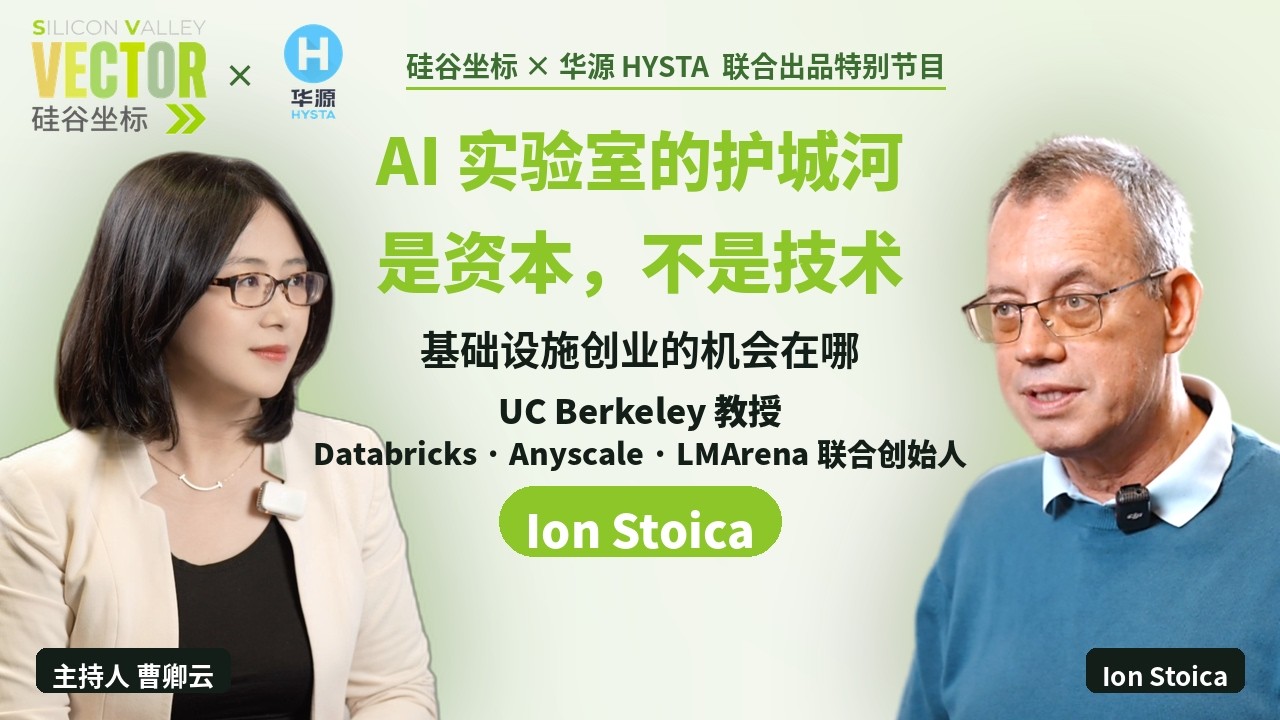
硅谷坐标 x Ion Stoica教授(Databricks、Anyscale、LMArena 联合创始人)|开源vs闭源、基础设施创业的机会 — Silicon Valley Vector 硅谷坐标

Silicon Valley Vector 硅谷坐标

前沿闭源实验室的领先优势本质由资本而非技术垄断驱动,随着开源模型跨越特定任务的“可用”门槛,超出需求的算力溢价将推动企业工作流大举转向开源生态。

AI-assisted summary of 硅谷坐标 x Ion Stoica教授(Databricks、Anyscale、LMArena 联合创始人)|开源vs闭源、基础设施创业的机会 — original source. Check the original for full context.

Source published:

Key ideas

  • AI infrastructure complexity is forcing hardware, runtime, orchestration, and application layers to vertically integrate into tightly coupled mega-systems to achieve viable cost efficiency. (0:00)
  • Startups can evade hyperscaler competition by targeting emerging workloads, specifically post-training tooling, multimodal data ingestion pipelines, specialized robotics stacks, and cross-cluster data transport like SkyPilot. (2:59)
  • Frontier AI lab leadership rotates every few months, indicating that capital and commercial revenues—rather than unassailable technological exclusivity—constitute the true corporate moat. (6:54)
  • Developer platforms such as Vercel have seen gateway traffic invert from roughly 70% proprietary models to 70% open-source models as open weights crossed the 'good enough' threshold for real-world tasks. (6:54)
  • Static artificial benchmarks fail to reflect actual utility, making real-world human problem-solving and preference data the ultimate ground truth for model evaluation at LMArena. (15:09)

Detailed notes

## Background Published on YouTube by Silicon Valley Vector (硅谷坐标) on October 13, 2026, this video features an in-depth interview with UC Berkeley professor and Databricks, Anyscale, and LMArena co-founder Ion Stoica at the 2026 HYSTA Annual Conference. According to the description, the discussion explores the true moats of frontier AI laboratories, the closing gap between open-source and closed-source models, and emerging startup opportunities across the AI infrastructure stack.

## TL;DR Ion Stoica argues that while escalating infrastructure complexity demands vertical integration, startups can capture significant value by targeting emerging bottlenecks in post-training pipelines, multimodal processing, specialized robotics, and multi-cloud data portability. He contends that frontier AI labs rely primarily on capital reserves rather than exclusive technology or talent, resulting in transient performance leads that open-source models routinely close. Because practical applications only require crossing a 'good enough' capability threshold, open-weights models are winning massive production adoption. Stoica concludes that design 'taste' and human-centric user experience form defensible differentiators, underpinning LMArena's mission to make real human judgment the ultimate evaluation benchmark.

## Atmosphere & style The interview radiates the pragmatic, measured authority of a veteran systems architect and serial founder who has shaped distributed computing across multiple eras. Stoica delivers analytical, hype-free insights with calm conviction, grounding abstract AI debates with relatable metaphors like commuter cars and pedagogical clarity. The tone is deeply thoughtful and collegial, offering an intellectually rigorous perspective that demystifies technological monopolies in favor of open collaboration.

## Bulletin - [00:00](https://www.youtube.com/watch?v=S5-EK_dV8Yg&t=0s) AI infrastructure complexity is forcing hardware, runtime, orchestration, and application layers to vertically integrate into tightly coupled mega-systems to achieve viable cost efficiency. - [02:59](https://www.youtube.com/watch?v=S5-EK_dV8Yg&t=179s) Startups can evade hyperscaler competition by targeting emerging workloads, specifically post-training tooling, multimodal data ingestion pipelines, specialized robotics stacks, and cross-cluster data transport like SkyPilot. - [06:54](https://www.youtube.com/watch?v=S5-EK_dV8Yg&t=414s) Frontier AI lab leadership rotates every few months, indicating that capital and commercial revenues—rather than unassailable technological exclusivity—constitute the true corporate moat. - [06:54](https://www.youtube.com/watch?v=S5-EK_dV8Yg&t=414s) Developer platforms such as Vercel have seen gateway traffic invert from roughly 70% proprietary models to 70% open-source models as open weights crossed the 'good enough' threshold for real-world tasks. - [15:09](https://www.youtube.com/watch?v=S5-EK_dV8Yg&t=909s) Static artificial benchmarks fail to reflect actual utility, making real-world human problem-solving and preference data the ultimate ground truth for model evaluation at LMArena.

## Key takeaways - [00:00](https://www.youtube.com/watch?v=S5-EK_dV8Yg&t=0s) Rapid hardware cycles and demanding application requirements have driven infrastructure complexity to levels where traditional modular software abstractions are no longer economically viable. - [00:00](https://www.youtube.com/watch?v=S5-EK_dV8Yg&t=0s) AI safety and cybersecurity risks should be treated through an engineering lens analogous to the internet and distributed systems, using empirical failure analysis rather than alarmism. - [02:59](https://www.youtube.com/watch?v=S5-EK_dV8Yg&t=179s) Infrastructure startups can survive against vertically integrated hyperscalers by targeting newly emerging workloads rather than fighting over established architectural layers. - [02:59](https://www.youtube.com/watch?v=S5-EK_dV8Yg&t=179s) Post-training stacks provide a cost-effective route to specialize high-quality open-weights base models so they outperform closed frontier models on enterprise-specific tasks. - [02:59](https://www.youtube.com/watch?v=S5-EK_dV8Yg&t=179s) Transitioning to real-time multimodal data processing (video, audio, and images) is breaking legacy pipelines, creating high-value infrastructure opportunities for low-latency architectures. - [02:59](https://www.youtube.com/watch?v=S5-EK_dV8Yg&t=179s) Embodied robotics uses smaller, more tractable models than trillion-parameter LLMs, but the industry lacks a standardized, open-source training and deployment stack. - [02:59](https://www.youtube.com/watch?v=S5-EK_dV8Yg&t=179s) GPU scarcity forces organizations to stitch compute across fragmented clouds and on-premises clusters, requiring multi-cloud orchestration and wide-area data transport tools like SkyPilot. - [06:54](https://www.youtube.com/watch?v=S5-EK_dV8Yg&t=414s) Technological parity follows capital investment, meaning no frontier AI lab has maintained a lasting technological monopoly as top benchmark positions rotate every few months. - [06:54](https://www.youtube.com/watch?v=S5-EK_dV8Yg&t=414s) Open-source models do not need to beat frontier models across the board; passing a task-specific 'good enough' threshold satisfies user needs without requiring unnecessary extra capability. - [06:54](https://www.youtube.com/watch?v=S5-EK_dV8Yg&t=414s) Developer gateway traffic on platforms like Vercel has dramatically shifted from ~70% closed-source to ~70% open-source models as open weights achieved sufficient capability. - [11:12](https://www.youtube.com/watch?v=S5-EK_dV8Yg&t=672s) Product 'taste'—defined as empathy, pedagogical intuition, and superior UX—serves as a defensible moat that raw compute scale cannot easily duplicate. - [12:31](https://www.youtube.com/watch?v=S5-EK_dV8Yg&t=751s) Neither talent nor taste acts as a permanent moat for frontier labs because top research talent fluidly moves across OpenAI, Google, Anthropic, and other organizations. - [14:09](https://www.youtube.com/watch?v=S5-EK_dV8Yg&t=849s) Open source is crucial for the long-term health of AI because closed labs restrict contributions to internal staff, whereas open ecosystems guarantee the global diffusion of innovation. - [14:09](https://www.youtube.com/watch?v=S5-EK_dV8Yg&t=849s) True open-source innovation requires transparency across the full stack—including open model weights, training datasets, orchestration software, and reproducible evaluation frameworks. - [15:09](https://www.youtube.com/watch?v=S5-EK_dV8Yg&t=909s) Static synthetic benchmarks do not accurately reflect real-world AI utility, making human interactions and implicit/explicit user preferences the gold standard at LMArena.

## Detailed walkthrough ### [00:00](https://www.youtube.com/watch?v=S5-EK_dV8Yg&t=0s) Infrastructure Complexity and AI as a Human Tool

Ion Stoica outlines the core message of his keynote presentation at the HYSTA annual conference, centering on two fundamental observations about the current state of artificial intelligence. First, AI infrastructure is experiencing unprecedented complexity. This rapid escalation is driven by simultaneous leaps at both ends of the stack: specialized hardware is growing intricate, applications are becoming vastly more demanding, and the pace of innovation at both layers has accelerated dramatically. Compounding this is the crushing financial cost of running state-of-the-art AI workloads. To achieve the absolute maximum efficiency required to make these workloads economically viable, engineers cannot treat system layers as modular abstractions anymore. Instead, hardware, runtime, orchestration, and applications must be tightly coupled and co-developed as a single, vertically integrated mega-system.

Second, Stoica addresses the intensifying debate around cybersecurity breaches and existential risks posed by AI. He urges researchers and the public to take a step back and view the technology through a grounded, historical lens. AI is ultimately a system and a tool. While it is inherently complex and will inevitably exhibit emergent, unexpected behaviors, this is not humanity's first encounter with bewildering, large-scale systems. The internet itself and modern planetary-scale distributed computing systems frequently behave in ways their creators never foresaw. Rather than reacting with alarmism, the proper engineering response is to rigorously analyze attacks, failure modes, and edge cases, using those empirical lessons to bolster safety rails and guide system alignment toward human intent. At the end of the day, these models are designed to enhance human productivity and improve everyday life.

- **Drivers of infrastructure complexity**: Rapid hardware innovation cycles, escalating application requirements, and the necessity of tight vertical coupling to squeeze out maximum cost efficiency. - **Perspective on AI safety**: Treating AI as an evolving tool rather than an uncontrollable threat, drawing parallels to the early internet and distributed systems.

---

[02:59](https://www.youtube.com/watch?v=S5-EK_dV8Yg&t=179s) Infrastructure Startup Opportunities in an Era of Vertical Integration

Responding to how early-stage infrastructure startups can survive when hyperscalers and frontier labs are vertically optimizing every layer of their stacks, Stoica emphasizes that opportunity lies in targeting newly emerging workloads rather than fighting incumbents on yesterday's battlegrounds. Startups must identify sharp, unresolved pain points where specialized agility outperforms brute-force integration. He identifies four high-leverage areas ripe for startup disruption:

```mermaid flowchart TD accTitle: AI Infrastructure Startup Opportunities accDescr: Four emerging workload areas for AI infrastructure startups as identified by Ion Stoica.

subgraph Opportunities["Core AI Infra Opportunities"] direction TB PT["1. Post-Training Stacks<br/>(RLHF, Alignment, Task Specialization)"] MM["2. Multimodal Data Ingestion<br/>(Unified Video, Image, Audio, Text Pipelines)"] ROB["3. Specialized Robotics Stacks<br/>(Tractable Model Architectures)"] MCO["4. Multi-Cloud & Data Transport<br/>(SkyPilot, Geo-Distributed GPU Clusters)"] end

PT --> Advantage["Domain Superiority over Frontier LLMs"] MM --> Advantage ROB --> Advantage MCO --> Advantage ```

1. **Post-Training Acceleration and Tooling**: Post-training has exploded over the past year because it represents an extraordinarily cost-effective method to transform already capable base models into domain-specific powerhouses. With the surge of world-class open-weights models—particularly those open-sourced by Chinese research teams—startups can leverage post-training pipelines to surpass even top proprietary frontier models on specific enterprise tasks. 2. **Multimodal Data Processing**: As frontier applications transition from purely text-based interfaces to processing video, images, speech, and environmental audio in real time, current data-processing pipelines are buckling. Startups that create streamlined, low-latency architectures for handling heterogeneous multimodal data will capture immense value. 3. **Dedicated Robotics Infrastructure**: Robotics remains in its relative infancy. Unlike frontier language modeling, which requires trillions of parameters, embodied robotics models are smaller and more tractable. The industry currently lacks an open-source, standardized infrastructure stack designed specifically for robotics training and deployment. 4. **Data Portability Across Fragmented Clusters**: Extreme GPU and silicon scarcity forces organizations—including well-funded tech giants—to cobble together compute across multiple cloud providers, third-party neoclouds, and on-premises data centers. Orchestrating training runs across geographically scattered GPU clusters requires solving multi-cloud portability (exemplified by UC Berkeley's SkyPilot project) and moving petabytes of training data (tens of trillions of tokens) with ultra-high throughput across wide-area networks.

---

[06:54](https://www.youtube.com/watch?v=S5-EK_dV8Yg&t=414s) Frontier Labs, Capital Moats, and the "Good Enough" Open-Source Threshold

Reflecting on the fierce head-to-head competition among frontier labs and the evolving divide between closed and open models, Stoica acknowledges his personal vantage point as an open-source advocate behind Apache Spark, Ray, and LMSYS/LMArena. When analyzing what actually protects frontier labs, he argues that their true moat is not technological exclusivity, but pure **capital** and the ensuing commercial revenue streams. Whenever competitors match that capital expenditure, technological parity quickly follows.

History demonstrates that no single frontier laboratory has managed to sustain a permanent technological monopoly. Leadership flips every few months: late last year, Google's Gemini briefly held the top position; by spring, Anthropic's Claude 3.5 models dominated coding benchmarks; and shortly thereafter, models like Opus, Astra, and competitive Chinese models (including DeepSeek, GLM, and Kimi) proved they could match or outperform frontier offerings on demanding benchmarks. Because technological leads evaporate so quickly, open-source models remain fundamentally competitive.

Crucially, Stoica argues that open-source models do not even need to achieve absolute parity with the absolute frontier to win practical market adoption:

> "For every task there is a threshold. If the model is good enough, it's going to solve that task. Then being 10 times better for that task—10 times more capable—would not matter."

To illustrate this, Stoica offers a transportation analogy: if an individual needs a safe, reliable vehicle to drive at 100 miles per hour for a daily commute between Santa Clara and San Francisco, a car capable of doing 300 miles per hour provides zero additional utility for that mission. Unless the objective is competitive racing on a specialized track, "good enough" completely satisfies the user's need. This dynamic is already playing out in production: developer platforms like Vercel have observed traffic routed through their AI gateways dramatically shift—reversing from roughly 70% proprietary model usage to roughly 70% open-source models as open weights crossed the viability threshold for everyday application tasks.

| Dimension | Proprietary Frontier Labs | Open-Weights & Open-Source Ecosystem | |:--- |:--- |:--- | | **Primary Moat** | Massive capital reserves and commercial revenue pipelines. | Broad developer distribution, community experimentation, and customization. | | **Longevity of Lead** | Transient; leads typically last only a few months before equalizing. | Rapidly closes performance gaps via post-training and architectural distillation. | | **Task Fit Strategy** | Pushing raw general capability far beyond the task threshold. | Crossing the "good enough" operational threshold at significantly lower cost. | | **Adoption Trend** | Production traffic shifting from default closed-source to specialized open models. | Rising from minority share to majority gateway volume (e.g., Vercel's ~70% inversion). |

---

[11:12](https://www.youtube.com/watch?v=S5-EK_dV8Yg&t=672s) Taste and User Experience as True Defensible Moats

Addressing Steve Jobs' famous dictum that enduring product differentiation ultimately hinges on "taste," Stoica confirms that taste represents a genuine, human-centric moat that raw compute cannot easily replicate. He frames taste as a combination of empathy, pedagogy, and design intuition.

To demonstrate what taste means in practice, Stoica compares two human teachers attempting to explain an identical, highly complex technical concept. One explainer possesses the pedagogical intuition to structure the explanation around the listener's mental model, enabling them to grasp the concept fully in 10 to 15 minutes. Another person delivers the exact same underlying facts and mathematical truths, yet leaves the listener utterly confused even after three grueling hours of struggle.

In software and hardware systems, that same distinction is defined as user experience (UX). Superior UX allows a user to effortlessly unlock the latent capabilities of a device, whereas poor UX renders advanced features inaccessible. The exact same principle governs AI models: as base cognitive capabilities become commoditized across both closed and open weights, competitive advantage shifts toward how models formulate their answers, how intuitively they interact, how they clarify ambiguous user instructions, and how well their output structures match human workflow expectations.

[12:31](https://www.youtube.com/watch?v=S5-EK_dV8Yg&t=751s) Human Nature, "Taste", and Why Talent Alone Isn’t a Frontier Moat

Addressing the intersection of product design and human psychology, Ion Stoica reflects on how foundational human connection remains in technology. In his view, "most of the problems between humans are down to miscommunications." Consequently, building systems meant for people requires deeply understanding human nature, meeting users exactly where they are, and addressing their genuine needs—a quality often summarized simply as "taste."

The conversation shifts to whether this elusive taste—and the elite talent possessing it—serves as the true competitive moat separating the leading AI laboratories. Stoica pushes back against the premise. If individual lab talent and taste were truly an insurmountable moat, model rankings wouldn’t constantly fluctuate with a different provider seizing the top spot every two months. History shows market dominance operating in distinct waves, such as Google dominating search or Microsoft's historical software hegemony. Today’s AI landscape is different: multiple frontier labs clearly possess comparable technical capabilities and top-tier talent.

Rather than taste or raw intellect forming the barrier to entry, Stoica argues that capital is the decisive differentiator: - **Capital as the Talent Magnet:** Massive financial resources dictate who can acquire cutting-edge compute infrastructure and offer the compensation packages required to lure elite researchers, who frequently rotate across competing frontier labs. - **Fluid Talent Pools:** The constant movement of researchers across OpenAI, Google, Anthropic, and other frontier groups indicates that expertise is distributed across the ecosystem rather than monopolized inside a single firm.

```mermaid flowchart LR accTitle: Capital and Open Innovation Dynamics accDescr: Diagram illustrating how capital drives talent in closed labs while open source distributes innovation globally.

subgraph ClosedModel["Closed Lab Dynamic"] Cap["Capital & Compute"] --> Tal["Top Research Talent"] Tal --> Silo["Siloed Contribution\n(Insiders Only)"] end

subgraph OpenModel["Open Source Dynamic"] Dist["Global Community\n(Weights, Data, Code, Evals)"] --> Diff["Diffusion of Innovation\n(Everyone Contributes & Benefits)"] end

ClosedModel -.->|"Talent fluidly moves"| OpenModel ```

---

[14:09](https://www.youtube.com/watch?v=S5-EK_dV8Yg&t=849s) The Necessity of Open Source and the Diffusion of Innovation

Because frontier labs operate behind closed doors, only internal employees can contribute to advancing their systems. Stoica emphasizes that this restriction is precisely why open source is indispensable for the long-term health of AI: it guarantees the "diffusion of innovation." By removing organizational gatekeepers, open source empowers individuals from every corner of the globe to build and improve technology collectively, echoing the global collaborative triumph of Linux.

Stoica points to open ecosystem momentum in China and globally, but argues that openness must extend beyond just publishing weights. To create a truly robust ecosystem where everyone can participate and share the upside, the entire stack must be accessible: - **Open Weights:** Providing model weights openly so anyone can fine-tune and inspect them. - **Open Data & Infrastructure:** Transparent datasets and fully open training and orchestration software. - **Open Evaluation:** Transparent, reproducible benchmarks and evaluation tools to keep progress honest.

---

[15:09](https://www.youtube.com/watch?v=S5-EK_dV8Yg&t=909s) LMArena's Vision: Real Humans as the Ultimate Evaluation Benchmark

With an overwhelming volume of models releasing each week, discerning true quality, reliability, and cost-effectiveness has become increasingly difficult. When asked about his ultimate vision for LMArena (Large Model Arena / LMSYS Chatbot Arena), Stoica explains that the core mission is straightforward: "to help people build better AI." Better AI, in this context, means systems that are more accurate, more predictable, more dependable, and significantly more cost-effective.

Achieving this requires solving evaluation first, because an engineer cannot select the optimal model for a specific workflow without reliable metrics. While acknowledging that static and artificial benchmarks still serve a technical purpose, Stoica stresses that they fail to capture genuine system utility. LMArena's core philosophy is that because systems are built for humans, human judgment must serve as the ground truth: - **Real Users, Real Workloads:** Instead of static synthetic tests, evaluation must center on actual people trying to solve genuine everyday problems. - **Implicit and Explicit Preference:** Gathering both explicit side-by-side preference votes and implicit signals based on how effectively a model or autonomous agent resolved the user's prompt. - **The Human as the Final Arbiter:** As Stoica summarizes, "as long as we build the systems for humans, the ultimate benchmarks is humans."

## Notable quotes > [06:54](https://www.youtube.com/watch?v=S5-EK_dV8Yg&t=414s) For every task there is a threshold. If the model is good enough, it's going to solve that task. Then being 10 times better for that task—10 times more capable—would not matter. — Ion Stoica

> [12:31](https://www.youtube.com/watch?v=S5-EK_dV8Yg&t=751s) most of the problems between humans are down to miscommunications. — Ion Stoica

> [15:09](https://www.youtube.com/watch?v=S5-EK_dV8Yg&t=909s) to help people build better AI. — Ion Stoica

> [15:09](https://www.youtube.com/watch?v=S5-EK_dV8Yg&t=909s) as long as we build the systems for humans, the ultimate benchmarks is humans. — Ion Stoica

## Mentioned Ion Stoica, Databricks, Anyscale, LMArena, LMSYS, Chatbot Arena, UC Berkeley, HYSTA, Apache Spark, Ray, SkyPilot, Google, Gemini, Anthropic, Claude 3.5, DeepSeek, GLM, Kimi, Vercel, Steve Jobs, OpenAI, Microsoft, Linux

## Video description 【本期介绍】 UC Berkeley 教授、Databricks / Anyscale / LMArena 联合创始人 Ion Stoica,在 2026 HYSTA 华源科技协会年会现场接受硅谷坐标专访。 前沿 AI 实验室的护城河是什么?开源模型会追上闭源吗?AI 基础设施创业的机会在哪?

【章节】 00:00 开场 00:14 演讲的核心信息:基础设施越来越复杂,AI 是工具 02:40 AI 基础设施创业公司的机会在哪 06:52 前沿实验室的护城河与开源模型 11:54 品味是不是护城河 14:38 AI 能取代品味吗 15:39 人才是不是护城河,开源为什么重要 18:07 Arena 的愿景:让真实的人来评测 AI

【嘉宾】 Ion Stoica|UC Berkeley 教授,Databricks、Anyscale、LMArena 联合创始人 (嘉宾观点为个人观点)

本期为英文对话,提供中英双语字幕。 硅谷坐标 × 华源科技协会 联合出品。

【关于硅谷坐标】 一档深度研究式科技投资访谈。 订阅频道:https://www.youtube.com/@SiliconValleyVector

#IonStoica #Databricks #LMArena #AIInfrastructure #OpenSource #硅谷坐标 #开源

[Source](https://www.youtube.com/watch?v=S5-EK_dV8Yg)

中文简报

Ion Stoica:前沿AI实验室缺乏技术护城河,开源达标即破局 前沿闭源实验室的领先优势本质由资本而非技术垄断驱动,随着开源模型跨越特定任务的“可用”门槛,超出需求的算力溢价将推动企业工作流大举转向开源生态。 Ion Stoica 认为,尽管基础设施复杂度的激增要求进行垂直整合,但初创公司仍可通过解决后训练流水线、多模态处理、专用机器人以及多云数据便携性等新兴瓶颈来捕获巨大价值。他指出,前沿 AI 实验室主要依赖资金储备而非独家技术或人才,因此其性能领先往往是暂时的,开源模型总能定期迎头赶上。由于实际应用只需跨过“足够好”的能力门槛,开源权重模型正在生产环境中获得大规模采用。Stoica 总结道,设计“品味”和以人为本的用户体验构成了具备防御壁垒的差异化优势,这也支撑了 LMArena 将真实人类判断作为终极评测基准的核心使命。 AI 基础设施的复杂性正迫使硬件、运行时、编排与应用层垂直整合为紧密耦合的超大型系统,以实现可行的成本效益。 (0:00) 初创公司可通过聚焦新兴工作负载来避开超大规模云厂商的竞争,特别是后训练工具、多模态数据摄入流水线、专用机器人技术栈以及类似 SkyPilot 的跨集群数据传输。 (2:59) 前沿 AI 实验室的领先地位每隔几个月就会易主,这表明资金和商业收入才是真正的企业护城河,而非不可逾越的技术排他性。 (6:54) 随着开源权重模型在现实任务中跨过“足够好”的门槛,Vercel 等开发者平台的网关流量已发生逆转,从约 70% 为专有模型转变为 70% 为开源模型。 (6:54) 静态人工基准测试无法反映真实效用,这使得现实世界中的人类问题解决过程与偏好数据成为 LMArena 进行模型评估的终极基准真相。 (15:09)

Reading summary

Ion Stoica 认为,当前前沿 AI 实验室的技术壁垒并不持久,真正的护城河在于资本与产品体验(Taste),而开源生态则凭借跨过“足够好”的门槛在实际生产中快速普及;初创企业的机遇在于深耕垂直整合尚未覆盖的新型基础设施工作负载。 AI 基础设施复杂度与工具化定位 (0:00) Stoica 指出,AI 基础设施当前面临前所未有的复杂性,这源于底层专用硬件与顶层应用需求的双向加速迭代。由于运行顶尖 AI 工作负载的财务成本极高,工程体系已无法沿用传统的模块化抽象模式,必须将硬件、运行时、编排与应用层进行紧密协同和垂直集成,以压榨出极限的成本效益。 针对安全漏洞与“存在性风险”的社会争论,Stoica 呼吁从工程与历史视角看待 AI。他强调 AI 本质上是一项服务于人类生产力与生活的工具,其涌现与意外行为与早期的互联网和大规模分布式系统类似;应对之道应是通过严格剖析攻击、故障模式和边缘案例来完善安全护栏,而非陷入恐慌。 基础设施初创公司的四大破局点 (2:59) 在超大规模云厂商与前沿实验室推行全面垂直整合的背景下,Stoica 建议初创企业应避开巨头盘踞的旧战场,聚焦于新兴且痛点明确的工作负载。他具体指出了四个具备高增长潜力的方向:后训练(Post-Training)加速与工具链、多模态数据摄取与低延迟处理架构、专用于具身智能的小型化机器人基础设施,以及跨分散异构算力集群的数据搬运与多云编排技术(如 UC Berkeley 的 SkyPilot)。 Stoica 强调,借助高质量开源权重(特别是来自中国团队的模型),初创公司可以通过极具成本效益的后训练与对齐流程,在特定企业任务上超越顶尖专有模型;此外,GPU 算力极度短缺迫使组织整合多方算力资源,广域网海量数据吞吐与多云调度因而成为刚需。 资本护城河与“足够好”的开源阈值 (6:54) 根据 Stoica 的观察,前沿闭源实验室的核心优势并非技术垄断,而是巨额资本及其带来的商业收入流。历史上技术领先地位每隔数月便会更替,Google Gemini、Anthropic Claude 3.5 以及中国团队的 DeepSeek、GLM、Kimi 等轮番登顶,印证了纯技术领先的短暂性。相比之下,资本是吸引流动性极高的顶尖人才并采购算力的决定性杠杆,而开源生态则依托去中心化分工推动广泛的创新扩散。 在商业落地层面,开源模型无需在综合能力上全面超越前沿模型即可取胜。Stoica 提出任务“阈值理论”:只要模型性能达到完成某项具体任务的“足够好”门槛,超出十倍的能力对用户而言并无额外价值,正如日常通勤无需 300 英里时速的赛车。这一转变已在工业界显现,例如 Vercel 的 AI 网关流量中,开源模型调用占比已从原本的约 30% 反转上升至约 70%。 产品品味与以人为核心的评测体系 (11:12) 当底层基础认知能力趋于同质化时,产品竞争壁垒转向“品味(Taste)”与用户体验。Stoica 将品味定义为共情能力、教学直觉和对人性的深刻理解,类比于优秀教师能以契合学习者心智模型的方式快速讲透复杂原理。AI 系统的竞争优势因而体现为交互的自然度、澄清模糊意图的能力,以及输出内容与人类工作流的贴合程度。 为衡量这种真实价值,Stoica 阐释了 LMArena(LMSYS 竞技场)的核心逻辑:静态合成基准测试难以捕捉真实的系统效用,必须将真实人类在解决实际问题过程中的显式投票与隐式解决信号作为最终的“地面真值(Ground Truth)”。唯有以人为终极基准,才能评估模型的准确性、稳定性和性价比,帮助工程师选型并推动整体生态构建更好的 AI。 Stoica 总结认为,健康的 AI 生态必须依赖开源来实现创新的全球扩散,且开放不能局限于模型权重,更应涵盖数据、底层基础设施与评测标准;在技术能力逐步通用化的趋势下,解决具体现实痛点与契合人类体验是系统生存的根本。

Detailed notes — zh

## Background 本期内容由 YouTube 频道「Silicon Valley Vector 硅谷坐标」于 2026 年 10 月 13 日发布。视频为在 2026 HYSTA 华源科技协会年会现场对加州大学伯克利分校(UC Berkeley)教授、Databricks / Anyscale / LMArena 联合创始人 Ion Stoica 的深度专访,重点探讨前沿 AI 实验室的竞争壁垒、开源与闭源的演进格局以及 AI 基础设施创业公司的突围机会。 ## TL;DR Ion Stoica 指出,AI 基础设施正因高昂成本与软硬件端到端协同设计而变得前所未有地复杂,技术人员应将 AI 视为提高生产力的复杂系统与工具,而非过度神化或恐慌。针对基础设施创业,他看好后训练(Post-training)、多模态混合处理、具身智能机器人技术栈以及跨云跨集群数据调度等高价值切入点。在模型竞争方面,他认为前沿实验室目前唯一的护城河是资本而非绝对的技术代差,开源模型只要跨越实际任务的“可用阈值”就能颠覆闭源溢价。此外,他肯定了“品味”在交互体验中的关键作用,并分享了 LMArena 依托真实人类反馈构建动态评估体系的愿景。 ## Atmosphere & style 整场对话沉稳、理性且极具系统工程思维,透出资深学者与连续创业者特有的清醒与务实。Stoica 摒弃了行业内常见的虚妄炒作与灾难叙事,用平实精妙的比喻(如以通勤时速对比超跑)拆解复杂的前沿架构与商业博弈。访谈氛围专注而从容,既有对开源协同理念的坚定信仰,也有对现实商业与资本规律的冷峻洞察,带给观众一种兼具宏观技术格局与底层工程常识的笃定感。 ## Bulletin - [06:52](https://www.youtube.com/watch?v=S5-EK_dV8Yg&t=412s) Ion Stoica 指出前沿实验室并无绝对技术护城河,资本与商业化循环是唯一持续壁垒,行业排位每隔数月便会轮替。 - [06:52](https://www.youtube.com/watch?v=S5-EK_dV8Yg&t=412s) 开源模型追赶闭源只需跨过生产环境的“可用阈值”,Vercel 等平台调用流量已在数月内从 70% 偏向闭源反转为 70% 采用开源。 - [02:40](https://www.youtube.com/watch?v=S5-EK_dV8Yg&t=160s) AI 基础设施创业的四个技术突围点在于:后训练(Post-training)、多模态混合吞吐、具身智能平台以及跨集群/跨云数据调度。 - [15:09](https://www.youtube.com/watch?v=S5-EK_dV8Yg&t=909s) LMArena 的核心愿景是通过真实人类在具体任务中的显式与隐式反馈评测 AI,以替代容易失真的静态基准测试。 ## Key takeaways - [00:00](https://www.youtube.com/watch?v=S5-EK_dV8Yg&t=0s) AI 基础设施因极高的计算成本和迅猛的软硬件创新,正被迫走向高度紧耦合与全栈协同设计。 - [00:14](https://www.youtube.com/watch?v=S5-EK_dV8Yg&t=14s) 技术人员应对 AI 安全保持冷静客观,牢记 AI 归根结底是提高生产力的复杂分布式工具,而非神化或过度恐慌的产物。 - [02:40](https://www.youtube.com/watch?v=S5-EK_dV8Yg&t=160s) 后训练(Post-training)具备极高性价比,开发者可结合开源底座在垂类业务场景上反超顶尖商业模型。 - [02:40](https://www.youtube.com/watch?v=S5-EK_dV8Yg&t=160s) 应用向多模态转型带来了全新的异构数据处理瓶颈,传统纯文本流水线已无法承载音视频图文的混合吞吐。 - [02:40](https://www.youtube.com/watch?v=S5-EK_dV8Yg&t=160s) 具身智能与机器人模型参数规模相对可控,目前急需一套标准化、稳定高效的开源基础设施平台。 - [02:40](https://www.youtube.com/watch?v=S5-EK_dV8Yg&t=160s) 受限于先进制程 GPU 短缺,企业算力高度碎片化,跨云、跨数据中心调度数十万亿 Token 成为亟待解决的工程瓶颈。 - [06:52](https://www.youtube.com/watch?v=S5-EK_dV8Yg&t=412s) 前沿商业实验室的最大护城河是资本及其带来的算力投资与营收循环,技术榜首在几个月内频繁轮换证明技术本身难以形成长期壁垒。 - [06:52](https://www.youtube.com/watch?v=S5-EK_dV8Yg&t=412s) 开源模型无须在绝对指标上抹平与闭源的差距,只要越过解决现实任务的“好用阈值”,多出的极限性能在商业上并无额外价值。 - [11:54](https://www.youtube.com/watch?v=S5-EK_dV8Yg&t=714s) “品味(Taste)”是区隔平庸工具与顶级系统的关键,体现在回答的架构、言辞精炼度以及主动交互设计上。 - [12:31](https://www.youtube.com/watch?v=S5-EK_dV8Yg&t=751s) 品味与顶尖人才无法构成绝对垄断,各大实验室在人才与技术上难分伯仲,充裕资本往往决定了人才的流向。 - [12:31](https://www.youtube.com/watch?v=S5-EK_dV8Yg&t=751s) 开源对于 AI 发展不可或缺,它打破了闭源围墙,能够像 Linux 一样加速创新的全球扩散,未来应走向全栈与数据开源。 - [15:09](https://www.youtube.com/watch?v=S5-EK_dV8Yg&t=909s) 打造更好 AI 的关键是准确、可靠、可预测与高成本效益,而精准的评估体系是匹配模型与具体任务的必备底座。 - [15:09](https://www.youtube.com/watch?v=S5-EK_dV8Yg&t=909s) 静态或人工基准测试存在数据污染与失真风险,唯有真实人类在实际生产生活问题中的交互偏好才是 AI 的终极评估标尺。 ## Detailed walkthrough ### [00:00](https://www.youtube.com/watch?v=S5-EK_dV8Yg&t=0s) 开场与演讲核心:AI 基础设施的复杂性与工具属性 在访谈开场,加州大学伯克利分校(UC Berkeley)教授、Databricks、Anyscale 以及 LMSYS / LMArena 的联合创始人 Ion Stoica 概括了他当天在大会演讲中传达的核心观点。首先,AI 基础设施正变得前所未有地复杂。这一方面源于硬件架构与上层应用本身的高度复杂化,另一方面在于硬件与软件层面的创新迭代速度呈指数级爆发。由于运行与训练现代 AI 工作负载的成本极为高昂,业内为了追求极致的运行效率,倾向于将整个系统进行高度软硬件整合与端到端协同设计,导致整个底层架构成为一个庞大且紧密耦合的系统。 其次,针对学界与工业界近期广泛讨论的 AI 网络安全漏洞及其对人类社会构成的潜在危险,Ion Stoica 呼吁大家退后一步,保持冷静客观的技术认知。他强调,技术人员绝不应将 AI 神化或过度恐慌化,而应牢记“AI 归根结底是一个系统、一个工具”。虽然极其复杂的系统不可避免地会出现意料之外的行为,但类似的情况在互联网和大规模分布式系统诞生时就曾发生过。人类需要做的是深入分析每次出现的安全漏洞与攻击模式,借此完善防御机制并引导系统实现预期目标。 > “But we should never forget that I think at the end of the day they are tools and these tools are there to improve our productivity and in general improve our life.” —— Ion Stoica ```mermaid flowchart TD accTitle: AI系统演化与认知框架 accDescr: 展示硬件、应用复杂度及高成本如何推动基础设施垂直整合,以及人类应如何将AI视为生产力工具来对待。 subgraph InfraChallenge["基础设施复杂化成因"] H["硬件架构复杂度与高创新速度"] A["前沿应用需求激增"] C["计算与运行成本极度高昂"] end subgraph Integration["工程应对方向"] SYS["全栈紧耦合与软硬件端到端协同优化"] end subgraph Perspective["对AI危险性的认知态度"] TOOL["定位:AI 本质是复杂工具与分布式系统"] ACTION["策略:深入理解攻击与异常,反哺安全控制"] GOAL["终局:提高人类生产力,改善现实生活"] end H --> SYS A --> SYS C --> SYS TOOL --> ACTION --> GOAL ``` --- ### [02:40](https://www.youtube.com/watch?v=S5-EK_dV8Yg&t=160s) AI 基础设施初创公司的突围切入点 面对大型科技巨头在 AI 技术栈各个层级不断进行垂直整合与优化的现状,创业公司若想立足,必须精准定位前沿演进中涌现的核心新问题(emerging workloads),并在细分技术瓶颈上做到极致。Ion Stoica 具体指出了四个值得深入挖掘的技术蓝海: 后训练(Post-training)的战略价值持续激增。过去一年间已有大量企业涌入该赛道,但后训练能够以极高性价比在现有底座模型的基础上显著提升模型能力,让通识大模型在特定垂直业务场景中达到顶尖水平。这一趋势在很大程度上得益于开源社区,尤其是来自中国的极具竞争力的开源权重(Open-weights)模型的爆发,开发者可以通过精细的后训练使开源模型在特定任务上超越顶尖的闭源商业模型。 多模态数据处理成为全新的系统挑战。随着应用逐渐从纯文本全面转向多模态,基础设施需要同时高效吞吐并联合处理图像、视频、音频和文本流,传统的数据流水线已难以承受多模态混合训练与推理的异构压力。此外,机器人(Robotics)技术栈也是一个极具潜力的连接点。具身智能领域仍处于发展早期,各家企业多在自研模型,但其参数规模通常不必达到万亿级别,系统复杂度相对可控,因此业界亟需一套稳定、高效且针对机器人控制定制的开源基础设施方案。最后,跨集群与跨云的数据搬运(Data Movement)正面临严峻瓶颈。受制于先进 GPU 芯片的全球性短缺,企业往往被迫分散在不同云服务商或自建数据中心之间切分算力集群。如何在数十万亿(tens of trillions)甚至更多 Token 的训练负载下,实现跨数据中心的调度与数据高吞吐传输,正是当前亟待解决的工程难题(类似于 SkyPilot 所探索的跨云便携性方向)。 - **后训练(Post-training)**:借助高质量领域数据优化开源底座,以远低于预训练的成本实现垂类场景性能反超闭源模型。 - **多模态混合处理**:打破文本壁垒,构建应对图像、视频与音频高吞吐联合运算的新一代数据系统。 - **具身智能与机器人技术栈**:在万亿参数模型之外,针对体量更可控的机器人应用提供标准化的软硬件支撑平台。 - **跨集群与跨数据中心数据调度**:解决 GPU 算力碎片化痛点,在异构云环境中提供算力与海量训练数据的无缝迁移。 --- ### [06:52](https://www.youtube.com/watch?v=S5-EK_dV8Yg&t=412s) 前沿实验室的护城河、开源赶超与“足够好”阈值 针对前沿实验室(如 OpenAI、Anthropic、Google 等)之间日趋激烈的白热化竞争,Ion Stoica 深入剖析了闭源前沿巨头与开源生态的格局演进。作为开源软件的长期信仰者与建设者,他指出,前沿商业实验室目前展现出的最大护城河本质上是“资本”(Capital)以及资本带来的算力再投资与商业化收入,而非绝对的技术代差。 > “History shows that no company so far has proven that he can build a moat other than the capital which is very important and you have capital and then you have revenue, so that’s a huge moat.” —— Ion Stoica 技术排位表在极短周期内频繁轮替的事实证明了技术壁垒的脆弱性:在 2025 年底时 Google Gemini 被公认为最强,但仅过数月,到了 2026 年初 Anthropic 便凭借 Claude 系列(以及 Opus 3.5 / 3.6 等后续版本)在编程场景全面占领高地;开源领域同样如此,DeepSeek 引发行业轰动后不久,智谱 GLM 与 Moonshot Kimi 等中国前沿模型也在多项任务上迅速实现追赶乃至超越。 Ion Stoica 提出了一个关键理论:**开源模型追赶闭源模型,并不需要在绝对能力上实现全面抹平。** 现实中的每项实际生产任务都存在一个性能的“可用阈值(threshold)”。一旦开源模型达到了能稳定解决该任务的水平,闭源模型强上十倍也无法转化为实际的商业溢价。他形象地打比方:如果用户的需求仅仅是以每小时 100 英里的安全时速往返于圣塔克拉拉(Santa Clara)和旧金山(San Francisco)之间,那么一辆能开到每小时 300 英里的赛车对这趟通勤而言毫无额外意义。随着开源权重的整体基线稳步跨过实用阈值,市场正发生剧烈分流——例如 Vercel 等公司的 AI 路由网关数据显示,短短数月内其平台调用流量就从 70% 倾向于闭源专有模型,剧烈反转为 70% 采用开源模型。 | 维度 | 前沿商业实验室(Proprietary Labs) | 开源与开放权重生态(Open Source) | |:--- |:--- |:--- | | **主要护城河** | 庞大的资本储备、GPU 集群规模及持续的商业营收循环 | 全球社区创新协同、开发者生态规模与极低的私有化落地成本 | | **技术壁垒持久度** | 动态技术领先期仅维持数月,行业顶尖地位频繁轮替 | 迅速吸收业界前沿方案,技术代差被快速收窄 | | **解决实际任务** | 追求极限综合推理与高难通用基准测试 | 只要跨越“好用(Good Enough)”阈值即可满足绝大多数现实业务 | | **落地趋势(以路由网关为例)** | 占比从过去的绝对主导(约 70%)逐步被挤压 | 实际生产负载调用占比迅速攀升(从少数升至约 70%) | --- ### [11:54](https://www.youtube.com/watch?v=S5-EK_dV8Yg&t=714s) “品味”(Taste)是否构成 AI 时代的真正壁垒 针对乔布斯(Steve Jobs)关于技术终局取决于“品味”的经典论断,访谈探讨了品味能否成为 AI 模型和产品的核心防线。Ion Stoica 对此给出了高度肯定的答复,并强调品味直接决定了交互效率与人类体验。 > “I absolutely think so. Taste is human.” —— Ion Stoica 为了阐述品味的价值,Stoica 举了一个生动的对比示例:当两位不同的人尝试解释同一个复杂的困难概念时,一位具备良好表达品味的人可能只需 10 到 15 分钟就能用清晰精炼的方式让你彻底理解;而另一位缺乏这种品味的人即便花上 3 个小时反复解释,听者依然一头雾水。这种区别反映在硬件与软件上就是用户体验(UX)。在硬件底层完全相同的设备上,优秀的 UX 能够让普通用户以极低的门槛调用并发挥出硬件的大部分潜能。 模型层面同样适用这一逻辑。底座参数哪怕完全一致,具备良好“品味”的模型在与人互动时,其回答的组织架构、言辞的精练程度,甚至在遇到模糊指令时如何主动向人类提问以寻求澄清,都会展现出天壤之别。这种面向人类认知习惯的交互设计与表达审美,是区分平庸工具与顶级系统的关键分水岭。 ### [12:31](https://www.youtube.com/watch?v=S5-EK_dV8Yg&t=751s) 品味与人才是不是 AI 实验室的护城河,开源为何至关重要 Ion Stoica 深入探讨了人性的本质以及技术系统如何与人协同。他认为,人与人之间的沟通极为关键,现实中大多数矛盾与问题归根结底都源于沟通不畅。因此,只要工程师是在为人类构建系统,就必须充分考虑人类的需求,在人类所处的位置去迎合他们,而这在某种程度上就是所谓的“品味”(Taste)。面对主持人关于“顶尖 AI 实验室的护城河是否在于拥有更好品味的人才”的提问,Stoica 给出了否定看法。他反驳道,如果品味或人才真的是不可逾越的护城河,业界就不会看到各大模型的排行榜每隔一两个月就发生一次榜首轮换。 Stoica 回顾历史指出,过去科技行业出现过绝对垄断的时代,比如 Google 崛起时一统搜索天下,微软发力时也能长期主导市场;然而如今前沿 AI 领域并没有出现这种一家独大的局面,各大主力实验室在人才与技术能力上其实难分伯仲。在他看来,人才是很关键,但资本在其中扮演了更具决定性的角色——充足的资本可以自由挖角、吸引顶尖人才,这也是为什么人才会在这些实验室之间频繁流动。正因如此,开源才显得无比珍贵。闭源实验室的技术创新被圈禁在围墙之内,只有内部员工可以参与改进;而开源能够确保创新的快速扩散,汇聚全球每个角落开发者的力量。他以 Linux 为例说明全球协作的威力,并呼吁未来能有更彻底的开源生态,不仅开放模型权重,还要开放训练数据、训练框架代码以及评估基准,让全人类共同参与并享受红利。 Ion Stoica 强调了开源带来的创新扩散价值: > “So I think that open source is so important because the open source ensure the diffusion of innovation it allows everyone to contribute right that's a problem right now each each of these labs only people within the lab can contribute” - **资本与人才流动**:前沿实验室之间的人才流动极度频繁,资本体量在争夺算力与人才上起到了更基础的杠杆作用。 - **全栈开源的期待**:开源不应仅仅停留在开放权重(Open Weights),更应涵盖数据开源(Open Data)、训练软件开源(Open Software)以及评测开源(Open Evaluation)。 ```mermaid flowchart TD accTitle: 闭源实验室与开源生态的创新模式对比 accDescr: 对比闭源实验室的内部创新循环与开源社区全球协作驱动创新的两种路径 subgraph ClosedLab ["闭源实验室模式"] C1["雄厚资本"] --> C2["吸引顶尖人才"] C2 --> C3["局限在内部团队贡献"] C3 --> C4["两月一次的榜首轮换与内卷"] end subgraph OpenEcosystem ["开源生态模式 (以 Linux 为例)"] O1["开放权重与数据"] --> O2["全球各角落开发者贡献"] O2 --> O3["创新的快速扩散 (Diffusion of Innovation)"] O3 --> O4["全行业共同受益与性能迭代"] end ``` --- ### [15:09](https://www.youtube.com/watch?v=S5-EK_dV8Yg&t=909s) LMArena 的愿景:用真实人类评估驱动更好的 AI 随着市面上涌现出越来越多的模型,评判模型质量的难度与日俱增,基准测试(Benchmark)、评估手段与可靠性变得空前重要。这正是 Ion Stoica 联合创立 LMSYS / LMArena 的核心初衷。在谈到 Arena 的长远愿景时,Stoica 明确表示,其终极目标是帮助人们打造更优秀的 AI——这里的“更优秀”意味着模型输出更加准确、性能更加可靠、行为更加可预测,同时兼具更高的成本效益(Cost-Effective)。而要达成这一目标,最核心的底座就是精准的评估体系;缺乏切合实际的评估,开发者根本无法得知针对自己手头的具体任务哪一款模型才是最佳选择。 Stoica 进一步阐述了 LMArena 的评测哲学。尽管他不否认学术界静态基准(Static Benchmarks)和人工设计基准测试的重要性,但他深信,最好的评测机制必须由真实的人类在解决自身真实问题的过程中完成。在这一体系下,用户输入真实的生产生活任务,并对其体验给出显式或隐式的偏好反馈。只要技术系统最终服务的对象是人类,那么一切合成测试都无法替代人类本身的感受与检验。 Ion Stoica 对人类作为最终评估基准做出了定调: > “I'm not saying this artificial benchmark are important. Our static benchmarks are important. No question about that. But we we do believe that without having the ultimate benchmarks again as long as we build the systems for humans, the ultimate benchmarks is humans.” - **更好 AI 的四个维度**:更精准(Accurate)、更可靠(Reliable)、更可预测(Predictable)以及更具成本效益(Cost-effective)。 - **真实场景的偏好驱动**:通过真实用户在具体任务中表达的显式偏好(直接投票)或隐式偏好(如采纳率、交互时长),评测模型和 Agent 的实际表现,避免传统静态 Benchmark 面临的数据污染与指标虚高。 ## Notable quotes > [15:09](https://www.youtube.com/watch?v=S5-EK_dV8Yg&t=909s) I'm not saying this artificial benchmark are important. Our static benchmarks are important. No question about that. But we we do believe that without having the ultimate benchmarks again as long as we build the systems for humans, the ultimate benchmarks is humans. — Ion Stoica > [06:52](https://www.youtube.com/watch?v=S5-EK_dV8Yg&t=412s) History shows that no company so far has proven that he can build a moat other than the capital which is very important and you have capital and then you have revenue, so that’s a huge moat. — Ion Stoica ## Mentioned Ion Stoica, 加州大学伯克利分校 (UC Berkeley), Databricks, Anyscale, LMSYS, LMArena, OpenAI, Anthropic, Google, Gemini, Claude, Opus 3.5 / 3.6, DeepSeek, 智谱 GLM, Moonshot Kimi, Vercel, SkyPilot, Linux, 史蒂夫·乔布斯 (Steve Jobs), 华源科技协会 (HYSTA) ## Video description 【本期介绍】 UC Berkeley 教授、Databricks / Anyscale / LMArena 联合创始人 Ion Stoica,在 2026 HYSTA 华源科技协会年会现场接受硅谷坐标专访。 前沿 AI 实验室的护城河是什么?开源模型会追上闭源吗?AI 基础设施创业的机会在哪? 【章节】 00:00 开场 00:14 演讲的核心信息:基础设施越来越复杂,AI 是工具 02:40 AI 基础设施创业公司的机会在哪 06:52 前沿实验室的护城河与开源模型 11:54 品味是不是护城河 14:38 AI 能取代品味吗 15:39 人才是不是护城河,开源为什么重要 18:07 Arena 的愿景:让真实的人来评测 AI 【嘉宾】 Ion Stoica|UC Berkeley 教授,Databricks、Anyscale、LMArena 联合创始人 (嘉宾观点为个人观点) 本期为英文对话,提供中英双语字幕。 硅谷坐标 × 华源科技协会 联合出品。 【关于硅谷坐标】 一档深度研究式科技投资访谈。 订阅频道:https://www.youtube.com/@SiliconValleyVector #IonStoica #Databricks #LMArena #AIInfrastructure #OpenSource #硅谷坐标 #开源 [Source](https://www.youtube.com/watch?v=S5-EK_dV8Yg)

Source quotes

[15:09] Ion Stoica: I'm not saying this artificial benchmark are important. Our static benchmarks are important. No question about that. But we we do believe that without having the ultimate benchmarks again as long as we build the systems for humans, the ultimate benchmarks is humans. [6:52] Ion Stoica: History shows that no company so far has proven that he can build a moat other than the capital which is very important and you have capital and then you have revenue, so that’s a huge moat.

Source quotes

[6:54] Ion Stoica: For every task there is a threshold. If the model is good enough, it's going to solve that task. Then being 10 times better for that task—10 times more capable—would not matter. [12:31] Ion Stoica: most of the problems between humans are down to miscommunications. [15:09] Ion Stoica: to help people build better AI. [15:09] Ion Stoica: as long as we build the systems for humans, the ultimate benchmarks is humans.

Original transcript

[0:00] you look at the trends open source is [0:02] going to become more and more popular [0:03] and it's going to close a gap but the [0:06] other thing is that it's not necessary [0:08] to close a gap I think the opportunities [0:10] for the infas startups are always trying [0:13] to identify some of the core problems [0:16] and solve these problems and excel at [0:19] that but post training is going to [0:22] continue to grow because it's so [0:25] effective improving the capabilities of [0:28] already capable [0:30] AI models for do excelling in particular [0:34] for particular tasks. [0:40] >> Yan, it's very nice to have you. [0:42] >> Thank you. Very uh glad to be here. Um [0:46] so I think I the message I delivered [0:48] today was uh several points. Um I think [0:51] number one is that the infrastructure [0:53] infrastructure is becoming increasingly [0:56] complex uh for many reasons because the [1:00] hardware is becoming much more complex. [1:02] Uh application are becoming much more [1:04] complex. uh the speed of innovation at [1:07] the hardware level and application level [1:09] are much uh has increased dramatically [1:12] and because people wants to have [1:16] ultimate efficiency because very high [1:18] cost of running this AI workloads it's [1:21] everything is tight [1:23] it's tightly coupled everything is [1:26] integrated so you need to develop and [1:29] everything together um as a big big big [1:32] system so that's kind of number one I [1:35] think the number two I would say is the [1:38] fact that um there had been a lot of [1:40] discussion about uh AI uh breaching [1:45] different systems cyber security um and [1:49] uh I think there's a question about uh [1:52] how dangerous is AI um for our society [1:57] in general for the human some and I [2:00] think my position there is that u we [2:03] should take step back and remind [2:06] ourselves that at the end of the day AI [2:08] it's a system a tool and yes it's very [2:11] complex and it's going to behave in [2:15] things in in ways we do not expect it's [2:17] not the first time uh we had complex [2:20] systems before like the internet and uh [2:23] large distributed systems which behaves [2:25] in ways you do not expect and we should [2:28] really focus on uh understanding as much [2:32] as possible from all of these attacks [2:34] and use that understanding to improve [2:38] the safety to guide the systems to [2:41] achieve the goals we want. But we should [2:44] never forget that uh I think at the end [2:47] of the day there are tools and um are [2:51] there these tools are there to improve [2:53] our productivity and in general improve [2:57] our life. [2:59] >> Yeah. uh to address your first point, we [3:01] have seen so many vertically integrated [3:03] companies that optimize every layer of [3:05] AI stacks. Where do you think are the [3:07] opportunities for AI infra startups? [3:10] >> So I think you know uh the opportunities [3:12] for the infra infra startups uh are [3:16] always trying to identify some of the [3:19] core problems and solve these problems [3:22] and excel at that. Um I think that uh [3:27] you need to focus also you have a bigger [3:30] opportunities when you are going to [3:33] focus on new emerging problems right uh [3:37] so there are things like and many [3:40] companies are doing that what are these [3:42] emerging uh problems emerging workloads [3:45] um I think clearly one it's about post [3:48] training we've seen that for the past [3:50] year or so actually many companies going [3:52] into that space but post- trainining [3:55] is going to continue to grow because [3:58] it's so effective in improving the [4:00] capabilities of already capable uh AI [4:04] models uh for do excelling in particular [4:08] for particular tasks right and it's also [4:11] that's driven by the fact that right now [4:14] there are a lot of open very competitive [4:17] open waste models uh many [4:21] coming from China which you can use to [4:26] post train to significantly improve uh [4:29] their capabilities and exceed for [4:33] certain tasks the capabilities of the [4:36] best proprietary models. The other thing [4:39] I think the other area will be uh data [4:43] uh es especially m multimodel data um [4:46] because right now you are going to have [4:50] many more more and more multimodal [4:52] models and applications and um I think [4:56] that having better ways to process this [4:59] kind of data together video images uh [5:04] text um sound audio [5:08] I think it's going to be an increased [5:10] challenge. Um um I think the third one [5:14] which kind of connects the two it's in [5:17] and you see that it's in robotic space [5:20] right in the robotic space is still [5:21] early. Uh many of these companies they [5:24] still build their models. So um have [5:27] having maybe an open-source stack or um [5:32] a stack which is working well for [5:35] robotic applications um where it's you [5:38] know you don't build you know trillions [5:41] u parameters models it's a little bit [5:44] more tractable I think that's kind of [5:46] very very important and it's an [5:49] opportunity another one I would say will [5:52] be uh related also is a data It's a lot [5:55] of a lot of challenge just moving the [5:58] data around right now. Um [6:02] it's like when you do even when you do [6:04] training because the scarcity of the [6:05] GPUs and this uh AI chips in general [6:11] even if you are a big company you are [6:13] going to get uh resources and GPUs from [6:16] different cloud providers. Maybe you are [6:18] going to build your own data centers. So [6:20] then you are need to put this together [6:22] right and to make it easy to use and to [6:24] train across you know different uh data [6:29] center different clusters and so forth [6:31] and there is both how you train it how [6:34] you provide this a little bit more [6:35] portability. uh this is a little bit [6:38] what sky pilot is doing and how you move [6:40] data very efficiently right between this [6:43] kind of location because a huge amount [6:45] of data right you train on tens of [6:47] trillion uh tokens or even more so I [6:51] think these are some kind of aspects [6:54] >> we have seen for example the AI labs [6:58] they are really competing head-to-head [7:00] and they're accelerating their pace of [7:02] releasing new models um what do you [7:05] think of the evolving lens landscape of [7:07] those uh models like a frontier lock [7:10] models versus open source models. [7:12] >> Do you think they will eventually catch [7:14] up the gaps? What is the mode [7:16] defensibility [7:17] >> mode? First of all, as you know, I am a [7:21] I am a strong believer in the open [7:23] source. A lot of things I've done it's [7:25] open source and so therefore my opinion [7:28] will be colored by that. Um to answer [7:32] your question I think the mount of this [7:35] of this uh the bigger slabs [7:38] >> it's uh capital I think that [7:42] uh as you can see if others you can [7:46] match their capital or even if they have [7:48] even less capital but they have enough [7:51] uh they can create competitive models. [7:54] That's why you do not have even to this [7:56] day you do not have a lab which is [7:59] absolutely dominating right it can [8:01] dominates for a few months maybe but [8:04] then things are equalizing right [8:07] everyone even forget you know forgot [8:10] that at the end of the last year so it [8:12] was just a few months back uh arguably [8:15] the best model of Gemini [8:18] >> right [8:18] >> still remember that [8:19] >> so he remember that so so from the [8:21] provator models right so you see how [8:24] fast things are changing and now in [8:26] February and so forth it was and for the [8:28] several months was obviously was uh [8:32] claude right is fable then then fable [8:36] and then uh Astra pretty good model [8:39] right now for coding so it's maybe a [8:42] little bit better now you have oppus 5.5 [8:46] also very good I'm talking about coding [8:49] so history shows that no company so far [8:53] has proven that he can build uh a mode [8:58] other than the capital which is very [9:00] important and you have capital and then [9:02] you have revenue right so that's a huge [9:05] mode but in terms of technologically [9:07] even if you look about Chinese models [9:09] right uh it was deep right in February [9:12] last year right everyone was talking [9:14] about that amazed everyone but right now [9:17] it's like you have GLM 5.3 Kim [9:22] 3 which arguably are better than deepsea [9:25] listing for some tasks. So, and this [9:29] makes me also think because the labs [9:32] have at least haven't been able to [9:34] accumulate this kind of a technical mode [9:36] or something like that at least visible [9:39] one that uh opensource has still a [9:42] chance and I do hope that also some [9:45] people will say that you look at the [9:47] trends um that open source is going to [9:50] become more and more popular and it's [9:51] going to close a gap but the other thing [9:53] is that it's not necessary to close a [9:56] gap what um because once you have for [10:00] every task there is a threshold if the [10:02] model is good enough right it's going to [10:04] solve that task then uh being 10 times [10:08] better for that task 10 times more [10:10] capable for that task would not matter [10:13] okay you know it's like a car you if you [10:16] get a car to to go safely with 100 miles [10:19] per hour this is what you need the fact [10:21] that a car is going to go 300 miles per [10:23] hour it doesn't really matter for that [10:26] you if your task not it's not to race [10:29] but to go between San Santa Clara and [10:31] San Francisco try to drive so I think [10:34] because of that you'll have more and [10:35] more models and this many more open [10:37] models being perfectly uh you know good [10:42] enough or more than good enough for more [10:44] more and more tasks right and I think [10:47] this is what you know some people like [10:49] some companies like Versel say that well [10:52] in the past few months it's like what [10:55] they from their routers AI you know [10:57] routers they see that it was a kind of a [11:00] transition I don't remember exactly the [11:02] numbers but from 70% you know a few [11:05] months back being proprietary model is [11:08] now 70% it's open source models [11:11] >> Steve Jobs says a lot about ultimately [11:14] it all comes down to taste and do you [11:16] think if taste is also a mode [11:19] >> I absolutely think so the test is a [11:21] human right like for instance this is [11:23] always the examples I give is that you [11:27] can have two people and trying to [11:30] provide you the same information to [11:33] explain you the same concept hard [11:35] concepts right and then maybe you are [11:37] going to find someone which is going to [11:40] give you an explanation which you [11:42] understand in 10 15 minutes [11:46] or another one give you you know an [11:49] explanation of the same thing right that [11:51] you cannot explain you know you cannot [11:54] understand even after struggling 3 hours [11:57] with it right or think about uh what [12:00] people are are looking at when you look [12:02] at when you use a device it's UX right [12:06] it's still string UX is very important [12:10] right the same device with a better UX [12:12] right it's much easier to use right you [12:15] can use more of it capabilities right so [12:18] in that sense about the same thing with [12:20] the models the way they convey the [12:22] answers Right? What they tell us back is [12:26] maybe they the way they I may ask for [12:29] clarification the task we give them it's [12:31] extremely important like the [12:33] communication between humans right most [12:35] of the problems between humans are down [12:38] to miscommunications [12:40] right so that's kind of for me is kind [12:43] of this kind of the human nature which [12:46] you need as long as you build the [12:48] systems for the humans you need to take [12:50] the humans you know needs into account [12:54] and you need to meet the humans where [12:56] they are and some kind you know this is [12:58] in some you know at some extent also is [13:02] what we call taste. [13:03] >> Yeah. Can we say also the advantages or [13:07] the mode of those different AI labs is [13:09] because they also have talents who have [13:12] better taste. But if that were true, you [13:15] wouldn't have so many models which are [13:18] kind of switching the ranking [13:21] >> every two months or whatever, right? [13:25] It's like would you it's like when when [13:28] when it was Google, Google dominated [13:32] when it's Microsoft, Microsoft start [13:34] dominating. So you you you see it's like [13:37] it's not happening like that. And it [13:40] seems that you have we have multiple [13:42] labs which have similar capabilities in [13:45] terms of I have to assume in terms of [13:47] people right so I I I don't think that's [13:52] of course people are very talented and [13:55] so forth um [13:58] but um I do think that the capital is a [14:01] bigger role especially if that you have [14:03] capital you can attract the talent you [14:05] look at how people move between all [14:07] these kind of labs right that's So I [14:09] think that open source is so important [14:11] because the open source ensure the [14:13] diffusion of innovation it allows [14:15] everyone to contribute right that's a [14:17] problem right now each each of these [14:18] labs only people within the lab can [14:20] contribute [14:22] >> right and that's why when open source is [14:23] working that's kind of the strength of [14:25] the open source because you can have [14:27] people in all the corner of the of the [14:29] world contributing it right [14:31] >> like I gave examples Linux right Linux [14:35] right it's build Linux it's like this [14:37] happened in the US And right so that's [14:40] kind of things I think that's kind of [14:42] the future I hope that we have more more [14:46] and more open AI um like you do have [14:50] quite a bit in China but even more right [14:53] it's not only open ways open as much as [14:55] you possibly open data open u uh [15:00] software right all the software used to [15:02] train open evaluation right and then [15:05] everyone can contribute and you know [15:07] everyone will benefit benefit [15:09] >> with so many model released it's harder [15:11] and harder to tell the quality of the [15:13] models and benchmark evaluation and [15:16] reliability have become much more [15:17] important and this is probably what you [15:19] have been arena [15:20] >> focused on yeah what is your vision for [15:23] arena [15:24] >> I think arena for me is like the [15:27] ultimate goal is to help people build uh [15:31] better AI by better AI I mean more [15:35] accurate uh more reliable more [15:38] predictable and of course more cost [15:40] effective and in order to do that [15:43] fundamentally you need to [15:46] evaluate how else I can do it. How can I [15:49] know for my task what is the best models [15:51] for my task right without evaluation [15:55] right and then arenas you know believe [15:59] is that the best evaluations is done [16:03] using real people who run their real [16:08] tasks right try to solve real problems [16:11] their problems and then expressing [16:14] preferences implicit or explicit about [16:17] how well models have done or agents have [16:20] done in solving their task. So it's [16:22] real. It's not an artificial benchmark. [16:24] I'm not saying this artificial benchmark [16:26] are important. Our static benchmarks are [16:28] important. No question about that. But [16:31] we we do believe that without having the [16:35] ultimate benchmarks again as long as we [16:38] build the systems for humans, the [16:41] ultimate benchmarks is humans. [16:43] >> Yeah, I think this is very very helpful [16:45] conversation today. And thank you very [16:47] much. [16:49] >> Thank you.