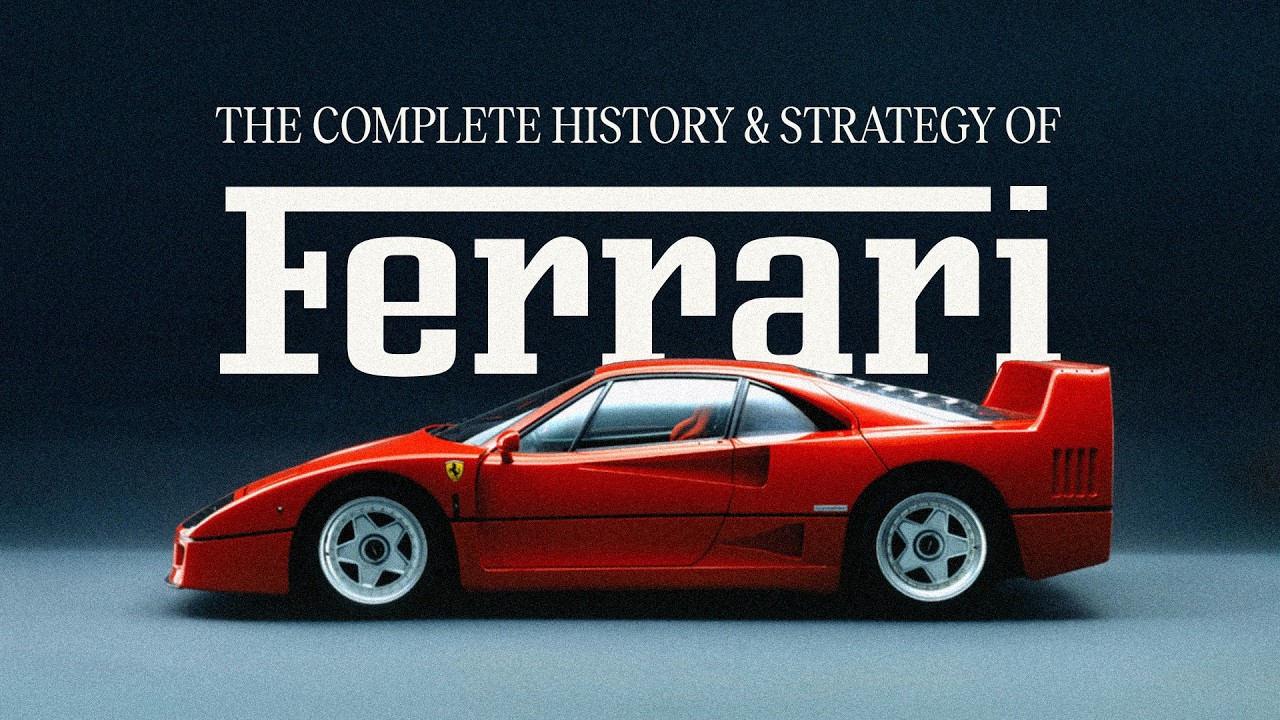
Ferrari Spurns FCA Mass-Market Strategy to Chase Hermès-Style Valuation
Acquired
By capping vehicle output and leveraging a global Formula 1 fan base, Ferrari achieves luxury-house margins that insulate the brand from the automotive industry's traditional cyclical downturns.
## Background
Published on YouTube on April 14, 2026, by the channel Acquired, this audio episode explores the history and unique brand paradigm of Ferrari. The show description highlights how the company effectively combines an ultra-exclusive luxury brand—selling only 330,000 cars in its entire 79-year history—with a professional Formula 1 sports team supported by 400 million rabid fans.
## TL;DR
The episode provides a detailed chronological look at Ferrari, tracing Enzo Ferrari's early life, personal tragedies, and the founding of Scuderia Ferrari as an Alfa Romeo racing agent. It details the company's evolution through wartime transitions, its legendary post-war consumer road cars, and the fierce mid-century racing rivalries like Ford vs. Ferrari. Finally, the narrative explores the modern era, analyzing Luca di Montezemolo's luxury turnaround strategy, the company's financial mechanics, its spin-off IPO under Sergio Marchionne, and its current push into electric vehicles.
## Atmosphere & style
The presentation carries the grand, emotional weight of a beautiful, tragic, and romantic Italian opera, capturing a narrative filled with heavy personal loss and high-stakes racing dangers. Hosts Ben and David maintain an engaging, highly analytical, yet passionate dynamic as they dissect the lucrative inefficiencies of Maranello. The tone shifts from the solemnity of Enzo's lifelong survivor's guilt to a vibe of elite exclusivity, making the listener feel embedded in a high-society world where craftsmanship, raw passion, and extreme luxury collide.
## Key takeaways
- [00:00](https://www.youtube.com/watch?v=JVO8roYiNXM&t=0s) Ferrari possesses the highest ratio of brand awareness to product ownership in human history for a consumer brand, with over 1 billion people knowing the brand while only about 180,000 people globally own a vehicle.
- [03:25](https://www.youtube.com/watch?v=JVO8roYiNXM&t=205s) Ferrari limits its vehicle supply to preserve extreme geographical scarcity, capping its FUV (Ferrari Utility Vehicle) Purosangue at 20% of production and allocating roughly 80% of all new vehicles to existing owners.
- [03:25](https://www.youtube.com/watch?v=JVO8roYiNXM&t=205s) The company's public market capitalization exceeds several massive mass-market automotive competitors combined, despite producing a fraction of their vehicle volume, due to achieving the industry's highest profit margins.
- [09:19](https://www.youtube.com/watch?v=JVO8roYiNXM&t=559s) Enzo Ferrari's early life was marked by profound family tragedies and survivorship guilt from WWI, experiences that heavily influenced his aloof persona and gave rise to his memoirs, titled 'My Terrible Joys'.
- [22:45](https://www.youtube.com/watch?v=JVO8roYiNXM&t=1365s) The iconic prancing horse logo was gifted to Enzo Ferrari by the mother of Francesco Baracca, Italy's top WWI fighter pilot, who suggested the emblem would bring good luck on the race track.
- [28:05](https://www.youtube.com/watch?v=JVO8roYiNXM&t=1685s) Enzo Ferrari co-opted 'Rosso Corsa' (Racing Red), Italy's national racing color, so completely that competitor Lamborghini deliberately avoids using the hue to prevent brand confusion.
- [01:07:19](https://www.youtube.com/watch?v=JVO8roYiNXM&t=4039s) Following a fatal 1957 Mille Miglia crash that killed a driver and nine spectators, the Vatican condemned Enzo Ferrari as an 'industrial Saturn', leading him to agree never to hire Italian racing drivers again.
- [01:15:36](https://www.youtube.com/watch?v=JVO8roYiNXM&t=4536s) Enzo Ferrari intentionally walked away from a nearly finalized $10 million merger with Ford in 1963 because the contract denied him ultimate budget control and final say over his beloved racing division.
- [01:20:26](https://www.youtube.com/watch?v=JVO8roYiNXM&t=4826s) In 1969, Enzo Ferrari sold 50% of the company to Fiat for under $3.5 million to escape operational headaches, high racing costs, and intense regional competition from Lamborghini.
- [01:52:11](https://www.youtube.com/watch?v=JVO8roYiNXM&t=6731s) Luca di Montezemolo rescued Ferrari in the 1990s by focusing on a three-pillar turnaround framework: team, technology, and myth, which included reducing overproduction to restore brand exclusivity.
- [02:03:13](https://www.youtube.com/watch?v=JVO8roYiNXM&t=7393s) Ferrari's brand paradigm operates as a unique 'business cheat code' because it blends the extreme exclusivity of an ultra-luxury house like Hermès with the mass inclusivity of a professional sports team.
- [02:05:03](https://www.youtube.com/watch?v=JVO8roYiNXM&t=7503s) Unlike competitors under large corporate umbrellas, Ferrari maintains total vertical integration in Maranello and does not share vehicle platforms or cheap parts with any other automotive brand.
- [02:27:51](https://www.youtube.com/watch?v=JVO8roYiNXM&t=8871s) Sergio Marchionne orchestrated a $10 billion Ferrari IPO on the NYSE in 2015 after a bitter culture clash with Luca di Montezemolo over whether public market growth targets would ruin luxury exclusivity.
- [02:41:18](https://www.youtube.com/watch?v=JVO8roYiNXM&t=9678s) Ferrari's modern vehicle lineup is divided into a strict four-tier pyramid, requiring clients to clear vetting processes and own up to 20-plus standard models before being allowed to purchase a restricted hypercar.
- [02:58:21](https://www.youtube.com/watch?v=JVO8roYiNXM&t=10701s) The brand maintains an exceptional vehicle preservation rate, with over 90% of the roughly 330,000 cars built across its entire 79-year history remaining operational and drivable today.
- [03:13:52](https://www.youtube.com/watch?v=JVO8roYiNXM&t=11632s) Ferrari's extraordinary pricing power is highlighted by an average gross profit per car exceeding $170,000, meaning Porsche must sell six vehicles to match the profit dollars of a single average Ferrari.
- [03:21:52](https://www.youtube.com/watch?v=JVO8roYiNXM&t=12112s) Public markets trade Ferrari at a premium PE multiple of 35x to 50x, evaluating the company as an elite luxury fashion house rather than a legacy automaker.
## Detailed walkthrough
Here is a detailed walkthrough of the transcript segment:
### [00:00](https://www.youtube.com/watch?v=JVO8roYiNXM&t=0s) Dreaming of Ferraris and Hyper-Exclusive Paradoxes
The episode kicks off with co-hosts Ben Gilbert and David Rosenthal sharing their personal favorites from the iconic Italian automaker. David admits that while he would never actually want to get behind the wheel of one, his choice is the legendary F40—a machine that captivated him as an elementary school kid building models, which Ben calls "the defining supercar." Ben counters with two personal favorites: the 1957 250 Testa Rossa (which he notes was featured at Charles Leclerc's wedding) and the spaceship-like 1966 330 P3 from *Ford v Ferrari*, admiring its gorgeous curves. After a quick musical interlude, they welcome listeners to the spring 2026 season of *Acquired*, setting up a deep dive into Ferrari, a company they describe as one of the most paradoxical businesses they have ever studied.
Ben and David establish that while automobiles are a massive household expense and the default mode of human transportation, this episode has absolutely nothing to do with standard transit. Instead, Ferrari is entirely about "selling dreams." Despite its massive global fame, the company functions in complete opposition to traditional automotive logic. It operates on ultra-low volume, making it the only mass-culturally recognized luxury brand with an almost impossibly narrow ownership funnel.
- **Annual Production:** Ferrari ships only around 14,000 cars per year.
- **The Toyota Comparison:** Toyota sells roughly 14,000 vehicles every 10 hours.
- **The Porsche Comparison:** Porsche ships 22 times the volume of Ferrari.
- **Global Ownership:** Only about 180,000 people worldwide actually own a Ferrari.
- **Brand Awareness:** Easily over 1 billion people know what a Ferrari is, giving it the highest ratio of brand awareness to product ownership in human history for a consumer-facing brand.
- **Luxury Scarcity Market Comparison:** Hermes produces 10 times more Birkin and Kelly bags annually than Ferrari makes cars; Rolex manufactures 70 times more watches.
### [03:25](https://www.youtube.com/watch?v=JVO8roYiNXM&t=205s) The Lucrative Inefficiencies of Maranello
The hosts dive deeper into the financial marvel of Ferrari's business model. Ben points out that even though modern consumer demand for SUVs is overwhelming, Ferrari strictly limits its own version—which they insists on calling an "FUV" or Ferrari Utility Vehicle, since they would never label it a traditional SUV—to just 20% of their total production volume. More shockingly, despite making a fraction of the vehicles produced by heritage giants, Ferrari boasts a massive market capitalization that exceeds the value of Ford, Volkswagen, Honda, Stellantis, and Mercedes-Benz.
What makes this financial dominance truly wild is how the cars are built. Instead of relying on hyper-efficient, highly automated mass production, Ferrari manufactures its cars mostly by hand, completely inefficiently, and as one-offs in the single town of Maranello, Italy. Despite this operational inefficiency, they maintain the highest margins in the entire automotive industry. Furthermore, the ecosystem is closed off to outsiders; roughly 80% of all new Ferraris produced are explicitly earmarked for existing owners, leaving fewer than 3,000 spots for new clients globally each year. David describes the business model as a "completely insane" funnel, teasing a "bloody" history spanning half a century of speed, death, romance, and highly clever economic mechanics.
- **Market Cap:** Ferrari is worth more than Ford Motor Company, despite Ford producing 160 times more vehicles.
- **Customer Base:** 80% of annual production goes to existing Ferrari owners, meaning fewer than 3,000 new customers enter the ecosystem per year.
- **Episodic Themes:** The hosts characterize the narrative ahead as a beautiful, tragic, and deeply Italian opera filled with "death, sex, betrayal, and... very, very fast cars."
- **Housekeeping:** Listeners are invited to sign up for the email list at `acquired.fm/e` for takeaways, episode corrections, and behind-the-scenes research photos, or join the community at `acquired.fm/slack`. The season is presented in partnership with JP Morgan Payments.
### [06:09](https://www.youtube.com/watch?v=JVO8roYiNXM&t=369s) The Opera of Young Enzo Ferrari
David takes the reins of the narrative, transporting the audience back to 1898 in the medieval Italian town of Modena. Here, Enzo Anselmo Giuseppe Maria Ferrari is born as the second of two sons to a beautiful young mother, Adalisa, and an entrepreneurial father, Alfredo, who was 12 years her senior and ran a successful metalworking shop. Growing up, Enzo and his father frequently clashed, but Enzo nevertheless absorbed a core entrepreneurial philosophy from him: "A company is perfect when the number of partners in it is odd and less than three." This strict rule against taking on partners and a fierce mandate for self-sufficiency became a guiding light for Enzo's entire life. Much of this detailed history, Ben notes, is sourced from Luca Dal Monte's definitive biography, *Enzo Ferrari*.
Home life was loud and turbulent, characterized by constant screaming and swearing between his parents. This environment impacted the two brothers in starkly different ways. Enzo's older brother, Alfredo (nicknamed "Dino" to avoid confusion with their father), became the golden child—a striving, successful peacemaker destined to inherit the family business. Enzo, meanwhile, adopted his parents' less savory traits, turning out mischievous, unfocused, and entirely unapplied in school. Knowing Dino would shoulder the family responsibilities, Enzo drifted through town, idly dreaming of becoming a journalist or an opera singer, primarily as an excuse to hang out with showgirls. However, his spirit was truly captivated by the emerging sport of automobile racing. As a teenager, he confidently declared to his best friend his ultimate life purpose: "I am going to be a racing driver."
### [09:19](https://www.youtube.com/watch?v=JVO8roYiNXM&t=559s) Tragedy, War, and the Privateer Era
Enzo's racing dream was violently disrupted by the outbreak of World War I, which brought a succession of brutal personal tragedies. First, his father contracted pneumonia and died. Shortly after, the golden child Dino enlisted in the Italian army, only to contract pneumonia and die as well. Suddenly, the family business was gone, and Enzo was left entirely alone to support his mother. Lacking any discernable skills or education, he had no way to provide gainful employment. Before he could find his bearings, Enzo himself was drafted into the army, where he also caught pneumonia and nearly died. He survived, but carried a lifelong emotional survivor's guilt, later noting, "I feel alone after a life crowded by so many events and almost guilty of having survived." Ben highlights that Enzo's own memoirs were appropriately titled *My Terrible Joys*.
Returning to Modena after the war with very little hope but a lingering obsession with motorsport, a young Enzo tried to convince his mother to sell their family home to finance a race car, promising he would win back the money via track prizes. His mother flatly rejected the audacious plan, steering him instead toward finding a job at an established car company. She arranged an interview for him in Turin with Fiat, the premier Italian car manufacturer of the era.
- **The Fiat Connection:** Described as the "Ford Motor Company of Italy," Fiat was controlled by the Agnelli family, the wealthiest industrial dynasty in Italian history. In the modern era, the Agnellis control both Stellantis and Ferrari.
- **The Rejection and CMN:** Fiat rejected Enzo's 1918 application because he lacked technical skills. Undeterred, Enzo landed a job in 1919 at a startup manufacturer called CMN.
- **Financing the Dream:** To buy a CMN sports car to race, Enzo pledged several months of his future salary.
- **The Era of the "Gentleman Racer":** Motor racing at the time was fundamentally a privateer sport. Drivers were either independently wealthy individuals who could afford their own mechanics and support staffs, or hustlers like Enzo who used employment in the auto industry to finagle their way into entering races.
### [13:31](https://www.youtube.com/watch?v=JVO8roYiNXM&t=811s) Alfa Romeo and the Perils of the Edge
Enzo's performance on the track was strong enough to yield prize money for his mother and catch the attention of Alfa Romeo. Unlike most European brands of the era, Alfa Romeo ran one of the continent's only dedicated, in-house factory racing teams. They snapped up the young, talented hotshot to drive for them, fulfilling Enzo's teenage dream. Capitalizing on his growing fame, a 22-year-old Enzo stepped into entrepreneurship in 1920 by founding his first company in Modena, a coachbuilding business called Carrozzeria Emilia.
David explains that at this point in automotive history, car manufacturers typically only supplied a bare engine and chassis. Customers would then take these mechanical components to a separate coachbuilder to design and construct a custom body to their exact tastes. Ben draws a parallel to the early watch industry, referencing a past *Rolex* episode where movement makers, case makers, and retail stores operated completely independently. Enzo's plan was built on the assumption that Alfa Romeo customers would flock to his shop because of his racing notoriety. However, the market saw no logical link between being a fast driver and a great coachbuilder. Within two years, Carrozzeria Emilia went bankrupt.
Concurrently, Enzo's limits as a driver were becoming clear. While highly skilled, he discovered he lacked the final, ruthless element that separated elite champions from the rest of the pack: he was too afraid to die. Haunted by the deaths of his father and brother, his fear was solidified on the Alfa Romeo team. Two senior drivers took him under their wing as mentors, only for Enzo to witness both of them die tragically at the wheel during races. In the case of the first mentor, Enzo was the very first person to find his body at the crash site.
[17:32](https://www.youtube.com/watch?v=JVO8roYiNXM&t=1052s) The Reality of Racing and Enzo's New Path
After witnessing too many friends and peers die on the track, including one who tragically passed away directly in his arms, Enzo Ferrari found himself unable to continue pushing his limits in the same repetitive, dangerous cycle. The co-hosts note that this was the "sick reality of racing" during this era—the sport fundamentally belonged to those willing to push right up to the edge of death and frequently cross it. Referencing a previous episode on Formula 1, they point out that through the 1970s, the sport averaged more than one death per year out of a field of only about 20 drivers. Paradoxically, this extreme danger was a core part of the sport's appeal.
In 1924, Enzo decided to step away from active racing and cast off his coachbuilding business. Now married and wanting to start a family, he chose a conventional path for a retired athlete with local notoriety: he opened an Alfa Romeo dealership in Modena. A few years later, his son Dino was born, named traditionally after Enzo's father and brother.
- **1924:** Enzo Ferrari retires from driving and opens an Alfa Romeo dealership in Modena.
- **Formula 1 Context:** Through the 1970s, the death rate averaged over one driver per year from a small 20-driver field.
- **Dino Ferrari:** Enzo’s son is born a few years after his retirement, named after Enzo's father and brother.
---
[18:49](https://www.youtube.com/watch?v=JVO8roYiNXM&t=1129s) The Birth of Scuderia Ferrari
Toward the end of his driving career, Enzo had become heavily involved in team management and built strong connections with Alfa Romeo's corporate executives. This network proved invaluable when, just a year after he opened his dealership, the Alfa Romeo board of directors made the "inexplicable decision" to drastically scale back their racing budget and limit their factory team to just a few select events. Enzo was furious because he relied heavily on the publicity from Alfa Romeo’s racing victories to drive customer traffic to his Modena dealership.
He took matters into his own hands by traveling to Alfa Romeo's headquarters in Milan with a pitch: he would completely outsource their secondary racing operations. He proposed acting as the official racing agent of Alfa Romeo, running a private team to enter all the races the factory did not want to fund. Enzo would hire the drivers, manage the mechanics, and absorb the operational costs off Alfa Romeo's books.
This contract relationship birthed the very first iteration of the Ferrari business: Scuderia Ferrari. The word *scuderia* translates to "stables" in Italian, signifying a stable of top-tier drivers and cars. The co-hosts joke about the "thick metaphor" of naming a team a stable when it would later adopt a horse as its emblem. This name remains alive today as the "SF" seen on the iconic Ferrari shield in Formula 1.
---
[21:03](https://www.youtube.com/watch?v=JVO8roYiNXM&t=1263s) Broader Ambitions and "Modding" Across Town
Though Alfa Romeo intended Scuderia Ferrari to remain a subservient junior partner, Enzo harbored much larger ambitions. At the time, the barrier to entry between running a high-end development garage and graduating to a full-scale automobile manufacturer was remarkably thin. Mass assembly lines like Fiat or Ford were rare, and Enzo took inspiration from local competitors like the Maserati brothers, who operated right across town in Modena.
The hosts compare Enzo’s early business model to the video game concept of "modding"—taking a manufacturer's basic asset and souping it up into something highly customized and special. Enzo's grandmaster plan was to leverage the technical success of his racing team and the Scuderia Ferrari brand to eventually launch a standalone car company capable of selling vehicles to privateers.
---
[22:45](https://www.youtube.com/watch?v=JVO8roYiNXM&t=1365s) Sponsor Interlude: JP Morgan Payments
Recognizing that Enzo needed a powerful brand identity to sell cars in the future, the hosts pause right before discussing the origin of the famous logo to thank their presenting partner, JP Morgan Payments. They emphasize that throughout their historical research, they noticed how global Ferrari became from its earliest days, exporting luxury cars to the United States and all over the world. Operating at this scale creates massive back-end financial complexity, such as paying suppliers and collecting receivables in varying currencies while managing exchange risks and staying legally compliant.
- **JP Morgan Payments Scale:** Sends payments in 120 currencies and receives them in 40 across more than 200 countries and territories.
- **Integration:** Utilizes direct APIs that plug seamlessly into existing corporate Treasury workflows to make global money movement invisible.
---
[25:12](https://www.youtube.com/watch?v=JVO8roYiNXM&t=1512s) The Legend of the Prancing Horse
Returning to the narrative, the hosts discuss how bizarre it looks to view historical photos of old Alfa Romeo racing cars featuring the Scuderia Ferrari prancing horse badge on the front fenders. The origin of the black horse trace back to Enzo’s early driving days, when he caught the attention of an Italian nobleman and noblewoman whose late son, Francesco Baracca, was Italy's top ace fighter pilot in World War I. Before tragically dying in combat near the end of the war, Baracca had secured 34 aerial victories flying a plane adorned with a black prancing horse as a personal good luck charm.
Baracca was a beloved national hero, and his mother eventually told Enzo, "Why don't you paint the black horse on your car? It will bring you luck." She formalized this blessing by gifting Enzo an inscribed photograph of her son standing in front of his plane.
Enzo combined this iconic wartime symbol with a yellow shield—yellow being the official city color of Modena—and topped it with the three colors of the Italian flag. The hosts detail the deliberate marketing genius behind the emblem: the horse connected the team to a national icon, the shield signaled a readiness for battle on the track, and the Italian colors broadcasted Enzo's grand ambition to make his future company the definitive Italian national sports car brand.
---
[28:05](https://www.youtube.com/watch?v=JVO8roYiNXM&t=1685s) Italy’s Steve Jobs and the Power of Red
To better understand Enzo's true character, one of the hosts notes that he spoke directly with Luca di Montezemolo, the legendary former Ferrari chairman who succeeded Enzo. Montezemolo strongly refuted the popular modern myth that Enzo was merely a pure racer who hated business and only built road cars to fund his track habits. "Completely false," Montezemolo confirmed, characterizing Enzo as a natural-born entrepreneur and marketer who acted as "Italy's Steve Jobs in every aspect."
Neither Jobs nor Ferrari were hands-on engineers or mechanics, but both possessed a profound appreciation for technical excellence and an innate ability to manage talent. Enzo famously described himself not as a designer or a driver, but as an "agitator of men."
Enzo applied this same marketing intuition to *Rosso Corsa* (Racing Red). While red was simply the federally assigned national racing color of Italy, Enzo co-opted it so completely that it became synonymous with Ferrari itself. The color came to represent passion, blood, and desire. The hosts point out that rival Italian supercar manufacturer Lamborghini purposefully paints its cars almost any color *except* red today because Ferrari has entirely monopolized the hue in the global consumer psyche.
---
[31:05](https://www.youtube.com/watch?v=JVO8roYiNXM&t=1865s) Nationalization, Hitler, and the Grip of World War II
In 1933, a massive opportunity materialized when Alfa Romeo decided to dissolve its factory racing division completely. They designated Scuderia Ferrari as their sole official global racing operation, handing Enzo their entire inventory of equipment, engineers, and mechanics. Because Alfa Romeo had been nationalized by Benito Mussolini’s fascist government, Enzo suddenly found himself running the official national racing team of Italy.
However, this triumph was quickly overshadowed by geopolitical tension. Adolf Hitler was rising to power in Germany, and he made it a strict national priority to dominate European Grand Prix racing to showcase German engineering prowess—treating the tracks like the Olympic games. Throughout the late 1930s, the heavily subsidized German state teams of Mercedes and Auto Union (which later became Audi) completely dominated the sport, leaving Enzo and his Italian squad running a "fool's errand." Fed up with successive losses, Alfa Romeo and Mussolini's government stepped back in to fully acquire Scuderia Ferrari in 1938, absorbing it directly into a state-run entity.
This corporate restructuring proved short-lived as Hitler invaded Poland the following year, igniting World War II and putting all European automobile racing on an indefinite hold.
- **1933:** Scuderia Ferrari officially takes over all of Alfa Romeo's racing infrastructure.
- **1938:** The fascist Italian government buys out Scuderia Ferrari to centralize its racing efforts against Germany.
- **1939:** Germany invades Poland, forcing the complete suspension of European motorsport.
---
[33:21](https://www.youtube.com/watch?v=JVO8roYiNXM&t=2001s) Losing His Name and Preparing for Peace
In 1939, Enzo's single-minded obsession with racing caused a massive rift with Alfa Romeo corporate management, who had entirely different strategic wartime priorities. This friction resulted in Enzo getting fired. As part of his severance agreement with the Italian government, Enzo was paid to walk away but was slapped with a strict four-year non-compete clause. The contract explicitly forbade him from building or racing cars under his own name, meaning Enzo literally lost the legal right to use the name "Ferrari" for a racing team or vehicle.
To circumvent this restriction and contribute to the Italian war effort, Enzo founded a new enterprise called *Auto Avio Costruzioni* (Auto and Aviation Construction). He intentionally snuck the word "Auto" into the title despite the ban, hinting at his underlying intentions. Though it operated under a different name during the war, this identical corporate entity is known today as *Ferrari Società per Azioni* (Ferrari S.p.A.), which trades publicly on the New York Stock Exchange under the ultimate stock ticker: "RACE".
[03:34:58](https://www.youtube.com/watch?v=JVO8roYiNXM&t=12898s) The Birth of Maranello and a Post-War Crossroads
During World War II, Enzo Ferrari’s workshop in Modena is repurposed for the war effort, manufacturing machine tools. Enzo strategically ensures that every single tool produced is stamped with the prancing horse emblem and the words "Scuderia Ferrari Modena", clearly signaling his long-term post-war ambitions. As Allied forces push into Europe in 1943, growing government and personal anxieties over potential bombings prompt Enzo to relocate his entire operation 15 kilometers south of Modena to a small countryside hamlet called Maranello. This defensive wartime move explains why the legendary automaker remains anchored in Maranello to this day rather than the larger city of Modena. Despite the relocation, the factory is still bombed twice during the final days of the war, leaving Enzo at a significant crossroads: his facilities are in severe disarray, yet he has spent the last four to five years honing a highly viable expertise in machine tool manufacturing.
- **Distance of relocation:** 15 kilometers south of Modena to Maranello.
- **Year of relocation:** 1943.
- **Wartime damage:** The Maranello factory was bombed twice during the final days of World War II.
[03:36:39](https://www.youtube.com/watch?v=JVO8roYiNXM&t=12999s) Luigi Chinetti and Exploiting the "Colonial Lust"
Enzo receives a pivotal post-war visit from his old racing pal, Luigi Chinetti. The two originally met when Enzo was a driver for the Alfa Romeo racing team and Chinetti was a team mechanic who later transitioned into driving. Having spent the war years in exile in New York keeping aging European automobiles operational, Chinetti returns to Italy brimming with stories about the economic miracle of America. He speaks of an aggressive, inquisitive American upper class possessing European tastes and a willingness to pay a king's ransom for elite machinery. Brock Yates, the longtime editor of *Car and Driver* magazine, vividly captured Chinetti's mindset in his biography of Enzo, noting that Chinetti fully "meant to exploit that naive colonial lust."
While automotive folklore often credits Chinetti with single-handedly convincing Enzo to abandon machine tools and return to car manufacturing, this is historically inaccurate. Enzo’s non-compete agreement expired by 1943, meaning the clock was already ticking on his inevitable return to his namesake brand. However, Chinetti absolutely convinces Enzo of America's critical market potential. They realize that wealthy Americans deeply desire the "cold shoulder of an artist" creating rare, mysterious racing cars in a small Italian town—a creator who openly disdains mass-market consumerism. Enzo brilliantly leans into this aloof, purist racing persona, birthing the enduring myth that he was a pure racer rather than a businessman. Part of this carefully crafted public image includes his signature dark sunglasses, which he would wear strictly during press interviews and client meetings as an "act," only to discard them on the table the moment the room cleared.
[03:39:49](https://www.youtube.com/watch?v=JVO8roYiNXM&t=13189s) The First Consumer Ferraris and the Luxury of Imperfection
By 1947, the newly renamed Auto Costruzioni Ferrari officially gets underway. In their inaugural year, they build just three cars explicitly for team racing under the Scuderia Ferrari banner, entering 14 races and winning seven of them. Keeping true to his purist principles, Enzo does not sell a single one of these vehicles. At this point in 1947, Enzo Ferrari is 49 years old and has never sold a car to a consumer, defying the classic "young hotshot founder" archetype.
- **1947 Team Stats:** 3 cars built, 14 races entered, 7 victories (50% win rate).
- **First Consumer Model:** The Ferrari 166 MM Barchetta, introduced in 1948 at the Turin Motor Show.
Enzo transitions to commercial sales in 1948 with the debut of the Ferrari 166 MM Barchetta at the Turin Motor Show. Biographer Luca Dal Monte describes the model as "a declaration of intent, a sports car with a sensual shape, as fast and powerful as it was beautiful and elegant." The vehicle establishes a foundational design philosophy: cars capable of winning elite circuit races while simultaneously dominating the world's most prestigious Concours d'Elegance events. These early machines are notoriously unreliable as daily road cars, yet this volatility feeds into a fundamental anti-law of luxury marketing: ensuring the product has enough flaws to enhance its exclusivity and desirability. Clients intentionally accept these practical trade-offs because they are purchasing a deadly competitive racing weapon rather than a mere mode of transportation.
- **First Year Production:** Approximately one dozen 166 Barchettas were produced in 1948.
- **Notable Early American Buyers:** Tommy Lee (a wealthy Cadillac dealer from Los Angeles) and Briggs Cunningham (a Procter & Gamble heir).
- **Notable European Buyer:** Gianni Agnelli, the patriarch and founder of the family that owned Fiat.
[03:44:05](https://www.youtube.com/watch?v=JVO8roYiNXM&t=13445s) Le Mans Triumph and the Ferrari Formula
In 1949, Luigi Chinetti enters a 166 in the first post-WWII running of the 24 Hours of Le Mans. Enzo strongly opposes the entry, believing the car is completely unready for the grueling endurance race. Defiant, Chinetti secures a privately owned 166 belonging to British nobleman Lord Selsdon, enters the race, and wins the entire event. Though it is not endorsed or run by the official factory team, this historic victory marks Ferrari’s first major international race triumph. The win perfectly validates Enzo's unique business model; it generates immense consumer lust in America because the public only registers that a "Ferrari just won Le Mans," regardless of who entered it.
The victory also cements Enzo’s fierce reputation as an unyielding "engine guy." Enzo famously dismissed other design considerations with legendary remarks such as, "I sell engines and the car I throw in for free," and "aerodynamics are for people who can't build engines." This stubborn philosophy makes Enzo a notoriously late adopter of new technology. For years, he resists transitioning to a balanced mid-engine layout despite rival teams proving its superiority. He dogmatically defends his traditional front-engine setups by declaring that "in a carriage, the horse pulls the carriage," utilizing the appeal of the "old ways" to further build the historical luxury myth of the brand—even while secretly tasking internal teams with constructing mid-engine prototypes behind the scenes.
[03:47:43](https://www.youtube.com/watch?v=JVO8roYiNXM&t=13663s) Three Pillars Under One Roof and Formula 1 Tragedy
In the early 1950s, Ferrari represents a revolutionary, highly integrated automotive concept that houses three distinct operations under one roof: a professional racing team, a world-class racing car constructor for private clients, and the complete support infrastructure required to tune and maintain these vehicles. Unlike competitors like Alfa Romeo, Mercedes, or Fiat, whose racing arms operate as entirely separate entities, Maranello features the exact same people building, maintaining, and servicing both pinnacle motorsport vehicles and consumer road cars on the very same plot of land. This structure mirrors elite luxury heritages like Hermès, where the same artisans crafted saddles for both weekend racetrack jockeys and high-society boulevard riders.
In 1950, Ferrari joins as a founding team of the newly inaugurated Formula 1 World Championship Series, embarking on a run that makes them the only team to operate continuously from the sport's inception to the modern era. However, this high-stakes entry into the pinnacle of motorsport brings renewed personal devastation for Enzo. He hires the young, talented Alberto Ascari—the son of Antonio Ascari, one of Enzo’s formative racing mentors who died during Enzo's driving days at Alfa Romeo. Enzo takes Alberto under his wing as a surrogate son, only for Alberto to be killed in 1955 while practicing in a Ferrari at Monza. Hauntingly, Alberto dies at the exact same age as his father. Devastated by the sheer volume of loss he has witnessed, a grieving Enzo vows never to let himself become emotionally close to a racing driver again. Yet, this loss marks only the beginning of a dark era of tragedy poised to redefine his life and company.
***
<ElicitationsGroup message="What would you like to do next?">
<Elicitation label="Review the Formula 1 episode" query="Provide the detailed breakdown of the Formula 1 episode mentioned in the transcript." query_intent="CLICKABLE_SUGGESTION" />
<Elicitation label="Analyze the luxury strategy flaws anti-law" query="Explain the luxury strategy anti-laws of marketing regarding product flaws." query_intent="CLICKABLE_SUGGESTION" />
<Elicitation label="Detail Alberto Ascari's racing career" query="Provide a detailed historical profile of Alberto Ascari and his time with Ferrari." query_intent="CLICKABLE_SUGGESTION" />
</ElicitationsGroup>
[53:12](https://www.youtube.com/watch?v=JVO8roYiNXM&t=3192s) The Agentic Infrastructure Company
The narrative pauses to introduce Vercel, a company building the defining developer infrastructure platform for the agentic era. Drawing a parallel to Ferrari, the host notes that Vercel is engineered so that every component of the system works together at the highest possible level of performance. No longer just a deployment platform, a framework builder, or an AI cloud, Vercel has evolved into an agentic infrastructure provider where AI agents are treated as first-class users alongside human developers. The infrastructure behaves with its own agency, offering "self-driving infrastructure" features like zero-configuration deploys, automatic scaling, and self-optimizing performance.
Major modern platforms like OpenAI, Polymarket, and Stripe already run on Vercel, positioning the company uniquely for the agentic web. Their AI gateway sandbox and AI SDK are widely trusted across the industry, from solo founders to large global enterprises. The hosts highlight a newly shipped feature, the Chat SDK, which enables developers to build agents across multiple platforms like Slack, Teams, Google Chat, and Discord out of a single codebase. Demonstrating rapid growth, the AI SDK alone sees 10 million weekly downloads, jumping from 7 million just a month prior.
* **Vercel URL:** `[vercel.com/acquired](https://vercel.com/acquired)`
* **AI SDK Weekly Downloads:** 10 million (up from 7 million the previous month)
* **Supported Platforms for Chat SDK:** Slack, Teams, Google Chat, Discord
---
[55:21](https://www.youtube.com/watch?v=JVO8roYiNXM&t=3321s) The Beauty of the 250 Series and the Pininfarina Partnership
Returning to the 1950s, the conversation transitions into what the hosts describe as the "truly truly beautiful and truly truly tragic opera of Enzo and Ferrari." The beauty is epitomized by the Ferrari 250 series, famously recognized by many as the stunning vehicle featured in the movie *Ferris Bueller's Day Off*. Sharing an piece of movie trivia, the hosts reveal that the vehicle shown on camera was actually a replica retrofitted onto a Ford chassis, and Ferrari subsequently sued the replica maker. No actual 250s were harmed during filming, and a lower-quality shell was used for the infamous scene where the car crashes through the glass.
While Ferrari's first client car, the 166, saw fewer than 100 units produced, the 250 series introduced real production volumes in 1952. Ferrari manufactured a few thousand units throughout the decade, maintaining a highly boutique, handmade ethos but operating at a much larger scale. The breathtaking design of the 250 GT California was penned not by Enzo, but by Battista "Pinin" Farina and his Pininfarina coachbuilding firm. Recognizing Farina as the "Michelangelo of car body coach builders," Enzo forged a multi-generational partnership that lasted 61 years until 2013. During this historic run, every single roadgoing production Ferrari except for one was designed by Pininfarina, concluding with the LaFerrari halo car as the first fully in-house design.
* **Ferrari Production Volumes:** The 166 had <100 units; the 250 series produced a few thousand units.
* **Enzo Ferrari's Famous Business Quote:** "Ferrari will always deliver one car less than the market demand."
* **Pininfarina Partnership Duration:** 61 years, spanning from the 1950s until 2013.
---
[01:00:20](https://www.youtube.com/watch?v=JVO8roYiNXM&t=3620s) The Italian Nature of Luxury and the Tragedy of an Heir
The hosts debate the fundamental differences between French and Italian luxury. While French luxury, seen in houses like Hermès or Louis Vuitton, relies on a quiet, regal dream connected to bygone royalty, Italian luxury is fueled by craftsmanship, raw passion, and the personality of the designers themselves. In post-WWII Italy, the ultimate expressions of this passion and risk were the race car designers. The hosts characterize these high-performance automobiles as "beautiful death machines beckoning to risk it all."
This intoxicating beauty, however, came hand-in-hand with immense grief. Following the 1955 racing death of Alberto Ascari, Enzo suffered a devastating personal blow in 1956 when his 24-year-old son and groomed successor, Dino, died from muscular dystrophy. Despite Enzo's meticulous efforts to protect his son by keeping him away from active racing and distancing himself from drivers, he could not shield him from illness. Shattered by the loss of both his son and his empire's lineage, Enzo stopped attending races altogether as a form of self-inflicted punishment.
The tragedy was deepened by the legal realities of 1950s Italy. Enzo had another biological son, Piero, from an affair with Lena Lardy. Because divorce was illegal in Italy until the 1970s, illegitimate children legally "did not exist." Piero was rendered invisible by the law, unable to bear the Ferrari surname or legally inherit the empire at that time, leaving Enzo to believe his family line had officially ended.
* **Dino Ferrari's Passing:** Died in 1956 at age 24 from muscular dystrophy.
* **Legal Status of Divorce in Italy:** Remained illegal until the 1970s.
* **Piero Ferrari's Current Standing:** Today, he sits on the board of directors and owns 10% of the company.
---
[01:07:19](https://www.youtube.com/watch?v=JVO8roYiNXM&t=4039s) The Mille Miglia Slaughter and the Vatican's Wrath
The tragedy reached a boiling point at the 1957 Mille Miglia, a legendary and bloody 1,000-mile race through Italy that ran from 1927 to 1957. The race historically claimed at least one life nearly every year it was run, yet Enzo deeply romanticized it as "the race of the people," a day where he felt his life was truly useful. The 1957 iteration proved to be its last. During the race, a Ferrari hurtled off the road into the crowd, killing the driver and nine spectators, five of whom were children.
In the aftermath of the horrific crash, Italian authorities charged Enzo with manslaughter. Simultaneously, the Vatican launched a fierce public assault. The Holy See's official newspaper published a scathing headline labeling Enzo an "industrial Saturn"—referencing the Roman god who devoured his own children—and calling him a "modern Saturn become industrial tycoon." Though Enzo was eventually acquitted after a long legal battle, he had to strike a brutal compromise with the Vatican to keep racing: he agreed to never again hire Italian drivers, essentially operating under the grim premise that "you can kill young men as long as you don't kill our young men." Despite the heavy toll, Enzo and his drivers accepted the inherent danger, viewing high-speed racing as a vital form of human striving to "transcend oneself."
* **Mille Miglia Timeline:** Ran from 1927 to 1957; the 1957 disaster permanently ended the event.
* **1957 Crash Casualties:** Killed the driver and 9 spectators (including 5 children).
* **The Vatican's Allegory:** Accused Enzo of being an "industrial Saturn" devouring his sons.
[01:10:49](https://www.youtube.com/watch?v=JVO8roYiNXM&t=4249s) The Glamour of Tragedy and Ramping Production
The high-stakes world of racing carries an inherent mortality risk, a concept perfectly captured by a quote from the American side of the Ford and Shelby story: "I'd rather die in a racing car than get eaten up by cancer." The speakers reflect on this mindset, noting that putting one's life on the line right at the limit is paradoxically a way to fight back against death, staring it in the face to say "not today." For Enzo Ferrari, this continuous backdrop of tragedy is morbidly fantastic for business. It elevates the romance and global mystique of the brand, making the vehicles highly coveted status symbols. Just as James Dean dying in a Porsche 550 Spyder or Paul Walker in a Carrera GT cemented those cars as legends, the fatal reputation of Ferrari vehicles makes them ultimate objects of desire. Even the Pope denouncing the cars as "forbidden fruit" only supercharges their appeal, particularly to middle-aged men going through a crisis. After all, telling someone they cannot have something is the fastest way to make them want it.
Fueled by this forbidden allure, sales of the Ferrari 250 model skyrocket through the late 1950s, flying out of global showrooms and heavily penetrating the American market. Production numbers paint a picture of rapid expansion. By 1960, the factory is outputting 300 cars a year, roughly translating to making one car every working day. By 1962, that figure climbs to 500 cars per year, with the distribution evenly split into thirds among Italian clients, American clients, and the rest of Europe. The business experiences steady growth of 50 to 100 cars annually through the early 1960s to meet relentless customer demand.
- **1960 Production:** 300 cars per year (approximately one per working day).
- **1962 Production:** 500 cars per year.
- **Market Distribution:** Roughly divided a third each among Italy, America, and the rest of Europe.
[01:12:59](https://www.youtube.com/watch?v=JVO8roYiNXM&t=4379s) Enzo's Age and the Looming Threat of Ford
By 1963, Enzo Ferrari hits the age of 65 and begins contemplating his legacy amidst a lifetime punctuated by loss. He publishes his memoirs, aptly titled *My Terrible Joys*. His original succession plan was to hand the reins over to his son Dino, but Dino's tragic death leaves a massive void. When a journalist bluntly asks what will happen to the company when he is gone, Enzo responds with a dramatic quote famously attributed to King Louis XV: "Après moi, le déluge"—suggesting that chaos and the end of everything will follow his departure. At this time, Enzo's other son, Piero, is working secretly at Ferrari as a regular employee. Because his true identity as Enzo's son is kept under wraps to the public, it is understood that he cannot openly inherit the empire.
This uncertainty sets the stage for the dramatic entrance of the Ford Motor Company, sparking the legendary "Ford versus Ferrari" saga. The hosts recommend the book *Go Like Hell* and its film adaptation starring Christian Bale and Matt Damon, noting that while dramatized, the fundamental historical facts remain highly accurate. In 1963, Henry Ford II—the grandson of the founder, following the lineage of Henry Ford, Edsel, and then "The Deuce"—is desperate to make his own mark on the family business and silence critics questioning his independent worth. He decides that entering the racing scene is the ideal way to revitalize Ford's corporate image and appeal to a younger generation of consumers. At the exact same time, Ferrari is on an unparalleled hot streak, winning the 24 Hours of Le Mans in 1958 and executing a consecutive winning streak from 1960 through 1965. For Ford, the math is simple: if you want to break into racing, you either have to beat Ferrari, or you have to buy them.
- **Enzo's Memoir:** *My Terrible Joys*, published around the time he turned 65.
- **Henry Ford II Moniker:** Known in the industry as "The Deuce."
- **Ferrari's Le Mans Dominance:** Victorious in 1958, and consecutively from 1960 to 1965.
[01:15:36](https://www.youtube.com/watch?v=JVO8roYiNXM&t=4536s) The Failed Ford-Ferrari Merger and the Le Mans Retaliation
The corporate courtship begins strangely when Henry Ford II receives word through Ford's German subsidiary about a mysterious letter sent to the German consulate in Milan. The letter hints that an "internationally known Italian automobile factory" is looking to sell. Though the setup feels highly suspicious, Ford jumps at the opportunity and quickly identifies the mystery seller as Ferrari. Because Ford possesses zero standalone racing capability at the time, buying the Italian powerhouse represents a shortcut to instant credibility. Ferrari's initial asking price is $18 million, but Ford easily negotiates it down to $10 million—a steep and surprisingly effortless discount that should have tipped Ford off to Enzo's underlying motives.
The structured deal on the table is extraordinarily unique, proposing the creation of two distinct entities. The first, "Ford Ferrari," would be 90% owned by Ford and dedicated to manufacturing commercial road cars. The second, "Ferrari Ford," would be 90% owned by Ferrari and manage the elite racing team. However, as Enzo combs through the fine print of the contract on his desk, he encounters a critical dealbreaker: if a budget dispute arises regarding the racing division, Ford retains the ultimate financial control and final say. Refusing to surrender his autonomy, Enzo dramatically blows up the deal at the finish line, capitalizing on the massive publicity and national headlines generated by the leaked acquisition talks. Henry Ford II is utterly incensed by the public rejection. In May 1963, he furiously commands his lieutenants: "We will go to Le Mans and beat his ass." Enzo, meanwhile, views the Americans with patrician disdain, operating on a philosophy outlined in Brock Yates's biography: "Treat an American like a hick and you'll own him for life."
Ford counters by throwing an unlimited budget at the problem, enlisting Carroll Shelby, driver Ken Miles, and a elite crew of American mechanics. Their efforts culminate in a historic sweep at the 1966 Le Mans, finishing first, second, and third. Yet, the hosts point out that this rivalry was ultimately a sideshow to Enzo’s real master plan. Enzo used the high-profile Ford negotiations to signal to the broader market that he was willing to sell, boosting the mythic status of Ferrari as an unyielding Italian national treasure that refused to bow to American corporate corporate dollars.
- **Original Asking Price:** $18 million, negotiated down to $10 million by Ford.
- **Proposed Corporate Split:**
* *Ford Ferrari* (Road cars): 90% Ford, 10% Ferrari.
* *Ferrari Ford* (Racing): 90% Ferrari, 10% Ford.
- **1966 Le Mans Result:** Ford secures a clean 1st, 2nd, and 3rd place podium sweep.
[01:20:26](https://www.youtube.com/watch?v=JVO8roYiNXM&t=4826s) The Fiat Alliance and the Full-Circle Transition
Between 1963 and 1967, Enzo rides high on the energy of the Ford drama, but his health takes a severe turn for the worse in 1968 when he contracts severe kidney disease. Believing his death is imminent—a fear validated when he suffers organ failure and a months-long hospitalization in 1970—Enzo gets serious about finding a permanent home for his company. After a disappointing exploratory talk with Alfa Romeo, Enzo turns to the only logical buyer capable of safeguarding the brand: Gianni Agnelli and the Fiat empire. In 1969, Enzo strikes a deal to sell 50% of Ferrari to Fiat immediately. The transaction includes a secret clause dictating that upon Enzo's death, Fiat will acquire an additional 40% to bring their total stake to 90%, while the remaining 10% will transfer to his son Piero, finally legitimizing his bloodline and securing his future. Just like the failed Ford deal, Enzo stipulates that he maintains absolute authority over the racing team until his final days.
The historical ironies embedded in the Fiat deal are staggering. First, Enzo started his automotive career decades prior by applying for a job at Fiat, only to be rejected. Second, Gianni Agnelli was one of Ferrari's very first commercial road car customers. Most shocking of all is the transaction's valuation; converting the 1969 Italian lira to US dollars reveals that Fiat purchased half the company for just under $3.5 million, valuing the entire Ferrari brand at a meager $6.8 million. This low price highlights Enzo's desperation; facing operational headaches from Italian labor unrest, heavy financial strain from the racing program, and fierce new local competition from Lamborghini's magnificent Miura, Enzo knew Fiat was his only viable exit path to preserve the company's Italian identity.
- **1969 Fiat Deal Structure:**
* Immediate 50% acquisition by Fiat.
* Post-mortem transfer of 40% to Fiat (totaling 90%) and 10% to Piero Ferrari.
- **Financial Valuation:** Half the company sold for under $3.5 million, valuing the entirety of Ferrari at $6.8 million.
- **Competitor Threat:** Lamborghini, founded in 1963, introduces the Miura to challenge Ferrari's dominance.
[01:26:25](https://www.youtube.com/watch?v=JVO8roYiNXM&t=5185s) The Resurrection of the Grand Old Man
Though Enzo settled his estate in anticipation of a quick death, fate surprises everyone. He makes a miraculous recovery from his organ failure, and by the spring of 1971, the "grand old man" walks back into Maranello to resume his leadership. He lives on for another 19 years, passing away in 1988—long enough to witness the world change and to personally launch the iconic Ferrari F40. Upon his return in 1971, however, he finds a factory heavily reorganized by Fiat's corporate management. It is during this transitional period that Enzo intersects with a sharp young man who will go on to carry the spirit and legacy of the brand for the next forty years, building it into the modern powerhouse it is today: Luca de Montezemolo.
[01:27:48](https://www.youtube.com/watch?v=JVO8roYiNXM&t=5268s) The Ferrari Paradigm of AI Control
Large enterprises are currently flooded with AI agents, co-pilots, and models spread across every internal team. While this sounds promising, it introduces a massive fragmentation problem because none of these tools are organically connected. This disjointed operational state mirrors a Ferrari on race day: winning isn't just about fielding the fastest car on the track, but rather about coordinating thousands of real-time data signals across tires, fuel, brakes, and engines simultaneously to make a single right decision.
Currently, corporations possess an abundance of AI intelligence but lack centralized control, making intelligence a commodity while integration remains the true obstacle. ServiceNow has spent over 20 years building the infrastructure to solve this, currently running the core workflows for more than 85% of the Fortune 500. By deploying their AI control tower, they offer enterprises a unified management layer to sync every agent and AI system across the business securely and reliably.
- **ServiceNow Workflows:** Over 80 billion workflows executed per year.
- **Market Penetration:** Powering operations for more than 85% of the Fortune 500.
- **Sponsor Callout:** Listeners looking to scale AI operations can visit `[service.com/acquired](https://service.com/acquired)` and mention that Ben and David sent them.
[01:29:10](https://www.youtube.com/watch?v=JVO8roYiNXM&t=5350s) The Fateful Discovery of Luca de Montezemolo
In 1971, following a period of hospitalization, Enzo Ferrari returned to his office in Maranello and tuned into a popular call-in talk radio show. On the broadcast, a young driver named Luca de Montezemolo was passionately defending the motorsport industry against an audience member who was aggressively chastising the sport as an evil, dangerous, and environmentally destructive hobby reserved exclusively for the wealthy. Luca's eloquent, poetic defense completely shut down the critic, deeply impressing Enzo.
Enzo immediately called the radio station to track down the young driver, famously stating, "This boy has big balls. I want to talk to him." Upon meeting, Enzo explained that he had been away from his business for too long and desperately needed an assistant who could act as a internal spy to navigate the organization and report back on what was actually happening inside the company. Luca accepted the role immediately.
- **Luca's Birth Year:** 1947 in Bologna, Italy—the exact same year the modern Ferrari commenced operations.
- **The Agnelli Connection:** Luca grew up in Rome alongside his childhood best friend, Cristiano Ratti, the son of Susanna Agnelli (Gianni Agnelli's sister). Luca viewed Fiat chief Gianni Agnelli as a combination of an older brother and a father figure.
- **Academic Background:** In 1970, Luca moved to New York City to study international law at Columbia Law School while concurrently racing as a rally car driver.
- **Media Reference:** David references *Seeing Red*, an excellent Italian documentary about Luca directed and produced by Manish Pandey (writer/producer of *Senna*) and featuring *Top Gear* presenter Chris Harris.
[01:34:06](https://www.youtube.com/watch?v=JVO8roYiNXM&t=5646s) From Corporate Spy to Formula 1 Team Manager
Enzo's initial assignment for his new assistant was to investigate the struggling road car business by spending time with the distribution network, dealers, and collectors. Luca returned with a grim assessment: the 1970s oil crisis and an incremental 40% tax in Italy and Europe on engines over 2 liters had sent the sports car industry into the dumps. Enzo passed the road car struggles off as Fiat's problem, immediately pivoting to his true mission for Luca: attending the next Formula 1 race to observe the team.
The Ferrari F1 team was enduring a historic 10-year drought without a drivers' or constructors' championship. After observing a race, Luca called Enzo and bluntly advised taking the cars home rather than racing them, noting they had zero chance of victory. He diagnosed that motorsport had evolved past pure engine power into the era of Colin Chapman, Lotus, and sophisticated aerodynamics—areas Ferrari completely ignored. Recognizing his own limitations as a pure "engine guy," Enzo bypassed traditional hierarchies and promoted the young Luca to Team Manager of the Formula 1 team.
- **Drought Duration:** 10 years without an F1 drivers' or constructors' championship title by 1973/1974.
- **Luca's Age:** He was under 30 years old when handed the reins of the historic F1 team.
- **The Myth of Ferrari:** Luca famously noted that track victories don't perfectly correlate to road car sales volume, but explained that "if for many years you do not win, it means that you do not add wood to the fire of the myth."
[01:37:23](https://www.youtube.com/watch?v=JVO8roYiNXM&t=5843s) Redefining the Culture and the Legend of Fiorano
As Team Manager, Luca completely revamped the stagnant culture by recruiting elite chassis and aerodynamic specialists, alongside signing Niki Lauda as their number one driver. The overhaul culminated in a spectacular 1975 season where Niki Lauda secured the drivers' championship and Ferrari won the constructors' title, ending their decade-long drought. This historic victory turned the sub-30-year-old Luca into a national hero across Italy for rescuing the beloved national team from despair.
During this era, operations were tightly centered around Maranello. In 1972, Ferrari built a custom research and development racetrack—Fiorano—directly adjacent to their headquarters. The track literally wrapped around Enzo's farmhouse, allowing the aging founder to walk out of his home and watch the F1 team test cars in his own backyard. Despite the 1975 success, friction eventually emerged as Enzo grew somewhat jealous of the immense spotlight focused on young Luca.
- **Championship Year:** 1975 (Drivers' Championship for Niki Lauda and Constructors' Championship for Ferrari).
- **The Racetrack:** Built in 1972, the Fiorano circuit completely encircled Enzo Ferrari’s farmhouse.
- **Media Recommendation:** The hosts recommend the movie *Rush* for an excellent look at Niki Lauda's horrific, fiery crash at the Nürburgring the following year, an event that caused Enzo to lose faith in Lauda's fearlessness, creating further managerial tension.
[01:40:28](https://www.youtube.com/watch?v=JVO8roYiNXM&t=6028s) The Departure of Luca and the Whimper of the 1980s
To preserve their mutual respect and avoid personal animosity, it was decided that Luca should step away from day-to-day operations at Ferrari and relocate to Turin to work directly for Fiat. Though Luca remained on Ferrari's board, his departure marked the end of racing glory during Enzo's lifetime. The final ten-plus years of Enzo's life turned into a quiet whimper; the racing team entered another prolonged slump and the road car business fell on remarkably ugly times.
The competitive glory and operational strength of the road car division wouldn't truly return until Luca made his triumphant return to lead Ferrari much later, long after Enzo’s passing. However, before the curtain fell on the founder's life, there was one final, explosive parting gift to the automotive world.
[01:41:55](https://www.youtube.com/watch?v=JVO8roYiNXM&t=6115s) The F40: Enzo's Final Supercar Masterpiece
Enzo's final days concluded with a massive bang in the form of the F40, Ferrari's first official halo supercar. While unofficial, ultra-rare homologation versions of race cars existed in the past—such as GTO variants that now fetch up to \$70 million at modern auctions—the F40 was the very first model engineered from scratch specifically for purchase by Ferrari's top clients. Released in 1987 to mark the 40th anniversary of modern Ferrari operations, it was the final car Enzo signed off on before his death at age 90 in the summer of 1988.
The F40 was a raw, uncompromising "death machine" designed purely as a racing instrument. Stripped of all luxury, the vehicle features no leather, exposed raw carbon fiber, and a simple piece of string serving as the interior door handle to shed every ounce of unnecessary weight. It was an unforgiving test harness that offered zero compromises for driver error, beautifully punctuating the end of the Enzo era by embodying all the magnificent flaws and high-performance purity of its creator's philosophy.
- **The F40 Name:** Named to celebrate the 40th anniversary of modern Ferrari operations (1947 to 1987).
- **Enzo's Death:** Enzo Ferrari passed away at age 90 in the summer of 1988.
- **The Poetic Finish:** Poetically, in the very next Formula 1 Grand Prix run immediately following Enzo's death, Ferrari finished...
[01:45:13](https://www.youtube.com/watch?v=JVO8roYiNXM&t=6313s) The Post-Enzo Interregnum and Valuation Revelations
Following Enzo Ferrari's passing, the racing team managed a poetic, bittersweet one-two finish at Monza—the Italian Grand Prix—which incredibly stood as the only race Ferrari won during that entire season. The hosts joke that "either the gods were smiling upon Enzo and death, or Bernie Ecclestone's fix was in." Regardless of the cause, it provided a dramatic momentary high before the company devolved into a "slow motion disaster" across both the racing and road car divisions.
---
> "Either the gods were smiling upon Enzo and death, or Bernie Ecclestone's fix was in... either way, it was poetic."
---
During this chaotic transition, the corporate structure stabilized around the Agnelli family owning 40% and Enzo's son, Piero, receiving 10%. A deep dive into the 1988 annual report by a friend of the show, Arvin Navaratnam from Worldly Partners, unearthed the exact financial figures of the buyout. Based on the Italian lira exchange rate at the time, Fiat spent $77 million to acquire their final 40% stake, establishing a total corporate valuation of just $192 million in 1988. The hosts marvel at this number, contrasting it with the $67 million valuation from 1969 and a modern valuation that peaked over $90 billion before settling around $55 billion.
* **1988 Total Valuation:** \$192 million (compared to \$67 million in 1969)
* **Final 40% Acquisition Cost:** \$77 million paid by Fiat
* **Aggregate 90% Acquisition Cost:** Roughly \$72 million across both transaction eras
[01:47:25](https://www.youtube.com/watch?v=JVO8roYiNXM&t=6445s) The Overproduction Trap and Fiat's Cardinal Sin
The modest 1988 valuation underscores the diminished state of Ferrari when Enzo died, right before Luca di Montezemolo returned to revolutionize the brand. In the immediate post-Enzo years, Fiat attempted to solve the flagging health of the road car division by aggressively increasing production numbers. This approach broke the foundational rule of high-end luxury brand management. For example, Ferrari manufactured 7,000 Testarossas over a seven-year production run. In contrast, their neighbor and competitor Lamborghini only produced 2,000 Countaches over a 16-year lifespan—double the timeframe for a fraction of the volume.
While these outputs seem minuscule compared to standard automakers, Ferrari was actively being out-managed on exclusivity by a rival they did not even consider a true peer. The broader production numbers highlight this aggressive corporate scaling:
* **1982 Total Corporate Production:** 2,200 cars
* **1991 Total Corporate Production:** 4,500 cars
By 1991, this strategy completely backfired. Consumer demand evaporated so severely that, for the first time in Ferrari's history, vehicles sat completely unsold. The company was forced to furlough factory employees and entirely halt production lines. Realizing the gravity of the situation, Gianni Agnelli reached out to Luca di Montezemolo with a direct mandate: "It's time for you to return... we are putting Ferrari in your hands."
[01:49:54](https://www.youtube.com/watch?v=JVO8roYiNXM&t=6594s) Luca's Return and the Infamous 348 "Pepsi Challenge"
When Montezemolo returned as chairman—the most powerful corporate title in Italy, outranking the CEO—he had been away from Ferrari's day-to-day operations for nearly 15 years. After a short period at Fiat, he had climbed the executive ranks of the Agnelli empire, serving as the CEO of the beverage company Cinzano. He had also just completed a high-profile stint organizing the 1990 World Cup in Italy. A favorite anecdote from his World Cup days involves his creation of the Three Tenors for the closing ceremony; to convince a hesitant Luciano Pavarotti to join the performance, Montezemolo famously gifted him a Ferrari F40.
To assess the true state of the brand before taking office, Montezemolo quietly purchased a brand new 348, which was the flagship Ferrari sports car at the time. His firsthand verdict was brutal: "It was the worst car we ever made." He recalled humiliating instances of trying to drag race everyday commuters at stoplights, only to be left in the dust by basic Volkswagen Golfs.
---
> "The Ferrari 348 was a car... it was the worst car we ever made. Everything was missing. It had no personality. It had no technology... I was getting beaten off the line by Volkswagen Golfs in a Ferrari."
---
The hosts attribute this rapid decay to Fiat's standard mass-market instincts. Fiat corporate sought to optimize margins by sharing components between cheap Fiat models and premium Ferraris, servering the legendary link where the road cars were crafted by the same hands making Formula 1 and Le Mans racers. To prove how far they had fallen, Montezemolo orchestrated a corporate "Pepsi challenge." He had his test drivers buy a Honda NSX and run it head-to-head against the 348 on the test track. The drivers returned with a sobering conclusion: the Honda completely blew the Ferrari away.
[01:54:26](https://www.youtube.com/watch?v=JVO8roYiNXM&t=6866s) The Three Priorities: Team, Technology, and the Luxury Myth
To orchestrate a turnaround, Montezemolo established a clear framework built on three sequential priorities: the team, the technology, and the myth. To address the first priority, he recognized that while track victories do not dynamically correlate to day-to-day car sales, racing "feeds the myth." The Scuderia had not secured a championship since 1979, so Montezemolo assembled an unrivaled Formula 1 dream team: Team Principal Jean Todt, Race Engineer Ross Brawn, and legendary driver Michael Schumacher. This lineup unleashed total sporting dominance, securing five consecutive Drivers' and Constructors' Championships from 2000 to 2004, ultimately making the sport almost boring for fans because Ferrari won every single weekend.
* **Montezemolo's F1 Record:** 19 combined Drivers' and Constructors' titles (surpassing Enzo Ferrari's lifetime tracking record)
* **Schumacher Era Dominance:** 5 straight years of clean-sweep championships (2000–2004)
For his second priority, technology, Montezemolo reversed Enzo's historic apathy toward tech innovation. He pulled the company away from being a late adopter and pushed it to the bleeding edge of engineering, establishing a modern legacy where Ferrari routinely outspends standard car companies on R&D as a percentage of revenue. They quickly phased out the flawed 348 and engineered the 355. Priced at a relatively modest $127,000, the 355 was incredibly user-friendly for non-professional drivers, becoming the financial workhorse of the turnaround and securing 70% of all corporate sales by 1997.
* **Ferrari 355 Launch Price:** \$127,000
* **Sales Impact:** Accounted for 70% of total company sales by 1997
Crucially, Montezemolo also systematically slashed overproduction to restore exclusivity. He cut factory output from the 1991 high of 4,500 down to just 2,300 cars by 1993. This strict supply control rebuilt the famous waiting lists, and Ferrari's total production numbers did not surpass that 1991 peak again until 2006.
[01:58:47](https://www.youtube.com/watch?v=JVO8roYiNXM&t=7127s) Implementing the Luxury Strategy and the Dark Side of Licensing
The third and most important priority for Montezemolo was preserving the myth. Unlike Enzo, who viewed Ferrari strictly as a racing stable that sold road cars out of necessity, Montezemolo understood that Ferrari was fundamentally a global luxury brand. While Enzo "didn't know a Birkin from a Coach bag" and rarely left his home region of Modena after his son Dino's tragic passing, Montezemolo was an international figure who studied elite fashion houses like Hermès. He brought their high-end scarcity principles straight to Maranello, introducing structural waitlists, exclusive presentation ceremonies for car handovers, and bespoke, color-matched leather luggage built to fit perfectly into a vehicle's trunk.
Under his direction, the cars also shifted toward everyday usability. While Enzo-era clients accepted rough, temperamental mechanics because the cars were thinly veiled track weapons, the modern wealthy clientele of the 1990s demanded high performance that could still gracefully handle city streets. This calculated approach successfully brought Ferrari out of the red; after suffering major net income losses from 1992 to 1994, the company clawed back to break-even by 1996 and reached profitability in 1997.
* **Financial Turnaround Timeline:** Net losses from 1992–1994, breaking even by 1996, full profitability by 1997.
However, some short-term cash generation strategies introduced critical long-term brand equity risks—most notably, aggressive merchandise licensing. While licensing the prancing horse logo for apparel, high-end luxury goods, and toys yielded pure 100% profit margins that helped save the business during lean years, it eventually led to severe brand dilution. The hosts laugh over the nadir of this commercial era, pointing out that by 2009, Ferrari had officially licensed its legendary logo to be slapped onto an underclocked, cheap plastic Acer netbook computer.
[02:03:13](https://www.youtube.com/watch?v=JVO8roYiNXM&t=7393s) The Dual Identity of the Ferrari Brand
While the speakers admit that licensing the Ferrari logo for products like the "Acer laptop" was a definitive "low point," they argue there is a distinct nuance to Ferrari’s brand strategy. For ultra-luxury powerhouses like Louis Vuitton, Hermès, Patek Philippe, or Rolex, plastering their logo on cheap merchandise would be a disaster driven solely by "easy profit dollars." Ferrari, however, operates under a completely different paradigm. Although it is undeniably an apex luxury brand, it simultaneously functions as a massive international sports team with a couple hundred million devoted fans.
Remarkably, this dual identity does not create tension with Ferrari's high-end clients and collectors. Unlike an Hermès buyer, who might be appalled by mass-market dilution—noting humorously that "Hermès doesn't have a couple hundred million teenage girls around the globe that have posters of Birkins on their walls"—Ferrari collectors actually embrace the global fandom. The hosts beautifully encapsulate this unique cultural positioning by describing Ferrari as "Hermès and Manchester United smashed together," validating the brand's merchandise strategy even if specific items like the Acer netbook remain hard to justify.
- **The Tifosi:** The speakers explicitly highlight the "tifosi"—the hundreds of millions of passionate fans who support the spirit, heritage, and racing team without ever owning a car.
[02:05:03](https://www.youtube.com/watch?v=JVO8roYiNXM&t=7503s) Bespoke Manufacturing and Vertical Integration
The conversation shifts to manufacturing under Luca di Montezemolo's tenure, credited with bringing Ferrari’s modern, beautiful production facilities to life. Luca famously brought in top-tier architects to redesign the factories, introducing indoor trees to create an aesthetic environment. More importantly, he revolutionized the business model: since 1994, Ferrari has maintained zero stock. They do not manufacture cars to sit on dealership lots; instead, production only begins after a customer places a highly customized order. By this point in history, the customization is so extensive that "every one that rolls off the lineup is actually its own custom car."
From a technical standpoint, Ferrari is vertically integrated to an extreme degree, standing in stark contrast to standard modern car companies that act as "systems integrators" buying common parts from massive supplier networks. Instead of waiting years to build a supply chain, raw ingots of aluminum are trucked directly into Maranello, where Ferrari operates its own foundry on a single plot of land. They build engine molds out of sand, operate $700^\circ\text{C}$ furnaces, cast entire engines on-site, handle their own body panel work, and stitch their own seats.
- **No Shared Platforms:** Unlike other premium brands under large corporate umbrellas (e.g., the Lamborghini Urus sharing a platform with the Porsche Cayenne and Volkswagen Touareg), no Ferrari shares a platform with any other vehicle.
- **The "Only Ferraris" Rule:** Luca systematically wiped out the creeping use of shared Fiat parts and switches that began during the late Enzo era, enforcing the philosophy: "The only things that go into Ferraris are Ferraris."
[02:08:49](https://www.youtube.com/watch?v=JVO8roYiNXM&t=7729s) Inefficiency as a Value Proposition
This highly manual, vertically integrated model makes Ferrari’s production line incredibly flexible but inherently inefficient. Humans perform the manual craftsmanship at every single station except one—the safety-critical station where a robot affixes the windshield. While the hosts acknowledge that Ferrari "would make for a terrible scaled car company," the upside to their lack of overhead is immense agility. They can iterate rapidly, changing engine casting specifications instantly without a supplier's involvement, and seamlessly port technology and learnings from the F1 racing team right across the street.
Ultimately, this pseudohandmade, bespoke process is exactly what the luxury consumer is purchasing. Efficiency is pushed aside because Ferrari has the margins to absorb the cost, and the slight inefficiency is fundamentally "wrapped up in the value proposition." Buyers are paying for the myth and the lore, knowing that a dedicated team of artisans and experts, aided by technology, crafted their specific vehicle.
- **Production Caps:** Ferrari deliberately curtails its volume—barely wanting to hit 14,000 cars a year—because maintaining strict geographical scarcity is crucial to the brand's mystique.
- **The Street View:** The hosts emphasize that seeing a Ferrari on the road must remain a rare experience, warning that "the minute that that stops being rare, part of the myth dies."
- **Garaged Scarcity:** To manage this scarcity, Ferrari frequently sells multiple units to the same ultra-wealthy collectors (who may own 10, 20, or 30 cars), allowing them to generate revenue while soaking up vehicles into private garages where they won't make the streets feel commonplace.
[02:13:45](https://www.youtube.com/watch?v=JVO8roYiNXM&t=8025s) The Maserati Strategy and the Passing of Gianni Agnelli
The hosts dive into a historical dilemma: many American clients desperately wanted a "family Ferrari" with four doors for daily use, like driving kids to school or being chauffeured to business meetings. To protect the core brand from making something Enzo would find "disgusting," Ferrari adopted a brilliant brand strategy in the late 1990s when Fiat handed them the management of Maserati. This arrangement allowed them to fulfill the demand for fast, luxurious family cars via models like the Maserati Quattroporte and Gran Turismo without diluting Ferrari's track-focused identity.
This clever dual-brand ecosystem mirrored the relationship between Rolex and Tudor; Maseratis weren't built in Maranello and had separate R&D, but they allowed Ferrari to gather valuable market intelligence. Throughout its time under the Fiat empire, Ferrari remarkably maintained the "soul of a standalone company," largely due to Luca's leadership and Piero Ferrari's balancing presence on the board with his 10% minority stake. However, a massive shift looms over the empire as the narrative enters the early 2000s with the passing of patriarch Gianni Agnelli, plunging Fiat into a crisis that unexpectedly paves the way for Ferrari’s eventual IPO.
- **Maserati Quattroporte:** While the car initially suffered from reliability issues in the American market, it represented a brilliant brand buffer for Ferrari.
- **The Agnelli Transition:** The segment concludes in the year 2003 with the death of Gianni Agnelli, just as the hosts transition into a mid-episode sponsor break for the software platform Statsig, drawing a parallel between Ferrari's precision engineering and modern, fast-paced product development.
[02:19:42](https://www.youtube.com/watch?v=JVO8roYiNXM&t=8382s) The Agnelli Succession Crisis and Fiat’s Collapse
When Gianni Agnelli passed away in 2003, his brother Umberto stepped up to take the reins of the family empire, only to succumb to illness and pass away just a year later in 2004. These back-to-back deaths plunged the Agnelli empire into total chaos. At the same time, the core Fiat automotive business was completely falling off a cliff. Sales were cratering, the company was buried under a mountain of debt, and its share price was rapidly scraping the absolute bottom of the market.
With the leadership vacuum widening, the last surviving Agnelli of Gianni and Umberto's generation was Susanna—the mother of Luca di Montezemolo's childhood best friend. In desperation, Susanna called Luca shortly after Umberto's death, begging him to take over as the chairman of Fiat. The arrangement meant Luca would stay at Ferrari while stepping in as a steward and a vital bridge to the next generation, holding the empire together while they tried to get the house in order and save Fiat from total ruin.
- **Fiat's Financial State (2004):** Collapsing mass-market sales, a mountain of debt, and a tanking share price.
- **The Core Leadership Trio:** Luca di Montezemolo (Chairman), John Elkann (Agnelli family representative), and Sergio Marchionne (CEO).
- **John Elkann's Age:** Only 27 years old when he was thrust into the leadership core, drawing a parallel to when a young Luca was originally tapped by Enzo Ferrari.
- **The Agnelli Philosophy:** Unlike the Ford family, who focused strictly on Ford Motor Company, the Agnellis treated Fiat as their crown jewel but heavily diversified into other businesses over generations, such as Swiss testing giant SGS.
---
[02:22:29](https://www.youtube.com/watch?v=JVO8roYiNXM&t=8549s) The Miracle Turnaround and the Savvy of Sergio Marchionne
To pull Fiat back from the abyss, Luca and John Elkann turned to Sergio Marchionne, a brilliant financial engineer and turnaround expert who had just successfully saved SGS, a Swiss consumer products testing company within the Agnelli investment portfolio. Marchionne was brought on as CEO in 2004, and the trio miraculously engineered a massive corporate recovery through aggressive operational restructuring and cost-cutting, alongside a brilliant, nostalgia-driven product launch: the new Fiat 500 city car. Inspired by Volkswagen's 1997 relaunch of the Beetle, the Fiat 500 became a massive, ubiquitous hit across European cities.
Beyond the showroom, Marchionne pulled off an incredible operational coup by extricating Fiat from an ill-fated partnership with General Motors. Not only did he break Fiat free, but he also engineered a deal where GM paid Fiat $2 billion just to terminate the alliance. Without that massive cash infusion, the speakers note, the company almost certainly would have died. By 2006, within just two years of Marchionne taking over, Fiat was remarkably profitable again and had a firm handle on its debt.
- **Fiat 500 Success:** Sold 1 million units in its first five years and won the prestigious 2008 European Car of the Year award.
- **The Ferrari Design Connection:** The Fiat 500 was designed by Frank Stevenson, who had previously been Luca’s in-house design chief at Ferrari.
- **The General Motors Breakup:** Sergio Marchionne extracted a $2 billion termination payout from GM, providing the critical liquidity that saved Fiat.
---
[02:24:52](https://www.youtube.com/watch?v=JVO8roYiNXM&t=8692s) The Chrysler Acquisition and the Ballooning Debt Load
When the 2008 global financial crisis struck, the major American automakers were left reeling. Because Fiat had just barely managed to get its house in order, Marchionne realized they could aggressively "play offense." He engineered a brilliant partnership with Chrysler, which was in the worst shape of Detroit's Big Three and had been effectively nationalized by the US government. By 2014, Fiat fully acquired Chrysler to form Fiat Chrysler Automobiles (FCA), acquiring brands like Dodge and Jeep for essentially zero equity value.
While the merger rescued Chrysler and eventually paved the way for the modern automotive giant Stellantis (following a subsequent merger with French automaker Peugeot), it came with a staggering catch. To secure Chrysler, Fiat had to assume all of its outstanding liabilities, including $5.5 billion owed to the US and Canadian governments for the auto bailout. This caused FCA's combined debt load to balloon past $11 billion. Marchionne confidently promised Wall Street that they would aggressively slash that debt down to $1 billion or less by 2018, forecasting massive cash flows—and eyeing other avenues to unlock cash.
- **FCA Formation (2014):** Fiat acquired Chrysler for near-zero equity value, bringing Dodge, Jeep, and Chrysler into the fold.
- **Stellantis:** The ultimate corporate entity formed later via the merger of FCA and French automaker Peugeot.
- **The Debt Spike:** The Chrysler acquisition drove FCA's total debt to over $11 billion, prompting Marchionne's bold Wall Street promise to eliminate $10 billion of it in four years.
---
[02:27:51](https://www.youtube.com/watch?v=JVO8roYiNXM&t=8871s) The Culture Clash: Luca vs. Sergio
With Marchionne facing an urgent need for multi-billion-dollar liquidity to fulfill his promises to Wall Street, he set his sights on an obvious source of capital: spinning off and IPOing Ferrari. This plan put Marchionne on an inevitable collision course with Luca di Montezemolo. The two corporate titans had worked together beautifully to save Fiat, but they were cut from entirely different cloths and could no longer coexist in the same power structure.
Luca was the ultimate "car guy" who believed brilliant business decisions naturally flowed from making legendary cars. To him, taking Ferrari public was an absolute nightmare; Wall Street demands predictable, quarterly growth, forcing an automaker to endlessly build more models, ship more volume, and compromise exclusivity. Marchionne, by contrast, was a pure financial engineer and empire builder from outside the car world. He viewed Ferrari through the lens of an investor, looking for assets that were "unoptimized" to extract maximum market value.
- **The Public Company Dilemma:** Going public meant answering to a relentless Wall Street calendar rather than preserving the organic flexibility of a luxury brand.
- **The Production Contrast:** In stark contrast to public market demands for constant growth, one of Luca's very first actions after Enzo Ferrari’s death had been to deliberately cut production in half to preserve the brand's unmatched scarcity.
---
[02:31:03](https://www.youtube.com/watch?v=JVO8roYiNXM&t=9063s) The Ousting of Luca and the $10 Billion IPO
Ultimately, Fiat's massive debt burden meant the family and the board had no choice but to side with Marchionne's financial strategy. Luca had zero interest in taking Ferrari public, and even less interest in seeing Ferrari’s hard-earned brand equity used as a financial piggy bank to rescue Fiat and Chrysler. Recognizing this unyielding resistance, Marchionne unceremoniously fired Luca as Ferrari chairman in September 2014. The corporate pretext was the recent poor track record of the Ferrari Formula 1 team, which was struggling with F1's shift to hybrid powertrains—a technology Fiat had never developed.
The racing world recognized the real corporate power play at hand. F1 maestro Bernie Ecclestone, who had frequently clashed with Luca over the years during team labor disputes, paid a deeply poignant tribute to his former adversary. Ecclestone remarked to the press that "Luca leaving is for me the same as Mr. Enzo dying," noting that Luca had quite literally become the living embodiment of Ferrari itself.
With Luca pushed out, Marchionne cleared the runway for the IPO. In 2015, Fiat floated 10% of its 90% ownership stake on the New York Stock Exchange. The initial public offering valued Ferrari at a total market cap of $9.8 billion, raising nearly $1 billion in direct cash to pay down Fiat's corporate debt.
- **Ferrari IPO Market Capitalization (2015):** $9.8 billion, a massive leap from the company's estimated $192 million valuation at the time of Enzo Ferrari's death in 1988.
- **The Hybrid Power Handicap:** Ferrari's F1 struggles stemmed from a sudden regulatory shift to hybrid power units, leaving the team stranded without any underlying hybrid R&D from parent company Fiat.
- **The Financial Engineering Coup:** In addition to pocketing the $1 billion in cash from the 10% equity float, Marchionne cleverly transferred $3.2 billion of Fiat Chrysler's existing debt directly onto Ferrari's balance sheet, netting FCA over $4 billion in total debt relief.
- **The Value Unlock:** Because Ferrari was an incredibly high-margin luxury business, it easily absorbed the transferred debt. Within a few years, Ferrari's public market cap exploded to $90 billion, completely eclipsing the market cap of its former mass-market parent company, Stellantis.
[02:37:16](https://www.youtube.com/watch?v=JVO8roYiNXM&t=9436s) The Tragedy of Sergio Marchionne and a New Era for Ferrari
The separation of Ferrari from Fiat succeeded perfectly in isolating a hidden center of value, attracting massive investor demand once the company began reporting its own financials. By 2018, everything was going according to plan: the Fiat Empire was in its best shape ever, both Fiat and Chrysler were saved, and immense value had been unlocked at Ferrari. However, a sudden tragedy upended the narrative. In the very year Sergio Marchionne had promised Wall Street he would pay down all of Fiat Chrysler's debt, he died unexpectedly from cardiac arrest following complications from shoulder surgery. The speakers note with a sense of awe and sorrow how tragedy repeatedly strikes those closest to Enzo Ferrari and the company itself.
While Marchionne's sudden passing threw the empire into chaos, the company was in a far more stable position than it had been when Gianni Agnelli died. Ferrari experienced a "parade of caretaker CEOs" over the next couple of years. This period of transition culminated in 2021 with the hiring of the current CEO, Benedetto Vigna. Vigna was a complete outsider and a "tech guy"—a former physicist who went into semiconductors and famously holds a patent for the accelerometer used in the original iPhone and nearly all modern mobile phones. For Ferrari, bringing in a semiconductor expert made perfect strategic sense given the technological direction of the automotive industry.
- **Sergio Marchionne's Promise:** To pay off all of Fiat Chrysler's debt by 2018, the year he unexpectedly passed away.
- **Benedetto Vigna:** Hired as CEO in 2021; a former physicist and semiconductor expert who holds an original iPhone accelerometer patent.
---
[02:39:32](https://www.youtube.com/watch?v=JVO8roYiNXM&t=9572s) Post-IPO Brand Strategy: From Luxury Goods to Theme Parks
Following its IPO, Ferrari faced the challenge of demonstrating predictable growth to Wall Street, leading to a dual strategy in its luxury retail goods market. First, they cleaned up their older, low-quality merchandising and narrowed their focus strictly to high-end brand licensing with specific, prestigious partners. This included deals with Luxottica for eyewear, Mont Blanc for pens, Richard Mille for watches, and Puma for shoes to ensure a cohesive luxury standard for the *Tifosi*. Second, Ferrari entered the lifestyle category directly by launching its own first-party products, which the speakers describe as "Ferrari runway fashion."
This lifestyle initiative intentionally opened the brand’s aperture to affluent consumers who want to participate in the Ferrari brand without necessarily buying a car. Traditionally, Ferrari's customer base is heavily skewed, with 90% being men and an average buyer age of 52. Remarkably, 35% of the people purchasing this new lifestyle merchandise are women, providing fresh "tokens to sort of adorn themselves in Ferrari." Beyond fashion, the push for growth included opening two highly distinct theme parks through outsourced third-party licensing deals—one in Spain and one in Abu Dhabi next to the Formula 1 racetrack. The hosts admit it was initially a "head scratcher" but acknowledge that it offers fans a visceral way to experience a brand defined by emotion and passion.
- **Licensing Partners:** Luxottica (glasses), Mont Blanc (pens), Richard Mille (watches), and Puma (shoes).
- **Demographics:** Traditional Ferrari car buyers average 52 years old and are 90% male; 35% of their first-party lifestyle merchandise buyers are women.
- **Theme Parks:** Located in Spain and Abu Dhabi, completely outsourced to third-party partners.
---
[02:41:18](https://www.youtube.com/watch?v=JVO8roYiNXM&t=9678s) Reestablishing Independence and the Evolving Model Range
Despite the pressures of being a public company, Ferrari actually became more independent from Fiat after the IPO, ensuring a Ferrari remained a true Ferrari rather than a rebadged mass-market vehicle. Today, Piero Ferrari still retains a 10% stake, while the Agnelli family's holding company, Exor, owns just over 20%—a massive step down from the 90% they held prior to the IPO and the 81% they held immediately after. Public shareholders now own 68% of the company. However, the dynamics of control remain tightly held through voting shares; together, Exor and Piero control roughly 49% of the voting rights, meaning they only need to sway 1% or 2% of the public float to block-vote any major corporate decision.
The post-IPO era also brought a highly structured evolution to Ferrari's vehicle lineup, effectively doubling its core model range by adding high-end subsets to its traditional categories. The lineup is broken down into four distinct tiers:
* **The Range (85% of units shipped):** The traditional core of sports cars and Grand Touring (GT) cars, costing a few hundred thousand dollars before customization. This includes mid-engine V8s and V6s, front-engine V12s, and newer hybrids (e.g., the Roma, Roma Spider, and 12Cilindri).
* **Special Series (10% of units shipped):** Higher-performance, racier, and more limited versions of the standard range cars that sell for between $500,000 and $1 million. The hosts jokingly compare them to BMW's M series or Mercedes' AMG, while acknowledging Ferrari purists might scoff at the analogy.
* **Icona Series (Remainder of units):** Ultra-exclusive models that pay homage to iconic vehicles from Ferrari's history, such as the Monza or the V12 Daytona SP3, retailing for around $2.3 million.
* **Supercars (1% to 5% of units depending on the year):** Periodic, legendary halo cars built once a decade for roughly a 24-month production run (e.g., F40, F50, Enzo, LaFerrari, and the current F80) that command prices between $3.5 million and $5 million.
To even be invited to buy an Icona or a Supercar, clients must be deeply embedded in the ecosystem, often owning 10 to 20-plus Ferraris. As a parallel, the speakers compare the extreme vetting process to trying to buy a Hermès Birkin or Kelly bag: "You don't just walk in off the street... You need to buy a lot of scarves, etc. before you get invited." For the most elite VIPs, Ferrari takes manufacturing to the ultimate extreme by crafting top-secret, completely custom "one-off" vehicles with unique body styles.
---
[02:48:22](https://www.youtube.com/watch?v=JVO8roYiNXM&t=10102s) The "FUV" Purosangue and Extreme Waitlist Discipline
A major topic of discussion is Ferrari’s highly calculated entry into the high-volume luxury utility market. While competitors like Porsche and Lamborghini have leaned heavily into SUVs—with SUVs making up 60% of sales for both brands—Ferrari adamantly refuses to use the term. Instead, they debuted the "Purosangue" (meaning pure-blooded or thoroughbred) and branded it an "FUV" or Ferrari Utility Vehicle. It features a low-top, four-door design powered by a naturally aspirated V12 engine. One of the hosts jokes that if he ever won a "distastefully large amount of crypto," he would buy a Lamborghini Urus in bright green just for the irony, emphasizing how distinct Ferrari's purist approach remains by comparison.
Ferrari demonstrated immense corporate discipline by capping the Purosangue's production at just 20% of total output, sacrificing massive short-term profits to safeguard the brand's long-term exclusivity. By limiting global production to just 2,500 to 3,000 units per year, they ensure that seeing a Ferrari on the street remains a rare, special event. This discipline extends to their entire order book; Ferrari is entirely sold out for the next two years. While typical car companies struggle to predict sales for the upcoming quarter, Ferrari knows exactly what they are selling and to whom through the end of 2027 or early 2028.
- **Lamborghini Volume:** Produces around 11,000 cars a year as part of the VW Group, with over 60% of sales coming from their Urus SUV.
- **Purosangue Limits:** Total production capped strictly at 20%, resulting in only 2,500 to 3,000 cars globally per year.
- **Order Visibility:** Fully booked for 2 years, dictating confirmed allocation and sales visibility into late 2027 or early 2028.
---
[02:51:40](https://www.youtube.com/watch?v=JVO8roYiNXM&t=10300s) Top-Heavy Financials and the Multi-Billion Dollar F80 Supercar
The financial reality of modern Ferrari reveals an incredibly top-heavy business model. The average selling price of a Ferrari skyrocketed to about $500,000, up significantly from $350,000 in 2022. While base models like the Roma Spider technically start at $280,000, that price is heavily caveated by a two-year waitlist and the fact that client customization regularly adds anywhere from 20% to 100% to the final invoice.
> "Ferrari is incredibly top-heavy as a business... The most expensive models provide a huge amount of the profits for the entire company."
To illustrate this profit concentration, the speakers dissect the financials of their latest supercar, the F80. Priced at an estimated average of $4 million per vehicle, all 799 planned units were completely sold out before the car was ever publicly announced. This single model run represents a staggering $3.2 billion in retail value. Even after factoring in a standard 10% retail margin for dealerships, the F80 will generate roughly $2.9 billion in direct revenue for Ferrari. Spread across an estimated 2.5-year delivery window, this single car tier will inject approximately $1.25 billion in revenue into Ferrari's balance sheet in its first 12 months alone.
- **Average Selling Price:** $500,000, rising from $350,000 in 2022.
- **Customization Markups:** Adds between 20% and 100% (or more) to the base price of a vehicle.
- **The F80 Supercar Run:** 799 units produced at an average retail price of $4 million, yielding $3.2 billion in total retail value and $2.9 billion in revenue to Ferrari over 2.5 years.
[02:53:56](https://www.youtube.com/watch?v=JVO8roYiNXM&t=10436s) The Lucrative Margins of Limited Supercars
The financial reality behind Ferrari's limited-run supercars is staggering. While a single flagship supercar model can command 15% of the company's annual revenues within its first 12 months, its profit contribution is far more dramatic. Credible industry estimates peg the gross margins for these elite models at a mind-boggling 80% to 90%. This hyper-profitability is perfectly intuitive when considering that Ferrari's ultra-wealthy clientele is "wildly price insensitive." If the company decides to throw an extra $10,000 worth of premium materials or features into a supercar, they mark it up exponentially, knowing the buyers will absorb the cost without blinking. Consequently, a single flagship supercar model can easily generate 30% or more of Ferrari's entire annual corporate profits in its very first year.
This financial engine reveals a humorous paradox about the brand's identity: the everyday Ferraris spotted driving around metropolitan streets are essentially "peanuts for their business." The true financial core of the company relies on the ultra-exclusive models that remain locked away out of sight in collectors' private garages. When Enzo Ferrari released the iconic F40 near the end of his life, the company had no inkling of the revolutionary, high-margin business model they had just unlocked. To smooth out the "pesky seasonality" of a decade-long wait between flagship supercars, Ferrari introduced the Icona series—vehicles engineered with slightly dialed-back driving dynamics but boasting similarly massive profit margins to keep the revenue flowing consistently during down years.
* **Revenue Impact:** A single flagship supercar accounts for 15% of annual revenue in its first year.
* **Profit Contribution:** The same flagship supercar model accounts for an estimated 30% or more of annual corporate profits.
* **Estimated Gross Margins:** Elite supercars operate on estimated gross margins of 80% to 90%.
[02:55:58](https://www.youtube.com/watch?v=JVO8roYiNXM&t=10558s) The 20-Model Product Strategy and Nimble Manufacturing
Ferrari operates on a product lifecycle strategy that stands in stark opposition to traditional luxury watchmakers or mainstream automotive corporations. While a company like Rolex relies on a continuous, decades-long evolution of a singular line like the Submariner, Ferrari deliberately avoids keeping models on the market long-term. Over a typical five-year outlook, Ferrari aims to launch an average of four new models per year, translating to roughly 20 distinct model names over a four-year span. To aggressively enforce uniqueness and absolute exclusivity, individual models are discontinued rapidly, usually within four to five years of their debut.
The primary reason competitors cannot easily clone this rapid-fire strategy comes down to upfront investment constraints. Standard automotive manufacturing requires massive capital allocation for heavy tooling, whereas Ferrari utilizes a highly flexible, nimble boutique manufacturing process that allows them to bespokely spin up entirely new vehicles. Though hyper-boutique builders like Pagani or Koenigsegg operate with low tooling footprints, they operate at a fraction of Ferrari's scale—with Pagani estimated at roughly "1/150th the manufacturer of Ferrari." Because these micro-competitors lack Ferrari’s deep engineering prowess and automated infrastructure, they can only introduce new iterations once a decade. Ferrari beautifully balances this tension by ensuring their vehicles look distinct enough to command unique names and bodies, while cleverly amortizing fixed costs by carrying over core R&D insights and manufacturing learnings under the hood.
[02:58:21](https://www.youtube.com/watch?v=JVO8roYiNXM&t=10701s) Redefining the Dealership Network and the 90% Preservation Rate
The operational dynamic between Ferrari and its dealership network has fundamentally shifted away from the legacy automotive sales model. Historically, independent dealers held significant power, nurturing localized client lists and dictating car allocations. Today, Ferrari centrally manages the master waiting list from corporate headquarters, transforming local dealerships into an outsourced infrastructure focused entirely on "distribution, operations, and service." Under this framework, the brand fully owns the direct customer relationship, effectively treating dealerships as regional franchise service hubs for corporate clients rather than independent retailers.
Despite losing allocation control, dealers remain highly incentivized through a thriving secondary market. Because production limits keep new inventory sparse, a pre-owned vehicle serves as the structural entry-level point to cultivate the next generation of Ferrari owners. To fuel this ecosystem, Ferrari allows dealers to pocket "100% of the economics on a secondary market transaction" without corporate taking a cut. This strategy protects an asset ecosystem of staggering durability: out of roughly 330,000 Ferraris built since the company's 1947 debut with the 166 Barchetta, nearly 300,000 remain completely operational and on the road. Unlike ordinary passenger vehicles that inevitably depreciate to a scrap value of zero, a Ferrari typically only exits circulation if it suffers an utterly catastrophic, unrestorable crash.
* **Historical Production:** Approximately 330,000 total Ferrari vehicles have been manufactured since 1947.
* **Survival Rate:** Over 90% of all Ferraris ever built (nearly 300,000 units) remain drivable today.
* **First Historic Model:** The 1947 Ferrari 166 Barchetta.
[03:00:32](https://www.youtube.com/watch?v=JVO8roYiNXM&t=10832s) The Certification Ecosystem and the Brand Pyramid
Ferrari actively captures value from its historic vehicle fleet through the high-end "Ferrari Classiche" certification program. For a fee ranging between $6,000 and $10,000, factory technicians meticulously inspect a pre-owned vehicle to officially bless its authenticity. The corporate standards for this certificate are unapologetically militant; every component must conform precisely to original factory specifications. If a vintage vehicle features any non-standard history, the owner must pay premium rates to Ferrari or an authorized dealer to restore it using official components. This creates a highly profitable closed ecosystem where collectors maintain immaculate maintenance records at authorized service centers to preserve their vehicles as appreciating capital assets.
This elaborate ecosystem forms what market analysts refer to as the "Ferrari pyramid." To durably maintain a globally coveted brand, a luxury company cannot simply limit production volumes; they must invest heavily in community infrastructure—such as clubs, track events, and vintage certifications—so fans always have a avenue for engagement. A healthy luxury brand requires its clients to feel like they can always graduate upward to a higher tier of fandom, whether moving from a pre-owned model to a new allocation, or eventually receiving an exclusive invitation to purchase an Icona series car. This system scales by expanding the pyramid's base—supported by a massive global community of 400 million Formula 1 fans—while simultaneously elevating its vertical peak with ultra-exclusive ownership experiences.
* **Classiche Certificate Cost:** Inspection and certification ranges from $6,000 to $10,000 per vehicle.
* **Global Fanbase Base:** An estimated 400 million Ferrari sports fans (the Tifosi) form the foundation of the brand's cultural ecosystem.
[03:05:03](https://www.youtube.com/watch?v=JVO8roYiNXM&t=11103s) The Ultimate F1 Client Experience and the Electric EV Evolution
At the absolute apex of the Ferrari ownership pyramid, the brand offers an extreme programmatic experience where elite clients can outright purchase authentic, retired Formula 1 race cars from prior seasons. Because a private individual cannot simply fire up or maintain an F1 car in a residential garage, Ferrari retains custody of the vehicles at their Maranello headquarters, managing them like "a library wine." The company backs this asset with a dedicated team of factory engineers, master mechanics, and event coordinators. Clients simply show up to private corporate test tracks or select global circuits where their personal pit crews have the vehicle fully prepared, fueled, and ready for hot laps. No other legacy automotive manufacturer maintains the infrastructure to offer a world-class racing team, elite vehicle manufacturing, and private client track operations under a single corporate roof.
Looking ahead, Ferrari is preparing a daring strategic pivot with the upcoming reveal of its first fully electric vehicle, the "Ferrari Luce." Designed in collaboration with the design firm LoveFrom—led by legendary designers Sir Jony Ive and Marc Newson—the vehicle's rollout represents a massive departure from traditional automotive marketing. Instead of leading with aerodynamic curves or powertrain metrics, Ferrari chose the peak of the Transamerica Pyramid in San Francisco to unveil only the car's interior tactile elements, highlighting the explicit clickiness of its buttons, dials, and steering wheel. This design-forward approach deliberately targets a new tech-forward demographic, even though it risks alienating traditional "petrol heads" who worship Enzo Ferrari's legacy of internal combustion V12 engines. The launch represents a massive gamble; while European regulations originally signaled an upcoming ban on internal combustion cars by 2030 or 2035, broader consumer interest in electric supercars remains hovering near zero, causing direct rivals like Lamborghini to cancel their competing EV initiatives entirely.
* **Unveil Timeline:** The Ferrari Luce electric vehicle is scheduled for a full public unveiling six weeks from the time of recording.
* **Target Regulatory Dates:** Original European Union mandates outlined a phase-out window for internal combustion vehicles between 2030 and 2035.
[03:10:03](https://www.youtube.com/watch?v=JVO8roYiNXM&t=11403s) The Electric Parallel Universe and the "Quartz Crisis" of Speed
The speakers dive into Ferrari's foray into electric and plug-in hybrid vehicles, comparing the current automotive landscape to the historic "quartz crisis" in watchmaking. They argue that pure speed has lost its relevance as a competitive metric for hypercars; while the multi-million dollar Ferrari F80 achieves a 0 to 60 mph time of 2.2 seconds, a Tesla Model S Plaid can hit it in 1.99 seconds. Because electric family cars can easily match or beat supercars in a straight line, the motivation for buying a Ferrari has fundamentally shifted away from raw performance figures toward self-expression and a "unique driving experience."
The speakers speculate that while traditional electric vehicles seem incongruent with Ferrari's identity, the company's internal engineering—packed with highly tactile buttons, dials, and a quad-motor setup—could expand their audience. This isn't just adding a layer to their existing brand pyramid; it is building a completely new pyramid to appeal to a non-traditional demographic. One speaker admits that they have zero interest in a traditional Ferrari but could be very tempted by this new engineering universe, which uses independent steering and suspension motors on each wheel to make a heavy, battery-powered car feel incredibly light and balanced. They note that if Ferrari has successfully figured out how to stimulate passion and emotion through this technology, it will set their electric vehicles completely apart from the rest of the market.
* **Ferrari F80 0–60 mph:** 2.2 seconds.
* **Tesla Model S Plaid 0–60 mph:** 1.99 seconds.
* **Engineering setup:** Quad-motor configuration (one on each wheel) plus independent motors on each wheel for steering and suspension.
---
[03:12:30](https://www.youtube.com/watch?v=JVO8roYiNXM&t=11550s) Ferrari by the Numbers: Small Batches and Low Hours of Use
Shifting focus to hard metrics, the speakers lay out Ferrari's production scale. Last year, the company delivered 13,640 cars, contributing to an all-time total of roughly 330,000 vehicles produced across Ferrari's entire history. To put this exclusivity into perspective, they highlight a favorite industry stat: "Porsche delivers more cars each year than Ferrari has ever" produced in its existence. This extreme scarcity cements Ferrari in a class of its own, far removed from standard automotive mass production.
The discussion highlights a deep irony regarding how these vehicles are actually utilized. Approximately 81% of new Ferraris last year were sold to existing clients, and 48% went to collectors who already own multiple vehicles from the brand. Consequently, most Ferraris spend their lives sitting silently in garages alongside other Ferraris, only occasionally seeing a racetrack. The hosts laughingly point out that for a company single-mindedly built around the ultimate driving experience, their cars are mostly not driven, likely giving Ferrari the lowest hours of use per vehicle of any major manufacturer producing at least 5,000 units a year.
* **Annual Deliveries:** 13,640 cars last year.
* **Historical Production:** ~330,000 total cars ever made.
* **Customer Loyalty:** ~81% of new Ferraris sold to existing clients; 48% sold to multi-Ferrari owners.
---
[03:13:52](https://www.youtube.com/watch?v=JVO8roYiNXM&t=11632s) The Paradox of Car Culture vs. Quiet Luxury
The conversation turns to the social dynamics of owning a Ferrari, noting that it is impossible to subtly show off a vehicle of this nature. A Ferrari is either sitting silently in a garage—leaving the owner to wonder how to casually insert it into conversation—or it is making a phenomenally loud entrance. "There is no quiet luxury in the universe of Ferrari," they declare. However, they note that car collector culture differs wildly from other elite luxury spheres like high-end watches or Hermès and Louis Vuitton fashion.
The speakers celebrate the welcoming, inherently nerdy community found at local "Cars and Coffee" meetups. They contrast this with watch culture, noting that after their Rolex episode, asking about someone's timepiece can accidentally carry an "ick" factor of "how expensive is your watch?" Car culture, paradoxically, feels far less exclusive and elitist despite the objects being vastly more expensive and rarer than luxury bags or watches. Additionally, they distinguish Ferrari from the "crypto bro" flashiness of Lamborghini, describing Lamborghini as "the most garish side of Ferrari minus the racing heritage." Traditional Ferrari styling retains a relative restraint and a legitimate historical lineage that buyers respect.
---
[03:16:53](https://www.youtube.com/watch?v=JVO8roYiNXM&t=11813s) Unprecedented Pricing Power and Financial Super-Margins
The speakers track the staggering price hikes Ferrari has executed in recent years, which have supercharged both the primary and secondary markets. One speaker shares an anecdote about a collector who bought a baseline Ferrari in the mid-1990s and lamented selling it three or four years ago, only to watch its value double shortly thereafter. This massive surge in appreciation has introduced a mild, modern "ick" to the brand that didn't historically exist. Financially, the strategy is a massive success: Ferrari pulled in $8.2 billion in revenue in 2025, alongside an EBITDA of $3.2 billion—yielding a stellar 38.8% EBITDA margin.
To demonstrate why Ferrari is valued as a luxury house rather than an automaker, the speakers stack up unit gross margins across the industry. While mass-market and premium automakers survive on single- or double-digit gross margins, Ferrari boasts an average gross margin of 50%, with its limited supercars and Icona models reaching estimated margins of 80% to 90%. In absolute terms, Ferrari clears an average profit of over $170,000 per car. This absolute profit per unit is higher than the total retail price of an average luxury sedan, meaning even a highly profitable manufacturer like Porsche has to sell six cars to match the profit dollars of a single average Ferrari.
* **2025 Financials:** $8.2 billion in revenue, $3.2 billion EBITDA (38.8% margin).
* **Automotive Gross Margin Comparisons:** Ford (7%), GM (10%), BMW (14%), Volkswagen (14%), Mercedes-Benz (16–22%), Porsche (15–25%), Toyota (18–21%).
* **Luxury Peer Gross Margins:** Ferrari (50% average), LVMH (66%), Hermès (71%).
* **Per-Unit Profit:** Average gross profit per Ferrari exceeds $170,000.
---
[03:21:52](https://www.youtube.com/watch?v=JVO8roYiNXM&t=12112s) Formula 1 as a Profit Center and Luxury Market Multiples
Breaking down the corporate revenue segments, the speakers note that cars and spare parts account for 84% of Ferrari's business. Crucially, sponsorship, commercial, and brand partnerships make up 11% to 12%. Under Liberty Media's stewardship over the last decade, Formula 1 transformed overnight from a pure marketing expense into a highly lucrative profit-generating center for Ferrari. For instance, their title sponsorship deal with HP is rumored to bring in $100 million annually, and Forbes recently valued the Scuderia Ferrari F1 team alone at $6.5 billion—representing nearly 10% of the entire company's market capitalization. The remaining 4.5% of revenue is rounded out by financial services and commercial engine sales to other F1 teams, such as Cadillac.
This highly predictable, luxury-insulated business model allows Ferrari to trade at a premium price-to-earnings (PE) multiple of roughly 35x (and up to 50x prior to the recent global luxury slump). This positions Ferrari completely out of step with traditional legacy automakers, which typically trade at 8x to 10x PE, and puts them squarely on par with elite apex luxury brands like Hermès and LVMH. Investors pay this premium because they view Ferrari's profit streams as incredibly durable and certain.
* **Revenue Segmentation:** Cars and spare parts (84%), Sponsorship, commercial, and brand (11–12%), Financial services/engine sales (4.5%).
* **F1 Valuations & Deals:** HP title sponsorship rumored at $100 million/year; F1 team standalone valuation at $6.5 billion.
* **Market Multiples (PE):** Traditional automakers (8–10x), LVMH (~25x), Ferrari (~35x historical up to 50x), Hermès (35–60x).
---
[03:25:06](https://www.youtube.com/watch?v=JVO8roYiNXM&t=12306s) The Edge of Pricing Power and the Bear Case
The high price-to-earnings multiple is driven by the perceived durability of Ferrari's cash flows rather than explosive future growth, because the company is actually facing a notable revenue slowdown. Laying out the realistic bear case, the speakers point out that Ferrari appears to have finally reached the upper limits of its extreme pricing power.
During their October 2025 investor day, Ferrari's management explicitly announced that the company's era of double-digit revenue growth has officially drawn to a close. Over the next five years, they expect top-line revenue to grow at a modest pace of just 5% annually. The hosts conclude that this intentional cooling off period is ultimately healthy for the brand long-term. Having expanded their brand pyramid so aggressively in recent years, a intentional period of slower, measured growth is the right move to preserve the ultimate luxury asset: exclusivity.
* **Growth Outlook:** Management stated in October 2025 that double-digit growth is over.
* **Projected Revenue Growth:** Expected to level out to 5% annually over the next five years.
[03:26:01](https://www.youtube.com/watch?v=JVO8roYiNXM&t=12361s) Valuation Contraction and the China Question
Ferrari's stock took a noticeable hit after its investor day last fall, correcting down from a $90 billion market cap to $55 billion. The drop occurred as investors adjusted their growth expectations down to 5% from previous peaks of 11% to 17%. Even with this contraction, the stock still commands a premium 35x price-to-earnings multiple. This reflects a market sentiment that Ferrari's long-term revenue streams remain incredibly durable, with buyers effectively willing to pay for the next 35 years of profits upfront.
The discussion shifts to Ferrari's standing in China, a market where the broader auto industry is currently being upended by high-quality, inexpensive domestic electric vehicles from companies like BYD and Xiaomi. This domestic surge has severely impacted foreign brands that aggressively expanded into the region over the last decade. For instance, Porsche saw its Chinese deliveries collapse from 33% of its total down to 15% and falling. By contrast, China accounts for only 7% of Ferrari's sales, down slightly from a historical peak of 10%. The speakers debate whether Ferrari will weather this storm, concluding that the "job to be done" by an EV is fundamentally different from the emotional signal sent by owning a Ferrari.
- **Market Cap Shift:** Ferrari's valuation dropped from $90 billion to $55 billion.
- **Growth Targets:** Investor expectations cooled from 11%–17% down to 5%.
- **China Sales Exposure:** Ferrari's current sales exposure in China stands at 7% (down from a 10% peak), compared to Porsche's collapse from 33% to 15%.
[03:28:31](https://www.youtube.com/watch?v=JVO8roYiNXM&t=12511s) The EV Strategy Gamble and the Seven Powers
The hosts defend Ferrari’s push into electric vehicles as a bold but necessary gamble, especially when viewed outside a US-centric lens. While American EV sales have slumped, Chinese EVs are dominant globally and defining the future. Ferrari faces a strategic crossroad: either abdicate the future to new electric supercar brands built in China or step up and "take their own swing." This transitions the conversation into their traditional analysis segment based on Hamilton Helmer’s *Seven Powers* framework: scale economies, network economies, counterpositioning, switching costs, branding, cornered resource, and process power.
The analysis begins with brand power. The speakers contrast Ferrari's pricing leverage against its closest direct competitor, Lamborghini. Back during Ferrari's IPO, both brands shared an average selling price (ASP) of around $300,000. Today, Ferrari has pushed its ASP to $500,000, while Lamborghini trails at $340,000—even as 60% of Lamborghini's volume has shifted to the Urus SUV. However, they note a distinct limitation to Ferrari's brand power compared to pure luxury houses like Hermes or LVMH; Ferrari cannot simply slap its logo on a mediocre product. The car itself must deliver engineered "racing thrills" and cutting-edge performance to sustain its value.
- **Volume and Price Comparison:** Lamborghini produces roughly 11,000 cars a year compared to Ferrari's 14,000.
- **Average Selling Price Evolution:** At Ferrari's IPO, both brands had an ASP of ~$300,000. Today, Ferrari's ASP is $500,000 versus Lamborghini's ~$340,000.
- **Lamborghini Product Mix:** 60% of Lamborghini's current sales volume consists of the Urus SUV.
[03:33:35](https://www.youtube.com/watch?v=JVO8roYiNXM&t=12815s) Watch Analogies and the Goldilocks Scale
To illustrate how brand power operates differently across sectors, the hosts compare luxury cars to high-end watches. They propose a crude but effective analogy: "Porsche is Rolex" and "Ferrari is Patek Philippe." Rolex and Porsche both manufacture at a much higher volume—Rolex produces a million watches a year, while Porsche makes around 320,000 cars—and represent polished, highly respected engineering that fits everyday luxury. Ferrari, like Patek Philippe, operates an order of magnitude higher in price and tighter in production volume, though Ferrari brings a flashier element and a passionate fan base. In high-end watches, performance is virtually identical, so the brand does all the work of identity. In luxury cars, the intrinsic, experimental differences of the product remain highly tangible.
Evaluating scale economies, Ferrari occupies a unique "Goldilocks" position. It is big enough to achieve efficiencies that boutique makers like Pagani cannot, yet small enough to avoid being handcuffed by the massive overhead that constrains automotive giants like Toyota. This optimal scale gives them the operational revenue required to fund bespoke racing programs, factory tours, and global car club meetups.
- **Production Volumes:** Rolex produces approximately 1,000,000 watches annually; Porsche delivers around 320,000 vehicles per year.
- **Scale Position:** Ferrari's production sits at 14,000 units, giving it a specialized operational sweet spot between hyper-exclusive boutiques and mass-market luxury manufacturers.
[03:36:30](https://www.youtube.com/watch?v=JVO8roYiNXM&t=12990s) Network Economies and the Ultimate Business Cheat Code
The hosts highlight Ferrari's powerful network economies, driven by the *Tifosi* and owner communities. They joke that the club acts as "a way for older men to make friends." This built-in community gives the brand a layer of free defensibility. In a nod to their previous Formula 1 episode, they point out a fascinating paradox: Ferrari is overwhelmingly the most popular F1 team globally despite not winning consistently since the Michael Schumacher era, and the vast majority of its passionate fans will never be able to afford a car.
This realization prompts the early introduction of the show's "quintessence" concept. Ferrari holds a rare dual identity: "Ferrari is both inclusive and exclusive. It has the exclusivity of a luxury brand but the inclusivity of a sports team." The hosts compare this directly to their own business strategy for the *Acquired* podcast—maintaining extreme exclusivity regarding editorial choices and sponsors, while being fiercely inclusive and accessible toward the listener community. Marrying these two elements is described as a "business cheat code."
[03:38:41](https://www.youtube.com/watch?v=JVO8roYiNXM&t=13121s) Assessing the Remaining Powers and Continuous Myth
Running through the rest of the Seven Powers framework, the hosts find little relevance for switching costs or process power. Owners typically do not switch; they simply accumulate more cars. While Ferrari possesses deep institutional factory knowledge, it doesn't qualify as a distinct process power advantage. However, they find a massive "cornered resource" in the history, myth, and legend of Enzo Ferrari, alongside physical assets like owning their own racetrack and wind tunnel.
The segment wraps up by asking why competitors like McLaren, Aston Martin, Bugatti, or Lamborghini have never quite replicated Ferrari's unique position. The definitive answer lies in continuity. Since 1947, through every corporate and financial turn, "Ferrari has always been Ferrari." The core myth has remained completely unbroken, backed by the fact that they are the only Formula 1 team to have operated continuously for the entirety of the sport's existence.
- **Racetrack Asset:** Ferrari owns its own private testing track, providing a unique infrastructure advantage.
- **Historical Continuity:** Ferrari's brand myth has remained uninterrupted since its founding in 1947.
[03:41:17](https://www.youtube.com/watch?v=JVO8roYiNXM&t=13277s) Running the Ferrari Playbook
The hosts reflect on the continuity of Ferrari's brand strategy compared to its competitors. While some critics complain about specific subpar models or faulty corporate strategies over the years, Ferrari has maintained an incredibly narrow window of variation, remaining remarkably true to its core identity. In contrast, other exotic car manufacturers have struggled with continuity for entirely different reasons. Lamborghini built a luxury brand without a native racing heritage to ground it. Aston Martin historically faltered due to poor business management, and McLaren has been disrupted by frequent shifts in ownership, leadership, and overarching corporate strategy. Over an 80-year period, no other company has successfully executed the Ferrari playbook.
[03:42:24](https://www.youtube.com/watch?v=JVO8roYiNXM&t=13344s) The Quintessence of Ferrari and the "Functional Alibi"
When exploring what a consumer actually buys when purchasing a Ferrari, the hosts define it as a mix of passion and the desire to feel "maximally alive." This deep emotional connection directly mirrors the tragedy and intensity of Enzo Ferrari's own life story. One of the hosts recalls a conversation with Ferrari CEO Benedetto Vigna, who explicitly remarked, "We don't sell a car, we sell a dream." While some buyers purchase the vehicles purely for social signaling, investment purposes, or because they simply have excess wealth, the brand provides its clients with highly sophisticated "functional alibis"—such as its advanced engineering, craftsmanship, and unparalleled racing heritage—to justify the exorbitant expense.
- **Active Owner Base:** Ferrari's public reporting notes 90,000 active owners, alongside an additional 90,000 owners who have not bought a new vehicle within the last 5 years.
- **The 180k CRM:** The hosts postulate that Ferrari likely maintains a comprehensive, master CRM spreadsheet mapping all 180,000 global owners directly to their specific vehicle serial numbers.
- **Client Tracking:** Owners voluntarily keep the factory updated on their information via track days, community programs, and purchasing $6,000 to $10,000 Classiche certification documents.
[03:45:00](https://www.youtube.com/watch?v=JVO8roYiNXM&t=13500s) Tractor Myth-Building and Hollywood Trivia
The discussion turns to automotive trivia, beginning with the legendary origin story of Lamborghini. According to a January 1991 issue of *Thoroughbred & Classic Cars*, wealthy tractor manufacturer Ferruccio Lamborghini complained to Enzo Ferrari about a faulty clutch, to which Enzo reportedly snapped, "Lamborghini, you may be able to drive a tractor, but you will never be able to handle a Ferrari proper." While Ferruccio used this dramatic exchange for intentional myth-building, the real story was much more mundane: one of his tractor mechanics noticed that Ferrari used similar parts to their tractors and suggested they could build a better car themselves.
Shifting to racing trivia, the hosts highlight the 1949 Le Mans race, which marked Ferrari's first major victory via Luigi Chinetti. Another privately owned Ferrari 166 was entered in that same race by Pierre Louis-Dreyfus. In a surprising cross-generational connection, Louis-Dreyfus was the grandfather of *Seinfeld* actress Julia Louis-Dreyfus, making her the descendant of one of Ferrari's earliest racing clients.
[03:50:03](https://www.youtube.com/watch?v=JVO8roYiNXM&t=13803s) Carveouts: Sweaters, Scissors, and Life-Changing Groceries
The hosts share their personal recommendations, starting with a nod to the film *Ford v Ferrari*. One host highly praises Maison Standard sweaters for their comfort and versatility, alongside a deep-cut recommendation for $50 Craig Hill scissors, which are celebrated for their solid metal construction, crisp slicing mechanism, and superior leverage.
The other host shares how the Amazon grocery service has completely transformed his family's routine since its San Francisco launch. The seamless interface allows users to add grocery items directly to their standard Amazon orders with zero extra fees, arriving within hours. This convenience led to a humorous mix-up where tapping a picture of a banana five times resulted in the delivery of five full bunches rather than individual fruits. Finally, praise is given to the Travel Pro Altitude backpack, which successfully held a weekend's worth of clothes for a father and his two young daughters on a solo trip to Legoland.
[03:54:44](https://www.youtube.com/watch?v=JVO8roYiNXM&t=14084s) Acknowledgments and Expert Contributions
The episode wraps up with an extensive list of thank-yous to the season's corporate sponsors and the key individuals who made the deep-dive research possible. The hosts express immense gratitude to Luca Dal Monte, author of the definitive biography of Enzo Ferrari, who spent hours clarifying historical nuances over Zoom. They also thank former Ferrari chairman Luca di Montezemolo, whom they call a living legend who embodies the brand, and Domenico De Sole, former CEO of Gucci, who provided invaluable insights into the distinct structural differences between French and Italian luxury ecosystems.
- **Sponsors Mentioned:** JP Morgan Payments, Vercel, ServiceNow, and Statsig.
- **Additional Research Credits:** Stephen Wilmot of *The Wall Street Journal* (for his breakdown of Ferrari's waitlists), automotive reviewer Doug DeMuro, and prominent Ferrari collector Chip Connor.
[03:56:34](https://www.youtube.com/watch?v=JVO8roYiNXM&t=14194s) Acknowledgments and Financial Deep Dives
The hosts express their sincere gratitude to a variety of individuals who provided invaluable insights and perspectives for the Ferrari episode. They begin by thanking Arvin Navaratnam at Worldly Partners for his exceptional write-up on Ferrari, which is linked directly in the show notes. Described as a highly concentrated, long-term investment firm, Worldly Partners aligns perfectly with the "Acquired ethos" by focusing on businesses that specialize in multi-decade compounding. The praise continues for Matt Shob, a close friend, Ferrari enthusiast, and former owner, as well as Brian Lum at Baillie Gifford. Brian is highlighted as a remarkably thoughtful investor who deeply helped the hosts conceptualize the entire Ferrari narrative, particularly opening their eyes to the concept of the "pyramid of infrastructure."
The acknowledgments shift toward unique insider perspectives, starting with Neil Conen, recognized as one of the original Microsoft veterans from Seattle. Neil embarked on an extraordinary second career by moving directly to Maranello to work from the inside on Ferrari’s Formula 1 technology side. Hearing his direct viewpoint on how the legendary automotive brand evolved over several decades proved to be an incredibly fun and enlightening part of the research process.
* Worldly Partners can be found online at worldlypartners.com.
* Neil Conen transitioned from an "OG" career at Microsoft in Seattle to working internally on the F1 technology side for Ferrari in Maranello.
[03:57:34](https://www.youtube.com/watch?v=JVO8roYiNXM&t=14254s) Shouting Out the Inner Circle and Closing the Show
The hosts continue their rounds of appreciation by thanking Mike Miller, a good friend of the show and former Wall Street Journal editor, who was instrumental in researching and structuring the entire narrative framework for the episode. A massive shout-out is also extended directly to Benedetto Vigna, the current CEO of Ferrari, who graciously carved out some last-minute time the previous day to answer final questions right before recording. They also thank Apple executive and Ferrari board member Eddy Cue for helping them contextualize the brand's immense broader impact. Rounding out the technical helpers, they credit Dalupa for providing financial models that made the research "much, much easier than digging through SEC filings."
Listeners who enjoyed the deep dive into luxury and automotive history are encouraged to explore the show's past episodes covering Porsche, Rolex, Hermès, and LVMH. The hosts invite everyone to join their dedicated email list to receive major episode takeaways, past episode corrections, exclusive behind-the-scenes research photos, and the power to vote on future topics. Reflecting on their previous episode's teaser, the hosts share a lighter moment about a "Ferris Bueller nod" hint that David dropped. While David thought the reference would be far too obscure, the community proved him wrong by catching it immediately, prompting the banter that David will simply have to get "more obscure" with his future hints. The episode officially winds down with an invitation to join the Acquired Slack channel before closing out with their signature sign-off phrase and theme music.
* Eddy Cue is acknowledged both as a Ferrari board member and for his primary work at the "Apple fruit company."
* The official email list signup is located at acquired.fm/e, and the community chat can be accessed at acquired.fm/slack.
* The show closes out with its traditional vocal sign-off: "Who got the truth? Is it you? Is it you? Is it you? Who got the truth? Huh?"
## Notable quotes
> [06:09](https://www.youtube.com/watch?v=JVO8roYiNXM&t=369s) A company is perfect when the number of partners in it is odd and less than three. — Alfredo Ferrari
> [09:19](https://www.youtube.com/watch?v=JVO8roYiNXM&t=559s) I feel alone after a life crowded by so many events and almost guilty of having survived. — Enzo Ferrari
> [06:07:25](https://www.youtube.com/watch?v=JVO8roYiNXM&t=22045s) I sell engines and the car I throw in for free — Enzo Ferrari
> [06:07:25](https://www.youtube.com/watch?v=JVO8roYiNXM&t=22045s) aerodynamics are for people who can't build engines — Enzo Ferrari
> [55:21](https://www.youtube.com/watch?v=JVO8roYiNXM&t=3321s) Ferrari will always deliver one car less than the market demand. — Enzo Ferrari
> [01:12:59](https://www.youtube.com/watch?v=JVO8roYiNXM&t=4379s) Après moi, le déluge — Enzo Ferrari
> [01:15:36](https://www.youtube.com/watch?v=JVO8roYiNXM&t=4536s) We will go to Le Mans and beat his ass. — Henry Ford II
> [01:34:06](https://www.youtube.com/watch?v=JVO8roYiNXM&t=5646s) if for many years you do not win, it means that you do not add wood to the fire of the myth. — Luca di Montezemolo
> [01:49:54](https://www.youtube.com/watch?v=JVO8roYiNXM&t=6594s) The Ferrari 348 was a car... it was the worst car we ever made. Everything was missing. It had no personality. It had no technology... I was getting beaten off the line by Volkswagen Golfs in a Ferrari. — Luca di Montezemolo
> [02:03:13](https://www.youtube.com/watch?v=JVO8roYiNXM&t=7393s) Hermès and Manchester United smashed together — null
> [02:05:03](https://www.youtube.com/watch?v=JVO8roYiNXM&t=7503s) The only things that go into Ferraris are Ferraris — null
> [03:28:31](https://www.youtube.com/watch?v=JVO8roYiNXM&t=12511s) Ferrari is both inclusive and exclusive. It has the exclusivity of a luxury brand but the inclusivity of a sports team. — null
> [03:32:24](https://www.youtube.com/watch?v=JVO8roYiNXM&t=12744s) We don't sell a car, we sell a dream — Benedetto Vigna
> [03:35:00](https://www.youtube.com/watch?v=JVO8roYiNXM&t=12900s) Lamborghini, you may be able to drive a tractor, but you will never be able to handle a Ferrari proper. — Enzo Ferrari
## Mentioned
Ben Gilbert, David Rosenthal, Ferrari, Toyota, Porsche, Hermes, Rolex, Maranello, Ford, Volkswagen, Honda, Stellantis, Mercedes-Benz, Modena, Enzo Anselmo Giuseppe Maria Ferrari, Adalisa, Alfredo Ferrari, Luca Dal Monte, Alfredo 'Dino' Ferrari, Fiat, Agnelli family, CMN, Alfa Romeo, Carrozzeria Emilia, Maserati brothers, Francesco Baracca, Luca di Montezemolo, Steve Jobs, Lamborghini, Benito Mussolini, Adolf Hitler, Mercedes, Auto Union, Audi, Auto Avio Costruzioni, Ferrari S.p.A., Luigi Chinetti, Brock Yates, Auto Costruzioni Ferrari, Scuderia Ferrari, Ferrari 166 MM Barchetta, Tommy Lee, Briggs Cunningham, Gianni Agnelli, Lord Selsdon, Alberto Ascari, Antonio Ascari, Vercel, OpenAI, Polymarket, Stripe, Slack, Teams, Google Chat, Discord, Ferrari 250 series, Ferris Bueller's Day Off, Ferrari 166, Battista 'Pinin' Farina, Pininfarina, 250 GT California, LaFerrari, Hermès, Louis Vuitton, Dino Ferrari, Piero Ferrari, Lena Lardy, Mille Miglia, The Vatican, James Dean, Porsche 550 Spyder, Paul Walker, Carrera GT, Testarossa, My Terrible Joys, King Louis XV, Henry Ford II, Edsel Ford, Go Like Hell, Christian Bale, Matt Damon, 24 Hours of Le Mans, Carroll Shelby, Ken Miles, Miura, Ferrari F40, ServiceNow, Fortune 500, Ben, David, Cristiano Ratti, Susanna Agnelli, Columbia Law School, Seeing Red, Manish Pandey, Senna, Chris Harris, Top Gear, Colin Chapman, Lotus, Niki Lauda, Fiorano, Rush, Nürburgring, Bernie Ecclestone, Arvin Navaratnam, Worldly Partners, Countach, Cinzano, World Cup, Three Tenors, Luciano Pavarotti, Ferrari 348, Volkswagen Golf, Honda NSX, Jean Todt, Ross Brawn, Michael Schumacher, Ferrari 355, Acer, Patek Philippe, Lamborghini Urus, Porsche Cayenne, Volkswagen Touareg, Maserati Quattroporte, Maserati Gran Turismo, Tudor, Umberto Agnelli, John Elkann, Sergio Marchionne, SGS, Ford family, Ford Motor Company, Frank Stevenson, General Motors, Chrysler, Fiat Chrysler Automobiles, Peugeot, New York Stock Exchange, Benedetto Vigna, iPhone, Luxottica, Mont Blanc, Richard Mille, Puma, Exor, Roma, Roma Spider, 12Cilindri, Monza, V12 Daytona SP3, F50, F80, Purosangue, Icona series, Submariner, Pagani, Koenigsegg, 166 Barchetta, Ferrari Classiche, Tifosi, Formula 1, Ferrari Luce, LoveFrom, Sir Jony Ive, Marc Newson, Transamerica Pyramid, Tesla Model S Plaid, LVMH, GM, BMW, Liberty Media, HP, Forbes, Cadillac, BYD, Xiaomi, Hamilton Helmer, Seven Powers, Urus SUV, Acquired podcast, McLaren, Aston Martin, Bugatti, Thoroughbred & Classic Cars, Ferruccio Lamborghini, Pierre Louis-Dreyfus, Julia Louis-Dreyfus, Seinfeld, Ford v Ferrari, Maison Standard, Craig Hill, Amazon, Travel Pro Altitude, Legoland, Zoom, Domenico De Sole, Gucci, JP Morgan Payments, Statsig, Stephen Wilmot, The Wall Street Journal, Doug DeMuro, Chip Connor, Matt Shob, Brian Lum, Baillie Gifford, Neil Conen, Microsoft, Mike Miller, Eddy Cue, Apple, Dalupa, SEC, Rolelex
法拉利摒弃FCA大众化战略,谋求爱马仕级估值
通过限制汽车产量并依托全球Formula 1车迷群体,法拉利实现了奢侈品级别的利润率,从而免受汽车行业传统周期性低迷的影响。
本期内容按时间顺序详细回顾了法拉利的历程,追溯了Enzo Ferrari的早年生活、个人悲剧,以及作为Alfa Romeo赛车代理车队的Scuderia Ferrari的创立。内容详述了公司经历战时转型的演变、战后极富传奇色彩的民用公路跑车,以及20世纪中叶激烈的赛车竞争(如Ford与Ferrari之争)。最后,叙述转向现代时期,分析了Luca di Montezemolo主导的奢侈品转型策略、公司的财务机制、Sergio Marchionne治下的分拆IPO,以及目前向电动汽车领域的进军。
Ferrari 拥有全球消费品中最高的品牌认知度与拥有者比例反差,全球认知人数超过 10 亿,但实际车主仅约 18 万人;其每年约 1.4 万辆的产量中有 80% 直接交付给老车主,全球每年新增买家不足 3,000 人。 (0:00)
尽管市场对多功能车需求旺盛,Ferrari 仍坚持将 FUV(Purosangue)限制在总产能的 20% 以内;其坚持在意大利 Maranello 以纯手工低效制造,却创造了全汽车行业最高的利润率,市值超越福特、大众与奔驰等多家传统汽车巨头。 (3:25)
标志性的黑色跃马 Logo 源自一战意大利头号王牌飞行员 Francesco Baracca,其母亲将象征幸运的战机徽章赠予年轻的 Enzo Ferrari;Enzo 随后将其与代表家乡 Modena 的黄色盾牌及意大利国旗结合,打造出极具辨识度的品牌图腾。 (25:12)
Enzo Ferrari 展现出极强的品牌直觉,将意大利国家赛车配色“Rosso Corsa”(赛车红)彻底转化为 Ferrari 的独占象征,这种强大的心智垄断迫使竞争对手 Lamborghini 在车身配色上故意避开红色以防混淆。 (28:05)
Reading summary
Acquired hosts Ben Gilbert and David Rosenthal argue that Ferrari's exceptional margins and luxury-grade valuation stem from pairing the strict scarcity of an apex luxury house with the passionate, inclusive cultural reach of a sports team. By deliberately restraining production volume while anchoring brand cachet in Formula 1 racing, Ferrari operates under economic mechanics distinct from standard automakers.
The Sports Team and Luxury Brand Synthesis (216:30)
The hosts identify Ferrari's core business defensibility as a unique dual identity: it combines the extreme exclusivity of a luxury label with the broad emotional accessibility of a sports franchise. While houses like Hermès operate on understated luxury, Ferrari maintains a massive, worldwide base of supporters known as the Tifosi. The vast majority of these fans will never purchase a car, yet their engagement sustains global cultural relevance and gives the brand free network economies that competitors cannot replicate.
This dynamic distinguishes Ferrari from exotic peers like Lamborghini. Although Lamborghini matches Ferrari's visual flash, the hosts argue it lacks the grounded motorsport heritage and organic sporting culture that allow Ferrari to exercise superior pricing leverage.
Artisanal Production and Artificial Scarcity (3:25)
Rather than relying on automated assembly lines, Ferrari builds cars mostly by hand in Maranello, Italy, running its own foundries and pouring custom sand-cast engine molds. Despite these operational inefficiencies, the company secures the highest operating margins in the automotive industry. To protect brand equity and avoid market saturation, management strictly limits its utility model (the Purosangue, termed an "FUV") to no more than 20% of overall vehicle output.
Ferrari enforces exclusivity through a tightly managed sales funnel where approximately 80% of new production is allocated to existing owners, leaving fewer than 3,000 allocations annually for new buyers globally. Furthermore, the company carries zero dealer stock, manufacturing units only after receiving bespoke orders. Instead of relying on decade-long production runs like traditional automakers, Ferrari introduces an average of four new model iterations per year and retires individual names within four to five years to sustain urgency.
Top-Heavy Revenue and the Brand Pyramid (171:40)
Ferrari's financial performance is concentrated heavily in its upper tiers. The brand's average selling price expanded from roughly $350,000 in 2022 to approximately $500,000, propelled by bespoke customization packages that add 20% to 100% to base sticker prices. The apex of this model is demonstrated by halo hypercars such as the F80: priced at roughly $4 million per unit, all 799 allocations sold out before public launch, generating an estimated $2.9 billion in net manufacturer revenue across a 2.5-year delivery span.
To keep owners engaged across their lifecycle, Ferrari established a structured brand pyramid supported by secondary-market certification. Through the "Ferrari Classiche" program, owners pay $6,000 to $10,000 for factory technicians to verify authenticity against original specifications. This mechanism transforms older vehicles into certified capital assets and provides an aspirational track for collectors to move upward from pre-owned models into higher allocation tiers.
Formula 1 Commercialization and Luxury Multiples (201:52)
Under Liberty Media's management of Formula 1, Ferrari transformed Scuderia racing from a costly operational overhead into an independent profit center. Commercial partnerships, licensing, and sponsorships now account for 11% to 12% of total corporate revenues, supported by major agreements such as an HP title sponsorship estimated at $100 million annually. Forbes recently valued the racing team alone at $6.5 billion, representing nearly 10% of Ferrari's total enterprise value.
Because investors view these cash flows as insulated from cyclical automotive downturns, Ferrari commands a price-to-earnings multiple of roughly 35x (and up to 50x prior to broader luxury sector slowdowns). This valuation aligns Ferrari with apex luxury conglomerates like Hermès and LVMH rather than traditional car manufacturers, which trade at 8x to 10x multiples.
The hosts conclude that Ferrari is approaching the limits of its historical pricing power, noting management's October 2025 forecast that double-digit top-line expansion will slow to approximately 5% annually to protect exclusivity. Meanwhile, the strategic shift toward electric powertrains presents a major brand test: because electric vehicles commoditize straight-line acceleration, Ferrari must demonstrate it can translate tactile sound, handling, and emotion into battery-powered hypercars without eroding its motorsport identity.
## Background
本期内容由商业播客《Acquired》(主持人为 Ben Gilbert 与 David Rosenthal)于 2026 年 4 月 14 日发布在 YouTube 平台上。节目简介指出,法拉利在 79 年历史中仅交付约 33 万辆汽车,堪称极度稀缺的奢侈品巅峰,却同时孕育了一支拥有全球 4 亿狂热车迷的顶级职业 F1 车队;节目旨在揭开这对看似矛盾的受众群体如何跨越两个家族与三代人,演变成一部波澜壮阔且相互赋能的商业歌剧。
## TL;DR
节目全景回顾了法拉利从恩佐·法拉利的赛道狂热与幸存创痛起步,为筹集赛车资金而开创公路车业务,并逐步筑牢法拉利图腾的历史全貌。内容深度剖析了法拉利历经福特勒芒大战、菲亚特收购、蒙特泽莫罗携手舒马赫打造 F1 王朝并重塑奢侈品稀缺纪律,以及马尔乔内时期通过纽交所上市甩清母公司债务等关键转折。最后,节目系统拆解了法拉利高达 50% 综合毛利率的四层产品金字塔、以销定产与严格的配额防泛滥体系,揭示了其前台如大众体育般热血包容、后台如爱马仕般严选排他的商业壁垒。
## Atmosphere & style
整期节目兼具澎湃的机械浪漫与严谨深度的商业拆解,两位主持人对传奇超跑如数家珍的热情互动极具感染力。叙事在生死边缘的赛道悲剧、意大利贵族式执拗以及华尔街资本博弈间穿梭跌宕,宛如一部伴随着高亢 V12 发动机声浪的意大利宏大歌剧。收听体验既有置身菲奥拉诺赛道旁观战的战栗与热血,又充满在顶尖商学院推演奢侈品护城河与人性心理学时的智性快感。
## Bulletin
- [01:46](https://www.youtube.com/watch?v=JVO8roYiNXM&t=106s) 法拉利年交付量仅约 1.4 万辆,平均售价高达 50 万美元且平均毛利率达到 50%,以极度稀缺性与超跑/限量版车型 80% 至 90% 的超高毛利构筑起顶级奢侈品商业壁垒。
- [21:29](https://www.youtube.com/watch?v=JVO8roYiNXM&t=1289s) 法拉利商业模式兼具顶级奢侈品的排他性与职业体育战队的包容性,既通过严苛配货机制服务全球仅约 18 万名车主,又依托 F1 车队汇聚全球数亿狂热车迷(Tifosi)。
- [02:51:22](https://www.youtube.com/watch?v=JVO8roYiNXM&t=10282s) 为保护品牌稀缺性心智,法拉利坚持以销定产,并将首款 FUV Purosangue 的产量严格控制在总交付量的 20% 以内,每年约 80% 的新车配额仅开放给既有老客户。
- [03:12:36](https://www.youtube.com/watch?v=JVO8roYiNXM&t=11556s) 资本市场给予法拉利约 35 倍的奢侈品级 P/E 估值倍数,远高于传统车企的 8 至 10 倍,其 2025 年 EBITDA 利润率高达 38.8%。
## Key takeaways
- [00:00](https://www.youtube.com/watch?v=JVO8roYiNXM&t=0s) 法拉利的商业本质是“贩卖梦想”而非制造大众出行工具,其极高的社会知名度与极少实际拥有者人数之比构成了稀缺性光环。
- [06:11](https://www.youtube.com/watch?v=JVO8roYiNXM&t=371s) 恩佐·法拉利早年在一战中痛失至亲并背负幸存者负罪感,其“合伙人人数为奇数且少于三人”的理念奠定了法拉利独立集权的掌舵风格。
- [18:28](https://www.youtube.com/watch?v=JVO8roYiNXM&t=1108s) 法拉利车队(Scuderia Ferrari)最初作为阿尔法·罗密欧的外包赛车队诞生,恩佐将黑色跃马、黄色盾徽与“赛车红”(Rosso Corsa)私有化为国家级图腾。
- [44:05](https://www.youtube.com/watch?v=JVO8roYiNXM&t=2645s) 早年恩佐坚持“引擎至上”与“买引擎送车”的纯粹工程哲学,将市售公路车视为资助赛车部门高昂研发与参赛开销的副产物。
- [01:14:03](https://www.youtube.com/watch?v=JVO8roYiNXM&t=4443s) 1963 年福特因试图掌控赛车部门预算而在签约临门一脚被恩佐拒绝,随后恩佐于 1969 年将 50% 股权出售给菲亚特,换取对赛车部门的绝对控制权及家族血脉传承。
- [01:51:23](https://www.youtube.com/watch?v=JVO8roYiNXM&t=6683s) 1991 年蒙特泽莫洛重返法拉利,通过“本田 NSX 可乐大挑战”震醒研发团队,并组建让·托德、罗斯·布朗与舒马赫的铁三角开创 F1 五连冠王朝。
- [01:58:47](https://www.youtube.com/watch?v=JVO8roYiNXM&t=7127s) 蒙特泽莫洛是首位将法拉利确立为奢侈品公司的掌门人,果断腰斩盲目扩产的产量,推行以销定产和等候名单制度,挽救了品牌价值。
- [02:11:26](https://www.youtube.com/watch?v=JVO8roYiNXM&t=7886s) 为避免过度倾销导致街头泛滥,法拉利通过开辟新兴市场与依靠超级收藏家车库作为“蓄水池”,精细化管理视觉稀缺性。
- [02:34:15](https://www.youtube.com/watch?v=JVO8roYiNXM&t=9255s) 2015 年马尔乔内主导法拉利独立赴纽交所上市,并通过打包承接 FCA 32 亿美元债务等资本财技帮助母公司解套,上市后法拉利市值一路突破 900 亿美元。
- [02:43:57](https://www.youtube.com/watch?v=JVO8roYiNXM&t=9837s) 法拉利构建了由常规量产车(Range)、特别版(Special Series)、Icona 限量系列和旗舰超跑构成的四层车型金字塔,利用高频上新与 4 至 5 年停产机制制造“绝版效应”。
- [02:47:14](https://www.youtube.com/watch?v=JVO8roYiNXM&t=10034s) 旗舰超跑与 Icona 系列采用类似爱马仕的超级买家配货机制,单车毛利率高达 80% 至 90%,有效抚平了十年一代超跑周期带来的盈利波动。
- [02:58:21](https://www.youtube.com/watch?v=JVO8roYiNXM&t=10701s) 建厂 79 年来售出的约 33 万辆汽车中有超过 90% 至今仍可正常行驶,Ferrari Classiche 原厂官方认证体系与超级 CRM 实现了对二手车生命周期与车主资产的闭环追踪。
- [03:06:27](https://www.youtube.com/watch?v=JVO8roYiNXM&t=11187s) 首款纯电超跑 Ferrari Luce 联手 Jony Ive 设计,旨在全球汽车电动化转型浪潮中率先确立下一代顶级超跑的技术与美学定义权。
- [03:35:24](https://www.youtube.com/watch?v=JVO8roYiNXM&t=12924s) 在规模经济上法拉利处于“金发姑娘”甜区:研发体量远超帕加尼等独立手工作坊,又无须承担传统汽车巨头的沉重固定成本与平台妥协包袱。
- [03:29:39](https://www.youtube.com/watch?v=JVO8roYiNXM&t=12579s) 法拉利的品牌溢价与定价权不仅依赖历史神话,更依托数十年赛道极限竞技沉淀出的不可替代的动态机械性能与驾驶乐趣。
## Detailed walkthrough
### [00:00](https://www.youtube.com/watch?v=JVO8roYiNXM&t=0s) 序幕:梦想之车与品牌的双重面貌
节目开篇,Ben Gilbert 和 David Rosenthal 聊起了各自最钟爱的法拉利车型。David 坦言自己绝对不敢真正坐进驾驶舱去操控,但他心中的首选永远是童年时就让他惊叹不已的法拉利 F40——那是他小学时拿到车模就认定的“人类制造过的最不可思议的机器”,也是定义了现代“超跑(supercar)”概念的标杆之作。Ben 则选出了两款极具传奇色彩的赛车:一辆是查尔斯·勒克莱尔(Charles Leclerc)婚礼上亮相的 1957 年法拉利 250 Testa Rossa;另一辆则是电影《极速车王》(*Ford v Ferrari*)中登场、线条优雅宛如太空飞船的 1966 年款法拉利 330 P3。美丽与狂暴的力量并存,这正是法拉利故事的底色。
在欢迎听众来到 Acquired 播客 2026 年春季档之后,两位主播抛出了汽车行业的巨大反差:大众出行是一个支撑起数万亿美元的刚需市场,购车支出通常与房产、食品并列为家庭开销的前三位,汽车已经成为人类在地球上移动的默认方式;然而,法拉利却与这一切毫无关系。正如他们所指出的,今天的节目探讨的根本不是交通工具,而是“贩卖梦想(selling dreams)”。
```mermaid
flowchart TD
accTitle: 法拉利的超级品牌认知漏斗
accDescr: 展现从十亿级大众品牌认知到极小规模车主群体的反差结构
subgraph Awareness["认知层(大众市场)"]
A["全球超过 10 亿人知晓法拉利品牌<br/>4 亿车迷支持 Scuderia Ferrari 车队"]
end
subgraph MarketFunnel["转化与制造壁垒"]
B["年产能严格限制:约 14,000 辆/年<br/>对比:保时捷交付量为其 22 倍"]
C["仅在意大利马拉内罗单一小镇手工制造<br/>汽车行业最高单车利润率"]
end
subgraph Ownership["核心拥车圈层"]
D["全球现存车主总数:仅约 180,000 人"]
E["每年 80% 新车专供老车主<br/>每年全球全新客户不足 3,000 人"]
end
Awareness --> MarketFunnel
MarketFunnel --> Ownership
```
### [01:46](https://www.youtube.com/watch?v=JVO8roYiNXM&t=106s) 商业奇迹:以极度稀缺构筑的千亿帝国
法拉利是 Acquired 研究过的最充满悖论的商业体。它一年的全球交付量仅约 14,000 辆——丰田汽车大约每 10 个小时就能卖出这个数字;即便与同样被视为超跑标杆的保时捷(Porsche)相比,保时捷的年交付量也是法拉利的整整 22 倍。但与此相对,全球仅有约 18 万人真正拥有一辆法拉利,大众知名度却超过 10 亿人。在全人类商业史上,凡制造面向普通消费者销售的商品公司中,法拉利拥有最高的“认知人数与实际拥有者人数之比”,它是唯一一家真正打入大众主流文化狂欢的超级奢侈品牌。
为了具象化这种稀缺性,主播们列举了一组震撼的数据对比:爱马仕(Hermès)每年售出的铂金包(Birkin)与凯莉包(Kelly)总和是法拉利年产量的 10 倍;劳力士(Rolex)每年的手表出货量更是法拉利年产量的 70 倍。更令人惊叹的是其资本效率与商业规则:
- **市值超越大众制造巨头**:福特汽车的年产量是法拉利的 160 倍,然而法拉利的市值却超越了福特、大众、本田、Stellantis 甚至梅赛德斯-奔驰。
- **纯手工与最高利润率**:所有汽车都在意大利马拉内罗(Maranello)一个镇上以手工、低效、定制化的方式打造,却享有全行业顶级的利润率。
- **极度严苛的准入壁垒**:为了维持神圣性,市场极其渴望的 SUV(法拉利官方坚称其为 FUV,即“法拉利多功能车”,Ferrari Utility Vehicle)产量被严格限制在总销量的 20% 以内;不仅如此,每年所生产的稀少配额中,约 80% 直接分配给既有的法拉利老车主,这意味着全世界每年能够买到法拉利新车的新买家不到 3,000 人。
一家将产品卖给极少数人的公司,是如何构筑起如此宏伟的商业版图的?这背后不仅是商业模式的奇思妙想,更是一段交织着半个世纪的死亡、速度、欲望、背叛与救赎的宏大意大利歌剧。在感谢本季主赞助商摩根大通支付(J.P. Morgan Payments)之后,故事正式拨回到它的起点。
### [06:11](https://www.youtube.com/watch?v=JVO8roYiNXM&t=371s) 恩佐·法拉利的早年岁月与家庭裂痕(1898—1916)
1898 年,恩佐·安塞尔莫·朱塞佩·玛丽亚·法拉利(Enzo Anselmo Giuseppe Maria Ferrari)出生于意大利中北部历史悠久的城市摩德纳(Modena)。父亲阿尔弗雷多(Alfredo)比母亲阿达莉萨(Adalgisa)年长 12 岁,经营着一家颇为成功的金属加工厂,是当地颇有声望的中产阶级企业家。恩佐成长过程中经常与父亲发生争执,但父亲的一句商业座右铭却深深烙印在他一生的骨血中:“一个公司最完美的状态,是合伙人人数为奇数,且少于三人(A company is perfect when the number of partners in it is odd and less than three)”——也就是说,永远不要依赖合伙人,必须保持绝对的独立与自足。
恩佐的童年笼罩在父母永无休止的争吵和叫骂声中,这种家庭氛围对其兄弟二人造成了截然相反的影响。长子以父亲的名字命名为阿尔弗雷多,小名“迪诺”(Dino),他是家庭里的“天选之子”:懂事、温和、勤奋、聪慧,承担着继承家族企业、光宗耀祖的期望;相比之下,小儿子恩佐则继承了父母性格中最桀骜不驯的部分,游手好闲、逃学厌课,甚至梦想长大后去当记者或歌剧演员,以便能和年轻漂亮的女演员混在一起。
- 传记依据:本期节目的核心史料大量参考了卢卡·达尔·蒙特(Luca Dal Monte)历时十年撰写的权威传记《恩佐·法拉利》(*Enzo Ferrari*)。
- 父亲阿尔弗雷多的经商信条:坚决避免多头治理,维持独资与强人控制。
- 兄弟两极分化:哥哥迪诺被寄予继承厚望,恩佐则放荡不羁、毫无明确人生规划。
### [08:50](https://www.youtube.com/watch?v=JVO8roYiNXM&t=530s) 战火中的连环不幸:幸存者的孤独与负罪感
打破这种游荡状态的,是当时意大利正在兴起的新兴体育与贵族消遣——赛车。在少年时代的一个夜晚,热血沸腾的恩佐向他最好的朋友宣告了自己毕生的野心:“我要成为一名赛车手。”
然而,随之而来的并非荣耀,而是接踵而至的残酷灾难。第一次世界大战爆发前后,家庭在瞬间分崩离析:
1. 父亲阿尔弗雷多因感染肺炎突然离世,家族企业瞬间失去支柱;
2. 随后不久,应征加入意大利陆军的长子迪诺同样在军营中染上肺炎不幸病逝;
3. 家族生意彻底破产,由于恩佐此前从未认真学习技能,甚至根本没有养活自己和寡母的能力。
随后恩佐本人也被征召入伍,在军队中他也染上了同样的致命肺炎。在死亡线上徘徊的他奇迹般活了下来,成为全家唯一的男性幸存者。这场连环悲剧不仅彻底摧毁了他的避风港,也给他留下了终其一生的心理创伤与沉重枷锁。恩佐在晚年曾充满悲怆地写道:“在一场挤满了如此多纷乱事件的漫长生命后,我深感孤独,甚至几乎为自己是那个幸存下来的人而心怀负罪(I feel alone after a life crowded by so many events and almost guilty of having survived)。”背负着这种幸存者的痛苦与重压,他被迫踏上了驶向未知命运的赛车之路。
### [10:34](https://www.youtube.com/watch?v=JVO8roYiNXM&t=634s) 战后重归摩德纳与求职菲亚特的碰壁
一战结束后,年轻的恩佐·法拉利(Enzo Ferrari)带着一身疲惫与幻灭回到了家乡摩德纳(Modena)。此时的他不过才二十岁上下,前途一片渺茫,但内心深处对赛车的渴望却从未熄灭。极度狂热的恩佐甚至向母亲提议:卖掉家里的祖宅换取资金买一辆赛车,靠去各大比赛赢取奖金来养家糊口。母亲果断否决了这个看似疯狂的计划,转而提出一个折中方案——先去大汽车公司谋一份差事,脚踏实地摸清行业门路。
在母亲的安排下,恩佐前往意大利东北部的工业重镇都灵(Turin),参加了菲亚特(Fiat)的面试。菲亚特不仅是当时意大利最大的汽车巨头,背后更有势力庞大的阿涅利家族(Agnelli family)坐镇——该家族堪称意大利工业史上的第一豪门,日后不仅整合出由菲亚特克莱斯勒与标致雪铁龙合并而成的跨国巨头 Stellantis,更在几十年后将法拉利纳入口袋。然而在 1918 年,由于恩佐既无专业背景又无拿得出手的技能,菲亚特毫不留情地拒绝了他的求职申请。
### [12:12](https://www.youtube.com/watch?v=JVO8roYiNXM&t=732s) CMN 起步与初入“绅士车手”的私掠时代
被菲亚特拒之门外并未浇灭恩佐的执念。1919年,他凭借韧劲在一家名为 CMN 的初创汽车公司找到了一份工作。为了能开上赛车,恩佐甚至以预支未来数月薪水为代价,从公司买下了一台跑车,毅然投身赛道。在当时,赛车运动的生态与今日高度组织化的职业联赛有着天壤之别:
```mermaid
flowchart TD
accTitle: 1920年代赛车手分类
accDescr: 展示1920年代欧洲赛车运动中绅士车手与草根拼搏者的两种不同生存路径
subgraph Gentlemen["绅士车手 (Gentleman Racers)"]
G1["独立富豪 / 贵族阶层"]
G2["自费购车与改装"]
G3["雇佣专属技师团队维护"]
end
subgraph Hustlers["草根冒险家 (如恩佐·法拉利)"]
H1["混入汽车制造公司"]
H2["预支薪资/抵押资产购车"]
H3["依靠拼命参赛与奖金维持"]
end
Gentlemen --> Target["未来法拉利跑车核心客户群"]
Hustlers --> Target
```
当时的赛车圈主要被两大群体占据:一类是家境显赫、自掏腰包组建机械师团队的“绅士车手(Gentleman Racers)”,这一群体后来演变成了法拉利民用跑车最核心的忠实主顾;另一类则是像恩佐这样一无所有的追梦草根,靠着钻营汽车工业边缘谋求出赛机会。车手们在赛道上表现尚佳,赢取的奖金不仅能补贴家用,更让恩佐一举引起了另一家意大利名厂阿尔法·罗密欧(Alfa Romeo)的注意。
### [13:43](https://www.youtube.com/watch?v=JVO8roYiNXM&t=823s) 加盟阿尔法·罗密欧与车身制造厂的惨败
阿尔法·罗密欧虽然当时规模不及菲亚特庞大,却拥有全欧洲极其罕见的“厂队”建制。他们迅速签下展现出过人天赋的恩佐。年仅二十岁出头的恩佐迎来了人生巅峰:不仅有官方车队包办顶级赛车和后勤保障,自己还能赚取丰厚奖金。膨胀的野心让他决定效仿已故父亲经商创业,于 1920 年在摩德纳创办了名为 Carrozzeria Emilia 的车身制造厂(Coachbuilder)。
当时的汽车工业沿袭了旧时代马车的生产逻辑:整车厂往往只交付裸露的底盘与发动机,客户需要自行寻找第三方车身厂(Coachbuilder),根据个人品味定制外观外壳,正如早年劳力士机芯制造、表壳打磨与珠宝零售彼此割裂的运作模式。恩佐原以为凭借自己身为阿尔法·罗密欧车手的名声,客户会蜂拥而至;但市场给出了残酷的回应——优秀车手与顶尖车身设计制造之间毫无必然联系。短短两年内,这家工厂便彻底破产倒闭。
- **早年创业模式**:整车厂交付底盘与动力总成,第三方定制车身厂负责敲打蒙皮造型。
- **倒闭原因**:恩佐高估了个人车手名气对高端车身定制客户的转化能力,公司于 1922 年宣告破产。
### [16:36](https://www.youtube.com/watch?v=JVO8roYiNXM&t=996s) 恐惧与极限:告别职业车手生涯
与商业挫败几乎同时到来的,是恩佐对自己车手职业天花板的清醒认知。他技术过硬,却始终无法迈入超凡大师的殿堂。用赛车界的行话说,他无法把赛车逼入最危险也最极致的“极限(The Limit)”——恩佐坦承,自己“太害怕死亡”。
在父亲与兄长相继离世的心理阴影下,恩佐在阿尔法·罗密欧车队又亲眼目睹了两位情同手足、曾悉心提携他的前辈导师在比赛中命丧轮下。其中第一位遇难的挚友,甚至是在事故发生后直接死在恩佐的怀中。在那个年代,追求速度的代价极其惨烈(正如 1970 年代以前的 F1 赛场每年常态化有车手身亡)。面对这道生死界限,恩佐退缩了。1924年,他选择急流勇退,正式结束车手生涯。彼时他已成家立业,并以父亲和哥哥的名字为刚出生的儿子取名为迪诺(Dino)。
### [18:28](https://www.youtube.com/watch?v=JVO8roYiNXM&t=1108s) 车行经销商到“法拉利车队”的创立
告别方向盘的恩佐并未远离赛车圈。凭借在阿尔法·罗密欧建立的深厚人脉,他在摩德纳开了一家阿尔法·罗密欧汽车经销店,做起了退役车手转型卖车的老本行。然而次年,阿尔法·罗密欧董事会突然做出一项莫名其妙的决定:大幅削减赛车预算,缩减厂队出赛规模。
对于指望用车队赛场曝光度带动展厅销量的恩佐来说,这无疑是当头一棒。他随即赶赴米兰总部,向阿尔法·罗密欧高层提出了一个构想:既然官方想要削减日常运营负担,不如将那些退出的赛事全权外包——由恩佐以官方代理的身份组建一支私人车队,恩佐负责自筹资金、招募车手并维持地勤技师团队;阿尔法·罗密欧则提供赛车底盘与官方背书。
```mermaid
flowchart LR
accTitle: 法拉利车队外包合作模式
accDescr: 展示阿尔法·罗密欧与恩佐·法拉利创立的车队之间的外包与合作关系
subgraph Alfa["阿尔法·罗密欧 (Alfa Romeo)"]
direction TB
A1["削减厂队预算与赛事参与"]
A2["提供赛车底盘与官方背书"]
end
subgraph Scuderia["法拉利车队 (Scuderia Ferrari)"]
direction TB
S1["恩佐全资自筹、自负盈亏"]
S2["独立签约车手与机械师"]
S3["代理出征各大赛车锦标赛"]
end
Alfa -- "官方赛车代理特权" --> Scuderia
Scuderia -- "赛道曝光带动展厅销量" --> Dealership["恩佐在摩德纳的汽车经销店"]
```
这一完全外包、轻资产挂靠的开创性构想迅速获批。1929年,法拉利历史上的核心商业母体——**法拉利车队(Scuderia Ferrari)**正式宣告诞生。“Scuderia”在意大利语中原本意为“马房/马厩”,引申为汇聚顶级车手与良驹战车的阵营。这一诞生于代理代工协议的雏形,不仅奠定了日后风靡全球的跃马帝国基石,其缩写“SF”,也自此永久烙印在法拉利盾牌车标之上。
### [20:52](https://www.youtube.com/watch?v=JVO8roYiNXM&t=1252s) 车房改装与造车野心:恩佐的隐秘蓝图
法拉利车队(Scuderia Ferrari)建立之初,在名义上只是阿尔法·罗密欧(Alfa Romeo)的卫星车队或初级合作伙伴,至少阿尔法·罗密欧高层是这样设想的。但在恩佐·法拉利(Enzo Ferrari)内心深处,隐藏着远比担任附属车队大得多的野心。当时除了像意大利的菲亚特(Fiat)或美国福特(Ford)这类极少数拥有现代流水线装配工序的大规模量产乘用车公司外,整个汽车行业的准入门槛其实相对模糊——从一家负责改装和维护赛车的车房(Garage),进阶到自研赛车并将其出售给私人车手参赛,这之间的界限极为微弱。
恩佐在摩德纳(Modena)就有一个现成的榜样:同处一城的玛莎拉蒂兄弟(Maserati brothers)。玛莎拉蒂正是从为其他厂商改装赛车起步,顺理成章地转型成为独立制造并销售自主品牌赛车的制造商。主播们用现代电子游戏做了一个绝妙的类比:当年的车房工作就像打游戏时的“Mod”(改装),拿别人的基础原型车底子进行深度魔改、强化性能,打造成独一无二的专属座驾。恩佐的算盘打得极精:借助阿尔法·罗密欧的资源搭建自己的工程团队、招揽顶尖机械师,并用赛场胜利不断打响“Scuderia Ferrari”的威名,为将来某天像玛莎拉蒂那样自立门户造车埋下伏笔。为此,他不仅需要打造车队的运营实力,更迫切需要建立一个独一无二的品牌图腾。
```mermaid
flowchart LR
accTitle: 从赛车改装车房到独立车企的演进路径
accDescr: 展示恩佐·法拉利借鉴玛莎拉蒂兄弟的模式,从赛车改装运营起步逐步迈向独立汽车制造商的演进流程。
subgraph Operations["基础运营阶段"]
A["承接 Alfa Romeo 赛车"]
B["组建专属技师与研发团队"]
end
subgraph BrandBuilding["品牌与声誉积累"]
C["以 Scuderia Ferrari 之名征战"]
D["打造跃马标志与独立品牌声量"]
end
subgraph Independence["终极商业目标"]
E["向私人车手售车"]
F["成立独立跑车制造公司"]
end
A --> B
B --> C
C --> D
D --> E
E --> F
```
### [23:15](https://www.youtube.com/watch?v=JVO8roYiNXM&t=1395s) 赞助商插播:J.P. Morgan Payments 与全球化资金网络
在揭晓车队图腾的来源之前,节目穿插了赞助商 J.P. Morgan Payments 的介绍。法拉利从创立早期就是一家深度全球化的企业,虽然总部和工厂扎根于意大利,但很快就将昂贵的跑车销往美国乃至全球各地。这种跨国经营背后隐藏着极其庞杂的资金调拨与货币清算体系——向不同国家的供应商以当地币种付款、收取各种外币应收账款、应对汇率波动风险,同时还要保证在所有地区合规运营。在早期阶段管理两三种货币尚能自行应付,但一旦跨国货币组合上升到几十种,其复杂程度便会呈指数级爆发。J.P. Morgan Payments 能够在 200 多个国家和地区支持 120 种货币付款、40 种货币收款,通过 API 与企业的资金系统无缝对接,使繁琐的跨国资金流动变得“隐形而顺畅”。
### [25:08](https://www.youtube.com/watch?v=JVO8roYiNXM&t=1508s) 黑色跃马的起源:一战王牌飞行员的护身符
法拉利标志性的黑色跃马(Cavallino Rampante)究竟从何而来?今天回看当年的老照片,最诡异的景象莫过于那匹著名的跃马盾徽最初并不是贴在法拉利自产跑车上,而是赫然贴在阿尔法·罗密欧赛车的翼子板前方、车门偏上的位置。
这个图腾的历史渊源可以追溯到恩佐年轻时作为一名有前途的车手参赛的岁月。当时恩佐的一对贵族拥趸——巴拉卡伯爵与伯爵夫人(Count and Countess Baracca),其子弗朗切斯科·巴拉卡(Francesco Baracca)是一战期间意大利军中声名最显赫的头号王牌战斗机飞行员。他在一战中斩获了 34 次空战胜利,遗憾的是在战争即将结束前夕不幸壮烈牺牲。
在巴拉卡的战斗机机身上,涂绘的个人幸运符正是一匹黑色的跃马。作为意大利举国皆知的战斗英雄,巴拉卡的名字家喻户晓。战后的一天晚上,巴拉卡伯爵夫人对恩佐说:“把这匹黑马漆在你的车上吧,它会带给你好运。”为了郑重赋予这一馈赠,伯爵夫人亲手赠予恩佐一张巴拉卡生前与画有跃马的战机的合影,并附上了亲笔题词,明确授权恩佐继承并使用这个标志。
- **空战战绩**:弗朗切斯科·巴拉卡一战期间共击落 34 架敌机,为意大利最高纪录。
- **英雄图腾**:战机上的黑色跃马被巴拉卡视为护身符,在意大利全境享有极高知名度。
- **官方首肯**:巴拉卡母亲的亲笔题词赋予了恩佐使用该符号的正统性与道义合法性。
### [27:09](https://www.youtube.com/watch?v=JVO8roYiNXM&t=1629s) 盾徽的设计密码:摩德纳之黄与国家野心
当恩佐创办“Scuderia”(意为马厩、车队)时,他敏锐地意识到把这件礼物转化为车队 Logo 的完美时机到了。“马厩”与“战马”不仅是绝配的比喻,更借用了整个民族顶礼膜拜的英雄光环。恩佐在这个图形上倾注了精妙的商业构思:
他将原本战机上的黑色跃马放置在一面亮黄色的盾牌正中央——黄色正是他的大本营摩德纳市的代表色;而在黄色盾牌顶端,他自豪地加上了意大利国旗的绿白红三色条纹。这一套视觉组合拳堪称营销大师的手笔:跃马完美契合了“车房马厩”与国家英雄的传承;战盾轮廓象征着在赛道上的铁血搏杀;而头顶的三色国旗则清晰地宣告了他的终极抱负——他不仅要经营一家改装赛车队,更要让这家公司成为意大利“国家队”级别的超级跑车象征。
### [28:06](https://www.youtube.com/watch?v=JVO8roYiNXM&t=1686s) 意大利的史蒂夫·乔布斯:“人心的煽动者”
针对坊间盛传的“恩佐只是个纯粹的赛车手,造公路量产车纯粹是为了筹集赛车资金,对商业和卖车毫不在乎”的经典叙事,主讲人向法拉利前传奇主席卢卡·迪·蒙特泽莫罗(Luca di Montezemolo)进行了求证。蒙特泽莫罗作为恩佐生前最亲密的接班人与精神继承者,给出了彻底推翻这一俗见的回答:
恩佐·法拉利骨子里是一位天生的创业家与营销天才,在各个层面上堪称“意大利的史蒂夫·乔布斯”(Steve Jobs)。两人有着惊人相似的特质:
1. **非技术人员的顶层驾驭力**:正如乔布斯不是底层程序员或电子工程师,恩佐既不是车辆底盘工程师,也不是引擎机械师,他自己无法亲手造出整台赛车。但他们都对技术有着极致深刻的理解与审美,懂得如何用技术为自己的宏大愿景服务。
2. **“人心的煽动者”**:当被外界问及自己的角色时,恩佐曾自我定义:自己不是工程师,不是设计师,也不再是赛车手,而是一名“人心的煽动者”(an agitator of men)。这句话与乔布斯通过现实扭曲力场逼出团队极限潜能的领导方式如出一辙。
### [30:00](https://www.youtube.com/watch?v=JVO8roYiNXM&t=1800s) 夺取“赛车红”:将国家意志私有化的色彩营销
在跃马图腾之外,法拉利最具辨识度的视觉符号无疑是那一抹标志性的“赛车红”(Rosso Corsa)。在早期赛车运动中,红色本是国际赛车协会分配给意大利所有参赛车辆的官方国家代表色(如英国为绿色、法国为蓝色、德国为白色或银色)。然而,阿尔法·罗密欧和玛莎拉蒂同样可以使用红色,唯独恩佐将这种颜色彻底据为己有并赋予了神圣的品牌内涵。
在恩佐的运作下,Rosso Corsa 不再只是干瘪的“国家代号”,而是与法拉利深深绑定的血液、激情、欲望与狂热的化身。这种品牌色彩心智占领极其彻底,以至于今天任何一个十岁孩童随手涂画一辆梦幻赛车时,下意识抓起的画笔必定是法拉利红。反观同样来自意大利的后起超跑劲敌兰博基尼(Lamborghini),其代表车色可以是荧光黄、鲜橙、亮绿等各种夸张色调,但唯独极少使用红色——因为在这个星球上,属于跑车的红色早已被法拉利垄断。
### [31:07](https://www.youtube.com/watch?v=JVO8roYiNXM&t=1867s) 阿尔法·罗密欧的黄金机遇与国家主义赛车时代
1933年,恩佐·法拉利(Enzo Ferrari)迎来了他梦寐以求的黄金机遇。阿尔法·罗密欧(Alfa Romeo)做出决定,彻底解散其官方直属的厂牌赛车队,并将法拉利车队(Scuderia Ferrari)指定为代表阿尔法·罗密欧在全球所有赛事中出战的唯一官方赛车运营团队。恩佐实际上“接管”了阿尔法·罗密欧的全部赛车班底,包括顶级工程师、资深技师以及全套装备,他的梦想终于成真。
此时的背景更为复杂:阿尔法·罗密欧已经被墨索里尼(Mussolini)领导的意大利法西斯政府实行国有化。这意味着恩佐不仅执掌了一家车企的厂队,实际上更是成为了意大利的国家级官方车队。然而,荣耀背后潜藏着致命危机——阿尔法·罗密欧之所以退居二线,是因为欧洲赛场上空已经乌云密布。希特勒在德国上台后,将发展汽车工业并称霸赛道视作展现国家实力的核心任务,就像奥运会一样全力争胜。在整个1930年代后半期,德国政府全力扶持梅赛德斯(Mercedes)与汽车联盟(Auto Union,即奥迪的前身),其研发的“银箭”赛车在欧洲大奖赛(Grand Prix)上占据了压倒性的统治地位。恩佐与他的车队在资源不对等的情况下被派往一线迎击,无异于一场胜算渺茫的苦役。
到了1938年,面对屡战屡败的战局,阿尔法·罗密欧与墨索里尼政府失去了耐心,决定把法拉利车队直接收编为阿尔法·罗密欧内部的一个官方政府实体,由官方全盘掌控。然而这种组织架构调整无异于在泰坦尼克号沉没前挪动甲板上的躺椅,因为1939年德国入侵波兰,第二次世界大战全面爆发,整个欧洲的赛车运动瞬间被无限期搁置。
---
### [33:21](https://www.youtube.com/watch?v=JVO8roYiNXM&t=2001s) 与阿尔法决裂、四年竞业协议与“飞镖”工厂迁址
在1939年车队重组的过程中,恩佐与阿尔法·罗密欧的高层爆发了严重冲突,最终导致他被解雇。在恩佐的世界里,赛车是唯一的信仰,但对战争阴云下的阿尔法·罗密欧和意大利国家而言,赛车早已不是战略优先级。在这份离职分手协议中,恩佐虽然拿到了一笔补偿,却签下了一份极其苛刻的四年竞业协议:在整整四年内,严禁他制造用于比赛的汽车,并且严禁在任何赛车队或汽车制造业务中使用“法拉利”(Ferrari)这个名字——在整整四年里,恩佐失去了对自己姓氏的使用权。
恩佐迅速在摩德纳(Modena)成立了一家新公司来配合意大利的战时军工生产,命名为“Auto Avio Costruzioni”(汽车与航空制造公司)。他巧妙地将“汽车”(Auto)保留在公司名称中,为战后做铺垫。这家公司正是今天在纽约证券交易所公开上市、拥有完美股票代码“RACE”的法拉利股份有限公司(Ferrari N.V. / Ferrari S.p.A.)的前身。在战争期间,他们不能制造汽车,转而在车间里制造精密机床;但恩佐在生产的每一件机床上,都坚持刻印上跃马标志和“Scuderia Ferrari Modena”字样,毫不掩饰他在战后重返赛场的雄心。
随着二战进行,盟军开始空袭意大利工业中心。为了避免摩德纳的工厂遭到轰炸,恩佐在1943年将全部生产设备迁往摩德纳以南约15公里的乡村小镇——马拉内罗(Maranello)。这正是法拉利总部至今仍坐落在这个宁静小村落而非摩德纳大市区的历史渊源。尽管迁到了马拉内罗,工厂在战争尾声依然遭受了两次严重轰炸。二战结束时,工厂残破不堪,恩佐站在了命运的十字路口:过去几年他虽然做机床做得非常成功,但他绝不可能永远做一个机床商人。
```mermaid
flowchart TD
accTitle: 法拉利战前至战后初期的演变历程
accDescr: 展示法拉利从阿尔法车队到搬迁马拉内罗并最终诞生首款市售公路车的历史流转
subgraph Phase1["战前与二战时期"]
A["1933: 接管阿尔法官方赛车项目<br/>成为意大利官方国家车队"]
B["1939: 与管理层冲突被解雇<br/>签下四年竞业协议及姓名使用禁令"]
C["成立 Auto Avio Costruzioni<br/>生产战时机床,打标跃马徽章"]
D["1943: 避开盟军轰炸<br/>工厂迁至马拉内罗(Maranello)"]
A --> B --> C --> D
end
subgraph Phase2["战后复兴与美国契机"]
E["1945: 卢吉·奇内蒂(Luigi Chinetti)到访<br/>揭示美国富豪对欧洲超跑的狂热需求"]
F["1947: 恢复法拉利之名制造 3 辆纯赛车<br/>全年 14 战 7 胜(胜率 50%)"]
G["1948: 都灵车展推出 166 MM Barchetta<br/>49岁恩佐卖出人生第一辆市售公路车"]
D --> E --> F --> G
end
```
---
### [36:35](https://www.youtube.com/watch?v=JVO8roYiNXM&t=2195s) 卢吉·奇内蒂的视野与美国富豪的“冷脸崇拜”
战争结束后,恩佐迎来了一位关键故交的来访:卢吉·奇内蒂(Luigi Chinetti)。奇内蒂早在恩佐效力阿尔法车队当车手时就是队里的机械师,后来也成为优秀赛车手,二战期间他流亡生活在美国纽约。战后奇内蒂回到意大利,为恩佐带来了大洋彼岸的全新视角。正如著名汽车记者布洛克·耶茨(Brock Yates)在恩佐传记中所描写的:
> “奇内蒂向恩佐描述了充满奇迹的美国——那里的民众进取张扬、带有孩童般的好奇心,以及中产阶级的市侩。但那里同样拥有一批品味完全欧洲化的富裕上流阶层。奇内蒂在战争期间通过替他们维护日渐老旧的欧洲豪车,深入接触并赢得了他们的信赖。他清楚地知道,那些美国富翁甘愿为恩佐打造的顶级机器支付天价赎金;而他,卢吉·奇内蒂,正打算去彻底榨取殖民地式的天真欲望。”
尽管后世传说(部分由奇内蒂本人推动)称是奇内蒂劝说恩佐放弃机床生意重新造车,但事实是恩佐早在1943年竞业协议到期时就已摩拳擦掌,重返赛道是必然之选。然而奇内蒂对美国市场的判断无比准确,美国市场最终成为法拉利日后生存与盈利的命脉。
此时恩佐精准拿捏了美国顶级富豪的心理:这些腰缠万贯的买家极其迷恋一种反差感——一位隐匿在意大利偏远乡村小镇的神圣工匠,性格冷峻孤傲,只痴迷于纯粹的赛车极限,对量产大众汽车嗤之以鼻,甚至对客户本身爱答不理。买家能侥幸被允许买到一辆这样的战车,被视为一种至高无上的施舍。恩佐敏锐地察觉到了这一点,并在日后全力塑造自己的“赛车教父”神话。比如他标志性的黑墨镜形象,本质上是他精心排演的人设工具:在面对公众、媒体采访或客户会谈时,他始终戴着墨镜保持神秘威严;然而一旦房门关上、外人散去,他会立刻摘下墨镜随手扔在桌上。
---
### [39:49](https://www.youtube.com/watch?v=JVO8roYiNXM&t=2389s) 1948年都灵车展与 Ferrari 166 MM:造就欲望的机器
摆脱机床业务后,1947年公司正式以“Auto Costruzioni Ferrari”之名重启造车之路。在这一年,车队仅制造了3辆完全为法拉利车队(Scuderia)自用的纯竞技赛车。车队用这三辆车参加了14场比赛,斩获7场胜利,在新生的第一年就取得了令人惊叹的50%胜率。但在1947年整整一年中,法拉利没有向外界出售过任何一辆车。
这引出了法拉利历史上最反常识的一个商业事实:作为现代奢华跑车公司的象征,创始人恩佐·法拉利在49岁之前,从未向公众客户卖出过任何一辆车。他打破了典型的“年轻极客创立车企”的硅谷式神话,在近半百之年建立起庞大的品牌声望与神话资产后,才正式迈入消费商业领域。
1948年的都灵车展上,恩佐正式推出了面向客户的市售车型——**法拉利 166 MM Barchetta**。传记作家卢卡·达尔·蒙特(Luca Dal Monte)评价道,这辆车是恩佐·法拉利的“意图宣言”:
> “它是一款外形极具感官诱惑的跑车,既兼具风驰电掣的速度与澎湃动力,又拥有摄人心魄的美感与优雅。从那一刻起,它便成为了恩佐日后构思打造每一款公路跑车的基石——既能在全球的封闭赛道与开放公路上赢下冠军,又能同时在世界各大最负盛名的优雅竞赛(Concours d'Elegance)中艳压群芳。”
法拉利从诞生起便深谙如何制造“极致的欲望”。这些机器造型惊艳绝伦,却又带着致命的赛道危险基因;它们能直接开上赛道赢得头名,也能开在城市街道上尽显名流尊贵。当然,播客主理人们也风趣地指出,在40年代末、50年代乃至接下来的数十年里,这些所谓的公路车虽然美得令人窒息,但可靠性实在堪忧,机械故障频发——“只要在它能正常跑起来的时候,它就是世上最优雅迷人的艺术品”。
### [42:37](https://www.youtube.com/watch?v=JVO8roYiNXM&t=2557s) 奢侈品的“缺陷之美”与法拉利 166 Barchetta 的首批显赫买家
在探讨法拉利的早期商业逻辑时,两位主播借用了经典奢侈品营销书籍《奢侈品战略》(The Luxury Strategy)中的一条“反营销定律”:确保你的产品拥有足够多的缺陷。对于真正的顶级奢侈品而言,可靠性从来不是激起消费者占有欲的核心因素,而早期的法拉利恰好浑身都是毛病。1948 年,法拉利制造了大约十几辆 166 Barchetta,这批车兼顾双重使命——既交由自家的厂队车手出战赛道,也面向极少数财力雄厚的私人客户销售。
正是通过传奇赛车手兼经销商路易吉·奇内蒂(Luigi Chinetti)的牵线搭桥,最早的两辆 166 Barchetta 跨越大西洋,卖给了美国顶级富豪:一位是洛杉矶极具势力的凯迪拉克超级经销商汤米·李(Tommy Lee),另一位则是宝洁公司(Procter & Gamble)的继承人布里格斯·坎宁安(Briggs Cunningham)。这两单交易奠定了法拉利在北美高端客户群体的先例。与此同时,欧洲的贵族和顶级赛车手也纷纷订购,其中最耀眼的买家当属意大利商界教父、菲亚特(Fiat)创始人家族掌门人贾尼·阿涅利(Gianni Agnelli)。这位被称为“意大利亨利·福特”的巨头,在法拉利草创期便买下了一辆 166 Barchetta,为数十年后两家公司的命运交织埋下了极具戏剧张力的伏笔。
- **1948 年产量**:法拉利 166 Barchetta 全年仅生产了约 12 辆。
- **美国核心早期客户**:汤米·李(Tommy Lee,洛杉矶凯迪拉克巨商)、布里格斯·坎宁安(Briggs Cunningham,宝洁继承人兼赛车狂热者)。
- **欧洲代表买家**:贾尼·阿涅利(Gianni Agnelli,菲亚特家族领袖)。
---
### [44:05](https://www.youtube.com/watch?v=JVO8roYiNXM&t=2645s) 1949 年勒芒绝杀:非厂队的胜利与恩佐的“买引擎送车”哲学
1949 年,二战后的首届勒芒 24 小时耐力赛(24 Hours of Le Mans)重燃战火。路易吉·奇内蒂深信恩佐打造的机器蕴藏着巨大的商业吸金潜力和品牌魔力。然而恩佐本人却格外谨慎,认为 166 根本还没准备好应对勒芒的严酷考验,拒绝派出厂队参赛。执着的奇内蒂选择绕过恩佐,联合英国贵族绅士车手塞尔斯登勋爵(Lord Selsdon),驾驶着勋爵自购的一辆私人 166 Barchetta 奔赴法国。奇内蒂几乎独自一人开满了 24 小时赛程,奇迹般地夺下了二战后首届勒芒的全场总冠军。
```mermaid
flowchart TD
accTitle: 1949年勒芒夺冠与法拉利飞轮
accDescr: 展示私人车队勒芒夺冠如何推动品牌神话、引发北美市场狂热,从而反哺恩佐赛车梦想的闭环结构。
subgraph Race ["1949 勒芒 24 小时耐力赛"]
A["路易吉·奇内蒂 & 塞尔斯登勋爵"] --> B["私人车队夺得全场总冠军"]
end
subgraph Impact ["商业与品牌辐射效应"]
B --> C["法拉利品牌与 V12 引擎声名大噪"]
C --> D["北美富豪产生极度占有欲"]
D --> E["公路车销售资金反哺赛车研发"]
end
E -.-> A
```
这是法拉利赛车在重大国际赛事中的首场大捷,也是恩佐商业智慧的经典样本:这场胜利完全由私人车队完成,恩佐无需承担厂队征战的巨额开销,却让法拉利品牌声誉享誉全球,尤其是让大洋彼岸的美国买家陷入了“无论如何也必须搞到一辆法拉利”的狂热之中。
这场胜利彻底奠定了恩佐作为“引擎至上主义者”的声誉。恩佐有一句传世名言:“我卖的是引擎,车子是白送的”("I sell engines and the car I throw in for free");他还曾刻薄地讽刺道:“空气动力学是给造不出好引擎的人准备的”("Aerodynamics are for people who can't build engines")。在工程哲学上,恩佐是一位顽固的“新技术迟到者”——当其他 F1 车队纷纷摸索出中置后驱(将引擎置于座舱与后轴之间)的重心优势时,恩佐依然固执地坚称:“上帝造马车,就是让马拉车,引擎当然必须放在车头!”即便历史档案显示,在恩佐公开宣称引擎就该在前方的同一个月,马拉内罗的工坊已经在偷偷赶制下一代中置引擎赛车。在恩佐看来,坚守甚至宣扬这种复古傲慢,正是强化法拉利神秘品牌图腾的绝佳手段。
---
### [47:46](https://www.youtube.com/watch?v=JVO8roYiNXM&t=2866s) 三位一体的商业模式:赛道武器、终极服务与爱马仕隐喻
二战后卖出 166 并问鼎勒芒的法拉利,已经展现出一种当时全球汽车工业绝无仅有的前瞻模式。在马拉内罗的同一片厂区内,恩佐同时将三项核心能力整合在同一屋檐下:
1. 一支顶尖的专业厂队赛车队(Scuderia Ferrari);
2. 一家世界级赛车制造厂,同时为厂队和私人客户制造巅峰赛车;
3. 一整套贯穿到底的赛道级技术调校与后勤维护服务体系。
当时的赛车不是买来加满油就能开去勒芒参赛的消费品。奇内蒂和塞尔斯登勋爵需要法拉利派出精密的工程师与技师团队,根据特定赛道进行定制调校与现场保障。与当时的阿尔法·罗密欧、梅赛德斯、菲亚特等厂队与量产部门完全割裂的架构不同,早期法拉利无论造赛车还是公路车,都是同一拨工匠在马拉内罗的车间里手工锻造。
主播将其与爱马仕(Hermès)的早期渊源进行了精辟类比:当年蒂埃里·爱马仕(Thierry Hermès)与儿子们在巴黎工坊里,既为林荫大道上漫游的法国贵族和新资产阶级缝制奢华马鞍,也为周末参加专业竞速的骑师制作顶级赛马鞍具,出自行同一批匠人之手。买家购买法拉利,买的绝不是一件日常通勤代步工具,而是一件伴随全套专业维保服务的赛道武器。哪怕车上小毛病不断,开在街上随时可能抛锚,客户依然心甘情愿买单,因为他们买到的是一台能够合法上路的纯正赛车。
---
### [51:03](https://www.youtube.com/watch?v=JVO8roYiNXM&t=3063s) 1950 年进军 F1 与阿尔贝托·阿斯卡里的宿命悲剧
1950 年,汽车运动的至高殿堂——一级方程式世界锦标赛(Formula 1 World Championship)正式创立。法拉利作为创始车队登场,并由此开启了传奇篇章,成为 F1 历史上唯一一支从创立首季不间断参赛至今的车队。对于法拉利的私人车主而言,拥有一辆法拉利,就等于买到了一张与这项巅峰赛车运动的直接血脉相连的门票。
然而,伴随恩佐重返顶级赛车殿堂的,是接踵而至的血色悲剧。恩佐签下了极具天赋的年轻车手阿尔贝托·阿斯卡里(Alberto Ascari)。阿尔贝托正是恩佐早年在阿尔法·罗密欧效力时两位领路人之一的安东尼奥·阿斯卡里(Antonio Ascari)的儿子。恩佐将失去父亲的阿尔贝托视如己出,给予他如同义子般的悉心培养与深厚情感。
命运却在 1955 年开出了最残酷的玩笑:阿尔贝托·阿斯卡里在蒙扎赛道(Monza)测试法拉利赛车时意外身亡,其遇难时的年龄与当年父亲在赛道上丧生时完全一致。接二连三目睹挚友与爱将陨落的恩佐彻底崩溃,他立下毒誓,今生绝不再与任何旗下车手建立私人情感关系,必须在情感上筑起高墙。然而,死神的阴影并未就此放过恩佐,更深重的家庭与公司危机才刚刚拉开序幕。
### [53:09](https://www.youtube.com/watch?v=JVO8roYiNXM&t=3189s) 赞助商插播:智能体时代的开发者底座 Vercel
在继续讲述恩佐·法拉利(Enzo Ferrari)及其公司跌宕起伏的命运之前,节目插播了赞助商 Vercel 的介绍。Ben 和 David 指出,正如法拉利追求整车系统各个部件在极致水准下严丝合缝地协同工作一样,Vercel 也在为“智能体时代”(Agentic era)打造标志性的开发者基础设施平台。Vercel 已经不再仅仅是一个前端部署平台、框架构建者或 AI 云服务商,而是演变为真正的智能体基础设施公司。
在这一平台上,AI 智能体与人类开发者同样被视作“一等公民”用户,同时平台针对将智能体融入工作流的人类工程师进行了深度优化。更关键的是,基础设施本身具备了“能动性”(Agency),能够实现零配置部署、自动扩缩容以及性能自我优化,即所谓的“自动驾驶级基础设施”(Self-driving infrastructure)。
- **标杆客户与应用规模**:诸如 OpenAI、Polymarket 以及 Stripe 等前沿产品均运行在 Vercel 之上,验证了其在现代 Web 及智能体网络领域的坚实地位。
- **核心工具链与爆发增长**:其 AI Gateway、Sandbox 和 AI SDK 备受个人独立创作者与全球巨头信赖;全新推出的 Chat SDK 允许开发者通过单一代码库,直接跨 Slack、Teams、Google Chat、Discord 等多平台构建智能体应用。
- **下载数据飞跃**:仅 AI SDK 一项,周下载量便达到了 1000 万次(相较于上个月录制 F1 特辑时的 700 万次/周,呈现出极其迅猛的扩张势头)。
---
### [55:21](https://www.youtube.com/watch?v=JVO8roYiNXM&t=3321s) 美丽与传奇:法拉利 250 系列与好莱坞轶事
进入 20 世纪 50 年代,恩佐与法拉利这出既瑰丽又充满悲剧色彩的人生意大利歌剧正式拉开宏大序幕。首先展现的是“极致之美”:法拉利 250 系列(Ferrari 250 series)。无论从哪个维度评判,250 系列都是人类汽车制造史上公认最优雅、最美丽的杰作之一。大众文化中最广为人知的代表,莫过于经典电影《春天不是读书天》(*Ferris Bueller's Day Off*)中那辆令人魂牵梦绕的法拉利 250 GT California。
```mermaid
flowchart LR
accTitle: 法拉利公路跑车初期生产规模演进
accDescr: 展示从最初百辆级别的166到实现数千辆量产的250系列的规模跨越
subgraph EarlyStage["早期试水 (1940年代末)"]
M166["法拉利 166 系列<br/>产量 < 100 辆<br/>作坊式手工打造"]
end
subgraph ProductionStage["量产突破 (1950年代)"]
M250["法拉利 250 系列<br/>产量数千辆<br/>确立精品手工量产跑车地位"]
end
EarlyStage -->|"制造产能与商业化跃升"| ProductionStage
```
节目在此分享了一段有趣的影坛内幕:电影屏幕上那辆惊艳全场的豪车根本不是真正的法拉利,而是一辆经过深度改装的福特(Ford)复制车。法拉利甚至在电影上映后起诉了该复制车制造商;在剧情中赛车冲破玻璃、从高处坠地摔得粉碎的戏份里,剧组使用的是一辆做工更粗糙、甚至无法正常驾驶的模型道具。整部电影的拍摄过程中,没有任何一辆真正的法拉利 250 受到实质损害。
- **产能与市场供需法则**:法拉利早期向客户交付的 166 系列总产量不足 100 辆。尽管后来恩佐·法拉利留下了被奉为品牌现代商业圣经的名言——“法拉利永远比市场需求少造一辆车”,但对于 166 而言,当时的市场需求远超百辆,受限的纯粹是早期的实际制造产能。
- **250 系列的历史地位**:1952 年问世的 250 系列是法拉利首款真正意义上的量产公路车型。在整个 50 年代期间,法拉利累计生产了数千辆。尽管依然属于高度定制、纯手工打造的精品跑车范畴,但这标志着法拉利完成了从小作坊迈向量产化制造规模的关键跨越。
---
### [58:02](https://www.youtube.com/watch?v=JVO8roYiNXM&t=3482s) 宾尼法利纳(Pininfarina):跨越 61 年的灵魂共生
法拉利 250 系列震慑人心的车身设计并非出自恩佐本人或法拉利内部员工之手,而是源自都灵传奇车身客制化大师巴蒂斯塔·“宾宁”·法利纳(Battista "Pinin" Farina)及其创办的宾尼法利纳(Pininfarina)工坊。恩佐早年的首次商业创业曾试图涉足车身制造领域,但他很快意识到那并非自己的天命;而巴蒂斯塔·法利纳则是汽车车身建造界的“米开朗基罗”。恩佐敏锐地抓住了这位天才,缔造了汽车工业史上最著名的长青合作关系。
这一由巴蒂斯塔开启、后经其子塞尔吉奥(Sergio Farina)继承并跨越数代人的家族级盟约,整整维系了 61 年(直至 2013 年)。在这长达 60 余年的岁月里,几乎每一款法拉利公路量产车均由宾尼法利纳操刀设计,直到 2013 年发布的旗舰超跑 LaFerrari,才成为法拉利历史上首款完全由内部独立设计的车型。
传记作家卢卡·达尔·蒙特(Luca Dal Monte)在书中记录道,恩佐一直在寻觅一位能够通过车身语言与赛车内在机械结构完美呼应的搭档。在恩佐的哲学中,“车身与引擎、优雅与力量必须齐头并进、休戚与共”。恩佐寻找的绝不是一个后期拿来布料裁剪衣服的“裁缝”,而是一位从项目最初阶段就并肩作战、用车身流线外化引擎力量与哲学内涵的建造大师。虽然恩佐生前总爱在嘴上傲娇地声称“我只负责制造引擎,剩下的就是随便贴上些铝皮,我压根不在乎外壳是什么”,但实际上每一辆法拉利都是他与宾尼法利纳反复推敲、手工精研的心血结晶。两人之间的默契共鸣,恰如苹果公司中史蒂夫·乔布斯(Steve Jobs)与乔尼·艾夫(Jony Ive)的灵魂共生。
---
### [01:00:20](https://www.youtube.com/watch?v=JVO8roYiNXM&t=3620s) 意式奢华 vs 法式奢华:激情工匠与“美丽的杀人机器”
从法拉利的美学切入,节目展开了一场关于意大利与法国奢侈品本质差异的深度探讨。法国与意大利奢侈品虽然都在售卖由卓越工艺(Craftsmanship)与美好梦想(Dream)交织而成的造物,但两者核心支柱的侧重与历史源流大相径庭:
| 奢侈品维度 | 法国奢侈品(以 Hermès、LVMH 为代表) | 意大利奢侈品(以 Ferrari、Gucci 等为代表) |
|:--- |:--- |:--- |
| **核心驱动力** | **梦想与身份投射**(The Dream) | **工艺、设计与澎湃激情**(Craftsmanship & Passion) |
| **文化历史渊源** | 深度依托法国旧制度宫廷与贵族血统的想象,购买铂金包或 LV 经典硬箱,是在移情式体验昔日皇室贵族的雍容与体面 | 虽拥有古罗马历史,但缺乏连贯的近代皇家宫廷谱系;其灵魂深植于文艺复兴以来的工匠传承、造型艺术与个人狂热 |
| **风格与基调** | 高贵、含蓄、内敛、温和、安静,绝不张扬,没有轰鸣的引擎介入 | 极具冲击力、血脉偾张、肆意宣泄、拥抱纯粹感性 |
| **设计师的角色** | 品牌符号与历史屋宇凌驾于个人之上;大众消费者购买的是“爱马仕”这一品牌图腾,往往不在意幕后具体设计师 | 个人设计师的强烈个性与性格处于绝对中心(如 Tom Ford 治下的 Gucci、Giorgio Armani、Versace、Brunello Cucinelli 等) |
Ben 与 David 总结道:人们前往巴黎是为了在宏伟的博物馆中沉浸历史、瞻仰文化积淀;而人们去往意大利,则是为了彻底释放天性、尽情感受生命的存在("to feel something, to let loose")。在二战刚刚结束的那个特定年代,意大利最具造诣、地位最尊崇的顶尖先锋艺术家并非传统油画家,正是这群投身钢铁与速度的汽车造型大师。
这一时期的法拉利跑车既是美学工业设计的巅峰,同时也是不折不扣、游走在生死边缘的“死亡机器”(Death machines)。极致的优雅包裹着狂暴危险的机械怪兽,时刻召唤着人们赌上生命去换取极致体验。这种摄人心魄的惊艳之美,正是法拉利传奇不可分割的“阴面”,而它的“阳面”——接踵而至的残酷死亡与巨大悲剧,也随之步步逼近。
### [01:03:47](https://www.youtube.com/watch?v=JVO8roYiNXM&t=3827s) 迪诺之殇与法拉利的继承人危机
赛车运动与法拉利的历史始终交织着悲剧与死亡。继 1955 年被恩佐视作干儿子的传奇车手阿尔贝托·阿斯卡里(Alberto Ascari)在蒙扎赛道丧生后,仅仅一年之隔的 1956 年,恩佐悉心培养的亲生骨肉兼商业帝国合法继承人——迪诺·法拉利(Dino Ferrari),因进行性肌营养不良症不幸病逝,年仅 24 岁。这并非死于赛车场的浪漫殉道,而是冷酷、纯粹由基因疾病带来的折磨。恩佐自迪诺出生以来的 24 年间,竭尽所能动用一切现实力量保护他远离危险:不让他驾驶赛车,甚至自己也逐渐远离车手,尽量不对年轻人产生过深感情。然而命运依然夺走了他的儿子,这种全然无法控制的残酷随机性将恩佐彻底击溃。
这不仅是丧子之痛,更意味着法拉利王朝传承的彻底崩塌。在当时的旧式家族资本主义观念中,企业必须由合法的男性血脉世代相传。万念俱灰的恩佐自此立下类似自我惩罚的誓言:如果迪诺不能陪在身边,他将不再亲临任何大奖赛现场。表面上看,法拉利的家族血脉已在此断绝。但熟悉现代法拉利股权结构和董事会的人都知道,董事会中至今坐着一位持有 10% 股份的皮耶罗·法拉利(Piero Ferrari)。皮耶罗是恩佐与情人莉娜·拉尔迪(Lina Lardi)所生的私生子,在迪诺去世时早已在世。然而在当时的意大利天主教法律环境下,离婚直到 1970 年代才合法化,婚外非婚生子女在法律层面上如同不存在的隐形人,根本没有冠以法拉利姓氏的权利,更绝无可能继承恩佐的庞大产业。
- 1956 年,恩佐法定继承人迪诺(Dino Ferrari)因肌营养不良症去世,年仅 24 岁。
- 迪诺去世后,恩佐发誓从此不再踏足大奖赛现场观赛。
- 恩佐的私生子皮耶罗·法拉利(Piero Ferrari)因当时的意大利法律对非婚生子女的限制,无法拥有法定继承权和法拉利姓氏。
---
### [01:07:19](https://www.youtube.com/watch?v=JVO8roYiNXM&t=4039s) 1957 年一千英里耐力赛惨剧与梵蒂冈的指控
1957 年,意大利迎来了最后一届传奇公路耐力赛“一千英里赛”(Mille Miglia)。这项自 1927 年创办的长途公开道路赛事极其壮美却又血腥无比,在三十年的历史中几乎每年都有车手或观众丧生。恩佐对这项赛事爱得深沉,曾称其为“属于人民的比赛”,当全国目光聚焦在赛道柏油路面上时,他能感受到自己的人生价值。然而,1957 年的比赛演变成了一场彻底的灾难:一辆法拉利赛车高速失控冲入观众人群,导致车手以及包括 5 名儿童在内的 9 名观众当场丧命。
惨剧发生后,意大利当局随即对甚至并未亲临现场的恩佐·法拉利提起过失杀人罪指控。不仅世俗法庭问罪,天主教梵蒂冈教廷与教皇更是发起了猛烈抨击。梵蒂冈官方报纸刊发重磅文章,将恩佐定性为“工业萨图尔恩”(Industrial Saturn)——借用罗马神话中吞噬亲生骨肉的农神萨图尔恩典故,痛斥他蜕变为嗜血工业寡头,不断吞噬年轻人的生命。经过漫长的司法程序,恩佐最终被宣告无罪。为了平息教廷的雷霆之怒,双方达成了一项充满冷酷意味的妥协:法拉利可以继续代表国家荣誉征战赛场,但恩佐承诺法拉利车队以后不得再招募本土意大利年轻车手,只要别送命自家子弟就行。
```mermaid
flowchart TD
accTitle: 1957 年 Mille Miglia 事故与连锁后果
accDescr: 1957 年一千英里赛车祸引发法律诉讼与宗教谴责,最终达成不雇佣意大利车手的妥协。
subgraph CrashEvent["1957 年 Mille Miglia 悲剧"]
A["法拉利赛车冲入人群"] --> B["车手及 9 名观众身亡<br>(包含 5 名儿童)"]
end
subgraph Backlash["双重问责与谴责"]
B --> C["意大利检方以过失杀人罪起诉恩佐"]
B --> D["梵蒂冈发文怒斥为<br>『工业萨图尔恩』"]
end
subgraph Resolution["审判结果与妥协"]
C --> E["法庭宣告恩佐无罪"]
D --> F["与教会达成妥协协议:<br>车队不再招揽意大利年轻车手"]
end
```
- 1957 年一千英里耐力赛(Mille Miglia)造成车手及 9 名观众(含 5 名儿童)死亡,成为该赛事绝唱。
- 梵蒂冈机关报将恩佐比作吞食儿女的古罗马凶神萨图尔恩。
- 恩佐洗脱过失杀人罪名,并与教会达成不再聘请意大利车手的默契妥协。
---
### [01:10:19](https://www.youtube.com/watch?v=JVO8roYiNXM&t=4219s) 死亡凝视下的品牌图腾与 250 系列的商业狂飙
这一连串的血腥死亡虽然沉重地压在恩佐心头,但在赛车哲学中,速度与生死被赋予了超然的英雄主义色彩。恩佐坚信“人在高速疾驰中才能超越自我”,而著名车手肯·迈尔斯(Ken Miles)也曾直言,宁可粉身碎骨在赛车里,也不愿在病榻上被癌症吞噬。赛车成了人类向死而生、与死神贴面搏杀的武器。令人讽刺的是,在商业逻辑上,这种伴随着死亡危险与教皇谴责的悲剧氛围,反而成为法拉利品牌最致命的催情剂与致命魅力。如同詹姆斯·迪恩之于保时捷 550 Spyder,或者保罗·沃克之于 Carrera GT,带有危险禁忌色彩的座驾在世人眼中蜕变为终极传奇。当法拉利被教皇定为“禁果”,全球富豪与陷入中年危机的男性对它的渴望便彻底不可收拾。
随着 1950 年代末至 1960 年代初的狂飙,法拉利 250 系列在展厅中供不应求,尤其是狂热的美国市场。1960 年,法拉利年产量突破 300 辆(平均每个工作日生产一辆以上);到 1962 年,年产量迅速翻倍至 500 辆。此时法拉利的客群分布非常均衡,意大利本土、欧洲其他地区以及美国市场各占三分之一。然而迈入 1963 年,步入 65 岁的恩佐在撰写自传《我可怕的快乐》(My Terrible Joys)时,内心却深陷前途迷茫。当记者在发布会上追问他年事已高、法拉利未来将由谁继承时,恩佐引用了法王路易十五的宿命名言:“我死之后,哪怕洪水滔天”(Après moi, le déluge)。彼时,私生子皮耶罗已在法拉利内部任职,但他的真实血缘依旧是不可言说的内部秘密。庞大的法拉利帝国失去合法后嗣,未来究竟何去何从?
- 1960 年法拉利年产量达到 300 辆,1962 年攀升至 500 辆。
- 市场需求分布稳定维持在:意大利本土 1/3、欧洲其他地区 1/3、美国市场 1/3。
- 1963 年,65 岁的恩佐发布自传《我可怕的快乐》,公开以“我死之后,洪水滔天”回避接班人提问。
### [01:14:03](https://www.youtube.com/watch?v=JVO8roYiNXM&t=4443s) 福特入局与“福特大战法拉利”的序幕
故事进入了汽车商业史上最著名的一段传奇:福特汽车公司(Ford Motor Company)与法拉利之间的直接对抗。这段历史详尽记载于 A.J. Baime 的著作《地狱狂飙》(*Go Like Hell*)中,该书也是好莱坞电影《极速车王》(*Ford v Ferrari*)的原型。
1963年,亨利·福特二世(Henry Ford II,人称“二世”或“The Deuce”)正急于在家族企业中树立自己的威望。作为福特汽车的第三代掌门人——从创始人亨利·福特一世、到埃德塞尔·福特(Edsel Ford),再到二世——外界充斥着各种冷嘲热讽,质疑这家伟大的美国汽车巨头如今究竟有多少成就真正属于他自己。这些质疑让他背负了巨大的心理压力。为了重塑品牌形象并刺激年轻一代的汽车销售,亨利·福特二世决定:福特必须进军赛车运动。
与此同时,大洋彼岸的法拉利车队正处于无坚不摧的巅峰状态。法拉利不仅在1958年夺得勒芒24小时耐力赛(24 Hours of Le Mans)冠军,更在1960年至1965年创下了勒芒六连冠的辉煌纪录。在当时,任何车企如果想在顶级赛车界一鸣惊人,只有两条路可选:要么在赛道上彻底击败法拉利,要么直接把法拉利买下来。
- 亨利·福特二世的外号是响亮的“The Deuce”(二世),而恩佐·法拉利在晚年被称为“伟大的老者”(The Grand Old Man),早年则有着“准将”(Il Commendatore)和“巨龙”(The Drake)等极具威慑力的头衔。
- 福特彼时毫无顶级专业赛车运动的技术积累与经验,收购法拉利被视为直接获得赛车顶尖能力的捷径。
---
### [01:15:36](https://www.youtube.com/watch?v=JVO8roYiNXM&t=4536s) 1800万对砍到1000万:充满戏剧性的收购谈判
亨利·福特二世最初得知出售意向的途径颇为离奇:消息经由福特德国子公司传来,源头是德国驻米兰领事馆收到的一封神秘信函,信中透露一家“享有国际盛名的意大利汽车制造厂”有意出售。虽然这种信息传递方式透露着一丝蹊跷,但求胜心切的福特并未多想,迅速核实出这家车企正是法拉利,并随即启动了收购流程。
当时的要价最初为 1800 万美元,但在谈判过程中,福特轻而易举地将价格压到了 1000 万美元。这种过分轻松的讨价还价,事后看来处处透着反常。最终起草并摆在恩佐·法拉利办公桌上的合同方案构想了极其戏剧化的两家公司架构:
```mermaid
flowchart TD
accTitle: 福特拟议收购法拉利架构图
accDescr: 展示福特与法拉利谈判中拟成立的两家公司的股权结构与控制权冲突
subgraph RoadCars["量产民用车业务"]
FC["Ford-Ferrari (福特法拉利)"]
F1["福特持有 90%"]
E1["法拉利持有 10%"]
F1 --> FC
E1 --> FC
end
subgraph Racing["赛车运动业务"]
FF["Ferrari-Ford (法拉利福特)"]
E2["法拉利持有 90%"]
F2["福特持有 10%"]
E2 --> FF
F2 --> FF
end
Conflict{"预算与参赛最终控制权"}
RoadCars -.-> Conflict
Racing -.-> Conflict
Conflict -->|"福特拥有最终否决权"| Breakup["恩佐在终点线前掀桌毁约"]
```
当恩佐仔细审阅合同细则时,他敏锐地捕捉到了核心矛盾:如果法拉利车队想要参加某场赛事,而福特出于成本考量拒绝拨款,最终谁说了算?福特方面的答复毫不含糊:“既然我们整体收购了公司,赛车预算的最终决定权自然属于我们。”
对于将赛车视为毕生尊严的恩佐来说,这是绝对无法容忍的底线。彼时,国际媒体已经连篇累牍地报道“美国资本即将吞并意大利国家宝藏”的爆料新闻。就在这临门一脚的关头,恩佐以极其戏剧化的方式在终点线前彻底掀桌毁约,单方面中止了谈判。
- 恩佐利用全天下媒体炒作美国人收购的声势,不仅为法拉利的稀缺性和国家图腾地位做了绝佳公关,也巧妙向全球资本市场释放了“法拉利在合适条件下可以出售”的信号。
- 传记作家布洛克·耶茨(Brock Yates)在书里曾精辟地总结恩佐对美国人的傲慢认知:“他参透了向美国人倾销欧洲奢侈品的终极真理——像对待乡巴佬一样对待美国人,你就能一辈子吃定他们。”
- 遭到羞辱的亨利·福特二世于 1963 年 5 月向副手们发出雷霆狂怒的指令:“我们要开赴勒芒,彻底打烂他的屁股。我们要跟他赛道见。”
---
### [01:18:30](https://www.youtube.com/watch?v=JVO8roYiNXM&t=4710s) 勒芒复仇只是插曲,商业棋局的真正意图
福特随即开启了不惜一切代价的复仇之战。在不受限制的巨额预算支持下,福特招募了传奇工程师卡罗尔·谢尔比(Carroll Shelby)和天才车手肯·迈尔斯(Ken Miles),组建起一支顶级的美式赛车工程团队。历经数年研发磨合,福特 GT40 终于在 1966 年的勒芒24小时耐力赛中一雪前耻,包揽了领奖台的冠、亚、季军前三名。
然而在主持人的剖析中,这场震惊世界的勒芒大战在商业本质上不过是一场“精彩的助兴表演”(Sideshow)。恩佐·法拉利真正的算盘远比赛道胜负深远:
1. **超级免费公关**:借福特之手把法拉利树立成捍卫意大利民族荣耀、宁死不向美国资本低头的传奇符号,极大拔高了跑车的品牌溢价。
2. **公开试水挂牌**:宣告自己愿意出售公司以换取现金流,但前提必须是完全掌握赛车部门的绝对控制权,且合作伙伴必须符合自己的心意。
事实证明,任何认为恩佐只是个执拗赛车狂、不懂商业博弈与公关技巧的看法,在这一系列教科书般的筹码拉扯面前都不攻自破。
---
### [01:20:50](https://www.youtube.com/watch?v=JVO8roYiNXM&t=4850s) 菲亚特登场:宿命般的 50% 股权收购协议
福特与法拉利的恩怨情仇持续至 1966、1967 年前后。彼时的恩佐已年近七旬,虽然在这场世纪对决中焕发了第二春,身体却在 1968 年突然亮起红灯——他患上了严重的肾脏疾病。病情在 1970 年急剧恶化至器官衰竭,恩佐不得不连续住院数月。在当时的医学条件下,这种重病几乎等同于死刑判决。
自知大限将至的恩佐开始紧锣密鼓地寻找真正的买家。他曾与早年效力过的阿尔法·罗密欧(Alfa Romeo)接洽,但双方并未谈拢。最终,符合恩佐所有苛刻条件的理想买家只有一个:意大利工业巨头——吉亚尼·阿涅利(Gianni Agnelli)掌舵的菲亚特(Fiat)帝国。
1969年,恩佐与阿涅利正式达成协议,达成了两家公司的世纪联姻:
- **即刻交割**:1969年,菲亚特立即收购法拉利 50% 的股权。
- **秘密死后触发条款**:双方秘密约定,一旦恩佐离世(恩佐当时认为这随时会发生),菲亚特将自动增持 40% 的股权,使其控股比例达到 90%。
- **血脉与传承保障**:剩余 10% 的股权则直接转让给恩佐的私生子皮耶罗(Piero)。通过这份协议,恩佐不仅在法律与名义上彻底扶正了皮耶罗(使其正式冠上法拉利之姓),更为他在家族企业中保留了不可撼动的基石,确保法拉利的血脉与传承得以延续。
- **业务分工**:菲亚特全面接管并负责量产公路跑车的制造与商业运营;恩佐则保留对赛车部门(Scuderia Ferrari)享有毫无争议的独家最高决策权,让他能在“最后的风烛残年”里专注所爱。
命运跟所有人开了个巨大的黑色玩笑:恩佐自以为时日无多,然而这场大病后他居然顽强地又活了整整 19 年,直到 1988 年以 90 岁高龄辞世(离世前还主导发布了法拉利传奇神车 F40)。在此期间意大利社会环境剧变,皮耶罗得以名正言顺地作为“皮耶罗·法拉利”接掌公司。
这场交易还包含了两个令人感叹的命运闭环:
- 恩佐在二十出头初入社会时曾向菲亚特求职,结果遭到无情拒绝;半个世纪后,菲亚特必须斥巨资买下以他名字命名的公司。
- 吉亚尼·阿涅利本人当年正是法拉利最早期的民用公路跑车核心客户之一。
- 按照 1969 年意大利里拉对美元的汇率折算,菲亚特当时收购法拉利 50% 股份的实际支付金额略低于 350 万美元,对整座法拉利帝国的整体估值仅为 680 万美元左右。
### [01:24:15](https://www.youtube.com/watch?v=JVO8roYiNXM&t=5055s) 菲亚特低价接盘与恩佐的“绝路”
回顾恩佐·法拉利(Enzo Ferrari)在 1969 年将公司 50% 股权出售给菲亚特(Fiat)的交易,当时他实际上处于别无选择的境地。早在 1960 年代初,福特(Ford)对法拉利的估值还在 1,000 万到 1,800 万美元之间,而到了 1969 年,恩佐手中只有一个真正可行的买家——菲亚特。为了确保法拉利留在意大利本土,并交托给一个强大繁荣的汽车制造巨头及背后的阿涅利(Agnelli)家族,恩佐根本无心在收购价格上拉锯谈判,“无论价格多少,卖了就是”。菲亚特近乎白菜价捡到了这个旷世品牌。
这个交易节点也正是后世许多误解的源头——外界常借此塑造出“恩佐根本不是真正的企业家,他余生只在乎赛车”的虚假神话。但回看当时的事实背景,恩佐的决策完全是理性的:他深信自己大限将至,只想在人生的最后时光专注掌控车队,并竭力确保法拉利品牌的延续,同时为非婚生子皮耶罗(Piero Ferrari)在未来的公司架构中争取一席之地。当时的法拉利处境极其惨淡:工厂极度缺乏资金进行现代化改造;赛车项目的开销犹如无底洞;意大利国内遭遇严重的劳工动荡与罢工潮,生产管理举步维艰;更致命的是,成立于 1963 年专为挑战法拉利而生的兰博基尼(Lamborghini),刚刚推出了划时代的 Miura 中置引擎跑车,性能与前卫感甚至压倒了法拉利。
```mermaid
flowchart TD
accTitle: 1969年法拉利面临的内忧外患与出售菲亚特
accDescr: 展现法拉利当时遭遇的内外部多重压力,促成恩佐将半数股权转让给菲亚特以求延续。
subgraph Internal["内部危机"]
A["工厂设备陈旧亟待注资"]
B["赛车项目耗资巨大"]
C["意大利劳工动荡与罢工"]
D["恩佐健康恶化,自感时日无多"]
end
subgraph External["外部压力与竞争"]
E["兰博基尼 Miura 异军突起"]
F["福特等外部巨头竞争"]
end
subgraph Resolution["最终出路"]
G["唯一的救命稻草:菲亚特 (Fiat)"]
H["保留赛车队绝对控制权"]
I["为儿子皮耶罗保全未来地位"]
end
Internal --> G
External --> G
G --> H
G --> I
```
### [01:26:25](https://www.youtube.com/watch?v=JVO8roYiNXM&t=5185s) 命悬一线的重病与马拉内罗的新面貌
命运并没有如恩佐预料的那样夺走他的生命,而是另有安排。1969 年与菲亚特签完出售协议后不久,恩佐就在 1970 年遭遇了严重的器官衰竭,被迫入院抢救并离开了管理岗位长达数月。极为侥幸的是,因为菲亚特的协议已经生效,职业经理人团队得以接管工厂运营,使公司没有因为恩佐的重病倒下而陷入停摆。
奇迹般康复后,老态龙钟的恩佐于 1971 年春天重新回到了马拉内罗(Maranello)的法拉利总部。然而,眼前的法拉利已被菲亚特的管理体系重塑,让他感到陌生。就在这个转折时刻,恩佐生命中迎来了另一位极具传奇色彩的年轻人——卢卡·迪·蒙特泽莫罗(Luca di Montezemolo)。正是他将在未来的 40 年里(中间虽有一段离开与回归)传承法拉利的灵魂,并最终把法拉利打造成举世无双的现代奢侈品商业帝国。
### [01:27:38](https://www.youtube.com/watch?v=JVO8roYiNXM&t=5258s) 赞助商插播:ServiceNow 与企业 AI 的协调控制
随后,节目切入对长期赞助伙伴 ServiceNow 的致谢。正如一年前企业界鲜有人提及 AI 智能体(AI Agents),而今天的大型企业中各种 Copilot、大模型和 Agent 已遍地开花,造成工具分散且互不相通的混乱局面。
这宛如比赛日当天的法拉利车队——获胜不仅仅取决于拥有一辆速度最快的赛车,更在于实时统筹轮胎、燃油、刹车等成千上万个数据信号,以在毫秒之间做出正确决策。当下的 AI 技术也正处于这一关口:智力已经成为基础日用品,真正的难点在于如何让企业内部所有的 AI 协同安全、稳定、同步地运作。ServiceNow 深耕该领域二十余年,支持着超过 85% 的财富 500 强企业,每年处理超过 800 亿次工作流,并通过其 AI 控制塔(AI Control Tower)为企业提供集中统一的管理平台。
### [01:29:10](https://www.youtube.com/watch?v=JVO8roYiNXM&t=5350s) 电台论战:蒙特泽莫罗的横空出世
1971 年恩佐大病初愈回到马拉内罗办公室时,无意中收听了一档热线电台谈话节目,这场广播彻底改变了法拉利的历史轨道。
蒙特泽莫罗出生于 1947 年,非常富有戏剧性的是,那恰好也是现代法拉利正式诞生起步的同一年。他出生于博洛尼亚,在罗马长大,儿时最要好的死党是克里斯蒂亚诺·拉蒂(Cristiano Rattazzi)——而拉蒂的母亲苏珊娜·阿涅利(Susanna Agnelli)正是菲亚特掌舵人贾尼·阿涅利(Gianni Agnelli)的亲妹妹。凭借这层发小关系,蒙特泽莫罗从小就像阿涅利家族的一员,与贾尼·阿涅利私交甚笃,视贾尼为“亦父亦兄”的领路人。1970 年,年仅二十出头的卢卡赴纽约哥伦比亚大学法学院攻读国际法,但与此同时,他还在追逐一项看似与法拉利毫无关联的热血职业——拉力赛车手。
在那期电台节目中,身为拉力车手的蒙特泽莫罗作为嘉宾参与访谈。一位听众打进热线,言辞尖刻地痛骂整个赛车行业,指责赛车运动残忍血腥、危险致命、破坏环境,是“毫无社会价值的有钱人邪恶游戏”,其口吻与 1957 年一千英里耐力赛悲剧后梵蒂冈教皇的严厉谴责如出一辙。面对猛烈炮火,年轻的蒙特泽莫罗拍案而起,发表了一段极具感染力、诗意且雄辩的脱口辩护,条理清晰地把赛车运动的激情与工业意义阐述得淋漓尽致,瞬间在电波中彻底驳倒了挑衅听众。
收音机旁的恩佐·法拉利听得目瞪口呆。他立刻抓起电话打到电台,指名道姓要找这个年轻的拉力车手。恩佐对电台工作人员留下了那句直白粗犷的名言:
> “这小伙子有大魄力、有种("This boy has big balls."),我必须跟他聊聊!”
### [01:33:14](https://www.youtube.com/watch?v=JVO8roYiNXM&t=5594s) 恩佐身边的“特工”与 1970 年代的产业泥潭
恩佐与蒙特泽莫罗随即会面。恩佐开门见山地表达了自己的欣赏与焦虑:自己在鬼门关走了一遭,离开马拉内罗太久,眼下急需一个既能担当贴身助理、又能在公司内部充当“眼线(Spy)”的人,替他暗中摸清菲亚特入主后法拉利各个角落的真实运转状况。蒙特泽莫罗毫不犹豫地抓住了这个千载难逢的契机。不仅如此,当恩佐随后得知卢卡与都灵阿涅利家族的深厚渊源时更是如获至宝——这意味着他不仅在自家车间有了一只眼睛,在菲亚特和阿涅利家族高层也拥有了一位通达心意的联络人。
恩佐给这位新任年轻助理派出的第一个刺探任务,就是去调查当时深陷泥潭的公路车业务。卢卡受命深入经销网络,探查客户、收藏家和汽车经销商的真实境况。调查的结果令人沮丧:1970 年代初的法拉利正在遭遇历史性的系统风暴。除了全球石油危机爆发的重创,意大利本土还出台了针对排量超过 2.0 升车型的严苛重税,额外加征 40% 的奢侈附加税,致使大排量跑车市场骤然冰冻。
- **关键年份与背景**:蒙特泽莫罗生于 1947 年,1970 年赴哥伦比亚大学法学院深造,1971 年因电台辩论结缘恩佐·法拉利。
- **双重人脉节点**:蒙特泽莫罗既深得恩佐赏识,又是贾尼·阿涅利家族圈内人,成为了连接马拉内罗与都灵菲亚特的无可替代的信任桥梁。
- **1970 年代跑车困境**:石油危机冲击加上意大利对排量 2.0 升以上汽车加征 40% 惩罚性重税,使法拉利公路跑车销售遭受双重打击。
### [01:34:41](https://www.youtube.com/watch?v=JVO8roYiNXM&t=5681s) 临危受命:年轻的蒙特泽莫洛接管 F1 车队
卢卡·迪·蒙特泽莫洛(Luca di Montezemolo)在对欧洲跑车市场展开一轮调查后向恩佐·法拉利(Enzo Ferrari)汇报:受石油危机与宏观经济衰退影响,整个欧洲的跑车产业一片萧条,法拉利公路车的日子也不好过。恩佐听完淡定地表示:“很好,你通过了第一道考验。公路车业务确实不怎么样,但归根结底,那现在是菲亚特(Fiat)该头疼的麻烦了。”紧接着,恩佐给这位不到 30 岁、表面挂着“助理”头衔的年轻人布置了真正的重磅任务——去下一场一级方程式(F1)大奖赛现场观察,看看法拉利车队到底出了什么问题。
当时正值 1973 至 1974 年间,法拉利车队深陷前所未有的至暗时刻,已经整整十年没有拿过车手总冠军或车队总冠军,遭遇了队史上最漫长的一段荣誉干旱期。蒙特泽莫洛亲赴赛场,看完后直接给恩佐打电话直言不讳:“我的建议是,干脆把车打包运回家别比了,我们根本毫无胜算。”恩佐当然不可能退赛,急忙追问究竟该怎么办。蒙特泽莫洛一针见血地指出,时代已经变了——现在的 F1 不再是仅凭大马力发动机就能称霸的蛮力时代,柯林·查普曼(Colin Chapman)和路特斯(Lotus)开启了空气动力学与底盘操控的革命;而法拉利却依然全神贯注于引擎研发,理念严重落伍。
恩佐深知自己作为执拗的“发动机派”老派人物无法跳出固化思维,于是做出了一个惊人的决定:直接任命未满三十岁的蒙特泽莫洛为法拉利 F1 车队领队兼经理,放权让他放手大改。在这个由赛道辉煌反哺公路车购买欲望的品牌里,将命脉交托给一个毫无资历的年轻人,无疑是一场巨大的冒险。
```mermaid
flowchart TD
accTitle: 蒙特泽莫洛执掌法拉利 F1 车队的破局路径
accDescr: 展现蒙特泽莫洛发现问题、重构车队技术路线与车手、并最终夺冠的破局路径
subgraph Problem["现状诊断(1973-1974)"]
A["10 年无冠历史低谷"] --> B["传统理念固化:过分迷信发动机"]
C["外部对手崛起:路特斯倡导空气动力学与底盘"] --> B
end
subgraph Solution["蒙特泽莫洛大刀阔斧改革"]
D["引入顶尖空气动力学与底盘工程专家"]
E["力排众议签下核心车手尼基·劳达"]
end
subgraph Result["重返巅峰(1975)"]
F["斩获 F1 年度车手总冠军"]
G["夺得车队制造商总冠军"]
end
B --> D
B --> E
D --> F
E --> F
D --> G
E --> G
```
### [01:36:47](https://www.youtube.com/watch?v=JVO8roYiNXM&t=5807s) 给神话添柴:劳达加盟与 1975 年破荒夺冠
关于赛道战绩与公路车销售之间微妙的共生关系,蒙特泽莫洛曾留下过一段经典名言:“在赛道上的胜利与公路车销量之间,并不存在直接的数学换算关系。但如果你很多年赢不了比赛,那就意味着你无法继续向那个神话的火堆里添柴。法拉利的神话完全建筑在竞争与赛车之上。竞技体育中,你可能赢,也可能输,但你绝不能永远只是输。”
走马上任后,蒙特泽莫洛大刀阔斧地重构了研发体系,引入顶尖的底盘工程师与空气动力学人才,而他最关键的一手棋,便是顶住压力招募了奥地利新星尼基·劳达(Niki Lauda)担任一号车手。全新的赛车设计理念结合劳达精准如机器的驾驶风格,迅速产生了化学反应。1975 年,法拉利不仅一举终结了长达十年的冠军荒,斩获车手总冠军,还赢得了车队制造商总冠军。意大利举国狂欢,年仅二十多岁的蒙特泽莫洛被奉为拯救国家图腾的民族英雄。
此时的恩佐正从重病中逐渐恢复,深居简出。1972 年,法拉利在马拉内罗工厂隔壁直接环绕着恩佐的农舍修建了著名的菲奥拉诺赛道(Fiorano Circuit)。恩佐足不出户,推开自家农舍的院门就能站在赛道边,俯瞰那些专为研发测试而呼啸驶过的红色赛车。然而,这位被自身神话与骄傲所困的创始人,终究无法单凭自己扭转车队颓势,必须依赖年轻一代的文化重塑。
- **赛车与商业的纽带**:“不赢比赛,就无法继续给法拉利神话的柴堆添柴。”
- **破荒节点**:1975 年尼基·劳达夺冠,彻底终结法拉利长达 10 年的 F1 冠军荒。
- **菲奥拉诺赛道**:1972 年落成,直接环绕恩佐位于马拉内罗的农舍而建,仅供法拉利内部研发测试使用。
### [01:39:11](https://www.youtube.com/watch?v=JVO8roYiNXM&t=5951s) 劳达烈火浩劫与恩佐暮年的低谷
随着蒙特泽莫洛在公众视野中声名鹊起,恩佐内心深处的嫉妒与控制欲开始泛起涟漪。虽然两人之间并无私人怨隙,彼此始终抱有深厚的爱与敬意,但一连串变故彻底打破了平衡。1976 年,尼基·劳达在纽博格林赛道(Nürburgring)遭遇了举世震惊的特大车祸,赛车起火燃烧,劳达重度烧伤且险些丧命(这一惨烈瞬间与后续对决后来被改编为知名电影《极速风流》/ *Rush*)。劳达凭借惊人的毅力仅在数周后便头缠绷带奇迹复出争冠,最终虽以极其微弱的劣势憾失当年总冠军,却赢得了全世界的肃然起敬。
然而,阅尽车手生死的恩佐却对劳达失去了信心,认为他在鬼门关走了一遭之后“开始畏惧死亡”;蒙特泽莫洛则依然全心信任并力挺劳达。这种战略分歧加上功高盖主的微妙局面,让蒙特泽莫洛无法继续留在法拉利。最终,各方达成共识:蒙特泽莫洛卸任 F1 车队经理并离开日常运营,前往都灵进入菲亚特母公司任职,靠近阿涅利(Agnelli)家族的权力核心,仅保留法拉利董事会席位。恩佐或许以为在菲亚特安插了一个自己人,但这也宣告着法拉利赛车在恩佐生前最后一段黄金岁月的落幕。
在蒙特泽莫洛离开后直到 1988 年恩佐去世,法拉利车队在赛道上的表现大多惨淡无光,陷入了长达十几年的沉寂与叹息期,公路车业务同样深陷质量与设计的混乱泥潭。曾经的光环逐渐褪色,直到恩佐去世多年后蒙特泽莫洛再度受命重掌法拉利,才终于开启了后来的传奇复兴。
### [01:41:46](https://www.youtube.com/watch?v=JVO8roYiNXM&t=6106s) 最后的绝响:纯粹而危险的狂暴图腾 F40
在恩佐生命走向终点的黯淡暮年,法拉利并未以彻底的悄无声息收场,而是留下了一声震撼业界的平地惊雷——法拉利 F40。在此之前,虽然有 250 GTO 这种为了赛事认证而特意生产、日后在拍卖行拍出四千万到七千万美元天价的经典传奇,但法拉利从未推出过一款专门面向核心忠诚客户限量发售的真正“旗舰级超级跑车”(Halo Supercar)。
作为庆祝现代法拉利自 1947 年独立运营四十周年的献礼之作,1987 年问世的 F40 成为恩佐在 1988 年去世前拍板打造的最后一款车。它是一台彻头彻尾的“死亡机器”,极其纯粹、狂暴而危险:
- **毫无奢华修饰**:座舱内没有任何真皮包覆,车门内侧甚至没有门把手,仅由一根裸露的拉绳控制开门。
- **原始的碳纤维结构**:车内充斥着未经修饰打磨、粗糙裸露的原始碳纤维面板,一切只为了极限制约车重。
- **毫不妥协的赛道取向**:与后来的 F50、Enzo 或 LaFerrari 等兼顾尊贵感与高科技的超级跑车截然不同,坐进 F40 的驾驶舱绝对不会产生“自己是个有钱富豪”的惬意,只会感觉自己被牢牢捆绑在一台随时准备将驾驶者吞噬的原始测试马具里。
F40 完美凝聚了“恩佐时代”法拉利的所有特质与全部缺陷——它毫无日常实用性可言,甚至充满致命危险(缺乏现代电子辅助系统让非专业驾驶者极易发生严重车祸),但它对赛道速度与极致纯粹的不妥协妥协,使其成为了汽车工业史上无法复制的孤品神作。1988 年夏天,随着 F40 的轰鸣响彻世界,90 岁高龄的恩佐·法拉利溘然长逝,一个激荡而血性的旧时代就此画上了句号。
### [01:45:06](https://www.youtube.com/watch?v=JVO8roYiNXM&t=6306s) 蒙扎的奇迹之胜与恩佐离世后的资产估值
在恩佐·法拉利(Enzo Ferrari)去世后举办的首场 F1 大奖赛——意大利蒙扎大奖赛上,法拉利车队不可思议地包揽了冠亚军。令人唏嘘的是,这竟然是法拉利在那个赛季拿下的唯一一场分站冠军。节目主播们不禁开玩笑讨论:这究竟是上帝在恩佐逝后显灵眷顾,还是伯尼·埃克莱斯顿(Bernie Ecclestone)暗中操盘安排?但无论如何,这都是一段极其诗意的历史插曲。
在这短暂的赛道奇迹之后,法拉利在接下来的几年里陷入了一场赛车与量产车业务双双受挫的“慢镜头式灾难”。在此之前,节目的常客、来自 Worldly Partners 的 Arvin Navaratnam 翻阅了大量历史年报,揭开了恩佐死后菲亚特(Fiat)彻底收购法拉利的真实估值细节。1988 年,阿涅利家族(Agnelli family)控制的菲亚特行使选择权,以里拉计价斥资约 7700 万美元收购了法拉利剩余的 40% 股权(恩佐的非婚生子皮耶罗·法拉利获得了 10% 股份)。
这笔交易直接将法拉利在 1988 年的整体估值定格在区区 1.92 亿美元。对比 1969 年法拉利整体仅值 6700 万美元,这固然有所增长,但两相对比依然令人震撼:菲亚特前后总共仅花费了约 7200 万美元就拿下了法拉利 90% 的控股权。而这样一家如今市值一度突破 900 亿美元(录制时约 550 亿美元)的顶级奢华车企,在 1988 年居然只值 1.92 亿美元。这清晰地印证了恩佐去世时法拉利的根基有多么脆弱,也反衬出随后卢卡·迪·蒙特泽莫罗(Luca di Montezemolo)接手后的重组是多么具有翻天覆地的历史意义。
- 1988 年法拉利整体估值:1.92 亿美元(收购 40% 股权花费 7700 万美元)
- 1969 年法拉利整体估值:约 6700 万美元
- 菲亚特拿下法拉利 90% 股权的总累计支出:约 7200 万美元
---
### [01:47:35](https://www.youtube.com/watch?v=JVO8roYiNXM&t=6455s) 菲亚特的量产毒药与 1991 年停产危机
恩佐去世后,菲亚特管理层犯下了奢侈品商业运营中最致命的“大忌”——他们试图通过疯狂扩大跑车产量来解决量产车业务的盈利问题。在蒙特泽莫罗回归前的七年里,法拉利总共生产了多达 7,000 辆 Testarossa;相比之下,被法拉利根本不放在眼里的兰博基尼(Lamborghini),其旗舰车型 Countach 在长达 16 年的生命周期里总共才造了 2,000 辆。
从整体产能来看,这种无节制的扩张更为惊人:法拉利的年产量从 1982 年的 2,200 辆一路膨胀到 1991 年的 4,500 辆。盲目扩产加上经济环境恶化,彻底击碎了法拉利的排他性与稀缺性。到了 1991 年,法拉利迎来了历史上未曾有过的耻辱时刻——展厅里的新车竟然卖不出去,出现了大面积库存积压。公司不得不暂停工厂生产线,让工人强制休假。
眼看大厦将倾,菲亚特掌舵人贾尼·阿涅利(Gianni Agnelli)终于坐不住了。他拨通了蒙特泽莫罗的电话,言辞恳切地表示:“是时候回来了,我们需要你,我们把法拉利交到你手里了。”在意大利企业治理结构中,董事长(Chairman)才是至高无上的掌权者,CEO 需向其汇报。蒙特泽莫罗此前已离开法拉利日常管理层近 15 年,期间他不仅在菲亚特体系内担任过阿涅利家族旗下酒业集团金巴诺(Cinzano)的 CEO 积累了管理经验,还出任了 1990 年意大利世界杯(Italia '90)组委会主席。在成功操办完那届轰动全球的盛事后(为了说服世界第一男高音帕瓦罗蒂加入“三大男高音”同台压轴献唱,蒙特泽莫罗甚至自作主张送了他一辆法拉利 F40),蒙特泽莫罗正式临危受命,接任法拉利董事长。
---
### [01:51:23](https://www.youtube.com/watch?v=JVO8roYiNXM&t=6683s) 最差法拉利 348 与“本田 NSX 可乐大挑战”
蒙特泽莫罗重掌帅印后做的第一件事,就是自掏腰包买了一辆当时法拉利的主力旗舰跑车——法拉利 348,以此来亲身体验公司的产品现状。然而驾驶体验让他大失所望,他甚至公开痛斥:“法拉利 348 简直是一场灾难,是我们造过的最糟糕的车。它毫无个性、毫无科技感、动力羸弱,全身上下一无是处!”蒙特泽莫罗回忆,当时自己在红绿灯前起步想要跟普通车辆飙一下,“结果开着法拉利的我,竟然在起步线上被大众高尔夫(Volkswagen Golf)给秒杀了,奇耻大辱!”
法拉利之所以沦落到这种地步,核心祸根正是菲亚特流水线工业思维的侵蚀。为了削减成本、提升产能,菲亚特安排普通家用车的零部件与法拉利共享。原本与 F1 赛车由同一批工匠在马拉内罗同一座工厂内手工锤炼而成的赛道血统彻底断裂,量产车几乎沦为徒有虚表的换壳产物。
与此同时,日本汽车工业在 20 世纪 90 年代初强势崛起,整个汽车界甚至开始唱衰“意大利跑车已死,日本车统治未来”。为了彻底打醒研发团队,蒙特泽莫罗效仿当年的“百事可乐盲测挑战(Pepsi Challenge)”,买来了一辆本田 NSX(Honda NSX),让法拉利内部的测试车手将法拉利 348 与本田 NSX 开上自家测试赛道进行极限对飙。测试车手跑完后无奈向蒙特泽莫罗报告:“根本没有可比性,本田 NSX 在各个维度上把我们碾得粉碎。”一家引以为傲的超跑传奇竟然被造家用买菜车的本田彻底羞辱,这成为了法拉利管理层触底反弹的转折点。
```mermaid
flowchart TD
accTitle: 蒙特泽莫罗重振法拉利三大核心支柱
accDescr: 展示蒙特泽莫罗提出的车队、技术与神话三大支柱,以及如何通过重组 F1 车队反哺品牌神话。
subgraph Strategy["重塑法拉利三大战略核心"]
T["车队 (The Team)"]
Tech["技术 (The Technology)"]
M["神话 (The Myth)"]
end
subgraph F1_Rebuild["F1 梦之队重组"]
JT["让·托德 (Jean Todt)<br>领队"]
RB["罗斯·布朗 (Ross Brawn)<br>赛事工程师"]
MS["迈克尔·舒马赫 (Michael Schumacher)<br>一号车手"]
end
T --> F1_Rebuild
F1_Rebuild -->|"赛道统御力"| Feed["注入持续胜利"]
Feed -->|"添柴加薪"| M
Tech -->|"赛道反哺量产车"| M
```
---
### [01:54:28](https://www.youtube.com/watch?v=JVO8roYiNXM&t=6868s) 三大支柱与舒马赫“梦之队”王朝
面对内外交困的危局,蒙特泽莫罗确立了拯救法拉利的“三大核心支柱”:车队(The Team)、技术(The Technology)以及神话(The Myth)。蒙特泽莫罗的商业哲学非常清晰:赛道上的胜利或许与量产车的短期销量没有绝对直接的线性关系,但车队是支撑法拉利整个品牌神话的源泉——“如果不在赛道上用一场场胜利为神话的火堆添柴,神话的火焰就会熄灭,你绝对不能一直输下去。”
彼时的法拉利 F1 车队自 1979 年以来就再也没有拿过车手总冠军,陷入了长达十余年的冠军荒。蒙特泽莫罗开始大刀阔斧招兵买马,打造了赛车史上最耀眼的“梦之队”:
- 聘请让·托德(Jean Todt)出任车队领队(Team Principal);
- 挖来战术大师罗斯·布朗(Ross Brawn)担任赛事工程总监;
- 重金签下当时最强的天才车手迈克尔·舒马赫(Michael Schumacher)担任一号车手。
经过数年的磨合沉淀,这支铁三角梦之队在围场内开启了无与伦比的残暴统治。从 2000 年到 2004 年,法拉利与舒马赫连续五年蝉联车手总冠军和车队总冠军,建立起前无古人的红色王朝。法拉利的垄断甚至一度让整项 F1 运动由于“失去悬念、毫无波澜”而不得不修改规则。在蒙特泽莫罗担任掌门人的整个任期内,法拉利累计斩获了 19 座车手与车队世界冠军奖杯,其治下的冠军总数甚至超越了恩佐·法拉利在世时的辉煌纪录,完美复刻了当年他作为恩佐助手时力挽狂澜的奇迹。
### [01:56:20](https://www.youtube.com/watch?v=JVO8roYiNXM&t=6980s) 技术的觉醒:告别 348 与传奇杰作 F355 的诞生
在蒙特泽莫洛(Luca di Montezemolo)接手后,法拉利面临的紧迫危机之一就是核心技术与产品力严重掉队。当时,本田推出了划时代的 NSX 跑车,在性能与可靠性上全面压制法拉利,这对跃马品牌而言是无法容忍的奇耻大辱。法拉利固然拥有无与伦比的历史底蕴与赛道神话,但绝不能沦为“把 250 涂装翻新一下继续拿来卖”的守旧车企。长期以来,在恩佐·法拉利(Enzo Ferrari)的统治下,法拉利对新技术的态度往往是“直到该技术在赛场成熟被证明后才被动采纳”;而蒙特泽莫洛掀起了一场技术革命,将法拉利推向研发的最前沿。如今,法拉利的研发投入占营收比例远超绝大多数主流车企,这正是源于这一时期的基因重塑。
转型落地的第一把火烧向了当家旗舰跑车 348。由于 348 品控与性能饱受诟病,团队在做了一些临时改进后,便尽快将其彻底砍掉,取而代之的是划时代的 F355。这台车在各个方面都堪称完美:以法拉利的标准来看,它售价克制(仅需 12.7 万美元),并且拥有极高的日常可驾驶性——哪怕你不是专业赛道车手,也能轻松驾驭它在公路上行驶。F355 凭借极致的“产品与市场匹配度”(Product-Market Fit),迅速成为挽救法拉利的功臣战马,到 1997 年单车销售额便占到了整个法拉利销量的 70%。节目中两位主持人将其比作腕表界的“劳力士潜航者”(Submariner)——既是品牌的绝对标志,又深深契合了客户的购买心理与现实需求。
- **销量腰斩与产量控制**:在推出 F355 前,蒙特泽莫洛痛下决心缩减产量。1991 年法拉利的产能被过度透支至 4,500 辆的高峰;蒙特泽莫洛仅用两年时间,在 1993 年将产量腰斩至 2,300 辆。
- **15年的产量克制**:即使 F355 广受欢迎、订单堆积如山,法拉利一直保持着供不应求的克制节奏,直到 2006 年(整整 15 年后),年产量才重新回到并超越 1991 年 4,500 辆的水平。
---
### [01:58:47](https://www.youtube.com/watch?v=JVO8roYiNXM&t=7127s) 重新定义神话:卢卡如何将奢侈品战略植入跃马基因
保护法拉利的神话(the Myth),是蒙特泽莫洛最核心的战略重心。与恩佐相比,蒙特泽莫洛的人生履历截然不同:恩佐一生深扎摩德纳,自从长子迪诺(Dino)去世后甚至再也没有坐过飞机,对外界的现代商业毫不关心,在恩佐眼里,法拉利是一家为了赛车而卖车补贴车队的竞速组织;而蒙特泽莫洛见识过全世界,曾统筹意大利世界杯,担任过酒业集团 CEO,与欧洲各大顶级奢侈品家族过从甚密。“恩佐分不清爱马仕铂金包和蔻驰包的区别,但卢卡深知爱马仕掌门人让-路易·杜马(Jean-Louis Dumas)在巴黎是如何运作顶级品牌的。”
蒙特泽莫洛是第一个真正意识到“法拉利是一家奢侈品公司”的掌舵人。他在法拉利全面推行了当代顶级奢侈品的核心策略:建立严苛的客户排队等候名单(Waitlists);创立极具仪式感的新车交付仪式;甚至为车主量身定制与跑车后备箱空间尺寸完美贴合的高级皮革旅行箱。更重要的是,他彻底改变了公路跑车的产品哲学:在恩佐时代,车坏了可以说“这本就是赛车,上路有点毛病很正常”;但在 1990 年代之后,买家绝不再接受这种借口。法拉利既要保持赛车神韵与声浪,也必须具备可靠的日常公路可驾驭性。
```mermaid
flowchart LR
accTitle: 法拉利造车与商业哲学演进
accDescr: 对比恩佐时代与蒙特泽莫洛时代的造车理念与经营策略
subgraph Enzo["恩佐·法拉利时代"]
E1["纯粹赛车优先"] --> E2["街车仅为赛车筹资"]
E2 --> E3["忽略舒适与日常实用性"]
end
subgraph Luca["蒙特泽莫洛时代"]
L1["树立顶级奢侈品定位"] --> L2["控制产能与推行等候名单"]
L2 --> L3["赛车神韵与街道可驾驭性并重"]
end
Enzo -.->|"商业与品牌转型"| Luca
```
---
### [02:01:29](https://www.youtube.com/watch?v=JVO8roYiNXM&t=7289s) 商业扩张的双刃剑:特许授权陷阱与宏大品牌悖论
面对接手初期沉重的财务压力(法拉利在 1992 年至 1994 年间深陷真金白银的账面亏损),蒙特泽莫洛采取了一些立竿见影的自救手段,使公司在 1996 年实现盈亏平衡、1997 年恢复盈利。其中最具争议的举措就是品牌特许授权(Licensing)。授权商品拥有接近 100% 的极高毛利率,利润可以直接落入底线,短时间内拯救了法拉利的现金流,但在后期也产生了巨大的品牌稀释隐患。
- **授权失控的低谷**:跃马车标被授权印在高端奢饰品、运动服饰以及玩具上,但后期也沦为廉价商品的贴牌道具;2009 年甚至诞生了“宏碁法拉利上网本”(Acer Netbook)——一台用塑料外壳包裹、降频卡顿的低端电脑贴上了全球最高贵跑车的车标,被主播调侃为“品牌吸毒式授权”与自我毁灭的标志性低谷。
- **独特的“双重属性”解悖**:如果是爱马仕、路易威登、百达翡丽或劳力士做这种下沉授权,绝对是彻头彻尾的毁灭性自杀;但法拉利展现出了独特的双重身份——它既是最高峰的奢侈品牌,又是拥有数亿疯狂拥趸(Tifosi)的全球顶级职业运动队。“爱马仕不会有两亿全球少女在卧室贴满铂金包的海报,但法拉利就像是把爱马仕与曼联强行揉合在一起的生命体。”
- **客户与狂热粉丝的和谐共处**:真正的法拉利超级藏家并不会因为世上有几亿普通平民是法拉利粉丝而感到被冒犯,反而为此感到自豪,这让其品牌周边授权拥有了合乎逻辑的独特根基。
---
### [02:05:03](https://www.youtube.com/watch?v=JVO8roYiNXM&t=7503s) 现代化工厂与“先下单后制造”的按需生产模式
在解决产品与品牌定位后,蒙特泽莫洛着手改造法拉利的制造工艺。他聘请世界一流的建筑师重塑马拉内罗的工厂厂房,让自然光照进车间,在现代化的厂房内种植树木与绿植,打造出优雅舒心的顶级生产环境。
比厂房翻新更关键的是生产模式与商业逻辑的剧烈变革:在 1994 年之后,法拉利彻底告别了造车铺货的传统路径。经销商的展厅或工厂库房里不再囤放任何待售的现车库存,也绝不存在“造好车再找买家”的逻辑。法拉利全面进入了“以销定产”的按需定制生产体系(Build-to-Order):
- 每一台车唯有在客户完成签约下单、确定所有个性化定制方案后,才会进入工厂排产制造。
- 从座椅皮革、缝线、车漆颜色到内饰碳纤维细节,高度自由的深度客制化,使得从流水线上驶下来的每一台法拉利在细节上都举世无双,不仅消除了库存减值风险,更为后续品牌超高溢价的定制生态奠定了基石。
### [02:06:30](https://www.youtube.com/watch?v=JVO8roYiNXM&t=7590s) 极致垂直整合与反规模化的手工制造哲学
法拉利的马拉内罗(Maranello)工厂在现代汽车工业中显得格格不入。当今绝大多数主流汽车制造商本质上只是“系统集成商”——它们依赖庞大的外部供应链网络,采购标准化零部件,并在长达5至10年的研发周期中进行集成装配。法拉利则完全走向了另一个极端:卡车直接将纯铝锭运抵马拉内罗工厂,厂区内设有运转在700摄氏度高温下的完整铸造车间,工人们现场用沙模浇铸整个发动机。从车身钣金冲压到座椅缝线,全部工序在同一片厂区内闭环完成,其垂直整合与精雕细琢的程度堪比高级制表品牌劳力士(Rolex)。
更具颠覆性的是法拉利对“平台共享”的彻底拒绝。现代汽车集团普遍通过跨品牌共享底盘平台来追求规模经济:例如兰博基尼 Urus(Lamborghini Urus)、保时捷卡宴(Porsche Cayenne)与大众途锐(Volkswagen Touareg)、奥迪 Q8 均出自大众集团同一个平台。然而,没有任何一辆法拉利会与其他车型共享平台。在恩佐·法拉利(Enzo Ferrari)晚年及菲亚特(Fiat)接管初期的过渡期,曾有部分菲亚特的零部件与开关被混入法拉利车内;卢卡·迪·蒙特泽莫罗(Luca di Montezemolo)上任后以雷霆手段叫停了这种做法,坚持“法拉利车里只能装法拉利自己的东西”。
法拉利打造了一套极其灵活且高度依赖人工的生产体系。在装配线上,除安装挡风玻璃因安全与精度要求由机械臂完成外,其余工位全由熟练工匠手动操作。最不可思议的是,法拉利可以在任意一条产线上生产旗下任何车型。这种模式在传统汽车工业中被视为“极其低效”,但这恰恰是法拉利的护城河:高昂的单车利润完全能够覆盖这种低效成本,而换来的是极快的产品迭代速度。一旦需要更改发动机铸造规格,法拉利无需同外部供应商反复拉扯谈判;隔壁F1车队的最新技术与经验,也能以最短路径直接反哺给公路量产车。
- **反传统车企流程**:整块铝锭入厂,现场利用沙模与700°C熔炉自铸发动机缸体。
- **拒绝底盘共用**:与大众集团(Urus/Cayenne/Touareg)的规模化共享模式彻底对立,法拉利全系保持独立平台研发。
- **高度柔性与手工装配**:每条产线均具备混线生产任意车型的能力,全流程仅挡风玻璃安装由机器人完成。
- **奢侈品心智**:客户购买的不仅是一辆跑车,更是“一群技艺精湛的工匠在尖端科技辅助下纯手工打造”的传奇叙事(Lore)。
```mermaid
flowchart TD
accTitle: 法拉利垂直整合制造与传统车企模式对比
accDescr: 对比传统汽车厂商的模块化外包集成模式与法拉利在马拉内罗高度集中的手工柔性制造体系。
subgraph Conventional["传统车企平台化模式 (系统集成商)"]
direction TB
C1["成千上万外部零部件供应商"] --> C2["跨品牌共享平台 (如大众/保时捷/兰博基尼)"]
C2 --> C3["高度自动化专属流水线 (追求极限规模效应与低边际成本)"]
end
subgraph Ferrari["法拉利马拉内罗制造体系 (垂直整合与手工奢华)"]
direction TB
F1["原材料运抵 (原生铝锭入厂)"] --> F2["厂区现场铸造 (700°C 熔炉 + 沙模浇铸发动机)"]
F2 --> F3["柔性手工装配线 (全工位人工制作,除挡风玻璃外)"]
F3 --> F4["F1赛道技术直通 (隔壁车队研发经验快速迭代注入量产车)"]
end
```
---
### [02:11:26](https://www.youtube.com/watch?v=JVO8roYiNXM&t=7886s) 奢华稀缺性管理与全球地理区隔扩张
在产量限制的议题上,蒙特泽莫罗对奢侈品逻辑有着深刻理解:控制产量的真谛不在于机械地冻结总数字,而在于“不得在同一现有市场内过度倾销以致稀释品牌价值”。只要新开辟的市场不会让原有成熟市场的车主产生“街上到处都是法拉利”的廉价感,跨区域的地理扩张便是被完全允许且极为高效的。正因如此,法拉利顺理成章地将目光投向了中国市场——彼时的欧洲正逐渐转向低调内敛、视炫富为不体面的社会氛围,而高速崛起的中国新富阶层则张开双臂热烈拥抱张扬的财富象征。
保持品牌神秘感的关键还在于控制公众在现实生活中的“偶遇率”。即便对普通路人而言,在街头与一辆法拉利擦肩而过也应当是一次珍贵而令人心跳加速的事件;一旦这种稀缺感消失,围绕跃马的图腾与神话就会随之瓦解。法拉利在客户结构中形成了一种独特的“吸水海绵”效应:大量忠实拥趸名下坐拥10台、20台乃至30台法拉利。这类超级收藏家源源不断地购入新车,将其妥善存放在不对外公开的私人车库中。法拉利乐于将车反复卖给同一批资深买家,这种策略在锁定丰厚销量的同时,完美避免了大量车辆流向马路街头造成视觉贬值。
- **地理区隔化扩张**:将新增配额投放至财富快速膨胀的中国等新兴市场,规避欧洲老牌市场的饱和与审美疲劳。
- **视觉稀缺性法则**:保证不仅是拥有门槛高,连在马路上“亲眼目睹”一辆法拉利都是罕见的体验。
- **超级车主车库蓄水池**:大量复购车辆常年沉淀于私人藏家车库,在不增加街头能见度的前提下完成商业变现。
---
### [02:13:45](https://www.youtube.com/watch?v=JVO8roYiNXM&t=8025s) 客户的家庭出行矛盾与玛莎拉蒂的品牌副牌化
随着客群结构演进,法拉利面临一个棘手且真实的客户矛盾:许多45岁左右的男性车主虽然幻想自己是在赛道上搏命驰骋的车手,但现实生活中他们无法每天下赛道,而是需要开车载着孩子上学,或是坐在后排由专职司机送往重要商业会谈。特别是美国客户,对一台兼具家庭实用性与赛道热血的“四门法拉利”展现出前所未有的渴求。然而,在当时的法拉利品牌原教旨语境中,推出一款四门实用车型被视为违背灵魂、甚至令人无法接受的禁忌。
面对这一两难困境,菲亚特与法拉利在1990年代末找到了一剂绝妙的品牌解药。此前经历数次易手并最终归于菲亚特旗下的意大利老牌竞速传奇——玛莎拉蒂(Maserati),被菲亚特高层直接划归至法拉利的管理体系之下。法拉利以此建立了一种巧妙的“表亲关联”:如果你渴望法拉利的纯正发动机与意式超跑血统,又必须兼顾四门豪华轿车的生活场景,法拉利很乐意为你奉上一台搭载法拉利技术的玛莎拉蒂总裁(Maserati Quattroporte)或 GranTurismo。
这一举措促成了玛莎拉蒂 Quattroporte 在美国市场的重磅推出。虽然早期的第一批车型在机械可靠性上饱受小毛病困扰,法拉利团队耗费了数年时间才彻底解决各项技术隐患,但从商业与品牌战略层面来看,这种构建“品牌防护罩”的手法堪称神来之笔。它不仅捍卫了法拉利双门纯粹跑车的稀缺神坛,还以副牌形式成功满足了存量顶级客户多维度的家庭出行需求。
### [02:16:06](https://www.youtube.com/watch?v=JVO8roYiNXM&t=8166s) 法拉利与玛莎拉蒂的区隔及独立灵魂
节目从对帝舵(Tudor)与劳力士(Rolex)的比喻切入:帝舵永远成不了劳力士,但它本身具备极佳的使用场景。谈及玛莎拉蒂(Maserati),主持人指出玛莎拉蒂并不在马拉内罗(Maranello)生产。法拉利虽然能从玛莎拉蒂的市场开拓与客户反馈中获取市场情报,但两者的制造协同几乎不存在,也不存在在同一厂区内进行原型车研发的共享流程,研发体系相对独立。
这种克制在整个汽车工业中难能可贵。法拉利从未推出所谓的“菲亚特-法拉利”(Fiat Ferrari)混血车,也从未像大众集团(Volkswagen Group)那样在旗下各品牌间进行大范围的平台通用化标准化。尽管在相当长一段时间内,菲亚特(Fiat)拥有法拉利 90% 的股权,但法拉利始终保持着一家独立公司的灵魂。卢卡·迪·蒙特泽莫罗(Luca di Montezemolo)在维系这种独立性上功不可没;皮耶罗·法拉利(Piero Ferrari)持有 10% 的股权并稳居董事会席位,也构成了连接恩佐(Enzo Ferrari)与法拉利家族血脉的坚实纽带。
---
### [02:17:13](https://www.youtube.com/watch?v=JVO8roYiNXM&t=8233s) 阿涅利家族变故与 Statsig 赞助中插
进入 21 世纪初,随着菲亚特与阿涅利(Agnelli)帝国掌舵人贾尼·阿涅利(Gianni Agnelli)的离世,菲亚特帝国骤然陷入严重危机,并由此引发了一系列最终将法拉利推向独立上市(IPO)的历史浪潮。
在此历史转折点,主持人插入了合作伙伴 Statsig 的赞助介绍。正如法拉利打造以极致速度和精准度闻名的超级跑车,每个零部件都经过严密工程设计以确保极限状态下的可预测性,现代软件开发同样需要这种平衡。AI 编码工具让团队交付速度达到前所未有的水平,但大语言模型(LLM)的非确定性意味着微小的 Prompt、模型或交互调整都可能引发巨大的下游连锁反应。离线评测只能提供部分参考,真正的信号必须来自真实用户。Statsig 集成了实验平台、特性开关(Feature Flags)和产品分析等控制系统,让团队在保持如法拉利般狂飙速度的同时,构建敏捷学习闭环,确保软件迭代真正让产品变得更优。
---
### [02:19:29](https://www.youtube.com/watch?v=JVO8roYiNXM&t=8369s) 菲亚特帝国危机与“救火三人组”集结
```mermaid
flowchart TD
accTitle: 菲亚特危机救火与权力结构图
accDescr: 展示阿涅利家族交接危机中卢卡、马尔乔内与埃尔坎分工挽救菲亚特的治理架构
subgraph S1["阿涅利家族交接危机 (2003-2004)"]
A["贾尼·阿涅利逝世 (2003)"] --> B["翁贝托·阿涅利继任后逝世 (2004)"]
B --> C["苏珊娜·阿涅利出面稳定大局"]
end
subgraph S2["救火三人组分工"]
C --> D["卢卡·迪·蒙特泽莫罗<br/>出任菲亚特董事长兼过渡导师"]
C --> E["约翰·埃尔坎 (27岁)<br/>家族指定继承人/Exor掌舵人"]
C --> F["塞尔吉奥·马尔乔内<br/>新任CEO/运营重组大师"]
end
D & E & F --> G["菲亚特全面扭亏与并购扩张"]
```
2003 年,贾尼·阿涅利去世。悲剧的是,阿涅利家族下一代中理所当然的继承人们早已英年早逝。贾尼离世后,他的弟弟翁贝托·阿涅利(Umberto Agnelli)接掌权力,但仅仅一年后的 2004 年,翁贝托也撒手人寰,庞大的阿涅利帝国顿陷大乱。与此同时,菲亚特的汽车主业陷入泥潭:销量断崖式下滑,背负巨额债务,股价一路暴跌至谷底。
在贾尼与翁贝托同辈中,最后一位健在的阿涅利家族成员是苏珊娜·阿涅利(Susanna Agnelli)——她恰好是卢卡儿时最好朋友的母亲。翁贝托去世后,苏珊娜致电卢卡,请求他出任菲亚特董事长,接替贾尼和翁贝托留下的权力空缺。此时卢卡继续兼任法拉利董事长,以守护者和桥梁的身份辅佐下一代,整顿家族门户并全力拯救濒死的菲亚特。
当时阿涅利家族钦定的第三代核心继承人是年仅 27 岁的约翰·埃尔坎(John Elkann)——如今广为人知的知名投资人、阿涅利家族上市控股公司 Exor 的掌门人。面对危机,年轻的埃尔坎如同当年刚被恩佐起用的年轻卢卡。卢卡与埃尔坎联手,首要动作便是请出塞尔吉奥·马尔乔内(Sergio Marchionne)。
- **马尔乔内的背景**:马尔乔内是一位卓越的企业重组专家与资本运作奇才,此前执掌阿涅利家族投资版图旗下的瑞士消费品检测巨头 SGS,并成功带领 SGS 实现扭亏为盈。
- **2004 年管理铁三角成型**:卢卡出任菲亚特董事长,马尔乔内担任 CEO,约翰·埃尔坎作为阿涅利家族代表共同掌舵。
- **家族资产差异**:主持人特别对比指出,福特家族(Ford family)的财富和精力几乎全部绑定在福特汽车公司身上;而阿涅利家族尽管视菲亚特为皇冠上的明珠,但历经数代人构建了跨行业的多元化投资帝国。
---
### [02:22:29](https://www.youtube.com/watch?v=JVO8roYiNXM&t=8549s) 菲亚特奇迹翻盘、克莱斯勒世纪抄底与卢卡功成身退
这三人的组合上演了商业史上堪称奇迹的绝地反击,通过数记重拳将菲亚特从破产深渊拉回:
1. **复刻神车菲亚特 500(Fiat 500)**:
借鉴大众 1997 年复刻甲壳虫(Beetle)的灵感,菲亚特推出了面向欧洲大众市场的城市代步车全新菲亚特 500。该车成为席卷欧洲的大爆款,5 年内狂销 100 万台,并斩获 2008 年“欧洲年度风云车”(European Car of the Year)大奖。有趣的是,这款拯救菲亚特的功勋车型出自设计师弗兰克·斯蒂芬森(Frank Stephenson)之手,而他此前正是卢卡在法拉利内部设立的设计负责人,构成了从法拉利向菲亚特母品牌的反向技术与人才输送。
2. **马尔乔内的极致降本与 GM 20 亿美元分手费**:
马尔乔内大刀阔斧重组了菲亚特低效的运营体系,进行极致的成本削减。更具传奇色彩的是,菲亚特当时与通用汽车(General Motors)深陷一段失败的合资合作中,马尔乔内展现出惊人的谈判与财技,不仅带领菲亚特安全撤出,还迫使通用汽车向菲亚特支付了高达 20 亿美元的“分手费”。若无这笔天降巨资,菲亚特大概率已在债务重压下崩溃,主持人惊叹马尔乔内简直是位“魔术师”。
菲亚特仅用两年时间便在 2006 年恢复盈利并稳住债务。2007 年菲亚特 500 上市大获成功;而当 2008 年全球金融海啸爆发、全美汽车巨头深陷泥潭时,刚刚整顿好财务的菲亚特反而得以逆势出击。马尔乔内主导推进与已被美国政府接管、濒临破产的克莱斯勒(Chrysler)达成合作,并在 2014 年完成全面收购,诞生了菲亚特克莱斯勒集团(FCA)。
在这笔世纪交易中,菲亚特几乎以“零股权代价”将克莱斯勒收入囊中,一手拯救了克莱斯勒、道奇(Dodge)和 Jeep 品牌,为日后 FCA 与法国标致雪铁龙集团(PSA)合并成立全球汽车巨头 Stellantis 奠定了基石。到了 2010 年,随着菲亚特彻底摆脱危机并步入正轨,功成身退的卢卡卸任菲亚特董事长一职,重新回归并全心聚焦于法拉利;已然历练成熟的约翰·埃尔坎正式接任菲亚特董事长,全面执掌阿涅利家族商业帝国。
### [02:26:41](https://www.youtube.com/watch?v=JVO8roYiNXM&t=8801s) 吞并克莱斯勒的债务代价与法拉利 IPO 计划
菲亚特吞并克莱斯勒并非没有代价,这项交易带来的最大包袱就是必须全盘接收克莱斯勒的巨额债务,其中包括当年为了救市而欠下美国和加拿大政府的约 55 亿美元纾困款。两家公司合并组建菲亚特克莱斯勒汽车公司(FCA)后,整体债务规模急剧膨胀到 110 亿美元以上。然而,兼并操盘手塞尔吉奥·马尔乔内(Sergio Marchionne)在向华尔街推介这场世纪合并时,却抛出了一个极其激进的减债蓝图:FCA 计划在接下来的四年内,也就是到 2018 年,将这笔超过 110 亿美元的债务削减至 10 亿美元以内。
要抹平整整 100 亿美元的债务缺口,华尔街最初以为 FCA 是在预期合并后的业务将迎来惊人的盈利能力与强劲的自由现金流。但两位主持人指出,削减债务的预测固然有一部分寄希望于日常经营现金流,但剩下的大头势必来自其他资本运作手段。马尔乔内需要巨额现款来向华尔街兑现承诺,而放眼整个菲亚特帝国,最现成、最诱人的变现标的,正是法拉利。他的算盘很简单:推动法拉利公开上市(IPO),利用资本市场的收益来填补 FCA 的债务黑洞。
### [02:28:18](https://www.youtube.com/watch?v=JVO8roYiNXM&t=8898s) 理念对立:汽车纯粹主义者卢卡与财务架构师马尔乔内
法拉利 IPO 的构想迅速引爆了卢卡·迪·蒙特泽莫罗(Luca di Montezemolo)与塞尔吉奥·马尔乔内之间不可调和的权力冲突。两人虽然都是汽车行业超一流的操盘手,但本质上来自两个截然不同的世界。卢卡是纯粹到极致的“车痴”(car guy),尽管他精明且极富商业头脑,更是法拉利奢侈品定位的奠基人,但在他的内心深处,产品永远凌驾于商业之上——一切卓越的商业利润都必须建立在卓越的跑车决策基础之上。反观马尔乔内,他早年混迹于消费品检测认证巨头 SGS,骨子里是一位冷酷的金融工程师和帝国构建者。两人早年联手拯救深陷泥潭的菲亚特,曾是一段天作之合,但当他们共处同一权力架构的顶端时,必然是一山不容二虎。
起初,让卢卡专心执掌法拉利、马尔乔内掌控菲亚特大局的分工尚能维持平衡。法拉利是卢卡的毕生热情所在,承载着他的全部心血。可一旦马尔乔内打起法拉利的主意、试图用它为克莱斯勒还债时,两人便彻底撞上了。让法拉利上市对卢卡而言完全是离经叛道的行径,因为上市公司意味着必须向华尔街交付稳定、可预测的季度增长,陷入不断多造车、增设新车型、扩大客群、持续提价的机械循环中。卢卡并非盲目反对扩张或提价,但他坚持一切必须从容不迫地有机生长,而非被华尔街的财报日历牵着鼻子走。当年他在恩佐·法拉利去世后重返马拉内罗,烧的第一把火就是直接将年产量腰斩,这种为了维护品牌稀缺性而宁可牺牲眼前利润的魄力,在一家上市公司身上是绝对不可想象的。
```mermaid
flowchart TD
accTitle: 法拉利分拆上市与 FCA 债务剥离流程
accDescr: 展示 FCA 如何通过剥离法拉利 10% 股份进行 IPO 融资,并将 32 亿美元母公司债务打包转移给法拉利。
subgraph FCA["FCA 集团(合并后负债逾 110 亿美元)"]
Debt["承担克莱斯勒债务<br/>(含美加政府救助款 55 亿美元)"]
Plan["四年内减债 100 亿美元承诺"]
end
subgraph Operation["资本运作与分拆"]
IPO["纽交所挂牌上市<br/>公开发行 10% 股权募资约 10 亿美元"]
DebtShift["资本结构重组<br/>将 32 亿美元母公司债务打包转嫁"]
end
subgraph Ferrari["独立法拉利公司"]
Valuation["IPO 市值 98 亿美元<br/>数年后暴涨至近千亿美元"]
Repay["利用极高毛利与自由现金流<br/>自主消化并偿还转嫁债务"]
end
Debt --> Plan
Plan --> IPO
Plan --> DebtShift
IPO --> Ferrari
DebtShift --> Ferrari
Ferrari --> Valuation
Ferrari --> Repay
```
### [02:31:05](https://www.youtube.com/watch?v=JVO8roYiNXM&t=9065s) 卢卡黯然出局与伯尼·埃克莱斯顿的告别致敬
由于收购克莱斯勒所背负的债务必须偿还,菲亚特背后的阿涅利家族最终只能倒向马尔乔内,因为上市变现是摆脱债务泥潭最直接的方案,而善于迎合华尔街、擅长发掘“未被充分榨取价值的资产”的马尔乔内,正是投资者梦寐以求的掌舵人。2014 年 9 月,马尔乔内毫不留情地解除了卢卡担任了二十余年的法拉利董事长职务。官方给出的借口是法拉利 F1 车队近年战绩平平,但所有人都清楚这只是遮羞布——即便 F1 成绩有所下滑,也是因为赛规仓促转向混合动力单元,而缺乏混动储备的菲亚特根本无法给法拉利任何技术支援;更何况,就在几年前,卢卡才刚一手组建了舒马赫、罗斯·布朗与让·托德的铁三角,缔造了 F1 历史上空前绝后的连冠王朝。
卢卡以这种被扫地出门的方式告别法拉利,令整个汽车界唏嘘不已。最具戏剧色彩的告别赞词来自 F1 商业掌门人伯尼·埃克莱斯顿(Bernie Ecclestone)。就在数年前,卢卡还曾作为 FOTA(一级方程式车队协会)的领袖带头逼宫,试图推翻伯尼对 F1 的垄断统治并另立门户,两人曾是剑拔弩张的死对头。然而在卢卡下课之际,伯尼却在媒体前给出了极高的评价:
> "卢卡的离开对我而言,就如同恩佐先生当年去世一样。他已经成为了法拉利本身。你看到卢卡,你看到的就是法拉利;你看不到别的,你看不到纯粹的卢卡个人。"
### [02:34:15](https://www.youtube.com/watch?v=JVO8roYiNXM&t=9255s) 纽交所上市与马尔乔内的 40 亿美元减债奇谋
扫清卢卡这一最大阻碍后,法拉利的 IPO 进程势如破竹。2015 年,马尔乔内将菲亚特持有的 90% 法拉利股权中的 10% 拿到纽约证券交易所公开挂牌,法拉利挂牌估值定在 98 亿美元。这笔上市直接筹集了略低于 10 亿美元的现金净收益,全部被菲亚特用来偿还克莱斯勒债务。从 1988 年恩佐离世时菲亚特收购剩余股权对应的 1.92 亿美元估值,到如今接近 100 亿美元的市值,这整整数十倍的增值幅度,正是卢卡留给法拉利最丰厚的遗产。
然而,仅凭 IPO 筹集的 10 亿美元,距离马尔乔内承诺抹平的 100 亿美元债务仍相去甚远。这时,马尔乔内展现了他被称为“丧心病狂”的高超财务工程手段:在分拆法拉利的过程中,他通过资本重组,直接将原本属于菲亚特克莱斯勒的约 32 亿美元债务强行转移到了法拉利账上。
- **股权募资套现**:通过出售法拉利 10% 股权,直接为母公司换回近 10 亿美元现金偿债。
- **债务打包转嫁**:利用分拆上市的资产结构重组,向独立后的法拉利塞入 32 亿美元 FCA 原有债务。
- **双管齐下减债**:通过这一套组合拳,FCA 在法拉利身上一次性甩掉了将近 40 亿美元的债务包袱。
这招从卢卡和传统造车者的角度看近乎掠夺,但在资本商业逻辑上却堪称神来之笔。法拉利凭借其如同奢侈品般的超高毛利率与强劲的造血能力,不仅完全具备独立消化这 32 亿美元债务的能力,更在摆脱母公司束缚后迎来了惊人的市值腾飞。上市短短数年内,法拉利市值一路从 98 亿美元飙升至 900 亿美元甚至冲击千亿美元大关,市值规模甚至远超由菲亚特克莱斯勒与标致雪铁龙合并而成的汽车巨无霸 Stellantis,为幕后的阿涅利家族创造了难以估量的财富回报。
### [02:37:10](https://www.youtube.com/watch?v=JVO8roYiNXM&t=9430s) 剥离上市释放价值与马尔乔内的骤逝
在投资界,人们常谈论通过拆分资产(Spin-off)来消除“集团折价”(Conglomerate Discount)并孤立价值核心,法拉利的独立上市正是这一理论的教科书级范例。当法拉利隐匿在庞大的菲亚特(Fiat)集团内部时,投资者并未充分认识到这颗皇冠明珠的真正成色;一旦它作为一家拥有独立财务报表的上市公司站上公开市场,资本便蜂拥而至。然而,命运对法拉利和恩佐·法拉利周围人的残酷剧本再次上演:2018年,就在塞尔吉奥·马尔乔内(Sergio Marchionne)向华尔街兑现承诺、彻底还清菲亚特克莱斯勒全部债务的同一年,这位一手缔造转型的功臣因肩膀手术并发症引发心搏骤停突然离世,令整个汽车帝国陷入震惊与悲痛。
马尔乔内离世后,法拉利经历了数任过渡性质的“看门人”CEO,直到2021年迎来了现任首席执行官贝内代托·维尼亚(Benedetto Vigna)。维尼亚是一位完全的行业局外人,拥有物理学背景,早年深耕半导体领域,曾供职于意法半导体(STMicroelectronics),并拥有初代 iPhone 及几乎所有现代智能手机所使用加速度计的核心专利。在汽车全面走向智能化、电动化和半导体驱动的时代,引入一位半导体技术专家执掌超跑巨头,体现了法拉利前瞻性的战略布局。
- **马尔乔内离世时间**:2018年,恰好是他向华尔街承诺实现菲亚特克莱斯勒“净零债务”的年份。
- **现任 CEO 贝内代托·维尼亚**:物理学背景出身的半导体专家,持有初代 iPhone 微机电加速度计的核心专利,于2021年走马上任。
---
### [02:39:32](https://www.youtube.com/watch?v=JVO8roYiNXM&t=9572s) 上市后的商业扩张:双轨周边、秀场时尚与主题公园
上市后,面对华尔街对可预测增长的严苛诉求,法拉利采取了一系列开拓新收入来源的举措,但其商业策略经过了深思熟虑的精细分化。首先是全面清理过去的廉价授权周边,收紧为极少数高端品牌授权合作:如与陆逊梯卡(Luxottica)合作眼镜、万宝龙(Montblanc)合作钢笔、理查米尔(Richard Mille)合作腕表、彪马(Puma)合作赛车鞋履。与此同时,法拉利开辟了一条全新的第一方高端生活方式品类(Lifestyle),直接推出法拉利自主品牌的米兰时装周秀场高端服饰。
主播们指出,法拉利传统跑车车主的画像高度集中,约 90% 为男性,平均年龄为 52 岁;而其生活方式周边产品的购买者中,女性比例攀升至约 35%。法拉利通过生活方式产品降低了拥抱该品牌的门槛,为买不起跑车或不愿买车的富裕客群提供了除汽车之外彰显身份与热情的“图腾”。此外,法拉利还在西班牙(法拉利乐园)和阿布扎比(毗邻 F1 赛道的法拉利世界)开设了两座截然不同的品牌主题乐园。尽管主题公园业务全部外包给专业运营商以轻资产授权模式运作,但它为大众车迷提供了更身临其境、充满荷尔蒙的情感共鸣场域。
- **品牌授权矩阵**:陆逊梯卡(眼镜)、万宝龙(书写工具)、理查米尔(高端腕表)、彪马(鞋服周边)。
- **第一方生活方式与高级时装**:车主平均年龄 52 岁且 90% 为男性;时装与周边买家女性占比达 35%。
- **全球主题乐园**:西班牙阿布温图拉法拉利乐园与阿联酋阿布扎比法拉利世界(Ferrari World Abu Dhabi)。
---
### [02:42:17](https://www.youtube.com/watch?v=JVO8roYiNXM&t=9737s) 独立的灵魂与双重投票权结构
尽管走向了高度商业化,但法拉利最底层的灵魂并未被稀释,它并未沦为贴牌的“菲亚特 500”或“大众途锐”。相反,脱离菲亚特后,法拉利在工程与品牌层面获得了前所未有的纯粹独立性。从股权架构来看,阿涅利家族通过控股公司 Exor 持股约 20%(上市前曾高达 90%,上市后初期约为 81%),恩佐的次子皮耶罗·法拉利(Piero Ferrari)继续保留 10% 股份,其余约 68% 的股份分布在公开市场股东手中。
尽管流通股大部分在公众手中,但在治理结构上,法拉利设计了精密的忠诚投票权机制(Loyalty Voting Program)。Exor 与皮耶罗·法拉利合计掌控着大约 49% 的投票权。这意味着,只要阿涅利家族与法拉利家族在重大决策上步调一致,他们仅需拉拢公开市场上 1% 到 2% 的微量散户选票,即可形成牢不可破的绝对控股表决联盟,从而牢牢守住对公司的战略控制权。
```mermaid
flowchart TD
accTitle: 法拉利股权与投票权结构图
accDescr: 展示法拉利公开股东、阿涅利家族Exor与皮耶罗·法拉利之间的经济股权与投票权对比。
subgraph 经济所有权 ["经济所有权 (Equity Ownership)"]
PUB1["公众股东: 68%"]
EXO1["Exor (阿涅利家族): ~20%"]
PIE1["皮耶罗·法拉利: 10%"]
end
subgraph 投票权控制 ["实际表决权 (Voting Rights)"]
PUB2["公众流通票: 51%"]
BLOCK["控制联盟: 约 49% 表决权"]
EXO2["Exor 投票权"] --> BLOCK
PIE2["皮耶罗投票权"] --> BLOCK
end
```
---
### [02:43:57](https://www.youtube.com/watch?v=JVO8roYiNXM&t=9837s) 车型谱系的四层金字塔
上市后法拉利产品矩阵的进化是其实现高利润的核心密码。在卢卡·迪·蒙特泽莫罗(Luca di Montezemolo)时代,法拉利的产品线十分纯粹:基础常规量产车(Range),再加上每十年一遇、生产周期仅约 24 个月的旗舰终极超跑(Halo Supercar,如 F40、F50、Enzo、LaFerrari 及最新的 F80)。而上市后,法拉利精准地将其拆分并丰富为四大金字塔层级,巧妙地让产品谱系翻倍:
```mermaid
flowchart TD
accTitle: 法拉利四大车型谱系层级
accDescr: 展示法拉利从走量常规车、特别版、Icona到旗舰超跑的四层金字塔架构与单价。
L4["旗舰超跑 Supercars (F40, Enzo, LaFerrari, F80)<br/>交付量: 1% - 5% | 单价: 350万 - 500万美元"]
L3["Icona 限量系列 (Monza SP1/SP2, Daytona SP3)<br/>交付量: 极少数 | 单价: 约 230万美元"]
L2["特别版 Special Series (高阶性能版)<br/>交付量: 约 10% | 单价: 50万 - 100万美元"]
L1["常规核心量产车 Range (Roma, 12Cilindri 等中置/前置/混动)<br/>交付量: 约 85% | 单价: 数十万美元起"]
L4 --> L3
L3 --> L2
L2 --> L1
```
1. **常规量产车(The Range)**:占总出货量的 85% 左右(在未交付旗舰超跑的年份占比更高)。包含中置 V8/V6、前置 V12 GT 跑车及近年新增的插电混动车型(如 Roma、Amalfi、12Cilindri 等),选配前售价在数十万美元之间。
2. **特别版系列(Special Series)**:占总出货量的 10% 左右。选配前售价在 50 万至 100 万美元之间。主播们形象地将其类比为宝马的“M Power”或奔驰的“AMG”(虽然跑车纯粹主义者会觉得这个比喻冒犯),它们并非不可上路的纯赛道用车,而是基于常规车深度强化、性能更激进、产量更稀缺的高阶公路版本。
3. **Icona 系列**:致敬历史经典传奇设计的高端收藏级产品,例如搭载 V12 引擎的 Daytona SP3,单台售价约 230 万美元。
4. **旗舰超级跑车(Supercars)**:占出货量仅 1% 至 5%,售价高达 350 万至 500 万美元,每隔数年或十年才出产一次,单车对集团整体利润与品牌神格具有不可替代的决定性作用。
### [02:47:14](https://www.youtube.com/watch?v=JVO8roYiNXM&t=10034s) 超级买家生态与至尊定制:爱马仕法则与“One-Off”孤品
法拉利推出 Icona 系列的官方由头,是向马拉内罗历史上的传奇车型致敬,比如大名鼎鼎的 Daytona 或 Monza。然而,真正能够受邀购买旗舰超跑(Supercar)或 Icona 系列的客户,身份极其特殊——这群人车库里通常至少停着 10 辆从原厂买来的全新法拉利,很多人甚至拥有超过 20 辆,在法拉利身上的真金白银投入高达数千万美元。
两位主持人形象地将其比作爱马仕的配货法则:你不可能直接走进店里说“我想买一只铂金包(Birkin)或凯莉包(Kelly)”,在此之前,你必须先买足够多的丝巾和配饰。购买法拉利顶级车型的逻辑如出一辙。不仅如此,法拉利还将汽车制造的独特性推向了行业极致——工厂甚至会为最顶级的金字塔尖 VIP 客户打造独一无二的“One-Off”(孤品)车型。这绝非仅仅换个座椅皮革颜色,而是真正为个人量身定制专属车身与底盘造型,且法拉利官方对这些神秘买家和具体车型始终秘而不宣。
- **顶级买家门槛**:进入 Supercar 或 Icona 级别的受邀名单,通常需拥有 10 至 20 辆以上法拉利新车,累计消费达数千万美元。
- **孤品制造(One-Off)**:针对超级 VIP 提供完全客制化车身和专属造型,绝不对外公开细节。
---
### [02:48:22](https://www.youtube.com/watch?v=JVO8roYiNXM&t=10102s) 拒绝被SUV同化:纯血跑车 Purosangue 与严格的20%产能红线
面对市场上汹涌澎湃的 SUV 需求,各大超级跑车品牌早已按捺不住。如今保时捷约 60% 的销量来自 Cayenne 和 Macan 这类豪华实用代步车;而在定位更高、年产量仅 1.1 万辆左右的兰博基尼(隶属于大众集团及奥迪旗下),其 SUV 车型 Urus 的销量也令人震惊地突破了总销量的 60%。Ben 打趣道,如果自己哪天在加密货币上发横财,一定会买一辆亮绿色的 Urus,纯粹为了享受这种荒诞的反差。
法拉利的选择则体现了极具个性的傲慢与克制。他们坚决不叫它 SUV,而是创造了“FUV”(Ferrari Utility Vehicle,法拉利多功能车)这一概念,并将其命名为“Purosangue”(意大利语意为“纯血”或“纯种马”)。这个名字几乎带有一种防御性的用力过猛,仿佛在竭力宣示:“别怀疑,这绝对是一台纯正的法拉利!”不仅车身低矮、采用四门布局,发动机舱内更硬核地塞进了一台自然吸气 V12 引擎。
最令人钦佩的是法拉利表现出的经营定力:管理层严格规定 Purosangue 的产量上限不得超过全厂总交付量的 20%(全球年产仅约 2,500 至 3,000 辆)。他们宁可牺牲巨额的短期利润,也绝不让法拉利沦为满大街可见的“接送孩子车”,从而捍卫了品牌核心信条——在街上偶遇一辆法拉利必须是一件激动人心的稀罕事。与此同时,法拉利对等候名单(Waitlist)的掌控极度严格,全系订单已基本排满未来两年,目前的订单排期已明确锁定了直至 2027 年底甚至 2028 年初的每位车主。如果客户想尽快提车,唯一的途径只有去买二手车。
```mermaid
flowchart TD
accTitle: 奢华跑车品牌SUV策略对比
accDescr: 对比保时捷、兰博基尼与法拉利在SUV产品定位与产能控制上的不同策略
subgraph MassVolume["销量驱动路线"]
P["保时捷 (Porsche)"] --> P_SUV["Cayenne / Macan<br/>SUV占比达 ~60%"]
L["兰博基尼 (Lamborghini)"] --> L_SUV["Urus<br/>SUV占比突破 60%"]
end
subgraph ScarcityControl["稀缺性驱动路线"]
F["法拉利 (Ferrari)"] --> F_SUV["Purosangue (FUV)<br/>自吸 V12 纯血引擎"]
F_SUV --> Limit["严守 20% 产能红线<br/>(全球年产仅 2,500-3,000 台)"]
Limit --> Brand["巩固极度稀缺性与传奇光环"]
end
```
---
### [02:51:40](https://www.youtube.com/watch?v=JVO8roYiNXM&t=10300s) 惊人的单车经济学:F80、超高毛利与熨平周期的 Icona 系列
法拉利的单车经济学近年来发生了翻天覆地的跃升。其平均售价(ASP)已从 2022 年的 35 万美元飙升至目前的约 50 万美元。虽然入门级车型(如 Roma Spider)官方起售价标为 28 万美元,但这不仅意味着长达两年的排单期,而且完全不包含选装定制费用——后者的选配金额通常会使整车价格再上浮 20% 到 100%。但平均数掩盖了法拉利商业模式最具颠覆性的真相:这是一家极度“头重脚轻”(Top-Heavy)的公司,最昂贵的限量车型贡献了极其夸张的利润份额。
以最新发布的旗舰超跑 F80 为例:该车限量生产 799 台,在公开亮相之前便已被顶级客户内定一空,预估平均售价高达 400 万美元,对应全系 32 亿美元的终端零售规模。扣除约 10% 的经销商渠道零售差价后,法拉利预计将在约两年半的交付期内获得 29 亿美元净收入,这意味着新车下线的前 12 个月即可入账约 12.5 亿美元,单凭这一款车型就占到公司全年总营收的 15%。
在利润端,这个数字更加惊人。法拉利官方承认,Icona 和超跑系列的利润率远高于普通量产车系;业内多方权威估算显示,顶级超跑的毛利率可能高达 80% 甚至 90%。因为面对毫无价格敏感度的超级富豪,原厂多加一项 1 万美元的奢华选装,就能以极高的溢价计入车价。因此,F80 投产第一年极有可能贡献全公司 30% 以上的年度利润。正如两人总结的那样:平日里在街头偶尔看到的法拉利走量车型,本质上只是这盘生意里的零头(Peanuts),真正在地下车库深锁不出的神车,才是法拉利真正的“印钞机”。而后来推出的 Icona 系列(如 Daytona SP3、Monza SP1/SP2),正是法拉利用来熨平“十年才出一款旗舰超跑”所导致的周期性利润低谷的神来之笔。
- **平均单车售价**:从 2022 年的 35 万美元攀升至现阶段的约 50 万美元。
- **选装定制溢价**:选装部分可占到车辆基础售价的 20% 至 100%。
- **F80 商业体量**:限量 799 辆,均价约 400 万美元,未公开即售罄;预计总零售额 32 亿美元,法拉利分得约 29 亿美元出厂净额。
- **超跑利润贡献**:毛利率估算高达 80% - 90%,单款车型首年预计贡献法拉利超 30% 的全公司利润。
- **Icona 的战略意义**:填补每十年一代旗舰超级跑车(如 F40、F50、Enzo、LaFerrari、F80)之间的盈利空窗期,平滑财务波动。
---
### [02:55:58](https://www.youtube.com/watch?v=JVO8roYiNXM&t=10558s) 颠覆传统奢侈品的快速迭代:高频上新与四年停产法则
法拉利的车型产品策略与绝大多数传统奢侈品牌截然相反。在劳力士等钟表品牌中,一款经典的潜航者型(Submariner)可以从 1965 年一直生产演进到今天,祖孙三代佩戴的都是同一血脉的标志性单品,大多数汽车公司在数十年内也只维系少数几个常青车系。
法拉利却反其道而行之:在接下来的 5 年时间里,他们计划以平均每年推出 4 款新车的速度狂飙突进,这意味着仅在未来几年内就会诞生多达 20 个全新的车型代号。更绝的是,每款车型推出大约 4 到 5 年后就会被迅速停产。这种高频换代和短生命周期的战术,不仅打破了车坛常理,更用制度化的“绝版效应”让每一款出厂的法拉利都成为独一无二、高度排他的收藏级资产。
### [02:56:51](https://www.youtube.com/watch?v=JVO8roYiNXM&t=10611s) 敏捷制造的护城河:法拉利如何做到每年推四款新车
为什么其他跑车制造商不能效仿法拉利的商业模式?核心差异在于前期工具与模具(tooling)的巨额投入。大多数传统主机厂需要为每款新车投入天文数字的开具成本;而帕加尼(Pagani)或柯尼塞格(Koenigsegg)这类超小众顶级跑车工坊,规模可能只有法拉利的五十分之一甚至更小,完全不具备法拉利同级别的工程与制造能力,因此往往近十年才能迭代出一款新车型,无法维持源源不断的产品势能。
法拉利则建立了一套既敏捷又极具规模的独特制造体系。他们能够做到每年推出四款全新车型。这些车辆在外观风格与命名上截然不同,足以配得上一个全新的车名,但在发动机内部构造、底盘研发及核心零部件上,大量巧妙继承了前期高昂固定研发成本所积累的成果与工程经验。这种既非简单的“零部件套用”,又深度复用研发资产的造车能力,构成了极高的竞争壁垒。
### [02:58:21](https://www.youtube.com/watch?v=JVO8roYiNXM&t=10701s) 重构特许经销商:中央集权与90%存活率的二手车神话
法拉利彻底重构了传统汽车行业的特许经营网络。在过去,各地的经销商拥有极大的自主权,不仅掌握着高净值客户群,还能自主决定配额分配。而现在的法拉利已收归中央集权:所有新车的配额与等候名单(waitlist)完全由马拉内罗总部直接把控。经销商的角色被重新定义为本地化的交付、运营与售后服务网点,客户关系的真正所有权属于法拉利品牌本身。
与此同时,法拉利非常重视二手车二级市场,并刻意将二级市场交易的全部经济收益(100%利润)让渡给经销商。由于法拉利每年新车产量极其有限,大多数潜在车主拥有的第一台法拉利其实都是二手车,二级市场实质上是培育下一代品牌忠实拥趸的摇篮。在此机制下,经销商充当了从民间回收二手车并流转给新买家的关键枢纽。
```mermaid
flowchart TD
accTitle: 法拉利客户生命周期与流通闭环
accDescr: 展示从4亿Tifosi车迷、二手车市场、官方认证到新车及顶级赛车项目的晋升生态流转流程。
subgraph FanBase["基础受众层"]
T["4亿 Tifosi 车迷群体"]
end
subgraph Secondary["二级流通与认证生态"]
U["二手车市场(经销商获100%交易收益)"]
C["Ferrari Classiche 官方认证修复($6k-$10k+原厂件)"]
end
subgraph Factory["总部配额与核心梯队"]
N["常规量产新车(总部中央掌控等候名单)"]
S["Icona 限量系列 / 特殊定制车型"]
F1["Corse Clienti / 退役 F1 赛车私享项目"]
end
T --> U
U --> C
C --> N
N --> S
S --> F1
```
这一生态催生了一个令人瞠目结舌的行业奇迹:
- 自1947年诞生首款 166 Barchetta 以来,法拉利建厂79年间总计仅生产了约33万辆汽车。
- 其中超过90%(近30万辆)至今仍处于可驾驶、有专人维护、在道路或赛道上正常运转的状态。
- 普通家用车随着年限推移会不可逆地贬值直至报废拆解,而法拉利只有在遭遇完全无法修复的惨烈撞击事故时才会退出流通。
### [03:00:32](https://www.youtube.com/watch?v=JVO8roYiNXM&t=10832s) Ferrari Classiche:严苛的官方认证与闭环商业
既然庞大的存量法拉利依然在世间流转,法拉利便通过售后服务构建起极高利润的衍生业务。当车主购入二手车或准备出售时,最梦寐以求的是获得一张官方正品背书。法拉利为此推出了 "Ferrari Classiche"(经典车认证计划),收费约6,000至10,000美元即可对车辆展开地毯式检验并出具权威证书。
然而,法拉利对认证标准的把控堪称“铁血(militant)”。车辆的每一个零件都必须是官方原厂配件,且完全符合出厂时的技术规格。如果老车在岁月流逝中更换过非原厂零部件,车主就必须自掏腰包支付巨额费用给法拉利官方或指定服务中心,用纯正配件将其彻底还原修复。这种强约束确保了法拉利车主绝不会去街边小快修店换机油;为了保证车辆作为增值资产的流通价值,所有保养都必须交由法拉利官方售后网络进行,形成了极其完美的商业闭环。
### [03:02:11](https://www.youtube.com/watch?v=JVO8roYiNXM&t=10931s) 欲望金字塔与终极体验:在马拉内罗保管你的私家F1赛车
投资机构 Baillie Gifford 的 Brian Lum 曾提出一个精辟的商业洞察:要想打造一个让全世界持续渴望的顶级奢侈品牌,绝不能以为“只要少造几台车保持神秘简单”就行,反而必须投入极其庞大的运营基础设施,让车迷的崇拜与忠诚有具象的落脚点。在奢侈品逻辑中,永远不能让客户产生“我已经登顶毕业”的感觉,必须不断创造新的阶梯:从二手车升级到第一台新车,从常规车型进阶到受邀购买稀缺的 Icona 限量系列,抑或是致敬三十年前经典的特殊车型。
法拉利构建的是一座多维度的“品牌金字塔”:底部是多达4亿狂热的全球法拉利车迷(Tifosi),而塔尖则是常人难以想象的极致客户项目——购买退役的真实 F1 赛车。
客户即便花重金买下了往季真实征战赛场的 F1 赛车,也根本不可能把它停在自家庭院里日常开出门。法拉利为此设计了一整套近乎“藏酒酒窖”般的托管运营方案:
- 赛车常年存放在意大利马拉内罗(Maranello)总部。
- 官方为其配备专职工程团队、专业机械师班底以及赛事保障团队。
- 当法拉利在私属赛道(如费奥拉诺赛道)举办专属赛道日活动时,车主只需人到现场,整个技术团队就会将这台 F1 赛车调试至竞赛状态,供车主尽情驰骋。
- 若车主希望前往全球其他特定赛道驾驶,法拉利会包机将专属技术团队和整台 F1 赛车空运直达目的地。
这种维持庞大生态系统运转的高昂日常成本与重度运营投入,正是外行无法洞悉、且普通跑车厂商根本无法企及的核心壁垒。
### [03:06:27](https://www.youtube.com/watch?v=JVO8roYiNXM&t=11187s) 法拉利的私享赛车生态与规模陷阱
法拉利拥有一支世界级的赛车队、深厚的赛车工程底蕴与制造能力,并向私人客户提供配套的全套专业服务与运营团队,这种组合在汽车工业中绝无仅有。传统的大型车企根本无法模仿这套模式,因为规模效应本身就是最大的阻碍。大众化车企无法只生产限量版,也不可能每隔几年就彻底重启并重构庞大的产品线,这使得它们在法拉利的“金字塔”商业模式中缺失了最关键的顶层模块。由于大型车企车型种类相对有限,藏家很容易收齐某品牌的全线产品,而法拉利则构建了极深的壁垒——赋予大型车企规模成功的机制,恰恰剥夺了它们执行法拉利战略的能力。
```mermaid
flowchart TD
accTitle: 法拉利与传统大众车企商业模式对比
accDescr: 对比法拉利的稀缺定制化赛车生态与传统车企的大规模量产模式
subgraph Ferrari["法拉利商业模式 (Ferrari)"]
F1["世界级赛车队与历史遗产"] --> F2["专有赛道服务与私人客户托管"]
F2 --> F3["持续推陈出新的多层级限量金字塔"]
F3 --> F4["高壁垒、高单价与极度稀缺性"]
end
subgraph Traditional["传统大众车企 (Mass-Scale OEMs)"]
T1["追求制造规模与销量最大化"] --> T2["车型换代周期长且SKU集中"]
T2 --> T3["缺失专属赛车服务与顶级限量金字塔"]
T3 --> T4["无法复制法拉利的稀缺溢价模式"]
end
```
### [03:07:16](https://www.youtube.com/watch?v=JVO8roYiNXM&t=11236s) Ferrari Luce:纯电未来与 Jony Ive 的触觉革命
在法拉利现有产品序列之外,有一款录制时尚未正式亮相的全新车型——距离发布仅剩六周的 Ferrari Luce。这是法拉利的首款纯电动车,由前苹果首席设计师乔尼·艾夫(Jony Ive)与马克·纽森(Marc Newson)创立的 LoveFrom 团队在旧金山联合操刀设计。这款车的预热方式完全打破了法拉利数十年来的惯例:他们并没有在摩德纳展示车身线条或轰鸣的发动机,而是在旧金山泛美金字塔顶层,单独展示了座舱内部的按键、旋钮、方向盘及其机械触感反馈。
这一策略的目标受众显然与传统车迷不同。法拉利希望制造的兴奋点在于:作为在设计 iPhone 二十年后的工业设计大师,Jony Ive 亲手打磨出的法拉利座舱会是什么样?以往展示内燃机、排气管与车壳的“汽油车迷宇宙”被彻底颠覆,取而代之的是极致的物理旋钮声与触觉质感。对于那些崇拜恩佐·法拉利(Enzo Ferrari)、痴迷经典小排量自然吸气 V12 发动机的死忠收藏家而言,纯电法拉利无疑是一种“异端”,这一举动堪称极其大胆的冒险。
### [03:09:13](https://www.youtube.com/watch?v=JVO8roYiNXM&t=11353s) 纯电超级跑车的“石英危机”与多电机工程创新
针对纯电动跑车展开多空分析,首先面临的问题就是:电动车的“待办任务”(Jobs-to-be-Done)与人们购买法拉利的初衷是否天然互斥?行业现状表明,纯电超跑在市场上几乎没有需求。十年前车企布局纯电时,外界普遍预期欧盟等地的排放法规将在 2030 年或 2035 年彻底淘汰内燃机,法拉利为此还专门新建了“E building”电动化厂房;但随着法规放缓,兰博基尼已经取消了纯电超跑计划并转向插电式混动(PHEV)。
当下的汽车行业正在经历类似钟表行业的“石英危机”——速度本身已经失去稀缺性。售价三五百万美元的法拉利顶级超跑 F80,0 到 60 英里/小时加速时间为 2.2 秒,而量产的特斯拉 Model S Plaid 只需 1.99 秒。因此,购买法拉利的内核诉求已经转变为自我表达与独特的驾驶体验体验。
多头逻辑则认为,Luce 并非法拉利金字塔的又一层级,而是在开辟一座“全新的金字塔”。它吸引的是原本对传统燃油法拉利毫无兴趣的全新高端客户。在机械工程方面,Luce 采用了极具颠覆性的底盘构型:
- 四轮四电机独立驱动配置。
- 每个车轮额外配备负责独立转向与自适应悬架的主动电机。
- 利用多电机协同控制制造动态“错觉”,抵消电池组的沉重感,使整车呈现出极致轻盈与精准平衡的操控质感。
法拉利试图通过技术魔术证明,电动车不仅能跑得快,同样可以营造出触动情绪与激情的独特驾驶质感。
### [03:12:37](https://www.youtube.com/watch?v=JVO8roYiNXM&t=11557s) 数据背后的法拉利:极度稀缺与无处安放的高调
法拉利的稀缺性在具体的运营数据中得到了极致体现:
- 上一年度全球仅交付 13,640 辆汽车。
- 公司成立 79 年的历史总产量仅约 330,000 辆。
- 一句经典对比是:“保时捷一年的交付量,超过了法拉利历史上所有汽车产量的总和。”
- 上一年约 81% 的新车交付给了既有老车主,48% 的买家名下已拥有多辆法拉利。
这揭示了一个巨大的反差:作为一个以极致驾驶体验为卖点的品牌,绝大多数法拉利在出厂后并没有被开上公路,而是静静停在富豪的私人车库中与其他藏车作伴,偶尔才会被运去赛道。在年产量 5,000 辆以上的汽车制造商中,法拉利单车平均使用时长极有可能是全球最低的。这种属性也使它成为一种非常特别的奢侈品——法拉利不存在“低调奢华”(Quiet Luxury),你要么把它藏在车库里无人知晓,要么开上街发出轰鸣、高调宣示身份。
### [03:14:17](https://www.youtube.com/watch?v=JVO8roYiNXM&t=11657s) 跑车文化、极客属性与开放包容的社区纽带
尽管法拉利车主拥有极具攻击性的奢华资产,但汽车收藏圈的底层生态与爱马仕(Hermès)或路易威登(Louis Vuitton)等传统奢侈品圈层截然不同。车迷文化中蕴含着深厚的极客属性(nerdiness)与真实的社区认同感。
以“晨咖啡与车聚”(Cars & Coffee)为例,这是一种独特的社交载体,甚至成为成年男性结识同好的重要方式。在车聚活动中,社区氛围是高度开放且包容的——无论你是否买得起昂贵的超跑,只要你对机械和汽车怀有热情,就会受到热烈欢迎。与钟表或名牌包圈子容易演变成刺耳的“比拼身价/昂贵程度”不同,法拉利等超跑虽然在单价上远超名表、稀缺度极高,但在爱好者社区层面上,反而展现出一种超越阶级的温和与包容。
### [03:16:04](https://www.youtube.com/watch?v=JVO8roYiNXM&t=11764s) 品牌调性:声浪、文化与“加价”带来的微妙转变
法拉利固然引擎轰鸣、声浪震天,其设计初衷就是为了传递极致的激情与“最大限度活着”、甚至在某种意义上“向死神发起挑战”的生命体验。但主持人们指出,法拉利从来不显俗气(flashy)——至少在传统观念中绝不同于兰博基尼。兰博基尼就像是抽离了赛车历史底蕴后、最浮夸招摇的法拉利变体,如果你想当一个张扬的“币圈新贵”(crypto bro),你会去买兰博基尼;而买法拉利,买家接入的是真实深厚的赛车历史与文化传承,而且法拉利的不少车型在造型设计上其实相当克制。
然而,法拉利近年来的疯狂提价也带来了一种微妙的变化。过去一位70多岁的老派车迷收藏几辆老款法拉利带去车展,并不会觉得高不可攀。虽然法拉利一直属于超跑豪车,但近年来新车价格的暴涨直接引爆了二级二手车市场。有朋友提到自己在90年代中期买了辆入门级法拉利,三四年前卖掉,结果如今市价已经翻倍。这种全宇宙式的身价狂飙,导致如今走在街上看到法拉利时,多少也夹杂了一丝以前没有过的、令人略感不适的“炫富俗气感”(mild ick)。
### [03:17:45](https://www.youtube.com/watch?v=JVO8roYiNXM&t=11865s) 恐怖的盈利能力与毛利率拆解:车企外壳下的奢侈品本质
从2025年的财报数字来看,法拉利年营收达到了82亿美元,息税折旧摊销前利润(EBITDA)高达32亿美元,EBITDA利润率达到了令人咋舌的38.8%。作为一家汽车公司,这简直不可思议——但法拉利的核心本质根本就不是汽车公司。
对比传统车企在单车制造层面的毛利率(扣除日常管理、研发与固定资产等费用前):
- 福特(Ford):仅有 7% 的毛利率。
- 通用汽车(GM):约 10%。
- 宝马(BMW)与大众(Volkswagen):约 14%。
- 梅赛德斯-奔驰(Mercedes-Benz):16% 至 22%。
- 运营极佳的保时捷(Porsche):15% 至 25%。
- 丰田(Toyota):18% 至 21%(每辆车下线产生的毛利率相当于福特的三倍)。
- **法拉利(Ferrari):综合平均毛利率高达 50%!**
普通车型的毛利率大约在 30% 到 35%,而像超级跑车及 Icona 限量系列的毛利率甚至能飙到 80% 至 90%。诚然,与路威酩轩(LVMH,66% 毛利率)或爱马仕(Hermès,71% 毛利率)这类只需做手袋皮具的轻量奢侈巨头相比,法拉利必须制造复杂沉重、技术精巧、关乎安全且需要大量前沿工程创新的大块金属;但它却能以制造成本的两倍售出。
更惊人的是**单车绝对毛利润**:
- 法拉利平均每辆车贡献的毛利润超过 **170,000 美元**(17万美元)。
- 这个单车利润已经完全超过了一辆普通豪华轿车的整车零售价。
- 即便像保时捷这样盈利优秀的品牌,也必须卖出整整 6 辆车,其产生的总毛利才勉强赶得上一辆普通法拉利的利润。
- 人类消费开支的核心三大项是“衣食住行”,在交通工具这一大宗支出里卖最昂贵的产品,除了高端房地产,几乎没有任何消费品能在单件利润贡献上与法拉利相提并论。
### [03:21:52](https://www.youtube.com/watch?v=JVO8roYiNXM&t=12112s) 收入结构拆解:F1 车队从烧钱机器到核心印钞机
法拉利官方披露的业务由三大部门构成:
```mermaid
flowchart TD
accTitle: 法拉利业务收入结构拆解
accDescr: 展示法拉利三大业务收入占比及 F1 在品牌与商业上的双重价值
subgraph CoreCars ["核心业务"]
A["汽车与备件<br/>Cars & Spare Parts<br/>占比 84%"]
end
subgraph BrandAndRacing ["品牌与赛事"]
B["赞助、商业与品牌<br/>Sponsorship, Commercial & Brand<br/>占比 11% - 12%"]
B1["生活方式与时尚业务"]
B2["F1 车队赞助与奖金<br/>(如 HP 冠名年赞助约 1 亿美元)"]
B --> B1
B --> B2
end
subgraph Others ["其他与技术输出"]
C["金融服务与其他<br/>Financial Services & Others<br/>占比 4.5%"]
C1["F1 客户引擎销售<br/>(如凯迪拉克/Cadillac 车队采购)"]
C --> C1
end
```
- **汽车与零备件(Cars & Spare Parts)**:占总营收的 84%。
- **赞助、商业与品牌(Sponsorship, Commercial & Brand)**:占总营收的 11% 到 12%。这里除了少量生活方式与高端服饰业务,核心是 F1 车队。在自由媒体集团(Liberty Media)入主运营 F1 的这十年里,车队发生了翻天覆地的变化——F1 从过去纯粹的营销开销,变成了法拉利效果最顶级的营销引擎,同时还是一个极其可观的独立盈利中心。仅惠普(HP)的冠名赞助合同,传闻一年就高达 1 亿美元。在福布斯对 F1 车队的最新估值中,法拉利车队估值高达 65 亿美元,单单车队价值就占到了法拉利上市公司整体市值的近 10%。
- **金融服务及其他(Financial Services & Others)**:占营收的 4.5%,其中包括向其他 F1 车队(如 Cadillac 车队)出售赛车引擎的技术收入。
### [03:23:36](https://www.youtube.com/watch?v=JVO8roYiNXM&t=12216s) 估值倍数与未来隐忧:增长放缓与定价权的天花板
在估值倍数(市盈率 P/E)层面,资本市场早已完全将法拉利视为顶级奢侈品公司而非汽车股:
- **传统车企市盈率**:普遍仅在 8 到 10 倍。
- **顶级奢侈品**:LVMH 约为 25 倍,爱马仕在 35 到 60 倍之间波动。
- **法拉利市盈率**:目前约为 35 倍;在近几年奢侈品行业整体出现回调之前,法拉利的市盈率长期维持在 50 倍左右。
如此高企的市盈率并不代表法拉利像年增速 300% 的科技初创公司那样靠高增长驱动,而是反映了资本市场对其现金流极致的确定性与持久性(durability)投下的信任票。
但对于投资者而言,法拉利眼下唯一的“看空逻辑”(Bear Case)恰恰在于**增长的失速**。法拉利凭借严控出货量与不断提价的打法,似乎已经逼近了其定价权的最大极限。在 2025 年 10 月的投资者日(Investor Day)上,法拉利管理层明确表示:双位数营收增长的黄金时代已经结束,未来 5 年预计每年的营收增速仅维持在 5% 左右。不过,主持人们也总结道,从保护品牌稀缺性与长期生命力的角度来看,这种踩下刹车的稳健节奏或许对法拉利反而是最健康的选择。
### [03:25:53](https://www.youtube.com/watch?v=JVO8roYiNXM&t=12353s) 估值回调与中国市场的 EV 冲击波
法拉利在近年极力拓展其产品金字塔后,进入一段增速放缓的调整期,从奢侈品牌战略管理的角度来看是合理的举措。然而在去年的投资者日(Investor Day)之后,其股价遭遇了显著下挫,市值从 900 亿美元大幅缩水至 550 亿美元。此前投资者习惯了 11% 乃至 17% 的高复合增长率,骤然听到管理层给出 5% 的稳健预期,估值出现收缩在所难免。但即便经历暴跌,法拉利目前的市盈率(P/E)仍高达 35 倍——这意味着市场依然认为其现金流极其稳固,甚至愿意以未来 35 年的利润现值来买下当下的业务。
而在进入商业模式框架分析之前,中国市场是一个绕不开的巨大变量。中国的整个汽车产业正被物美价廉、高品质的本土电动车(如比亚迪、小米等)彻底颠覆。这一冲击波重创了许多过去十年极力扩张中国版图的传统巨头:以保时捷(Porsche)为例,其中国市场交付量占比曾高达 33%,如今已暴跌至 15% 且仍在下滑;相比之下,中国市场仅占法拉利总销量的 7%(历史峰值也不过 10% 左右)。
法拉利在中国的核心问题在于:当下的中国超跑是否能动摇法拉利的品牌吸引力?主播们认为,即便中国本土也涌现了电动超跑,但它们无论在产品渴望度还是品牌历史底蕴(Brand Heritage)上,都完全没有法拉利那种经年累月沉淀下的“神话”(Myth)。拥有一辆普通代步 EV 解决的需求,与拥有一辆法拉利所传达的社会地位、身份信号与情绪价值截然不同。
这也反过来印证了法拉利研发纯电车型 Luce 的战略魄力。身处北美的传统车迷很容易抱怨“法拉利为何不固守内燃机”,但如果放眼中国与欧洲市场,中国 EV 正在全球范围内大举渗透,清晰地勾勒出未来的趋势。如果法拉利主动放弃这一赛道,下一代建立在 EV 之上的超级跑车品牌势必由中国车企建立;因此法拉利必须挺身而出,亲自在这场电动化变革中挥出属于自己的一棒。
- 资本市场估值:法拉利市值从 900 亿美元回调至 550 亿美元,但即使增速放缓至 5%,P/E 倍数仍稳固在 35 倍左右。
- 中国市场敞口对比:法拉利中国销量占比目前为 7%(峰值 10%);保时捷中国交付占比从 33% 暴跌至 15%。
---
### [03:29:39](https://www.youtube.com/watch?v=JVO8roYiNXM&t=12579s) 商业分析:七大力量之品牌力(Brand Power)
节目正式切入商业分析环节,首先引入 Hamilton Helmer 在《7 Powers》(七大力量)中提出的竞争优势分析框架(规模效应、网络效应、反向定位、转换成本、品牌、独占资源、流程权力),探寻法拉利拥有哪些持久的超额利润护城河。
关于“品牌(Branding)”力量的讨论从一个思想实验展开:“如果一辆法拉利贴上福特(Ford)的标志,你愿意付多少钱?”现实中最接近的例子是福特 GT,其建议零售价显然远低于法拉利。虽然入门款 Roma 的价格与顶配雪佛兰科尔维特(Corvette)相差不算悬殊,但法拉利旗舰级超跑 F80 定价高达 500 万美元,没有任何大众车企能够企及这个高度。
若在超跑行业内部进行更公允的同业对标,兰博基尼(Lamborghini)是法拉利最直接的竞争对手。数据清晰地揭示了法拉利的定价权(Pricing Power):
- 在法拉利 2015 年上市前后,兰博基尼与法拉利的平均售价(ASP)基本相当,均在 30 万美元左右。
- 如今,兰博基尼年产约 1.1 万辆(其中约 60% 为 Urus SUV),平均售价约为 34 万美元。
- 法拉利目前年产约 1.4 万辆,平均售价却已飙升至 50 万美元左右。
```mermaid
flowchart LR
accTitle: Ferrari vs Lamborghini ASP Trend
accDescr: Comparison of Average Selling Prices from IPO era to present day showing Ferrari's divergence.
subgraph IPO["2015 年上市前后"]
L1["兰博基尼 ASP: ~$300k"]
F1["法拉利 ASP: ~$300k"]
end
subgraph Present["当下现状"]
L2["兰博基尼 ASP: ~$340k<br/>(年产 1.1 万辆,60% 为 Urus)"]
F2["法拉利 ASP: ~$500k<br/>(年产 1.4 万辆,严控稀缺度)"]
end
L1 --> L2
F1 -->|定价权拉开约 1/3 溢价| F2
```
数据表明,消费者愿意为法拉利支付比兰博基尼高出约三分之一的溢价。但这是否意味着法拉利拥有类似爱马仕(Hermès)或 LVMH 那种纯粹的品牌溢价?主播提出了反思:奢侈汽车的品牌溢价机制与皮包存在本质区别。法拉利不能随随便便把跃马标贴在一台平庸的车上,它必须是一台真正的法拉利——必须能引发心跳加速的情感共鸣,具备尖端工程与无可比拟的性能。法拉利内部常强调“赛车快感”(Racing Thrills),这种快感由数十年技术积累精心调校而成,是绝无法靠换标获得的;甚至在法拉利管理层眼中,“换标贴牌”这种命题在逻辑上根本不成立,“法拉利就是法拉利(A Ferrari is a Ferrari)”。
---
### [03:33:35](https://www.youtube.com/watch?v=JVO8roYiNXM&t=12815s) 奢侈品类比:保时捷之于劳力士,法拉利之于百达翡丽
主播进一步将豪华车行业与奢侈腕表行业进行了横向类比:在高端腕表领域,所有顶级表走时的精准度和机械性能在物理层面上几乎没有本质差别,佩戴腕表主要是在向世界以及向自己宣告“我是谁”,其核心在于外部身份信号,而非驾驶体验带来的体感刺激。
由此可以画出两条极其契合的品牌映射:
- **保时捷 = 劳力士(Rolex)**:两者年产量都很庞大(劳力士年产约 100 万只,保时捷年产约 32 万辆),都是机械工程精湛、抛光打磨卓越的工业极品。普通人走在街上会由衷尊重这种工程水准,日常佩戴一只劳力士探险家(Explorer)或开一辆保时捷,让人感觉得体、契合自身身份,毫无心理负担。
- **法拉利 = 百达翡丽(Patek Philippe)**:两者都处于极其严苛的小规模生产状态,价格高出一个数量级,并非大众轻易会考虑购买的物件。不过二者也有差异:法拉利在品牌性格上远比沉稳内敛的百达翡丽更加张扬炫目(Flashier),更拥有全球庞大的法拉利车迷(Tifosi)社群文化加持。
最终的结论是:由于奢侈腕表缺乏像汽车那样丰富、切身体验得到的内在动态物理属性(Intrinsic Product Characteristics),因此腕表领域的“纯品牌力”驱动效果反而比超级跑车更加极端和纯粹;超级跑车虽然极度依赖品牌神话,但它底层始终必须由澎湃的驾驶体验与工程实力牢牢支撑。
### [03:35:24](https://www.youtube.com/watch?v=JVO8roYiNXM&t=12924s) 恰到好处的“金发姑娘”规模经济
在探讨腕表与超级跑车的商业逻辑差异时,两位主播指出,腕表的物理性能差异很难在日常中直观感知,因此其价值极度依赖纯粹的品牌光环;而跑车在驾驶体验与性能上的差距则极其显著且易于感知。聚焦到法拉利的七大竞争壁垒(7 Powers)分析时,法拉利展现出一种商业史上极其罕见的“规模经济”(Scale Economies)甜区。它处于一个近乎完美的“金发姑娘”(Goldilocks)状态——既拥有小作坊无法比拟的体系化力量,又摆脱了传统大众汽车巨头的臃肿桎梏。
这种规模上的精妙平衡让法拉利做到了两头通吃:一方面,它能轻松完成帕加尼(Pagani)这类超微型独立超跑厂完全无法负担的技术研发与复杂客户项目;另一方面,它又不受制于丰田(Toyota)那样庞大的间接成本与沉重大众包袱,不必被庞大的流水线与固定资产绑架。法拉利有足够的规模去支撑全球赛车客户项目、车主赛道日聚会、高规格的工厂参访体验以及庞大的车主社群运营,同时又保持着小众超跑独有的灵敏度与高溢价能力。
```mermaid
flowchart LR
accTitle: 汽车制造商规模对比
accDescr: 对比微型作坊、法拉利甜区与大众巨头在规模与创新包袱上的差异
subgraph ScaleSpectrum["汽车工业的规模象限"]
P["微型独立厂 (如 Pagani)<br/>受限于研发预算与运营规模"]
F["法拉利 (Ferrari)<br/>'金发姑娘' 甜区:兼具创新力与社区运营"]
T["大众巨头 (如 Toyota)<br/>受困于庞大间接成本与大众化定位"]
end
P -.->|"缺乏规模"| F
T -.->|"包袱过重"| F
```
---
### [03:36:30](https://www.youtube.com/watch?v=JVO8roYiNXM&t=12990s) 狂热的 Tifosi:老男人们的社交网络效应
谈及法拉利是否拥有网络效应(Network Economies)时,讨论聚焦到了其庞大的车迷群体“Tifosi”和全球车主生态。法拉利构建了不可思议的社群网络经济壁垒——这被形象地戏称为“年长男性交友的终极方式”。无论一个人是省吃俭用购买一件印有跃马队徽 T 恤的狂热 Tifosi,还是名库充裕的尊贵车主(Ferrarista),加入这个圈子就意味着进入了一个高粘性、开放且充满归属感的同好网络。围绕产品形成的深厚社群关系,几乎成为了法拉利免费的商业护城河,让人们只要看到跃马标志就产生强烈的消费冲动。
极其荒谬却又真实存在的现象在于:法拉利是全球体量最庞大、最受爱戴的 F1 车队,即便在迈克尔·舒马赫(Michael Schumacher)时代之后他们鲜有问鼎年度车手冠军,但其人气依然无人能敌。与此同时,法拉利出售着极其昂贵的跑车,绝大多数摇旗呐喊的死忠粉丝终其一生都无法负担一辆法拉利。相比梅赛德斯 F1 车队的拥趸或许省吃俭用还能买下一辆入门级奔驰,法拉利的受众结构呈现出一种极端的割裂与奇观——大众在精神上狂热追随,而实体消费门槛却将所有人彻底隔绝在外。
---
### [03:37:39](https://www.youtube.com/watch?v=JVO8roYiNXM&t=13059s) 核心本质:奢侈品排他性与运动队包容性的商业“外挂”
这种荒谬感恰恰引出了法拉利最根本的商业精髓(Quintessence):“它同时兼具了包容性(Inclusivity)与排他性(Exclusivity)——既拥有顶级奢侈品牌的极致排他与稀缺,又拥有职业体育战队那样海纳百川的平民包容性”。世界上极少有品牌能够将这两种互斥的力量缝合在同一个屋檐下而不产生品牌崩塌,而一旦成功将奢侈品牌与体育战队嫁接在一起,它便成了商业世界里的“物理外挂”(Business Cheat Code)。
这种战略构想引发了两位主播的强烈共鸣,他们半开玩笑地自嘲道,这与《Acquired》播客自身的运作逻辑如出一辙:在编辑选题与赞助商筛选上极度挑剔和排他,但对听众社群与公共内容却保持着极致的开放与包容;正如他们常说的“前台是好市多(Costco)般普惠,后台是爱马仕(Hermès)级严选”。法拉利早在几十年前便摸索出了这套将高傲图腾与平民狂欢共冶一炉的完美解法。
---
### [03:38:41](https://www.youtube.com/watch?v=JVO8roYiNXM&t=13121s) 7 Powers 快速扫描:独占资源与制造壁垒
主播们顺着商业战略专家汉密尔顿·赫尔默(Hamilton Helmer)的“7 Powers”模型对法拉利进行了逐一排查与快速论证:
- **逆向定位(Counterpositioning)**:法拉利并非依靠新秀对守成巨头的逆向定位起步,但在如今面对大众集团、宝马等“多品牌集团”(House of Brands)时具备结构性优势——兰博基尼(Lamborghini)受制于奥迪的大众化平台共享限制,而法拉利作为独立纯正的单一品牌无需做出妥协。
- **转换成本(Switching Costs)**:法拉利几乎不存在任何转换成本。现实中拥有法拉利的富豪往往也会同时购买保时捷、迈凯伦或其他超跑,并不断将新车收入囊中。
- **独占资源(Cornered Resource)**:法拉利拥有无可复制的恩佐·法拉利(Enzo Ferrari)传奇人生、悠久的赛车神话以及品牌历史。此外,他们还拥有自己的私家测试赛道(Fiorano 赛道)与专属风洞,这在 F1 历史上曾构筑了极强的物理资源壁垒。
- **流程优势(Process Power)**:法拉利在马拉内罗工厂固然拥有独树一帜的造车工艺与深厚的技术诀窍(Know-how),但这更偏向于组织技艺,并不构成教科书意义上不可逾越的“流程优势”。法拉利的真正威能依然压倒性地体现在品牌、网络与资源层面。
---
### [03:40:09](https://www.youtube.com/watch?v=JVO8roYiNXM&t=13209s) 为什么 80 年来没有人能复制法拉利?
面对“为何迈凯伦、兰博基尼、阿斯顿·马丁乃至布加迪等模仿者始终无法像法拉利那样成功执行这套模式”的疑问,核心答案在于法拉利近乎不可思议的历史连续性(Continuity)。从 1947 年首辆赛车下线至今,无论中途经历多少次财务危机、赛场溃败、管理层动荡或家族悲剧,法拉利始终是法拉利。核心的神话从未被稀释,每一辆出厂的产品尽管偶有瑕疵,却始终兑现着“买法拉利”时应得的情感承诺。它不仅是 F1 历史上唯一一支从未缺席过任何赛季的车队,其品牌弧光更是长达 80 年未曾中断。
对比竞争对手,模仿者们各自面临着无法逾越的短板:
- **兰博基尼(Lamborghini)**:创立之初缺乏真正的赛道基因与长久的历史沉淀。要打造殿堂级汽车奢侈品牌,必须经历漫长的时间沉淀,并将情感锚定在能让人产生极度渴望的赛车运动上。
- **阿斯顿·马丁(Aston Martin)**:历史上频繁陷入糟糕的商业运作与资金困境,未能建立起稳健的盈利机器。
- **迈凯伦(McLaren)**:在股权归属、管理层更迭与车型策略上频繁动荡,缺乏一以贯之的战略定力。
---
### [03:42:24](https://www.youtube.com/watch?v=JVO8roYiNXM&t=13344s) 贩卖梦想与向死而生的存在感
当车主耗费巨资购买一辆法拉利时,他们购买的绝非仅仅是一台代步工具,而是两样深植于人性的东西:
1. **纯粹的意大利激情**:正如现任 CEO 贝内代托·维尼亚(Benedetto Vigna)所言:“我们卖的不是汽车,我们卖的是梦想(We don't sell a car, we sell a dream)”。从量产序列、Icona 系列到超级跑车乃至 FUV(Purosangue),每一辆车都倾注了恩佐式的偏执狂热,这与多数缺乏灵魂的大众工业量产品形成了云泥之别。
2. **体验极致活着的生命感**:这种体验直通恩佐·法拉利充满悲剧与死亡的人生经历。在某种意义上,拥有一辆法拉利就像握住了一件能对抗死亡、向着虚无狂吼的武器,让人在极限驾驶与咆哮声浪中真切感知到自己“极致地活着”。
正如劳力士车主往往需要一块探险家腕表作为潜水或登山的“功能性借口”(Functional Alibi)一样,法拉利同样为高端玩家提供了最高阶的性能借口与情感宣泄出口。
### [03:44:21](https://www.youtube.com/watch?v=JVO8roYiNXM&t=13461s) 购买法拉利的“合理借口”
在分析法拉利为何能让买家心甘情愿掏出巨资时,Ben 和 David 探讨了消费者的心理防御机制。虽然驾驶法拉利能让人体会到“极致活着”以及试探极限的狂喜,但这只是消费者为了合理化购买行为所编织的众多“合理借口”(plausible alibis)之一。对一些人来说,核心借口是无与伦比的工程技术;对另一些人而言,是辉煌的赛车传统,或是顶尖的制造工艺与手工技艺。
这些令人信服的借口掩盖了深层的动机:即便买家购买法拉利的本质目的只是为了进行社会地位展示(social signaling)、单纯钱多到没处花找乐子,或是将其视作对抗通胀的另类投资,法拉利强大的品牌资产都能完美满足他们自我说服的需求。
---
### [03:45:00](https://www.youtube.com/watch?v=JVO8roYiNXM&t=13500s) 兰博基尼创立的神话与现实
在进入节目尾声的趣味冷知识环节时,两人首先揭秘了法拉利与其宿敌兰博基尼(Lamborghini)之间的创始传奇。世人熟知的故事源自 1991 年 1 月刊的纯纸媒杂志《Thoroughbred & Classic Cars》,其中刊登了费鲁吉欧·兰博基尼(Ferruccio Lamborghini)本人的自述专访,这也正是该神话的源头。
按照流传的神话版本,身为富有拖拉机巨头的费鲁吉欧对自己拥有的法拉利跑车的离合器极为不满。历经漫长等待见到恩佐·法拉利后,他当面抱怨:“法拉利,你的车简直是垃圾。”被激怒的“指挥官”恩佐回击道:“兰博基尼,你开开拖拉机还行,但你永远开不好一辆真正的法拉利。”正是这次羞辱,促使兰博基尼下定决心造出一台“完美的跑车”。然而现实中,这很大程度上是费鲁吉欧晚年刻意神话品牌的故事;真实情况是兰博基尼拖拉机厂的机械师在维修他的法拉利时,发现车上的部分零件与拖拉机零件惊人相似,于是提议:“我们也能造车,而且绝不会比那个叫恩佐的家伙差。”
```mermaid
flowchart TD
accTitle: 兰博基尼创立故事对比
accDescr: 对比费鲁吉欧·兰博基尼流传的神话与历史现实原因
subgraph Myth["流传的江湖传奇 (1991年杂志专访)"]
M1["费鲁吉欧抱怨法拉利离合器缺陷"] --> M2["恩佐嘲讽: '你只配开拖拉机'"]
M2 --> M3["费鲁吉欧誓言造出完美跑车复仇"]
end
subgraph Reality["历史现实"]
R1["拖拉机机械师维修费鲁吉欧的法拉利"] --> R2["发现法拉利配件与拖拉机零件高度同源"]
R2 --> R3["顺理成章开展汽车制造业务"]
end
```
---
### [03:47:06](https://www.youtube.com/watch?v=JVO8roYiNXM&t=13626s) 法拉利的超级 CRM:掌控每一位车主
Ben 分享了一个令他深思的推论:法拉利很可能对历史上几乎每一位车主了如指掌。根据法拉利的公开财报披露,他们拥有约 9 万名活跃车主(近五年内购车),以及另外 9 万名持有法拉利但五年内未复购的车主。如果整个客户关系管理系统(CRM)中只有 18 万行数据,法拉利完全有能力在一张巨大的数据表格中将底盘序列号与车主真实姓名严丝合缝地一一对应。
无论车主是通过新车交付、经销商二手渠道,还是私人拍卖行购入,法拉利都有无孔不入的触角掌握其信息。退一步讲,即便车辆通过私下交易转手,车主为了车辆保值,也迟早需要向马拉内罗原厂支付 6,000 至 10,000 美元申请经典的 Classiche 认证,或参加法拉利举办的官方赛道日与专属社群活动。这一切都意味着,几乎没有任何一辆法拉利的所有权变动能避开马拉内罗的视线。
---
### [03:48:32](https://www.youtube.com/watch?v=JVO8roYiNXM&t=13712s) 1949 年勒芒耐力赛上的德雷福斯家族
David 带来了另一个鲜为人知的历史彩蛋。1949 年路易吉·希纳蒂(Luigi Chinetti)驾驶法拉利 166 夺得勒芒 24 小时耐力赛冠军,标志着法拉利历史上的首场重大耐力赛胜利,也奠定了“卖车给私人客户并由其赢得比赛”的商业闭环。但在同一场 1949 年的勒芒比赛中,还有另一台私人法拉利 166 赛车参赛。
这台赛车的拥有者兼车手正是皮埃尔·路易·德雷福斯(Pierre Louis-Dreyfus),来自欧洲著名的路易达孚(Louis Dreyfus)商业巨擘家族。更戏剧性的是,他就是美国殿堂级喜剧《宋飞正传》(Seinfeld)中饰演女主角 Elaine 的著名女演员茱莉亚·路易斯-德雷福斯(Julia Louis-Dreyfus)的祖父。坐拥百亿跨代财富豪门,却靠自身实力成为家喻户晓的喜剧巨星,祖父更是法拉利早期的铁杆赛车客户,两大传奇世界的交汇令人惊叹。
---
### [03:50:04](https://www.youtube.com/watch?v=JVO8roYiNXM&t=13804s) 好物推荐:赛车电影、羊毛衫与极致剪刀
节目进入推荐环节(Carve-Outs),Ben 首先强烈建议大家重温电影《极速车王》(Ford v Ferrari),直呼该片极其精彩且赏心悦目。随后他分享了近期深入体验的两款实体产品:
- **Maison Wheat 羊毛衫**:舒适度与适配性极高,无论是录制播客、外出晚餐甚至是睡觉都能穿着,是衣橱里最灵活耐穿的基础单品。
- **Craighill 剪刀**:一款售价约 50 美元的高端全金属剪刀。Ben 坦言自己是被 Instagram 精准算法击中——广告直击痛点,痛陈现代大量剪刀采用劣质冲压薄金属、剪硬物时刀片偏离错位、杠杆螺丝松动的粗制滥造现状。这把剪刀重现了 1950 年代祖母家中厚实耐用金属剪刀的工业质感,采用高标准金属材料打造,合刀剪切时的滑动阻尼清脆、顺滑、极富质感,堪称“剪刀界的法拉利”。更巧合的是,购买后发现其品牌创始人也是 Acquired 的忠实听友。
---
### [03:52:12](https://www.youtube.com/watch?v=JVO8roYiNXM&t=13932s) 改变家庭日常的 Amazon 当日生鲜杂货服务
David 则推荐了旧金山几个月前刚刚上线的 **Amazon Grocery** 杂货即时配送服务。他指出,多年来无论是亚马逊自身、Instacart 还是旧金山本地的 Good Eggs,都在尝试解决生鲜线上零售的终局模式,但始终未能完全替代实体超市。
直到亚马逊近期将其完全无缝打通:作为两个年幼孩子的父亲,David 每周都要在亚马逊下单数次。如今在结账前,他只需顺手在推荐流里点击添加牛奶、水果或孩子的午餐零食,无需额外支付繁琐的拼单配送费,所有生鲜杂货就会在短短几小时内随同普通包裹一并送达。这种轻量级的顺手添加流程彻底改变了他的生活方式,大幅减少了他亲自去实体超市的频率。
### [03:53:20](https://www.youtube.com/watch?v=JVO8roYiNXM&t=14000s) 选物推荐续篇:香蕉乌龙与差旅神包 Travelpro Altitude
在好物分享(Carve-outs)环节,Ben 分享了自己在测试亚马逊生鲜配送界面时的尴尬趣事。在最终跳转至结账页面之前,系统会弹出一片推荐加购的图片网格作为插页提示;Ben 看到香蕉的图片后心想“家里大概需要 5 根香蕉”,于是顺手对着图标连点了 5 次。结果送货到家时,门口堆了整整 5 大串(bunches)香蕉,引来 David 的调侃:“幸好你家里有个正值幼儿期的孩子,如果他和天底下所有幼儿一样的话,应该非常能消灭香蕉。”
随后 David 带来了自己的第二项选物推荐。前几期节目中他们曾提到过知名箱包品牌 Travelpro。最初是 David 自己掏钱购买了该品牌的行李箱,在播客里自发安利后,品牌方主动联系并为两人寄送了整套优质箱包产品。品牌方随后询问 David 是否需要一款背包,David 当时虽然自认是旅行背包的狂热鉴赏家(“甚至换过无数款”),但对是否真需要一个新包还半信半疑。
然而在实际使用 Travelpro Altitude 可扩展双肩包后,David 彻底被其征服。有一次妻子 Jenny 因公出差,David 独自一人带着两个年幼的女儿去乐高乐园度周末。仅凭这一只背包,他就装下了父女三人整整一个周末的所有行李与换洗衣物。David 盛赞这是一款无可挑剔的差旅利器,在他试用过的所有背包中堪称完美。
- **香蕉乌龙**:Ben 误将“5 根”香蕉点成了“5 大串(bunches)”。
- **差旅体验**:David 仅依靠一只 Travelpro Altitude 双肩包(25–30L 可扩展容量)搞定一拖二的亲子短途差旅。
---
### [03:54:44](https://www.youtube.com/watch?v=JVO8roYiNXM&t=14084s) 鸣谢赞助商与关键智囊:从蒙特泽莫罗到奢侈品掌舵人
节目录制进入尾声,两位主播向支持本季度的赞助伙伴表达了由衷感谢:
- **J.P. Morgan Payments**:为企业级全规模业务提供坚实、可信赖的支付底层基础设施;
- **Vercel**:帮助开发者在 Web 端构建并扩展快速、安全的现代化应用云基础设施;
- **ServiceNow**:将企业级 AI 深度融入业务流并造福团队的智能化服务平台;
- **Statsig**:将产品实验、功能标记(Feature Flags)与数据分析无缝整合的一体化产品增长引擎。
除了商业伙伴,本期法拉利史诗级单集的诞生离不开多位重磅业内智囊的慷慨相助。主播特别向《恩佐·法拉利》(*Enzo Ferrari*)权威传记作者 Luca Dal Monte 致以崇高谢意,后者曾多次通过 Zoom 耗费数小时与节目组深入拆解法拉利历史背后鲜为人知的曲折细节。
另一位至关重要的受访者则是法拉利现代复兴教父、传奇领袖 Luca di Montezemolo。作为当代法拉利精神的最生动化身,他向节目组倾囊相授了当年的复兴内幕。此外,前 Gucci 首席执行官、Tom Ford 长期商业合伙人 Domenico De Sole 同样抽调了大量宝贵时间,帮助节目组从底层理解“法国奢侈品”与“意大利奢侈品”在品牌哲学与制造工艺上的核心本质差异。同时,《华尔街日报》资深欧洲汽车产业记者 Stephen Wilmot(曾深入剖析法拉利等候名单机制)、知名汽车博主 Doug DeMuro,以及全球最具威望的法拉利顶级收藏家之一 William E. "Chip" Connor II 也为本期节目提供了极其珍贵的行家视角与圈层洞察。
---
### [03:56:37](https://www.youtube.com/watch?v=JVO8roYiNXM&t=14197s) 投资视角、技术内幕与高管访谈致谢
在商业与资本运作的研究维度,Ben 和 David 表达了对长线投资机构 Worldly Partners 合伙人 Arvin Navaratnam 的谢意。Worldly Partners 专注于研究具备多十年复利增长能力的商业壁垒,其关于法拉利商业模式的万字长文为节目提供了坚实框架。
节目组还特别感谢了以下关键人物与机构:
- **Brian Lum**(来自苏格兰著名长线投资机构 Baillie Gifford):一位极具洞见的投资经理,启发了节目组提炼出法拉利商业模式中的“基础设施金字塔”理论;
- **Neil Konzen**:西雅图微软早期元老级人物,在离开科技圈后开启了第二人生——直接搬到马拉内罗加入法拉利 F1 车队从事赛车技术研发,为节目带来了来自马拉内罗红门内部数十年来技术演进的罕见第一视角;
- **Mike Miller**:节目挚友、前《华尔街日报》资深编辑,深度协助了全篇内容的调研与框架构建;
- **Benedetto Vigna**:法拉利现任首席执行官,在节目录制前一天还抽出宝贵的临门时间,耐心回答了节目组最后几道关键考据问题;
- **Eddy Cue**:苹果服务业务高级副总裁兼法拉利董事会成员,也是 Acquired 的老朋友,为主播们从跨界维度提供了顶层董事会视角的品牌定位理解;
- **Dalupa**:为本期节目梳理复杂的财报模型与历史财务数据,大幅减少了手动翻阅数十年来 SEC 申报文件的繁重工作。
---
### [03:58:12](https://www.youtube.com/watch?v=JVO8roYiNXM&t=14292s) 尾声:剧透猜谜、社群互动与下期预告
如果听众意犹未尽,主播强烈建议回听往期关于 Porsche(保时捷)、Rolex(劳力士)、Hermès(爱马仕)以及 LVMH 的四期经典节目,它们与法拉利共同构成了 Acquired 对全球顶级硬核奢侈品与汽车制造史的深度谱系拆解。
听众可以前往 `acquired.fm/email` 订阅官方邮件通讯。订阅者不仅能收到本期节目的核心笔记总结、勘误表、海量在调研过程中搜集到的绝版历史老照片,还能参与未来选题投票。每次发布前,邮件还会附带关于下一期主题的谜语线索。Ben 笑着称赞 David 在上期邮件里埋下的《春天不是读书天》(*Ferris Bueller's Day Off*)经典法拉利跑车彩蛋设计得十分精妙,竟然被不少聪明的听众猜中,这迫使 David 表示未来必须把提示设计得更加隐晦难猜。
最后,主播邀请大家前往官方 Slack 社群(`acquired.fm/slack`)与全球各行各业的精英听友继续探讨这场关于速度、狂热车迷与极奢稀缺性的商业大戏,在标志性的片尾灵魂乐唱句“Who got the truth? Is it you?”中正式为长达近 4 小时的法拉利传奇画上了圆满句号。
## Notable quotes
> [06:11](https://www.youtube.com/watch?v=JVO8roYiNXM&t=371s) A company is perfect when the number of partners in it is odd and less than three — Alfredo Ferrari
> [08:50](https://www.youtube.com/watch?v=JVO8roYiNXM&t=530s) I feel alone after a life crowded by so many events and almost guilty of having survived — Enzo Ferrari
> [28:06](https://www.youtube.com/watch?v=JVO8roYiNXM&t=1686s) an agitator of men — Enzo Ferrari
> [44:05](https://www.youtube.com/watch?v=JVO8roYiNXM&t=2645s) I sell engines and the car I throw in for free — Enzo Ferrari
> [44:05](https://www.youtube.com/watch?v=JVO8roYiNXM&t=2645s) Aerodynamics are for people who can't build engines — Enzo Ferrari
> [01:03:47](https://www.youtube.com/watch?v=JVO8roYiNXM&t=3827s) Après moi, le déluge — Enzo Ferrari
> [01:29:10](https://www.youtube.com/watch?v=JVO8roYiNXM&t=5350s) This boy has big balls. — Enzo Ferrari
> [01:36:47](https://www.youtube.com/watch?v=JVO8roYiNXM&t=5807s) 在赛道上的胜利与公路车销量之间,并不存在直接的数学换算关系。但如果你很多年赢不了比赛,那就意味着你无法继续向那个神话的火堆里添柴。法拉利的神话完全建筑在竞争与赛车之上。竞技体育中,你可能赢,也可能输,但你绝不能永远只是输。 — Luca di Montezemolo
> [01:47:35](https://www.youtube.com/watch?v=JVO8roYiNXM&t=6455s) 是时候回来了,我们需要你,我们把法拉利交到你手里了。 — Gianni Agnelli
> [01:51:23](https://www.youtube.com/watch?v=JVO8roYiNXM&t=6683s) 法拉利 348 简直是一场灾难,是我们造过的最糟糕的车。它毫无个性、毫无科技感、动力羸弱,全身上下一无是处! — Luca di Montezemolo
> [02:31:05](https://www.youtube.com/watch?v=JVO8roYiNXM&t=9065s) 卢卡的离开对我而言,就如同恩佐先生当年去世一样。他已经成为了法拉利本身。你看到卢卡,你看到的就是法拉利;你看不到别的,你看不到纯粹的卢卡个人。 — Bernie Ecclestone
> [03:37:39](https://www.youtube.com/watch?v=JVO8roYiNXM&t=13059s) 前台是好市多(Costco)般普惠,后台是爱马仕(Hermès)级严选
> [03:42:24](https://www.youtube.com/watch?v=JVO8roYiNXM&t=13344s) We don't sell a car, we sell a dream — Benedetto Vigna
> [03:45:00](https://www.youtube.com/watch?v=JVO8roYiNXM&t=13500s) 兰博基尼,你开开拖拉机还行,但你永远开不好一辆真正的法拉利。 — Enzo Ferrari
## Mentioned
Enzo Ferrari, Alfredo Ferrari, Dino Ferrari, Piero Ferrari, Luca di Montezemolo, Gianni Agnelli, Henry Ford II, Luigi Chinetti, Francesco Baracca, Alberto Ascari, Battista 'Pinin' Farina, Niki Lauda, Michael Schumacher, Jean Todt, Ross Brawn, Bernie Ecclestone, Sergio Marchionne, John Elkann, Benedetto Vigna, Ferruccio Lamborghini, Jony Ive, Ferrari F40, Ferrari 250 Testa Rossa, Ferrari 330 P3, Ferrari 166 MM Barchetta, Ferrari 250 GT California, Ferrari 348, Ferrari F355, Ferrari Daytona SP3, Ferrari Purosangue, Ferrari F80, Ferrari Luce, Ford GT40, Honda NSX, Scuderia Ferrari, Alfa Romeo, Fiat, Ford Motor Company, Porsche, Hermès, Rolex, Patek Philippe, Lamborghini, Exor, FCA, Mille Miglia, 24 Hours of Le Mans, Formula 1, Fiorano Circuit, Ferrari Classiche
## Video description
Ferrari is the pinnacle of luxury scarcity — across its entire 79-year history, the company has sold just 330,000 cars at an average price today of $500,000. For context, Hermes sells that many Birkins and Kellys roughly every 2 years, and Rolex moves that many watches every 3 months.
And yet this ultimate luxury product also lives under the same roof with a widely-beloved professional sports team… one with 400 million rabid fans from all walks of life who live and die by the Scuderia’s performance every F1 race weekend! How is it possible that these two seemingly contradictory customer bases can coexist within the same company? And far from destroying each other’s value, only reinforce it?
The answer, it turns out, is a beautiful, bloody, tragic and romantic opera that spans two families and three generations — and just might be one of the best tales we’ve ever told on Acquired. Buckle up for the story of Ferrari.
*Sponsors:*
Many thanks to our fantastic Spring '26 Season partners:
- J.P. Morgan Payments https://bit.ly/acquiredJPMPferrariyt
- Vercel https://bit.ly/acquiredvercel26
- ServiceNow https://bit.ly/acquiredservicenow26
- Statsig https://bit.ly/acquiredstatsig26
*Links:*
- Sign up for email updates https://www.acquired.fm/email get out takeaways and research photos from each episode, and vote on future topics!
- Our Ferrari "episode preview" in WSJ! https://www.wsj.com/business/autos/ferrari-acquired-podcast-luca-di-montezemolo-6d2ee2cb?mod=hp_lead_pos10
- _Enzo Ferrari_ by Luca Dal Monte https://www.amazon.com/Enzo-Ferrari-Definitive-Biography/dp/1788404718
- _Seeing Red_ on IMDb https://www.imdb.com/title/tt33256963/
- _Go Like Hell_ by A.J. Baime https://www.amazon.com/Go-Like-Hell-Ferrari-Battle/dp/0547336055
- Stephen Wilmot's great WSJ piece on Ferrari https://www.wsj.com/articles/the-wild-economics-behind-ferraris-domination-of-the-luxury-car-market-8427dff0
- Ferrari factory tour https://www.youtube.com/watch?v=OKiCbk_4qyI
- Worldly Partners' Multi-Decade Ferrari Study https://worldlypartners.com/businesshistory
- All episode sources https://www.acquired.fm/episodes/ferrari#sources
*Carve Outs:*
- _Ford v Ferrari_ https://www.imdb.com/title/tt1950186/
- Maison Wheat sweaters https://maisonwheat.com/collections/mens?gad_source=1&gad_campaignid=22696090715&gbraid=0AAAAAp9Ya75ijeZKDNsuwXGfYz1rqHTvQ&gclid=CjwKCAjw1tLOBhAMEiwAiPkRHpvxw79MOGInML2jOvTqpaB1QkPsGpsbgjFdcnbCLO1MIgjCo_65yhoCjV4QAvD_BwE
- Craighill scissors https://craighill.co/products/chroma-scissors?tw_source=google&tw_adid=&tw_campaign=23202298246&tw_kwdid=&gad_source=1&gad_campaignid=23192830497&gbraid=0AAAAACwaZstAWFYio9lIB0Y2DzeAM6SYm&gclid=CjwKCAjw1tLOBhAMEiwAiPkRHofpCCxg2cWH9q3JjNIKjnWh0A8ydjVpHl5xXSGkgnZKdaBimSPkURoCIE8QAvD_BwE
- Amazon grocery service https://www.aboutamazon.com/news/retail/amazon-same-day-fresh-grocery-delivery-united-states
- Travelpro Altitude backpack https://travelpro.com/products/altitude%E2%84%A2-medium-expandable-laptop-backpack-25-30l
*More Acquired:*
- Get email updates https://www.acquired.fm/email and vote on future episodes!
- Join the Slack http://acquired.fm/slack
- Check out the latest swag in the ACQ Merch Store https://www.acquired.fm/store!
00:00:00 Beginning
00:06:11 Enzo Ferrari's Early Life & Tragedies (1898-1919)
00:12:39 Scuderia Ferrari: Enzo's Racing Dream (1920-1933)
00:25:08 The Prancing Horse & Ferrari's Branding
00:35:41 First Ferrari Road Cars & Le Mans Victory (1947-1949)
00:51:31 F1 & The Tragedies of Enzo's Life (1950s)
01:14:03 Ford vs. Ferrari: The Le Mans Rivalry (1963-1966)
01:21:24 Enzo Sells 50% to Fiat (1969)
01:29:10 Luca di Montezemolo's Return to F1 Glory (1971-1976)
01:52:40 Ferrari's "Pepsi Challenge" and how Luca rescued the company (1991)
02:27:41 Post-IPO Ferrari: New Models & Growth (2015-Present)
02:48:24 The FUV Purosangue & Model Range
03:07:16 Ferrari Luce: The EV Future with Jony Ive
03:12:37 Ferrari Today by the Numbers
03:29:39 Analysis
03:50:04 Carve-Outs + Thank Yous
Note: Acquired hosts and guests may hold assets discussed in this episode. This podcast is not investment advice, and is intended for informational and entertainment purposes only. You should do your own research and make your own independent decisions when considering any financial transactions.
[Source](https://www.youtube.com/watch?v=JVO8roYiNXM)
Source quotes
[6:11] Alfredo Ferrari: A company is perfect when the number of partners in it is odd and less than three
[8:50] Enzo Ferrari: I feel alone after a life crowded by so many events and almost guilty of having survived
[28:06] Enzo Ferrari: an agitator of men
[44:05] Enzo Ferrari: I sell engines and the car I throw in for free
[44:05] Enzo Ferrari: Aerodynamics are for people who can't build engines
[63:47] Enzo Ferrari: Après moi, le déluge
[89:10] Enzo Ferrari: This boy has big balls.
[96:47] Luca di Montezemolo: 在赛道上的胜利与公路车销量之间,并不存在直接的数学换算关系。但如果你很多年赢不了比赛,那就意味着你无法继续向那个神话的火堆里添柴。法拉利的神话完全建筑在竞争与赛车之上。竞技体育中,你可能赢,也可能输,但你绝不能永远只是输。
[107:35] Gianni Agnelli: 是时候回来了,我们需要你,我们把法拉利交到你手里了。
[111:23] Luca di Montezemolo: 法拉利 348 简直是一场灾难,是我们造过的最糟糕的车。它毫无个性、毫无科技感、动力羸弱,全身上下一无是处!
[151:05] Bernie Ecclestone: 卢卡的离开对我而言,就如同恩佐先生当年去世一样。他已经成为了法拉利本身。你看到卢卡,你看到的就是法拉利;你看不到别的,你看不到纯粹的卢卡个人。
[217:39] 前台是好市多(Costco)般普惠,后台是爱马仕(Hermès)级严选
[222:24] Benedetto Vigna: We don't sell a car, we sell a dream
[225:00] Enzo Ferrari: 兰博基尼,你开开拖拉机还行,但你永远开不好一辆真正的法拉利。
Source quotes
[6:09] Alfredo Ferrari: A company is perfect when the number of partners in it is odd and less than three.
[9:19] Enzo Ferrari: I feel alone after a life crowded by so many events and almost guilty of having survived.
[367:25] Enzo Ferrari: I sell engines and the car I throw in for free
[367:25] Enzo Ferrari: aerodynamics are for people who can't build engines
[55:21] Enzo Ferrari: Ferrari will always deliver one car less than the market demand.
[72:59] Enzo Ferrari: Après moi, le déluge
[75:36] Henry Ford II: We will go to Le Mans and beat his ass.
[94:06] Luca di Montezemolo: if for many years you do not win, it means that you do not add wood to the fire of the myth.
[109:54] Luca di Montezemolo: The Ferrari 348 was a car... it was the worst car we ever made. Everything was missing. It had no personality. It had no technology... I was getting beaten off the line by Volkswagen Golfs in a Ferrari.
[123:13] null: Hermès and Manchester United smashed together
[125:03] null: The only things that go into Ferraris are Ferraris
[208:31] null: Ferrari is both inclusive and exclusive. It has the exclusivity of a luxury brand but the inclusivity of a sports team.
[212:24] Benedetto Vigna: We don't sell a car, we sell a dream
[215:00] Enzo Ferrari: Lamborghini, you may be able to drive a tractor, but you will never be able to handle a Ferrari proper.
Original transcript
[0:00] Okay, David. So, the question, do you
[0:02] have a favorite Ferrari?
[0:05] >> That's a tough one. I would never
[0:09] actually want to get behind the wheel of
[0:10] it, but I think I got to go with the
[0:12] F40.
[0:13] >> Of course.
[0:14] >> I remember just being like a kid in
[0:15] elementary school and getting a model of
[0:17] one and thinking like, "Oh my god, this
[0:19] is the most incredible machine that
[0:22] mankind has ever created."
[0:23] >> Yeah. It's the defining supercar.
[0:25] >> Yes. Yes. How about you?
[0:26] >> I actually have two. One is the car from
[0:29] Charleslair's wedding.
[0:31] >> It's the 1957 250 Tessterosa.
[0:35] >> And the car from Ford versus Ferrari.
[0:37] That 1966 330 P3 is just beautiful. It's
[0:42] got these curves. It looks like a
[0:43] spaceship. It's gorgeous.
[0:45] >> H beauty and power. Story of Ferrari.
[0:48] >> Yes. All right. Should we do it?
[0:50] >> Let's do it.
[0:51] >> Who got the truth?
[0:54] Is it you? Is it you? Is it you? Who got
[0:56] the truth now?
[0:59] Is it you? Is it you? Is it you? Sit me
[1:02] down. Say it straight. Another story on
[1:05] the way.
[1:08] >> Welcome to the spring 2026 season of
[1:11] Acquired, the podcast about great
[1:12] companies and the stories and playbooks
[1:14] behind them. I'm Ben Gilbert.
[1:16] >> I'm David Rosenthal.
[1:17] >> And we are your hosts. Almost everyone
[1:20] needs transportation. It is a giant
[1:23] market serving a huge human need and it
[1:26] is one of the top three things that
[1:27] households spend money on along with
[1:29] their housing and their food. And the
[1:32] automobile has become the default way
[1:34] that humans move around the world.
[1:37] >> And that is not what we're talking about
[1:39] today. And this episode has absolutely
[1:41] nothing to do with any of that. Today's
[1:43] episode, listeners, is about selling
[1:46] dreams. Oh yes, we are talking about
[1:50] Ferrari, one of the most paradoxical
[1:52] companies that we have ever studied here
[1:55] on acquired. Ferrari ships very very few
[1:59] cars, around 14,000 per year. That is
[2:03] approximately the number of Toyotas that
[2:05] are sold every 10 hours.
[2:09] But of course, we know Toyota and
[2:11] Ferrari are a silly comparison. So what
[2:12] about a company that we have covered in
[2:14] the past, Porsche? Yeah,
[2:16] >> even Porsche ships 22 times the number
[2:20] of cars that Ferrari does. And yet, even
[2:24] though almost nobody owns a Ferrari,
[2:26] only about 180,000 people globally, they
[2:29] have among the highest brand
[2:32] recognition. I would argue that over a
[2:34] billion people know what a Ferrari is
[2:37] easily.
[2:37] >> Which means, David, that Ferrari has the
[2:40] highest ratio of people who know about
[2:43] their products to people who actually
[2:45] own their products of any company in
[2:47] human history.
[2:51] >> I think we got to scope it to companies
[2:53] that make products that are nominally
[2:55] available for purchase by consumers. But
[2:57] >> yes,
[2:57] >> but yes.
[2:58] >> Yes. Like the space shuttle is a
[3:00] product, but you can't go go buy a a
[3:03] space shuttle. So, I would say Ferrari
[3:05] is the only ultra luxury brand that has
[3:08] reached mass cultural awareness.
[3:11] >> Yeah,
[3:11] >> there's some fun numbers just to keep
[3:13] putting this in perspective. There are
[3:14] 10 times more Birkin and Kelly bags made
[3:17] each year over at Hermes than there are
[3:19] Ferraris. And there are 70 times more
[3:21] Rolexes made each year than there are
[3:24] Ferraris.
[3:24] >> Yeah, it's wild.
[3:25] >> The paradoxes continue. People are dying
[3:28] for their SUVs and yet they limit them
[3:30] to just 20% of total volume.
[3:33] >> Wait, what is this SUV of which you
[3:35] speak?
[3:36] >> I'm sorry. Ferrari utility vehicle cuz
[3:38] they would never
[3:38] >> Yes, the FUV. The Ferrari utility
[3:41] vehicle.
[3:42] >> Ford, here's another good one. Makes 160
[3:45] times the number of cars that Ferrari
[3:47] does. Yet Ferrari has a higher market
[3:50] capitalization. They're worth more than
[3:52] the Ford Motor Company and Volkswagen
[3:56] and Honda and Stalantis and
[3:58] MercedesBenz. This company is worth so
[4:01] much more than most giant manufacturers.
[4:06] Ferrari makes all of their cars mostly
[4:08] by hand, inefficiently, and oneoff in a
[4:12] single town, Marinelo, Italy, and they
[4:15] have the highest margins in the entire
[4:17] auto industry. of the very few cars that
[4:20] they do make, this is my favorite one,
[4:21] David, about 80% of them are earmarked
[4:25] specifically for people who already own
[4:26] a Ferrari.
[4:27] >> Right. Right. Right.
[4:29] >> So that means there's less than 3,000
[4:31] new customers buying Ferraris in any
[4:33] given year.
[4:34] >> It's actually completely insane, right?
[4:37] >> When you think about it,
[4:38] >> this funnel narrows pretty tight. So,
[4:40] how on earth did Ferrari manage to build
[4:42] this incredibly valuable business while
[4:44] selling their cars to almost nobody?
[4:47] Well, the answer is bloody. It is half a
[4:50] century of death and speed and love and
[4:53] feeling alive. And of course, there are
[4:56] some of the most clever business model
[4:58] mechanics that we have ever studied here
[5:00] on Acquired.
[5:01] >> It really is very Italian, you might
[5:03] say.
[5:03] >> Yeah, it's beautiful. It's tragic. It's
[5:05] romantic.
[5:06] >> There's death, sex, betrayal, and uh
[5:10] very, very fast cars. Well, listeners,
[5:13] if you are interested in the big
[5:15] takeaways from each episode in writing,
[5:18] you should join our email list at
[5:19] acquired.fm/e.
[5:22] You can also get past episode
[5:23] corrections, exclusive behind-the-scenes
[5:25] photos that we found during our
[5:26] research. We'll be sending some of those
[5:28] out for this episode. And you can vote
[5:30] on future episode topics. Plus, we will
[5:32] give away a little hint about the next
[5:34] episode each time. That's acquired.fm/e.
[5:38] Come talk about this episode with us in
[5:40] Slack at acquired.fm/slack
[5:43] or by clicking the link in the show
[5:44] notes. And before we dive in, we want to
[5:46] thank our presenting partner JP Morgan
[5:49] Payments.
[5:50] >> Yes, just like how we say every company
[5:52] has a story, every company's story is
[5:54] powered by payments. And JP Morgan
[5:56] Payments is a part of so many of their
[5:57] journeys from seed to IPO and beyond.
[5:59] >> So with that, this show is not
[6:00] investment advice. David and I may have
[6:02] investments in the companies we discuss.
[6:03] And this show is forformational and
[6:06] entertainment purposes only. David
[6:09] Rosenthal, take us to Italy. Ooh. All
[6:12] right. Well, we start in 1898 in the
[6:15] medieval Italian town of Monna with the
[6:19] birth of our hero Enzo Anelmo Jeppe
[6:24] Maria Ferrari. better known of course
[6:28] either by the name of the company he
[6:30] would found that bears his last name
[6:32] Ferrari or to his hundreds of millions
[6:34] of fans around the world simply as Enzo.
[6:38] So Enzo is born here in 1898 in Modina
[6:42] the second of two sons and his mother
[6:46] Adalisa is a beautiful young woman. His
[6:49] father, Alfredo, is 12 years older than
[6:51] his mother. And his father runs a
[6:53] successful metalworking shop and is kind
[6:55] of like a, you know, fairly wellto-do
[6:57] middle-class entrepreneur about town.
[7:00] And Enzo and his father are often at
[7:03] odds growing up. But, uh, part of his
[7:06] dad does rub off on him in this sort of
[7:09] entrepreneurial influence. His dad, uh,
[7:12] says something to him which sticks with
[7:13] Enzo for the rest of his life. A company
[7:15] is perfect when the number of partners
[7:18] in it is odd and less than three.
[7:22] I.e. don't take on partners. Always be
[7:24] self-sufficient.
[7:25] >> It's a great quote. We should say that
[7:28] much of this history, this whole episode
[7:30] comes from the fantastic really
[7:32] definitive biography of Enzo called Enzo
[7:34] Ferrari written by Luca Delonte who
[7:36] worked at Ferrari and Maserati for many
[7:39] years and then after he retired
[7:41] dedicated about a decade of his life to
[7:43] researching and writing this definitive
[7:44] biography. It's really excellent. So
[7:46] anyway, his mother and his father are
[7:48] always fighting. They're always yelling,
[7:50] arguing, swearing. And this has a very
[7:54] different effect on each of their two
[7:56] children. For Enzo's older brother, who
[7:58] is named after his father, he's also
[7:59] named Alfredo, nicknamed Dino to tell
[8:02] them apart. He, Dino, becomes like the
[8:04] golden child. He's the peacemaker, the
[8:06] pleaser, the stver, the smart and
[8:08] successful one. He's going to make his
[8:11] parents proud, and he's going to take
[8:12] over the family business. Enzo, on the
[8:15] other hand, as the younger brother, he
[8:17] just takes right after all the sort of
[8:18] less savory parts of mom and dad. He's
[8:21] mischievous. He doesn't apply himself in
[8:23] school or pay any attention. And you
[8:25] know, why should he? His family's got
[8:27] money for the place in time. His older
[8:29] brother, Dino, the golden child, you
[8:31] know, is going to make them proud. He's
[8:32] going to take over the family business.
[8:34] Enzo can just kind of knock about town.
[8:37] He dreams of someday maybe becoming a
[8:39] journalist or a opera singer mostly so
[8:42] that he can, you know, hang out with the
[8:44] show girls.
[8:44] >> Oh, what could have been a very
[8:46] different Enzo Ferrari?
[8:47] >> Uh, well, his life is an opera as we
[8:49] shall see. So, there's one thing though
[8:51] that really captivates Enzo's spirit,
[8:54] which is the new modern sporting and
[8:57] leisure pursuit of automobile racing.
[9:00] And one blissful night when Enzo is a
[9:02] teenager, he declares to his best friend
[9:05] his true intention in life. I am going
[9:08] to be a racing driver. And that dream
[9:12] does indeed come true, but probably not
[9:15] in any way that Enzo expected that night
[9:19] because very shortly thereafter, World
[9:21] War I breaks out and two tragedies
[9:25] happen to Enzo in quick succession.
[9:27] First, his father, Alfredo, contracts
[9:30] pneumonia and dies unrelated to the war.
[9:33] He just got pneumonia and and suddenly
[9:34] died. Shortly thereafter,
[9:38] his older brother, Dino, the golden
[9:39] child, goes off, enlists in the Italian
[9:42] army where he also contracts pneumonia
[9:46] and dies. So Enzo is left alone with his
[9:49] mother that he needs to support. the
[9:51] family business is gone. And because
[9:54] Enzo has never applied himself, he has
[9:57] no discernable skills or ability to
[10:00] continue it or, you know, really do much
[10:02] else that would uh provide gainful
[10:04] employment for him here. That was
[10:05] supposed to be Dino's role in the
[10:06] family. Now, before Enzo can stop to
[10:09] really think, he too gets drafted into
[10:11] the army where he also comes down with
[10:13] pneumonia and nearly dies, but he
[10:15] survives. He's the one who survives. He
[10:18] has a quote later in life where he sort
[10:20] of acknowledged this emotional burden
[10:22] and his life's work that he would go on
[10:24] to create where he said, "I feel alone
[10:27] after a life crowded by so many events
[10:29] and almost guilty of having survived."
[10:32] >> Yeah. I mean, the title of his memoirs
[10:34] is my terrible joys. Tells you
[10:36] everything you need to know right there
[10:38] about Enzo's life.
[10:39] >> Yep. So when he comes back home to Mona
[10:41] at the end of the war, he has no hope,
[10:45] but he does still have his dream of
[10:47] motor racing. And remember, he's still
[10:49] like a teenager basically at this point,
[10:51] a late teenager, early 20some. He starts
[10:54] making noise to his mom about selling
[10:57] the family house to finance buying a
[11:00] racing car and that he's going to go out
[11:02] and race this car and win prize money to
[11:04] support them.
[11:05] >> It's an audacious plan.
[11:06] >> It's an audacious plan. His mom is like,
[11:09] "Uh, no.
[11:12] How about instead, how about this? Why
[11:14] don't you go try to get a job at a car
[11:18] company and see where things go from
[11:20] there?" And so it's like, "Okay, okay,
[11:21] fair compromise." So his mom arranges
[11:23] for him to travel to Turan, big city in
[11:25] the northeast of Italy, where he
[11:27] interviews for a job at Fiat. And Fiat
[11:30] is the biggest Italian car company at
[11:32] the time and will come back up many,
[11:34] many times in this story. It is, as you
[11:36] all probably know, essentially the Ford
[11:39] Motor Company of Italy. And the family
[11:41] behind it, the Anellis, are the
[11:43] wealthiest and most important
[11:45] industrialists
[11:46] basically in the history of Italy. And
[11:49] today they own and control both
[11:50] Stalantis, which is the merged result of
[11:53] Viet Chrysler and Pujo. And they also
[11:56] own and control Ferrari. Don't worry,
[11:59] we'll get there.
[12:00] >> We'll get there, but not for I mean the
[12:03] better part of a century here.
[12:04] >> Yes. Yes. So back to Enzo here in 1918,
[12:07] Fiat of course rejects his job
[12:09] application because again he has no
[12:10] discernable skills. But Enzo is
[12:12] persistent and in 1919 he lands a job at
[12:17] a new startup automobile company called
[12:20] CMN. And there he pledges his future
[12:25] salary, like the next several months of
[12:26] his salary to purchase for himself one
[12:30] of the company's sports cars that he
[12:32] then goes off and takes racing. So he
[12:35] didn't have to sell his house to finance
[12:36] this dream, but he did pledge his future
[12:38] salary. Now, this is an important point
[12:40] to land here. With very few exceptions,
[12:44] one of which we'll talk about in just a
[12:46] minute, motor racing at this point in
[12:48] time was a private individual sport.
[12:52] Drivers generally bought and raced their
[12:55] own cars either because they were
[12:57] independently wealthy and successful and
[12:59] could afford their own staffs and
[13:01] mechanics to maintain these cars. These
[13:03] were folks known as gentleman racers.
[13:05] >> That's right. I've heard that term.
[13:06] >> Yes. And this is the group of people
[13:07] that ultimately once Ferrari gets
[13:09] founded become Enzo's core client base.
[13:12] Or the other group of drivers at this
[13:14] time are like Enzo. They're these kind
[13:15] of like hustlers and dreamers who manage
[13:17] to glom on somewhere in the car industry
[13:20] and leverage that into entering races.
[13:23] But basically motorsport was this like
[13:25] passionate sort of privateeer pursuit,
[13:28] not organized professional racers on
[13:30] highly paid teams.
[13:31] >> Yes. So Enzo enters into this world and
[13:34] he does pretty well. well enough not
[13:36] only to send some prize money back home
[13:39] to mom but also to attract the attention
[13:43] of Alpha Romeo which is Italy's other
[13:46] large car company at the time although
[13:48] much much smaller than Fiat and Alpha
[13:51] has one of Italy and Europe's few if not
[13:55] only in-house racing teams so even
[13:57] though most racing that's happening is
[13:59] privateeers Alpha has their own racing
[14:02] team which is pretty unique for Europe
[14:04] at the time So they scoop up this young
[14:07] hot shot talented driver Enzo to come
[14:09] and race for them. And this is a huge
[14:12] coup for Enzo. Like basically his whole
[14:15] dream as a teenager is coming true. He's
[14:18] racing. He's making money from prizes.
[14:21] He's part of this Alfa Romeo team that's
[14:23] going to support him, provide him great
[14:25] vehicles to race and also mechanics and
[14:27] everything he needs. So he hatches a
[14:30] plan that he's going to cash in on this
[14:33] newfound fame and notoriety by starting
[14:35] his own business. He's going to be an
[14:37] entrepreneur just like his dad. So at
[14:39] age 22 in 1920, Enzo starts his first
[14:43] company, a coach building business in
[14:47] Madna called Karatzeria Amelia. Now what
[14:51] is a coach building business? This is
[14:54] another really important point to
[14:56] understand about the car business at
[14:57] this point in time. For most companies
[15:00] and especially car companies that were
[15:03] making sports cars, the actual bodies or
[15:06] the coaches were built and designed by
[15:08] third-party coach builders. The cars
[15:11] were just an engine and a chassis that
[15:13] the car maker would deliver. And then
[15:15] the clients would go to a coach maker
[15:18] like this one that Enzo is starting up
[15:20] and have them build the body to their
[15:22] taste and specifications that would go
[15:24] on top of, you know, the mechanics of
[15:26] the car.
[15:26] >> Yeah. It reminds me of our Rolex episode
[15:28] where the movement makers were totally
[15:31] different than the case makers which
[15:32] were totally different than the jewelry
[15:34] stores that sold them. Not the sort of
[15:37] integrated way that we know it today of
[15:39] the movement maker is often the same as
[15:41] the case maker and then you often just
[15:43] sell sort of pseudo directly.
[15:45] >> Yes, totally. In this case, it's
[15:47] actually a holdover from the horsedrawn
[15:48] carriage days where the coach builders
[15:50] built carriages but they obviously
[15:52] didn't supply the horses. So the same
[15:55] thing starts to emerge here in the early
[15:57] automobile industry. So Enzo's
[15:59] admittedly pretty halfbaked plan here is
[16:02] that thanks to his sure to come, you
[16:05] know, new fame and fortune as an Alfa
[16:06] Romeo race car driver, customers, Alfa
[16:09] Romeo customers and customers of other
[16:11] car companies are going to come banging
[16:13] down his door to build their car bodies,
[16:16] to build their coaches. what the
[16:18] connection is between being a good race
[16:20] car driver and being a great coach
[16:22] builder. I'm not sure. And uh neither is
[16:25] the market because the business does not
[16:29] go well. It's a failure and within 2
[16:31] years Enzo is bankrupt. Now perhaps
[16:36] relatedly, Enzo's sort of metal as a
[16:38] professional race car driver also proves
[16:41] to be good, but he's not great. He has
[16:45] all the talent, all the skill, but he
[16:48] comes to realize he doesn't have the one
[16:50] final thing that separates the true
[16:53] motorsport champions from everyone else.
[16:56] He's too afraid to die. He can't push
[16:58] himself and the car to the point that's
[17:02] really, really, really on the edge.
[17:04] >> The limit, as they say.
[17:06] >> The limit. Yes. Part of this, of course,
[17:08] is his sort of haunted past. You know,
[17:09] the deaths of his brother and father.
[17:11] death has had this huge presence in his
[17:13] life, but also it's very much his
[17:15] presence. So once he joins the Alfa
[17:17] Romeo team, there's two sort of senior
[17:20] drivers on the team who really take him
[17:22] under his wing as mentors and they
[17:24] become friends and Enzo watches them
[17:26] both die during races at the wheel. The
[17:29] first of which Enzo was the first person
[17:31] to find him and he actually literally
[17:32] died in Enzo's arms. And so after all
[17:35] these experiences, Enzo just he can't
[17:37] push himself to do the same thing over
[17:39] and over like they did.
[17:41] >> And that is the sick reality of racing,
[17:44] at least in this point in history, is it
[17:47] is the people who are absolutely willing
[17:49] to go right up to that line and and
[17:51] maybe cross it,
[17:52] >> often cross it.
[17:53] >> I mean, it kind of depends where you put
[17:54] the line. Those who win are the ones who
[17:57] are absolutely willing to die.
[17:58] >> I mean, in our Formula 1 episode, we
[18:00] talked about through the 70s, right?
[18:03] There was an average of more than one
[18:05] death a year in Yep. Formula 1 out of a
[18:08] field of only like 20 drivers. So yeah,
[18:10] that's the reality for a very long time
[18:13] in this business. And paradoxically,
[18:15] that's also part of the appeal. So in
[18:18] 1924, Enzo makes the decision to quit
[18:22] racing, cast off the coach building
[18:24] business, and instead open a Alfa Romeo
[18:28] dealership in Madna.
[18:30] >> Oh, I didn't know this.
[18:31] >> Yeah. He's now married. He wants to have
[18:32] a family. His son, naturally named Dino,
[18:35] would be born a few years later. Dino
[18:38] after his father and brother. Basically,
[18:40] he's going down the timehonored path of
[18:41] retired exathlete with some degree of
[18:44] notoriety opens local car dealership.
[18:48] >> Pioneering.
[18:49] >> Pioneering. Now, toward the end of his
[18:51] racing career, Enzo had also gotten more
[18:53] involved in the actual management of the
[18:55] team and gotten to know some of the
[18:56] managers of Alfa Romeo, the company
[18:58] itself. So, he still has these close
[19:00] connections to the company which are
[19:01] certainly going to help him in becoming
[19:03] a dealer. And then the very next year,
[19:07] the Alfa Romeo board of directors makes
[19:09] the inexplicable decision to drastically
[19:12] cut back on their racing activities, and
[19:15] they're going to keep the company team,
[19:17] but only going to enter a few races, and
[19:19] the budget is going to be cut. And so,
[19:21] Enzo's like, "Whoa, whoa, whoa, whoa,
[19:22] whoa, whoa, whoa. Hang on a sec here. I
[19:26] need the publicity from the Alfa Romeo
[19:29] racing team. That's my only like
[19:30] connection to fame here and why people
[19:32] would come to my dealership and buy my
[19:33] cars. Uh I I kind of need to have Alphas
[19:37] racing on a regular basis. So he goes to
[19:40] Alfa Romeo headquarters in Milan with a
[19:42] proposal. I understand that you want to
[19:44] cut the expense, you know, sort of
[19:45] day-to-day of running your own racing
[19:46] team. What if I take it over and all the
[19:51] races that you don't want to run, you
[19:54] bless me, your dealer, Enzo Ferrari, as
[19:56] the official racing agent of Alfa Romeo,
[19:59] and I'll put together my own private
[20:00] team. I'll hire the drivers. I'll hire
[20:02] the mechanics. I'll cover the costs,
[20:04] >> right? It's like a fully outsourced
[20:06] racing team that's just kind of a
[20:08] contract relationship. You don't have to
[20:10] have this on your books. This is sort of
[20:13] loose affiliation. And Forenzo, what
[20:16] better marketing activity could you
[20:18] imagine than to become the quasi
[20:20] official racing agent sort of second
[20:22] team of Alfa Romeo?
[20:24] >> Yep.
[20:25] >> And thus the first iteration of the
[20:29] Ferrari business is born, the Scooteria
[20:32] Ferrari, which is the name that he gives
[20:34] to his new racing team. Scooteria being
[20:36] stables in Italy. It's a stable of
[20:39] drivers and cars for Alfa Romeo. And the
[20:42] Ferrari racing team to this very day in
[20:44] Formula 1 and elsewhere is the Scooteria
[20:47] Ferrari. That is the SF that you see on
[20:50] the Ferrari Shield everywhere.
[20:52] >> Yep. And for a team that would go on to
[20:54] adopt the prancing horse, I I am loving
[20:56] the thick metaphor here with the stable
[20:59] and the
[20:59] >> Oh, Enzo, as we shall see, is a
[21:03] natural-born marketer. So, important to
[21:07] note a couple things here. The Scooteria
[21:09] Ferrari is very much intended to be a
[21:11] junior partner to Alfa Romeo, or at
[21:14] least Alpha intends it that way, but
[21:17] Enzo does in the back of his mind have
[21:21] broader ambitions. As we alluded to with
[21:24] the whole coach building thing, unless
[21:26] you're one of the few, you know, new at
[21:29] this point really mass assembly line
[21:31] consumer car companies like Fiat or like
[21:34] the Ford Motor Company over in America.
[21:36] the line and the barrier to entry
[21:38] between being a like uh garage who
[21:41] develops and maintains racing cars and
[21:44] graduating to making your own cars that
[21:47] you sell to the privateeers who go
[21:49] racing is pretty thin and Enzo's
[21:53] always got this in the back of his mind
[21:56] and he's got some examples out there.
[21:57] So, there are other garages, for lack of
[22:00] a better word, out there in Italy at the
[22:02] time that have made the jump from
[22:05] developing race car versions of other
[22:08] cars made by other manufacturers to
[22:10] selling their own cars. The prime
[22:12] example being Maserati right there in
[22:14] Modna, right across town, the Maserati
[22:16] brothers.
[22:17] >> In the video game world, this is u
[22:19] modding. You're sort of taking someone's
[22:21] kind of basic game and souping it up
[22:23] into something really special for you
[22:24] that you're customizing.
[22:26] >> Yep. So Fenzo in the back of his mind,
[22:28] he's like, "Okay, this is my opportunity
[22:29] to build my own team, hire my own
[22:31] engineers and mechanics, use hopefully
[22:34] my team's success combined with the
[22:36] Scooteria Ferrari brand that I'm
[22:39] building, maybe someday I too can launch
[22:42] my full-on car company like the Maserati
[22:44] brothers across town."
[22:45] >> So as he gets going with this
[22:47] grandmaster plan and, you know,
[22:48] developing the Scooteria, he knows that
[22:51] he needs to build up more than just his
[22:54] own operations. He also does need to
[22:56] build a brand if he's going to sell his
[22:58] own cars someday. And specifically, he
[23:01] needs a logo, and he's got the perfect
[23:04] one. But before we tell the story of the
[23:07] legend of the Ferrari prancing horse,
[23:10] now is a great time to thank our
[23:12] presenting partner, JP Morgan Payments.
[23:15] >> Yes. And one thing that kept coming up
[23:18] listeners in our research for Ferrari is
[23:21] just how global they have been from
[23:23] their early days. Of course
[23:25] headquartered in Italy but selling cars
[23:27] to the US and around the world as we
[23:29] will soon get to from those early days.
[23:32] And behind any company operating at that
[23:34] scale, there is a massive engine
[23:36] orchestrating money movement behind the
[23:39] scenes.
[23:39] >> That's right. It's an enormous amount of
[23:41] complexity. paying suppliers in one
[23:43] currency, collecting receivables in
[23:45] another, managing exchange risk, adding
[23:47] vendors and suppliers, and of course,
[23:49] staying compliant in all these regions.
[23:51] When you're really early stage, moving
[23:53] money across two or three currencies,
[23:55] you can manage it yourself. But going
[23:56] from 3 to 20 is like a completely
[23:59] different situation.
[24:00] >> Yes. And the companies that get this
[24:02] right, that make those strategic
[24:03] investments in payments infrastructure
[24:05] early, those are the ones that scale.
[24:08] That's what JP Morgan Payments
[24:09] crosscurrency solutions are built for.
[24:12] They send payments in 120 currencies.
[24:15] They receive payments in 40 across more
[24:17] than 200 countries and territories. That
[24:20] means that you get seamless integration
[24:22] through their APIs that plug directly
[24:24] into your existing Treasury workflow.
[24:26] And that gives you real-time visibility
[24:29] and control over your transactions. The
[24:31] whole goal is to make global money
[24:33] movement invisible. And because there's
[24:34] so much complexity required behind the
[24:36] scenes to make it feel invisible, the
[24:38] stability and scale of JP Morgan's
[24:40] global payments network plus local
[24:42] market infrastructure is really what
[24:43] makes it possible. It is one of those
[24:45] things where the scale is the product.
[24:47] If you do the math, there are tens of
[24:49] thousands of combinations of currencies
[24:51] that you may need to switch in between,
[24:53] not something you want to take on
[24:54] yourselves. So listeners, if your
[24:56] business is moving money across borders
[24:58] and you need crosscurrency payment
[25:00] solutions that do the hard work for you,
[25:02] check out jpmorggan.com/acquired
[25:05] and just tell them that Ben and David
[25:07] sent you. Okay, David. So where does the
[25:12] famous infamous prancing horse for
[25:15] Scooteria Ferrari come from?
[25:17] >> Yeah. How did all those Ferraris come to
[25:19] have a black prancing horse on them? And
[25:22] I gotta say, it is the strangest thing
[25:24] looking at some of these old pictures
[25:25] because the first thing that the
[25:28] prancing horse went on was these Alfa
[25:30] Romeo cars. And so there's these old
[25:32] pictures of a Alfa Romeo badged car in
[25:36] the fender sort of in front of the door
[25:37] there's a Scooteria Ferrari prancing
[25:39] horse.
[25:40] >> Yes. It's bizarre to look at today.
[25:42] >> Yeah. Listeners, we'll we'll send that
[25:43] out in the email. So, back when Enzo was
[25:46] a promising young racing driver, one of
[25:50] his early fans and supporters was a
[25:52] noble Italian count and countess whose
[25:55] son Francesco Baraka had been Italy's
[25:59] number one ace fighter pilot during
[26:02] World War I, like World War I fighting.
[26:04] And Baraka had won 34
[26:08] aerial victories before he was
[26:10] tragically, you know, killed in combat
[26:13] right before the end of the war.
[26:15] >> And on his airplane, he had painted as
[26:18] his symbol and a good luck charm the
[26:22] black prancing horse. Now, he's like a
[26:25] national hero. And everybody in Italy
[26:26] knows about Count Baraka and his
[26:29] exploits during World War I. and his
[26:31] parents are fans of Enzo. And so one
[26:33] night after the war, the countess tells
[26:36] Enzo, "Why don't you paint the black
[26:38] horse on your car? It will bring you
[26:40] luck." And to symbolize this gift, she
[26:44] gives Enzo a photo of her son in front
[26:47] of his plane before he was killed with
[26:50] the horse and with an inscription from
[26:52] her below it that Enzo should use this
[26:54] symbol.
[26:55] >> That's a official endorsement right
[26:57] there.
[26:57] >> Yeah, absolutely. Oh, absolutely. So,
[26:59] here we are now. Enzo is launching his
[27:01] his scooteria, his stables, you know,
[27:03] his horses, and he knows that this is
[27:05] the moment to put the gift to use as the
[27:09] Scooteria's logo. It's perfect, stable,
[27:11] horses. But it's more than that. This
[27:13] man had been a national hero. Everybody
[27:15] in Italy knows him and knows the symbol.
[27:18] And Enzo has had it bestowed upon him,
[27:21] not just with, you know, his mother's
[27:23] blessing, but with the explicit
[27:25] direction to put it on his race car. So
[27:28] Enzo takes the prancing horse. He places
[27:30] it within a yellow shield. Yellow being
[27:33] the city color of Modna with the three
[27:36] colors of the Italian flag above. This
[27:40] is just a genius marketing move. The
[27:44] prancing horse reflects both the
[27:46] scooteria and links Enzo and the team to
[27:48] this national hero. The shield reflects
[27:51] his intention to do battle on the
[27:52] racetrack. And the Italian colors
[27:55] reflect the ultimate ambition to
[27:57] establish this team, this company and
[27:59] its future cars as the Italian national
[28:04] team and sports car company.
[28:05] >> Yep.
[28:06] >> So in our research, I spoke to Luca
[28:08] Deonteo, the legendary Ferrari chairman
[28:12] who would ultimately succeed Enzo and
[28:14] really in many ways be his heir as we
[28:16] will tell in this story. Important to
[28:19] note, different Luca than the Luca who
[28:21] wrote the book, David, that most of this
[28:24] narrative is based on.
[28:25] >> Yes. And I asked Montealo, you know, you
[28:28] knew Enzo probably as deeply and as well
[28:31] as just about anybody who's still alive
[28:34] today. And there's this kind of popular
[28:36] legend that Enzo was just a racer. He
[28:39] only wanted to race. He didn't really
[28:40] care about business or road cars. And
[28:43] all the road cars only existed to fund
[28:45] his racing activities. Oh, this is the
[28:47] biggest thing about people today. When I
[28:49] say, "Oh, we're doing an episode on
[28:50] Ferrari." They say, "Oh my gosh, yeah,
[28:52] it's such a crazy story cuz, you know,
[28:54] Enzo really just wanted to race cars and
[28:56] he built this car company, but really
[28:58] that was just sort of to finance the
[28:59] racing and he doesn't even care about
[29:01] those road cars. He's not really a
[29:03] business guy. He just wants to make
[29:05] great cars with great engines and and
[29:07] send them racing."
[29:08] >> Completely false.
[29:10] Monteze confirmed when I asked him, Enzo
[29:14] was a naturalb born entrepreneur and
[29:17] marketer. He he really was Italy's Steve
[29:21] Jobs in every aspect. I mean, think
[29:24] about it. What was Steve Jobs? Steve
[29:25] Jobs was was not an engineer. He was a
[29:28] marketer. The same as Enzo. Enzo is not
[29:30] an engineer. He's not a car mechanic. He
[29:33] can't build the cars himself. But they
[29:34] both had a sort of understanding and
[29:36] deep appreciation for the technical
[29:39] things that enabled their visions to be
[29:42] possible.
[29:42] >> Yes. Enzo would say about himself when
[29:46] asked that, you know, he's not an
[29:47] engineer, he's not a car designer, he's
[29:50] no longer a driver, even though he runs
[29:52] this team, he is quote an agitator of
[29:55] men. And that perfectly described Enzo
[29:57] and I think, you know, perfectly
[29:58] describes Steve Jobs, too.
[30:00] >> Yep. So if you think about it, what is
[30:02] Enzo doing here with the brand that he's
[30:05] building? There's the prancing horse and
[30:07] then what's the other famous, you know,
[30:09] visual symbol associated with Ferrari?
[30:12] The red Ferrari red Roso Corsa that he
[30:15] adopts here. And sure, you know,
[30:17] Ferraris are red because red was the
[30:19] assigned national racing color of Italy.
[30:21] But come on, Enzo is the one who
[30:23] embraced it and imbued this Rasa Corso
[30:26] with so much more than just the national
[30:28] racing color of Italy. It's not Alfa
[30:30] Romeo's colors. It's Ferrari's colors.
[30:34] >> Right. When you draw a picture of a race
[30:36] car today, let's say you're 10 years
[30:38] old, you're coloring it red. And you're
[30:40] coloring it red because that is Ferrari
[30:42] red.
[30:42] >> Yes. And what does red represent? It's
[30:44] passion. It's blood. It's desire. It's
[30:47] all of this that is all deeply wrapped
[30:49] up into a Ferrari. I mean, just look at
[30:53] Italy's other luxury supercar company
[30:56] today, Lamborghini. You know what their
[30:57] colors are? Not red.
[31:00] In fact, their color is every color but
[31:02] red
[31:04] because Ferrari has co-opted it.
[31:05] >> Yeah.
[31:05] >> So, back to the scooter here. After a
[31:07] couple years, in 1933, the golden
[31:10] opportunity arrives for Enzo. Alfa Romeo
[31:14] finally decides that it is going to
[31:16] disband its official racing team
[31:18] entirely and designate Scooteria Ferrari
[31:22] as its official racing operation in all
[31:26] races all across the globe. So Enzo
[31:29] acquires quote unquote the entire Alpha
[31:31] operation, engineers, mechanics,
[31:34] everything. And his dream has come true.
[31:38] He is not only Alfa Romeo's official
[31:42] racing team, but by this point in time,
[31:45] Alpha had been nationalized by the
[31:48] fascist Italian state by Mussolini.
[31:50] >> So he is Italy's official national
[31:55] racing team. There's just one problem,
[31:57] though. which is that Alpha got out of
[32:00] the racing business for a reason because
[32:03] Hitler is coming to power in Germany and
[32:07] one of Hitler's most you know kind of
[32:09] important national agenda items is
[32:11] making sure that his German auto
[32:13] industry is the best and that he proves
[32:17] it on the racetrack just like you know
[32:20] the Olympics. So throughout the rest of
[32:21] the 1930s, the German state is
[32:24] supporting Mercedes and Auto Union,
[32:26] which would go on to become Audi today,
[32:28] and their cars are just dominating
[32:31] European Grand Prix racing. So Enzo and
[32:34] Ferrari are like sent out there, you
[32:36] know, by Alpha and the Italians to
[32:38] compete, but it's a fool's errand. Mhm.
[32:41] >> And so in 1938,
[32:44] Alfa and Mussolini kind of, you know,
[32:45] fed up with losing, they actually
[32:48] acquire the Scooteria Ferrari and remake
[32:50] it, you know, as part of Alfa Romeo into
[32:53] this official sort of government entity.
[32:55] >> Huh. So they decide actually we do want
[32:57] to put resources behind this and now
[32:59] you're kind of the only game left in
[33:01] town since we shut down the other
[33:03] operations.
[33:04] >> Yeah. I mean, at the end of the day,
[33:05] this is just rearranging deck chairs
[33:07] because the the war is coming. So the
[33:10] very next year, Hitler invades Poland
[33:13] and World War II begins. Needless to
[33:15] say, European automobile racing is uh on
[33:19] hold indefinitely.
[33:21] >> Yes. During this period, Enzo gets into
[33:24] a fight with Alfa Romeo management and
[33:26] manages to get himself fired.
[33:29] >> Yeah. This is 1939.
[33:32] He cares about one thing and that's auto
[33:34] racing. It's just not the strategic
[33:36] priority for Alfa Romeo as a company or
[33:39] for the country. And so I think this
[33:40] this friction kind of leads to it. The
[33:43] crazy thing is his separation agreement,
[33:45] I I think he got paid to to leave, but
[33:48] yes, you know, he it's a firing, forbids
[33:51] him for four years from a building cars
[33:55] to race them and b using the name
[33:59] Ferrari associated with a racing team or
[34:03] a car builder. Like he he he lost the
[34:05] rights to his own name for four years.
[34:08] >> Well, I mean, you know, he gave them up
[34:09] to the Italian government essentially.
[34:11] Yep. So, speaking of which, during the
[34:13] war, Enzo creates a new company to feed
[34:17] the Italian war effort that he names
[34:20] Auto AIO Construction. Auto and Aviation
[34:24] Construction, which is, but he sneaks
[34:26] that auto in there cuz
[34:29] >> not really supposed to be building cars
[34:30] and racing them, but like I'm doing
[34:32] other stuff, too. Yeah.
[34:33] >> It's not called Ferrari. It's not called
[34:35] Ferrari, but this same company is better
[34:39] known today as Ferrari Socia per Azioni
[34:42] or Ferrari spa, the Ferrari joint stock
[34:46] company that is publicly traded on the
[34:48] New York Stock Exchange under the ticker
[34:50] race.
[34:50] >> Yes. Best stock ticker ever.
[34:52] >> Best stock ticker ever indeed. So, what
[34:55] is this company doing? They're they're
[34:56] not making cars even though auto is in
[34:58] the name. They're making machine tools
[35:01] in the workshops and the essentially
[35:03] factory that Enzo has created there in
[35:05] Madna. And on each tool throughout the
[35:08] war effort that they make, Enzo has them
[35:10] stamp the prancing horse and the word
[35:13] Scooteria Ferrari Madna. Clearly
[35:16] signaling his intentions after the war
[35:18] of uh you know what what he's going to
[35:20] do.
[35:20] >> I bet those are some very valuable
[35:22] collector's items if you can find them.
[35:24] So anyway, Enzo and his factory are
[35:27] pretty good at making these machine
[35:29] tools and they become part of the war
[35:30] effort. So as the war wears on and the
[35:33] allies, you know, push into Europe, Enzo
[35:36] and the government start to worry about
[35:38] them bombing the factory in Modna. So in
[35:42] 1943, he decides that he's going to move
[35:44] all of his operations out to a small
[35:46] little town in the countryside to avoid
[35:48] the bombing. He's going to go about 15
[35:51] kilometers south of Mona to Marinelo.
[35:54] And that's why Ferrari to this very day
[35:58] is in the small little, you know, hamlet
[36:00] of Marinelo, not in the bigger city of
[36:03] Mona.
[36:04] >> Yep.
[36:05] >> So even despite the move to Marinelo,
[36:07] the factory does get bombed twice during
[36:11] the last days of the war. After the war,
[36:15] that leaves Enzo kind of at a
[36:17] crossroads. The factory is not quite in
[36:20] ruins, but it's in, you know, it's been
[36:23] bombed.
[36:24] >> Disarray. Disarray. Significant
[36:25] disarray.
[36:26] >> Disarray. And he's just spent the last
[36:29] four or five years building machine
[36:32] tools and gotten pretty good at it.
[36:35] >> Yep. And then Enzo gets a visit from an
[36:39] old racing pal. An Italian, but one who
[36:44] spent the war not in Europe, but in
[36:46] exile in America,
[36:49] Luigi Kennedy, the man who brings
[36:52] Ferrari to America. So Luigi and Enzo
[36:56] met way back when Enzo joined the Alfa
[37:00] Romeo racing team as a driver. And Luigi
[37:03] was a mechanic on the team who also then
[37:05] became a driver and he ends up in New
[37:08] York. And when the war is over, Luigi
[37:10] goes back to Italy to visit Enzo and he
[37:13] tells him about America. So this is a
[37:15] quote here from Brock Yates's biography
[37:17] of Enzo. Brock Yates was the longtime
[37:19] editor of Car and Driver magazine.
[37:22] Kennedy described the miracle that was
[37:25] America, the aggressiveness of its
[37:27] people, their childlike inquisitiveness,
[37:30] and their bourgeoa cuitities. Yet there
[37:34] was a rich upper class whose taste were
[37:36] European. He had seen them, met them,
[37:40] gained their trust as he kept their
[37:42] aging European automobiles operating
[37:45] through the war years. He knew they
[37:47] would pay a king's ransom for Enzo's
[37:50] elite machines. And he, Luigi Kennedy,
[37:55] meant to exploit that naive colonial
[37:58] lust.
[38:00] >> What writing?
[38:01] >> What writing? Enzo
[38:04] agrees. Now, legends would say later,
[38:07] and Luigi, I think, would probably
[38:09] perpetuate this himself, that Luigi is
[38:11] the one who convinced Enzo to abandon
[38:14] the machine tools business and focus
[38:16] only on cars again after World War II.
[38:19] That's false. Enzo was planning to
[38:23] anyway. There's There's no way that he
[38:24] really was going to go into machine
[38:26] tools.
[38:26] >> I mean, by 1943, his non-compete is up
[38:30] and he's allowed to use the name again.
[38:31] And so, you know, clock's ticking.
[38:33] >> The clock's ticking. But it is true.
[38:34] Luigi definitely convinced Enzo about
[38:38] America and America was critical for
[38:42] Ferrari. And you know what wealthy
[38:44] Americans are extremely interested in
[38:46] when they're considering if they're
[38:47] going to buy a extremely expensive rare
[38:50] automobile. They love that cold shoulder
[38:53] of a artist creating the car
[38:57] mysteriously in some small town in Italy
[39:00] who's just interested in racing. He's
[39:03] not interested in mass market cars.
[39:05] You're just lucky to get one of these
[39:07] racing cars and he couldn't even care
[39:09] less about you.
[39:10] >> Oh yeah. Oh yeah.
[39:11] >> That sells cars.
[39:12] >> And boy does Enzo know it.
[39:14] >> Yeah. He totally leans into this. This
[39:16] is like part of the perpetrating of the
[39:17] myth. This is why everybody believes,
[39:19] oh, he wasn't really a businessman. He
[39:20] just wanted to race cars.
[39:21] >> Yeah. I mean, oh, he the the whole
[39:24] persona of Enzo Ferrari, you know, the
[39:26] dark sunglasses.
[39:28] >> Oh, yeah. What's the tidbit you got on
[39:29] the sunglasses?
[39:30] >> It was an act. You know, we would wear
[39:32] the sunglasses in public and it, you
[39:34] know, press interviews and in meetings
[39:36] with clients or whomever and then
[39:38] everybody else would leave the room and
[39:39] he'd just take them off and put them on
[39:41] the table. He didn't wear sunglasses all
[39:43] the time, only when crafting his image.
[39:46] But, uh, yeah, he leaned into it. Yep.
[39:49] So, one way or another, machine tool
[39:51] business is out the window and Enzo is
[39:54] back in cars. 1947 is the first year
[39:59] that they get going with the newly
[40:02] renamed auto construction Ferrari now
[40:05] that he can use the Ferrari name.
[40:07] >> In 1947 they build three cars just for
[40:11] team racing just for the scooteria in
[40:14] which during the year they enter 14
[40:16] races and win seven of them. pretty good
[40:21] 50% win rate for yeah you know they
[40:23] newly rebuilt Scooteria Ferrari they
[40:27] didn't sell any of those cars
[40:28] >> yes Enzo Ferrari to this point in
[40:31] history has not sold a car yet how old
[40:34] is he David
[40:35] >> he is in 1947 he's 49 years old
[40:38] >> I mean this is like this great classic
[40:41] sort of founder myth of the young hot
[40:43] shot who starts this thing Ferrari yes
[40:46] it's a racing team but it is a car
[40:48] company who sells cars to consumers and
[40:50] by age 49 Enzo had never done that.
[40:53] >> Yes. Now he has established the brand
[40:55] and the myth and put all the pieces in
[40:57] place to create Ferrari but yes he did
[41:00] not sell a single car to a customer
[41:03] until 1948 when they introduced the
[41:07] Ferrari 166 Betta at the Turin Motor
[41:12] Show. And Luca Delonte in his biography
[41:15] writes, "For Enzo Ferrari, the 166 MM
[41:19] Baretta was a declaration of intent, a
[41:22] sports car with a sensual shape, as fast
[41:25] and powerful as it was beautiful and
[41:28] elegant. It was the foundation on which
[41:30] from that moment on he would build every
[41:33] road model. cars capable of winning
[41:35] races on circuits and roads all over the
[41:38] world and at the same time being the
[41:42] protagonist of the most prestigious
[41:44] Concord deleg in the four corners of the
[41:47] earth. What a great description of what
[41:49] a Ferrari is.
[41:50] >> Absolutely. Enzo is really figuring out
[41:52] how to create desire here.
[41:54] >> Yes. Yes. These machines
[41:58] are beautiful
[42:00] and they are deadly. That is the point.
[42:03] You can enter them in a race. You can be
[42:05] competitive. You might even win as we
[42:07] see in a second. And you can drive them
[42:11] around town and look beautiful and
[42:13] elegant when they work.
[42:18] Yeah. The Ferraris in this era in
[42:21] history that we're talking about here,
[42:22] you know, the late 40s, 50s, 60s, these
[42:26] were not the most reliable machines,
[42:29] especially the road cars. I think you
[42:31] could also lump in the 70s and the 80s
[42:34] large chunk of the 90s.
[42:35] >> I mean there's this fascinating thing
[42:37] about luxury that reliability is not
[42:39] actually a relevant part of the equation
[42:42] of how desirable how much do I lust
[42:44] after this machine.
[42:45] >> I think it's from the luxury strategy
[42:47] book anti-law of marketing number
[42:49] something or other is ensure that your
[42:51] product has enough flaws.
[42:53] >> Yes,
[42:53] >> boy do Ferraris have a lot of flaws.
[42:56] >> Yep. So this first Ferrari, the 166
[42:59] Bartetta, they produce about a dozen of
[43:01] them that year in 1948, both to race
[43:04] themselves with their own team drivers
[43:07] and also sell them to wealthy private
[43:10] clients. Two of the very first models
[43:14] are sold to American clients through
[43:16] Luigi Kennedy.
[43:17] >> One to Tommy Lee who is a wealthy
[43:19] Cadillac dealer in Los Angeles and one
[43:22] to Briggs Cunningham who is one of the
[43:24] Proctor and Gamble heirs.
[43:27] >> You get a sense of like who are the
[43:29] customers in America,
[43:31] >> right? They're setting the precedent.
[43:32] Others are sold to various European
[43:35] racers and nobility, including Italy's
[43:39] own most celebrated industrialist, Giani
[43:43] Anelli, the patriarch of the Anelli
[43:47] family, which owns Fiat. Some might say
[43:50] the Henry Ford of Italy.
[43:52] >> The founding family of Fiat. Yeah.
[43:54] >> Not only the owners, but the founders.
[43:56] He was one of the first Ferrari
[43:58] customers.
[43:58] >> He was indeed. He bought a 166 Bartetta.
[44:01] That's an amazing full circle
[44:03] >> poetic.
[44:03] >> We'll come back to that at the end of
[44:04] the story.
[44:05] >> Oh yes, we will. So then the next year,
[44:08] Luigi Kennedy, he's a real believer in
[44:12] the potential of these machines that
[44:15] Enzo is building to make a lot of money
[44:18] and generate a lot of desire. So he
[44:21] takes one of the 166s and he enters it
[44:26] in the first running of the 24 hours of
[44:29] Leal to be run after World War II, the
[44:32] first, you know, post-war running of
[44:34] Leal. And the car that he takes, Enzo
[44:38] doesn't think the 166 is ready for Leal.
[44:40] He doesn't want to enter. But Kennedy
[44:42] says, "No, no, I'm going to go do it."
[44:44] So he takes a privatelyowned car owned
[44:47] by the British nobleman and gentleman
[44:50] driver Lord Seldon and they win they win
[44:54] Lemon.
[44:55] >> Oh wow.
[44:55] >> Like the whole thing
[44:56] >> not endorsed by Ferrari the company just
[44:58] a sort of gentleman driver.
[45:00] >> It is the first major international race
[45:02] victory for a Ferrari car but it's not
[45:05] run by the Ferrari team. So this is a
[45:07] big deal. This is the first time it's
[45:08] being run after the war. And here's this
[45:10] startup Italian I mean startup.
[45:13] Everybody knows the heritage of Enzo
[45:15] Ferrari and who he is. But here's a
[45:17] Ferrari winning. And it's like the
[45:19] perfect illustration of the business
[45:22] model and Enzo's entrepreneurial genius.
[45:25] You know, he's got the brand. It's the
[45:26] Ferrari that won, but it doesn't even
[45:30] have to be his own racing team,
[45:31] >> right? Oh, that's interesting. It
[45:32] creates just as much consumer desire for
[45:34] those cars, whether it's him entering
[45:36] the competition or not. All anybody
[45:38] knows and all anybody in America
[45:40] definitely knows is a Ferrari just one
[45:42] leal. And man, I got to get my hands on
[45:44] one of those things.
[45:45] >> And it really validates the engine. I
[45:48] mean, this is famously Enzo Ferrari's
[45:51] reputation is he was an engine guy. He's
[45:53] got a few sort of great quotes on this.
[45:56] His comment is, I sell engines and the
[45:58] car I throw in for free.
[46:00] >> Yes. Such a great quote. Another great
[46:03] one, aerodynamics are for people who
[46:05] can't build engines.
[46:08] >> That's like that what uh the AMD guy uh
[46:10] real men build fabs.
[46:12] >> Yes.
[46:12] >> Yeah.
[46:13] >> Yes. Eventually Ferrari would become
[46:15] very much about aerodynamics in addition
[46:17] to engines.
[46:18] >> Yes. Yes. But we know where Enzo's heart
[46:20] always was.
[46:21] >> Yes. He also famously was a late adopter
[46:24] of new technology. This is very very
[46:27] different today, but in the early days,
[46:29] I mean, we're going to talk about
[46:30] Formula 1 here shortly, but in those
[46:32] early days of F1, other teams figured
[46:35] out, hey, you should probably move the
[46:37] engine to be a mid engine, sort of above
[46:39] the rear axle, not in the front of the
[46:41] car. And Enzo is very Yeah, like he's
[46:43] biting his time. He's like, wait and
[46:45] see. And he's got this idea that in a
[46:47] carriage, the the horse pulls the
[46:49] carriage.
[46:49] >> Yeah. God put the horse in front of the
[46:50] carriage, so the engine's going in front
[46:52] of the car. Yeah.
[46:53] >> Surely the engine should be in the
[46:55] front. Yes. And it took years to to
[46:58] adopt the sort of correct most balanced
[47:01] way to do it because he not only wanted
[47:04] to be a late adopter of technology to
[47:05] sort of let other people prove it out
[47:07] but also because he was in a position to
[47:09] do so as a very early sort of luxury
[47:12] pioneer here. He realized that it only
[47:15] helped build the Ferrari myth.
[47:17] >> Yes. Exactly.
[47:18] >> To talk about the old ways of doing
[47:19] things.
[47:20] >> This is the point. It's all about the
[47:22] mythb building. Enzo knew exactly what
[47:25] he was doing.
[47:26] >> He even There's funny entries in the
[47:28] historical record here where in the same
[47:30] month that Enzo is out there talking
[47:32] about how the engine belongs in the
[47:35] front of the car in Marinelo, there are
[47:37] teams who are constructing next year's
[47:40] mid-enine car. So, say one thing, do the
[47:43] other.
[47:43] >> Yes. Yes. Very Enzo. It's worth a moment
[47:46] here to talk about what actually is
[47:50] Ferrari at this point in time after Lal
[47:53] and when they're selling the 166 because
[47:55] it's pretty pioneering. It's three
[47:59] separate things all under the same roof.
[48:02] It's its own professional racing team.
[48:05] It is a worldclass racing car
[48:08] constructor that builds cars both for
[48:11] its own team and for private clients.
[48:14] And it's also all of the support
[48:18] infrastructure that you need to do both
[48:21] of those things. So it's not like
[48:23] Canadian Lord Seldon could just buy a
[48:25] 166 and drive it up to France and like
[48:27] enter Lemon. You got to tune these
[48:30] things for the race that you're driving.
[48:33] And Ferrari is providing that for his
[48:35] own team and for his clients. This is
[48:39] pretty revolutionary. Nobody else had
[48:41] really created something like this
[48:43] before. You know, other car
[48:44] manufacturers as we talked about with
[48:46] Alpha or Mercedes or or even for a point
[48:48] in time even Fiat had their own racing
[48:50] teams, but they were separate
[48:52] operations. Like think about the
[48:54] Mercedes racing team today. You know, it
[48:56] is a completely separate operation.
[48:58] >> Yes. Or most of the F1 operations today
[49:00] that carry the name of a constructor of
[49:02] a a car brand, they're actually separate
[49:05] companies that happen to be owned by
[49:07] >> Yeah. Separate locations.
[49:08] >> Yes. The whole thing. Like Yes. There is
[49:10] some tech transfer, I'm sure, from the
[49:12] Mercedes F1 team to AMG performance
[49:15] cars, but like it's a tenuous
[49:18] connection.
[49:18] >> Whereas in Marinelo, they're sitting
[49:20] there on the same plot of land.
[49:22] >> For many decades, the early history of
[49:24] Ferrari, it's the same people. Yeah.
[49:26] >> Same people making the same cars under
[49:28] the same roof. Pinnacle of motorsports,
[49:31] road cars that you can buy, built and
[49:34] maintained and serviced by the very same
[49:37] people. That is an incredible
[49:39] proposition as a client. I mean, and if
[49:41] you think about it, it's really not that
[49:43] different from any other luxury company
[49:45] heritage out there like Thierry Hermes
[49:47] and his sons making saddles for the
[49:49] nobility and the new O bourgeoisi on the
[49:51] boulevards in Paris and also making
[49:54] saddles for the jockeyies jumping and
[49:56] racing on the weekends. They're the same
[49:58] people making the same saddles. Enzo and
[50:01] his team are the same people making the
[50:03] same cars. But I think you nailed this
[50:06] point that I think is a little bit lost
[50:07] today, which is even then in 1950ish,
[50:11] you're not just going to go buy a
[50:12] Ferrari and then race it. This is a
[50:15] highly maintained serviced thing that is
[50:20] not just like a product that you own. It
[50:22] is a bundle of product and services that
[50:25] get it ready for any given situation.
[50:27] >> Yeah, we joked earlier about the, you
[50:29] know, you could drive these things on
[50:30] the street when they worked. That was
[50:32] part of the point. Like they were built
[50:35] to be racing machines, right? And a lot
[50:38] of clients didn't race them or, you
[50:40] know, if they did race them, race them
[50:41] not very well. But the point was you
[50:44] could. This was a weapon. This is not a
[50:48] mode of transportation. That's a
[50:50] trade-off clients were intentionally
[50:51] willing to make. This is not the most
[50:53] practical car. It's going to have all
[50:54] sorts of issues if I want to use it as
[50:55] my daily driver, but it's an amazing
[50:57] race machine. And because I race, or
[50:59] maybe not because I race, I want to own
[51:01] a race machine. And so I'm buying it,
[51:03] trade-offs and all.
[51:03] >> Yes. Yes. So then in 1950, the pinnacle
[51:08] of motorsport arrives, the new Formula 1
[51:12] World Championship Series, as we talked
[51:16] about at great length on our Formula 1
[51:18] episode. And Ferrari, of course, would
[51:20] become one of the founding teams and the
[51:23] only F1 team continuously operating from
[51:27] the beginning of the sport all the way
[51:29] through to today.
[51:31] But of course, they are participating in
[51:34] the pinnacle of motorsport, as we've
[51:36] just been talking about, is integral to
[51:38] what Ferrari is. And if you buy a
[51:42] Ferrari as a client, what you are buying
[51:44] is a direct connection to that ongoing
[51:48] heritage in a way that you are not with
[51:50] any other auto manufacturer, at least
[51:53] not at this point in history in 1950.
[51:55] There have been many others who have
[51:56] tried that strategy since, obviously
[51:59] less successfully than Ferrari, and
[52:00] we'll talk about why, but yes, this is
[52:04] the Ferrari formula that they uniquely
[52:07] execute well on. Yep. So,
[52:10] as we continue the operetic life of Enzo
[52:14] Ferrari here, the re-entry into the
[52:18] racing business and the new pinnacle of
[52:21] motorsport in Formula 1 unfortunately
[52:24] comes with renewed tragedy. Enzo would
[52:28] hire the young Alberto Escari, who is
[52:31] the son of one of his two mentors who
[52:34] died when Enzo was racing for Alfa
[52:36] Romeo. And Enzo would take Alberto under
[52:38] his wing, treat him almost like a
[52:40] surrogate son until in 1955, Alberto is
[52:44] killed practicing in a Ferrari at Monza
[52:48] at exactly the same age that his father
[52:51] died. And Enzo vows that he will never
[52:54] become emotionally close to a driver
[52:56] again. He's witnessed too many deaths in
[52:58] his life. But unfortunately, Fenzo,
[53:00] death during this time was only just
[53:04] beginning to re-enter his life and his
[53:06] company.
[53:07] >> And the next death is really the one
[53:09] that kind of defines the rest of his
[53:12] life going forward.
[53:13] >> Yes. But before we continue this
[53:16] beautiful tragedy of Enzo Ferrari and
[53:19] his company,
[53:20] >> now is a great time to tell you about
[53:22] one of our favorite companies, Versel.
[53:25] Verscell is building the defining
[53:28] developer infrastructure platform for
[53:30] the agentic era. And importantly, just
[53:32] like Ferrari, the crucial part is that
[53:35] every part of the system is engineered
[53:37] to work together at the highest possible
[53:40] level. It's all about performance. And
[53:42] they're not just a deployment platform
[53:45] or just a framework builder or just an
[53:47] AI cloud anymore. They've become the
[53:50] Agentic infrastructure company.
[53:52] >> And that title actually carries real
[53:54] meaning. It's infrastructure built for
[53:56] agents where they are first class users
[53:58] of the platform alongside human
[54:00] developers. It's also optimized for
[54:03] human developers who integrate agents
[54:04] into their workflows. And most
[54:06] importantly, it's infrastructure that
[54:08] acts with agency. So zero config
[54:11] deploys, automatic scaling,
[54:12] self-optimizing performance. The
[54:14] platform handles itself. Self-driving
[54:17] infrastructure as uh they like to call
[54:19] it.
[54:19] >> Yes. Which makes sense when you look at
[54:21] what's already running on Verscell.
[54:23] OpenAI, Poly Market, Stripe. Verscell
[54:26] built the modern platform for the web,
[54:28] which puts them in a really strong
[54:29] position for the agentic web.
[54:32] >> Yep. Their AI gateway sandbox and AI SDK
[54:35] are trusted by everyone from solo
[54:37] founders to the largest global
[54:39] enterprises. And they just shipped
[54:40] something really exciting, chat SDK,
[54:43] which lets you build agents across
[54:45] Slack, Teams, Google Chat, Discord, and
[54:48] more. All from a single codebase. The AI
[54:51] SDK alone gets downloaded 10 million
[54:54] times a week, which is up from 7 million
[54:58] times a week when we recorded our last
[55:00] episode on F1 last month. Verscell
[55:02] really is the one-stop shop for
[55:04] everything you need to build in the
[55:05] agentic era. Tools, frameworks,
[55:07] infrastructure, the whole system
[55:09] engineered to work together. You can
[55:11] learn more at verscell.com/acquired.
[55:14] That's verel.com/acquired.
[55:18] and just tell him that Ben and David
[55:19] sent you.
[55:21] >> All right. So, here in the 1950s, the
[55:25] truly truly beautiful and truly truly
[55:28] tragic opera of Enzo and Ferrari
[55:31] continues.
[55:33] First, let's talk about the beauty. The
[55:36] Ferrari
[55:37] 250 series, which for some of you means
[55:41] a lot. For the rest of you, we're
[55:44] talking about the Ferris Buer car.
[55:48] Undeniably
[55:49] one of the most beautiful automobiles
[55:53] ever manufactured.
[55:55] >> But David, did you know it is the Ferris
[55:58] Buer car, but the car you see on screen
[56:02] is actually not a Ferrari?
[56:03] >> Yes, it's a replica. And Ferrari sued
[56:06] the replica maker after the movie.
[56:08] Right.
[56:08] >> That's right. Believe it or not, it is
[56:11] essentially a retrofitted Ford.
[56:12] >> Yes. deeply ironic given what we are
[56:16] going to talk about in a minute here.
[56:17] >> And then there's a second version of it
[56:19] that I think is even a less real
[56:21] drivable car that they used when it slid
[56:24] out the glass and fell down and smashed
[56:26] on the ground. So, they did not wreck a
[56:28] real Ferrari. In fact, there is not even
[56:30] a real Ferrari in camera in that entire
[56:33] movie. Or at least in that shot.
[56:35] >> Yes, you don't need to worry. No 250s
[56:37] were actually harmed in the making of
[56:40] Ferris Pewer's Day Off.
[56:41] >> Yep. So, as we talked about, the first
[56:45] Ferrari that Enzo sold to clients was
[56:48] the 166, but less than a hundred of them
[56:52] were ever made,
[56:53] >> which must mean that there was demand
[56:55] for 101 because there's the the famous
[56:58] Enzo Ferrari quote that is the business
[57:00] strategy today. Ferrari will always
[57:03] deliver one car less than the market
[57:06] demand.
[57:08] >> I think that actually might be the
[57:10] strategy today. Back then with the 166
[57:13] there was demand for a lot more than
[57:16] 101. That's true. But they could only
[57:18] make a 100.
[57:19] >> So in 1952
[57:21] Ferrari comes out with the 250 series
[57:25] and this is the first real production
[57:28] Ferrari and over the next set of years
[57:32] throughout the 50s Ferrari manufactures
[57:34] a few thousand of them. So, you know,
[57:36] still a very very boutique, you know,
[57:38] essentially handmade sports car
[57:40] manufacturer, but a lot more scale than
[57:43] the hundred or so.
[57:45] >> Yeah. Real production volumes.
[57:46] >> Yeah. And as we were alluding to
[57:48] earlier, this car is just stunning. No
[57:52] matter which variant of it you're
[57:54] looking at it, the the one in Ferris
[57:56] Buer's Day Off is a 250 GT California.
[57:59] It is truly truly beautiful. And it was
[58:02] designed not by Enzo Ferrari or even
[58:06] anybody who worked at Ferrari. It was
[58:09] designed by Batista
[58:12] Pinnin was his nickname. Fina and his
[58:16] pin and firina coach builders. So
[58:20] remember earlier when we talked about
[58:21] Enzo's first business venture was he was
[58:24] going to be a coach builder.
[58:26] Turns out that was not his calling in
[58:27] life, but that was the calling in life
[58:31] for Pin and Firina. He was basically the
[58:34] Michelangelo of car body coach builders
[58:38] and Enzo totally realized it, totally
[58:43] glombmed onto it and built this
[58:47] beautiful partnership with Pin and Fina.
[58:50] first Batista himself and then his son
[58:52] Sergio and then multiple generations
[58:54] that lasted 61
[58:57] years. This was a multi-generational
[58:59] partnership that lasts all the way up
[59:00] until 2013.
[59:01] >> The La Ferrari, the La Ferrari Halo car
[59:04] was the first fully in-house designed
[59:07] Ferrari. And during those 61 years, I
[59:10] believe every single roadgoing
[59:13] production Ferrari except for one, I
[59:16] think, was designed by Pinfirina.
[59:18] >> Wow. It's quite the run.
[59:20] >> It really is. So, Luca Delonte in his
[59:22] book writes, "Enzo was looking for
[59:24] someone who could complement the
[59:26] mechanics of his cars with their body
[59:28] designs. Body and engine, elegance and
[59:31] power had to go hand in hand and had to
[59:34] be born and grow together." He said that
[59:37] he was not looking for a tailor, but for
[59:39] a coach builder who worked at his side
[59:41] and conveyed in the shape of the body
[59:43] the power and philosophy of his cars.
[59:47] The coach builder, he said, must be
[59:49] involved from the beginning of the
[59:50] project, not merely called upon to dress
[59:52] a finished project. It really was a
[59:54] partnership between Enzo and Pin and
[59:57] Firina.
[59:58] >> As much as Enzo would kind of make noise
[60:01] about, oh, I just make engines and then,
[60:02] you know, we slap some aluminum on. I
[60:04] don't really care what the aluminum is.
[60:06] Uh, no. These things were thoughtfully
[60:09] designed and built hand in hand.
[60:10] >> Yeah. Pin and Pirina was like the Johnny
[60:12] IV to the Enzo Steve Jobs.
[60:14] >> That's a great analogy. that in fact
[60:16] Johnny Iv is going to come back into the
[60:17] story later as we shall see.
[60:19] >> Yep.
[60:20] >> It's probably also worth a quick moment
[60:22] here to talk about the sort of Italian
[60:26] nature of beauty and luxury versus the
[60:29] French nature of beauty and luxury that
[60:31] we've covered on Hermes or LVMH. In both
[60:34] cases, French luxury and Italian luxury,
[60:38] what you are buying when you are buying
[60:40] one of these products is a mixture of
[60:43] craftsmanship
[60:45] and a dream that it represents. But the
[60:49] sort of nature of those two ingredients
[60:51] are different between French and Italian
[60:54] luxury. The primary ingredient in French
[60:56] luxury is the dream and specifically the
[60:59] dreamlike connection to French royalty.
[61:02] in this like mostly imagined past that
[61:05] you know if you buy a Birkin bag or if
[61:07] you buy a Louis Vuitton trunk you too
[61:10] can be like the bygon French royalty
[61:13] >> of the nobility.
[61:14] >> Yeah. Exactly. Exactly. You can live
[61:16] that dream. You can live that life. And
[61:19] the beauty that's associated with that
[61:21] is, you know, very regal, very soft,
[61:23] very refined, very elegant
[61:25] >> and quiet. It's not yelling at you.
[61:28] There's no engines involved.
[61:29] >> There are no engines involved. That is
[61:31] for sure. There are French car makers,
[61:33] but we're not going to make any episodes
[61:34] about them, shall we say.
[61:39] Italy, though, doesn't have the same
[61:41] kind of history as France. I mean, it's
[61:44] got like the Roman history and all that
[61:45] ancient history, but it doesn't have the
[61:47] same royal lineage and history. So, with
[61:50] Italian luxury, the primary ingredient
[61:52] is the craftsmanship, and that's
[61:55] embodied in the design and the passion.
[61:59] the myth, the dream that you're buying
[62:01] is about reinforcing that passion, that
[62:04] emotion that went into the product. And
[62:07] the best way I can think of to
[62:08] illustrate this is just the centrality
[62:10] of the designers. Like, who are the
[62:13] designers at Hermes? If you really know
[62:16] the house, if you really know Hermes,
[62:18] you probably know who the designers are.
[62:19] But for most Hermes clients, it's just
[62:21] like, oh, this is Hermes. Yeah. In
[62:23] Italy, it's totally different. You could
[62:25] have Gucci, but it's like, well, which
[62:26] Gucci is that? Is that Tom Ford Gucci or
[62:28] is that Gucci in the wilderness Gucci or
[62:30] name your other designer like Giorgio
[62:32] Armani or Donatella Versace or Valentino
[62:34] or Brunelloo Cuchinelli today? Like the
[62:37] actual people and the designers and
[62:39] their passion and their personality is
[62:42] much more central than in French luxury.
[62:45] That's interesting. I'm not sure I
[62:46] totally agree with the distinction, but
[62:48] a thing that I will say is you go to
[62:50] Paris to absorb the history and look at
[62:53] the fine museums and you go to Italy to
[62:56] feel something, to let loose,
[62:59] >> to to live your life in the fullest, to
[63:01] let your hair down. I mean, it's a whole
[63:03] different side of life they are asking
[63:05] you to embrace when you are doing
[63:07] something distinctively Italian.
[63:09] >> Yes, it is a very different kind of
[63:11] thing. And in this era, right after
[63:13] World War II, the greatest designers and
[63:17] the greatest innovators in Italy were
[63:20] the car designers. And these are death
[63:22] machines. Totally. You're on the edge.
[63:24] You're living every ounce of life that
[63:26] you possibly could to the fullest. These
[63:29] are death machines and they are being
[63:30] designed by the era and the country's
[63:34] most esteemed designers.
[63:36] >> Yes. Yes. They are beautiful death
[63:38] machines. beckoning to risk it all.
[63:41] >> That is exactly on point. And thus comes
[63:44] the yang to the yin of beauty, which is
[63:47] this tragedy and death that is such a
[63:49] part of Ferrari and motorsport. So we
[63:52] talked about in 1955,
[63:54] Alberto Escari, the sort of, you know,
[63:57] surrogate son if you will to Enzo, is
[63:59] killed at Monza. The very next year in
[64:02] 1956,
[64:03] Enzo's own son, Dino, who he's been
[64:07] grooming to take over the business,
[64:10] >> continue the family lineage, his heir,
[64:12] his actual heir,
[64:14] >> dies at age 24 of muscular distrophe.
[64:18] So, not in a race car, but a horrible
[64:20] tragic disease.
[64:21] >> I mean, and that's even more tragic.
[64:23] >> Yeah, it's more romantic if he had died
[64:24] in a race car. And Enzo has spent 24
[64:27] years since Dino's birth keeping him
[64:30] safe. I mean, doing everything that he
[64:31] can control in his worldly power to not
[64:35] be around race cars.
[64:36] >> Yes. Yes. It's such a great point.
[64:38] >> I mean, he's not racing them. He's
[64:39] trying not to have Dino race them. He's
[64:42] not meeting the drivers anymore. He's
[64:43] trying not to get too wrapped up in the
[64:45] the lives of the drivers. And yet, his
[64:48] son is still taken from him in this
[64:50] horrible illness that he cannot control
[64:52] and is pure randomness and awfulness.
[64:55] Such a great point and it is truly
[64:56] shattering for Enzo. This is the
[64:58] shattering event among many shattering
[65:00] events in his life
[65:02] >> because it's of course the grief for his
[65:04] lost son,
[65:06] >> but it's also the grief for his empire.
[65:09] Like is is gone. He has no heir anymore.
[65:12] The line won't continue. So after Dino's
[65:14] death, Enzo stops going to races. It's
[65:17] sort of like a self-inflicted punishment
[65:20] that you know if Dino can't be here with
[65:22] me to go to the races then I will no
[65:24] longer travel to and go to the races to
[65:26] my great terrible joys and it is both
[65:30] the end of his family line or so he
[65:32] believes at this point in history but
[65:35] also it's the end of sort of the
[65:36] inherited company that this is an old
[65:38] school era of capitalism where the
[65:41] company would be passed down through the
[65:42] male heir in the family. I mean, today
[65:45] Ferrari is a publicly traded company
[65:46] with multiple families and owners and
[65:49] parent companies and holding companies
[65:51] involved. Enzo's assumption here is that
[65:54] none of that is going to happen in the
[65:55] far future. It is that Dino, my son,
[65:59] will own it and his descendants will own
[66:01] it. Well, if you know anything about the
[66:04] shareholding structure of Ferrari today
[66:06] or its board of directors, you might
[66:08] say, "Wait a minute. There sure is a
[66:11] Ferrari who owns it."
[66:12] >> Yeah. Isn't there a current member of
[66:14] the Ferrari board of directors named
[66:16] Pierro Ferrari who owns 10% of the
[66:20] company and is also the biological son
[66:23] of Enzo who very much would have been
[66:25] alive at this time.
[66:27] >> Yep.
[66:28] >> So Enzo had an affair. Enzo had many
[66:30] affairs, but one of his affairs with a
[66:33] woman named Lena Lardy produced a son,
[66:35] Pierro. And the just devastatingly cruel
[66:40] reality of Italy in that time and place
[66:43] is that illegitimate children by law did
[66:46] not exist. They were invisible. Pierro
[66:48] was invisible at this point in time. So
[66:49] Enzo knows he has this other son who he
[66:52] loves but who will never inherit his
[66:55] empire.
[66:56] >> And when you say invisible, he certainly
[66:58] isn't a Ferrari. He's not taking that
[67:00] surname. Divorce was illegal at this
[67:03] point.
[67:03] >> Yes. Divorce was not legal in Italy
[67:05] until the 1970s.
[67:06] >> So in the eyes of the law, like not an
[67:09] heir.
[67:10] >> Yeah.
[67:10] >> Not capable of being an heir.
[67:12] >> A tragedy is the only word that I can
[67:14] think of to describe it. So that was
[67:17] 1956.
[67:19] And then in 1957
[67:23] at the Miglia race in Italy,
[67:26] >> which this race, this is this amazing,
[67:30] legendary race through Italy that ran
[67:32] a,000 miles and it runs from 1927
[67:37] to 1957.
[67:39] It is
[67:41] >> beautiful and bloody. There is at least
[67:44] one death in every single year except
[67:47] 1927.
[67:49] and a small span 1931 to 1934 and
[67:53] another 2-year span of 36 to 37. But
[67:56] basically, this was this race that
[68:00] everyone came out for and watched death.
[68:03] Yeah. And Enzo has a quote on this. He
[68:05] loved the MLE Miglia. He said, "It is
[68:08] the race of the people." One may say
[68:10] that the whole of Italy leans forward
[68:13] with her eyes on the tarved strip of
[68:15] roads somewhere along the course on
[68:17] Milleia Day. It is a day when I feel
[68:19] that my life is useful.
[68:22] >> Wow. I didn't realize that this 1957
[68:24] race is the last one.
[68:25] >> It is the last one.
[68:26] >> It ends with this. Wow. So at this race
[68:29] in 1957, again two years after the F1
[68:34] crash that killed his driver protege,
[68:37] one year after the death of Dino, a
[68:39] Ferrari flies off the road and into the
[68:42] crowd, killing the driver and nine
[68:46] spectators, including five children.
[68:49] And after the race, Enzo is charged by
[68:52] the Italian authorities with
[68:53] manslaughter.
[68:54] >> Was he even at the race?
[68:56] >> I don't believe he was at the race. No,
[68:57] >> but he's the owner of the company that
[68:58] made the car and there's a high death
[69:00] count,
[69:01] >> right? Well, it's not just that he's the
[69:02] owner, it's that he is the architect of
[69:04] this slaughter basically, which is
[69:07] exactly what the Catholic Church charges
[69:11] him with. So, not only is the Italian
[69:13] state, the police, you know, charging
[69:15] him with manslaughter, the church, the
[69:17] pope comes after him. So, the Vatican's
[69:20] official newspaper runs a story after
[69:23] the race with the headline of industrial
[69:26] Saturn. Saturn, of course, being the
[69:29] Roman god who devoured his own children.
[69:32] And it calls Enzo, quote, a modern
[69:36] Saturn become industrial tycoon. He
[69:39] continues to devour his sons as in the
[69:42] myth. So unfortunately in reality
[69:46] ultimately Enzo is acquitted after long
[69:49] process in the legal case and he reaches
[69:51] a compromise with the Vatican that he
[69:55] can continue racing and Ferrari can
[69:57] continue to sort of exist as this sort
[70:00] of national champion within Italy.
[70:02] >> Oh is this as long as they're not
[70:04] Italian drivers
[70:05] >> as long as he agrees to never hire
[70:08] Italian drivers? You know, basically
[70:10] like you can kill young men as long as
[70:11] you don't kill our young men.
[70:15] >> Brutal.
[70:16] >> Oh man. But all of this, this whole era,
[70:19] this just weighs incredibly incredibly
[70:23] heavily on Enzo. And you might be
[70:25] wondering like why do the drivers, why
[70:28] are they okay with the death? Why is
[70:29] Enzo okay with the death? Enzo viewed
[70:32] this as a fundamental human expression
[70:34] of striving. His comment is that one
[70:37] drives at high speeds in order to
[70:39] transcend oneself.
[70:41] >> And many of the drivers would sort of
[70:44] echo this same thing. Ken Miles, who is
[70:47] a very famous race car driver, actually
[70:49] on the Ford and Shelby, the US side that
[70:52] we'll talk about here shortly, his quote
[70:53] on this is, "I'd rather die in a racing
[70:55] car than get eaten up by cancer." And
[70:58] it's this idea that look, we're going to
[70:59] die, but I get to feel like I live the
[71:02] most life by putting my life at risk and
[71:05] living right on the limit.
[71:06] >> I mean, it's kind of actually like a way
[71:09] of fighting back against death. Yes,
[71:11] >> these cars are weapons to fight against
[71:14] death. You can come right up and you can
[71:16] like stare death in the face and you can
[71:19] hopefully say not today or or not. So
[71:22] again, paradoxically,
[71:24] all of this tragedy is just great for
[71:26] business. This is part of the
[71:28] attraction. It only makes Enzo and his
[71:32] Ferraris more globally known, more
[71:36] romantic, more coveted. It's like for
[71:39] Porsche, when James Dean died in the
[71:41] Porsche 550 Spider, or in the modern era
[71:44] when Paul Walker died in the Carrera GT,
[71:46] that made those cars legendary. That
[71:48] made people want them. Yep.
[71:50] >> And here is Ferrari. It's even more. His
[71:52] cars are being labeled by the Pope as
[71:54] forbidden fruit. If you're a young man
[71:56] or if you're a more accurately a
[71:58] middle-aged man having a crisis, like
[72:00] you know what more could you desire?
[72:03] >> And yeah, if the Pope says you just
[72:05] can't do this one thing, what's the one
[72:07] thing you're going to be interested in
[72:08] doing? It's like it's like a toddler.
[72:09] No, you as long as you don't have candy,
[72:11] we can do anything you want.
[72:14] >> Exactly. So throughout the late 50s,
[72:16] sales of Ferrari 250s are just ramping.
[72:19] You know, they are flying out of
[72:21] showrooms across the world and
[72:22] particularly in America. By 1960,
[72:25] production reaches 300 cars a year. You
[72:28] know, they're making more or less 250
[72:31] every working day. And by 1962, it's 500
[72:35] cars a year. And I believe at this point
[72:37] distribution is sort of roughly divided
[72:40] a third a third a third between local
[72:42] Italian clients, American clients and
[72:45] then the rest of Europe and production
[72:48] just keeps growing by call it 50 to 100
[72:50] cars a year throughout the early 60s and
[72:54] there is plenty of demand. Y 1963 though
[72:59] Enzo is now getting older. He turns 65.
[73:02] He's had all this death. He publishes
[73:04] his memoirs, which you know, as we said
[73:07] before, are aptly titled My Terrible
[73:09] Joys. His plan by this point is that
[73:12] he'd be getting ready to hand the
[73:13] company to Dino, but Dino is dead. At a
[73:15] press conference that's held, one of the
[73:18] journalists asks Enzo, you know, you're
[73:21] you're older now. What will happen to
[73:23] Ferrari when you're gone? And he replies
[73:26] with the famous quote from King Louis X
[73:28] 15th in France. a premoir leuge
[73:33] chaos, you know, the French Revolution,
[73:35] it's all coming after me. It's all gonna
[73:37] end with me. And of course, Pierro at
[73:39] this point is already working in
[73:40] Ferrari. He's an employee at Ferrari,
[73:43] but it's a secret that he's Enzo's son,
[73:45] and he knows he can never inherit.
[73:47] >> I didn't realize it was still a secret.
[73:48] >> Yeah. I mean, people within the company
[73:50] know, but it's like you don't talk
[73:52] about, hey, Pierro is actually Enzo's
[73:54] son. So the question that the journalist
[73:57] asked remains though,
[74:00] what's going to become of the company,
[74:02] >> right?
[74:03] >> Well, enter
[74:05] the Ford Motor Company and Ford versus
[74:08] Ferrari.
[74:09] >> Yes. So listeners, most of this is from
[74:11] the book Go Like Hell, which is the book
[74:13] that Ford versus Ferrari is based on,
[74:15] >> the movie. Yep. So in 1963, Henry Ford
[74:18] II, which notably this is the grandson
[74:22] of Henry Ford I, there was Henry Ford,
[74:25] then Edsil, then Henry Ford II, and he's
[74:28] he's looking to make his mark. I mean,
[74:30] he at this point it's third generation
[74:32] ownership. Ford is this great American
[74:33] company. There's a lot of people that
[74:35] are sort of throwing barbs saying, well,
[74:37] I mean, this is your grandfather and
[74:38] then that was your father, but like how
[74:40] much of this is really you? That's
[74:41] starting to kind of weigh on him. He
[74:43] decides that Ford needs to be in the
[74:45] racing business to change their image
[74:47] and stimulate sales for the new
[74:49] generation. Now, over in the racing land
[74:53] of Ferrari, they're on a hot streak.
[74:54] We've been talking about their
[74:56] production at this point in time, but
[74:57] they had just won Lama in 1958 and then
[75:02] all in a row 1960,61 62 63 64 65. So if
[75:08] you are interested in entering racing,
[75:11] either you gotta beat Ferrari or you
[75:13] gotta own Ferrari.
[75:14] >> Yeah.
[75:15] >> So the deuce, as Henry Ford II was
[75:18] known,
[75:19] >> what a great racing moniker. The deuce.
[75:21] >> Right. Right. Oh, and Enzo's got some
[75:24] great ones, too.
[75:25] >> Yeah. I mean, ultimately in his older
[75:26] age, he becomes the grand old man. But
[75:28] what was he before that?
[75:30] >> Il Commandator
[75:32] and the Drake.
[75:33] >> Yes.
[75:33] >> He's he's got some great ones. So, the
[75:36] Deuce over in America gets word, weirdly
[75:40] through their German subsidiary that a
[75:42] mysterious letter has arrived from the
[75:46] German consulate in Milan that an
[75:49] internationally known Italian automobile
[75:51] factory was interested in selling.
[75:55] >> So, already you should kind of
[75:57] >> all right, there's something going on
[75:58] here.
[75:58] >> Be a little suspicious of how this
[76:00] information comes to Ford. But Ford is
[76:03] not. Ford just goes, "Oh, this is
[76:05] interesting. Let's try and figure out
[76:06] who's thinking about selling." Well, it
[76:07] doesn't take him long to figure out that
[76:09] it is Ferrari.
[76:10] >> It sounds so.
[76:10] >> Yes. They begin sort of a process to try
[76:13] to buy it. And Ford at this point has
[76:17] basically no racing capability of its
[76:19] own. This is an entirely new muscle for
[76:21] them. So, they make an offer to buy
[76:24] Ferrari. The asking price was originally
[76:28] $18 million, but somehow Ford manages to
[76:31] easily negotiate it down to 10 million.
[76:34] So again, a little mysterious, a little
[76:37] suspicious. Like maybe that was a little
[76:39] bit too easy. The agreement that is
[76:42] drafted and hits Enzo's desk, I mean,
[76:46] think about what could have been. This
[76:48] is the craziest pitch. There are two
[76:50] companies that are formed. One is called
[76:53] Ford Ferrari. It is 90% owned by Ford
[76:57] and it would make road cars. There's a
[77:00] second called Ferrari Ford that's 90%
[77:03] owned by Ferrari. That's the racing
[77:05] team.
[77:05] >> The racing team. Yep.
[77:06] >> So, this document is on Enzo's desk. He
[77:09] digs into it and he's looking through
[77:10] the fine print and he kind of realizes
[77:13] if I want to go racing and Ford does not
[77:16] want to go racing, who decides? And of
[77:20] course, Ford says, "Well, we're we're
[77:22] buying your company. we have the final
[77:24] say.
[77:24] >> Ultimately, I control the budget,
[77:26] >> right? So, Enzo, of course, hates this.
[77:28] And in dramatic fashion, he blows up the
[77:30] deal right at the finish line. All while
[77:32] the papers had been reporting, you know,
[77:34] the information leaked that the
[77:36] Americans were about to buy this Italian
[77:38] national treasure. Makes big headlines.
[77:40] When the deal blows up, you can imagine
[77:42] why this is in Ferrari's public
[77:44] relations interest based on everything
[77:46] that we've been describing about their
[77:48] business strategy. Of course, then Henry
[77:50] Ford II is absolutely incensed and he
[77:53] has this great quote. In May of 1963, he
[77:56] goes to his lieutenants and he says, "We
[77:59] will go to Lama and beat his ass. We're
[78:02] going to race him."
[78:05] >> And Enzo's probably like picking dumb
[78:07] Americans the whole time.
[78:09] >> Yes. There's this great quote in the
[78:12] Brock Yates book about Enzo and his
[78:15] opinion of the Americans which is
[78:17] something like he realized the
[78:19] fundamental truth to selling European
[78:22] luxury goods to Americans. Treat an
[78:24] American like a hick and you'll own him
[78:26] for life.
[78:28] >> O that hurts.
[78:30] >> Yeah,
[78:30] >> that hurts. So the whole Ford versus
[78:32] Ferrari movie is what happens next. And
[78:35] it's it's a great movie with Christian
[78:36] Bale and Matt Damon. And while it's of
[78:38] course dramatized, the bones of the
[78:40] story are actually pretty factually
[78:42] correct. So I highly recommend it. So
[78:44] what happens is Ford, who at this point
[78:46] says, "We got unlimited budget. We just
[78:48] got to go beat these guys." Enlist the
[78:50] help of Carol Shelby and the driver Ken
[78:52] Miles and sort of a real crack team of
[78:55] American mechanics and and racers. They
[78:58] actually do after a few years beat the
[79:00] Ferraris in the 1966 Lama race finishing
[79:04] with Fords in first, second, and third.
[79:07] It's this incredible story, but
[79:09] ultimately this is a complete sideshow.
[79:12] >> Yeah. What's what's really going on?
[79:14] What are Enzo's true intentions here?
[79:16] So, this is done, of course, to market
[79:18] the exclusivity of Ferrari and how
[79:20] they're the mark to beat and it's a
[79:22] great tactic to sell cars, but it's also
[79:24] to signal that Enzo is willing to do a
[79:27] deal.
[79:28] >> He is willing to sell the company.
[79:30] That's why he wanted all the papers
[79:31] writing about the fact that he was, but
[79:33] it had to be on his terms with the right
[79:36] partner and he had to be able to go
[79:38] racing.
[79:38] >> Yep. It's kind of like Enzo and Ferrari
[79:42] got a dual benefit out of this whole
[79:44] saga. one as you said like this is only
[79:48] great for the myth and the legend of
[79:51] Ferrari of like oh we were going to sell
[79:54] to these big ugly Americans but they
[79:58] wanted to take our racing from it and we
[80:00] said no you'll have to kill us in order
[80:02] to take him
[80:03] >> exactly and it is this Italian national
[80:05] treasure I mean that's real that is the
[80:07] cultural export of Italy
[80:08] >> yep and it was a way to signal to the
[80:11] market like hey I might be open to a
[80:13] deal
[80:13] >> yes so any last little misconceptions
[80:16] you have about Enzo Ferrari not being an
[80:18] excellent business person and negotiator
[80:21] that should be completely dispelled at
[80:22] this point. So David, what happens next?
[80:26] So all the Ford versus Ferrari drama was
[80:29] going down between the years of 1963 and
[80:33] call it 19667.
[80:36] >> Yep. Through all this, Enzo is doing
[80:39] great. He's in his late 60s at this
[80:41] point, but he's loving life. As much as
[80:43] Enzo is capable of loving life, he's
[80:45] healthy. He's reinvigorated by this
[80:47] battle. Everything's going great. And
[80:50] then after all the Ford drama in 1968,
[80:54] Enzo contracts kidney disease and it's
[80:59] pretty bad. Like he thinks this is
[81:03] probably actually going to be the end.
[81:05] >> And statistically, he was right.
[81:07] >> Yeah. And it gets so bad, as we'll see
[81:09] in a moment, that shortly after this in
[81:12] 1970, he goes into organ failure and has
[81:15] to be hospitalized for months. Like he
[81:17] he really should have died at this point
[81:19] in time. But as always, Forenzo, fate
[81:22] has other plans. So once he comes down
[81:25] with the disease, he gets serious about
[81:27] actually selling the company. And he
[81:29] sniffs around. He talks to his old
[81:31] buddies at Alfa Romeo. And they sort of
[81:33] work on a deal, not to Enzo's liking.
[81:37] Really, at the end of the day though,
[81:39] there's only one correct buyer for
[81:42] Ferrari, and it's Giani Anelli and the
[81:46] Fiat Empire. So in 1969, Enzo strikes a
[81:50] deal with Giani to sell 50% of Ferrari
[81:55] to Fiat immediately there in 1969
[81:59] with a secret agreement that triggered
[82:03] upon Enzo's death, which again he thinks
[82:06] is imminent, Fiat will acquire another
[82:09] 40%,
[82:11] taking their stake to 90%.
[82:14] and 10% of the company will transfer to
[82:16] Pierro. Once Enzo dies, his plan is to
[82:22] as much as he can legitimize Pierro,
[82:24] give him the Ferrari name and give him a
[82:27] 10% stake in the company so that the
[82:30] bloodline to some extent as much as it
[82:33] possibly can in that time and place will
[82:36] continue. And part of the deal with
[82:39] Fiat, just like he wanted with Ford, is
[82:41] that Fiat, you can take control of the
[82:43] road car business, but I'm going to
[82:45] retain final authority over racing. You
[82:48] know, I know that my end is near and I
[82:50] want to spend my last days on this earth
[82:53] doing what I love, which is running the
[82:56] racing team. The incredible irony was
[82:59] the end was nowhere near
[83:01] >> nowhere near. And actually the world
[83:04] would change enough between this moment
[83:06] and when he would eventually pass that
[83:09] Pierro is able to take over as Pierro
[83:11] Ferrari son of Enzo.
[83:13] >> Yes. Yes. Yes.
[83:14] >> So how many years was it between 1969 is
[83:18] when the 50% sale to Fiat. He doesn't
[83:21] pass away until
[83:22] >> he lives another 20 years. Yeah. 19
[83:24] years.
[83:24] >> 1988. Like he lives until I was born.
[83:26] Yes. Is is where's the sort of the end
[83:28] of his life. Well, he lives to launch
[83:30] the F40, which is the last car that Enzo
[83:33] launches.
[83:34] >> So, there are two really interesting
[83:35] things about this deal. One, Enzo
[83:38] started his career by applying for a job
[83:40] at Fiat and was turned down.
[83:43] >> So, that's a total full circle moment
[83:45] there. The other full circle moment is
[83:47] that Giani Anelli was one of the very
[83:50] first Ferrari customers of their road
[83:53] cars. It's amazing. And when you look at
[83:55] the actual deal, this this blew my mind,
[83:57] David, if you do the LRA to US dollar
[84:01] exchange rate in 1969,
[84:04] they ended up selling half the company
[84:05] for a little under $3.5 million, valuing
[84:09] all of Ferrari at 6.8 million.
[84:12] >> Wow. Oh my goodness.
[84:15] >> Enzo really wanted to do this deal. I
[84:18] think he determined at this point in
[84:19] history. I'm I've not seen this written
[84:21] in anywhere, but I'm reading into this,
[84:23] you know, even Ford thought it was worth
[84:25] somewhere between 10 and 18 million
[84:27] earlier in the decade. Enzo basically
[84:30] had one bidder
[84:31] >> and he thought, I have no exit path
[84:33] other than this. This needs to land with
[84:35] Fiat and whatever the price is, it is.
[84:39] And so I think Fiat basically got a
[84:41] steal on this because it needed to stay
[84:43] in Italy and it needed to go to a strong
[84:45] thriving car company
[84:47] >> car company and and family in the
[84:48] Yellies. Yes.
[84:49] >> Interesting. Well, all of this just
[84:51] underscores the most critical point
[84:53] here. I think this is probably the
[84:55] moment in history where the false legend
[84:59] that Enzo only cared about racing and
[85:02] wasn't a real entrepreneur emerges from.
[85:04] Because if you look at the fact pattern,
[85:05] it makes sense here. like he wanted to
[85:07] spend his last days racing. He did this
[85:10] not great deal with Fiat. The only
[85:12] reason this happened is cuz he truly
[85:15] thought he was about to die. Y
[85:16] >> and he really did just want to spend his
[85:19] last days on Earth running the racing
[85:21] team and he wanted to ensure continuity
[85:24] for the company and a role for his son
[85:26] Pierro going forward. That's what
[85:28] happened here. The state of Ferrari is
[85:30] kind of grim at this point too. The
[85:32] factory needed investment. The racing
[85:34] program was unbelievably expensive.
[85:37] They're starting to face very real
[85:39] competition from Lamborghini. They were
[85:42] founded in 1963 specifically to
[85:44] challenge Ferrari, at least Lamborghini
[85:46] Motors, which we'll come back to. And
[85:49] there was manufacturing headaches
[85:50] happening because of Italian labor
[85:52] unrest. And so asking someone to take on
[85:56] Ferrari's operations was a tall order in
[86:00] addition to needing to sell.
[86:02] >> Yes. I'm glad you brought up
[86:03] Lamborghini. Lamborghini had just
[86:06] launched the Mirror, the Lamborghini
[86:08] Mirror at this point in time, which was
[86:09] a truly excellent car. Y like a better
[86:12] Ferrari than a Ferrari at the time. So
[86:15] there was real headwinds in the
[86:17] business. And this is really why Fiat
[86:20] and Giani and Yelli had to be the buyer
[86:23] to store Ferrari through this period.
[86:25] Now, as we said earlier, fate had plans
[86:28] other than death for Enzo. Right after
[86:31] the sale in 1970, Enzo does go into
[86:35] organ failure and is hospitalized. He's
[86:37] away from the business for many months,
[86:40] which really makes it incredibly
[86:42] fortuitous that he had already done the
[86:44] deal with Fiat. So, there was management
[86:46] to keep the company running while Enzo
[86:49] is away. Miraculously though, he
[86:51] recovers.
[86:54] And in the spring of 1971,
[86:58] Enzo, the grand old man, is back in
[87:02] Marinelo at the head of Ferrari, but
[87:05] it's a Ferrari that he barely recognizes
[87:09] from when he left. Viet has come in. And
[87:13] this is where he intersects with another
[87:17] young man who would go on to carry the
[87:22] legacy and the spirit of Ferrari for
[87:25] really the next 40 years and into the
[87:29] next generation and build Ferrari what
[87:31] it is today
[87:32] >> with a break in between
[87:33] >> with a little break in between. Luca de
[87:37] Monteolo.
[87:38] But before we tell Luca's story, now is
[87:42] a great time to thank our longtime
[87:43] friend of the show, Service Now.
[87:45] >> Yes, a year ago, nobody was talking
[87:48] about AI agents. And now, if you are a
[87:51] large enterprise, you probably have AI
[87:54] everywhere. Co-pilots and models and
[87:55] agents all spread across every team,
[87:58] which sounds great until you realize
[88:00] none of it is really connected.
[88:02] >> Exactly. This actually reminds me of
[88:04] Ferrari on race day. It's not just about
[88:07] having the fastest car. It's about
[88:09] coordinating thousands of signals across
[88:11] tires and fuel and brakes and more, all
[88:14] in real time to make the right decision.
[88:16] That is where companies are with AI
[88:17] right now. Tons of intelligence, but not
[88:20] a lot of control. And that's the shift.
[88:23] Intelligence is becoming a commodity.
[88:25] The hard part now is making all of that
[88:27] AI actually work together inside a real
[88:29] organization securely, reliably, and in
[88:31] sync. That's what Service Now has been
[88:33] building for over 20 years. Today, they
[88:36] run the workflows behind more than 85%
[88:38] of the Fortune 500, which amounts to
[88:40] over 80 billion workflows a year. So, in
[88:43] a very real way, a big part of the world
[88:45] already works with Service Now. And with
[88:47] their AI control tower, they're giving
[88:49] companies a single place to manage all
[88:51] of it. Not just agents, but every AI
[88:53] system across the business.
[88:54] >> Yes. So, listeners, it's not just about
[88:57] AI that thinks. It's about AI that
[88:59] actually works. If you're thinking about
[89:01] how AI really operates at scale, go
[89:04] check out service.com/acquired
[89:06] and just tell them that Ben and David
[89:08] sent you. Okay. So, David, Luca de
[89:11] Montazolo, at least the first act of
[89:14] Luca. Anyway,
[89:16] >> of Luca's story. Yes. So in 1971 when
[89:20] Enzo gets back to the office in Marinelo
[89:24] after his hospitalization, he tunes in
[89:29] to a fateful talk radio show where he
[89:34] discovers a young man who will bring a
[89:37] breath of fresh air into his life. Luca.
[89:41] So Monteolo to many of you listening is
[89:44] already a living legend. I mean, as much
[89:47] as anyone in Ferrari history besides
[89:50] Enzo, Luca de Montazallo is Ferrari. And
[89:54] as I mentioned, I was very lucky to get
[89:56] to speak with him for a few hours and
[89:57] research for this episode. And I also
[90:00] got to watch this great movie about him
[90:03] that has just been made. It's called
[90:05] Seeing Red. It's with Chris Harris, the
[90:07] Top Gear presenter.
[90:08] >> Yeah. How did you get that? Cuz that's
[90:10] not out yet.
[90:11] >> Yeah, it's not distributed outside of
[90:12] Italy yet, but I got a link to watch it.
[90:14] It's directed and produced by Manish
[90:17] Pandy who wrote and produced Senna, the
[90:19] Senna movie. It's really, really
[90:21] excellent when it's available in
[90:23] whatever geography you live in. Very,
[90:25] very, very much worth watching. So Luca
[90:29] was born in 1947, the same year that the
[90:33] modern Ferrari commenced operations.
[90:36] Very poetic in Bolognia in Italy. But he
[90:39] moved to Rome as a child where his best
[90:43] friend growing up is Cristiano Ratti who
[90:47] is the son of Susanna Anelli, Gianna
[90:50] Anelli's sister. So Luca grows up almost
[90:53] like a member of the Anelli family. his
[90:57] best friend is, you know, one of the
[90:58] Anelli heirs and Luca comes to develop a
[91:02] close relationship with Giani and he
[91:04] would say Giani was like a combination
[91:06] of an older brother and a father for me.
[91:08] So in 1970, young Luca moves to New York
[91:12] City to go off to study international
[91:14] law at Colia Law School. Around the same
[91:18] time though, he's also pursuing another
[91:22] career as a rally car driver.
[91:26] >> Really?
[91:27] >> Like a rally car driver? Right. Yes.
[91:29] Yes. I don't think I've ever seen a
[91:31] Ferrari rally car.
[91:33] >> I don't think these two things have ever
[91:35] intersected. These universes are about
[91:37] as far apart as you could possibly get.
[91:40] >> But this is how Luca starts in
[91:42] motorsport. And so that one fateful day
[91:46] in 1971, Luca, the rally car driver, is
[91:50] a guest on this popular call-in talk
[91:54] radio show and an audience member calls
[91:58] in to basically accost Luca and chastise
[92:03] and criticize the entire motorsport
[92:06] industry. kind of much like the Pope in
[92:08] 1957 starts just laying into Luca this
[92:11] caller talking about how motor racing is
[92:13] evil, it's dangerous, it's bad for the
[92:16] environment, like this is a sport just
[92:17] for rich people. It has no value in
[92:19] society. And Luca in passion rises to
[92:23] the occasion and he gives this
[92:25] passionate defense of motor racing. He
[92:28] speaks eloquently, poetically. He shuts
[92:32] down this caller and really gives this
[92:34] incredible response. And who happens to
[92:37] be listening to the program but Enzo
[92:40] Ferrari.
[92:40] >> Unbelievable.
[92:41] >> You just can't make this stuff up. You
[92:42] really cannot make this up.
[92:44] >> And he's kind of this perfect person
[92:45] because if Enzo is gonna take a liking
[92:47] to him here, I don't know what you're
[92:48] about to say, but if he's kind of Enzo's
[92:49] guy, but he's also a pseudo family
[92:53] member of the Enelli family. It's kind
[92:55] of this perfect candidate pool of one.
[92:57] >> Yes. So Enzo calls up the radio station
[93:01] and he's like, I got to know who this
[93:03] kid is. I want to get in touch with him.
[93:05] Who is this rally car driver? And
[93:06] literally the quote, Luca told me that
[93:08] this is what Enzo told the radio
[93:09] station. Enzo said, "This boy has big
[93:13] balls.
[93:14] I want to talk to him." Wow.
[93:18] So Luca and Enzo meet and Enzo says to
[93:22] him, "I like you. You know, you've got
[93:24] big balls.
[93:27] I've been away from my business for too
[93:29] long and I need some help. What I really
[93:31] need, I need an assistant, but I need a
[93:34] spy who can go throughout the
[93:37] organization and report back to me what
[93:40] is actually going on in my company.
[93:43] >> You don't have to ask Luca twice here.
[93:45] He takes the opportunity and goes to
[93:47] work for Enzo as his assistant here in
[93:50] the early '7s. Now, of course, at some
[93:53] point along the way here, Enzo also
[93:56] learns of Luca's connection to the
[93:57] Enelli family, which only makes him even
[94:00] more attractive. He's like, "Oh, now I
[94:02] can have a spy at Viad in the Anelli
[94:04] family, too." So, great.
[94:06] >> Right. So, the first thing that Enzo
[94:08] assigns him to do is go figure out
[94:10] what's going on with sales of the road
[94:13] car business. Like, go spend some time
[94:16] with the distribution network.
[94:18] understand who the clients are.
[94:19] Understand who the collectors are, who
[94:21] are the dealers. So, Luca does. He comes
[94:23] back, he reports, it's not good. As you
[94:26] were alluding to, Ben, this is a pretty
[94:29] tough time for Ferrari here in the 70s.
[94:31] The oil crisis is underway. Any car with
[94:34] an engine size over 2 L was taxed at an
[94:38] incremental 40% in Italy and throughout
[94:41] much of Europe. The whole sports car
[94:42] industry is basically in the dumps. So
[94:45] Luca reports all this back to Enzo and
[94:47] Enzo's like, "Okay, great. You passed
[94:49] your first test. Things aren't good on
[94:51] the road car side of the business, but
[94:53] like at the end of the day, that's
[94:54] Fiat's problem now." Okay, my real
[94:56] assignment for you. I want you to go to
[95:01] the next Formula 1 race. Just go just
[95:04] observe. Just tell me what you think is
[95:06] going on with the team. Yep. Now, at
[95:09] this point here in like 197374,
[95:13] things are really bad for the Ferrari F1
[95:15] team. They haven't won a drivers or
[95:18] constructor's championship for 10 years.
[95:22] A historic drought for Ferrari. So, Luca
[95:25] goes, he observes a race and he calls
[95:28] Enzo up and he says, "Hey, look, I
[95:30] advise that we just take the cars home
[95:32] and we don't race them. We have no
[95:34] chance of winning." O" And Enzo's like,
[95:36] "Okay, okay. Well, we're not going to
[95:38] take them home, but we need to get
[95:40] competitive again. What What are we
[95:42] going to do? And Luca's like, the issue
[95:44] is that the sport has changed. This
[95:47] isn't just an engine sport anymore or
[95:50] power.
[95:51] >> We're now in the era of Colin Chapman
[95:53] and Lotus and
[95:54] >> aerodynamics.
[95:55] >> Aerodynamics and the chassis is way more
[95:58] important. And the Ferrari team is stuck
[96:00] focused 100% on the engine. Like, we
[96:03] have no chance of winning. So Enzo says,
[96:06] "Okay, here's what I'm going to do. I'm
[96:08] going to make you, Luca, the team
[96:11] manager of the Ferrari Formula 1 team,
[96:14] and your mandate is to fix this. I can't
[96:17] fix. I'm Enzo. I'm like the engine guy.
[96:19] You go in, you can be the new blood. You
[96:22] can fix this."
[96:23] >> And this is amazing because this is
[96:26] quite the quick promotion for Luca. I
[96:29] mean, it's like a guy he found that he
[96:31] brought in to be his assistant. I mean,
[96:32] he was much more than an assistant, but
[96:34] that was his title.
[96:35] >> Yeah. He's not even 30 years old yet.
[96:36] >> Then suddenly, you're managing the
[96:38] Formula 1 team, which historically is
[96:41] the driver that creates all the lust
[96:44] that sells the cars. Like, this needs to
[96:46] start working.
[96:47] >> Yes. Oh, Luca has this great great quote
[96:50] on the nature of the connection between
[96:53] Ferrari's performance on the track and
[96:55] the business selling road cars. He says
[96:58] there is not a direct correlation
[97:00] between Ferrari victories on the track
[97:03] and the number of cars that you can
[97:04] sell. But if for many years you do not
[97:08] win, it means that you do not add wood
[97:10] to the fire of the myth.
[97:12] >> The myth of Ferrari is based on
[97:15] competition on cars. In the competition,
[97:18] you can win or you can lose, but you
[97:20] cannot only lose. It's so perfect.
[97:23] >> It is perfect. So Luca comes in as team
[97:26] manager and he revamps the team. He
[97:28] brings in great chassis folks. He brings
[97:31] in great aerodynamic folks. And the most
[97:35] important thing, he goes out and
[97:38] recruits Nikki Laua to come in as their
[97:43] number one driver. And in 1975 with the
[97:46] new team, the new approach, Luca's
[97:49] manager, Nikki Laua wins the drivers
[97:52] championship for Ferrari. And Ferrari
[97:54] wins the constructor's championship,
[97:56] ending the 10-year drought. And there is
[97:58] great rejoicing. Luca is now revered
[98:02] across Italy. He's not even 30 years old
[98:04] yet.
[98:04] >> Wow.
[98:05] >> As this young hero who has come in and
[98:07] saved essentially the national team of
[98:10] Italy from this despairing period.
[98:13] >> It's amazing. And the funniest thing is
[98:15] imagining as you describe these
[98:16] conversations that Luke is off doing
[98:18] stuff. He comes back and reports to
[98:20] Enzo.
[98:21] Where is Enzo's house in all this when
[98:23] he's sort of like recovering from the
[98:25] illness and
[98:26] >> it is around the corner from the Ferrari
[98:29] factory in Marinelo. It's this farmhouse
[98:33] and in this exact period actually a
[98:35] couple years before in 1972 so after the
[98:37] illness but before the Nicki La F1
[98:39] victory they actually build a full
[98:43] racetrack adjacent to Ferrari's
[98:46] headquarters that goes around Enzo's
[98:49] house so Enzo can walk out of his
[98:51] farmhouse and watch them testing the
[98:54] cars on this I mean truly unbelievable
[98:57] custom racetrack only for Ferrari's
[99:00] research in development.
[99:02] >> Yes. It's incredible. But he needs Luca,
[99:04] the young guy, to come in and change the
[99:06] culture. Enzo can't do it. He's too
[99:08] bound. He's a prisoner of his own myth
[99:10] and his own legend.
[99:11] >> Y So, all of this is great. Truly, truly
[99:14] great. There is rejoicing throughout the
[99:17] country. But there's just one problem,
[99:18] which is Enzo's pretty used to Enzo
[99:20] being the guy, so he starts to get a
[99:23] little jealous of young Luca. Now, they
[99:25] always have a great relationship.
[99:26] There's not like personal animosity
[99:28] here, but a couple things happen. The
[99:32] next year in F1, there's the truly crazy
[99:37] tragedy of Nikki Laua catching on fire.
[99:40] >> Horrific.
[99:41] >> Actually catching on fire at the Nurburg
[99:43] Ring. He's severely burned. He should
[99:44] have died. He does not die and he wants
[99:47] to come back and race. He's in
[99:49] contention for the championship. He ends
[99:51] up not winning the championship that
[99:53] year, even through this great act of
[99:55] bravery to try to come back,
[99:56] >> but almost does remarkably. If you're
[99:58] interested in this, go watch the movie
[100:00] Rush. It's awesome.
[100:01] >> So good. Enzo, though, remember, he's
[100:04] very experienced with these race car
[100:06] drivers and their brushes with death.
[100:10] Enzo, I think, kind of loses faith in
[100:12] Laa as a driver after that. He's like,
[100:14] "Oh, no. He fears death now."
[100:16] >> Luca still believes in him, though. So,
[100:18] there's, you know, some conflict there.
[100:20] Again, it never gets personal. I think
[100:21] they truly do always kind of love and
[100:24] respect each other, but all of this
[100:27] combines
[100:28] Luca can't stay at Ferrari. So, they
[100:32] ultimately decide it's better if Luca
[100:35] leaves the F1 team, leaves day-to-day at
[100:38] Ferrari, and goes to work for Fiat in
[100:41] Turan. He remains on the board of
[100:43] Ferrari, Luca does, but he goes
[100:45] dayto-day to turret and kind of closer
[100:47] to the Enelli Empire. And I think Enzo
[100:49] thinks that he's going to still have a
[100:51] spy now in Viet with Luca, which maybe
[100:54] he does, maybe he doesn't. But sadly,
[100:56] this is another tragedy. This is kind of
[101:00] the end of the glory for Ferrari in
[101:04] racing during Enzo's life. They had this
[101:08] great moment together and for the rest
[101:10] of Enzo's life there's some ups and
[101:12] downs but mostly the Ferrari glory on
[101:15] the racetrack is gone and doesn't return
[101:18] until Luca returns after Enzo's death
[101:21] >> much later and there's this glorious
[101:23] amazing return of Luca and there's this
[101:26] unbelievable run in Formula 1 and the
[101:29] Ferrari road car business becomes
[101:30] stronger than ever but basically none of
[101:33] it in Enzo's lifetime in fact the last
[101:37] 10 plus years of his life is a real
[101:40] whimper in the history of Ferrari. The
[101:42] road car business falls on some real
[101:45] ugly times.
[101:46] >> Yeah, it's funny. I I had written in my
[101:47] script here about the last days of Enzo
[101:50] Ferrari. They do mostly end with a
[101:52] whimper, not a bang, but there is one
[101:55] little bang.
[101:56] >> There absolutely is.
[101:57] >> His last car, Ferrari's first official
[102:01] supercar halo car. There were unofficial
[102:04] GTO malleigation versions of race cars
[102:07] and now those things sell at auction for
[102:09] like 40 50 million or more.
[102:13] >> One of them sold for 70 million.
[102:15] >> Yeah. So, those cars existed in Enzo's
[102:18] past, but there was never a model that
[102:20] was made just to be a available for
[102:25] purchase by our best clients, but a true
[102:27] true supercar until the F40, which
[102:31] fittingly is the last car that Enzo
[102:35] makes before he dies in 1988. All right,
[102:37] so tell us about the F40.
[102:39] >> Oh, man.
[102:41] Talk about a death machine.
[102:45] The F40 was just this incredible raw
[102:49] beast. If you look at pictures or video
[102:53] of the interior of the F40,
[102:56] this is not a luxurious vehicle. There's
[102:58] no leather. The door handle is a piece
[103:01] of string. This is the rawest racing
[103:04] machine in its purest form.
[103:06] >> It is. Can we throw out everything that
[103:08] is not absolutely required so we can
[103:10] have the lightest weight vehicle
[103:11] possible? And it's crazy. We'll put a
[103:13] photo of the interior of this cabin in
[103:16] the email. It is a lot of carbon fiber,
[103:20] but not like cool looking carbon fiber.
[103:22] >> No, like raw carbon fiber.
[103:24] >> This is the absolute minimum that we
[103:26] could ship. And David, to your point,
[103:28] this thing, while it is a supercar, the
[103:32] same way that the F50 and the LaFerrari
[103:35] and the Enzo and the F80 are supercars,
[103:38] this is not a luxury supercar. No. When
[103:40] you're sitting in this car, you're not
[103:42] sitting in here thinking like I'm a rich
[103:43] person. You're sitting in here thinking
[103:45] like
[103:45] >> this thing is trying to kill me at every
[103:47] angle.
[103:47] >> I'm in some sort of test harness.
[103:50] >> Yes.
[103:51] >> Yeah. I mean, the videos online of
[103:54] people crashing Ferrari F40s are tragic,
[103:57] of course, because they're amazing
[103:58] machines. But if you get in this car and
[104:02] you do not know exactly what you're
[104:04] doing, you're going to crash.
[104:06] >> It's interesting. The F40 sort of
[104:08] punctuated
[104:10] the end of Enzo's life or the end of the
[104:12] Enzo era in this really interesting way
[104:15] because it is a supercar the same way
[104:17] that the modern cars are about
[104:18] supercars. They're these high
[104:20] performance machines, but it had every
[104:22] flaw of the Enzo era of Ferrari. It
[104:26] wasn't practical. It was purely about
[104:29] being a race car and made every
[104:31] compromise possible to get there.
[104:33] >> Yep. Ferrari will never make another one
[104:35] like it again. We should say also what
[104:37] F40 means. It was the 40th anniversary
[104:40] of the commencing of operations of the
[104:43] modern Ferrari. So from 1947 to 1987
[104:47] when the F40 came out. So then the next
[104:51] year at age 90, the grand old man
[104:57] does finally pass away. Enzo Ferrari
[104:59] dies in the summer of 1988.
[105:03] Poetically, just after his death,
[105:06] Ferrari in the next Formula 1 Grand Prix
[105:10] that is run after Enzo's death finishes
[105:13] one two wins at Monza.
[105:17] >> Oh my god.
[105:17] >> The Italian Grand Prix. And that is the
[105:20] only race that Ferrari won that season.
[105:26] >> Either the gods were smiling upon Enzo
[105:30] and death
[105:31] >> or Bernie Eckleston's fix was in. Yes,
[105:33] >> the fix was it. Either way, it was
[105:36] poetic. For the next couple years
[105:38] though, oh man, the sort of slow motion
[105:40] disaster at Ferrari continues unabated
[105:43] on both sides of the business.
[105:45] >> Real quick before that though, it's
[105:47] worth highlighting. So the Angelli
[105:49] family ends up getting the 40%. Pier
[105:52] ends up getting the 10%. But an
[105:54] interesting thing to note, the valuation
[105:56] is extremely different this time around.
[105:59] >> Yeah, you found detail on this. I
[106:00] couldn't find it. So, a good friend of
[106:02] the show, Arvin Navaratnam from Worldly
[106:04] Partners, uh, scoured all of the old
[106:07] annual reports that he could find. And
[106:08] in the 1988 annual report, it reports
[106:12] the amount of LRA to acquire the
[106:15] remaining 40% of Ferrari.
[106:18] >> Oh, I'm so curious. What was it?
[106:20] >> If you do the exchange rate at that
[106:22] time, it is 77 million, which valued the
[106:26] company at $192 million in 1988. much
[106:30] different than the what was it
[106:32] >> 67 million in 1969. Yeah. I mean two
[106:36] things are simultaneously crazy right
[106:38] here. One how much the valuation
[106:41] increased from the first time. Second
[106:44] that Fiat and Yanelli family
[106:48] acquired 40% of Ferrari for a valuation
[106:51] of 192 million. Unbelievable.
[106:54] >> Or that they acquired 90% of it for
[106:57] what? $72 million.
[106:59] >> Yeah. in aggregate. Yeah. Wow. Wow. Wow.
[107:02] >> Or that as recently as 1988, it was
[107:04] worth only $192 million. I mean, this is
[107:07] a company today that's worth recently
[107:10] over $90 billion, but today $55 billion.
[107:14] Yes. In 1988, $192 million. Well, this
[107:18] really just highlights how different a
[107:22] company Ferrari was when Enzo died.
[107:25] >> Yes. and how much Luca Deontealo
[107:29] transformed it when he came back and
[107:32] became the chairman. But for the moment
[107:35] when Enzo dies, the sort of slow motion
[107:38] disaster just continues unabated. Fiat's
[107:43] attempt, their best solution to fixing
[107:45] the problem of the road car business is
[107:49] to produce more road cars, which is the
[107:52] cardinal sin of luxury strategy
[107:55] management. Just as one example, Ferrari
[107:58] during these years before Luca comes
[108:00] back. Ferrari produced 7,000 Tessterosas
[108:05] over the seven years that the Tessterosa
[108:08] was in production. Compare that to
[108:11] Lamborghini. Lamborghini only produced
[108:13] 2,000 Countaches during a period twice
[108:17] as long. They made Countaches for 16
[108:19] years.
[108:20] >> By any normal car company, we're talking
[108:22] tiny numbers no matter what. But when
[108:25] you're talking about something rare and
[108:27] exclusive and so special as what a
[108:29] Ferrari should be and then you have a
[108:32] company that you don't even really
[108:34] consider your competitor over there
[108:36] making a more exclusive product and
[108:38] managing it better. That's not a good
[108:40] situation.
[108:42] >> No, it is not. And another crazy frame
[108:44] on that. If you look at the production
[108:46] of total Ferrari cars, not just one
[108:50] model, but total cars, in 1982, it was
[108:53] 2,200.
[108:55] >> If you look in 1991,
[108:58] that grew all the way up to 4,500.
[109:02] >> They just kept ramping, ramping,
[109:05] ramping, and making more cars.
[109:07] >> Yeah. Not the right fix.
[109:09] >> Not the right fix. So you mentioned
[109:11] 1991, that was the last year of this
[109:14] interregnum period before Luca comes
[109:17] back. It's so bad. Demand has evaporated
[109:20] so much for Ferraris that for the first
[109:23] time in history, cars are going unsold.
[109:28] They have to furlow the factory workers
[109:31] and shut down the factory. And so when
[109:35] it comes to this, Giani Anelli finally
[109:39] calls up Luca and says, "It's time for
[109:43] you to return. We need you to come back.
[109:46] We are quote putting Ferrari in your
[109:50] hands." And Luca Deontallo returns to
[109:54] become chairman of Ferrari. We should
[109:56] note it's going to be important here in
[109:58] a minute. In Italy, chairman of the
[110:01] company is actually the most important
[110:03] and powerful title, and the CEO reports
[110:06] to the chairman. So, at this point, when
[110:08] Giani calls Luca back, he's been gone
[110:11] from the day-to-day at Ferrari for
[110:14] almost 15 years. After Ferrari, he did a
[110:18] short stint at Fiat and then he stayed
[110:20] in the Anelli Empire. He became CEO of
[110:24] the beverage company Chinszano, which is
[110:27] another Enelli family company. And so he
[110:30] had gained CEO experience. And then the
[110:33] reason that Luca couldn't come back to
[110:36] take over Ferrari as soon as Enzo died
[110:39] was he had become the organizer and
[110:42] president of the Italia 90 World Cup. So
[110:46] the World Cup in 1990 was in Italy and
[110:49] Luca organized the whole thing and
[110:52] there's great stories associated with
[110:54] that. My favorite is that he
[110:57] >> convened for the sort of final evening
[111:00] ceremony of the World Cup for the first
[111:02] time the three teners. the three teners
[111:04] didn't exist until the World Cup. And
[111:06] the way he convinced Pavarati to join
[111:09] because he was the big star he didn't
[111:10] want to join was he gave him an F40
[111:15] and thus the three teners were born.
[111:17] >> That is awesome.
[111:18] >> So once the World Cup is over, Johnny's
[111:20] like, "Okay, enough messing around. You
[111:21] got to come back fix this." M.
[111:23] >> So, the first thing Monteolo does when
[111:27] he knows he's going to return to take
[111:29] over Ferrari after Enzo, he goes and he
[111:33] buys a 348, the flagship Ferrari sports
[111:37] car at the time, just to sort of see the
[111:40] state of things. Like, how bad was it
[111:42] really? I'm going to go buy my own 348
[111:45] and test it out. And Luca's actual quote
[111:47] on this is the Ferrari 348 was a
[111:52] car. It was the worst car we ever made.
[111:56] Everything was missing. It had no
[111:58] personality. It had no technology. It
[112:01] wasn't state-of-the-art and anything. It
[112:02] had no power. It was all missing. He
[112:05] talks about when he was driving it, he
[112:07] would pull up to stop lights and try and
[112:10] race the other cars off the line and see
[112:12] how it would perform. You know, kind of
[112:13] drag race at stoplights. He was like, "I
[112:15] was getting beaten off the line by
[112:17] Volkswagen Gulfs
[112:19] >> in a Ferrari." Oh, brutal.
[112:23] >> What do you attribute this to? What?
[112:25] Like the Ferrari has deteriorated. It's
[112:27] fallen apart in this era. The the cars
[112:29] have no personality, but they also have
[112:31] no performance and they're impractical
[112:33] and they're overmaking them and no one
[112:35] wants them. What's wrong? Like, why have
[112:37] the wheels come off the bus here?
[112:40] >> It was Fiat. It was all they knew how to
[112:42] do. They came in of like, oh, the the
[112:44] way we can fix this is we increase
[112:46] production. We'll cut cost. So, let's
[112:47] share some parts with Fiat cars. You
[112:49] know, Ferrari road cars went from being
[112:52] the same thing built by the same people
[112:55] as the racing cars, as the F1 cars and
[112:58] the Le Man cars in the same factory to
[113:01] in this period with Fiat control,
[113:04] they're really not the same thing. You
[113:06] know, these are
[113:07] >> it's would be too far of a stretch to
[113:09] say they were repurposed Fiats, but
[113:12] >> they had lost that true connection to
[113:15] race machines. Hm.
[113:17] >> And so Luca comes back and says, "We got
[113:20] to fix this." So at the time, the
[113:23] Japanese sports car industry was on the
[113:25] rise. And all the car enthusiasts were
[113:28] saying, "Ferrari's dead. The Italian car
[113:30] makers are dead. The Japanese have taken
[113:32] over." Luca has the test drivers at
[113:36] Ferrari go out and buy a Honda NSX and
[113:39] do like his own version of the Pepsi
[113:41] challenge. like go out there, drive the
[113:43] NSX as hard as you can around the test
[113:45] track, drive our cars, drive the 348 as
[113:49] hard as you can around the test track,
[113:51] and they come back and they're like,
[113:53] "Yeah, I mean, there's no competition."
[113:55] The NSX just blows us away. Wow. I mean,
[113:59] how sad is that? It's a Honda. A Honda.
[114:02] That's completely lost to history today.
[114:04] You don't hear anyone talking about
[114:07] Ferrari is this sort of like untouchable
[114:09] apex brand that it's hard to imagine
[114:12] that happening just you know as recently
[114:13] as the early '90s
[114:14] >> right I mean it's one thing if
[114:16] Lamborghini is beating them I mean
[114:18] that's bad that's really bad but if
[114:21] Honda is making a better sports car than
[114:23] Ferrari there's a real real problem yeah
[114:26] so how's Luca going to turn this around
[114:28] he comes up with three priorities
[114:32] the team the technology and the myth.
[114:37] >> So, number one, the team. The Formula 1
[114:40] team. We have to fix the Formula 1 team.
[114:44] Going back to his great quote, you know,
[114:46] there's not a direct correlation between
[114:48] victories on the track and cars that you
[114:50] can sell. But the team feeds the myth.
[114:53] If you don't add wood to the fire of
[114:56] victories on the track, the flame of the
[114:59] myth will die. You cannot only lose.
[115:01] >> Yep. So, the team hadn't won a
[115:03] championship since 1979. Luca goes out
[115:07] and recruits
[115:09] the dream team. I think the greatest set
[115:12] of F1 team members that had ever existed
[115:14] in history. Jean Todd, team principal,
[115:19] Ross Braun, race engineer,
[115:22] Michael Schemacher,
[115:24] Ferrari number one driver. And it takes
[115:29] a couple years for Luca and the team to
[115:31] turn this around, but this is just
[115:34] absolute domination that they unleash on
[115:38] the field. By the end of the decade,
[115:41] there would be five straight years, 2000
[115:44] to 2004, where Michael Schumacher won
[115:47] every single driver's championship five
[115:49] years in a row, and Ferrari won every
[115:51] single constructor's championship five
[115:53] years in a row.
[115:54] >> As we talked about on the F1 episode, it
[115:55] it was a problem for Formula 1. The
[115:57] sport became too boring because Ferrari
[115:59] always won. Yeah.
[116:01] >> In total, under Montazelo's tenure,
[116:06] Ferrari wins 19
[116:08] drivers and constructors championships,
[116:12] which is more than Enzo.
[116:14] >> That's amazing.
[116:15] >> It's incredible how he turned the team
[116:16] around just like he did back as Enzo's
[116:18] assistant back in the day.
[116:20] >> All right, then the technology.
[116:21] >> The technology. The cars.
[116:24] We can't have a Honda NSX outclassing a
[116:28] Ferrari. Ferraris are about our heritage
[116:31] and our myth, but they are also about
[116:33] looking ahead. We can't be selling 250s
[116:36] repainted for the modern era.
[116:38] >> Yeah. And this is really where the
[116:40] feelings about technology change where
[116:42] Ferrari went from a late adopter of
[116:45] technology when it's sort of proven to
[116:47] really pushing the bleeding edge. And
[116:50] today, Ferrari spends a good amount more
[116:52] on R&D as a percentage of their revenue
[116:55] than most other car companies. It's
[116:57] become sort of a a signature of the
[116:59] company.
[116:59] >> Yep. And this absolutely was a hallmark
[117:02] of Montlo's turnaround. Enzo didn't
[117:05] really care that much about technology.
[117:07] >> That's interesting. Yeah.
[117:08] >> Yeah. So, first thing they do, we got to
[117:11] fix the 348, the flagship sports car.
[117:14] So, they revise it. They do some stop
[117:16] gaps, but ultimately as soon as
[117:19] possible, they kill it and replace it
[117:22] with the 355,
[117:24] which was just a glorious car. And this
[117:26] just checked every box. Amazingly, it
[117:28] was modestly priced. So, it was a
[117:31] $127,000.
[117:33] So, modest by Ferrari's standards.
[117:35] Anyway, it was much more sort of
[117:37] userfriendly to drive. It actually made
[117:40] sense if you weren't a track car driver
[117:43] to drive this car. It was really the
[117:45] workhorse of the turnaround and by 1997
[117:48] it accounted for 70% of sales. Wow. Wow.
[117:52] The 355 I would put it in the category
[117:55] of like a Rolex Submariner of this thing
[117:57] that is a signature of the brand is
[118:01] perfect product market fit is priced
[118:03] perfectly and just deeply understands
[118:06] why the customer is buying it.
[118:07] >> Yep. The other thing to note before they
[118:09] launched the 355 is Luca massively cut
[118:13] production. So I mentioned that in 1991
[118:16] Ferrari had made 4500 cars which is just
[118:19] this giant inflation. By 1993, just 2
[118:22] years later, Luca brought this down to
[118:24] 2,300.
[118:26] So cut it almost in half in those two
[118:28] years. And production would start
[118:30] climbing again. You know, as I
[118:31] mentioned, the 355 was really
[118:33] wellreceived and they started really
[118:34] building up their back order list again.
[118:36] But interestingly, it would not eclipse
[118:39] that 1991 peak of 45,500 cars again
[118:43] until 2006,
[118:45] a full 15 years later.
[118:47] >> Yeah, we need to not just fix the myth
[118:50] of Ferrari, but we need to protect it.
[118:55] And this was Luca's third and most
[118:57] important priority, the myth. Luca came
[119:01] from a very different background and
[119:04] life experience than Enzo. Luca is the
[119:08] one who realized that Ferrari is a
[119:11] luxury company. To Enzo, Ferrari was a
[119:15] racing company that sold a connection to
[119:18] that to its clients. And Enzo was a
[119:20] marketing genius and he came up with the
[119:22] prancing horse and the red and the myth
[119:25] of Enzo. But you couldn't talk to Enzo
[119:27] about how Hermes was managing its
[119:29] business. You know, Enzo had no idea
[119:31] what Jean Louie Duma was doing over in
[119:34] Paris. Luca knew exactly what Jean Louie
[119:37] Duma was doing over in Paris. Luca is
[119:40] the one who institutes weightless.
[119:44] >> Luca is the one who institutes
[119:46] presentation ceremonies when your car is
[119:49] delivered. Luca is the one who
[119:52] institutes custom luxury leather luggage
[119:55] that comes perfectly fitted to your
[119:58] Ferrari.
[120:00] Luca institutes the luxury strategy at
[120:03] Ferrari.
[120:03] >> Where did Luca come up with this
[120:05] strategy? Like, did he adopt the luxury
[120:07] strategy from somewhere else? Did he
[120:09] invent it from Whole Cloth?
[120:10] >> I think it's just he comes from such a
[120:12] different background and world
[120:15] experience than Enzo. Enzo didn't know a
[120:17] Birkin from a Coach bag,
[120:18] >> right? He grew up in Modna.
[120:20] >> He grew up in Mona. And then after
[120:22] Dino's death, he never gets on an
[120:24] airplane again. He doesn't leave this
[120:26] one region of Italy. Whereas Luca has
[120:29] lived all over the world. He's run the
[120:30] Italian cup. He's been CEO of an
[120:32] alcoholic beverages company. He knows
[120:35] all the luxury families. He knows all
[120:37] the luxury companies and he studies what
[120:40] they do.
[120:41] >> Yeah, it's interesting. That makes total
[120:43] sense. The other big piece of his
[120:45] strategy is anytime you see a Ferrari,
[120:48] it needs to scream Ferrari at you. And
[120:50] in a way that was really exemplified by
[120:52] the 355.
[120:53] It looked like all the cool classic
[120:56] Ferraris and the race cars, but it was
[120:57] much easier to drive. So there should be
[120:59] sort of a unification between the stuff
[121:02] we're selling to people and the race
[121:03] cars.
[121:04] >> Yes, this was another key understanding
[121:06] of Lucas. These cars needed to be
[121:09] drivable. In Enzo's day, you could get
[121:11] away with the excuse of, "Yeah, these
[121:14] cars aren't really going to function on
[121:15] the road because they truly are intended
[121:17] to be race cars. By the 1990s into the
[121:21] 2000s, that's not going to fly anymore.
[121:23] The people who are the clients who are
[121:25] buying these cars, they want to be able
[121:27] to drive them on the streets." Yep. He
[121:29] does a handful of other tactics that I
[121:32] would say set the company up for success
[121:35] in the short term, but add risk in the
[121:38] long term. And there's a big need to I
[121:40] mean Ferrari was operating in the red
[121:43] when he came in. They generated losses
[121:45] like real income statement losses from
[121:47] 1992 to 1994. And by 96 they were back
[121:50] to break even and and by 97 they were
[121:52] profitable. But I would say all the ways
[121:56] to generate profits were not the best
[122:01] long-term solution and it took them time
[122:03] and a lot of effort to dig out of that
[122:05] hole. One of which was licensing the
[122:08] brand for merchandise.
[122:10] >> Yes. Now, there's a pro and a con here,
[122:13] but yes, I thought that's where you were
[122:15] going to go with this.
[122:16] >> Yeah. So, there were some smart things.
[122:18] Licensing the brand to put on luxury
[122:20] goods and some sportsware. They even
[122:22] started licensing it for toys. And when
[122:25] you're licensing the brand, that's
[122:27] basically 100% margin. I mean, it drops
[122:30] straight to the bottom line. So, when
[122:31] you're dire straits, it's it's really
[122:32] good. And so it has obvious allure, but
[122:36] they put the prancing horse on some real
[122:38] garbage over time. My favorite is by
[122:41] 2009, so you know, this is a full 15
[122:44] years later, they put the prancing horse
[122:47] on an Acer netbook.
[122:50] >> Yes. Yes.
[122:50] >> Remember netbooks, David?
[122:53] >> Oh, yeah. I was wondering if you were
[122:54] going to find this.
[122:56] >> Just so destructive to their brand. It's
[122:58] the apex luxury brand of cars. like one
[123:01] of the greatest brands in the entire
[123:02] world and they have licensed it to this
[123:05] like underclocked plastic little piece
[123:07] of crap computer that is like the
[123:09] microcosm of brand destruction like the
[123:13] reason to resist the heroine of brand
[123:15] licensing.
[123:16] >> Yes, the Acer laptop was a real low
[123:20] point,
[123:22] >> but there's a lot of crap that it's on.
[123:24] >> There's a lot of crap that there's on.
[123:25] Now, there is some nuance here. If we
[123:29] were talking about Louis Vuitton or
[123:31] Hermes or PC Philippe or Rolex,
[123:34] this would be all bad. There would be no
[123:37] good reason besides easy profit dollars
[123:40] to do this. Ferrari is
[123:45] a different thing.
[123:47] >> Yes,
[123:47] >> it is an apex luxury brand
[123:49] unquestionably in the same way as all of
[123:52] those companies. But unlike those
[123:53] companies, it also has a couple hundred
[123:56] million raid fans.
[123:58] that it needs to serve.
[124:01] And also unlike those other companies,
[124:04] there's not actually a tension there.
[124:06] Ferrari clients and Ferrari collectors
[124:10] aren't upset by the fact that Ferrari
[124:14] has a couple hundred million, you know,
[124:16] commoner fans out there. In fact,
[124:18] they're happy about it,
[124:19] >> right? Ferrari is both a luxury brand
[124:22] and a giant international sports team.
[124:24] >> Yes. Yes. Exactly. They always talk
[124:27] about the tosi, you know, the hundreds
[124:29] of millions of people who are just fans
[124:30] of the brand and the spirit and the
[124:32] team.
[124:32] >> Yep. Yeah. Hermes doesn't have a couple
[124:35] hundred million teenage girls around the
[124:37] globe that have posters of Birkkins on
[124:39] their walls that they have to please,
[124:41] >> right? Ferrari is Hermes and Manchester
[124:43] United smashed together.
[124:45] >> Yes. Yes.
[124:45] >> Yeah. And that makes it super different.
[124:47] So I guess to your point that does
[124:49] validate the licensing their brand for
[124:51] merchandise strategy much more. Hey
[124:54] look, it doesn't validate the uh you
[124:55] know Acer netbook but uh there is like
[124:59] some actual justification to the
[125:02] activity.
[125:02] >> Yeah.
[125:03] >> So manufacturing should we talk about
[125:06] how that changes under Luca's tenure?
[125:09] >> Yeah. So I know a lot about
[125:11] manufacturing today. Did Luca really
[125:14] bring Ferrari's current manufacturing to
[125:17] life?
[125:18] >> I think so. Or at least he started it.
[125:21] It was really important to him that the
[125:22] factories be first rate. So he brought
[125:25] in great architects to redesign the
[125:28] factories. And this is when if you look
[125:30] at video or photos of Ferrari factories
[125:33] today, they have trees in them. He
[125:34] brought in the trees.
[125:36] >> Yeah, they're absolutely beautiful.
[125:38] We'll link to some factory tours in the
[125:40] show notes. I think my favorite thing
[125:43] about Ferrari is the manufacturing
[125:46] process. And it's both because of how
[125:48] cool it is from a nerdy perspective, but
[125:51] also the business model that enables for
[125:54] them. So after 1994, Ferrari does not
[125:59] have a stock of cars. They're not just
[126:01] sitting there at dealerships. They're
[126:02] not just sitting there at the factory.
[126:04] They don't manufacture them and then
[126:05] find buyers. It's the other way around.
[126:08] So for every single car, they only start
[126:11] manufacturing it after you order and you
[126:14] customize it. And it's important to know
[126:16] that by this point in history, every
[126:18] Ferrari is unique. There's so much
[126:21] customization that starts happening that
[126:24] every one that rolls off the lineup is
[126:26] actually its own custom car. I mean,
[126:28] maybe just a little detail here or there
[126:30] is different, but you will not find two
[126:32] that are identical. Yep.
[126:33] >> So, Ferrari factories are vertically
[126:35] integrated to the nth degree. Most car
[126:38] manufacturers these days are systems
[126:41] integrators. Kind of lame. They're just
[126:43] buying from a network of thousands of
[126:45] companies that make common parts that
[126:47] basically go in all of our cars as
[126:49] contracts to the big brands. And yes,
[126:51] the brands do some specification and
[126:53] then they take whatever it is some long
[126:55] time frame, 5 to 10 years, to actually
[126:57] build out the full supply chain, source
[126:59] the thousands of parts from all the
[127:00] suppliers and then integrate them into a
[127:02] car. Not Ferrari. They have trucks that
[127:04] roll up to the factory with raw ingots
[127:07] of aluminum and they are casting entire
[127:10] engines themselves right there in
[127:12] Marinelo. Everything happens on one plot
[127:15] of land. They build engine molds out of
[127:18] sand. They have 700° C furnaces and they
[127:22] operate an entire foundry right there on
[127:24] site. They do the same thing for body
[127:26] panel work and stitching the seats and
[127:28] more.
[127:29] >> Yes, it it really reminds me of Rolex in
[127:32] this regard. And there's another
[127:33] dimension that it's different from just
[127:35] about every other car manufacturer out
[127:37] there. Most other car companies, even
[127:42] the Porsches and the Audi's and the
[127:44] Lamborghinis,
[127:45] a lot of the models that they're making
[127:48] are based on shared platforms. So, like
[127:52] we'll get into this more toward the end
[127:53] of the episode here, but the Lamborghini
[127:55] Urus, the Lamborghini SUV, that is the
[127:57] same platform as the Porsche Cayenne,
[128:00] which is the same platform as the
[128:02] Volkswagen Tore. When you buy a
[128:04] Lamborghini Urus, you are buying a car
[128:07] that is essentially a Volkswagen TOG
[128:10] >> or an Audi Q8. Is that right?
[128:13] >> One of the Q's. Yeah. No Ferrari shares
[128:15] a platform with any other car.
[128:17] >> But you're right. When you're a big
[128:19] family of brands like this, you are
[128:21] looking for economies of scale and ways
[128:24] to share more across your line. And
[128:26] you're right, not Ferrari, it's the
[128:27] complete opposite.
[128:28] >> And some of this was starting to creep
[128:30] in in the last years of Enzo and the
[128:33] interregnum period when Fiat was taking
[128:35] control. Like there were some Fiat parts
[128:37] and switches that were making their way
[128:39] into Ferraris. And Luca stops all of
[128:42] this. He's like, "No, no, no. The only
[128:44] things that go into Ferraris are
[128:47] Ferraris. It's what makes us different.
[128:49] Yes. And because everything is so
[128:50] customizable, like we were talking
[128:52] about, every single one that rolls off
[128:54] the line is unique. They have left their
[128:56] manufacturing process to be very
[128:58] flexible and manual. They can make any
[129:01] car on any line. There's humans doing
[129:04] manual work at every station except for
[129:06] one, and that one is where they affix
[129:08] the windshield cuz you for safety
[129:10] reasons don't want to have people doing
[129:11] that. But it is crazy and unheard of
[129:14] across the car industry to be able to
[129:16] make any car on any manufacturing line.
[129:19] Now you might say, well that's really
[129:21] inefficient and it is. I mean they they
[129:23] don't invest in making a automated
[129:27] production line that can easily make
[129:29] lots of cars.
[129:30] >> Efficiency is not the point for Ferrari,
[129:32] >> right? They would make for a terrible
[129:35] scaled car company. Ferrari can operate
[129:37] on a much shorter time scale between
[129:40] design and actually getting a car out to
[129:42] customers since there's less overhead in
[129:44] getting started. And it is it's a it's a
[129:46] double-edged sword. You would never want
[129:48] to do a 100,000 cars a year with the
[129:51] Ferrari model. In fact, you you barely
[129:53] want to be doing 14,000. But the pro is
[129:56] that they can be really iterative and
[129:58] really responsive to new ideas. They
[130:00] could change their engine casting spec
[130:02] without involving a supplier and asking
[130:05] them to do a rebuild of something. And
[130:06] they can also get learnings from their
[130:08] F1 team quickly into cars since it's
[130:11] right across the street. Yep. I think
[130:12] this is like one of the interesting
[130:14] nerdy business model characteristics of
[130:16] the
[130:18] pros that come from a manufacturing
[130:21] process that sort of doesn't invest in
[130:23] overhead and doesn't allow for the
[130:26] cheapest incremental marginal car to
[130:29] roll off the line. It's more about how
[130:31] do we maintain sort of the most
[130:34] flexibility at any given point cuz we're
[130:36] selling expensive cars and we've got the
[130:37] margin to absorb it. Well, really this
[130:39] is how bespoke handmade craftsmanship
[130:42] applies to a modern automobile company.
[130:46] You know, it's the same dynamic as the
[130:48] other luxury companies as Hermes or you
[130:50] know, you think Hermes is investing in
[130:52] efficiencies in their factories like
[130:54] hell no.
[130:55] >> Right? And part of what you are buying,
[130:57] if you are interested in buying a
[130:59] Ferrari, especially let's say you came
[131:00] into this, you didn't want a Ferrari,
[131:02] you leave this episode, you're like
[131:03] actually I do kind of want a Ferrari.
[131:04] Part of what you are buying is the lore
[131:07] that I just shared. You kind of like the
[131:09] fact that this is a yeah there's robots
[131:11] but like a pseudo handmade bespoke
[131:14] inefficient manufacturing process to
[131:16] make it. It's wrapped up in the value
[131:17] proposition.
[131:18] >> There is a team of artisans and experts
[131:21] aided by technology that is making my
[131:23] Ferrari.
[131:24] >> Yes, that's exactly right.
[131:26] >> Yeah, it's super cool. So that's
[131:27] manufacturing. We've talked about Luca's
[131:29] embracing of the luxury strategy for
[131:31] Ferrari. Let's talk about markets and
[131:35] growth. Yes.
[131:36] >> And international.
[131:37] >> Yes. So, when we're talking about caps
[131:40] on the number of cars they create, it's
[131:43] not that you can't produce any more
[131:44] units without diluting your brand. It's
[131:47] that you can't sell any more units into
[131:50] your current market,
[131:52] >> correct?
[131:52] >> Without diluting your brand. New markets
[131:55] are perfectly allowed as long as it
[131:57] doesn't change the perception in the
[131:59] current markets that oh no, there's
[132:01] suddenly lots of Ferraris zooming around
[132:02] the streets and geographic segmentation
[132:05] can be a great luxury strategy. So he
[132:08] goes to start selling in China
[132:10] meaningfully for the first time and the
[132:11] timing couldn't have been better since
[132:13] in Europe it was becoming less
[132:15] fashionable to display your wealth.
[132:17] China. It was perfectly
[132:19] >> very fashionable,
[132:21] >> extremely fashionable.
[132:22] >> And this is a strategy that they then
[132:24] continued to run. Anytime a new
[132:26] geography sort of came up in global
[132:28] wealth or disposable income or was okay
[132:31] with becoming flashier, then suddenly
[132:34] the there's a whole new area where you
[132:36] can sell your Ferraris without changing
[132:38] perception in existing markets.
[132:40] >> Yes. And there's another subtle point
[132:41] here that applies
[132:44] very specifically to Ferrari. They make
[132:47] so few cars and sell so few cars to a
[132:53] given geography that it really is a
[132:56] special experience every time you even
[132:58] see one on the road.
[133:00] >> Yep.
[133:01] >> And it's really important not to dilute
[133:03] that. Owning a Ferrari is a truly rare
[133:06] and special experience. But even just
[133:08] seeing one, even just being next to one
[133:11] should be a rare experience. The minute
[133:14] that that stops being rare, part of the
[133:15] myth dies.
[133:16] >> The funniest thing is since a large
[133:18] number of Ferraris are owned by people
[133:20] with 10, 20, 30 Ferraris, they actually
[133:23] can soak up a lot of the units into
[133:26] garages that you never see anyway.
[133:29] >> Yes. Yeah. So if you're Ferrari and
[133:31] you're trying to manage scarcity, you
[133:33] sort of have an incentive to continue
[133:36] selling to the same person over and over
[133:37] and over because it is a way to generate
[133:39] a sale without having the problem of a
[133:42] Ferrari out on the streets feeling
[133:44] commonplace.
[133:45] >> Yes. Now there is one other related
[133:48] thing that Ferrari takes on during this
[133:51] time which is a lot of Ferrari clients
[133:57] particularly American clients
[134:00] really
[134:02] want a family Ferrari. They've got more
[134:05] use cases in their life for automobiles
[134:09] than Ferraris give them opportunity to
[134:13] use it for. You mean to tell me that a
[134:15] 45year-old man who really really wants
[134:18] to be out on the track or sort of
[134:20] envisions himself out on the track
[134:23] actually has most of his time where he
[134:25] can't be on the track but he wants to
[134:27] feel awesome and fast and risking his
[134:30] life and associate with a brand kind of
[134:33] like Ferrari but gosh that's actually
[134:35] just not the reality of his life these
[134:36] days.
[134:37] >> Right. Right. He might need to drive his
[134:39] kids to school or he might need to be
[134:41] driven by your chauffeur to an important
[134:44] business meeting.
[134:46] Really, you would like a four-door
[134:47] Ferrari for that.
[134:49] >> David, stop.
[134:50] >> I know. I know. Disgusting. I know.
[134:52] Well, it is disgusting. And that is why
[134:55] during this era, Ferrari takes on the
[135:00] Maserati brand under its wing. So, the
[135:03] Maserati brothers that we referenced
[135:05] earlier in the episode, that company
[135:07] after their ownership had gone through a
[135:09] whole series of ownership changes and
[135:11] the brand had had its ups and downs over
[135:13] the years. It ends up in the hands of
[135:16] Fiat. And in the late 90s, Fiat says,
[135:20] "Why don't we give Maserati management
[135:24] over to Ferrari?" And then we can, you
[135:28] know, have this connection between the
[135:30] Ferraris and the Maseratis. And we can
[135:32] have models that are Maseratis that are
[135:35] not Ferraris. These are not Ferraris,
[135:38] but there is a connection. And you know,
[135:40] we're happy to sell you a Quattroporte
[135:42] if you want it or a Gran Turismo if you
[135:44] want it. And uh that's what they do. And
[135:47] so this is when the Quattapporte, the
[135:49] Maserati Quattaporte launches in America
[135:53] >> and great demand. Unfortunately, in the
[135:56] beginning, it was not a very good car.
[135:58] It took him a few years to uh iron the
[136:00] kinks out, at least on the reliability
[136:02] front. But it's a brilliant brand
[136:04] strategy. It's almost like Rolex and
[136:06] Tutor. A tutor is never going to be a
[136:08] Rolex, but you can have a great use case
[136:10] for a tutor.
[136:11] >> I was going to make that connection. I
[136:13] was thinking about it, but I don't think
[136:14] I mean Maseratis are not made in
[136:16] Marinelo, right?
[136:17] >> No, they're not. So Ferrari gets the
[136:20] sort of market intelligence of
[136:24] what happens when we launch a Maserati
[136:27] in a market and kind of learnings from
[136:29] customers, but it's not like there's
[136:31] manufacturing synergies or onampus
[136:34] learnings from prototyping new things. I
[136:37] think they're pretty separate in their
[136:38] sort of R&D. Yes. So they showed great
[136:42] restraint in never launching a Fiat
[136:44] Ferrari car or standardizing on
[136:47] platforms the way that the Volkswagen
[136:49] Group does. Yeah. I think remarkably
[136:52] Ferrari has had the soul of a standalone
[136:54] company even though it was for a very
[136:56] long period of time 90% owned by Fiat.
[136:59] >> Yep. And Luca is a huge part of that as
[137:01] is Pierro too. Y him having the 10%
[137:04] ownership stake in place on the board
[137:06] keeps that continuity to Enzo and the
[137:08] Ferrari family even in a 10% minority
[137:11] ownership way in the company.
[137:13] >> Yep. Well, speaking of Ferrari
[137:18] also being part of the Fiat and Anelli
[137:21] empire, something pretty big is about to
[137:24] change here as we enter the early 2000s,
[137:28] which is Giani Anelli passes away. And
[137:33] all of a sudden, the Fiat Empire is now
[137:38] in crisis. But before we tell the story
[137:41] of what happens next there and how it
[137:46] incredibly ends up with the IPO of
[137:49] Ferrari.
[137:52] Now is a great time to tell you about
[137:55] one of our favorite companies, Statsig.
[137:58] >> Yes. So listeners, as we've been talking
[138:00] about all episode, Ferrari builds cars
[138:03] designed for speed and precision. These
[138:06] are incredibly powerful machines, but
[138:09] every component is also engineered so
[138:11] the car performs predictably even when
[138:13] you're pushing it to the limit. And you
[138:15] know what? That is a great metaphor for
[138:18] modern software development.
[138:21] Teams today can ship faster than ever,
[138:23] especially teams building with AI coding
[138:25] tools. But when you're moving so
[138:27] quickly, the challenge becomes knowing
[138:28] which changes actually improved the
[138:31] product. Because when you go faster, you
[138:33] also increase the risk of unintended
[138:35] consequences. And that is especially
[138:37] true when AI is involved. LLMs of course
[138:39] introduce non-determinism into the
[138:41] product experience. So the same input
[138:44] doesn't always produce the same output.
[138:46] Small changes to prompts or models or
[138:48] user experience can actually have
[138:50] surprisingly large downstream effects.
[138:52] You can learn a bit from offline evals,
[138:54] but the real signal comes from real
[138:56] users. Yep. And that is where stats
[138:59] comes in. Stats gives product teams the
[139:02] control systems for fast product
[139:04] development, experimentation, feature
[139:06] flags, and product analytics all in one
[139:08] place. Teams can ship quickly, roll out
[139:10] changes safely, and measure how those
[139:12] changes actually impact users with a
[139:14] much tighter learning loop. Statsig lets
[139:16] you keep moving Ferrari level fast while
[139:19] uh making sure that what you're doing
[139:21] actually does make the product better.
[139:23] So, if you want to ship fast and know
[139:25] what's actually working, go to
[139:27] statsig.com/acquired
[139:29] to get started. So, in 2003, Johnny
[139:34] Anelli dies. Tragically, the logical
[139:37] heirs to the Anelli Empire in the Next
[139:40] Generation
[139:42] had also already died young.
[139:45] >> So, when Giani dies in 2003, his brother
[139:48] Ombberto takes over, but he only lives
[139:52] for another year. and then he passes
[139:54] away in 2004. When this happens, the
[139:57] empire is in chaos. Meanwhile, the fiat
[139:59] business is really struggling. Sales
[140:02] have been falling off a cliff. The
[140:04] company has a mountain of debt and the
[140:08] share price is like trending towards
[140:11] scraping the bottom here. M
[140:13] >> so the last surviving Annelli of Giani
[140:15] and Alberto's generation is Susanna,
[140:19] mother of Luca's best friend growing up.
[140:23] She calls Luca after Alberto dies and
[140:27] asks him to take over as Fiat chairman
[140:30] and replace Giani and Alberto in
[140:33] addition to Ferrari. So Luca will stay
[140:34] at Ferrari, but he will now come and
[140:36] serve the Anellis as sort of a steward
[140:40] and a bridge to the next generation.
[140:42] while they get the house in order and
[140:43] hopefully try to save Fiat along the
[140:45] way.
[140:46] >> So, he's chairman of the parent company.
[140:48] >> He's now chairman of Fiat and Ferrari,
[140:50] >> which they own 90% of.
[140:52] >> Yes. And at the same time, the chosen
[140:56] next heir in the generation below in the
[140:59] Anelli family is a man named John Elcan,
[141:03] who you might have heard of today. He's
[141:04] a celebrated investor and head of Exor,
[141:08] the publicly traded holding company,
[141:11] which is the Enelli family holding
[141:13] company. He's 27 years old at this point
[141:17] in time, though. He's a kid. He's like
[141:20] Luca back in the day when Enzo tapped
[141:21] him to take over Ferrari. Yep. So Luca
[141:24] and John Elcan have to work together to
[141:27] try to save Fiat. So the first thing
[141:30] they do is they turn to Sergio Marion
[141:35] who is a turnaround expert and financial
[141:39] engineer extraordinaire who has been CEO
[141:43] of SGS which is a Swiss consumer
[141:46] products testing company that is also
[141:48] part of the Annelli family investment
[141:51] empire and he's completely turned around
[141:53] SGS and saved the company there and they
[141:55] tap him to come in and help them do the
[141:58] same thing with Fiat. So he joins as CEO
[142:01] in 2004 with Luca as chairman and John
[142:05] Elen as the Anelli family
[142:07] representative,
[142:08] >> which it's interesting to note here, the
[142:09] Anelli family empire is larger than just
[142:12] Fiat.
[142:13] >> Yes. And this is how they really differ
[142:15] from like Ford and the Ford family. The
[142:18] Ford family was always focused on the
[142:19] Ford Motor Company. The Anelli family,
[142:21] Fiat was the crown jewel, but they
[142:23] invested in and built many businesses
[142:25] over the years throughout the
[142:26] generations. since they really
[142:27] diversified out of just one company.
[142:29] >> Yep. So, the three of them together
[142:33] miraculously
[142:35] turn around Fiat and save it from the
[142:38] Abyss through the combination of a
[142:40] couple things. First, they launch the
[142:44] smash hit new Fiat 500, the mass market
[142:48] platform, the city car for Europe. There
[142:51] was some precedent for this earlier.
[142:53] Volkswagen had relaunched the Beetle in
[142:56] 1997 and so that was some of the
[142:57] inspiration. But the Fiat 500 truly was
[143:01] an amazing success.
[143:02] >> Yeah. You've seen this car many times.
[143:05] >> Yes. And especially in Europe. Like it's
[143:07] it was popular in the US, but if you
[143:09] live in Europe, you saw the Fiat 500 all
[143:12] over cities throughout Europe. It sells
[143:14] a million units in five years. It wins
[143:17] the 2008 European Car of the Year award.
[143:19] It's truly truly a special car that
[143:22] saves the company.
[143:23] >> I got to say, it's so funny that we feel
[143:25] the need here on the Ferrari episode to
[143:27] extol the virtues of the Fiat 500. Uh,
[143:31] but it ends up becoming actually very
[143:33] important and path dependent to
[143:35] Ferrari's trajectory from here and why a
[143:38] few things happen to Ferrari. And it was
[143:41] designed by a man named Frank Stevenson
[143:44] who had been Luca's in-house design guy
[143:48] at Ferrari when Luka was just at
[143:50] Ferrari. So there's a Ferrari connection
[143:52] and lineage there that gets pushed up to
[143:54] the FIA 500.
[143:56] >> Now the other thing that happens and
[143:57] this is all Sergio is doing.
[143:59] >> He totally restructured the operations
[144:02] at Fiat. He was like an efficiency and
[144:04] cost cutting specialist. And at a
[144:06] company like Fiat, that actually is like
[144:08] really really important.
[144:10] >> The other thing he did is Fiat had a
[144:13] ill- fated partnership with GM with
[144:15] General Motors. Sergio gets them out of
[144:18] the partnership and engineers GM paying
[144:22] $2 billion to Fiat in order to end the
[144:25] partnership. And I think without that $2
[144:27] billion, the company almost certainly
[144:30] would have died.
[144:30] >> Wow. He is a magician.
[144:32] >> He really is a magician. So Sergio,
[144:35] Luca, and John Elen come into Fiat in
[144:38] 2004. Within 2 years, they have returned
[144:42] the company to profitability. They've
[144:45] got a handle on the debt. 2007, the Fiat
[144:49] 500 comes out. It's a massive success.
[144:52] 2008 hits, the financial crisis.
[144:56] All of the US car companies are in
[144:59] really bad shape. Man, it's crazy that
[145:02] Fiat just barely got their house in
[145:04] order in time.
[145:05] >> Just barely.
[145:06] >> Otherwise, they could have been down
[145:07] with the rest of the global economy.
[145:09] >> Well, Sergio says, "We can play offense
[145:12] here."
[145:14] >> So, he engineers a partnership with
[145:18] Chrysler, which had been wise
[145:21] nationalized, taken over by the US
[145:24] government at this point in time.
[145:25] >> Right? They were in the worst of the
[145:27] positions of Ford, GM, and Chrysler,
[145:29] >> the big three automakers in the US. Yes.
[145:31] So, they engineer a partnership in 2008,
[145:34] Sergio does with Chrysler, and then
[145:37] fully acquires the company in 2014,
[145:40] >> and that creates FCA, Fiat Chrysler
[145:43] Automobiles,
[145:43] >> FCA, and basically for free. Fiat paid
[145:48] either zero or almost zero in sort of
[145:51] equity value for Chrysler. Wow. Yeah, it
[145:54] truly is amazing what they did and saved
[145:57] the company too. I mean, Chrysler and
[145:58] Dodge and Jeep and all of its brands are
[146:01] a thing today and part of Stalantis
[146:03] today because of what Fiat and Sergio
[146:06] did during the financial crisis.
[146:08] >> And Stellantis is the name for the
[146:11] merger between Fiat Chrysler Automobiles
[146:13] and
[146:14] >> Pujo.
[146:15] >> Pujo. Okay.
[146:16] >> The French company.
[146:17] >> Okay.
[146:18] >> Yeah. One of those French car companies
[146:19] that, you know, we're not going to make
[146:20] an episode about.
[146:23] So, as everything is stabilizing at Fiat
[146:26] and returning to success in 2010, Luca
[146:30] steps down from the Fiat chairmanship
[146:31] and returns solely full-time to Ferrari.
[146:35] John Elen assumes the Fiat chairmanship
[146:37] then he's now ready to, you know, be the
[146:40] stored and heir of the Enelli family and
[146:41] work with Sergio and running the Fiat
[146:44] Empire. But
[146:47] there is one cost
[146:51] to
[146:52] taking over Chrysler, which was that in
[146:55] doing so, Fiat had to assume Chrysler's
[147:00] debt,
[147:01] >> including about $5.5 billion that it
[147:05] owed the US and Canadian governments for
[147:08] the bailout. So when this happens, the
[147:12] combined debt load for FCA, Fiat
[147:15] Chrysler Automobiles, balloons up to
[147:17] over 11 billion. Fiat announces to Wall
[147:21] Street as part of the merger, though.
[147:22] Sergio does, hey, we've got a plan and
[147:25] we are going to reduce that from over 11
[147:27] billion to 1 billion or less over the
[147:30] next four years by 2018.
[147:32] >> So they are forecasting a lot of cash
[147:34] flow that hey, this business is going to
[147:36] be great, super profitable. we're going
[147:38] to eliminate 10 billion dollars of debt.
[147:41] >> They are forecasting a lot of debt
[147:43] reduction. Some of that will come from
[147:46] cash flow. Okay?
[147:47] >> And some of that might come from other
[147:49] places.
[147:51] >> So Sergio needs, you know, a lot of cash
[147:53] to meet his promise to Wall Street and
[147:55] pay down the debt. Where's an easy place
[147:57] to find it? He's going to IPO
[148:01] Ferrari and use the proceeds to help pay
[148:04] down the Fiat Chrysler debt. Now, we
[148:08] should note through all of this, if you
[148:11] couldn't already foresee it, there was a
[148:15] huge conflict and power struggle brewing
[148:18] between Luca and Sergio. These two guys
[148:22] were both incredible
[148:24] auto company operators, but like cut
[148:27] from totally different cloths.
[148:29] >> Yeah. Luca is the ultimate car guy. He's
[148:32] a great businessman and he's a great
[148:34] executor of the luxury strategy for
[148:36] Ferrari, but in his mind, in his heart,
[148:39] the cars always have to come first. The
[148:42] great business decisions come out of the
[148:45] great car decisions.
[148:47] Sergio, on the other hand, is not a car
[148:49] guy. He came from a consumer products
[148:52] testing company. He is a financial
[148:55] engineer and an empire builder. And
[148:58] actually the great tragedy to this act
[149:00] of Ferrari is it could have been a
[149:02] beautiful partnership between the two of
[149:05] them and was truly was. They save Fiat
[149:07] together but ultimately Luca and Sergio
[149:12] are not going to be able to coexist and
[149:14] share power within the same structure.
[149:17] And for a while Luca going back to just
[149:20] Ferrari
[149:21] >> makes it work
[149:21] >> felt like it was it it was the solution
[149:24] that made sense. His passion was
[149:26] Ferrari. his history was there. He could
[149:28] go back to running it and be very happy
[149:30] and Sergio could leave it alone and
[149:32] continue running the Fiat Empire. But
[149:35] once Sergio needs the cash to pay down
[149:38] the Chrysler debt and turns to Ferrari,
[149:40] they're on a collision course because
[149:43] >> IPOing Ferrari is like completely
[149:47] anathema to Luca's way of being.
[149:50] Becoming a public company means you got
[149:53] to deliver consistent, predictable
[149:55] growth, which means hitting a drum beat
[149:58] of shipping more cars, making more
[150:00] models, adding more clients, raising
[150:02] prices. It's not like Luca doesn't want
[150:05] to do these things in a vacuum, but he
[150:07] wants to do these things very
[150:09] thoughtfully and over an extended period
[150:11] of time, not on a Wall Street calendar.
[150:14] >> And to have flexibility.
[150:16] >> Yes. not opposed to any of those things,
[150:19] just the way that you and I aren't
[150:20] opposed to doing things with Acquire,
[150:22] but we don't want to be locked in and
[150:24] committed. You want some organicness to
[150:27] how you run the business. You want the
[150:28] products to be these living, breathing
[150:30] things. You want to be able to rapidly
[150:33] change your mind in the face of new
[150:34] market conditions.
[150:35] >> Yep. I mean, hell, one of Luca's very
[150:38] first actions when he came back to
[150:40] Ferrari after Enzo's death was to cut
[150:42] production by half.
[150:44] >> Right. Right. Can you imagine doing that
[150:46] as a publicly traded company?
[150:47] >> Yeah. Making announce to Wall Street
[150:48] like, "Oh, hey, we think the right thing
[150:50] to do next year is to cut our production
[150:52] by half. Hope you're with us."
[150:53] >> Now, interestingly, at first, yes,
[150:56] they're publicly traded, but don't they
[150:57] only float 10% of Fiat's 90%.
[151:03] >> Yeah. Well, so here's what happens.
[151:05] Thanks to the Chrysler acquisition, it's
[151:08] not an option not to pay down the debt.
[151:10] The company, Fiat, the Empire, has to
[151:13] get the money. So the choice is kind of
[151:15] made for them. They have to side with
[151:17] Sergio
[151:17] >> because they have to go public and he's
[151:19] kind of the guy to run it as a public
[151:20] company.
[151:21] >> I mean taking Ferrari public is part of
[151:24] the plan of how this whole thing is
[151:26] going to work.
[151:26] >> Yeah. Do you think Luca was not a public
[151:29] company CEO? I think Luca probably had
[151:32] zero interest in taking Ferrari public
[151:35] and I think he had even less than zero
[151:38] interest in using proceeds from the
[151:41] Ferrari IPO and the other financial
[151:43] engineering that we're about to talk
[151:45] about to save Chrysler and Fiat. Luca
[151:49] did not care about any of that. Whereas
[151:51] in the other side, Sergio is kind of
[151:53] exactly the guy you would want to manage
[151:55] the street, to look for all the ways
[151:57] that the Ferrari business is quote
[151:59] unquote unoptimized to realize the full
[152:02] value of the asset. He's like the sort
[152:04] of leader that investors salivate over.
[152:07] >> Yes. Yes. So, in September 2014, Sergio
[152:12] unceremoniously fires Luca as chairman
[152:17] of Ferrari. The pretext is that the
[152:19] Ferrari F1 team has performed poorly in
[152:23] recent years, but
[152:24] >> which was true.
[152:25] >> I mean, was true, but like for God's
[152:27] sakes, just a few years earlier, Luca
[152:29] had engineered, you know, the greatest
[152:30] dynasty in Formula 1 history with
[152:33] Schumacher and Braun and Todd and like,
[152:34] you know, everybody knows what's really
[152:36] going on here. Also, part of the reason
[152:39] that the Ferrari Formula 1 team wasn't
[152:41] performing well at this point in time
[152:43] was that Formula 1 had switched to
[152:45] hybrid powertrains and Fiat never
[152:48] developed hybrid technology. So, Ferrari
[152:51] didn't have anywhere to turn to to get a
[152:54] head start like some of the other
[152:55] manufacturers that could turn to hybrid
[152:57] technology. So, it was going to take a
[152:58] while for Ferrari no matter what. At the
[153:02] end of the day though, it's it's sad
[153:05] like this is not how Luca's time at
[153:08] Ferrari should have ended. So Bernie
[153:11] Eckleston, you know, the
[153:13] >> Bernie F1 empressario, who Luca did very
[153:17] much not always see eye to eye with,
[153:20] gives a quote to the press when Luca is
[153:23] fired that sums it up better than I can.
[153:25] Bernie says, "Luca leaving is for me the
[153:29] same as Mr. Enzo dying. He has become
[153:32] Ferrari. You see him, Luca. You see
[153:35] Ferrari. You don't see anything else.
[153:37] You don't see Luca. M
[153:39] >> the context that you need to know for
[153:41] this quote that makes it even more
[153:43] impactful is if you listen to our F1
[153:46] episode, you know that there was the FOD
[153:50] breakaway attempt of the group of teams
[153:53] that just a few years before this had
[153:55] tried to bust Bernie's hold on F1 and
[153:58] break away and start a rival formula
[154:00] racing league. That was led by Luca.
[154:04] >> Oh wow. Luca was like Bernie's arch
[154:07] adversary just a few years earlier.
[154:09] >> And so for Bernie to be this cordial
[154:11] >> and here's Bernie paying tribute to him
[154:12] like this.
[154:13] >> Yeah.
[154:14] >> Yeah.
[154:15] >> So with Luca gone the path is cleared to
[154:19] IPO Ferrari. And in 2015, Fiat and
[154:23] Sergio float, as you said, Ben, 10% of
[154:27] their 90% ownership stake in Ferrari on
[154:31] the New York Stock Exchange for an
[154:33] initial total market cap of Ferrari of
[154:37] 9.8 billion, which raises just under a
[154:41] billion dollars in cash that Fiat uses
[154:44] to pay down the debt. So 2015, Ferrari
[154:47] publicly traded worth $10 billion. That
[154:51] is up from the 192 million figure that
[154:53] we had talked about back in 1988.
[154:56] >> Right.
[154:59] But still nowhere near the heights that
[155:00] it would reach in the years to come.
[155:02] >> But that is Luca's legacy. That delta
[155:04] >> that totally that is turning Ferrari
[155:06] into a real business there.
[155:07] >> Yep.
[155:08] >> So a billion dollars in cash proceeds
[155:11] from the equity sale in the IPO.
[155:14] >> That that helps that that contributes to
[155:16] the total 10 billion that you need to
[155:19] reduce your debt by. Yeah. To go from 11
[155:21] down to one.
[155:21] >> Yeah.
[155:22] >> You know, it helps, but it's not a lot.
[155:25] Well, Sergio had another uh
[155:29] >> this one is ridiculous.
[155:31] >> Financial engineering coup up his sleeve
[155:33] as part of the spin-off of Ferrari and
[155:35] the whole transaction. They effectively
[155:39] transfer
[155:40] another $3.2 billion in Fiat Chrysler
[155:44] debt to Ferrari. So in total, Fiat
[155:49] Chrysler out of this transaction gets
[155:51] almost $4 billion in debt reduction.
[155:55] That'll make a dent.
[155:56] >> That'll make a dent.
[155:57] >> That'll make a real dent.
[155:58] >> The interesting thing is it was
[156:01] perfectly fine to do this because
[156:03] Ferrari turns into a great great
[156:06] business that is perfectly capable of
[156:08] paying down all that debt that was just
[156:10] transferred to them.
[156:11] >> Yes. Yes. Absolutely. You know, we're
[156:12] sort of telling the story from Luca's
[156:14] side here. From Sergio's side, this all
[156:18] makes total sense, right? There was very
[156:20] little risk involved in this
[156:21] transaction,
[156:22] >> right? It's actually quite genius,
[156:25] >> right? It helped Fiat Chrysler become a
[156:27] real going concern, successful company,
[156:29] one that exists today. And Ferrari is a
[156:31] great little engine to pay down debt.
[156:33] >> Yeah. And not just a little engine like
[156:36] the value unlock that happens at Ferrari
[156:39] here to use investor speak is
[156:41] unprecedented.
[156:42] The company IPOs at a $9.8 billion
[156:45] market cap in 2015. Within a few years
[156:50] it's trading at you know what 90 billion
[156:53] flirting with 100 billion market cap.
[156:55] >> Yeah. As of a few years ago they hit 90
[156:57] billion.
[156:58] >> Yeah. Way way way higher than Stalantis
[157:01] market cap. Yes. If you're the Annelli
[157:04] family, this was a great financial
[157:07] transaction for you.
[157:08] >> It is interesting when you you often
[157:10] hear investors talk about unlocking
[157:11] value by spinning something off and
[157:14] getting rid of the conglomerate discount
[157:16] and isolating centers of value. That
[157:19] totally happened here. Ferrari was not
[157:22] appreciated by investors when it was
[157:24] nestled inside of Fiat for the real gem
[157:27] that it was. And as a publicly traded
[157:29] company on its own reporting its own
[157:30] financials, people piled in. sure
[157:32] attracted a lot of investor demand and
[157:35] still does.
[157:35] >> Yep.
[157:36] >> So, man, like so much about this story,
[157:39] you can't script what happens next.
[157:42] >> All is going according to plan. The Fiat
[157:44] Empire has never been better. Fiat is
[157:49] saved. Chrysler is saved. Value is
[157:51] unlocked at Ferrari.
[157:54] And then in 2018, just three years
[157:57] later, just three years later, the same
[157:59] year that Sergio had promised to Wall
[158:00] Street that he would pay down all of the
[158:03] debt at Via Chrysler, he dies
[158:07] suddenly and unexpectedly.
[158:09] >> This story, oh my god, again and again
[158:12] and again, those closest to Enzo
[158:14] himself, Ferrari the company, tragedy.
[158:17] >> Tragedy. Sergio unexpectedly dies of
[158:20] cardiac arrest following complications
[158:22] from shoulder surgery. Nobody expected
[158:25] that he was going to die.
[158:26] >> No.
[158:27] >> So once again, the whole empire is
[158:30] thrown into chaos. It's in a much better
[158:33] and more stable place than when Giani
[158:35] died. But still within Ferrari, there
[158:40] ends up being kind of a parade of CEOs
[158:43] over the next couple years.
[158:45] >> Caretaker CEOs.
[158:46] >> Yes. culminating in 2021 when the
[158:50] current CEO of Ferrari, Benedetto
[158:52] Vignia, is hired. And he's a new choice
[158:57] for the company, complete outsider, a
[158:59] tech guy, a former, I believe physicist
[159:03] or at least physics undergrad who ended
[159:06] up going into semiconductors. And if my
[159:08] memory serves, he holds the patent for
[159:12] the accelerometer. Or at least one of
[159:14] the patents for the accelerometer in the
[159:16] original iPhone.
[159:18] >> Yes. In the iPhone and you know,
[159:19] basically all mobile phones today, the
[159:21] accelerometers that are used there.
[159:23] That's that's Benadetto,
[159:24] >> a semiconductor guy, which actually
[159:26] makes a lot of sense for the direction
[159:28] that Ferrari and technology is heading.
[159:32] >> Yep. So the question is what happens at
[159:36] the company after the IPO? Well, on the
[159:40] one hand, a lot of the things that you
[159:42] would expect, Ferrari does increase
[159:45] production. They go even further into
[159:49] the luxury retail goods market. And in
[159:52] particular on this luxury retail goods
[159:54] market, it's interesting. They sort of
[159:55] bifurcate the strategy. The first thing
[159:57] they do is they they clean up all the
[159:59] old crappy merchandising and they kind
[160:02] of narrow it to this brand licensing in
[160:04] very specific categories with very
[160:06] specific partners. So Luxodica for
[160:08] glasses, Mont Blanc for pens, Rashard
[160:11] meal for watches, and Puma for shoes. So
[160:14] there's this like sort of cohesive,
[160:16] yeah, we're going to make stuff for the
[160:17] Tosi, but like there's a luxury
[160:20] associated with our brand that, you
[160:21] know, we have to stay true to. Then they
[160:25] go into a lifestyle category of their
[160:28] own of first party products.
[160:30] >> Yes,
[160:30] >> David, what is this?
[160:32] >> This is essentially Ferrari runway
[160:34] fashion.
[160:35] >> That's one pillar of it anyway. But
[160:37] yeah, it's this acknowledgement of, hey,
[160:39] there's a lot of people that want to
[160:40] participate in the Ferrari brand who are
[160:43] very affluent and they don't want to go
[160:45] buy any of these things from our
[160:47] partners. They want products from us
[160:49] that aren't cars. And traditionally,
[160:52] most of our customers, I don't know, 90%
[160:56] are men and men in their 50s. I think
[160:59] the average age is 52 of a Ferrari
[161:01] buyer. I believe 35% of people who are
[161:04] buying the lifestyle merchandise they're
[161:07] creating are women. They're really
[161:08] opening up the aperture of Ferrari
[161:10] represents something and can we give
[161:12] people more tokens to sort of adorn
[161:16] themselves in Ferrari and not just cars?
[161:18] >> Yep. It's an interesting strategy. I'm
[161:20] not sure I would do it. I get why
[161:22] they're doing it. I'm not sure I would
[161:24] do it.
[161:24] >> Yes. All that to say, certainly there
[161:27] are initiatives that come about as a
[161:30] result of Ferrari now being a public
[161:32] company and needing to show predictable
[161:35] growth and new avenues of growth to Wall
[161:38] Street,
[161:38] >> including theme parks.
[161:40] >> Including theme parks. Yes.
[161:41] >> They've opened two very different style
[161:43] theme parks. one in Spain and one in Abu
[161:46] Dhabi right next to the F1 racetrack
[161:48] there. From what I can tell, it's going
[161:50] well. I I think they're totally
[161:51] outsourced to third party partners the
[161:54] same way that you would treat a
[161:56] licensing deal, but I'd like to go to
[161:59] one at some point. Yeah, when I first
[162:01] read that this is what they had done in
[162:02] the last 10 years, I was a little bit of
[162:03] a head scratcher. But I get it that
[162:05] people want to experience the brand in a
[162:07] more visceral way. These products are so
[162:09] full of emotion and passion that merely
[162:11] seeing one drive by you once every few
[162:13] months on the street is not exactly the
[162:15] way to to cultivate fandom. Yep. So
[162:17] that's sort of one side of the ledger.
[162:19] On the other hand, a lot less than you'd
[162:21] expect actually changes. In fact,
[162:24] Ferrari becomes even more independent.
[162:28] You know, if you take as an axiom that
[162:32] the most important part of the soul of
[162:35] Ferrari is a Ferrari being a Ferrari and
[162:39] not being a rebadged Fiat 500 or
[162:42] Volkswagen Tore.
[162:45] Ferrari today is even farther away from
[162:47] Fiat than it was before the IPO. It
[162:50] really kind of reestablished Ferrari as
[162:53] its own separate entity.
[162:54] >> Yeah. So today it's still 10% owned by
[162:57] Pier Ferrari. A little over 20% is owned
[163:00] by the Enelli family with their holding
[163:02] company Exor. But that 20% was 90%
[163:06] before the IPO and what 81% right after
[163:10] the IPO. So they have really sold down
[163:12] that stake over time. 68% of it is now
[163:16] owned by public shareholders.
[163:18] I mean that that is an independent
[163:21] company. However, the voting shares are
[163:24] a different story. So together, Exor and
[163:27] Pierro have the right to vote about 49%
[163:31] of the voting shares. So it doesn't take
[163:34] much for them to control the vote on any
[163:37] given decision as long as they vote
[163:38] together. They just need to go sway one
[163:40] or 2% of the public float to vote with
[163:43] them as a block.
[163:44] >> Yes, that's true. I think the really
[163:46] interesting thing to look at is how the
[163:50] Ferrari model range has evolved.
[163:54] >> Yes.
[163:55] >> In the years since the IPO.
[163:57] >> Yes. Oh, I'm so glad you took it here.
[163:59] So, Ferrari effectively makes four types
[164:03] of cars that consumers can buy. 85% of
[164:07] units shipped fall into what they call
[164:10] the range. These cars are a few
[164:13] hundred,000 each. of course before any
[164:16] personalization or customization.
[164:17] >> So this is the collection of sports cars
[164:20] and GT Grand touring cars that have
[164:24] always been the core of Ferrari.
[164:27] >> Y
[164:27] >> you've got your mid-enine V8s and V6s.
[164:30] You've got your front engine V12s and
[164:33] you've got your hybrids that have been a
[164:35] relatively new addition.
[164:36] >> Yep. This is your Amalfi, your Roma,
[164:39] your Tesserosa, your 12 cylindry, these
[164:42] sorts of models. So that's 85% and
[164:44] actually sometimes it flexes up even
[164:45] higher if they are not shipping a
[164:48] supercar at the moment because the
[164:49] supercar that we had talked about the
[164:51] F40, the F-50, the Enzo, the Laaf
[164:53] Ferrari, and now the F80, these are not
[164:57] being made all the time. They just make
[164:59] them for, I don't know, 24 months, once
[165:01] a decade. Special occasions.
[165:03] >> Yeah, shall we say? So at the end of the
[165:05] Luca era, that was the product lineup.
[165:08] It was the core range and the occasional
[165:12] Halo supercar. That was it.
[165:14] >> Now 10% are what they call the special
[165:18] series. These will run you between
[165:20] 500,000 and a million again before
[165:23] customization. David, what are these?
[165:25] >> These are like the special versions of
[165:29] the range cars, the high performance.
[165:31] You know, if you take like BMW, you
[165:33] know, you've got your regular BMWs and
[165:35] then you've got your M series or
[165:36] Mercedes, you've got the regular
[165:38] Mercedes, then you've got the AMG people
[165:40] would scoff at you for making that
[165:42] comparison.
[165:42] >> Part of me is dying by making this
[165:44] analogy for Ferrari. But it's telling,
[165:47] right, that this was added, this never
[165:49] existed before and now there's, you
[165:51] know, essentially the M series or the
[165:53] AMG series of the Ferrari range.
[165:56] >> Yeah. And they're a little more racy
[165:57] than the typical models. They're not
[165:59] track only. I mean, this isn't like the
[166:01] XX program or the Ferrari Challenge or
[166:03] any of these like cars that they make
[166:05] for racing in very specific
[166:07] competitions, but these are racier
[166:10] versions, higherend versions in more
[166:12] limited production of the range cars,
[166:14] more or less.
[166:15] >> Yep. And there's a lot of demand for
[166:16] them.
[166:17] >> Yes. And the way I just described that,
[166:19] someone at Ferrari is very mad. Fans of
[166:21] the brand are going to jump all over me
[166:22] for all the nuance that I missed there.
[166:24] But anyway, that's the special series.
[166:26] Then the remainder are the Icona series.
[166:31] That'll run you about $2.3 million for
[166:34] the current one, this V12 Daytona SP3.
[166:39] And of course, the supercar, which
[166:41] depending on the year is only 1 to 5% of
[166:43] the units that they ship, but it's
[166:46] extremely important to their profits
[166:48] given those supercars run three half
[166:51] to$5 million. And and we'll come back to
[166:54] just how important it is to their
[166:55] profits. Yes. Yes. So, basically what
[166:58] they've done is they've added a second
[167:00] series to each aspect of the core lineup
[167:04] before the IPO. They've kind of doubled
[167:06] the model range.
[167:07] >> The Icona exists for a very particular
[167:09] reason, and I will explain that in a
[167:11] minute when we get to financials.
[167:12] >> Okay.
[167:13] >> I think they kind of backed into it. The
[167:14] stated reason is that they pay homage to
[167:17] Ferraris from history. You know, the
[167:19] Daytona was this very famous one
[167:20] >> or the Monza, etc. But I'll hold my
[167:22] tongue for now on exactly how they they
[167:24] backed into it.
[167:25] >> Great. I think I know where you're
[167:26] going, but we'll save.
[167:27] >> It is also worth noting clients who were
[167:30] invited to the supercar or the Icona
[167:32] class. These people own at least 10 new
[167:36] Ferraris, maybe 20 plus Ferraris in a
[167:40] garage. These people are tens of
[167:42] millions of dollars deep into buying
[167:44] Ferraris.
[167:45] >> Yes, these are the Birkens and the
[167:46] Kelly's. You don't just walk in off the
[167:48] street and buy one. You need to buy a
[167:50] lot of scarves, etc. before you get
[167:52] invited to buy an Icona or a supercar.
[167:56] >> Yes, I mentioned earlier that every car
[167:58] that they make is unique as a part of
[168:00] their manufacturing process. They do
[168:03] take that to the most extreme. There are
[168:07] models that are literally called oneoff.
[168:09] >> Yes. So, they will make you and not just
[168:12] like you change the seat color. They
[168:13] will make you a custom car with a custom
[168:15] body style for very very very special
[168:19] VIP customers and they never disclose
[168:22] them.
[168:22] >> Yep. Okay. Ben, one model that you
[168:25] didn't talk about is
[168:29] the FUV.
[168:32] >> Yes. And you are not speaking with a
[168:34] lisp there. That is it is the Ferrari
[168:36] utility vehicle.
[168:37] >> The puros sangu the pureblooded.
[168:39] >> Yes. So this is a delicious tidbit of
[168:42] Ferrariism. The market really wants an
[168:44] SUV. 60% of Porsches sold at this point
[168:48] are SUVs. They're expensive and
[168:51] beautiful soccer mom and soccer dad
[168:53] cars. Yep.
[168:54] >> And when you go up market from Porsche,
[168:56] even to Lamborghini, which looks a lot
[168:58] like Ferrari from a production volume
[169:00] standpoint, they only make 11,000 cars a
[169:02] year. Also,
[169:03] >> and importantly is part of the VW
[169:06] Volkswagen group along with Audi.
[169:09] >> Yes. Astonishingly, over 60% of
[169:13] Lamborghinis now sold are their SUV.
[169:16] >> Yes.
[169:16] >> I mean, the classic idea of like guy
[169:19] driving a Lambo around the street, 60%
[169:22] of that brand's cars are soccer mom and
[169:26] soccer dad mobiles.
[169:27] >> It's the exact same thing that happened
[169:28] with Porsche. Porsche was the 911
[169:30] company, and now they're the Cayenne and
[169:32] Macan company.
[169:33] >> If I ever get a distastefully large
[169:35] amount of crypto winnings, I'm going to
[169:37] go buy a Lambo, but it's going to be an
[169:38] Urus. Just uh
[169:41] >> Oh, no.
[169:41] >> Just for the irony.
[169:44] >> I hope in bright green.
[169:46] >> Yes. Yes. Okay. So, people really want
[169:48] one from Ferrari. So, what does Ferrari
[169:49] do? They don't call it an SUV, they call
[169:51] it an FUV. They debut a low top
[169:54] four-door almost SUV called the Piro
[169:56] Sangway. And as you mentioned, it
[169:58] translates to pure blood or
[170:00] thoroughbred. And it's almost as if
[170:02] they're saying yes, this is still a
[170:04] Ferrari. In fact, we're we're almost
[170:06] even overcompensating with the name and
[170:08] saying we really insist it is as
[170:11] thoroughbred of a Ferrari as you could
[170:13] possibly own by naming it that
[170:14] >> and it has a naturally aspirated V12 as
[170:18] its engine.
[170:19] >> Yeah. I mean, it is it's a it's a real
[170:20] Ferrari under the hood.
[170:21] >> Yes.
[170:21] >> The really disciplined thing that they
[170:23] did though, they capped total production
[170:26] at 20%. This ensures that when you see a
[170:28] Ferrari on the road, it will stay your
[170:31] classic idea of what a Ferrari is. It
[170:34] really protects the brand and it
[170:35] sacrifices a lot of short-term profits.
[170:38] And I got to say, I have immense
[170:39] reverence for the company for this sort
[170:42] of discipline.
[170:42] >> And it keeps this core pillar of Ferrari
[170:46] that just seeing one should be a special
[170:49] event. They are not going to go sell
[170:52] 60,000 piro Sangu. They're selling about
[170:55] 2500 to 3,000 of them per year globally.
[170:58] You are not going to see one on the
[171:00] streets tomorrow or the day after that
[171:02] or the day after that.
[171:04] >> Yes. I saw one this week, David, at an
[171:06] event that we were at valet parked
[171:08] outside and I thought, "Oh, I've
[171:10] actually never seen one of those
[171:11] before." Which is exactly how it should
[171:13] be every time you see a Ferrari.
[171:15] >> Yes.
[171:15] >> So, the other thing about their model
[171:17] range is they have become very diligent
[171:19] about their weight list, too. They are
[171:21] essentially sold out these days for the
[171:23] next 2 years. Most car companies could
[171:26] not tell you what their sales will look
[171:28] like next quarter, but as of today,
[171:30] Ferrari knows exactly what their sales
[171:32] will be and to who through the end of
[171:35] 2027 at least, maybe into early 28. And
[171:38] if you want one sooner, you're going to
[171:39] have to buy a used one.
[171:40] >> Yep. All right, Ben. So, how much do
[171:42] these models cost? And what were you
[171:46] teasing earlier with the uh the Icona
[171:49] >> thoughts on the Icona series? Okay, so
[171:51] the average selling price of a Ferrari
[171:53] is about $500,000, up from $350,000
[171:57] in 2022. Wow. So, they have taken price
[172:00] a lot in the last few years. Now, the
[172:04] models technically start at $280,000,
[172:07] such as the Roma Spider, but A, that's
[172:10] on a 2-year weight list, and B, that's
[172:12] before you do any customization, and
[172:13] customization adds anywhere from 20% to
[172:16] 100% of the price of the car. Even more
[172:19] importantly in explaining that $500,000
[172:21] number that is an average and averages
[172:24] hide the most interesting data. You know
[172:26] you have to pull it apart and look at
[172:28] the distribution. So as we consider the
[172:30] range the special series the Icona and
[172:33] then finally the supercar
[172:35] let's look at the distribution. Ferrari
[172:38] is incredibly topheavy as a business and
[172:41] I mean this in two ways. One is the
[172:43] obvious way. The most engaged customers
[172:45] obviously contribute an outsized amount
[172:48] to Ferrari's revenues. If you're a guy
[172:50] buying 20, you're a hugely hugely
[172:53] important part of Ferrari's business.
[172:55] But two, more interestingly, the most
[172:58] expensive models provide a huge amount
[173:01] of the profits for the entire company.
[173:04] >> So, let's look at just the F80, their
[173:06] current supercar. And by the way, all of
[173:08] these were sold out before the car was
[173:10] even announced to the public. Yes,
[173:11] >> that is how sold out it is.
[173:14] There are reasonable estimates that the
[173:15] F80 average selling price is about $4
[173:18] million. They're making $799.
[173:21] So that is $3.2 billion of Ferraris just
[173:25] in that car.
[173:26] >> Wow. $3.2 billion of Ferraris in 799
[173:33] examples.
[173:34] >> Yes. Now that's retail. So let's assume
[173:36] a 10% retail margin that goes to the
[173:38] dealership. So, $2.9 billion of F80
[173:42] revenue to Ferrari. Let's assume those
[173:44] deliveries happen about over the course
[173:46] of 2.5 years, which means that give or
[173:50] take 1 and a4 billion of revenue in the
[173:53] first 12 months is going to Ferrari from
[173:56] that supercar. That's 15% of revenues
[174:00] for the year, just from that one car
[174:03] model. But that is not the whole story.
[174:06] Ferrari has disclosed that the Icona and
[174:09] the supercar models have higher margins
[174:11] than the rest of the line. Of course
[174:12] they do.
[174:13] >> And I've seen lots of very credible
[174:14] estimates. They're way higher. Like I've
[174:17] seen 80% I've seen 90% gross margins for
[174:21] the supercar.
[174:22] >> Wow.
[174:22] >> And this is intuitive. You can imagine
[174:24] when Ferrari throws an extra $10,000 of
[174:26] something nice in the supercar, they
[174:28] mark it up a lot more since the buyers
[174:30] are wildly price insensitive. So, I
[174:33] think that it's not crazy to assume that
[174:36] while that car will contribute 15% to
[174:39] revenues in the first 12 months, it's
[174:41] more like 30% of Ferrari's annual
[174:45] profits just from that one supercar in
[174:48] its first year. It could be even higher
[174:50] than 30%.
[174:51] >> Wow. Yeah. So, it's critically important
[174:53] to the business.
[174:54] >> The business is in the supercars.
[174:57] >> Yeah.
[174:57] >> I mean, this isn't quite true, but it is
[174:59] funny to think about this framing. The
[175:01] Ferraris you see driving around
[175:02] occasionally, those are just peanuts for
[175:04] their business. And it's really all
[175:06] about the ones that are locked away in
[175:07] the garages that you don't see that
[175:10] actually make the money.
[175:12] >> If you think about the F40 and where
[175:14] Enzo was in his life and where the
[175:15] company was when they released that, I
[175:17] think they had no idea the business
[175:20] model they unlocked with this limited
[175:22] run supercar.
[175:23] >> Yeah, that's totally true. And where I
[175:25] imagine you were going with the Icona
[175:27] series is like, boy, wouldn't it be nice
[175:29] if we had a whole another series with
[175:32] maybe not quite as good dynamics as
[175:34] that, but like pretty good dynamics.
[175:37] >> And gosh, it's a real shame we only have
[175:39] supercars once a decade.
[175:41] >> Wish we had something that was still
[175:42] pretty expensive and still pretty
[175:44] desirable and still close to as good of
[175:47] margins to smooth out that pesky
[175:50] seasonality,
[175:51] >> those down years when we don't have the
[175:53] supercars. Yeah, that's exactly right.
[175:55] So, that is what you were looking at
[175:56] with the Icona.
[175:57] >> Yeah. Yeah, that makes sense to me.
[175:58] >> The other thing that you should know,
[176:00] listeners, when you're sort of thinking
[176:01] about Ferrari, because we've said a lot
[176:03] of model names here, and that is odd,
[176:06] right? Most car companies have over the
[176:09] course of 30 years, very few car models.
[176:12] They've run them for a long time. When
[176:14] we did our Rolex episode, you you heard
[176:16] us talk about the Submariner from, I
[176:18] don't know, 1965 and the Submariner from
[176:20] today. one sort of continuous evolving
[176:23] line that maybe your grandpa had and
[176:25] your dad had one and you have one.
[176:28] Ferrari is the exact opposite. Over the
[176:30] next 5 years, they intend to launch four
[176:33] new models per year on average. That's
[176:37] 20 new model names in the next four
[176:40] years. And they discontinue models very
[176:42] quickly after launching them. So every
[176:44] four to 5 years or so. to really enforce
[176:47] each one of these things is very unique,
[176:49] very exclusive. Now, why doesn't
[176:51] everyone do that? Well, most people have
[176:54] to invest a huge amount upfront in
[176:56] tooling. But Ferrari doesn't. They can
[176:59] bespokely spin up a brand new car that
[177:02] never existed because they can do their
[177:05] own really nimble manufacturing process,
[177:08] >> right? They have such a different
[177:10] manufacturing process than any other
[177:11] major or boutique auto manufacturer. And
[177:14] this is the thing that the super
[177:16] boutique hypercar companies like the
[177:19] Paganis or the Koig Sigs etc.
[177:22] >> But those are like way way I don't know
[177:24] Pagani is probably 150th the
[177:26] manufacturer of Ferrari or something
[177:28] like that.
[177:28] >> Well, right. And those companies don't
[177:31] have all the tooling and manufacturing
[177:34] prowess that Ferrari does. So they can
[177:36] only make their models once a decade or
[177:39] maybe not quite that long, but they
[177:41] can't turn around and make new models
[177:43] and keep the momentum going year after
[177:46] year in the same way that Ferrari can.
[177:48] Four new models every year. And the
[177:51] really impressive thing about Ferrari is
[177:55] the cars are just different enough where
[177:57] they deserve different names, but a lot
[178:00] of the R&D and the components are
[178:02] carried over. When you look at the
[178:04] internals from some of these cars to the
[178:06] next generation that carry a different
[178:08] name, that have a different body style,
[178:10] they are different, but you can see the
[178:13] manufacturing learnings. I don't want to
[178:15] say they reuse components, but they're
[178:17] they're heavily inspired by a lot of the
[178:19] fixed cost work that was done before.
[178:21] >> Yep. Very interesting. Okay. So, you
[178:22] mentioned dealerships a minute ago and
[178:24] their margin. How did dealerships work
[178:26] in Ferrari?
[178:28] >> Yeah. So in the past, dealerships worked
[178:32] a lot more like the traditional model
[178:33] where dealers would have clients and
[178:36] they would get to allocate cars. Now the
[178:38] allocation is done centrally by Ferrari.
[178:41] And the dealerships really serve more as
[178:43] distribution, operations, and service.
[178:46] And I've been thinking about it less as
[178:48] a dealer network and more as a
[178:51] franchised service and delivery
[178:53] infrastructure with Ferrari owning the
[178:55] actual customer relationship. It's like
[178:57] you get to own the the local franchise
[178:59] in your city that takes care of this
[179:01] stuff, but they're Ferrari customers.
[179:03] They're not really your customers.
[179:04] >> And Ferrari now centrally controls the
[179:06] weight list.
[179:07] >> Yes. Dealers do, however, play a huge
[179:10] role in the secondary market. And
[179:12] Ferrari knows it's in their interest to
[179:14] have a thriving secondary market since
[179:16] given how few new cars there are, the
[179:19] entry- level Ferrari is really a used
[179:22] Ferrari. And so, it's the way to sort of
[179:24] cultivate the next generation of owners.
[179:25] So they incentivize dealers to buy and
[179:28] sell by giving them a 100% of the
[179:31] economics on a secondary market
[179:34] transaction rather than being involved
[179:36] in that in any way. So dealers often
[179:39] exist as a way to source used Ferraris
[179:42] for buyers.
[179:43] >> And the secondary market for Ferraris is
[179:46] enormous. There's a crazy stat out
[179:49] there. Over 90% of all Ferraris ever
[179:53] made going all the way back to 1947 and
[179:57] the 166 Baretta are still on the road.
[180:01] That's right. Nobody scraps a Ferrari.
[180:03] Like an ordinary car, it depreciates
[180:06] down to zero because it will eventually
[180:07] be scrapped.
[180:08] >> Ferraris only go off the road if they're
[180:11] involved in a terrible crash and, you
[180:13] know, can't be restored. There have been
[180:15] 330,000 Ferraris ever made and almost
[180:18] 300,000 of them are drivable,
[180:20] >> still on the road, still owned, still
[180:22] operated. It's truly incredible.
[180:24] >> It is incredible. Now, if you're
[180:26] Ferrari, it would be nice to participate
[180:28] in this whole secondary market somehow
[180:30] in sort of a tertiary way.
[180:32] >> Yeah. Tell us about Ferrari Classic K.
[180:35] So, let's say you buy a used Ferrari or
[180:37] you're getting yours ready for sale. It
[180:40] sure would be nice if there was a
[180:41] certificate from Ferrari saying that
[180:43] they looked it over and they looked at
[180:44] every part and it's genuine. Well, good
[180:46] news. There's a program for you called
[180:48] Ferrari Classic A. And for just $6 to
[180:50] $10,000, you can get it looked over and
[180:53] get just such a certificate.
[180:56] >> Now, it's interesting here. Ferrari is
[180:58] militant about what meets the bar for
[181:03] Ferrari Classic K certification.
[181:05] >> Yep. It has to all truly be original
[181:10] with official Ferrari parts and
[181:13] specifications.
[181:15] Which also means, you know, a lot of
[181:17] these cars have been out there for a
[181:19] long time, things happen, right? Means
[181:22] if you want to get it certified and you
[181:24] want to have it be officially blessed by
[181:26] Ferrari, you're going to have to pay
[181:29] Ferrari or your local dealer to restore
[181:31] it and return all the parts to official
[181:33] Ferrari parts. And you really only ever
[181:37] get it serviced at a Ferrari authorized
[181:39] service center. I mean, you're not
[181:41] getting your oil changes at your local
[181:43] oil change place. If you're a Ferrari
[181:45] owner, you definitely intend to sell it
[181:47] at some point. Like either you're going
[181:49] to trade it for another Ferrari, you're
[181:51] going to sell it so you can buy another
[181:52] one, you can add to your collection.
[181:54] Even if you're going to die with it and
[181:55] pass it on, you still want it to be this
[181:58] appreciating asset or asset that holds
[181:59] its value. So you are going to get it
[182:02] maintained with meticulous records from
[182:04] Ferrari and from Ferrari service
[182:06] centers. So it's a nice little closed
[182:08] ecosystem that they have created.
[182:10] >> Yes indeed.
[182:11] >> Okay. So why do they do all of this and
[182:14] why do they launch four new models every
[182:16] year and rapidly discontinue models and
[182:18] have all these clubs and events and
[182:21] track days and Classic K and a robustly
[182:24] tracked secondary market and there's all
[182:26] this infrastructure. Well, friend of the
[182:28] show, Brian Lum from Bailey Gford had a
[182:31] great insight on this. This is a great
[182:33] mental model. If you're going to create
[182:35] a brand that the whole world lusts after
[182:39] durably, you need to create a lot of
[182:41] infrastructure for fans to engage with
[182:44] to sort of hang their Ferrari fandom on.
[182:47] And so, you need to have ever more rare
[182:49] models so that every member of the
[182:52] Ferrari owners and future owners has a
[182:54] place to go. In luxury, you never want a
[182:57] customer to feel like they've done it
[182:58] all. You want a place for them to
[183:00] graduate to. Maybe that second Ferrari
[183:02] or going from your first used Ferrari to
[183:05] your first new Ferrari or getting
[183:06] invited to buy an Icona or participate
[183:09] in a race or buy the car that just came
[183:11] out with that brand new name that honors
[183:13] the model from 30 years ago. A lot of
[183:15] brands who want to be like Ferrari don't
[183:18] make the investments to have that amount
[183:20] of infrastructure and models and
[183:22] programs. The illusion is, oh well,
[183:26] we'll just ship very few units and we'll
[183:28] have simplicity. But in fact, the
[183:30] opposite is true. You need to have all
[183:32] this uniqueness and mobility for every
[183:35] client to build a brand like this.
[183:36] >> Yes. And this ultimately creates the
[183:39] Ferrari pyramid.
[183:41] >> Yes. There always needs to be a place
[183:43] for you to sort of graduate up to in
[183:46] your Ferrari fandom. And there's all
[183:48] this stuff around it, too. There's like
[183:50] a whole forest around the pyramid of
[183:52] different events that you interact with
[183:53] and community elements and it is just
[183:55] very very impressive and very high cost
[183:58] to just operate Ferrari day-to-day.
[184:01] Whereas I think a lot of product
[184:02] companies they make a product they ship
[184:03] it and then yeah there's some servicing
[184:06] but then there's maybe a lightweight
[184:08] customer touch point but operating the
[184:11] forest and pyramid and ecosystem that is
[184:14] the Ferrari universe is like a highcost
[184:17] everyday thing. Yep. And pyramid is such
[184:20] a great analogy, right? Because if you
[184:23] want to grow the pyramid, grow the
[184:25] business. And you want to do so
[184:28] sustainably or as sustainably as
[184:30] possible as it is to grow a luxury
[184:32] brand, you need to grow in all
[184:33] dimensions. You need to grow the base.
[184:36] You need to widen out the base and you
[184:39] need to grow the height, the vertical.
[184:40] So you need to be adding the Icona
[184:43] series and the special series, etc.,
[184:46] etc. If you also want to be expanding
[184:49] out the base, everybody needs to have
[184:51] their place in the pyramid.
[184:53] >> That's right. And adding layers beneath.
[184:54] I mean, you could argue the entire
[184:56] tofosce, all absolutely 400 million
[184:59] Ferrari sports fans are sort of the base
[185:01] that you sort of enter and then graduate
[185:03] up from. I mean, here here's an example
[185:05] of the most absolutely insane top of
[185:07] pyramid experience. The most extreme
[185:10] clients can buy a former F1 car.
[185:14] >> Yes. like an actual F1 car that was
[185:17] raced in prior seasons.
[185:18] >> I was wondering if you were going to
[185:19] bring this up.
[185:20] >> But of course, you can't just go drive
[185:22] an F1 car and let's say you even store
[185:25] it in your garage. What? How you going
[185:26] to drive it out of your garage? So, what
[185:28] they do is they store it for you in
[185:31] Marinelo.
[185:32] >> It's like a library wine.
[185:33] >> And they staff it with an engineering
[185:35] team and a set of mechanics and a whole
[185:38] events team. And then they build
[185:40] programs and say, "Hey, do you want to
[185:41] come race at our private racetrack on
[185:45] this day? Do you want to come race your
[185:46] car? We'll get your team ready to drive
[185:49] it around." And maybe if you want to
[185:50] race it somewhere else, we'll fly the
[185:52] whole team in the car there. So, you
[185:54] just roll up and then you can drive your
[185:56] F1 car around that special track. I
[185:59] mean, the cost, the investment that I
[186:02] think most people don't realize to staff
[186:05] the full infrastructure is crazy.
[186:07] >> It's astounding. And that has always
[186:11] been the core of what Ferrari is and why
[186:13] it is unique. Going all the way back to
[186:16] 1947 and Enzo, like we've been talking
[186:18] about all episode, it is the combination
[186:22] of three things under one roof. a
[186:27] world-class racing team, a world-class
[186:31] racing car and racing car heritage
[186:33] construction company, and the suite of
[186:37] services and people needed to operate
[186:39] that available for hire to private
[186:42] clients. No other car company has that.
[186:45] >> Yep, that's exactly right. And most
[186:47] traditional car companies actually can't
[186:50] do stuff like this. Their scale prevents
[186:52] them. So they can't have only limited
[186:54] edition cars and they can't have a super
[186:57] wide range that gets completely rebooted
[186:59] every couple years. So they're missing
[187:02] an important piece of the pyramid. It's
[187:04] very easy to own all of the cars from a
[187:07] big company cuz most big companies make
[187:09] very few cars. The thing that makes you
[187:11] successful at scale prevents you from
[187:13] being able to execute Ferrari strategy.
[187:16] Okay, so there is one car we have not
[187:17] talked about yet before we catch up to
[187:20] present day. Well, it doesn't exist yet
[187:22] as of recording.
[187:22] >> Well, it's true. It's true. We are six
[187:24] weeks away from the unveil of the
[187:27] Ferrari Luche.
[187:28] >> Yes.
[187:28] >> What is the Luch, David?
[187:30] >> Ferrari's first electric vehicle
[187:34] designed
[187:35] in collaboration with Love from Johnny
[187:40] IV and Mark Newsome in San Francisco.
[187:43] >> And they unveiled this thing in a very
[187:45] unique way for Ferrari. Clearly
[187:47] targeting a different demographic. They
[187:50] unveiled just the internals, like just
[187:53] the buttons and dials and tactile feel
[187:56] of everything and the steering wheel at
[187:58] the top of the Transame pyramid in San
[188:01] Francisco. They have not revealed the
[188:04] outside of the car yet. Nope. They
[188:06] wanted the tip of the spear of
[188:07] excitement to be look at what Sir Johnny
[188:11] IV would make with his hands in a
[188:13] workshop 20 years after he designed the
[188:16] iPhone. what would he do today with all
[188:19] that learning and what would he do if it
[188:21] were a Ferrari and it's the exact
[188:24] opposite of the previous universe that
[188:26] they lived in which is let's show the
[188:29] body let's show the shape of the car
[188:31] let's appeal to the motorheads let's
[188:33] talk about the internal the the I mean
[188:35] the engine what we are talking about
[188:38] here is the buttons and the clickiness
[188:40] of the buttons
[188:42] >> I am so fascinated to watch what the
[188:44] rest of this car will look like in 6
[188:46] weeks when they unveil
[188:47] Yeah, this was incredibly daring because
[188:53] so many of the longtime Ferrari clients,
[188:58] the hardcore collectors, the petrol
[189:00] heads, the people who love the old
[189:04] school small displacement V12s and
[189:07] worship at the altar of Enzo.
[189:10] This is anathema to them. Okay, so let's
[189:13] do a bull bear analysis just on what the
[189:16] luch could be. And I want to start with
[189:18] is the job to be done by an electric
[189:20] vehicle compatible in any way with why
[189:24] people buy Ferraris?
[189:27] >> So there's essentially zero interest in
[189:29] electric supercars. I mean truly you
[189:32] look around the industry. When Ferrari
[189:35] and others started preparing for it 10
[189:37] years ago, everyone sort of thought that
[189:39] new internal combustion cars would be
[189:42] banned soon, at least in Europe,
[189:44] >> there were EU regulations saying that IC
[189:47] cars would have to be phased out by
[189:50] 2030, 2035, you know, at some point in
[189:52] time.
[189:52] >> But Ferrari has put all this work into
[189:55] building this car.
[189:56] >> They built a whole new factory, the E
[189:58] building.
[189:58] >> That's right. And they're going to go
[189:59] ahead with the launch. Lamborghini
[190:02] actually cancelled theirs and has
[190:03] switched it to a plug-in hybrid electric
[190:06] vehicle instead. And I think the point I
[190:10] keep kicking around is much like the
[190:12] quartz crisis in the world of watches,
[190:14] speed is no longer relevant. Yep. I
[190:16] mean, the F80 goes 0 to 60 in 2.2
[190:19] seconds. This is the supercar. This is
[190:21] the 3 to5 million car. The Tesla Model S
[190:24] Plaid does it in 1.99 seconds. So the
[190:27] reason that people buy Ferraris, just
[190:29] like watches, has shifted to be about
[190:31] expressing yourself and having a unique
[190:34] driving experience. In a sense, electric
[190:36] cars are inongruent with the reason that
[190:40] you buy a Ferrari unless Ferrari can do
[190:43] something really cool and unique.
[190:45] >> Yep. Yep. And that is clearly what
[190:47] they're trying to do.
[190:48] >> Yes. So the the bull cases, we haven't
[190:50] seen this outside yet, but I mean the
[190:52] internal components have been absolutely
[190:54] awesome. I looked over at my wife and
[190:56] you know I thought I just want to touch
[190:58] every one of those tactile buttons and
[190:59] dials and and play with it. Ferrari
[191:01] could be expanding their audience here.
[191:03] I don't think it's a layer in the
[191:05] pyramid. I think it's a new pyramid.
[191:06] It's like a whole different
[191:08] >> they're going to appeal to a set of
[191:09] people that would have no interest in
[191:11] owning a traditional Ferrari. I mean
[191:12] like me. I I I have no interest in
[191:14] owning a traditional Ferrari.
[191:16] >> But gosh, I was like, "Oh, could I ever
[191:19] Well, would they ever take me as a
[191:20] client?" But depending what this car
[191:22] looks like, I could be very interested.
[191:24] >> Yes. And I think that is the daring
[191:26] element of it. They're creating
[191:28] something that kind of by nature has to
[191:30] exist in a parallel universe to their
[191:34] core client base.
[191:35] >> Yeah, they have always appealed to the
[191:38] gear heads. I mean, the engineering
[191:39] innovations have always appealed to a
[191:41] set of people, but this is a whole
[191:43] different universe of engineering.
[191:44] Here's one that I think is really cool.
[191:46] It's quad motor, one on each wheel, plus
[191:48] additional motors on each wheel that
[191:50] independently do steering and
[191:51] suspension. And the effect that it has,
[191:54] apparently, I haven't driven one, is
[191:56] that it takes a super heavy
[191:57] batterypowered car and it makes it feel
[192:00] really lightweight and balanced.
[192:02] >> And so there's all these almost like
[192:04] illusions that they can do with
[192:06] technology
[192:07] to make the car just different than
[192:10] every other electric car that you've
[192:12] driven. And for Ferrari being a company
[192:14] that stimulates emotion, that stimulates
[192:16] passion, that provides a unique
[192:18] experience, they may have figured out
[192:20] how to do that in an electric car. And
[192:23] we may look at all the other electric
[192:24] cars and say, "Yeah, they're fast, but
[192:26] gosh, they just don't they just don't
[192:27] feel the way that this car feels." And
[192:29] we'll have to see.
[192:30] >> Yep. Yep. All right. Well, while we wait
[192:33] here for the Luch to come out in 6 weeks
[192:36] or so, give us Ferrari by the numbers
[192:38] today.
[192:39] >> All right. So last year they delivered
[192:42] 13,640
[192:44] cars. As we mentioned, 330,000 cars have
[192:48] ever been produced. Here's another way
[192:51] to frame that stat that is my favorite.
[192:53] This has been true all the way up until
[192:55] this year. This quote, Porsche delivers
[192:58] more cars each year than Ferrari has
[193:00] ever.
[193:02] So for all the hand ringing out there
[193:04] about increased production, etc., etc.,
[193:07] Ferrari still is in a class of its own.
[193:09] >> Small batch. Last year, approximately
[193:11] 81% of new Ferraris were sold to
[193:13] existing clients and 48% were purchased
[193:16] by customers who already owned multiple
[193:19] Ferraris,
[193:20] >> adding to the collections.
[193:21] >> Yes, you should have the picture by now.
[193:23] Most Ferraris sit in garages because
[193:25] they sit among many other Ferraris and
[193:28] occasionally some are driven on
[193:30] racetracks. So largely, this is going to
[193:33] sound hilarious, but for a company that
[193:34] is all about the driving experience,
[193:36] Ferraris mostly are not driven.
[193:38] >> Yes. Yes. There's a deep irony here.
[193:40] >> I would bet they have the lowest hours
[193:43] of use per car of any manufacturer in
[193:46] the world who produces at least, I don't
[193:49] know, draw a hard cut off, 5,000 cars a
[193:51] year.
[193:51] >> Yep.
[193:52] >> Which makes for an interesting luxury
[193:53] good because there is zero way to subtly
[193:56] show off that you have a Ferrari. It's
[193:57] either silent because you have one in
[193:59] your garage and you're sitting there
[194:00] thinking, "How can I bring up that I
[194:02] have a Ferrari or if you show up in it,
[194:04] it is really loud. It is I have a
[194:07] Ferrari." There is no quiet luxury in
[194:10] the universe of Ferrari. I actually
[194:12] think there's more nuance to that than
[194:14] it would appear on the surface. Okay?
[194:17] >> And this is a good time to bring up a
[194:18] couple points. The first is
[194:22] car collector and Ferrari collector
[194:25] culture. By and large, at least with the
[194:29] current slash older generation,
[194:32] car guys are very different than like,
[194:36] you know, Hermes collectors or, you
[194:38] know, LV fans or something like there's
[194:40] a nerdiness.
[194:41] >> There's a real nerdiness and there's a
[194:43] real like community to it. Cars and
[194:46] coffee meetups are like a real thing and
[194:49] you just go to them and you connect with
[194:51] other people there and they accept
[194:54] anybody. It's a way for adult males to
[194:56] make friends.
[194:57] >> Yes. Yes. Yes. So, there sort of is this
[195:00] other way to show off your Ferraris as
[195:04] part of a community where you can
[195:06] celebrate and appreciate them together
[195:09] with the community. And it's very like
[195:12] opening and welcoming this this culture.
[195:15] If you're interested, even if you don't
[195:16] own any of these cars or have the means
[195:18] to, like it's okay. You're still welcome
[195:21] in this community. It is different like
[195:23] the watch world when someone says like,
[195:26] "Oh, what watch are you wearing?"
[195:27] There's a little bit more ick to it.
[195:29] Like I ask people all the time because
[195:30] after the Rolex episode, I'm just
[195:32] infinitely fascinated by what's on your
[195:33] wrist and I like hearing the stories and
[195:35] but if you're not careful, it can sound
[195:37] like how expensive is your watch and I
[195:39] car culture doesn't feel like that in
[195:42] the way that watch culture does or
[195:44] luxury handbags.
[195:45] >> It's paradoxical in that these are the
[195:48] most expensive luxury objects out there.
[195:50] like way way way more expensive than a
[195:54] watch and way rarer
[195:54] >> and way rarer
[195:56] >> and yet it's somehow sort of less
[195:59] exclusive at least in the community
[196:01] aspect of it. So that's sort of one
[196:04] point. The other point is that yes,
[196:06] Ferraris are loud and yes, Ferraris are
[196:09] designed to convey passion and an
[196:12] experience of being maximally alive and
[196:14] you know battling against death if you
[196:17] so choose.
[196:18] >> But they're not flashy or at least
[196:22] traditionally they weren't flashy in the
[196:25] same way as say a Lamborghini. If you
[196:28] want to be a crypto bro, you buy a
[196:30] Lamborghini.
[196:31] >> Yeah. Well, Lamborghinis are the most
[196:33] garish side of Ferrari minus the racing
[196:35] heritage.
[196:36] >> Yes. Yes, that's a good way to put it.
[196:38] Yeah. It's not like certainly plenty of
[196:40] Ferraris can be garish, but there is
[196:43] like both a legitimate history and
[196:46] culture that you're buying into, right?
[196:48] >> And many of the models are actually
[196:50] quite restraint at least in styling.
[196:53] >> Okay. Relatively. Yes. The last point on
[196:55] this is furry has taken price up a lot
[196:59] in recent years. And so if you were, you
[197:02] know, let's say you're a 70-year-old
[197:04] dude and you have a couple of old
[197:06] Ferraris that you collect and you like
[197:08] bringing to shows, they weren't that
[197:10] expensive
[197:12] >> until recently. I mean, they were always
[197:15] more expensive than other luxury cars.
[197:17] They were definitely ultra luxury cars,
[197:19] but if you just look at how much the
[197:21] price has gone up in recent years, and
[197:23] it stimulated the second market, too.
[197:25] So, I was talking to someone who bought
[197:26] a car in the mid '90s just from the sort
[197:29] of bottom of the range and he was
[197:30] lamenting the fact that he sold it 3
[197:32] years ago, four years ago, and it's
[197:34] doubled in price since then. That sort
[197:35] of phenomena has happened all over the
[197:37] Ferrer universe, which adds to the mild
[197:39] ick of seeing one
[197:41] >> that I don't think you used to
[197:42] experience as much.
[197:43] >> Mhm. Yep. It's a great point.
[197:45] >> Okay, so back to the numbers. They did
[197:48] $8.2 billion in revenue in 2025. In
[197:52] terms of profits, they did 3.2 billion
[197:56] in IBDA. So, they've got a 38.8%
[198:00] EBIDA margin. Pretty good business.
[198:02] >> Pretty good for a car company.
[198:04] >> It's not a car company. That is the
[198:06] answer here.
[198:07] >> Of course.
[198:08] >> So, how are they so profitable? This is
[198:10] the exact comparison I was going to.
[198:12] Well, let's look at their cost to make
[198:14] each car versus how much they can sell
[198:17] each car for. And we'll start by looking
[198:19] at other car companies to kind of get a
[198:22] sense of what their gross margins are.
[198:25] Ford 7%.
[198:28] >> That is 7% gross margin. Not IBIDA, not
[198:32] net income, not cash flow margin. That
[198:34] is their
[198:35] >> gross margin when they create one unit
[198:39] of a car.
[198:39] >> A new F-150, you know, etc., etc.
[198:42] >> Yeah. They make 7% before having to pay
[198:45] their overhead and their R&D and their
[198:47] GNA and
[198:47] >> any of their fixed cost.
[198:49] >> Yeah. GM 10%.
[198:52] BMW
[198:54] 14%.
[198:55] >> Wow.
[198:56] >> Volkswagen 14%. MercedesBenz 16 to 22%.
[199:02] Porsche.
[199:03] Freaking Porsche 15 to 25%.
[199:07] Toyota that same kind of range 18 to
[199:10] 21%. Toyota is exceptionally well-run.
[199:13] Isn't that amazing that Toyota generates
[199:15] on the order of three times as much
[199:18] gross margin per car that rolls off the
[199:20] line compared to Ford?
[199:21] >> Yeah, that is incredible.
[199:23] >> Ferrari is 50% gross margins. That is a
[199:28] luxury brand.
[199:29] >> And as you were pointing out earlier,
[199:32] that's average.
[199:34] >> Yes,
[199:35] >> the supercars and the Icona cars are way
[199:37] above 50% gross margins. I get the sense
[199:40] the range is like 30ish% maybe 35% and
[199:43] then the supercars are in the 80 to 90%
[199:46] gross margin range.
[199:48] >> So it is worth pointing out here this
[199:50] average 50% gross margin you might say
[199:52] oh it's a luxury brand which is the
[199:54] assertion I'm making. They do have to
[199:56] make a bunch of complex expensive giant
[199:59] hunks of metal and safety and engineer
[200:03] the absolute crap out of them and truly
[200:05] innovate. So when you look at companies
[200:07] that don't have to do that, LVMH is 66%
[200:12] and Hermes is 71%. So I mean there
[200:16] exists a category when you don't have to
[200:19] do all of that hard engineering work
[200:22] where you know it's a it's a good
[200:24] business just selling handbags.
[200:26] >> Yep. Yep. And this is where the
[200:27] technology element of Ferrari comes in
[200:30] that doesn't apply to many of the other
[200:32] luxury companies.
[200:33] >> Yep. But still, Ferrari is able to sell
[200:35] their cars for twice what it costs them
[200:37] to make. Whereas, if BMW spent a hundred
[200:39] bucks to make a car, they only get to
[200:41] sell it for $115. So, perhaps more
[200:44] interesting though than all of this than
[200:46] the gross profit percent is the gross
[200:48] profit absolute dollars. The profit per
[200:52] car average exceeded $170,000.
[200:59] That is more than the entire retail
[201:02] price of your average luxury sedan. And
[201:05] even Porsche would need to sell six cars
[201:08] to equal the profit dollars that come
[201:11] from a single average Ferrari. Wow. That
[201:14] is truly astonishing.
[201:17] >> There's so many different ways to slice
[201:18] this. It's fun.
[201:19] >> God. I mean, what other company or
[201:22] products can you think of that has a per
[201:24] unit gross margin contribution of
[201:28] $170,000?
[201:30] >> Well, this gets into how we open the
[201:31] episode that in terms of how people
[201:33] spend money in life, it's housing, food,
[201:36] and transportation. And if you are
[201:37] selling them something in the
[201:39] transportation category, like one of
[201:41] their largest possible spends, and
[201:42] you're selling them the most expensive
[201:44] version of it, you've sort of spiked.
[201:46] Like you you kind of have to it's like
[201:47] real estate is the only other thing you
[201:49] could really meaningfully start to
[201:50] compare this to.
[201:52] >> Yep.
[201:52] >> All right. A little segment breakdown
[201:53] time. They've got three segments that
[201:55] they report. There's cars and spare
[201:57] parts. That's 84% of their revenue. 11
[202:00] 12% though is sponsorship, commercial,
[202:03] and brand.
[202:04] >> The Formula 1 team.
[202:05] >> Yeah, I was going to say the the
[202:07] commercial and brand. This is sort of
[202:08] where their their lifestyle stuff is,
[202:10] the the fashion. But really the
[202:12] interesting bit here is sponsorship.
[202:14] Formula 1 for them is a profit
[202:16] generating center that is also the
[202:19] single best marketing dollars they could
[202:21] ever spend.
[202:21] >> Yes. Thank you Liberty Media and their
[202:25] stewardship of Formula 1. Like overnight
[202:28] in the last 10 years, Formula 1 went
[202:31] from just a marketing spend for Ferrari
[202:34] to the best marketing activity they do
[202:37] and a real meaningful profit center.
[202:39] >> Yep. I mean, the HP deal alone, the
[202:42] title sponsor of the team is rumored to
[202:44] be a hund00 million a year.
[202:45] >> And the latest Forbes valuations of F1
[202:49] teams, I think Ferrari, they have the
[202:51] value of the team at 6.5 billion. Is
[202:54] that right?
[202:54] >> Sounds right.
[202:55] >> Yeah,
[202:55] >> sounds right. Yeah. They don't produce
[202:56] the most profit, but they are the most
[202:58] valuable team because they're Ferrari
[202:59] and everyone pays a little extra premium
[203:01] for Ferrari and everything,
[203:02] >> right? So, you know, of the current
[203:04] market cap, that's what, probably close
[203:05] to 10% of the current market cap is just
[203:07] the value of the team.
[203:08] >> Oh, that's crazy. You're right.
[203:10] >> Yep. And again, you can't really
[203:12] extricate one from the other.
[203:14] >> No, these are one thing.
[203:14] >> Ferrari is Formula 1. Formula 1 is
[203:17] Ferrari, but it's now a meaningful value
[203:20] and profit driver.
[203:22] >> Yep. Then lastly, 4 and a half% of their
[203:23] revenue is financial services and some
[203:26] other random stuff, including selling
[203:28] engines to other Formula 1 teams. So,
[203:30] this is the money that the Cadillac team
[203:32] is paying to Ferrari to put an engine in
[203:35] their car.
[203:36] >> Yep.
[203:36] >> All right. multiples. For anyone who is
[203:39] not an investor, this is when you look
[203:42] at the current business, how many years
[203:45] of the current business would you have
[203:48] to pay them to buy the whole company
[203:50] from them? And there's a bunch of
[203:51] different ways to slice it. We're going
[203:53] to look at the price toearnings ratio or
[203:55] PE. Ferrari trades at about 35 times
[204:00] their earnings. And until the luxury
[204:02] slump where LVMH and Hermes and all
[204:04] these other companies got hit too in the
[204:06] last couple years, it was trading around
[204:08] 50x for their last few years.
[204:12] >> Now for reference, most automakers trade
[204:14] at 8 to 10x and Hermes trades at 35 to
[204:18] 60x again big swing the last few years
[204:21] and LVMH sort of around 25x. So
[204:24] essentially the market agrees with
[204:26] management that this is a luxury
[204:27] company, not a car company. and one of
[204:30] the very very best luxury companies. Not
[204:32] just a luxury company, but an apex
[204:34] luxury company like valued on a multiple
[204:37] on par with the two very best luxury
[204:41] brands in the entire world.
[204:43] >> Yes. The implication here with a very
[204:45] high price to earnings multiple is that
[204:48] investors believe that the profit
[204:49] streams are a lot more durable and
[204:52] certain compared to traditional
[204:53] automakers. Effectively, there's a high
[204:56] degree of certainty that all these
[204:58] profits will continue. The only other
[205:01] option when you're looking at why is a
[205:02] PE ratio so high is if you expect it's
[205:06] going to grow,
[205:06] >> right? But that is super duper not what
[205:09] is happening here. I mean, that's like
[205:11] when you would have a high PE multiple
[205:12] for a startup that's growing 300%
[205:15] year-over-year. Revenue growth is
[205:17] actually experiencing a massive slowdown
[205:20] at Ferrari. If there's a bare case at
[205:22] all for Ferrari investors, which you
[205:24] know, we've quite painted quite the
[205:25] bullcase this whole episode, it's that
[205:27] Ferrari has reached the edge of their
[205:30] extreme pricing power and their ability
[205:32] to sort of keep ratcheting that up at
[205:34] the number of units that they're
[205:35] selling. Management said in their
[205:37] October 2025 investor day that the era
[205:40] of double-digit revenue growth is over
[205:43] and over the next five years, they
[205:44] expect revenue to grow just 5% each
[205:48] year.
[205:48] >> Yep. which actually for the long term is
[205:51] probably healthy for the company and the
[205:53] brand. Like they've expanded the pyramid
[205:56] so much in recent years that a period of
[205:59] slower growth probably is the right
[206:01] thing to do in terms of luxury strategy
[206:03] management here. But yeah, the stock
[206:05] really took a hit after that investor
[206:07] day last fall. It's funny, it took a hit
[206:09] and people still think Ferrari's
[206:12] current revenue streams are so durable
[206:14] that they're willing to pay the next 35
[206:17] years worth of profits to buy the
[206:19] business today. And that is after
[206:21] getting crushed. I mean, the market cap
[206:23] went from 90 billion to 55 billion and
[206:26] investors probably got a little bit
[206:28] excited about that 11% and 17% growth
[206:31] rates and now they're hearing 5%. That's
[206:33] sort of why you're seeing this
[206:34] contraction, but a contraction to 35x
[206:37] price to earnings.
[206:38] >> Yep. Well, one more thing before we get
[206:41] to analysis and powers and quintessence.
[206:46] China.
[206:47] >> Yes.
[206:47] >> You mentioned it earlier, but uh what's
[206:49] going on for Ferrari in China?
[206:51] >> So, what's going on in the auto industry
[206:52] in China? It's probably the place to
[206:54] start. China's car market is being
[206:56] completely upended by inexpensive
[206:59] highquality electric cars
[207:01] >> domestic EVs.
[207:02] >> Yes. Domestically from BYD, Xiaomi and
[207:04] others. This is having a huge impact on
[207:08] brands that expanded into China in the
[207:11] last decade like we talked a lot about
[207:13] on our our Porsche episode. But China is
[207:16] only 7% of Ferrari's sales, down from
[207:19] 10% at its peak. Now Porsche on the
[207:22] other hand, China was 33% of their
[207:26] deliveries a few years ago, which has
[207:28] collapsed all the way to 15% and
[207:30] continues to fall.
[207:33] So the question then is, is Ferrari any
[207:36] less desirable today in China than it
[207:39] was 5 years ago? And does it fill a
[207:42] different enough job to be done than the
[207:44] domestic supercars for them to sort of
[207:46] weather that storm?
[207:48] >> Interesting. I don't know enough to say,
[207:51] but I would suspect
[207:54] it's probably about as healthy as you
[207:57] can be.
[207:58] >> Yeah, I think my answers on this are
[208:01] there are domestic supercars in China.
[208:03] They're still not Ferrari level in terms
[208:05] of desiraability. Certainly not brand
[208:07] heritage.
[208:08] >> Yeah, they don't have the myth.
[208:09] >> Unless there's a sentiment change where
[208:11] people in China only want to buy
[208:13] domestic supercars. I mean, that's sort
[208:15] of a risk to them. But I think the thing
[208:17] that you're buying, the signal you're
[208:19] trying to send when you buy a Ferrari is
[208:22] not really at risk. The job to be done
[208:24] by an EV, I kind of keep coming back to
[208:26] this is completely different than the
[208:29] job to be done by owning a Ferrari.
[208:31] >> Y that's it. I'm I'm glad we brought
[208:32] this up again here because I think this
[208:35] also is an important point of
[208:37] perspective to add to the luch and why I
[208:39] really think it is kind of bold and
[208:42] daring and important that they're doing
[208:43] it. It's easy for us sitting here in the
[208:45] US to have a perspective of like h why
[208:49] are they continuing this EV thing?
[208:51] Clearly, they should just stay with
[208:53] combustion engines.
[208:54] >> I'm not. It's the only one I want to
[208:55] buy.
[208:56] >> Well, yes, a good point. Okay. Easy for
[208:58] US-based uh collectors to and petrol
[209:01] heads to, you know, maybe be upset about
[209:03] this and not understand it. If you look,
[209:06] you know, certainly at China, but also
[209:07] in Europe where Chinese EVs are, you
[209:09] know, invading everywhere. In America,
[209:12] EVs are in a bit of a slump, but in much
[209:15] of the rest of the world, Chinese EVs
[209:16] are dominating y and like clearly
[209:19] showing what the future should be. So,
[209:21] is Ferrari going to say, "Yeah, we're
[209:23] just going to abdicate all of that and
[209:26] let the next supercar brands be built
[209:29] around EVs and probably be built in
[209:31] China." or are they gonna step up and
[209:34] take their own swing?
[209:36] >> Yeah, it's a swing. All right, should we
[209:39] move into analysis?
[209:40] >> Yes. And let's start with our
[209:42] traditional segment, seven powers.
[209:44] >> Yes.
[209:44] >> Borrowed from Hamilton Helmer's great
[209:47] book and framework of what power does a
[209:49] company have? What are the things that
[209:51] give it a durable, sustainable,
[209:54] comparative profit advantage over its
[209:57] nearest competitors? And the seven
[209:59] powers are scale economies, network
[210:01] economies, counterpositioning, switching
[210:03] cost, branding, quartered resource, and
[210:05] process power.
[210:06] >> Yes.
[210:07] >> What you got for Ferrari?
[210:08] >> All right. Well, should we just start
[210:11] with brand?
[210:13] >> Well, it's funny. Okay, I'm glad you
[210:15] started there because I think it's
[210:17] actually an interesting discussion. Go
[210:18] for it.
[210:19] >> How much would you pay for a Ferrari
[210:22] that was badged as a Ford?
[210:27] Uh, well, there's probably a pretty good
[210:29] data point on this, which is the Ford
[210:31] GT.
[210:32] >> Yes.
[210:32] >> And I don't know what they sold it for,
[210:34] MSRP, but I suspect it was less than a
[210:37] Ferrari.
[210:38] >> Yeah. I mean, this is so hard because a
[210:40] Roma is not that much more expensive as
[210:44] the highestend Corvette that you could
[210:46] buy,
[210:48] >> but an F80 is $5 million. And there are
[210:52] not cars from normal car companies that
[210:55] anywhere near approach that. So the the
[210:57] question is kind of who is their direct
[211:00] competitor? Their direct competitor
[211:03] is probably Lamborghini.
[211:05] >> Yeah, that's that's the closest. Yeah.
[211:07] >> If you really want to go as apples to
[211:08] apples as possible.
[211:09] >> Yep.
[211:09] >> So Lamborghini, as we mentioned, makes
[211:12] about 11,000 cars a year compared to
[211:16] Ferrari's 14,000.
[211:18] Lamborghini has meaningfully increased
[211:21] volume. If you look back at the Ferrari
[211:23] IPO year, back then, the average selling
[211:26] price was about even. It was about
[211:28] $300,000,
[211:30] whether you're buying a Lamborghini or a
[211:32] Ferrari. Today, Ferrari's average
[211:35] selling price, as we mentioned, is
[211:37] 500,000, whereas Lamborghini is about
[211:39] 340,000.
[211:41] Mhm.
[211:41] >> So Ferrari has really flexed their sort
[211:45] of pricing power over Lamborghini,
[211:48] especially as Lamborghini has made more
[211:50] and more and more to kind of catch up to
[211:51] their volume.
[211:52] >> And 60% of Lamborghinis are Uruses SUVs.
[211:56] >> Yes, there's that, too. But the point
[211:57] that is useful for our powers exercise
[211:59] here is how much more would you pay for
[212:02] a Ferrari than a Lamborghini?
[212:04] >> Well, it's right there in the data,
[212:05] >> right? It's about a third more.
[212:07] >> Yep. I was going to take the
[212:08] counterpoint. On the one hand, yeah,
[212:11] brand is of course the strongest power
[212:13] that Ferrari has as with any luxury
[212:15] company. On the other hand,
[212:18] I think it's not quite as powerful in
[212:23] terms of driving profit margins for
[212:25] Ferrari as it is for say a LVMH or an
[212:29] Hermes. Yeah.
[212:30] >> Because
[212:31] >> a Ferrari product, a Ferrari car
[212:34] >> is really differentiated.
[212:35] >> Still has to be a Ferrari.
[212:37] >> Yes. Ferrari can't just stamp the
[212:39] prancing horse on a car and call it a
[212:42] Ferrari. A Ferrari has to elicit emotion
[212:44] from you. Yes.
[212:45] >> And it has to be cutting edge and it has
[212:48] to be incredibly powerful. So it's sort
[212:51] of like there's more cost that has to go
[212:53] into it.
[212:54] >> Yes. There's a phrase they use called
[212:55] racing thrills and it's engineered over
[212:58] decades to provide a very specific
[213:00] racing thrill when you drive it which is
[213:03] not something that you can throw another
[213:04] badge on. So I think if you were asking
[213:06] management, they would insist this is a
[213:10] fruitless discussion because there is no
[213:12] way to rebadge something and call it a
[213:14] Ferrari. That's not it. It's
[213:16] intellectually impossible.
[213:17] >> It's total logical a Ferrari is a
[213:19] Ferrari.
[213:20] >> Yes. Yes. But in reality, when they
[213:23] raise prices, people are willing to pay
[213:24] those higher prices because there is a
[213:26] shared myth that we all have, a belief
[213:28] in what the brand represents and means
[213:30] to us and the emotions that it gives us
[213:32] by owning and driving it that are are
[213:34] quantifiable and worth something.
[213:35] >> Yep. Yep. How does this compare to how
[213:38] you felt about watches at the end of the
[213:39] Rolex episode?
[213:41] >> Um, watches don't provide racing
[213:44] emotions.
[213:45] >> So, what matters because all the
[213:48] performance is effectively identical at
[213:49] the high end. What matters is who you
[213:52] are saying that you are to the world
[213:54] when you look down at your wrist.
[213:56] >> Yes.
[213:56] >> And when someone else sees your wrist.
[213:58] >> A watch says something about you, but it
[214:00] doesn't provide an experience for you.
[214:02] >> That's correct. And there's this like
[214:04] interesting perfect comparison here.
[214:08] Porsche is Rolex.
[214:09] >> Mhm.
[214:10] >> I mean, they make an absolute crap ton
[214:11] of them. Rolex is a million a year and
[214:14] Porsche, I don't have the numbers in
[214:15] front of me, but it's 30
[214:17] >> 320,000 or so a year.
[214:19] >> Exactly. and is an incredible brand.
[214:21] Yes, just like Rolex is an incredible
[214:23] brand.
[214:23] >> And I see them driving around my
[214:24] neighborhood all the time and I think
[214:26] they are amazing polished pieces of
[214:29] engineering and I respect them for the
[214:31] engineering and the same way that I'm
[214:33] wearing a Rolex Explorer on my wrist. I
[214:35] could easily see buying a Porsche. It it
[214:38] feels reasonably me. Could I see going
[214:41] out and buying a PC Philippe?
[214:44] Not really. The same way that I say not
[214:48] really about Ferrari. If you're going to
[214:50] make the analogy, the crude one that
[214:52] Porsche is Rolex, I think you can make
[214:53] the analogy that Ferrari is PC Philippe.
[214:56] Y it's much smaller production. It's an
[214:59] order of magnitude more expensive. The
[215:01] big difference here being that Ferrari
[215:03] is much sort of flashier than Pek is as
[215:06] a brand and they also have the TFosce
[215:08] which adds this whole different element
[215:09] to it. So to directly answer your
[215:11] question, I think branding shows up more
[215:13] in luxury watches than it does in luxury
[215:15] cars for the almost like the lack of
[215:18] experiencable intrinsic product
[215:21] characteristics that it's just hard to
[215:24] experience the product in a watch, but
[215:26] it's easy to experience the product
[215:28] differences in a car.
[215:29] >> Yep. Totally agree.
[215:30] >> So you rely more on brand in in watches.
[215:33] >> Yep. Okay, let's step through some of
[215:34] these others because I think some of
[215:36] them are quite interesting. Keeping with
[215:38] the pot Ferrari comparison, I do think
[215:42] Ferrari has this really interesting
[215:44] sweet spot of scale economies that I
[215:46] don't think we've ever seen before where
[215:47] like they
[215:49] >> they can do things Pagani can't, but
[215:51] they can also do things that Toyota
[215:53] can't.
[215:53] >> Yes. Exactly. Exactly. They have power
[215:56] because of their scale economies and
[215:58] because they're like Goldilocks. They're
[216:00] like just right. They're big enough but
[216:02] not too big and they're small enough but
[216:04] not too small.
[216:05] >> Yes. If they were any bigger, they would
[216:06] be sort of handcuffed by their overhead.
[216:08] And if they were any smaller, then they
[216:09] couldn't do some of the innovations that
[216:10] they do and and design all the programs
[216:12] they design and all that sort of thing.
[216:14] >> Exactly.
[216:15] >> There's absolutely a scale economy to
[216:17] the community. I mean, the fact that
[216:19] they have all these racing programs and
[216:22] car meetups and factory tours, you need
[216:26] to be a certain scale to to support all
[216:29] of those operations.
[216:30] >> Yep. I I totally agree with part of
[216:32] being the the minimum. I thought you
[216:33] were going to go to network economies.
[216:35] Ferrari absolutely has network economies
[216:38] 100%. With the toosce and the community
[216:40] and the nature of the community and
[216:42] being so open and uh as you perfectly
[216:46] put it, it's a way for older men to make
[216:48] friends.
[216:48] >> Yes.
[216:49] >> Whether you're a member of the Tosi or a
[216:51] Ferrarista, a big part of what you are
[216:53] doing is making friends.
[216:54] >> Yes. It's a network economies by having
[216:56] a like robust rich community around your
[216:59] product are almost this free
[217:00] defensibility because there's just so
[217:02] much more predisposition to want to buy
[217:05] something with a Ferrari logo on it
[217:06] because of the network economy you were
[217:08] just describing, David.
[217:09] >> Yeah. I mean, it's astonishing calling
[217:11] back to our F1 episode. Ferrari is the
[217:14] most popular F1 team in the world by a
[217:18] large margin
[217:19] >> and hasn't really won much since Michael
[217:21] Schumacher.
[217:21] >> Yeah. and sells the most expensive cars
[217:24] that the vast vast vast majority of
[217:26] their fans will never be able to buy.
[217:28] >> Absolutely exclusionary.
[217:30] >> I bet a lot of fans of the Mercedes
[217:32] racing team, one way or another, can
[217:34] find a way to buy a Mercedes. Almost
[217:36] none of the fans of Ferrari can find a
[217:38] way to buy a Ferrari.
[217:39] >> All right, you just pulled forward my
[217:40] quintessence, so I'm just going to do it
[217:42] now.
[217:42] >> Great.
[217:43] >> Ferrari is both inclusive and exclusive.
[217:47] It has the exclusivity of a luxury brand
[217:50] but the inclusivity of a sports team.
[217:52] >> Yeah, that's it.
[217:53] >> I mean, it's this amazing marriage that
[217:56] this is going to sound so self- serving,
[217:58] but I was just sitting there nodding
[217:59] reading their financials because this is
[218:01] exactly acquired strategy. We are
[218:04] unbelievably exclusive about the
[218:07] companies that we are willing to do
[218:09] these editorial deep dives on. We're
[218:11] unbelievably exclusive about our
[218:12] sponsors and yet we're as inclusive as
[218:14] possible for the community.
[218:17] >> It should be the best deal on the
[218:18] internet. We want to make tickets cheap
[218:20] whenever we have big live events. You
[218:22] and I have always talked about it as
[218:23] Costco in the front and Hermes in the
[218:25] back. But really, we're just Ferrari
[218:26] figured this out first. Yes. It's so
[218:28] smart.
[218:29] >> All right. Well, we're going to have to
[218:30] change how we talk about acquired.
[218:31] >> If you can marry a luxury brand with a
[218:33] sports team, it is a business cheat
[218:35] code.
[218:35] >> Yes. Yes. I love it. Oh, that's such a
[218:38] great quintessence. All right, back to
[218:41] powers.
[218:42] >> Ah, it feels anticlimactic to come back
[218:44] to powers, but let's let's let's run
[218:47] through it quickly. All right, so we did
[218:48] scale economies, network economies,
[218:49] branding, counterpositioning.
[218:52] >> Did this even ever exist in the first
[218:53] place? Cuz this almost never exists when
[218:55] you're an incumbent, but trying to think
[218:56] if they didn't if they used
[218:58] counterpositioning in the takeoff phase.
[218:59] >> Yeah, I don't really think so. I think
[219:00] they were just doing something different
[219:02] as we talked about by having the team,
[219:05] the constructor, and the services all in
[219:07] one house. Oh, they're counterpositioned
[219:10] against the houses of brands today. They
[219:12] can do stuff that Lamborghini can't do
[219:14] because of the
[219:15] >> the platform sharing.
[219:16] >> Yeah.
[219:17] >> Uh switching costs. There's there's no
[219:19] switching cost.
[219:20] >> In fact, I think most people who own
[219:23] Ferraris own other cars and want to keep
[219:26] adding other cars.
[219:26] >> Yep. Cornered resource. Absolutely. They
[219:28] have Enzo and the history and the myth
[219:31] and the legend of Ferrari and that is
[219:33] not going anywhere obviously. And
[219:35] actually for a while their F1 team had
[219:37] an advantage because they have their own
[219:39] racetrack that no one else has.
[219:41] >> I mean they have their own wind tunnel
[219:42] and everything but like they also own a
[219:44] >> a racetrack.
[219:45] >> Yes.
[219:45] >> Yes. Yes.
[219:46] >> Do they have process power?
[219:49] >> Process power. I don't think they have
[219:51] any obvious or specific process power.
[219:54] Sure. There's institutional knowledge in
[219:56] the factories and they have their very
[219:58] unique way of building cars that is
[220:01] different than any other auto
[220:02] manufacturer.
[220:04] I don't think that's quite process
[220:05] power. I think their power lies mostly
[220:07] in the other categories.
[220:09] >> Yeah, I agree. So the question kind of
[220:11] becomes what is the primary reason why
[220:13] imitators have failed to execute Ferrari
[220:16] strategy as well as Ferrari? And the
[220:19] most obvious is McLaren. They're trying
[220:21] to basically do the same thing. There's
[220:25] Lamborghini that we've talked about.
[220:26] There's Aston Martin. It's a much
[220:28] smaller production, but there's Bugatti.
[220:30] I mean, why are there no other Ferraris?
[220:34] >> I think I would posit that there are no
[220:37] other Ferraris
[220:40] because of the continuity. Even through
[220:42] all the crazy ups and downs and the wild
[220:45] story and the journey that we told on
[220:47] this episode, Ferrari has always been
[220:52] Ferrari. The core myth has always
[220:55] remained intact and the products as up
[221:00] and down as they have been over the
[221:02] years more or less have always delivered
[221:06] on what it is that you are buying when
[221:08] you buy a Ferrari and that has been
[221:09] unbroken all the way back to 1947. I
[221:12] mean for God's sakes they're the only F1
[221:13] team that has been continuously
[221:15] operating for all of F1.
[221:17] >> Yeah,
[221:17] >> that's my answer.
[221:19] >> I think that is largely correct. It is
[221:20] interesting for all the people who
[221:21] complain, oh, you know, that model was
[221:23] crappy or this strategy was crap. It's
[221:25] actually a pretty narrow window where
[221:29] more or less they were still being
[221:30] Ferrari, even if you have a particular
[221:32] gripe.
[221:33] >> Yep. And certainly if you compare it to
[221:35] the ups and downs of any other car
[221:36] company, it's quite continuous.
[221:39] >> And my answer is different for each one
[221:40] of these. I mean, for example,
[221:41] Lamborghini, how do you build a company
[221:44] like this without racing heritage to tie
[221:46] it to? If you're going to build a luxury
[221:48] brand, you need time and you need
[221:50] heritage where you tie it to an
[221:52] important emotional thing that people
[221:55] lust for connection over. And in cars,
[221:58] it's racing. I'm I'm sorry. It's just
[222:00] it's the it's the obvious thing to tie
[222:03] the emotion of your brand to. Aston
[222:06] Martin has fallen down because they've
[222:08] been terrible at running a business.
[222:10] McLaren, various changes in ownership
[222:13] and leadership and strategy. So
[222:15] different for different reasons, but no
[222:17] one has over what is it 80 years been
[222:20] able to run the Ferrari playbook.
[222:24] >> Yep. All right, quintessence. You
[222:26] already gave yours, which I love. The
[222:28] marriage of a luxury brand and a sports
[222:30] team. What could be more
[222:32] quintessentially acquired than the
[222:34] marriage of a luxury brand and a sports
[222:36] team? I think for me as I was thinking
[222:38] about quintessence I I I sort of took
[222:40] the question that you and I posed to
[222:41] each other at the start of our research
[222:43] journey here in Ferrari which is what
[222:46] are you buying when you buy a Ferrari?
[222:50] And for me it's two things that you're
[222:52] buying. You're buying one passion.
[222:56] There's undeniable purely
[223:00] quintessentially Italian and Enzo and
[223:03] Ferrari passion that goes into every one
[223:07] of these cars from the range to the
[223:08] Icona series certainly to the supercars
[223:11] and I think probably even the puranguay
[223:14] even the FUVs
[223:15] >> certainly
[223:16] >> certainly
[223:17] >> it's funny David you know this but I
[223:18] talked with the CEO Benadetto Vignia
[223:20] yesterday and uh he told me we don't
[223:22] sell a car we sell a dream
[223:25] >> and I think That's an old legal line,
[223:27] but yes,
[223:28] >> it's true. It's true. You know, and
[223:30] compare that to
[223:32] >> other cars and it's just, you know, most
[223:34] cars there's there's zero passion in
[223:36] them. Uh, so one, I think it's passion,
[223:38] and two, I really do think there's
[223:40] something to the ability to feel
[223:43] maximally alive in a Ferrari. And that
[223:47] comes right back to Enzo and his story
[223:49] and all the great tragedy and death that
[223:52] was part of it. like buying a Ferrari,
[223:55] you are buying a weapon that you can use
[223:59] to, you know, fight against death and
[224:01] scream into the void should you so
[224:03] choose.
[224:04] >> And the one thing I will add to that,
[224:06] back on our Rolex episode, we threw out
[224:08] the idea of a uh functional alibi, a
[224:11] reason you could claim that you need
[224:13] such a watch. For Ferrari, they have
[224:16] lots of incredible alibis. Most people
[224:19] do not experience the thing that you
[224:21] just described, feeling maximally alive
[224:23] and going right up to the edge. But that
[224:25] is one of several
[224:28] plausible alibis for why you can
[224:30] convince yourself
[224:31] >> that you are buying this thing. For for
[224:33] me, it's it's the incredible
[224:34] engineering. I think for some people
[224:36] it's the racing heritage. I also think
[224:37] their cool manufacturing and their
[224:39] craftsmanship. These are all tremendous
[224:42] assets that the brand has that are
[224:44] extremely plausible alibis that you can
[224:46] tell yourself why you are buying this.
[224:49] >> Yeah, that's a great point.
[224:50] >> Even if what you're really really doing
[224:52] is social signal
[224:55] >> or you have too much money and you truly
[224:56] don't know what to do with it and this
[224:57] seems fun. I mean that's
[224:58] >> or you view it as an investment.
[224:59] >> That's right.
[225:00] >> Yeah. Well, that is a great place to
[225:03] leave our story for today. We have a few
[225:06] fun things here before we wrap up the
[225:08] episode. I've got a couple uh bits of
[225:10] trivia for you, David. I don't know if
[225:11] you know them.
[225:12] >> All right, I've got a couple.
[225:13] >> Is one of yours the Lamborghini story?
[225:15] >> Yes. Yes. All right, we got to tell the
[225:17] actual Lamborghini story here.
[225:20] >> Did you know so the way that this story
[225:22] is out in the world, there is an issue
[225:23] of thoroughbred and classic cars from
[225:26] January of 1991. And it is a quote from
[225:30] Fuio Lamborghini that is in this
[225:33] printonly magazine. So this is the
[225:35] origin of of the myth of the founding of
[225:37] Lamborghini is in this magazine. I did
[225:39] not find that. That's incredible. All
[225:40] right. Well, do do you want to tell it?
[225:42] >> You give your side of the story and then
[225:43] I'll give the quote.
[225:43] >> Okay. So, the legend out there about the
[225:46] founding of Lamborghini is that Fuia
[225:48] Lamborghini was a wealthy Italian
[225:52] tractor magnet manufacturer. Yeah.
[225:55] >> Who was dissatisfied with the clutch in
[225:59] his Ferrari that he owned. And he went
[226:02] to Enzo to complain about it. And
[226:04] >> and here's the quote.
[226:05] >> Great.
[226:06] >> The problem with the clutch was never
[226:07] cured. So I decided to talk to Enzo
[226:09] Ferrari. I had to wait for him for a
[226:11] very long time. Ferrari, your cars are
[226:13] rubbish. I complained. Ilcommendator was
[226:16] furious. Lamborghini, you may be able to
[226:19] drive a tractor, but you will never be
[226:20] able to handle a Ferrari proper. This
[226:23] was the point where I finally decided to
[226:25] make a perfect car.
[226:28] Now, the reality is that was some uh an
[226:31] intentional attempt at mythbuilding on
[226:33] the part of Fuio. That never happened.
[226:36] The real story is that one of his
[226:38] tractor mechanics was repairing one of
[226:41] Fuio's Ferraris and found that some of
[226:44] the parts that were used in the Ferraris
[226:45] were quite similar to the parts that
[226:47] they used in the tractors and said to
[226:49] Fuio like, "Hey,
[226:51] >> we could try making cars, too. I bet we
[226:54] can be at least as good as this Enzo
[226:56] guy."
[226:56] >> I don't know. Everyone involved in these
[226:58] stories is long dead. Could be some of
[227:00] column A and some of column B.
[227:01] >> That's true. That's true. That is the
[227:02] legend of the founding of Lamborghini.
[227:04] >> Yes.
[227:05] >> I love it.
[227:06] >> All right. My second bit of trivia is
[227:08] not a confirmed fact, but it's something
[227:10] that I've been kind of thinking through.
[227:12] I had seen numbers floating around out
[227:15] there of the number of clients that
[227:18] Ferrari knows the name of. They say in
[227:21] their public reporting that they have
[227:22] 90,000 active owners and another 90,000
[227:26] who currently own Ferraris but haven't
[227:28] bought in the last 5 years. I don't
[227:31] think these are estimates. If there's
[227:33] only 180,000 rows that they need in a
[227:36] CRM,
[227:37] >> yeah, it's completely reasonable that
[227:39] they know every owner of every Ferrari.
[227:41] >> I think they have a giant spreadsheet
[227:44] with names mapped to serial numbers and
[227:47] who owns every single car. Yeah, that's
[227:50] crazy to think about, but completely
[227:52] reasonable
[227:52] >> because think about it. What are the
[227:54] ways in which they would not have your
[227:57] information? If you bought it new,
[227:58] they've got your information. If you
[228:00] bought it used from a dealer, they've
[228:01] got your information. If you bought it
[228:03] in a private sale at auction, pretty
[228:05] sure they can get your information. But
[228:06] if not, you probably want to get one of
[228:09] those $6 to $10,000 certificates here
[228:11] pretty soon,
[228:11] >> right? The Classic K. Yep. Exactly.
[228:13] >> Which is going to involve contacting the
[228:15] factory, getting your information,
[228:17] >> you know, track days. There's like all
[228:20] these community programs.
[228:22] >> I think they know every single owner who
[228:25] owns every single car.
[228:27] >> I bet they do. I bet you're right.
[228:29] >> Isn't that awesome?
[228:29] >> Yeah. We'll have to ask him next time we
[228:31] chat with them.
[228:32] >> That's right.
[228:32] >> All right. My uh second and last one. I
[228:36] am so sure I'm going to get you with
[228:38] this one. The 1949
[228:41] Limal that Luigi Kennedy won started a
[228:45] first major victory for Ferrari. example
[228:48] of the business model, you know, private
[228:50] client car, winning lemon, etc., etc.
[228:53] There was another privatelyowned Ferrari
[228:57] 166 that was entered by another Ferrari
[229:00] client in that very same race, the 1949
[229:04] Leal. Do you know who that other client
[229:08] was?
[229:11] >> European or American?
[229:13] >> European. French.
[229:15] Is it a member of the Hermes family?
[229:18] >> Good guess, but no, you're not going to
[229:20] get it.
[229:21] >> I don't know.
[229:22] >> Pierre Louie Drifus of the
[229:25] >> Oh, Julia Louie Drifus.
[229:26] >> Yes. Yes. Of the famous Drifus family
[229:29] and Julia Louie Drifus' grandfather,
[229:33] Elaine from Seinfeld. Her grandfather
[229:36] was one of the first Ferrari clients and
[229:38] raced in Lemon.
[229:40] >> Oh my god. Ferrari.
[229:41] >> That is awesome.
[229:42] >> So awesome. So awesome. Side note, I
[229:44] think that is so crazy that she's like
[229:46] of the Lou Drifus family and went on to
[229:49] be a incredibly successful self-made
[229:53] actress coming from a multi-billion
[229:55] dollar European generational wealth. I
[229:58] mean, it's just a
[229:59] >> Yep. It's an incredible song.
[230:00] >> It's just a crazy smash together of two
[230:02] worlds.
[230:02] >> Totally.
[230:03] >> All right, carveouts.
[230:04] >> All right, carveouts. Let's do it.
[230:06] >> Go watch the movie Ford versus Ferrari.
[230:08] It's enormously fun. I have a few random
[230:10] shoutouts. Maison wheat sweaters. I'm
[230:15] wearing one right now. I have a whole
[230:16] closet full and they have been the most
[230:19] pleasant. I can wear them to bed or to
[230:22] dinner. I'm wearing them to recording.
[230:24] They feel like the most flexible item
[230:26] that I own and they're unbelievably
[230:27] comfortable. So, I uh I can't recommend
[230:30] Maison wheat sweaters enough.
[230:33] >> Oh, nice. I'm in the market for some new
[230:34] sweaters. I'll have to go check them
[230:35] out.
[230:35] >> Yeah, they're great. Uh Craig Hill
[230:37] scissors.
[230:39] >> Okay. Wow, this is a deep cut scissors.
[230:41] >> Sometimes I get tricked by Instagram, as
[230:43] my wife says, where I'm scrolling
[230:44] through and then I find like the perfect
[230:46] ad hitting me at the perfect moment for
[230:48] some product I didn't even know I
[230:50] needed. This pair of scissors, the ad is
[230:54] great cuz it says, "How come your
[230:56] scissors are like some flimsy sheet
[230:58] metal?" And when you cut something
[230:59] that's hard, sometimes the scissors
[231:01] split sideways. And don't you hate that
[231:03] when it doesn't actually cut and the
[231:05] little screw is actually not positioned
[231:07] in the place to give you maximum
[231:08] leverage? We've just gotten so cheap in
[231:10] how we make scissors. Don't you miss the
[231:12] scissors from your grandma's house when
[231:13] you were growing up from the 50s that
[231:15] were like metal and like really solid?
[231:19] Well, we have brought those back, but
[231:23] with the highest manufacturing quality,
[231:24] the best metals, this amazing grip, and
[231:27] I'll tell you, oh, and this the the way
[231:29] it slides when you when you squeeze them
[231:32] together to cut something is so
[231:33] unbelievably crisp, satisfying, smooth.
[231:37] and I bought them thinking like we'll
[231:39] see and they're expensive scissors. It's
[231:41] like $50 scissors or something and they
[231:43] show up and it is everything I could
[231:45] have hoped for. It is the Ferrari. I'm
[231:47] throwing away all my other scissors. I'm
[231:49] only using Craig Hill scissors forever.
[231:51] It's a fantastic product and uh after I
[231:54] bought it, I actually found out the the
[231:55] founders are acquired listeners. So,
[231:58] thank you so much for uh making a
[231:59] delightful product.
[232:02] >> Amazing. Amazing. Wow. Okay. I I don't
[232:06] think I could top that. That's That's
[232:07] great. That's an alltime carve out right
[232:09] there. All right. Mine uh Amazon grocery
[232:12] service has completely transformed
[232:15] groceries in my family. It launched in
[232:17] San Francisco a couple months ago.
[232:18] >> Oh, like at the end of your shopping
[232:21] journey. You just randomly start
[232:22] clicking and adding things to your cart.
[232:24] >> Yes. People have been trying to crack
[232:26] online grocery forever, including
[232:28] Amazon. You know, a variety of different
[232:30] ways. And I've tried them all.
[232:32] >> We get Amazon Fresh every week.
[232:33] >> Yeah. you know, Amazon Fresh or
[232:34] Instacart or there's Good Eggs here in
[232:36] San Francisco and like they all have
[232:38] their pros and cons, but you know, at
[232:39] the end of the day, like I mostly still
[232:42] went to the grocery store. Amazon has
[232:44] cracked it with Amazon grocery.
[232:47] >> You just click and add stuff on whenever
[232:50] you're ordering Amazon. I mean, there's
[232:51] a parent of two small children. I'm
[232:53] ordering from Amazon multiple times a
[232:55] week and I'm just clicking and adding on
[232:58] stuff for my daughter's lunches,
[233:00] whatever we need. Milk, you just add it
[233:02] on. There's no extra fees. There's no
[233:03] nothing. It just comes within a couple
[233:05] hours with your Amazon order. It's
[233:08] amazing. It is. I I go to the grocery so
[233:11] much less now over the last couple
[233:12] months now that I can just click and add
[233:15] stuff. It's life-changing. It's awesome.
[233:17] >> Right. I have I have a funny story about
[233:19] this. It just provides you like a little
[233:20] grid of pictures, right? It's like a
[233:23] little interstitial inserted before you
[233:24] finally get to the checkout page and you
[233:26] start tapping on the things that you
[233:27] want to to show up at your doorstep. I
[233:30] tapped the picture of a banana five
[233:31] times because I was like, "Oh, I need
[233:33] like five bananas." And I got five
[233:35] bushels of bananas.
[233:36] >> Bunches of bananas.
[233:39] >> Good thing you have a toddler who, if
[233:41] he's like any other toddler, you know, I
[233:43] assume eats a lot of bananas.
[233:44] >> Yeah. Yeah.
[233:45] >> My second carveout is one that you
[233:48] mentioned a couple episodes ago. Travel
[233:51] pro had reached out and
[233:54] >> sent you a bunch of, you know, great
[233:56] Travel Pro luggage. I bought the luggage
[233:58] first long before they sent it. And they
[234:01] sent it because I got a lot more luggage
[234:03] because we used it as a carveout.
[234:05] >> Right. Well, they also asked if I wanted
[234:06] some. I I said, "Sure." And they said,
[234:09] "Hey, we want to, you know, also send
[234:11] you this backpack." I'm like, "Okay." I
[234:12] don't I love travel backpacks, but I
[234:14] don't know that I need another one. I
[234:16] love this backpack, the Travel Pro
[234:18] altitude backpack. I've been using it a
[234:22] ton. I did a solo trip with my two girls
[234:25] while Jenny was away on a work trip for
[234:27] a weekend at Legoland and I packed for
[234:30] all of us in my backpack. It was
[234:33] incredible. I love this thing, the
[234:35] Travel Pro altitude backpack. I consider
[234:38] myself a connoisseur of travel
[234:39] backpacks. I've been through many in my
[234:41] life and I've never found one so perfect
[234:43] as this. So, thank you, Travel Pro.
[234:44] >> There you have it. Well, a huge list of
[234:47] thank yous that we want to give to all
[234:49] the great folks who helped with this
[234:51] episode. First to our partners this
[234:52] season, JP Morgan Payments, trusted,
[234:55] reliable payments infrastructure for
[234:56] your business, no matter the scale. To
[234:59] Verscell, the developer tools and cloud
[235:01] infrastructure to build and scale fast,
[235:03] secure applications on the web.
[235:05] Verscell.com/acquired
[235:07] to Service Now, the platform that puts
[235:09] AI to work for people.
[235:10] Serenow.com/acquired
[235:12] to Statsig, bringing experimentation,
[235:15] feature flags, and product analytics
[235:17] into one unified system for product
[235:19] teams. stats.com/acquired.
[235:21] You can click the link in the show notes
[235:22] to learn more. And as always, the
[235:24] sources, books, and everything that we
[235:26] did for research are linked in the show
[235:28] notes. Yes. And speaking of, I owe just
[235:31] a huge, huge thank you to Luca Delonte,
[235:35] who authored the definitive biography of
[235:39] Enzo Ferrari and was super generous,
[235:41] spent many hours on Zoom with me talking
[235:44] through the nuances of all this history.
[235:47] We are incredibly appreciative of his
[235:49] help. Second, most importantly to the
[235:52] other Luca, Luca Deontealo, truly a
[235:55] living legend who embodies Ferrari as
[235:58] much as anybody alive today. Thank you
[236:00] for taking time with us. to the also
[236:03] legendary Dominico Dissle, the former
[236:06] CEO of Gucci and business partner of Tom
[236:09] Fords, who spent another good chunk of
[236:11] time with me helping me really
[236:12] understand the difference between French
[236:14] and Italian luxury to Steven Wilmont who
[236:18] covers European autos at the Wall Street
[236:19] Journal and wrote a great piece breaking
[236:23] down how the weightless work at Ferrari
[236:26] that we'll link to in the show notes to
[236:28] our friend Doug Demiro and to Chip
[236:30] Connor who is one of the foremost most
[236:32] Ferrari collectors in the world and gave
[236:34] us great perspective on the Ferrari
[236:36] collector community.
[236:37] >> For me to Arvin Navaratnam at Worldly
[236:40] Partners for his great great write up on
[236:42] Ferrari linked in the show notes.
[236:44] Worldly Partners, for those who don't
[236:45] know, is a highly concentrated long-term
[236:48] investment firm focused on multi-deade
[236:50] compounding businesses. Very in line
[236:52] with Acquired's ethos. You can learn
[236:54] more at worldlypartners.com.
[236:56] And he's got the Ferrari right up there.
[236:59] to my good friend Matt Shob, Ferrari
[237:02] enthusiast and former Ferrari owner. To
[237:04] Brian Lum at Bailey Gford, really,
[237:07] really thoughtful investor who helped me
[237:09] think through all of Ferrari and really
[237:10] woke me up to the idea of the pyramid of
[237:13] infrastructure. So, thank you, Brian. to
[237:15] Neil Conen, one of the OG folks at
[237:18] Microsoft uh here in Seattle, who then
[237:20] would have a second career actually
[237:22] working for Ferrari. That's right.
[237:24] Moving to Marinelo, experiencing it from
[237:26] the inside, working on the F1 side of
[237:28] the house uh on their technology, which
[237:30] was really fun to get his perspective on
[237:31] how the the company evolved over the
[237:33] decades.
[237:34] >> To Mike Miller, good friend of the show,
[237:36] former editor at Wall Street Journal,
[237:38] who really helped us research and
[237:40] construct this episode. and to Benedetto
[237:43] Vignia, the CEO of Ferrari today. Thanks
[237:46] to Benadetto for taking some last minute
[237:49] uh time yesterday to run through some
[237:51] final questions I had before recording.
[237:53] To Eddie Q, who is actually a Ferrari
[237:55] board member and uh good friend of the
[237:57] show, thank you for helping us
[237:58] contextualize
[237:59] >> in addition to all of his work at uh you
[238:02] know,
[238:02] >> Apple fruit company. Yes.
[238:04] >> And lastly to Dupa for their models.
[238:07] Much much easier than digging through
[238:09] SEC filings. So thanks to Dalupa. If you
[238:12] liked this episode, go check out our
[238:14] episodes on Porsche, Rolex, Hermes, and
[238:17] LVMH. You can join the email list at
[238:19] acquired.fm/e.
[238:21] That's where we will send our big
[238:22] takeaways from each episode, past
[238:24] episode corrections, exclusive
[238:26] behind-the-scenes photos we found in the
[238:27] research, and it's where you can vote on
[238:30] future episode topics. Plus, we will
[238:32] give a little hint each time about what
[238:34] the next episode will be. David, I
[238:36] thought your little uh Ferris Buer nod
[238:38] last time was quite clever, so nice work
[238:40] with that. A lot of people got it. I
[238:42] thought that, man, this is going to be
[238:43] really obscure, but uh
[238:44] >> you're going to have to get more obscure
[238:45] in your your hints going forward.
[238:47] acquired.fm/e. And after you finish this
[238:50] episode, come talk about it with the
[238:51] other smart members of the acquired
[238:53] community at acquire.fm/slack.
[238:56] With that, listeners, we'll see you next
[238:58] time.
[238:59] >> We'll see you next time.
[239:00] >> Who got the truth?
[239:03] Is it you? Is it you? Is it you? Who got
[239:06] the truth? Huh?