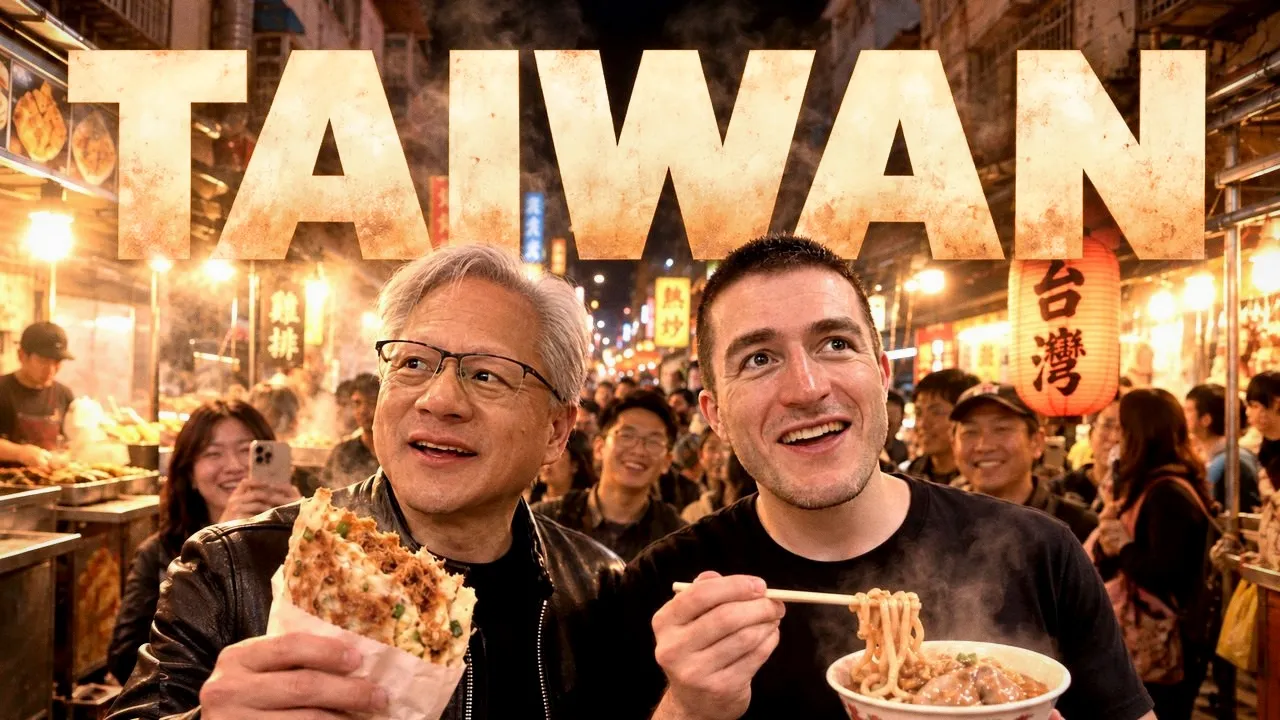
Taiwan manufactures over 90% of the world's most advanced semiconductors, making its concentrated industrial ecosystem the foundational backbone for modern personal computers, smartphones, and hyperscale AI data centers. (0:03)
NVIDIA transitioned its next-generation data center platform to 100% liquid cooling, slashing server node assembly time from two hours to five minutes while aligning hardware economics around maximizing token output per second. (3:28)
NVIDIA plans to expand its Taiwan footprint from 1,000 to 4,000 personnel by hiring 3,000 local engineers and constructing a dedicated campus modeled after its Santa Clara headquarters. (26:51)
Jensen Huang argues that national security stems from technological momentum and sovereign wealth generated through global commercial adoption rather than protectionist hoarding, warning that severed market access threatens critical R&D reinvestment flywheels. (51:00)
Detailed notes
## Background
Published on YouTube by Lex Fridman on October 13, 2026, this video documents Lex's multi-day trip to Taiwan alongside NVIDIA CEO Jensen Huang. The show notes describe experiencing massive Computex crowds, exceptional night market street food, and deep conversations exploring technology, culture, and history.
## TL;DR
Lex Fridman joins NVIDIA CEO Jensen Huang in Taiwan during Computex, exploring how the island produces over 90% of the world's most advanced semiconductors and underpins the modern AI compute economy. Between keynote preparations and visits to Raohe and Ningxia night markets, Huang recounts NVIDIA's early survival, his 1990s outreach to TSMC founder Morris Chang, and their decades-long alliance governed by long-term trust and mutual goodwill rather than zero-sum contracts. The journey highlights Taiwan's foundational supply chain ecosystem, its intense culinary craftsmanship, and Huang's philosophy of leaving margin on the table so partners succeed together.
## Atmosphere & style
The experience feels kinetic, warm, and deeply personal, oscillating seamlessly between high-stakes semiconductor geopolitics and sensory-rich street food crawls through bustling night markets. Jensen Huang navigates rock-star-level public adoration with grounded humility and humor, enthusiastically pausing tech discussions to prioritize fresh savory soy milk or hand plates of banquet food to camera crews waiting in the heat. Lex adopts a grounded, observant, and appreciative presence, capturing a blend of startup nostalgia, technical optimism, and cultural generosity that feels both intellectually weighty and celebratory.
## Bulletin
- [00:03](https://www.youtube.com/watch?v=FGCP2F_7rQk&t=3s) Taiwan manufactures over 90% of the world's most advanced semiconductors, making its concentrated industrial ecosystem the foundational backbone for modern personal computers, smartphones, and hyperscale AI data centers.
- [03:28](https://www.youtube.com/watch?v=FGCP2F_7rQk&t=208s) NVIDIA transitioned its next-generation data center platform to 100% liquid cooling, slashing server node assembly time from two hours to five minutes while aligning hardware economics around maximizing token output per second.
- [26:51](https://www.youtube.com/watch?v=FGCP2F_7rQk&t=1611s) NVIDIA plans to expand its Taiwan footprint from 1,000 to 4,000 personnel by hiring 3,000 local engineers and constructing a dedicated campus modeled after its Santa Clara headquarters.
- [51:00](https://www.youtube.com/watch?v=FGCP2F_7rQk&t=3060s) Jensen Huang argues that national security stems from technological momentum and sovereign wealth generated through global commercial adoption rather than protectionist hoarding, warning that severed market access threatens critical R&D reinvestment flywheels.
## Key takeaways
- [00:03](https://www.youtube.com/watch?v=FGCP2F_7rQk&t=3s) Taiwan's concentrated manufacturing base produces over 90% of the globe's leading-edge semiconductors, creating a critical geographic dependency for the entire modern computing and AI industry.
- [03:28](https://www.youtube.com/watch?v=FGCP2F_7rQk&t=208s) Hyperscale AI data center economics have fundamentally moved away from legacy models of leasing raw CPU cores to optimizing the throughput and economics of token production per second.
- [03:28](https://www.youtube.com/watch?v=FGCP2F_7rQk&t=208s) Advancements in full liquid cooling have eliminated exposed hoses and complex cabling runs, compressing server node build times from two hours down to five minutes.
- [09:12](https://www.youtube.com/watch?v=FGCP2F_7rQk&t=552s) Major industry keynotes carry immense systemic stakes, requiring Taiwan's hardware supply chain to commit hundreds of billions of dollars in upfront capital expenditure without formal rehearsals or guarantees.
- [13:23](https://www.youtube.com/watch?v=FGCP2F_7rQk&t=803s) Taiwan and East Asian technology hubs cultivate a rare social environment where hardware and semiconductor engineers are celebrated as cultural icons rather than background technicians.
- [16:24](https://www.youtube.com/watch?v=FGCP2F_7rQk&t=984s) The foundation of Taiwan's semiconductor dominance was seeded by K.T. Li recruiting Morris Chang, alongside open architecture standards from IBM that empowered local engineers to manufacture silicon for global PC builders.
- [26:51](https://www.youtube.com/watch?v=FGCP2F_7rQk&t=1611s) NVIDIA is significantly deepening its operations in Taiwan by scaling its local workforce by 3,000 engineers to support packaging, testing, and system architectures across a new 4,000-person campus.
- [32:32](https://www.youtube.com/watch?v=FGCP2F_7rQk&t=1952s) Severe compute constraints in international markets like China are acting as a catalyst for engineering teams to develop exceptionally lean and optimized AI model architectures.
- [35:26](https://www.youtube.com/watch?v=FGCP2F_7rQk&t=2126s) Jensen Huang attributes Taiwan's technological supremacy to cultural values centered on hospitality, communal generosity, mutual cooperation, and an uncompromising work ethic.
- [43:09](https://www.youtube.com/watch?v=FGCP2F_7rQk&t=2589s) Long-term organizational goodwill is not a zero-sum game, and leading effectively requires ensuring that internal teams and external partners are mutually invested in shared success.
- [51:00](https://www.youtube.com/watch?v=FGCP2F_7rQk&t=3060s) Sustainable national technological defense relies on rapid innovation cycles fueled by global market revenues, because cutting off commercial adoption directly impairs the capital required for future R&D.
- [01:04:43](https://www.youtube.com/watch?v=FGCP2F_7rQk&t=3883s) Taiwanese street food culture mirrors the rigorous craft specialization of high-tech engineering, epitomized by generational stalls perfecting specialized culinary textures such as 'QQ' elasticity.
- [01:21:13](https://www.youtube.com/watch?v=FGCP2F_7rQk&t=4873s) The decisive turning point for NVIDIA occurred in 1996 when founder Morris Chang returned a cold letter from Jensen Huang, offering TSMC's manufacturing capacity to an unknown startup.
- [01:23:08](https://www.youtube.com/watch?v=FGCP2F_7rQk&t=4988s) NVIDIA and TSMC govern their multi-decade strategic partnership through an unwritten doctrine of 'rough justice' and mutual trust rather than through rigid, adversarial legal contracts.
- [01:26:45](https://www.youtube.com/watch?v=FGCP2F_7rQk&t=5205s) Sustained success within closely knit hardware ecosystems requires companies to avoid zero-sum extraction and consistently leave financial margin on the table so suppliers remain well-capitalized.
## Detailed walkthrough
### [00:03](https://www.youtube.com/watch?v=FGCP2F_7rQk&t=3s) Highlights and Intro: The Semiconductor Capital of the World
The journey opens with glimpses of a whirlwind trip across Taiwan: bustling crowds, savoring the island's famous night market oyster pancakes, and navigating packed convention floors where Jensen Huang is received like a rock star. Visiting Taiwan for the first time, Lex Fridman reflects on traveling with Jensen, the CEO and co-founder of NVIDIA, describing the enterprise not merely as the world's most valuable company, but as one of the most consequential institutions in human history. They are in Taipei for Computex, a massive tech gathering teeming with engineers from every corner of the globe.
Taiwan itself is a mountainous island—two-thirds covered in peaks—yet responsible for over 90% of the world’s most advanced semiconductor manufacturing. Lex observes that modern smartphones, computers, GPUs, and AI data centers fundamentally cannot function without this single landmass, creating an industrial concentration that is virtually impossible to replicate anywhere else. He compares the sheer engineering marvel of Taiwan's dominance to ancient wonders like Göbekli Tepe and the Egyptian pyramids—mysteries of human capability that inspire deep humility. He attributes this modern achievement to Taiwan's culture, an educational framework that places immense prestige on engineering, and intricate global supply chains. Beyond the technological and geopolitical stakes, Lex emphasizes the necessity of human connection across nations—sharing meals, drinking beer, and building friendships to ensure that fierce competition coexists with mutual respect. He praises Jensen for retaining genuine humility, active listening, and a grounded human touch despite his immense stature, alongside his undeniable passion as a fellow foodie.
- **Geography & Market Share:** Taiwan is two-thirds mountainous terrain, yet manufactures more than 90% of the world's most advanced semiconductors.
- **Industry Footprint:** Global smartphones, personal computing, high-performance GPUs, and hyperscale AI infrastructure remain critically dependent on the island's ecosystem.
---
[03:28](https://www.youtube.com/watch?v=FGCP2F_7rQk&t=208s) Computex Floor: Liquid Cooling, Vera CPUs, and Token Economics
Walking into the expo hall, Jensen welcomes Lex with playful warmth, shouting to the buzzing crowd, "Do you know who this is? Yes. The great Lex!" When Lex notes that being recognized simply as "Lex" means he has arrived, Jensen jokes that they are both on a first-name basis with the world, tossing out names like "Jensen, Beyoncé." Swarmed by tech enthusiasts and engineers, Jensen introduces Lex to executives on the exhibition floor while inspecting next-generation server architecture.
```mermaid
flowchart TD
accTitle: Shift from Legacy x86 Cores to Modern AI Token Generation
accDescr: Diagram contrasting traditional x86 server economics with modern AI infrastructure requirements.
subgraph Legacy["Legacy Computing Paradigm"]
direction TB
L1["x86 Hyperscale CPUs"] --> L2["Designed to rent CPU cores"]
L2 --> L3["Economic Metric: Dollars per Core"]
end
subgraph Modern["Modern AI Paradigm"]
direction TB
M1["Vera CPUs & Blackwell GPUs"] --> M2["Built for iterative compute loops"]
M2 --> M3["Economic Metric: Maximum Tokens Generated / Sec"]
end
Legacy -.->|"Paradigm Shift"| Modern
```
Jensen points out the mechanical and thermodynamic engineering of their latest systems, emphasizing that the newest platform has evolved from 80% liquid cooling in the Grace Blackwell generation to 100% liquid cooling, entirely eliminating cables and hoses in critical runs. By simplifying the build, assembly time has plummeted from two hours down to just five minutes, adhering to his engineering philosophy: "Things that are easy to build are also reliable." Turning to the Vera CPU, Lex highlights its 1.8x performance edge over traditional x86 alternatives. Jensen breaks down the shift in hyperscale server architecture: while legacy x86 CPUs were designed around renting out discrete cores, modern AI data centers do not rent cores—they sell tokens. The goal is to cycle through the computational loop as rapidly as possible to generate tokens at scale, prompting Lex to tease Jensen on his famous sales maxim: "The more you buy, the more you make."
- **Liquid Cooling Evolution:** Upgraded from Grace Blackwell's 80% liquid cooling to 100% liquid cooling with zero hoses or cables exposed in critical assembly paths.
- **Manufacturing Efficiency:** Server node assembly time decreased from two hours to five minutes.
- **Architectural Shift:** Vera CPUs outpace legacy x86 architectures by 1.8x, transitioning business models from leasing raw cores to maximizing token production throughput.
---
[05:39](https://www.youtube.com/watch?v=FGCP2F_7rQk&t=339s) Meeting the Partners: Quanta QCT, SK Hynix, and Nostalgia
Jensen brings Lex over to sign a display board, insisting that Lex leave his mark among the tech royalty. He explains to onlookers that Lex did not just happen to drop by, but flew out specifically to explore Taiwan together. While tasting a green slice of an "AI is a five-layer cake" pastry, Jensen checks in on how Lex is enjoying the local street food, laughing at Lex's reaction that it is "insane" and deliciously disorienting. The duo then joins the leadership team of Quanta QCT on stage for a massive group photo, prompting Lex to remark that Jensen receives the kind of adoration the Beatles saw in the 1960s, to which Jensen self-deprecatingly quips, "Except the Beatles actually had talent."
Moving along the showroom floor, they stop at the booth of SK Hynix, the memory titan supplying High Bandwidth Memory (HBM) and low-power data center modules. Jensen explains how they pioneered putting LPDDR memory into server centers, unlocking "twice the bandwidth, half the power." Amid the showcase, they admire custom, hand-crafted GPU builds, prompting Jensen to reflect on the Japanese philosophy of *wabi-sabi*—finding beauty in imperfection and uniqueness. Looking over older legacy GPUs like the GeForce GTX 1080 and the Titan RTX generation, both recall the milestones of modern graphics hardware. Pausing at an enthusiast setup, Jensen clacks away on an old-school mechanical keyboard, reveling in the tactile feedback. When Lex warns that voice control will soon dominate human-computer interaction, Jensen confesses that he prefers typing over talking because it gives him space to deliberate: "Speed is not everything. Sometimes you have to pause and think."
- **Key Partners Featured:** Quanta QCT for system integration; SK Hynix for High Bandwidth Memory (HBM) and low-power memory innovations.
- **Memory Innovations:** Introducing LPDDR memory architecture directly into data center tiers achieved double the bandwidth at 50% power consumption.
- **Legacy Hardware Spotted:** Vintage GeForce GTX 1080 and Pascal-era Titan graphics cards on display.
---
[09:12](https://www.youtube.com/watch?v=FGCP2F_7rQk&t=552s) Keynote Nerves and Taiwan's Multi-Trillion Dollar Ecosystem
Stepping away from the loud expo floor, Lex asks Jensen if he still feels nervous before delivering high-stakes Computex keynotes with the entire tech world watching. Jensen admits that he is always terrified: "I was super nervous, but I'm always nervous. You know, every public speaking, doesn't matter what it is." He explains that his keynotes are compiled at the very last minute, leaving no time for formal rehearsals and eliminating any chance of using a teleprompter.
Jensen explains the immense burden behind the presentation: to transition the industry and sell several trillion dollars worth of next-generation accelerated computing, NVIDIA cannot succeed in isolation. The entire Taiwanese manufacturing and engineering ecosystem—from foundries to board makers—must commit hundreds of billions of dollars in capital expenditure over the coming years. His keynote had to inspire that entire supply chain, clearly articulating the shared economic upside and technical necessity in the fewest, most punchy words possible.
The conversation closes with a nod to NVIDIA's heritage in PC gaming. Jensen stresses the importance of never losing sight of your roots: "No matter how high you are, don't let your feet leave the ground." Lex agrees, noting that gamers remain among the most passionate technologists alive, before the two turn back toward the sea of fans, ready to continue their trek across the island.
[11:18](https://www.youtube.com/watch?v=FGCP2F_7rQk&t=678s) Signing Merch, Street Bites, and Cold Taiwanese Beer
Jensen Huang and Lex Fridman mingle with fans and team members in high spirits. Jensen eagerly signs a FIRST Robotics t-shirt for an attendee, noting with admiration that it represents young engineers building machines, "most of them probably running on NVIDIA brain." Lex is asked to add his signature alongside Jensen's as items continue to be passed over for autographs.
```mermaid
flowchart LR
accTitle: Post-Keynote Fan and Street Interactions
accDescr: Shows the sequence from signing robotics shirts to sharing street food and beer.
subgraph FanEngagement["Fan Interactions"]
A["Sign FIRST Robotics Shirt"] --> B["Group Cheers with Jerry & Oliver"]
end
subgraph StreetSnacks["Snack Break"]
B --> C["Fresh Salty, Doughy Snack"]
C --> D["Cold Taiwanese Beer"]
end
```
The mood turns celebratory as cans and cups clink around the group, raising toasts to teammates Jerry and Oliver. Between signing more items, someone hands them warm, savory street bites. Jensen takes a bite and calls it "beyond good," raving about the doughy, salty texture paired with an ice-cold Taiwanese beer after a grueling day on his feet. A fan jokes that they will need to 3D print a statue of Jensen next, which he humorously bats down: "Please don't do that." Making sure Lex stays close through the swirling crowd, Jensen quips, "I'm not gonna strand you in Taiwan. You know I'm gonna find you again."
- FIRST Robotics shirts signed by both Jensen and Lex, highlighting the next generation of robotics developers.
- Group toasts with local Taiwanese beer alongside crew members Oliver and Jerry.
- Savoring hot, salty, doughy local treats directly from street stalls.
---
[13:23](https://www.youtube.com/watch?v=FGCP2F_7rQk&t=803s) Engineers as Rock Stars and Lessons from China
Lex reflects on the astonishing outpouring of affection Jensen receives wherever he walks in Taipei, observing that it is rare and deeply inspiring to see a hardware engineer treated like a rock star. Because engineers build the physical modern world yet seldom get public recognition, Jensen’s visibility inspires millions of young kids to pursue engineering careers.
Jensen asks Lex about his recent travels in China. Lex recounts that his visit to downtown Beijing devolved into good-natured mayhem: he sampled dishes at nearly every small eatery he passed, and within thirty minutes, shop owners had turned his photo into promotional storefront posters. Jensen laughs and hypes up an upcoming meal planned for the next day featuring traditional rice dumplings wrapped in aromatic bamboo leaves. Lex notes that across both mainland China and Taiwan, the top AI engineers and builders share an extraordinary trait: genuine, uninterrupted humility with zero arrogance, despite quietly transforming global technology.
---
[14:57](https://www.youtube.com/watch?v=FGCP2F_7rQk&t=897s) Reindustrializing the United States and the TSMC Partnership
Turning toward the global supply chain, Jensen emphasizes that the ongoing AI revolution provides a once-in-a-generation window to reindustrialize the United States. Surging global compute demand gives the US a clear opportunity to modernize its electrical grid, invest in sustainable energy, and revive domestic semiconductor and advanced manufacturing. Because demand is virtually insatiable, companies can absorb the costs of manufacturing domestically, and deploying AI and advanced robotics onto factory floors makes local assembly economically viable again.
Jensen praises Taiwan as an indispensable strategic ally in this American rebuilding effort. Pointing to TSMC's massive investment in advanced semiconductor fabrication plants in Phoenix, Arizona, he explains that building state-of-the-art fabs on US soil is exceptionally difficult due to a severe domestic shortage of specialized chipmaking talent. To solve this, Taiwan has sent legions of experienced engineers across the Pacific to train local workers and build up the ecosystem. Jensen insists that Taiwan is not merely a supplier, but a foundational technological partner to the United States.
- AI and robotics provide the technological leverage to bring lost manufacturing sectors back to the United States.
- The compute boom justifies vital domestic capital expenditures into sustainable energy and grid infrastructure.
- TSMC's multi-billion-dollar fabs in Arizona rely on transferring seasoned Taiwanese fabrication talent to train the American workforce.
---
[16:24](https://www.youtube.com/watch?v=FGCP2F_7rQk&t=984s) The Origin of Taiwan's Tech Miracle: K. T. Li, Philips, and the PC Revolution
When Lex asks why Taiwan became the undisputed capital of the hardware stack, Jensen traces the island's tech dominance back to K. T. Li (Li Kwoh-ting), the visionary Minister of Economic Affairs and Minister of Finance during the 1950s and 1960s. Li envisioned transforming Taiwan from an agrarian island into a science and advanced electronics powerhouse, and his strategy convinced Morris Chang to return to Taiwan to build a domestic semiconductor industry.
```mermaid
flowchart TD
accTitle: Lineage of the Taiwanese Hardware Ecosystem
accDescr: Traces the historical path from K.T. Li and Philips down to modern open-spec PC builders.
subgraph Foundations["1950s-1980s: State Vision & Tech Transfer"]
A["K. T. Li's Science & Tech Policy"] --> B["Morris Chang Recruited to Taiwan"]
C["Philips (Europe's GE) Inbound Investment"] --> D["Foundry & Tool Spinoffs: TSMC & ASML"]
end
subgraph MarketExpansion["1980s-1990s: Open Architecture Boom"]
D --> E["Taiwan Fabs: TSMC & UMC"]
F["IBM Open Architecture Chipset Specs"] --> G["Taiwanese Engineers Design Motherboard Chipsets"]
E --> G
G --> H["Global PC Builders: Michael Dell, Compaq, etc."]
end
```
Jensen explains that Dutch conglomerate Philips—which he describes as the "GE of Europe"—served as an unexpected catalyst. Philips originally operated semiconductor fabrication and spun off both the foundry operations that helped create TSMC and the photolithography tools that formed ASML. When IBM later opened up its architecture specifications for PC-compatible chipsets (encompassing memory controllers, cache controllers, interrupt controllers, and VGA graphics), clever Taiwanese design teams built compatible silicon manufactured locally by TSMC and UMC.
This turnkey hardware ecosystem enabled startup PC assemblers across the globe—such as college student Michael Dell in Austin, Texas—to buy reliable motherboards from Taiwan, install licensed Microsoft operating systems, and ship finished PCs worldwide. Lex shares a witty quote from a local woman he met: "As a girl, I learned how to spell CoWoS before I could spell Gucci." Jensen laughs, proudly agreeing: "We brought sexy back to technology."
---
[19:47](https://www.youtube.com/watch?v=FGCP2F_7rQk&t=1187s) Raohe Night Market: Street Food and Taiwanese Hospitality
Jensen and Lex head into the packed lanes of Raohe Night Market, completely surrounded by cheering locals, food stall vendors, and eager smartphone cameras. Jensen navigates through the bustling alleyways while tracking down signature Taiwanese street snacks.
```mermaid
flowchart LR
accTitle: Raohe Night Market Food Crawl
accDescr: Highlights the street food items sampled at Raohe Night Market.
A["Piping Hot Black Pepper Buns"] --> B["Watermelon Juice"]
B --> C["Hollow Fried Sweet Potato Balls"]
C --> D["Original Seasoned Skewers"]
D --> E["Spicy Noodles & Cold Taiwan Beer"]
```
Their food crawl moves rapidly from stall to stall:
- **Black Pepper Buns (Hujiao Bing):** Pulled straight out of the searing cylindrical clay ovens. Jensen urges Lex to let it rest until it cools slightly so he can bite into the peppery pork and scallion filling without burning himself.
- **Fresh Watermelon Juice:** Handed to Lex ice-cold in a giant cup, providing a sweet, hydrating relief from the muggy Taipei evening heat.
- **Fried Sweet Potato Balls (Di Gua Qiu):** Crisp spheres that are crunchy on the exterior and airy on the inside, which Lex describes as tasting like a "sweet potato marshmallow."
- **Skewers and Snacks:** Savory skewered meats ordered in their original seasoning. At one stall, Jensen tries to pay and tip the vendor, but the owner firmly refuses the money, insisting it is on the house and shoving the cash right back into Jensen's bag: "If you do this, I can't come back."
- **Spicy Street Noodles:** A bowl of fiery, freshly tossed noodles passed directly into Jensen's hands, which Lex eagerly shares while washing it down with more cold local beer.
[24:25](https://www.youtube.com/watch?v=FGCP2F_7rQk&t=1465s) Tasting Snacks and Ranking the Night Market Bites
Lex and his companions work their way through an array of street food, joking about counting sweet roasted corn coated with cinnamon—tasting like "a snickerdoodle meets corn"—as their vegetable for a balanced meal. As they graze, they compare notes on the evening's highlights. While the sweet potato balls earn high praise as a close second, Lex names the noodles as his absolute favorite. Having cleared their savory dishes, the group prepares to plunge back into the bustling market throngs for dessert, rallying with the cry, "Once more into the breach," as they head toward the shaved ice stands.
[25:15](https://www.youtube.com/watch?v=FGCP2F_7rQk&t=1515s) Navigating the Crowds for Shaved Ice
Stepping out onto the packed thoroughfare, the group is immediately enveloped by fans, onlookers, and flashing smartphone cameras. Jensen's constant presence draws continuous attention; locals remark that because he had been spotted in the area only a day or two earlier, fans flooded the market hoping to catch him again, joking that Jensen essentially "comes with the place." Lighthearted banter breaks out about Jensen's signature wardrobe, teasing that calling his attire "limited" implies he has anything other than his trademark black jacket.
Surrounded by people requesting selfies, Lex tastes authentic Taiwanese shaved ice for the very first time. Tasting the finely shaved ice topped with fresh watermelon and other fruits, he is blown away by the texture and refreshing chill against the humid night air, describing the flavor as "stupid amazing" and noting that no description from friends back home came close to doing it justice.
[26:51](https://www.youtube.com/watch?v=FGCP2F_7rQk&t=1611s) NVIDIA's Expansion Plans in Taiwan
Over dessert and fruit samples, the conversation shifts to NVIDIA's deep operational and engineering footprint on the island. Jensen outlines the specialized roles of their local workforce:
- **Current Workforce:** NVIDIA currently employs around 1,000 people in Taiwan, focusing on supply chain, systems engineering, operations engineering, fab liaison engineers, packaging engineers, and test engineers.
- **Campus Expansion:** The company plans to acquire land and construct a new facility modeled directly after their headquarters building in Santa Clara.
- **Hiring Targets:** The planned building is designed to accommodate 4,000 employees, requiring NVIDIA to hire an additional 3,000 local hardware and systems specialists.
While discussing the company's hardware backbone, fruit vendors gift the group a sample plate of pineapple with guava. Jensen and Lex marvel at the sweet gesture, joking about the sugar rush and how vendors love to introduce visitors to local specialties, knowing photos will spread across social media.
[28:39](https://www.youtube.com/watch?v=FGCP2F_7rQk&t=1719s) The Oyster Pancake and Childhood Scars
The culinary centerpiece arrives in the form of Taiwan's famous street dish: the savory oyster pancake. Tasting the crispy, starchy egg-and-oyster delicacy drizzled with sauce, Lex declares it "the reason I came here." Jensen agrees that the dish serves as the perfect culmination of any night market visit.
The taste triggers an intense childhood memory for Jensen. Growing up, his parents did not have the money to dine at conventional sit-down restaurants, so heading to the night market was their definitive family night out. When Jensen was just shy of five years old, he wandered away from their table in search of a bathroom. Approaching an open food stall to ask a cook for directions, he stepped up just as the cook swung around while wiping down a kitchen knife. The blade caught Jensen directly across the face. His father immediately swept him up in his arms and sprinted through the streets to the hospital. Despite the bloody trauma, Jensen notes that the incident never tainted his love for the markets; the memory only deepened his affection for the atmosphere and the food.
[30:51](https://www.youtube.com/watch?v=FGCP2F_7rQk&t=1851s) Street Food Mastery and Craftsmanship
Jensen and Lex reflect on the hardworking spirit and generosity of Taiwanese night market vendors. Operating on razor-thin margins—where the profit on an item might be mere pocket change—vendors routinely hand out free food or extra helpings simply to share their craft with visitors. Jensen highlights this open-hearted generosity as "the Taiwanese way." Lex compares these generational street cooks to the culinary master featured in *Jiro Dreams of Sushi*, pointing out that night markets are filled with culinary artisans who have spent decades perfecting a single recipe.
The two recount the evening's rapid-fire tasting marathon of roughly ten distinct dishes:
- Juicy grilled Taiwanese pork sausages on skewers.
- Fluffy steamed buns with pork filling.
- Golden fried chewy sweet potato balls.
- Fluffy steamed rice cake topped with rich brown sugar.
- Broth noodles with savory hot sauce.
- Traditional white meatballs consisting of an outer fish-cake layer wrapped around a seasoned pork core, providing the bouncy texture celebrated locally as "QQ."
[32:32](https://www.youtube.com/watch?v=FGCP2F_7rQk&t=1952s) AI Innovations and Compute Constraints
Transitioning to broader industry developments in East Asia, Lex shares observations from his recent visits to tech hubs in mainland China:
- **Shanghai:** Visiting generative AI startups such as MiniMax.
- **Hangzhou:** Meeting the robotics engineering teams at Unitree, whom Lex commends for their technical skill and humility.
Lex notes that across these startups, the universal cry from developers is that they are deeply compute-starved. Jensen observes that severe hardware limitations often serve as the mother of invention. Rather than halting progress, scarcity compels these engineering teams to devise highly efficient, ingenious model architectures to maximize every cycle of available compute.
```mermaid
flowchart LR
accTitle: Compute Constraints Driving Architecture Innovation
accDescr: Flowchart illustrating how hardware scarcity leads AI and robotics teams to develop hyper-efficient model architectures.
A["Compute Scarcity & Hardware Bottlenecks"] --> B["Forced Optimization & Resource Constraints"]
B --> C["Innovative, Efficient Model Architectures"]
```
[33:41](https://www.youtube.com/watch?v=FGCP2F_7rQk&t=2021s) The NVIDIA Banquet and Feeding the Press
The scene shifts to a large outdoor NVIDIA company celebration. Employees from across the globe gather around traditional banquet tables laden with multi-course feasts. Toasts are poured with Kavalan, Taiwan's premier award-winning single-malt whiskey. Jensen points toward a banquet stage, playfully vowing that with a couple more drinks in him, he will take the stage to dance for the crowd.
Despite being the guest of honor, Jensen notices members of the press and camera crews standing outside the tables working long hours in the tropical heat. True to his hands-on demeanor, Jensen grabs platters of food directly from the banquet tables and walks them over to hand-deliver plates and drinks to reporters and cameramen, reminding them to shout if they need anything else. Seeing this, Lex laughs and introduces Jensen to the camera crew as "the GOAT, the OG," highlighting Jensen's habit of taking care of the people working behind the scenes.
[35:26](https://www.youtube.com/watch?v=FGCP2F_7rQk&t=2126s) The Spirit Behind the Island's Supply Chain
Catching his breath after consecutive days of wall-to-wall Computex exhibition hall tours, Jensen reflects on the sheer intensity of the crowds. Turning a corner inside the venue earlier that day, he had been met by thousands of cheering attendees packed several tiers deep—an overwhelming display that left him stunned.
Jensen explains that the enthusiastic reception mirrors the broader character of Taiwan. He argues that Taiwan's position at the epicenter of the global semiconductor and computing ecosystem is built directly upon this cultural foundation: an inexhaustible capacity for hospitality, generosity, and community cooperation, paired with a relentless, uncompromising work ethic.
The segment wraps up with humorous banter inside the gathering. Seeking respite from the sweltering heat, Lex and Jensen discover an unexpected pocket of cool air near a beverage cooler and joke that the universe decided to grant them a brief reprieve. Jensen greets a smiling team member standing nearby who reveals he has been with NVIDIA for 17 years, capping off the evening with selfies amid the breeze spilling from an open refrigerator.
[37:06](https://www.youtube.com/watch?v=FGCP2F_7rQk&t=2226s) College Dating and Video Game Quarters
Reflecting on his younger years over dinner, Jensen Huang shares a humorous story from his college days about how he began dating his wife, Lori. Raised strictly in the traditional Taiwanese tradition, he received no allowance from his parents whatsoever: the house rule was simple—unless you were literally dying, you did not call home asking for money, and if you did not call, they certainly were not going to send any.
When he met Lori, however, he quickly discovered that she received a steady allowance. With complete deadpan humor, Jensen jokes that he intentionally started dating her for her money—specifically, twenty-five cents a week—just so they would have enough quarters to go play arcade video games together.
[38:59](https://www.youtube.com/watch?v=FGCP2F_7rQk&t=2339s) Aside: History of Video Games and Higgsfield AI
Stepping out into nature while trying to avoid procrastinating on a run, Lex pauses the travelogue to reflect on how central gaming has been to both his and Jensen's lives. Prompted by their shared obsession with gaming history, Lex showcases an AI-generated timeline clip created using Higgsfield AI, trying to name every iconic title that flashes across the screen: *Pong* reimagined inside the Matrix, *Super Mario* with alcohol, *Street Fighter*, *Dark Souls*, and Bethesda classics spanning *The Elder Scrolls: Arena*, *Daggerfall*, and *Skyrim*.
The showcase prompts Lex to wonder when *The Elder Scrolls VI* will arrive, before moving on to *SimCity* and *Grand Theft Auto*, noting that fans at least have an anticipated release window for *Grand Theft Auto VI*. Reflecting on how many of the happiest hours of his life were spent in virtual worlds, Lex highlights his past long-form discussions with legendary video game creators like Dan Houser, Jeffrey Kaplan, Todd Howard, and John Carmack, promising many more in the future.
[40:31](https://www.youtube.com/watch?v=FGCP2F_7rQk&t=2431s) Lunch: Braised Pig's Feet and Family Banter
Lex joins Jensen and his family for an authentic Taiwanese lunch centered around braised pig's feet, accompanied by braised eggs, tofu, and fresh asparagus. Jensen’s parents join the table, having deep affection for the restaurant. Lex admits that pig's feet can be an acquired taste for Westerners, but once you try it, the rich collagen and savory sauce make it undeniably delicious.
The gathering is warm, chaotic, and lighthearted. Jensen’s son, Spencer, playfully steps in as a cameraman to capture the spread, drawing praise for his multitasking. As the family digs into the pork knuckles, Jensen points out the pig's toe, teasing that accepting the dish is mostly a branding and naming issue. That sparks a running joke about NVIDIA's own name, with Jensen noting how long it took people to learn how to spell it properly—many often dropping the first "I" and spelling it phonetically.
Before getting back to heavy discussions, Jensen chats briefly about how he researches emerging companies and subjects, enthusiastically giving a shout-out to Perplexity Computer as an indispensable tool in his daily workflow.
[43:09](https://www.youtube.com/watch?v=FGCP2F_7rQk&t=2589s) Humility, Non-Zero-Sum Goodwill, and Shared Success
Stepping into a quieter discussion, Lex asks Jensen how he bears the immense, rockstar-like weight of global celebrity—where people treat him like the Beatles in the 1960s—while still managing to maintain genuine humility and warmth. Jensen explains that he simply does not interpret the attention through an ego-driven lens. Throughout his life, people have treated him kindly, and he has always responded by wishing the best for others and treating them with basic politeness.
Jensen recalls that even during his school days, when he had nothing, he genuinely wanted all of his classmates to excel, freely sharing his homework with anyone who needed help. That instinct never vanished as he built NVIDIA: he actively cheers for peers and competitors across the tech industry. Lex notes the reciprocal nature of that mindset, pointing out that celebrating other people's wins inevitably circles back around. Jensen illustrates this directly with NVIDIA's workforce:
> "43,000 employees at NVIDIA wants me to succeed, literally. You know what I'm saying?... Goodwill is not a zero-sum game. It's not limited by physics."
[44:32](https://www.youtube.com/watch?v=FGCP2F_7rQk&t=2672s) The Geopolitics of Export Controls: Hoarding vs. the Innovation Flywheel
Lex shifts the dialogue to national security and global trade policy, inviting Jensen to steelman both sides of the debate surrounding American semiconductor export controls against geopolitical rivals like China. Jensen acknowledges the orthodox national security argument: when an asset serves as a decisive force multiplier—such as rare earth elements, cutting-edge computing architecture, specialized IP, bullets, or bombs—denying an adversary access to that physical asset temporarily preserves your advantage, provided the opposing side cannot easily manufacture an equivalent alternative.
However, Jensen presents a far deeper counterargument rooted in economic and platform dynamics: real, enduring national security is an emergent property of sovereign wealth and technological momentum, not protectionist hoarding. The safest and most militarily formidable nations are fundamentally the wealthiest nations, and that wealth is generated by an economic flywheel.
```mermaid
flowchart TD
accTitle: The Technology and Economic Flywheel
accDescr: A cyclical feedback loop showing how technological leadership drives market adoption, which in turn fuels the resources needed to maintain that leadership.
Jensen explains that computing platforms depend entirely on developer engagement and global installed bases. When a platform captures global adoption, that immense scale feeds revenue back into research and development, allowing the pioneer to out-innovate every competitor. Attempting to restrict access to technology severs that commercial flywheel:
- Hoarding static physical commodities can work when adversaries cannot synthesize their own substitutes, but platform technologies stall if deprived of customer velocity.
- The safest national strategy is to remain "extremely selective" about truly sensitive core technologies, while deliberately maximizing global commercial reach to keep the American innovation flywheel spinning.
- If competition between nations shifts from friendly rivalry into total decoupling, it risks breaking the global feedback loops that prevent catastrophic warfare.
- Modern artificial intelligence is not a monolithic model, but a sprawling, deeply interdependent tech stack spanning raw energy production, fabrication, algorithmic design, and global software frameworks.
[51:00](https://www.youtube.com/watch?v=FGCP2F_7rQk&t=3060s) The Innovation Flywheel, Global Tech Reach, and Export Controls
Lex reflects on American ingenuity, noting his belief that the United States fosters the craziest, wildest moonshot ideas and sits at the very top of global innovation. Jensen agrees without hesitation, citing overwhelming evidence across companies like NVIDIA, OpenAI, Anthropic, and Google. In Jensen's view, the compounded chemistry that builds this innovation capability over decades is massive, but it relies on a decisive structural edge: the global flywheel. Because the vast majority of the world operates in English, an American company building on an American technology stack using American standards can deploy seamlessly across the planet—an advantage China simply does not share. As Jensen puts it plainly: "Technology without customers is useless."
Lex points out that retreating into isolationism comes at a devastating cost because it surrenders that worldwide ecosystem. Jensen enthusiastically affirms this, explaining that sustaining technological leadership requires maximal platform reach. Global adoption creates the revenue and scale that fund the massive R&D budgets needed to drive the next wave of breakthroughs. However, he warns that this flywheel is fragile: while it may take two or three decades to reach an overnight tipping point of exponential ubiquity, it can just as rapidly stall and decelerate if severed from international markets.
Addressing the debate over export controls, Jensen outlines the delicate balance between national security and economic reach:
```mermaid
flowchart TD
accTitle: Technology Leadership Flywheel vs Export Controls
accDescr: Diagram illustrating how global deployment powers American R&D and the tension with national security controls.
subgraph Flywheel["The Innovation Flywheel"]
A["American Tech Stack & Standards"] -->|"Global adoption in English"| B["Worldwide Platform Reach"]
B -->|"Economic returns & scale"| C["Massive R&D Funding"]
C -->|"Moonshot innovations"| A
end
subgraph Balance["Sovereignty & Policy Tension"]
D["Sovereign Right: Protect National Assets"] <-->|"Delicate policy balance"| B
end
```
Jensen acknowledges that every sovereign nation possesses the legitimate right to protect its proprietary technological assets and determine how its resources are deployed. At the same time, because the U.S. technology sector represents a "national treasure," it requires the widest feasible platform reach to sustain its compounding leadership flywheel. Lex adds that behind geopolitics, traveling reveals that human beings share far more in common than what divides them—a sentiment Jensen seconds, noting how hitchhiking and travel force that realization onto you. Wrapping up their meal, Jensen promises that tonight's night market excursion will be even crazier than the last.
[55:07](https://www.youtube.com/watch?v=FGCP2F_7rQk&t=3307s) Entering the Night Market and Jensen's Algorithm
Stepping out into the rainy evening, Jensen is undeterred by the weather, rallying the group—including companions Mark and Christian—to dive right into the Ningxia night market. Jensen and Christian bond over both having grown up in Taiwan, while Lex admits to already feeling completely overwhelmed by the energy of the crowds. Jensen guides the group straight to a renowned stall favored by tech royalty, proudly pointing out that Morris Chang, the legendary founder of TSMC, also eats here.
Gathered around plates of tender chicken and egg-rich dishes, Jensen and Lex marvel at the textures and smoky barbecue flavors. Jensen notes that across Southeast Asia, eggs are incorporated into almost every dish—from pancakes to oysters—simply because they are the most accessible, affordable source of high-quality protein. When Lex mentions hearing that Jensen makes incredible fried rice, Jensen enthusiastically confirms it and details his internet viewing habits: his algorithm is an eccentric mix of artificial intelligence research, fried rice cooking videos, heavy geopolitics, dogs, and panda bears. He jokes that whenever he dives down a grim geopolitical rabbit hole, he has to immediately switch to videos of pandas and otters just to psychologically recover.
[57:29](https://www.youtube.com/watch?v=FGCP2F_7rQk&t=3449s) Cultural Dining Optimization and Street-Food Crawl
Savoring a comforting bowl of soup with fresh ginger, Jensen reflects on growing up with his mother making similar broths weekly, remarking, "Asian food is all about the soup." As locals recognize them and servers begin piling food onto the table, Lex and Jensen discuss the etiquette of hospitality. Jensen observes that dining across cultures is essentially an optimization problem:
- **Generosity vs. Appreciation:** In some cultures, cleaning your plate signals that you loved the meal; in others, leaving nothing implies the host failed to provide enough food, forcing them to bring out even more dishes.
- **The Local Objective Function:** In Taiwan, host generosity takes priority over the guest proving their appetite, making it impossible to "win" by trying to finish every dish.
- **The French Contrast:** By comparison, Jensen jokes that in France one is expected to finish everything, which is why French dinners inevitably drag on for three exhausting hours.
Heading deeper into the bustling alleyways under the drizzle, the team jokes about keeping Lex on a "running leash" so they do not lose the conspicuous foreigner in the dense crowd. Lex takes in the sights and snacks, trying a Taiwanese-style sausage wrapped in an egg crepe—which the group dubs a local cousin to the classic American corn dog.
[01:00:26](https://www.youtube.com/watch?v=FGCP2F_7rQk&t=3626s) The Peanut Ice Cream Cilantro Roll
The food tour reaches an eccentric peak at a dessert stand selling traditional peanut ice cream rolls. The vendor shaves powdery peanut brittle from an enormous sugar block onto a thin rice-paper crepe, adds scoops of ice cream, and tops it off with a handful of fresh green cilantro before wrapping it like a burrito. Lex is openly skeptical of the flavor profile, struggling to comprehend how cilantro and ice cream could possibly belong together.
While waiting, the group jokes about the sheer unreality of the trip, with someone quipping that traveling from Texas to Taiwan feels like switching planets, concluding: "I think we're all in Jensen's simulation... Just be your best NPC right now." Lex takes a cautious bite of the sweet crepe and is immediately won over, admitting that against all logic, the chewy wrap, chilled ice cream, nutty peanut crunch, and herbaceous cilantro produce an amazingly refreshing combination. Abandoning any pretense of mere "tasting," the group enthusiastically devours the food before Jensen sets his sights on their next culinary destination: fresh green mangoes.
[01:02:18](https://www.youtube.com/watch?v=FGCP2F_7rQk&t=3738s) Night Market Delights: Green Mangoes, Pork Floss, and the Art of Branding
As they wind through the bustling aisles of the night market, Jensen Huang and Lex Fridman stop at a fruit stall to sample green mangoes. Jensen points out that the fruit is not unripe at all; it is fully ripe while staying crisp and green, tasting like an apple, a pear, and a mango combined. Taking in the surrounding stalls piled high with fresh produce alongside the neon glow of Taipei, Lex quips that Taiwan essentially runs on two world-class outputs: "This island makes semiconductors and fruit."
The food tour quickly turns into a rapid-fire tasting marathon. While hunting down Taiwanese pork sausages, Jensen grabs fresh taro balls and reminisces about growing up on pork floss (*rousong*), showering high praise on how comfortingly delicious it is over a steaming bowl of rice. That sparks a running joke about Taiwan’s notorious lack of marketing finesse when introducing its culinary gems to Western audiences. Translating a savory, dehydrated, melt-in-your-mouth shredded meat as "pork floss" makes it sound less like a delicacy and more like dental hygiene. Jensen and Lex laugh over how naming conventions make or break perception, comparing it to cultural disconnects in American product naming.
[01:03:36](https://www.youtube.com/watch?v=FGCP2F_7rQk&t=3816s) Scallion Pancakes, OpenAI Naming Schemes, and Pig's Feet
The group pauses in front of a sizzling griddle where a street vendor is expertly churning out scallion pancakes (*cōngyóubǐng*). Watching her work the dough in a generous bath of oil, they remark that the recipe feels like ninety percent oil and ten percent egg, executed with the rhythmic mastery of someone who has perfected her craft over decades. Lex jokingly notes that any pretense of maintaining a diet on this trip is thoroughly ruined, estimating he has already gained ten pounds. While Jensen teases Lex for at least attempting discipline by tasting rather than gorging, Jensen admits he has no such restraint when the food is this good.
```mermaid
flowchart TD
accTitle: Tech Branding vs Taiwanese Street Food
accDescr: Humorous contrast between tech product naming conventions and traditional Taiwanese street food names.
subgraph Tech ["Silicon Valley Tech Naming"]
direction TB
T1["OpenAI / Frontier AI Labs"]
T2["Abstract numbered model tiers"]
T3["Rule: 'Just make the numbers go up'"]
T1 --> T2 --> T3
end
subgraph Food ["Taiwanese Culinary Naming"]
direction TB
F1["Traditional Street Fare"]
F2["Hyper-literal, unglamorous English labels"]
F3["Examples: 'Pork Floss' & 'Braised Pig's Feet'"]
F1 --> F2 --> F3
end
Their conversation loops back to a recent lunch of braised pig's feet, another dish with an unglamorous literal English name that belies how extraordinary it tastes. Lex contrasts this candid, unvarnished Taiwanese naming style with the absurdly optimized naming conventions in Silicon Valley tech, joking that OpenAI simply slaps arbitrary version numbers onto frontier models because audiences automatically assume greater capability as long as the numbers go up. As the vendor brushes a fiery red chili sauce (*làjiāo*) across the crispy pancake, Jensen admires the finished product as pure culinary perfection.
[01:04:43](https://www.youtube.com/watch?v=FGCP2F_7rQk&t=3883s) The Dessert Bowl: Grass Jelly, Tofu, and the Meaning of "QQ"
Next comes an overflowing dessert bowl packed with an array of toppings: chewy sesame balls, silken tofu (*dòuhuā*), golden sweet potato balls, taro chunks, and glossy black grass jelly (*qīngcǎo*). Jensen explains that contrary to what many outsiders assume, grass jelly is not some synthetic gelatin concoction; it is steeped directly from the Platostoma palustre plant. Taking a spoonful, Lex offers the ultimate compliment in East Asian dessert culture: "It's not too sweet."
Jensen launches into an appreciative tribute to the versatility of tofu, joking that it is the culinary equivalent of Bubba Gump Shrimp—drinkable as morning soy milk, served chilled with syrup, fried crispy, braised rich, or simmered in broth. As Lex bites into the chewy, doughy exterior of a taro and sesame ball, Jensen introduces him to one of the most essential concepts in Taiwanese food criticism: **"QQ"** (*Q-tán*).
- **Definition of "QQ":** A beloved Taiwanese descriptor for foods with a springy, chewy, bouncy elasticity that yields satisfyingly to the teeth without being tough.
- **Classic examples:** Fresh udon and hand-pulled noodles, boba tapioca pearls, taro balls, and glutinous rice snacks.
- **Cultural weight:** Calling a noodle or dumpling "QQ" is the highest compliment one can bestow on its texture.
[01:07:24](https://www.youtube.com/watch?v=FGCP2F_7rQk&t=4044s) Street Chaos, Durian, and Sour Plum Powder
As the team navigates tight alleyways with oncoming motorbikes and support cars, security gently herds the crowd back to keep the street clear. The street vendors hand them slices of fresh Asian pear dusted with sour plum powder (*méizǐfěn*). The collision of salty, sweet, tart powder and the crisp, juicy fruit stops Lex in his tracks, calling the flavor combination flat-out incredible.
The culinary tour takes an adventurous turn when a vendor offers fresh durian. Jensen confesses his unabashed love for the infamous fruit, warning Lex that durian is the ultimate love-it-or-hate-it acquired taste. Sampling a bite, Lex experiences the classic sensory paradox: the aroma is undeniably pungent and grotesque, yet the custardy flesh tastes sweet, rich, and creamy. He marvels at the strange evolutionary trick nature played by wrapping such an appealing flavor inside a smell that tricks the brain into alarm. They cap off the market run by munching on tart, crunchy pickled Taiwanese plums before heading off to rest.
[01:10:14](https://www.youtube.com/watch?v=FGCP2F_7rQk&t=4214s) Taiwanese Breakfast: Early Windows 95 Memories Interrupted by Soy Milk
The scene shifts to the bright morning light of an authentic Taiwanese breakfast diner. Over steaming bowls and cups, Lex tries to steer Jensen into tech history, asking when his foundational relationship with TSMC founder Morris Chang first began. Jensen explains that in the mid-1990s, NVIDIA was hunting for a reliable semiconductor fabrication partner at a frantic juncture when every major technology company—NEC, Toshiba, Fujitsu, Hewlett-Packard—was desperate for foundry capacity. The personal computer revolution had erupted in full force, epitomized by the launch of Windows 95, when eager customers formed queues wrapped around city blocks just to purchase boxed operating systems off retail shelves.
```mermaid
flowchart LR
accTitle: Traditional Taiwanese Breakfast Spread
accDescr: Components of the breakfast spread enjoyed by Jensen Huang and Lex Fridman.
subgraph Liquids ["Soy Milk Varieties (Dòujiāng)"]
direction TB
L1["Cold Sweet Soy Milk\n(Lactose-free staple)"]
L2["Hot Savory Soy Milk\n(Vinegar, chili oil, scallions)"]
end
subgraph Solids ["Breads and Pastries"]
direction TB
S1["Yóutiáo\n(Crispy cruller / 'Fried Donut')"]
S2["Shāobǐng\n(Sesame baked flatbread)"]
S3["Fàntuán\n(Sticky rice roll with pork floss & egg)"]
end
L2 -->|"Soak and soften"| S1
S2 -->|"Sandwich wrapper"| S1
```
Recalling the 2024 Computex keynote where he showed retrospective clips from that era, Jensen reflects on how deeply moving it was to watch decades of silicon history flash by in an instant. But just as he begins elaborating on his first return trip to Taiwan to meet Morris Chang, breakfast arrives. First comes cold, freshly pressed soy milk—a staple across Asia where lactose intolerance is ubiquitous—followed by bowls of curdled savory soy milk (*xián dòujiāng*). Savoring the aroma, Jensen abruptly calls a halt to the interview: "This is too important to me... TSMC or that? No, I can't talk. Priorities in life. Lex, I will share this with you in a second, but this is too important."
[01:12:13](https://www.youtube.com/watch?v=FGCP2F_7rQk&t=4333s) The Art of the Cruller, Savory Broth, and the Sticky Rice Fan Tuan
The table quickly fills with a masterclass in classic Taiwanese breakfast items:
- **Savory Soy Milk (*Xián Dòujiāng*):** Fresh hot soy milk gently curdled with black vinegar, sesame oil, and scallions until it takes on the delicate, custard-like consistency of soft tofu soup.
- **The "Donut" (*Yóutiáo*):** Long, golden-brown deep-fried crullers that are airy, fluffy on the inside, and shatteringly crisp on the outside. Jensen demonstrates the cardinal rule of eating them: dipping the hot pastry directly into the savory soy milk so it sponges up the flavorful broth without losing its structural crunch.
- **Sticky Rice Roll (*Fàntuán*):** Steaming glutinous rice tightly wrapped around a rich filling of pork floss, braised or fried egg, pickled mustard greens, and a crunch of fried dough. Lex declares it one of the single best foods he has ever eaten.
- **Sesame Flatbread (*Shāobǐng*):** Flaky baked flatbread layered with egg and tofu, heavily encrusted with toasted sesame seeds.
Admiring the golden sesame crust, Jensen notes that while Western cooking often treats sesame seeds as a purely cosmetic garnish sprinkled on burger buns, here they are fundamental to the dish's soul, releasing an intoxicating toasted aroma that defines the entire breakfast experience.
[01:15:30](https://www.youtube.com/watch?v=FGCP2F_7rQk&t=4530s) Steamed Buns, Turnip Cakes, and the 1996 Chip Landscape
The breakfast feast continues around the table as fresh dishes arrive, starting with soft steamed buns filled with savory meat and turnip cake (*luo bo gao*). The group marvels at the texture of the steamed buns, which have a gentle smokiness and a pillowy exterior. When the turnip cake is served, the hosts joke that it suffers from an unfortunate "branding issue" in English, though it tastes incredible when fried to a crisp potato-like finish. Jensen and the others warn everyone about the potent garlic sauce accompanying the dish: while Lori avoids garlic entirely, those brave enough to douse their cake in it are hit with immediate, fiery intensity. Between bites, someone reminisces about meeting years ago at a school inside the China Mall, surrounded by peers from the local Chinese school community.
```mermaid
flowchart TD
accTitle: NVIDIA Foundry Search 1996
accDescr: Flowchart illustrating Jensen Huang's journey to partnering with TSMC in 1996.
subgraph EarlyAttempts ["1996 Semiconductor Market"]
A["Fabless Startup Boom<br/>(Cirrus Logic, S3, Weitek)"]
B["IDMs Dominate US Fabs<br/>(Intel, AMD, TI Build In-House)"]
C["SGS-Thomson Foundry<br/>(Demands IP Licensing)"]
end
subgraph TSMCApproach ["Contacting Taiwan"]
D["Yellow Pages Call to TSMC<br/>(Only an Answering Machine)"]
E["Physical Letter to Morris Chang"]
F["Surprise Callback at Office<br/>('Hey guys, shut up, it's Morris Chang!')"]
end
subgraph Partnership ["The TSMC Alliance"]
G["Visit to UMC and TSMC"]
H["Morris Chang's Core Values<br/>('Jump through hoops for you')"]
I["30-Year Partnership<br/>(Built on 'Rough Justice')"]
end
A --> C
B --> C
C -->|"Unwilling on fair terms"| D
D -->|"No response"| E
E --> F
F --> G
G --> H
H --> I
```
Jensen uses the moment to transition back into technology history, taking the table back to 1996. The PC revolution was exploding, giving birth to the term "chipset" and inaugurating the fabless semiconductor industry. In those days, NVIDIA had to battle a crowded field of fierce competitors: Cirrus Logic was the undisputed giant, S3 dominated graphics, Weitek was a smaller specialist, and Western Digital still built PC graphics chips. As plates are shuffled and the table gets crowded with fresh arrivals, the atmosphere feels like an energetic "battlefield" where food and business history collide.
- Key players in the mid-1990s graphics and chipset landscape included giants like Cirrus Logic, market leader S3, niche designer Weitek, and Western Digital.
- In 1996, the fabless semiconductor model was in its infancy, requiring startups to search globally for independent wafer fab capacity.
---
[01:18:47](https://www.youtube.com/watch?v=FGCP2F_7rQk&t=4727s) Soup Dumplings and the Hunt for Wafer Foundry Capacity
The conversation pauses briefly for the arrival of hot soup dumplings (*xiao long bao*). The table admires the engineering required to prepare them: delicate dough pockets holding piping-hot broth that must be lifted with chopsticks without puncturing the skin. Lex jokes that over the past twenty minutes they have only advanced one year in NVIDIA's corporate history—reaching the release of Windows 95—even though they have managed to consume fourteen distinct dishes.
Jensen explains that finding manufacturing capacity in 1996 was nearly impossible. In the United States, major chip companies like Intel, AMD, and Texas Instruments were integrated device manufacturers (IDMs) completely focused on fabricating their own silicon rather than acting as contract manufacturers for third parties. Japanese companies were only just entering the foundry market. NVIDIA initially approached European manufacturer SGS-Thomson, but found their terms prohibitive: back then, foundries were so scarce that startups were forced to license away their core intellectual property just to gain access to production lines. Jensen draws a parallel to early deals in the modern generative AI boom, where startups frequently give away critical assets or proprietary technology simply to secure GPU computing capacity. Seeking an alternative with no strings attached, Jensen learned about two young semiconductor players emerging in Taiwan: TSMC and UMC. At the time, TSMC was a modest, struggling operation generating around $300 million in revenue—a sum that sounded vast to a tiny startup, though minuscule compared to the hundreds of billions it commands today.
- US chipmakers (Intel, AMD, Texas Instruments) prioritized internal production, leaving fabless startups with almost no domestic options.
- SGS-Thomson required fabless clients to license out their IP in exchange for wafer allocation, a model Jensen rejected.
- At the time NVIDIA sought its first foundry relationship, TSMC was generating roughly $300 million in annual revenue.
---
[01:21:13](https://www.youtube.com/watch?v=FGCP2F_7rQk&t=4873s) The Phone Call from Morris Chang
Determined to reach TSMC, Jensen looked up the phone number for their US office in the physical Yellow Pages. Every time he called, he encountered an automated voicemail greeting rather than a live receptionist. Undeterred, he left several messages introducing himself: *"Hi, my name is Jensen. We're a new startup company building computer graphics chips."* After repeated calls went unanswered, he decided to draft a comprehensive, formal letter addressed directly to TSMC's founder and chairman, Morris Chang.
Weeks went by with complete silence. Then, one evening around 6:00 or 6:30 PM, the office phone rang. Jensen picked up, and the voice on the other end said, *"This is Morris Chang from TSMC."* Outside Jensen's office door, NVIDIA's young engineering crew was loudly unwinding, screaming and laughing while playing games on the original Sony PlayStation. Frantic, Jensen yelled out to his team: *"Hey guys, shut up! It's Morris Chang!"* Hearing from the founder of TSMC felt like a potential lifeline for the company: *"Maybe we won't have to die."* During that conversation, Morris invited Jensen to visit Taiwan in person, prompting Jensen's first trip back to his birthplace in thirty years and laying the groundwork for one of the most consequential alliances in computing history.
- Jensen found TSMC's US contact information in the Yellow Pages and repeatedly left voicemails that went unreturned.
- NVIDIA employees were noisily playing Sony PlayStation 1 games in the hallway when Morris Chang called Jensen's desk.
- Morris Chang's personal invitation marked Jensen Huang's first visit to Taiwan in 30 years.
---
[01:23:08](https://www.youtube.com/watch?v=FGCP2F_7rQk&t=4988s) Choosing TSMC: Integrity, "Rough Justice", and 30 Years of Partnership
Upon arriving at the Hsinchu Science Park, Jensen visited both UMC and TSMC, whose corporate headquarters sat directly across a single campus street from each other. Both companies were gracious hosts, but Morris Chang’s demeanor made the definitive impression. Instead of overpromising or acting like an eager vendor, Morris was remarkably straightforward, regularly answering Jensen's proposals with a blunt: *"We can't do that."* Rather than selling technological miracles, Morris spent their time discussing corporate governance, ethical integrity, long-term alignment, and mutual trust. He concluded with a personal commitment: *"Jensen, if we were to work together, I promise you we would jump through hoops for you."* That unvarnished honesty convinced Jensen that TSMC was the right partner. In chip fabrication, where unseen technical hurdles and market shocks are inevitable, success is never about buying a generic product off a shelf; it is about choosing the people you want in the trenches with you.
That foundational meeting became a thirty-year bond. Lex notes that in the fast-moving tech sector, sustaining a business relationship across three decades is extraordinarily rare. Jensen attributes this longevity to the wisdom of keeping the terms flexible rather than drafting brittle, overly defensive agreements. He compares micromanaged commercial contracts to rigid prenuptial agreements that fracture under real-world stress. Instead, NVIDIA and TSMC have operated on a shared understanding of "rough justice": an acceptance that in some market cycles TSMC gains the upper hand, while in others NVIDIA benefits more, with both sides trusting that over the long arc of time, the partnership remains fair, loyal, and balanced.
- UMC and TSMC were located across the street from one another within the same Hsinchu campus.
- Morris Chang won Jensen's trust by openly stating what TSMC could *not* do and prioritizing corporate governance over salesmanship.
- Morris Chang's foundational promise—*"I promise you we would jump through hoops for you"*—has governed TSMC's execution for NVIDIA for over three decades.
- Jensen describes NVIDIA and TSMC's long-term commercial philosophy as "rough justice," prioritizing long-term equilibrium and trust over rigid, fragile contracts.
[01:26:45](https://www.youtube.com/watch?v=FGCP2F_7rQk&t=5205s) Jensen’s Philosophy on Partnerships and the Taiwan Ecosystem
Jensen outlines his personal philosophy on collaboration, contrasting transactional, adversarial business tactics with deep mutual commitment. He explains that he avoids operating with rigid, ironclad contracts—whether dealing with long-time partners or his own employees. Instead, the relationship is founded on an active choice to work together. While transactions may occasionally lean one-sided in the short run, Jensen emphasizes that over time "rough justice works out." In his view, the essential foundation of any enduring collaboration is genuine goodwill: partners and staff must know without doubt that you want them to win. TSMC, he stresses, knows every single day that NVIDIA is invested in their triumph, and that reciprocal care shapes every technical and commercial interaction. Rather than simply purchasing components off the shelf, both sides make a joint commitment to invent something that did not exist before.
Jensen highlights that NVIDIA is fundamentally built upon the TSMC and broader Taiwanese platform, making these long-term bonds irreplaceable. In an interconnected manufacturing hub like Taiwan, cutthroat behavior—such as squeezing suppliers, driving zero-sum bidding wars, or leaving no margins for collaborators—is remembered across the island indefinitely. Jensen argues that one should "always leave something on the table" and prioritize the financial health and sustainability of everyone across the ecosystem. He points out that during a previous year, his entire supply chain's stock price surged roughly 300% while NVIDIA's stock remained relatively flat; while not an outcome that made him personally joyful in terms of his own valuation at that moment, it demonstrated the sheer scale of the platform and the fact that everyone in the ecosystem could rise together. Lex and Jensen agree that treating suppliers, partners, and customers with the same reciprocal care as family is what creates compounding, durable success over decades.
- **Voluntary alignment over rigid paper:** Employees and ecosystem partners choose each other freely rather than being constrained solely by ironclad contracts.
- **Mutual victory:** TSMC and NVIDIA consistently focus on helping each other become stronger, more capable companies.
- **Reputational stakes in Taiwan:** Exploitative supplier tactics leave a permanent negative legacy across the island's tightly knit tech community.
- **Shared upside:** Leaving margin on the table ensures supply chain partners remain robust, well-capitalized, and capable of scaling up to meet massive platform demands.
[01:28:54](https://www.youtube.com/watch?v=FGCP2F_7rQk&t=5334s) Post-AGI Food Blogging and the Wrap-Up in Taiwan
Lex marvels at the surreal experience of being guided through Taiwan’s street food scene by Jensen, noting that Jensen acts as a food guide even for semiconductor titan Morris Chang. Lex calls it the "honor of a lifetime" to be shown around by someone who sits at the absolute pinnacle of both cutting-edge engineering and culinary enthusiasm. Jensen jokes about laying the groundwork for a second career, joking that he is setting up his own post-AGI food podcast and blog. As more dishes arrive at the table, wrapped in plastic and hidden under blankets to stay warm, Jensen urges Lex to take another bite, sharing a quintessential cultural aphorism: "Eating and being hungry are completely unrelated things."
The conversation winds down as Lex officially closes out an exhilarating week. He expresses his deep gratitude to Jensen for hosting him, while Jensen reciprocates the affection, remarking how much fun he had hanging out and chatting across their travels. Transitioning into the final outro, Lex reflects on his time traversing Taiwan: walking crowded trade show floors at Computex, speaking with hundreds of brilliant engineers, wandering lively night markets, tasting extraordinary street food, and experiencing the overwhelming warmth, hugs, and kindness of the local people. He signs off with profound appreciation for life, technology, and the community that made the journey unforgettable.
## Notable quotes
> [03:28](https://www.youtube.com/watch?v=FGCP2F_7rQk&t=208s) Things that are easy to build are also reliable. — Jensen Huang
> [03:28](https://www.youtube.com/watch?v=FGCP2F_7rQk&t=208s) The more you buy, the more you make. — Jensen Huang
> [05:39](https://www.youtube.com/watch?v=FGCP2F_7rQk&t=339s) Speed is not everything. Sometimes you have to pause and think. — Jensen Huang
> [09:12](https://www.youtube.com/watch?v=FGCP2F_7rQk&t=552s) I was super nervous, but I'm always nervous. You know, every public speaking, doesn't matter what it is. — Jensen Huang
> [16:24](https://www.youtube.com/watch?v=FGCP2F_7rQk&t=984s) We brought sexy back to technology. — Jensen Huang
> [43:09](https://www.youtube.com/watch?v=FGCP2F_7rQk&t=2589s) 43,000 employees at NVIDIA wants me to succeed, literally. You know what I'm saying?... Goodwill is not a zero-sum game. It's not limited by physics. — Jensen Huang
> [51:00](https://www.youtube.com/watch?v=FGCP2F_7rQk&t=3060s) Technology without customers is useless. — Jensen Huang
> [57:29](https://www.youtube.com/watch?v=FGCP2F_7rQk&t=3449s) Asian food is all about the soup. — Jensen Huang
> [01:02:18](https://www.youtube.com/watch?v=FGCP2F_7rQk&t=3738s) This island makes semiconductors and fruit. — Lex Fridman
> [01:10:14](https://www.youtube.com/watch?v=FGCP2F_7rQk&t=4214s) This is too important to me... TSMC or that? No, I can't talk. Priorities in life. Lex, I will share this with you in a second, but this is too important. — Jensen Huang
> [01:23:08](https://www.youtube.com/watch?v=FGCP2F_7rQk&t=4988s) Jensen, if we were to work together, I promise you we would jump through hoops for you. — Morris Chang
> [01:28:54](https://www.youtube.com/watch?v=FGCP2F_7rQk&t=5334s) Eating and being hungry are completely unrelated things. — Jensen Huang
## Mentioned
AMD, ASML, Anthropic, Cirrus Logic, Computex, Dan Houser, FIRST Robotics, Fujitsu, GeForce GTX 1080, Google, Grace Blackwell, Hewlett-Packard, Higgsfield AI, Hsinchu Science Park, IBM, Intel, Jeffrey Kaplan, Jensen Huang, John Carmack, K. T. Li, Kavalan, Lex Fridman, Lori Huang, Michael Dell, MiniMax, Morris Chang, NEC, NVIDIA, Ningxia night market, OpenAI, Perplexity Computer, Philips, Quanta QCT, Raohe Night Market, S3, SGS-Thomson, SK Hynix, Sony PlayStation, Spencer Huang, TSMC, Texas Instruments, Titan RTX, Todd Howard, UMC, Unitree, Vera CPU, Weitek, Western Digital, Windows 95
## Video description
I've been traveling the world a bit. One of the most incredible experiences was getting to visit Taiwan with Jensen Huang. It was wild 🤯 Huge crowds, insanely good street food at night markets, and of course a lot of good conversations across many days. I caught some of it on video, this is it.
Thanks for watching. Love you all ❤ Check out our sponsors: https://lexfridman.com/sponsors/mv589-sb
See below for timestamps, and to give feedback, submit questions, contact Lex, etc.
*CONTACT LEX:*
*Feedback* - give feedback to Lex: https://lexfridman.com/survey
*AMA* - submit questions, videos or call-in: https://lexfridman.com/ama
*Hiring* - join our team: https://lexfridman.com/hiring
*Other* - other ways to get in touch: https://lexfridman.com/contact
*EPISODE LINKS:*
My podcast with Jensen: https://www.youtube.com/watch?v=vif8NQcjVf0
NVIDIA: https://nvidia.com
NVIDIA on X: https://x.com/nvidia
NVIDIA on YouTube: https://youtube.com/@nvidia
NVIDIA on Instagram: https://www.instagram.com/nvidia/
Computex: https://www.computextaipei.com.tw/en/
*SPONSORS:*
To support this channel, check out our sponsors & get discounts:
*Higgsfield AI:* AI-based video generation, filmmaking, and creative studio.
Go to https://lexfridman.com/s/higgsfield-mv589-sb
*Perplexity:* AI-powered answer engine.
Go to https://lexfridman.com/s/perplexity-mv589-sb
*OUTLINE:*
0:00 - Highlights
0:46 - Intro
3:25 - Computex: crowds, engineers, tech, future of AI
9:12 - Chat with Jensen: keynote prep & nerves
13:03 - Chat with Jensen: Taiwan's tech history
19:47 - Raohe night market
29:37 - Chat with Jensen: memories from childhood
33:44 - NVIDIA party
40:29 - Lunch: braised pig's feet
43:09 - Chat with Jensen: GPUs, AI, and competition
55:07 - Ningxia night market
1:10:14 - Taiwanese breakfast
1:29:54 - Outro
During Computex in Taipei, NVIDIA CEO Jensen Huang and Lex Fridman examine Taiwan's unique concentration of semiconductor manufacturing, the engineering shift toward accelerated AI infrastructure, and the historical partnerships that anchor the global tech supply chain.
Taiwan's Semiconductor Concentration and Industrial Origins (0:03)
Taiwan manufactures over 90% of the world's most advanced semiconductors, making its infrastructure vital for modern smartphones, graphics processors, and AI data centers. Huang attributes this industrial concentration to foundational economic decisions initiated in the 1950s and 1960s by Minister K. T. Li, who recruited Morris Chang to establish a domestic chip sector, alongside critical investments and technology spinoffs from Philips that enabled the creation of TSMC and ASML.
AI Infrastructure Economics and Computex Architecture (3:28)
At Computex, Huang highlights a structural transition from legacy x86 server economics—measured in dollars per rented CPU core—to modern AI hardware evaluated by token generation per second. NVIDIA's latest server designs, including Vera CPUs and Blackwell GPUs, adopt 100% liquid cooling compared to the previous generation's 80%, eliminating internal cables and hoses in critical runs and substantially cutting assembly time.
The Thirty-Year TSMC Partnership and Non-Zero-Sum Collaboration (83:08)
NVIDIA's foundational partnership with TSMC dates to 1996, when US chipmakers primarily operated as integrated device manufacturers fabricated in-house silicon, and European foundries demanded proprietary intellectual property licensing. Huang secured manufacturing capacity after reaching Morris Chang directly via a formal letter following unanswered calls from the US Yellow Pages. Huang chose TSMC over competitors due to Chang's candid assessments and commitment to mutual trust, emphasizing that long-term hardware alliances rely on shared upside and avoiding zero-sum extraction across suppliers.
Export Controls and the Global Innovation Flywheel (44:32)
Evaluating semiconductor export controls against geopolitical rivals such as China, Huang recognizes the national security premise of restricting force-multiplying physical assets. However, he argues that enduring security stems from economic strength and the innovation flywheel: technology leadership drives adoption and revenue, which in turn finances massive R&D cycles. He cautions that severing access to broad international customer bases risks stalling this self-reinforcing engine, noting that American tech platforms benefit significantly from global deployment standards.
Domestic Reindustrialization and Local Engineering Expansion (14:57)
Huang views insatiable compute demand as an opening to reindustrialize the United States by modernizing power grids and introducing AI-driven automated robotics to domestic factory floors. He identifies TSMC's multi-billion-dollar fabrication plants in Phoenix, Arizona, as heavily reliant on Taiwanese engineers to train local workforces amid specialized domestic talent shortages. Simultaneously, NVIDIA plans to expand its Taiwanese presence from roughly 1,000 employees to 4,000 by constructing a campus modeled on its Santa Clara headquarters.
While Taiwan's dense manufacturing network and collaborative culture remain central to scaling advanced AI hardware, the industry faces ongoing tensions between national security export controls and the open global markets required to fund capital-intensive research and development.
Detailed notes — zh
## Background
该视频由知名播客主持人 Lex Fridman 于 2026 年 10 月 13 日发布在 YouTube 频道。视频记录了 Lex 与英伟达(NVIDIA)创始人兼首席执行官黄仁勋(Jensen Huang)一同游历中国台湾的精彩见闻,内容涵盖了万人空巷的 Computex 电脑展、热闹非凡的夜市街头小吃,以及两人跨越多天的深度对谈。
## TL;DR
在台北国际电脑展(Computex)现场,黄仁勋向 Lex 展示了全液冷服务器架构及生成式 AI 时代售卖 Token 的底层计算逻辑,并宣布了 NVIDIA 在台扩建可容纳 4000 人的新总部计划。穿行于饶河街和宁夏夜市的小吃摊与传统早餐店之间,黄仁勋不仅大快朵颐地品尝胡椒饼、蚵仔煎和咸豆浆,还动情回忆起童年脸上留疤的往事以及大学时代追求妻子的趣闻。深度交流中,两人系统复盘了台湾半导体生态的崛起脉络,黄仁勋细致分享了 1996 年一通来自张忠谋的电话如何开启两家企业长达三十年的信任合作,并深入阐述了“善意非零和博弈”、技术与财富的全球飞轮效应,以及避免地缘冲突、与供应链生态共赢的长期主义商业哲学。
## Atmosphere & style
整部影片呈现出一种在硬核前沿科技与市井烟火气之间自如穿梭的独特律动,既有如同摇滚巨星巡演般万人空巷的展会狂热,又有雨夜小摊旁热气升腾的质朴温情。Lex 的深邃沉静与黄仁勋那充沛近乎无穷的感染力形成奇妙互补,两人一边毫无架子地大啖街头美食,一边举重若轻地探讨万亿美元算力版图与全球地缘格局。观众能真切感受到一股真挚而深沉的人文关怀贯穿始终,在欢声笑语和食物香气中,将跨越数十载的半导体创业史诗娓娓道来。
## Bulletin
- [03:25](https://www.youtube.com/watch?v=FGCP2F_7rQk&t=205s) 黄仁勋在 Computex 上展示了全新 100% 全液冷服务器架构,不仅去除了所有线缆与软管,更将传统 2 小时的人工组装时间缩减至 5 分钟,指出 AI 时代的计算核心已从出租 CPU 核心转向高速生成并售卖 Token。
- [26:51](https://www.youtube.com/watch?v=FGCP2F_7rQk&t=1611s) NVIDIA 计划在台湾扩建可容纳 4,000 人的全新总部大楼,这意味着将在当地现有的 1,000 名硬件及系统工程师基础上,进一步扩招约 3,000 人。
- [44:32](https://www.youtube.com/watch?v=FGCP2F_7rQk&t=2672s) 黄仁勋深入剖析出口管制的两难,主张繁荣才是国家安全的根基,美国应极度审慎且有选择性地实施限制,以保护由全球平台装机量、商业财富与超大规模研发投入驱动的正向“技术飞轮”。
- [01:23:08](https://www.youtube.com/watch?v=FGCP2F_7rQk&t=4988s) 回顾与台积电三十年的合作历程,黄仁勋强调复杂芯片制造无法靠僵硬合同锁死细节,双方依托“粗糙的正义”(Rough Justice)与互惠共赢的信任哲学,共同构筑了不可替代的半导体生态系统。
## Key takeaways
- [03:25](https://www.youtube.com/watch?v=FGCP2F_7rQk&t=205s) 生成式 AI 彻底颠覆了算力经济学,底层商业模式已从传统 x86 时代的按核心出租算力,全面演进为售卖超高速生成的 Token 吞吐量。
- [09:12](https://www.youtube.com/watch?v=FGCP2F_7rQk&t=552s) 主题演讲背后的巨大压力源于整个生态链的万亿豪赌,整个海岛供应链需要在数年内投入数千亿美元,演讲的核心任务是为上下游合作伙伴凝聚共识与指引方向。
- [13:48](https://www.youtube.com/watch?v=FGCP2F_7rQk&t=828s) 全球 AI 硬件激增的高溢价为美国电网升级与先进制造业回流提供了历史窗口,而台积电赴美建厂及资深工程师跨国培训则是解决本土人才瓶颈的战略支撑。
- [16:24](https://www.youtube.com/watch?v=FGCP2F_7rQk&t=984s) 台湾硬件全栈生态的发源得益于李国鼎的前瞻布局、飞利浦早期技术的剥离孵化,以及工程师群体迅速承接并商业化 IBM PC 开放兼容标准的敏锐洞察。
- [31:42](https://www.youtube.com/watch?v=FGCP2F_7rQk&t=1902s) 中国 AI 团队在算力极度匮乏的约束下被迫打磨精巧高效的架构,“匮乏往往是发明之母”,反而催生出强韧的算法创新力。
- [33:42](https://www.youtube.com/watch?v=FGCP2F_7rQk&t=2022s) 台湾之所以能成为全球硬件供应链的核心,不仅在于工程执行力,更植根于市井与产业文化中乐于助人、不计较微利的本质慷慨与利他精神。
- [43:09](https://www.youtube.com/watch?v=FGCP2F_7rQk&t=2589s) 善意与商业好意绝非零和博弈,它不受物理法则约束,真诚渴望同行与合作伙伴取得成功往往会反哺自身的长远繁荣。
- [44:32](https://www.youtube.com/watch?v=FGCP2F_7rQk&t=2672s) 国家安全的终极来源是经济与技术财富,全球科技飞轮要求平台拥有广阔的市场覆盖面,过度封闭将损害技术生态的自我造血与规模化研发能力。
- [48:30](https://www.youtube.com/watch?v=FGCP2F_7rQk&t=2910s) 大国之间应竭尽全力避免冲突,全球高校交流、统一软硬件底座与多层级技术栈的相互依存,是防止全球脱钩与维系和平的关键减震器。
- [51:00](https://www.youtube.com/watch?v=FGCP2F_7rQk&t=3060s) 美国无可比拟的创新优势依赖于英语的全球通用性与开放生态,使初创企业能零摩擦地在全球部署商业飞轮,切忌因孤立主义自毁长城。
- [01:17:25](https://www.youtube.com/watch?v=FGCP2F_7rQk&t=4645s) 1996 年 PC 革命初期的严苛代工环境逼迫初创企业出让核心 IP,而台积电开创的“无附加条件纯代工模式”解放了全球无晶圆厂半导体(Fabless)的创新浪潮。
- [01:20:44](https://www.youtube.com/watch?v=FGCP2F_7rQk&t=4844s) 张忠谋当年一通改变历史的电话与坦诚相待的品格促成了长期合作,真正的商业伙伴关系不是购买产品,而是选择与谁共同建造未来。
- [01:26:45](https://www.youtube.com/watch?v=FGCP2F_7rQk&t=5205s) 在复杂多变的高科技产业中,严苛的条约往往异常脆弱,而基于“粗糙的正义”与在谈判桌上为伙伴留足利润空间的长期主义,才是生态繁荣的护城河。
## Detailed walkthrough
### [00:00](https://www.youtube.com/watch?v=FGCP2F_7rQk&t=0s) 台湾之行序章:夜市、半导体巨头与现代工程奇迹
Lex Fridman 开启了他人生中最难忘的旅程之一——受邀与英伟达(NVIDIA)创始人兼首席执行官黄仁勋(Jensen Huang)一同游历中国台湾。影片开篇穿插了一系列充满能量的精彩片段:人潮汹涌的台北街头、闪耀的展会镁光灯、夜市里热气腾腾的蚵仔煎,以及黄仁勋像六十年代披头士狂热般被成千上万粉丝簇拥的震撼场面。
在开场白中,Lex 表达了他对这个由三分之二山地构成的岛屿的敬畏之情。这片土地制造了全球超过 90% 的最先进半导体芯片,世界上几乎每一部智能手机、每一台计算机、每一块 GPU 和每一个 AI 数据中心,若没有这里的供应链都无法运转,这种制造生态在全球范围内几乎无法复制。Lex 将其与哥贝克力石阵(Göbekli Tepe)和埃及金字塔等人类古老奇迹相提并论,感叹现代半导体工业同样充满了令人难以置信的工程精密性与神秘感。他指出,这种主导地位不仅源于深厚的工程教育与社会文化,更对未来数十年乃至数个世纪的全球技术与地缘政治格局具有深远意义。Lex 强调,面对复杂的全球局势,最重要的是在竞争中保持尊重、合作与人与人之间的真诚连接——而黄仁勋虽然掌舵着当今市值最高、最具影响力的科技帝国之一,却依然保持着谦逊与对每个普通人的真诚倾听,同时更是一个不折不扣的“美食家”。
### [03:25](https://www.youtube.com/watch?v=FGCP2F_7rQk&t=205s) 漫步 Computex:液冷革命、Token 经济与展台互动
Lex 来到台北国际电脑展(Computex),置身于全球工程师汇聚的海洋中。黄仁勋一见到 Lex 便兴奋地向展会现场的众人介绍这位“大名鼎鼎的播客主持人”,现场气氛瞬间引爆。两人互相打趣名字只有单个字的名人特权,黄仁勋笑称:“You're just one name, like Beyoncé.”(你只有一个名字,就像碧昂斯一样)。
在广达旗下云达科技(Quanta QCT)展台前,黄仁勋亲自向 Lex 展示了最新的服务器架构突破。他指着机柜强调,整套系统已经做到了彻底去线缆化与去软管化,实现了 100% 全液冷散热,而上一代 Grace Blackwell 仅达到了 80% 的液冷比例。这一工程飞跃将原本需要 2 个小时的人工组装时间大幅缩减到仅需 5 分钟。谈及底层计算逻辑的转变时,黄仁勋直言:
> “In this new world, no, AI doesn't rent cores. AI generates tokens, and they sell tokens. And so your fundamental purpose is to go through that loop as fast as you can and generate tokens as fast as you can.”(在这个新世界里,AI 不再租用算力核心。AI 生成的是 Token,他们出售的也是 Token。因此,你的根本目的就是以最快的速度跑完那个闭环,尽可能快地生成 Token。)
黄仁勋阐述,传统的 x86 超大规模 CPU 是为了多租户出租而设计的,追求的是每个核心的边际成本;而在生成式 AI 时代,整个商业与计算逻辑被彻底重塑。Lex 随即打趣他那句名言“买得越多,省得越多”(The more you buy, the more you make),称赞黄仁勋是世界上最顶级的推销员。
```mermaid
flowchart LR
accTitle: CPU租用模式与AI生成Token模式对比
accDescr: 图表对比了传统x86时代的按核心出租商业模式与生成式AI时代的Token流转生成模型
subgraph Legacy["传统 x86 计算时代"]
direction TB
A["多核心 CPU 架构"] --> B["超大规模云厂商出租算力"]
B --> C["核心经济指标: 成本/每核心 ($/core)"]
end
subgraph Modern["现代生成式 AI 时代"]
direction TB
D["Vera CPU + Blackwell GPU"] --> E["100% 全液冷加速集群"]
E --> F["超高速 Token 生成与流转"]
F --> G["核心商业模式: 售卖 Token 吞吐量"]
end
```
展台互动中,黄仁勋邀请 Lex 一同在一块象征“AI 五层蛋糕”的庆典蛋糕前合影,并为粉丝在经典的旧款显卡(如 GeForce GTX 1080、TITAN RTX)上签名。在 SK 海力士(SK Hynix)展台前,黄仁勋赞叹其在高带宽内存(HBM)上的统治地位,并介绍了双方在推动 LPDDR 内存进入数据中心以实现“双倍带宽、一半功耗”的合作。看到带有使用磨损和手作痕迹的硬件时,黄仁勋感叹自己如今深爱“侘寂”(Wabi-sabi)的不完美之美。随后两人还饶有兴致地把玩了展出的复古机械键盘,黄仁勋坦言虽然未来可能全面走向语音控制,但他依然迷恋敲击键盘带来的触觉快感与思考停顿,笑称自己光靠嘴巴说很难深度思考。
- 组装效率:新一代服务器组装时间从 2 小时缩短至 5 分钟。
- 散热技术:从上一代的 80% 液冷全面升级至 100% 全液冷。
- 架构性能:现场特别提及的 Vera CPU 性能相较传统 x86 架构提升达 1.8 倍。
### [09:12](https://www.youtube.com/watch?v=FGCP2F_7rQk&t=552s) 对话黄仁勋:主题演讲背后的紧张感与生态万亿美元豪赌
在展会间歇的深入交流中,Lex 问黄仁勋在面对全球瞩目的 Computex 主题演讲(Keynote)之前是否会感到紧张。黄仁勋坦承自己其实极其紧张,而且每一次公开登台都是如此,因为内容往往在最后一刻才完全整合完毕,根本没有时间排练,更从来不用提词器。但他认为这种紧张感能让他保持敬畏与敏锐,绝不把台下的关注视为理所当然。
黄仁勋深刻地剖析了他在台上所背负的重量:这绝非一场个人的科技秀,而是关乎整个生态系统的生死存亡。他向 Lex 解释道:
> “If we're gonna go build and sell a few trillion dollars of computing over the next several years, this entire island has to be part of it. This entire ecosystem has to be part of it. Every single one of these companies are gonna have to invest hundreds of billions of dollars over the next several years. And so they gotta, one, understand it, be inspired by it, want to be part of it, and understand how they can benefit from it.”(如果我们要在未来几年打造并售出价值数万亿美元的计算系统,整座岛屿都必须参与其中。整个生态系统都必须参与其中。这里的每一家公司在接下来的几年里都将投资数千亿美元。因此,他们必须首先理解它、受到它的鼓舞、渴望成为其中的一部分,并明白自己能从中获得什么。)
正因如此,他在演讲中竭尽全力将极其庞大的工程图景压缩提炼成最精炼的语言,为上下游厂商指明方向与信心。谈及一路走来的历程,面对狂热的现场观众和无数手持游戏设备的年轻人,黄仁勋深情地表示自己永远热爱游戏玩家群体,因为那就是英伟达最初生根发芽的地方。他总结道,无论一家企业如今走得多高、规模多大,永远不能忘记自己的起点,“绝不能让双脚脱离地面”。面对全场沸腾的欢呼与敬意,Lex 感慨这是毕生难忘的体验,黄仁勋则热情回应,准备带着 Lex 奔向下一站,真正深入感受这片土地的脉动。
### [11:18](https://www.youtube.com/watch?v=FGCP2F_7rQk&t=678s) 展会互动与敬酒:工程师的摇滚巨星时刻
黄仁勋(Jensen Huang)在 Computex 展会现场热情地与粉丝互动,有人拿出一件 2026 年的 FIRST 机器人竞赛(FIRST Robotics)T 恤请求签名。黄仁勋看到后连连赞叹,感慨现在的年轻工程师正在打造下一代机器人,并打趣道其中绝大多数机器人的“大脑”想必都运行在英伟达(NVIDIA)的芯片上。他随即把签名笔递给 Lex Fridman,让 Lex 也一同在衣服上签名。
在忙碌的展厅穿梭中,众人递上当地小吃与冰镇台湾啤酒,现场气氛热烈欢快,大家一同举杯敬酒。黄仁勋品尝着咸香有嚼劲的小点心,搭配着台湾啤酒赞叹连连,直言在漫长劳累的一天中,这种惬意的片刻正是整个行程中最美妙的部分。身旁有人开玩笑提议要用 3D 打印为他做一座雕像,黄仁勋笑着连连摆手拒绝。
人群逐渐散开后,黄仁勋在人流中四处张望寻找 Lex,一把将他拉到身边,半开玩笑地保证绝不会把他丢在台湾的某条河里。Lex 看着被热烈簇拥的黄仁勋感慨万千,指出在大众文化中工程师往往缺乏应有的关注,而看到黄仁勋像摇滚明星一样被无数人热爱与崇拜,是一件极具启发性的事,因为这会激励成千上万的孩子立志成为通过工程改变世界的实干家。
- 签名物品:2026 年 FIRST Robotics 机器人竞赛纪念 T 恤。
- 展会现场搭配:台湾啤酒与咸香风味小吃。
---
### [13:48](https://www.youtube.com/watch?v=FGCP2F_7rQk&t=828s) 中国之行与制造业回流:美国再工业化的时代机遇
谈及近期的行程,黄仁勋回忆起前不久的中国之行,笑称北京市区的人气与混乱程度堪称疯狂。无论走到哪家餐厅用餐,不到半小时他的照片就会被传遍全网,瞬间成了各大餐馆的“活招牌”。黄仁勋还兴奋地向 Lex 预告次日午餐要带他去吃用茶叶包裹、美味绝伦的特色粽子。
话题转回 Computex,Lex 赞叹台湾工程社区的凝聚力,黄仁勋则强调正是这片土地构筑了全球计算机工业的基石,而这里的工程师展现出极其罕见的谦逊特质,完全看不到任何自大。随后,黄仁勋话锋一转,深入剖析了美国制造业面临的战略拐点。他指出,当前的 AI 浪潮是美国对电网系统、可持续能源以及本土制造业进行大规模重构的最佳历史契机:
> “AI 爆发期是我们投资电网、投资可持续能源、重新投资制造业的最佳机会。” —— 黄仁勋
在黄仁勋看来,全球对于算力与高端硬件的需求是如此巨大,以至于高昂的制造成本完全能够被市场消化,因此美国应当抓住机会在本土重塑制造能力。结合 AI 与先进机器人技术,当前正是推动美国“再工业化”并收回过去几十年流失的关键产业的黄金窗口。谈及台积电在亚利桑那州设立先进制程晶圆厂(Fab),黄仁勋直言台湾是美国再工业化进程中至关重要的战略伙伴:
> “台湾从技术角度来看,确实是美国真正的战略合作伙伴。” —— 黄仁勋
他解释道,在美国从零构建世界一流的半导体制造基地极其困难,最大的瓶颈在于本土专业工程人才匮乏。为此,台湾不仅投入了巨额资本,还专门派出了大批资深工程师赴美培训本地团队。
```mermaid
flowchart TD
accTitle: 制造业回流驱动机制
accDescr: 展示 AI 算力需求与自动化技术如何驱动美国再工业化及台湾在其中的战略角色
subgraph MacroDemand["时代背景与宏观需求"]
A["全球 AI 爆发"] --> B["算力与硬件需求激增"]
B --> C["高溢价足以支撑本土制造高成本"]
end
subgraph Reindustrialization["美国再工业化路径"]
D["电网与可持续能源扩建"]
E["AI 与工业机器人深度结合"]
C --> D
C --> E
D & E --> F["美国本土先进制造业回流"]
end
subgraph TaiwanPartnership["台湾的战略支撑"]
G["台积电亚利桑那晶圆厂投资"]
H["派遣资深工程师团队跨国培训"]
G & H -->|"弥补美国本土制造人才缺口"| F
end
```
---
### [16:24](https://www.youtube.com/watch?v=FGCP2F_7rQk&t=984s) 台湾硬件生态的起源:从李国鼎的远见到底层开放标准
面对 Lex 关于“为何台湾能在底层硬件到系统集成全栈诞生如此多巨头”的提问,黄仁勋系统梳理了台湾半导体与 PC 产业的崛起脉络。他将这一切的源头归功于 1950 年代李国鼎(K. T. Li)的战略远见。当时主管科技产业政策的李国鼎立下蓝图,致力于将先进科技与精密制造引入海岛,也正是他的宏大构想最终促成张忠谋(Morris Chang)返台创立台积电(TSMC)。
黄仁勋特别指出,产业早期的关键萌芽与荷兰飞利浦(Philips)密切相关。飞利浦当时堪称“欧洲的通用电气(GE)”,涉足包括先进半导体在内的多种尖端工业。正是飞利浦早期的技术注入与拆分,孕育了日后成为制造龙头的台积电,以及主导全球光刻设备的阿斯麦(ASML)。
随后,台湾的联电(UMC)与台积电在晶圆代工领域的技术积累,恰逢个人电脑(PC)革命的爆发。IBM 当时选择向业界公开 IBM PC 兼容芯片组的硬件技术规范,包括主板架构、缓存控制器、内存控制器、中断控制器以及图形显示控制器(VGA)等底层标准。台湾充满活力的工程师敏锐地捕捉到了这一机遇,迅速基于开放架构设计出兼容芯片组,并交由本土代工厂制造。
这套成熟高效的供应链彻底颠覆了 PC 行业生态。原本由 IBM、康柏(Compaq)等巨头垄断的个人电脑制造门槛被大幅降低,让包括当年在奥斯汀起步的迈克尔·戴尔(Michael Dell)在内的创业者得以凭借台湾主板、现成配件与微软操作系统快速崛起。可以说,戴尔等跨国 PC 帝国的根基自始至终都与台湾硬件链紧密相连。
Lex 补充了一则他在当地听到的趣闻:一位在台湾长大的女性曾开玩笑说,自己童年时期学会拼写“CoWoS”(台积电先进封装技术)比学会拼写“Gucci”还要早。这一细节精辟地勾勒出当地崇尚工程技术的社会文化。黄仁勋对此会心一笑,调侃英伟达正是要“让科技重新变得性感”(bringing sexy back to technology)。
- 历史关键人物:李国鼎(规划台湾科技制造蓝图,促成张忠谋返台)。
- 关键欧洲母体:飞利浦(Philips,台积电早期投资方及 ASML 的技术发源母体)。
- 产业转折点:IBM 开放 PC 兼容芯片组技术规范(主板、缓存、内存与中断控制器)。
- 文化缩影:从高端奢侈品认知到先进封装技术(CoWoS)的全民工程师认同感。
---
### [19:59](https://www.youtube.com/watch?v=FGCP2F_7rQk&t=1199s) 饶河街夜市漫游:胡椒饼、地瓜球与人情味
夜幕降临,黄仁勋带着 Lex 开启了他心心念念的夜市之旅。饶河街夜市里人潮汹涌,市民与摊贩们见到黄仁勋瞬间爆发出雷鸣般的欢呼与掌声,纷纷争睹这位科技巨擘的风采。
黄仁勋熟门熟路地穿梭在狭窄的摊位通道间,第一站便直奔刚出炉的炭烤胡椒饼摊位。拿到热气腾腾、外皮焦脆的胡椒饼后,他一再叮嘱 Lex 稍等片刻再下口以防烫伤。Lex 咬下温热多汁的胡椒饼后连连称赞,随后两人在街边挑选了爽口的西瓜切片,为闷热潮湿的夏夜带来丝丝清凉。
接着他们停在了一家地瓜球摊位前。这种外皮香脆金黄、内里蓬松中空的特色小吃让 Lex 大开眼界,他形容其口感就像是“地瓜做成的棉花糖”。黄仁勋一边挑选原味地瓜球,一边亲切地与摊主和周边围观的年轻人攀谈合影。
在结账时出现了一幕充满台湾市井温情的拉锯战:摊主认出黄仁勋后坚持坚决不收钱,声称要由自己请客。黄仁勋一边坚持要按规矩付款并给小费,一边连连说道:“如果你这样做,我以后就不好意思再来了。”然而摊贩态度极为执拗,趁其不备一把将现金硬塞回了包装袋里,引得黄仁勋无奈大笑,指着摊主对大家感叹当地人的淳朴与热情。随后,两人一手拿着冰镇台湾啤酒,一手端着热气腾腾的香辣干拌面,在市井烟火与市声鼎沸中尽情大快朵颐。
- 品尝美食:刚出炉的炭烤胡椒饼、冰镇西瓜片、原味空心地瓜球、香辣拌面。
- 佐餐饮品:冰镇台湾啤酒。
- 趣味互动:黄仁勋强行付款付小费无果,摊主把钱强行塞回袋子拒收。
### [24:25](https://www.youtube.com/watch?v=FGCP2F_7rQk&t=1465s) 夜市扫街与初尝台湾刨冰
Lex Fridman 与黄仁勋继续在饶河街夜市品尝各种小吃。两人一边吃着撒了肉桂粉的烤玉米,一边开玩笑说这算不算是摄入蔬菜以保持营养均衡。黄仁勋评价这道烤玉米就像是“肉桂曲奇与玉米的结合”,火候恰到好处。回顾刚才吃过的几道美食,Lex 认为炒面绝对排第一,而炸地瓜球则是无可争议的第二名。
随后一行人挤出人群去吃刨冰。现场被大量热情的粉丝和围观群众围得水泄不通。许多人前两天看到黄仁勋现身夜市的新闻后特意赶来,没想到他今天竟然又出现在这里,甚至有人打趣说黄仁勋简直成了夜市的“常驻景点”。Lex 第一次品尝台湾刨冰,黄仁勋激动地表示这种美味在别处根本无法解释。摊主还特意赠送了西瓜以及菠萝配芭乐等创新拼盘,黄仁勋笑着说摊主这是在用试吃开拓市场,顺便在社交媒体上做做推广。
### [26:51](https://www.youtube.com/watch?v=FGCP2F_7rQk&t=1611s) NVIDIA 在台工程团队与新总部扩张计划
在品尝冰品与水果的间隙,Lex 询问 NVIDIA 在台湾本地的团队规模。黄仁勋详细介绍了台湾团队的角色与未来扩张规划,指出这支团队完全由硬核工程人员构成。
```mermaid
flowchart TD
accTitle: NVIDIA Taiwan Expansion Plan
accDescr: 架构图展示了 NVIDIA 台湾团队的专业分工及从现有1000人到未来4000人的新大楼扩张规划。
subgraph Disciplines["核心工程与运营职能"]
SC["供应链运营 (Supply Chain)"]
SYS["系统工程 (Systems Engineering)"]
FAB["晶圆制造对接 (Fab Engineers)"]
PKG["封装与测试 (Packaging & Test)"]
end
subgraph Expansion["团队规模扩张规划"]
Current["现有团队: 1,000 人"]
Target["新总部大楼: 容纳 4,000 人"]
Hiring["新增招聘: 3,000 人"]
Current --> Hiring --> Target
end
Disciplines -.-> Expansion
```
黄仁勋表示,NVIDIA 在台湾目前约有 1,000 名员工,主要涵盖供应链、系统工程、运营工程、晶圆代工(Fab)对接、先进封装及测试工程师,全部都是顶尖的硬件与系统专家。公司计划在台湾寻找合适的地皮,建造一座与美国总部大楼极其相似的翻版建筑,该建筑将可容纳 4,000 人,意味着 NVIDIA 将在台湾本地再招聘约 3,000 名员工。
### [28:39](https://www.youtube.com/watch?v=FGCP2F_7rQk&t=1719s) 蚵仔煎与五岁脸颊留疤的童年往事
两人随后品尝了著名的台湾传统小吃蚵仔煎,Lex 对其赞不绝口,直呼这就是他来台湾寻找的终极美味。蚵仔煎也勾起了黄仁勋深藏心底的童年记忆。他回忆小时候家里条件并不宽裕,“下馆子”在他们家的定义就是全家人一起来夜市坐在小摊前吃蚵仔煎。
黄仁勋动情地讲述了自己脸上伤疤的来历:在他将近五岁那年,他在夜市找洗手间时迷了路,走近一位正在切菜打扫的厨师想问路,对方刚好挥刀清理,刀刃直接划过了他的脸颊。父亲见状抱起满脸是血的他拼命跑往医院缝合。然而这段经历不但没有让他对夜市产生阴影,反而加深了他对这里的热爱与眷恋。他感慨摊贩们为了微薄的利润辛苦劳作,却依然慷慨热忱地与他人分享:
> “他们没多少钱,做那份东西的利润可能也就一毛钱,但他却把所有的利润都送给了我,只为了表达一份善意。”
在黄仁勋看来,这种纯粹的善意和几十年如一日坚守同一门手艺的工匠精神,正是台湾最核心的人情底色。Lex 也感叹,这些夜市摊主就如同纪录片《寿司之神》里的小野二郎一样,一辈子精研一件事。
### [31:42](https://www.youtube.com/watch?v=FGCP2F_7rQk&t=1902s) 夜市风味盘点与算力饥渴的中国 AI 创新
从香肠、包子、炸地瓜球、黑糖发糕,到内裹猪肉外包鱼浆、口感绝佳(QQ)的贡丸和秘制辣椒酱拌面,黄仁勋与 Lex 一一回味了当晚吃过的十余种地道小吃。
话题随后自然转到了 AI 产业的现状。Lex 提到自己刚去过上海和杭州,走访了 MiniMax 等 AI 公司以及宇树科技(Unitree)等机器人企业,发现这些团队不仅极其谦逊务实,而且无一例外都在渴求更多算力。黄仁勋对此深有同感,并精辟地指出算力匮乏反倒成了技术突破的催化剂:“匮乏往往是发明之母。”在极度受限的算力约束下,这些团队被迫打磨出极其高效、精巧的模型架构,并在资本市场上展现出强韧的生命力。
### [33:42](https://www.youtube.com/watch?v=FGCP2F_7rQk&t=2022s) NVIDIA 员工晚宴:台湾为什么是全球供应链的核心
离开夜市后,Lex 随黄仁勋来到了盛大的 NVIDIA 台湾员工聚会。现场摆满了传统台菜宴席的大圆桌,桌上摆着享有世界声誉的台湾噶玛兰(Kavalan)威士忌。黄仁勋心情大好,向 Lex 许诺喝完威士忌后今晚一定上台跳舞,并热情地向他展示地道的台湾好客之道。
不仅对员工毫无架子,黄仁勋还在现场亲自给辛苦跟拍的媒体记者们分发食物和饮品,关照整天连轴转的媒体同仁。Lex 惊叹于黄仁勋在白天高强度的 Computex 展位巡视后,竟然还能保持如此充沛的能量。黄仁勋则回忆起当天在展馆被数千名狂热粉丝与工程师围堵的震撼场面,并由此总结了台湾在全球科技产业中不可替代的原因:
> “他们那种乐善好施、乐于助人的胸怀与善意,正是这个岛屿、这里的所有企业能够立于整个生态系统核心的原因;这源于那种最本质的慷慨和帮助他人的能力,这也是他们能成为全世界供应链的原因。”
Lex 补充说,这种善意与台湾人极度勤奋刻苦的拼搏精神相结合,造就了无可比拟的产业奇迹。在欢笑声中,两人在闷热的人群中找到了一丝来自冰箱的冷气,并与在此工作了 17 年的 NVIDIA 老员工热络合影,继续沉浸在属于全台湾科技产业的狂欢之夜。
### [37:06](https://www.youtube.com/watch?v=FGCP2F_7rQk&t=2226s) 聚会尾声、冷气玩笑与大学时代的恋爱趣事
在聚会的热闹氛围中,大家一边享用美食,一边开着玩笑。有人指着冷气设备调侃道这简直就是个巨大的冰箱,黄仁勋也笑着品尝眼前的食物,连连称赞酱汁搭配上胡椒粉调味后简直绝了。现场不断有支持者和员工向黄仁勋致意道谢,黄仁勋也热情地回应,对众人表达感谢与爱意。
随着气氛转入轻松的闲聊,黄仁勋分享了一段当年在大学追求妻子 Lori 的搞笑往事。他坦言自己读大学时身无分文,因为父母完全遵循传统的台式育儿理念,从不给零用钱——家规是除非快饿死了才能打电话回家求救,只要不打电话,家里就不会寄钱。而他当时发现 Lori 竟然有零用钱,于是灵机一动展开追求。黄仁勋风趣地自嘲道:“我开始追求她是为了她的钱,每周两毛五分钱……这样我们就能一起去打街机电玩了。”
---
### [38:59](https://www.youtube.com/watch?v=FGCP2F_7rQk&t=2339s) 赞助商插播:Higgsfield AI 与电子游戏编年史
Lex Fridman 在户外慢跑间歇接入了一段赞助内容。他提到自己和黄仁勋都极度热爱电子游戏,因此他使用 Higgsfield AI 生成了一段展示电子游戏发展史的视频,并尝试在镜头前辨认经典游戏:从《黑客帝国》风格的《乓》(Pong)、喝了酒的马里奥、到《街头霸王》(Street Fighter)、《黑暗之魂》(Dark Souls)、《上古卷轴》(The Elder Scrolls,包括竞技场、匕首雨、天际)、《模拟城市》(SimCity),再到《侠盗猎车手》(Grand Theft Auto)。Lex 顺带吐槽并期待着《GTA 6》和《上古卷轴 6》的发布日期。他真诚地感谢了那些伟大的游戏制作人,坦言电子游戏陪伴了他人生中最快乐的无数时光,并提到自己曾采访过 Dan Houser、Jeffrey Kaplan、Todd Howard、John Carmack 等众多游戏界传奇人物。
---
### [40:31](https://www.youtube.com/watch?v=FGCP2F_7rQk&t=2431s) 台湾卤猪脚午餐与家常互动
画面转至一家台湾在地餐馆,黄仁勋带着 Lex Fridman 一同品尝传统的卤猪脚午餐。黄仁勋很开心地提到自己的父母也一同前来,因为老人家特别喜欢这家店。餐桌上摆满了卤猪脚、卤蛋、卤豆腐以及炒芦笋等经典台湾家常菜。
Lex 谈到吃猪脚对于部分西方人可能需要习惯(acquired taste),但实际上尝起来非常美味。席间大家互相传递盘子、分工拍摄,气氛温馨融洽。黄仁勋开玩笑说这其实是“品牌命名问题”(branding issue),大家一听到名字可能会犹豫,但入口后绝对惊艳。借着名字的话题,大家还调侃起 NVIDIA 的拼写,指出外界花了多年才学会正确拼写公司的名字,以前总有人把“I”漏掉。黄仁勋弟弟也来到现场打招呼,Lex 顺势提到黄仁勋平时在学习新知识和研究新公司时,非常喜欢使用 Perplexity Computer 这款 AI 工具。
- 餐桌经典菜色:卤猪脚、卤豆腐、卤蛋、炒芦笋。
- 菜系文化观察:Lex 询问美国本土的台湾菜做得如何,得到的评价是过去做得不好,但现在正逐渐变好。
---
### [43:09](https://www.youtube.com/watch?v=FGCP2F_7rQk&t=2589s) 谦逊心态与“善意不是零和博弈”
面对外界如同 60 年代对披头士乐队般的狂热追捧与数百万人寄予的厚望,Lex 询问黄仁勋是否会感到这份责任过于沉重。黄仁勋坦然回答自己并没有觉得沉重,因为他始终以平和的心态看待一切。他回忆道,即使在自己一无所有的岁月里,大家对他一直很友善,他也同样友善地对待他人;读书时他很乐意和同学分享作业,真心希望身边的每个人都能获得成功和快乐,甚至对其他公司的同行也是如此。
Lex 感慨道,世界运行的奇妙之处就在于,当你真诚地为他人庆祝、希望他人成功时,你自己往往也会变得更成功。黄仁勋对此深表赞同,并以此形容 NVIDIA 内部的凝聚力与行业合作生态:“好意并不是一场零和博弈,它不受物理法则的限制。”(“Goodwill is not a zero-sum game. It's not limited by physics.”)
---
### [44:32](https://www.youtube.com/watch?v=FGCP2F_7rQk&t=2672s) 出口管制的争论:资源封锁 vs. 飞轮效应
Lex 向黄仁勋提出了关于技术出口管制的深刻问题,希望他能同时“最强辩护”(steelman)正反两方的观点。黄仁勋首先深入剖析了支持出口管制的底层逻辑:当某样事物具有巨大价值且能作为“力量倍增器”(force multiplier)时——例如稀土、计算机技术、知识产权或广泛的技术——通过剥夺对手获取该资源的途径,理论上可以增强自身地位并削弱对手。这种逻辑在具体的实体物资(如精炼稀土、枪炮弹药)上确实成立,前提是对抗方自身无法独立制造出来。
然而,黄仁勋指出支持开放竞争的另一面逻辑更为宏大:如果国家的目标是优化长期国家安全与国内繁荣稳定,那么创造繁荣才是最有效的手段。世界上最安全的国家往往是最富有的国家,美国之所以军事力量强大,根源在于拥有非凡的财富,而财富又伴随着卓越的技术,二者共同构成了一个高速运转的“飞轮”。
```mermaid
flowchart TD
accTitle: 科技与财富的飞轮效应机制
accDescr: 展示技术领先与经济领先如何相互促进并形成飞轮增长的闭环流程
subgraph Flywheel["创新与经济飞轮"]
Tech["技术领先地位 (Technology Leadership)"]
Base["庞大装机量与客户使用 (Installed Base & Usage)"]
Wealth["经济领导力与财富积累 (Wealth & Capital)"]
Scale["超大规模研发与快速迭代 (Faster Scaling)"]
end
Tech -->|"驱动产品采纳"| Base
Base -->|"产生经济回报"| Wealth
Wealth -->|"反哺研发投资"| Scale
Scale -->|"巩固与扩大优势"| Tech
```
黄仁勋强调,平台技术的核心在于装机量和客户参与度。客户的使用驱动了技术消费,消费带来财富,而财富使企业能够以超越任何人的速度扩展技术规模。“这个伴随着技术领先和经济领导力的飞轮,才是让企业和国家保持领先地位的根本原因。”(“And that flywheel is what causes companies and countries to stay ahead.”)因此,与其采取可能破坏正向反馈系统的绝对封锁手段,黄仁勋主张应当采取极其审慎、极其有选择性的技术限制,其余部分则应全力优化这一技术与经济的增长飞轮。
---
### [48:30](https://www.youtube.com/watch?v=FGCP2F_7rQk&t=2910s) 地缘竞争、供应链依存与避免冲突
Lex 进一步提出核心疑问:美国的飞轮运转到底应不应该将中国包含在内?这不仅是美国的开放性议题,也是关乎全人类的命题。国家之间的竞争存在一条微妙的界线,一旦从“地缘政治竞争”滑向“敌对对抗”,整个飞轮系统都可能面临被摧毁的风险。
黄仁勋明确回应:“我们应该竭尽全力避免冲突。我们应该竞争——竞争是不可避免的——但我们应该竭尽一切所能避免冲突。”(“I would say that we should do everything we can to avoid conflict. We should compete. That we can't do without. And... But we should do everything we can to avoid conflict.”)
双方深入探讨了技术栈相互依存(interdependence)对于维护和平的价值。当全球都在使用相同的硬件底座、通用的软件生态、彼此高校间频繁交流、科学家紧密合作时,这种事实上的协同合作将使脱钩(decouple)变得异常困难,从而大大降低爆发全球性冲突的风险。黄仁勋补充道,AI 绝不是单一的独立模型,而是一个贯穿能源、基础物理、制造和算法的庞大复杂技术栈;没有能源支撑就谈不上 AI,而不同国家和地区在整个技术栈的不同层级上各自拥有不可替代的独特优势。
### [51:00](https://www.youtube.com/watch?v=FGCP2F_7rQk&t=3060s) 美国的创新优势与全球飞轮效应
Lex Fridman 与黄仁勋(Jensen Huang)深入探讨了美国在技术创新领域的独特优势。Lex 提到,作为一名骄傲的美国人,他深信美国拥有全世界最具创新力的人群,能够构想出最疯狂、最宏大的“登月计划”(moonshot ideas)。黄仁勋对此表示高度赞同,并列举了 NVIDIA、Anthropic、OpenAI 和 Google 等公司作为压倒性的例证。他指出,正是历经岁月沉淀的“复合化学反应”(compounded chemistry)塑造了这种无与伦比的创新能力。
在黄仁勋看来,美国最关键的压倒性优势在于拥有全球最强大的“商业飞轮”(flywheel)。这一飞轮的核心驱动力是英语在全球的通用地位:当一家美国企业依托美国的技术栈和技术标准进行构建时,其产品可以几乎零摩擦地部署到世界各地。相比之下,中国的技术栈难以具备同等程度的全球普适性。黄仁勋直言:“没有客户的技术是毫无用处的。”(“Technology without customers is useless.”)Lex 补充道,绝不能把这种生态优势视为理所当然,若因孤立主义而切断与外部世界的联系,将失去这一巨大优势并付出惨痛代价。
黄仁勋进一步阐释了飞轮效应在政策层面的微妙平衡:
```mermaid
flowchart TD
accTitle: 美国科技飞轮效应机制
accDescr: 展示技术创新、全球部署、商业财富与研发投入之间的正向循环及出口管制带来的权衡。
subgraph Flywheel["全球科技飞轮 (Global Flywheel)"]
direction TB
A["底层技术创新与美国标准"] --> B["凭借英语与全球生态快速部署"]
B --> C["获取全球海量客户与商业回报"]
C --> D["巨额资本反哺高强度 R&D"]
D --> A
end
subgraph PolicyTension["出口管制政策权衡 (Policy Balance)"]
direction TB
E["国家安全诉求:保护核心技术主权"]
F["飞轮维持诉求:最大化平台覆盖与经济领先"]
E <--> F
end
Flywheel -.-> PolicyTension
```
关于飞轮运作与出口管制的深层考量:
- **飞轮的脆弱性与指数级爆发**:黄仁勋指出,平台往往历经一二十年乃至三十年的默默积累,一旦跨过临界点(tipping point)便会如雨后春笋般无处不在;但飞轮同样极度脆弱,随时可能停滞或急剧失速。
- **出口管制的两难权衡**:黄仁勋强调,任何主权国家都有权决定如何支配自身创造的技术与国家战略资产,但决策者必须保护好国家核心财富:“在另一方面,我们也希望确保作为美国国宝一部分的科技产业,能拥有尽可能庞大的飞轮和尽可能广阔的平台覆盖面,从而维系经济与技术的领先地位。这就是其中的平衡所在。”(“On the other hand, we also want to make sure that the national treasure of the United States, which the technology industry is part of, that national treasure has the largest possible flywheel, the largest possible platform reach so that we can sustain that, you know, that economic and technology leadership flywheel. So that's the balance.”)
- **共同人性与跨文化交流**:Lex 谈到,与人们共享美食让人意识到全人类的共性远大于分歧,合作互信远好过相互孤立与制造对立;黄仁勋深表认同,并调侃“尤其是当你搭便车旅行时”(especially when you hitchhike),最能切身体验到这种人与人之间的纯粹善意。
---
### [55:07](https://www.youtube.com/watch?v=FGCP2F_7rQk&t=3307s) 雨夜探访宁夏夜市:家乡味道与算法消遣
结束了午餐长谈后,黄仁勋带着 Lex Fridman 来到了另一个热闹非凡的夜市(宁夏夜市)。尽管天降大雨,黄仁勋的兴致丝毫未减,他与偶遇的熟人 Christian、Mark 热情打招呼,并向大家介绍:“即使下雨也阻挡不了黄仁勋。”他们一同走进一家据称由台积电(TSMC)创始人张忠谋(Morris Chang)也曾光顾的知名摊位,品尝地道的美食。
在品尝鲜嫩多汁的鸡肉料理、特制烟熏风味酱料和香煎蛋料理时,黄仁勋介绍道,在东南亚饮食文化中,鸡蛋是最便宜的蛋白质来源,因此几乎每道菜都会加蛋——蛋饼、蚵仔煎概莫能外。随后,一行人聊到了黄仁勋的烹饪手艺与日常消遣:
- **黄仁勋的招牌蛋炒饭**:Lex 提到听说黄仁勋炒饭手艺了得,黄仁勋欣然承认。
- **解压推荐算法流**:谈及平时在视频平台上看什么,黄仁勋笑着公开了自己的算法主页:“我有 AI,我有炒饭,我有地缘政治,我有狗狗,还有大熊猫。”当他看完沉重严肃的地缘政治内容后,必须立即切换去看大熊猫和水獭(otters)视频,好让自己从精神消耗中恢复过来。
- **妈妈的味道**:端上一碗热气腾腾的鲜姜热汤时,黄仁勋感叹在旧金山根本找不到这种味道,这正是他童年时期母亲每周都会煲给他喝的家乡滋味。
---
### [58:00](https://www.youtube.com/watch?v=FGCP2F_7rQk&t=3480s) 餐桌文化中的“优化问题”与全场焦点
在摊位用餐时,热情的老板娘和周围的食客不断高喊“Lex!Lex!”,持续端上各色佳肴。Lex 和黄仁勋被这种铺天盖地的热情深深包围,随即展开了一场关于不同文化中就餐礼仪的趣谈。黄仁勋敏锐地指出,在亚洲餐馆里“说‘不’是无效的”:你说点三样,他们必上四样;如果你把盘子里的食物全吃光,店家反而会觉得是不是没招待够,于是端出更多菜肴。
黄仁勋将这种文化现象概括为一个耐人寻味的博弈优化:
- **慷慨度与感恩度的权衡**:黄仁勋分析道:“根据文化的不同,如果你没吃完所有的东西,那是失礼;但在某些文化里,如果你把东西全吃光了,那也是失礼。所以你要么是在与他们的慷慨竞争,要么是在与你对食物的感激之情竞争。”(“So you're either competing for their generosity or competing for your appreciation for their food.”)在台湾文化中,主人的热情好客与慷慨大度显然压过了客人的量力而行。
- **跨国目标函数**:Lex 调侃这是一个典型的“条件优化问题”(optimization problem conditional on country),必须先弄清楚身处哪个国家的“目标函数”。黄仁勋笑着接话,要是在法国就必须把盘子吃个精光,这也是为什么一顿法国大餐往往要吃上整整三个小时。
雨中的街道上,高大醒目的 Lex 几乎成了全场焦点。同行人员戏称 Lex 是这里最受瞩目的“白人朋友”,黄仁勋则调侃说得给他套上个牵引绳免得走丢,并夸赞没有人比 Lex 更热爱台湾。
---
### [59:47](https://www.youtube.com/watch?v=FGCP2F_7rQk&t=3587s) 经典小吃巡礼:香肠蛋饼、花生卷冰淇淋与青芒果
随着探店继续深入,黄仁勋和 Lex 沉浸式体验了多种具有强烈本土色彩的台湾街头小吃:
- **台式蛋卷包香肠(热狗改良版)**:
黄仁勋向 Lex 展示了一款包裹着香肠的薄饼/蛋卷,将其形容为“台湾风味的热狗棒”(corn dog, Taiwanese style)。面对热气腾腾的现做小吃,Lex 发出感叹:“这种东西是 AI 根本生成不出来的。”(“You can't AI generate this.”)一份售价仅 80 新台币,让 Lex 对其性价比赞叹不已。
- **花生卷冰淇淋的奇妙冲突**:
随后摊位端出了经典的宜兰传统小吃“花生卷冰淇淋”——用极薄的春卷皮(润饼皮),包裹冰淇淋球、研磨花生糖碎,并撒上新鲜香菜(cilantro)。Lex 一开始感到大为震惊,认为把冰淇淋、坚果和香菜用面皮卷在一起吃简直“毫无道理”。在从得克萨斯穿越到台湾的巨大文化冲击下,同行友人甚至开玩笑称:“我觉得我们全都在黄仁勋的模拟世界里……做好你作为一个 NPC 的本分就行了。”Lex 顺从地尝试咬下一大口后彻底折服,改口承认它口感极其柔韧弹牙(soft and chewy)、甜咸清爽,“虽然逻辑上说不通,但味道真的棒极了。”
- **青芒果之约**:
在一连串高强度的美食轰炸后,两人意识到自己早已不是在“浅尝样品”,而是真切地在大快朵颐。黄仁勋随即兴致勃勃地宣布,接下来必须带 Lex 去尝试台湾传统的青芒果(情人果),为当晚的夜市之行开启下一个崭新的味蕾挑战。
### [01:02:18](https://www.youtube.com/watch?v=FGCP2F_7rQk&t=3738s) 夜市水果、肉松与台湾小吃的“命名学”
在夜市的小吃摊前,众人一边穿梭在摊位间,一边品尝各种台湾特色美食。他们首先讨论起台湾的青芒果,有人指出这种芒果并非没熟,而是品种本身就是青色的,口感介于苹果、梨和芒果三者之间,仿佛“像是一个苹果、一只梨和一颗芒果共同孕育出了青芒果”。这引发了对台湾特产的感叹,有人总结道:“这个岛屿生产半导体,也生产水果(This island makes semiconductors and fruit)。”
随后,话题转到了台湾小吃在英文翻译上的“营销与命名难题”。品尝到肉松(pork floss)时,黄仁勋(Jensen Huang)回忆起自己从小就喜欢吃肉松拌饭,味道极佳,但大家一致认为“pork floss”(直译为猪肉牙线)这个英文名称在海外推广上简直是营销灾难。众人打趣说台湾在品牌包装和命名上确实不太擅长,就像之前吃过的美味卤猪脚,英文叫“pig's feet”听起来也让人犹豫。Lex Fridman 随即借此调侃科技界的命名策略,指出 OpenAI 在产品命名上也极为随性,“只要随便加几个数字,大家自己就会去搞明白”,黄仁勋也笑着附和这种科技逻辑:“只要数字往上涨,一切就会变得更好(As long as the numbers go up, it's all better)。”
- **青芒果特性**:成熟时表皮依然保持青绿,兼具苹果、梨与芒果的复合风味与脆甜质感。
- **命名文化反差**:肉松被直译为“pork floss”、卤猪脚直译为“pig's feet”,极具反差感的英文名与绝佳口感形成鲜明对比。
---
### [01:03:38](https://www.youtube.com/watch?v=FGCP2F_7rQk&t=3818s) 葱油饼与台湾独特的“QQ”弹牙口感
接着,一行人来到葱油饼摊位前,目睹摊主娴熟地在滚烫的油锅中煎制面饼。大家开玩笑说葱油饼的头号成分其实是油,“90% 是油,10% 是蛋”。面对高热量美食,Lex Fridman 表现得相对克制,原则是“只品尝,不硬吃”,而其他人则坦言自己的节食计划彻底泡汤,这趟行程下来不知不觉就重了十磅左右。
在品尝芋圆、芝麻球以及草豆花等甜品和小吃时,众人探讨起台湾饮食文化中极具代表性的口感指标——“QQ”。黄仁勋和同伴解释道,食物好不好吃不仅看味道,更看重咀嚼的质地。所谓“QQ”,专门用来形容一种富有弹性、劲道且有嚼劲的口感(bouncy / chewy texture),无论是芝麻球的糯米外皮还是乌冬面、各类面条,带有这种筋道弾性的才能被称为极品。
- **葱油饼现场制作**:高温油煎搭配鸡蛋与葱花,焦香酥脆。
- **台湾美食词汇“QQ”**:用来评价面条、芋圆和丸类是否有理想的弹性与咬劲,“QQ”在台湾饮食文化中是对面食口感的最高赞美。
- **品尝草本甜品**:体验了仙草(grass jelly)和豆花,仙草本身微甜清凉,得到了食客“不会太甜(not too sweet)”的高评价——这在亚洲文化中被公认为是甜点的最高褒奖。
---
### [01:07:35](https://www.youtube.com/watch?v=FGCP2F_7rQk&t=4055s) 街头甘梅水果与臭气熏天的榴莲挑战
在夜市的后半段,大家开始品尝撒了甘梅粉的水果。切块的水梨裹上酸甜的梅子粉(sweet and sour powder),酸甜互补的滋味让 Lex Fridman 赞不绝口。随后摊位上出现了争议极大的水果之王——榴莲。
面对带有强烈冲击性气味的榴莲,同行者提醒道:“你会爱死它,也会恨死它(You'll love it and you'll hate it)。”Lex Fridman 鼓起勇气尝试后,陷入了感官的混乱与哲学思考:榴莲的气味闻起来极其怪异甚至令人作呕(grotesque),但一旦放入口中咀嚼,口感却非常香甜浓郁。他困惑地感叹:“我的大脑完全无法理解,因为它尝起来真的很好吃,但闻起来却奇臭无比,大自然真是跟我们开了个小玩笑。”在离开夜市前,他们还顺道品尝了清甜多汁的台湾小李子。
---
### [01:10:16](https://www.youtube.com/watch?v=FGCP2F_7rQk&t=4216s) 台式传统早餐:豆浆、饭团与油条的味蕾盛宴
镜头切换到清晨,众人围坐在传统的台式早餐店里。Lex Fridman 借着轻松的气氛,想引出黄仁勋当年重返台湾寻找芯片代工厂、与台积电(TSMC)创始人张忠谋(Morris Chang)建立深厚合作的历史渊源。黄仁勋回忆起 Windows 95 刚刚发布的年代,当时全球个人电脑革命全面爆发,人们在街角排着长队抢购装在盒子里的操作系统,NEC、东芝(Toshiba)、富士通(Fujitsu)、惠普(Hewlett-Packard)等巨头全都在疯狂寻找代工厂。
然而,随着热气腾腾的早餐端上桌,谈话节奏瞬间被美食打断。桌上摆满了冷甜豆浆、热咸豆浆、饭团(包着肉松、榨菜和蛋)以及金黄酥脆的油条。面对刚上桌的咸豆浆,黄仁勋忍不住暂停了严肃的商业回忆,兴奋地直呼:“这对我来说太重要了,我顾不上说话了(This is too important to me. No, I can't talk)。”
大家有样学样地吃起了经典搭配:一口裹着丰富肉松与咸菜的温热糯米饭团,再把外酥里嫩的油条浸泡在热豆浆里吸满汤汁。烧饼上密密麻麻的白芝麻也得到了大家的一致赞赏,众人指出这些芝麻绝不仅仅是为了视觉点缀,经过烘烤后散发出的浓郁油脂香气,才是整份中式早餐的点睛之笔。
```mermaid
flowchart TD
accTitle: 台式传统早餐经典搭配流程
accDescr: 展现冷甜豆浆、咸豆浆泡油条、烧饼与肉松饭团的早餐风味组合。
subgraph Drinks["饮品与热汤底"]
A["冷甜豆浆"]
B["热咸豆浆 (加醋、葱花微凝固)"]
end
subgraph Staple["主食与面点"]
C["深炸油条 (外酥内韧)"]
D["糯米饭团 (裹入肉松/卤蛋/咸菜)"]
E["芝麻烧饼 (外层烘烤芝麻提香)"]
end
C -->|"浸入汤汁吸味"| B
D -->|"搭配食用"| A
E -->|"香气互补"| B
```
- **历史背景契机**:1995 年 Windows 95 发布引发 PC 软硬件爆发潮,全球代工产能极其紧缺,成为英伟达早期寻找台积电代工的关键时代背景。
- **传统早餐单品**:
- **咸豆浆配油条**:微酸凝固成豆腐花状的热咸汤底,蘸取刚出锅的酥脆油条。
- **肉松饭团**:以扎实的糯米包裹肉松、腌制酸菜与鸡蛋,咸甜适口。
- **芝麻烧饼**:外皮裹满烤香的白芝麻,通过热力激发油脂香气。
### [01:15:30](https://www.youtube.com/watch?v=FGCP2F_7rQk&t=4530s) 品尝台湾早餐:蒸包、萝卜糕与小笼包的吃法
餐桌上的话题从美食细节自然展开。一行人正在品尝一连串地道的台湾早餐,首先端上来的是热气腾腾的蒸包,带着独特的微熏香气,外皮极为松软。黄仁勋与朋友聊起大家相识已久的渊源,提到以前的学校就设在华人商场(China Mall)里面,成长岁月里身边全都是中文学校的熟人。
紧接着上桌的是煎得金黄香脆的萝卜糕(Turnip cake)。黄仁勋打趣说这道菜英文名其实有些“品牌命名缺陷”(branding issue),但尝起来绝对让人惊艳;大家讨论起搭配的蒜蓉酱,虽然蒜味极重,甚至连不习惯吃大蒜的同行人都忍不住赞叹其绝妙风味。煎萝卜糕外脆内嫩,口感带有类似土豆的绵密质感,在辣味刺激与温润油脂间达成了绝妙平衡。
随后登场的是汤包(小笼包)。大家一边小心翼翼地夹取,一边讨论起吃汤包的最大技术挑战——如何在夹起时完全不弄破那层极薄的皮。黄仁勋饶有兴致地指出,每个人第一眼看到汤包时,最大的困惑莫过于厨师究竟是如何把滚烫的汤汁包进面皮里的。雷克斯·弗里德曼(Lex Fridman)调侃道,在过去二十分钟里他们虽然吃掉了十四道菜,但话题在科技历史的长河里才刚推进了一整年(刚好聊到 1995 年 Windows 95 的发布)。
---
### [01:17:25](https://www.youtube.com/watch?v=FGCP2F_7rQk&t=4645s) 1996年:无厂半导体浪潮与初创 NVIDIA 的碰壁
时间切回 1996 年,个人电脑革命全面爆发,“芯片组”(PC chipsets)这一行业名词正是彼时诞生的,无晶圆厂半导体(Fabless)产业也由此破土而出。当时市场上强手如林:Cirrus Logic 是行业巨擘,S3 炙手可热,还有 Weitek 等小型先锋,连西部数据(Western Digital)在那个年代都涉足图形芯片制造。
作为一家初出茅庐的图形芯片初创公司,NVIDIA 必须寻找外部代工厂(Foundry)。然而当时全球的代工产能极度稀缺,美国本土的巨头如英特尔(Intel)、AMD 和德州仪器(TI)都在全力建造晶圆厂生产自研芯片,根本无意对外开放。其他国家的半导体企业(包括日本的晶圆厂)纷纷试水代工业务以满足芯片组需求。NVIDIA 最初接洽了意法半导体(SGS-Thomson),但遭到了拒绝。黄仁勋回忆,当时晶圆代工厂极其强势,由于产能紧俏,客户如果想使用其代工产线,就必须将自己的技术 IP 授权给对方。黄仁勋形象地将这种严苛条件与当下早期 AI 公司的交易进行类比:“你想要获取算力资源,就不得不把核心技术授权割让出去”。
```mermaid
flowchart TD
accTitle: 1990年代半导体代工困境与NVIDIA的抉择
accDescr: 展示了传统IDM模式、严苛代工厂与台积电纯代工模式的对比
subgraph Traditional["传统IDM与早期代工模式"]
A["美国巨头(Intel / AMD / TI)"] -->|"优先自研产品"| B["不对外开放代工"]
C["欧洲代工(如 SGS-Thomson)"] -->|"严苛条件"| D["必须向代工厂授权核心 IP"]
end
subgraph TaiwanFoundry["台湾代工崛起"]
E["纯晶圆代工模式(TSMC / UMC)"] -->|"无附加条件(No strings attached)"| F["客户保留完整 IP 自主权"]
end
Traditional -.->|"产能受限且丧失 IP"| G["初创企业 NVIDIA"]
G -->|"寻找出路"| TaiwanFoundry
```
- **竞争格局与巨头**:1996 年 PC 革命初期,图形及芯片组市场由 Cirrus Logic、S3 主导,还有 Weitek 等公司并存。
- **代工行业潜规则**:早期使用代工厂产线往往需要以技术 IP 授权作为代价,初创企业处于极度弱势地位。
---
### [01:20:44](https://www.youtube.com/watch?v=FGCP2F_7rQk&t=4844s) 一通来自张忠谋的电话与三十年跨国合作的起点
在四处碰壁的窘境下,黄仁勋听说了位于中国台湾的台积电(TSMC)和联华电子(UMC)。当时的台积电是一家营收规模仅约 3 亿美元的纯代工小公司,正苦苦挣扎求存。黄仁勋翻查黄页(Yellow Pages)拨打了台积电美国办公室的电话,但接听的永远是自动录音机;他数次留言介绍 NVIDIA 正在打造尖端图形芯片,却从未收到回电。无奈之下,黄仁勋亲笔给台积电创始人张忠谋(Morris Chang)写了一封长信寄往台湾。
信件寄出许久杳无音讯。直到某天傍晚大约六点到六点半之间,黄仁勋办公室的电话突然响起,对方平静地自报家门:“我是台积电的张忠谋。”黄仁勋回忆道,当时门外的一众年轻工程师正聚在一起兴高采烈地玩第一代 PlayStation 游戏机,大呼小叫。黄仁勋不得不冲出门外大喊:“伙计们闭嘴,是张忠谋打来的!”这位行业教父级人物的亲笔回电,让濒临绝境的初创团队看到了死里逃生的希望。张忠谋在电话中邀请黄仁勋前往台湾面谈,这也促成了黄仁勋离开故土三十年后的首次台湾之行。
---
### [01:23:08](https://www.youtube.com/watch?v=FGCP2F_7rQk&t=4988s) 抉择台积电:商业信誉、“跳火圈”与粗糙正义法则
抵达台湾后,黄仁勋先后拜访了仅一街之隔的联电(UMC)与台积电(TSMC)。两家公司都极为热情客气,但在决定将 NVIDIA 的命运托付给谁时,张忠谋展现出的商业哲学起到了决定性作用。与极力推销自身能力的公司不同,在讨论合作时,面对许多技术与制造请求,张忠谋会极其坦诚地当面拒绝:“这个我们做不到”、“那个我们也做不了”。
张忠谋把全部时间都花在了阐释公司治理、商业诚信(integrity)、长期伙伴关系以及核心价值观上,并且对黄仁勋许下了庄重的承诺:“Jensen, if we were to work together, I promise you we would jump through hoops for you.”(黄仁勋谈到张忠谋当时的承诺:“黄仁勋,如果我们合作,我向你保证,我们愿意为你赴汤蹈火、排除万难。”)。黄仁勋感叹,在随后的整整三十年里,台积电兑现了这句诺言,一次又一次为 NVIDIA 赴汤蹈火。
谈及跨越三十年的坚固忠诚度,黄仁勋阐述了他深刻的商业哲学:
- **选择合作伙伴而非采购商品**:制造芯片极其复杂且充满未知的技术变数,根本无法在前期把所有技术细节在合同中写死。黄仁勋指出:“It's impossible to make all the decisions up front. You really are choosing not what to buy, but who to work with.”(黄仁勋指出:“根本不可能预先敲定所有决策。你真正选择的不是买什么产品,而是选择与谁携手同行。”)。
- **过紧的协议反而脆弱**:黄仁勋将商业合作比作婚前协议——如果试图在最初就把所有未知的边角细节全部框死在严丝合缝的合同里,这种契约关系在面对风浪时反而会变得异常脆弱(brittle)。
- **“粗糙的正义”(Rough Justice)**:在漫长的三十年合作中,双方始终维持着一种灵活宽松的默契。有些周期里台积电占优,有些周期里 NVIDIA 获益,黄仁勋称之为“粗糙的正义”,只要将时间尺度拉长到数十年,一切利益与得失都会在长期信任中达到完美的平衡。这也正是台积电之所以能成为全球半导体传奇的根本原因所在。
### [01:26:45](https://www.youtube.com/watch?v=FGCP2F_7rQk&t=5205s) 黄仁勋的商业合作哲学:共赢与长期主义
黄仁勋深入分享了他对待合作关系与企业生态的核心管理哲学。他指出,自己并不依赖严苛死板的合同来束缚员工,大家之所以聚在一起,是因为彼此选择共同奋斗。在日常合作中,利益分配不可能时时刻刻做到绝对均等,偶尔难免会有所失衡,但只要放眼长远,大体上的公平正义终究会实现。他强调,建立稳固关系的基石在于让对方真切感受到你由衷地希望他们获得胜利,这不仅体现在对待员工上,更贯穿于英伟达与台积电(TSMC)数十年的深度绑定之中。
```mermaid
flowchart TD
accTitle: 合作共赢与生态构建逻辑
accDescr: 展示英伟达如何通过让利伙伴与构建共同平台实现长期生态繁荣
subgraph 合作心智 ["底层合作心智"]
A["相互选择而非合同束缚"]
B["由衷渴望伙伴取得胜利"]
end
subgraph 产业协同 ["产业协同实践"]
C["深植台积电与台湾供应链平台"]
D["让利生态(留有余地)"]
end
subgraph 长期成果 ["长效共赢生态"]
E["供应链共同壮大与可持续发展"]
F["彼此成就的坚实信任网络"]
end
A --> C
B --> C
C --> D
D --> E
E --> F
```
黄仁勋特别谈及英伟达与整个台湾半导体产业生态的血脉相连。英伟达是一家构筑在台积电平台以及台湾整个科技生态之上的公司,如果在商业往来中只顾自己赚得盆满钵满、逼迫伙伴竞价内耗,这种自私的恶名在当地产业圈中会被永远铭记。商业交往必须始终为对方的长期生存与繁荣留出空间。黄仁勋以供应链的资本市场表现为例,解释了平台做大带来的普惠效应,并坚定地总结了自己在商业生态中的立足之本:“You're not buying something. You're deciding to build something together.”(你不是在向别人购买某样东西,而是彼此决定一起把某件事物建造出来。)
- 员工管理与商业往来不依赖牢不可破的霸王条款,长期的实质公平往往会在岁月中自然显现。
- 黄仁勋坚持让台积电等合作伙伴每天都清晰知道英伟达由衷希望他们取胜,双方是在共同将彼此打造成更卓越的企业。
- 在商业谈判中要学会“在桌面上给别人留一口饭”(leave something on the table),兼顾商业伙伴的长期可持续性。
- 去年整个英伟达供应链生态中的企业股价暴涨了 300%,而英伟达自身的股价当时保持平稳;虽然自身股价未涨并非令人开心的事,但它证明了平台足够庞大,足以托举所有供应链伙伴共同成长。
- 这种共赢哲学在家庭、员工、合作伙伴乃至客户关系中完全通用且极具力量。
---
### [01:28:54](https://www.youtube.com/watch?v=FGCP2F_7rQk&t=5334s) 美食向导、“吃货”真谛与台湾之行落幕
在严肃的商业哲学探讨告一段落后,餐桌上的气氛重归轻松诙谐。Lex Fridman 感慨黄仁勋不仅在半导体与工程领域无人能及,在台湾甚至还是包括张忠谋(Morris Chang)在内等科技巨头的美食向导,戏称他是“世界上最好的美食向导”,能够被他带领探寻地道美食实属毕生荣幸。黄仁勋则打趣道,自己到处寻找街头美味是在为未来布局,打算等通用人工智能(AGI)全面实现之后,转行去开一档属于自己的美食播客和美食博客。
餐桌上继续上演着热气腾腾的美食互动,店家把刚出炉的食物盖在布下端上桌,两人一边打趣一边大快朵颐。黄仁勋精准总结了亚洲饮食文化中的精髓:“Eating and being hungry are completely unrelated things.”(吃东西和肚子饿完全是两码事。)随着台湾行程进入尾声,Lex Fridman 动情地回顾了这整整一周难以忘怀的经历——与数百位硬核工程师深入交流、横扫各大夜市与街头摊贩、沉浸式与黄仁勋探讨技术与人生,并在真诚感谢所有当地民众的热情与善意后,为这趟震撼的科技美食探索之旅画上了圆满的句号。
## Notable quotes
> [03:25](https://www.youtube.com/watch?v=FGCP2F_7rQk&t=205s) In this new world, no, AI doesn't rent cores. AI generates tokens, and they sell tokens. And so your fundamental purpose is to go through that loop as fast as you can and generate tokens as fast as you can. — 黄仁勋
> [13:48](https://www.youtube.com/watch?v=FGCP2F_7rQk&t=828s) AI 爆发期是我们投资电网、投资可持续能源、重新投资制造业的最佳机会。 — 黄仁勋
> [43:09](https://www.youtube.com/watch?v=FGCP2F_7rQk&t=2589s) Goodwill is not a zero-sum game. It's not limited by physics. — 黄仁勋
> [51:00](https://www.youtube.com/watch?v=FGCP2F_7rQk&t=3060s) Technology without customers is useless. — 黄仁勋
> [01:23:08](https://www.youtube.com/watch?v=FGCP2F_7rQk&t=4988s) It's impossible to make all the decisions up front. You really are choosing not what to buy, but who to work with. — 黄仁勋
> [01:26:45](https://www.youtube.com/watch?v=FGCP2F_7rQk&t=5205s) You're not buying something. You're deciding to build something together. — 黄仁勋
> [13:48](https://www.youtube.com/watch?v=FGCP2F_7rQk&t=828s) 台湾从技术角度来看,确实是美国真正的战略合作伙伴。 — 黄仁勋
## Mentioned
Lex Fridman, 黄仁勋 (Jensen Huang), 张忠谋 (Morris Chang), 李国鼎 (K. T. Li), 英伟达 (NVIDIA), 台积电 (TSMC), 联电 (UMC), 广达云达科技 (Quanta QCT), SK 海力士 (SK Hynix), 阿斯麦 (ASML), 飞利浦 (Philips), IBM, 戴尔 (Dell), 康柏 (Compaq), 意法半导体 (SGS-Thomson), Cirrus Logic, S3, Weitek, 西部数据 (Western Digital), 英特尔 (Intel), AMD, 德州仪器 (TI), Anthropic, OpenAI, Google, MiniMax, 宇树科技 (Unitree), Perplexity, Higgsfield AI, Computex (台北国际电脑展), Blackwell, Grace Blackwell, Vera CPU, CoWoS, FIRST Robotics, PlayStation, Windows 95, 饶河街夜市, 宁夏夜市, 噶玛兰威士忌 (Kavalan)
## Video description
I've been traveling the world a bit. One of the most incredible experiences was getting to visit Taiwan with Jensen Huang. It was wild 🤯 Huge crowds, insanely good street food at night markets, and of course a lot of good conversations across many days. I caught some of it on video, this is it.
Thanks for watching. Love you all ❤ Check out our sponsors: https://lexfridman.com/sponsors/mv589-sb
See below for timestamps, and to give feedback, submit questions, contact Lex, etc.
*CONTACT LEX:*
*Feedback* - give feedback to Lex: https://lexfridman.com/survey
*AMA* - submit questions, videos or call-in: https://lexfridman.com/ama
*Hiring* - join our team: https://lexfridman.com/hiring
*Other* - other ways to get in touch: https://lexfridman.com/contact
*EPISODE LINKS:*
My podcast with Jensen: https://www.youtube.com/watch?v=vif8NQcjVf0
NVIDIA: https://nvidia.com
NVIDIA on X: https://x.com/nvidia
NVIDIA on YouTube: https://youtube.com/@nvidia
NVIDIA on Instagram: https://www.instagram.com/nvidia/
Computex: https://www.computextaipei.com.tw/en/
*SPONSORS:*
To support this channel, check out our sponsors & get discounts:
*Higgsfield AI:* AI-based video generation, filmmaking, and creative studio.
Go to https://lexfridman.com/s/higgsfield-mv589-sb
*Perplexity:* AI-powered answer engine.
Go to https://lexfridman.com/s/perplexity-mv589-sb
*OUTLINE:*
0:00 - Highlights
0:46 - Intro
3:25 - Computex: crowds, engineers, tech, future of AI
9:12 - Chat with Jensen: keynote prep & nerves
13:03 - Chat with Jensen: Taiwan's tech history
19:47 - Raohe night market
29:37 - Chat with Jensen: memories from childhood
33:44 - NVIDIA party
40:29 - Lunch: braised pig's feet
43:09 - Chat with Jensen: GPUs, AI, and competition
55:07 - Ningxia night market
1:10:14 - Taiwanese breakfast
1:29:54 - Outro
*PODCAST LINKS:*
- Podcast Website: https://lexfridman.com/podcast
- Apple Podcasts: https://apple.co/2lwqZIr
- Spotify: https://open.spotify.com/show/2MAi0BvDc6GTFvKFPXnkCL
- RSS: https://lexfridman.com/feed/podcast/
- Podcast Playlist: https://www.youtube.com/playlist?list=PLrAXtmErZgOdP_8GztsuKi9nrraNbKKp4
- Clips Channel: https://www.youtube.com/lexclips
*SOCIAL LINKS:*
- X: https://x.com/lexfridman
- Instagram: https://instagram.com/lexfridman
- TikTok: https://tiktok.com/@lexfridman
- LinkedIn: https://linkedin.com/in/lexfridman
- Facebook: https://facebook.com/lexfridman
- Patreon: https://patreon.com/lexfridman
- Telegram: https://t.me/lexfridman
- Reddit: https://reddit.com/r/lexfridman
[Source](https://www.youtube.com/watch?v=FGCP2F_7rQk)
Source quotes
[3:25] 黄仁勋: In this new world, no, AI doesn't rent cores. AI generates tokens, and they sell tokens. And so your fundamental purpose is to go through that loop as fast as you can and generate tokens as fast as you can.
[13:48] 黄仁勋: AI 爆发期是我们投资电网、投资可持续能源、重新投资制造业的最佳机会。
[43:09] 黄仁勋: Goodwill is not a zero-sum game. It's not limited by physics.
[51:00] 黄仁勋: Technology without customers is useless.
[83:08] 黄仁勋: It's impossible to make all the decisions up front. You really are choosing not what to buy, but who to work with.
[86:45] 黄仁勋: You're not buying something. You're deciding to build something together.
[13:48] 黄仁勋: 台湾从技术角度来看,确实是美国真正的战略合作伙伴。
Source quotes
[3:28] Jensen Huang: Things that are easy to build are also reliable.
[3:28] Jensen Huang: The more you buy, the more you make.
[5:39] Jensen Huang: Speed is not everything. Sometimes you have to pause and think.
[9:12] Jensen Huang: I was super nervous, but I'm always nervous. You know, every public speaking, doesn't matter what it is.
[16:24] Jensen Huang: We brought sexy back to technology.
[43:09] Jensen Huang: 43,000 employees at NVIDIA wants me to succeed, literally. You know what I'm saying?... Goodwill is not a zero-sum game. It's not limited by physics.
[51:00] Jensen Huang: Technology without customers is useless.
[57:29] Jensen Huang: Asian food is all about the soup.
[62:18] Lex Fridman: This island makes semiconductors and fruit.
[70:14] Jensen Huang: This is too important to me... TSMC or that? No, I can't talk. Priorities in life. Lex, I will share this with you in a second, but this is too important.
[81:13] Jensen Huang: Hey guys, shut up! It's Morris Chang!
[83:08] Morris Chang: Jensen, if we were to work together, I promise you we would jump through hoops for you.
[88:54] Jensen Huang: Eating and being hungry are completely unrelated things.
Original transcript
[0:03] - We're gonna hang out for a couple days.
Oh, good. I'm gonna show him Taiwan.
[0:10] It blew my mind.
[0:11] - Look at that.
[0:12] - Ladies and gentlemen, Lex Fridman.
[0:16] Hello, everyone.
[0:19] This is the famous oyster pancake.
[0:21] - Amaze, amaze, amaze.
[0:25] - Beatles in the '60s.
[0:28] - Jensen, thank you.
[0:28] - Jensen loves the night market
way too much not to do it.
[0:32] This smells delicious.
Let's see what this is.
[0:36] Let's try this thing. Doesn't
make any sense. Amazing.
[0:40] That's a wrap on one of the most
incredible weeks of my life.
[0:47] I'm visiting Taiwan, first time
for me in part to hang out with
[0:51] Jensen Huang, the CEO
and founder of NVIDIA,
[0:55] which is the world's most valuable
company, and also one of the most
[0:59] consequential companies in the history
of human civilization. And I'm
[1:03] also here to attend Computex,
which is this gigantic conference,
[1:07] just a sea of engineers at the heart
of the land of engineers in Taipei.
[1:13] Now, Taiwan is this
island that's two-thirds
[1:17] mountains, and this one island
is responsible for more than
[1:21] 90% of the most advanced
semiconductors in the world.
[1:26] Basically, every computer,
every smartphone, every
[1:30] GPU, every AI data center would
not exist without this one place.
[1:36] Virtually impossible to replicate anywhere
in the world. You know, I often think
[1:40] about ancient history, human
civilization, and places
[1:45] like Göbekli Tepe or the Egyptian pyramids,
and there's a lot of mystery about
[1:51] how was it built. And it's humbling
to know that there's places on
[1:55] earth like those ancient
constructions that
[1:59] we still don't quite understand
how it's built. How is
[2:02] it that Taiwan comes to
dominate so much of the
[2:06] semiconductor industry? And of course,
there are answers. Some of it is culture.
[2:10] Some of it is the education
system and how much
[2:14] engineering is prized within the education
system. And of course, all of it
[2:18] has huge implications,
technological and geopolitical,
[2:22] for the coming years, decades,
centuries. I, of course,
[2:26] want us to compete but remain
friends, and I think a big
[2:30] part of that is understanding each other,
understanding each other's culture,
[2:34] each history, and respecting
it, but also working together,
[2:38] and the interlinked
economies, technologies,
[2:42] supply chains. But also humans,
talking to each other, marrying each
[2:46] other, drinking beer together,
eating together, all of that,
[2:50] and that's what I'm trying to do, and that's what
I'm trying to do here, and it's a huge honor
[2:54] to be able to do that amongst so many
incredible engineers that come from all
[2:58] across the world, and to also be able to
do that with the one and only Jensen,
[3:04] a great human being, that after all of
these years, he's able to maintain humility
[3:10] and to truly be able to listen and to recognize
everybody around him as a human being,
[3:15] including me. It's a huge honor.
Plus, the guy's a foodie.
[3:19] There's no better person to be
eating some great Taiwanese food
[3:23] than with Jensen. All right, let's go.
[3:28] - Hey.
- Jensen.
[3:28] - Lex, how's it going?
[3:29] - Good to see you.
[3:30] - Welcome to Taiwan. Hey, guys.
Do you know who this is? Yes.
[3:34] The great- Lex. Yes. I love you.
[3:36] - I love you, too.
[3:37] - You know, he's known worldwide
as Lex, just like me, Jensen.
[3:41] - You know you made it when
you're just one name.
[3:42] - You're just one name.
[3:44] - Beyoncé.
[3:44] - Jensen, Beyoncé. How was China?
[3:47] - Incredible.
- Incredible.
[3:48] - So much kindness.
[3:51] - Lex.
[3:51] - You're a rock star.
[3:52] - Hey, guys. Nice to see
you guys. Hello. Hello,
[3:57] hello. Hello. Nice to see you
guys. Nice to see you guys.
[4:02] Hello, everybody.
[4:04] - Okay, this legit is
pretty insane. Jensen, I-
[4:08] - Mike, do you know the famous Lex Fridman?
[4:10] - Good to meet you.
[4:11] - Look at this guy. He went... He's
just traveling through Asia.
[4:15] - Hey, guys. Good to-
[4:17] - Does everybody know the
famous Lex Fridman?
[4:19] - Oh, stop it. Stop it.
[4:22] - Whoo.
- Jensen, I love you.
[4:27] - Look at this. Look at this. No
cables. No cables. No hoses.
[4:31] Yes. 100% liquid cooled.
Yes. Last generation, Grace
[4:35] Blackwell, was only 80% liquid cooled.
Now, it's 100% liquid cooled. From
[4:39] two hours to assemble, it's now five
minutes. Things that are easy to build-
[4:43] Yeah ... are also reliable.
[4:44] - Officially in full production, right?
[4:46] - Yeah. Yeah. Full production
now. Incredible, right?
[4:48] - Yeah, it's incredible.
[4:49] - All this. Everything.
[4:50] - And the Vera CPU, you're full
in on the CPU. I saw the-
[4:53] - Yeah. Yeah.
[4:54] - ... 1.8x over x86.
[4:56] - Oh, it's incredible. x86 CPUs, the
hyperscale CPUs were designed to be rented.
[5:00] - Mm-hmm.
[5:01] - And so you want as many
CPU cores as possible-
[5:03] - Yes.
[5:04] - ... because the economics of
CPUs in the last generation
[5:07] was how, what's the dollars
per core? In this new world,
[5:11] no, AI doesn't rent cores. Yeah. AI generates
tokens, and they sell tokens. Yeah.
[5:15] Yes. And so your per- Correct ...
fundamental purpose is to go through that
[5:19] exchange- Yeah ... go through that loop as
fast as you can- Yeah ... and generate tokens
[5:23] as fast as you can.
[5:24] - The more you buy, the more you make. You
might be the best salesman in the world.
[5:28] That's a good line.
[5:28] - Well, Lex, it's easy. You know?
It's not a complicated thing.
[5:32] - Yeah.
[5:33] - The technology is complicated- ... but
the business model. Amaze, amaze, amaze.
[5:39] Thank you. All right, Lex, you
gotta sign here. Lex was here too.
[5:42] - All right.
[5:43] - The great Lex Fridman. Yes. Yeah.
[5:44] - The love I'm getting right here.
[5:46] - Awesome.
- This is incredible.
[5:47] - He just happened to be here? No, he just
didn't happen to be here. He flew out to hang
[5:51] out. We're gonna hang out for a couple
days. Oh, good. I'm gonna show him Taiwan.
[5:57] Oh. Lex has got a awesome
podcast. Very long ones.
[6:02] - Very, very long.
- Then you learn a lot.
[6:03] - You learn a lot.
[6:04] - And learn a lot. And learn a lot.
[6:06] - Thank you.
[6:07] - AI is a five-layer cake. I think I'll
have that one. Lex, have a bite.
[6:12] - I think I'll have that, the green one.
[6:14] - Did you enjoy some good food?
[6:16] - Yeah.
- Crazy?
[6:16] - Yeah, street food.
- Crazy?
[6:17] - Insane.
[6:18] - Crazy? It's good.
[6:20] - Not bad.
[6:23] This is a conference cake.
[6:26] - Yes, let's do that.
[6:28] - Now let's welcome Jensen and all
our Quanta QCT executives on the
[6:31] stage to take one last group photo.
[6:34] - Jensen legit is, like,
the Beatles in the '60s.
[6:37] - Except the Beatles actually had talent.
[6:39] - Yeah, right. Well, I saw you dance on stage.
It was all right. It was pretty good.
[6:43] - That wasn't quite John Travolta talent.
[6:59] - Remember that?
[7:00] - Oh my goodness. This is one of the best.
[7:04] - I have so many happy memories of that.
[7:06] - Oh, yeah. Ladies and gentlemen,
welcome to SK Hynix. Trillion-dollar
[7:10] company. No wonder supply's so tight.
Memory's so big. You want a sandwich?
[7:17] - SK Hynix, legendary high
bandwidth memory company.
[7:21] - We invented this, LPDDR
memory into data centers.
[7:25] Twice the bandwidth, half the power.
Twice the bandwidth, half the power.
[7:29] - And now please make more.
[7:31] - Yeah, yeah. Please make more. Oh,
look at that. That's beautiful.
[7:38] You know, when I was young, I would
think that that's not good. But
[7:42] now, I love wabi-sabi. You
know, beautiful things-
[7:46] - Yeah.
- ... imperfect.
[7:47] - Yeah.
[7:47] - Yeah. I love that.
[7:48] - Imperfection is beauty.
[7:50] - Yeah, look at that. One of a kind.
[7:52] - That's my favorite part, is all the
different GPUs that people are-
[7:56] - I know.
- The old school-
[7:56] - Isn't that amazing?
[7:57] - The old school 1080-
[7:59] - Yeah, yeah
- ... the Titan RTX.
[7:59] - This one. Look at this one.
[8:00] - Nice.
- This is the-
[8:01] - Titan.
[8:02] - ... 1080 generation Titan.
[8:06] You know, I've seen this
on TV. Let me explain.
[8:10] - Anniversary.
[8:15] - We're brothers.
- We're brothers.
[8:17] - Yeah, we're brothers.
[8:17] - Cheers.
[8:20] - There you go, man.
[8:21] - All right, thank you. It's pretty good.
[8:24] - It's nice to have just a...
[8:26] - I love this guy.
[8:29] - Hey. Oh, I love these people.
[8:34] - Oh, yeah.
[8:35] - Lex, try this. Lex.
[8:36] - Mechanical?
[8:37] - Oh, God. They're the best.
[8:39] - Oh, nice.
[8:41] - Look how delightful they
feel. This is real joy.
[8:43] - I have bad news for you.
[8:44] - Oh.
[8:45] - In the future, it's mostly
gonna be voice control.
[8:47] - I think so, yeah. I think
better typing, don't you?
[8:49] - Yeah, yeah.
[8:50] - I have a hard time thinking
when I'm just talking.
[8:52] - Speed is not everything. Sometimes
you have to pause and think.
[8:56] Look at that. Back to the '80s. Look
at this. Jensen, you need this for AI.
[9:02] This for you. This, this,
[9:07] this, this, this. Thank you, brother.
[9:08] - Ladies and gentlemen, Lex Fridman.
[9:12] Hello, everyone.
[9:17] People are nice.
[9:17] - So much love.
- People are nice.
[9:19] - So much love. So much kindness.
[9:20] - Yeah.
[9:21] - Were you nervous before the
keynote? The whole world-
[9:24] - I'm always- I was super nervous,
- ... the whole world watching-
[9:25] - ... I was super nervous,
but I'm always nervous.
[9:28] You know, every public speaking,
doesn't matter what it is.
[9:31] - Keeps you sharp?
[9:33] - Yeah, well, I don't take it for granted.
And, you know, I want to do a good job, and
[9:37] it's because everything comes together
such a last moment, it's hard to
[9:41] practice at all, and we don't. And so,
[9:44] you know, so I don't know exactly
all the words that I'm gonna say.
[9:48] - Mm-hmm.
[9:48] - And there's no teleprompter.
If we're gonna go build and
[9:52] sell a few trillion dollars of
computing over the next several years,
[9:56] this entire island has to be part of it.
[9:58] - Mm-hmm.
[9:58] - This entire ecosystem
has to be part of it.
[10:00] - Yeah.
[10:01] - Every single one of these companies are gonna have
to invest hundreds of billions of dollars over the
[10:05] next several years.
[10:05] - Mm-hmm.
[10:06] - And so they've got- they gotta, one,
understand it, be inspired by it,
[10:10] want to be part of it, and understand
how they can benefit from it.
[10:13] - Mm-hmm.
[10:14] - And so, you know, in the keynote,
[10:16] I tried to distill that down
to as few words as possible.
[10:24] Not like this guy.
[10:28] - By the way, Jensen shows, I
mean, obviously shows humongous
[10:32] amount of love to me that I don't deserve,
but he shows love to everybody. Everybody.
[10:36] And you give some love to the gamers
too, with the laptops and the games.
[10:39] - Oh, I love the gamers. That's where we all
begin. You know, don't forget your roots.
[10:45] You know? No matter how high you are,
don't let your feet leave the ground.
[10:50] - Some of the most passionate humans on
earth are gamers, and some of the happiest
[10:54] moments in my whole life is
playing video games on NVIDIA
[10:59] hardware. Look at that. Look at that.
[11:02] - Look at...
[11:08] Look at all these people.
[11:09] - It's unbelievable, man.
[11:10] - It's an honor of a lifetime.
Thank you for this experience.
[11:12] - Wow. Hey, well, I really
love hanging out with you.
[11:15] Okay, are we gonna go get it done?
[11:17] - Let's get it done.
[11:18] - Let's go get it done. Can
you sign this for me?
[11:23] - FIRST Robotics shirt.
[11:24] - Oh, wow.
[11:26] - Thank you. Thank you.
[11:26] - Love this. Look at that, 2026.
[11:31] - Young engineers building robots. Most of
them probably running on NVIDIA brain.
[11:38] - Love that. Now, you gotta
sign it too. All right. Here,
[11:42] I'll hold that for you. Thanks, man.
[11:46] - Thank you.
[11:50] - Keep going.
- Thank you.
[11:51] - There you go. So good.
[11:52] - Keep going, keep going.
- So good.
[11:53] - Thank you.
[11:54] - Good job. Hey, Lex. There's more here.
[11:57] - And more here. More here. More here.
[12:00] - Thank you very much.
- Cheers.
[12:01] - Yeah, cheers, guys. Cheers, cheers.
[12:03] - Cheers.
- Cheers.
[12:04] - Cheers.
[12:04] - And also for Oliver.
[12:06] - Cheers. Cheers, Jerry.
[12:09] - Yeah. Seriously, seriously.
[12:10] - I love this.
[12:11] - Yeah, yeah, yeah.
[12:18] Good?
[12:19] - Let me try it.
[12:21] - Beyond good. That guy's seen it.
[12:27] - Mm.
- That's right.
[12:28] - Beyond good.
[12:30] - And after you finish
it, please sign for us.
[12:33] - Amazing.
- Wow.
[12:34] - Really good.
[12:35] - I really needed that.
[12:38] - Yeah.
[12:40] - This should be a long day for
you. Starting from morning. Yeah.
[12:44] - Uh, doughy, salty-
[12:46] - Oh.
[12:46] - ... with a nice beer. Taiwanese beer.
[12:49] - Taiwanese beer.
[12:51] - Yeah.
[12:51] - The best part of the tour right here.
[12:53] - Exactly.
[12:56] - Oh, man. Oh, my God.
[12:58] - Now you just have to 3D print a statue.
[13:00] - Please don't do that.
Okay, you guys. Thank you.
[13:07] - Bye.
[13:07] - Come on, Lex. You with
me. Lex. Where's Lex?
[13:10] - Here.
- Get on the other side.
[13:10] - You sure? You good?
- Yeah, yeah, of course.
[13:12] - Thank you. Thank you, sir.
[13:15] - I'm not gonna strand you in Taiwan.
You know I'm gonna find you again.
[13:19] - Yeah, exactly. In a river somewhere. What
an incredible, incredible experience.
[13:23] - It's truly amazing how much... You know,
there's this outpouring of love and-
[13:28] - It's really inspiring to see an engineer be
treated like a rock star, 'cause engineers build
[13:32] the world, and they don't
often get the love-
[13:36] ... I think they deserve. Yeah, and
you're, like, an inspiration to,
[13:41] to thousands, millions of young kids
who will, like, "Okay, I'm gonna,
[13:47] I'm gonna be an engineer, too."
[13:48] - That's right. Exactly. Exactly.
- How was your China trip?
[13:52] - Oh, my God, my China trip was chaos.
Did you see all the stuff? I go
[13:56] downtown Beijing, it just turned
into mayhem, complete mayhem.
[14:01] - Yeah, you got some food, right? You got-
[14:02] - I had food from every restaurant.
[14:04] And then I became their poster child- ...
of every single restaurant. It didn't
[14:08] take them long. It was, like, maybe about half
an hour. I was on the web with... For every
[14:12] restaurant. Tomorrow we
have incredible lunch.
[14:15] - Mm-hmm.
[14:15] - Okay? It is, like, just utterly
crazy. It's rice dumplings.
[14:19] - Nice.
[14:20] - They wrap it in tea leaves.
[14:21] - Nice.
[14:22] - And this is, this one
is as good as it gets.
[14:25] - Yeah, Computex, thank you for this. Thank you for
suggesting it. I don't think I've ever experienced
[14:29] anything like it. Just
great engineers everywhere.
[14:33] - This is, this is where the
world builds computers.
[14:37] - All right.
[14:38] - And people are so humble, you know?
[14:40] - Yeah, humility.
- People are so humble.
[14:41] - Humility. That was one of the things I've experienced
in China, 'cause I also interviewed a bunch of
[14:45] the AI folks, and here in Taiwan same thing.
It's just humility. Nonstop humility.
[14:51] - Yeah.
[14:52] - These folks, young engineers
are changing the world.
[14:54] - Yeah.
[14:55] - There's, there's no arrogance whatsoever.
[14:57] - In United States, we've gotta
get manufacturing back. And
[15:02] this is, AI... During the,
during the AI boom is our best
[15:06] chance to invest in the grid,
invest in sustainable energy,
[15:10] invest in manufacturing again.
There's so much demand. And so
[15:14] whether the demand is so great, whether
you manufacture, you know, anywhere in y-
[15:18] in the world-
[15:18] - Mm-hmm
[15:19] - ... Fact is you can afford it. And so you might
as well manufacture in United States as well.
[15:23] Take the opportunity. And now with
AI in manufacturing, robotics in
[15:26] manufacturing, this might be the perfect time
to reindustrialize the United States and
[15:31] move a lot of the industries that we've kinda
lost over the years, you know, back into
[15:34] United States. That's what, that's what
I'm hoping for. Really working hard to
[15:40] reindustrialize the US, and this is,
this is just a great time to do it.
[15:44] - Yeah, the TSMC folks say
you have to visit Arizona.
[15:48] - Yeah. Yeah, it's true. It's true. You
know, what's, what's really great is
[15:52] that, that Taiwan is a strategic
[15:55] partner in reindustrializing United States.
Look, we're trying to set up fabs in
[15:59] United States, and what do they do? They
send a bunch of engineers. They invest a
[16:03] whole bunch of money. It's not easy
[16:07] building up a world-class semiconductor manufacturing in
United States because there's just not enough talent there.
[16:11] So they shipped a whole bunch of people, they're
training people, they're bringing, bringing...
[16:15] You know, Taiwan is really, really
truly from a technology perspective,
[16:19] a real strategic partner to United States.
[16:21] Yeah. You know, I just really
hope that people see that.
[16:24] - Do you have some wisdom to understand
why so many of the incredible
[16:28] companies at every layer of the stack,
especially in the hardware infrastructure, come
[16:32] from here?
[16:33] - Well, this can go back
to a gentleman named K.
[16:37] T. Li, and as part, part of their,
their Science and Industries
[16:42] Ministry. And he was chartered
with... And he had a vision, um,
[16:48] in the '50s to, to bring
science and technology
[16:52] and technology manufacturing
to the island.
[16:56] And it was, it was really his vision
that compelled Morris to come back.
[17:01] - Mm-hmm.
[17:03] - And before all of that happened, and I
forget exactly how the history went, but
[17:08] Philips, which is the parent
company that spun off the fab that
[17:14] became TSMC and spun off the semiconductor
manufacturing equipment that became ASML,
[17:21] it's amazing that it came from Philips.
[17:24] A consumer electronics...
They were the GE of Europe.
[17:27] - Mm.
[17:28] - And GE, as you recall, was also in
semiconductor manufacturing in the early
[17:32] days, and they were doing all of, you know,
advanced manufacturing as well. But somehow
[17:36] he attracted Philips to come to Taiwan,
and that was really the beginnings.
[17:42] - The implant of the seed.
[17:43] - Yeah, yeah. And from UMC and TSMC,
[17:49] which were seeking to manufacture
the right type of chips, the
[17:57] perfect timing happened with the PC
revolution. IBM, in their wisdom opened
[18:06] the specifications of what is
called the IBM Compatible Chipsets.
[18:11] Basically, all the chips that made up for
the motherboard, the cache controller,
[18:15] memory controller, interrupt controller-
[18:17] The VGA controller, the graphics controller.
That, that specification was con-
[18:21] was specified and open. Well,
all these smart engineers,
[18:25] ended up taking that
specification and designing
[18:30] the chipsets that were manufactured at
TSMC and UMC. That is the beginning-
[18:35] - Mm-hmm.
[18:35] - ... of how the PC industry really
evolved. What started out as Compaq,
[18:39] IBM, because of Taiwan PC chipsets were
[18:43] available to all kinds of companies, including,
you know, this little kid named Michael
[18:47] Dell.
[18:48] - Mm-hmm.
[18:49] - And so he was just he just bought motherboards
from Taiwan, assembled them into a
[18:52] PC, bought an operating system, licensed
an operating system from Microsoft.
[18:56] - Mm-hmm.
[18:56] - He became a PC maker. That entire
loop, you know, Michael has a
[19:00] relationship with Taiwan
that goes way back.
[19:02] - And he's from Austin, Texas.
[19:03] - Yeah.
[19:04] - Pride of Austin.
[19:06] - Yeah.
[19:07] - And he's doing-
- What a good guy.
[19:08] - Yeah. Great, great.
[19:08] - What a nice man.
[19:09] - Great human being.
[19:10] - Yeah, really great human being.
[19:11] - There's something about the culture.
I had this really nice woman say that
[19:15] she grew up in Taiwan, and said,
"As a girl, I learned how to
[19:19] spell CoWoS before I could spell Gucci."
I thought it was a good line. That's-
[19:24] ... that also says something about the-
[19:26] - Yeah
[19:26] - ... value of engineering in the culture.
[19:27] - That's right.
[19:28] - Like, what's considered cool.
[19:30] - CoWoS.
[19:31] - So thank you for, thank you for
bringing cool back, Jensen.
[19:33] - Yeah, we brought sexy back to technology.
[19:36] - Bringing sexy back. All
right. Thank you, brother.
[19:38] - Yeah.
[19:38] - Thank you so much.
[19:39] - So tomorrow night, dinner.
[19:41] - Yep.
- Okay?
[19:41] - And night market.
[19:42] - Yeah, night market afterwards.
[19:43] - Okay. Stay strong.
[19:45] - All right.
[19:59] - Couldn't help it. Had to. Jensen loves the
night market way too much not to do it.
[20:05] - It's so good.
[20:14] - Oh, they love Jensen.
[20:21] - Thank you, thank you.
[20:25] Wow, so hot! Fresh out
of the oven. Awesome!
[20:28] - No, no, no, no, no.
- This looks incredible.
[20:30] - Eat it now. This one's the best.
[20:52] - Cheers.
[20:53] - All right, I officially
can't wait to eat this.
[20:56] - Cheers.
[21:03] - This is nuts.
[21:06] - Don't lose, don't lose,
don't lose the white kid.
[21:10] - I got him.
[21:11] - You can save one. Pineapple or watermelon?
[21:14] - I think watermelon.
[21:16] - Watermelon, right?
[21:19] - Watermelon.
[21:19] - Watermelon. It's a like hamburger.
[21:21] - Nice.
[21:22] - Take a bite. I think it's time.
I think it's cool enough now.
[21:26] - Yes, nice and warm.
[21:28] - Yeah, I think it's cool enough
now. You're gonna like that a lot.
[21:37] - Oh, this is amazing.
[21:40] - I know. Nice to meet you.
[21:44] - I'll hold our camera.
[21:48] - Mm.
[21:49] - It's really hot outside. This is
nice and cold, super refreshing.
[21:56] - Mystery ball.
[21:57] - Sweet potato.
[21:58] - It is so good.
[22:07] - It is so good.
[22:13] - Try one.
[22:18] - So it's empty on the inside, crunchy on
the outside. It's like a sweet potato
[22:22] marshmallow.
[22:23] - That was delicious. Orange-
[22:25] - Watch out.
[22:26] - ... uh, I think so, NVIDIA.
[22:29] - One, two, three, four.
[22:38] - Original.
[22:38] - The one we're going with?
[22:39] - I think so, just simple.
[22:41] - Yeah.
- Too salty?
[22:42] - No, no, perfect. Delicious, right?
[22:49] - That was hot. Thank you.
[22:51] - Oh, okay, younger brother.
Come here, little man.
[22:55] - All right.
[22:58] - Looks delicious.
[23:05] - It's my treat.
- No, no, please.
[23:09] If you do this, I can't come back.
[23:12] - It's fine, it's fine.
- It's a tip.
[23:15] - No tip needed. Please.
[23:17] - Then I can't come back.
[23:20] Refused to take my money.
[23:25] Look at him. Look at him. He squeezed the, he
squeezed the money right back into the bag.
[23:29] - Okay, sure. Okay.
[23:32] - Cheers. Cheers.
[23:33] - Cheers.
[23:38] - So good.
- Very good.
[23:40] - I didn't want you to impale yourself.
[23:43] - All right, guys.
[23:46] - Cheers.
[23:50] Oh, nice. This is nice cold Taiwan beer.
[23:57] What is it?
[23:58] - Oh, a little of this noodle.
[24:14] - That's amazing.
- Amazing, right?
[24:15] - Spicy. It's really good noodle.
It's really good noodle.
[24:20] - Wow.
[24:21] - Somebody handed this to Jensen. I'm
enjoying the hell out of it. That might
[24:25] be the best food I've ever had.
[24:29] - Okay, look at this.
Doesn't make any sense.
[24:32] - This is your vegetable.
[24:34] - Yeah, I think that counts.
[24:35] - We need to make sure we
get a balanced meal. Yeah.
[24:46] - Some cinnamon.
[24:47] - I bet it's like a cinnamon... It's
like a snickerdoodle meets corn.
[24:50] - Mm-hmm. This is good.
[24:52] - What could be bad? It's so
good. Cooked the right amount.
[24:57] - For me, probably the
noodle was number one.
[25:00] - Me noodle.
- Yeah, yeah.
[25:01] - Yeah, that was good. That was good.
And whatever that sweet potato-
[25:05] - Those little balls? There's
still some more of those.
[25:07] - That was really good.
[25:09] - Those were delicious. Second best.
[25:11] - Those were really good.
[25:13] - Going back out there for some shaved ice.
[25:15] - All right, let's go. All right.
[25:17] - Thank you. Once more into
the breach. Thank you.
[25:23] - Whoa, whoa. All right,
guys. Excuse us. Excuse us.
[25:33] Make some money. Hello, everybody.
Hey, that's me. That's me.
[25:40] - No, it's not.
[25:41] - Hey, that's why we have hair.
[25:42] - That's not you.
[25:43] - That's why we have hair. You
have a very limited wardrobe.
[25:49] That's true. Limited suggests
there's more than this.
[25:52] - Than more than one. So Jensen was
here, I think, a day or two ago, and
[25:57] a lot of these folks came
here because he was here
[26:00] a couple days ago. And now they're
like, "I did, we didn't expect you
[26:04] to also..." He comes with
the place, basically.
[26:07] - Peace out. And this, it feels like a movie
opportunity between, like, 11:00 and
[26:12] 1:00. Lex, was this your first shaved ice?
[26:14] - First time.
[26:15] - Oh, okay. Well - Can we
get a selfie, me and you?
[26:17] - That is incredible.
[26:19] - So good, right?
[26:20] - Stupid amazing, right?
[26:21] - Stupid amazing is right.
[26:22] - Yeah, yeah.
[26:24] - Part of my home. I know.
[26:27] - You can't explain this.
[26:29] - No. No. People tried to explain it to
me. Not even close. Not even close.
[26:39] - Watermelon, amazing.
[26:40] - Why all that?
[26:45] - Check it out.
[26:51] - This is Joy.
- Mm-hmm.
[26:53] - Is there a lot of NVIDIA
teams that's local to Taiwan?
[26:57] - A thousand.
- A thousand.
[26:58] - Yeah.
[26:59] - Supply chain. A lot of
systems engineering.
[27:04] - All three women.
[27:05] - Operations engineering. Mm-hmm.
[27:08] - Did you try this one?
[27:10] - Or fab.
[27:11] - You're gonna like it. It's
really a mild flavor.
[27:13] - And fab engineers.
- It's good.
[27:17] - Packaging engineers, test engineers.
[27:21] - So all those super legit hardware folks.
[27:23] - Yeah. They,
[27:26] we're gonna build a building just
like the building you were in.
[27:33] - Mm-hmm.
[27:33] - Almost a replica.
[27:35] - Mm-hmm.
[27:36] - We just have to settle down
here. Get a piece of land. And,
[27:40] that building will hold 4,000
people. So we'll hire another 3,000
[27:48] people. Wow. Brain freeze.
[27:50] - Yeah.
[27:51] - Given the heat outside, it's nice.
[27:53] - Mm-hmm. Oh, my goodness.
[27:55] - Yeah. Yeah. Yeah.
[27:59] - This one's a gift.
[28:02] - Oh, wow.
[28:04] - This is very good.
[28:05] - This is good.
[28:07] - Pineapple with guava.
[28:08] - You know it now with sugar rush.
[28:10] - No wonder they, no wonder
they gift-wrapped this to us.
[28:13] - They wanted you to try something new.
[28:14] They're sampling. Expand
the market. It's tasty.
[28:18] - I think-
[28:19] - Get a photo that goes all
over social media. Yeah.
[28:27] - Let's go.
- Good stuff here, guys.
[28:28] - Thank you.
[28:29] - Sorry, guys. One more, one more.
[28:39] - This is the famous oyster pancake.
[28:43] - Thank you.
[28:56] Oh.
[28:58] - Crazy good, right?
[29:01] - So good.
- Yeah.
[29:02] - Get it all in there.
[29:03] - Did you oyster, did you do oyster?
[29:06] - Yeah.
[29:08] - Okay.
[29:13] Wow. This is the reason I came here.
[29:20] Wow.
[29:22] - It's amazing.
[29:25] - I'll go in for seconds.
[29:28] Oyster. Famous Taiwanese oyster pancake.
[29:33] - Amazing.
[29:37] - That oyster pancake was-
[29:39] - Oh, yeah, yeah. Perfect finish.
[29:40] - ... wow.
[29:41] - Perfect.
- Wow.
[29:42] - That's the reason it's famous.
[29:44] - My mom and dad loved that, and we
would come to the night market.
[29:51] And that's kinda, you know, when we go out to
dinner, that's the definition of go out to...
[29:54] You don't go to a restaurant.
[29:55] You know, we didn't have money like that. And so
we'd just go to night market, and you sit at these
[29:59] tables. And I was looking for
a restroom, so I wandered off,
[30:06] and I walked up to this guy, this cook,
[30:10] and I was about to ask him, you know, if there
was a restroom somewhere. And he was cleaning his
[30:14] knife, and my face was right next
to his knife. Cut me right through,
[30:18] right across my face. I was
five. I was almost five.
[30:25] So my dad picked me up,
ran me to the hospital.
[30:32] Always loved the night market after
that. I always had a fond memory.
[30:37] - Yeah, sometimes the pain
solidifies the happiness, right?
[30:40] - Yeah. It was, you know, it was the
reason why I went. The food was so good.
[30:47] I love the place.
[30:50] - You still feel like that kid-
[30:53] - Yeah.
[30:53] - ... to some degree?
[30:54] - Yeah. I mean, you could... You know, I
loved everything. I loved all the people.
[31:01] Everybody's working hard for a living, and
they're working so hard, and they still
[31:05] wanna share a little
something with you, you know?
[31:07] - Mm-hmm.
[31:08] - They don't have that much money.
[31:11] Their profit margin on that thing
must be a dime each, you know?
[31:14] - Right.
[31:14] - They gave me all their profit, right?
[31:17] - Right.
[31:18] - You know, just to be kind.
[31:23] It's the Taiwanese way,
[31:25] and it's nice to watch, you
know, these people, their craft.
[31:29] - Mm-hmm, and many of them have
been doing it for years.
[31:31] - Yeah.
[31:32] - That same... I mean, you know, there's
a famous documentary, Jiro Dreams
[31:35] of Sushi, but there's a
bunch of Jiros over there.
[31:38] - Exactly.
[31:38] - They've been doing the same
meal in that night market.
[31:42] - Dang, that pork sausage was so good.
That was so good. And that bun was good.
[31:49] - Yeah, the bun was good.
[31:51] - The fried potato balls.
[31:52] - Mm-hmm. Amazing. I don't
know how they do it.
[31:55] - Oh, and that fluffy-
[31:56] - Yeah.
[31:56] - ... rice cake- ... with
the brown sugar on top.
[31:59] - That somebody just handed to you-
[32:00] - Exactly.
[32:00] - ... and turned out to be magic.
[32:01] - And that noodle.
[32:03] - Oh, yeah. The noodle.
[32:03] - Oh, come on. That noodle. The hot sauce.
[32:06] - Uh-huh.
[32:08] - That ball, that white ball.
[32:09] - Mm-hmm.
[32:10] - It's a little bit of a fish cake on
the outside, and it's pork on the
[32:14] inside. Man, oh, man.
[32:17] - Yeah, the layers. You're right.
It's a little bit of fish cake.
[32:19] - Yeah, that gives it that little QQ.
[32:22] - Yeah.
[32:27] - We ate, like, 10 things. That noodle was good.
That was my first time with that noodle.
[32:31] Wow.
[32:31] - Mm-hmm.
[32:32] - Dang. Did you go to Shanghai?
[32:36] - Yeah, for some of the MiniMax,
some of the AI companies that-
[32:40] - Okay, yeah. Boy, those companies are good.
[32:42] - And then went to Hangzhou for Unitree,
[32:46] and those... The robotics folks, full
of humility. There's a lot of robotics
[32:50] companies, and you know what all
the AI companies are saying?
[32:54] They're compute starved.
[32:56] - Yeah.
[32:58] - More compute.
[32:59] - Yeah, but somehow, somehow, you know,
while they're compute starved, it
[33:03] forces them to come up with these-
[33:05] - Yeah, exactly.
[33:05] - ... incredible architectures
that are so efficient.
[33:08] - Yeah. Yeah, constraints is the
kinda mother of invention.
[33:12] - Right.
[33:14] - Scarcity.
[33:15] - Yeah. And they're severely,
severely constrained,
[33:18] and they're... Still, they're getting
funded. They're still... Right?
[33:21] - Mm-hmm. Yeah. Any IPOs?
[33:24] - Yeah. Just getting it
done. Like a son of a gun.
[33:30] - All right, Jensen. Thank you for an
experience of a lifetime. That was
[33:33] delicious. Thank you.
[33:35] - Thank you. That was fun.
That was incredible.
[33:36] - Thank you. That was awesome.
[33:37] - All right, we got the data model.
[33:41] - Let's get ready!
[33:42] - Still going.
[33:46] - It's become world-class.
[33:48] - Taiwan, number one whiskey.
[33:49] - Yeah.
- Go on.
[33:50] - Kavalan. It's good. Welcome to Taiwan.
[33:56] - Welcome to Taiwan.
[33:56] - This is... Here, turn... Yeah,
turn around. Turn around.
[34:00] Let's go around here. This
is Taiwan. This is Taiwan.
[34:04] - That's the stage on which Jensen promised
me personally he will dance on tonight.
[34:10] - We are dancing. A couple
more bottles of whiskey-
[34:13] - We are-
[34:13] - ... we are dancing.
[34:15] - So we're actually at the NVIDIA
employee gathering, and it's just...
[34:19] It's incredible how many people, how many
people are here, many of them traveling
[34:23] from across the world, but-
[34:25] - And this is a traditional five-star
prepared table. It's basically a feast.
[34:33] - Look at this.
[34:35] The party's already started. But cheers,
my friend, and thank you for everything,
[34:39] Jensen. Thank you for meeting me here.
[34:40] - I want you to enjoy the
Taiwanese hospitality.
[34:47] - Jensen is literally feeding the press.
[34:51] - Okay? So whatever you guys need, just speak
up. Whatever you need, tell me, okay.
[34:56] - Okay. Okay.
[35:01] - Just handing out food to the press.
It's awesome. It's hot out here. It's
[35:05] dinner time.
[35:06] - It's a show.
[35:07] - They're working around the clock.
[35:08] - They need love, too.
[35:09] - Yeah, Lex Fridman.
[35:11] - Oh.
[35:12] - Lex Fridman.
[35:13] - Woo!
[35:13] - You just met the GOAT. The OG.
[35:20] Lex Fridman.
[35:21] - Look at that. Such a sweetheart. Cheers.
[35:30] What people need to realize, all that
cheer is after many, many hours of
[35:34] doing another booth tour today.
[35:36] - Did you see what happened today?
[35:38] - I heard-
- There were like-
[35:39] - ... it had gotten nuts
[35:40] - ... several thousand people were
lined up. I came around the corner,
[35:44] I looked down, and my mind just
went, "I have no idea what to do."
[35:49] I have no idea what to do. It
blew my mind. And they were all
[35:52] screaming and cheering, and-
[35:55] - It's all love
[35:56] - ... oh, man. It's incredible.
Their capacity, their capacity
[36:00] for generosity and kindness and be
helpful to other people, it is the
[36:04] reason why this island, all these
companies here, are at the center
[36:08] of the ecosystem. It's because
of that fundamental generosity
[36:12] and the capacity to help other people. It's the
reason why they're the supply chain for the world.
[36:17] It comes from that.
[36:18] - Willingness to work very hard.
[36:20] - Super hard. Super hard.
[36:22] - Just the combination of the two.
[36:24] - Super hard.
[36:26] - Lex, I don't know what's going on
here, but there's air conditioning.
[36:29] - This spot in Taiwan-
[36:30] - This exactly
[36:30] - ... there is air conditioning.
[36:32] - There's a specific spot
in this place and time.
[36:36] - Right here. Right here.
[36:42] - The universe just says you need a little
break. How long you been working at NVIDIA?
[36:45] - 17 years.
[36:46] - 17 years. There we go. Look
at this. He's taking selfies.
[36:49] - Yeah, that's right.
[36:51] - Something is happening right here.
This, all of Taiwan, is hype-
[36:57] - It's true
- ... for right here
[36:58] - It's right here. This is true.
This is nice and cool in here.
[37:01] - Oh, yeah, there's air
movement right there.
[37:02] - Is that-
[37:03] - It's the cool air from there.
[37:04] - Oh, from the refrigerator.
[37:06] - Just because of that?
[37:13] - Yeah.
[37:14] - This is literally the air conditioner.
[37:17] - It's a refrigerator. Was that good?
[37:35] - Mm-hmm.
- The, the-
[37:36] - The sauce makes it, with a bit
of pepper on top. Amazing.
[37:47] Hey, thank you. Thank you. Have fun.
[38:01] I love you guys. Thank you very much.
[38:02] - Love you, Jen.
[38:08] - So when we were dating in
college, uh, I had no money.
[38:15] No, because my parents didn't
give us allowance. Because, you
[38:19] know, when I was raised, I was
raised like a Taiwanese kid.
[38:23] There's no allowance. If you need
money, if you're dying, call home.
[38:30] Is that right? Yeah.
[38:32] And if you're not calling home, they're
not gonna give you money. I realized
[38:36] right away that she had allowance.
[38:42] And so I started dating her. Oh! Woo!
[38:47] I started dating her for her money.
[38:52] Oh! 25 cents a week- ... so
we could play video games.
[38:59] - Well, hey there. Sorry for the quick
interruption. I'm out here in nature,
[39:03] not AI generated, but I'll
tell you what is, the
[39:06] videos and stories in video
form that Higgsfield does.
[39:10] Human in the loop is important
there, but AI does a lot of
[39:14] incredible work. Jensen and I talked a lot
about how much we love video games, so
[39:18] asked Higgsfield to generate a quick video
[39:23] showing the history of video games,
and the challenge is to see if I can
[39:27] identify all of them. Start,
play. That's Pong in the Matrix.
[39:34] Uh, Mario with alcohol. Uh, Street
Fighter. Uh, uh, Dark Souls.
[39:44] Heh, maybe my favorite.
Uh, Arena, Daggerfall,
[39:48] Skyrim, the Elder Scrolls world.
When is Elder Scrolls VI coming out?
[39:52] That was a... I think I saw
a little bit of SimCity,
[39:56] and T- I mean, that's Grand Theft Auto.
Speaking of which, when is Grand Theft
[40:00] Auto VI coming out? For that one,
we know the answer: November
[40:04] something, 19th. Anyway, thank you to the
people who create incredible video games.
[40:08] Some of the happiest hours,
[40:12] many hours of my life have been
playing video games, and I've
[40:16] done a bunch of interviews. Dan
Houser, Jeffrey Kaplan, Todd
[40:20] Howard, Carmack. The list goes
on and on. I'll have many
[40:24] more. Anyway, this is me procrastinating
while I should be running,
[40:28] so back to the video.
[40:31] - You don't mind my parents coming, right?
[40:33] - No.
- They, they-
[40:34] - This is great.
[40:34] - ... just love this place so much.
[40:36] - So we're having some braised pig's feet.
[40:50] - Hello, everyone.
[40:54] - Hello. Hello, hello. This is so
great. You mind if I sit with you?
[41:05] - Yeah, sit. Good to see you.
[41:08] - Nice to see you too.
[41:08] - Have you had pig's feet before?
[41:09] - Yeah.
[41:10] - I'm guessing it's a bit
of an acquired taste.
[41:13] - Actually, I taste fine. It's
just you acquired it now.
[41:15] - Look.
[41:16] - Eggs and tofu.
[41:25] - And asparagus.
[41:28] - Get ready to eat this. This is so good.
[41:33] - This is another one of my favorites.
[41:33] - So this is pork, this is tofu, eggs-
[41:36] - Yep.
[41:36] - ... and that's the pig's feet.
[41:37] - Pig's feet.
[41:44] Wow. Awesome.
[41:48] - It sounds iffy, but it tastes really good.
[41:50] - It is so good.
[41:51] - My favorite is when
Judson becomes cameraman.
[41:54] - Yeah.
[41:55] - He knows how to multitask.
[41:57] - Got it. Almost missed it.
[41:58] - You got it. You got it. Teamwork.
[42:02] - Yeah.
[42:04] - She's going in.
[42:05] - That's the toe right there.
[42:08] - I think it's a branding issue.
It's all about the name.
[42:12] It probably took years for people to
learn how to spell NVIDIA correctly.
[42:16] - Mostly they spell it NVIDIA.
[42:19] - No IDIA.
- Yeah.
[42:20] - Yeah.
[42:20] - Look at that toe. Look at
that toe. That's a good toe.
[42:23] - Does America do Taiwanese food good or no?
[42:26] - No, but it's starting to do better.
[42:31] - What's that going?
[42:33] - Everything.
[42:37] - Flex.
[42:37] - Flex. It's good to see you.
[42:38] - Good to meet you. We didn't
get a chance to chat.
[42:41] - My little brother.
[42:42] - Tell everybody about Jensen
who uses Perplexity.
[42:45] - Yeah. Jensen and I are just chatting
how when he's learning about new
[42:48] things, maybe learning about new
companies, he uses Perplexity Computer.
[42:53] - Yeah. I do. I love Perplexity Computer.
[42:57] - Okay. Awesome.
[43:09] Beatles in the '60s.
[43:11] - Thank you.
[43:11] - Through all of that, maintaining
humility. What a life, Jensen.
[43:15] Does that weight ever get heavy, that you
have this responsibility, millions of
[43:19] people looking up to you?
[43:21] - I... It doesn't, you know, because
I, I don't take it, I don't take it
[43:25] like that. You know, people have
always been nice to me. I was-
[43:29] - Even when you had nothing.
[43:30] - Yeah. And I was always
nice to other people.
[43:33] - Yeah.
[43:33] - You know, and I was always polite, and
I always wanted people to succeed.
[43:39] I wanted them to be happy. When I was
going through school, I was always
[43:43] hoping that all the other
kids would do well in school.
[43:45] - Mm-hmm.
[43:46] - And I was, I was happy to share
my homework with everybody.
[43:50] I like seeing other people succeed,
even my colleagues in other companies.
[43:55] - It's a funny thing how the world works. If you
just celebrate others and you want them to
[43:59] succeed, somehow you succeed more.
[44:03] - Like, for example, 43,000
employees at NVIDIA wants me to
[44:06] succeed, literally. You
know what I'm saying?
[44:09] - And you want each of them to succeed.
[44:11] - Exactly.
[44:12] - And you want... I mean, I've seen you. You
want people at other companies to succeed.
[44:16] - And they want me to succeed.
[44:17] - So... Mm-hmm. And that, there's a
ripple effect to the whole thing.
[44:22] - Yeah. Exactly. There's a- You know,
goodwill is not a zero-sum game.
[44:28] It's not limited by physics.
[44:32] - Can you think through, talk through
your export controls view? You've
[44:36] been- had strong opinions that export
controls is not the way America should win.
[44:42] - Mm-hmm.
[44:43] - Can you steelman the case
for that and against it?
[44:45] - The case against it is simple.
[44:48] If there's something that is
valuable, something that's
[44:52] useful, something that is
a force multiplier. So for
[44:56] example, rare earth is a force multiplier.
Computer technology is a force multiplier.
[45:02] Um,
[45:03] you know, technology in general is a force
multiplier. You could argue that knowledge is a force
[45:07] multiplier.
[45:08] - Mm-hmm.
[45:09] - Uh, intellectual property is a force
multiplier. And so, if we have
[45:16] assets like that, then
depriving other people of it,
[45:20] um, enhances our position,
deprives them of theirs. And-
[45:26] - It's a way to gain a competitive edge-
[45:28] - Yeah
[45:28] - ... is by hoarding that
particular resource.
[45:31] - Right. Keep it out of the hands of others.
And that's, that's not completely untrue,
[45:36] with respect to, uh,
[45:39] the physical things. Like for example,
it is not untrue with respect to,
[45:45] refined rare earth. It's not
untrue when it relates to bullets,
[45:52] bombs. Um, I think that's generally
not untrue to the extent that the,
[45:57] the opposition can't, and other parties
can't therefore create their own,
[46:03] is generally not untrue. The other
side of the argument is that
[46:10] if our goal is to optimize for
long-term national security, long-term,
[46:16] long-term domestic
tranquility and harmony,
[46:20] then prosperity is the best way to do that.
The safest countries in the world are
[46:27] the richest countries. The reason why
United States is so powerful militarily
[46:32] is because we have extraordinary wealth,
[46:35] and that extraordinary wealth came along with
extraordinary technology, and that technology
[46:39] and wealth becomes a flywheel,
[46:42] and that flywheel is ultimately what
you're optimizing for. So the question
[46:46] is, are you optimizing for someone else
not having access to this technology,
[46:52] or are you optimizing for a flywheel?
[46:54] - Mm-hmm.
[46:55] - And I suggest that a more
sophisticated long-term
[46:58] strategy is to optimize for a flywheel. And
in order to optimize for that flywheel,
[47:04] you have to have both simultaneously
technology leadership and wealth.
[47:11] That flywheel is really important. This
is no different than, you know, a lot
[47:14] of computing technologies and
platform technologies. The,
[47:19] the concept of wealth is basically customer
engagements and installed base, and
[47:26] that installed base and
customer usage drives more
[47:29] consumption of your technology, which
then drives more wealth, which allows you
[47:33] to scale your technology faster than
anyone. And so, this concept of
[47:40] flywheel, which comes along
with technology leadership,
[47:44] economic leadership, which fuels technology
leadership, which drives more economic
[47:48] leadership, and that
flywheel is what causes
[47:53] companies and countries to stay ahead.
And so my... I would suggest that
[48:00] instead of finite things that
are concrete and has no,
[48:06] no positive feedback system that
creates, uh, I would advocate that
[48:13] the better strategy is
to be quite extremely
[48:17] selective, extremely
selective about access to,
[48:21] certain technologies. But
aside from that, balance that
[48:25] with optimizing for that technology-
... and economic flywheel.
[48:29] - I think-
- So there's a balance
[48:30] - ... I think the question is,
[48:32] does America flourish if that flywheel
includes China or doesn't include China?
[48:38] That's the open question for America
and the open question for humanity.
[48:41] There's a line that's crossed when
two nations are competing as-
[48:48] You can even say geopolitically
friends competing
[48:52] versus becoming enemies
competing. And there's a
[48:56] line, and once you cross
that line, you, I think,
[49:00] have the potential to destroy
everybody's flywheel.
[49:04] - That's right. I would say that
we should do everything we can
[49:10] to avoid conflict. We should compete.
That we can't do without. And...
[49:18] But we should do everything we can to
avoid conflict. And, and so the question
[49:22] is, is therefore if you have relationships
[49:26] that are competitive, there are
strategies that cause that relationship
[49:32] to lead towards conflict, and there
are strategies to avoid conflict.
[49:38] - I think that to the degree there's
interdependence is something you and I
[49:41] talked about amongst, let's say,
AI stacks. Everybody's using the
[49:47] same hardware. Everyone's
using the same software.
[49:50] Everybody's going to each other's
universities. There's friendships. There's
[49:54] scientific collaborations.
[49:56] There's friendly competition amongst
different companies, but nevertheless,
[50:00] it's, it really fundamentally is
collaboration. The more of that we have,
[50:05] the harder it is to actually
divide the two different peoples
[50:09] in order to then have a,
something like a global conflict.
[50:14] - The harder it is to decouple,
[50:17] the harder it is to have conflict,
and I agree with that. Now,
[50:21] one of the things that,
[50:22] that is helpful, and just now the way
you described it is absolutely right.
[50:27] In fact, AI is not a model. AI is
a whole stack of technologies, and
[50:35] they're all contributing to AI.
You can't have AI without energy.
[50:38] - Mm-hmm.
[50:40] - And, and we know that,
[50:44] certain countries and certain regions
have extraordinary leadership
[50:48] and capabilities in energy while
others don't. And so if you keep
[50:52] going up and down that stack,
you'll notice, you observe
[50:56] that depending on where you're
talking about leadership is happening
[51:00] in different places.
[51:01] - Jensen and I, as proud
Americans, I personally believe
[51:07] that America has the most innovative
[51:13] people, like the craziest,
wildest, out there, big, big
[51:17] moonshot ideas. I think America's at
the top of the world in doing that.
[51:21] So as you find-
[51:23] - Well, NVIDIA's an American company.
[51:24] - Yeah.
[51:25] - Uh, Anthropic, OpenAI, you know,
Google. There, there are just so many,
[51:31] so much overwhelming evidence that what
you're saying is absolutely right.
[51:35] The compounded chemistry that leads to
this innovation capability over time-
[51:45] - Mm-hmm.
[51:45] - ... is overwhelming. One of
the, one of the overwhelming
[51:49] advantages that we have is that
our flywheel is also the best.
[51:53] And the reason for that is because the
vast majority of the world responds to
[51:57] English.
[51:59] And so if you're an American company
and you build on an American tech stack
[52:03] using American standards, you're fairly
deployable throughout the world.
[52:08] - Mm-hmm.
[52:09] - That's not true with China.
And so we have a global
[52:12] flywheel advantage. Technology
without customers is useless.
[52:17] - Yeah. You have to use that advantage.
You don't take for granted your
[52:21] advantage. There is a global
power to English as a
[52:24] language. It's just the way
that America is able to
[52:28] create an ecosystem that's used
by everybody. That's a real, real
[52:32] advantage. So closing yourself
off from the rest of the world
[52:36] for sort of the benefits you do get from
isolationism, there's a real cost to that.
[52:42] - Exactly.
[52:42] - You lose that advantage.
[52:43] - Exactly. Which is exactly the
reason why I believe that
[52:48] on the one hand, we want to keep
great technology to ourselves. On
[52:52] the other hand, we need that flywheel.
We need exactly the sentence that you
[52:56] applied just now, every single word of it.
[52:59] And so we want to have as much
platform reach as possible because it
[53:03] generates that flywheel, which generates
the wealth, which generates our
[53:07] R&D capacity to continue to innovate.
[53:10] - Mm-hmm.
[53:12] - Now, that flywheel is also really
delicate. You could see flywheels,
[53:16] once it gets going, it becomes, you know,
a bit of an exponential. And platform
[53:24] quickly seems like overnight
after being built for
[53:28] a decade, two decades, in our case, three
decades, all of a sudden it reaches a
[53:32] tipping point and it's everywhere.
[53:34] - Mm-hmm.
[53:35] - On the other hand, that flywheel can stop
and it could, you know, it could slow
[53:38] down very quickly. And so I...
[53:43] The question about export
controls is just this balance.
[53:47] And every country deserves, every
country has the right for the
[53:50] technologies that the capabilities or the
asset, the resources that they've created
[53:54] for, you know, as part of their national
advantage, they have the right to decide how they
[53:58] want to use it. And I, and, and that's
a, that's a sovereign right. That's a
[54:02] national right. On the other hand, we
also want to make sure that the national
[54:07] treasure of the United States, which
the technology industry is part of,
[54:11] that national treasure has the largest
possible flywheel, the largest possible
[54:15] platform reach so that we
can sustain that, you know,
[54:19] that economic and technology leadership
flywheel. So that's the balance.
[54:23] - And at the end of the day, as we've been
sharing a lot of food, I think we have to
[54:27] remember that all the humans all across
[54:31] the world, we have a lot more in
common than we have that's different.
[54:35] And it's good to understand
each other, to collaborate,
[54:39] to be friends with each other, to work
together and compete as friends versus,
[54:44] dividing each other and
making enemies of each other.
[54:46] - And when you travel, you
really get hit with that.
[54:50] - Especially when you hitchhike.
[54:52] - Especially when you hitchhike.
You realize that so much. Yeah.
[54:56] - Jensen, thank you so much for the
delicious food. This is amazing.
[54:58] - How fun was that?
- That was fun.
[55:00] - How fun was that?
[55:00] - And maybe some night
market tonight as well.
[55:02] - Oh, o-
- Can't wait
[55:03] - ... okay. I'm gonna take
you to a different one.
[55:04] - Yeah.
- I'll take you to a d-
[55:05] - Even crazier.
- Yeah. This is g-
[55:06] - Even crazier.
- It's gonna be incredible.
[55:07] - Okay. Yeah, what you doing with Lex?
[55:11] - Oh, God.
[55:13] - Good to see you. Hey,
Mark. Good to see you.
[55:15] - Good to see you.
[55:16] - Come on, Christian. Let's go.
[55:19] - Not even rain can stop Jensen.
[55:21] - Where did you grow up?
[55:22] - Taiwan.
[55:22] - We both grew up in Taiwan.
Let's go. Come on.
[55:25] - Hi, Christian.
- Excuse me. I'm Lex.
[55:26] - Hi, Christian.
- Good to meet you. Yeah.
[55:27] - Come on. We'll just go
wander around. Lex was-
[55:31] - Oh, yeah. It was nuts.
[55:32] - ... overwhelmed.
[55:33] - It was nuts.
[55:39] Morris, the founder of TSMC.
[55:41] - Okay.
- Jensen.
[55:42] - That's awesome.
[55:42] - Have you guys been to this place?
[55:44] - No.
[55:44] - This is, you know, generally
believed to be the best one.
[55:50] So you just wanted to make it clear
to me that I've never had this.
[55:55] - Maybe. The spicy one as well.
[55:58] - Tell me that chicken is not so tender.
[56:00] - This chicken is really good.
[56:01] - Amazing.
[56:02] - This is the essential... Okay, okay.
[56:05] I'm no longer just tasting.
This is... Oh, my God.
[56:07] - No, no, no. You're still tasting.
[56:09] - You're still tasting.
[56:10] - You're still tasting.
[56:11] - You're still tasting.
[56:17] - Incredible. With a... Almost
like a barbecue smoky sauce.
[56:26] They know what they're doing with the omelet.
Like, the way the eggs are used in the
[56:30] various dishes is amazing.
[56:31] - In Southeast Asia,
[56:32] in Southeast Asia, there's egg in everything.
It is just the cheapest source of protein.
[56:36] They add egg to everything.
Egg to pancake.
[56:41] - Jensen.
- Egg to oyster. Yeah?
[56:42] - I heard you make amazing fried rice.
[56:44] - I do.
- Mm-hmm.
[56:45] - I watch videos on AI and fried rice.
[56:50] - It's absolutely true. That's his whole
algorithm. He's working and I hear the
[56:54] - I have AI. I have fried rice. I
got geopolitics. I have dogs.
[57:00] - Yeah.
[57:00] - And panda bears.
[57:02] - Otters.
- Somehow-
[57:03] - Otters.
- Otters.
[57:04] - Oh, I call other otters.
[57:05] - So I watch some geopolitics.
[57:07] - Mm-hmm.
[57:08] - And then I gotta go directly
to pandas and otters.
[57:13] Just to recover.
[57:15] - Yeah. Oh, this is-
[57:18] - Sorry. Keep going.
[57:21] - I think that's a statement of like,
"You need help, my friend." It's
[57:25] okay. It's okay. Poor soul.
[57:29] - You don't have something like that
in San Francisco. I grew up on that.
[57:33] This, my mom made this, like,
practically every week.
[57:39] - This is very nice.
[57:41] - Yeah. How good is that?
[57:45] - Amazing.
[57:45] - It's gotta be fresh ginger.
[57:48] - Mm-hmm. Fresh with some ginger in it.
[57:52] - Yeah. It's so good, right?
[57:53] - Oh, wow. Okay.
[57:54] - It's a whole vibe. Asian
food is all about the soup.
[58:00] Women were going, "Lex, Lex, Lex."
Basically the world's restaurant.
[58:06] - Mm-hmm.
[58:07] - First of all-
[58:08] - It worked well.
[58:09] - ... there is no no. You know,
you say no to everything.
[58:13] - Yeah.
[58:13] - The apps are coming.
[58:14] - Mm-hmm.
[58:16] - If you say three, then it's four.
[58:18] - It's four.
- Yeah.
[58:19] - If we ate everything,
[58:21] I mean, they'd feel bad. They're
gonna have to bring more stuff.
[58:23] - Yeah. It's not a winnable game.
[58:25] - No.
[58:26] Depending on the culture, depending on the
culture, if you don't eat everything, it's rude.
[58:30] - Mm-hmm.
[58:31] - And in some cultures, if you
eat everything, it's rude.
[58:34] So you're either competing for
their generosity or competing for
[58:39] your appreciation for their food.
[58:44] And they're both important, but depending
on culture, one's more important than the
[58:48] other. So in this culture, their generosity is more
important than your appreciation for the food.
[58:52] - Yeah.
[58:53] - Mm-hmm. That's a kind of
optimization problem.
[58:55] - It's... Yeah. So you just gotta
know which country you're in.
[58:58] - You gotta figure out the objective
function based on country.
[59:00] - That's right.
- Conditional country.
[59:01] - No. We gotta figure out which country...
I bet in France you gotta eat everything,
[59:05] so we'd be here all night.
[59:06] - Right.
[59:07] - That's why the dinners are three hours.
[59:08] - Yeah, we gotta pound it down.
[59:09] - They're forever.
- Yeah, yeah.
[59:11] - Even with the rain.
[59:23] - Do we still have Lex?
[59:24] - Yeah, right here.
[59:25] - You guys should keep
him on a running leash.
[59:27] - Delicious. Probably the most-
[59:28] - We don't wanna, didn't lose the white guy.
[59:32] - I think I'm famous for
being the white guy here.
[59:35] - Nobody is-
- The so-
[59:36] - ... loving Taiwan more than Lex.
[59:39] - Yeah, exactly. I'm in love.
[59:41] - Yeah, we love Lex too.
[59:42] - Come on, Lex.
- Okay, let's go.
[59:45] - I got the whole...
[59:46] - Here we go. There we go.
[59:47] - Hello. Hey. Hello.
[59:51] - I'll take two. Is two okay?
- Sure, two.
[59:58] This is egg crepe with sausage.
[60:01] - What are we looking at here?
[60:02] - Imagine a corn dog, but Taiwanese style.
[60:05] - It's all about the eggs.
[60:06] - Look at this. It's a
corn dog, essentially.
[60:10] - There we go.
[60:10] - A universal, it's a universal concept.
You got a hot dog, you got a corn dog.
[60:17] - You can't AI generate this.
[60:23] Nice.
[60:26] - This one's the best.
- How much is this one?
[60:29] - This one's 80.
[60:31] - Only 80?
- Yes, 80.
[60:35] - Okay. This looks incredible.
[60:37] - Oh, this makes no sense.
[60:40] - Amazing.
[60:41] - We're gonna put ice cream-
[60:42] - Yeah.
[60:43] - ... that's rice paper, and cilantro.
Where does the cilantro make sense?
[60:49] - And you're saying somehow this is
gonna taste good, you're saying?
[60:50] - Incredible.
[60:51] - It smells good. It smells really good.
Whatever that is, it smells really good.
[60:56] - First time in Taiwan.
[60:58] - Wow.
[61:00] - Texas to Taiwan.
[61:02] - Yeah. A little different.
[61:02] - Different planets, Lex. I think
we're all in Jensen's simulation.
[61:06] - Yeah.
- Yeah.
[61:07] - Yeah, yeah. I don't think we're
the main players in this one.
[61:10] Just be your best NPC right now.
[61:12] - The beauty sphere. Yeah, yeah, yeah.
[61:13] - That's what...
[61:15] I was like, "What would an NPC do?" That's what
I've been doing. All right, let's try this thing.
[61:23] - Is it good?
[61:24] - It's so good.
[61:27] - He's right. It doesn't make any sense.
It's ice cream, cilantro, nuts.
[61:34] It's soft and chewy.
[61:37] - Great job, Lex.
[61:38] - Thank you. I really appreciate
it. It's delicious. I
[61:46] don't think I've ever had
an ice cream in a tortilla-
[61:51] - Madness.
[61:52] - ... with a vegetable, but it's delicious.
Makes no sense, but it's delicious.
[62:03] I think we're no longer sampling. I
think we're eating at this point.
[62:06] - I know.
- Doesn't make any sense.
[62:07] - But the ice cream is very needed.
[62:08] - Yeah, it is. It's really refreshing.
[62:10] - Yeah, we're gonna go get some-
[62:11] - Mangoes.
[62:12] - ... green mangoes. Lex, green mangoes.
[62:15] - We must.
[62:16] - Okay? Green mangoes.
[62:16] - I didn't even know that was a thing.
[62:18] - Green mangoes, and it's not
that it's unripe. It's ripe.
[62:21] - Yeah.
- It's just green.
[62:23] - Okay.
- It's like an apple-
[62:24] - Uh-huh.
[62:25] - ... and a pear and a mango- ...
giving birth to a green mango.
[62:33] - This island makes
semiconductors and fruit.
[62:36] - And fruit.
[62:39] Hey, where's my sausage? This, you guys,
[62:46] this is way too good.
[62:49] Just gotta take a bite.
[62:52] - This doesn't count. It's not... We're
not having... We're not eating.
[62:54] We're just sampling.
[62:55] - This is about sampling. That
is insanely good right here.
[62:59] - These are taro balls.
[63:00] - That is insanely good. And you know
what? We, I grew up eating pork floss.
[63:04] - Mm-hmm.
[63:05] - Oh, it's so good on rice.
[63:06] - Oh, yeah. Yeah, yeah. It makes-
[63:08] - Yeah, it looks similar to that.
[63:10] - ... its marketing is a issue.
[63:12] - Yeah.
- In whatever-
[63:13] - Naming is an area.
[63:14] - Naming is the issue.
[63:14] - Yeah, yeah. Taiwan's not
very good at marketing.
[63:24] Pork floss.
[63:25] - I know.
[63:27] - Pork floss.
[63:29] - Or, or bubble gum in America.
[63:30] - Yeah.
[63:31] - I just eat it with- You
just eat it with...
[63:36] - Wow.
- Look at that.
[63:38] - Gorgeous.
[63:38] - It's onion pancakes. Onion pancakes,
[63:44] and it's mostly oil. That is, that
is the number one ingredient.
[63:48] - Yeah, 90% oil-
[63:50] - 90%...
- ... 10% egg.
[63:51] - Look at that. Oh.
[63:56] - She knows what she's doing. Yeah, yeah.
[63:58] - Probably been making this for years.
[63:59] - There goes your diet, guys. I did gain
probably 10 pounds already on this trip.
[64:04] - Just on this trip. Yeah, yeah.
[64:06] - Lex is so... He really does.
He's disciplined. He tastes.
[64:11] - Yeah.
[64:11] - I save. Let's just taste, don't eat.
[64:14] - Yeah, yeah.
- But I eat.
[64:15] - We ate some delicious pig's feet.
[64:16] - Oh, yum.
[64:17] - Again, branding issue. The name
doesn't sound good- ... but it was
[64:21] delicious. Of course-
[64:22] - I only mean it.
[64:23] - ... OpenAI is known for naming everything
so clearly- ... and perfectly.
[64:26] - Yeah, yeah, yeah, yeah, yeah.
[64:27] - Làjiāo biǎoqiàn.
[64:28] - Just throw some random numbers on
it. And people will figure it out.
[64:32] - As long as the numbers
go up, it's all better.
[64:33] - Yeah, just go up. Numbers go up.
[64:39] - The perfect combination.
[64:41] - Look at that. No, it looks delicious.
[64:43] - Wow. Wow.
[64:51] - Is this one good?
- Good.
[64:53] - And this one?
- Good.
[64:56] - Okay. Oh,
[64:58] - Yeah. He's basically put everything on it.
[65:00] - I put everything on it.
[65:01] - One of the... These are the sesame balls.
[65:03] - Oh, they're so good.
[65:04] - He put everything on it.
- I made this.
[65:06] - Wow. That's a everything ball right there.
[65:09] - All right, this is the sesame ball.
[65:11] - The tofu underneath, you see this?
[65:13] - So it's really chewy on the outside,
almost doughy on the outside.
[65:17] - This right here-
[65:18] - With sesame type things in these. What?
[65:20] - Tofu.
- Yeah.
[65:21] - This-
- Oh, interesting.
[65:22] - ... this is the jam.
[65:25] - It's so windy. You gotta try each of these.
So this is a qingcao and this is a cai.
[65:30] They're like, um-
[65:31] - And this is qingcao.
[65:33] - Grass jelly.
[65:34] - Now, people think-
- Good naming.
[65:36] - ... people think that you make the grass jelly.
You squeeze it out of the plant and it is
[65:40] there.
[65:41] - Is that real?
- It's real.
[65:43] - Okay.
[65:44] - Grass jelly is not made.
[65:47] - It's not too sweet.
[65:47] - Yeah, yeah.
[65:48] - Really nice jello.
[65:50] - Did you say not too sweet? Not too sweet.
[65:52] - Not too sweet.
[65:53] - It's the ultimate compliment.
[65:55] - All right, let's try this tofu
one. This apparently is tofu.
[66:00] - Tofu. It's a drink.
[66:01] - Mm-hmm.
[66:02] - It's milk in the morning.
[66:03] - Mm-hmm.
[66:04] - You could fry it. You could braise it.
[66:06] - Mm-hmm.
- You could boil it.
[66:07] - This is really good.
[66:09] - This is like bubble gum shrimp.
[66:10] - Mm-hmm. Mm. What's the yellow thing?
[66:16] - It's a-
- Do we know?
[66:17] - It's like a yam- Yeah ...
thing, and that's taro.
[66:22] - And again, this doughy, chewy thing
on the outside. This is incredible.
[66:25] - Part of it, part of it is, of course, for
the taste. Part of it is for the texture.
[66:31] - Mm-hmm.
[66:32] - And one of the important textures is
[66:35] QQ, a phrase for the texture of
something bouncy. Like, for example-
[66:40] - Like the sesame balls.
[66:42] - ... like this. It's a
little QQ. Udon noodle, QQ.
[66:47] - Mm-hmm.
[66:47] - Chewy texture.
[66:49] - Needs to have some elasticity.
[66:50] - Mm-hmm.
[66:52] Like, the noodles that have some, some
of that chewiness are the best noodles.
[66:55] - QQ?
[66:55] - And you say QQ.
[66:56] - QQ. Okay. So that's a
compliment for a noodle.
[66:59] - QQ.
- Oh, yeah.
[67:00] - QQ.
- Yeah.
[67:01] - They brushed with a little hot sauce.
[67:03] - Oh, yeah. It's nice.
[67:07] That's why I like it so much. That's why
it is so good. I'm not gonna finish it.
[67:11] - What the hell? Gosh, this-
[67:17] - No, I'm not gonna eat it. I'm not gonna-
[67:19] - No, yeah, yeah.
[67:20] - It's good, right?
[67:21] - If you don't finish it,
it doesn't really count.
[67:24] - Wow. Lex?
[67:26] - Yes.
[67:29] - Where's Mark? Oh, hey.
[67:33] - Back up, guys. Away from
the front of the car.
[67:35] - No problem. No problem.
Thank you. No problem.
[67:39] - So good.
[67:50] Oh. The powder. Sweet and sour together
with the pear. Sweet and sour powder.
[67:55] Oh, incredible.
[68:01] - Have you had the red one?
[68:03] - Mm-mm, not yet.
[68:03] - I'll get it going.
[68:06] - Not yet, not yet, not yet. Thank
you. Thank you. Mm, mm, mm, mm, mm.
[68:12] - Good?
[68:18] - The powder.
- It's so good.
[68:33] - This is amazing.
[68:35] - Oh, you should eat this.
[68:36] - Mm-hmm.
[68:37] - Oh.
[68:38] - What is it?
[68:40] - We have a...
[68:41] - Yeah.
[68:42] - What is it? What is it?
[68:43] - Durian.
[68:44] - New York-
[68:45] - Durian. Durian. Durian. Yeah,
that's my favorite. I love durian.
[68:49] - I mean, dur- ma-
[68:52] - You'll love it and you'll hate it.
[68:53] - Okay. Thank you, thank you. Durian.
[68:58] - Durian. They remade durian. It's
an acquired taste apparently.
[69:08] Mm. It smells. It's sweet,
[69:13] but it's...
[69:16] It's actually quite good, but it
smells. It smells really bad-
[69:19] - I know. It's grotesque.
- ... but it tastes really good.
[69:20] - It's... Well, exactly.
[69:22] - Yeah.
[69:22] - It smells grotesque.
[69:25] - Mm. Okay. I get it. I get it.
But it tastes really good-
[69:30] - Yeah.
[69:31] - ... which is fascinating.
[69:37] I don't know. My brain can't make sense
of it, 'cause it tastes really good.
[69:39] - Yeah. Whatever is that-
[69:40] - But it smells really bad.
Nature played a little trick.
[69:49] Plums? Oh, this is gonna be very good.
[69:55] Oh, boy.
[70:02] Really nice plum. It's a plum.
It's, like, a small plum, I think.
[70:08] That's incredible. Thank you.
[70:16] When did your relationship with Morris
start, when you came back to Taiwan?
[70:20] - Yeah, so we were looking for a
foundry. And at the time, the foundry
[70:24] industry was really...
[70:29] - We're, by the way, having
Taiwanese breakfast.
[70:31] - Breakfast.
[70:34] - Early morning.
[70:35] - Cheers. And so,
[70:38] so we were looking for a foundry. Back
then, everybody wanted a foundry.
[70:42] Um, NEC, Toshiba, Fujitsu,
Hewlett-Packard. Uh,
[70:50] because the PC revolution had started.
[70:53] So Windows 95 had just come
out. Line, remember, lines
[70:57] were wrapped around the block, people
waiting to buy a box, the operating system.
[71:03] - Yeah, that moment on stage in the keynote
when you're looking back at Windows 95.
[71:08] - That was the moment I-
[71:09] - Just the years just all flew by.
Just all the memories just flew by.
[71:13] - Yeah.
- Thank you.
[71:16] - Try that.
- What is it?
[71:19] - Cold soy bean milk. Because most
Asians are lactose intolerant.
[71:24] - How are you liking your breakfast?
[71:27] - It's worth it 1,000%.
This is cold soy milk.
[71:32] - All right, so this is the salty version.
[71:35] - Uh-huh.
[71:35] - Now, this is in here. Okay?
[71:37] - This is the sweet version,
this is the salty version.
[71:41] - Hot salty version. Can we have some
more spoons? Sure this one, but Lex...
[71:47] - So you said, yeah, you were looking for a
foundry. Just telling the story of how you
[71:51] first returned back to Taiwan-
[71:54] - I see, I see.
[71:55] - ... and built the relation with
TSMC. You know, Windows 95.
[72:00] - This is too important. This
is too important to me.
[72:02] - TSMC or that?
[72:03] - No, I can't talk.
[72:04] - Okay, yeah.
- This-
[72:06] - Priorities in life.
[72:08] - Lex, I will share this with you in a
second, but this is too important to me.
[72:13] - There we go.
[72:23] - Oh, this is my favorite.
[72:25] - Oh, okay. Do they make soup like that? No?
[72:31] - It's just, you know,
another version. It's rice.
[72:40] - That is so good.
[72:41] - Stupid good, right?
[72:45] - So this is, I think, tofu, of
course with an amazing broth.
[72:51] - And a fried donut.
[72:53] - Fried donut.
[72:54] - Yeah, that's a donut.
[72:55] - A fried donut. Look at that. Yes.
[72:58] - Okay.
- History.
[72:59] - Wow. Pork floss, your
favorite. Rice, pork floss-
[73:03] - Uh-huh.
[73:04] - ... pickled vegetables, salty,
and of course you need eggs.
[73:08] - Cheers.
- Cheers.
[73:09] - Thank you.
[73:10] - Cheers.
[73:11] - Showing you guys the ropes.
[73:12] - Yeah, yeah.
[73:15] - Right?
- No way.
[73:17] - I know.
[73:18] - It's pork floss.
[73:19] - Pork floss with egg, wrapped in a-
I mean, sticky rice, essentially.
[73:28] - Marketing at its best.
[73:30] - Really good.
[73:32] - Floss. What is that? Pork floss.
[73:39] Right?
[73:39] - I don't think I've...
[73:42] This is one of the best things I've ever
had, the cha mu. This is incredible.
[73:46] - Oh, yeah. Thank you. Jim.
[73:55] Here we go.
[74:00] - What does this classify as?
[74:03] - A donut.
[74:04] - So this is a donut.
[74:05] - Deep fried-
- Hawaiian donut.
[74:06] - ... deep fried donut.
[74:12] - Dip it in the broth.
[74:13] - And don- not too many... Remember,
[74:19] it's not gonna help you if you... When
the hot soy comes, that's what you
[74:24] really dip it in.
[74:35] - It's nice and airy, fluffy, but
crunchy on the outside. They
[74:39] know what they're doing.
[74:46] - Wow. Oh, my God.
[74:51] - What's in there? Tofu,
egg. Well, we'll find out.
[74:54] - Add a little sesame.
[74:55] - And there's sesame outside.
[74:57] - Do you like it?
[74:59] - Look at that diamond ring. Good God.
Beautiful. Oh, he's good. Isn't it? Oh, boy.
[75:10] - Okay.
[75:10] - Okay.
[75:17] - The sesame adds, right?
[75:18] - Yeah, mm-hmm.
[75:20] - Usually when you guys see sesame seeds,
I think it's just sprinkling for-
[75:23] - Yeah.
[75:23] - ... look good. This adds.
I think it's the smell.
[75:28] - Uh-huh. That's right. That's right.
[75:30] - Mm-hmm. Mm.
[75:32] - It's almost like a smokiness
to it or something.
[75:33] - Yeah. This is steamed buns.
[75:38] Okay? There's a little
something on the inside.
[75:41] - Super soft on the outside.
[75:44] - That's so good.
- I know.
[75:50] - And so you guys must have met a
long time ago. Went to the same
[75:54] group. Yeah. Yeah. It's
a long time. I know.
[75:58] - Our school was inside the
China Mall, so all... We
[76:02] were surrounded by everyone in
the Chinese school growing up.
[76:12] - So that's-
[76:12] - This is turnip cake.
[76:13] - Turnip cake?
[76:15] - Turnip cake.
[76:15] - Turnip, turnip. Yeah, turnip.
[76:16] - Yeah.
[76:17] - Yeah, it's great. It's actually
really good. Again, a branding issue-
[76:21] - Yeah.
[76:25] - ... but you're gonna love it.
[76:27] - How's the garlic that-
[76:29] - Very garlicky, but it is incredibly
delicious. You can do it. If you... Yeah.
[76:35] - I...
[76:37] - Lori's not a garlic person.
[76:42] That garlic sauce, you guys, guys,
if you guys are okay with garlic,
[76:48] this is so good.
[76:49] - It's great. It's so good.
[76:55] The bottom.
[76:58] Right now that my mouth is on fire,
having that heat is gonna really help.
[77:06] And that's sarcastically, 'cause- Mm-hmm.
[77:09] - Nice, right?
- Yeah.
[77:10] - Pure. This shop is good.
[77:16] - The heat is brilliant on this.
[77:18] - Yeah.
[77:19] - Oh. Ooh. Well, it has a... The way they
cooked it, it has a, almost like a potato-
[77:25] - Mm-hmm. In 1996,
[77:30] PC revolution's just taken off.
The industry, the PC chipsets-
[77:37] - Yeah.
[77:38] - ... the chipset industry name
came out during that time.
[77:43] The fabless semiconductor
industry was born.
[77:48] Cirrus Logic was the giant,
[77:50] S3,
[77:54] big small... Weitek, the small one. Western
Digital used to make graphics chips.
[77:58] - Uh-huh.
[77:59] - I competed with all kinds of people.
All the foundries was super...
[78:11] - They're not playing around.
[78:12] - I'm telling you the story later.
[78:16] - No, you just continue.
[78:17] - This is-
- It's just-
[78:18] - We're in a battlefield right
now in this. We're in here.
[78:22] - There you go. Thank you, thank
you, thank you, thank you.
[78:27] - So I'm kind of really-
[78:27] - Yeah, this is a good
one. This is a good one.
[78:29] - Yeah.
- That's a pretty good one.
[78:30] - Yeah. And even by this
standard, excuse me,
[78:36] this, by this dish standard.
[78:38] - Oh, okay.
[78:39] - My God, it's 90.
[78:40] - I know, I know, right?
- All right.
[78:47] - You guys came back in '96.
[78:51] - That's right.
[78:52] - All right. Let's try this.
[78:55] - That's really good. Basic, but extremely
good. Well done. Can you reach?
[79:03] - All right. Got... That's right.
There you go. That's the next part.
[79:06] - Yeah. Yeah, there you go. Back up.
[79:08] - So the challenge is picking it up-
[79:09] - Yeah.
- ... without breaking it.
[79:11] - Yeah, that's what... And I failed that
miserably. Oh, that's perfection right there.
[79:14] - So there's a soup dumpling.
[79:15] - Uh-huh.
[79:16] - There's soup inside.
[79:17] - Uh-huh.
[79:18] - And of course, everybody's trying to
figure out, how did you insert soup
[79:22] inside? Just start off-
[79:24] - It's a great mystery.
[79:26] Yeah, but how does it not spill out? I
mean, I guess they know what they're doing.
[79:30] - Well, they did a good job
what they're doing, yeah.
[79:31] - I think in the last 20 minutes
we've gotten through one year.
[79:36] Windows 95 got released.
[79:37] - But we had 14 dishes I think.
[79:39] - Yeah. We did good. We did good.
[79:41] - So the foundries, Japan got
into the foundry business.
[79:48] Almost everybody and in the United States
[79:52] there were very few foundries because
Intel was really focused on building
[79:56] their own products.
[79:58] AMD was building their own products,
TI building their own products,
[80:03] and so the foundries, the other countries,
the other chip companies from other countries
[80:07] got into the foundry business to
try to serve this chipset industry.
[80:12] SGS-Thomson was a foundry. We
went to SGS-Thomson first, and
[80:18] they weren't willing to take our business.
[80:20] At the time, there was so little
foundry capacity, if you wanted to,
[80:24] if you wanted to use somebody's foundry,
you had to license your technology to them.
[80:28] - Mm-hmm.
[80:29] - That was one of the, one of the, you know,
requirements. And kind of reminds me of,
[80:36] of some of the, the early deals
with, with AI companies. You
[80:40] want to access the capacity, you
have to license something away.
[80:43] - Mm-hmm.
[80:44] - You know? And so back in my
generation, we had to license our IP
[80:48] to foundries. Well, TSMC, I heard
about this company in Taiwan,
[80:52] TSMC, and UMC at the time.
[80:54] - Mm-hmm.
[80:55] - And you know, they had
[80:57] no, no strings attached. And just,
they were, of course, quite poor
[81:01] companies themselves.
[81:01] - Mm-hmm.
[81:02] - And they were barely making it. I think
TSMC was probably about $300 million
[81:06] company at the time, $300 million. Sounded
like $300 billion, not $300 million.
[81:11] And, and, um-
[81:12] - Wow.
[81:13] - ... tiny little company. And,
and I heard about, about them
[81:16] and heard about Morris Chang. And so I
try to call their US office. They had a,
[81:23] back in the old days, it was Yellow Pages.
[81:25] I look it up, it's a TSMC. There's
a number there, and I call
[81:29] their number, and it's a recording.
[81:32] You know? You, you're, what, what kind of
company you called has a recording? They
[81:36] never- And I, so I left my name
and my number and, you know,
[81:40] and said a few things about NVIDIA.
You know, we're a new startup company
[81:44] building computer graphics chips, and-
[81:47] - You know, that voice message is
probably worth, like, a lot now.
[81:51] - Exactly.
[81:52] - "Hi, my name is Jensen."
[81:54] - Exactly.
[81:55] - "We're a new startup."
[81:56] - Imagine if I have somebody calling me back,
you know? And, and I called several times.
[82:00] Nobody called me. Nobody called me back.
[82:02] - Yeah.
[82:03] - And so I finally wrote a letter to
Morris, and so I wrote a long letter and
[82:11] sent it to him. Didn't hear anything
for a long time, and then one day
[82:16] it was kind of around maybe
6:00 or so, maybe 6:30 or so.
[82:21] This person calls and says, "Uh,
this is Morris Chang from TSMC."
[82:24] - Wow.
[82:26] - And meanwhile, everybody outside my
office were playing video games.
[82:31] - Mm-hmm.
[82:31] - And they're all laughing and screaming, and you
know, I think they were playing PlayStation,
[82:35] the first PlayStation at the time. Everybody's
laughing and screaming. I said, "Hey,
[82:39] guys, shut up. It's Morris Chang."
[82:41] You know, called me back. And so
I was so happy that a, that a
[82:45] founder would actually call us back, you know,
because, hey, we're not- Maybe we won't have to
[82:49] die.
[82:50] - Yeah. Wow.
[82:50] - And, and so, and so we talked,
and he invited me to Taiwan, and
[82:56] so I came back to Taiwan
for the first time.
[82:57] - And that was your, that was
your, after many years-
[83:01] - First journey back 30 years.
[83:03] - And that was the start
[83:05] of everything, not just that partnership,
but just the whole industry really.
[83:08] - TSMC and UMC, their primary competitor,
literally across the- across a street.
[83:13] - Mm-hmm.
[83:14] - One street. That street, you know,
is a street inside a campus.
[83:17] And so it's like the other
building. I visited, visited
[83:24] UMC and then I visited TSMC, in that
order. Both companies super gracious,
[83:30] super happy that they were
willing to talk to us.
[83:34] And, and when I spoke to UMC, I,
[83:40] I, you know, people ask me, well, why did
I ended up choosing TSMC instead of UMC?
[83:45] And the reason was because I like
both companies equally. They're both
[83:49] excellent companies. But the thing
that I really liked about TSMC was,
[83:53] was there were a lot of things that I said
that Morris said, "We can't do that."
[83:59] - Mm-hmm.
[84:00] - And I'll say, "What about that?" "We can't
do that." There's a lot of things that they,
[84:04] they just can't do.
[84:07] And so he had a philosophy about
his business, and he had a, he had
[84:11] a, you know, he has a set of
core values that he cares about.
[84:15] And he spent all of his time talking
about corporate governance and,
[84:18] and uh, integrity and-
[84:21] - Mm-hmm.
[84:22] - ... You know, partnership
and thinking long term.
[84:26] And, and not once did he talk
about, you know, anything else.
[84:29] - Mm-hmm.
[84:29] - And so, and, and he said, he said one
thing. He said, "Jensen, if we were
[84:34] to work together, I promise you we
would jump through hoops for you."
[84:38] And for the whole time, 30 years, they've
been jumping through hoops for us.
[84:42] - Yeah. He kept his word.
[84:43] - The core values of that company's really, really
strong. It was there from the very beginning.
[84:47] And you gotta go through thick and thins
and, you know, there are a lot of un-
[84:51] unpredictable things in the
future. And it's because you're
[84:56] building a chip together. It's a foundry. It's
not exactly like buying something off the
[85:00] shelf. You're building a chip together, and
it's really hard to build chips. And so,
[85:04] so it's impossible to know all the
details. It's impossible to make all
[85:08] the decisions up front. You
really are choosing not
[85:12] what to buy, but who to work with.
[85:14] - Mm-hmm.
[85:15] - And so I was smart about making that
decision. It wasn't about what to buy.
[85:19] It's about who you're
choosing to work with.
[85:22] - Mm-hmm.
[85:22] - And, and uh, that attitude,
that philosophy about
[85:26] choosing who to work with has
lasted for me to this day.
[85:30] - But also in the, in the technology
industry, the remarkable thing is not
[85:34] just choosing who to work with- is
choosing to work with them for decades.
[85:39] - Yeah.
[85:39] - Like the loyalty of a relationship.
[85:42] - We've been working with TSMC now for 30
years. It's like, we understand. Okay.
[85:46] - Mm-hmm.
[85:47] - Let's go. That's it. For 30 years.
[85:52] And the reason that it's wisdom
is because how do you capture
[85:56] in advance all the unknowns-
[85:59] - Right.
[85:59] - ... in a relationship? It's like, it's
like ha- you know, it's like writing up a
[86:04] ironclad
[86:06] prenup or something, you know? The
problem is, is the more specific you want
[86:10] it to become, the more brittle that
relationship's gonna be. And so I had the
[86:15] wisdom of keeping it nice and loose,
[86:18] discover our way there, rough
justice. We use this phrase rough
[86:22] justice. Sometimes they
win, sometimes I win.
[86:24] - Mm-hmm.
[86:25] - We don't... Sometimes I like, like, you
know, how things worked out better than they
[86:29] did. Sometimes they like it better than I
did. Over the course of time it all works
[86:33] out.
[86:34] - Does that make sense to you why
TSMC is as legendary as they are?
[86:38] - Yeah, absolutely.
[86:40] - That's right.
- Absolutely.
[86:41] - Good.
[86:41] - I think that the way I work with them, I
don't know if everybody works with them that
[86:45] way. I wouldn't be surprised
if many people do.
[86:48] But I prefer to work with people this
way, which is, which is... A- and look at
[86:52] all the employees of the company. I
don't have ironclad contracts with them.
[86:57] You know, we choose to
work with each other.
[86:59] - Mm-hmm.
[86:59] - It's not always gonna be,
[87:01] you know, once... It's not always gonna be
completely fair. Sometimes it's a little
[87:05] one-sided. But over the course of time,
the rough justice works out, you know?
[87:08] - And it makes everybody work, like step
up. When you, when you both choose-
[87:13] - Yeah
[87:13] - ... to work together, step up.
[87:15] - They need to know, they need to
know that you want them to win.
[87:18] All my employees know I want them to
win. TSMC knows I want them to win.
[87:22] Every single day TSMC
knows I want them to win.
[87:25] You know? And so it comes through in our
partnership, it comes through in our business
[87:29] dealings, it comes through
in me always helping them
[87:33] be in a better company. And they're
always doing the same for me. You're not
[87:37] buying something. You're deciding
to build something together.
[87:40] - Mm-hmm.
[87:41] - And our company's built on top of
the TSMC platform. Our company's
[87:45] built on top of the Taiwan platform.
And so these relationships matter.
[87:51] You know, you do something just
because, you know, you got upset or
[87:58] you just wanna make everybody bid
for your business or, you know,
[88:01] everybody, nobody makes any
money but you. Those kind
[88:05] of... It is remembered on the island
forever and everybody knows it.
[88:11] And so always leave something on the table.
Always let them... You know, always be
[88:15] thinking about other people's sustainability
and their success. Nothing gives me
[88:19] more pleasure than last year when
my entire supply chain's stock
[88:22] price went up 300%, mine stayed flat. Now,
[88:27] the fact that that happened
is not something that I'm
[88:31] happy about, but it's because our
platform is so large everybody could
[88:35] rise up to meet it. And
that's a good thing.
[88:38] - Yeah. Wanting your partners, friends to
succeed long-term is gonna lead to your own
[88:42] success.
[88:43] - Yeah.
[88:43] - 100%. That philosophy is really powerful.
[88:45] - It makes a lot of sense. It makes sense with
family, it makes sense with your employees, why
[88:49] wouldn't it make sense with your partners?
[88:51] Right? It makes sense with your customers.
[88:54] - I just love that you're the foodie
guide even for Morris in Taiwan.
[88:58] We're literally, this is an honor of
a lifetime to be guided by the best
[89:03] food guide in the world.
[89:05] Engineering and food. There's
literally nobody better than Jensen.
[89:09] - I'm just setting myself
up for my own podcast.
[89:12] - Yeah, exactly.
- Yeah, yeah.
[89:12] - Food blog. Post, we're
saying post AGI. Here we go.
[89:16] - Come on. One more.
[89:18] - One more.
- Plastic is-
[89:19] - They have to hide it under a blanket.
[89:26] - Oh. Man.
[89:31] - Now you know a true Asian.
[89:33] - Amazing.
[89:34] - Eating and being hungry are
completely unrelated things.
[89:37] - All right. That's a wrap on one of
the most incredible weeks of my
[89:41] life. So Jensen, thank you so
much. Thank you so much for this.
[89:45] - Yeah, this was so much fun. It's great
hanging out with you and chatting with you.
[89:48] - And-
- I could do this more.
[89:49] - ... this was incredible food.
Now on to the next adventure.
[89:54] All right, that's a wrap on my time in
Taiwan. It's been an incredible experience.
[89:59] Talking to hundreds of engineers, having
all kinds of street food, hanging out with
[90:03] Jensen. I'm truly grateful to be alive.
[90:09] Grateful for all the support, grateful
for the hugs and the kindness I got.
[90:13] The whole thing. Thank you for
everything. I love you all.