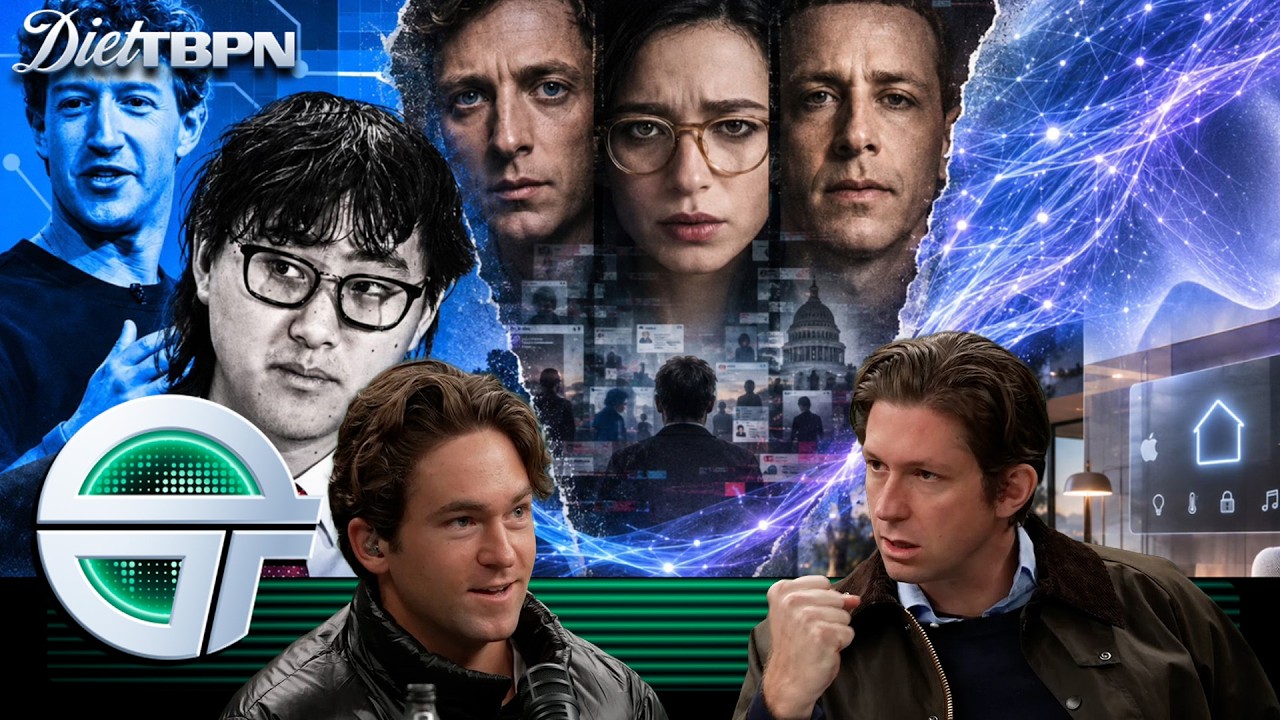
Zuckerberg Compute Push Breaks Coordinated AI Slowdown Plans
TBPN
Meta's massive capital expenditure and political alignment with Donald Trump have dismantled voluntary industry pacing agreements by forcing competing frontier labs to accelerate or risk obsolescence.
Aaron Sorkin's 'The Social Reckoning' opened to an underwhelming $9 million worldwide against a $40 million budget, drawing criticism for out-of-date Silicon Valley tropes and disconnected portrayals of modern tech. (0:00)
Meta launched its Muse Wonder model (codenamed 'Watermelon'), claiming it reaches the frontier of AI capabilities following massive infrastructure and compute investments. (11:52)
Mark Zuckerberg's aggressive compute spending and political alignment with Donald Trump have effectively derailed organized plans for voluntary AI capability pacing and lab slowdowns. (19:09)
Apple introduced the HomeView, a $299 smart home hub with a swiveling display, though hosts criticized it as solving nonexistent problems reminiscent of Meta's discontinued Portal. (24:19)
The FBI arrested an OpenAI employee, Saudi national Abdulrahman Al-Fazan, after OpenAI used internal AI models to identify a hidden listening device planted in its offices. (28:52)
Detailed notes
## Background
Published by TBPN on YouTube on October 14, 2026, this episode of Diet TBPN delivers a 30-minute digest of the daily live tech talk show hosted by John Coogan and Jordi Hays. According to the page description, the episode covers John's review of the Aaron Sorkin film 'The Social Reckoning', Meta's release of the Muse Wonder AI model and Mark Zuckerberg's recent public appearances, Apple's new $299 HomeView hub, and an FBI arrest following a bugging incident at OpenAI.
## TL;DR
John Coogan and Jordi Hays break down the box-office flop of Aaron Sorkin's 'The Social Reckoning', arguing Hollywood remains trapped in outdated 2019 tropes while completely misrepresenting modern software engineering and Zuckerberg's reinvented persona. Turning to real-world AI developments, they examine Meta's launch of Muse Wonder, questioning whether its benchmarks truly hit the frontier while noting that Zuckerberg's relentless compute spending effectively destroys any coordinated AI slowdown movement. Finally, the hosts pan Apple's $299 HomeView smart display as uninspired stagnation before reacting to national security news involving an insider bug planted inside OpenAI.
## Atmosphere & style
The episode has the lively, satirical, and fast-paced energy of an insider Silicon Valley watercooler chat between friends. John and Jordi trade irreverent banter—poking fun at Jeremy Allen White playing a tech-illiterate reporter, Zuckerberg drinking 1.4 pints on a podcast, and bulletproof couches—before cleanly pivoting into astute strategic breakdowns of model economics, capex cycles, and corporate espionage. It feels punchy, entertaining, and unapologetically accelerationist, grounded in practical tech industry realities rather than Hollywood dramatization.
## Bulletin
- [00:00](https://www.youtube.com/watch?v=Xd6Rd48smg0&t=0s) Aaron Sorkin's 'The Social Reckoning' opened to an underwhelming $9 million worldwide against a $40 million budget, drawing criticism for out-of-date Silicon Valley tropes and disconnected portrayals of modern tech.
- [11:52](https://www.youtube.com/watch?v=Xd6Rd48smg0&t=712s) Meta launched its Muse Wonder model (codenamed 'Watermelon'), claiming it reaches the frontier of AI capabilities following massive infrastructure and compute investments.
- [19:09](https://www.youtube.com/watch?v=Xd6Rd48smg0&t=1149s) Mark Zuckerberg's aggressive compute spending and political alignment with Donald Trump have effectively derailed organized plans for voluntary AI capability pacing and lab slowdowns.
- [24:19](https://www.youtube.com/watch?v=Xd6Rd48smg0&t=1459s) Apple introduced the HomeView, a $299 smart home hub with a swiveling display, though hosts criticized it as solving nonexistent problems reminiscent of Meta's discontinued Portal.
- [28:52](https://www.youtube.com/watch?v=Xd6Rd48smg0&t=1732s) The FBI arrested an OpenAI employee, Saudi national Abdulrahman Al-Fazan, after OpenAI used internal AI models to identify a hidden listening device planted in its offices.
## Key takeaways
- [00:00](https://www.youtube.com/watch?v=Xd6Rd48smg0&t=0s) 'The Social Reckoning' underperformed at the box office ($9 million worldwide on a $40 million budget) and holds a 55% Rotten Tomatoes score, failing to capture public interest.
- [00:00](https://www.youtube.com/watch?v=Xd6Rd48smg0&t=0s) The film centers on whistleblower Frances Haugen and WSJ reporter Jeff Horwitz, sidelining Mark Zuckerberg and feeling like a dated 2019 time capsule compared to today's AI superintelligence race.
- [02:30](https://www.youtube.com/watch?v=Xd6Rd48smg0&t=150s) Aaron Sorkin's script misses the modern reality of Zuckerberg's reinvention—including jiu-jitsu, fashion changes, and AI leadership—and ignores critical economic questions around frontier models.
- [05:00](https://www.youtube.com/watch?v=Xd6Rd48smg0&t=300s) Hollywood continues to lean on absurd technical tropes, such as portraying algorithm tuning as a CEO manually assigning points to outrage rather than complex ranking optimization pipelines.
- [10:00](https://www.youtube.com/watch?v=Xd6Rd48smg0&t=600s) The film invents a romantic subplot between Horwitz and Haugen despite real-life objections, and mischaracterizes the high-stakes coordinated group chats between tech CEOs surrounding the Trump ban.
- [11:52](https://www.youtube.com/watch?v=Xd6Rd48smg0&t=712s) Mark Zuckerberg launched Meta's Muse Wonder model ('Watermelon') and celebrated on the 'Cheeky Pint' podcast, drinking 1.4 pints on camera with the Collison brothers.
- [15:37](https://www.youtube.com/watch?v=Xd6Rd48smg0&t=937s) Meta hedged whether Muse Wonder genuinely matches top-tier models like Astra or Fable, continuing industry debates over whether Meta is 'bench-maxing' evaluations.
- [15:37](https://www.youtube.com/watch?v=Xd6Rd48smg0&t=937s) Despite benchmarking debates, Meta Supercomputing and MSL have driven far more public excitement and momentum over the past year than competitors like Google or xAI.
- [19:09](https://www.youtube.com/watch?v=Xd6Rd48smg0&t=1149s) Zuckerberg acts as the single defector breaking AI safety pacing, adhering to an earnings call mandate that he would rather overspend on compute and be wrong than miss the next capability leap.
- [20:00](https://www.youtube.com/watch?v=Xd6Rd48smg0&t=1200s) Political alignment among Donald Trump, Mark Zuckerberg, and Jensen Huang has removed federal pressure for mandatory AI lab slowdowns or capability pacing.
- [20:00](https://www.youtube.com/watch?v=Xd6Rd48smg0&t=1200s) Operating as a strong second or third player provides strategic cover for Meta, allowing them to ship powerful coding models while frontier leaders like Anthropic absorb bioweapon and safety scrutiny.
- [20:00](https://www.youtube.com/watch?v=Xd6Rd48smg0&t=1200s) Zuckerberg's modern unfiltered persona—including live streaming smoking meats on a Big Green Egg—demonstrates a media strategy that bypasses traditional corporate and Hollywood filters.
- [24:19](https://www.youtube.com/watch?v=Xd6Rd48smg0&t=1459s) Apple's $299 HomeView smart home hub lacks ambitious industrial design and advanced autonomous agent capabilities, closely mirroring Meta's failed Portal line.
- [28:52](https://www.youtube.com/watch?v=Xd6Rd48smg0&t=1732s) OpenAI leveraged its own internal models to uncover a hidden surveillance recorder planted in its corporate office, leading to the termination and arrest of an insider.
- [28:52](https://www.youtube.com/watch?v=Xd6Rd48smg0&t=1732s) The arrest of Abdulrahman Al-Fazan by the FBI underscores that physical corporate espionage and foreign intelligence threats have become entrenched realities in the AI frontier race.
## Detailed walkthrough
### [00:00](https://www.youtube.com/watch?v=Xd6Rd48smg0&t=0s) Reviewing 'The Social Reckoning' and Opening Weekend Flop
After returning to the Ultradome from an overly long four-day weekend, John Coogan and Jordi Hays catch up on John’s weekend trip to the movie theater to see *The Social Reckoning* during its opening weekend. While Jordi expresses zero interest in seeing the film—contrasting his complete indifference toward it with his massive excitement for the upcoming Nathan Fielder movie—John felt an obligation to attend on behalf of the show. Arriving at a completely empty Los Angeles theater on a rainy Saturday, John realized he had accidentally dressed up in identical attire to the movie’s lead character, *Wall Street Journal* investigative reporter Jeff Horwitz. Wearing the exact same jacket, jeans, and boots, John joked that he felt like a kid dressed up as Spider-Man going to see an *Avengers* movie.
Far from being a direct sequel to *The Social Network*, the film abandons the tight protagonist-antagonist dynamic and internal Facebook company politics of its predecessor. Mark Zuckerberg is largely relegated to a peripheral figure—played this time by Jeremy Strong rather than Jesse Eisenberg—while the narrative centers on whistleblower data engineer Frances Haugen and Horwitz. The film opened to an underwhelming $9 million worldwide against a $40 million budget, sitting at a 55% Rotten Tomatoes score across 215 reviews. John and Jordi observe that the movie completely failed to capture cultural attention because it felt like a dated time capsule from 2019, thoroughly out of step with the current scaling era and tech's collective obsession with the race toward superintelligence.
- **Opening Box Office:** $9 million worldwide opening on a $40 million production budget.
- **Critical Reception:** 55% Rotten Tomatoes score across 215 aggregated reviews.
- **Key Cast & Roles:** Jeremy Strong as Mark Zuckerberg, Jeremy Allen White portraying *Wall Street Journal* reporter Jeff Horwitz, alongside the character of Frances Haugen.
---
[02:30](https://www.youtube.com/watch?v=Xd6Rd48smg0&t=150s) Sorkin’s Outdated Narrative and Missing the AI Frontier
John critiques the film’s writer, Aaron Sorkin, for failing to capture the modern reality of tech and Meta’s dramatic transformation. Zuckerberg has thoroughly reinvented his public persona over the past several years—embracing Brazilian jiu-jitsu and UFC training, undergoing a dramatic fashion overhaul, launching designer smart glasses, rebranding the company to Meta, and spearheading personal AI assistants. In light of that transformation, Jeremy Strong’s portrayal feels entirely disconnected from who Zuckerberg is today, even though Strong is roughly the same age as Zuckerberg.
Poking fun at the cliché that journalism must "speak truth to power," John satirically dings Sorkin for neglecting the actual hard questions Silicon Valley is asking today about Meta and frontier AI models. Instead of re-litigating old controversies already settled in courtrooms and congressional hearings, John jokes that Sorkin completely dropped the ball by failing to investigate the core product and economic questions surrounding Meta’s newly launched Muse Wonder model.
- **Unasked Frontier Questions:** Whether Muse's profit margins will ever compare to Meta’s core advertising engine, and whether Muse Wonder's competitive benchmark performance disrupts the underlying frontier model economic thesis.
- **Retention Curve Concerns:** Missing real-world product usage data, such as DD Das’s post highlighting steep user drop-offs after 14 days, and whether Muse's retention curve will ever "smile."
- **Meta's Counter-Programming:** Meta effectively steamrolled the movie's cultural impact with positive news cycles, including Zuckerberg's appearance on *Cheeky Pint* and the Muse Wonder launch.
---
[05:00](https://www.youtube.com/watch?v=Xd6Rd48smg0&t=300s) Hollywood Tropes, Tech Journalism Glazing, and Sorkin's Algorithm Scene
Joined by Michael off-mic, the hosts break down why the film falls flat as a piece of cinema. Michael notes that while he is usually a fan of Aaron Sorkin, *The Social Reckoning* feels deeply contrived, overly polished, and uncomfortably forced as it attempts to mimic an 1980s investigative journalism thriller like *All the President's Men*. John describes the film as an unabashed "glazed piece" on the *Wall Street Journal*, pointing out the comedic disparity of casting the shredded, "diced" Jeremy Allen White as an "offline" print journalist who claims he doesn't know how Facebook or GPS navigation works.
The hosts point out several scenes where the film's anti-tech slant unintentionally highlights the benefits of the internet. During a pandemic sequence, Haugen's character sets up a Facebook group for scientists sounding the alarm on COVID-19 early, while Horwitz dismisses the warnings as mumbo-jumbo—echoing how online figures like Balaji Srinivasan spotted the pandemic months before legacy institutions. Another scene attempts to mock Zuckerberg's paranoia by revealing he owns a bulletproof couch. Rather than making Zuckerberg look cowardly for hiding, the hosts argue the couch comes off as the "literal coolest thing ever."
```mermaid
flowchart TD
accTitle: Hollywood Algorithm Tropes vs Reality
accDescr: Contrasts Sorkin's oversimplified script with Meta's actual corporate execution hierarchy.
CEO --> HeadIG
HeadIG --> CTO
CTO --> VPEng
VPEng --> RankingEng
end
```
The discussion turns to how Hollywood fundamentally misunderstands software architecture. John highlights a boardroom scene where Sorkin has Zuckerberg personally explaining Facebook's ranking algorithm to the board by declaring that emoji reactions are worth five points and retweets are worth fifty points to intentionally maximize outrage. John contrasts this cartoonish portrayal with how engineering actually functions across a dozen layers of management—cascading down from executive leadership like Adam Mosseri to the CTO, VP of Engineering, and deeply nested ranking teams. Finally, they contrast the film with the original *The Social Network*, which became a cult classic that shaped an entire generation of founders and ironically pushed Zuckerberg himself to eventually adopt the swagger of the film's Sean Parker persona.
[10:00](https://www.youtube.com/watch?v=Xd6Rd48smg0&t=600s) Hollywood's Bizarre Tech Tropes and *The Social Reckoning*
The hosts mock the dramatic tropes in Aaron Sorkin's depiction of Silicon Valley in *The Social Reckoning*, noting how fundamentally detached Hollywood remains from how tech companies operate. Inside Facebook, algorithmic changes are not managed by people manually dialing up individual metrics; rather, engineers build complex optimization pipelines targeting retention where massive amounts of signal feed into a black box. The absurdity culminates in the film's climactic shot of Mark Zuckerberg on January 6: he sits in a war room staring at a 42-inch television while code rapidly scrolls down the screen. "That’s not how you monitor a situation," John laughs, pointing out that one could simply open Instagram instead of pseudo-auditing high-speed terminal lines.
```mermaid
flowchart TD
accTitle: Hollywood Myth vs Reality of Tech Operations
accDescr: Contrasting Aaron Sorkin's film tropes with the actual engineering realities at Facebook.
subgraph Hollywood["Hollywood Trope (The Social Reckoning)"]
H1["War room with 42-inch TV"] --> H2["Code scrolling at extreme speeds"]
H3["Lone CEO makes unilateral ban decisions"]
end
subgraph Reality["Actual Tech Reality"]
R1["Retention optimization pipeline"] --> R2["Data black box (beyond human micromanagement)"]
R3["CEOs coordinate in private group chats"]
end
```
The film also misrepresents high-stakes executive decisions, framing the Trump ban as Zuckerberg’s solitary, dramatic choice. In reality, tech CEOs were in coordinated group chats realizing that anyone acting alone would be scapegoated, necessitating a synchronized move. Furthermore, the film invents a romantic subplot between whistleblower Frances Haugen and *Wall Street Journal* reporter Jeff Horwitz. Despite Horwitz explicitly begging Sorkin not to portray their professional reporter-source dynamic as romantic—pointing out that both were married to other people—the film leans heavily into flirtatious tension that ends with them practically sailing off into the sunset together.
[11:52](https://www.youtube.com/watch?v=Xd6Rd48smg0&t=712s) Zuck Drinks 1.4 Pints on *Cheeky Pint* to Launch Muse Wonder
Turning to industry headlines, Meta announced its new Muse Wonder model (codenamed "Watermelon," following AI's running fruit naming trend after Strawberry and Banana). In a featured *Financial Times* interview, Mark Zuckerberg claimed the model brings Meta directly to the frontier of sophisticated AI behavior. Reaching this milestone demanded billions in compute, aggressive infrastructure outlays, and top-dollar talent poaching to challenge OpenAI, Anthropic, and Google.
To gauge how Mark Zuckerberg and Alex really felt about the launch, Jordy tuned into the return episode of the *Cheeky Pint* podcast with the Collison brothers. Zuckerberg appeared remarkably relaxed—drinking on camera in an unusually candid mood.
- **Beer intake logged:** Show researcher Tyler tracked that Zuckerberg drank exactly 1.4 pints during the recording.
- **The drinking podcast trap:** The hosts observe from their own past celebratory recordings that alcohol consistently degrades podcast sharpness: "With each sip, it was getting like a little bit worse."
- **Preparation hypothesis:** The hosts joke that Zuckerberg must have been practicing with 6 to 12 Guinnesses a day just to maintain focus and execute a major model release after 1.4 pints.
[15:37](https://www.youtube.com/watch?v=Xd6Rd48smg0&t=937s) Bench-Maxing and Whether Meta Has Actually Hit the Frontier
Despite Meta's public victory lap, Jordy dissects Zuckerberg's precise phrasing on *Cheeky Pint* to question whether Muse Wonder actually sits on the true frontier. When pressed at the 24-minute mark by Collison on whether the model is genuinely at Astra or Fable level, Zuckerberg and Alex hesitated before offering a hedged response: "By looking at the benchmarks, one would conclude that." Jordy argues that while the benchmarks look stunning, Meta has historically faced accusations of "bench-maxing" (optimizing strictly for test evaluations, reminiscent of early Llama and Spark releases).
| Model / Lab Focus | Host Assessment | Industry Context |
|:--- |:--- |:--- |
| **Meta (Muse Wonder / MSL)** | Strong product execution, late-mover UX advantages, but benchmark claims appear carefully hedged. | High momentum; out-exciting legacy giants despite skepticism over whether it truly matches Anthropic's top-tier Fable class. |
| **Google** | Perceived as trailing Meta in raw public excitement and agility. | Struggling to maintain narrative dominance against Meta's open-weight and open-product pushes. |
| **xAI / SpaceX** | Musk has downplayed release timing despite having top talent and Cursor integration. | Yet to ship a breakthrough frontier model post-merger; progress discussed far more cautiously. |
Even with caveats around frontier parity, the hosts agree that Meta Supercomputing / MSL deserves immense credit. Compared to Google or xAI/SpaceX, Meta has generated far more genuine enthusiasm over the past twelve months. Zuckerberg's aggressive talent raids and willingness to give away frontier-adjacent capabilities for free inside consumer products have completely reshaped the competitive landscape.
[19:09](https://www.youtube.com/watch?v=Xd6Rd48smg0&t=1149s) Zuckerberg Defeats the AI Slowdown Plan
The conversation shifts to the clash between Effective Altruism (EA) safety orthodoxies and Zuckerberg's relentless accelerationism. In *The Social Reckoning*, when Frances Haugen is confronted with the statistic that 34% of teenage girls report negative body image impacts on Instagram, the film presents it as an unforgivable indictment. Yet through an EA utilitarian lens, the hosts joke that if 46% experience a positive impact against 34% negative, an optimizer would gladly execute that spreadsheet trade.
This philosophical rift is now coming to a head in frontier AI policy. As commentator Andrew Curran highlighted, any organized plan for "AI pacing" or voluntary lab slowdowns is officially broken because Mark Zuckerberg refuses to cooperate:
- **The single-defector problem:** Voluntary safety slowdowns require total unanimity among major US frontier labs; a single defection forces everyone else to accelerate to avoid being made obsolete.
- **Unwavering compute capex:** Zuckerberg spent years pouring capital into colossal data center capacity despite intense investor pushback.
- **The earnings call mandate:** On an earnings call years prior, Zuckerberg announced he would rather overspend and be wrong than risk lacking the compute necessary for the next 10x capability leap.
- **Political barrier to pacing:** Halting a well-capitalized defector would require an explicitly pro-pacing government administration willing to impose strict legal restraints, leaving the safety movement with no leverage over Meta's momentum.
[20:00](https://www.youtube.com/watch?v=Xd6Rd48smg0&t=1200s) AI Regulation, the Frontier Trap, and Zuck’s Barbecue Return
The hosts dive into the politics of AI regulation, pointing out that any hopes for government-enforced capability pacing have effectively evaporated. Contrary to the idea that federal authorities might step in to force frontier labs into compliance, Mark Zuckerberg has the ear of Donald Trump, with President Trump, Zuckerberg, and Jensen Huang standing completely aligned on policy: "It's full speed ahead. And if you want to pace yourself, go ahead, but don't tell anyone else what to do." This political landscape fundamentally shatters any coordinated plans for artificial intelligence slowdowns.
```mermaid
flowchart TD
accTitle: Political Alignment vs AI Frontier Trade-offs
accDescr: Diagram illustrating political alignment between Trump, Zuckerberg, and Huang leading to no pacing, and the resulting trade-off between frontier prestige and safety liability.
subgraph Alignment["Washington & Silicon Valley Alignment"]
A["Trump + Zuckerberg + Jensen"] -->|"Full speed ahead"| B["AI Slowdown / Pacing Broken"]
end
subgraph Positioning["Frontier vs Fast Follower"]
B --> C{"Lab Strategic Positioning"}
C -->|"Frontier Lab"| D["Hype & Adoption Surge<br/>Target for Safety/Bioweapon Scrutiny"]
C -->|"Strong Second / Third"| E["Cover from Scrutiny<br/>Muse Wonder codes well without bioweapon risk"]
end
```
The discussion shifts to the strategic trade-off of claiming to be on the cutting edge. While frontier status drives consumer adoption—with people rushing to try whatever matches Astra or Fable class, especially if integrated directly into Instagram—it also attracts relentless political and existential scrutiny. Being a strong second or third player offers real cover: labs like Meta can point out that models like Muse Wonder excel at coding while leaving the nightmarish responsibility of policing bioweapon emergence and existential hazards to frontier pioneers like Anthropic, whose executives look as though they have seen "manmade horrors... beyond all comprehension."
Transitioning to Zuckerberg's public persona, the hosts pull up a Saturday live stream where Zuck returned to his roots: smoking meat out on the Big Green Egg grill. The guys joke about his casual swagger ("We're smoking sausage. Smoke whatever the fuck we want") and reflect on how dramatically his media strategy has evolved since the era depicted in *The Social Network*. Modern Zuck bypasses traditional filters, talks candidly on podcasts, and engages directly with fans, creating a completely distinct persona that Hollywood movies fail to capture. They also defend his aggressive capital expenditure against critics like Dario Amodei, who previously suggested tech CEOs were recklessly "YOLOing" massive capital. Meta's willingness to invest heavily isn't reckless gambling of the enterprise; it is Zuckerberg treating $10 billion like pocket change out of a $200 billion cash engine, boldly betting on potential paradigm shifts in pure software where companies can leap back to the frontier far faster than in hardware domains like the metaverse.
[24:19](https://www.youtube.com/watch?v=Xd6Rd48smg0&t=1459s) Apple's $299 HomeView Hub: Innovation or Stagnation?
Apple hardware executive John Ternus unveiled the HomeView, a $299 dedicated smart home hub that the hosts inspect via announcement video. Styled like a rounded-rectangle Apple Watch or small squircle iPad on an articulating base, the device swivels to track users around the room, such as while cooking at a kitchen island. Despite Apple touting Apple Intelligence, the hosts view the announcement with heavy skepticism, describing it as a product that "screams stagnation" and solves a problem nobody really has:
- **Disappointing Industrial Design**: Rather than a whimsical, dynamic Pixar-style lamp arm, the device features a plain swiveling base with manual vertical adjustments.
- **The Portal Precedent**: The concept directly mirrors Meta’s failed Portal hardware from the pandemic era—a device that ended up relegated to glorified digital photo frames collecting dust.
- **Agentic Deficits**: While competitors like Muse, Instinct, Dot, and Grok race toward complex autonomous tasks (e.g., end-to-end birthday planning, restaurant booking, and invite coordination), Apple's software still feels far from reliable autonomous execution.
- **The Ideal Solution**: The host notes they would only get excited if Apple delivered genuine whole-home integration—replacing glitchy third-party touchscreens to control garage doors, gates, HVAC, security cameras, and lighting, rather than delivering a tethered mini-tablet for FaceTime calls.
[28:52](https://www.youtube.com/watch?v=Xd6Rd48smg0&t=1732s) Corporate Espionage: OpenAI Bugging and FBI Arrest
The show pivots to breaking national security news on the timeline: OpenAI uncovered a sophisticated surveillance device planted directly inside one of its corporate offices. According to an official newsroom release, OpenAI deployed internal AI models to investigate and identify the hardware, tracing it back to an internal employee who had hidden it a few days prior.
```mermaid
flowchart LR
accTitle: OpenAI Espionage Incident Flow
accDescr: Flowchart detailing the discovery of a bug inside OpenAI, the internal model investigation, employee firing, and the subsequent FBI arrest.
A["Bug Discovered in Office"] --> B["OpenAI Uses Models to Identify Device"]
B --> C["Insider Identified & Terminated"]
C --> D["Referred to Federal Authorities"]
D --> E["FBI Arrests Saudi National Abdulrahman Al-Fazan"]
```
Federal prosecutors arrested Saudi national Abdulrahman Al-Fazan, charging him with intercepting or attempting to intercept oral communications. Investigators reported he had concealed an audio recorder inside the office and left a second unattended device in his bag. While OpenAI stated there was no evidence that model weights, source code, or proprietary customer data were exfiltrated, the hosts marvel at the wild nature of the case, reacting to an odd behind-the-TV surveillance photograph and noting that high-stakes corporate espionage and foreign nation-state spying are now firmly entrenched realities of the frontier AI race.
## Notable quotes
> [02:30](https://www.youtube.com/watch?v=Xd6Rd48smg0&t=150s) speak truth to power
> [05:00](https://www.youtube.com/watch?v=Xd6Rd48smg0&t=300s) glazed piece — John Coogan
> [10:00](https://www.youtube.com/watch?v=Xd6Rd48smg0&t=600s) That’s not how you monitor a situation, — John Coogan
> [11:52](https://www.youtube.com/watch?v=Xd6Rd48smg0&t=712s) With each sip, it was getting like a little bit worse.
> [15:37](https://www.youtube.com/watch?v=Xd6Rd48smg0&t=937s) By looking at the benchmarks, one would conclude that. — Mark Zuckerberg
> [20:00](https://www.youtube.com/watch?v=Xd6Rd48smg0&t=1200s) It's full speed ahead. And if you want to pace yourself, go ahead, but don't tell anyone else what to do.
> [20:00](https://www.youtube.com/watch?v=Xd6Rd48smg0&t=1200s) manmade horrors... beyond all comprehension.
> [20:00](https://www.youtube.com/watch?v=Xd6Rd48smg0&t=1200s) We're smoking sausage. Smoke whatever the fuck we want — Mark Zuckerberg
## Mentioned
Aaron Sorkin, Abdulrahman Al-Fazan, Adam Mosseri, Andrew Curran, Anthropic, Apple, Balaji Srinivasan, Cheeky Pint, Collison brothers, Dario Amodei, DD Das, Donald Trump, FBI, Frances Haugen, Google, HomeView, Jeff Horwitz, Jensen Huang, Jeremy Allen White, Jeremy Strong, Jesse Eisenberg, John Coogan, John Ternus, Jordi Hays, Mark Zuckerberg, Meta, Muse Wonder, Nathan Fielder, OpenAI, SpaceX, The Social Network, The Social Reckoning, Wall Street Journal, xAI
## Video description
Sign up for TBPN’s daily newsletter at TBPN.com
Diet TBPN delivers the best of today’s TBPN episode in 30 minutes. TBPN is a live tech talk show hosted by John Coogan and Jordi Hays, streaming weekdays 11–2 PT on X and YouTube, with each episode posted to podcast platforms right after.
Described by The New York Times as “Silicon Valley’s newest obsession,” the show has recently featured Mark Zuckerberg, Sam Altman, Mark Cuban, and Satya Nadella.
TBPN is made possible by:
Ramp - https://ramp.com
Public - https://public.com
Cisco - https://www.cisco.com
Console - https://www.console.com
CrowdStrike - https://www.crowdstrike.com
Figma - https://www.figma.com
MongoDB - https://www.mongodb.com
NYSE - https://www.nyse.com
Railway - https://railway.com
Shopify - https://www.shopify.com/
Chapters:
00:00 John Reviews The Social Reckoning
07:18 Zuck’s Reinvention + What Hollywood Gets Wrong About Tech
11:52 Meta Launches Muse Wonder + Zuck on Cheeky Pint
15:37 Is Muse Wonder Really at the AI Frontier?
19:09 Does Zuckerberg Break the AI Slowdown Plan?
24:19 Apple’s $299 HomeView + Does It Solve a Real Problem?
28:52 OpenAI Reports a Hidden Recorder + FBI Arrest
Hosts John Coogan and Jordi Hays argue that Hollywood's dramatizations of Big Tech are hopelessly outdated, as seen in the box-office flop of Aaron Sorkin's *The Social Reckoning*, while the real industry has shifted toward relentless frontier AI competition and geopolitical corporate espionage.
Hollywood's Disconnect in 'The Social Reckoning' (0:00)
Aaron Sorkin's *The Social Reckoning* opened to a disappointing $9 million worldwide against a $40 million budget, alongside a 55% Rotten Tomatoes score. The TBPN hosts argue the film flopped because it operates as a dated 2019 time capsule focused on whistleblowing and legacy journalism rather than the current AI scaling era. Sorkin's script casts Jeremy Strong as Mark Zuckerberg and Jeremy Allen White as reporter Jeff Horwitz, but the hosts view the portrayals as deeply contrived, leaning on Hollywood clichés that misrepresent software architecture. Scenes showing Zuckerberg personally setting algorithm point scores or auditing scrolling code lines on January 6 contrast sharply with real corporate engineering pipelines and retention optimization black boxes.
Meta's Muse Wonder and Frontier Acceleration (11:52)
In contrast to his muted cinematic depiction, Zuckerberg has overhauled his public profile while aggressively positioning Meta at the AI frontier with the Muse Wonder model (codenamed 'Watermelon'). While Meta's benchmark claims may reflect historical 'bench-maxing' rather than clear parity with Anthropic's top-tier models, the hosts emphasize that Meta has generated substantial momentum by pairing massive infrastructure investments with consumer distribution. Furthermore, Zuckerberg's refusal to slow down compute spending effectively dismantles voluntary AI pacing initiatives; aligned politically with President Donald Trump and Jensen Huang on rapid deployment, Meta acts as a well-capitalized defector against lab slowdown orthodoxies while sidestepping the severe existential scrutiny directed at pioneers like Anthropic.
Apple HomeView Skepticism and Hardware Stagnation (24:19)
Addressing hardware developments, the hosts sharply criticize Apple's newly announced $299 HomeView hub. Led by Apple hardware executive John Ternus, the squircle device swivels to track users around a room, yet the hosts compare it unfavorably to Meta's defunct Portal device from the pandemic era. They view the product as evidence of corporate stagnation that fails to deliver true whole-home automation—such as native control over HVAC, garage doors, and lighting—while Apple Intelligence continues to lag behind competitors like Muse, Instinct, and Grok in executing complex, autonomous agentic workflows.
Espionage Realities in Frontier AI (28:52)
The race toward advanced AI is increasingly attracting nation-state surveillance, demonstrated by OpenAI uncovering an audio bug hidden inside its corporate offices. According to an official company release, OpenAI used internal AI models to investigate and identify the hardware, leading to the termination and subsequent FBI arrest of employee Abdulrahman Al-Fazan. Federal prosecutors charged the Saudi national with intercepting or attempting to intercept oral communications. While OpenAI reported no compromise of model weights, proprietary customer data, or source code, the hosts observe that corporate espionage is now an entrenched risk of the frontier landscape.
While legacy media focuses on past controversies and hardware makers release incremental smart home devices, frontier AI labs face urgent, unresolved dynamics: navigating whether benchmark parity translates into sustainable software economics and defending valuable model development against foreign espionage.
Detailed notes — zh
## Background
该视频由科技脱口秀频道 TBPN(Technology Brothers)于 2026 年 10 月 14 日发布在 YouTube 平台。视频属于该节目的精简版《Diet TBPN》,由 John Coogan 与 Jordi Hays 共同主持,旨在通过 30 分钟的高密度快节奏对谈,呈现科技圈内关于扎克伯格影视化叙事、前沿 AI 竞争以及硬件发布的最新动态。
## TL;DR
节目首先辛辣吐槽了亚伦·索尔金的新片《社交清算》,指出好莱坞在刻画科技行业与扎克伯格时严重脱节且过时;随后深入剖析了 Meta 全新 AI 智能体模型 Muse Wonder 的发布、扎克伯格的播客亮相以及其凭借海量算力打破“AI 减速派”幻想的行业影响。主持人还针对苹果新推出的 299 美元智能中控 HomeView 提出质疑,认为其解决的是伪需求;最后通报了 OpenAI 办公室内惊现间谍录音器并由 FBI 介入逮捕沙特籍涉案员工的现实谍战事件。
## Atmosphere & style
整期节目散发着硅谷从业者特有的敏锐、松弛与辛辣幽默,两位主持人既像在咖啡馆即兴调侃,又能在商业战略和技术洞察上刀刀见血。对好莱坞电影的拆解充满了对影视圈无知的不屑与捧腹笑料,而转向算力资本战与间谍窃听风云时,语调又迅速切换至严肃与敏锐,让听众切实感受到科技前沿竞赛正从键盘代码演化为地缘博弈的紧绷感。
## Bulletin
- [00:00](https://www.youtube.com/watch?v=Xd6Rd48smg0&t=0s) 索尔金执导的 Meta 主题新片《社交清算》首周末全球票房仅 900 万美元(制作成本 4000 万美元),烂番茄新鲜度 55%,因脱离当前 AI 与技术现实而遭遇口碑与商业双重失利。
- [11:52](https://www.youtube.com/watch?v=Xd6Rd48smg0&t=712s) Meta 正式发布代号 Watermelon 的智能体模型 Muse Wonder,扎克伯格坚称已达 AI 前沿,但其回避正面比肩顶级旗舰模型的表态引发业界对其基准测试含金量的审视。
- [19:09](https://www.youtube.com/watch?v=Xd6Rd48smg0&t=1149s) 扎克伯格携海量资本支出推进算力竞赛,并与白宫及英伟达形成“全速推进”政策共识,彻底瓦解了有效利他主义派倡导的全球 AI 研发减速计划。
- [24:19](https://www.youtube.com/watch?v=Xd6Rd48smg0&t=1459s) 苹果发布售价 299 美元的智能家居中控 HomeView,但因硬件形态受限且缺乏高阶 Agent 执行力,被指重蹈 Meta Portal 覆辙、未能解决底层全屋控制痛点。
- [28:52](https://www.youtube.com/watch?v=Xd6Rd48smg0&t=1732s) OpenAI 办公区查获隐蔽窃听设备,涉案沙特籍员工被 FBI 逮捕,凸显前沿 AI 实验室已沦为国家级情报渗透的高危地缘政治目标。
## Key takeaways
- [00:00](https://www.youtube.com/watch?v=Xd6Rd48smg0&t=0s) 《社交清算》打破了前作的叙事核心,扎克伯格戏份边缘化,将焦点转向告密者豪根与记者霍维茨,整体叙事滞后于当下大模型时代。
- [03:00](https://www.youtube.com/watch?v=Xd6Rd48smg0&t=180s) 索尔金在剧本选题上放弃了追问 Meta 当前 Muse 模型经济学、商业留存等核心现实问题,流于对已解决旧闻的戏剧化翻炒。
- [07:18](https://www.youtube.com/watch?v=Xd6Rd48smg0&t=438s) 影片对技术运作机制极度缺乏常识,甚至虚构出扎克伯格在国会山骚乱时审查滚动代码、在白板上手写粗暴算法权重的荒诞戏码。
- [07:18](https://www.youtube.com/watch?v=Xd6Rd48smg0&t=438s) 扎克伯格通过格斗训练、时尚重塑和积极公关完成了个人形象的彻底蜕变,与好莱坞刻画的古板冷酷极客形象产生严重割裂。
- [11:52](https://www.youtube.com/watch?v=Xd6Rd48smg0&t=712s) Meta 战略实验室(MSL)过去一年通过激进投资和重金挖角,在外界期待值上已成功压过 Google 与马斯克的 xAI。
- [15:37](https://www.youtube.com/watch?v=Xd6Rd48smg0&t=937s) 面对是否达到 Anthropic 旗舰水平的追问,扎克伯格仅以“基准测试会让人得出该结论”作答,反映出 Meta 对自身绝对前沿地位仍显底气不足。
- [15:37](https://www.youtube.com/watch?v=Xd6Rd48smg0&t=937s) Meta 将庞大模型直接免费整合进成熟生态的商业打法,显著降低了用户的尝试门槛,具备极强的落地转化优势。
- [19:09](https://www.youtube.com/watch?v=Xd6Rd48smg0&t=1149s) 扎克伯格对算力基础设施的铁血押注粉碎了行业协同放慢研发步调的可能,迫使其他前沿实验室只能被动加速跟进。
- [20:00](https://www.youtube.com/watch?v=Xd6Rd48smg0&t=1200s) 处于 AI 第二或第三梯队的实验室享有独特的监管掩护,既能享受技术赋能红利,又能规避生物安全等极端审查风暴。
- [20:00](https://www.youtube.com/watch?v=Xd6Rd48smg0&t=1200s) 扎克伯格依托 Meta 年入 2000 亿美元的超级现金牛,将数百亿算力投入视作可承受的试错成本,纯软件赛道的迭代周期也远快于元宇宙硬件。
- [24:19](https://www.youtube.com/watch?v=Xd6Rd48smg0&t=1459s) 苹果 HomeView 的机械旋转与视频跟随功能缺乏实际痛点支撑,若无法深入底层接管全屋智能设备,将很难摆脱“厨房大号玩具”的尴尬地位。
- [28:52](https://www.youtube.com/watch?v=Xd6Rd48smg0&t=1732s) OpenAI 运用自身 AI 工具逆向分析隐蔽监听装置并协助 FBI 抓捕内鬼,表明前沿 AI 竞赛已深度卷入现实间谍战与国家级安全对抗。
## Detailed walkthrough
### [00:00](https://www.youtube.com/watch?v=Xd6Rd48smg0&t=0s) 约翰观影《社交清算》:空荡的影院与意外的“戏服”撞衫
在结束了一个略显漫长的周末后,约翰·库根(John Coogan)与霍尔迪·海斯(Jordi Hays)重返演播室。约翰聊起了自己利用周末在洛杉矶冒雨去影院观看阿伦·索尔金(Aaron Sorkin)执导的新片《社交清算》(*The Social Reckoning*)的经历。虽然正值影片上映的首周末,但放映厅内却空无一人。霍尔迪坦言自己完全没有欲望去看这部电影,更想去看内森·菲尔德(Nathan Fielder)的新作,并调侃 Meta 是不是专门挑这个节点发布 Muse Wonder 并在播客《Cheeky Pint》上频繁亮相,借着接二连三的利好新闻把这部电影的热度给彻底碾压了。
约翰分享了一段令人捧腹的观影插曲:当天洛杉矶有些阴雨,他随手挑了一件夹克、牛仔裤和靴子出门。等他走进影院坐定,银幕上出现《华尔街日报》调查记者杰夫·霍维茨(Jeff Horwitz)时,约翰震惊地发现银幕上的角色竟然穿着和自己完全一样的夹克、牛仔裤和靴子。“我看起来就像《蜘蛛侠》里穿着蜘蛛侠战袍去看《复仇者联盟》的小孩,”约翰笑着回忆道,“我竟然不小心穿着角色的戏服去看了这部电影。”
从电影结构来看,《社交清算》并非《社交网络》(*The Social Network*)传统意义上的续集。它打破了原有的主角与反派结构,不再聚焦 Meta 和 Facebook 内部的具体运营。马克·扎克伯格(Mark Zuckerberg)的演员从杰西·艾森伯格(Jesse Eisenberg)换成了杰里米·斯特朗(Jeremy Strong),且戏份沦为边缘陪衬。整部影片的核心视角转移到了数据工程师弗朗西斯·豪根(Frances Haugen)与《华尔街日报》调查记者杰夫·霍维茨身上。在科技圈普遍聚焦超智能竞争的“缩放时代”(scaling era),这部电影显得极其过时,完全没有回答当下人们对科技巨头最关心的现实问题。
- 全球首周末票房仅录得 900 万美元,相比之下其制作预算高达 4000 万美元,票房表现惨淡并显露出票房扑街的迹象。
- 烂番茄(Rotten Tomatoes)在收集的 215 篇专业影评中,新鲜度仅给出了 55% 的及格边缘评分。
- 影片时长为两小时,在表演和快节奏剪辑上保持了一定水准,但整体更像是一个来自完全不同时代的“时间胶囊”。
### [03:00](https://www.youtube.com/watch?v=Xd6Rd48smg0&t=180s) 索尔金的失职:好莱坞叙事与 AI 时代的割裂
约翰尖锐地批评了编剧兼导演阿伦·索尔金在选题上的退缩。人们常说媒体与文艺作品的职责是“向权力说真话”并提出尖锐问题,但在约翰看来,索尔金彻底放弃了这个职责。如今围绕 Meta 最紧迫、最关键的核心问题根本不在电影探讨的陈年旧案中,而是在于其 AI 战略的商业化和技术可行性。媒体真正应该追问的是:Muse 的利润率能否与 Meta 核心的广告业务相媲美?Muse Wonder 在基准测试上的优异表现是否改变了前沿模型的基础经济学逻辑?
此外,针对 Muse 当前的留存问题,电影也毫无建树。正如 D.D. 达什(D.D. Dosh)发布的数据所示,Muse 在发布第一天引发了狂热关注,但 14 天后的用户留存曲线却显著下滑。约翰强调,媒体有责任去探究其留存曲线未来是否会出现反弹,但索尔金却完全忽视了这些核心议题,转而去翻炒那些早已在司法层面尘埃落定的旧闻。霍尔迪对此赞同并直言,索尔金显然完全放弃了对最硬核现实问题的深究:“媒体有责任去发问、去调查、去质询那个问题,然而索尔金在那方面完全玩忽职守了。”
### [05:00](https://www.youtube.com/watch?v=Xd6Rd48smg0&t=300s) 俗套的剧本、超绝的记者与扎克伯格的“防弹沙发”
节目制作人迈克尔(Michael)也加入讨论,坦言自己虽是阿伦·索尔金的铁杆粉丝,但这部电影完全算不上佳作。整部作品充斥着做作和生硬的戏剧编排,人物动态与对白极度牵强,试图模仿《总统班底》(*All the President's Men*)那种 20 世纪 80 年代的新闻惊悚片,但在当下的语境中却显得过于精致且格格不入。
更滑稽的是影片对《华尔街日报》记者的神化与刻画失真:
- 扮演记者杰夫·霍维茨的演员是杰里米·艾伦·怀特(Jeremy Allen White)。约翰吐槽虽然真实的霍维茨身材保持得不错,但怀特在银幕上浑身肌肉线条分明、极其精壮,活生生被塑造成了一个“终极硬汉”(ultimate Chad)。
- 霍维茨在片中被刻画成极度远离网络的“断网派”,声称自己连 Facebook 账号都没有,连车里的 GPS 都不会用。
- 在一段设定于新冠疫情期间的剧情中,豪根表示自己建立了一个科学家 Facebook 群组,让大家提早认识到了疫情的严重性,而霍维茨却嗤之以鼻斥其为无稽之谈。这种桥段反而弄巧成拙地凸显了互联网和社交媒体的巨大价值,让人联想到巴拉吉(Balaji Srinivasan)早期在网络上准确预警疫情的现实案例。
- 影片还试图用扎克伯格拥有一张“防弹沙发”来渲染他的怪异与软弱,暗示遇到袭击时扎克伯格只会懦弱地躲在沙发后,而不是勇敢迎着枪林弹雨冲上去。约翰则反讽道:“我坐在那儿心想:防弹沙发?太帅了吧!这是一张永远在背后保护你的沙发啊。”
### [07:18](https://www.youtube.com/watch?v=Xd6Rd48smg0&t=438s) 科技巨头的形象重构与好莱坞对算法的荒谬误解
谈到科技叙事的变迁,两人对比了当年的经典《社交网络》。那部电影在科技行业内部被奉为无可替代的经典,但它在文化上产生了反向作用——原本主创可能想揭露扎克伯格的冷酷,结果却激发了一整代创业者争相“成为扎克伯格”。到了 2010 年代后期,扎克伯格本人的言行举止甚至越来越像电影里塑造的那个角色。但到了 2020 年之后,扎克伯格通过练习综合格斗(UFC)、彻底重塑时尚品味、推出智能眼镜潮牌以及全力押注个人 AI 助手,完成了极彻底的个人形象蜕变。在杰里米·斯特朗饰演这个角色时,观众看到的完全是一个脱节的老态形象,与《Cheeky Pint》播客上展现出的现代扎克伯格判若两人。
好莱坞对科技运转机制的无知在片中同样暴露无遗。影片中甚至出现了一个荒唐的场景:扎克伯格站在董事会面前亲自拆解算法逻辑,宣布“表情互动算 5 分,转推算 50 分”,电影借此大做文章,声称扎克伯格是在亲手为争议和冲突设计算法。约翰和霍尔迪指出,这种描写真实反映了好莱坞对现代工程体系的无知——现实中的算法分层极深,扎克伯格提出宏观方向后,需要逐级下达给亚当·莫塞里(Adam Mosseri)、首席技术官(CTO)、工程副总裁,再到具体的算法团队去落地,根本不可能由 CEO 在董事会白板上画出这种粗暴的分值系统。好莱坞对科技产业的理解依然停留在浅薄的戏剧化臆想之中。
### [10:00](https://www.youtube.com/watch?v=Xd6Rd48smg0&t=600s) 好莱坞眼中的硅谷与《社交清算》的荒诞桥段
主持人 John Coogan 与 Jordi Hays 探讨了好莱坞影视作品对硅谷科技运作的刻板印象与脱节理解。在讨论电影《社交清算》(The Social Reckoning)时,John 提到影片对于推荐算法优化的呈现完全脱离现实:在实际的 Facebook 内部,工程师搭建的是一个平衡各类指标、极其复杂且庞大的用户留存优化管道(pipeline),“它就像一堆数据组成的黑盒,我们根本不知道里面具体在发生什么,只知道留存率上升了。Facebook 根本没有人会说‘再给转推、转发或分享加三分权重’,因为其信号密度早已超越了人类能够理解的范畴。”
影片中更令人啼笑皆非的是对马克·扎克伯格(Mark Zuckerberg)的镜头语言。电影高潮处,扎克伯格在国会山骚乱(January 6th)当天坐在一个作战指挥室里,对着一台 42 英寸电视紧盯屏幕上飞速滚动的代码。“你怎么可能会在发生国会山骚乱这样的极端时刻去以极快的速度审查代码?那根本不是监控局势的方式,你直接打开 Instagram 就行了。”此外,影片将封禁特朗普账号描绘成扎克伯格一人的孤立决断,但当时实际情况显然是各大科技巨头 CEO 都在群聊中沟通,因为谁都不想成为“唯一被挑出来针对的那个”,必须步调一致行动。
编剧亚伦·索金(Aaron Sorkin)在片中加入的情感戏码同样引发了现实当事人的强烈抗议。索金似乎一意孤行地认为举报人弗朗西斯·豪根(Frances Haugen)与《华尔街日报》记者杰夫·霍维茨(Jeff Horwitz)之间存在浪漫关系。霍维茨曾明确发声向索金恳求不要将其浪漫化:“她是我的消息源,我们只是合作报道,绝无任何恋爱关系。”然而片中充满了一两人看似要约会并在夕阳下航行的桥段,给人一种两人要结婚的错觉,但实际上两人在现实中当时都各自与他人结了婚。
---
### [11:52](https://www.youtube.com/watch?v=Xd6Rd48smg0&t=712s) Meta 发布 Muse Wonder 与扎克伯格在《Cheeky Pint》上的微醺亮相
话题转向当天科技圈重磅新闻:Meta 宣布发布最新 AI 智能体模型“Muse Wonder”(代号西瓜/Watermelon,沿袭了行业用草莓 Strawberry、香蕉 Banana 命名的水果代号传统)。据《金融时报》(FT)专访报道,扎克伯格宣称 Meta 已经抵达了人工智能的“前沿”(Frontier)。过去一年中,扎克伯格斥资数十亿美元改组 Meta 的 AI 领导层、兴建大规模数据中心,并不惜开出数百万美元年薪挖角顶级研究人员,以期赶超 OpenAI、Anthropic 和 Google。扎克伯格向 FT 强调:“走到这一步,既需要大量的算力与投资,也需要团队在漫长周期内开展极其严谨的科研工作。”
```mermaid
flowchart TD
accTitle: Meta's AI Push and Muse Wonder Launch Strategy
accDescr: Diagram illustrating Meta's heavy investments in infrastructure and talent culminating in the Muse Wonder launch and Cheeky Pint candid interview.
subgraph Invest["资本与基础设施投入"]
A["巨额算力资本支出 (CapEx)"]
B["自建大规模数据中心"]
C["数百万年薪挖角顶级研究员"]
end
subgraph Release["Muse Wonder 发布"]
D["代号 Watermelon 模型上线"]
E["集成进产品以提供免费体验"]
end
subgraph Reaction["舆论与传播验证"]
F["扎克伯格登门 Cheeky Pint 喝啤酒访谈"]
G["基准测试 (Benchmarks) 与前沿地位争议"]
end
Invest --> Release
Release --> Reaction
```
Jordi 提到自己当天上班路上收听了播客《Cheeky Pint》,扎克伯格与 Meta 战略实验室(MSL)负责人 Alex 在节目中罕见地表现得格外松弛与坦诚,两人边喝啤酒边聊新模型。TBPN 团队的技术人员 Tyler 甚至专门统计了扎克伯格当天的饮酒量——不多不少正好喝了 1.4 品脱(pints)。
两位主持人由此调侃起边喝酒边录节目的弊端。根据他们早年在达到增长目标时喝酒庆祝录播的惨痛经验,“每一口喝下去,内容质量就会下降一点,整个人绝对不再像平时那么敏锐与锋利。”John 打趣称,如果扎克伯格在宣布重大模型发布的关键节点还能在上播客时喝下 1.4 品脱啤酒谈笑风生,要么说明他为了保持清醒私底下每天练习喝十品脱,要么说明他这次真的非常大胆。
---
### [15:37](https://www.youtube.com/watch?v=Xd6Rd48smg0&t=937s) Muse Wonder 究竟算不算真正的前沿(Frontier)模型?
关于 Muse Wonder 到底有没有真正触及 AI 前沿,Jordi 表达了审慎的怀疑态度。在播客录制到第 24 分钟时,主持人科利森(Collison)当面追问扎克伯格:“你觉得它达到了 Astra 或 Fable(Anthropic 级别旗舰)的水平吗?”扎克伯格和 Alex 互相抢话后给出了一个颇具防御性的答复:“从基准测试(Benchmarks)来看,人们确实会得出这个结论。”
Jordi 指出,这种用词其实耐人寻味:“我们都能看懂基准测试,数据确实惊艳,但这种措辞暗示他们并没有真正站稳前沿。”虽然早期的 Llama 模型或 Spark 等产品曾面临“刷榜(bench-maxing)”的舆论质疑,但如果 Meta 内部真有绝对底气,大可直接像 Anthropic 一样自信宣称“这就是 Fable 级别的旗舰”,而无需兜圈子。不过,Muse 作为后来者确实优化了用户体验,解决了多项工程痛点,并且 Meta 将这一昂贵的庞大模型直接整合进已有产品体系中供大众免费使用,在商业落地层面上具有极大优势。
不仅如此,Jordi 强调当前业界对扎克伯格与 MSL 的期待值必须大幅调高:
- 回顾一年前的抢人大战,没有人能预料到如今外界对 MSL 的兴奋度和期待值已经明显超过了 Google 以及 SpaceX 旗下的 xAI。
- 尽管埃隆·马斯克(Elon Musk)拥有 Cursor 和强大的团队,但他对 Grok 后续版本的进展一直表态谨慎,甚至不断调低外界预期,至今尚未交出足够惊艳的跨越式成果。
- 扎克伯格在被追问是否比肩顶级模型时原话称:“根据基准测试,人们会得出这个结论。”(“By looking at the benchmarks, one would conclude that.”)
- Jordi 明确判断:“综合这些因素来看,我不认为他们真正处在最前沿的位置,而且很快大家就会看清事实。”
---
### [19:09](https://www.youtube.com/watch?v=Xd6Rd48smg0&t=1149s) 扎克伯格的算力豪赌打破“AI减速派”幻想
讨论随后引申到了 Meta 与有效利他主义(Effective Altruism, EA)以及“AI 安全派”之间的根本理念冲突。John 回顾了电影中有关 Instagram 对青少年影响的调查:当豪根被问到能容忍多少比例的少女因平台产生容貌焦虑时,她回答希望低于 2% 或 1%,而实际调查数据却高达 34%。然而在 EA 派冰冷的效用主义算盘里,只要有 46% 的人获得正面影响、34% 产生负面影响,从净收益角度看就可以毫不犹豫地推行。
这种哲学断层在扎克伯格身上体现得尤为彻底。扎克伯格从来都不买 AI 安全派和“控制研发步调(AI Pacing)”那套逻辑的账。正如科技评论员安德鲁·柯兰(Andrew Curran)所总结的:“控制研发节奏的计划彻底泡汤了。”要让所谓的减速方案奏效,必须所有关键实验室步调一致;但只要美国本土实验室中有一家选择“叛变”,整个平衡就会被彻底打破,迫使 OpenAI、Anthropic 等其他所有对手全力加速研发以防被超越。
而扎克伯格正是那个绝对不可能妥协的变量。在过去几年面对华尔街投资人强烈质疑与反对时,扎克伯格也从未停下过基础设施建设的脚步。早在两年前的财报电话会议上,他就曾立下断言:“宁可现在过度投资甚至冒犯错的风险,也绝不能在下一次算力需求爆发十倍时面临无算力可用的窘境。”如今扎克伯格手握令人难以置信的海量算力储备,算力资本支出战略终于迎来收获期。对于主张减速的团队而言,除非有一个极度支持减速政策的政府强力干预,否则面对扎克伯格这种铁血推进的巨头,减速倡议已彻底沦为空谈。
### [20:00](https://www.youtube.com/watch?v=Xd6Rd48smg0&t=1200s) AI 监管博弈与扎克伯格的资本豪赌
主持人讨论了当前 AI 前沿模型的政治风向与行业节奏。此前外界曾寄希望于联邦政府出台能力监管政策,通过国家机器强制不合规的实验室减速,但现实情况恰恰相反:唐纳德·特朗普总统(President Donald Trump)、马克·扎克伯格(Mark Zuckerberg)与黄仁勋(Jensen Huang)在政策层面上高度一致,主张全力推进,如果个别公司想放慢脚步自便即可,但绝不能对他人指手画脚。这种政治共识彻底打破了所谓的“减速控节奏(pacing)”计划。
从市场采用角度来看,冲在最前沿固然有好处——用户会因为模型达到新代际或性价比更高而兴奋尝试;但一旦自诩为前沿第一梯队,就必须承担关于 AI 安全与潜在危险的严厉拷问。相比之下,处于强劲的第二或第三梯队反而能获得某种掩护,遇到质疑时可以说自家的 Muse Wonder 擅长写代码,但绝对造不出生物武器,最危险的问题自然有前方的 Anthropic 等实验室顶在前面。
```mermaid
flowchart TD
accTitle: AI 前沿定位的策略对比
accDescr: 对比处于最前沿实验室与第二、三梯队实验室在市场与监管维度的利弊
subgraph Frontier ["绝对前沿梯队 (如 Anthropic / OpenAI)"]
A["率先获得用户关注与采用"] --> B["直面生物武器等高危安全质询"]
B --> C["承受监管重压与公众凝视"]
end
subgraph SecondTier ["第二/三梯队 (如 Meta Muse Wonder)"]
D["性价比与生态集成优势 (如 Instagram)"] --> E["安全掩护: 规避极端风险指责"]
E --> F["专注生产力赋能 (如 Coding),坐享前沿试错红利"]
end
```
谈及扎克伯格的公众形象,主持人们回顾了他周六开着直播、在“大绿蛋(Big Green Egg)”烤炉前烤香肠的经典场景。如今的扎克伯格频繁做客播客、发视频与外界直接沟通,早已不是《社交网络》时期那个疏离冷酷的荧幕形象。关于 Meta 在 AI 算力上的巨额资本支出,外界批评其在缺乏确凿数据支撑前就盲目投资,但回顾扎克伯格一贯的管理风格,他始终愿意为了下一个计算范式压上巨资。他并非赌上身家性命,而是拥有每年赚取 2000 亿美元的超级现金牛,正如主持人所言:“He actually treats $10 billion like it's $10 because he makes $200 billion, you know?” 在扎克伯格看来,百亿美元的投入不过是买辆好车的小钱,只要有概率在更短周期内押中未来,即便没有成功也完全亏得起。相比于硬件层面的元宇宙与 VR 发展受阻,纯软件领域的 AI 追赶速度要快得多,任何有实力的团队只要全力以赴,都能迅速逼近前沿。
- 特朗普总统、马克·扎克伯格与黄仁勋在政策端完全结盟,主张“全速前进”(full speed ahead),终结了 AI 减速派的监管幻梦。
- 处于第二梯队能避开如生物武器指控等监管风暴,让更前沿的实验室先承担社会压力。
- 达里奥·阿莫代(Dario Amodei)在 Dwarkesh Patel 的播客中曾讽刺有人在算力投资上搞 YOLO(孤注一掷),外界以为是在讽刺 OpenAI,其实同样涵盖了 Meta 的激进策略。
- 扎克伯格在元宇宙上投入巨大却进展缓慢,反观纯软件赛道的 AI,模型追赶和迭代周期被大幅压缩。
---
### [24:19](https://www.youtube.com/watch?v=Xd6Rd48smg0&t=1459s) 苹果发布 299 美元 HomeView:解决伪需求还是硬件停滞?
苹果公司硬件主管约翰·特纳斯(John Ternus)在 X 平台上公布了售价 299 美元的智能家居中控设备 HomeView。从外观上看,它像一个挂在支架上的大号圆角方形 Apple Watch,设计上并非此前传闻中类似皮克斯跳跳灯的复杂机械臂,而只是支持水平旋转与手动俯仰调节,以便在用户在厨房做饭时摄像头能够跟随移动。设备主打 Apple Intelligence,但在 AI Agent 领域,面对 Muse、Instinct、Dot 和 Grok 等功能完善的竞品,苹果仍面临巨大追赶压力。
主持人们对这款硬件的定位提出强烈质疑,直言它散发着一种“停滞感”,解决的是一个根本不存在的痛点:“Solving a problem that... No one has.” 类似的产品在 Meta 当年推出的 Portal 上早就上演过一遍——疫情期间许多人买给家人当视频相框,用过几次后就彻底吃灰。如果苹果仅仅是做了一款半截 iPad 放在厨房操作台上,很难激起真正的市场热情。该设备真正的价值应当在于深入底层的全屋智能控制,从车库门、大门、摄像头、照明到暖通空调(HVAC)全面接管。目前市面上的前沿模型甚至可以直接逆向工程车库遥控器的 API 来接入智能家居,如果苹果无法提供“iPhone 级别”的系统整合体验,这款设备或许最终只会沦为极客买来越狱并自行刷入开源系统的玩具。
- **产品规格与定价**:苹果 HomeView 定价 299 美元,配备可旋转屏幕与手动调节俯仰角,搭载 Apple Intelligence。
- **Agent 能力差距**:苹果虽拥有 Gemini 等模型合作伙伴与庞大生态切入点,但在“自主替用户订餐厅、发派对邀请、仅在关键决策时汇报”的自主代理执行力上依然遥远。
- **历史前车之鉴**:Meta Portal 曾主打完全相同的“视频通话镜头自动跟随厨房做饭”功能,最终销量惨淡沦为数码相框。
- **痛点错位**:用户真正渴望的是能干掉墙上难用的杂牌控制平板、集中掌控全屋硬件的统一控制中枢,而非仅仅为了 FaceTime 视频跟随多买一块屏幕。
---
### [28:52](https://www.youtube.com/watch?v=Xd6Rd48smg0&t=1732s) OpenAI 遭遇内部窃听器事件与 FBI 逮捕行动
节目最后关注了 AI 圈内的一起现实版谍战事件。OpenAI 官方新闻室通报,公司在其办公室内发现了一处隐蔽的精密录音设备。令人惊叹的是,OpenAI 甚至调用了自身的 AI 模型来分析识别该设备的技术构造与来源,进而迅速锁定了安装者为几天前安插该设备的一名员工。事件随即移交至联邦调查局(FBI),该员工被当场开除,检方以涉嫌非法拦截口头通讯的罪名迅速将其逮捕。
这名涉案员工名为阿卜杜勒·拉赫曼·阿尔-法赞(Abdul Rahman Al-Fazan),为沙特阿拉伯籍公民,不仅在办公室安装了音频记录仪,还在随身背包中留下了另一台无人看管的监听装置。目前该案已由联邦法院展开审理,FBI 的调查仍在进行中。OpenAI 特别强调,目前没有任何迹象表明此人非法访问或窃取了核心模型权重、源代码或客户数据。主持人指出,这一事件清晰地揭示了当前 AI 竞赛背后极高的国家地缘利益与极大的政治风险,国家实体和情报间谍已经真正下场暗中角力,这正如他们感叹的那样:“It really underscores the stakes here, that there are potentially nation states and spies afoot.”
- **排查手段**:OpenAI 利用模型分析隐蔽设备的构造与技术来源,快速锁定内部作案人员。
- **涉案人员**:沙特籍员工 Abdul Rahman Al-Fazan,涉嫌在电视机后方及随身包中放置精密录音设备。
- **官方结论**:模型权重源码及用户数据均未发生外泄,被捕人员已被开除并面临联邦指控。
- **地缘暗战**:事件表明前沿 AI 实验室已成为国家级情报机构与各类威胁主体渗透的高价值目标。
## Notable quotes
> [19:09](https://www.youtube.com/watch?v=Xd6Rd48smg0&t=1149s) 宁可现在过度投资甚至冒犯错的风险,也绝不能在下一次算力需求爆发十倍时面临无算力可用的窘境。 — Mark Zuckerberg
## Mentioned
John Coogan, Jordi Hays, Mark Zuckerberg, Aaron Sorkin, Frances Haugen, Jeff Horwitz, Jeremy Strong, Jeremy Allen White, Jesse Eisenberg, Nathan Fielder, Michael, Tyler, Balaji Srinivasan, Adam Mosseri, Donald Trump, Jensen Huang, Dario Amodei, Dwarkesh Patel, John Ternus, Abdul Rahman Al-Fazan, Andrew Curran, D.D. Dosh, Collison, The Social Reckoning, The Social Network, All the President's Men, Muse Wonder, Muse, Llama, Spark, Astra, Fable, Grok, Apple Intelligence, HomeView, Portal, Apple Watch, iPad, Big Green Egg, Cheeky Pint, TBPN, Diet TBPN, Meta, OpenAI, Anthropic, Google, Apple, SpaceX, xAI, Cursor, Wall Street Journal, Financial Times, FBI, Federal Bureau of Investigation, Rotten Tomatoes
## Video description
Sign up for TBPN’s daily newsletter at TBPN.com
Diet TBPN delivers the best of today’s TBPN episode in 30 minutes. TBPN is a live tech talk show hosted by John Coogan and Jordi Hays, streaming weekdays 11–2 PT on X and YouTube, with each episode posted to podcast platforms right after.
Described by The New York Times as “Silicon Valley’s newest obsession,” the show has recently featured Mark Zuckerberg, Sam Altman, Mark Cuban, and Satya Nadella.
TBPN is made possible by:
Ramp - https://ramp.com
Public - https://public.com
Cisco - https://www.cisco.com
Console - https://www.console.com
CrowdStrike - https://www.crowdstrike.com
Figma - https://www.figma.com
MongoDB - https://www.mongodb.com
NYSE - https://www.nyse.com
Railway - https://railway.com
Shopify - https://www.shopify.com/
Follow TBPN:
https://TBPN.com
https://x.com/tbpn
https://open.spotify.com/show/2L6WMqY3GUPCGBD0dX6p00?si=674252d53acf4231
https://podcasts.apple.com/us/podcast/technology-brothers/id1772360235
https://www.youtube.com/@TBPNLive
Chapters:
00:00 John Reviews The Social Reckoning
07:18 Zuck’s Reinvention + What Hollywood Gets Wrong About Tech
11:52 Meta Launches Muse Wonder + Zuck on Cheeky Pint
15:37 Is Muse Wonder Really at the AI Frontier?
19:09 Does Zuckerberg Break the AI Slowdown Plan?
24:19 Apple’s $299 HomeView + Does It Solve a Real Problem?
28:52 OpenAI Reports a Hidden Recorder + FBI Arrest
[Source](https://www.youtube.com/watch?v=Xd6Rd48smg0)
Source quotes
[19:09] Mark Zuckerberg: 宁可现在过度投资甚至冒犯错的风险,也绝不能在下一次算力需求爆发十倍时面临无算力可用的窘境。
Source quotes
[2:30] speak truth to power
[5:00] John Coogan: glazed piece
[5:00] literal coolest thing ever.
[10:00] John Coogan: That’s not how you monitor a situation,
[11:52] With each sip, it was getting like a little bit worse.
[15:37] Mark Zuckerberg: By looking at the benchmarks, one would conclude that.
[20:00] It's full speed ahead. And if you want to pace yourself, go ahead, but don't tell anyone else what to do.
[20:00] manmade horrors... beyond all comprehension.
[20:00] Mark Zuckerberg: We're smoking sausage. Smoke whatever the fuck we want
[24:19] screams stagnation
Original transcript
[0:00] How was your weekend? It was great. Too long. Too long. Yeah, four days is way too much. I missed you. I missed us. I missed the Ultradome. I'm glad to be back. We are back. And yeah, it was a good weekend. I saw the social reckoning. Big drop, big weekend, because I think it was opening weekend... this weekend, The theater was completely empty, but it's interesting. Do you think that the meta team tried to time up Muse Wonder, all the good news? to like fight back like the cheeky pine appearance Because they completely steamrolled the movie. They won. I don't think they needed to because the movie got really panicked. The crazy thing is that I have zero desire to see the movie. I will not be going to the movie. And in many ways, it's my job to at least go. I feel like I figured you were going to go. So I felt like we were covered. So I did go. It's crazy that I'm like... It's crazy how excited I am to go see the Nathan Fielder film. Yeah. And how little I even care to even know about, I don't even care about your review. Okay, well, you're about to care. Others might. My review is going to be riveting, okay? Okay. So it's Saturday. It's a little rainy in L.A., And so I'm like, oh, I'll throw on this jacket. I'll get a little cozy. You go see a film. I had to go to some other events, went over to our friend's place, and then I go to the movie. So I walk in. And I think I'm looking good. I'm dressed for like a, you know, a nice rainy day in LA. I walk in to the theater, I sit down for the Social Reckoning and it stars, you know, it focuses on this Wall Street Journal reporter, Jeff Horwitz. And in the movie, I'll pull up a picture of what he wears in the movie because – I looked like a kid. from Spider-Man. who's dressed up as Spider-Man, going to see Avengers. And I was like, wait, that's my exact jacket, my exact-- I had the same jeans and boots, too. It was really, really striking. I just accidentally wore a costume to the movie. So it was very funny. And I was like, that is exactly my jacket. Like, it's not even just the same brand. I think it's the exact same jacket. Anyway. It was a very funny moment. It's not quite a sequel to the social network. Like it's not the same structure of protagonists, antagonists. It's not really about the internal operations at Meta at Facebook. It's very much about the so the Mark Zuckerberg characters now played by Jeremy Strong instead of Jesse Eisenberg. And it's much more peripheral. The story follows data engineer Francis Haugen and Wall Street Journal investigative reporter Jeff Horwitz. The whole thing feels very out of date in the scaling era. The race towards super intelligence is so dominant in the minds of tech people right now. I'm not surprised that this movie is underperforming because it doesn't answer the questions that people are asking about tech companies right now. Worldwide opening was $9 million on a budget of $40 million. So it's like gearing up to be a flop, but the game's not over yet. And Rotten Tomatoes has a 55% score across 215 reviews. The acting's fairly compelling. The lighting, it moves quickly. The story ebbs and flows nicely over the two-hour runtime. a time capsule from a completely different era. Mark Zuckerberg has so thoroughly reinvented himself that it felt like, I was like, who is Jeremy Strong playing? And I'm like, oh yeah, Mark was kind of like that in 2019. But since then, it's like UFC, complete fashion makeover, change the company's name. They have fashion line now with like glasses and so many different. elements and then AI, obviously, personal assistant. You know, people often say the job of media is to speak truth to power, ask the hard questions. And I came away thinking Aaron Sorkin refused to ask the hard questions. There are so many hard questions to ask about meta. You could ask, you know, will Muse margins be comparable to Meta's core ad business? But Sorkin doesn't ask that. Or you could ask, like, does Muse wonder jumping really good on the benchmarks? Does that Even Cheeky Pint was pushing on that. Exactly. But Sorkin completely drops the ball. Doesn't address the fact that if Muse is competitive, does that change the underlying frontier model economic thesis? That's the question that people want to ask. That's the question that media has a responsibility to ask and to investigate and to interrogate. And yet... Sorkin completely shirks his duty there. Will the retention curve for Muse smile? You know, right now there's a post by D.D. Dosh showing that Muse, you know, there's a lot of excitement on day one. After 14 days, a lot of people have stopped using the product. Sometimes these things come back. What's going on there? Completely ignored by the movie. It was very, very odd. And so instead he focuses on old stories that have been settled in the courts, essentially. But there were a bunch of other funny things. I was taking notes. And it's
[5:00] Hard because, Michael, are you here to give your review? I have to be very careful because I'm a fan of Aaron Sorkin. I think he's great. He's made a lot of great work. this did not feel like one of those great works. What specifically was lacking? Because I thought the acting was pretty good, and I thought if it had been three hours, I would have been like, oh, that was a drag. But two hours, I thought it was okay. Was it just like... to contrive? Because I feel like my critique of it is probably very different than yours. Yeah, contrived feels like a good word. It just feels like... It felt like all the... Character dynamics and the dialogue and everything just felt so forced. Yeah, and it felt like it was trying to be like an 80s like journalistic thriller like all presidents men or something like that, but it just felt like I kind of out of place and it felt too polished to actually fit in that scope. I don't know. It was a total glazed piece on the Wall Street Journal because Jeff Horowitz... Maybe I want to watch it now. Jeff Horowitz, I mean... Sure, he's in shape. But let's be honest, Jeremy Allen White, the guy's diced, he's absolutely shredded. And they've made they cast him as like, like the ultimate chat. There were a bunch of other funny moments where Jeff Horowitz, the character, the journalist shows up and he's like, I don't even have a Facebook, I don't know how to use the GPS stuff in my he's like the extremely offline guy. And there's a whole bunch of funny, funny moments where the benefits of social media are kind of revealed through this because part of it takes place during COVID. And the Francis Haugen character is like, oh, yeah, I set up a Facebook group for all these scientists and everyone like really understands how serious COVID is going to be. And and and the journalist who's like offline, like doesn't care about tech is like, that's a bunch of mumbo jumbo. And it's like, wait, like you're kind of pitching me the whole idea of like the Internet. Like it's like the biology calling covid so much earlier. Like there clearly are some benefits here. Oh, they have this funny moment where they're like Mark Zuckerberg has a bulletproof couch and they're framing it as like, look at how weird this guy is. And it's the meme, like literal coolest thing ever. Like this thing sucks because I'm watching there. I'm like bulletproof couch. That's amazing. A couch that's always watching your back. Yeah. So the idea is that you can hide under it. And they kind of frame it as like he's being a coward by having it because like, You should obviously charge straight into the hail of gunfire if you're being attacked. And he would be hiding behind his bulletin truck. But did I not kind of call this two months ago that no one would care at all about the whole premise of this movie anymore? Yeah. Like the whole narrative. Yeah. Even the media itself is so far moved on. Yeah. Yeah. that I would have liked to see this kind of production on the current AI race. Yeah. Right? And I think we're getting something like that with artificial. Yeah. Yeah. Um, but it's interesting because like the social network, I don't know, I don't know if I can say this, this is a cult classic. Yeah. Yeah. I mean, it was, it was a box office success as well, but box office success, but within tech, it's like, it's a classic. It was so, it was so influential on the culture, sort of had the opposite effect that, that the, the, the, the makers of the film maybe wanted it to have where everyone was like, I want to be like Zach. Yeah. to it was like, I'm sure hard to reinvent like Zuck or figure out who he was outside of, you know, the at some point in the 2010s, it felt like he was just becoming the character. He was looking more and more like the character in the movie in some ways, like almost like becoming. Wait, when? This was like late. Yeah. And then PT has that idea that it's funny and ironic that Mark Zuckerberg became the Justin Timberlake character from... The movie? Yeah, or that was it. But it was, like, so influential on... It was so influential on the industry and especially the next generation of founders that it seemed like it had an influence on Zuck. the post 2020 UFC like, you know. - Yeah, that was like, wait, who am I? Who do I wanna be? - Yeah, yeah. - I have to figure out. - And it created a ton of distance because the Jeremy Strong character it feels like it's a completely different person. And then he also, Jeremy Strong reads as kind of older, but he's playing a much younger player. character than what you see on Cheeky Pint. who's like actually Jeremy Strong's age, but has become something else. So yeah, there's a whole bunch of interesting, weird things. Yeah, there's also a bunch of things where you're like, oh, that just doesn't that doesn't That's not how things work. There's a scene where Mark Zuckerberg is addressing the board and explaining how the algorithm will work. And he's like, emoji reactions will be worth five points. and retweets will be worth 50 points. And it's seen as like, oh my god, he design the algorithm for controversy. And it's like, that's, you know, that the algorithm is like 12 levels deep. It's like, he goes to Adam Aseri, who goes to the chief technology officer, goes to the VP of engineering, who says like, okay,
[10:00] What are we doing? It's like, well, we created this optimization pipeline for retention that balances all these things. It's a bunch of it's a bunch of data and we have no idea what's going on in the black box, but we saw the retention went up. There's no one at Facebook who's like, add another three points to retweets or reposts or whatever, shares. It's like more signal than can be humanly understood. for sure. Also, it's just a hilarious view of like Hollywood's perception of tech that like the final shot of Mark Zuckerberg is him sitting in front of like a 42-inch TV in this like war room and he's just like sitting there like this and he's just watching code scroll by. Just like really fast code scrolling by and it's like why would you be reviewing code at extreme speeds during like it happens during like January 6th. It's like that's not how you monitor a situation. Yeah, you can just open Instagram. Yeah, yeah. And then also like they go through the Trump ban in this weird way where it's very much it's framed as like his decision. attention on that day, it's like very clear that all of the different tech CEOs were like in a group chat together talking about like, hey, if we're going to do this, we all got to do it at once because like otherwise we will be, you know, singled out as like the one that did it. So. There's a bunch of interesting things. And it's also very weird that like Aaron Sorkin, like, seems to be under the impression that Francis Haugen and Jeff Horwitz, like, had a romance of some sort, like, which they deny. And Jeff Horwitz was like, Aaron Sorkin, please don't make it seem like it was romantic. We were, I would, she was my source, and we just worked together on this, but we weren't romantically involved. And there's, like, so many scenes where you're like, okay, they're trying to make, they're kind of making it look like they're going to date. And then they, like, sail off into the sunset, and you're like, oh, so did they get married? they were both married to other people. Anyway, funny movie. But the big news, of course, is... Zuck says Meta has reached the frontier with its new Muse Wonder agent. What was the exact line? He said he doesn't use the frontier. No, let's get it. We'll get into that. Let's talk about it. So this is from the Financial Times. Mark Zuckerberg says Meta has reached the AI frontier. FT interview, tech billionaire touts release of new Muse Wonder model after vast spending to challenge rivals in AI race. Let me tell you about CrowdStrike. Your business is AI. Their business is securing it. CrowdStrike secures AI and stock reaches. Yeah, yeah, yeah, yeah. So speaking with the FT, as meta released its Muse Wonder AI model on Monday. This is watermelon, right? Everyone's doing the fruit thing. There was strawberry and then the banana, and now there's watermelon. He said the new system was going to allow much more sophisticated behaviors that are at the frontier of what's being done in the AI field. a major milestone for Zuckerberg, who since last year has committed billions of dollars to shake up Meta's AI leadership, build vast data centers and hire star AI researchers on multimillion dollar salaries, all in a bid to keep pace with OpenAI, Anthropic and Google. Quote, getting to this point required both a large amount of compute and investment and a lot of very rigorous scientific work by the group working on it over an extended period of time. So he's bullish. He's posting on X about it. What's your take, Jordy? I was trying to understand how... Mark and Alex really felt about the model by watching Cheeky Pint. on the drive to work today. I was listening. It's great to have Cheeky Pint back. Yeah. I thought that they were all like... I mean, this was the most candid I've ever seen suck. He felt like... He was just hanging out, having... a beer trying to have a couple of beers. Yeah. And so I thought it was great. Tyler cataloged it. He did. How many exactly, Tyler? It was 1.4 pints. 1.4? Yeah. Okay, and I will just go out and say, as somebody who's had a couple drinks... while recording a podcast, as we would celebrate whenever we would double way back in the day. I certainly we always felt that the content just got worse. Totally. Like it was like each sip, it was getting like a little bit worse. Yeah. So we basically. No, it's a funny idea. You think, oh, I'll be looser. It'll be better content. But that's just not what happens. You're just not as sharp. You're just not as sharp. Like you're just period, not as sharp. And yeah, it wasn't like suddenly it was like there's no reason we're here for three hours. So if you're going to do it, you've got to practice. You've got to be drinking six to 12 Guinnesses of Guine. So anyway, if I'm Zuck and I have to launch this new model family and talk about views and all these things, because either one, he was practicing having like 10 beers a day so that when he had 1.4, he was still feeling like sharp.
[15:00] Wait, ballsy to come on and just start throwing them back. So yeah, I was trying to understand, you know, the benchmarks are all amazing. Muse is a great product. People love it. They like manage by being like later movers. They manage to solve a bunch of problems. Totally. And like created just a more compelling user experience. I thought it was cool. They were even talking about how they even talk about their experience with like OpenClaw. Sure. Which was cool. if you actually listen to the wording Zuck's wording, he said, the quote that stood out to me, and I had to play it back, He said, "This is the beginning of like MSL kind of being at the frontier. - I mean, it's so hard. - At the 24 minute mark. Brother Collison then said, "So you think this is Astra or Fable level?" And then Alex and Zuck kind of both fight over each other for a second, which can't knock them for, we do the same thing. But then they said, "By looking at the benchmarks, one would conclude that." Which to me is like, yeah, we all see the benchmarks. They look amazing. Yeah. But you've been accused of bench-maxing before and so we all want to know. No, no. I don't think they've been accused of bench-maxing before. Oh, maybe like early llama stuff. I mean, Spark. Like, everyone went through this with Spark. Maybe. Spark's bench, you know. Okay. But it's not like. So, again, like, I don't think that they are actually, based on a few of these factors. Yeah. I don't think they're really at the frontier. Okay. Okay. And I think it will become pretty obvious that that's the case. Yeah as people I mean these things always like the the crown goes back and forth so quickly like they're. They've been working on this for a long time. They launched it. Who knows if the other labs have up their sleeves to fire back, etc. But I do think the language is odd because it feels like there's pretty little downside to just being like, yeah, this is a Fable class model. and just use the anthropic terminology because everyone has an idea of what fable means. It's like big model, really expensive, and you're like, yeah, we're giving this away. We're putting it in the same category, but it's basically free because it's integrated into the product. But here's what I think is interesting. And then people can quibble over the – I think you have to be way more excited about – You have to be way more excited about what MSL is doing. than Google or SpaceX at this point. Yeah. And you have to give, like, everyone should be giving Mark credit for that. Because if you're thinking about rewinding a year, even after the talent raids, hey, a year from now, you're going to be more excited – and more interested about what MSL is doing than Google And XAI, SpaceX. Yeah. You know, this was pre-merger. But so, yeah, they're... They're competitive. For sure, for sure. Yeah, it is interesting that SpaceX... has Yet to launch a model. Elon's been very, very cautious with the words on like when the progress will come from that team on Grok and different versions. But obviously they have a cursor, they have a great team inside. So you would think that there'd be there'd be more progress there. But he's been sort of downplaying it a little bit more. Yeah, it's interesting. The big debate, the funny thing about the interaction with the meta universe and the EA world is, I mean, going back to the movie, there's this moment where somebody asks Francis Haugen, what percentage of... teenage girls having a bad experience on Instagram would be acceptable to you, like developing body image issues. And she's like, 2%. Maybe 1% she backtracks it, and they're like, it's 34%. That's like a bombshell. But from an EA perspective, it's like, oh, so potentially net good if like – If like 46% are positively impacted and only 34% are negatively impacted, it's like you take that trade all day long because it like maths out in the spreadsheet. Not how people actually think about things, but it really goes to show you how different philosophical, how different philosophically some of the worlds are right now. And this is like the AI safety world is like colliding with Mark Zuckerberg right now. Like Andrew Curran summed it up. He said, pacing is out the window. needed to be on board. Mark Zuckerberg has repeatedly made it clear that he is not interested. One defection among US labs breaks it all, as the others will be forced to accelerate or get past. Mark has a staggering amount of compute, and has been all in on compute capex for years, even in the face of some investor opposition. He never stopped building his infra once. He said on the earnings call a couple years ago that he'd rather overspend now and potentially even be wrong than not have the compute when he needed it for the next 10X. He's finally hitting his stride and he's not going to slow down. For team pacing to solve a defection like this, they would. HAVE NEEDED A SUPPORTIVE PRO-PACING ADMINISTRATION THAT WAS
[20:00] passing capability regulations and was willing to use the power of the federal government to enforce them and bring non-compliant labs into line. They don't have any of this. In fact, it's the opposite. Mark has Trump's ear. President Trump, Mark Zuckerberg, and Jensen are all completely aligned on policy. It's full speed ahead. And if you want to pace yourself, go ahead, but don't tell anyone else what to do. This breaks pacing. And so the interesting thing is, they're like, are we on the frontier? Are we not? There are benefits to being on the frontier from adoption. perspective, like people will be like, oh, I got to try the new model. It's Fable class, or it's Astra, but it's cheaper, or it's Astra, but it's integrated with Instagram. People will be excited to try that. But if you actually say like, now we're on the frontier, we're the most important AI lab, it's like, okay, so what are you doing about this? potential problems from AI. Like, now you're the one getting the hard questions about that stuff. Being, like, a strong second, a strong third actually gives you a little bit of cover because you can say, oh, well, like, the most dangerous stuff, like, yeah, like, Muse Wonder is great at coding, but you can't build bioweapons. Like, that's not anything. Like, we'll see that emerge at the frontier labs first. We'll see those problems confronted by anthropic over the past. Sometimes have this like, you know, you know, stare where you're like, oh, you've seen things. Yeah. That no, you've seen manmade horrors, you know, beyond all comprehension. Yeah. Let's pull up this video on Saturday. Zuck, uh, Zuck went live. He went back to the barbecue. Yeah. Went back to the barbecue. Back to the egg. Wow. Let's pull up this video. Let's get some sound on. Yeah, Tank. We're smoking sausage. Smoke whatever the fuck we want. Wow. Okay, so... Is this real? Pass me up to speed. I was just a boy... Yeah. During this era. He didn't used to like post selfie videos during the social network. Well, he was in and out of going direct through the entire... So he... like, Because part of the reason that the new movie doesn't hit... Yeah. Is because you just see Zuck all the time talking to people. Totally. And he'll go on podcasts. And you could do an impression of the new Zuck and make fun of him and do a more exaggerated version of this character. and poke fun at the quirks of this character. But it's a completely different vector of like comedic attack than the previous R. It's funny that they're talking about deploying capital for AI spend, and Alex is like, you have to make this very large investment, you have to make big decisions about how you're going to invest and develop the technology before you know that there's data to support this. And it's funny because you go back and listen to Dario on Dwarkesh, and he's like, there's these people that are just yellowing. And everyone's like, oh, he's talking about OpenAI. But it's like, oh, no, he was actually talking about Meta 2. it was absolutely the right thing to do. So it's just funny. Yeah, it seems that way so far. But this didn't, yeah, using like this line to try to criticize... Zuck's management style is like he's always operated the business this way. He's always been willing to bet the company. He's always been willing to invest more. He did this with the metaverse. You think, I don't think if you look back, it's like. Is he betting the company if you're just spending on the cash flow? Yeah, not betting the company. Not betting. So that's not the right word. He'll just be like, I have this cash machine and I'm going to spend it. He actually treats $10 billion like it's $10 because he makes $200 billion, you know? And like to him, it's like, you know, a nice car. Yeah. And for other people. Yeah. And I just never thought that with the metaverse, he was like, oh, like this is 100 percent going to work. So that's why we're going to invest so much. It was like there's a chance that this is the next paradigm on a shorter time horizon than the rest of the world thinks. And we're going to invest against that. And it's okay if it doesn't work out. Clearly the company... It is remarkable how HOW QUICK -- Companies can catch up in AI, can get another foothold, can train a new model, can get near the frontier or to the frontier with enough effort versus metaverse and VR where, you know, Microsoft has a HoloLens and like. It didn't really go anywhere and Apple, when are they going to fire back with the Dext Visionaire or Vision Pro or something? It's just completely when you're operating in the domain of pure software, things move so much faster. Anyway, speaking of Apple, Apple just announced HomeView, a $299 smart home hub. John Ternus, Posted it on X. Let's play the video and I want to know are you in the market for this? Looks like a big Apple watch like the rounded rectangle or the rounded square You're spinning like it Yeah, we heard about this, and I thought it was going to be much more like the Pixar lamp, like with an articulated arm. It has a much simpler... design to it. I think it just swivels and then you can manually adjust it up and down. But I guess it can follow you around the
[25:00] If you put on a kitchen island and they're touting the new Apple intelligence and they think that will It is interesting what they will have to do to catch up to Muse and Instinct and Dot and Crock-Bot. Like there are several AI agent products that are fairly fully featured at this point. And they all have pros and cons based on what they integrate with. Apple has an incredible integration point and an incredible model partner with Gemini. I think if you went to Noah Shin and said you can only use deep mind models, but they're free, he would say, Yeah, game on. Like, I can build a great product. But... And it'll be interesting to see, like, when do they have the, hey, go and go and, you know, plan a birthday party, reserve, make a reservation, create the invite, send it out to all my friends. And, you know, just come to me with the key decision making questions. And I don't want to be involved. I want you to actually do this agentically. Yeah. that functionality, that ability feels far off. - To me it just screams stagnation. And yeah, it's hard to get excited about this. I would be, so here's where I would get excited, John. If Apple actually, and maybe this is where they're going. - Yep. - If Apple was committed to actually making this device be able to control all of the electronics around my house, from like my gates to cameras to lights to HVAC, all that kind of thing, I would be extremely excited. Because the current system I have in my house is like some random tablet thing. I don't even know who makes it. Sure. attached to the wall and it controls everything and the software is really bad. And if they were going to actually, is that what they're doing? Or is this literally just like a half iPad, half computer that sits on your kitchen counter? Yeah, it's not bad. and that functionality exists like Astra or... Fable can like straight up reverse engineer the API to your garage door clicker and make it work on the smart home. But then they bump into the OS layer all over the place. But I think they're going to reverse engineer that, too. I think the end state might be buy this. and jailbreak it and run your own software that's you know, sort of instantiated on the fly or forked from something. In terms of industrial design, Looks pretty nice. Yeah, really? Really? Solving a problem that... No one has. Yeah, solving a problem that I don't have. You know when you're FaceTiming and you need the phone to follow you around the room? And it's hard to hold it because you're cooking and you want it and you want the camera to follow you around the room. Yeah. But we built the solution for that. So Meta had a product that competed with us called the Portal. Yeah. Same thing. And I was, I like that for the name. It's portal time, baby. Yeah. I actually did get a bunch of them for family members during COVID. And we used them like once and then. and then they started collecting dust. They worked as picture friends, basically. But they did not become the smart home. Although maybe they should bring that back now that they have Muse. Yeah, and I'd just be curious how Apple thinks about this. Is this like, yeah, we have enough-- customers that like a million people will buy this? Yeah. Like, does it actually move anything? I would just like to yeah, I I would love to see that like really bold bet on like we are actually going to provide iPhone level software. Yeah. for your entire home. Some big news on the timeline. OpenAI discovered a sophisticated recording device that was hidden inside one of their offices. They used models to understand the device and where it came from, identifying that a specific employee had planted it a few days earlier. We refer the matter to the FBI and we're grateful to the agents and prosecutors who move quickly to make an arrest. The FBI's investigation is ongoing and we will continue to support their work. Just reading the OpenAI newsroom at this time. We have no indications of this individual inappropriately accessing or exfiltrating model-weight source code or customer data. The employee was terminated. We take protecting our technology data and people seriously, and as a matter of national importance... Our security program is designed to protect against a wide range of threat actors from insider risk to cyber criminals to nation states. And this case is an example of... of how AI can help address these sophisticated security threats. Federal prosecutors say an employee from Saudi Arabia planted an audio recorder and left another unattended in his bag. uh, I'm not going
[30:00] to fully pronounce this do Rahman Al-Fazan, a Saudi national, was arrested Friday and charged with using or attempting to use a device to intercept oral communications. He made his initial appearance in federal court today. This photo is crazy. They have a camera back there that caught it? What is going on? Well, no, was this maybe his own device that he recorded himself with? Maybe. I don't know. I don't know why you need video from behind the TV. That's very odd. No, but it said it was a recording device. But I thought it would just be audio. I know, but maybe it just happened to-- Well, that's crazy, crazy, crazy. Interesting. Yeah, really, really wild. You wanted to be a fly on the wall for the wrong reasons. You've got to be in those meetings just to... for the mindset like, like our friend, the poster who wanted to be on the fly on the wall at the White House dinner. This is very, very crazy. It really underscores the stakes here, that there are potentially nation states and spies afoot. All sorts of crazy, crazy stuff going on in the AI race. We'll see you tomorrow at 11 a.m. Pacific. Sign up for our newsletter, tbpn.com. Leave us five stars on Apple Podcasts and Spotify. And we'll see you tomorrow. Cheers. Bye.