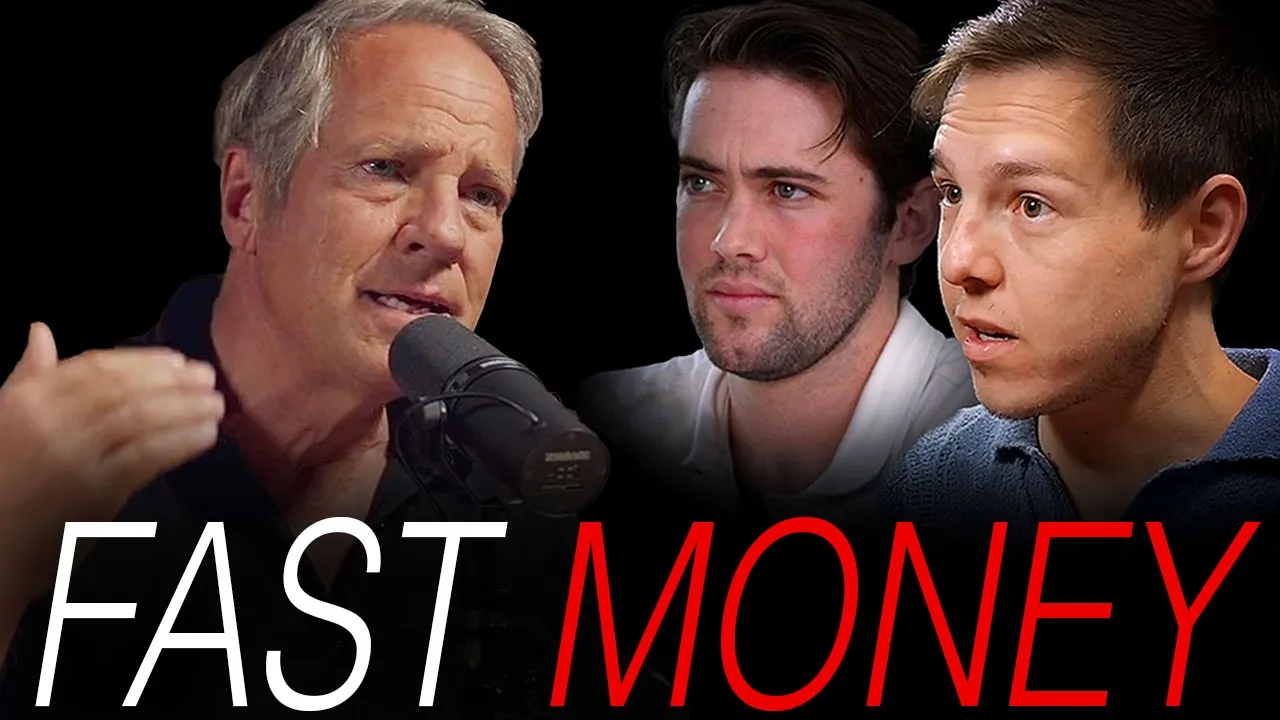
The U.S. workforce faces a severe skills deficit not from a lack of available jobs, but because cultural narratives encourage young men to reject physical trades in pursuit of comfort.
Mike Rowe highlights a massive disconnect in the American labor force: approximately 7 million prime-age men have left the labor pool while 7.2 million jobs, including 480,000 manufacturing roles, remain unfilled. (22:22)
The Pentagon awarded a $10 million grant to the mikeroweWORKS Foundation to train welders and industrial workers, addressing a projected shortage of 400,000 welders needed for submarine construction and defense infrastructure. (66:18)
High-hazard trade roles continue to yield significant wealth without degree debt, highlighted by an underwater pipeline welder who accumulated over $1 million in savings within three years. (64:19)
Rowe warns that AI voice-cloning technology like Speechify has rendered non-celebrity voiceover careers functionally obsolete while driving online audiences toward deep cynicism. (163:09)
Detailed notes
## Background
This video was published on YouTube by The Iced Coffee Hour on July 19, 2026. Hosted by Graham Stephan and Jack Selby, the episode features television host and advocate Mike Rowe exploring how individuals can earn substantial incomes in the skilled trades without college degrees, along with personal anecdotes from his career and details on his mikeroweWORKS Foundation.
## TL;DR
Mike Rowe breaks down the economic viability of modern vocational trades, highlighting how blue-collar entrepreneurs and skilled workers frequently amass multi-million-dollar net worths while bypassing student debt. He reflects on his unconventional media career, explaining how early graveyard shifts at QVC shaped his preference for authenticity over authoritative hosting, which ultimately defined the success of Dirty Jobs. Rowe also addresses the societal crisis of millions of prime-age men voluntarily exiting the workforce, advocating for extreme personal accountability via his foundation's S.W.E.A.T. Pledge. Throughout the dialogue, he details his personal finance philosophy—shaped by surviving a total nest-egg loss in 1999 to embrace low-cost index funds and intentional living—before assessing the disruptive impact of artificial intelligence on labor and digital authenticity.
## Atmosphere & style
The interview carries an unvarnished, grounded, and conversational warmth driven by Rowe's seasoned storytelling and gravelly, charismatic delivery. The dynamic balances the youthful, finance-focused curiosity of hosts Graham Stephan and Jack Selby with Rowe's avuncular, stoic pragmatism and self-deprecating humor about television mishaps and smelly encounters. It feels less like a standard promotional press stop and more like an expansive, candid fireside philosophy session on work ethic, humility, and learning to love discomfort in an increasingly frictionless modern world.
## Bulletin
- [22:22](https://www.youtube.com/watch?v=ANbwozhBYuE&t=1342s) Mike Rowe highlights a massive disconnect in the American labor force: approximately 7 million prime-age men have left the labor pool while 7.2 million jobs, including 480,000 manufacturing roles, remain unfilled.
- [01:06:18](https://www.youtube.com/watch?v=ANbwozhBYuE&t=3978s) The Pentagon awarded a $10 million grant to the mikeroweWORKS Foundation to train welders and industrial workers, addressing a projected shortage of 400,000 welders needed for submarine construction and defense infrastructure.
- [01:04:19](https://www.youtube.com/watch?v=ANbwozhBYuE&t=3859s) High-hazard trade roles continue to yield significant wealth without degree debt, highlighted by an underwater pipeline welder who accumulated over $1 million in savings within three years.
- [02:43:09](https://www.youtube.com/watch?v=ANbwozhBYuE&t=9789s) Rowe warns that AI voice-cloning technology like Speechify has rendered non-celebrity voiceover careers functionally obsolete while driving online audiences toward deep cynicism.
## Key takeaways
- [00:00](https://www.youtube.com/watch?v=ANbwozhBYuE&t=0s) Dirty Jobs featured roughly 40 to 45 covert multimillionaires, demonstrating that essential manual labor and waste management businesses often generate substantial, unadvertised fortunes.
- [08:10](https://www.youtube.com/watch?v=ANbwozhBYuE&t=490s) Designing education and career pathways around an 'average' individual fails, as rigid standardization mirrors the military's historically flawed attempt to design a cockpit for the average pilot.
- [12:38](https://www.youtube.com/watch?v=ANbwozhBYuE&t=758s) Most personal financial crises in America stem from lifestyle inflation and spending rather than inadequate earnings, with high-earning households frequently trapped living paycheck to paycheck.
- [16:21](https://www.youtube.com/watch?v=ANbwozhBYuE&t=981s) Societal contempt for manual labor arises partly because modern technology obscures foundational extraction and cultivation industries, eroding personal self-reliance.
- [22:22](https://www.youtube.com/watch?v=ANbwozhBYuE&t=1342s) Economist Nicholas Eberstadt's findings show roughly 7 million prime-age men have dropped out of work to spend thousands of hours staring at screens, driven by cultural narratives that the economy is rigged.
- [38:01](https://www.youtube.com/watch?v=ANbwozhBYuE&t=2281s) Rowe's unconventional QVC hosting strategy emphasized radical honesty, likability, and admitting ignorance over false authority, which resonated with audiences and drove high trust ratings.
- [55:57](https://www.youtube.com/watch?v=ANbwozhBYuE&t=3357s) Dirty Jobs disrupted traditional nonfiction television by swapping polished expert hosts for an apprentice host who treated working tradespeople as the genuine authorities.
- [06:20](https://www.youtube.com/watch?v=ANbwozhBYuE&t=380s) Industrial trade vocations offer elite earning potential, including specialized welders and industrial electricians at data centers earning well into the six figures without college debt.
- [01:09:38](https://www.youtube.com/watch?v=ANbwozhBYuE&t=4178s) The United States faces a severe industrial deficit, having produced only three commercial and naval ships in a year compared to roughly 1,000 built by China.
- [01:14:49](https://www.youtube.com/watch?v=ANbwozhBYuE&t=4489s) Society should reject the false dichotomy between philosophers and welders; the ideal economy cultivates tradespeople well-versed in philosophy alongside academics grounded in practical skills.
- [01:23:27](https://www.youtube.com/watch?v=ANbwozhBYuE&t=5007s) After losing his entire $1,000,000 life savings in a 1999 broker scandal, Rowe adopted Jack Bogle's passive, broad-market index fund investing philosophy.
- [01:40:21](https://www.youtube.com/watch?v=ANbwozhBYuE&t=6021s) Rowe transformed Dirty Jobs from a standard television program into a broader enterprise by launching the mikeroweWORKS Foundation and aligning with corporate partners facing skilled labor shortages.
- [01:59:05](https://www.youtube.com/watch?v=ANbwozhBYuE&t=7145s) To secure mikeroweWORKS scholarships, applicants must sign the S.W.E.A.T. Pledge, a personal responsibility manifesto asserting that individuals are the product of their choices rather than their circumstances.
- [02:10:24](https://www.youtube.com/watch?v=ANbwozhBYuE&t=7824s) Public political polarization is largely amplified by algorithmic media, whereas sociological studies and Google search data show Americans maintain strong private consensus on core values.
- [02:38:19](https://www.youtube.com/watch?v=ANbwozhBYuE&t=9499s) The proliferation of generative AI and deepfakes will inevitably usher in an era where trusted independent authenticators are required to verify human creation.
## Detailed walkthrough
### [00:00](https://www.youtube.com/watch?v=ANbwozhBYuE&t=0s) The Hidden Millionaires of *Dirty Jobs*
Graham Stephan opens the episode by expressing how much *Dirty Jobs* shaped his perspective growing up, sharing that it directly inspired a series on his own YouTube channel titled *Undercover Millionaire*. In that series, Graham shadowed individuals working seemingly unglamorous roles who were earning massive sums—ranging from a window washer pulling in $1,000 a day, to a car detailer making $500 a day, to someone operating a dog-walking business grossing $1,500 a day. Mike Rowe notes that while *Dirty Jobs* was structured first and foremost as television entertainment—relying on spectacles like exploding toilets or animal husbandry mishaps to hook audiences—the underlying engine was always a quiet celebration of free enterprise and the inherent dignity of work. Across roughly 350 episodes, Rowe estimates the show featured dozens of extraordinarily wealthy tradespeople whose financial success was completely hidden beneath layers of grime.
> “The great dirty secret of *Dirty Jobs*, which nobody really believes to this day—but you will, because you watched for all these reasons—we probably featured 40 to 45 multimillionaires on that show.” — Mike Rowe
```mermaid
flowchart LR
accTitle: Trade Mastery Business Engine
accDescr: Progression from setting aside conventional career paths to mastering a trade and scaling an enterprise.
subgraph Mindset ["Mindset"]
A["Reject Status Race<br/>'Reverse Commute'"] --> B["Ignore 'Follow Your Passion'"]
end
subgraph Execution ["Execution"]
B --> C["Identify Gritty Opportunity"]
C --> D["Master Unpopular Skill"]
end
subgraph Scale ["Scale"]
D --> E["Learn to Love the Craft"]
E --> F["Own Equipment & Employ Crews"]
end
```
[03:30](https://www.youtube.com/watch?v=ANbwozhBYuE&t=210s) Les Swanson and the Pumping Station
When Graham asks which dirty job generated the most shocking amount of wealth, Mike highlights Les Swanson, an operator Rowe worked with outside Madison, Wisconsin, during the earliest pilot episodes. Mike accompanied Swanson inside a roadside municipal pumping station—unassuming concrete bunkers dotting the landscape that descend four to five stories underground where an entire zip code's raw waste gathers. Working in sweltering 104-degree heat submerged chest-deep in human waste while scraping congealed fat and grease off concrete walls, Mike asked Swanson how an educated professional ended up there. Swanson explained that after working for years as a school guidance counselor and running a private psychiatric practice, he made a complete career pivot around age 50.
> “I got tired of dealing with other people's shit.” — Les Swanson
Swanson's pun reflected an extremely profitable enterprise:
- He built an operation running three to four dedicated vacuum pump trucks ("honey wagons").
- He managed a crew of roughly a dozen full-time employees servicing municipal and private infrastructure.
- His dirty work funded an enviable lifestyle, complete with a vacation summer home and a built-in backyard swimming pool with a margarita machine.
[06:20](https://www.youtube.com/watch?v=ANbwozhBYuE&t=380s) Trade Economics and the High-Income Shift
Addressing the wide dispersion of earnings across blue-collar industries, Mike explains that compensation cannot be generalized easily. Pay varies widely based on regional demand, union affiliation, state licensing requirements, and individual business acumen. Through the mikeroweWORKS Foundation, Mike has witnessed welders land salaries ranging from $58,000 to over $300,000 annually. He points to a recent trip to Plano, Texas, where he toured a data center and met three industrial electricians earning between $240,000 and $280,000 a year without four-year college degrees or student loan debt; two had gained their technical foundation on Navy submarines, while the third came through standard vocational schooling, and all three had been aggressively recruited and poached multiple times within an 18-month span.
- Tradespeople who acquire scarce technical skills avoid crushing debt burdens while enjoying immense pricing power.
- Specialized technicians supporting high-growth physical infrastructure—such as cloud data facilities—experience unprecedented demand and frequent poaching.
- Across the broader American economy, the traditional dynamic of white-collar stability versus blue-collar precarity has substantially flipped.
[08:10](https://www.youtube.com/watch?v=ANbwozhBYuE&t=490s) The Fallacy of the "Average American"
When asked about the widely cited statistic that the average American cannot comfortably absorb a $1,000 emergency expense, Mike challenges the premise by citing author and think-tank director Todd Rose and his book *The End of Average*. Rose highlights the historic failure of the U.S. Air Force when it attempted to design a standardized fighter jet cockpit around the physical dimensions of the "average" pilot, only to discover that the resulting seat fit zero pilots properly because human bodies vary across dozens of distinct physical dimensions. Mike applies that principle to education and career policy: designing broad, one-size-fits-all economic paths fails because individuals possess radically different risk tolerances, mechanical aptitudes, and local market realities.
> “The key to a successful cockpit is maximum adjustability on every single angle, right? So, again, it's back to the painting with a broad brush. You can't really do it.” — Mike Rowe
Mike identifies the obsession with social status as the primary psychological trap undermining young workers. Modern social media feeds deliver a relentless stream of curated luxury—signaled by vehicle models, credit card tiers, and perceived lifestyle perks—making everyday people feel inadequate. Rather than focusing on practical wealth-building through unglamorous, high-margin utility work, millions remain financially strained while pursuing expensive, conventional credentials in search of empty status.
[11:04](https://www.youtube.com/watch?v=ANbwozhBYuE&t=664s) The Garage Trap and the Status Economy
Mike Rowe observes that modern culture constantly sends a message that leaves millions feeling as though they are not participating in the American Dream. In his view, this sense of alienation is largely self-inflicted because people have fundamentally “confused living life to the hilt with living life to the hilt of spending.” To illustrate this, Mike challenges the hosts to consider what sits in their own garages. When Graham Stephan jokes that he has a 2000 Mazda Miata he needs to drive more often, Mike clarifies that he is referring to the sheer volume of unused consumer goods accumulated by the typical household.
```mermaid
flowchart TD
accTitle: The Cycle of Status Spending
accDescr: Flowchart illustrating how aspirational lifestyle spending leads to stored goods and paycheck-to-paycheck stress.
subgraph Aspiration["Lifestyle Aspiration"]
A["Earn Income / Pursue Dream"] --> B["Equate Living to the Hilt with Spending"]
end
subgraph Accumulation["The Garage Trap"]
B --> C["Buy Items Used Once or Twice<br>(Skis, Snowmobiles, Kayaks)"]
C --> D["Store Clutter in Oversized Garages"]
end
subgraph Strain["Financial Reality"]
D --> E["W-2 Dependent Lifestyle Inflation"]
E --> F["High Incomes ($500k-$700k) Living Paycheck to Paycheck"]
end
```
The typical suburban garage is often packed with outdoor gear—skis, snowmobiles, kayaks, and bows and arrows—bought with great enthusiasm, used once or twice, and then permanently relegated to storage. Mike emphasizes that while he remains a committed capitalist, this compulsive attachment to a "status life" defined by oversized houses and garages full of idle possessions creates a deeply distorted, problematic relationship with money.
---
[12:38](https://www.youtube.com/watch?v=ANbwozhBYuE&t=758s) Spending Problem vs. Earning Problem
When asked whether financial distress stems primarily from an earning problem or a spending problem, Mike argues decisively in favor of spending. While he takes care to exclude those facing extreme poverty or food insecurity, he points out that everyday Americans have far more immediate control over what they spend than what their employer chooses to pay them. He highlights the quiet crisis among high-earning W-2 professionals—couples who pull in $500,000 to $700,000 a year in major metropolitan areas like New York—who find themselves living paycheck to paycheck and teetering on what feels like financial ruin. While lower-income cohorts cannot imagine making that kind of money, they are equally baffled by how someone pulling in top-tier wages can still be one missed pay period away from disaster.
For building lasting wealth, Mike maintains that no recent financial gimmick or novel advice surpasses fundamental, disciplined habits:
> “So, look, I there is no new advice, at least that I've heard recently, that that can trump the idea of paying yourself every week, every month, investing broadly with a diversified portfolio, with an eye towards asset allocation and a real discretionary bent toward fees and costs. You start doing that when you're 22, I don't care if you're making 50,000 or 500, you know, when the dust settles down the line, you're going to have a bunch of money sucked away.”
- **Control over finances**: Spending habits are within personal control; wage ceilings often are not.
- **Lifestyle creep**: Dual-income households making $600k–$700k frequently match expenses directly to their gross income.
- **Core investment tenets**: Automate savings, invest in broad diversified index funds, manage asset allocation carefully, and relentlessly minimize management fees.
A brief promotional segment outlines the privacy risks involved when registering an LLC, as personal home addresses become part of the searchable public record accessible to vendors, clients, and strangers online. Northwest Registered Agent provides a registered agent service using their owned physical office buildings instead of rented mailboxes, shielding the business owner's personal residence from public view. Their formation package also includes brand protection, a free business domain, website, email address, and dedicated phone line to ensure immediate operational readiness.
---
[16:21](https://www.youtube.com/watch?v=ANbwozhBYuE&t=981s) Why Society Resents the Trades: The True Purpose of Dirty Jobs
Addressing why society often looks down on essential blue-collar work like sanitation, farming, and road maintenance, Mike suggests a deeper psychological paradox: human beings instinctively resent the very things they rely upon most heavily. Modern convenience has alienated people from self-reliance. Decades ago, a car owner routinely changed their own oil and replaced their brake pads; today, modern vehicles are packed with proprietary software and complex electronics that render ordinary motorists helpless, forcing them to wait in a service lounge watching a technician do what they can no longer handle themselves. That dynamic stirs an uncomfortable awareness of one's own shortcomings.
Mike explains that *Dirty Jobs* was never meant to be a spectacle of misery, but rather a deliberate tribute to the only two foundational industries on earth:
> “And there only two industries in the whole world. There's mining and agriculture. Everything else is a version of those two industries. Everything in this room, you know, was either grown from the ground and fashioned into something useful or pulled out of the earth and fabricated into something important.”
Every corporate or service job in the modern economy is ultimately an offshoot of extraction or cultivation. Elevating the workers who do that fundamental work was the core mission of the series, even if the execution ended up as a "long and smelly odyssey from sea to shining sea."
---
[18:24](https://www.youtube.com/watch?v=ANbwozhBYuE&t=1104s) The Worst Smell on Dirty Jobs and the Science of Scent
Recalling the single foulest odor across hundreds of episodes, Mike describes the process of "a boil" at Skulls Unlimited (referred to as Skulls International), a facility that cleans, articulates, and preserves animal and human skeletons for educational and museum displays. Workers lower massive animal carcasses, such as a whole buffalo, into a kettle the size of a room filled with water and chemicals, bring it to a rolling boil, and then pull it out to strip and flay the cooked flesh from the bone. The resulting stench, as Mike remembers it, hits with the physical weight of a sodden sponge—resembling a hockey jersey that has festered inside an airtight hamper for days until strange things begin growing on it.
The conversation turns to the physical mechanics of olfaction and why foul smells provoke such visceral reactions:
> “So what's really going on when you get that kind of smell, whether it's from a sewer or whether it's chemical or whether it's just a fart from the guy sitting across from you... that's a particle. It's a tiny particle and it gets in your blood and it goes to your brain.”
Because olfaction requires actual particulate matter to bind to nasal receptors, smelling a noxious substance means physically ingesting microscopic airborne fragments of whatever produced it. Mike and the hosts discuss how smell remains humanity's most primal, memory-linked sensory system—capable of instantly unlocking vivid emotional recollections, such as an ex-partner's perfume, far more rapidly than sight or sound. The hosts point out that unlike taste, where food intake is carefully curated, the sense of smell is constantly assaulted by external environments without consent, reinforcing why vile odors feel so invasive.
[21:44](https://www.youtube.com/watch?v=ANbwozhBYuE&t=1304s) The Power of Metaphors and the Forgotten Sense of Smell
Mike Rowe notes how society's relationship with the senses has evolved dramatically, pointing out that food used to be viewed simply as fuel. Today, entire bookstore sections are devoted to nutrition, what to eat and what to avoid, alongside entire television networks like the Cooking Channel broadcasting hundreds of dedicated shows. Yet, as Rowe points out with a laugh, there is no corresponding "smelling channel" on television, despite how deeply evocative scent can be.
He emphasizes how deeply ingrained sensory metaphors are in everyday culture: people are told to "take time to smell the roses," not to "take time to eat candy corn." While visual and culinary media dominate the entertainment landscape, smell remains one of the most immediate and visceral human senses, tethered directly to memory and emotion.
---
[22:22](https://www.youtube.com/watch?v=ANbwozhBYuE&t=1342s) The 7 Million Men Who Won't Work
The conversation pivots back to the trades and the broader labor landscape when the hosts ask whether people today are simply becoming lazier or if they are genuinely prioritizing work-life balance. Rowe turns to the work of economist Nicholas Eberstadt and his book *Men Without Work*, highlighting a historic anomaly in the United States economy: roughly seven million prime-age, able-bodied men who are neither working nor looking for work—an unprecedented trend outside of wartime mobilization.
```mermaid
flowchart TD
accTitle: The Cycle of Disengagement for Prime-Age Men
accDescr: Diagram illustrating how cultural narratives and screen habits lead to workforce disengagement and civic isolation.
subgraph Mindset ["Cultural Messaging"]
A["'The game is rigged' / Zero-sum mindset"]
end
subgraph Behavior ["Disengagement Habits"]
B["Drop out of labor force"]
C["2,000+ hours per year on screens"]
D["Absence from civic organizations"]
end
subgraph Outcome ["Long-Term Consequences"]
E["Erosion of civic connective tissue"]
F["Vulnerability when circumstances shift"]
end
A --> B
B --> C
B --> D
C --> E
D --> E
E --> F
```
When addressing what this group does with their time, Rowe explains that Eberstadt examined their non-work activities first. They are not volunteering at local churches, nor participating in historic civic groups such as the Jaycees, Kiwanis Club, or Lions Club. They are not mentoring through SkillsUSA, the Boy Scouts of America, or the Future Farmers of America. Instead, Eberstadt’s research reveals that these men spend an average of roughly 2,000 hours per year staring at screens. Rowe frames this as a cultural failure rather than a purely individual one, observing how polarized the public debate has become:
> “Half the country right now is going to look at that cohort and say, 'Good for them. Why should they work for these greedy, rapacious capitalists who are just out there to take and take and take and all the billionaires with all their money and the exploitive class and and so forth?' And then my buddies on the right will will say to your point, 'Yeah, they're fundamentally lazy. Shame on them. Shame.' Now, I'm I'm somewhat right or center, I think, but I I I don't think it's as simple as writing them off as lazy.”
Rowe argues that young people have internalized a defeatist narrative:
> “I think they were told collectively that the system's rigged and that life isn't fair and that the only way to get ahead is to take from somebody else and that it's a zero sum game, right? It's that it's just this you're never going to make it because the game is rigged. I think that's, you know, one of the most self-defeating, greatest lies, you know, that we've that we've told a whole generation.”
- **7 million**: The approximate number of able-bodied American men completely out of the workforce who are not actively seeking employment.
- **2,000 hours/year**: The average screen time Nicholas Eberstadt's research found among this disengaged demographic.
- **Civic disengagement**: Complete withdrawal from traditional community institutions (churches, Kiwanis, Jaycees, Lions Club, Boy Scouts, FFA).
---
[25:53](https://www.youtube.com/watch?v=ANbwozhBYuE&t=1553s) The Comfort Crisis: Why Easy Is the Enemy
The hosts bring up the reality of modern life: the consequences for mediocrity have dropped significantly compared to past eras when failing to work meant immediate destitution or hunger. Today, an individual can sit comfortably at home, scroll on a smartphone, watch entertaining YouTube videos, and sustain a relatively painless existence. Rowe challenges the core assumption behind that lifestyle, questioning what value comfort actually offers over time:
> “Nothing good that I can think of was ever inspired by the individual who said, 'And so I set out to be as comfortable as I could, to do everything that's easy, to never really challenge myself, and now look how look how happy I am. I just have never seen it.'”
Rowe references Todd Rose's writing as well as Michael Easter's book *The Comfort Crisis*, emphasizing that every person he has ever respected leaned directly into adversity rather than fleeing from it. When asked what advice he would give to someone terrified of leaving their comfort zone, Rowe asks them to identify their root fears—typically failure, humiliation, and embarrassment. Seeking comfort, he notes, functions like an ostrich burying its head in the sand: it offers temporary insulation, but it cannot stop the future from arriving:
> “You look at your life like it's a like it's a snapshot, you know? It's like this is what I'm doing. This is how it but but but you're not in a snapshot. You're in a movie, you know? Like then there's stuff happening all around you all of the time. the chickens are going to come home to roost for those 7 million men who have chosen this life and it's not going to it's not going to be good and and I I would love to help them.”
---
[29:48](https://www.youtube.com/watch?v=ANbwozhBYuE&t=1788s) Curiosity, Humility, and Getting into Entertainment
When asked how an unconventional career path spanning opera, QVC, *Dirty Jobs*, and commercial voiceover narration came together, Rowe reflects on the traits within human control. While no one chooses their physical traits, height, race, or sex, anyone can choose curiosity and a willingness to be uncomfortable. In Rowe's view, curiosity is inseparable from humility:
> “Curiosity by definition means I don't know and I'm game to find out. And finding out might humiliate me. It might make me embarrassed. It might make me uncomfortable.”
This lesson was forged in Rowe's youth when he tried to follow in the footsteps of his grandfather, a master tradesman. Rowe spent several years during his teenage years working alongside him as an apprentice, operating under the naive assumption that because he deeply loved his grandfather's craft, he must have inherited the manual aptitude for it. His grandfather ultimately broke the news that Rowe lacked the mechanical instincts, delivering an insight that altered Rowe's career path:
> “And you know, it was a very early really important lesson to realize just cuz you love something doesn't mean you can't suck at it. And conversely, just cuz you're not particularly interested in something doesn't mean you might not have a like a real facility for it.”
His grandfather advised him to go find a "different toolbox," directing Rowe toward performance and entertainment as his trade.
---
[32:25](https://www.youtube.com/watch?v=ANbwozhBYuE&t=1945s) Selling and the Illusion of Competence
The conversation moves to Rowe's tenure at QVC and the art of live television sales. When asked what most entrepreneurs misunderstand about selling, Rowe breaks down the traditional industry playbook taught to on-air hosts and pitchmen. The conventional sales wisdom dictates that a salesperson must master features and benefits, study product sheets, and project total mastery over every item placed in their hands:
> “If there were a host or expert, you know, playbook, it's to create and foster the illusion of knowledge and competence where it where it doesn't really exist.”
Instead of acknowledging what they do not know, traditional sellers construct an elaborate front of authority. Rowe suggests that this reliance on false competence is precisely where the standard pitch method goes wrong, setting the stage for how an alternative, unscripted approach redefined his sales style.
[33:03](https://www.youtube.com/watch?v=ANbwozhBYuE&t=1983s) QVC: How to Sell Anything (The Pencil Method)
Mike Rowe recounts how sales techniques often rely on pairing empathy and enthusiasm to guide a customer toward an agreement, contrasting this with Mark Twain's Tom Sawyer, who famously conned his friends into whitewashing a fence for him. Rowe was thrown directly into live television when he started at QVC in 1990 with zero formal training. Sitting before four robotic cameras, the baseline audition benchmark was straightforward: if you could talk continuously about a standard pencil for eight minutes, you were hired.
```mermaid
flowchart TD
accTitle: The Feature-Benefit Sales Framework
accDescr: Diagram breaking down how every feature of a basic pencil must be paired with a benefit to sustain a sales pitch.
subgraph CoreRule ["The Core Principle"]
A["Product Feature"] -->|"Must be followed by"| B["Practical Benefit / Reason"]
end
subgraph PencilExamples ["The Pencil Breakdown"]
C["Yellow Color"] --> D["Instantly visible in a cluttered desk drawer"]
E["Madagascar Graphite"] --> F["Non-toxic alternative to lead for tip-lickers"]
G["Eraser Length"] --> H["Engineered to match the sharpening life cycle"]
I["Number Two Hardness"] --> J["Avoids crayon-like skid marks or wispy lines"]
end
CoreRule -.-> PencilExamples
```
When Jack Selby confesses that he could never speak about a pencil for even five minutes, Rowe breaks down the fundamental mechanics of the "feature-benefit" sales method. “You never say anything about the pencil that you don't follow with a reason,” Mike insists, explaining that every physical detail must tie to a purpose:
- **Graphite vs. Lead**: State clearly that it uses graphite from Madagascar, framing it as a superior, safer alternative because people still habitually lick pencil tips and risk lead poisoning.
- **The Yellow Color**: Justified by utility. Busy professionals opening a desk drawer lack the time to search for a muted beige writing implement; the bright yellow immediately catches the eye.
- **The Eraser Length**: Explained away through statistical testing, claiming the eraser's length is engineered to deplete at the exact rate the pencil is sharpened down to a stub.
- **The #2 Hardness**: Frame #1 lead as leaving a thick, sloppy mark like a child's crayon, while #3 is too fine and wispy, leaving #2 as the calibrated sweet spot.
---
[35:35](https://www.youtube.com/watch?v=ANbwozhBYuE&t=2135s) Sponsor Break: Claude & ZipRecruiter
Graham and Jack pivot to the podcast’s operational workload, noting the mountain of contracts, invoicing, show notes, and research documents required to keep the production moving. They introduce Claude as an AI tool integrated into their daily system to run tasks directly on their machines—including automating their entire invoicing process through simple screenshot uploads and email drafting. Following this, Graham addresses time management hacks, connecting his everyday routines to hiring challenges. He highlights ZipRecruiter's matching algorithm and candidate filtering, emphasizing that four out of five employers posting on the platform find a qualified applicant within the first day.
---
[38:01](https://www.youtube.com/watch?v=ANbwozhBYuE&t=2281s) Paid to Be Likable, Not to Sell
Returning to the topic of sales excitement, Rowe reveals how he handled products before mastering the feature-benefit formula: he fell back on the Tom Sawyer playbook. On his very first night in June 1990, working the graveyard shift at midnight as a 27-year-old, producers handed him the Health Team infrared pain reliever. It looked like a cheap boardwalk claw-machine toy—a flashlight housing with a glowing red bulb that emitted infrared light meant to alleviate arthritis upon contact. Rowe was given a blue card with the item number, price, payment options, a single descriptive sentence, and an order to fill eight minutes of live airtime.
```mermaid
flowchart LR
accTitle: Graveyard Shift Incentive Structure
accDescr: Flowchart contrasting standard sales commissions with QVC host compensation based on likability metrics.
A["Midnight Host on Air"] --> B["Fesses Up: 'I Have No Idea How This Works'"]
B --> C["Viewers Call In to Explain Product"]
C --> D["Audience Trust Surveys"]
D --> E["Host Bonus Exceeds Base Salary"]
```
Unsure if the product even worked, Rowe looked straight into the camera, owned up to being the nervous new host, and told viewers: “Folks, I'm Mike. I'm the new guy... there's an 800 number on the screen. And if you call it and ask for Marty, the producer, he'll put you through and maybe you can tell me how the hell this thing works on the air.” The phone lines instantly jammed with viewers eager to explain the item to him. When asked if host pay was tied to sales volume through commissions, Rowe clarifies that compensation operated under completely different incentives:
- **No Sales Commission**: Network executives believed quality items would sell themselves based on programmer curation, so hosts were not pressured to run hard closes.
- **Trust-Based Evaluation**: QVC distributed extensive viewer surveys asking whether audiences found the host honest, likable, and pleasant to spend time with.
- **The Humility Hack**: Admitting ignorance built instant rapport with insomniacs and late-night shoppers, turning the sales block into an interactive, loose talk show.
- **Compensation Disparity**: While Rowe earned a respectable base salary of $50,000 in 1990, his trust- and likability-driven year-end bonus was roughly $60,000, easily surpassing his primary wage.
- **Unsupervised Graveyard Shifts**: Working between midnight and 3:00 a.m. four or five nights a week meant studio executives only reviewed taped broadcasts after the fact, granting Rowe free rein to experiment live without management intervention.
[43:00](https://www.youtube.com/watch?v=ANbwozhBYuE&t=2580s) The Nun Doll Incident That Got Him Fired
Asked about the absolute worst failure of his time at QVC, Mike Rowe recounts an incident from when he was only one month into the job and still on his probationary period. Exhausted and operating like a "total vampire" on night shifts, he was unexpectedly called in on a Sunday afternoon to cover a 5:00 p.m. prime-time program. The scheduled host had fallen violently ill in the green room, and the on-air talent preceding her had to leave for a wedding. Living just minutes away, Mike raced over and found himself hosting a show titled *The QVC Dollhouse*. Unaware that doll collecting was a massive hobby, Mike was stunned when the producer informed him that dolls were the third most collected item in the United States, right behind stamps and coins. The set was filled with Victorian-style porcelain figures that looked like they had wandered off the set of *Little Women*. The producer advised him to give the dolls backstories and keep the segment moving without actually handling them too roughly.
```mermaid
flowchart TD
accTitle: The Sister Mary Margaret On-Air Disaster
accDescr: Step-by-step breakdown of how Mike Rowe accidentally caused an on-air scandal with a porcelain nun doll on QVC.
subgraph Phase1["The Setup"]
A["Called in to host 'QVC Dollhouse' on prime time"] --> B["Introduces 'Sister Mary Margaret' porcelain nun doll"]
B --> C["Kills initial time with puns, props, and singing"]
end
subgraph Phase2["The Search"]
C --> D["Phone queue backs up; producer adds 4 minutes"]
D --> E["Notices card says 'musical' / 'Climb Ev'ry Mountain'"]
E --> F["Searches under habit for missing winder mechanism"]
end
subgraph Phase3["The Live Reveal"]
F --> G["DP cuts back to Mike holding upside-down doll"]
G --> H["Doll drops, plays song on floor; Mike sniffs fingers"]
H --> I["Fired via answering machine for inappropriate conduct"]
end
```
The products were selling out instantly, requiring little effort, until the crew brought out a two-foot-tall Benedictine nun doll named Sister Mary Margaret, complete with spectacles and a stern expression. Mike went through his basic presentation, making puns like "it'd be a bad habit not to invest in a little lady like this," holding the doll overhead while singing the theme to *The Flying Nun*, and placing a six-inch jewelry ruler in her hand to smack his own knuckles. When the segment clock hit zero, the orders had caused a major backlog in the call center, forcing the producer to throw another four minutes onto the countdown clock so the 150 phone operators could clear the queue. Having nothing left to say as a "Presbyterian kid from Baltimore" who knew nothing about Catholic nuns, Mike spotted the word "musical" in quotation marks on his blue product cue card, along with the song title "Climb Ev'ry Mountain."
Mike decided an on-air singalong would be the perfect way to burn the remaining time. He set the doll on his lap to find the winding mechanism, but could not locate it on her back. While he probed around her shoulders and back on camera, his producer frantically yelled into his earpiece, "Dude, don't touch the nun." To spare him the awkward visual, the director of photography (DP) switched the live broadcast to a secondary display doll inside a lighted turntable box, allowing Mike to search freely off-camera while his microphone remained open. Mike discovered the key was located at the absolute base of the doll's back, right above her rear crack, completely inaccessible through the stiff fabric.
Mike flipped the nun upside down, pushed her habit down over her waist, and bent forward with his face between the doll's legs to crank the tight mechanism. Meanwhile, the DP—distracted and failing to watch the live studio monitor—assumed Mike was ready and dissolved the broadcast feed back to the main stage camera. Instantly, around one million viewers saw Mike sitting with the upside-down doll's head between his thighs, cupping her backside with one hand while torquing the mechanism with the other. Shocked by seeing himself on the studio monitors, Mike froze, ripped his hand away, and the nun tumbled between his legs onto the set floor, where the internal music box began cheerfully playing "Climb Ev'ry Mountain." To make matters worse, Mike sheepishly sniffed his fingers on live television in an involuntary, nervous panic before the control room cut to commercial. When he arrived home that evening, his answering machine contained 54 messages, including one from his supervisor telling him to come in the next morning to pick up his final paycheck.
[51:52](https://www.youtube.com/watch?v=ANbwozhBYuE&t=3112s) Fired Three Times & Saved By The Viewers
Mike explains that the nun doll incident was merely the first of three times he was fired from QVC. The network repeatedly dismissed him because of his foundational attitude toward the job:
> “Because I was being paid to be likable, not to sell stuff. And so I would make fun of the products and sometimes the viewers, but I would always do it, you know, as kindly as I could and as honestly as I could.”
Dubbed a "management challenge" by network executives, Mike survived purely because of the audience's loyalty. After the nun incident, he phoned a colleague working the evening broadcast, who announced live on the air, "Hey, if you caught Mike's show earlier today, I hope you liked it. He won't be back." The comment sparked an influx of viewer letters defending Mike, insisting the mishap was funny and unintentional, which persuaded management to rehire him.
For the next three years, Mike remained banished to the overnight shift from midnight to 3:00 a.m., completely cut off from normal daytime broadcasting. During these graveyard shifts, he engaged in endless antics, such as cracking open a lava lamp on the air to see if it contained real molten lava, or testing "unbreakable" plates by intentionally smashing them against surfaces. While he avoided discussing that era for years, fans eventually tracked down old VHS recordings around 1999 and began sharing them online, turning segments like "the cat sack" into early viral videos.
- Doll collecting ranked as the third most popular collection hobby in the U.S. at the time, trailing only stamps and coins.
- The phone center on set was staffed by 150 live order-entry operators.
- Mike's home answering machine had accumulated 54 messages by the time he returned from the Sister Mary Margaret broadcast.
- Following his reinstatements, Mike spent three straight years relegated exclusively to the midnight-to-3:00 a.m. shift.
[53:44](https://www.youtube.com/watch?v=ANbwozhBYuE&t=3224s) The QVC Foundation and the Most Hated Interview Question
Reflecting on his earliest television days, Mike Rowe recalls hawking odd items—such as a mylar-lined sack designed for a cat to crawl into—and interacting awkwardly with collectible dolls on the air. While he does not possess the infamous footage that got him fired, he confirms that dolls remained a bizarre leitmotif throughout his early career. After breaking into mainstream entertainment, his immediate instinct was to put as much distance as possible between himself and home shopping. With hindsight, however, he recognizes that the overnight graveyard shift at QVC taught him nearly every foundational skill that later defined his success. In fact, the very premise of *Dirty Jobs* stemmed from that interactive format: every single job idea was suggested directly by the viewers.
The conversation pivots to interview dynamics when the hosts ask Mike what question he dreads answering the most. Anticipating the hosts' exact phrasing, Mike identifies the ubiquitous, tired query: "What's the dirtiest job?" The hosts immediately commiserate, noting that podcast hosts face the identical cliché when fans constantly ask, "Who's your favorite guest you've ever had on the podcast?", "What's the best piece of advice you've gotten?", or "How do you like living in Vegas?" Mike points out that curiosity is an active choice and interviewing is a muscle that must be worked out to avoid treading over worn-out territory. As Rowe observes:
> “Like it's it's a real it's a talent to ask a question that hasn't been asked before.”
---
[55:57](https://www.youtube.com/watch?v=ANbwozhBYuE&t=3357s) Authority vs. Authenticity: How Dirty Jobs Got Made
When asked what interviewers ought to ask instead, Mike states that the real mystery is how *Dirty Jobs* ever made it onto television in the first place. He emphasizes that he could never pitch, sell, or film that show in today’s television landscape. Originally, the concept was entirely off-brand for Discovery Channel. Even after he shot the pilots himself and they garnered strong ratings, network executives shelved them because the show clashed with the pristine, high-minded programming they wanted audiences to consume—revered naturalists and institutions like David Attenborough, Jacques Cousteau, and Jane Goodall.
```mermaid
flowchart TD
accTitle: Evolution of Non-Fiction TV Hosting
accDescr: Contrasting Discovery's traditional Age of Authority with Mike Rowe's Age of Authenticity model for Dirty Jobs.
subgraph Authority["The Traditional Model: Age of Authority"]
A["Network Host / Narrator<br/>(David Attenborough style)"] -->|"Delivers polished, measured facts"| B["Passive Audience"]
end
subgraph Authenticity["The Dirty Jobs Model: Age of Authenticity"]
C["Regular Tradesperson<br/>(The Real Expert)"] -->|"Provides credible knowledge"| D["Mike Rowe<br/>(Apprentice / Guest)"]
E["Active Viewers<br/>(The Programmers)"] -->|"Pitch episode concepts"| D
end
```
Rowe explains that television in the 1970s, 1980s, and 1990s operated in an "age of authority," marked by measured narrators speaking grandly of wildebeests traversing the Serengeti. Recognizing that audiences were growing skeptical of polished detachment, Mike flipped the entire architecture of non-fiction television on its head. Instead of acting as an authoritative host, he positioned himself as an apprentice; the obscure worker performing hard labor out of sight became the legitimate on-screen expert, and the audience became the programmers pitching the subjects. When Graham Stephan mentions that the show worked because it was genuinely entertaining and praised Mike's narration, Mike highlights how subverting standard hosting tropes made it click.
> “Look, maybe maybe instead of a host, I can be a guest. Maybe the expert on my show is the guy you've never heard of doing some weird job out of sight and out of mind.”
---
[01:00:58](https://www.youtube.com/watch?v=ANbwozhBYuE&t=3658s) The Gateway Trade, AI, and Danger Premiums
Turning toward the future of skilled labor, the conversation examines which vocational paths offer the highest pay and strongest demand over the next decade. Rowe offers an unexpected piece of advice: do not ignore artificial intelligence. While AI is not currently replacing the core physical vocations supported by the mikeroweWORKS Foundation—such as plumbers, electricians, pipefitters, steamfitters, or shipbuilders—tradespeople cannot afford to fall behind technological advances. For anyone entering the skilled trades today, Mike singles out welding as the premier gateway trade, noting that roughly 40% of the 3,500 scholarship recipients through his foundation study welding.
The high compensation in welding boils down to pure supply and demand combined with substantial danger premiums. Underwater welding ranks among the most perilous jobs in the world, alongside crab fishing on the Bering Sea (as documented on *Deadliest Catch*, which Rowe narrates) and timber cutting. While joking that lumberjacks face coiled mechanical beasts in chainsaws rather than rogue bears, Rowe highlights the severe hazards underwater welders face while working hundreds of feet down in dry suits fed by compressed surface air. He recounts awarding an approximate $6,000 work ethic scholarship through mikeroweWORKS to an applicant named Jake, who subsequently dropped off the grid for a few years before resurfacing with an incredible update on his earnings.
> “The unexpected answer is don't ignore AI. It's not going away. Understand it. Don't be afraid of it. I don't care if you're a welder or an electrician or a plumber.”
- **mikeroweWORKS impact**: Over 3,500 people have received scholarships, with welders making up approximately 40% of recipients.
- **Top hazardous vocations**: Underwater welding, commercial crab fishing on the Bering Sea, and logging/lumberjacking.
- **Hazard compensation**: Underwater welders receive hazard premiums due to extreme working depths, hyperbaric conditions, and relying on pumped surface air lines.
[01:04:19](https://www.youtube.com/watch?v=ANbwozhBYuE&t=3859s) The Million-Dollar Underwater Welder and Who Deserves Help
Mike Rowe shares a story about a worker who went through his scholarship program and leveraged technical skills into massive earnings. The man started with MIG and TIG welding for his first year and received consecutive promotions. Around 14 months into his career, he fell in love and wanted to get married while earning around $70,000 a year. To increase his income, a friend helped him enter an underwater welding program. He quickly excelled at it, working in that field for a year and earning between $130,000 and $140,000.
Opportunities escalated further when an underwater pipeline project opened up overseas in the Gulf of Oman, offering between $315,000 and $320,000 tax-free. When Rowe checked in on him, the worker reported spending almost three years abroad, accumulating a million dollars in the bank, and expecting his first child. Graham Stephan remarks that anyone doing that kind of grueling, dangerous work deserves every penny, joking that he would gladly take a pay cut himself to see underwater welders get paid that well.
Comparing this hard-working tradesman to the 7 million prime-age men who have dropped out of the labor pool entirely, Rowe reflects on where resources and support ought to be directed. He points out that despite the uncertainty and fear in modern times, it is essential to back those who lean into the challenge with full commitment:
> “It’s the bottom of the ninth, the bases are loaded, you’re up by one, you want the ball. I want that guy. I want that. I want to do what I can to help those people because look, there are lots of scholarship programs out there.”
```mermaid
flowchart LR
accTitle: Trade Career Progression of an Underwater Welder
accDescr: Diagram illustrating career milestones from entry-level MIG/TIG welding to high-earning overseas pipeline work.
subgraph Overseas ["High-Risk Pipeline"]
B --> C["Gulf of Oman Project<br/>$315k - $320k Tax-Free"]
C --> D["$1M+ in the Bank<br/>First child on the way"]
end
```
[01:06:18](https://www.youtube.com/watch?v=ANbwozhBYuE&t=3978s) Government Policy, Shovel-Ready Jobs, and the Pentagon's $10 Million
Graham asks about the appropriate role of government in supporting trade workers, cautioning that an overly generous safety net can inadvertently discourage people from taking career risks. Rowe acknowledges that addressing the workforce is tricky because the government cannot treat every person the same when some are intensely ambitious while millions of others have simply clocked out.
Rowe recalls taking this exact argument to Washington when he founded mikeroweWORKS. In 2009, after President Barack Obama announced an initiative for 3 million "shovel-ready" jobs, Rowe wrote an open letter to the White House and testified before Congress. He argued that simply announcing job openings would not work without a concerted marketing push, explaining:
> “You got to sell the jobs. You can’t just create them and wait for them to be filled.”
He emphasized that while a `.gov` solution alone cannot fix the skills gap, an effective solution requires government cooperation. Although politicians across both parties privately agreed with his testimony, meaningful action stalled for years.
Fifteen years later, Rowe was invited to the Pentagon to address workforce vulnerabilities. The Department of Defense launched its own initiative, `Buildfreedom.us`, featuring roughly 400,000 open, high-paying, AI-proof positions across the Defense Industrial Base (DIB). The Pentagon granted $10 million to the mikeroweWORKS foundation to train candidates for critical manufacturing and welding roles. Rowe notes that submarine manufacturers are panicking because they need 400,000 welders over the next seven to eight years and have no idea where to find them.
- **2009 Shovel-Ready Jobs:** Mike Rowe argued to the Obama administration that blue-collar jobs require aggressive PR to show workers they can earn six-figure salaries quickly.
- **Congressional Outreach:** Rowe addressed Congress 15 years ago and the Senate two years later, finding bipartisan verbal agreement but little immediate policy follow-through.
- **Pentagon Grant:** The Pentagon awarded $10 million to the mikeroweWORKS Foundation to fund scholarships targeting defense industrial base needs.
- **Submarine Manufacturing Shortfall:** U.S. defense contractors are facing a projected shortfall of 400,000 welders within the next seven to eight years.
[01:09:38](https://www.youtube.com/watch?v=ANbwozhBYuE&t=4178s) Shipbuilding Deficits, the 5-Out/2-In Ratio, and Meta's Desperation
The discussion turns to global industrial competition, with Graham asking whether the United States should worry about China's manufacturing dominance. Rowe points out a striking contrast: China built roughly 1,000 commercial and naval ships in the previous year, whereas the United States built just three. When Graham asks whether this gap is caused by work ethic, culture, or regulatory red tape, Rowe explains that shipbuilding involves complex factors like organized labor, steel import tariffs, and global logistics, resulting in contracts being farmed out to foreign shipbuilders like South Korea.
Rowe describes attending an energy conference seven months prior in Pittsburgh with the sitting U.S. president and 35 leading corporate CEOs. During that meeting, the CEOs pledged $92 billion to Pennsylvania alone to build out AI data center infrastructure. When Rowe spoke, he challenged the administration's claims about creating millions of new positions:
> “You’re going to create 2 million jobs in manufacturing, what about the 480,000 jobs in manufacturing right now that we can’t fill?”
He points out a crippling demographic reality that has persisted for over a decade: for every five skilled tradespeople who retire, only two new workers enter the field. He notes that home appraisers, inspectors, and general contractors are rapidly aging out—recalling that on the seven-man crew who built his house 11 years ago, the youngest worker was already 50.
Because of this severe labor squeeze, corporate America is spending hundreds of millions to develop its own talent pipelines. Ford CEO Jim Farley is creating internal automotive repair facilities; Lowe's has poured $250 million into workforce training; Home Depot has contributed $100 million; and BlackRock has committed around $150 million. Most notably, Meta is funding the America's Workforce Academy—a rigorous five-week pre-apprenticeship program covering disciplines from basic electric to fiber optics and construction. Meta covers all travel, airfare, lodging, and meals while paying students a wage to attend. Graduates are guaranteed a job upon completion, but are entirely free to take their certified skills elsewhere if they decline the offer. Rowe predicts this private sector desperation will spark a "Manhattan Project"-style overhaul of American vocational schooling.
When Jack asks which sectors currently have too many workers, noting the glut of software engineers displaced by AI, Rowe replies that while he avoids second-guessing the market, the country clearly does not suffer from a shortage of influencers or aspiring pop stars.
- **Shipbuilding Gap:** China constructed 1,000 ships in a single year, compared to just 3 built by the United States, with much commercial construction outsourced to South Korea.
- **Pennsylvania Tech Investment:** 35 prominent CEOs committed $92 billion toward data center construction in Pennsylvania alone.
- **The 5-to-2 Attrition Rate:** Across the skilled trades, five workers retire for every two recruits entering the workforce, a demographic decline lasting over 12 years.
- **Unfilled Manufacturing Roles:** The United States currently has approximately 480,000 open manufacturing positions that employers cannot fill.
- **Corporate Training Spending:** Lowe's ($250M), Home Depot ($100M), and BlackRock ($150M) are heavily financing vocational pipelines.
- **Meta's All-Expenses-Paid Academy:** Meta pays recruits to attend a 5-week pre-apprenticeship program covering all food, lodging, and transport, paired with a guaranteed job offer and portable industry certifications.
[01:14:49](https://www.youtube.com/watch?v=ANbwozhBYuE&t=4489s) Philosophers, Welders, and Meaningless Statistics
Mike Rowe revisits the fundamental principle of supply and demand, recounting an incident from roughly a decade prior during the 2016 Republican presidential primary debates. The GOP stage was crowded with seventeen candidates, prompting then-RNC Chairman Reince Priebus to boast about having an incredible slate of diverse options—a doctor of color, experienced governors, seasoned lawmakers—essentially signaling, as Mike puts it, "Anybody but the guy in the middle." During the debate, Senator Marco Rubio landed a thunderous applause line when he declared that America needed fewer philosophers and more welders.
Shortly after, Mike checked his social media pages—which had around seven to eight million followers—only to find an outpouring of fans assuming Rubio had echoed his personal ethos. Mike had the exact opposite reaction:
> “I’ve never meant to suggest that what’s plaguing the country are too many philosophers.”
Mike argues that society should not be trapped in an either/or false dichotomy. What the country actually needs are philosophers who can run a bead and understand structural steel fabrication, alongside welders who can read the Stoics, dissect logic, and converse intelligently about Aristotle, Friedrich Nietzsche, René Descartes, and Immanuel Kant. The nation's education model must be reimagined instead of operating within a mental prison where one discipline is pitted against the other.
This binary thinking extends to how people misunderstand the skills gap and workforce data. Mike points out that economists like Nicholas Eberstadt (author of *Men Without Work*) show that the standard unemployment rate is essentially a relic of the Great Depression, when having twelve million people out of work meant that creating twelve million jobs would solve the problem. Today, the reality is decoupled:
- Approximately 7.2 million jobs sit wide open across the country, the majority of which do not require a four-year college degree.
- Roughly 7 million able-bodied men of prime working age have actively opted out of the labor force entirely.
- The narrative that millions of people remain idle simply because there is a lack of opportunity is completely out of touch with modern economic reality.
[01:18:24](https://www.youtube.com/watch?v=ANbwozhBYuE&t=4704s) Everyday Competency and the 15-Minute Fence Post
The hosts shift to asking Mike about essential, universal life skills every man should have in his locker—ranging from changing a tire and cooking a steak to knowing how to throw a punch, plunge a toilet, jump a dead car battery, or clear a fence. Mike affirms that physical ability and mechanical competence build genuine confidence. He points out that much of the modern public's frustration with tradespeople stems from feeling completely helpless when something breaks in their own homes. While he might not overhaul a complex modern brake assembly himself, the basic physical mechanics of changing a flat tire or throwing a punch remain timeless.
```mermaid
flowchart TD
accTitle: Narrative Tension of the Fence Post Scene
accDescr: Diagram illustrating how unedited physical adversity creates authenticity in non-fiction television.
subgraph Problem["The Physical Conflict"]
A["Sinkhole in Forest (90 ft deep)"] --> B["Build Protective Perimeter Fence"]
B --> C["Encounter 3-Foot Iron Post Hammered in Ground"]
end
subgraph ShowRules["Production Integrity"]
D["Dirty Jobs Golden Rule: 'Never Cheat'"]
E["Tools Only: Shovel, Rope, Pulley"]
F["Crew Refuses to Assist"]
end
subgraph Broadcast["Television Execution"]
G["90 Minutes of Real-Time Digging"]
H["Aristotelian Drama: Protagonist vs. Inanimate Object"]
I["15 Unedited Minutes of Broadcast TV"]
end
C --> D
D --> E
E --> F
F --> G
G --> H
H --> I
```
Mentioning fences reminds Mike of one of his favorite, most unusual segments ever aired on *Dirty Jobs*, which he insists could never get greenlit on television today. While erecting a safety barrier around a dangerous 90-foot-deep sinkhole in a forest, he had to extract an old iron fence post that was driven three feet deep into the dirt. Because the show followed a strict "never cheat" policy, he was not allowed heavy machinery—only a shovel, a rope, a pulley, and his own muscle. The crew refused to lend a hand, silently documenting ninety continuous minutes of agonizing manual labor:
> “So there there’s literally a 15-minute segment in an old episode of *Dirty Jobs* where nothing happens at all except Mike tries to get a single fence post out of the ground.”
Mike views that scene through the lens of Aristotelian tragedy, where a protagonist is forced into anagnorisis—a moment of undeniable recognition of his own limitations and identity through relentless friction. At the time, Mike successfully fought the network executives to keep the extended struggle in the final broadcast by holding them to their promises:
> “20 years ago, I won the argument because I said, ‘A, you’re a non-fiction network, and B, this is a reality show.’”
He laments that modern cable programming has abandoned that patience, filling runtime with artificial edits and cuts every three seconds rather than trusting real human effort to carry the story.
[01:23:27](https://www.youtube.com/watch?v=ANbwozhBYuE&t=5007s) The 1999 Financial Disaster and Boglehead Religion
When Jack and Graham ask Mike about the best practical skill to impress someone on a first date, Mike brings it back to fundamentals: basic manners and opening the car door. Jack jokes about digging out a fence post to impress a woman, prompting Mike to playfully quote the famous line from Robert Frost’s poem *Mending Wall*: “Good fences make good neighbors.”
The hosts then pivot the conversation toward personal finance, asking Mike how and where he invests his money today. Mike describes his financial holdings as heavily weighted toward broad-market index funds, noting he tracks total market gauges like the Wilshire 5000:
- Mike describes his underlying strategy as deliberately "boring," having fully embraced the index fund philosophy championed by Vanguard founder Jack Bogle and Burton Malkiel's *A Random Walk Down Wall Street*.
- He humorously dispels the hosts' suspicions that he might be gambling on speculative plays or trading covered calls on Robinhood.
- His dedication to passive indexing came out of trauma: in 1999, Mike "got religion" after an unforeseen, catastrophic broker scandal completely wiped out his entire life savings.
Realizing that *The Iced Coffee Hour* is fundamentally a personal finance program, Mike jokes, “Well, you buried the lead,” before preparing to break down the full story of being an inveterate, lifelong saver who suddenly woke up to find his entire net worth reduced to zero.
[01:25:19](https://www.youtube.com/watch?v=ANbwozhBYuE&t=5119s) The Travis McGee Lifestyle and the Broker Scandal
For the first fifteen years of his entertainment career, Mike Rowe lived an entirely unencumbered, nomadic existence. He owned virtually nothing: no rental, no home, and hardly any clothing, since the productions he hosted provided wardrobe deals and networks paid for the hotels where he stayed while working on the road. Mike saved every penny he could. He had started investing at age 22, when he bought a house in Baltimore for around $48,000 and sold it a couple of years later for roughly $70,000, walking away feeling smart. He took those proceeds and put them into low-cost index funds until he met a financial broker at a major investment firm. She became a dear friend and a rising “golden child” in the industry, quickly amassing a prominent clientele composed largely of doctors and lawyers.
```mermaid
flowchart TD
accTitle: Freelance Financial Model to Collapse
accDescr: Mike Rowe's initial financial model inspired by Travis McGee and its subsequent collapse.
subgraph Model["The Travis McGee Freelance Model"]
A["6 Months Road Gigs / QVC Auditions"] --> B["Zero Encumbrances & High Savings Rate"]
B --> C["Accumulated $1M Nest Egg with Broker"]
end
subgraph Collapse["The Financial Shock"]
C --> D["Broker Launches Independent Venture"]
D --> E["Private Deals & House of Cards Collapses"]
E --> F["Nest Egg Wiped Out: $0 Remaining"]
end
```
Mike's financial model was directly inspired by John D. MacDonald’s fictional character Travis McGee, a self-described salvage expert who lived on a houseboat in Fort Lauderdale called *The Busted Flush*, which he had won in a poker game. Travis McGee took his retirement in early installments—working only a few months when he needed cash to recover stolen goods for a 50% salvage fee, then returning to retirement. Mike adopted that exact philosophy: freelancing roughly six months a year, taking his retirement in advance, avoiding possessions, and racking up regular audition wins thanks to the improvisational chops he had honed at QVC. The broker eventually left her major firm to launch her own independent company, running private ventures outside the firm's oversight while clients assumed their funds remained under institutional backing. While Mike was on the road reading about the disaster in the news headlines, her house of cards completely folded. Mike lost his entire nest egg, which had grown to roughly $1,000,000. As Mike summarized:
> “So, I'm freelancing 6 months a year. I'm taking I'm taking my time retirement in advance. I don't have any incumbrances. I don't own anything. I got a million bucks in the bank and my secret weapon goes up in flames and I uh I I lost everything.”
- **First Real Estate Flip**: Mike bought his first home in Baltimore for ~$48,000 and sold it for ~$70,000.
- **Clientele Demographics**: The broker's investor base consisted almost entirely of affluent physicians and attorneys; Mike was the only freelance television host in the mix.
- **Audition Advantage**: Hosting on QVC served as rigorous training that made Mike exceptionally adept in live audition rooms, allowing him to reliably out-book competitors for hosting pilots, sitcom cameos, and infomercials.
---
[01:30:28](https://www.youtube.com/watch?v=ANbwozhBYuE&t=5428s) Recovering Capital, Safety Nets, and Index Fund Religion
Because Mike's history with the broker dated back to her tenure at the original investment house, he retained independent legal counsel rather than being pooled with the bankruptcy trustee representing the other victims. His attorney argued that the brokerage had ignored red flags and failed to exercise proper diligence. After two and a half years of contentious legal proceedings, the case settled, and Mike recovered a significant portion of his lost capital.
Losing his safety net forced an immediate shift in Mike's behavior. Up until that disaster, walking the high wire without a net felt irrelevant as long as he never fell, but the sheer reality of having zero reserves pushed him to seek traditional employment. He took on two hosting jobs: *Evening Magazine* in San Francisco (which first brought him to that exact studio 22 years earlier) and *Worst Case Scenario*. Shortly after accepting the roles, his settlement money came through. Rather than quitting, he remained loyal to the team that had just hired him. It was on *Evening Magazine* that Mike launched a recurring segment titled *Somebody's Gotta Do It*, which ultimately became the blueprint for *Dirty Jobs*.
Experiencing that catastrophic loss converted Mike into an ardent devotee of passive indexing. For the following decade, he adhered strictly to the philosophy of John C. Bogle, building a diversified portfolio of low-cost index funds, a touch of international equities, and real estate investment trusts (REITs), managing annual rebalancing with meticulous discipline. As Mike put it:
> “In the end, you might find a stock picker, you might find an advisor, and they might turn you on to this, that, and a bunch of other stuff, but long long term, when the dust settles, you run those numbers against a low-cost blah blah blah. And I think the average American is going to do a whole lot better over there.”
---
[01:34:07](https://www.youtube.com/watch?v=ANbwozhBYuE&t=5647s) How *Dirty Jobs* Shifted the Equation
When asked how the eventual breakthrough success of *Dirty Jobs* changed his life financially, Mike noted that it altered him emotionally far more than financially. Throughout his life—whether earning $20,000 a year, $50,000, or significantly more—he had never lived beyond his means. His only major deviation from his minimalist habits was buying a primary residence later in life. He stayed clear of luxury collecting, holding fast to the mindset of collecting memories rather than material assets.
The true transformation was professional pride. For fifteen years, Mike had treated entertainment merely as an agreeable vehicle to fund his Travis McGee lifestyle, working on dozens of odd shows and infomercials he was not particularly proud of. *Dirty Jobs* was the first television project he ever genuinely respected, and that creative fulfillment dismantled his old work-half-the-year philosophy. He threw himself into working up to 300 days a year. Financially, the early seasons paid standard, modest television rates designed to get a concept on the air; real financial success only arrived once the show became a runaway hit and enabled him to renegotiate on vastly better terms. As Mike observed:
> “Dirty Jobs was the first thing I ever did on TV that I was proud of. And once that happened, the whole model went to hell. And then I then I worked 300 days a year.”
[01:36:54](https://www.youtube.com/watch?v=ANbwozhBYuE&t=5814s) The Mother's Request and Turning Dirty Jobs into a Movement
When Discovery finally committed to *Dirty Jobs* in a serious way by ordering thirty-nine episodes, the sudden reality felt radically unnerving for Mike Rowe. Accustomed to only swinging for singles and doubles throughout his entertainment career, he suddenly found himself locked into a contract he despised. Recognizing that the terms were unfair and out of his depth, he hired a powerhouse female attorney who took pity on him. She looked past the surface gags and recognized an exceptionally rare dynamic: the viewers themselves were engaged enough to actively pitch and program the show. Mike explained that this grassroots authenticity stemmed directly from the show’s deeply personal origin. In 2001, while working in a cubicle across the street at KPIX, the CBS affiliate in San Francisco, Mike received a call from his mother concerning his grandfather's upcoming ninetieth birthday.
As Mike recalled with a laugh, his mother pitched him the ultimate birthday present: “How great would it be, Michael, if before he dies, he turns on the TV and sees you doing something that looks like work.” Heeding her advice, Mike took a camera crew down into the sewers of San Francisco the very next day, capturing the pilot footage that launched *Dirty Jobs*. Working closely with his attorney and manager, Mary, they realized that despite the chaotic surface-level antics, the premise held far deeper cultural value. As Mike put it: “Yeah, there's a lot of exploding toilets and misadventures and animal husbandry, but under it, this thing is a real powerful rumination on American work ethic.” They set out to build an enduring enterprise not around the television show itself, but around the powerful themes running beneath it.
```mermaid
flowchart TD
accTitle: Origin and Evolution of Dirty Jobs
accDescr: Flowchart illustrating the path from Mike Rowe's mother's phone call to the creation of Dirty Jobs and the mikeroweWORKS Foundation.
subgraph Origin["Inception (2001)"]
A["Mom calls Mike at KPIX cubicle"] --> B["Challenge: Show granddad real work"]
B --> C["Mike films in San Francisco sewers"]
end
subgraph Development["Discovery & Representation"]
C --> D["Network orders 39 episodes"]
D --> E["Hires Mary Sullivan to fix contract"]
E --> F["Identifies deep theme: American Work Ethic"]
end
subgraph Expansion["Beyond the Show"]
F --> G["mikeroweWORKS Foundation"]
G --> H["Trade School Scholarships"]
G --> I["Blue-Chip Corporate Partnerships"]
end
```
[01:40:21](https://www.youtube.com/watch?v=ANbwozhBYuE&t=6021s) The mikeroweWORKS Foundation and Blue-Chip Brand Partnerships
Mike and Mary realized that building a lasting infrastructure around the show required three distinct components: a nonprofit foundation, a sustained public effort to highlight essential labor industries, and a scholarship program funding vocational trade training. On a personal level, Mike admitted he also wanted a more elevated platform for press junkets than merely swapping war stories about crawling through industrial containers of animal waste or boiling bison carcass parts. Launching the mikeroweWORKS Foundation provided that exact platform. It gave Mike permission to speak about the nobility of work in ways traditional television networks never prioritized.
This public positioning quickly attracted Fortune 500 corporations like Caterpillar, Ford, and Kimberly-Clark, whose leaders reached out because they struggled daily with the trade skills gap. Rather than acting as a traditional pitchman shilling consumer knickknacks like the QVC pencils or nun dolls of his past, Mike refused traditional spokesperson deals. He told corporations that their best representatives were their satisfied customers and frontline employees, framing himself purely as an authentic fan of their brands. This approach led to massive commercial relationships, including filming approximately 300 commercials for Ford over a six-to-seven-year stretch. While these lucrative corporate deals reshaped his financial life, they also pushed him into starting a formal enterprise with ten or eleven full-time staff members. As Mike confessed about his previous bohemian ambitions: “I wanted to live on a houseboat, solve crimes, take my retirement in early installments and not own anything, you know, and that worked great till I was till I was 30. Well, 42 really.”
- Mike partnered with blue-chip brands like Ford, Caterpillar, Kimberly-Clark, Groundworks, and PureTalk.
- The deals were structured so that corporate partners financially backed his philanthropic foundation while hiring him for campaigns.
- He rejected the conventional pitchman model, opting instead to appear through the authentic lens of the working-class themes established on *Dirty Jobs*.
- He maintained an eleven-person team to manage the expanding footprint of his business and charitable operations.
[01:43:46](https://www.youtube.com/watch?v=ANbwozhBYuE&t=6226s) Index Funds, Dave Ramsey, and "The Guy Who Does the Thing"
When asked whether he had accumulated more wealth through his active work or his investments, Mike explained that he takes the money generated from his brand partnerships and funnels it directly into investments. Graham and Jack pointed out that for the majority of Americans, long-term net worth is built via disciplined investing in low-cost index funds rather than earned income, because even high earners earning $300,000 annually can easily squander their cash flow on lifestyle inflation. Mike wholeheartedly backed that perspective, citing his personal friendship with Dave Ramsey. He pointed to his own parents as the definitive embodiment of steady wealth building: his father taught public school for nearly three decades, never earning more than $50,000 in a single year, yet retired comfortably as a multi-millionaire through consistent thrift and basic investing. Mike observed: “You know, you there's simply no way you can't wind up with millions of dollars over time if you do what you're talking about.”
```mermaid
flowchart LR
accTitle: Mike Rowe's Investment Strategy
accDescr: Diagram showing Mike Rowe's two-tier approach to investing, split between passive index funds and strategic access deals.
A["Active Business & Partnership Earnings"] --> B["Long-Term Capital Allocation"]
subgraph ConservativeCore["Core Strategy (Passive)"]
B --> C["Low-Cost Index Funds"]
C --> D["Buy, Hold, and Rebalance"]
D --> E["Tax-Loss Harvesting Only"]
end
subgraph StrategicTier["High-Access Strategy"]
B --> F["'Guy Who Does the Thing'"]
F --> G["Private Access & Hedging"]
F --> H["Dry Powder Reserves"]
H --> I["Deploying During 30-35% Corrections"]
end
```
While Mike remains deeply conservative with his personal portfolio, keeping the bulk of his holdings in long-term index funds that he never touches, his wealth eventually granted him access to exclusive private investment channels. He retained a private financial manager—whom he humorously described as “a guy who does the thing”—who operates at an elite networking level, holding private dinners with top-tier operators to secure unique hedging opportunities. Mike reiterated his buy-and-hold philosophy, declaring: “I don't buy anything that I have any intention of ever selling.” He only sells positions to harvest tax losses when strategically necessary. The primary debate he currently wrestles with is the precise amount of "dry powder" to hold in cash, balancing between dampening the blow of an inevitable 30% to 35% market correction and stockpiling enough liquid capital to aggressively buy discounted equities when market valuations collapse.
[01:48:03](https://www.youtube.com/watch?v=ANbwozhBYuE&t=6483s) The Danger of Cookie-Cutter Advice and Facing Complacency
Mike Rowe reflects on why standard, one-size-fits-all financial guidance is risky, noting that media figures never truly know who is on the receiving end of their broadcast. If a young version of himself from his 1990 QVC days were listening, Rowe would want him to hear nothing except the gospel of patience and low-cost index funds. Now, having reached an older stage of life, Rowe explains that his charitable giving is established, his foundation is solid, and he will never spend all the money he has earned.
When asked what percentage of "dry powder" or cash he holds in his portfolio, Rowe admits he would have to call the guy who manages his investments, confessing that he is not as dialed into the daily mechanics as he once was. He points out that outside of "character," the most dangerous "C-word" in life is "complacency." His catastrophic financial loss years earlier came down to misplaced trust and poor judgment. While he cannot claim to have mastered every investing lesson, Rowe knows he hates when things go sideways, recognizes the value of hedging to tolerate risk, and maintains an unchanging fallback plan: living far below his means.
```mermaid
flowchart TD
accTitle: Rowe's Financial and Lifestyle Framework
accDescr: A comparison between early financial principles, current status, and Rowe's core defensive mechanism.
subgraph Mindset["Financial Philosophy"]
A["Young Mike (1990s): Patience & Low-Cost Index Funds"]
B["Current State: Wealth Locked In & Charitable Foundation Set"]
end
subgraph Threat["The Core Danger"]
C["Complacency & Blind Trust"]
end
subgraph Defense["The Ultimate Hedge"]
D["Living Below Means: Modest House, Few Possessions, Ford Bronco"]
end
Mindset --> Threat
Threat --> Defense
```
- Mike Rowe notes: “That’s why cookie-cutter advice sucks so hard. That’s why it’s so dangerous.”
---
[01:50:19](https://www.youtube.com/watch?v=ANbwozhBYuE&t=6619s) Loving Discomfort and Living Outside of "Cool"
Rowe shares that despite his wealth, he lives as though he makes roughly a couple hundred thousand dollars a year. He owns just four pairs of pants and about five shirts—most taken from production wardrobe racks—lives in a modest house, and drives a Ford Bronco, having driven Fords his entire life. When asked if he is intentionally frugal, Rowe admits he simply hates owning things, invoking both Jerry Seinfeld's stand-up bit about our lives revolving around buying and storing "stuff," and Tony Robbins' observation:
> “The more things you own, the more things own you.” — Tony Robbins (quoted by Mike Rowe)
Rowe attributes his mindset to his father, who was deeply parsimonious. He argues that trying to teach thrift as an exercise in white-knuckled endurance never works long-term. Drawing an analogy to Navy SEAL training, he stresses that one cannot merely survive hardship; one must actively embrace the suck. The true code to crack is learning to genuinely love discomfort. When applied to money, this means reframing restraint: rather than feeling deprived because you didn't buy your dream car, you reframe putting that capital into an index fund as the act that makes you feel like the smartest guy in the room.
For Rowe, that mentality stems from growing up comfortable "living on the outside of cool." As an Eagle Scout and a participant in a barbershop quartet—complete with straw hats—he learned early on not to build his self-worth around peer approval or typical social status cues.
- Rowe notes: “The code to crack is not the code that allows you to endure adversity or discomfort. It’s the code that permits you to love it.”
- He emphasizes the value of his Boy Scout background: “The Boy Scouts were the first guys who who who made me raise my hand and make a promise. It mattered, you know.”
---
[01:54:56](https://www.youtube.com/watch?v=ANbwozhBYuE&t=6896s) Authenticity, Comedians, and Who You Really Work For
The hosts and Rowe explore how self-confidence and candor attract people far more than calculated trends do. Rowe cautions that genuine authenticity cannot be engineered by running focus groups to determine what people find appealing. Instead, it comes down to answering a critical question: "Who do you really work for?" While others might answer God, their spouse, or corporate bosses, Rowe insists that throughout his career at networks like Discovery and CNN, he has only ever worked for the audience—viewing network executives merely as transactional paymasters.
Working for the audience, however, requires a delicate equilibrium. Rowe explains that pandering to an audience will eventually make them hate you, while ignoring them alienates them completely. He compares this dynamic to stand-up comedy, citing Tim Dillon and peak Eddie Murphy. Great performers do not desperately plead for laughter; they focus on amusing themselves first, inviting the audience along for the ride. Rowe emphasizes that whether one is hosting a show, performing comedy, or hosting an investing podcast with the power to alter listeners' financial futures, one must balance persuasive candor with the humility of knowing that an overly broad piece of advice might not fit every individual listener's needs.
- Rowe on audience perception: “If you work too hard to please them, they’ll hate you because they’ll see it as pandering and they’ll see them trying to do a thing that you think they’ll like and they’ll like it for a while, but ultimately it’ll chap their ass.”
- Regarding comedian Tim Dillon: “I don’t think Tim Dillon is concerned with amusing anyone other than himself. And I think when he does it, people love him and they go along for the ride.”
- Jack Selby sets up the next topic by asking Rowe how a young man who feels entirely lost, purposeless, jobless, and disconnected in today's world can find purpose, secure mentors, and build a good life using the "Mike Rowe method."
[01:59:05](https://www.youtube.com/watch?v=ANbwozhBYuE&t=7145s) The S.W.E.A.T. Pledge and Foundational Gratitude
When asked what non-dogmatic advice he would give to a young man who feels lost, Mike Rowe points straight to a manifesto he drafted roughly a dozen years ago called the S.W.E.A.T. Pledge. Written for applicants seeking a work ethic scholarship through mikeroweWORKS, signing the pledge is an absolute requirement to receive any funding. Mike acknowledges that the document is unabashedly earnest, a bit hokey, and deeply controversial to some people. If an applicant disagrees with any part of it, Mike holds no hard feelings, but he makes it clear that the scholarship money is simply not for them. The foundation of the entire pledge rests on its very first statement:
> “I believe I have won the greatest lottery of all time. I'm alive. I walk the earth. I live in America. Above all things I'm grateful.”
Mike explains that if a person can genuinely align with that opening premise, the remaining eleven statements follow naturally; without it, everything becomes unstable. In his view, a young person cannot simultaneously feel like a victim or wallow in despair while harboring sincere gratitude. He stresses that taking an honest inventory of one's existence—recognizing the miracle of having ten fingers, ten toes, a functioning mind, and living under a civilization that offers unprecedented opportunity—eradicates self-pity:
> “I've just never met anybody able who's able to feel sorry for themselves, who fundamentally feels grateful.”
Graham Stephan and Jack Selby agree completely, emphasizing that feeling sorry for oneself and experiencing genuine gratitude at the exact same moment is not merely difficult, but outright impossible. Graham shares his personal practice of anchoring gratitude strictly to unshakeable, non-material realities—such as his upbringing, his existence, and having had his parents—rather than tying gratitude to wealth, income, or physical abilities that could theoretically be taken away tomorrow. Mike observes that this outlook is deeply countercultural in modern America. Even as the nation approached its 250th milestone, vast swathes of the population remained bitter, fixated on government waste, corruption, and the conviction that the entire system is thoroughly rotten. While Mike concedes that issues like the squandering of taxpayer money are very real and urgent to fix, maintaining gratitude remains a conscious, personal choice.
[02:03:54](https://www.youtube.com/watch?v=ANbwozhBYuE&t=7434s) Personal Responsibility: Choice vs. Circumstance
Jack Selby poses a signature question they ask guests: if someone is between the ages of 25 and 40, has no children, and suffers from no physical or mental disability, yet is completely broke, whose fault is it? While most prior guests hedged by offering percentages like 70%, Mike Rowe answers without hesitation:
> “It's 100% mine.”
Mike points out that another core tenet of the S.W.E.A.T. Pledge explicitly states that one's past does not equal one's future:
> “I am not the product of my circumstances. I'm the product of my choices.”
```mermaid
flowchart TD
accTitle: Mindset Comparison: Circumstance vs Choice
accDescr: A comparison showing how externalizing blame leads to helplessness, while embracing personal choice and discomfort fosters empowerment.
subgraph Disempowering ["The Victim Narrative"]
A["Focus on Circumstances"] --> B["Avoid Pain & Discomfort"]
B --> C["Feeling Trapped & Bitter"]
end
subgraph Empowering ["The S.W.E.A.T. Mindset"]
D["Focus on Choices"] --> E["Accept Necessary Humiliation & Hardship"]
E --> F["Agency, Growth & Future Control"]
end
```
He recognizes that people often recoil from hearing this, especially coming from a 60-year-old broadcaster who has already achieved financial success. Nobody likes to be patronized or told to "eat your peas." Yet Mike asks what message is truly more empowering to give a struggling human being. Framing life around external circumstances renders a person completely powerless, because past circumstances cannot be altered. Conversely, framing life around personal choice gives a person immediate agency over their future:
> “Because you it's very difficult to change your your circumstances and it's impossible to change your past, but your future has nothing to do with that.”
Choosing that path will inevitably involve pain, discomfort, and bouts of humiliation. But if an individual operates under a playbook where discomfort is treated as the enemy, they forfeit the only mechanism capable of pulling them out of failure.
[02:07:06](https://www.youtube.com/watch?v=ANbwozhBYuE&t=7626s) Manufactured Outrage: Bill Maher, Glenn Beck, and Modern Division
Mike reflects on when he realized public discourse had fundamentally degraded. In the summer of 2015, he taped an appearance on HBO’s *Real Time with Bill Maher*, where he championed the trades and the mikeroweWORKS mission before an enthusiastic liberal audience. Just three days later, he delivered the identical pitch on Glenn Beck’s show to a conservative audience. When he checked his social media accounts at the end of the week, the response was surreal:
> “My buddies on the on the right completely lost their minds when they saw me sitting next to Bill Maher. They just lost their minds. And my buddies on the left, their heads exploded when they saw me sitting next to Glenn Beck.”
Neither camp cared about the actual message he delivered, nor were they critiquing Mike personally. The outrage was driven entirely by tribal guilt by association:
> “What they were interested in is the proximity of my interlocutor.”
Critics on both sides attacked him for "normalizing" the other side or simply sitting beside someone deemed unacceptable. Mike notes that young people today are forced to navigate an environment where half of everything is preemptively labeled toxic, and guilt by association overshadows substance.
When Jack asks if the United States has become more divided than ever, Mike pushes back. Compared to the existential crisis of 1860–1861, the Civil War, or the violent upheaval of the 1960s civil rights movement, the nation has survived far worse fractures. The real difference today is modern connectivity. Thanks to smartphones and algorithmic media, people consume an unrelenting diet of curated outrage and constant reminders of conflict, which distorts their perception of how fractured society actually is.
- **S.W.E.A.T. Pledge:** Created around 2012–2013 (roughly 12 years prior to the interview), containing 12 foundational rules required for every mikeroweWORKS scholarship applicant.
- **2015 Media Incident:** Mike Rowe appeared on both Bill Maher's and Glenn Beck's programs within a single 72-hour span, provoking intense partisan backlash strictly over who he sat next to rather than what he said.
- **Historical Perspective:** Mike argues that while current political toxicity feels acute due to smartphone media access, national fractures were significantly graver during the Civil War (1860s) and the Civil Rights era.
[02:10:24](https://www.youtube.com/watch?v=ANbwozhBYuE&t=7824s) Manufactured Consensus and What People Truly Believe
Mike Rowe recommends the book *Collective Illusions* by Todd Rose, whose think tank specializes in private opinion research. Rather than looking at standard polling or public interviews, Rose examines what people genuinely believe behind closed doors. Rowe explains that the greatest danger currently facing the country is the "manufactured consensus"—the skewed perception created when a tiny minority dominates public discourse, comparable to the dynamic where 80% of all content on X (formerly Twitter) is generated by just 20% of its users. Whether the topic is investing theses, sex, or immigration, people rarely feel safe admitting their genuine viewpoints in public.
Despite this climate, Rowe emphasizes that private opinion research provides real cause for optimism: Americans are nowhere near as polarized as media narratives suggest. He pairs this insight with Seth Stephens-Davidowitz's book *Everybody Lies*, which analyzed hundreds of billions of Google searches over several years. Because individuals cannot lie to an engine when searching for information, triangulating search queries with demographic data, ethnicity, location, and economic strata reveals an entirely different picture of the country that is virtually absent from mainstream broadcasting. Rowe reassures the hosts that while public discourse feels strained, it remains artificial and nowhere near the genuine division seen prior to the Civil War in 1859 and 1860.
```mermaid
flowchart TD
accTitle: Public Distortion vs Private Reality
accDescr: Diagram illustrating how manufactured consensus hides shared American values through vocal minorities and social pressure.
subgraph PublicDistortion["Public Domain: Manufactured Consensus"]
A["Vocal Minority (20% creates 80% content)"] --> B["Public Polls & TV Soundbites"]
B --> C["Illusion of Severe National Division"]
end
subgraph PrivateTruth["Private Domain: Actual Consensus"]
D["Private Opinion Research (Todd Rose)"]
E["Aggregated Search Data ('Everybody Lies')"]
D --> F["Shared Core Values & Broad Agreement"]
E --> F
end
```
- In *Collective Illusions*, Todd Rose demonstrates that public statements rarely match private convictions due to fear of social sanction.
- In *Everybody Lies*, aggregated search queries across hundreds of billions of searches show that private human curiosity and concerns diverge sharply from polished public polling.
- Rowe summarizes the core takeaway: “Todd reckons the biggest enemy we face in this country right now is the threat of the manufactured consensus.”
---
[02:13:15](https://www.youtube.com/watch?v=ANbwozhBYuE&t=7995s) Honesty, Lies of Omission, and Long-Form Conversations
When asked whether he operates with maximal honesty, Rowe laughs and admits that while he avoids lying about anything consequential, he frequently engages in lies of omission. He points out that during any two-hour conversation, a person inevitably leaves out a lifetime of truths. Rowe reflects on the cultural rise of podcasts, noting that the format was not accidental: “It was birthed as a direct result of endless sound bites and surfacy scratchings and curiosity being teased but never fulfilled.”
Rowe recounts a point he made to Joe Rogan: on traditional television programs or brief 30-minute podcast appearances, guests can easily maintain a curated facade. By the time an interview reaches the two-hour mark, however, the performance drops, exposing genuine personality traits that public figures historically never had to reveal. While this access provides audiences with unprecedented authenticity, Rowe acknowledges that navigating five million podcasts creates a firehose of information, leaving people anxious about the volume of valuable knowledge they simply do not have time to consume.
- Guests can easily fake their public persona for 30, 60, or 90 minutes; after hour two, genuine character inevitably surfaces.
- Traditional formats like evening news and *Charlie Rose* never permitted the unscripted depth seen in modern long-form shows.
- The sheer quantity of top-tier podcasts creates a paradox of choice and anxiety over missing out on important information.
---
[02:15:45](https://www.youtube.com/watch?v=ANbwozhBYuE&t=8145s) Peggy Rowe: Becoming a Bestseller at Age 80
Asked what question he wished they had brought up, Rowe brings up his mother, Peggy Rowe. While Rowe has spent his entire career in the spotlight promoting work ethic and trades, he considers his mother the true exemplar of relentless perseverance. She wrote every single day for 60 years with the dream of becoming a *New York Times* bestselling author. Though she had published horse stories in niche magazines and occasionally appeared in local newspapers, she had largely resigned herself to never breaking out in commercial publishing. At age 79, annoyed that Mike missed her phone call, she wrote a humorous story about losing her large blue purse at a local Walmart and her hard-of-hearing husband dumpster diving to find it.
Rowe posted the story to his Facebook page before boarding a flight for a *Dirty Jobs* shoot. By the time he landed, the post had accumulated 70 million views. Major publishers immediately offered book deals on the condition that Peggy write a series of similar essays featuring Mike as the central hook. Peggy refused to cater to the publishers' demands, choosing instead to write a collection of stories about her own parents titled *About My Mother*. When the publisher rejected the draft because Mike was not in it, Rowe self-funded a print run of 10,000 copies and sold them via Facebook in a single week. Simon & Schuster stepped back in, releasing *About My Mother* on Peggy’s 80th birthday; it climbed to number six on the *New York Times* bestseller list. Since then, she has published four bestsellers, releasing one every two years.
Reflecting on her late-in-life triumph, Rowe observes: “Nobody's got a playbook. Not really. All we can do is fumble around and look for the best examples we can find and be as honest as we can and share the stories you have.”
- Peggy Rowe wrote every day for six decades, writing unauthorized biographies of strangers and local magazine features.
- A Facebook post recounting a lost Walmart purse received over 70,000,000 views, sparking mainstream publishing interest.
- When commercial houses refused her family memoir for omitting Mike, he sold out 10,000 self-published copies in seven days, forcing Simon & Schuster to buy the rights.
- *About My Mother* reached #6 on the *New York Times* bestseller list when Peggy was 80 years old.
---
[02:21:06](https://www.youtube.com/watch?v=ANbwozhBYuE&t=8466s) Family TV Habits and Mom Crushes
Transitioning from the story of Peggy Rowe, Jack Selby reveals that his own mother watched *Dirty Jobs* constantly while he was growing up and harbored an unmistakable crush on Rowe. Selby recalls that he and his brother would tease their father whenever Rowe appeared on the television screen. Taking a humorous look across the table, Rowe jokes about the physical similarities between Jack and his father, asking with a smile how serious the crush really was. Selby laughs it off, acknowledging the family inside joke while complimenting Rowe on his distinctively deep voice.
[02:21:37](https://www.youtube.com/watch?v=ANbwozhBYuE&t=8497s) A Video Message for Mom and the Generational Appeal of Dirty Jobs
After Graham Stephan notes that Mike Rowe is almost exactly 15 days younger than his father, Mike is amused and touched. When Jack Selby suggests FaceTiming Graham's mother, Graham explains that his parents are currently vacationing on Maui in Hawaii, where he plans to join them right after recording. Because she might be at the pool, Jack decides instead to record a quick video message on his phone for her. Mike immediately leans in and delivers a humorous, playful message directly to the camera: “Ann, are you kidding me? Where you been? I can't believe I've been talking to these guys for over two hours and you don't you don't show up. There's no appearance.” Prompted by Jack to say something nice about Graham's dad, Mike adds deadpan: “Your dad? Here's the thing. He's no Mike Rowe. But he's a good guy. Stay with him. Just give it another 10 years or so. One of these days, you and me, our time will come. But for now, stay with the old man.”
Graham notes that Mike actually looks quite a bit like his father, joking that they will put a photo on screen for comparison. Mike remarks on how surreal it feels to walk through San Francisco International Airport (SFO) and have young adults recognize him. Jack, who is 27, and Graham, who is 36, reflect on how long Mike has been on television. Jack points out that *Dirty Jobs* debuted when he was only five years old; he grew up watching reruns with his family as one of his earliest TV memories. Graham recalls regularly watching the show with his grandmother, prompting Mike to joke about middle-aged women and grandmothers harboring crushes on him.
- Graham Stephan's mother's name: Ann.
- Graham's parents were vacationing on Maui, Hawaii.
- Host ages at the time of recording: Jack Selby was 27; Graham Stephan was 36.
- *Dirty Jobs* premiered when Jack was only five years old.
---
[02:24:40](https://www.youtube.com/watch?v=ANbwozhBYuE&t=8680s) Pitching Dirty Jobs at 42: Maturity, Discomfort, and the Apprentice Mindset
Mike reflects on the bizarre paradox of his sex appeal, noting that on screen he was “covered in other people's crap like 90% of the time,” while Graham attributes the appeal to Mike's resonant voice and calm demeanor amidst chaos. Mike explains that launching *Dirty Jobs* at age 42, rather than in his twenties or thirties, was the key to surviving its success: “Had I done it when I was 32 or 27, I would have been able to do it for a lot longer. It wouldn't have hurt nearly as much. But you know what? It would have it would have consumed me. It would have I wouldn't have been able to handle it.” Having spent fifteen years living like John D. MacDonald's fictional beach-bum detective Travis McGee, he was secure in his identity and able to make mature trade-offs.
```mermaid
flowchart TD
accTitle: Transition to the Apprentice Mindset
accDescr: Diagram illustrating the host-to-apprentice career pivot Mike Rowe had to make for Dirty Jobs.
subgraph Ego["Traditional TV Host Model"]
A["Polished Authority / Host"] --> B["Comfort & Distance"]
end
subgraph Shift["The Dirty Jobs Pivot"]
B --> C["Take the Pie in the Face"]
C --> D["Become the Apprentice / Guest"]
end
subgraph Cost["The Physical Reality"]
D --> E["300 Days a Year on the Road"]
E --> F["Severe Misery, Contusions & Broken Bones"]
end
```
He recognized that turning the show into a massive hit required abandoning the vanity of a polished host: “It's going to require you to take the pie in the face. It's going to require you to stop being some version of a of a host. And you're going to have to be the apprentice. You're going to have to be the guest.” This entailed spending roughly 300 days a year on the road and enduring severe physical toll, including concussions, contusions, stitches, crushed toes, and broken fingers. Despite the pain and being constantly away from loved ones, Mike insists he wouldn't trade a single minute. When asked about stepping outside his comfort zone today, he mentions he will never again test shark suits or descend into claustrophobic opal mines, but he was scheduled to shoot all day in 107-degree Las Vegas heat the very next afternoon.
---
[02:27:21](https://www.youtube.com/watch?v=ANbwozhBYuE&t=8841s) The One Job Mike Rowe Refused: The Body Farm
When Jack asks if there was ever a job he outright refused to do, Mike reveals that the only job he ever turned down was working as a technician at a body farm. Body farms are forensic research facilities where donated human cadavers are left in myriad real-world conditions—such as decaying inside the trunk of a Ford Pinto submerged in the Atchafalaya Swamp for three and a half weeks—so experts can study decomposition to solve crimes. Mike declined solely because he could not find a way to approach human decomposition with levity: “I just didn't know how I could make that light-hearted.”
The discussion veers into dark comedy when Jack brings up an infamous real-life scandal where a family donated a deceased relative's body to science, only to discover through a lawsuit that the military had strapped the cadaver to a chair and detonated explosives on it to test blast impacts. Jack jokes that checking the organ donor box didn't include agreeing to get blown up, and Graham quips that it was like ignoring the fine print on an Apple terms-and-conditions update. Mike laughs at the absurdity, summarizing the scenario as bureaucratic disregard: “Dude, that is not science. We know what happens when things get blown up.”
---
[02:29:28](https://www.youtube.com/watch?v=ANbwozhBYuE&t=8968s) Podcast Retention and The Iced Coffee Hour's Origin
Curious about digital production metrics, Mike asks Graham and Jack what percentage of their audience actually listens to an episode all the way to the end. Graham reveals that video viewer retention averages around 21%, while audio-only listeners on platforms like Spotify and Apple boast a 50% to 60% completion rate—a pattern Mike confirms matches his own podcast numbers. They analyze why audio listeners demonstrate far greater patience, attributing it to lower sensory demands; video viewers often click casually and bounce quickly from couch viewing, whereas audio listeners tune in during routine activities like driving, commuting, or exercising at the gym.
Jack shares that he previously spent five years bingeing books and long-form podcasts—including *The Tim Dillon Show*, Chris D'Elia, *Modern Wisdom*, *The Diary of a CEO*, and *The Joe Rogan Experience*—to educate himself and pursue self-actualization. When Mike asks how *The Iced Coffee Hour* came to be, Graham details the timeline:
- Graham had been building his solo personal finance YouTube channel since 2016.
- Jack and Graham joined forces to collaborate in 2019.
- In 2020, Jack pitched the idea of launching an interview podcast together.
- They started humbly, simply setting up microphones on Graham's dining room table.
[02:31:17](https://www.youtube.com/watch?v=ANbwozhBYuE&t=9077s) Evolving Beyond Niche Content and the Origins of *The Way I Heard It*
Graham Stephan and Jack Selby describe how *The Iced Coffee Hour* originated during the lockdowns as an intimate setup between the two of them before expanding to bring on YouTuber friends to tap into their audiences. Although the show initially focused almost exclusively on personal finance, Graham admits that repetition sets in quickly: “I mean you can only talk so much about low-cost index funds and the same thing over and so it's like okay.” Unlike Dave Ramsey, who continually preaches his core financial steps to his established audience, the hosts decided to broaden their horizon to weightlifting, Western and Eastern medical doctors, and psychiatrists.
Mike Rowe enthusiastically invites Graham and Jack onto his own podcast, noting that he records out of Santa Monica, California, knocking out roughly seven episodes over four or five days in a single week to release one episode weekly. Reflecting on his own podcast's growth, Mike remarks that having guests like JD Vance shows how wildly it has morphed. Originally, the podcast started as bite-sized eight-minute historical mystery stories modeled directly after radio legend Paul Harvey’s *The Rest of the Story*, where the audience must deduce the famous subject before the final reveal:
```mermaid
flowchart TD
accTitle: Evolution of Mike Rowe's Podcast
accDescr: Diagram tracing the evolution of The Way I Heard It from scripted short stories to conversational interviews.
subgraph S1["Format Evolution"]
A["8-minute Paul Harvey-style mysteries"] --> B["Lockdown banter with producer Chuck"]
B --> C["Bringing in subject-matter experts"]
C --> D["Full-length long-form interview show"]
end
```
Writing short, punchy stories proved exhausting, while talking off the cuff for an hour was comparatively effortless. When Mike and his producer Chuck began having conversational post-story discussions during lockdown, listeners tuned in specifically for that banter, prompting Mike to bring on subject-matter experts to fact-check what he got right and wrong. As Mike reflects: “It's a weird world and I didn't get into it on purpose, but I just don't think it's something you can ignore.”
---
[02:33:26](https://www.youtube.com/watch?v=ANbwozhBYuE&t=9206s) The "Not So Dirty Jobs" Podcast Pitch and Audience Dilemmas
Graham pitches an idea tailored specifically for Mike’s brand: a podcast adaptation of *Dirty Jobs* that interviews eccentric blue-collar workers—like sheep shearers or niche trade specialists—focusing on their personal career stories, inspired by how Theo Von successfully interviews everyday figures such as garbage collectors and taxi drivers. Graham advises pre-screening candidates over the phone for charisma and storytelling ability.
Mike admits he has toyed with the concept, but feared that retreating into an air-conditioned studio might be perceived as a lazy betrayal of his rugged brand: “I think at the time when I kind of looked at that and thought about it, but I felt like maybe it's Dirty Jobs Light and real fans of that show, believe me, the minute I started to step back and not let the shark actually bite me through the suit or whatever it was, people like, 'Oh, okay. You're getting lazy, you know.'”
Jack jokes that they could title it *Not As Dirty Jobs* or *Not So Dirty Jobs*. When Mike reacts playfully with a dismissive "screw them," the hosts press him on his earlier philosophy that he works purely for the audience. Mike clarifies the subtle distinction:
> “Well there's the audience who listens to your show and like and in my world there is the the great unwashed, I mean like like the masses, and you know it's hard to to separate them too directly, but you have to: you have your audience and then you have this giant ecosystem.”
---
[02:35:40](https://www.youtube.com/watch?v=ANbwozhBYuE&t=9340s) Balancing the Plate: Production Demands and the Trade Foundation
Asked what he truly wants to pursue, Mike reveals that while he loves podcasting and would prefer to do more, his capacity is limited by his operational setup. He and his business partner, Mary Sullivan, constantly balance a massive workload:
> “I'm still in the same business model that I've always been. And that model is me and Mary keeping half a dozen plates spinning. So, I'm the guy at the buffet that filled his plate and then saw the prime rib at the end, that was like, 'Oh, that's really good, but I got to throw something off the plate.'”
Mike outlines his competing commitments:
- **Speeches & Public Appearances:** Regular travel and high-demand keynote engagements.
- **Publishing & Endorsements:** Ongoing writing projects, books, and commercial partnerships.
- **Television Production:** Filming new television episodes.
- **The mikeroweWORKS Foundation:** Mike emphasizes that the scholarship foundation has grown to be “the sun in my solar system.”
- **Podcast Expansion Bottleneck:** Mike points out that expanding the show further would require sacrificing an existing venture: “I don't know how to make the podcast any bigger than it is without walking something else behind the barn and shooting it in the head, and I don't really want to do that yet.”
Graham insists that turning the podcast into a *Dirty Jobs*-adjacent series—starting with a "Where Are They Now?" segment featuring legendary guests like the sheep castrator who used his teeth—would yield huge returns without reinventing the wheel. Graham offers to personally advise on titles, packaging, and thumbnails, while Mike offers to introduce Graham to his long-time producer, Chuck. Mike admits that he "Forrest Gumped" his way into podcasting, but views the medium as vital because “it's the place where people will come to find the truth, whatever that is.”
---
[02:38:19](https://www.youtube.com/watch?v=ANbwozhBYuE&t=9499s) AI, Bot Networks, and the Age of the Authenticator
The conversation turns to the rapid rise of AI and its potential to upend media. Mike mentions a recent episode of *The Joe Rogan Experience* featuring venture capitalist Marc Andreessen, which presented a far more bullish outlook on artificial intelligence than the prevailing cultural sentiment. Mike highlights a glaring geopolitical divide in public opinion:
- **United States:** Approximately 75% of Americans hold negative views regarding artificial intelligence, deepfakes, and data centers.
- **China:** In contrast, approximately 85% of citizens express positive attitudes toward AI development.
Mike shares insights from conversations with U.S. senators and the Vice President, who noted that automated bot networks inundate platforms like TikTok with anti-AI content to deliberately sow uncertainty and hesitation across the country, creating a manufactured consensus. Jack agrees, noting that platforms like Reddit appear overrun with bots and manipulated front-page campaigns.
Mike connects the current AI dilemma to pop culture, invoking Cypher’s iconic steak dinner betrayal scene from *The Matrix*:
> “I think the greatest scene in *The Matrix* is when Cypher is eating that steak and he picks it up on the fork. He's like, 'I know. I know this is only in my mind, you know. I know that it's not real, but after 10 years of this I want to stay right here cuz it just tastes delicious.'”
Mike argues that this technological inflection point will not necessarily cause humans to reject artificial creations outright—pointing to how consumers reacted to plant-based products like the Impossible Burger, which failed to take over purely because of taste, not because it was synthetic. Instead, Mike asserts: “I think it's going to usher in the age of the umpire, the authenticator. Like we need a ref and we're going to need to know if that steak is real or not. It doesn't mean that we're going to reject it if it's fake, but we're going to need to know.” This demand for verification will become paramount as generated songs, media, and deepfakes increasingly dominate streaming services like Spotify and the internet at large.
[02:41:04](https://www.youtube.com/watch?v=ANbwozhBYuE&t=9664s) AI Scams, Deepfakes, and the Erosion of Online Trust
The conversation turns to the unsettling rise of AI-generated media, focusing not just on synthetic music and art, but on the fabricated personas attached to them. AI musical tracks now feature completely synthetic artists complete with generated faces and Instagram accounts boasting hundreds of thousands of followers. While listeners might debate whether they care if an engaging song or a Picasso-like digital painting was made by an algorithm, the technology has already metastasized into outright fraud. Mike Rowe points out that at any given moment, there are roughly five active scams running on Facebook using his likeness, mirroring similar ongoing deepfake campaigns targeting celebrities like Morgan Freeman. Rogue marketers attach recognizable figures to brands without authorization, using cloned voices to announce fraudulent giveaways, such as claiming Yeti is celebrating its 50th anniversary and offering free coolers packed with beverages to the first hundred callers.
Major tool brands like DeWalt are equally weaponized in these phishing operations, and platforms like Meta have struggled to take them down effectively. Rowe expresses deep concern over the broader cultural fallout: the default mindset of internet users is rapidly shifting from healthy skepticism to total cynicism. As Rowe puts it: “You'll just get to the point soon where it's going to be I have absolutely no reason to believe that anything I'm looking at is real.” In response, the hosts suggest the internet will inevitably require a trusted authentication layer—comparable to community notes on X or third-party grading authorities like PSA—to formally certify authentic media with an indisputable seal of verification.
- **Celebrity Deepfake Scams**: Fraudulent ads on Facebook frequently steal the likenesses and voices of trusted personalities like Mike Rowe and Morgan Freeman to promote fake brand partnerships with companies like Yeti and DeWalt.
- **The Shift in Online Epistemology**: Audiences are moving from questioning suspicious clips to assuming by default that no video or audio encountered online is authentic.
---
[02:43:09](https://www.youtube.com/watch?v=ANbwozhBYuE&t=9789s) Deadliest Catch, AI Voice Cloning, and the Death of Non-Celebrity Voiceover
The dilemma of authenticity is already landing in professional production studios. Rowe recounts a recent voiceover session in the booth narrating the finale episodes of the latest season of *Deadliest Catch*. Looking at dramatic, terrifying footage of massive Bering Sea storm waves, Rowe asked the producer how they intended to assure the audience that the footage was genuine and unmanipulated, given that the show's entire reputation is built on real danger. The producer revealed they had already been discussing the issue with the network and were planning to add on-screen disclaimers stating: "not a simulation. No AI was used in the making of this."
At the same time, voice synthesis tools like Speechify have disrupted the voice acting industry at lightning speed. While Rowe spent years making a lucrative living doing anonymous, non-celebrity commercial and industrial voiceover work, he declares that market entirely dead. To illustrate how frighteningly capable cloning models have become, he describes receiving an audio file where an AI was prompted to narrate a wedding speech in his distinct *Deadliest Catch* cadence. Rowe admits that if someone had presented the file as archival tape from nine years prior, he would have believed he had actually recorded it.
> “Those days are over man. Non-celebrity voiceovers are finished.” — Mike Rowe
---
[02:44:43](https://www.youtube.com/watch?v=ANbwozhBYuE&t=9883s) Custom Outro Promo and the mikeroweworks Foundation Plug
To close out the interview, Graham Stephan and Jack Selby ask Rowe if he would do a signature promotional read in his famous narration voice for *The Iced Coffee Hour*. Leaning into his classic baritone, Rowe obliges with a mock teaser: “Next on Iced Coffee Hour, Mike Rowe stops by for 3 hours to talk about all of the trouble in the world. You'll laugh, you'll cry, and you'll thrill as he talks to an, a secret admirer who somebody knows all too well.”
When prompted to deliver the traditional YouTube call-to-action, Rowe jokes about modern channel slang, asking whether people still tell viewers to "smash" the button before instructing the audience to leave nothing behind but a "hollow smoking crater where that like button used to be." Before wrapping, Rowe makes a direct appeal to the viewers about his foundation, reminding young people and prospective trade workers that the mikeroweworks Foundation has tens of millions of dollars in Work Ethic Scholarships actively available to help train the next generation of skilled workers.
- **mikeroweworks Foundation**: Offers vocational and trade training assistance through its Work Ethic Scholarship Program, funded with millions of dollars in grant money at `mikeroweworks.org`.
## Notable quotes
> [01:50:19](https://www.youtube.com/watch?v=ANbwozhBYuE&t=6619s) The code to crack is not the code that allows you to endure adversity or discomfort. It’s the code that permits you to love it. — Mike Rowe
> [01:06:18](https://www.youtube.com/watch?v=ANbwozhBYuE&t=3978s) You got to sell the jobs. You can’t just create them and wait for them to be filled. — Mike Rowe
> [29:48](https://www.youtube.com/watch?v=ANbwozhBYuE&t=1788s) Curiosity by definition means I don't know and I'm game to find out. And finding out might humiliate me. It might make me embarrassed. It might make me uncomfortable. — Mike Rowe
> [01:00:58](https://www.youtube.com/watch?v=ANbwozhBYuE&t=3658s) Don't ignore AI. It's not going away. Understand it. Don't be afraid of it. I don't care if you're a welder or an electrician or a plumber. — Mike Rowe
> [02:43:09](https://www.youtube.com/watch?v=ANbwozhBYuE&t=9789s) Non-celebrity voiceovers are finished. — Mike Rowe
## Mentioned
Mike Rowe, Graham Stephan, Jack Selby, Les Swanson, Todd Rose, Nicholas Eberstadt, Michael Easter, Skulls Unlimited, QVC, mikeroweWORKS Foundation, Northwest Registered Agent, Claude, ZipRecruiter, FanDuel, SkillsUSA, Boy Scouts of America, Future Farmers of America, Jaycees, Kiwanis Club, Lions Club, The End of Average, Men Without Work, The Comfort Crisis, Dirty Jobs, Undercover Millionaire, Sister Mary Margaret, The Flying Nun, Discovery Channel, David Attenborough, Jacques Cousteau, Jane Goodall, Deadliest Catch, Barack Obama, Buildfreedom.us, Department of Defense, Jim Farley, Ford, Lowe's, Home Depot, BlackRock, Meta, America's Workforce Academy, Marco Rubio, Reince Priebus, Aristotle, Friedrich Nietzsche, René Descartes, Immanuel Kant, Robert Frost, Jack Bogle, Vanguard, Burton Malkiel, A Random Walk Down Wall Street, Wilshire 5000, Robinhood, John D. MacDonald, Travis McGee, Mary Sullivan, KPIX, Caterpillar, Kimberly-Clark, Groundworks, PureTalk, Dave Ramsey, Jerry Seinfeld, Tony Robbins, Tim Dillon, Eddie Murphy, S.W.E.A.T. Pledge, Real Time with Bill Maher, Bill Maher, Glenn Beck, Collective Illusions, X, Everybody Lies, Seth Stephens-Davidowitz, Joe Rogan, Charlie Rose, Peggy Rowe, About My Mother, Simon & Schuster, The New York Times, The Iced Coffee Hour, The Way I Heard It, The Tim Dillon Show, Chris D'Elia, Modern Wisdom, The Diary of a CEO, The Joe Rogan Experience, JD Vance, Paul Harvey, Theo Von, Marc Andreessen, The Matrix, Spotify, Morgan Freeman, Facebook, Yeti, DeWalt, Speechify, TikTok, Reddit
## Video description
Northwest Registered Agent: Start Your LLC Today at https://www.northwestregisteredagent.com/ich
Claude: Get started with Claude today at https://claude.ai/icedcoffee
ZipRecruiter: Post jobs for free at https://ziprecruiter.com/ICH
FanDuel: Join All the Action at https://fanduel.com
Follow @therealmikerowe Here!
Mike Rowe Foundation: https://mikeroweworks.org/
For sponsorships or business inquiries reach out to: icedcoffeehourpartnerships@gmail.com
Apply for The Index Membership: https://entertheindex.com/
For Podcast Inquiries, please DM @icedcoffeehour on Instagram!
00:00:00 - Intro
00:03:30 - The Secret Millionaires Of Dirty Jobs
00:08:10 - The Myth Of The "Average American"
00:12:38 - Spending Problem vs Earning Problem
00:15:16 - Sponsor: Northwest Registered Agent
00:16:21 - Why We Stopped Respecting Dirty Jobs
00:18:24 - The Worst Smell Ever & Why Smell Is So Powerful
00:22:22 - The 7 Million Men Who Won't Work
00:25:53 - The Comfort Crisis: Why Easy Is The Enemy
00:29:48 - Curiosity, Humility & Getting Into Entertainment
00:32:25 - QVC: How To Sell Anything (The Pencil Method)
00:35:35 - Sponsor: Claude
00:36:59 - Sponsor: ZipRecruiter
00:38:01 - Paid To Be Likable, Not To Sell
00:43:00 - The Nun Doll Incident That Got Him Fired
00:51:52 - Fired Three Times & Saved By The Viewers
00:55:57 - How Dirty Jobs Got Made (Authority vs Authenticity)
00:59:34 - Sponsor: FanDuel
01:01:01 - The Future Of The Trades, AI & Underwater Welding
01:06:18 - What Government Should Do (& The Pentagon's $10M)
01:09:38 - China, Shipbuilding & The 480,000 Unfilled Jobs
01:14:15 - Fewer Philosophers, More Welders?
01:18:24 - Skills Every Man Should Know & The Fence Post Story
01:24:04 - How Mike Lost His Entire Nest Egg In A Broker Scandal
01:30:28 - Getting The Money Back & Index Fund Religion
01:34:07 - How Dirty Jobs Actually Made Him Money
01:43:46 - Index Funds, Dry Powder & "The Guy Who Does The Thing"
01:50:19 - Why Mike Owns Almost Nothing
01:54:56 - Authenticity & Who You Really Work For
01:58:32 - The Sweat Pledge & Advice For Lost Young Men
02:03:54 - If You're Broke At 25-40, Whose Fault Is It?
02:07:06 - The Bill Maher / Glenn Beck Backlash & Manufactured Division
02:15:45 - His Mom's First Best-Seller At Age 80
02:21:06 - Moms With Crushes & Pitching Dirty Jobs At 42
02:26:46 - The One Job Mike Refused To Do
02:29:28 - Podcast Origins & The "Not So Dirty Jobs" Idea
02:38:19 - AI, Deepfakes & The Age Of The Authenticator
*Some of the links and other products that appear on this video are from companies which Graham Stephan & Jack Selby will earn an affiliate commission or referral bonus. Graham Stephan & Jack Selby are part of an affiliate network and receives compensation for sending traffic to partner sites. The content in this video is accurate as of the posting date. Some of the offers mentioned may no longer be available.
Mike Rowe将劳动力短缺归咎于“安逸危机”
美国劳动力面临严重的技能短缺,其根源并非缺乏就业岗位,而是文化舆论鼓励年轻男性追求舒适、排斥体力行业。
Mike Rowe深入剖析了现代职业技能的经济可行性,强调蓝领创业者与熟练技术工人往往能在避开大学债务的同时积累数百万美元净资产。他回顾了自己非传统的媒体生涯,阐述了早年在QVC值大夜班的经历如何促使他更倾向于真实展现而非权威式主持,并最终成就了《干尽苦差事》(Dirty Jobs)的成功。Rowe还谈及数百万黄金年龄男性主动退出劳动力市场的社会危机,并通过其基金会的S.W.E.A.T.誓约倡导极度个人责任感。在对话中,他详细分享了自己的个人理财哲学——在经历1999年积蓄全数归零后,他转而推崇低成本指数基金与有目标感的生活方式——随后评估了人工智能对劳动力及数字化真实性带来的颠覆性影响。
Mike Rowe指出美国劳动力市场存在巨大脱节:约有700万黄金年龄男性退出了劳动力大军,与此同时却有720万个工作岗位空缺,其中包括48万个制造业岗位。 (22:22)
美国五角大楼向mikeroweWORKS基金会拨款1000万美元用于培训焊工及产业工人,以应对潜艇建造和国防基础设施领域预计短缺40万名焊工的问题。 (66:18)
高危行业工种依然能在免受文凭债务困扰的情况下带来可观财富,一名水下管道焊工在三年内便积累了超过100万美元储蓄即为典型佐证。 (64:19)
Rowe警告称,像Speechify这类AI声音克隆技术实际上已让非知名人士的配音职业名存实亡,同时也正将网络受众推向极度的怀疑主义。 (163:09)
Reading summary
Television host Mike Rowe argues that society's pursuit of status, comfort, and credentialed career paths has fueled a severe skilled-labor shortage while obscuring the high earning potential of essential utility work. Drawing on his career across QVC, Dirty Jobs, and the mikeroweWORKS Foundation, Rowe maintains that disciplined frugality, curiosity, and embracing physical adversity remain superior routes to financial autonomy.
The Hidden Wealth and Dignity of Dirty Trades (0:00)
Rowe emphasizes that unglamorous vocational occupations often yield exceptional wealth precisely because cultural bias steers workers away from them, creating severe supply deficits. Across approximately 350 episodes of Dirty Jobs, Rowe estimates the show featured 40 to 45 multimillionaire tradespeople, such as Les Swanson, a former school guidance counselor who built a lucrative multi-truck waste pumping enterprise in his fifties. Rowe argues that elevating the trades was the central purpose of the program, noting that modern civilization ultimately relies on two foundational extractive industries: mining and agriculture.
While high-risk vocations like underwater welding can generate lucrative compensation—such as one foundation scholarship recipient who accumulated $1 million working overseas on Gulf of Oman pipelines—the broader economy faces structural labor deficits. Rowe notes that for every five skilled tradespeople retiring, only two enter the workforce, leaving hundreds of thousands of manufacturing jobs unfilled even as corporate leaders pledge tens of billions toward infrastructure projects like artificial intelligence data centers.
The Comfort Trap and Workforce Disengagement (22:22)
Rowe criticizes modern cultural messages that equate happiness with ease, pointing to author Nicholas Eberstadt's research documenting roughly seven million prime-age, able-bodied American men who are entirely disengaged from work or seeking employment. Instead of developing self-reliance or participating in local civic groups, Rowe notes that this cohort spends thousands of hours annually on screens, insulated by modern conveniences that eliminate the immediate destitution historically associated with joblessness.
Applying Todd Rose's concept in The End of Average, Rowe challenges standardized career guidance that forces young people down identical educational paths. He argues that young workers frequently fall into a status-driven consumer mindset, overspending to signal lifestyle luxury while garages sit filled with unused recreational items. Rowe argues that learning to embrace discomfort and physical adversity, coupled with everyday competencies like fixing broken equipment, provides genuine self-confidence and protects individuals from lifestyle inflation.
Career Agility, Humility, and Sales Fundamentals (29:48)
Reflecting on his own unconventional career, Rowe traces his trajectory to learning early humility when he discovered he lacked the mechanical instincts of his master-tradesman grandfather. Rowe pivoted to entertainment and spent three years working overnight shifts at QVC, which he considers foundational training. At QVC, aspiring hosts had to speak extemporaneously about a standard pencil for eight minutes by linking every physical feature directly to a tangible customer benefit.
Rowe contends that long-term connection with an audience demands working directly for them rather than catering to executive management or chasing engineered popularity. While on-air mishaps—such as an incident with a porcelain nun doll—got him fired three times from QVC, viewer loyalty repeatedly forced the network to reinstate him. Rowe credits that audience-centric format with directly inspiring Dirty Jobs, whose featured roles were entirely crowd-sourced from viewer mail.
Passive Investing and Operational Restraint (85:19)
Rowe balances his professional engagements with strict financial frugality modeled on John C. Bogle's passive index fund strategy. Early in his career, Rowe lost his entire $1 million nest egg when an independent broker's venture collapsed, forcing him to reconstruct his finances through legal settlement and steady employment. Inspired by his parsimonious father, who retired as a multi-millionaire on a public school teacher's salary of under $50,000 per year, Rowe directs earnings from corporate brand partnerships directly into index funds rather than luxury lifestyle inflation.
Despite running multiple enterprises—including speeches, television series, and podcasting—Rowe views the mikeroweWORKS Foundation as his central priority. Funded by major corporate partners like Caterpillar and Ford, the foundation distributes millions of dollars in Work Ethic Scholarships under the S.W.E.A.T. Pledge, which conditions financial aid on personal accountability, rejection of self-pity, and fundamental gratitude for opportunity.
Artificial Consensus and the Disruption of AI (127:06)
Addressing modern public discourse, Rowe argues that societal polarization is largely an illusion engineered by vocal online extremes. Citing Todd Rose's private opinion research in Collective Illusions and Seth Stephens-Davidowitz's search-data analysis, Rowe points out that public social media outcries—such as the backlash he faced for appearing on both Bill Maher's and Glenn Beck's programs—stem from artificial outrage algorithms and bot campaigns rather than genuine private beliefs.
Rowe warns that emerging technology presents dual consequences for labor. While core physical trades like plumbing and electrical work remain insulated from automation, creative digital fields face immediate disruption. Rowe notes that non-celebrity voice acting has been effectively eliminated by rapid advancements in synthetic voice cloning, requiring high-risk non-fiction productions like Deadliest Catch to actively assure viewers that broadcast footage is unmanipulated and authentic.
Rowe concludes that addressing the skilled labor deficit requires moving beyond rigid academic models and societal status chasing to fund practical vocational training. However, the discussion leaves open how broader industrial bottlenecks—such as regulatory burdens, trade tariffs, and persistent demographic aging among tradespeople—can be resolved at scale.
精炼阅读摘要
资深电视节目主持人 Mike Rowe 认为,现代社会陷入了盲目追逐文凭与过度消费的“地位陷阱”,忽视了蓝领技术工种蕴含的巨大财富与职业尊严。他主张年轻人应正视供需失衡与技术断层,通过脚踏实地的技术培训、主动拥抱不适并坚持长期指数基金定投来实现真正的财务自由。
脏活中的隐藏财富与社会偏见 (3:30)
Rowe 指出,他在主持《干尽苦差》(Dirty Jobs)的约 350 期节目中接触了四五十位千万富翁,例如威斯康星州的 Les Swanson 从心理咨询师转型运营排污泵车,靠处理市政污泥与油脂积累了丰厚家业。然而,现代社会对这类基础服务往往抱有抵触心理,这种情绪源于公众对高度依赖的技术(如现代车辆维修与市政排污)丧失了自理能力而产生的挫败感与无力感。在 Rowe 看来,全球经济的底层基石始终是采掘与农业,所有企业和服务业均派生于此,不应将实用劳动视为下等工作。
地位消费陷阱与生活方式通胀 (11:04)
针对“普通美国人拿不出 1,000 美元应急资金”的统计,Rowe 援引 Todd Rose 的《平均的终结》,指出套用“平均人”模型的教育与职业路径本身就是伪命题,个体必须根据自身能力调整航向。他批评当代青年在社交媒体刺激下将“充实生活”误解为“消费透支”,将大笔收入用于购买仅用一两次便闲置在车库的户外装备,导致即使年收入达到数十万美元仍沦落为月光族。Rowe 强调,与其在消费主义竞争中消耗资本,不如降低物欲,将精力投入到高利润的公用事业与技术服务中。
技能断层与水下焊接的高溢价 (60:58)
当前美国制造业与技术行业面临严峻的人口老龄化挑战,Rowe 透露行业内长年维持着“每退休五人仅有两人补充”的悬殊比例,全美制造业存在约 48 万个招不到人的岗位空缺,同时却有约 700 万适龄健康男性退出劳动力市场沉迷屏幕。针对未来就业方向,Rowe 将焊接列为核心突破口,特别是涉及深海作业的水下焊接,因其面临极高危险而拥有极高的风险溢价。他举例称,其基金会资助的一名焊工在经历技术进阶后远赴阿曼湾参与水下管道项目,年收入超 30 万美元且免税,不到三年便积攒了百万美元财富。
极简生活、被动投资与真实声誉 (85:19)
在个人财富管理上,Rowe 早期因遭遇投资顾问欺诈而损失百万美元积蓄,随后彻底转变为 John C. Bogle 被动指数基金投资理念的信徒,将后来主持与商业合作的收入持续投入指数基金。他保持着极简生活方式,仅拥有数件常穿衣物,认为主动拥抱物质层面的克制与不适才是摆脱焦虑的关键。在商业传播上,他拒绝传统的产品推销代言,坚持以真实品牌支持者的身份合作;面向由其基金会资助的学生,他推行强调感恩、个人责任与拒绝受害者心态的 S.W.E.A.T. 承诺书,倡导以此重塑年轻人的职业道德。
AI 冲击与真实性的终极价值 (163:09)
谈及技术前沿,Rowe 警示技术工人切莫忽视人工智能的发展,虽然 AI 尚无法取代水管工、电工与焊工等现场核心物理劳动,但在传媒与内容领域,技术已引发颠覆性变革。Rowe 透露,随着声音克隆工具的极速成熟,AI 已经能够高度逼真地模仿他在《致命捕捞》(Deadliest Catch)中的招牌解说,这意味着传统非名人配音演员的市场空间已被彻底摧毁。面对由算法操纵与自动化虚假信息充斥的公共讨论,能够证明真实、未经修饰的内容和不可替代的实体技能将具备前所未有的辨识度与溢价。
Rowe 的核心主张在于拆解现代社会对大学文凭与物质地位的虚妄执念,提倡通过硬核技能与指数化储蓄建立自主人生。然而,高风险工种(如水下焊接)对从业者的身心负荷有极端要求,并非所有求职者都能承受;同时,面对 AI 自动化和全球供应链的持续调整,如何将数百万退出就业市场的青年有效导向技能行业,仍是一个有待检验的社会工程难题。
Source quotes
[110:19] Mike Rowe: The code to crack is not the code that allows you to endure adversity or discomfort. It’s the code that permits you to love it.
[66:18] Mike Rowe: You got to sell the jobs. You can’t just create them and wait for them to be filled.
[29:48] Mike Rowe: Curiosity by definition means I don't know and I'm game to find out. And finding out might humiliate me. It might make me embarrassed. It might make me uncomfortable.
[60:58] Mike Rowe: Don't ignore AI. It's not going away. Understand it. Don't be afraid of it. I don't care if you're a welder or an electrician or a plumber.
[163:09] Mike Rowe: Non-celebrity voiceovers are finished.
Original transcript
[0:00] People [music] say to me, "Mike Will,
[0:02] are you ever going to run out of dirty
[0:03] jobs?" And I say, "Not this season." I
[0:05] know you love that, America.
[0:08] >> The great [music] dirty secret of dirty
[0:10] jobs. We probably featured 45
[0:13] multi-millionaires on that show. [music]
[0:16] You would have never known it
[0:17] >> cuz they were covered in or something
[0:19] worse.
[0:20] >> Now, you became famous showing America
[0:22] the jobs that we all depend on. Why did
[0:25] we stop respecting these [music] jobs?
[0:28] I think the fault has to do with our
[0:32] tendency [music] to resent that which we
[0:35] rely upon. What about the fact that for
[0:37] every five trades people who [music]
[0:39] retire to replace them? I don't have to
[0:42] be an economist to tell you that. That's
[0:44] [music] not sustainable. There are 7
[0:46] million able-bodied men right now who
[0:48] are not only not working, they're not
[0:51] looking for work. That's never happened
[0:52] in our country. Not in peace time
[0:54] anyway. 7 million men.
[0:58] >> What do [music] you think happened?
[1:04] >> Mike Row, thank you so much for coming
[1:06] on the iced coffee hour.
[1:08] >> Well, you're welcome. But did I really
[1:10] come on your hour or did you come to the
[1:12] place where I
[1:12] >> record? We came to San Francisco just
[1:15] for you because we were so excited for
[1:17] this.
[1:17] >> Well, then let me officially thank you
[1:18] for doing that. I know it's a pain in
[1:20] the ass to travel these days, especially
[1:22] into San Francisco where half the
[1:24] runways are closed for no good reason.
[1:26] >> Well, for me, this is big because I've
[1:28] been a huge fan of you and Dirty Jobs. I
[1:32] grew up watching Dirty Jobs. And in
[1:34] fact, you inspired this uh I kept it up
[1:38] briefly on my channel. It was called
[1:39] Undercover Millionaire where what I did
[1:41] is I worked these jobs that you would
[1:43] have no idea made a whole bunch of
[1:45] money. Yeah.
[1:46] >> Uh window washing. This kid made $1,000
[1:48] a day car washing. This kid made $500 a
[1:52] day dog walking and running a dog
[1:55] business that was making $1,500 a day.
[1:59] And so I found these jobs that were
[2:01] making a whole bunch of money. And then
[2:02] from doing that, people would reach out
[2:04] to me, incredible businesses. And uh you
[2:07] were the inspiration for that.
[2:08] >> Well, wow. Thank you. Um, you know, that
[2:11] was a big part of the thesis of the
[2:14] show, uh, that didn't get talked about
[2:16] enough. It was the underpinning of
[2:18] entrepreneurship. Like, first and
[2:20] foremost, it was a TV show, right? Like,
[2:22] it had to have
[2:24] >> some entertainment spectacle to it. So,
[2:27] it was always an exploding toilet or
[2:29] some misadventure and animal husbandry
[2:31] or, you know, some crazy thing that
[2:33] would get you to watch. But if you
[2:34] really paid attention, as you obviously
[2:36] did over time, you know, we did 350 of
[2:39] those things. And you would almost
[2:41] always find in every episode, not in
[2:44] every segment, but in every episode, you
[2:46] would find a buried love letter to
[2:48] entrepreneurship.
[2:50] And you would find uh a rumination on
[2:54] the dignity of work and you would find
[2:56] humor that often exists on job sites but
[2:59] doesn't get baked into a lot of popular
[3:02] portrayals of work. The great dirty
[3:06] secret of dirty jobs which nobody really
[3:08] believes to this day but but you will
[3:10] because you watch for all these reasons.
[3:13] We probably featured
[3:16] 40 to 45 multi-millionaires on that
[3:20] show.
[3:22] You would you would have never known it
[3:24] cuz they were covered or something
[3:26] worse.
[3:26] >> What's the job that made the most money
[3:29] that would shock people?
[3:30] >> The answer will be one of the segments
[3:33] that was really about entrepreneurship.
[3:37] Again, it's the it's the story nobody
[3:39] tells, but the business of mastering a
[3:42] trade and, you know, taking the reverse
[3:46] commute, right? In other words, seeing
[3:48] where everybody else is going and
[3:51] totally taking your your passion and
[3:53] your dreams and and setting them off to
[3:55] the side and saying, "No, I'm going in
[3:57] the other direction. I'm going to find
[3:59] the opportunity. I'm going to get great
[4:01] at it. Um, and then I'm going to find a
[4:04] way to love it." You know, the answer to
[4:06] your question is probably Les Swanson
[4:09] comes to mind. He was a guy in Wisconsin
[4:12] who I met in the Pilots like in the very
[4:14] very very early days. He put me in his
[4:17] honey wagon. This is outside of Madison.
[4:20] And and we went to clean out a pumping
[4:24] station on the side of the road, which
[4:27] you would never recognize as a thing.
[4:29] It's just a It looks like a concrete
[4:31] bunker. You probably drove past a couple
[4:34] on your way in,
[4:35] >> but when you go in, they go down four or
[4:37] five stories sometimes, and that's where
[4:40] all the the crap accumulates in a given
[4:42] zip code, and it's just an unspeakable
[4:45] level of of hell at a glance, right?
[4:47] It's like 104°, crazy hot in Wisconsin.
[4:51] We were standing up to our nipples in
[4:54] the the filthiest of the filth, knocking
[4:57] cholesterol off the walls, talking.
[4:58] That's really what Dirty Jobs was. It
[5:00] was it was an interview. It was a talk
[5:02] show in a sewer, you know, nine out of
[5:04] 10 times
[5:05] >> unless uh at one point it was just so
[5:08] hot and so miserable
[5:11] and and there was really nothing to do
[5:13] except what I did, which was look at him
[5:15] and say, "How did you wind up here, man?
[5:17] Like what happened to you?" And his
[5:18] answer was he was a guidance counselor
[5:21] for years and then he had a um he had a
[5:24] practice like a like a psychiatric
[5:27] practice and then he turned 50 or so and
[5:32] and he just went in another direction.
[5:34] And I said, "But why?" You know, I mean,
[5:36] remember, we're literally covered in
[5:38] crap, like working in the most
[5:39] inhospitable environment you can
[5:41] imagine. And without missing a beat, he
[5:43] said, "I I got tired of dealing with
[5:45] other people's shit." And you know, this
[5:48] is one of those unscripted moments and
[5:50] you start thinking, so wait a minute, it
[5:52] turns out he owns three or four honey
[5:53] wagons. Turns out he's got, you know, a
[5:56] dozen people working for him.
[5:58] >> Turns out he's got a summer house. Turns
[5:59] out he's got a margarita machine by his
[6:01] built-in swimming pool. Turns out
[6:04] >> he's living a pretty great life.
[6:07] Anyway, sorry for the rant, but that's
[6:08] the it's that's the the the answer are
[6:11] men and women like that who actually
[6:15] used a dirty job to build a going
[6:19] concern.
[6:20] >> What makes a trade higher or lower
[6:23] earning? Is it the obstacle to enter the
[6:25] trade? Is it how dirty a trade is? Is it
[6:29] just like how many
[6:31] >> the operator?
[6:32] >> Yeah. How many people want to get into
[6:34] it? What what what determines the pay of
[6:37] a trade?
[6:38] >> So many things. um the time in the
[6:40] century to which you're referring, the
[6:43] day of the week, the state that that we
[6:46] happen to be in. Was it union? Was it
[6:48] non-union? Um I mean there's a long long
[6:53] list. Like my foundation has helped
[6:56] train hundreds of welders. Some of them
[6:59] are making $300,000 a year right now.
[7:02] Others are making $58,000 a year. So,
[7:07] the thing about the trades, and I think
[7:09] it's probably true of everything else,
[7:10] too, is you can't paint with too broad a
[7:13] brush. Actually, you can, but you
[7:15] shouldn't. I was just in Plano, Texas,
[7:18] and touring a data center. I met three
[7:22] electricians, uh, all making north of
[7:24] $240,000 a year, 240 to 280
[7:27] electricians, no college. Uh, two of
[7:30] them were former submarine guys out of
[7:33] the Navy and the other just went through
[7:36] the typical trade school process. Um, no
[7:40] debt. And the craziest part of the stat
[7:43] is they were all poached three times
[7:46] >> in the prior uh, 18 months. Now, what's
[7:50] true in Plano right now with data
[7:52] centers might not be true in Boise,
[7:54] might not be true in Tallahassee. I I
[7:57] don't know. But what I can tell you is
[8:00] the uh the entire economy is flipped
[8:04] with regard to job security and with
[8:07] regard to the definition of a of a good
[8:10] job.
[8:10] >> Yeah. Now, a lot of people believe that
[8:12] the jobs market is weak and the average
[8:14] American can't pay a $1,000 emergency.
[8:17] From your perspective, what's the
[8:18] reality on this? I think that's probably
[8:21] true, but I don't spend a lot of time
[8:24] agonizing over the plight of the average
[8:27] American. And I know that sounds kind of
[8:29] crappy, but I'm not running for office,
[8:31] right? I I don't I'm not even running
[8:34] for a renewal on on a show. You know
[8:37] what I would do on I would refer you to
[8:39] a terrific book. I bet your viewers
[8:41] would dig it. It's by a guy called Todd
[8:43] Rose. He runs a think tank
[8:45] >> up in Boston. He's written three amazing
[8:47] books. The first is called the end of
[8:49] average. And it goes to your question,
[8:51] right? It goes to this idea that we have
[8:54] it in our heads that there is this
[8:59] this state that most people fit in.
[9:04] That's the average state. It could be
[9:05] average intelligence. It could be
[9:07] average height. It could be so many
[9:09] different things. But what Todd
[9:10] basically argues is that it's all
[9:12] nonsense. It's all rooted in a fallacy.
[9:15] And he gives lots of examples like the
[9:17] Air Force spent a fortune trying to
[9:20] build a cockpit and their fighter jets
[9:24] that suited the average fighter pilot.
[9:27] And what they wound up building was
[9:29] something that wasn't comfortable for
[9:31] anyone
[9:32] >> at all. The whole thing is a misnomer.
[9:34] How that applies to work, how that
[9:36] applies to education. There are a lot of
[9:38] lessons in there. Of course, the key to
[9:41] a successful cockpit is maximum
[9:43] adjustability on every single angle,
[9:46] right? So, again, it's back to the
[9:48] painting with a broad brush. You can't
[9:50] you can't really do it. Um, but since
[9:54] you asked, yeah, I I think the average
[9:57] American uh is confronted with a list of
[10:01] serious problems that manifest in the
[10:04] circumstances that you outline. They're
[10:07] living paycheck to paycheck. How did
[10:09] they get there? Why are they there? Can
[10:11] the trades offer you a way out?
[10:13] >> What are the biggest problems pushing
[10:16] Americans to this low average American
[10:19] status? And how do they get out of that?
[10:21] >> Interestingly, I think the hinge upon
[10:24] which your question relies is is status.
[10:28] You know, we are beset today with
[10:32] constant reminders and challenges and
[10:36] invitations to up our game, whether it's
[10:40] the color of our credit card or the type
[10:42] of vehicle we're driving. It's the
[10:43] oldest story in the world. But the the
[10:46] status is uh
[10:50] this idea whether it's caused by an
[10:53] influence or or whether it's just caused
[10:55] by the proliferation of of proof. I mean
[10:58] it's it's everywhere around us. And so
[11:00] people are feeling lesser than all the
[11:04] time constantly. That's that's the
[11:06] message that I think we're sending.
[11:10] Maybe unintentionally or intentionally.
[11:12] doesn't really matter. But the country
[11:14] is filled with people who feel like
[11:16] they're not participating in the dream
[11:19] somehow or another. And I think it's I
[11:22] think it's self-inflicted by and large.
[11:25] I think they've confused living life to
[11:27] the hilt with living life to the hilt of
[11:31] spending.
[11:32] >> Explain that.
[11:33] >> Well, what's in your garage right now
[11:34] that you're not using?
[11:36] >> Me?
[11:36] >> No, not you. But metaphorically,
[11:38] >> I have a 2000 Mazda Miata that I should
[11:40] drive more often.
[11:42] >> Well, I don't mean the car. I mean all
[11:44] the other stuff. I mean, if you go into
[11:47] the average garage today of the average
[11:50] American, I'm making it up. Sure.
[11:52] >> I don't know that this is true, but
[11:54] anecdotally,
[11:55] >> I mean, there's ski equipment, there's a
[11:58] snowmobile, maybe there's a kayak, maybe
[12:01] there's a bow and arrow, maybe there's I
[12:03] you just go down the list. I mean, the
[12:05] stuff we buy and use once or twice and
[12:09] then store, right? I mean, I I've just
[12:12] seen it so many times over and over and
[12:14] over. People who are living some kind of
[12:17] status life, some version of prosperity
[12:20] that's defined by the stuff that's in
[12:22] their garage that they rarely use. It's
[12:25] not just a car. It could be the size of
[12:27] the garage itself. It could be the house
[12:29] itself. But look, I'm a capitalist
[12:32] through and through. But our
[12:33] relationship with spending
[12:37] uh is problematic.
[12:38] >> If someone's not where they want to be
[12:41] in life financially,
[12:43] would you mostly attribute it to an
[12:45] earning problem or a spending problem?
[12:47] >> Spending.
[12:48] >> What? Like 90% of the time, 80% of the
[12:50] time, like like by and large, you would
[12:52] say that people have a much greater
[12:54] spending problem than it is an earning
[12:55] problem. Well, I would start by saying
[12:57] what's more in control of the average
[13:00] American's life right now? How much
[13:03] they're earning in whatever job they
[13:06] happen to be in or how much they're
[13:09] spending in whatever lifestyle they've
[13:12] chosen to embrace. Again, apologies. I'm
[13:16] not talking about people who are who are
[13:18] in poverty who are or who are literally
[13:20] struggling to get their next meal or
[13:22] their basic needs met. I'm talking
[13:24] about, you know, the poor sucker. If
[13:27] your whole personal economy is rooted in
[13:29] your W2
[13:31] and you and you continue to grow and and
[13:34] prosper and maybe your wife's a baller,
[13:37] she's killing it, too. You know, she's
[13:39] making a few hundred grand and you're
[13:40] making a few hundred grand and now
[13:41] you're making six $700,000 a year and
[13:44] maybe you're living in this town or
[13:46] maybe you're in New York. You know, the
[13:48] average American can't conceive of the
[13:51] fact that you're living paycheck to
[13:53] paycheck,
[13:55] >> but so many people are. So, you know, I
[13:59] mean, it's a really good question, but I
[14:01] don't know what the average American
[14:02] really is. I know there's a big cohort
[14:04] of people who look at a big chunk of
[14:06] people who are making 56 $700,000 a
[14:09] year, and they can't imagine making that
[14:11] kind of dough. But at the same time,
[14:14] they can't believe that that person is
[14:16] somehow living monthtomonth and this
[14:19] close to something that feels like
[14:21] oblivion. So, look, I there is no new
[14:24] advice, at least
[14:26] that I've heard recently, that that can
[14:31] trump the idea of paying yourself every
[14:36] week, every month, investing broadly
[14:41] with a diversified portfolio, with an
[14:43] eye towards asset allocation and a real
[14:47] discretionary bent toward fees and
[14:50] costs. you start doing that when you're
[14:52] 22, I I I don't care if you're making
[14:55] 50,000 or 500, you know, when the dust
[14:58] settles down the line, you're going to
[15:00] have a bunch of money sucked away.
[15:02] >> Yeah. Now, you became famous showing
[15:04] America the jobs that we all depend on
[15:06] but rarely respect. We're talking
[15:09] sanitation, farming, roadkill.
[15:13] Why did we stop respecting these jobs?
[15:16] It seems like it seems like a lot of
[15:17] times we look down on these jobs. Now,
[15:20] most people don't know this, but the
[15:21] second you file an LLC, your home
[15:23] address becomes part of the public
[15:24] record. Anyone's able to pull it up.
[15:26] We're talking vendors, customers, even
[15:28] random people online. That's why we
[15:30] partnered with Northwest Registered
[15:32] agent because they help keep your
[15:33] personal information off the public
[15:35] record completely. Instead of using your
[15:37] home address when filing, which is
[15:38] public information, by the way,
[15:40] Northwest uses theirs, so your privacy
[15:42] stays intact from day one. And their
[15:44] offices aren't some rented mailbox
[15:46] either. They actually own the buildings,
[15:48] so that address isn't disappearing on
[15:50] you a year from now. Plus, you get a
[15:52] free domain, website, email, and phone
[15:54] number when you file your LLC through
[15:56] Northwest, which means your business is
[15:58] ready to operate right away. They also
[15:59] include brand protection as part of the
[16:01] package. So, you're not just protecting
[16:02] your home address, you're protecting
[16:04] your business name, too. So, file your
[16:06] LLC today and get your home address off
[16:08] of public record. Just go to
[16:09] northwestregisteredagent.com
[16:11] to get started today. That's
[16:13] northwestregisteredagent.com
[16:15] or click the link down below in the
[16:17] description to get your LLC filed. Thank
[16:19] you so much to Northwestregistered agent
[16:21] for sponsoring this episode. Why did we
[16:23] stop respecting these jobs? It seems
[16:26] like it seems like a lot of times we
[16:28] look down on these jobs.
[16:29] >> I think the fault in our stars has to do
[16:34] with our tendency to resent
[16:38] that which we rely upon.
[16:41] in a very basic way. Um, we don't like
[16:46] to be reminded of our own shortcomings.
[16:51] And I used to be able to change my
[16:53] brakes. I used to be able to change my
[16:55] oil. I used to be able to tend to my
[16:57] car. Well, I can't do it now. I open the
[17:00] hood. I don't know what the hell I'm
[17:01] looking at. I need a what? I got to be a
[17:03] rocket scientist. I need a I need a
[17:05] software. I I can't do anything. So, I
[17:08] have to take it to an expert. And the
[17:10] expert is actually the kind of person I
[17:12] admire. My foundation helps train those
[17:15] people. But if I'm being honest, you
[17:17] know, I'm standing there in the lobby
[17:18] looking through the glass watching
[17:21] somebody do something that I used to be
[17:22] able to do, but now I can't
[17:25] and it's not their fault obviously, but
[17:29] somewhere in there is like this reminder
[17:32] that I can't do that. But in the end,
[17:36] Dirty Jobs was a love letter to two
[17:38] industries.
[17:39] Right. And there only two industries in
[17:41] the whole world. There's mining and
[17:45] agriculture.
[17:47] Everything else is a is a version of
[17:50] those two industries. Everything in this
[17:52] room, you know, was either
[17:54] >> grown from the ground and and fashioned
[17:58] into something useful or pulled out of
[18:00] the earth
[18:02] >> and and fabricated into something
[18:04] important. So those are the only
[18:06] industries we have. all the jobs in the
[18:08] country, you know, you can draw a line
[18:11] direct or indirect back to those. So,
[18:14] the the point of the show was really
[18:16] just to elevate those two industries.
[18:18] >> And what it turned into was just a long
[18:20] and smelly odyssey from sea to shining
[18:24] sea.
[18:24] >> Speaking of smelly, what was the worst
[18:26] smell you ever encountered in Dirty
[18:28] Jobs?
[18:29] There's a thing called a a boil which
[18:32] they'll do at Skulls International where
[18:36] they prepare skulls for public display
[18:40] and they'll articulate entire skeletons
[18:43] of creatures. Sometimes humans too, but
[18:46] like when you put a buffalo into a a
[18:49] kettle the size of this room
[18:52] >> and bring it to a boil and then throw in
[18:56] some oils and things and just put the
[18:58] whole carcass in there and then pull it
[19:00] out and start to fl
[19:04] the flesh.
[19:07] It It hits you like a like a sponge.
[19:10] It's
[19:10] >> What is What does this smell like?
[19:13] >> [snorts]
[19:14] >> It's like you after going to the gym
[19:16] walking on an incline treadmill for 15
[19:18] minutes.
[19:18] >> Well, dude, no. It's it's it's closer to
[19:21] like a double hockey workout. You take
[19:23] the hockey jersey and then you throw it
[19:25] in the hamper and then two days later,
[19:27] you know, there's things growing on it,
[19:29] you know, that weren't designed to grow.
[19:31] It's it's it's like what what does blue
[19:33] look like to a a person who's never seen
[19:37] anything? The thing about smells you got
[19:39] to remember.
[19:40] >> Mhm. And I I read this in like a crime
[19:43] novel. It really stuck with me years
[19:45] ago. But all smells are particulate.
[19:48] >> Yeah.
[19:50] So what's really going on when you get
[19:53] that kind of smell, whether it's from a
[19:55] sewer or whether it's chemical or
[19:58] whether it's just a a fart from the guy
[20:00] sitting across from you. I'm not
[20:02] implying anything, but I'm saying like
[20:04] when that happens and you [snorts] smell
[20:06] it, it's not like, oh boy, that my nose
[20:10] is filled with something unfortunate and
[20:12] it's unpleasant. It's like that's it
[20:13] that's a particle. It's a tiny particle
[20:16] and it gets in your blood and it goes to
[20:18] your brain. Like that's what's h like so
[20:21] it's like
[20:22] >> you're ingesting it.
[20:23] >> Something that just flew out of your ass
[20:25] seconds ago is now like in my brain.
[20:29] >> Is that harmful? It can't be good. I'm
[20:32] not an expert in this area.
[20:33] >> Like I'm wondering Yeah, that that
[20:36] >> that's probably for everything. It's
[20:37] probably some candles, you know. True.
[20:40] It's probably like walking on the dirty
[20:41] street.
[20:42] >> They say some some candles, believe it
[20:43] or not, in a closed room are not safe.
[20:47] >> Why is the sense of smell far and away
[20:50] the most powerful more so than taste,
[20:53] more so than sight, more so than
[20:54] hearing? It's it's the most primal sense
[20:58] that we have. Nothing can uh evoke a
[21:02] memory faster than the perfume she used
[21:07] to wear.
[21:08] >> That's interesting. I think that there's
[21:10] more diversity in terms of what you can
[21:13] smell than the things that you can
[21:15] taste. But also, your nose is only ever
[21:17] assaulted. It's never like it's very
[21:20] rare that you go out actively seeking
[21:22] out different smells. Your mouth, like
[21:24] if you want to taste something, you only
[21:25] ever really choose what you want to eat.
[21:27] >> Interesting. I think you're right, but I
[21:30] think that again is, you know, back to
[21:32] the spending question. It's like it's
[21:34] just a choice.
[21:35] >> Yeah. Like people right now, you know,
[21:38] food is having a moment. I guess maybe
[21:40] it's had a moment from the beginning.
[21:42] But look, for for a long time, people
[21:44] thought of food as it's just fuel, you
[21:46] know, and now there's just the biggest
[21:48] section in any bookstores, what to eat,
[21:50] what not to eat, the evolution of
[21:52] nutrition. They'll they got a cooking
[21:55] channel, you know, with hundreds of
[21:56] shows on it. They don't have a smelling
[21:58] channel. They don't have they they don't
[22:00] do that. I'm not saying to be great TV,
[22:02] but if you look back, look, metaphors
[22:05] are very powerful, right? Take time to
[22:07] smell the roses. You know, it's not like
[22:11] take time to eat, you know, candy corn.
[22:14] It's a smells are powerful and there's
[22:16] some great smells out there. So, you're
[22:19] still very involved in the trades.
[22:22] Within that community and outside of
[22:24] that community, do you think people are
[22:26] just getting more lazy or they're
[22:28] valuing work life balance?
[22:30] >> Nick Eberstat, one of my favorite
[22:32] economists who wrote a great book called
[22:34] Men Without Work, talks about the fact
[22:36] that there's 7 million able-bodied men
[22:38] right now who are not only not working,
[22:41] they're not looking for work. Right?
[22:44] That's never happened in our country.
[22:45] You're not in peace time anyway. 7
[22:48] million men are not in the workforce.
[22:53] Uh you're saying what's wrong with them?
[22:56] >> Well, I'm not saying what's wrong with
[22:57] me. You work like
[23:00] where's the balance, dude? Where's the
[23:02] balance? Let me
[23:04] >> This is really important. Nick answers
[23:06] that question, but the first thing he
[23:08] says is let's look at what they're not
[23:10] doing. Okay, 7 million able-bodied men
[23:13] not working. Okay, what are they doing?
[23:16] He says, "Well, they're not they're not
[23:18] volunteering at their local church.
[23:20] They're not in the JC's. They're not in
[23:22] the Kuanas Club. They're not in Lions
[23:24] Club. They're not helping out with
[23:25] Skills USA or the Boy Scouts of America
[23:28] or the Future Farmers of America.
[23:29] They're not engaged in any way in any
[23:31] kind of civic connective tissue, which
[23:35] for a long long time was the thing
[23:37] >> that you would do if you had some spare
[23:39] time and you had something to
[23:41] contribute. Like none of that is
[23:43] happening.
[23:44] What his research bears out
[23:46] unfortunately is an average of 2,000
[23:49] hours a year on a screen. No judgments.
[23:52] But are they lazy or did we create an
[23:57] environment where we said it was okay to
[24:02] do that with your life? Are we
[24:04] incentivizing? Are we disincentivizing?
[24:08] You know, and that that that's when it
[24:10] gets political. Half the country right
[24:12] now is going to look at that cohort and
[24:14] say, "Good for them. Why should they
[24:16] work for these greedy, rapacious
[24:18] capitalists who are just out there to
[24:19] take and take and take and all the
[24:21] billionaires with all their money and
[24:22] the exploitive class and and so forth?"
[24:25] And then my buddies on the right will
[24:28] will say to your point, "Yeah, they're
[24:31] fundamentally lazy. Shame on them.
[24:34] Shame." Now, I'm I'm somewhat right or
[24:37] center, I think, but I I I don't think
[24:41] it's as simple as writing them off as
[24:43] lazy. Something else has happened in the
[24:46] in the culture. And um we do that that
[24:50] sorting that out is important. It's got
[24:53] to be done because it it doesn't reflect
[24:55] well on who we are as a as a country or
[25:00] a species.
[25:01] >> What do you think happened
[25:02] >> to all of them? I have no idea. But
[25:05] again, back to the broad brush thing.
[25:07] [gasps] Look, I I think they were told
[25:13] collectively
[25:15] that the system's rigged
[25:17] and that life isn't fair and that the
[25:21] only way to get ahead is to take from
[25:24] somebody else and that it's a zero sum
[25:26] game, right? It's that it's just this
[25:29] >> you're never going to make it because
[25:33] the game is rigged. I think that's, you
[25:36] know, one of the most self-defeating,
[25:39] greatest lies, you know, that we've that
[25:43] we've told a whole generation. Uh so
[25:47] again, broad brush, but I but it but I
[25:50] think a lot of them genuinely feel that.
[25:53] What are your thoughts on the
[25:55] consequences for mediocrity not being
[25:58] very great anymore? It's like back in
[26:00] the day if you didn't go out and work
[26:02] then you were stuck at home and you
[26:04] couldn't afford food for your family and
[26:07] and really or even have a home maybe.
[26:09] Whereas now, you know, if you want to
[26:11] kind of just do whatever, you can hang
[26:12] out on your phone and watch the most
[26:15] interesting YouTube videos.
[26:20] You can live a pretty comfortable life
[26:24] doing not a whole lot.
[26:26] >> Well, there there's so much there.
[26:28] What's the upside of being comfortable?
[26:31] Where's the benefit?
[26:32] >> I would say it's it's very immediately
[26:35] gratifying.
[26:36] >> It's very easy.
[26:37] >> Well, sure it's easy, but where's the
[26:39] upside in doing something that's easy?
[26:41] Where's the benefit? Where's the,
[26:45] you know, iron sharpens iron, right? I
[26:47] mean, at least in my life, everybody
[26:49] I've ever admired was uncomfortable for
[26:53] most of their life. They looked for
[26:55] adversity. They didn't run from it. The
[26:58] really smart ones figured out a way to
[26:59] enjoy it, to welcome it, to bring it.
[27:03] You know, along with the end of average
[27:05] and everything Todd Rose has written,
[27:07] there's another great book by a friend
[27:08] of mine, Mike Easter, called The Comfort
[27:10] Crisis.
[27:11] >> I would refer you to that, man. It's
[27:13] it's a if if you're not willing to be
[27:16] fundamentally uncomfortable
[27:19] then I where is your
[27:23] like
[27:24] well how bad should should anyone feel
[27:28] for you if the thing that you're most
[27:30] interested in achieving is comfort and
[27:35] ease. Like nobody in the history of the
[27:37] world ever wrote a a song or a or a poem
[27:43] Nothing good that I can think of was
[27:45] ever inspired by the individual who
[27:48] said, "And so I set out to be as
[27:49] comfortable as I could, to do everything
[27:52] that's easy, to never really challenge
[27:54] myself, and now look how look how happy
[27:57] I am. I just have never seen it." What's
[28:00] the most convincing thing that you could
[28:02] say to the average viewer listening to
[28:04] this right now that doesn't feel like
[28:06] they challenge themselves or seek out
[28:07] adversity to hopefully be able to to
[28:10] hone that desire of wanting to challenge
[28:13] themselves?
[28:14] >> What are you scared of?
[28:16] You know, I mean, be honest. What do you
[28:18] What do you really
[28:19] >> I'd say a lot of people would just be
[28:21] failure.
[28:22] >> Okay.
[28:23] >> Humiliation.
[28:24] >> Okay. You're scared of being humiliated
[28:26] and you're scared of failing. Got it.
[28:28] >> Embarrassment. embarrassed. Absolutely.
[28:30] All all great motivators. How does
[28:34] pursuing a life of comfort and ease
[28:37] protect you from those things?
[28:39] >> Well, it insulates you from feeling
[28:41] embarrassed or fearful.
[28:44] >> Sure. In much the same way the ostrich
[28:47] insulates himself from the environment
[28:49] by sticking his head in the sand. You
[28:52] can get away with a lot of stuff for a
[28:54] while and then you don't. And I think I
[29:00] think it's really tempting and I I've
[29:02] certainly made this mistake in my life
[29:04] more than once. But you you look at your
[29:06] life
[29:08] like it's a like it's a snapshot, you
[29:11] know? It's like this is what I'm doing.
[29:12] This is how it but but but you're not in
[29:14] a snapshot. You're in a movie, you know?
[29:17] Like then there's stuff happening all
[29:18] around you all of the time. the chickens
[29:21] are going to come home to roost for
[29:22] those 7 million men who have chosen
[29:26] uh this life and it's not going to it's
[29:29] not going to be good and and I I would
[29:32] love to help them. My foundation tries
[29:34] to help them. You know, if you start
[29:36] with this idea that look, I'm not going
[29:38] to do a thing that makes me
[29:40] uncomfortable,
[29:43] then okay,
[29:44] check back. Let me know how let me know
[29:47] how it goes for you.
[29:48] >> In terms of your own career, I'm
[29:49] curious. It seems very accidental and
[29:52] somewhat random from the outside looking
[29:54] in. From opera to QVC to dirty jobs to
[29:57] narration. What habits did you employ
[30:01] that led to that success?
[30:03] >> I can't choose what I look like, how
[30:05] tall I am, my race, my gender. I can't
[30:08] there's a bunch of stuff out of my
[30:10] control, but I can choose to be curious
[30:13] and I can choose to be uncomfortable.
[30:16] And um I got very lucky growing up.
[30:20] Those two things were always presented
[30:22] as wise choices. You know, if you're
[30:25] curious and uncomfortable, you're you're
[30:29] probably on the road to becoming if not
[30:33] interesting, at least somebody who has
[30:34] some stories to tell, you know.
[30:37] >> So, so that was kind of burned in. The
[30:40] interesting thing I think for me is it
[30:43] is the realization that curiosity has a
[30:46] has a partner and the partner is
[30:48] humility.
[30:49] You you can't be curious and and
[30:52] arrogant at the same time. We're
[30:55] certain,
[30:56] right? Curiosity by definition means I
[30:59] don't know and I'm game to find out. And
[31:02] finding out might humiliate me. It might
[31:05] make me embarrassed. It might make me
[31:07] uncomfortable. So if you if you really
[31:10] value curiosity
[31:12] as a as a virtue, then then all the
[31:15] other things we're talking about kind of
[31:17] fall in line. And I was always curious.
[31:19] I still am. The the humility for me was
[31:23] I was sure I was going to follow in my
[31:25] granddad's footsteps, the guy I
[31:27] mentioned earlier, you know, and I spent
[31:29] a couple years as a teenager kind of
[31:32] working as his apprentice on a lot of
[31:34] different jobs. And just because I
[31:37] assumed I was so passionate about
[31:40] wanting to do what he did that I would
[31:42] have inherited the the skills necessary
[31:46] to allow my my passion to to unfold.
[31:51] But of course, the handy gene is
[31:54] recessive. And
[31:56] >> and you know, it was a very early really
[31:59] important lesson to realize just cuz you
[32:02] love something
[32:04] >> doesn't mean you can't suck at it.
[32:06] >> And conversely, just cuz you're not
[32:09] particularly interested in something
[32:11] doesn't mean you might not have a like a
[32:13] real facility for it.
[32:15] >> So when my granddad told me to get a
[32:16] different toolbox,
[32:18] >> he said, "You you can be a tradesman.
[32:20] You just need a different set of tools.
[32:22] You need to go a different way. That's
[32:23] what got me in entertainment.
[32:25] >> Now, one thing I really admire is how
[32:27] good you were on QVC and selling. And
[32:31] I'm so curious, what's the thing that
[32:33] you learned about selling that most
[32:34] entrepreneurs miss? If there were a host
[32:38] or expert, you know, playbook,
[32:42] it's to create and foster the illusion
[32:45] of knowledge and competence where it
[32:49] where it doesn't really exist. And
[32:51] [snorts] you know the the sales book is
[32:53] very similar,
[32:54] >> right? You know, I know the features and
[32:56] I know the benefits. Therefore, I can
[32:57] explain to you exactly in great detail
[33:00] anything that you hand me. And in the
[33:03] course of that explanation, by employing
[33:05] various techniques, including a great
[33:08] level of empathy and enthusiasm, I can
[33:10] get you to yes. Okay, that's the that's
[33:12] the basic idea. Tom Sawyer taught us
[33:14] something different. And I read that
[33:16] book when I was a kid. Tom Sawyer, you
[33:18] know, didn't want to paint the fence and
[33:20] basically conned his friends into doing
[33:22] it for him. My first night on QVC was
[33:25] extraordinary. I'd never been on live
[33:28] television before. I'm sitting there in
[33:30] front of, you know, four robotic
[33:32] cameras. There is no training program.
[33:35] At least there wasn't in 1990.
[33:38] You know, if you could talk about a
[33:39] pencil for 8 minutes, you were hired.
[33:41] You got to
[33:42] >> That's a skill in and of itself. I mean,
[33:43] I wouldn't be able to talk about a
[33:45] pencil for 5 minutes.
[33:46] >> I bet you could.
[33:48] >> I don't think I could.
[33:49] >> Well, I can teach you how.
[33:50] >> How do you do it?
[33:51] >> You never say anything about the pencil
[33:54] that you don't follow with a reason.
[33:57] Every feature on the pencil has to have
[34:00] a benefit. So, okay, it's a yellow
[34:03] number two pencil with an eraser and
[34:06] that little silver thing that holds the
[34:08] eraser to the thing. Is it lead or is it
[34:11] graphite? Doesn't really matter, but you
[34:13] have to decide which one it is. And then
[34:15] you have to tell me and then you have to
[34:16] explain that graphite from Madagascar is
[34:19] a far superior solution or alternative
[34:22] to lead because a lot of people still
[34:24] lick the tip of the pencil and that's a
[34:26] stupid way to get lead poisoning. Right?
[34:27] So if if you're going to tell me
[34:29] something about the product, tell me
[34:31] what the what the benefit is. Why is it
[34:34] yellow? Cuz you're busy, right? You open
[34:36] up your desk drawer, you don't have time
[34:38] to be rooting around for a beige writing
[34:41] implement. We want that yellow to pop
[34:43] out of there so you know right where it
[34:44] is. Why is the eraser as long as it is?
[34:47] Because after years of testing, we know
[34:49] that the life of that pencil sharpened
[34:52] incrementally as the data shows it will
[34:54] be will coincide with the life of the
[34:56] eraser which employed statistically from
[34:59] time to time as we know it will be will
[35:01] coincide. That's why you get that little
[35:03] pencil down here and the eraser's been
[35:06] used. It's it's it's all perfectly
[35:08] engineered. Why number two? Why not
[35:10] number three? Why not number one? What's
[35:12] the difference? Well, number one leaves
[35:14] that big fat, stupid skid mark. You look
[35:17] like a kid with a crayon. Number three
[35:19] is all too fine and wispy. You know,
[35:21] number two is the perfect It's the
[35:23] perfect amount of Madagascar graphite
[35:26] for your yellow pencil and you just
[35:29] talk, man. You just everything.
[35:30] >> That's crazy though.
[35:32] >> Everything you say is followed by a
[35:34] reason.
[35:34] >> And how do you make it sound exciting
[35:36] without lying about it? Running a
[35:39] podcast is actually a lot more work than
[35:40] people may think. From sponsor
[35:42] contracts, invoices, show notes,
[35:44] research docs, it piles up incredibly
[35:46] fast. A few months ago, we started using
[35:48] Claude to help with all of that stuff.
[35:50] And that is exactly why we are so
[35:51] excited to be partnered with them.
[35:53] Claude is the AI for minds that don't
[35:55] stop good enough. It's the collaborator
[35:57] that actually understands your entire
[35:59] workflow and thinks with you. Whether
[36:01] you're debugging code at midnight or
[36:02] strategizing your next business move,
[36:04] Claude extends your thinking to tackle
[36:07] the problems that matter. And co-work
[36:09] goes way beyond a chatbot. It's not just
[36:11] answering questions. It's actually doing
[36:13] the work. Real spreadsheets, formatted
[36:15] reports, organized files directly on
[36:17] your computer with no uploads and no
[36:19] cleanup. You could even connect it to
[36:20] tools that you already use like Google
[36:23] Workspace, HubSpot, Notion. Ceue up
[36:25] multiple tasks, step away, and come back
[36:28] to all of them done. Now, fun fact, but
[36:31] we've actually replaced our entire
[36:32] invoicing system with Claude. Like, it
[36:34] used to take us forever to input
[36:36] everything manually, but now all we have
[36:38] to do is upload a screenshot. Claude's
[36:40] able to get it all done for us and then
[36:42] draft an email that's ready to send.
[36:44] Ready to tackle bigger problems? Get
[36:45] started with Claude today at
[36:47] claude.com/iced
[36:48] coffee. That's claude.com/iccopy
[36:51] and check out Claude Pro, which includes
[36:53] access to all of the features mentioned
[36:55] in today's episode. Thanks again to
[36:57] Claude for sponsoring this podcast. So,
[36:59] I am always looking for little ways to
[37:01] save time. For example, every single day
[37:02] when I drive to the studio, I'll take a
[37:04] different route depending on whether I
[37:06] see a green light or a red light. Or
[37:07] whenever I'm listening to podcasts, I
[37:09] always do 2x speed just to save that
[37:11] time as well. We all have our own
[37:12] time-saving hacks for everyday life. But
[37:14] if you're a business owner, how do you
[37:16] save time hiring? The answer is our
[37:18] sponsor, Zip Recruiter. Zip Recruiter
[37:21] has a new feature that lets you see the
[37:22] most interested, qualified candidates
[37:24] first, so you save time by meeting the
[37:26] right people faster. And right now, you
[37:28] could try it for free at
[37:28] ziprecruiter.comic.
[37:31] Plus, Zip Recruiter's powerful matching
[37:33] technology helps you find quality
[37:35] candidates way quicker. Candidates could
[37:37] also tell you in their own words why
[37:39] they're interested in your job. It's no
[37:41] wonder that Zip Recruiter is the number
[37:42] one rated hiring site based on G2. Save
[37:45] time and meet great candidates sooner
[37:47] with Zip Recruiter. Four out of five
[37:49] employers who post on Zip Recruiter find
[37:51] a quality candidate within the first
[37:52] day. Try it for free at
[37:54] ziprecruiter.comic.
[37:56] That is ziprecruiter.com.
[37:59] Meet your match on Ziprecruiter.
[38:01] >> And how do you make it sound exciting
[38:02] without lying about it?
[38:05] >> Oh, well that's that's a different
[38:06] matter. [laughter] Um but but I'll tell
[38:09] you what I did. I mean before I I I
[38:12] fully employed the whole feature benefit
[38:16] approach to selling, I went to Tom
[38:19] Sawyers method. The first product they
[38:22] brought me June 1990
[38:25] was the Health Team infrared pain
[38:27] reliever. What the hell is this? I I I
[38:30] couldn't. It was midnight. I worked the
[38:32] overnight shift for years and it looked
[38:34] like a flashlight with a little red
[38:35] glowing ball at the end of it from which
[38:38] infrared rays were emitted. So what you
[38:41] would do is you would you would rub this
[38:43] thing on your arthritis or or whatever
[38:46] hurt and through some miracle,
[38:49] right? Suddenly the the pain is gone.
[38:52] Now you put yourself in my place. I'm 27
[38:55] years old. I'm sitting there. I'm about
[38:58] to go live. It's the top of the hour and
[39:00] they bring me this thing with a little y
[39:02] a blue card. It's got the item number,
[39:05] the price, couple easy payment options,
[39:09] and a sentence describing what I've just
[39:12] shared. And now you have 8 minutes. You
[39:14] have 8 minutes to talk about this
[39:16] freaking thing.
[39:17] >> And I didn't even know if it was real.
[39:19] It I thought it looked like something
[39:21] you would get out of the, you know, the
[39:23] machines on the boardwalk with the
[39:25] mechanical claw. Right. Right. And it's
[39:27] just like really it's just stuff that
[39:28] hadn't sold in prime time. And they
[39:30] would give it to the overnight guys cuz
[39:32] they're on a threemonth probationary
[39:34] period and that's how you find out if
[39:36] you if you got the chops.
[39:37] >> And are you getting paid on a
[39:39] commission? Like the more of these you
[39:40] sell or just flat?
[39:42] >> It's a great question. It's a great
[39:43] money question. First of all, what I did
[39:46] is just say folks, uh I'm Mike. I'm the
[39:49] new guy. Nice to meet you. Uh if you're
[39:52] just joining us, this is the health team
[39:54] infrared pain reliever. I've never seen
[39:56] one before. Um, and I'll be honest with
[39:58] you, I'm a little nervous because I got
[40:00] 8 minutes to kill, but there's an 800
[40:02] number on the screen. And if you call it
[40:04] and ask for Marty, the producer, he'll
[40:06] put you through and maybe you can tell
[40:08] me how the hell this thing works on the
[40:10] air. Lines blew up. Like people were on
[40:14] hold to tell me how to do my job. And I
[40:18] was like, "Oh, this is great." To answer
[40:21] your question, no. back in those days. I
[40:24] don't know how they do it today, but you
[40:27] weren't paid on commission, but what
[40:28] they would do was send out these
[40:31] extensive surveys to the audience, and
[40:35] they asked their most loyal customers to
[40:38] evaluate each host based on all sorts of
[40:42] things that didn't have anything to do
[40:45] with sales. In a way, it was the
[40:47] opposite of commission, right? Do you
[40:50] trust them? Do you find them amusing?
[40:55] Would you trust them to do this or that?
[40:57] It's like a lot of trust questions.
[40:59] Would you like to hang out with them in
[41:01] real life?
[41:02] >> So, the bonus was based on
[41:05] trust and likability, not sales.
[41:09] So,
[41:11] when I realized that,
[41:14] I I hijacked my three-hour shift and I
[41:18] didn't worry about selling at all
[41:20] because back then, the network was
[41:21] saying, "Don't worry about the sale. The
[41:24] the programmers know what they're doing,
[41:26] and the items themselves are of quality.
[41:31] They'll sell themselves." you know, just
[41:33] talk about them, but [clears throat]
[41:34] your bonus will be based on your
[41:37] likability.
[41:40] And that, of course, was the recipe for
[41:42] a for a talk show.
[41:43] >> So, how do you increase trust and
[41:45] likability?
[41:46] >> With humility. I don't know what this is
[41:49] or how it works. Somebody call and help
[41:51] me. Somebody call and help me.
[41:53] >> So, people call with that exact item.
[41:56] >> Oh, yeah.
[41:56] >> And say like, "Oh, here's how you use
[41:58] it." Did that increase sales by default?
[42:01] Well, not to the point, and this is the
[42:04] funny part of your your your question, I
[42:06] think. Um, my first year bonus check
[42:10] >> exceeded my my salary. I think they were
[42:13] paying me $50,000 a year in 1990.
[42:17] >> That's decent.
[42:17] >> That's pretty good. It's not bad. I
[42:20] mean, but more money than I'd ever seen,
[42:22] and it was my first TV gig, but my bonus
[42:25] was like 60.
[42:26] >> Wow. So,
[42:29] it goes back to incentives, right? I I
[42:32] was being incentivized not to sell the
[42:35] widget, but to keep the customers
[42:38] somewhat entertained. And because I was
[42:40] on at midnight and sometimes 3:00 a.m. I
[42:43] had the graveyard shift. Nobody was
[42:46] really watching me. So, I was largely
[42:48] unsupervised. My boss would look at the
[42:50] tapes the following day, but nobody
[42:53] really knew what I was doing in the
[42:56] middle of the night on the air, four or
[42:58] five nights a week, and and what I was
[43:00] doing was wildly uh inconsistent. What's
[43:04] the worst you ever failed doing QVC?
[43:07] >> I got called in once. It was a Sunday
[43:10] afternoon. I'd only been there a month.
[43:11] I was still in my probationary period,
[43:14] so I was sleepdeprived. I'd been I was
[43:16] total vampire.
[43:18] And uh the woman
[43:20] who was supposed to be on at like Sunday
[43:23] at 5:00 p.m. uh was under the weather,
[43:27] violently ill up in the green room. She
[43:30] couldn't go on the air. And so the guy
[43:32] that was on the air, he he couldn't
[43:34] stay. He had like a wedding to go to or
[43:37] something. So I lived just a few minutes
[43:39] from the studio and they called me to
[43:41] come in to fill in for this prime time
[43:43] shift. And when I got there, it was uh
[43:47] it was called the QVC dollhouse. And the
[43:50] whole the whole stage was filled with
[43:52] collectible dolls like sitting up all
[43:55] all over the place. I didn't know people
[43:57] collected dolls. I thought it was just a
[43:59] >> children.
[44:00] >> Well, I didn't think there were children
[44:02] up there, but I just I just was like,
[44:03] "What do you mean the doll collector?"
[44:05] And uh you know, the producer told me
[44:08] dolls are the third most collected thing
[44:10] in the country behind stamps and coins.
[44:13] I think
[44:14] >> it's a big deal. I'm like, "Wow, what am
[44:16] I supposed to do?" He's just They're
[44:17] just like anything else. Just just put
[44:19] them on your lap. Just pick them up.
[44:21] It's actually He's like, "Don't don't
[44:22] touch them, but they'll they'll be next
[44:24] to you. Just describe them. Give them a
[44:26] little story, you know, like these
[44:27] little Victorian porcelain dolls that
[44:30] looked like they'd escaped from like a a
[44:33] road show of little women or something.
[44:34] It was very strange. But anyway, to
[44:36] answer your question, uh it was easier
[44:38] than I thought. And everything was
[44:40] selling out because the doll collectors,
[44:42] they just sit there and they just they
[44:44] buy them. Like I I couldn't not succeed.
[44:47] And they brought a doll, a nun doll
[44:50] called Sister Mary Margaret, like a
[44:52] two-foot doll dressed like a Benedicting
[44:54] nun with the glasses and everything
[44:56] else. And I mean, it was just so crazy.
[44:59] She was standing next to
[45:00] >> the popular one.
[45:02] >> I didn't know. I I had no idea if it was
[45:04] going to be popular or not, but it was
[45:05] creepy. It was like a like an angry
[45:07] looking nun. Is that how you described
[45:09] it?
[45:10] >> Worse. I went through a basic
[45:12] presentation and I was making stupid
[45:15] puns. You know, it'd be a bad habit not
[45:18] to invest in a little lady like this.
[45:20] You know, it would be uh oh god, I had
[45:23] her over my head at one point singing
[45:24] the theme to an old song called The
[45:26] Flying Nun. I put a a jewelry ruler in
[45:29] her hand. You like those little 6-in
[45:31] rulers, you know, and I was smacking my
[45:32] hand with her hand. And, you know,
[45:35] people were laughing and it was funny.
[45:36] And I was basically just trying to kill
[45:37] time. And we got to the end of the uh we
[45:41] got to the end of the clock, right? And
[45:43] they dissolve and to go to the next
[45:45] product, but the producer puts a new
[45:47] clock up on the screen. I mean, I have
[45:50] another four minutes to talk about this
[45:53] doll. I didn't have I'm a Presbyterian
[45:54] kid from Baltimore. I got
[45:56] >> I don't know anything about Catholic
[45:58] nuns, much less in a doll form.
[46:01] >> And I have nothing to say. And the
[46:03] reason they came back to me is because
[46:05] we were in a queue, meaning all the
[46:08] order entry operators were taking calls.
[46:11] So they had to like vamp and wait for
[46:14] the calls to go down before they brought
[46:15] out a new product. So now I got this nun
[46:18] next to me for another four minutes. I
[46:20] got nothing to say. And I look down at
[46:22] that blue card and the words uh the word
[46:25] musical is in quotes. And at the bottom
[46:30] of the card, it says, "Climb every
[46:33] mountain." [clears throat] So I realize
[46:35] this is a musical nun, you know, and if
[46:38] you wind her up, I assume there's a
[46:40] music box in there somewhere. She plays
[46:42] Climb Every Mountain. And I'm thinking,
[46:43] "Oh, this will be great. We can sing
[46:45] along." Like, I'll do a sing along with
[46:47] Climb Every Mountain. That'll What What
[46:49] a great way to kill four minutes. So I
[46:52] take the nun off the stand and I I put
[46:55] her in my lap and I reach for the
[46:58] winder, right? in her back and it's not
[47:01] there, which is weird. Like, why? Where
[47:04] else would you put a winder? Now, I'm on
[47:06] a cam. I'm on camera basically like
[47:08] this, you know, facing the thing. And my
[47:10] producer is freaking out cuz you're not
[47:13] supposed to touch the doll, especially,
[47:16] you know, if it's a nun. It looks all
[47:18] like she's between my legs and I'm
[47:21] looking for this winder, which I figure
[47:23] has to be somewhere on her back, but
[47:25] it's not. But it looks like I'm giving
[47:27] the nun a massage of some kind.
[47:30] >> So he's in my ear like, "Dude, don't
[47:32] touch the nun."
[47:34] >> And there are 150 order entry uh people
[47:36] in front of me who are like riveted to
[47:38] their monitors cuz this is weird, dude.
[47:40] Like the new guy has a nun in his lap
[47:42] and he's rubbing her shoulders or
[47:44] something and we don't quite know what
[47:46] to make of it.
[47:47] >> And I got to find this winder now. It's
[47:49] personal. So the DP, director of
[47:53] photography, all automatic, switches
[47:56] from like this camera to another camera
[47:59] that has a tight shot of the nun in a
[48:02] light box. Right? So this is the
[48:04] duplicate display none where you get
[48:06] those long slow tilts and pans of every
[48:09] little detail. So I'm off camera, but my
[48:13] mic is open. And now I can conduct the
[48:16] search for this winder properly. And I
[48:19] find it I I feel it and it's sticking
[48:22] out. This is so jacked up. It's sticking
[48:25] out of the lowest possible part of the
[48:29] small of her back. It's basically in her
[48:31] ass, right? It's sticking It's sticking
[48:33] out of the top part of the crack in her
[48:35] bottom. I can feel it through the habit,
[48:38] but I can't you can't wind it from the
[48:41] outside. Now I'm off camera.
[48:43] >> So I pick up the nun and now every I
[48:45] mean people are just freaking out. And I
[48:47] take my hand up all the way up there,
[48:51] you know, and by the way, way more
[48:53] detailed than you would imagine. This is
[48:55] not even necessary. And I and I get my
[48:58] hand on the winder, but I can't get any
[49:00] torque on it cuz her habit's too tight.
[49:02] [laughter] So, I I turn the nun upside
[49:05] down
[49:06] >> and I push her habit down.
[49:09] So, now her legs are sticking up in the
[49:11] air like this. And my face is like
[49:13] between her legs. And I lean over and I
[49:16] start winding her up. Now the DP has
[49:19] been on this shot over here for like a
[49:22] minute, which is way too long. Just
[49:24] tilts and pans. And I'm like, "Any
[49:26] minute now, folks. We're going to we're
[49:28] going to wind up Sister Mary Margaret
[49:30] and we'll be treated to a u a special
[49:33] rendition of Climb Every Mountain, you
[49:34] know, off camera doing all this." But
[49:37] everybody like I'm sitting on her head
[49:40] and I'm cupping her butt with my left
[49:42] hand and I'm winding her up with my
[49:44] right and what happens next really
[49:46] wasn't my fault. But the DP didn't check
[49:49] his line monitor. All he's looking at is
[49:53] the preview. So he's seeing what the
[49:55] viewer has been seeing for the last
[49:56] minute, but he doesn't fully realize
[49:59] the level of debauchery that's unfolding
[50:02] on that camera. And he takes the shot.
[50:06] So, I'm sitting there in this chair
[50:09] looking at the monitors in front of me
[50:11] and I see the dissolve happen and I see
[50:14] what like a million people suddenly see
[50:16] in their living rooms. I'm sitting on a
[50:19] nun's head.
[50:21] My thumb appears to be somewhere in her
[50:23] bottom. I'm horrified by the image.
[50:27] Everybody in the studio just gasps and I
[50:30] freeze and I like yank my hand out
[50:34] and the nun falls forward from between
[50:38] my thighs and lands on the on the floor
[50:43] and starts to play climb every mountain.
[50:46] And in that moment,
[50:49] uh,
[50:50] I sealed my fate. And this is really, I
[50:53] shouldn't have told you the story, but
[50:54] when I yanked my hand out, for reasons I
[50:57] I can't even explain,
[51:00] I sniffed my fingers. [laughter]
[51:03] It just like it's just a nervous stupid
[51:06] thing.
[51:06] >> You got the particulate.
[51:08] >> I got the particulate. That nun was
[51:10] authentic, man. So, she falls down. she
[51:13] please climb every mountain and um
[51:16] and they go to a break. [laughter]
[51:20] Anyway, I got through the rest of the
[51:22] hour and I knew it was bad, but when I
[51:25] got home, I had one of those old style
[51:27] answering machines you guys probably
[51:28] have never seen. I like you have 54 new
[51:30] messages. And somewhere in those
[51:32] messages, my boss was saying, "Uh,
[51:35] >> so yeah, caught the show this afternoon.
[51:38] Why don't you come on in tomorrow and uh
[51:40] you know, pick up your check?" So that
[51:42] was the first time I was fired from QVC
[51:45] for inappropriate
[51:47] relations with a porcelain nun.
[51:49] >> You say first time?
[51:50] >> I was fired three times.
[51:52] >> What happened to the other two? Why do
[51:53] they keep firing you?
[51:55] >> Because I was being paid to be likable,
[51:57] not to sell stuff. And so I would make
[52:00] fun of the products and sometimes the
[52:02] viewers, but I would always do it, you
[52:04] know, as kindly as I could and as
[52:06] honestly as I could. Um, and you know,
[52:10] things often went off the rails. I was a
[52:13] um, what do they call me? A management
[52:16] challenge.
[52:18] But [snorts] you know, it was the
[52:19] viewers who saved me.
[52:20] >> Like literally, like after that
[52:22] incident,
[52:23] >> I went home, realized I was done, and
[52:27] called a buddy of mine who I knew was on
[52:30] a shift later that evening, and I and I
[52:33] told him what had happened. He on the
[52:35] air said, "Hey, if you caught Mike's
[52:37] show earlier today, I hope you liked it.
[52:39] He won't be back."
[52:40] >> And we got a lot of letters from viewers
[52:44] who were like, "Oh, you know, that was
[52:46] really funny. That wasn't his fault.
[52:48] Give him a break." So, my boss hired me
[52:51] back.
[52:52] >> And so, I got another shot. But it was
[52:54] it was that kind of thing for uh
[52:58] three years really. You know, I was I
[53:01] was I was banished to overnights. I
[53:04] really never saw the light of day again,
[53:06] but I worked the midnight to three
[53:09] shift. And you know, I didn't It's
[53:12] funny, man. I didn't talk about this for
[53:14] years, but um some somewhere around 99,
[53:18] somebody started posting old videos, VHS
[53:22] videos of me on the air, like cracking
[53:26] open a lava lamp to see if that was
[53:28] really lava inside, like breaking
[53:30] unbreakable plates just to see if I
[53:34] could, you know, all this crazy stuff
[53:35] that would get me in trouble. And then
[53:37] people started asking me about those
[53:39] videos. Like you can Google the cat sack
[53:42] right now, which is pretty funny. It was
[53:44] a we had a sack. It looked like a like a
[53:47] grocery bag lined with myar and your cat
[53:50] would crawl into it.
[53:51] >> Do you have the nun video?
[53:53] >> That I don't have. My mom might have it,
[53:55] but I do have videos of me interacting
[53:57] with dolls in a in an odd way. The doll
[54:00] thing was like a light motif in those
[54:02] days in my career. But the real point
[54:04] is, you know, I I got a thousand stories
[54:06] and, you know, I can tell them if you
[54:08] want, but
[54:09] >> that was my first job in TV and I
[54:11] couldn't distance myself from it once I
[54:16] really started my career fast enough.
[54:18] But looking back,
[54:20] every useful thing I ever learned that
[54:24] served me well later,
[54:26] I learned in the middle of the night
[54:28] selling stuff on the QVC cable shopping
[54:30] channel, including Dirty Jobs. All the
[54:33] ideas for the show were suggested by
[54:35] viewers.
[54:36] >> When people come to you, what's the
[54:37] question you hate answering the most?
[54:40] >> So, uh,
[54:43] and you have to ask it the right way.
[54:44] >> You like like you have to ask it like
[54:47] you've been thinking about this for a
[54:49] long time and you've now you've got
[54:52] >> I already know what it is.
[54:53] >> Hit me.
[54:54] >> What's the dirtiest job?
[54:55] >> That's it, dude. That's it.
[54:57] >> You know, it's the same exact thing.
[54:58] People come to me and they always like,
[55:00] "Yeah, I've been I've been wanting to
[55:02] ask you, man. Who's your favorite guest
[55:04] you ever had on the podcast?" I'm like,
[55:05] "Dude,
[55:05] >> always."
[55:06] >> I've had 350 people like so many people
[55:10] on the show. I could not tell you who my
[55:11] favorite is out of seven years or what's
[55:14] the best piece of advice you've gotten
[55:17] on the podcast?
[55:18] >> And then it's always followed up with,
[55:19] "How do you like Vegas?
[55:21] >> How do you like living in Vegas?"
[55:23] >> It's always those three. In the same
[55:25] way, you know, choosing to be curious or
[55:27] uncomfortable, like it is a choice. Like
[55:30] questions,
[55:32] it's a muscle. Like you and you can work
[55:34] it out. You know, I'm sure you've guys I
[55:37] mean, you've done a lot of interviews.
[55:38] So, you can like you know, you know when
[55:42] you're going down a road where it's
[55:44] like, I'm pretty sure the listener has
[55:46] heard this. I'm pretty sure they've
[55:47] heard this question. I'm pretty sure
[55:48] they've heard that story. Like it's it's
[55:51] a real it's a talent to ask a question
[55:55] that hasn't been asked before.
[55:57] >> What should they be asking instead?
[55:59] >> If I were interviewing me
[56:01] >> Mhm.
[56:02] >> I would want to know
[56:04] how you got away with it. You know, how
[56:07] did you get dirty jobs on the I couldn't
[56:09] sell that show today in the room. I
[56:12] couldn't get it made. I couldn't film
[56:14] it. Like there's nothing. That show was
[56:18] so
[56:20] off-brand
[56:22] for the network at the time and then it
[56:25] became the brand. I shot the pilots
[56:28] myself and they rated
[56:31] very well, but they were put on the
[56:33] shelf because
[56:35] that wasn't the show that my bosses at
[56:37] the time wanted their viewers to like.
[56:40] >> What did they want the viewers viewers
[56:41] to like? David Atenboroough, Jacqu
[56:43] Kustoau, Jane Goodall, the Discovery
[56:47] brand, which I still love very much, um,
[56:51] at the time was was really rooted
[56:55] in a different version of credibility,
[56:58] right? Like they like you have to decide
[57:01] what's persuasive and what do the
[57:04] viewers what will the viewers respond
[57:06] to? And um at the time, you know, 70s,
[57:10] 80s, 90s, I think I think most of TV was
[57:14] living in the age of um of authority
[57:18] where we took comfort in hosts who
[57:22] talked like this. They'd hit the mark
[57:24] and they'd say their line. We're like
[57:26] narrators who would tell you about the
[57:29] lone wilderbeast
[57:31] traversing the vast reaches of the
[57:34] Serengeti, right? like everything is
[57:37] measured, everything is, you know, all
[57:40] those tropes of of hosting were like
[57:43] really alive and and established.
[57:46] Somehow I came along at a time, I think,
[57:49] when the audience was starting to feel
[57:50] like, well, that level of authority is
[57:54] is not really as persuasive necessarily
[57:59] as as maybe something authentic.
[58:02] And then the question is, well, what's
[58:03] authentic? And if you're in that model
[58:06] of like hosting or or reading news or
[58:10] something like that, well, all you had
[58:12] to do was figure out a way to to do the
[58:15] same basic job differently.
[58:17] >> Mhm.
[58:18] >> Right. Than everybody around you. And
[58:21] that's what Dirty Jobs really was. An
[58:24] attempt to say, "Look, maybe maybe
[58:25] instead of a host, I can be a guest.
[58:28] Maybe the expert
[58:30] on my show is the guy you've never heard
[58:34] of doing some weird job out of sight and
[58:39] out of mind. Maybe he becomes the
[58:42] credible source of factual information.
[58:45] I become his apprentice. The viewer
[58:48] becomes the programmer.
[58:51] So, like everything about that show
[58:56] was designed to poke at the bear of
[59:02] existing expectations in non-fiction TV.
[59:06] Why did you like it? What was
[59:07] >> I found it fascin?
[59:11] >> Yeah, but you [snorts] could have
[59:11] learned from every other show on the
[59:15] network. Why did you like Dirty Show?
[59:16] >> It was entertaining.
[59:17] >> Why was it entertaining? I think because
[59:21] Yeah. And but also I think your
[59:23] narration of it was fantastic.
[59:26] >> Thanks.
[59:26] >> Now, speaking of all these jobs that
[59:28] you've done, where do you see the trends
[59:30] going in the future for people who want
[59:31] to get in the trades? Like what's
[59:34] something that they should start today
[59:36] that in 10 years from now is going to be
[59:38] highaying, high demand? But real quick,
[59:40] baseball fans, you think you know who's
[59:41] hitting a home run today? Well, FanDuel
[59:43] is giving you a free chance to call your
[59:45] shot with Daily Dingers. Joining the
[59:46] action is easy. just make a free pick on
[59:48] who's hitting a home run in their game.
[59:50] If you're right, you get a profit boost
[59:51] to use on your next bet for a chance for
[59:53] extra winnings. And don't forget, you
[59:55] can make a free pick every day during
[59:56] the MLB season. It's just another reason
[59:58] why FanDuel is the home for home runs.
[60:00] So, are you ready to play your game
[60:02] today? Join all the action at
[60:03] fanduel.com. That is fueel.com
[60:06] to play your daily dingers and make your
[60:08] free pick on who's hitting a home run.
[60:09] One more time, that is fueel.com
[60:12] or just click the link down below in the
[60:13] description. Play ball and swing for the
[60:15] fences on FanDuel, an official partner
[60:17] of the MLB. 21 plus select states for
[60:19] Kansas in affiliation with Kansas Star
[60:20] Casino 18 plus DCK KYW. No purchase
[60:23] necessary. Opt-in required. Bonus issued
[60:25] as non-withdrawable profit boost tokens.
[60:27] Restrictions apply, including any token
[60:29] expiration and max wager amount. See
[60:31] terms at sportsbook.fanduel.com.
[60:34] Gambling problem. Call 1800gambler. 1800
[60:36] my reset. Call 1888789777.
[60:40] Visit ccpg.org/hat
[60:42] Connecticut. Visit mdgamblinghelpel.org
[60:44] Maryland. Visit gamblinghellinemma
[60:46] ma.org. Call 80032750550
[60:49] Massachusetts. Call 18778 hopey. Text
[60:52] hopey New York. Call 1877770-7867
[60:57] Louisiana. Like what's something that
[60:58] they should start today that in 10 years
[61:01] from now is going to be highpaying, high
[61:03] demand?
[61:03] >> The unexpected answer is
[61:07] don't ignore AI.
[61:10] It's not going away.
[61:12] understand it. Don't be afraid of it. I
[61:15] don't care if you're a welder or an
[61:16] electrician or a plumber. Don't don't
[61:20] let this thing get so far in front of
[61:22] you that you don't feel like you can you
[61:24] can catch up to it. Having said that,
[61:28] >> um right now AI is not threatening
[61:33] any vocations that my foundation is
[61:36] typically concerned with. So, you know,
[61:39] it's not coming for the electricians or
[61:42] the plumbers or the steam fitters or the
[61:44] pipe fitters or the ship builders. Um,
[61:48] look, I would say if you're looking at a
[61:49] career in the trades, the most useful
[61:51] thing you can learn first is how to weld
[61:53] because that's that that that's like the
[61:55] gateway trade. We've got 3,500 people
[61:57] who have gone through microworks.
[62:00] Probably probably 40% of them are
[62:02] welders.
[62:03] >> Why does it pay so much
[62:04] >> at the moment? It's a it's supply and
[62:06] demand. It's it's it's really that
[62:08] simple. Um, and certain elements.
[62:12] There's a danger premium. There's hazard
[62:14] pay. Underwater welding is about the
[62:17] most dangerous thing you can do.
[62:18] >> Is that the most dangerous job?
[62:20] >> It's up there, man. I mean, you've got
[62:23] to talk about like the show I was just
[62:24] narrating, deadliest catch. That's
[62:27] dangerous. Crab fishing on the Bearing
[62:29] Sea is dangerous. Lumberjacking anywhere
[62:33] is dangerous.
[62:34] >> What's the main threat in lumberjacking?
[62:36] The chainsaws themselves are just giant
[62:39] coiled razor sharp mechanical beasts.
[62:42] It's
[62:42] >> not like bears though, right?
[62:44] >> I don't think a lot of people are
[62:46] attacked by bears. Like I mean like
[62:48] >> in general
[62:48] >> I mean I mean really like if I were a
[62:50] bear, you know, and I saw a lumber with
[62:53] a chainsaw, I'd be like, you know what?
[62:54] [laughter]
[62:54] >> I'm going to stick another day.
[62:56] >> Yeah. You know what? I'm a I'm a roots
[62:58] and berries kind of bear.
[62:59] >> Yeah.
[63:00] >> But no, I mean you look you can be a
[63:02] couple hundred feet underwater. you like
[63:04] you're at real depth sometimes in a dry
[63:07] suit. You've got air being pumped in,
[63:09] compressed air.
[63:10] >> How much do underwater welders make?
[63:12] >> Again, it's all over the map, but there
[63:14] was a guy a couple years ago uh who I
[63:18] gave
[63:21] maybe $6,000 to. He filled out a work
[63:23] ethic scholarship, applied for u money
[63:27] from my foundation, and his resume was
[63:30] great. His references were great.
[63:33] Everything about it was great. I
[63:34] couldn't give him the money fast enough.
[63:36] And I stay in touch with a lot of these
[63:37] people [clears throat] cuz I want to
[63:39] interview them later. They can answer
[63:41] that question better than I can. Uh but
[63:45] this guy fell off the radar. Um I I
[63:48] didn't know what what had happened to
[63:50] him. His name's Jake. And uh anyhow,
[63:55] he he came back on the radar a few years
[63:58] later and I called him just to because
[64:02] we were doing a new series of uh
[64:04] commercials for Microworks and I like to
[64:07] feature the people that we've actually
[64:09] assisted in these things. And uh I
[64:12] thought he'd be good and I said, "How's
[64:13] it going?" He said, "How's it going?"
[64:16] I'll tell you how it's going. You gave
[64:19] me what you gave me. uh MIG welding and
[64:21] TIG welding for the first year. I got
[64:23] promoted, then I got promoted again and
[64:25] then about 14 months in, I fell in love
[64:28] with this girl and I wanted to marry
[64:30] her, but I was still, you know, I was
[64:32] making maybe $70,000 a year. So, I knew
[64:35] a guy who got me in an underwater
[64:38] welding program and as it turns out, I
[64:40] was pretty good at it. And so, I did
[64:42] that for a year and was making about 130
[64:46] 140,000.
[64:47] And then something opened up overseas,
[64:50] Gulf of Oman
[64:54] um pipeline underwater.
[64:57] >> Uh 315
[64:59] 320 grand taxfree.
[65:01] >> Wow.
[65:03] >> So he says, "How's it going?" I I was
[65:06] over there almost 3 years. I got a
[65:08] million dollars in the bank. First first
[65:11] kids on the way.
[65:12] >> I'll tell you what, though. Like if
[65:13] anyone's going to make that kind of
[65:15] money, like please take it. Like I I you
[65:18] know what? Like if I need a reduction in
[65:20] pay because some underwater welders,
[65:22] >> you know what I mean? I have no problem
[65:24] with those guys.
[65:25] >> So here's the the better answer to your
[65:28] earlier question. And then don't don't
[65:30] let me boomer out on your audience, but
[65:33] that guy compared to any one of the 7
[65:36] million we were discussing before,
[65:39] who do you want to help?
[65:40] >> Yeah. even if he makes $300,000 more a
[65:44] year than those, it's like,
[65:45] >> again, no lectures, no sermons, but man,
[65:48] it's it's a it's a scary uncertain time
[65:50] for a lot of people. I get it. But, you
[65:53] know, to find men and women who are
[65:55] affirmatively,
[65:58] it's the bottom of the ninth, the bases
[66:00] are loaded, you're up by one, you want
[66:02] the ball. I want that guy. I want that.
[66:06] I want to do what I can to help those
[66:08] people because look there there are lots
[66:10] of scholarship programs out there. Gez
[66:13] for everything you know academic
[66:15] uh artistic athletic.
[66:18] >> So what should the role of government be
[66:20] in helping and supporting those people
[66:22] because it seems like at the same time
[66:24] if there's too much of a safety net it
[66:27] might discourage some of that risk
[66:29] takingaking.
[66:30] >> So this is the the essential problem.
[66:33] If everybody was like Jake or if
[66:36] everybody was like the 7 million who
[66:38] have just clocked out, I could answer
[66:41] the question and say, "All right, as as
[66:44] an elected official, I got to figure out
[66:48] how to fix a problem that could likely
[66:51] lead to some kind of existential thing.
[66:54] I'm not in that position." And the state
[66:58] of play is not that codified. Right? So,
[67:02] I'll tell you what I told the feds 15
[67:05] years ago. I I started Microworks 18
[67:08] years ago on Labor Day. I went to
[67:10] Congress 15 years ago and said, "Look
[67:13] guys, I'm not an expert, but Obama had
[67:16] just announced 3 million shovelready
[67:18] jobs." So, this was in
[67:21] 2009.
[67:23] And you can find this online. And I
[67:25] wrote an open letter to President Obama.
[67:27] And I said, "Look, I love the idea that,
[67:30] you know, you're going to create 3
[67:32] million shovelready jobs, but from what
[67:34] I've seen, it's going to be a hard sell
[67:36] to a country that's not currently super
[67:38] excited about picking up a shovel. Like,
[67:41] you need better PR. You're going to need
[67:43] to explain what these jobs are. You're
[67:45] going to need to explain why they're
[67:47] valuable and how they can get you to a
[67:49] six-figure income quick, cuz they can.
[67:52] But you're going to have to sell that.
[67:53] You got to sell the jobs. You can't just
[67:56] create them and wait for them to be
[67:58] filled. And around the same time, I went
[68:00] to Congress to say, look, I don't think
[68:02] the ultimate solution to the skills gap
[68:04] is going to be.gov, but I don't think
[68:07] there's going to be a solution without
[68:09] it. So, there's so many things you guys
[68:12] can do to reinvigorate the trades. And
[68:16] to the extent that my foundation can
[68:18] help, I'm at your disposal. It's funny,
[68:22] no one disagreed with me. I got calls
[68:23] from both sides of the aisle going,
[68:25] "Hey, man. Yeah, we we dig what you're
[68:28] screaming, you know, let let's stay in
[68:30] touch, whatever." Uh, two years later, I
[68:32] went back to the Senate. Same basic
[68:33] pitch. Um, didn't go anywhere. Last
[68:36] week, I was in the Pentagon. It took 15
[68:38] years, but they got back to me with an
[68:40] answer to your question, which was
[68:42] basically, here's what the government
[68:43] can do. They they've launched a their
[68:46] own site called Buildfreedom. us. It has
[68:50] like 400,000 open positions there, many
[68:54] of which are AI proof six-figure jobs.
[68:56] They gave me $10 million for my
[68:59] foundation, and I had a bunch of money
[69:01] saved up over the years. So, we have
[69:03] millions of dollars earmarked for men
[69:05] and women
[69:07] >> who specifically want to learn a skill
[69:09] that's in demand. And the government is
[69:13] throwing gas on that fire and saying as
[69:17] you look at all the opportunities in the
[69:18] skilled trades all over the country,
[69:21] don't forget about the ones in the DIB,
[69:23] the defense industrial base, because I
[69:27] got news for you, man. The people who
[69:28] build our submarines,
[69:31] they're freaking out. They need 400,000
[69:34] welders in the next seven, eight years.
[69:36] They have no idea where to get them.
[69:38] Should we be concerned about competing
[69:40] with other countries like China?
[69:41] >> Yeah, China built a thousand ships last
[69:43] year. We built three. And
[69:45] >> why is that? Is that a work ethic thing?
[69:47] Is that a cultural thing that maybe
[69:50] those skills are more appreciated over
[69:52] there? Or is it just like a red tape
[69:54] policy issue?
[69:55] >> I think that is a government question,
[69:57] you know, because ship building is its
[69:59] own very specific thing and those
[70:01] contracts can can go to any number of
[70:04] places for a lot of reasons. Um, and you
[70:08] could look at organized labor unions.
[70:10] You can look at importing steel. You can
[70:14] look at all kinds of different factors
[70:16] that might make it a lot more
[70:19] efficacious to give the business to
[70:20] South Korea. China's not building our
[70:23] ships. South Korea is.
[70:25] >> So, getting that industry back in this
[70:27] country is something this administration
[70:29] wants to do. They want to reshore. They
[70:32] want to re-industrialize.
[70:34] And look, just to be clear and not make
[70:35] it too political,
[70:37] >> I I told President Obama 15 years ago,
[70:40] I'm like, "Look, man, I'm rooting for
[70:42] you. I I want to see this work. I I care
[70:46] about our country, and I I love the idea
[70:49] of closing the skills gap and making a
[70:52] more persuasive case for the trades." 7
[70:54] months ago, I was with this president in
[70:57] Pittsburgh for this energy conference
[70:59] along with 35 CEOs who basically run the
[71:02] country right now. I was literally in
[71:03] the room when those CEOs pledged $92
[71:06] billion to Pennsylvania alone to build
[71:09] out data centers primarily in the next
[71:12] few years. And uh and when it was my
[71:15] turn to talk, I I said the same thing.
[71:17] I'm like, you know,
[71:18] >> I'm I'm rooting for this president. I
[71:21] want to see manufacturing
[71:23] reinvigorated. I want to see all this
[71:25] work brought back. But,
[71:28] and this is where I'm, you know, I don't
[71:30] know if I'll be invited back, but I
[71:32] said, you're going to create 2 million
[71:34] jobs in manufacturing, what about the
[71:36] 480,000
[71:38] jobs in manufacturing right now that we
[71:41] can't fill?
[71:43] What about that? What about the fact
[71:45] that for every five trades people who
[71:47] retire, two replace them? It's been that
[71:49] way for 12 years. Five out, two in. I
[71:54] don't have to be an economist to tell
[71:56] you that that's not sustainable.
[71:58] >> So, it seems like those are really good
[72:00] jobs to get into. Like, what was it? It
[72:02] was like home inspectors and home
[72:04] appraisers. They're all aging out and no
[72:08] one's replacing them.
[72:09] >> Yep. Yeah. Look, again, the guys who
[72:11] built my house,
[72:14] uh, there were seven people in the crew.
[72:16] The youngest one was 50
[72:19] >> and that was 11 years ago.
[72:22] So, you know, every general contractor I
[72:25] know, and I know a bunch of them are
[72:28] agonizing over workforce. I mean, not to
[72:32] overstate it, but I mean, there is not a
[72:34] week that goes by that I don't hear from
[72:37] the leader of some consequential
[72:40] industry or company who is freaking out
[72:45] in the exact same way. I mean, Black
[72:48] Rockck, Wells Fargo, Ford, Jim Farley's
[72:52] talking about building automotive repair
[72:55] facilities like with within his own
[72:57] company.
[72:58] >> Lowe's has committed $250 million to
[73:02] workforce training. Home Depot's right
[73:05] behind him at 100 million. Black
[73:06] Rockck's like 150 million. This is how
[73:09] crazy it's gotten. America's Workforce
[73:11] Academy is a fiveweek pre-apprenticeship
[73:15] program on steroids. Right? This is how
[73:19] desperate Meta is for skilled workers.
[73:22] They will pay you to go through the
[73:24] course. Could be fiber optic, could be
[73:26] basic, electric, all the construction
[73:28] trades. They'll pay you. They'll cover
[73:30] all your expenses, plane, travel, food,
[73:33] everything. Plus, they'll pay you. And
[73:35] at the end of five weeks, they'll
[73:36] guarantee you a job.
[73:39] guaranteed
[73:41] and if you decide ah I don't want to
[73:43] work for Meta or I don't want to work on
[73:45] that project you can leave with your
[73:48] certifications.
[73:50] So I think what's coming is a completely
[73:56] new way to think about vocational
[74:00] training. I think it's going to be like
[74:03] a Manhattan project type thing. It's
[74:05] going to it's going to just change the
[74:08] way we think about certifications,
[74:11] requirements, training, and money.
[74:15] >> Based on that, I'm curious, what do you
[74:17] think we have too much of in terms of
[74:21] jobs or employees that are getting into
[74:23] an industry?
[74:25] >> I wouldn't second guess the market.
[74:28] >> Seems like everyone want to be a
[74:29] software engineer and that was seven
[74:31] years ago when that became very popular.
[74:33] Now we have a glut of software engineers
[74:36] and AI seems to be
[74:37] >> taking quite away from that.
[74:40] >> We're not suffering from too few
[74:42] influencers. We're not suffering as a
[74:45] country from too few American idols.
[74:47] We're not suffering I mean like you can
[74:49] go down the list of things, right?
[74:51] >> Um again it's basic supply and demand.
[74:54] Sorry to beat a dead horse and with
[74:57] respect to Marco Rubio who I think is
[74:59] doing a terrific job but 10 years ago
[75:02] there was a moment on the debate stage
[75:05] as remember there had 17 candidates in
[75:08] the GOP I mean 17 and he was up there
[75:12] this also goes back to you know what
[75:14] happens when an organization
[75:17] realizes its customers want something
[75:19] they don't want them to want
[75:20] >> I still remember I think it was Rs
[75:22] Priebus
[75:24] the head of the GOP going, "Look, look
[75:25] at all these amazing choices up here."
[75:27] You know, we have him, we have her, this
[75:30] doctor of color, we have this, we have
[75:32] that. So many choice. Anybody but the
[75:34] guy in the middle,
[75:35] >> right? He's like, "Anybody not not that
[75:37] guy." Well, we all know what what
[75:39] happened to that guy. But the point is
[75:41] in the middle of that debate, I forget
[75:43] what the question was, but Marco said,
[75:45] and I'll tell you something else. what
[75:47] our country needs are
[75:50] fewer philosophers and more welders and
[75:53] the crowd a big applause line and I'm
[75:55] watching I'm like oh boy. So, uh, like
[75:58] an hour later, I go on my social
[76:00] channels, such as they were like seven,
[76:03] eight million people there,
[76:05] >> and most of them were like, "Hey, man,
[76:06] did you hear that? He's singing your
[76:09] song." And I'm like, "No,
[76:12] actually, it's not. It's not. I've I've
[76:15] never meant to suggest that what's
[76:17] plaguing the country are too many
[76:19] philosophers." That's not the way to
[76:22] think about it. You know what we need
[76:24] are more philosophers who can run an
[76:28] even bead
[76:30] and understand the mechanics of, you
[76:32] know, fabricating steel. And we need
[76:36] more welders who who can talk
[76:40] intelligently about the stoics and about
[76:43] uh logic and reasoning and Aristotle and
[76:47] Nichi and Decart and Kant and like what
[76:50] why does it have to be one or the other?
[76:53] You know that that I think that's what I
[76:55] meant by I think we're gonna have to
[76:57] reimagine education
[76:59] because
[77:00] we're like stuck in this prison of two
[77:03] ideas where we got we got too much of
[77:06] this and not enough of that and
[77:07] therefore we got to get rid of some of
[77:09] this. But that's the real message of the
[77:12] skills gap too. Like why do we still
[77:16] talk about unemployment as if it
[77:18] matters? You know that Nick Eberstat
[77:20] guy, same guy, the men without workbook.
[77:23] He says pretty persuasively, I think
[77:26] that you'd be hardressed to find a more
[77:28] meaningless statistic than the number of
[77:31] people who were unemployed.
[77:33] That's a that's an artifact of the Great
[77:36] Depression. Cuz in those days, you know,
[77:39] if you had 12 million people out of
[77:41] work, you could create jobs and those
[77:45] people would take them. Today, the
[77:48] unemployment rate is what it is, but
[77:50] you've got 7.2 million open jobs. Most
[77:54] of them don't require a 4-year degree.
[77:56] Then you've got this other cohort of 7
[77:59] million men who are just not impressed
[78:02] or not interested. And so th this idea
[78:05] that the number of people who aren't
[78:07] working
[78:09] are not working because there's no
[78:11] opportunity
[78:12] that it's just not it it just doesn't
[78:14] hold up anymore.
[78:15] >> Yeah. So that's what I, you know, I'm
[78:17] just suspicious of anything that's like
[78:19] too much of this, more of that.
[78:21] >> It's it's that's not how the pie works,
[78:24] you know.
[78:24] >> What are the skills that everyone should
[78:26] know how to do? Like I'm talking
[78:28] changing a tire, being able to cook a
[78:30] steak, throw a punch, like what are
[78:33] things that
[78:35] >> universally
[78:35] >> that's a good start. All those things,
[78:38] you know, look, I I think
[78:41] >> plunge a toilet would be
[78:42] >> Should every man know how to jump a
[78:44] fence? Well, it's not going to hurt you
[78:46] to know how to do it. Um, you might get
[78:49] >> purpose, Jack. Jump a car. Maybe what
[78:52] you're running from, Jack.
[78:53] >> Well, maybe run into something. Who
[78:55] knows? Maybe [laughter] there's
[78:56] opportunities and you there's a fence in
[78:58] the way. You got to jump the fence. I I
[79:00] I think it's a testament to just
[79:01] overall, you know,
[79:02] >> that's more of a physical ability
[79:04] >> ability, which you'd probably agree that
[79:06] also is important. No, I mean look,
[79:09] anything that bolsters confidence and
[79:12] competency is important. We made the
[79:16] point earlier, I think that, you know,
[79:18] our frustration with the trades
[79:20] sometimes is rooted in our inability to
[79:23] do the work ourselves. So, I don't know
[79:25] if there's a correlary between jumping a
[79:27] fence or throwing a punch or changing a
[79:29] tire with being able to change your
[79:31] brakes, you know, like I can still
[79:34] change a tire that like the mechanics of
[79:37] that haven't really evolved to leave me
[79:41] in the dark yet. And yeah, I think I
[79:44] know how to throw a punch. And speaking
[79:46] of fences, man, quick sidebar. My
[79:48] favorite moment in Dirty Jobs, I don't
[79:50] know if you saw this one, but it was it
[79:52] was one of the things we were able to
[79:53] get away with that you couldn't ever
[79:55] ever ever ever do today, but I was I was
[79:59] putting in a protective fence around a
[80:02] sinkhole in the middle of the forest
[80:04] somewhere that was like 90 ft deep and
[80:08] easy to fall into. And in the course of
[80:10] doing this, I had to remove a
[80:12] pre-existing iron fence pole that had
[80:15] been hammered into the ground, and I
[80:16] couldn't get it out. It just it just
[80:18] wouldn't budge. It was like the sword
[80:20] and the stone. And so, one of the rules
[80:23] on that show was never cheat. And so,
[80:25] all I had was a shovel and a pulley and
[80:28] a rope. And I was determined to get this
[80:31] fence post out of the ground, this piece
[80:34] of iron that had been hammered in about
[80:36] 3 ft deep. It took an hour and a half of
[80:40] digging and and and nobody would help
[80:42] me, but my my crew filmed it like it
[80:45] mattered. And it did, but nobody really
[80:49] knew it at the time. So there there's
[80:51] literally a 15minute segment in an old
[80:54] episode of Dirty Jobs where nothing
[80:56] happens at all except Mike tries to get
[80:59] a single fence post out of the ground.
[81:02] And um I don't know if that in any way
[81:05] is adjacent to a decent answer to your
[81:08] question, but in the same way you ought
[81:11] to know how to jump over that fence, you
[81:13] ought to know how to build it and you
[81:15] ought to know how to deconstruct it. And
[81:18] if you're going to take the time on an
[81:21] international television show to so to
[81:24] illustrate how difficult that is, that's
[81:26] a very conscious choice to make. And I
[81:29] was so lucky to be able to make that
[81:32] case 20 years ago and to have that fight
[81:36] and to get the network on board and to
[81:39] have that as like proof of the day that
[81:42] I had. It was very very gratifying to
[81:44] look back at a scene that would never
[81:47] make it into any other show under any
[81:50] other circumstance.
[81:51] But it it does I think rhyme in a way
[81:54] with what what you're asking as it
[81:56] >> it's weird and random but it's also just
[81:58] adversity like we were talking about
[81:59] earlier. It was like you have the
[82:00] protagonist you and you have the
[82:01] antagonist that fence that's three foot
[82:03] in the soil.
[82:04] >> That's exactly right.
[82:05] >> And you just kept fighting. And you also
[82:07] have, since you're throwing around the
[82:09] fancy literary words, you've got the uh
[82:11] the arisatilian definition of a tragedy
[82:14] hanging over the whole thing, which is
[82:17] that moment in any narrative when the
[82:20] protagonist comes face to face with the
[82:23] undeniable truth of his own identity.
[82:25] And in order to get to that place in a
[82:28] play,
[82:29] you have to be very patient through a
[82:31] number of what they call anagnaresis,
[82:34] discoveries along the way. Same is true
[82:37] in TV. The reason most TV sucks is
[82:39] there's no patience for it. You just cut
[82:42] cut. Oh, the fence post is out. Now,
[82:44] what happens next? In reality, what
[82:47] happens next is you're going to spend
[82:48] another hour and a half on that fence
[82:50] post, right? And so, well, why would we
[82:53] put that in a show?
[82:55] 20 years ago, I won the argument because
[82:58] I said, "A, you're a non-fiction
[83:00] network, and B, this is a reality show."
[83:05] And those words back then both literally
[83:08] meant
[83:09] >> what they mean. They don't mean that
[83:11] today. That they don't mean it today.
[83:13] You can't find a show on a non-fiction
[83:16] network that doesn't have a cut every 3
[83:19] seconds. Watch them, any of them.
[83:22] scenes. Cut. Cut.
[83:26] >> Can't do it.
[83:27] >> Speaking of the skills, what's the best
[83:29] skill to impress a first date?
[83:32] >> Are manners a skill?
[83:34] >> Yeah. Should you always open up the car
[83:37] door for her on a first date?
[83:39] >> Absolutely.
[83:40] >> Absolutely.
[83:42] >> What about remove a fence post?
[83:45] >> Look, you got to ask yourself, why is
[83:48] this fence here in the first place?
[83:50] Like, What is it keeping you from?
[83:53] >> Well, I think it was Robert Frost who
[83:55] said uh good fences make good neighbors.
[83:57] Famous poem called uh mending wall. It's
[84:01] a good one.
[84:01] >> Yeah. Where are you investing?
[84:04] >> I'm still basically
[84:08] all over the Wilshire.
[84:11] I've I've been I mean my my investing
[84:16] career is
[84:17] >> oh no
[84:18] >> complicated.
[84:19] >> Sounds like Jack.
[84:21] Um, no. I um [clears throat]
[84:23] >> imagine he's just like covered calls
[84:25] [laughter] on Robin.
[84:27] >> No, I'm boring. Um, at least I was. Uh,
[84:32] there was a book. Well, anything Jack
[84:35] Bogle wrote when when when he was
[84:36] running Vanguard, Burton, Malikille,
[84:39] random walk down Wall Street,
[84:41] >> all of those I I got religion in 99
[84:46] uh when through a crazy disastrous
[84:51] scandal. Um I I lost everything. Then
[84:54] >> what happened?
[84:55] >> Uh do your do your viewers care about
[84:57] this kind of thing?
[84:58] >> Well, we're mostly a finance podcast, so
[85:01] people [clears throat]
[85:02] >> Oh, all right. Well, you buried the
[85:04] lead. All right. Yeah. No, let's talk
[85:05] about money.
[85:06] >> Um,
[85:07] >> I am a ineterate saver, as we've
[85:11] established. I I
[85:16] until
[85:18] until I got older, I didn't own
[85:19] anything. I mean, virtually nothing. I
[85:23] lived in hotels cuz most of the work I
[85:26] was doing uh had
[85:29] was on the road. So, some network
[85:31] somewhere was paying for it. I didn't
[85:34] own any clothing cuz the shows all came
[85:36] with some kind of clothing deal, you
[85:38] know. Um, I I didn't live I didn't have
[85:42] a I didn't have a rental. I didn't own a
[85:45] home. I I literally lived on the road
[85:47] and I had nothing and I saved every
[85:49] penny I could.
[85:50] >> And did you invest it or did you just
[85:52] hold it?
[85:52] >> I invested it um as best I could. You
[85:55] know, I started investing when I was 22.
[85:59] I bought a house in Baltimore for like
[86:01] $48,000
[86:02] and sold it a couple years later for
[86:04] like 70 and felt and felt smart.
[86:07] >> I took that money and um put it in the
[86:11] market broadly lowcost indexing, you
[86:14] know,
[86:15] >> and then I met a broker
[86:18] uh who became a dear friend and uh this
[86:22] broker worked for a big investment
[86:24] company. they became
[86:27] kind of the golden child and uh quickly
[86:32] amassed a lot of a lot of clients
[86:35] and long story short we we became very
[86:38] very good friends. This is a woman
[86:40] >> Mhm. and um she left the firm to start
[86:44] her own firm and um
[86:49] wound up
[86:52] building a house of cards that collapsed
[86:55] in the most spectacular fashion. Um this
[87:00] uh th this was extraordinary for me
[87:03] because I was living and working on the
[87:06] road and not and not back in Baltimore.
[87:08] So, I didn't have a front row seat to I
[87:10] was literally reading about it in the
[87:11] headlines. And um the entire thing uh
[87:16] when it collapsed, the the firm that she
[87:20] launched had I don't know how many
[87:22] investors, but almost all were doctors
[87:25] and lawyers. There were no other TV
[87:28] dudes freelancing in there.
[87:30] >> So, everybody lost everything. I mean,
[87:34] >> what was she doing? Was she just paying
[87:35] herself, taking vacations? No, it was it
[87:38] was a little more involved. She had
[87:40] private investments and private
[87:43] opportunities and she was using money
[87:47] that a lot of people assumed was
[87:50] >> still under the impromature of a big
[87:53] firm was in fact invested in some of
[87:56] these other ventures. I kind of knew
[88:00] some of this was going on, but the thing
[88:02] is over the years, um, I had made a lot
[88:05] of money with this strategy. I mean, I
[88:08] was it's a very consistent bunch of
[88:11] money. And for a freelancer who saved
[88:13] all his money, so I own nothing. I'm
[88:16] living on the road. I've got a nest egg
[88:21] that I'm super comfortable with. About a
[88:23] million dollars.
[88:24] >> Oh, wow.
[88:25] >> Yeah. I mean, I we we had done really
[88:27] really well and I and I felt really um
[88:32] I mean like I felt like I'd cracked the
[88:35] code. Like when my pop told me to get a
[88:38] different toolbox
[88:39] >> and get in the entertainment business.
[88:41] Like the only way that makes sense is if
[88:43] you do it differently. So I had spent at
[88:46] that point 15 years like I never swung
[88:50] for the fences. I I wasn't trying to get
[88:52] a hit show. I was hosting.
[88:55] So many weird random little talk shows
[88:58] and maybe a guest appearance on a sitcom
[89:00] or pilots and infomercials. See, the
[89:04] thing about QVC is they it taught you
[89:08] how to audition. And I was I was really
[89:12] good in the room. So I could book way
[89:15] more gigs than a lot of people I was
[89:18] competing with. And I did. And so I had
[89:22] a really interesting business model in
[89:24] those days. I kind of based it on this
[89:27] fictitious character that I still love
[89:29] called Travis McGee who took his took
[89:32] his retirement in early installments.
[89:35] >> Right. So he was a he was sort of a
[89:37] detective. Called himself a salvage
[89:39] expert. Lived on a barge down in uh Fort
[89:44] Lauderdale called the Busted Flush that
[89:46] he won in a card game. And this guy in
[89:48] these great books by John D. McDonald
[89:52] uh would come out of retirement every
[89:53] few months when he needed money to solve
[89:56] a case, get back something that had been
[89:58] taken from somebody. He he would keep
[90:00] 50%.
[90:01] >> I'm telling you, it's it's it's funny
[90:03] because like everything I thought about
[90:05] business back in those days was sort of
[90:07] based on that model. So, I'm freelancing
[90:10] 6 months a year. I'm taking I'm taking
[90:13] my time retirement in advance. I don't
[90:16] have any incumbrances. I don't own
[90:18] anything. I got a million bucks in the
[90:20] bank and my secret weapon goes up in
[90:23] flames and I uh I I lost everything.
[90:28] So, the good news for me was
[90:31] [clears throat]
[90:32] because my relationship went way back
[90:36] with the broker,
[90:38] >> I was able to go back to the original
[90:40] investment house and say,
[90:44] "Was there anything about this person
[90:47] that I should have known?" Like, is
[90:49] there And I had a lawyer. Everybody else
[90:51] was represented by a by a bankruptcy
[90:55] trustee,
[90:56] >> but I was different. I was outside of
[90:58] that group and I had a lawyer and uh as
[91:00] it turns out there were some things that
[91:05] the brokerage should have known and
[91:07] should have been a bit more circumspect
[91:10] about. So after 2 and 1/2 years of crazy
[91:14] drama, I got my money back.
[91:17] >> Wow.
[91:17] >> You got it all back.
[91:18] >> Not all of it, but a chunk. Enough. And
[91:22] the crazy thing was at the same time
[91:24] like my whole business model had
[91:27] collapsed cuz I lost my safety net which
[91:29] is really kind of you know this is a
[91:33] this is a very personal thing but like
[91:34] what you find out who you are pretty
[91:36] quick
[91:38] you know and the thing is like if you're
[91:40] up on the tight rope and you look down
[91:42] and you see the safety net you know you
[91:45] and you don't fall like nothing changes.
[91:49] >> It's just that the net's gone. It only
[91:51] changes if you fall. But I was just I I
[91:55] did something that I didn't think I
[91:57] would ever do after the third firing
[92:00] from QVC all those years before. I was
[92:02] like, I got a job, you know? I took a
[92:04] job hosting a show called Evening
[92:06] Magazine right here in San Francisco,
[92:08] >> which brought me right here into this
[92:10] recording studio 22 years ago cuz I felt
[92:12] like I needed to work. And I also took
[92:15] uh another job hosting a show called um
[92:18] Worst Case Scenario. and all that it it
[92:20] as soon as I took those gigs, neither of
[92:23] one of which I I really really really
[92:25] wanted. Um the case settled. So all of a
[92:29] sudden I'm back here in San Francisco
[92:33] working at this job that I wasn't really
[92:36] my wish fulfillment. I got my safety net
[92:38] back,
[92:40] but it would have been to quit the job.
[92:41] They had just hired me and I liked the
[92:44] people. So, I wound up staying with that
[92:47] job and it was during that job that I
[92:50] came up with a segment called Somebody's
[92:53] Got to Do It, which became Dirty Jobs.
[92:56] But to answer your question, while all
[92:58] that was happening, that's when I got
[93:01] religion with investing and I went to
[93:06] lowcost, highly diversified index funds
[93:10] with a little bit of international
[93:11] exposure, little bit of REIT here and
[93:14] there. And I took the rebalancing very
[93:18] seriously. And I and I I did that and I
[93:21] I read all the books and that's what I
[93:23] did for probably another 10 years.
[93:28] And um and I was a hardcore
[93:32] fullon it's like look Jack Bogle got it
[93:35] right. In the end, you might find a
[93:38] stock picker, you might find an advisor,
[93:41] and they might turn you on to this,
[93:42] that, and a bunch of other stuff, but
[93:45] long long term, when the dust settles,
[93:47] you run those numbers against a lowcost
[93:50] blah blah blah. And I think the average
[93:54] American is going to do a whole lot
[93:56] better over there. And uh I believed
[94:00] that right up until Dirty Jobs became a
[94:02] giant hit and I started working uh in a
[94:06] different way.
[94:07] >> How did that financially change your
[94:09] life? Hey, by the way, really quick, if
[94:11] you want extra content just like this,
[94:12] as well as early access and a bonus post
[94:15] show posted every single week. Feel free
[94:17] to join as a channel member to get
[94:19] immediate access to all of that as well
[94:21] as early access to everything else that
[94:23] we post along with priority responses to
[94:26] all of your comments. So, if that sounds
[94:27] cool, feel free to join. Would love to
[94:29] have you on board. Thanks so much. We'll
[94:31] get back to the podcast now. How did
[94:33] that financially change your life? Well,
[94:35] financially it didn't. Emotionally it
[94:38] did. The the thing about me is that I
[94:44] I've never I've never lived beyond my my
[94:48] means. And that was true when I was
[94:51] making 20,000 a year and 50 and a lot
[94:55] more. and then a lot more. It never
[94:59] the the only thing I've done
[95:02] that's out of character in the last 60
[95:05] years is I bought a house, you know,
[95:09] like a proper house.
[95:11] >> And um yeah, over time I've started to
[95:13] acquire some things, but like no
[95:16] collectible dolls, no uh no like
[95:19] >> You seem like you liked it.
[95:20] >> Yeah, you're very
[95:22] >> You sniffed it. I mean
[95:23] >> I I collect memories. You got the
[95:25] particles.
[95:26] >> No, man. I I really um I'm still
[95:30] enamored with that whole Travis McGee
[95:34] model. I still love that guy. I still
[95:36] love like his his whole business
[95:38] philosophy and and life philosophy. But
[95:41] the trade-off was after
[95:46] what 15 years of not really caring about
[95:50] the work that I did, I was more enamored
[95:53] of being in this industry and and
[95:59] enjoying it on my terms than I was with
[96:02] the work. Consequently, I did lots and
[96:05] lots of things that I'm not terribly
[96:07] proud of. Dirty Jobs
[96:10] was the first thing I ever did on TV
[96:13] that I was proud of. And once that
[96:15] happened, the whole model went to hell.
[96:18] And then I then I worked 300 days a
[96:20] year.
[96:21] >> How did dirty jobs financially affect
[96:23] your life?
[96:24] >> You know, the first couple of years were
[96:25] not particularly
[96:29] wow. You know, it was like you just
[96:31] you've got to make a very specific type
[96:33] of deal to get a show on the air. And
[96:36] you're not going to get rich at all from
[96:38] that deal. The only way you do well
[96:42] specifically on the show is if it's a
[96:44] hit and then they'll renegotiate with
[96:47] you. And that's basically what happened.
[96:51] So when the show turned out to be a hit,
[96:54] it was
[96:56] radically
[96:57] unnerving. like I I'd never
[97:01] I I swung for singles and doubles. And
[97:04] so when the network finally got behind
[97:08] it in a meaningful way, they ordered
[97:10] like 39 episodes and I realized, woo,
[97:12] you know, I hate this deal I made. I got
[97:15] to I it it's not a fair deal and I
[97:19] needed some help. So I wound up hiring
[97:21] this uh woman, an attorney, and she kind
[97:24] of took pity on me. She was a powerhouse
[97:28] and with a really good firm, but she
[97:31] liked me and and and she saw something
[97:33] in the show,
[97:35] maybe something different than you did
[97:37] when you were a kid, but
[97:40] >> she saw something universal in it.
[97:42] >> She was very impressed by the fact that
[97:45] um
[97:47] the viewers were so engaged that they
[97:50] were programming the show. She was like,
[97:52] "That's that's rare." And I said, "Yeah,
[97:55] it is rare." You know, and it's also
[97:57] personal. You know, the show happened
[97:59] because my mother called me. I was right
[98:02] across the right right across the street
[98:05] here at CBS. Literally, you you drove by
[98:09] it when you came in. KPIX. I was sitting
[98:12] in my cubicle
[98:15] uh in 2001
[98:17] and my mom called me about my
[98:18] grandfather who I mentioned and said,
[98:21] "He's turning 90 this Friday and I've
[98:24] got the perfect gift that you can get
[98:27] him." I said, "What?" She said, "How
[98:29] great would it be, Michael, if before he
[98:31] dies, he turns on the TV and sees you
[98:33] doing something that looks like work."
[98:36] >> [laughter]
[98:38] >> So the next day I take a cameraman into
[98:41] the sewers of San Francisco
[98:44] and that's what starts Dirty Jobs. But
[98:48] to answer your question, um, Mary and I
[98:53] started looking at the show really,
[98:55] really early
[98:57] and thought,
[98:59] "Yeah, there's a lot of exploding
[99:00] toilets and misadventures and animal
[99:02] husbandry, but under it, this thing is a
[99:05] real
[99:07] powerful rumination on American work
[99:11] ethic." And can you build a business
[99:15] around that theme? not around the show,
[99:19] but around the themes that are like
[99:23] pregnant in the program.
[99:25] >> And if you can, how how would you do it
[99:27] and what would that look like? And the
[99:30] answer was, well, I don't really know,
[99:33] but part of it would be a nonprofit.
[99:37] Part of it would be a genuine attempt to
[99:40] shine a light on the industries that are
[99:43] making this show prosperous.
[99:47] And another part would be a scholarship
[99:49] program to help people get the training
[99:51] they need to do these jobs. If we do
[99:54] that legitimately,
[99:56] and this is probably a bit selfish, but
[99:59] looking back, if I'm being honest, I was
[100:01] like, I I want a better way to promote
[100:03] the show. I want to be able to talk
[100:05] about more than, oh yeah, and less
[100:08] Swanson, you know, went up to his
[100:09] nipples and just this giant container of
[100:12] crap, or yeah, today we we boiled a
[100:15] bison. you know, it's like what's the
[100:18] point, you know? So, Microworks, the
[100:21] foundation,
[100:23] gave me permission to promote the show
[100:26] in a way that
[100:29] the network didn't really care about and
[100:32] in ways that most other shows weren't
[100:34] being talked about. As a result, a lot
[100:38] of big companies came sniffing around to
[100:41] say, "Hey,
[100:42] do you mean what you're saying?" Because
[100:45] here at Caterpillar, here at Ford, here
[100:47] at Kimberly Clark,
[100:49] >> we wrestle with this every day. So, we
[100:52] started making deals,
[100:54] good deals with big blue chip companies.
[100:59] They would support my foundation.
[101:03] I would speak on their behalf and not
[101:05] like a yellow number two pencil or a
[101:07] collectible doll like I did 300
[101:09] commercials for Ford in six, seven
[101:13] years.
[101:15] Um, I worked for some of the biggest
[101:18] companies in the country. They supported
[101:20] my philanthropic effort. Mary would make
[101:23] deals. And so I found a way to function
[101:28] not quite as a pitchman.
[101:30] >> Mhm.
[101:30] >> Cuz my whole argument was still it's
[101:32] like, look, man, your your company
[101:33] doesn't need a spokesman. Your your
[101:37] satisfied customers are your
[101:38] spokespeople and your and and your own
[101:40] employees. what you need is a fan of
[101:43] your brand. So that's what I started
[101:45] selling. I I I started saying, "Look,
[101:47] Dirty Jobs is real. It's personal. I'm
[101:50] the spokesman for Microworks and nothing
[101:51] else, but there are a lot of brands I
[101:53] admire. And if I can find a way to talk
[101:55] on your behalf through the lens of the
[101:59] show that you know me for, that'll be
[102:03] authentic. And if it works, maybe maybe
[102:07] we can make some money."
[102:09] And so we began to build this business
[102:11] around the ideas of Dirty Jobs and
[102:16] around the foundation that inspired it.
[102:21] >> So it sounds like then the biggest
[102:24] financial impact on you were the actual
[102:27] brand deals with companies like
[102:28] Caterpillar, Ford, etc., etc.
[102:31] >> Yeah. I mean, it's not I never really
[102:34] looked at it like, okay, you know, we
[102:36] killed it over here. this one out. It
[102:38] was
[102:40] Mary talked me into doing something I
[102:42] swore I would never do and that was
[102:45] start an actual business like hired
[102:47] people. I've had like 10 or 11 people
[102:50] that that work with us today.
[102:53] >> I never wanted that. I wanted to live on
[102:55] a housebo, solve crimes, take my
[102:58] retirement in early installments and not
[103:00] own anything, you know, and and that
[103:03] worked great till I was till I was 30.
[103:07] Well, 42 really.
[103:09] >> Have you made more money investing or
[103:11] from your work?
[103:12] >> That's the answer I was getting at. The
[103:14] reason I can't tell you, you know, Ford
[103:16] versus Caterpillar versus Groundworks
[103:20] versus Pure Talk for I mean, I've I've
[103:22] been in business with a lot of
[103:23] companies. I'm still curious about the
[103:25] deal and we're, you know,
[103:27] >> we do the best we can and but it's never
[103:30] about the money entirely. It's I only
[103:32] partner with
[103:34] >> brands that share my sensibility,
[103:37] >> right? But to answer your question, yes,
[103:41] in the end, the dust settles. I take my
[103:44] chunk of the business and I invest it.
[103:46] What I'm curious about is because we
[103:48] love promoting financial literacy here
[103:49] and financial literacy mostly meaning
[103:51] exactly as you've described it which is
[103:53] lowcost index funds. I always like to
[103:55] say as as does Graham that like hey you
[103:58] can make realistically if you're not
[104:00] like a high earnner you're making like
[104:01] the average income or maybe a little bit
[104:03] below the average income. your net worth
[104:06] will mostly be accumulated from your
[104:08] investments and not from like an active
[104:10] income which we also discussed early on
[104:12] which is like you can be making $300,000
[104:14] a year doesn't necessarily mean that
[104:17] you're becoming wealthy right because
[104:19] you're spending it all but instead like
[104:21] your wealth is truly built from buying
[104:22] assets from buying investments
[104:24] >> I didn't know you guys were that that
[104:26] valueoriented
[104:26] >> oh yeah that's all I do is index funds
[104:29] you see my portfolio it's 99.9 we try to
[104:32] provide value in that sense it's not
[104:34] financial advice because we're not, you
[104:35] know, legally allowed to provide that.
[104:38] But we like to talk about lowcost index
[104:40] funds.
[104:40] >> Listen,
[104:40] >> and cover calls.
[104:41] >> I It's so funny. I'm going to I'm going
[104:44] to contradict myself all over the place,
[104:45] but you know, you're I'm not adverse to
[104:48] the average American that you described,
[104:51] you know, earlier. Um because in this
[104:54] case, I think that's
[104:55] >> the best possible advice you could give
[104:57] him.
[104:58] >> I assume you know Dave Ramsey.
[104:59] >> Yeah, of course. We've had him on the
[105:00] show probably three times.
[105:02] >> Sure. I've been on Dave's show probably
[105:04] three times. He's been on mine. We don't
[105:05] agree on every single thing,
[105:07] >> but we sure agree on that. And you know,
[105:12] my dad and my mom raised three boys. My
[105:16] mother taught school for a couple years.
[105:18] My dad taught for 28 or 29 years. I
[105:22] don't think he ever made more than 50
[105:23] grand a year. He's 93 now. She's 88.
[105:28] >> She's writing her fifth best seller. you
[105:30] know, hey, if he watches this, he'll
[105:33] he'll blush. But,
[105:35] you know, he
[105:37] it's the American dream. You know, you
[105:41] there's simply no way you can't wind up
[105:44] with millions of dollars over time if
[105:48] you do what you're talking about.
[105:50] >> I know that to be true. Now, full
[105:54] disclosure,
[105:55] the I am a proponent of all of that, but
[106:00] I did get to a point where I started
[106:03] looking at deals and opportunities that
[106:06] I couldn't get to
[106:08] that I liked, right? That I couldn't get
[106:11] to through indexing. So, I started to
[106:13] hedge and I started I I I kept my
[106:16] indexes and I and I'm I'm still a very
[106:18] conservative investor,
[106:21] >> but I did find a guy who does the thing,
[106:27] you know, and he's terrific. And
[106:30] >> what does that mean? Does the thing? And
[106:32] what does it mean to be terrific? Like,
[106:34] what's he returning you? Is he just a
[106:35] financial manager? Manager, a financial
[106:37] adviser?
[106:38] >> Sounds like he's hedging against maybe
[106:40] overvalued market. He has the breakfasts
[106:44] and and the dinners with the people you
[106:47] would love to interview and they talk
[106:50] all the time. He It's really at that
[106:53] level. It's just a question of of
[106:55] access. I don't time I I don't buy
[106:58] anything that I have any intention of
[107:00] ever selling.
[107:02] >> I should be clear about that. I don't
[107:03] sell stocks unless there's a tax
[107:06] situation.
[107:07] >> Yeah.
[107:08] >> And it makes sense to harvest,
[107:10] >> you know. Um, but no, I'm I'm still very
[107:15] much about buy it, hold it, rebalance
[107:20] your portfolio. But you do get to a
[107:23] point where now for me, the bigger the
[107:25] bigger question is, well, how much
[107:27] powder really do you want dry in a
[107:30] market like this? And and and why why do
[107:33] you want the dry powder? Do you want it
[107:36] dry so that when things truly crap the
[107:38] bed and we and we see the 30 or 35%
[107:42] correction that your portfolio only
[107:45] corrects 18 16%. Is that why you got all
[107:50] that or do you just like a sale? Are are
[107:53] you just waiting to go shopping in a 30%
[107:57] correction?
[107:59] Most people I know they they kind of
[108:01] know it's coming. They of course don't
[108:03] know when.
[108:05] But how do you think about it? That's
[108:07] why that's why cookie cutter advice
[108:08] sucks so hard. That's why it's so
[108:11] dangerous. What you guys do is so
[108:13] important, but it's also dangerous cuz I
[108:15] don't know who's listening. And if Mike
[108:17] Row circa uh 1990 QVC days is listening,
[108:24] I don't want to fill his head with
[108:28] anything other than patience,
[108:32] lowcost indexing.
[108:34] >> I just I just wouldn't want to do it.
[108:36] But
[108:38] >> I'm older than I've ever been and I I'm
[108:42] I'm well set. My charitable giving is is
[108:44] locked in. My foundation is solid, I
[108:47] will never spend the money that I've
[108:50] that I've earned. So, should that change
[108:54] something?
[108:55] You know,
[108:57] >> yeah,
[108:58] >> we get to decide. We We get to decide.
[109:01] >> What percentage dry powder do you keep
[109:03] in your portfolio?
[109:05] >> I have to call my guy.
[109:06] >> Is that how it is for you?
[109:07] >> Who does the thing?
[109:08] >> No, it's not that. It's
[109:10] >> Well, you know what, ma'am? to my I am
[109:13] not as focused as I was. And maybe you
[109:19] used the C word earlier, man. It's it's
[109:21] it's the only aside from character, the
[109:25] only other Cword that really matters is
[109:27] complacency.
[109:29] [gasps and sighs]
[109:29] And uh look, the mistake I made years
[109:32] ago was rooted in trust and judgment.
[109:37] And
[109:39] I I can't tell you I've learned from it.
[109:41] I've learned that I don't like when it
[109:42] goes sideways and I've learned that
[109:46] there are several ways that I can hedge
[109:49] along the way and feel and feel better
[109:51] about assuming more risk. But for me,
[109:55] the exit door has always been the same.
[109:57] I'm living right now
[110:00] like I make maybe a couple hundred grand
[110:02] a year. I own four pair of pants and
[110:07] like five shirts. And most of those I
[110:09] stole from wardrobes on various shoots.
[110:12] I have a nice house, but I don't I I
[110:15] drive a Ford Bronco. I've driven Fords
[110:18] all my life.
[110:19] >> Are you intentionally frugal, or is this
[110:21] just what comes naturally to you?
[110:22] >> Yeah, it seems like you don't like
[110:23] owning things.
[110:24] >> I hate it.
[110:25] >> Why? [snorts]
[110:26] >> Well, in the words of Tony Robbins, I
[110:29] believe the more things you own,
[110:31] >> the more things own you. Here you go.
[110:33] Where are you going to put them? In the
[110:35] words of Jerry Seinfeld, it's just
[110:36] stuff. You know, you got a bigger house
[110:38] now because you have more stuff. You got
[110:40] to put your stuff somewhere. We have so
[110:42] much stuff. We have to go to, you know,
[110:45] private storage to put our stuff. We
[110:48] just have stuff.
[110:49] >> It seems you're naturally like this. It
[110:51] didn't seem like you just listen to Tony
[110:52] Robbins. It's like, oh, that click
[110:55] this. I'm selling everything. All right,
[110:57] that's it.
[110:57] >> I came by it honestly. My my my dad is
[111:01] very
[111:03] parsimmonious.
[111:05] But the trick is it's like comfort, you
[111:09] know, if you have to teach thrift,
[111:13] if you have to teach it and and you have
[111:16] to convince somebody, right, that they
[111:19] should hold their nose and endure it,
[111:21] you know, it might work. It might, but
[111:24] long term it it really doesn't. It's
[111:27] more like the seals, right? You know,
[111:29] when they talk about adversity, it's
[111:31] it's not enough to endure it. You have
[111:33] to embrace it, man. You have to embrace
[111:36] the suck. And then really, I think I
[111:40] said it earlier, but I but I believe it
[111:42] to be true. The code to crack is not the
[111:46] code that allows you to endure adversity
[111:50] or discomfort. It's the code
[111:54] that permits you to love it.
[111:58] like really genuinely like it.
[112:00] >> And how do you crack that though? How do
[112:02] you get to a point of wanting to seek
[112:05] out the hard stuff?
[112:07] >> You reframe it. It's not hard. It's a
[112:09] lot of people would say, "Look, it's
[112:11] really hard to be able to afford my
[112:14] dream car and then affirmatively not buy
[112:18] it, but instead take that money and put
[112:23] it in a lowcost indexed fund."
[112:27] What do you say to that person? You
[112:29] know, it's like you can hold your nose
[112:32] and do it and chalk it up to forbearance
[112:35] or discipline or some other thing that
[112:38] frankly is a tough cell in a world where
[112:41] nobody wants a lecture or a sermon,
[112:43] right? Or you can say, "Look, man, you
[112:45] need to rewire
[112:49] your your whole deal. Like, what do you
[112:51] associate winning with? When do you feel
[112:54] like the smartest guy in the room? And
[112:57] this is look, I'm not a shrink, but I a
[113:01] lot of that's comes down to living on
[113:03] the outside of cool. And growing up, I
[113:06] had no problem doing that. I was a boy
[113:08] scout, an Eagle Scout, not cool, but it
[113:12] gave me an incredible insight into
[113:16] uh all these things. you know, the Boy
[113:19] Scouts were the first guys who who who
[113:21] made me raise my hand and make a
[113:23] promise.
[113:24] >> It mattered, you know. Um, so yeah, I I
[113:30] early on
[113:32] I stopped caring
[113:35] about what most of my friends thought. I
[113:37] sang in a barberh shop quartet. Dude,
[113:40] how un
[113:40] >> But you're a good singer. Yeah, but if
[113:43] if you're looking to get laid, right,
[113:46] and you know, you don't you don't put on
[113:48] a straw hat and hang out with a bunch of
[113:51] >> It has to
[113:53] I mean, that's so unique.
[113:55] >> We're talking about skills, dude. I
[113:56] don't think it has I could be wrong here
[113:59] and correct me if I am wrong. I don't
[114:01] think it has so much to do with your
[114:04] interests. I think it has more so to do
[114:06] with your approach towards your
[114:08] interests and your demeanor. Like if you
[114:10] have a certain level of canandor and you
[114:12] you don't you don't care about things,
[114:14] you'll you'll say things that you want
[114:16] to say, speak your mind, do the things
[114:18] you want to do. That's the best possible
[114:19] thing you could do
[114:21] >> in terms of attracting people. Yeah.
[114:23] >> Yeah.
[114:24] >> Well, look, I mean, you say it
[114:26] >> or getting nipple deep in in poop and
[114:28] feather.
[114:29] >> Yes. Take the reverse commute. Be
[114:33] surprising.
[114:34] Not for the sake of being surprising,
[114:37] but that that that's the trick. Look,
[114:39] [sighs and gasps]
[114:40] if you want to be truly authentic, you
[114:42] can't focus group the room and decide,
[114:45] okay, based on the research, here's what
[114:47] girls find authentic. Do this, this,
[114:49] this, and this. You'll just be another
[114:50] guy who wrote another book, and maybe
[114:53] you'll sell some, maybe you won't. But
[114:54] that that's not what authenticity is.
[114:56] It's it's it's something else. And it's
[114:59] really hard to identify. Like I I I
[115:02] fumble around this a lot when I will
[115:04] like when people ask me this is another
[115:06] great question. Who do you work for?
[115:08] Like who do you really work for? You
[115:10] start asking people that who sit here,
[115:12] you'll be amazed what you hear. Some
[115:15] will say Jesus Christ. Some will say my
[115:19] wife. Some will say the man who signs my
[115:21] check. Some will say the sponsors. You
[115:24] know, some will say what I typically
[115:27] say, which is the audience. I work for
[115:30] the audience. I never really worked for
[115:32] CNN or Discovery or for really anybody
[115:35] who ever paid me. That was just a sort
[115:38] of a a direct transactional thing.
[115:43] I work for the people who watch me and
[115:46] listen to me. And so if you believe that
[115:50] to be true, then how do you not annoy
[115:53] them? Well, if you work too hard to
[115:56] please them, they'll hate you
[115:59] because they'll see it as pandering and
[116:02] they'll see them trying to do a thing
[116:04] that you think they'll like and they'll
[116:08] like it for a while, but ultimately
[116:11] it'll chap their ass. Now, if you ignore
[116:14] them,
[116:15] right, they'll take that to heart, too.
[116:18] Nobody wants to be ignored to that
[116:21] level. So all of it comes back to
[116:24] dating. All of it comes back to, you
[116:26] know, why do you admire the people you
[116:28] admire? Why do you like the comedians?
[116:30] You know, like who's your favorite
[116:32] comedian?
[116:33] >> Tim Dylan. Chris Dylan is is funny.
[116:35] >> Tim Dylan is freaking funny. Here's what
[116:39] I think about Tim Dylan. I don't think
[116:41] >> Eddie Murphy.
[116:42] >> Eddie Murphy at his heyday.
[116:44] >> Yes. I I'll send to Tim whatever you're
[116:47] gonna say. I don't think Tim Dylan is
[116:51] concerned with amusing anyone other than
[116:55] himself. And I think when he does it,
[116:59] people love him and they go along for
[117:02] the ride.
[117:04] Now, I don't know if that's how he
[117:06] really thinks about it, but my
[117:08] hallucination with all my favorite
[117:10] comedians when I watch them doing their
[117:12] thing, I don't think they're directly
[117:15] trying to make me laugh. I think they're
[117:17] trying to amuse themselves in a way that
[117:20] if I can relate to it, I've just become
[117:22] a fan. And that's the closest I can get
[117:24] to
[117:26] like what's persuasive. If you're trying
[117:29] to to to do a really meaningful podcast
[117:33] that could seriously impact the way a
[117:36] person invests for the rest of their
[117:38] life, what's your duty of care? How how
[117:42] can you balance the challenge of being
[117:47] persuasive and honest without painting
[117:51] with too broad a brush and
[117:53] unintentionally
[117:55] causing some consequence
[117:58] because the person listening at this
[118:01] particular time didn't need to hear what
[118:03] you were saying. They needed to hear
[118:05] something else. You because you'll never
[118:07] know.
[118:08] >> Mhm.
[118:10] You have to constantly
[118:12] kind of check yourself. I think, you
[118:15] know, I and and I think a good host, a
[118:17] good comedian, a good singer, a good
[118:20] performer, a good podcaster,
[118:22] they are they're all going to wrestle
[118:25] with the relationship with their
[118:28] audience in some way. If you are a young
[118:32] man and you feel lost and this is
[118:35] typically I know associated with like
[118:37] the manosisphere red pill space but this
[118:39] is definitely an issue that a lot of
[118:41] people are facing. They feel no purpose
[118:43] in life. They don't work a job. They
[118:44] don't have a relationship. If you're
[118:46] that person you're listening to this
[118:48] right now. if they were to follow the
[118:50] micro method of how to get purpose in
[118:53] life, what to do, how to make the right
[118:57] decisions for themselves, who to listen
[118:58] to, how to find a mentor, what is needed
[119:00] to live a good life.
[119:03] >> Let's just say if you had to be
[119:05] dogmatic, what would you say?
[119:06] >> Well, that's a lot, dude. Uh but again
[119:10] with all the cautils and caveats baked
[119:14] in with the broad brush and so forth,
[119:16] I'll tell you that I wrote this thing
[119:18] about 12 years ago called the sweat
[119:20] pledge. Everybody who applies for a work
[119:23] ethic scholarship has to sign it. It's
[119:25] hokey. It's controversial. It's
[119:27] uncharacteristically earnest.
[119:30] Um but it's non-negotiable. You have to
[119:32] sign it. 12 simple statements of belief
[119:37] that I genuinely
[119:39] feel helped me enormously
[119:43] along the way. Um, if you don't like
[119:47] something on the sweat pledge, which is
[119:49] not unusual, it's cool. We can still be
[119:52] friends and everything, but you know,
[119:54] this particular pile of free money is
[119:56] probably not for you. So, the answer to
[119:59] your question is is really what's on the
[120:02] sweat pledge. Like the very first tenant
[120:05] just for instance it says uh I believe I
[120:09] have won the greatest lottery of all
[120:10] time. I'm alive. I walk the earth. I
[120:13] live in America. Above all things I'm
[120:16] grateful.
[120:18] So if you believe that
[120:21] then
[120:23] the next 11
[120:25] won't be too hard. But if you don't
[120:28] believe that,
[120:31] everything gets a little wobbly.
[120:33] And so the guy you just described,
[120:38] I don't think believes that because you
[120:41] can't feel lost or put upon or
[120:46] victimized
[120:48] if you fundamentally
[120:51] feel grateful.
[120:53] And if you can't feel grateful
[120:56] because of the miracle of your
[120:58] existence,
[121:00] if you can't look around the world at
[121:03] all the other countries and all the
[121:05] other
[121:06] governments and all of the other
[121:09] attempts to create a civilization and
[121:14] feel grateful that you were born into
[121:17] this one, but I I just start there. Like
[121:20] if you if you literally can't wake up
[121:23] and go, "My god, this can you freaking
[121:25] believe this? Can you believe it? 10
[121:28] fingers, 10 toes. I'm walking. I'm
[121:31] thinking, I'm singing." You know, I got
[121:34] like if if if you just can't take a
[121:37] rational inventory
[121:39] of your blessings,
[121:41] then
[121:43] uh you are susceptible
[121:47] to all the things you've described. I've
[121:50] just never met anybody able who's able
[121:53] to feel sorry for themselves, who
[121:55] fundamentally feels grateful.
[121:57] >> I 100% agree with that. And that's the
[121:59] first thing that I usually tell people
[122:01] if someone confides in me or, hey, I'm
[122:03] going through something. I always say,
[122:05] hey, look, it's really hard to feel sad
[122:08] for yourself and gratitude at the exact
[122:11] same time.
[122:12] >> It's not hard, it's impossible. And when
[122:14] I practice gratitude, because I still do
[122:16] this quite often actually, I make sure
[122:18] it's never anything that I could be
[122:23] suscepted to to be removed from, to be
[122:25] parted with. So, for example, like I
[122:27] don't even go so far as like, hey, I
[122:29] have 10 fingers and toes cuz I could
[122:30] lose one.
[122:30] >> You bet.
[122:31] >> You know what I mean? Like I I I never
[122:33] 100% never say I'm so grateful that like
[122:36] I make x amount of money. Of course I
[122:38] am, but that's not what I'm going to
[122:40] attach my gratitude to. Like I want to
[122:42] attach to something like I'm grateful
[122:44] that I exist. You know what I mean? That
[122:45] I have the parents that I have or had
[122:47] the parents that I had that that I was
[122:49] born and raised in the way that I was.
[122:51] Look, man, I I I wish that were a new
[122:53] idea. I wish we could take credit for
[122:55] it. What we can do is say that's not
[122:59] popular right now. It is not popular. I
[123:04] mean, this country just turned 250
[123:07] and so many people are just twisted up.
[123:10] They can't feel good about it. They
[123:13] can't enjoy it. They've they've bought
[123:16] into an idea that they're living in a in
[123:20] a state of corruption. And that's not to
[123:23] say there's we got plenty of corruption
[123:26] to talk about. You want to talk about
[123:27] money, talk about fraud. I can't think
[123:29] of a more important thing to fix in the
[123:31] country than the squandering of taxpayer
[123:35] money, honestly. [gasps]
[123:37] But I it's just it's it's a choice, you
[123:43] know, and it it's a choice. And if you
[123:44] can't if you can't take a minute like to
[123:47] really reflect on
[123:49] >> I don't know
[123:51] the American dream. Do you guys talk
[123:53] about that on the show much?
[123:54] >> Yeah. One question that we used to ask
[123:56] every single guest on the podcast, I
[123:58] suppose we could ask it to you as well.
[123:59] If you are broke between the ages of 25
[124:03] and 40, you have no kids, no physical or
[124:06] mental disability, whose fault is it?
[124:09] >> It's 100% mine.
[124:13] It's my fault. If I'm between 25 and 40
[124:16] and I'm broke,
[124:17] >> no physical mental disability, no kids.
[124:20] >> Yeah,
[124:21] >> usually we get a range where people
[124:23] would say, "Oh, maybe it's 70%."
[124:26] >> That was the most resolute answer I
[124:28] think we've ever had. The sweat pledge
[124:29] is not for everyone, but that's another,
[124:32] you know, tenant on there. I mean, it's
[124:34] it's my past does not equal my future. I
[124:39] I am not I am not the product of my
[124:43] circumstances.
[124:45] I'm the product of my choices.
[124:48] Now, I get it. It's easy to say,
[124:50] especially at this point in my life,
[124:53] given all the things that we've that
[124:55] we've talked about. But what's more
[124:57] empowering?
[124:59] Like what do you really want to tell
[125:01] somebody? Like if you can really change
[125:03] somebody's state, do you want to
[125:04] convince them that they're in the
[125:07] condition they're in today because of
[125:09] their circumstances
[125:11] or because of their choices? Because you
[125:16] it's very difficult to change your your
[125:19] circumstances and it's impossible to
[125:21] change your past, but your future has
[125:23] nothing to do with that. You are free to
[125:26] do all kinds of things. Now, to our
[125:29] earlier point, some of those things are
[125:31] going to make you humiliated. Some are
[125:34] going to be hard. Some are going to
[125:35] hurt. Some are going to make you just
[125:38] question everything. They're all going
[125:40] to make you uncomfortable.
[125:43] But if somebody's
[125:46] trying to live their life with a
[125:48] playbook that says discomfort is the
[125:50] enemy
[125:51] and that your circumstances are to
[125:54] blame, how do like how would they ever
[125:57] get out of it? It might take some
[126:00] personal responsibility out of the sting
[126:02] of the moment.
[126:04] >> Why do you think people don't want to
[126:05] hear your answer to that though, that
[126:07] it's their fault?
[126:08] >> Well, I mean, you'd have to ask them. I
[126:10] think look nine out of 10 times it's not
[126:14] the message you know it's the messenger
[126:17] and I think maybe there's a lot of
[126:18] people who don't find me terribly
[126:20] persuasive happily some do but again
[126:25] nobody wants a lecture nobody wants a
[126:28] sermon
[126:29] and nobody wants to hear from a
[126:31] 60-year-old guy who's closer to the end
[126:34] of his career than the beginning that
[126:36] this is the way you've got to do it
[126:38] little camper suck up and eat your peas.
[126:41] No, they don't want to hear it. It's
[126:43] exactly what we were talking about
[126:44] before, which I think is going to be the
[126:46] most for me the most important thing
[126:49] we've talked about, which is
[126:53] what is persuasive,
[126:56] when is it persuasive, to what degree
[126:58] does the messenger affect
[127:01] the message? I'll tell you when it like
[127:04] when the when the scales fell from my
[127:06] eyes and I knew that we had entered a
[127:08] totally different time in this country.
[127:12] I could tell you the exact week. It was
[127:15] 2015.
[127:17] It was summer and I went and did an
[127:20] episode of Real Time with Bill Maher.
[127:22] Killed it. Great crowd, big audience.
[127:25] Delivered my message. It was very much a
[127:28] microworks message. Reinvigorate the
[127:30] trades, etc., etc. 3 days later, same
[127:33] exact conversation with Glenn Beck. Now,
[127:36] I went home at the end of that week and
[127:39] opened my computer and started looking
[127:41] at the socials, see what's up. Holy,
[127:45] man. I I can't tell you.
[127:48] My buddies on the on the right
[127:52] completely lost their minds when they
[127:54] saw me sitting next to Bill Maher. They
[127:57] just lost their minds. And my buddies on
[128:00] the left, their heads exploded when they
[128:04] saw me sitting next to Glenn Beck.
[128:06] Nobody talked about what I said. Nobody
[128:09] talked about the fact that I reached
[128:10] millions of people in both of those
[128:13] audiences with a message that was
[128:15] important to me and I think maybe
[128:16] important for the country.
[128:18] >> Mhm.
[128:19] >> Nobody was interested in the message.
[128:22] They weren't even interested in the
[128:24] messenger, which was me, which was weird
[128:26] cuz these people follow me online. What
[128:28] they were interested in is the proximity
[128:33] of my interlocutor.
[128:36] And that was a problem. How could you
[128:38] sit next to that son of a How
[128:40] could you sit next to him? How could you
[128:42] how could you normalize blah blah blah
[128:44] blah blah blah blah? And that to your
[128:47] question that that's the world that
[128:49] guy's living in. You know, everything is
[128:52] toxic. Well, not everything, but half
[128:55] half of everything is toxic. So, you
[128:59] know, those are the times, you know, you
[129:02] must be this tall to get on the ride,
[129:04] you know, and and we are. We're on it.
[129:06] And now you have to think about who
[129:09] you're sitting next to, not just what
[129:11] you're saying. At least that's what
[129:14] you're told. I I don't have the energy
[129:16] for it anymore.
[129:17] >> Do you think we've become more divisive?
[129:20] >> More divisive than what?
[129:22] >> The past,
[129:23] >> like 1865, 1861. I would probably
[129:27] compare it to 20 years ago.
[129:30] >> No. Nope. I think the country was in
[129:34] much
[129:35] graver
[129:37] shape
[129:39] in 1860.
[129:41] I think at the height of the civil
[129:43] rights movement, we were really
[129:46] fractured. I think um oh man I think
[129:52] there are many many many many occasions
[129:55] where things were much worse than they
[129:57] are now. What's different now honestly
[130:00] is uh access
[130:03] I can I can pick up my phone if I can
[130:07] find it and I can you know I can tell
[130:09] you I can all the trouble in the world
[130:11] man it's right there. It's right there
[130:12] on your phone. We can we have a constant
[130:16] diet, endless reminders of how divided
[130:19] we are. That guy I mentioned before,
[130:21] Todd Rose, End of Average is great, but
[130:24] the one you want to read is called
[130:26] Collective Illusions. And Todd, again,
[130:29] his think tank excels in private opinion
[130:34] research. So, he spends a lot of time
[130:37] trying to figure out what you really
[130:40] think, not what you would say in a poll,
[130:44] not what you say when you're
[130:45] interviewed, but what you what you
[130:47] really and truly believe. Right. And
[130:50] Todd reckons the biggest enemy we we
[130:53] face in this country right now is the
[130:57] threat of the manufactured
[130:59] consensus. like the idea that 80% of all
[131:03] the content on X is generated by 20% of
[131:06] the people there and what you learn when
[131:09] you ask people whether it's their
[131:12] investing [clears throat] thesis or
[131:13] whether it's their views on sex or or
[131:17] immigration or down the list it goes.
[131:21] You can't trust them. You can't trust
[131:23] them to tell you the truth about how
[131:26] they really feel. And that's a shame.
[131:29] But the good news is that what comes out
[131:32] with all his research is how much we are
[131:36] not divided and how we have just been
[131:39] constantly reminded and and told that we
[131:43] are. And look, and I I think that's
[131:47] super encouraging that there's another
[131:49] book that makes the case really well,
[131:51] too. It's called Everybody Lies. And in
[131:52] this book, the author gets the keys to
[131:55] the kingdom of Google data. and he gets
[131:58] to look at the details of every search
[132:02] conducted
[132:03] over the last however many years it was
[132:05] 5 years. There's hundreds of billions of
[132:07] searches, right? And the thing is
[132:11] you can't lie to Google when you go
[132:14] online to find something. You have to
[132:16] ask it specifically what what you want.
[132:20] And if you can step back and like
[132:23] triangulate all that data with the
[132:26] demographic information of the person
[132:28] who's conducting the search as well as
[132:30] their ethnicity and where they live and
[132:32] their economic strata, all that stuff.
[132:35] They they have all that. When you start
[132:37] looking at what people
[132:41] truly think about a thing based on what
[132:43] they search for, you get a completely
[132:45] different template of who we are as a
[132:48] people and a country. And it's not it's
[132:52] not being reflected
[132:54] virtually anywhere.
[132:56] >> Yeah, I would completely agree with you
[132:58] on that.
[132:59] >> So, be of good cheer. You know, it's not
[133:02] it's not great right now. Obviously,
[133:04] people are, you know, twisted up,
[133:08] but it's not real. It's not as real as
[133:11] certainly as it was in 1859
[133:13] and 1860.
[133:15] >> How do you know how honest to be? Like,
[133:18] are you only ever maximally honest?
[133:21] >> No, I lie. I lie a lot personally. I
[133:24] mean, not a lot.
[133:24] >> How do you How do you determine when
[133:25] you're going to lie versus when you're
[133:27] not going to?
[133:28] I don't consciously lie about anything
[133:31] consequential that I know of.
[133:35] Um,
[133:37] but beyond that, you know, lies of
[133:39] omission are probably more telling than
[133:43] overt stories.
[133:45] >> Is there anything you omitted from the
[133:47] podcast so far?
[133:48] >> This podcast? Oh, sure. I mean, we've
[133:51] only talked for what, two hours. I've
[133:53] emitted a lifetime of truths, you know.
[133:57] Look, think about this is amazing, man.
[134:00] This is I mean this podcast landia, you
[134:03] know, I mean it came along at such an
[134:05] interesting time. Actually, I take it
[134:08] back. It didn't come along. It was
[134:11] birthed as a direct result of endless
[134:15] sound bites and surfacy scratchings and
[134:21] curiosity being teased but never
[134:24] fulfilled. You can't do this. You
[134:26] couldn't even do this on Charlie Rose
[134:28] once upon a time. You certainly can't do
[134:30] it on the evening news. I don't know
[134:32] where the truth ultimately resides. But
[134:36] I tell you what, what I said to Joe
[134:37] Rogan last year was, you know, anybody
[134:40] can come on a podcast for a half hour
[134:42] and show you the version of themselves
[134:45] they would like you to see. Maybe even
[134:47] an hour, hour and a half,
[134:50] two
[134:52] [laughter] after hour two, for better or
[134:55] worse. you you get at something that I
[134:59] don't think most public people would
[135:01] ever you know they haven't been at least
[135:06] until recently they haven't been used to
[135:08] revealing
[135:10] the kind of thing you can get in a long
[135:12] form conversation.
[135:14] So the positive news is like for the
[135:17] audience that's great man there's a lot
[135:18] of truth out there to be had. The
[135:20] problem is they're 5 million podcast
[135:23] and now I think a lot of the anxiety
[135:26] that the guy you were describing before
[135:28] might feel at least maybe I'm projecting
[135:32] but it's it it's annoying man how much
[135:35] how much I don't know and it's it's it's
[135:39] just a fire hose of information and and
[135:42] a lot of it's really good just can't get
[135:44] to it.
[135:45] >> What's something that you wished that we
[135:47] asked you? I wish you'd ask me about my
[135:49] mother.
[135:50] >> What about her?
[135:51] >> It's none of your business.
[135:53] [laughter]
[135:55] >> Uh, I'll tell you about my mom. uh you
[135:58] know I to the extent that I have a
[136:00] business and a career I've spent it
[136:02] talking about work ethic and trying to
[136:05] shine a light on you know the people I
[136:07] meet who I
[136:10] who I admire and the people in my life
[136:13] who have impressed me and have prospered
[136:17] as the result of being uncomfortable and
[136:20] and mastering a skill that's in demand.
[136:23] Right? that that that's what I do and
[136:26] I'm okay at it and I do it a lot. But my
[136:29] mom is a writer.
[136:32] Her name's Peggy Row and she wrote every
[136:35] day for 60 years. All she dreamt of was
[136:38] being a um a New York Times bestselling
[136:40] author
[136:42] >> and she's a good writer and she wrote
[136:45] unauthorized biographies about strangers
[136:47] she ran into. She'd write him every
[136:50] single day. Well, that's her now
[136:53] >> calling me. She can wait. [laughter]
[136:55] >> Um,
[136:55] >> you could tell her that she could say hi
[136:57] on the podcast.
[136:58] >> That would She's like, "You never My mom
[137:00] comes in hot. I wouldn't trust it."
[137:02] >> Um, but
[137:05] I mean, I watched her give up on her
[137:09] dream after maybe 30 years of writing.
[137:13] She got published in like newspapers and
[137:16] magazines once in a while. You know, she
[137:18] writes stories about horses, which you
[137:20] grew up with, and people would write
[137:21] those stories in these little horsey
[137:23] magazines. But she kind of gave up on on
[137:26] being a published writer, but she never
[137:27] gave up on writing. Every day, this
[137:30] woman wrote when she was 79,
[137:34] she wrote a short story to me because
[137:38] she was pissed off that I didn't take
[137:39] her phone call and she had something
[137:42] funny she wanted to tell me. So, she
[137:44] wrote this story about losing a her her
[137:46] big blue purse at the local Walmart and
[137:49] the crazy hilarity that happened in the
[137:52] wake of my dad who can't hear so good
[137:54] dumpster diving trying to find this
[137:56] purse and all this crazy. So, um, it's a
[137:59] funny story and I read it on my phone
[138:03] and posted it on Facebook and then I
[138:06] flew off to do some dirty jobs or
[138:08] whatever. And uh, when I came home, the
[138:12] story had been read
[138:15] uh, 70 million times.
[138:17] >> Wow.
[138:18] >> 70 million times. And so among the many
[138:22] calls that I got were publishers who
[138:24] were like, "Hey, you your mom's a
[138:27] terrific writer." I'm like, I know. And
[138:29] uh one of them said, "Get her to write
[138:32] 20 or so stories like that and just put
[138:35] you in them, right?" So, we have a hook,
[138:38] you know, and I called my mom and said,
[138:40] "Hey, you're not going to believe this,
[138:41] but I think I got a publishing deal. All
[138:44] you got to do is write, you know, a
[138:45] couple dozen stories like that. Just put
[138:47] me in them." And she says, "Michael, you
[138:49] know I have two other sons, right?"
[138:52] I'm like, "Mom,
[138:54] give me a break. We'll deal with my
[138:55] brothers later. do what the publisher
[138:58] says. She goes off and she writes 20ome
[139:00] stories. I'm not in any of them. They're
[139:03] all they're all about my grandmother,
[139:05] her mom. The book is called About My
[139:07] Mother. And it was about growing up next
[139:10] to her parents and the impact that they
[139:13] had. And the stories are freaking funny,
[139:14] but publisher wouldn't touch them. Long
[139:17] story short, I printed 10,000 of them
[139:21] and put them on Facebook and they sold
[139:23] out in a week. publisher called back and
[139:27] said, "Okay, all right, we'll take it."
[139:30] About my mother on her 80th birthday
[139:34] goes out, Simon Schustster takes it,
[139:37] goes to number six on the New York Times
[139:39] list. Number six. She's written four
[139:43] bestsellers since then, one every two
[139:45] years.
[139:47] So like today sitting here I and driving
[139:51] over I was talking to her and you know
[139:53] you think it's like you got your
[139:55] business down you got your whole you got
[139:57] your stories down you understand
[140:00] whether it's the foundation like you
[140:02] like I got it I cracked that code
[140:06] and right in front of me the whole time
[140:08] is the ultimate work ethic story the
[140:12] ultimate story of patience and
[140:14] discomfort and persuasion.
[140:17] and stubbornness and disagreeability
[140:21] and integrity is my mom of all places.
[140:25] My mom a woman who finally gets what she
[140:30] always wanted at 80.
[140:34] So I don't know investment advice, life
[140:39] advice, writing advice.
[140:42] Nobody's got a nobody's got a playbook.
[140:45] Not really. All we can do is fumble
[140:48] around and look for the best examples we
[140:50] can find and be as honest as we can and
[140:55] share the stories you have.
[140:57] >> That's incredible. I don't know how we
[140:59] top that.
[141:00] >> Yeah.
[141:01] >> Well, I mean, you still got a lot of
[141:03] notes on your phone there. What else
[141:04] were you thinking?
[141:06] >> Well, speaking of mothers, my mom um
[141:08] growing up, I would us as a family, we
[141:11] would watch a lot of Dirty Jobs. My mom
[141:13] had a huge crush on you. How huge?
[141:15] >> Uh, I mean, enough to probably bother my
[141:18] dad.
[141:18] >> Interesting.
[141:19] >> But I I don't actually think he cared.
[141:21] It was kind of like a joke. Like me and
[141:22] my brother would always go, "What's
[141:23] what's Mike Rose on the TV again?"
[141:26] >> What's funny though is he says this to
[141:28] me and I say, "Wait a second. Your dad
[141:31] kind of looks like you."
[141:32] >> Yeah, a little bit.
[141:34] >> There it is.
[141:35] >> Your voice is a little deeper
[141:37] >> and you're I I looked it up and I think
[141:39] you're like exactly 15 days younger than
[141:42] my dad. Well, thank you for sharing
[141:44] that. That's freaking awesome to hear.
[141:45] >> Could you Could you FaceTime your mom?
[141:48] What would you
[141:48] >> You know what? Yeah. Yeah, I probably
[141:50] could.
[141:50] >> Yeah, I'd like to meet this woman.
[141:53] What's her name?
[141:53] >> I don't know if this is a good idea. No,
[141:55] I think it's [laughter] fun.
[141:57] >> Uh, her name's an
[142:00] >> How long you guys been doing this?
[142:02] >> Seven years.
[142:03] >> Yes, seven years.
[142:05] >> Unbelievable.
[142:06] >> They're in Hawaii right now. And in
[142:07] fact, I'm going to go meet them.
[142:09] >> He's flying out after this to go to
[142:11] Hawaii. What island?
[142:12] >> Maui.
[142:13] >> Maui.
[142:13] >> Oh, she better pick up. This is the This
[142:16] is her opportunity.
[142:17] >> She could be at the pool. And I hope
[142:18] she's enjoying her time. If so,
[142:21] >> well, if not, call her voicemail. Let me
[142:23] at least leave a message.
[142:25] >> Oh, actually, no. Better yet, let me
[142:27] make a video for you.
[142:28] >> Yeah. Yeah. Yeah. Hey, Mom. I have uh
[142:30] someone who wants to speak to you.
[142:32] >> Ann, are you kidding me? Where you been?
[142:36] I can't believe I've been talking to
[142:37] these guys for over two hours and you
[142:39] don't you don't show up. There's no
[142:42] appearance.
[142:42] >> Hype up my dad. Say something about him.
[142:44] He's a good guy.
[142:45] >> Your dad? Here's the thing.
[142:48] He's no micro. [laughter]
[142:50] But he's a good guy. Stay with him. Just
[142:53] give it another 10 years or so. One of
[142:55] these days, you and me, our time will
[142:57] come. But for now,
[142:59] stay with the old man.
[143:01] >> You heard it here. Amazing. She's gonna
[143:05] She's gonna love that. [laughter]
[143:07] >> We'll see.
[143:08] >> They actually You actually do look a lot
[143:10] like my dad, which is just also insane.
[143:12] >> We'll put a photo right here and be able
[143:15] to see the resemblance.
[143:16] >> Dude, it's I mean, I can't tell you how
[143:18] weird it is to be like walking through
[143:22] SFO yesterday as I was. And I mean, it's
[143:26] still super gratifying to meet people,
[143:28] you know, who who like the show and they
[143:30] say they say nice things, but to meet,
[143:33] you know, how old are you guys?
[143:35] >> 27. 36.
[143:37] >> 27 to 36. Yes. You're 27, man. That that
[143:40] Dirty Jobs went on the air when you were
[143:42] five.
[143:43] >> Mhm. [clears throat] It was like this is
[143:45] like this is what one of the first TV
[143:46] shows I watched. Like I that's why I'm
[143:49] having a hard time remembering it as
[143:50] clearly as Graham was. But I watched
[143:52] basically every episode as a family. We
[143:54] watch like reruns and everything.
[143:55] >> I would watch it with my grandma. It was
[143:57] one of her favorite shows. And her and I
[143:59] would sit there watching the show.
[144:01] >> She probably had a little crush, too. At
[144:02] the same time,
[144:03] >> I bet you drove a lot of middle-aged
[144:05] women crazy.
[144:06] >> Well, dude, I mean, what what is going
[144:08] on with the with the female of the
[144:11] species? Like, why why would it why? I'm
[144:15] covered in other people's crap like 90%
[144:19] of the time. You know what?
[144:20] >> It's the voice. It's got to be the
[144:22] voice. I think it's the voice, but I
[144:24] also think it's the demeanor. I think
[144:26] that it's like your your lack of concern
[144:29] for whatever's going on. You know,
[144:30] you're, as they say, like you are the
[144:33] the calm sand or rocks of the, you know,
[144:36] crazy waves crash upon and you just sit
[144:39] there.
[144:40] >> Like I was 42 when when I pitched that
[144:44] show. Now, had I done it when I was 32
[144:47] or 27,
[144:50] I would have been able to do it for a
[144:51] lot longer. It wouldn't have hurt nearly
[144:54] as much. But you know what? It would
[144:56] have it would have consumed me. It would
[145:00] have I wouldn't have been able to handle
[145:02] it.
[145:02] >> How so?
[145:04] >> I'd had 15 years of living like Travis
[145:08] McGee. I was very comfortable in my own
[145:12] skin. like I had enough time to figure
[145:14] out for better or worse
[145:18] who I was. And even though my whole
[145:20] business model went upside down, I was
[145:23] in a very like
[145:26] sanguin place when I was 42. When I
[145:29] realized that show was a hit and that it
[145:32] could be a big hit if I tended to it,
[145:36] I felt like I was able to make a really
[145:39] um grown-up decision and just decide,
[145:42] look, you have a clear way forward, but
[145:44] it's going to require you to take the
[145:48] pie in the face. It's going to require
[145:50] you to stop being some version of a of a
[145:55] host. And you're going to have to be the
[145:57] apprentice. You're going to have to be
[145:58] the guest. So, you're going to have to
[146:00] step back from all of that and you're
[146:03] going to have to live on the road for a
[146:04] couple years, more than a couple as it
[146:06] turned out. You know, like 300 days a
[146:09] year. So, it it was uncomfortable.
[146:13] But
[146:15] dude, I mean, if look, if it took us
[146:16] over 2 hours to get to this place, then
[146:18] it was worth it because every single bit
[146:23] of misery, discomfort, all the con
[146:26] concussions, the contusions, the
[146:29] stitches, the broken fingers, the
[146:30] crushed toes. Like, that show was
[146:34] violent and it hurt. And I was away from
[146:36] people I loved a lot. Wouldn't trade a
[146:39] minute. When's the last time you put
[146:41] yourself in serious discomfort?
[146:43] >> Counting today.
[146:45] >> Sure.
[146:46] >> No. Uh,
[146:48] >> sitting across from this guy for two
[146:49] hours.
[146:50] >> Well, you know, serious physical
[146:52] discomfort. I'm shooting tomorrow all
[146:56] day outside in Las Vegas. It's going to
[147:00] be 107. It's going to be uncomfortable.
[147:02] It's going to hurt. Um, but look, in
[147:06] relative terms, there's a long list of
[147:08] stuff I did on Dirty Jobs I'll never do
[147:10] again. You know, I'm never going to test
[147:12] a shark suit. I'm never going to go in
[147:14] an opal mine again. I'm never going to
[147:16] do things that scared the absolute be
[147:19] Jesus out of me. You know,
[147:21] >> was there anything you wouldn't do? The
[147:23] only thing I ever passed on,
[147:26] uh, I passed because I I couldn't see
[147:31] how there would be any opportunity for
[147:33] humor. And the job was a body farm
[147:37] technician.
[147:38] >> What's that?
[147:39] >> CSI stuff. Like, what does a body look
[147:43] like that's been in the trunk of a pinto
[147:45] >> for
[147:47] three and a half weeks,
[147:49] >> right? You need to know that if you're
[147:52] going to really investigate
[147:55] myriad crime scenes. So, what you do is
[147:56] you get a pinto and you put a body in
[147:59] the back of it and you put it in the
[148:00] aafalia swamp for 3 and 1/2 weeks and
[148:04] then you pull it up and then you look at
[148:05] it and start poking around like you
[148:09] that's a real job. And so body farms are
[148:12] these places where human cadaavvers are
[148:15] subjected to
[148:18] any kind of circumstance you can imagine
[148:20] and plenty that you can't for the
[148:23] purposes of experts coming in and
[148:25] evaluating the uh situation.
[148:29] I just didn't know how I could make that
[148:31] light-hearted.
[148:33] It's weird. You know what's so weird is
[148:35] that I remember hearing a story about
[148:36] this a few years ago where a family sued
[148:39] because their grandparent accidentally
[148:43] >> got mixed in.
[148:44] >> Got mixed in and was blown up.
[148:48] [laughter]
[148:48] >> I kid you not. You can We're
[148:51] >> That's of all of the things.
[148:53] >> But that's blown up.
[148:54] >> It was for science. It was for science.
[148:57] [laughter]
[148:58] >> Dude, that is not science. We know what
[149:00] happens when things get blown up.
[149:02] >> Yeah. Like when I when I checked the
[149:03] organ donation, I'm like, "This is not
[149:04] what I had in mind." You know,
[149:06] >> they were testing some explosive.
[149:08] >> It was the terms and conditions on the
[149:10] new Apple update. That's what it was.
[149:12] You always have to read.
[149:13] >> Let me show the article here cuz because
[149:15] I believe they they rightfully
[149:16] >> that just that literally sounds like,
[149:18] "Oh, we got all these extra bodies."
[149:19] Like, what? All right, let's just
[149:22] >> let's go to the desert. Let's go out to
[149:23] BLM land. Yeah. Bring
[149:26] a load of this. Yeah.
[149:28] >> Check this out.
[149:28] >> Are you filming? Hey, how how many
[149:31] people in your audience typically listen
[149:34] all the way to the bitter end?
[149:36] >> 21%.
[149:37] >> Yeah,
[149:38] >> that's not bad.
[149:38] >> It's pretty good.
[149:39] >> But it's actually it's it's more if it's
[149:42] audio listeners. It's probably like
[149:43] about 50 to 60% on audio.
[149:45] >> Yeah. Same with me.
[149:46] >> Yeah.
[149:46] >> Isn't that crazy? Why? Like why is that?
[149:48] Why does the audio listener have a
[149:50] deeper commitment?
[149:51] >> It's because of the different situations
[149:53] that the viewer is in. If you're if
[149:55] you're watching the podcast, then
[149:57] realistically you're going to be sitting
[149:58] on the couch or you know watching it on
[150:00] a television. You're going to be in some
[150:03] you're going to be in a different
[150:05] >> or it just gets recommended and people
[150:07] say, "Oh, let me click on this." They
[150:08] watch the first minute and they bounce.
[150:10] >> The continuous needs of a viewer are a
[150:13] lot lower if they're just listening.
[150:15] They'll just be at the gym. They'll be
[150:16] in the car driving, commuting,
[150:18] something.
[150:18] >> Who do you listen to? Who do you like?
[150:21] >> Tim Dylan. I would say I love Chris
[150:24] Deia. Um I mean I the thing is I went on
[150:27] such a huge podcast and like education
[150:30] binge for about 5 years that I felt like
[150:33] I read a lot of the things that I that I
[150:35] kind of needed in order to like be
[150:39] more closer to self-actualized than I
[150:41] was make enough progress there. Uh and
[150:44] so I just did that for five years. Like
[150:46] I read a lot and I listened to like a
[150:47] bunch of like Modern Wisdom, Diary of
[150:49] CEO. I don't even know every podcast.
[150:51] Joe Rogan
[150:52] >> who started this.
[150:54] >> I would say we both did it was Jack's
[150:56] idea initially. I had a YouTube channel
[150:58] talking about personal finance.
[151:00] >> Yeah.
[151:00] >> And I did that since 2016 and then Jack
[151:04] and I started working together in 2019
[151:07] and in 2020 he comes to me with the idea
[151:09] of starting the podcast. And I said
[151:11] sure. We had a dining room table at the
[151:14] time and we would just put the mics on
[151:16] the dining room table. At first it was
[151:17] just him and I. And then we thought,
[151:18] let's get our buddies in here.
[151:20] >> Were you locked down at the time?
[151:21] >> Yeah.
[151:22] >> Yeah. And so we got our friends and so
[151:25] we started that and it started to get
[151:28] decent viewership and
[151:29] >> our friends were like YouTubers or they
[151:32] had some sort of like fan base that we
[151:34] could also tap into. But yeah, then it
[151:35] ended up growing and we did focus mostly
[151:37] in the beginning on finances, but then
[151:39] as time had
[151:40] >> I mean you can only talk so much about
[151:42] lowcost index funds and the same thing
[151:44] over and so it's like okay
[151:45] >> I guess Dave Ramsey can't like he still
[151:47] has his fan base and all but we decided
[151:50] to branch out and get a little bit more
[151:51] into like weightlifting or we talked to
[151:54] doctors on the podcast, we talked to
[151:56] psychiatrists. We talked to Eastern
[151:58] western medicine a bunch of
[152:00] >> It's so funny I think how And by the
[152:02] way, not to hijack the interview, but
[152:04] you guys come on mine sometime.
[152:06] >> Yeah, that would be really fun.
[152:07] >> And you film in Santa Monica, right?
[152:09] Yes.
[152:09] >> Yeah, come to No, that'd be great. Um
[152:11] I'm only doing one a week, but typically
[152:13] I'll come down and like do,
[152:16] >> you know, seven over four or five days.
[152:19] >> And it's really taken a crazy turn. I
[152:22] just had um JD Vance on.
[152:24] >> Yes.
[152:24] >> Which is bananas. Um, and so I'm not I'm
[152:28] not really sure where it's going, but it
[152:31] started so differently. Like I was
[152:34] writing these 8-minute historical
[152:36] mysteries like in the style of Paul
[152:39] Harvey's old show. Something you didn't
[152:40] know about somebody you do and you get
[152:42] to figure out who I'm talking about as
[152:43] I'm reading you the story. And that's
[152:45] that that's how the way I heard it
[152:47] started. And then same thing, we were
[152:51] locked down and my producer's buddy I
[152:53] went to high school with and we're like,
[152:55] you know, my man, it's it's hard to
[152:56] write good stories, especially short
[152:58] ones. It's easy to for an hour.
[153:01] And so people started listening to us
[153:04] talk about the stories that I had
[153:06] written. And then I started to bring in
[153:08] guests to tell me what I got right and
[153:10] what I got wrong, like actual experts on
[153:11] the topic, right? And then it just kind
[153:14] of became, you know, this very similar
[153:17] to this, but it's a weird world and I
[153:20] didn't get into it on purpose, but I
[153:23] just don't think it's something you can
[153:25] ignore.
[153:26] >> Yeah. I think what would do really well
[153:28] for you, and this is something I've
[153:29] wanted to do as well, is you do a Dirty
[153:34] Jobs, but like a podcast version of that
[153:36] where you have people who come on who
[153:38] talk about their careers and what
[153:40] they're doing, but in podcast format.
[153:42] Yeah.
[153:44] >> And you listen to their story. How' you
[153:46] know be a sheep shaver or like just
[153:50] random careers that do well and you get
[153:53] their story. I would love to hear.
[153:55] >> You know who did a pretty good take on
[153:57] that was Theo.
[153:58] >> Yes. Yeah. The the garbage truck guy was
[154:01] awesome.
[154:01] >> Taxi driver needed one as well.
[154:03] >> Yep. Yeah, you're right. I should
[154:04] probably I I I should probably make it a
[154:06] little more a little more targeted. I
[154:09] would be targeted but focus on the
[154:11] education and just screen people who are
[154:14] good on camera and who just talk well.
[154:18] >> That's
[154:18] >> and usually on a phone call you can have
[154:20] a producer or something weed through the
[154:22] people and get the the ones who are just
[154:24] good. Yeah.
[154:25] >> Who are funny, kind of interesting. You
[154:27] know, I think at the time when I I did
[154:29] kind of look at that and think about it,
[154:31] but I I felt like maybe it's Dirty Jobs
[154:35] Light and maybe I don't like real fans
[154:38] of that show, believe me, the minute I
[154:41] started to step back and not let the
[154:43] shark actually bite me through the
[154:45] through the suit or or whatever it was,
[154:47] people like, "Oh, okay. You're getting
[154:49] you're getting lazy, you know." And I
[154:51] thought that would probably be the
[154:53] ultimate uh capitulation,
[154:55] but scrum. Yeah,
[154:57] >> I would just call it not as dirty jobs
[155:00] or not so dirty jobs or something like
[155:03] not as dirty jobs.
[155:04] >> Not as dirty.
[155:05] >> I think I think it depends on your
[155:07] answer to the question we spoke about
[155:09] earlier, which is who are you working
[155:10] for
[155:11] >> which you said the fans
[155:13] >> but then again or the audience but then
[155:15] again you just said screw them. So it's
[155:17] which I I don't actually think you truly
[155:19] mean that of course but
[155:20] >> well there's the audience who listens to
[155:22] your show and like and in my world there
[155:25] is the the the great unwashed I mean
[155:28] like like the masses and you know it's
[155:31] it it's hard to to separate them too
[155:35] directly but you have to like you you
[155:37] have your audience and then you have
[155:38] this giant ecosystem.
[155:40] >> What would you be most interested in
[155:42] doing? Well, for me, I I actually really
[155:45] like the format, and I would like to be
[155:48] doing more of it, not less. But I'm
[155:50] still in the same business model that
[155:53] I've always been. And that that model is
[155:56] me and Mary keeping half a dozen plates
[155:59] spinning. So, I'm the guy at the buffet
[156:04] that filled his plate and then saw the
[156:07] prime rib at the end. that was like,
[156:09] "Oh, that's really good, but I got to
[156:11] throw something off the plate." You know
[156:13] what I mean?
[156:14] >> So, if I assume this is a big rock in
[156:18] your world.
[156:19] >> Mhm.
[156:20] >> Right. So, you know, the way I heard it
[156:22] gets its share. It's it's doing great,
[156:26] but it's as described. You know, I I
[156:29] take it I go down there for a week and I
[156:32] get a month's worth of stuff out of the
[156:34] way, maybe more. Um, and then there's
[156:37] speeches and then there's books and then
[156:41] there's endorsement deals and then
[156:43] there's a TV show back in production and
[156:46] then more than anything else there's the
[156:49] foundation which has become like the sun
[156:52] in my solar system. So
[156:56] everything is connected and I I don't
[156:58] know how to make the podcast any bigger
[156:59] than it is without walking something
[157:01] else behind the barn and shooting it in
[157:03] the head. and I I don't really want to
[157:05] do that yet. So,
[157:06] >> I think you could take your existing
[157:07] format but turn it into dirty jobs
[157:10] adjacent and I think it'll do really
[157:12] well.
[157:13] >> You know, you're you're probably right.
[157:15] And it the the lowest hanging fruit is
[157:18] just to go back
[157:21] and talk to like where are they now?
[157:23] Like the sheep castrator.
[157:24] >> Yeah.
[157:25] >> Who used his teeth? Bring him on to see
[157:27] what's up, what's new. And I've done
[157:29] that.
[157:29] >> Bring them back. Do it again.
[157:30] >> I find a sheep that needs it done.
[157:33] >> Bring them in. break.
[157:34] >> No, you don't even need him. You You
[157:35] have the skill.
[157:36] >> No, it's true.
[157:38] >> Do it every Tuesday. And if there's
[157:40] anything we could help with, by the way,
[157:41] like I love anything podcast related,
[157:44] like anything strategy, title,
[157:46] thumbnail, guest format, like all this.
[157:49] I love it.
[157:50] >> I You know what? I'll hook you up with
[157:51] my producer, Chuck, who we've been
[157:53] working together for for years. And, you
[157:55] know, he's an old dog. He could use some
[157:57] new tricks, and so could I. You know, I
[157:59] I kind of force gumped my way into this
[158:02] as well. But um look, it's fun and it's
[158:05] the future and I I I really do believe
[158:08] it it's the place where people will
[158:11] will come to find the truth, whatever
[158:14] that is.
[158:14] >> Yeah. Until AI just wipes us all out and
[158:17] uh takes over the podcast.
[158:19] >> Hey, have you listened to Andre on
[158:20] Rogan?
[158:21] >> Yes, I did.
[158:22] >> Like last month?
[158:23] >> Yeah, the recent one. I would recommend
[158:25] that to anybody who wants a uh I guess a
[158:29] slightly more bullish take on what might
[158:32] be happening. You know, back to that
[158:35] manufactured consensus thing. That's I
[158:37] think something's going on in this
[158:39] country where 75% of the people are
[158:42] basically holding a negative view about
[158:44] AI and data centers.
[158:47] And in China, it's 85% positive.
[158:51] And the senators I've been talking to,
[158:54] including the VP, are like, "Oh, yeah,
[158:57] there's a giant campaign driven by bots
[159:01] and all kinds of fake material that has
[159:05] inundated Tik Tok and other platforms
[159:08] that is designed to sew
[159:11] a level of uncertainty around that topic
[159:15] in this country." And um I don't know if
[159:18] it's true or not, but but but a lot of
[159:20] people are saying that you're looking at
[159:22] a manufactured consensus
[159:25] right now around that topic and we don't
[159:27] we don't yet quite understand. There's
[159:30] so much out there though that could be
[159:32] easily manipulated
[159:34] and like half of it is just marketing
[159:35] and the other half is just like oh this
[159:37] this group over here doesn't like this
[159:40] group and they could run ads or they
[159:43] could promote like Reddit I believe is
[159:45] like half bots. Oh my god.
[159:46] >> And the front page is completely just
[159:49] manufactured stuff to get an idea
[159:52] across.
[159:52] >> Well, look the thing that worries me
[159:54] more than anything is is also the thing
[159:57] that encourages me. I think the greatest
[160:00] scene in the Matrix is when Cipher is
[160:04] eating that steak and he picks it up on
[160:06] the fork. He's like, "I know. I know
[160:08] this is only in my mind, you know. I
[160:11] know that it's not real, but after after
[160:14] 10 years of this I want to
[160:16] stay right here cuz it just tastes
[160:17] delicious." I think that a big part of
[160:22] AI is going to be about
[160:25] I I think it's going to usher in the age
[160:28] of the umpire, the the authenticator.
[160:33] Like we we need a ref
[160:37] and we're going to need to know if that
[160:39] stake is real or not. It doesn't mean
[160:42] that we're going to reject it if it's
[160:43] fake, but we're going to need to know.
[160:45] At least some people are. In fact, we
[160:48] may have already been there. Like the
[160:49] whole Impossible Meat thing, right? The
[160:51] Impossible Burger didn't work, you know,
[160:54] but it might have had it tasted better.
[160:57] And we're just not going to know, you
[160:59] know, the what is it like 20 of the
[161:01] songs in the top Spotify
[161:04] >> AI.
[161:05] >> That's not the creepy part. The creepy
[161:07] part is they all have artists attached
[161:08] to them with faces and Instagram pages
[161:11] with hundreds of thousands of followers.
[161:14] Now, do you care that the song you're,
[161:17] you know, jamming out with was AI or
[161:19] not? I don't know. But what about the
[161:22] picture on the wall? What about that
[161:23] Picasso?
[161:25] Turns out it's not. Do you care? Some
[161:28] people will, some people won't. Right
[161:30] now, there are five scams on Facebook
[161:34] alone with me in them. And like Morgan
[161:38] Freeman has the same exact thing going
[161:40] on where a brand
[161:44] aligns itself with me. Somebody puts
[161:47] words in my mouth and I announce that
[161:49] Yeti is turning 50 and the first hundred
[161:52] callers get a cooler packed with their
[161:54] favorite beverage. Giant fishing
[161:56] expedition, right?
[161:58] >> Facebook can't get them down. They just
[162:00] they just can't make them go away. So,
[162:02] there scams now with like DeWalt and big
[162:05] tool companies and very familiar brands
[162:09] with familiar faces. And it's just all
[162:12] just all bull crap. So my my worry is
[162:17] that the default position
[162:20] online is going to become not why why do
[162:26] you believe it, but why would you
[162:28] believe it? Like why do you why do you
[162:32] start with the assumption that oh you
[162:35] know that might be AI? You'll just get
[162:38] to the point soon where it's going to be
[162:40] I have absolutely no reason to believe
[162:42] that anything I'm looking at is real.
[162:46] I mean I I
[162:47] >> that's why we need an authenticator
[162:48] online like some sort of badge or like
[162:50] some sort of like
[162:51] >> Well, X has that like X has like the
[162:54] reader added context or the community
[162:56] notes that says this super
[162:59] >> of course not always. It's pretty
[163:01] accurate. TSA though, you know, some
[163:04] grading company out there who just says,
[163:06] "Hey, we put our stamp on this. This is
[163:08] 100% real."
[163:09] >> But you know what's funny, man? I was
[163:10] just in this booth narrating uh the last
[163:14] couple episodes of Deadliest Catch for
[163:16] this season, and I had the same
[163:18] conversation with the producer. It's a
[163:20] big storm on the Bearing Sea. big big
[163:22] waves, you know, and I'm like, so
[163:25] what are you going to do to let the
[163:26] viewer know that you didn't mess with
[163:30] this? Like that's your whole trust, your
[163:32] whole thing is like like you're getting
[163:34] and he's like, I've I've already talked
[163:36] to the network and yeah, they're like we
[163:38] should we want to put up not a
[163:41] simulation. No AI was used in the making
[163:43] of this. I think you're right. I think
[163:45] that's I think that's what it's going to
[163:46] come from. Pretty soon your voice could
[163:48] just be AI and then you license your
[163:50] voice out and then they don't even need
[163:53] you.
[163:53] >> Have you seen speechify?
[163:55] >> Yes.
[163:56] >> I mean that's it. I my like voice over
[164:00] that I made my living in voice over
[164:02] years ago anonymous like non sele
[164:05] voiceover work. You make a great living.
[164:07] Those days are over man. Non-sele
[164:10] voiceovers are are finished. And
[164:13] somebody just sent me a a file. They
[164:16] said, "Narrate
[164:18] um my oh, it was a wedding speech
[164:22] >> as Mike Row doing an episode of
[164:24] Deadliest Catch." And I listened to it
[164:27] and I swear had I not known what it was
[164:30] and somebody said, "Here's something you
[164:32] did like 9 years ago. Do you remember?"
[164:35] I'd be like, "I don't remember, but
[164:37] obviously I did it."
[164:40] >> That's a It's that good. And it's still
[164:42] early innings.
[164:43] >> Yeah. Is there any chance we could do
[164:45] one last thing since you're here? Yeah.
[164:47] I think it'd be really funny to have
[164:49] something like here on the ice coffee
[164:51] hour today. We have Mike Row and then
[164:54] like some like uh you know voice of
[164:57] deadliest catch, host of Dirty Jobs and
[165:00] now guest on the ice coffee hour or
[165:02] something like that. I want me to do it.
[165:04] I think Yeah, something like that. Just
[165:05] you don't have to like I mean I suppose
[165:07] you could look into the camera as you
[165:08] say it. Well, since they asked me real
[165:10] nice.
[165:12] Next on Iced Coffee Hour, Mike Row stops
[165:16] by for 3 hours to talk about all of the
[165:19] trouble in the world. You'll laugh,
[165:22] you'll cry, and you'll thrill as he
[165:24] talks to an, a secret admirer who
[165:27] somebody knows all too well.
[165:30] >> Oh god.
[165:31] >> And then last one, if you could just
[165:33] say, "Hit the like button and
[165:34] subscribe."
[165:35] >> Hey, you know what you do after you hit
[165:37] the like button? You subscribe. It's
[165:39] basic. Hit the like button, then
[165:41] subscribe. Did he still say smash that
[165:43] like button or just hit it?
[165:44] >> Just obliterate it.
[165:45] >> Obliterate it, man. At least leave
[165:46] nothing but a just a hollow smoking
[165:49] crater where that like button used to
[165:50] be. All right, then.
[165:52] >> Oh, by the way, you still rolling?
[165:54] >> Yes.
[165:54] >> Work ethic scholarships available at
[165:57] microworks.org.
[165:59] We literally have like $20 million.
[166:01] >> It'll be linked down below in the
[166:02] description. Just click the link right
[166:04] there. Just do it.
[166:05] >> Click it, baby. Click it and lick it.