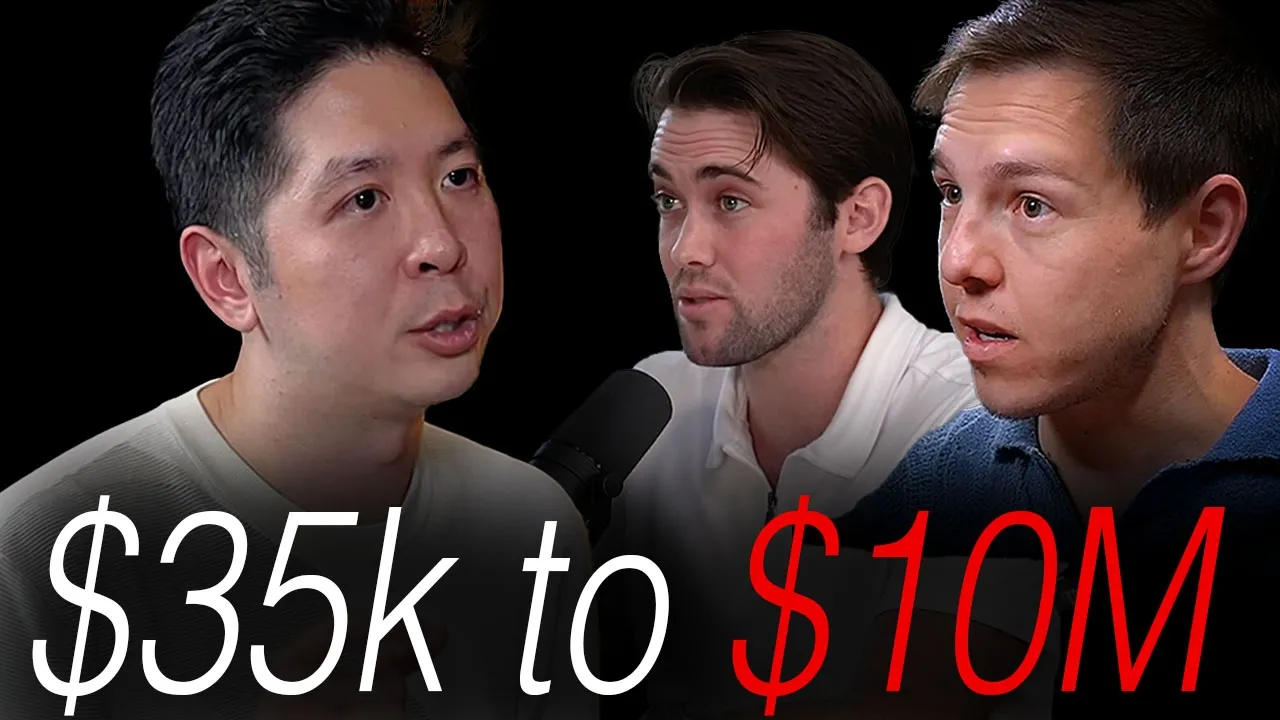
Kevin Xu Parks $11.5 Million in Index Funds After $35,000 Swing Run
The Iced Coffee Hour
Xu argues retail traders must risk entire accounts on single-stock sentiment catalysts to build wealth, but warns that sustaining capital requires abandoning active trading for passive index funds.
Kevin Xu transformed an initial $35,000 into more than $10 million in roughly 21 months via concentrated swing trading without using margin, options, or crypto. (0:00)
Xu maintains a bifurcated portfolio structure: over $11 million is preserved passively across index funds and memory chip equities inside a traditional 401(k), separate from a small speculative challenge account. (71:55)
Quarterly earnings reports function as unpredictable 50/50 coin flips that defy edge analysis, illustrated by Xu's $200,000 loss on Slack Technologies post-earnings. (33:14)
Xu monetizes his audience on X via a $200/month subscriber tier generating $80,000 to $90,000 in net monthly recurring revenue, while posting trade updates only after market close to avoid front-running accusations. (78:47)
Detailed notes
## Background
Published on YouTube by The Iced Coffee Hour on July 26, 2026, this episode features hosts Graham Stephan and Jack Selby interviewing trader Kevin Xu about how he navigated high-stakes swing trading to turn $35,000 into $10 million. The show notes highlight discussions spanning market sentiment, big wins and losses, risk management, the AI buildout, and an inside look at his multimillion-dollar retirement accounts.
## TL;DR
Former tech engineer Kevin Xu details the concentrated swing trading strategy that propelled his account from $35,000 to over $10 million inside a tax-advantaged 401(k), relying on public market sentiment and catalyst trading rather than technical charts or financial models. He shares pivotal lessons from major trades like Rocket Companies, Big 5 Sporting Goods, and Slack, explaining why he strictly avoids options, margin, and crypto following earlier account wipeouts. Hosts Graham Stephan and Jack Selby challenge Xu on the reproducibility of his methods, the ethics of social media trading challenges, and his current outlook on AI infrastructure and long-term wealth preservation.
## Atmosphere & style
The conversation carries a relaxed yet intellectually rigorous dynamic, balancing entertaining retail trading lore with sharp cross-examination from Graham Stephan regarding account transparency and marketing framing. Kevin maintains an articulate, unvarnished openness, candidly breaking down past blunders like his six-figure crypto tax fiasco and earnings traps alongside his massive wins. The back-and-forth feels pragmatic and cautionary, transitioning from high-risk swing trading psychology to the sobering reality of taxes, emotional discipline, and long-term index investing.
## Bulletin
- [00:00](https://www.youtube.com/watch?v=PEi_UT4tHIA&t=0s) Kevin Xu transformed an initial $35,000 into more than $10 million in roughly 21 months via concentrated swing trading without using margin, options, or crypto.
- [01:11:55](https://www.youtube.com/watch?v=PEi_UT4tHIA&t=4315s) Xu maintains a bifurcated portfolio structure: over $11 million is preserved passively across index funds and memory chip equities inside a traditional 401(k), separate from a small speculative challenge account.
- [33:14](https://www.youtube.com/watch?v=PEi_UT4tHIA&t=1994s) Quarterly earnings reports function as unpredictable 50/50 coin flips that defy edge analysis, illustrated by Xu's $200,000 loss on Slack Technologies post-earnings.
- [01:18:47](https://www.youtube.com/watch?v=PEi_UT4tHIA&t=4727s) Xu monetizes his audience on X via a $200/month subscriber tier generating $80,000 to $90,000 in net monthly recurring revenue, while posting trade updates only after market close to avoid front-running accusations.
## Key takeaways
- [00:00](https://www.youtube.com/watch?v=PEi_UT4tHIA&t=0s) Xu operates on the principle that concentration builds wealth while diversification preserves it, requiring radical focus on a small watchlist rather than broad indexing during the growth phase.
- [01:03](https://www.youtube.com/watch?v=PEi_UT4tHIA&t=63s) Executing swing trades with direct equity shares instead of leveraged options caps downside to company price drift rather than total account liquidation.
- [04:01](https://www.youtube.com/watch?v=PEi_UT4tHIA&t=241s) Xu practices 'vibe trading' and social arbitrage, prioritizing real-time public sentiment, aggregate human psychology, and macro catalysts over traditional DCF models or chart technical analysis.
- [11:33](https://www.youtube.com/watch?v=PEi_UT4tHIA&t=693s) Concentrated swing trading is strictly differentiated from gambling; Xu completely avoids margin, options contracts, and sub-$1 billion microcaps to evade liquidity traps and blowouts.
- [14:50](https://www.youtube.com/watch?v=PEi_UT4tHIA&t=890s) Full-portfolio swing trading is viable primarily for high-earning professionals with stable incomes and substantial safety nets who can afford the emotional volatility of concentrated drawdowns.
- [26:10](https://www.youtube.com/watch?v=PEi_UT4tHIA&t=1570s) A severe 2017–2018 crypto crash left Xu with a $150,000 tax obligation against an account that had collapsed to $35,000, prompting a permanent exit from digital assets.
- [36:38](https://www.youtube.com/watch?v=PEi_UT4tHIA&t=2198s) Trading multi-week swings on publicly available data provides a superior balance of risk, time, and sanity compared to high-stress day trading under rigid daily profit targets.
- [41:47](https://www.youtube.com/watch?v=PEi_UT4tHIA&t=2507s) Xu avoids stop-loss orders entirely, arguing they trigger unnecessary liquidations during temporary market panic and artificial volatility dips.
- [43:57](https://www.youtube.com/watch?v=PEi_UT4tHIA&t=2637s) The artificial intelligence buildout represents a multi-decade industrial shift rather than a transient bubble, driven by autonomous 24/7 compute workloads and massive infrastructure spending.
- [47:13](https://www.youtube.com/watch?v=PEi_UT4tHIA&t=2833s) Humanoid robotics and physical AI represent an emerging long-term asymmetric investment theme, evidenced by surging venture capital deployment into the sector.
- [49:50](https://www.youtube.com/watch?v=PEi_UT4tHIA&t=2990s) Navigating the expanding K-shaped economy requires clearing high-interest debt and securing a reliable cash baseline before allocating capital toward concentrated speculative swings.
- [01:14:39](https://www.youtube.com/watch?v=PEi_UT4tHIA&t=4479s) Passing on a $12,000 tax payment to convert his $35,000 401(k) into a Roth IRA in 2020 resulted in a multi-million-dollar future tax liability on his $11.5 million balance.
- [01:21:51](https://www.youtube.com/watch?v=PEi_UT4tHIA&t=4911s) Social media framing that promotes 'full-porting' challenge accounts creates viral reach but often conceals portfolio drawdown drawdowns and asymmetric total net worth backing.
- [01:28:45](https://www.youtube.com/watch?v=PEi_UT4tHIA&t=5325s) Breaking core risk parameters by forcing trades or buying leveraged ETF instruments directly causes outsized portfolio drawdowns, as demonstrated by Xu's Red Cat trade.
- [01:33:17](https://www.youtube.com/watch?v=PEi_UT4tHIA&t=5597s) Many institutional asset managers prioritize asset retention and stable management fees over alpha generation once reaching large scales, underperforming broader market indexes.
## Detailed walkthrough
### [00:00](https://www.youtube.com/watch?v=PEi_UT4tHIA&t=0s) The Anatomy of a High-Stakes Swing Trader
The episode opens with the extreme volatility that defines Kevin Xu's trading journey. When asked about the most money he had ever made on a single position, Kevin reveals that he experienced an emotional and financial rollercoaster early on: “I made a million dollars and lost a million dollars in back-to-back days. Like that changes a man.” He reflects on his early participation as an initial whale in GameStop (GME), where he had deployed $1.3 million right before shares skyrocketed over 100%. Graham Stephan notes that Kevin achieved internet fame under his Reddit persona ("Sir Jack") by turning an initial stake of $35,000 into more than $10 million in roughly two years, actively posting every single trade to Reddit’s r/wallstreetbets community during the meme stock mania.
Kevin distinguishes himself from traditional buy-and-hold investors, emphasizing that his entire run was driven by swing trading with a strict, disciplined rulebook rather than reckless speculation. He asserts: “I'm a swing trader. I'm not an investor. I have a couple of rules that are very strict that I follow. No margin. Don't chase the stock.” Rather than spreading capital thinly, his philosophy centers on intense focus and decisive action: “Concentration makes wealth. Diversification keeps it.”
- **Starting capital to peak:** Turned $35,000 into over $10,000,000 in approximately 21 months (a 285x multiple).
- **Core operational rules:** Zero margin, zero options, zero crypto, and refusing to chase hot tickers that have already run up.
---
[01:03](https://www.youtube.com/watch?v=PEi_UT4tHIA&t=63s) From $35K to $10 Million: Big Wins, Big Losses, and the RKT Whiplash
Graham asks Kevin to break down his biggest winners and losers throughout the legendary run. Kevin explains that his very first trade yielded his highest percentage gain, doubling his money (a 2x return) in roughly a month. However, the wildest experience occurred with Rocket Companies (RKT) around February or March 2021, directly on the heels of the January GameStop frenzy. Spotting a high short interest ratio and sensing a short squeeze setup, Kevin put his entire net worth—100% of his account—into the trade. He rode an explosive 70% wave upward to a $1 million profit in a single day, only to see the gain evaporate almost immediately the very next day.
Graham presses whether Kevin feared going to zero by placing his entire net worth on a single ticker. Kevin clarifies that going all-in on shares of an established company is fundamentally different from gambling on derivatives. He was working a stable, high-paying corporate role at Google, making around $300,000 a year, while trading inside a self-directed brokerage account attached to a 401(k) that he could not withdraw without penalty until age 65. With a stable career safety net and a locked retirement account, he felt comfortable taking aggressive swings: “I was working a very stable job at Google making like $300,000 a year, right? And I had this 401(k) that I couldn't touch until I'm 65, and so why not just keep yoloing it and I just kept working, right?”
```mermaid
flowchart TD
accTitle: Kevin Xu All-In Swing Trading Process
accDescr: Flowchart illustrating Kevin Xu's process of selecting, swinging, and rotating single stock positions.
subgraph Selection["1. Stock Selection"]
A["Identify High-Sentiment Story"] --> B["Verify Legit Company Base"]
end
subgraph Execution["2. Position Execution"]
B --> C["Deploy 100% Capital (Shares Only, No Margin/Options)"]
C --> D["Hold Through Catalyst / Momentum Run"]
end
subgraph Exit["3. Exit & Rotation"]
D --> E["Take Profit at Target (~20%+ Gain)"]
E --> F["Roll Full Balance into Next Setup"]
end
```
- **Rocket Companies (RKT) Trade:** Up $1,000,000 on day one, down $1,000,000 on day two.
- **Underlying portfolio safety net:** Real shares only—worst-case scenario on an established company was typically an earnings drop of 20%, rather than total liquidation.
- **Strategy execution:** Rolling 100% of capital from one swing trade directly into the next, catching bounces, post-earnings dips, and narrative momentum.
---
[02:54](https://www.youtube.com/watch?v=PEi_UT4tHIA&t=174s) Why Most Wall Street Bets Traders Blow Up
Graham points out that countless retail traders on r/wallstreetbets attempt the exact same "all-in" strategy, only to end up posting "loss porn" screenshots showing their accounts down 95% or wiped out entirely. Kevin explains that retail traders fail because they confuse high-conviction equity trading with lottery tickets. They chase volatile zero days-to-expiration (0DTE) short-dated options contracts that can decay to absolute zero overnight, and they fall victim to FOMO by chasing tickers after they have already parabolic-moved.
Kevin stresses that once a stock becomes the trending topic across social media feeds, the easy money has already been made: “A lot of people love chasing whatever the hot stock is. But you have to realize like once you hear about the stock, most often it's probably already run up a lot and it kind of loses the support, right?” He points out that he intentionally avoided buying into Tesla during its meteoric retail hype cycles, and has similarly avoided buying Nvidia during its current AI surge. Instead, Kevin positions himself near established technical and narrative support floors where downside is cushioned: “I'm what they call a swing trader, right? So I try to buy near support and the worst case scenario is it just kind of bobbles to the side and then if some catalyst or some good news happens, it'll rise up, sell for 20% profit and just keep doing that again and again.”
- **The fatal retail mistake:** Chasing parabolic green candles and buying zero-DTE options contracts that expire worthless.
- **Key discipline:** Never buying mega-hype stocks like Tesla or Nvidia late in their runs.
- **Target margin of safety:** Buying near technical support levels where the downside is a sideways drift and upside is a clean 20% pop on incoming news.
---
[04:01](https://www.youtube.com/watch?v=PEi_UT4tHIA&t=241s) Skill vs. Luck and the Psychology of "Vibe Trading"
When Graham asks whether his run could be replicated today, Kevin reveals that he is actively running a new public challenge: starting with a fresh $35,000 account on Robinhood, he had already grown it 50% to roughly $52,000 in just a few weeks. He calls today's headline-driven market “a swing trader's wet dream,” noting that hyper-volatility creates constant opportunities for those monitoring sentiment on X (formerly Twitter).
Acknowledging the debate between skill and luck, Kevin admits both played an essential role. While riding the historic 2020–2021 bull run provided ideal market conditions, the sheer magnitude of multiplying an account 285 times in under two years required rare discipline and information processing. He confesses he has never run a discounted cash flow (DCF) model or relied heavily on chart technicals; his edge is reading the market's collective psychology: “I'm not a technicals guy. I'm not a fundamentals guy. I've actually never even run like a discounted cash flow in my entire life. Like I understand sentiment. I believe the market is based on sentiment. So I try to predict where sentiment is going.”
- **Current challenge account:** Turned $35,000 into $52,000 within weeks on Robinhood via modern narrative trading.
- **Historical outperformance:** 285x return across 21 months during 2020–2021.
- **Core philosophy:** The stock market moves on aggregate sentiment and human emotion rather than pure mathematical valuation.
---
[05:40](https://www.youtube.com/watch?v=PEi_UT4tHIA&t=340s) Finding the Narrative: Social Arbitrage and Modern Catalysts
Jack Selby compares Kevin's methodology to "social arbitrage"—the consumer-sentiment trading framework popularized by past podcast guest Chris Camillo. Kevin agrees with the parallel, humorously dubbing his approach "vibe trading." To execute it, he searches for an asymmetric narrative: an underlying business that is fundamentally sound for the long haul, paired with powerful, imminent short-term catalysts.
As an example, Kevin discusses his current all-in conviction play in Sharon AI (ticker: SHAZ), an Australian "neocloud" infrastructure provider. He points out that in the midst of the massive global AI infrastructure buildout, data center capacity is at an extreme premium. Sharon AI benefits from both a strong secular macro tailwind and near-term speculative catalysts, such as potential partnership deals with AI labs like Anthropic or strategic investments from Nvidia. He contrasts this with pure meme plays where long-term enterprise value is uncertain: “I look for, you know, it's a good company with a good long-term future, but also a potential catalyst and good news that could pop up any day in the short term.”
- **Framework requirements:** Strong long-term narrative floor combined with explosive short-term news catalysts.
- **Current high-conviction position:** Sharon AI (SHAZ), an Australian neocloud computing company riding the AI data center buildout.
---
[07:02](https://www.youtube.com/watch?v=PEi_UT4tHIA&t=422s) Information Edge: Why X Beats Reddit and How to Trade the Rumor
Jack asks where retail traders should source their intelligence if they want to adopt this approach. Kevin emphatically states that X has completely replaced Reddit and traditional financial media like CNBC. On X, reputable traders share real-time breaking news, detailed long-form analyses, and verified trade receipts. Unlike Reddit's anonymous forum structure, X creates public accountability where a trader’s historical track record and capital commitments are visible over time.
Kevin explains his day-to-day routine: he maintains an ultra-concentrated watchlist of only about five stocks at any given time. Rather than watching hundreds of tickers, he tracks every mention, headline, and price reaction across those five names to develop an intuitive feel for cause and effect. He specifically targets the pre-announcement momentum phase, adhering to the classic Wall Street maxim: “I also subscribe to the philosophy of buy the rumor, sell the news. And this is basically when you know something potentially interesting is coming up—could be an earnings report, could be an announcement or whatever—and there's usually a runup into the actual news event.”
- **Information source:** X over Reddit due to verified profiles, real-time speed, and transparent trade receipts.
- **Portfolio focus:** A tight, actively monitored watchlist limited to roughly five stocks at a time.
- **Core strategy mechanic:** "Buy the rumor, sell the news"—accumulating positions near support ahead of anticipated announcements and selling directly into the peak pre-event run-up.
[08:23](https://www.youtube.com/watch?v=PEi_UT4tHIA&t=503s) The $1.7M Big 5 Trade and Due Diligence
Kevin explains how he plays catalysts, noting that many stocks run up ahead of earnings announcements; if he anticipates a strong upcoming report, he often buys early to ride the momentum directly into the event. Asked about his single most profitable trade, he cites Big 5 Sporting Goods (ticker: BGFB). The idea originated on Reddit's r/WallStreetBets when a user he respected tagged him, suggesting he look into the retailer because it had declared a special dividend on top of reporting solid earnings. Surprised by how casual the tip seemed, the hosts press him on how much research he actually performed before committing capital, cautioning that retail viewers might mistakenly believe they should pour life savings into random forum recommendations.
Kevin reveals that he "full-ported" roughly $6 million of his capital into Big 5 Sporting Goods, which at the time amounted to owning around 1.5% of the entire company, netting a profit of approximately $1.7 million. Addressing the depth of his due diligence, Kevin explains that his research is not a sudden multi-day deep dive; rather, it operates as an ongoing background process where he tracks news, monitors hundreds of tickers, and watches for sentiment shifts until everything aligns in what he calls a "Limitless moment." In the case of BGFB, the stock had already surged 20% on the day following the dividend news, accompanied by a major spike in trading volume on the candlestick charts. Even though entering after a 20% pop carries risk, he treated the upcoming payment date of the special dividend as a secondary catalyst to ride the wave further. When asked how long everyday traders should research a stock, Kevin admits he has executed trades after just one hour of research, highlighting that modern AI chatbots and agents can summarize the bull case, bear case, and recent news in seconds.
```mermaid
flowchart TD
accTitle: Kevin Xu's Swing Trading Evaluation Process
accDescr: A compact breakdown showing ongoing monitoring, trigger identification, AI synthesis, and high-conviction execution.
subgraph Monitoring["1. Continuous Scanning"]
A["Ongoing Background Process<br/>Tracking news & market sentiment"]
B["Volume Spikes on Candlesticks<br/>Confirms influx of market participants"]
end
subgraph Triggers["2. Catalyst & AI Synthesis"]
C["Fundamental Catalyst<br/>(e.g., special dividend, earnings run-up)"]
D["Rapid Research via AI Tools<br/>Extract bull & bear cases in ~1 hour"]
end
subgraph Action["3. Execution"]
E["'Limitless Moment'<br/>Confluence of volume, hype & catalyst"]
F["Full-Port Entry into Single Ticker<br/>Concentrated swing trade"]
end
A --> B
B --> C
C --> D
D --> E
E --> F
```
[11:33](https://www.youtube.com/watch?v=PEi_UT4tHIA&t=693s) Gambling vs. Trading vs. Investing
When challenged on what Warren Buffett would think of committing millions off short-term technicals and AI summaries, Kevin draws a strict boundary between three distinct ways of deploying capital: gambling, trading, and investing. He identifies primarily as a swing trader rather than a traditional buy-and-hold investor. Kevin insists he completely avoids gambling, refusing to touch meme coins, options, margin, leveraged products, prediction markets, or sports betting because they carry the catastrophic risk of going to zero overnight. In contrast, true investing entails purchasing companies you believe in so deeply that you could go into a 10-year coma and wake up perfectly fine holding them.
Kevin notes that he now practices traditional investing with his retirement assets, holding roughly $5 million in SPY, $5 million in QQQ, and about $1 million in DRAM (an ETF composed of prominent tech and semiconductor firms) inside his 401(k). Citing a classic market adage, Kevin underscores why aggressive swing trading made sense earlier in his trajectory: “concentration makes wealth, diversification keeps it.” Because he earned a stable $300,000 salary as a software engineer at Google, he could comfortably afford to gamble or "YOLO" an initial $40,000 locked in a 401(k) that he couldn't access anyway, dedicating his spare time to tracking sentiment and swings.
- **Capital Allocation Categories**:
- *Gambling*: Zero-sum vehicles with total-loss risk (options, leverage, margin, meme coins, sports bets).
- *Trading*: Shorter-term swings capitalizing on sentiment, momentum, and immediate catalysts over days, weeks, or months.
- *Investing*: Long-term passive wealth preservation via broad index funds (SPY, QQQ) and durable enterprises.
- **Retirement Portfolio Allocation**: Approximately $5 million in the SPDR S&P 500 ETF Trust (SPY), $5 million in the Invesco QQQ Trust (QQQ), and $1 million in DRAM.
The hosts take a brief break to announce the hiring of their first full-time podcast employee, Michael, who edits the show. Graham notes that while adding team members is rewarding, administrative burdens such as payroll, tax filings, health benefits, and HR paperwork are overwhelming. They highlight Gusto as an all-in-one payroll and benefits platform tailored for small businesses. Graham shares that he has personally used Gusto for six years, ever since his CPA recommended it when he formed his S corporation in 2020. The integration is free to set up until the first payroll is executed, features flat-rate monthly pricing, and offers listeners a three-month free trial.
[14:50](https://www.youtube.com/watch?v=PEi_UT4tHIA&t=890s) Who Should Actually Go "All In" on One Stock
Returning to portfolio strategy, Graham asks Kevin who should realistically attempt his high-concentration, "full-port" approach of going 100% into a single equity. Kevin stresses that this method is exclusively suited for young professionals who hold a reliable, well-paying job. Without a separate, steady income, trading becomes an emotional lifeline, inevitably compelling the trader to make irrational, fear-driven decisions. Once base expenses are covered by employment, an individual can decide on a discretionary risk amount and concentrate it into a single position. Kevin argues that full concentration forces total focus: “Because then you're like fully invested. You're fully concentrated. You're tracking every movement.” In his view, having a massive winner when only 5% of your portfolio is allocated yields negligible results, whereas full porting produces life-changing gains—and if the trade moves against you, you can simply cut losses by selling.
Graham pushes back with a strong warning, offering his unsolicited view that while concentrated trading can work for a rare personality type, promoting it broadly is dangerous because most retail participants will get completely wiped out. Graham doubts that the typical listener possesses the analytical discipline, risk tolerance, or timing necessary to execute such aggressive plays successfully without suffering catastrophic losses.
> “Concentration makes wealth, diversification keeps it.” — Kevin Xu
> “I think it's very important to have your have a have a stable job and then decide, you know, how much money you're willing to risk and just, yeah, full port.” — Kevin Xu
[16:28](https://www.youtube.com/watch?v=PEi_UT4tHIA&t=988s) Jack’s Trading Strategy and Defining Gambling vs. Investing
Jack recounts a recent trade in Bloom Energy, explaining that he bought shares about a week earlier before the price dropped to around $2.30. He averaged down by purchasing more at $2.30, bought call options, and sold weekly puts as it began to recover. Reflecting on his track record, Jack claims that every individual stock he has picked has outperformed every index fund he has ever owned, lamenting that he only put small amounts like $2,000 into single picks while keeping hundreds of thousands in index funds. Graham jokingly interjects that Jack has selectively forgotten 2020 and 2021. Jack concedes that he was margin called on Robinhood during that period after buying Palantir at $15, $20, and $30 and being forced to liquidate at $10. Despite having cash sitting in a high-yield savings account, he refused to inject more capital because he treated that brokerage as pure "fun money." Even so, he maintains that his underlying stock picks were fundamentally correct because Palantir eventually skyrocketed.
Kevin agrees with separating capital, pointing out that having an isolated "fun account" is the ideal mental model for going all-in on speculative plays. Addressing critics online who poke fun at him for gambling on single stocks despite having a large net worth, Kevin explains that his total net worth is $11.6 million—mostly locked safely away in index funds—while his public "all-in challenge" account currently sits at around $52,000. When Graham questions whether buying individual equities on an hour of research blurs the line between investing and gambling, Kevin establishes a clear boundary: “To me, gambling can go to zero, right? Gambling can go to zero overnight, out of your control.” He argues that with regular equities, your balance does not wipe out to zero overnight, which distinguishes stock trading from a casino spin.
```mermaid
flowchart TD
accTitle: Portfolio Separation Model
accDescr: Diagram showing how Kevin Xu structures high-risk trades separately from core wealth.
subgraph CoreWealth["Core Wealth Preservation"]
A["$11.6M Net Worth"] --> B["~$11M in Passive Index Funds"]
end
subgraph Speculative["Active Speculative Trading"]
C["Separate 'Fun' Account"] --> D["$52K 'All-In Challenge' Account"]
D --> E["Single Stock Swings (1-2 tickers max)"]
end
```
- **Kevin's personal portfolio breakdown**: $11.6 million total net worth vs. a separate $52,000 active "all-in challenge" account.
- **Trading simplicity**: Kevin avoids complex derivatives like selling covered calls or puts; he focuses purely on buying a stock he believes in, expecting a 5% to 10% move within days or weeks, and then selling.
---
[19:31](https://www.youtube.com/watch?v=PEi_UT4tHIA&t=1171s) Red Flags, Pump-and-Dumps, and Knowing When to Sell
When asked about the warning signs that prevent him from entering a trade, Kevin highlights untrustworthy promoters on X (formerly Twitter) pushing obscure penny stocks while remaining completely anonymous. Unlike anonymous accounts sharing fabricated Discord screenshots or Photoshopped profits, Kevin emphasizes that he has posted verifiable video receipts for every single trade since 2020 on Reddit, AfterHour, and X. He considers private messages an automatic disqualifier: if someone sends an unsolicited direct message urging him to look at a ticker, he dismisses it instantly, knowing they likely harbor an ulterior motive. Additionally, companies with a market capitalization below $1 billion serve as an immediate orange flag because micro-caps are notoriously vulnerable to pump-and-dump manipulation.
On the exit side, Kevin maintains strict parameters. He explains that he swing trades out of a position under two primary conditions: when the thesis has been either validated or invalidated, or when a far more compelling opportunity emerges. As an example, he mentions a recent trade in Pagaya (PGY), where he held through earnings expecting an upside move; when the stock surged 26% immediately after the report, his thesis was validated, and he exited completely. At other times, if a position drifts sideways while awaiting a catalyst and a different stock announces a promising partnership or impending news, he will rotate capital toward the momentum play.
- **Primary red flags**: Unsolicited DMs touting tickers, anonymous social media promoters without transparent track records, and sub-$1 billion market caps.
- **Selling criteria**: Catalysts playing out (e.g., a post-earnings pop), fundamental invalidation of the idea, or rotating into an opportunity with higher near-term upside.
---
[21:37](https://www.youtube.com/watch?v=PEi_UT4tHIA&t=1297s) The $40 Million GameStop Miss and Graham’s Lucky 30x
Kevin reveals that his tendency to rotate capital into faster-moving plays caused him to miss the historic GameStop short squeeze. He was one of the earliest institutional-sized retail "whales" in GameStop, investing $1.3 million into the stock in October 2020 at an average cost basis of roughly $13 per share. However, he sold his entire stake in December 2020—missing the explosive January 2021 squeeze by merely one month. Had he held his position to the peak around $420, his position would have been worth an estimated $30 million to $40 million. Despite walking away from life-altering gains, Kevin feels no lingering regret: “I don't think about that at all. During those days, I was ecstatic cuz we were right.” He had validated the short-squeeze thesis alongside Roaring Kitty and moved on without remorse.
Graham shares his own contrasting GameStop trade. Back when the stock traded around $3, Graham stumbled onto the thesis on r/wallstreetbets and threw $5,000 into it as a pure joke because he thought the premise was amusing. He forgot about the investment until the frenzy took over the news cycle. The moment Robinhood famously restricted retail buying, Graham recognized that the artificial liquidity constraint would crush upward momentum. He quickly consulted Jack, locked in his gains, and liquidated the position for over $150,000, turning an offhand Hail Mary into a 30x return.
---
[23:26](https://www.youtube.com/watch?v=PEi_UT4tHIA&t=1406s) Avoiding Emotional Attachment and the Dangers of Margin
Kevin identifies getting emotionally attached to an investment as one of the single biggest mistakes retail market participants make: “That's another one of my principles. Like never get married to a stock, right?” He observes investors who made fortunes on names like Tesla, Bitcoin, or memory semiconductor stocks (like Micron and SanDisk) who become pathologically obsessed with holding them forever. In Kevin's eyes, an investor aiming to hold for 20 or 30 years shouldn't care about daily noise, but if an active trader is constantly monitoring price action, they are actively considering an exit and must remain willing to pull the trigger.
Addressing the fatal flaws that wipe out retail traders, Kevin singles out leverage. In his view, trading is a game of survival where the goal is to manage downside, take steady profits, scale up risk slightly when up 20%, and pull back when down 20%. The moment an investor goes on "full tilt" using margin to aggressively chase back their losses, catastrophe strikes. When Graham brings up social-arb investor Chris Camilo—who actively advocates for using margin and even critiqued Graham for not using enough leverage—Kevin responds that utilizing heavy margin requires extreme conviction. He notes that such a high-risk posture is vastly different when an investor already possesses a massive financial cushion to absorb a catastrophic blow versus when they are first starting out.
[24:57](https://www.youtube.com/watch?v=PEi_UT4tHIA&t=1497s) Psychological Swings and the "Don't Chase" Rule
Kevin Xu emphasizes that avoiding margin and holding out for realistic gains requires discipline and patience, explaining: “I mean, you have to be patient, right? Like this is this is also like a a patient man's game in order to uh be happy with, you know, 20% swings, 20% swings versus like, oh, it could have been 40% or something like that.” He points out the power of compounding modest wins: mathematically, stringing together just four 20% gains results in doubling your principal capital.
When the hosts ask about the psychological toll of swinging by a million dollars—making a million in one trading day and giving it all back the very next day—Kevin admits that the speed of the price action numbs the reality: “To be honest, it happens so fast it didn't quite register, you know.” The paper wealth appears and vanishes before it ever settles into daily awareness. He draws a sharp line between forfeiting newly minted paper profits versus watching an original cash base deteriorate: “I think also psychologically it's very different than losing a million right first uh or or from your cost basis right like I gained a million and then it disappeared right.” This dynamic reinforces his rule against chasing runners at the top:
```mermaid
flowchart LR
accTitle: Trade Entry vs Psychological Resilience
accDescr: Contrasting good entry prices with chasing tops and their psychological outcomes.
subgraph Disciplined["Good Entry Point"]
A["Low Cost Basis"] --> B["Stock Pops +20%"]
B --> C["Stock Pulls Back -20%"]
C --> D["Flat on Trade / Calm Mindset"]
end
subgraph Chasing["Buying the Top"]
E["High Entry (FOMO)"] --> F["Immediate Pullback"]
F --> G["Capital Impairment / Panic"]
end
```
[26:10](https://www.youtube.com/watch?v=PEi_UT4tHIA&t=1570s) Paying Tuition: The 2017 Crypto Boom and the $150K Tax Trap
Kevin recounts his earliest high-stakes trading journey in the cryptocurrency market. Having missed the early Bitcoin runs of 2012 and 2013 despite friends mining it in college, he decided to plunge into Ethereum in 2016. At the time, he had recently transitioned out of an unsuccessful startup venture (2013–2015) and was working his first corporate engineering role at Stripe, earning a modest private tech salary of roughly $150,000. He scraped together all of his available liquid savings—just $8,000—and put it directly into Ethereum when it was trading around $16 per coin.
As Ethereum climbed past $100, his $8,000 ballooned to $30,000–$50,000, leading directly into the height of the 2017 Initial Coin Offering (ICO) craze. Kevin deployed the exact same all-in, single-asset strategy he would later adapt for stocks, surfing whatever speculative asset held the strongest community narrative: “back then that was a lot more sentiment based because you know these coins really don't have any fundamental value. So it's just like whatever the next hot one is as a funny story.” His account peaked at $300,000 by December 2017. However, the subsequent 2018 crash demolished the holdings down to $35,000.
Because Kevin actively traded in and out of different tokens throughout 2017, all his substantial gains were realized within that tax year. When the entire market tanked in early 2018, his realized profits were locked in while his current portfolio plummeted, leaving him stuck with an estimated $150,000 tax bill against an account worth only $35,000. Under United States tax code, standard net capital losses can only offset $3,000 of ordinary income per year, preventing him from retroactively erasing the prior year's realized tax burden with next year's crash: “Yeah that was a hard lesson that also why I've never touched crypto ever since.”
[28:40](https://www.youtube.com/watch?v=PEi_UT4tHIA&t=1720s) Rebuilding the 401(k): From $35K to $300K on Pandemic Plays
After paying his dues in crypto, Kevin decided to apply his concentrated trading strategy strictly within equities inside a self-directed 401(k) retirement account, starting with $35,000 right as the COVID-19 pandemic emerged in early 2020:
- **Alpha Pro Tech (APT):** Operating during the pre-lockdown phase of the pandemic, Kevin noticed the emerging demand for personal protective equipment. Alpha Pro Tech, a manufacturer based out of Salt Lake City, Utah, specialized in face masks. His thesis was simple: domestic demand for American-made masks would spike. The trade quickly surged, turning his $35,000 account into $90,000.
- **Co-Diagnostics (CODX):** Looking for downstream pandemic beneficiaries, he rotated the full balance into Co-Diagnostics, a firm producing PCR testing kits and swabs that was actively securing state-level public health supply contracts. Riding the momentum ahead of anticipated earnings, the stock doubled, lifting his total balance from $90,000 to roughly $180,000.
- **Norwegian Cruise Line Holdings (NCLH):** By summer 2020, cruise stocks had collapsed by roughly 80% and were priced for near-term insolvency. Kevin monitored social media channels, discovering passionate communities of travelers: “I was like all these like Facebook groups for like cruise moms and stuff. Uh they were like buying like all these like on sale items that uh you know cruise lines are not going to go under.” Betting on the narrative of the CDC eventually lifting sailing restrictions, he timed the bounce, capturing a 60% upswing that lifted the account from $180,000 to around $250,000–$300,000.
- **Chewy (CHWY):** Kevin personally adopted a puppy during lockdown and recognized the massive spike in pet ownership and e-commerce adoption. Rolling capital into Chewy delivered an additional 25% return.
Graham Stephan and Jack Selby pause to highlight the episode's sponsors:
- **Upwork:** Graham highlights Upwork as an essential resource for scaling businesses needing specialized freelancers across software development, marketing, and operations. Features include Upwork Business Plus (providing access to the top 1% of vetted talent), AI-powered candidate matching that connects businesses with hires in under six hours, and unified contracts and payments. Graham notes he has relied on the platform continuously over his seven years managing digital media companies.
- **Shopify:** Jack shares that before working on *The Iced Coffee Hour*, he launched six different e-commerce storefronts trying his hand at drop-shipping. Despite having no technical background, he successfully converted sales for an eyebrow epilator using Shopify's checkout engine. The platform provides one-tap checkouts, high conversion rates, and accessible backend tools for companies ranging from independent startups to global enterprise brands like Heinz and Gymshark.
[33:14](https://www.youtube.com/watch?v=PEi_UT4tHIA&t=1994s) The First Big Equities Defeat: Slack (WORK)
Returning to the trading history, Kevin discusses the trade that handed him his first substantial setback inside the 401(k). Having witnessed peer work-from-home favorites like Zoom and Peloton experience parabolic runs throughout 2020, Kevin sought out an enterprise software name that had lagged behind: Slack Technologies (prior to its buyout by Salesforce).
Assuming the work-from-home rotation would naturally lift Slack to parity with other telecommuting winners, he entered the position purely on that premise: “Zoom was like taking off, right? Pelaton was taking off and I was like Slack has not really moved yet, right? And that was that was it. That was the thesis.” Slack headed into its quarterly earnings report, setting up Kevin's first painful realization about the dangers of holding concentrated bets through earnings announcements.
[33:32](https://www.youtube.com/watch?v=PEi_UT4tHIA&t=2012s) The Slack Loss and Why Earnings Are a Coin Flip
Kevin Xu recounts his first major portfolio setback, which occurred after he had already grown his original $35,000 balance up to roughly $700,000 or $800,000. He took a heavy position in Slack ahead of its earnings report, having miscalculated the competitive dynamics between Slack and Microsoft Teams. When the report dropped, the stock plummeted around 25%, handing him a loss of approximately $200,000. When asked whether the loss was simply bad variance on repeated oversized bets, Kevin explains that the experience cemented an enduring rule for his investing career: quarterly earnings reports are essentially impossible to forecast accurately.
When the hosts ask whether stocks tend to react with greater percentage volatility to positive surprises or negative disappointments, Kevin argues that it remains a pure 50/50 gamble. While options markets provide complex mathematical models for implied volatility and expected upside or downside moves, traders can never truly know what expectations are already baked into the price. Even with market darlings like Nvidia, where vast amounts of public data exist and substantial run-ups lead investors to believe everything is priced in, the stock can still deliver massive upside shocks. Kevin stresses that attempting to out-analyze earnings reports is a fool's errand.
> “I have this lesson still to this day like earnings are a coin flip, you know, like no matter how much you think you know about a company's revenue numbers or the climate or whatever, earnings are a coin flip, right?” — Kevin Xu
- **Slack trade drawdown**: Lost approximately $200,000 when the stock dropped roughly 25%.
- **Account size at the time**: Grown from $35,000 up to $700,000–$800,000 before taking his first major loss.
- **Risk management rule**: You can afford to take an earnings gamble only if you possess a strong safety buffer from a recent winning streak, but if it breaks against you, you must manage risk conservatively on the subsequent play.
---
[35:51](https://www.youtube.com/watch?v=PEi_UT4tHIA&t=2151s) Insider Information vs. Connecting Public Dots
The conversation shifts to whether people attempt to feed Kevin proprietary tips or non-public insights after seeing his success online. Kevin makes it clear that he receives no insider tips and actively steers clear of direct messages that resemble anything questionable. Rather than relying on private corporate intel, his process revolves entirely around synthesizing public data, tracking community sentiment, and spotting patterns across open channels.
He acknowledges that much of retail market sleuthing borders on absurd speculation or wishful thinking—such as dissecting who liked an executive's LinkedIn post or observing which executives happen to be visiting Miami at the same time. While he views those hyper-specific clues more as entertaining side narratives than the core foundation of a trade, he maintains that combining public clues is entirely legal, open to everyone, and far more reliable than seeking clandestine tips.
> “Everything I use is public information.” — Kevin Xu
---
[36:38](https://www.youtube.com/watch?v=PEi_UT4tHIA&t=2198s) Day Trading vs. Swing Trading and the Tax Debate
Addressing the prevalent myths that permeate online investing communities, Kevin criticizes the obsession with making daily trades to hit arbitrary profit targets like $1,000 a day. He argues that this hustle-culture approach mistakes continuous activity for real work, creating immense psychological friction while producing poor risk-adjusted outcomes; a trader might grind out small daily wins only to wipe out their entire week on a single $5,000 loss. For Kevin, swing trading offers the optimal balance of time, mental bandwidth, and overall upside. Because high-quality stocks and broader indices rise over long horizons, swing trading attempts to capture multi-week bottoms and tops, compounding capital at an accelerated pace—a strategy that enabled his 285x account return over 21 months.
Jack Selby pushes back, pointing out that short-term swing trading can be profoundly tax-inefficient compared to long-term buy-and-hold investing, since ordinary income tax rates significantly diminish the net capital base available to compound year after year. Kevin laughs off the critique with the quip to “just make more money,” noting that his initial multi-million-dollar run took place inside a 401(k), shielding every transaction from immediate taxes. Even when trading inside a taxable brokerage account like Robinhood, Kevin contends that holding through extended drawdowns simply to qualify for favorable long-term capital gains rates often destroys more paper profit than the tax savings preserve.
> “I think swing trading to me is kind of the best ROI on like your energy, on your time, on your sanity, on your returns, because generally the stock market goes up, right?” — Kevin Xu
```mermaid
flowchart TD
accTitle: Swing Trading vs Day Trading Comparison
accDescr: Visual flowchart comparing the churn of day trading against the compounding efficiency of swing trading.
subgraph DT["Day Trading Approach"]
A["Daily Market Churn"] --> B["Small Gains: +$1,000/day"]
B --> C["Sudden Drawdown: -$5,000/day"]
C --> D["Result: High Fatigue, Flat Returns"]
end
subgraph ST["Swing Trading Approach"]
E["Identify Cyclical Bottoms"] --> F["Hold Across Multi-Week Trends"]
F --> G["Exit at Momentum Peaks"]
G --> H["Result: 285x Compounding Efficiency"]
end
```
---
[38:35](https://www.youtube.com/watch?v=PEi_UT4tHIA&t=2315s) How to Research Stocks and Top Accounts on X
For regular retail investors wondering how much time they need to dedicate to market research, Kevin estimates that no more than two hours a day is required: roughly one hour around the market open and another hour toward the market close. A standard routine involves checking morning trends, reviewing CNBC coverage, and tracking curated discussions on X. He argues that the modern algorithmic feed on X has become exceptionally good at surfacing valuable market insights if you actively follow the right thinkers and enable post notifications.
When asked specifically whom everyday investors should follow outside of his own account, Kevin highlights three creators delivering actionable research:
- **Amit Investing (@amitisinvesting)**: Recognized as a leading voice with roughly 500,000 followers, known for early calls on Palantir and Robinhood alongside thorough company breakdowns and executive interviews.
- **Michael Sikand**: Produces granular research into AI infrastructure bottlenecks, highlighting picks-and-shovels opportunities such as the photonics trade that replace the dry, 30-page research reports traditionally published by investment banks like Morgan Stanley.
- **Serenity**: An anonymous account with an anime profile picture that surged to nearly one million followers in six months by publishing technical deep dives on the physical infrastructure buildout required for artificial intelligence.
> “The algorithm, to be honest, is really good now.” — Kevin Xu
---
[40:10](https://www.youtube.com/watch?v=PEi_UT4tHIA&t=2410s) Obsession, Independent Thinking, and Real-Time Execution
Graham Stephan presses Kevin on the fundamental trait that separates his multi-million-dollar results from the thousands of retail investors who attempt concentrated, all-in trading and end up wiping out their accounts. Kevin readily attributes his edge to intense, single-minded focus: once he commits capital to a specific ticker, he monitors its order book and tape obsessively throughout the entire trading day, admitting that during the pandemic remote-work boom, he kept active price charts open side-by-side with his professional Zoom meetings.
Beyond sheer screen time, Kevin emphasizes that followers must cultivate independent thinking rather than blindly copying trades. Backtesting historical figures and reading financial textbooks cannot replicate the emotional weight of living through active price action, digesting macro headlines, and watching real-time social panic unfold during a Federal Reserve announcement. By taking a deliberate position and studying its behavior continuously, an investor internalizes the psychological cadence of market sentiment far more effectively than any simulated portfolio could ever teach.
> “I get very obsessed.” — Kevin Xu
[41:47](https://www.youtube.com/watch?v=PEi_UT4tHIA&t=2507s) Stop Limits and the "All-In" Philosophy
Kevin explains that learning his trading instincts is best done by watching him trade in real time, observing how he connects disparate dots to spot a top and exit. When asked whether he uses automated safeguards—such as setting a stop-loss to sell if a position drops 20% while he is asleep—Kevin reveals that he has never used a stop limit in his life. He avoids them because he fears getting prematurely stopped out on an artificial dip triggered by macro headlines or temporary panic that he fundamentally disagrees with.
```mermaid
flowchart TD
accTitle: Concentration vs Diversification Mindset
accDescr: Flowchart contrasting an all-in concentrated conviction strategy against a diversified hedging strategy.
subgraph Concentration["All-In Strategy"]
A["Deep Focus & Capital Concentration"] --> B["Intense Research & Obsession"]
B --> C["Fast Clarity: Works or Fails Quickly"]
C --> D["Creates Substantial Wealth"]
end
subgraph Hedging["Diversified Strategy"]
E["Small Allocations (e.g., 5% or $5K)"] --> F["Low Emotional & Intellectual Investment"]
F --> G["Preserves Wealth Without Outsized Gains"]
end
```
The hosts bring up Kevin's viral line that men should trade stocks the way they date women—only one at a time. Kevin readily admits it was intentional "financial rage bait" on X, but maintains the underlying truth: “Concentration creates wealth. Diversification keeps it right.” He argues that people already go "all in" on major life commitments like careers and marriages. Recalling his own relationship, he notes that he and his wife moved in together just six weeks after meeting because he recognized what he wanted immediately. Hedging or spreading small amounts—like putting only 5% or $5,000 into a position—leads to indifference, whereas putting everything in forces deep obsession, intense research, and immediate clarity on whether the bet works.
- **Stop Limits:** Kevin has never used a stop-loss or stop-limit order in his trading career.
- **Dating Analogy:** Moved in with his wife after six weeks, comparing his concentrated romantic commitment to running a concentrated stock portfolio.
- **Core Belief:** Going all in forces rapid evaluation, whereas fractional exposure generates apathy.
---
[43:57](https://www.youtube.com/watch?v=PEi_UT4tHIA&t=2637s) Impatience, Life Cycles, and the AI Infrastructure Boom
Kevin acknowledges that his concentrated strategy matches his naturally impatient personality: he wants massive success as quickly as possible and accepts the substantial downside risks that accompany it. Over the years, that appetite has led to steep wipeouts—losing $300,000 in crypto and experiencing the failure of his 2013 startup. To navigate this, he organizes his life into a cyclical pattern:
> “I failed a lot, but I also kind of, you know, over the course of my life taking like a very TikTok kind of pattern in my life: a risk on, risk off, right? You do something risky, didn't work out, okay, you know, quiet down for a couple years, and once you kind of regain that financial buffer, that mental sanity, maybe try out some risk again.”
When asked whether elevated market valuations trouble him, Kevin dismisses the concern, viewing the ongoing artificial intelligence expansion as the modern equivalent of the Industrial Revolution. Unlike short-lived crypto or meme stock bubbles that burst in one to two years, AI infrastructure demand involves trillions of dollars in capital expenditure buildouts across data centers over the next five years. He emphasizes that the frontier of AI is shifting from conversational queries to continuous, autonomous tasks. Silicon Valley teams are already running compute-heavy workloads 24/7—such as spinning up autonomous agent loops with complete lab and data access attempting to solve cancer—requiring an endless appetite for GPUs, CPUs, and memory.
- **Past Losses:** Lost $300,000 in crypto and took a complete loss on his 2013 startup venture.
- **Failure Modes for the AI Thesis:** The trade could derail if rapid supply innovations emerge (such as China engineering its own NVIDIA-style GPU at scale) or if large language models fail to move beyond coding tasks into complex professions like law, accounting, medicine, and robotics.
---
[47:13](https://www.youtube.com/watch?v=PEi_UT4tHIA&t=2833s) The Physical AI Inflection and Robotics Plays
Kevin identifies robotics—or "physical AI"—as a 100x to 1,000x thematic opportunity. He notes an Andreessen Horowitz (a16z) report showing venture funding in robotics surged 5x in the latest quarter to hit an all-time high. Humanoid robotics is uniquely compelling because physical infrastructure (doors, tools, workstations) is already engineered for human form factors. Replacing human labor with robots removes the overhead of health insurance, vacation time, sick leave, and human error.
The primary difficulty for everyday market participants is that nearly all high-value robotics development remains locked in private venture rounds. However, Kevin points to three specific public market vehicles:
| Company / Vehicle | Ticker | Description & Core Thesis |
|:--- |:--- |:--- |
| **Ouster** | OUST | Produces digital lidar sensors. They recently developed color lidar, combining standard imaging with depth sensors into a single unit to replace dual-camera setups. |
| **Agility Robotics SPAC** | CCXI | A public vehicle bringing Agility Robotics to market, representing one of the few pure-play humanoid robotics bets available on exchanges. |
| **RoboStrategy** | BOTT | A closed-end vehicle launched by Andrew Kang through his family office. Modeled loosely on MicroStrategy's corporate treasury play, it provides public investors equity exposure to private firms like Figure AI (known for viral demos of autonomous bots sorting packages over nine straight days). |
---
[49:50](https://www.youtube.com/watch?v=PEi_UT4tHIA&t=2990s) The Emergence of the K-Shaped Economy
Looking ahead over the next five years, Kevin anticipates an increasingly fractured macroeconomic reality: “K-shaped man, everything is unfortunately K-shaped.” He observes widespread anxiety among younger generations who feel an intense urgency to position themselves on the upper branch of that diverging split. He hints at a broader historical perspective, suggesting the broad-based middle class of the past 50 to 80 years may have been a temporary anomaly rather than a permanent fixture of modern capitalism.
[50:21](https://www.youtube.com/watch?v=PEi_UT4tHIA&t=3021s) Escaping the K-Shaped Economy and Building Your Base
The conversation opens on the structural shifts in modern wealth. Historically, extremes of rich and poor were the baseline across human history, but the post-war era, globalization, and the internet enabled America to cultivate a robust middle class. Today, however, that dynamic appears to be reversing into a stark K-shaped economy, highlighting that the single most critical factor for upward mobility is asset ownership. Asked whether an individual stuck on the lower arm of the K should prioritize boosting income or acquiring assets to reach the upper half, Kevin Xu argues that you cannot skip the foundational phase:
> “The most important thing is you first have to build your base, right? You have to take care of your debts and you have to build your base.”
Kevin emphasizes that having a financial security base means holding down a safe, secure job so that your basic livelihood is never on the line when you choose to take risks. Once that safety net exists, you have to discover what you are genuinely good at and commit fully rather than overthinking or merely taking timid baby steps. For Kevin, going “all in” does not just mean financial speculation; it can mean throwing yourself entirely into starting a YouTube channel, day trading, or sports betting—provided you establish a disciplined feedback loop to test whether you hold an actual edge. Without setting a concrete timeline, such as assessing progress over a single year, individuals simply lose money or stall out without realizing why. In Kevin's view, modern markets increasingly hand outsized rewards to people who carve out a unique, differentiated skill set.
```mermaid
flowchart TD
accTitle: Path to Upward Mobility in a K-Shaped Economy
accDescr: Step-by-step transition from financial security to developing a unique market edge.
subgraph Base ["Stage 1: Foundational Base"]
A["Pay Off Debts"] --> B["Secure Reliable Income"]
B --> C["Establish Financial Cushion"]
end
subgraph Risk ["Stage 2: Calculated Risk-Taking"]
C --> D["Identify Core Skill / Niche"]
D --> E["Commit Deeply ('Go All In')"]
end
subgraph Feedback ["Stage 3: Feedback & Iteration"]
E --> F["Set 1-Year Goal"]
F --> G{"Demonstrating Edge?"}
G -->|"Yes"| H["Compound Edge & Scale Assets"]
G -->|"No"| I["Re-evaluate & Pivot Tactics"]
end
```
---
[52:19](https://www.youtube.com/watch?v=PEi_UT4tHIA&t=3139s) Sponsor: Ethos Life Insurance
Graham Stephan introduces a brief sponsor message for Ethos, opening with a personal anecdote about his own house burning down in a wildfire during his college days. He underscores the human tendency to assume disasters only happen to other people, whereas catastrophic life events happen abruptly and leave families financially vulnerable.
- **Application Process:** 100% digital online flow, taking roughly 10 minutes, requiring answers to simple health questions without mandatory medical examinations.
- **Coverage Details:** Coverage tiers available up to $3,000,000, with policies beginning as low as $30 per month.
- **Portability Advantage:** Individually owned term life insurance guarantees you remain covered regardless of employer changes, avoiding the trap of underinsured workplace plans that vanish when you leave a job.
- **Reputation:** 4.8 out of 5 stars on Trustpilot across over 4,000 customer reviews.
---
[53:34](https://www.youtube.com/watch?v=PEi_UT4tHIA&t=3214s) First Investments, Cash-Flow Margins, and Financial Nihilism
Addressing the standard situation of an average individual making $60,000 a year with only a few thousand dollars saved, Kevin suggests taking the initial leap simply by downloading Robinhood and purchasing an asset. Many working adults never consciously buy a single stock because their 401(k) allocations run on passive autopilot in the background. Simply buying SPY, QQQ, or even a single $1 fractional share of Google completely changes your psychology: having personal skin in the game sparks genuine curiosity, causing you to track news, consume educational videos, and follow market sentiment. He also recommends mental paper trading—imagining you bought a runner like Nvidia ahead of earnings, tracking the outcome, and analyzing afterward why the stock behaved the way it did.
Jack Selby chimes in with his personal cash management rules for individuals who have breathing room between essential expenses and income:
> “Like invest first and everything else comes later.”
Jack recalls that when he earned $4,000 a month, he immediately routed $1,500 into his Robinhood account before touching the rest. His remaining $2,500 went toward taxes, rent, and a lean food budget. When asked whether retail traders spend far too much effort hunting elusive 10x picks rather than just asking for a raise, Kevin observes that corporate ladders often yield diminishing returns: working grueling hours might only yield a meager 3% annual raise. This realization feeds a widespread cultural phenomenon Kevin identifies as financial nihilism, where people feel hard work no longer reliably leads to prosperity. In that environment, a smartphone trading app provides immediate, tangible agency—direct feedback where decisions translate directly into winning or losing outcomes. For someone netting $1,000 in monthly discretionary income, losing a small sum on a trade equates to roughly a week of earnings; as long as the experience provides a learning lesson, the risk remains rational.
---
[56:12](https://www.youtube.com/watch?v=PEi_UT4tHIA&t=3372s) High-Conviction Rebuild Plays: Sharon AI, Nokia, and Google
When Graham asks Kevin what three stocks he would deploy capital into if he were forced to start from zero and rebuild back to $10 million, Kevin immediately points to two infrastructure picks alongside one dominant consumer tech giant:
1. **Sharon AI (`$SHAZ`):** An Australian-based neo-cloud provider that Kevin favors because the massive global data center and compute buildout continues unabated.
2. **Nokia:** An overlooked legacy name that recently secured a $1 billion investment from Nvidia. Nokia produces local edge node chips, which process compute locally at telecom towers rather than routing all traffic through central cloud servers, preventing bottlenecks as AI models scale.
For passive investors who refuse to swing trade or monitor markets daily over the next decade, Kevin’s single highest-conviction recommendation is straightforward:
> “Buy Google.”
Graham questions why Alphabet holds that pole position. Kevin explains that Google sits at the unmatched nexus of massive consumer distribution and top-tier AI research. With direct ownership of YouTube, Google Search, Google Maps, and Android, combined with Google DeepMind’s bleeding-edge engineering, no other enterprise possesses both consumer scale and core artificial intelligence architecture under one roof.
Looking ahead, Kevin forecasts that the S&P 500 (SPY) can deliver an annualized return between 10% and 20% over the next 5 to 10 years, pointing out that corporate revenues and profit margins continue to hit record highs while mega-cap leaders expand their competitive moats. He views our current technological wave as the modern equivalent of the Industrial Revolution, arguing that traders must consistently outperform an already powerful index baseline to justify active trading. When Graham challenges the comparison by pointing out that the 1920s boom culminated in the Great Depression and notes present-day volatility—such as circuit-breaker market halts dropping South Korean equities by 10% while US indices continue pushing upward—Kevin attributes the historic collapse to excessive retail margin debt and severe idiosyncratic shocks like the Dust Bowl, remaining optimistic about the resilience of core US equities.
[58:39](https://www.youtube.com/watch?v=PEi_UT4tHIA&t=3519s) The Bull Case for the US Market and Graham’s Muni Bonds
Kevin Xu explains that modern markets have evolved significantly since the 1920s, with countless guardrails, regulations, and institutional rules designed to prevent catastrophic collapses. Markets now operate at a much higher speed; speculative bubbles experience mini pops and corrections receive mini bounces rapidly. Because of this structural resilience, Xu does not anticipate another Great Depression, asserting: “I think we'll have a lot of volatility, but I still expect like, you know, like good 10 plus percent per year over the next 5 years.” Graham Stephan raises his persistent anxiety over the multi-year bull run since 2010, wondering how much longer double-digit expansion can last before the market enters a stagnant, forgotten period averaging just 2% to 6% annually, prompting retail investors to grow bored and shift their capital elsewhere.
Xu counters by asking where else capital could possibly go, pointing out that the United States remains the dominant economic power, the dollar is the global reserve currency, and automatic inflows from 401(k)s and retail accounts continuously buy SPY every single year. Jack Selby jokes that Graham maintains a heavy 20% to 25% cash position, though Graham clarifies it is actually held in municipal bonds yielding a blended 4% tax-free with zero state income tax. Xu suggests transferring it to an account yielding 6%, but Graham explains the tedious math behind that thought experiment: he could theoretically take out a pledged asset line below 6%, but after factoring in taxes and the millions in borrowing required to make the arbitrage meaningful, netting a tiny fraction of a percentage point in annualized return is not worth the added leverage or complexity.
- Xu's 5-year outlook: Over 10% annualized returns despite expected sharp volatility.
- Graham's safe allocation: 20% to 25% allocated to tax-free municipal bonds earning a blended 4% return.
- Structural tailwinds: Relentless retirement inflows into SPY, dominance of American corporate earnings, and fast market-clearing mechanisms via social media debate.
[01:00:22](https://www.youtube.com/watch?v=PEi_UT4tHIA&t=3622s) Black Swans, Nuclear Risks, and Surviving Euphoria
Reflecting on past stagnation, Xu compares the current environment to the flat period between 2001 and 2008, pointing out that the dot-com era was driven by senseless euphoria and fake revenues that do not characterize today’s market. On modern financial platforms, bear arguments, circular financing schemes, and accounting tricks are debated openly in public forums, eliminating the surprises that wiped out past markets. Even the 2022 downturn is already viewed as a minor blip in hindsight. When Graham asks how the market would withstand a true black swan event like a "COVID-25" or a nuclear attack, Xu bursts into laughter, dismissing the practicality of hedging against total catastrophe: “I'm just saying because like dude, if we have, you know, nuclear fallout, I am not caring about my Schwab account.” He jokes that in an existential strike, he would not be regretting taking on an extra $100,000 in margin to buy Google, nor would anyone receive an Amber Alert early enough to dump their equities before detonation.
```mermaid
flowchart TD
accTitle: Market Risk and Black Swan Reactions
accDescr: Flowchart contrasting structural market corrections with unhedgeable black swan events.
subgraph StandardCorrection["Normal Market Volatility"]
A["Social Media & Public Forums"] -->|"Debate Bear Cases"| B["Rapid Mini Pops & Corrections"]
B -->|"Institutional 401(k) / SPY Inflows"| C["Swift Market Recoveries"]
end
[01:02:49](https://www.youtube.com/watch?v=PEi_UT4tHIA&t=3769s) Options Trading: Kevin’s Ban vs. Jack’s Premium Harvesting Strategy
When asked if there is any investing style he has permanently banned himself from, Xu admits he refuses to touch options: “I mean I don't touch options. I don't touch options at all. It's just too enticing.” Jack Selby then details his contrasting strategy centered around selling options on high implied volatility (IV) blue-chip companies such as Robinhood, e.l.f. Beauty (ELF), and Bloom Energy. Selby explains that selling cash-secured puts allows him to enter positions at a discount, while selling covered calls generates weekly premiums:
Selby argues that holding long equity outright is actually more aggressive and stressful, whereas selling weekly calls cushions the downside by 2% to 3% per week and lowers his overall cost basis. Furthermore, when a stock plunges, the surge in IV boosts future option premiums. Xu remains skeptical, noting that while the math works for those willing to monitor strike prices, he prefers radical simplicity: “I'm a very simple person, right? And that's just a lot of math.”
- Kevin Xu's absolute rule: Zero options trading to eliminate excessive temptation and complexity.
- Jack Selby's playbook: Sells cash-secured puts to initiate stock positions and covered calls aiming for 2% to 3% weekly premiums.
- LEAPS usage: Selby only purchases long options via multi-year LEAPS as a substitute for direct stock leverage.
[01:04:52](https://www.youtube.com/watch?v=PEi_UT4tHIA&t=3892s) The Wall Street Bets Ban and Reddit Toxicity
The hosts transition to Xu's internet notoriety, bringing up his ban from the subreddit r/wallstreetbets around mid-2021. Despite garnering massive upvotes by posting screenshots tracking his journey from $35,000 to roughly $10 million, Xu was abruptly banned and had his posts wiped. He explains that an individual on the moderation team privately messaged him confirming that a single rogue moderator simply hated him and executed a rage-ban. Graham and Jack note the dark irony of the forum: moderators and users idolize catastrophic "loss porn" where traders wipe out 99% of their net worth, but often display outright hostility toward someone who genuinely turned an ordinary account into generational wealth.
Xu points out that online toxicity is almost always rooted in envy: “What I've learned online is that everything, all hate is just jealousy, you know, and so probably they hate to see a winner, right?” When asked to compare platform toxicity between X and Reddit, Xu immediately names Reddit as 100% more toxic, citing power-hungry moderators who treat community rules as personal power trips. He dismisses complaints about X by comparison, stating that the negativity on X is mild compared to the abuse he encountered on Reddit.
[01:06:54](https://www.youtube.com/watch?v=PEi_UT4tHIA&t=4014s) Reddit Anonymity and the Creation of r/RaceTo10Million
Jack and Kevin discuss the culture and psychology of Reddit, touching on the classic trope of internet users sitting behind a desk with sauce dribbling down their chins and stomachs spilling over. Kevin agrees, invoking the concept of "internet hive theory": when a group of people is anonymized and placed together online, the conversation inevitably descends into the "scum of the earth." Kevin notes that whenever he manages to form genuine connections on Reddit, it requires significant effort to filter through the noise to figure out who is a well-educated adult versus an anonymous ten-year-old child. The platform's upvote mechanism and algorithmic feed naturally elevate dunking and extreme content rather than thoughtful discourse.
Graham turns the conversation toward Kevin's creation of the subreddit `r/RaceTo10Million`, which grew to roughly 500,000 members, asking why the community struck such a massive chord and what makes a $10 million net worth so symbolic. Kevin explains that it originated as an inside joke among himself and a few friends who were competing to see who could hit $10 million first:
```mermaid
flowchart LR
accTitle: Evolution of r/RaceTo10Million Subreddit
accDescr: Progression of the subreddit from a personal joke to a 500,000-member community.
A["Inside Joke & Tracking Spreadsheet"] --> B["Quiet Period (2020–2023)"]
B --> C["Hits ~25k Members & Hits Front Page"]
C --> D["Gain/Loss Porn Migrates from WallStreetBets"]
D --> E["Major Community (500k+ Members)"]
```
They tracked their progress on a shared spreadsheet and posted screenshots, but the group went relatively quiet between 2020 and 2023. Eventually, the subreddit crossed a tipping point around 25,000 members, landing it on Reddit's front page. Kevin observed that Wall Street Bets was degenerating into an Instagram-style meme page full of low-effort posts with no authentic due diligence or personal journeys to follow. In contrast, `r/RaceTo10Million` became the ideal home for the raw "gain porn and loss porn" that originally made stock communities captivating.
[01:08:58](https://www.youtube.com/watch?v=PEi_UT4tHIA&t=4138s) The Hampton Survey and Why $10M Is No Longer "F*** You Money"
When Graham asks why hitting $10 million matters and what it truly unlocks, Kevin explains that living in California makes the figure surprisingly vulnerable. While commenters frequently tell him he could retire for 50 or 60 years in Southeast Asia or buy a massive home in Tennessee, Kevin argues that standard of living expectations have skyrocketed across the board. Just as modern homeowners now insist on central air conditioning and double-pane windows compared to housing standards decades ago, social media relentlessly feeds people lifestyle benchmarks that push personal expectations upward.
> “And happiness is basically expectation minus reality, right?” — Kevin Xu
Because of these ballooning costs—from elite daycares to biannual vacations—Kevin calculates that $10 million simply will not sustain a person over a 60-year retirement once inflation and the inability to re-enter the workforce after a decade-long gap are factored in. Graham and Kevin reference a comprehensive survey published by The Hampton Club examining wealth sentiment:
| Wealth Level | Primary Mental Focus & Outlook |
|:--- |:--- |
| **Under $50 Million** | Financial anxiety persists; bad market years cause stress; focus remains on grinding to make more money. |
| **$50 Million+** | The psychological tipping point where people stop worrying entirely; focus pivots to legacy and purposeful impact. |
Graham points out that many high-net-worth respondents in the Hampton study held substantial equity tied up in private companies or real estate rather than pure cash, meaning their liquid reserves were far smaller. Kevin agrees, noting that below that $50 million mark, market swings still inflict real anxiety and send investors rushing back to the daily grind.
[01:11:55](https://www.youtube.com/watch?v=PEi_UT4tHIA&t=4315s) Allocating an $11.5M 401(k) and the Tax Debate
Graham questions the apparent cognitive dissonance in Kevin's journey: Kevin aggressively swing-traded single stocks to reach a $10 million FIRE (Financial Independence, Retire Early) threshold, yet once he achieved it, he halted the race and moved his fortune into broad-market index funds instead of chasing higher figures. Kevin explains that his $10 million net worth is effectively an untouchable trust fund locked inside a traditional 401(k). Any standard withdrawal triggers ordinary income tax rates on top of a 10% early withdrawal penalty:
> “I think it's also compounded by the fact that I can't really access it. You know, it's in my 401k. If I withdraw from it, I get taxed—it turns into income tax and a 10% early withdrawal penalty, right? That's really significant, right? So, it's essentially like I kind of think of it like a trust fund that I created that you're not supposed to touch.” — Kevin Xu
Leaving the sum parked in index funds allows it to safely compound—doubling in 10 years to $20 million, and doubling again a decade later—freeing him up to pursue real-world impact and legacy through building a traditional startup business. He breaks down his asset allocation:
- **$11.5 million** in his 401(k), consisting of roughly $5.5 million in SPY, $5.5 million in QQQ, and close to $1 million in memory chip/DRAM stocks.
- **$52,000** in a Robinhood trading account that he uses for active day-to-day speculation.
- The remainder held in personal cash savings and primary residence home equity.
Graham pushes back hard on Kevin's choice to accumulate this wealth inside a pre-tax 401(k), explaining that he personally despises 401(k)s because deferring taxes today leaves an investor exposed to potentially far higher income tax rates in the future, particularly for California residents. Kevin responds that holding money in a 401(k) preserves geographic flexibility because he can relocate outside of California before taking distributions. While he acknowledges the lingering federal tax risk, he admits that building the multi-million-dollar balance inside a retirement account was largely a "happy accident" rather than a pre-planned tax optimization scheme.
[01:14:39](https://www.youtube.com/watch?v=PEi_UT4tHIA&t=4479s) The $12,000 Roth Rollover Mistake and Target Retirement Numbers
Graham Stephan asks Kevin Xu whether he wishes he had executed his trading run in a Roth IRA, a taxable account, or anything other than a traditional 401(k). Xu admits that he gets quite depressed whenever he runs the calculations. Looking back to January 2020, when he had around $35,000 sitting in his 401(k), he actually had the option to execute a Roth rollover. However, converting meant he would have needed to pay roughly $12,000 in upfront taxes out of pocket with his own cash. At the time, parting with $12,000 seemed unappealing, which the hosts point out turned into a multi-million-dollar tax mistake in hindsight. Even so, Xu maintains that keeping money in a formal retirement structure like a Roth is best because the psychological barrier of being unable to touch the money eliminates the pressure and stress of down days, keeping the funds compartmentalized rather than exposed to continuous withdrawals and trading taxes.
```mermaid
flowchart LR
accTitle: The Roth Rollover Decision
accDescr: Diagram illustrating the choice between rolling over $35,000 into a Roth versus staying in a 401k to save $12,000 in taxes.
subgraph Outcome["Outcome at $10M+"]
B -.-> E["100% Tax-Free Withdrawals"]
D --> F["Massive Future Tax Liability"]
end
```
When discussing how much the average person should aim to save, Xu jokes that you should calculate the life you want to live and double it. Referencing the standard FIRE (Financial Independence, Retire Early) framework of living off a 4% annual safe withdrawal rate, he warns that the worst-case scenario is retiring early on a tight number only to suffer an unexpected market collapse, an accident, or a black swan event five to ten years later. After a decade out of the workforce, bouncing back is extraordinarily difficult. Because of this risk, Xu views $20 million as his next major milestone, noting that a 4% withdrawal rate on $20 million yields $800,000 annually. He points out:
> “I think 20 million is kind of my next target, and I will feel a lot a lot safer with 20 million.”
- **Starting balance in 401(k) (Jan 2020):** ~$35,000.
- **Estimated tax saved by skipping Roth rollover:** ~$12,000 (now a multi-million dollar deferred tax burden).
- **Target safe nest egg:** $20,000,000.
- **Projected 4% annual distribution at $20M:** $800,000 per year.
---
[01:17:11](https://www.youtube.com/watch?v=PEi_UT4tHIA&t=4631s) The $10M Risk Pivot, Alpha AI, and Accidental X Growth
Graham asks at what stage taking on further risk stops being worth it. Xu argues that $10 million is the definitive threshold where the math and psychology change. While hitting the first million is satisfying, he believes that in the modern economy, a single million is relatively meaningless, making it crucial to stay hungry through the grind until reaching eight figures. Despite hitting that mark, Xu has not retired. Alongside his active portfolio, he works full-time as the founder and CEO of Alpha AI, a tech company developing an agentic, proactive mobile trading companion that users can chat with directly to execute automated investment strategies.
Xu also details his unexpected evolution into an X (formerly Twitter) financial personality. Originally, he began tweeting simply to promote and market his AI startup. Over time, his audience scaled from a few thousand followers to more than 160,000. When Jack Selby and Graham ask about his earnings from the platform, Xu breaks down his baseline revenue: he earns roughly $1,000 a week from native X ad revenue share, totaling around $4,000 to $5,000 a month. However, his platform subscriptions rapidly eclipsed his ad earnings through what he describes as another happy accident.
---
[01:18:47](https://www.youtube.com/watch?v=PEi_UT4tHIA&t=4727s) Earning $120K a Month from $200 Subscriptions
Xu explains that he originally enabled the subscription feature on X purely under the assumption that it might boost his visibility within the platform's recommendation algorithm. Wanting to avoid the obligation of providing dedicated content, he deliberately set the subscription tier at the maximum possible rate: $200 per month. To his shock, users immediately bought in. When he reached out to the earliest subscribers to ask what exclusive perks they expected, they replied that they just wanted to support his work. Within a few months, sign-ups snowballed from a handful to roughly 600 active paying members.
```mermaid
flowchart TD
accTitle: Monthly Subscription Revenue Funnel
accDescr: Breakdown of gross subscription earnings down to post-fee and post-tax net income.
A["600 Subscribers @ $200/mo"] --> B["Gross Revenue: ~$120,000/mo"]
B --> C["Platform & Processing Fees (Apple/Stripe ~25%)"]
C --> D["Net Pre-Tax Revenue: ~$90,000/mo"]
D --> E["Taxes & 1099 Business Deductions"]
E --> F["Net Take-Home: ~$80,000/mo"]
```
Opening his Creator Studio dashboard on camera, Xu confirms to Graham and Jack that he generates approximately $120,000 in monthly gross subscription volume, netting an estimated $80,000 per month after platform cuts (Apple and Stripe transaction fees of around 25%) and before income taxes. Graham observes that in financial media, trading subscriptions virtually sell themselves because buyers view the $200 fee through the lens of investment return, imagining they will easily recoup the subscription cost through profitable stock tips.
- **Active subscriber count:** ~600 paying users.
- **Subscription fee:** $200 per month.
- **Gross subscription income:** ~$120,000 per month.
- **Net monthly income after payment processing fees:** ~$80,000 to $90,000.
- **X ad revenue share:** ~$1,000 per week (~$4,000/month).
---
[01:21:18](https://www.youtube.com/watch?v=PEi_UT4tHIA&t=4878s) Transparency, Market Impact, and Discord Scams
Graham raises the moral and practical dilemmas of running high-dollar stock subscription communities: whether high win rates are realistic and whether an influencer's public trades create an artificial pump that turns into a self-fulfilling prophecy. Xu emphasizes that he takes the issue seriously and deliberately restricts his trading footprint to manage his market footprint. To ensure full honesty, he operates only two accounts—his 401(k) and a Robinhood account—and strictly posts his positions, entries, and exits after market close so that his followers cannot front-run or pump the securities during active trading hours.
Xu compares sharing his positions online to televised stock commentary from Jim Cramer or research posts from high-profile figures like Michael Burry, arguing that transparent market commentary is protected speech. He sharply differentiates himself from fraudulent creators who exploit private Discord rooms by issuing extreme price targets while quietly dumping their own shares onto their followers. Xu mentions having personally read through SEC legal complaints against fraudulent fin-influencers, calling out the blatant dishonesty of promoters who claim they are holding assets forever right as they liquidate their stakes. When Graham asks what regulations or disclosures should be enforced to protect retail investors, Xu observes that enforcement remains difficult because regulatory bodies like the SEC generally lack the resources to monitor smaller actors, focusing only on high-profile figures. Xu highlights his operating standard:
> “I think the number one thing is I'm I'm very transparent, right? I post my buys and my sells like people know exactly what I'm talking.”
[01:22:52](https://www.youtube.com/watch?v=PEi_UT4tHIA&t=4972s) Deceitful Influencers, Transparency, and Making $1M a Year on X
Kevin points to the SEC’s actions against Citron Research short seller Andrew Left as a clear example of market manipulation: telling the public you have a price target while holding, yet quietly dumping shares into the very movement you fabricated. For Kevin, that behavior is deceitful and illegal. He argues that genuine transparency requires posting actual trade receipts and unedited video proof showing how much money is being risked, when an asset is bought, and when it is sold. Because regulators lack the resources to police every bad actor online, he believes the only real safeguard for everyday investors is self-reliance: “You have to teach everyone how to do independent thinking, right? You have to teach people how to recognize these scams and these like deceitful people.”
When Graham inquires about his earnings from X (formerly Twitter), Kevin casually reveals that he is pulling in roughly $1 million per year. The revenue stems from a $200-a-month subscription tier that he launched only about two months prior. While Graham marvels at the figure and predicts it will climb much higher given Kevin’s tweet volume, Kevin downplays his effort, remarking that he only shares his morning thoughts, daily watchlists, and trades. To him, X is a critical window of opportunity because it serves as the central nervous system for cultural tastemakers. Pointing to Mark Zuckerberg garnering 12 million views on X for Meta’s AI announcements while Scale AI's Alexandr Wang posts hundreds of times on X versus sparingly on Meta's Threads, Kevin contends that public discourse remains downstream of X, making presence on the platform indispensable.
- Andrew Left / Citron Research serves as Kevin's example of deceitful front-running and market manipulation.
- Kevin monetizes X via a $200/month subscriber membership, generating roughly $1,000,000 annualized after only two months.
- High-profile tech leaders actively prioritize X for major releases over rival networks like Threads.
[01:24:51](https://www.youtube.com/watch?v=PEi_UT4tHIA&t=5091s) Graham Calls Out the Challenge Account and Engagement Bait
Graham admits that he follows Kevin on X daily and appreciates watching his real-time trade execution, but confesses he finds aspects of Kevin’s posting style irritating. Graham directly confronts him with two key criticisms regarding transparency and rage bait. First, Kevin showcases an $11 million to $12 million net worth in his profile bio, yet when he loudly tweets that he is going “all in” or “full porting,” he is often referring to an isolated $35,000 challenge account—representing a tiny fraction (roughly 0.3%) of his actual wealth. Graham notes that without clear disclosures, casual followers are easily misled into thinking Kevin is risking his entire fortune on speculative plays. Kevin defends his approach by arguing that long-time followers know the difference between his main retirement accounts and his brokerage challenges, though he admits that because single viral posts reach newcomers, he recently started adding asterisks to specify when a trade belongs strictly to the challenge portfolio.
Graham presses on a second issue: the timeline framing of his gains. Kevin took the $35,000 challenge account up to $100,000 in about two months, round-tripped it all the way back down to $35,000, and subsequently ran it up from $35,000 to $52,000. Graham points out that tweeting “I turned 35K into 50K in a matter of like a couple months” hides the reality that the account is still down 50% from its peak. Kevin laughs off the criticism, comparing his framing to Apple claiming every new launch is the best iPhone they have ever built: “To me it's it's, you know, it's marketing, right?” He acknowledges the critique as fair, explaining that nuance and extensive disclaimers choke algorithmic reach: “There's just so much like I can't be explaining the whole story to you every single time. Uh otherwise none of the posts will go viral.”
```mermaid
flowchart TD
accTitle: Challenge Account Trajectory
accDescr: The step-by-step account balance changes from initial capital to peak, drawdown, and marketing rebound.
A["Initial Capital: $35,000"] -->|"1-2 months"| B["Peak Run-Up: ~$100,000"]
B -->|"RCAT & Leverage Losses"| C["Round-Trip Drawdown: $35,000"]
C -->|"Rebound Run: '35K to 52K'"| D["Recovery Balance: ~$52,000"]
D -.->|"Net Reality"| E["Still down ~$48K from all-time peak"]
```
[01:28:45](https://www.youtube.com/watch?v=PEi_UT4tHIA&t=5325s) The RCAT Drone Blowup and Leveraged Tilt
When Graham asks Kevin when he was last wrong on a trade, Kevin points directly to Red Cat Holdings (RCAT), a drone manufacturer that erased his profits and forced his challenge portfolio back to its starting baseline. His fundamental thesis seemed sound on paper: the Pentagon had greenlit a billion dollars for defense procurement, and drone warfare in Ukraine had rewritten modern combat doctrine. However, the anticipated defense contracts failed to lift the stock price, and the trade continuously bled out.
Rather than cutting the losing position, Kevin doubled down by purchasing a 2x leveraged product, ARAX. Despite having an established personal rule against trading leveraged exchange-traded products, Kevin felt emboldened after a previous successful earnings bet on PALU (a 2x leveraged Palo Alto Networks vehicle). He rationalized that with a 2x leveraged security, he would only need a 50% technical bounce to break even on his capital. The anticipated recovery never arrived. Kevin openly concedes that averaging down into leveraged drone shares was a dangerous emotional misstep: “That bounce never came. And I think my main takeaway there is yeah you don't that was almost essentially going off full tilt.” While he avoids hard systematic stop-losses, he maintains mental thresholds, using his initial $35,000 starting balance as the psychological backstop where he refuses to let the account slide any deeper.
- Primary losing trade: Red Cat Holdings (RCAT) and its 2x leveraged vehicle (ARAX).
- Fundamental thesis: Surging military drone demand and Pentagon defense budgets post-Ukraine war.
- Prior exception: PALU (2x leveraged Palo Alto Networks), which paid off and gave him false confidence to break his personal leverage rule.
- Risk management: Avoids hard broker stop-losses, relying instead on subjective mental cuts when positions crater 20% to 30%.
[01:30:35](https://www.youtube.com/watch?v=PEi_UT4tHIA&t=5435s) The Subscription Churn and the Red Cat Lesson
Graham Stephan presses Kevin Xu on how the business side of his paid community reacted when his trades stopped working, specifically asking how his subscriber count shifted as his portfolio swung from $35,000 up to $100,000, and then crashed following his flawed theses on Red Cat Holdings (RCAT) and Aerovironment (AVAV) / related plays:
> "The analytics behind X subscriptions are actually very light. There's not that much information about churn rate and who's canceled and when they cancel whatever, right?"
Kevin notes that while aggregate member counts dipped, he cannot tell whether users bailed specifically because the RCAT thesis failed or if they simply signed up for a single month to look behind the paywall and immediately hit cancel. Jack Selby points out the irony of human psychology: as soon as Kevin rallied the account back to around $50,000 or $55,000, subscribers began flocking back. Graham observes that retail market participants are hopelessly reactive, buying the hype when Kevin is up and dumping their subscriptions out of fear the moment a trade stumbles, ignoring any long-term track record where he has statistically been right more often than wrong.
Kevin emphasizes that he actively encourages independent analysis rather than blind copy-trading. Looking back, he admits that the Red Cat thesis was simply weak, and he respects that several members publicly disagreed with him and avoided the trade altogether. When asked whether he felt external pressure to take massive swings to re-prove himself to his audience, Kevin admits:
> "Yes, there was another lesson I posted about recently which was uh don't force a trade, right?"
He explains that trying to rush into a setup when the thesis is not robust is a cardinal sin. Even during recent market pullbacks, he has had to actively remind himself to stay grounded: if the edge is not obvious, sitting in cash is far better than forcing capital into questionable setups.
---
[01:33:17](https://www.youtube.com/watch?v=PEi_UT4tHIA&t=5597s) Who Is the Best Investor Alive?
When asked to name the single best active investor today, Kevin does not hesitate:
> "There's a there's a clear answer for that actually. It's Leopold Aschenbrenner, right? The uh the ex-OpenAI guy that started his Situational Awareness fund and invested all these picks and shovels, right?"
Kevin highlights that Aschenbrenner scaled his fund to roughly $20 billion in assets under management (AUM) across a blistering two-year run—matching the scale that Bill Ackman spent two decades building at Pershing Square. Aschenbrenner achieved this by identifying the multi-year artificial intelligence infrastructure buildout early and taking aggressive stakes in the underlying "picks and shovels."
```mermaid
flowchart TD
accTitle: Institutional vs Personal Trading Dynamics
accDescr: Contrasts the risk incentives between hedge fund managers growing AUM and personal account traders concentrating bets.
subgraph Institutional["Institutional Hedge Funds"]
A["Focus: Grow AUM & Collect Management Fees"]
B["Risk Aversion: Protect Against Downside to Stop LP Redemptions"]
C["Result: Underperform SPY / Target Safe 3-5% Yields"]
A --> B --> C
end
subgraph Personal["Personal High-Conviction Accounts"]
D["Focus: Maximize Net Worth via Long-Term Capital Growth"]
E["Tolerance: Endure Sharp Drawdowns (-10% to -40%)"]
F["Result: Concentrated Exposure to High-Upside Theses"]
D --> E --> F
end
```
Graham challenges this praise, pointing out that Cathie Wood enjoyed an identical meteoric rise between 2020 and 2021 before experiencing a brutal hangover. Kevin concedes that the game fundamentally changes at scale. At a certain size, hedge fund managers often stop hunting pure alpha and instead optimize for AUM retention to lock in high management fees:
> "The dirty secret uh on Wall Street is most people just want to make that one year uh claim to fame, right? start their own fund and then just coast for the rest of their life."
He argues that this dynamic explains why so many professional funds fail to beat the S&P 500: managers play a defensive political game to pacify their bosses and limited partners (LPs), whereas individuals trading their own accounts have the freedom to stomach high volatility and concentrate on massive winners.
---
[01:35:24](https://www.youtube.com/watch?v=PEi_UT4tHIA&t=5724s) Addressing Chris Camillo's Critique
The conversation shifts to social arbitrage investor Chris Camillo. Kevin expresses deep admiration for Camillo, labeling him the "GOAT." Graham then reads a lengthy, pointed critique that Camillo sent over regarding Kevin's trading profile. Camillo questioned whether Kevin functions as an unregulated "course guy" dumping alerts on retail followers, asked what strict guardrails Kevin implements to avoid front-running his subscribers, and cited Kevin's own substack essay, *Embracing Degeneracy*, suggesting that Kevin is simply a bold investor who caught a massive bull market by staying aggressively levered in high-beta growth stocks rather than a truly differentiated investing genius.
Kevin accepts the assessment with humility and openness:
> "Thank you. I think uh it's a fairly accurate critique. Uh I am very bold uh because I like I like big rewards like small rewards don't excite me that much, right?"
He readily concedes that luck and bull-market momentum play an enormous role in his success. However, he counters that most people fail because they refuse to position themselves where luck can strike. He knows wealthy peers who have parked millions in cash for five years out of fear of market tops, bleeding purchasing power while waiting for perfect conditions.
Addressing the ethical accusations, Kevin clarifies the operational reality of his platform and his self-imposed trading rules:
- **No Courses or Discords:** He does not sell educational packages, paid mentorships, or private trading chatrooms; he only offers long-form writing on X subscriptions where he explains his macro reasoning.
- **Market Cap Floor:** He explicitly bars himself from buying micro-cap companies, maintaining a strict policy to never trade stocks with a market capitalization below $1 billion.
- **No Day Trading or Front-Running:** He never enters and exits a position on the same day, choosing instead to hold trades over longer horizons so that theses can mature, eliminating the risk of dumping on followers on intraday spikes.
[01:38:19](https://www.youtube.com/watch?v=PEi_UT4tHIA&t=5899s) Holding Period Transparency and Cash vs. SPY
Kevin clarifies his execution style and how he communicates his trades to his followers. He emphasizes that he does not enforce arbitrary holding periods, yet he rarely flips positions immediately:
> “I don't really have like a strict time like I must hold for this amount of time, right? But if you actually do look at my track record, I never sold a stock like within three days, right?”
He explains that his goal is to allow the underlying thesis time to play out, while still being transparent with his audience that he might change his mind on short notice. When he senses weakness in the market, he posts warnings in advance to avoid front-running anyone.
Graham and Jack pivot to asking whether people who have no foreseeable short-term expenses should keep a traditional cash savings account or simply park everything into SPY. Kevin admits feeling slightly hypocritical because he keeps $400,000 in SGOV (short-term Treasury bond ETF) alongside a cash emergency fund to match his current cash-flow needs. However, he agrees with the general philosophy: once a solid emergency fund is established, extra surplus cash beyond that should go straight into SPY rather than idling in cash.
[01:39:21](https://www.youtube.com/watch?v=PEi_UT4tHIA&t=5961s) Comparing Robinhood Accounts: Graham, Jack, and Kevin
The conversation turns into an impromptu portfolio reveal, with Graham, Jack, and Kevin pulling out their phones to compare Robinhood balances and performance metrics. Jack pitches doing a challenge: "want to do like a race to a million dollars in our Robin Hoods."
```mermaid
flowchart TD
accTitle: Robinhood Portfolio Comparison
accDescr: Diagram breaking down the current account balances and strategies shown by Graham, Jack, and Kevin.
subgraph Portfolios["Portfolio Breakdown"]
G["Graham Stephan<br/>Balance: ~$169,000<br/>Primary Asset: Bitcoin<br/>Basis: Transferred for 3% Robinhood bonus"]
J["Jack Selby<br/>Two Accounts ($10K base + $100K gamble)<br/>Strategy: Selling Options only<br/>Target: Fund a luxury watch purchase"]
K["Kevin Xu<br/>Balance: ~$53,000<br/>Strategy: All-in single equity plays<br/>Started at $35K challenge baseline"]
end
```
Graham reveals his account first:
- **Balance**: Approximately $169,000, boosted that day by a crypto rally.
- **Short-Term Returns**: Up 2.5% on the week and 5.4% on the month.
- **The "Fake" Loss**: The account displays an apparent $90,000 loss on the all-time chart. Graham clarifies this is purely an artifact of Robinhood not knowing his original cost basis (bought around $28,000–$32,000 per coin) when he transferred the Bitcoin in to capture Robinhood's 3% transfer match bonus. Jack challenges him on portfolio discipline, asserting that holding an asset is equivalent to choosing to buy it every single day.
Jack displays his history across two separate Robinhood accounts:
- **Account 1**: Ran from $40,000 up to $81,000 selling options. He then got greedy, switched to buying options and Dogecoin, and wiped out the balance. After restarting with roughly $10,000 and strictly enforcing a rule to *only* sell options, he is up roughly 11.4% over two months.
- **Account 2 ("Gamble Account")**: Funded with a clean $100,000 with the explicit goal of generating enough profit to buy a watch. Exclusively selling options, he is up roughly 13.3% in two months.
Kevin pulls up his challenge account:
- **Current Balance**: Sitting at roughly $53,000, up 3% on the day, up 23% on the week, and down 8% on the month.
- **Holdings**: Concentrated entirely into a single position to keep things simple.
- **Psychological Levels**: Kevin highlights how important round psychological anchors are to him. When the account retraced down near his initial $35,000 baseline around June 24th, he made sure not to break below it, after which he mounted a roughly 50% rebound.
- **Account Distortions**: Kevin explains that his all-time Robinhood chart is distorted by multiple transfers dating back to 2015. He originally took part in the Reddit IPO via E*TRADE, which required opening an account there, and later moved funds over to Robinhood to take advantage of transfer promotions.
[01:43:21](https://www.youtube.com/watch?v=PEi_UT4tHIA&t=6201s) Wrapping Up
Graham and Jack wrap up the interview, thanking Kevin for coming on the show and sharing his trades, track record, and portfolio views. They mention that they have to rush off immediately to catch a flight to Florida. Graham reminds viewers to check the links in the description, consider joining channel memberships for bonus episodes, post-shows, and early access, and signs off.
## Notable quotes
> [36:38](https://www.youtube.com/watch?v=PEi_UT4tHIA&t=2198s) I think swing trading to me is kind of the best ROI on like your energy, on your time, on your sanity, on your returns, because generally the stock market goes up, right? — Kevin Xu
> [01:33:17](https://www.youtube.com/watch?v=PEi_UT4tHIA&t=5597s) The dirty secret uh on Wall Street is most people just want to make that one year uh claim to fame, right? start their own fund and then just coast for the rest of their life. — Kevin Xu
> [33:32](https://www.youtube.com/watch?v=PEi_UT4tHIA&t=2012s) no matter how much you think you know about a company's revenue numbers or the climate or whatever, earnings are a coin flip, right? — Kevin Xu
> [50:21](https://www.youtube.com/watch?v=PEi_UT4tHIA&t=3021s) The most important thing is you first have to build your base, right? You have to take care of your debts and you have to build your base. — Kevin Xu
> [04:01](https://www.youtube.com/watch?v=PEi_UT4tHIA&t=241s) I believe the market is based on sentiment. — Kevin Xu
## Mentioned
Kevin Xu, Graham Stephan, Jack Selby, Chris Camillo, Michael, Warren Buffett, Roaring Kitty, Reddit, r/wallstreetbets, r/RaceTo10Million, Google, Alphabet, Google DeepMind, Stripe, Robinhood, Gusto, Shopify, Upwork, Ethos, AfterHour, X, GameStop (GME), Rocket Companies (RKT), Big 5 Sporting Goods (BGFB), Sharon AI (SHAZ), Bloom Energy, Palantir, Pagaya (PGY), Tesla, Nvidia, Anthropic, Micron, SanDisk, SPY, QQQ, DRAM ETF, SGOV, Ethereum, Bitcoin, Dogecoin, Alpha Pro Tech (APT), Co-Diagnostics (CODX), Norwegian Cruise Line Holdings (NCLH), Chewy (CHWY), Slack Technologies (WORK), Salesforce, Zoom, Peloton, Microsoft Teams, Amit Investing (@amitisinvesting), Michael Sikand, Morgan Stanley, Serenity, Andreessen Horowitz (a16z), Ouster (OUST), Agility Robotics (CCXI), RoboStrategy (BOTT), Andrew Kang, Figure AI, Nokia, Schwab, E*TRADE, e.l.f. Beauty (ELF), The Hampton Club, Alpha AI, Apple, Jim Cramer, Michael Burry, Securities and Exchange Commission (SEC), Citron Research, Andrew Left, Mark Zuckerberg, Alexandr Wang, Scale AI, Threads, Red Cat Holdings (RCAT), ARAX, PALU, Palo Alto Networks, AeroVironment (AVAV), Leopold Aschenbrenner, Situational Awareness, OpenAI, Bill Ackman, Pershing Square, Cathie Wood, Embracing Degeneracy
## Video description
Gusto: Try Gusto for FREE for 3 months at https://gusto.com/ICED
Upwork: Post your job free at http://upwork.com/COFFEE and connect with top talent to grow your business.
Shopify: Stop waiting for permission to build something. Your next revenue stream starts free at https://shopify.com/ich
Ethos: Get Your FREE Life Insurance Quote at https://ethos.com/icedcoffee
For sponsorships or business inquiries reach out to: icedcoffeehourpartnerships@gmail.com
Apply for The Index Membership: https://entertheindex.com/
For Podcast Inquiries, please DM @icedcoffeehour on Instagram!
00:00:00 - Intro
00:01:03 - $35K To $10 Million: His Biggest Wins And Losses
00:04:01 - Skill Or Luck? Trading Sentiment And "Vibes"
00:08:35 - The $1.7M Big 5 Trade And Gambling vs Investing
00:13:19 - Sponsor: Gusto
00:14:50 - Who Should Actually Go All In On One Stock
00:18:12 - Red Flags, Pump And Dumps, And When To Sell
00:21:37 - How He Missed The GameStop Squeeze
00:24:01 - Margin, The Mental Toll, And The Crypto Wipeout
00:28:43 - The Trades That Took $35K To $300K
00:30:36 - Sponsor: Upwork & Shopify
00:33:14 - His First Big Loss And Why Earnings Are A Coin Flip
00:36:38 - The Biggest Lies About Trading And Who To Follow On X
00:40:10 - What Separates Him From Everyone Who Loses Money
00:44:50 - Is The AI Buildout A Bubble? Plus His Robotics Plays
00:49:51 - The K-Shaped Economy And Building Your Base
00:52:19 - Sponsor: Ethos
00:53:34 - Your First Few Thousand Dollars And Why He'd Buy Google
01:00:22 - Black Swans, Options, And Jack's Strategy
01:04:52 - Banned From Wall Street Bets
01:07:40 - Why $10 Million Isn't Enough Anymore
01:11:55 - Inside His $11.5M 401k And How Much You Actually Need
01:18:05 - Making $1 Million A Year On X
01:24:51 - Graham Calls Out His Transparency
01:28:45 - The RCAT Loss And Forcing Trades
01:33:17 - The Best Investor Alive And Chris Camilo's Critique
01:38:48 - Comparing Robinhood Accounts
*Some of the links and other products that appear on this video are from companies which Graham Stephan & Jack Selby will earn an affiliate commission or referral bonus. Graham Stephan & Jack Selby are part of an affiliate network and receives compensation for sending traffic to partner sites. The content in this video is accurate as of the posting date. Some of the offers mentioned may no longer be available.
Trader Kevin Xu argues that outsized wealth creation requires extreme portfolio concentration and reading market sentiment, though preserving that wealth ultimately demands pivoting to passive diversification.
Concentrated Swing Trading Over Buy-and-Hold (0:00)
Kevin Xu built his reputation by turning $35,000 into over $10 million in roughly 21 months within a self-directed 401(k), operating under the Reddit persona 'Sir Jack' during the 2020–2021 meme stock era. His core thesis is that concentration creates wealth while diversification merely preserves it. Contending that a 5% allocation yields negligible financial change even on a massive winner, Xu advocates allocating 100% of an account into a single equity. However, he qualifies that this high-risk posture is strictly appropriate for young professionals who hold stable, well-paying careers—such as his former $300,000 software engineering position at Google—which prevents fear-driven decision-making.
Trading Sentiment and Catalysts Without Leverage (4:01)
Xu rejects traditional discounted cash flow models and deep chart technicals, describing his method as 'vibe trading' or social arbitrage. He tracks real-time market sentiment on X across a tight watchlist of roughly five stocks, searching for sound businesses paired with near-term catalysts to 'buy the rumor and sell the news.' Key past plays included pandemic-era trades like Alpha Pro Tech, Co-Diagnostics, and an early $1.3 million stake in GameStop at $13, which he exited before the January 2021 peak.
Crucially, Xu separates swing trading from gambling by strictly avoiding leverage, margin, options, and crypto tokens that risk total wipeout. He contends that trading is an exercise in survival and patience, where stringing together successive 20% gains compounds capital rapidly. Host Graham Stephan pushes back on the broader viability of this strategy, warning that the typical retail investor lacks the analytical discipline or emotional tolerance required and risks catastrophic losses.
The AI Infrastructure Wave and High-Conviction Theses (43:57)
Looking at modern market drivers, Xu dismisses overvaluation concerns, framing the artificial intelligence expansion as an industrial revolution backed by trillions in corporate capital expenditures. He targets picks-and-shovels infrastructure plays, such as Sharon AI (ticker: SHAZ) for data center compute capacity and Nokia for edge computing chips following an Nvidia investment. In robotics, which he views as an emerging physical AI inflection point, he tracks public vehicles including Ouster, Agility Robotics' SPAC, and RoboStrategy.
For passive long-term investors who refuse to trade actively, Xu names Alphabet (Google) as his highest-conviction ten-year holding due to its combination of massive consumer distribution via YouTube, Android, and Search alongside DeepMind's research capabilities. He projects S&P 500 annual returns of 10% to 12% over the next decade, dismissing the notion of hedging against extreme black swan catastrophes like nuclear conflict.
Wealth Preservation, Taxes, and Paid Subscriptions (71:55)
After achieving his multi-million-dollar FIRE milestone, Xu transitioned his core wealth out of single stocks into index funds, holding approximately $11.5 million in his 401(k) split across SPY, QQQ, and memory chip ETFs. He explains that leaving the capital locked in a retirement account eliminates early withdrawal penalties, ordinary income taxes, and emotional trading friction. He notes, however, that failing to execute a $12,000 Roth rollover on his initial $35,000 balance in 2020 proved to be a multi-million-dollar tax misstep in retrospect.
Outside of his core assets, Xu runs a $200-per-month subscription tier on X generating roughly $120,000 in monthly gross revenue. Addressing criticisms from investor Chris Camillo and host Graham Stephan regarding transparency and engagement bait, Xu maintains that he trades an isolated $35,000 challenge account publicly to teach independent thinking. To avoid market manipulation and front-running accusations, he only discloses entries and exits after market close.
While Xu's concentrated sentiment trading generated exceptional historical returns, the strategy relies heavily on macro momentum, personal risk tolerance, and external income cushions, leaving open the question of whether typical retail investors can replicate it without suffering major drawdowns.
[36:38] Kevin Xu: I think swing trading to me is kind of the best ROI on like your energy, on your time, on your sanity, on your returns, because generally the stock market goes up, right?
[93:17] Kevin Xu: The dirty secret uh on Wall Street is most people just want to make that one year uh claim to fame, right? start their own fund and then just coast for the rest of their life.
[33:32] Kevin Xu: no matter how much you think you know about a company's revenue numbers or the climate or whatever, earnings are a coin flip, right?
[50:21] Kevin Xu: The most important thing is you first have to build your base, right? You have to take care of your debts and you have to build your base.
[4:01] Kevin Xu: I believe the market is based on sentiment.
Original transcript
[0:00] What was the most you've ever made on a
[0:01] single trade?
[0:02] >> I made a million dollars and [music]
[0:04] lost a million dollars in backto-back
[0:05] days. Like that changes a man.
[0:08] >> GameStop [music] is back at it again.
[0:10] Shares skyrocketed more than 100% on
[0:13] Wednesday.
[0:13] >> I was one of the earliest whales on
[0:14] GameStop. I put in $1.3 million. How
[0:17] much would you [music] have made?
[0:19] >> Oh my god.
[0:22] So, you're known for trading $35,000
[0:23] [music]
[0:24] into more than $10 million in two years
[0:27] trading stocks. How did you do this when
[0:30] everybody [music] else loses money?
[0:32] >> I'm a swing trader. I'm not an investor.
[0:34] I have a couple of rules that are very
[0:36] strict that I follow. No margin. [music]
[0:38] Don't chase the stock. Figure out the
[0:40] life you want to live and double it.
[0:42] >> How do you know you're [music] not going
[0:43] to lose everything?
[0:45] >> The main things I'm looking for is a
[0:47] store. Go all in and figure out, do you
[0:49] have an edge? [music] Concentration
[0:51] makes wealth. Diversification keeps it.
[0:53] So, in your opinion, what do you think
[0:55] is the next 10x opportunity from here?
[1:03] Kevin, thank you so much for coming on
[1:05] the Ice Coffee Hour.
[1:06] >> Thanks for having me.
[1:06] >> So, you're known on Twitter and Wall
[1:08] Street Bets for turning $35,000 into $10
[1:11] million. You posted each trade during
[1:13] the meme stock era. Then, once you
[1:15] reached your number, you diversified to
[1:17] lock in the profits. I got to say,
[1:19] that's what every single investor dreams
[1:21] of doing. And to be able to achieve
[1:24] that, if you could walk us through your
[1:26] biggest winners and your biggest losers.
[1:28] >> Yeah, sure. I mean, the first trade was
[1:29] the biggest percent win. I made like 2x
[1:32] in like a month off AP. The craziest
[1:34] trade was actually RKT, Rocket
[1:36] Mortgages. I made a million dollars and
[1:38] lost a million dollars in backtoback
[1:40] days. Like, like how does that happen?
[1:42] It was getting kind of squeezy. This was
[1:44] like right after the G GameStop thing in
[1:45] January, like February or March or
[1:47] something like that. And um I think they
[1:48] had a high short interest ratio. Maybe
[1:50] they were getting a squeeze. So, I kind
[1:51] of rode this wave up like 70%. And uh
[1:54] the next day kind of lost it all like
[1:55] really really quickly.
[1:56] >> What percentage of your net worth was
[1:57] that at the time to to gain a million
[1:59] dollars and lose it in two days?
[2:01] >> This is 100%. 100%. I had no
[2:04] >> But you didn't go down to zero.
[2:05] >> No, no, no. Well, I would my style is I
[2:07] would go all in one single stock at a
[2:09] time. No margin, no options, no crypto,
[2:12] right? Like I don't touch anything that
[2:13] could in theory go to zero overnight,
[2:15] right? if you're invested in like 100%
[2:17] invested in a single stock in a good
[2:19] stock like a good company is a legit um
[2:22] you know the worst is like maybe a 20%
[2:24] drop on earnings or something like that
[2:26] right and so that was kind of mentality
[2:28] I had that like you know I was I was
[2:30] working a very stable job at Google
[2:31] making like $300,000 a year right and I
[2:34] had this 401k that I couldn't touch
[2:36] until I'm 65
[2:37] >> and so why not just keep yoloing it and
[2:39] I just kept working right I just kept
[2:41] going all in one stock at a time one
[2:42] stock at a time chasing bounces chasing
[2:44] earnings reports I I mean many I mean
[2:46] this was 2020 to 21, right? So like
[2:47] everything went up. I mean there there
[2:48] were definitely some big losses there
[2:50] too. Um but for the most part, yeah, I
[2:52] just kept doing that all the way to 10
[2:53] million.
[2:54] >> Why do so many people fail to do what
[2:56] you've done?
[2:56] >> Yeah,
[2:57] >> cuz there's just as many people I've
[2:58] seen on Wall Street Bets who go all in
[3:00] on something and then they post this
[3:02] loss showing 95% is like I got to quit.
[3:06] >> 100%. I mean a lot of that is because
[3:07] they're chasing the really quick gains,
[3:10] right? Zero DT options. These things can
[3:12] literally go to your overnight. Um, I
[3:15] have a couple of rules that are very
[3:16] strict that I follow, right? No margin,
[3:19] don't chase the stock. Like a lot of
[3:21] people love chasing whatever the hot
[3:22] stock is. But you have to realize like
[3:23] once you hear about the stock, most
[3:25] often it's probably already run up a lot
[3:27] and it kind of loses the support, right?
[3:30] Like all of a sudden people could be
[3:31] taking profit, you could be down, you
[3:32] essentially bought the top. Uh, if you
[3:34] notice in my track record, like I never
[3:36] bought, you know, Tesla back then,
[3:38] right? And I, you know, even in this
[3:39] current, I never bought Nvidia. Like
[3:41] these are great companies like they will
[3:42] continue to go up but uh I just don't
[3:45] like I don't like chasing because in D
[3:47] could drop and then you could lose out a
[3:48] lot. I'm what they call a swing trader,
[3:50] right? So I try to buy near support and
[3:52] the worst case scenario is it just kind
[3:53] of bobbles to the side and then if some
[3:55] cat calls or some good use happens,
[3:57] it'll rise up sell for 20 20% profit and
[4:00] just keep doing that again and again.
[4:01] >> Do you think you could recreate what
[4:04] you've done back then today?
[4:05] >> That's exactly what I'm trying to do
[4:06] right now. [laughter]
[4:08] So, I restarted my uh uh a new 35K
[4:11] challenge account in Robin Hood, and in
[4:13] the last few weeks, it's already up to
[4:15] 52K. Uh so, I've gotten lucky on some
[4:17] some plays, it's up 50%. And I think in
[4:19] this current environment, yeah, it's a
[4:20] sweet, I mean, it's a swing traders wet
[4:22] dream. Uh it's so volatile, it's so
[4:25] narrative driven uh by headlines. And if
[4:28] you're, you know, my forte is I I'm
[4:30] spending like all day on X these days,
[4:31] right? Uh which is kind of like the new
[4:33] CNBC or Wall Street uh is where all the
[4:36] talk is happening. If you kind of can
[4:38] kind of stay on top of where sentiment
[4:39] is, I think you can make a lot of money
[4:41] swing trading.
[4:42] >> How much do you feel is skill versus
[4:44] luck?
[4:44] >> It's both, right? Like I I was
[4:48] incredibly lucky to have tried this
[4:51] style of trading during 2020 to 21. Like
[4:54] that's just incredible luck, right? Um
[4:57] but at the same time, not everyone made
[4:59] 285x in 21 months. Like that's an insane
[5:02] number. No. Uh and so there was
[5:04] definitely some skill involved. I mean,
[5:06] if I had a skill, it would probably be
[5:08] my ability to just kind of digest like
[5:10] so much content. Like I was on Wall
[5:12] Street Bets and other subreddits every
[5:14] day reading all the comments, you know,
[5:16] not just like the the the whatever is
[5:18] trending in a funny picture. Like I was
[5:19] reading all the comments because I it's
[5:21] a hive mind, right? Like the market like
[5:23] a lot I mean I'm not a technicals guy.
[5:24] I'm not a fundamentals guy. I've
[5:26] actually never even run like a
[5:27] discounted cash flow in my entire life.
[5:28] Like I understand sentiment. I believe
[5:30] the market is based on sentiment. So I
[5:32] try to predict where sentiment is going,
[5:35] right? and what uh uh you know what
[5:37] companies are riding off of these waves
[5:39] and I think that's even more so
[5:40] important today.
[5:40] >> So if you trade off of sentiment that
[5:42] sounds kind of similar to social
[5:44] arbitrage which is a trading strategy
[5:46] we've explored on this podcast quite
[5:48] heavily with Chris Camilillo a few times
[5:50] and he's famously ran like 20,000 up to
[5:52] whatever it is now $100 million. I'm
[5:55] curious in order to understand the
[5:58] general sentiment and the direction the
[5:59] sentiment is headed what are the main
[6:01] things that you look for? I call myself
[6:02] a vibe trader now because that's
[6:05] essentially what I'm doing. I'm just
[6:06] like trying to catch the vibes. Um, the
[6:08] main things I'm looking for is a story,
[6:11] right? A narrative, a solid thesis both
[6:14] in the short term and in the long term,
[6:15] right? The long term provides, you know,
[6:18] it's a good company, right? I I don't
[6:20] think like there's all these like mini
[6:21] narratives like, oh, GME is going to do
[6:22] something crazy tomorrow. Like, you
[6:24] know, I'm not sure what the longerterm
[6:25] future for GameStop is, right? But for a
[6:27] neocloud like my current all-in shad
[6:29] shaz Sharon AI it's a neo cloud based in
[6:31] Australia right and there's just so many
[6:34] narratives so much potential catalyst so
[6:36] much potential good news that could come
[6:37] any day about you know potential
[6:39] autoropic deal right uh with shaz or
[6:42] nvidia investment into shaz because uh
[6:45] data centers are just so important today
[6:46] the AI infrastructure buildout right now
[6:48] and so that's kind of what I look for I
[6:49] look for you know it's a good company
[6:51] with a good long-term future uh but also
[6:53] a potential catalyst and good news that
[6:54] could pop up any day in the short term
[6:56] If you're trying to replicate your
[6:58] strategy, like where are the main places
[7:00] you should be pulling information from?
[7:02] >> X wins by far now, right? It's where
[7:04] because not only does it have all the
[7:07] big financial accounts posting breaking
[7:09] news and as soon as it happens, but you
[7:10] have a lot of real traders doing deep
[7:12] dives, posting their trade receipts, and
[7:15] I think that matters a lot. That's what
[7:16] you're missing on Reddit. You don't know
[7:17] who people are on Reddit, right? Like I
[7:19] was very unique. I had a very unique
[7:20] posting style and username, so people
[7:22] gradually kind of gave to know who Sir
[7:23] Jack was. But for the most part, these
[7:25] usernames are completely anonymous,
[7:26] right? It's hard to follow people
[7:27] between comments. Versus on Twitter, you
[7:29] have an actual profile. You can follow
[7:31] someone's uh winning trade and and their
[7:33] logic and how much money they put in.
[7:34] And that kind of adds a lot of value to
[7:36] the actual content that they're saying.
[7:38] In terms of like how I identify real
[7:39] swing trades, um I have a very tiny
[7:42] watch list I'm constantly monitoring. So
[7:45] I have like five stocks on my watch list
[7:46] right now. And every day I'm just
[7:48] looking at like are they up, are they
[7:49] down, who's talking about them, um what
[7:51] stuff is coming up on them and basically
[7:53] trying to figure out like try to tune my
[7:56] cause and effect in my head, right? Like
[7:58] if you think this news is good for data
[8:00] centers, why is or isn't this stock
[8:02] going up, right? And then once it's at a
[8:05] decent enough floor or uh some news is
[8:07] coming up like next week, right? Like I
[8:09] also subscribe to the philosophy of buy
[8:10] the rumor or sell and use. And this is
[8:12] basically when you know something
[8:14] potentially interesting is coming up.
[8:15] could be an earnings report, could be an
[8:17] announcement or whatever. Uh, and
[8:19] there's usually a a runup into the into
[8:21] the actual news event, right? So, for
[8:23] earnings is a good example. There's a
[8:24] lot of earnings coming up. A lot of
[8:26] companies run up the earnings. And so,
[8:27] if I see a stock that like, oh yeah, has
[8:29] good a lot of people I think has good
[8:31] earnings next week. I might buy today
[8:33] and, you know, ride that wave into the
[8:34] earnings.
[8:35] >> What was the most you've ever made on a
[8:36] single trade?
[8:38] >> Big five sporting goods. BGFB.
[8:40] >> How did you find that?
[8:42] >> Oh my god. This was on Wall Street Bets
[8:44] and literally someone who who I decently
[8:47] respected, you know, I had commented
[8:49] back and forth with him before, uh,
[8:50] literally just suggested it to me,
[8:51] right? Like mentioned me like, "Hey, you
[8:53] should look into the big five. Uh, they
[8:55] just did like a special dividend, right?
[8:58] Uh, and they had good earnings or
[8:59] something like that, right?" And that
[9:00] was it. [laughter] I was like, "Oh,
[9:02] that's a good potential play." And so I
[9:03] fought I think.
[9:04] >> Wait, that was it?
[9:05] >> Yeah. Yeah. Yeah. That was all of the I
[9:07] I did my own research and whatever like
[9:09] that, but it wasn't
[9:09] >> what Okay. But but I want the viewer to
[9:12] understand like when you say did my own
[9:13] research to them that could either mean
[9:15] 5 minutes or it could mean like 5 days.
[9:18] >> So like you heard about this
[9:19] information. You didn't just hear from
[9:21] some stranger that you should fullport
[9:23] into big five sporting goods. Cuz if we
[9:24] say that publicly then people are going
[9:26] to try to replicate the strategy. But I
[9:27] want them to see like transparently what
[9:29] it was actually like for someone that
[9:31] made how how much money did you make on
[9:32] this trade?
[9:33] >> Probably 1.7 million.
[9:34] >> Oh my gosh. Wow. Yeah.
[9:37] I I full ported like $6 billion into the
[9:39] stock.
[9:40] >> 6 million.
[9:41] >> Yeah. Yeah. Yeah. I think I own like one
[9:42] and a half% or something at that time.
[9:44] >> Okay. So, walk us through the amount of
[9:45] due diligence. How long? Just let's just
[9:47] say you How many hours did you spend
[9:49] before you put 6 million in?
[9:50] >> So, so normally all the diligence
[9:52] happens right before the trade ever
[9:53] happens, right? Like I keep basically
[9:55] keep a constant background process of
[9:56] like all these stocks. I constantly
[9:57] watch again. I'm constantly scan the
[9:59] news. I constantly I'm getting familiar
[10:00] with them over time. Uh and then kind of
[10:02] like I feel like I call it like a
[10:03] limitless moment where like just
[10:04] everything kind of clicks like all at
[10:06] once, right? And so for that one it was
[10:08] the fact that they had a special
[10:09] dividend. It spiked like 20% on a day.
[10:11] Uh there were so many comments about
[10:12] this. Uh and also volume uh ticked up,
[10:15] right? So was one thing I really really
[10:17] care a lot about is uh increasing volume
[10:19] like the on the candlestick charts,
[10:20] right? Looking at
[10:21] >> what does increased volume tell you?
[10:22] >> Uh more people are are caring about
[10:24] this. There's
[10:25] >> and and volume can be it's like just
[10:27] transactions. So it's buyers and sellers
[10:29] at the same time.
[10:30] >> Correct. Correct. Yeah. Uh but generally
[10:32] increasing volume is you know is is is a
[10:35] good thing. It just means more market
[10:36] participants are entering the stock are
[10:38] caring about the stock and there's more
[10:40] room for growth usually in a positive
[10:42] direction.
[10:42] >> Yeah. But you bought in once it already
[10:44] went up 20%.
[10:45] >> Yes, I bought when it already went up
[10:47] 20%. I think the next catalyst was
[10:49] actual special dividend that was coming
[10:51] up, right? Uh and so I basically rolled
[10:53] that extra wave. So it was it was a
[10:55] little bit risky sometimes. Sometimes,
[10:57] you know, uh I like to try to catch
[10:59] stocks while they're kind of boring and
[11:00] and haven't bounced yet. Uh but
[11:02] sometimes I also try to catch stock like
[11:03] right at that first bounce to see like
[11:05] how far the wave goes.
[11:06] >> So, how many hours of research should
[11:08] the average person do before they go all
[11:10] in or even buy an individual stock?
[11:13] >> If I were to be honest, like I've
[11:14] definitely gone into stocks with just
[11:16] like, you know, only an hour research,
[11:18] especially these days with AI, right?
[11:19] Like you could ask your favorite agent
[11:21] or TBT just like give me the bull case,
[11:23] give me the bare case, tell me
[11:24] everything that's happened recently,
[11:25] right? And sometimes that's your
[11:26] perspective. That's like everything you
[11:27] need to know. [laughter]
[11:29] >> What would Warren Buffett have to say
[11:31] about this?
[11:33] >> Uh well, okay. So, look, I'm a swing
[11:35] trader, right? I'm not an investor.
[11:37] Like, recently I made a post I defi I
[11:39] said like there's three ways to use your
[11:40] money to make money. Uh you could be
[11:42] gambling, you could be trading, or you
[11:45] could be investing, right? And they have
[11:46] different risk profiles, different
[11:48] return profiles. I don't endorse
[11:50] gambling at all, right? I never touch,
[11:52] you know, meme coins. and never touch
[11:55] options, margin, leverage products, even
[11:57] prediction market, sports betting. I've
[11:58] never made a sports bet in my life,
[11:59] right? Cuz I could just go to zero all
[12:00] of a sudden, right? And uh, you know,
[12:02] maybe it's okay for the $20, but like
[12:03] when you like with serious money, you
[12:05] know? So, uh, investing, right? Warren
[12:07] Buffett is an investor, right? The these
[12:09] are long-term holds. You believe in the
[12:11] company, you can go to sleep, you can go
[12:13] on vacation, you could be in a coma for
[12:15] 10 years and you're still fine holding
[12:17] the company, right? I think I mean right
[12:19] now I'm also an investor. My 401k is $5
[12:22] million in SPY. pay $5 million in QQQ
[12:24] and about a million DRAM which is this
[12:26] ETF of membership companies
[12:28] >> um because they're you know they're
[12:30] diversified index funds are good for
[12:31] that lowering risk and I mean there's
[12:33] Warren Buff actually has another quote
[12:34] that's like concentration makes wealth
[12:36] diversification keeps it right so if you
[12:38] are in that point of that stage in your
[12:40] life where you're looking for the
[12:41] maximize gains you're willing to put in
[12:43] the energy and effort to try to find try
[12:45] to stay on top of sentiment and
[12:46] depending on your own personal finance
[12:48] situation right like again I was making
[12:50] uh 300k at Google like I could afford to
[12:53] yolo my 40k that I couldn't touch.
[12:55] Anyways, um I think it's worth, you
[12:57] know, uh uh spending more time and
[12:59] energy in in trading and finding those
[13:01] single stocks that you think you uh have
[13:03] a fairly good picture of like how it's
[13:05] going to perform over the next few days,
[13:06] weeks, months.
[13:07] >> So, who is this strategy for? Who would
[13:10] you recommend? They they look into, you
[13:13] know, full porting or buying like all of
[13:15] one individual company, doing the due
[13:16] diligence, following in your footsteps.
[13:18] Who is this for and who is this not for?
[13:19] So, we actually just hired our first
[13:21] ever full-time employee, Michael.
[13:24] >> Oh. Uh, my name is Michael. I edit the
[13:26] podcast and I love my work and I love my
[13:28] bosses.
[13:29] Thank you, Michael. And while hiring him
[13:31] was very exciting, all of the backend
[13:32] stuff, payroll, benefits, paperwork was
[13:35] absolutely not. But fortunately, our
[13:37] partner Gusto was there to handle all of
[13:39] it. For those unaware, Gusto is an
[13:40] online payroll and benefits software
[13:42] built for small businesses. It's
[13:44] all-in-one, remote friendly, and
[13:46] incredibly easy to use. So you could pay
[13:48] higher on board and support your team
[13:49] from anywhere. Gusto handles payroll tax
[13:51] filing, direct deposits, health
[13:53] benefits, 401k, workers comp, literally
[13:55] all of it. And if you ever hit a tough
[13:57] HR situation, you get direct access to
[13:59] certified HR experts. Switching is also
[14:02] super easy, too. All you have to do is
[14:03] transfer over your existing data and you
[14:05] are up and running fast. You won't even
[14:07] pay a scent until you run your first
[14:09] payroll. After that, it's one flat
[14:11] monthly price with unlimited payroll
[14:13] runs. So, I've actually used Gusto long
[14:15] before I ever partnered with them. In
[14:16] fact, when I first set up my escorp in
[14:18] 2020, I had no idea where to start. My
[14:20] CPA actually recommended Gusto to me. I
[14:23] signed up and they made everything
[14:24] incredibly easy, and I have been using
[14:26] them, I kid you not, for the 6 years
[14:28] since then. It's really no surprise that
[14:29] Gusto's ranked number one on G2's
[14:32] highest satisfaction products list for
[14:33] 2026. Over half a million small
[14:36] businesses, including us, use them. So,
[14:38] try Gusto today at gustto.com/ist
[14:42] and get 3 months for free when you run
[14:43] your first payroll. That is 3 months of
[14:45] free payroll at gustto.com/iced.
[14:50] So who is this strategy for? Who would
[14:52] you recommend? They they look into you
[14:55] know full porting or buying like all of
[14:57] one individual company doing the due
[14:59] diligence following in your footsteps.
[15:00] Who is this for and who is this not for?
[15:02] >> I think it's for that you know that
[15:05] young that young person who has a job. I
[15:07] think having a job is really important.
[15:08] I think you know if trading is your
[15:10] full-time activity that's like your
[15:11] lifeline now and you start making very
[15:13] irrational decisions. So I think it's
[15:14] very important to have your have a have
[15:16] a stable job and then decide you know
[15:18] how much money you're willing to risk um
[15:21] and just yeah full port [laughter]
[15:24] whatever
[15:24] >> and by full port you mean go all in. All
[15:27] in. Yes. Because then you're like fully
[15:29] invested. You're fully concentrated.
[15:30] You're tracking every movement. For me,
[15:32] like if you're right and you were only
[15:34] in like 5%. Like you were right. That's
[15:36] really incredible. But you only got to
[15:38] gain only like from a little bit from
[15:40] even if I had like $20 in a stock. I'm
[15:42] I'm just obsessed with it.
[15:43] >> But if you're wrong, [laughter] I mean,
[15:45] then you only lose, you know,
[15:47] >> true. But if you're But when you're raw,
[15:50] you could you could sell. So here's
[15:52] here's my general take on it. My
[15:54] unsolicited two cents is that I think
[15:56] for a specific person, this strategy is
[15:58] probably better, but I would also
[16:00] hesitate at promoting something like
[16:02] this widespread because I know a lot of
[16:05] people are going to get absolutely
[16:06] rinsed. Do I think the average person
[16:08] listening to this right now is going to
[16:10] be able to do the right amount of due
[16:12] diligence, have, you know, like assess
[16:14] their own risk profile
[16:17] well enough to actually capitalize on
[16:18] this? I don't think so. But for the
[16:20] specific person, I actually think that
[16:22] this makes a lot of sense. I know I get
[16:23] a lot of like flak for always buying and
[16:26] then the stock goes down.
[16:28] >> Oh, tell them about your recent one,
[16:30] Jack.
[16:31] >> Yeah. So, like I bought a bunch of Bloom
[16:32] Energy like a week ago and then it goes
[16:34] down to like 230, but I also bought at
[16:37] 230 and so now it's like kind of like
[16:39] going back up a little bit. I bought
[16:40] some call options, you know, sold some
[16:41] weekly puts and stuff like that. But
[16:43] this all to say, every single individual
[16:46] stock I have ever picked has
[16:48] outperformed every index fund I've ever
[16:50] invested in. And so I'm like, if I had
[16:53] just gone in heavier, like I would, you
[16:55] know, I'd put like $2,000 into an
[16:58] individual stock while I have like a few
[17:00] hundred,000 index fun.
[17:01] >> Very funny is Jack has selectively
[17:03] forgotten 2020 and 2021. Well, even if
[17:07] you account for that, I'm probably up
[17:09] still about equal with my individual and
[17:12] ETFs. But 2020 and 2021, I got margin
[17:16] called on Palunteer and Robin Hood and I
[17:19] was forced to sell at 10, but I was
[17:20] buying them at 15 and 20 and 30 bucks.
[17:22] And now they've skyrocketed. And so for
[17:25] me, I was like getting margin called and
[17:26] I was like, I have the cash in my high
[17:27] yield savings account, but like this is
[17:28] like my fund money. I'm not even going
[17:29] to like feed into it. I should have, but
[17:32] still the stocks that I had picked at
[17:34] that time were the correct stocks that
[17:36] were going to end up doing really well.
[17:37] >> Oh, 100%. I mean, I think you kind of
[17:39] hit the nail. Maybe the framing is is
[17:41] better positioned to uh for most people.
[17:43] You had a fund account, right? And you
[17:45] were technically all in high-risisk
[17:47] stocks or individual stocks in your fund
[17:48] account, right? So, like I don't know,
[17:49] people make fun of me online all the
[17:50] time. They're like, "Oh, Kevin's all in
[17:52] these random stocks, uh, even though he
[17:53] has like 11 million in index funds."
[17:55] Like, I'm very transparent about this.
[17:56] Like, it's in my ex bio, right? Like, my
[17:58] net worth is, you know, 11.6 6 million
[18:00] and my all-in challenge account is at
[18:02] 52K right now. Like people could do the
[18:04] math, right? Uh I think whatever you
[18:06] know people are comfortable with, put
[18:08] that aside, make a whole new account for
[18:10] that and just go all in all all in
[18:12] there. But now if you say you've somehow
[18:15] bought some of these stocks with like an
[18:16] hour of research, let's just say where
[18:18] does it intersect between gambling and
[18:21] investing? because it just seems like
[18:22] there's an element of randomness that
[18:24] goes into all of this where
[18:27] >> if it might lean into gambling a little
[18:29] bit.
[18:29] >> To me, gambling can go to zero, right?
[18:32] Gambling can go to zero overnight, out
[18:34] of your control. And again, with most
[18:37] stocks, right, uh you're not going to go
[18:39] to zero overnight. And so that's that's
[18:41] where I draw the line between gambling
[18:42] and trading.
[18:43] >> Well, couldn't you say also with a slot
[18:45] machine, you're not going to go to zero
[18:46] every spin. If you do dollar spins,
[18:48] you're going to lose on average. Mh.
[18:50] >> But you could also just as easily stop
[18:52] at 80 bucks.
[18:53] >> Yes. Unless you just put it all on one
[18:57] spin or table on one trade. I mean, I'm
[18:59] also just a very simple person, right?
[19:02] Like I I can only really track like one
[19:03] or two stocks at a time, right? Like I
[19:05] think, you know, you mentioned selling
[19:07] call options, whatever. Like I've never
[19:08] sold an option. I'm I'm a very simple
[19:10] person. Like I believe in a stock. I
[19:11] think this is a good price. I think it's
[19:12] going to go up in the next couple days,
[19:14] couple weeks. Like like like I think
[19:15] that is actually rather promotable to a
[19:17] general audience that like just
[19:18] simplify. You don't have to get into all
[19:20] these kind of crazy kind of things and
[19:21] deal with margin trying to make more
[19:22] money. Just like find a good stock that
[19:23] you think is a good price. It's got a
[19:24] good story. You think it's going to go
[19:26] up 5 10% next week. Sell, buy low, sell
[19:29] high, and then find another stock.
[19:31] >> What are some of the red flags that stop
[19:32] you from investing into a company?
[19:34] >> Recently, uh if the wrong type of
[19:37] promoters are talking about it, right?
[19:40] Like, uh there's a lot of, you know,
[19:42] shady people on X, a lot of shady things
[19:44] happening. Um, people are promoting
[19:46] penny stocks and and and you know these
[19:49] people have a it's they're anonymous and
[19:52] they're not transparent. Like I'm super
[19:54] transparent. Like I've been actually I
[19:56] was thinking about it. I've been sharing
[19:58] every single trade I've made since 2020.
[20:01] Like either on Reddit or on After Hour
[20:03] or on X now. Like I'm extremely
[20:05] transparent about when I buy and when I
[20:06] sell. other people, they'll talk about
[20:08] like when they buy, but they'll never
[20:09] talk about when they sell or they're
[20:11] sharing, you know, obviously Photoshop
[20:13] screenshots or screenshots they took for
[20:14] someone else's uh someone else on their
[20:16] Discord. Uh, and so if you know I I post
[20:19] video trade receipts and so I I I well
[20:21] that's the biggest red flag. Like
[20:22] recently there is a stock that's come
[20:24] across my radar. Uh, people keep DMing
[20:26] it to me. That's another red flag. If
[20:27] someone ever DMs me like, "Hey, you
[20:29] should check this stock out." I'm like
[20:30] automatically like, "No." [laughter] You
[20:31] know, like you probably have some
[20:32] ulterior motive.
[20:33] >> How often do you see pump and dumps?
[20:35] back in the day, I saw it quite off and
[20:37] I think the algorithm has done a much
[20:39] better job of like filtering that kind
[20:40] of stuff out. Or maybe I just like I
[20:42] just don't care about that stuff, right?
[20:43] Uh if you know, if it's a sub billion
[20:46] dollar market cap, that's automatically
[20:48] like a pretty much like a orange flag
[20:50] for me.
[20:50] >> Uh because that's easy to manipulate.
[20:52] Yeah.
[20:52] >> And how do you know when to sell?
[20:54] >> I sell a stock uh or swing trade a
[20:57] stock, right? either when uh the thesis
[21:00] has been validated uh invalidated or I
[21:04] find a a sexier play [laughter]
[21:07] uh and so you know if a stock like for
[21:09] example I'm I'm playing earnings right
[21:12] uh and earnings was good it popped 26%
[21:13] which was my recent trade on on paying
[21:16] uh perfect it was earnings play dies is
[21:18] validated sell right uh or other times
[21:20] I'm just holding a stock right kind like
[21:22] I'm just waiting for a catalyst to
[21:23] happen uh maybe it's just like bobbing
[21:25] you know sideways for a little bit and I
[21:26] find something else that's like more
[21:27] exciting right, that has like a news
[21:29] coming up next week or they just
[21:30] launched a partnership. I'm like, "Okay,
[21:31] maybe I'll swing to there and then swing
[21:33] back." [laughter] That's that's actually
[21:35] that's how I missed out on GameStop.
[21:37] >> Tell us about that. What happened to
[21:38] GameStop?
[21:39] >> Yeah, so I was one of the earliest
[21:40] whales on GameStop. I put in $1.3
[21:43] million into GameStop in October of
[21:46] 2020. Okay. My cost of business was
[21:48] around $13 a share back then.
[21:50] >> And uh I held until December of 2020.
[21:55] So, I missed the squeeze by a month.
[21:58] >> How much would you have made?
[22:00] >> Oh my god. [laughter and gasps]
[22:03] I uh I believe $100 would have been $120
[22:08] would have been 10 million. So, it went
[22:10] up to $420. Uh so, probably around 30 to
[22:12] 40 million if I if I held to the top of
[22:14] the squeeze,
[22:14] >> you would have 40xed.
[22:15] >> Yeah. Yeah.
[22:17] >> How often do you think about that?
[22:18] >> I don't think about that at all.
[22:19] >> Okay.
[22:20] >> During those days, I was ecstatic cuz we
[22:22] were right. you know, the the the the
[22:24] short squeeze and and and all that kind
[22:25] of stuff. Like the thesis was right. I
[22:27] was celebrating. I was dancing it
[22:28] alongside, you know, Ring Kitty every
[22:29] day. You know what's funny? I actually
[22:30] bought GameStop when it was $3 and
[22:34] something a share. I put $5,000 into it
[22:37] because I saw it on Wall Street Bets
[22:39] >> and I just thought, "This sounds funny.
[22:41] I'm just going to do it." And I bought
[22:43] it. I completely forgot about it. And
[22:44] then the whole GameStop stuff happened
[22:47] and I sold. I think it was right after
[22:51] Robin Hood disabled the trading and I
[22:53] was like, "Oh man, this is gonna kill
[22:55] the momentum, right?" And immediately it
[22:57] started falling and then I remember I
[22:59] think I went to you and I'm like, "Dude,
[23:00] Jack, should I sell?" And it had turned
[23:03] into over like 150 grand I think at the
[23:05] time from a $5,000 investment. And I
[23:08] sold [laughter]
[23:09] and I was so happy that I didn't quite
[23:12] get the peak,
[23:13] >> but to be able to get that price for
[23:15] that, I mean, that was a Hail Mary just
[23:17] for fun.
[23:19] >> Uh, profit is profit, profit is profit.
[23:22] >> So, why do so many people miss these
[23:24] signals?
[23:26] >> I don't know. You know, psychologically,
[23:27] I I I've always been curious why some
[23:29] people get get married to the stock.
[23:31] That's another one of my principles.
[23:32] Like never get married to a stock,
[23:34] right? Like there are people who are
[23:34] just they they they they made their
[23:36] money on Tesla. They made their money on
[23:38] Bitcoin. Uh now with memory stocks,
[23:40] right? Like SanDisk and MU. And they're
[23:42] just like obsessed with it or holding
[23:44] about. That's all they talk about. Uh
[23:45] and I I don't get it. You know, if
[23:47] you're investor, you don't care about
[23:48] the short-term movements at all and and
[23:50] and you'll just kind of, you know, ride
[23:52] it for 10, 20, 30 years. If you're
[23:54] thinking about the stock, you're
[23:56] essentially thinking like, should I
[23:57] sell, right? And so if you're think so
[24:00] like you should be okay with selling.
[24:01] >> What would you say are the the
[24:02] shortcomings that a lot of investors
[24:04] fall into? They play with margin.
[24:09] Like you could play this game for a very
[24:10] long time as long as you're responsible
[24:13] and take, you know, take profit and and
[24:15] minimize your your your losses, right?
[24:17] Like if you're up 20 you're up 20%, uh
[24:21] maybe take some more risk. If you're
[24:22] down 20%, maybe play a little more
[24:24] conservatively or, you know, add money
[24:25] back to it. Uh, I think when people go
[24:27] on margin, when people go on full tilt,
[24:30] right, and trying to make that gain back
[24:33] as as much as possible, that's when they
[24:34] lose it all.
[24:35] >> And so, what do you think about Chris
[24:37] Camilo? I'm sure you're very familiar
[24:38] with who he is. He fully endorses
[24:41] margin. And if anything, he looked at my
[24:43] portfolio, he's like, if I could
[24:44] critique anything, I think you should
[24:46] have a little bit more margin.
[24:47] >> I mean, that's extreme conviction. Uh I
[24:49] I wonder if he has always had that view,
[24:52] especially when he was just starting out
[24:53] or that's now when he has much more of a
[24:55] cushion, right, to maybe take a blow for
[24:57] from margin. I mean, you have to be
[24:59] patient, right? Like this is this is
[25:01] also like a a patient man's game in
[25:04] order to uh be happy with, you know, 20%
[25:07] swings, 20% swings versus like, oh, it
[25:08] could have been 40% or something like
[25:10] that. Uh I mean, I think the math is
[25:11] like you only need like four 20% swings
[25:14] for a double, right? And I think that's
[25:15] very possible if you like find a good
[25:16] stocks. I'm curious, by winning a
[25:19] million dollars in the stock market in
[25:21] one day and then losing a million
[25:23] dollars the following day, what does
[25:24] this do to your mental?
[25:26] >> Like, how does this affect your your
[25:28] nights when you're trying to sleep or
[25:30] just like the overall gravity of daily
[25:32] existence?
[25:33] >> To be honest, it happens so fast it
[25:35] didn't quite register, you know,
[25:37] >> but the million that you had made had
[25:38] not quite settled yet.
[25:40] >> Exactly. And so it didn't feel like your
[25:41] net worth increased by a million when
[25:43] >> I think also psychologically it's very
[25:45] different than losing a million right
[25:47] first uh or or from your cost basis
[25:50] right like I gained a million and then
[25:51] it disappeared right uh so I think that
[25:54] that that's that's why I also prioritize
[25:57] like entry price a lot that's again back
[25:59] to like the my don't chase rule right
[26:00] like if you bought a stock and it went
[26:02] up 20% and then went back down 20%
[26:04] that's that you could hold that a lot
[26:06] better psychologically than if you
[26:08] bought something at the top and just
[26:09] dropped the next
[26:10] Now, in terms of getting started though,
[26:12] back in 2017, weren't you able to turn
[26:15] $8,000 into $300,000 with
[26:18] cryptocurrency?
[26:19] >> Yes.
[26:20] >> And then
[26:21] >> you lost it down to $35,000.
[26:23] >> Yeah. Yeah. So, this I call this like
[26:25] paying tuition. Uh this was all in
[26:27] crypto, right? Uh and this is I mean
[26:30] this is kind of where I learned
[26:31] everything, I guess. Um I mean I've been
[26:34] aware of Bitcoin for a long time. I
[26:36] learned about it in college. I had some
[26:38] friends that were doing mining and stuff
[26:39] like that. And so I kind of missed that
[26:40] kind of 2012 2013 bubble for Bitcoin.
[26:43] But when I learned about Ethereum uh in
[26:45] 2016,
[26:46] >> I went all in with everything I had at
[26:49] the time, which was only $8,000 from my
[26:51] from like working.
[26:52] >> How much were you making at at that time
[26:53] during 2016 2017?
[26:55] >> Not even that much. Like you know, I did
[26:56] a startup between 2013 and 15. I didn't
[26:58] go anywhere. Uh then I started my first,
[27:00] you know, big boy job at Stripe. Uh I
[27:02] was a software engineer over there and
[27:03] there were I mean there still are
[27:04] private startups that are only paying me
[27:06] like 150k. And so how did you only have
[27:08] eight grand though after like
[27:09] >> I only started working there like I just
[27:12] started working. Yeah. Yeah. Yeah. So I
[27:13] I I had only 8K and then Ethereum was I
[27:16] think maybe $16 or something like that.
[27:19] And so I just decided to go all in that
[27:21] and then Ethereum went up to 100 pretty
[27:23] quickly. And so now I'm sitting at like
[27:24] you know 30 or 50K. Uh and then this was
[27:27] like ICO mania. There were so many you
[27:29] know random altcoins uh taking off. And
[27:31] so I was actually doing the exact same
[27:33] style. I was going all in one random
[27:35] coin at a time. back then that was a lot
[27:37] more sentiment based because you know
[27:38] these coins really don't have any
[27:39] fundamental value. So it's just like
[27:40] whatever the next hot one is as a funny
[27:42] story. Uh and so you know that 2017 run
[27:45] brought me all the way to 300K. Uh and
[27:48] then 2018 happened. Uh and I lost it all
[27:52] but unfortunately owed taxes on the
[27:54] realized gains from 2017. Uh so the way
[27:57] the counter math works out could really
[27:58] really uh hit you. Uh yeah that was a
[28:01] hard lesson that also why I've never
[28:03] touched crypto ever since. You owed how
[28:05] much in taxes?
[28:06] >> Uh, probably around 150k. How did you
[28:08] owe 150k when you brought it down to 30k
[28:10] though?
[28:10] >> Oh, that cap in 2018, right? So, the big
[28:14] the top was December of 2017
[28:17] >> and so I was, you know, trading all the
[28:19] time, right? So, all the all the capital
[28:20] gains got realized in 2017.
[28:23] >> You would think that you should be able
[28:24] to use losses of the next year to offset
[28:26] the prior.
[28:27] >> You would think, right?
[28:28] >> Yeah. that you're only allowed to
[28:30] maximize 3,000 or 3,000 obviously your
[28:33] your income by 3,000 for that, right? I
[28:35] mean, this was also the early days of
[28:36] crypto and taxes and I just wanted to do
[28:38] everything by the books. So,
[28:40] >> so after having this crazy runup and
[28:43] then crash in your crypto account, few
[28:46] years later, you finally decide that you
[28:48] want to start investing in equities and
[28:50] stocks in your 401k. You started with
[28:53] $35,000. Let's talk about a few of the
[28:55] specific trades that you did to take
[28:58] your account up to like 8 million now at
[29:01] 101 million. And what did you learn from
[29:03] these trades? The first trade that you
[29:06] made was what company? It was called
[29:08] Alpha Protek AP. They made face masks
[29:11] and they were based out of Salt Lake
[29:12] City, Utah. And again, this was like
[29:14] back in the early COVID days, right?
[29:16] Where people were just like learning
[29:17] about it. The pandemic that shut down,
[29:19] the lockdown didn't quite happen yet. Uh
[29:21] and so I the thesis was really simple
[29:22] like Americanmade face masks that should
[29:24] be a big thing, right? Uh and so that
[29:25] brought me from 35K to 90K and I was
[29:28] like oh wow that happened fast. Uh and
[29:31] then in a similar vein I my next stock
[29:33] was uh CODX co-diagnostics uh PCR
[29:36] testing they no swabs remember that
[29:38] right? So they were they were building
[29:39] that uh and they were signing up all
[29:41] these contracts all these states uh like
[29:42] oh they should have good earnings and so
[29:44] I rode that for like a like a 2x. So now
[29:46] all of a sudden 90 turned it into 180.
[29:48] Uh and then we're approaching the
[29:50] summertime now and Norwegian Cruise
[29:52] Lines uh had like absolutely got tanked.
[29:55] It was down like 80% basically priced
[29:56] for bankruptcy, right? And there was
[29:58] like a rumor. I was like all these like
[30:00] Facebook groups for like cruise moms and
[30:02] stuff. Uh they were like buying like all
[30:03] these like on sale items that uh you
[30:04] know cruise lines are not going to go
[30:06] under. Uh CC was like maybe going to
[30:08] lift the ban on them, whatever. And so
[30:09] again, that's hope, right? There's a
[30:11] story. There's a potential catalyst. Uh
[30:12] and I got lucky and I caught the bounce
[30:15] perfectly. And so uh I caught like a 60%
[30:17] bounce and now all of a sudden like 180
[30:19] turned to like you know 250 300 and I
[30:22] just kept doing that you know I got I
[30:24] got a I got a a dog and [laughter] uh
[30:27] Chewy I learned about Chewy right and
[30:29] like you know a lot of people got dogs
[30:30] uh so like e-commerce dogs perfect right
[30:33] and that was maybe like a 25% pop. So I
[30:35] just I just I just kept doing this.
[30:36] >> And so what then was your first like
[30:38] real loss in your 401k account? And
[30:40] really quick, I just want to say that
[30:42] when your business is growing, you need
[30:43] more hands- on deck. But training
[30:45] someone new takes time you don't have.
[30:47] That's why smart businesses are using
[30:49] our sponsor, Upwork. Upwork is a
[30:51] one-stop platform to find, hire, and pay
[30:53] expert freelancers across web and
[30:55] software development, marketing,
[30:56] business operations, and over 125 other
[30:59] categories. You could browse real
[31:01] profiles, check past work, and see
[31:03] exactly what you're getting before you
[31:04] hire. With Business Plus, you can access
[31:06] the top 1% of talent on Upwork, and AI
[31:09] powered matching gets you connected in
[31:11] under six hours. Upwork also handles the
[31:13] contracts and payments in one place, so
[31:15] the whole process stays simple from
[31:17] start to finish. I've personally used
[31:18] Upwork several times in the 7 years that
[31:21] I've been running a media business, and
[31:22] it genuinely makes the entire process
[31:24] easier. It's super affordable with
[31:26] industry low fees, and signing up is
[31:28] free, and posting a job takes minutes.
[31:29] Visit upwork.com/copy
[31:31] right now and post your job for free.
[31:33] That is upwork.com/coff
[31:36] or click the link down below in the
[31:37] description to connect with top talent
[31:39] ready to help your business grow. Now,
[31:41] really quick, I just want to say that
[31:43] when Jack and I first started the Ice
[31:44] Coffee Hour, we were winging it. We were
[31:46] trying to find out the best audio
[31:48] equipment to use, the best editing
[31:50] software, how to get guests. Every day
[31:52] was a brand new challenge. That's why if
[31:54] you're starting or growing your own
[31:55] business, you realize today's sponsor is
[31:57] a perfect fit, and that would be
[31:59] Shopify. Shopify is like having an
[32:01] all-in-one business partner. They power
[32:03] millions of businesses worldwide. From
[32:05] big brands like Hines and Gym Shark to
[32:07] people who are just getting started. It
[32:08] doesn't even matter if you've never even
[32:10] sold anything online. Shopify gets your
[32:12] storefront up and running without any of
[32:14] the technical headache, including the
[32:16] part most people get stuck on, checkout.
[32:18] Shopify makes it extremely fast with
[32:20] saved info and one tap for returning
[32:22] customers, so more people actually
[32:24] complete the purchase instead of just
[32:25] dropping off. And then once your
[32:27] checkout's not something you're worried
[32:28] about, your time shifts from building
[32:31] the store to actually growing the
[32:32] business and bringing in more sales.
[32:34] Some of you may not know this, but
[32:35] before I was working with Graham, I set
[32:37] up probably six different Shopify stores
[32:39] because I was trying drop shipping just
[32:41] like everybody else, and it actually
[32:43] kind of worked. I had no idea what I was
[32:45] doing, but I found an eyebrow epilator
[32:47] to be the product to sell, set up a
[32:49] Shopify store, and actually got some
[32:51] sales. So, it's just a testament to how
[32:53] good Shopify's conversions and checkout
[32:55] process is. I highly recommend it if
[32:56] you're trying to sell stuff online. With
[32:58] Shopify, nothing stands between your
[33:00] idea and a real business. So, go and
[33:02] make it one. Start your free trial at
[33:04] shopify.com.
[33:06] That's shopify.com/ic
[33:08] or click the link down below in the
[33:10] description to get started. Shopify.com.
[33:14] And so, what then was your first like
[33:16] real loss in your 401k account? The
[33:18] first loss was actually Slack before it
[33:21] got bought by a Salesforce, right? Uh I
[33:24] mean, it just made sense, right? Zoom
[33:25] was like taking off, right? Pelaton was
[33:26] taking off and I was like Slack has not
[33:28] really moved yet, right? And that was
[33:29] that was it. That was the thesis. And
[33:31] then they had earnings and it was
[33:32] horrible like down like 25%. Uh and I
[33:35] think I kind of misunderstood the
[33:36] dynamics between Microsoft Teams and
[33:38] Slack. Uh which was kind of a
[33:40] miscalculation. And so that was like my
[33:41] first big loss.
[33:42] >> So your first investment that you kind
[33:43] of lost money on was Slack. How much
[33:45] money was your account at at that time
[33:46] and how much did you lose?
[33:48] >> Probably around like 700 800K, right? So
[33:51] your first loss was after taking your
[33:53] account from 35K to 700 800K
[33:56] >> I would say so. Yes.
[33:58] >> Yeah.
[33:58] >> And then how much did you lose on the
[33:59] slack trade?
[34:00] >> Yeah, probably like 200k or something
[34:01] like that.
[34:02] >> And what did you learn from that loss?
[34:04] Like was this an important lesson or was
[34:06] this just like you were taking the same
[34:08] kind of like outsiz bet over and over
[34:09] again. You kept winning and hey does
[34:11] this one just like the cards didn't fall
[34:13] in your favor?
[34:13] >> Yeah. I have this lesson still to this
[34:15] day like earnings are a coin flip, you
[34:16] know, like no matter how much you uh
[34:19] think you know about a company's revenue
[34:20] numbers or the climate or whatever,
[34:22] earnings are a coin flip, right? And so
[34:25] and and it could be pretty pretty
[34:26] expensive at that time, too. Uh and so I
[34:29] think what I learned is um you if you if
[34:32] you have enough of a buffer of safety,
[34:35] right, maybe you're up a lot recently,
[34:36] right? Like you could afford to take
[34:38] that coin flip. Uh just like I think you
[34:40] know anyone at casino, they're in a hot
[34:42] streak, right? Maybe you could you could
[34:43] take that extra extra bet. But um yeah,
[34:46] if it goes if it doesn't go your favor,
[34:48] you got to be conservative with your
[34:49] next play.
[34:50] >> Do you think that the volatility or the
[34:53] the percentage price change is greater
[34:58] if earnings are good or if they're bad?
[35:00] Like does a stock respond more
[35:03] aggressively positively or negatively if
[35:05] earnings are positive or negative? Or is
[35:07] it just like is it still just like a
[35:08] coin flip? So it's like 50/50 every
[35:09] time.
[35:10] >> It's really 50/50. there's these there's
[35:12] like a lot of complicated math using
[35:14] options for like implied volatility and
[35:16] trying to figure out like what are the
[35:17] expected move in upside or downside
[35:19] right and so this all this is kind of
[35:20] published out there uh but essentially
[35:22] you never know if it's actually already
[35:23] priced in or not right so like a lot of
[35:26] people you know even some of the biggest
[35:27] companies right now like Nvidia like you
[35:29] there's so much data about them you
[35:30] would think it's priced in because
[35:32] they're up so much right and then yet
[35:33] still they surprise to the upside and
[35:35] then it also depends on like how much of
[35:36] that surprise is so there's a lot of
[35:38] variables that go into it and like I
[35:40] mean You could obsess over trying to
[35:42] figure it out, but it's just it's it's a
[35:44] coin flip at the end of the day. I think
[35:45] it's actually more intellectually honest
[35:47] to treat it as so, you know, than like
[35:50] I'm putting this on a coin flip.
[35:51] >> Do people ever reach out to you with
[35:53] inside information and they say, "Hey,
[35:56] uh, here's a tip."
[35:59] >> Looking for that exact information.
[36:00] >> I'm just I'm curious because
[36:01] >> Actually, no. Actually, no. And I'm very
[36:03] careful to not even like accept those
[36:05] kind of DMs. Uh, if it kind of feels
[36:07] like that,
[36:08] >> I'm surprised because I thought for sure
[36:10] that people would say like if you've
[36:12] helped them make money that they might
[36:14] try to say like, "Hey, here's some info.
[36:16] Thank me later."
[36:17] >> Everything I use is public information.
[36:19] Like I' I don't ever I don't have any
[36:21] insider information, right? Like I just
[36:22] connect the dots. Like a lot of that is
[36:24] like, you know, hope or copium or insane
[36:26] kind of theories about like, you know,
[36:28] this guy liked this post on LinkedIn and
[36:30] like, "Oh yeah, they're in Miami
[36:31] together or whatever." Uh, but again,
[36:32] that's again that's public information,
[36:34] right? and it's just it's kind of more
[36:35] of a fun fun side story than uh the
[36:38] actual play.
[36:38] >> What do you think are some of the
[36:39] biggest lies that are spread about
[36:41] investing online or the the information
[36:44] that's being said that if the average
[36:46] person followed it's just not going to
[36:48] help them?
[36:48] >> I don't know why some people get
[36:50] obsessed with trying to make a trade
[36:51] every day. You know, some people think
[36:53] being a trader or day trader, options
[36:55] trader is making $1,000 every day. I I
[36:59] think it's because it's like it feels
[37:00] like work, you know, it feels like
[37:02] activity. That's I don't think that that
[37:05] to me is is not how I don't endorse
[37:08] that. I think that's a lot of energy
[37:10] that's wasted because yes, you can make
[37:12] $1,000 for a couple days and you lose
[37:14] $5,000 one day. You kind of break even,
[37:15] right? I think swing trading to me is
[37:18] kind of the best ROI on like your
[37:20] energy, on your time, on your sanity, on
[37:23] your returns, because generally the
[37:24] stock market goes up, right? Like you
[37:26] know the S&P 500 goes up, good companies
[37:29] should go up. What I'm trying to do as a
[37:30] swing trader is to maximize the gains in
[37:33] a shorter time frame, right? Because the
[37:35] market goes up and it also goes down.
[37:36] And if you try to cash things on bottom
[37:37] and sell them on the top, you are
[37:39] basically compounding your gains every
[37:41] single time. And that's how I was able
[37:42] to do 285x in 21 months.
[37:44] >> But that's also a very tax inefficient
[37:46] strategy. And I know a lot of people
[37:47] probably like, oh, Jack's talking about
[37:48] taxes like, you know, this doesn't
[37:50] really apply to me. But in actuality,
[37:52] taxes can cut into your gains
[37:54] substantially and then that compounded
[37:56] year-over-year. you have just a smaller
[37:58] amount post tax that you're able to
[38:00] build let's say 30% 40% year-over-year
[38:02] returns on I joke just make more money
[38:05] [laughter] I mean I mean again yeah my
[38:07] situation was really you know unique
[38:09] this was done in my 401k so I it was you
[38:12] know no no taxes I didn't pay a single
[38:14] on taxes until I withdraw um but even
[38:17] though I'm doing this in a um in a Robin
[38:20] Hood you know normal brokerage account
[38:22] right now I mean if you're trying to m
[38:24] if you're trying to maximize for
[38:26] long-term gains but the stock goes down,
[38:28] you kind of wipe out those potential
[38:30] gains anyways, right? So, I don't know.
[38:33] I think short-term gains are fine.
[38:35] >> So, how much time should the average
[38:36] person spend a day researching and
[38:39] trading?
[38:39] >> I mean, I don't think it takes more than
[38:41] like an hour in the beginning of the day
[38:43] and maybe like, you know, at the end of
[38:44] the day, right? Just like reviewing like
[38:46] what's trending, going on CNBC, see what
[38:48] people are talking about, follow a
[38:49] couple of people on X and see what
[38:50] stocks they mentioned. The algorithm, to
[38:52] be honest, is really good now. you know,
[38:54] like a lot of people have lamented how
[38:55] the X algorithm has changed over the
[38:57] last few years. Uh, but I think it's
[38:58] really really good now. So, if you
[38:59] follow the right people, uh, you'll be
[39:01] getting your, you know, intake of of of
[39:03] stock views and you could also turn the
[39:05] bell on for certain for certain
[39:06] influencers, uh, and get their post as
[39:08] soon as they make them.
[39:09] >> To get more specific, who are those
[39:11] people that you should be following on
[39:12] X, not including yourself? Like, who do
[39:14] you look for for information?
[39:15] >> The first one that comes to my mind is
[39:17] Emit is investing. Uh, he's the goat.
[39:19] He's got like 500,000 followers. He was
[39:20] ear he was early on Pounder. who was
[39:22] early on Robin Hood uh posting all these
[39:25] deep dives um and interviews with these
[39:27] with these folks. Um, another, you know,
[39:29] he's a buddy of mine, but Michael
[39:30] Sakand, he recently, you know, been
[39:33] posting a lot about the photonix trade
[39:34] and like all these kind of bottlenecks
[39:36] related to the AI infrastructure like
[39:37] Pix and Shovels kind of play again like
[39:39] these amazing deep dives cuz like, you
[39:41] know, it used to be that you could only
[39:42] get these deep dives from like these
[39:44] Morgan Stanley, you know, 30-page PDFs,
[39:46] right, which like really really dry. But
[39:47] I think in the kind of more modern era,
[39:49] uh, people are reading bite-sized tweets
[39:51] uh, uh, and learning a lot from that
[39:52] kind of drip feed of information. Uh,
[39:54] and then I think another one is uh,
[39:56] Serenity, this anonymous, you know,
[39:58] white-haired uh, anime profile picture.
[40:00] Uh, she or he blew up from nothing to
[40:03] almost a million followers just in the
[40:05] last 6 months. And, uh, it's really,
[40:07] really good like deep takes on like the
[40:08] AI infrastructure build out.
[40:10] >> I really want to get down to what
[40:11] separates you though from all the people
[40:13] who want to try this or
[40:15] >> have tried it and fail because I am
[40:17] worried that people go and they see your
[40:19] story going all in and they say, "Oh,
[40:20] I'm going to go all into." and they just
[40:22] lose a ton of money. What separates you?
[40:25] Like at the end of the day, have you
[40:28] just gotten lucky? Is there a skill? Is
[40:31] there something you look for
[40:32] specifically? Are you able to avoid red
[40:35] flags? Is it an intelligence thing? Is
[40:37] it like a personality trait thing?
[40:39] >> I get very obsessed. [laughter]
[40:41] Uh and and I think that is probably one
[40:44] of my strengths that like once I'm in
[40:46] the stock, I'm like obsessively watching
[40:47] it like all day. like back in you know
[40:49] the pandemic era like I would even be
[40:51] like you know on a on a on a zoom call
[40:53] right and I have like my chart open over
[40:55] here if you mean if if you were
[40:57] following me I think the most important
[40:58] thing to learn really I mean is is learn
[41:00] how I do things right I I I endorse
[41:03] independent thinking like I'm here
[41:05] trying to share my my my research my
[41:08] train of thoughts like why I thinking
[41:10] this right what I noticed uh how I'm
[41:13] connecting the dots and obviously my my
[41:14] my trades themselves uh and I'm really
[41:17] hoping that people kind of pick up that
[41:19] like if you you know have figured out
[41:21] okay I'm willing to all in this much
[41:23] amount of my money right only to one
[41:25] stock follow it okay and and and now
[41:28] you're basically watching it play out in
[41:30] real time I think that's much more
[41:32] better than kind of a simulation or kind
[41:34] of back testing or reading a book right
[41:36] because when you're reading about I
[41:37] bought here boss over here but when
[41:38] you're actually watching it play out in
[41:39] real time you'll kind of feel it that
[41:42] like oh yeah he sold this because you
[41:44] know everyone on Twitter is is scared of
[41:46] this news or the Fed chairperson did
[41:47] things and like Kevin kind of connected
[41:49] all these dots and decided this is the
[41:50] top it's time to sell and I think that's
[41:52] much more going to you're going to get
[41:53] that much more ingrained in you by kind
[41:55] of following me and and watching how I
[41:57] trade in real time.
[41:58] >> Do you ever set limits where it's like
[41:59] hey if it automatically if it's down 20%
[42:02] even if I'm sleeping or I'm just wasn't
[42:04] paying it it's going to sell or if it
[42:06] goes up a certain amount it's
[42:07] automatically going to sell.
[42:08] >> I've also never set a stop limit. I'm
[42:10] very weird. I I'm I'm very afraid of
[42:13] actually, you know, your situation,
[42:14] right, where it's like randomly down 20%
[42:17] one day for reasons that I disagree
[42:19] with, right? Just some random macro or
[42:21] some fear headline and then I get
[42:22] automatically stopped out.
[42:24] >> Um when no, you know, I so I've never
[42:27] set a stop limit my whole life.
[42:28] >> Now, you've previously said that every
[42:31] man should trade stocks like they date
[42:32] women, only one at a time. Why don't you
[42:35] like diversification? Yeah, that's my uh
[42:38] my specialty on Twitter is uh financial
[42:40] rage bait.
[42:41] >> Why don't you like polygamy?
[42:43] [laughter]
[42:44] >> Well, I've been very
[42:45] >> Why shouldn't men date 10 women at a
[42:47] time?
[42:48] >> Yeah. So, uh
[42:49] >> like Jack, [snorts]
[42:52] [laughter]
[42:54] >> props. Props. That's just not even true.
[42:57] Concentration creates wealth.
[42:58] Diversification keeps it right. It's
[43:00] that's just true. And I think, you know,
[43:04] we go all in on things all the time in
[43:07] our lives, right? When you're a job,
[43:09] that's an all-in on your time, right? Uh
[43:11] a woman, that's an all-in, right? I
[43:13] saying like, and it's true. Like, you
[43:14] know, when I met my my wife, it was like
[43:17] >> only like six weeks in, we decided to
[43:20] move in together, right? Cuz I was like,
[43:21] "This is it." Like, I I I think I love
[43:23] her and I want to move in. I want to get
[43:24] to know her, right? I'm just I I just
[43:25] went all in. And I think I don't know, a
[43:27] lot of people try to hedge, right? and
[43:28] and like you know try to especially in
[43:31] the dating world like oh yeah let me try
[43:32] to meet and find the best person. No I
[43:34] think you should go all in and I think
[43:35] that's really important and you also uh
[43:38] um really quickly find out whether it's
[43:40] working or not [gasps] either with a
[43:42] relationship or even with a stock you
[43:43] really quickly get obsessed with it. You
[43:44] research everything about it and you you
[43:46] figure out like oh yeah if you're only
[43:47] in like 5% or only 5K you're like you
[43:49] know eh whatever I don't really care
[43:50] about this.
[43:51] >> But this seems like this is your
[43:52] personality type is you're an allin type
[43:54] of person. You're either 100% in or
[43:56] you're out.
[43:57] >> Yeah. Yeah. I will say that's my
[43:58] personality type.
[43:59] >> Do you think most people should follow
[44:01] that personality type or do you think
[44:03] some people would be better off not
[44:05] doing that or maybe they're a bit
[44:07] indecisive and when they go all in on
[44:08] something they don't really think it
[44:10] through.
[44:10] >> I think it depends on your goals, right,
[44:12] and your time frame. Um I mean just your
[44:15] view on life. Uh I have always been a
[44:19] very impatient person, right? I've
[44:21] always wanted uh gain success whatever
[44:24] as big and as fast as possible. And
[44:26] obviously I've been willing to risk it
[44:28] and I've made many losses, right? I lost
[44:29] 300k in crypto, right? I did my startup
[44:32] uh back in 2013 and I failed. Uh and so
[44:34] I you know I failed a lot but I also
[44:36] kind of um you know over the course of
[44:37] my life taking like a very um tick tock
[44:39] kind of um pattern in my life a risk on
[44:41] risk off right you do something risky
[44:44] didn't work out okay you know quiet down
[44:46] for a couple years and once you kind of
[44:47] regain that financial buffer that mental
[44:48] sanity maybe try out some risk again
[44:50] right so I think there's like phases in
[44:51] your life too where it's appropriate to
[44:53] kind of take on risk. Does it worry you
[44:54] right now that stock market valuations
[44:56] are seemingly pretty high?
[44:58] >> Not really because of how insane this AI
[45:01] buildout is going to be. Like this is
[45:03] essentially our version of the
[45:05] industrial revolution, you know? And I
[45:07] think especially the modern investor
[45:08] maybe a little bit too used to these
[45:10] like very quick bubbles, right? Like a
[45:11] crypto is maybe a year or two, right?
[45:13] Mean maybe a year or two, but like
[45:14] people don't understand like how big and
[45:16] and and still there's so much more to
[45:18] come uh with building out these AI ident
[45:20] data centers. you have to just like try
[45:23] building an app with codec once and
[45:25] you'll realize it. Uh my view is the
[45:27] future of AI work is uh longunning
[45:31] compute inensive uh workloads. Uh
[45:35] basically, you know, most people just
[45:36] use ask you just ask a question, right?
[45:38] And it's basically, you know, quick
[45:39] answer. Uh but what what people are
[45:42] doing in Silicon Valley right now is
[45:43] they're running these like 247 jobs,
[45:45] right? To basically uh keep churning
[45:48] tokens uh to do work. you know the the
[45:51] one the you know the one example is like
[45:53] solve cancer right like you could
[45:55] imagine just giving uh an agent access
[45:57] to your lab and and all this data uh and
[46:00] other agents that it could spawn or
[46:01] whatever and it just keeps running in a
[46:03] loop right trying to figure out how to
[46:04] solve cancer and so that is very comput
[46:07] inensive and we don't have enough GPUs
[46:09] or CPUs or memory or any of that the
[46:11] stat is what like trillions of dollars
[46:13] in capex buildout uh over over the next
[46:15] five years right and so we we just we
[46:18] just don't have enough and I think it's
[46:19] going to continue going into into into
[46:20] the future.
[46:21] >> How could you be wrong?
[46:23] >> Either there is some technological
[46:24] innovation that increases the supply,
[46:26] right? Uh that maybe, you know, uh China
[46:28] develops like a their own Nvidia style
[46:31] GPU uh really really fast. Uh that
[46:33] increases supply all of a sudden. Uh or
[46:35] these workloads don't really transpire.
[46:38] So right now, especially Silicon Valley,
[46:40] like like coding is like is is what most
[46:44] people use these LMS for, right? Uh
[46:46] because it works. They can build these
[46:47] websites and apps now. Uh but can LM
[46:49] really replace you know accountant right
[46:51] a lawyer uh a doctor right can it really
[46:54] build robots like that's another like
[46:57] 100x thousandx thematic bet that I have
[46:59] like robotics uh is actually the the
[47:02] next inflection point for something
[47:03] called physical AI um that that requires
[47:06] like all the kind of same things right
[47:07] like if that stuff doesn't transpire
[47:09] there's no need for it just kind of
[47:10] stays in coding then a lot of this kind
[47:12] of both falls out
[47:13] >> what are your robot plays cuz I tend to
[47:16] agree with you that it seems like the
[47:18] next thing would be taking chat GBT but
[47:21] making it physical
[47:22] >> turning it into a person or a robot that
[47:25] could do something.
[47:26] >> So how do you see that playing out and
[47:28] where are you investing in that?
[47:29] >> Yeah, I mean I think this is going to
[47:31] change the world just as much as like
[47:33] Kachbd did. Uh there is just so much
[47:35] investment recently A6 produced a report
[47:37] that says like uh venture investment in
[47:39] robotics is at alltime high like you
[47:41] know 5x in the last quarter. I think you
[47:43] know humanoid robotics specifically is
[47:46] really really interesting because a lot
[47:48] of the world is already designed for
[47:50] humans right like how you open a door
[47:52] how you put in a screw etc etc and so if
[47:54] you can have a robotic just I mean
[47:56] they're they don't ask for insurance you
[47:59] know they don't ask for sick leave
[48:00] vacation leave they can work all day um
[48:02] they don't even have to be perfect
[48:04] because humans are not perfect right
[48:06] >> they could show up late
[48:07] >> exactly slip and fall um and so there's
[48:12] There's there's so much investment in
[48:14] robotics right now. Uh and actually
[48:16] what's really frustrating is that
[48:18] there's no way as a retail investor to
[48:20] really play this. That's been really
[48:22] frustrating just like every other kind
[48:23] of way before, right? It's always been
[48:24] happening in the private sector, right?
[48:26] Like you know from startups uh to AI
[48:28] stocks right now. Um there are two or
[48:31] three stocks that are interesting in in
[48:33] the robotics world if you're interested
[48:34] in playing it. Um one is called Aust.
[48:38] Uh they make LAR tech,
[48:39] >> right? Right? So like the lasers, you
[48:40] know, they kind of tell you how far away
[48:42] things are. Uh most recently they
[48:44] invented color light LA lightar. Uh so
[48:46] they're the only ones to make it. And so
[48:48] that replace that replaces two cameras.
[48:49] Before you used to have like a camera
[48:51] for color and one for uh LAR. Now you
[48:53] just have one, right? And so they're
[48:54] signing up a lot of customers. They're
[48:55] public stock. Um another one is a spa
[48:58] that's coming out pretty soon called
[48:59] CCXI uh Agility Robotics. uh and it's
[49:02] gotten a lot of hype recently because of
[49:04] some uh Twitter influencers talking
[49:05] about it, but it is one of the only pure
[49:07] robotics companies to actually, you
[49:09] know, list on on the stock. Uh and then
[49:11] actually one that I've played a few
[49:12] times is uh called Robo Strategy and
[49:14] they have the they have the best ticker
[49:16] bot bot
[49:18] >> and the quick story behind that is this
[49:20] guy Andrew Kang, he basically was an
[49:21] early investor in all these robotics
[49:23] names through his family office and
[49:24] decided to turn that into a close-end
[49:26] fund uh to basically let anybody you
[49:27] know invested in. uh you know there's a
[49:30] lot of mechanics behind it very similar
[49:31] to micro strategy for Bitcoin and like a
[49:33] creative dilution uh but basically uh
[49:35] yeah it holds like uh equity stakes and
[49:37] figure AI do you remember that live
[49:38] stream with the the the robot you know
[49:41] uh for nine days straight right like
[49:43] sorting packages right that was like a
[49:44] media moment right and so like that
[49:46] that's one of the biggest holdings in in
[49:47] BLT so like you know you basically get
[49:49] access to that
[49:50] >> so what do you think is going to happen
[49:51] over the next 5 years in terms of the
[49:53] economy
[49:54] >> K-shaped man everything is unfortunately
[49:57] K-shaped and And I you know I think
[49:59] there's that's why there's this desire
[50:02] this angst that I notice in the general
[50:04] population especially young people to
[50:06] bridge that gap right uh from from one
[50:10] end of the cave to the other uh and a
[50:12] lot of agency behind this but I mean I
[50:14] mean like I don't know uh my my fringe
[50:17] theory is that like this last like 50 or
[50:19] 80 years of the middle class was the
[50:21] exception to the norm like across like
[50:24] general history right most of history it
[50:25] was like you know you got the [laughter]
[50:26] rich people and you got the poor and uh
[50:29] because of the internet the internet and
[50:31] globalization whatever and America was
[50:33] able to kind of create this middle class
[50:35] uh but it does seem like it's kind of
[50:36] going back in other direction right
[50:38] people talk about the wealth wealth
[50:39] income gap and etc and so uh the most
[50:42] important thing is to own assets so how
[50:45] can someone increase their chances
[50:48] maximally that are on the lower part of
[50:51] the K-shaped recovery to then go to the
[50:54] higher part is it focusing just broad
[50:56] strokes here on income or on investment
[50:59] and buying the right assets.
[51:00] >> The most important thing is you first
[51:02] have to build your base, right? You have
[51:04] to take care of your debts and you have
[51:05] to build your base. And what I mean by
[51:06] bases, you know, your financial base,
[51:08] your security base, you know, you can't
[51:10] be worried about when you take risk, you
[51:13] can't be worried about your livelihood,
[51:14] right? And so what that means is, you
[51:16] know, get a good job, right? Like like
[51:18] like find make sure it's like safe and
[51:20] secure. Um find, you know, just make
[51:22] sure you're in a good place to actually
[51:24] go take a risk. And then you can take a
[51:26] risk in many ways, right? Like if you
[51:28] find find what you're good at uh and and
[51:30] and just go do it. I think a lot of
[51:32] people just get caught up like trying to
[51:33] think too much and trying to take like
[51:35] baby steps. When I say go all in, you
[51:37] know, it means many things. It could
[51:38] just be go all in, start making YouTube
[51:40] videos, right? Just go just go just go
[51:42] do it. Uh if you, you know, want to
[51:44] trade stocks or even do sports betting,
[51:46] right? Like go all in and try and figure
[51:48] out do you have an edge? Uh don't go in
[51:51] don't go in blindly without feedback
[51:53] loop. uh otherwise you do end up losing
[51:55] money or like you know not growing your
[51:57] YouTube channel. Uh uh set a timeline
[51:59] and I you know set a timeline like by
[52:01] one year I hope to achieve these things
[52:02] and really have a close feedback loop of
[52:04] like am I developing an edge here
[52:06] because I think the world is more and
[52:08] more rewarding people that are unique
[52:10] and have something different to offer in
[52:12] the world.
[52:12] >> So for the average person who's making
[52:14] $60,000 a year, a few thousand invested,
[52:17] >> what should they focus on first?
[52:19] >> A quick thanks to Ethos for sponsoring
[52:21] this episode. Most of you guys don't
[52:22] know this about me, but when I was in
[52:23] college, my house burned down in a
[52:25] wildfire. And it's very human to think
[52:27] that nothing bad will happen to you. But
[52:29] the unfortunate reality of life is
[52:31] everything can change in an instant. And
[52:32] when it does, the last thing you want is
[52:34] your family scrambling financially.
[52:36] That's why we've partnered with Ethos.
[52:38] They make getting life insurance fast
[52:39] and easy. What's really great about this
[52:41] is that it's 100% online. You can get a
[52:43] quote in seconds, apply in minutes, and
[52:45] get same day coverage with no medical
[52:47] exam required. Just answer a few simple
[52:49] health questions. You can get up to $3
[52:51] million in coverage with some policies
[52:53] starting as low as $30 a month. If
[52:55] you're young and healthy, right now is
[52:57] when you lock in the best rates, so
[52:58] don't wait until that changes. Even if
[53:00] you have life insurance through your
[53:01] employer, it might not be enough to
[53:03] actually cover your family, and it
[53:04] almost certainly doesn't follow you if
[53:06] you leave your job. Having your own
[53:08] policy means that you're protected no
[53:09] matter what. Ethos has a 4.8 out of five
[53:12] stars on Trust Pilot with over 4,000
[53:14] reviews, and you'll get your lowest rate
[53:15] through their network of trusted
[53:17] carriers. Getting started takes about 10
[53:18] minutes. So take 10 minutes to get
[53:20] covered today with life insurance
[53:21] through ethos. Get your free quote at
[53:23] ethos.com/iced
[53:26] coffee. Again, that is ethos.com/iced
[53:30] coffee. The link is also down below in
[53:32] the description. Application times may
[53:34] vary and rates may vary. So for the
[53:37] average person who's making $60,000 a
[53:39] year, a few thousand invested,
[53:42] >> what should they focus on first?
[53:44] >> I mean, just load up your Robin Hood
[53:45] account, buy something, right? It
[53:47] doesn't have to be an individual stock.
[53:48] I think most people have never even
[53:50] bought a stock in their life. They have
[53:51] their 401k automatically buy one or
[53:52] something. Uh but buy spy, buyq, maybe
[53:55] buy $1 of Google, right? Once you have
[53:57] money invested in something, you just
[53:58] care so much more about it and start
[54:00] tracking it, right? Start seeing what
[54:02] people are thinking about it. Start
[54:03] watching YouTube videos about it. Start
[54:04] educating yourself about what it means
[54:06] to be either an investor or a trader.
[54:08] And then gradually uh basically, you
[54:09] know, kind of do kind of do paper trades
[54:11] in your head, right? Like, oh yeah, that
[54:12] guy was talking about, you know, Nvidia
[54:15] uh might have good earnings. I'm not
[54:17] going to do it, but like imagine I did
[54:19] today, right? And then, oh, it was
[54:20] right. And basically kind of
[54:21] retroactively analyze, oh, why was it
[54:23] right? You know, maybe I'll do the next
[54:24] one or something like that. I agree. For
[54:27] a lot of my friends that do have a
[54:29] little bit of margin in their life,
[54:30] meaning like money between what they
[54:33] earn and what they need to spend on
[54:34] their necessity expenses. So, like this
[54:36] kind of like entertainment budget,
[54:38] whatever the budget is that they can the
[54:40] discretionary spending. I always say of
[54:42] that money, invest first, spend later.
[54:45] Yeah. Like you should as soon as I get
[54:47] paid like even when I was getting paid
[54:49] like 4,000 bucks a month like
[54:51] immediately I was shipping off 1,500
[54:54] into my Robin Hood account and then the
[54:55] additional 2500 was just like rent taxes
[54:58] and then like I had a a little bit of
[54:59] money for food and that was really it.
[55:01] Like invest first and everything else
[55:04] comes later.
[55:04] >> Yeah, that's also great advice.
[55:06] >> Do you think people spend too much time
[55:08] though trying to find the next 10x stock
[55:10] and not enough time just trying to
[55:12] increase their income? It it really
[55:14] depends on your your your growth
[55:15] potential at your job, right? Like a lot
[55:18] of people I mean you could work really
[55:20] really hard and get a 3% increase that
[55:22] year and maybe that time was better
[55:24] spent elsewhere. I mean that's kind of
[55:25] where I I bring it back to this weird
[55:28] like angst that I noticed. Uh it's
[55:30] called financial nihilism. You know, a
[55:32] lot of people written about it. Uh that
[55:33] just feels like your effort does not
[55:36] translate into results anymore. Um, but
[55:39] there's this app on your phone now that
[55:41] does translate your effort into results,
[55:43] good or bad, right? And I think that
[55:45] that agency, that feel of control is
[55:48] like more and more important for people
[55:49] these days. I I I think generally I
[55:51] think if you're just like aware of like
[55:53] what you're doing and also aware of like
[55:55] what the payback time period is, right?
[55:56] So like you mentioned your early
[55:58] example, if you're making $60,000 a year
[55:59] and you have $1,000 discretionary
[56:01] income, you know, you make that back in
[56:03] like a week, right? And so like if you
[56:05] you know did something and it cost you a
[56:07] week of time then don't do anything for
[56:09] a week you know recuperate then figure
[56:10] out as long as you're learning something
[56:12] >> if you were to start from zero and build
[56:14] back to 10 million ideally
[56:16] >> what stocks would you explore and how
[56:18] exactly would you do it like what are
[56:20] like maybe three main picks you'd look
[56:22] into
[56:22] >> my my pick right now is Shaz right
[56:24] Sharon AI the Neo cloud based in
[56:26] Australia because I think this data
[56:28] center buildout is only going to
[56:29] continue um another one that's actually
[56:32] really interesting is Nokia IA [gasps]
[56:35] >> really?
[56:35] >> Yeah. Yeah.
[56:36] >> Because they recently got a billion
[56:38] dollar investment from Nvidia itself and
[56:40] they also make these um uh local edge
[56:43] node chips. So basically
[56:46] um as compute increases the they get
[56:48] slower too, right? And so you want them
[56:50] to go really really fast. And so instead
[56:51] of like everything like happening in the
[56:52] cloud and coming back, it could happen
[56:54] at your local like telco like tower or
[56:57] something like that. And so that's kind
[56:59] of another really interesting one. Now,
[57:01] for someone who does not want to trade
[57:03] stocks or swing trade, but they want to
[57:05] build their wealth over the next 10
[57:06] years, what do you recommend?
[57:08] >> Buy Google. [laughter]
[57:10] I mean, if I were to distill it down to
[57:12] the simplest
[57:13] >> piece of advice, right? Like buy Google.
[57:16] >> Why Google?
[57:17] >> They're at the enter center of
[57:19] everything, right? They they they have
[57:22] the consumers, right? Via Google,
[57:23] YouTube, Google Maps, Android,
[57:25] everything like that. They're building
[57:27] the, you know, one of the best models
[57:29] out there. they have Google deep brain
[57:30] and all these really really intelligent
[57:31] people there. They're the only one at
[57:33] that intersection actually if you think
[57:35] about it like there are a bunch of you
[57:37] know AI infrastructure specific only
[57:39] place and there are a bunch of companies
[57:40] that have you know a lot of consumers um
[57:43] but there's no other company in the
[57:44] world that has both and I think that's
[57:47] just is incredible mode and it'll just
[57:48] continue growing.
[57:50] >> What's a realistic annualized return
[57:52] that you think someone could expect over
[57:53] the next 5 10 years?
[57:55] >> I mean I think the spy is going to make
[57:57] like 10 to 20%. Uh
[57:58] >> you think it's going to continue with
[58:00] that trajectory?
[58:01] >> Yeah, like I think um the profits, the
[58:04] revenue numbers are all there. The big
[58:05] companies are going to continue getting
[58:06] bigger. Uh like I said, this is our
[58:08] version of the industrial revolution.
[58:10] >> Uh and so I think if you're trying to
[58:13] trade, you're actually trying to beat
[58:14] that.
[58:14] >> Didn't that somewhat end though with the
[58:17] 1920s Great Depression?
[58:19] >> There was a lot of margin. There were a
[58:20] lot of other factors like the dust bowl
[58:22] and stuff like that, right?
[58:23] >> We're seeing a mini version of that
[58:24] right now in Korea. I don't know, you
[58:27] know,
[58:27] >> I I'm watching I get the Twitter
[58:29] notification where it's like there's
[58:30] stock market circuit breaker just, you
[58:33] know, down 10%. But then I'm looking at
[58:35] the US markets and we're up.
[58:37] >> Yeah. Yeah. I think, you know, we have
[58:39] developed a lot of rules and regulations
[58:41] and and and guard rails since the 1920s,
[58:44] right? I think the market also moves a
[58:46] lot faster and any uh um bubbles uh you
[58:50] know, kind have a mini pop and any
[58:52] corrections uh get a mini bounce a lot
[58:54] faster. And so I don't think we're going
[58:55] to get like some kind of crazy
[58:56] depression. I think we'll have a lot of
[58:58] volatility, but I still expect like, you
[59:00] know, like good 10 plus percent um per
[59:02] year over the next 5 years.
[59:03] >> I am always worried that we've gone up
[59:06] so much over these last 15 16 years
[59:09] since 2010.
[59:10] >> I'm like, how much longer can this
[59:12] continue before we start averaging like
[59:16] >> 2 to 6% a year for a while?
[59:18] >> Maybe like like a forgotten period,
[59:19] right?
[59:20] >> Right. And then people kind of grow
[59:21] bored of it and then they reallocate
[59:23] their assets somewhere else because the
[59:25] stock market's not doing anything.
[59:26] >> I mean, what else do you invest in,
[59:28] right? Like Americans.
[59:30] >> Graham Graham has what? 25% cash.
[59:32] >> Yeah, it's 20 to 25% somewhere.
[59:35] >> Yeah, I have.
[59:36] >> It's not cash. It's taxfree mun bonds.
[59:38] >> Tax free bond.
[59:38] >> Making blended 4% taxree.
[59:41] >> It's great. It's great. No state income
[59:42] tax.
[59:42] >> You should transfer it to X money 6%.
[59:45] >> You know what's so funny? So, I could
[59:47] take out a pledged asset line
[59:49] >> below that 6%. I did all the math on
[59:52] this
[59:52] >> and net taxes.
[59:54] >> It's not worth it for me to transfer.
[59:57] Like, it's such a small increase that I
[60:01] would be able to get and I would have to
[60:02] take millions of dollars to even make it
[60:05] worthwhile. And I'm like, am I really
[60:07] going to risk millions of dollars for
[60:09] like a point something% simplicity
[60:10] >> annualized return? It's not worth it.
[60:12] But I thought of it and I worked every
[60:15] which way. If I could take margin, I
[60:17] could take a pledged asset line and move
[60:18] it over here. Wasn't worth it. But it is
[60:21] very appealing.
[60:22] >> The line only goes up, right? Like
[60:24] America is still the number one country.
[60:26] The dollar is still the most important
[60:28] currency. You have 401ks still
[60:30] reinvesting into SPY every year. You
[60:31] have Trump accounts now. They're also
[60:33] going to be invested into the into the
[60:34] markets, right? Uh the best companies
[60:36] are in America. And like I said, they're
[60:37] going to only going to keep growing. Uh
[60:39] I I I don't see a bare case,
[60:41] >> man. I feel like this is what everyone
[60:42] says though, right before
[60:44] >> it's like we we cut to like a month
[60:46] later and like but even the 2022 blip is
[60:49] is a blip now, right? Uh I mean yes like
[60:52] 20 I mean this is you know we're we're
[60:54] to remember like what was 2001 2008 like
[60:57] right because that in theory was kind of
[60:59] like a flat line for for the US stock
[61:01] market albeit that's from that's from
[61:03] top to top 2008 right like um uh maybe
[61:07] people have talked about how euphoric
[61:08] and senseless uh the docom bubble
[61:10] actually was uh with you know early fake
[61:12] revenue and stuff like that. We're not
[61:14] seeing that now. And again, I think
[61:15] everything just gets corrected now
[61:16] because you have social media, because
[61:17] you have like this forum of people
[61:19] arguing every single bare case that
[61:22] exists out there. All the ideas kind of
[61:23] get out. All like people talk about
[61:25] like, you know, the circular financial
[61:26] engineering whatever like companies
[61:28] people are talking about openly, right?
[61:30] Like you know, no one's finding
[61:31] anything. It's not scaring billions of
[61:33] dollars to keep getting pushed in. So I
[61:35] think Yeah.
[61:36] >> What about any black swan event?
[61:40] >> So like a like a co 25 or something.
[61:42] [laughter]
[61:42] >> Yeah. I tend to think it's something
[61:44] nuclear.
[61:45] >> I tend to think all it takes is Why are
[61:48] you laughing?
[61:48] >> I'm just saying because like dude, if if
[61:50] like if we have, you know, nuclear
[61:52] fallout, I am not caring about my
[61:55] [laughter] my Schwab account. It's like
[61:57] I I'm not going to care that like, you
[61:59] know, I really shouldn't have taken on
[62:00] an additional $100,000 of margin to buy
[62:03] like Google stock.
[62:04] >> That's why you should be buying. That's
[62:05] why Jack doesn't buy the bottoms. He
[62:07] only buys the tops. Excuse me. I
[62:10] invested in Bloom. It plummeted. And
[62:11] then I also bought the bottom. [snorts]
[62:13] So I do sometimes buy the bottom after
[62:15] I've already lost a lot.
[62:19] >> Let's just say all of a sudden, you
[62:21] know,
[62:21] >> some country, I'm not going to say which
[62:23] one, drops 10 nukes on America. You
[62:25] know, they would America, but there
[62:26] would be some fear or there would be
[62:29] something on the other side.
[62:31] >> I mean, it's impossible to predict. So
[62:32] it's like it's hard to like live or kind
[62:34] of invest like that, right? Uh and I
[62:36] don't know if you're going to get the
[62:37] push notification early enough to
[62:39] [laughter] sell before it happens. Get
[62:40] the Amber Alert immediately sell
[62:42] everything.
[62:43] >> Yeah. Yeah. I mean I mean in that sense
[62:44] like uh you know build up as much money
[62:47] as you can and then and then switch to
[62:48] gold.
[62:49] >> Is there a specific type or style of
[62:51] investing that you have officially
[62:53] banned yourself from ever doing again?
[62:55] And you would recommend people ban
[62:57] themselves from doing that same thing?
[62:58] >> Yeah. I mean I don't touch options. I
[63:01] don't I don't touch options at all. It's
[63:02] just it's too enticing.
[63:04] >> What do you think about Jack's option
[63:06] strategy?
[63:06] >> Wait, do you buy or sell?
[63:08] >> Uh I sell options.
[63:08] >> You sell options. So, I I sell puts to
[63:11] enter positions and I'll find something
[63:14] with a high implied volatility on a blue
[63:16] chip company that I really like, such as
[63:18] Robin Hood, such as, you know, I have a
[63:20] little bit of ELF, I have a little bit
[63:22] of Bloom, and I sell puts to enter the
[63:24] positions, and then I sell calls to, you
[63:27] know, ideally make some weekly premium.
[63:29] And if I'm buying options, I buy them
[63:31] over LEAPS where it's essentially just
[63:32] leveraged money.
[63:33] >> Does it does it increase your stress at
[63:35] all? Like, are you watching it close to
[63:37] the strike? No. If anything, it
[63:38] decreases my stress because it's a hedge
[63:40] against the position. So like my stress
[63:43] my stress would be amplified if I was
[63:45] just owning the stock outright cuz
[63:46] that's technically a more aggressive
[63:48] strategy than hedging against it which
[63:50] would be like a covered call.
[63:51] >> Yeah.
[63:51] >> So like the way I see it is if I can
[63:53] make two if I have two collect 2%
[63:56] premium per week on a company 3% premium
[63:59] per week on a company selling covered
[64:01] calls then I know if the company goes
[64:04] down 3% I'm exactly where I was. If it
[64:06] goes up however much it is, I collect
[64:09] 3%. If it stays the same, I collect 3%.
[64:11] If it goes down 10%, the IV spikes. And
[64:14] if the IV spikes, so do premiums. And
[64:16] then I'll just sell another another
[64:17] covered call to continually decrease my
[64:19] tax bases. And the same logic that you
[64:21] said how the only thing you really
[64:22] consider is the average cost or like
[64:24] your enter price. That's essentially
[64:25] what I'm doing too by selling calls to
[64:27] decrease, you know, it's one way of
[64:28] looking at it, my average cost.
[64:30] >> Yeah. I don't know. I I'm a very simple
[64:32] person, right? And that's just that's a
[64:34] lot of math. And to me, the if you're
[64:38] willing to if if it makes sense to you,
[64:40] right? And like the map is easy and it
[64:42] doesn't add stress or take too much time
[64:44] to kind of analyze and figure out what
[64:45] the right options to sell are. I think,
[64:48] you know, I think it is good. I mean,
[64:49] many people recommend it to me. I I just
[64:51] like to try to keep things simple.
[64:52] >> Let's compare Robin Hood accounts. We're
[64:53] all going to compare Robin Hood accounts
[64:55] at the end of this podcast. Guys, I have
[64:56] to ask you, why were you banned from
[64:58] Wall Street Bets? Oh, I don't I don't
[65:00] know. I think someone just got really
[65:01] jealous and kind of like rage banned me
[65:04] and deleted a bunch of my posts
[65:05] >> cuz you were kind of famous on Wall
[65:06] Street Bets.
[65:07] >> Yeah. Yeah. Like I didn't do anything
[65:09] wrong. Um I was posting, you know, just
[65:12] screenshots of my trades, right? And
[65:13] like they got tons of up votes. Um I
[65:16] mean I I had someone uh DM me uh who's
[65:20] apparently part of the mod team, right?
[65:21] And she said like there's just one
[65:24] random person who like hates you and
[65:27] just like
[65:27] >> a moderator that hates you. Yeah.
[65:29] >> When did you get banned?
[65:30] >> I don't know. This is probably like um
[65:32] mid 2021 or something.
[65:34] >> Um
[65:34] >> do you have any idea why? I mean, I I've
[65:36] perused your Reddit account. You do say
[65:38] some things that are, you know, maybe a
[65:40] little bit abrasive to some with, you
[65:43] know, moms [laughter]
[65:45] or mother-in-laws. It's Reddit culture,
[65:47] right? It was Wall Street culture. I was
[65:49] obviously just kind of playing into it.
[65:50] Um no, I I think probably they just saw
[65:54] me getting too big and just just wanted
[65:56] to cut it out. You think it would help
[65:58] their forum though to have you on there
[65:59] and bring in more views, more
[66:02] >> these moderators on Reddit are weird.
[66:04] >> You're It seems like they like like like
[66:06] loss porn more than they enjoy
[66:10] >> the games. Like you're one of the few
[66:12] people on Wall Street Bets that turned,
[66:14] you know, 30 you made effectively $10
[66:17] million from nothing and they banned
[66:19] you. But then all of a sudden you post
[66:21] yourself losing 99% of your portfolio.
[66:23] What I've learned online is that
[66:25] everything all hate is just jealousy,
[66:28] you know, and so probably uh they hate
[66:31] to see a winner, right? Uh and yeah, the
[66:34] moderators on Reddit are just extremely
[66:36] power- hungry. They just love banning
[66:38] people for any reason. It's basically
[66:39] like a power uh trip. What's more toxic,
[66:42] X or Reddit?
[66:43] >> 100% Reddit. Reddit. Yeah. People say
[66:45] like X is bad. I'm like, this is nothing
[66:46] compared to what I used to deal with.
[66:48] >> What makes Reddit so toxic? Do you think
[66:49] that the stereotype of like the neck
[66:51] beard, you know, sitting at like the you
[66:54] got like some sauce from the night
[66:56] before dribbling down your chin or
[66:57] whatever, you know, like your bellies
[66:58] hanging over your desk?
[67:00] >> Yeah.
[67:00] >> Like is that is that accurate you think
[67:02] of Reddit users?
[67:03] >> They call it like the the the high
[67:06] internet high theory, right? When you
[67:07] take like a bunch of people and you
[67:08] anonymize them and put them in a group,
[67:10] uh, it just descends into like the the
[67:12] the scum of the earth. Um,
[67:14] >> it's the anonymity thing.
[67:16] >> Exactly. Exactly. Like I I've connected
[67:17] with several people. uh on Reddit and
[67:20] but the problem is I had to use like my
[67:22] own thinking skills and reading skills
[67:23] to articulate okay this guy actually
[67:25] sounds like a well educated adult versus
[67:27] like some 10-y old kid right uh and I
[67:29] would actually connect with them and you
[67:30] know etc etc and I trust their word more
[67:32] but generally the way the algorithm
[67:34] works and the ups work is just you know
[67:36] very much based on dunking and and
[67:38] extreme content uh and yeah you just
[67:40] don't know who these people are on the
[67:42] topic of Reddit you created r/the
[67:46] to 10 million I'm curious why did this
[67:48] resonate with so many people because it
[67:50] has like 500,000 members and what is so
[67:53] important about getting a $10 million
[67:54] net worth?
[67:55] >> It all started as a kind of inside joke
[67:57] with me and a couple other Redditors
[67:58] that like we were all kind of racing our
[68:00] own ways to 10 million and see who gets
[68:02] there first. I mean obviously it's just
[68:03] like a nice big number. Um and uh we
[68:07] created a subreddit. We're basically
[68:08] posting like updates and screenshots and
[68:10] like you know I made it first and there
[68:11] was like a spreadsheet of like you know
[68:12] where one was at and it actually kind of
[68:14] died down for a little bit uh between
[68:16] like 2020 and 2023 but somewhere in the
[68:19] middle I think it crossed like a magical
[68:21] number just like on its own like around
[68:22] like 25,000 members and I think that's
[68:25] when it started getting trending on the
[68:27] front page right and I mean that was my
[68:29] favorite part of Wall Street Bets it was
[68:31] the the the gain porn and loss porn
[68:33] right like the big kind of numbers on on
[68:35] the screenshots and so people just
[68:36] started posting their crazy gains on
[68:37] fundraising 10 million was like the
[68:38] perfect forum for it. Uh and so I kind
[68:40] of cleaned it up a little bit. Uh I
[68:42] started promoting it. Um and Wall Street
[68:44] Vets at that time, I mean, it just
[68:46] started turning into like a Instagram
[68:47] meme page, right?
[68:49] >> It turned a bit into a cess poolool.
[68:50] >> Exactly. Exactly. No one was actually
[68:52] sharing any real DD. People, you
[68:53] couldn't follow like people's stories.
[68:55] Uh and so I think the race took kind of
[68:57] filled that gap.
[68:58] >> What gets unlocked at a $10 million net
[69:00] worth? Why is that number so important?
[69:02] >> I mean, first and foremost, I live in
[69:04] California. [laughter] It's a very, very
[69:05] expensive state. Um and I think you know
[69:10] if you want the modern life that social
[69:16] media it sells to you these days right
[69:18] it is very expensive like whenever I
[69:20] post something like that people are like
[69:21] oh you can move to Southeast Asia you
[69:22] could just like you know buy this kind
[69:24] of house in uh in Tennessee or something
[69:26] like that right but like that's yes you
[69:27] can live and I can retire you know for
[69:29] 50 60 years probably in Thailand right
[69:31] but do I want to right like you know and
[69:33] I think you've talked about this on your
[69:34] videos often right like the the what
[69:36] people want in a house, right? Compared
[69:38] to like 30 years ago, people can't stand
[69:39] on single pane windows, right? They want
[69:41] central air. Like the the the quality of
[69:44] life that we want uh has dramatically
[69:46] increased. And you could blame social
[69:48] media for that. You can blame a lot of
[69:49] things for that. But we're also just
[69:50] still humans, right? Like we get fed,
[69:53] you know, this information unwillingly
[69:55] and that kind of raises our own bar for
[69:57] like what we expect. And happiness is
[69:58] basically expectation meets uh minus
[70:00] reality, right? And so if your
[70:01] expectation because of just various
[70:03] social media and life tells you that you
[70:05] need to you know uh be able to uh send
[70:07] your kids to uh this kind of daycare or
[70:10] go on vacation twice a year or something
[70:11] like that like that's kind of like
[70:12] unfortunately what you expect from life
[70:14] now. And so like you know even at $10
[70:16] million that's not going to survive me
[70:18] for 60 plus years. Like I've done I've
[70:19] done the math. like it's very expensive
[70:21] to live and you're not even taking in
[70:23] account inflation and like who knows
[70:25] what happens in the future, right? Cuz
[70:26] again, like if you retire, you're not
[70:28] probably not going to be able to get a
[70:29] job if you're out of the workforce for
[70:30] 10 years, right?
[70:31] >> So, are people misguided then? And they
[70:34] have their sight set on $10 million when
[70:36] in actuality it should be more,
[70:37] >> I think. So, actually, how much higher?
[70:39] >> Uh there's this really good report from
[70:42] the Hampton Club and they had this PDF
[70:45] where they kind of did a survey and got
[70:47] all these like numbers and results and
[70:48] feelings around it, right? And I I I
[70:50] think it quoted $50 million as the
[70:54] number where you just stop worrying,
[70:56] right? You just stop worrying. You know,
[70:58] no matter what happens, you could tank
[71:00] it. You know, the market goes down.
[71:01] >> I will say cuz I saw that survey and I
[71:03] did a whole video on that survey because
[71:05] I found it very interesting.
[71:07] >> A lot of those people don't have 50
[71:08] million liquid. It's 50 million net
[71:11] worth. And a lot of that net worth could
[71:13] be tied up in their company or private
[71:15] equity. Who knows? So,
[71:18] >> so the liquid amount is lower.
[71:20] >> I would argue that the liquid amount is
[71:23] lower, but according to that, it was a
[71:26] 50 million net worth.
[71:28] >> That was the point
[71:28] >> psychologically
[71:29] >> where people cared more about legacy and
[71:32] doing something with purpose than they
[71:34] did about making more money. But under
[71:36] $50 million, they cared more about
[71:39] making more money in terms of importance
[71:41] of of, you know, there's there's that
[71:42] and also family and everything else. But
[71:44] that was still on the rad.
[71:45] >> There was still worry. I was a little
[71:46] stressed like, "Oh, the market had a bad
[71:48] year. Oh crap, now I need to like grind
[71:50] again."
[71:50] >> So, explain then your logic in I mean,
[71:53] you had this race to 10 million Reddit.
[71:55] This was clearly your fire or your fat
[71:59] fire goal was 10 million, financial
[72:00] independence, retire early. You wanted
[72:02] to race to $10 million net worth. You
[72:05] did exactly that, swing trading, going
[72:07] all in on individual stocks, but then
[72:09] once you hit that net worth, you threw
[72:10] it all into ETFs. And so explain this
[72:14] cognitive dissonance where you think
[72:16] that actual freedom is higher than 10
[72:18] million. You raised to 10 million, but
[72:20] then once you hit it, you did exactly
[72:21] what it what what one would do to kind
[72:23] of slow down and preserve their capital
[72:25] instead of like race to a higher net
[72:27] worth.
[72:28] >> Yeah. So I mean this was my grind,
[72:30] right? Like I made it to $10 million and
[72:33] essentially it's my nest egg. Now I
[72:34] think it's also compounded by the fact
[72:36] that I can't really access it. You know,
[72:38] it's in my 401k. if I withdraw from it,
[72:40] I get taxed uh it turns into income tax
[72:43] and a 10% early withdrawal penalty,
[72:45] right? That's that's that's really
[72:46] significant, right? So, it's essentially
[72:48] like I kind of think of it like a trust
[72:49] fund that I created that you're not
[72:51] supposed to touch. Like, you know, maybe
[72:52] I'll withdraw from it to top off or
[72:54] maybe I want to buy something nice and I
[72:55] would I have withdrawn like a few
[72:56] million from it, right, for for life
[72:57] stuff. Uh but you're not supposed to.
[72:59] And I think that keeps me hungry too
[73:00] like I want to make my legacy. I want to
[73:02] make my impact and success uh you know
[73:04] through my startup through the
[73:05] oldfashioned way, right? actually have
[73:07] present like make make something
[73:09] impactful for people uh a real business.
[73:11] Um and this is just it's a it's a safety
[73:14] buffer now, right? So rather than
[73:15] continue to go all in on that and and
[73:17] the stresses that come with, you know,
[73:18] trying to do that for $10 million that's
[73:20] parked in index funds, it's going to
[73:21] double in 10 years, then it's 20, right?
[73:23] It's going to double again in 10 years.
[73:24] Like why not just wait and use my time
[73:27] uh in something else?
[73:28] >> And so then how is your current net
[73:30] worth divided up? How much money is in
[73:32] your 401k? Yeah, I have currently I
[73:34] think 11.5 million in the 401k. Uh
[73:37] that's divided up in uh 55 million in
[73:39] SPY, 5.5 million in QQQ. Uh and I think
[73:43] like you know close to millions in DRAMM
[73:45] uh you know memory chips. Uh and and and
[73:48] then I have the Robin Hood all-in
[73:49] account that's currently at 52K uh that
[73:52] you know I trade with and look at every
[73:54] day. Uh and then the rest is just yeah
[73:56] just like savings and and the house.
[73:58] >> See I never liked the 401k.
[74:00] >> Yeah.
[74:01] >> I hated it. I hated the idea of
[74:03] foregoing taxes today and paying taxes
[74:06] later because in my perspective taxes I
[74:08] think are going to be higher in the
[74:10] future.
[74:11] >> Right.
[74:11] >> Especially I think in California where
[74:13] you are.
[74:14] >> So this gives me options. I don't have
[74:16] to be in California when I draw.
[74:17] >> You're still going to have to pay
[74:18] federal income taxes.
[74:20] >> Sure. Sure. Yes. And that can change in
[74:22] the future, right? And so yeah, that is
[74:23] a small risk I'm taking. Um, but I like
[74:25] to have I like, you know, well, now I'm,
[74:28] you know, kind of like a um, you know,
[74:31] trying to justify it and how it works
[74:32] and all that kind of stuff and and
[74:34] strategize around it. Uh, but this was
[74:35] all a happy accident.
[74:36] >> But if you could have done it
[74:38] differently, would you prefer to have
[74:39] done it in a Roth or in a taxable
[74:42] account? Anything other than a 401k?
[74:45] >> Definitely a Roth. I get quite depressed
[74:47] when I run the numbers. And you know
[74:49] what's funny is the reason I didn't do
[74:50] in a Roth, right? Like I said, like I
[74:52] started uh January 2020 with 35K in the
[74:55] 401k. I had the option to transfer to
[74:58] Roth uh to do the rollover, but then
[75:00] that means I would have had to use my
[75:02] own cash to pay the tax for the
[75:04] rollover, which was around 12K.
[75:07] [laughter]
[75:07] >> I was like, I don't want to pay 12K out
[75:09] of pocket for this rollover. But
[75:11] >> it was a few million dollar mistake.
[75:13] >> Yeah. Yeah. I mean, in hindsight, right?
[75:15] But you could never you never know. No
[75:16] one expects a 401k to turn into 10
[75:18] million, right?
[75:18] >> Well, you did. [laughter] you certainly
[75:21] did and you still didn't
[75:22] >> I I still would um suggest doing it in a
[75:26] formal raw because again psychologically
[75:29] you can't touch it and I think that that
[75:32] saves you a lot of stress and pressure
[75:34] from like you know down days or whatever
[75:36] and also um uh it just feels
[75:39] compartmentalized right versus like in
[75:41] your taxable progress account you got to
[75:42] worry about all these things and taxes
[75:43] and you can withdraw from anytime you
[75:45] want.
[75:45] >> So how much should the average person
[75:47] aim to save? I mean, you just gota gota
[75:50] figure out the life you want to live,
[75:51] right? Um, and double it. [laughter]
[75:54] I mean, there's a fire math, right? 4%
[75:56] of your net worth, right? As your kind
[75:58] of average yearly spend, right? And so,
[76:01] but I think it is important to double
[76:02] it. I think I don't, you know, there's
[76:05] very few people who've actually retired
[76:07] early um and and and and tell stories
[76:10] about like I mean I I you always want to
[76:14] avoid the worst case scenario. And to
[76:16] me, a worst case scenario is you retire
[76:18] early because you thought you hit a
[76:19] number, right? Five to 10 years pass,
[76:21] something happens, maybe like a black
[76:22] spot or something like that, a market
[76:23] tanks or you made a mistake or or
[76:25] accident, who knows, whatever, right?
[76:26] Something miscalculated. Now you're 10
[76:28] years out of a job. How do you how do
[76:30] you bounce back?
[76:31] >> Right.
[76:31] >> So for you, doesn't that mean 20
[76:33] million? So now it's a race to 20
[76:35] million.
[76:35] >> Yes. I think 20 million is kind of my
[76:37] next target. And I will feel a lot a lot
[76:39] safer with 20 million.
[76:40] >> And now you say double it. What if
[76:42] someone has 20 million? Is it 40? I
[76:45] mean, at $20 million, what is 4% a year?
[76:50] $800,000.
[76:51] >> $800,000 a year. So, yeah. I mean, I
[76:53] think that's a pretty good life.
[76:55] >> 20. You don't have to double.
[76:56] >> No. No. I mean, $800,000. I mean, a
[76:59] million dollar salary a year, right? You
[77:00] think about what kind of life you could
[77:01] live with that. I think that's pretty
[77:02] good. I mean, other people have
[77:04] different ambitions. They want to travel
[77:05] every day. They want a private jet. I
[77:06] get it. Um, but for me, I'm a pretty
[77:09] simple guy in real life, you know. So,
[77:11] at what point does taking on additional
[77:13] risk just not become worth it? Hey, by
[77:15] the way, really quick. If you want extra
[77:17] content just like this, as well as early
[77:19] access and a bonus post show posted
[77:22] every single week, feel free to join as
[77:24] a channel member to get immediate access
[77:26] to all of that, as well as early access
[77:28] to everything else that we post along
[77:30] with priority responses to all of your
[77:32] comments. So, if that sounds cool, feel
[77:34] free to join. Would love to have you on
[77:36] board. Thanks so much. We'll get back to
[77:37] the podcast now. So at what point does
[77:40] taking on additional risk just not
[77:42] become worth it?
[77:43] >> I would say it's at 10 million. You know
[77:45] there's something nice about that
[77:46] number. I think I think you know the
[77:48] first million is nice but is really
[77:50] meaningless these days right and I think
[77:51] you need to kind of keep going. Uh and I
[77:53] think it's also important to kind of
[77:54] stay hungry through that uh through that
[77:57] journey right either the grind whether
[77:59] you're you know doing YouTube or
[78:00] investing or trading or whatever it is
[78:02] uh to stay hungry until you hit like 10
[78:03] million. I think 10 million is pretty
[78:05] important.
[78:05] >> And so have you fully retired from your
[78:07] job? Uh, no. I'm as busy as ever.
[78:09] >> So, you're still working your career?
[78:11] >> Yeah. Yeah. Yeah. You know, I'm the
[78:12] founder and CEO of this company called
[78:13] Alpha AI. Uh, we built a proactive a
[78:15] aentic trading companion. So, it's like
[78:17] a mobile app that you could talk to and
[78:19] it'll trade for you. Uh, and I guess you
[78:21] could call me an ex influencer now.
[78:22] [laughter]
[78:23] You know, my ex journey is kind of
[78:24] crazy. Like I I started posting just to
[78:26] kind of market the startup, right? And I
[78:28] grew from like a couple thousand
[78:30] followers to over 160,000 followers now.
[78:32] >> How much do you make on X?
[78:34] >> It's kind of funny. So on Revshare, I
[78:37] make like $1,000 a week, I think, is the
[78:39] kind of average rate. Um, but uh I've
[78:42] kind of blown up my ex subscriptions uh
[78:45] quite a lot. And so the story behind it,
[78:47] it's another happy accident. I turned on
[78:49] X subscriptions because I thought it
[78:52] might help me with the algo.
[78:54] >> Like that's it. Um and I set at the
[78:57] highest price because I didn't want
[78:58] anyone to actually buy.
[79:00] >> How much was the price?
[79:01] >> Uh I said at $200
[79:03] >> a month. Yeah. Yeah. And I didn't have
[79:06] any content. I was like, I'm not I don't
[79:07] want to post like subscriber only
[79:09] content. I don't want I don't want this
[79:10] like, you know, extra, you know, thing
[79:12] to do, right? And then like, you know,
[79:13] one person subscribed, you know, two
[79:15] person subscribed accidentally. I asked
[79:16] them like, what do you want? They're
[79:17] like, oh, I'm just happy to support. I'm
[79:18] like, okay, cool. Thanks. Um, and then
[79:21] 20 people subscribed and then 100 people
[79:23] subscribed and a couple hundred people
[79:25] subscribed. How many people do you now
[79:27] have subscribed to you?
[79:28] >> Uh, you think people are going to go
[79:30] crazy about And this is the most
[79:32] transparent financial influencer on X,
[79:34] right?
[79:34] >> Oh, thank you. Thank you. Yeah. Yeah.
[79:35] Repeat that. Okay. I'm the most
[79:36] transparent. Okay. So, I need I need to
[79:38] show this now. Okay. Okay.
[79:39] >> Yeah.
[79:40] >> I can show you my uh creator studio
[79:43] uh subscriptions panel.
[79:46] Oh, wow.
[79:49] Oh my gosh.
[79:52] Okay. So, you have about 600 active
[79:54] subscribers paying you $200 a month.
[79:58] >> Wow. Yeah. Yeah, I feel like we we got
[80:00] to be uh
[80:02] >> and this is
[80:02] >> Michael, take note of that.
[80:03] >> This has only started in the last two
[80:05] months.
[80:06] >> Wait a second.
[80:08] I can't do math.
[80:09] >> Yeah.
[80:10] >> 120 grand a month.
[80:12] >> Yeah. I mean, that's gross revenue. You
[80:13] got to take out the Apple fees and strip
[80:14] fees and all that kind of stuff, right?
[80:16] So that
[80:16] >> Jack 25% off and then taxes 1099 all
[80:20] that kind of stuff. Yeah. Tax.
[80:21] >> So So you're making I don't know like 80
[80:23] grand a month post all of te fees
[80:25] everything on on Twitter.
[80:26] >> It's kind of crazy. I think that there's
[80:28] a strong desire for, you know,
[80:29] transparent and authentic financial
[80:31] media. Like, I mean, I'd love to love to
[80:33] flip the interview back to you a little
[80:34] bit and just get your thoughts on like
[80:35] where do you think the future of like
[80:36] financial influencers is going to go.
[80:38] Like, no one's watching CNBC anymore.
[80:40] >> It's true. I think I think there's such
[80:43] a fine line cuz I noticed with any sort
[80:46] of stock trading person,
[80:48] >> subscriptions are like the number one
[80:49] way to make money. But in a way, you're
[80:52] almost selling money because there's
[80:55] this idea that, oh, I I'll pay $200, I
[80:57] get some proprietary information that'll
[80:59] make me more than that. And so, it's a
[81:01] very easy push of like, hey, if I pay
[81:04] $200, I could see an ROI of even a $100.
[81:09] I make a $100 a month paying 200 is an
[81:11] example. It just it sells itself in such
[81:15] a way. So, I see a lot of success with
[81:17] that.
[81:17] >> Yeah.
[81:18] >> The the gray area becomes
[81:21] What's the success rate of the stocks?
[81:24] >> And do you have an influence on the
[81:27] price going up? That if you buy
[81:30] something, does that cause the price to
[81:32] go up and then all of a sudden now is
[81:34] this this self-fulfilling prophecy of
[81:36] like I buy a stock and it goes up
[81:39] because I buy it? Yeah. And you know, I
[81:41] take this matter very seriously, right?
[81:42] Like it affects like the stocks I pick
[81:44] and like when I post about it. I mean, I
[81:47] think the number one thing is I'm I'm
[81:49] very transparent, right? I post my buys
[81:51] and my sells like people know exactly
[81:53] what I'm talking. I don't have any other
[81:54] accounts. I only have those two
[81:55] accounts, the 401k and my Robin Hood
[81:57] account, right? Uh I post my exact
[81:59] thoughts. Um I you know even recently I
[82:01] only post my trades after market close.
[82:03] Now
[82:04] >> to me this is no different than someone
[82:06] going on TV and saying like I own this
[82:08] stock, right?
[82:09] >> Kramer.
[82:10] >> Yeah. Yeah. Yeah. Or like Michael Barry,
[82:12] right? Like he has a substack. He's
[82:13] making you know multi. Yeah. Yeah. And
[82:16] like he you know he's definitely aware
[82:18] of he was in a movie, right? Uh and so
[82:20] like I think that's freedom of speech is
[82:21] very important. Uh I but I think where
[82:23] people get um you know just just the bad
[82:26] people are doing very bad things. Uh
[82:28] I've been in these discords. I have read
[82:30] the SEC filings uh the lawsuits against
[82:32] these people, right? Where they're just
[82:33] lying. They're just straight up lying.
[82:35] They're saying like my price target is
[82:36] $1,000. I'm holding this forever and
[82:38] they just sold. Like you just just
[82:41] blatant lying. So what should they do to
[82:44] prevent that from happening or what
[82:46] disclosures do you think should be
[82:48] required to crack down on that?
[82:49] >> The SEC can only go after big people,
[82:52] right? Like they recently ran went after
[82:54] Andrew left, right? The Citron short
[82:56] seller guy because he was doing this
[82:58] exact same thing, right? He was telling
[82:59] people, I'm still holding. Here's my
[83:00] price target. And that he would just be
[83:01] selling into that movement that he
[83:03] created, right? And I think that's just
[83:04] that's that is wrong and that that is
[83:05] deceitful. That's what the SEC defines
[83:07] as manipulation, deceitful. I think
[83:09] transparency is is is really important,
[83:11] right? Like how much are you playing
[83:13] with, when you buy, when you sell.
[83:14] That's why I post all my trade receipts.
[83:16] Uh it's like a video, too. Like it's
[83:18] like, you know, completely real. Um and
[83:20] I think uh to directly to your question,
[83:23] I you have to teach everyone how to do
[83:25] independent thinking, right? You have to
[83:27] teach people how to recognize these
[83:28] scams and these like deceitful people.
[83:31] Like that's really how you protect the
[83:32] masses because no matter what, the SEC
[83:34] can't go after everyone. So, how much
[83:36] money are you making on X?
[83:38] >> I mean, currently, I guess you could say
[83:40] I'm making a million dollars a year.
[83:41] >> That is absurd. A million dollars a
[83:43] year. And that's from $200 a month
[83:45] subscription fee that people pay into
[83:47] your membership.
[83:48] >> Yeah. Uh it's from the ex subscription I
[83:50] started only uh about two months ago.
[83:52] >> That's only going to go up, man.
[83:54] Especially with the amount you're
[83:55] tweeting.
[83:55] >> I mean, I'm not even doing much. I I
[83:58] post like a, you know, a few posts a
[84:00] day. I post my early thoughts, my watch
[84:01] list, you know, my trades, right? I
[84:03] think there's just so much um there's a
[84:05] there's there's a latent opportunity
[84:07] right and a small window to become I
[84:09] think you know you know I I think X is
[84:12] going to be the most important platform
[84:14] uh um for all the taste makers in the
[84:16] world like I mean the vision for uh X or
[84:19] SpaceX AI right is for it to be the
[84:21] operating system on Mars right the
[84:23] social platform the chat platform the
[84:24] money platform etc uh but even here on
[84:26] Earth I mean Zuckerberg
[84:28] tweeted the latest model release on X
[84:31] and got 12 million views Yeah,
[84:33] >> right chief AI officer Alexander Wang I
[84:37] met posts like 400 times on X and like a
[84:40] few times on threads their own product
[84:42] that just shows you how important X is
[84:44] to kind of the the just general kind of
[84:46] talking points and population. It's all
[84:47] downstream from there. Uh and so I think
[84:49] it's really important to be an
[84:50] influencer there.
[84:51] >> So I skim Twitter or X daily. like I'm
[84:54] constantly looking at X and you started
[84:56] showing up in my feed and I would see
[84:59] your tweets and I liked them and I would
[85:01] kind of like keep tabs on you because I
[85:02] thought the transparency was really
[85:04] interesting. I'm like okay like I wonder
[85:05] if he's making money, losing money, what
[85:06] is he buying, what is he selling, when
[85:08] is he doing all of this trading activity
[85:10] and I enjoyed it, but I also found
[85:12] myself like a little annoyed by your
[85:14] account too. And I think obviously
[85:15] that's kind of like you do it on
[85:16] purpose. you post like rage bait and I
[85:19] wanted you to correct any of my
[85:21] observations because I could be wrong
[85:22] about some of these things but these are
[85:23] the main contending points that I have
[85:26] to the stuff that you say on Twitter and
[85:28] I want to hear your opinion on this.
[85:29] >> Obviously you publicly shared that your
[85:32] net worth was like $10 million $11
[85:34] millionish $12 million close to now it's
[85:37] in my bio.
[85:37] >> It's in your bio. necessarily like you
[85:39] showed your net worth, but then for some
[85:40] time you created this challenge account
[85:42] and in the challenge account you said
[85:44] I'm going all in like I'm full porting
[85:46] but I think for a while you didn't
[85:48] really stipulate that that was your
[85:49] challenge account and so some could be
[85:51] led astray thinking you're putting $11
[85:53] million into some company when in
[85:55] actuality it was you know less than
[85:57] point whatever 03% of your net worth.
[86:00] Was this was this true or was this
[86:02] >> I assumed that people were following me
[86:04] aware of the entire story,
[86:06] >> right? Like people have seen me post
[86:07] about my my journey. People have seen me
[86:09] post about my 401k 11 million
[86:11] screenshots and they'll see that this is
[86:12] a ramical screenshot completely
[86:14] different, right? And this is an all
[86:16] challenge which I also do mention in
[86:17] various kind of replied comments, right?
[86:19] Yes. Not everyone follows every single
[86:21] tweet. Sometimes they just see one tweet
[86:22] and that's your there's your first time
[86:23] exposure for you. So I do, you know,
[86:25] make sure I add an asterisk. I saw that
[86:27] you started doing that recently, which I
[86:29] which I appreciated because you said,
[86:30] "I'm going all in, added an asterisk,
[86:33] and then you said down in the bottom of
[86:35] the of the tweet, you clarified this is
[86:37] all in on a challenge account. So, it's
[86:38] not actually like my public $11 million
[86:40] net worth. It's just like the 35 or so
[86:42] thousand." But then another thing that I
[86:43] saw that you do that I was like a little
[86:45] h about was you started the new
[86:47] challenge account with $35,000. You ran
[86:49] it up to what was the peak?
[86:51] >> Oh, yes, I did run up to about 100K.
[86:54] >> So, you ran up to 100K how quickly? Um,
[86:56] I mean like a month or two. Yeah,
[86:58] >> a month or two. But then you ran it back
[87:00] down. Yeah.
[87:01] >> To like 35K. Yeah.
[87:02] >> Basically exactly what you were in the
[87:04] beginning. And then you recently
[87:06] tweeted, I turned 35K into 50K in a
[87:11] matter of like a couple months. Yes, you
[87:13] did do that cuz now you're at 50K. And
[87:14] so you did that, but it was from the
[87:16] second time of being at 35K, which I
[87:18] also thought was like, okay, this seems
[87:20] like it's lacking a little bit of
[87:21] transparency because technically you're
[87:22] still down, you know, 50K from your
[87:26] all-time high. Granted, the returns are
[87:28] still solid.
[87:29] >> Yes. Yes. Yes. It's it's it's very hard
[87:32] to,
[87:33] >> you know, explain all that nuance and
[87:35] disclaimers on on Twitter, right? And
[87:38] especially, you know, you're trying to
[87:39] balance, you know, engagement and going
[87:42] viral and content, whatever. Like people
[87:44] say that in the comments, right? And I
[87:45] like them and I retweet them too, right?
[87:47] But like, you know, kind of tongue and
[87:48] cheek, right? Like like dude, [laughter]
[87:51] like I don't try to hide that, right?
[87:53] Like other people, you know, expose
[87:54] that. I'm like, you're right, right?
[87:56] Like I really kind of lean into the fact
[87:57] that like
[87:58] >> [clears throat]
[87:58] >> uh you know, I roundt tripped already,
[88:00] right? Uh to me it's it's, you know,
[88:02] it's marketing, right? Like Twitter uh I
[88:05] mean it's similar to I think how Apple
[88:07] always says every iPhone is the best
[88:09] iPhone they've ever made, right? Like
[88:12] when the common person hears that,
[88:14] they're like, "Oh my god, this is the
[88:15] best phone ever made." Right? But only
[88:16] kind of, you know, tech insider is like,
[88:17] "Okay, that's a very specific sentence
[88:19] they said." And you know, similar to me
[88:21] when I say, "I went from 35K to 52K in
[88:23] two weeks." That is technically
[88:25] accurate, right? And so, you know, uh,
[88:27] in terms of disclaimers and is there
[88:29] other information, you know, people are
[88:30] not getting. This is why again I I
[88:31] endorse, you know, independent thinking
[88:33] and and doing our research like you have
[88:35] to kind of click in the profile, see the
[88:36] other tweets and kind of catch them up
[88:37] on the story, right? Like there's just
[88:39] so much like I can't be explaining the
[88:40] whole story to you every single time. Uh
[88:43] otherwise none of the posts will go
[88:45] viral.
[88:45] >> So when's the last time you were wrong?
[88:47] >> Uh the worst trade I made in this uh
[88:49] this new account is uh has been uh RCAT
[88:52] Redcat drones uh because I thought that
[88:56] you know the Pentagon they approved like
[88:57] a billion dollar in spending and the
[88:58] whole you know Ukraine war kind of
[88:59] changed how the the war uh story works
[89:02] and there's going to be a lot of
[89:02] investment in drones. Like that is
[89:04] actually true. that did not reflect in
[89:06] the stock price at all, you know, and so
[89:09] I kind of held this uh down and uh all
[89:12] the way that's that's what kind of made
[89:14] me round trip all the way down to back
[89:15] to 35k.
[89:16] >> What I was curious about is I know you
[89:17] bought ARCAT and then it went down a
[89:20] lot, but then you doubled down by buying
[89:22] ARAX, which is the 2x leveraged ARCAT
[89:26] stock. And I'm curious, did your thesis
[89:28] change or did your conviction level
[89:30] change in order for you to go from, you
[89:32] know, just the the base share of ARCAT
[89:35] to the 2x
[89:36] >> leverage? I had never done any leverage
[89:38] ETM ever before, right? I try to stay
[89:41] away from those. And uh that was a rule
[89:43] I set. You know, rules are meant to be
[89:45] changed, right? Different market
[89:46] conditions, different styles, whatever
[89:48] is meant to be, you know, played with.
[89:49] You got to experiment with yourself,
[89:50] too. And so I did get successful with
[89:52] Paloo, which was a 2x version of Palum
[89:55] networks, right? Uh and that went well
[89:57] because it's earnings and whatever like
[89:58] that. Uh so I was like, oh, you know,
[89:59] maybe 2x leveraged things are worth
[90:01] playing with, right? If you have
[90:02] extremely high conviction. Uh and with
[90:05] the redcap play, you know, I thought
[90:06] like I could catch the bounce. Uh and
[90:09] with a 2x levered play, you only have to
[90:11] bounce halfway there in order to make it
[90:12] all the way back. Uh but again, the
[90:14] bounce never came. And I think my main
[90:16] takeaway there is yeah you don't that
[90:18] was almost essentially going off full
[90:20] tilt
[90:20] >> and so the mental kind of stop loss was
[90:23] 35k cuz you didn't want to go probably
[90:25] beneath
[90:26] >> that is fair that is fair. Yeah, I don't
[90:27] do real stop losses like systematically,
[90:29] right? But I do have mental stop-
[90:30] losses, right? If something's, you know,
[90:32] down 20%, 30% and the chart just looks
[90:35] absolutely ugly, you know, then yeah,
[90:37] there's that.
[90:38] >> I'm curious how your membership fees
[90:41] changed from, you know, taking it 35k to
[90:44] 100K, like how many members did you have
[90:46] paying you $200 a month? And then how
[90:48] did that change after you were incorrect
[90:50] about the ARCAT and ARX thesis?
[90:52] >> The analytics behind X subscriptions are
[90:54] actually very light. There's not that
[90:56] much information about churn rate and
[90:58] who's canceled and when they cancel
[90:59] whatever, right? So,
[91:00] >> but the gross number.
[91:01] >> Yeah. Yeah. I mean, I've seen it dip
[91:03] down. I mean, it's I mean like like you
[91:05] know
[91:07] is I'm not sure if it's related to ARCAP
[91:09] play or just like you know they
[91:10] subscribe for one month and want to see
[91:12] what was behind the content. They liked
[91:13] it or didn't like it uh and then they
[91:15] turned like I think like you know
[91:16] similar to me like a lot of times you
[91:18] sign up for subscription right and the
[91:19] first thing you do is just go cancel,
[91:20] right? cuz I'm not sure if that's not if
[91:22] it's related to the play itself or they
[91:24] just wanted to try for a month.
[91:25] >> What's funny to me is like technically
[91:27] speaking, you did bring it back up to to
[91:30] 50 or 55 is where you're at right now.
[91:32] Who's to say where you'll be in a week
[91:33] or two weeks or a month? Who's to say?
[91:35] But the funny thing is you bring it up
[91:37] and then everyone starts subscribing and
[91:38] I imagine like like the gross amount of
[91:41] subscribers that you had went down,
[91:42] right, after
[91:43] >> Yeah. Yeah.
[91:44] >> Arcad and Arcax. Like once you were
[91:45] incorrect about that thesis, then people
[91:47] unsubscribed and and stopped paying you.
[91:50] But then probably as you're going back
[91:52] up again, then people are like
[91:54] resubscribing. It's but they don't have
[91:55] the foresight to look over a long period
[91:57] of time. And this is not my endorsement
[92:00] into you as an investor. I'm just saying
[92:02] like technically speaking, if you do
[92:03] look at the data over a long period of
[92:04] time, you have been correct more than
[92:06] you've been wrong.
[92:07] >> Yes.
[92:07] >> And it's funny how it just kind of like
[92:09] there is a clear correlation between how
[92:11] you're doing and how you're not doing
[92:12] like in a in a small
[92:14] >> window of time. Well, that's investors
[92:15] across
[92:17] [laughter]
[92:18] buying into the hype and selling the
[92:20] fair always.
[92:21] >> I share this message with every new
[92:23] subscriber. I highly endorse independent
[92:25] thinking, right? Uh I share my thesis.
[92:28] Um it's up to you to decide whether you
[92:30] like it or not, right? And for the the
[92:33] arcat one, a lot of people disagree with
[92:34] me, you know, and I noticed that uh a
[92:37] lot of people did not enter the play
[92:38] with me because it was a fairly weak
[92:39] thesis like looking back on it, right?
[92:41] Uh and so I'm I'm happy that, you know,
[92:43] a lot of people Do you think that you
[92:44] felt pressured to go big to like prove
[92:47] yourself again in that trade?
[92:49] >> Yes, there was another lesson I posted
[92:51] about recently which was uh don't force
[92:53] a trade,
[92:54] >> right? I think because of whatever was
[92:56] happening at that time, right? I was
[92:58] like, ah, let me find another trade and
[92:59] like the thesis just wasn't strong
[93:01] enough. And so, it's actually funny cuz
[93:02] even like last week uh when the market
[93:04] was down a little bit, I like, oh,
[93:05] should I like swing again? Like, no, no,
[93:06] no, like just cool down, right? If
[93:08] you're like trying to force it, if your
[93:09] thesis is not strong enough, just like
[93:10] cool down, it's fine. You can even stay
[93:12] in cash for a little bit until you feel
[93:13] like you you understand the market and
[93:15] so a lot of lessons. Yeah.
[93:17] >> Who do you think is the best investor
[93:18] alive right now?
[93:20] >> There's a there's a clear answer for
[93:21] that actually. It's Leo Mashion Brener,
[93:23] right? The uh the ex OpenAI guy that
[93:25] started his situational awareness fund
[93:26] and invested all these picks and
[93:27] shovels, right? Like he's I think up to
[93:29] like 20 billion in aum which is from
[93:32] this is from like a two-year track
[93:33] record by the way, right? This is equal
[93:35] to Bill Aman's Persian Square that he's
[93:37] developed over 20 years, right? And this
[93:39] guy because you know he he wrote his uh
[93:42] uh early thesis on uh the AI
[93:44] infrastructure buildout uh invested in
[93:45] all the pixel and shovels along the way.
[93:47] Uh now that's why he's up to like 20
[93:48] billion now.
[93:49] >> Doesn't that concern you though because
[93:50] Kathy Wood had a similar upswing 2020
[93:54] 2021.
[93:55] >> Yeah. I mean I think the game changes at
[93:57] different scales, right? Like I think um
[94:02] he knows this industry well. There's
[94:04] obviously this is the right timing for
[94:05] that but who knows what wave happens in
[94:07] the future, right? that that he or may
[94:09] not benefit from. And also, you know,
[94:11] honestly speaking, like all these hedge
[94:12] fun managers, at a certain point, you're
[94:14] like, you know, trying to increase your
[94:16] AOM because you could kind of bank the
[94:17] fees, right? You're not necessarily in
[94:18] it for the gains themselves.
[94:20] >> That's an interesting point. Yeah. That
[94:22] they're that they're probably not so
[94:23] focused on taking risk that could on
[94:25] average yield them 40% if that means
[94:27] they have some years where it goes down
[94:28] 10. And is my critique of that quote
[94:30] that like uh hedge fund managers uh
[94:33] statistically don't beat spy because I
[94:36] think most managers are playing a
[94:37] different game, right? You're playing a
[94:39] game of delivering good reports to their
[94:42] bosses.
[94:43] >> You're playing a game of like I better
[94:44] make sure I don't lose money so that you
[94:46] know my uh LPs don't don't exit, right?
[94:49] And they're playing a game of like hey
[94:50] we develop you know we doubled this year
[94:52] give us more money, right? uh versus if
[94:54] you're playing with your own money,
[94:55] you're you're actually really invested
[94:57] in in in in in concentrating these bets
[94:59] and thinking deeply about your own net
[95:01] worth and stuff. I think
[95:01] >> it's easier to sell a product that
[95:03] guarantees, you know, positive return,
[95:06] even if the positive return is like 3 to
[95:07] 5% than it is to sell something that
[95:09] could have negative 10% one year but up
[95:11] 40% and like that volatility because
[95:13] people don't have the stomach.
[95:14] >> The dirty secret uh on Wall Street is
[95:16] most people just want to make that one
[95:18] year uh claim to fame, right? start
[95:21] their own fund and then just coast for
[95:23] the rest of their life.
[95:24] >> What are your thoughts on Chris Camilo?
[95:25] >> Love Chris. Yeah, I watched a podcast
[95:28] with you guys. He was on another live
[95:30] stream with uh Emit and uh and Wolf
[95:32] recently talking about AIC trading. Uh I
[95:35] think he's he's he's the goat. We asked
[95:36] him what he thought about you and he
[95:40] said I actually don't know much about
[95:42] him and can't remember why I started
[95:44] following him but there must be a
[95:45] reason. Since he is a course guy that
[95:47] likely regularly shares trade ideas with
[95:49] traders who will pour money into each of
[95:50] them, I'd ask the question about exactly
[95:52] what parameters he puts in place to
[95:54] ensure that he's not profiting off of
[95:55] the trading flow of his subscribers. How
[95:57] many days minimum does he wait before
[95:59] exiting a published buy trade? Does he
[96:02] fully disclose his exits? By Kevin Shu's
[96:04] own words in his article, Embracing
[96:07] Degeneracy, he seems to be the byproduct
[96:09] of right time, right place, luck fueled
[96:12] by a methodology that is highly
[96:13] concentrated. feels like he is better
[96:15] than an average investor who spends time
[96:17] researching and taking concentrated bets
[96:19] that have worked out. But most of this
[96:21] appears to have been fueled by a bull
[96:23] market. So not necessarily a genius
[96:25] investor with a meaningfully
[96:26] differentiated strategy as much as a
[96:28] bold investor who is benefiting from
[96:30] simply bringing aggressive long and
[96:32] concentrated in high-risk growth
[96:34] equities. It's a relatable story as most
[96:37] anyone can replicate that success to
[96:39] some extent. What do you say to that?
[96:41] >> Thank you. I think uh it's a fairly
[96:44] accurate critique. Uh I am very bold uh
[96:46] because I like I like big rewards like
[96:48] small rewards don't excite me that much,
[96:49] right? It's not worth the time and
[96:50] effort. Um and uh there's definitely a
[96:53] huge degree of luck, right? Like I doing
[96:56] this in these bull markets, right? But I
[96:57] also I mean the way the reason I post on
[97:00] X and and and try to get engaged in bait
[97:02] is because I'm I'm I'm trying to I I
[97:05] think you need to put yourself in
[97:06] positions of luck too, right? I think a
[97:08] lot of people uh don't uh I think a lot
[97:12] of people are are very conservative.
[97:13] They can't deal with any money loss at
[97:15] all. Like I I know people with millions
[97:17] in cash and they've been in cash for the
[97:19] last 5 years, right? I'm like what are
[97:21] you doing? At least put it spot. You're
[97:22] like, "Oh, but I could be by the top or
[97:24] etc. I don't get it." I'm just like I'm
[97:25] just like think you need to put yourself
[97:27] in in in in positions to become lucky,
[97:30] right? And and also just like minim
[97:32] minimize your your loss, right? And and
[97:34] that stuff. Uh in terms of like the you
[97:36] know the course guy, it's funny. I don't
[97:38] have a course. Um I don't have a
[97:40] Discord. I don't have any of the that
[97:42] stuff, right? I I told you the story of
[97:43] X subscriptions. Uh and people I am very
[97:46] thankful and people enjoy my kind of
[97:47] like more longer form rambling thoughts,
[97:51] right? Cuz like on X you have to kind of
[97:52] be more polished and you know be tight
[97:54] and concise to go viral, etc. versus um
[97:56] myself only like kind of go more long
[97:58] form is like what I'm thinking about etc
[98:00] etc. And I I take that duty uh uh very
[98:03] importantly, right? And so I do have
[98:05] some guardrails I set for myself, right?
[98:07] I never touch a company like less than a
[98:08] billion dollar market cap. Um I never
[98:11] sell same day, you know? I I mean that's
[98:15] generally just because I I I I want to
[98:16] see the thesis play out, right? And so I
[98:19] don't really have like a strict time
[98:20] like I must hold for this amount of
[98:22] time, right? But if you actually do look
[98:23] at my track record, I never sold a stock
[98:24] like within three days, right? Like I
[98:26] kind like I want to see the thesis kind
[98:28] of play out and I'm very upfront with
[98:30] folks that like I might trade at at a
[98:32] whim's notice, right? Like I add that I
[98:34] add that disclaimer. Uh, I even give a
[98:36] heads up that like, hey, look, uh, I'm
[98:38] looking the market's looking weak today.
[98:40] I'm not liking this, you know, I might
[98:42] exit in like the next few hours or
[98:44] something like that, right? And so,
[98:45] like, I'm not I'm not there's I'm not
[98:46] front running anybody. Here's an
[98:48] interesting question. Do you think
[98:49] people should have savings accounts if
[98:52] they don't have any thing in the
[98:55] foreseeable future that they are
[98:56] planning on spending their savings on,
[98:59] or should it just should a savings
[99:00] account for those types of people just
[99:02] be spy? I I'll say yes to that, but I
[99:04] feel like I'm a little bit a hypocrite
[99:05] because I do have 400k in esgo, you
[99:08] know, basically like bonds as well as an
[99:10] emergency fund, right? But I think
[99:11] that's just because of my, you know,
[99:13] cash flow these days, I just want to
[99:14] make sure I have a bigger fun. I think I
[99:16] mean establish emergency fund like hands
[99:18] down, right? But then everything else
[99:19] beyond that, yeah, definitely put it in
[99:21] spy.
[99:21] >> You were going to show Let's compare our
[99:23] Robin Hood account.
[99:24] >> Sure. Sure.
[99:25] >> All right, Grant. Pull yours out.
[99:26] >> Well, I don't have Don't you have
[99:28] something in there?
[99:29] >> I have something.
[99:30] want to do like a race to a million
[99:31] dollars in our Robin Hoods.
[99:32] >> I would do this for the members. Would
[99:34] you put 10K?
[99:35] >> Yeah, for sure. I'll do this right up
[99:37] here, right? And they just deposit
[99:39] money.
[99:39] >> If this is something that you guys would
[99:40] be interested in, let us know. This is
[99:43] something that I I would be I would be
[99:44] down for. But first, let's just show off
[99:46] our show off, you know, whatever you
[99:48] want to call it. Technically, for me,
[99:49] it's not really showing off, but mine is
[99:51] ex $169,000.
[99:55] And it's because Bitcoin is up uh quite
[100:00] a bit today.
[100:01] >> Okay. And then what's your what's your
[100:02] like monthly and then your yearly?
[100:05] >> Oh, we don't want to see the yearly.
[100:06] That's not important. Weekly I'm up by 2
[100:09] and a half%. Monthly, I'm up 5.4%.
[100:11] >> Okay. And then what's your one year?
[100:13] >> Uh we don't want to see that. Jack,
[100:14] >> come on. This we we have to we have to
[100:16] catch a flight.
[100:16] >> Yeah, but
[100:17] >> but that's just because crypto's down.
[100:19] >> And then what's your all time?
[100:20] >> It's about that.
[100:22] >> No, I don't know cuz I don't really use
[100:23] this account. I just moved it. Why are
[100:25] you going to hate on me when you've lost
[100:28] more than I've like?
[100:29] >> The thing is I only The thing is I only
[100:32] moved this in because Robin Hood gave me
[100:34] the 3% crypto bonus. So I moved
[100:37] something in here,
[100:39] >> right? So that 90,000 loss is kind of
[100:40] fake.
[100:41] >> It is fake because it doesn't know my
[100:43] cost basis. My cost basis of Bitcoin in
[100:45] this was like 28 to 32K. So this only
[100:48] tracks from when I put it in.
[100:50] >> Whatever your portfolio is, you're
[100:52] choosing to buy those holdings every
[100:53] single day. And so like just because you
[100:55] bought Robin Hood a while ago doesn't
[100:57] mean that you continued to hold it
[100:58] through the oversized valuation
[101:01] >> tax harvest and offset games.
[101:03] >> Here's mine. This account as you can see
[101:05] in my alltime graph I ran it from like
[101:08] 40k to 81k. This was selling options
[101:12] right here and then buying options right
[101:14] here. And so like selling options was
[101:16] working out great and then I got greedy
[101:17] because I'm like I know how to do this.
[101:18] started buying options, also Dogecoin,
[101:21] lost everything. And then I restart and
[101:23] I tried it again, lost everything. I'm
[101:25] like, "Okay, this time what I'm going to
[101:26] do is something different." And I'm only
[101:28] going to let myself sell options because
[101:29] every time I've sold options, it's
[101:31] worked out really well for me. So, I
[101:32] started with like basically 10K, I'm up,
[101:35] I don't know, 11.4% in 2 monthsish. And
[101:39] then if I go to my other account, my
[101:40] gamble account, this is the account that
[101:42] I loaded with 100K. And so, it's fresh,
[101:45] only ever had 100 grand in it. And the
[101:47] idea was I would make enough money to
[101:49] purchase this watch. And so in two
[101:53] months I'm up about 13.3%
[101:57] which is not bad. And I'm really only
[101:58] selling options. This is kind of what
[101:59] I'm doing right now. But that's it.
[102:02] Pretty good. What you got?
[102:04] >> Uh I'm at 53K right now. Uh up 3% today.
[102:08] All in. Shaz one stock. Keeping it
[102:10] simple.
[102:11] uh over the last week up 23%.
[102:14] And over the last month uh technically
[102:16] down 8%. So you can see here this is
[102:18] what I hit that 35k round.
[102:20] >> You never went down though. You know
[102:22] >> I never went down. Yes. I kind of you
[102:23] know that psych I'm very big on
[102:25] psychological numbers right and so I
[102:27] started with 35k. You kind of don't want
[102:28] to go below that. Uh and then I tell I
[102:30] say I logged in and my made my next uh
[102:33] my next uh trades count. And so on June
[102:35] 24th yeah I went back to 35k and you
[102:38] know it's technically up. Let me see the
[102:39] one year.
[102:39] >> 50% since then. Um I think one year.
[102:42] Yeah. So this is where you see like uh
[102:44] you know if you look at the all time
[102:45] it's like all weird like I've had this
[102:47] account since like you know 2015 or
[102:49] whatever. So it's like all the different
[102:51] deposits and withdrawals and whatever
[102:53] the lines get messed up, right? Um uh
[102:55] and then like I started this account on
[102:58] Erade uh because I got in like the
[102:59] Reddit IPO and they forced you to create
[103:01] a Erade account and etc. etc. Then I
[103:03] transferred over here for bonus as well.
[103:05] Uh, so that's why all the kind of
[103:06] numbers look weird, but if you see here,
[103:08] yeah, like I I traded it, the 35K
[103:10] challenge got up to, let's say, 44K,
[103:12] right? And then kind of paused it for a
[103:13] bit to work on my startup. Uh, and then,
[103:15] uh, basically around November, December
[103:18] last year, I started up again and it's
[103:20] been up and down.
[103:21] >> Cool.
[103:21] >> Kevin, thank you so much for coming out,
[103:23] filming with us. We'll link to all of
[103:24] your information down below in the
[103:26] description. Really appreciate it. We
[103:28] got to go uh on a flight right now.
[103:30] >> Yep. We got to catch a flight to
[103:31] Florida. So, hope you guys enjoyed.
[103:33] Thank you so much for watching. As
[103:34] always, we would not be here if not for
[103:36] you guys. And also, if you want early
[103:38] access to videos just like this, as well
[103:40] as extra content, feel free to join the
[103:42] channel memberships. We're also posting
[103:45] extra episodes of Jack and I. We have
[103:47] occasional guests. We do post shows. So,
[103:49] really hope you enjoy it. Feel free to
[103:51] join the membership. Thank you so much
[103:52] and until next time.
[103:53] >> Until next time.