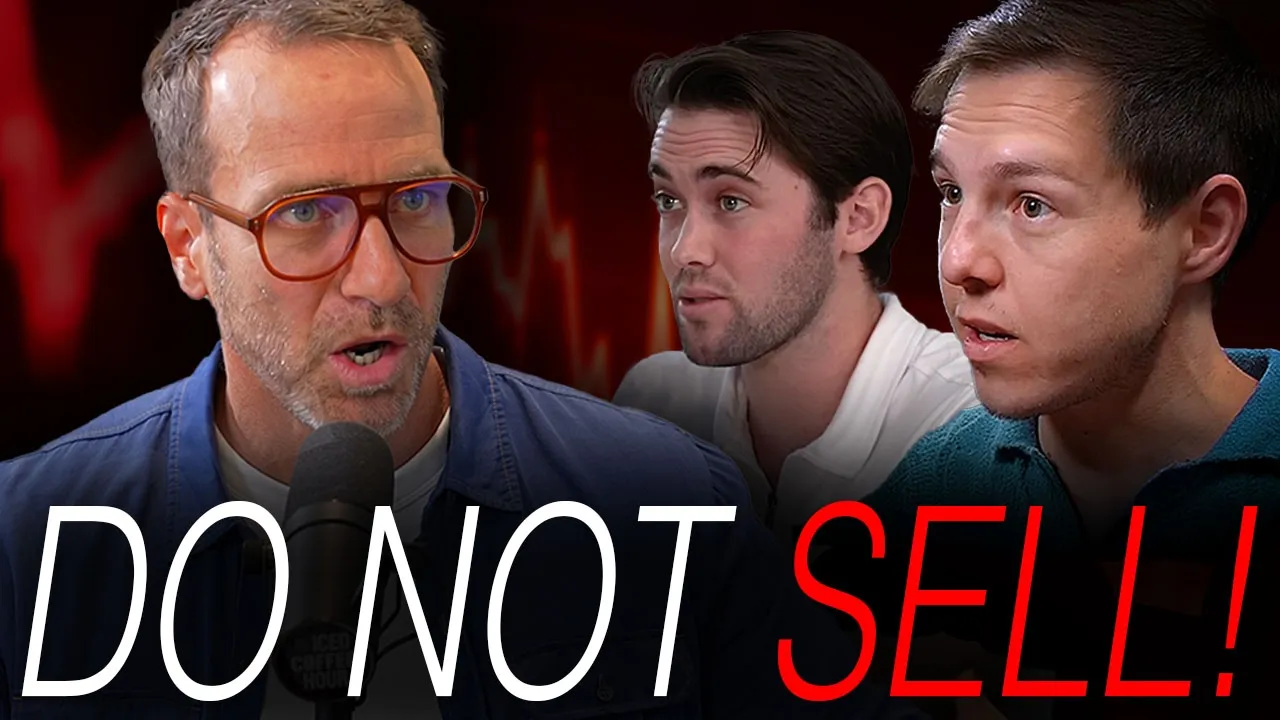
Camillo Nets $10 Million on Amazon Calls After AI Portfolio Drawdown
The Iced Coffee Hour
Plummeting intelligence costs will concentrate artificial intelligence profits into firms with pre-existing physical distribution networks rather than pure-play software developers, according to investor Chris Camillo.
Chris Camillo weathered a 40% account drawdown alongside an estimated $10B+ institutional margin call on Leopold Aschenbrenner, driven by liquidations in AI infrastructure names like Bloom Energy. (0:00)
Camillo netted a single-day gain of approximately $10 million by executing 0-DTE call options on Amazon ahead of its earnings report, modeling an 80% win probability with a 6x payout. (11:45)
Camillo argues that as artificial intelligence commoditizes design and intelligence to near-zero marginal cost, durable economic value shifts entirely to incumbents with entrenched distribution moats. (75:11)
Over a 17-year trading career, Camillo generated $80 million in gross public market profits with 60% to 70% annualized returns, while underperforming venture capital investments yielded only 10% to 12%. (45:46)
Detailed notes
## Background
This video was published on YouTube by The Iced Coffee Hour (hosted by Graham Stephan and Jack Selby) on August 9, 2026. The episode features investor Chris Camillo discussing severe market drawdowns, how he rebounded with a massive single-day gain on Amazon call options, and tactical frameworks for navigating risk, AI infrastructure, and capital markets.
## TL;DR
Active retail trader Chris Camillo reflects on enduring a steep 40% account drawdown alongside institutional forced liquidations in AI infrastructure names before executing an asymmetric, short-dated Amazon options trade that netted roughly $10 million in a single day. Camillo outlines his methodology of targeting real-world information asymmetry, spending over 100 hours vetting opposing bear arguments, and utilizing tactical leverage on rare, high-conviction catalysts. Looking at the broader AI landscape, he argues that falling compute costs will commoditize raw software while disproportionately rewarding companies that possess established physical and logistical distribution moats. He also addresses the psychology of retail trading, the flaws of illiquid venture capital, and why enduring human relationships and in-person networks will become the ultimate defensible moats in an AI-dominated economy.
## Atmosphere & style
The conversation carries an intense, high-stakes energy, beginning with raw vulnerability as Camillo recounts the physical nausea of watching multi-million-dollar positions crater before pivoting to the adrenaline of a massive options comeback. Stephan and Selby serve as analytical, curious sounding boards, periodically probing Camillo's aggressive leverage and balancing his extreme risk tolerance against prudent personal finance principles. The dialogue moves fluidly between granular market mechanics, institutional counter-trading dynamics, and philosophical reflections on wealth, leaving listeners with an intimate, behind-the-scenes look at conviction-based trading under extreme pressure.
## Bulletin
- [00:00](https://www.youtube.com/watch?v=ahQlC54rqhk&t=0s) Chris Camillo weathered a 40% account drawdown alongside an estimated $10B+ institutional margin call on Leopold Aschenbrenner, driven by liquidations in AI infrastructure names like Bloom Energy.
- [11:45](https://www.youtube.com/watch?v=ahQlC54rqhk&t=705s) Camillo netted a single-day gain of approximately $10 million by executing 0-DTE call options on Amazon ahead of its earnings report, modeling an 80% win probability with a 6x payout.
- [01:15:11](https://www.youtube.com/watch?v=ahQlC54rqhk&t=4511s) Camillo argues that as artificial intelligence commoditizes design and intelligence to near-zero marginal cost, durable economic value shifts entirely to incumbents with entrenched distribution moats.
- [45:46](https://www.youtube.com/watch?v=ahQlC54rqhk&t=2746s) Over a 17-year trading career, Camillo generated $80 million in gross public market profits with 60% to 70% annualized returns, while underperforming venture capital investments yielded only 10% to 12%.
## Key takeaways
- [00:00](https://www.youtube.com/watch?v=ahQlC54rqhk&t=0s) Camillo experienced a 40% portfolio drawdown caused by forced margin liquidations in AI infrastructure stocks like Bloom Energy, tied to institutional distress including Leopold Aschenbrenner's fund.
- [06:10](https://www.youtube.com/watch?v=ahQlC54rqhk&t=370s) Traditional asset management functions largely as a fee-skimming operation, whereas retail alpha comes from high-conviction asymmetric setups that occur only two to four times per year.
- [11:45](https://www.youtube.com/watch?v=ahQlC54rqhk&t=705s) Camillo's Amazon earnings trade leveraged over 100 hours of primary research into AWS cloud growth and CEO Andy Jassy's capex framing, yielding roughly $10 million in a single day.
- [20:24](https://www.youtube.com/watch?v=ahQlC54rqhk&t=1224s) Hyperscaler capital expenditures represent an aggressive buying signal backed by long-term enterprise demand rather than an irrational bubble driven by speculative hype.
- [31:49](https://www.youtube.com/watch?v=ahQlC54rqhk&t=1909s) The U.S. government is likely to provide a sovereign backstop or facilitate acquisitions for frontier labs like OpenAI and Anthropic due to national security competition with China.
- [37:20](https://www.youtube.com/watch?v=ahQlC54rqhk&t=2240s) Short-term equity prices are increasingly susceptible to narrative manipulation by concentrated institutional and retail accounts, as demonstrated by market makers profiting off forced liquidations.
- [41:45](https://www.youtube.com/watch?v=ahQlC54rqhk&t=2505s) Rigorous risk modeling requires dedicating more time to understanding bear theses than confirming bullish convictions, accounting for exogenous wildcards with wide probability tails.
- [45:46](https://www.youtube.com/watch?v=ahQlC54rqhk&t=2746s) Camillo generated approximately $80 million in gross trading profits over 17 years, estimating he would be worth $600 to $700 million had he not diverted capital into underperforming private startups.
- [01:09:22](https://www.youtube.com/watch?v=ahQlC54rqhk&t=4162s) Achieving top-tier lifetime investing results requires identifying only one major asymmetric narrative trade every 5 to 10 years through grassroots information channels.
- [01:06:45](https://www.youtube.com/watch?v=ahQlC54rqhk&t=4005s) Allocating tiny positions (2% to 3%) to low-conviction speculative trades satisfies dopamine-driven trading impulses while protecting capital for validated high-conviction ideas.
- [01:15:11](https://www.youtube.com/watch?v=ahQlC54rqhk&t=4511s) The 'Coffee Cup Theory' posits that when intelligence is free and ubiquitously accessible, product innovation is commoditized and existing physical distribution moats capture the economic upside.
- [01:12:22](https://www.youtube.com/watch?v=ahQlC54rqhk&t=4342s) AI mirrors the rollout of electricity rather than standard enterprise software, creating massive Jevons paradox demand where cheaper compute exponentially expands new use cases.
- [01:43:58](https://www.youtube.com/watch?v=ahQlC54rqhk&t=6238s) Unlike the dot-com bubble of 2000, modern enterprise AI spending is underpinned by concrete, measurable corporate productivity and margin expansion across diverse industries.
- [01:26:32](https://www.youtube.com/watch?v=ahQlC54rqhk&t=5192s) Investors should avoid emotional attachment to ticker symbols and maintain the discipline to reverse or exit high-conviction positions immediately when the underlying thesis breaks.
- [02:09:35](https://www.youtube.com/watch?v=ahQlC54rqhk&t=7775s) In an economy where AI tools democratize technical execution, authentic human relationships and proprietary physical networks represent the most durable competitive moat.
## Detailed walkthrough
### [00:00](https://www.youtube.com/watch?v=ahQlC54rqhk&t=0s) The 40% Drawdown and Leopold's Margin Call Cascade
Graham Stephan opens the conversation by pressing Chris Camillo on the wild swing in his portfolio, asking how he pulled off a $10 million single-day gain on a stock trade. Chris immediately clarifies that the day actually fell short of its full potential: “It should have been a 30 to $40 million day for me.” Graham reads back a sequence of frantic messages Chris sent to their private group chat over a harrowing 48-hour stretch. On Wednesday morning, Chris texted that finding cash was difficult, but he had added to his positions in Bloom Energy and Amazon despite knowing things could get uglier before the market rationalized. Just hours later on Wednesday afternoon, Chris confessed: “I don't know of many people who are as immune to volatility than me, and there was a moment this morning where I legit almost threw up, then picked up more Bloom Energy in Amazon.” By Thursday afternoon, the trade had violently turned in his favor, prompting him to text that he was sitting on an almost eight-figure green day.
When asked why he almost threw up, Chris explains that when it rains in investing, it pours at the worst possible personal moments. He was already pulling an enormous sum of cash out of his brokerage account to fund external life projects and alternative investments, effectively watching his account balance drop from planned withdrawals. Immediately on top of that liquidity drain, the market delivered one of the steepest drawdowns of his entire 30-year investing career—a 40% account drop in just a few weeks. The drop was particularly jarring because the broader stock market had barely budged.
Chris explains that he was caught in the same crosshairs as former OpenAI researcher and hedge fund manager Leopold Aschenbrenner. Both Chris and Leopold were extremely early investors in Bloom Energy who had compounded and levered aggressively into the position, generating 6x to 8x returns on the stock. However, Bloom Energy suddenly collapsed by roughly 45%, cascading from around $300 a share down to $165. Graham notes that he had also acquired Bloom across multiple tranches at $70, above $100, and over $300, getting hammered on the drop while mitigating some damage through options. For Chris, Bloom represented one of his largest core positions, turning a record-high portfolio into a brutal paper loss within days.
[03:52](https://www.youtube.com/watch?v=ahQlC54rqhk&t=232s) The Liquidation Cascade: South Korea and the Forced Downflow
Chris insists that nobody should feel bad for him because his portfolio was entering this turbulence from all-time highs, giving him the cushion to absorb massive swings. Even so, watching 40% evaporate while executing life-related cash withdrawals took a severe psychological toll. As Bloom Energy and related AI infrastructure plays like Nebius cracked, Chris deduced what was unfolding behind the scenes: Leopold Aschenbrenner was facing an astronomical margin call that Chris estimated at north of $10 billion. That forced liquidation created an artificial, indiscriminate wave of selling across the entire pocket of AI infrastructure stocks.
```mermaid
flowchart TD
accTitle: The AI Infrastructure Liquidation Spiral
accDescr: Diagram illustrating how institutional leverage and retail margin calls caused an artificial sector crash in Bloom Energy and Nebius.
subgraph Leverage["Institutional & Retail Overhang"]
A["Leopold Aschenbrenner (~4x Levered)"]
B["South Korean Levered Funds"]
end
subgraph Selling["Forced Selling Cascade"]
C["Forced Liquidation & Margin Calls ($10B+)"]
end
subgraph MarketImpact["Price Distortion"]
D["Bloom Energy Drops 45% ($300 to $165)"]
E["Nebius & AI Infrastructure Plummet"]
end
subgraph Reversal["Mean Reversion Trade"]
F["Chris Camillo Adds to Bloom & Amazon"]
end
A --> C
B --> C
C --> D
C --> E
D --> F
E --> F
```
The forced selling went far beyond a single institutional player. Chris realized that South Korean capital was unraveling simultaneously. Retail investors and leveraged institutional funds in South Korea hold massive, concentrated positions in Bloom Energy. As Leopold's margin cascade began to hit quotes, South Korean leveraged funds triggered margin calls of their own, leading to a coordinated liquidation event where institutional and retail desks were dumping identical positions at any price.
Chris recognized that the fundamental value of the underlying assets had not changed and that Bloom Energy did not deserve to trade at $165 per share. Because the crash was driven entirely by non-economic, structural liquidation rather than deterioration of the businesses, he knew a sharp mean-reversion rally was inevitable once the forced selling dried up. Unlike institutional managers, Chris was operating with a liquid personal balance sheet at roughly 1x leverage rather than Leopold's estimated 4x leverage, giving him the flexibility to absorb the volatility and buy into the forced liquidation rather than being wiped out by it. As Chris summarized: “Me, Leopold, and South Korea were all getting crushed at the same time.”
- Leopold Aschenbrenner estimated margin liability: $10+ billion in forced liquidations.
- Peak-to-trough decline of Bloom Energy: approximately 45%, falling from ~$300 to $165 per share.
- Comparative leverage levels: Institutional hedge funds ran ~4x leverage, whereas Chris ran ~1x margin.
[06:10](https://www.youtube.com/watch?v=ahQlC54rqhk&t=370s) Ultra-High-Conviction Trading and Seven-Figure Zeroes
Responding to critics on X (formerly Twitter) who accused him of reckless, irresponsible gambling that should not be discussed publicly, Chris pushes back aggressively against the idea that his strategy lacks discipline. He argues that every investor has distinct portfolio goals, and his public brokerage account exists solely as an ultra-high-risk, ultra-high-reward vehicle designed to achieve exponential scale. As Chris frames his personal mandate: “The entirety of my brokerage account is a ultra high risk, ultra high ward account. I'm trying to grow that account into a billion dollar account, right?”
Reaching a nine-figure or ten-figure milestone cannot be accomplished with broad index diversification or timid allocations. Instead, it requires severe concentration, margin leverage, and the willingness to push chips into the middle during the rare windows when an asymmetric edge appears. Chris notes that he only uncovers high-conviction opportunities a handful of times per year. While he acknowledges that making a string of five or six consecutive failed bets could theoretically destroy his balance, he has managed asymmetric risk for nearly three decades and remains intimately aware of his downside thresholds.
```
+-----------------------------------------------------------------------------------------+
| CHRIS CAMILLO RISK FRAMEWORK |
+-----------------------------------------------------------------------------------------+
| Account Objective | Targeting $1,000,000,000 via concentrated asymmetric bets |
| Conviction Frequency | Only 2 to 4 ultra-high-conviction ideas per year |
| Position Architecture | Concentrated equity + margin leverage + short-dated options |
| Downside Tolerance | Accepts 40%+ paper drawdowns and 100% options expirations |
| Key Trade Risk | 6 consecutive failed leveraged setups could wipe the account |
+-----------------------------------------------------------------------------------------+
```
That risk tolerance was put to an extreme test on the very Wednesday his account reached maximum drawdown. Chris held short-dated options contracts expiring that day that expired worthless, causing him to take an instant seven-figure loss within a 24-hour window. He accepted the zero because the mathematical payoff offered a 25x to 30x return—representing tens of millions in upside—had the liquidation cascade broken just hours earlier. Undeterred by the loss, he turned his focus to the centerpiece trade he had prepared all spring and summer: Amazon earnings. Chris believed the broader market was mispricing the print. The trade was never about whether Amazon Web Services would beat earnings, which he viewed as obvious, but rather how executive leadership would direct the earnings call narrative around artificial intelligence and capital expenditures.
[09:24](https://www.youtube.com/watch?v=ahQlC54rqhk&t=564s) The Amazon Earnings Setup and Institutional Counter-Trading
When asked for the exact dollar amount he was down at the absolute trough of the recent pullback, Chris purposefully declines to provide granular balance figures. He reveals growing paranoia that well-capitalized institutional actors actively monitor and attempt to counter-trade his positions. In recent years, especially across mid-cap and small-cap equities where liquidity is thinner, Chris has observed suspicious price action that makes him believe deeper-pocketed players deliberately move markets against retail-facing traders who disclose their positioning publicly.
Chris attributes this friction to his outspoken public profile over the last two decades, during which he has consistently mocked traditional financial firms and challenged the legitimacy of standard asset management fees. He maintains that the institutional industry thrives on skimming value from ordinary savers while failing to generate true alpha. “I've been harping on Wall Street for two decades, saying that it's the world's largest skimming operation,” Chris emphasizes. Because of this longstanding conflict with the financial establishment, he tries to balance transparency with personal operational security, ensuring that aggressive institutional participants cannot front-run or squeeze his highest-conviction positions.
[10:25](https://www.youtube.com/watch?v=ahQlC54rqhk&t=625s) The Target on High-Profile Traders and Leopold Aschenbrenner
Chris Camillo addresses the tension between retail/independent traders and Wall Street institutions, pointing out that fund managers often get frustrated by outsiders calling out their underperformance. Fund managers “skim money every year to not perform any better than you could perform being invested in a passive fund,” which naturally makes enemies. He draws a direct comparison to Leopold Aschenbrenner, noting that a cocky twenty-something managing around $40 billion in capital and dominating media coverage over figures like Ken Griffin and Citadel inevitably ends up putting a target on his back. While Camillo acknowledges his own profile is smaller, he is increasingly cautious about being overly transparent or granular on social media regarding his exact positions and strikes.
Even with that caution, Camillo openly admits the scale of his recent pain: his portfolio had drawn down near or into eight figures. Graham Stephan asks what chance he gave himself of being wrong on his massive comeback attempt, and Camillo estimates an 80% probability of success and a 20% risk of failure. That remaining 20% represented the known unknowns and unknown unknowns—macro shocks, geopolitical turmoil involving Donald Trump and Iran, or random black-swan events that could unravel any market overnight.
- Institutional fund managers charge annual management fees while regularly failing to beat standard passive index funds.
- Leopold Aschenbrenner drew massive scrutiny and institutional crosshairs by managing roughly $40 billion and eclipsing major institutional figures in media airspace.
- Camillo was nursing a drawdown close to eight figures prior to executing his counter-trade.
---
[11:45](https://www.youtube.com/watch?v=ahQlC54rqhk&t=705s) The Amazon Thesis and CEO Andy Jassy's Earnings Call
Leading up to Amazon's critical earnings report, Camillo was utterly consumed by the trade, hunting down every conceivable data point to assess AWS cloud growth. The market had heard Amazon guide toward around a 22% beat, while whisper numbers across Wall Street hovered at 25%; Camillo’s research convinced him AWS would comfortably surpass 25%. The primary unknown was not AWS revenue growth, but how Amazon leadership would navigate the post-earnings conference call regarding their massive AI capital expenditures (capex).
```mermaid
flowchart TD
accTitle: Capex Call Reaction Strategy
accDescr: How tech giants handled capex narratives and how Amazon navigated earnings
subgraph AmazonPlay["Amazon Strategy"]
J["Andy Jassy"] -->|"Follows Microsoft playbook"| A1["Confirms High Capex ($200B+ to $220B)"]
A1 -->|"Protective clause"| A2["Hardware capex uncommitted until final buildout"]
end
Camillo studied the contrasting receptions of Google and Microsoft's earnings calls. Google was punished by the market for poor communication around its ballooning capex, whereas Microsoft managed the question masterfully by reassuring investors that capex carried minimal downside risk because unneeded capacity could easily be redirected. Camillo calculated a 99.9% likelihood that Amazon CEO Andy Jassy would adopt the exact same strategy: acknowledge the eye-watering $200 billion or $220 billion capex figure, assert that demand is undeniable and tangible, and clarify that the majority of forward equipment spending does not have to be contractually committed until the final server installation inside a data center.
Driven by that structural conviction, Camillo refused to sit on the sidelines:
> “There’s no way I was going to watch Amazon knock it out of the park and me not participate.”
He felt an eerie sense of serenity going into the print. Rather than frantically monitoring tickers, he was driving his truck to Austin when the earnings crossed the wire, completely detached and confident in his homework.
---
[14:10](https://www.youtube.com/watch?v=ahQlC54rqhk&t=850s) The 1-Day Expiration Bet: Rebounding $10 Million
Graham inquires whether Camillo’s balance had collapsed down to the low seven figures during the drawdown. Camillo clarifies that while he took a severe hit, the account remained in the high seven to low eight figures. To fund the high-conviction recovery bet, Camillo faced a major obstacle: his brokerage account was already fully levered. He had to aggressively liquidate millions of dollars of equity holdings he cared less about to free up margin and deploy a few million dollars into short-dated Amazon call options and Bloom Energy (BE).
The Amazon call contracts were razor-thin on time, expiring the very next day (Friday). The setup paid off in historic fashion: the portfolio surged approximately $10 million in a single trading day, more than recovering everything he had surrendered in the preceding weeks.
> “Making money like that after you lost money feels better, much better than just making the money, right? Like there’s something about seeing your account get crushed and then making a really bold move to make it all back plus some... It was the best feeling in the world because you know it was the hardest thing in the world to do and you force yourself to do it because it was the right thing to do.”
Camillo even argues that walking away from the setup would have violated sound principles: “From my sense, it would have been bad risk management for me not to do it.”
- Deployed a few million dollars into short-dated call options across Amazon and Bloom Energy.
- Liquidated lower-conviction equity positions to generate buying power inside a fully levered account.
- The options were 0-DTE / 1-day expiration contracts expiring on Friday.
- Produced a 1-day portfolio gain of roughly $10 million, yielding a net positive balance beyond his pre-drawdown peak.
A promotional segment highlights Northwest Registered Agent for LLC formation and maintenance. The host underscores that forming a real legal entity requires more than submitting a single state document; without foundational paperwork like an operating agreement, membership certificates, and banking resolutions, a business cannot open commercial accounts or execute contracts with institutional partners. Northwest handles state filings for $39 plus state fees, supplies an operating agreement and necessary resolutions, provides a free domain, website, business email, and phone number, and lists its own address on public registries to shield the business owner's personal home address from public records.
---
[17:18](https://www.youtube.com/watch?v=ahQlC54rqhk&t=1038s) Investing vs. Gambling and the Regret of Under-Sizing
Graham challenges Camillo on whether holding multimillion-dollar options expiring within hours is simply gambling, pointing out that if Amazon’s market recovery had lagged earnings by just two weeks, the options would have expired completely worthless. Camillo responds that if the timing had slipped, he had alternate resources outside the account to keep rolling smaller replacement positions, though he admits the trade's outsized payoff required the catalyst to ignite on earnings day.
When pressed on whether short-term directional options trading crosses the line into reckless gambling, Camillo pushes back against the label:
> “I hate the gambling analogy because gambling means so many things to so many different people. Again, it all starts with what your objectives are and what your risk tolerance is. And on top of that, you have to understand that I do excessive amounts of probability analysis.”
Camillo insists that after spending over 100 hours of deep research on Amazon, modeling every foreseeable variable, and identifying an 80% win probability with a potential 6x asymmetric payout, the wager was deeply analytical. He argues that by loose definitions, walking outside the front door is a gamble because you could trip and die. For him, the distinction comes down to whether an investor understands the underlying risks and performs rigorous work, versus blindly throwing money at instruments they do not comprehend.
Remarkably, Camillo's primary lingering regret was not the extreme downside risk he accepted, but that he failed to triple down:
> “I knew that that trade should have been triple. It should have been a $30 to $40 million day for me. I knew that. But with my account hemorrhaging, with all this stuff happening in my life, I was just like... I wasn’t mentally prepared to make the trade. That was my fault.”
[20:24](https://www.youtube.com/watch?v=ahQlC54rqhk&t=1224s) Regret, Noise on X, and the Growing Investor Class
Chris Camillo reflects on how he handled the size of his Amazon position, admitting that while he did not feel outright terrible, he anticipated having regrets about not betting even bigger. He explains that his anxiety was never about losing money; rather, he knew that the moment he placed the trade, his real regret would be failing to scale it to $30 million or $40 million. Graham Stephan relates to this psychological pitfall through personal experience, recounting a trade where he bought a stock at $20 and sold it at $55. An hour later, the price surged to $68, leaving him feeling like he had missed out on gains. Jack Selby jokingly downplays Graham’s grievance as a matter of $1,000, but Graham pushes back, clarifying it was over $10,000 in gross gains and $9,000 after tax lost merely by not waiting two hours, conceding that investors often invent reasons to be unhappy.
This leads Camillo to discuss the intense public feedback he receives on X (formerly Twitter). Following an explosive week of volatility in his portfolio, he recalls sitting alone in the corner of a high-end restaurant in Austin on a Friday night, spending more than two hours just replying to a single thread. Despite the endless barrage of scrutiny, he genuinely embraces the discourse:
> “This is literally the entirety of my life is to try to get every human on earth into the investor class and it's actually starting to happen.”
Camillo emphasizes that he has waited decades to witness an entire generation care this deeply about investing, meaning he welcomes the critique because it proves retail market participants are engaged. However, he warns that the vast majority of people on social media are merely following the herd and reacting to pure noise rather than finding real alpha. True outperformance, he argues, requires being an independent thinker who digs for the underlying ground truth rather than echoing retail sentiment.
[22:48](https://www.youtube.com/watch?v=ahQlC54rqhk&t=1368s) High-Conviction Risk Tolerance and Personal Accountability
The hosts bring up a viral post on X that quoted Camillo talking about making trades that cause him to "piss his pants" as his account is hemorrhaging. The critic insisted that trades inducing that level of visceral panic belong in sports betting or prediction markets, urging retail investors instead to stick with steady buy-and-hold strategies that do not disrupt their sleep. Camillo forcefully defends his right to run a specialized, highly aggressive portfolio:
> “Don't tell people what their account objective is or what their level for risk is.”
```mermaid
flowchart TD
accTitle: Two-Bucket Portfolio Philosophy
accDescr: Visual breakdown separating protected base capital from a high-risk alpha bucket.
subgraph Core["Protected Core Wealth"]
A["Retirement Accounts"]
B["Kids' College Funds"]
C["Buy-and-Hold Blue Chips"]
end
subgraph Aggressive["Designated Alpha Bucket"]
D["Concentrated Bets"]
E["Leveraged Instruments"]
F["Hundreds of Hours of Deep Research"]
end
He clarifies that in an account dedicated strictly to generating outsized returns, taking concentrated, levered bets on high-conviction ideas inherently means accepting the tail risk of getting completely wiped out. For Camillo, physical symptoms like nausea or sweating are entirely normal human reactions while waiting for high-stakes earnings reports. He has traded this way for 18 years, putting hundreds of hours into each thesis to grow tens of thousands of dollars into tens of millions. He makes a clear distinction between a core, protected nest egg (such as retirement or college funds) and a segregated high-risk sandbox.
When Jack asks whether he worries about reckless retail copycats who blindly mimic his trades without understanding position sizing or risk management, Camillo refuses to infantilize the audience:
- **Adult Agency:** Degenerate gamblers who want to YOLO life savings into short-dated options will find an excuse to blow up regardless of what he posts.
- **Trial by Fire:** Making mistakes and taking a hit early on is often the only way reckless traders learn real risk discipline.
- **Zero Monetization:** Camillo points out that he sells no courses, takes no brand sponsorships, runs no paid advisory groups, and makes nothing off his public commentary.
- **The Role of Sharing:** His explicit purpose for posting is to lay bare his intellectual framework so peers can stress-test his ideas and poke holes in his thesis.
[28:06](https://www.youtube.com/watch?v=ahQlC54rqhk&t=1686s) The Capex Panic: Noise vs. Ground Truth
Camillo points to the pervasive panic over big tech capital expenditures (capex) as the single best example of market noise masking fundamental reality throughout the year. While sell-side bank analysts and retail traders on X have panicked over diminished near-term free cash flow, Camillo views the corporate spending spree as an extraordinary, once-in-a-generation buying signal.
He finds it astonishing that investors are criticizing management teams when the executives of the most disciplined, well-capitalized enterprises in history explicitly announce that unprecedented customer demand is forcing them to leverage their balance sheets and take on debt to build out infrastructure:
> “The entire purpose of capital markets is to invest your money into entities that can take your money and do something bigger and better with it.”
Growth companies operate on an explicit mandate to borrow at low rates and deploy capital into high-yield, asymmetric opportunities that compound shareholder value over multi-year horizons. Rather than draining capital foolishly, tech leaders like Andy Jassy at Amazon are signing binding, multi-year enterprise contracts. Camillo finds it absurd that armchair commentators on social media believe they understand the demand curves better than the CEOs actually executing the deals behind closed doors, stating flatly that he will bet on management’s ground truth over market chatter every single time.
[30:50](https://www.youtube.com/watch?v=ahQlC54rqhk&t=1850s) The Negativity Echo Chamber and the Obviousness of Amazon
Chris Camillo vents his frustration with the financial media ecosystem, particularly on X (formerly Twitter), where relentless doom-and-gloom narratives generate outsized engagement. He points out that prominent market commentators and newsletter writers—specifically highlighting people like Michael Burry—exploit panic purely to harvest clicks, drive subscriptions, and make money, leaving everyday retail investors deceived and caught in the crossfire. Looking at his own high-conviction trade on Amazon, Camillo emphasizes that he did not uncover some secret edge or obscure data point hidden from the rest of Wall Street:
> “Nothing that I did with Amazon was special. Like I did not see anything. None of my research resulted in me finding like a needle in the haystack that no one else could see with Amazon. It's all very obvious stuff.”
Instead of being brilliant, Camillo explains that his main advantage was simply ignoring the online panic and looking at the plain facts right in front of everyone. While an unforeseen anomaly could technically disrupt Amazon's trajectory, skeptics are bizarrely treating the baseline scenario—that Amazon is telling the truth about its business and cloud infrastructure growth—as if that were the unlikely aberration.
[31:49](https://www.youtube.com/watch?v=ahQlC54rqhk&t=1909s) Concentration Risk, OpenAI, and "Too Big to Fail"
The discussion turns to the common bear argument regarding concentration risk: hyperscalers rely heavily on massive compute demand from AI frontrunners like OpenAI and Anthropic, leading critics to wonder what happens if these startups run out of cash and default on their contracts. Camillo rejects the notion that the government would ever allow OpenAI or Anthropic to collapse. Likening the situation to the 2008 financial crisis when the federal government stepped in to backstop Fannie Mae and Freddie Mac, he argues that artificial intelligence represents the single most vital sovereign priority of the last 25 years. With geopolitical tensions and China aggressively pursuing technical parity, U.S. national security simply cannot afford an AI collapse:
> “Do you really think that our government is going to let OpenAI and Anthropic fail, not because we care about those two companies, but the avalanche that would happen after them?”
If these frontier labs were ever pushed toward insolvency, Camillo asserts that the federal government would immediately intervene, orchestrate backstops, and broker acquisitions or asset transfers to well-capitalized tech behemoths capable of honoring and continuing those underlying compute contracts. The broader financial sector, he laments, has grown pathologically shortsighted and attention-deficient; with few exceptions like Leopold Aschenbrenner, genuine, rigorous research has been replaced by shallow copy-and-paste analysis designed for social media virality. Because of this widespread lack of technical comprehension, markets persistently fail to grasp that the sustained demand for compute will not evaporate overnight.
```mermaid
flowchart TD
accTitle: Sovereign Backstop Scenario for AI Hyperscalers
accDescr: Diagram showing how potential failure of leading AI labs triggers government intervention to preserve compute contracts.
subgraph Risk["Theoretical Concentration Shock"]
A["Frontier Labs Run Deficits\n(OpenAI / Anthropic)"] --> B["Compute Contract Default Risk"]
end
subgraph Intervention["Sovereign Protection (Too Big to Fail)"]
B --> C["US National Security & Sovereignty Risk\n(Competition with China)"]
C --> D["Federal Government Steps In\n(2008 Fannie/Freddie Style Backstop)"]
end
subgraph Resolution["Contract Absorption"]
D --> E["Brokered Transition to Mega-Cap Entities\n(Strong Balance Sheets)"]
E --> F["Hyperscaler Compute Contracts Preserved\n(Amazon / Cloud Providers Whole)"]
end
```
Jack Selby reflects on his financial journey, recalling how six years earlier he began working for Graham Stephan for free, eventually launching the podcast, aggressively investing his income, and buying his first real estate property in 2021 followed by a second in 2025. As personal finances grow more complex, manual tracking on digital notepads becomes unmanageable. Selby introduces Monarch, an all-in-one personal finance platform that aggregates accounts, investments, spending, and income into a single dashboard. Monarch provides forward-looking goal planning, portfolio performance tracking against the S&P 500, and AI-driven insights that distinguish between increased personal spending and general inflation. The ICH audience can use the code `icedcoffee` at monarch.com to receive 50% off their first year of Monarch Core, bringing it to $50.
Following this, Selby shares how getting married over a year ago forced him to confront uncomfortable questions regarding family protection and life insurance. He presents Ethos, a 100% online life insurance service that provides instant quotes, same-day coverage, and up to $3 million in coverage without medical exams, relying on simple health questions instead. With plans starting as low as $30 per month and a 4.8-star Trustpilot rating across 4,000 reviews, Selby encourages younger viewers to lock in low rates before health or life circumstances change, pointing them to ethos.com/icedcoffee.
[37:20](https://www.youtube.com/watch?v=ahQlC54rqhk&t=2240s) Citadel, Market Manipulation, and the Leopold Margin Call
Reflecting on the hard lessons of the preceding month, Camillo points out an alarming structural shift in modern equity markets: for the first time, concentrated groups and high-profile individuals across institutional Wall Street and retail social circles can dramatically manipulate asset prices over short horizons. Because market participants communicate constantly on platforms like X, herd psychology takes over rapidly—especially regarding AI, an industry the vast majority of investors find intimidating and fail to understand. When an institutional heavyweight displays absolute conviction, panicked investors automatically assume they hold insider knowledge or superior data, whether they actually do or not:
> “The thing I learned more than anything else, not just this month, but the entirety of this year, is that for the first time ever, there are single accounts and small groups of influential people both on the retail side of Wall Street and on the institutional side of Wall Street that can meaningfully manipulate the market over a short period of time.”
Camillo cites Ken Griffin's Citadel suggesting interest rates would rise as an example of this immense narrative power in action. When asked whether the broader market drawdown was intentionally engineered to trigger a margin call on Leopold Aschenbrenner's fund, Camillo confirms that it was treated as a predatory trading opportunity. Although external noise like China's Kimi model stoked fears of cheap open-source compute disrupting American margins, and Leopold made tactical errors—such as shorting legacy software too early while going heavily long on AI—established players weaponized Leopold's ill-timed positioning against him:
- **Thesis vs. Timing:** While Leopold's macro thesis that AI will devour the software industry may prove correct in the long run, his youth and lack of market seasoning left him vulnerable to the lengthy, grinding timeframe real-world tech transitions require.
- **The Liquidation Trap:** Knowing Leopold was trapped in leveraged positions, major market makers applied pressure, fully aware they would be among the few counterparties in the room taking the other side of his forced liquidation.
- **Citadel's Windfall:** Camillo estimates that Citadel profited roughly $2.0 to $2.5 billion within a single week off the trade, effectively making their entire month or quarter in a ruthless masterclass of institutional market structure.
- **The Core Lesson:** In the modern trading landscape, short-term leveraged positions are completely detached from ground truth; traders relying on short horizons are exposed to predatory dynamics and narrative swings they cannot predict.
[41:45](https://www.youtube.com/watch?v=ahQlC54rqhk&t=2505s) Why You SHOULD NOT Listen To Chris
Graham Stephan presses Chris Camillo on the harsh reality that influential figures and coordinated groups can sway the stock market day-to-day on false assumptions, incorrect information, or outright manipulative narratives, asking: “So, why couldn't this happen to you?”
Chris concedes immediately that it can happen to anyone, which is why he constantly models exogenous risk into his positions. Reflecting on his massive Amazon earnings trade, he explains that while he felt 99% confident that his fundamental work on AWS, retail margins, and management commentary would prove accurate—which it did—he only rated the overall probability of trade success at 80%. The remaining 20% accounts for uncontrollable wildcards: geopolitical escalations like Iran, sudden headlines involving Donald Trump, erratic overnight macro swings, or completely fabricated viral rumors. In previous market regimes, Chris notes, he would have called the setup a 95% win probability, but modern market manipulation requires pricing in a fat tail of unforeseen noise.
```mermaid
flowchart TD
accTitle: Amazon Trade Probability Breakdown
accDescr: Visual breakdown of Chris Camillo's 80/20 probability assessment on his Amazon trade.
A["Total Trade Probability Assessment"] --> B["80% Chance of Winning"]
A --> C["20% Chance of Losing"]
subgraph Fundamental Analysis
B --> D["99% Conviction on Amazon Fundamentals<br/>(Earnings beat, cloud demand, guidance)"]
end
subgraph Exogenous Variables
C --> E["Geopolitical Shocks<br/>(e.g., Iran)"]
C --> F["Political Volatility<br/>(e.g., Trump headlines)"]
C --> G["Overnight Noise & Viral Rumors"]
end
```
When asked who should actually listen to him and who would end up losing everything by following his lead, Chris lays out his philosophy:
> “Well, I think every investor should listen to me for my ideas. And then they should take those ideas and do their own research and try to poke holes in them and try to vet them, come up with their own thesis that might or might not have anything to do with my idea and then assess their own level of risk tolerance and make the trade that's correct for them.”
Chris emphasizes that the core discipline retail traders miss is actively attempting to invalidate their own ideas:
> “One of the things that I do that I think I don't get enough credit for is I will always spend more time trying to understand the other side of my trades than I do my own thesis.”
He explains that throughout the year, he spent far more hours digging into the bear case—why market participants disliked Amazon or were shorting hyperscalers—than admiring his own bullish research. Only by thoroughly hearing out the counterparty can an investor determine whether the market's doubts are justified. While he conducts 50 to 100 hours of deep research on single high-conviction trades and welcomes people to evaluate his raw research, he condemns copycat trading:
- **The Copycat Trap**: Mimicking trades without doing the legwork robs an investor of the emotional conviction required when prices turn against them.
- **Capital Resiliency**: True conviction allows a trader to size trades so that if leg one fails, they still possess the cash and clarity to re-enter the position at a discount the following week.
- **Market Drawdown Nuance**: Chris clarifies that his recent portfolio beating was driven far more by his positions in Bloom Energy and peripheral AI names rather than Amazon itself; as Amazon sank, he used the dip to accumulate more aggressively into the print.
---
[45:46](https://www.youtube.com/watch?v=ahQlC54rqhk&t=2746s) The $20K to $80 Million Trade
Graham questions Chris on the famous narrative surrounding his track record: turning an initial $20,000 into roughly $80 million, asking what his single best trade has been. Chris rattles off names like Amazon, Nvidia, Palantir, and Robinhood, pointing out that because his account balance has scaled, his biggest nominal dollar windfalls have all arrived within the last two years.
Chris confirms that $80 million is approximately the cumulative gross trading profit he has pulled from the market over his 17-year career. However, that liquid total was constantly reduced by heavy ordinary income taxes, living expenses, and his decision to divert trading capital into private equity. Over the past 17 years, Chris backed roughly 160 private startups—a move he now views as a colossal financial mistake:
> “Financially it would have been meaningfully better. I'd be somewhere in the hundreds and hundreds of millions. I'd be like $6 or $700 million now if I would have just kept the money in the brokerage account and never invested in a single private company.”
While his private venture investments returned only an aggregate 10% to 12%—paling in comparison to the 60% to 70% annualized returns he achieved in his public trading account over that same 17-year stretch—Chris notes that he does not hold deep personal regrets. The venture path built a priceless personal network, brought him into fascinating deal flow, and includes at least one massive private stake that could single-handedly deliver hundreds of millions of dollars if it hits its targets over the next few years.
---
[47:37](https://www.youtube.com/watch?v=ahQlC54rqhk&t=2857s) Asymmetric Risk, Account Objectives, and the Margin Floor
Jack Selby and Graham press Chris on mathematical sizing: if a speculative investment presents an asymmetric upside like a 20% chance of a 100x return against an 80% chance of a complete zero, how does he decide how much capital to commit?
Chris answers that sizing cannot be separated from an individual's personal life setup and account objective:
> “Most people would generate very little additional value beyond 10 or 20 or $30 million. So why would they put everything at risk to become destitute to make more money that they would probably not make them any more fulfilled in life or content with their life?”
For his own finances, Chris operates under completely different constraints:
- **Baseline Security**: His primary houses are 100% paid off, and he owns cash-flowing brick-and-mortar businesses (including restaurants) that take care of his everyday family expenses. He already considers himself set for life.
- **Account Aggression**: The brokerage account is treated as pure growth equity earmarked for ambitious, large-scale philanthropic goals.
- **Concentrated Leverage**: Because his goal is reaching a massive nine-to-ten-figure scale, index-hugging diversification will not work; he deliberately maintains concentrated, leveraged bets on high-probability mispricings.
Chris rejects the idea that he has a duty to babysit retail followers on X (Twitter):
> “It's not my fault if some random person sees one line of text out of hundreds of hours of video content and literally thousands to tens of thousands of tweets and knows nothing about me and is like, 'This random person just did this, so I'm going to do it, too.' Like, what sense does that make?”
Asked about his risk-tolerance floor and the likelihood of ruin, Chris argues that total liquidation would require an unprecedented losing streak:
> “I have confidence I'm not going to make six high conviction trades wrong in a row and I would have to make six in a row to lose all my money.”
In 17 years of trading, Chris has never suffered more than two consecutive high-conviction failures.
---
[51:00](https://www.youtube.com/watch?v=ahQlC54rqhk&t=3060s) Can Anyone Consistently Beat the Market?
As the conversation turns toward market efficiency, Graham raises the classic academic critique: can anyone truly beat the market over decades, or is Chris's track record simply a matter of survivorship bias?
Chris rejects the premise that beating the indices is impossible, highlighting members of his own retail trading community who have generated 15% to 25% annualized returns for 10 to 15 years straight through independent research and distinct information advantages.
Graham challenges this with the coin-toss analogy: if millions of people throw darts at a board, pure statistical distribution guarantees a handful of outliers will hit bullseyes year after year and mistakenly attribute their blind luck to skill.
[51:46](https://www.youtube.com/watch?v=ahQlC54rqhk&t=3106s) Finding Ground Truth Versus Noise: How Chris Camillo Beats the Market
Chris Camillo addresses whether long-term market outperformance is real skill or merely survivorship bias. In his view, reality is rarely black and white: not everyone who beats the market over a decade has an infallible mechanical system, but neither can every sustained track record be dismissed as dumb luck. An investor's edge must be evaluated on its individual merits and transparent execution. Camillo describes his own approach as intentionally direct, grounded, and devoid of hidden algorithmic magic:
> “I simply try to uncover change in the world quicker than others and connect dots to companies that would benefit from that change.”
To illustrate, Camillo recounts how he originally built his thesis on Amazon early in his career. Instead of relying on conventional financial commentary, he monitored Reddit and online technology forums, noticing developers actively discussing migrating their company data infrastructures to the cloud. By observing that enterprise shift before Wall Street recognized it, he bought Amazon on the emerging strength of AWS. Over 17 years, he has made roughly 70 to 80 concentrated trades, each driven by a distinct real-world narrative rather than technical indicators. He stresses that the hardest part of this method is not intellectual complexity, but mental discipline: an investor cannot identify authentic shifts while consuming the distracting noise of social media all day.
- **Career volume:** Roughly 70 to 80 high-conviction trades across 17 years.
- **Early Amazon thesis:** Identified enterprise developer sentiment on Reddit/tech forums regarding database migration to AWS before cloud computing was broadly understood on Wall Street.
- **Prerequisite for edge:** Clearing mental clutter and avoiding the constant churn of social media misinformation to spot real structural change.
```mermaid
flowchart LR
accTitle: Ground Truth Information Edge
accDescr: Three-step process showing how Chris Camillo identifies trade ideas from raw consumer signals to high-conviction bets.
subgraph S1["Raw Observation"]
A["Scour Grassroots Forums<br/>(Reddit, Developer Boards)"]
end
subgraph S2["Insight & Verification"]
B["Spot Emerging Behavioral Shift<br/>(e.g., Enterprise Cloud Migration)"]
C["Filter Out Market Noise & FUD"]
end
subgraph S3["Capital Allocation"]
D["Identify Direct Beneficiary<br/>(e.g., Amazon via AWS)"]
E["Execute Concentrated Bet"]
end
A --> B
B --> C
C --> D
D --> E
```
The host highlights how frequently people sit on promising business concepts, only to stall when confronted with the logistical barriers of web development, checkout setups, and merchant payment processing. Shopify is presented as an all-in-one platform handling everything from day-one storefront creation to one-click payment retention. Jack Selby shares his personal experience running multiple Shopify storefronts to experiment with drop shipping before joining Graham Stephan, noting that if he could execute sales, anyone can. The platform powers millions of merchants, spanning small independent operators to massive global enterprises such as Mattel and Gymshark.
---
[55:24](https://www.youtube.com/watch?v=ahQlC54rqhk&t=3324s) Evaluating Leopold Aschenbrenner: Visionary Technologist vs. Business Realities
Asked to give his unfiltered assessment of Leopold Aschenbrenner, Camillo praises him as someone positioned right at the nucleus of the most consequential investing theme in living memory: artificial intelligence. Given Aschenbrenner's background at top AI research labs and his proximity to key industry figures, he saw the real-world trajectory of frontier models early and chose to trade aggressively on that conviction. However, Camillo identifies a fundamental blind spot stemming from Aschenbrenner's background as a young technologist without extended operational business seasoning:
> “So even if you have a superior product, it doesn't necessarily mean that you have a superior business and it could take forever, right, for that to play out.”
Camillo emphasizes that having a superior technology does not guarantee an immediate commercial takeover. Incumbent enterprise giants like Microsoft and Salesforce retain entrenched distribution moats and deep organizational stickiness that resist rapid obsolescence, even when their core products draw sharp criticism. Technologists often operate under the assumption that artificial general intelligence (AGI) will rapidly dismantle incumbent businesses, but large-scale enterprise transformation often unfolds five to ten times slower than engineers anticipate. Despite these timing and maturity shortcomings, Camillo expresses deep respect for Aschenbrenner. Both of them—along with mutual friend Jiahai Shu—shared an early, contrarian thesis on Bloom Energy when mainstream retail and institutional investors rejected it amid recurrent short-seller reports.
- **Leopold's core strength:** Unmatched access, technical proximity to frontier AI developments, and willingness to back his research with bold capital allocation.
- **Leopold's operational weakness:** Lack of enterprise business experience; underestimating incumbent moats (e.g., Microsoft, Salesforce) and the protracted time required for institutional technology adoption.
- **Shared conviction on Bloom Energy:** Camillo, Aschenbrenner, and mutual associate Jiahai Shu all built independent long theses on Bloom despite repeated short reports and Wall Street skepticism.
---
[59:43](https://www.youtube.com/watch?v=ahQlC54rqhk&t=3583s) Leverage, Korean Retail Volume, and the Upcoming AI FUD Cycle
The conversation turns to the staggering concentration of leverage across global financial markets, including leveraged ETFs, retail margin, and high-beta momentum plays. Camillo points to Bloom Energy's volatile price action as an instructive case study: the stock surged dramatically not solely because of fundamentals, but because heavy speculative leverage was applied by retail participants—specifically becoming one of the most traded stocks in South Korea—before violently unwinding when margin conditions tightened. While extreme leverage amplifies downward volatility, Camillo views it as a bidirectional opportunity rather than a threat, provided an investor models it directly into their trade strategy:
> “So there's no reason to be afraid of anything as long as we know it exists.”
Looking ahead, Camillo reveals that he is heavily focused on the "attention trade"—capitalizing on sentiment shifts where market attention clusters, even when the underlying narratives diverge from reality. He anticipates another aggressive "FUD" (fear, uncertainty, and doubt) cycle aimed at AI within the coming 30 to 90 days. He is proactively utilizing AI tools to map the influential market voices and identify the exact rhetorical angles skeptics will deploy to engineer a sector-wide pullback, preparing to trade around that sentiment volatility as soon as the negative narrative gathers momentum.
- **Mechanism of the Bloom Energy swing:** Accelerated up and down by concentrated retail margin and heavy speculative volume originating from South Korean trading desks.
- **Framework on market leverage:** Leverage creates extreme asymmetry; it is only dangerous when an investor is oblivious to where it is concentrated.
- **The "Attention Trade" strategy:** Tracking narrative velocity and influential voices rather than pure balance sheets, specifically positioning for an imminent AI panic cycle.
[01:02:20](https://www.youtube.com/watch?v=ahQlC54rqhk&t=3740s) Preparing for the Next AI Narrative and FUD Cycle
Chris Camillo emphasizes that in volatile markets, having a prepared mind is critical to running effective scenario analyses before events unfold. Because he remains heavily invested and leveraged within the AI sector, his current objective is to anticipate the next cycle of fear, uncertainty, and doubt (FUD) rather than being blindsided by it. Reflecting on recent price drops, he concedes that while he anticipated Moonshot AI's Kimi model would arrive as a competitive threat, he failed to appreciate how rapidly the narrative around open-source competition and Kimi would accelerate across the market.
To avoid taking another severe drawdown, Camillo is actively reverse-engineering the narrative landscape: identifying influential voices among short sellers and AI skeptics, tracking the key figures who drove the last panic, and collaborating with specialists to build quantitative tools capable of tracking sentiment acceleration. If bearish narratives pick up steam while the broader market is levered up, he sees that as a definitive sell-or-hedge signal pointing toward another major correction.
```mermaid
flowchart TD
accTitle: AI Narrative Scenario Analysis Flowchart
accDescr: Diagram illustrating how Chris Camillo identifies early narrative shifts to protect leveraged capital before market corrections.
subgraph NarrativeTracking["Narrative & Sentiment Detection"]
A["Monitor key anti-AI influencers and short-sellers"]
B["Measure acceleration of bearish narratives & open-source threats"]
A --> B
end
subgraph MarketRiskState["Market Leverage Assessment"]
C["High leverage across sector"]
B --> C
end
subgraph ProtectiveAction["Portfolio Reaction"]
D["Anticipate massive correction & de-risk early"]
C --> D
end
```
Camillo notes:
> “One of my scenarios is that at some point cuz I'm still heavily invested and levered in the AI sector right now is that I want to try to get in front of the next FUD cycle.”
---
[01:04:37](https://www.youtube.com/watch?v=ahQlC54rqhk&t=3877s) The Meta Ray-Ban Interlude and Managing the Dopamine Trap
During the conversation, Jack Selby puts on a pair of Meta Ray-Ban smart glasses to capture a first-person point-of-view perspective of what it looks like sitting at *The Iced Coffee Hour* recording table. Although the lenses are somewhat fogged up and bulky, Graham Stephan and Camillo compliment the look before pivoting back to portfolio management and trading psychology.
Camillo argues that investors routinely lie to themselves when they say their primary motivation is accumulating wealth. In reality, investors are chemically addicted to the emotional dopamine hit of being proven right. The most damaging, undisciplined trades never occur directly after taking a loss; they happen immediately following a massive, well-researched victory when an investor is flush with cash, overconfident, and hunting for an emotional rush rather than waiting patiently for a genuine opportunity.
Camillo observes:
> “I think one of the biggest lies that investors tell themselves is that they're addicted to basically like making money. And I actually don't think that that's true. I think we're addicted to like more of the emotional hit of getting it right.”
---
[01:06:45](https://www.youtube.com/watch?v=ahQlC54rqhk&t=4005s) The Dopamine Hack: Sizing Down Low-Conviction Trades
To counter FOMO and market addiction without blowing up his portfolio, Camillo developed a psychological workaround. Whenever he feels the impulse to participate in market hype, earnings reactions, or speculative trends where he has not performed exhaustive due diligence, he enters the position with an intentionally minuscule fraction of capital. He finds that allocating just 2% to 3% of a normal trade size delivers roughly 90% to 95% of the emotional thrill and engagement while exposing the account to negligible downside risk.
High-conviction positions—such as his major plays in Amazon, Bloom Energy, Palantir, Nvidia, or Robinhood—require anywhere from 50 to 100 hours of research across three to six months. Because an investor cannot execute that depth of research continually throughout the year, sizing down to trivial amounts lets someone stay socially and psychologically involved without taking reckless risks.
Camillo explains:
> “So when you have a low to medium conviction trade or you find yourself just wanting to do something just do it with a much much smaller amount of money. I noticed that you get like 90 to 95% of the emotional benefit of making that trade whether you're right or whether you're wrong at like a minuscule amount of the financial risk.”
- High-conviction research typically demands 50 to 100 hours per trade.
- Emotional dopamine-seeking allocations are capped at roughly 2% to 3% of regular high-conviction position sizes.
- Sizing down preserves capital while satisfying the desire to trade during earnings seasons and viral social media cycles.
---
[01:09:22](https://www.youtube.com/watch?v=ahQlC54rqhk&t=4162s) The "One Good Trade" Rule and the Half-and-Half Principle
When the hosts suggest that everyday retail investors working full-time jobs do not have the hundreds of hours required to pick individual equities and should stick to index funds like VOO, Camillo pushes back against the idea that active investing requires endless daily labor. To build elite, life-changing wealth, an individual does not need to identify a dozen winners a year; finding just one massive, asymmetric thesis every 5 to 10 years is enough to place someone in the top 1% of lifetime investment performance.
Successful investing boils down to information dissemination: entering a position when personal observation or social data reveals a trend the broader public has not caught onto yet, and exiting when mainstream consensus catches up. He cites early Tesla drivers who bought the stock purely because getting into the car made it obvious electric vehicles were the future, liquidating only when peak public euphoria arrived years later. Whenever conviction wavers or an investor feels torn between holding and taking profits, Camillo relies on a simple heuristic: simply buy half or sell half to eliminate emotional paralysis.
Camillo argues:
> “You only need to find one good trade every 5 to 10 years to be like a top 1% investor over the course of your life.”
He highlights the core mechanic of information asymmetry:
> “You invest when you know something that other people haven't seen and you exit the investment when the rest of the world sees what you saw.”
[01:11:36](https://www.youtube.com/watch?v=ahQlC54rqhk&t=4296s) The "Sell Half" Rule and Investor Psychology
Chris Camillo emphasizes the profound role that personal psychology plays in trading and explains a rule of thumb he has relied on for years to maintain peace of mind: when facing the urge to cash out, simply sell half. Under this framework, an investor is insulated against regret either way. If the stock drops, they feel validated for locking in gains on half their position; if the stock continues to rally, they are thrilled that they kept the remaining half running.
Camillo stresses that successful investing does not require perfection or overthinking every move. An investor does not need to nail every trade or predict every swing. Instead, by living everyday life, spotting trends as they emerge, and connecting the dots to the businesses poised to profit before the rest of the world catches on, anyone can cultivate a legitimate edge. As Chris puts it:
> “This psychology part of investing is so important. And you have control over it. Dude, I’ve been doing that forever. It works. It actually works.”
[01:12:22](https://www.youtube.com/watch?v=ahQlC54rqhk&t=4342s) Reframing the AI Super Cycle: From Software to Electricity
When asked whether he remains aggressively invested in Nebius, Bloom Energy, and Amazon following his recent wins, Camillo confirms that his primary exposure is concentrated in Bloom Energy and Amazon. He argues that prevailing market discourse fundamentally misapprehends the sheer scale of the artificial intelligence super cycle by attempting to measure AI simply by how much software revenue it creates or how much operating expense it trims today. In reality, human beings lack the capacity to estimate the future value of AI until compute becomes completely abundant and cheap.
To illustrate, Camillo points to unimaginable future products: films that rewrite their plots dynamically based on a viewer’s real-time emotional responses, unscripted video games generated entirely on the fly, and automated scientific breakthroughs driven by tens of millions of autonomous agents operating round the clock on trillions of dollars worth of compute. Comparing this transition to the invention of the electric grid, Camillo underscores that society could not possibly fathom the industries that would spring from electricity when it was first harnessed. Because the framework of the next decade will render existing mental models obsolete, Camillo insists that investors must remain aggressively allocated to the underlying infrastructure leaders. As Chris argues:
> “I think what we’ll ultimately find out is that AI will be looked at in the future as something that looks much less like software and much more like the electricity basically, like the founding of electricity.”
```mermaid
flowchart TD
accTitle: The Evolution of AI Compute and Economic Value
accDescr: Flowchart illustrating how AI transitions from a constrained software tool to abundant ubiquitous infrastructure similar to electricity.
subgraph Current["Current Market Misconception"]
A["Constrained Compute"] --> B["Framed as Software & Incremental Cost Savings"]
end
subgraph Future["The Abundance Super Cycle"]
C["Ubiquitous & Free Intelligence"] --> D["Unscripted Real-Time Media & Games"]
C --> E["24/7 Agentic Science & Life Extension"]
C --> F["Total Industrial Transformation"]
end
Current -->|"Compute Abundance Shift"| Future
```
[01:15:11](https://www.youtube.com/watch?v=ahQlC54rqhk&t=4511s) The Coffee Cup Theory: Why Distribution Moats Beat Intelligence
Responding to a viral social media thesis outlining a sequential five-year roadmap to retirement—moving from AI infrastructure today, to power grids between 2028 and 2030, and physical robotics thereafter—Camillo offers a distinct, non-consensus view centered on distribution. Recounting how an iced coffee spilled in his car on the drive over because of poorly engineered disposable cups, he points out that ubiquitous intelligence will inevitably enable society to design far superior, cheaper products of all types.
This observation leads to a humorous tangent with Graham Stephan and Jack Selby over automotive cup holders: Graham wonders aloud why sports cars like Porsches or Ferraris do not come equipped with gyroscopic, self-leveling gimbals to keep drinks upright during sharp turns, while Chris recalls counterbalanced infomercial cups from a decade ago that flopped because consumers found them unnecessary. Returning to his core thesis, Camillo explains that when intelligence is democratized and available to everyone simultaneously at near-zero cost, the intellectual capability to invent a better cup offers no competitive advantage. The true winners will be the incumbents that already own global supply chains, factories, and logistics networks to produce and deliver billions of units. As Chris summarizes:
> “The company that has the distribution already is the company that’s going to get that advantage because everyone will have access to the best coffee cup design simultaneously.”
- **The Distribution Advantage:** Startups cannot easily compete on raw product design once design intelligence is ubiquitous; entrenched distribution networks represent the only true, defensible moat.
- **Incumbent Cost Reductions:** Legacy giants will use free intelligence to streamline manufacturing and logistics, driving down unit costs while expanding overall operating margins.
[01:18:57](https://www.youtube.com/watch?v=ahQlC54rqhk&t=4737s) The Efficiency Wave Hits Corporate Earnings: The Booking.com Proof Point
Camillo connects his distribution thesis directly to his heavy investment in Amazon, noting that the retail and cloud giant spent a quarter-century and hundreds of billions of dollars constructing an unmatched physical and logistical footprint. Any company possessing massive, non-intellectual moats will be supercharged by the intelligence revolution because its operating costs will plummet while throughput accelerates.
Camillo shares an immediate example from an earnings report he reviewed that day for Booking.com, a trade that had just paid off for him. Buried in the filings was explicit confirmation that Booking.com’s customer service expenses had decreased substantially thanks to internal AI tools deployed across the enterprise. Camillo warns that market skeptics who keep shifting the goalposts—claiming hyperscalers are wasting capital on unmonetized compute—will be caught completely off guard as standard corporate earnings begin showcasing massive margin expansions and the ability to enter new lines of business for pennies on the dollar. As Chris predicts:
> “As soon as we start to see all the world’s companies saying, ‘Nope, we’re operating at higher efficiency,’ we are now able to make this step growing because we can grow more efficiently... as soon as those reports start hitting the street, that is going to lead to I think the biggest mega cycle that we’ve ever seen.”
[01:21:41](https://www.youtube.com/watch?v=ahQlC54rqhk&t=4901s) Distribution Moats and the Next Frontier in AI
Chris Camillo emphasizes that the real artificial intelligence boom cannot be understood as a game played by only twenty select technology names. In theory, nearly every company across the S&P 500 stands to be reshaped. In previous discussions, the focus rested on enterprises poised to benefit from operational efficiencies. While those efficiency gains remain very real, companies will also experience dramatic revenue expansion because lower operating costs make previously unviable business use cases economically attractive.
Looking ahead to the coming year, Camillo’s primary strategic screen is shifting toward companies that possess commanding moats in distribution. As advanced intelligence causes marginal costs to plummet across industries, the scarce and decisive asset becomes the channel through which products, services, and intelligence reach consumers and businesses. “This time we're talking about the companies that benefit most are the ones that have moats in distribution,” Camillo explains, noting that his core analytical project over the next twelve months is deciphering precisely which market players command the widest distribution channels.
```mermaid
flowchart TD
accTitle: AI Value Capture Shift
accDescr: Flowchart illustrating how plummeting intelligence costs elevate distribution moats as the primary value driver.
subgraph CostShift["Cost Dynamics"]
A["Commoditized Intelligence"] -->|"Drives Down"| B["Operating & Production Costs"]
B --> C["Previously Unviable Use Cases Become Profitable"]
end
subgraph MoatShift["Strategic Advantage"]
C --> D["Margin Expansion & Rapid Scalability"]
D --> E{"Where Value Accrues"}
E -->|"Key Differentiator"| F["Distribution Moats & Customer Access"]
end
```
[01:22:28](https://www.youtube.com/watch?v=ahQlC54rqhk&t=4948s) SpaceX at $1.6 Trillion and Asymmetric Investing
The conversation pivots when Jack Selby asks Camillo for his assessment of the SpaceX public market debut, noting that the stock has slid more than 40% from its post-IPO peak and currently sits around a $1.6 trillion valuation. Camillo admits he deliberately chose his words carefully leading up to the event because retail enthusiasm was white-hot, and he had no desire to play the role of the party pooper, especially since early investors enjoyed an initial pop. Nevertheless, Camillo remains deeply skeptical of the prevailing valuation. Over the 12 to 18 months preceding the IPO, every family office, high-net-worth individual, and institutional allocater was repeatedly pitched private shares in SpaceX at valuations in the several-hundred-billion-dollar range. Nothing fundamental had altered about the company’s near-term reality between those private rounds and its entry into the public markets at over a trillion dollars.
When Graham Stephan questions whether this skepticism mirrors past criticisms of Tesla—where bears continually cried overvaluation while the stock marched upward—Camillo pushes back, arguing that the underlying risk-reward and raw math are completely different. SpaceX’s current market cap can only be rationalized under extreme, theoretical blue-sky projections projected ten years into the future. While Camillo admires what SpaceX is doing and previously invested in the company when it was valued at merely $30 billion—predicated on the conviction that its satellite infrastructure alone would surpass that figure—he refuses to participate in a speculative game built on best-case scenarios that are already fully baked into the price.
“With SpaceX, others see something in SpaceX that I don't, which is totally fine,” Camillo says, explaining why he has no interest in buying the stock. His edge lies in taking positions where he identifies an asymmetric truth that the broader market misses; when the situation is inverted and the rest of the world sees transformative promise that he cannot substantiate mathematically, he stays on the sidelines.
- **Historical Private Access:** Large institutional investors had continuous opportunities to purchase SpaceX at valuations between $300 billion and $500 billion in the 12 to 18 months prior to the IPO.
- **Camillo's Entry Valuation:** Originally entered SpaceX as a private investment at a $30 billion valuation based on satellite business fundamentals.
- **Valuation Peak & Drawdown:** Traded down over 40% from peak to settle around a $1.6 trillion market cap.
[01:26:32](https://www.youtube.com/watch?v=ahQlC54rqhk&t=5192s) “You’re Not Married to Your Stock”: Objectivity vs. Cult-Like Loyalty
Graham Stephan observes that the current market environment punishes companies severely: a company can deliver stellar quarterly earnings and still see its stock plunge 10% immediately afterward. Camillo attributes this to an era of overheated expectations, where the market demands flawless beats coupled with near-impossible forward projections. However, Camillo remains unconcerned with month-to-month or quarter-to-quarter earnings volatility because his AI holdings represent multi-year thematic trades. What truly frustrates him is not short-term market turbulence, but the dogmatic, emotionally entangled mindset pervasive among modern retail investors.
Camillo insists on complete emotional detachment from every position. If fresh data or technological developments in AI or compute economics contradict his core thesis, he will abandon the position immediately and reverse into an aggressive short without hesitation. By contrast, online communities on platforms like X (Twitter) exhibit an almost tribal devotion to specific ticker symbols, treating cold corporate entities as sacred relationships. Camillo urges investors to actively hunt for the devil’s advocate perspective and embrace when someone proves them wrong, because being corrected saves capital.
“Stop having a personal rel—you're not dating your stock, you're not married to your stock, just be objective and and be willing to say that the information has changed,” Camillo asserts. He challenges traders to run the mental exercise of turning from a passionate 18-month bull into a public short-seller overnight, noting that most investors lack the psychological flexibility to ever utter those words.
[01:29:30](https://www.youtube.com/watch?v=ahQlC54rqhk&t=5370s) Community, Energy, and Why Getting into the Market Is a Win
Asked how his daily life has evolved after an intense, volatile month of trading, Camillo remarks that he is having the absolute time of his life. Despite the recent drawdown and market turbulence, the *Dumb Money* investing community has continued to expand, generating infectious excitement around research, debate, and collaborative analysis. For every negative critic or detractor online, there are dozens of individuals expressing genuine gratitude for demystifying markets and making active investing engaging.
Camillo reflects that even if an individual investor spends countless hours researching stocks and ends up merely matching—or slightly trailing—the S&P 500, the exercise remains a profound net positive. The true triumph lies in personal behavioral transformation: when retail participants become deeply engaged in capital markets, they instinctively redirect disposable income away from mindless consumer consumption and toward equity ownership.
“The bottom line is if you're just investing, you're winning,” Camillo summarizes. Barring destructive mistakes like unmanaged leverage, allocating capital into compounding market assets historically builds real wealth, making the cultural shift toward active market engagement worth celebrating.
[01:31:06](https://www.youtube.com/watch?v=ahQlC54rqhk&t=5466s) Finding Information Asymmetry at the Source
Chris expresses sheer excitement about the growing retail investment community, noting that more people are investing today than ever before, and he loves engaging with it even if it means spending hours replying to comments on a single thread. When asked how an everyday investor can uncover true information asymmetry rather than relying on standard materials like earnings reports and executive interviews, Chris advises bypassing traditional financial channels altogether. In his view, mainstream financial media and consensus commentary only provide a baseline of what the public already knows. To actually beat the market, an investor must identify the single marginal driver of price action—such as whether Amazon's massive capital expenditures are translating into real, tangible returns.
```mermaid
flowchart TD
accTitle: Information Flow vs Ground Truth
accDescr: Contrasting consensus financial media recirculation with primary source developer intelligence.
subgraph Consensus["Consensus Echo Chamber"]
A["Financial Media & Analysts"] --> B["Recirculated Opinions & Fights"]
B --> C["Lagging Earnings Reports"]
end
subgraph PrimarySource["Ground Truth Discovery"]
D["Developers & Engineers"] --> E["Reddit, X & Tech Forums"]
E --> F["Early Clues on ROI & Adoption"]
F --> G["High-Conviction Asymmetric Bets"]
end
```
Once that primary driver is isolated, Chris searches outside the finance ecosystem to find the ground truth. Over recent months, he has immersed himself in technology forums across Reddit and X, reading discussions posted directly by working software engineers and developers rather than investors squabbling over reused talking points. He highlights that tech insiders like Leopold Aschenbrenner live naturally within these networks, but any retail investor can access the same knowledge base because these professionals discuss their work openly online.
> “So my alpha is I am willing to do what it takes to get to ground truth and then that will deliver the conviction that I need to place a levered concentrated bet on who I think will benefit.” — *Chris Camillo*
Chris explains that developers working at OpenAI, Anthropic, or client enterprises implementing AI tools are the very first to know whether the software is saving or generating money, long before that reality surfaces in quarterly earnings releases or news columns:
- Traditional financial media, analyst research, and earnings statements merely establish the baseline of what is already priced in.
- Ground truth lies with anonymous or obscure engineers posting in developer subreddits, technical message boards, and on X.
- End-client employees at companies like American Airlines observe daily whether newly adopted AI software is driving real operational ROI.
- Answering whether the enterprise AI buildout is delivering actual value represents what Chris calls the single biggest moment in modern capital markets history.
- Uncovering that truth provides the necessary conviction to deploy high-risk, concentrated, levered capital.
---
[01:37:10](https://www.youtube.com/watch?v=ahQlC54rqhk&t=5830s) The Non-Fixed Pie and the Revaluation of Human Skills
When posed with the philosophical dilemma of why someone should bother accumulating financial wealth if AI eventually renders goods abundant and higher quality, Chris challenges the premise that human existence is a static pie. Even if existing goods become essentially free, humanity consistently invents new, ambitious pursuits that demand immense resources and capital. Just as historical technological breakthroughs eliminated old scarcities only to birth entirely new ones, future frontiers will remain prohibitively expensive and accessible primarily to those with capital, influence, and access.
> “You’re making a wrong assumption that life as it exists is a fixed pie, right?” — *Chris Camillo*
This dynamic prompts a discussion about what traits retain value when raw intelligence becomes democratized and free. Chris contends that the last 25 to 50 years elevated the technical "nerd class"—programmers, developers, and analytical minds—because cognitive problem-solving was scarce. Once machines handle technical intelligence, economic value will rotate toward irreducibly human qualities: charisma, humor, entertainment, and authentic creative expression. The hosts connect this to an earlier conversation with sports team owner David Adelman regarding the Philadelphia 76ers: live athletic competition and authentic human performance represent assets that artificial intelligence cannot replicate or automate away.
> “I think once we’re actually kind of deeper into this age of AI I think the creatives are going to flourish and I I say creative loosely because what creative doesn’t necessarily mean just what we think of being creative today.” — *Chris Camillo*
- Abundance in current goods historically leads humanity to invent new, complex endeavors that introduce fresh forms of scarcity.
- If raw analytical intelligence is commoditized to zero, conventional technical skills lose their exclusive economic premium.
- Premium economic value shifts toward rare human traits: high charisma, natural entertainment ability, and distinct storytelling voices.
- Live sports franchises (such as the Philadelphia 76ers, cited via David Adelman) stand out as durable assets because genuine human drama and athletic stakes cannot be synthetic.
[01:40:51](https://www.youtube.com/watch?v=ahQlC54rqhk&t=6051s) Skills in an Era of Commoditized Intelligence and the Need for Liquidity
Chris Camillo outlines what young people should focus on as artificial intelligence advances. While learning AI tools to magnify individual output—becoming "10 workers in one" to secure employment and generate cash over the coming decade—is essential, he stresses that one must simultaneously consider which human capabilities will gain value once raw cognitive intelligence becomes cheap and ubiquitous. Historically underappreciated pursuits like musical talent, artistic performance, or sports could become crucial differentiators for entering elite circles when intelligence and money are widely available.
Jack Selby questions whether art itself might be vulnerable, observing that chart-topping AI music is already surprisingly competent. Camillo concedes that the future path is murky, joking that brain implants could eventually commoditize human charisma just a few years after the democratization of raw intelligence. Comparing this technological shift to the advent of electricity, he warns that making 15- to 20-year projections during a historic quantum leap is an exercise in futility; individuals should restrict their planning to a rolling 3- to 5-year window.
Because technological moats and barriers to entry are dissolving unpredictably, Camillo explains why he completely exited private illiquid markets years ago in favor of public liquid equities. Maintaining immediate access to cash lets an investor dynamically redirect capital the moment industry dynamics shift, an adaptability impossible in illiquid venture or private equity investments.
> “If you start making predictions of what it's going to be like in 15 years, you're going to be so wildly off, it's not even really worth your time because it it's just going to change so much.” — Chris Camillo
[01:43:58](https://www.youtube.com/watch?v=ahQlC54rqhk&t=6238s) Why Today’s Market Diverges from the 2000–2001 Dot-Com Bubble
Responding to prevailing social media charts drawing parallels between the current stock environment and the dot-com collapse of 2000–2001, Camillo dismisses the direct comparison. Although the current market undergoes severe creative destruction—spurring overinvestment in firms that will inevitably fail—he distinguishes the fundamental mechanics of the two eras. Having traded and worked at an internet startup during the dot-com bubble, he recalls pervasive fraudulent valuations where companies hurried to go public with fabricated business models. Back then, vast sums of capital flooded into the internet before actual infrastructure and user adoption were mature enough to support real commercial applications.
In contrast, AI is evolving at an unprecedented velocity and delivering tangible, immediate corporate productivity gains. However, this hyper-speed introduces a distinct set of dangers. Camillo worries about civilizational and financial fragility: rapid advancements make societies susceptible to low-cost asymmetrical threats, such as rogue actors deploying bioweapons or third-world countries deploying billions of AI-driven drones that could render traditional military defenses obsolete. Such geopolitical destabilization could dismantle faith in capital markets. Even so, the sheer pace of real utility proves the current cycle occupies an entirely different stratosphere from 1999.
> “Every company was just B. Just like doing whatever they could to go public and to float complete false business models that didn't make any sense.” — Chris Camillo
```mermaid
flowchart TD
accTitle: Dot-Com Bubble vs AI Boom
accDescr: A structural comparison between the 1999-2001 internet bubble and the current AI expansion cycle.
subgraph DotCom ["1999–2001 Dot-Com Bubble"]
A["Massive Capital Influx"] --> B["Premature & Fraudulent Models"]
B --> C["Slow Infrastructure Adoption"]
C --> D["Multi-Year Crash & Bust"]
end
subgraph AIEra ["Current AI Revolution"]
E["Rapid Technological Leaps"] --> F["Immediate Enterprise Productivity"]
F --> G["Heightened Systemic Fragility"]
G --> H["Extreme Volatility & Rapid Adaptation"]
end
```
[01:48:34](https://www.youtube.com/watch?v=ahQlC54rqhk&t=6514s) Pushing Back on Bearish Gurus and False Market Certainty
Jack brings up prominent hedge fund figures like Steve Eisman—known from *The Big Short*—who recently moved entirely to cash. Eisman argued that AI represents a binary wager dominating both halves of standard 60/40 portfolios and corporate debt issuances, while also questioning whether any real earnings exist outside of Nvidia's convoluted partner deals.
Camillo pushes back aggressively against both Eisman and Michael Burry, expressing frustration with veteran market figures asserting unshakeable certainty over an unprecedented technological disruption. No investor possesses omniscient clarity over how AI will unfold over the next five to ten years. Rather than locking into dogmatic multi-year macro calls, Camillo tracks developments on a daily basis, constantly recalibrating probabilities and scenarios over short 30- to 60-day horizons. He warns that blindly deferring to past market legends is perilous when navigating transformational events that history has never before witnessed.
> “I don't think any of us know exactly how it's going to play out. And I'm so sick of listening to these old guys that have so much conviction that this is going to happen or this is going to happen. We just don't know.” — Chris Camillo
- Steve Eisman shifted to 100% cash, alleging AI carries binary market risk and that non-Nvidia profits remain unproven.
- Camillo monitors risk profiles daily rather than making rigid multi-year macro bets.
- Historical playbook analogies fail when technological expansion outpaces previous paradigm shifts like software or the early web.
[01:50:40](https://www.youtube.com/watch?v=ahQlC54rqhk&t=6640s) Why Confident AI Roadmaps Are Pure Survivorship Bias
Chris Camillo pushes back against market pundits who claim to know exactly how artificial intelligence will unfold. In his view, anyone expressing complete confidence about the future trajectory of AI is fundamentally mistaken. As he puts it: “The best approach right now is to realize that no one knows what the hell they're talking about when they're trying to confidently say that this is going to happen.” He emphasizes that if one specific prognosticator happens to get it right, it is simply survivorship bias: predict an outcome or a market crash thirty-eight times, and eventually reality will line up once. AI represents a historic, uncharted anomaly and a brand-new frontier, meaning the sheer number of variables affecting how it integrates into the economy and reshapes society is impossible to model accurately. Camillo points out that neither Sam Altman nor Elon Musk knows what will happen, and at best, observers can barely see a few months ahead.
When asked what lies ahead over the next 30 to 60 days, Camillo predicts that market participants will begin to grasp the enduring reality of AI after enduring an intense FUD (fear, uncertainty, and doubt) cycle. The preceding weeks were filled with catastrophic narratives suggesting AI would collapse or that open-source models would completely undermine frontier players like Anthropic. He expects sentiment to calm down as investors realize that doomsday scenarios are not occurring overnight and adopt a more measured outlook. Compute demand, in particular, is not evaporating. Addressing market reactions to breakthroughs like Chinese models (such as Kimi), Camillo explains that inference compute needs remain massive and are barely shrinking.
Camillo argues that even if a technological breakthrough reduces compute requirements by 90%, human ingenuity will simply invent brand-new use cases to absorb the excess capacity. If compute costs plummet by 10x, demand will likely surge 20x for applications such as emotionally responsive, instantly evolving personalized entertainment, dynamic video games that generate themselves in real time, or large-scale biological research aimed at curing diseases like cancer. This push-and-pull between open-source advances and infrastructure demand will cause sentiment to ebb and flow, but market participants will gradually become more educated, realizing that many of the catastrophic fears voiced nine months earlier were completely overblown.
```mermaid
flowchart TD
accTitle: The Jevons Paradox of AI Compute
accDescr: Diagram illustrating how cost reductions in compute expand use cases and multiply total demand.
subgraph Efficiency["Compute Breakthrough"]
A["Model Optimization / Open Source Breakthroughs"] --> B["Compute Costs Drop 10x"]
end
subgraph Expansion["New Use Cases Created"]
B --> C1["Emotionally Personalized Entertainment"]
B --> C2["Real-Time Self-Generating Video Games"]
B --> C3["Accelerated Medical Research & Cancer Cures"]
end
subgraph Demand["Net Market Effect"]
C1 & C2 & C3 --> D["Total Compute Demand Surges 20x"]
D --> E["Inference Infrastructure Remains Massive"]
end
```
[01:54:19](https://www.youtube.com/watch?v=ahQlC54rqhk&t=6859s) Balancing Twitter Viral Fame with Deep-Research Sabbaticals
The conversation turns to Camillo’s prominent, sometimes polarizing presence on Twitter, where he spends extensive time answering comments and interacting with the community. When asked whether being in the social media crosshairs hurts his critical thinking and distracts him from researching trades, Camillo acknowledges that he needs to refocus periodically, but explains that engaging online serves as an essential decompression phase. Having just logged over 100 hours of intense research on a single company to score a massive win, he needs downtime rather than diving straight back into heavy analysis.
Camillo shares that he genuinely loves connecting with and mentoring other investors, viewing the community aspect as one of his greatest joys. Stepping back into social interaction recharges his batteries before he isolates himself again for the next high-conviction trade—periods where he routinely stays awake until 4:00 a.m. doing exhaustive due diligence. He stresses that he is not concerned about protecting an unblemished reputation just because he has an eighteen-year track record: “I said if Amazon is a thing that takes me down, so be it.” He contrasts public trading with contact sports, noting that he does not have to worry about physical wear and tear on his joints, so he is willing to continue placing highly visible, concentrated bets. Even when doing so publicly means that any potential blow-up will unfold in front of the entire world, he refuses to play it safe.
[01:56:56](https://www.youtube.com/watch?v=ahQlC54rqhk&t=7016s) The Sweetgreen Lettuce Outbreak vs. Cava's Mass Appeal
Addressing his Sweetgreen position, Camillo explains why the trade derailed. He had entered a small, speculative position centered entirely on a single catalyst: the launch and adoption of their new protein wraps. However, that thesis was completely superseded by an external "unknown unknown"—a widespread stomach illness outbreak linked to contaminated lettuce that crippled traffic across fast-casual chains. Because Sweetgreen’s core product is almost exclusively built around lettuce, customer demand evaporated for weeks.
Beyond the health outbreak, Camillo notes a broader structural headwind he uncovered through firsthand experience and consumer sentiment analysis. While he personally favored Sweetgreen for its clean, unsauced ingredients, a visit to competitor Cava revealed a stark contrast. Cava's protein and bowl combinations were heavily sauced and seasoned, offering far more bold flavor. Camillo realized that while Sweetgreen caters to a narrower clean-eating demographic, Cava is calibrated for mass-market consumer tastes, creating intense competitive pressure.
Ultimately, Camillo emphasizes that his Sweetgreen bet was tiny and executed with only partial research, meaning he quickly moved on once the thesis broke. As the virus hit, any potential lift from the wrap became entirely irrelevant, rendering the stock an unappealing bet on how severely the infection scare would dent earnings relative to Street expectations.
- **Sweetgreen Catalyst Breakdown**: The initial bullish thesis rested on new wrap menu items driving sales, but this was completely overridden by a multi-week lettuce-linked stomach virus outbreak.
- **Cava vs. Sweetgreen Differentiation**: Sweetgreen captures the strict clean-eating demographic, whereas Cava's flavor profile targets the broader mass market.
- **Position Size**: Sweetgreen was maintained as a minor, speculative allocation, enabling Camillo to abandon tracking it once the lettuce crisis redefined the company's near-term narrative.
[02:00:00](https://www.youtube.com/watch?v=ahQlC54rqhk&t=7200s) Public Equities Exclusivity and Zero Interest in Alternative Assets
When asked whether he invests in alternative assets such as physical collectibles, luxury goods, or other private vehicles, Camillo makes it clear that he limits his investment capital entirely to public markets. He affirms: “I don't invest in anything outside of public equities and I don't think I will for a very long time.” While he maintains cash-flowing private operating businesses, he views those ventures strictly as lifestyle pursuits run for personal fulfillment and joy rather than as vehicles for asset allocation.
[02:00:25](https://www.youtube.com/watch?v=ahQlC54rqhk&t=7225s) The Content Creator Boom and Humanity in the AI Era
Chris Camillo shares what he is currently most passionate about: diving deeper into content creation. He is building out a podcast studio in Austin to produce a show for someone else and is having fun translating the principles he spent twenty years developing as an investor into the media landscape. He is convinced that content creators will be the next major winners specifically because of artificial intelligence. In a world inundated with synthetic content, human beings crave authentic connection, vulnerability, and distinct perspective. Those few individuals who can authentically highlight human excellence and offer a voice noticeably differentiated from generic AI output will become extraordinarily rare, valuable, and magnetic.
```mermaid
flowchart TD
accTitle: The AI and Creator Connection Dynamic
accDescr: Diagram showing how AI saturation drives demand for authentic human connection and creates life-changing financial education.
subgraph Shift["Market Dynamics"]
AI["Ubiquitous AI Content"] --> Need["Intense Craving for Authentic Human Connection"]
Need --> Talent["Differentiated Creators Become Highly Valuable"]
end
Camillo notes that there has never been a more vital moment for everyday people to join the investor class, and that demographic shift is driven by media rather than traditional finance education:
> “So like I'll spend the next few years of my life spending more time with those people and also trying to improve my own content, right? Because I think like there's never been a bigger moment for the world to come into the investor class and you know they're not doing it because they study investing in college.”
Camillo recounts a powerful moment that underscored the profound weight of media: while visiting a commercial project he was developing at Dallas Love Field, a construction worker on site asked to see him. The worker broke down in tears, recounting that after his business partner swindled him out of everything he had built over twenty years, he ended up destitute and contemplated suicide twice. By chance, the worker stumbled upon an episode of Camillo’s show demonstrating how someone can start with nothing and compound wealth by observing everyday consumer trends. That realization reignited the man's hope and changed his trajectory, telling Camillo directly that he saved his life. Camillo stresses that because he does not rely on his shows to generate income, he can focus purely on establishing intimacy and genuine authenticity with his audience.
[02:03:12](https://www.youtube.com/watch?v=ahQlC54rqhk&t=7392s) The Explosion of In-Person Communities and Real-World Filters
The hosts shift into discussing the rapid rise of physical, real-world communities. Jack Selby predicts that in-person communities and mastermind groups will explode over the next decade as people look to replace missing digital connections. Camillo agrees, noting that modern media works best as an omnichannel hybrid model, much like brands selling both direct-to-consumer and through physical retail: in-person meetings dramatically deepen the parasocial bond formed online. However, physical gatherings carry severe coordination overhead and scaling bottlenecks, much like Selby and Graham Stephan’s private community, The Index, which is capped at roughly 30 individuals.
The conversation turns to lucrative commercial applications of physical gathering spaces:
- **Pickleball Venues:** Converting unused industrial warehouse space into membership-based pickleball clubs with weekly social tournaments yields massive margins with virtually no inventory or equipment overhead; Stephan shares that he paid $100 for an hour and a half to play at one in Las Vegas.
- **Run Clubs:** Large groups of runners gather across cities like Austin, filling streets for miles as shared social rituals replace late-night bar scenes.
- **Pokémon Go Meetups:** Stephan recalls encountering an intergenerational group of over 100 people moving through a public park together to participate in cooperative battles for legendary monsters.
- **Board Games in Hospitality:** Camillo notes a surging trend inside his own neighborhood restaurants, where groups of young women routinely bring card games and board games to play over a meal rather than going to clubs.
Camillo points out that hobbies like recreational soccer and pickleball serve as natural vetting mechanisms:
> “The thing is if you just meet like a randos, you need a filter to filter out who are you going to get along with without you having to do all like the work and that that is a good filter of the type of person who would do that.”
Camillo sees these physical setups not necessarily as billion-dollar corporate behemoths, but as durable, cash-flowing small businesses that satisfy a universal human pivot away from late-night drinking.
[02:08:06](https://www.youtube.com/watch?v=ahQlC54rqhk&t=7686s) Redefining the College Path for an AI-Native World
The discussion concludes on the disruption of higher education. Camillo admits to feeling frustration during recent discussions with his children about their desire to attend college. When Stephan suggests bypassing university tuition entirely to fund a joint brokerage account where they 5x capital together through thesis-driven trading, Camillo outlines a different alternative playbook.
Camillo is comfortable with his kids attending university for a single year purely to network, but envisions an alternative structure built for the AI economy:
1. Attend college for a year, focusing aggressively on befriending classmates, their parents, and school alumni to build an initial network of 30 to 40 influential contacts.
2. Travel internationally through Europe and abroad to build global perspectives and expand that network to 50 to 70 business owners and high-performing executives.
3. Take six months off to self-train obsessively on state-of-the-art AI tools and workflows.
4. Pitch those established business contacts with a proposal to work for free for three to six months, bringing immediate productivity gains by serving as their company's internal AI integration specialist.
[02:09:35](https://www.youtube.com/watch?v=ahQlC54rqhk&t=7775s) The Power of Relationships in the Age of AI
Chris Camillo outlines an unconventional approach to career preparation, proposing that a young person could skip traditional tuition and instead spend a year becoming deeply proficient in AI. Armed with the ability to do the work of ten people, they could approach three or four different companies, offering to work for free across various business divisions while parents fund their living expenses. This strategy results in a robust resume, diverse corporate experience, an established network of colleagues, and immediate entry into the real world. While Chris still respects the traditional college experience—attending football games, joining a fraternity, or taking six months to backpack through Europe to gain perspective—he argues that the true differentiator going forward is interpersonal connectivity.
```mermaid
flowchart TD
accTitle: AI-Era Career Building Strategy
accDescr: Flowchart contrasting pure AI technical skills with the enduring moat of relationship building.
subgraph Technical ["Technical Base"]
A["Master AI Productivity Tools"] --> B["Offer High-Output Work to Firms"]
B --> C["Corporate Network & Real-World Resume"]
end
subgraph HumanMoat ["The AI-Resistant Moat"]
C --> D["Deep In-Person Relationships"]
D --> E["Parasocial Network & Inbound Alpha"]
E --> F["Asymmetric Trading & Career Opportunities"]
end
```
Chris emphasizes that technical skills can be acquired rapidly through modern tools, making authentic human connection the ultimate moat. When evaluating paths for his own children, the driving metric is whether an environment allows them to forge deep relationships with exceptional people:
> “Relationships count more than anything else in an AI age. I don't think anything is more S tier in an AI world than relationships.”
Graham Stephan and Jack Selby bring up viral internet videos where people ask ChatGPT for real-time dating and conversational coaching via earbuds, laughing about how clumsy the technology feels when attempting to script human connection. Chris agrees, asserting that meaningful bonds cannot be simulated by an app. True relationships require showing up, sharing humor, being reliable, and surviving challenges together.
- Chris notes that over the last decade, approximately 60% of his biggest trades originated from ideas sent by his network, followers, YouTube viewers, or X commenters.
- An audience member's pushback can save significant capital; Chris notes that having someone poke a critical hole in an investment thesis has easily saved him $300,000 on a single position.
[02:14:28](https://www.youtube.com/watch?v=ahQlC54rqhk&t=8068s) The Amazon Thesis and Sizing Conviction
Turning back to the market, Chris makes it clear that his thesis on Amazon is far from over. Although he is not aggressively leveraged on short-dated options at the exact moment, he views the company as an ongoing trade that has barely gotten started. Addressing the common retail tendency to chase high-multiple moonshots, Chris stresses that substantial alpha comes from managing pacing and leverage around high-conviction large-cap compounders:
> “Well, if you have high conviction that a trade will 2x over a period of time and you're able to figure out when those jumps are likely to be, you can 5 to 8x that trade on a company that's just 2x's over the same multi-year period.”
The hosts tease an upcoming extended cut for channel members covering Chris’s rapid-fire reactions to other market-favorite stocks, including Nvidia. While Chris expresses an appreciation for great companies, he insists that emotional attachment must never override discipline:
> “As much as I love it, I will turn my back on that company in a second if the narrative changes.”
[02:16:31](https://www.youtube.com/watch?v=ahQlC54rqhk&t=8191s) The Index Meetup and Expanding into Short-Form Video
Before concluding, Chris promotes The Index, a membership community run by the hosts, announcing that he will host a quarterly trip in Austin during Q1. The agenda includes an exclusive insider tour of an advanced robotics company with which he is affiliated, offering members a rare look at emerging robotics tech ahead of broader commercialization.
On personal media, Chris shares that he recently expanded onto Instagram and TikTok with dedicated clip channels:
- He launched the handles under "Daily Chris Camillo," posting two digestible clips per day.
- Chris self-deprecatingly jokes that while few people want to sit through an hour of him talking, the edited short clips keep his ideas concise and accessible.
[02:17:58](https://www.youtube.com/watch?v=ahQlC54rqhk&t=8278s) Teaser: Upcoming Episode on Wealth, Stock Picking, and Risk
The segment ends with a rapid teaser for an upcoming interview featuring an institutional manager overseeing roughly $8 billion in assets. The preview touches on counterintuitive truths about wealth accumulation, cautioning everyday retail investors against active stock picking, excessive margin leverage, expensive option trading like covered calls, and hyper-frequent portfolio checking. The guest warns that market participants are dangerously complacent, noting that structural economic risks point to a severe recession or worse.
The conversation draws to a close right at the final seconds of the recording as the speaker begins to wrap up their final remark, simply saying, “Uh, well,” before the episode concludes.
## Notable quotes
> [01:09:22](https://www.youtube.com/watch?v=ahQlC54rqhk&t=4162s) You invest when you know something that other people haven't seen and you exit the investment when the rest of the world sees what you saw. — Chris Camillo
> [01:09:22](https://www.youtube.com/watch?v=ahQlC54rqhk&t=4162s) You only need to find one good trade every 5 to 10 years to be like a top 1% investor over the course of your life. — Chris Camillo
> [02:09:35](https://www.youtube.com/watch?v=ahQlC54rqhk&t=7775s) Relationships count more than anything else in an AI age. — Chris Camillo
> [41:45](https://www.youtube.com/watch?v=ahQlC54rqhk&t=2505s) I will always spend more time trying to understand the other side of my trades than I do my own thesis. — Chris Camillo
> [28:06](https://www.youtube.com/watch?v=ahQlC54rqhk&t=1686s) The entire purpose of capital markets is to invest your money into entities that can take your money and do something bigger and better with it. — Chris Camillo
> [09:24](https://www.youtube.com/watch?v=ahQlC54rqhk&t=564s) I've been harping on Wall Street for two decades, saying that it's the world's largest skimming operation. — Chris Camillo
## Mentioned
Amazon, American Airlines, Andy Jassy, Anthropic, AWS, Bloom Energy, Booking.com, Cava, ChatGPT, Chris Camillo, Citadel, Daily Chris Camillo, Dallas Love Field, David Adelman, Donald Trump, Dumb Money, Elon Musk, Ethos, Ferrari, Google, Graham Stephan, Gymshark, Instagram, Jack Selby, Jiahai Shu, Ken Griffin, Kimi, Leopold Aschenbrenner, Mattel, Meta Ray-Ban, Michael Burry, Microsoft, Monarch, Moonshot AI, Nebius, Northwest Registered Agent, Nvidia, OpenAI, Palantir, Philadelphia 76ers, Pokémon Go, Porsche, Reddit, Robinhood, Salesforce, Sam Altman, Shopify, SpaceX, Steve Eisman, Sweetgreen, Tesla, The Index, TikTok, VOO, X, YouTube
## Video description
Northwest Registered Agent: Start Your LLC Today at https://www.northwestregisteredagent.com/ich
Monarch: Use code ICEDCOFFEE at https://monarch.com to get your first year of Monarch Core half off at just $50!
Ethos: Get Your FREE Life Insurance Quote at https://ethos.com/icedcoffee
Shopify: Stop waiting for permission to build something. Your next revenue stream starts free at https://shopify.com/ich
Follow @DumbMoneyLive Here!
Chris Camillo Twitter: https://x.com/ChrisCamillo
Apply for The Index Membership: https://entertheindex.com/
00:00:00 - Intro
00:01:09 - 40% Drawdown, and Leopold Margin Call
00:09:24 - The Amazon Thesis
00:15:09 - Making $10 Million in a Single Day
00:16:16 - Sponsor: Northwest Registered Agent
00:17:20 - Investing vs Gambling
00:21:14 - Critics and Copycat Trading
00:28:06 - The Capex Panic
00:31:49 - Concentration Risk, OpenAI, and "Too Big to Fail"
00:34:38 - Sponsors: Monarch & Ethos
00:37:20 - Manipulation, Citadel, and Who Really Broke Leopold
00:41:45 - Why You SHOULD NOT Listen To Chris
00:45:46 - The $20K to $80 Million Trade
00:51:00 - Can Anyone Consistently Beat the Market?
00:54:19 - Sponsor: Shopify
00:55:24 - Leopold Aschenbrenner As An Investor
00:59:43 - Leverage in the Market and the Attention Trade
01:05:23 - The BEST Trade Every 5-10 Years
01:12:22 - Everyone Is Wrong About AI
01:16:05 - The Coffee Cup Theory: Distribution Moats Win
01:22:28 - SpaceX at $1.6 Trillion, and Never Loving a Stock
01:31:26 - Where to Find Asymmetry In The Stock Market
01:37:10 - If Intelligence Is Free, Which Skills Become Valuable?
01:43:55 - Is This 2001 Again?
01:54:19 - Twitter Distractions and What He Got Wrong on Sweetgreen
02:00:00 - Content Creation and In-Person Communities
02:08:06 - College, Networks, and Why Relationships Are AI-Proof
02:14:28 - The Amazon Trade Isn't Over
For sponsorships or business inquiries reach out to: icedcoffeehourpartnerships@gmail.com
For Podcast Inquiries, please DM @icedcoffeehour on Instagram!
*Some of the links and other products that appear on this video are from companies which Graham Stephan & Jack Selby will earn an affiliate commission or referral bonus. Graham Stephan & Jack Selby are part of an affiliate network and receives compensation for sending traffic to partner sites. The content in this video is accurate as of the posting date. Some of the offers mentioned may no longer be available.
Investor Chris Camillo argues that active equity outperformance stems from identifying real-world information asymmetry before mainstream consensus catches up, while carefully managing leverage, narrative volatility, and psychological bias.
Anatomy of Drawdowns and Liquidation Cascades (3:52)
Camillo experienced a severe eight-figure drawdown of roughly 40% in his portfolio during an artificial selling cascade across AI infrastructure stocks such as Bloom Energy and Nebius. He attributed this drop to excessive leverage unwinding, notably an estimated $10 billion-plus margin call involving fund manager Leopold Aschenbrenner alongside forced selling from South Korean retail traders. While Bloom Energy collapsed 45% from $300 to $165, Camillo treated the forced liquidation as an artificial distortion rather than a fundamental collapse, prompting him to aggressively buy into the sell-off.
The Amazon Thesis and Capex Misconceptions (11:45)
Camillo pushed back against prevailing market panics over massive big tech capital expenditures. Focusing on Amazon ahead of its earnings, his primary research convinced him that AWS growth would surpass the 25% whisper numbers, while CEO Andy Jassy effectively mitigated capex concerns by signaling hardware investments remain uncommitted until buildout. Camillo views tech infrastructure spending as an asymmetric growth signal backed by binding customer demand, dismissing critics who equate short-term free cash flow reductions with capital destruction.
Narrative Manipulation and Exogenous Risk Modeling (37:20)
Modern equity markets are increasingly susceptible to short-term manipulation from influential accounts and coordinated institutional actors, according to Camillo. Even when he holds 99% conviction regarding a company's underlying operational fundamentals, he caps his trade win probability at 80% to factor in a 20% tail of unpredictable wildcards, such as geopolitical shocks, macro swings, or viral rumors. Consequently, he monitors narrative cycles closely—predicting recurring AI fear, uncertainty, and doubt (FUD) cycles—to protect leveraged positions against rapid sentiment unwinds.
Information Asymmetry and Emotional Discipline (69:22)
Camillo rejects the claim that sustained market outperformance is pure luck, reporting roughly $80 million in cumulative gross trading profits over a 17-year career by uncovering early adoption trends on developer forums and social platforms before Wall Street takes notice. To counter emotional traps like dopamine-seeking after large wins or the fear of missing out, he advocates simple psychological heuristics: investors only need one great trade every 5 to 10 years, and selling half a position removes emotional paralysis by locking in gains while preserving upside.
Long-Term Value Capture in the AI Economy (72:22)
Rather than comparing the current AI cycle to the speculative dot-com bubble, Camillo views AI as a foundational shift akin to electrification, pointing to early corporate earnings like Booking.com showing measurable cost efficiencies. As artificial intelligence commoditizes software creation and raw technical skill, Camillo expects economic value to rotate heavily toward companies possessing physical distribution moats, as well as human creators and communicators who offer genuine authenticity that synthetic intelligence cannot replicate.
While Camillo demonstrates that social arbitrage and narrative tracking can produce immense gains, he stresses that active short-term directional trading exposes capital to extreme volatility, institutional counter-trading, and unpredictable macro disruptions.
[69:22] Chris Camillo: You invest when you know something that other people haven't seen and you exit the investment when the rest of the world sees what you saw.
[69:22] Chris Camillo: You only need to find one good trade every 5 to 10 years to be like a top 1% investor over the course of your life.
[129:35] Chris Camillo: Relationships count more than anything else in an AI age.
[41:45] Chris Camillo: I will always spend more time trying to understand the other side of my trades than I do my own thesis.
[28:06] Chris Camillo: The entire purpose of capital markets is to invest your money into entities that can take your money and do something bigger and better with it.
[9:24] Chris Camillo: I've been harping on Wall Street for two decades, saying that it's the world's largest skimming operation.
Original transcript
[0:00] Chris Camilillo, how did you make $10
[0:01] million in one day on a stock trade?
[0:04] >> It should have been a 30 to $40 million
[0:06] day for me.
[0:07] >> This is the fastest growth for AWS in
[0:09] nearly 5 years. AI is really impacting
[0:12] almost every [music] single industry.
[0:14] >> The figure that's being thrown around is
[0:16] like the 20,000 to 80 million.
[0:18] >> 80 trades over [music] 17 years. And
[0:21] every one of them has a story. You only
[0:23] need to find one good trade every
[0:26] [music] 5 to 10 years to be like a top
[0:28] 1% investor.
[0:30] >> The most important thing in hitting is
[0:31] waiting for the right pitch. You only
[0:33] have to have an opinion on a few things.
[0:35] >> Over [music] the course of a couple
[0:37] weeks, I have one of the biggest
[0:39] drawdowns of my investing career. I just
[0:41] happen to have the same major investment
[0:43] as Leopold.
[0:44] >> What are you paying attention to right
[0:46] now in the stock market?
[0:47] >> This is the biggest moment in the
[0:49] history of capital markets.
[0:51] >> [music]
[0:51] >> I'm so sick of listening to these old
[0:53] guys that have so much conviction that
[0:57] this is going to happen. We just don't
[0:59] know. Trade is not over. In many ways,
[1:03] it's just beginning.
[1:09] Chris Camilillo, Wednesday morning you
[1:11] texted into our group chat, "Finding
[1:13] cash wasn't easy today, but added to my
[1:15] Bloom Energy and Amazon knowing it could
[1:18] get a lot uglier before the market
[1:20] rationalizes, but been here before."
[1:22] Wednesday afternoon, a few hours later,
[1:24] you texted, "I don't know of many people
[1:26] who are as immune to volatility than me,
[1:29] and there was a moment this morning
[1:30] where I legit almost threw up, then
[1:33] picked up more Bloom Energy in Amazon."
[1:35] Thursday afternoon, 24 hours later, you
[1:37] texted, "This is so close to an 8 figure
[1:40] up day. Unreal. I'm curious. Why did you
[1:44] almost throw up?"
[1:45] >> When it rains, it pours, guys. It's just
[1:48] I feel like this happens to every
[1:50] investor every time. It's like you have
[1:54] these bad days, these bad weeks at the
[1:57] worst possible times in your life. It's
[2:00] like when you're on family vacation
[2:02] spending way too much money or when you
[2:04] need money for something else and you're
[2:06] like already drawing down your account
[2:10] for something else in your life. I have
[2:13] a couple things going on right now that
[2:15] I needed to withdraw an insane amount of
[2:18] money from my account for. So like I
[2:21] already kind of watched my account dip
[2:23] because of something I need, right?
[2:25] Something I want to do. Right as that
[2:27] happened, over the course of a couple
[2:30] weeks, I have one of the biggest draw
[2:32] downs of my investing career, 40%. I've
[2:35] been worse.
[2:36] >> How do you lose 40%. That's a lot of
[2:40] money. Cuz the market only went down a
[2:42] little bit.
[2:42] >> That's what's so crazy. I mean, I got
[2:46] caught up. I just happened to have the
[2:48] same major investment as Leopold, right?
[2:51] Like, you know this. I was very early on
[2:55] Bloom Energy. He was very early on Bloom
[2:58] Energy. Both of us compounded and
[3:01] levered into Bloom.
[3:04] We sixax, 7, 8xed our money on Bloom,
[3:07] even without leverage. Like Bloom is one
[3:09] of the biggest investments I've ever
[3:10] made. Bloom got cut by, I don't know,
[3:13] 45%. It went from what, $300 a share to
[3:17] 165 over a short period of time. That
[3:20] was one of my largest positions right
[3:22] there.
[3:22] >> What price did you buy into Bloom
[3:23] Energy? I bought Bloom Energy all
[3:26] around. I bought few hundred shares at
[3:28] like 70 bucks, bought a few hundred
[3:30] atund and something. Bought a few
[3:32] hundred at 300 and something. So, I was
[3:34] buying kind of like all around, but I
[3:36] ended up getting obliterated on Bloom.
[3:40] Fortunately, not that bad because I was
[3:42] selling some calls in the shares and I
[3:43] was doing some tricky options that hurt
[3:45] me and helped me at the same time.
[3:47] Overall, I would say I probably lost on
[3:49] Bloom, but it's okay because I made it
[3:50] up elsewhere.
[3:52] >> Here's the thing. So, my account was
[3:55] slaughtered. And don't feel bad for me
[3:57] because you guys know this. My account
[3:59] was hitting all-time highs. Like, like
[4:00] before this started, I was starting from
[4:02] a very good place, which is why I
[4:05] decided, hey, I can afford to take out
[4:07] these huge chunks of money to do these
[4:10] other things that I want to do in my
[4:11] life, other investments, other projects,
[4:14] right? I didn't expect within the same
[4:16] week for my account to get crushed 40%.
[4:18] So, it was kind of a big mental hit. I
[4:21] also knew without knowing what was
[4:24] happening to Leopold. I knew what he
[4:27] owned. Whether or not it was someone
[4:30] manipulating that to try to mess with
[4:33] him didn't really matter to me. I knew
[4:35] that he was getting margin called. It he
[4:37] had to be getting margin called. I
[4:39] assumed he owed something in the range
[4:42] of 10 plus billion very quickly. And I
[4:46] knew that was what was driving the down
[4:48] cycle in Bloom Energy and Nebius and a
[4:51] few of these other AI names in addition
[4:53] to sector news that was pushing it down.
[4:56] Right? So because I knew about that
[4:58] forced downflow, I knew it was going to
[5:00] revert. I just didn't have the timing.
[5:03] Right? And so here's where you get into
[5:05] what I do. Everything's a probability
[5:07] game. I knew we were days away from
[5:11] having that trade reverse because at
[5:14] some point his margin call would end and
[5:18] Bloom did not deserve to be at $165 a
[5:21] share. Like it it was outrageous. Um in
[5:24] fact all these names they were the
[5:26] entire sector move was completely
[5:28] ridiculous and fueled by not just his
[5:32] margin calls but I knew all of Korea was
[5:35] getting margin called. Basically every
[5:36] levered fund in South Korea was getting
[5:39] liquidated over the same time period
[5:41] because what are they invested in? Bloom
[5:44] Energy is one of the biggest names in
[5:45] South Korea, right? Basically all the
[5:47] Leopold stuff is all the South Korea
[5:50] stuff which is all the Chris Camilillo
[5:52] stuff. So me, Leopold, and South Korea
[5:55] were all getting crushed at the same
[5:56] time. So what are you going to do?
[5:59] Fortunately, I'm not managing an
[6:01] institutional fund. My account is more
[6:03] liquid. I have more control over it and
[6:06] I wasn't 4x levered like Leopold. I was
[6:08] like 1x levered, right?
[6:10] >> So, a lot of people are accusing you on
[6:12] Twitter of irresponsible risktaking that
[6:14] you shouldn't even be discussing
[6:16] publicly. What do you say to that?
[6:18] >> That's insane. Like I I have full
[6:21] control over the risk in my account. You
[6:24] guys know this. Like no one is more
[6:26] obsessive
[6:28] over every move that they make than me.
[6:31] So, first of all, let's start here. We
[6:33] all have different investment
[6:34] objectives, right? My objectives are
[6:37] very different than yours. They're very
[6:39] different from other investors.
[6:42] The entirety of my brokerage account is
[6:45] a ultra high risk, ultra high ward
[6:48] account. I'm trying to grow that account
[6:52] into a billion dollar account, right?
[6:54] That's not going to happen without
[6:55] concentration. It's not going to happen
[6:58] without leverage. And it's not going to
[7:00] happen without me making really bold
[7:02] bets when I have ultra high conviction
[7:05] in a trade. I only get that conviction a
[7:08] few times a year. So when it happens, I
[7:11] have to go all in on that trade. It's
[7:14] all about probability. I know that every
[7:17] time I go in on a high conviction trade,
[7:19] there's things that I know I don't know,
[7:22] and there's things that I don't know
[7:24] that I don't know. Okay? I know that
[7:26] there's an infinite number of things
[7:28] that could happen that could zero me out
[7:30] on that trade cuz they're usually
[7:31] levered. They're usually on margin.
[7:33] They're usually with options. I'm a big
[7:35] boy. I've been doing this for like close
[7:36] to 30 years. Okay? So, like I know what
[7:38] I'm doing. I know the risk. I know that
[7:41] if I make six of those trades in a row,
[7:43] that account is is pretty close to being
[7:46] gone, right? I get that. There is a
[7:49] theoretical in a ultra high-risisk ultra
[7:51] high ward account. There is a
[7:53] theoretical there that that account can
[7:55] get wiped out. I I know that. I'm
[7:58] willing to take that risk. Um hasn't
[8:00] happened yet. Hasn't even gotten that
[8:03] close yet, right? 40% markdown. I
[8:07] basically had another 20% of the account
[8:09] at risk. Uh, and by the way, that
[8:12] Wednesday,
[8:14] I had a lot of options that expired on
[8:17] Wednesday. All got zeroed out. Okay. How
[8:20] much money was that?
[8:21] >> Seven figures of options that got zeroed
[8:23] out that day that I had. It was a
[8:24] 24-hour trade that got zeroed out.
[8:27] Again, I knew that we were close to the
[8:30] end. I knew that the liquidation had to
[8:34] end within a matter of hours to days.
[8:37] And I was willing to take that risk
[8:39] because even though I got wiped out on
[8:41] that Wednesday trade, if it would have
[8:43] turned that day, it would have been it
[8:45] would have been insane. It would have
[8:46] been like a 25 to 30x investment. I
[8:50] we're talking about tens of millions.
[8:52] And that's the trade that I have been
[8:54] working all spring and summer. That is
[8:57] the highest conviction trade I've made
[8:58] in years. I was hoping it would play out
[9:01] before earnings, but if it didn't,
[9:04] earnings was my last shot. And because
[9:06] of the things that happened running into
[9:08] Amazon earnings, I had an exceptionally
[9:11] high degree of confidence that it's not
[9:14] about Amazon nailing earnings. That was
[9:17] obvious. It's about how they would
[9:18] handle the earnings call. And these are
[9:20] things that other investors generally
[9:21] don't think about that I'm obsessive
[9:23] with.
[9:24] >> So, walk us through the last month. At
[9:26] the peak, how much were you down?
[9:28] >> All right. I'm going to not going to get
[9:30] like super granular because people have
[9:32] started and this makes me really
[9:34] nervous, especially with the Leopold
[9:35] stuff. Maybe I'm paranoid. Um, over the
[9:38] last couple years, I feel like there's
[9:41] one or more people with a lot more money
[9:44] than me that for whatever reason, they
[9:47] want to mess with me and my trades. And
[9:50] I've seen it. I've seen it with some of
[9:52] my trades that are easier to mess with
[9:54] when it comes to like midcaps, small
[9:56] caps.
[9:56] >> How do they do that? Well, as you guys
[9:59] know, like I run a very anti-wall street
[10:02] kind of content and I have for 20 years.
[10:05] I poke fun at the institutions of Wall
[10:08] Street now. Some of those guys are my
[10:09] best friends, but I've been harping on
[10:12] Wall Street for two decades, saying that
[10:14] it's the world's largest skimming
[10:15] operation. I believe it is.
[10:18] I don't think that people should have
[10:19] the world's money parked in, you know,
[10:23] institutional accounts that basically
[10:25] skim money every year uh to not perform
[10:28] any better than you could perform being
[10:30] invested in a passive fund. And I think
[10:34] that's probably pissed more than a few
[10:35] people off. And the same way that I
[10:37] think Leopold probably pissed more than
[10:39] a few people off being a cocky 20
[10:41] something year old that is managing what
[10:45] $40 billion of capital and is now taking
[10:49] probably more media airspace than the
[10:52] Citadels and the King Griffins of the
[10:54] world. He put himself he put a target on
[10:56] his back, right? I'm not saying like I
[10:58] have that big of a target on my back,
[11:00] but it's something that's on my mind.
[11:01] So, I'm trying to stay a little less
[11:02] granular these days about my exact
[11:04] trades and exactly how I position them,
[11:06] but it's eight figures. I was down eight
[11:08] figures, right? Or a little close to
[11:10] eight figures.
[11:11] >> What chance would you have been wrong?
[11:13] >> I would say there was probably a 20%
[11:16] chance of that trade not going well on
[11:19] Friday. So, I was like I was like 80%
[11:22] confident. And and the 20% again are
[11:25] kind of things that I knew I didn't know
[11:27] and things that I didn't know that I
[11:29] didn't know. I mean, we're in a
[11:31] situation with Trump and Iran. We don't
[11:33] know what's going to happen any night of
[11:35] the week. You know, Amazon, I was
[11:37] confident, was going to beat their
[11:38] numbers. I mean, I was obsessive, you
[11:40] guys. I put so much work into this
[11:42] trade. It's obscene
[11:45] going right into that trade last week. I
[11:48] was still searching for every
[11:50] theoretical data point that I could find
[11:53] that would allow me to properly assess
[11:55] the degree to which they were likely to
[11:57] beat their AWS number. Now, you know, I
[12:00] think Amazon had predicted like a 22%
[12:03] beat. I think the whisper number was
[12:04] like 25% on the street and I was
[12:07] confident it was going to come somewhere
[12:09] north of 25. So, the only question in my
[12:11] mind was how are they going to handle
[12:13] the call? Now, this is the nuance in the
[12:16] social orb trade here. If you look at
[12:18] how Google handled their call and you
[12:20] look at how Microsoft handled their
[12:23] call, you have to look at Amazon
[12:25] management,
[12:27] okay, and you have to look at Jasse.
[12:28] He's a smart guy. He sees what happened
[12:31] to Google. He sees what happened to
[12:34] Microsoft. Microsoft flawlessly handled
[12:38] the capex question, right? They got in
[12:40] front of it and they were basically
[12:41] like, "Hey, we don't have any capex
[12:44] risk, guys. if the demand doesn't fully
[12:48] materialize as we see it right in front
[12:50] of us, we can redirect it. And so I knew
[12:55] it was it was to me it was like a 99.9%
[12:58] chance that Jasse was going to handle it
[13:00] the same way in his own way by basically
[13:02] saying, "Hey, we know this is scaring
[13:04] you. 200 billion. We're actually going
[13:06] to increase the 220. But guys, not only
[13:09] do we see the demand, it's factual. It's
[13:12] happening. But if something catastrophic
[13:15] happens, the majority of the money that
[13:18] we have in capex projected the next
[13:20] year, we can take off the table because
[13:23] it's towards equipment that we don't
[13:25] have to commit to until the very last
[13:27] piece of that data center. Right? So I
[13:30] felt confident like there's no way that
[13:32] I was going to put that much work into
[13:33] Amazon this year. And even after what
[13:37] happened to me on Wednesday and the week
[13:40] before, cuz I've been losing money like
[13:42] every week, right? There's no way I was
[13:45] going to watch Amazon knock it out of
[13:46] the park and me not participate.
[13:49] I wasn't even nervous. That's what's so
[13:50] crazy. Like I was actually in my truck
[13:54] driving to Austin uh when earnings
[13:57] happened and I wasn't even following it.
[13:59] Like I was just like I had a real sense
[14:01] of calm over me. I was like, "Hey, if I
[14:04] have to do this and I think it's going
[14:07] to work out." I just didn't know how
[14:08] well it was going to work out.
[14:10] >> And so, I'm suspecting you probably took
[14:12] your portfolio down to like the low
[14:14] seven figures, which is somewhat of I
[14:17] mean, for you,
[14:18] >> it wasn't that low.
[14:19] >> It wasn't that low.
[14:20] >> That low. It was like it was still kind
[14:23] of in and around high seven figures, low
[14:26] eight figures,
[14:26] >> but you had previously lost close to
[14:28] eight figures in the portfolio. And now
[14:30] then you for this Amazon trade put I'm a
[14:34] few million bucks into Amazon call
[14:35] options and
[14:37] >> and it was a heavy
[14:38] >> investment and bloom and bloom. Amazon
[14:40] and bloom.
[14:40] >> Are you willing to say how much you put
[14:42] into those trades for the
[14:44] >> Yeah, it it was I don't know like couple
[14:46] million dollars of options and
[14:49] >> expiring when?
[14:51] >> Friday the next day basically. Uh yeah.
[14:53] So, and on top of that, my account was
[14:57] fully levered. So, I basically had to
[15:00] sell stock to make this happen. So, I
[15:01] had I had to liquidate I had to
[15:03] liquidate millions of dollars of equity
[15:05] that was less important to me in order
[15:07] to make that optionist trade.
[15:09] >> And so, you ran it up about eight
[15:11] figures.
[15:12] >> Yeah. About 10 million in a day.
[15:14] >> And how did that feel? Like, like walk
[15:16] me through looking at your portfolio and
[15:18] seeing that it's up $10 million. I will
[15:19] tell you this,
[15:22] making money like that after you lost
[15:25] money feels better, much better than
[15:29] just making the money, right? Like
[15:31] there's something about seeing your
[15:34] account get crushed and then making a
[15:36] really bold move to make it all back
[15:38] plus some cuz I I I ended up doing
[15:40] better than what I lost. It was like a
[15:42] few million more than what I lost is
[15:43] what I made. It was the best feeling in
[15:46] the world because you know it was the
[15:48] hardest thing in the world to do and you
[15:51] and and you force yourself to do it
[15:52] because it was the right thing to do. I
[15:55] would say from my sense it would have
[15:57] been bad risk management for me not to
[15:59] do it. If you know if you know how much
[16:01] work I put into the trade,
[16:04] you would think it's really bad risk
[16:06] management not to make that trade. So,
[16:07] if you had millions of dollars in call
[16:09] options expiring in one week on this one
[16:12] bet that Amazon would have a good
[16:14] earnings call, what would have happened
[16:16] if the recovery on Amazon came 2 weeks
[16:18] later? Now, most people think forming an
[16:20] LLC is just about filling out one form
[16:22] and calling it a day. But there's a lot
[16:24] more to it than that. And if you skip
[16:25] the rest, your LLC isn't really set up
[16:28] the way it needs to be. That is why we
[16:29] have partnered with Northwest Registered
[16:31] agent. For $39 plus state fees,
[16:33] Northwest handles the state filing and
[16:35] make sure you have everything you
[16:36] actually need. Your operating agreement,
[16:38] membership certificates, and banking
[16:40] resolutions. Without those documents,
[16:41] you might be registered with the state,
[16:43] but you're not really ready to operate
[16:45] because banks, vendors, and partners
[16:47] expect to see them. Plus, you get a free
[16:48] domain, website, email, and phone number
[16:51] when you file your LLC through
[16:52] Northwest, which means your business is
[16:54] ready to operate right away. And your
[16:56] home address never goes on the public
[16:57] record. Northwest uses their own address
[16:59] on your filing instead of yours. So, if
[17:01] you want your LLC done right the first
[17:03] time, just go to
[17:04] northwestregisteredagent.com/ic
[17:07] to get started. It's northwestregistered
[17:09] agent.com/ic
[17:11] or click the link down below in the
[17:13] description to get your LLC filed. Thank
[17:15] you, Northwest Registered agent for
[17:16] sponsoring this episode. So, if you had
[17:18] millions of dollars in call options
[17:20] expiring in one week on this one bet
[17:23] that Amazon would have a good earnings
[17:25] call, what would have happened if the
[17:26] recovery on Amazon came two weeks later?
[17:29] >> I have resources to
[17:33] continue that trade just not as large,
[17:36] right? So, the trade the next week would
[17:38] have been smaller and the payoff would
[17:40] have been smaller.
[17:41] >> And you would have just kept rolling
[17:42] that. I would have kept rolling it for a
[17:44] few more weeks if I I if I had
[17:47] confidence that there was a trigger
[17:49] event that week that gave me a
[17:52] meaningful probability of winning on the
[17:55] trade.
[17:55] >> Okay. So like I can't say this with
[17:57] confidence now. I'd have to like assess
[18:00] >> the trade at that moment in time. But
[18:03] the Amazon earnings call was a big
[18:05] event. Like it was a meaningful event,
[18:08] which is why I say there was an 80%
[18:10] chance of me hitting the trade. So,
[18:12] what's the difference between what
[18:13] you're doing and gambling? Because when
[18:15] when it comes to options, you could be
[18:17] right about the stock and just a little
[18:19] off on the timing, and that means you're
[18:21] wrong overall. I
[18:22] >> I hate the gambling analogy because
[18:24] gambling means so many things to so many
[18:26] different people.
[18:28] Again, it all starts with what your
[18:29] objectives are and what your risk
[18:32] tolerance is. And on top of that, you
[18:34] have to understand that I do excessive
[18:37] amounts of probability analysis. So, I
[18:40] essentially run through every
[18:42] theoretical scenario on that trade that
[18:45] could happen that I'm aware of. I look
[18:48] through every scenario, good and bad,
[18:51] and I make an assessment on how likely
[18:54] each scenario is to play out based on
[18:58] actual research. In this case, over a
[19:01] 100 hours of deep research in Amazon,
[19:04] and you're playing probabilities. So I
[19:08] guess theoretically everything in life
[19:10] is a gamble if you want to look at it
[19:11] like that. I mean walking outside your
[19:13] door is a gamble because there's a
[19:15] theoretical possibility you could trip
[19:17] and die, right? So that's why I hate the
[19:20] analogy. It's not like investing versus
[19:23] gambling. It's like do you understand
[19:27] the risk you're taking and have you done
[19:30] the work or are you just willy-nilly
[19:33] throwing money out there that you don't
[19:35] know what the hell you're doing? Right?
[19:36] This is what I do. This is my entire
[19:38] life, guys. So, I live for this. And
[19:42] like I said, I think there was about an
[19:43] 80% chance uh that I would nail that
[19:45] trade. 20% chance I wouldn't.
[19:48] I'm going to take that every single
[19:50] time.
[19:50] >> And by the way, 80% chance of not
[19:52] doubling your money. 80% chance of like
[19:55] 6xing your money. I mean, that's an
[19:58] insane. In fact, I knew when I placed
[20:00] that trade that I was going to be
[20:04] disappointed in myself for not making
[20:06] that trade larger. I knew that that
[20:08] trade should have been triple. It should
[20:10] have been a 30 to $40 million day for
[20:12] me. I knew that. But with my account
[20:16] hemorrhaging, with all this stuff
[20:18] happening in my life, I was just like I
[20:20] I just I I wasn't mentally prepared to
[20:22] make the trade. That was my fault. Like
[20:24] I should have that should have been a 30
[20:26] to 40 million. feel bad about not making
[20:28] $40 million?
[20:29] >> I don't feel bad, but I I do feel I knew
[20:32] I was going to regret it. When I made
[20:34] the trade, I wasn't like I'm going to
[20:36] regret making this trade because I'm
[20:38] might lose my money. It's like I am
[20:41] going to regret not going bigger into
[20:43] this trade.
[20:43] >> So, it's so funny that uh I was just
[20:45] telling Jack this. There was a stock I
[20:47] got for 20 bucks. I sold it at 55, but
[20:50] had I waited just an hour later, I could
[20:53] have sold it at like 68. And I was
[20:55] telling Jack, man, I I lost out on all
[20:56] this money because I could have waited a
[20:58] little more. But at the end of the day,
[20:59] it's like you're just kind of picking
[21:01] reasons not to be happy.
[21:03] >> Also, it was like $1,000. So, like
[21:04] there's a difference.
[21:05] >> No, it was $9,000 after tax.
[21:09] >> I don't even know what that means.
[21:11] >> It was It was more than a $10,000 profit
[21:13] for waiting like two hours.
[21:14] >> You know, like honestly, God honestly,
[21:17] this is what pisses me off so much about
[21:19] the And I'm not pissed off, by the way.
[21:21] I love all the commentary on X. Like,
[21:25] yeah, my account blew up this last week.
[21:28] I told you guys I was eating dinner
[21:30] alone in Austin on Friday night at a
[21:33] really nice restaurant, sitting in the
[21:35] corner at a table, and it took me like
[21:38] over two hours just to do all the
[21:41] replies to one single thread on X. I
[21:45] love it. I live for that. Like I have
[21:48] waited for decades to have a generation
[21:52] start investing, to have a generation
[21:54] caring this much about investing. I
[21:56] don't care if they're critiquing me. The
[21:58] bottom line is they care. This is
[22:00] literally the entirety of my life is to
[22:02] try to get every human on earth into the
[22:04] investor class and it's actually
[22:06] starting to happen. So I invite it. I
[22:09] invite the criticism. But I I also want
[22:11] people to understand that the majority
[22:15] of investors right now, they're just
[22:18] paying attention to noise. They're all
[22:20] part of the herd, right? Like that's not
[22:23] how you generate alpha, right? That's
[22:25] not how you knock it out of the park.
[22:27] You have to be an independent thinker.
[22:29] Everything I see on X right now is
[22:31] noise. Like the easiest trade right now
[22:34] is just not to pay attention to the
[22:36] noise and just actually try to assess
[22:38] the ground truth in something. Anything.
[22:43] If you can figure out the ground truth
[22:44] in anything and place a bet on it,
[22:47] you're going to win. I want to show you
[22:48] this tweet that went pretty viral on X.
[22:52] This person retweeted admittedly while
[22:54] pissing my pants as my account was
[22:56] hemorrhaging. Those are the hardest
[22:57] trades you'll ever make, but could be
[23:00] the most rewarding.
[23:01] Please, people, don't get into a trade
[23:04] that makes you piss your pants. This is
[23:06] high-risk stuff. Belongs in the sports
[23:08] betting/prediction market bucket.
[23:10] Entertaining, sure, and it worked for
[23:12] Chris, but you're far better off just
[23:14] buying and holding great companies using
[23:15] an amount of money that won't make you
[23:17] lose sleep at night or piss your pants.
[23:20] >> Don't tell people what their account
[23:24] objective is or what their level for
[23:26] risk is.
[23:28] in my account that has an objective to
[23:32] generate outsiz returns by taking
[23:35] concentrated levered bets on high
[23:37] conviction trades. There are going to be
[23:39] moments where I have high conviction and
[23:42] I feel that the probability is high that
[23:44] I'm going to win, but there is some
[23:48] probability that I'm going to get wiped
[23:50] out on that trade. And in those
[23:52] situations, I'm a human and I'm nervous,
[23:55] okay? And I'm going to get nauseous. I
[23:58] might throw up. I might piss my pants.
[23:59] Whatever. Right? Like that is the
[24:02] reality of someone that manages a
[24:04] high-risisk, highreward account that
[24:06] makes high concentration levered bets on
[24:08] high conviction calls. That's not
[24:10] everyone, but it's me. And it's not just
[24:13] me. There are a lot of people out there
[24:15] that choose to have a separate account
[24:19] or a portion of their account where they
[24:22] want to take levered concentrated
[24:25] high-risisk bets on things they believe
[24:27] in that they put the work in on that
[24:30] they believe will end up with a good
[24:32] outcome but know because they're smart
[24:34] enough to know that it's far from a
[24:37] guarantee and it's okay to be nervous.
[24:40] It's okay to crap your pants for a
[24:42] second. Okay, while you're waiting for
[24:43] that earnings report to come out, like I
[24:46] don't see that as bad, but again, it's
[24:48] because of the type of account that I
[24:50] manage. Okay, it's my objective. It's my
[24:55] risk tolerance. It's not yours. It's not
[24:57] that guys, but there are a lot of people
[24:59] that want to do that. And like, we're
[25:01] allowed to, and it's not a bad thing.
[25:04] And then when we turn tens of thousands
[25:06] of dollars into tens of millions of
[25:08] dollars in a high-risisk, high reward
[25:09] account because we put in the work,
[25:12] hundreds and hundreds of hours on these
[25:14] trades, and I've been doing this for 18
[25:16] years. If you don't agree with it, don't
[25:18] agree with it. I'm not asking you to do
[25:20] it. But there are a lot of people like
[25:21] Chris, I would like to start with a
[25:23] little bit of money and put in a lot of
[25:25] work and take risk with a designated
[25:28] account. not my kids's college
[25:31] education, not my retirement account,
[25:34] right? I want to do it the right way and
[25:37] I'm willing to take on that risk and um
[25:40] it's going to lead to some scary
[25:42] moments, dude. Like there's no way of
[25:43] getting around that. There's just not.
[25:45] It's like we're human. Do you worry that
[25:47] a small subset or maybe actually a
[25:49] larger than small subset, they're not
[25:53] smart enough to make that nuanced
[25:56] decision of, hey, this is a high-risk
[25:58] bucket and they're just going to full
[26:00] port into like, what does Chris invest?
[26:02] Oh, he's buying this. All right, let's
[26:04] go all in. And they lose it.
[26:06] >> Yeah. I mean, there's like a million
[26:08] ridiculous things that a person could do
[26:10] in the world from actual gambling on
[26:13] sports casinos,
[26:15] yoloing your money on option bets.
[26:17] There's a bunch of imbeciles that will
[26:20] tell you to do that, right? If you're
[26:22] one of those people, you're likely to
[26:24] find them and do it. Okay? And I hope
[26:27] you learn your lesson the hard way.
[26:32] It's it's not likely to be cuz they're
[26:35] and if they if they do it because
[26:37] they're following me, I don't know what
[26:38] to tell you, man. You're going to if
[26:40] it's not me, it's someone else, right?
[26:41] Like, but again, take even five minutes
[26:46] to do your research on me and understand
[26:49] who I am, why I do this, how I do it,
[26:52] how I frame risk, high risk, high reward
[26:54] in a designated account. Like, dude, I'm
[26:57] not going to apologize for it. Like
[26:59] there are for every one of me there's
[27:00] like a million people that are doing the
[27:03] stupidest things in the world. Like you
[27:04] you just can't. We're adults. I mean
[27:06] we're adult. If we lived our entire life
[27:09] worried about, you know, the degenerate
[27:12] gambler that's going to misinterpret
[27:14] something that they see out of context,
[27:18] then none of us should be on X talking
[27:20] about anything. None of us should ever
[27:22] talk about anything cuz someone might
[27:24] read one line out of context and do
[27:26] something crazy or stupid. And by the
[27:28] way, hopefully they if they do that,
[27:29] they learn their lesson. They don't do
[27:30] it a hundred times over,
[27:33] you know? Like I'm not their parent,
[27:35] guys. Like I'm not going to stop sharing
[27:38] my life with the world. Like I I share
[27:40] what I do for a reason. I don't make
[27:43] money off it. We all know that. I don't
[27:44] have I don't do anything. I don't have
[27:45] courses. I don't even take sponsorships.
[27:47] I don't do anything. I literally share
[27:50] my thought patterns for the world to
[27:52] like poke holes in and then take his
[27:54] ideas, take the ideas, do their own
[27:56] homework, risk management, like do what
[27:59] they want with it. But like I don't tell
[28:00] people what to do with their accounts.
[28:02] And I don't want anyone telling me what
[28:03] to do with my account or or what I
[28:05] should be writing on X.
[28:06] >> So what's something that you see on X
[28:08] that is objectively noise that a lot of
[28:11] people believe, but you were able to
[28:12] find the ground truth about? And how did
[28:14] you find the ground truth? I think the
[28:16] best example of this is the capex story.
[28:20] Like it's been driving me nuts all year.
[28:22] So, this is wild to me that we're even
[28:24] having this conversation cuz it like at
[28:27] no other time in my life would you have
[28:30] companies coming out and saying, "We are
[28:34] so blown away by the demand that we are
[28:37] signing contractually signing multi-year
[28:40] demand for this product that we are
[28:43] going to go out and leverage the
[28:47] entirety of our balance sheet and then
[28:50] on top of that we're going to borrow
[28:52] debt.
[28:53] because this is the biggest opportunity
[28:54] we've ever seen in the history of our
[28:57] company to compound returns on our money
[29:02] over the next few years. And then the
[29:04] and by the way, these aren't just random
[29:06] startups. These are like the biggest
[29:08] most well-run companies in the world by
[29:11] teams that have historically been highly
[29:14] conservative when it comes to capex. and
[29:17] they're telling you this and then you
[29:20] have these
[29:22] numbum schools who work at sellside
[29:24] banks and like rando retail investors
[29:29] freaking out because the company is
[29:33] reducing their cash flow. Like that's
[29:37] not what these companies are supposed to
[29:38] be doing. Like the entire purpose of
[29:42] capital markets is to invest your money
[29:45] into entities that can take your money
[29:48] and do something bigger and better with
[29:50] it. Right? That's why we're investing in
[29:52] these companies, right? Because they
[29:54] have an edge. They have access to
[29:56] resources and distribution and knowledge
[30:00] and and like that other companies don't
[30:04] have. like they're they're basically
[30:07] leveraging their alpha, right, to
[30:11] compound returns for us. So, we want
[30:15] them to do this. Like, it's called a
[30:16] growth company for a reason. They they
[30:19] basically borrow money at this rate and
[30:21] they make money at this rate. I mean,
[30:23] like, this is how it's always been until
[30:25] this year. Like, it's just wild to me.
[30:28] So, you're saying that these people that
[30:31] don't know a thing about their business,
[30:34] they're not in these meetings where
[30:36] they're signing multi-year contracts
[30:38] with essentially every one of their
[30:39] companies that they do do business with,
[30:42] right? Like that we know that these
[30:45] random investors know more than Jasse
[30:47] knows about his own business. Like, I'm
[30:49] going to take that bet all day long. So,
[30:50] it's like, but here's the problem. That
[30:53] negativity is what goes viral on X. It
[30:56] it it drives all the engagement, right?
[31:00] And then there's all these guys with
[31:01] newsletters and guys like Bur that are
[31:03] out there for engagement and selling
[31:05] money with newsletters and they're just
[31:06] like it's sickening to watch all these
[31:08] retail investors get pulled into that.
[31:11] Nothing that I did with Amazon was
[31:13] special. Like I did not see anything.
[31:16] None of my research resulted in me
[31:18] finding like a needle in the haststack
[31:21] that no one else could see with Amazon.
[31:23] It's all very obvious stuff. That's
[31:25] what's so crazy. It's like it's not like
[31:28] I did something special here. It's just
[31:30] that I'm not getting caught up in the
[31:32] noise. It's just right in front of our
[31:34] face. Is there an anomaly that could
[31:38] potentially impact Amazon in a negative
[31:40] way? Of course there is. But that would
[31:43] be the anomaly. People are acting like
[31:45] the anomaly is that what Amazon is
[31:47] saying is the truth.
[31:49] And and by the way like there is some
[31:51] degree of like concentration risk with a
[31:55] lot of the compute demand coming from
[31:59] anthropic coming from OI right people
[32:04] just are worried that they're not going
[32:05] to make good on their compute contracts
[32:11] so what like in the event that OI did
[32:15] blow up
[32:16] >> which again if OAI and anthropic blow
[32:19] blow up. There are so many things that
[32:21] could happen, right? First of all, the
[32:23] government can back stop them
[32:24] >> and they will.
[32:25] >> They probably will. Like, how did we
[32:27] forget too big to fail?
[32:29] >> That's what happened, by the way. 2008,
[32:31] you have Fanny May and Freddy Mack taken
[32:32] over by the government,
[32:33] >> dude.
[32:34] >> They would not let them fail.
[32:35] >> I think these retail kid investors are
[32:37] too young to really to have live if you
[32:41] live through too big for fail to fail.
[32:43] You really understand it, right? Like it
[32:46] is highly likely. I mean there's been
[32:49] nothing more important that I can
[32:50] remember in the last 25 years than AI
[32:53] right now to like so sovereignty like
[32:57] you see what's happening with China do
[32:59] you really think that our government is
[33:01] going to let oa oi and anthropic fail
[33:04] not because we care about those two
[33:06] companies
[33:07] >> but the avalanche that would happen
[33:09] after them right so what would happen
[33:11] they would come and they would backs
[33:12] stop them and they would help negotiate
[33:16] a deal to transfer that to other
[33:20] entities that have the technical
[33:22] infrastructure and the balance sheets to
[33:25] take them over, right? And those new
[33:28] entities, however many are involved in
[33:30] that deal, would take over the compute
[33:33] contracts, right? It's it's just that
[33:35] simple. And I think everyone is also
[33:39] concerned. I mean, there's there's a lot
[33:41] of concerns and this is where the
[33:42] opportunity is, right? cuz like no one
[33:45] understands AI in in the financial
[33:47] world. The world of finance has become
[33:50] so shortsighted and like add that I
[33:54] don't think anyone does deep research
[33:56] anymore. Neopole does. I mean there are
[33:59] a few people that do deep research but
[34:02] most of the research I see getting
[34:04] printed is just copy and paste. it's
[34:08] very surface level or people are just
[34:12] going for engagement and clicks.
[34:14] >> But like if you do the research, it is
[34:18] it's it's like so clear that it would be
[34:22] an anomaly for the value of compute to
[34:27] just go away quickly anytime in the near
[34:30] future while these contracts are
[34:32] meaningfully important for these
[34:33] hyperscalers. What did you learn this
[34:36] last month about investing and risk
[34:38] management? Six years ago, I was working
[34:40] for Graham for completely free and then
[34:42] we launched this podcast and I started
[34:43] making a little bit of money and I was
[34:45] investing every single dollar I earned.
[34:47] And that turned into me buying my first
[34:48] property in 2021 and my second property
[34:51] in 2025, which is exactly where we're
[34:53] filming right now. But here's the part
[34:54] nobody tells you. The more you build,
[34:56] the messier it gets to manage, which is
[34:58] exactly why we've partnered with
[34:59] Monarch. For those aware, Monarch is the
[35:01] personal finance app that tracks
[35:03] everything. We're talking accounts,
[35:04] investments, spending, income, you name
[35:07] it. Without exaggeration, this is
[35:09] something that I've been doing myself
[35:11] manually for years, probably since I was
[35:13] like in my early 20s. I'd be writing
[35:15] down on like a computer notepad exactly
[35:18] what I was spending, where the money
[35:20] was. But Monarch aggregates it all
[35:22] perfectly so I could see it all in one
[35:25] dashboard. Most apps only tell you what
[35:26] you've already spent. Monarch helps you
[35:28] set goals, map out big purchases, and
[35:30] see if you're actually on track before
[35:32] it's too late to adjust. They even have
[35:34] an investment view where you can see how
[35:35] your portfolio is doing compared to the
[35:37] S&P 500. And it spots stuff that you
[35:39] would not think to look for with AI
[35:41] insights, like has your spending
[35:42] actually gone up or is it just
[35:44] inflation? Write your own money story
[35:46] with Monarch. Use code iced coffee at
[35:48] monarch.com to get your first year of
[35:51] Monarch Core half off at $50. It's 50%
[35:54] off the first year at monarch.com or
[35:57] click the link down below in the
[35:58] description with the code iced coffee.
[36:01] Quick thanks to Ethos for sponsoring
[36:03] this episode. For those unaware, I've
[36:04] been married for over a year now and
[36:06] things have been great, but there's the
[36:08] added layer of responsibility when
[36:10] you're committed to someone. It's really
[36:11] forced me to think about uncomfortable
[36:12] stuff like what happens to her if
[36:14] something happens to me. It's not a fun
[36:16] question, but if someone depends on you,
[36:18] you should know the answer. And that's
[36:20] what today's sponsor, Ethos, is for.
[36:21] Ethos makes getting life insurance fast
[36:23] and easy. It's 100% online. You can get
[36:26] a quote in seconds, apply in minutes,
[36:27] and get same day coverage with no
[36:29] medical exam required. Just answer a few
[36:31] basic health questions. You could get up
[36:33] to 3 million in coverage with some
[36:34] policies starting as low as $30 a month.
[36:38] If you're young and healthy, right now
[36:39] is when you lock in the best rates.
[36:41] Don't wait until that changes. Even if
[36:43] you have life insurance through your
[36:44] employer, it may not be enough to
[36:46] actually cover your family, and it
[36:48] almost certainly does not follow you if
[36:49] you leave the job. Ethos is 4.8 out of
[36:52] five stars on Trustpilot with over 4,000
[36:54] reviews and you'll get your lowest rate
[36:56] through their network of trusted
[36:57] carriers. Getting started takes about 10
[37:00] minutes. So take 10 minutes to get
[37:01] covered today with life insurance
[37:02] through ethos. Get your free quote at
[37:04] ethos.com/iced
[37:06] coffee. Again, that's ethos.com/iced
[37:10] coffee. The link is also down below in
[37:12] the description. Application times may
[37:14] vary, rates may vary. What did you learn
[37:16] this last month about investing and risk
[37:19] management?
[37:20] The thing I learned more than anything
[37:22] else, not just this month, but the
[37:23] entirety of this year, is that for the
[37:26] first time ever,
[37:28] there are single accounts
[37:32] and small groups of influential people
[37:36] both on the retail side of Wall Street
[37:38] and on the institutional side of Wall
[37:39] Street that can meaningfully manipulate
[37:42] the market over a short period of time.
[37:46] It's because we're so digitally
[37:48] connected, right, through X and there's
[37:51] so much of a herd mentality right now
[37:54] around the subject matter that is so
[37:56] confusing and so intimidating to people,
[37:59] meaning AI. Whenever you have the driver
[38:02] of a market
[38:05] being something that people don't
[38:07] understand,
[38:09] there is an opportunity for people to
[38:12] manipulate the market by showing
[38:16] confidence one way or the other, even if
[38:18] they're faking it. Right? So, if 99% of
[38:22] the market really doesn't understand AI
[38:25] on a day-to-day basis, and I believe
[38:27] that's the case, when someone comes out
[38:30] that has an institutional pedigree and
[38:33] says something, you're going to either
[38:35] think that they know what they're
[38:36] talking about or that they have
[38:39] information from somebody. And that's
[38:41] exactly what happened last week with Ken
[38:43] Griffin and Citadel. Cuz when Citadel
[38:45] came out and said that they thought that
[38:47] interest rates were going to go up,
[38:49] >> there was an assumption that they knew
[38:52] something. Okay, that type of power is
[38:56] insane to me. I don't know what we do
[38:59] about it, but the market is more easily
[39:02] manipulated today than ever before.
[39:06] talking about that. Do you think that
[39:08] that was done on purpose to margin call
[39:11] Liupold and take over his fund?
[39:14] >> Yes, I I I I think it was done as part
[39:17] of the trade. Uh obviously part of the
[39:20] trade was
[39:22] just the market doing what the market
[39:25] does. You know, we had Kimmy come out
[39:28] that was creating a lot of concern that
[39:30] Chinese open models were going to
[39:33] basically, you know, democratize
[39:36] compute. That was a false assumption, at
[39:39] least for the moment. So, there were
[39:41] narratives that were already putting him
[39:44] in a bad situation. Additionally,
[39:47] Leopold made some bad trade decisions.
[39:51] Leop Paul might ultimately be right with
[39:55] his thesis,
[39:57] meaning that AI and AGI is going to eat
[40:01] all software. So, he had long bets on
[40:05] various AI and he had short bets on
[40:08] software, but he's a bit young and naive
[40:13] to fully assess how long it takes
[40:16] sometimes for things to play out because
[40:18] he just doesn't have that degree of
[40:20] experience. So he actually did make some
[40:22] mistakes with his thesis and he opened
[40:27] himself up to the possibility of being
[40:30] manipulated.
[40:31] So yes, absolutely. I think people piled
[40:34] on. I think the Cit it's more likely
[40:37] than not that Citadel saw the
[40:39] opportunity. They know exactly what's
[40:41] going to happen. They knew that they
[40:42] would be one of two or three people in
[40:45] the room when he was forced to
[40:46] liquidate. And you know, they ended up
[40:49] making I think two to$ two and a half
[40:50] billion dollars last week on this trade.
[40:52] Citadel did quick two to$ two and a half
[40:54] billion dollars. That made the month. It
[40:56] probably made the quarter for them off
[40:58] of one trade. This is what they do. This
[41:00] is a big boy game, right? And like
[41:02] that's on Liupold. Like you got to you
[41:04] got to know that. Probably learned his
[41:06] lesson now. Um but I learned that in the
[41:11] short term it's less about ground truth
[41:13] today than it ever has been. Meaning, as
[41:16] an investor, if you're making short-term
[41:18] leverage bets,
[41:21] there are more things that you don't
[41:24] know than ever before because any number
[41:27] of influential people or influential
[41:30] groups can come out and manipulate the
[41:34] market on a day-to-day basis, even if
[41:36] what they're saying is incorrect,
[41:39] wrongly assumed, or just outright made
[41:42] up for manipulation. So, why couldn't
[41:44] this happen to you?
[41:45] >> It could. And that's something that I
[41:47] need to assess with every trade that I
[41:49] make. It doesn't mean that I'm not going
[41:50] to make the trade. I told you that I
[41:53] thought there was an 80% chance of that
[41:55] trade going right, not a 99% chance. I
[41:58] think that's a very fair assessment of
[42:01] the risk of that trade. I was like 99%
[42:06] sure that my work was correct on Amazon
[42:10] and they were going to knock it out of
[42:11] the park and they were going to say
[42:13] these certain things during the earnings
[42:15] call. That's exactly what happened. The
[42:17] other 19% that could go wrong are other
[42:22] things. Iran, Trump,
[42:25] some other thing happening overnight,
[42:28] some other rumor that got started on
[42:30] Amazon. I don't know. There's like I
[42:32] think honestly guys, if this was like a
[42:34] couple years ago,
[42:36] >> it would have been like a 95% chance
[42:38] that I was going to get that trade right
[42:39] and a 5% chance I wouldn't. But because
[42:41] of these factors, I'm calling it 8020.
[42:44] >> Yeah.
[42:44] >> Which I think I think is a fair
[42:46] assessment of the risk.
[42:47] >> Who should listen to you and what type
[42:48] of person would listen to you and wind
[42:50] up losing everything?
[42:52] >> Well, I think every investor
[42:56] uh should listen to me for my ideas.
[43:01] And then they should take those ideas
[43:03] and do their own research and try to
[43:05] poke holes in them and try to vet them,
[43:08] come up with their own thesis that might
[43:10] or might not have anything to do with my
[43:12] idea and then assess their own level of
[43:16] risk tolerance and make the trade that's
[43:19] correct for them. Okay. Um, one of the
[43:22] things that I do that I think I don't
[43:25] get enough credit for is I will always
[43:28] spend more time trying to understand the
[43:31] other side of my trades than I do my own
[43:33] thesis. So, I've spent more time this
[43:37] year trying to understand why people are
[43:40] not excited about Amazon and why they
[43:42] might even be short hyperscalers and
[43:45] Amazon than I have with my own thesis.
[43:48] Because in order for you to gain real
[43:51] conviction on a trade, you have to
[43:54] understand the other side of the trade.
[43:56] Because once you understand why people
[43:58] disagree with you, you can now make a
[44:01] proper assessment of whether you think
[44:02] they're right or wrong. But you got you
[44:04] got to hear them out like and and that's
[44:07] really meaningful. So you should listen
[44:10] to me because I have, you know, I have
[44:11] really strong takes. I do a tremendous
[44:13] amount of work on my high conviction
[44:15] trades. There are very few people right
[44:17] now that will spend 50 to 100 hours
[44:19] researching a single trade. And if you
[44:21] could find those people, I'm gonna
[44:23] listen to every one of them that I know
[44:25] do that, right? So like I'm going to
[44:27] hear them out.
[44:29] That doesn't mean you should copy my
[44:30] trade. It doesn't even mean you should
[44:32] be influenced by
[44:33] >> So what do you say to the people though
[44:35] that just see, oh Chris bought this, let
[44:37] me go and buy this too or let me buy
[44:39] call options on this. It's actually
[44:40] insane because if you don't develop your
[44:44] own sense of conviction,
[44:46] >> then you're not going to be able to make
[44:50] the right decisions around that trade,
[44:52] especially when it goes wrong, right?
[44:54] Because if you actually have real
[44:55] conviction because you put in the actual
[44:57] work that you should be doing on these
[44:59] trades, then you're going to be aware of
[45:04] how to frame the trade. you're going to
[45:06] understand that there's a chance that
[45:08] trade one could go wrong, but you're
[45:10] going to have money and conviction to
[45:12] make that trade again the next week. And
[45:14] that that's actually more often than not
[45:16] an opportunity
[45:18] because like you know what I've been
[45:20] saying for months, I hope Amazon goes
[45:21] down. I hope Amazon goes down, right? I
[45:23] hope and it did. It went down.
[45:25] >> Uh that just opens up an opportunity.
[45:28] Truthfully, I got really more killed by
[45:30] Bloom than anything else
[45:32] >> like and other AI trades. It wasn't like
[45:35] Amazon that like killed me because guys,
[45:39] as Amazon went down, like I'd just been
[45:42] piling in again the whole way up.
[45:44] >> What's the number one trade you've ever
[45:46] done?
[45:46] >> Uh, Amazon, Nvidia, Palunteer, Robin
[45:50] Hood. A lot of the biggest trades I've
[45:53] made in terms of like actual returns,
[45:56] not just percentage, but but actual
[45:58] dollar returns have mostly come in the
[46:01] last 2 years
[46:02] >> because you have more money now.
[46:04] >> Exactly.
[46:04] >> Yeah. And so the figure that's being
[46:07] thrown around is like the 20,000 to 80
[46:10] million. Is 80 million approximately
[46:12] what you've traded up from this 20,000?
[46:14] >> Yeah, it's approximately what I've
[46:16] generated in returns. Again, you pay
[46:19] taxes on those returns.
[46:22] >> As you guys know, I've invested in 160
[46:25] private companies. So, essentially,
[46:27] every year for the past 17 years, I paid
[46:30] my taxes.
[46:32] I've then taken money out for living
[46:34] expenses and then the majority that was
[46:36] left, I would invest in private
[46:38] companies, which again was the biggest
[46:40] mistake of my life because I should have
[46:41] just left all the money in that public.
[46:43] >> Do you actually mean that? because a few
[46:45] of your private company investments seem
[46:47] like they're doing incredibly well.
[46:49] >> No, a in aggregate they've returned like
[46:51] 10 or 12% in aggregate as opposed to
[46:54] like the 60 to 70% I've been averaging
[46:56] in my public portfolio for 17 years. So,
[46:59] no, financially it would have been
[47:01] meaningfully better. I'd be somewhere in
[47:03] the hundreds and hundreds of millions.
[47:04] I'd be like $6 or $700 million now if I
[47:08] would have just kept the money in the
[47:11] brokerage account and never invested in
[47:13] a single private company. I wouldn't
[47:15] have met the interesting people I've met
[47:17] over the past 16 years. So like I don't
[47:20] regret doing it for that cuz I've met so
[47:22] many amazing people. I'm in so many
[47:23] deals. I've learned so much. And guys,
[47:26] you know this. I have at least one
[47:28] massively large private investment that
[47:30] could end up making me something close
[47:32] to that. I I if it hits in the next few
[47:36] years,
[47:37] >> at what point is the risk just not worth
[47:39] it? Because Jack and I were talking last
[47:40] night. How much do you decide to put on
[47:43] each trade? Like let's say there's a 20%
[47:45] chance you get 100x, but an 80% chance
[47:48] it goes to zero. How do you know how
[47:50] much to put in that or if that's a deal
[47:51] worth taking? Again, everyone has to
[47:55] answer that question for themselves
[47:57] because everyone has a different degree
[48:00] of risk tolerance based on what you need
[48:02] to live. Uh, okay. Versus what your
[48:06] account objective is. There are a lot of
[48:07] people that do not have an objective to
[48:09] make hundreds of millions or a billion
[48:11] dollars. They don't even know what they
[48:13] would do with it. Right? I'm obviously
[48:14] doing it for noble causes. You guys know
[48:17] me. I have big philanthropic goals in my
[48:19] life. But most people would generate
[48:23] very little additional value beyond 10
[48:25] or 20 or $30 million. So why would they
[48:28] put everything at risk to become
[48:30] destitute to make more money that they
[48:32] would probably not make them any more
[48:34] fulfilled in life or content with their
[48:36] life? So like everyone has to make their
[48:38] own decision, but for me I'll take that
[48:40] bet all day long.
[48:41] >> Like if it's a high probability, I'll
[48:42] take it because I have everything I want
[48:45] in life. I don't need anything more in
[48:47] life. I'm set for the rest of my life.
[48:50] And the money that is in my trading
[48:53] account is there to aggressively grow
[48:57] for something big that I'm trying to
[48:58] achieve in life. And that's what I do.
[49:03] So like it has a very clear objective
[49:06] and I will never hit that objective if I
[49:09] am not concentrated and levered
[49:12] in my high conviction trades. And so I
[49:16] will continue to do that knowing that
[49:18] there is a very tiny chance that I could
[49:20] make six or seven of these high
[49:22] conviction trades in a row that all go
[49:24] bad and the account gets wiped out. Like
[49:26] but that's my risk tolerance. That's for
[49:30] me only and nobody else in this world.
[49:33] So that's the risk tolerance that makes
[49:36] sense for my account objective and no
[49:39] one else. And it's not my fault if some
[49:42] random person sees one line of text out
[49:46] of hundreds of hours of video content
[49:49] and literally thousands to tens of
[49:52] thousands of tweets and knows nothing
[49:54] about me and is like, "This random
[49:56] person just did this, so I'm going to do
[49:57] it, too." Like, what sense does that
[49:58] make? That makes no sense. And if you're
[50:01] going to get irritated at me, like, I
[50:02] cannot go over my entire
[50:05] >> account objective every time I say
[50:07] something on Twitter. that that wouldn't
[50:09] make sense. What would my tweets look
[50:11] like? I'd have to have like paragraphs
[50:13] and paragraphs of this is who I am. This
[50:15] is what I'm trying to do. I have these
[50:16] other accounts. I have restaurants that
[50:18] cash flow for me. My houses are paid
[50:20] off. Like I can't do that. Like it's
[50:23] insane that people expect that.
[50:25] >> What is the rule that you follow to
[50:27] determine your risk tolerance floor?
[50:30] Like what is the base amount of quality
[50:33] of life or maximum amount of risk that
[50:35] you are willing to take on? I have
[50:37] confidence I'm not going to make six
[50:39] high conviction trades wrong in a row
[50:42] and I would have to make six in a row to
[50:43] lose all my money.
[50:46] So like just do the math on that, you
[50:47] know? Like I I do it six in a row and
[50:49] I'm dead. So like I I I I've never made
[50:53] more than like two bad calls in a row
[50:55] that were high conviction.
[50:58] Could it happen? Could it go to three?
[51:00] Like really big really big high
[51:02] conviction calls. What about for the
[51:03] people who say that you can't
[51:05] consistently beat the market? It seems
[51:07] like you have consistently beat the
[51:10] market.
[51:10] >> There are a ton of people that
[51:12] consistently beat the market. Tons. I I
[51:15] I they're in my community. They've been
[51:17] doing it for 10 years and they're just
[51:20] regular people that they've been be
[51:21] there are so many people out there that
[51:24] have generated
[51:28] 15 to 25% returns for 10 to 15 years. Do
[51:32] you think though that if you just have
[51:33] enough people and let's just say
[51:35] everyone threw a dart on a board with
[51:37] enough people there would be a small
[51:39] subset of those people who just
[51:40] consistently get it right and maybe
[51:43] attribute that to skill rather than just
[51:45] a bit of luck too.
[51:46] >> Yeah. Of course survivorship bias is a
[51:49] portion of those not everything's black
[51:51] and white, right? It's not like everyone
[51:54] that has consistently beat the market
[51:56] over 10 years has done so because they
[52:00] have a great methodology and a system.
[52:03] >> And not everyone that's done that over
[52:05] 10 years has done it just purely because
[52:07] of survivorship bias. So I think we have
[52:10] to take a look at each individual and
[52:12] say okay what do you do? How do you beat
[52:15] the market? What I do is so transparent
[52:18] and simple. I simply try to
[52:24] uncover change in the world quicker than
[52:26] others and connect dots to companies
[52:28] that would benefit from that change. I
[52:30] try to find the ground truth and
[52:33] information asymmetry when the world is
[52:36] confused about something because they're
[52:38] caught up in noise and misinformation.
[52:40] And I actually did the homework to
[52:42] figure out what's true knowing that that
[52:45] will eventually surface
[52:47] and I make my bets. That's what I did
[52:49] with Amazon, right? So, like what I do
[52:51] is not mysterious. I don't have like
[52:53] some blackbox mysterious trading system.
[52:57] You know what I'm saying? Like, it's
[52:59] just freaking makes sense. Like, I don't
[53:01] know how else to say it. Like, I don't
[53:04] know how else to say it, guys. Like, you
[53:06] know, my method, I've had like 70
[53:08] trades, 80 trades over 17 years, and
[53:11] every one of them has a story. I
[53:14] invested in Amazon early on when I went
[53:17] to Reddit forums and technology forums
[53:20] and saw a lot of technologists talking
[53:22] about migrating to the cloud at their
[53:23] comput at their company. Wow, tons of
[53:27] devs are migrating their company's data
[53:29] to the cloud. This AWS is going to be a
[53:31] big deal. I'm going to invest in Amazon
[53:33] because of AWS because I was essentially
[53:37] able to see cloud computing as it was
[53:40] emerging. Does that seem mystical to you
[53:42] or does that just make sense? Right?
[53:44] Like it it's it's not it's not like that
[53:48] difficult to understand what I do. And I
[53:51] think that's the problem that most
[53:52] people have with it. They're like it's
[53:54] not that it is that easy, but it's also
[53:56] hard because you just you have you can't
[53:59] do that and be on Twitter all day paying
[54:02] attention to all this stupid noise, you
[54:04] know? Like you have to if you want to do
[54:05] that, you have to clear your mind. You
[54:08] actually have to see what's real. What
[54:10] are your overall thoughts then of
[54:12] Leopold as an investor and what words
[54:15] would you have for him if you were
[54:16] sitting right here right now? Now,
[54:18] really quick, here's what I've noticed.
[54:19] Everybody has a business idea that
[54:21] they've been sitting on. But what stops
[54:23] them isn't necessarily the idea itself.
[54:25] It's everything that comes afterwards.
[54:27] It's building a website, building out
[54:29] the store, creating the checkout page,
[54:31] and so on. Thankfully, though, our
[54:33] partner Shopify handles it all pretty
[54:36] much for you. Everything that you need
[54:37] to start selling is included and ready
[54:39] from day one. That includes the moment
[54:41] your first customer is ready to pay.
[54:43] Shopify checkout helps more of them
[54:44] actually finish their purchase. Plus,
[54:46] when they come back, their details are
[54:48] already saved. So, it's one click and
[54:50] done. I've personally set up several
[54:51] different Shopify stores because before
[54:53] I was working with Graham, I tried drop
[54:54] shipping and I actually made some sales.
[54:57] Me, of all people, I was able to do it.
[54:59] Which just shows that Shopify is the
[55:01] easiest way to start an online brand and
[55:03] actually see real sales coming in.
[55:06] Shopify powers millions of businesses
[55:08] worldwide. From household names like
[55:10] Mattel and Gym Shark to everyday
[55:12] businesses just getting started. With
[55:14] Shopify, nothing stands between your
[55:16] idea and a real business. So go make it
[55:18] one. Start your free trial at
[55:19] shopify.com/ic.
[55:21] Once again, that is shopify.com/ic.
[55:24] Once again, that's shopify.com
[55:27] with the link down below in the
[55:28] description. What are your overall
[55:30] thoughts then of Leopold as an investor?
[55:33] And what words would you have for him if
[55:35] he were sitting right here right now?
[55:36] >> I think Leopold is has unique insight
[55:42] into the most important
[55:47] subject matter that we've ever seen in
[55:50] our lifetime when it comes to investing.
[55:51] meaning AI like if AI is the biggest
[55:53] thing that we've ever seen hit our
[55:56] global economy and financial markets
[55:59] Leopold is directly at the nucleus of
[56:04] the ground truth of what's happening in
[56:07] that world. If you look at his
[56:09] background, you know, where he worked,
[56:11] what he was doing, he obviously has the
[56:15] ability to like assess what's real and
[56:19] connect dots, but he was also in the
[56:22] right places with the right people. I
[56:25] mean, we all know who his wife is,
[56:27] right? So, like, he is so in the mix of
[56:31] this world
[56:32] >> and he saw it early and he's like,
[56:35] "Listen, this is real. I know it's real
[56:37] because I'm literally seeing it with my
[56:39] own eyes. And unlike everyone else that
[56:42] sees it and just like lets time pass by,
[56:46] he's like, I see it and I'm going to
[56:48] trade on it. And so he does, you know,
[56:51] him and his team do these really great
[56:53] reports. You might have read them on
[56:55] what he sees and it's nothing mystical.
[56:58] It's like he's just explaining what's
[57:00] happening and who's going to benefit
[57:02] from it. Now, is it perfect? No. Like is
[57:06] his is his thesis perfect? No. Is his
[57:09] timing off? Probably. I think one of the
[57:12] best criticisms of Leopold is that he's
[57:15] a technologist and he's young, but he
[57:18] doesn't have a whole lot of business
[57:20] acumen. So he doesn't really fully
[57:24] understand
[57:26] the moes and the realities of how slow
[57:31] sometimes, you know, technology moves
[57:34] through the business world. So even if
[57:37] you have a superior product, it doesn't
[57:39] necessarily mean that you have a
[57:42] superior business and it could take
[57:44] forever, right, for that to play out.
[57:47] So, a lot of people are like, you know,
[57:50] we hate Microsoft and shouldn't use
[57:51] these Microsoft products, but there's a
[57:55] reason why Microsoft has that stickiness
[57:56] and has been able to generate the
[57:58] revenue they've generated forever,
[57:59] right? Uh, a lot of people are like,
[58:01] Salesforce sucks. Everyone hates
[58:03] Salesforce, but they have this
[58:05] distribution mode that unless you've
[58:09] been in the business world for a long
[58:11] time and have been deeply engaged of
[58:14] what it's like for like systematic
[58:18] change transformation at a large
[58:20] incumbent business, you can't fully
[58:23] appreciate how important those things
[58:26] are. So, he's just a young kid and it's
[58:28] like, we're going to AGI. We're going to
[58:30] eat every company in the world. those
[58:31] companies are going out of business.
[58:33] Maybe Leopold, maybe they will, but it
[58:36] might take 5 to 10 times longer than you
[58:39] think it's going to take and it might
[58:41] take even longer for people to
[58:42] appreciate what you see. Um, so like he
[58:46] doesn't have that wisdom either as a
[58:48] business person or as an investor. So I
[58:53] think that's where Leopold is weak.
[58:56] >> Have you ever spoken to him?
[58:57] >> No. Uh but I we have mutual friends and
[59:02] the the mutual friends we have in common
[59:05] have nothing but great things to say
[59:07] about him. I mean me and Leopold and and
[59:09] a group of friends we all had the same
[59:11] thesis on Bloom and nobody believed in
[59:14] that thesis early on. Nobody believed in
[59:16] Bloom.
[59:18] Not institutional investors, not retail
[59:21] investors. We've all seen the same short
[59:23] reports come out on Bloom every 6 to9
[59:25] months, right? like no one did the
[59:28] homework on Bloom. He did it. I did it.
[59:31] I have a very close friend uh Jeian Shu
[59:35] who's one of our mutuals. He did it. So
[59:37] like I have a lot of respect for him and
[59:39] and I think he's going to be back bigger
[59:41] than ever at some point in the future.
[59:43] >> Are you worried with how much leverage
[59:45] there is in the markets? Like we've seen
[59:47] what happened with Korea. We saw what
[59:49] happened with people taking on a lot of
[59:50] Argin, these leveraged ETFs. Is that a
[59:53] concern to you? And is that a concern
[59:55] that maybe that's going to cause the
[59:56] market to skyrocket faster than it
[59:58] should and then drop a lot faster than
[60:00] it should?
[60:01] >> Yeah, I don't love it, but it's an
[60:03] opportunity. It's an opportunity on both
[60:05] sides of the trade, right? Because we
[60:07] have this leverage, things tend to move
[60:10] quickly, quickly up, quickly down. Bloom
[60:13] Energy is a great example of that. A big
[60:16] reason why Bloom moved as quickly as it
[60:19] did was because of the leverage, not
[60:21] just applied by Liupold, but applied by
[60:23] South Korea. It was like one of the most
[60:25] actively traded stocks in South Korea.
[60:27] The reason why it blew up as quickly as
[60:29] it did is because of that leverage. So,
[60:30] as long as you understand that the
[60:32] leverage exists and you know where it
[60:34] exists in the market, you can you can
[60:37] adjust for it. But you do have to be
[60:40] careful. I think where it gets dangerous
[60:43] is the combination of leverage plus
[60:47] influence and manipulation
[60:50] again. But that's okay because we know
[60:52] this now, right? So like I'm not afraid
[60:54] of anything that I know exists. I just
[60:57] have to account for it in my thesis. I
[60:59] have to account for it in my trade
[61:01] strategy. I have to account for it in my
[61:03] risk management. And I do.
[61:05] So there's no reason to be afraid of
[61:07] anything as long as we know it exists.
[61:09] Where things get scary is when things
[61:11] pop up that we didn't know existed until
[61:13] after they blow up.
[61:14] >> What are you paying attention to right
[61:15] now in the stock market?
[61:16] >> I'm really paying attention
[61:19] more so than ever to
[61:24] the attention trade, meaning like where
[61:27] people have their attention, even if the
[61:29] information is not truthful. I think
[61:32] those will probably be some of the
[61:33] biggest short-term trades the next
[61:35] couple of years.
[61:36] >> Give us an example of that that you're
[61:37] seeing today. I know that we are going
[61:41] to enter into another uh FUD cycle on
[61:45] AI. Um I've already done some research
[61:48] with AI to try to assess what that's
[61:51] going to look like. What will the
[61:52] narratives be like that people use to
[61:55] try to crash the AI sector in 30 to 90
[61:58] days, right? We know it's coming. And so
[62:01] I think one of the biggest opportunities
[62:04] is to assess who is influential in this
[62:08] market
[62:11] and what are those narratives and to
[62:15] what degree are those narratives
[62:16] starting to accelerate and to be
[62:18] mentally prepared. I talk about this all
[62:20] the time. Having a prepared mind is
[62:22] extraordinarily important. Meaning you
[62:25] have to get ahead of what might happen.
[62:27] So I run scenario analysis. Right? This
[62:30] is this is scenario analysis I'm talking
[62:32] to you guys about.
[62:34] >> One of my scenarios is that at some
[62:35] point cuz I'm still heavily invested and
[62:37] levered in the AI sector right now is
[62:40] that I want to try to get in front of
[62:43] the next FUD cycle. I want to do a
[62:45] better job than I did this time. I don't
[62:48] want to take as large of a draw down the
[62:51] next time the FUD cycle hits. So, for
[62:53] example, I knew Kimmy was coming. Okay.
[62:57] Uh, I knew that Kimmy could be a threat,
[63:00] but I did not place enough
[63:05] emphasis
[63:06] on the acceleration of the Kimmy
[63:08] narrative as it was happening and the
[63:10] open-source narrative.
[63:14] I need to take those things even more
[63:16] seriously next time around. So, what am
[63:18] I doing? I'm looking for the next
[63:21] narrative that is going to be used by
[63:24] all the anti- AI guys and everyone that
[63:26] wants to crash the market and all the
[63:27] people that are short all these names.
[63:30] I'm trying to figure out who should I be
[63:33] following that was really influential
[63:36] this last FUD cycle because they're
[63:38] likely to be influential the next time.
[63:42] And I'm trying to like build some tools
[63:44] and I'm working with some different
[63:45] people to try to figure out how to
[63:46] measure the acceleration of that
[63:49] narrative because if it starts to
[63:51] accelerate
[63:52] quickly then that is a signal especially
[63:57] if we get into a levered state again
[64:00] that we could see a massive correction
[64:04] in AI stocks. So what does that look
[64:06] like in terms of practical things that
[64:10] that the average person can practice?
[64:12] Does that mean that they should have
[64:14] more dry powder set aside to be able to
[64:16] take advantage of the next potential
[64:19] draw down where the forces at B or the
[64:21] powers that be can you know manufacture
[64:24] some sort of draw down and the people
[64:26] can get involved with that? Does it mean
[64:28] like avoid some leverage at least for
[64:29] the near future? And this is obviously
[64:31] not financial advice. It's just like how
[64:33] are you reflecting this belief in your
[64:35] portfolio? Also, with that being said,
[64:37] I've always wanted to do this cuz I
[64:38] thought it'd be cool for you guys. I got
[64:40] these uh Rayban like uh meta glasses and
[64:43] I was thinking how cool it would be if
[64:45] they're super fogged up or whatever or
[64:47] just dirty if I like filmed and you guys
[64:49] could see what it's actually like to
[64:50] like sit at the table of the ice coffee
[64:53] hour. So, I kind of want to like
[64:54] >> record don't look terrible on you.
[64:57] >> Thanks. And they usually look terrible.
[65:00] >> I I feel like the viewers would think
[65:01] it's kind of cool.
[65:02] >> Dude, I think they look reasonably good
[65:04] on you. Am I wrong? Do you think they
[65:06] >> They do look good. Thanks. They're a
[65:08] little bit bulky. A little thick.
[65:10] >> Yeah, those those glasses look great on
[65:12] you. It's like interesting cuz I never
[65:13] seen anyone wear those glasses and like
[65:14] the the interesting reflector things on
[65:16] the top of the frame. But I thought it'd
[65:17] be cool if you guys just kind of see
[65:18] what it's like to sit at the table of
[65:19] the ice coffee hour.
[65:22] >> Perfect. Yeah.
[65:23] >> So, how are you practicing this belief
[65:25] that you have?
[65:26] >> I love it. I think one of the biggest
[65:27] lies that investors tell themselves is
[65:30] that they're addicted to basically like
[65:35] making money. And I actually don't think
[65:37] that that's true. Um I think we're
[65:40] addicted to like more of the emotional
[65:44] hit of getting it right. Okay. And those
[65:49] are two very different things. My worst
[65:52] investments
[65:54] are never made after I've lost money.
[65:56] They're always made after a great
[65:58] wellressearched investment because I'm
[66:00] sitting on a pile of cash, right? Uh my
[66:03] confidence levels up, the dopamine is
[66:06] hitting and I find myself chasing like
[66:09] that next emotional hit as opposed to
[66:12] like being patient and waiting for the
[66:15] next great investment. So, I've come up
[66:17] with this like hack and I've been using
[66:19] it the last couple years and it's
[66:21] something like like I really want to
[66:22] share this with other investors because
[66:24] they're like, "What should you be doing
[66:25] differently?" Don't lie to yourself.
[66:28] We're all chasing it, right? We're all
[66:30] overinvesting. We're investing too
[66:32] often. We're convincing ourselves that
[66:35] we did the work when we didn't do the
[66:37] work. We're convincing ourselves that
[66:39] this investment is well researched when
[66:41] it's actually not. So when you have a
[66:45] low to medium conviction trade uh or you
[66:48] find yourself just wanting to do
[66:50] something
[66:51] just do it with a much much smaller
[66:54] amount of money. I noticed that you get
[66:58] like 90 to 95%
[67:01] of the emotional like like the emotional
[67:05] benefit of of making that trade whether
[67:09] you're right or whether you're wrong at
[67:11] like a minuscule amount of the financial
[67:14] risk. And so like traders don't believe
[67:16] this but it works. It they they don't
[67:18] think that if you make a tiny trade
[67:20] they're going to get that dopamine hit.
[67:22] You still get the dopamine hit most of
[67:24] it. um and you're not doing something
[67:26] financially irresponsible. And like I've
[67:28] been doing this now for like a couple
[67:31] years because I'll make a high
[67:32] conviction trade. I don't have the time
[67:34] to spend another 100 hours on another
[67:36] high conviction trade, but I also don't
[67:38] like sitting on the sidelines. I start
[67:39] to get like anxious like I got to do
[67:41] something like I I want that feeling
[67:43] again. And often I will have like
[67:48] I will do some research, right? And I'll
[67:50] be semiconident in a trade. I just have
[67:53] trained myself to go in really small and
[67:56] I I get to go through the entire
[67:58] experience, right?
[68:00] >> What are the smallest positions that you
[68:02] take then?
[68:03] >> Very small. Like I would say like two to
[68:06] 3% of what I would normally trade in a
[68:09] high conviction trade. [snorts] So like
[68:11] instead of like chasing the dopamine
[68:14] or it's it's like okay you're not
[68:16] fighting the dopamine you're just
[68:17] basically you're redirecting it okay
[68:20] into something that's more financially
[68:22] responsible and like again like you
[68:24] wouldn't believe that it would work like
[68:26] I didn't believe that it worked. I've
[68:27] been doing it now for so long that I
[68:31] just recommend it's something that
[68:32] everybody try because I'm seeing all
[68:35] these people all the time making trades
[68:37] and I'm just like there's no way that
[68:39] you did the homework on that. There's no
[68:41] way that you should be that confident in
[68:44] so many different things because you
[68:46] know like I'll spend 6 months on a trade
[68:48] to get that confident to where I'll do
[68:50] what I did on Amazon or or Bloom Energy
[68:53] or Palunteer before it or Nvidia or
[68:56] Robin Hood. All of those trades were 50
[68:59] to 100 hour research trades and you
[69:02] can't do those every month obviously but
[69:06] everyone wants to be part of the culture
[69:08] of this market. like you're on X,
[69:10] everyone's talking about what they're
[69:11] doing. Like you want to participate.
[69:12] Earnings are coming out. You want to be
[69:15] part of that. You want to be part of the
[69:16] roller coaster excitement. If they if
[69:18] they hit earnings, you want to make
[69:19] money. So just do it small. Do it really
[69:22] small. So this really isn't then for
[69:24] most people because we were talking
[69:25] about it yesterday, how much free time
[69:27] you have because you don't have a day
[69:29] job. But for a lot of people out there
[69:30] that do have certain things that they
[69:32] need to do on a recurring basis, like a
[69:34] job or like this or like that, they just
[69:36] don't simply have the time to pick out
[69:38] individual stocks. That's probably like
[69:40] 90 to 95% of the people. For those
[69:43] people, you would just recommend passive
[69:45] ETFs, you know, VU or just sort of like
[69:48] a even a single ETF portfolio. You only
[69:51] need to find one good trade every 5 to
[69:55] 10 years to be like a top 1% investor
[69:58] over the course of your life. So like
[69:59] you don't need to be finding new stocks
[70:02] every month or every 3 months or every 6
[70:04] months. But everyone has time to start
[70:08] observing the world and connecting dots
[70:10] to start to retrain your mind to see
[70:12] things early. the same way I saw AWS,
[70:14] the same way I saw like all these
[70:15] stories when I see shifts happening and
[70:18] change happening. Like that's just
[70:20] living life. You're not doing you're
[70:22] you're just literally reading social
[70:23] media.
[70:24] >> But that assumes that you're good at
[70:26] buying at the right time and then also
[70:28] selling at the right time and knowing
[70:30] when to get out cuz you could get a
[70:32] great stock on the way up and then just
[70:35] keep holding and it eventually goes back
[70:36] down and then you sell it like for a
[70:38] loss.
[70:39] >> I I think you're over you're
[70:40] overthinking it. Yeah, you could you you
[70:42] could perfect the methodology. It's all
[70:45] about information dissemination. You
[70:47] invest when you know something that
[70:48] other people haven't seen and you exit
[70:50] the investment when the rest of the
[70:51] world sees what you saw, right? Like
[70:54] all the people that made all their money
[70:55] on Tesla back in the day, they simply
[70:58] got in a Tesla and drove one. They're
[71:00] like, "This is a game-changing moment
[71:01] for the world." And they invested in
[71:02] Tesla. And then some number of years
[71:04] later, when the rest of the world was
[71:06] hyped on Tesla, they decided, "Oh, I
[71:08] made all this money. Everyone kind of
[71:10] knows what I know now, so I'm going to
[71:11] sell, right? It doesn't have to be an
[71:13] all ornone decision. Like I always say,
[71:16] if you are unsure about something, buy
[71:18] half, sell half. Like that's the other
[71:20] rule that I live by. It's such a dumb
[71:22] rule, by the way. It's like it's such a
[71:24] dumb rule. It's like every time someone
[71:26] is confused, they call me. They're like,
[71:27] "Dude, I don't know, man. I'm I'm just
[71:30] like, I'm at odds. Should I exit?" I was
[71:33] like, "Dude, if you're at odds, just
[71:36] sell half of whatever you planning on
[71:38] selling, and if it goes your way, be so
[71:41] happy that you pulled the trigger to
[71:43] sell half. If it doesn't go your way, be
[71:45] so happy that you didn't sell it all."
[71:49] You know what I'm saying? Like that that
[71:51] dude, it's psychology. This this
[71:53] psychology part of investing is so
[71:56] important. And you have control over it.
[71:57] Dude, I've been doing that forever. It
[72:00] works. It actually works.
[72:02] glass half full, right? Like it's the
[72:06] greatest thing in the world. You don't
[72:07] have to overthink investing. You don't
[72:09] have to nail every trade. Just like live
[72:11] your life when you see something that's
[72:13] popping that you connect the dots to a
[72:15] company that's going to benefit from it.
[72:17] If if you're the whole world's not
[72:18] already talking about it, you probably
[72:21] have some edge there.
[72:22] >> So after this last big win, then are you
[72:24] still invested aggressively in Nebius,
[72:27] Bloom, and Amazon?
[72:29] >> Mainly Bloom and Amazon. Yes. Uh I think
[72:33] the the big picture here is that
[72:36] everyone has the wrong framing for this
[72:39] AI super cycle. People are trying to
[72:42] frame the size of this AI sector by how
[72:46] much money it could potentially make
[72:49] companies or save companies. I think
[72:52] history will reveal
[72:55] that we will only know the value of AI
[73:00] once we understand what can be built
[73:03] once compute becomes fully abundant.
[73:06] Okay. So what I mean by that is our
[73:09] minds can't actually even assess the
[73:12] value of the AI sector today because
[73:14] until compute becomes truly abundant,
[73:18] we won't know what we can do with it as
[73:22] a civilization. Um, think about movies
[73:26] that
[73:28] rewrite themselves
[73:30] in real time based on your emotions.
[73:32] Personalized movies. Okay? Think about
[73:35] video games that have no scripted
[73:38] content because they're being generated
[73:40] in real time. Think about having 247
[73:45] scientific discoveries made with tens of
[73:48] millions of agents that are operating on
[73:50] the equivalent of trillions of dollars
[73:51] of compute today, right? Uh we're
[73:53] extending life. Uh, I think what we'll
[73:57] ultimately find out is that AI will be
[74:01] looked at in the future as something
[74:03] that looks much less like software and
[74:07] much more like the
[74:11] you know electricity basically like the
[74:13] founding of electricity. So if you think
[74:15] about that when we discovered
[74:16] electricity were we able to capably
[74:19] understand what the world would do with
[74:21] that? Just just think about that. When
[74:23] we discovered electricity, were we able
[74:25] to comprehend how that would change the
[74:27] world and what economies would be grown
[74:30] from that and industries and sectors?
[74:32] Absolutely not. So, it's insane that we
[74:35] think we could actually frame the size
[74:38] of the AI world based on the world
[74:40] today. We just don't have enough compute
[74:44] and enough capacity to even assess what
[74:47] we want to do with it yet. do like like
[74:50] so we need to get out of the current
[74:51] frame and understand that there's a
[74:53] different framework that we're not ready
[74:55] for that will emerge over the next 10 to
[74:58] 15 years and that's how I think about it
[75:00] so if you think about it like that
[75:02] whoever those leaders are and they'll
[75:04] they could change over time
[75:08] I need to be heavily invested in them I
[75:10] just I have to be
[75:11] >> so I saw this tweet that says here's how
[75:13] you retire in 5 years right now the
[75:16] biggest play is AI infrastructure then
[75:18] From 2028 to 2030, it's the AI power
[75:21] grids and then from 2030 onwards, it's
[75:25] physical AI and robotics. What are your
[75:28] thoughts on that?
[75:29] >> That could be true, but I have a bit of
[75:31] a different non-competitive thesis on
[75:34] what I'm focused on. Obviously, in the
[75:36] last show, we talked a lot about the AI
[75:38] efficiency wave and how the next big leg
[75:42] up in technology would be any company
[75:45] that's going to benefit from AI, right?
[75:48] save money from AI, generate more
[75:50] revenue from AI because you essentially
[75:52] now can grow, you can grow as a company
[75:56] without having to spend infinitely to
[75:58] grow, right? If if intelligence is free,
[76:01] I think the biggest opportunity
[76:05] going forward when it comes to
[76:07] monetizing AI are those companies that
[76:10] have distribution. So, I just got you
[76:12] guys a coffee, an iced coffee.
[76:14] >> Got you guys an iced coffee when you
[76:16] guys were setting up. I love that.
[76:18] >> And so when I when I went in my car, I
[76:20] spilled one from those cups, right? Why
[76:24] can we not make better coffee cups,
[76:25] right? And I was thinking,
[76:29] infinite intelligence and AI is going to
[76:32] enable us to make way better plastic
[76:35] coffee cups that are way cheaper. I
[76:38] don't even know what that means right
[76:39] now, but it will. And you could say that
[76:41] for essentially every single product in
[76:43] the world. We're going to figure out how
[76:45] to make better products way cheaper
[76:47] because having access to infinite
[76:49] intelligence is going to teach us how to
[76:51] do that. So, who's going to benefit from
[76:54] that? Is it going to be a startup that
[76:57] develops the next best plastic coffee
[76:59] cup when we have infinite ubiquitous
[77:03] intelligence or will it be the company
[77:06] that already has massive distribution
[77:09] and coffee cups if every company's going
[77:11] to have access to that intelligence at
[77:13] the same time? I just want to say I have
[77:15] no idea why they've not put gimbals in
[77:18] cars for cups that you have you could
[77:21] have a coffee filled all the way to the
[77:23] brim and you make a turn and it just
[77:25] turns. I've seen it. I've seen
[77:27] >> I have never seen that. I I think in a
[77:29] Ferrari or a sports car or a Porsche a
[77:32] little like just something.
[77:34] >> Okay. But do you not remember the
[77:35] infomercial cup from like 12 years ago
[77:37] that it would it had that
[77:39] counterbalancing in the cup itself? That
[77:41] was essentially what you're talking
[77:42] about in the car.
[77:43] >> Why do they put that in cars?
[77:44] >> But they because no one even buys the
[77:46] cup anymore. I don't know. You might be
[77:48] overthinking it. Even though it makes
[77:49] sense, people don't care.
[77:51] >> I have spilled so much coffee cuz they
[77:52] fill it up to the top and I just take a
[77:54] turn too much and the thing just spills
[77:55] over.
[77:56] >> But listen, think about what I just
[77:57] said.
[77:58] >> Yes.
[77:58] >> It's not going to be a new company. It's
[78:01] going to be because once intelligence
[78:04] becomes fully democratized and free.
[78:07] [sighs and gasps]
[78:08] You don't have any inherent advantage by
[78:12] coming up with something better. The
[78:14] company that has the distribution
[78:16] already is the company that's going to
[78:18] get that advantage because everyone will
[78:20] have access to the best coffee cup
[78:23] design simultaneously. So, the company
[78:26] that already has the distribution of the
[78:28] coffee cups and has the manufacturing
[78:30] facility and has the logistics and has
[78:32] the deployment of billions of coffee
[78:34] cups is going to get to make coffee cups
[78:37] cheaper and better, but mainly cheaper,
[78:40] right? Um, and that company is going to
[78:43] become more profitable. And you could
[78:45] repeat that story for almost every
[78:48] single company in the world that has
[78:50] massive distribution and moes in their
[78:54] industry sector that do not rely on
[78:56] intelligence. That's why I'm so hyped on
[78:58] Amazon because Amazon is a company that
[79:01] spent 25 years building a global
[79:02] logistics network, distribution around
[79:05] the world, invested tens and tens of
[79:08] billions of dollars doing that, right?
[79:10] But you just need to look at companies
[79:13] that can operate more efficiently once
[79:16] intelligence becomes infinite.
[79:19] And it's all about distribution. Those
[79:22] that have distribution will win. So if
[79:25] I'm an investor right now and I'm
[79:26] thinking the next 5 years, the next 8
[79:29] years, who are going to be the big
[79:30] winners that no one's talking about
[79:32] today cuz maybe they're boring
[79:33] companies. I'm gonna look at companies
[79:35] that have massive distribution modes
[79:38] because once the intelligence wave hits,
[79:41] they are going to win in so many ways,
[79:45] every way, right? They'll be making
[79:47] their products cheaper. In fact, I just
[79:49] saw I just read an earnings report uh
[79:51] earlier today on a trade I got lucky on.
[79:54] It was Booking.com.
[79:55] >> Yes. And I was scanning the earnings
[79:57] report and I noticed something in there
[80:00] and it is that the cost of their
[80:03] customer service at Booking.com was
[80:07] meaningfully coming down due to the a AI
[80:09] tools that they've been uh developing
[80:12] and instituting across the organization.
[80:15] We're we hadn't seen that yet guys like
[80:17] we had not seen that hit regular
[80:20] endline. This is what I was talking
[80:22] about right the AI efficiency wave. This
[80:24] is just one little piece of information.
[80:27] If we start to see that wording starting
[80:30] to come out more and more in earnings
[80:31] reports, we're lowering our cost to this
[80:34] AI to watch out. Dude, you're going to
[80:37] see AI blow up unlike we've ever seen it
[80:40] before cuz that is the last leg that
[80:42] everyone's waiting for. Everyone that is
[80:44] anti- AI in terms of not believing in
[80:47] its value keeps raising the bar and
[80:50] raising the bar. At first it was like,
[80:51] hey, the hyperscalers are not seeing any
[80:55] returns on their investments. Okay, well
[80:58] they're seeing their returns, but
[80:59] they're only seeing returns because all
[81:01] these companies are spending so much
[81:02] money on compute with them and they're
[81:05] not seeing any returns on their
[81:06] investment. And so eventually it's all
[81:09] going to unwind. As soon as we start to
[81:12] see all the world's companies saying,
[81:14] "Nope, we're operating at higher
[81:17] efficiency." we are now growing at and
[81:21] we're able to make this step growing
[81:23] because we can grow more efficiently
[81:24] like we would have to spend this much
[81:26] money to enter this space but now we're
[81:27] doing it for 10 cents on the dollar and
[81:30] so we're taking that initiative and now
[81:32] we're generating more revenue more
[81:33] profits as soon as those reports start
[81:36] hitting the street that is going to lead
[81:38] to I think the biggest mega cycle that
[81:41] we've ever seen in AI yet because it's
[81:43] not about 20 companies guys it's about
[81:46] every theoretically every company in the
[81:48] S&P, right, for the most, not all of
[81:50] them, like whichever ones. So, last time
[81:52] we talked about companies that would
[81:55] benefit from efficiencies and that still
[81:57] exists
[81:58] >> and also from from from revenue
[82:01] expansion due to being able to operate
[82:04] and grow more efficiently. So now a use
[82:06] case that didn't make sense for them
[82:08] before now makes sense because the costs
[82:10] are lower. So they can chase that use
[82:11] case.
[82:13] This time we're talking about the
[82:14] companies that benefit most are the ones
[82:15] that have moes in distribution.
[82:18] So that's where I'm looking the next
[82:20] year. I'm trying to decipher who has the
[82:22] biggest distribution modes because
[82:25] intelligence is going to bring cost down
[82:27] massively.
[82:28] >> What do you think about the SpaceX IPO
[82:31] because that's now down I believe over
[82:33] 40% from its peak. At what price do you
[82:36] buy SpaceX? If if you look at everything
[82:38] I said about SpaceX, you can tell I was
[82:41] trying to like be really careful with my
[82:44] words because so many retail investors
[82:46] were so hyped on SpaceX. I wanted to
[82:49] kind of warn them, but like I didn't
[82:52] want to like
[82:54] [sighs]
[82:54] I didn't want to be the guy to like poop
[82:56] on the party, right? And and SpaceX did
[82:59] so well when it IPOed. I was really
[83:01] happy for all these people that made
[83:02] money. But the truth is, as I said
[83:05] before,
[83:07] anyone with any amount of money,
[83:08] institutions or high net worth, has been
[83:11] pitched SpaceX a hundred times in the 12
[83:14] to 18 months before that IPO. So, anyone
[83:17] with real money had the ability to
[83:20] invest in SpaceX at hundreds of billions
[83:22] of dollars. And virtually nothing has
[83:25] changed between them then and now. So, I
[83:29] think it's insane seeing SpaceX at a
[83:32] trillion. If if you love it at a
[83:33] trillion and a half and you have money
[83:35] to invest, you should have been
[83:37] investing aggressively at 3 4 500
[83:39] billion. So like I just don't I don't
[83:41] understand. It makes sense.
[83:42] >> You say that about Tesla because a lot
[83:44] of people said the same thing about
[83:45] Tesla that oh it's overvalued, it's this
[83:47] and that, but it's still somehow
[83:49] managing.
[83:50] >> No, no, the numbers are totally
[83:52] different. I just riskreward on large
[83:54] numbers here. I mean the numbers aren't
[83:56] there. the numbers are only there for
[83:59] SpaceX under like theoreticals that are
[84:02] years out. Which is why I said, you
[84:04] know, if you want to invest in SpaceX
[84:06] and the story continues to get better
[84:08] and better, it's possible with a blue
[84:11] sky company like that that people will
[84:13] continue to value it for what it they
[84:16] might build 10 years from now. And if
[84:18] you want to be part of that game, then
[84:20] go ahead and be part of that. It's not
[84:21] something I'm interested in. For me,
[84:23] that's a highly speculative game based
[84:26] on something that might or might never
[84:28] materialize.
[84:30] When I look at SpaceX's actual business,
[84:33] I love it. And that's why I invested in
[84:36] it at $30 billion. Okay, I loved what
[84:39] they were doing with satellites and I
[84:41] was like, the satellite business is
[84:42] going to be worth more than $30 billion.
[84:45] I see it at 1.6 trillion today, even
[84:47] after the move down. You said it was
[84:49] like 1.6 trillion. Is that right?
[84:51] >> 1.6 six today after being down 40%.
[84:54] >> I'm like, whatever people are seeing in
[84:57] SpaceX is something more than I'm able
[84:59] to see. So, I only invest in companies
[85:01] when I see something that others don't.
[85:03] It's the opposite with SpaceX. With
[85:05] SpaceX, others see something in SpaceX
[85:08] that I don't, which is totally fine.
[85:10] It's just not right for me. Um, so
[85:13] there's no world in which SpaceX becomes
[85:16] an investment in my portfolio unless
[85:18] something radically changes radically.
[85:21] Even if it does follow your thesis which
[85:23] is they have distribution and they have
[85:24] a moat. Would you agree with that?
[85:26] >> They have distribution, they have a
[85:28] moat. Absolutely.
[85:30] >> The only difference is that there's no
[85:31] practical use case for exactly that.
[85:33] Like that is assuming that we can't come
[85:35] up with a alternative solution that you
[85:37] know outside of space or like on earth
[85:41] that can do what SpaceX is trying to do
[85:43] with AI. Is that like the main
[85:46] >> people are valuing SpaceX based on the
[85:48] best of all best case scenarios, right?
[85:51] That That's what I'm saying.
[85:52] >> So, it's just a math number.
[85:53] >> Yeah. I don't Yeah, I just don't a math
[85:55] problem.
[85:55] >> It's not even a math problem. It's just
[85:56] like the people that are invested in
[85:58] SpaceX are invested in it because they
[86:01] believe in these pie in the sky goals,
[86:04] which is awesome. I hope they hit them.
[86:07] I just like I not only I don't believe
[86:09] in them, right? I haven't seen proof
[86:12] that I think we're highly likely to hit
[86:14] that. And even if we were, it wouldn't
[86:16] matter to me because it's already being
[86:18] valued, assuming that that happens,
[86:20] right? So, I'm going to invest in
[86:22] something where I see something big that
[86:24] is likely to happen where the rest of
[86:26] the world doesn't see it and I have
[86:28] conviction it will happen. So, it's the
[86:30] polar opposite of how I invest.
[86:32] >> It also seems like right now some
[86:34] companies could report really good
[86:36] earnings and then immediately afterwards
[86:38] the stock still falls 10%. expectations.
[86:40] It's just expectations.
[86:41] >> So, people have even higher expectations
[86:43] than good earnings. They want good
[86:45] earnings and something else.
[86:48] >> Yeah. And by the way, it's short
[86:50] short-term expectations are different
[86:52] from long-term expectations.
[86:54] I'm not super concerned with what
[86:56] happens
[86:58] monthtomonth, quarter to quarter in the
[87:00] AI sector. For me, this is like a
[87:03] multi-year trade, right? And as long as
[87:08] nothing happens, by the way, this is
[87:11] another thing that really
[87:14] upsets me about modern day investors.
[87:17] You'll notice one thing about me is like
[87:20] if I see something that goes against my
[87:22] thesis, I will immediately exit my trade
[87:25] and sometimes take the opposite side of
[87:27] that trade. So if something actually
[87:30] does happen right here with AI or
[87:33] compute that really messes with the
[87:35] economics, I will be out of that AI
[87:38] trade in an instant. So I'm constantly
[87:42] looking for that devil's advocate take.
[87:44] And I'm actually very open to saying,
[87:48] well, what I thought was going to happen
[87:49] is not playing out, and I need to
[87:51] completely reverse the way I'm thinking
[87:54] about this sector. Investors don't think
[87:56] like that, guys. If you guys read X, I
[87:59] have never seen a a time when people are
[88:02] so loyal to their stocks, so loyal to
[88:05] these companies. I just don't understand
[88:06] it. Like, I don't get it at all. The
[88:09] companies don't care about you. The
[88:11] stocks don't care about you. Um, why do
[88:14] you have a personal relationship with a
[88:16] stock? It it's drives me nuts
[88:19] because when you start to see evidence
[88:22] to to to the contrarian side of of the
[88:26] person's thesis, they refuse to believe
[88:28] it and they're constantly trying to
[88:29] fight it. I don't fight it. I welcome
[88:31] it. Like, show me where I'm wrong and if
[88:34] I'm wrong, I will thank you because you
[88:36] just helped me reverse out of a trade
[88:38] where I was wrong. I it's maybe the
[88:40] biggest issue facing investors say like
[88:42] it guys this is so important to like
[88:45] nail through investors head stop it stop
[88:48] having a personal rel you're not dating
[88:50] your stock you're not married to your
[88:52] stock just be objective and and be
[88:55] willing to say that the information has
[88:57] changed you learned something new the
[88:58] world has changed there's something new
[89:00] that's shifted something came out of
[89:02] China I don't know like you got to
[89:03] re-evaluate everything and even though
[89:06] if you've been talking about this stock
[89:07] as as the greatest long ever for a year
[89:10] and a half. Tomorrow you might need to
[89:12] come out and say, "Dude,
[89:14] things are different now. I just exited
[89:16] and I might even be shorting that
[89:18] stock." Are you willing to do that? You
[89:19] have to ask yourself, are you actually
[89:20] willing to do that? Run that scenario in
[89:22] your head because I guarantee you most
[89:25] investors would like they would they
[89:27] can't get the words out of their mouth.
[89:29] Like they wouldn't do it.
[89:30] >> What in your life has changed since this
[89:32] past month of trading?
[89:34] >> I'm having the best time in my life with
[89:36] other investors. I just am having so
[89:38] much fun, guys. Uh
[89:41] even though it's been a roller coaster
[89:42] and the last few weeks were rough before
[89:44] this last week, dude, I feel I've said
[89:47] this so many times, like the community
[89:48] keeps getting larger and larger and
[89:51] people are learning and like for every
[89:54] one person that has a negative comment,
[89:56] there's like 50 that are like, "Dude,
[89:58] this is the greatest ever." like they're
[90:01] having so much fun investing and
[90:03] researching and hot takes and like the
[90:06] bottom line is if you're just investing,
[90:09] you're winning. You know what I'm
[90:11] saying? Like we all know that, right?
[90:13] Like you might beat the S&P or not beat
[90:17] the S&P. You might spend way too much
[90:19] time doing research to actually not
[90:22] outperform the S&P. It doesn't matter.
[90:26] Cuz if that's what actually gets you to
[90:29] get excited about and engage with the
[90:31] world of investing, the mere fact that
[90:34] now you're going to be throwing more of
[90:36] your money into investing instead of
[90:38] like buying stuff means you're winning
[90:42] because what happens generally, there's
[90:44] no absolutes, right? But what happens
[90:46] generally when you have money in capital
[90:49] markets, you make money. It's just like
[90:52] just factual. Like obviously you can do
[90:54] stupid stuff. You can get levered out.
[90:56] That's no one. People should be doing
[90:58] things responsibly. And we teach a lot
[90:59] of that, right? On my channel. You just
[91:03] got to get in the game of investing,
[91:04] dude. Like, and more people are
[91:06] investing today than ever and by a lot.
[91:09] And it's growing by the day. And I
[91:11] freaking love it. I love it now that I
[91:13] have to take hours sometimes to go
[91:15] through comments on a single thread to
[91:16] just reply to people. I love that this
[91:19] world is getting that big and that I'm
[91:20] part of making this world bigger every
[91:23] day with my hot takes whether you love
[91:26] them or hate them. What are some of the
[91:28] best ways that you get information
[91:30] asymmetry outside of what the average
[91:32] investor thinks is what they should be
[91:35] studying like earnings reports or
[91:38] interviews? Like is there a specific way
[91:40] that you get access to that information?
[91:42] >> You got to go to the source. Like you
[91:44] got to forget about forget about
[91:45] financial media earnings report. I mean,
[91:47] that stuff's all fine to understand a
[91:50] baseline for what people generally know
[91:53] about the company and what generally
[91:55] people care about, but you have to
[91:58] figure out what the marginal driver of
[92:04] interest andor price action is going to
[92:07] be for a company. And it could be one
[92:10] thing like in the case of Amazon it was
[92:12] are they converting all this capex into
[92:16] actual real returns. That was the one
[92:19] thing right. So once you know what that
[92:22] one thing is from reading the investing
[92:24] reports and the earnings reports and
[92:27] media
[92:29] you have to go away from finance to find
[92:31] the ground truth. So, like what I mean
[92:34] by that is I've spent so much time the
[92:37] last few months actually like reading
[92:41] technology forums with all the people
[92:43] that are actually working at these
[92:45] companies. Like
[92:46] >> what is a technology forum?
[92:47] >> Annie, they're on Reddit. They're all
[92:49] over the place. So like there's tons of
[92:51] them. What you want there? It's on X.
[92:53] There are people on X who are actually a
[92:56] developer at company XYZ. There's
[92:58] millions of them. So instead of spending
[93:00] your time reading,
[93:03] you know, investors that have good and
[93:06] crappy takes on the same stuff that
[93:08] everyone else is reading and they're
[93:10] just recirculating opinions over and
[93:12] over again and fighting with each other.
[93:14] Spend more time
[93:17] looking for tech. This is what Leopold
[93:19] does, right? Like he hangs out with
[93:20] these guys. This is his world, right?
[93:23] >> It doesn't have to be your world cuz
[93:24] they all live on the internet, right?
[93:26] So, if you're not hanging out with
[93:28] people that work at OAI and Enthropic
[93:30] and that work at the end clients that
[93:32] are actually instituting AI into their
[93:35] workflow, they will be the first people
[93:38] to tell you if it's making or saving
[93:41] their company money or not. Okay? before
[93:44] it ever hits the financial press, before
[93:47] it ever hits an earnings statement, the
[93:50] guys who work at the companies and the
[93:52] women that work at the companies. No.
[93:56] And there's millions of them. They're
[93:58] all over the internet, chat rooms, on X,
[94:01] making videos on YouTube, right? like go
[94:04] to the source if you want to figure out
[94:07] if AI is actually a productive
[94:09] technology that's generating positive
[94:12] ROI for all the world's companies that
[94:14] are now spending all their money on AI
[94:18] because if that's true the AI sector is
[94:20] going to explode higher if it's not true
[94:23] we got a problem the only way to get
[94:26] that answer is to like go to the source
[94:29] so that's where I spend my time I don't
[94:31] spend my time listening to other
[94:33] investors opinion on what Michael Bur
[94:36] said this morning like that's not going
[94:38] to do me any good guys like I want to go
[94:40] to so I I basically read right now there
[94:44] because I'm really deep in the AI trade
[94:46] obviously I just spend a lot of time
[94:48] reading sometimes obscure people that
[94:50] have virtually no followers by the way
[94:52] they don't have to be like influential a
[94:55] guy who's at a company like just name
[94:57] any company like American Airlines I
[94:59] don't know American Airlines probably
[95:01] has hundreds hundreds to thousands of
[95:04] developers working on AI and stuff right
[95:06] now, right? Like they're all over the
[95:07] internet. Some of them are talking about
[95:12] how well it is or isn't working. And
[95:15] that exists for every company in the
[95:17] world right now. And we have to figure
[95:20] out as investors over the next few
[95:23] months to couple years,
[95:26] is the AI trade real or not? Is it
[95:29] deserving or not? If you could answer
[95:31] that question,
[95:33] this is the biggest moment in the
[95:35] history of capital markets. If you can
[95:38] correctly answer that question and you
[95:41] know where to place your bets and you
[95:42] have risk capital
[95:45] >> that you're willing to make concentrated
[95:47] lever bets in an account to where you
[95:50] fully understand that if you're wrong,
[95:52] you're going to get crushed. So again,
[95:55] understand the risk, understand your
[95:57] objectives, but that opportunity is out
[95:59] there for anyone. And I I just look at
[96:02] other investors and I laugh because I
[96:04] know what they're doing with their day.
[96:05] I can see it. I can I can read what
[96:07] they're saying on X and I know how
[96:09] they're spending their day. They are not
[96:11] spending their day following the same
[96:14] people that I follow, like searching the
[96:16] same keywords and reading these tech
[96:18] forums. Like they're not doing that. No
[96:20] one's trying to get to ground truth
[96:22] right now. So my alpha is I am willing
[96:26] to do what it takes to get to ground
[96:28] truth and then that will deliver the
[96:30] conviction that I need to place a
[96:32] levered concentrated bet on who I think
[96:34] will benefit. If AI is going to make
[96:36] everything higher quality and more
[96:38] abundant, what's the practical use case
[96:40] of building wealth right now as opposed
[96:42] to like spending it on the things that
[96:44] increase the quality of life? Hey, by
[96:46] the way, really quick. If you want extra
[96:48] content just like this, as well as early
[96:49] access and a bonus post show posted
[96:52] every single week, feel free to join as
[96:54] a channel member to get immediate access
[96:56] to all of that, as well as early access
[96:58] to everything else that we post along
[97:00] with priority responses to all of your
[97:02] comments. So, if that sounds cool, feel
[97:04] free to join. Would love to have you on
[97:06] board. Thanks so much. We'll get back to
[97:08] the podcast. Now, if AI is going to make
[97:10] everything higher quality and more
[97:11] abundant, what's the practical use case
[97:13] of building wealth right now as opposed
[97:16] to like spending it on the things that
[97:17] increase the quality of life?
[97:19] >> You're making a wrong assumption that
[97:23] life as it exists is a fixed pie, right?
[97:28] So, when you say that everything becomes
[97:31] more abundant and that everything
[97:34] becomes cheaper, right? That
[97:36] theoretically might be true for our
[97:38] world today, but new worlds will be
[97:41] created. What I mean by that is there
[97:43] will always we will always as humans we
[97:46] will always come up with newer greater
[97:49] things that we want to do, right? And
[97:52] those things will become prohibitively
[97:55] expensive and difficult, right? There
[97:57] are levels to life. And so even if life
[98:01] becomes better for everyone today in
[98:03] today's terms, there will be new things
[98:06] that we're going to discover that we're
[98:07] going to want to do in 20 years that if
[98:10] you happen to have more resources, more
[98:12] time, uh you'll be able to chase. So I
[98:15] don't know what they are, man. But like
[98:17] at no point in history has that not
[98:18] happened, right?
[98:19] >> That is interesting that it would demand
[98:20] some sort of resource, but that's also
[98:22] to assume that that resource would be
[98:24] money because it could be something
[98:25] else. It could be influence. It could be
[98:27] time. Absolutely. It could be access and
[98:30] those things could be way more valuable
[98:32] to to attain this new goal
[98:36] >> that that that we could have in the
[98:37] future.
[98:38] >> I've said this. So if if intelligence
[98:40] becomes fully democratized and free,
[98:44] then the type of people and the type of
[98:46] skills that become value valuable in the
[98:49] future have nothing to do with
[98:51] conventional intelligence. That's why
[98:54] I'm so focused on content creation right
[98:57] now and working with other content
[98:59] creators. Working with people I think
[99:00] have really rare human voices that are
[99:02] like special because entertainers become
[99:06] super valuable, right? Like people that
[99:09] are charismatic, people that can make
[99:10] you laugh.
[99:12] these other things in life that aren't
[99:15] maybe directly connected to this
[99:17] intelligence layer that's going to
[99:19] become devalued
[99:21] become way more interesting in the
[99:23] future. So listen,
[99:26] we've seen this throughout history,
[99:28] right? Like like we kind of like go
[99:30] through cycles where certain types of
[99:32] people like there's certain times in
[99:34] history where people that are physically
[99:36] strong have an advantage, right? the
[99:38] last 50 years it's people that were you
[99:41] know smart right developers coders you
[99:44] know the nerd class has blown up the
[99:48] last 25 years during the age of
[99:50] technology and might still for a little
[99:52] while right as we enter this age of AI
[99:54] [gasps]
[99:55] >> I think once we're actually kind of
[99:57] deeper into this age of AI I think the
[100:00] creatives are going to flourish and I I
[100:03] say creative loosely because what
[100:05] creative doesn't necessarily mean just
[100:07] what we think of being creative today.
[100:09] Like creative can mean a lot of
[100:10] different things to a lot of different
[100:12] people, but people that aren't valued as
[100:15] much in today's world might become
[100:18] unbelievably valued in tomorrow's world.
[100:21] >> Like charisma,
[100:22] >> all you know what's interesting is we
[100:24] were speaking to David Adelman on the
[100:25] podcast and he owns a percentage of the
[100:28] 76ers or he owns a percentage of a group
[100:31] that owns a few different sports teams
[100:33] and the like that. and he said that that
[100:35] was his reason for getting involved with
[100:37] sports is that he thinks that that's
[100:39] something that you can't necessarily
[100:41] correct or improve with AI. And so it's
[100:43] sort of like this untouchable thing
[100:46] that's going to exist forever that
[100:47] everyone's going to want to
[100:48] >> it's an awesome it's an awesome example.
[100:51] I completely agree. I completely agree.
[100:54] And there are so many examples like
[100:55] that, right? So like what I would be
[100:57] doing if I was a young person right now
[100:59] like there's a lot of stuff you should
[101:00] be doing. I we talk about this all the
[101:01] time, right? like learning AI tools so
[101:04] you can like be 10 workers in one and
[101:07] just getting a job and making money
[101:09] while you still can right the next 10
[101:12] years. But you should also be thinking
[101:14] about what skill sets become in valuable
[101:17] when intelligence becomes commoditized
[101:20] and you should be working on those skill
[101:22] sets cuz we all kind of have them but we
[101:25] don't we don't grow them because
[101:28] historically they haven't been that
[101:29] valuable. like you might know a little
[101:32] guitar, but you chose to spend your time
[101:34] doing school versus guitar cuz the
[101:36] guitar wasn't going to take you any
[101:38] place that would allow you to be
[101:39] successful in life. Where I think if
[101:42] everyone has access to lots of money and
[101:45] access to lots of uh intelligence and
[101:48] you're trying to get into certain groups
[101:50] or certain rooms or certain people,
[101:53] maybe the ability to be musically
[101:55] talented becomes more important in 10
[101:58] years, 15 years, right? That's just one
[102:00] example. or sports, right? Or any or
[102:02] honestly like anything.
[102:05] >> Is there a part of art that is
[102:06] threatened by AI? Because I I have heard
[102:09] a lot of like AI music and it's not half
[102:11] bad. And I think a lot of the like top
[102:14] performers on the charts right now are
[102:16] AI songs.
[102:17] >> Yeah, I I thought a lot about it and I
[102:20] just don't I just don't know how that
[102:23] all plays out. and even charisma. It's
[102:26] like eventually we could have these
[102:28] things planted in our brains that oh
[102:31] give us and then all all of a sudden I
[102:33] mean obviously that [clears throat]
[102:34] could be five years past the
[102:37] democratization of intelligence right is
[102:39] like then the democratization of
[102:41] charisma. I I think it's also important
[102:44] guys like again going back to the birth
[102:46] of electricity.
[102:49] I it's it naive to think that we could
[102:55] really kind of assess what the world's
[102:57] going to look like in 20 years when
[102:59] we're going through this big of a
[103:00] quantum leap in technology. So you
[103:02] shouldn't get too ahead of yourself. I I
[103:05] I kind of tell people just focus on the
[103:08] next 3 to 5 years. If you start making
[103:10] predictions of what it's going to be
[103:12] like in 15 years, you're going to be so
[103:14] wildly off, it's not even really worth
[103:16] your time because it it's just going to
[103:18] change so much. The world's going to
[103:20] change so radically between now and
[103:22] then. By the way, this is why I feel
[103:24] it's really important to be liquid. This
[103:26] is why I love liquid capital markets.
[103:29] And I stopped investing in private
[103:31] markets years ago. So the second that AI
[103:35] started to like really emerge, I was
[103:37] like, I am pulling way back because it's
[103:40] an unknown. I don't know where the
[103:41] barriers to entry are. I don't know
[103:43] where the moes are anymore. I need to
[103:46] have access to my capital. So as the
[103:48] world changes quickly, I can reroute my
[103:52] capital to where it makes sense, which
[103:55] is very difficult to do with with elquid
[103:57] investment. Now, given probabilities, I
[103:58] see a lot of posts right now comparing
[104:01] today to 2001, and they're showing these
[104:04] charts side by side showing that they
[104:07] believe we're going to see another
[104:08] uptick up and then just a brutal crash
[104:10] downwards. What are the chances of a
[104:13] market crash to this degree? And what do
[104:15] you think the likelihood is of that
[104:17] happening?
[104:18] >> I think it's unlikely, but it it could
[104:20] definitely happen. And I mean, we're
[104:21] going through a period of creative
[104:22] destructionism where the thing that's
[104:24] happening with AI is so big that we
[104:28] overinvest in it and we really don't
[104:29] know what the hell we're doing. So,
[104:31] we're like investing in a lot of
[104:32] companies that are going to go bankrupt,
[104:33] right? And it's moving quicker than any
[104:36] technology we've ever seen before. So,
[104:38] there could be a window. This is the
[104:40] thing I always talk about. There could
[104:42] be a window where
[104:44] we make the big investments, but we
[104:46] don't see the fruits of those
[104:48] investments quick enough.
[104:50] That would be my biggest concern. Um, I
[104:54] don't know. I don't know. It's possible.
[104:57] And anytime the world starts to move
[105:00] this quickly, you have to be honest with
[105:04] yourself that we're becoming more
[105:05] fragile as a result of it. And if we're
[105:08] living in a more fragile world, it's
[105:11] going to become more volatile and
[105:14] anything could happen. So, you have to
[105:16] be mentally prepared for that. Which is
[105:18] why I think it's really important to
[105:19] have access to your capital to be in
[105:21] public markets where you have a lot of
[105:23] liquidity and if you need to kind of
[105:25] make some moves, right, you can make
[105:27] them quickly. I dude, but like I I think
[105:31] everyone that tries to to correlate
[105:32] things to the past that's ridiculous. I
[105:35] was around then and trading. Okay. Like
[105:38] this is feels nothing like 2000.
[105:41] >> What did that feel like?
[105:43] >> Nothing like it. Um I hated it. I was
[105:47] working at a dot and I thought every
[105:49] single person around me was a fraudster.
[105:52] Every company was a fraud. It was
[105:54] disgusting. Hated it so much. Um,
[106:00] every company was just B. Just like
[106:03] doing whatever they could to go public
[106:06] and to float complete
[106:09] false business models that didn't make
[106:11] any sense.
[106:13] The internet was growing really slowly.
[106:16] So like there was this thing that could
[106:18] be really big. Everyone was chasing
[106:20] money. They weren't chasing real change.
[106:23] Like they weren't like the internet was
[106:26] evolving too slow, but we overinvested
[106:29] in it. And like you know what I'm
[106:30] talking about how like it was almost
[106:32] like the opposite problem. We invested
[106:34] so much capital in this sector, but it
[106:36] was going to take way way way too long
[106:39] for that sector to play out. And so that
[106:41] was the issue back then. Now things are
[106:43] moving so quickly,
[106:45] right? It's almost like
[106:49] we don't even know how it's going to
[106:50] happen.
[106:50] >> But then couldn't you argue that it's
[106:52] moving a little too quickly? Maybe we
[106:55] haven't caught up to some of the ways
[106:56] that we're going to be able to take
[106:57] advantage of it in the future, even
[106:59] though it's going to happen. The issue
[107:01] with how quickly it's moving is that
[107:04] it's creating a more fragile world and
[107:07] that we don't aren't spending the time
[107:10] to protect ourselves against the
[107:12] downside of it, right? The things we
[107:14] really don't want to talk about, right?
[107:16] Someone creating a virus, someone, you
[107:18] know, doing bad actors leveraging this
[107:21] technology for bad things. um our
[107:24] military becoming less
[107:28] defensible because billions of drones
[107:31] can be operated by third world
[107:33] countries, right? And all of a sudden
[107:35] our old military isn't as effective
[107:37] against that technology. So it could
[107:41] create an issue for our economy and then
[107:44] our capital market structure falls apart
[107:47] because people feel like we don't have
[107:49] the stability to invest in capital
[107:51] markets because anything could happen at
[107:54] any moment in time. That's what worries
[107:56] me about a fastmoving technology. The
[107:58] fact that it's moving fast though I
[107:59] think prevents us from having a similar
[108:01] issue to 2000 because we're already
[108:04] starting to see the results, right?
[108:06] We're already starting to see that this
[108:09] technology is changing companies in a
[108:11] positive way. Like that that one I just
[108:13] told you about and more. But like it's
[108:15] not the same. People always go back to
[108:17] try to make these
[108:19] guys. I'm telling you right now like AI
[108:22] is so it's on it's in another
[108:26] stratosphere compared to the internet
[108:29] that was created back in 99 2000 when it
[108:32] started getting big. What do you think
[108:34] about Steve Eisman who recently went all
[108:36] cash? He's from the big short and his
[108:38] argument was that he believes that AI is
[108:41] binary right now in the market. It
[108:42] either succeeds in the market climbs or
[108:44] it doesn't and there's a big correction.
[108:46] He sees that over half the equities in a
[108:48] 60/40 portfolio. Plus, most new bond
[108:51] issuance is AI related, so no one's
[108:53] actually diversified. And he also says
[108:55] the latest Nvidia deal is so convoluted
[108:58] that you don't know if there's any real
[109:00] profitability outside of Nvidia. I'm
[109:03] going to answer that question not just
[109:05] to Steve Iceman, but I'm going to answer
[109:07] it to Michael Bur. I'm going to answer
[109:09] it to every single person that has this
[109:12] strong high conviction take on how this
[109:15] is going to play out. I don't think any
[109:18] of us know exactly how it's going to
[109:19] play out. And I'm so sick of listening
[109:22] to these old guys that have so much
[109:25] conviction that this is going to happen
[109:28] or this is going to happen. We just
[109:31] don't know. And these guys are so afraid
[109:34] to admit that they don't know. I don't
[109:36] know. Okay. Like I I have like I kind of
[109:39] feel like I know what's going to happen
[109:41] in the next 30 to 60 days. And I know
[109:43] this is going to be really big. Okay.
[109:46] But I am spending time every day to
[109:51] assess how quickly it's moving and in
[109:53] what direction it's moving in and new
[109:54] risk factors and the probabilities in my
[109:57] head are shifting every single day. And
[110:01] all the scenarios that I'm running in my
[110:03] head that are good and bad for the AI
[110:05] sector are changing every day. And I
[110:09] think it's really dangerous to follow
[110:11] one of these guys just because they had
[110:13] success at one point in the past to
[110:15] think that they are the guru and they
[110:17] can see the freaking future because
[110:19] history has proven that it's impossible
[110:22] to see how these big gamechanging things
[110:25] are going to play out that when we've
[110:27] never experienced anything that big
[110:28] before, right? If we were just
[110:30] experiencing another big development in
[110:33] software, right? or another like kind of
[110:36] just another step up in technology. I
[110:39] think it would be reasonable to say,
[110:40] "Hey, this is how it's likely to play
[110:42] out." But clearly AI is not that.
[110:45] >> So, I'm going to say that they don't
[110:47] know what the hell they're talking
[110:48] about. And then I'm not going to try to
[110:50] make pretend that I do either. Like the
[110:53] best approach right now is to realize
[110:56] that no one knows what the hell they're
[110:58] talking about when they're trying to
[111:00] confidently say that this is going to
[111:01] happen. And by the way, if any of those
[111:03] scenarios happens to play out, that's
[111:06] survivor survivorship bias. We've seen
[111:08] it a million times. You predict the
[111:10] market crashed 38 times and it
[111:12] eventually happens or whatever.
[111:15] We cannot predict anomalies like AI is
[111:19] the biggest anomaly. It's an unknown.
[111:22] It's a new frontier.
[111:24] We have haven't clue how there there are
[111:27] so many factors that are going to play
[111:29] in to how what the road map looks like
[111:33] for AI and how it kind of merges into
[111:36] our economy and our world and changes us
[111:38] over the next few years. I don't think
[111:40] Sam Alman knows. I don't think Elon
[111:43] knows. We can see a few months ahead of
[111:45] us. Barely. Barely.
[111:47] >> What do you think's going to happen in
[111:48] the next 30 to 60 days? I think we're
[111:50] coming around to realizing the realness
[111:53] of AI in the next 30 to 60 days. We've
[111:55] just come off of a cycle where everyone
[111:58] again the last 30 to 60 days
[112:01] >> we were in this FUD cycle and we came up
[112:03] with every reason why AI was going to
[112:06] blow up. We're still even the last
[112:07] couple weeks we're like oh AI is going
[112:09] to blow up. Anthropic is going to blow
[112:10] up because of open source. I think
[112:13] everyone's going to chill out a little
[112:15] bit the next 30 to 60 days. And I think
[112:18] we're going to realize that like, okay,
[112:21] nothing catastrophic is likely to happen
[112:23] here as quickly as we think it is. And
[112:26] hopefully people will take more measured
[112:29] takes on,
[112:32] you know, the ai cycle is at least
[112:34] somewhat more real than people believe.
[112:37] Computes not going away tomorrow. Mhm.
[112:39] >> Like like you know the Kimmy thing came
[112:40] out and it was like okay we don't need
[112:42] compute anymore. Like we we've gone
[112:44] through this guys so many times
[112:46] inference compute is barely changing at
[112:50] all. Right due to the open source models
[112:52] we still need massive amounts of
[112:54] inference. And even if someone has a
[112:57] massive breakthrough on compute where we
[113:01] only need a tenth of it,
[113:03] we're going to come up with new use
[113:04] cases for compute, like instantly
[113:08] evolving entertainment that's
[113:10] personalized to you based on your
[113:11] emotions, right? Or uh like I said, the
[113:14] video games that just make themselves as
[113:16] we're going along. Like there's going to
[113:17] be a million things that we can do like
[113:19] let's solve cancer tomorrow. like let's
[113:21] just as soon as compute gets cheaper,
[113:23] we're as humans, we're going to figure
[113:25] out a way to leverage it in new ways
[113:28] where we'll, you know, goes down by 10x,
[113:30] we'll figure out we'll need 20x more. I
[113:32] believe that's going to be the cycle. I
[113:34] don't know how quickly that cycle
[113:35] happens, but it's going to like eb and
[113:37] flow eb and flow between open-source
[113:40] China breakthroughs.
[113:42] Is AI still
[113:44] an economic model that we can count on?
[113:47] I think people are going to slowly start
[113:50] to to educate themselves like right now
[113:53] no one knows anything. I think every few
[113:55] months people are going to get a little
[113:57] bit smarter and and they have been by
[114:00] the way to some extent right if you look
[114:02] at the fears we had 9 months ago they
[114:04] were completely obscene. So, I think
[114:06] people get smarter every couple months,
[114:08] but it doesn't mean that we still won't
[114:10] have these frightening moments when
[114:14] people freak out and they're like, I got
[114:17] to sell my AI stocks.
[114:19] >> One thing I'm curious about is that on
[114:21] Twitter, you have been going pretty
[114:23] viral. You've been spending a lot of
[114:24] time answering comments, responding to
[114:26] people. Some of it has been a little
[114:28] divisive.
[114:30] I'm wondering, do you think the
[114:32] additional social media exposure is
[114:35] going to diminish or reduce your
[114:39] critical thinking putting on some of
[114:41] these trades? Like, do you worry that's
[114:43] going to take away from like your focus
[114:45] and shift it away from looking at these
[114:48] stocks to responding to comments?
[114:50] >> Yeah, to some extent I need to I I need
[114:53] to refocus, right? But I I've been
[114:56] responding to comments the last few days
[115:00] because I can't go through these cycle
[115:02] when I spend 100 plus hours researching
[115:04] a company. I need a break, right? So
[115:07] like I'm taking time off right now. Like
[115:09] I'm not doing heavy research right now.
[115:12] I had a big win. I'm taking a break. You
[115:15] know, I'm not 20. I value balance in my
[115:18] life and I really enjoy the community
[115:20] aspect of it. I actually authentically
[115:24] enjoy talking to other investors. It's
[115:26] one of my favorite things in the world.
[115:28] So, even if I miss a couple trades
[115:31] because I'm distracted hanging out on
[115:34] Twitter and talking to other investors
[115:35] and coaching people through things and
[115:38] I'll get re-engaged with my own
[115:39] community. That's what I need to get
[115:42] revved up for the next big high
[115:44] conviction trade where you don't hear
[115:46] from me for a month because literally
[115:48] I'm not sleeping and I'm up till 4:00
[115:50] a.m. every night doing deep research and
[115:53] then I just announce what it is. And by
[115:55] the way, like I'll always make the high
[115:58] commission trades. And what I what I
[116:00] what have I been saying about Amazon all
[116:01] year? I said if Amazon is a thing that
[116:03] takes me down, so be it. Like I have an
[116:05] 18-year track record. I have this
[116:09] reputation. and I have this community
[116:12] and it'd be really easy for me just to
[116:14] chill out and not take big risk that
[116:18] could implode my account and like that's
[116:21] how you'll remember me. But that's I'm
[116:23] not I don't care. Like this isn't like
[116:25] football, guys. Like I don't have to
[116:27] worry about my joints. You know what I'm
[116:28] saying? Like I can still do this and I'm
[116:31] going to still do this. I'm just going
[116:33] to do it at a pace that makes sense for
[116:35] me. And when I really believe in
[116:37] something, I'm going to talk about it
[116:39] even if I fall flat on my face. And by
[116:41] the way, you saw what I did last week. I
[116:44] put it out there. Everyone knew what I
[116:45] was doing, right? Like if that trade
[116:48] didn't work out, everyone was going to
[116:52] know that I blew up. Okay, everyone.
[116:54] That's not an easy thing to do.
[116:56] >> Speaking of that, what did you get wrong
[116:58] about Sweet Green? Well, first of all,
[117:00] the big sweet green move down has to do
[117:04] with the stomach virus and lettuce.
[117:06] You're probably aware of that, right?
[117:07] So, like if you're trading one piece of
[117:09] information, in the case of sweet green,
[117:12] I was trading the new rap.
[117:15] >> Then we had this cylo virus. What is it
[117:18] called? Like what? You know the
[117:20] >> it's called the the Jack Selby virus,
[117:22] right?
[117:24] that that quickly became the driver for
[117:27] not just sweet green but for you know
[117:29] Taco Bell and any so listen sweet green
[117:32] their entire business is lettuce and no
[117:34] one's eating lettuce for the last what
[117:36] five or six weeks so I always talk about
[117:39] the known unknowns and the unknown
[117:42] unknowns like that wasn't on my radar uh
[117:46] but even before that I start I ate it
[117:48] sweet green a few times and I loved the
[117:52] rap But then I went to Cabba and I had
[117:55] cuz I had never been to Cabba actually
[117:57] and Cabba's was you know doing really
[117:59] well again before this whole lettuce
[118:01] thing.
[118:02] >> Mhm.
[118:02] >> And what I noticed at Cabba cuz I'm
[118:04] eating really like uh
[118:08] clean right now and I love sweet green
[118:11] cuz sweet green was clean. Like you can
[118:14] tell like there was no sauces on that
[118:16] stuff. I went to Cava and I tried to
[118:18] order something really clean and I
[118:19] couldn't. like the chicken like the
[118:21] protein was like mixed with sauce and
[118:24] stuff but it had a lot more taste than
[118:27] sweet green. And then I started
[118:29] researching a lot of the comment
[118:30] analysis and I realized that was a
[118:33] little bit of a theme. Cava is more
[118:36] positioned for the masses where Sweet
[118:39] Green is more positioned for the clean
[118:42] eating demo.
[118:45] Okay. And I I think Cava is making for a
[118:48] really tough competitor against Sweet
[118:50] Grain. So that's kind of like a little
[118:51] bit of a headwind for that company.
[118:53] >> But again, you got to remember
[118:54] something.
[118:55] >> I placed a very tiny bet on Sweet Green
[118:57] because it was I had only partially done
[118:59] my research, right? Remember that? So I
[119:02] was like, this is speculative. I think
[119:05] there's a potential here for this to be
[119:07] a big hit for Sweet Green, but we'll
[119:10] just have to see how it plays out. Now,
[119:12] I ended up getting pulled into some
[119:13] other bigger trades. um, you know, all
[119:16] this stuff.
[119:16] >> And I've been telling people since then,
[119:18] I'm like, they asked me, I'm like, I
[119:19] don't have time for Sweet Green, guys.
[119:21] Like, the trade was tiny.
[119:23] >> Like, I really don't care. Like, I have
[119:24] bigger trades I'm focused on. I think
[119:26] Sweet Green earnings like this week
[119:27] people been asking me. I'm like, not
[119:29] only do I not have time for sweet green,
[119:31] but my little wrap thesis has become
[119:35] irrelevant with this virus. Completely
[119:38] irrelevant. So there's no reason for me
[119:41] to be even looking at sweet green
[119:42] because the only sweet green trade right
[119:44] now is to what extent will this virus
[119:49] destroy their sales more or less than
[119:51] the market thinks it will.
[119:53] >> That's all that matters for sweet green.
[119:55] My thesis on the wrap has become
[119:57] irrelevant until this virus passes.
[120:00] >> Got it. Is there anything else you're
[120:02] buying outside of stocks right now? Like
[120:04] are you getting into collectibles, other
[120:07] alternative assets? anything else that
[120:08] you are bullish on?
[120:10] >> I I don't invest in anything outside of
[120:12] public equities and I don't I don't
[120:16] think I will for a very long time.
[120:19] I have my cash flow businesses, but
[120:21] those are more for joy, right? Uh
[120:25] the thing I care about right now, like
[120:27] I'm having fun, is uh content, doing
[120:30] more content. I'm enjoying doing content
[120:32] myself. I'm opening up a podcast studio
[120:34] in Austin. will be doing a show for
[120:36] someone else, not me there. And I'm
[120:39] having fun kind of applying a lot of the
[120:42] stuff I've been doing in with investing
[120:43] the last 20 years to the content game.
[120:45] So, I think content creators are going
[120:50] to be the next big thing because of AI.
[120:52] You know, we talked about this like
[120:55] people need that sense of connection.
[120:57] They need that humanity. So like the
[121:00] humans that are most interesting that
[121:02] remind us how great we are as humans and
[121:05] how special we are that have a voice
[121:07] that truly is differentiated from what
[121:09] we're about to get with all the AI stuff
[121:11] that's coming like there might not be
[121:13] that many of them but the ones that
[121:15] exist I think become one super valuable
[121:18] and two super fun to be around. So like
[121:21] I'll spend the next few years of my life
[121:23] spending more time with those people and
[121:25] also trying to improve my own content,
[121:28] right? Because I think like there's
[121:30] never been a bigger moment for the world
[121:33] to come into the investor class and you
[121:35] know they're not doing it because they
[121:37] study investing in college. They're
[121:38] doing because they see a YouTube show
[121:40] >> or podcast and they get excited. They
[121:43] open up a brokerage account and five
[121:45] years later it changes their life. So, I
[121:48] did I tell you the story that guy that
[121:50] uh I'm going to take you to see this uh
[121:52] project that I'm building out at Love
[121:54] Field and my contractor's uh worker, one
[121:58] of his workers was crying and made me
[122:00] come up there cuz he found out I owned
[122:02] the place and he was about to commit a
[122:06] twice
[122:08] uh because his business partner
[122:10] basically took all of his stuff and
[122:12] after 20 some odd years he lost his
[122:14] business and was destitute. basically
[122:16] lives on a farm and he randomly saw one
[122:19] of my shows talking about how you can
[122:20] start from nothing and build up by just
[122:23] investing in things that you see and it
[122:27] like made him think that he could do it
[122:28] and like he literally I went up there
[122:30] and he started crying in front of me
[122:32] like you save my life. I'm like, that's
[122:33] how important content is, right? Like,
[122:35] I'm just a financial YouTuber. Like, I
[122:37] didn't think I had that impact on
[122:39] people.
[122:40] >> But
[122:42] people are deeply need connection with
[122:45] other humans right now cuz there's not a
[122:48] lot of it as you guys know these days.
[122:51] >> So, this is just one way for those con
[122:54] and listen, I love being a content
[122:56] creator that I'm fortunate not to have
[122:58] to make money from my content. So I
[123:01] could just focus on trying to be hyper
[123:03] authentic and intimate with the people
[123:06] that care to follow me. And like that's
[123:08] really fun for me. Like I could just I
[123:10] could just focus on that.
[123:12] >> That's what I really think that
[123:13] in-person communities over the next 10
[123:16] years are going to do insanely well.
[123:18] Like I'm seeing all of these like
[123:19] masterminds now popping up in person
[123:22] that are just exploding in popularity.
[123:25] like in-person communities where people
[123:27] could sit face to face and meet each
[123:29] other because I think that's missing
[123:31] online.
[123:32] >> It is missing online and
[123:36] then the online becomes more impactful.
[123:39] >> You know what I'm saying? Like if you
[123:41] have any in-person connection at all,
[123:44] all of a sudden the parasocial
[123:46] relationship online becomes that more
[123:50] authentic and real. So like I agree. I
[123:52] think it's a hybrid.
[123:53] >> Okay. kind of like companies that, you
[123:57] know, sell their products through
[123:58] retailers and then sell direct hybrid.
[124:00] You got to do both. And it's not an easy
[124:02] thing to pull off, by the way, either
[124:05] because as soon as you go offline,
[124:07] it's coordination. It's it's a big
[124:11] commitment.
[124:12] >> Yeah. Well, we have it with the index
[124:13] that you're in.
[124:14] >> Um,
[124:15] >> but it's not like that's not like crazy
[124:17] scalable though. Like
[124:18] >> it's No, it's it's it's the least we
[124:20] keep joking. It's the least scalable
[124:21] business we could do because it's kind
[124:22] of capped. We got like 30 people in it.
[124:25] >> Yeah.
[124:25] >> You can't really scale beyond that.
[124:28] >> You know what's interesting is that
[124:30] pickle ball groups are so lucrative.
[124:33] Like if you can transform industrial
[124:36] space into pickle ball courts and then
[124:38] there's like memberships involved. I
[124:39] have a friend that actually started or
[124:41] acquaintance that started one in Vegas
[124:42] and they are making absurd amounts of
[124:46] money. You talking about Soho house of
[124:48] like
[124:49] >> No, it's it's like it's like a gym that
[124:51] hosts events and people go or even my
[124:54] recreational soccer team. I'm on a wreck
[124:56] soccer team in Vegas and these things
[124:58] are super popular. pickle ball
[125:00] specifically because it's like most ages
[125:02] can participate in it, but people are
[125:04] opening up pickle ball places in Vegas,
[125:06] charging membership dues, doing some
[125:09] sort of event once a week, once every
[125:11] other week, and it is packed and they
[125:14] charge abs like I paid $100 for an hour
[125:17] and a half.
[125:18] >> I believe it because it
[125:19] >> and there's no overhead. It's a court.
[125:21] It's a pickleball court.
[125:22] >> You need a filter. The thing is if you
[125:24] just meet like a randos, you need a
[125:26] filter to filter out who are you going
[125:28] to get along with without you having to
[125:29] do all like the work and that that is a
[125:32] good filter of the type of person who
[125:33] would do that. You'd probably get along
[125:34] with each other.
[125:35] >> Okay. Like in in Austin the run clubs
[125:38] are insane. Yeah.
[125:38] >> Like the number of run clubs you go down
[125:40] there and you there
[125:41] >> that's hard to charge for
[125:43] >> everywhere. Well, I'm not thinking of as
[125:44] a business again. And I'm thinking about
[125:45] there is a thirst for
[125:48] in-person connection around any shared
[125:52] experience. It could be pickle ball. It
[125:54] could be run clubs. People are not
[125:56] drinking anymore. They're not going out
[125:58] late at night. It's wild, dude. Like,
[126:00] it's they're looking to do anything but
[126:02] go out late and drink.
[126:03] >> You know what's interesting? I went to a
[126:06] park to like walk around with my friend.
[126:08] As we were walking, I saw a a horde of
[126:11] people, probably a hundred, maybe 120
[126:14] people all walking somewhere. I was
[126:16] like, "What are these people doing
[126:17] here?" And I walk up and they're all
[126:19] like on their phones and walking around.
[126:21] And then I go up to I'm like, "What what
[126:23] is this?" And everyone's kind of like
[126:25] all staying together in a small group. I
[126:26] thought it was some summer camp or
[126:28] something, but it was like old people,
[126:29] young people, people of a bunch of
[126:30] different backgrounds. And they're like,
[126:32] "We're here because of Pokémon Go." And
[126:34] apparently that has turned into this
[126:37] thing where like like literally hundreds
[126:40] of people will all meet up at one place
[126:43] because there's a legendary Pokemon that
[126:45] you can meet and and I think and they
[126:46] all battle together and like it's like a
[126:48] group activity. But even that like I was
[126:51] blown away that had that that was such a
[126:54] big thing.
[126:54] >> So there are a lot of people playing
[126:57] cards at my restaurants now and games
[127:00] like I I've never seen this before. Like
[127:02] I walk into my restaurants and there are
[127:05] tables of just like women, young girls.
[127:09] They're either playing cards or some
[127:11] like board game or something. I'm like,
[127:13] they just bring it to a restaurant and
[127:15] start playing it. Just cool, whatever.
[127:16] Like we're more of a neighborhood place.
[127:18] Um I just think it's all becoming a
[127:21] thing. People are trying to they want
[127:23] ways to connect. They want to because
[127:25] they're not drinking, guys. Like people
[127:28] just used to go out and drink. Now
[127:30] they're just coming up with different
[127:31] things to do.
[127:32] >> I think just over the next 10 years that
[127:35] is going to be the future. Big business
[127:37] is going to be these in-person
[127:38] communities, no phone,
[127:41] not anything digital cuz I think so many
[127:44] people are missing that.
[127:45] >> I think it's not big business. I think
[127:48] it becomes like maybe the next small
[127:50] business. And I don't think people need
[127:52] to make a ton of money, you know? It's
[127:54] just like you just find something where
[127:56] you can cash flow. anything where you
[127:59] can cash flow. Um
[128:02] I dude everything is just shifting so
[128:05] hard. Like I'm having these college
[128:06] conversations with my kids and it's
[128:08] absolutely killing me cuz you know how I
[128:11] feel about this.
[128:12] >> I'm like dude
[128:13] >> they want to go to college.
[128:14] >> They want to go to college which is
[128:16] fine. Um
[128:17] >> you don't seem happy with it. No, no,
[128:19] no, no. It's
[128:20] >> Wouldn't you rather just give them the
[128:22] money that would be in tuition and say,
[128:23] "Here's an account. Let's grow. Let's 5x
[128:26] this and we do it together and we talk
[128:29] about each trade. We go through why you
[128:31] believe this trade is going to be the
[128:33] next thing. Show me your research on it
[128:35] and we'll trade together."
[128:37] >> No, I want them to go to I'm cool with
[128:39] them going to college for a year. I
[128:41] would love for them to go travel and
[128:43] meet people and network and have real
[128:46] conversations with people around the
[128:47] world. and develop a deep network as a
[128:51] 21, 22, 23 year old and then take six
[128:55] months off and learn AI and then go back
[128:58] to those people. Maybe they met maybe
[129:01] they met 30 or 40 alumni at college cuz
[129:05] they're connecting with friends with
[129:07] their friends parents and with alumni at
[129:09] that school. Then maybe they go to
[129:10] Europe and they meet people all over the
[129:13] place, right? and they come back with a
[129:15] network of like 50 to 70 adults that are
[129:18] business professionals, business owners.
[129:21] They self-train themselves in AI and
[129:23] then they go back to that network and
[129:25] they say, "Hey, I want to work for you
[129:27] for free for 3 months, for 6 months, and
[129:29] I want to work for you because I have
[129:31] trained myself on AI and I am one of the
[129:35] most proficient professionals in AI. I
[129:37] can do the work of 10 people and I'm
[129:39] going to come in and help any area of
[129:41] your business because I'll be one of the
[129:43] most proficient AI guys at your company
[129:45] and I want to work for free. Meaning I
[129:48] don't have to pay for college education
[129:49] that year. So I'll pay for them to live
[129:51] and stuff. And they do that three or
[129:53] four times at three or four different
[129:54] people at three or four different
[129:56] companies. Now they have a resume.
[129:57] They've had three or four different
[129:59] internships. They met way more people in
[130:02] the world, the professional world.
[130:04] They've been working in a corporate
[130:05] environment. They have corporate friends
[130:07] now. That's how you get your job, find
[130:11] your career, right? Like get in the real
[130:14] world quicker. I want to get them in the
[130:16] real world quicker. And by the way, like
[130:18] I still respect going to college for a
[130:20] year. Like go to football games, do a
[130:22] fraternity, do the stuff so you can
[130:24] relate. How about also going to Europe
[130:27] for 6 months and just like do that. It's
[130:30] all about PE. Okay. The one of the I
[130:33] think the biggest thing that is
[130:34] nondisplaceable by AI is relationships.
[130:38] Relationships count more than anything
[130:42] else in an AI age. I don't think
[130:44] anything is more S tier in an AI world
[130:48] than relationships. So when I think
[130:50] about my kids and I think about college,
[130:52] all I'm thinking of what path allows
[130:55] them to build the deepest relationships
[130:59] with the most interesting, most
[131:01] important people. And whatever that path
[131:04] is is the path I want them to take
[131:07] because I'm confident they could learn
[131:09] what they want to learn with some AI
[131:11] tool in a tenth the time that
[131:14] conventional college will teach it to
[131:15] them.
[131:16] >> So I really just want them focused on
[131:17] relationship building. That's it. Like
[131:20] that's my number one goal for my kids.
[131:23] Um because that's AI is not going to do
[131:25] anything for you when it comes to
[131:26] relationships, right? Like
[131:28] >> yeah,
[131:28] >> that's that's valuable. Like it's the
[131:31] most AI resistant skill set in the
[131:33] world.
[131:33] >> I love the Husk videos. Have you seen
[131:35] it? Hey, I'm with Saul right now. What
[131:38] do I say to him? And Chachi BT will walk
[131:41] them through the conversation of what to
[131:42] say. It's all Have you seen these
[131:43] videos? They're hilarious. I'm going to
[131:46] show them to you.
[131:47] >> No, they're the best. I'm addicted to
[131:48] them.
[131:49] >> Wait, does it teach you how to like
[131:51] >> No, no, it's a joke because of how bad
[131:52] it is.
[131:53] >> You're saying [clears throat] that it's
[131:54] not able to replace these relationships.
[131:55] And when it walks you through what to
[131:58] say to another person, it's awful.
[132:00] >> But even it's not like the app having a
[132:04] relationship where you build value, not
[132:08] business value. You make them laugh,
[132:10] like you're a friend to them. Like
[132:12] you're just like there for them, right?
[132:14] Like you connect with each other. you've
[132:16] been through real stuff together. Like
[132:20] that is so valuable, dude. That like
[132:23] that is so valuable. Like I don't know
[132:26] why people aren't talking about that
[132:27] right now. Like I even hear these like
[132:29] college experts on TikTok that like
[132:32] coach families on what you should be
[132:34] doing to get into college or like how
[132:36] valuable is college in an AI age. I
[132:39] never hear them really going deep into
[132:42] like what should you be doing to
[132:45] identify pathways and skill sets to
[132:49] build meaningful relationships with the
[132:51] right people whether you're in college
[132:53] or out of college cuz that actually
[132:54] matters more than anything else for me
[132:57] like almost every single thing in my
[132:59] life has come from a relationship that's
[133:01] been good like every business success
[133:03] every opportunity collecton like all the
[133:06] stuff like everything I've By the way,
[133:09] most of my biggest trades the last 10
[133:14] years, I would say mo probably 60%
[133:18] have were initiated, the idea came from
[133:22] someone in my network, someone who
[133:25] follows me, sending me a DM, sending me
[133:28] a text, someone in a comment on one of
[133:32] my videos.
[133:33] >> Now, that just starts off a process for
[133:36] me, right? But like someone starts it
[133:38] and I'm like I write it down and then I
[133:40] put it on my list and I start doing work
[133:42] on it. Dude, if I didn't build all these
[133:45] parasocial relationships with people
[133:47] over the last 8 years through YouTube
[133:49] and X, I would not that person would not
[133:52] have pinged me with that idea that
[133:54] ultimately became a huge trade for me.
[133:56] And like even a lot of the due diligence
[133:57] I do, it's like people are like, "Hey,
[133:59] did you know this?" And like, "Oh
[134:01] you just poked a hole in my thesis, man.
[134:04] Thank you." Cuz like that saved me
[134:07] $300,000, right? So, or whatever it is,
[134:10] it's all relationship based and like no
[134:12] one's talking about that. But that's the
[134:14] thing like that is the big thing in an
[134:16] AI age relationships. How do you build
[134:19] them? Where do you go to get them? How
[134:21] do you like model your next steps with
[134:24] career with like that should be a
[134:27] conversation.
[134:28] >> So, that'll be the cliffhanger of this
[134:30] episode. If you want to see what happens
[134:32] to this, we'd love to have you back on
[134:34] in the future. It seems like every few
[134:36] months we hit something where we got to
[134:40] have you back on to talk about it.
[134:41] >> The Amazon trade's not over. I'll just
[134:43] be very clear about that.
[134:44] >> Yes,
[134:45] >> Amazon trade is not over. In many ways,
[134:48] it's just beginning.
[134:50] So, um, yeah, you're going to hear a lot
[134:53] more about Amazon from me. Now, I'm not
[134:56] like hyper levered short-term in Amazon
[134:59] right at this very moment, but
[135:02] Amazon is a trade that has a lot more
[135:06] ahead of it. It's just a matter of
[135:08] timing, right?
[135:10] >> Uh I think everyone thinks you have to
[135:12] like 5x a trade or 8x a trade these days
[135:14] cuz everyone's so greedy.
[135:16] >> No. Well, if you have high conviction
[135:18] that a trade will 2x over a period of
[135:20] time and you're able to figure out when
[135:23] those jumps are likely to be, you can 5
[135:26] to 8x that trade on a company that's
[135:29] just 2x's over the same multi-year
[135:31] period. So, I I I'm still going to focus
[135:34] a lot of my attention and research on
[135:35] Amazon.
[135:36] >> Cool. Sounds good. And by the way, for
[135:38] the members, we're going to have an
[135:40] extended cut where we're going to ask
[135:42] you about the favorite stocks overall in
[135:45] the market right now to get your quick
[135:47] take on it. So for all the channel
[135:48] members who want an additional episode,
[135:50] by the time you see it, that episode's
[135:52] now live. Your thoughts on
[135:56] Oh boy,
[135:58] I just can't get excited about I want to
[136:00] be excited about it cuz I love the
[136:02] company. I love
[136:04] so much. [music] As much as I love it, I
[136:06] will turn my back on that company in a
[136:08] second if the narrative changes.
[136:10] >> What about Nvidia?
[136:13] >> Man, I
[136:17] So, really appreciate it. And by the
[136:19] way, the channel members also get access
[136:21] to early episodes, the uncensored takes,
[136:25] all the uncut bits that we have to trim
[136:27] out for the main episode. So, if you
[136:28] want to see that, feel free to join.
[136:31] >> Wait, can I can I promote your index cuz
[136:33] there's something really cool that's
[136:34] going to happen. Okay.
[136:35] >> I don't know if you guys know about what
[136:37] they guys these guys do at the index
[136:39] quarterly trip.
[136:40] >> Yeah.
[136:40] >> Right.
[136:41] >> Uh I am I think hosting your trip in Q1
[136:47] of 27.
[136:48] >> That's right. In Austin
[136:50] >> and it's going to be epic. Okay. So,
[136:53] like I'll just say we are going to visit
[136:56] a we're going to have an insidider visit
[136:58] with a robot company I'm affiliated with
[137:00] down there. And um dude, by the time
[137:04] that trip is here, we are going to see
[137:06] some crazy stuff in the robot world.
[137:08] Like you guys are going to have an
[137:08] insight. You're going to have like they
[137:11] we're going to get to see stuff that
[137:13] almost no one gets to see at that robot
[137:15] company. So, um that'll be a fun one for
[137:18] >> Well, if you're interested, the link is
[137:20] down below in the description. Chris,
[137:21] all of your information is also in the
[137:23] description. Highly recommend to follow
[137:25] your Twitter, by the way.
[137:26] >> Oh, you know what?
[137:27] >> I got on Instagram two months ago for
[137:29] the first time. Like I have a clips
[137:31] account there, dude, and it's going
[137:33] crazy.
[137:34] >> I've seen that actually. That's funny.
[137:35] >> Yeah. I wasn't sure if that was you or
[137:36] not.
[137:37] >> Daily Chris Camilo on Instagram and Tik
[137:39] Tok. Daily Daily Chris. It's two clips a
[137:42] day cuz who wants to listen to me talk
[137:44] for an hour? But but two clips a day,
[137:46] I'm somewhat digestible. They cut me
[137:48] down. They cut me They do a really good
[137:50] job cutting me down really quick so you
[137:52] can actually tolerate me.
[137:54] >> Sounds good.
[137:55] >> Thanks for coming on the show. Thank you
[137:56] guys so much for watching.
[137:58] There is a lot more to a good life than
[138:00] a higher income and more wealth. A good
[138:02] life is subjective, but there is lots of
[138:04] research on what does and does not tend
[138:06] to contribute to good lives [music] for
[138:08] most people.
[138:08] >> You do manage around $8 billion worth of
[138:11] assets. What would you say is a widely
[138:14] accepted belief that's actually going to
[138:16] make you poor?
[138:17] >> Picking stocks and I think that's
[138:19] probably on [music] average detrimental.
[138:22] >> God,
[138:23] >> who should buy individual stocks? I
[138:26] honestly don't think anybody
[138:30] >> Liupold make the same mistake [music]
[138:32] investors in South Korea make too much
[138:34] leverage.
[138:35] >> I would probably stop checking my
[138:37] portfolio five times a day.
[138:39] >> I would stop dabbling in individual
[138:41] stocks and covered calls. The costs of
[138:44] trading options are exorbitant.
[138:46] >> Is it possible though that we can
[138:47] [music] continue to see these 10 to 15%
[138:50] returns every single year? We are very
[138:53] close to a recession and I'm worried
[138:55] about something worse than [music] a
[138:57] recession.
[138:58] >> So, what's the downside of saving too
[139:00] much money?
[139:01] >> Uh, well,