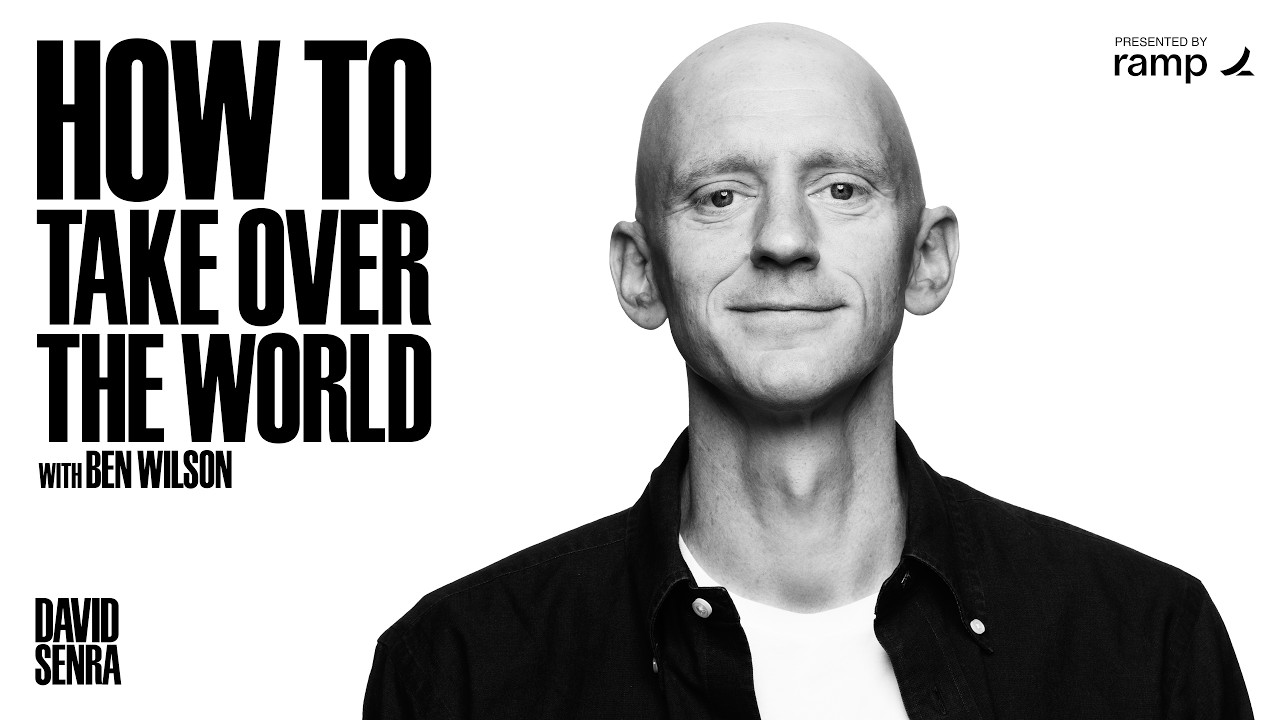
Podcast Host Ben Wilson Fights Terminal Cancer While Analyzing Leaders
David Senra
Transcendental historical leaders achieve greatness through absolute focus and sincere belief rather than intellect, proving that relentless obsession overrides all obstacles.
Ben Wilson, host of the biographical history podcast How to Take Over the World, revealed his diagnosis with stage 4 metastatic neuroendocrine carcinoma affecting his liver, lungs, spine, and brain. (59:14)
Wilson and Senra identify three non-negotiable traits uniting history's most transcendent figures: a crystal-clear vision of a goal, exceptional communication, and ruthless focus through trade-offs. (22:03)
Wilson advocates keeping a uninhibited 'waste book' to relieve performance pressure and overcome creative paralysis by intentionally dumping unrefined ideas. (8:58)
Extreme determination consistently outmatches raw intellect in driving historical impact, as seen in historical figures from Joan of Arc to modern founders like Elon Musk. (37:06)
Detailed notes
## Background
Published by David Senra on YouTube on October 14, 2026, this episode features a conversation with Ben Wilson, creator and host of the podcast How to Take Over the World. According to the show description, Senra and Wilson examine the universal traits shared by history's greatest leaders—such as Napoleon Bonaparte, Steve Jobs, and Joan of Arc—while addressing Wilson's battle with advanced terminal cancer and appealing to listeners for medical leads and support.
## TL;DR
Podcasters David Senra and Ben Wilson deconstruct the shared psychological traits and tactical frameworks of transcendent historical figures, emphasizing relentless focus, the willingness to make ruthless trade-offs, and an all-consuming obsession that trumps raw intellect. Drawing parallels across figures like Thomas Edison, Elon Musk, Arnold Schwarzenegger, and Joan of Arc, they illustrate how sincere, single-minded belief drives outsized historical impact. In the episode's poignant final act, Wilson reflects on his stage 4 neuroendocrine carcinoma diagnosis, detailing his experimental treatments and explaining how a historical perspective enables him to face terminal illness with profound gratitude and zero regrets.
## Atmosphere & style
The conversation carries an intense, cerebral energy that gradually shifts into a deeply moving and vulnerable meditation on mortality. What begins as an impassioned, fast-paced dialogue between two biographical obsessives trading historical anecdotes transforms seamlessly into an intimate, unsentimental discussion of life and death. Wilson speaks with remarkable stoicism and clarity, creating a listening experience that feels both intellectually electrifying and quietly profound.
## Bulletin
- [59:14](https://www.youtube.com/watch?v=Js7Wf3Lj96A&t=3554s) Ben Wilson, host of the biographical history podcast How to Take Over the World, revealed his diagnosis with stage 4 metastatic neuroendocrine carcinoma affecting his liver, lungs, spine, and brain.
- [22:03](https://www.youtube.com/watch?v=Js7Wf3Lj96A&t=1323s) Wilson and Senra identify three non-negotiable traits uniting history's most transcendent figures: a crystal-clear vision of a goal, exceptional communication, and ruthless focus through trade-offs.
- [08:58](https://www.youtube.com/watch?v=Js7Wf3Lj96A&t=538s) Wilson advocates keeping a uninhibited 'waste book' to relieve performance pressure and overcome creative paralysis by intentionally dumping unrefined ideas.
- [37:06](https://www.youtube.com/watch?v=Js7Wf3Lj96A&t=2226s) Extreme determination consistently outmatches raw intellect in driving historical impact, as seen in historical figures from Joan of Arc to modern founders like Elon Musk.
## Key takeaways
- [00:39](https://www.youtube.com/watch?v=Js7Wf3Lj96A&t=39s) Aristotle defined zeal not merely as enthusiasm, but as a specific psychological pain triggered by witnessing a peer achieve greatness that oneself has not yet attained.
- [03:06](https://www.youtube.com/watch?v=Js7Wf3Lj96A&t=186s) Productive study of historical figures requires finding individuals whose core character mirrors your own rather than forcing intellectual admiration on alien temperaments.
- [08:58](https://www.youtube.com/watch?v=Js7Wf3Lj96A&t=538s) Maintaining a dedicated waste book for low-quality thoughts, unpolished notes, and rough sketches liberates creators from performance anxiety and fosters breakthrough ideas.
- [12:41](https://www.youtube.com/watch?v=Js7Wf3Lj96A&t=761s) Major strategic breakthroughs stem from negative realizations: discerning precisely what does not matter and eliminating it to focus solely on core value.
- [20:05](https://www.youtube.com/watch?v=Js7Wf3Lj96A&t=1205s) True focus is defined by the sacrifices you make, requiring the deliberate elimination of viable side ventures, consulting roles, or non-essential habits.
- [24:30](https://www.youtube.com/watch?v=Js7Wf3Lj96A&t=1470s) Biographies act as supreme mentorship compression, allowing readers to extract forty years of lived experience and decades of authorial research in dozens of hours.
- [29:12](https://www.youtube.com/watch?v=Js7Wf3Lj96A&t=1752s) Peculiar eating habits and skipped meals among elite historical figures serve as a practical litmus test for all-consuming obsession rather than dietary discipline.
- [32:14](https://www.youtube.com/watch?v=Js7Wf3Lj96A&t=1934s) Arnold Schwarzenegger demonstrated that the mental framework and discipline developed in an obscure niche can be systematically transferred to entirely different domains.
- [37:06](https://www.youtube.com/watch?v=Js7Wf3Lj96A&t=2226s) Singular determination consistently outperforms detached intelligence, enabling poorly equipped outsiders to shift the course of history through sheer willpower.
- [41:24](https://www.youtube.com/watch?v=Js7Wf3Lj96A&t=2484s) Relentless execution pace invariably bewilders peers, who often plead with high performers to slow down while they compound massive competitive leads.
- [48:28](https://www.youtube.com/watch?v=Js7Wf3Lj96A&t=2908s) Persuasion requires authentic inner belief; double-mindedness or cynical adoption of values fundamentally prevents a leader from achieving transcendent influence.
- [01:05:33](https://www.youtube.com/watch?v=Js7Wf3Lj96A&t=3933s) A grounded study of historical suffering and human mortality provides deep gratitude, enabling one to face severe adversity without regret.
## Detailed walkthrough
### [00:00](https://www.youtube.com/watch?v=Js7Wf3Lj96A&t=0s) Ben Wilson’s Cancer Battle and an Appeal for Support
David Senra opens the episode with an emotional appeal for his close friend and fellow podcaster, Ben Wilson. Ben, the creator and host of the acclaimed solo history podcast *How to Take Over the World*, has been diagnosed with stage four terminal cancer at a very young age and has four young children. David praises *How to Take Over the World* as one of the greatest podcasts ever made, noting that while the episode is a deep dive into historical leadership and what Ben learned from studying the world's most formidable figures, it also directly addresses what it is like facing a terminal diagnosis while raising a young family.
Expressing deep affection and sorrow for his friend's situation, Senra makes an urgent plea to the audience for assistance. Whether through medical expertise, professional introductions, or financial contributions to Ben's GoFundMe campaign, any degree of help matters:
> “Please watch this podcast and see if you can help with medicine, introductions, or donations.”
Senra emphasizes that whether a listener has $5 or $5,000 to spare, every contribution will make an enormous difference in supporting Ben and his family through a devastating trial.
[00:39](https://www.youtube.com/watch?v=Js7Wf3Lj96A&t=39s) The Ancient Greek Meaning of Zeal and Historical Hustle
The conversation shifts into historical analysis as Senra asks Wilson to break down the concept of "zeal." Wilson points out that although modern usage treats zeal as mere excitement or enthusiasm, the word carried a far more precise and biting meaning in the ancient world. According to Aristotle, zeal was actually categorized as a specific kind of pain: the psychological agony experienced when an individual observes a peer who shares their nature accomplishing admirable, significant things that they themselves are capable of doing, but have not yet achieved.
Wilson illustrates this with an anecdote about a 21-year-old Thomas Edison working as a telegraph operator—the 19th-century equivalent of modern tech programmers. Edison stayed up the entire night reading a biography of Michael Faraday, the pioneering English scientist of the prior generation. When his roommate awoke in the morning, Edison was just turning the final page, only to slam the book shut onto the table in a state of agitated ambition:
> “Faraday accomplished so much. I am already 21 years old. I might live to be 50. Can I accomplish as much as he did? I am going to hustle.”
Wilson explains that this generational envy and drive to compete across time was not unique to Edison; Julius Caesar felt the exact same sting when measuring himself against Alexander the Great, and John D. Rockefeller felt it when sizing up Amos Lawrence. Senra echoes this, recalling an anecdote where Edison, upon inventing the phonograph, was asked whose voice from history he would most want to hear. When the interviewer answered Jesus, Edison countered that he would rather hear Napoleon Bonaparte, giving a simple, characteristic reason: “I like the hustler.”
```mermaid
flowchart TD
accTitle: The Mechanics of Aristotelian Zeal
accDescr: Flowchart illustrating how recognizing a peer who achieved greatness produces painful zeal that motivates action.
subgraph Trigger["Recognition"]
A["Observe an admirable achiever<br/>(e.g., Faraday, Alexander)"] --> B["Recognize a shared nature or character<br/>('They are just like me')"]
end
subgraph Reaction["Internal Friction"]
B --> C["Aristotelian Zeal<br/>(Pain of unfulfilled personal capability)"]
end
subgraph Outcome["Drive"]
C --> D["Generational Competition & 'Hustle'<br/>(Edison, Caesar, Rockefeller)"]
end
```
[03:06](https://www.youtube.com/watch?v=Js7Wf3Lj96A&t=186s) Finding Resonant Figures: Da Vinci vs. Walt Disney
Senra highlights the creative kinship between *How to Take Over the World* and his own podcast, *Founders*, observing that both shows explore many of the same historical titans through biographies. He asks Ben how the dynamic of zeal applies to his own life and choices. Wilson explains that his broader mission is to introduce listeners to varied figures until they find someone whose fundamental character mirrors their own:
> “You need to find people who are like you in character in order to have that sort of connection.”
For Wilson, studying someone like Leonardo da Vinci provides immense intellectual admiration, but zero personal zeal because Da Vinci’s mind operates like an alien intellect whose sheer perceptual and fine-motor mastery Wilson could never duplicate. Instead, Wilson identifies with Walt Disney. While acknowledging Disney's genius, Wilson feels an affinity with his temperament as a creative leader who built “empires of the mind” and persuaded teams to execute an overarching aesthetic vision rather than being a technical craftsman himself.
To demonstrate his own creative streak, Wilson mentions composing the iconic theme music for *How to Take Over the World* by messing around in GarageBand for just an hour:
- **The GarageBand Track:** In a single 60-minute burst of inspiration, Wilson laid down the beat, dialed in the vocal timbre, spliced historical quotes, and finalized the intro music. Despite later offers from people who wanted to pay him to produce intros for other podcasts, he could never replicate the lightning-in-a-bottle moment.
- **Senra’s Take on Podcast Music:** Senra admits he usually despises podcast intro music, comparing unnecessary audio flourishes to the late-2000s netbook craze that Steve Jobs flatly rejected at Apple in favor of building the iPad. Senra considers Ben’s show the sole exception to his anti-intro rule.
- **The Divergent Curiosity of Disney and Da Vinci:** Wilson contrasts the nature of creative curiosity. Walt was an average illustrator who excelled at envisioning things that never existed in the physical world, whereas Da Vinci possessed unmatched hand-eye coordination and scrutinized things as they already existed.
Senra jokes about texting Ben from Tuscany after abandoning an 800-page Da Vinci biography Ben had recommended, baffled by endless pages dedicated to the exact anatomy of a bent finger. Wilson defends the detail as essential to understanding the scientific foundation of Da Vinci's art. The conversation turns to how different thinkers recorded reality: where Da Vinci would simply head an entry with the imperative word “describe” before rendering physical phenomena, Isaac Newton organized his notebooks by formulating explicit questions he set out to solve.
[08:58](https://www.youtube.com/watch?v=Js7Wf3Lj96A&t=538s) The Value of a "Waste Book" and Unimpeded Creativity
Ben Wilson reflects on how historical figures recorded their thoughts, pointing to the concept of a "waste book"—a practice similar in spirit to Leonardo da Vinci's notebooks, serving as a scrap repository for rough, unrefined ideas. Wilson explains the psychological benefit of this habit: “And I think everyone should have a waste book because it really takes off the pressure of what you're thinking about, right? of I don't have to come up with anything refined. I don't have to come up with anything insightful. This is just where I'm going to dump my wasteful thoughts.” He believes that true creative breakthroughs occur precisely in those moments of zero pressure.
When David Senra asks if Wilson practices this himself, Wilson confirms he maintains several journals and creative notebooks filled with what he candidly describes as “waste” and “trash.” Since receiving his cancer diagnosis, he has kept a very detailed personal journal, alongside creative notebooks where he draws poorly, outlines future podcast episodes, and drafts one-paragraph mini-essays exploring historical figures and how their lives intersect with his own. These rough drafts often yield the sharpest insights that end up in his finished scripts.
Senra draws a parallel to music producer Rick Rubin, who observed that out of all the world-class musicians he has collaborated with, Eminem was perhaps the most obsessive writer. Rubin noticed Eminem had accumulated hundreds of notebooks filled with constant scribbles and asked him how much of that material ever made it into songs. Eminem replied that he used almost none of it. Wilson agrees that lowering the barrier to entry is essential to avoiding blank-page paralysis:
- Wilson admits that episode introductions are always the hardest part of the process for him.
- If he attempts to write a brilliant opening right away, the writing grinds to a halt.
- Instead, he deliberately forces out “garbage” place-holder introductions (like “Leonardo da Vinci was an artist”) simply to get into the meat of the script, knowing he can return and polish the intro later.
---
[11:25](https://www.youtube.com/watch?v=Js7Wf3Lj96A&t=685s) The Origin of *How to Take Over the World*
Senra asks Wilson how *How to Take Over the World* originally came to life. Wilson traces the show’s beginning to 2018. At the time, he was engrossed in Andrew Roberts's acclaimed biography of Napoleon Bonaparte and felt deeply energized by the material. A regular listener of *The Tim Ferriss Show*, Wilson found himself disappointed by a run of three or four consecutive guest interviews that failed to capture his interest. Wondering who he would most love to hear interviewed, Wilson realized he wanted to hear someone interrogate Napoleon.
```mermaid
flowchart TD
accTitle: Origin of How to Take Over the World
accDescr: Flowchart tracing Ben Wilson's thought process from reading Napoleon's biography to launching his podcast.
subgraph Inspiration["The Spark (2018)"]
A["Reads Andrew Roberts's Napoleon biography"]
B["Listens to The Tim Ferriss Show"]
A & B --> C["Wishes Tim Ferriss could interview Napoleon"]
end
subgraph Realization["The Opportunity"]
C --> D["Insight: 'I could be Tim Ferriss for dead people'"]
D --> E["Searches podcast directories for the concept"]
E --> F["Finds no one doing it"]
end
subgraph Execution["The Launch"]
F --> G["Ep 1: Napoleon Bonaparte"]
G --> H["Ep 2: Steve Jobs (expands beyond conquerors)"]
H --> I["Sets template for next 8 years"]
end
```
Wilson realized that while Tim Ferriss could not conduct such an interview, he could take on that role himself: “I could be Tim Ferriss for dead people was the idea that popped into my mind.” Expecting someone had already executed the concept, he searched podcast platforms, fully prepared to simply become a listener. Finding nothing that matched his vision, he concluded other people had to share his curiosity and decided to produce it himself. He kicked off the project in 2018 with Napoleon, and followed immediately with Steve Jobs to ensure listeners understood the show was not merely about military conquerors, establishing a formula that has guided the podcast for eight years.
---
[12:41](https://www.youtube.com/watch?v=Js7Wf3Lj96A&t=761s) Negative Realizations: Next Computer vs. The iPod
Turning to the broader lessons learned from studying iconic figures, Wilson emphasizes that the most profound insights are often negative realizations—figuring out what not to do and what to ignore. Senra and Wilson examine the evolution of Steve Jobs, specifically contrasting his failure at NeXT with his triumphant second act at Apple:
| Phase | Venture | Product Strategy | Outcome |
|:--- |:--- |:--- |:--- |
| **Exile (Mid-1980s)** | NeXT Computer | Insisted all five team priorities (sub-$10,000 price, strict launch date, specialized computing specs, custom hardware) were equally non-negotiable. Refused to make trade-offs. | Machine launched late, grossly over budget, and overengineered. Nearly bankrupted the company; forced Jobs to abandon hardware and pivot strictly to software. |
| **Return (2001)** | Apple (iPod) | Accepted hardware compromises (fewer supported formats, less raw capacity than rival MP3 players) to focus entirely on frictionless user experience. | Created one of the most successful consumer electronics products in history by understanding which features truly did not matter. |
Wilson points to a famous retreat in Carmel where Jobs gathered the founding NeXT team. The team framed five key priorities, and Jobs asked his department heads which was most critical. After listening to his CMO, hardware lead, and software lead plead their cases, Jobs declared that every single priority had to be met. Wilson explains that because Jobs refused to prioritize, the resulting machine was a commercial disaster. Senra notes that the debacle forced Jobs into becoming a software entrepreneur against his wishes—an era chronicled in the book *Steve Jobs in Exile*, which both podcasters strongly recommend.
A decade later, Jobs returned to Apple as a fundamentally transformed executive who understood the necessity of making hard trade-offs. When designing the iPod, existing MP3 players already boasted higher storage capacities, superior technical specs, and compatibility with more audio formats. Jobs recognized those specifications were irrelevant to consumers compared to a simple, elegant user experience that made playing music effortless. As Wilson summarizes: “And I think every great product, every great leader, every great decision comes from understanding that trade-off and realizing what does not matter.”
---
[16:20](https://www.youtube.com/watch?v=Js7Wf3Lj96A&t=980s) Creative Trade-Offs: Podcasting Styles and the Tesla Roadster
Wilson links this discipline of trade-offs directly to Senra’s work on *Founders*. Senra stripped away traditional production elements—such as intro music and elaborate framing—that conventional podcasting wisdom a decade earlier insisted were mandatory, focusing purely on connecting listeners to the stories. Senra recalls an earlier conversation between the two of them about their differing creative workflows:
- Wilson crafts detailed, tightly structured scripts to weave a cohesive historical narrative.
- Senra relies on raw highlights and annotations, reacting spontaneously in the room so that two recordings on the exact same book would sound completely different from one day to the next.
Both hosts note that these divergent trade-offs reflect differing valid priorities rather than a single correct path. Wilson compares this to Elon Musk's counterintuitive approach with the original Tesla Roadster. Conventional wisdom in the automotive industry dictated that an electric vehicle had to be cheap and prioritize maximum range because early adopters were assumed to be thrifty, environmentally conscious drivers seeking to avoid gasoline costs. Musk made the opposite trade-off: he ignored low-cost practicality, recognized the market would tolerate high prices if the car was compelling, and built an expensive, ultra-fast, visually stunning luxury sports car that fundamentally altered public perception of electric vehicles.
[17:48](https://www.youtube.com/watch?v=Js7Wf3Lj96A&t=1068s) Breaking Trade-Offs and the Wright Brothers' Insight
David Senra circles back to a recurring theme in their past conversations: the concept of breaking trade-offs, bringing up Ben Wilson’s historical analysis of Orville and Wilbur Wright. Ben explains that his realization about trade-offs first crystallized while studying the Wright brothers. At the turn of the twentieth century, human flight was the equivalent of modern artificial intelligence—dozens of competitors were racing to crack it because everyone recognized it was the defining technology of the future. Yet nearly all of them failed because they focused on the obvious obstacle: propulsion and lift to get a machine off the ground. Wilbur Wright recognized that lift was actually an easy problem to solve; the truly difficult challenge was control.
Wilbur arrived at this insight by observing birds in nature, noting that they constantly make minute adjustments to their wings and posture multiple times per second to navigate gusts and turbulence. Concluding that getting airborne was meaningless without the capacity to remain there safely, the Wrights deliberately ignored motorized lift for years. They traveled to the windy coast of North Carolina to construct gliders—essentially oversized kites—where one brother remained on the ground holding ropes while the other tested steering mechanics in constant ocean breezes. Once they mastered three-axis control, the remaining step was straightforward: they fitted an engine onto the airframe. As Ben puts it, “Once you figure out how to stay in the air, the problem of lift was trivial.”
```mermaid
flowchart TD
accTitle: The Wright Brothers' Counterintuitive Approach to Flight
accDescr: A diagram contrasting the common failure mode of chasing lift with the Wright brothers' focus on control.
subgraph Trap["The Industry's Common Mistake"]
A["Prioritize Propulsion & Lift"] --> B["Machines Get Airborne Briefly"]
B --> C["Immediate Crash due to Instability"]
end
subgraph Solution["The Wright Brothers' Counterintuitive Insight"]
D["Observe Birds' Micro-Adjustments"] --> E["Isolate Control & Stability First"]
E --> F["Test Gliders on Windy NC Coast"]
F --> G["Slap Engine onto Controllable Airframe"]
end
```
[20:05](https://www.youtube.com/watch?v=Js7Wf3Lj96A&t=1205s) The Power of Saying No: Focus and Morning Routines
When David asks why breaking trade-offs is such a profound concept, Ben points out that modern culture bombards people with endless well-meaning advice about habits that supposedly matter. A person might be told that yoga, lifting weights, journaling, and meditation are all vital for health and success. If someone attempted to accommodate every good suggestion, their morning routine would drag on until one o'clock in the afternoon, leaving no time to produce actual work. True prioritization only happens when someone is willing to make painful cuts in pursuit of a single dominant goal. Ben highlights the necessity of that sacrifice: “Until you are able to actually make a trade-off, until you are able to say this is more valuable than that, things don't really matter.”
David asks how Ben has put this principle into practice in his own life, prompting Ben to reference Steve Jobs’s famous maxim that focus means saying no. In the early stages of his career, Ben took on all kinds of side gigs out of financial necessity to sustain his podcasting, including designing intro music, launching side ventures, and running an agency. He even produced other successful podcasts, notably *My First Million* (which is how David originally discovered him). Eventually, Ben realized these side pursuits were diluting his energy. He made the deliberate decision to walk away from producing other shows, shut down his agency, and dedicate himself entirely to making *How to Take Over the World* as exceptional as possible.
[22:03](https://www.youtube.com/watch?v=Js7Wf3Lj96A&t=1323s) Sponsor Support and the Three Hallmarks of Great Leadership
David pauses the conversation to deliver a personal message: rather than running traditional commercials, his sponsors Ramp, AppLovin, and Deel agreed to donate their ad budgets directly to the GoFundMe campaign set up to support Ben’s advanced cancer treatment. David urges listeners with the means to do so to contribute via the link in the show notes. Returning to the discussion, David asks Ben to synthesize what eight years of examining history’s greatest conquerors, artists, and entrepreneurs have revealed about the core nature of leadership.
Ben explains that while leaders come in vastly different archetypes, three overarching through-lines unite them across completely different fields:
- **Clear Vision:** Great leaders possess an unmistakable objective. Ben cites a favorite quote from Genghis Khan that sounds surprisingly like modern executive advice: “Without the vision of a goal, a man cannot hope to manage his own life, let alone the life of others.” Whether studying Genghis Khan, Polaroid founder Edwin Land, or Steve Jobs, every transcendent figure begins with an unambiguous goal.
- **Masterful Communication:** Having a vision is useless unless it can be transmitted into the minds of other people. The exact medium varies—some leaders excel as public orators, others as essayists, one-on-one persuaders, or long-form authors—but all of them are world-class communicators within their chosen channel.
- **Ruthless Focus:** They possess an extraordinary ability to shut out extraneous noise, secondary opportunities, and distractions to execute on their central vision.
[24:30](https://www.youtube.com/watch?v=Js7Wf3Lj96A&t=1470s) Mentors in History and the Power of Knowledge Compression
David asks Ben whether studying these historical giants has illuminated his own personal shortcomings and allowed him to alter his behavior. Ben responds that he sees his role as a sherpa guiding listeners to historical wisdom, and he continually reflects on how to internalize these traits in his own work and life. David chimes in, admitting that his motivation for starting *Founders Podcast*—which is approaching its ten-year anniversary—was entirely selfish. Having grown up without mentors or strong childhood role models, David found his guidance in history after watching a 2012 interview with Elon Musk. Musk recounted coming to America with no money or connections; when asked who mentored him, Musk replied that he found mentors by reading biographies of figures like Henry Ford, Nikola Tesla, and Benjamin Franklin.
That interview convinced David to devour biographies, revealing the staggering efficiency of the medium:
- An extraordinary figure spends 40 years living a career full of hard-won lessons and failures.
- A skilled biographer dedicates multiple years to researching, verifying, and documenting those lessons in a comprehensive book.
- A reader can absorb that entire lifetime of experience in roughly 40 hours.
- A podcast host can compress those 40 hours into a 45-minute audio distillation for listeners whose time is scarce.
As the discussion turns toward Elon Musk's historical counterparts, Ben notes that Musk is essentially a modern incarnation of Thomas Edison. David asks why Ben links the two, and Ben explains that their lives run in remarkable parallel—something Musk himself has conceded by noting that while his electric car company bears Nikola Tesla's name, his practical mentality as an inventor and builder is far more akin to Thomas Edison.
[26:39](https://www.youtube.com/watch?v=Js7Wf3Lj96A&t=1599s) The Uncanny Parallels Between Thomas Edison and Elon Musk
Ben Wilson and David Senra explore the startling, almost eerie similarities between Thomas Edison and Elon Musk, spanning their mentalities, personalities, appearances, and family lineages. Beyond being pure inventors, both men operate as master industrialists who excel at taking complex technical products to market and transforming them into commercial realities. Physically, both possess remarkably large heads that people frequently remark upon. Their upbringings match just as closely: both grew up with fathers who were erratic, aggressive entrepreneurs with whom they maintained strained, turbulent relationships.
```mermaid
flowchart LR
accTitle: Edison and Musk Biographies Compared
accDescr: Diagram tracing the shared childhood traits and parallel ancestry of Thomas Edison and Elon Musk.
subgraph Heritage["Parallel Family Roots"]
MAncestry["Musk: Great-grandfather fled Canada to US"]
EAncestry["Edison: Maternal grandfather fled US to Canada"]
end
subgraph Childhood["Early Struggles"]
fathers["Volatile, abusive father figures"]
misjudged["Dismissed as dumb / communication barriers"]
giantheads["Physiognomy: Unusually large heads"]
end
subgraph Mastery["Industrial Playbook"]
execution["Obsessive drive & product execution"]
end
Heritage --> Childhood
Childhood --> Mastery
```
David recalls reading a 1957 biography of Edison describing how, when Edison was around five or six years old, his father was so enraged by his misbehavior that he posted a public notice inviting the entire village to the town square on a Saturday morning to watch him publicly thrash his child. David links this to an anecdote shared by Eric Jorgenson on a previous podcast episode about Elon Musk: Musk’s father would trap a ten-year-old Elon in a room, screaming in his face for hours that he was worthless and would never amount to anything.
Ben points out that neither man was identified as a prodigy in early childhood. Instead, both were initially thought to be slow:
- Elon Musk's early social disconnect likely stemmed from being on the autism spectrum, making conventional emotional expression and communication difficult.
- Thomas Edison struggled socially and academically because he was largely deaf.
- Both men share mirrored ancestral migrations: Musk's maternal great-grandfather was an outspoken, politically active Canadian preacher who clashed with local authorities and fled south into the United States (settling in Minnesota or Iowa), whereas Edison's maternal grandfather was an American preacher who ran afoul of the government, was driven out of town, and fled north across the border into Canada.
Ben muses on these uncanny historical echoes: “It’s like weird biographical things between the two of them that make you wonder if it’s like the same person reborn, re makes you believe in reincarnation.”
[29:12](https://www.youtube.com/watch?v=Js7Wf3Lj96A&t=1752s) Big Heads, Strange Diets, and the Litmus Test of Obsession
The conversation branches out into the recurring physical and behavioral peculiarities of elite performers, starting with large head sizes. Ben points out that Oprah Winfrey shared this trait; early in her acting career, costume departments struggled to find hats that fit her head. David shares a childhood memory of being bullied over his disproportionately large head, recounting how an older brother's friend nicknamed him "basketball head," which schoolmates subsequently turned into "Lollipop" because of his skinny frame.
From head size, the dialogue shifts to unusual diets and superhuman stamina. Edison famously cycled through restrictive dietary phases, including a prolonged period where he consumed almost nothing but milk. Napoleon Bonaparte, Steve Jobs, and Vladimir Putin exhibited similarly bizarre dietary habits. Ben describes the realization that struck him after analyzing several historical figures:
> “The realization I’ve come to is it’s obviously not about the food, right? It’s not about the food. But what it is, I think food is a good test for if you’re obsessed with something. Do you find yourself skipping meals? Do you find yourself forgetting to eat? That is a really good litmus test for whether you are truly obsessed with something or not.”
Ben recounts several striking examples from his biographical research:
- Napoleon boasted of his eating speed: *"If you want to dine well, dine with Cambacérès... If you want to dine poorly, dine with Lebrun... If you want to dine quickly, dine with me."* Napoleon typically rushed through meals in fifteen minutes, and in his youth, he ate extraordinarily light, peckish rations.
- Steve Jobs adhered to extreme, restrictive diets, sometimes consuming exclusively apples for months at a time.
- Vladimir Putin would sustain an entire day on just a single boiled egg.
- Joan of Arc routinely practiced strict, prolonged fasts while engaged in her military mission.
David argues that along with focus, obsession must be recognized as a defining, essential pillar of achievement: “They don't write about books about normal, well-adjusted people. Like, they're all obsessive.”
[32:14](https://www.youtube.com/watch?v=Js7Wf3Lj96A&t=1934s) Arnold Schwarzenegger and the Playbook of Pure Obsession
When David asks which book best conveys the psychological experience of total obsession, Ben immediately selects Arnold Schwarzenegger's autobiography, *Arnold: The Education of a Bodybuilder*. While David points out the physical copy sitting right on his shelf, Ben explains why that particular text stands out from virtually every other biography:
> “A lot of these biographies or autobiographies are written retrospectively, and *Education of a Bodybuilder* is written right in the middle of it and you can just feel the obsession, right? This is someone who not was obsessed in the past and now has gotten to a better place. This is someone who is obsessed right now who can’t stop thinking about bodybuilding and his craft.”
David observes that Schwarzenegger was only thirty years old when the book came out, and the core biographical narrative occupies roughly the first 120 pages (with the remainder consisting of workout regimens). When Schwarzenegger began lifting, bodybuilding was viewed in Austria as an obscure, freakish hobby with virtually zero financial upside—his own parents worried something was mentally wrong with him, as there were only about five bodybuilders in the entire nation.
Yet Schwarzenegger clearly recognized early on that the internal toolkit he built to conquer bodybuilding could be applied universally. He consciously called his shot: he would direct that exact same framework of insane discipline, singular focus, and utter obsession to dominate business and become a Hollywood movie star. Ben reinforces this point by noting that Schwarzenegger took the exact same playbook into politics. Because he was born outside the United States, Schwarzenegger was constitutionally barred from the presidency; the governorship of California was functionally the highest political office open to him, and he captured it across four completely separate domains.
[34:48](https://www.youtube.com/watch?v=Js7Wf3Lj96A&t=2088s) Clear Vision and Making Yourself Easy to Help
Ben Wilson and David Senra examine how deep commitment to a vision attracts unexpected support, using Arnold Schwarzenegger as a prime example. Growing up captivated by tales of conquerors like Alexander the Great, Napoleon, and Charlemagne, Arnold pursued bodybuilding at a time when society and his parents viewed it as shady, bizarre, and freakish. Yet once he locked onto his goal and declared it openly, people in his high school began rallying around him—classmates handed him their milk at lunch to help him bulk up, and others offered to carry his things so he could rest before competitions. Ben cites the famous line often attributed to Johann Wolfgang von Goethe: “He says at the moment of commitment, the entire universe conspires to assist you.” When an individual articulates a vivid, uncompromising ambition, bystanders no longer look at them as merely strange; they immediately ask how they can contribute.
```mermaid
flowchart TD
accTitle: Commitment and Legibility Flywheel
accDescr: A diagram showing how a singular vision leads to legibility and outside support.
subgraph Focus ["Clarity of Purpose"]
A["Singular Vision & Commitment"] --> B["Extreme Legibility<br/>(Easy to Understand)"]
end
subgraph Reception ["External Response"]
B --> C["Lower Friction for Others to Assist"]
C --> D["Unprompted Outside Support & Resources"]
end
D --> A
```
David connects this dynamic to a concept he calls legibility, recounting feedback he received from Spotify founder Daniel Ek. Ek pointed out to David that because his sole obsession is podcasting and sharing founders' stories, he is exceptionally easy to understand and therefore effortless to support. The same principle defines historic company builders like Steve Jobs, who condensed his lifelong mission into three simple words: "insanely great products." David keeps a sticky note bearing that exact phrase directly on his recording desk as a constant reminder. From age nineteen until his death at fifty-five, Jobs used that single standard to filter every person and priority in his orbit: if someone wanted to build insanely great products, they belonged with him; if not, they had no place in his life.
- Arnold Schwarzenegger turned high school peers into active supporters of his bodybuilding training simply by boldly articulating his unusual dream.
- Daniel Ek explained David Senra's magnetism by noting: “He's just like, you're very easy to understand, so therefore you're very easy to help.”
- Steve Jobs distilled his life's work across four decades down to three words on David's recording studio desk: “insanely great products.”
[37:06](https://www.youtube.com/watch?v=Js7Wf3Lj96A&t=2226s) Joan of Arc and the Superiority of Determination
When David asks Ben about the insights gained from studying religious leaders, Ben highlights Joan of Arc as the figure who captivated him most, despite his own background as a member of The Church of Jesus Christ of Latter-day Saints. In the brutal warfare of the Middle Ages—an era dominated by grown men swinging swords and axes—she arrived as an impoverished, malnourished, teenage peasant girl with zero military background. France had spent decades failing to push out the English, paralyzed by kings, dukes, and field marshals juggling rival political interests. Joan entered the scene with exactly one priority: expelling the English and securing French victory under God. Her absolute clarity and conviction transformed the morale of the army overnight, demonstrating that singular focus can overturn an absence of physical force, resources, or formal credentials.
This historical anomaly reminds David of an essay by Paul Graham exploring whether intelligence or determination better predicts entrepreneurial triumph. Graham posed a thought experiment: a person starting with 100 out of 100 in both intelligence and determination quickly becomes brilliant but completely ineffectual if their determination is stripped away. Conversely, someone with maxed-out determination but average or below-average intelligence inevitably succeeds—often ending up wealthy running basic operations like trash-hauling businesses—because they simply refuse to quit until they find something that serves others. Ben agrees, noting that neither Steve Jobs nor Elon Musk is necessarily the highest-IQ individual in a room filled with Tesla or SpaceX engineers, but their sheer willpower borders on the pathological.
- Joan of Arc entered military conflict at around fifteen years old, chronically fasting and physically diminutive, yet united an entire kingdom behind one unclouded objective.
- Paul Graham's thought experiment concludes that relentless persistence without extraordinary intellect builds thriving enterprises, whereas raw intellect without resolve produces paralysis.
- Ben recounts Elon Musk's dismissive attitude toward mere sentiment when striving for massive civilizational milestones: “And he says, 'Optimism, pessimism, screw that. I'm going to get it done.'”
[41:24](https://www.youtube.com/watch?v=Js7Wf3Lj96A&t=2484s) Brigham Young and the Unceasing Relentlessness of Great Achievers
Turning to Brigham Young—who happens to be Ben's great-great-grandfather—David asks what overarching lesson emerged from Ben's multi-part podcast series on him. Ben identifies Young's core power as unceasing action combined with genuine faith. While many of the early followers of the Mormon movement were substantially better educated and intellectually gifted than Young, practically no one could match his sheer endurance and refusal to stop working. That relentless tempo often alienates or bewilders peers who expect successful individuals to eventually relax and savor their achievements.
To illustrate this disparity, Ben shares a rock-and-roll parallel involving Brandon Flowers, the lead singer of The Killers and a practicing Latter-day Saint who abstains from alcohol, smoking, and recreational drugs. When the band exploded onto the scene in the early 2000s alongside contemporaries like The Strokes and Franz Ferdinand, their peers spent their post-album tours partying and enjoying their sudden fame. Ben recalls an interview with the frontman of The Strokes expressing genuine exhaustion after discovering that The Killers had already cut and released an entire follow-up record while everyone else was still soaking in their initial victory: “I'm in the middle of this and all of a sudden I read The Killers have put out another album and I'm like, will you please calm down? Like we're trying to enjoy the fruits of our labor here.” Ben observes that true outliers across history—from Brigham Young to modern builders—inevitably elicit that exact complaint from their competitors: “It's always like, will you please slow down? Will you please act like a normal person? Because the level of determination, relentless action that they take is not normal.” Ben then turns toward the historic rise of early Christianity under Jesus, drawing an unexpected operational parallel to Phil Knight's formative culture at Nike.
- Brigham Young's influence derived not from superior intellect over his contemporaries, but from an unmatched capacity for unyielding, daily execution.
- The Killers' disciplined output outpaced their early-2000s rock peers because Brandon Flowers opted out of the touring party lifestyle to maintain constant creative production.
- Ben begins analyzing the mechanics behind the explosive growth of early Christianity, comparing its movement-building dynamics to Phil Knight's early expansion of Nike.
[43:48](https://www.youtube.com/watch?v=Js7Wf3Lj96A&t=2628s) Compounding Growth, Jesus's Persuasive Power, and the Intense Stare
Ben Wilson and David Senra reflect on how monumental movements often expand not through sudden dramatic leaps, but through steady, inexorable compounding. Studying the history of companies or figures often leaves people expecting an instant turning point, yet the reality is often consistent year-over-year compounding. Wilson draws a direct comparison between corporate compounding and the history of the early Church: “It's just Christianity grows like 50% per year every year for centuries until it becomes the dominant ideology in in the entire world.” Above all, Wilson emphasizes that Jesus's primary trait was an unmatched power of persuasion. Wilson recommends the biography of Jesus by Paul Johnson, noting its strength comes from being written by a sincere believer.
Senra shares a deeply personal perspective on faith and family, explaining that his own mother was a fundamentalist Christian whose extreme beliefs led her to attempt praying away a cancer diagnosis. It took Senra two years to persuade her to see an oncologist in Orlando while he lived in Miami, and he had to drive up to attend every single appointment with her because she would otherwise skip them. Despite having been dragged to church every Sunday and Wednesday evening, Senra wanted to study Jesus purely from an objective historical lens—stripping away the supernatural to explore what can be known about the man himself.
Looking closer at Johnson’s biography, Wilson highlights how frequently the New Testament mentions Jesus’s eyes—recording that Jesus “looked” or “beheld.” Wilson likens this observation to how many historical titans are light eaters; it seems absurd until one realizes how universal it is across great figures. Senra and Wilson agree that a striking, intense physical gaze recurs repeatedly throughout history, visible in figures as diverse as Steve Jobs, Alexander Hamilton, and Jesus.
[46:22](https://www.youtube.com/watch?v=Js7Wf3Lj96A&t=2782s) The Hierarchy of Violence and Rereading Annual Favorites
When Senra asks Wilson which category—conquerors, dictators, religious icons, artists, or entrepreneurs—he would choose if he could study only one, Wilson immediately picks conquerors. Wilson argues that human society is ultimately an arrangement of competing hierarchies across social status, careers, athletics, economics, and the arts. However, Wilson posits that martial force sits above all others: “The highest hierarchy, the one that kind of is at the top of everything else is the hierarchy of violence. The people who can most effectively channel violence and that's conquerors.” Because conquerors establish and preserve political order, artists rely on them for patronage and merchants or founders must remain subordinate to political power. Wilson views conquest as the absolute pinnacle of human achievement and narrative drama.
Turning to their reading rituals, Senra asks Wilson which books he revisits annually, alongside Arnold Schwarzenegger’s *The Education of a Bodybuilder*. Wilson names the science-fiction classic *Ender's Game* as his annual fiction reread. Senra recalls listening to the audiobook roughly ten years prior after tech entrepreneur Sean Parker mentioned it during a memorable Twitter run. For non-fiction, Wilson rereads J. Christopher Herold’s *The Mind of Napoleon* every year—a text Senra also admires and covered on his own podcast, highlighting its dense 300 pages of Napoleon's direct words compiled in the 1950s.
[48:28](https://www.youtube.com/watch?v=Js7Wf3Lj96A&t=2908s) Sincere Belief Versus Double-Mindedness
Wilson points out that while Napoleon was not a practicing Catholic or orthodox Christian, he was profoundly religious in his own right, treating destiny as his personal deity. Quoting the emperor directly, Senra notes: “He says destiny must be fulfilled. That is my chief doctrine.” Wilson identifies a similar dynamic in Steve Jobs, who, while rejecting traditional religion, held an ardent, quasi-religious faith rooted in California counterculture and agnostic Zen Buddhism. This deep internal conviction is a prerequisite for exceptional achievement. In contrast, those who lack full alignment struggle to make an impact. Wilson explains: “I think people who are like kind of double-minded are are always unstable and unable to make [an impact].”
```mermaid
flowchart TD
accTitle: Conviction vs. Double-Mindedness
accDescr: A comparison showing how genuine belief leads to historic impact while double-mindedness results in instability.
subgraph Believers["Genuine Faith & Mission"]
direction TB
B1["Napoleon: Absolute devotion to 'Destiny'"]
B2["Steve Jobs: Devotion to design & counterculture Buddhism"]
B3["Phil Knight: Unshakable faith in Tiger shoes"]
B4["Historic Impact & Compelling Evangelism"]
B1 --> B4
B2 --> B4
B3 --> B4
end
subgraph DoubleMinded["Double-Minded Approach"]
direction TB
D1["Henry IV: 'Paris is worth a mass' (Cynical conversion)"]
D2["Lukewarm Podcasters & Founders"]
D3["Instability & Mediocre Results"]
D1 --> D3
D2 --> D3
end
```
Wilson defines "double-minded" as espousing ideals one does not genuinely feel or pursuing goals with only lukewarm interest. He compliments Senra for thoroughly believing in the mission of *Founders*, noting that listeners can immediately tell when podcasters do not completely believe in what they are doing. Senra laughs, mentioning a dinner with podcasters the night before and a text he sent to his co-founder Rob Moore at 6:00 a.m. about that very dynamic. To illustrate the perils of cynicism, Wilson points to King Henry IV of France, who pragmatically converted from Protestantism to Catholicism simply to claim the crown, famously quipping that "Paris is worth a mass." Because Henry IV lacked genuine inner faith in that cause, Wilson argues he never became a transcendent conqueror: “You are never going to be someone who accomplishes great things in life if you don't have a genuine sincere belief at the heart of what you do.” Wilson notes that the term double-minded originates from Scripture, which warns that a double-minded man is unstable in all his ways.
[51:00](https://www.youtube.com/watch?v=Js7Wf3Lj96A&t=3060s) Evangelism and Phil Knight on Irresistible Belief
Senra suggests that beyond stamina, high pain tolerance, light eating, and obsession, a fifth pillar of great leaders is the ability to evangelize. He illustrates this with John D. Rockefeller, who evangelized his crusade to bring order to the chaos of the nascent oil industry, successfully convincing rival entrepreneurs to sell out and join his monopolistic mission. Rockefeller's unique drive synthesized two opposing influences:
- His father, a bigamist and con artist peddling fake cures with an unchecked mania for money.
- His devout Puritan mother, who instilled deep Christian piety.
At age ten, inspired by a biography of Amos Lawrence—a philanthropist known for handing out crisp bills who donated $100,000 across his lifetime—Rockefeller announced to a childhood friend that he would also be worth $100,000 one day. Philanthropy enabled Rockefeller to fuse his commercial ambition with his religious faith.
Connecting this back to the magnetism of conviction, Senra recalls Phil Knight's memoir *Shoe Dog*. Knight was an unremarkable salesman when trying to peddle encyclopedias or mutual funds, but became wildly successful once he began selling Japanese Tiger running shoes out of the trunk of his car. Senra and Wilson recount Knight's realization about the secret of selling: “And he says, 'What is the difference between the first two things and the third?' And he says, 'Belief, I decided belief is irresistible.'” When an individual possesses authentic, infectious passion, their persuasion becomes impossible to withstand.
[53:23](https://www.youtube.com/watch?v=Js7Wf3Lj96A&t=3203s) Passion, Storytelling, and Cross-Domain Principles
David Senra brings up Steven Rinella—author, podcaster, and creator of the Netflix series *MeatEater*—as an archetype of someone whose intense passion makes any subject captivating. Even though David has no personal interest in hunting, fishing, or camping, Rinella's sheer intelligence, mission-driven mindset, and mastery of storytelling hooked him completely. David remarks that Rinella could literally read the phone book on a podcast and people would still tune in, because genuine passion is infectious. Through Rinella's work, David ended up absorbing extensive lessons about the natural world, American frontier history, and historical figures, illustrating how an audience gets effortlessly pulled into a creator's vortex.
David notes that Rinella extracts universal principles from grueling 11-day hunting expeditions in Alaska that apply equally well whether someone is building a company, conquering an empire, or sculpting a masterpiece. Asking Ben Wilson whether Ben has uncovered insights in his research for *How to Take Over the World* that David has missed on *Founders*, Ben reflects that their underlying insights are fundamentally the same. The real distinction lies in the delivery: David emphasizes direct insights, whereas Ben leans into the emotional and narrative power of story. Ben points out that core truths do not change, but encountering them through varied personalities and contexts—whether studying Brigham Young, Edwin Land, or Joan of Arc—is what makes an idea suddenly click for an individual at just the right moment.
> “So, I don't think there's anything missing. Like, I don't think there's anything I have found that you haven't found. At least nothing that comes to mind because honestly, like a lot of the lessons are the lessons, you know, you learn them pretty quick.” — Ben Wilson
---
[55:52](https://www.youtube.com/watch?v=Js7Wf3Lj96A&t=3352s) An Unexpected Diagnosis: Ben’s Cancer Revelation
David transitions to discussing Ben's life and health, reiterating how much Ben's work has impacted him and how he has long championed Ben as a world-class podcaster. David recalls an evening in Austin where he and Cliff Weitzman spent an hour and a half urging Ben to ditch his production agency work and pour all his energy exclusively into *How to Take Over the World*, convinced he had already overcome the hardest part of building something exceptional. Later, while in the Bay Area about to tape an interview, David called Ben quickly to pitch an advertising sponsor for the show. Instead of discussing ad inventory, Ben hesitated, not wanting to spoil David's upcoming recording, before finally breaking the news: he had been diagnosed with cancer.
Ben had documented his diagnosis and perspective on a special installment titled "The Cancer Episode" on the *How to Take Over the World* feed, which David describes as deeply profound. Ben explains that prior to seeking medical help, he had been feeling increasingly terrible and suffering from unexplained, severe weight loss. Because he avoided doctors and was accustomed to minor aches resolving on their own with rest, he delayed getting examined for months, assuming his symptoms were merely signs of aging.
- David and Cliff Weitzman spent 90 minutes in Austin advising Ben to go all-in on his podcast and drop ancillary agency client work.
- David regularly attempted to sell ad spots on Ben's behalf purely out of friendship and respect for the show.
- When Ben finally saw a primary care physician he had never met before, she palpated his abdomen, felt a mass in his liver, and immediately ordered urgent imaging scans.
---
[59:14](https://www.youtube.com/watch?v=Js7Wf3Lj96A&t=3554s) The Reality of Stage 4 Metastatic Neuroendocrine Carcinoma
Prior to his official doctor's appointment, Ben entered his mounting symptoms into the AI model Claude. The system issued a stark warning: he could not afford to wait a week for a routine checkup and needed to see a physician immediately or head to an emergency room. Scans soon revealed extensive cancer throughout his body. Oncologists were stunned that he was still walking around and functioning normally given how far the disease had progressed. Ben had lost 40 pounds, and specialists estimated that without treatment, he likely would have survived only a few months.
Ben clarifies his formal diagnosis: stage 4 metastatic primary neuroendocrine carcinoma. The cancer originally began quietly in his lungs as a relatively non-aggressive form before spreading to his liver, where it mutated into an aggressive malignancy. It has since metastasized to his liver, lungs, spine, and brain, with brain lesions presenting the most immediate concern. The standard five-year survival rate listed in medical literature for his degree of spread was 0%, with an initial prognosis of roughly one year. Despite those statistics, Ben emphasizes the rapid wave of modern oncological innovations, choosing to balance his preparations for his family's future with the active hope that new therapies will keep him alive for decades.
```mermaid
flowchart TD
accTitle: Progression of Ben Wilson's Cancer Diagnosis
accDescr: Flowchart illustrating the origin, metastasis, and clinical diagnosis of Ben Wilson's cancer.
subgraph Origin["Primary Site"]
A["Lungs (non-aggressive initial neuroendocrine tumor)"]
end
subgraph Metastasis["Metastatic Transformation"]
B["Liver (mutated into aggressive carcinoma)"]
C["Spine"]
D["Brain (critical current focus)"]
end
subgraph Diagnosis["Clinical Profile"]
E["Stage 4 Metastatic Neuroendocrine Carcinoma"]
end
A --> B
B --> C
B --> D
B --> E
```
- Ben experienced an initial weight loss of 40 pounds before diagnosis.
- Standard historical data showed a median prognosis of one year and a 0% five-year survival rate for his specific presentation.
- Ben has completed his first-line chemotherapy regimen, which pushed back tumor growth and markedly improved how he feels day-to-day.
- He is transitioning to second-line treatment using the targeted drug tarlatamab, noting that if it succeeds his outlook improves substantially, but if it fails they must urgently locate another alternative.
> “I have to like kind of live in two different worlds. One being I have to prepare. I have to prepare my family that I might not be here. But at the same time, I've also got to live like I've got my entire life in front of me because that also might be the case.” — Ben Wilson
[01:02:41](https://www.youtube.com/watch?v=Js7Wf3Lj96A&t=3761s) Buying Time: Tarlatamab, SMARCA4, and mRNA Vaccines
David Senra turns the conversation directly to Ben Wilson’s health, wanting to provide maximum detail and surface area to the audience in hopes of discovering treatments, connections, or resources that can help Ben, his wife, and his four young children. David emphasizes that the fundamental strategy is to “buy more years” through immunotherapies, emerging AI tools, or new drugs until better breakthroughs arrive. Ben explains that he is starting tarlatamab, a targeted therapy similar in function to an immunotherapy. Initially approved for small cell lung cancer, where it typically extended life expectancy by six months to a year, tarlatamab has also shown promising signs in a subset of patients with Ben’s specific cancer type, who have remained on the drug for two years with it continuing to work. Because those trials are only two years old, long-term efficacy remains unknown.
Ben operates under the assumption that tarlatamab will work for an unknown window, after which he must transition to another option. Because every cancer has unique markers, he points to a specific mutation his cancer carries: SMARCA4 (SMARCA). While there are currently few approved therapies directly targeting SMARCA4, there are several clinical trials underway, representing his likely next line of attack if tarlatamab fails. In terms of access, tarlatamab was initially denied by his insurance, but a positive clinical indication published that very month resulted in coverage. Consequently, Ben and his family are focusing their financial resources on cutting-edge options, specifically the development of a custom mRNA vaccine designed to enhance the drug's effectiveness.
```mermaid
flowchart TD
accTitle: Ben Wilson Cancer Treatment Progression
accDescr: Diagram illustrating the current therapy, prospective treatments, and enhancements in Ben Wilson's cancer strategy.
subgraph Current["Current Line of Therapy"]
A["Tarlatamab"] -->|"Approved via new indication"| B["Insurance Coverage"]
B --> C["Custom mRNA Vaccine to enhance efficacy"]
end
subgraph NextLine["Next Line of Therapy (if Tarlatamab stops)"]
D["SMARCA4 Mutation Target"] --> E["Clinical Trials Pipeline"]
end
Current -->|"Acquires time for"| NextLine
```
- **Current Drug**: Tarlatamab, which recently received an expanded indication that secured insurance coverage for Ben's treatment.
- **Genetic Marker**: SMARCA4 (SMARCA), a marker with multiple active clinical trials being tracked as future fallback options.
- **Experimental Enhancement**: Custom-developed mRNA vaccines targeted to Ben's specific tumor profile to boost immunotherapy efficacy.
[01:05:33](https://www.youtube.com/watch?v=Js7Wf3Lj96A&t=3933s) Historical Perspective and Gratitude in the Face of Cancer
David asks Ben about his philosophical and spiritual outlook, noting that Ben is a person of faith with four children aged five and under. David references Ben’s own podcast episode on his diagnosis, noting that Ben cited Friedrich Nietzsche’s concept of eternal return—the idea that if given the chance to live life over again in identical detail, he would choose the exact same life. David marvels that despite facing an uncertain future, Ben’s public message has shown zero self-pity or despair, remaining remarkably positive.
Ben reflects on how deeply studying history shapes his attitude. He mentions Napoleon Bonaparte’s later campaigns—such as the War of the Sixth Coalition—where experienced French armies had been decimated, forcing Napoleon to conscript 15- and 16-year-old boys who were rushed onto untrained horses, mocked as "children running around on chickens," only to die in battle or from pervasive disease. Ben remarks: “You can't study history for long and just not realize I've had an amazing life.” He notes that he found his true calling in *How to Take Over the World* after years in management consulting, has a wife he loves, and four wonderful children. While he acknowledges that cancer involves severe physical pain and genuinely dark moments that people should not gloss over, he views his life as exceptionally charmed and fortunate, even if it ends earlier than expected.
> “If I go next year, you can't study history for long and just not realize I've had an amazing life.” — Ben Wilson
[01:08:56](https://www.youtube.com/watch?v=Js7Wf3Lj96A&t=4136s) A Call for Generosity and Huntsman Cancer Institute
David reiterates his profound admiration for Ben’s character, work, and friendship, expressing hope that broad public exposure will produce unexpected positive breakthroughs for his treatment. David confirms that contact information and links will be available in the show notes for anyone who can assist with medical connections, experimental access, or financial support.
Ben concludes with a tribute to the late industrialist and billionaire Jon Huntsman, who used his fortune to establish the Huntsman Cancer Institute in Utah. Ben shares that after initially struggling within the standard healthcare system, entering the Huntsman Cancer Institute provided him with world-class, life-extending care. While Ben is deeply grateful for the generous outpouring of support from his podcast listeners, he points out that many people facing the same terrible illnesses do not have a public platform, audience, or financial safety net. He urges listeners who want to help to consider donating to the Huntsman Cancer Institute or cancer research organizations more broadly, and to look out for everyday people in their own communities who need support. David closes the interview by emphasizing that Ben's humility and care for others is completely genuine before concluding the episode.
## Notable quotes
> [48:28](https://www.youtube.com/watch?v=Js7Wf3Lj96A&t=2908s) You are never going to be someone who accomplishes great things in life if you don't have a genuine sincere belief at the heart of what you do. — Ben Wilson
> [29:12](https://www.youtube.com/watch?v=Js7Wf3Lj96A&t=1752s) Do you find yourself skipping meals? Do you find yourself forgetting to eat? That is a really good litmus test for whether you are truly obsessed with something or not. — Ben Wilson
> [01:05:33](https://www.youtube.com/watch?v=Js7Wf3Lj96A&t=3933s) If I go next year, you can't study history for long and just not realize I've had an amazing life. — Ben Wilson
> [20:05](https://www.youtube.com/watch?v=Js7Wf3Lj96A&t=1205s) Until you are able to actually make a trade-off, until you are able to say this is more valuable than that, things don't really matter. — Ben Wilson
## Mentioned
Alexander Hamilton, Alexander the Great, Amos Lawrence, Andrew Roberts, AppLovin, Aristotle, Arnold Schwarzenegger, Arnold: The Education of a Bodybuilder, Ben Wilson, Brandon Flowers, Brigham Young, Claude, David Senra, Deel, Edwin Land, Elon Musk, Eminem, Ender's Game, Founders, Franz Ferdinand, Friedrich Nietzsche, GarageBand, Genghis Khan, Henry IV of France, How to Take Over the World, Huntsman Cancer Institute, Isaac Newton, J. Christopher Herold, Jesus, Joan of Arc, John D. Rockefeller, Jon Huntsman, Julius Caesar, Leonardo da Vinci, Michael Faraday, My First Million, Napoleon Bonaparte, NeXT Computer, Nike, Orson Scott Card, Paul Graham, Paul Johnson, Phil Knight, Ramp, Rick Rubin, Sean Parker, Shoe Dog, SMARCA4, Standard Oil, Steve Jobs, Steven Rinella, Tarlatamab, Tesla Roadster, The Church of Jesus Christ of Latter-day Saints, The Killers, The Mind of Napoleon, The Strokes, The Tim Ferriss Show, Thomas Edison, Tim Ferriss, Vladimir Putin, Walt Disney, Wilbur Wright
## Video description
Ben Wilson is the host of “How To Take Over The World,” which is one of my favorite podcasts. How To Take Over The World examines history’s greatest leaders and conquerors, and has benefited millions of people. In this episode, we talk about the common traits among the individuals he has studied such as Napoleon, Leonardo da Vinci, Joan of Arc, Thomas Edison, Steve Jobs, Arnold Schwarzenegger, and more.
We also discuss the fact that Ben is battling advanced cancer.
He’s a good guy, a close friend, and one of my favorite podcasters. He has four young children.
Please watch this episode and see if you can help with medicine, introductions, or donations.
00:00:00 What Ben has learned from making How to Take Over the World and studying history’s greatest leaders.
00:55:51 Living like you're dying. Ben on facing cancer.
播客主持人Ben Wilson在剖析领袖的同时与晚期癌症抗争
卓越的历史领袖依靠绝对专注与真诚信念而非纯粹智力成就伟大,印证了不懈执念能压倒一切障碍。
播客主持人David Senra与Ben Wilson剖析了卓越历史人物共有的心理特质和策略框架,强调不懈的专注、做出果断取舍的意愿,以及超越纯粹智力的全心投入。通过类比Thomas Edison、Elon Musk、Arnold Schwarzenegger和Joan of Arc等人,他们展示了真诚且专一的信念如何产生深远的历史影响。在节目动人的尾声中,Wilson反思了自己确诊4期神经内分泌癌的经历,详细讲述了他接受的实验性治疗,并解释了历史视角如何让他怀着深刻的感激与毫无遗憾的心态去面对绝症。
传记历史播客《How to Take Over the World》的主持人Ben Wilson透露,他被确诊患有转移性4期神经内分泌癌,癌细胞已波及肝脏、肺部、脊柱和大脑。 (59:14)
Wilson与Senra指出了联合历史上最卓越人物的三项不可或缺的特质:对目标的清晰愿景、卓越的沟通能力,以及通过取舍实现的严苛专注。 (22:03)
Wilson倡导准备一本随性自由的“废稿本”(waste book),通过刻意倾倒未经提炼的想法,以缓解表现压力并克服创作停滞。 (8:58)
正如从Joan of Arc到现代创始人Elon Musk等历史人物所体现的那样,在推动历史影响方面,极度的坚定始终胜过纯粹的智力。 (37:06)
Reading summary
Studying history's most impactful figures reveals that achievement stems from singular obsession, ruthless prioritization, and authentic conviction—principles that podcaster Ben Wilson analyzes and applies while navigating a stage 4 cancer diagnosis.
Aristotelian Zeal and the Litmus of Obsession (0:39)
Ben Wilson explains that Aristotle defined zeal not as simple enthusiasm, but as a specific psychological pain felt when witnessing a peer accomplish something significant that oneself has not yet achieved. Historical titans weaponized this competitive sting: a 21-year-old Thomas Edison slammed a biography of Michael Faraday shut to immediately start hustling, just as Julius Caesar wept when measuring his progress against Alexander the Great. Wilson and David Senra argue that sustained achievement demands this level of unyielding obsession, often manifesting in peculiar behavioral extremes.
The Power of Negative Realizations and Trade-Offs (12:41)
Wilson identifies 'negative realizations'—learning what not to do and what to ignore—as a fundamental driver of great execution. During his exile at NeXT, Steve Jobs refused to make trade-offs among five competing product goals, resulting in an overpriced commercial failure. Conversely, Jobs returned to Apple and launched the iPod by accepting lower technical specifications in exchange for an effortless user experience. Similarly, the Wright brothers solved human flight by recognizing that lift was trivial compared to the neglected problem of balance and control, testing wind gliders for years before adding an engine.
Legible Vision, Sheer Determination, and Sincere Belief (34:48)
Great leaders consistently articulate clear, unmistakable goals that make them legible and easy for others to support. Arnold Schwarzenegger drew classmates to carry his gym gear simply by openly declaring his bodybuilding ambitions, mirroring Jobs's singular filter of building 'insanely great products.' Wilson notes that determination routinely outperforms raw intellect, pointing to teenage peasant Joan of Arc transforming French military morale through unclouded resolve. Crucially, persuasion requires genuine faith rather than cynical opportunism; quoting Phil Knight's memoir, Senra notes that authentic belief is irresistible, whereas 'double-minded' efforts inevitably falter.
Navigating Stage 4 Cancer with Historical Perspective (59:14)
Wilson details his diagnosis of stage 4 metastatic neuroendocrine carcinoma, which originated in his lungs, mutated aggressively in his liver, and spread to his spine and brain. While historical data lists a median prognosis of one year and a 0% five-year survival rate, Wilson's clinical strategy focuses on buying time: completing chemotherapy, starting targeted tarlatamab, and tracking future trials around his tumor's SMARCA4 mutation alongside custom mRNA vaccines. Grounded in Friedrich Nietzsche's concept of eternal return and the harsh realities of past historical figures, Wilson approaches his illness with deep gratitude rather than self-pity, citing world-class care at the Huntsman Cancer Institute.
Wilson and Senra demonstrate that historical study is not merely academic, but a practical operating manual for both professional execution and personal adversity. While cutting-edge medical therapies aim to extend Wilson's life, he urges audiences to recognize their fortune and support institutions and individuals fighting illness without public platforms.
精炼阅读摘要
播客《How to Take Over the World》创作者Ben Wilson与《Founders》主播David Senra探讨了历史领袖的核心特质,认为卓越成就源于极具痛感的野心、明确取舍与纯粹执念,同时分享了他面对晚期神经内分泌癌时从历史中获得的从容与应对策略。
亚里士多德式狂热与共鸣榜样 (0:39)
Wilson指出,亚里士多德将“狂热”(zeal)界定为一种具体的心理痛苦:当看到与自己秉性相似的同龄人完成了重大成就,而自己明明具备同等潜能却尚未做到时,内心会产生强烈的刺痛感。例如21岁的Thomas Edison彻夜读完Michael Faraday的传记后猛然合上书,为自己尚未匹敌前人而焦灼不安,并发誓要全力拼搏;Julius Caesar面对Alexander the Great亦产生过类似的代际竞争痛苦。Wilson认为,学习历史人物的关键在于寻找与自身心智结构产生共鸣的原型,例如他自己难以从Leonardo da Vinci那种兼具非凡精细动作与感知天赋的“外星人式”心智中获得狂热,却与Walt Disney这类依靠愿景调动团队构建“思想帝国”的非技术型创造者产生深度共鸣。
做减法的艺术:从NeXT到莱特兄弟 (12:41)
Wilson强调,研究伟大人物最深刻的领悟往往是“否定性认知”——明白何事不可为以及应忽略什么。Steve Jobs在创立NeXT时拒绝妥协,坚持同时满足低价、定制硬件与按期交付等五项关键指标,最终导致产品严重超支和商业溃败;而十年后重返Apple打造iPod时,Jobs放弃了当时竞品MP3所标榜的高容量和繁复格式,聚焦于极致流畅的用户体验。Wilson与Senra指出,突破权衡并不等同于兼收并蓄,真正的决断往往源于剔除看似合理的多余事项,正如Musk最初打造Tesla Roadster时反其道而行之,放弃低价实用性而直切昂贵高端跑车。
卓越领导力的三大支柱与执念检验 (22:03)
纵观历史上的征服者、艺术家与企业家,Wilson总结出卓越领导者的三大共有特质:清晰的目标愿景(正如Genghis Khan所言,缺乏目标愿景的人连自己的生活都无法掌控)、跨媒介的高效沟通能力,以及隔绝一切次要杂音的无情专注。Senra与Wilson进一步指出,“执念”是超常成就的底层燃料,而对待食物的反应正是衡量执念的试金石——Napoleon习惯在15分钟内结束用餐,Steve Jobs长期进行极端单一饮食,Vladimir Putin有时靠单枚水煮蛋支撑一整天,Joan of Arc则在行军作战中长期禁食。Arnold Schwarzenegger在30岁时撰写的自传《Arnold: The Education of a Bodybuilder》真实记录了身处执念之中的精神状态,正是这种将健美时建立的专注与纪律无差别迁移到商业、演艺乃至政治领域的能力,使他横跨四个不同领域登顶。
不可动摇的真诚信念与复利驱动 (43:48)
真正的感召力源于不可动摇的内在信仰,而非投机的双重心思。Wilson以法国国王Henry IV为反面例证,后者为了王位妥协改信天主教并留下“巴黎值得一场弥撒”的名言,却因缺乏真诚信仰而未能跻身伟大征服者之列;相比之下,Napoleon将“命运”视为宗教,Steve Jobs笃信加州反主流文化与禅宗,Phil Knight在《Shoe Dog》中亦感悟到信念具有不可抗拒的说服力。早期基督教能在数百年间以年均约50%的复合增速扩张,依靠的正是Jesus超凡的说服力与真诚信仰所形成的复利效应;在世俗事务中,Brigham Young凭借不知疲倦的执行力超越了同时代受教育程度更高的同行,正如摇滚乐队The Killers因克制的生活方式与持续产出令同侪感到疲于奔命。
直面四期癌症:历史视角下的平静与求生
Wilson披露自己被确诊为四期转移性原发性神经内分泌癌,肿瘤始于肺部,并在转移至肝脏后发生恶变,随后扩散至脊柱和脑部。面对医学文献中五年生存率为0%、初始预期寿命仅约一年的严峻预后,Wilson在首轮化疗控制住肿瘤后,转入靶向免疫药物tarlatamab治疗,同时关注其携带的SMARCA4基因突变临床试验,并筹集资金研发定制mRNA疫苗以增强疗效。Wilson展现出平静与感恩,他引用Friedrich Nietzsche的“永恒轮回”哲学并回顾Napoleon在第六次反法同盟战争中征召青少年士兵赴死的残酷历史,认为相比人类历史上的苦难,自己拥有热爱的事业、妻子与四个年幼孩子,已度过了极为充实的人生。Senra借此呼吁各界提供医疗人脉支持,Wilson则建议公众关注并支持建立在犹他州的Huntsman Cancer Institute等癌症科研机构。
本期对话展现了从历史传记中萃取出的领导力法则,揭示出真正决定成就的往往是极其清晰的目标、坚决的取舍与真诚的执念;面对严酷的晚期癌症,Wilson将这种向死而生的历史洞察转化为现实求生中高度自洽的精神支撑与理性行动。
Source quotes
[48:28] Ben Wilson: You are never going to be someone who accomplishes great things in life if you don't have a genuine sincere belief at the heart of what you do.
[29:12] Ben Wilson: Do you find yourself skipping meals? Do you find yourself forgetting to eat? That is a really good litmus test for whether you are truly obsessed with something or not.
[65:33] Ben Wilson: If I go next year, you can't study history for long and just not realize I've had an amazing life.
[20:05] Ben Wilson: Until you are able to actually make a trade-off, until you are able to say this is more valuable than that, things don't really matter.
Original transcript
[0:00] Ben Wilson has stage four cancer and
[0:02] four small kids. I wanted to have him on
[0:04] the podcast to talk about his work on
[0:06] the How to Take Over the World podcast,
[0:08] which is, in my opinion, one of the best
[0:09] podcasts ever created, and to talk about
[0:11] what it's like dealing with terminal
[0:13] cancer at such a young age. I also want
[0:15] to ask you for help in any way that you
[0:17] can. Ben is a good man and he's been
[0:20] dealt a bad hand. Please watch this
[0:22] podcast and see if you can help with
[0:23] medicine, introductions, or donations.
[0:25] It doesn't matter if you have $5 to
[0:27] spare or 5,000. any little bit can help
[0:30] Ben's family through this devastating
[0:32] time. He's a good guy and a close
[0:34] friend. Please help in any way that you
[0:36] can.
[0:39] >> All right, talk to me about zeal.
[0:41] >> Zeal is a word that we all use, right?
[0:42] So nowadays, zeal means that you are all
[0:45] we all use. No, I don't I don't think
[0:47] it's in everybody's everyday vocabulary.
[0:50] >> Well, it means you get excited about
[0:51] something, right? You're zealous for
[0:52] something. But it had a very specific
[0:54] definition uh to the ancient Greeks. So
[0:57] Aristotle defined zeal as a type of
[0:59] pain. It is felt by someone when they
[1:02] see another who is like them in nature
[1:05] who has accomplished good or admirable
[1:07] things uh that the other person is
[1:09] capable of but has not yet achieved. You
[1:11] can see in a lot of famous historical
[1:13] people. So one of my favorite stories of
[1:15] zeal is Thomas Edison. He's 21 years
[1:19] old. He's a telegraph operator. Young
[1:23] smart guy. Those are kind of like the
[1:24] programmers, tech, you know, guys of
[1:27] their age. And he's reading this
[1:29] biography of Michael Faraday, who is an
[1:31] inventor from the generation before.
[1:34] And he's reading the biography of
[1:36] Faraday.
[1:38] His roommate goes to bed. His roommate
[1:40] wakes up in the morning and Edison is
[1:42] just finishing the bio. He stayed up all
[1:44] night reading this biography of Michael
[1:45] Faraday. Slams shut the biography,
[1:48] throws it on the table, and says,
[1:51] "Paraday accomplished so much. I am
[1:53] already 21 years old. I might live to be
[1:55] 50. Can I accomplish as much as he did?
[1:58] I am going to hustle. That's what he
[2:00] says. I'm going to hustle. I love that
[2:02] line. And so he really felt this pain
[2:06] cuz he recognized someone who was like
[2:08] him, Faraday, who had accomplished so
[2:10] much more than he had. And so he wanted
[2:13] to compete with him across the
[2:15] generations. And you see that same story
[2:16] play out with Julius Caesar looking at
[2:19] uh Alexander the Great. You see it with
[2:22] Rockefeller uh and kind of the
[2:24] generation that came before Amos
[2:25] Lawrence as the first person that he
[2:27] really aspires to be like. And so it's
[2:29] this very unique source of inspiration
[2:32] zeal of of seeing someone who came
[2:35] before you and wanting to compete with
[2:36] them because they accomplished so much.
[2:38] But it's very common among the great
[2:40] achievers across all domains.
[2:43] >> Yeah. I love the fact that anytime you
[2:45] read biographies of Edison, he's
[2:46] obsessed with the word hustle. uh when
[2:48] he invented the photograph, he was
[2:50] talking to some guy and guy's like,
[2:51] "Hey, if you could hear any historical
[2:53] figure's voice, you know, that's long
[2:55] since dead, who would you choose?" And
[2:57] the guy asking the question, he's like,
[2:58] "Well, I would choose Jesus." And
[2:59] Edison's like, "I would choose
[3:00] Napoleon." And he's like, "Why
[3:02] Napoleon?" Goes, "I like the hustler."
[3:04] >> I like the hustler. Yeah.
[3:06] >> Yeah.
[3:06] >> So, what are some other examples of
[3:08] zeal? Like are how do you think how do
[3:09] you think about it? Like the work that
[3:10] you do personally because you're
[3:12] studying people with zeal. I guess we
[3:14] should back up and give some people
[3:16] context. I I've been telling people for
[3:18] years that I think you're one of the
[3:19] best podcasters in the world. How to
[3:21] take over the world is another solo
[3:23] history podcast. I think there's a lot
[3:24] of overlap between the work that you did
[3:26] uh with How to Take Over the World and
[3:27] the work that I did with founders. And
[3:29] so we wind up, you know, studying a lot
[3:31] of the same people, reading a lot of the
[3:32] same books. We've been texting back and
[3:34] forth for years about book
[3:35] recommendations. But like I understand
[3:37] the presence of zeal in these historical
[3:40] figures. I see it just like you do when
[3:42] I read these books. But like how do you
[3:44] think about your own life then?
[3:46] Well, two things. I mean, I I think I've
[3:48] made it sort of my life mission to help
[3:49] people with that, right? Because you
[3:51] need to find people who are like you in
[3:53] character in order to have that sort of
[3:55] connection. So, for example, if I read
[3:57] about Leonardo da Vinci, amazing story,
[4:00] I love it. I can learn a lot. But
[4:03] fundamentally, I don't feel that sense
[4:04] of zeal because his brain is so
[4:06] different from mine. It's like studying
[4:08] an alien. I could just never do what he
[4:11] did. And so by presenting all these
[4:15] different stories to people that I do
[4:17] and how to take over the world, I'm
[4:19] hoping that you know you can listen to
[4:21] those and some of those people you think
[4:22] okay cool, interesting, but not really
[4:24] for me. But you find one of those
[4:26] stories that just resonates deep in your
[4:28] heart and soul and gives you that moment
[4:30] of no that person is like me. I could
[4:32] accomplish what they did but I haven't
[4:34] yet. And it gives you that pain and that
[4:36] sort of motivation to start on that
[4:38] journey. That's how I think about that
[4:40] process. So wait, if you don't identify
[4:42] with Da Vinci, who do you identify with?
[4:43] >> So someone like Walt Disney, for
[4:45] example, I read that story and I think,
[4:49] oo, I could accomplish something like
[4:50] that. Like that's someone who is h maybe
[4:53] not exactly, he's obviously an
[4:54] enormously talented person. But that's
[4:56] someone who I feel like their
[4:57] personality is more similar to mine, and
[4:59] so it does give me a little bit more of
[5:01] that feeling.
[5:01] >> Tell me more about how you did
[5:03] similarities and personalities between
[5:04] you and Walt.
[5:05] >> Walt was a very uh creative person, of
[5:08] course. This is the first thing that
[5:09] anyone knows about Walt Disney, but this
[5:11] is someone who created empires of the
[5:13] mind, who was a creative leader who got
[5:16] people to buy into a certain aesthetic
[5:19] vision. And uh I think on some level I
[5:23] have that ability to do that. One of the
[5:25] most famous things about my podcast is
[5:27] the intro music that people know. They
[5:29] get very excited about it. And I was
[5:31] able to do that myself just messing
[5:33] around in Garage Band.
[5:34] >> I'm very anti podcast intro. I'm always
[5:38] just like I was just like well we're
[5:39] like it's always like the worst version
[5:41] of something like I think about what um
[5:43] back in the uh the when when Steve Jobs
[5:46] came back to Apple. I know you've done a
[5:47] ton of episodes on on Steve Jobs 2 and
[5:50] netbooks were really really popular and
[5:52] they were pressuring Steve and even like
[5:54] his friend Larry Ellis like why aren't
[5:55] you building networks? netbooks and he
[5:57] goes because they're just shitty laptops
[5:59] and he so he instead of being in his
[6:01] words instead of taking resources and
[6:02] building a shitty laptop a product
[6:04] shouldn't exist he redirected them and
[6:05] they wind up inventing the iPad and like
[6:07] I thought that shift was like very
[6:09] interesting so that's the way I feel
[6:10] about m like intro music for podcast
[6:12] yours is the lone example where I'm like
[6:14] this is excellent I didn't know till
[6:16] just now that you were the one that made
[6:18] that
[6:18] >> yeah I in a fit of inspiration and it's
[6:21] funny because people early on tried to
[6:24] hire me to make intro music for other
[6:27] podcasts and I just couldn't do it. It
[6:28] was really just
[6:30] 60 minutes of magic. I mean, that's how
[6:32] long it took me. I kind of figured out
[6:34] the beat. I figured out the vocal tone
[6:36] that I liked. I grabbed a few quotes and
[6:39] boom, it was done in a flash. It was
[6:42] just like one of those magical moments
[6:43] of inspiration. And anyway, so so yeah,
[6:47] Walt was a creative, someone who built
[6:49] Empires of the Mind. When I think about
[6:51] someone like Da Vinci in that
[6:55] like actual artistic skill because Walt
[6:57] was an okay
[6:59] >> artist but he was not a great animator
[7:02] >> but Da Vinci was he was exceptional. He
[7:04] just had that kind of eye hand eye
[7:06] coordination that I guess I lack and
[7:09] just the ability to perceive things in a
[7:11] certain way that I just don't think I
[7:13] see the world the way that that he does.
[7:16] And his curiosity goes in a different
[7:18] direction.
[7:20] Walt was also an extremely curious
[7:21] person, but he was curious about things
[7:23] that never were, right? About things
[7:25] that could be created. Da Vinci was uh
[7:29] curious about things as they are in the
[7:31] world. And I think I lean more toward
[7:33] that uh Walt Disney model of things as
[7:36] they could be and never have been
[7:38] before.
[7:38] >> Yeah. I remember I was like poking a
[7:41] little fun at you uh a few months ago
[7:43] through text message because I was going
[7:44] to Tuscany. I was like, I read
[7:46] Isaacson's biography of Da Vinci, which
[7:48] is great, but it's like 800 pages. And I
[7:49] was like, give me the best Da Vinci book
[7:51] that you ever read. And I'm in Tusky. It
[7:53] was so bad. I literally left it at the
[7:54] hotel. Have this.
[7:56] >> And I was like, Ben, what the hell was
[7:58] that? It was like pages and pages about
[8:00] just like the way that he would draw
[8:02] like a hand that was like bent. I'm
[8:04] like, why did you tell me to read this?
[8:05] Like I I really enjoyed that part. Well,
[8:07] cuz I think it's it's difficult to
[8:08] understand Da Vinci and what he did
[8:10] unless you do at least on some level
[8:12] grasp
[8:14] the science of what he was doing and
[8:18] what had come before. So anyways, but we
[8:20] did get a little bit in the weeds. I'll
[8:22] give that to you. I think that's an
[8:23] interesting observation that that
[8:24] essentially he had the most attention to
[8:26] detail of things that already exist like
[8:27] you know his notebooks are famous like
[8:29] how like all little detail in like a
[8:31] leaf for example where Walt was like I
[8:33] want to invent things and bring things
[8:35] to life that don't exist or they uh what
[8:37] you called empires of the mind.
[8:39] >> Da Vinci and Isaac Newton they both
[8:41] >> they did it in different ways which I
[8:43] thought was interesting. Da Vinci would
[8:46] write in his notebook describe and then
[8:49] he would write something whereas Isaac
[8:51] Newton would write out actual questions
[8:54] of things that he wanted to answer.
[8:56] >> The thing that I love about Isaac Newton
[8:58] with his notebooks which are similar to
[8:59] Da Vinci's in some ways but he called it
[9:01] his waste book. In other words, like his
[9:04] trash book, like his book of scraps and
[9:06] notes. And I think everyone should have
[9:08] a waste book because it really takes off
[9:10] the pressure of what you're thinking
[9:12] about, right? of I don't have to come up
[9:14] with anything refined. I don't have to
[9:15] come up with anything insightful. This
[9:17] is just where I'm going to dump my
[9:19] wasteful thoughts. And I think it's in
[9:21] those moments of of unimpeded creativity
[9:26] that you have some of your most
[9:28] insightful realizations.
[9:30] >> Do you have like notebooks? Do you have
[9:31] journals? Like do you do this?
[9:33] >> Tons. Yeah. Yeah. Yeah.
[9:34] >> What's in them?
[9:35] >> Waste. Like a lot of trash. You know, a
[9:38] lot of trash. A lot of
[9:39] >> personal. What is this though?
[9:40] >> I have one for each. So I do keep a
[9:42] journal and I started keeping like a
[9:44] very detailed journal since since I got
[9:46] diagnosed with cancer. But then I also
[9:48] have a lot of creative notebooks where I
[9:51] will draw very poorly. I will plan out
[9:55] episodes. I'll just kind of start
[9:56] writing kind of thoughts on historical
[9:59] figures and their place in history and
[10:02] how they might relate to my own life.
[10:04] Just kind of little essays, mini essays,
[10:06] just paragraph long. and I get some of
[10:09] my best insights that I end up pulling
[10:10] out of there and putting into scripts
[10:12] for episodes from that.
[10:13] >> Talked to Rick Rubin about this because
[10:14] he said, you know, he's worked with all
[10:15] the um probably some of the most
[10:17] talented artists that have ever existed
[10:19] in music and he said something was
[10:21] interesting one time where he said that
[10:22] Eminem might be the most obsessive
[10:24] artist he's ever worked with. And I
[10:25] asked him to elaborate on that and he
[10:27] was just like, well, he's just
[10:28] constantly writing. And if you look,
[10:29] he's like, no, he's got not millions,
[10:32] but you know, hundreds of notebooks. And
[10:34] Rick asked him one day, he's like, well,
[10:35] how much of what you're writing do you
[10:36] actually use? is like almost none of it.
[10:38] >> Again, it gives you that feeling of of
[10:41] openness, which I think is really
[10:43] essential in any creative pursuit. Of
[10:45] course, there's a time that comes for
[10:47] refining and for polishing, but if you
[10:49] try and start there, you know, I think
[10:52] everyone's had that feeling, at least in
[10:54] like high school, you're trying to write
[10:55] an essay, you got that blank page, and
[10:56] you just have no idea where to start.
[10:58] For me, the introductions to my episodes
[11:02] are the hardest part. And so if I let
[11:04] myself get stuck there, then nothing
[11:07] good ever happens. And so I will just
[11:10] write the most garbage, you know, uh,
[11:14] Leonardo da Vinci was an artist, you
[11:15] know, like it's just terrible, terrible
[11:17] introductions so that I can just get
[11:19] into the meat of the episode and I I can
[11:21] just get the juices flowing and then I
[11:23] can return to that intro and work on it
[11:24] later.
[11:25] >> Why did you start How to take over the
[11:26] world to begin with?
[11:27] >> Well, because I wanted it to exist in
[11:29] the world essentially. Um, I was reading
[11:31] this biography of Napoleon and I found
[11:33] myself extremely inspired. And at the
[11:36] time I was listening to the Tim Ferrris
[11:37] podcast. Love Tim. And he had done three
[11:41] or four interviews in a row that I just
[11:43] wasn't interested in. And so I started
[11:45] thinking to myself, who do I wish Tim
[11:47] Ferrris would interview? And I realized,
[11:51] I wish Tim Ferrris could interview
[11:53] Napoleon. Obviously, that was
[11:55] impossible. But I immediately had the
[11:57] realization, well, I could do that. I
[11:59] could be Tim Ferrris for dead people was
[12:01] the idea that popped into my mind. And
[12:03] so I immediately went and searched for
[12:05] it. Who's already doing this? And I
[12:07] really would have been content just to
[12:09] find a podcast and start listening to
[12:11] it. But I couldn't find it. And so I
[12:14] thought, "Oh, okay. There's no way that
[12:16] I'm the only person who's interested in
[12:17] this, so I'll make it." And so that's
[12:19] where the idea came from.
[12:20] >> What year is this?
[12:21] >> 2018. Okay. Was Napoleon your first
[12:23] episode?
[12:24] >> Napoleon was my first episode.
[12:25] >> Which biography?
[12:26] >> Uh Andrew Roberts, of
[12:27] >> course. Yeah. great biography. Napoleon
[12:29] was the first one. I decided to call it
[12:31] how to take over the world. But I didn't
[12:33] want people to get the idea that it was
[12:34] just Conqueror. So from there, so it was
[12:36] Napoleon and then it was Steve Jobs and
[12:38] then kind of the formula was set for the
[12:40] next eight years of my life.
[12:41] >> So what do you think are some more of
[12:43] the ideas that you learned from studying
[12:44] these people and from reading these
[12:46] books that you applied to your own uh
[12:47] life whether it's work or personal?
[12:49] >> Well, it's a big question, right? Um
[12:53] because I do think that like there
[12:56] there's so much and and as life goes on,
[13:01] certain lessons stand out to you more at
[13:03] certain times than others, right? I know
[13:05] you do a lot of the same biographies,
[13:07] right? Because
[13:08] >> reading it with a fresh set of eyes,
[13:10] which is like an entire new experience.
[13:12] >> You mean rereading the books?
[13:13] >> Yeah. Yeah. Yeah. Rereading the books,
[13:14] >> it's a new experience. But like some of
[13:16] the things I've been thinking about
[13:17] recently for example
[13:19] is I think you actually do an
[13:21] exceptional job of this with founders
[13:24] which is
[13:25] the most important realizations
[13:29] are negative realizations are things
[13:31] that you should not do or things that
[13:32] you should not focus on. So, one of the
[13:34] great examples, Steve Jobs, uh he's at
[13:37] Next, right? He leaves Apple, he founds
[13:39] Next,
[13:41] and they they go to this retreat in
[13:43] Carmel, and he's got his founding team
[13:45] there, and they lay out their five top
[13:48] priorities for a next machine, and it's
[13:52] it has to be under $10,000. It has to
[13:54] come out by such and such a date. It has
[13:55] to have
[13:57] this computing capabilities. It's got to
[14:00] have, you know, certain other
[14:02] capabilities. Five things. Okay. And so
[14:04] he asks the sounding team of these,
[14:06] which is the highest priority? What what
[14:07] is the most important? And so they go
[14:10] around and they discuss and everyone
[14:11] makes the case for the thing that
[14:12] they're working on. Their CMO is
[14:14] advocating for something. Their head of
[14:15] software is advocating for something
[14:16] else. Head of hardware is advocating for
[14:19] something else. And they get to the end
[14:20] and he says, "Okay, well the answer is
[14:24] all of the priorities. We have to have
[14:26] all of these things." As a result, it
[14:29] comes out late. It comes out over
[14:31] budget. It comes out overengineered. The
[14:33] next machine is a terrible machine.
[14:34] >> It was so bad it almost put them out of
[14:36] business and then he had to sell off his
[14:38] hardware division that people don't know
[14:39] there was a time in Steve Jobs life
[14:41] where he was a software entrepreneur.
[14:42] >> Yeah. Yeah.
[14:43] >> Against his own wishes.
[14:44] >> Yes. And even the software itself should
[14:46] have been really successful and he
[14:48] almost submarines that as well.
[14:50] >> He manages to get an okay exit out of
[14:52] next but I mean he he tanks it. I mean
[14:56] me and you just read the the book I
[14:57] think it's called like Steve Jobs in
[14:58] Exile which is which I'd highly
[15:00] recommend.
[15:00] >> Really good book.
[15:01] >> Okay. Okay. And so then you fast forward
[15:02] 10 years. So so he's he is a at this
[15:04] point in time he's a terrible executive.
[15:06] That's I mean objectively both in the
[15:10] way he's leading and in the results that
[15:11] he gets when it comes to the market.
[15:14] Flash forward 10 years he has returned
[15:16] to Apple and his mindset has totally
[15:18] changed where now he's able to make
[15:20] trade-offs. And so he looks at the iPod
[15:24] and he says okay this is a device that
[15:26] is underengineered in a lot of ways.
[15:30] There are already other MP3 players on
[15:31] the market that have more storage
[15:34] capacity, can read more file formats,
[15:37] uh can do more, just more robust MP3
[15:41] players. And he says,
[15:43] you know, I don't think any of that
[15:44] matters. I think the only thing that
[15:46] matters is getting a great user
[15:49] experience that makes it easy for people
[15:52] to quickly get to their music. And so
[15:54] they go to market with this iPod, this
[15:57] MP3 player that is deficient in all
[15:59] these ways. And then it's one of the
[16:01] most successful products of all time
[16:02] because he is able to make that
[16:04] trade-off, right, of saying
[16:06] this this all these things don't matter.
[16:09] And I think every great product, every
[16:11] great
[16:13] leader, every great decision comes from
[16:15] understanding that trade-off and
[16:17] realizing what does not matter. And I
[16:20] think like I said at the beginning, you
[16:21] do a great job with this because
[16:22] founders, you said it doesn't have intro
[16:24] music. There's so much that it it lacks
[16:26] that especially 10 years ago, people
[16:28] would have told you is necessary to a
[16:32] successful podcast. And you just
[16:34] stripped all that away and you said, "I
[16:35] actually don't think any of that
[16:36] matters. The only thing that matters is
[16:38] connecting people to these stories."
[16:40] >> Me and you had a conversation about this
[16:42] like probably 3 years ago. And you know,
[16:44] cuz you script way more than I do. Like
[16:46] I have my notes and highlights, but I
[16:47] like I can literally record episode
[16:49] founders today on the same book, do it
[16:51] again tomorrow, it's going to be a
[16:51] different episode. It's just like
[16:53] whatever happens to be on top of mind at
[16:54] that time as I'm like reacting live to
[16:57] what's going on. And your whole thing
[17:00] was just like, yeah, but what like some
[17:01] kind of like cohesive story. I was like,
[17:03] that's not what I do. That's why I think
[17:05] our podcasts are different in a subtle
[17:07] way. And that's that's fine, right? So,
[17:09] it's going to be a different thing
[17:10] because you can think about, okay, the
[17:12] iPod was sort of underengineered from a
[17:14] hardware standpoint, but had this really
[17:16] elegant software that connected people.
[17:18] For other people, it's going to be the
[17:19] opposite trade-off, right? It's going to
[17:20] be something. You can look at Elon Musk
[17:22] with the original um Tesla with the
[17:26] Roadster. And people said it needs great
[17:29] range. It needs to be affordable because
[17:32] people who go for electric cars are very
[17:34] costconcious. they they do it because
[17:36] they don't want to spend money on gas
[17:38] and that sort of thing. And he had sort
[17:40] of the opposite realization which is no
[17:41] actually we can go way up market. People
[17:43] don't care about any of that stuff as
[17:44] long as it goes fast and it is cool and
[17:47] it's beautiful.
[17:48] >> Yeah. I think he said sexy sexy he
[17:51] >> and so you can go I mean multiple
[17:54] examples from history that I I can think
[17:55] of but
[17:56] >> this idea of breaking trade-offs that
[17:57] you that you and I have talked about in
[17:58] the past I think is really interesting.
[17:59] your example for the Wright brothers I
[18:01] think is really uh another like great
[18:04] way to describe the idea that you're
[18:05] talking about. Do you want to try?
[18:06] >> So that's where I had this original
[18:08] realization is reading about the Wright
[18:09] brothers. Um because at the time that
[18:12] they're trying to solve flight
[18:14] there are dozens of other people trying
[18:15] to solve flight. It's popular at the
[18:17] time. It's uh it's like the AI of the
[18:20] moment, right? A lot of different people
[18:21] are working on it. Everyone realizes
[18:22] it's the future. So why do they succeed?
[18:25] Well, because everyone is doing the
[18:26] obvious thing. And what's the obvious
[18:28] thing?
[18:29] You're trying to get something in the
[18:30] air. So, you're focusing on propulsion
[18:32] and lift of like you're focused on
[18:35] trying to make something fly. And Wilbur
[18:37] Wright realizes that's actually an easy
[18:39] problem to solve. The hard problem to
[18:41] solve is control. Is once you're in the
[18:45] air, can you stay in the air? Because he
[18:47] he actually realizes this from looking
[18:49] at birds. He's looking at birds and he
[18:50] realizes, wow, if you look at them,
[18:53] they're making micro adjustments, you
[18:55] know, multiple micro adjustments every
[18:57] second. They're shifting their wings.
[18:59] They're moving up and down. They're
[19:01] moving all the time. And so he realizes,
[19:03] we actually don't need to focus on lift
[19:06] or on getting into the air at all. We
[19:08] need to focus on once we're in the air,
[19:10] how do we stay in the air? And so he
[19:12] goes to North Carolina. He builds these
[19:13] gliders and for multiple years they are
[19:16] just working on control on once we're in
[19:19] the air, how do we stay?
[19:20] >> And a glider really it's like a big kite
[19:22] is the way you think about. Yeah.
[19:24] >> Yeah. Exactly. and they go to North
[19:25] Carolina because there's wind coming off
[19:26] the ocean all the time. And so they just
[19:28] have someone on the ground holding rope
[19:30] while he's in this giant kite figuring
[19:33] out, all right, how do I steer? How do
[19:35] we how do we change this thing to make
[19:37] it so that we can stay in the air? At
[19:38] the end, he basically slaps an engine on
[19:40] it and it's done. He was right. Once you
[19:44] figure out how to stay in the air, the
[19:45] problem of lift was trivial. And so it
[19:47] was that realization that actually lift
[19:50] is not this is not an important problem
[19:52] to solve that allows them to focus on
[19:54] the more important thing. So why do you
[19:55] think breaking trade-offs is such a
[19:57] profound idea? Because especially today
[20:03] uh
[20:04] there there are all sorts of ideas about
[20:06] things that matter. So for example your
[20:08] daily routine.
[20:11] I could tell you that yoga is important
[20:13] for your daily routine. I could tell you
[20:14] that lifting weights is important. I
[20:16] could tell you that journaling is
[20:17] important. I could tell you that
[20:18] meditating is important. And you'll find
[20:20] people that tell you all these things.
[20:22] So, you have all these ideas of all
[20:23] these routines that you should be doing
[20:25] for your wellness, for
[20:28] your health, for to be successful in
[20:31] life. If you took all that advice, your
[20:33] day, your morning routine would go until
[20:35] like 1:00 in the afternoon. You would
[20:36] never get anything accomplished, right?
[20:38] It's your ability to say, "Okay, one of
[20:41] these things actually
[20:43] is is so important that you can take it
[20:46] to the negative that you can say it's
[20:47] worth cutting out this and this and this
[20:50] and this in order to do." So until you
[20:52] are able to actually make a trade-off,
[20:54] until you are able to say this is more
[20:56] valuable than that, things don't really
[20:58] matter. Like there's so many priorities
[21:00] competing for your time and attention.
[21:02] You have to be able to make trade-offs
[21:04] if you're going to be successful.
[21:05] >> How have you done that? You know, as
[21:07] Steve Jobs said, focus means saying no.
[21:10] So, it's about all the things that I
[21:14] don't do. All of the opportunities that
[21:16] you get as a podcaster that people bring
[21:18] to you that I'm sure you experience as
[21:19] well that you just say, "No, I'm not
[21:22] going to do that." So, for example, I
[21:23] told you early on people came to me and
[21:25] said, "Well, we want you to design our
[21:29] intro music." And so, at the beginning,
[21:30] I was trying to do like a lot of that
[21:32] work because it was money. And early on,
[21:34] I just needed money so I could keep
[21:35] podcasting. But as time goes on, I just
[21:37] realized, no, I need to I need to stop
[21:40] producing other people's podcasts.
[21:42] Producing
[21:42] >> my first million. Yeah. And eventually,
[21:44] I just told him,
[21:45] >> that's how I found you.
[21:45] >> Yeah. I was like, I just need to I need
[21:47] to get out of here. I need to focus on
[21:48] my own. I I have to stop producing for
[21:50] other people. I have to stop launching
[21:51] these side businesses. I have to stop my
[21:54] agency, which I ended up shutting down,
[21:57] and just focus on this one thing so that
[22:00] it can be as successful as it can be.
[22:03] Hey, real quick. Instead of having ads
[22:05] in today's episode, my partners Ramp,
[22:07] Apploving, and Deal are donating to Ben
[22:09] Wilson's GoFundMe. If you are in the
[22:11] position to do so, please consider
[22:13] donating as well. The link to do so is
[22:15] in our show notes. I would greatly
[22:17] appreciate it. Okay, so we have a
[22:20] handful of ideas that you picked up from
[22:22] the eight years that you've been doing
[22:23] this project. Zeal was one. The
[22:24] importance of breaking trade-offs is
[22:26] another. What else do you have?
[22:27] >> What makes someone a great leader? I
[22:29] mean, in many ways, that's like the
[22:30] question that you're trying to answer
[22:32] through telling the life stories of
[22:34] these people.
[22:34] >> That's right.
[22:35] >> Yeah.
[22:36] >> And in some ways, it's different, right?
[22:38] Because I study conquerors and artists
[22:40] and entrepreneurs.
[22:43] But the thing I've been looking for is
[22:46] the through lines that connect all of
[22:48] those people. And actually there's not
[22:49] that many, right? Because again, people
[22:52] are very different. There's different
[22:53] archetypes and different types of
[22:54] leaders, but there are a couple. And one
[22:58] of those things, and I think probably
[22:59] the most important is number one, they
[23:02] have vision. Actually, one of my
[23:04] favorite quotes about vision comes from
[23:06] Genghaskhan. And I love it because it's
[23:07] from Genghaskhan, right? It's from like
[23:09] and it sounds like uh Silicon Valley
[23:12] guru advice from like 2010, right? But
[23:14] his uh his quote is uh without the
[23:17] vision of a goal, a man cannot hope to
[23:20] manage his own life, let alone the life
[23:22] of others.
[23:23] >> And when I saw that, I thought, wow, it
[23:26] really is true that the same thing that
[23:29] makes Genghask Khan a great leader is
[23:31] the same thing that makes Edwin Land or
[23:33] Steve Jobs a great leader. They have
[23:35] vision, they have a goal. And then the
[23:38] second thing is that they're able to
[23:39] express or communicate that goal. So
[23:43] across any domain, these people are
[23:46] excellent communicators.
[23:49] That changes the medium changes. Some of
[23:51] them are great writers, some of them are
[23:53] great speakers. Um, some of them are are
[23:57] great at writing essays, some of them
[23:58] are great better at long form. uh some
[24:01] of them are great at oneonone some mass
[24:03] commun but in any way in in any
[24:06] situation in some way they are great
[24:08] communicators so they have a vision and
[24:10] they're able to communicate it to a lot
[24:12] of people and the third thing I would
[24:15] say is they are able to focus so they're
[24:18] able to shut out everything else and to
[24:20] me those are like the three great
[24:22] through lines of great leaders across
[24:25] industries domains conquerors artists
[24:28] entrepreneurs that's what links them
[24:30] >> but do you find is like you're studying
[24:31] these people like you notice where you
[24:33] might be deficient in these traits and
[24:35] are you able to like change your
[24:36] behavior once you have the access to
[24:38] that new information?
[24:39] >> I hope so. You know, it's not I am
[24:43] trying to communicate it to other people
[24:44] and I'm trying to be helpful as a sherpa
[24:46] to connect other people to great
[24:48] leaders. I hope that I'm able to
[24:50] internalize those. I try to I spend a
[24:52] lot of time thinking about the ways that
[24:53] I'm doing it as well. I'm sure you do as
[24:56] well, right? like you're trying to
[24:57] implement the stuff that you're learning
[24:58] into founders podcast.
[25:00] >> The whole activity is just completely
[25:03] selfish. It's just like I didn't have
[25:04] positive examples from childhood. I
[25:06] didn't have a mentor. I didn't have
[25:08] anything. The the whole um founders is
[25:10] just going to be 10 years old this month
[25:11] in like 10 days from now or something.
[25:13] And the whole idea came from this random
[25:16] interview with Elon Musk. I saw him in
[25:17] 2012 and he was asked like you come to
[25:19] this country, no money. Uh you didn't
[25:21] know anybody. Did you have mentors? Like
[25:24] who helped you? And he's like no I
[25:25] didn't have mentors. I look for mentors
[25:26] in historical context and he says I
[25:28] thought reading biographies and
[25:29] autobiographies were helpful in the time
[25:30] it was like huge m this is like huge
[25:32] Tesla fan they only had like the model S
[25:34] time and he mentioned like Henry Ford
[25:36] and Nicola Tesla and now I can't even
[25:39] remember the other people in there I've
[25:40] probably seen
[25:42] >> yeah Edison basically the same person by
[25:44] the way
[25:45] >> Ben Franklin uh was another one I wanted
[25:47] you to say more about that in one second
[25:49] um and I was like oh I should just like
[25:50] read more biographies and
[25:51] autobiographies and you start doing that
[25:53] and you're like oh this is super
[25:54] valuable because this person lives an
[25:55] entire life then somebody essentially
[25:57] the way I think about is like somebody
[25:58] had a 40-year career somebody spent
[26:01] multiple years writing about that
[26:02] documenting all the the the lessons that
[26:04] person learned I can read it in 40 hours
[26:07] and then turn into a podcast that you
[26:08] can listen to in 45 minutes that
[26:10] compression is insanely valuable for
[26:12] people that you know where their time is
[26:14] excessively you know valuable and
[26:16] scarce.
[26:16] >> Yeah.
[26:17] >> Why do you think Edison and Musk are
[26:19] Edison and Elon are similar?
[26:22] Well, their lives are just linked in
[26:25] really remarkable ways. Musk himself has
[26:28] pointed this out. He said, "The car
[26:29] company is called Tesla, but in many
[26:30] ways, I'm more similar to Thomas Edison
[26:33] than I am to Nicola Tesla because he is
[26:37] a a great inventor,
[26:39] but more than that, he's also like a
[26:41] great industrialist. He's great at
[26:43] bringing products to market and making
[26:46] them successful. Their personalities are
[26:48] extremely similar. Their backgrounds are
[26:50] extremely similar. their physomy like
[26:52] they look very similar. They both have
[26:54] these massive heads that people would
[26:56] comment on. Uh like they there's even
[27:00] this one their their fathers are very
[27:02] similar that they're both these kind of
[27:03] like entrepreneurial but kind of crazy
[27:05] and like they don't have a great
[27:06] relationship with them.
[27:07] >> There's some wild stories in Edison's
[27:09] biographies cuz you remember he was the
[27:10] most famous person when he was alive. He
[27:12] was the most famous person in America,
[27:13] right? And so like Walt Disney said
[27:14] Edison was his hero. Jeff Bezos said
[27:16] Edison was his hero. Like you hear this
[27:17] over and over again. But I remember
[27:19] reading this book uh by Edison. I think
[27:20] it was published in like 1957. And when
[27:22] he was like 5 or 6 years old, he like
[27:24] misbehaved and they lived in like this
[27:26] little town or a little village. They
[27:27] literally put up a note saying that come
[27:30] to the town square a Saturday morning
[27:31] and watch me beat the out of my
[27:33] kid. That literally happened to him. And
[27:37] then you hear Elon tells these crazy
[27:39] stories. I think Eric Jorgensson was on
[27:40] this podcast earlier about his book of
[27:42] Elon and where I think Elon relates a
[27:44] story one time where his dad gets in his
[27:46] face and I think Elon's like 10 or
[27:49] something and he's just screaming for
[27:51] hours about how stupid and useless and
[27:53] that he'll never be successful.
[27:54] >> Well, and both of them were considered
[27:56] like actually kind of dumb as kids. So,
[27:59] in Elon's case, it's it's probably
[28:01] because he's like a little autistic and
[28:03] has trouble communicating with people
[28:05] and emoting with them. In Edison's case,
[28:07] it was because uh he was mostly deaf and
[28:11] so had trouble communicating with people
[28:12] for that reason. And so um yeah, they
[28:15] they were not like shepherded towards
[28:16] greatness as children. They kind of had
[28:18] to fight for it because people didn't
[28:19] think they were right initially. There's
[28:22] even one weird biographical element
[28:24] where, you know, Elon is from South
[28:26] Africa, but his mother's family actually
[28:30] transplants. He has deep roots in
[28:32] America and Canada. So, uh, Elon's
[28:36] family was in Canada and he had like a
[28:38] greatgrandfather
[28:40] who was a
[28:42] like a politically minded preacher who
[28:46] got in trouble with the government and
[28:47] so fled over the border from Canada to
[28:50] the US and ended up living in like
[28:51] Minnesota or Iowa. Edison has his
[28:54] grandfather on his maternal side is like
[28:56] the exact same person but he was in the
[28:58] US was kind of a preacher uh kind of got
[29:01] in trouble with the government people
[29:02] ran him out of town they had to move to
[29:04] Canada across the border so it's like
[29:06] weird biographical things between the
[29:07] two of them that make you wonder if it's
[29:09] like the same person reborn re makes you
[29:11] believe in reincarnation.
[29:12] >> You collect these things more even more
[29:14] than I do where like you pick up on
[29:16] these weird things like you just said a
[29:17] lot of these people have giant heads.
[29:18] People talk about how big their head is.
[29:20] >> Yeah.
[29:20] >> Uh
[29:20] >> Oprah is one of those by the way. Who?
[29:22] >> Oprah.
[29:23] >> Yeah.
[29:23] >> So, when she was an actress, like they
[29:24] couldn't find hats for her that weren't
[29:26] big enough to fit over her.
[29:28] >> I have a I have something I was like
[29:29] tormented when I was a kid cuz my head
[29:31] like basically was this size, but I like
[29:33] I kind of grew into it as I got older.
[29:34] But, uh, like my brother friends, my
[29:38] friends were over when I was like in
[29:39] elementary school and he's like, "Shut
[29:40] up, basketball head." I'm like, "Oh, no.
[29:42] He said he said the nickname." And now,
[29:44] and then they brought it back to school
[29:45] and then they called me Lollipop cuz I
[29:47] was super skinny and I had this giant
[29:48] round head.
[29:49] >> Uh, but no. So, you mentioned the
[29:51] big-headed thing. You mentioned uh uh
[29:54] that they had weird diets, which I think
[29:57] wouldn't Edison like just drink milk or
[29:58] something?
[29:59] >> Milk. He was very into milk for a while.
[30:00] Yeah, I would only drink milk.
[30:01] >> So, they had weird diets and then insane
[30:04] levels of energy though is another thing
[30:07] that you would pick up on that again,
[30:08] it's just like mentioned. It's sometimes
[30:10] not even a main part of a book. You're
[30:12] just like, "Oh, that's weird." It's like
[30:13] it's mentioned a few times about this
[30:15] guy has unusual Napoleon, same thing.
[30:16] Unusual levels of energy.
[30:18] >> Yeah. I mean, that was one of those
[30:19] things I felt like I was going crazy
[30:20] like a person with a corkboard who's
[30:22] connecting all the strings. But like the
[30:24] first five biographies I did, Napoleon
[30:26] has a quote, "If you want to dine well,
[30:28] dine with Campus." That's one of those
[30:30] lines, right? If you want to dine
[30:31] poorly, dine with LeBron. He's kind of
[30:33] making fun of him because he's German.
[30:34] If you want to dine quickly, dine with
[30:36] me. Cuz he would eat dinner in like 15
[30:38] minutes, right? And get back to work.
[30:39] >> But his dinner was like a whole chicken.
[30:41] >> Yeah. Well, well, no, cuz he ate Well,
[30:43] as he got older, he got kind of poorly.
[30:45] But when he was young, he was known for
[30:47] being a peckish eater. Not only would he
[30:48] eat quickly, but he would eat light. He
[30:50] would not eat very much at all. And it
[30:52] was commented on how little he ate. And
[30:55] then you read about Steve Jobs and he's
[30:56] has all these weird diets. He eats
[30:58] almost nothing. He'll go on diets where
[30:59] he only eats apples for months at a
[31:01] time, right? And he eats very little.
[31:04] And then you read about Vladimir Putin
[31:05] and this is someone who would eat like a
[31:07] boiled egg in a day, you know, as his
[31:10] entire diet. And then you read about
[31:12] Jonah Varc and she fasts all the time
[31:14] and she barely eats anything. And before
[31:17] I realize it, I've got like 20 stories
[31:19] of all these people who are all
[31:21] extremely light eaters. And it's like,
[31:25] wow, something weird is going on here.
[31:26] And you know, the realization I've come
[31:28] to is it's obviously not about the food,
[31:29] right? It's not about the food. But what
[31:32] it is, I think food is a good test for
[31:35] if you're obsessed with something. Do
[31:36] you find yourself skipping meals? Do you
[31:38] find yourself forgetting to eat? That is
[31:40] a really good litmus test for whether
[31:42] you are truly obsessed with something or
[31:43] not. And all these people are obsessives
[31:45] and so yes, they eat very peckishly
[31:47] because they're so obsessed with
[31:48] something else.
[31:49] >> I think when you had these three ideas
[31:50] that you were connecting, I think the
[31:51] fourth one you said focus focus and
[31:53] maybe obsession could be
[31:54] interchangeable, but like I think you
[31:56] would have to add like the fourth like
[31:58] leg of that would have to be obsession.
[32:00] >> Obsession.
[32:00] >> Like there's don't write about books
[32:02] about normal welladjusted people. Like
[32:03] they're all obsessive. I mean if you
[32:05] look back even on that counter there's
[32:06] probably I don't know 25 books. I see
[32:08] John D. Rockefeller looking at me right
[32:10] now just like every single person they
[32:12] wrote a book about was just obsessed
[32:13] with weird
[32:14] >> I think for me I would love to know what
[32:17] book you think best communicates
[32:20] that obsession. For me there's one book
[32:22] I well there are a few books I reread
[32:24] but there's one I reread every year and
[32:27] it is Arnold's Education of a
[32:29] Bodybuilder.
[32:30] >> It's literally right back it's on the
[32:32] right shelf one two three five books up.
[32:34] I can see from here
[32:35] >> and it's because a lot of these
[32:38] biographies or autobiographies are
[32:39] written retrospectively
[32:42] and education of a bodybuilder is
[32:44] written right in the middle of it and
[32:46] you can just feel the obsession, right?
[32:48] This is someone who not was obsessed in
[32:51] the past and now has gotten to a better
[32:53] place. This is someone who is obsessed
[32:54] right now who can't stop thinking about
[32:58] bodybuilding and his craft. And so I
[33:00] just even though I'm not
[33:02] >> No, you were jacked.
[33:04] >> Yeah, I was more jacked. But anyway, but
[33:07] like
[33:09] that level of obsession comes through. I
[33:10] I don't think I found anyone who is
[33:12] better able to communicate what it feels
[33:14] like to be in that in the moment than
[33:16] education of bodybuilder.
[33:17] >> I think he just he also does in that
[33:19] book cuz it's the first like 120 pages.
[33:21] You don't have to read the first 120
[33:22] pages cuz the second half of the book is
[33:24] literally his workouts. See?
[33:25] >> Yeah. Yeah. I don't read that.
[33:26] >> I think he's 30 when the book is
[33:28] published. And you know, I figure it's
[33:29] an autobiography of the first, you know,
[33:31] first 30 years of his life. But how you
[33:33] were just connecting all of these traits
[33:35] that appear across whether they're a
[33:37] conqueror, an artist, they were living
[33:39] in different parts of history, different
[33:40] parts of the country, or the world
[33:42] rather, like there's like through line
[33:43] there. He identified the same way that I
[33:46] got to the top of this weird obscure
[33:47] profession because at the time being a
[33:48] bodybuilder was it was like a freak.
[33:50] Like you're a weirdo. There was almost
[33:51] no money in it. It's like what are you
[33:53] doing? I think when he started in
[33:54] Austria, he said there's like five
[33:56] bodybuilders in the entire country,
[33:57] right? He's like, his parents literally
[33:59] thought something was wrong with them.
[34:00] >> And he's like, well, actually, if you
[34:02] like break down where I started and how
[34:04] I and where I'm at and then look at all
[34:06] the things I used to get there. He's
[34:08] like, I'm going to use the same exact
[34:09] playbook that I got to the top of
[34:10] bodybuilding to build a business empire.
[34:12] He talks about to get to the top of
[34:14] movies. He didn't mention politics, I
[34:15] don't think, but like he's like, no, I'm
[34:17] just going to take that same playbook
[34:18] and he's calling a shot before he does
[34:19] it. He's only 30. He's like, I'm just
[34:21] going to run the same playbook and these
[34:22] same traits and if I apply this
[34:24] discipline obsession to whatever I aim
[34:26] it at, I will be successful. It's
[34:28] incredible.
[34:29] >> Yeah. Well, and and to the point about
[34:31] politics, you know, as a foreignb born
[34:34] person, he cannot be president of the
[34:35] United States, governor of California is
[34:38] basically the highest office that you
[34:40] can achieve for someone from his
[34:42] background. And he achieved it, right?
[34:43] So, yes, like across four domains. Um he
[34:46] does it and he says that he is obsessed
[34:48] with the stories of Alexander the Great
[34:50] and Napoleon and people like
[34:53] Charlemagne. Yeah. He he he loves that
[34:55] stuff and it's interesting because it
[34:57] was you talked about it was kind of
[34:59] looked down on and so like his parents
[35:01] are concerned like people it was viewed
[35:04] as shady and weird but having said that
[35:07] he talks about how once he is locked
[35:11] into a vision a goal for himself
[35:15] everyone starts helping him right people
[35:17] at lunch at his middle school or I guess
[35:20] at this point he's in high school are
[35:21] like hey Arnold you need to get bigger
[35:23] have my milk,
[35:24] >> you know. Oh, like you need to rest up
[35:26] for your competition. Let me carry that
[35:28] for you. People are doing stuff. There's
[35:29] this uh good quote by Gerta the author.
[35:32] He says at the moment of commitment, the
[35:35] entire universe conspires to assist you.
[35:38] >> I love that.
[35:39] >> It's such a good quote. And you see that
[35:41] in the life of Arnold like when he
[35:42] commits and he has that vision and he
[35:44] articulates it to everyone. He's like,
[35:45] "I know you guys think this is freakish,
[35:47] but I am going to achieve this."
[35:49] Everyone is like, "Okay, what can I do
[35:51] to help?" and all these strangers are
[35:53] helping him.
[35:54] >> I'm so glad you said that. I think
[35:55] that's such an important point. Uh my
[35:56] friend Daniel A, founder of Spotify,
[35:58] said this about me. He's just like,
[35:59] you're very easy to understand, so
[36:00] therefore you're very easy to help. He's
[36:01] like, all you care about is podcasting.
[36:03] That's it. So it's like if somebody and
[36:05] you have this passion, you try to like
[36:06] preach to other people and so therefore
[36:08] if somebody wants to help you, you're
[36:09] very legible.
[36:10] >> Like it's it's not like, oh, what how
[36:11] can I help this guy? It's like, well,
[36:12] he's just successful podcast. So there's
[36:14] a million different ways that you could
[36:15] help them in that domain. And I feel the
[36:17] the great founders do this, too. They're
[36:18] able to explain in just a handful of
[36:20] words what's important to them. And the
[36:22] example I always use, like if you went
[36:23] to the studio back there in the other
[36:24] house, uh, and you see on the desk where
[36:26] I record Founders, they there's just one
[36:29] sticky note that's right in front of me.
[36:31] I don't even think you could see it on
[36:32] camera, and it says three words,
[36:33] insanely great products. And like Steve
[36:35] Jobs was able to describe what was
[36:37] important to him when he was 19 to when
[36:39] he was 55. Insanely great products. Do
[36:42] you want to make insanely great
[36:42] products? Then come with me. If you're
[36:44] not interested in this, remove yourself
[36:45] from my life. He's very easy to
[36:47] understand.
[36:48] >> Yeah, I love that idea. That's a great
[36:50] framework. Make yourself easy to help.
[36:52] >> Yeah.
[36:52] >> Because that's connected, of course, to
[36:54] having a very clear vision. And once you
[36:56] do have a clear vision, once you make
[36:57] yourself easy to help, I it really does.
[36:59] It feels like people are conspiring to
[37:02] assist you. It's like stuff just starts
[37:04] popping out of the woodwork to get you
[37:05] where you want to go.
[37:06] >> Tell me, you you've studied way more
[37:08] like religious figures than I have.
[37:09] You've done more episodes on them. Tell
[37:11] me what you like what you've learned
[37:13] about reading about these kind of
[37:14] people.
[37:15] >> Yeah, I've done a few religious figures.
[37:17] Jesus, Brigham Young, Jon of Arc. I mean
[37:19] in some ways actually even though I'm a
[37:21] Latter Day Saint so Brigham Young is the
[37:22] one most connected and G well and Jesus
[37:24] are the most connected to my faith
[37:26] tradition. Jon of Varc even though she
[37:27] was Catholic is maybe the one that's
[37:29] captured my
[37:31] attention the most. How much do you know
[37:32] about Jonavar?
[37:33] >> Almost nothing.
[37:34] >> Really interesting.
[37:35] >> I listened to that episode but it was
[37:36] like three years.
[37:37] >> Yeah. Yeah. It was a long time ago. I
[37:38] mean really interesting. A really
[37:40] interesting person. I mean she's a great
[37:41] example of what we're talking about
[37:43] right because
[37:45] she comes onto a scene. She's like 15
[37:48] years old. She's a girl. It's the middle
[37:50] ages. People are literally like swinging
[37:53] swords and throwing spears, right? She's
[37:55] no place on a battlefield. She's so
[37:58] young. And besides being young, she
[38:00] fasts a lot. She's like malnourished.
[38:03] She's this thin, right? She's little.
[38:06] And the French have been trying to kick
[38:08] the English out of France for years, for
[38:11] years and years and years, and making no
[38:14] progress.
[38:15] and she shows up and immediately
[38:19] once the French start following her they
[38:21] have success and it's impossible to
[38:24] explain. It is actually one of those
[38:26] things that makes you like start to
[38:27] believe in the divine cuz you're like
[38:28] wow like what is going on here? But if
[38:31] you want to explain it in a material
[38:34] sense, it just is there's only one thing
[38:37] that's different about her and everyone
[38:38] else, which is before her, the king of
[38:42] France
[38:43] and these dukes that are assisting him
[38:45] and all these field marshals. They all
[38:47] have these competing priorities and all
[38:50] this stuff they're trying to do. And
[38:51] then here comes along this young girl
[38:54] who says, "I have one priority. that one
[38:57] priority is winning this war against the
[39:00] English.
[39:02] God is on our side. Follow me. We will
[39:04] be victorious. Ever. And so she has just
[39:07] that clarity of vision. Then everyone
[39:09] lines up behind her and they immediately
[39:11] start having success because of that
[39:12] clarity. And so it's just this
[39:14] remarkable example of
[39:17] she lacks literally everything else
[39:19] except for focus and clarity of vision.
[39:22] And that and only having that is enough
[39:25] to be victorious. I don't know why, but
[39:27] uh there's this great um essay by Paul
[39:30] Graham that comes to mind when I hear
[39:31] you speak about this. It's just like he
[39:34] was like, "Well, what's more, uh
[39:35] predictive of success, intelligence or
[39:37] determination?" And he has this like
[39:39] thought experiment in there. He's like,
[39:40] "Well, let's say you started out with
[39:41] one person's 100 out of 100 with
[39:43] intelligence and 100 out of 100 with
[39:46] determination." He's like, "It doesn't
[39:47] take long if you just you keep the
[39:48] intelligence and you just take away
[39:50] determination, you have this brilliant
[39:51] yet ineffectual person." and he's
[39:53] writing to entrepreneurs and he goes if
[39:55] you do the reverse where you keep keep
[39:56] determination at 100 out of 100 but you
[39:59] take away intelligence he's like you
[40:01] have someone that's winds up rich but
[40:03] they have like trash hauling businesses
[40:04] or something they just won't stop so
[40:07] they eventually stumble into something a
[40:08] way to serve other people and they just
[40:10] keep doing because their determination's
[40:12] at 100 at max level
[40:13] >> well you look at these people I don't
[40:16] think Elon Musk is the smartest person
[40:17] at any of his companies he's very very
[40:20] smart don't get me wrong he's extremely
[40:22] smart, but you could probably find an
[40:24] engineer with a higher IQ at Tesla.
[40:27] Definitely at SpaceX, you could with a
[40:28] higher IQ than Elon. The same thing with
[40:30] Steve Jobs. He was not the smartest
[40:31] person at his company, but they are the
[40:34] most determined. Like you you just you
[40:37] don't find people like that. They are
[40:39] insane people in how determined they
[40:41] are. Elon has a great quote. Someone
[40:43] asks him,
[40:46] "How do you stay an optimist about
[40:48] because he's trying to accomplish these
[40:49] big things. He's trying to go to Mars.
[40:50] He's trying to uh save the world in
[40:54] terms save our climate with with
[40:56] electric cars.
[40:59] Uh save the world from AI with Grock.
[41:02] And so they say, "How do you keep your
[41:04] optimism?" And he says, "Poptimism,
[41:06] pessimism, screw that. I'm going to get
[41:09] it done." And that's it. That's the
[41:11] level of determination. Like he doesn't
[41:12] think about optimism, whether he can do
[41:15] it or he can't do it. It's just I have
[41:17] to do it. It has to be done. And so that
[41:20] feeling of that that level of
[41:22] determination is what separates these
[41:23] people from everyone else.
[41:24] >> I feel your Broom Young episodes. You
[41:26] said two or three.
[41:27] >> Uh yeah, multiple parts.
[41:29] >> Yeah.
[41:30] >> Were excellent. If that was your main
[41:32] takeaway from Jon of Arc, what would
[41:33] your main takeaway from Brigham be?
[41:35] >> Aren't you related to him?
[41:36] >> Yeah, he is my great great-grandfather.
[41:38] >> Yeah.
[41:40] from Brighgam. I think it is
[41:43] my t my main takeaway was a again
[41:47] finding something you believe in. This
[41:49] is this was someone who was a true
[41:51] believer. Number two, unceasing action.
[41:55] Again, this is someone who's not he's
[41:57] not that smart. Like a lot of the people
[41:59] who followed him were a lot smarter than
[42:00] him, but this is someone who was
[42:03] unbelievably determined and was just
[42:05] relentless. Just would not stop. You
[42:07] know, uh there there's a good quote
[42:10] about um
[42:13] another Latter Day Saint, Brandon
[42:14] Flowers, okay? Lead singer of the
[42:16] Killers.
[42:18] And the Killers were a part of all these
[42:20] group of bands that got big in the early
[42:22] 2000s. So you had the Killers and you
[42:24] had France Ferdinand and whatever uh the
[42:28] Strokes
[42:29] and they all have albums that hit it big
[42:32] at around the same time. Brandon Flowers
[42:35] is Mormon, doesn't drink, doesn't do
[42:37] drugs, doesn't smoke, doesn't really
[42:39] party. And so they were interviewing, I
[42:41] think he was the lead singer of the
[42:42] Strokes. And he was saying, we all had
[42:44] these hit albums at the same time and
[42:46] like we have a hit album and we're
[42:48] touring and we're partying, we're having
[42:49] a good time, and like I'm in the middle
[42:51] of this and all of a sudden I read the
[42:53] Killers have put out another album and
[42:55] I'm like, will you please calm down?
[42:58] Like we're trying to enjoy the fruits of
[42:59] our labor here.
[43:00] >> And it's that feeling of relentlessness.
[43:02] That's what you get when when
[43:04] competitors talk about these people who
[43:06] succeed. It's always like, will you
[43:09] please slow down? Will you please act
[43:11] like a normal person? Because the level
[43:14] of determination, relentless action that
[43:16] they take is not normal.
[43:17] >> And you saw that in
[43:18] >> I saw that in Brigham Young. I mean, he
[43:20] had more of that relentlessness than
[43:23] than almost anyone I've ever read about.
[43:25] >> What about Jesus?
[43:26] >> Jesus, of course, is uh depending on
[43:28] your belief like part God. It's
[43:30] difficult to uh
[43:33] to square with everyone else. But Jesus,
[43:37] the thing that separates him is well,
[43:41] one of the things you see in early
[43:42] Christianity is something that's similar
[43:44] to Nike. I remember reading about Nike,
[43:47] reading the biography of Phil Knight.
[43:48] You're kind of waiting for this moment
[43:50] of like, all right, when does stuff
[43:52] really what changes?
[43:55] And soon you realize nothing changes.
[43:58] the company grows 50% every year for
[44:02] like 20 years and it's just this idea of
[44:05] compounding and it's the same thing with
[44:07] Jesus.
[44:09] You're waiting for like kind of the big
[44:10] break of Christianity and it never
[44:12] really happens. It's just Christianity
[44:15] grows like 50% per year every year for
[44:19] centuries until it becomes the dominant
[44:21] ideology in in the entire world.
[44:25] Jesus, his ability to persuade, I think
[44:29] is uh is the number one thing that I
[44:33] took away from him. There was something
[44:34] about him and you we can get into some
[44:36] of it. The Paul Johnson biography, I
[44:38] think, does a really good job of that's
[44:39] the one I read because it's a it's a
[44:42] biography of Jesus written by a
[44:43] believer. Yeah. Yeah.
[44:44] >> And my point was like my mom was like a
[44:47] fundamentals Christian, you know.
[44:48] Unfortunately, she like she took it to a
[44:50] very extreme like she got diagnosed with
[44:51] cancer and to the point where like she
[44:52] tried to pray her cancer away, you know,
[44:54] and like took me like 2 years to
[44:56] convince her uh to go to an oncologist.
[44:59] And then at that point, I'm living in
[45:00] Miami. She's in Orlando. And like if I
[45:02] literally I had to drive up there
[45:06] to go to every appointment with her
[45:07] because if I didn't go, she would just
[45:09] skip the appointments. So it's like like
[45:13] I have like a hard time reconciling this
[45:15] even to this day because like you know I
[45:18] went to church every single Sunday
[45:19] against my will many cases like
[45:21] Wednesday night. But my point was it's
[45:23] like I wanted to make an episode not I
[45:25] wanted to make an episode is like if you
[45:27] believe that Jesus is you know Christ
[45:29] and God that you would get something out
[45:31] of it and if you don't believe that what
[45:33] what are the facts that we don't like
[45:34] nothing supernatural just like what do
[45:36] we actually know about the person that
[45:37] we know existed
[45:38] >> right
[45:38] >> and that I think Paul Johnson's
[45:40] biography is like the best if you if you
[45:41] want that story I think Paul Johnson's
[45:44] biography is the best book to read on
[45:46] that
[45:46] >> well and we because Paul Johnson talks
[45:48] about how often the eyes of Jesus are
[45:51] described
[45:52] All the time in the New Testament, it's
[45:53] talking about and Jesus looked and Jesus
[45:55] beheld. It's always talking about where
[45:57] he's looking in his eyes. And it's one
[45:59] of these things. This is another one
[46:01] that's it's kind of like the light eater
[46:03] thing that you're like, whoa, I feel
[46:04] like I'm taking crazy pills. So many of
[46:05] these people are light eaters. So many
[46:08] of them people talk about their eyes.
[46:11] >> They have these intense stairs.
[46:12] >> They have these intense eyes and these
[46:14] intense staires. Whether that is Steve
[46:16] Jobs or Alexander Hamilton or Jesus like
[46:19] all these people have these remarkable
[46:21] staires.
[46:22] >> Out of the conquerors, the dictators,
[46:25] the religious figures, the artists, the
[46:26] entrepreneurs, if you could only study
[46:28] one category of these people personally,
[46:30] what do you find most fascinating?
[46:31] >> Probably the conquerors.
[46:33] I just think that um
[46:38] life is made of hierarchies.
[46:41] We're all competing in these different
[46:44] hierarchies.
[46:46] Uh whether that is social, whether that
[46:49] is career, economic, athletic, artistic,
[46:54] people compete. That's what people do
[46:56] and it forms these hierarchies.
[46:59] But the highest hierarchy, the one that
[47:01] kind of is at the top of everything else
[47:03] is the hierarchy of violence. the the
[47:06] people who can most effectively channel
[47:08] violence and that's conquerors. And so
[47:11] they
[47:12] uh are the ones who sit at top like
[47:16] the artists. They commission all the
[47:18] great art and uh the great merchants,
[47:21] the great entrepreneurs, the great
[47:23] founders like ultimately kind of have to
[47:27] be responsive to to politics at the end
[47:31] of the day. So,
[47:33] I think it's those are the most
[47:34] interesting stories because that is the
[47:36] pinnacle of human achievement is is
[47:38] conquest.
[47:39] >> Are there any other books that you
[47:41] reread every year? Like you said, you
[47:43] reread The Education of a Bodybuilder by
[47:45] Arnor Schwinger.
[47:46] >> Well, one I read for fun every year is
[47:47] Enders Game. I do re Have you read
[47:49] Enders Game?
[47:50] >> I don't think so.
[47:51] >> That's fiction that you would love.
[47:52] >> Yeah.
[47:53] >> Um
[47:54] >> I I listened to the audio book.
[47:55] >> Okay.
[47:56] >> Yeah, cuz I think um I got I was really
[47:58] interested in Sean Parker for a while.
[47:59] This is probably like 10 10 years ago.
[48:00] whenever he po he had he popped up on
[48:02] Twitter one time and just had this epic
[48:03] run and it kind of disappeared. I was
[48:05] like what is going on here? And I
[48:06] remember hearing him in an interview
[48:07] talk about Enders Game and I think I
[48:08] listened to audio book probably like a
[48:09] decade ago.
[48:10] >> Yeah. Yeah. And then uh Mind of Napoleon
[48:13] since I discovered it I have reread that
[48:15] every year.
[48:16] >> I just did an another episode on it
[48:19] again. Same thing 300 pages of just
[48:22] Napoleon in his own words published in
[48:23] again 1956 1957. Like it's one of the
[48:26] the best books ever you could ever read.
[48:28] One of the things that I think I think
[48:29] you highlighted well that I've been
[48:31] thinking about recently is Napoleon was
[48:34] an unbelievably religious person and
[48:37] that's obviously not true in a
[48:38] traditional sense. He was not very
[48:39] Catholic. He was not like a believing
[48:43] Christian by any stretch of the
[48:44] imagination.
[48:46] But the way he talks about destiny,
[48:48] destiny was clearly his god.
[48:50] >> He says destiny must be fulfilled. That
[48:52] is my chief doctrine.
[48:53] >> Yes.
[48:54] And he treated it destiny like God. He
[48:58] had this unbelievable faith in it. And I
[49:00] actually think that Steve Jobs was an
[49:03] incredibly religious person too. He was
[49:05] a believer even though it's not a
[49:07] traditional. It was kind of this
[49:08] California
[49:10] >> atheistic agnostic Buddhism, right? But
[49:14] he really really believed in it. And I
[49:16] think that sincerity of belief is part
[49:19] of what allowed them to be successful. I
[49:20] think people who are like kind of
[49:22] double-minded are are always unstable
[49:24] and unable to make
[49:26] >> What do you mean by double-minded?
[49:27] People who espouse things that they
[49:29] don't really believe in, who maybe
[49:31] believe only lukewarmly in what they're
[49:34] actually trying to pursue. Like you are
[49:37] a great example of a real believer. Like
[49:39] you believe in founders, in the mission
[49:42] of founders and what it's trying to
[49:44] accomplish. And you can tell there are
[49:47] certain podcasters you listen to, they
[49:49] mostly believe, but they don't totally
[49:51] believe in what they're doing.
[49:52] >> We had a podcaster dinner last night,
[49:55] and you should see the text my partner
[49:58] and co-founder Rob Moore sitting behind
[49:59] me. The text I sent him at like 6:00
[50:01] this morning about like, oh boy.
[50:07] Like so for example, Napoleon
[50:10] true believer like he kind of was able
[50:12] to cast aside Christianity because he
[50:13] didn't really believe in it and have
[50:14] this other religion that he very
[50:16] sincerely believed in. There's another I
[50:18] I can't remember which Cathol uh which
[50:20] king it was of France but he was a
[50:22] Protestant. He had grown up a Protestant
[50:24] and they wouldn't accept him as king as
[50:26] a Protestant. So he had to con convert
[50:27] to Catholicism. So he said Paris is
[50:30] worth a mass and he converted to
[50:33] Catholicism. That king of course was not
[50:35] a great conqueror. Like you are never
[50:38] going to be someone who accomplishes
[50:40] great things in life if you don't have a
[50:43] genuine sincere belief at the heart of
[50:46] what you do.
[50:46] >> I love the summary of that idea as
[50:49] double-minded. That is really great.
[50:52] >> That's a a phrase from the Bible. I
[50:54] didn't come up with that. I think that's
[50:55] in the Old Testament. Double man a
[50:56] double-minded man is unstable in all
[50:58] ways.
[50:59] >> Yeah. Yeah, the way I think about this
[51:00] is like we we talked about the couple of
[51:01] traits that you we've and we've now
[51:03] added obsession as the fourth one and
[51:04] maybe a fifth one would be like the
[51:06] ability to evangelize
[51:07] >> like if and it doesn't matter like what
[51:09] it happened to be like thinking of
[51:11] Rockefeller cuz I see him you know his
[51:12] face right now and like what does he
[51:14] evangelize? He wanted to to impose order
[51:17] on what he saw as chaos. And the fact is
[51:20] like he like controlled not just a
[51:24] commodity but an entire industry that
[51:25] was brand new that he got in on
[51:27] essentially from day one. And he was
[51:28] able to evangelize highly successful
[51:30] other founders in that same industry to
[51:33] like sell their businesses and to come
[51:35] with me on this mission of imposing, you
[51:38] know, order into this chaos. Cuz
[51:40] Rockefeller
[51:43] has these two influences in life. His
[51:45] father who has a mania for money. His
[51:48] father is obsessed with money and he is
[51:50] >> and having multiple families
[51:51] >> and having multiple families. Right. But
[51:53] >> he's a bigist.
[51:54] >> He's a biggamist. He is a hu. He's
[51:56] always selling these fake cures,
[51:58] whatever. He has maniac everyone. And
[51:59] his mother is incredibly religious,
[52:02] right? She's old Puritan stock, like
[52:04] real real Christian woman. And he
[52:07] discovers this biography of Amos
[52:08] Lawrence, who gives away crisp dollar
[52:11] bills is what he says. And gives away
[52:13] $100,000 in his lifetime. And he's like
[52:16] 10 years old, and he tells his his
[52:18] childhood friend, "I'm going to be worth
[52:20] $100,000 someday. I'm going to do it,
[52:22] too." and he like, you know, cuz Amos
[52:26] Lawrence is this guy who gave away
[52:28] $100,000 and he found in that the
[52:31] ability to bring together his two
[52:34] passions which were money and
[52:36] Christianity. And so he he was able to
[52:38] to to justify those two things and then
[52:41] have this like very sincere belief. I
[52:44] think my favorite quote about belief
[52:46] comes from
[52:47] um Phil Knight and he talks about in
[52:51] Shoe Dog trying to sell encyclopedias
[52:54] and then trying to sell
[52:55] >> mutual funds.
[52:55] >> Yep. Mutual funds and he's not that
[52:58] great of a salesman and then he starts
[52:59] trying to sell Tiger shoes and he's an
[53:02] exceptional salesman. He'd sell like
[53:04] crazy.
[53:05] >> Can't keep them in stock.
[53:06] >> Yes. And he says, "What is the
[53:08] difference between the first two things
[53:09] and the third?" And he says, "Belief, I
[53:11] decided belief is irresistible." I love
[53:15] that quote, "Belief is irresistible."
[53:17] And it's so true. When you find someone
[53:19] who really believes, it's irresistible.
[53:20] Yeah. Passion is infectious. Like
[53:22] there's people I always talk about this
[53:23] guy named Steven Nella. You know, he's a
[53:26] podcaster, a writer, he makes this this
[53:28] uh show on Netflix. He does a bunch of
[53:30] things, right? Uh I think primarily he
[53:32] might describe himself as a writer and
[53:33] his writer his writing is incredible but
[53:35] he's has a passion for out the out the
[53:38] life of outdoors hunting fishing camping
[53:41] these are things I don't even do but the
[53:43] guy is so first of all so intelligent
[53:45] and is missiondriven right and so
[53:48] passionate I said one time I was like
[53:49] this guy could read he can make a
[53:51] podcast of reading the phone book and I
[53:53] would just listen to him he's like I'm
[53:55] not even interested in the same subject
[53:56] he is but he his passion has infected me
[53:58] and then he's al also taught me a ton of
[54:00] a ton about like the natural world and
[54:02] history and all these other people that
[54:03] that played a role in like uh uh the
[54:06] like the frontier and all this all the
[54:08] crazy stuff. A lot of it being American
[54:10] history. Um yeah, it's just like I got
[54:12] completely wrapped up in this guy's
[54:14] passion and he made me part of his
[54:15] mission even irresistible about it,
[54:17] right? It's like it's not even something
[54:18] you care about and yet for that moment
[54:20] you kind of get sucked into this vortex
[54:22] of
[54:23] >> and then he pulls like very similar to
[54:24] the work that you and I do. pulls like
[54:26] these ideas or these principles out that
[54:28] he might have learned from on a very
[54:30] grueling 11-day hunt in Alaska, but that
[54:33] are applicable to whether you're
[54:35] building a company or conquering a
[54:36] nation or or, you know, creating a
[54:39] sculpture. It's like that these these
[54:41] principles you can adapt, you know,
[54:42] across these different domains, these
[54:44] different professions. Is there anything
[54:45] that you feel cuz our work overlaps a
[54:47] lot that like you have discovered that
[54:50] I'm missing? you really believe in the
[54:53] insights and I really believe in the sto
[54:56] in the power of the story
[54:58] and I don't think either of those
[55:00] approaches are wrong. So, I don't think
[55:02] there's anything missing. Like, I don't
[55:03] think there's anything I have found that
[55:05] you haven't found. At least nothing that
[55:07] comes to mind because honestly, like a
[55:10] lot of the lessons are the lessons, you
[55:14] know, you learn them pretty quick. For
[55:15] me, that's why that's why I like to
[55:17] focus on the stories is because but
[55:20] sometimes when it's framed in a slightly
[55:22] different way with a slightly different
[55:24] problem or a slightly different setting,
[55:26] all of a sudden it clicks for you. you
[55:28] know, Brigham Young,
[55:31] I learned the same things that I learned
[55:32] from Edwin Land or I learned from Jon of
[55:36] Arc,
[55:37] but just that slightly different
[55:39] setting, that different personality, the
[55:40] way the challenge is framed
[55:44] will make it click differently for you
[55:45] at a different time. So, that's why I
[55:47] get very intrigued by the stories and
[55:49] this just why we have different
[55:50] approaches, I think. So, that I think is
[55:52] the perfect time or spot to transition
[55:56] into like the second thing that I want
[55:58] to talk to you about, which is I've said
[56:00] I think a few times in this episode like
[56:02] you're one of my favorite podcasters. My
[56:03] life has greatly benefited from your
[56:05] work and I think you're world class of
[56:06] what you do and I think I've told you
[56:08] this even before you thought there was a
[56:09] business here and I remember these
[56:11] conversations we were having about like,
[56:12] hey, ditch the agency, stop producing,
[56:14] like doing all this other stuff, right?
[56:16] I remember that one night when we were
[56:18] in Austin. It was me, you and Cliff
[56:19] Whitesman. Do you remember? Do you
[56:20] remember this conversation?
[56:21] >> Yeah.
[56:21] >> And essentially me, you and Cliff talked
[56:23] about your business and your podcast
[56:25] >> for like probably 90 minutes because
[56:28] both Cliff and I were like super fans of
[56:30] your work and we're just like, man, if
[56:31] you just focus like you have the thing,
[56:33] you've already done the difficult thing.
[56:35] And so, you know, obviously called you
[56:38] uh I'll give some background here. I was
[56:40] about to record with Mickey Mouse. I was
[56:42] in the Bay Area and you know, I I try to
[56:45] sell ads for you all the time. I don't
[56:47] get any money off it. just do it cuz I I
[56:49] love you and I want like you to succeed.
[56:51] And I remember like, hey, uh, Ben, I
[56:52] only got like 60 seconds about to
[56:54] record, but do you have any I have a
[56:56] good partner for you, I think. Do you
[56:57] have any ad inventory? And you're like,
[56:58] uh, well, something's going on with the
[57:00] podcast I should, you know, any tell you
[57:02] about. And then I was like, all right,
[57:03] just tell me now. He's like, you know, I
[57:05] don't want uh to like ruin your
[57:07] recording. And I was like, Ben, what the
[57:09] is going on? And you're like, I
[57:11] have cancer. And I was like, oh
[57:14] And I was like, I'm going to call you
[57:15] back and call you back when I'm done.
[57:17] And then we we obviously talked about it
[57:19] and then you did what I think is some of
[57:20] one of the most profound episodes I've
[57:23] ever heard which is on the how to take
[57:25] over the world feed and it's called the
[57:26] cancer episode and you lay out like what
[57:30] you're going through right now and then
[57:32] your
[57:33] your perspective on this is just like
[57:38] I don't know a word to say. It's
[57:40] remarkable. So, can you just tell us
[57:42] like what's going on right now in your
[57:44] life and then what's going on in your
[57:45] mind as you go through this experience?
[57:48] >> Yeah.
[57:50] Yeah. So, um
[57:53] you know, I was feeling terrible. I was
[57:55] feeling really bad and I went in and saw
[57:56] a doctor and this just this primary care
[57:59] doctor. I didn't even have a doctor cuz
[58:00] I don't like to go see the doctor. So, I
[58:02] met this woman for the first time and I
[58:05] say, you know, I got all this stuff
[58:06] going on. I'm losing weight. I can't
[58:07] really explain it. And uh she starts
[58:10] poking around in my body and she pokes
[58:12] me and says, "What's that?" And I said,
[58:14] "I don't know."
[58:15] >> Where did she poke you at?
[58:17] >> Right here. Right in my liver. And uh
[58:19] she said, "You need to you need to go
[58:22] get scanned right away." And uh so I got
[58:25] scanned and uh I had a lot of cancer,
[58:28] like a lot of cancer. The point some of
[58:30] these oncologists were like, "How did
[58:31] you just keep functioning normally? How
[58:36] did you not come see a doctor earlier?"
[58:37] What was your answer to that question?
[58:40] >> Everything in my life, you get aches and
[58:43] pains and they all go away. I had always
[58:45] gotten better. You know what I mean? My
[58:46] back hurts. Okay, rest a little bit.
[58:48] It'll get better. And so, yeah, stuff
[58:51] had started hurting, but I was getting
[58:52] older and I just thought stuff would get
[58:56] better. And it was really only after
[58:57] months that I thought this is really not
[59:00] normal. And uh so that's why that's why
[59:04] I hadn't gone in earlier. I think that's
[59:05] true of a lot of men, by the way. So,
[59:10] you know, go get checked out if uh if if
[59:12] something feels off.
[59:14] >> Didn't you say that you were initially
[59:16] reluctant to go to the doctor and then
[59:18] you were putting your
[59:21] symptoms into Claude?
[59:23] >> Yes.
[59:24] Um,
[59:26] yeah, I still like I still was putting
[59:28] it off even as things were getting
[59:30] worse. And I put my symptoms into Claude
[59:32] and Claude sort of said, "This isn't the
[59:35] kind of thing like go in next week when
[59:36] you have a chance. This is the kind of
[59:37] thing like go in right now. If you can't
[59:40] be seen right now, go to an emergency
[59:41] room." And Glob was right. So if I if I
[59:44] had been untreated, if I lived in a
[59:47] world where there were no cancer
[59:48] treatments, I probably would have been
[59:49] dead within a few months. It was really
[59:51] really bad. I lost 40 lbs. So things
[59:55] were were very bad. And uh the initial
[59:58] prognosis was
[60:01] one year. Uh and if you go and look up
[60:06] the survival statistics for the type of
[60:09] cancer I had and the amount of spread
[60:10] that I had, the 5year survival rate is
[60:12] 0%. So this is all stuff I'm reading and
[60:16] it's it's very sobering. Um, having said
[60:19] that,
[60:21] the amount of new treatments that are
[60:24] coming out for all sorts of different
[60:26] types of cancers is remarkable. I we
[60:27] live in a really remarkable age. And so,
[60:31] uh, I hope not to die in the next 5
[60:34] years. I have to like kind of live in
[60:38] two different worlds. One being I have
[60:40] to prepare. I have to prepare my family
[60:43] that I might not be here. But at the
[60:45] same time, I've also got to live like
[60:46] I've got my entire life in front of me
[60:48] because that also might be the case. And
[60:51] um so that's that's where I've been is
[60:54] trying to like live two lives at once.
[60:55] One in which I die sometime in the next
[60:57] year and one in which I've got 20 years.
[61:01] >> What kind of cancer do you have?
[61:03] >> It's called neuroendocrine.
[61:04] Uh primary neuroendocrine carcinoma
[61:08] stage 4
[61:10] metastatic. So that just means
[61:12] neuroendocrine means the cells that form
[61:15] uh your endocrine system. So that's kind
[61:17] of your hormones as well as uh your
[61:20] neurological system. So that's like your
[61:22] nerves. So it's those types of cells.
[61:24] It's very similar. It's related to um
[61:28] small cell like smoker's cancer, small
[61:30] cell lung cancer. Um but mine it started
[61:33] in the lungs as like a sort of very
[61:36] non-aggressive cancer and then at some
[61:38] point it spread to my liver and at that
[61:40] point it became metastatic and uh it
[61:44] transformed and mutated and became very
[61:46] aggressive.
[61:47] >> Where has it spread to?
[61:49] >> The liver is the main thing and then the
[61:51] lungs and the spine and and my brain.
[61:55] The brain is maybe the biggest issue
[61:57] right now that we're trying to work
[61:58] with. And on the episode, you were
[62:00] talking about some kind of therapies and
[62:02] drugs that you were trying to do. What
[62:03] have you done so far?
[62:04] >> So far, I've just done chemo and I've
[62:06] finished chemotherapy for now, which is
[62:09] excellent. It feels great to be done.
[62:11] And now I'm starting on a drug called
[62:13] Tarlatam, which is uh what we call our
[62:16] second line. So, the chemo did a good
[62:19] job of pushing back some of the cancer.
[62:20] I feel way better than I did at the
[62:22] beginning of this. And uh now we're just
[62:24] going to see if we can keep that going.
[62:27] And if Tarlatamab works for me, then
[62:29] I've got great prospects. And if it
[62:31] doesn't, then uh we got to try and
[62:33] figure out something else in a hurry.
[62:35] >> I don't want to poke and prod you and
[62:37] make you uncomfortable. But you have
[62:39] four small kids.
[62:41] If there's anything that anybody in the
[62:42] audience can do to help you. We just I
[62:45] want to give them as much detail as
[62:47] possible and surface area to hopefully
[62:48] find some lucky thing for us, for you
[62:51] and your wife and your kids. So if you
[62:53] can describe like the drug that you're
[62:54] on, we are on the phone two days ago
[62:56] about this. Like what are some of the
[62:58] prospects? What are the good news?
[63:00] Because essentially like you're just we
[63:01] just need to buy you more time. Yeah.
[63:03] >> Because there's just way more whether
[63:05] it's AI, whether it's just imunotherapy,
[63:07] whether it's just new drugs. Like we
[63:09] just need to buy more years is what
[63:11] we're trying to do. So explain what's
[63:13] going on with this new drug.
[63:14] >> Yeah. So um so tlatamab is u
[63:22] it's technically not an imunotherapy but
[63:23] it's very similar to an amunotherapy and
[63:26] um you know the the the encouraging news
[63:29] is
[63:31] carmab was initially approved for people
[63:34] with small cell lung cancer and there it
[63:37] helped extend life expecties by like 6
[63:40] months to a year which is still you know
[63:42] a good time that you would take. Um, but
[63:45] there is a certain subset of people who
[63:47] have my type of cancer who have only
[63:50] been on the drug for 2 years and they've
[63:53] been on it for 2 years and it's working
[63:57] and that's all we know. It's only been 2
[63:58] years. So maybe they're maybe it's going
[64:00] to stop working any moment now, but
[64:02] maybe not. So that's the hope that we
[64:05] have right now.
[64:07] But the assumption that I'm trying to
[64:08] make is that this will last for a
[64:10] certain amount of time, this drug
[64:11] tlatam. And so then we've got to find
[64:14] something else. Every cancer is unique,
[64:17] it own special snowflake and it's got
[64:20] these these different receptors,
[64:23] different markers. And so one that I
[64:25] have is called SMARKA or SMARK A4. And
[64:28] so that's one where there's not a lot of
[64:31] great therapies yet, but there are a lot
[64:33] of clinical trials. And so that's maybe
[64:35] the next thing that we're looking at is
[64:36] if Tatamab stops working for me, then we
[64:39] go in some of these trials. That's like
[64:40] the next thing that we can attack with
[64:44] this cancer. So, I'm just about to start
[64:47] this new drug and hopefully can continue
[64:49] to keep things at bay.
[64:50] >> Is that covered under insurance? How
[64:52] does this work? Is it in short supply?
[64:54] >> So, it initially was not covered under
[64:56] my insurance, but they just had a new
[65:00] study that um they got a positive
[65:03] indication for like
[65:06] just this month. And so now it is going
[65:09] to be covered which is great news. And
[65:12] so now the next thing that we're looking
[65:13] at is can we enhance this with a um
[65:18] custom mRNA vaccine to make it more
[65:21] effective. That's sort of right now the
[65:23] cutting edge of
[65:26] cancer treatment and uh and that's what
[65:30] we're looking at at spending money on
[65:32] right now.
[65:33] Do you want to talk about some of the
[65:36] same stuff you you shared? It's in terms
[65:38] of like your outlook like you're a man
[65:41] of faith.
[65:42] >> Yeah.
[65:43] >> I don't have the same faith that you
[65:44] have. I have no idea what happens after
[65:47] you know somebody dies. But I was just
[65:50] again I think that one of that that
[65:51] episode you made is one of the most
[65:52] profound podcast episodes ever created.
[65:55] I can't imagine what you're going
[65:56] through cuz your kids are all five and
[65:59] under, right?
[66:01] you you said in that episode where it's
[66:03] like I think it was the the quote maybe
[66:05] by N. It's like if I could live my life
[66:07] over again the same exact way. I would
[66:09] like pick the same life. So like you're
[66:12] a good man. I've been telling everybody
[66:14] this like much better person than I am
[66:15] for sure. You you found I think
[66:17] something you love to do. You have this
[66:18] this beautiful family. You have this
[66:20] faith. You have all these friends. You
[66:22] have everything that you wanted in life.
[66:24] And that might be that that that future
[66:26] like deprived from you. And yet you're
[66:28] not like the message you're putting out
[66:30] there is not like oh pity or woe is me
[66:34] or I'm all sad. It's like almost
[66:37] unbelievably positive for lack of a
[66:39] better description. I I I really
[66:44] I just I really believe that especially
[66:47] when you study history and you study
[66:51] um you know I think about Napoleon he's
[66:55] fighting in in France in the war of the
[66:57] third or fourth coalition or whatever
[66:59] and his men he he his armies keep
[67:01] getting wiped out and so by the end they
[67:04] are just new conscripts as soon as they
[67:06] can get them they put them on a horse
[67:08] and they send them out to the
[67:09] battlefield and Uh they've got they call
[67:12] them like um
[67:16] children running around on chickens cuz
[67:18] it's like baby baby kids. It's like 16
[67:21] and 15 year olds riding around on these
[67:23] like new horses that aren't even trained
[67:24] for combat. And so you have all these
[67:26] like 16 and 15 year olds dying in war.
[67:29] You read about the amount of disease.
[67:31] It's like, look,
[67:34] if if I go next year, you can't study
[67:37] history for long and just not realize
[67:40] I've had an amazing life. I really have.
[67:43] I I would choose this life over again.
[67:46] It's been great. I have a wife who I
[67:49] love. I have great kids, four kids who I
[67:51] I really love. I found my vocation, my
[67:55] calling in life. Like, I wake up every
[67:58] day excited about what I get to do. That
[68:01] was not the beginning of my career, you
[68:02] know. I've worked it's, you know,
[68:05] working in consulting is not exactly the
[68:06] coal mines, but like I didn't I didn't
[68:08] love it, you know, and I loved and and
[68:10] so I've got to spend years doing the
[68:12] thing that I love. So
[68:16] life ends a little bit early. Maybe if
[68:18] it does, that doesn't mean I I have this
[68:21] like very unfortunate life. I still feel
[68:23] like I've had a very fortunate life. And
[68:25] so, you know, context when I'm going
[68:29] through pain, like it's not always easy
[68:31] and I have bad moments. Like I think
[68:33] people can get the wrong impression from
[68:35] reading or from watching that podcast.
[68:38] Like for other people who are going
[68:39] through cancer or going through disease
[68:41] like you guys know you have moments,
[68:44] okay?
[68:46] But that's okay. I just try and remember
[68:48] that like for the most part I've had a
[68:50] very charmed life and I I really believe
[68:52] that to be the case. Listen,
[68:56] man. I admire you. I'm glad we're
[68:57] friends. I really love your work. I'm
[69:00] really glad you chose to do this with
[69:01] me. I know we were thinking about timing
[69:03] and like, you know, I was I didn't want
[69:07] you to be like reluctant of it because I
[69:09] do think like there's a bunch of
[69:12] positive externalities, un like
[69:14] unpredictable externalities that are
[69:15] going to come out of this conversation.
[69:17] I would just say like in closing like if
[69:18] anybody's hearing this and we could do
[69:20] anything whether you have resources,
[69:22] drugs, anything that we've that could
[69:24] help Ben and his family, please get in
[69:27] touch. We'll leave contact information
[69:28] in the show notes. We'll leave Ben's
[69:30] email address if you're cool with that
[69:31] in the show notes as well. But like
[69:32] you're a good dude. You got a bad hand
[69:35] and like I want to do anything I can to
[69:36] help you. Thanks for taking time. Well,
[69:38] I I if I can end with one more thing,
[69:41] which is to say um
[69:45] you know, I am alive in at least in some
[69:48] part to due to the influence of a man
[69:51] named John Huntsman who was a
[69:53] billionaire from Utah who decided the
[69:55] thing that he wanted to do with his
[69:56] money was found a world-class cancer
[69:58] institute in Utah. and I tried going
[70:01] through the medical system outside of
[70:03] that and then I got put in this world
[70:05] class cancer institute and I've had
[70:06] remarkable care since then. People know
[70:09] me and feel like they know me because of
[70:12] the podcast and people have been
[70:14] remarkably generous. But when you're in
[70:16] this situation, you just can't help but
[70:18] think of all the people who are probably
[70:20] just as good of people as I do who don't
[70:24] have the type of resources, don't have
[70:25] the type of audience that I have. And
[70:28] so, um, I guess I would also just like
[70:31] to put in a plug for like everyone else.
[70:34] Like I do have a lot of resources. And
[70:36] so if you know someone else in your life
[70:38] who could maybe use it more than me,
[70:40] like also be thinking about them, think
[70:43] about donating to Huntsman Cancer
[70:44] Institute or other, you know, cancer
[70:46] research and stuff like that so other
[70:48] people can be helped out as well. I like
[70:49] I would really appreciate it.
[70:50] >> This is not an act. This is how he's
[70:52] been. Send on him. Thanks, Ben.
[70:53] >> All right. Thanks, David.
[70:55] >> I hope you enjoyed this episode. Please
[70:56] remember to subscribe wherever you're
[70:58] listening and leave a review. And make
[71:00] sure you listen to my other podcast,
[71:01] Founders. For almost a decade, I've
[71:03] obsessively read over 400 biographies of
[71:05] history's greatest entrepreneurs,
[71:07] searching for ideas that you can use in
[71:09] your work. Most of the guests you hear
[71:11] on this show first found me through
[71:13] founders.