Hossenfelder Rebuts Musk Simulation Claim, Cites Superdeterminism
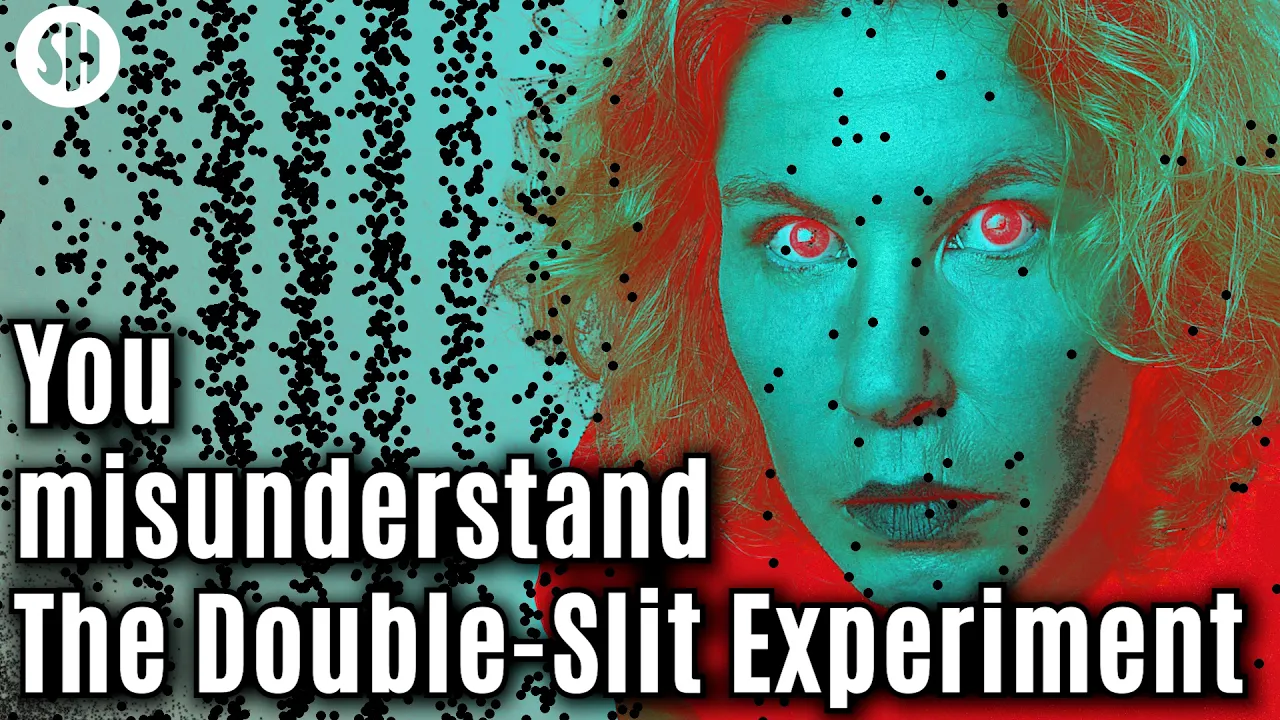
Sabine Hossenfelder
Delayed-choice double-slit measurements force physicists to choose between faster-than-light wave function collapse and superdeterminism, invalidating both textbook depictions of particle stripes and Elon Musk's video-game simulation theory.
AI-assisted summary of What everyone gets wrong about the double slit experiment — original source. Check the original for full context.
Source published:
Key ideas
- Popular science graphics showing the double slit interference pattern collapsing into two narrow stripes upon measurement are physically incorrect; observing the path produces two overlapping single-slit diffraction patterns. (0:00)
- Delayed-choice double slit experiments demonstrate that wave function updates occur faster than light across spatial distances, leaving superdeterminism as the only alternative to Einstein's 'spooky action'. (3:00)
- Transverse momentum is conserved in individual particle detections via quantum entanglement with the slit barrier itself, imparting an equal and opposite kick to the screen apparatus. (8:52)
- Critiques of Elon Musk's simulation hypothesis highlight that quantum mechanics relies on irreducible randomness rather than deterministic pseudo-random algorithms used in video game rendering engines. (6:58)
Detailed notes
## Background Published on YouTube by physicist Sabine Hossenfelder on July 20, 2026, this video tackles the widespread misconceptions surrounding physics' most famous setup: the double slit experiment. As outlined in the description, Hossenfelder breaks down standard textbook animations and popular science fallacies to clarify what quantum mathematics actually demonstrates.
## TL;DR Hossenfelder deconstructs the common myth that detecting a particle at a slit collapses the interference pattern into two classical stripes, clarifying that particles still propagate as waves to produce overlapping single-slit diffraction patterns. She explains that the genuine quantum mystery stems from delayed-choice setups, which demand either faster-than-light wave function updates or superdeterminism to account for non-local or interaction-free measurements. Along the way, she dismantles Elon Musk's simulation hypothesis claims and New Age myths about human consciousness, emphasizing that inanimate detectors trigger measurement. Finally, she shows that momentum is conserved in individual particle runs through quantum entanglement with the slit apparatus, expressing exasperation that mainstream physics neglects the true tension between instantaneous collapse and relativity.
## Atmosphere & style The presentation carries Hossenfelder’s signature sardonic, no-nonsense delivery, pairing rigorous mathematical clarity with dry humor about internet misunderstandings and armrest-biting exasperation. Watching her feels like receiving a brisk, unapologetic reality check that cuts through decades of pop-science hype and tech-celebrity hot takes. Despite her trademark grumpiness, the tone remains pedagogically clear and urgently earnest about refocusing foundational physics on its real, unresolved problems.
## Bulletin - [00:00](https://www.youtube.com/watch?v=npc6Mn2CZV8&t=0s) Popular science graphics showing the double slit interference pattern collapsing into two narrow stripes upon measurement are physically incorrect; observing the path produces two overlapping single-slit diffraction patterns. - [03:00](https://www.youtube.com/watch?v=npc6Mn2CZV8&t=180s) Delayed-choice double slit experiments demonstrate that wave function updates occur faster than light across spatial distances, leaving superdeterminism as the only alternative to Einstein's 'spooky action'. - [08:52](https://www.youtube.com/watch?v=npc6Mn2CZV8&t=532s) Transverse momentum is conserved in individual particle detections via quantum entanglement with the slit barrier itself, imparting an equal and opposite kick to the screen apparatus. - [06:58](https://www.youtube.com/watch?v=npc6Mn2CZV8&t=418s) Critiques of Elon Musk's simulation hypothesis highlight that quantum mechanics relies on irreducible randomness rather than deterministic pseudo-random algorithms used in video game rendering engines.
## Key takeaways - [00:00](https://www.youtube.com/watch?v=npc6Mn2CZV8&t=0s) The common textbook claim that unobserved particles act like waves while observed particles act like tiny billiard balls is fundamentally flawed. - [01:00](https://www.youtube.com/watch?v=npc6Mn2CZV8&t=60s) When a detector observes which slit a particle traverses, the particle continues to behave as a wave, generating a standard single-slit diffraction pattern rather than a sharp line. - [02:00](https://www.youtube.com/watch?v=npc6Mn2CZV8&t=120s) Mathematically, the double slit pattern arises from an interference cross-term; measuring which slit was traversed eliminates this cross-term, leaving the simple sum of individual diffraction probabilities. - [03:00](https://www.youtube.com/watch?v=npc6Mn2CZV8&t=180s) The genuine mystery of quantum mechanics lies in delayed-choice experiments, where path measurement decisions are made after the particle has departed the source. - [04:00](https://www.youtube.com/watch?v=npc6Mn2CZV8&t=240s) Interaction-free measurements, such as a detector remaining silent at one slit, instantaneously collapse the wave function to the opposite slit without any physical interaction. - [04:30](https://www.youtube.com/watch?v=npc6Mn2CZV8&t=270s) To avoid faster-than-light wave function collapse, physics must accept superdeterminism, implying that future measurement choices are predetermined prior to emission. - [06:58](https://www.youtube.com/watch?v=npc6Mn2CZV8&t=418s) Elon Musk's comparison of quantum measurement to video game rendering fails because the simulation hypothesis lacks a rigorous, falsifiable scientific definition. - [07:30](https://www.youtube.com/watch?v=npc6Mn2CZV8&t=450s) Video games rely on deterministic pseudo-random algorithms, whereas true quantum processes are fundamentally non-deterministic and irreducibly random. - [08:05](https://www.youtube.com/watch?v=npc6Mn2CZV8&t=485s) Measurement does not inherently confer 'positional certainty'; measuring an alternative observable like momentum yields momentum certainty while leaving position entirely indeterminate. - [08:30](https://www.youtube.com/watch?v=npc6Mn2CZV8&t=510s) Human consciousness plays no role in quantum measurement; inanimate physical detectors achieve the exact same wave function collapse. - [08:52](https://www.youtube.com/watch?v=npc6Mn2CZV8&t=532s) Individual off-center particle impacts conserve transverse momentum because the particle entangles with the slit barrier, transferring an equal and opposite momentum kick to the macroscopic apparatus. - [09:30](https://www.youtube.com/watch?v=npc6Mn2CZV8&t=570s) If slit barriers are made small enough to detect this recoil momentum, such as using individual atoms, path information is revealed and the interference pattern is destroyed. - [10:15](https://www.youtube.com/watch?v=npc6Mn2CZV8&t=615s) Mainstream physics neglects the critical foundational task of reconciling instantaneous wave function updates with the cosmic speed limit of special relativity.
## Detailed walkthrough ### [00:00](https://www.youtube.com/watch?v=npc6Mn2CZV8&t=0s) The "Two Stripes" Myth and What the Math Actually Says
The double slit experiment is widely considered the most famous experiment in physics, but it is simultaneously the most misunderstood. Sabine Hossenfelder opens by pointing out that standard textbook and popular science animations mislead people right from the start. The textbook narrative typically claims that if particles lacked quantum mechanics, they would act like tiny billiard balls and form two simple stripes on the detection screen behind the slits; but because they exhibit wave properties, they form an alternating interference pattern that builds up particle by particle. Sabine dismisses the notion that particles behaving like waves is inherently mind-boggling: particles simply spread out, pass through both slits simultaneously, and interfere with themselves.
The widespread misconception arises when popularizers explain what happens when an observer measures which slit the particle went through. Popular graphics routinely show the interference pattern collapsing into two neat, sharp stripes of particle impacts. Sabine emphasizes that this is physically false: “If you observe which slit the particle goes through, say the right one, then the particles still behave like a wave.” The particle does not turn into a little ball; it behaves as a wave passing through only one slit, producing a standard single-slit diffraction pattern (which itself is an interference phenomenon). If you monitor which slit particles traverse and pool the data, the screen shows the smooth overlap of two diffraction patterns—never two narrow stripes.
```mermaid flowchart TD accTitle: Double Slit Wave Function Math vs Misconception accDescr: Diagram contrasting how single-slit diffraction patterns combine versus unmeasured quantum interference with cross-terms.
subgraph StandardObserved ["Observed Slit (Which-Way Known)"] A["Wave through Left Slit: ψ₁"] --> C["Probability: |ψ₁|²"] B["Wave through Right Slit: ψ₂"] --> D["Probability: |ψ₂|²"] C & D --> E["Total Pattern: |ψ₁|² + |ψ₂|²<br/>(Sum of individual diffraction patterns)"] end
subgraph Unobserved ["Unobserved Slits (Superposition)"] F["Total State: ψ₁ + ψ₂"] --> G["Total Probability: |ψ₁ + ψ₂|²"] G --> H["Expanded: |ψ₁|² + |ψ₂|² + Interference Term (2 Re[ψ₁* ψ₂])"] end ```
The mathematical distinction between both slits being open versus knowing the path comes down to basic quantum mechanics: - When both slits are unmeasured, the total wave function is the linear combination of the wave functions from both slits: $\psi_{\text{total}} = \psi_1 + \psi_2$. - The probability distribution on the screen is given by the squared magnitude: $P = |\psi_1 + \psi_2|^2 = |\psi_1|^2 + |\psi_2|^2 + 2\text{Re}(\psi_1^* \psi_2)$. - The square of the sum is not equal to the sum of the squares; the extra cross-term represents quantum interference. - When you detect which slit the particle passes through, you destroy the cross-term, yielding simply the direct addition of individual single-slit diffraction patterns ($|\psi_1|^2 + |\psi_2|^2$).
---
[03:00](https://www.youtube.com/watch?v=npc6Mn2CZV8&t=180s) The Real Mystery: Delayed Choice, Spooky Action, and Superdeterminism
The true conceptual puzzle of the double slit experiment is not that particles produce single-slit patterns when observed; it is the fact that an experimenter can delay the decision to measure which slit the particle traverses until *after* the particle has already departed the source and passed the barrier. If a detector placed at one slit (for instance, the right slit) is turned on mid-flight, the system must account for that measurement before hitting the screen.
If the particle was sent with both paths open and no initial measurement, its state was described by a wave function traversing both slits. Turning on the detector forces an instantaneous update across spatial separation. The wave function must abruptly collapse from being in both slits to being strictly in either the left slit or the right slit. This update occurs faster than light: measuring or detecting at one slit instantaneously alters the physical state associated with the other slit.
Crucially, this collapse happens even when the detector does *not* click. If the right-slit detector remains silent, the experimenter immediately deduces the particle took the left slit. Sabine underscores the paradoxical nature of this interaction-free measurement: “If it doesn't go into the detector, you know it must have gone through the other slit. But if the particle went through the other slit, you never interacted with it.” To evade this faster-than-light update (Einstein's "spooky action at a distance"), the only alternative within standard spacetime is superdeterminism—the idea that the particle already "knew" whether the detector would be turned on before the experimenter consciously decided to switch it on. Sabine summarizes the dilemma: “You either have to accept a faster than light update of the wave function, the spooky action, or you have to accept that the future is fully determined already.”
---
[05:28](https://www.youtube.com/watch?v=npc6Mn2CZV8&t=328s) Mid-Roll Interlude: The Armrest and the FlexiSpot Chair
Sabine steps away from the physics to address a running gag among her viewers: people frequently mock her for biting into her armrest whenever someone misrepresents quantum mechanics on the internet. She introduces the sponsor, FlexiSpot, and showcases their C7 Max ergonomic office chair.
She notes its practical advantages, particularly during heat waves where you do not stick to the fabric, and highlights that every component is fully adjustable: the armrests, the headrest, the seatback, and the overall height. She mentions that on her previous chair, she had to sit on an extra pillow constantly because the factory cushion was so thin it felt like sitting directly on steel. The standout feature for her is the integrated footrest, adding wryly that the only negative consequence is that her children now demand one for themselves. The chair includes a five-year warranty and a 30-day return policy.
---
[06:58](https://www.youtube.com/watch?v=npc6Mn2CZV8&t=418s) Debunking Elon Musk’s Simulation Take and Consciousness Myths
Returning to physics, Sabine reiterates the real lesson: the mystery is not that particles possess wave-like nature, but that delayed-choice measurements require either superdeterminism or faster-than-light wave function updates. She uses this framework to critique a public statement made by Elon Musk, who claimed that the double slit experiment provides evidence for the simulation hypothesis because objects render with definite properties only when observed, analogous to video game optimization.
Sabine deconstructs Musk's claim across three distinct points: 1. **Meaninglessness of the Simulation Hypothesis:** Sabine notes that nobody can rigorously define what the universe being a computer simulation actually means, making it unfalsifiable. She remarks: “It's not even wrong, as Pauli said so aptly.” 2. **Pseudo-randomness vs. Quantum Randomness:** In practical game engines, random number generators are deterministic algorithms designed to look unpredictable (pseudo-random). Quantum processes are fundamentally, irreducibly random. If particles were computed via pseudo-random video game code, quantum mechanics could be simulated deterministically, overturning the standard interpretation: “If it were the case that particles in a double-slit experiment were indeed generated like in video games, that is, following a deterministic algorithm, then you'd be able to predict individual measurement outcomes.” 3. **Measurement and Definite Properties:** Musk claimed measuring an object gives it "positional certainty." Sabine points out that certainty is entirely contingent on the observable measured: measuring momentum yields momentum certainty while leaving position completely indeterminate.
Furthermore, Sabine dismantles the persistent New Age myth that quantum measurement requires human consciousness. Conscious observation is entirely unnecessary; an inanimate physical detection apparatus interacting with the particle provides the exact same measurement result.
---
[08:52](https://www.youtube.com/watch?v=npc6Mn2CZV8&t=532s) Momentum Conservation and Why Sabine Is Grumpy
Sabine addresses a final subtle puzzle that confuses even professional physicists: momentum conservation in single particle runs. If an incoming particle travels perpendicular to the barrier, its initial transverse momentum is zero. Yet, after clearing the slits, it deflects at an angle to land on an off-center region of the interference pattern. While the average momentum over thousands of runs sums to zero, it appears on the surface that individual particle impacts violate conservation of momentum.
Sabine explains that momentum is strictly conserved in every single run because the particle becomes quantum-mechanically entangled with the slit apparatus itself. When a particle receives a transverse momentum kick toward one side of the screen, the double slit screen itself receives an equal and opposite momentum kick: - The kick imparted to the barrier is unmeasurable in practice solely because macroscopic slits are trillions of times more massive than an elementary particle. - If the slits are engineered to be tiny enough that their recoil momentum can be tracked—such as using individual atoms as slits, as demonstrated in recent experiments—that measurement entangles path information and destroys the interference pattern.
She concludes with why she remains permanently exasperated with the field: the endless cycle of pop-science nonsense and pseudo-philosophical confusion obscures the real foundational challenges. Physicists are not actively resolving the true mathematical problem: reconciling instantaneous wave function updates with Einstein's cosmic speed limit ($c$). Sabine considers this the single most pressing research problem capable of revitalizing the foundations of physics, yet it remains largely neglected by mainstream researchers.
## Notable quotes > [03:00](https://www.youtube.com/watch?v=npc6Mn2CZV8&t=180s) You either have to accept a faster than light update of the wave function, the spooky action, or you have to accept that the future is fully determined already. — Sabine Hossenfelder
> [00:00](https://www.youtube.com/watch?v=npc6Mn2CZV8&t=0s) If you observe which slit the particle goes through, say the right one, then the particles still behave like a wave. — Sabine Hossenfelder
> [06:58](https://www.youtube.com/watch?v=npc6Mn2CZV8&t=418s) If it were the case that particles in a double-slit experiment were indeed generated like in video games, that is, following a deterministic algorithm, then you'd be able to predict individual measurement outcomes. — Sabine Hossenfelder
## Mentioned Sabine Hossenfelder, FlexiSpot, C7 Max, Albert Einstein, Elon Musk, Wolfgang Pauli
## Video description Upgrade your setup with up to 50% Off during FlexiSpot's Mega Summer Sale! Enter my exclusive code 'C750' and save an extra $50 on the C7 Max chair! Shop through FlexiSpot C7 famliy!:https://go.flexispot.com/4qISRf -us https://go.flexispot.com/UTG9Xz -ca
In today's video I talk about some commonly misunderstood points in the double slit experiment.
👕T-shirts, mugs, posters and more: ➜ https://sabines-store.dashery.com/ 💌 Support me on Donorbox ➜ https://donorbox.org/swtg 👉 Transcript with links to references on Patreon ➜ https://www.patreon.com/Sabine 📝 Transcripts and written news on Substack ➜ https://sciencewtg.substack.com/ 📩 Free weekly science newsletter ➜ https://sabinehossenfelder.com/newsletter/ 👂 Audio only podcast ➜ https://open.spotify.com/show/0MkNfXlKnMPEUMEeKQYmYC 🔗 Join this channel to get access to perks ➜ https://www.youtube.com/channel/UC1yNl2E66ZzKApQdRuTQ4tw/join 📚 Buy my book ➜ https://amzn.to/3HSAWJW
#physics
[Source](https://www.youtube.com/watch?v=npc6Mn2CZV8)