Ocean Heat Lag Skews Climate Reports as Land Warms Faster Than Sea
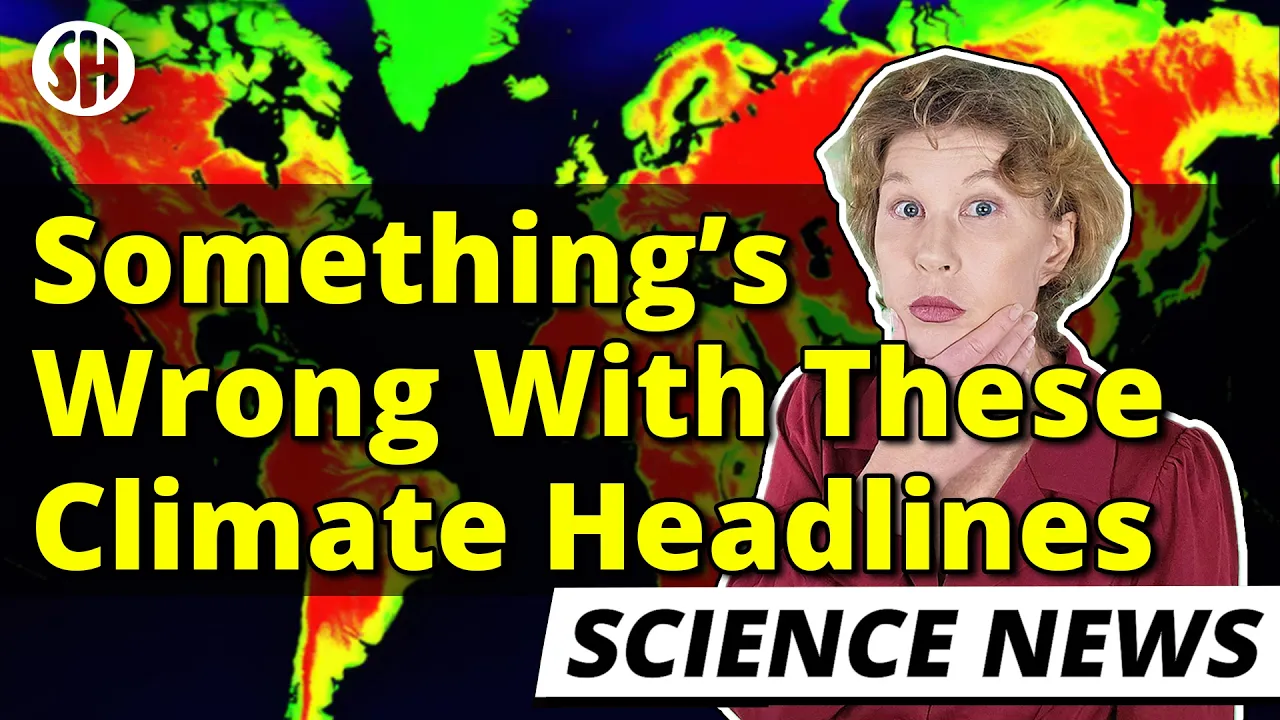
Sabine Hossenfelder
Media claims that every nation is warming faster than the rest of the world stem from statistical confusion and the physical reality that land naturally heats faster than the oceans covering 70% of the planet.
AI-assisted summary of Everywhere Is Warming Faster Than the Rest of the World — original source. Check the original for full context.
Source published:
Key ideas
- Frequent news reports claim individual countries and regions—such as Europe, Canada, Israel, and the South Pole—are warming faster than the rest of the world, creating the mathematical illusion that everywhere is simultaneously warming faster than everywhere else. (0:00)
- The apparent paradox arises partly from semantic slippage: media outlets consistently use the superlative phrase "faster than the rest of the world" as a colloquial synonym for the statistical metric "faster than the global average." (1:48)
- The primary physical mechanism is that oceans cover roughly 70% of Earth's surface and warm significantly slower than land, keeping the global average baseline low enough that virtually all major continental landmasses exceed it. (4:10)
- Among continental land regions, the South Pole ranks as the fastest-warming area overall, while Europe is currently the fastest-warming populated continent. (5:30)
Detailed notes
## Background Published by physicist Sabine Hossenfelder on YouTube on July 31, 2026, this video investigates an apparent paradox across media reporting: why virtually every nation and region claims to be warming faster than everywhere else. The video description addresses how real scientific studies spawn seemingly contradictory, alarmist headlines and highlights a sponsored conservation effort with Planet Wild.
## TL;DR News reports worldwide regularly declare that regions from Europe and Canada to China and the South Pole are warming faster than the rest of the planet, creating an apparent mathematical impossibility. Sabine Hossenfelder demonstrates that this confusion stems from two distinct factors: a semantic slip where journalists write 'faster than the rest' instead of 'above average,' and basic planetary physics. Because approximately 70% of Earth is ocean water—which circulates heat downward and warms far more slowly than dry ground—the global average baseline is heavily weighted downward, meaning nearly every continental landmass naturally warms faster than the planet as a whole.
## Atmosphere & style The presentation is punchy, dryly witty, and intellectually refreshing, dismantling sensationalist journalism with cool, rational clarity. Sabine uses satirical asides—such as joking about a Walmart car park warming faster than the universe—to keep viewers engaged while peeling back layers of statistical confusion. The viewing experience feels like having an astute, no-nonsense scientist demystify confusing news items, turning an alarming scientific contradiction into an intuitive, common-sense lesson in planetary thermodynamics.
## Bulletin - [00:00](https://www.youtube.com/watch?v=j9cDpdTlQrc&t=0s) Frequent news reports claim individual countries and regions—such as Europe, Canada, Israel, and the South Pole—are warming faster than the rest of the world, creating the mathematical illusion that everywhere is simultaneously warming faster than everywhere else. - [01:48](https://www.youtube.com/watch?v=j9cDpdTlQrc&t=108s) The apparent paradox arises partly from semantic slippage: media outlets consistently use the superlative phrase "faster than the rest of the world" as a colloquial synonym for the statistical metric "faster than the global average." - [04:10](https://www.youtube.com/watch?v=j9cDpdTlQrc&t=250s) The primary physical mechanism is that oceans cover roughly 70% of Earth's surface and warm significantly slower than land, keeping the global average baseline low enough that virtually all major continental landmasses exceed it. - [05:30](https://www.youtube.com/watch?v=j9cDpdTlQrc&t=330s) Among continental land regions, the South Pole ranks as the fastest-warming area overall, while Europe is currently the fastest-warming populated continent.
## Key takeaways - [00:00](https://www.youtube.com/watch?v=j9cDpdTlQrc&t=0s) Global news media repeatedly publish claims that specific regions—including Europe, Canada, Israel, Africa, and China—are warming faster than the rest of the planet. - [01:00](https://www.youtube.com/watch?v=j9cDpdTlQrc&t=60s) These headlines originate from real peer-reviewed papers and government reports rather than journalistic invention, creating perceived contradictions across the scientific literature. - [00:30](https://www.youtube.com/watch?v=j9cDpdTlQrc&t=30s) Reported rates include Europe and Canada warming twice as fast as the rest of the planet, and the South Pole warming three times faster. - [01:48](https://www.youtube.com/watch?v=j9cDpdTlQrc&t=108s) Journalists frequently conflate 'faster than the rest' with 'faster than average,' misleading readers into assuming an area is the single fastest-warming place overall. - [02:05](https://www.youtube.com/watch?v=j9cDpdTlQrc&t=125s) In a standard normal distribution, having roughly half of all observations perform above the numerical average is an expected statistical property, not an anomaly. - [04:10](https://www.youtube.com/watch?v=j9cDpdTlQrc&t=250s) New Zealand is a notable populated exception lacking outsized warming headlines, largely because its regional climate is dominated by surrounding ocean waters. - [04:30](https://www.youtube.com/watch?v=j9cDpdTlQrc&t=270s) Calculating global average surface temperature incorporates the oceans, which constitute approximately 70% of Earth's total surface area. - [04:40](https://www.youtube.com/watch?v=j9cDpdTlQrc&t=280s) Because water circulates heat deep into the water column, oceans warm much more slowly than land, pulling the global average rate downward. - [05:10](https://www.youtube.com/watch?v=j9cDpdTlQrc&t=310s) Because the 'rest of the world' is predominantly ocean water, nearly all continental landmasses naturally warm faster than the global mean surface baseline. - [05:15](https://www.youtube.com/watch?v=j9cDpdTlQrc&t=315s) Headlines comparing land temperatures to the global baseline are numerically accurate but communicatively deceptive, as the public expects comparisons against other land areas. - [05:30](https://www.youtube.com/watch?v=j9cDpdTlQrc&t=330s) When comparing landmasses to one another, the South Pole is the fastest-warming territory globally, and Europe is the fastest-warming populated continent.
## Detailed walkthrough ### [00:00](https://www.youtube.com/watch?v=j9cDpdTlQrc&t=0s) The Paradox of Universal "Faster Than Average" Warming
A survey of news headlines over recent years presents an apparent mathematical impossibility: almost every single place on Earth claims to be warming faster than everywhere else. As Sabine Hossenfelder observes, this creates an obvious paradox: "This can't possibly be, can it? Unless the rest of the world has left and I mean who knows have you checked on Uzbekistan lately?" A review of media coverage shows that these headlines are genuinely everywhere: reports announce that New England is warming faster than the rest of the world, Europe is warming twice as fast as the rest of the planet, Canada is warming twice as fast, Israel is warming almost twice as fast, and Australia is heating faster than the rest of the world. After slipping in a satirical headline—claiming the car park behind Walmart is warming faster than the rest of the known universe just to see if viewers are paying attention—she lists further examples: China is warming faster than the global average, Africa is warming more and faster than the rest of the world, the Middle East is heating nearly twice as fast as the global average, the South Pole is warming three times faster, and Finland is warming faster than the rest of the world.
These headlines are not journalistic fabrications; every single one traces back to a peer-reviewed scientific paper or a report issued by a government institution. While the academic journals vary in prestige, the proliferation of such claims creates the impression that science is generating contradictory, alarmist conclusions. As Sabine Hossenfelder summarizes: “The journals are of rather mixed quality, but either way, it seems like contradictory studies are being published in the scientific literature, leading to unnecessarily alarming headlines which claim every part of the world warms faster than the other.” However, the apparent contradiction stems from a two-step misunderstanding involving both linguistic framing and planetary physics.
- Documented headline claims include: - Europe: warming twice as fast as the rest of the planet. - Canada: warming twice as fast as the rest of the world. - Israel: warming nearly twice as fast as the rest of the world. - Middle East: heating nearly twice as fast as the global average. - South Pole: warming three times faster than the rest of Earth. - China, Africa, Finland, and New England: all reported as warming faster than the global baseline.
---
[01:48](https://www.youtube.com/watch?v=j9cDpdTlQrc&t=108s) The Semantic Confusion: "Faster Than the Rest" vs. "Above Average"
The first component of the explanation is purely semantic. Media coverage routinely treats the phrases "warming faster than the rest of the planet" and "warming faster than the global average" as interchangeable synonyms, even though colloquial speech interprets them very differently. To illustrate the flaw, consider a forest where trees grow at varying rates according to a normal distribution. Statistically, roughly half of the trees will grow faster than the average growth rate. If someone singles out one tree and states that it grows "faster than average," that is ordinary statistics; if they say it grows "faster than the rest of the trees," everyday language interprets that to mean it is the single fastest-growing tree in the entire forest.
Because journalism persistently substitutes the superlative-sounding phrasing for a simple statistical midpoint, readers are led to believe that every territory is simultaneously setting the absolute record. As Sabine Hossenfelder points out: “They write 'faster than the rest' and mean 'faster than average.'” Once the headline is translated back into statistical reality, the fact that dozens of countries warm faster than average ceases to be contradictory. It is simply an expression of basic distribution, comparable to noting that half of the population has an above-average IQ.
---
[02:53](https://www.youtube.com/watch?v=j9cDpdTlQrc&t=173s) Ecosystem Restoration with Planet Wild
Addressing environmental challenges requires practical intervention alongside scientific understanding, which Sabine highlights through her ongoing partnership with Planet Wild. Planet Wild is a community-driven environmental protection organization that funds boots-on-the-ground ecosystem restoration by collaborating with different grassroots conservation initiatives each month. A core strength of the organization is radical transparency: every mission is thoroughly documented through video reports released on YouTube, allowing members to witness the direct, tangible results of their financial support without wondering how their money was allocated.
One notable project involved purchasing an abandoned fish farm in Poland and converting the degraded land into a thriving beaver sanctuary designed to re-establish indigenous biodiversity. Characterizing the effort, Sabine Hossenfelder remarks: “This is a lovely example of the low-cost, high-impact work that Planet Wild is doing.” To support the effort, she offers to personally pay for the first month's subscription for the first 100 viewers who register using her designated code.
---
[04:10](https://www.youtube.com/watch?v=j9cDpdTlQrc&t=250s) The Physical Reality: The Rest of the World Is Water
Even if "faster than the rest" merely means "above average," an obvious question remains: which regions make up the other half of the planet that must be warming *slower* than average? Across global media coverage, virtually the only populated region lacking headlines about outsized warming is New Zealand. This anomaly provides the crucial physical explanation: New Zealand is isolated in the middle of vast oceans, and ocean water exerts primary control over its regional climate.
When climate scientists compute the "global average temperature," their calculations encompass the entire surface of the Earth. Approximately 70% of Earth's surface is covered by oceans, and water warms far more slowly than dry land because fluids circulate heat into deeper layers rather than concentrating thermal energy at the surface. Consequently, the global average is overwhelmingly weighted downward by ocean temperatures. NASA temperature visualizations clearly illustrate this effect, showing intense warming hotspots clustered heavily over continental landmasses while ocean temperatures rise far more moderately.
```mermaid flowchart TD accTitle: Land Warming vs Global Average Mechanism accDescr: Flowchart showing how ocean surface area depresses the global average warming rate, causing nearly all landmasses to warm faster than average. subgraph Earth["Earth's Surface Area"] Oceans["Oceans (~70% of Earth)<br/>Circulate heat deep downward<br/>Warm at a slower rate"] Land["Continental Land (~30% of Earth)<br/>Heat remains near surface<br/>Warms at a faster rate"] end Oceans --> Baseline["Global Average Baseline<br/>Heavily depressed by ocean heat capacity"] Land --> Comp{"Comparative Metric"} Baseline --> Comp Comp --> Outcome["Nearly all landmasses exceed the global average,<br/>spawning misleading 'faster than the rest' headlines"] ```
The fundamental driver behind the headlines is straightforward: the "rest of the world" is mostly ocean, and land warms faster than ocean water. As Sabine Hossenfelder explains: “So the basic reason that every country seems to be warming faster than the rest of the world is that the rest of the world is water and land is warming faster than the water.” While the headlines are technically defensible from a purely numerical standpoint, they remain profoundly deceptive because readers intuitively interpret "faster than the rest of the world" to mean faster than other landmasses, rather than faster than seawater. When evaluating land alone, the single fastest-warming region on the planet is the South Pole, while Europe ranks as the fastest-warming populated continent—giving Europe, as she wryly notes, at least one competition it is still winning.
## Notable quotes > [04:10](https://www.youtube.com/watch?v=j9cDpdTlQrc&t=250s) So the basic reason that every country seems to be warming faster than the rest of the world is that the rest of the world is water and land is warming faster than the water. — Sabine Hossenfelder
> [00:00](https://www.youtube.com/watch?v=j9cDpdTlQrc&t=0s) The journals are of rather mixed quality, but either way, it seems like contradictory studies are being published in the scientific literature, leading to unnecessarily alarming headlines which claim every part of the world warms faster than the other. — Sabine Hossenfelder
## Mentioned Sabine Hossenfelder, Planet Wild, NASA, Walmart, New England, Europe, Canada, Israel, Australia, China, Africa, Middle East, South Pole, Finland, Uzbekistan, Poland, New Zealand
## Video description Want to restore the planet’s ecosystems and see your impact in monthly videos? The first 100 people to join Planet Wild with my code SABINE47 will get the first month paid for by me: https://planetwild.com/r/sabinehossenfelder/join/47 If you want to get to know them better first, check out their mission turning a fish farm into a beaver paradise: https://planetwild.com/r/sabinehossenfelder/m41/47
Everywhere, it turns out, is warming faster than the rest of the world. Every region, every country, all of them, faster than the rest. You may sense a slight problem with this. The headlines are real, the papers are real, and yet something doesn't add up. Let's take a look.
#science #sciencenews #climatechange #globalwarming #physics
👕T-shirts, mugs, posters and more: ➜ https://sabines-store.dashery.com/ 💌 Support me on Donorbox ➜ https://donorbox.org/swtg 👉 Transcript with links to references on Patreon ➜ https://www.patreon.com/Sabine 📝 Transcripts and written news on Substack ➜ https://sciencewtg.substack.com/ 📩 Free weekly science newsletter ➜ https://sabinehossenfelder.com/newsletter/ 👂 Audio only podcast ➜ https://open.spotify.com/show/0MkNfXlKnMPEUMEeKQYmYC 🔗 Join this channel to get access to perks ➜ https://www.youtube.com/channel/UC1yNl2E66ZzKApQdRuTQ4tw/join 📚 Buy my book ➜ https://amzn.to/3HSAWJW
[Source](https://www.youtube.com/watch?v=j9cDpdTlQrc)