Physicists challenge quantum consensus with emergent causality model
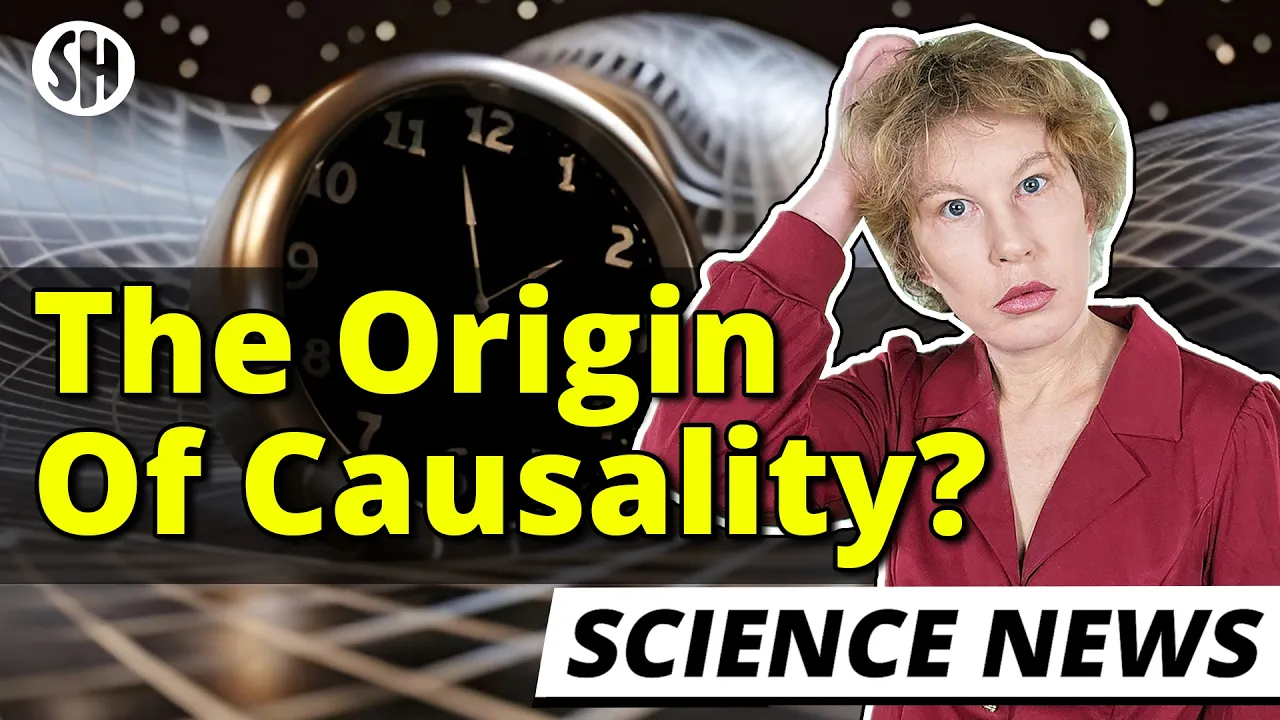
Sabine Hossenfelder
Physicists propose that causality is not a fundamental property of reality but an emergent phenomenon arising from indefinite causal structures.
AI-assisted summary of Physicists Say They’ve Found The Origin Of Causality — original source. Check the original for full context.
Source published:
Key ideas
- A new research paper challenges foundational quantum mechanics by proposing that causal order is not fundamental, but rather an emergent property analogous to fluidity. (0:00)
- Unifying quantum mechanics with general relativity implies placing spacetime geometries in superposition, leading to an indefinite causal structure where cause and effect cannot be strictly ordered. (1:41)
- The researchers introduce 'Quantum Boxes' and a mathematical process called 'hyperdecoherence' to derive a distinct arrow of time by averaging inputs. (2:55)
- Sabine Hossenfelder rates the paper a 5 out of 10 on the 'bullshit meter', arguing that declaring past and future via hyperdecoherence amounts to assuming what the authors sought to prove. (2:55)
Detailed notes
## Background Published on YouTube by Sabine Hossenfelder on August 4, 2026, this video examines a research paper investigating the origin of causal order. According to the page description, the episode explores how researchers are attempting to cut through persistent "quantum weirdness" to build a deeper theoretical framework that unites quantum mechanics with gravity.
## TL;DR Sabine Hossenfelder examines a proposal suggesting that causality is not a fundamental property of nature, but an emergent phenomenon analogous to fluid liquidity. Because quantum gravity requires spacetime superpositions that erase fixed causal relationships, the paper models reality as a network of "Quantum Boxes" with indefinite causal structure. The researchers introduce "hyperdecoherence"—averaging over input states—to derive standard quantum mechanics and a defined arrow of time. While assigning the paper a 5 out of 10 on her "bullshit meter" for circularly assuming the past to explain it, Sabine commends the authors for pursuing rigorous mathematical foundations over mystified "quantum woo."
## Atmosphere & style The video carries Sabine's trademark deadpan skepticism, blending sharp conceptual critique with wry humor and unvarnished reality checks. Her presentation cuts through academic pretension and sensationalized science reporting, using grounded analogies to expose circular reasoning in cutting-edge physics. Watching it feels like a brisk, intellectually candid debrief that refuses to be dazzled by theoretical complexity for its own sake.
## Bulletin - [00:00](https://www.youtube.com/watch?v=SMXq68UeeXU&t=0s) A new research paper challenges foundational quantum mechanics by proposing that causal order is not fundamental, but rather an emergent property analogous to fluidity. - [01:41](https://www.youtube.com/watch?v=SMXq68UeeXU&t=101s) Unifying quantum mechanics with general relativity implies placing spacetime geometries in superposition, leading to an indefinite causal structure where cause and effect cannot be strictly ordered. - [02:55](https://www.youtube.com/watch?v=SMXq68UeeXU&t=175s) The researchers introduce 'Quantum Boxes' and a mathematical process called 'hyperdecoherence' to derive a distinct arrow of time by averaging inputs. - [02:55](https://www.youtube.com/watch?v=SMXq68UeeXU&t=175s) Sabine Hossenfelder rates the paper a 5 out of 10 on the 'bullshit meter', arguing that declaring past and future via hyperdecoherence amounts to assuming what the authors sought to prove.
## Key takeaways - [00:00](https://www.youtube.com/watch?v=SMXq68UeeXU&t=0s) Modern physics has grown complacent by romanticizing 'quantum weirdness' rather than addressing the foundational shortcomings of quantum mechanics. - [00:00](https://www.youtube.com/watch?v=SMXq68UeeXU&t=0s) In macroscopic physics, causality is taken for granted, but the paper argues that fundamental reality lacks any intrinsic causal order. - [00:00](https://www.youtube.com/watch?v=SMXq68UeeXU&t=0s) Causality is framed as an emergent property: just as a single particle is not liquid, individual quantum components do not possess causality until aggregated. - [01:41](https://www.youtube.com/watch?v=SMXq68UeeXU&t=101s) Formulating a quantum theory of gravity requires treating spacetime quantum-mechanically, which destroys predetermined causal structures. - [01:41](https://www.youtube.com/watch?v=SMXq68UeeXU&t=101s) Superpositions of spacetime geometries result in indefinite causal structure, making it impossible to determine which event preceded or caused another. - [01:41](https://www.youtube.com/watch?v=SMXq68UeeXU&t=101s) Instead of forcing gravity and quantum mechanics to combine directly, both may emerge as low-energy approximations from a deeper underlying framework lacking causal order. - [02:55](https://www.youtube.com/watch?v=SMXq68UeeXU&t=175s) The authors model interactions using 'Quantum Boxes' (Q-Boxes) arranged in networks without pre-assigned temporal directions. - [02:55](https://www.youtube.com/watch?v=SMXq68UeeXU&t=175s) The mechanism of 'hyperdecoherence' averages over one side of the input boxes to mathematically establish a designated past and future. - [02:55](https://www.youtube.com/watch?v=SMXq68UeeXU&t=175s) The derivation suffers from circularity by explicitly defining past and future rather than letting a consistent temporal order emerge organically. - [02:55](https://www.youtube.com/watch?v=SMXq68UeeXU&t=175s) Despite mathematical limitations, attempts to replace quantum mechanics with deeper theories provide a welcome alternative to sensationalized 'quantum woo'.
## Detailed walkthrough ### [00:00](https://www.youtube.com/watch?v=SMXq68UeeXU&t=0s) Complacency in Quantum Mechanics and the Nature of Causality
Sabine opens with a critique of the modern physics community, arguing that for the past decade, researchers have grown far too comfortable with quantum mechanics as it currently stands. Instead of addressing foundational shortcomings or trying to fix its problems, physicists have spent years glorifying “quantum weirdness” to the point where moving past it seems almost unthinkable. As Sabine dryly observes about the profession’s coping mechanisms: “If something makes no sense, don't fix it. Give it a mysterious name and start a podcast.” Yet, a new paper challenges this consensus by daring to search for an origin of quantum physics—an effort many physicists previously declared mathematically or conceptually impossible.
The core subject of this investigation is causality, a concept so ingrained in human everyday life that it usually escapes scrutiny. In the macroscopic world, cause clearly precedes effect: flipping a light switch turns on the light. Sabine jokes that this straightforward logic only breaks down if you have children, where an effect abruptly occurs and the responsible party denies having anything to do with the cause. The researchers behind the new paper propose that causal order does not exist at a fundamental level. Rather, they argue causality is an emergent phenomenon, directly analogous to fluidity: a single molecule or subatomic particle is not wet or liquid on its own, but liquidity naturally emerges when a massive collection of particles aggregates and interacts.
- Causality is typically taken for granted in classical macroscopic physics as a rigid sequence of causes leading to effects. - The authors argue that fundamental reality lacks causal structure; causality only emerges when observing large ensembles of quantum particles.
[01:41](https://www.youtube.com/watch?v=SMXq68UeeXU&t=101s) Quantum Gravity and Indefinite Causal Structure
Connecting quantum mechanics with general relativity has stalled for nearly a century because any viable quantum theory of gravity must inherently be a quantum theory of space and time. In standard physics, the structure of spacetime is precisely what establishes which events can causally influence others. However, treating spacetime quantum-mechanically requires placing different spacetime geometries into quantum superpositions. As Sabine points out: “This means that a theory of quantum gravity no longer has causality.”
Under such conditions, reality enters a regime known as indefinite causal structure. In this framework, the temporal relationship between events dissolves; you can no longer determine whether flipping a switch turned on a light, or whether the light turning on triggered the switch. While this sounds absurd and introduces severe mathematical complexities, the new paper approaches the problem from a different angle. Instead of forcing quantum physics and gravity to mesh together directly, both may emerge as lower-energy approximations from a deeper, underlying framework that contains no predefined causal order whatsoever.
```mermaid flowchart TD accTitle: Emergent Causality from Indefinite Causal Order accDescr: Flowchart illustrating how fundamental quantum boxes without causal order yield emergent causality through hyperdecoherence.
subgraph Fundamental["Fundamental Level: Indefinite Causal Order"] QBox1["Quantum Box A\n(Particle Interaction)"] QBox2["Quantum Box B\n(Particle Interaction)"] QBox1 <-->|"No Fixed Order\n(Indefinite Causality)"| QBox2 end
subgraph Emergence["Consistency Mechanism"] HD["Hyperdecoherence\n(Averaging over one side of inputs)"] end
subgraph Macroscopic["Emergent Macro Physics"] Past["Past (Averaged Input)"] --> Future["Future (Output)"] CQM["Standard Quantum Mechanics\n& Classical Spacetime"] end
Fundamental --> HD HD --> Emergence Emergence --> Past Past --> CQM ```
[02:55](https://www.youtube.com/watch?v=SMXq68UeeXU&t=175s) Quantum Boxes, Hyperdecoherence, and the Critique of Quantum Woo
To construct this framework, the authors introduce a mathematical tool called a “Quantum Box” (or Q-Box), which represents any generalized quantum event, such as an interaction between elementary particles. In the paper's model, networks of these Q-Boxes connect to one another without any assigned temporal or causal direction, leaving it indeterminate which event triggered another. To recover standard, consistent physics from this chaotic network, the authors introduce an operation they call "hyperdecoherence," which involves averaging over one side of the input boxes. That averaged input side is designated as the past, thereby creating a distinct direction of time.
Sabine expresses reservations about this step, offering both praise and sharp criticism: “I give this paper a 5 out of 10 on the bullshit meter.” While the paper succeeds in mathematically reproducing familiar quantum mechanics, Sabine argues that the authors assume what they set out to explain by essentially declaring the existence of past and future through hyperdecoherence. Sabine likens this circular logic to “baking bread and saying you've discovered flour.” Sabine believes that explicitly declaring a past and future is unnecessary and that a consistent time order should suffice. Nevertheless, Sabine views the effort as a commendable step away from mystical interpretations—what she terms “quantum woo”—such as claims that quantum mechanics allows researchers to erase the past, that particles can be separated from their own spin, or that particles experience negative time. According to Sabine, these claims dissolve when examining the actual mathematics, serving primarily as fanciful stories told to baffle journalists.
- A Quantum Box (Q-Box) models any fundamental quantum interaction without an intrinsic temporal sequence. - Hyperdecoherence is the process of averaging over inputs on one side of connected Q-Boxes, which mathematically generates a distinction between past and future. - Sabine welcomes foundational attempts to replace quantum mechanics with deeper theories that resolve conceptual paradoxes instead of mythologizing them.
[04:57](https://www.youtube.com/watch?v=SMXq68UeeXU&t=297s) Sponsoring Privacy: Automating Data Removal with Incogni
In the closing segment, Sabine transitions to discussing personal data privacy, sharing an experience with receiving relentless spam calls after her mobile phone number leaked through online storefronts. Websites routinely gather personal details, user locations, and browsing habits, which are subsequently aggregated and monetized by commercial data brokers. While legal frameworks exist in many jurisdictions granting individuals the right to demand that companies delete their private records, handling each opt-out request manually is exhausting and time-consuming.
Sabine highlights the video's sponsor, Incogni, an automated service designed to eliminate these personal profiles from data broker databases. Users authorize Incogni to issue formal deletion requests to brokers on their behalf, a process the platform repeats continually while delivering status updates to the subscriber. Sabine notes her personal use of their custom removal feature, which allows users to submit specific offending websites directly. Viewers are offered a 60% discount on annual subscriptions by applying the promotional code `SABINE` or using the link in the video description, with the discount targeted at the first 100 individuals who sign up.
## Mentioned Sabine Hossenfelder, Incogni, Physical Review A, Quantum Box (Q-Box)
## Video description Take back your personal data with Incogni! Use code Sabine at the link below and get 60% off annual plans: https://incogni.com/sabine
Over the years, physicists have become increasingly enamored with “quantum weirdness,” the many strange features of quantum mechanics that are extremely hard to explain. In a new paper, a group of researchers have tried to cut through the weirdness by analyzing how causal order really works. By doing so, they hope to set up a deeper framework that can combine quantum mechanics with gravity. Let’s take a look.
#physics #science #quantum #sciencenews
Paper: https://journals.aps.org/pra/abstract/10.1103/kmmy-3dy3
👕T-shirts, mugs, posters and more: ➜ https://sabines-store.dashery.com/ 💌 Support me on Donorbox ➜ https://donorbox.org/swtg 👉 Transcript with links to references on Patreon ➜ https://www.patreon.com/Sabine 📝 Transcripts and written news on Substack ➜ https://sciencewtg.substack.com/ 📩 Free weekly science newsletter ➜ https://sabinehossenfelder.com/newsletter/ 👂 Audio only podcast ➜ https://open.spotify.com/show/0MkNfXlKnMPEUMEeKQYmYC 🔗 Join this channel to get access to perks ➜ https://www.youtube.com/channel/UC1yNl2E66ZzKApQdRuTQ4tw/join 📚 Buy my book ➜ https://amzn.to/3HSAWJW
[Source](https://www.youtube.com/watch?v=SMXq68UeeXU)