Psychologists Dispute Dunning-Kruger Rule as Raw Data Shows Pure Noise
Sabine Hossenfelder
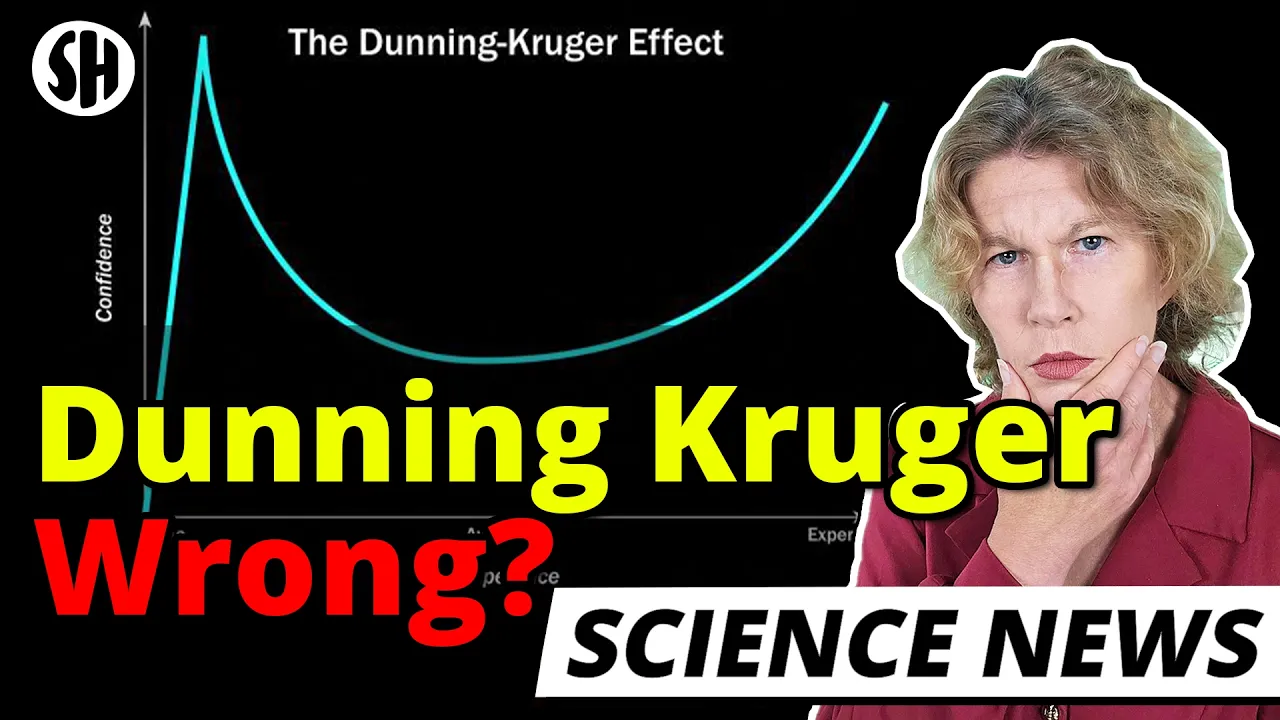
Both the classic Dunning-Kruger effect and its latest rebuttal fail because researchers fit arbitrary linear regressions to uncorrelated statistical noise from tests that measure learned knowledge rather than innate intelligence.
AI-assisted summary of Dunning Kruger Effect Wrong, Scientists Claim — original source. Check the original for full context.
Source published:
Key ideas
- A new reanalysis of the largest available Dunning-Kruger dataset challenges the classic finding by flipping the regression axis, concluding that higher confidence reliably correlates with higher actual performance. (2:00)
- The original 1999 study by Kruger and Dunning found that bottom-quartile performers ranked around the 12th percentile but estimated their performance at the 62nd percentile. (0:00)
- Sabine Hossenfelder criticizes both the original research and recent rebuttals, rating them a '10 out of 10 on the bullshit meter' for imposing arbitrary linear fits onto fundamentally uncorrelated scatter plots. (4:39)
- Training low performers in logic and reasoning improved both their actual scores and error recognition, indicating the underlying tests evaluate acquired knowledge rather than innate intelligence. (4:39)
Detailed notes
## Background This video was published on YouTube by Sabine Hossenfelder on August 11, 2026. The description notes that while the Dunning-Kruger effect has long been used to explain incompetent politicians and social media behavior, a reanalysis of the largest available dataset reached the opposite conclusion, prompting an examination into how both sides can view the same data and see conflicting results.
## TL;DR Sabine examines the foundational 1999 Kruger and Dunning study, which suggested that low performers severely overestimate their competence because they lack the metacognitive skills to evaluate their own abilities. She contrasts this traditional view with a recent paper that flips the regression analysis on a large 2021 dataset, demonstrating that confidence actually correlates positively with real performance. Ultimately, Sabine dismisses both interpretations as poor data analysis, arguing that researchers are merely fitting arbitrary lines through an uncorrelated cloud of noise. She concludes that these tests measure acquired knowledge rather than innate intelligence, remaining culturally popular primarily because people love using the effect as an insult against others.
## Atmosphere & style The presentation is sharp, wry, and punchy, driven by Sabine's signature brand of blunt scientific skepticism. The mood shifts from an entertaining recap of pop-psychology lore—complete with lemon juice bank robbers and John Cleese quips—into a rigorous, no-nonsense critique of statistical methodology. It feels engagingly irreverent and intellectually cathartic as she calls out flawed research practices, maxing out her 'bullshit meter' to cut through cultural confirmation bias.
## Bulletin - [02:00](https://www.youtube.com/watch?v=0XcEsuFs5Y8&t=120s) A new reanalysis of the largest available Dunning-Kruger dataset challenges the classic finding by flipping the regression axis, concluding that higher confidence reliably correlates with higher actual performance. - [00:00](https://www.youtube.com/watch?v=0XcEsuFs5Y8&t=0s) The original 1999 study by Kruger and Dunning found that bottom-quartile performers ranked around the 12th percentile but estimated their performance at the 62nd percentile. - [04:39](https://www.youtube.com/watch?v=0XcEsuFs5Y8&t=279s) Sabine Hossenfelder criticizes both the original research and recent rebuttals, rating them a '10 out of 10 on the bullshit meter' for imposing arbitrary linear fits onto fundamentally uncorrelated scatter plots. - [04:39](https://www.youtube.com/watch?v=0XcEsuFs5Y8&t=279s) Training low performers in logic and reasoning improved both their actual scores and error recognition, indicating the underlying tests evaluate acquired knowledge rather than innate intelligence.
## Key takeaways - [00:00](https://www.youtube.com/watch?v=0XcEsuFs5Y8&t=0s) The classic Dunning-Kruger effect posits that incompetent individuals lack the metacognitive capacity to recognize their own deficiencies, leading to inflated self-assessments. - [00:00](https://www.youtube.com/watch?v=0XcEsuFs5Y8&t=0s) David Dunning and Justin Kruger published their foundational paper in 1999, inspired by bank robber MacArthur Wheeler's belief that lemon juice would conceal his identity from security cameras. - [00:00](https://www.youtube.com/watch?v=0XcEsuFs5Y8&t=0s) In the original experiments across humor, grammar, and logic, participants in the bottom quartile severely overestimated their ability, scoring at the 12th percentile while predicting the 62nd. - [02:00](https://www.youtube.com/watch?v=0XcEsuFs5Y8&t=120s) The traditional Dunning-Kruger regression line minimizes prediction variance relative to actual test scores, generating the classic pattern of low-performer overestimation. - [02:00](https://www.youtube.com/watch?v=0XcEsuFs5Y8&t=120s) The authors of a new reanalysis argue that self-concept is stable while test scores fluctuate with daily noise, justifying a regression that minimizes score variance relative to predicted ability. - [02:00](https://www.youtube.com/watch?v=0XcEsuFs5Y8&t=120s) Flipping the regression analysis leads to the opposite conclusion: confidence positively predicts actual scores, and the gap where individuals underperform their predictions widens as ability increases. - [02:00](https://www.youtube.com/watch?v=0XcEsuFs5Y8&t=120s) Averaging both regression lines yields a third conflicting outcome, where low scorers underrate themselves and high scorers overrate themselves. - [04:39](https://www.youtube.com/watch?v=0XcEsuFs5Y8&t=279s) From a data analysis perspective, the underlying raw scatter plot is effectively an unstructured cloud of noise where fitting any straight line is scientifically questionable. - [04:39](https://www.youtube.com/watch?v=0XcEsuFs5Y8&t=279s) Because targeted training rapidly closes the performance and self-evaluation gap, the test batteries reflect acquired knowledge rather than raw cognitive ability. - [04:39](https://www.youtube.com/watch?v=0XcEsuFs5Y8&t=279s) The enduring cultural popularity of the Dunning-Kruger effect is driven by its utility as a social weapon and outrage bait, as observers readily apply it to adversaries while exempting themselves.
## Detailed walkthrough ### [00:00](https://www.youtube.com/watch?v=0XcEsuFs5Y8&t=0s) The Origins and Cultural Impact of the Dunning-Kruger Effect
The popular understanding of the Dunning-Kruger effect can be summed up simply: the dumber someone is, the more certain they are of their own brilliance. Over the years, this psychological phenomenon has become a universal catch-all to diagnose incompetent politicians, explain bizarre internet behavior, and lament the broader decline of social media. The effect was originally introduced in 1999 by psychologists Justin Kruger and David Dunning. Their seminal paper famously kicked off with the bizarre true story of MacArthur Wheeler, an inept bank robber who rubbed lemon juice across his face under the sincere conviction that chemical properties similar to invisible ink would render him completely invisible to security cameras.
To test whether incompetence truly breeds blind overconfidence, Kruger and Dunning evaluated university students across tests in humor, grammar, and logical reasoning, asking each participant to estimate how well they believed they had performed. The results appeared stark: participants who ranked in the bottom quartile scored around the 12th percentile on average, yet confidently estimated their performance to be around the 62nd percentile. Kruger and Dunning concluded that the very metacognitive skills required to generate a correct answer are identical to the skills needed to recognize poor performance. The duo was awarded an Ig Nobel Prize in psychology in 2000, and their finding quickly penetrated the broader cultural zeitgeist. As comedian John Cleese famously summarized when discussing his friendship with David Dunning: “Which means, and this is terribly funny, that if you're absolutely no good at something at all, then you lack exactly the skills that you need to know that you're absolutely no good at it.” Cleese wryly added that this insight neatly accounted for “not just Hollywood, but almost the entirety of Fox News.”
- **Original Authors & Year:** David Dunning and Justin Kruger published their foundational paper in 1999. - **Inspiration:** MacArthur Wheeler's 1995 lemon juice bank robberies in Pittsburgh. - **Tested Skills:** University undergraduate performance across humor, grammar, and logical reasoning. - **Baseline Discrepancy:** Bottom-quartile performers placed around the 12th percentile in reality, but self-estimated their skill at the 62nd percentile. - **Recognition:** Awarded the Ig Nobel Prize in psychology in 2000.
[02:00](https://www.youtube.com/watch?v=0XcEsuFs5Y8&t=120s) Reanalyzing the Data: Conflicting Regression Lines
Despite decades of widespread acceptance, authors of a new paper reanalyzed the largest available dataset on the subject—drawn from a 2021 study involving logic and grammar questions alongside self-estimated scores—and reached the exact opposite conclusion. When the raw data is plotted as a scatter plot of pale blue dots, the horizontal axis represents the test taker's actual score, the vertical axis tracks their self-predicted score, and a diagonal dashed blue line marks perfect calibration. The conventional Dunning-Kruger line is derived from a linear regression that minimizes the deviation of the prediction (asking: for all individuals who earned an actual score of, say, 5, what did they predict on average?). This standard fit produces an orange line showing that low performers substantially overestimate their ability, while high performers slightly underestimate themselves.
```mermaid flowchart TD accTitle: Regression Methods on Ability Versus Prediction Data accDescr: Flowchart contrasting the traditional Dunning-Kruger regression, the new paper's regression, and the mean regression. subgraph Data["2021 Grammar & Logic Dataset"] Dots["Scatter Plot: Actual Score (X) vs Predicted Score (Y)"] end
subgraph Approaches["Regression Perspectives"] DK["Standard Dunning-Kruger<br/>Regress Y on X (Minimize Prediction Error)"] NewStudy["New Reanalysis<br/>Regress X on Y (Minimize Score Error)"] MeanReg["Mean Fit<br/>Average of Both Fits"] end
subgraph Conclusions["Resulting Interpretation"] DK_Out["Low performers overestimate;<br/>High performers underestimate."] New_Out["Confidence predicts score;<br/>Underperformance grows with ability."] Mean_Out["Low scorers underrate;<br/>High scorers overrate."] end
Dots --> DK Dots --> NewStudy Dots --> MeanReg
DK --> DK_Out NewStudy --> New_Out MeanReg --> Mean_Out ```
However, the authors of the new study argue that traditional research asks the wrong question entirely. Instead of conditioning on actual scores, they argue researchers should ask: among everyone who predicted a specific score, how did they actually perform? The justification is that a person's underlying self-concept is relatively stable, whereas their actual test score fluctuates based on incidental noise such as poor sleep, what they ate the night before, their clothing, or whether it happens to be raining. Flipping the regression to minimize the deviation of the actual score yields a green line with an entirely different meaning: people generally score lower than they anticipate, the gap widens the higher their performance climbs, and, crucially, higher confidence reliably tracks with higher actual ability. When Sabine evaluates this shift, she highlights how contradictory models emerge from identical dots: “And even if you leave that aside, it's still the case that the more confident people are, the better they actually score.”
- **The Dataset:** Derived from a 2021 replication examining grammar and logical reasoning scores alongside participants' expected performance. - **Traditional Line (Orange):** Minimizes prediction variance (vertical distance relative to the horizontal actual score), suggesting low performers wildly inflate their competence. - **New Paper's Line (Green):** Minimizes actual score variance (horizontal distance relative to the vertical prediction), suggesting self-confidence is an accurate, positive predictor of actual achievement. - **Mean Regression Line:** Averaging both regression orientations produces an alternative line indicating that low performers underrate themselves while high performers overrate themselves.
[04:39](https://www.youtube.com/watch?v=0XcEsuFs5Y8&t=279s) Crappy Data Analysis and What the Tests Actually Measure
Stepping back from the statistical debate, Sabine offers a far more skeptical assessment of the entire dispute. Looking at the raw scatter plot from a physicist's perspective reveals an unstructured cloud devoid of any meaningful correlation. When data resembles random noise, fitting straight lines to it is fundamentally flawed methodology. Expressing her frustration with the literature, Sabine states: “Why the hell are you fitting any straight line to this? This is why I give this paper as well as all previous papers on the topic a 10 out of 10 on the bullshit meter.” In her view, researchers are simply drawing arbitrary linear regressions through noise until one produces the satisfying narrative that everyone else is an idiot.
A far more revealing insight from the original Kruger and Dunning research is that when poor performers were trained in logic and reasoning, their test scores improved, and they simultaneously developed the ability to spot their previous errors. As Sabine argues: “To me, this means that these tests don't actually measure intelligence. They measure knowledge.” Furthermore, the social reality of the effect contaminates future study: as awareness of Dunning-Kruger spreads, self-aware participants inevitably adjust their predictions. Ultimately, the cultural staying power of the effect relies on its utility as outrage bait and social weapon, because the most appealing aspect of the Dunning-Kruger effect is that people instantly diagnose it in everyone other than themselves.
Closing the episode, Sabine transitions to the video's sponsor, Henson Shaving. The team behind Henson brings backgrounds in aerospace manufacturing, having previously produced precision components for the International Space Station and the ExoMars rover. They bring this exact engineering rigor to razor design, positioning the blade at the precise geometric angle required to slice facial hair flush without cutting the skin. Rather than using molded plastic parts, their handles and heads are machined from metal to tolerances of one-hundredth of a millimeter (0.01 mm) to prevent blade chatter. Sabine notes that she prefers her husband cleanly shaven without nicks, jokes that the razor works equally well for women, and shares an offer providing 100 free replacement blades with the purchase of a razor using her promotional link.
- **Data Critique:** Sabine rates both the new paper and previous Dunning-Kruger papers a 10 out of 10 on the "bullshit meter" for fitting linear trends to uncorrelated scatter clouds. - **Knowledge vs. Intelligence:** Training participants in specific analytical techniques repaired both performance and metacognition, demonstrating the task measures learned information rather than baseline cognitive capacity. - **Observer Bias:** The psychological durability of Dunning-Kruger stems from its utility as an interpersonal insult that people readily attribute to political opponents and internet strangers. - **Sponsor Specifications (Henson Shaving):** - Aerospace manufacturing pedigree (ISS and ExoMars rover components). - Metal construction machined to tolerances of 0.01 mm. - Promotional offer includes 100 free blades when purchasing via the creator's link.
## Notable quotes > [02:00](https://www.youtube.com/watch?v=0XcEsuFs5Y8&t=120s) the more confident people are, the better they actually score. — Sabine Hossenfelder
## Mentioned David Dunning, Justin Kruger, MacArthur Wheeler, John Cleese, Fox News, Henson Shaving, International Space Station, ExoMars rover, Ig Nobel Prize, Sabine Hossenfelder
## Video description Upgrade Your Shaving Experience With Henson (100 Free Blades): https://hensonshaving.com/sabine
The dumber you are, the more certain you are that you aren't. That's the Dunning-Kruger effect, and it's been used to explain everything from bad politicians to the state of social media. Now psychologists have gone back to the biggest dataset we have and come out with the opposite conclusion. But there's a reason both sides can look at the same dots and see the opposite thing. Let's take a look.
Paper: https://doi.org/10.1037/rev0000644
#science #sciencenews #psychology #research
👕T-shirts, mugs, posters and more: ➜ https://sabines-store.dashery.com/ 💌 Support me on Donorbox ➜ https://donorbox.org/swtg 👉 Transcript with links to references on Patreon ➜ https://www.patreon.com/Sabine 📝 Transcripts and written news on Substack ➜ https://sciencewtg.substack.com/ 📩 Free weekly science newsletter ➜ https://sabinehossenfelder.com/newsletter/ 👂 Audio only podcast ➜ https://open.spotify.com/show/0MkNfXlKnMPEUMEeKQYmYC 🔗 Join this channel to get access to perks ➜ https://www.youtube.com/channel/UC1yNl2E66ZzKApQdRuTQ4tw/join 📚 Buy my book ➜ https://amzn.to/3HSAWJW
[Source](https://www.youtube.com/watch?v=0XcEsuFs5Y8)