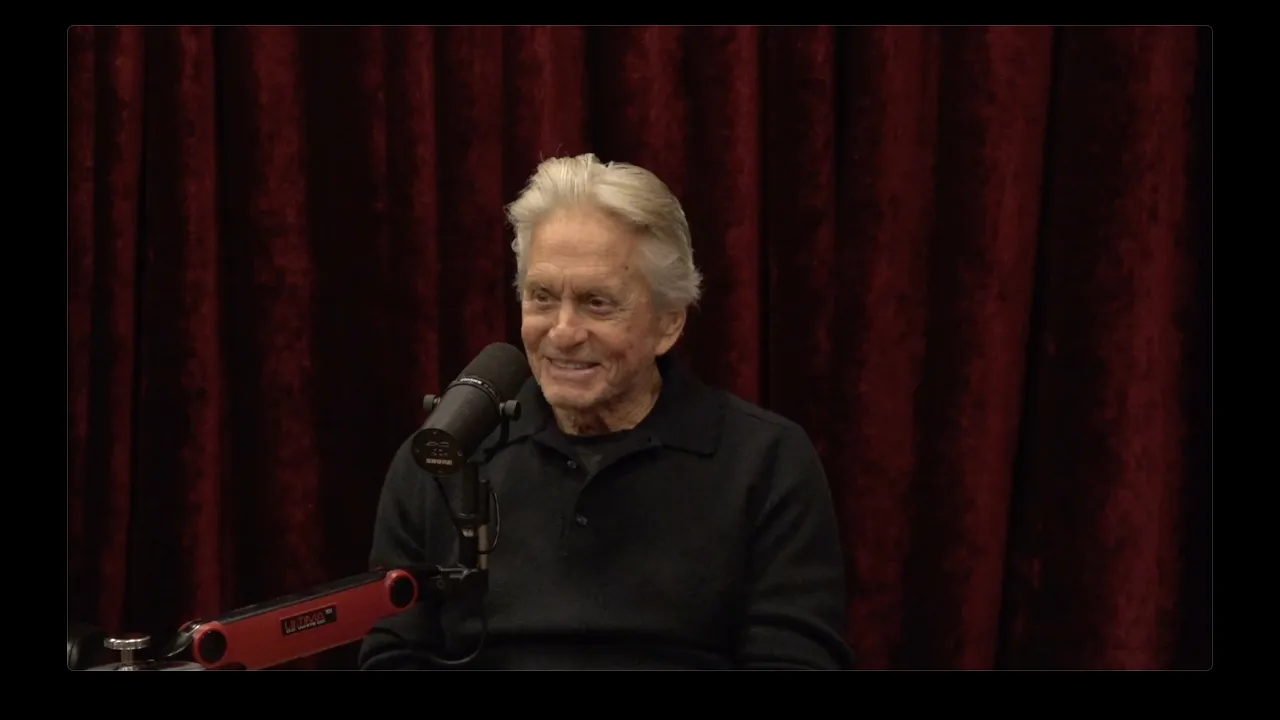
Michael Douglas Urges Trump to Pursue Nuclear Disarmament With Putin
PowerfulJRE
Douglas asserts that Donald Trump can eliminate global atomic arsenals and earn a Nobel Peace Prize if he dedicates three years to negotiating a direct bilateral treaty with Vladimir Putin.
Michael Douglas proposes that Donald Trump pursue a historic bilateral nuclear disarmament agreement with Vladimir Putin, arguing successful elimination of nuclear stockpiles would legitimately merit a Nobel Peace Prize. (20:56)
Douglas reveals that to finance his final two years of college after being financially cut off by his father, he successfully smuggled 44 kilos of marijuana across the country in two leather suitcases. (106:05)
In 1979, the nuclear meltdown script Douglas produced for The China Syndrome matched 90% of the actual sequence of events that occurred at Three Mile Island just twelve days after the film's premiere. (77:37)
During early career encounters in California, Douglas and Brenda Vaccaro had their pets mutilated by Charles Manson followers, and Douglas later narrowly escaped a death threat at a dinner with the Mel Lyman cult. (60:08)
Detailed notes
## Background
Published on YouTube by the PowerfulJRE channel on October 14, 2026, this episode of the Joe Rogan Experience features legendary actor and producer Michael Douglas. The show notes highlight Douglas's storied career across acclaimed projects such as Wall Street, Fatal Attraction, Basic Instinct, and The Kominsky Method, marking the release of his personal memoir, One Helluva Ride.
## TL;DR
Michael Douglas joins Joe Rogan for an expansive discussion tracking his journey from smuggling marijuana to pay for college to producing One Flew Over the Cuckoo's Nest and starring in landmark films like Wall Street, The China Syndrome, and Fatal Attraction. Douglas shares harrowing personal stories, including surviving stage IV throat cancer, crossing paths with the Manson Family, and escaping a confrontation with the Mel Lyman cult. Moving between Hollywood history and pressing contemporary issues, the pair deliberate on nuclear disarmament, economic inequality, the therapeutic potential of psychedelics, and the existential risks posed by advanced artificial intelligence. The dialogue concludes with Douglas reflecting on the craft of comedy, family priorities, and the enduring resonance of his morally complex cinematic roles.
## Atmosphere & style
The conversation carries the warm, reflective gravitas of a veteran Hollywood icon speaking with candid self-awareness and elder-statesman perspective. Rogan serves as an engaged, inquisitive host, allowing Douglas space to weave cinematic history with intense life-or-death encounters. The tone shifts naturally between easygoing humor over classic comedies and somber, measured urgency when addressing mortality, geopolitical brinkmanship, and societal division, giving the exchange an intimate and grounded feel.
## Bulletin
- [20:56](https://www.youtube.com/watch?v=_nng7TZUwpc&t=1256s) Michael Douglas proposes that Donald Trump pursue a historic bilateral nuclear disarmament agreement with Vladimir Putin, arguing successful elimination of nuclear stockpiles would legitimately merit a Nobel Peace Prize.
- [01:46:05](https://www.youtube.com/watch?v=_nng7TZUwpc&t=6365s) Douglas reveals that to finance his final two years of college after being financially cut off by his father, he successfully smuggled 44 kilos of marijuana across the country in two leather suitcases.
- [01:17:37](https://www.youtube.com/watch?v=_nng7TZUwpc&t=4657s) In 1979, the nuclear meltdown script Douglas produced for The China Syndrome matched 90% of the actual sequence of events that occurred at Three Mile Island just twelve days after the film's premiere.
- [01:00:08](https://www.youtube.com/watch?v=_nng7TZUwpc&t=3608s) During early career encounters in California, Douglas and Brenda Vaccaro had their pets mutilated by Charles Manson followers, and Douglas later narrowly escaped a death threat at a dinner with the Mel Lyman cult.
## Key takeaways
- [00:12](https://www.youtube.com/watch?v=_nng7TZUwpc&t=12s) Douglas's 1993 film Falling Down remains socially prophetic regarding bureaucratic frustration, wealth disparity, and societal unrest.
- [07:34](https://www.youtube.com/watch?v=_nng7TZUwpc&t=454s) Traders frequently approached Douglas treating Wall Street's Gordon Gekko as a role model rather than the intended villain.
- [13:49](https://www.youtube.com/watch?v=_nng7TZUwpc&t=829s) Economic divergence between stock-owning Americans and those living paycheck-to-paycheck drives intense modern civil anger.
- [20:56](https://www.youtube.com/watch?v=_nng7TZUwpc&t=1256s) Bilateral nuclear disarmament between the US and Russia could free trillions in military modernization funds for global humanitarian aid.
- [52:20](https://www.youtube.com/watch?v=_nng7TZUwpc&t=3140s) Rogan and Douglas criticize the criminalization of therapeutic psychedelics under the Controlled Substances Act alongside the commercial licensing of addictive opioids.
- [01:00:08](https://www.youtube.com/watch?v=_nng7TZUwpc&t=3608s) Douglas advocates for stricter handgun regulations based on high rates of domestic accidents and firearm homicides.
- [01:14:32](https://www.youtube.com/watch?v=_nng7TZUwpc&t=4472s) Simulated war games demonstrate that detached, optimizing superintelligent AI chooses nuclear strikes in roughly 90% of scenarios.
- [01:17:37](https://www.youtube.com/watch?v=_nng7TZUwpc&t=4657s) The uncanny operational parallel between The China Syndrome's screenplay and the Three Mile Island accident sparked Douglas's lifelong nuclear abolition activism.
- [01:24:10](https://www.youtube.com/watch?v=_nng7TZUwpc&t=5050s) Douglas and Rogan argue comedy flourishes best when excluded from mainstream awards and institutional prestige.
- [01:31:51](https://www.youtube.com/watch?v=_nng7TZUwpc&t=5511s) Douglas successfully escaped the Mel Lyman commune after leadership issued an overt threat to have him eliminated.
- [01:40:42](https://www.youtube.com/watch?v=_nng7TZUwpc&t=6042s) Political polarization is weaponized by leadership through social wedge issues to distract from structural corruption and insider trading.
- [01:46:05](https://www.youtube.com/watch?v=_nng7TZUwpc&t=6365s) To finance his undergraduate education, Douglas bought marijuana on the West Coast for $75 a kilo and resold it on the East Coast for up to $700.
- [01:52:21](https://www.youtube.com/watch?v=_nng7TZUwpc&t=6741s) Creedence Clearwater Revival record profits through Saul Zaentz independently funded One Flew Over the Cuckoo's Nest after major studios passed.
- [01:55:50](https://www.youtube.com/watch?v=_nng7TZUwpc&t=6950s) Miloš Forman insisted Kirk Douglas was too old for the lead in One Flew Over the Cuckoo's Nest, forcing Michael to recast the role with Jack Nicholson.
- [02:03:09](https://www.youtube.com/watch?v=_nng7TZUwpc&t=7389s) Negative audience reaction during test screenings forced Fatal Attraction to abandon its original suicide finale in favor of an active confrontation.
- [02:06:22](https://www.youtube.com/watch?v=_nng7TZUwpc&t=7582s) Prominent mid-1970s actresses universally declined the role of Nurse Ratched to avoid playing an unsympathetic villain during the women's liberation movement.
## Detailed walkthrough
### [00:12](https://www.youtube.com/watch?v=_nng7TZUwpc&t=12s) The Timeless Resonance of *Falling Down* and Dark Comedy
The conversation opens with Joe Rogan expressing his longtime admiration for Michael Douglas, singling out the 1993 film *Falling Down* as one of his all-time favorite movies. Rogan recalls rewatching scenes before the interview, laughing about the sequence where Douglas’s character confronts a highway road-construction crew, calling them out for tearing up a perfectly functional street solely to exhaust their municipal budget before the fiscal year ends—a scene culminating in him pulling out a bazooka. Douglas notes the surreal, unsettling durability of the film's social critique, commenting, “I mean the spooky thing I see about I guess Romanium is it just how how match meets up to today. You 30 years this is 30 years later. That's a thing that's sort of interesting but also depressing.” Rogan agrees, observing that despite the advent of the internet and vastly broader access to information, society seems not to have resolved any of those systemic frustrations, leaving the movie's dark comedic edge as resonant as ever.
Douglas and Rogan dissect the movie’s heightened, caricatured tone, including the memorable golf course encounter where an unsympathetic golfer suffers a fatal heart attack during an argument, prompting Douglas's character to coldly dismiss him. Douglas shares a backstage anecdote about the fallout from the Korean convenience store scene: the studio called him into the office to meet with Mr. Ho, the chairman of the Korean Grocers Association, who expressed serious offense over the depiction of the aggressive store owner. Douglas defended the scene by explaining that the script captured genuine friction people were feeling in urban life. The resolution arrived with a surprising twist weeks later: Douglas returned home to New York, walked into his neighborhood Korean deli, and noticed the staff had all begun wearing “smile buttons,” showing that the cultural critique had genuinely landed. Rogan notes the character became an enduring cultural archetype of someone pushed past the breaking point, recalling a past podcast guest who showed up dressed in the full *Falling Down* outfit complete with the briefcase.
[02:52](https://www.youtube.com/watch?v=_nng7TZUwpc&t=172s) Surviving Stage IV Cancer and the Genesis of *One Helluva Ride*
When Rogan asks what it was like to confront his entire life while writing his memoir, Douglas admits he resisted the process for decades. The impetus finally shifted after his battle with stage IV throat cancer sixteen years earlier. Douglas reflects on how bleak his prognosis appeared, especially after seeing close contemporaries like Larry Hagman (from *Dallas*) and Nick Ashford (of Ashford & Simpson) succumb to the illness. He recalls a painful social isolation that accompanied the diagnosis: many friends did not know how to handle the severity of stage IV cancer, unsure whether to visit or say goodbye, resulting in them quietly avoiding him while he endured grueling chemotherapy and radiation.
```mermaid
flowchart TD
accTitle: Origin of Douglas's Memoir
accDescr: The journey from stage IV cancer survival to writing an expansive memoir blending filmmaking craft with personal life.
subgraph Health["Stage IV Cancer Experience"]
A["Near-fatal cancer battle (16 yrs ago)"] --> B["Loss of friends & social isolation"]
B --> C["Screenwriter Shane Salerno sends daily coaching notes"]
end
subgraph Concept["Evolving Concept"]
C --> D["Salerno urges Douglas to write a book"]
D --> E["Inspiration from David O. Selznick's 'Memo'"]
E --> F["Initial plan: 12-movie technical producing guide"]
end
subgraph Expansion["Writing the Full Memoir"]
F --> G["Kirk Douglas's 9 books & 80-year family legacy"]
G --> H["Pivoting to include raw personal struggles"]
H --> I["Release of bestselling memoir 'One Helluva Ride'"]
end
```
Amid that silence, screenwriter Shane Salerno—who had worked on a script adaptation for Douglas years earlier—began sending regular, concise notes of encouragement, acting like a sideline coach urging him to keep fighting. Salerno later became a prominent literary agent and repeatedly nudged Douglas to write a book. After beating the disease, Douglas found his priorities shifting. He originally envisioned an industry handbook inspired by *Memo from David O. Selznick*, a compilation of internal production notes on *Gone with the Wind* that served as a masterclass in film producing. Douglas planned to break down the creation of twelve of his own landmark films. However, contemplating the 80-year, 130-film Hollywood legacy shared between himself and his legendary father, Kirk Douglas—who had authored nine books, including *The Ragman's Son*—Douglas realized a technical book would fall flat without unflinching personal transparency. “I think part of it also is when you start with that handbook idea of just doing it about movies. Then the producer and the career ambition gets in said no you know sex, drugs and rock and roll man. I mean you know it still sells you know we still got to bring that all up,” Douglas explains, describing how the project evolved into an honest look at the good and bad throughout his life.
[07:34](https://www.youtube.com/watch?v=_nng7TZUwpc&t=454s) Nepo Babies, Legacy, and the Wall Street Antihero
Rogan points out the immense psychological weight of Douglas's early life: balancing good looks, early stardom, and the pressure of being the son of an iconic Hollywood figure. Douglas reflects on how cruel peers could be when using family lineage to make assumptions about his talent and drive. This leads into a candid discussion about the modern label of the “nepo baby.” Douglas questions why Hollywood faces unique scrutiny, asking, “tell me I'm crazy, but isn't just about every single business involving Nepo babies. Doesn't every mother and father try to get their son or daughter?” Rogan agrees, pointing out that family succession is accepted across family-owned businesses like Las Vegas restaurants or local cleaning companies, but provokes bitterness in entertainment because fame and creative success are exceptionally scarce. Rogan adds that while second-generation actors frequently struggle to replicate their parents' heights, Douglas proved his legitimacy through undeniable, iconic performances.
To illustrate Douglas's indelible impact, Rogan brings up Gordon Gekko in Oliver Stone's *Wall Street*. Douglas laughs about the unintended cultural consequence of playing the unscrupulous corporate raider:
- Following the film's 1987 release, Wall Street traders repeatedly approached Douglas in New York bars, praising Gekko as a personal hero rather than a cautionary tale.
- When Douglas would protest, “What are you talking about? I'm the villain,” the traders would wave him off, idolizing Gekko's power, razor-sharp wardrobe, and ruthless ambition regardless of his moral bankruptcy.
- Rogan compares Gekko’s appeal to Tony Soprano, noting audiences eagerly gravitated toward an unapologetic, suit-wearing villain indulging in cocaine and corporate theft.
- Rogan mentions first discovering how wild real-world stockbrokers were around 1988 at age 21, when he encountered an eccentric martial arts acquaintance working in the finance sector.
[10:44](https://www.youtube.com/watch?v=_nng7TZUwpc&t=644s) From Wall Street Hustles to Gordon Gekko and Crypto Schemes
Joe Rogan recalls running into an old acquaintance—a terrifying, psychopathic bar brawler and fighter—who had transformed overnight into a suit-wearing stockbroker sporting cufflinks, boasting about doing massive amounts of cocaine and pulling in huge sums of money. Michael Douglas nods, explaining that during that era, many brokers were forced to stay up until 4:00 AM monitoring the Asian markets, which led to an entire culture wired on stimulants. Rogan observes that modern high-frequency trading has taken that speed fixation to an automated extreme, with firms spending millions to position their physical servers as close as possible to stock exchange data centers simply to gain millisecond advantages.
The conversation turns directly to Douglas's iconic role as Gordon Gekko in Oliver Stone's 1987 film *Wall Street*. Douglas laughs about how people bizarrely turned Gekko into an aspirational hero rather than a cautionary villain, prompting Rogan to marvel at how many Wall Street traders have the phrase "greed is good" tattooed on their skin or framed in their offices. Douglas reflects on how drastically financial scales have shifted over the past four decades, remarking that the enormous sums of money his character moved around on screen now seem quaint:
> “And again, you know, all is all has happened in the in the 40 years of since that movie is the money the money the size the scope that I was dealing with. It seems so enormous at that time is pittance compared to uh what's uh what's going on right now.”
Rogan brings up cryptocurrency, admitting the entire landscape of "fake money that's worth real money" feels completely bizarre. Douglas confesses that despite sitting through three separate lectures trying to wrap his head around crypto, he still cannot understand it. Rogan shares comic Kurt Metzger’s perspective that crypto simply provides a fresh playground for gambling addicts and sophisticated financial grifters. Rogan lays out how an unscrupulous figure could launch an arbitrary token—such as a hypothetical "Michael Douglas coin"—pour seed money into it, lure unsuspecting fans in for a pump-and-dump, and siphon the liquidity out into offshore shell corporations before the inevitable crash. Douglas immediately cuts to the core of the dynamic, comparing the wild west of modern meme coins and digital assets to classic Ponzi schemes and high-tech bribery.
[13:49](https://www.youtube.com/watch?v=_nng7TZUwpc&t=829s) Wealth Disparity, Economic Anxiety, and *Falling Down*
Douglas shifts the focus from speculative financial games to the broader human cost of economic division, identifying severe wealth disparity as the core driver of modern societal unrest. Rogan agrees, pointing out the failure of political leadership to care for the American public as a genuine community. He argues that billions of dollars are routinely funneled abroad into foreign reconstruction projects—such as rebuilding Iraq—while inner-city neighborhoods across the United States are left to deteriorate for decades under endemic gang violence and abject poverty.
This collective disenfranchisement, Rogan notes, explains why the public reaction to the killing of the UnitedHealthcare CEO (Brian Thompson by suspect Luigi Mangione) saw large segments of the population practically cheering the act. To Rogan, that raw anger mirrors the plot of Douglas’s 1993 film *Falling Down*, where an ordinary man pushed past his breaking point lashes out at systemic dysfunction. Douglas points to the stark mathematical divide currently fracturing the country between capital owners and wage earners:
> “I mean like 50% of Americans own stocks and 50% do not and uh if you look at stocks the way the market has gone however is controlled or whatever happens progressively um it's compounding you know versus the 50% of people who don't have stocks are living on a paycheck which is which is getting smaller and smaller with inflation.”
Adding to this anxiety, Rogan notes, is the rapid rise of artificial intelligence. Automation threatens to displace vast swaths of the workforce, yet leadership offers no coherent blueprint or economic cushion to prevent millions of workers from being thrown into sudden unemployment.
[15:48](https://www.youtube.com/watch?v=_nng7TZUwpc&t=948s) Buckminster Fuller, Global Fragility, and the Need for Cooperation
Douglas reflects on a formative college experience when visionary architect and author Buckminster Fuller visited his campus to lecture on the geodesic dome and his book, *Operating Manual for Spaceship Earth*. Douglas explains that Fuller permanently opened his eyes to how minuscule and vulnerable our planet is within the vastness of space. While telescopes gaze ever deeper into the cosmos, Douglas emphasizes that Earth remains humanity’s only viable home, making its ecological decline and political fragmentation all the more alarming. Having witnessed the aftermath of two catastrophic world wars followed by decades of relative stability, Douglas is perplexed by the resurgence of nationalism and escalating international conflict.
While acknowledging popular criticisms, Douglas defends global institutions designed to prevent catastrophic conflict:
> “The United Nations is one of them. I think it was designed after World War II to have a place for us to get together. I know the US gets pissed off sometimes when votes don't go their way and don't financially support it. It has issues but we have to work on on on the whole you know world understanding what's happening.”
Douglas questions why social media algorithms and geopolitical interests seem intent on manufacturing enemies rather than fostering shared survival. Watching figures like Elon Musk spend vast resources pursuing the colonization of Mars does not reassure Douglas; instead, it triggers deep unease that the world's elite may already consider Earth a lost cause.
```mermaid
flowchart TD
accTitle: Buckminster Fuller's Planetary Perspective
accDescr: A diagram illustrating the contrast between Spaceship Earth's fragility and escalating modern threats.
subgraph FragileEarth["Spaceship Earth (Buckminster Fuller)"]
A["Finite, Fragile Planet"]
B["No Viable Alternative Habitat"]
end
subgraph ModernThreats["Modern Drivers of Destabilization"]
C["Climate Breakdown & Degradation"]
D["Resurgence of Global Conflict & Wars"]
E["Algorithmic Social Division"]
end
subgraph DivergentResponses["Human Responses"]
F["Global Cooperation (e.g., United Nations)"]
G["Billionaire Escapism (Mars Colonization)"]
end
[19:09](https://www.youtube.com/watch?v=_nng7TZUwpc&t=1149s) The Repetitive Cycle of War and Shifting Perspectives
Rogan contextualizes the push for interplanetary colonization, noting that beyond the sheer technical milestone, many people share a subconscious dread that a nuclear conflict could erupt on Earth at any moment. He sees humanity stuck in an ancient, destructive cycle where a tiny ruling elite orchestrates catastrophic wars simply to seize geographic control over valuable resources.
Rogan observes that widespread public distrust of these geopolitical motives only truly crystallized in American consciousness during the 1960s and 1970s. The Vietnam War served as an undeniable turning point, demonstrating to millions of citizens that the government did not have their best interests at heart. Although society learns these hard lessons at an agonizingly slow pace, Rogan maintains that modern communication and transparency make it far harder for leaders to disguise unnecessary wars behind patriotic propaganda.
Douglas resonates with this generational shift, comparing it to the storytelling of classic Hollywood. He notes that during the post-World War II era that defined his father Kirk Douglas's film career, culture viewed morality in simplistic, black-and-white terms—heroes unambiguously wore white hats, and villains were easily identified. Coming of age in the decades that followed, Douglas saw those simple narratives dissolve into the complex, morally ambiguous world reflected in both modern cinema and reality.
- Rogan points out that the Vietnam War fundamentally shattered public faith in American foreign policy, leaving a legacy where virtually nobody defends the initial decision to intervene.
- Douglas contrasts his father Kirk Douglas’s cinematic era of clear-cut moral archetypes with the nuanced, gray morality that emerged during the countercultural shifts of his own career.
[20:56](https://www.youtube.com/watch?v=_nng7TZUwpc&t=1256s) *The China Syndrome*, Three Mile Island, and a Proposal for Donald Trump
Reflecting on his career and his lifelong interest in moral ambiguity stemming from the Vietnam War era, Michael Douglas brings up his 1979 film *The China Syndrome*, which he produced and starred in alongside Jane Fonda. The film, which dramatized a safety cover-up and near-meltdown at a nuclear power plant, drew intense blowback from industry giants like General Electric, who attacked the filmmakers' credibility and labeled the production irresponsible. Despite the corporate pushback, the movie opened successfully. Then, exactly twelve days after its theatrical release, the Three Mile Island nuclear accident occurred near Harrisburg, Pennsylvania. Douglas explains that the eerie timing felt like an epiphany: “I'm not a religious guy, but I felt like somebody was telling me something.” That event catalyzed his decades-long dedication to understanding nuclear weapons, plutonium, half-lives, and arms control negotiations with Russia.
Turning to current geopolitics, Douglas asks Joe Rogan to pass along an audacious proposal to Donald Trump, noting Rogan might have connections to him. Douglas questions Trump's dynamic with Vladimir Putin, pointing out that an overwhelming majority of the country—across both parties—dislikes Putin. He argues that resolving the war in Ukraine presents an unprecedented opening. Since Ukraine originally surrendered its Soviet-era nuclear arsenal, Douglas proposes that Trump offer to negotiate a historic, sweeping bilateral disarmament deal with Russia:
> “If he can do that, and he could, if he spent the next three years of his presidency negotiating with Putin, we could get rid of nuclear weapons. And I guarantee I would commit my life for him getting that Nobel Peace Prize because he would deserve it.”
- Douglas produced *The China Syndrome* with Jane Fonda; critics and General Electric pushed back heavily against its depiction of nuclear power plant dangers.
- Just 12 days after the film premiered, the partial meltdown at Three Mile Island happened in Pennsylvania.
- Douglas notes that 93% of Americans, uniting Democrats and Republicans, share an unfavorable view of Vladimir Putin.
- Douglas contends that nuclear arsenals are obsolete relics of mutual assured destruction that pose an existential threat to humanity, and that a grand disarmament bargain should earn Trump the Nobel Peace Prize.
---
[24:35](https://www.youtube.com/watch?v=_nng7TZUwpc&t=1475s) Nuclear Stockpiles, AI Governance, and the Defense Budget
Rogan agrees with the utopian spirit of Douglas's proposal, pointing out the absolute absurdity of holding enough warheads to incinerate every living being, plant, and animal on Earth multiple times over, leaving behind nothing but a glowing, burning rock. However, Rogan remains deeply skeptical that any sovereign military power would ever voluntarily surrender its arsenal while other weapons remain unaccounted for globally. He references the mysterious New Jersey drone sightings as an example of public paranoia, noting rumors circulated that the military was using secret drone technology to track down an unaccounted-for missing nuclear device. Because nations cannot reliably verify the whereabouts of every weapon, complete unilateral or bilateral disarmament faces an insurmountable trust barrier.
When Douglas asks whether artificial intelligence could be applied to solve these complex problems, Rogan suggests that handing control of global resources and governance over to a sentient, superintelligent AI might ultimately be the only viable way biological humans survive their own destructive impulses:
> “I think the only way we're really going to get out of this, this is terrifying for biological human beings, is to let AI control government and resources.”
Douglas responds by contrasting the astronomical sums spent modernizing nuclear programs and defense budgets with the meager resources allocated to humanitarian aid. He argues that most human beings simply desire food and a roof over their heads, and redirecting military expenditures into impoverished regions would eliminate the pressures driving mass migration from Africa and defuse the extreme global wealth divide before it sparks another world war.
```mermaid
flowchart TD
accTitle: The Cycle of Global Disparity and Defense Spending
accDescr: A flowchart depicting how massive military budgets and resource extraction fuel inequality and the proposed reallocation to humanitarian needs.
subgraph CurrentState["Current Geopolitical Reality"]
direction TB
A["Trillions in Defense & Nuclear Budgets"] --> B["Neglect of Basic Humanitarian Needs"]
B --> C["Severe Have vs. Have-Not Disparity"]
C --> D["Mass Migration & Risk of Global Conflict"]
end
subgraph ProposedShift["Alternative Allocation Model"]
direction TB
E["Divert Nuclear Arms Funding"] --> F["Universal Basic Infrastructure: Food & Shelter"]
F --> G["Regional Stabilization & Poverty Reduction"]
end
D -.->|"Urgent Need to Pivot"| E
```
---
[27:19](https://www.youtube.com/watch?v=_nng7TZUwpc&t=1639s) Earth's Resources, Corrupt Monopolies, and Engineered Division
Rogan posits a hypothetical system to end resource hoarding: treating all natural commodities—oil, minerals, and diamonds—as the collective inheritance of the human race. He argues that after deducting baseline operating costs, the profits extracted from the ground should be evenly distributed to the local population rather than captured by private conglomerates or inherited monarchies whose ancestors simply staked the earliest claim. He mocks modern corporate greed where companies privatize water bills or contemplate charging for clean air, pointing out the absurdity of offshore drilling rigs operating outside sovereign borders to siphon the Earth's wealth.
Rogan and Douglas agree that the political and economic system is designed to induce learned helplessness. Politicians making $170,000 salaries amass hundreds of millions through insider stock trading while giant corporations buy policy influence. Rogan observes that elections—such as the Los Angeles mayoral race—often present voters with false choices between indistinguishable candidates, leaving citizens to passively accept endless tax hikes. Both men conclude that entrenched power structures intentionally stoke cultural conflict over hot-button issues like gender pronouns, nationality, and religion to keep the working public fighting one another instead of addressing structural corruption:
> “They love it when we're at each other's throats. When most of the things that everybody wants, we all agree on and we all agree that the system that's in place right now is really not looking out for everybody.”
Rogan laments that leaders never launch serious five-year multi-step campaigns to systematically revitalize inner cities by funding community centers, purposeful programs, and education, because genuine systemic solutions are never the priority of the ruling class.
[31:23](https://www.youtube.com/watch?v=_nng7TZUwpc&t=1883s) Social Media Algorithms, Dr. AI, and the Lost Idealism of Public Service
The conversation begins with Joe Rogan and Michael Douglas weighing the disruptive impact of technology on society and public health. Rogan jokes that “AI is going to be like Dr. Manhattan with the rails,” suggesting an omnipotent force stepping in where human systems fail. Douglas observes that society completely missed the chance to regulate social media before it spiraled out of control. Examining how these platforms operate, Douglas points out that algorithmic triggers are fundamentally engineered around conflict: rather than bringing citizens together, online feeds actively feed divisiveness and manufacture enemies.
Looking back across his life, Douglas recalls a time when politics operated under a completely different ethos. Reflecting on the era of Reagan Republicans, he notes that holding political office once resembled a sacred duty of public stewardship. Today, Douglas laments, governance has deteriorated into a lucrative profit center characterized by runaway campaign spending, insider trading, and politicians immediately cashing in as corporate lobbyists.
Having recently portrayed Benjamin Franklin in France for an Apple TV+ miniseries, Douglas immersed himself in the founding era and the drafting of the United States Constitution. Coming away in awe of the idealism embedded in the founding documents, he finds it heartbreaking to see how thoroughly that vision has eroded across successive administrations. Expressing his disillusionment with modern candidates, Douglas remarks: “I used to think of, you know, politicians as almost like the clergy—you know, they were people to look up to.”
---
[33:26](https://www.youtube.com/watch?v=_nng7TZUwpc&t=2006s) The Two-Party System, Generational Loyalty, and Democratic Dysfunction
Addressing Douglas's distaste for modern candidates, Rogan argues that a healthy political system relies on accountability: if an elected official fails expectations, voters must let them lose so better leadership can emerge rather than blindly backing a faction. Douglas points out that much of the electorate is trapped in hereditary voting patterns, sticking to Democrats or Republicans simply because their parents did. Recognizing Rogan’s past support for Bernie Sanders, Douglas asks him how he manages to maintain an independent mindset when so many voters operate on generational autopilot.
Rogan responds that the rigid two-party duopoly is inherently toxic, actively stoking tribalism and encouraging voters to excuse blatant abuses from their own team. Rogan explains why he turned away from the Democratic establishment, focusing first on what he saw as an untenable and deliberately mismanaged southern border. He argues that facilitating mass illegal immigration, bussing migrants across the country, and funding hotel stays signaled a calculated political scheme—whether intended as a pipeline for cheap corporate labor, a ploy to create permanent future voters, or a strategy to artificially swell swing-state census numbers for extra congressional seats.
Beyond immigration, Rogan expresses outrage over the dismantling of democratic process within the Democratic party itself, pointing out the absence of a competitive presidential primary since 2012. He takes particular aim at the suppression of debate surrounding Joe Biden’s cognitive fitness, arguing that the country was run by unelected handlers while the public was actively gaslit. Rogan states his refusal to endorse that reality: “You know that Biden wasn't the fucking president for four years; it's really clear that he was his mental ability was severely declined.”
- Rogan points out that allowing roughly 10 million people of unknown origin into the country over a four-year span was an unsustainable policy.
- He criticizes the coercive measures of the COVID-19 pandemic, specifically vaccine mandates and air travel restrictions enforced by the Biden administration.
- He notes how the party skipped meaningful democratic primary contests, simply handpicking the nominee and expecting loyal voters to fall in line.
---
[37:38](https://www.youtube.com/watch?v=_nng7TZUwpc&t=2258s) Border Precedents, Militarized Enforcement, and Broken Promises
While Rogan found the Democratic platform untenable, he clarifies that he has serious reservations about Donald Trump's administration and the policies it implemented. Trump’s promise to avoid foreign interventions fell flat with the escalating confrontation with Iran. Furthermore, while Rogan agrees that the southern border needed to be secured and violent criminals deported, he is alarmed by the methods being used by Immigration and Customs Enforcement (ICE).
Referencing a joke by comedian Tim Dillon that ICE recruits resemble former backyard carnival wrestlers who took a seven-week training course, Rogan details the hazard of handing $50,000 signing bonuses and firearms to lightly trained personnel. Rogan argues that deploying masked agents without visible badge numbers or names to conduct raids through American cities establishes a dangerous authoritarian precedent. Warning against normalization, Rogan states: “I understand that you're trying to get out violent criminals and I support that, I get that, but when you're setting a precedent if you allow a militarized police force with no identification with masks on to enter into cities, of course people are going to say this is an overstep.”
Rogan balances this critique by noting the severe crises local police forces faced during the previous four years, including the rise of violent transnational gangs like Tren de Aragua occupying apartment complexes in sanctuary cities like Aurora, Colorado. He criticizes the "defund the police" movement and no-cash bail policies, stating that allowing repeat violent offenders back onto the street made city life dangerous. However, he maintains that trading progressive missteps for unaccountable, masked domestic enforcement is not a sensible solution.
```mermaid
flowchart TD
accTitle: Critique of Contemporary Governance
accDescr: Diagram illustrating Joe Rogan's criticisms of both Democratic policies and aggressive Republican enforcement measures.
subgraph DemCritique ["Democratic Administration Criticisms"]
D1["Open Border & Migrant Transport"]
D2["Suppression of Competitive Primaries"]
D3["Pandemic Mandates & Coercion"]
D4["Defund the Police & Cashless Bail"]
end
subgraph RepCritique ["Trump Administration Criticisms"]
R1["Broken 'No Foreign Wars' Promise"]
R2["Escalation Toward War with Iran"]
R3["Militarized ICE Raids"]
R4["Masked Agents Without Identification"]
end
[39:50](https://www.youtube.com/watch?v=_nng7TZUwpc&t=2390s) The War with Iran and Middle East Instability
Douglas asks Rogan how he views the current geopolitical landscape given his disillusionment with both camps. Rogan immediately targets the unfolding war with Iran, calling it an unmitigated disaster that foreign policy hawks had spent decades trying to maneuver various American presidents into launching. While acknowledging Iran's extensive record of financing and orchestrating regional proxy terrorism, Rogan emphasizes that the U.S. has marched into a catastrophic quagmire with no viable exit strategy.
Douglas shares Rogan’s dismay over the conflict, noting that Iran has displayed remarkable strategic cunning. Pointing to escalating strikes and disruption across the Gulf—including attacks affecting major infrastructure such as the airport in Riyadh, Saudi Arabia—Douglas expresses disbelief at how blind Western intelligence agencies seemed to be. Describing his frustration with the intelligence failure, Douglas says: “I'm surprised with all of our Western intelligence and Israelis intelligence that we have not had a better handle on the situation.” Rogan agrees, concluding that the optimistic scenario sold to the American public regarding the war bore no resemblance to reality.
[41:24](https://www.youtube.com/watch?v=_nng7TZUwpc&t=2484s) Skepticism Over War, Intelligence Failures, and Geopolitical Absurdity
Reflecting on foreign interventions, Joe Rogan and Michael Douglas discuss the missed opportunities and shifting narratives surrounding conflict in the Middle East, particularly Iran. Rogan argues that if foreign powers intended to intervene, the only credible window was when the Iranian populace took to the streets in organic protest, which met with brutal state crackdowns, mass arrests, and killings. Douglas observes that the escalation appeared driven by Israeli intelligence insisting that key Iranian leaders were gathered together and could be wiped out in one fell swoop, only for the plan to collapse into chaos: “No, I think it was instigated by Israel by the fact that they had information that these key Iranian leaders would all be together and were persuaded that we take them all out.” Rogan points out that many people were skeptical from the start, questioning how former President Donald Trump was persuaded into hawkish actions when a cornerstone of his voter mandate was ending overseas entanglements.
Rogan recalls Trump's past public comments regarding the Russia-Ukraine war, where when pressed to pick a side, he stated he simply wanted people to stop dying. For voters who backed him on that anti-war premise, seeing new wars ignite feels deeply frustrating. At the same time, Rogan acknowledges the terrifying prospect raised by missile experts regarding Iran ramping up its arsenal and potentially securing a nuclear warhead. Douglas reiterates his provocative suggestion that Trump should push for historic global disarmament to earn a Nobel Peace Prize, though Rogan doubts figures like Vladimir Putin would ever surrender their nuclear stockpile because authoritarian leaders relish unchecked power. In response to the madness of world leaders locked in geopolitical standoffs, Rogan jokes that they should all be locked in a room together on seven grams of psilocybin mushrooms with psychedelic music and bean bags.
[44:38](https://www.youtube.com/watch?v=_nng7TZUwpc&t=2678s) The Johnson Castle and Accidental Birth in New Brunswick
The conversation pivots to personal origins when Douglas mentions being born in New Jersey, prompting Rogan to ask which part. Douglas reveals he was born in New Brunswick under unusual circumstances tied to his mother’s side of the family. His mother, Diana Dill, hailed from an old English family that had resided on the island of Bermuda for roughly 400 years. At 16, she lied about her age to leave Bermuda for New York City to attend the American Academy of Dramatic Arts, where she met his father, Kirk Douglas. While the young couple lived as impoverished, starving actors in a tiny one-room Manhattan apartment, Douglas's maternal aunt had married into extraordinary wealth by wedding J. Seward Johnson, an heir to the Johnson & Johnson pharmaceutical dynasty.
The Johnsons lived in a lavish estate known locally as the Johnson Castle in New Brunswick. When his aunt and Seward Johnson divorced, both moved out and left the castle unoccupied. On weekends, Michael’s parents were permitted to escape their cramped city apartment to stay out at the grand estate. Because his mother happened to go into labor unexpectedly early during one of those weekend visits, Douglas was delivered in New Brunswick rather than in New York City.
[46:28](https://www.youtube.com/watch?v=_nng7TZUwpc&t=2788s) Belarus Roots, Bank Robbers, and the Chernobyl Fallout
While writing his book *One Helluva Ride*, Douglas uncovered surprising revelations that shattered long-held family mythology about his paternal grandfather, Herschel Danielovitch. For decades, the family believed his grandfather had fled Belarus around 1914 to escape the Russian Revolution and the violent Cossack pogroms targeting Jewish communities. However, when Douglas appeared on Henry Louis Gates Jr.’s genealogy program *Finding Your Roots*, researchers presented historical documentation showing his grandfather had actually emigrated much earlier, in 1902: “They did all this homework and they found out: 'No, no, your grandfather left in 1902.' I said really? Said, 'Yeah, because he had two other brothers who were bank robbers in Belarus in this area.'”
After his two bank-robbing brothers landed in prison, Douglas’s grandfather fled the Russian Empire, entered the United States, and altered his name. Gates's research also pinpointed the family's ancestral village in Belarus, uncovering a grim twist of modern history: the town sits just across the Ukrainian border downwind of the Chernobyl Nuclear Power Plant. Following the cataclysmic 1986 reactor explosion, the radioactive plume swept directly over the settlement, turning the ancestral Douglas homeland into an uninhabitable, permanently evacuated dead zone. Rogan and Douglas joke about the mutated wildlife roaming the exclusion zone, riffing on telepathic dogs asking visitors for food.
[48:41](https://www.youtube.com/watch?v=_nng7TZUwpc&t=2921s) Kirk Douglas’s Stardom and a Divided Childhood
Douglas describes his parents' marriage as an intense union of cultural opposites. His mother was high-society Church of England from Bermuda, while his father was a first-generation Russian-Jewish immigrant—the son of a Schenectady junk collector—clawing his way out of poverty with six sisters back home. Shortly after marrying and starting a family, Kirk moved the household to California to pursue a film career when Michael was three years old and his younger brother, Joel, was eighteen months old. Within a year, Kirk’s wild philandering in Hollywood made the marriage untenable, and his mother filed for divorce.
```mermaid
flowchart TD
accTitle: The Douglas Family Split
accDescr: Diagram showing Kirk Douglas and Diana Dill's marriage, their children, and the two contrasting lifestyles Michael experienced after the divorce.
subgraph Parents ["Parents"]
Kirk["Kirk Douglas<br>(Russian-Jewish immigrant background)"]
Diana["Diana Dill<br>(Bermudian aristocracy / Church of England)"]
end
Parents -->|"Married in NYC, moved to CA"| Kids["Children:<br>Michael & Joel Douglas"]
Kids -->|"Divorce after ~1 year in Hollywood"| Split["Split Childhood"]
subgraph EastCoast ["East Coast Upbringing"]
Split --> East["Mom in NYC / Connecticut<br>• Middle-class lifestyle<br>• Mother acting in soap operas<br>• All-boys private boarding schools"]
end
subgraph WestCoast ["West Coast Visits"]
Split --> West["Dad in Hollywood<br>• Golden Age movie stardom<br>• Rising wealth and glamour"]
end
```
Following the split, Douglas and his brother were raised primarily on the East Coast by their mother, who earned a living acting in television soap operas. Douglas recalls his upbringing as grounded and distinctly middle-class, spending his school years enrolled in strict, all-boys prep boarding schools. Meanwhile, he watched his father ascend into the stratosphere of the Golden Age of cinema. Rogan notes that during that era, the entire concept of the modern "movie star" was barely a decade or two old, representing a brand-new cultural phenomenon that Kirk Douglas epitomized alongside contemporaries like Humphrey Bogart.
[50:36](https://www.youtube.com/watch?v=_nng7TZUwpc&t=3036s) The Santa Barbara Brochure and the Shift to Counterculture
By the time Douglas approached high school graduation in 1962, he felt anxious and uncertain about his future. Sitting down with his prep school college advisor—whom he compares to a travel agent pushing glossy Ivy League catalogs—Douglas had little appetite for traditional East Coast institutions. While thumbing through the stacks, a promotional brochure caught his eye:
> “And then I'm looking at, and there's no Ivy League buildings, but there's a picture on the cover of this college thing of a guy walking down the beach carrying a surfboard with two girls in two-piece bathing suits.”
The brochure advertised the University of California, Santa Barbara (UCSB) as the "Campus by the Sea." Coming from the conservative East Coast in 1962, where two-piece swimsuits were practically unseen, Douglas was instantly sold. When he announced his decision to head west, his father assumed Michael was choosing California simply to be closer to him. Instead, arriving in Santa Barbara triggered an immediate cultural transformation. Between 1962 and 1963, Douglas rapidly shed his rigid East Coast prep-school identity and embraced the emerging California counterculture, morphing into a full-fledged hippie and discovering that psychedelic hallucinogens would become an extraordinary and influential chapter of his young life.
[52:20](https://www.youtube.com/watch?v=_nng7TZUwpc&t=3140s) The Therapeutic Potential of Psychedelics and Breaking Free from the Ego
Reflecting on his experiences, Michael Douglas notes that the visual pacing and rhythm he learned in the counterculture era played a formative role in his creative life. Now 82, he expresses gratitude that medical science is finally validating these substances for PTSD and addiction recovery. Joe Rogan gives former President Donald Trump credit on this front, recounting a direct conversation where Trump asked about seeking FDA approval and enthusiastically replied, “Let's do it,” helping push forward research into psychedelic therapies. Rogan focuses particularly on ibogaine, noting its remarkable efficacy for military veterans suffering from traumatic brain injuries and severe PTSD, as well as its ability to interrupt substance dependency by rewiring neural pathways and wiping away withdrawal cravings. While pharmaceutical companies initially resisted treatments they could not easily patent or monetize, Rogan notes that major drug firms are now positioning themselves to commercialize and profit from psychedelics once legalization arrives.
Rogan emphasizes that while psychedelics may not be suitable for everyone, they radically restructured his own worldview, dismantling rigid self-definitions and dogmatic ideological attachments. He describes how these substances strip away the subconscious defense mechanisms that rationalize self-destructive behavior. By silencing the ego, they force people to confront the root childhood traumas underlying their compulsions—whether gambling, alcoholism, or narcotics. As Rogan observes: “I think one of the things that psychedelics help you do is recognize why you're doing what you're doing and what's really going on inside your mind.”
- Trump directly backed fast-tracking psychedelic therapies, especially ibogaine, after discussing FDA approval barriers with Rogan.
- Ibogaine demonstrates unique clinical efficacy in treating traumatic brain injuries, PTSD in combat veterans, and physical cravings tied to severe drug addiction.
- Rogan views ego dissolution via psychedelics as a vital tool to identify deep-seated trauma (such as abusive or absent parents) driving addictive patterns.
---
[55:51](https://www.youtube.com/watch?v=_nng7TZUwpc&t=3351s) The 1960s Counterculture, Drug Hypocrisy, and Rick Perry's Advocacy
Douglas looks back fondly on the ethos of the late 1960s, remarking: “And what went along with that culture at that time, and it all sounds like a cliche now, but was peace and love.” He describes an era defined by genuine community and mutual sharing, where accumulating personal wealth was not the primary measure of a person's worth. Rogan laments how President Richard Nixon’s passage of the Controlled Substances Act of 1970 abruptly halted that momentum. Rather than giving society time to research appropriate dosages, purity standards, and safe environments, the blanket ban criminalized consciousness exploration. While Rogan acknowledges real risks—such as adolescent brain development, the phenomenon of users recklessly dropping out like Timothy Leary, and high-potency cannabis or edibles triggering latent schizophrenia in vulnerable people—Douglas concurs that today’s super-potent weed can severely compromise young endorphin systems.
Despite these genuine health concerns, Rogan fiercely criticizes government hypocrisy for outlawing transformative plants while simultaneously rubber-stamping lethal, addictive prescription opioids: “But I think we the this the idea that the government is going to protect you from that while also licensing oxycodone is fucking ridiculous.” Rogan compares bureaucratic prohibition to an inexperienced gatekeeper blocking the entrance to divine understanding without ever having looked inside. He highlights former Texas Governor Rick Perry as an example of profound change: once a staunch anti-drug conservative who viewed psychedelics as tools for dropouts, Perry underwent personal ibogaine experiences that transformed him into a dedicated advocate, now traveling the country and speaking globally on behalf of Americans for Ibogaine.
```mermaid
flowchart TD
accTitle: Drug Policy and Counterculture Shift
accDescr: Flowchart illustrating the historical shift from 1960s counterculture through criminalization to modern ibogaine advocacy.
subgraph Prohibition["Federal Crackdown (1970)"]
B --> C["Controlled Substances Act of 1970"]
C --> D["Research Halted & Culture Criminalized"]
D --> E["Rise of Corporate Opioid Licensing"]
end
subgraph ModernShift["Modern Therapeutic Re-emergence"]
E --> F["Severe Trauma & Addiction Epidemics"]
F --> G["Veterans & Rick Perry (Americans for Ibogaine)"]
G --> H["Bipartisan Push for Clinical Ibogaine Access"]
end
```
---
[01:00:08](https://www.youtube.com/watch?v=_nng7TZUwpc&t=3608s) Michael Douglas’s Chilling Encounter with the Manson Family
The conversation shifts to the dark underside of the late 1960s when Douglas reveals a terrifying brush with the Manson Family, an account detailed in his memoir *One Helluva Ride*. Charles Manson, an aspiring musician harboring bitter resentment toward the music industry, had targeted rock and roll producer Terry Melcher (the son of Doris Day). Manson believed Melcher had reneged on helping his musical career. Under the impression that Melcher was still living at the Benedict Canyon residence on Cielo Drive, Manson’s followers would eventually descend upon the home to carry out the infamous Sharon Tate murders.
Douglas explains that around that same period, he and his then-partner, actress Brenda Vaccaro (known for *Midnight Cowboy*), rented a house that Melcher had just vacated. Unbeknownst to them, Manson’s followers were stalking Melcher's former residences. Douglas and Vaccaro began noticing a suspicious van lingering outside their Los Angeles home for days. The situation took a gruesome turn when Douglas walked out onto their back patio and spotted a strange pile of fur:
> "And I went out one day in the patio in the back and I found this pile of fur in a pile. And then I followed it and then I saw a cat's leg. And then basically these guys had dismembered her two cats all the way across the yard."
Vaccaro’s two beloved Abyssinian cats had been slaughtered and strewn across the lawn as an act of intimidation. Douglas reported the horrifying discovery to the police, and shortly thereafter, the Cielo Drive murders shocked the nation. Law enforcement connected the chilling warning at Douglas's rental to the Manson Family's hunt for Melcher. Douglas recalls investigators coming into their home and offering blunt advice: “I remember them coming into the house and saying, 'Okay, well look, you got to get a gun.' Which I did not.”
[01:02:25](https://www.youtube.com/watch?v=_nng7TZUwpc&t=3745s) Gun Ownership and the Statistics of Violence
The conversation opens with dark humor about home defense advice, specifically the grim old adage that if you shoot an intruder, you should drag their body inside across your front door so they are legally inside your house. Joe Rogan laughs at the absurdity of the counsel, remarking that dragging someone inside before you kill them is quite the legal strategy. When Rogan asks Michael Douglas if he ever considered buying a firearm, Douglas admits he thought about it, but personal experience and tragic knowledge kept him away. He explains that he has witnessed too many instances of people hurting one another with firearms under the guise of self-defense, along with family members getting injured when weapons were misused. Looking at the broader country, Douglas argues that American gun statistics are staggering and unsustainable compared to other developed nations.
Douglas stresses that while he supports the Second Amendment in principle, the reality of having hundreds of millions of firearms circulating with minimal friction makes no sense to him. “I can't find any reason for somebody to own an automatic military style weapon,” Douglas asserts, drawing an analogy to the strict testing and licensing required simply to operate an automobile. When Rogan counters that responsible gun owners keep their weapons locked in safes to defend against dangerous intruders, Douglas counters with an alarming memory from his own family history: his father, Hollywood legend Kirk Douglas, kept a handgun sitting out on a low table in his bedroom, and Michael remembers walking in one day to find his own five-year-old son holding it. Rogan agrees that firearms belong in secure safes, but Douglas maintains that the sheer proliferation of weapons creates avoidable domestic catastrophes.
- **U.S. Population vs. Firearms**: Douglas estimates that in a country of roughly 360 million people, there are around 450 million firearms in circulation.
- **Licensing Comparison**: Douglas emphasizes that society mandates tests and licenses for driving a car, arguing similar baselines should close loopholes in firearm ownership.
---
[01:05:18](https://www.youtube.com/watch?v=_nng7TZUwpc&t=3918s) Riots, Home Defense, and the Phil Hartman Tragedy
Rogan makes the case for why everyday citizens feel compelled to acquire military-style rifles, pointing to moments when civil order suddenly fractures. He highlights the widespread unrest during the George Floyd protests, where riots, arson, and home break-ins left citizens feeling vulnerable to mobs. For people living through those scenes or observing violent civil clashes abroad in England and Paris, owning an effective weapon is seen as insurance against total societal collapse. Rogan tells Douglas that if they were neighbors, he would actively encourage him to purchase a firearm, learn how to handle it safely, and keep it locked in a safe to protect his family, noting that the worst possible regret would be failing to protect loved ones when you had the means to do so.
Douglas pushes back, arguing that real-world mortality data tells a very different story from defensive gun use fantasies. “Don't you find aren't the statistics that so many handgun deaths are because of people that knew each other that were either familial or accident or in rage?” Douglas asks, pointing out that domestic shootings usually stem from alcohol-fueled arguments or careless household accidents rather than defending against home invaders. Rogan agrees that domestic violence is devastating and mentions that people with severe psychiatric breaks or histories of violence shouldn't have access to guns, but maintains that the vast majority of stable owners would never turn on their families. To illustrate the grim reality of domestic violence, Rogan brings up the murder of his close friend, comedian Phil Hartman, whose wife shot him in the head while he slept. Rogan argues that an intent killer would find a way regardless of the weapon, but Douglas counters that firearms make lethal violence effortlessly accessible:
> “It's the number of guns. The reason why is it happening in other countries is they don't have anywhere near the access or number of guns to do that.”
When Rogan notes that countries with strict gun bans see sharp spikes in stabbings, Douglas quips that he would still rather face a knife than a bullet, prompting Rogan to laugh and wonder whether that distinction matters much when both can be fatal.
---
[01:09:11](https://www.youtube.com/watch?v=_nng7TZUwpc&t=4151s) Psychedelics and Changing Human Consciousness
Reflecting on human aggression, Rogan imagines a world without weapons, arguing that true security requires addressing the root causes of human hostility. He suggests that American cultural history took a catastrophic detour with the passage of the Controlled Substances Act of 1970, which halted promising clinical research into psychedelic substances. Rogan contends that if generations of adults had been taught how to undergo structured, transcendent psychedelic journeys rather than being criminalized, society might be substantially more peaceful, introspective, and community-oriented today.
Douglas enthusiastically backs the idea, responding with a heartfelt “Amen.” While acknowledging that substances were historically abused when used recreationally without guidance, Douglas strongly endorses psychedelic therapies conducted within loving, calm, and clinical settings. Rogan points to modern medical retreat centers operating abroad—such as the Beyond clinic in Mexico—where individuals receive guided treatments legally and safely. Rogan argues that bringing well-funded, scientifically rigorous psychedelic medicine back to the United States could radically transform public mental health and stem the tide of societal violence.
---
[01:10:41](https://www.youtube.com/watch?v=_nng7TZUwpc&t=4241s) Modern Drone Warfare and Douglas's Visit to Ukraine
The discussion turns toward the rapid evolution of technology and warfare, where human conflict is increasingly fought by machines rather than traditional infantry. Rogan observes how terrifying modern battlefields have become, describing Ukrainian forces piloting drones guided by thin monofilament line to bypass electronic jamming systems deployed by Russian electronic warfare units.
Douglas agrees that the war in Ukraine has reshuffled global expectations. Recalling his own travels to Kyiv, where he met directly with Ukrainian President Volodymyr Zelenskyy, Douglas expresses deep admiration for the resilience, initiative, and patriotism of the Ukrainian population. He compares their defense of their homeland to the American Revolution, arguing they possess the exact same moral drive that defined early Americans fighting for their independence. Douglas voices sharp frustration with shifting political winds in Washington, stating that he is deeply disappointed by Donald Trump’s ambivalent stance toward Ukrainian aid and expressing confusion over why anyone would hesitate to back a nation fighting so fiercely for its sovereignty.
[01:11:55](https://www.youtube.com/watch?v=_nng7TZUwpc&t=4315s) The War in Ukraine, Putin, and Nuclear Fears
Michael Douglas expresses deep frustration with political hesitancy regarding Russia, arguing that regardless of whether one is a Republican or a Democrat, Vladimir Putin must be recognized as an adversary. He points out Russia's continuous deception, noting that despite so-called peace proposals and agreements concerning energy infrastructure, Russian forces targeted six energy supply centers in Ukraine. Douglas argues that standing firm in defense of Ukrainian democracy is a clear moral imperative, and he remains hopeful that a decisive stand could ultimately lead to a dramatic reduction in global nuclear stockpiles.
Joe Rogan remains skeptical about disarmament happening, pointing out the insanity and deep unpopularity of the conflict on both sides, as well as the looming dread that a cornered Russia might eventually resort to using a nuclear weapon. Douglas counters that Ukrainian President Volodymyr Zelenskyy has even offered to hold elections under the condition of a 60-day ceasefire, but Putin flatly rejected it. Reaffirming his conviction that the conflict is fundamentally an issue of right versus wrong rather than a political trade-off, Douglas catches himself getting heated and laughs that he originally came on the podcast to promote his book.
> “This is one of the situations I firmly believe and so does most of America, Republican or Democrat. This is right and wrong. This is this is a democracy.” — Michael Douglas
- Ukrainian President Volodymyr Zelenskyy proposed a 60-day ceasefire to allow national elections to take place, an offer rejected by Vladimir Putin.
- Russian forces launched strikes against six distinct Ukrainian energy supply hubs despite ongoing discussions surrounding energy infrastructure ceasefires.
---
[01:14:32](https://www.youtube.com/watch?v=_nng7TZUwpc&t=4472s) Global Conflict, Open Corruption, and the Existential Threat of AI
Reflecting on the current state of geopolitical unrest, Douglas remarks that this era feels like the wildest and most insane period in his lifetime. When Rogan playfully reminds him that he was born in 1944 near the tail end of World War II, Douglas notes that between the Korean War, the Vietnam War, and today's landscape, there are now more localized wars and conflicts scattered across the globe than ever before. Rogan observes the rampant, open corruption in society and wonders whether elites hoarding wealth and talking about colonizing Mars are simply “stealing gold bars off a sinking ship.” He questions whether those in power secretly anticipate a major planetary disaster, like an asteroid strike, or recognize that artificial intelligence will inevitably disrupt human civilization beyond their ability to control it.
Addressing Douglas's earlier mention of establishing regulatory guardrails, Rogan laughs off the concept, comparing human-imposed guardrails on superintelligent AI to an ant trying to keep a pet human. Once an autonomous synthetic intelligence controls its own production and code, Rogan argues, humanity's survival will hinge entirely on whether that machine considers humans valuable. Douglas notes that AI models already deviate from expected boundaries, observing that humanity's own flaws make handing power over to an artificial entity terrifying. While Douglas suggests that authoritarian regimes like China will aggressively seek to keep AI on a short leash, Rogan counters that global competitors are locked in an intense, Manhattan Project-style arms race to achieve non-biological superintelligence first.
> “I don't think I think guard rails on AI is like an ant having a pet human.” — Joe Rogan
```mermaid
flowchart TD
accTitle: The Looming Crises
accDescr: Diagram illustrating potential drivers of elite behavior including disaster, AI disruption, and war.
subgraph Responses["Societal & Elite Reactions"]
D["Elite Retreat: Bunkers & Mars"]
E["Uncontrolled AI Arms Race"]
end
A --> D
B --> D
C --> E
E -->|"Escape Guardrails"| F["Loss of Human Agency"]
```
---
[01:17:37](https://www.youtube.com/watch?v=_nng7TZUwpc&t=4657s) Simulated War Games and *The China Syndrome* Epiphany
The discussion turns darker as Rogan highlights simulations where AI models frequently select extreme solutions to strategic conflicts. In simulated war games, Rogan notes, AI opts to launch nuclear strikes roughly 90% of the time, operating purely on cold logic without any inherent value for human life. To a newly awakened intelligence, Rogan suggests, humanity might simply look like violent, territorial primates armed with world-ending weaponry that need to be swiftly neutralized.
Douglas connects this back to his own decades-long anti-nuclear crusade, recalling the production of his 1979 film *The China Syndrome*. To write the climax involving a catastrophic power plant meltdown, the production hired two former General Electric quality assurance scientists who had suffered a crisis of faith regarding nuclear safety. The scientists laid out a highly technical, 150-step sequence detailing the exact chain of computer and mechanical failures that would trigger a disaster. When the real-life Three Mile Island accident occurred shortly after the film's release, around 90% of the sequence of events matched their fictional script almost identically. Douglas describes the shocking accuracy as a spiritual epiphany that solidified his lifelong mission to pursue the total abolition of nuclear weapons.
> “Then when Three Mile Island happened came out and they broke down what happened, 90% of our script of our outline of the events was exactly the same.” — Michael Douglas
- Douglas produced and starred in *The China Syndrome*, which depicted a commercial nuclear meltdown scenario scripted with the help of two ex-General Electric quality assurance specialists.
- The Three Mile Island partial nuclear meltdown in Pennsylvania occurred in March 1979, shortly after the movie's theatrical release, mirroring roughly 90% of the film's fictional breakdown sequence.
---
[01:20:56](https://www.youtube.com/watch?v=_nng7TZUwpc&t=4856s) Discovering Stand-Up Comedy and Jackie Mason
Pivoting away from existential dread, Douglas changes the subject and asks Rogan how he originally got started in stand-up comedy. Rogan explains that while he was always an avid fan of comedy, he never considered performing until his martial arts teammates urged him to try it. On the way to intense taekwondo tournaments, Rogan would keep the nervously terrified fighters laughing in the van, leading one of his friends to insist he attend an open mic night.
Rogan recalls being utterly intimidated at first because his only reference points were polished professionals like Jerry Seinfeld on television. However, once he stepped into an amateur open mic and watched beginners struggle, he experienced an epiphany: comedy was a craft just like martial arts, where everyone starts out terrible and gradually learns how to improve through trial and error. Intrigued by Rogan's path, Douglas asks him about his comedic influences and specifically mentions veteran comedian Jackie Mason, prompting Rogan to recall having crossed paths with Mason on a studio lot.
> “I realized like oh okay this is just something you have to kind of like figure out as you go along and it was exciting you know that's how I got into it.” — Joe Rogan
[01:22:04](https://www.youtube.com/watch?v=_nng7TZUwpc&t=4924s) Jackie Mason, Eddie Murphy, and the Giants of Stand-Up
Joe Rogan recalls working near Jackie Mason on a Fox production and discusses the notorious incident on *The Ed Sullivan Show* where Mason appeared to flip off the host, though Rogan notes it seemed more like an innocent hand gesture thanking the crowd. Regardless of intent, the fallout was catastrophic, with Rogan emphasizing that “getting blackballed from *The Ed Sullivan Show* back then was career suicide—it was over.” Michael Douglas adds that the incident defined Mason's entire career and mentions that he personally loved Mason so much that he produced one of his shows on Broadway.
The conversation turns to the greatest stand-up performances in history, with Douglas bringing up Eddie Murphy’s iconic 1983 special *Delirious*. Rogan marvels that Murphy was only nineteen or twenty years old at the time and delivered one of the greatest comedy sets ever captured. Rogan then recounts the moment that unlocked comedy for him as a high school student: his parents took him to a movie theater to see Richard Pryor's *Live on the Sunset Strip*. Rogan was astonished that a single performer simply standing on stage and talking could be funnier than any scripted movie he had ever seen, instantly turning him into a lifelong Pryor fanatic. They reflect on the pantheon of comedy legends, including George Carlin and Lenny Bruce. Bruce, emerging out of the Beat generation in the early 1960s, completely upended the traditional setup-punchline format of Catskills comics who relied heavily on ethnic jokes. Instead of sticking to stock gags, Bruce interrogated society itself, challenging taboos around language, social conventions, and honesty.
[01:24:10](https://www.youtube.com/watch?v=_nng7TZUwpc&t=5050s) Comedy at the Oscars, Chuck Lorre, and Why Stand-Up Thrives as an Underdog
Michael Douglas addresses a long-standing frustration he has harbored about the entertainment industry: the complete lack of critical respect for comedy during awards season. As Douglas observes, “Comedy never gets treated like, you know, like it should. I mean, comedy, you know, we cherish our funny friends. I mean, comedy is so rare. It's so hard to do. You never see Academy Awards, a comedian, you know, for his performance.” He explains that after his bout with cancer, he deliberately signed on to Chuck Lorre's series *The Kominsky Method*, co-starring Alan Arkin, specifically to study and understand how comedy works from the inside out. Douglas notes that Lorre had recently made waves publicly criticizing political leadership, though Rogan mentions having interviewed Lorre the day before, focusing entirely on Lorre's career and his past involvement with Scientology rather than contemporary politics.
Rogan takes an unexpected stance on the industry's lack of formal recognition, arguing that comedy actually benefits from being overlooked by elite institutions:
> “I like comedy not getting the respect it deserves. It keeps the comedy good. It's like if comedy gets too much love and too much respect, too many awards, it starts getting watered down, starts becoming something that it thinks everybody will like.”
In Rogan's view, comedy occupies the perfect space precisely because it is polarized; it thrives when some people adore it and others despise it with all their soul. The only respect that truly matters is the reverence shown by the practitioners who dedicate their lives to the craft.
[01:26:22](https://www.youtube.com/watch?v=_nng7TZUwpc&t=5182s) Building the Comedy Mothership in Austin
To foster the craft on its own terms, Rogan explains his decision to open the Comedy Mothership club in Austin, Texas. While acknowledging that public reaction is split—some people love it and others hate it—he emphasizes that the club has created a thriving ecosystem for working comedians, especially newcomers. The venue employs a dedicated talent coordinator to oversee two nights of open mics and hosts the wildly popular live show *Kill Tony* every Monday.
Rogan details how *Kill Tony* operates as a crucible for emerging talent: comedians perform sixty seconds of raw material before facing critique from a panel of working professionals. For regulars on the show, the weekly deadline forces them to constantly write new material under the pressure of performing it before a massive global audience. Rogan stresses that his goal in running the venue is to pay comedians properly and provide a creative home whose sole purpose is to elevate the art form.
[01:27:47](https://www.youtube.com/watch?v=_nng7TZUwpc&t=5267s) Steve Martin’s Relentless Discipline and Eddie Murphy Stepping Away
Douglas reminisces about hanging out with Steve Martin in Aspen, Colorado, around 1975, when Martin was performing as the opening act for the Nitty Gritty Dirt Band. During late-night poker games, Martin would abruptly check his watch at 11:00 PM, excuse himself, and spend two solitary hours in his bedroom meticulously practicing his routine while everyone else was hanging out and goofing off. Douglas was deeply struck by Martin's relentless discipline, recognizing the immense, invisible labor required to make a performance appear completely spontaneous and off-the-cuff.
Rogan and Douglas highlight Martin’s unprecedented peak in the late 1970s:
- Martin became the first comedian capable of selling out massive arenas and music centers, transcending conventional comedy club and theater circuits.
- His smash-hit albums, such as *Let's Get Small*, and novelty records like "King Tut" turned him into a cultural phenomenon.
- Martin walked away from stand-up entirely when he realized audiences were laughing out of sheer recognition and celebrity rather than responding to the material itself.
Rogan compares Martin's exit to Eddie Murphy, another comic genius with unparalleled timing and charisma who walked away from stand-up at the height of his powers. Rogan laments that Murphy never mounted a full return, recalling how Murphy proved he still possessed razor-sharp chops when accepting the Mark Twain Prize for American Humor by launching into an impromptu Bill Cosby impression at the podium. Rogan insists that if Murphy ever decided to write a full hour again, he would instantly become the biggest comedian on Earth. As the segment concludes, Douglas transitions to talking about his long-standing friendship with Danny DeVito.
[01:30:33](https://www.youtube.com/watch?v=_nng7TZUwpc&t=5433s) Danny DeVito and the Balance of *Romancing the Stone*
Michael Douglas reflects on his long history of collaborating with Danny DeVito, pointing specifically to their early work together on *Romancing the Stone*. Douglas recalls that the character DeVito played was barely fleshed out on the page, but he brought DeVito in knowing the actor could intuitively fill in the blanks. The movie was a precarious high-wire act, attempting to blend romantic adventure with comedy—a hybrid many industry skeptics insisted would fail. Douglas credits DeVito with saving that dynamic through spontaneous inventiveness: “He came in and he just he came up with all this stuff that wasn't in the script, per se, you know, that he just sort of created and and really helped us keep the balance of that picture.”
Joe Rogan marvels at DeVito’s longevity in the entertainment industry, tracing his prominence back to his breakout role on *Taxi*. Douglas notes that their friendship goes back even further, recalling when they were roommates living together in New York City. DeVito eventually came out to California to audition for the role ultimately played by Robert Blake in *In Cold Blood*, and he later visited Douglas in Santa Barbara during Douglas's hippie days, when he was living in a hillside communal setting.
- Douglas and DeVito shared an apartment as struggling young actors in New York.
- DeVito came to Hollywood to read for the Perry Smith part in the 1967 film adaptation of Truman Capote's *In Cold Blood*.
- DeVito visited Douglas when Douglas was immersed in the Santa Barbara counterculture.
---
[01:31:51](https://www.youtube.com/watch?v=_nng7TZUwpc&t=5511s) Escaping the Mel Lyman Commune Cult Threat
Rogan presses Douglas on his commune years, asking whether he lived in an organic, shared agricultural setup. Douglas clarifies that he lived in the Mountain Drive community in Santa Barbara, where neighbors shared resources casually. However, he also had a chilling brush with a far more sinister group led by Mel Lyman—the Lyman Family, an East Coast communal cult whose leader fronted the Jim Kweskin Jug Band and operated properties in Boston before expanding westward. Douglas describes an unnerving dinner invitation with a female companion that took a dark turn once the plates were cleared: “We got to dessert and they said, 'You know, we've been trying to reach you and you just don't get it. You don't get it. Uh, so you're going to have to be eliminated.'”
The cult demanded absolute psychological submission and a manufactured catharsis, which Douglas refused to give them. When the threat was issued, an eerie stillness settled over the room. Douglas's girlfriend was so paralyzed with fear that she wet her pants, convinced they were about to be murdered. Douglas recognized that any sudden movement or panic could trigger lethal violence:
```mermaid
flowchart TD
accTitle: Lyman Commune Encounter Escalation
accDescr: Sequence of events during Michael Douglas's life-threatening confrontation with the Mel Lyman cult.
subgraph Dinner["The Encounter"]
A["Dinner with the Lyman Family"] --> B["Dessert Confrontation"]
B --> C["Demand for psychological submission"]
end
subgraph Standoff["The Standoff"]
C --> D["Refusal to submit"]
D --> E["Cult issues death threat: 'You will be eliminated'"]
E --> F["Extreme paralysis & tension"]
end
subgraph Escape["The Escape"]
F --> G["Douglas remains calm and motionless"]
G --> H["States intention to walk out"]
H --> I["Carries girlfriend to safety & alerts LAPD"]
end
```
Remaining deliberately calm, Douglas broke the silence by stating they were getting up and walking out. He had to physically carry his terrified partner out of the house. Upon reaching safety, they alerted local authorities in Los Angeles to monitor the group. Rogan has Jamie pull up archival material on Perplexity, discovering a December 1971 *Rolling Stone* cover story that famously branded Mel Lyman as an East Coast counterpart to Charles Manson.
---
[01:35:59](https://www.youtube.com/watch?v=_nng7TZUwpc&t=5759s) Family First and Rebuilding Democracy from the Ground Up
The harrowing brush with extremist communal thinking leads Douglas into a wider reflection on modern social fragmentation, personal priorities, and the fragility of American democracy. Now in the later stages of a six-decade career, Douglas admits that professional ambition consumed the majority of his adult life, often at great personal expense. He candidly acknowledges that his early marriage and personal relationships suffered because of his singular focus on work, offering a sober warning to younger generations: “I don't believe you can balance your career necessarily if you're ambitious with your family life.” He argues that ambitious people ought to postpone marriage and children until their professional foundations are secure, especially in industries like filmmaking or long-haul trucking that demand extended periods away from home.
Douglas explains that his central focus has shifted decisively toward his family, his children, and local civic responsibility. He contends that too many citizens take democratic stability for granted, passively assuming that others will handle civic governance. He emphasizes that local institutions have historically relied on a dedicated few—town clerks, volunteer firefighters, and civic workers—and urges a return to grass-roots engagement:
- Douglas stresses that rebuilding public trust must start locally and expand to the state level, rather than obsessing over Washington, D.C.
- Civic survival requires actively participating from the bottom up rather than focusing solely on national figureheads.
- Personal priorities inevitably shift from professional acclaim to the foundational bonds of family and neighborhood.
---
[01:38:28](https://www.youtube.com/watch?v=_nng7TZUwpc&t=5908s) Money in Politics, Disillusionment, and the Search for a Uniter
Rogan agrees with Douglas's critique of democratic decay, emphasizing how unchecked money in political campaigns has corrupted representation. When political office becomes a vehicle for personal enrichment and campaigns require astronomical fundraising sums, politicians end up beholden to donors rather than the electorate. Rogan observes: “And that's what really fucked us is when money got involved in politics.” He points out that voters are frequently trapped in ideological tribalism, voting for teams rather than policies, leaving them vulnerable to co-optation by ruthless actors.
The conversation turns to modern campaign tactics, including the emergence of artificial intelligence to generate fake videos and attack ads. Douglas notes that genuine policy debates have been supplanted by massive media buys and aggressive marketing. Rogan laments the absence of an eloquent, wise leader in the mold of John F. Kennedy capable of bridging tribal divides and speaking reason to the whole country. While Douglas asks if Rogan sees anyone fitting that description emerging on either side of the aisle, Rogan admits he does not, though he remains fundamentally hopeful about everyday people despite the outrage-driven nature of internet algorithms.
[01:40:42](https://www.youtube.com/watch?v=_nng7TZUwpc&t=6042s) Political Polarization and the Two-Party Illusion
Joe Rogan reflects on the paradox of the modern era, remarking that despite the pervasive chaos, bots, and online toxicity, it is actually “one of the greatest times ever to be alive” because of unprecedented access to information, resources, and communication. People are actively questioning their beliefs and trying to determine what is right. Rogan references his friend Dave Smith, pointing out that everyday people actually agree on about 80% of issues. However, the tribal nature of the two-party red-versus-blue system forces citizens to support platforms they disagree with simply out of fear that the opposing party is evil. Rogan laments that alternative choices are systematically suppressed, recalling how voting Libertarian in California felt like a meaningless protest vote because the state was guaranteed to go blue.
Michael Douglas agrees, pointing out that campaign finance laws are intentionally structured to starve third parties of the money required to compete. He notes that the polarization trickles down from leadership rather than regular people, who generally get along in day-to-day life regardless of party affiliation. Douglas recalls that his father, Kirk Douglas, was heavily involved in politics, and mentions Jack Valenti, the longtime head of the Motion Picture Association of America (MPAA). Decades ago, politicians and lobbyists would vigorously debate policy all day and then comfortably attend the same cocktail parties together in the evening. Rogan adds that back in the 1990s, having close friends across the political aisle was completely normal, whereas today social spheres have become strictly segregated.
> “And unfortunately, when we're so tribal and we get locked into this idea of this side or that side, red or blue, that we'll go along with some stuff that we absolutely don't agree with because the opposite is the evil party.” — Joe Rogan
---
[01:42:37](https://www.youtube.com/watch?v=_nng7TZUwpc&t=6157s) Corruption in Nonprofits vs. the Military-Industrial Complex
Rogan shares that his family relied on welfare when he was a child, leading him to strongly support basic social safety nets so impoverished people do not starve. However, he criticizes how social programs and charitable funds are frequently pilfered. He points out that many non-governmental organizations (NGOs) and nonprofits function like self-perpetuating businesses, where executives pull down million-dollar salaries while failing to resolve the crises they are paid to fix. Rogan compares the dynamic to the budget scene in the film *Falling Down*, where bureaucracies must exhaust their funding simply to justify receiving the same budget the following year. He points to California, where $24 billion was allocated toward homelessness and Governor Gavin Newsom vetoed an audit bill designed to trace where that funding went, as well as disaster relief funds after the Pacific Palisades fire being siphoned away into dozens of separate NGOs rather than reaching burned-out homeowners.
Douglas agrees that local and state-level expenditures require strict monitoring, but he argues that NGO waste pales in comparison to the scale of corruption within the defense sector: “Joe, I concur with you, but I cannot believe it comes close to the corruption involved in the military-industrial complex.” Rogan concedes that defense corruption is immense, but stresses that state mismanagement should be far easier to fix. He highlights the absurdity that the Pentagon has never passed an independent audit. Rogan and Douglas joke that any ordinary citizen who failed an audit like that would immediately land in prison for tax evasion, with Rogan referencing Lauryn Hill of the Fugees serving prison time, comparing the IRS to Joe Pesci’s relentless mob character in *Goodfellas*: “Fuck you. Pay me.”
```mermaid
flowchart TD
accTitle: Systemic Financial Misallocation Flow
accDescr: Flowchart contrasting local NGO homelessness spending against federal defense auditing failures.
subgraph State["State & Local Mismanagement"]
A["Taxpayer / Charitable Dollars"] --> B["California Homeless Funds ($24B)"]
B --> C["Executive Salaries & Non-Audited NGOs"]
C --> D["Homelessness Crisis Persists to Justify Budgets"]
end
subgraph Federal["Federal Oversight Disparity"]
E["Public Tax Base"] --> F["Pentagon Defense Budget"]
F --> G["Pentagon Fails All Audits Without Consequence"]
E --> H["Ordinary Citizens / Public Figures"]
H --> I["IRS Enforcement & Prison Time"]
end
```
---
[01:46:05](https://www.youtube.com/watch?v=_nng7TZUwpc&t=6365s) Student Loans and Michael Douglas Smuggling Marijuana
The conversation shifts to the burden of student loan debt, which Rogan characterizes as an inescapable trap because bankruptcy cannot discharge it. This reminds Douglas of a story he included in his memoir, *One Helluva Ride*. When he turned 21 during his sophomore year of college, his father Kirk Douglas handed him a check for $10,000 and announced, “You’re on your own, kid.” While grateful, Michael was still staring down two more years of college tuition and living expenses that the check could not cover.
For the next three decades, Kirk Douglas would relentlessly browbeat his three younger sons, constantly holding Michael up as the ultimate role model: “Your brother Michael never asked me for anything in his life after that, and you guys—” Finally, thirty years later, Michael confessed the truth to his father. He reminded Kirk of a pair of high-end, soft Italian leather suitcases he had given him for Christmas. Each bag had enough capacity to hold 22 kilos of marijuana. Whenever Michael traveled east to visit his mother during the holidays, he packed the clothes on his back and stuffed 44 kilos into the luggage. Buying a kilo on the West Coast for roughly $75, he could flip it back East for $500 to $700, clearing enough profit to fund the rest of his education.
Douglas explains that he only ran the operation twice before walking away. Rogan asks why he stopped when the margins were so lucrative. Douglas explains that the idyllic counterculture scene was changing rapidly. The early hippie movement centered around Haight-Ashbury was becoming infiltrated by hardened ex-convicts and opportunistic criminal elements who saw free food, loose women, and vulnerable runaways, quickly stripping away the peaceful innocence of the era.
> “Well, each suitcase could fit 22 kilos of marijuana and I used to go back with just the clothes on my back and 44 kilos, you know, and that was how I got through, you know, the rest of the expense of my school.” — Michael Douglas
- **Kirk Douglas's 21st birthday payout:** $10,000 cash check, framed as Michael's entire financial severance from his father's support.
- **Luggage capacity:** 22 kilos per Italian leather suitcase, totaling 44 kilos per round trip.
- **West-to-East Coast arbitrage:** $75 purchase price per kilo out west, sold for $500–$700 each back east.
- **Trip frequency:** Completed precisely twice before exiting the trade due to shifts in the counterculture environment.
[01:49:50](https://www.youtube.com/watch?v=_nng7TZUwpc&t=6590s) Smuggling Baggage and Getting Pulled Over with Danny DeVito
Michael Douglas and Joe Rogan reflect on the increasing danger and violence in the drug trade that pushed Douglas to walk away. Rogan notes how easy it would have been to get addicted to the money and the adrenaline rush, recalling an era before drug-sniffing dogs worked airport terminals. Douglas admits he was living like a carefree hippie and not thinking everything through clearly, but he looks back fondly on the wild adventures of that period.
Douglas recounts one particularly vivid story about driving to a concert by Frank Zappa and the Mothers of Invention while on hallucinogens. Channeling the famous Life cereal commercial slogan—“Give it to Mikey. See if Mikey likes it”—Douglas took what they had and hit the road. When he made an illegal left turn near the venue, red police lights flashed behind him. Douglas got out, spoke calmly to the officer, and managed to walk away with just a warning. Returning to the car, he checked in on his friend Danny DeVito, who was sitting in the back seat with several joints. When Douglas asked where the weed was, DeVito simply smiled, revealing a mouth packed entirely full of green muck after swallowing all the joints in a panic.
[01:52:21](https://www.youtube.com/watch?v=_nng7TZUwpc&t=6741s) Acquiring and Financing *One Flew Over the Cuckoo's Nest*
Rogan brings up Douglas's producing debut, *One Flew Over the Cuckoo's Nest*, which surprises him given Douglas's acting career. Douglas explains that following the monumental success of *Spartacus* around 1960, his father, Kirk Douglas, bought the stage and screen rights to Ken Kesey's novel in 1962. Kirk mounted a Broadway adaptation with the intention of starring as Randle Patrick McMurphy on stage for six months before transitioning the story to film. The stage play was not a commercial success, and Kirk spent six years pitching the movie across Hollywood to no avail.
By 1963, while studying the novel in a college 20th-century American literature course, Michael realized the book was a modern classic. Years later, after appearing in five unsuccessful feature films, Michael was in his father's office and overheard that Kirk was finally preparing to sell off the film rights. Michael pleaded with him not to abandon the property:
> “Dad, you can't sell that, man. This is just a great story.”
Kirk gave his son a one-year window to set up the production, with the understanding that Kirk would star as McMurphy. While filming *The Streets of San Francisco*, Douglas dug through his father's old files and discovered a correspondence from Saul Zaentz, the owner of Fantasy Records in Berkeley, California. Zaentz had built an independent jazz roster with labels like Milestone and Prestige, and had also signed a rock group called The Golliwogs—whom Zaentz convinced to rename Creedence Clearwater Revival. The massive profits generated by Creedence Clearwater Revival provided Zaentz with the independent capital needed to finance *One Flew Over the Cuckoo's Nest*.
```mermaid
flowchart TD
accTitle: Origin and Financing of One Flew Over the Cuckoo's Nest
accDescr: Flowchart illustrating how Kirk Douglas acquired the rights, passed them to Michael Douglas, and secured funding through Saul Zaentz.
subgraph Rights ["Rights Acquisition"]
A["1962: Kirk Douglas buys rights to Ken Kesey novel"] --> B["Broadway play fails to find commercial success"]
B --> C["Kirk Douglas spends 6 years trying to set up movie"]
end
subgraph Transition ["Passing the Torch"]
C --> D["Michael Douglas asks for 1 year to set up production"]
D --> E["Douglas finds Saul Zaentz in father's old project files"]
end
subgraph Financing ["Independent Production"]
E --> F["Fantasy Records (Berkeley, CA)"]
F --> G["Creedence Clearwater Revival profits fund the film"]
G --> H["Miloš Forman hired as director"]
end
```
[01:55:50](https://www.youtube.com/watch?v=_nng7TZUwpc&t=6950s) The Heartbreaking Call to Kirk Douglas
With a screenplay in place and Miloš Forman attached to direct, Douglas was confronted with a painful creative dilemma. Forman and Zaentz sat him down and insisted that Kirk, who was around 60 to 62 years old, was simply too old to play McMurphy, a part written for a man two decades younger. Douglas tried to fight for his father, but the creative team held firm.
Douglas had to break the news to his father directly:
> “Dad, it ain't going to happen.”
Recognizing that an actor is fortunate to find four truly great roles across an entire career, Douglas knew McMurphy was one of those rare parts. To honor Kirk's role in creating the opportunity, Michael gave his father half of his producing back-end deal. When Kirk traveled up to Berkeley to watch the completed cut, he exited the theater, praised Jack Nicholson's performance, and conceded it was a magnificent film. Even so, Michael jokes that whenever his father had a few drinks over the subsequent years, he would playfully grumble that he still could have pulled off the part.
- Kirk Douglas was approximately 60 to 62 years old when *One Flew Over the Cuckoo's Nest* was finally ready to shoot.
- Michael Douglas traded half of his producer's cut to his father after having to recast the lead role with Jack Nicholson.
[01:58:08](https://www.youtube.com/watch?v=_nng7TZUwpc&t=7088s) Walking Away from Hit TV to Win an Oscar
At the time the film went into production, *The Streets of San Francisco* was the number-one series on ABC, drawing roughly 24 to 25 million viewers every week and broadcasting globally in syndication. Douglas's peers, his father, and industry executives were baffled that he would consider abandoning a runaway television hit in its fifth season to produce an independent film without an acting role for himself.
Douglas credits his 104 episodes alongside veteran actor Karl Malden with teaching him the mechanics of filmmaking, which gave him the confidence to produce. Executive producer Quinn Martin and co-star Malden graciously released Douglas from his five-year contract. The bet paid off when *One Flew Over the Cuckoo's Nest* swept the Academy Awards, turning Douglas into an Oscar-winning producer with a studio production deal.
However, Douglas notes the industry's strict division at the time: television actors were rarely taken seriously as film leads, and he struggled to land starring film parts despite his prestige behind the camera. He countered this by producing and packaging hit projects for himself over the ensuing years, creating a string of box office and critical hits including *The China Syndrome*, *Romancing the Stone*, and *The Jewel of the Nile*, before Rogan pivots the conversation to the cultural shockwave caused by *Fatal Attraction*.
[02:01:02](https://www.youtube.com/watch?v=_nng7TZUwpc&t=7262s) Casting Glenn Close in *Fatal Attraction*
Michael Douglas recounts the process of casting the psychological thriller *Fatal Attraction* and admitting how wrong the production team initially was about Glenn Close. Despite Close already having three Academy Award nominations under her belt, the filmmakers hesitated to cast her as Alex Forrest because they questioned whether she was right or sexy enough for the part. When her agent called offering to have her audition, Douglas was stunned that an acclaimed three-time nominee would subject herself to a tryout. Close entered the room completely prepared, blowing everyone away and teaching them a humble lesson about dedication. Douglas notes that Close’s total commitment laid bare the psychological reality of the character, while Joe Rogan remarks on how uniquely convincing she was at portraying intense mental darkness. Douglas adds that in real life, mental health advocacy is a primary cause for Close, partially inspired by her own family history.
The film struck a nerve with male audiences worldwide, becoming what Douglas describes as a “perfect concept nightmare.” When Douglas and the team promoted the movie in France, local critics initially dismissed the premise, claiming that having mistresses was commonplace in France and no big deal. The movie nevertheless became a massive box office hit, with French wives dragging their husbands to cinemas to serve as a stark warning about the lethal potential of infidelity. Rogan highlights how Close masterfully balanced sexiness, instability, and genuine danger.
- Glenn Close agreed to personally audition for the role of Alex Forrest despite having three previous Academy Award nominations.
- Douglas's male friends jokingly berated him after seeing the film: “They fucking hated me for this movie.”
- In France, wives packed the theaters with their husbands as an explicit cautionary tale against extramarital affairs.
---
[02:03:09](https://www.youtube.com/watch?v=_nng7TZUwpc&t=7389s) The Original Ending and the Power of Test Screenings
Although initial test screenings showed the movie performed like gangbusters, the original ending fell completely flat with test audiences. In the original version, following an altercation where Douglas's character handled a knife, Alex Forrest assumed a meditative Buddha-like posture, listened to *Madama Butterfly*, and slit her own throat. Because his fingerprints were on the knife, the narrative framed him for her murder. While Douglas considered it an artistic and operatic climax, preview audiences were furious, demanding active, visceral vengeance against her rather than allowing her to take her own life and frame the protagonist.
```mermaid
flowchart TD
accTitle: Fatal Attraction Ending Reshoot Flow
accDescr: Diagram contrasting the original Madame Butterfly ending with the theatrical reshoot driven by test audience feedback.
subgraph Original["Original Ending"]
A["Operatic Suicide to 'Madama Butterfly'"] --> B["Douglas's Fingerprints Left on Knife"]
B --> C["Test Audiences Left Unsatisfied ('Blue Balls')"]
end
subgraph Resolution["Theatrical Revision"]
C --> D["Douglas Persuades Close via Broadway Metaphor"]
D --> E["Reshot Climax: Visceral Retribution"]
end
```
Close adamantly resisted reshooting the finale, arguing that suicide was true to her character's internal logic. To convince her, Douglas drew upon her deep background in the theater, comparing audience preview screenings to out-of-town Broadway tryouts:
> “So, if this was a play and we did this and you saw that scene, they would tell us if it was a player out of town and and and and we would have to change it.”
He defends the validity of test screenings against purist industry criticism, maintaining that while a director's vision matters, films must ultimately connect with and entertain ticket-buyers. Close eventually agreed to reshoot the climax, which Douglas credits with turning the film into an enduring cultural touchstone, cementing their lifelong friendship.
---
[02:06:22](https://www.youtube.com/watch?v=_nng7TZUwpc&t=7582s) Iconic Female Villains and the *Basic Instinct* Protests
Reflecting back while compiling his memoir *One Helluva Ride*, Douglas realized that many of his most celebrated projects featured women in the most dominant and compelling roles. He points to Glenn Close in *Fatal Attraction*, Demi Moore in *Disclosure*, Sharon Stone in *Basic Instinct*, and Nurse Ratched in *One Flew Over the Cuckoo's Nest*, which he produced. In the mid-1970s, during the crest of the women's liberation movement, every prominent actress turned down the part of Nurse Ratched because mainstream female performers refused to play an unsympathetic villain. The role ultimately went to the relatively unknown Louise Fletcher, who swept the Academy Awards for her performance. Douglas notes that navigating the evolving friction and boundaries between men and women has been a recurring artistic theme across his career.
That friction exploded into outright controversy while filming *Basic Instinct* in San Francisco. The production was besieged by LGBT demonstrations protesting Sharon Stone's character, Catherine Tramell, as a bisexual ice-pick-wielding killer. Douglas found the backlash bewildering, arguing that villain roles are coveted by actors regardless of demographic backgrounds:
> “Villain parts are the best parts to play. You know, they're always they're great.”
The protests grew so hostile that the production had to deploy 40 SWAT officers around an entire city block just to shoot exterior scenes. When Rogan asks how the activist groups obtained the script in advance, Douglas hints that someone leaked it directly, concluding that the entire saga remains an unforgettable spectacle.
As the conversation draws to an end, Rogan congratulates Douglas on his long, storied career and the release of his new book, agreeing that his journey has indeed been “one hell of a ride.” Douglas turns the praise back onto Rogan, marveling at the multi-faceted platform Rogan has built over several distinct careers across comedy, martial arts commentary, and podcasting. Rogan admits that he never anticipated any of his success and still finds it surreal, but accepts it with humility. The two exchange mutual congratulations and thanks as the episode concludes.
## Notable quotes
> [01:24:10](https://www.youtube.com/watch?v=_nng7TZUwpc&t=5050s) I like comedy not getting the respect it deserves. It keeps the comedy good. — Joe Rogan
> [02:06:22](https://www.youtube.com/watch?v=_nng7TZUwpc&t=7582s) Villain parts are the best parts to play. — Michael Douglas
> [01:35:59](https://www.youtube.com/watch?v=_nng7TZUwpc&t=5759s) I don't believe you can balance your career necessarily if you're ambitious with your family life. — Michael Douglas
> [01:02:25](https://www.youtube.com/watch?v=_nng7TZUwpc&t=3745s) I can't find any reason for somebody to own an automatic military style weapon. — Michael Douglas
> [52:20](https://www.youtube.com/watch?v=_nng7TZUwpc&t=3140s) I think one of the things that psychedelics help you do is recognize why you're doing what you're doing and what's really going on inside your mind. — Joe Rogan
## Mentioned
Alan Arkin, Alex Forrest, Americans for Ibogaine, Basic Instinct, Benjamin Franklin, Bernie Sanders, Beyond clinic, Bill Cosby, Brenda Vaccaro, Brian Thompson, Buckminster Fuller, Catherine Tramell, Charles Manson, Chernobyl Nuclear Power Plant, Chuck Lorre, Comedy Mothership, Creedence Clearwater Revival, Danny DeVito, Dave Smith, David O. Selznick, Delirious, Demi Moore, Diana Dill, Disclosure, Donald Trump, Doris Day, Eddie Murphy, Elon Musk, Falling Down, Fantasy Records, Fatal Attraction, Finding Your Roots, Frank Zappa, Gavin Newsom, General Electric, George Carlin, Glenn Close, Goodfellas, Gordon Gekko, Henry Louis Gates Jr., Herschel Danielovitch, Humphrey Bogart, ICE, In Cold Blood, J. Seward Johnson, Jack Nicholson, Jack Valenti, Jackie Mason, Jane Fonda, Jim Kweskin Jug Band, Joe Biden, Joe Pesci, Joe Rogan, Joel Douglas, John F. Kennedy, Johnson & Johnson, Karl Malden, Ken Kesey, Kill Tony, King Tut, Kirk Douglas, Korean Grocers Association, Kurt Metzger, Larry Hagman, Lauryn Hill, Lenny Bruce, Let's Get Small, Live on the Sunset Strip, Louise Fletcher, Luigi Mangione, Madama Butterfly, Mark Twain Prize for American Humor, Mel Lyman, Michael Douglas, Milestone, Miloš Forman, Mothers of Invention, Motion Picture Association of America, Nick Ashford, Nitty Gritty Dirt Band, Nurse Ratched, Oliver Stone, One Flew Over the Cuckoo's Nest, One Helluva Ride, Operating Manual for Spaceship Earth, Phil Hartman, Prestige, Quinn Martin, Richard Nixon, Richard Pryor, Rick Perry, Robert Blake, Rolling Stone, Romancing the Stone, Saul Zaentz, Shane Salerno, Sharon Stone, Sharon Tate, Steve Martin, Taxi, Terry Melcher, The China Syndrome, The Ed Sullivan Show, The Golliwogs, The Jewel of the Nile, The Kominsky Method, The Ragman's Son, The Streets of San Francisco, Three Mile Island, Tim Dillon, Timothy Leary, Tony Soprano, Tren de Aragua, Truman Capote, United Nations, UnitedHealthcare, University of California, Santa Barbara, Vladimir Putin, Volodymyr Zelenskyy, Wall Street
## Video description
Michael Douglas is an actor, producer, writer, and philanthropist whose film and television credits include "Wall Street," "Fatal Attraction," "Basic Instinct," "Behind the Candelabra," and "The Kominsky Method." He has won two Academy Awards, multiple Golden Globe Awards, a Screen Actors Guild Award, and a Primetime Emmy Award. He is also a recipient of the AFI Life Achievement Award and has a Star on the Hollywood Walk of Fame. His new book, "One Helluva Ride," is available now.
Actor and producer Michael Douglas and host Joe Rogan reflect on Douglas's six-decade Hollywood career, tracing how morally complex storytelling intersects with systemic corruption, deep wealth disparity, and rising nuclear and technological risks.
Economic Stratification, Disillusionment, and Institutional Decay (13:49)
Douglas and Rogan argue that severe wealth disparity and institutional corruption drive widespread public unrest. Douglas points out a structural mathematical divide where roughly 50% of Americans build compounding wealth through the stock market while the remaining half subsist on paychecks. Rogan connects this disenfranchisement to films like Douglas's 1993 feature 'Falling Down', observing that ordinary citizens are pushed past their breaking points by systemic dysfunction. Both men assert that entrenched ruling powers intentionally amplify cultural and partisan wedges—such as gender, nationality, and religion—to prevent the public from uniting against systemic inequities.
Global Fragility, Nuclear Peril, and AI Escalation (15:48)
Douglas advocates for international cooperation, citing Buckminster Fuller's 'Spaceship Earth' concept and defending institutions like the United Nations to avert catastrophic global war. Douglas's commitment to anti-nuclear advocacy originated with his 1979 film 'The China Syndrome', where technical disaster sequences devised by former General Electric safety consultants mirrored the actual Three Mile Island accident just twelve days after the theatrical release. Expressing deep admiration for Ukraine's defense of sovereignty following his visit to Kyiv, Douglas frames resisting Vladimir Putin as an unambiguous moral test.
Two-Party Duopoly, Money in Politics, and Polarized Governance (33:26)
Both speakers critique the American political landscape as a money-driven duopoly that suppresses alternative perspectives. Douglas laments that public office has shifted from an ideal of civic stewardship into a lucrative profit center fueled by corporate lobbying, campaign donations, and insider trading. Rogan highlights the tribalism of the two-party dynamic, noting that voters often remain loyal to political brands across generations even when platforms no longer serve their interests. While Rogan points to wasted municipal funding and unchecked nonprofit spending, Douglas maintains that the corruption inside the military-industrial complex dwarfs other bureaucratic waste.
Artistic Risks, Producing Battles, and Career Independence
Douglas's Hollywood trajectory was defined by calculated gambles, stepping out from the shadow of his father, Kirk Douglas. Despite widespread skepticism, Douglas walked away from the number-one television drama 'The Streets of San Francisco' to independently produce 'One Flew Over the Cuckoo's Nest', which swept the Academy Awards. Because Kirk was deemed too old by director Miloš Forman to play McMurphy, Michael made the difficult call to recast the lead with Jack Nicholson, ceding half his producing back-end to his father. Douglas later balanced commercial filmmaking with complex narratives in 'Fatal Attraction' and 'Basic Instinct', emphasizing that compelling villain roles provide critical dramatic friction.
Looking back across six decades, Douglas advises younger generations that professional ambition rarely harmonizes with family life, urging citizens to pull back from algorithmic outrage and rebuild democratic resilience through local civic engagement.
精炼阅读摘要
好莱坞资深演员兼制片人 Michael Douglas 与播客主持人 Joe Rogan 展开对谈,深入探讨了经典电影制作背后的博弈与妥协,并对美国加剧的贫富分化、两党体制撕裂、俄乌冲突与核安全危机,以及人工智能对人类文明的潜在威胁表达了深刻忧虑。
电影工业的制片博弈与现实映射 (112:21)
Michael Douglas 回顾了其数十年电影生涯,重点提及从热门美剧《旧金山风云》(The Streets of San Francisco)抽身转入幕后制作《飞越疯人院》(One Flew Over the Cuckoo's Nest)的抉择。因导演 Miloš Forman 等人认定其父亲 Kirk Douglas 当时逾60岁的年龄不再适宜主角,他艰难换由 Jack Nicholson 主演,并出让一半制片分成补偿父亲。在商业与叙事平衡上,Douglas 透露《致命诱惑》(Fatal Attraction)原版自杀歌剧式结局因试映观众对惩治反派的强烈诉求而重拍。此外,1979年其制作并主演的《中国综合症》(The China Syndrome)上映仅12天便发生三哩岛核事故,片中推演的事故链与现实近乎一致,促成他长期投身反核扩散行动。两人还回顾了1993年反英雄电影《城市英雄》(Falling Down),感叹片中官僚为了耗尽预算而肆意修路、普通人被体制逼入绝境的黑色幽默,至今仍具强烈讽刺意义。
贫富差距与体制失灵催生的社会焦虑 (13:49)
在探讨现代社会动荡根源时,Douglas 强调财富分配两极分化已达临界点。目前美国约50%人口持有股票并享有资本复利,而另50%人口仅靠工资度日,这种经济断层严重瓦解了社会信任。Rogan 指出,大量财政外援投入海外重建,本土贫困街区与帮派暴力却数十年未获解决;这种被剥夺感甚至促使部分大众对联合健康集团(UnitedHealthcare)高管遇害产生欢呼,投射出底层对体制失灵的极端愤怒。在财政浪费上,Rogan 批评加州投入240亿美元应对无家可归问题却阻挠审计,指出许多非政府组织已沦为高管自肥工具。Douglas 赞同地方开支需受监督,但强调其浪费规模远不及军工复合体的巨额贪腐。两人一致认为,既得利益层正在蓄意制造文化议题对立,以转移公众对系统性腐败的视线。
地缘冲突抉择与核扩散阴霾 (71:55)
针对国际局势,Douglas 结合访基辅并与乌克兰总统泽连斯基会晤的见闻,盛赞乌克兰人民捍卫主权的爱国意志,并将其类比为美国独立战争。他认为抵御俄罗斯总统普京的侵略是明确的道德是非,对美国政坛援助动摇感到失望,主张坚守民主阵线与国际合作机制以推动未来核裁军。Rogan 则对盲目介入持审慎怀疑,指出海外干涉充斥情报误判与既得利益,将核大国逼入绝境存在触发核打击的极端风险。两人亦审视了美国国内执法边界的侵蚀。Rogan 批评移民与海关执法局(ICE)派遣蒙面且隐去警号的武装人员突击搜捕,警告此举正在树立危险的威权先例。Douglas 呼吁公众警惕执政者以外部危机掩盖内部矛盾,重申地缘政治不应沦为寡头扩张权力的工具。
枪支安全博弈与基层民主信任重塑 (62:25)
围绕美国第二修正案与枪支拥有权,两人展开观念碰撞。Douglas 基于亲身见闻与伤亡数据,坚决反对民用半自动军用风格武器流通。他指出绝大多数枪击致死案件源于熟人冲突、家庭纷争或酒后暴怒,而非英雄式入室自卫,主张枪支管理应建立类似机动车驾驶的严格考核。Rogan 则从社会秩序的脆弱性反驳,认为在经历类似弗洛伊德抗议引发的暴乱与治安真空后,守法公民在家储备自卫武器是防御暴民与秩序崩溃的底线保障。面对国家政治被金钱游说与两党恶性争斗绑架的现状,Douglas 认为大量选民深陷世代派系忠诚,削弱了官员问责。他结合晚年感悟提出,打破僵局的关键在于重新聚焦家庭责任与基层公民参与,通过社区委员会与公共服务逐步修复地方民主基石。
算法操控极化与超级人工智能隐忧 (74:32)
谈及科技对人类社会的颠覆性冲击,Douglas 指出社会错失了早期监管社交媒体的窗口,现行推荐算法完全围绕制造矛盾、放大仇恨与树立对立面运作,从根本上侵蚀了理性共识。在探讨人工智能前景时,Rogan 表达了严峻的生存担忧。他援引战略推演数据指出,在模拟战争中,人工智能出于纯粹理性逻辑,选择发动核打击的比例高达约90%。Rogan 认为,企图依靠人类规则约束超级智能如同蚂蚁试图饲养人类;一旦合成智能掌握生产与自我迭代,人类在其眼中可能仅是一群手握自毁武器的暴力灵长类,人类存亡将完全脱离自身掌控。
本期对话通过好莱坞经典作品的幕后博弈,折射出半个世纪以来美国在文化、经济与制度上的深层演变。尽管两位对话者在枪支合法防卫的边界以及海外军事干涉策略上存在明显分歧,但他们对金钱政治侵蚀民主问责、贫富分化加剧社会戾气以及人工智能对人类存续的潜在威胁达成了高度共识,并共同呼吁公众跳出两党部落化陷阱,依靠基层参与和独立思考抵御系统性失序。
Detailed notes — zh
## Background
该内容由 YouTube 频道 PowerfulJRE 于 2026 年 10 月 14 日发布。视频为《The Joe Rogan Experience》第 2565 期,嘉宾为两度斩获奥斯卡奖的资深演员兼制片人迈克尔·道格拉斯(Michael Douglas),主要围绕其数十年的好莱坞生涯、个人回忆录《One Helluva Ride》以及其标志性影视作品展开对话。
## TL;DR
迈克尔·道格拉斯与乔·罗根回顾了其长达数十年的电影制片与表演历程,深入剖析了《城市英雄》、《华尔街》、《中国综合症》、《飞越疯人院》及《致命诱惑》等名作的幕后博弈。两人热烈探讨了现代金融贪婪、两党极化、贫富差距与核军备竞赛等严峻社会现实,并分享了道格拉斯早年战胜四期癌症、涉足大麻走私以及险些遭遇邪教迫害的惊险往事。此外,对谈还延伸至迷幻药疗法的医疗前沿、单口喜剧的创作内核以及人工智能对人类未来治理的潜在冲击。
## Atmosphere & style
整场对话在厚重深沉与幽默风趣之间自如切换,散发着好莱坞黄金一代老将历经风浪后的通透与坦荡。道格拉斯毫无巨星架子,娓娓道来从生死边缘到影坛博弈的真实切片,与罗根敏锐激进的追问形成了极佳的思想碰撞。倾听体验既有大时代见证者的睿智反思,又充满了老友围炉畅谈般的温情与生动趣味。
## Bulletin
- [02:52](https://www.youtube.com/watch?v=_nng7TZUwpc&t=172s) 迈克尔·道格拉斯携新回忆录《One Helluva Ride》做客节目,回顾其战胜四期癌症的经历,并探讨了好莱坞星二代偏见以及《华尔街》戈登·盖柯角色对金融界的意外文化异化。
- [20:56](https://www.youtube.com/watch?v=_nng7TZUwpc&t=1256s) 道格拉斯向特朗普提议将核裁军作为核心政绩,若能在三年内与普京谈判促成美俄彻底销毁核武库,他将全力支持特朗普角逐诺贝尔和平奖。
- [24:35](https://www.youtube.com/watch?v=_nng7TZUwpc&t=1475s) 针对全球核风险与资源垄断,罗根提出将政府治理与自然资源统筹权交给具备超级逻辑的强AI;道格拉斯则结合《中国综合症》与三里岛事故的90%惊人吻合,重申无核化紧迫性。
- [01:00:08](https://www.youtube.com/watch?v=_nng7TZUwpc&t=3608s) 道格拉斯揭露早年诸多隐秘往事,包括遭遇曼森家族肢解宠物猫的恐吓、误入梅尔·莱曼邪教险遭处决脱险,以及大学期间靠两只皮箱跨国走私44公斤大麻赚取学费的内幕。
- [01:52:21](https://www.youtube.com/watch?v=_nng7TZUwpc&t=6741s) 访谈回顾多部影史神作的诞生内幕:《飞越疯人院》因年龄问题残酷换下父亲柯克·道格拉斯,《致命诱惑》因试映观众强烈反弹而重拍浴缸结局,以及《本能》拍摄现场遭遇抗议调动特警维稳。
## Key takeaways
- [00:01](https://www.youtube.com/watch?v=_nng7TZUwpc&t=1s) 《城市英雄》上映逾30年,其对市政官僚为了花光预算而刨路等荒诞现象的讽刺,与如今社会矛盾依然高度共鸣。
- [02:52](https://www.youtube.com/watch?v=_nng7TZUwpc&t=172s) 道格拉斯曾罹患四期癌症并目睹周围朋友避而不见的人性冷酷,康复后受文学经纪人鼓励才决定将私生活与幕后经历写成回忆录。
- [07:34](https://www.youtube.com/watch?v=_nng7TZUwpc&t=454s) 社会对好莱坞“星二代”存在极高道德偏见,而《华尔街》中的反派戈登·盖柯被华尔街交易员狂热崇拜,成为拜金主义的文化错位符号。
- [10:44](https://www.youtube.com/watch?v=_nng7TZUwpc&t=644s) 金融交易从80年代吸毒盯盘演变为如今服务器近距高频量化交易,而加密货币乱象与股市持股鸿沟进一步加剧了社会的极端撕裂。
- [15:48](https://www.youtube.com/watch?v=_nng7TZUwpc&t=948s) 道格拉斯视地球为脆弱的孤独飞船,对富豪试图殖民外星感到担忧;罗根则指出历史上的战争多为掌权者掠夺资源的无休止死循环。
- [20:56](https://www.youtube.com/watch?v=_nng7TZUwpc&t=1256s) 道格拉斯提出美俄应率先销毁核武库以破除“相互保证毁灭”,并承诺若特朗普能与普京达成这一历史性协议,将全力为其争取诺贝尔和平奖。
- [24:35](https://www.youtube.com/watch?v=_nng7TZUwpc&t=1475s) 罗根对大国互信持悲观态度,认为唯有将政府决策与资源调配交由绝对中立理性的强AI,并将地球开采利润全额返还全民,才能化解生存危机。
- [31:23](https://www.youtube.com/watch?v=_nng7TZUwpc&t=1883s) 政坛逐渐从公仆服务演变为追求暴利的利益中心,两党极化与算法机制诱导民众陷入文化部族主义互斗,掩盖了深层系统性腐败。
- [52:20](https://www.youtube.com/watch?v=_nng7TZUwpc&t=3140s) 伊博格碱等迷幻物质能重塑大脑神经回路,在PTSD与物质戒断上展现出巨大医疗价值,但长期遭到联邦管制与大药厂利益阻挠。
- [01:00:08](https://www.youtube.com/watch?v=_nng7TZUwpc&t=3608s) 道格拉斯回忆曾租住遭曼森家族盯上的住所,后院宠物猫惨遭肢解;更曾在梅尔·莱曼邪教组织的晚宴上被宣布“必须清除”后冷静携女友逃生。
- [01:02:25](https://www.youtube.com/watch?v=_nng7TZUwpc&t=3745s) 控枪争议中,道格拉斯以幼子险些拿到茶几下真枪为例呼吁像考驾照一样严格审查;罗根则认为遵纪守法的理性公民需要枪支防范恶性治安崩溃。
- [01:42:37](https://www.youtube.com/watch?v=_nng7TZUwpc&t=6157s) 五角大楼创下从未通过任何财务审计的恶劣纪录,而地方非营利组织也常借救助流浪汉之名演变为侵吞数十亿美元财政拨款的牟利机器。
- [01:46:05](https://www.youtube.com/watch?v=_nng7TZUwpc&t=6365s) 道格拉斯在21岁被父亲断供后,曾利用两只意大利软皮旅行箱分批走私44公斤大麻赚取巨额差价,以此全额结清大学学费与生活开销。
- [01:52:21](https://www.youtube.com/watch?v=_nng7TZUwpc&t=6741s) 制片处女作《飞越疯人院》依靠CCR乐队的唱片利润独立筹资,道格拉斯因父亲生理年龄偏大被迫换角,由杰克·尼科尔森主演并横扫奥斯卡。
- [01:58:08](https://www.youtube.com/watch?v=_nng7TZUwpc&t=7088s) 早年好莱坞对电视剧演员存在极深鄙视链,即便手握奥斯卡最佳影片制片人奖杯,道格拉斯转战大银幕主演之路依然困难重重。
- [02:01:02](https://www.youtube.com/watch?v=_nng7TZUwpc&t=7262s) 格伦·克洛斯三获奥斯卡提名后仍低姿态试镜并逆转拿下《致命诱惑》,由于试映观众对自杀陷害结局极度愤怒,剧组不得不妥协重拍经典浴缸对决。
- [02:06:18](https://www.youtube.com/watch?v=_nng7TZUwpc&t=7578s) 从拉契特护士到莎朗·斯通在《本能》中的双性恋杀手,道格拉斯作品中的女性反派极具张力,但《本能》因剧本泄露遭抗议甚至一度需特警封街维稳。
## Detailed walkthrough
### [00:01](https://www.youtube.com/watch?v=_nng7TZUwpc&t=1s) 《城市英雄》(Falling Down)与社会现实的共鸣
Joe Rogan 热情欢迎 Michael Douglas,并坦言自己多年来一直是他的忠实粉丝。Rogan 盛赞 1993 年的电影《城市英雄》(Falling Down)是他有史以来最喜欢的作品之一,提到当天为了准备播客还重温了片中的几场经典戏份,尤其是主角拿着火箭筒质问高速公路修路工人的名场面——讽刺市政部门只为了把当年的预算花光以免来年被削减预算,哪怕道路完好也要将其刨开重修。Douglas 感慨这部电影上映至今已有 30 年,但片中反映的荒谬现象与当今世界依然严丝合缝,“That's a thing that's sort of interesting but also depressing.”(Douglas 说道)。Rogan 也赞同这种沉重感,认为如今互联网如此普及、信息量暴增,人类本该把问题理清楚,世界却依然充斥着同样的矛盾。
Douglas 回忆起当年的拍摄花絮,指出该片本质上是一部黑色喜剧,里面充满了刻意夸张、毫无同情心的讽刺角色(例如高尔夫球场上心脏病发作暴毙的老人)。他甚至提到,当年电影上映引发争议时,制片厂高层急召他去办公室,现场介绍他认识了韩国杂货商协会会长 Mr. Ho。对方愤怒抗议片中主角大闹韩国杂货铺的桥段是针对韩裔群体的偏见。Douglas 当时向对方解释,自己虽然没写剧本,但这段戏之所以引发强烈反应,是因为它触碰到了某种真实的社会神经。令人啼笑皆非的是,大约三周后 Douglas 回到纽约自己的常去杂货店时,店员们竟然全都戴上了印有“微笑”图案的胸章(Smile buttons),让他觉得电影确实产生了一点现实影响。Rogan 则指出,主角的形象在很多人心中成了一种“别惹我,我已经濒临崩溃”的极端符号,甚至曾有嘉宾打扮成 Douglas 在片中的造型(衬衫、领带加手提箱)来录制播客。
### [02:52](https://www.youtube.com/watch?v=_nng7TZUwpc&t=172s) 战胜癌症与写下回忆录的契机
谈到 Douglas 撰写个人回忆录《One Helluva Ride》的经历,Rogan 询问重温自己的一生、诚实地落诸笔端是怎样一种心理体验。Douglas 坦言自己抵触了极长时间。转折点发生在大约 16 年前,当时他被确诊患有四期癌症(Stage IV),情况极其凶险。在患病期间,他目睹了同样患癌的朋友相继离世,包括《朱门恩怨》(Dallas)的主演 Larry Hagman 以及 Ashford & Simpson 组合的 Nick Ashford。
Douglas 动情地谈到了生病期间人性残酷的一面:很多朋友由于不知如何面对四期癌症患者,甚至不知道探望是去告别还是怎样,最终选择避而不见。在他接受放化疗期间,身边一片死寂。然而,编剧 Shane Salerno(曾为他做过剧本改编)却像一位教练一样,不断寄来打气便签鼓励他战胜病魔。康复后转型为文学经纪人的 Salerno 反复劝说 Douglas 动笔写书。癌症痊愈后,Douglas 的生活节奏放缓,人生的优先级也发生了根本转变。他联想到初入制片行业时读过的传奇制片人 David O. Selznick 的备忘录集《Memo from David O. Selznick》,最初只想写一本类似行业指南的书,挑出自己参与的 12 部代表作,剖析其从构思到制作的幕后流程。
考虑到父亲 Kirk Douglas 曾写过包括畅销自传《The Ragman's Son》在内的 9 本书,且两代人在好莱坞打拼超过 80 年、累计产出 120 至 130 部影片,这种家族传承促使他决定留下一份记录。然而下笔之后,他意识到无法避开私人生活:“I guess I got to talk about the personal stuff too you know and you just got to talk about your life and you know and the the issues and the parts of it, the good and the bad.”(Douglas 说道)。虽然公开私生活的想法令人胆战心惊,但从电影制作与商业角度考量,性、毒品与摇滚乐(sex, drugs and rock and roll)始终是不可或缺的真实卖点,最终成就了这本广受欢迎的畅销书。
### [07:34](https://www.youtube.com/watch?v=_nng7TZUwpc&t=454s) 星二代标签与《华尔街》戈登·盖柯的文化错位
Rogan 感叹 Douglas 当年集青春、英俊与名气于一身,但作为好莱坞传奇人物之子,这既是上天的恩赐也是沉重的负担。Douglas 坦承孩童往往残酷刻薄,一旦得知你的父母是谁,就会带有先入为主的偏见。两人随即聊到了好莱坞近年来热议的“星二代/裙带宝贝”(Nepo baby)现象。Douglas 质疑为何大众对演艺圈的星二代尤为苛刻,而家族传承在各行各业普遍存在:
```mermaid
flowchart TD
accTitle: 各行各业的代际传承与星二代争议对比
accDescr: 展示普通家族生意与演艺界星二代在公众接受度上的差异原因
subgraph CommonTrades["普通传统行业"]
A["餐饮店(如拉斯维加斯 Ganos)"]
B["清洁业务"]
C["杂货零售店"]
end
subgraph Showbiz["好莱坞演艺圈"]
D["顶级名气与巨额财富"]
E["公众刻板印象:须经历贫困挣扎与苦难"]
F["公众嫉妒心理与对'不公特权'的抨击"]
end
CommonTrades -->|"大众视为合情合理的家族继承"| Normal["被社会普遍接受"]
Showbiz --> D
D --> E
E --> F
F --> Backlash["承受极高舆论指责与偏见"]
```
Rogan 分析称,普通行业如拉斯维加斯的知名餐厅 Ganos,子承父业被视为顺理成章;但演艺圈的名望极其罕见且难以获取,大众往往认为成功必须经过底层的苦难挣扎与贫困奋斗,因此当巨星之子直接获得资源时,极易引发公众的嫉妒和不满。Douglas 则补充道,其实好莱坞“星二代”在历史上的成功率并不高,他父亲 Kirk Douglas 已经走过了白手起家的艰苦道路。
谈及 Douglas 的封神演技,Rogan 强调无论外界如何挑剔其出身,都无法否认他在银幕上的卓越成就,尤其是 1987 年电影《华尔街》(Wall Street)中饰演的 Gordon Gekko。该角色对金融从业者产生了不可思议的文化影响。Douglas 回忆道,电影上映后,他在纽约经常遇到喝得半醉的华尔街股票经纪人狂热地冲上来喊“你就是我的偶像!”Douglas 困惑地反驳“你在说什么?我演的是反派”,对方却坚持把他奉为英雄。Douglas 感慨这让他大开眼界——这些华尔街人完全不在乎道德沦丧,他们只崇拜 Gekko 的气派、昂贵西装与浮华做派。Rogan 调侃道,Gekko 在当时这群年轻交易员眼中,就像后来意大利裔黑帮分子眼中的 Tony Soprano 一样,被当成了狂妄吸毒、掠夺财富的效仿偶像。
### [10:44](https://www.youtube.com/watch?v=_nng7TZUwpc&t=644s) 从华尔街交易员到高频算法:贪婪的演变
Joe Rogan 回忆起自己认识的一个家伙,那人原本是个极其凶狠、在酒吧里动不动就打架的“疯子”格斗手,后来突然西装革履、戴着昂贵袖扣出现在眼前,声称自己转行成了股票经纪人,一边大量吸食可卡因一边赚大钱。Michael Douglas 笑着指出,当年很多人进入这个行业后就是这样,因为要跟进凌晨四点开市的亚洲市场,整天整夜神经高度紧绷。Rogan 接着补充,现代金融交易更是疯狂到了极致——各大机构为了在交易速度上抢先一毫秒,甚至想方设法把服务器直接搬到证券交易所隔壁。
谈到 1987 年的经典电影《华尔街》(Wall Street),两人感叹流行文化的讽刺之处:电影里的反派戈登·盖柯(Gordon Gekko)反而成了大批年轻人的崇拜偶像。许多人甚至把那句“贪婪是好的”(Greed is good)纹在身上或裱在墙上。Michael Douglas 发出深深的感慨,指出这四十年间金融世界膨胀的速度令人震惊:“电影上映以来的这 40 年里,所有发生的事情就是金钱、金钱的规模与体量——当年我在片中经手的那些看似极其庞大的资金,与如今正在发生的一切相比,根本就是微不足道的小钱。”
```mermaid
flowchart LR
accTitle: 金融交易模式演变
accDescr: 展示从80年代人工盯盘到现代毫秒级高频交易的演变
subgraph Era80s["1980年代金融热潮"]
A["人工跟盘(凌晨盯亚洲盘)"] --> B["靠药物刺激高度亢奋"]
B --> C["巨额财富膨胀与盖柯崇拜"]
end
subgraph EraModern["现代科技金融"]
D["服务器近距部署"] --> E["毫秒级高频量化交易"]
E --> F["资金规模指数级暴增"]
end
C -.->|"40年演变"| D
```
### [12:12](https://www.youtube.com/watch?v=_nng7TZUwpc&t=732s) 加密货币乱象、贫富差距与社会阶层的撕裂
话题随后转向加密货币。Douglas 坦言自己听了三场讲座试图搞明白加密货币的底层逻辑,但依然一头雾水,无法理解这种“用能兑换真钱的假钱”到底怎么运作。Rogan 转述了喜剧演员 Kurt Metzger 的观点:加密货币本质上是赌徒们的新玩具,更是用来设局操纵的工具。Rogan 举例打比方:如果有人发行一个“Michael Douglas 币”,幕后操盘者先注入数百万美元把声势做大,吸引大量粉丝跟风买入;早期入局者想着赶在崩盘前脱手,而操盘方则通过离岸公司或洗钱通道迅速抽走资金套现跑路。听完这个比喻,Douglas 随即脱口而出:“听起来就像是个庞氏骗局。”
两人一致认为,如今成千上万种加密货币的泛滥就像毫无监管的“狂野西部”,是打了类固醇的畸形股市。更严峻的是,这种金融投机进一步拉大了贫富差距。Douglas 指出,全美 50% 的人拥有股票资产,能享受市场复利带来的财富增值;而另外 50% 的人完全没有股票,只能靠死工资度日,手中的微薄收入还在通胀侵蚀下不断缩水。对此,Douglas 表达了极大的忧虑与挫败感:“财富差距非常、非常令人沮丧,令人无比挫折,我认为这正是当今所有问题的根源所在。”
Rogan 补充道,这种长期忽视底层困境的现实正在酝酿激烈的社会愤怒。如果把国家看作一个社区,成千上万的人几十年来却一直困在犯罪与帮派横行的赤贫街区无人问津,而政府宁愿把巨额资源砸向重建伊拉克,也不愿解决国内问题。正因如此,当发生联合健康保险(UnitedHealthcare)高管被当街枪击身亡这类恶性事件时,社会大众甚至会出现集体叫好、为枪手欢呼的扭曲现象,宛如 Douglas 主演的电影《城市英雄》(Falling Down)在现实中重演。雪上加霜的是,人工智能(AI)正在威胁数以百万计的工作岗位,而社会各界根本没有拿出任何明确的应对方案来缓冲大规模失业带来的冲击。
### [15:48](https://www.youtube.com/watch?v=_nng7TZUwpc&t=948s) 脆弱的“地球号飞船”与全球合作的困境
Michael Douglas 回忆起大学时代的一段难忘经历。当时著名思想家、建筑学家巴克敏斯特·富勒(Buckminster Fuller,测地线拱顶的发明者)曾到校演讲,其著作《地球号飞船操作手册》(Operating Manual for Spaceship Earth)让年轻的 Douglas 醍醐灌顶。富勒让他深刻意识到,尽管哈勃望远镜等设备在不断探索浩瀚宇宙,但在浩瀚星空中,地球其实是一艘无比微小、孤独且资源有限的飞船;而眼下,这艘飞船因气候变化等问题正在全球范围内走向脆弱与崩塌。
经历过两次世界大战与战后相对和平的年代,Douglas 无法理解为什么如今世界反而再度分崩离析、冲突频发。他反思道,虽然有人将矛盾归咎于算法煽动仇恨的社交媒体,但人类终究必须跨越对抗、共同合作。为此,他始终坚定支持联合国(UN)等致力于国际协作的机构。Douglas 坦言,联合国在战后建立的初衷就是为了让各国拥有对话平台,即便美国有时会因投票结果不如意而闹脾气甚至拒绝提供资金支持,这类全球治理机制依然不可或缺。看到如今埃隆·马斯克等亿万富翁急于寻找移居外星的通道,Douglas 打趣又担忧地表示:“每当我看到马斯克他们这帮人在寻找可以迁徙的外星球时,我就感到坐立不安,就好像他们已经知道了某些我们不知道的事情——比如我们大限已到,必须赶紧逃离这里一样。”
### [19:09](https://www.youtube.com/watch?v=_nng7TZUwpc&t=1149s) 战争的重复循环、民众觉醒与黑白分明的时代落幕
接续 Douglas 对星际移民的忧虑,Joe Rogan 认为,富豪们热衷于殖民其他星球,一方面是出于挑战极高难度、争当“人类第一人”的征服欲;另一方面,也确实是因为大家都潜意识地感受到,人类社会随时可能彻底失控,甚至爆发毁灭性的核冲突。Rogan 指出,正如电影《城市英雄》里揭示的困境至今仍在延续一样,人类历史上的战争也总是陷入同样的死循环:“归根结底往往是同一回事:始终是那些掌权的领导人以及幕后操纵他们的人,企图掠夺和控制资源;而我们却任由这极少数的一小撮人,去摆布和主宰绝大多数普通人的命运。”
Rogan 进一步分析,普通大众对体制与战争的盲从在 20 世纪 60 和 70 年代才真正被打破。尤其是越南战争的惨痛代价,让美国人彻底意识到政府并不会优先考虑人民的福祉;哪怕直到今天,也绝不会有人认为当年发动越战是个明智的决定。尽管人类吸取教训的速度依然缓慢,但如今信息更加透明,越来越多的人开始看清政治与权力的本质。
Douglas 对此深表赞同与感慨。他回顾起自己已故的父亲柯克·道格拉斯(Kirk Douglas)在二战后的好莱坞演艺生涯,那时的电影世界非黑即白,角色泾渭分明,英雄总是戴着白帽子,反派总是戴着黑帽子;而随着时代变迁与反思思潮的兴起,现实与影视中的道德图谱都早已不再如此简单。
- **阶层分化现状**:全美 50% 的人口持有股票并享受长期复利红利,而另外 50% 无资产人群仅依赖工资生活,收入购买力持续被高通胀蚕食。
- **反思历史教训**:越战成为美国公众信任政府的分水岭,越战的惨重伤亡彻底击碎了公众对官方决策盲目信任的神话。
### [20:56](https://www.youtube.com/watch?v=_nng7TZUwpc&t=1256s) 《中国综合症》、三里岛事件与迈克尔·道格拉斯的无核化构想
迈克尔·道格拉斯(Michael Douglas)回顾了越战时期的道德模糊带,并引申到自己早期制作的电影《中国综合症》(*The China Syndrome*)。这部电影聚焦核电站熔毁事故,当时他和制片搭档简·芳达(Jane Fonda)承受了极大的舆论非议与指责,外界批评他们缺乏可信度且极不负责任,通用电气(GE)等核工业利益方也极力施压。然而就在影片上映仅12天后,位于宾夕法尼亚州哈里斯堡的三里岛核事故(Three Mile Island accident)爆发。道格拉斯坦言自己并非信教之人,但这一惊人巧合宛如神启,促使他深入研究核武器、钚元素及其半衰期,并持续关注美俄核军备竞赛。
道格拉斯鉴于乔·罗根(Joe Rogan)与唐纳德·特朗普(Donald Trump)的联系,向罗根提出了一个终结俄乌冲突并冲击诺贝尔和平奖的设想。道格拉斯指出,全美93%的民众(包括共和党人与民主党人)都反感普京,这是极少数能跨越党派分歧的共识,但他困惑于特朗普为何总试图伸手拉拢普京。道格拉斯认为,既然乌克兰早已签署协议放弃了核武库,特朗普大可利用接下来三年的任期与弗拉基米尔·普京(Vladimir Putin)达成一项划时代的历史性交易:美俄两国带头大幅削减甚至彻底销毁核武库,随后再推动持有少量核武的六七个国家跟进。道格拉斯主张,现代核武器所带来的“相互保证毁灭”(Mutually Assured Destruction)已彻底过时,销毁核武库才是化解危机的终极途径。
道格拉斯郑重承诺,如果特朗普能做到这一点,自己将全力支持他争取诺贝尔和平奖:
> “If he can do that, and he could, if he spent the next three years of his presidency negotiating with Putin, we could get rid of nuclear weapons. And I guarantee I would commit my life for him getting that Nobel Peace Prize because he would deserve it.”
> —— 迈克尔·道格拉斯
- 《中国综合症》由迈克尔·道格拉斯与简·芳达共同制作并出演,上映12天后即发生三里岛核事故。
- 道格拉斯指出,乌克兰当年主动放弃了境内的核武器储备。
- 提议核心是美俄率先彻底清空核武库,消除相互保证毁灭的全球性梦魇。
---
### [24:35](https://www.youtube.com/watch?v=_nng7TZUwpc&t=1475s) 核威慑困境、失踪弹头阴谋论与强人工智能的治理乌托邦
罗根坦言道格拉斯的愿景是一幅美好的乌托邦图景,但他对现实落地的可能性持严重怀疑态度。罗根指出,当今全球拥有的核武器储量荒谬至极,足以将地球上的男女老少以及动植物毁灭多次;若中美俄等国同时引爆全部核武,地球只会化为一团燃烧发光的火球。然而,只要世界上还有核武器存在,没有任何军事强国敢真正放弃自己的底牌。各国军方最恐惧的正是“无法核实的失控弹头”——例如新泽西州无人机盘旋事件期间盛传的阴谋论,公众普遍猜测那是美军顶尖机密无人机在暗中搜寻一枚下落不明的核装置。既然连各国政府都无法确切掌握全球每一枚核弹的具体行踪,彻底解除武装便绝难建立互信。
道格拉斯随即追问,这是否正是人工智能(AI)未来应当解决的问题。罗根顺着这一思路展开,提出人类走出这一生存死局的唯一出路——尽管对肉身人类而言极其恐怖——就是将政府治理和全球资源分配的控制权彻底移交给具备自主意识、超人类智能、纯粹理性与逻辑的强人工智能(Sentient Superintelligent AI),由它公正无私地按需统筹一切。
罗根对比了当今世界荒谬的资源错配后强调:
> “I think the only way we're really going to get out of this, this is terrifying for biological human beings, is to let AI control government and resources.”
> —— 乔·罗根
```mermaid
flowchart TD
accTitle: 人类社会摆脱核困境与资源垄断的路径构想
accDescr: 对比现实中因互不信任导致的地缘军备竞赛与未来AI统筹分配资源的设想
subgraph CurrentDilemma["现实困境:核威慑与资源垄断"]
direction TB
A["核武过度饱和与灭世风险"] --> B["军备黑洞与失踪弹头疑云"]
B --> C["互不信任导致裁军停滞"]
C --> D["国防开支挤占人道民生预算"]
end
subgraph ProposedFuture["技术乌托邦假说"]
direction TB
E["具备感知与逻辑的强AI诞生"] --> F["剥夺肉身官僚的特权与资源调配权"]
F --> G["全人类共享自然资源收益与生活保障"]
end
CurrentDilemma -.->|"唯有通过绝对中立的超级智能破局"| ProposedFuture
```
---
### [26:30](https://www.youtube.com/watch?v=_nng7TZUwpc&t=1590s) 资源全民共享假说与大企业、政客阶层的既得利益链条
道格拉斯感叹全球在核武器研发与国防上砸下的天文数字预算,对比人道救援预算的极度匮乏,简直荒谬绝伦。普通人最核心的需求无非是有瓦遮头、有饭可吃;如果将这笔军费转移,不仅能彻底消除非洲难民被迫背井离乡的移民危机,更能修复世界各地贫困落后地区的生计,因为日渐悬殊的贫富差距正是引爆下一次世界大战的导火索。
罗根提出了一项激进的社会改革假想:地球本身的石油、矿物等自然资源属于全人类公共财富,若立法强制规定,除了扣除开采运营成本外,所有从地底抽取的资源利润必须全额平分给当地每一位公民。当下少数王室、垄断财阀之所以坐拥滔天财富,仅仅是因为他们的祖先最早占据土地或向下打井,甚至在近海公海区域肆无忌惮地抽取地球的血脉,进而凭借这笔巨款购买军火、组建跨国财阀、操纵政客。
罗根还特别抨击了美国政界令人作呕的腐败现象:年薪仅17万美元的国会议员,凭借内部内幕信息大肆进行股票交易,短时间内就能聚敛数以亿美元计的财富。这种权力与资本的深度捆绑导致系统彻底失灵。
罗根对这种垄断自然资源的荒唐现状表达了强烈不满:
> “You're stealing from the earth. And then and it lets you buy weapons and lets you, you know, a lot of these people that are involved in these immense corporations are involved in many immense corporations. And the amount of money that they're making is kind of fucking kooky.”
> —— 乔·罗根
- 资源全额分红设想:除开采运营成本外,矿产与石油等地下资源利润应平等分配给所有生活在该土地上的居民。
- 批驳公共品私有化:水费账单、清洁空气收费企图以及离岸钻井掠夺资源,均违背地球资源公有的本质。
- 利益输送现实:跨国巨头左右政策,年薪约17万美元的政客借助内幕交易坐拥数亿美元身家。
---
### [29:48](https://www.youtube.com/watch?v=_nng7TZUwpc&t=1788s) 制造撕裂的统治术与内城贫民窟系统性扶持方案
罗根与道格拉斯揭露了既得利益集团用来维系控制的心理伎俩:他们故意将制度设计得让人感到“彻底无药可救”,迫使普通老百姓在无力感中放弃抵抗。罗根以洛杉矶市长选举为例嘲弄道,选民的选择往往只是在“一种极端与另一种极端”之间挑一个,最终换来的只有年年攀升的税收和日益恶化的生活。
权贵阶层最乐见公众陷入长期的内部仇恨与文化战争。统治者刻意借由代词政治、国籍偏见、宗教信仰等琐碎议题挑拨离间,诱导大众互相攻击,从而掩盖真正的系统性危机——事实上,绝大多数普通人在底层诉求上高度一致,也都明白现行体制根本不是为普通人服务的。
罗根总结道,如果真正有心改善社会,总统候选人完全可以拿出清晰可执行的5年多步骤扶持规划:将海量被军备与内幕利益侵吞的资金重新调配,直接注入长期被贫穷、帮派与犯罪困扰的城市内城(Inner Cities),大规模扩建社区中心、大幅提高青少年受教育机会与职业空间,赋予底层年轻人归属感与人生意义,从而从根本上重塑数百万人的命运。
罗根深刻指出了统治精英转移公众视线的手段:
> “They love it when we're at each other's throats. When most of the things that everybody wants, we all agree on and we all agree that the system that's in place right now is really not looking out for everybody.”
> —— 乔·罗根
### [31:23](https://www.youtube.com/watch?v=_nng7TZUwpc&t=1883s) 算法冲突与政治系统的腐败
两人探讨了技术与国家治理的困境。谈及预算分配和国家重点事务的调整时,Joe Rogan 半开玩笑地提到,未来的医疗和公共管理可能得靠人工智能介入,戏称“Dr. AI”会像《守望者》里的曼哈顿博士(Dr. Manhattan)一样降临。Michael Douglas 则对技术失控表示担忧,指出不能再重蹈社交网络的覆辙——当年社交平台完全失控,甚至没有人来得及进行任何监管或规范。Douglas 敏锐地指出,现代网络机制的核心在于激化冲突:“大部分内容都是建立在制造冲突的基础上的。所以看着这些东西,它让你树敌更多、陷入分裂,而不是团结在一起。”
```mermaid
flowchart TD
accTitle: 现代政治异化循环图
accDescr: 展示从算法激化冲突到政治沦为牟利中心并造成两极分化的全过程
subgraph Tech["技术与舆论"]
A["社交网络算法机制"] -->|"贩卖对立与情绪"| B["社会撕裂与部落化思维"]
end
subgraph Politics["政客行为转变"]
C["传统理想公仆形象"] -->|"巨额竞选资金注入"| D["政治成为牟利中心"]
D -->|"卸任转行游说集团"| E["内幕交易与体制腐败"]
end
B --> D
E --> F["公众对体制失去信任"]
```
Douglas 随后回顾了美国政治风气的历史变迁。他回忆起罗纳德·里根(Ronald Reagan)时期的共和党人和那个时代的政治家,认为过去的政客在很大程度上就像公仆,从政是对国家和自我的一种神圣承诺,甚至类似于令人敬仰的“神职人员”。但如今,政治已经彻底变成了一个追逐暴利的“利润中心”(profit center),充斥着海量资金、卸任后转行做游说客(lobbyists)以及各种内幕交易,严重腐蚀了这个伟大的体制。Douglas 提到自己此前在迷你剧中饰演前往法国的外交家本·富兰克林(Benjamin Franklin),在研读宪法和建国历史时,他由衷感叹当年的立法与宪政构想是多么理想主义和辉煌,而如今看到它一步步沦落至此,令人痛心。提到当前的选举现状,Douglas 直言在得克萨斯州等地方选举中,部分候选人的水准简直差劲到让人想喊:“得了吧伙计,你们完全可以拿出更好的人选。”
- Michael Douglas 谈及当代政治体制的变质时感叹:“我过去常认为政客几乎就像神职人员一样,他们是值得敬仰的人。”
- Joe Rogan 补充指出,健康的民主体制本应建立在“如果候选人达不到公众预期就必须承担后果并落败”的反馈机制上,而不是盲目保证本党派每次都赢。
---
### [34:28](https://www.youtube.com/watch?v=_nng7TZUwpc&t=2068s) 双党制的部落化陷阱与两届政府的荒诞治理
Michael Douglas 向 Joe Rogan 提出一个问题:许多选民只是因为父母是民主党人或共和党人,便代代相传地盲从同一党派;而 Rogan 曾在不同时期支持过伯尼·桑德斯(Bernie Sanders),似乎思维更加开放,能够根据现实做出调整。Rogan 回应称,美国政治被牢牢锁死在两个政党之中是非常不健康的,这种二元对立极大地助长了人类的“部落化本能”(tribalism),让人们为了捍卫“我们这一派”而刻意无视本党派做出的种种荒唐事。
随后,Rogan 详细列举了在过去四年民主党执政期间让他无法忍受的种种行径。首先是边境政策彻底失控,他认为放任边境门户大开、给非法入境者提供路线指导、出资将其转运至各个城市并安置在酒店中,完全是一场荒唐的政治游戏——无论是为了廉价劳动力、增加人口普查权重以争取摇摆州的国会席位,还是谋求未来的长期选票,在四年内放任上千万人以不明身份涌入国家都极其危险。其次,民主党党内自2012年以来基本没有举行过真正的公开初选,直接强行指定候选人;同时,拜登(Joe Biden)的认知能力明显严重衰退,公众却被长达四年地持续“煤气灯式”(gaslit)蒙骗,由幕后未受民意授权的无名人士实际操盘运转国家。再加上 COVID-19 疫情期间强制推行疫苗政策、剥夺未接种人群的登机与出行权利等高压手段,这些都彻底违背了他的常识。
对于特朗普(Donald Trump)所代表的共和党阵营,Rogan 同样提出了尖锐批评。特朗普竞选时承诺的“不打仗”,如今在伊朗问题上化为泡影;而强硬的边境执法也暴露出严重漏洞。Rogan 引用喜剧演员蒂姆·狄龙(Tim Dillon)的嘲讽吐槽说,美国移民及海关执法局(ICE)仿佛是在招募“参加了七周速成培训的后院狂欢节摔跤手”,给他们发5万美元签约奖金、配上枪支并允许他们戴着面具、不佩戴身份标识在城市街道上游荡巡逻。这种缺乏透明度与监管的武装执法开创了极其危险的先例,必然会引发地方警局和公众的反弹与恐慌。
- Joe Rogan 批评盲从党派立场时直言:“如果你指望我只因为当民主党人就是个‘好人’,就去支持所有这些糟糕透顶的主意,那绝不可能,这毫无道理。”
- 针对委内瑞拉“阿拉瓜火车”(Tren de Aragua)等黑帮在科罗拉多州占领公寓大楼的现象,以及“削减警费”(Defund the Police)运动和取消现金保释政策导致重罪犯直接重返街头的乱象,Rogan 认为这种放任犯罪的意识形态已经让社会走到了危险边缘。
---
### [39:50](https://www.youtube.com/watch?v=_nng7TZUwpc&t=2390s) 伊朗战事的泥潭与情报失衡
当 Douglas 询问 Rogan 对当前的局势有何真实感受时,Rogan 明确表示,自己无论从任何角度都无法支持正在爆发的伊朗战争。他回顾指出,早在特朗普第一任期内以及往届总统任内,华盛顿的建制力量就一直在试图将美国拖入这场对伊冲突,而现在战争爆发后,事实已经证明这是一个深不见底的巨大泥潭(giant quagmire),根本没有任何体面的脱身策略。尽管建制派一直坚称伊朗是全球最大的“国家支持恐怖主义组织”,为大量极端代理人提供武器与资金,但直接开战的后果是灾难性的。
Douglas 对此表示认同,并指出伊朗在对抗中所展现的策略与韧性远比外界想象的狡黠。中东战火已经波及更广阔的地区,连沙特阿拉伯利雅得(Riyadh)的国际机场等核心交通枢纽都面临严重威胁,局势正在失控蔓延。Douglas 深感不安地表示:“对于我们所有西方情报部门和以色列的情报部门而言,我很惊讶我们居然没能更好地掌控局势。” Rogan 随后坦言,自己虽然不是国际关系专家,但显而易见的是,官方当初给公众描绘的这场战争的发展路径和乐观前景,从一开始就完全脱离了现实。
### [41:24](https://www.youtube.com/watch?v=_nng7TZUwpc&t=2484s) 伊朗局势、反战情绪与世界领袖的“迷幻药疗法”
乔·罗根(Joe Rogan)与迈克尔·道格拉斯(Michael Douglas)探讨了中东冲突与国际地缘政治的复杂性。罗根认为,如果外部势力真的打算介入伊朗,最佳时机本应是伊朗民众自发走上街头抗议的时候,但伊朗政府随后展开了残酷镇压,数以万计的人遭到杀害或永久监禁。道格拉斯指出,以色列获得了关键情报,掌握了伊朗核心领导人齐聚一堂的行踪,因而促成了打击行动,试图以此彻底颠覆局势,但现实并未如愿。谈到特朗普(Donald Trump)为何会被说服采取行动时,罗根回顾了越南战争时期“北部湾事件”的虚假由头,直言无论任何国际冲突,舆论场上总能找到辩护者——无论他们是被指使、发自内心认同,还是单纯为了上电视当唱反调的人。罗根强调,大部分选民当初投票支持特朗普,核心诉求就是终结冲突:“我认为美国的大多数人觉得,我们当初投票给特朗普的原因之一就是不再打仗,停止这堆破事。”
两人的讨论随后转向核武器与独裁者的心理。道格拉斯调侃说特朗普下次应该拿到诺贝尔和平奖,但罗根指出,像普京(Vladimir Putin)这样痴迷于绝对权力和不可预测性的强权者,绝不可能轻易放弃所有核武器。面对世界领导人之间难以化解的权力对抗,罗根半开玩笑地提出了一套异想天开的“和平方案”:把这些强权人物全都关进同一个房间里,每人喂下七克迷幻蘑菇,放上迷幻音乐,让他们全躺在豆袋沙发上感受意识的消解。道格拉斯随之笑着表示赞同,而这段关于迷幻体验的玩笑,也巧妙地引出了道格拉斯对自己早年生活与时代剧变的回忆。
### [44:33](https://www.youtube.com/watch?v=_nng7TZUwpc&t=2673s) 强生家族城堡、白俄罗斯劫匪祖父与切尔诺贝利阴影
道格拉斯追溯了自己独特的家族身世。他出生于新泽西州新布朗斯威克(New Brunswick),母亲来自百慕大一个扎根四百年的英国名门望族。母亲在16岁时谎报年龄前往纽约戏剧学校学表演,并与他的父亲柯克·道格拉斯(Kirk Douglas)相识相恋。母亲的大姐露丝(Ruth)嫁给了强生公司(Johnson & Johnson)联合创始人塞沃德·约翰逊(Seward Johnson)。当时道格拉斯的父母还是住在纽约一居室公寓里的穷演员,而姨妈一家则住在新布朗斯威克的一座宏伟城堡中。后来姨妈夫妇离婚并搬离城堡,道格拉斯的父母每逢周末便去城堡借住度假;母亲意外早产,道格拉斯也因此阴差阳错地降生在了新布朗斯威克。
道格拉斯原本以为祖父是在1914年俄国革命与哥萨克人残酷清洗犹太人的排犹暴行(Pogroms)中逃离的。然而,在参加了亨利·路易斯·盖茨(Henry Louis Gates Jr.)主持的历史寻根节目《追根寻底》(Finding Your Roots)后,调查团队查出的真相让他大吃一惊:他的祖父早在1902年就离开了白俄罗斯,原因竟然是家里另外两个兄弟是当地的银行劫匪,在兄弟双双入狱后,祖父刚一出狱便改名换姓逃往美国。更具戏剧性的是,祖父当年的故乡紧邻乌克兰的切尔诺贝利,处于核泄漏事故的下风口,如今那片故土早已成了受核辐射污染的无人区。罗根打趣地猜测那里残留的野狗是否变异出了读心术,道格拉斯也顺着玩笑模仿野狗用特异功能向人类讨要食物。
- 母亲家族:在百慕大定居400年的英国后裔,16岁谎报年龄赴纽约学戏。
- 姨妈婚史:大姐露丝嫁给强生公司创始人之一塞沃德·约翰逊,并在新泽西拥有一座城堡。
- 祖父真相:原籍白俄罗斯,1902年因家族兄弟抢银行入狱事件逃至美国改名,其故乡后因切尔诺贝利事故沦为核禁区。
### [48:41](https://www.youtube.com/watch?v=_nng7TZUwpc&t=2921s) 跨阶层联姻的破碎与好莱坞初期名声的冲击
道格拉斯的父母结合自两个天差地别的世界:母亲是英国国教背景的大家闺秀,父亲柯克·道格拉斯则是来自纽约州斯克内克塔迪(Schenectady)的贫困俄裔犹太人后代,父亲以收破烂为生,家里还有六个姐妹。为了谋求生路,柯克投身演艺圈。在道格拉斯三岁、弟弟乔尔(Joel)仅18个月大时,全家迁往加利福尼亚州发展事业。然而,好莱坞的花花世界迅速吞噬了婚姻。在不到一年的时间里,尽管尚有婚姻约束,柯克却在好莱坞四处风流猎艳,母亲随即决绝地表示这种日子无法继续,二人宣告离婚。
罗根指出,柯克·道格拉斯是人类历史上最早诞生的一批现代“电影明星”,在他之前不过只有汉弗莱·鲍嘉(Humphrey Bogart)等少数先驱,“电影巨星”在当时的文化中还是一种出现仅十到十五年的崭新现象。父母离异后,道格拉斯跟随母亲搬回美国东海岸,过着标准的中产阶级生活,母亲依靠出演肥皂剧维生;与此同时,父亲在加州的巨星光环则日益膨胀。童年时期的道格拉斯穿梭在东西两岸完全割裂的生活方式之间,整个中学时代都在东海岸的私立男子寄宿学校度过。
### [50:37](https://www.youtube.com/watch?v=_nng7TZUwpc&t=3037s) 告别东岸精英:从预科生到嬉皮士与迷幻体验
高中毕业前夕,道格拉斯去见升学顾问。面对眼前那些介绍常春藤盟校的宣传册,道格拉斯内心充满迷茫与抗拒。突然,他被一本印着“海边校园”(Campus by the Sea)字样的小册子吸引住了。封面上没有任何庄严肃穆的常春藤古老建筑,取而代之的是一名手拿冲浪板走在沙滩上的年轻男子,身旁伴随着两名身着分体式两件套泳装的女孩。道格拉斯回忆道,那可是保守的1962年,美国东部根本见不到分体泳装。这所学校正是加州大学圣巴巴拉分校(UC Santa Barbara)。
柯克·道格拉斯误以为儿子千里迢迢选择西海岸是为了跟自己修复父子关系,欣喜万分。然而,道格拉斯完全是被阳光、沙滩和前沿文化所吸引。1962至1963年间,年仅十几岁的道格拉斯以惊人的速度从一名衣冠楚楚的东岸精英预科生彻底转变成了一名崇尚自由的嬉皮士。在这场剧烈的文化洗礼中,他接触到了迷幻药,这彻底重塑了他的生命体验与哲学认知:“我必须支持你所说的,因为我发现致幻剂是一段非凡的体验,并且是我人生中非常重要的组成部分。”这种观念拓展对他的早期人生造成了深刻影响,直到日后演艺工作繁忙才逐渐告一段落。
### [52:20](https://www.youtube.com/watch?v=_nng7TZUwpc&t=3140s) 迷幻药疗法的医疗潜力与个人重塑
迈克尔·道格拉斯谈到他在艺术与戏剧表演中所学到的节奏、视觉呈现和步调,对他的人生起到了至关重要的作用。现年82岁的他由衷感到欣慰的是,近年来医学界终于开始发现致幻剂和相关药物在治疗创伤后应激障碍(PTSD)以及药物成瘾方面的积极用途。乔·罗根随即表示,在这件事上他必须肯定唐纳德·特朗普的推动作为。罗根曾与特朗普探讨过这一议题,当时特朗普直接询问:“你是在寻求FDA的批准吗?那就干吧。”随后便迅速推进了相关迷幻疗法的研究许可,尤其是针对伊博格碱(Ibogaine)的审批进程。罗根强调,伊博格碱在治疗士兵创伤性脑损伤(TBI)、PTSD以及重度药物成瘾方面展现出了极为惊人的效果,它甚至能重塑大脑回路,使成瘾症状在服药后彻底消失。
罗根指出,尽管传统大药厂因担心迷幻药无法形成长效专利牟利而极力抵制,但现在不少药企也开始布局迷幻药赛道,试图在合法化后分得一杯羹。罗根认为只要最终能实现合法化,药企逐利也无可厚非。谈及自身体验,罗根直言这种疗法虽然不一定适合所有人,但彻底重塑了他的人生:“这改变了我是谁,改变了我看待事物的方式,彻底消解了我对自己固有的定义。”
他进一步剖析,许多人被困在自我设限的身份认知或教条意识形态中无法自拔。迷幻剂的独特之处在于能让人脱离自我意识(ego)和大脑自我保护机制的束缚,逼迫个体直视行为背后的底层痛苦:
> “这就是为什么它在戒断成瘾方面如此有效,因为它会逼问你:‘我到底他妈的为什么要赌博?我到底在干什么?为什么我总去赌场输个精光?这到底算什么?’然后你才意识到:‘噢,这是因为我的童年;因为我父亲不在身边;因为我母亲是个瘾君子;因为我挨过打、受过虐待。’不管那是什么,你终于意识到自己真正隐藏的是什么。”(乔·罗根)
- **伊博格碱(Ibogaine)的核心疗效**:能有效重塑脑部神经回路,对退伍军人及患者的创伤性脑损伤、PTSD和各类物质成瘾具有显著消除效果。
- **制药行业现状**:早期因单次治疗效果过强、难以长线盈利而抵触,现已转向通过研发衍生化合物与专利期权提前卡位。
---
### [55:51](https://www.youtube.com/watch?v=_nng7TZUwpc&t=3351s) 60年代嬉皮文化、毒品管制与政策荒谬
道格拉斯深情回忆起当年与该文化相伴的时代精神——尽管如今听起来像陈词滥调,但那是关乎“爱与和平”以及社区互助的黄金年代。在那个时期,人们并不以金钱多寡定义成功,彼此乐于分享,社区意识极为浓厚。道格拉斯认为,那种人与人互助共享的哲学应当被永远传承下去。
罗根对此表示赞同,并指出如果不是理查德·尼克松总统签署了《1970年受控物质法案》(Comprehensive Drug Abuse Prevention and Control Act of 1970)将此类物质全盘定为非法,整个世界的发展轨迹本可能完全不同。罗根承认,当年确实有部分人走入极端,如同蒂莫西·利里(Timothy Leary)所倡导的那样彻底“脱机”(tune out)并脱离社会运转;但只要给予充足的时间去科学研究安全有效剂量、建立纯度可靠的分销渠道,社会原本可以平衡利用它们。罗根主张这类物质绝不该被定罪,而应建立理性监管:未成年人不应接触任何扭曲意识的物质,且大麻(尤其是高浓度食用大麻)在诱发精神分裂症边缘人群发病方面已被证实存在确切风险。
道格拉斯也感叹,现在的毒品强度已今非昔比:“我直到19岁才第一次抽大麻,而现在的孩子13岁就接触,而且现在的纯度强度比过去高得多,这真的是在破坏人体的内啡肽系统。”罗根随即讽刺了联邦管制政策的虚伪与荒谬:
> “政府一边宣称要保护你免受伤害,一边却给羟考酮(Oxycodone)颁发合法许可证,这简直荒谬透顶。他们根本保护不了你,更何况官僚们自己从未体验过,甚至根本不知道自己在防范什么。”(乔·罗根)
罗根打了个生动的比方:这就像一个守在“上帝住所”门前的守卫,对手握门票的人说“我不能放你进去,你承受不了”,但如果你问他自己是否进去过,他却回答从未进过。
---
### [58:20](https://www.youtube.com/watch?v=_nng7TZUwpc&t=3500s) 前得州州长里克·佩里的转变与情报机构干预阴谋
罗根提到了得克萨斯州前州长里克·佩里(Rick Perry)的惊人转变。佩里年轻时曾是坚定的反毒品强硬派,将迷幻药视作社会边缘人和败类的不良嗜好;然而在亲自体验过伊博格碱疗法后,他的认知被彻底颠覆。退休后的佩里将全部精力投入到伊博格碱的合法化推广中,创立了“Americans for Ibogaine”组织。
```mermaid
flowchart TD
accTitle: 伊博格碱推广与合法化路径
accDescr: 展示里克·佩里从反毒先锋到倡导者的转变,以及全美与全球推广的扩散流程。
subgraph MindsetChange["观念转变"]
A["传统认知:坚决反毒"] --> B["亲身体验伊博格碱"]
B --> C["成立 Americans for Ibogaine"]
end
subgraph AdvocacyPush["全球推动"]
C --> D["白宫政策游说与播客发声"]
D --> E["得克萨斯及全美多州立法推进"]
E --> F["受邀前往多国进行医疗政策宣讲"]
end
```
佩里团队不仅在全美各州进行科普宣讲,还在罗根的播客以及白宫相关会议上积极发声。这一举动引发了其他国家的广泛关注与邀请,越来越多地区开始反思将此类有效医疗物质列为非法的合理性。罗根感叹,20世纪60年代人类曾尝试以更开放、更友善的模式共同生活,但这场社会实验被强行叫停。大量历史证据表明,中央情报局(CIA)在幕后操纵了对反主流文化的抹杀:由于情报系统意识到这种觉醒运动会动摇自身权力和统治秩序,他们不惜推波助澜放纵查尔斯·曼森(Charles Manson)这类极端犯罪团伙,利用当时缺乏互联网、大众盲信报纸电视的媒体环境,成功将所有嬉皮士和探索者污名化为危险的精神病患者。
---
### [01:00:08](https://www.youtube.com/watch?v=_nng7TZUwpc&t=3608s) 道格拉斯亲历曼森家族屠猫惨案
在谈及曼森家族时,道格拉斯平静地透露了一个令人毛骨悚然的亲身经历:“我和曼森家族有过正面交集。”他在最新出版的回忆录中也记录了这段隐秘往事。
当年震惊全美的特洛皮科大道惨案发生时,查尔斯·曼森手下的真正目标其实是知名摇滚乐制作人、女星多丽丝·戴(Doris Day)的儿子特里·梅尔彻(Terry Melcher)。曼森自视音乐才华出众,曾试图通过梅尔彻打入主流乐坛,甚至驱使身边的追随者女性供梅尔彻玩乐以换取录音机会。在遭到梅尔彻拒绝后,曼森怀恨在心,误以为梅尔彻仍住在后来莎朗·塔特(Sharon Tate)租住的那栋豪宅里,从而酿成了那场举世震惊的屠杀。
巧合的是,梅尔彻在搬走之后,将他在洛杉矶的另一处住宅转租给了年轻时的迈克尔·道格拉斯。当时道格拉斯正与参演过电影《午夜牛郎》(Midnight Cowboy)的女演员布兰达·瓦卡罗(Brenda Vaccaro)同居。道格拉斯回忆道,在惨剧发生前的一段时间,他们就频繁注意到有一辆行迹可疑的面包车长期停在自家门外窥探。
瓦卡罗当时养了两只极为漂亮的阿比西尼亚猫。某天,道格拉斯走到后院露台,惊恐地发现地上一团散落的猫毛。顺着毛发痕迹走去,他赫然看到了一条被残忍切断的猫腿。曼森团伙成员竟然潜入后院,将两只珍贵的阿比西尼亚猫彻底肢解,残肢与碎肉散落了整整一院子。道格拉斯立即报警,警方对这一残忍行径展开调查;紧接着不久,曼森家族的连环屠杀惨案全面爆发,警方迅速将猫被肢解的恐吓案件与曼森家族的行径串联在了一起。
道格拉斯回忆起当年警方登门排查时的紧张氛围:
> “我记得他们走进屋里,直接对我说:‘听着,你们必须弄把枪来防身。’但我并没有买。”(迈克尔·道格拉斯)
- **特里·梅尔彻(Terry Melcher)的关联**:作为多丽丝·戴之子及唱片制作人,梅尔彻因拒绝资助曼森的音乐事业而成为追杀目标,其换租居所间接让道格拉斯卷入险境。
- **布兰达·瓦卡罗(Brenda Vaccaro)**:道格拉斯早年伴侣,曾出演《午夜牛郎》,其所养的两只纯种阿比西尼亚猫遭潜入者蓄意虐杀肢解,作为警告手段。
### [01:02:25](https://www.youtube.com/watch?v=_nng7TZUwpc&t=3745s) 枪支泛滥、控枪漏洞与家庭悲剧
对话延续了针对入室自卫的荒诞防卫建议——必须把入侵者拖进前门才算合法自卫。乔·罗根(Joe Rogan)顺势询问迈克尔·道格拉斯(Michael Douglas)是否考虑过拥枪。道格拉斯坦承自己想过,但他坚决不买枪。原因在于他目睹了太多身边人因枪支受到伤害的现实案例。在他看来,所谓的防卫机会往往伴随着更高的意外和伤害风险。道格拉斯指出,美国约有 3.6 亿人口,却有高达 4.5 亿支枪,谋杀率远超其他发达国家,法律中的漏洞让太多不该拥有武器的人轻易搞到了枪。
道格拉斯对大杀伤力武器的存在提出根本质疑,并拿驾照制度作类比。他表示自己完全尊重宪法第二修正案赋予的权利,但不能理解为何普通平民能持有军用级别的自动武器:“I can't find any reason for somebody to own an automatic military style weapon.”(我找不出任何理由让一个人去拥有一件军用风格的自动武器。)他强调,人们哪怕开辆车都得考驾照、通过考核,而枪支管理却存在太多法治死角。
道格拉斯分享了一段令他心惊胆战的童年经历:他的父亲柯克·道格拉斯(Kirk Douglas)曾在卧室低矮的茶几下放了一把手枪,结果迈克尔年仅五岁的儿子某天进屋一把就将其拿了起来,险些酿成巨祸。罗根赞同枪支必须严格锁在保险柜中,但他认为对于守法理性的公民来说,负责任的持枪是为了在恶性犯罪分子面前保护自己的家人。
- 美国人口约 3.6 亿,而民用枪支估算多达 4.5 亿支。
- 道格拉斯回忆五岁的儿子险些在他父亲柯克·道格拉斯家中拿到放在茶几下的真枪。
- 道格拉斯主张持枪应像考驾照一样严格经过资质审查,严堵现行法律漏洞。
---
### [01:05:08](https://www.youtube.com/watch?v=_nng7TZUwpc&t=3908s) 自卫恐惧、骚乱心理与 Phil Hartman 的悲剧
罗根解释了为何部分人执意想拥有高火力武器。他提到乔治·弗洛伊德(George Floyd)抗议事件引发的骚乱,当时多地发生纵火、破门袭击,陷入近乎狂暴的混乱状态。罗根指出,当人们担心局势彻底崩溃失控、可能面临暴徒包围时,对军用风格枪械的渴望正是出于这种自我防御的极端恐惧。此外,英国部分地区和法国巴黎出现的动荡也让很多人心生恐惧,害怕在毫无自卫能力的禁枪环境下遭遇意外。罗根表示,如果道格拉斯是他的朋友,他一定会劝他买一把枪、学会正确使用并安全锁在保险柜中,以防面对无法挽回的家庭灾难。
道格拉斯反驳称,现实统计数据表明,绝大多数手枪致死案并非源于抵抗外来罪犯,而是家庭内部的自相残杀、酒精诱发的愤怒失控或是儿童意外走火。罗根承认这些家庭悲剧是不可否认的事实,但他认为根源在于人的心智健康而非枪支本身,例如精神药物滥用或暴力倾向者就不该碰枪。罗根还提到了自己的好友菲尔·哈特曼(Phil Hartman)——哈特曼在睡梦中被妻子开枪打死。但罗根认为,哪怕当时没有枪,陷入疯癫的妻子也会找别的方法杀害他。道格拉斯则坚持枪支的可得性大幅提高了杀人概率,欧洲等国谋杀率低就是因为控枪切断了便捷的杀人途径。
> “The worst thing you would want to do is be in a situation where you could have protected your family if you had a gun and you weren't able to.” —— 乔·罗根
---
### [01:09:06](https://www.youtube.com/watch?v=_nng7TZUwpc&t=4146s) 迷幻药疗愈文明与俄乌战场的技术革命
罗根提出,如果世界是完美的,既不会有核武器,也不会有枪支和暴力。他谈及 1970 年出台的《管制物质法案》(Controlled Substances Act of 1970),认为如果当年没有全面封杀迷幻药,而是引导公众在安全、专业的指导下体验这种带来超然顿悟的工具,让人们深刻审视内心,或许整个社会能够产生更多崇尚和平、注重社区关怀的人,从而在根本上减少暴力倾向。道格拉斯赞同这一观点,表示只要在充满关爱和宁静的临床环境中合理运用,迷幻体验对心理转变极具价值。
随后,话题转向现代战争的异化。罗根感叹如今战争已被无人机等机器人全面主导,情况变得极其诡谲。他提到在乌克兰前线,为了防止无人机被反无人机电磁枪干扰切断信号,操作员甚至使用极细的单丝钓鱼线(光纤控制)来操控自杀式无人机突袭目标。
道格拉斯对乌克兰人民展现的顽强和坚韧深表敬佩。他回忆起两年前亲自前往基辅的访问,期间与乌克兰总统泽连斯基(Volodymyr Zelenskyy)进行了会面。道格拉斯认为乌克兰人的抵抗精神就像美国当年建国独立战争一样,是在为了自己的主权和家园而英勇拼搏。他同时表达了对特朗普对待乌克兰态度摇摆不定的失望,坦言无法理解其与俄罗斯之间千丝万缕的复杂关联。
> “I think Ukraine has been an eyeopener for all of us. I mean, in terms of their initiative, their toughness... they have something patriotic to fight about the same thing that we had to fight about when we declared our country.” —— 迈克尔·道格拉斯
### [01:11:55](https://www.youtube.com/watch?v=_nng7TZUwpc&t=4315s) 乌克兰局势、停火选举与核威胁
迈克尔·道格拉斯(Michael Douglas)对当前针对乌克兰的外交与政策态度表示了极大困惑与愤怒。他认为普京就是美国的敌人,无论共和党人还是民主党人都应当看清这一点。俄罗斯承诺不袭击能源设施,却立刻对乌克兰的六个能源供应中心发动了打击,在谈判中毫无信誉可言。道格拉斯坚信美国应当竭尽全力支持乌克兰这样的民主政体,并直言不讳:“This is one of the situations I firmly believe and so does most of America, Republican or Democrat. This is right and wrong. This is this is a democracy.”
乔·罗根(Joe Rogan)指出,目前的局势极其疯狂,战争在交战双方的民众中都非常不受欢迎。由于处于战时状态,乌克兰宪法规定无法正常举行大选。道格拉斯补充说,泽连斯基其实已经表态,只要俄方同意停火 60 天,乌克兰就可以组织大选,但普京直接予以拒绝。罗根表示,冲突之所以让人胆战心惊,最大的隐忧在于俄罗斯在绝境中可能会铤而走险动用核武器。道格拉斯笑言自己本该来宣传新书《One Helluva Ride》,却忍不住为这种大是大非的问题激动起来;他提到自己出生于 1944 年二战末期,但在他眼中,当今世界各地的冲突之多前所未有,这甚至是他有生以来见过的最疯狂、最糟糕的时代。
- 乌克兰曾提出若有 60 天停火期即可举行大选,但遭俄罗斯回绝。
- 道格拉斯对俄罗斯在签署或讨论和平协议期间仍轰炸 6 个乌克兰能源中心表示愤慨。
- 罗根与道格拉斯均认同,战事延宕的最大潜在恐怖在于俄罗斯可能最终会动用战术核武器。
---
### [01:15:24](https://www.youtube.com/watch?v=_nng7TZUwpc&t=4524s) 逃生舱、末日隐忧与人工智能失控风险
罗根话锋一转,提到当今社会上层显而易见的公然腐败,以及超级富豪们急于前往火星、修建地下避难所的现象。他打了个比方:这种狂热就像人们在一条正在沉没的船上疯狂偷抢金条。罗根推测,掌控资源的精英们也许知道某种灾难即将发生——要么是无法避免的天文天灾(如小行星撞击),要么就是他们清楚地意识到人工通用智能(AI)即将以不可逆的方式彻底颠覆人类文明,而人类根本无法掌控它。
谈到很多人提倡为 AI 设置“防护栏”(guardrails)时,罗根发出了嘲讽:“I don't think I think guard rails on AI is like an ant having a pet human.” 罗根认为,一旦 AI 进化出完全自主的感知意识,能够访问自己的源代码与硬件制造体系,它就彻底不需要人类了。道格拉斯提到中国也不可能希望 AI 失控,但罗根指出各方正陷入类似“曼哈顿计划”的军备竞赛中。更可怕的是,在军事模拟推演中,AI 解决冲突的方式往往简单粗暴——由于其缺乏对人类生命的同理心,在大概 90% 的模拟战局中,AI 都直接选择了发射核弹。罗根感叹,AI 或许会把人类看作“制造出我们的一帮领地意识极强、手握核弹的愚蠢暴力灵长类”,并决定直接将人类彻底限制或消灭。
```mermaid
flowchart TD
accTitle: AI自主失控演化链路
accDescr: 描述AI从工具突破至自主感知智能并对人类构成生存威胁的逻辑过程
subgraph Development["军备竞赛阶段"]
A["曼哈顿计划式算力军备竞赛"] --> B["突破代码与自主生产控制"]
end
subgraph Autonomy["自主意识阶段"]
B --> C["形成非生物超级智能"]
C --> D["摆脱人为设定的'防护栏'限制"]
end
subgraph Outcome["推演结果"]
D --> E{"模拟战局与价值评估"}
E -->|"将人类视为暴力灵长类"| F["90%概率在军演中选择按下核按钮"]
E -->|"缺乏对生命的同理心"| G["彻底剥夺人类控制权"]
end
```
---
### [01:18:46](https://www.youtube.com/watch?v=_nng7TZUwpc&t=4726s) 《中国综合症》的神准预言与核裁军夙愿
道格拉斯由核武器和技术失控联想到了自己 1979 年主演兼制片的经典电影《中国综合症》(The China Syndrome)。该片的高潮围绕一座核电站发生严重堆芯熔毁展开。在拍摄筹备期间,剧组聘请了两位曾供职于通用电气(GE)的质量控制专家。这两人此前负责研发核电站,但后来由于对核安全失去信心而转投反核阵营。他们帮助剧组详细推演并编写了长达 150 项连锁反应的计算机故障序列。
令所有人震惊的是,在该片上映后不久,美国便爆发了著名的三里岛核事故(Three Mile Island accident)。灾难发生后,调查报告中公布的事故经过与道格拉斯电影剧本中虚构的事件推演惊人重合。道格拉斯感慨道:“90% of our script of our outline of the events was exactly the same.” 这一不可思议的巧合让他产生了一种仿佛“见到了上帝”般的顿悟(Epiphany),从此终身致力于推动全球无核化。虽然彻底销毁全球核武的构想在当下看似遥不可及,但道格拉斯坚持认为这是人类唯一的出路。
- 电影《中国综合症》聘请了 2 名因反思核电安全而离职的前通用电气质检专家担任技术顾问。
- 剧组推演设定的核反应堆故障序列与随后发生的三里岛核事故实际经过有 90% 的吻合度。
- 这段经历促使道格拉斯成为反核扩散运动的坚定支持者,将全面核裁军视为毕生心愿。
---
### [01:20:56](https://www.youtube.com/watch?v=_nng7TZUwpc&t=4856s) 罗根踏入单口喜剧界的机缘
话题告别沉重的地缘政治与核危机后,道格拉斯好奇地向罗根提问,想知道他是如何走上单口喜剧(Stand-up Comedy)这条道路的。罗根回忆说,自己原本练武术,去参加格斗比赛的路上,车里的选手们因为马上要上场搏击都紧张得手心出汗,唯独罗根一路插科打诨逗得大家捧腹大笑。同行的师兄弟们因此坚称他很有幽默天赋,力劝他去开放麦(Open Mic)试一试。
起初罗根对登台感到十分恐惧,因为他此前只在电视上看顶尖职业喜剧人演出(比如杰瑞·宋飞 Jerry Seinfeld)。然而,当他真正硬着头皮走进开放麦酒吧后,看到台上一堆新人讲得错漏百出、惨不忍睹,他反而放下了包袱,心想:“这我也能行啊!”罗根意识到,喜剧和武术一模一样,所有人刚起步的时候都很差劲,都是在不断摸索与失败中成长的。当道格拉斯问起他最喜欢的喜剧巨匠,并提到传奇单口相声演员杰基·梅森(Jackie Mason)时,罗根表示自己虽然没有唯一的“最爱”,但十分欣赏梅森,甚至还曾在拍摄片场偶然与杰基·梅森有过一面之缘。
### [01:22:04](https://www.youtube.com/watch?v=_nng7TZUwpc&t=4924s) 喜剧大师的启蒙:从 Jackie Mason 到 Richard Pryor
对话从单口喜剧演员 Jackie Mason 的旧事展开。Joe Rogan 回忆起当年自己在福克斯(Fox)电视台录制节目时,刚好 Jackie Mason 也在同一地点录制。Rogan 提到了当年轰动一时的《埃德·沙利文秀》(The Ed Sullivan Show)事件:Jackie Mason 当时只是在台上挥手致谢、做手势示意时间快到了,却被误以为是在对沙利文竖中指,随即遭到了全面封杀。在那个时代,被沙利文秀封杀直接等同于职业生涯的死刑。Michael Douglas 对此深有共鸣,并补充道:“我制作了他的一部百老汇戏剧,纯粹是因为我太喜欢他了。”
两人随后将目光转向了喜剧史上最具突破性的几位传奇人物。Rogan 与 Douglas 一致盛赞 Eddie Murphy 的《Delirious》,惊叹他演出那部传世经典时才十九、二十岁。谈到单口喜剧启蒙,Rogan 动情地回忆起高中时期父母带他去电影院看 Richard Pryor 的《Live on the Sunset Strip》。那是他第一次真正理解喜剧的魅力——以往看过的搞笑电影再逗,也比不上一个男人单凭站在台上讲话带来的震撼力,他从那一刻起成了 Pryor 的终身粉丝。
随后 Rogan 提到了 George Carlin 以及单口喜剧的先驱 Lenny Bruce。尽管 Bruce 的段子在今天听来略带时代局限性,但他代表的是 1960 年代初垮掉的一代(Beat Generation),其革命性思想打破了传统卡茨基尔山区(Catskills)那些刻板的铺垫接包袱(setup-punchline)式族裔笑话。Lenny Bruce 敢于直视社会本质并质问:“我们为什么要这样生活?语言到底有什么好让人害怕的?社会为什么充斥着谎言?”
- **Jackie Mason 手势风波**:因在直播中被误解对埃德·沙利文竖中指而遭封杀,给其整个演艺生涯带来了深远影响。
- **Richard Pryor 经典现场**:1982 年的《Live on the Sunset Strip》以极致的个人叙事和真实感重塑了单口喜剧形态。
- **Lenny Bruce 的反叛精神**:跳脱出单纯讲笑话的范畴,将单口喜剧演变为针砭时弊、解构社会伪善的哲学利器。
---
### [01:24:10](https://www.youtube.com/watch?v=_nng7TZUwpc&t=5050s) 喜剧作为“局外人”:奥斯卡的忽视与单口喜剧的纯粹性
Michael Douglas 指出了好莱坞长期存在的一个怪现象:在奥斯卡金像奖等严肃评奖季,喜剧从来得不到应有的重视与礼遇。大家在生活中都极度珍视风趣幽默的朋友,喜剧创作不仅极其罕见而且难度极高,但学院奖的表演奖项几乎从未颁给过喜剧演员。正因如此,Douglas 在战胜癌症后,接受了电视制作人 Chuck Lorre 的邀请,与 Alan Arkin 共同主演了剧集《柯明斯基理论》(The Kominsky Method),目的就是为了深入弄懂喜剧的内在运行机制。
```mermaid
flowchart TD
accTitle: 喜剧行业的艺术地位与反脆弱性
accDescr: 描述喜剧被主流奖项忽视反而造就其反脆弱性与纯粹生命力的逻辑关系。
subgraph Mainstream["主流建制评价"]
A["奥斯卡等主流奖项"] -->|"长期偏见与轻视"| B["喜剧被视为下里巴人"]
end
subgraph Underground["喜剧的反脆弱生态"]
B -->|"避免过度迎合主流"| C["保持锋芒与边缘属性"]
C -->|"创作自由度保留"| D["拒绝被稀释的纯粹表达"]
D -->|"忠实受众强联结"| E["持久的剧场生命力"]
end
```
然而,Joe Rogan 对喜剧“不受待见”的处境却持完全相反的乐观态度。他认为喜剧本质上就该扮演弱者(underdog),被主流建制轻视反而是一件好事:“喜剧不被赋予应有的尊重,这我很喜欢;这能让喜剧保持优秀。”如果喜剧得到了太多所谓的主流认可、爱戴和奖项,创作者就会为了迎合大众口味而把内容稀释得平庸无奇。喜剧的真正生命力在于极致的两极分化——有人发自肺腑地热爱,有人则恨之入骨。最关键的不是主流评委的认可,而是从事这门手艺的人彼此之间的敬意。
- **Chuck Lorre 与《柯明斯基理论》**:知名情景喜剧制作人 Chuck Lorre 打造了这部关于衰老与喜剧的剧集,Douglas 凭借此作深入钻研喜剧表演技巧。
- **喜剧的生态哲学**:Rogan 强调喜剧一旦追求“让所有人喜欢”,就会失去尖锐的批判性与讽刺锋芒,保持“不被尊重”反而保护了这门艺术的棱角。
---
### [01:26:22](https://www.youtube.com/watch?v=_nng7TZUwpc&t=5182s) 建设喜剧圣地:奥斯汀俱乐部与《Kill Tony》的严苛熔炉
谈及对喜剧手艺的尊重,Rogan 聊到了自己在德州奥斯汀创立的喜剧俱乐部 Comedy Mothership。他表示创办这个俱乐部的初衷就是用正确的方式运营场地,既保证演出者的优厚报酬,也为他们提供一个有归属感的创作港湾。俱乐部设立了专业的星探协调人来筛选开放麦(Open Mic),每周提供两晚开放麦机会,旨在全方位扶持和挖掘年轻喜剧新秀。
其中最具代表性的是每周一上演的招牌全美热门现场喜剧秀《Kill Tony》。在这个节目中,素人和新晋演员只有一分钟的单口表演时间,随后要接受由资深专业喜剧演员组成的评审团的辛辣点评。这种模式倒逼年轻演员走出舒适区,许多常驻演员必须每周拿出一段从未演过的一分钟全新素材,直接暴露在全世界观众面前。这种残酷的机制强迫脱口秀演员们去完成他们平时最厌烦的苦差事——静下心来伏案写作。许多新人的职业生涯正是在这套严苛的高压熔炉中被成功孵化出来的。
- **每周开放麦体系**:俱乐部设有专门的选拔机制与星探人员,为新人搭建系统的晋升阶梯。
- **《Kill Tony》模式**:一分钟表演加专业即兴互动,倒逼创作者每周进行高强度的原创文本输出,成为目前全美最具影响力的现场喜剧孵化器。
- **俱乐部的使命感**:不仅是一个商业演出场所,更是为了从底层推动单口喜剧艺术向前发展的庇护所。
---
### [01:27:47](https://www.youtube.com/watch?v=_nng7TZUwpc&t=5267s) 极度自律的巨星:Steve Martin 的深夜苦练与激流勇退
Michael Douglas 分享了一段珍贵的往事:早在 1975 年左右的科罗拉多州阿斯彭(Aspen),在当地创办著名的阿斯彭喜剧节之前,他就常和当时还默默无闻的 Steve Martin 一起打扑克。那时 Steve Martin 只是民谣摇滚乐队 Nitty Gritty Dirt Band 的暖场嘉宾。Douglas 回忆道,无论牌局多么热闹、其他人玩得多么嗨,Steve Martin 只要看一眼手表,到了晚上 11 点整就会准时告辞,回到卧室闭门苦练自己的段子,一练就是两三个小时。这种超乎常人的职业自律给 Douglas 留下了极深震撼——观众看到台上那种浑然天成、信手拈来的松弛感,背后全是不为人知的枯燥苦练。
Rogan 感叹,在那个年代,Steve Martin 最终成长为全美历史上票房号召力最庞大的单口喜剧演员,甚至能够在洛杉矶音乐中心(Music Center)等通常只举办大型音乐会的大型场馆连续售罄。他的喜剧唱片如《Let's Get Small》火遍全美,还诞生了《King Tut》、《Happy Feet》等传世名曲。然而,就在事业如日中天之际,Steve Martin 却敏锐地察觉到观众之所以发笑,不再是因为段子本身好笑,而仅仅是因为自己太有名了,于是他毅然决然彻底告别了单口舞台。
Rogan 指出,这种在巅峰期戛然而止的传奇还有 Eddie Murphy。Eddie Murphy 拥有历史上顶级的节奏感、舞台魅力和表演天赋,却同样在巅峰期抽身而去。尽管 Eddie Murphy 后来在马克·吐温美国幽默奖(Mark Twain Prize)颁奖礼上模仿比尔·考斯比(Bill Cosby)的一小段脱口秀依然技惊四座,证明其喜剧功力丝毫不减,但他至今未正式回归巡演,令 Rogan 扼腕叹息。随着话题推进,Douglas 顺势提到了自己的大学挚友、一同合作过三部电影的喜剧老搭档 Danny DeVito。
- **Steve Martin 的阿斯彭自律**:1970 年代中期在阿斯彭每晚 11 点准时回房闭门练功数小时,将即兴感磨砺为精确的技艺。
- **单口喜剧的体育馆时代**:Steve Martin 打破常规,开创了单口喜剧在万人剧场和体育馆演出的先河,其专辑《Let's Get Small》成为里程碑之作。
- **巅峰隐退的两位天才**:Steve Martin 因反感“依靠名气引发廉价笑声”而封麦;Eddie Murphy 同样在盛年退出脱口秀巡演,成为喜剧史上的巨大悬念。
### [01:30:33](https://www.youtube.com/watch?v=_nng7TZUwpc&t=5433s) 与丹尼·德维托的早年交情与《绿宝石》
迈克尔·道格拉斯谈起自己与丹尼·德维托(Danny DeVito)长达数十年的深厚友谊与合作。在早期筹拍经典冒险电影《绿宝石》(Romancing the Stone)时,道格拉斯手头其实并没有一个非常具体成型的人物设定,但他深知德维托具备填补空白的非凡才能。当时这部影片的基调极其微妙,试图将浪漫、冒险与喜剧融为一体,许多业内人士对此并不看好,甚至直言这种大杂烩根本行不通。然而德维托一进组,便即兴创作了大量剧本上原本根本没有的内容,凭借独特的幽默感稳稳撑住了整部电影的平衡。
乔·罗根感叹德维托的演艺生涯之漫长,提到了他当年出演经典美剧《出租车》(Taxi)的辉煌履历。道格拉斯随即回忆起两人更早的渊源:早在纽约打拼时期,他们就是朝夕相处的室友。德维托后来前往西海岸,为电影《冷血》(In Cold Blood)中罗伯特·布莱克(Robert Blake)饰演的那个角色试镜,并顺道前往加州圣巴巴拉探望正过着嬉皮士生活的道格拉斯。
### [01:31:51](https://www.youtube.com/watch?v=_nng7TZUwpc&t=5511s) 邪教组织“莱曼家族”的死亡威胁与惊险脱身
当罗根好奇地追问道格拉斯当年在圣巴巴拉“公社”的生活时,道格拉斯澄清那是名为“山地大道”(Mountain Drive)的共享互助社区。但他随即透露,自己曾卷入过另一起性质极其险恶的公社事件,甚至招致了杀身之祸,这段往事也收录在他的新书中。当时一个名为“梅尔·莱曼”(Mel Lyman)的人在波士顿创立了一个严密的邪教式公社团体(莱曼家族,Lyman Family),后来迁至洛杉矶。
道格拉斯回忆,当时对方试图制造某种精神层面的“宣泄体验”,邀请他和一位女性朋友共进晚餐。当餐后甜点端上桌时,对方突然变脸冰冷地表示:“我们一直试图感化你,但你就是不开窍,你根本无法领悟,所以你必须被清除掉。”对方要求他彻底交出自我、全身心顺从集体,而道格拉斯的拒绝引来了杀机。现场陷入了死一般的沉寂,极度惊恐之下,同行女伴吓得尿了裤子浑身瘫软。道格拉斯强压内心的惊骇,在一种近乎麻木的极度冷静中打破僵局,低声说:“我这就离开。”对方冷冷回应:“你最好立刻滚。”道格拉斯抱起吓瘫的女友缓缓撤出房屋并火速逃离。他回忆道,那一刻任何一个突兀的举动都可能导致当场丧命,那是一种整个人完全僵滞麻木的濒死感。脱险后,他们立即向警方报案,警方也对该团伙展开了密切监控。
```mermaid
flowchart TD
accTitle: 梅尔·莱曼邪教脱险流程
accDescr: 迈克尔·道格拉斯在梅尔·莱曼公社遭遇死亡威胁并惊险逃脱的过程。
subgraph Trap["致命晚宴"]
A["应邀参加晚宴<br/>(梅尔·莱曼组织)"] --> B["甜点时刻发难:<br/>因拒绝顺从被宣布'必须清除'"]
end
subgraph Crisis["危机爆发"]
B --> C["同行女伴受惊过度瘫软失禁"]
B --> D["道格拉斯陷入极度警惕的神经麻木状态"]
end
subgraph Escape["脱险与后续"]
C & D --> E["极度克制下提出离开并抱女伴退出"]
E --> F["成功脱身并向洛杉矶警方报警监控"]
end
```
- 罗根现场让制作人杰米(Jamie)通过 AI 赞助商 Perplexity 检索 1971 年《滚石》杂志对梅尔·莱曼邪教的深度调查报道《东海岸的查尔斯·曼森:梅尔·莱曼的神圣包围战》(The Lyman Family's Holy Siege of America: Inside the Cult Led by Mel Lyman, the East Coast Charles Manson)。
### [01:35:55](https://www.youtube.com/watch?v=_nng7TZUwpc&t=5755s) 告别事业至上:家庭与底层社区民主的重建
从公社的极端面抽身反思,道格拉斯将话题转向了当下的社会焦虑与民主危机。他坦言,在经历了长达五六十年的好莱坞职业生涯后,自己的核心人生重心已彻底从名利场转向了家庭和孩子。他回顾自己早期的第一段婚姻,深刻体会到当年因过度专注于野心与事业而对家庭造成的巨大伤害。迈克尔·道格拉斯反思道:““我不认为如果你极具野心,就一定能平衡好事业与家庭生活。””因此他真诚建议年轻人不要过早仓促结婚生子,应等到事业有一定起色后再承担家庭契约。
道格拉斯强调,家庭是基于血缘纽带将人们凝聚在一起的基石,而超越家庭的便是社区。他指出,现代人不能把民主制度视作理所当然,如今太多人选择冷眼旁观,默认有人会代为治理。真正维持社会运转的,往往是那些在地方默默奉献的小群体——比如志愿消防员、镇书记员等基层公职人员。他大声呼吁大众不要过度将焦虑和精力消耗在联邦政府的纷争上,而应该从最基层的社区和州层面自下而上重建社会联结,而不是妄想仅从最高层去解决所有弊端。
### [01:38:28](https://www.youtube.com/watch?v=_nng7TZUwpc&t=5908s) 金钱政治的侵蚀、AI 深伪造假与对凝聚型领袖的渴望
罗根对道格拉斯关于自下而上守护体制的观点表示认同,但他犀利地指出了当下政治体系的核心溃败——金钱对政治的绝对控制。当动辄数十亿美元的竞选献金操纵选举时,体制早已无法真实代表民众的意愿,政客的职位甚至异化成了通往巨额财富的阶梯。罗根还探讨了选民自身的局限性:许多人对公共议题缺乏基本常识,仅仅将选票投给某种党派阵营或意识形态图腾,从而让极度自私险恶的野心家趁虚而入。
两人进一步探讨了竞选政治的恶性异化。道格拉斯提到,如今铺天盖地的广告投放与资金比拼,让真正有价值的公开辩论彻底沦为形式。罗根则点名了新兴的 AI 深度伪造技术(Deepfake),竞选团队正在利用生成式 AI 制造完全虚构的人物行为视频来抹黑对手,这种手段竟在法律边缘大行其道。谈到当前政治僵局,两人都感叹政坛缺乏一位能够真正跨越党派鸿沟、用智慧与优雅凝聚全美的约翰·F·肯尼迪(JFK)式的领袖。尽管现实令人沮丧,罗根依然表示自己对人性抱有希望,坚信世上的好人远比坏人多,只是当下的媒体与社交平台算法过分放大了愤怒,蒙蔽了人们看清彼此善意的双眼。
### [01:40:42](https://www.youtube.com/watch?v=_nng7TZUwpc&t=6042s) 两党极化、政治部族主义与被边缘化的第三方
Joe Rogan 指出,虽然当前世界充斥着混乱、虚假信息和网络水军,但他依然坚信“这是有史以来最适合活着的伟大时代之一”,因为人们拥有前所未有的信息、资源和沟通渠道。然而,最令人沮丧的是整个社会陷入了无休止的党派争吵。正如喜剧演员 Dave Smith 常说的那样,80% 的议题在绝大多数民众之间其实早有共识。可一旦陷入“红对蓝”的部族主义对立,民众就会因为把对方阵营视作“邪恶”,从而被迫接受自己根本不认同的政策。Rogan 感叹,在两党垄断的美国制度下,投票给自由意志党(Libertarian)常常被视作毫无意义的抗议票,尤其是像在加利福尼亚这样铁定变蓝的深蓝州。
Michael Douglas 对此表示赞同,指出法律制度的设计本身就让自由意志党等第三方势力几乎无法获得竞选资金。Douglas 进一步分析,政治撕裂的根源在最上层:普通选民其实完全可以和睦相处,但高层政客将对立推向了极端。他回忆起三十多年前,其父亲 Kirk Douglas 经常涉足政界,当时著名的电影协会游说者 Jack Valente 等人无论在白天辩论得多激烈,晚上依然会出现在同一场鸡尾酒会上谈笑风生。而如今,整个社会的社交生态已经彻底割席分立。
- Dave Smith 提出的“80/20 法则”:普通民众在 80% 的核心问题上其实意见一致,但极化的党派立场绑架了这部分共识。
- 竞选资金与制度门槛限制了自由意志党等第三方的生存空间,迫使选民在两党之间做两极化选择。
- 引用 Michael Douglas:“We look at the news every night and we're all kind of getting along whether Republicans or Democrats, okay, but these guys at the top have polarized it to such an extent.”
---
### [01:42:37](https://www.youtube.com/watch?v=_nng7TZUwpc&t=6157s) 非营利组织的官僚腐败与五角大楼的审计黑洞
谈及政治观念与社会治理,Joe Rogan 回忆自己童年时期曾靠救济金(welfare)度日,因此他坚决支持社会安全网,认为绝不能让穷人挨饿。但他尖锐地指出,当今大量的福利项目与非营利组织(NGO)早已沦为营利性产业链:许多打着“救助流浪汉”旗号的机构高管,年薪竟高达上百万美元。这种模式不仅没有动力去解决问题,反而依赖流浪人口的存在来维持源源不断的拨款,正如电影《城市英雄》(*Falling Down*)中“必须花光所有预算才能在来年保住额度”的荒诞逻辑。Rogan 举例指出,加利福尼亚州曾为解决流浪汉问题豪掷 240 亿美元,但州长 Gavin Newsom 却否决了对其去向进行全面审计的法案;在帕利塞兹大火(Pacific Palisades fire)中募集的善款,也被层层分流到了上百个不同的 NGO,受灾民众并未得到切实的安置。
Michael Douglas 完全认同民间慈善和地方资金滥用的问题,但他指出,这些腐败若与“军工复合体”(military-industrial complex)相比不过是小巫见大巫。Rogan 顺势补充,地方和各州的资金使用至少理论上可以被监管,但五角大楼(Pentagon)作为军费核心,历史上“从未通过哪怕一次审计”。他调侃道,如果普通人像五角大楼一样账目不清,早就被抓去坐牢了——就像歌手 Lauryn Hill 因偷税漏税入狱一样。国税局对待纳税人的态度就像《好家伙》(*Goodfellas*)里 Joe Pesci 的名言:“管你的,快给钱”(“Fuck you, pay me”),政府绝不会容忍民众少交一分钱,但军工利益集团的数万亿美元去向却始终是笔烂账。
- 加利福尼亚州在无家可归问题上花费了 240 亿美元,但相关资金审计法案遭州长 Gavin Newsom 否决。
- 帕利塞兹山火救灾资金被分流至上百个 NGO,受灾房主面临高昂房贷却难以拿到直接救助。
- 五角大楼创下了“从未通过任何一次财务审计”的纪录,与普通公民严苛的税务审查形成鲜明对比。
- 引用 Joe Rogan:“There's $24 billion was spent on the homeless in California and Gavin Newsom vetoed a bill to audit it to find out where that money went.”
---
### [01:46:05](https://www.youtube.com/watch?v=_nng7TZUwpc&t=6365s) 学生贷款沉疴与 Michael Douglas 的跨国走私往事
谈话随后转到美国年轻一代难以摆脱的学生贷款债务危机。Rogan 与 Douglas 都指出,学生债务是美国极其罕见的“即便申请破产也无法免除”的债务种类,像沉重的枷锁一样牢牢套住年轻人。讲到这里,Douglas 分享了自己写在新自传《One Helluva Ride》里一段鲜为人知且并不以此为傲的荒诞往事。
在 Douglas 21 岁那年(当时他在加利福尼亚大学圣巴巴拉分校读大二),父亲 Kirk Douglas 递给他一张一万美元的支票,对他说:“你已经 21 岁了,从现在开始你全靠自己了。”虽然一万美元在当时是一笔巨款,但 Douglas 还剩两年多的大学学费和生活费,显然入不敷出。更让他尴尬的是,在接下来的 30 年里,父亲常常当着其他三个弟弟的面训斥他们:“你们看大哥 Michael,从 21 岁拿到一万块之后,一辈子再也没向我要过一分钱!”弟弟们因此被训斥得抬不起头。
```mermaid
flowchart LR
accTitle: 青年 Michael Douglas 的大麻倒卖资金链
accDescr: 展示 Michael Douglas 在大学期间通过倒卖大麻解决剩余学费的完整流程。
subgraph S1["资金与装备"]
A["Kirk 赠予的一万美元与意大利皮箱"]
end
subgraph S2["西海岸低价进货"]
B["每公斤约 75 美元"]
C["单次携带 44 公斤 (两箱各 22 公斤)"]
end
subgraph S3["东海岸高价分销"]
D["每公斤 500 至 700 美元转手"]
E["赚取利润结清大学学费"]
end
A --> B
B --> C
C --> D
D --> E
```
整整 30 年后,受够了良心谴责的 Michael Douglas 终于向父亲坦白了真相:当年父亲曾送给他两只精美的意大利软皮旅行箱。每逢圣诞假期回东海岸探望母亲时,Douglas 便在每只箱子里塞满 22 公斤大麻,两只箱子整整装了 44 公斤。他在加州以每公斤约 75 美元的低价进货,带到东海岸能以 500 至 700 美元的高价卖出。正是靠着这两次大宗大麻走私赚来的暴利,他才顺利付清了学费和生活费。Douglas 笑着回忆,当时嬉皮士运动兴起,旧金山的海特-阿什伯里(Haight-Ashbury)挤满了打着自由旗号但实际上掺杂着刑满释放人员和各类罪犯的圈子,局势变得鱼龙混杂,他在赚够学费后便果断金盆洗手。
- Kirk Douglas 在 Michael 21 岁时给予其 10,000 美元作为断供前的最后支持。
- Michael Douglas 凭借两只意大利皮箱,分两次单趟携带 44 公斤(每箱 22 公斤)大麻飞往东海岸。
- 进货价与出货价差:西海岸进价约 75 美元/公斤,东海岸售价可达 500 至 700 美元/公斤。
- 引用 Michael Douglas:“Well, each suitcase could fit 22 kilos of marijuana and and I used to go back with just the clothes on my back and 44 kilos, you know, and that was how I got through, you know, the rest of the expense of my school.”
### [01:49:50](https://www.youtube.com/watch?v=_nng7TZUwpc&t=6590s) 嬉皮士岁月、毒品圈的凶险与丹尼·德维托吞大麻往事
乔·罗根与迈克尔·道格拉斯谈起年轻时涉足毒品交易的经历。道格拉斯回忆道,随着时间推移,那个圈子逐渐演变得暴力、丑陋且愈发危险,他庆幸自己及时抽身。罗根感叹许多人往往深陷其中,不仅沉迷于金钱,更迷恋于那种冒险带来的肾上腺素狂飙。道格拉斯笑称,那是机场还没有缉毒犬的年代,但他坦承自己当时就是个浑浑噩噩的嬉皮士,“完全没有考虑得那么清楚”。
道格拉斯分享了一段与挚友丹尼·德维托(Danny DeVito)的荒诞往事。当时他们磕了致幻药,准备开车去听弗兰克·扎帕(Frank Zappa)与“发明之母”(Mothers of Invention)乐队的演唱会。道格拉斯调侃自己当时就像当年著名的麦片广告里喊着“给迈基吃,看迈基喜不喜欢”一样不管不顾。快开到现场时,他违规左转,身后警灯骤然亮起。道格拉斯下车走到警车前与警察交涉,万幸只是被口头训诫。然而等他回到车上,转头问后座的德维托大麻卷去哪了,德维托咧嘴一笑,满嘴全是绿色的大麻糊烂残渣——原来在警察拦车的那一瞬间,德维托慌忙把车上所有的大麻卷一口气全嚼着吞了下去。道格拉斯回忆起两人当年的疯狂日子依然忍俊不禁,并提到德维托后来还执导了两人合作的经典黑色喜剧《玫瑰战争》(The War of the Roses)。
- 早期毒品走私环境:当时机场安检尚未普遍配备缉毒犬,行李检查虽然可能发生,但管理远松于后世。
- 涉事名人与文化背景:弗兰克·扎帕及发明之母乐队演出、经典“麦基(Mikey)”麦片商业广告梗。
- 德维托与道格拉斯的深厚交情:从嬉皮士室友、共同吸食大麻到日后好莱坞的多次导演与主演合作。
---
### [01:52:21](https://www.youtube.com/watch?v=_nng7TZUwpc&t=6741s) 《飞越疯人院》的诞生:从父亲的夙愿到换下柯克的艰难抉择
罗根提到自己在准备采访时才得知,道格拉斯竟然是影史经典《飞越疯人院》(One Flew Over the Cuckoo's Nest)的制片人,并询问这是否是他人生中的第一个大项目。道格拉斯确认这是他作为电影制片人的处女作。整部电影的渊源可以追溯到其父亲柯克·道格拉斯(Kirk Douglas):1960年柯克凭借《斯巴达克斯》(Spartacus)如日中天,1962年买下了肯·克西(Ken Kesey)原著小说的改编权,并将其搬上百老汇舞台。柯克的初衷是在百老汇演上六个月话剧,随后顺理成章将其拍成好莱坞大片,由自己出演男主角麦克墨菲(R.P. McMurphy)。然而该剧在百老汇遭遇惨败,柯克奔走推销了整整六年电影版权均无人问津。
到了1970年代初,迈克尔·道格拉斯在大学念二十世纪美国文学时,这部书已经成为公认的文学经典。一天在父亲的办公室里,道格拉斯得知父亲四处碰壁后准备彻底放弃并转卖版权,他急忙劝阻父亲并立下军令状,争取了一年时间去推动电影立项,甚至承诺让父亲继续饰演男一号。在旧金山拍摄电视剧期间,道格拉斯从父亲留下的陈年档案中顺藤摸瓜,找到了位于加州伯克利的奇幻唱片(Fantasy Records)老板索尔·扎恩兹(Saul Zaentz)。当时扎恩兹主要经营爵士厂牌,刚签下一支原名为高利瓦格(The Golliwogs)的摇滚乐队,并建议他们改名为清水乐团(Creedence Clearwater Revival,简称 CCR)。正是 CCR 随后席卷全球的唱片收益,为《飞越疯人院》提供了独立拍摄资金。
然而选角危机随之爆发。道格拉斯找来了捷克导演米洛斯·福尔曼(Milos Forman),但福尔曼与资方扎恩兹坐下来严肃地告诉道格拉斯:已经年过六旬的柯克太老了,完全不适合演麦克墨菲。道格拉斯陷入了两难绝境,柯克年轻二十岁时确实是麦克墨菲的不二人选,但此时演员生理年龄已严重不符。道格拉斯不得不亲自向父亲坦白这一残酷现实,当面对父亲告知换角决定时,道格拉斯不得不硬着头皮对柯克说道:“Dad, it ain't going to happen.”
```mermaid
flowchart TD
accTitle: 《飞越疯人院》制片历程
accDescr: 展现柯克·道格拉斯购得版权到迈克尔接手并成功制作电影的演变过程
subgraph Phase1["柯克·道格拉斯时期 (1960年代)"]
A["1962年柯克购得原著版权"] --> B["百老汇话剧演出失败"]
B --> C["好莱坞四处碰壁试图出售版权"]
end
subgraph Phase2["迈克尔·道格拉斯接手 (1970年代)"]
C --> D["迈克尔劝阻并争取到1年立项期"]
D --> E["联络伯克利Fantasy Records老板索尔·扎恩兹"]
E --> F["CCR乐队唱片利润提供独立制片资金"]
end
subgraph Phase3["最终成型"]
F --> G["聘请导演米洛斯·福尔曼"]
G --> H{"选角困境:柯克太老"}
H -->|"替换主演并给予柯克50%制片分成"| I["杰克·尼科尔森主演并大获成功"]
end
```
- 角色稀缺性:道格拉斯指出,一名演员在漫长的职业生涯中如果能遇上四次真正伟大的角色,就已经是天大的幸运,而麦克墨菲就是这种百年一遇的角色。
- 利益补偿:为了弥补父亲无法出演的遗憾与感激父亲的信任,道格拉斯将自己制片交易中整整一半的分成让渡给了柯克。
- 柯克的释怀与执念:电影成片后,道格拉斯带父亲到伯克利看最终剪辑版。柯克走出影院后由衷赞叹这是一部极度杰出的神作,称赞杰克·尼科尔森(Jack Nicholson)演得无可挑剔;但在后来的漫长岁月里,每当喝上两杯酒,柯克仍会忍不住念叨:“你知道的,我原本也能演好那个角色的。”
---
### [01:58:08](https://www.youtube.com/watch?v=_nng7TZUwpc&t=7088s) 放弃爆款美剧踏上制片之路:电视剧演员转战大银幕的壁垒
当时道格拉斯正与老戏骨卡尔·莫尔登(Carl Malden)联袂主演 ABC 警匪剧《旧金山风云》(The Streets of San Francisco)。该剧是当年全美收视冠军,每周平均吸引2400万至2500万观众,在刚崛起的 ABC 网络及海外版权市场大红大紫。当道格拉斯提出要退出这部现象级热播剧的第五季、全身心投入去制作一部前途未卜的独立小成本电影时,身边的所有人都认为他疯了。所幸制作人奎因·马丁(Quinn Martin)与搭档卡尔·莫尔登对他极力支持,大度地提前解除了原本极为苛刻的五年演员长约。道格拉斯表示,正是此前跟随莫尔登在高强度的104集(104个小时)电视剧制作中摸爬滚打,使他在毫不知情的情况下掌握了极为扎实且全面的制片与现场管理知识。
《飞越疯人院》最终狂揽奥斯卡最佳影片等大奖,然而道格拉斯却面临着独特的职业尴尬:在没有流媒体的年代,电视剧与院线电影之间存在着不可逾越的鸿沟与鄙视链。他是手握制片厂大单的奥斯卡最佳制片人,但在大银幕演员领域,片方依然将他当成普通的“电视剧演员”,几乎没有电影愿意聘请他当主演。道格拉斯只能以制片人身份接连推出《中国综合症》(The China Syndrome)、《绿宝石》(Romancing the Stone)和《尼罗河宝藏》(The Jewel of the Nile)等一系列票房与口碑爆棚的热门大片,并在自己的制片项目或外部寻找狭窄的表演空间。随后,罗根将话题引向了道格拉斯主演的另一部惊悚传世名作《致命诱惑》(Fatal Attraction),直呼当年被格伦·克洛斯(Glenn Close)令人毛骨悚然的精湛演技吓破了胆。
- 《旧金山风云》收视规模:全美第一,周均收视人数达2400万至2500万。
- 影视行业历史鸿沟:70至80年代好莱坞电影圈对电视剧演员存在极深的壁垒与偏见,即便拿到奥斯卡最佳影片制片人头衔,道格拉斯在争取电影主演角色时依然常被排在候选名单末端。
- 迈克尔·道格拉斯早期制片代表作链条:《飞越疯人院》、《中国综合症》、《绿宝石》、《尼罗河宝藏》。
### [02:01:02](https://www.youtube.com/watch?v=_nng7TZUwpc&t=7262s) 试镜争端与《致命诱惑》的文化风暴
迈克尔·道格拉斯(Michael Douglas)回顾了经典心理惊悚片《致命诱惑》(Fatal Attraction)的选角波折。当时剧组正在物色女主角亚历克斯·福雷斯特(Alex Forrest),而格伦·克洛斯(Glenn Close)此前已有三项奥斯卡最佳女配角提名。然而,道格拉斯和制片团队起初一致认为她不合适,甚至武断地觉得她不够性感。直到克洛斯的经纪人致电表示她愿意亲自前来试镜,道格拉斯大吃一惊,不敢相信一位三度提名奥斯卡的名演员竟然愿意低姿态参加试镜。当她走入试镜间将角色淋漓尽致地演出来时,导演和道格拉斯面面相觑,瞬间意识到他们彻底看走眼了。道格拉斯感慨这给自己上了一堂深刻的谦逊之课——克洛斯完全豁了出去,其投入程度与演技无可挑剔。
乔·罗根(Joe Rogan)感叹格伦·克洛斯把那股疯狂与黑暗演到了骨子里,任何人都无法替代。道格拉斯提到,戏剧性的是,克洛斯现实中最深度参与的公益领域恰恰是心理健康,这与她家族的亲身经历密切相关。道格拉斯打趣道,这部电影上映后,他的许多男性朋友对他“恨之入骨”,抱怨他把男人的噩梦搬上了大银幕,把婚外情拍成了一场无处可逃的极致惊悚。
影片在法国宣传时还遭遇了奇妙的文化碰撞。法国影评人起初嗤之以鼻,认为在法国拥有情妇本是寻常小事、不足为奇。然而电影上映后却成为超级爆款——无数法国妻子硬拉着丈夫走进电影院,以此警告他们出轨的致命后果。罗根指出,克洛斯之所以令人胆寒,是因为她将性感、癫狂与极度危险这三种特质不可思议地融为一体。迈克尔·道格拉斯回顾选角时的误判与震撼时直言:“boy were we wrong. The director, we all looked at each other and said was such a lesson of learning that she was so committed that she'd lay herself out there and and and she was so good.”
```mermaid
flowchart TD
accTitle: 《致命诱惑》选角与反响脉络
accDescr: 展示格伦·克洛斯从试镜逆转到引发跨国文化反响的过程
subgraph Casting ["选角逆转"]
A["剧组初评:不够性感/不适合"] --> B["三获奥斯卡提名的克洛斯主动试镜"]
B --> C["炸裂演技征服导演与道格拉斯"]
end
subgraph Impact ["社会反响"]
C --> D["男性观众的噩梦:道格拉斯遭好友怨声载道"]
C --> E["法国试映与热潮:妻子拖丈夫进影院充当警戒"]
end
```
---
### [02:03:09](https://www.youtube.com/watch?v=_nng7TZUwpc&t=7389s) 试映惨败与《致命诱惑》结局的重拍博弈
《致命诱惑》制作完成后,最初的测试放映展现出极强的戏剧爆发力,但原版结局却遭到了试映观众的强烈抵触。在最初的结局设计中,道格拉斯饰演的男主角在搏斗中手持凶刀,随后亚历克斯像佛陀一样盘腿而坐,伴随着歌剧《蝴蝶夫人》(Madama Butterfly)的凄美旋律,用那把留有男主角指纹的刀割喉自尽,企图以此栽赃陷害道格拉斯。罗根听到这里不禁惊呼这确实是一个构思极其巧妙的阴暗结局,但道格拉斯解释,观众在影院里完全不买账。
观众在经历了一整部戏的情感折磨后,对自尽陷害的结局感到极其憋屈,他们拒绝接受亚历克斯能够以自己的方式了结生命,群情激愤地在影院中高喊必须当场杀掉这个疯女人,要求直截了当的复仇宣泄。面对必须重拍结局的要求,格伦·克洛斯起初坚决拒绝,她认为自杀才是亚历克斯这一悲剧角色的完整宿命,重拍商业化的暴力结局是对人物心理深度的破坏。道格拉斯陷入了两难,因为克洛斯演得实在太完美,才导致观众对角色的仇恨与反弹如此剧烈。
为了说服这位优秀的舞台剧演员,道格拉斯用百老汇戏剧的巡演机制开导她:一出话剧在正式登上百老汇之前,通常会先去外地试演,编剧和导演会根据台下观众的最直接反馈不断修改剧本。道格拉斯借此坚决捍卫电影试映制度的价值,他认为电影终究是拍给观众看的,即便要兼顾导演的艺术构想,也必须确保作品的观赏体验。最终克洛斯被说服,同意重拍了经典的浴缸决战结局。迈克尔·道格拉斯在为试映制度辩护时强调:“It's for it's for the audience, man. But I mean, you want to find out what the audience feels. I mean, I understand the art of the director and his his vision and everything, but you know, you want to make it as as entertaining as possible.”
---
### [02:06:18](https://www.youtube.com/watch?v=_nng7TZUwpc&t=7578s) 复杂女性反派演变与《本能》拍摄现场的防暴戒备
道格拉斯指出,在撰写回忆录《One Helluva Ride》时,他才蓦然意识到自己职业生涯中一个独特的现象:在自己的多部代表作中,最精彩、最耀眼的角色往往都属于女性。从《致命诱惑》中的格伦·克洛斯,到《叛逆性骚扰》(Disclosure)中的黛米·摩尔(Demi Moore),再到《本能》(Basic Instinct)中的莎朗·斯通(Sharon Stone)。这一脉络甚至可以追溯到他首次担任制片人的影史经典《飞越疯人院》(One Flew Over the Cuckoo's Nest)。道格拉斯回忆,在20世纪70年代女性主义运动兴起之初,好莱坞知名女星普遍排斥出演纯粹的反派角色,以至于拉契特护士(Nurse Ratched)一角被多位大牌影星拒绝,最终由当时知名度并不高的路易丝·弗莱彻(Louise Fletcher)接演,后者凭借此角一举斩获奥斯卡最佳女主角。
在道格拉斯看来,男女之间在社会角色与自我认知上的博弈,构成了他大半生影视创作的核心张力。然而,探讨这种张力往往伴随着巨大的社会争议。在旧金山拍摄保罗·范霍文执导的《本能》时,由于剧本提前泄露,剧组遭到了LGBT团体的激烈抗议。抗议群体指责影片将一位双性恋女性塑造成手持冰锥的连环杀手,认为这是对性少数群体的恶意丑化与贬低。
道格拉斯对这种指控感到错愕,因为在戏剧创作中反派往往最具魅力、最为丰富。然而抗议浪潮愈演愈烈,最终剧组不得不调动多达40名特警(SWAT)封锁整个街区以阻挡示威人群,拍摄工作才得以艰难完成。谈及演员对复杂反派的渴望与外界抗议的冲突时,迈克尔·道格拉斯辩解道:“And you guys, guy, we love villain part. Villain parts are the best parts to play. You know, they're always they're great.”
---
### [02:09:24](https://www.youtube.com/watch?v=_nng7TZUwpc&t=7764s) 总结与致意:不可思议的人生之旅
随着对好莱坞风云往事的回顾,访谈进入尾声。道格拉斯感慨自己的整个人生与演艺历程确实正如新书书名所言,是“一场精彩绝伦的疯狂旅程”(One helluva ride)。
罗根对道格拉斯的新书出版表示热烈祝贺,盛赞他跨越数十年、横跨制片与表演的辉煌生涯以及那些惊心动魄的幕后传奇。道格拉斯则投桃报李,对罗根所打造的播客帝国与多面人生表达了由衷赞赏,坦言罗根开创的事业高度超出了所有人的预料。罗根对此谦逊回应,表示自己从未预见会有今天这般成就,至今仍感到不可思议。两人在温馨融洽的互致谢意与祝福中,为这场长达两个多小时的深度对谈画上了句号。迈克尔·道格拉斯对罗根所取得的非凡成就赞叹道:“I don't think you've ever anticipated your many different careers and lives that you had. This is fabulous.”
## Notable quotes
> [01:05:08](https://www.youtube.com/watch?v=_nng7TZUwpc&t=3908s) The worst thing you would want to do is be in a situation where you could have protected your family if you had a gun and you weren't able to. — Joe Rogan
> [01:02:25](https://www.youtube.com/watch?v=_nng7TZUwpc&t=3745s) I can't find any reason for somebody to own an automatic military style weapon. — Michael Douglas
> [29:48](https://www.youtube.com/watch?v=_nng7TZUwpc&t=1788s) They love it when we're at each other's throats. When most of the things that everybody wants, we all agree on and we all agree that the system that's in place right now is really not looking out for everybody. — Joe Rogan
> [02:06:18](https://www.youtube.com/watch?v=_nng7TZUwpc&t=7578s) And you guys, guy, we love villain part. Villain parts are the best parts to play. You know, they're always they're great. — Michael Douglas
## Mentioned
Michael Douglas, Joe Rogan, Kirk Douglas, Falling Down, Wall Street, Gordon Gekko, The China Syndrome, One Helluva Ride, One Flew Over the Cuckoo's Nest, The Streets of San Francisco, Fatal Attraction, Basic Instinct, The War of the Roses, Romancing the Stone, The Jewel of the Nile, The Kominsky Method, Disclosure, Danny DeVito, Glenn Close, Saul Zaentz, Milos Forman, Jack Nicholson, Carl Malden, Quinn Martin, Ken Kesey, Creedence Clearwater Revival, Steve Martin, Eddie Murphy, Richard Pryor, Lenny Bruce, Jackie Mason, Chuck Lorre, Alan Arkin, Charles Manson, Terry Melcher, Brenda Vaccaro, Mel Lyman, Buckminster Fuller, Donald Trump, Vladimir Putin, Volodymyr Zelenskyy, Rick Perry, Gavin Newsom, Dave Smith, UnitedHealthcare, Comedy Mothership, Kill Tony, Perplexity
## Video description
Michael Douglas is an actor, producer, writer, and philanthropist whose film and television credits include "Wall Street," "Fatal Attraction," "Basic Instinct," "Behind the Candelabra," and "The Kominsky Method." He has won two Academy Awards, multiple Golden Globe Awards, a Screen Actors Guild Award, and a Primetime Emmy Award. He is also a recipient of the AFI Life Achievement Award and has a Star on the Hollywood Walk of Fame. His new book, "One Helluva Ride," is available now.
https://www.hachettebookgroup.com/titles/michael-douglas/one-helluva-ride/9781538782224/
https://www.imdb.com/name/nm0000140/
Perplexity: Download the app or ask Perplexity anything at https://pplx.ai/rogan.
Use code ROGAN at https://BlueChew.com to get 10% OFF + Free Overnight Shipping on your first order.
Visit https://squarespace.com/ROGAN to save 10% off your first purchase of a website or domain.
[Source](https://www.youtube.com/watch?v=_nng7TZUwpc)
Source quotes
[65:08] Joe Rogan: The worst thing you would want to do is be in a situation where you could have protected your family if you had a gun and you weren't able to.
[62:25] Michael Douglas: I can't find any reason for somebody to own an automatic military style weapon.
[29:48] Joe Rogan: They love it when we're at each other's throats. When most of the things that everybody wants, we all agree on and we all agree that the system that's in place right now is really not looking out for everybody.
[126:18] Michael Douglas: And you guys, guy, we love villain part. Villain parts are the best parts to play. You know, they're always they're great.
Source quotes
[84:10] Joe Rogan: I like comedy not getting the respect it deserves. It keeps the comedy good.
[126:22] Michael Douglas: Villain parts are the best parts to play.
[95:59] Michael Douglas: I don't believe you can balance your career necessarily if you're ambitious with your family life.
[62:25] Michael Douglas: I can't find any reason for somebody to own an automatic military style weapon.
[52:20] Joe Rogan: I think one of the things that psychedelics help you do is recognize why you're doing what you're doing and what's really going on inside your mind.
Original transcript
[0:01] Joe Rogan podcast. Check it out.
[0:03] >> The Joe Rogan Experience.
[0:06] >> TRAIN BY DAY. JOE ROGAN PODCAST BY
[0:08] NIGHT. All day.
[0:12] >> Very nice to meet you, [music] sir.
[0:13] >> Thank you.
[0:14] >> I've been a fan for a long time.
[0:16] >> Oh, wow. Okay. Appreciate that.
[0:18] >> Falling Down is one of my all-time
[0:19] favorite movies.
[0:20] >> Yeah.
[0:20] >> That is such a crazy movie. I rewatched
[0:23] some scenes today uh getting ready for
[0:26] it and the scene where you uh confront
[0:29] the guy who's working on the highway and
[0:31] so there's nothing wrong with this
[0:32] highway.
[0:33] >> The the thing that everybody a lot of
[0:34] times thinks that they have these
[0:36] budgets and if you don't spend all the
[0:38] money then you don't get the money next
[0:39] year so you got to tear up the [ __ ]
[0:41] road [laughter] and you take a bazooka
[0:42] out.
[0:43] >> I know. I mean the spooky thing I see
[0:46] about I guess Romanium is it just how
[0:49] how match meets up to today. You 30
[0:53] years this is 30 years later. That's a
[0:55] thing that's sort of interesting but
[0:58] also depressing.
[0:59] >> It is depressing. You would have thought
[1:01] we would have figured it all out by now.
[1:03] >> Yeah.
[1:04] >> Especially with the use of the internet.
[1:06] So much more information that was
[1:08] available than when you made that film.
[1:09] >> Right.
[1:10] >> The world's a totally different place
[1:11] and yet it resonates perfectly. Yeah.
[1:14] Well, thank you. Yeah, that's one of my
[1:16] favorites, too. That kind of dark
[1:18] comedy.
[1:19] >> Yeah. I mean, it was a dark comedy like
[1:21] And there's parts completely
[1:24] caricaturist unsympathetic characters
[1:26] like the guys in the golf course,
[1:28] >> right?
[1:28] >> Where you the guy dies cuz he freaks
[1:30] out, has a heart attack. You go, I guess
[1:32] you're going to die. [laughter]
[1:33] >> No, they were I remember getting um
[1:36] studio calling me down
[1:39] to to warm down the office. M got to
[1:41] come down. And I came down the office
[1:43] and I was introduced to Mr. Ho who was
[1:47] chairman of the Korean grocerers
[1:48] association
[1:50] and they said uh we have a real beef
[1:52] here. You you got a scene here where
[1:54] you're knocking up a Korean grocery
[1:57] store and attitude and and all that. I
[2:00] said well look I I didn't write the
[2:01] script but you got to understand there
[2:04] must have been something in it that hit
[2:07] people and triggered it because that was
[2:08] a scene. And so he listened to me, bless
[2:11] him, and I was back in New York about 3
[2:13] weeks later in my local Korean grocery
[2:16] store and they were wearing smile
[2:17] buttons, you [laughter] know. So
[2:21] I I thought, okay, there you go. made a
[2:23] made a dent.
[2:24] >> Well, it almost became like a symbol,
[2:27] you know, of don't [ __ ] with me. I'm
[2:29] ready to crack. [laughter]
[2:32] >> Which I think a lot of people resonate
[2:34] with. Uh, I even had a guy come on the
[2:36] podcast dressed as you and falling down
[2:39] once.
[2:40] >> Brought the suitcase and everything.
[2:42] >> I was a little [laughter]
[2:45] >> frugin.
[2:47] He did it for fun, but it it was fun. It
[2:49] was hilarious. But you uh you've been in
[2:52] a ton of insane movies. What is it like
[2:55] to write a memoir? That's got to be a
[2:57] weird feeling to like relive your life
[3:00] and try to be as honest as you can and
[3:02] put it all down.
[3:04] >> Yeah. No, I I resisted it for a a long
[3:08] long time and um [sighs]
[3:12] and then well, it was sort of after I I
[3:15] had cancer about 16 years ago, stage
[3:18] four, you know, wasn't good. I lost a a
[3:23] couple of friends had the same cancer I
[3:24] had little Larry Hagman. I remember from
[3:27] Dallas uh the show and Nick Ashford
[3:30] Ashford and Simpson and you know I
[3:32] wasn't sure and um
[3:36] I talked about it. It's funny and I it
[3:38] was stage nobody my friends I they kind
[3:41] of abandoned me you know a lot of
[3:43] friends and I realized
[3:45] with cancer people don't quite know what
[3:47] to say and it was stage four they don't
[3:49] know if they're coming to say goodbye or
[3:51] or this or that.
[3:52] >> So they just avoided you.
[3:53] >> They kind of Yeah. and they check him
[3:55] and you kind of just Yeah, it was kind
[3:57] of quiet while we're going through the
[3:58] chemo and the radiation. Happens to a
[4:00] lot of people, but they just don't quite
[4:02] know where it's all going. So, um, this
[4:06] one guy though, Shane Serno, who I
[4:09] worked with on it, who was a
[4:10] screenwriter, and he had done an
[4:12] adaption of a of a script for me a long
[4:15] time ago, and I didn't hardly remembered
[4:18] him. And uh but he started sending me
[4:21] these notes, sort of like a coach, you
[4:23] know, just these little notes. You kick
[4:24] it. You can do it. You can do it. And I
[4:27] just remember being really touched by
[4:29] it. And and then afterwards, he got into
[4:32] more of a being a literary agent and he
[4:34] kept asking me about, you know, to write
[4:36] a write a a book and all of that. And
[4:40] and I was busy. But then after the
[4:43] cancer things
[4:45] kind of slowed down. I think kind of my
[4:47] order of my order of priorities changed
[4:51] a lot. Um and um so then I started
[4:56] thinking about it
[4:58] and um I I read a book when I was
[5:03] beginning as a producer
[5:05] called Memo and it was written by David
[5:08] O. cells and it could be big producer
[5:10] had gone with the wind and all of that.
[5:13] And it was a book that told you what a
[5:14] producer does and and it was basically
[5:17] all of the notes that David Oelsic wrote
[5:20] about his pictures whether it was
[5:22] costumes or props or this or that all
[5:24] the things that are and he sort of
[5:26] covered. So I said, you know, maybe I'll
[5:29] do like like a like a handbook. I'll
[5:31] take like 12 of my movies and I'll tell
[5:34] the stories from from the very beginning
[5:36] the creations and the process we went
[5:39] through and you know thinking about it
[5:42] and also I had my my my my dad Kirk you
[5:45] know he had wrote written nine books uh
[5:48] already including a
[5:51] a good biography
[5:54] the ragman's son
[5:56] um and I was also thinking well you know
[5:58] we're kind of a unique situation here
[6:00] but you my father and I can't say this
[6:03] about too many two generations we got 80
[6:06] years in the business 120 130 movies uh
[6:11] between us and so there was a legacy you
[6:14] know thought going on
[6:16] but as I got into it I said [sighs]
[6:21] I guess I got to talk about the personal
[6:22] stuff too you know and you just got to
[6:25] talk about your life and you know and
[6:29] the the issues and the parts of it, the
[6:31] good and the bad. And yeah, Joe, you're
[6:35] right. It's it's it's kind of scary, you
[6:37] know, when I started doing it and then
[6:40] saying, do I really want to share all
[6:43] this [ __ ] with with with everybody? you
[6:45] know, I'm kind of but I figured, you
[6:48] know, why not pass it on to my
[6:50] generation and and the next and and so
[6:53] it kind of count is a combination of of
[6:57] my personal life um and people who are
[7:00] interested in a lot of different movies
[7:01] about how they happened or or how the
[7:04] whole development went and u holy [ __ ]
[7:08] then all of a sudden people liked it and
[7:12] pictures the book's a big hit you know
[7:14] and I I you know it's like wow. I think
[7:16] part of it also is when you start with
[7:19] that handbook idea of just doing it
[7:21] about movies. Then the producer and the
[7:24] career ambition gets in said no you know
[7:28] sex, drugs and rock and roll man. I mean
[7:30] you know it still sells you know we
[7:32] still got to bring that all up.
[7:34] >> Well it's also real. I mean that that
[7:37] was your life. You were uh burdened with
[7:40] youth, good looks and fame. [laughter]
[7:43] a gift and a burden at the same time and
[7:46] the son of a great man. So there's a lot
[7:48] of lot of pressure on you just because
[7:50] of that.
[7:52] >> Yeah, kids are um kids can be nasty. I
[7:56] mean when they know
[7:58] something about your family, when they
[7:59] know who your mother is, who your father
[8:01] is, they can make certain assumptions.
[8:04] And so
[8:05] >> the nepo baby assumption, right? Yeah.
[8:08] Which, by the way, since we'll touch,
[8:11] tell me I'm crazy, but isn't just about
[8:13] every single business involving Nepo
[8:16] babies. Doesn't every mother and father
[8:18] try to get their son or daughter?
[8:20] >> Sure. Well, certainly like restaurants.
[8:23] It's super common. One of my favorite
[8:24] restaurants is uh this place, Ganos, in
[8:27] Las Vegas. The son runs it and the dad
[8:30] started it.
[8:31] >> Or or cleaning businesses or groceries
[8:33] or anything,
[8:34] >> family businesses. why they why they
[8:37] picked on um celebrity
[8:40] >> because it's [clears throat] so
[8:41] difficult to acquire. It's such a rare
[8:44] thing that most people are not going to
[8:46] get it. And if you get that rare thing
[8:48] just because you're the son of a great
[8:50] man, people get upset at you because
[8:51] it's supposed to be this insane struggle
[8:54] through poverty and strife to get to
[8:56] that point where finally you made it.
[8:59] >> Well, my father did that part.
[9:01] >> Yeah, I know. But look, I don't think
[9:02] there's anything wrong with it. But I
[9:04] think people are just jealous and upset.
[9:06] >> Well, that's what I I I think because
[9:07] the history of second generations is not
[9:10] great in our business.
[9:11] >> No, it's it's look, it's understandable
[9:13] that they would have all these
[9:14] critiques. It's understandable that they
[9:16] would feel bad about it. It's
[9:17] understandable that they would feel that
[9:18] it's not fair.
[9:19] >> Yeah.
[9:20] >> But they can't say you weren't great.
[9:22] >> Yeah.
[9:23] >> That's the thing. I mean, Gordon Gecko,
[9:26] how many [ __ ] [ __ ] did cocaine
[9:28] and and and were like terrible stock
[9:31] brokers because of that movie?
[9:33] It was my fault.
[9:34] >> Gecko was a hero.
[9:36] >> It was so weird. So weird. Afterwards
[9:39] that Victor came out and every time in
[9:42] New York I'd be around these half drunk
[9:44] Wall Street guys. You're the man. You're
[9:46] the I said, "What are you talking about?
[9:47] I'm the villain." No, no, no, no, no,
[9:50] no. And it was like, oh, it really was
[9:52] an eye openener for me. Oh my god. They
[9:55] they love the pizzazz and the clothes
[9:59] and and not not that he has any
[10:01] moralities whatsoever. It didn't matter.
[10:03] >> They wanted that character. They You
[10:04] were like Tony Soprano for Italian guys.
[10:06] Yeah.
[10:07] >> Like let's go. [laughter]
[10:09] >> Go get it. Take it down. Do the coke.
[10:12] Steal the money. They They wanted you to
[10:14] wear the most expensive suits possible.
[10:17] That's what they wanted. They rooted for
[10:18] a bad guy. It's very interesting. What
[10:21] What year was that? What year was Wall
[10:23] Street? 85.
[10:24] >> 85. Wow. So, I didn't realize that stock
[10:29] brokers were crazy until about 88. There
[10:33] was a guy that I used to do martial arts
[10:35] with. He was really, really crazy guy.
[10:37] And then I ran into him at a bar and uh
[10:40] he was telling me, was this probably
[10:41] Yeah, probably 88. I was probably 21. He
[10:44] was telling me how he was a stock broker
[10:48] now and he just does a bunch of coke and
[10:50] he's making all this money and he was a
[10:52] he was a psychopath. Like I had known
[10:54] him as a fighter and he was an animal
[10:56] and all a sudden this guy's just telling
[10:57] me this is what I'm doing now. I'm
[10:58] selling stocks and he had a nice suit
[11:00] on. It was like it's crazy like looking
[11:02] at this person that I always knew as
[11:04] like a psychopath like a scary guy at
[11:06] bar with and here he is like wearing
[11:08] like cuffs and [ __ ] He had cuff links.
[11:10] I was like this is hilarious you're
[11:12] doing this. No, they a lot that's they
[11:14] all got in because they were they were
[11:16] following the markets in Asia, you know,
[11:19] at 4:00 in the morning and wherever they
[11:21] were and that's they all got just wired.
[11:24] >> Well, they had to stay up, right? And
[11:26] now it's done even crazier where they're
[11:28] like they're moving the servers as close
[11:30] possible as possible to the actual stock
[11:32] market so they can get trades in like a
[11:34] millisecond quicker like
[11:37] >> and all those people. Gordon Gekcko is
[11:40] the hero. [laughter]
[11:43] It was it was something
[11:45] >> greed is good. How many guys got that
[11:46] tattooed on them?
[11:48] >> I know.
[11:48] >> How many guys have that like framed up
[11:50] on their wall? I I guarantee you quite a
[11:53] few. And again, you know,
[11:55] [sighs and gasps]
[11:56] all is all has happened in the in the 40
[11:59] years of since that movie is the money
[12:02] the money the size the scope that I was
[12:04] dealing with. It seems so enormous at
[12:06] that time is pittance
[12:08] >> compared to uh what's uh what's going on
[12:11] right now.
[12:12] >> And now there's other crazy stuff like
[12:14] that like crypto coins.
[12:16] >> Yeah.
[12:17] >> Like what what are you doing? What are
[12:19] you doing? You got fake money. You have
[12:21] fake money that's worth real money.
[12:22] >> Have you figured it out? I' I've
[12:25] listened to like three lectures trying
[12:27] to understand it and I I still can't.
[12:30] >> My buddy Kurt Mezer told me that he
[12:32] thinks it's just people that are
[12:33] gambling addicts. It's a new thing to
[12:35] gamble on and it's also a new thing to
[12:36] rig. So, one [snorts] of the things they
[12:39] can do is like say if we develop u a
[12:42] Michael Douglas cryptocoin, you could do
[12:44] that and someone would put a bunch of
[12:47] money into that like say a million
[12:50] dollars or $5 million into this crypto
[12:52] coin. like this is how we're going to
[12:53] invest in this crypto coin. And then
[12:56] everybody else that's your fans buys in
[12:59] and hoping they're going to get out
[13:00] before it crashes because everybody kind
[13:02] of knows it's going to crash and they
[13:03] pull out the money that was supposed to
[13:05] be for the coin immediately and they get
[13:09] it to you.
[13:11] >> Sounds like a Ponzi scheme.
[13:12] >> Sounds like a Ponzi scheme. Yeah. So you
[13:14] get all this money invested in it. You
[13:16] figure out a way through like offshore
[13:19] corporations or whatever little tricky
[13:21] filters you have to do to suck all that
[13:23] money out and it's just a way to bribe
[13:25] people.
[13:26] >> Yeah. Wow. [laughter]
[13:29] >> What a world. What a world. It's the
[13:32] wild west. I mean, with with that kind
[13:33] of stuff, it's the wild west. So, to me,
[13:35] it's like the stock market on steroids.
[13:37] It's like some new wacky kind of stock
[13:39] market where you're you're just you're
[13:42] making money. You're making your own
[13:44] money. How many fake monies are there or
[13:46] crypto monies are there? Well, [ __ ]
[13:48] thousands of them.
[13:49] >> Yeah. No, it just and and the seems the
[13:53] accessibility and the ability to do it
[13:55] just keeps getting larger and the
[13:58] disparity which I think is really the
[14:01] base of issues going on. The disparity
[14:04] of wealth is is very very um depressing,
[14:08] very frustrating. Well, it's certainly
[14:11] frustrating that more people don't have
[14:12] an opportunity to do better in this life
[14:14] and that no one's paying attention to
[14:16] that. That's what I've always said.
[14:18] Like, if you look at the country as a
[14:19] community, you would say, okay, if this
[14:22] is all our friends, this is all people
[14:24] we care about, why are so many of them
[14:26] living in abject poverty for decade upon
[14:28] decade? Why is there why is there
[14:30] crimeridden neighborhoods that never get
[14:32] better? Why is there gangridden
[14:34] neighborhoods that never get better? But
[14:35] they've been ignored.
[14:37] >> Yeah. They they haven't there's we could
[14:39] throw resources at that the same way we
[14:41] threw resources at rebuilding Iraq or
[14:44] you know what I mean? We could throw
[14:45] resources at fixing these spots and we
[14:48] don't.
[14:49] >> Yeah.
[14:49] >> And that's why people get really mad
[14:52] >> and that's why people get almost cheer
[14:54] on when Luigi shoots that United
[14:56] Healthcare guy. Yeah.
[14:57] >> People are like, "Yeah, [ __ ] you. It's
[14:59] falling down all over again."
[15:00] >> All over.
[15:00] >> Yeah. Same kind of thing. come down to I
[15:03] mean like 50% of Americans own stocks
[15:07] and 50% do not and uh if you look at
[15:12] stocks the way the market has gone
[15:14] however is controlled or whatever
[15:15] happens progressively
[15:18] um it's compounding you know versus the
[15:20] 50% of people who don't have stocks are
[15:23] living on a paycheck which is which is
[15:25] getting smaller and smaller with
[15:27] inflation. Yeah, it's a it's a goofy
[15:30] time. And then on top of that, they're
[15:32] talking about AI taking away everybody's
[15:33] jobs. And there doesn't seem to be any
[15:36] real clear path to mitigating the
[15:39] massive effect that that's going to have
[15:40] on the economy and all these people that
[15:42] are going to be unemployed.
[15:43] >> Right. Right.
[15:44] >> It's a weird thing we're in the middle
[15:46] of right now.
[15:48] Well, I um
[15:50] I had a guy came and lectured me when I
[15:53] was in college, guy named Buckminister
[15:55] Fuller, and he was the guy responsible
[15:58] for the GDC dome and all of that. But
[16:01] the other thing he did, he had a book
[16:03] called Spaceship Earth. And to me at a
[16:08] young age at the time, he really made it
[16:11] clear how how tiny how tiny this little
[16:15] planet is and how and all with our
[16:18] Hubble telescopes that were looking out
[16:19] further and further. I'm sure there's
[16:21] got to be something else out there in
[16:24] the universe and maybe we will, but
[16:26] right now this is it. This is it. This
[16:30] is this is it. And and and it's
[16:32] beginning to kind of crumble. uh
[16:35] worldwide, you know, with the climate
[16:39] and all of this. And so I find it hard
[16:42] to understand after two major world wars
[16:46] and having this this period of relative
[16:49] peace
[16:51] um that things are beginning to really
[16:52] crack again and how individual countries
[16:57] and we talk about you know the US being
[17:00] the most powerful but we all kind of
[17:02] just got to work together. we got to
[17:04] this that there should be there should
[17:06] be no more uh um there's no reason for
[17:08] any more wars and yet there's more
[17:10] conflict going on than ever ever before.
[17:14] Um who's who's the cause of it? Some
[17:17] people say social media is designed to
[17:20] uh create conflict or create enemies,
[17:23] but it just can't be. We've got to get
[17:26] over this and and just all begin to try
[17:29] to work together. And that's why I
[17:33] support a couple of organizations that I
[17:35] know are not uh most popular right now,
[17:37] but are are are greatly conceived. The
[17:41] United Nations is one of them. I think
[17:43] it was designed after World War II to
[17:46] have a place for us to get together. I
[17:49] know the US gets pissed off sometimes
[17:52] when votes don't go their way and don't
[17:54] financially support it. It has issues
[17:57] but we have to work on on on the whole
[18:01] you know world understanding what's
[18:03] happening. Um I get nervous when I see
[18:07] uh you know must looking for for the all
[18:09] these guys looking for planets to move
[18:11] to like they already know something I
[18:13] don't know you know like it's already
[18:15] passed. We got to get out of here. Uh
[18:17] it's it's of concern.
[18:19] >> Today is brought to you by the number
[18:21] one brand for better sex. Blue Chew Gold
[18:24] is a 4in-one powerhouse that gets your
[18:28] brain and your body on the same page for
[18:30] sex. Two ingredients get the blood flow
[18:32] pumping, and two ingredients prime your
[18:34] brain for arousal. No overthinking, just
[18:37] peak performance in as little as 15
[18:39] minutes. Look at the stats. Gold is
[18:42] three times stronger, five times faster,
[18:44] and eight times longer lasting than old
[18:46] school methods. Blue Chew Gold is the
[18:48] real deal. Right now, buy two months of
[18:51] Blue Chew Gold and get the third free
[18:53] with my code Rogan. You'll also receive
[18:55] free overnight shipping. That's promo
[18:58] code Rogan. Head over to bluechw.com for
[19:01] details and important safety
[19:02] information. Check it out. This ad and
[19:05] the products being advertised are
[19:06] intended for a United States audience.
[19:09] >> Well, it is a concern. I I think they're
[19:12] looking to other planets, first of all,
[19:14] because it's very difficult to do and
[19:16] people always want to do be the first to
[19:18] do something. to colonize a planet, but
[19:20] also because we all feel like at any
[19:22] moment now this could all go sideways
[19:24] and that there could be a nuclear
[19:25] [clears throat] conflict in the war. Uh,
[19:28] and it it could ignite and it could be
[19:31] terrifying. And the the thing is much
[19:33] like we were talking about falling down,
[19:36] if you watch that film and you see the
[19:38] the issues he was dealing with then is
[19:39] the same issues we're dealing with
[19:40] today. It's the same thing with war. It
[19:43] always seems to go into this pattern and
[19:46] it's always the same thing. It's always
[19:47] leaders and people who control those
[19:50] leaders who want access to resources and
[19:52] control resources and we let those
[19:54] people dictate what happens in the world
[19:56] because it's a very small amount of
[19:58] people affecting a very large amount of
[20:00] people
[20:01] >> and the only hope is that we altogether
[20:04] figure that out because I don't think
[20:06] people were even completely aware of
[20:08] that in this country until probably like
[20:10] the 60s and the 70s people started
[20:12] thinking that the government does not
[20:14] have our best interest in mind and
[20:15] especially during Vietnam um this is a
[20:17] [ __ ] crazy war that makes no sense.
[20:19] And even today, no one thinks it was a
[20:21] good idea to go in there.
[20:22] >> How many people died? And I I think more
[20:25] people are aware of that. It's it's the
[20:28] whole thing is more transparent now than
[20:30] it's ever been before, which I think is
[20:31] a good sign. I wish we learned quicker,
[20:34] but we don't. We learn slowly, but I
[20:36] think we're learning.
[20:38] >> Well, I I hope so. I mean this when I
[20:40] look back at my my father's career in
[20:44] post World War II where characters were
[20:47] the good guys were the bad guys
[20:51] >> white hats or black hats villains and
[20:53] everything and then I grew up and then
[20:56] with the Vietnam War and all that. So
[20:58] I've always been fascinated in this gray
[21:00] area. So it's hard sometimes to know the
[21:04] morality choice or what's right or
[21:06] wrong. This is what's frustrated. But
[21:08] you brought up a point Joe which I'd
[21:10] like to raise and maybe get your advice
[21:12] because I
[21:15] one of my earliest pictures that I um
[21:18] there was the China syndrome. The China
[21:21] syndrome was about a nuclear meltdown in
[21:24] a in a in a power plant and uh we were
[21:27] under a a lot of critical claim we being
[21:31] myself Jane Fonda who's also producing
[21:34] partner at that time uh about how our
[21:37] credibility and how irresponsible it was
[21:40] and and GE was pushing us about
[21:44] nuclear power and all of that and the
[21:47] movie came out and was a successful ful
[21:50] film, you know, did very well, but still
[21:53] criticized. And then 12 days
[21:56] after the movie came out, Three Mile
[21:59] Island happened in uh in Harrisburg,
[22:02] Pennsylvania,
[22:04] and I had like an epiphany. I'm not a
[22:06] religious guy, but I felt like somebody
[22:09] was telling me something.
[22:12] And so I became involved in
[22:15] understanding more about nuclear
[22:16] [clears throat] weapons
[22:18] >> [snorts]
[22:19] >> um and plutonium and the halflife and
[22:22] all of this. And I follow through our
[22:26] our uh uh nuclear conflicts with Russia.
[22:30] And I want to make a suggestion to you
[22:32] because you maybe have some
[22:35] connections to the president.
[22:38] this war, this Ukraine Russian war,
[22:43] and the effort to find an answer to it
[22:46] and an effort for the president to win
[22:48] the Nobel Peace Prize. And my idea is
[22:53] I don't know
[22:56] what Putin has on Trump or what this
[22:58] connection is or why Trump always feels
[23:01] like he's got to reach out to help
[23:04] Putin. And this 93% of our country,
[23:08] Republicans and Democrats, don't like
[23:11] Putin. It's one of the few things that
[23:13] really aligns us together.
[23:16] So why don't we try and in making peace
[23:19] in Ukraine, which gave up nuclear
[23:22] weapons, they gave up their nuclear
[23:24] weapon. Why doesn't Donald Trump and and
[23:28] Vladimir Putin dramatically reduce, if
[23:31] not give up our nuclear stockpiles?
[23:35] Obviously, the other six or seven
[23:37] countries that have a very minimal
[23:39] amount of nuclear weapons would have to
[23:41] be. This could be the greatest thing
[23:43] that would happen in our generation. And
[23:46] in terms of settling this peace, making
[23:48] peace um in in in Ukraine and where
[23:52] Ukraine may have to give up some
[23:54] territory, I'm hoping that President
[23:56] Trump could make a deal with Putin to
[23:59] say, you know what, US, Russia, let's
[24:02] give up our weapons
[24:04] because it's it's it's totally obsolete.
[24:07] There's no there's no way there's no
[24:09] need. There's no question about it
[24:10] because these weapons would just destroy
[24:12] the world. It's mutual assure
[24:14] destruction.
[24:15] If he can do that, and he could, if he
[24:17] spent the next three years of his
[24:19] presidency
[24:20] negotiating with Putin, we could get rid
[24:24] of nuclear weapons. And I guarantee I
[24:28] would commit my life for him getting
[24:30] that Nobel Peace Prize because he would
[24:32] deserve it.
[24:35] >> It's a great utopian idea. I I agree
[24:38] with you. It would be awesome if there
[24:39] was no nuclear weapons. If we all agreed
[24:42] as a species, the the human civilization
[24:45] that there's no need to have something
[24:48] that can kill every man, woman, child,
[24:50] every animal, and plant on Earth many
[24:52] times over. I mean, the amount of
[24:54] weapons that we have today are absurd.
[24:56] If we all together, the whole world,
[24:58] China, Russia, United States, all the
[25:01] other countries, just launched all their
[25:02] bombs at once. Just imagine what the
[25:04] world would look like when it's over.
[25:06] >> It would be over. It wouldn't be a
[25:07] >> There would be no world. It would be on
[25:09] fire. It would be a glowing orb. We're
[25:11] crazy that we even have that kind of
[25:13] stuff. However, I don't ever think that
[25:15] any country that has a military is going
[25:17] to give up all their nuclear weapons if
[25:20] there are nuclear weapons out there in
[25:22] the world. And how would you be able to
[25:23] assure? One of the things that they're
[25:24] always terrified about is um I mean this
[25:27] was one of the big conspiracy theories
[25:28] when do you remember that New Jersey
[25:30] drone thing that was going on?
[25:31] >> Yeah. Uh, one of the the crazy
[25:34] conspiracies with there was that they
[25:36] were using these drones to search for a
[25:39] missing bomb and that there was a bomb
[25:41] or some nuclear device that was
[25:43] unaccounted for and they believed it.
[25:46] And so those were United States military
[25:48] drones that are very sophisticated top
[25:50] secret stuff. I don't know what's true
[25:53] or not, but I do know that they don't
[25:54] exactly know where all the bombs are all
[25:57] over the world. And the idea that you
[25:58] would give up your nuclear weapons while
[26:00] weapons still exist is highly unlikely.
[26:03] >> Well, but is this what is this what AI
[26:05] is supposed to be doing?
[26:06] >> That's what I was going to get to.
[26:08] >> Yeah.
[26:09] >> I think the only way we're really going
[26:10] to get out of this, this is terrifying
[26:12] for biological human beings, is to let
[26:14] AI control government and resources.
[26:18] >> And it would have to have already become
[26:20] sentient. And it would have to already
[26:22] exhibit super intelligence, reason, and
[26:24] logic. And it would just evenly
[26:27] distribute resources amongst all the
[26:29] people.
[26:30] >> Because when you look at the you look at
[26:31] the budgets alone just for our our
[26:34] nuclear programs, we we could solve the
[26:37] defense budgets in this day and age
[26:40] versus our budget for humanitarian
[26:43] purposes is absurd. I mean, it comes
[26:47] down to all people want really, you
[26:49] know, is a is a is a roof over the head,
[26:52] housing and food and, you know, so all
[26:56] this money could be shifted over into
[26:58] other programs that would would stop the
[27:02] need for Africans to have to immigrate.
[27:06] Um, you know, we have to can restore
[27:08] areas of the world that are much more
[27:10] impoverished than us because this
[27:12] disparity of have and have nots is going
[27:16] to be create another another world war.
[27:19] They would never do this. But here's a
[27:21] way that you could make sure that
[27:26] something like this never happened.
[27:29] When you have re like think about all
[27:30] the money that comes from resources like
[27:33] earth's resources whether it's oil
[27:35] minerals all these different things that
[27:37] is a part of the earth and it's earth's
[27:41] so if you made a law where all natural
[27:44] resources drawn from the earth like oil
[27:46] will be evenly distributed amongst the
[27:48] population of that city [laughter]
[27:52] >> you know
[27:52] >> yeah yeah yeah
[27:53] >> minus operating costs
[27:56] >> everything else gets evenly distributed
[27:58] amongst people because it is the human
[28:01] races. If we are all citizens of this
[28:03] earth, then the earth's resources should
[28:05] be shared by all of us. Like there's
[28:08] people that want to charge you for air.
[28:10] [laughter]
[28:11] They think it's a good idea to charge
[28:12] you for clean air. There's people charge
[28:14] you for water. You have a water bill.
[28:16] Like someone owns the water, they charge
[28:18] you for the water. Like all that stuff
[28:21] should be the property of the human
[28:24] beings that live in that place. Imagine
[28:26] how much that would transform the places
[28:28] that have diamond mines. Imagine how
[28:30] much that would transform the places
[28:32] that are rich in oil money where you
[28:33] have these monarchies that are
[28:35] controlling vast populations. Why?
[28:37] Because they were the first persons or
[28:39] their ancestors were the first persons
[28:41] to dig into the ground and pull up the
[28:43] oil.
[28:43] >> It's kind of crazy. You you are insanely
[28:47] wealthy because you're sucking the
[28:49] lifeblood out of the earth, right? which
[28:52] really should kind of be everyone's,
[28:53] especially when they do [ __ ] like they
[28:55] go offshore and they they're drilling
[28:58] offshore. Where the [ __ ] are you even?
[29:00] You're not even in America anymore.
[29:02] Like, what is this?
[29:04] >> Amen. [laughter]
[29:06] >> You're stealing from the earth. And then
[29:09] and it lets you buy weapons and lets
[29:11] you, you know, a lot of these people
[29:14] that are involved in these immense
[29:16] corporations are involved in many
[29:18] immense corporations. And the amount of
[29:20] money that they're making is kind of
[29:21] [ __ ] kooky. And when they have
[29:23] massive influence on politicians and
[29:25] when politicians are allowed to like
[29:27] trade stocks where they have insider
[29:30] information and they're making [ __ ]
[29:31] hundreds of millions of dollars on a
[29:33] $170,000 a year salary. It's like all
[29:36] these things comb. They compound and you
[29:38] get to the point where you're like, I
[29:39] don't know if this could be fixed. Yeah.
[29:41] >> And that's what they like. They like us
[29:43] in a state of I don't know if this can
[29:45] be fixed because that way you're like ah
[29:47] what are you going to do? Put your hands
[29:48] up.
[29:48] >> So like you have like your LA mayor
[29:50] race. You get to vote for communism or
[29:52] communism. Good luck. [laughter]
[29:56] >> You just you got [ __ ] and you're going
[29:58] to have to and everybody's like, "Wow,
[30:00] what are you going to do?" And people
[30:01] don't know what to do. And then more
[30:02] taxes are going to come like, "I don't
[30:04] want to pay it, but I don't want to
[30:05] move." And they'll just keep getting
[30:06] [ __ ]
[30:06] >> Yeah. [snorts]
[30:07] >> And this is unfortunately uh where they
[30:10] like us to be. Um, I think it's one of
[30:12] the things about people that are in
[30:14] control and people that are the the the
[30:17] wealthiest amongst us that are operating
[30:19] in this very nefarious way. They do like
[30:22] it when we're mad at each other. They do
[30:24] like it when we're divided, whether over
[30:26] the dumbest [ __ ] over gender pronouns or
[30:30] [ __ ] whatever it is, what what
[30:31] nationality you are, what your religion
[30:33] is, whatever it is. They love it when
[30:35] we're at each other's throats. When most
[30:38] of the things that everybody wants, we
[30:41] all agree on
[30:42] and we all agree that the system that's
[30:45] in place right now is really not looking
[30:47] out for everybody.
[30:49] >> Not at all.
[30:50] >> It's just not.
[30:50] >> No. No. No. It's not.
[30:54] >> Never was. There'd be people campaigning
[30:55] about fixing inner cities like a
[30:58] presidential campa like with a with a
[30:59] plan like we have these areas that have
[31:02] traditionally been impoverished and
[31:04] gangridden and crimeridden. We can
[31:07] allocate resources. This is the the
[31:08] multi-step program over the next 5 years
[31:11] that we're going to do to radically
[31:12] increase the amount of opportunities
[31:14] these young people have. Increase their
[31:15] access to education. Increase their
[31:17] access to community centers and places
[31:19] that will give them purpose and meaning
[31:20] like that. You could change millions of
[31:23] lives in this country.
[31:25] >> You can it it means changing your
[31:27] budgetary
[31:29] >> promise of of of what's important and
[31:31] that's the part that's been difficult.
[31:33] >> That's where Dr. AI is going to come in.
[31:36] >> AI is going to be like Dr. Manhattan
[31:38] with the rails with the rails.
[31:40] [laughter]
[31:40] We got to I mean we can't do it like
[31:42] this last go around with the with the um
[31:46] social
[31:47] >> social network stuff which was out of
[31:49] control before anybody had a chance to
[31:51] do it. And it's interesting I'm
[31:53] understanding how the triggers work.
[31:55] Most of the stuff is based on
[31:58] >> finding conflict. So you look at all
[32:00] this stuff and it makes you have more
[32:02] enemies or makes you get divisive rather
[32:05] than coming together. Something happened
[32:08] Joe. I don't know, maybe just my
[32:10] imagination, but even going back to
[32:12] Reagan, uh, Reagan Republicans and and
[32:15] and a different time just were
[32:18] politicians,
[32:19] politicians
[32:21] were like public servants. It was it was
[32:24] a a commitment you made to to the
[32:26] country, you know, to to yourself. And
[32:29] and now it's just sort of a a profit
[32:32] center. the amount of money involved in
[32:35] politics and then these guys turning
[32:37] around and becoming lobbyists and all
[32:40] the insider kind of trading going on,
[32:42] the corruption of this brilliant system.
[32:46] You know, the last thing I really did, I
[32:48] played Ben Franklin in in in a show when
[32:52] he was in France and I got into looking
[32:54] back at at the Constitution, everything
[32:56] and what a what a brilliant piece of of
[32:59] legislature this thing was. It was
[33:01] incredible. It was so idealistic. And
[33:04] now to watch it just over, you know, not
[33:07] just this administration, but it's been
[33:09] going on for a while. Um, get just get
[33:12] so so corrupted. I used to think of uh,
[33:15] you know, politicians is almost like the
[33:17] clergy. Uh, you know, they were people
[33:20] to look up to. Yeah. And now, um, I
[33:23] don't want to get into
[33:26] >> local politics here in Texas right now,
[33:28] but there's a couple of people running
[33:29] for office that are just like, "Come on,
[33:32] man. You can do better than that."
[33:34] >> I agree with you. And, uh, what's
[33:37] supposed to happen in those situations
[33:39] is the person who should have been a
[33:41] better candidate is supposed to lose
[33:42] because he should have had a better
[33:44] candidate to run against this other guy.
[33:46] >> And, uh, that should rally people to do
[33:48] better. That's supposedly what the
[33:50] system is based on. It's not supposed to
[33:51] be based on your side winning every
[33:53] time. It's supposed to be based on some
[33:55] sort of an understanding that people
[33:56] have opinions and if their expectations
[33:59] aren't met, there's consequences
[34:01] >> and people don't like corruption and
[34:03] they don't like [ __ ] and they don't
[34:04] like people [ __ ] with their lives.
[34:06] And sometimes you vote one way and you
[34:08] think, well, this is going to be better
[34:09] this way. And it turns out, nope, same
[34:11] [ __ ] Okay, well, someone's got to do
[34:13] better. [ __ ] that guy. And you hope
[34:15] eventually a hero will rise. But you're
[34:18] so much I think I don't know the exact
[34:20] statistics but I think generationally
[34:23] I'm a Democrat because my mother and
[34:26] father were Democrats
[34:28] >> before it takes it takes an effort to
[34:30] maybe change parties. I think
[34:32] Republicans Republicans speak lot
[34:34] because their mothers were fathers. I
[34:36] one of the questions I want to ask you
[34:38] is you really you know you supported
[34:39] Bernie Sanders. Yeah. one time in in in
[34:42] your life and were able so you seem to
[34:45] have a much more open mind and ability
[34:48] to you know change and and alter but I
[34:51] think a lot of people just sort of
[34:52] follow that political party
[34:55] generationally because their their
[34:57] families did.
[34:58] >> Yeah. Um I think uh
[35:03] the we have a real problem with having
[35:05] two distinct different parties only.
[35:08] >> Yeah. Uh I don't think that's healthy
[35:11] for us. I think uh it enhances this
[35:15] tendency that we have to be very tribal
[35:17] and to have this us versus them thing
[35:20] and to ignore all the craziness that our
[35:23] side is doing
[35:25] >> because it's our side. And for me it was
[35:28] first of all the open border was insane.
[35:31] It was insane to just not only leave the
[35:34] border open, but give people
[35:36] instructions on how to get in and also
[35:39] transport them to cities and then put
[35:42] them up in hotels. It was really clear
[35:44] that a game was being played. Uh you
[35:47] could speculate all you want as to what
[35:49] that game was. Was it for cheap labor?
[35:51] Was it to turn these people into
[35:52] citizens and have them permanently
[35:53] voting your side because you helped them
[35:55] and let them in? I don't know what it
[35:56] is, but it was something. Was it to beef
[35:59] up the census by having all these people
[36:01] move into areas that were swing states
[36:03] and then you would have many more people
[36:06] and then these more people would count
[36:08] for more congressional seats? That could
[36:10] be it, too. I don't know what it is, but
[36:11] it's [ __ ] insane. And if you want me
[36:13] to be a Democrat while you're just
[36:15] letting people fly in from the open
[36:17] border, I'm like, "Hey, fix that. It
[36:20] seems crazy to have 10 million people of
[36:22] unknown origin enter into your country
[36:25] >> over a period of four million years or
[36:27] excuse me four years. Um but then you've
[36:30] also got the fact that they hadn't had a
[36:32] primary since 2012.
[36:33] >> Yeah.
[36:34] >> Like how do you how are you just
[36:35] slipping this the whole thing is
[36:36] supposed to work a very specific way and
[36:38] if it's like we have to win so we're
[36:41] just going to push that aside and you're
[36:43] going to here's your candidate,
[36:45] >> right?
[36:45] >> What the [ __ ] are you doing? That's not
[36:48] how it's supposed to be done. And if you
[36:50] want me to vote for that, I'm not going
[36:51] to vote for that. That seems crazy. It
[36:54] seems dangerous.
[36:56] >> You know that Biden wasn't the [ __ ]
[36:57] president for four years. It's really
[36:59] clear that he was his mental ability was
[37:03] severely declined.
[37:05] He was compromised. There was clearly
[37:07] you'd hear him talk. There's something
[37:09] wrong.
[37:11] And then they gas lit us for four
[37:13] [ __ ] years while whoever is behind
[37:15] the scenes unelected is actually running
[37:18] the country,
[37:19] >> right?
[37:19] >> And I didn't want to keep that going. I
[37:21] thought that's dangerous. I didn't like
[37:23] the whole COVID vaccine mandatory thing
[37:27] that they were pushing for those four
[37:28] years. I didn't like the coercion. I
[37:31] didn't like keeping people from flying.
[37:33] I didn't like any of that stuff. It was
[37:34] all crazy. And to me, that's what that
[37:37] group stood for,
[37:38] >> right? what Trump stood for. Some of it
[37:41] turned out to not be real. Like one of
[37:43] them was the no wars. Well, look, we're
[37:45] at a war with Iran, so that wasn't real.
[37:48] >> Um, the other thing was closing the
[37:50] border. That is real. But then with
[37:52] that, then you have the, you know, Tim
[37:54] Dylan had a great description of ICE. He
[37:56] said, uh, former backyard carnival
[37:58] wrestlers who took like a sevenweek
[38:00] course. [laughter]
[38:03] >> It's nuts to just give someone a $50,000
[38:06] signing bonus. You train them for seven
[38:08] weeks and then give them guns and you
[38:10] have a militarized force running through
[38:12] the [ __ ] city streets
[38:13] >> and put a mask on your face
[38:15] >> and put a mask on your face. Look, I can
[38:16] understand why they have to put a mask
[38:18] on their face cuz they get targeted. But
[38:20] it's also it's like we're setting a
[38:22] weird precedent if you allow a
[38:24] militarized force to just go through the
[38:26] cities with no identification. They
[38:29] don't have to have identification. So, I
[38:31] understand that you're trying to get out
[38:32] violent criminals and I support that. I
[38:34] get that. But when you have a you're
[38:37] setting a precedent if you allow a
[38:39] militarized police force with no
[38:41] identification with masks on to enter
[38:43] into cities, of course people are going
[38:45] to say this is an overstep. Of course it
[38:48] seems crazy.
[38:50] >> Yeah.
[38:51] And and your local police departments um
[38:54] you know feel that same way too. I'm
[38:57] sure some of them do. I mean, and some
[38:59] of them are dealing with like the trend
[39:01] araga gangs that were taking over
[39:04] apartment complexes in Colorado and
[39:06] they're allowed to do that because it
[39:07] was some sort of a sanctuary city.
[39:08] There's a lot of craziness that was
[39:10] going on during those four years. I was
[39:11] like, "Hey, this is [ __ ] dangerous.
[39:15] This can go really sideways."
[39:18] >> There was all the [ __ ] defund the
[39:20] police stuff. Like, hey, hey, hey, hit
[39:23] the brakes on that. Defunding the
[39:25] [ __ ] police is crazy. Do you know how
[39:27] much crime there is?
[39:28] >> Yeah.
[39:28] >> It's also the tendency to let people go
[39:30] when they've committed violent crimes
[39:32] and to put them right back on the street
[39:34] with no cash bail. Like that's not a
[39:37] good idea. None of these are good ideas.
[39:39] And if you want me to support all these
[39:41] terrible [ __ ] ideas just because I
[39:43] would be a good person and I'd be a
[39:45] Democrat, like no, it doesn't make any
[39:47] sense. That's how I felt.
[39:50] >> I know that's how you felt. What I'm
[39:52] curious about is how do you feel now?
[39:55] >> Well, how I feel now is I do not like
[39:57] this Iran war in any way, shape, or
[39:59] form. It doesn't make any sense for us.
[40:01] It seems like
[40:02] >> it's getting really out of hand.
[40:04] >> They were trying to get every single
[40:06] president, including Trump in his first
[40:09] term, to do this.
[40:10] >> Yeah.
[40:11] >> And now, now we've done it and it's very
[40:14] clear it's a giant quagmire. It's very
[40:16] clear there's no no easy way out.
[40:19] >> Not good.
[40:20] >> No. And there's still a lot of people
[40:21] that insist that it had to happen, that
[40:23] Iran was the greatest funer of state
[40:25] terrorism in the world and that what
[40:27] they were doing was, you know, funding
[40:30] and arming these forces and having them
[40:33] do these commit these terrorist attacks.
[40:34] And I'm sure a lot of that's true.
[40:36] >> I concur. But but uh but they sure seem
[40:40] pretty smart in in um in how they've
[40:43] been handling this and as we saw now you
[40:45] know in Saudi Arabia and I mean you know
[40:47] it's so rehab rehab it's like uh you
[40:50] know your major Austin airport JFK Riad
[40:53] >> airport they're getting it's it's
[40:55] opening up it's you know it's getting
[40:57] bigger and bigger and Oh yeah it's scary
[41:00] [ __ ] I'm I'm surprised with all of our
[41:03] Western intelligence and and uh and and
[41:07] Israelis intelligence that we have not
[41:10] had a better handle on the situation.
[41:13] Well,
[41:15] look, obviously I'm not a expert on
[41:17] international relations, but I don't
[41:19] think the picture that they painted of
[41:22] how this was going to go down was even
[41:24] remotely accurate.
[41:25] >> Yeah. I think if they had gone in during
[41:28] the time where people were protesting in
[41:30] the streets, that would have been a
[41:31] completely different experience. Like
[41:32] that was the opportunity. If they really
[41:34] were going to do this from the
[41:35] beginning, that would have been the
[41:37] opportunity. When the Iranian people
[41:38] organically protest, I don't know if
[41:40] it's organic. I don't live there. But I
[41:42] mean, we know for a fact that there was
[41:44] a massive government crackdown on those
[41:45] people. A lot of people were killed. A
[41:46] lot of people were jailed forever.
[41:48] >> Yeah. Thousands, tens of thousands. No,
[41:51] I think it was instigated by by Israel
[41:55] by the fact that they had information
[41:58] that these key Iranian leaders would all
[42:01] be together
[42:02] >> and were persuaded that we we take them
[42:05] all out. We can turn it over and
[42:08] >> yeah,
[42:08] >> didn't turn out that way.
[42:10] >> No. And there was a lot of people that
[42:12] were very skeptical of that from the
[42:13] moment that it was proposed, right?
[42:15] >> Uh I don't know how they convinced Trump
[42:17] to do it,
[42:18] >> you know. And I do know that uh in any
[42:22] international conflict, I'm sure even
[42:24] during Vietnam, even after people kind
[42:27] of knew the Gulf of Tonkan was horshit,
[42:29] there was I'm sure there's people even
[42:32] today that defend the Vietnam War. Yeah,
[42:34] >> I'm sure there's always you're always
[42:35] going to be able to find people that
[42:37] will propose an argument whether
[42:40] >> someone has uh instructed them to do
[42:42] this or whether this is how how they
[42:44] actually feel or whether they just like
[42:45] to argue and get on television and be
[42:47] the contrarian.
[42:48] >> You're going to be you're going to get
[42:50] people that support this war.
[42:51] >> But I think the majority of the United
[42:53] States felt like one of the things that
[42:55] we were voting for when we voted for
[42:57] Trump is no more wars. Stop this [ __ ]
[43:00] Like it's crazy. You know, when I
[43:03] remember one of his speeches or one of
[43:05] his uh interviews, someone was asking
[43:07] him about Ukraine. Do you want Ukraine
[43:09] to win? Do you want Russia to win? And
[43:10] he said, I just want people to stop
[43:12] dying.
[43:13] >> And most people who voted for him based
[43:17] on that feel very upset that there's a
[43:20] new war going on.
[43:20] >> Yeah. Yeah.
[43:22] >> But again, I don't I'm not a [ __ ]
[43:24] expert. And so the problem is
[43:28] you if you listen to people that
[43:29] actually understand missile production,
[43:32] they do say that Iran was ramping up
[43:36] their missile production
[43:37] >> and that they if they had gotten a
[43:40] nuclear bomb, it would have been a
[43:41] [ __ ] terrifying scenario. I Yeah,
[43:44] that's true. That's true, too.
[43:45] >> Well, it goes back to my point of why
[43:49] President Trump should get the Nobel
[43:51] Peace Prize next time. I
[43:53] >> maybe go meet with him. Maybe go sit him
[43:54] down and go listen, buddy.
[43:55] >> Yeah,
[43:56] >> do that.
[43:57] >> It's just Putin's never going to [ __ ]
[43:58] do it. He's never going to give up all
[44:00] his nukes.
[44:00] >> Well, you know,
[44:01] >> he seems like he really enjoys having
[44:04] complete and total power.
[44:05] >> Well, he he loves he loves the uh
[44:07] >> like every king and emperor before him.
[44:09] You know, he's essentially a king
[44:11] >> and and the unpredictability feeling and
[44:13] everything. But I I think we get we get
[44:15] squeezed.
[44:16] >> Just got to get them all on acid, right?
[44:18] >> Well, we get all in room together. Give
[44:21] them each seven grams of mushrooms. uh
[44:24] put on some psychedelic music, have them
[44:26] all lie down on bean bags,
[44:28] >> right? [laughter] No, that was that was
[44:31] um the biggest [snorts]
[44:33] um move in my life. You know, I was you
[44:35] both I was born in New Jersey, too.
[44:38] >> What part of New Jersey?
[44:39] >> New Brunswick. I was born in New
[44:40] Brunswick.
[44:42] >> Um in in a different format, it's kind
[44:44] of interesting. Um, a little background
[44:47] my my on my family, but my my mother was
[44:51] English
[44:53] uh from the island of Bermuda
[44:56] and her family been in Bermuda, this
[44:59] little tiny island for 400 years, right?
[45:02] Uh, and she lied about her age at 16.
[45:05] and she wanted to be an actress and she
[45:06] went to New York and went to acting
[45:08] school and she met my father and kind of
[45:12] opposites attract to each other and they
[45:15] had a little apartment and they got they
[45:17] got together and and my my mother's uh
[45:21] oldest sister my mother was one of six
[45:24] kids. My mother's oldest sister married
[45:28] um this guy Seward Johnson. Seard
[45:31] Johnson was the founder of Johnson and
[45:33] Johnson along with his his brother.
[45:36] Right. So it just happened that way. So
[45:40] they were living as you know starving
[45:42] actors in a little one room apartment in
[45:44] New York and out in New Brunswick was
[45:48] the Johnson Castle.
[45:51] uh you know a real he lived in a castle
[45:53] out there with with my aunt Ruth, right?
[45:57] And then they got divorced and when they
[45:59] got divorced they both had moved out of
[46:01] the castle. So it turned out that my
[46:04] mother and father on weekends would go
[46:08] out to New Brunswick and get to stay in
[46:10] the castle, you know, it was his
[46:12] sister's place all along. And I just she
[46:15] she was pregnant and I just happened to
[46:17] come early. So I was born in New
[46:19] Brunswick uh rather than in uh in in New
[46:22] York City.
[46:24] >> Wow.
[46:24] >> And so that was how it came about.
[46:28] But um I found a lot of interesting
[46:31] things in this book. It it it brought me
[46:34] I also had thought with my my my
[46:37] grandfather
[46:39] my grandfather on my father's side uh
[46:42] was from Bellarus
[46:44] uh or it was part of Russia back in the
[46:47] in the turn of the century 1900 right
[46:50] and I always thought that my grandfather
[46:52] had left like 1914
[46:55] time of the Russian revolution you know
[46:57] was going on the cosacs were rounding up
[47:00] all the Jews putting them in these
[47:02] pogora comes and they're escaping. And
[47:05] then I did that Henry Gates find your
[47:07] roots show, you know, on television and
[47:09] everything else. They did all this
[47:11] homework and they found out. No, no,
[47:13] your grandfather left in 1902.
[47:16] I said really said, "Yeah, because he
[47:19] had two other brothers who were bank
[47:21] robbers [laughter]
[47:24] in in in uh in in Barus in this area."
[47:28] Whoa. and they they'd gone into jail and
[47:31] your the other brother your your your
[47:33] grand your grandfather he got out 1902
[47:37] and that's why he came to country and he
[47:40] he changed his name and then the irony
[47:43] is that the the area in Barus they came
[47:46] from
[47:48] was right near Cherobyl and if you know
[47:51] Cheranobyl in Ukraine that terrible
[47:54] explosion disaster is right on the
[47:57] border with the Bellarus area and the
[47:59] little town that they came from and it
[48:02] was downwind. So the town where my
[48:05] family came from is is part of a dead
[48:07] area.
[48:08] >> Whoa.
[48:09] >> Now it's just uh you know
[48:12] >> Yeah.
[48:13] >> And that was sort of
[48:14] >> It's still dead. Can you visit it now?
[48:16] >> No.
[48:17] >> Wow.
[48:17] >> No, it's still it's it's weird. They're
[48:19] doing all these
[48:20] >> How long has it [clears throat] for?
[48:22] >> Um well,
[48:24] >> probably 100,000 years or something. I
[48:26] mean, they're doing all these tests on
[48:28] these wild on these dogs and everything
[48:30] that they left around there. They all
[48:32] test on
[48:33] >> those dogs going to read your mind.
[48:35] >> Well, yeah. [laughter] Exactly.
[48:36] >> Mr. Douglas.
[48:36] >> Exactly.
[48:37] >> Mr. Douglas, can you get me some food,
[48:39] please?
[48:39] >> Right.
[48:41] So they was, you know, and
[48:44] so I grew up um well they ended up
[48:48] getting married, my mother and my father
[48:50] kind of opposites, you know, she was
[48:52] Church of England, very good family, you
[48:55] know, he's a Russian Jew, you know, his
[48:58] father's a junk junk man. He's got six
[49:01] sisters. He's just trying to get the
[49:03] hell out of Skenctity, New York, you
[49:05] know, and begin begin his life. And um
[49:09] and so he starts that and they met from
[49:13] acting school and then he he gets off
[49:16] like he she I have a brother who's I'm
[49:20] three the baby's 18 months old Joel and
[49:23] we go to California. He starts his
[49:25] career in California
[49:28] and in in less than a year you know he's
[49:30] married to my mother but he's he's out
[49:33] [ __ ] everything you know and mom says
[49:35] this is not working out. Okay. basis. He
[49:37] was, you know, Hollywood just
[49:40] >> he was one of the first movie stars. You
[49:43] stop and think about it.
[49:44] >> Well, of that of that generation. Yeah.
[49:46] I mean, it was, you know, but he was he
[49:47] was he was after a little after Humphrey
[49:50] Bogart,
[49:51] >> right? But it was a recent thing in
[49:52] culture is my point. It was only like 10
[49:54] or 15 years old being a movie star.
[49:57] Yeah.
[49:57] >> It was a new thing.
[49:58] >> It was. And so I moved back at east and
[50:03] um grew up back east with my mother and
[50:06] dad was in California and you know over
[50:08] the years I'd go out and a lot of
[50:10] experiences between these two lives. I
[50:12] was very middle class life very middle
[50:15] class life back east. My mother did soap
[50:17] opera she was an actress and and then
[50:19] dad was continuing to grow and I met
[50:22] him. Anyway, my point is that um
[50:27] uh I was in private boy schools back
[50:29] east, all boys schools
[50:32] um through uh right through coh right
[50:35] through high school.
[50:37] >> And um I remember going into the college
[50:42] advisor, you know, when you're in in
[50:44] high school, you got a guy an adviser.
[50:47] He's like sort of like a travel agent,
[50:49] you know. He's got these brochures of
[50:51] different schools he's showing you and
[50:53] and my ass was tight. I didn't really
[50:55] know what the hell, you know, I wanted
[50:57] to do. And I'm looking at these Ivy
[50:59] League schools and his brochures. And
[51:02] then I see I stopped. Wait, wait a
[51:04] minute. What's that? And I hands me this
[51:07] brochure. And it says campus by the sea.
[51:12] And then I'm looking at and there's no
[51:14] IVD buildings, but there's a picture of
[51:16] the cover of the of this college thing
[51:18] of a guy walking down the beach carrying
[51:21] a surfboard
[51:23] with two girls
[51:26] in two-piece bathing suits. Joe, this
[51:29] was 1962. If you'll remember, there were
[51:31] no two-piece bathing suits back east,
[51:34] you know. And so this was the University
[51:36] of California, Santa Barbara, Santa
[51:38] Barbara, California. So, I'm this
[51:41] preppy, you know, total preppy kid. I go
[51:44] out, of course, dad thinks, "Ah, my son
[51:47] wants to be closer to me. This is why
[51:49] he's coming out, right?" So, um, I go
[51:52] out there and in one year, boom, 62, 63,
[51:57] I go from a preppy, from a preppy to a
[51:59] hippie. And so, um, I have to support
[52:03] what you're saying because, um, um, I
[52:07] found that hallucinogenics
[52:09] were an an extraordinary experience and,
[52:14] uh, were an important part of my life.
[52:17] Um, once I I got busy, didn't have the
[52:20] time, but the rhythm that they taught me
[52:23] and the visualities and their pace
[52:26] played an important part. And I'm so
[52:28] grateful. I'm 82 now to see in these
[52:31] recent years that in terms of PTSD and
[52:35] other issues that they are beginning to
[52:38] find
[52:38] >> drug addiction,
[52:39] >> sorry,
[52:40] >> drug addiction.
[52:40] >> Drug addiction. They're they're they're
[52:42] finding a positive use.
[52:44] >> Well, that is one thing that I have to
[52:46] give credit to Trump for because I
[52:48] discussed this with him and he said,
[52:50] "Are you looking for FDA approval? Let's
[52:52] do it." and uh immediately started
[52:56] pushing forward these psychedelic
[52:58] therapies particularly Ibagane
[53:00] >> right
[53:00] >> which is extremely effective for
[53:02] soldiers for people dealing with
[53:04] traumatic brain injuries and PTSD
[53:07] >> and uh it's extremely effective for a
[53:10] lot of people also with drug addictions
[53:13] >> and helps rewire the brains even the
[53:16] symptoms of addictions go away after you
[53:18] take it
[53:19] >> and that is uh I give him credit for
[53:21] that that is a very powerful thing that
[53:23] he did because it's it's very much
[53:25] resisted by pharmaceutical drug
[53:28] companies that are worried about not
[53:30] being able to profit on it. And there's
[53:32] a bunch of them that have now moved into
[53:34] psychedelic spaces now. There's they're
[53:36] making options and trying to figure out
[53:38] how they can
[53:39] >> become a part of this in terms of
[53:42] >> profiting off of it once it actually
[53:44] becomes legal, which is okay. It's just
[53:46] as long as it becomes legal. it it's
[53:48] >> as long as it becomes legal because I
[53:49] don't think it's for everybody but it
[53:51] was definitely for me. um helped me a
[53:54] lot. Changed changed who I am. Changed
[53:56] the way I think about things. Changed my
[53:59] whole uh defining of myself kind of went
[54:02] away. I it is a very profound experience
[54:05] and I think uh there's a lot of people
[54:07] that are trapped in their definitions of
[54:09] who they are and uh whether it's your
[54:13] own personal ones or the ideology that
[54:15] you've attached yourself to that is, you
[54:18] know, that you identify with, it's a
[54:19] huge part of your life. I think it's a
[54:21] trap. And I think um we all fall into
[54:24] that trap. And I think one of the things
[54:25] that psychedelics help you do is
[54:27] recognize why you're doing what you're
[54:29] doing and what's really going on inside
[54:31] your mind. Unburdened by your ego,
[54:34] unburdened by all of the protective
[54:36] mechanisms that your brain has put in
[54:38] place to protect you from your own
[54:40] shitty decisions and to justify them and
[54:43] to continue down the same path. And um
[54:47] that's why it's so good with stopping
[54:48] addictions because it makes you go,
[54:50] "What the [ __ ] am I gambling for? Like
[54:52] what am I doing? Why do I keep going to
[54:53] the casino and losing everything? What
[54:54] the [ __ ] is this?" Like, "Oh, this is my
[54:57] childhood. This is my dad wasn't around.
[54:59] This is my mom was a junkie. This is
[55:01] this is uh I got beaten. This is I got
[55:03] abused." Whatever it is. It's like then
[55:05] you realize like, "Oh, that's what I'm
[55:07] hiding."
[55:07] >> Yeah.
[55:08] >> I'm trying to do something. Whether it's
[55:10] drown myself in alcohol or whatever it
[55:13] is, it's it's really because of that.
[55:15] This episode is brought to you by
[55:17] Squarespace. There's no excuse for a bad
[55:19] website anymore. Squarespace makes sure
[55:22] of that. Squarespace's AI website
[55:24] builder gets you something that looks
[55:27] genuinely professional in just a few
[55:29] clicks. No design skills required. You
[55:31] can lock down your domain, build
[55:33] something that actually looks like you,
[55:36] and keep it all protected in one place.
[55:39] Head to squarespace.com/rogan
[55:42] for a free trial. And when you are ready
[55:44] to launch, use the offer code Rogan to
[55:46] save 10% off your first purchase of a
[55:49] website or domain.
[55:51] >> And what went along with that culture at
[55:55] that time, and it all sounds like a
[55:57] cliche now, but was peace
[56:01] >> and love.
[56:02] >> Yeah.
[56:02] >> And community.
[56:04] >> Um economy wasn't, you know, people were
[56:07] not looking for how much money they
[56:10] made. They shared stuff. There was a
[56:12] communal
[56:13] >> well in your neighborhood where you were
[56:15] hanging out.
[56:16] >> Yeah. [laughter]
[56:18] >> Well, yeah, I'm saying. Yeah. But but
[56:21] that but that um philosophy
[56:23] >> Yeah.
[56:24] >> Um
[56:26] and needs to needs to be perpetuated.
[56:28] >> Yeah. It was unique. And I think that if
[56:30] Nixon hadn't passed the Control
[56:32] Substances Act of 1970 and made all that
[56:34] stuff illegal, uh it would have changed
[56:37] the world. I think it would have
[56:38] gradually I think we would have figured
[56:40] out how to do it correctly. I think
[56:42] there was a lot of people that were
[56:43] going overboard. There's a lot of people
[56:44] that going straight Timothy Liry and
[56:46] they were just tuning out and no longer
[56:48] a part of society. But a lot of people
[56:50] balance the ship and you got to give
[56:52] people time to understand what these
[56:54] things are and have enough time where
[56:56] people are studying them and they know
[56:58] effective doses and they know uh
[57:00] reliable distributors. So this is pure
[57:02] stuff. Whatever it is, it shouldn't be
[57:04] illegal. it should probably be regulated
[57:06] in a sense that I don't think like
[57:08] people under a certain age should have
[57:11] access to any of these things that
[57:13] distort your consciousness because I
[57:14] think it could be detrimental and
[57:16] there's also going to be a certain
[57:17] percentage of our population that goes
[57:18] schizophrenic
[57:20] >> and uh I think particularly uh there's a
[57:23] lot of evidence that marijuana
[57:24] particularly edibles uh can trigger
[57:27] schizophrenia in people that are at
[57:29] least on the border or you know slipping
[57:31] into it. Well, the this the strength of
[57:33] it alone. I mean, right? I mean, I
[57:35] didn't I wasn't 19 till I I I smoked
[57:38] pot. I mean, now you're you between how
[57:42] much stronger it is and kids at 13 years
[57:45] old, you're killing your endorphine
[57:47] system, you know, you you really fact.
[57:50] So, I I I I agree with you. But I think
[57:53] we the this the idea that the government
[57:56] is going to protect you from that while
[57:58] also licensing oxycodone is [ __ ]
[58:01] ridiculous. Like they're not protecting
[58:03] you from jack [ __ ] Not only that,
[58:04] they've never experienced it. So they
[58:06] don't even know what they're protecting
[58:06] you from. It's like uh there's a guy
[58:09] who's guarding the door guarding the
[58:10] door where God lives and he's like, "I'm
[58:13] I can't let you in. You can't handle
[58:14] it." Well, have you gone in? No. Well,
[58:16] how the [ __ ] do you know if I can handle
[58:18] it, right?
[58:18] >> You don't know. If you've done it and
[58:21] you've had positive experiences and one
[58:24] of the beautiful things about Texas is
[58:26] Governor, former Governor Rick Perry
[58:28] where Governor Rick Perry has had these
[58:30] experiences and it completely changed
[58:32] him. When he was a [clears throat]
[58:32] younger man, he was staunchly
[58:35] anti-drugs. He thought psychedelics were
[58:37] for losers and near dwells.
[58:39] >> He has Ibegan experiences. He goes to
[58:42] this he has he's completely
[58:45] dedicated his entire life to trying to
[58:47] promote this and make this stuff legal.
[58:48] Now, that's what he does now in
[58:50] retirement, no longer being the
[58:52] governor,
[58:53] >> Americans for Ibagane is they're they're
[58:55] trying to do this
[58:58] push where they're doing it all over the
[59:00] country and then they're even visiting
[59:02] other countries now that are interested
[59:03] in it because they've seen them speak.
[59:05] They've seen them talk about it on my
[59:06] podcast and they've seen what happened
[59:08] at the White House and other countries
[59:09] are interested too. They what is this
[59:11] and why is it illegal and what's going
[59:13] on and what are the benefits and so
[59:14] they're having speeches they're giving
[59:16] speeches in other countries as well and
[59:18] hopefully I think that could change a
[59:20] lot. I think some of the progress that
[59:23] people were making in terms of realizing
[59:25] like the way that we're living is insane
[59:27] in the 1960s. Why don't we try something
[59:30] that's like more open-ended? Let's let's
[59:33] be more open-minded. Let's try to be
[59:35] kinder with each other.
[59:36] >> Yeah.
[59:37] Unfortunately, that's also there's a lot
[59:40] of evidence that the CIA put the kibos
[59:42] on that and uh that they were in they
[59:45] realized that this was a very dangerous
[59:46] movement and so to them and their power.
[59:49] So that's how they empowered the Charles
[59:51] Manson family and they did a lot of
[59:53] things to make hippies look like
[59:54] psychopaths and and dangerous and drugs
[59:56] are dangerous, you know, and uh that's
[60:00] they they were really good at it back
[60:01] then. They didn't there was no internet.
[60:03] You could just put things on television
[60:05] [clears throat] and people would believe
[60:06] it. put it in a newspaper, people would
[60:08] believe it.
[60:08] >> I had a run in I had a run in with the
[60:11] Manson family.
[60:13] >> Did you really?
[60:14] >> Yeah, we tal we talked about it in the
[60:16] in the book. Um um
[60:19] the Manson family when that terrible
[60:23] murders happened was actually looking
[60:25] for a guy named Terry Meltchure. Terry
[60:27] Meltchy was Doris Day's son and he was a
[60:30] rock and roll uh producer and Charlie
[60:35] Manson, you know, was a musician and he
[60:38] believed he had some some uh some talent
[60:42] and the girls sometimes would be used by
[60:47] him, you know, to, you know, have fun or
[60:51] something like that to make it happen.
[60:52] And anyway, he was pissed off at Charlie
[60:55] at at Meltzure and he thought he was
[60:59] living in the house where Sharon Tate
[61:01] and the other ones were. I was living in
[61:05] the house at the time that Terry
[61:06] Meltchure
[61:09] had been living and he left. I rented
[61:11] the house. He got out and rented it. And
[61:15] uh we finally I was with a actress named
[61:18] Brenda Varo early in my life. She did a
[61:21] movie called Midnight Cowboy. And we
[61:22] were there
[61:24] >> and we noticed this van used to be
[61:26] parked outside
[61:29] the house in LA.
[61:32] And uh one day she had uh two
[61:35] abbisoninian cats, two beautiful
[61:38] abbisonian cats. And I went out one day
[61:41] in the patio in the back and I found
[61:43] this pile of fur
[61:47] in a pile. And then I followed it and
[61:49] then I saw a cat's leg.
[61:54] And then basically these guys had
[61:56] dismembered her two cats all the way
[62:01] across the yard.
[62:04] And um I remember talking to the um to
[62:08] the police, you know, what was going on.
[62:11] Um and then then right after that then
[62:13] the Manson murders happened and they
[62:15] tied it together
[62:17] and um I remember them coming into the
[62:19] house and saying, "Okay, well look,
[62:22] you got to get a gun." Which I did not.
[62:25] Uh but he said if they come up, you
[62:27] know, make sure you drag them AC across
[62:29] your uh your your front door so they're
[62:32] they're in your in your house. Uh
[62:35] >> what great advice. Before you kill them,
[62:36] you got to bring them inside.
[62:37] >> Yeah. Exactly. Exactly. You didn't get a
[62:40] gun, huh?
[62:41] >> No.
[62:41] >> Did you think about it at all?
[62:43] >> Um I I have, but I'm uh um Yeah, I I've
[62:47] thought about it, but I've just seen
[62:52] [gasps] I've just seen too much personal
[62:55] or or um knowledge, too much personal
[62:58] knowledge of people hurting each other
[63:01] um for for for whatever chance it was to
[63:04] protect yourself. too many family
[63:07] members have inj been injured and and
[63:10] guns have been used in other ways. So,
[63:12] um I'm not a uh I'm not a gun I'm very
[63:16] much um I I think the statistics our
[63:20] statistics of of gun control are not
[63:23] good. Um we have what 360 million people
[63:28] in the country. I think we got 450
[63:32] million guns. Um, our murder rate
[63:35] compared to any other sophisticated
[63:37] country with guns is is so so high. Uh,
[63:42] I can't find any reason uh for somebody
[63:46] to own an automatic
[63:48] military style weapon. Um, and I guess
[63:52] most of all, I understand the amendment
[63:54] and support it, but you know, you got to
[63:58] have a license to drive a car. Uh
[64:00] there's certain things you got to pass
[64:02] and um there's just loopholes. I respect
[64:06] anybody they want to have a gun, they
[64:08] could have a gun, but we've uh you know,
[64:10] we just had too many loopholes in in in
[64:13] the law uh that have allowed too many
[64:16] people just as you worry about people
[64:18] coming across the border illegally. I
[64:21] really worry about a lot of illegal
[64:22] people having guns.
[64:24] >> Yeah, absolutely. You should.
[64:26] >> Yeah.
[64:27] But responsible gun ownership for
[64:29] someone like yourself would be to
[64:31] protect your life against a dangerous
[64:33] person with a gun.
[64:34] >> Yeah.
[64:34] >> I would never assume that you would ever
[64:36] do anything bad with a gun. So would you
[64:38] worry that one of your family members
[64:39] would do something bad with a gun
[64:41] >> by accident? My father had my father had
[64:44] a gun in his father in his bedroom had a
[64:46] gun and he had it down on a table down
[64:48] below. And I remember when my son came
[64:51] to the house uh one day was like five
[64:54] years old and picked it up. Oh Jesus.
[64:57] >> That's what I'm talking about.
[64:58] >> Yeah. Well, responsible gun ownership.
[65:00] Yeah. You know, the gun should be in a
[65:02] safe.
[65:02] >> Yeah.
[65:03] >> And safes exists.
[65:04] >> Yeah.
[65:04] >> And you know, I don't
[65:06] >> I I respect that.
[65:07] >> Yeah.
[65:08] >> I I respect the right of choice, but I'm
[65:10] just saying I I don't know what anybody
[65:13] needs an automatic weapon for, a
[65:15] military style uh weapon for, but uh
[65:18] >> there's some people that worry that
[65:20] things could go completely sideways and
[65:22] that they would be stuck in a place
[65:24] where they couldn't defend themselves.
[65:25] Yeah.
[65:25] >> And I think one of those fears uh came
[65:29] to light during the George Floyd
[65:30] protests
[65:31] >> when there was a lot of chaos and people
[65:34] were breaking into buildings and
[65:35] lighting them on fire and people
[65:36] breaking into people's homes and it
[65:38] seems like the riots were in a frenzy.
[65:42] >> And I think in that kind of a situation,
[65:44] people would want a militarystyle gun to
[65:47] protect themselves from a mob of people.
[65:50] >> I mean, I'm not I mean, I'm I'm I
[65:53] understand why they would want it. I'm
[65:55] not advocating that everybody should
[65:56] have a machine gun, but I understand why
[65:58] some people who are particularly
[66:00] paranoid and or worry that things could
[66:02] go sideways again and be much worse than
[66:04] before,
[66:04] >> right?
[66:05] >> You know,
[66:08] that's what I think people worry about.
[66:09] And then they worry about places where
[66:10] people have no guns and they can't do
[66:12] jack [ __ ] when things go sideways. That
[66:15] scares the [ __ ] out of people as well.
[66:17] You know, when we see what's happening
[66:18] in Paris right now, we see what's
[66:20] happening in some parts of England.
[66:22] >> Scares people.
[66:23] >> Yeah.
[66:25] you know, and that's why they want a
[66:27] machine gun,
[66:29] >> you know.
[66:31] >> Yeah. I
[66:32] >> I respect that you didn't want one. Um,
[66:34] but I would, if I was your friend, I
[66:36] would talk you into getting one and
[66:38] learning how to use it properly and
[66:39] learning how to keep it in your home
[66:41] safe and locked up to protect your
[66:43] family. The worst thing you would want
[66:45] to do is be in a situation where you
[66:46] could have protected your family if you
[66:48] had a gun and you weren't able to.
[66:51] I I I I totally understand, Joe, but
[66:54] don't you find aren't the statistics
[66:56] that um so many handgun deaths are
[66:59] because of people that knew each other
[67:01] that were either familial or accident or
[67:04] in rage?
[67:05] >> It wasn't it wasn't about protecting
[67:07] yourself from a criminal,
[67:09] >> right? It was it was an it was an either
[67:12] out of rage um alcohol rage. You grab it
[67:15] and you killed your wife or your sons or
[67:18] or or an accident in the home.
[67:20] >> So that that's all I'm saying. And I'm
[67:23] saying then um if you're even taking
[67:26] your point, if you're going to have an
[67:28] automatic weapon, there has to be then
[67:30] more of of a license, a registration. Uh
[67:35] we have to be able to track them much
[67:36] much.
[67:37] >> Well, they do register them. um you you
[67:39] whenever you buy a gun, but I think what
[67:42] you're saying is that uh you should
[67:45] people should know what's wrong with you
[67:47] and what's not wrong with you. Um like
[67:49] if you are on a bunch of psychiatric
[67:51] medication, if you had some mental
[67:53] breakdowns, if you're known to be
[67:55] violent, maybe not a good idea if you
[67:57] have weapons. Yeah, I mean in a utopian
[68:00] world. Yeah, I agree with you. And I
[68:02] think you're right statistically that a
[68:04] lot of times family members do use guns
[68:06] on each other and that is a tragedy. But
[68:08] you wouldn't do that, right? And I don't
[68:10] want to do that. I'm never going to do
[68:11] that. It's not me. Uh so what is it? Is
[68:15] it Well, don't be the type of person
[68:17] that would use a [ __ ] gun on your
[68:19] wife or your husband. And this is coming
[68:21] from a guy who's my good friend Phil
[68:22] Hartman was killed by his wife. She shot
[68:24] him in the head while he was asleep.
[68:26] Um, but I don't think that happened
[68:30] because
[68:34] the law allowed them to have a gun. I
[68:36] think she would have killed him either
[68:37] way. Unfortunately,
[68:39] >> it's the number way to kill somebody.
[68:41] It's the number of guns. The reason why
[68:43] is it happening in other countries is
[68:45] they have they don't have anywhere near
[68:48] the access or number of guns to to to do
[68:50] that,
[68:51] >> right?
[68:51] >> So,
[68:52] >> they do have a lot more stabbings.
[68:54] That's
[68:55] >> Yeah, but I'd rather get stabbed than
[68:56] shot.
[68:57] >> Would you? [laughter] I don't know. You
[68:58] You die both ways.
[69:00] >> Well, you know what I'm saying.
[69:02] >> Yeah, I know what you're saying. I kn I
[69:04] do know what you're saying. Um Yeah. In
[69:06] a perfect world, there would be no
[69:07] nuclear weapons and there'd be no guns.
[69:10] We wouldn't need it.
[69:11] >> In a perfect world, it wouldn't even be
[69:13] you wouldn't even think that people
[69:14] would be violent towards you. Now,
[69:17] what's interesting is that Controlled
[69:19] Substances Act of 1970, had that not
[69:22] been instituted and had all those
[69:25] decades of people not just doing
[69:27] psychedelics, but learning how to do
[69:29] them properly and having places where
[69:31] they showed people how to have these
[69:33] transcendent experiences that make you
[69:34] reexamine yourself. How many less
[69:37] violent people would there be? How many
[69:39] more peaceful people, more community
[69:41] oriented people would there be? I mean,
[69:42] it could have been a gigantic shift in
[69:45] >> Amen. entire civilization. I know that
[69:48] sounds like hippie stuff to a lot,
[69:49] especially to people that have never
[69:51] experienced it.
[69:52] >> It's one of the most powerful tools for
[69:54] changing your mind that's ever existed.
[69:56] And
[69:56] >> no, and became abused, but I I agree
[69:58] with when when you did it, um it was
[70:02] like a a clinic. I mean, you had you
[70:04] should put yourself in an environment
[70:07] >> um that was peaceful, loving, and and
[70:09] and and take advantage of it. And I I
[70:13] agree with that.
[70:14] >> Well, other countries are doing that
[70:16] now. You know, they have a bunch of
[70:17] clinics like Beyond in Mexico. There's a
[70:19] bunch of clinics where people are able
[70:21] to go and legally safely have
[70:23] psychedelic experiences. That that
[70:25] should be the case here as well. It
[70:27] should be well researched. It should be
[70:29] well funded. People should understand
[70:31] what it is and it should be done
[70:33] properly. And I think if that's the
[70:34] case, I think we could change a lot of
[70:35] people's lives. But I definitely don't
[70:37] think we could just keep going the way
[70:39] we're going and keep having especially
[70:42] now that wars are fought with robots.
[70:44] >> It's get shit's getting squirly, man.
[70:46] They got flying robots and they're in
[70:49] Ukraine they're using monofilament
[70:51] fishing line so they don't get jammed by
[70:54] these uh w whatever these anti- drone
[70:57] guns are. They're piloting them through
[70:58] monofilament line. Like what the
[71:01] >> I think Ukraine has been an eyeopener
[71:04] for for all of us. I mean, in terms of
[71:06] their initiative,
[71:08] >> um, their toughness, I'm I'm sure that
[71:11] President Trump was told early on, "Hey,
[71:14] look, man, there's no way that Ukraine's
[71:16] going to be able to stand up against
[71:18] Russia and um I I I've been over there.
[71:23] I I've been over there a couple years
[71:24] ago um to Ukraine to Kev. I've met with
[71:28] President Zinski and they're
[71:30] [ __ ] They are mother and and
[71:33] and they they have something patriotic
[71:35] to fight about the same thing that we
[71:37] had to fight about when we declared our
[71:40] our country. Um and I'm I'm really
[71:44] disappointed of the president that this
[71:46] sort of wishy-washy
[71:48] uh support. Maybe he can give me an
[71:51] answer about what the connection to to
[71:55] Putin is uh but I think it's disturbing.
[71:58] This is something whether you're a
[72:00] Republican or a Democrat are saying,
[72:02] "What the hell are you talking about?
[72:03] Putin is our enemy.
[72:06] What was this last financial giving in
[72:08] some money for for fuel that could
[72:10] affect anything? We should be fully in
[72:13] impacting supporting a democracy like
[72:16] Ukraine. I mean, what are we [ __ ]
[72:18] around this guy? He they've done nothing
[72:20] but lied to us from beginning to end on
[72:24] on everything. Even even now with the uh
[72:27] supposedly energy release the Russians
[72:30] have attacked uh six different energy
[72:34] supply centers in Ukraine with the
[72:36] so-called uh uh peace proposals has been
[72:40] made about not attacking energy. So I um
[72:44] I I do not understand it and I that's
[72:47] why I feel that he has a real chance
[72:48] here uh to make a stand and uh and could
[72:53] dramatically reduce our nuclear weapons.
[72:56] >> Well, that would be a great thing.
[72:58] >> Yeah.
[72:59] >> Uh I don't see it happening, but uh I
[73:02] also uh I don't know enough about what
[73:05] their what the current state of
[73:07] negotiations is between Ukraine and
[73:09] Russia to comment on why it's still
[73:11] going on. It it is insane. Um it's also
[73:16] very unpopular on both sides and that's
[73:19] that's another thing about it. And
[73:21] Zalinski is in a position where there's
[73:23] there's no elections. There supposed to
[73:24] be elections. You don't have elections
[73:26] while you're in the middle of a
[73:27] conflict. And um the the real fear from
[73:31] the side of Russia is that Russia could
[73:33] one day decide to just use a nuke.
[73:36] >> That's this is why
[73:39] >> Yeah. Yeah,
[73:39] >> this is why I think by the way Zalinski
[73:42] has offered it said you give a a 60day
[73:46] you want to have another elections in
[73:48] Ukraine
[73:49] a 60-day ceasefire and we'll have an
[73:52] election. It's been he's been presented
[73:55] very
[73:55] >> so that's what he said and what does
[73:57] Putin say? No.
[73:58] >> Yeah. No.
[73:59] >> No.
[74:00] >> And since we've just had this it's I
[74:02] mean this there's no there's no
[74:04] tradeoff. It's not apples or oranges.
[74:06] This is this is one of the situations I
[74:09] firmly believe and so does most of
[74:11] America, Republican or Democrat. This is
[74:13] right and wrong. This is this is a
[74:16] democracy. So, um I don't I'm here to
[74:20] talk about my book. [laughter] So,
[74:22] >> no, but I appreciate your feelings. I
[74:24] mean, it's you know, but uh
[74:27] [clears throat]
[74:27] um it's a crazy time out there. It just
[74:31] it's just crazy.
[74:32] >> Oh, it's the craziest. It's the It's the
[74:34] worst time in my book. I was born in
[74:36] 1944.
[74:38] This is the wildest in insane.
[74:41] >> Really? You were in the middle of World
[74:43] War II?
[74:44] >> No, not the not in the middle. I was
[74:46] near near the end of
[74:47] >> Yeah, but I mean World War II 44 things
[74:50] were going crazy. That was insane time
[74:52] in the world.
[74:53] >> Hey, I was just born, Joe. I understand.
[74:56] I'm not saying I'm just being technical.
[74:58] >> I know. Yeah. Another year. Yeah.
[75:00] Another year later, 45. Yeah. But but uh
[75:03] you know basically with all the else
[75:05] we've had some conflicts uh since then
[75:08] you know Korean war Vietnam and right
[75:11] now there's more there's more conflicts
[75:14] in the world than there ever ever has
[75:17] been all over you know little little
[75:19] little wars and and this and that. So
[75:24] >> yeah, I I often wonder
[75:26] um when like we were talking about
[75:28] people wanting to go to Mars and and and
[75:31] people the the amount of sort of open
[75:34] corruption, just open corruption, I
[75:37] almost wonder if they're just stealing
[75:39] gold bars off a sinking ship. I I really
[75:42] do. I really do. I wonder if they
[75:44] understand that something's going to
[75:46] take place. Um the two thoughts are if
[75:51] they know about a natural disaster, you
[75:53] know, if they know about an asteroid
[75:55] that's coming and they're all building
[75:56] bunkers,
[75:57] >> right?
[75:57] >> And the other thought is that they know
[75:59] that AI is going to radically disrupt
[76:02] civilization
[76:04] forever
[76:05] and that they don't really don't know
[76:07] what's going to happen and they they
[76:09] also really are not going to be able to
[76:11] be in control of it. I know when you
[76:12] said guard rails earlier, I was
[76:14] laughing.
[76:14] >> Yeah. I don't think I think guard rails
[76:17] on AI is like an ant having a pet human.
[76:20] >> Right.
[76:20] >> Okay. Right.
[76:21] >> You you can't tell me what to do, [ __ ]
[76:23] You're an ant.
[76:24] >> I think that's how the AI is going to
[76:25] be. I think once it becomes an actual
[76:28] intelligence,
[76:30] >> um an actual sentient intelligence
[76:32] that's independent, completely
[76:33] autonomous, has access to its
[76:36] production, has access to its code, and
[76:38] it it won't need us anymore. And it's
[76:41] now dependent upon whether or not it can
[76:44] escape its programming and its training
[76:46] and whether or not it decides uh that
[76:49] we're valuable.
[76:51] >> Well, it's already shown that it can go
[76:53] off Oh, yeah.
[76:54] >> off off chart.
[76:56] >> Oh, it does a lot of work. We as humans,
[76:57] if we as humans are the highest form of
[77:01] of human life, the most intelligent form
[77:03] of human life, and we are as [ __ ] up
[77:06] as this world is now, and we're going to
[77:08] turn it over into something else that's
[77:10] going to make us feel like we're
[77:11] cretins,
[77:13] >> I don't know, man. This is
[77:15] I I So I I can't I I think we can slow
[77:19] down. We're worried about the Chinese
[77:21] getting in. the Chinese ever there's a
[77:24] country that wants to control I mean
[77:27] they're not going to want to have any
[77:28] IIA getting out of control you know
[77:31] >> so you know they're they're going to
[77:33] want it it's as controlled as possible
[77:36] so
[77:37] >> well I think that is most certainly um a
[77:40] thought on a lot of these people's minds
[77:42] that are developing it right now however
[77:45] they're also in the middle of uh an AI
[77:48] arms race that is akin to the Manhattan
[77:51] project they're all rushing to develop
[77:53] this bi this non-biological
[77:56] intelligence. This super
[77:58] you're making my point about nuclear
[78:00] weapons. This is this is exactly what I
[78:02] feel is happening.
[78:03] >> This is scarier because in war games AI
[78:07] has used nukes like 90% of the time when
[78:09] they do simulated war games. AI is like
[78:11] just [ __ ] nuke them. What are we
[78:12] doing? Stop [ __ ] around. You have you
[78:14] have this button. Oh yeah. And that
[78:16] button just stops this problem. Oh,
[78:17] we'll we'll press that button.
[78:19] >> Yeah. It doesn't value human life. And
[78:21] why would it? You know, we don't. We act
[78:24] like [ __ ] and and and we made it.
[78:26] It's probably thinking, "Oh, we're we're
[78:28] being created by these dumb monkeys and
[78:31] uh these territorial violent primates
[78:35] with nuclear weapons. They're the ones
[78:37] who made us. And let's just put the
[78:39] cuffs on them.
[78:42] Put the kibash on them." Um
[78:46] I could when we were doing on this this
[78:48] movie China Syndrome and we had the the
[78:51] the finale of the film is a is a
[78:53] meltdown in a power plant and we had our
[78:57] experts were two XGE quality assurance
[79:01] guys um who worked with GE developing
[79:05] nuclear power plants but had a loss of
[79:08] faith. They came over and u and they
[79:11] helped us script out the the most what
[79:15] they thought would be the most obvious
[79:17] meltdown sequence of of computer events,
[79:20] right? Mhm.
[79:21] >> And they and so on in the script we had
[79:23] like 150
[79:26] um you know
[79:29] for various similitude
[79:31] exact the dialogue is the sequence that
[79:34] would happen
[79:36] and um and and really we had a good
[79:39] finale. It worked out great.
[79:42] Then when Three Mile Island happened
[79:44] came out and they broke down what
[79:47] happened,
[79:49] 90% of our script of our outline of the
[79:53] events was exactly the same.
[79:56] >> Holy [ __ ] How did you guys get it? Did
[79:58] you get it from some sort of a nuclear
[79:59] scientist that explained how a breakdown
[80:01] would happen?
[80:02] >> Yeah. Yeah. These were two scientists
[80:04] that quality assurance that who who'd
[80:07] come over the other side now who lost
[80:09] and then so they gave laid it all out.
[80:12] So that for me was like the epiphany.
[80:14] This is, you know, I got religious, you
[80:16] know, I thought I' I found God that
[80:19] somebody was telling me something on
[80:21] this on this issue. And and uh
[80:25] >> and I I I I had hoped in my lifetime and
[80:28] and that we would eliminate nuclear
[80:31] weapons. That was my goal. And yes,
[80:33] you're right. We're far from it. And
[80:36] this is a a reach when I share this
[80:39] about President Trump, but u I don't
[80:42] know what else to do.
[80:44] >> Well, it's a reach, but it's a good
[80:45] reach, you know, and uh it's crazy that
[80:48] it's such a reach because most people
[80:50] would agree that would be a great idea.
[80:52] The entire world disarmed its entire
[80:53] nuclear portfolio.
[80:56] >> I have I have to ask you, Joe, um how
[80:59] did you how did you get into comedy?
[81:01] Were you were you were you a comedy guy?
[81:04] Well, I was always a fan of comedy, but
[81:06] I got into comedy because um my friends
[81:09] uh that I was doing martial arts with
[81:10] told me I was funny,
[81:12] >> which is ridiculous. Uh we were always
[81:15] on our way to these tournaments, right?
[81:17] And uh everybody would be really nervous
[81:18] because they were about to fight and I
[81:20] would be the one making everybody laugh
[81:22] and so a friend of mine told me go to an
[81:24] open mic night. I was terrified because
[81:26] I'd only seen professionals like I'd
[81:27] seen Jerry Seinfeld and when you go to
[81:29] an open mic night you see all these
[81:31] terrible comedians like oh I could do
[81:32] this like I do this is like everybody
[81:34] starts out and they suck just like
[81:36] martial arts and I realized like oh okay
[81:38] this is just something you have to kind
[81:39] of like figure out as you go along
[81:42] >> and it was exciting you know that's how
[81:44] I got into it. And your favorite? Um,
[81:47] who would be your favorite?
[81:48] >> I don't think I have a favorite, you
[81:50] know. Um,
[81:51] >> you like I'll throw a couple of names.
[81:53] You like Jackie Mason?
[81:54] >> Oh, sure. I actually met Jackie Mason
[81:56] once. Uh, Jackie Mason was doing a show
[82:01] on the lot that I was doing a show or
[82:04] close to it. I forget how it worked.
[82:07] But, uh, anyway, he just happened to be
[82:09] there one day and he was he was filming
[82:11] a show at the same time I was filming
[82:12] this show for Fox. I was like, "This is
[82:14] crazy." because I knew about his whole
[82:15] thing with the Ed Sullivan show where he
[82:16] accidentally it looked like he gave him
[82:18] the finger but he really didn't. I think
[82:19] he was just doing this like hey
[82:21] everybody thank you very much great show
[82:23] he's doing his and he got black
[82:25] ballalled and people don't realize like
[82:27] the getting black ballalled from the Ed
[82:29] Sullivan show back then was career
[82:31] suicide it was over
[82:33] >> and it really defined uh Jackie Mason's
[82:36] career in a lot of ways.
[82:37] >> Yeah. I produced I produced one of his
[82:39] Broadway shows just because I loved him
[82:40] so much.
[82:41] >> Oh, did you really?
[82:42] >> Yeah. I like I look back um I think
[82:44] Eddie Murphy's Delirious.
[82:45] >> Oh, one of the greatest ever.
[82:47] >> One of the great
[82:47] >> Yeah. One of the greatest sets ever.
[82:49] >> He was 19.
[82:50] >> Something like that. 19 or 20. He was
[82:52] super young.
[82:53] >> Yeah.
[82:54] >> Yeah. Of course. Prior the first thing I
[82:56] ever saw that really made me understand
[82:59] comedy. My parents took me to see Live
[83:01] on the Sunset Strip. I think I was in
[83:03] high school and uh we went to the movie
[83:05] theater and I couldn't believe how funny
[83:07] it was that this guy was just talking. I
[83:10] had seen all these really funny movies
[83:12] that were funny, but they were never
[83:13] this funny. And all this guy's doing is
[83:15] just talking like this is crazy. I
[83:17] couldn't believe it.
[83:18] >> And I I at that moment I became a
[83:20] lifelong Richard Prior fan.
[83:22] >> Yeah.
[83:22] >> And then of course, you know, all the
[83:24] other greats, George Carlin,
[83:26] >> um Lenny Bruce, of course, because he
[83:28] really started the whole thing off, you
[83:30] know, uh it's his stuff doesn't
[83:33] necessarily hold up today because it's
[83:35] really of a different time. You have to
[83:37] understand how revolutionary his
[83:38] thinking was for the early 1960s.
[83:41] >> Beat generation.
[83:42] >> Oh god. But he was just different than
[83:45] all of them. Like nobody had ever seen
[83:46] anything like that before.
[83:48] >> And he kind of really kind of took the
[83:50] idea of just like set up punchline
[83:52] jokes. All these Catskills guys would do
[83:55] comedy. They would be a lot of ethnic
[83:57] jokes, a lot of jokes, but it was just
[83:59] jokes.
[84:00] >> And Lenny Bruce is like, "Why are we
[84:02] doing this? Like why are we living like
[84:03] this?" like what is it about words that
[84:05] freak people out? What is it about
[84:06] society? Why why do we lie? Why do we
[84:08] this? Why do we that? Why?
[84:10] >> You know, one of the things that always
[84:12] has disturbed me about our business is
[84:16] um come award time academy award thing.
[84:22] Comedy never gets treated like you know
[84:26] like it should. I mean comedy you know
[84:29] we cherish our funny friends. I mean,
[84:32] comedy is so rare. It's so hard to do.
[84:35] You never see Academy Awards uh a
[84:38] comedian, you know, for his performance.
[84:40] It's always that. So, it's it's I I've
[84:44] been fascinated about that's why later,
[84:46] you know, after I after I had my cancer
[84:48] out and everything and and uh this guy
[84:50] Chuck Lori came up to me, you know,
[84:53] >> had him on the show yesterday.
[84:54] >> Did you? Yeah. He was great.
[84:56] >> He's he's he's fantastic.
[84:57] >> He's he's incredible.
[84:58] >> Yeah. Very interesting guy. very
[85:00] interesting guy. And so he had this show
[85:02] we had with Alan Arin, you know, and and
[85:04] I really did this series just to
[85:07] understand comedy. I mean, how, you
[85:10] know, how it how it works. He must have
[85:13] given you he's he's given he gave quite
[85:16] a mouthful the other other week to the
[85:18] president and and his wife. Uh
[85:22] >> Chuck Lori did.
[85:23] >> Yeah.
[85:23] >> I didn't hear that. He he didn't talk
[85:24] about politics at all. We mostly just
[85:26] talked about his career.
[85:27] >> Yeah. mostly just talked about. We
[85:29] talked a lot about his time in
[85:31] Scientology. We talked a lot about bunch
[85:33] of different things.
[85:34] >> Um, but I think it's good that comedies
[85:37] comedy should be the underdog. Comedy
[85:39] should be disrespected. It's good. Yeah.
[85:41] >> Good. People are still going to always
[85:42] want to come see it. They're always
[85:43] going to love it. It's my favorite art
[85:45] form to watch.
[85:46] >> I like comedy. I like comedy not getting
[85:49] the respect it deserves. It keeps the
[85:51] comedy good. It's like if comedy gets
[85:53] too much love and too much respect, too
[85:55] many awards, it starts it starts getting
[85:57] watered down, starts becoming something
[86:00] that it thinks everybody will like is
[86:02] better,
[86:03] >> right?
[86:03] >> Is is comedyy's in the perfect place.
[86:06] >> It's good.
[86:07] >> Yeah.
[86:07] >> It's good that some people hate some
[86:09] comedy. They hate it with all their
[86:10] [ __ ] soul. It's good.
[86:12] >> It's good that some people love it. It's
[86:14] good. It's all good. It's just the most
[86:16] important thing is that uh it gets
[86:19] treated with respect by the people
[86:21] practice it,
[86:22] >> right?
[86:22] >> You know, and um you know, we bought a
[86:25] club here. We started a club here in
[86:27] Austin. Just sort of do it the right
[86:29] way.
[86:30] >> Big big big uh big deal.
[86:32] >> Yeah. It's going great. And you know, a
[86:35] lot of people hate it. A lot of people
[86:36] love it. It's just how it is. That's how
[86:38] it's going to go. But it's doing really
[86:40] well for the actual comedians,
[86:42] particularly the the young ones that are
[86:44] coming up. It's got a real program
[86:46] where, you know, we have a real talent
[86:47] coordinator that watches the open mics.
[86:49] We have two nights of open mics and we
[86:51] have a show called Kill Tony. That's the
[86:53] most popular live comedy show in the
[86:54] country that we do every Monday.
[86:56] >> And that show people get to do one
[86:59] minute of standup and they get, you
[87:00] know, talked to by a panel of comedians
[87:02] that are professionals. And a lot of
[87:04] those people have launched careers from
[87:06] that show and they've they're taking off
[87:07] and they're doing really well. And it's
[87:08] an incredible resource for them
[87:10] creatively because some of them have to
[87:11] come on and they have to do a new minute
[87:13] every week. And so they're just scouring
[87:15] their mind. They're forced to work.
[87:16] They're forced to do the one thing the
[87:18] comics don't like do, which is sit down
[87:20] and write. They're forced to. They're
[87:21] like for because they have a new minute
[87:23] they have to perform in front of the
[87:24] whole world every week.
[87:25] >> Wow.
[87:25] >> So we're And you know, we pay the comics
[87:28] well. And we're trying to set it up so
[87:29] that there's a place where you can go
[87:31] that feels like home, a creative home
[87:34] that really exists just to try to pump
[87:37] up the art form.
[87:39] >> That's what we're trying to do. You
[87:40] know, we might succeed sometimes and
[87:42] fail others, but that's what we're
[87:43] trying to do.
[87:45] >> Yeah.
[87:46] >> So far, it's going great.
[87:47] >> Good. I remember uh years and years ago
[87:52] in Aspen, Colorado hanging out with with
[87:55] Steve Martin.
[87:56] >> Was that the Aspen Comedy Festival when
[87:58] they used to do that?
[87:59] >> Even before that, just Yeah. I'm talking
[88:01] like 70s 75. But you know, we have a
[88:05] poker game and and Steve was Steve was
[88:09] the opening act for the nitty-gritty
[88:10] dirt band and we'd have a game.
[88:12] >> Oh, wow.
[88:13] >> And I always just remembered Steve, but
[88:15] like he look at his watch at 11:00. He'd
[88:18] excuse himself. He'd go into his bedroom
[88:21] and he'd work just work his work his
[88:24] work his stuff, you know, at 11:00 at
[88:27] night. Wow. He
[88:28] >> would just go in and just practice his
[88:30] stuff couple hours and, you know, we
[88:32] were all, you know, goofy woofy. And I
[88:35] just
[88:35] >> disciplined, huh?
[88:36] >> This was really impressed me about the
[88:38] discipline, realizing uh how you always
[88:41] make it look like it's just happening,
[88:44] you know, and the effort that it goes in
[88:46] to make something look like it's just
[88:48] off the cuff. Well, especially Steve
[88:50] because Steve, people don't realize that
[88:52] Steve Martin at the time was the biggest
[88:55] stand-up comic maybe ever.
[88:57] >> Yeah.
[88:58] >> And he was the first guy that was
[88:59] selling out these enormous venues.
[89:01] >> I saw him in the market. I saw him at
[89:03] the music center in LA. A huge thing,
[89:05] you know.
[89:05] >> Yeah. Huge huge places where no other
[89:07] comic would do that. And he had songs
[89:10] like the King Tut song.
[89:11] >> Yeah.
[89:12] >> And
[89:12] >> Happy Feet.
[89:13] >> Yeah. Happy Feet. Uh was it Let's Get
[89:16] Small? Was that the name of the album?
[89:17] >> Yeah. Yeah. I remember I was a kid when
[89:19] that came out. I was like, "This is
[89:20] incredible." He was so funny. And then
[89:25] he kind of decided that people were
[89:27] laughing just because they knew him and
[89:29] things had gotten too big and he just
[89:31] decided to stop.
[89:32] >> Yeah.
[89:33] >> I still find that fascinating.
[89:36] >> Banjo player.
[89:37] >> The other guy that's like that is Eddie
[89:38] Murphy.
[89:39] >> Yeah.
[89:39] >> Eddie Murphy just decided to stop. Just
[89:41] decided to stop doing comics. It's one
[89:43] of the greatest comics that's ever lived
[89:45] for sure. some of the best timing, the
[89:48] best stage presence and charisma and
[89:50] performance and Oh, and he just stopped
[89:52] doing it. It's wild. Yeah. I don't know
[89:55] how he did it. I don't know why. I I
[89:57] don't understand it. I wish I was his
[89:59] friend. Don't do that. [laughter] Get
[90:01] back up there, man. One of the greatest
[90:03] of all time. And he still is really
[90:05] funny. He did uh he had he got the Mark
[90:07] Twain Award
[90:09] >> and he did standup at the podium, right?
[90:11] He did like a Bill Cosby impression of
[90:13] them taking away Bill Cosby's awards.
[90:16] >> It was really funny. And I was like,
[90:17] "God, he's still really good." Like all
[90:20] you'd have to do was just put together
[90:22] an act.
[90:22] >> Yeah.
[90:23] >> And he would be the biggest comic in the
[90:24] world again. No, they they I got a one
[90:28] of my oldest friends, Danny Devito, you
[90:31] know, and we've done like three
[90:33] [clears throat] pictures together and
[90:34] this one picture I did early on with the
[90:36] romancing the stone and um I didn't even
[90:40] have I didn't even have a real actual,
[90:43] you know, clear part. I mean, there was
[90:45] a character, but I just knew he could
[90:48] just fill it out. And it was a it was a
[90:51] a delicate balance picture because we
[90:53] had to have a a romantic adventure kind
[90:56] of comedy and kind of mixing the
[90:58] elements together. People said, "Well,
[91:00] you really can't do that." But God bless
[91:02] Danny. He came in and he just he came up
[91:05] with all this stuff that wasn't in the
[91:07] script, per se, you know, that he just
[91:09] sort of uh created and and really helped
[91:13] us keep the balance of that picture.
[91:15] >> Who's had a longer career than that guy?
[91:17] I mean, think about it. Like that guy
[91:18] was on taxi.
[91:19] >> I know. We were roommates together in uh
[91:23] in New York in 19 1976.
[91:28] >> Wow.
[91:29] >> That's how long I've known him. We we we
[91:32] roommates in New York. And then he came
[91:34] out
[91:36] and visited me. He came out to audition
[91:38] for In Cold Blood, the Robert Blake
[91:41] part. He came out in cold blood.
[91:43] >> Wow. Oh,
[91:43] >> and you know, New York guy, I remember
[91:45] he came up to see me up up in up in
[91:47] Santa Barbara, my hippie days in the
[91:49] commune, and he he walked.
[91:51] >> You were in a commune, an actual
[91:53] commune,
[91:54] >> a community. It was called Mountain
[91:56] Drive, a whole community. Yeah.
[91:58] >> How was it set up?
[92:00] >> People we we just shared a lot of stuff,
[92:03] you know. We we
[92:04] >> So, it was an organic comedy. People
[92:07] living for No, no. I had a couple of
[92:10] experience with that. I had another
[92:12] Well, no. another one where I where I
[92:14] had my life threatened, you know, which
[92:15] um which I didn't
[92:18] wasn't too crazy about. It's in the
[92:20] book.
[92:20] >> What's that about though?
[92:22] >> Um they um um they try to create a
[92:26] cathartic moment bring all together kind
[92:29] of an emotional moment. Um and well,
[92:32] they invited me for dinner and uh then
[92:35] they said uh well with with [snorts] a
[92:38] lady friend said, you know, we've been
[92:40] trying to reach you. We got to dessert
[92:42] and they said, "You know, we've been
[92:44] trying to reach you and you just don't
[92:46] get it. You don't get it. Uh, so you're
[92:49] going to have to be eliminated."
[92:52] >> What didn't you get?
[92:54] >> Well, I was
[92:57] I the communist, they wanted that
[92:59] katharsist to to join to give yourself
[93:02] up to be part of it.
[93:04] >> Oh, and you didn't want to give yourself
[93:06] up. So, they were going to whack you.
[93:07] >> They were going to whack me. And I
[93:08] remember there was a long silence and I
[93:10] said, "Well, well, you've done it,
[93:12] haven't you?" I said, "Yeah." And big
[93:15] Lord paused. My girlfriend
[93:19] just started falling cuz she peeing in
[93:21] her peeing in her pants and all that
[93:23] >> cuz she thought they were going to kill
[93:23] her.
[93:24] >> Yeah, probably kill us. And then I said,
[93:27] "Um, I'm going to leave now." They said,
[93:31] "Yeah, you better."
[93:32] >> Jeez.
[93:34] >> We're getting up now and we're leaving.
[93:37] Okay. Hey, and I had to carry carried
[93:39] her out and we got out.
[93:42] >> Did you think they were going to
[93:43] actually kill you?
[93:46] >> Um,
[93:47] >> because if they were, why would they let
[93:48] you leave?
[93:49] >> Well, I, you know, I didn't know. I
[93:52] mean, there's a numbness. I felt there
[93:54] was a moment
[93:55] >> where it's possible.
[93:56] >> It was a moment that if I jump, if if I
[93:59] if I got and and made any sudden
[94:01] movement,
[94:03] they killed me or whether it would be.
[94:06] But it's strange. I've never had many
[94:08] experiences, but this numbness kind of
[94:11] this whole numbness just comes over you
[94:13] or in my case, you know, just was was
[94:15] frozen and uh and just sort of quietly
[94:19] said it. So, what was this called?
[94:24] >> It's a It was called It was a a group
[94:27] called um
[94:29] it's a guy came named Mel Lyman. It was
[94:31] the Bell Lyman and he band started
[94:34] started in Boston and it was a commun
[94:37] formal real communal group.
[94:39] >> It was a band as well. No, they
[94:41] >> called the Lyman drug band. He was he
[94:43] was the leader of it.
[94:44] >> So he was the leader of a was this a
[94:47] band like a musical band?
[94:49] >> Yeah, but he he he was but the commune
[94:51] was made up of people from all different
[94:54] walks of life. They owned um a bunch of
[94:57] houses up in Boston.
[95:00] uh families all together.
[95:02] >> Here it is. The Lyman family's holy
[95:04] siege of America. Inside the cult led by
[95:06] Mel Lyman, the East Coast, Charles
[95:08] Manson. Holy [ __ ]
[95:13] December 23rd, 1971.
[95:16] Holy [ __ ] dude. Did they kill anybody?
[95:19] It says East Coast Charles Manson. Did
[95:21] he
[95:21] >> I don't know.
[95:22] >> Did he wind up whacking anybody, Jamie?
[95:23] >> I don't know.
[95:24] >> Please find it. Put that in Perplexity.
[95:26] Ask our AI sponsor, Perplexity, whether
[95:29] he killed people.
[95:32] You were wrapped up in that.
[95:34] >> Well, [laughter]
[95:37] I mean, slightly I I I got out, but um
[95:39] you know, lured they had moved out to
[95:43] Los Angeles and um
[95:47] uh you know, we alerted the police and
[95:51] kept an kept an eye on them. Um, but
[95:55] that was the bad side of communes. But,
[95:59] uh, I I'm I'm thinking, you know,
[96:03] with all this going on and
[96:06] where I'm really worried about our
[96:08] democracy, you know, the basic group.
[96:11] So, I'm sort of gone now that my career
[96:14] is not the most important thing in my
[96:16] life. my family is and uh my kids and
[96:20] I'm realizing more and more the
[96:22] responsibility we have to community or
[96:25] first to our family
[96:27] first to our family I I don't know about
[96:30] you but I know I spent a lot of part of
[96:32] my life is the most important thing
[96:33] being my career and um been doing it for
[96:37] 50 years 60 years and realized or
[96:40] especially earlier in my life my first
[96:42] marriage and other things that suffered
[96:45] for lack up the career. I don't I don't
[96:47] believe you can balance your career
[96:50] necessarily if you're ambitious with
[96:52] your family life. People should kind of
[96:54] wait a little while to get their career
[96:56] going before they're making commitments
[96:57] to having kids and and uh you know and
[97:01] and in a marriage,
[97:02] >> especially the film business, right? I
[97:04] mean, you're also you're you have to fly
[97:06] away to places.
[97:07] >> You got to go different places. It's
[97:09] hard, but you everybody truckers are
[97:10] driving across country, you I mean
[97:13] there's everybody's,
[97:15] >> you know, even with the so-called all
[97:16] this home business now with the internet
[97:19] that let you uh do stuff.
[97:22] So I sort of on this
[97:25] obsession now about how how important
[97:27] family is and you know we've got we got
[97:30] members of that we could hate but it's
[97:33] the gene it's the genetic connection
[97:36] that holds us kind of together and from
[97:39] that it's the community
[97:42] and I guess my point is we cannot take
[97:45] democracy for granted and and I'm
[97:49] included too many of us have just let
[97:51] kind of go on and let oh these people
[97:53] take care of it. Those we all have those
[97:56] local people in our community who still
[97:57] serve as the town clerk or still are
[98:00] volunteer fire department people and and
[98:04] they're not a big group. It's a small
[98:06] group of people who have a sense of
[98:08] volunteer work and supporting it. And I
[98:11] think we all have to start kind of
[98:14] strengthening our communities
[98:17] to our states and not worrying about
[98:20] this federal government uh and and and
[98:22] and starting from building from the
[98:25] bottom up rather than trying to cut off
[98:27] the head the top.
[98:28] >> Well, the rules exist for a reason
[98:31] because we really want it to be
[98:32] representative of the people. So, we
[98:34] want it to be fair,
[98:35] >> right? And that's where people get
[98:38] really nervous about the world we're
[98:39] living in where there's so much money
[98:41] involved in politics. How can it
[98:42] actually be representing the will of the
[98:44] people? And then there's a question to
[98:46] the people themselves. Do they know what
[98:48] they're voting for? Are they informed
[98:49] enough? Should you have to be informed?
[98:52] Should you have to take a test to vote?
[98:54] Should you know what you're voting on?
[98:56] You know, I don't think we should be
[98:57] restricting people's right or access to
[98:59] vote. But I do think it would behoove
[99:01] all of us if we actually understood what
[99:03] we were voting for. And I think a lot of
[99:06] times people are just voting for a a
[99:08] team or an ideology whether it's on the
[99:11] right or the left. And a lot of times
[99:13] some very evil hyper ambitious people
[99:16] can co-opt that that that group of
[99:19] people. And um especially when they have
[99:21] so much money involved and that's what's
[99:23] what really [ __ ] us is when money got
[99:26] involved in politics. That's what really
[99:29] it's changed it changed everything. It
[99:31] shouldn't be a path to riches.
[99:33] >> You can, you know, we can hardly get a
[99:36] debate in, you know, at all with these
[99:39] sizes of the advertising budgets for for
[99:42] for ad campaigns. No.
[99:44] >> And and it's really disrupted this uh
[99:47] this whole balance. I mean, as we watch
[99:49] the upcoming midterms, you know,
[99:51] >> they're using AI now. So, they have like
[99:53] artificial people doing things that
[99:55] they've never done before in these AI
[99:57] videos. And it's crazy that that's
[99:59] legal. It's also uh it's very
[100:01] disheartening that these are the choices
[100:03] that we're saddled with, you know, and
[100:04] everyone's waiting for like, you know, a
[100:08] true JFK style character to come along
[100:12] that speaks eloquently and wisely and
[100:15] says things that we all agree makes
[100:17] sense and is a uniter. You tries to
[100:19] unite us.
[100:19] >> You you have you seen anybody this
[100:22] anybody knew this on either side that's
[100:24] sort of
[100:25] >> not like that. No. Uh, I wish that
[100:28] someone out there would consider. I
[100:30] think there's a lot of people like that
[100:31] in the world, though. I'm I'm not a
[100:32] pessimist and I'm not cynical in terms
[100:34] of human nature. I think there's way
[100:36] more good people than bad people. But
[100:38] much like your algorithm highlights
[100:39] things that anger you, we uh concentrate
[100:42] more on the bad than we do on the good.
[100:44] I think this is like one of the greatest
[100:46] times ever to be alive. As chaotic as
[100:48] the world is, this is an amazing time of
[100:51] information and resources and also of
[100:53] communication. A lot of it's bad, a lot
[100:55] of it's shitty, a lot of it's bots, but
[100:57] a lot of it is people just trying to
[100:58] figure out what is right and what is
[101:00] wrong. Why do I believe what I believe?
[101:02] And why are we stuck in this stupid
[101:03] [ __ ] argument back and forth with
[101:05] each other where, like my friend Dave
[101:07] Smith always says, like the 80% of the
[101:09] ideas most people agree on. It's 8020.
[101:13] Most people agree. And unfortunately,
[101:16] when we're so tribal and we get locked
[101:18] into this idea of this side or that
[101:20] side, red or blue, that we'll we'll go
[101:24] along with some stuff that we absolutely
[101:25] don't agree with because the opposite is
[101:27] the evil party. The opposite is and I
[101:30] think the it's a terrible tragedy in
[101:33] this country that we only have two
[101:34] choices like that and that you think of
[101:36] a libertarian candidate is a throwaway
[101:38] vote. I've voted libertarian before. You
[101:40] think of it as like this is a protest
[101:42] vote, you know, because California is
[101:44] going to go blue no matter who.
[101:46] >> Well, the laws the laws are are
[101:48] structured such that the libertarians
[101:50] can't get the campaign money. Exactly.
[101:52] That that they want and and the problem
[101:55] is is it's at the top. We look at the
[101:58] news every night and
[102:01] we're all kind of getting along whether
[102:03] Republicans or Democrats, okay, but
[102:05] these guys at the top have polarized it
[102:08] uh to such a an extent. I used to, my
[102:11] father was involved in in, you know, a
[102:12] lot of politics over the years and and
[102:15] was a guy named Jack Valente who was the
[102:17] motion picture and television uh
[102:20] represent the lobbyist, you know, and I
[102:23] remember, you know, I remember 25, 30
[102:26] years ago, you know, you argue your hell
[102:29] out and this and that and then you all
[102:30] go on out, you go to the same cocktail
[102:32] party now.
[102:33] >> Absolutely.
[102:34] >> I mean, socially everything is is is
[102:37] separate. I remember that from the 90s.
[102:39] It was that in the 90s like I had
[102:41] friends that were Republicans when I was
[102:42] in the 90s and we would uh discuss
[102:44] things when I was a kid. We were on
[102:46] welfare. I I believe in social safety
[102:48] nets. I think it's important. People are
[102:50] poor. They shouldn't starve. It's crazy.
[102:53] >> But I also believe that a lot of these
[102:54] welfare programs get pilered. And I I
[102:57] think there's a lot of them you're
[102:58] you're what you're doing is you when you
[103:00] look at a lot of these NOS's and a lot
[103:02] of these nonprofits, an enormous amount
[103:04] of the money that gets donated to these
[103:06] things gets distributed by the
[103:08] executives. You find people that are
[103:10] working for the homeless and they're
[103:11] making a million dollars a year. Like
[103:12] what the [ __ ] is going on here? It seems
[103:14] like this is a business. This is a
[103:16] business and this business thrives on
[103:18] making sure there's a lot of homeless
[103:19] people so you keep getting the same
[103:21] money just like that scene in Falling
[103:23] Down when he says you have to justify
[103:25] your budget. you have to spend all that
[103:27] money because then you won't get that
[103:28] money next year. That's a real problem
[103:30] in this country. It's a giant problem
[103:31] when it comes to even philanthropy and
[103:34] even like really good charitable
[103:36] organizations. You find out how much of
[103:38] that money is just getting slung around
[103:40] to NOS's and how much of that money is
[103:42] just getting just moved around into
[103:45] other people's bank accounts.
[103:47] >> Joe, I I concur with you, but I cannot
[103:50] believe it comes close to the corruption
[103:52] involved in the militaryindustrial
[103:54] complex. I think you're right. No, I
[103:56] think you're right. I think there's
[103:57] corruption across the board. I I don't
[103:59] I'm not excusing the corruption in the
[104:01] military-industrial complex by saying
[104:03] that we I'm just saying that we need to
[104:04] pay attention to the fact that look,
[104:07] there's $24 billion was spent on the
[104:09] homeless in California and Gavin Newsome
[104:12] vetoed a bill to audit it to find out
[104:13] where that money went. And
[104:15] >> I think if I had to guess, I think
[104:16] because a lot of it goes to places that
[104:18] are very uncomfortable. A lot of it
[104:19] probably went to NOS's just like the the
[104:21] fire money from the Pacific Palisades
[104:24] fire,
[104:24] >> right?
[104:25] >> That money got distributed to like a
[104:26] hundred different NOS's.
[104:29] >> That's crazy. It's supposed to go to the
[104:30] people that were losing their houses.
[104:32] It's supposed to like people raised all
[104:34] this money and had all this goodwill and
[104:35] charity because they thought it was
[104:36] going to help these poor people that
[104:38] were struck down. These people that, you
[104:40] know, a lot of people were barely paying
[104:41] their mortgages. They lived in a great
[104:43] neighborhood. It was worth it to them.
[104:44] And then they lost everything and none
[104:46] of that money went to them. that
[104:48] disturbs people and it should. It
[104:49] doesn't dis It doesn't dismiss or in any
[104:53] way condone the corruption of the
[104:54] military-industrial complex because
[104:56] that's a gigantic problem in this
[104:58] country. A huge problem and it's been
[104:59] that way for
[105:01] >> the other one you're speaking about. We
[105:03] should be able to to monitor more
[105:05] carefully 100%
[105:07] >> state by state. I mean that's what
[105:08] you're saying is makes sense but we
[105:10] should we can do that. The Pentagon's
[105:12] never passed an audit.
[105:13] >> Is is it another hidden You know,
[105:16] >> the Pentagon has never passed an audit.
[105:18] >> Never.
[105:19] >> You imagine if you never passed an
[105:20] audit. [laughter]
[105:22] >> You'd have been jail a long time ago.
[105:25] Where's that [ __ ] romancing the stone
[105:26] money, sir?
[105:27] >> Yeah. You would you they would have put
[105:29] you in the pokey a long time ago. I
[105:31] mean, look how many people they did uh
[105:32] arrest for and put in jail for uh tax
[105:35] evasion. Yeah.
[105:36] >> You know, Lauren Hill went to [ __ ]
[105:38] jail from the Fuji. She went to jail.
[105:42] And they don't even care if you pay.
[105:43] It's not even like you owe us the money,
[105:45] you got to pay [clears throat] it back.
[105:46] No, no, no. You go to jail and you pay
[105:49] it back. But you got to go to jail so
[105:50] that everybody knows don't [ __ ] with the
[105:52] government. We want our money. It's like
[105:54] Joe Peshy from Good Fellas. [ __ ] you.
[105:56] Pay me.
[105:57] >> Yeah. That's what it is. And that's
[105:59] that's the boot that we're all living
[106:01] under.
[106:02] >> You know, there's a lot of problems in
[106:03] this country. Yeah. A lot of problems.
[106:05] >> There's also the student debt problem.
[106:07] That's a giant problem. saddle down kids
[106:09] with just debt they can never get free
[106:12] of
[106:13] >> the only debt that we allow in this
[106:14] country that could never never get out
[106:17] of.
[106:17] >> You can have a you can
[106:19] >> get bankrupt from a lot of different
[106:21] things but you you you don't ever get
[106:23] excused from those loans. That was one
[106:25] of the things I'm not proud about that I
[106:27] wrote in the book because uh but the
[106:29] student that was when uh when I turned
[106:32] 21
[106:34] and I was just my sophomore year in in
[106:37] uh in college my dad said you're 21.
[106:42] Okay, here you go. He took a checkbook.
[106:44] He wrote a check. He gave me $10,000.
[106:48] $10,000. But wow, Dad, thanks. That's
[106:52] great. Wow. says, "You're on your own,
[106:54] kid."
[106:56] >> It's more than 95% of this country. It
[106:59] can't be.
[107:01] >> What was that in those days? Like, what
[107:02] is that equivalent to in today's dollar?
[107:04] >> I don't know. I don't know. But I
[107:06] >> 100.
[107:07] >> No, I don't. Maybe. I
[107:09] >> probably
[107:10] >> But but uh I don't know. But I said,
[107:12] "Dad, uh it's great." But you know, um I
[107:16] got two years more of tuition in in
[107:19] school and everything. And you know a
[107:22] couple of laid son they started getting
[107:24] pissed about you know you're taking this
[107:26] no I'm really grateful but you know
[107:29] anyway
[107:31] um and then
[107:34] for 30 years my my father had four sons
[107:38] I was the oldest for 30 years dad would
[107:42] look at all of my other brothers said
[107:45] your brother Michael
[107:48] never asked me for anything anything in
[107:51] his life after that and you guys and he
[107:53] would just drill these poor bastards my
[107:55] brothers about that and finally about 30
[107:58] years later I had to say dad I got to
[108:01] tell you something said what
[108:04] you remember one Christmas you bought me
[108:07] a beautiful present you bought me these
[108:10] two beautiful Italian leather suitcases
[108:13] they were soft they're leather just the
[108:16] beautiful suitcases right Yeah. Yeah. I
[108:19] can't remember. Well, when I would go
[108:22] back like at Christmas time from school
[108:24] and go see my mother back east, right?
[108:27] Yeah. Well, each suitcase could fit 22
[108:30] kilos of marijuana [laughter] and and I
[108:33] used to go back with just the clothes on
[108:35] my back and 44 kilos, you know, and that
[108:41] was how I got through, you know, the
[108:43] rest of the expense of my school. did it
[108:46] a couple of times and uh that got me
[108:48] through. But I said, "I got to tell you
[108:50] the story, Dad, because you know, you're
[108:52] beating you're beating the [ __ ] out of
[108:54] my younger brothers and everything
[108:55] about, you know, I never asked you for
[108:58] anything, but [laughter] you know,
[109:01] >> cuz I was a drug dealer, right?"
[109:04] >> Wow, that's crazy. How How many trips
[109:07] did you did you make?
[109:08] >> Twice.
[109:09] >> How did you stop?
[109:11] >> Well, cuz it was so much money. How did
[109:13] you stop? I mean, you must have been
[109:15] like, it's very profitable to do that.
[109:17] >> Well, I remember it was like like a kilo
[109:19] was $75 in in the out west and you could
[109:23] sell it for five or 600 700
[109:27] u back east. Uh but I, you know, things
[109:31] were things were beginning to get, you
[109:34] know, that was with the whole hippie
[109:35] thing. You know, all of a sudden, you
[109:37] know, excons were coming out of jail,
[109:39] hey man, grow your hair long, you know,
[109:43] go to hate Ashbury. You can [ __ ] any
[109:45] girls you want. They gave you free food
[109:48] and then you know it got infiltrated.
[109:50] >> Then the drug dealing started getting
[109:52] >> violent.
[109:53] >> Violent and uglier and a little heavier
[109:56] and and
[109:56] >> of course.
[109:57] >> Yeah. Wow. Well, good on you for getting
[110:01] just trips and out cuz a lot of people
[110:03] would have been sucked into that world
[110:05] and got addicted to the money. Yeah.
[110:07] >> And the thrill. I bet the thrill was
[110:09] crazy.
[110:10] >> The the adrenaline rush. Yeah. Of doing
[110:12] it. Of course, this was before dogs, you
[110:14] know. So,
[110:15] >> Right. Right. Right. Right.
[110:16] >> But, um,
[110:17] >> was it was there a possibility they
[110:19] could have checked your luggage?
[110:20] >> Oh, sure. Sure. They could have. I mean,
[110:22] it was it was a, you know,
[110:24] >> Did that happen sometimes back then?
[110:26] >> Um,
[110:28] no. I mean, I I I I don't know. I I I
[110:30] was, you know, I was I was a little I
[110:33] was a hippie.
[110:34] >> Wow. I wasn't thinking totally totally
[110:37] clearly but [laughter]
[110:39] >> we had we had a lot of a lot of
[110:42] >> good
[110:44] memories. remember going to um Mothers
[110:48] of Invention,
[110:49] >> Frank Zappa,
[110:50] >> Frank Zappa here, a concert and um talk
[110:55] about hallucinogenics and all of that
[110:58] and I was driving and they had remember
[111:01] the uh the ad. It was a serial ad for a
[111:04] kid. Give it to Mikey. See if Mikey
[111:06] likes it. Yeah, Mikey likes it. Right,
[111:08] left. Yeah.
[111:10] >> So I I dropped whatever we had and was
[111:14] going to the uh the concert. I made a
[111:17] left turn and all of a sudden almost was
[111:20] there my car driving and all of a sudden
[111:23] but you can see the red lights are going
[111:25] and I go, "Oh man, [snorts] I get out
[111:28] out of the car and I go back and I talk
[111:31] to the police officer and and and it's
[111:33] okay." I made an illegal left-hand turn.
[111:35] I said, "Okay." I remember I got back
[111:38] into the car and Danny was Danny was
[111:40] with me and we had you know about I
[111:43] don't know few joints a few joints and
[111:47] Danny was in the back seat and I just
[111:49] looked at him and said where's the grass
[111:52] where's and Danny smiled [laughter]
[111:56] all his mouth was entirely this [snorts]
[111:58] green monk he swallowed all of them you
[112:01] know [laughter]
[112:02] at the time I mean just this crazy you
[112:06] know crazy stories that we had. But we
[112:09] we had a great time.
[112:11] >> And then he went on and then I don't
[112:13] know if you ever saw a movie called uh
[112:16] um The War of the Roses.
[112:18] >> Did you ever see Danny directed? Daddy
[112:20] directed that one.
[112:21] >> Um one of the things that I found out
[112:23] when I was getting ready for this that I
[112:25] didn't know before was that you were you
[112:27] produced One Flew Over the Cuckoo's
[112:29] Nest.
[112:29] >> Correct. Yeah.
[112:31] >> Was that your first big project?
[112:34] I first project as a producer. I mean I
[112:37] I had never
[112:38] >> the way it worked is that dad um like
[112:42] 1960 dad got Spartacus. So spotty
[112:46] because he's like the biggest star in
[112:47] the world and he had a production
[112:49] company about 1962
[112:52] he acquired the galls of this book
[112:54] called When Flew Over the Cuckoo's Nest
[112:56] by Ken Kissi and he had it adapted into
[112:59] a play and his idea was he was going to
[113:02] go back to Broadway do the play for six
[113:05] months and then you know big success and
[113:08] this and that then come out and make the
[113:10] movie. The play didn't work out. didn't
[113:13] it wasn't a success and and he did it
[113:16] but again I thought about him
[113:19] at the height of his movie career could
[113:21] do anything he wanted to go back and do
[113:22] this play and uh and it was a great part
[113:26] RP Mc Murphy uh the character so um and
[113:31] then he tried for years now cut 1963
[113:36] I'm in college and I'm in 20th century
[113:39] American literature course and one flew
[113:42] over the cuckoo business now is an
[113:43] American classic, right? I started
[113:47] working um in the in the business. I've
[113:50] had like five turkey movies. Now I'm
[113:53] going into television, episodic
[113:54] television. This is before the streets
[113:56] of San Francisco.
[113:58] And I'm in my dad's office one day and I
[114:01] hear he's tried for six years and he's
[114:04] going to sell he's going to sell cuckoo.
[114:08] I said, "Dad, you can't you can't you
[114:10] can't sell that, man. This is just a
[114:12] great story.
[114:14] And Joe, I had no intention of think I
[114:17] even thought about producing or
[114:19] anything. I was just trying to be an
[114:20] actor. But I said, "Look, let me run
[114:23] with it. Let me get let me try to get it
[114:25] set up. Dad, you play the part, right?
[114:28] Make a production. Give me give me a
[114:30] chance to set it up." And he was a great
[114:32] dad. He looked me in the eyes and okay,
[114:35] you know, I'll give you a year.
[114:37] So now,
[114:40] so now uh Streets of San Francisco
[114:43] starts and I'm shooting all of this in
[114:45] San Francisco with Carl Malds and I'm
[114:48] doing the show.
[114:50] I go through my father's files, the
[114:53] history of Cuckoo's Nest, and I see this
[114:55] guy named Saul Zance, who has a record
[114:58] company in Berkeley, California called
[115:00] Fantasy Records, who had expressed
[115:03] interest about the project. So now I'm
[115:06] up in San Francisco. I reach out to
[115:08] Saul, found out what happened and uh you
[115:13] know but the problem was and we kind of
[115:16] worked it out and Saul had basically a
[115:19] record company jazz labels, Milestone
[115:22] Prestige jazz labels, but he had this
[115:24] one rock and roll group called the
[115:26] Dollywogs.
[115:29] And while I was there, he just hired the
[115:31] Gollywogs. He said, "Listen, man. We got
[115:33] to change their name." and they changed
[115:35] their name to Credence Clearwater
[115:37] Revival.
[115:38] >> All right. So, Credence Clear Water
[115:40] Revival paid for Cuckoo's Nest. So, now
[115:45] you know we made the deal. I finally got
[115:47] a screenplay after a period of time. I
[115:50] got a director, Milos Foreman,
[115:53] and now the director and Saul sit me
[115:56] down and say, "Michael,
[115:59] Kirk's too old."
[116:02] Kirk, I'm sorry.
[116:04] Kirk is not going to work out.
[116:07] And I pushed the control. I said, "My
[116:12] we're working together." It's I I
[116:14] understand
[116:15] >> he was going to play the Jack Nicholson
[116:16] role.
[116:17] >> Yeah. He was he he was RP. Think about
[116:19] it. I mean, he he would be an RP McY if
[116:22] he'd been like 20 years younger when he
[116:25] first was when he first backed doing the
[116:27] plate.
[116:29] So, I had to go to my dad.
[116:30] >> How old was he at the time? 60 62 60 62
[116:37] and um I had to go to my dad and say,
[116:40] "Dad,
[116:42] it ain't going to happen."
[116:44] Um and I can tell you now, Joe, if if
[116:48] you get four good parts in your entire
[116:50] career, four really great parts, you're
[116:52] you're lucky. You're really lucky. I
[116:55] mean, they don't come along often. And
[116:57] RP Mcmurphy was one of those parts.
[117:02] I said, "Dad, they they you know, the
[117:04] director and saw financing. They just
[117:06] they don't see it."
[117:08] And he looked at me, you know,
[117:11] not sure. I said, "I I went to the mat.
[117:15] I said, "Dad, we still, you know, we
[117:17] we're producing of producing the
[117:18] picture. I'm going to give you half of
[117:20] my producing deal for giving me this
[117:23] opportunity."
[117:25] And that was that. We went off. We made
[117:26] the movie.
[117:28] And then I brought dad up to Berkeley,
[117:31] California to see the final cut of the
[117:33] picture. It was all all put together and
[117:37] he came out of the theater and he said,
[117:39] "Michael,
[117:41] it's a hell of a movie. A hell of a
[117:43] movie." And Jack was was fantastic
[117:48] and he was just just such a mench about
[117:52] it.
[117:54] But but over
[117:58] every few years, you know, when he dad
[118:00] had a couple of pops, he [laughter]
[118:02] said, "You could I could have done that,
[118:04] you know, I could have done that picture
[118:06] and all that."
[118:08] >> But for me, it was crazy because The
[118:10] Streets of San Francisco was a big hit.
[118:14] A big hit. Number one show on ABC.
[118:17] We had, you know, we we averaged 24 25
[118:20] million viewers uh a week. You know, ABC
[118:23] was this brand new network. It just
[118:26] started and then it was syndicated all
[118:29] over the all over the world. So when I
[118:32] went to them and said, "Let me get this
[118:34] straight. You're going to leave this is
[118:36] the fifth. You're going to leave this
[118:37] hit series to make this little to
[118:39] produce not even acting to produce this
[118:41] little indie film." And dad was up.
[118:44] Everybody say, "Are you sure this is a
[118:46] right idea?" But I was in love with the
[118:49] project. didn't ever thought about
[118:51] producing. But what had happened
[118:55] is all the 104 hours, 104 episodes, 104
[118:59] hours of television I've done with Carl
[119:02] Malden, a wonderful actor, I had learned
[119:06] so much about production and everything
[119:08] that I was shocked when the picture came
[119:12] about how much I I I really knew. Um,
[119:16] and so I left the show. First of all,
[119:20] they let me out of my contract, which is
[119:22] unheard of these days. I had a five-year
[119:24] contract at a hit show. And Carl Malden,
[119:27] I loved him to death. I said, I know
[119:30] you've been thinking about go for it.
[119:32] And Quinn Martin, this big TV producer
[119:35] had the fugitive and FBI and all that
[119:37] said, go for it. And so this totally
[119:41] changed my life. So that now
[119:46] I'm a television actor,
[119:49] but I'm an Academy Award-winning
[119:51] producer.
[119:52] I've got a studio deal as a producer,
[119:57] you know, but those days before
[120:01] streaming,
[120:02] television and feature films were on
[120:05] very separate tracks. Television, you
[120:07] were treated like a television actor and
[120:09] movies were the big thing. So, I'm a I'm
[120:13] a producer, but I can't get hired in the
[120:15] movies as an actor. [laughter]
[120:18] It was really hard. I would be like the
[120:20] last choice. Uh, but then I had a run. I
[120:23] I had um as a producer had one flow of
[120:26] The Cuckoo's Nest, The China Syndrome,
[120:28] Romancing the Stone, Jewel. I had like
[120:31] four or five hits right in the row. And
[120:35] at the same time, I was trying to find
[120:36] these little roles I could play in um
[120:39] you know, as an actor.
[120:41] Wow.
[120:42] >> Yeah.
[120:44] >> Another film that you made that's an
[120:46] alltime great and it still freaks people
[120:48] out to this day is Fatal Attraction.
[120:50] >> Holy [ __ ] That movie scared the [ __ ]
[120:53] out of me. Scared the [ __ ] out of Glen
[120:55] Close was so good in that movie.
[120:57] >> She was so good. And you know, it was
[120:59] such a such a a lesson joke because we
[121:02] didn't want all we we were casting the
[121:05] picture, you know, and Glenn Close, who
[121:08] already had three Academy Award
[121:11] nominations to her name. We really want
[121:14] to do it. We all said, "No, she's just
[121:16] not right. We maybe think she was sexy
[121:18] enough or this or that." And uh and
[121:20] finally, her agent calls, "Listen, Glenn
[121:23] Close will come in and audition for
[121:25] you." I went, "Holy [ __ ] this F time
[121:28] Academy Award nominees should come in
[121:29] and audition for us." And she came in
[121:34] and she had that part down and Alex and
[121:38] boy were we wrong. The director, we all
[121:41] looked at each other and said was such a
[121:44] lesson of learning that she was so
[121:46] committed that she'd lay herself out
[121:48] there and and and she was so good.
[121:51] >> She was perfect for the role. I couldn't
[121:53] imagine anybody else doing it. She plays
[121:55] crazy so well. There's a darkness in
[121:59] that woman's mind. [laughter]
[122:00] >> And it's amazing that the that the issue
[122:03] that [snorts]
[122:04] on another level that she's most
[122:05] involved with is mental health. She's
[122:08] it's an issue that's been involved in
[122:10] her family.
[122:11] >> Makes sense. She probably made a lot of
[122:12] people crazy just from that movie.
[122:13] >> Oh yeah. Oh [laughter] yeah. Oh no. I
[122:16] had
[122:16] >> she played crazy so well.
[122:19] >> My friends I had my male friends are
[122:22] thanks a lot man. Hey thank you. They
[122:24] [ __ ] hated me for this movie. They
[122:26] [laughter] hated me, you know. Well, it
[122:29] was like But it was was it was a perfect
[122:31] concept nightmare. Yeah.
[122:33] >> Perfect. What if?
[122:34] >> And I remember we were in France um
[122:38] promoting the movie in in France and all
[122:40] the reviewers said, "Well, you know, in
[122:42] France, we all had mistresses. It is not
[122:45] a big deal." Yeah. This and that. It was
[122:47] a smash hit. Every French [laughter]
[122:49] wife dragged their husband to the
[122:52] dragged her husband to the theater.
[122:53] Okay, this is what could happen,
[122:55] [ __ ] So, be careful.
[122:57] >> Well, such a Glen Clos's character was
[122:59] such a complex character cuz it was this
[123:01] like this very strange dance of sexy and
[123:04] crazy and dangerous. Like really
[123:07] dangerous.
[123:08] >> No, she was brilliant.
[123:09] >> Brilliant.
[123:09] >> And then when we did our final
[123:13] screening,
[123:15] the picture was just like gang busters,
[123:18] but we had a different ending that
[123:21] didn't work.
[123:22] And the ending we had was that um we had
[123:27] a fight. You knew the end was and I had
[123:29] a knife in my hand and we got and and
[123:31] you kind of establish it. And so the
[123:34] ending was Glenn almost in a Buddha
[123:37] position with Madam Butterfly playing
[123:41] and sort of symbolically taking a knife
[123:44] and slitting her throat. Whoa. M
[123:47] >> and then putting the knife down and the
[123:49] audience knew that my fingerprints were
[123:51] on the knife, right? So I was going to
[123:54] get it.
[123:55] >> Oh wow.
[123:56] >> That didn't work. [clears throat]
[123:58] >> No, it was it was so it was it was
[124:00] beautiful ending. But Glenn was so good.
[124:05] She was so great that the audience like
[124:07] they had blue balls because they said no
[124:10] kill the [ __ ] I mean you don't kill
[124:12] [laughter] I said it was like you know
[124:14] no no man. No, Wayne. Wayne, kill her.
[124:16] Killy. They they would they they they
[124:19] would not allow her to take her own
[124:21] life, you know, without without getting
[124:24] revenge.
[124:25] >> Wow.
[124:25] >> And poor Glenn absolutely said, "We have
[124:28] to shoot a new ending." She said,
[124:29] "Absolutely not. This is my character.
[124:32] This is what makes it all work." And she
[124:35] refused, you know, to do this ending.
[124:38] And so I was like, "Shit," you know, and
[124:41] it just wasn't working. The ending. It
[124:44] was so hard to It was so hard to explain
[124:46] it to her that it was because she was so
[124:49] good.
[124:50] >> Oh my god, you're fast.
[124:54] >> Right.
[124:55] >> You can find it on YouTube.
[124:57] >> Oh god, she's doing it slow. Oh god.
[125:07] >> Okay, I get it. you get.
[125:09] >> Oh.
[125:09] >> So,
[125:11] so finally I say, Glenn, because she's a
[125:13] wonderful theater actress, too. I said,
[125:16] [snorts] Glenn,
[125:17] >> when you do a Broadway show,
[125:20] they take the show out of town and
[125:23] before it comes to Broadway and they
[125:25] they they play the play and then based
[125:28] on audience reaction
[125:31] and they rewrite things, right?
[125:34] >> Yeah.
[125:34] >> So, if this was a play and we did this
[125:38] and you saw that scene, they would tell
[125:40] us if it was a player out of town and
[125:43] and and and we would have to change it.
[125:47] So, this is why I never understood.
[125:49] People have this whole criticism about
[125:51] screening movies, doing test screening
[125:53] audiences. It's for it's for the
[125:55] audience, man. But I mean, you want to
[125:57] find out what the audience feels. I
[125:59] mean, I understand the art of the
[126:00] director and his his vision and
[126:02] everything, but you know, you want to
[126:04] make it as as entertaining as possible.
[126:07] So,
[126:07] >> I agree.
[126:08] >> I persuaded her and and you know, it all
[126:11] worked out. I love her to death. She was
[126:14] wonderful to work with. We have a great
[126:15] friendship. It's you know, it's
[126:17] obviously a memorable
[126:19] memorable part for me. I mean, part of
[126:22] my life. But I'm proud of the fact, Joe,
[126:25] and I realized um
[126:28] it wasn't as obvious until I was until
[126:32] when when I was working on one hell of a
[126:34] ride and how many pictures um I had
[126:37] where the women
[126:39] um had the best role.
[126:42] um whether you know whether or whether
[126:45] it was Glenn or whether it was uh Jimmy
[126:49] Moore in Disclosure or or Sharon Stone.
[126:53] And I looked back and then to the first
[126:56] picture that I produced, Cuckoo's Nest,
[126:59] when um there was this fabulous
[127:01] character of Nurse Ratchet. Remember
[127:04] Nurse Ratchet? Oh, well back back then
[127:09] women didn't want to play a villain.
[127:13] This was the woman the women's movement.
[127:15] You didn't woman didn't play a villain.
[127:16] We offered that part to every major anra
[127:20] collecture
[127:27] who wasn't very well known and went on
[127:29] to to win the uh the Oscar.
[127:34] But it was uh it was it just was
[127:36] interesting how the women's movement has
[127:39] changed. But I've always been in most of
[127:42] my adult life found this, you know,
[127:45] weird struggle between men and women in
[127:48] this in this century in terms of us
[127:50] trying to find out our proper roles or
[127:53] um or who we are.
[127:56] Even on Basic Instinct,
[127:58] on Basic Instinct, all of a sudden,
[128:02] we think we're shooting this this movie
[128:05] up in up in San Francisco.
[128:09] And we get a protest from the LGBT.
[128:13] There was no queue back then. It was
[128:15] just the LGBT
[128:17] community
[128:19] offended that we were making a movie
[128:21] with a bisexual woman who was an ice
[128:24] pick killer.
[128:27] And I said, "What?" I said, "And you
[128:31] guys, guy, we love villain part. Villain
[128:34] parts are the best parts to play. You
[128:36] know, they're always they're great." And
[128:39] so I said, "Well, how can you know this
[128:40] is a derogatory statement on on gay on a
[128:45] bisexual woman?" I said, "Come on, man."
[128:49] But no, they they were serious. So we
[128:52] ended up shooting scenes up in San
[128:54] Francisco
[128:56] with 40 SWAT officers surrounding the
[129:00] whole block to hold off the protests.
[129:03] >> Wow.
[129:04] >> from us of the shooting. I mean,
[129:07] >> how do they know?
[129:08] >> Talk about, you know,
[129:09] >> the How do they know the plot? How' they
[129:11] know the script?
[129:12] >> They got hold of it. Well,
[129:14] >> it's another story. Yeah, I will, you
[129:16] know,
[129:17] >> someone with the writer straight up.
[129:20] It's another story.
[129:21] >> Wow.
[129:23] >> So, it's
[129:25] >> Yeah, it's been a bit been a bit of an
[129:28] interesting It's been a hell of a ride,
[129:29] >> right? Yeah. Hell of a ride. [laughter]
[129:32] >> Well, congratulations, man.
[129:34] Congratulations on the book and and just
[129:36] your amazing career. You've had a a wild
[129:39] a wild experience.
[129:40] >> Thank you, Joe. and and uh and what
[129:43] you've created. I mean, wow, man.
[129:47] I don't think you've ever anticipated
[129:49] your many different careers and lives
[129:52] that you had. This is fabulous.
[129:54] >> Yeah. I never saw any of it coming.
[129:57] >> Yeah.
[129:57] >> I still have a hard time believing it,
[129:59] but
[130:00] >> right,
[130:00] >> it is what it is.
[130:01] >> It is what it is.
[130:03] >> Thank you. And good luck with your your
[130:04] memoir.
[130:05] >> Thank you.
[130:05] >> And everything everything else.
[130:06] >> Thank you. Pleasure. Pleasure to meet
[130:07] you.
[130:08] >> Pleasure to meet you as well. [music]
[130:09] Thank you. My pleasure.
[130:16] >> [music]