Andrew Ng Rejects AI Job Apocalypse, Cites Ongoing Tech Shortages
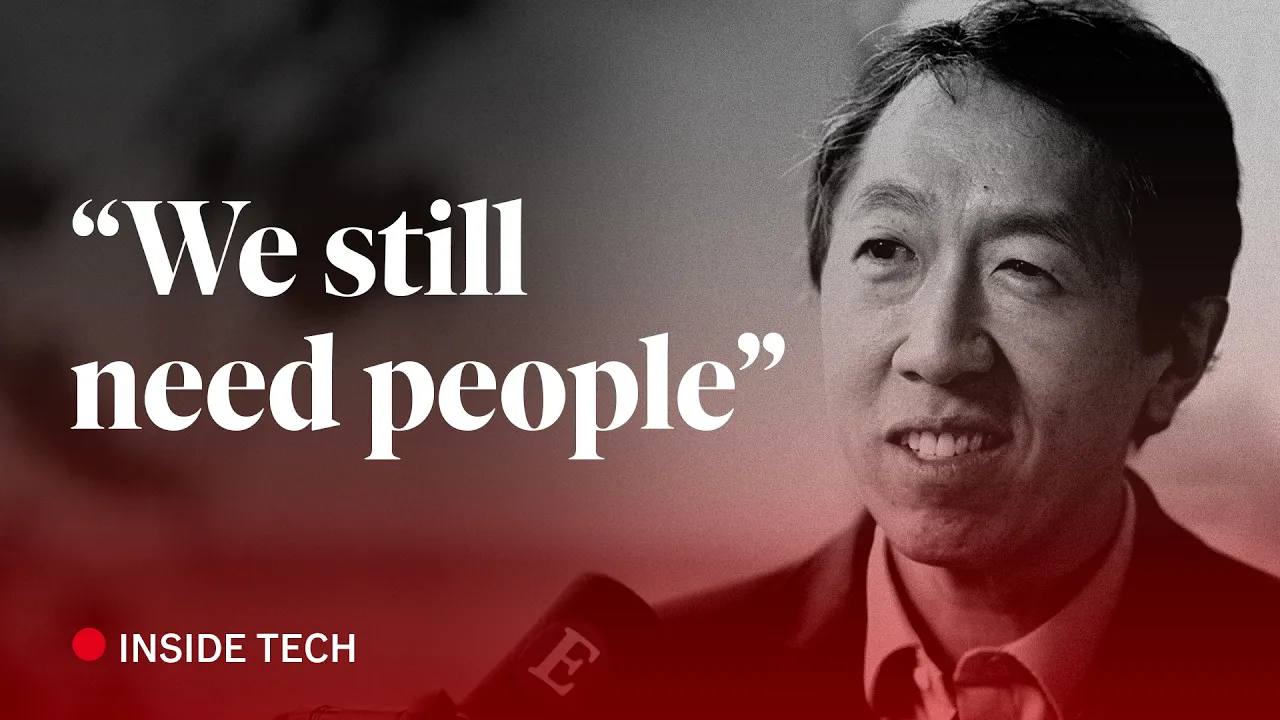
The Economist
Artificial intelligence will not cause mass unemployment because it automates discrete tasks rather than full jobs, while physical infrastructure bottlenecks slow progress and obsolete university curricula leave junior graduates unprepared.
AI-assisted summary of Will AI put millions out of work? | The Economist — original source. Check the original for full context.
Source published:
Key ideas
- Andrew Ng dismisses fears of an AI-induced jobs apocalypse, arguing that artificial intelligence automates discrete subtasks rather than entire roles, leaving overall demand for human labor intact. (0:00)
- Predictions of rapid exponential AI advancement via recursive self-improvement remain largely hype, bounded by physical constraints such as power plant construction, data center deployment, and chip manufacturing lead times. (2:02)
- Friction for entry-level workers stems from outdated university curricula rather than an outright disappearance of junior jobs, with computer science programs graduating students who have never used an AI coding agent or API. (4:54)
Detailed notes
## Background Published on YouTube by The Economist on October 14, 2026, this video features an interview between The Economist’s AI writer Alex Hern and Andrew Ng, CEO and founder of LearnVector. According to the description, Ng argues that fears of an AI jobs apocalypse are overblown because AI automates only partial tasks, progress faces real-world physical bottlenecks like data center construction, and the primary hurdle for young workers is that universities are too slow to teach the modern skills employers demand.
## TL;DR Andrew Ng dismisses catastrophic predictions of an AI employment apocalypse, arguing that artificial intelligence automates discrete subtasks rather than whole professions, which actually drives hiring demand for broader, AI-fluent roles. He clarifies that recursive self-improvement and overnight leaps to human-level versatility are overhyped, as real-world development is fundamentally constrained by slow physical realities like power grids, chip fabrication, and data center buildouts. Addressing concerns about incoming junior workers, Ng notes that entry-level demand remains strong for AI-native talent, pointing instead to outdated university computer science curricula as the real obstacle holding young graduates back.
## Atmosphere & style The exchange carries a calm, analytical, and grounded tone that cuts through Silicon Valley alarmism with sober engineering pragmatism. Alex Hern serves as a sharp, probing interlocutor who presses on pervasive industry fears regarding compounding intelligence and junior worker displacement, while Andrew Ng responds with relaxed confidence and practical clarity. The conversation feels reassuring without dismissing economic friction, pivoting the emotional register away from existential dread and toward actionable institutional challenges in power infrastructure and higher education.
## Bulletin - [00:00](https://www.youtube.com/watch?v=J-sMqnzHwI0&t=0s) Andrew Ng dismisses fears of an AI-induced jobs apocalypse, arguing that artificial intelligence automates discrete subtasks rather than entire roles, leaving overall demand for human labor intact. - [02:02](https://www.youtube.com/watch?v=J-sMqnzHwI0&t=122s) Predictions of rapid exponential AI advancement via recursive self-improvement remain largely hype, bounded by physical constraints such as power plant construction, data center deployment, and chip manufacturing lead times. - [04:54](https://www.youtube.com/watch?v=J-sMqnzHwI0&t=294s) Friction for entry-level workers stems from outdated university curricula rather than an outright disappearance of junior jobs, with computer science programs graduating students who have never used an AI coding agent or API.
## Key takeaways - [00:00](https://www.youtube.com/watch?v=J-sMqnzHwI0&t=0s) Early empirical data, even from institutions previously predicting up to 50% unemployment, shows AI is not causing catastrophic net job losses. - [00:25](https://www.youtube.com/watch?v=J-sMqnzHwI0&t=25s) Because AI automates specific subtasks rather than whole occupations, human workers remain essential for executing the remaining components of their jobs. - [00:45](https://www.youtube.com/watch?v=J-sMqnzHwI0&t=45s) The labor market is currently experiencing acute hiring shortages for software engineers as well as AI-fluent talent in sales, marketing, and operations. - [01:03](https://www.youtube.com/watch?v=J-sMqnzHwI0&t=63s) Software development serves as an indicator for the broader knowledge economy, demonstrating that worker value expands as developers transition into broader full-stack roles augmented by AI. - [01:25](https://www.youtube.com/watch?v=J-sMqnzHwI0&t=85s) Front-end engineers whose routine interface coding is automated are successfully adapting by moving into back-end architecture, mobile clients, and system security. - [02:30](https://www.youtube.com/watch?v=J-sMqnzHwI0&t=150s) Achieving human-level versatility across 100% of tasks requires multiple fundamental breakthroughs that will likely take decades or longer rather than arriving by 2030. - [02:58](https://www.youtube.com/watch?v=J-sMqnzHwI0&t=178s) Recursive self-improvement is frequently overhyped; computers have assisted in designing new computer chips for decades without triggering runaway, instant leaps. - [03:30](https://www.youtube.com/watch?v=J-sMqnzHwI0&t=210s) The pace of AI scaling is physically bound by real-world infrastructure constraints, including electrical grid capacity, power generation, data center buildouts, and empirical testing cycles. - [04:54](https://www.youtube.com/watch?v=J-sMqnzHwI0&t=294s) While Erik Brynjolfsson's early research suggested AI exposure disproportionately harmed entry-level hiring prospects, subsequent data reflects a more optimistic outlook. - [05:32](https://www.youtube.com/watch?v=J-sMqnzHwI0&t=332s) Universities are lagging industry needs by awarding computer science degrees to students who have never utilized frontier model APIs or AI coding agents. - [06:15](https://www.youtube.com/watch?v=J-sMqnzHwI0&t=375s) Employers actively recruit junior talent, high schoolers, and college interns whenever candidates possess proven proficiency with AI-native tools and workflows.
## Detailed walkthrough ### [00:00](https://www.youtube.com/watch?v=J-sMqnzHwI0&t=0s) Why There Will Be No AI Jobs Apocalypse
Andrew Ng rejects the catastrophic narratives surrounding artificial intelligence and the labor market. Addressing the fear of mass unemployment—often framed as half the population losing their livelihoods and descending into civil unrest—he insists there is simply no plausible path to such an outcome. Early empirical findings, even from institutions that previously sounded the alarm on 50% unemployment, are beginning to demonstrate that artificial intelligence is not devastating the workforce as anticipated. The fundamental reason is task composition: AI automates specific subtasks rather than entire roles, meaning human workers remain indispensable for executing the remaining responsibilities.
```mermaid flowchart LR accTitle: AI Automation Scope and Human Labor Demand accDescr: Diagram showing how AI automates specific subcomponents of a job while humans remain necessary for the remaining tasks, shifting market demand toward AI-native specialists.
subgraph JobRole["Traditional Job Role"] AutoTasks["Subtasks Automated by AI"] HumanTasks["Tasks Requiring Human Judgment & Execution"] end
JobRole --> Expansion["Upskilling & Broader Scope"] Expansion --> Market["Demand for AI-Native Talent<br>(Engineers, Sales, Marketing, Ops)"] ```
Looking at software development as a bellwether for the broader knowledge economy, Ng sees an optimistic pattern unfolding. Rather than facing widespread job cuts, employers are facing acute hiring shortages across multiple domains. Companies are struggling to secure enough software developers, and the same shortage is already emerging for AI-fluent professionals in sales, marketing, and operations. As Andrew Ng puts it:
> “And if what happens in software engineering is a predictor of what will happen in other job sectors as well, I think it'll be fantastic.”
The primary labor friction is therefore not a disappearance of roles, but the necessity of rapid upskilling. Workers must broaden their functional capabilities alongside learning AI tooling. In software, developers who previously operated strictly as front-end engineers—crafting user interfaces—find that AI handles interface coding effectively. In response, those engineers are expanding into full-stack engineering, managing back-end architecture, mobile clients, and system security while orchestrating AI systems. Far from becoming obsolete, workers who expand their scope become extraordinarily sought-after talent.
- Early data from organizations that initially warned of 50% unemployment are already showing that AI lacks the feared negative impact on net employment. - High industry demand persists for software developers, alongside a growing deficit of AI-native marketers, sales professionals, and operations staff. - Front-end developers are transitioning into full-stack engineers by combining broader responsibilities (back-end infrastructure, security, mobile) with direct AI workflow integration.
---
[02:02](https://www.youtube.com/watch?v=J-sMqnzHwI0&t=122s) Physical Bottlenecks and the Limits of AI Progress
*The Economist*’s Alex Hern presses Ng on whether his dismissal of an employment catastrophe rests on an assumption that AI capabilities will plateau. Hern notes that anxiety in the tech sector focuses not on models existing in 2026, but on where the technology might stand by 2030 or even six months out if progress compounds exponentially. Hern questions whether physical limits, architectural roadblocks, or breakdown in scaling laws will prevent models from ever mastering certain complex human tasks.
Ng clarifies that while he does not envision a hard brick wall for AI, progress will remain incremental and stretched across long horizons. While he jokes that he would happily take an extended vacation if artificial intelligence could replicate every human intellectual capability, achieving that level of general competence requires multiple fundamental breakthroughs that could take decades or longer. He firmly discounts claims that human-level versatility across 100% of tasks will occur within six months or by 2030. Addressing the widespread industry rhetoric around recursive self-improvement, Andrew Ng states:
> “And you use the term compounding progress. Um, one of the terms of hype in Silicon Valley has been um compounding progress or what recursive improvements and so on. And at least right now that's much more hype than reality.”
Ng explains that computers aiding in the creation of better computers is standard practice: prior-generation microchips have engineered newer microchips for decades, just as frontier artificial intelligence labs currently rely heavily on AI to write their own system code. However, the pacing of intelligence is governed by physical reality rather than pure algorithmic software loops. Advancing frontier capabilities demands physical infrastructure: deploying GPU server clusters, constructing dedicated electrical power plants, and conducting physical and empirical experiments. Superintelligent systems cannot escape real-world constraints, and those physical lead times represent hard, slow-moving bottlenecks.
- Achieving full parity with human intellectual tasks requires multiple novel scientific breakthroughs that may take decades or more. - Recursive self-improvement is seen largely as Silicon Valley hype; semiconductor manufacturing has utilized recursive tooling for decades without causing runaway instant leaps. - Major physical bottlenecks constraining AI advancement include electrical power grid capacity, data center construction lead times, server hardware fabrication, and empirical testing cycles.
---
[04:54](https://www.youtube.com/watch?v=J-sMqnzHwI0&t=294s) Why Universities Are Failing Young Workers
Hern shifts the conversation from macroeconomic collapse to targeted harm, specifically referencing research by Stanford economist Erik Brynjolfsson. Brynjolfsson's work suggests that higher exposure to AI within an industry correlates with worse employment prospects for incoming junior talent. With routine junior tasks like basic coding being handed off to software agents, entry-level candidates without an established track record risk being locked out of the classic apprenticeship path.
Ng notes that Brynjolfsson has since gathered newer data pointing to a more favorable outlook, while identifying the true problem: traditional higher education is failing to evolve at the speed of modern industry. Universities continue to graduate computer science majors who have never integrated a frontier model API or used an AI coding agent, leaving them unprepared for modern engineering positions. Describing the hiring standards of his own organizations, Andrew Ng makes clear:
> “And today I'm not going to hire a software engineer that's never done that. Um it's still possible to get a bachelor's degree in computer science in some universities without using a AI coding agent. And frankly none of my teams will hire a software engineer that doesn't know how to use a AI coding agent.”
Ng emphasizes that junior talent remains valuable when properly prepared. During the recent summer, his teams hired cohorts of high schoolers, university students, and recent graduates who completed significant work. The differentiator was that every intern hired was already AI-native, utilizing state-of-the-art tools and coding agents to execute tasks. The root challenge facing entry-level workers is not a structural elimination of junior positions, but an outdated university curriculum that fails to equip students with contemporary developer workflows.
- Erik Brynjolfsson’s research on AI-exposed sectors raised alarms about junior job prospects, though more recent data indicates a more positive trajectory. - Major universities still grant computer science degrees to students who have never executed an API call to a frontier model or used AI coding agents. - Organizations are actively hiring early-career workers, high schoolers, and college interns, provided they are proficient in AI-native tools and methods.
## Notable quotes > [04:54](https://www.youtube.com/watch?v=J-sMqnzHwI0&t=294s) And frankly none of my teams will hire a software engineer that doesn't know how to use a AI coding agent. — Andrew Ng
## Mentioned Alex Hern, Andrew Ng, Erik Brynjolfsson, LearnVector, Silicon Valley, Stanford University, The Economist
## Video description Will AI put millions of people out of work? Andrew Ng, CEO and founder of LearnVector, argues the fears are overblown. He tells Alex Hern, The Economist’s AI writer, that AI automates only part of most jobs, that its progress will be slowed by physical bottlenecks like building data centres and that the real problem for young workers is universities are too slow to teach the skills employers want now.
#ai #jobs #datacentres #artificialintelligence #technology
00:00 - Why there will be no AI jobs apocalypse 01:03 - How AI is reshaping software engineering 02:02 - Is there a limit to AI progress? 04:54 - Are universities failing young workers?
Watch the full show: http://bit.ly/4ety1EO Sign up to the Insider newsletter: https://econ.st/4nOyzIb
Subscribe to The Economist: https://www.economist.com/subscribe Download our app: https://www.economist.com/get-the-app
Follow The Economist on Instagram: https://www.instagram.com/theeconomist/ Follow The Economist on Facebook: https://www.facebook.com/TheEconomist Follow The Economist on X: https://x.com/TheEconomist
[Source](https://www.youtube.com/watch?v=J-sMqnzHwI0)