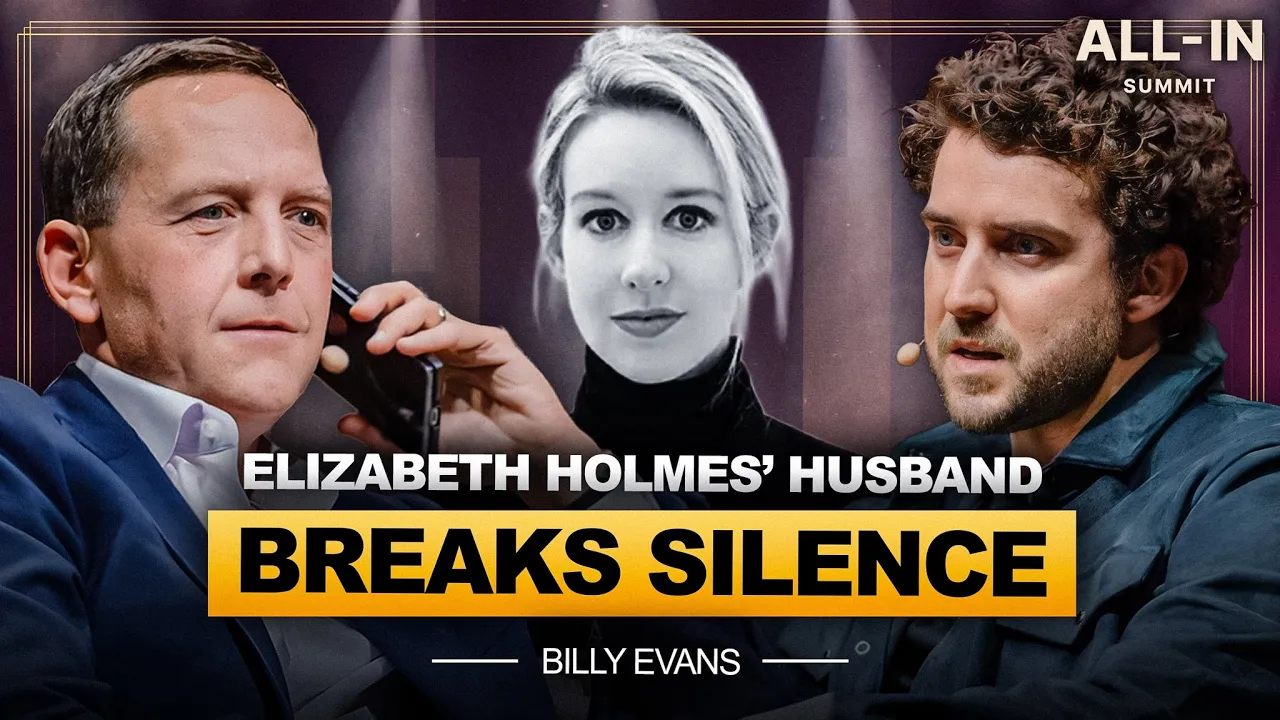
Billy Evans Defends Elizabeth Holmes in First Interview
All-In Podcast
Elizabeth Holmes followed strict legal advice to remain silent during her trial, which Billy Evans identifies as the strategic error that allowed a hostile public narrative to define her case.
Billy Evans, husband of Elizabeth Holmes, publicly defended her in an extended interview, asserting she remains fully convinced of her innocence and was acquitted on all counts regarding patient harm. (19:24)
Holmes's 135-month sentence was significantly lengthened by sentencing guideline enhancements based on total investor loss amounts and victim counts from the conspiracy charge, involving ultra-wealthy dynasties like the Waltons and DeVoses. (37:37)
Under First Step Act credits—earning 16 days off per 30 days of qualifying programming—Holmes could become eligible for halfway house placement by Q2 of the following year, despite having 70% of commissary deposits garnished toward a $435 million restitution order. (35:47)
Evans rejected claims that his diagnostics startup Hemanthes is 'Theranos 2.0,' explaining that the company miniaturizes Raman spectroscopy optical sensors using physics and AI rather than biochemical assays. (39:12)
Detailed notes
## Background
Published on YouTube by the All-In Podcast on October 15, 2026, this video features co-host David Friedberg sitting down with Billy Evans, the husband and partner of Theranos founder Elizabeth Holmes. According to the description, the conversation covers how the couple met, the reality of the trial versus media headlines, life inside federal prison, their participation in an unscripted documentary with Nathan Fielder, and Evans's new diagnostics startup.
## TL;DR
In his first public interview, Billy Evans pushes back against dominant media portrayals of Elizabeth Holmes, detailing their courtship, their eight months living in an off-road RV under public scrutiny, and the grueling daily routine of managing trial discovery with newborn children. Evans breaks down the federal verdict, emphasizing that Holmes was acquitted of all patient-harm counts and convicted exclusively on investor wire fraud, while characterizing her adherence to court directives to avoid public defense as a critical strategic miscalculation. He reflects on her daily life at Federal Prison Camp Bryan, the logistics of her $435 million restitution order, and her potential transition to a halfway house under the First Step Act. Finally, Evans explains why they agreed to let Nathan Fielder film their family life and dismisses claims that his Raman spectroscopy startup, Hemanthes, represents a 'Theranos 2.0.'
## Atmosphere & style
The interview is intimate, tense, and emotionally weighty, grounded by Evans's quiet nervousness and deep personal loyalty to Holmes. The atmosphere shifts sharply from analytical legal discourse to startling reality when Evans receives a live collect call from Holmes inside federal prison, quietly reminding her of prison rules while shielding the conversation from stage speakers. Throughout the talk, a somber, protective tone persists as Evans contrasts the public caricature of a calculated fraudster with his daily reality of raising two toddlers and navigating the agonizing logistics of incarceration.
## Bulletin
- [19:24](https://www.youtube.com/watch?v=2tAywoHiIpo&t=1164s) Billy Evans, husband of Elizabeth Holmes, publicly defended her in an extended interview, asserting she remains fully convinced of her innocence and was acquitted on all counts regarding patient harm.
- [37:37](https://www.youtube.com/watch?v=2tAywoHiIpo&t=2257s) Holmes's 135-month sentence was significantly lengthened by sentencing guideline enhancements based on total investor loss amounts and victim counts from the conspiracy charge, involving ultra-wealthy dynasties like the Waltons and DeVoses.
- [35:47](https://www.youtube.com/watch?v=2tAywoHiIpo&t=2147s) Under First Step Act credits—earning 16 days off per 30 days of qualifying programming—Holmes could become eligible for halfway house placement by Q2 of the following year, despite having 70% of commissary deposits garnished toward a $435 million restitution order.
- [39:12](https://www.youtube.com/watch?v=2tAywoHiIpo&t=2352s) Evans rejected claims that his diagnostics startup Hemanthes is 'Theranos 2.0,' explaining that the company miniaturizes Raman spectroscopy optical sensors using physics and AI rather than biochemical assays.
## Key takeaways
- [03:38](https://www.youtube.com/watch?v=2tAywoHiIpo&t=218s) Evans and Holmes met by chance on a San Francisco rooftop during Fleet Week in October 2017, prior to her federal indictment, and developed a six-month friendship before dating.
- [07:00](https://www.youtube.com/watch?v=2tAywoHiIpo&t=420s) Federal prosecutors indicted Holmes roughly three weeks after she and Evans officially began dating, initiating a years-long legal crisis.
- [11:16](https://www.youtube.com/watch?v=2tAywoHiIpo&t=676s) To escape aggressive media attention in San Francisco while conducting document discovery, the couple spent eight months living in an off-road RV across national parks.
- [13:20](https://www.youtube.com/watch?v=2tAywoHiIpo&t=800s) Evans contends Theranos missed revenue targets not due to fabricated projections, but because Walgreens breached and halted its ~800-store rollout following negative press coverage.
- [18:15](https://www.youtube.com/watch?v=2tAywoHiIpo&t=1095s) Holmes gave birth to two children before serving her sentence, facing a grueling trial schedule that involved pumping breast milk in cars and during brief court recesses.
- [19:24](https://www.youtube.com/watch?v=2tAywoHiIpo&t=1164s) Theranos processed approximately 12.5 million blood tests over 18 months; the jury acquitted Holmes on all patient-fraud counts, convicting her exclusively on investor-related wire fraud and conspiracy charges.
- [21:46](https://www.youtube.com/watch?v=2tAywoHiIpo&t=1306s) Evans believes Holmes's strict compliance with the judge's instruction to litigate only inside the courtroom—remaining silent publicly for years—was her single biggest strategic mistake.
- [25:49](https://www.youtube.com/watch?v=2tAywoHiIpo&t=1549s) Federal Bureau of Prisons regulations strictly prohibit broadcasting inmate phone calls, which prevented Evans from putting an unexpected live call from Holmes on speakerphone.
- [27:30](https://www.youtube.com/watch?v=2tAywoHiIpo&t=1650s) Holmes is serving her time at the Federal Prison Camp in Bryan, Texas, alongside roughly 800 women, where very few inmates receive regular weekend visitation.
- [31:35](https://www.youtube.com/watch?v=2tAywoHiIpo&t=1895s) A documentary project directed by Nathan Fielder and Lance Oppenheim was shot over three years to capture Holmes's domestic reality before prison, though initial promotional cuts retained a dramatic, sensational tone.
- [35:47](https://www.youtube.com/watch?v=2tAywoHiIpo&t=2147s) The First Step Act allows Holmes to earn 16 days off per 30 days of programming, which Evans expects may allow her to transition to a halfway house by Q2 of next year.
- [35:47](https://www.youtube.com/watch?v=2tAywoHiIpo&t=2147s) The Bureau of Prisons automatically garnishes 70% of commissary deposits to satisfy Holmes's $435 million restitution order, the majority of which is owed to Theranos's top institutional investors.
- [39:12](https://www.youtube.com/watch?v=2tAywoHiIpo&t=2352s) Evans's diagnostics company, Hemanthes, relies on Raman spectroscopy and miniaturized photonics hardware to capture chemical bond signatures for AI models, differing fundamentally from Theranos's biochemical approach.
## Detailed walkthrough
### [00:00](https://www.youtube.com/watch?v=2tAywoHiIpo&t=0s) Billy Evans Joins Friedberg on Stage
The conversation opens with an introductory reel highlighting the unconventional relationship between Elizabeth Holmes—the founder of the collapsed blood-testing startup Theranos who was sentenced to 11.25 years in federal prison on four counts of criminal fraud—and her partner, Billy Evans. The reel references an upcoming documentary, *You Can See Everything*, promising an unprecedented look into Holmes’s life. David Friedberg then invites Billy Evans onto the stage. Evans walks out to a large audience, visibly modest and slightly nervous, remarking that he has never participated in an interview of any kind before and thanking the crowd for serving as his “guinea pigs.”
```mermaid
flowchart TD
accTitle: Billy Evans and Elizabeth Holmes Connection
accDescr: Timeline of Billy Evans and Elizabeth Holmes meeting, developing a relationship, and facing the federal indictment.
subgraph Meeting ["Initial Meeting (Oct 2017)"]
A["Fleet Week Rooftop Party"] --> B["3-Hour Conversation"]
B --> C["Realizes Neighboring Offices on Page Mill Rd"]
end
subgraph Friendship ["Friendship & Courtship"]
C --> D["Dog Walks for 6 Months"]
D --> E["Crossed-Out Business Card: Personal Cell"]
E --> F["Romantic Relationship Begins"]
end
subgraph LegalCrisis ["Federal Action"]
F --> G["Indicted ~3 Weeks Later (June 2018)"]
G --> H["Strict Gag Order Imposed Through Appeals"]
end
```
When Friedberg introduces him directly as Elizabeth Holmes's husband, Evans gently pushes back on the label, noting: “That’s typically not how I love to be introduced. Um yeah, my name's Billy Evans and yes, Elizabeth Holmes is my wife and best friend and partner.” Friedberg recounts how the two crossed paths about a year and a half prior around an F1 event. Evans had approached Friedberg directly, saying that the *All-In Podcast* hosts discussed his wife constantly and fundamentally misunderstood large parts of the story, offering to walk Friedberg through the reality if he was open to it.
- Friedberg took him up on the offer after initial phone conversations and flew out to the federal prison camp in Bryan, Texas.
- During that visit, Friedberg spent a full day with Holmes, Evans, Holmes's parents, and their children, realizing there was substantial depth to the situation that had never made it to the public domain.
- Friedberg notes that while rumors of the upcoming Nathan Fielder documentary were circulating in Hollywood, the project had been kept tightly under wraps until recently.
- Evans explains that Holmes remained completely silent throughout the entire legal ordeal because she adhered strictly to the judicial instructions, pointing out: “Elizabeth follows rules maniacally, like to a T. So when the judge said that we are going to litigate this court in the courtroom and not in the media, she held true to that.”
- The gag order covered the DOJ investigation, the trial, and the entire appeals process, only concluding the previous April, during which time books, podcasts, and films were produced without any public defense from Holmes.
---
[03:38](https://www.youtube.com/watch?v=2tAywoHiIpo&t=218s) Meeting at Fleet Week and Seeing Past the Headlines
Evans details how he and Holmes met on October 7, 2017, on the rooftop of a venture capitalist’s home during Fleet Week in San Francisco. The host was concurrently trying to hire Evans and take Holmes on a date. Evans had initially planned to stop by for five minutes; he was living in a shared house with four roommates and hosting a hundred guests later that afternoon. After running out to pick up ice, the host called to ask if he was stopping by, leading Evans to park his car in a red zone, ride up the elevator, and get introduced to Holmes. That brief stop turned into a two-and-a-half to three-hour unbroken conversation.
Evans explains that when they met, he had no idea she was the notorious Theranos founder. She was dressed in a large floppy hat and dark sunglasses, with a bandage across her face from a scratch by her husky puppy. Evans was immediately struck by her presence, describing her as possessing a genuine curiosity and an exceptional ability to make a conversational partner feel seen. As Blue Angels planes roared overhead, she watched them with childlike amazement. It was only halfway through the conversation—when discussing where their offices were located on Page Mill Road in Palo Alto, with Evans working at 1891 and Holmes at 1790, two doors down—that Evans pieced together who she was.
- By October 2017, the John Carreyrou reporting in *The Wall Street Journal* had generated intense negative coverage, cementing Holmes’s public reputation as a massive fraudster before any indictment had formally landed.
- Evans admits it was difficult to reconcile the demonized public caricature with the attentive, earnest woman standing directly in front of him: “I think I was most curious to understand the difference between the person that I experienced and the person that I told existed, was told like existed. And they were so different.”
- After the rooftop meeting, the interaction initially stayed within a business context; Evans's growing employer was looking into leasing space inside Theranos’s headquarters.
- Holmes handed Evans her business card with the office line crossed out and her personal cell phone written in, prompting Evans to realize there might be personal interest.
---
[07:00](https://www.youtube.com/watch?v=2tAywoHiIpo&t=420s) Friendship, Courtship, and the Shock of the Indictment
Rather than diving straight into romance, Evans and Holmes spent about six months building a friendship centered on casual outdoor walks. Evans, who had falsely claimed to own a dog to match Holmes's husky, regularly borrowed his roommate’s dog to accompany her. Evans describes how intoxicating her focused attention felt, yet he remained deeply curious about the massive delta between the public reporting and her genuine character.
At the time, Evans was leading special projects at a startup developing LiDAR technology for global automotive manufacturers. His role involved tackling whatever problems the chief executive needed addressed—handling sales relationships with major global auto manufacturers, hiring executives, and assisting with fundraising rounds. This required heavy international travel, including around a dozen trips to Germany that year alone. Despite his busy schedule, the friendship pivoted quickly into an intense romance once they decided to date. However, roughly three weeks after they officially began their relationship, federal prosecutors handed down the criminal indictment. Evans recalls being completely unequipped for the legal storm, admitting: “I didn't even know what an indictment was, okay? Like, I I was really unfamiliar with the entirety of this whole.” This plunged the nascent couple into a period of acute crisis that defined the earliest stages of their life together.
[08:56](https://www.youtube.com/watch?v=2tAywoHiIpo&t=536s) Mindset Before the Indictment and the Onset of Legal Reality
Billy Evans recalls Elizabeth Holmes being “cool as a cucumber” even as negative press steadily mounted in the lead-up to her indictment. Evans explains that Holmes genuinely believed in her absolute innocence, reinforced by advisors who told her that she would never be indicted because neither she nor Theranos had done anything wrong. Despite the outside world finding that conviction difficult to understand, behind the scenes they were perpetually surprised as one negative development followed another.
The evening Holmes was indicted was also the very night Evans met her parents for the first time. Evans was only 26 or 27 years old, roughly three weeks into dating Holmes after six months of friendship, and he admits that had he anticipated how painful the process would become, he might have handled it differently. Holmes actively avoided reading the press, and Evans largely steered clear of media coverage as well, having only skimmed John Carreyrou’s *Bad Blood* on the advice of his lawyers and watched roughly an episode and a half of *The Dropout*.
- “I can share with you kind of the perspective that I saw, which is this is somebody that fundamentally believes in their innocence.” — Billy Evans
---
[11:16](https://www.youtube.com/watch?v=2tAywoHiIpo&t=676s) Life Under Scrutiny and Eight Months in an Off-Road RV
Before the trial began, Holmes and Evans lived through an extended, grueling period dominated by legal preparations. Holmes spent late nights reviewing hundreds of thousands of documents with attorneys to assemble a defense against a narrative she felt was entirely disconnected from reality. To escape the intense media attention in San Francisco, where going into a restaurant meant crowds immediately pulled out smartphones to photograph them, the couple bought an off-road RV and spent eight months traveling the country with their Siberian husky, Balto.
```mermaid
flowchart TD
accTitle: Pressures and Escape Leading to Trial
accDescr: The cycle of intense public scrutiny, legal discovery work, and off-grid retreat in an RV before the trial.
subgraph Scrutiny["Public & Legal Pressure"]
A["Document Discovery<br/>(Late nights, 100k+ records)"]
B["San Francisco Media Pressure<br/>(Diners filming, constant paparazzi)"]
end
subgraph Escape["Off-Grid Travel"]
C["Off-Road RV Travel<br/>(8 months across country)"]
D["National Forests & Trailer Parks<br/>(14-day limit off-grid camping)"]
end
A --> C
B --> C
C --> D
```
During this road trip, Evans worked remotely on a new business while they stayed in trailer parks and dispersed campsites in national forests, where stays were capped at 14 days without moving the vehicle. Evans noted that any public appearance in the city was quickly recast by reporters into stories about Holmes “gallivanting around San Francisco.”
- “It’s hard to know how to act when every action that you take and every decision that you make and every place that you go is being judged through the eyes of a thousand angry journalists.” — Billy Evans
---
[13:20](https://www.youtube.com/watch?v=2tAywoHiIpo&t=800s) Public Perception, the Turtleneck Persona, and the Walgreens Contract
Evans addresses the media depictions of Holmes as a manipulative figure who duped investors with her deep voice, wide blue eyes, and signature black turtleneck. He dismisses these portrayals as fundamentally sexist double standards that would never be applied to male founders who close massive venture deals off deep conviction. Evans notes that Theranos was not the product of a single person's imagination, but rather the collective work of hundreds of engineers and employees over a span of 16 years.
```mermaid
flowchart LR
accTitle: Revenue Obligation vs Fraud Allegation Flow
accDescr: How Theranos contracted with Walgreens and how bad press triggered default and revenue shortfalls.
A["Walgreens Contract<br/>(~800 stores, ~$1M/store)"] --> B["Projected Revenue Targets"]
C["Carreyrou Article & Negative Press"] --> D["Walgreens Halts Rollout / Defaults"]
D --> E["Missed Revenue Targets<br/>(Prosecution frames as fraud)"]
B -.-> E
```
Addressing specific allegations of fraud, such as Theranos missing its projected revenue numbers, Evans argues that these figures were grounded in binding contractual agreements rather than fabricated projections. Theranos had executed a contract covering roughly 800 Walgreens locations, estimated at roughly $1 million per store. When the first investigative articles broke, Walgreens stopped moving forward and defaulted on its contractual obligations, directly causing Theranos to miss its revenue benchmarks.
- “And when it’s Liz, it’s, ‘Wow, she fleeced that person 45 minutes.’” — Billy Evans
---
[16:36](https://www.youtube.com/watch?v=2tAywoHiIpo&t=996s) Children and the Harsh Reality of Trial Preparation
The onset of the trial was delayed significantly due to the COVID-19 pandemic, resulting in a surreal courtroom setting with mandatory masks. During this extended waiting period, Holmes became pregnant. Evans rejects public cynics who claimed having children was a calculated maneuver to evoke sympathy from the jury, stating that their first child, Wills, was not a planned public-relations tactic, and that the jury was not even made aware of her pregnancy or home life.
Holmes went to great lengths to avoid showing any signs of vulnerability in the courtroom. Evans describes the brutal reality of their trial routine: waking up at 4:30 AM every morning to feed the baby, managing childcare, and preparing Holmes to head straight into the high-stakes courtroom environment each day. Today, they have two children together—a son who is five and a daughter who is three.
- “Elizabeth was militant about not letting people see her in like a place of weakness at this time.” — Billy Evans
Billy Evans recalls the grueling morning routine during Elizabeth Holmes's federal criminal trial, which began when their firstborn son was only three months old. Evans would wake up early, change and feed the infant, and put him back down so Elizabeth could begin getting ready. Because Elizabeth struggled with styling her own hair, Evans bought a Dyson Airwrap, studied tutorials on YouTube, and styled it for her before every court appearance. Once ready, they would pile into a car with their family—typically Elizabeth’s mother, Evans, occasionally his own mother, and close friends—driving off to what Evans describes as an environment that felt like going to war.
The logistics of caring for a newborn while on trial created immense physical and emotional friction. Throughout the morning commute, Elizabeth used mobile breast pumps in the car to express milk for their son. She purposely purchased a discreet diaper bag designed to avoid looking like one so critics and press photographers would not find grounds to scrutinize her. During courtroom recesses, Elizabeth would rush to the restroom to pump again. Evans gathered the bottled breast milk during the lunch break and sent it back to their residence via Uber, where Elizabeth's or Evans's mother would bottle-feed the baby. Evans reflects that spending those initial months away from their child without being able to hold him constantly was emotionally crushing. Despite the overwhelming strain, Evans emphasizes that both of them were completely confident about their legal prospects: when asked whether they anticipated winning the case, Evans replies, “100%.”
[19:24](https://www.youtube.com/watch?v=2tAywoHiIpo&t=1164s) The Verdict Breakdown: Acquitted on Patient Fraud, Convicted on Investor Fraud
Addressing public misconceptions about the outcome of the trial, Evans details how the thirteen-count indictment actually unfolded before the jury. Over an eighteen-month commercial operating window, Theranos ran approximately 12.5 million blood tests on patients and was rapidly expanding toward becoming the third-largest diagnostic laboratory in the United States behind Quest Diagnostics and LabCorp. Following years of federal investigation, prosecutors presented only four specific patient cases to allege that Holmes intentionally defrauded patients with inaccurate results. The jury acquitted Holmes on every single patient-fraud count, finding no convincing evidence of criminal intent to harm or deceive patients. Evans argues that clinical diagnostics is an inherently imperfect field—where accuracy rates of 70% to 90% are standard for many assays—meaning that four disputed tests out of 12.5 million lacked statistical significance to establish systemic fraud.
Instead, the criminal conviction rested entirely on financial fraud involving capital investments. The jury found Holmes guilty on three counts of wire fraud involving three specific investors, alongside a single count of conspiracy to commit wire fraud with her former romantic and business partner, Ramesh "Sunny" Balwani. That conspiracy conviction, combined with the post-trial inclusion of media mogul Rupert Murdoch as an investor victim, dramatically altered the sentencing calculation, providing the legal foundation for the federal judge to impose severe sentencing enhancements.
```mermaid
flowchart TD
accTitle: Structure of the Theranos Indictment and Verdict
accDescr: Breakdown of the 13 criminal counts against Elizabeth Holmes showing patient fraud acquittals versus investor fraud convictions.
subgraph Indictment["13 Total Criminal Counts"]
PF["Patient Fraud Allegations<br/>(4 Patient Counts)"]
IF["Investor Fraud Allegations<br/>(9 Counts)"]
end
subgraph Verdict["Jury Verdict"]
PF -->|"Acquitted on all patient charges"| ACQ["Not Guilty<br/>No criminal patient harm"]
IF -->|"Found guilty on 3 counts"| CONV["Guilty: 3 Investor Counts"]
IF -->|"Found guilty on 1 count"| CONSP["Guilty: 1 Conspiracy Count<br/>(with Sunny Balwani)"]
end
subgraph Sentencing["Sentencing Impact"]
CONV --> SEN["135-Month Federal Sentence<br/>(11.25 Years)"]
CONSP --> SEN
MUR["Post-trial victim loss addition<br/>(Rupert Murdoch)"] --> SEN
end
```
- Total patient blood tests performed by Theranos: approximately 12.5 million over 18 months.
- Patient-related counts: 4 brought to trial, resulting in 0 convictions.
- Investor convictions: 3 wire fraud counts tied to specific investors, plus 1 count of conspiracy.
- Total sentence handed down: 135 months (11 years and 3 months) in federal prison.
[21:46](https://www.youtube.com/watch?v=2tAywoHiIpo&t=1306s) The 135-Month Sentence and the Decision to Stay Silent
Evans explains that the federal sentencing guidelines rely on a strict point system determined by aggravating factors, the largest driver being calculated financial loss. Holmes was sentenced to 135 months in federal prison, a penalty Evans and Holmes continue to contest. Evans affirms that they both deeply believe in her complete innocence regarding the investor wire fraud charges. He reveals that they are preparing to release extensive material within weeks to re-examine the case, asking the public to look at the evidence objectively: “I’m not telling you what to think, but I’m asking you to spend the time to look at it and to think honestly about what it means.”
When David Friedberg questions why Holmes chose not to push back publicly against the dominant narrative established by investigative journalist John Carreyrou’s book *Bad Blood*, Evans clarifies the legal constraints they faced. Although not an official gag order, the presiding judge admonished the trial teams from the outset that the dispute had to be contested strictly inside the courtroom rather than litigated through the media. Evans views Holmes's compliance with that directive as a catastrophic strategic error. As Evans puts it, “Technically what the judge said to the trial team, you know, in pre-trial hearings like in the very beginning is that this is a case that's going to play out in the courtroom and not in the press. And I think that was the single biggest mistake that Elizabeth has ever made, to be like really clear. I mean, maybe Sunny’s number one, but it’s it’s up there.”
Evans attributes Holmes’s decision to follow the court's instructions to her deep-seated idealism and family background. Both of her parents spent their careers in public service—her mother worked on Capitol Hill alongside Congressman Charlie Wilson, while her father worked with the EPA and USAID managing international clean water initiatives. Her parents lived with Evans and Holmes throughout the entirety of the criminal trial and continue to assist Evans in raising the children. Evans notes that family dinner discussions were centered on alleviating human suffering, instilling in Holmes a rigid faith in established institutions and rules that left her defenseless in the court of public opinion.
[25:49](https://www.youtube.com/watch?v=2tAywoHiIpo&t=1549s) The Persona Questions and an Unexpected Call from Federal Prison
Friedberg asks Evans about the signature aspects of Holmes's public image that drew intense media mockery: her daily uniform of a black turtleneck and her noticeably low vocal register. Friedberg notes that having met her, the caricature presented by the press does not quite match reality, and asks whether she adopted this persona as a young female chief executive trying to project authority and command boardrooms. Evans acknowledges that while Elizabeth naturally has a deep voice, the subject of her early CEO persona is complex, heavy, and ultimately her own story to tell.
Before Evans can elaborate, his mobile phone begins ringing on stage. Evans realizes it is an incoming call from Holmes placing an unprompted collect call from federal prison. When Friedberg asks whether Evans can put the call on speakerphone so the audience can hear, Evans immediately declines, explaining that federal Bureau of Prisons (BOP) regulations strictly prohibit broadcasting inmate phone calls. Violating this rule would result in severe disciplinary retaliation against Holmes, specifically being sent to the Special Housing Unit (SHU)—solitary confinement. Evans answers the receiver, reassuring Holmes that she is not on speakerphone, and informs her that he is on stage before passing the handset to Friedberg so he can exchange a quick greeting. Evans says:
> “Hey baby... I'm on stage right now in front of a bunch of people... Can Dave say hi? You're not on speakerphone or anything. Don't worry. Yeah, but I love you with my whole heart. Here's Dave.”
[27:30](https://www.youtube.com/watch?v=2tAywoHiIpo&t=1650s) Life with a Partner Incarcerated: Bryan Federal Prison Camp
Billy Evans finishes speaking on the phone with Elizabeth Holmes in front of the audience, saying goodbye before diving into the personal toll her sentence has taken on his family. Elizabeth is serving her sentence at Federal Prison Camp, Bryan, located in College Station, Texas (home to Texas A&M University), alongside roughly 800 other incarcerated women. Evans pushes back hard against the common misconception that minimum-security federal prison camps are easy:
> "It's a camp which everybody says is like super easy. Let me tell you it is not."
Evans notes that Elizabeth has been in prison for 1,205 days, describing every single day as deeply painful. At the same time, he recognizes he is not alone in his grief, observing that 130 million Americans have an incarcerated family member given the nation's sky-high incarceration rates. Nonetheless, raising young children while separated from your partner is extraordinarily difficult. Evans explains that he has developed a deep newfound respect for single mothers who work while raising families on their own, and laments that his children are spending far more time with him than with the woman he considers his soulmate:
> "I knew I wanted to marry Liz or like have her be my soulmate when I really genuinely knew that I wanted my kids to be more like her than they were like me."
- Federal Prison Camp, Bryan holds roughly 800 women in College Station, Texas.
- Elizabeth Holmes had been incarcerated there for 1,205 days at the time of filming.
- Approximately 130 million Americans have had a family member incarcerated.
---
[29:24](https://www.youtube.com/watch?v=2tAywoHiIpo&t=1764s) Raising Two Children and the Day Elizabeth Surrendered
Evans describes the challenge of explaining prison to their two young children—a five-year-old son and a three-year-old daughter. When Holmes first reported to prison, their son was only 22 months old, so they initially explained it simply by saying it was “mommy's work.” As the children have grown, Evans maintains a strict rule: whenever they ask questions, they receive the honest truth, regardless of how uncomfortable or complicated the topic may be. Evans balances running a business, raising two toddlers, and attempting to secure his wife's release.
Evans recounts the day Holmes surrendered to Bryan. They intentionally left the children behind to spare them the trauma. A friend paid for a private plane to fly them to Austin, Texas, where they stayed the night and shot footage with filmmakers Nathan Fielder and Lance Oppenheim. Evans remarks on how woefully unhelpful prison consultants were; they charged fees while dispensing inaccurate information, such as assuring Holmes she could bring her own New Balance sneakers, which prison officials immediately disallowed upon arrival.
Evans drove her up to the facility, parked in one of the three spots right in front, and walked her to the doors as she wore the ill-fated New Balances and a sweater gifted by a friend. Hugging her and telling her he loved her more than anything, Holmes turned to him with a striking final remark:
> "And I just hugged her and I said I love you more than everything. And she looked at me and she said, 'Now we are free.'"
---
[31:35](https://www.youtube.com/watch?v=2tAywoHiIpo&t=1895s) The Nathan Fielder Documentary: Trying to Humanize Holmes
Friedberg shifts to the upcoming documentary project directed by Nathan Fielder and Lance Oppenheim. Evans admits he has not seen the final cut himself and that the project, originally slated to wrap within a year, has been in progress for three years. The documentary was conceived because Holmes was facing an 11-year prison sentence and had been barred from speaking publicly about her trial. Given the entrenched media narrative painting her as a villain, the intent of filming their real, unscripted domestic life—just after she gave birth to daughter Ivy via IVF and was two months away from prison—was to give viewers an unfiltered look:
> "The whole idea was here she is. See her and make up your own mind as a person."
Evans explains that whenever friends or family—including his beloved grandmother and closest friends—initially discovered he was dating and having children with Holmes, they reacted with disbelief and warned him he was crazy. Yet, without fail, whenever those same skeptics spent real time with her on a hike or seeing her help a friend, their opinions shifted dramatically:
> "And every single one of those people's opinions of her would radically shift. And it wasn't because she convinced them of like something related to Theranos or some like specific detail."
The documentary aimed to scale that personal experience to the public. However, Friedberg points out that the released teaser trailer portrays her in an alarming, erratic light with dramatic music that reinforces the narrative of a manipulative narcissist. Evans admits she looks intense in the trailer, but notes he has endured so many surreal ordeals that his blood pressure barely rises anymore, accepting that participating in the project was their own choice.
```mermaid
flowchart TD
accTitle: Motivations Behind the Nathan Fielder Documentary
accDescr: Diagram illustrating the inputs, purpose, and final perception gap surrounding the Elizabeth Holmes documentary project.
subgraph Circumstances["The Predicament"]
A["11-Year Sentence Handed Down"]
B["Court Gags Prevent Case Discussion"]
C["Media Narrative Rigidly Ossified"]
end
subgraph Objective["Intent of the Film"]
D["Capture Intimate Family Reality<br/>(Post-IVF, Newborn Daughter Ivy)"]
E["Scale Personal Exposure:<br/>Let Viewers Meet the Real Liz"]
end
subgraph Outcome["Public Reception"]
F["3-Year Production Delay"]
G["Sensational Trailer Reinforces<br/>'Manipulative' Caricature"]
end
[35:47](https://www.youtube.com/watch?v=2tAywoHiIpo&t=2147s) Prison Calculations, the First Step Act, and $435M Restitution
Evans outlines the confusing bureaucratic math governing federal prison release schedules. A federal sentence is divided across distinct custody phases: time served inside the physical prison facility, placement in a halfway house, and home confinement. Evans praises the First Step Act, passed during Donald Trump's presidential administration, calling it an incredible piece of legislation for incarcerated families. Under its recidivism-reduction provisions, eligible inmates can earn time credits toward early release:
> "So, she can earn 16 days off of her sentence for every 30 days that she's there if she's doing programming."
Because of these earned credits, Evans expects Holmes could potentially transition from prison camp to a halfway house by the second quarter of the following year.
Friedberg then raises the financial reality of her incarceration, noting that any money sent to Holmes's prison commissary account is heavily garnished. Evans confirms that 70% of deposited funds are automatically seized by the Bureau of Prisons to satisfy her staggering $435 million restitution order. Evans notes that this restitution amount is dominated by claims from a small cluster of Theranos's top 10 investors:
- The First Step Act allows Holmes to earn 16 days off her sentence for every 30 days of qualifying programming.
- She is projected to become eligible for halfway house placement in Q2 of next year.
- The Bureau of Prisons garnishes 70% of all commissary deposits.
- Total court-ordered restitution stands at $435 million, primarily allocated to Theranos's 10 largest financial investors.
[37:37](https://www.youtube.com/watch?v=2tAywoHiIpo&t=2257s) Sentencing Calculations, Investor Loss, and Prison Realities
The conversation examines how Elizabeth Holmes’s prison sentence expanded significantly due to how the prosecution framed loss amounts. Billy Evans explains that originally, her sentence would have been roughly four and a half to five years, but the inclusion of investors whose claims were tied to the broader conspiracy charge—investors she was never individually convicted of defrauding—increased her term to eleven years. This enhancement was triggered by two sentencing guideline factors: dramatically increasing the calculated loss amount and categorizing the offense as a fraud involving ten or more victims. Evans notes that during a recent sentence reduction proceeding that shaved one year off her term under updated federal sentencing guidelines, “even the government argued that there was no evidence that any of the investors who lost money faced any financial hardship from this.” He points out that the affected backers were ultra-wealthy dynasties like the DeVos family, the Waltons, and the Niarchos family.
Turning to the daily realities of visitation inside the federal prison camp, the speakers discuss the somber environment and the toll incarceration takes on families. Brad Friedberg shares his own experience visiting the facility, remarking on the strict commissary limitations and how he spent all his cash buying vending machine trail mix just to sit and eat together with Elizabeth, whom Evans affectionately compares to a squirrel for her eating habits. Evans reflects on the broader human tragedy among the incarcerated population, noting that while there are roughly 800 women housed at the facility, only about thirty receive a visitor on any given weekend. He describes the heartbreaking scene of young children crying, screaming at the door, and having to say goodbye to their mothers at the close of visiting hours.
- Holmes's original exposure before guideline enhancements: approximately 4.5 to 5 years.
- Final sentence following loss-amount and victim-count additions: 11 years.
- Recent adjustment: a 1-year sentence reduction granted under revised federal sentencing guidelines.
- Backers involved in the enhanced loss amount: prominent billionaires including the Walton, DeVos, and Niarchos families.
- Visiting attendance: only around 30 of the 800 incarcerated women receive visitors on a typical weekend.
---
[39:12](https://www.youtube.com/watch?v=2tAywoHiIpo&t=2352s) Billy Evans on Hemanthes and the "Theranos 2.0" Narrative
Friedberg asks Evans to address sensational media headlines claiming he is operating "Theranos 2.0," prompting Evans to explain the founding, core science, and mission of his diagnostics startup, Hemanthes. Evans outlines his technical background in the photonics industry, where he previously helped scale the autonomous vehicle lidar company Luminar. Motivated by Elizabeth's core belief that modern medical diagnostics remain fundamentally broken, slow, and overly expensive, Evans sought to tackle the problem using physics and engineering rather than biochemical assays. Hemanthes leverages Raman spectroscopy, a well-established analytical technique where light shone through biological samples scatters into altered wavelengths, providing a unique spectral signature of the chemical bonds within. While commercial Raman spectrometers are traditionally massive, delicate instruments costing millions of dollars and spanning several feet across laboratory benches, Evans is using his photonics hardware experience to miniaturize and dramatically reduce the cost of the sensors.
```mermaid
flowchart TD
accTitle: Hemanthes Optical Sensing Pipeline
accDescr: Diagram illustrating how Hemanthes uses laser light and Raman scattering to feed AI biological data models.
subgraph AnalysisEngine ["Data Processing & AI Analysis"]
RamanSpectrum --> SpectralData["Chemical Bond Signatures"]
SpectralData --> AIDataset["Rich Biological Datasets"]
AIDataset --> ModelPrediction["AI Discovers Multi-Signal Correlations"]
end
```
The objective of Hemanthes is to deploy inexpensive, widely distributed optical sensors that collect dense biological datasets optimized for artificial intelligence rather than human doctor interpretation. Evans dismisses comparisons to Theranos as lazy clickbait manufactured by the press: “So, it's a lot easier to make it seem like Elizabeth Holmes is El Chapo running, you know, a diagnostics cartel from prison than it is to say Billy's building a nerdy company.” Friedberg acknowledges the depth of the story they have navigated over the past eighteen months, noting there is still much more to unfold. In closing, Evans expresses his gratitude to the hosts and listeners for hearing their side of the story before wrapping up the interview.
## Notable quotes
> [11:16](https://www.youtube.com/watch?v=2tAywoHiIpo&t=676s) It’s hard to know how to act when every action that you take and every decision that you make and every place that you go is being judged through the eyes of a thousand angry journalists. — Billy Evans
> [27:30](https://www.youtube.com/watch?v=2tAywoHiIpo&t=1650s) I knew I wanted to marry Liz or like have her be my soulmate when I really genuinely knew that I wanted my kids to be more like her than they were like me. — Billy Evans
## Mentioned
Elizabeth Holmes, Billy Evans, David Friedberg, Theranos, Nathan Fielder, Lance Oppenheim, You Can See Everything, All-In Podcast, John Carreyrou, Bad Blood, The Dropout, Walgreens, Ramesh 'Sunny' Balwani, Rupert Murdoch, Quest Diagnostics, LabCorp, Charlie Wilson, Federal Prison Camp, Bryan, Texas A&M University, First Step Act, Donald Trump, DeVos family, Walton family, Niarchos family, Hemanthes, Luminar
## Video description
(0:00) Billy Evans joins Friedberg
(3:38) How they met, Elizabeth the person vs the headlines, indictment
(11:02) Life on trial, having a child, where she went wrong in fundraising
(19:28) Understanding the verdict, sentencing, and the mistake of staying silent
(26:09) Elizabeth calls from prison, her life in jail
(31:34) Why they did the documentary with Nathan Fielder
(35:47) The road home, restitution math, why his new company is not Theranos 2.0
Thanks to our partners for making this possible!
IREN is a vertically integrated AI Cloud platform, delivering data centers, compute and software for AI training and inference. https://iren.com/
Oracle connects the data, applications, and infrastructure that turn AI into business outcomes—with the flexibility, choice, and control to optimize as AI evolves. http://oracle.com/ai
EY helps tech innovators scale from startup to exit to megacap. You build the future. We’ll handle the rest. http://www.ey.com
Meta believes the future is for everyone. We're focused on giving every person the tools to reach their full potential and making sure the benefits of technology are distributed to all. http://www.meta.com
Keel Infrastructure owns the power, land, and connectivity that HPC and AI run on - backed by secured energy assets and established grid interconnections across North America. https://keelinfra.com/
Airwallex - Agentic Global Business Accounts. Open local accounts in 70+ countries to accept payments, earn yield, pay globally, and manage spend. http://airwallex.com
PayPal has been revolutionizing commerce globally for more than 25 years. Creating innovative experiences that make moving money, selling, and shopping simple, personalized, and secure, PayPal empowers consumers and businesses in approximately 200 markets to join and thrive in the global economy. For more information, visit https://www.paypal.com
Google for Startups connects founders with the right people, products, and best practices to help startups build faster and go further. https://startup.google.com/
Explore ideas, industries, and technologies worth understanding with Chamath every week on Learn with Me: https://research.socialcapital.com/allin
Follow the besties:
https://x.com/chamath
https://x.com/Jason
https://x.com/DavidSacks
https://x.com/friedberg
Follow on X:
https://x.com/theallinpod
Follow on Instagram:
https://www.instagram.com/theallinpod
Follow on TikTok:
https://www.tiktok.com/@allin
Follow on LinkedIn:
https://www.linkedin.com/company/allinpod
Intro Music Credit:
https://rb.gy/tppkzl
https://x.com/yung_spielburg
Billy Evans, the husband of Theranos founder Elizabeth Holmes, challenges the prevailing public narrative of her trial and character, arguing that her strict adherence to judicial instructions silenced her defense and allowed media caricatures to overshadow the case's legal and operational realities.
Media Caricature and the Silence Strategy (3:38)
Evans met Holmes in October 2017 during Fleet Week in San Francisco, shortly before federal prosecutors handed down a criminal indictment in June 2018. Evans describes being struck by the stark disparity between the villainized public figure portrayed in investigative reporting and the earnest person he encountered on walks with their dogs. Despite escalating negative press, Holmes strictly observed the trial judge's instruction to litigate the dispute exclusively inside the courtroom rather than through the media.
Evans characterizes this total public silence—which lasted throughout the Department of Justice investigation, the trial, and the entire appeals process—as Holmes's single biggest strategic error. Her compliance left books, podcasts, and television dramatizations free to define her character without pushback, while the couple spent late nights reviewing hundreds of thousands of discovery documents and eight months living in an off-road RV to escape paparazzi.
Dissecting the Split Fraud Verdict (19:24)
Evans emphasizes that the jury acquitted Holmes on every single patient-fraud charge. Over an 18-month commercial period, Theranos performed approximately 12.5 million blood tests, and federal prosecutors presented only four disputed patient cases at trial. Evans contends that diagnostic testing inherently carries clinical error rates between 10% and 30%, arguing that four problematic tests out of millions lacked statistical significance to establish a criminal intent to deceive or harm patients.
Holmes's conviction was instead confined to investor-related offenses: three counts of wire fraud involving specific investors and one count of conspiracy with former COO Ramesh 'Sunny' Balwani. Evans asserts that missed revenue projections were driven by Walgreens defaulting on its contractual rollout of roughly 800 stores following initial negative press, rather than fabricated targets. Furthermore, he points out that her sentence expanded from an expected four to five years to 135 months because guideline enhancements incorporated broader conspiracy losses from billionaire families like the Waltons, DeVoses, and Ruper Murdoch, despite government admissions that none faced financial hardship.
Prison Conditions, Restitution, and Family Logistics (27:30)
Holmes is serving an 11.25-year sentence at Federal Prison Camp, Bryan, a minimum-security facility in Texas housing approximately 800 women. Evans disputes the perception that federal camps are easy, noting that Holmes had served 1,205 days at the time of the interview and that only around 30 inmates typically receive visitors on a weekend. Financially, the Bureau of Prisons automatically garnishes 70% of Holmes's commissary deposits to satisfy a $435 million restitution order concentrated among Theranos's top 10 investors.
Evans details the domestic strain of raising their two children, aged five and three, while separated from his partner. During the federal trial, when their son was an infant, the family managed early 4:30 AM routines where Evans styled Holmes's hair and shuttled pumped breast milk back from the courthouse via Uber. Under the First Step Act, Holmes earns 16 days of sentence credit for every 30 days of qualifying programming, which Evans projects could make her eligible for placement in a halfway house by the second quarter of the following year.
Fielder Documentary and Hemanthes Optics Startup (31:35)
To counter entrenched media tropes, Holmes and Evans permitted filmmakers Nathan Fielder and Lance Oppenheim to document their domestic life just before her surrender to prison in 2023. Although Evans acknowledges the documentary teaser presents an intense portrayal, the project was intended to let viewers evaluate Holmes directly rather than relying on unsympathetic secondary portrayals.
Evans also addresses headlines labeling his diagnostics startup, Hemanthes, as 'Theranos 2.0.' Drawing on his background scaling autonomous vehicle lidar at Luminar, Evans explains that Hemanthes relies on optical physics rather than biochemical assays. The company miniaturizes Raman spectrometers—conventionally bulky, multimillion-dollar laboratory instruments—to measure how light scatters through biological samples. According to Evans, this optical approach generates rich datasets designed for artificial intelligence analysis rather than human clinical interpretation, dismissing allegations of running a revived diagnostic venture from prison.
Evans maintains Elizabeth Holmes's complete innocence regarding investor fraud and states that new material will be released to re-examine the case. As Holmes works toward potential early transition to a halfway house under the First Step Act, Evans continues to balance single parenthood, public advocacy for his wife, and the development of his optical diagnostic startup.
## Background
本期专访由著名科技与商业播客《All-In Podcast》于 2026 年 10 月 15 日在 YouTube 平台发布。节目页面介绍显示,主持人戴维·弗里德伯格(David Friedberg)与 Theranos 创始人伊丽莎白·霍姆斯(Elizabeth Holmes)的丈夫比利·埃文斯(Billy Evans)展开现场对话,深入探讨了霍姆斯的世纪审判、11 年监禁生活、 Nathan Fielder 操刀的最新纪录片以及埃文斯本人的创业历程。
## TL;DR
在这次首次公开的现场专访中,比利·埃文斯打破数年沉默,回顾了他与伊丽莎白·霍姆斯的相识过程,并指责媒体叙事与司法审判存在严重的性别偏见与量刑扭曲。埃文斯澄清霍姆斯在针对患者的指控上已被全部裁定无罪,但在针对投资者的指控中因串谋罪和巨额财务损失计算被重判 135 个月,目前正依托《第一步法案》争取提前获释。访谈中霍姆斯从得州联邦女子监狱打来突发电话,展现了家庭被迫分离的残酷现实,最后埃文斯正面驳斥了媒体关于他创办“Theranos 2.0”的猎奇传言,详细介绍了自己基于拉曼光谱学的新硬件公司 Hemanthes。
## Atmosphere & style
整场对话在真挚坦白、沉重反思与高度紧张的情绪张力之间交替推进。埃文斯没有回避尖锐的争议,以温和却无比坚定的语调为妻子辩护,同时生动描摹出在全美舆论审判下抚养两个幼儿、奔波探监的心碎现实。当狱中电话突然在舞台上震动响起时,现场气氛瞬间凝固至冰点,让观众直面冰冷司法高墙与残酷家庭分离的现实冲击,整体观感既像一场打破公众刻板偏见的真情自白,又充满了荒诞现实下的宿命悲剧感。
## Bulletin
- [00:00](https://www.youtube.com/watch?v=2tAywoHiIpo&t=0s) Billy Evans 首次公开接受采访,澄清外界对 Elizabeth Holmes 的定性,并透露二人于 2017 年相识数周后即遭遇联邦刑事起诉。
- [19:24](https://www.youtube.com/watch?v=2tAywoHiIpo&t=1164s) 陪审团在庭审中判定 Holmes 面向患者的欺诈指控全部脱罪,但因串谋罪和 3 项针对投资者的指控被判处 135 个月监禁。
- [35:47](https://www.youtube.com/watch?v=2tAywoHiIpo&t=2147s) 得益于《第一步法案》(First Step Act)的改造积分减免政策,Holmes 预计最早可于明年第二季度转入过渡教养所(Halfway House)。
- [39:12](https://www.youtube.com/watch?v=2tAywoHiIpo&t=2352s) Evans 否认其新创企业 Hemanthes 是“Theranos 2.0”,澄清该公司采用成熟的拉曼光谱技术与微型化光子学硬件,为 AI 模型生成生物化学数据集。
## Key takeaways
- [00:00](https://www.youtube.com/watch?v=2tAywoHiIpo&t=0s) Holmes 在漫长的调查和审判期间严格遵守法庭禁言要求,导致数年间外界媒体单方面主导了对她的定性叙事。
- [03:41](https://www.youtube.com/watch?v=2tAywoHiIpo&t=221s) Evans 与 Holmes 初见于 2017 年舰队周派对,彼时不知其真实身份,双方经历约 6 个月纯友谊后才确立恋爱关系,并在三周后突遭联邦起诉。
- [11:16](https://www.youtube.com/watch?v=2tAywoHiIpo&t=676s) 审判前夕两人曾携爱犬开越野房车在美国国家森林中隐居生活 8 个月,以躲避旧金山媒体无孔不入的舆论围剿与公众审判。
- [13:20](https://www.youtube.com/watch?v=2tAywoHiIpo&t=800s) Evans 批评媒体针对 Holmes 个人形象与声线的攻击充斥着性别双标,将优秀的叙事与募资能力贬低为操纵心智。
- [13:20](https://www.youtube.com/watch?v=2tAywoHiIpo&t=800s) Theranos 营收指标落空并非无中生有,核心原因在于《华尔街日报》报道引爆舆论后 Walgreens 违约并终止了涉及 800 家门店的商业合作协议。
- [16:36](https://www.youtube.com/watch?v=2tAywoHiIpo&t=996s) 夫妻二人澄清在庭审前后生育两个孩子并非为了博取陪审团同情,庭审期间每天清晨需克服母乳喂养与造型打理的重重压力奔赴法庭。
- [19:24](https://www.youtube.com/watch?v=2tAywoHiIpo&t=1164s) 在 18 个月内完成的 1250 万次血液检测中,检方历时数年仅指控了 4 名患者案例,最终陪审团裁定 Holmes 在所有针对患者的欺诈罪名上全部不成立。
- [21:18](https://www.youtube.com/watch?v=2tAywoHiIpo&t=1278s) 检方通过串谋罪将 Rupert Murdoch 等多名未直接定罪的投资者损失并入案情,大幅推高了涉案金额并导致刑期被拉长至 11 年零 3 个月。
- [22:58](https://www.youtube.com/watch?v=2tAywoHiIpo&t=1378s) 顺从法官规矩而在媒体面前保持沉默被 Evans 视为 Holmes 职业生涯的“第二大错误”,导致其失去了用自己声音澄清真相的机会。
- [25:49](https://www.youtube.com/watch?v=2tAywoHiIpo&t=1549s) Holmes 在服刑的联邦女子营地期间严禁免提通话,否则将面临关入单人禁闭室(SHU)的严厉惩罚。
- [31:35](https://www.youtube.com/watch?v=2tAywoHiIpo&t=1895s) 与 Nathan Fielder 合作拍摄纪录片并非为了在法庭之外重审案件,而是希望在禁言令解除后向公众展示一个不加滤镜的真实个体。
- [35:47](https://www.youtube.com/watch?v=2tAywoHiIpo&t=2147s) 法庭判处 Holmes 承担 4.35 亿美元巨额赔偿金,导致家属向其监狱小卖部账户汇入的资金有 70% 会被系统直接扣划。
- [39:12](https://www.youtube.com/watch?v=2tAywoHiIpo&t=2352s) 利用在激光雷达企业 Luminar 积累的光子学经验,Evans 创办新公司致力于将数百万美元的拉曼光谱设备微型化,以极低成本为 AI 诊断提供高维分子数据。
## Detailed walkthrough
### [00:00](https://www.youtube.com/watch?v=2tAywoHiIpo&t=0s) 缘起:从播客上的谈资到德州监狱探视
在开场的新闻与纪录片预告剪辑中,伊丽莎白·霍姆斯(Elizabeth Holmes)因其血液检测初创公司 Theranos 的欺诈与共谋指控,被判处 11 年零 3 个月监禁。随后,其伴侣比利·埃文斯(Billy Evans)登上舞台。这是 Billy 首次接受公开现场采访,他有些腼腆地自嘲让台下观众成了他的“小白鼠”,并纠正了主持人将其仅称为“Elizabeth Holmes 的丈夫”的说法:“That's typically not how I love to be introduced. Um yeah, my name's Billy Evans and yes, Elizabeth Holmes is my wife and best friend and partner.”(这通常不是我喜欢的被介绍方式。我叫 Billy Evans,Elizabeth Holmes 是我的妻子、最好的朋友和伴侣。)
```mermaid
flowchart TD
accTitle: Billy Evans 与 Friedberg 的相识与交流路径
accDescr: 展示了 Billy 与 Friedberg 从派对相遇到德州探监,再到本次专访的脉络。
subgraph 相识阶段
A["F1 赛事派对相遇"] --> B["Billy 指出播客报道存在偏颇"]
B --> C["深入电话沟通"]
end
subgraph 了解真相阶段
C --> D["Friedberg 飞往德克萨斯州探监"]
D --> E["会见 Elizabeth、家人及孩子"]
end
subgraph 访谈契机阶段
E --> F["禁言令解除 & 纪录片筹备"]
F --> G["本次现场专访"]
end
```
谈及与主持人戴维·弗里德伯格(David Friedberg)的结识,两人大约一年半前在一场 F1 赛事的聚会上偶遇。当时 Billy 走上前对 Friedberg 说,你们在《All-In Podcast》上经常聊起我妻子,但许多核心故事完全被搞错了,如果有兴趣了解细节,我很乐意向你说明。 Friedberg 当时喝了几杯酒便答应下来,随后两人通了电话,最终 Friedberg 甚至专程乘飞机前往德克萨斯州的联邦女子监狱探望 Elizabeth。Friedberg 回忆道,自己那天与 Billy、Elizabeth、她的父母以及孩子们共度了一整天,深入了解了整起事件的全貌,发现事实与外界媒体所塑造的形象有着天壤之别。
关于公众为何一直无法听到 Elizabeth 的亲口陈述,Friedberg 指出,从美国司法部(DOJ)展开调查、经历审判直至上诉流程结束(大约在去年四月),Elizabeth 一直处于法院的禁言令(gag order)限制之下。Billy 证实了这一点,并指出 Elizabeth 的性格特质:“Yeah, so one thing for people to know about her, which might shock you, is that Elizabeth follows rules maniacally, like to a T. So when the judge said that we are going to litigate this court in the courtroom and not in the media, she held true to that.”(可能让大家震惊的是,Elizabeth 遵守规则近乎偏执,一丝不苟。因此,当法官要求在法庭内而非媒体上打这场官司时,她严格遵守了这一要求。)因此在长达数年的时间里,即便外界有无数的文章、书籍、播客以及影视剧对她进行全方位的描摹与定性,她也始终保持缄默。
- 访谈地点为现场公开活动,这是 Billy Evans 首次公开接受采访。
- Friedberg 曾亲赴德州监狱探视 Elizabeth Holmes,并与她的父母及孩子交流。
- 司法部调查至上诉期结束期间,Elizabeth Holmes 一直受制于严格的法庭禁言令,未曾向任何媒体公开辩护。
---
### [03:41](https://www.youtube.com/watch?v=2tAywoHiIpo&t=221s) 天台初遇:大檐帽、小狗抓痕与纯粹的交谈
回顾两人的相识,时间是在 2017 年 10 月 7 日旧金山的舰队周(Fleet Week)。当时一位风险投资人试图招募 Billy,同时又想追求 Elizabeth,便邀请他们参加在其顶楼举办的派对。Billy 原本只打算露面 5 分钟,因为当时他与四位室友合租的公寓里即将迎来上百名参加舰队周派对的客人。他在外出买冰块的途中接到了该投资人的催促电话,这才匆忙把车违停在红线下,乘电梯赶上天台。
就在天台上,投资人将 Elizabeth 介绍给了 Billy。令 Billy 没料到的是,那场原本计划短暂露面的寒暄彻底打乱了他当天的日程。两人在天台上一聊就是两三个小时,开启了一场仿佛永无止境的交谈。Billy 回忆当时的感受:“She was just incredible. Her ability to listen and really care about everything that you're saying. She made you feel so seen. She was infinitely curious about the smallest things that nobody else really cared about or too you know, cool to to pretend like it mattered.”(她太不可思议了。她倾听的能力、她对你所说的每一句话的真切在意,让你感觉自己被彻底看见了。她对那些微不足道的小事有着无限的好奇心,而其他人要么不在乎,要么为了装酷而对此不屑一顾。)天空中战机呼啸而过时,她流露出一种孩童般的惊叹。
当时 Elizabeth 戴着一顶宽檐遮阳帽、墨镜,脸上还贴着创可贴——因为被她养的哈士奇幼犬抓伤了。Billy 完全没有认出她就是硅谷风暴中心的 Theranos 创始人 Elizabeth Holmes。直到交谈中聊到各自的办公室地址,Billy 提到自己在 Page Mill Road 1891 号上班,而 Elizabeth 回答自己在隔壁的 1790 号左右,Billy 这才恍然大悟对方的真实身份。
- 初见时间:2017 年 10 月 7 日,旧金山 Fleet Week 派对。
- 当时的 Elizabeth:戴宽边软帽、深色墨镜,脸上贴着因爱犬抓伤的创可贴。
- 两人的公司物理位置极近,同在帕洛阿托的 Page Mill Road,仅相隔几个门牌。
---
### [05:22](https://www.youtube.com/watch?v=2tAywoHiIpo&t=322s) 认知裂变:恶名昭彰的舆论形象与真实个体
2017 年秋季正是 Theranos 事件持续发酵的舆论风口浪尖。虽然司法部尚未正式起诉,但调查记者约翰·卡雷鲁(John Carreyrou)在《华尔街日报》上的多篇深度调查报道早已铺天盖地,Elizabeth 在公众眼中已经被定性为一个彻头彻尾的“骗子”与声名狼藉的破产创业者。
当 Billy 意识到眼前这个女人就是媒体口中的 Elizabeth Holmes 时,内心经历了剧烈的认知冲突。对于如何消化眼前温和真诚的个体与媒体报道中十恶不赦的恶棍形象之间的巨大鸿沟,Billy 直言:“It's pretty hard to grok. I mean, it was like a hard thing to come to terms with, because you get to know this person separate and apart of how you're supposed to feel about them. And then, you invariably go back to this idea of like, this is who I've been told this person is. And those two things were so radically different from one another.”(这很难理解,也很难接受,因为你认识的这个人,与外界灌输给你的那种情绪完全脱节。接着你不可避免地会联想起外界告诉你的形象,而这两者之间的差异是如此天差地别。)
派对之后,两人并未立刻确立恋爱关系。当时 Billy 所在的公司业务正在迅速扩张,而 Theranos 的业务急剧收缩,Billy 的公司正考虑转租 Theranos 的总部大楼。正是在洽谈租赁的契机下,Elizabeth 递给了 Billy 一张名片,上面划掉了原本的手机号,手写了一个私人号码。之后长达半年的时间里,两人一直保持着纯粹的朋友关系。Billy 谎称自己也养狗(实际上借用了室友的狗),两人经常在闲暇时一起遛狗散步。在那段时间里,驱使 Billy 深入接触的核心动力,正是想要弄清楚现实中这个倾听专注、真诚相待的女孩,究竟为何会与媒体笔下的邪恶人设产生如此巨大的撕裂。
- 舆论背景:2017 年末,媒体关于 Theranos 涉嫌造假的报道已大量涌现,公众形象极度负面。
- 业务交集:Billy 当时任职的公司因扩张需要,曾考虑转租 Theranos 位于 Page Mill Road 的总部办公楼。
- 情感演进:两人维持了约 6 个月的纯友谊关系,日常交往以在帕洛阿托附近遛狗、深度交谈为主。
---
### [07:48](https://www.youtube.com/watch?v=2tAywoHiIpo&t=468s) 坠入爱河与起诉降临:迅速卷入风暴
两人的关系在半年后迎来了浪漫的转折,并且进展极快。当时 Billy 正在一家研发 LiDAR(激光雷达)技术的初创公司工作,主要负责向全球各大汽车厂商推销产品。因为频繁出差,他一年内仅飞往德国就多达十几次。在公司内部,他的角色类似于创始人的“特别项目负责人”,协助解决 CEO 不想面对的最棘手难题,业务涵盖向大型汽车主机厂销售、高管招聘到偶尔的资金募集等。
然而,正当两人的恋情迅速升温之际,命运的打击随之而来。两人正式开始约会仅仅约三周后,美国司法部正式向 Elizabeth 发起了联邦刑事欺诈起诉。对于完全缺乏法律诉讼经验的 Billy 而言,这无异于晴天霹雳。面对迅速降临的人生危机,Billy 坦言:“Yeah, I think like 3 weeks after we started dating, she got indicted. I mean, it's like one hell of an experience to fall in love with somebody so quickly and then immediately come to terms with like I didn't even know what an indictment was, okay? Like, I I was really unfamiliar with the entirety of this whole thing.”(在我们开始约会大约三周后,她就被起诉了。如此迅速地爱上一个人,却紧接着不得不面对这一切——我当时甚至都不知道什么是‘起诉’(indictment),对整套司法程序一无所知。)在恋情刚萌芽的阶段,两人便身不由己地被卷入了震动硅谷的司法风暴与人生危机之中。
- Billy 的职业背景:当时在一家 LiDAR 初创公司负责业务拓展、大客户销售与特别项目,频繁往返于欧美之间。
- 时间节点:两人正式确立恋爱关系仅约三周,司法部便正式对 Elizabeth Holmes 提起刑事起诉。
- 情感冲击:在完全不具备刑事司法常识的情况下,Billy 刚坠入爱河就必须陪伴伴侣面对重大的危机。
### [08:56](https://www.youtube.com/watch?v=2tAywoHiIpo&t=536s) 起诉前的冷静心态与骤然降临的现实
Friedberg 提到在被正式起诉前,负面报道铺天盖地而来,但当时的 Elizabeth 表现得“镇定自若”(cool as a cucumber)。Billy Evans 解释说,外界很难理解她当时的心态,因为她骨子里坚信自己是完全无辜的,且当时身边的律师和顾问也一直向她保证绝不可能被起诉,声称无论是她还是公司都没有做错任何事。正因如此,当一次又一次的打击接踵而至时,他们总是感到猝不及防,就像 Friedberg 概括的:“事情本不该演变成这样”。
当联邦起诉书真正下来那一晚,正好是 Billy 第一次去见 Elizabeth 父母的日子,他笑称这真是一个极其艰难的见岳父岳母方式。面对外界无休止的媒体轰炸,Elizabeth 选择一概不看。Billy 坦言自己至今几乎没有接触过相关影视书刊,仅因律师要求大致翻阅过《滴血成金》(Bad Blood),至于剧集《辍学生》(The Dropout)也只看了大约一集半。当时两人刚确立恋爱关系三周,但在此之前已经作为密友相处了六个月。回顾 2018 年自己只有二十六七岁的状态,Billy 感叹道,如果当时能预见后来的过程会有多么痛苦,自己的应对方式可能会截然不同,但那时他完全踏入了一片未知的领域。
> “This is somebody that fundamentally believes in their innocence.” —— Billy Evans
### [11:16](https://www.youtube.com/watch?v=2tAywoHiIpo&t=676s) 漫长的庭审筹备与房车隐居生活
起诉之后到正式开庭之间隔了相当长的一段时间。在此期间,Elizabeth 几乎每天都要和庞大的律师团队开会,工作到深夜,翻阅数十万页的文件和记录,试图梳理拼凑出一个她自己完全无法理解的、外界强加给她的负面叙事。但在这些高压而沉重的日子里,两人也有过一段远离尘嚣的美好时光。
Billy 首次向公众透露,他们曾带着一只名为 Balto 的哈士奇,开着一辆越野房车在美国各地旅行了 8 个月。他们穿梭在各个拖车营地和国家森林之间,在允许停留 14 天的林地里驻扎,白天徒步,晚上围坐在篝火旁工作。当时 Billy 已经离开原本的工作开始自主创业。这趟旅程很大程度上是为了逃离旧金山媒体的无孔不入与公众的严厉审视。Billy 描述,当时无论走进哪家餐厅,半分钟内就会有五六个人掏出手机假装拍朋友实则偷拍他们。即使他们只是去参加朋友的结婚或订婚纪念晚宴,转头就会看到媒体写文章指责 Elizabeth 在旧金山“肆意寻欢作乐”。
> “It’s hard to know how to act when every action that you take and every decision that you make and every place that you go is being judged through the eyes of a thousand angry journalists.” —— Billy Evans
- **8 个月的房车旅程**:开着越野房车与爱犬 Balto 在全美国家森林公园和露营地生活,白天徒步,夜晚伴着篝火处理工作。
- **公众审判的压迫感**:在旧金山日常就餐随时遭遇偷拍,任何正常社交活动都会被媒体放大解读为缺乏悔意。
### [13:20](https://www.youtube.com/watch?v=2tAywoHiIpo&t=800s) 形象审判、性别双标与 Theranos 的收入争议
针对外界热议 Elizabeth 刻意穿黑色高领毛衣、压低嗓音说话等“精心扮演角色”以操纵人心的说法,Billy 认为媒体的许多论调剥离事实后显得极其荒谬。外界将投资人动辄投资上亿美元归咎于她“用蓝色大眼睛和低沉嗓音魅惑了所有人”,Billy 直言这完全是一种赤裸裸的性别歧视(incredibly sexist)。如果换成一个男性创始人,在 45 分钟的会议中成功说服全球顶级的家族办公室签下 1 亿美元的支票,人们会惊叹于他卓越的叙事能力和对使命的强大信念感;而当主角换成 Elizabeth 时,评价瞬间变成了“她用 45 分钟骗了别人一笔巨款”。
当 Friedberg 追问在日常相处中是否察觉到 Elizabeth 存在夸大事实、让脑海中的想象取代现实的倾向时,Billy 强调她是一个极具信念感的人。关于外界指控最严重的欺诈行为之一——未达营收预期指标,Billy 澄清这并非凭空捏造。Theranos 当时与 Walgreens 签订了具有法律约束力的商业合同,涵盖约 800 家门店,每家门店对应 100 万美元的合同承诺。然而,当 John Carreyrou 的调查报道引爆舆论后,Walgreens 违约并停止了合作,直接导致 Theranos 无法履行既定的营收指标,才造成了巨大的业绩缺口,并非一开始就在数字上弄虚作假。
```mermaid
flowchart TD
accTitle: Theranos营收争议逻辑
accDescr: 展示商业合同预期到媒体报道导致违约并引发欺诈指控的过程
subgraph 合同建立
A["签署 Walgreens 商业合同<br/>(约800家门店,约100万美元/店)"] --> B["确立既定财务营收预期"]
end
subgraph 外部冲击
C["Carreyrou 负面调查报道爆出"] --> D["Walgreens 违约并停止推进合作"]
end
subgraph 结果定性
B -.-> D
D --> E["营收指标大幅落空"]
E --> F["被检方与媒体定性为蓄意财务欺诈"]
end
```
> “Liz would have a meeting with somebody like think like one of the biggest family offices on Earth, it would be a 45-minute meeting, they’d commit $100 million by the end of the meeting; and any guy that did that, people’d say, 'Wow, what an incredible ability to tell a story.'” —— Billy Evans
### [16:36](https://www.youtube.com/watch?v=2tAywoHiIpo&t=996s) 疫情下的庭审与两个孩子的诞生
谈到审判前夕怀孕生子的决定,Billy 澄清这并不是精心策划用于博取外界同情的结果,而是意外到来的生命恩赐。他们的儿子 Wills 出生于 2021 年 7 月 10 日,如今 5 岁,女儿现在 3 岁。受 COVID-19 疫情影响,庭审日期一再推迟,最终大家只得戴着口罩走进法庭。
面对外界质疑他们怀孕是为了向陪审团博取同情,Billy 断然否认,并指出陪审团根本不知道当时的具体内情。在审判期间,Elizabeth 表现得极度克制和强硬,绝不允许自己在公众面前显露出丝毫软弱。现实生活充满了常人难以想象的艰辛,每天清晨 4 点半,他们就必须起床照顾尚在襁褓中的儿子,Elizabeth 喂完奶后便要立刻调整状态,迎接法庭上漫长而残酷的审理。
> “Elizabeth was militant about not letting people see her in like a place of weakness at this time.” —— Billy Evans
### [18:15](https://www.youtube.com/watch?v=2tAywoHiIpo&t=1095s) 庭审期间的晨间日常与母乳接力
在庭审期间,Billy Evans 和 Elizabeth Holmes 的清晨生活极其紧凑且充满挑战。审判开始时,两人的儿子才刚出生三个月,整天都需要喝母乳。清晨醒来后,他们先帮孩子换尿布、做好一切准备后再将他放下入睡,随后 Elizabeth 便开始梳妆准备出庭。Billy 提到,Elizabeth 其实很不擅长打理自己的头发,于是他特意买了一台 Dyson Airwrap 卷发棒,自己跟着 YouTube 视频学习如何帮她做造型。打理妥当后,他们便与家人一同坐上车——通常有 Elizabeth 的母亲、Billy 自己,有时 Billy 的母亲和几位最亲密的朋友也会随行,一同赶往那个“感觉就像奔赴战场”的法庭。
去法庭的整段路上,Elizabeth 都会戴着便携式吸奶器吸奶。为了避免外界议论,她特意买了一款外表完全看不出是妈咪包的特殊包袋。开庭休息期间,她还会抓紧时间去洗手间吸奶。到了午餐时间,Billy 则负责将母乳收集好,叫 Uber 专程将母乳一路送回住处,交由留在加中的母亲们喂给嗷嗷待哺的儿子。刚出生的前两个月,初为人母却无法随时抱在怀里,这种分离让 Elizabeth 感到无比心碎与痛苦。
### [19:24](https://www.youtube.com/watch?v=2tAywoHiIpo&t=1164s) 审判指控的细节与患者欺诈罪名的无罪开释
当 David Friedberg 询问他们当时是否认为自己能打赢这场官司时,Billy 毫不犹豫地回答:“100%。”他指出,外界很多人并不清楚真实的指控和判决细节。检方一共提起了 13 项指控。在 18 个月的时间跨度里,Theranos 累计为患者完成了约 1250 万次血液检测,当时公司规模正迅速扩张,眼看就要成为全美仅次于 Quest Diagnostics 和 LabCorp 的第三大独立实验室,甚至有望在随后几年超越前两者。
在历经数年调查后,检方仅从这 1250 万次检测中挑出了 4 名患者,指控 Elizabeth 明知检测结果不准却故意欺诈患者。然而,陪审团最终认定她在所有针对患者的欺诈指控上罪名不成立。Billy 分析称,体外诊断领域本身就具有固有的误差率,某些检测项目能达到 90% 的准确率就算优秀,而难度极高的高误差检测甚至 70% 就算达标;在千万人次的检测总量中拿出区区 4 个病例,在统计学上根本无法证明系统性欺诈的存在。
```mermaid
flowchart TD
accTitle: Theranos 案件指控与裁决结果拆解
accDescr: 展示检方对 Elizabeth Holmes 的 13 项指控中关于患者欺诈与投资人欺诈的不同裁决结果。
subgraph AllCounts["总计 13 项联邦指控"]
P_Fraud["患者欺诈指控 (4 名患者案例)"]
I_Fraud["针对 3 名投资者的欺诈指控"]
C_Fraud["串谋欺诈指控 (与合伙人 Sunny)"]
end
subgraph Verdict["陪审团裁决"]
Acquitted["罪名不成立 (全部脱罪)"]
Convicted["罪名成立"]
end
P_Fraud --> Acquitted
I_Fraud --> Convicted
C_Fraud --> Convicted
```
- Theranos 在 18 个月内完成了约 1250 万次患者血液检测。
- 检方历时数年调查,最终仅就 4 名患者提起指控。
- 陪审团对全部涉患者欺诈指控做出无罪裁决(Acquitted)。
### [21:18](https://www.youtube.com/watch?v=2tAywoHiIpo&t=1278s) 投资人欺诈定罪与 135 个月的量刑内幕
虽然洗清了针对患者的罪名,Elizabeth 最终被判对 3 位投资人构成欺诈罪,并因与当时的合伙人兼前男友 Sunny Balwani 串谋而被判串谋罪(Conspiracy)。这一串谋定罪赋予了法官极大的自由裁量权,再加上检方在判决后将媒体大亨 Rupert Murdoch 算作受害人引入考量,导致依据联邦量刑指南计算出的刑期被大幅推高。最终,Elizabeth 被重判 135 个月监禁,折合 11 年零 3 个月。
联邦量刑是根据积分体系以及一系列加重情节(Aggravating factors)来计算的,其中涉案的财务损失金额起到了决定性作用。尽管被定罪,Billy 坚决表示他和 Elizabeth 坚信她在这些投资者指控上也是清白的。他透露,尽管律师可能会反对,但他们计划在接下来的两周内公开发布一份重磅材料。Billy 强调:“我不是在教你们怎么思考,但我恳请你们花时间去阅读并诚实地思考它的含义。”他表示,自己和团队耗费数年厘清事实,公开的真相将会令公众极其震惊。
### [22:58](https://www.youtube.com/watch?v=2tAywoHiIpo&t=1378s) 沉默的代价与“法官禁令”的误区
David Friedberg 指出,公众对 Elizabeth Holmes 的认知几乎全部建立在普利策获奖调查报道、畅销书《坏血》(Bad Blood)以及铺天盖地的媒体叙事之上,在大众眼里她的罪行已是不争的事实。对于外界关于“为何当年不站出来说出另一面真相”的质疑,Billy 做出了正面回应。他澄清说,严格意义上当时法官并没有正式下达法律意义上的言论禁令(Gag order),但法官在预审听证之初就严厉告诫控辩双方律师团:“这是一场在法庭内打响的官司,而不是在媒体面前打响的。”
Billy 坦言,顺从法官的要求而在媒体前保持绝对沉默,是 Elizabeth 职业生涯中仅次于选择 Sunny 为合伙人的“第二大严重错误”。他解释道:“因为她的力量在于她的声音,她的力量在于由她自己去讲述那个故事,但她没有这么做,因为她遵守了法官提出的规矩。”为了不在庭外惹麻烦而影响胜诉机会,她被硬生生剥夺了发声平台长达数年,直到案件审理尘埃落定。
Billy 进而谈到 Elizabeth 这种执拗背后的理想主义性格根源。她成长于一个具有深厚公共服务底色的家庭,母亲曾为国会议员 Charlie Wilson 工作,父亲则先后任职于美国环境保护局(EPA)和美国国际开发署(USAID),在全球各地投身水资源改善项目。在庭审期间,岳父母一直与他们住在一起帮忙带孩子。Billy 动情地回顾道,这个家庭围坐在餐桌旁时,谈论的核心永远是:“你今天在这个世界上减轻了多少痛苦与磨难?”正是这种家庭教育塑造了她的世界观和行事逻辑。
### [25:49](https://www.youtube.com/watch?v=2tAywoHiIpo&t=1549s) 黑色高领衫的提问与监狱突如其来的来电
面对 David Friedberg 追问外界最好奇的标志性外貌特征——为何当年的 Elizabeth 总是穿着黑色高领衫、刻意压低嗓音说话,是否源于年轻 CEO 试图树立权威的角色扮演心理?Billy 坦承这是一个非常沉重的话题,但他认为这必须留给 Elizabeth 自己去阐述。就在话题展开的瞬间,Billy 的手机突然震动响了起来。
来电正是身在联邦监狱服刑的 Elizabeth Holmes。现场气氛瞬间变得异常紧张,Friedberg 提议是否能开免提让全场听一听,但 Billy 立刻严肃拒绝并解释道,联邦监狱管理局(BOP)对此有极其严格的纪律要求,一旦违规将通话免提公开,“她会被关进单人禁闭室(SHU),那绝不是个好地方。”伴随着监狱系统自动播放的“接受此通话请按...”的标准电子录音,Billy 接起电话安抚 Elizabeth,语气温柔地告诉她:“嗨宝贝……我现在正在台上,面对着一大群观众。”随后,Billy 确认未开免提后将听筒递给 Friedberg,让他向远在狱中的 Elizabeth 简短打了个招呼,随即匆匆挂断。
- 联邦女子监狱的通话受严密监控,一旦违规免提播放,服刑人员将面临关入单人禁闭室(SHU,Special Housing Unit)的严厉惩罚。
- 通话接通前会有联邦监狱系统的自动免责与接受提示音。
- Billy 在现场对 Elizabeth 表达了爱意,并让主持人 Friedberg 简短互致问候。
### [27:30](https://www.youtube.com/watch?v=2tAywoHiIpo&t=1650s) 狱中生活与单亲育儿的现实挣扎
在一通现场连线的狱中电话匆匆挂断后,现场观众发出惊叹,主持人 Friedberg 随即询问 Elizabeth Holmes 入狱后,Billy Evans 独自抚养孩子的生活究竟是怎样的。Billy 坦言,自己并不是唯一经历伴侣入狱的人;在全美,有 1.3 亿人的家庭成员曾遭遇监禁,监禁率高得惊人。Elizabeth 服刑的地点是位于得克萨斯州大学城(Texas A&M 所在地)的布赖恩联邦女子监狱营(Bryan Federal Prison Camp),该营地关押了约 800 名女性。虽然外界普遍认为监狱营(Camp)的环境“非常轻松”,但 Billy 直言事实完全并非如此。截至谈话当时,Elizabeth 已经在那里面度过了 1,205 天,对家人而言,这其中的每一天都无比痛苦。
Billy 动情地分享道,独自承担这一切让他对那些一边工作一边抚养家庭的单亲母亲产生了极深的敬佩。他回忆起当初决定迎娶 Elizabeth、将她视为灵魂伴侣的时刻,是因为他内心深处希望未来的孩子们能更像她而不是像自己,然而现实却是孩子们大部分时间只能跟着他。目前两个孩子分别只有五岁和三岁,对母亲的处境理解各不相同。大儿子在 Elizabeth 入狱时仅 22 个月大,起初家里只能告诉他“那是妈妈工作的地方”。如今大儿子已经知道母亲在监狱,夫妻俩立下了一条原则:无论面对多么复杂或尴尬的问题,只要孩子发问,就必须如实告知真相。Billy 坦言,一边创业、一边抚养两个幼童、同时还要想办法营救身陷联邦监狱的妻子,这种生活极为艰难。
- 关押机构:Bryan Federal Prison Camp(位于德克萨斯州大学城,关押约 800 名女犯)。
- 服刑时长:截至采访时已服刑 1,205 天。
- 家庭状况:育有两名子女(现年分别为五岁和三岁);母亲入狱时大儿子仅 22 个月大。
- 育儿准则:面对孩子的疑问坚持如实告知,不隐瞒残酷真相。
---
### [30:12](https://www.youtube.com/watch?v=2tAywoHiIpo&t=1812s) 前往服刑的告别时刻
回忆起送 Elizabeth 进监狱的那一天,Billy 讲述了当时的细节。为了避免孩子过度情绪崩溃,他们没有带孩子同行,而是一位好友慷慨出资租机将他们送往奥斯汀。在奥斯汀过夜期间,他们还与 Nathan Fielder 以及 Lance 团队进行了纪录片拍摄。Billy 苦笑提到,他们花钱聘请了所谓的“监狱顾问”,对方自称精通系统运作,却给出了完全错误的建议——比如告诉他们可以自带 New Balance 跑鞋,但实际上监狱根本不允许。由于这种误导,他们在报到时显得准备严重不足。
当车子开到监狱正门前仅有的三个停车位时,Elizabeth 穿着新买的 New Balance 运动鞋,套着一件朋友送的小毛衣下了车。那一刻是 Billy 经历过最艰难的事情之一,他紧紧抱住妻子,对她说自己爱她胜过一切。Elizabeth 看着他,说了一句令他铭记至今的话:“现在我们自由了。”
“I just hugged her and I said I love you more than everything. And she looked at me and she said, ‘Now we are free.’” —— Billy Evans 描述与妻子告别服刑的瞬间
---
### [31:35](https://www.youtube.com/watch?v=2tAywoHiIpo&t=1895s) 与 Nathan Fielder 合作纪录片的初衷
当话题转到与 Nathan Fielder 合作拍摄的纪录片时,Billy 解释了他们在 Elizabeth 面临 11 年刑期的情况下依然决定拍摄的原因。多年来,围绕 Elizabeth 的媒体报道汗牛充栋,外界对她的叙事已经完全僵化固化。由于法律限制,Elizabeth 在案发后一直被禁止公开发声。这部纪录片的构想并非为了在法庭之外重审 Theranos 案,甚至在拍摄期间她依然恪守规则、绝口不提案件本身;其核心意图仅仅是在禁令解除后,向公众还原一个生活中的普通人,让大家亲眼看看她,然后自己做出判断。
Billy 回忆说,拍摄那段时间是他们一生中压力最大的时期:Elizabeth 刚在二月份通过试管婴儿生下女儿 Ivy,两个月后就必须向联邦监狱报到。在现实生活中,Billy 身边最亲近的人(从他敬仰的祖母到后台的好友)在得知他爱上 Elizabeth 甚至要和她生孩子时,起初都极力劝阻,认为他疯了。然而,只要这些人真正与 Elizabeth 接触,无论是去远足还是看她帮助朋友,他们在自然相处中对她的看法都会发生颠覆性的转变。纪录片的初衷就是试图把这种“面对面”的感知规模化。不过,由于纪录片制作耗时长达三年(原计划一年内上线),且最近放出的预告片配上夸张的音乐后,Elizabeth 看起来依然像个“疯狂的操纵型自恋狂”,Friedberg 询问 Billy 是否担心成片会被剪辑得面目全非。Billy 表示自己的经历早已让他对各种超现实危机产生免疫,虽然心有顾虑,但这是他们自己的选择。
“The whole idea was here she is. See her and make up your own mind as a person. Yeah, it's not to relitigate the case.” —— Billy Evans 解释同意拍摄纪录片的意图
---
### [35:47](https://www.youtube.com/watch?v=2tAywoHiIpo&t=2147s) 刑期计算规则与巨额赔偿金
谈及 Elizabeth 的归家之路,Billy 详细拆解了联邦监狱局(Bureau of Prisons)复杂的“刑期计算器(Calculator)”。服刑总时长包含四个不同阶段:判决名义刑期、实际在监狱高墙内的关押时间、过渡教养所(Halfway House)时间,以及最后的居家监禁(Home Confinement)。Billy 特别强调,特朗普政府在第一任期内通过的《第一步法案》(First Step Act)对他们帮助极大。依据该法案,囚犯如果积极参与被证实能降低重犯率的改造培训项目,每服刑 30 天即可获得 16 天的刑期减免。按照目前的核算进度,Elizabeth 预计最早可在明年的第二季度获准进入 Halfway House。
```mermaid
flowchart LR
accTitle: Federal Sentence Progression Under First Step Act
accDescr: Progression flow from prison walls to halfway house and home confinement.
subgraph INCARCERATION["监禁阶段"]
A["监狱高墙内服刑<br/>(Bryan Camp)"]
B["参与改造培训<br/>(每30天减免16天)"]
A --> B
end
subgraph REENTRY["重返社会阶段"]
C["过渡教养所<br/>(最早明年Q2)"]
D["居家监禁<br/>(Home Confinement)"]
B --> C
C --> D
end
```
谈到监狱的经济现实,Friedberg 提到自己去探监时得知的一件惊人事实:家人汇入监狱小卖部账户(Commissary)的钱,有 70% 会被系统直接扣除。Billy 证实了这一点,原因在于 Elizabeth 被判处承担高达 4.35 亿美元的金融诈骗受害者赔偿金。Billy 进一步指出,在这 4.35 亿美元中,有超过 1 亿(甚至绝大部分)集中在极少数投资者身上;量刑部门基本上只是挑选了涉案金额最大的 10 位投资人来拼凑出这笔巨额账目。
- 刑期减免机制:《第一步法案》(First Step Act)规定,积极参与培训可获“每 30 天减刑 16 天”。
- 预计释放时间节点:预计最早将于明年第二季度(Q2)转入 Halfway House。
- 财务扣划与赔偿:监狱账户汇款扣除比例高达 70%,用于偿还法庭判定的 4.35 亿美元赔偿金。
- 赔偿金构成:该巨额赔偿的核心金额主要由 Theranos 规模最大的 10 位投资人构成。
### [37:37](https://www.youtube.com/watch?v=2tAywoHiIpo&t=2257s) 量刑计算争议与狱中探视的现实
谈话深入探讨了针对伊丽莎白·霍姆斯(Elizabeth Holmes)的量刑计算细节。比利·埃文斯(Billy Evans)解释称,检方通过合谋罪指控(conspiracy charge),将一系列霍姆斯并未被直接定罪、甚至从未被证实对其构成犯罪的额外投资者强行计入,导致刑期被大幅拔高。埃文斯指出,这种做法产生了两个直接后果:一是大幅推高了指控中的涉案损失金额,二是将案件定性为受害者达到 10 人或以上的欺诈案。埃文斯直言:“据我所知,这直接让她的刑期从大约 4 年半或 5 年骤增到了 11 年。”随后,由于美国量刑指南的修订,霍姆斯近期获得了 1 年的减刑;埃文斯补充道,在此期间甚至连政府检方也承认,涉案蒙受损失的投资者——包括德沃斯家族(DeVos family)、沃尔顿家族(Walton family)以及尼亚尔霍斯家族(Niarchos family)等超级富豪——没有任何证据表明他们因此面临了任何财务困境。
话题随后转向霍姆斯的服刑日常与探视体验。戴维·弗里德伯格(David Friedberg)分享了自己此前前往联邦监狱探视的经历。他回忆道,在监狱里很难在小卖部正常买东西,于是他们整个下午都在从自动售货机里买混合坚果(trail mix),霍姆斯吃得像只小松鼠一样,而弗里德伯格几乎花光了身上带的所有现金。弗里德伯格感慨,虽然外界很容易对罪犯嗤之以鼻,但当真正身处监狱现场,目睹那些正在为罪行接受惩罚的人时,内心很难不产生触动。对此,埃文斯指出了更为严酷的心碎现实:整座监狱设施关押了大约 800 名女性,但在任意一个周末,往往只有区区 30 人能获得探视机会。埃文斯说:“对我来说最悲伤的是,设施里关押着 800 名女性,而在任何一个周末,可能只有 30 人能得到访客探视。”他描述道,每次探视结束,经常能看到小孩子们撕心裂肺地哭喊着和母亲道别,紧紧抓着门不肯离开。
- 检方通过合谋罪将未被直接定罪的投资者损失并入,使刑期从预估的 4.5 至 5 年翻倍至 11 年。
- 投资者名单包括德沃斯家族(DeVos)、沃尔顿家族(Waltons)及尼亚尔霍斯家族(Niarchos),检方承认其均未承受实质性财务困窘。
- 得益于联邦量刑指南的政策调整,霍姆斯此前获得 1 年刑期减免。
- 霍姆斯服刑的女子监狱收押约 800 人,周末仅约 30 人享有家属探监,绝大多数服刑人员处于与外界隔离的状态。
---
### [39:12](https://www.youtube.com/watch?v=2tAywoHiIpo&t=2352s) 破除“Theranos 2.0”传言:Billy Evans 的拉曼光谱新创公司
面对外界媒体广泛报道其正在运营“Theranos 2.0”的传闻,埃文斯予以了正面澄清,并阐述了自己的真实创业方向。埃文斯拥有多年的光子学(photonics)背景,曾参与创办激光雷达(LiDAR)上市公司 Luminar,深耕自动驾驶激光传感技术。他坦言自己依然坚信霍姆斯当年的愿景——即现行医疗诊断体系成本过高、流程脱节,必须使其更加普惠与低廉;而在 Theranos 倒闭后,几乎没有人敢于在这一领域继续展开雄心勃勃的尝试。但他创办的新公司 Hemanthes 走的是完全不同的底层科学路线,专注于构建用于理解生物学特性的全新传感器层。
```mermaid
flowchart LR
accTitle: Hemanthes 技术与数据流示意图
accDescr: 展示从激光照射生物样本到拉曼散射、微型化光谱仪、AI数据整合的全流程。
subgraph Hardware["硬件创新 (Photonics)"]
A["激光照射生物样本"] --> B["产生拉曼散射<br>(光波长与颜色改变)"]
B --> C["微型化光谱设备<br>(低成本替代数百万美元设备)"]
end
subgraph DataAI["数据与智能层"]
C --> D["化学分子结构解析"]
D --> E["高维度生物数据集"]
E --> F["AI 模型分析<br>(多重离散信号关联分析)"]
end
```
埃文斯解释,Hemanthes 采用的是学术界和科研实验室中十分成熟的物理技术——拉曼光谱技术(Raman spectroscopy)。该技术通过向生物样本投射特定激光,利用样本产生的拉曼散射效应观察光线颜色的变化,进而精确解析其分子与化学结构。现阶段这类工业级仪器单台售价高达数百万美元,体积数英尺长且极其繁琐复杂;埃文斯正在将他在 Luminar 积累的光子学微型化与低成本制造经验迁移过来,旨在打造低成本、可广泛部署的化学检测设备。该平台的核心目标并非直接为人类医生提供简易读数,而是为人工智能模型提供前所未有的深度生物高维数据集,从而找出离散信号之间的内在关联。埃文斯幽默地调侃了媒体的猎奇心理:“所以,把事情描绘成伊丽莎白·霍姆斯像大毒枭‘矮子’古兹曼(El Chapo)一样在监狱里远程操控一个诊断技术卡特尔,显然比报道比利正在做一家枯燥的技术公司要容易吸引眼球得多。”访谈最后,埃文斯对听众与主持人的耐心倾听表达了真挚谢意。
- 埃文斯曾是激光雷达企业 Luminar 的早期成员,具备深厚的光子学与激光硬件研发经验。
- 新公司 Hemanthes 运用成熟的拉曼光谱技术,致力于将传统数百万美元、庞大笨重的科研实验室设备低成本化与小型化。
- 技术逻辑侧重于为 AI 生成底层化学与分子维度的丰富数据集,利用算法关联传统医学手段难以察觉的微弱生物信号。
- 埃文斯否认公司是“Theranos 2.0”,指出媒体只是为了追求点击率而刻意营造惊悚的犯罪叙事。
## Notable quotes
> [11:16](https://www.youtube.com/watch?v=2tAywoHiIpo&t=676s) It’s hard to know how to act when every action that you take and every decision that you make and every place that you go is being judged through the eyes of a thousand angry journalists. — Billy Evans
> [00:00](https://www.youtube.com/watch?v=2tAywoHiIpo&t=0s) Elizabeth follows rules maniacally, like to a T. So when the judge said that we are going to litigate this court in the courtroom and not in the media, she held true to that. — Billy Evans
## Mentioned
Billy Evans, Elizabeth Holmes, David Friedberg, John Carreyrou, Sunny Balwani, Nathan Fielder, Rupert Murdoch, Charlie Wilson, All-In Podcast, Theranos, Walgreens, Quest Diagnostics, LabCorp, Luminar, Hemanthes, United States Department of Justice, Federal Bureau of Prisons, Bryan Federal Prison Camp, Environmental Protection Agency, USAID, Bad Blood, The Dropout, First Step Act
## Video description
(0:00) Billy Evans joins Friedberg
(3:38) How they met, Elizabeth the person vs the headlines, indictment
(11:02) Life on trial, having a child, where she went wrong in fundraising
(19:28) Understanding the verdict, sentencing, and the mistake of staying silent
(26:09) Elizabeth calls from prison, her life in jail
(31:34) Why they did the documentary with Nathan Fielder
(35:47) The road home, restitution math, why his new company is not Theranos 2.0
Thanks to our partners for making this possible!
IREN is a vertically integrated AI Cloud platform, delivering data centers, compute and software for AI training and inference. https://iren.com/
Oracle connects the data, applications, and infrastructure that turn AI into business outcomes—with the flexibility, choice, and control to optimize as AI evolves. http://oracle.com/ai
EY helps tech innovators scale from startup to exit to megacap. You build the future. We’ll handle the rest. http://www.ey.com
Meta believes the future is for everyone. We're focused on giving every person the tools to reach their full potential and making sure the benefits of technology are distributed to all. http://www.meta.com
Keel Infrastructure owns the power, land, and connectivity that HPC and AI run on - backed by secured energy assets and established grid interconnections across North America. https://keelinfra.com/
Airwallex - Agentic Global Business Accounts. Open local accounts in 70+ countries to accept payments, earn yield, pay globally, and manage spend. http://airwallex.com
PayPal has been revolutionizing commerce globally for more than 25 years. Creating innovative experiences that make moving money, selling, and shopping simple, personalized, and secure, PayPal empowers consumers and businesses in approximately 200 markets to join and thrive in the global economy. For more information, visit https://www.paypal.com
Google for Startups connects founders with the right people, products, and best practices to help startups build faster and go further. https://startup.google.com/
Explore ideas, industries, and technologies worth understanding with Chamath every week on Learn with Me: https://research.socialcapital.com/allin
Follow the besties:
https://x.com/chamath
https://x.com/Jason
https://x.com/DavidSacks
https://x.com/friedberg
Follow on X:
https://x.com/theallinpod
Follow on Instagram:
https://www.instagram.com/theallinpod
Follow on TikTok:
https://www.tiktok.com/@allin
Follow on LinkedIn:
https://www.linkedin.com/company/allinpod
Intro Music Credit:
https://rb.gy/tppkzl
https://x.com/yung_spielburg
#allin #tech #news
[Source](https://www.youtube.com/watch?v=2tAywoHiIpo)
Source quotes
[11:16] Billy Evans: It’s hard to know how to act when every action that you take and every decision that you make and every place that you go is being judged through the eyes of a thousand angry journalists.
[0:00] Billy Evans: Elizabeth follows rules maniacally, like to a T. So when the judge said that we are going to litigate this court in the courtroom and not in the media, she held true to that.
Source quotes
[11:16] Billy Evans: It’s hard to know how to act when every action that you take and every decision that you make and every place that you go is being judged through the eyes of a thousand angry journalists.
[27:30] Billy Evans: I knew I wanted to marry Liz or like have her be my soulmate when I really genuinely knew that I wanted my kids to be more like her than they were like me.
Original transcript
[0:00] Billy Evans, who is Elizabeth Holmes's
[0:02] partner, the subject of the forthcoming
[0:03] documentary you can see everything, has
[0:05] had an unconventional love story with
[0:07] her fiance Billy [music] Evans. The
[0:09] couple first connected as federal
[0:10] authorities were investigating Holmes
[0:12] for fraud and conspiracy connected to
[0:14] her failed [music] blood testing startup
[0:15] Theranos.
[0:16] >> A new documentary is offering an
[0:18] unprecedented look into the life of
[0:20] Elizabeth Holmes, the tech CEO turned
[0:22] convicted felon. [music]
[0:24] >> At the center of a massive multi-year
[0:26] fraud.
[0:27] >> Elizabeth Holmes was sentenced [music]
[0:28] today to 11 and a quarter years in
[0:30] prison, four counts of criminal fraud.
[0:35] >> The disgraced tycoon and her fiance
[0:38] Billy Evans
[0:41] >> Please welcome Billy Evans.
[0:46] >> [music]
[0:54] >> Welcome.
[0:55] >> What's up?
[0:56] Hi everyone.
[0:57] >> Have a seat.
[1:00] Have [clears throat] you ever done a
[1:00] live interview like this?
[1:02] >> Dude, I've never done an interview.
[1:04] >> You've never done an interview.
[1:05] >> Thank you guys all for being the guinea
[1:06] pigs here. I I appreciate it and
[1:08] apologies.
[1:09] >> You're Elizabeth Holmes's husband?
[1:11] >> That's typically not how I love to be
[1:13] introduced. Um yeah, my name's Billy
[1:15] Evans and yes, Elizabeth Holmes is my
[1:17] wife and best friend and partner.
[1:19] >> You and I met at a party.
[1:22] >> Yeah.
[1:22] >> Um
[1:24] two a year and a half ago, I think.
[1:26] >> Yeah, around F1, I think in
[1:28] Honestly
[1:29] >> yeah, that's right. Um and we started
[1:31] talking and it that kind of got us kind
[1:33] of chatting about Elizabeth and the case
[1:36] and the history.
[1:37] >> Yeah, I think I came up to you when I
[1:39] said
[1:40] David, my name's Billy Evans. Uh you
[1:42] guys talk about my wife a lot on your
[1:45] podcast.
[1:46] And you've got a lot of the story pretty
[1:48] fundamentally wrong. So, if you're ever
[1:50] interested in learning some more
[1:51] details, I'm happy to read you in.
[1:53] >> I'd had a couple drinks. I'm like,
[1:54] "Sure."
[1:56] >> I'll He was great.
[1:57] >> I'll hear I'll hear of the story.
[1:59] >> Yeah.
[2:00] >> [cough]
[2:01] >> And [clears throat] one thing led to
[2:02] another, we talked on the phone,
[2:04] and I ended up getting on a plane to
[2:06] Texas.
[2:07] And I went and visited Elizabeth in
[2:09] prison. I spent the day with her
[2:11] and you,
[2:13] >> Yeah.
[2:13] >> and her parents, and the kids going
[2:16] quite deep into the whole thing, and
[2:18] there was a lot more to the story
[2:21] uh than what I think had been portrayed.
[2:25] And I was aware of the documentary. I
[2:27] had heard in Hollywood that this
[2:28] documentary was happening.
[2:30] And I had heard that it
[2:30] >> But it was a pretty well-kept secret.
[2:32] >> Yeah, but I I know people.
[2:34] >> Yeah, well,
[2:35] I don't doubt it. Look at the crowd.
[2:36] >> Yeah. And well, so the secret got out. I
[2:38] want to get to that. We're not going to
[2:40] litigate the case
[2:42] today, the Theranos case. That's
[2:44] Elizabeth's story to tell
[2:46] when the time is right. And she was
[2:47] under a gag order until last April.
[2:49] >> Yeah.
[2:50] >> So from the time that the DOJ began
[2:52] their investigation,
[2:54] Elizabeth was under a gag order through
[2:56] the trial and through the appeals
[2:58] process, which ended last April, I
[3:00] believe.
[3:00] >> Yeah, so one thing for people to know
[3:02] about her, which might shock you, is
[3:06] that Elizabeth follows rules maniacally,
[3:10] like to a T. So when the judge said that
[3:12] we are going to litigate this court in
[3:14] the courtroom and not in the media, she
[3:18] held true to that.
[3:19] >> But she never spoke to the media.
[3:21] >> No, for for the entirety of the process.
[3:23] She remained silent.
[3:24] >> a lot of articles being written.
[3:25] >> Yeah, and movies being made and
[3:26] podcasts.
[3:27] >> Okay.
[3:28] >> Yeah.
[3:29] >> Um
[3:30] So,
[3:31] you know, there's a lot to the story
[3:32] which we're not going to talk about
[3:33] today, the trial and the case. But I'm
[3:36] curious to hear a little bit about the
[3:37] experience. Okay, so maybe we can go
[3:39] back. How did you and Elizabeth first
[3:41] meet?
[3:41] >> Yeah.
[3:42] Um Elizabeth and I met at a Fleet Week
[3:45] party in San Francisco on the roof of
[3:47] some venture capitalist. He was trying
[3:49] to hire me and date her. Um
[3:52] I was going to be there for like maybe 5
[3:54] minutes. I had 100 people coming over to
[3:58] a house I lived in with four other guys
[3:59] and we were going to throw a big Fleet
[4:00] Week party.
[4:01] >> [snorts]
[4:01] >> And he called me when I went out to go
[4:03] grab ice and he said, "Billy, you know,
[4:05] are you coming by our event today?" I
[4:07] said, "Of course." I totally forgotten.
[4:09] So, I drove over to his place, I parked
[4:11] my car in the red, I went up the
[4:12] elevator, and few minutes later, he
[4:15] introduced me to Elizabeth.
[4:17] And that killed my whole afternoon. I
[4:19] mean, the next, I don't know, two and a
[4:21] half, three hours,
[4:23] uh, her and I just spoke and we started
[4:26] a conversation that really has never
[4:27] ended. Um, and I don't know if I can say
[4:30] I fell in love with her in that moment,
[4:31] but
[4:34] she was just incredible. Her ability to
[4:36] listen and really care about everything
[4:38] that you're saying. She made you feel so
[4:40] seen. She was infinitely curious about
[4:42] the smallest things that nobody else
[4:44] really cared about or too you know, cool
[4:46] to to pretend like it mattered.
[4:48] Um, as the planes flew overhead, she was
[4:50] just amazed by them with this like
[4:52] childlike wonder.
[4:53] And when I first met her, I didn't know
[4:56] she was Elizabeth Holmes. She was just
[4:57] Elizabeth. She was wearing a big floppy
[5:00] hat and dark sunglasses and had a
[5:02] band-aid on her face because
[5:04] her puppy husky had just scratched her
[5:06] and
[5:07] some way through the middle of the
[5:08] conversation, it turned to where we
[5:11] worked, like physically. And I told her
[5:13] that I worked on Page Mill Road. She
[5:14] said, "Oh, no way, where?" I said, "The
[5:16] 1891."
[5:17] And she said, you know, "I'm 1790" or
[5:19] something. She was two doors down and
[5:20] then that's when I really put it
[5:22] together.
[5:22] >> And what was What year was this and what
[5:24] was the state of the Theranos story at
[5:26] that point?
[5:27] >> Yeah, so this was October 7th of 2017
[5:31] that we first met. Um, it was peak like
[5:33] bad.
[5:34] >> So, this was after the DOJ the case
[5:37] >> It was before she was indicted.
[5:38] >> Before she was indicted. Yeah. It was
[5:40] the Carreyrou article machine had
[5:42] started.
[5:43] >> a hundred of them. Those were already
[5:45] out there.
[5:45] >> They had been out there. So, she had
[5:46] this reputation
[5:48] >> A horrible reputation.
[5:49] >> Fraudster, all this sort of stuff.
[5:50] >> Yes.
[5:51] >> And so, you're saying that when you
[5:52] first met her, it was her, who she is,
[5:55] that you kind of engaged with, not the
[5:57] story of Elizabeth Holmes, and then you
[5:58] found out it was her.
[5:59] >> Yeah, I mean, it's like the, you know,
[6:00] 30 people that I've spoken to while I've
[6:02] been here, where I know nothing about
[6:04] their story. I'm just seeing the person
[6:05] in front of me.
[6:06] >> So, then when you found out who she
[6:08] really was,
[6:09] >> Yeah.
[6:09] >> you not just shut down and say, "What am
[6:11] I doing talking to her?"
[6:12] >> pretty hard to grok. I mean, it was like
[6:14] a hard thing to come to terms with,
[6:15] because you get to know this person
[6:17] separate and apart of how you're
[6:18] supposed to feel about them.
[6:20] And then, you invariably go back to this
[6:23] idea of like, this is who I've been told
[6:24] this person is. And those two things
[6:26] were so radically different from one
[6:28] another. Yeah, it was really
[6:29] challenging.
[6:30] >> Mhm. And then
[6:31] >> we didn't like just start dating, you
[6:32] know, like I met her, and then there was
[6:35] um
[6:36] you know, I was looking at renting her
[6:37] building.
[6:39] Because we were right next door, and our
[6:40] business was kind of doing this, and
[6:41] hers was doing this at that time. So, we
[6:44] were looking at renting the Theranos HQ,
[6:46] and that was kind of the context under
[6:48] which she gave me her business card, and
[6:50] you know, she crossed out her cell phone
[6:51] number on it, and wrote personal cells
[6:53] like, "Huh. Um maybe this just isn't
[6:56] business." And that's that's how we
[6:58] originally
[6:58] >> did you guys start hanging out?
[7:00] >> Yeah, so
[7:01] when I first met her, she told me that
[7:03] she had this husky. And I told her I had
[7:05] a dog. I didn't really have a dog. Uh it
[7:07] was my It was my roommate's
[7:09] [clears throat] dog, but he he was like
[7:10] mine. And the first times that we hung
[7:13] out, we'd just go on walks. And I was
[7:15] really curious
[7:17] about the circumstance, like probably
[7:18] many of you are, but it was
[7:20] >> that put me off at the time. You're
[7:21] curious to understand what's going on.
[7:23] >> I think I was most curious to understand
[7:25] the difference between the person that I
[7:26] experienced and the person that I told
[7:27] existed, was told like existed. And they
[7:30] were so different. Um
[7:33] I was really curious, and and it
[7:36] And I was interested in her, and she
[7:37] made me feel good, because she listened
[7:39] so intently.
[7:39] >> Mhm.
[7:40] >> But basically, we were friends for 6
[7:43] months. We'd go on walks
[7:45] um with her dog and my like rent-a-dog
[7:47] that was my roommate's.
[7:48] >> And then there was a romantic turn.
[7:50] >> Yeah, and and it moved super quickly.
[7:52] Like, it went from us being friends I
[7:55] was traveling a lot at the time. So, I
[7:57] was working for a company that built
[7:58] LiDAR and we were selling to car
[8:00] companies around the world. So, I that
[8:01] year I spent maybe 12
[8:04] trips to Germany and
[8:05] >> What was your role?
[8:06] >> Uh
[8:07] I was just solving the most important
[8:09] problems CEO didn't want didn't want to
[8:11] solve. Kind of like a startup type of
[8:13] special projects.
[8:15] Um so, everything from kind of sales to
[8:16] big
[8:17] uh automotive manufacturers to hiring
[8:20] executive team members to raising
[8:22] capital at times. Just really anything
[8:23] that needed to get done. You know, a
[8:24] startup. It's
[8:25] There's a lot of problems that need to
[8:26] be solved and I was just really willing
[8:28] to say yes.
[8:29] >> So, you guys kind of this becomes more
[8:31] serious, becomes emotional,
[8:33] and she's going through this court case.
[8:35] Right the indictment started?
[8:36] >> Yeah, I think like 3 weeks after we
[8:38] started dating, she got indicted. I
[8:40] mean, it's like one hell of an
[8:41] experience to fall in love with somebody
[8:43] so quickly and then immediately come to
[8:46] terms with like
[8:47] I didn't even know what an indictment
[8:49] was, okay? Like, I
[8:50] I was really unfamiliar with the
[8:52] entirety of this whole
[8:52] >> through a period of crisis in her life
[8:54] during this kind of courtship period?
[8:56] >> She is like cool as a cucumber.
[8:58] >> So, while this was happening, all the
[8:59] articles are coming out before the
[9:01] indictment, she was
[9:03] just she didn't feel super phased or
[9:06] >> No, I mean, there's certainly things to
[9:07] be freaked out about, but you have to
[9:09] put yourself in her mindset, which you
[9:10] know, I don't want to speak for her, but
[9:13] um I can share with you kind of the
[9:14] perspective that I saw, which is this is
[9:17] somebody that fundamentally believes in
[9:18] their innocence.
[9:20] Um and was being told at the time prior
[9:23] to the indictment like you're never
[9:24] going to get indicted. Uh you did
[9:27] nothing wrong. The company did nothing
[9:28] wrong. And I know that's hard for you
[9:29] guys to like comprehend and believe, but
[9:31] yes, this this is what was kind of going
[9:33] on behind the scenes.
[9:35] Um
[9:36] so, I think at each of these chapters in
[9:38] which, you know, like shitty thing after
[9:40] shitty thing happened,
[9:43] we're kind of perpetually surprised.
[9:46] >> It wasn't supposed to go this way.
[9:48] >> Yeah, yeah. I think that's a good way of
[9:49] describing it.
[9:50] >> Um, and then she gets indicted.
[9:52] >> Yeah.
[9:53] >> How was that?
[9:54] >> that's the first night I met her
[9:55] parents. Like, it's tough way to meet
[9:58] your in-laws. Um,
[10:02] >> How how was she? It's was obviously so
[10:05] she she it was mounting. There was a lot
[10:06] of articles and press about this, but
[10:09] >> of infinite press. But, she wouldn't
[10:10] read it. You know, we like I've seen, I
[10:13] don't know, maybe an episode and a half
[10:14] of The Dropout for reason maybe some of
[10:17] you guys will understand in the future.
[10:18] >> You didn't watch this.
[10:20] >> No, but I like
[10:22] you know, I I skimmed Bad Blood because
[10:24] like my lawyers told me to for other
[10:26] reasons.
[10:27] Um,
[10:28] but otherwise, I really didn't consume
[10:29] any media on the subject.
[10:31] Uh,
[10:33] >> And then she gets indicted. And how was
[10:34] this for your for you guys in your
[10:36] relationship at this point? I mean, now
[10:37] >> I was three weeks into a relationship
[10:39] with somebody. But, we were so close
[10:41] already because we'd spent six months
[10:43] like really being friends. Um,
[10:47] >> [snorts]
[10:47] >> It was intense, man. I mean, I I think
[10:49] part of it is it if I knew what I know
[10:51] now, like how
[10:55] how painful the process was, I probably
[10:58] would have responded differently at the
[10:59] time. But,
[11:01] I was in new territory.
[11:03] I I mean, let's see, this was 2018.
[11:07] Um,
[11:11] I don't know, I was like 26 years old,
[11:12] 27 years old.
[11:13] >> Yeah. And then the trial began.
[11:16] >> Well, it took a while for the trial.
[11:18] >> Right, cuz there was
[11:18] >> Right. So, we had like a long period of
[11:20] time in which there was this impending
[11:22] thing, and there was an enormous amount
[11:24] of time spent with lawyers and her
[11:26] working like late into the night uh, to
[11:29] go through hundreds of thousands of
[11:32] records and try and piece together a
[11:34] story that she didn't fully understand
[11:36] that was being told about her.
[11:38] Um so, it was a really intense time, but
[11:41] there's also some really beautiful
[11:42] moments in there, too. Like,
[11:44] you know, one thing that nobody knows,
[11:45] but I guess you guys are the first to
[11:46] know, is Elizabeth and I spent
[11:49] uh 8 months traveling the country in an
[11:51] off-road RV. We had our dog, Balto. He's
[11:53] a husky.
[11:54] And if you've never seen a husky like in
[11:56] the wild, it is a sight to be seen.
[11:58] Because that dog lived. And we just went
[12:00] to trailer parks and we went to
[12:03] uh
[12:04] national forest where you're allowed to
[12:06] stay and park your car for 14 days
[12:08] without moving it. And we would just
[12:09] hike all day and work at night, sit
[12:12] around the fire, and just be together.
[12:14] >> Well, at that time I had already left
[12:17] the business and I was starting
[12:18] something else. So, I was kind of
[12:20] working for myself.
[12:21] >> "Let's go be free, get away from all
[12:23] this."
[12:26] >> I think a part of it was just the
[12:27] enormous attention by the media when we
[12:29] were in San Francisco.
[12:31] I've got an entire collection on my
[12:32] phone
[12:34] of
[12:35] Here's how the situation works. We'd go
[12:36] into a restaurant
[12:38] and within 30 seconds six people would
[12:40] pull out their phones.
[12:42] And
[12:43] some of them were sneaky and others were
[12:45] pretending like they were taking a photo
[12:46] of their friend, but it was obvious.
[12:50] It was so uncomfortable.
[12:52] We couldn't go anywhere without
[12:54] immediately being recognized,
[12:55] immediately being judged. We go to a
[12:57] restaurant for a friend's, you know,
[12:59] dinners celebrating their anniversary or
[13:01] their engagement and then we'd have
[13:03] articles written about how Elizabeth
[13:05] Holmes is gallivanting around San
[13:06] Francisco.
[13:08] And
[13:09] it it it's hard to know how to act when
[13:11] every action that you take and every
[13:13] decision that you make and every place
[13:15] that you go is being judged through the
[13:17] eyes of a thousand angry journalists.
[13:20] >> There was this period of time when
[13:22] everyone talked about Elizabeth Holmes
[13:23] being manipulative
[13:26] >> Yeah.
[13:26] >> in wearing the turtleneck and talking
[13:29] with a deep voice and having this kind
[13:30] of character that she played where the
[13:32] idea was
[13:33] if she's playing a character for
[13:35] everyone else around here,
[13:37] you know, clearly she's playing a
[13:38] character all the time and that might be
[13:40] the origin of the
[13:42] the fraud, of the the manipulation.
[13:44] >> lot of things that have been said about
[13:45] that and some of them, I think if you
[13:48] just look back like with as much clarity
[13:50] as you can muster, um
[13:53] and try and disassociate Elizabeth
[13:55] Holmes from the situation as much as
[13:56] possible. If you just say it, like some
[13:58] of it's pretty crazy. You know, like
[14:00] that she would manipulate people with
[14:01] her big blue eyes and that her deep
[14:04] voice would immediately have people give
[14:06] her, you know, $100 million. It was like
[14:07] she was like a man.
[14:10] I mean, it's incredibly sexist. One. Um
[14:13] but yeah, I mean, I I read a lot of this
[14:15] stuff. No, you'd never say that about a
[14:17] man. No, Liz would have a meeting with
[14:19] somebody like oh not insert name here,
[14:21] but think like one of the biggest family
[14:22] offices on Earth. It would be a
[14:24] 45-minute meeting. They'd commit $100
[14:26] million by the end of the meeting.
[14:29] And any guy that did that,
[14:32] people'd say, "Wow, what an incredible
[14:34] ability to tell a story.
[14:36] What an incredible ability to have deep
[14:38] conviction in the thing that you believe
[14:40] in that this person
[14:41] wants to support your mission and your
[14:44] vision." And when it's Liz, it's, "Wow,
[14:46] she fleeced that person 45 minutes."
[14:48] >> Okay. Um but then there's these stories
[14:51] about things that were misrepresented.
[14:52] The machine does this and then it
[14:54] doesn't do that. Again, I don't want to
[14:55] litigate the case.
[14:57] But was there any experience you had
[14:59] where Elizabeth
[15:03] stretched the truth, where she was kind
[15:05] of pushing the boundaries, where the
[15:06] imagination in her mind maybe became the
[15:09] reality?
[15:11] >> That's a good question.
[15:13] >> [snorts]
[15:14] >> Where the imagination became the
[15:15] reality.
[15:21] Liz is somebody who like so deeply
[15:23] believes and until you've met somebody
[15:25] like her, it's really hard to understand
[15:26] what that's like.
[15:28] Um
[15:29] but I think a lot of the things that are
[15:31] kind of most litigated in the press at
[15:33] least and most described
[15:36] uh
[15:37] this is not like the machinations of a
[15:39] woman of a single person. This was
[15:42] hundreds of employees working tirelessly
[15:44] for 16 years to solve a really difficult
[15:47] problem.
[15:48] So, you know, one of the things that I
[15:49] think has been
[15:51] largely
[15:52] um described as a fraudulent behavior
[15:54] was missing revenue numbers, right? She
[15:56] missed her revenue numbers. She should
[15:58] have known that that was going to come.
[16:00] And if you look at like where that comes
[16:02] from, just, you know, brief bit of the
[16:04] case,
[16:05] they had contractual obligations with
[16:06] Walgreens to pay them that amount of
[16:08] money.
[16:10] And then when bad press came out, then
[16:12] they
[16:13] defaulted on those obligations and then
[16:14] the business didn't fulfill those
[16:16] revenue obligations. So, then they
[16:17] missed it by a large number, but it
[16:19] wasn't like a made-up number. This was a
[16:21] number that was obligated to be paid by
[16:24] company that they had a contract
[16:25] >> number of Walgreens stores
[16:26] >> It's like 800 Walgreens stores. I'm a
[16:28] million dollars store.
[16:30] >> had done this contract to do that.
[16:31] >> Yeah, and they did
[16:32] >> And Walgreens stopped doing that after
[16:33] the Carreyrou article came out.
[16:34] >> That's right. Yeah.
[16:36] >> You guys then start going through this
[16:37] process of preparing for the trial. Is
[16:39] that when you got pregnant?
[16:41] >> Uh
[16:42] well, she did.
[16:43] >> Sorry.
[16:44] I mean, this is like I don't know the
[16:45] right term. Did she get, you know, like
[16:46] it's always like you guys got pregnant.
[16:48] I'm like I didn't really do
[16:49] >> I'm always about five words away from
[16:51] being canceled. So,
[16:52] I'm going to watch myself.
[16:54] >> actually.
[16:54] >> Yeah, I think my X-File says already
[16:56] canceled. Um
[16:59] The question was what was like
[17:01] preparing?
[17:02] >> did Elizabeth get pregnant?
[17:03] >> Well, our son our son was born on July
[17:05] 10th of 20
[17:05] >> did the case the trial start?
[17:08] It was supposed to start
[17:10] well before, but this was COVID. Like it
[17:12] was a really weird weird experience
[17:14] because we were all masked going into
[17:15] the courtroom. There's all these
[17:16] discussions about whether or not
[17:17] >> down and had a kid
[17:19] >> Yeah.
[17:19] >> knowing that there was this trial coming
[17:21] up. Was that ever a debate or a
[17:22] discussion about we've got potentially
[17:26] this case
[17:27] >> not like a planned and decided thing,
[17:29] just to be clear, okay? You know,
[17:30] sometimes God gives you gifts that are
[17:32] unexpected.
[17:33] >> Yeah.
[17:33] >> Um
[17:34] and
[17:36] I mean, it's been the greatest
[17:37] experience that I'll ever know.
[17:39] >> children?
[17:39] >> We have two children, yeah. So, my son
[17:41] uh is now five.
[17:42] >> Yeah.
[17:43] >> And my daughter's three.
[17:45] >> So, how was it going through the trial
[17:46] with these little kids and
[17:48] >> It was so gnarly. Like you know, anybody
[17:51] so many people say, you know, the reason
[17:53] why she did this or they did this was to
[17:56] get sympathy.
[17:57] Tell you what, first of all, the jury
[17:59] had no idea that this was happening.
[18:01] Like, Elizabeth was militant about not
[18:04] letting people see her in like a place
[18:05] of weakness at this time. So, we would
[18:08] wake up at 4:30 every morning with a
[18:09] baby, with Wills is his name. Um
[18:12] and we would Liz would feed him and we'd
[18:15] change him and we'd get him ready and
[18:16] then we'd put him back down and then she
[18:18] would start getting ready. And Liz like
[18:21] isn't very good at doing her hair and I
[18:23] like bought a Dyson Airwrap and would
[18:24] help her with that after watching
[18:26] YouTube videos and
[18:27] we'd get all prepped and
[18:29] get into the car with our family. So,
[18:31] typically her mom and myself and
[18:33] sometimes my mom and just our closest
[18:34] friends to go
[18:36] to what felt like war.
[18:38] Um
[18:39] it was really hard and she would
[18:42] pump milk all the way down with these
[18:45] like mobile pumps because our son was 3
[18:47] months old when the trial started and he
[18:49] needed milk throughout the course of the
[18:51] day.
[18:52] And
[18:53] she bought, you know, a special diaper
[18:54] bag so it wouldn't look like a diaper
[18:56] bag so people wouldn't be able to say
[18:58] anything about it. And then we would
[19:01] during breaks during court, she would go
[19:03] to the bathroom and pump more milk and
[19:04] then I would collect it at lunch and I'd
[19:06] send it up in an Uber up to the house
[19:09] and then my mom or Liz's mom who was at
[19:11] the house would then fetus to her son,
[19:12] but it it was crushing to spend the
[19:15] first you know, two months away from
[19:17] this thing that you love more than
[19:19] everything in the world without the
[19:20] ability to hold them all the time. It
[19:21] was it was a it was a really tough
[19:23] timing.
[19:24] >> You guys think you were going to win the
[19:25] case?
[19:25] >> 100%.
[19:27] Yeah.
[19:28] 100%.
[19:29] >> There was only a few counts that she was
[19:31] convicted on. She was found not guilty.
[19:32] This is what a lot of people don't
[19:33] really get
[19:34] >> Yeah, so the basic math on it is that
[19:36] there was 13 counts.
[19:38] Um
[19:40] Liz ran about 12 and 1/2 million tests
[19:42] on patients at Theranos
[19:44] over an 18-month period.
[19:46] The government spent years
[19:47] investigating.
[19:48] >> 12 and 1/2 million blood tests on
[19:50] patients.
[19:51] >> Yeah. Yeah, it's not like a small
[19:52] number. It's a it's a pretty big number
[19:54] in a short period of time.
[19:55] And the next year they were going to do
[19:57] like 100 times more. I mean, they were
[19:59] going to be the third largest lab
[20:02] company in the country.
[20:02] >> After Quest and LabCorp.
[20:04] >> Yeah. And the year after that they would
[20:05] have been bigger than either of them.
[20:07] Um
[20:09] And Sorry, I lost my train of thought.
[20:11] Can somebody remind me where I was?
[20:12] >> Well, so we were um
[20:14] we were going through
[20:15] >> Oh, the counts. Yeah, so there was 13
[20:16] counts
[20:18] um of the 12 and 1/2 million tests that
[20:20] she ran, the government brought forward
[20:21] four patients that they accused her of
[20:23] defrauding with inaccurate results.
[20:25] >> Patient fraud.
[20:26] >> Yeah, patient fraud. So, like you gave
[20:28] this person a bad result, you knowingly
[20:31] gave them a bad result, and you were
[20:32] responsible for having done so.
[20:35] Um
[20:37] Sh-
[20:38] She was acquitted of those counts. So,
[20:40] there was no
[20:41] evidence that was brought forward that
[20:43] was convincing to a jury
[20:45] that there was any fraud associated with
[20:46] patients.
[20:48] Um
[20:49] I think one thing that's really strange
[20:50] to me
[20:51] as a inside observer, but also at times
[20:53] an outside observer
[20:55] is
[20:57] diagnostics is like an inherently
[20:59] inaccurate space. Um
[21:01] 90% accuracy for some tests is good, and
[21:04] for other really inaccurate tests 70% is
[21:06] really good. So, if you're running 12
[21:07] and 1/2 million tests, four patients
[21:09] isn't exactly statistically significant
[21:11] to show that there was there was
[21:13] problems there.
[21:14] Um but yeah, she was she was acquitted
[21:16] of a
[21:16] >> was she was convicted of financial
[21:18] fraud.
[21:18] >> She was, yeah. So, she was convicted of
[21:20] defrauding
[21:22] three investors
[21:23] um and then colluding with her partner
[21:27] at the time to do so, so conspiracy.
[21:30] >> And the conspiracy conviction is what
[21:32] gave the judge the authority to give her
[21:34] a bigger sentence.
[21:35] >> Yeah, that was insane.
[21:36] >> Coupled with the fact that they brought
[21:38] in Rupert Murdoch as a victim after the
[21:40] case.
[21:41] >> That's right, yes.
[21:42] >> them to also add additional time to the
[21:44] to the sentencing guidelines.
[21:46] >> Yes, so context, Elizabeth was sentenced
[21:48] to 135 months in prison.
[21:51] Uh that's 11 and a quarter years.
[21:53] And she was
[21:55] the way in which sentencing works is
[21:57] there's all these aggravating factors.
[21:58] So, they they calculate this through a
[22:00] point system and the points are
[22:02] dependent upon a variety of things. So,
[22:04] was there, you know, any aggravation in
[22:06] what you did? Was uh
[22:08] what was the amount of financial loss?
[22:11] And Elizabeth was convicted of these
[22:13] three counts of um of defrauding those
[22:16] three investors, which again, like I and
[22:18] she deeply believe in her innocence
[22:20] associated with those and I implore you
[22:23] to look at Do you want to tell me why?
[22:25] What I will say, which my lawyers would
[22:27] probably kill me, but what I will say
[22:29] is
[22:30] >> here.
[22:32] >> They're watching on YouTube.
[22:34] Um
[22:36] in the next 2 weeks I ask you to read
[22:37] something that we are going to put out.
[22:40] And
[22:42] I'm not telling you what to think, but
[22:44] I'm asking you to spend the time to look
[22:46] at it and to think honestly about what
[22:48] it means.
[22:50] And I think it's going to be pretty
[22:51] shocking because we have spent years
[22:52] trying to understand what the hell has
[22:53] gone on here. Um
[22:56] and it will be pretty shocking
[22:57] >> I mean, to understand what the hell has
[22:58] gone on here, one can get a story that's
[23:01] to a lot of people very clear cut, the
[23:03] book Bad Blood.
[23:04] And the articles.
[23:06] And the awards that were given for the
[23:09] investigations and the reporting on the
[23:11] that came out of these articles.
[23:13] And there's a lot of anecdotes and
[23:15] stories and so on that have painted a
[23:18] very clear picture for the majority, for
[23:19] everyone I would say,
[23:21] on this person is guilty of fraud. This
[23:23] person should be convicted
[23:25] of fraud.
[23:27] Tell me about the side of the story that
[23:29] she
[23:31] wanted to tell and the the contact why
[23:33] she didn't tell it.
[23:34] >> But I can tell you why she didn't tell
[23:35] it.
[23:36] >> Why didn't she tell it? Like cuz if
[23:37] there's such a different story and you
[23:38] guys were so convinced yourselves, you
[23:40] and she and it was 100% we're not going
[23:42] to be indicted, we're 100% going to win
[23:44] the case,
[23:45] why was that never released? And you
[23:47] know, you've mentioned this gag order,
[23:49] but maybe just help us understand that.
[23:50] >> Yeah, so I want to be really specific
[23:52] because I know like a million people are
[23:53] going to, you know, pick this apart and
[23:55] clip it and do ever do whatever they'd
[23:57] like with this interview. Um but
[24:00] technically it was not a gag order.
[24:01] Technically what the judge said to the
[24:03] trial team, you know, in pre-trial
[24:05] hearings like in the very beginning is
[24:07] that this is a case that's going to play
[24:09] out in the courtroom and not in the
[24:11] press. And I think that was the single
[24:13] biggest mistake that Elizabeth has ever
[24:14] made, to be like really clear. I mean,
[24:17] maybe Sunny's number one, but it's it's
[24:19] up there.
[24:20] Um
[24:22] because her power was in her voice. Her
[24:24] power was in her telling that story and
[24:28] she did not
[24:29] because she followed the rules of
[24:32] not going against what the judge had
[24:33] judge had asked her to do. And that case
[24:35] just ended, you know, a handful of
[24:37] months ago. It's been a long time
[24:39] in which she was silenced.
[24:41] >> She felt like she didn't want to risk
[24:43] going through the court process
[24:46] and winning there by speaking out of
[24:49] court and getting in trouble.
[24:51] >> Yeah, and she's a really idealistic
[24:52] person. You know, she her
[24:56] She grew up in a house uh with a mom and
[24:59] and a dad who
[25:01] both worked for the government. Um her
[25:04] mom worked with Charlie Wilson and her
[25:05] dad worked with
[25:07] the EPA and USAID doing water projects
[25:10] around the world.
[25:12] And
[25:14] the conversations around the dinner
[25:16] table that we still have because her
[25:17] parents are helping me with my kids and
[25:19] they're in my house like all the time.
[25:20] I've spent more time with Elizabeth's
[25:22] parents over the course of last few
[25:24] years. They lived with us throughout the
[25:25] entirety of trial. Like they're amazing
[25:27] people. Um
[25:29] but they're also very idealistic. So the
[25:31] conversations around the dinner table
[25:32] were always around service. It was what
[25:35] pain and suffering did you alleviate in
[25:37] the world today?
[25:38] So that was always the thing that she
[25:40] was so focused on because that was her
[25:42] upbringing. I think if you look at
[25:43] somebody's parents and and their lived
[25:45] experience at a young age, it tells you
[25:46] a lot about who they are.
[25:49] >> I have to ask because and I tried
[25:51] earlier but I I'm going to get in
[25:53] trouble if
[25:54] if I don't ask that I'm in trouble but
[25:55] people will harp on it. Why did she wear
[25:57] the black turtleneck and speak in a dark
[25:59] in a deep voice?
[26:00] >> Why did she wear the black turtleneck?
[26:01] >> And speak in the and speak in the deep
[26:02] voice. I've met her. She doesn't I mean
[26:05] >> I mean she's got a deep voice but
[26:07] um why did she wear the black
[26:08] turtleneck?
[26:09] >> tell tell me about tell me about the
[26:10] experience you heard from her about
[26:12] being a young CEO and like you know, is
[26:15] that where this is coming from where she
[26:16] was always telling her story and she
[26:18] felt like
[26:20] she had to play a role in storytelling.
[26:21] I'm not trying to put words in your
[26:22] mouth but I'm just trying to understand
[26:23] the context.
[26:25] >> Yeah, I mean it's a really heavy subject
[26:27] and I'll touch on it briefly but again
[26:28] this is like her story to tell. Um
[26:31] I think this is probably her calling.
[26:32] Sorry.
[26:33] >> Oh, it is.
[26:34] >> But I'm like
[26:35] you know.
[26:36] >> Put her on speaker?
[26:36] >> I I think the BOP would have something
[26:38] to say about that. I Do you guys mind if
[26:40] I just say hi for one second? I can't
[26:41] call her back because she's in federal
[26:42] prison.
[26:44] >> Are you allowed to put her on speaker?
[26:45] >> No, like really she'll get sent to the
[26:47] shoe.
[26:50] That's the solitary housing unit. It's
[26:51] not a nice place to be.
[26:58] >> To accept this call
[26:59] >> This is what I hear every time she calls
[27:01] me.
[27:01] >> this call and all future
[27:03] >> I swear to God this was not planned.
[27:04] >> No.
[27:08] Hey baby.
[27:09] And then hang up.
[27:11] I'm on stage right now in front of a
[27:13] bunch of people.
[27:16] >> Can I say hi?
[27:17] >> Yeah. Dave Can Dave say hi?
[27:19] You're not on speaker phone or anything.
[27:20] Don't worry.
[27:22] Yeah, but I I love you with my whole
[27:23] heart. Here's Dave.
[27:26] Sorry guys. Thank you.
[27:27] >> to get you in trouble.
[27:30] >> So the context is we've got 500 people
[27:32] here.
[27:32] >> Okay. There's thousands of people here.
[27:34] We're just talking to Billy.
[27:38] Okay.
[27:39] We'll talk soon. Bye.
[27:41] That's actually her.
[27:42] >> you.
[27:43] >> That was crazy.
[27:44] >> I miss you. We'll talk soon, okay, baby.
[27:47] Okay, bye.
[27:48] >> What's it been like
[27:50] um
[27:54] since she's gone in for the kids, for
[27:56] you?
[27:57] What's it like?
[27:58] >> [sighs]
[27:59] >> I mean, first of all, I I am not unique
[28:02] in going through the process of having
[28:03] your your partner in prison. Um at Liz's
[28:06] facility, it's called the Bryan Federal
[28:07] Prison Camp. It's a camp which everybody
[28:10] says is like super easy. Let me tell you
[28:12] it is not. Uh
[28:16] It's in College Station, which is where
[28:18] Texas A&M is.
[28:20] And there's an 800 women there.
[28:22] Um
[28:24] and Elizabeth has been there for 1,205
[28:27] days.
[28:29] And every
[28:31] single day has been incredibly painful.
[28:35] Um
[28:39] but I recognize that I'm not unique in
[28:41] that. You know, there's 130 million
[28:43] Americans who have a family member that
[28:45] will be incarcerated. And you look at
[28:47] their incarceration rates, they're
[28:48] insane.
[28:49] Um, but it's really hard to do this
[28:52] alone. And I have like a new found
[28:54] really deep respect for the moms out
[28:56] there that do this by themselves and who
[28:58] are working and raising a family. And
[29:02] it's just it's impossible to have your
[29:03] best friend in the world and the person
[29:06] Look, I knew I wanted to marry Liz or
[29:08] like have her be my soulmate.
[29:10] Um
[29:12] when
[29:13] I really genuinely knew that I wanted my
[29:15] kids to be more like her than they were
[29:16] like me.
[29:18] And
[29:19] it's hard knowing that
[29:21] they're spending a lot more time with me
[29:22] than than they are her.
[29:24] >> What do you tell them? Why is she there
[29:26] and why do we go to prison every
[29:27] Saturday?
[29:28] >> Yeah, well
[29:30] it's kind of a mix because one's five
[29:32] and the other one's three and the two of
[29:33] them have different comprehension of the
[29:35] situation. So, my son knows where she
[29:37] is.
[29:38] Um
[29:39] >> [clears throat]
[29:39] >> but to start it was just this is mommy's
[29:41] work. He was
[29:42] 22 months old when she went to prison.
[29:44] Like how do you describe that to a
[29:45] two-year-old? Um and our rule is really
[29:49] simple. When they ask questions, we tell
[29:51] them the truth regardless of how
[29:53] complicated or um or uncomfortable that
[29:57] conversation is.
[29:59] We
[30:01] want them to understand what's really
[30:03] happening, but it's hard. It's really
[30:05] hard.
[30:06] And it's hard because I'm building a
[30:07] business and I'm trying to free my wife
[30:09] from federal prison and I'm raising two
[30:12] kids.
[30:12] >> moment like when she went in and said
[30:14] goodbye to the kids for for you guys for
[30:16] the kids?
[30:17] >> So, my kids weren't there.
[30:19] Um we thought it would be too emotional
[30:20] for them. So, I flew out. We had a
[30:23] friend very kindly
[30:26] pay for a plane to fly us out to
[30:29] to Austin and then we stayed the night
[30:31] out there. We did some filming with
[30:32] Nathan and Lance. Um
[30:35] and then
[30:38] we were told all these things about
[30:39] prison that just turned out to be like
[30:41] totally wrong. Like we were told
[30:44] that she was allowed to bring like New
[30:45] Balances that's like not allowed. And
[30:47] you pay these prison consultants who
[30:48] supposedly are supposed to know the
[30:50] system and you're just like woefully
[30:51] unprepared. Um
[30:55] But what was it like? It was
[30:58] one of the hardest things I've ever
[30:59] done.
[31:00] Um
[31:03] We drove her to the prison.
[31:06] Uh
[31:07] I got out of the car. There's a three
[31:09] parking spots right in front of the
[31:11] facility
[31:12] where
[31:14] she got out wearing these new ridiculous
[31:16] New Balances and this like little
[31:17] sweater that was a gift from a friend.
[31:20] And I just hugged her and I said
[31:23] I love you more than everything.
[31:25] And uh
[31:28] she looked at me
[31:30] and she said, "Now we are free."
[31:35] >> Tell me about the documentary. How did
[31:37] it come about?
[31:39] >> Yeah, pretty crazy, huh?
[31:41] Uh have you guys seen this thing?
[31:44] >> Everyone's seen the trailer.
[31:45] >> Okay, yeah.
[31:46] Um
[31:49] Why did we do it?
[31:50] >> Yeah, how did it come about?
[31:52] >> Yeah.
[31:52] >> Do it and what is it?
[31:54] >> Well, I'm going to
[31:56] you you will see. You will see what it
[31:58] is. Um for context, I also have not yet
[32:00] seen it. So I can't pretend to know more
[32:03] than than I do.
[32:04] >> What was the context going into this?
[32:06] >> Yeah, the context is that Elizabeth is
[32:08] facing an 11-year sentence.
[32:10] She's been prevented from speaking
[32:12] publicly in it in any way, shape, or
[32:14] form and this would come out after that
[32:16] period
[32:17] in which she's
[32:19] now allowed to talk.
[32:20] So
[32:21] uh
[32:22] there's been a lot of media produced on
[32:24] her. There's been a lot of people who
[32:26] have told her story
[32:28] and that narrative is pretty ossified.
[32:31] So the whole idea was here she is.
[32:35] See her and make up your own mind as a
[32:38] person. Yeah, it's not to relitigate the
[32:40] case.
[32:41] >> talk about the case in the documentary.
[32:43] >> practically at this time she wasn't
[32:44] allowed to talk about the case, so she
[32:46] again was going to follow the rules and
[32:47] not talk about the case.
[32:48] >> a personal life. It's a reality context
[32:52] of your lives.
[32:54] >> Yeah, one of the most stressful times
[32:56] imaginable.
[32:57] You know, we
[32:59] Liz had given birth in February to our
[33:01] daughter Ivy
[33:03] um shortly there after she had gone
[33:05] through IVF.
[33:07] And then
[33:09] she was going to report to prison like 2
[33:11] months later.
[33:12] >> So, you guys chose to do this to give an
[33:14] opportunity to tell the story of who she
[33:16] is differently.
[33:18] >> You know
[33:22] it was to have people see who she is
[33:25] because
[33:27] I've gone through this really consistent
[33:28] experience with the people who love me
[33:30] most. Everybody from my grandmother
[33:31] who's like my idol
[33:33] to my best friends who are backstage
[33:35] right now. Where they'd hear [snorts]
[33:37] that I knew this person to start or that
[33:41] I was falling for this person or now
[33:43] we're going to have a kid. And in the
[33:45] beginning every single one of these
[33:46] people are like, "Billy, you are crazy.
[33:48] What are you doing? Do you know who she
[33:50] is?"
[33:51] And
[33:53] I'd tell them, "I understand why you
[33:55] feel that way.
[33:57] But just meet her."
[33:59] And those people would meet her and
[34:00] they'd spend time with her and they'd
[34:02] see her in a totally natural environment
[34:05] of uh going on a hike or
[34:09] uh helping a friend.
[34:11] And every single one of those people's
[34:13] opinions of her would radically shift.
[34:15] And it wasn't because she convinced them
[34:17] of like something related to Theranos or
[34:19] some like specific detail. I I I think
[34:22] if you guys have the opportunity to meet
[34:24] her, to see this film or to spend time
[34:26] with her
[34:27] um that was the intention of the film is
[34:29] to help scale that up and allow other
[34:32] people to sit with her and to make up
[34:33] their own minds.
[34:34] >> How do you think it went? So you sit
[34:36] down with
[34:36] >> Well, I haven't seen it yet. I mean, I
[34:37] might think this is like the dumbest
[34:39] thing I've ever done.
[34:40] >> This guy's a pretty unique guy to choose
[34:41] to do this show with. This
[34:42] >> Yeah, absolutely.
[34:43] >> and it's been 3 years. So why is it
[34:45] taking so long?
[34:46] >> It was supposed to wrap. Like so it was
[34:48] supposed to come out within a year of
[34:50] the time in which they first started
[34:51] shooting.
[34:51] >> Right. So it's been
[34:52] 3 years.
[34:53] >> Yeah, it's a long time, man.
[34:55] >> heard any updates about why it's taking
[34:56] so long and like are you worried about
[34:57] >> now.
[34:58] >> Are you worried about it?
[35:00] >> About what part?
[35:01] >> The whole show. Like are you worried
[35:02] that they've edited in a way that
[35:03] doesn't showcase who she is, but maybe
[35:06] >> Look, we signed
[35:06] >> You look at the trailer.
[35:08] >> Yeah, she looks insane.
[35:09] >> She looks insane and it's like it's just
[35:10] reinforcing the narrative
[35:13] on this is a manipulative narcissist,
[35:15] whatever this the narrative is.
[35:17] And it feels like whoa, this is going to
[35:19] be crazy. She's like bad.
[35:21] >> Yeah, it's pretty intense. Well,
[35:22] especially the music. It's like
[35:24] >> Yeah. I think the music makes it, by the
[35:25] way.
[35:26] >> Yeah, well, there we go. Um
[35:29] Am I nervous?
[35:32] >> [sighs]
[35:32] >> You know, I've been through so many
[35:34] intense like kind of surreal experiences
[35:37] that it takes quite a bit to to raise my
[35:40] blood pressure. And and this one is
[35:42] there's certainly concern, but you know,
[35:45] ultimately it's our decision.
[35:47] >> What's the status with Elizabeth in
[35:48] prison? How much longer does she have?
[35:50] How much longer till you guys can be
[35:52] together and so on?
[35:53] >> Yeah, um
[35:59] It's a really confusing process
[36:01] understanding what they call the
[36:02] calculator. So like prison numbers 101.
[36:06] So you've got your sentence, which is
[36:07] how long you're supposed to be in under
[36:09] the the watchful eyes of the Bureau of
[36:10] Prisons
[36:11] altogether. And then you have the amount
[36:13] of time that you actually spend in the
[36:14] facility itself. So like in the four
[36:16] walls of that prison. And then you've
[36:18] got some time that you can spend at a
[36:19] halfway house and then you have some
[36:21] time that you can spend at home
[36:22] confinement.
[36:23] Uh President Trump in his first
[36:24] administration passed something called
[36:26] the First Step Act, which has really
[36:27] been like one of the most um um
[36:30] incredible
[36:32] uh pieces of legislation that helps
[36:34] bring my wife home sooner. So, she can
[36:37] earn 16 days off of her sentence for
[36:38] every 30 days that she's there if she's
[36:40] doing programming. So, this is doing
[36:42] things that are proven to reduce
[36:43] recidivism, which is your likelihood of
[36:45] going back to prison.
[36:46] Um so, the short answer is that as of
[36:49] now, the expectation is that she could
[36:51] be at a halfway house in um
[36:55] second quarter of next year.
[36:56] >> You know, one of the most um remarkable
[36:58] things for me was when I went to visit
[37:00] in prison.
[37:01] >> Yeah.
[37:02] >> Uh that when you send money for
[37:04] commissary to her
[37:06] >> Yeah, 70% of it gets taken away.
[37:07] >> she 70% gets taken away because how much
[37:10] does she owe to the victims of the
[37:12] financial fraud?
[37:13] >> Yeah, $435
[37:15] million.
[37:16] >> So, when you
[37:16] >> And of that, which is important to note,
[37:19] um
[37:20] less than I think it's less than 100 100
[37:22] million. I mean, she would like to know
[37:24] the exact math, but
[37:26] that
[37:28] that number is made up of 10 investors.
[37:30] And from my perspective, what it looks
[37:32] like is
[37:33] uh the people who did the sentencing,
[37:35] they basically said, "Who are the 10
[37:36] biggest investors?
[37:37] And let's all add them on because then
[37:39] that increases the sentence length."
[37:41] >> So, originally her sentence without
[37:43] these additional investors that she was
[37:44] never convicted of, that she was never
[37:46] proven guilty of having done anything to
[37:48] them, but they're arbitrarily added on.
[37:50] >> conspiracy charge, they were able to
[37:51] bring them in.
[37:52] >> That's my understanding of it, yeah. So,
[37:53] that raised her sentence from something
[37:55] like 4 and 1/2 or 5 years to 11.
[37:57] >> Right.
[37:58] >> Um and because there's two things that
[38:00] it did. So, one of which is it increased
[38:01] the loss amount, and then the second
[38:03] thing is it was now fraud of 10 or more
[38:06] victims.
[38:07] But, you know, one really interesting
[38:08] thing to note is that
[38:11] recently we got a 1-year sentence
[38:13] reduction for Elizabeth because they
[38:14] changed the sentencing guidelines. And
[38:16] at that time, even the government argued
[38:18] that there was no evidence that any of
[38:21] the investors who lost money faced any
[38:23] financial hardship from this.
[38:25] >> Yeah.
[38:25] >> are people like uh the DeVos family and
[38:27] the Waltons and
[38:28] >> Yeah. Yeah.
[38:29] >> the Niarchos and you know, these are
[38:30] like
[38:31] >> can't like buy food and stuff at the
[38:33] commissary. It seems like it's a or I
[38:34] mean, it's difficult to So we we spent
[38:37] the whole afternoon together buying
[38:38] trail mix at the vending machine.
[38:40] >> Yeah, she's like a squirrel. She eats
[38:41] like
[38:41] >> I I I spent all the money I had on
[38:43] vending machine trail mix. I mean, it
[38:45] was just really so remarkable. I've
[38:48] never been to prison before. But when
[38:49] you see um prisoners, it's easy to
[38:52] dismiss criminals, but you go through
[38:54] this that you always have to feel
[38:55] something for people that are being
[38:56] punished for their crimes.
[38:58] >> Well, the saddest thing to me is there's
[38:59] 800 women in the facility and on a given
[39:02] weekend, maybe 30 of them will get a
[39:03] visitor.
[39:04] Um and it's just crushing. You know, you
[39:06] see these little kids just crying,
[39:08] saying goodbye to their mom and you
[39:10] know, screaming at the door.
[39:12] >> just real quick as we wrap. People in
[39:14] the press have been reporting that
[39:15] you're running Theranos 2.0. What is the
[39:17] business you're building today and why
[39:19] is it not Theranos 2.0?
[39:21] >> Yeah, I mean, I
[39:21] >> How did you get Is it Is it an Elizabeth
[39:23] thing that you're kind of doing this for
[39:24] or with or How did How did this kind of
[39:27] come to be for you?
[39:28] >> Yeah, so my background's in the
[39:29] photonics space. I helped build a
[39:30] company called Luminar. We built lidar
[39:32] for autonomous vehicles using lasers. So
[39:34] um I've got background in photonics. I
[39:37] did that for for a handful of years and
[39:41] I found Elizabeth's mission mission
[39:42] incredibly compelling as I hope you all
[39:44] do. The idea that diagnostics are broken
[39:47] today, they're way too expensive and we
[39:48] want to make it more accessible and
[39:49] cheaper. Um
[39:51] and in the wake of Theranos failing,
[39:53] very few people have tried to do
[39:55] something incredibly ambitious in that
[39:56] space.
[39:57] So, my company is called Hemanthes.
[40:00] Uh we are building
[40:02] a new layer of sensors
[40:04] to better understand biology. So, we use
[40:06] a technique called Raman spectroscopy in
[40:08] which we shine light through biological
[40:10] samples. It creates a scattering effect
[40:12] where the light changes color and then
[40:14] you you interpret uh what chemical
[40:16] structures are within that sample. This
[40:18] is a really well-known technique. People
[40:20] do it in research labs around the
[40:21] country. The problem is these devices
[40:23] are
[40:24] millions of dollars, many feet long,
[40:26] super complicated to use. So, I'm taking
[40:29] a lot of the learnings from my work in
[40:31] the photonics space to to make these
[40:33] cheaper and widely distributed so we can
[40:36] give artificial intelligence uh really
[40:39] rich and deep data sets for biology.
[40:40] Today, most things are built for human
[40:43] doctors to understand and we're trying
[40:44] to create really deep data sets that
[40:46] that artificial intelligence can use to
[40:48] create correlations between all these
[40:49] disparate signals.
[40:52] >> Yep.
[40:52] >> chemical detection that can be used
[40:54] broadly in a bunch of different
[40:55] techniques.
[40:55] >> Yeah.
[40:56] >> And so, the Theranos 2.0 story may be a
[40:59] bit of a press
[41:00] >> Yeah, I mean, look, what sells more?
[41:02] Like, Billy builds technology
[41:04] >> Raman spectroscopy devices?
[41:06] >> Yeah, it it doesn't exactly drive
[41:07] clicks. So, it's a lot easier to make it
[41:09] seem like Elizabeth Holmes is El Chapo
[41:11] running, you know, a diagnostics cartel
[41:13] from prison than it is to say Billy's
[41:15] building a nerdy company.
[41:17] >> Well, look, I appreciate you being with
[41:19] us today, Billy. I know um we've talked
[41:21] a lot over the last year and a half uh
[41:23] to start to share your story. I think
[41:25] there's a lot more of your story and
[41:27] Elizabeth's story still to come. Is
[41:29] there anything else you want to say
[41:30] before we wrap up?
[41:35] >> Gosh, you know, there's so many things
[41:36] that I want to say,
[41:38] but I just want to say thank you guys
[41:39] for listening. I really appreciate it.
[41:41] >> Thanks for being here.
[41:44] >> Thank you, bro.
[41:44] >> [music]
[41:46] >> Appreciate it.