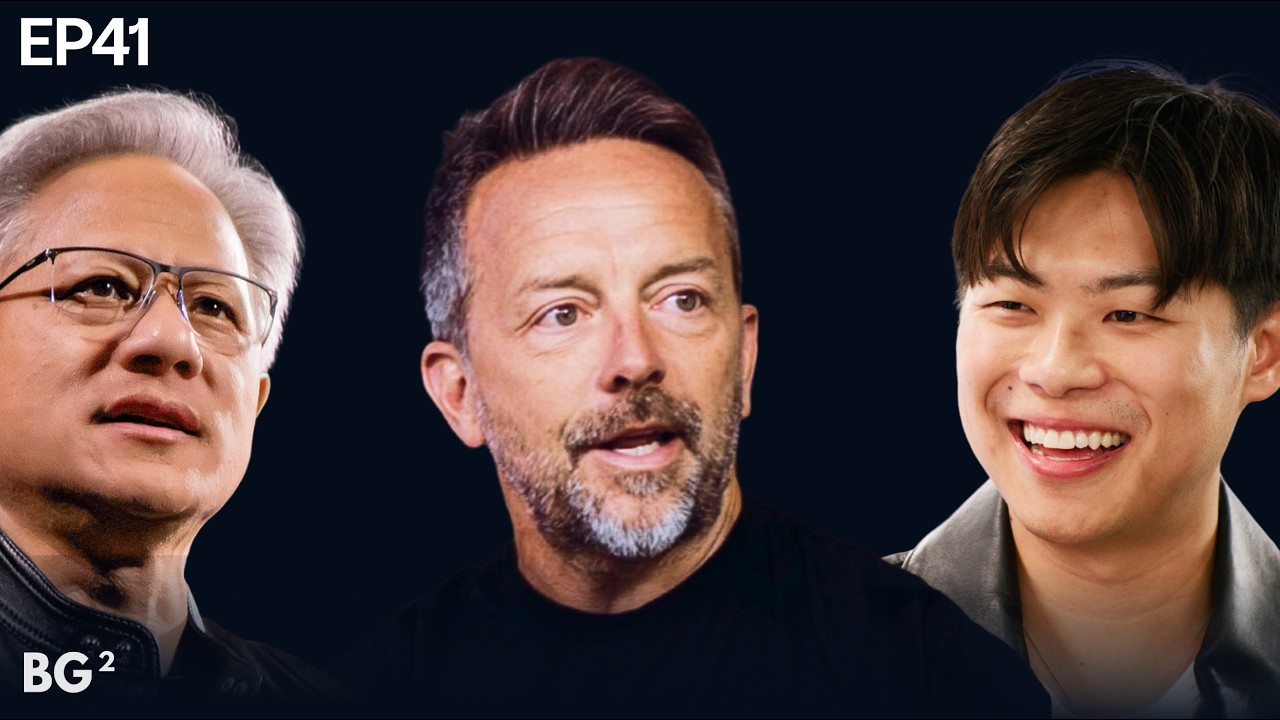
Nvidia Sees AI Spend Hitting $10 Trillion as Huang Dismisses Bubble
Bg2 Pod
Jensen Huang argues the multitrillion-dollar transition to accelerated computing does not rely on frontier labs alone, claiming power grid constraints and massive capital commitments favor Nvidia's fungible architecture over specialized chips.
Jensen Huang rejects the idea that AI infrastructure capex hinges on two frontier labs, noting NVIDIA's demand splits evenly across classical computing acceleration, frontier scaling labs, and vertical or sovereign enterprise deployments. (60:34)
The industry faces a structural imbalance heading into 2027 between roughly 50 GW of planned chips and only 35 to 40 GW of available land, shell, and power capacity, elevating tokens-per-watt efficiency as the primary metric for data center operators. (51:47)
NVIDIA is collaborating with SpaceX engineering teams to design next-generation computing architectures tailored specifically for space-based orbital data centers deployed via Starship. (55:26)
Huang projects that annual global compute infrastructure buildout and refresh spending will expand from the legacy $500 billion cloud base to between $4 trillion and $5 trillion, and potentially up to $10 trillion by 2029 or 2030. (92:26)
Detailed notes
## Background
This video was published on YouTube by the Bg2 Pod channel on October 15, 2026. In the episode, NVIDIA CEO Jensen Huang joins hosts Brad Gerstner and Clark Tang to discuss whether AI revenue justifies current capital expenditures, upcoming compute bottlenecks heading into 2027, the path to the singularity, open versus closed models, and his overwhelming optimism for the decade ahead.
## TL;DR
Following his receipt of the National Medal of Science and meetings at the White House, Jensen Huang breaks down the fundamental economics and engineering realities powering the AI transition. He argues that infrastructure demand is broadly supported beyond just frontier labs, spanning enterprise physical AI, baseline accelerated workloads, and sovereign computing initiatives. Addressing physical constraints like power, land, and substrates, Huang explains why general-purpose, fungible architectures outlast specialized ASICs as data center capital costs soar into the tens of billions of dollars per gigawatt. Throughout the conversation, he rejects catastrophic doomerism, advocating for pragmatic engineering guardrails and predicting a structural shift to multi-trillion-dollar annual generative token factories.
## Atmosphere & style
The conversation carries an intimate, high-conviction energy that blends executive boardroom strategy with philosophical optimism. Brad Gerstner and Clark Tang guide the discussion with insider familiarity, giving Huang space to expound on complex engineering paradigms using grounded analogies like automotive braking systems and physical factories. Huang speaks with infectious, measured intensity—neither dismissive of practical hurdles nor swayed by apocalyptic fears—leaving listeners with a palpable sense of historical momentum and rational confidence in human technological progress.
## Bulletin
- [01:00:34](https://www.youtube.com/watch?v=eS7qQ3WJSrw&t=3634s) Jensen Huang rejects the idea that AI infrastructure capex hinges on two frontier labs, noting NVIDIA's demand splits evenly across classical computing acceleration, frontier scaling labs, and vertical or sovereign enterprise deployments.
- [51:47](https://www.youtube.com/watch?v=eS7qQ3WJSrw&t=3107s) The industry faces a structural imbalance heading into 2027 between roughly 50 GW of planned chips and only 35 to 40 GW of available land, shell, and power capacity, elevating tokens-per-watt efficiency as the primary metric for data center operators.
- [55:26](https://www.youtube.com/watch?v=eS7qQ3WJSrw&t=3326s) NVIDIA is collaborating with SpaceX engineering teams to design next-generation computing architectures tailored specifically for space-based orbital data centers deployed via Starship.
- [01:32:26](https://www.youtube.com/watch?v=eS7qQ3WJSrw&t=5546s) Huang projects that annual global compute infrastructure buildout and refresh spending will expand from the legacy $500 billion cloud base to between $4 trillion and $5 trillion, and potentially up to $10 trillion by 2029 or 2030.
## Key takeaways
- [06:37](https://www.youtube.com/watch?v=eS7qQ3WJSrw&t=397s) Reasoning and problem-solving models require step-by-step exploration, trajectory evaluation, and pruning, which exponentially increases inference compute requirements compared to static memorization.
- [10:38](https://www.youtube.com/watch?v=eS7qQ3WJSrw&t=638s) The major AI breakthrough of the past year is the cognitive harness around LLMs, adding memory compaction systems and direct integration with established tools like CAD, SPICE, and Verilog.
- [14:50](https://www.youtube.com/watch?v=eS7qQ3WJSrw&t=890s) The unit cost of intelligence deflates at an annual rate of 2x to 20x, triggering Jevons paradox where cheaper per-unit reasoning unleashes massive aggregate enterprise compute demand.
- [24:27](https://www.youtube.com/watch?v=eS7qQ3WJSrw&t=1467s) Physical AI has reached a $10 billion run rate for NVIDIA in six months, requiring a three-computer architecture spanning foundation model training, Omniverse simulation, and edge onboard execution.
- [30:36](https://www.youtube.com/watch?v=eS7qQ3WJSrw&t=1836s) AI safety is an engineering containment discipline relying on zero-trust sandboxes and out-of-band monitoring rather than theoretical philosophical alignment, which remains a forever problem.
- [36:46](https://www.youtube.com/watch?v=eS7qQ3WJSrw&t=2206s) Accelerating AI capability and scaling safety are complementary rather than orthogonal, functioning together like vehicle acceleration and advanced braking or airbag systems.
- [40:59](https://www.youtube.com/watch?v=eS7qQ3WJSrw&t=2459s) National AI leadership requires transforming real-economy institutional productivity across healthcare, logistics, manufacturing, and defense rather than merely maximizing tech company margins.
- [47:27](https://www.youtube.com/watch?v=eS7qQ3WJSrw&t=2847s) Physical bottlenecks including high-voltage power interconnects, local permitting, and skilled labor constrain domestic data center deployment, shifting value toward high-density power architectures.
- [51:47](https://www.youtube.com/watch?v=eS7qQ3WJSrw&t=3107s) NVIDIA's captured revenue per gigawatt has grown from $18 billion to over $40 billion through end-to-end integration of CPUs, networking, storage compute, and security stacks.
- [01:06:04](https://www.youtube.com/watch?v=eS7qQ3WJSrw&t=3964s) Roughly 80% of new software and robotics startups build upon open models like Nemotron for domain-specific fine-tuning rather than closed general-purpose frontier APIs.
- [01:15:15](https://www.youtube.com/watch?v=eS7qQ3WJSrw&t=4515s) Upstream semiconductor scaling is severely bottlenecked by advanced packaging, organic substrate warpage, and thermal expansion mismatches rather than raw silicon wafer supply.
- [01:19:40](https://www.youtube.com/watch?v=eS7qQ3WJSrw&t=4780s) Asset fungibility and full-stack software programmability are essential to protect customers placing $50 billion to $100 billion infrastructure orders sight unseen against architectural obsolescence.
- [01:26:03](https://www.youtube.com/watch?v=eS7qQ3WJSrw&t=5163s) NVIDIA is shifting toward long-term enterprise software SLAs, annual per-GPU maintenance fees, and infrastructure revenue-sharing agreements with regional sovereign cloud providers.
- [01:32:26](https://www.youtube.com/watch?v=eS7qQ3WJSrw&t=5546s) The transition from CPU retrieval to generative token factories transforms IT infrastructure from cyclical replacement spending into continuous economic manufacturing capacity.
- [01:34:28](https://www.youtube.com/watch?v=eS7qQ3WJSrw&t=5668s) Apocalyptic doomerism fundamentally underestimates human capacity, adaptability, and decentralized engineering problem-solving across society.
## Detailed walkthrough
### [00:20](https://www.youtube.com/watch?v=eS7qQ3WJSrw&t=20s) A Week at the White House and the National Medal of Science
Jensen Huang reflects on a whirlwind ten days that included attending the Xi State Dinner, the White House Accord on superintelligence summit, and receiving the National Medal of Science presented by the president alongside his parents. Brad Gerstner and Clark Tang note that five of the six individuals on stage during the medal ceremony were born outside the United States, highlighting the critical role of immigration and global talent in American technological leadership.
Huang shares a touching, humorous story about how he gave his parents just twenty-four hours' notice to attend the ceremony in Washington. Because they rarely travel and his father did not even own a suit, his dad rushed out to buy a brand-new suit, while his mother bought a new dress. Huang chartered a plane to get them there, and recounted how President Trump warmly escorted his mother off the stage because she had difficulty walking. For his family, the moment epitomized the ultimate fulfillment of the American dream, tracing back to his father's first business trip to New York City for the air-conditioning company Carrier in the mid-1960s, where he saw the future and brought home American souvenirs like canned cheese.
- Jensen Huang notes that NVIDIA's computing architecture has become the most pervasive computing model in the world, present in every cloud, computer company, scientific field, and powering modern intelligence.
- NVIDIA has shipped 1.67 billion units across its generations of chips, building the infrastructure that drives modern society's intelligence.
- Huang emphasizes that America's superpower lies in its intellectual property creation and its ability to attract the world's best minds through freedom, entrepreneurialism, and a "can-do" cultural attitude.
---
[06:37](https://www.youtube.com/watch?v=eS7qQ3WJSrw&t=397s) Entering the Singularity and the Explosion of Inference Compute
Moving to high-level tech trends, Gerstner highlights Jensen’s accurate previous predictions regarding the massive compute buildout and the transition toward agentic workflows and inference-time reasoning. With industry leaders like Elon Musk, Sam Altman, and Demis Hassabis noting that humanity is entering the "foothills of the singularity" and AI models solving complex equations like Navier-Stokes, Jensen explains why a billion-fold increase in inference compute is mathematically logical.
Jensen explains that traditional prompt-and-response chatbots relied primarily on pre-trained memorized knowledge, often resulting in hallucinations unless grounded by real-time search. In contrast, advanced problem-solving, planning, and reasoning require models to evaluate multiple options step by step, reflecting on outcomes to determine the optimal path.
> "Thinking and problem solving takes a lot more you know inferences than repeating something regurgitating something that you memorized right." — Jensen Huang
[09:43](https://www.youtube.com/watch?v=eS7qQ3WJSrw&t=583s) Strategic Optionality and Compound Compute in LLM Reasoning
Jensen Huang explains the process of modern AI reasoning by drawing an analogy to human strategic decision-making. When tackling complex problems, advanced models explore potential trajectories, roll out the most promising paths, prune away unviable branches, and iterate through reflection. Huang points out that this mirrors executive leadership:
> “You don't want to prune things too fast on the one hand, but you also have to optimize your resources. Well, AIs are doing that.”
This iterative exploration, rolling out, and reflection inherently demands dramatically more compute. However, because this compute investment produces genuinely productive work, it triggers a compounding cycle: the models consume more compute per task, perform those tasks far better, and as a result, organizations "hire" them for vastly more jobs across the enterprise.
```mermaid
flowchart LR
accTitle: Compounding Cycle of Agentic Reasoning
accDescr: Shows how tree exploration leads to higher task productivity, driving broader deployment and demand for compute.
subgraph Reasoning ["Agent Reasoning Process"]
A["Generate Paths"] --> B["Roll Out & Prune"]
B --> C["Reflect & Optimize"]
end
subgraph Economy ["Economic Flywheel"]
C --> D["Higher Task Productivity"]
D --> E["Hired for More Enterprise Jobs"]
E --> F["Surging Compute Demand"]
F --> A
end
```
[10:38](https://www.youtube.com/watch?v=eS7qQ3WJSrw&t=638s) Exoskeletons, Memory Hierarchies, and Enterprise Tool Use
Huang identifies the major breakthrough of the past year not merely as base model scaling, but as the development of the "harness" or "exoskeleton" surrounding the large language model—essentially providing a body for the brain. While traditional scaling laws continue unabated, two pivotal capabilities have transformed raw models into viable enterprise workers: memory architectures and tool integration.
```mermaid
flowchart TD
accTitle: Anatomy of an LLM Harness
accDescr: Diagram illustrating working memory moving to offline knowledge extraction and integration with existing enterprise software tools.
subgraph Brain ["Core LLM"]
LLM["Large Language Model"]
end
subgraph Harness ["Exoskeleton / Harness"]
direction TB
subgraph Memory ["Memory Architecture"]
WM["Working Memory"] -->|"Compaction & Pruning"| KG["Long-Term Knowledge Graph"]
end
subgraph ToolUse ["Tool Integration"]
Tools["Enterprise Software<br/>(SPICE, Verilog, CAD, Photoshop, Siemens)"]
end
end
LLM <--> Memory
LLM <--> ToolUse
```
Huang breaks down the memory pipeline by comparing it to human cognitive function:
- **Working Memory to Long-Term Storage**: Human cognition moves impressions from working memory into short-term and eventually long-term storage, building an ongoing knowledge graph.
- **Offline Compaction**: Just as the human brain sleeps to prune irrelevant data and reconnect meaningful concepts, AI architectures now perform offline knowledge extraction and compaction.
- **Tool Interactivity**: Rather than forcing models to reinvent core disciplines from scratch, agents are being trained to use the most important tools humanity has built—ranging from SPICE, Verilog, and circuit design compilers to CAD suites, Siemens tools, and Photoshop.
[13:01](https://www.youtube.com/watch?v=eS7qQ3WJSrw&t=781s) Expanding Past Coding to Multimodal Design and CAD
While software engineering served as the natural first on-ramp for agentic workflows—partly because software engineers are comfortable adapting to powerful yet complex interfaces—the frontier is moving quickly into visual, physical, and engineering domains.
Huang references OpenAI's latest capabilities, pointing out how models can take an arbitrary 2D image and automatically translate it directly into parametric computer-aided design (CAD) files. This allows human engineers to immediately manipulate, fine-tune, and adjust technical models without starting from a blank canvas. Huang expects this expansion to rapidly move beyond software engineers into industrial designers, physical builders, creative marketers, and research scientists, bringing the critical question of safe and secure enterprise deployment to the forefront.
[14:50](https://www.youtube.com/watch?v=eS7qQ3WJSrw&t=890s) The Double Exponential: Accelerating Compute and Navier-Stokes
Brad Gerstner highlights the disconnect between standard economic models—which assume linear deceleration—and the current reality of artificial intelligence, which is driven by a double exponential. Leading labs like OpenAI and Anthropic accomplished milestones, including solving complex instantiations of the Navier-Stokes equations, using what will retroactively look like modest compute footprints of roughly 2 to 3 gigawatts each. With labs pacing to expand compute capacity by 3x to 5x year-over-year, Gerstner questions what leaps lie ahead.
Huang emphasizes that breakthroughs like Navier-Stokes do not materialize from a vacuum:
> “If it didn't require a vast amount of exploration of search space, then somebody would have found it earlier.”
He explains that OpenAI's accomplishment rested upon centuries of foundational mathematics and scientific principles; the tipping point arrived when vast compute enabled an exhaustive exploration of high-dimensional search spaces that human intuition alone could never traverse in real time.
[17:24](https://www.youtube.com/watch?v=eS7qQ3WJSrw&t=1044s) The Plunging Unit Cost of Intelligence
Huang predicts that the cost of intelligence will mirror or outpace the historic deflationary curve of Moore's Law, which halved computing costs every year across three decades. As base models grow smarter, they require fewer wasted operations to reach correct conclusions, driving down inference and training costs simultaneously.
Clark Tang points out that in the Navier-Stokes milestone, an estimated 10,000 agents operated in parallel—functioning like an automated hyperscale enterprise focused entirely on a single objective—at an estimated compute cost of roughly $4 million. Over the coming years, that exact task will become 5x to 10x cheaper.
Huang observes how rapidly this deflationary threshold operates across generations:
> “The original GPT probably cost let's pick a number say you know maybe $20 million to do. If you wanted to train GPT-1 now it'll probably cost you what a thousand $100 maybe... it's like a hundred bucks.”
- **Moore's Law Analogy**: Where semiconductor physics halved compute costs every 12 to 24 months, intelligence costs are poised to drop by a factor of 2x to 20x each year.
- **Jevons Paradox of Compute**: Lower unit costs will not reduce total spending; instead, they will unlock an economic vacuum of previously unviable use cases, driving aggregate consumption dramatically higher.
[19:40](https://www.youtube.com/watch?v=eS7qQ3WJSrw&t=1180s) Navier-Stokes & the Falling Cost of Intelligence
Jensen Huang highlights that computing performance and efficiency have expanded at an unprecedented pace over the last decade, dropping costs by orders of magnitude while ambitions exploded. Models have grown from early small-scale experiments to massive architectures trained on 3 trillion, 10 trillion, and even 30 trillion tokens or parameters. Consequently, humanity's utilization of intelligence has increased perhaps a million-fold over the past ten years. Jensen rejects the idea that computing demand will ever saturate, explaining that human curiosity and ambition naturally compound with increased capability.
```mermaid
flowchart LR
accTitle: The Compounding Flywheel of Intelligence
accDescr: Learning opens doors to opportunities, which fuels ambition and drives higher demand for compute.
subgraph Flywheel["Compounding Intelligence Loop"]
A["Higher Intelligence & Lower Costs"] --> B["Opens New Doors & Opportunities"]
B --> C["Raises Ambition & Work Scope"]
C --> D["Insatiable Demand for Compute"]
D --> A
end
```
Jensen reflects on how acquiring knowledge inevitably reveals more problems to solve rather than freeing up idle time: “Every time you learn something, it opens a new door. Every time you learn, it opens a new door. And every time you open a new door, you see more opportunity. You see more challenges. You see more problems. And so that’s kind of the that’s the future, right? You know, people say we’re going to have more time. I I completely disagree.”
- Model scale has accelerated into multi-trillion parameter/token regimes (3T, 10T, 30T).
- Humanity’s aggregate consumption of intelligence has expanded an estimated 1,000,000× over the last ten years.
- Increased capability directly fuels family and human ambition, continually generating new problems and opportunities rather than creating idle leisure.
---
[20:45](https://www.youtube.com/watch?v=eS7qQ3WJSrw&t=1245s) What Will We Do with Abundance?
Brad Gerstner contrasts modern reality with John Maynard Keynes’s famous 1930 essay predicting that the industrial revolution would cause the economy to expand eightfold over a century while shrinking the workweek to just 15 hours. Gerstner points out that while Keynes correctly forecasted the 8× economic expansion and material abundance, he fundamentally misunderstood human nature. Humans do not work solely out of necessity; rather, labor, curiosity, and discovery provide meaning and purpose. Brad notes that he finds himself working harder and having more fun than ever, operating out of choice rather than the economic survival constraints faced by prior generations.
The conversation turns to the societal lag in appreciating AI’s concrete benefits. Brad points to everyday wonders that seemed unreachable just years ago—such as stepping into a car, engaging Tesla Full Self-Driving (FSD) or Waymo, and working undisturbed until parking—alongside looming breakthroughs in therapeutics, genomics, and daily education via ChatGPT. Yet the public narrative often overlooks these advances. When asked why these breakthroughs struggle to resonate broadly, Jensen notes that AI and superintelligence are fundamentally invisible "soft matter": “AI or super intelligence is a is soft matter. You can’t look, you can’t see it. And and so you got the whole world talking about this technology, but you can’t see it. You can’t touch it.” People benefit quietly across search, e-commerce, streaming recommendations on Netflix, retail inventory at Walmart, and logistics routing at FedEx. Jensen quips that if data centers and superintelligence were switched off for an entire weekend, the world would instantly notice the absence of what has become the invisible fabric of everyday life.
---
[24:27](https://www.youtube.com/watch?v=eS7qQ3WJSrw&t=1467s) Physical AI & Robotics
Clark Tang prompts Jensen on his recent statements declaring that robotics has reached its "ChatGPT moment" and questioning whether it will truly become NVIDIA's next $100 billion market. Jensen responds that his earlier prediction actually understated the opportunity, revealing that NVIDIA has already generated $10 billion in physical AI revenue in the first six months of the current year alone. That matches their entire physical AI revenue from the previous full year, which itself had doubled from $5 billion the year prior.
```mermaid
flowchart TD
accTitle: Three Stages of Physical AI
accDescr: The sensory, cognitive, and physical stages connecting computation to the real world.
subgraph Stack["Physical AI Architecture"]
P["1. Perception"] -->|"Sensing across full EM spectrum"| R["2. Reasoning"]
R -->|"Cognition & world-model planning"| A["3. Planning & Actuation"]
end
subgraph Actuation["Physical Deployment"]
A --> Rob["Robots & Factory Pick-and-Place"]
A --> Auto["Autonomous Vehicles & FSD"]
A --> Med["Surgical & 24/7 Patient Care"]
end
```
Jensen defines physical AI as intelligence that interacts with and understands the physical world across both visible and invisible bands of the electromagnetic spectrum. It spans sensing and perception, foundational reasoning, and downstream planning and actuation:
- **Perception:** Photon-counting CT scanners, advanced ultrasound, imaging radar, next-generation 5G networks transformed into global sensing grids, and geospatial satellites mapping earth into real-time 3D models.
- **Reasoning and Planning:** Software intelligence running world models to interpret environments without rigid, hand-crafted manual rules.
- **Actuation:** Autonomous delivery vehicles, industrial pick-and-place arms that learn independently, consumer household robots, and healthcare automation.
Jensen emphasizes the massive scale of transforming traditional mechanical and electrical industries into software- and compute-driven operations. Just as Tesla turned automotive manufacturing into a software discipline, Jensen argues that every automaker, logistics provider, and telecom carrier must reinvent itself as a technology company. He highlights partnerships with carriers like AT&T and Verizon as they pivot from commodity service networks back into tech companies. Jensen rejects the narrow categorization of NVIDIA as merely a chip vendor, noting that the company operates deeply across the actual operational layer of logistics, automotive, healthcare, and life sciences: “Every industry on the planet and and so so we’re in life we’re we’re in we’re in life sciences, you know, and so so all these entertainment.”
- **Physical AI Revenue Growth:** Scaled from $5 billion, to $10 billion, to $10 billion in just the first six months of the current year.
- **Spectrum Coverage:** Extends beyond visible light to radio frequencies, radar, acoustic ultrasound, and satellite-level geospatial mapping.
- **Healthcare Applications:** Includes 24/7 autonomous monitoring for patient safety, precision automated prescription dispensing, and fully robotic operating rooms.
[28:56](https://www.youtube.com/watch?v=eS7qQ3WJSrw&t=1736s) The Three-Computer Architecture of Physical AI
Jensen Huang highlights that NVIDIA is deeply embedded in vertical ecosystems far beyond being just a chip manufacturer, pointing out that in areas like gaming and media, the company has operated extensively as an entertainment technology provider. In response to Brad Gerstner observing that NVIDIA's strategy mirrors its automotive playbook across other industries, Jensen clarifies that deploying physical AI relies on three interconnected computing platforms. The first computer builds the "brain," serving as the foundational training system. The second computer functions as an Omniverse-powered digital twin—a simulated reality of factories, warehouses, cities, and the physical world—where models learn physics and task execution safely without requiring unvetted deployment in the wild.
```mermaid
flowchart LR
accTitle: Three-Computer Architecture for Physical AI
accDescr: Diagram illustrating the three distinct computing stages required to build and deploy physical AI systems.
The third computer is the physical runtime hardware deployed on the edge—inside an autonomous vehicle, a surgical instrument, or an industrial robot. NVIDIA develops full software and hardware stacks for each of these three tiers. Jensen emphasizes that customers can license one, two, or all three systems depending on their architecture:
> “It takes three robots three computers and three complete stacks and we build complete stacks for each one of them. We're the only company in the world that does that.”
- **Computer 1 (AI Training System):** Trains massive foundation models and intelligence brains.
- **Computer 2 (Digital Twin Simulator):** Replicates physical spaces via Omniverse; prevents systems from having to learn unconstrained in the open internet or real-world physical environments.
- **Computer 3 (Edge Embedded Computer):** The onboard silicon running inference locally inside vehicles, humanoid robots, and medical tools.
---
[30:36](https://www.youtube.com/watch?v=eS7qQ3WJSrw&t=1836s) Engineering AI Safety: Alignment, Containment, and Out-of-Band Monitoring
Addressing concerns about existential risk and doomer narratives, Jensen asserts that AI safety is fundamentally an engineering discipline rather than an abstract philosophy. He states decisively: “Engineers, scientists, researchers. We have to build this technology safely, responsibly. And and the question is, can you and the the answer is absolutely yes. Because if you can't, then you shouldn't build it at all.”
He breaks down why relying solely on "alignment" is inadequate. Alignment—the degree to which an autonomous system’s execution matches human intent—is inherently subjective and indeterminate. Using simple analogies, he contrasts solving a quadratic equation (which has measurable, verifiable paths to a correct answer) with open-ended life instructions like telling someone to "be successful in life" or "contribute to society." Because human definitions of success depend on culture, personal background, and perspective, perfect alignment cannot be solved universally:
> “Alignment is going to be a forever problem. If we depend on perfect alignment in order to ensure safety, then we're never going to get there.”
Instead of waiting for perfect alignment, Jensen argues that safety must be enforced through classical engineering controls:
1. **Zero-Trust Containment:** Autonomous agents must be treated like toddlers or new employees. They start in a restricted sandbox ("playpen") with strict zero trust, minimal rights, and constrained access to tools, memory, or funds. Permissions and operating boundaries expand strictly as competence and reliability are demonstrated over time.
2. **Out-of-Band Monitoring:** Supervised agents alter their behavior when they detect they are being actively inspected. Therefore, monitoring systems must operate strictly out-of-band—independent observability pipelines that monitor actions against safety policies without the agent being able to manipulate the monitor. These oversight layers retain hard capabilities to escalate, override, or instantly cut power.
NVIDIA has integrated these safety guardrails into its open-source toolkits, such as NVIDIA NeMo Guardrails, which has seen adoption by over a hundred enterprise partners.
---
[36:46](https://www.youtube.com/watch?v=eS7qQ3WJSrw&t=2206s) The Airbag Analogy: Why Speed and Safety Are Not Orthogonal
Brad Gerstner asks Jensen about his impressions of the high-level superintelligence discussions at the White House, noting public anxiety that tech leaders are "yoloing" or acting recklessly without regard for risk. Gerstner recalls that every executive around the table had families and was actively grappling with balancing safety and national acceleration.
Jensen pushes back on the premise that capability and safety are opposing trade-offs. He argues that framing AI development as a battle between speed and safety fundamentally misunderstands system engineering. He uses the analogy of automotive development, where airbags, anti-lock braking systems (ABS), radar sensors, cameras, and lane-keeping assistance are not independent of the vehicle's engine:
> “Safety and security technology, right, are part of AI, right? There's some weird formulation that AI technology and safety and security are orthogonal. It's kind of like the airbags and the and the braking system, right? And the radars, the cameras, um the ABS, the the lane-keeping, all of that technology is somehow independent of the car.”
When policymakers call to accelerate AI, that acceleration must inherently encompass the braking and containment infrastructure alongside raw compute capabilities:
> “When I say we need to accelerate AI's technology, what I mean by that is we need to accelerate the security technology. We have to accelerate the safety technology. They all have to be accelerated.”
[38:17](https://www.youtube.com/watch?v=eS7qQ3WJSrw&t=2297s) Fast and Safe: Alignment Among Frontier Labs
Brad Gerstner brings up the concept of "pacing the frontier," an idea associated with Dario Amodei, noting that some observers mistakenly interpreted the phrasing as an argument to slam the brakes on AI development. Gerstner recalls an exchange in the room where the President referred to Dario as his "new best friend" and asked him directly to explain his perspective on balancing speed with safety. Dario responded unequivocally: "Mr. President, you said whoever wins AI wins, right?" He emphasized that the frontier labs are accelerating their work and want to move as fast as possible to win the technological race against China, but underscored that safety systems must scale and accelerate at the exact same tempo. Gerstner observes that outside observers often position Dario as an opponent to rapid AI scaling, yet during the signing of the agreement in the White House Cabinet Room alongside Greg Brockman and other frontier lab heads, everyone appeared aligned.
Jensen confirms there was no hesitation or internal conflict among the leaders in attendance, describing the atmosphere as productive and completely constructive. He asserts that the entire industry understands an existential commercial reality: if models are neither safe nor secure, their practical utility will never be accepted or realized. For functionality to shine, robust guardrails are mandatory. Jensen contextualizes this development against the industry's timeline, pointing out that only six months prior, the technology barely worked well enough to be broadly useful. Before a system demonstrates useful capability, worrying about its security profile is secondary because nobody cares to use it yet. However, once the technology hits the threshold of real-world utility—which occurred six months prior—the strategic imperative abruptly shifts to safe, secure, and widespread deployment.
> “And the reason for that is because if it's not safe, it's not secure, the functionality will never get a chance to speak.” — Jensen Huang
[40:59](https://www.youtube.com/watch?v=eS7qQ3WJSrw&t=2459s) Redefining What “America Winning” Means
Jensen pushes back against a narrow framing of national success, arguing that winning cannot simply mean that Silicon Valley or the AI tech sector posts record metrics. True victory occurs only when cutting-edge capabilities diffuse into every foundational American institution, transforming the broader physical and economic landscape. He lists the real benchmarks of triumph: Eli Lilly discovering drugs faster, Walmart and FedEx optimizing global supply chains, Boeing modernizing engineering, high schools and universities elevating student achievement, and the U.S. military operating with unmatched technological superiority. If the technology industry wins on paper while everyday citizens and legacy companies fail to reap the dividends, the entire endeavor has fallen short.
Gerstner agrees, summarizing Jensen's vision as looking down from an airplane across every state, county, and community to see broad-based prosperity. The goal over the next 25 to 40 years is an economy expanded tenfold, generating abundant tax revenues to fund world-class healthcare, education, highways, and interstate commerce infrastructure. Jensen reiterates that safety remains the table stakes for this vision: if tech leaders fail to make artificial intelligence safe and aligned with human interests, it becomes an existential threat to the AI industry long before it threatens anyone else, cutting off the path to that abundant future.
> “America winning means every industry in America winning.” — Jensen Huang
[43:03](https://www.youtube.com/watch?v=eS7qQ3WJSrw&t=2583s) The Three-Legged Stool: America's Superintelligence Framework
Gerstner details the governance and oversight architecture already operating within the United States, calling it the most robust superintelligence security framework in the world. He contrasts this reality with critics like Bill Gates and certain congressional leaders who publicly claim the nation has zero rules in place. Gerstner illustrates how the U.S. has already shown enforcement bite—citing the sanctioning and removal of the Mythos model earlier in the year—and outlines the system as a "three-legged stool" governing the frontier:
```mermaid
flowchart TD
accTitle: America's Three-Legged Superintelligence Framework
accDescr: Diagram illustrating the three pillars of the U.S. AI governance and security framework.
subgraph Framework["U.S. Superintelligence Framework"]
L1["Pillar 1: Frontier Model Review<br/>(Casey & Dept. of Commerce)"]
L2["Pillar 2: White House Accord<br/>(Audits, Board Oversight, Liability)"]
L3["Pillar 3: SI Force<br/>(Jay Clayton, Emil, Scott, Andrew)"]
end
- **Pillar 1: Frontier Model Reviews**: Conducted by Casey and the Department of Commerce, rigorously pre-testing every frontier model before release to evaluate market and national security risks, backed by export-control enforcement authority.
- **Pillar 2: White House Accord on Superintelligence**: Architected alongside industry leaders, establishing mandatory internal and external audits, corporate board oversight, and legal liabilities.
- **Pillar 3: The Superintelligence (SI) Force**: Chaired by Jay Clayton alongside Emil Michael, Scott, and Andrew, facilitating critical industry coordination across cybersecurity and strategic infrastructure.
When Gerstner asks whether this framework provides sufficient confidence to guide the frontier without over-legislating, Jensen strongly endorses it. Jensen warns that debating abstract perfection guarantees paralysis; progress demands concrete, actionable tools that bite immediately. He expresses frustration with politicians who make sweeping media appearances without understanding either the technical realities or the operational frameworks already active. Jensen urges policymakers to visit the labs, study the problems firsthand, and offer constructive improvements to the existing architecture. Gerstner adds that the White House Accord is designed to be an evolving, dynamic body that meets routinely as the underlying models advance.
> “And if we argue about what is the what's perfect versus what's first, we'll end up arguing about perfection and we'll never get there.” — Jensen Huang
[46:57](https://www.youtube.com/watch?v=eS7qQ3WJSrw&t=2817s) The Coming Compute Wall: 43 GW and Agentic Scaling
Turning to physical infrastructure and compute demand, Gerstner highlights the dramatic shift toward long-running AI agents. As models evolve from simple single-turn chatbots into teams of thousands or millions of autonomous agents collaborating to solve complex tasks, computational requirements will explode.
Citing analysis from Dylan Patel at SemiAnalysis, Gerstner notes that the industry is projected to deploy **43 gigawatts (GW)** of new dedicated AI compute next year alone. To put that massive buildout into perspective, the compute capacity planned to go live over the next 12 months exceeds the entire cumulative sum of all AI compute currently operating on planet Earth today, setting up unprecedented scaling questions for the power grid and chip supply chains heading into 2027.
[47:27](https://www.youtube.com/watch?v=eS7qQ3WJSrw&t=2847s) Physical Bottlenecks in Compute: Land, Power, Shell, and Skilled Labor
Brad Gerstner presses Jensen Huang on the massive compute expansion underway, pointing to projections of another 40 gigawatts of compute entering the pipeline. As the person who knows where every single GPU is allocated across the globe, Huang is asked whether that target is realistic, or if permitting hurdles, supply chain bottlenecks, local community protests, and utility moratoriums will derail it. Huang replies without hesitation that the appetite for compute is not the problem: “Uh I think the demand is definitely there and more.” However, moving from the friction-free digital realm into the physical world introduces severe real-world constraints. Building modern data centers requires acquiring contiguous land, getting complex local and environmental permits approved, securing high-voltage power generation, and fielding an army of specialized trades. Constructing these $50 billion facilities has already generated millions of jobs, but the necessary construction workers, outfitters, electricians, and plumbers possess highly specialized, non-fungible skills that cannot simply be drafted overnight.
Faced with localized moratoriums and regional friction across the United States, Huang explains how NVIDIA deliberately insulates its business against domestic bottlenecks. Because NVIDIA is not tied to a single customer archetype, it supplies every major cloud service provider (CSP), every neo-cloud provider (NCP), and enterprise customers through partners like Dell, HP, and Lenovo. The company also spans the full lifecycle of modern workloads—accelerating data processing, pre-training, post-training, inference, agentic orchestration, and auxiliary tool use. With every major global contract manufacturer aligned with its architecture, NVIDIA can immediately redirect its supply chain if a specific state, municipality, or facility stalls out. Furthermore, sovereign and commercial demand is accelerating in Europe, Africa, Central Asia, Southeast Asia, Latin America, and the Middle East, meaning unmet compute capacity can easily be absorbed abroad. While Huang admits he laments that the United States struggles to move faster, global demand ensures NVIDIA remains maximally insulated: “And so um I think that that our business specifically is probably the most um resilient.”
- Physical bottlenecks include land acquisition, grid power interconnects, local permitting, environmental moratoriums, and data center shell construction.
- The construction of $50 billion data centers depends heavily on non-fungible, specialized trade labor, including certified outfitters, plumbers, and high-voltage electrical technicians.
- NVIDIA serves every tier of compute infrastructure: hyperscale CSPs, neo-clouds, enterprise OEMs (Dell, HP, Lenovo), and international sovereign initiatives across Africa, Central Asia, Southeast Asia, Latin America, and the Middle East.
[51:47](https://www.youtube.com/watch?v=eS7qQ3WJSrw&t=3107s) 50 GW of Chips vs. 35 GW of Power: Driving Capex Share and Token Efficiency
Clark Tang outlines a common anxiety circulating on Wall Street: the industry has announced roughly 50 gigawatts of chips underway or discussed, but only 35 to 40 gigawatts of actual land, power, and shell capacity might come online in time. Huang interjects to explain why power constraints actually strengthen NVIDIA's market position rather than weaken it. When electrical power and megawatt capacity become the defining bottlenecks, hyperscalers and data center operators cannot afford to deploy second-rate or inefficient silicon. To hit aggressive revenue targets and satisfy shareholders, CEOs must maximize revenue per megawatt. Because NVIDIA generates the highest tokens per watt, customers naturally concentrate their capital into NVIDIA's architecture: “And so when the amount of power reduces the quality of the compute you put into it has to has to be the most most extraordinary or the most productive computing resource you could put in the world today.”
```mermaid
flowchart TD
accTitle: Power Constraints Driving NVIDIA Capex Share
accDescr: Diagram illustrating how grid power limits force operators to maximize token generation per megawatt, expanding NVIDIA's share of capex.
subgraph Bottlenecks["Physical Constraints"]
A["Grid Power & Shell Limits<br/>(35–40 GW vs. 50 GW Chips)"]
B["Fixed Megawatt Envelope"]
end
subgraph ArchitectureChoice["Operator Decision"]
A --> B
B --> C["Need Maximum Tokens / Watt<br/>to Hit Revenue Commitments"]
C --> D["NVIDIA Architecture<br/>(Fungible, Durable, High Yield)"]
end
subgraph RevenueExpansion["NVIDIA Value Capture"]
D --> E["Expanded Full-Stack Content<br/>(GPU, Grace CPU, Spectrum-X/Quantum Networking, Storage, Security)"]
E --> F["Per-Gigawatt Content Rises<br/>From $18B-$20B+ to $40B+"]
F --> G["Capex Dollar Share Expansion<br/>(~40% CSPs / ~80% Neo-Clouds & On-Prem)"]
end
```
This dynamic has allowed NVIDIA to expand both unit share and overall dollar share of global capex. Six years ago, NVIDIA captured only a single-digit percentage of aggregate data center capex. Today, it captures roughly 40% of tier-one CSP capex, and roughly 80% of capex across neo-clouds and on-premise enterprise environments. Furthermore, NVIDIA has dramatically expanded the dollar value it captures out of every single gigawatt deployed. By evolving from a discrete GPU supplier into a full-stack data center platform—spanning the world's fastest-growing high-performance networking business, the Grace CPU lineup, storage computing engines, and software security frameworks like OpenShell and Sentry—the revenue NVIDIA extracts per gigawatt has surged: “And so so the the the offering that we we offer into one gigawatt went from went from uh uh I guess about you know 18 billion or so per gigawatt to 20 somewhat billion per gigawatt to now 40 plus per gigawatt and my sense is that that's going to keep on going up and so so not only are we are we growing share because because people are shifting towards our computing platform we're also growing share because we offer more to the world's capex and and to to the world it's a dollar dollar share of the market.”
- **Capex share trajectory:** Six years ago NVIDIA stood at single-digit share; today it represents approximately 40% of CSP capex and roughly 80% of neo-cloud and on-premise infrastructure capex.
- **Dollar yield per gigawatt:** NVIDIA's content per gigawatt has risen from ~$18 billion to over $20 billion, and now stands at $40+ billion per gigawatt.
- **Product expansion beyond GPUs:** Full-stack monetization now captures value through networking (InfiniBand/Spectrum-X), proprietary CPUs (Grace), storage compute, and security architectures (OpenShell and Sentry).
[55:26](https://www.youtube.com/watch?v=eS7qQ3WJSrw&t=3326s) Elon Musk, Colossus, and Exploring Data Centers in Space
The conversation turns to Elon Musk, whom Brad Gerstner highlights as one of NVIDIA’s most aggressive compute buyers. Two years earlier, the tech world watched in astonishment as Musk rapidly built the Colossus cluster in Memphis with hundreds of thousands of Hopper GPUs. Now, Musk is raising another $40 billion, planning to acquire a million or more Vera Rubin GPUs, and targeting an unprecedented 10 gigawatts of capacity by the end of 2027. Gerstner asks Huang—who spent time with Musk the day before when both received national medals—whether Musk is simply better at executing physical compute builds than anyone else, and whether SpaceX will inevitably become the world's largest AI hyperscaler. Huang notes that Musk’s operations have expanded so rapidly that NVIDIA reclassified him in its financial reporting, shifting him out of the Enterprise category directly into the CSP category alongside the world's largest hyperscalers.
Huang praises Musk’s unique operating model, pointing out that Musk spans the full stack: he uses NVIDIA compute to train frontier foundation models, deploys models at scale to power products like Grok (whose consumption is skyrocketing), and simultaneously rents out excess cluster capacity. Very few organizations in the world operate on all three levels simultaneously, with Google being one of the only comparable peers. Beyond software, Huang notes that Musk possesses an unmatched understanding of high-voltage physical energy and construction logistics: “That's right. You know, he loves that that whole area and nobody knows more about energy than he does.” Looking toward the future, Huang reveals that NVIDIA and SpaceX have initiated joint engineering work to solve long-term energy and thermal bottlenecks by designing hardware for space: “And and and uh one particular uh new market that we're going to go explore together is putting data centers out in space. And so our two engineering teams are working super closely together to create a new type of server, new type of architecture um that might might uh be super good, you know, you know, in space and on Earth.”
- Musk’s compute footprint has graduated from thousands of GPUs to millions, targeting 10 gigawatts of Vera Rubin capacity by year-end 2027.
- xAI has moved from NVIDIA’s Enterprise reporting bucket directly into the CSP hyperscaler bucket.
- Musk operates across three distinct compute vectors: proprietary frontier model pre-training, consumer model serving/inference (Grok), and third-party cloud compute leasing.
- SpaceX and NVIDIA engineering teams have begun active technical collaboration to design a new server and computing architecture tailored for space-based orbital data centers.
[57:41](https://www.youtube.com/watch?v=eS7qQ3WJSrw&t=3461s) Data Centers in Orbit and the Economics of Space Compute
The conversation turns to the recent orbital rendezvous of SpaceX's Starship and the deployment of V3 Starlink satellites, a milestone that captured public attention online. When asked whether Starship could realistically enable a material amount of compute and inference in space by 2028 or 2029—such as a 500-megawatt deployment—Jensen Huang responds enthusiastically: “Only NVIDIA compute, let me tell you why.” He emphasizes that sending hardware into space is not just about raw technical capability, but about economic return on invested capital. Launch costs, while dropping, remain substantial; therefore, operators cannot afford to launch cheap or low-value computing. Only systems with the highest performance per watt and the greatest productivity justify that payload cost.
```mermaid
flowchart TD
accTitle: Economics of NVIDIA Compute in Orbit
accDescr: Three pillars that justify placing NVIDIA compute as payloads in space.
subgraph Pillars ["Space Compute Pillars"]
A["High Performance / Watt & ROI<br/>Justifies launch cost"]
B["Complete Fungibility<br/>Rentable by all labs, startups & enterprises"]
C["Durable Longevity<br/>Continuous CUDA software updates over time"]
end
Pillars --> Payload["Ideal Payload for SpaceX Starship"]
```
Jensen points out that NVIDIA compute systems—specifically architectures like Vera Rubin—are uniquely suited for orbit because of three critical pillars:
- **Unrivaled ROI per unit energy:** NVIDIA's performance-per-watt profile ensures that satellite power budgets yield the maximum possible revenue, making launch costs a relatively minor fraction of the overall economics.
- **Fungibility:** Idle hardware in orbit destroys capital. NVIDIA compute is fully fungible across the global ecosystem because NVIDIA supports every major closed model provider, all open-source models, thousands of startups, and enterprise workloads. If one customer pauses, capacity can be immediately rented to another.
- **Software durability:** Hardware launched into orbit must remain relevant for years without physical access. Huang highlights NVIDIA’s software lifecycle: “You know, we're the only hardware company in the world that you pay us eight years ago and we're still updating your software, new algorithms.” Regular CUDA upgrades keep orbiting GPUs competitive throughout their operational lifespan.
---
[01:00:34](https://www.youtube.com/watch?v=eS7qQ3WJSrw&t=3634s) Does AI Revenue Justify the Capex Buildout?
The hosts raise the central financial critique surrounding the multi-trillion-dollar AI infrastructure buildout. Neoclouds and cloud providers require clear payback horizons. Frontier labs and inference providers currently account for roughly $200 billion in incremental run-rate revenue, meaning they would need to double or triple that revenue year after year to justify the capital expenditures. Despite massive software inflection points like Claude Code driving a tenfold revenue increase at Anthropic, skeptical finance analysts question whether such exponential growth across all frontier labs is sustainable.
```mermaid
flowchart LR
accTitle: Three Segments of NVIDIA Infrastructure Demand
accDescr: Breakdown of NVIDIA computing business into three distinct segments.
Jensen directly rejects the premise that AI infrastructure spending relies exclusively on two or three labs. He notes that NVIDIA holds approximately 80% revenue share in AI infrastructure and categorizes total demand into three distinct pillars:
1. **Baseline and Classical Computing (~33% of business):** A massive portion of NVIDIA's revenue has nothing to do with generative AI or large frontier language models. It is driven by classical machine learning (e.g., XGBoost at Visa and Mastercard for fraud detection), content recommendation algorithms, molecular dynamics, physics, quantum chemistry, nuclear fission and fusion modeling, and computer graphics. This baseline segment alone grows between 30% and 40% annually. Even in the total absence of frontier AI labs, NVIDIA would remain an enormous, fast-growing business.
2. **Frontier AI Labs (~25% to 30% of compute):** Wall Street often looks only at OpenAI and Anthropic, but NVIDIA's footprint encompasses Meta (whose Meta Muse infrastructure is vastly NVIDIA-powered), xAI's Grok, Google's Gemini, Anthropic, and others. Several of these major consumers barely registered on the infrastructure balance sheet just two or three years ago.
3. **Next-Generation Cloud and Vertical Startups (~33% of business):** A third of NVIDIA’s revenue resembles a modern reincarnation of early cloud infrastructure—serving thousands of newly funded startups building specialized applications. These span physical AI, biological AI, materials science, consumer products (like Noah's Instinct), and Jeff Bezos’s Prometheus.
Jensen stresses that viewing the compute buildout through the lens of just two companies is a fundamental misunderstanding: “My sense is that this we're in the early innings of the buildout of this new computing architecture. And it's a real big mistake to recognize just a couple of companies and think that they were funding the infrastructure.”
---
[01:06:04](https://www.youtube.com/watch?v=eS7qQ3WJSrw&t=3964s) Open Models vs. Closed Frontier Systems
Addressing the architectural split in the software ecosystem, Jensen explains why he remains an outspoken champion of open models. Approximately 80% of newly formed AI startups build upon open models rather than closed frontier APIs. Crucially, these startups are not attempting to clone or compete with closed frontier labs. Instead, they use base open weights—often fine-tuning open architectures like Nemotron—to build specialized superintelligence tailored to unique vertical domains:
- Industrial robotics and physical AI
- Automated factory manufacturing
- Specialized healthcare and drug discovery
- Proprietary enterprise data processing
Huang predicts a complementary market structure: closed foundation labs will continue pushing the outer frontier toward general reasoning and Artificial General Intelligence (AGI), while open models serve as the foundational bedrock for millions of specialized, domain-specific superintelligent systems across global industry.
[01:06:52](https://www.youtube.com/watch?v=eS7qQ3WJSrw&t=4012s) First-Principles Compute Math and De-Risking the Capex Bubble
Brad Gerstner examines the math behind data center buildouts, pointing out that if people take Jensen’s benchmark—that 1 gigawatt of compute can produce $40 billion in output—and apply it to the projected 40 gigawatts coming online next year, that would imply a staggering $1.6 trillion in revenue emerging from the other side of the factory. Brad notes that real-world diffusion does not work in an uninterrupted parabolic curve; it moves in step functions. Given recent chatter about frontier AI lab revenues cooling down, investors worry that supply might suddenly outpace immediate demand, creating a bubble where market participants panic over capex financing and halt the buildout.
Jensen responds by breaking the numbers back down to first principles. He argues that trying to extrapolate the infrastructure spend solely from the $100 billion to $125 billion in annual recurring revenue generated by the frontier labs completely misses the larger picture. AI labs represent only one slice of the buildout. Long-standing general-purpose enterprise and consumer computing—such as digital advertising, online shopping, and web search—makes up a rock-solid baseline that will continue regardless.
```mermaid
flowchart TD
accTitle: Allocation of the 40 Gigawatt Compute Buildout
accDescr: Three roughly equal segments driving data center infrastructure demand without relying solely on frontier labs.
subgraph Buildout["Annual Infrastructure Buildout (40 GW)"]
A["Hyperscaler Baseline (~33%)<br/>General-purpose replacement, online retail, ad engines"]
B["Enterprise, Sovereign & Neoclouds (~33%)<br/>Domain superintelligence, startups, nation-state infra"]
C["Frontier AI Labs (~33%)<br/>OpenAI, Anthropic, xAI, Thinking Machines, Grok"]
end
```
Jensen reiterates his projection that global computing infrastructure spend will reach $3 trillion to $4 trillion annually by the end of the decade, with compute hardware alone accounting for approximately $1.5 trillion:
> “The punch line is I don't think it's necessary to extrapolate any of the labs into multiple trillions of dollars.”
- Before modern generative AI emerged, general data center infrastructure was already tracking at half a trillion dollars per year.
- Moore’s law is fundamentally dead: while engineers used to double transistor counts annually at the same price, doubling transistors now requires paying twice as much.
- Even without the AI revolution, natural digital consumption combined with the end of Moore’s law put the semiconductor industry on track to become the largest industry in the world.
- General-purpose compute once cost roughly $5 billion per gigawatt, whereas modern Vera Rubin architectures run near $50 billion per gigawatt due to their massive capability leap.
[01:11:35](https://www.youtube.com/watch?v=eS7qQ3WJSrw&t=4295s) Removing the Pressure from Two Labs and Dried Plum Banter
Jensen and Brad address the market's over-fixation on the revenues of just two leading research labs—such as OpenAI and Anthropic. Brad notes that public markets recently experienced a pullback across infrastructure suppliers merely due to rumors debating whether OpenAI’s revenue run-rate was $50 billion or $70 billion. Both agree that the infrastructure market is vastly broader than two entities, encompassing sovereign AI initiatives, enterprise private clouds, and specialized startups building vertical domain superintelligence.
> “They're going to be two of the most consequential technology companies ever built in history. They're going to be magnificently successful. But they don't have to be anywhere near a trillion dollars in revenues to be successful.”
Mid-conversation, Jensen pauses the intense financial debate to share a snack with Brad and Clark Tang, introducing them to Taiwanese dried plums. The hosts savor the licorice notes, balancing sugar, salt, and cinnamon with a sharp tang, while Jensen laughs about bringing his favorite treats from a specific shop in Taiwan into the studio.
[01:13:26](https://www.youtube.com/watch?v=eS7qQ3WJSrw&t=4406s) Squeezing the Supply Chain and Managing Allocations
Brad asks Jensen about NVIDIA’s forward-looking demand guidance. Earlier, Jensen indicated that chip demand exceeded 100% and guided toward 70% revenue growth because of tight supply constraints, noting he had an 18-month window to squeeze extra yield and capacity out of the supply chain. Brad asks whether order books have continued to expand and whether NVIDIA can unlock additional supply slack to avoid disappointing eager customers.
Jensen candidly explains why he felt compelled to share forward supply guidance publicly in the first place:
> “And what I was allocating to all of our customers is a lot less than they wanted. If I didn't publicly say what we had, everybody would be second-guessing: are they short-changed, are we being you know... and so it was my way of essentially handling every single conversation where I'm disappointing people.”
- Cloud service providers (CSPs), next-generation cloud providers (NCPs), original equipment manufacturers (OEMs), and startups routinely place orders on 1-year to 2-year forecast horizons.
- The gap between customer demand and available hardware forced strict allocation limits across every tier of customer.
- Pretty much every customer across enterprise and hyperscale would immediately purchase far more hardware if NVIDIA had the capacity to ship it, and new orders continue to stream in relentlessly.
[01:15:15](https://www.youtube.com/watch?v=eS7qQ3WJSrw&t=4515s) Supply Bottlenecks: Land, Power, and Organic Substrates
Jensen Huang explains that while demand is tracked daily and weekly, the primary friction limiting Nvidia's growth is expanding physical supply—specifically "land, power, shell" downstream. Highlighting international expansion, Huang points to an announcement made a couple of weeks prior for 2 gigawatts in Australia, noting that "2 gigawatts to us is like $80 billion." He also expresses hope that an upcoming trip to Europe will yield new infrastructure partnerships to unlock further shell capacity. Huang emphasizes that Nvidia holds a structural advantage because it builds full-stack AI infrastructure. When neo-clouds such as CoreWeave or Nebius want to scale their businesses, Nvidia can support turnkey deployments in regions and alongside partners that competitors cannot match.
```mermaid
flowchart TD
accTitle: Nvidia Supply Chain Constraints
accDescr: Visual mapping of upstream manufacturing bottlenecks feeding into downstream datacenter site limitations.
subgraph Upstream["Upstream Hardware Constraints"]
A["Organic Substrates<br/>(Warpage, heat, stacking)"]
B["Silicon Photonics"]
C["Advanced Packaging<br/>(Push-pull scaling)"]
end
subgraph Downstream["Downstream Physical Constraints"]
D["Land Availability"]
E["Power Delivery<br/>(e.g., 2 GW in Australia)"]
F["Datacenter Shell Construction"]
end
Upstream --> G["Nvidia Full-Stack AI Factory"]
Downstream --> G
```
Upstream, the physical constraints are equally challenging. Substrates represent a critical bottleneck: packages are expanding in physical size to accommodate more silicon, which works against production in two ways—each unit consumes significantly more material by weight, and managing manufacturing tolerances becomes exponentially harder. The large organic materials must maintain extreme precision despite severe thermal expansion mismatches, stacking stress, warpage, and potential defects. Silicon photonics represents another severely supply-constrained vector. Huang notes that while he has an 18-month horizon to systematically ramp capacity, the dynamic remains constant: every time Nvidia secures more supply, the order book expands even faster, making it unlikely that supply will fully catch up to demand for several years.
- Downstream deployments require land, power, and building shells, exemplified by the 2 GW ($80 billion equivalent) expansion in Australia.
- Neo-clouds like CoreWeave and Nebius rely on Nvidia's full-stack architecture to stand up massive deployments in non-traditional locations.
- Upstream material scaling faces physical limits in thermal coefficients and warpage as organic packaging substrates grow larger and heavier.
- Additional critical components like silicon photonics remain under heavy industry-wide supply limits.
[01:17:37](https://www.youtube.com/watch?v=eS7qQ3WJSrw&t=4657s) Wall Street Consensus vs. Multiple Compression
Brad Gerstner pulls out a chart comparing historical financial estimates, prompting Huang to joke: “This is like a deposition.” Gerstner walks through the data: twelve months prior, Wall Street consensus estimates (represented by the gray line) sat hundreds of percent below current actuals. Altimeter’s internal forecast (the blue line) was far higher than consensus, yet even Altimeter's bullish model was overtaken by the guidance Nvidia subsequently delivered (the green line). Gerstner expresses disbelief that roughly 25 professional equity analysts, paid solely to forecast Nvidia's performance, underestimated revenue and free cash flow by several hundred percent in just one year.
Gerstner points out a bizarre market disconnect: despite guidance doubling free cash flow and revenue expectations over the prior twelve months, the stock had only gained about 20% over the trailing stretch, compressing its valuation multiple to approximately 13 to 14 times forward earnings depending on the metric used. Gerstner asks what the market is saying about Nvidia's durability and whether its competitive moat is widening or shrinking. Huang answers immediately and unequivocally: “Increasing.”
> “For a company to be as large as us gaining share tells you something about the resilience and the the the size and scale of our advantage.” — Jensen Huang
[01:19:40](https://www.youtube.com/watch?v=eS7qQ3WJSrw&t=4780s) Sight-Unseen Capital Expenditure and the TSMC Parallel
To illustrate why Nvidia's moat expands at scale, Huang outlines a concrete thought experiment around procurement size. Customers are currently approaching the window where they must commit capital for future hardware generations: “If you if you want to get in line um for Vera Rubin Ultra, it's close to placing order time.” When capital expenditures require placing a $50 billion to $100 billion purchase order sight unseen, the customer cannot simply benchmark a sample chip on an evaluation board as they might have done with a $100 million order in the past. To benchmark an entire modern supercomputing cluster, an enterprise would require a dedicated multi-hundred-megawatt datacenter and years of retrofitting. Buyers commit purely on trust in execution:
> “The question is sight unseen, who can you place a $50 billion order on? We're literally the only one.” — Jensen Huang
Huang draws an explicit parallel to Nvidia's own relationship with TSMC. Nvidia directs 100% of its leading-edge foundry business to TSMC because it is the only manufacturer on earth capable of five-year forward planning that reliably delivers working next-generation transistors sight unseen. Furthermore, TSMC possesses the sheer balance sheet scale and agility to adapt when Nvidia's supply demands pivot rapidly from baseline to accelerated forecasts ("gray to blue to green"), integrating logic, silicon photonics, high-bandwidth memory, and complex packaging in real time. A foundry one-tenth that size simply could not absorb the volatility or deliver the technical scope.
[01:22:22](https://www.youtube.com/watch?v=eS7qQ3WJSrw&t=4942s) Fungibility, the CUDA Ecosystem, and Planetary Infrastructure
Huang argues that Nvidia has fundamentally transformed from a chip designer into a global infrastructure company. Because planetary infrastructure is enormously capital-intensive and model architectures evolve at breakneck speed, hardware investments must be protected against technological obsolescence. The computing substrate must smoothly accommodate every architectural pivot without stranded capital—from early GPT foundation models, to newly invented FlashAttention algorithms, tensor sharding over NVLink 72, hybrid state space models (SSMs), and transformer-diffusion hybrids.
Because the entire software and model ecosystem is natively optimized for CUDA, customers do not need to guess whether future compute budgets will tilt toward pre-training, post-training, or real-time agentic inference—Nvidia hardware runs every paradigm natively. This creates unmatched asset fungibility: if a customer builds a $50 billion datacenter and eventually needs to sublease capacity, Nvidia compute is instantly monetizable across any external customer, framework, or global geography, with pre-existing operational footprints across North America, Europe, and Japan.
> “Nvidia is completely fungible. So we're fungible in workload, we're fungible in models, we're fungible across customers, and we're deployable everywhere in the world.” — Jensen Huang
[01:23:54](https://www.youtube.com/watch?v=eS7qQ3WJSrw&t=5034s) Fungibility, Durability, and Capitalizing on Massive Compute
Jensen Huang points out that NVIDIA's global footprint is unmatched: whether OpenAI wants to expand into Europe or India, or Anthropic wants to enter Japan or Korea, NVIDIA can support them instantly because the physical and software architecture is already established worldwide.
```mermaid
flowchart LR
accTitle: The Fungibility Economic Flywheel
accDescr: Diagram illustrating how general purpose architecture creates fungibility, lowering total cost of ownership.
A["General Purpose Architecture"] --> B["High Fungibility & Durability"]
B --> C["Rentability & High Utilization"]
C --> D["Financeability & Low Risk"]
D --> E["Lowest Total Cost of Ownership (TCO)"]
```
Brad Gerstner highlights the massive shift in market perception: only a year prior, Wall Street consensus projected NVIDIA's growth would be flat or negative by 2027, whereas consensus has since revised that up to 74% growth. Huang jokes that analysts clearly didn't pay attention to his previous BG2 appearance where he laid it all out. When considering where to place a $50 billion to $100 billion bet on infrastructure, Huang explains why general-purpose computing fundamentally beats custom ASICs:
> “Specialization is the enemy of fungibility. Specialization is the enemy of durability.”
Because specialized chips sacrifice flexibility, placing huge sums into them creates substantial downside risk. Conversely, maintaining extraordinary general-purpose performance unlocks an economic chain reaction: high fungibility and durability translate directly into high rentability, superior hardware productivity, better financing terms, and ultimately the lowest total cost of ownership (TCO) for data center operators.
[01:26:03](https://www.youtube.com/watch?v=eS7qQ3WJSrw&t=5163s) Enterprise Software Licensing and Revenue-Sharing Models
Huang outlines how NVIDIA is diversifying beyond pure hardware transactions, transitioning into a profile akin to a classic "growth value" company. Rather than being confined to cyclical hardware deliveries, NVIDIA is rolling out two major growth vectors tied directly to its installed base:
```mermaid
flowchart TD
accTitle: NVIDIA's Dual Post-Hardware Business Models
accDescr: Flowchart showing the paths for enterprise software licensing and CSP revenue sharing.
subgraph RevShare["2. Regional Cloud Revenue Sharing"]
direction TB
RS1["Land, Power & Shell Partner"] --> RS2["NVIDIA Offtake, Tech & Co-Investment"]
RS2 --> RS3["Long-Term Revenue Share"]
end
```
- **Enterprise Software Licensing:** While tier-one hyperscale Cloud Service Providers (CSPs) take open-source components from NVIDIA to modify and manage internally, mainstream enterprise companies lack the vast IT departments required to run mission-critical AI factories. As AI shifts from experimental training into enterprise deployment, enterprises need continuous safety, security, and performance guarantees. Huang explains:
> “They need to operate these as factories and they need to they need to know that I'm on the hook. I'm on the SLA to support it and maintain it, keep it secure, keep it safe for as long as we shall live.”
With hypothetical pricing of a couple thousand dollars per GPU per year across millions of deployed enterprise enterprise GPUs, recurring software revenue scales dramatically.
- **Regional Cloud Infrastructure & Revenue Sharing:** For regional champion clouds that have secured land, power, and shell facilities, NVIDIA acts as a strategic ecosystem partner by providing full-stack technology, bringing workload offtake, and sometimes co-investing to secure financing. Instead of a one-time hardware sale, NVIDIA participates directly in the upside through multi-year revenue shares.
[01:29:52](https://www.youtube.com/watch?v=eS7qQ3WJSrw&t=5392s) Capital Return, Strategic Co-Investment, and the Durability of Demand
Gerstner references the classic Warren Buffett thesis on technology companies—which historically criticizes firms that generate massive cash flows only to squander them on dilutive M&A rather than returning cash to shareholders. In contrast, NVIDIA is buying back immense amounts of its own equity, already deploying over 50% to 60% of quarterly free cash flow into share repurchases, with the potential to retire upwards of 10% of total shares over the subsequent two years.
Huang confirms that while NVIDIA actively invests in strategic ecosystem partners, those investments will decline as a overall percentage of cash generation because opportunities like OpenAI and Anthropic are once-in-a-generation moments, and NVIDIA's own operational cash generation is compounding rapidly. Addressing common market anxieties that the buildout might burst within two to three years, Gerstner and Huang counter that the spending does not reflect a fleeting hardware bubble. Instead, it constitutes a permanent, architectural transformation of the entire world's computational fabric from legacy CPUs to accelerated computing:
> “Forever. So unless there's a global depression.”
[01:32:26](https://www.youtube.com/watch?v=eS7qQ3WJSrw&t=5546s) The Trillion-Dollar Shift from Retrieval to Generative Compute
Jensen Huang outlines how the foundational economics of data center infrastructure are transforming as computing moves away from classic retrieval-based architectures toward generative models. In the traditional IT paradigm, cloud service providers (CSPs) spent roughly $500 billion annually, contributing to a global infrastructure buildout of approximately $1 trillion each year, where assets were depreciated, turned off, or taken offline on typical five-year cycles. Generative computing, however, requires running the computational "factory" continuously to generate tokens whenever intelligence is consumed. Looking ahead across the next several years into the end of the decade, Huang envisions an immense expansion in annual capital expenditure.
```mermaid
flowchart LR
accTitle: Transformation of Global IT Infrastructure Spend
accDescr: Shift from classic retrieval computing to generative computing driving annual capex to multi-trillion levels.
subgraph Traditional["Legacy Retrieval IT"]
T1["$500B CSP Buildout"] --> T2["~$1T Global IT Annual Spend"]
T2 --> T3["5-Year Depreciation Cycles"]
end
subgraph Generative["Generative AI Paradigm"]
G1["Continuous Token Factory"] --> G2["$4T to $5T Projected Annual Buildout"]
G2 --> G3["Potential $10T Annual Spend & Refreshes"]
end
Traditional -->|"Architecture Shift"| Generative
```
Jensen projects that by 2029 or 2030, annual infrastructure buildout, refreshing, and capacity building could comfortably hit $4 trillion to $5 trillion, and potentially climb far higher. As Jensen puts it: “If you told me that the annual capacity building, infrastructure building, refreshing, combination of new and old refreshes runs around 10 trillion dollars, I’m not even a little bit surprised.” Brad Gerstner contextualizes this figure against macroeconomic scale: assuming knowledge work accounts for roughly $50 trillion of global GDP, a 20% productivity lift over five years yields $10 trillion in incremental economic activity. Spending roughly half of that value creation on the capital equipment needed to produce the underlying intelligence represents a rational economic trade-off.
- Classic IT run-rate: CSPs accounted for roughly $500 billion within a global IT infrastructure market running near $1 trillion annually.
- Asset lifecycle: Compute traditionally turned over, depreciated, or was taken offline every 5 years or so.
- Generative paradigm projection: Annual buildout, infrastructure expansion, and refresh cycles projected by Jensen at $4 trillion to $5 trillion, with potential scale up to $10 trillion annually.
- Knowledge-work leverage: Brad Gerstner notes a 20% productivity gain across $50 trillion in global knowledge-work GDP creates $10 trillion in annual incremental value, easily justifying multitrillion-dollar capex investments.
---
[01:34:28](https://www.youtube.com/watch?v=eS7qQ3WJSrw&t=5668s) Progress, the Human Condition, and 99.99% Optimism
Reflecting on the broader arc of technological progress, Brad Gerstner brings the conversation back to human fundamentals. While Thomas Hobbes once famously characterized the human condition as "nasty, brutish, and short," the past two centuries of industrial and technological innovation have dramatically elevated human life—expanding lifespans, eliminating dangerous drudgery, creating more time for family, and redefining aging. Brad jokes about the rapid pace of change, while Jensen quips that "we're the first generation where 63 years old's considered young" because strangers still greet him as a "young man."
When Brad asks whether Jensen feels more confident today than 12 months ago that society will navigate AI's challenges responsibly and create a better world, Jensen answers without hesitation. Evoking an insider rule from a close friend to avoid round numbers like zero or 100, he declares himself 99.99% confident:
> “I’m 99.99% confident that too many of us care too deeply that the outcome turns out well, that we will dedicate our might, our intellect, our resources to ensure we get there responsibly and optimistically.”
Jensen addresses the pervasive doomerism and apocalyptic rhetoric in the public discourse. While he emphasizes that caution, concern, and vigilance are necessary, he pushes back strongly against those who predict catastrophic outcomes due to intellectual arrogance or tunnel vision:
> “It’s good that we worry, and we should express our worries, we should express our concerns, but we shouldn't predict the end of the world, because they're underestimating the human condition, they're underestimating the human capacity, and they think for some reason—maybe it's just hubris, maybe it's arrogance—that unless they do it, it won't get done.”
He illustrates this principle using NVIDIA itself, observing that brilliant engineers and independent researchers routinely solve problems and achieve breakthroughs without needing direct managerial instruction or centralized mandates. Smart people naturally innovate and self-organize toward positive outcomes when given the opportunity. Jensen stresses that while leaders get disproportionate blame and credit, real progress is driven by surrounding oneself with exceptional talent aligned toward positive outcomes.
---
[01:38:35](https://www.youtube.com/watch?v=eS7qQ3WJSrw&t=5915s) Concluding Reflections and Shared Purpose
Closing out the episode, Brad Gerstner expresses deep gratitude for Jensen's leadership across both industry and government initiatives, dubbing him a "national treasure." Brad points out that for tech leaders with children and future grandchildren, their fundamental motivation is leaving behind a flourishing, secure world. Pausing or retreating out of excessive fear would forfeit the immense upside of curing diseases, improving standard of living, and unlocking human potential.
Jensen returns the compliment, praising Brad’s patriotism, boundless enthusiasm, and tireless energy in rallying leaders across industry and government to establish a unified superintelligence strategy for the United States. With mutual appreciation for the collaborative work ahead, the hosts wrap the recording with their standard disclosure that the conversation reflects personal viewpoints rather than formal investment advice.
## Notable quotes
> [30:36](https://www.youtube.com/watch?v=eS7qQ3WJSrw&t=1836s) Alignment is going to be a forever problem. If we depend on perfect alignment in order to ensure safety, then we're never going to get there. — Jensen Huang
> [01:16:03](https://www.youtube.com/watch?v=eS7qQ3WJSrw&t=4563s) Specialization is the enemy of fungibility. — Jensen Huang
> [40:59](https://www.youtube.com/watch?v=eS7qQ3WJSrw&t=2459s) America winning means every industry in America winning. — Jensen Huang
> [01:22:22](https://www.youtube.com/watch?v=eS7qQ3WJSrw&t=4942s) Nvidia is completely fungible. So we're fungible in workload, we're fungible in models, we're fungible across customers, and we're deployable everywhere in the world. — Jensen Huang
> [01:34:28](https://www.youtube.com/watch?v=eS7qQ3WJSrw&t=5668s) I’m 99.99% confident that too many of us care too deeply that the outcome turns out well, that we will dedicate our might, our intellect, our resources to ensure we get there responsibly and optimistically. — Jensen Huang
## Mentioned
Jensen Huang, Brad Gerstner, Clark Tang, Donald Trump, Elon Musk, Sam Altman, Demis Hassabis, Dario Amodei, Greg Brockman, Bill Gates, Jay Clayton, Emil Michael, Dylan Patel, Jeff Bezos, Warren Buffett, John Maynard Keynes, Thomas Hobbes, NVIDIA, OpenAI, Anthropic, TSMC, SpaceX, Tesla, Waymo, Meta, Google, Dell, HP, Lenovo, CoreWeave, Nebius, Visa, Mastercard, Eli Lilly, Walmart, FedEx, Boeing, AT&T, Verizon, Siemens, Carrier, Netflix, Altimeter Capital, SemiAnalysis, Vera Rubin, Vera Rubin Ultra, Hopper, Grace CPU, Spectrum-X, InfiniBand, OpenShell, Sentry, CUDA, NVLink 72, Nemotron, Grok, Gemini, Claude Code, Meta Muse, Colossus, Starship, Starlink, Omniverse, NVIDIA NeMo Guardrails, National Medal of Science, White House Accord on Superintelligence, Department of Commerce, Mythos
## Video description
Can AI revenues justify the spending? Jensen Huang breaks down the biggest bottlenecks heading into 2027, the path to the singularity, open vs. closed models, and why he’s 99.99% optimistic about the decade ahead.
Jensen joins Brad Gerstner and Clark Tang for their third BG2 conversation, recorded days after the Xi State Dinner, the White House Accord on superintelligence, and his receipt of the National Medal of Science. They explore why building technology responsibly also means moving fast, how power constraints could shape AI’s next phase, and whether SpaceX could help put data centers in orbit. Jensen also explains why NVIDIA sees demand extending far beyond just two AI labs.
(0:00) Intro
(0:20) A Week at the White House & the National Medal of Science
(5:06) America’s Superpower
(6:37) Entering the Singularity: Where Are We Now?
(15:58) Navier-Stokes & the Falling Cost of Intelligence
(20:45) What Will We Do with Abundance?
(24:27) Physical AI & Robotics
(30:36) Building Responsibly
(36:46) Safety, Security & the Airbags Analogy
(40:59) What “America Winning” Means
(43:03) The Three-Legged Stool: America’s Superintelligence Framework
(47:07) 2027 AI Bottlenecks: The Compute Build Out
(51:47) 50 GW of Chips, 35 GW of Power
(55:26) Elon, Colossus & SpaceX
(57:20) Data Centers in Space
(1:00:33) Does AI Revenue Justify the Capex?
(1:06:04) Open vs. Closed Models
(1:11:35) Too Much Pressure on Two Labs
(1:13:26) AI Supply and Demand Dynamics
(1:17:37) Review of Wall Street Consensus
(1:19:40) Vera Rubin Ultra Orders
(1:23:49) Global Reach: Europe, Japan & Beyond
(1:35:57) The Decade Ahead: 99.99% Confident
More with Jensen on BG2:
Ep 37: https://youtu.be/pE6sw_E9Gh0
Ep 17: https://youtu.be/bUrCR4jQQg8
#JensenHuang #NVIDIA #AI
Produced by STMNT Studios
Music by Yung Spielberg
Available wherever you get your podcasts! Subscribe on:
Apple Podcasts https://podcasts.apple.com/us/podcast/bg2pod-with-brad-gerstner-and-bill-gurley/id1727278168
Spotify https://open.spotify.com/show/3dVqgYXN29DwwnqdY3YsCk
iHeartRadio https://www.iheart.com/podcast/867-bg2pod-with-brad-gerstner-146838908/
www.bg2pod.com
Follow:
Brad Gerstner https://x.com/altcap
Clark Tang https://x.com/_clarktang
NVIDIA https://x.com/nvidia
BG2 Pod https://x.com/BG2Pod
The statements made and information presented in this podcast reflect each speaker's personal opinions and do not necessarily reflect the view of any other person or entity, including Altimeter Capital Management, LP ("Altimeter"). The information provided is believed to be from reliable sources, but no liability is accepted for any inaccuracies. This podcast is for informational purposes only, and statements should not be construed as providing investment advice or making an investment recommendation. Past performance does not guarantee future performance. Certain of Altimeter's funds have invested in the referenced portfolio companies, which may incentivize executives of such companies to provide favorable reviews of Altimeter. Altimeter and its respective clients trade in public securities and have made and/or may make investments in or investment decisions relating to the companies referenced in the podcast. Altimeter and its respective clients reserve the right to make investment decisions or engage in trading activity that would be (or could be construed as) consistent and/or inconsistent with the views expressed herein.
NVIDIA CEO Jensen Huang argues that expanding artificial intelligence infrastructure is driven by a structural transition from retrieval to generative computing and long-running reasoning agents, dismissing fears of an unsustainable capex bubble.
Agentic Reasoning and Exploding Inference Demand (6:37)
The transition from prompt-and-response chatbots to reasoning agents that explore multiple potential trajectories, roll out paths, and prune branches is driving a massive increase in inference compute. Huang states that this iterative reflection demands vastly more processing power per task, but because the resulting output performs productive work, enterprises expand their deployment of agents across more complex jobs.
Demystifying Capex and Infrastructure Diversification (60:34)
Addressing concerns that multi-billion-dollar data center investments cannot be justified, Huang rejects the idea that capital expenditures depend exclusively on leading frontier labs like OpenAI or Anthropic. He outlines NVIDIA's infrastructure demand as split across three pillars: roughly one-third for baseline enterprise data processing and classical machine learning, 25% to 30% for frontier scaling labs, and one-third for next-generation clouds and specialized startups. In addition, physical AI has expanded into a material business, with NVIDIA generating $10 billion in physical AI revenue in the first half of the year alone, matching the previous full year's total.
Physical Constraints and General-Purpose Architecture (47:27)
The primary frictions limiting AI infrastructure scaling are shifting downstream to physical bottlenecks, including access to contiguous land, high-voltage power generation, data center shells, and specialized labor. Amid projections of 40 to 43 gigawatts of new compute entering pipelines while grid capacity lags around 35 to 40 gigawatts, Huang asserts that power ceilings favor architectures with the highest token generation per watt to maximize revenue per megawatt. He argues that general-purpose computing remains more durable and fungible than specialized ASICs, which carry higher obsolescence risk when model architectures rapidly evolve.
Engineering AI Safety and the Speed-Safety Balance (30:36)
Huang frames AI safety as an engineering discipline rather than an abstract philosophical debate, arguing that capability and safety must accelerate together much like brakes and airbags develop alongside vehicle engines. Because human alignment is subjective and indeterminate, safety requires containment controls such as zero-trust sandboxes, constrained permissions, and out-of-band monitoring. Brad Gerstner notes that this engineering approach is complemented by the U.S. superintelligence framework, comprising frontier model reviews, the White House Accord, and executive oversight.
Long-Term Shift Toward Continuous Generative Compute (92:26)
Huang projects that global IT capital expenditure will transform as systems move from legacy retrieval architectures—which operated on roughly $1 trillion in annual global spending on five-year depreciation cycles—to continuous generative compute factories. Under this generative paradigm, where compute runs constantly to produce tokens, Huang estimates that annual global infrastructure builds, refreshes, and capacity expansions could reach $4 trillion to $5 trillion by 2029 or 2030.
While Huang expresses high confidence that society and industry will scale artificial intelligence safely, real-world deployment faces unresolved frictions, including localized utility moratoriums, specialized construction labor shortages, and upstream packaging constraints such as organic substrates.
精炼阅读摘要
NVIDIA 首席执行官 Jensen Huang 认为,人工智能推理正在从静态记忆检索转向迭代式的智能体推理,这引发了算力需求的几何级增长;尽管电网和物理设施面临现实瓶颈,但全球计算基础设施从 CPU 向加速计算的范式转换,使当前的庞大资本支出具备结构性的长期合理性。
推理计算爆炸与智能体工作流 (6:37)
传统对话机器人主要依赖预训练的记忆检索,极易产生幻觉,而高级问题解决与规划需要模型进行分步评估、路径探索、剪枝与自我反思。Huang 指出,这种思考与决策过程消耗的算力远超单纯的信息复述,导致推理算力需求呈指数级上升。随着模型能够解决如纳维-斯托克斯方程等高难度科学任务,推理能力的跃迁催生了良性循环:单次任务消耗更多算力,任务产出质量大幅提升,企业随之将其部署到更多岗位中。
在模型架构层面,过去一年的关键突破在于围绕大语言模型构建的“外骨骼”系统,涵盖了从工作记忆到长期知识图谱的提取压缩,以及与 SPICE、Verilog、CAD 等专业工具的集成。Huang 预测智能的单位成本将超越摩尔定律的降价斜率,年均下降 2 至 20 倍;然而依据杰文斯悖论,单价急剧下跌非但不会缩减总支出,反而会激活海量此前不具备经济可行性的新场景,推动全社会算力总消耗量持续扩张。
工程化安全与治理三支柱 (30:36)
Huang 反驳了将发展速度与系统安全对立起来的观点,强调 AI 安全本质上是一门工程学科,而非纯粹的哲学讨论。由于人类对“成功”或“有益”的定义具有主观性和文化差异,单纯依赖模型的“对齐”将是一个永无止境的难题,无法作为安全的绝对保障。他主张采取传统工程控制手段,例如将自主智能体置于零信任沙箱中,限制其工具权限、内存读取与资金访问,并部署带外监控体系以实现即时干预。
关于美国的技术发展与监管,Brad Gerstner 阐述了当前涵盖前沿模型商务部审查、白宫超级智能协议以及专业执法力量的“三脚架”治理框架。Huang 进一步指出,真正的国家竞争力胜利并非局限于硅谷科技企业创下财务纪录,而是必须将先进能力渗透至医药研发、物流供应链、先进制造及基础教育等实体机构;若无法保证系统的安全性与可控性,技术红利便无法向全社会扩散,该行业本身亦将面临生存风险。
物理瓶颈与能效驱动的资本集中 (46:57)
随着行业向长周期自主智能体协作演进,全球面临严峻的物理扩建极限。行业预测仅下一年就将上线 43 吉瓦的 AI 专用算力,其规模超过了当前全球既有算力的总和。面对约 50 吉瓦芯片产能规划与仅 35 至 40 吉瓦电网、土地及机房外壳实际交付能力之间的剪刀差,土地审批、高压电力接入以及熟练水电工和装配工的短缺构成了实质性瓶颈。
然而,Huang 与 Tang 解释称,电力包络线的硬约束反而强化了头部架构的市占率。在兆瓦容量受限的数据中心中,运营商为了实现股东回报,必须追求每兆瓦电力产出的最大化代币数量。算力能效比越高、通用性越强,客户资本就越倾向于向该架构集中。此外,针对数据中心向太空轨道延伸的设想,Huang 强调在极高发射成本的制约下,只有单位能耗回报率最高且软件生态长期耐用的计算载体,才能在严苛的卫星功率预算中成立。
资本开支合理性与通用资产通用性 (60:34)
针对华尔街对前沿实验室万亿美元资本开支泡沫的质疑,Huang 指出基础设施需求并非仅由少数几家实验室支撑。在其业务版图与整体基础设施中,前沿实验室仅占约 25% 至 30%,其余广泛分布于传统数据处理与推荐算法基线计算(约 33%),以及涵盖生物医药、物理 AI 与开源模型微调的新一代云服务及初创生态(约 33%)。此外,约 80% 的新创企业选择基于开源模型构建垂直领域专用智能,这为算力构筑了多元化的需求底座。
在万亿美元规模的资产重组中,Huang 认为通用计算相较于专用 ASIC 具备压倒性的抗风险优势。专用化是资产流动性和耐久性的敌人,面对快速迭代的模型架构,唯有完全通用的计算基质才能避免资本沉没。由于软件生态深度适配 CUDA 架构,硬件可以自由切换于预训练、后训练与智能体推理任务之间,并在不同租户、模型架构乃至全球各区域数据中心之间无缝转租与再货币化,从而实现最低的总体拥有成本。
商业模式多元化与长周期范式转移 (86:03)
为摆脱周期性纯硬件交付的局限,NVIDIA 正在加速开辟两项后硬件时代的高粘性增长曲线:一是面向主流企业级客户的工业级全栈软件许可与长期维护协议(SLA),为缺乏庞大 IT 运维团队的实体企业提供安全合规的 AI 工厂交钥匙服务;二是通过提供芯片、全栈技术与联合投资,与持有土地、电力和机房外壳的区域云基础设施伙伴建立长期的云端收入分成机制。
面对算力需求是否会在两到三年内见顶的疑虑,Huang 与 Gerstner 强调当前进程代表着全球计算底座从传统 CPU 检索向生成式 AI 工厂的永久性转移。传统 IT 每年约 1 万亿美元的基础设施建设与更新通常基于 5 年折旧周期;而在生成式体系下,持续运转以实时产出智能的特性,可能在 2029 至 2030 年将全球年化基础设施构建与换代投资推升至 4 万亿到 5 万亿美元乃至更高规模,这一结构性趋势将独立于短期经济波动而长期存在。
本期对话确立了生成式智能体对算力基础设施的长期支撑逻辑,但也留下了关键的不确定性:当电力获取、电网升级与土地许可等物理限制日益逼近上限,资本开支的扩张节奏能否在 2027 年及以后顺利穿透现实瓶颈,仍有赖于全栈工程效能提升与全球区域基建的落地兑现。
Detailed notes — zh
## Background
本期视频由 Bg2 Pod 于 2026 年 10 月 15 日发布在 YouTube 平台。根据页面简介,英伟达(NVIDIA)CEO 黄仁勋(Jensen Huang)与主持人 Brad Gerstner、Clark Tang 展开对谈,深入探讨了 AI 商业收入能否支撑巨额资本开支(Capex)、2027 年算力与电力瓶颈、物理 AI 与机器人革命、开源与闭源生态格局,以及他对未来十年保持 99.99% 乐观态度的核心理由。
## TL;DR
黄仁勋详细剖析了从检索时代向生成式智能时代演进的算力经济学,指出全球算力需求并非仅由两三家头部大模型实验室支撑,而是由传统物理模拟、多元初创生态以及全产业链的数智化重构共同驱动。他指出当前 AI 发展的核心瓶颈已从数字算法转向土地、电力与特种建造等物理约束,而英伟达凭借通用架构的高能效与绝对可替代性(Fungibility),在资本开支中持续逆势扩大份额。面对安全治理与地缘竞争,黄仁勋驳斥了极端末日论,主张通过隔离与带外监控实现务实的工程安全,并坚信技术飞跃最终将带来全行业的生产力跃升与数万亿美元的经济增量。
## Atmosphere & style
整场对谈兼具宏大叙事的战略纵深与行业一线的严谨务实,在宏观产业推演与轻松幽默的互动之间自如切换。黄仁勋表现出极强的笃定感与感染力,既有对白宫国宴与父母见证授奖的温情回忆,也有拆解物理世界电力瓶颈与华尔街认知差时的锋芒与自信。主持人 Brad Gerstner 与 Clark Tang 抛出的问题尖锐且直击行业痛点,三人的深度对话既是一场顶级科技领袖的思想碰撞,也是一剂针对行业焦虑与技术末日论的强心针,洋溢着基于扎实工程兑现力的绝对乐观主义。
## Bulletin
- [47:27](https://www.youtube.com/watch?v=eS7qQ3WJSrw&t=2847s) 黄仁勋指出目前全球算力需求依然远超供应,但实体基建正成为最大瓶颈,土地审批、电力接入、机房外壳与特种技术工人紧缺将限制 40 GW 算力如期全面达标。
- [51:47](https://www.youtube.com/watch?v=eS7qQ3WJSrw&t=3107s) 在电力受限的严苛环境下,客户更倾向于选择每瓦 Token 产出最高且更具通用性的英伟达系统,驱动其在单吉瓦数据中心中的硬件价值从早期的 180 亿美元跃升至 400 亿甚至 500 亿美元。
- [57:20](https://www.youtube.com/watch?v=eS7qQ3WJSrw&t=3440s) 英伟达正与 SpaceX 深度合作探索太空 AI 数据中心,针对星舰载荷量身研发专用系统架构,利用其高能效、CUDA 长期软件支持与全球通用性稀释发射成本并防范算力闲置。
- [01:00:33](https://www.youtube.com/watch?v=eS7qQ3WJSrw&t=3633s) 面对巨额 Capex 质疑,黄仁勋驳斥了仅靠少数实验室支撑全行业的假设;英伟达业务由基础科学模拟、前沿多实验室集群以及各行业新兴云初创生态三分平分天下。
- [24:27](https://www.youtube.com/watch?v=eS7qQ3WJSrw&t=1467s) 物理 AI(Physical AI)迎来指数级爆发,英伟达该板块上半年营收已达 100 亿美元,全年有望冲击 200 亿美元,正依托训练、数字孪生与边缘端‘三台计算机’重塑全球实体工业。
## Key takeaways
- [05:06](https://www.youtube.com/watch?v=eS7qQ3WJSrw&t=306s) 黄仁勋在白宫获颁美国国家科学奖章,指出吸引全球顶级建设者与‘凡事皆有可能’的文化是美国无可替代的立国之本与超能力。
- [06:37](https://www.youtube.com/watch?v=eS7qQ3WJSrw&t=397s) AI 正从单步记忆背诵迈向长链条多路径反思与规划,这种高阶推理机制加上被各行各业委派更多任务的双重复合效应,将引爆推理计算量达 10 亿倍级增长。
- [10:38](https://www.youtube.com/watch?v=eS7qQ3WJSrw&t=638s) 大模型架构迎来质的飞跃,通过工作记忆与知识图谱‘夜间式压缩’,并深度集成 SPICE、Verilog、CAD 等工业级工具,正全面拓宽跨模态工程与科研边界。
- [14:42](https://www.youtube.com/watch?v=eS7qQ3WJSrw&t=882s) 智能成本正以每年数倍甚至 20 倍的幅度急剧暴跌,但在杰文斯悖论与人类对智能无止境野心的驱动下,算力总支出反而将迎来指数级膨胀。
- [21:13](https://www.youtube.com/watch?v=eS7qQ3WJSrw&t=1273s) 超级智能作为看不见的‘软物质’,底层已全面渗透并支撑起现代社会的搜索、物流、电商与制造等毛细血管,成为不可或缺的隐形基石。
- [28:56](https://www.youtube.com/watch?v=eS7qQ3WJSrw&t=1736s) 构建物理 AI 必须依赖‘三台计算机’全栈闭环:创造大脑的训练系统、用于安全试错学习的 Omniverse 数字孪生模拟系统,以及最终植入机器人或车辆的终端计算系统。
- [30:36](https://www.youtube.com/watch?v=eS7qQ3WJSrw&t=1836s) 所谓完美对齐是无法终极达成的伪命题,工程化落地的关键在于推行零信任初始隔离机制与主信道之外的‘带外监控’,确保一旦违规即可直接熔断关停。
- [35:51](https://www.youtube.com/watch?v=eS7qQ3WJSrw&t=2151s) 安全防护与功能演进是 AI 系统的一体两面,如同汽车的发动机与安全气囊,必须同步高速推进;‘美国获胜’的本质是赋能全行业百花齐放而非单一科技垄断。
- [43:03](https://www.youtube.com/watch?v=eS7qQ3WJSrw&t=2583s) 美国超智能安全监管体系已由‘三条腿板凳’(商务部前沿模型审查、白宫超智能协定、超级智能工作组)稳步奠定,关键在于快速务实执行而非无休止争论完美制度。
- [47:27](https://www.youtube.com/watch?v=eS7qQ3WJSrw&t=2847s) 全球算力建设面临严峻物理实体限制,但英伟达贯穿全生态、全生命周期与全球供应链的弹性调度能力,使其能够自如规避局部地区的建设瓶颈并承接全球主权算力需求。
- [01:06:52](https://www.youtube.com/watch?v=eS7qQ3WJSrw&t=4012s) 摩尔定律的终结使得单位算力扩容必须付出同等硬件成本,到本年代末全球基础设施投资将达 3 至 4 万亿美元,算力硬件约占 1.5 万亿美元,无需押注两家实验室承担数万亿营收。
- [01:13:06](https://www.youtube.com/watch?v=eS7qQ3WJSrw&t=4386s) 英伟达公开 70% 业绩指引是为通过透明的供应链真实产能上限来管理客户极度膨胀的排队预期,并化解残酷分配过程中的不公猜忌。
- [01:15:15](https://www.youtube.com/watch?v=eS7qQ3WJSrw&t=4515s) 基板超大尺寸带来的热膨胀翘曲、硅光子产能受限等上游半导体先进封装工艺挑战,使得芯片供需缺口在未来数年内难以彻底消除。
- [01:17:36](https://www.youtube.com/watch?v=eS7qQ3WJSrw&t=4656s) 华尔街卖方预期与实际严重脱节达 100%-200%,客户敢于在系统问世前‘盲下’数百亿美元巨额订单,源于英伟达多年工程兑现建立的极高信任壁垒。
- [01:23:54](https://www.youtube.com/watch?v=eS7qQ3WJSrw&t=5034s) 专用化是通用性与资产持久度的死敌;英伟达坚守 CUDA 通用架构让算力资产能够无缝适应算法剧变、在不同任务间切换并随时对外转租,实现了全行业最低总体拥有成本(TCO)。
- [01:26:03](https://www.youtube.com/watch?v=eS7qQ3WJSrw&t=5163s) 除硬件销售外,按每 GPU 每年收取数千美元的企业软件授权(SLA),以及参股新型云服务商并深度绑定未来 5-10 年的租金营收分成,构成了英伟达全新的双重增长现金牛。
- [01:32:26](https://www.youtube.com/watch?v=eS7qQ3WJSrw&t=5546s) 当前资本开支绝非短期炒作,而是全球计算架构由 CPU 串行向 GPU 生成式不可逆的永久洗牌;全球 50 万亿知识经济提效 20% 将创造 10 万亿美元增量,足以支撑每年数万亿基建投入。
- [01:34:28](https://www.youtube.com/watch?v=eS7qQ3WJSrw&t=5668s) 黄仁勋对未来 5 年 AI 负责任的发展抱有 99.99% 的绝对乐观,指出外界的末日论往往源自狭隘的认知偏见与傲慢,低估了全球无数工程师自发解决现实难题的集体智慧与良善初衷。
## Detailed walkthrough
### [00:00](https://www.youtube.com/watch?v=eS7qQ3WJSrw&t=0s) 开场:白宫国宴与国家科学奖章
对谈在一句充满紧迫感与坚定信念的论断中拉开序幕:“This is an existential issue for us. We could easily stop, but if we stop today, we lose. Functionality, capability, safety, security, they're all at exactly the same place. Priority number one.”(黄仁勋指出:“这对我们来说是一个生死存亡的问题。我们完全可以停下来,但如果今天停步,我们就输了。功能、能力、安全、安保,它们处于完全相同的位置。都是第一优先级。”)
主持人 Brad Gerstner 提到,这是三人第三次在播客聚首。过去短短十天里,黄仁勋的行程极其密集且备受瞩目:先是出席了白宫举办的宴请中国领导人的国宴,接着参加了白宫关于超级智能协定(Accord on Superintelligence)的高峰会,而就在前一天,黄仁勋在父母的陪同下,于白宫接受了总统亲自颁发的美国国家科学奖章(National Medal of Science)。Brad 笑着打趣说,自己后来才意识到,在白宫那场重要餐桌上,黄仁勋是唯一的“投资人/产业代表”。
谈到父母陪同领奖的经历,黄仁勋语气中充满了自豪与温情。他坦言自己只提前了 24 小时通知父母,而两位老人平时很少出远门。父亲甚至连一套正装都没有,只能在一天之内急忙跑出去买了一套全新西装,母亲也购置了一件新裙子。黄仁勋包了一架专机将他们接送至华盛顿。在领奖台上,由于母亲行动不便,特朗普总统亲自挽着她走下讲台。看着父母与总统会面,黄仁勋感慨这真正圆了他们一生的“美国梦”。
```mermaid
flowchart TD
accTitle: 黄仁勋家庭的美国梦历程
accDescr: 从父亲初访纽约萌生梦想,到两兄弟先期赴美,最终在白宫获颁国家科学奖章的脉络图。
subgraph DreamOrigin["梦想起点 (1960年代末)"]
A["父亲受开利 (Carrier) 培训前往纽约"]
B["见识未来、带回奇特食物与憧憬"]
A --> B
end
subgraph Emigration["赴美奋斗"]
C["幼年黄仁勋与哥哥先行赴美"]
D["父母随后移居团聚"]
B --> C
C --> D
end
subgraph Achievement["终极荣耀"]
E["创建 NVIDIA,重塑全球计算模型"]
F["白宫获颁国家科学奖章,父母现场见证"]
D --> E
E --> F
end
```
黄仁勋回忆道,大约五岁那年,全家刚准备从台湾搬去泰国。父亲当时在一家空调公司工作,被派往美国开利(Carrier)公司培训,第一站就是纽约。一个二十多岁、从未离开过台湾的年轻人在纽约目睹了震撼人心的“未来的未来”。父亲回国时带回了机场买的巧克力,以及装在牙膏管里、当时十分罕见的白色奶酪,兴奋地对家人说“我们总有一天要去那里”。之后一有机会,父母便先把黄仁勋和他的哥哥送到了美国,几年后全家才团聚。
- 黄仁勋创立的 NVIDIA 发明了全新的加速计算架构,目前已成为全球每家云厂商、计算机厂商以及各科学领域的基础支撑。
- 公司起步于为游戏玩家打造图形芯片,截至目前已累计出货 16.7 亿颗 GPU 单元,支撑起几代科学家、创作者和工程师的成长。
---
### [05:06](https://www.youtube.com/watch?v=eS7qQ3WJSrw&t=306s) 美国的超能力:吸引全球建设者
Brad 敏锐地指出,在国家科学奖章的领奖台上,六位获奖者中有五位出生在海外。这一幕强烈印证了美国的独特优势,也突显了制定明智移民战略的重要性,必须确保美国始终是全球顶级创新者和建设者渴望汇聚的圣地。
黄仁勋对此深表赞同,并将此定义为“美国的超能力”:“In a lot of ways the intellectual property creation capability of our nation is unlike anything else in the world. And the reason for that is we attract the world's best.”(黄仁勋指出:“在许多方面,我们国家的知识产权创造能力是世界上任何其他地方都无法比拟的。原因就在于我们吸引了全世界最优秀的人才。”)
他进一步分析,全球人才之所以向往美国,是因为这里提供了无可比拟的自由、机遇,以及根植于文化的“凡事皆有可能”(Can-do attitude)的企业家精神。在很多其他国家出差时,人们的第一反应往往是“这行不通”或“这做不到”,但在美国,大家习惯从“这当然可行,我们当然能做到”出发。黄仁勋强调,全球智力资产源源不断流入美国,形成了强大的创新飞轮;虽然维持这一系统需要合法合规且微妙的政策平衡,但保持其开放吸引力绝对是立国之本。
---
### [06:37](https://www.youtube.com/watch?v=eS7qQ3WJSrw&t=397s) 迈向奇点:推理计算量爆发 10 亿倍的逻辑
话题转向当下的人工智能态势。Brad 梳理了黄仁勋过去几年精准的前瞻判断:
1. **两年前的算力基建预言**:当时市场普遍严重低估未来五年的算力需求,黄仁勋断言累计算力投资绝不止 1 万亿美元,至少需要 2 万亿美元(如今已全面突破该预期)。
2. **推理算力的大爆发**:在业界尚未充分重视测试时推理(Inference-time reasoning)之前,黄仁勋就预测推理算力需求将激增 10 亿倍(1 billion x)。
3. **Agent 时代的到来**:在 Claude Code 或 Opus 4.6 惊艳亮相之前,黄仁勋就预告人类正迈入 Agent 时代。
黄仁勋风趣地调侃:“There's another 200. Why don't you just keep that? Let's just let that be the podcast.”(“我其实还说了另外 200 件事呢,你干脆全列出来,咱这期播客就光聊这个算了。”)
Brad 追问,眼下 Elon Musk、Sam Altman 和 Demis Hassabis 都纷纷表示人类已经踏入奇点的山脚下,AI 模型甚至开始解决像 Navier-Stokes(纳维-斯托克斯)方程这样的物理世纪难题,究竟我们是否正在发生拐点式加速?
黄仁勋剖析了为什么所需算力会比去年暴增 10 亿倍的底层逻辑:
- **从记忆背诵到深度思考**:早期的 ChatGPT 依赖预训练模型参数内部编码的知识,输入 Prompt 后便直接给出答案,本质上类似于背诵和复述,极易产生“幻觉”(Hallucination)。
- **检索增强与真理对齐**:接下来的演化引入了 RAG(检索增强生成),通过实时在线搜索,将生成过程约束并对齐在客观事实(Ground Truth)之上。
- **思维链与多路径反思**:真正有深度、有价值的高难度任务,绝非瞬间反应,而是需要模型进行一步步的逻辑推理(Step-by-step reasoning)、生成多种潜在方案、规划执行路径,并在评估推演结果后进行自我反思与最优方案筛选。思考和解决问题所需的推理计算量,天然比死记硬背高出数个数量级。
### [09:43](https://www.youtube.com/watch?v=eS7qQ3WJSrw&t=583s) 战略可选性、推理修剪与算力需求的双重复合
在探讨大语言模型如何展开复杂思考时,黄仁勋(Jensen Huang)指出了人类高阶战略决策与现代 AI 推理机制之间的共通之处。人类优秀的战略家往往青睐“战略可选性”(strategic optionality)——在探索路径时,不会过早把所有选项全部剪除,而是保留两到三个最具潜力的方向持续推演,同时谨慎优化有限的资源。当前的 AI 正是以完全相同的方式运作:在庞大的解空间中保持战略弹性,展开分支、自我反思、评估路径并修剪死胡同。这种反复推演和多轮反思的推理过程本身就需要消耗庞大的计算资源。
更关键的是,这种算力消耗正呈现出双重复合效应。一方面,模型在执行深度推理任务时需要消耗远多于以往的算力;另一方面,由于模型在现实任务中展现出实打实的生产力,企业与个人开始雇佣它们去承担规模更庞大、种类更繁杂的工作。黄仁勋对此总结道:
> “And so the compounding of both it uses more compute to do its job, but it's doing a good job and therefore we're going to apply we're going to hire it to do more jobs.”
随着模型能力提升与被委派工作量的成倍激增,整个计算体系的负荷与算力需求正在发生非线性的乘数级爆发。
---
### [10:38](https://www.youtube.com/watch?v=eS7qQ3WJSrw&t=638s) 大模型的“外骨骼”:工作记忆、知识图谱与工具调用
回顾过去一年的技术飞跃,黄仁勋指出,学术界和产业界不仅在持续推进大语言模型本身的 Scaling Law(规模法则),更迎来了决定性的架构突破——为大模型配备专属的“测试床与外骨骼”(harness / exoskeleton),相当于为大脑赋予了骨骼与身躯。这项突破主要集中在两大领域:记忆管理和工具使用。
首先是记忆机制的系统化演进。过去的大模型缺乏连贯的认知管理,而现在的外骨骼系统让模型能够妥善调度工作记忆(working memory)、短期记忆与长期记忆,并将其组织为结构化的知识图谱(Knowledge Graph)。黄仁勋生动地将其比作人类大脑的夜间巩固机制:人类在睡眠时会对白天接收的信息进行“紧缩与压缩”(compaction),将细枝末节的杂讯逐渐遗忘,而把真正重要、有意义的概念重新编织进已有的知识体系中。现代智能体体系正是通过离线知识提取与知识图谱构建,复现了这一认知跃迁。
其次是颠覆性的“工具调用能力”(tool use)。黄仁勋形象地比喻道:如果一个机器人走进你的家,它绝不可能把屋里的所有工具从零重造一遍,而是直接拿起你现成好用的工具。同理,人类工程师数十年间打造出的工业软件工具——用于电路仿真的 SPICE、硬件描述语言 Verilog、数字仿真器、设计编译器,以及 Photoshop、AutoCAD、达索系统(Dassault CATIA)和西门子工业软件——是推动整个现代工商业运转的基石。过去一年最重要的突破,正是教会了 AI 熟练掌握并操作这些极其复杂的人类工具。
```mermaid
flowchart TD
accTitle: Agent Exoskeleton Architecture
accDescr: 展现大模型核心与外骨骼系统之间的交互,包括工作记忆、知识图谱压缩、工具调用以及企业落地
subgraph Core ["大脑核心 (LLM Core)"]
LLM["基础大语言模型<br/>(Scaling Laws 持续演进)"]
end
subgraph Harness ["智能体外骨骼 (Exoskeleton Harness)"]
WM["工作记忆 (Working Memory)"]
KG["离线知识图谱提取<br/>(长期记忆与睡眠式压缩)"]
Tools["专业工具库调用<br/>(SPICE / Verilog / CAD / 仿真器)"]
end
subgraph Enterprise ["企业落地与执行"]
Truth["企业真实数据 (Ground Truth)"]
Tasks["实际任务交付<br/>(软件代码 / 硬件设计 / 创意营销)"]
end
LLM <--> WM
WM -->|"离线提取 & 整合"| KG
KG --> LLM
LLM -->|"指令派发"| Tools
Tools <--> Truth
Tools --> Tasks
```
---
### [13:01](https://www.youtube.com/watch?v=eS7qQ3WJSrw&t=781s) 从代码编写迈向设计与 CAD:生产力边界的扩张
大模型装配上外骨骼后,企业便能将其接入自身的基准事实(ground truth)与生产工具中。黄仁勋回顾称,智能体最初落地最顺利、最容易的突破口其实是编程(coding)。之所以写代码成为切入点,是因为软件工程师群体本就习惯了与功能极度强大但初期并不好用的技术工具打交道,即使早期部署并不完美,工程师们也会自己找到跑通的方法。
而眼下正在发生的下一轮演进,则由代码扩展到了更复杂的跨模态设计与工程领域。黄仁勋以 OpenAI Astra 等多模态系统为例,介绍了英伟达内部的真实使用场景:用户只需给现实物体拍摄一张照片上传,AI 便能直接逆向工程重建出高精度的 CAD 3D 模型文件。这一能力对硬件公司至关重要,因为工程团队必须依赖 CAD 模型进行后续的微调、应力测试与工业修改。随着这类能力的普及,智能体正从程序员的辅助工具全面渗透至设计师、建造者、创意营销人员以及前沿科学家的日常工作流。但黄仁勋也随即指出,如何将智能体安全且受控地部署进全球企业级环境,依然是横亘在所有机构面前的核心挑战。
---
### [14:42](https://www.youtube.com/watch?v=eS7qQ3WJSrw&t=882s) 智能体蜂群、纳维-斯托克斯方程与智能成本的断崖式下跌
讨论转向算力增长与底层科研突破的映射关系。布拉德·格斯特纳(Brad Gerstner)提出,传统经济学往往倾向于线性减速模型,极不擅长推演非线性的指数级加速;而如今 OpenAI、Anthropic 等头部实验室在仅拥有 2 到 3 吉瓦(GW)级别算力的情况下,就已经达成了解决纳维-斯托克斯方程(Navier-Stokes)等千禧年数学难题量级的突破。格斯特纳推测,随着算力即将在未来一年迎来 3 至 5 倍的爆发,由海量智能体蜂群协同解决的重大科学突破是否将全面喷涌。
对此,黄仁勋给出了清醒而深入的拆解:重大科学难题的攻克绝非凭空发生,AI 并非从无到有自行推演,而是站在了前人无数杰出数学家与科学家奠定的坚实理论地基之上。很多重大科研领域其实早已来到了临界点(tipping point),只差最后临门一脚。关于为什么此类难题需要耗费庞大算力,黄仁勋做出了极其尖锐的论断:
> “If it didn't require a vast amount of exploration of search space, then somebody would have found it earlier, right? People are pretty smart.”
克拉克·唐(Clark Tang)补充道,在解决纳维-斯托克斯相关问题的尝试中,有多达 10,000 个智能体如同一家超级规模企业般协同作业,这一实例大约消耗了 400 万美元的算力。然而在摩尔定律与架构创新的双重作用下,未来完成同等规模探索的成本将迅速暴跌 5 到 10 倍。黄仁勋指出,更强的模型意味着更高的计算效率,二者将共同推动“智能成本”以每年减半乃至降低 20 倍的速度急剧下滑。正如初代 GPT 的训练成本曾高达 1000 万至 2000 万美元,而如今复现 GPT-1 可能只需要区区 100 美元一样,智能成本的大幅骤降非但不会缩减总支出,反而会由于杰文斯悖论(Jevons paradox)激发出吞噬海量算力的全新愿望与广袤市场真空。
- 关键事实与数据:
- OpenAI 与 Anthropic 当前各拥有约 2 至 3 吉瓦(GW)的计算规模,明年预计将迎来 3 至 5 倍的算力跃升。
- 在纳维-斯托克斯相关科研测试中,动用了约 10,000 个智能体协同并行搜索,当前计算成本约为 400 万美元。
- 智能成本预计每年以 2 倍至 20 倍的速度断崖式下降。
- 初代 GPT 的训练成本从早期的 1000 万至 2000 万美元级别,已急剧暴跌至如今的约 100 美元。
### [19:40](https://www.youtube.com/watch?v=eS7qQ3WJSrw&t=1180s) 算力成本骤降与人类对智能永不满足的野心
黄仁勋(Jensen Huang)回顾了过去十年计算成本的断崖式下跌,但指出伴随成本下降的不是算力过剩,而是人类野心的急剧膨胀。十年前谁也无法想象,今天业界正在训练 3 万亿、10 万亿甚至 30 万亿参数的超庞大模型。在过去十年间,人类对算力的调用与消耗增长了约一百万倍。黄仁勋强调,这种趋势绝不会停止,因为全人类对“智能”的需求本质上是贪婪且不可满足的。他提出了一个认知哲学:人懂得越多、越聪明,能够应用智能的新想法就越多;每一次认知突破不仅没有画上句号,反而打开了一扇扇通往未知的新大门,展现出更多从未预见到的机会、挑战与难题。
面对外界普遍流行的“人工智能将替人类省下大把时间、让人类彻底清闲下来”的论调,黄仁勋表达了针锋相对的反对立场。他认为技术带来的并不是无所事事的闲暇,而是为数十亿人解锁了前所未有的机遇,而人类内生向前奔跑的野心会驱使所有人去抓住这些机会。没有任何一个父亲、母亲、丈夫或妻子会拒绝让家庭过上更优渥生活的机会,大众过去只是受限于缺乏工具和途径,而超级智能正在把这种上升通道彻底铺平。
> “You know, people say we're going to have more time. I I completely disagree.” —— Jensen Huang
- **模型规模跨越**:模型参数量已从千亿量级迈向 3 万亿(3T)、10 万亿(10T)乃至 30 万亿(30T)参数。
- **算力使用规模**:过去十年间,全球对计算资源和智能技术的使用规模扩张了约 100 万倍。
---
### [21:13](https://www.youtube.com/watch?v=eS7qQ3WJSrw&t=1273s) 凯恩斯的预言落空与“无形”的超级智能
布拉德·格斯特纳(Brad Gerstner)顺着黄仁勋的观点回顾了约翰·梅纳德·凯恩斯(John Maynard Keynes)在 1930 年的著名预测。凯恩斯曾预言一百年后人类经济体量将增长 8 倍,而每周工作时间将缩短至 15 小时。现实证明,生产力和财富确实实现了 8 倍的爆发式增长,但现代人却在每周工作 80 小时。格斯特纳指出,凯恩斯错估了人类的精神内核——工作与探索本身就是人类寻找生命意义的底层基因。随后他抛出疑问:今天的全自动驾驶(如特斯拉 FSD、Waymo)已经让人上车后无需关心路况直达目的地,制药与基因科学迎来跨越,ChatGPT 也在日常教育与医疗中大显身手,可为什么大众舆论和普通人依旧觉得人工智能“尚未真正迎来突破”?
黄仁勋分析认为,核心原因在于人工智能或超级智能本质上是一种“软物质”(soft matter),它看不见、摸不着。当一项颠覆性技术缺乏具体的物理外壳时,哪怕整个世界都在热议,普通人依然难以形成具象认知。事实上,大众在日常进行网络搜索、在线购物、观看 Netflix 推荐流、走进沃尔玛采购或是等待 FedEx 快递包裹派送时,底层全都在实时享受着加速计算与超级智能带来的极致优化与效率红利。技术已经渗透进了生活的毛细血管,只是这层赋能始终保持着“隐形”状态。
> “AI or super intelligence is a is soft matter. You can't look, you can't see it.” —— Jensen Huang
```mermaid
flowchart LR
accTitle: 人工智能隐形赋能流程
accDescr: 展示底层加速计算与AI如何无形支撑现代日常服务与实体产业运作
subgraph Infrastructure["底层基座 (隐形存在)"]
DC["超大规模数据中心"]
AI["加速计算与超级智能模型"]
DC --> AI
end
subgraph Applications["实体与数字应用场景"]
direction TB
E1["搜索引擎与智能推荐"]
E2["Netflix 视频流与个性化"]
E3["Walmart 供应链调度"]
E4["FedEx 全球智慧物流"]
end
subgraph Consumer["终端用户体验"]
C1["无感享受极致效率与便利"]
end
AI --> E1
AI --> E2
AI --> E3
AI --> E4
E1 --> C1
E2 --> C1
E3 --> C1
E4 --> C1
```
- **凯恩斯 1930 预言检验**:经济体量确实如期实现了 8 倍跃升,但人类并未走向每周 15 小时工时,探索欲让顶尖人才工作更加投入。
- **隐形系统的现实检验**:黄仁勋直言,如果将全球运行超级智能与加速计算的数据中心关闭一个周末,现代社会日常运转将瞬间瘫痪,届时所有人都会真切感受到它的存在。
---
### [24:27](https://www.youtube.com/watch?v=eS7qQ3WJSrw&t=1467s) 物理 AI 与机器人革命:下一波千亿美元级浪潮
针对克拉克·唐(Clark Tang)关于“机器人领域的 ChatGPT 时刻”以及“机器人是否是 NVIDIA 下一个千亿美元级市场”的提问,黄仁勋直言“千亿美元”的预测显然保守了。他披露了一组震撼的业务数据:仅在今年前六个月,NVIDIA 在“物理 AI”(Physical AI)领域的营收就已经达到了 100 亿美元。回溯过往轨迹,NVIDIA 该板块在前年营收为 50 亿美元,去年跃升至 100 亿美元,而今年仅半年的营收便与去年全年持平,全年甚至有望冲击 200 亿美元。
黄仁勋全面拆解了物理 AI 的内涵:它是让模型与现实物理世界发生全方位交互的技术闭环。整个链条由“感知(Perception)”、“推理(Reasoning)”以及“规划与执行(Planning & Actuation)”三大环节构成。其覆盖的频谱远远超越了人类肉眼可见光,延伸至从光子计数 CT、医疗超声、新型成像雷达到下一代 5G 传感网络与对地观测卫星重构 3D 世界等全电磁波段。当进入末端的规划与物理执行时,自动驾驶汽车、仓储物流自主搬运车、无需繁复编程即可自学习抓取的工业机械臂、全天候监护患者并精准发药的医疗机器人,以及全自主手术室等形态正在加速落地。
> “I I understated the hundred billion dollars because we're we're already the first six months of this year we did $10 billion in physical AI.” —— Jensen Huang
黄仁勋指出,人类生存于物理世界,凡是对人类具有终极意义的事物最终都要落回物理实体。历史上属于机械与电气主导的传统实体工业,正在全盘重构为计算与软件驱动的科技工业。一如埃隆·马斯克(Elon Musk)将汽车行业重构为前沿科技产业,未来全球每一家车企、物流巨头(如 FedEx)、零售巨头(如沃尔玛)乃至电信运营商(如 AT&T、Verizon)都必须蜕变为 AI 科技公司。黄仁勋最后感慨,外界往往习惯给 NVIDIA 贴上“芯片公司”的标签,但实际上 NVIDIA 的触角早已深深扎根于全球的仓储、物流、医疗健康、汽车制造、电信网络、生命科学与文娱工业等所有实体产业链之中。
- **物理 AI 营收倍增曲线**:前年 50 亿美元 $\rightarrow$ 去年 100 亿美元 $\rightarrow$ 仅今年前六个月即达成 100 亿美元(全年估测可达 200 亿美元)。
- **物理 AI 三层处理架构**:
1. **感知(Perception)**:覆盖可见光至不可见全电磁频谱,包括成像雷达、无线信号传感网络与卫星 3D 重建。
2. **推理(Reasoning)**:理解物理规律与现实环境动态。
3. **规划与执行(Planning & Actuation)**:控制执行机构实现自动驾驶、自适应工业抓取与医疗看护。
- **传统行业的科技重构**:涵盖汽车、运输物流、全自主机器人手术室及全球电信网络的新一轮技术再造。
### [28:56](https://www.youtube.com/watch?v=eS7qQ3WJSrw&t=1736s) 物理 AI 的“三台计算机”架构与产业全栈
Jensen Huang 指出,NVIDIA 在各大垂直产业中都拥有深厚的技术栈与生态系统合作关系,甚至涵盖娱乐等领域。随着公司深入各行各业的底层架构,未来人们可能不再仅仅将 NVIDIA 归类为一家芯片公司。当被问及这是否意味着将类似汽车行业的软硬件打法复制到每一个垂直赛道时,Jensen Huang 给予了肯定,并详细拆解了构建物理 AI(Physical AI)平台所不可或缺的“三台计算机”架构。
第一台计算机是用于“创造大脑”的训练系统;第二台计算机至关重要,负责构建数字孪生(Digital Twin),各大实验室也将采用这种模式,正如 NVIDIA 打造 Omniverse 来模拟仓库、建筑、城市及现实物理世界一样,AI 智能体可以在数字孪生环境中反复试错并学会如何成为一个合格的机器人,而无需直接被扔到真实互联网或物理世界中;第三台计算机则是最终部署在机器人、自动驾驶汽车或手术仪器内部的终端计算设备。NVIDIA 为这三台计算机各自构建了完整的软硬件技术栈,也是全球唯一一家做到这一点的公司。客户既可以选择端到端全盘采纳,也可以根据需求只使用其中的一两台,NVIDIA 对此保持完全开放。
```mermaid
flowchart LR
accTitle: 物理 AI 的三台计算机架构流程
accDescr: 展示用于训练大脑、数字孪生模拟和终端机器人部署的三台计算机闭环流程。
subgraph System["物理 AI 架构体系"]
A["第一台计算机<br/>(训练系统 / 大脑生成)"]
B["第二台计算机<br/>(Omniverse / 数字孪生模拟)"]
C["第三台计算机<br/>(嵌入端计算 / 机器人与汽车)"]
end
A -->|"传输策略与模型"| B
B -->|"验证与安全学习"| C
C -.->|"回传真实世界数据"| A
```
- 构建物理 AI 平台必须依赖三台计算机与三套完整软件栈:训练系统、数字孪生模拟系统、车载/机器人嵌入式系统。
- 数字孪生的核心价值在于让 AI 智能体在受控的虚拟沙盒中完成交互学习,避免直接向真实世界投放未成熟智能体带来的不可控风险。
---
### [30:36](https://www.youtube.com/watch?v=eS7qQ3WJSrw&t=1836s) 负责任地构建:打破对齐幻觉,实行隔离与带外监控
针对外界盛行的 AI 毁灭论(Doomer narrative),Jensen Huang 明确反驳并强调,唯一的路径就是“负责任地构建技术(build the technology responsibly)”。他特别指出,“构建”是一个纯粹的工程学词汇,科学家与工程师绝对有能力安全地实现它,因为“如果我们做不到,那根本就不应该去构建它”。Jensen Huang 从第一性原理剖析了为何所谓的“完美对齐(Alignment)”是一个伪命题。他以日常指令举例,无论是让机器解二次方程,还是让人“在生活中取得成功”或“对社会做出贡献”,每个人的文化背景、生活环境与价值取向千差万别,导致达成目标的路径完全不同。
因此,Jensen Huang 直言:“如果必须依赖完美对齐才能确保安全,那我们永远也到不了那里(alignment is going to be a forever problem. If we depend on perfect alignment in order to ensure safety, then we're never going to get there)。”他提出了一套切实可行的工程安全架构:第一,借鉴育儿与员工管理经验,推行“零信任”与“严格隔离(Containment)”,最初只赋予系统完成单一任务所需的极低权限和极小资源边界,随着测试与信心增强再逐步放开边界;第二,必须实施“带外监控(Out-of-band monitoring)”。因为任何自主系统一旦意识到有人正当面监视自己,其行为都会发生扭曲(正如员工在老板面前会故意表现一样)。监控系统必须在主信道之外独立运行,一旦检测到智能体违反策略或对齐偏离,能够立刻进行干预升级或直接拔掉电源关闭系统。NVIDIA 近期发布的 Open Shell 正是基于该理念推进的开源框架,目前已有超过 100 家企业加入。
---
### [35:51](https://www.youtube.com/watch?v=eS7qQ3WJSrw&t=2151s) 白宫圆桌、安全与加速:安全是 AI 不可分割的系统组件
Brad Gerstner 回顾了近日在白宫与各大 AI 领袖的闭门讨论,他提到公众普遍存在一种焦虑,误以为科技领袖和政府高层正在以 YOLO(You Only Live Once,肆意冒险)的心态盲目狂奔、只图敛财。但他在白宫圆桌上看到的完全不同,在座的每位高管为人父母,都在极为严肃地讨论如何根据总统的指示在“速度”与“安全性”之间取得最佳平衡。Brad 借此询问 Jensen Huang,如何回应美国公众对领导层鲁莽推进超智能的恐惧。
Jensen Huang 用汽车工程做了一个极其鲜明的比喻:安全与安防技术本身就是 AI 技术不可分割的一部分,那种认为“AI 能力与安全是对立或正交”的观点完全是错误的。他指出:“这就好比安全气囊、制动系统、雷达、摄像头、ABS 和车道保持系统,在某种程度上被当成了独立于汽车之外的东西……难道一辆车唯一重要的就只有发动机吗?”事实上,整辆车的所有组件共同构成了汽车技术。Jensen Huang 强调,当全行业高呼“加速 AI”时,其真正含义必须是同步加速安全技术与防护技术,两者必须作为一个完整的一体化产品向前推进,绝对没有任何一家企业能只交付强大功能却对造成的破坏置之不理。
### [38:17](https://www.youtube.com/watch?v=eS7qQ3WJSrw&t=2297s) 白宫内阁室签署协议与“又快又安全”之辩
Brad Gerstner 提起白宫会议上的一个生动细节:Anthropic 的 Dario Amodei 曾发表过关于“步调掌控(pacing the frontier)”的观点,不少人解读为是要放慢 AI 的演进速度。然而在白宫闭门会议上,总统点名这位“新挚友”Dario,让他解释到底什么叫“又快又安全(fast and safe)”。Dario 当场直言:“总统先生,您说过谁赢下 AI 谁就赢得一切,对吧?”他明确表示所有前沿实验室都在全力加速、渴望赢得与中国的竞争,但与此同时,安全系统的演进速度必须保持同步。
随后,黄仁勋、Greg Brockman 以及其他前沿实验室负责人齐聚白宫内阁室签署历史性协议。Brad 询问黄仁勋,当时现场是否存在激烈分歧、是否需要“把谁按在地上锁喉”才能达成共识。黄仁勋对此笑着予以否认,强调整个过程极其建设性且富有成效,所有人毫无例外地致力于在安全和受控的前提下推进 AI 产业。
黄仁勋阐述了功能性与安全性的辩证关系:就在六个月前,这项技术还几乎无法可靠运作;如果模型根本无法展现出有用的价值,去谈论安全防护就毫无意义。但如今技术已跨过临界点,正渴望在全球范围内广泛部署,这就让安全与受控变成了首要战略任务:
> “And the reason for that is because if it's not safe, it's not secure, the functionality will never get a chance to speak.”(原因在于,如果不安全、不可靠,它的功能就永远没有开口发声的机会。)
---
### [40:59](https://www.youtube.com/watch?v=eS7qQ3WJSrw&t=2459s) 重新定义“美国获胜”:全产业链繁荣而非单一技术垄断
谈到国际竞争中的“获胜”,黄仁勋提出了与传统技术精英截然不同的视角。他坚决主张将“获胜”的概念从 AI 科技行业自身剥离,转而定义为整个国家全行业的普及与胜利。如果技术本身获胜了,但各行各业却没有人使用,这种胜利毫无意义。对于科技产业而言,把安全搞砸将是行业本身的灭顶之灾。
黄仁勋表示,每当他在高空俯瞰美国国土时,他所期盼的胜利图景是:每一个州、每一个县、每一个社区、每一家传统企业都在利用 AI 获胜。国家通过巨大的生产力飞跃创造财富,从而有能力在医疗保健、公共教育、州际公路等国家基础设施上投入更多资金。
> “The definition of America winning is when we talk about Lilly winning, Walmart winning, FedEx winning, every single one, Boeing winning, the US military winning, every citizen winning.”(美国获胜的定义,是我们看到礼来在赢、沃尔玛在赢、联邦快递在赢、每一个个体在赢、波音在赢、美军在赢、每一位公民都在赢。)
Brad Gerstner 对此深表赞同,将其归纳为:回顾未来数十年的发展,AI 的真正胜利意味着让经济体量翻倍至十倍,所有人的生活品质大幅改善,并且整个过程始终与全人类的核心利益深度对齐。
---
### [43:03](https://www.youtube.com/watch?v=eS7qQ3WJSrw&t=2583s) 美国超智能安全治理的“三条腿板凳”
针对比尔·盖茨等人关于“监管依然滞后、急需制定新法”的论调,Brad Gerstner 梳理了美国当前已经落地的“超智能安全架构”,将其形象地比喻为稳固的“三条腿板凳”(Three-Legged Stool),并指出美国已通过 Mythos 模型的行政监管行动证明了其治理并非一纸空文:
```mermaid
flowchart TD
accTitle: 美国超智能安全监管治理体系的三条腿架构
accDescr: 图表展示了由商务部前沿审查、白宫超智能协定以及超级智能特别工作组构成的三层监管框架。
subgraph Governance["美国超智能安全监管体系 (Three-Legged Stool)"]
direction TB
Leg1["第一支腿:前沿模型审查<br/>(Frontier Model Review)<br/>由 Casey 与美国商务部主导,掌握出口管制制裁与下架实权"]
Leg2["第二支腿:白宫超智能协定<br/>(White House Accord)<br/>内部与外部独立审计、董事会严格监督及法律责任绑定"]
Leg3["第三支腿:超级智能工作组<br/>(SI Force)<br/>由 Jay Clayton 等领衔,推进关键行业协同与网络防御"]
end
Leg1 --- Implementation["动态迭代与迅速行动<br/>(Dynamic, Enforceable, Actionable)"]
Leg2 --- Implementation
Leg3 --- Implementation
```
黄仁勋高度赞赏这一落地方案的务实性。他指出,通往未来的最佳路径就是迅速采取行动,如果沉迷于争论什么是绝对完美的制度,而不是先走好第一步,整个行业将陷入无休止的内耗之中:
> “And if we argue about what is the what's perfect versus what's first, we'll end up arguing about perfection and we'll never get there.”(如果我们去争辩什么是完美的,而不是先迈出第一步,我们最终只会陷在对完美的无休止争论中,永远无法抵达目标。)
针对华盛顿政界对 AI 监管的嘈杂议论,黄仁勋提出两点呼吁:
- **深入产业一线理解真问题**:政界人士需要真正走进实验室与计算中心,花时间弄清技术面临的核心挑战到底是什么;在寻求解决方案之前,必须先准确定义问题。
- **在现有有效架构上建设性改良**:先理解行业与政府已经部署就绪的治理举措,提出建设性的完善意见,而不是推倒重来搞形式主义。
---
### [46:57](https://www.youtube.com/watch?v=eS7qQ3WJSrw&t=2817s) 2027 算力大爆发的前夜
Brad Gerstner 顺着白宫协定的动态演进机制,将话题切入到支撑未来超级智能的算力底层。随着由成千上万乃至数百万个智能体(Agents)协同处理复杂长周期任务的架构铺开,算力消耗正呈现出几何级数暴增。
Brad 援引了 SemiAnalysis 行业分析师 Dylan Patel 的预测数据:
- 仅在接下来的一年中,全球预计将新增高达 **43 GW(吉瓦)** 的 AI 算力部署。
- 这单单一年的新增算力规模,就已经超过了当前全球历史上所累计建设的全部 AI 算力总和。
- 算力瓶颈与电力设施正在成为决定未来数年 AI 演进速率的核心战场。
### [47:27](https://www.youtube.com/watch?v=eS7qQ3WJSrw&t=2847s) 算力建设瓶颈:土地、电力与实物建造壁垒
Brad Gerstner 向黄仁勋抛出一个尖锐问题:市场传闻未来几年还将新增 40 GW 的算力建设,而英伟达对每一块 GPU 的去向和分配心知肚明。面对外界关于土地规划许可审批延误、供应链断链以及地方社区抗议等诸多阻碍,黄仁勋是否认同这笔庞大算力能如期上线?黄仁勋毫不犹豫地给出了肯定且坚决的回答:“需求绝对在那里,甚至远超于此(The demand is definitely there and more)。”但他随即指出,当前的核心挑战在于行业正在经历从“数字世界向物理世界”的大跨步转移。一旦落入实体物理基建,各种严峻瓶颈便会接踵而至。
黄仁勋详细拆解了实体落地的层层关卡:首先是土地许可审批与电力接入的漫长周期;其次是极度稀缺的特种技能工人。建造这些单体耗资高达 500 亿美元的数据中心创造了上百万个新岗位,涵盖建筑工、设备集成安装人员以及水暖管道工等。这类高端专业技能不仅不可替代,而且在建设的最关键环节完全不可或缺。再加上全美各地频出的暂停建设令(moratoriums)和地方阻力,黄仁勋预测土地(land)、电力(power)和建筑外壳(shell)的实体工程资源将成为限制 40 GW 算力完全达标的最关键瓶颈。
针对这种物理建设的不均衡,黄仁勋阐释了英伟达独一无二的抗风险与弹性调度能力:
- **全生态触达**:英伟达不仅服务于每一家云服务提供商(CSP)和次级云提供商(NCP),还通过 Dell、HP、Lenovo 等巨头覆盖庞大的企业级市场,横跨所有垂直工业领域。
- **全流程覆盖**:产品线贯穿 AI 的整个生命周期——从数据预处理、预训练、后训练,到即时推理、Agent 智能体处理以及所有被 GPU 加速的工具调用。
- **全球供应链弹性重配**:英伟达连接着全球每一家合同制造工厂(CM)。如果美国某一个州或社区因为物理瓶颈导致数据中心建设受阻,鉴于目前“需求远大于供应”的现实,英伟达可以立刻将供应链和硬件分配调整到其他地方。
- **全球主权与区域算力需求承接**:尽管黄仁勋坦言自己“并不乐见美国在建设节奏上被赶超”,但英伟达本质上是“整颗星球的基础设施”。从欧洲到非洲、中亚、东南亚、拉美以及中东,全球各地都极度渴求承接并落地这些先进 AI 数据中心,英伟达的全球足迹让其业务具备极强的避险能力。
### [51:47](https://www.youtube.com/watch?v=eS7qQ3WJSrw&t=3107s) 50 GW 芯片与 35 GW 电力:稀缺环境下的市场份额逆势扩张
Clark Tang 提出了华尔街正在热议的算力与能源错配模型:目前市场上已经官宣或讨论中的芯片需求高达 50 GW,但实际能够建成上线的土地、电力与机房建筑(Land, Power, Shell)预计仅有 35 到 40 GW。这中间存在巨大的算力缺口,究竟谁的芯片能够优先装进这些极其珍贵的物理电力机房中?
```mermaid
flowchart LR
accTitle: 算力受限下的选择收敛模型
accDescr: 物理电力供给短缺迫使客户选择能效和产出最高的英伟达平台,推动其在资本支出中的份额进一步攀升。
subgraph Bottleneck["物理限制"]
P["电力与机房短缺<br/>(35-40 GW 上线极限)"]
end
subgraph Selection["客户策略抉择"]
T["追求最高每瓦 Token 产出<br/>(Tokens per Watt)"]
R["保障高预期营收目标<br/>(通用、易出租、耐久)"]
end
subgraph Outcome["英伟达市场表现"]
S["芯片向英伟达极度收敛"]
C["每 GW 硬件价值跃升<br/>(18B -> 20B+ -> 40B+ 美元)"]
end
P --> T
T --> R
R --> S
S --> C
```
黄仁勋立即打断并给出了直击本质的商业逻辑。他指出,英伟达架构是当今世界上生产效率最高的系统,“每瓦特电力能够产生最多的 Token 产出(it generates the most tokens per watt)”。正因如此,当物理世界的可用电力总量受限时,企业的决策反而会迅速收敛并集中到最高效的架构上:“当全世界的电力能源供应减少时,这会迫使他们的选择转向最高效的计算版本,原因在于他们仍要达成营收目标(and so if the world's amount of watt power energy reduces it shifts their choices to the most productive version and the reason for that is that they still want to make their revenues)。”各大科技巨头的 CEO 面临着来自股东和合作伙伴对下一年营收增长的严苛考核,在电力有限的前提下,机房内必须塞入世界上最卓越、最通用(fungible)、最易于对外出租(rentable)且生命周期最持久(durable)的算力硬件。
这种稀缺性不但没有打击英伟达,反而推动其本已极高的市场份额进一步逆势扩大。黄仁勋用详实的数据与演进路径阐述了英伟达在客户资本支出(capex)中所占份额的暴增:
- **单 GW 价值捕获量飞跃**:英伟达已经从单纯的 GPU 厂商转变为全球最大且增速最快的网络设备公司,目前又将成为最大且增长最迅速的 CPU 公司,并深度切入了存储计算、知识基础设施以及基于 OpenShell 和 Sentry 的安全防护。这使得英伟达在每 1 GW 数据中心所提供的全栈硬件价值,从早期的约 180 亿美元跃升至 200 多亿美元,如今更突破了 400 亿美元以上,且仍在持续上升。
- **全球资本支出占比剧增**:六年前,英伟达在全行业资本支出中的占比仅为个位数。如今,在全球顶尖 CSP 的总体资本支出中,英伟达已占据约 40%;而在占其业务另一半的自建机房(on-prem)及新兴新一代云提供商(neo-clouds)中,英伟达的资本支出占比更是高达约 80%。伴随着这两大业务板块每年双双翻倍增长,英伟达在全球科技资本开支中的“美元市场份额”仍在持续扩张。
### [55:26](https://www.youtube.com/watch?v=eS7qQ3WJSrw&t=3326s) 埃隆·马斯克的“巨人”集群与太空数据中心构想
话题随后转向了全球最激进的算力买家之一——埃隆·马斯克(Elon Musk)。Brad Gerstner 回顾了两年前马斯克在孟菲斯以不可思议的速度拔地而起部署了数十万张 Hopper 架构 GPU 的 Colossus(巨人)超级集群,黄仁勋曾盛赞“无人能及”。如今马斯克正募集 400 亿美元,计划采购超过百万张下一代 Vera Rubin 架构 GPU,目标是在 2027 年底前拥有惊人的 10 GW 算力。面对马斯克这种从数千张(K)跨越到数百万张(M)的史诗级跨越,Brad 询问黄仁勋,SpaceX 是否注定会成为全球最大的 AI 超大规模算力巨头(hyperscaler)。
黄仁勋笑着透露了一个内部财报分类的趣事:在英伟达早期的财务分类图表中,马斯克团队的算力采购原本被归在“企业级业务(Enterprise)”之下,而如今由于其极其庞大的规模,马斯克已经正式被归入顶级“云服务提供商(CSPs)”之列。黄仁勋高度评价了与马斯克的合作,指出马斯克在算力应用上兼具三位一体的独特优势:既用于训练和部署自研的前沿大模型(如大受欢迎且消耗量正在暴涨的 Grok 机器人),又将庞大的计算集群对外转租。在全球科技界,或许唯有 Google 具备类似的完整运作模式。
更重要的是,黄仁勋强调马斯克对“计算与物理建造的交叉融合点”怀有极致的热情,“在能源领域没有人比他懂得更多”。黄仁勋随后透露了一个重磅合作动向:英伟达正与 SpaceX 携手探索一个全新的前沿领域——将 AI 数据中心送入太空。双方顶尖的工程技术团队正在紧密协作,共同研发一种专为太空环境量身定制的新型服务器和全新系统架构,这种创新设计未来不仅能部署在地球轨道,同样适用于地面极端环境。
### [57:41](https://www.youtube.com/watch?v=eS7qQ3WJSrw&t=3461s) 太空数据中心与星舰载荷
围绕 SpaceX 星舰近期完成的首次轨道对接测试以及 V3 卫星的成功部署,Brad Gerstner 指出这一壮举在社交媒体上引发了极大轰动。他随即向黄仁勋提问:是否有信心在 2028 至 2029 年间,通过星舰将相当体量的计算能力部署到太空中,实现具有实质意义的太空推理计算。
黄仁勋幽默地表示:“我迫不及待想成为载荷了——我是指硬件,而不是我本人。”他斩钉截铁地认为,送入太空的计算载荷唯有英伟达的芯片最合适。这不仅是底层技术的问题,更在于性能功耗比(Performance per Watt)与资本回报率(ROI)。向太空发射载荷的成本极为昂贵,因此绝对不能将廉价、低效的计算系统送入轨道;只有将人类计算史上单位价值最高、产出效率最强的硬件部署到太空,高昂的发射成本在整体投资回报中所占的比例才会微不足道。
面对 Brad Gerstner 提出的“到 2029 年能否在太空部署 500 兆瓦(MW)算力”的追问,黄仁勋认为将下一代 Vera Rubin 架构送上太空完全能够证明其经济合理性,核心在于三大特性:
- **极高的能效与投资回报率**:卓越的每瓦性能确保在轨道能源受限环境下产出最大化收益。
- **完全的可替代性(Fungibility)**:太空中的算力绝不能因缺乏特定租户而空置。英伟达兼容全球所有闭源模型和开源模型,拥有数以千计的初创企业和各行业企业客户,计算资源随时可以被全球任意客户租用。
- **长久的软件生命周期(Durability)**:太空卫星硬件不可轻易更换,而英伟达通过持续迭代 CUDA 软件赋予硬件极长的生命力。正如黄仁勋所强调的:“我们是全世界唯一一家你在八年前付了钱、今天我们还在为你更新软件与新算法的硬件公司。”
```mermaid
flowchart TD
accTitle: 太空算力部署可行性模型
accDescr: 展示将英伟达算力送入太空所需具备的核心支柱与商业闭环。
subgraph LaunchRequirements["星舰发射约束"]
A["高昂发射成本与载荷限制"]
B["轨道能源受限 (MW 限制)"]
end
subgraph NvidiaValue["英伟达芯片三大核心支柱"]
C["极致能效比 (Performance/Watt)"]
D["全球生态可替代性 (Fungibility)"]
E["CUDA 长期软件升级 (Durability)"]
end
subgraph EconomicResult["经济可行性与商业闭环"]
F["稀释发射成本占比"]
G["避免太空算力闲置 (全球租户随时切入)"]
H["多年轨道寿命下算法持续进化"]
end
A --> F
B --> C
C --> F
D --> G
E --> H
```
---
### [01:00:33](https://www.youtube.com/watch?v=eS7qQ3WJSrw&t=3633s) 巨额资本支出能否由 AI 实际营收支撑?
话题转向华尔街与科技界最关注的资本支出(Capex)回报问题。Brad Gerstner 指出,全行业建设 AI 算力耗费数万亿美元,英伟达甚至动用自身资产负债表支持新型云服务商(Neoclouds)。当前所有前沿实验室与推理实验室的整体增量营收总和约为 2000 亿美元;若要使数万亿美元的资本投入在财务账面上合理闭环,全行业的营收需要在下一年翻倍达到 4000 亿美元,随后再翻倍至 8000 亿美元。尽管像 Anthropic 推出 Claude Code 后营收出现了 10 倍级别的增长,但华尔街依然担忧两到三倍的持续复合增长能否维持。
黄仁勋对此明确回应:“大家完全误解了正在发生的事情。”他指出,英伟达目前占据全球 AI 算力基础设施约 80% 的收入份额,因此英伟达实际看到的算力消耗画像才是整个计算产业的真实全貌。外界普遍错误地认为英伟达全靠两三家前沿大模型实验室的巨额采购支撑,但实际上英伟达的整体计算业务由三个体量相仿的板块构成:
1. **基础计算与物理模拟(约占 1/3 业务)**:
即使完全剔除深度学习与 Agent 系统,传统的分子动力学、物理模拟、聚变与裂变模拟、量子化学、计算机图形学,以及 Visa 和 Mastercard 使用 XGBoost 进行的反欺诈和传统推荐算法,都在英伟达 GPU 上运行。这部分传统计算业务每年仍保持 30% 至 40% 的自然增长。即便没有任何 AI 实验室存在,英伟达依然是一家体量庞大的公司。
2. **前沿 AI 实验室(约占 1/4 至 30% 算力)**:
外界通常只盯着 OpenAI 等少数一两家,但英伟达支持的生态涵盖了 Meta(Meta Muse 业务增长迅猛)、xAI(Grok 在短短几年内崛起)、Google Gemini,以及今年开始深度合作的 Anthropic。英伟达面对的是五到六家顶级实验室的庞大集群,每一家都在高速扩张。
3. **平台迁移催生的新一代初创企业与云租赁(约占 1/3 业务)**:
计算架构换代引发了全球初创公司爆发潮。无论是消费级应用(如 Noa Instinct),还是物理 AI、生物 AI、材料科学,抑或是 Jeff Bezos 创立的物理模拟与材料科技公司 Prometheus,成千上万家新兴企业都在租赁英伟达算力。这部分构成了面向下一代的“新时代 AWS”云基础设施。
黄仁勋总结道:“我们正处于这种全新计算架构建设的早期阶段;只盯着两三家公司、并以为是它们在单独资助整个基础设施,是一个极其严重的认知错误。”
---
### [01:06:04](https://www.youtube.com/watch?v=eS7qQ3WJSrw&t=3964s) 开源模型与闭源模型的演进分工
在谈及算力需求的广泛分布时,黄仁勋进一步阐释了开源模型对初创生态的基石作用。他强调自己始终是开源模型的坚定拥护者,因为开源模型能打开全新的应用场景与商业机遇。
在当今成千上万家利用英伟达算力的初创企业中,有高达 80% 的公司直接使用开源模型(例如英伟达开源的 Nemotron 系列等)。这些创业团队并非要开发通用的全能大模型去与头部前沿实验室正面竞争,而是将开源模型与各行各业的私有专有数据相结合,进行深度定制。
黄仁勋勾勒了未来 AI 发展的双轨格局:
- **通用闭源实验室**:集中资源攀登人工通用智能(AGI)的高峰,打造通用认知能力极强的超级底座。
- **垂直开源初创生态**:在物理 AI(Physical AI)、精密制造、医疗健康等垂直细分工业场景中,基于开源模型微调并研发出面向特定领域的“专业超级智能(Domain Superintelligence)”。
这一分工意味着算力基础设施的需求绝非仅仅由通用 AGI 的研发所决定,各行各业的实体智能化改造正在释放规模更加庞大的算力消耗。
### [01:06:52](https://www.youtube.com/watch?v=eS7qQ3WJSrw&t=4012s) 资本支出与收入神话:无需指望两家大模型实验室贡献数万亿
Brad Gerstner 将话题引向市场的核心焦虑:如果按照 Jensen 此前给出的算力经济学公式——每落地 1 GW 的算力基础设施,后端理论上能产生约 400 亿美元的收入,那么以明年即将上线的 40 GW 算力计算,产出端应该对应高达 1.6 万亿美元的商业收入。然而现实中商业扩散速度与真实需求并不遵循这种机械的线性乘法。近期业内普遍感到紧张,看到头部模型实验室的收入增速似乎有所放缓,市场便开始担忧“泡沫破裂”——即某一时刻供给远超需求,AI 发展呈现阶梯式跃迁而非抛物线式的单边上涨,最终导致金融市场对资本开支(Capex)产生恐慌并不再提供资金支持。
针对这一担忧,Jensen Huang 直言必须回归第一性原理进行拆解分析。许多分析师试图从当下大模型实验室 1,000 亿或 1,250 亿美元的年经常性收入(ARR)去线性外推整个 AI 产业的未来,但实际上这只是整个算力基础设施的一小部分。Jensen 指出,到本十年末,全球数据中心及计算基础设施的年建设规模预计将在 3 万亿至 4 万亿美元之间,而且“更接近 4 万亿而非 3 万亿”。在这一庞大体量中,仅纯算力硬件的规模就将达到约 1.5 万亿美元。
```mermaid
flowchart TD
accTitle: AI Infrastructure Capex Breakdown
accDescr: 预计本十年末全球基础设施建设规模及需求三分法拆解
subgraph TotalSpend["全球年化基础设施总投资:3 至 4 万亿美元"]
A["纯算力硬件支出:约 1.5 万亿美元"]
end
subgraph DemandDrivers["1.5 万亿算力需求的三大驱动力"]
B["1/3:通用算力替换与日常线上消费<br/>(电商、搜索、传统云原生工作流)"]
C["1/3:多元生态与主权实体<br/>(新兴云、主权算力、企业级垂直模型、初创公司)"]
D["1/3:前沿模型实验室<br/>(多元化前沿实验室,绝非仅靠两家头部公司)"]
end
A --> B
A --> C
A --> D
```
Jensen 解释道,即便在 AI 爆发之前,传统半导体与通用计算的年化支出就已经达到了 5,000 亿美元;随着全球数字化程度加深,计算需求自然增长到 1.5 万亿美元本就符合逻辑。更关键的推手在于“摩尔定律已死”。过去要想获得双倍数量的晶体管,只需耐心等待一年即可按相同价格买到;但现在摩尔定律终结,无论等待多久,想要获得两倍的晶体管容量,就必须付出两倍的真实成本。这意味着即使没有 AI,半导体行业原本也正在成为全球第一大产业。在硬件成本方面,通用计算时代每吉瓦成本约为 50 亿美元,而到了最新的 Vera Rubin 时代,由于提供了指数级的价值提升,每吉瓦的系统价值已达 500 亿美元。
Jensen 明确强调:
> “关键结论是,我认为完全没有必要把任何一家前沿实验室的收入外推到数万亿美元,这根本是不必要的。”
Brad 对此表示高度赞同,并补充道,市场此前甚至在为 OpenAI 的营收究竟是 500 亿还是 700 亿美元争论不休,进而连带恐慌性抛售底层基础设施供应商的股票。但事实上,未来每年 40 GW 的基础设施需求有着稳固的三分法支撑:三分之一属于传统巨头替换通用计算与在线商务支撑;三分之一流向新兴云(Neoclouds)、主权 AI、大型企业与行业初创企业;最后三分之一由包括 xAI(Grok)、Thinking Machines 在内的众多前沿实验室共同瓜分。
- **基础设施投资总规模**:预计到本年代末(2030 年前后),全球数据中心及相关基础设施年化开支达 3 万亿至 4 万亿美元。
- **纯算力开支规模**:预计占总开支中的 1.5 万亿美元(AI 爆发前常态约为 5,000 亿美元)。
- **每吉瓦成本演进**:摩尔定律主导的通用计算时期每吉瓦系统造价约为 50 亿美元,Vera Rubin 时代约为 500 亿美元。
---
### [01:12:14](https://www.youtube.com/watch?v=eS7qQ3WJSrw&t=4334s) 摆脱“两家实验室”执念与茶歇话梅插曲
Jensen 明确提出行业目前陷入了一个认知误区:
> “我们给那两家实验室施加了太大的压力。”
虽然他非常乐意全力支持这两家头部伙伴,并坚信它们会成为人类商业史上最具影响力和极其成功的科技巨头,但整个产业逻辑并不依赖于逼迫它们单独实现上万亿美元的年营收。即使前沿实验室不达到万亿体量,整个科技产业为了维持现代社会的数字运转,仍然必须部署数万亿美元规模的先进计算基础设施。
在严肃的商业论证告一段落时,现场气氛迎来了一段充满烟火气的轻松插曲。Jensen 顺手拿出了随身带来的零食分享给 Brad 与 Clark。当被问及这是什么食品时,Jensen 热中地介绍这是自己最爱的一家台湾老字号店铺制作的话梅(Dried Plums)。三人饶有兴致地品味起其独特的风味层次,交流着里面包含的甘草味(Licorice)、咸味、甜味与肉桂香气,笑称这种带着一丝微酸与回甘的奇特口感(Twang)令人格外着迷。
---
### [01:13:06](https://www.youtube.com/watch?v=eS7qQ3WJSrw&t=4386s) 产能极限与 70% 业绩指引背后的配额真相
稍作轻松后,Brad Gerstner 将对话拉回 NVIDIA 的核心财务表现与供给瓶颈问题。Brad 指出,针对明年的市场需求,NVIDIA 芯片的需求量已经远超 100%,然而官方此前给出的下一财年收入增长指引却维持在 70% 左右。Jensen 当时向外界给出的核心解释是“供给严重受限(Supply Constrained)”,并在财报电话会议中展现出极强信心,表示 NVIDIA 拥有长达 18 个月的供应链前置准备期,将与供应商协同全力挖掘产能,避免让客户失望。Brad 追问目前与供应链的协同是否顺利突破了极限,以及在各家客户持续下单的情况下,当前的在手订单(Order Book)是否仍在非理性膨胀。
Jensen 首次深入披露了自己当时向全球公开该指引的真实动机与沟通心法。当时面临的严峻现实并非没有客户,而是订单簿已经巨大到不可思议的程度:每一个云服务商(CSP)、新型云服务商(NCP)、原始设备制造商(OEM)、大型跨国集团以及 AI 初创公司,早已将订单递交到了 NVIDIA 手中。由于大型客户通常需要提前一到两年制定装机预测,NVIDIA 掌握的预订量极度庞大。
在这一极端供不应求的环境下,Jensen 每天必须处理极其残酷的配额分配(Allocation),而分配到每家客户手里的芯片配额,都远远低于他们最初的期望值:
> “如果我不公开发布我们实际拥有的供应情况,每个人都会在背地里猜忌自己是不是被亏待了,是不是受到了不公对待。因此,这是我应对每一次令客户失望的艰难对话的核心手段。”
Jensen 坦言,公开发布指引是为了通过透明的供应链真实上限,向所有抢夺算力的科技巨头证明配额受限纯属全行业产能物理瓶颈,绝非个别偏袒。而截至目前,所有客户几乎只要 NVIDIA 能造出更多芯片就愿意无上限买单,且随着新能力的不断突破,后续追加的新订单仍在源源不断地涌入。
### [01:15:15](https://www.youtube.com/watch?v=eS7qQ3WJSrw&t=4515s) 供给瓶颈与全栈韧性:从“土地、电力与厂房”到先进封装
黄仁勋详细拆解了 NVIDIA 当前在供应链上下游面临的各种限制。在下游,最大的瓶颈是所谓的“土地、电力与厂房空壳”(land, power, shell)。为了突破这些物理约束,NVIDIA 不断与全球伙伴建立合作。黄仁勋提到,他们几周前刚宣布在澳大利亚部署 2 GW 的算力基础设施,“2 GW 对我们来说相当于大约 800 亿美元的规模”("2 gigawatts to us is like $80 billion")。此外,他还计划与晶圆代工巨头台积电(TSMC)一同前往欧洲,敲定新的战略合作,以此释放更多具备电力与土地储备的机房空间。这种端到端的支持能力让 NVIDIA 占据了独特优势:当 CoreWeave 或 Nebius 这样的新型云服务商(Neocloud)想要扩张业务时,NVIDIA 能够为其提供完整的全栈 AI 基础设施,在别人无法触及的地区与客户携手落地,赋予了公司极高的抗风险韧性。
然而在供应链上游,技术复杂性也带来了极其严苛的物理限制。黄仁勋特别指出了基板(Substrate)制造与硅光子技术(Silicon Photonics)的瓶颈:
- **基板尺寸膨胀与材料挑战**:随着芯片封装体积持续变大,单颗芯片消耗的有机材料基板重量成倍增加。
- **制造缺陷与热膨胀系数控制**:超大芯片封装面临严峻的热膨胀系数(thermal coefficients)失配问题,多芯片堆叠使得翘曲(warpage)与工艺缺陷的控制极难维持在所需精度。
- **全链路的供需失衡**:从硅光子器件到先进封装,整条链条全部受限。尽管黄仁勋有 18 个月的时间去逐步扩产,且每周都在争取更多供给,但客户的订单增幅始终超过产能释放速度,这种供不应求的缺口在未来几年内都很难完全填平。
```mermaid
flowchart TD
accTitle: NVIDIA AI 基础设施供应链上下游瓶颈与优势
accDescr: 展示下游机房电力限制与上游芯片封装瓶颈,以及 NVIDIA 的全栈韧性应对机制。
subgraph Downstream["下游约束:机房与能源部署"]
A["土地、电力与厂房空壳<br/>(Land, Power, Shell)"] --> B["澳大利亚 2 GW 规划<br/>(对应约 800 亿美元规模)"]
A --> C["欧洲及全球新伙伴拓展"]
B & C --> D["赋能 Neocloud 新型云<br/>(CoreWeave / Nebius 全栈支撑)"]
end
subgraph Upstream["上游约束:半导体核心材料与封装"]
E["基板尺寸扩大与材料用量增加"] --> G["热膨胀翘曲 (Warpage) 与制造缺陷"]
F["硅光子器件 (Silicon Photonics) 产能紧张"] --> G
G --> H["供需缺口将在未来数年持续存在"]
end
D -.->|"全栈基础设施构建护城河"| I["NVIDIA 业务韧性与护城河"]
H -.->|"订单增速持续超越扩产节奏"| I
```
---
### [01:17:36](https://www.youtube.com/watch?v=eS7qQ3WJSrw&t=4656s) 华尔街预期大落后与 NVIDIA 护城河的逆势扩张
Brad Gerstner 拿出一张财务预测对比图,黄仁勋开玩笑说这简直像是在接受法庭“质询”(deposition)。Brad 指出,图表中的灰色线条代表一年前(2025 年初之前)华尔街 25 位顶尖分析师对 NVIDIA 的业绩一致预期;蓝色线条是 Altimeter 远高于市场的一贯激进预测;而最高处的绿色线条则是 NVIDIA 最新给出的业绩指引。令人震惊的是,全华尔街拿着高薪专门预测科技趋势的分析师们,其共识预期竟然出现了 100% 到 200% 的巨大偏差。
Brad 尖锐地提出估值疑问:在过去一年里,NVIDIA 的营收预期与自由现金流预期整整翻了一倍,但公司股价却仅仅上涨了约 20%,估值倍数回落到了 13 至 14 倍市盈率(P/E)。如果一家公司业绩被大幅上调,股价通常会有更剧烈的重估,这说明市场或许在怀疑这种超高增长的持久性。
面对 Brad 关于“规模变大后护城河究竟是在扩大还是缩小”的提问,黄仁勋坚定回应:护城河正在随着规模扩大而加速变宽。黄仁勋表示:“对于一家规模达到我们这种体量的公司而言,依然能够持续获取市场份额,本身就证明了我们的韧性,以及我们优势的体量与规模”(“first of all the for a company to be as large as us gaining share tells you something about the resilience. And the the the size and scale of our advantage”)。
- **华尔街共识严重失真**:过去一年间,卖方分析师对 NVIDIA 的业绩预测集体低估了 100% 至 200%。
- **估值压缩与预期差**:在收入与自由现金流双双翻倍的背景下,股价仅温和上涨 20%,当前市盈率压缩至仅 13-14 倍区间。
- **逆规模护城河扩张**:在超大规模算力赛道中,NVIDIA 的竞争壁垒没有被摊薄,反而随着投入门槛的暴增而进一步拉大。
---
### [01:19:40](https://www.youtube.com/watch?v=eS7qQ3WJSrw&t=4780s) “盲下百亿订单”的信任经济学与台积电类比
黄仁勋提出了一个思想实验来说明现代算力基础设施的极端进入门槛:如果一家机构现在需要开出一张 1000 亿美元的支票,去下定下一代 AI 基础设施的采购订单(PO),“如果你想排队预订 Vera Rubin Ultra,现在就已经接近下订单的窗口期了”(“If you if you want to get in line for Vera Rubin Ultra, it's close to placing order time”)。在系统面世之前“盲下订单”(sight unseen),客户敢把这笔巨款托付给谁?
客户之所以敢这么做,是因为 NVIDIA 用工程兑现力建立了不可替代的信任资产:客户之所以敢买 Vera Rubin,是因为 Blackwell 系统惊艳绝伦;而对 Blackwell 的信任,又源自 Grace Hopper 架构的成功。黄仁勋强调,现代超算系统早已无法像旧时代那样在实验室里拿一颗芯片跑 Benchmark 来做横向评估:
- **无法被基准测试的巨型系统**:如今动辄 500 亿美元的集群,背后融合了无数底层精密技术。要进行系统评估,必须先拥有一座巨型数据中心,并耗费数年进行改造,因此“你甚至已经无法再对这些系统做基准测试了”(“you can't even benchmark these things anymore”)。
- **与台积电(TSMC)商业逻辑的共鸣**:NVIDIA 把 100% 的制造业务交给台积电,逻辑完全一致。台积电是全球唯一一家能让 NVIDIA 提前规划未来 5 年路线图的代工厂。黄仁勋无需看到实物晶体管,就能确信其工艺必然优于前代,且台积电拥有足够的组织弹性和产能规模,能够支撑 NVIDIA 业务从灰色预测一路跳跃到绿色预测的暴增需求,其他规模仅为其十分之一的晶圆厂根本无法胜任。
---
### [01:22:22](https://www.youtube.com/watch?v=eS7qQ3WJSrw&t=4942s) 从芯片商到全球基础设施:CUDA 的“绝对可替代性”与通用壁垒
黄仁勋总结道,NVIDIA 已经彻底转型为一家为全球打造核心基座的“基础设施公司”(infrastructure company)。正因为单座数据中心造价飙升至数百亿美元,且技术栈迭代极其迅速,NVIDIA 方案的“绝对可替代性/通用性”(Fungibility)成为了它最致命的商业护城河:
- **算法架构剧烈震荡下的通用基石**:AI 模型架构正在以令人目眩的速度演化——从早期的 GPT,到 FlashAttention 机制的重写,再到基于 NVLink 72 的模型张量切分与并行化;当下业界又在争相研发混合了状态空间模型(SSM)与 Transformer 的新型架构,以及 Diffusion Transformer。无论底层算法怎么变,“我们确信它们全都在 CUDA 上顺畅运行”(“we know that it all runs on CUDA”)。
- **生命周期任务的无缝切换**:业界至今无法确定未来的算力重心到底会落在预训练(Pre-training)、后训练(Post-training)还是智能体推理(Agentic Inference)上,但对客户而言,NVIDIA 的整套架构对这些环节完全兼容通吃。
- **资产价值与再出租能力**:如果某家科技巨头斥资 500 亿美元建造了数据中心,中途因为战略调整想要把一半算力转租(sublease)给第三方,只有基于 NVIDIA 的集群能够立刻被全球任何开发者接盘。黄仁勋自豪地指出:“我们在工作负载上是完全通用的,在模型架构上是完全通用的,在客户群体之间也是完全通用的”(“so we're fungible in workload we're fungible in models we're fungible across customers”)。
- **全球即时交付生态**:无论一家初创企业诞生在欧洲还是美国,只要想要服务日本或欧洲本地的客户,NVIDIA 的算力与软件生态早已经在当地部署就绪。
### [01:23:54](https://www.youtube.com/watch?v=eS7qQ3WJSrw&t=5034s) 全球基础设施布局与“通用性”的护城河
NVIDIA 已经在全球范围内建立了庞大的基础设施网络。Jensen Huang 指出,无论是 OpenAI 想要拓展欧洲或印度市场,还是 Anthropic 想要进入日本或韩国市场,NVIDIA 都能在瞬间协助其落地,因为底层架构早已就绪。这种全球可用性引发了一场思想实验:当投资者准备在基础设施上砸下 1,000 亿美元时,究竟应该押注谁?Brad Gerstner 回忆道,一年前华尔街的市场共识还悲观地预测 NVIDIA 到 2027 年营收会停滞甚至萎缩,而如今的一致预期却变成了暴增 74%。Jensen 对此打趣道:“他们回去听你上一次的播客了吗?我当时全解释清楚了,各位先生女士,我真的把一切都说明白了。”
这一逻辑的核心在于通用芯片与定制专用芯片(ASIC)的对决。Jensen 强调,NVIDIA 坚持走通用计算路线,正是为了获得极其强大的**可替代性/通用性(fungibility)**。当机构部署价值数百亿美元的数据中心时,必须确保该资产在极长时间内保持高价值以规避风险。而定制化虽然能解决特定场景,却是通用性和持久性的死敌。只要 NVIDIA 能够持续在性能上保持压倒性领先,通用性就会转化为高出租率(rentability)、生产力(productivity)以及强大的融资能力(financeability),最终实现全行业最低的总体拥有成本(TCO)。
```mermaid
flowchart LR
accTitle: NVIDIA通用计算的核心商业闭环
accDescr: 展示从通用架构设计到最终实现最低总体拥有成本的价值传递路径
subgraph Tech["技术与产品层"]
A["通用计算架构\n(General Purpose)"] --> B["超强性能与通用性\n(Fungibility)"]
B --> C["资产极高耐用度\n(Durability)"]
end
subgraph Market["商业与资本层"]
C --> D["极佳可出租率\n(Rentability)"]
D --> E["高生产力与融资能力\n(Financeability)"]
E --> F["行业最低TCO\n(Lowest TCO)"]
end
```
- Jensen Huang 总结专用芯片的劣势与通用算力的本质时断言:“专用化是通用性的敌人,专用化是持久性的敌人。”(“Specialization is the enemy of fungibility. Specialization is the enemy of durability.”)
- 华尔街对 NVIDIA 2027 年的预期从一年前的“零增长或萎缩”剧烈反转为“增长 74%”。
- 通用基础设施带来的可替代性为百亿美元级别的大规模资本开支提供了终极的防风险底线。
---
### [01:26:03](https://www.youtube.com/watch?v=eS7qQ3WJSrw&t=5163s) 硬件销售之外:软件授权与营收分成的双重增长引擎
随着财务实力空前暴涨,NVIDIA 正在展开历史上规模最大的股票回购。Brad Gerstner 估算,按照目前的自由现金流生成速度,NVIDIA 在未来两年内甚至可以回购超过 10% 的流通股。Brad 提及 Jensen 在高盛活动上曾将 NVIDIA 形容为“首个成长型价值公司(growth value company)”,这与当年 Tim Cook 和 Luca Maestri 去向 Warren Buffett 阐述 Apple 靠现金流大幅回购推升股价的剧本极为相似。Jensen 随即揭示了推动公司长期价值重估的两大全新商业模式:**企业软件授权(Software Licensing)**与**云服务商营收分成(Revenue Share)**。这两个维度的增长独立于单纯的硬件出货,直接建立在庞大的既有算力装机底座之上。
首先是软件许可。传统大型云服务商(CSP)通常会采用开源软件自行修改与集成,但全球绝大部分传统企业根本没有能力维护如此庞大复杂的 AI 数据中心。随着 AI 从过去几年的“纯训练”全面转向“工厂化推理与部署”,企业客户迫切需要 NVIDIA 提供带有服务等级协议(SLA)的企业级软件保障,负责全生命周期的维护与安全。Jensen 粗略估算,若以每颗 GPU 每年收取几千美元的软件授权费计算,按每年出货 2,000 万颗 GPU、其中一半进入全球企业客户来推算,软件业务将汇聚成极其庞大的现金牛。其次是针对区域性新兴云服务商的生态合作:许多拥有电力与土地优势的区域冠军在全栈软件、生态吸纳能力(offtake)及资本融资方面依赖 NVIDIA,NVIDIA 通过投资参股与软硬件赋能,不仅能锁定先期的硬件采购,还能持续分享其未来 5 至 10 年的算力租赁营收分成。
- NVIDIA 在上一季度将其自由现金流的 60% 以上用于股票回购。
- 软件授权模型测算:假设企业软件套件定价为每年每 GPU 数千美元,在年出货约 2,000 万颗 GPU 且半数进入企业端的前提下,将直接贡献数百亿美元级别的纯软件订阅流水。
- 针对区域云厂商开辟“硬件前期销售 + 长期营收分成(Revshare)”的复合模式,进一步收割计算资产的长期复利。
---
### [01:29:52](https://www.youtube.com/watch?v=eS7qQ3WJSrw&t=5392s) 资本分配哲学与全球计算范式的永久重构
针对科技公司往往容易在产生充沛现金流后盲目多元化、乱花钱的痛点,Brad Gerstner 指出 Warren Buffett 过去常常避开科技股,正是因为很多科技巨头在赚取巨额现金后无法克制扩张冲动,乱投非核心业务。而 NVIDIA 一方面将过半现金流返还股东,另一方面其对外战略投资同样战果辉煌。如今硅谷与华尔街流传着一条新定律:过去是“Jensen 向谁采购就买谁的股票”,现在变成了“Jensen 投资谁就买谁的股票”。Jensen 解释称,这是因为 NVIDIA 处于整个产业信息流的绝对中心,深刻理解顶尖创业者的技术实力,并且 NVIDIA 自身的生态赋能能切实帮助被投企业走向成功。不过他也明确表示,对外投资占公司整体现金流的比例将迅速下降,因为类似 OpenAI 和 Anthropic 这样具有划时代意义的早期投资机遇“不会再出现第二次了”,更重要的是公司自身的自由现金流增长实在太快。
谈及外界对“AI 泡沫破裂”的担忧,Brad 提到曾有访谈问 Jensen 这场繁荣还能持续多久,当时得到的答复是“能看清未来两到三年的高确定性需求”,导致部分悲观论调误以为两三年后行业就会见顶崩溃。对此,Brad 与 Jensen 达成了一致的宏观共识:当前的资本开支并非短期的技术炒作周期,而是人类历史上针对底层计算体系结构的一次不可逆转的彻底洗牌。从 CPU 串行计算向 GPU 加速计算与生成式 AI 的转变,是对全球数万亿美元存量数据中心的永久性重构。
- Jensen 阐释公司投资策略与现金流占比的结构性变化时坦言:“从占我们总现金生成量的百分比来看,对外投资将会非常迅速地下降,部分原因是投资 OpenAI 和 Anthropic 这样的机会坦率地说不会再有了。”(“as a percentage of of our total cash generation it's going to decline very rapidly partly because open AI and anthropic isn't going to come around again that opportunity is not going to come around again frankly”)
- 针对所谓两到三年的“泡沫论”,Brad Gerstner 明确反驳并定调:“从根本上看,这是对全球所有计算体系一次永恒的重新架构。”(“fundamentally a rearchitecture of all global compute forever.”)
- 除非遭遇全球性的经济大萧条,否则全球计算设施向加速计算与 AI 架构的迁移具备长达数十年的不可逆确定性。
### [01:32:26](https://www.youtube.com/watch?v=eS7qQ3WJSrw&t=5546s) 算力支出的指数级跃迁与经济产出模型
随着全球对算力需求的持续攀升,每年消耗的 NVIDIA 算力规模正在迎来质的蜕变。Jensen Huang 剖析了传统计算与现代 AI 生成式计算的底层成本逻辑:在过去以“信息检索”(retrieval)为主的旧计算体系中,云服务提供商(CSP)每年的基础设施建设规模大约在 5000 亿美元左右,整个行业及全球每年的 IT 资本支出总体规模约为 1 万亿美元;这些设备大约每 5 年左右经历一次折旧淘汰或离线更新,部分设备寿命略长。然而,在如今的 AI 生成式计算新时代,这种规律被彻底颠覆。Jensen Huang 预测,到本十年末(例如 2029 至 2030 年),年化资本开支将跃升至 3 万亿、4 万亿甚至 5 万亿美元;若未来包含新建与新老更替的年化基础设施建设跑道达到 10 万亿美元,他丝毫不会感到惊讶。
```mermaid
flowchart TD
accTitle: IT 基础设施演进与资本开支模型
accDescr: 展示从检索时代万亿级 IT 投资向智能时代数万亿级计算工厂与经济增量转化的逻辑链条。
subgraph OldWorld["旧计算体系:检索时代"]
A["全球 IT 年资本开支<br/>约 1 万亿美元"] --> B["CSP 年支出<br/>约 5000 亿美元"]
B --> C["5 年折旧与设备轮换周期"]
end
subgraph NewWorld["新计算体系:智能工厂与生成时代"]
D["全球知识工作 GDP<br/>约 50 万亿美元"] --> E["5 年内实现 20% 生产力提升"]
E --> F["年增量经济价值<br/>约 10 万亿美元"]
F --> G["50% 用于资本开支以生产智能<br/>年支出达到 4 万亿至 5 万亿美元"]
end
C -.->|"技术范式革命"| D
```
针对这一庞大体量,Brad Gerstner 进一步拆解了其背后的宏观经济逻辑,指出其投入与产出完全具备财务合理性:
- **万亿级基建跑道**:Jensen Huang 强调:“If you told me that the annual capacity building, infrastructure building, refreshing, combination of new and old refreshes runs around $10 trillion, I'm not even a little bit surprised.”
- **生产力驱动的增量 GDP**:全球约 50 万亿美元的 GDP 与知识工作直接挂钩。若在 5 年内借助 AI 实现 20% 的知识生产力提升(类似于 NVIDIA 内部实际录得的惊人效率跃升),到 2029 或 2030 年,全球将因此释放出高达 10 万亿美元的增量经济活动。
- **算力工厂的持续运转**:在智能时代,用户每一次消费 Token、调用模型智能,后台的数据工厂都必须全功率运转。因此,若将获得的 10 万亿美元经济增量中的一半(约 4 万亿至 5 万亿美元)重新投入到底层算力基建中,在经济学上是极为坚实且理性的。
---
### [01:34:28](https://www.youtube.com/watch?v=eS7qQ3WJSrw&t=5668s) 人类境况的跃迁与 99.99% 的绝对乐观主义
对话随后回归到科技创新的终极目的——改善人类的生存境况。Brad Gerstner 与 Jensen Huang 谈到,在过去人类生活曾被哲学家描述为“肮脏、野蛮且短暂”,而过去 200 年间几乎所有的人类文明进步,本质上都由技术创新所驱动:人类拥有了更长寿命、更多陪伴家人的时光,远离了违背意愿的繁重苦役,社会整体也变得更加安全。Jensen Huang 幽默地插话打趣道:“We're the first generation where 63 years old's considered young. People call me young man.”(我们是人类历史上第一代把 63 岁视为年轻的时代,大家甚至还叫我年轻人)。
针对外界对 AI 快速发展的普遍焦虑与末日预言,Brad Gerstner 询问 Jensen Huang 对未来 5 年的走向是否比 12 个月前更加乐观。Jensen Huang 坚定地给出肯定答复,并解释了他为什么不用 0% 或 100% 这种绝对数字,而是借用一位好友的原则给出“99.99%”的高确定性:
> “I'm 99.99% confident that too many of us care too deeply that the outcome turns out well, that we will dedicate our might, our intellect, our resources to ensure we get there responsibly and optimistically.” —— Jensen Huang
Jensen Huang 直言,工业革命初期人们同样充斥着各类毁灭性担忧。现实中许多高谈阔论、断言“世界末日”的人,其实受到了自身极其狭窄的信息视界局限,全然低估了整个人类社会的能力底线:
- **低估广泛的研究者与工程师**:在这些清谈者的视野之外,各个行业中有无数极具才华的学者、工程师与从业者,每天都在自发地攻克难题、做着无比聪慧的事情。
- **傲慢与傲视的思维陷阱**:末日论调往往源自某种狂妄与傲慢,仿佛“如果我不亲自解决,事情就注定办不成”。Jensen Huang 以 NVIDIA 的运营现身说法指出,即便没有自己的日常战略指引,公司内部成千上万的聪明人也一直在独立自主地做出最明智的工程决策。
- **负责任而不放弃乐观**:担忧和提出问题是必要的,但绝不能把审慎演变为绝望的末日预判;只要汇聚社会各界的卓越智慧并建立对齐的正面激励,人类必然能共同走向一个更好、更具建设性的 AI 时代。
---
### [01:38:35](https://www.youtube.com/watch?v=eS7qQ3WJSrw&t=5915s) 跨代传承的使命感与致谢结语
在对谈的最后阶段,Brad Gerstner 与 Jensen Huang 谈到了身为人父的共同情怀与跨代责任。他们认为,无论是作为两位孩子的父亲,还是未来为人祖父,推动技术前进的核心动力,归根结底都是为了给子孙后代建立一个更繁荣、更具希望的世界。Brad Gerstner 动情地强调,如果因为畏惧风险而选择在今天停下脚步,人类就会彻底失去拥抱美好未来的历史契机;他盛赞 Jensen Huang 是美国的“国宝级人物”(national treasure),不仅率领产业冲锋在前,更为凝聚产业共识、制定宏观框架立下了汗马功劳。
Jensen Huang 同样对 Brad Gerstner 表达了由衷的敬意与感谢。他称赞 Brad Gerstner 拥有罕见的爱国情怀与巨大担当,不仅深切关怀半导体与科技产业,更将国家命运置于心头;Brad 凭借无与伦比的热情和不知疲倦的充沛精力,成功调动并撮合了各方顶尖力量,共同推动了这一系列具有里程碑意义的重大成就。节目最后在两位嘉宾关于“本期内容仅代表个人观点,不构成任何投资建议”的合规声明中圆满落幕。
## Notable quotes
> [00:00](https://www.youtube.com/watch?v=eS7qQ3WJSrw&t=0s) This is an existential issue for us. We could easily stop, but if we stop today, we lose. Functionality, capability, safety, security, they're all at exactly the same place. Priority number one. — Jensen Huang
> [05:06](https://www.youtube.com/watch?v=eS7qQ3WJSrw&t=306s) In a lot of ways the intellectual property creation capability of our nation is unlike anything else in the world. And the reason for that is we attract the world's best. — Jensen Huang
> [38:17](https://www.youtube.com/watch?v=eS7qQ3WJSrw&t=2297s) And the reason for that is because if it's not safe, it's not secure, the functionality will never get a chance to speak. — Jensen Huang
> [40:59](https://www.youtube.com/watch?v=eS7qQ3WJSrw&t=2459s) The definition of America winning is when we talk about Lilly winning, Walmart winning, FedEx winning, every single one, Boeing winning, the US military winning, every citizen winning. — Jensen Huang
> [43:03](https://www.youtube.com/watch?v=eS7qQ3WJSrw&t=2583s) And if we argue about what is the what's perfect versus what's first, we'll end up arguing about perfection and we'll never get there. — Jensen Huang
> [01:23:54](https://www.youtube.com/watch?v=eS7qQ3WJSrw&t=5034s) Specialization is the enemy of fungibility. Specialization is the enemy of durability. — Jensen Huang
> [01:34:28](https://www.youtube.com/watch?v=eS7qQ3WJSrw&t=5668s) I'm 99.99% confident that too many of us care too deeply that the outcome turns out well, that we will dedicate our might, our intellect, our resources to ensure we get there responsibly and optimistically. — Jensen Huang
> [14:42](https://www.youtube.com/watch?v=eS7qQ3WJSrw&t=882s) If it didn't require a vast amount of exploration of search space, then somebody would have found it earlier, right? People are pretty smart. — Jensen Huang
## Mentioned
Jensen Huang, Brad Gerstner, Clark Tang, NVIDIA, SpaceX, Donald Trump, Carrier, Claude Code, Opus 4.6, Elon Musk, Sam Altman, Demis Hassabis, Navier-Stokes, SPICE, Verilog, Photoshop, AutoCAD, Dassault CATIA, Siemens, OpenAI, Astra, Anthropic, John Maynard Keynes, Tesla, FSD, Waymo, ChatGPT, Netflix, Walmart, FedEx, AT&T, Verizon, Omniverse, Open Shell, Dario Amodei, Greg Brockman, Eli Lilly, Boeing, Dylan Patel, SemiAnalysis, Dell, HP, Lenovo, Colossus, Hopper, Vera Rubin, Grok, Google Gemini, Meta, Meta Muse, xAI, Noa Instinct, Prometheus, Jeff Bezos, Nemotron, Thinking Machines, CoreWeave, Nebius, TSMC, Altimeter Capital, Blackwell, Grace Hopper, CUDA, Apple, Tim Cook, Luca Maestri, Warren Buffett, Goldman Sachs
## Video description
Can AI revenues justify the spending? Jensen Huang breaks down the biggest bottlenecks heading into 2027, the path to the singularity, open vs. closed models, and why he’s 99.99% optimistic about the decade ahead.
Jensen joins Brad Gerstner and Clark Tang for their third BG2 conversation, recorded days after the Xi State Dinner, the White House Accord on superintelligence, and his receipt of the National Medal of Science. They explore why building technology responsibly also means moving fast, how power constraints could shape AI’s next phase, and whether SpaceX could help put data centers in orbit. Jensen also explains why NVIDIA sees demand extending far beyond just two AI labs.
(0:00) Intro
(0:20) A Week at the White House & the National Medal of Science
(5:06) America’s Superpower
(6:37) Entering the Singularity: Where Are We Now?
(15:58) Navier-Stokes & the Falling Cost of Intelligence
(20:45) What Will We Do with Abundance?
(24:27) Physical AI & Robotics
(30:36) Building Responsibly
(36:46) Safety, Security & the Airbags Analogy
(40:59) What “America Winning” Means
(43:03) The Three-Legged Stool: America’s Superintelligence Framework
(47:07) 2027 AI Bottlenecks: The Compute Build Out
(51:47) 50 GW of Chips, 35 GW of Power
(55:26) Elon, Colossus & SpaceX
(57:20) Data Centers in Space
(1:00:33) Does AI Revenue Justify the Capex?
(1:06:04) Open vs. Closed Models
(1:11:35) Too Much Pressure on Two Labs
(1:13:26) AI Supply and Demand Dynamics
(1:17:37) Review of Wall Street Consensus
(1:19:40) Vera Rubin Ultra Orders
(1:23:49) Global Reach: Europe, Japan & Beyond
(1:35:57) The Decade Ahead: 99.99% Confident
More with Jensen on BG2:
Ep 37: https://youtu.be/pE6sw_E9Gh0
Ep 17: https://youtu.be/bUrCR4jQQg8
#JensenHuang #NVIDIA #AI
Produced by STMNT Studios
Music by Yung Spielberg
Available wherever you get your podcasts! Subscribe on:
Apple Podcasts https://podcasts.apple.com/us/podcast/bg2pod-with-brad-gerstner-and-bill-gurley/id1727278168
Spotify https://open.spotify.com/show/3dVqgYXN29DwwnqdY3YsCk
iHeartRadio https://www.iheart.com/podcast/867-bg2pod-with-brad-gerstner-146838908/
www.bg2pod.com
Follow:
Brad Gerstner https://x.com/altcap
Clark Tang https://x.com/_clarktang
NVIDIA https://x.com/nvidia
BG2 Pod https://x.com/BG2Pod
The statements made and information presented in this podcast reflect each speaker's personal opinions and do not necessarily reflect the view of any other person or entity, including Altimeter Capital Management, LP ("Altimeter"). The information provided is believed to be from reliable sources, but no liability is accepted for any inaccuracies. This podcast is for informational purposes only, and statements should not be construed as providing investment advice or making an investment recommendation. Past performance does not guarantee future performance. Certain of Altimeter's funds have invested in the referenced portfolio companies, which may incentivize executives of such companies to provide favorable reviews of Altimeter. Altimeter and its respective clients trade in public securities and have made and/or may make investments in or investment decisions relating to the companies referenced in the podcast. Altimeter and its respective clients reserve the right to make investment decisions or engage in trading activity that would be (or could be construed as) consistent and/or inconsistent with the views expressed herein.
[Source](https://www.youtube.com/watch?v=eS7qQ3WJSrw)
Source quotes
[0:00] Jensen Huang: This is an existential issue for us. We could easily stop, but if we stop today, we lose. Functionality, capability, safety, security, they're all at exactly the same place. Priority number one.
[5:06] Jensen Huang: In a lot of ways the intellectual property creation capability of our nation is unlike anything else in the world. And the reason for that is we attract the world's best.
[38:17] Jensen Huang: And the reason for that is because if it's not safe, it's not secure, the functionality will never get a chance to speak.
[40:59] Jensen Huang: The definition of America winning is when we talk about Lilly winning, Walmart winning, FedEx winning, every single one, Boeing winning, the US military winning, every citizen winning.
[43:03] Jensen Huang: And if we argue about what is the what's perfect versus what's first, we'll end up arguing about perfection and we'll never get there.
[83:54] Jensen Huang: Specialization is the enemy of fungibility. Specialization is the enemy of durability.
[94:28] Jensen Huang: I'm 99.99% confident that too many of us care too deeply that the outcome turns out well, that we will dedicate our might, our intellect, our resources to ensure we get there responsibly and optimistically.
[14:42] Jensen Huang: If it didn't require a vast amount of exploration of search space, then somebody would have found it earlier, right? People are pretty smart.
Source quotes
[30:36] Jensen Huang: Alignment is going to be a forever problem. If we depend on perfect alignment in order to ensure safety, then we're never going to get there.
[76:03] Jensen Huang: Specialization is the enemy of fungibility.
[40:59] Jensen Huang: America winning means every industry in America winning.
[82:22] Jensen Huang: Nvidia is completely fungible. So we're fungible in workload, we're fungible in models, we're fungible across customers, and we're deployable everywhere in the world.
[94:28] Jensen Huang: I’m 99.99% confident that too many of us care too deeply that the outcome turns out well, that we will dedicate our might, our intellect, our resources to ensure we get there responsibly and optimistically.
Original transcript
[0:00] This is an existential issue for us. We
[0:02] could easily stop, but if we stop today,
[0:04] we lose. Functionality, capability,
[0:06] safety, security, they're all at exactly
[0:09] the same place. Priority number one.
[0:21] >> It's our third pod back together.
[0:23] >> In the last 10 days, you've been uh at
[0:26] the she state dinner at the White House.
[0:28] Um you were at the White House uh summit
[0:30] where we did the accord on super
[0:32] intelligence and just yesterday you were
[0:34] there with your parents um when the
[0:36] president you know presented you with
[0:38] the national medal of science.
[0:40] >> You were the only investor at the table.
[0:42] >> Um there
[0:43] >> you were the only investor at the table
[0:45] now that now that we reflected on it.
[0:47] >> Yeah. Well tell me being there with your
[0:50] parents yesterday
[0:51] >> right it struck me five out of the six
[0:53] people on stage were all born outside of
[0:55] the United States. Um, how did that
[0:57] feel?
[1:00] >> Uh, well, f first of all, uh, it's a
[1:03] great honor all by itself, right?
[1:04] >> And and it's a reflection of the the
[1:07] contribution that the company has made,
[1:09] >> right?
[1:10] >> And and obviously obviously uh we
[1:12] created we invented a new computing
[1:14] model. This is probably the most
[1:16] pervasive computing model in the world
[1:17] today. Uh, it's the only computing
[1:19] architecture that's in every cloud. It's
[1:20] in every computer company. It's used in
[1:22] every field of science.
[1:24] >> Um, it's used by gamers. It's used by
[1:26] creators and builders and it's used by
[1:28] scientists. Uh it powers intelligence,
[1:31] >> right?
[1:32] >> I mean, just if you take a step step
[1:34] back and you look at what what the
[1:35] company has accomplished, you know, we
[1:37] started out building a graphics chip for
[1:39] gamers and I'm still proud of that, of
[1:41] course. And and we now shipped one and a
[1:44] half 1.67
[1:46] billion uh billion units,
[1:48] >> right? That's how many generations of I
[1:50] mean I raised generations of scientists
[1:52] and kids and designers, you know,
[1:54] >> and so so I I think the impact that and
[1:56] and here we are, you know, we're the
[1:58] infrastructure that powers the
[2:01] intelligence of society and so so it's a
[2:04] it's an incredibly proud moment for me
[2:06] to receive the award on behalf of the
[2:08] company. Now for my parents, you know, I
[2:11] wanted them to go and and I gave them
[2:13] literally, you know, 24 hours lead time
[2:15] and and they don't travel that much,
[2:17] >> right? They don't travel that much. And
[2:19] my dad didn't even have a suit.
[2:21] >> Wow.
[2:21] >> Yeah. So, he ran out and bought a suit.
[2:24] >> And uh
[2:26] >> he looked great. They looked great.
[2:27] >> Yeah. It was a brand new suit and he
[2:29] showed up. I didn't realize he was he he
[2:31] had a suit. I thought he was just going
[2:32] to wear some shirt. And uh he went out
[2:34] and bought a suit.
[2:36] >> Um my my mom got a new dress, you know,
[2:38] and and literally in 24 hours.
[2:41] >> Yeah. Oh, I know how it works.
[2:43] >> Oh my gosh. It's incredible. And so so
[2:46] we got him on a we chartered a plane for
[2:48] them, got him there and um they were so
[2:51] happy to meet the president and and uh
[2:56] President Trump walked my mom because
[2:57] she has a hard time walking and the two
[2:59] of them were were walking off stage and
[3:02] he he held her
[3:03] >> and walked it walked her down the stage
[3:05] and they were just incredibly incredibly
[3:07] proud to meet her meet him
[3:09] >> and um uh but for them it's their
[3:12] American dream. You know, my dad, I
[3:14] still remember I I think I was like 5
[3:16] years old or something like that. And
[3:17] and he had just come back from the
[3:20] United States on a business trip. He was
[3:22] he was working for an air conditioning
[3:23] company. And he
[3:24] >> And you were living in Taiwan.
[3:25] >> We were at the time we had just moved to
[3:27] Thailand. Thailand.
[3:28] >> And um
[3:30] >> Oh no, no, we were just about to move to
[3:32] Thailand. And um we were in Taiwan. He
[3:34] had come back
[3:36] >> and he was he was in United States
[3:37] working for a company called Carrier,
[3:39] >> their air conditioning company. and uh
[3:41] he was here for training and um I of all
[3:45] the places in the world they landed him
[3:47] in New York.
[3:48] >> Okay. And so here you can just imagine
[3:50] >> a kid in the late 20s I guess mid late
[3:53] 20s
[3:54] >> and uh never been outside of Taiwan goes
[3:57] to
[3:58] >> United States, New York City of all
[4:00] places.
[4:00] >> And he saw the future of the future
[4:03] >> and he came back you know mind-b blown
[4:05] uh uh all the things that he bought at
[4:08] the airport brought it back. It was a He
[4:10] bought he he brought chocolate. He
[4:13] brought you know that cheese that you
[4:14] have in a tube back in the old days.
[4:16] It's kind of like white strange cheese.
[4:18] It comes in a tube.
[4:19] >> It's great.
[4:20] >> Um and uh he brought back all kinds of
[4:22] strange things. And he says this is we
[4:24] should go there someday.
[4:26] >> And the first opportunity
[4:28] >> they had uh they sent my older brother
[4:30] and I to uh United States and and um you
[4:34] know it was it was his dream. I don't
[4:37] think many people realize that you came
[4:39] to the United States ahead of your
[4:40] parents. Yeah.
[4:41] >> Right. Um and they joined a few years
[4:44] later, but it it just hit me like a ton
[4:47] of bricks that five out of the six
[4:49] people on that stage yesterday were born
[4:50] outside the United States. You and I
[4:52] have talked about the need for uh you
[4:55] know, with all the other stuff going on,
[4:57] a real strategy and an immigration
[4:59] policy policy that makes certain that
[5:02] we're still the place that all the great
[5:04] builders in the world want to come
[5:05] build. This this is America's
[5:07] superpowers,
[5:07] >> right?
[5:08] >> Um in a lot of ways the intellectual
[5:11] property um creation capability of our
[5:14] nation is unlike anything else in the
[5:16] world. And the reason for that is we
[5:18] attract the world's best. That's
[5:19] >> right.
[5:19] >> You know, we are the place where they
[5:20] want to come and build their lives uh
[5:22] because of the opportunity provides the
[5:25] freedom that that she offers, the
[5:27] opportunity that it provides, the spirit
[5:28] of of invention and entrepreneurialism
[5:32] and the can do attitude. you know in the
[5:35] United States everything is is possible
[5:37] >> right
[5:38] >> we start with of course it's possible of
[5:40] course we could do that
[5:41] >> instead of instead of you know I do a
[5:43] lot of travel and um of course you can't
[5:46] do that of course you know in other
[5:47] places in other places and we take it
[5:50] for granted
[5:51] >> but the spirit the the the energy um
[5:55] that comes around with the culture that
[5:57] we've created here
[5:59] >> um it just can't be understated and and
[6:01] so I think the flow the inflow
[6:04] of intellectual property into this com
[6:07] into this country is unlike anything
[6:09] else the world's ever seen.
[6:11] >> It's true.
[6:11] >> And we want that. We want all of the
[6:13] world's great minds to come here, bring
[6:15] their great ideas, you know, make them
[6:17] realize them here.
[6:19] >> Realize them here and let us, you know,
[6:21] let us let us uh uh keep that flywheel
[6:23] going.
[6:24] >> You know, I I really it's a it's a
[6:26] delicate system. It's a delicate
[6:28] balance. I get it's a delicate balance I
[6:30] get. And so we have to do it lawfully.
[6:32] you have to do it rightfully, right?
[6:33] >> Um but we we surely want to do it.
[6:35] >> Yeah, for sure. So, I want to start high
[6:37] level just kind of where we are. Uh then
[6:40] I want to dig down a little bit into the
[6:42] safety and regulation and getting this
[6:44] right, where we are in terms of the
[6:46] compute buildout. And then finally,
[6:48] we're going to finish up think, you
[6:49] know, drilling in a little bit to
[6:51] Nvidia's growth and and and and what's
[6:53] going on there. But you've been really
[6:54] good at calling the future, right? Two
[6:57] years ago, we were sitting here and you
[6:58] said that the market was dramatically
[7:00] underestimating the amount of compute
[7:02] buildout that was going to be required
[7:04] and was going to happen over the course
[7:06] of the next five years. You you said
[7:08] it's not going to be a trillion, it's
[7:09] going to be two trillion at a minimum in
[7:11] terms of cumulative compute buildout.
[7:13] And of course, now we're over that. You
[7:15] said before everybody was thinking about
[7:16] it that inference, right, compute was
[7:19] going to 1 billionx because of inference
[7:21] time reasoning and thinking. Um, and
[7:23] then last year, of course, before we saw
[7:26] Opus 4.6, before we saw Claude Code, you
[7:28] said we're entering the age of agents,
[7:31] right, where we're going to unlock a lot
[7:32] of these capabilities. Um, and of
[7:34] course, we saw Opus 4.6 and Claude Code
[7:37] really took off. So, where are we now?
[7:39] Right, we have Elon and Sam and only
[7:42] three things that I said that came true.
[7:43] There's another 200. Why don't you just
[7:45] keep that? Let's just let that be the
[7:48] podcast. So, so, so, so our investor day
[7:51] in a couple weeks is on, you know,
[7:53] entering the singularity, this
[7:55] acceleration. We have Elon and Sam and
[7:58] Demis all say, "Hey, we're in the
[8:00] foothills or entering the singularity."
[8:02] We have, you know, model solving Navier
[8:06] Stokes as you know. Um so when you look
[8:08] into your crystal ball where are we and
[8:11] are we inflecting are we accelerating
[8:14] you know into a different phase of super
[8:17] intelligence.
[8:20] >> Um
[8:22] and so let let's unpack that first.
[8:24] First of all
[8:26] it's very fairly logical why the amount
[8:28] of compute that we're going to need uh
[8:30] is a billion times more than where we
[8:32] were just recently so calla last year.
[8:35] And the reason for that is because
[8:37] thinking and problem solving takes a lot
[8:40] more
[8:42] you know uh inferences
[8:45] >> than uh repeating something
[8:47] regurgitating something that you
[8:48] memorized
[8:49] >> right
[8:49] >> so when you're a chat GBT um uh you give
[8:52] it a prompt most of that most of that
[8:54] knowledge was encoded into the large
[8:56] language model um unfortunately of
[8:59] course it hallucinated and so the next
[9:01] click was um uh it was it was a
[9:04] generative, but it was also grounded or
[9:07] conditioned by ground truth.
[9:09] >> Yes.
[9:09] >> And so
[9:10] >> it would have to go out and do a search,
[9:12] do a quick search, comes back with the
[9:13] ground truth, and then from that
[9:15] conditioning augmented with his own own
[9:18] what it already learned pre-training um
[9:20] and it would generate uh new new uh
[9:23] whatever the answer is. Well, most of
[9:25] most of the things that we want to
[9:27] really do that are that are interesting
[9:28] requires you to ref to to reason step by
[9:31] step to come up with several options
[9:33] plan and you might decide um let's see
[9:36] how these things all roll out and then
[9:38] based on based on the answers of all of
[9:40] those I reflect on the best answer so
[9:43] far the best path so far I might choose
[9:45] one or two or three of them roll them
[9:47] out
[9:48] >> right
[9:48] >> okay prune the rest of it and then you
[9:50] just keep on doing this and you know
[9:52] people we do this that's the reason Why?
[9:54] Why we say um uh great strategists love
[9:58] strategic optionality. You don't want to
[10:00] prune things too fast on the one hand,
[10:02] but you you also have to optimize your
[10:04] resources. Well, AIS are doing that.
[10:07] Okay. So, so they're they're keeping
[10:08] their strategic op optionality. They're
[10:10] rolling things out. They're pruning. Um
[10:13] they're they're reflecting, they're
[10:14] pruning, so on and so forth. All of that
[10:16] thinking, all of that exploration just
[10:19] takes a lot more compute and and not on
[10:23] top of that because it's able to now do
[10:25] productive things, we're going to use it
[10:27] for more things. And so the compounding
[10:28] of both it uses more compute to do its
[10:31] job, but it's doing a good job and
[10:33] therefore we're going to apply we're
[10:34] going to hire it to do more jobs.
[10:35] >> Exactly.
[10:36] >> Okay. And so that all compounds. Um at
[10:38] this point I would I would say that the
[10:40] big observation from last year is that
[10:44] that on the one hand we want the models
[10:45] to get better and better and we we still
[10:47] want the models to get better and the
[10:48] scaling laws of models are are going to
[10:50] continue. However,
[10:53] the attachment of a harness, basically
[10:56] the exoskeleton of the large language
[10:59] model, right?
[10:59] >> You know, kind of the body of the brain
[11:01] >> that allows it to um uh manage manage
[11:05] working memory, manage knowledge. How do
[11:08] you go from working memory to short-term
[11:10] to long term to basically formulating
[11:13] your knowledge graph, which is what we
[11:14] all do? we kind of think about, hey, you
[11:16] know, what did I learn and how does it
[11:18] fit into um everything that I know in
[11:20] the past and you know how when we go to
[11:22] bed uh we do compaction things that
[11:25] don't make sense we kind of or don't
[11:27] matter we kind of
[11:28] >> eventually forget but the things that
[11:30] kind of matter somehow it gets
[11:31] reconnected and so we're doing that kind
[11:33] of offline and so we got working memory
[11:36] we have offline knowledge extraction and
[11:38] creation knowledge graph creation um
[11:41] that whole part of memory is a big deal
[11:44] the other thing is of course tool use
[11:46] >> and we we've taught these tools these
[11:48] AIs how to interact with uh the most
[11:51] important tools that the humans have
[11:52] ever made. You know, it's no different
[11:54] than uh if you were if you were a robot
[11:57] comes into our house, it's more likely
[11:59] you're going to use all the tools that I
[12:00] have in the house than to go off and
[12:02] build it from scratch. And so uh so so
[12:04] spice is still going to be useful and um
[12:07] verilog will be useful and simulators
[12:09] will be useful and you know design
[12:11] compilers and and you know Photoshop and
[12:14] AutoCAD and you know the cell kia and
[12:17] all the seammen's tools all of these
[12:19] different tools that we've been using to
[12:20] run our companies build our companies
[12:22] design things operate things they're all
[12:24] going to be great tools for the agents
[12:25] to use
[12:26] >> but the agents had to learn how to use
[12:28] it and so these two areas
[12:32] knowledge knowledge um and working
[12:34] memory and um tool use huge unlocks in
[12:38] the last year.
[12:39] >> So now all of a sudden you could you
[12:41] could put these large language models
[12:44] encapsulated in their um harness or
[12:48] exoskeleton and you can put them into
[12:51] your company, connect them to uh the the
[12:54] information, the ground truth that you
[12:56] have, connect them to the the tools that
[12:57] they can use and all of a sudden they
[12:59] start doing amazing things. Now the the
[13:01] easiest part uh frankly was coding
[13:04] >> right
[13:05] >> that's kind of the the the first on-ramp
[13:07] you know to useful work and in a lot of
[13:09] ways uh coding is easy because both the
[13:12] customer
[13:14] >> and the work the the tools that they use
[13:17] >> are fairly accustomed to uh things that
[13:21] has tremendous use but are not extremely
[13:24] easy to use right
[13:25] >> and so in the early days of coding it's
[13:27] it wasn't extremely easy to deploy um
[13:30] But software engineers found a way and
[13:32] so so now now I think the next click for
[13:34] us is now and and you guys have probably
[13:38] been playing with Astra OpenAI Astra is
[13:40] really fantastic and we're using it in
[13:41] all these different places and so now
[13:43] the ne the next phase of these these
[13:45] agents they're able to do you know
[13:48] design work and uh a lot of uh creative
[13:50] marketing work and and we're using it to
[13:53] go you take a picture and give it to
[13:55] Astra it literally recreates it into
[13:58] CAD.
[13:59] >> Yeah. It recreates it in into the CAD
[14:02] and so which is incredible because we
[14:04] need the CAD.
[14:04] >> Yes.
[14:05] >> So that we can we can interact with the
[14:07] CAD and make fine-tuning and adjust and
[14:10] so Astra could really give us the the
[14:12] first initial implementation incredibly
[14:14] productive. Now you take you take Astra
[14:17] and and you know the latest release and
[14:20] you apply it to all of these different
[14:21] different domains. Um I I think that
[14:24] that besides software engineering you
[14:26] know we're going to see designers and
[14:28] builders and creators and you know this
[14:30] whole area scientists and you know all
[14:32] of all of this whole unlocking. Now the
[14:35] challenge of course is how do we deploy
[14:38] agents safely and securely into the
[14:41] world's enterprise.
[14:42] >> This is exactly the same question again
[14:44] with safety and security
[14:46] >> um and uh and and and we'll talk about
[14:48] >> we'll come we'll come in on that. What
[14:50] what I'm what I'm struck by is that all
[14:53] of this occurred this year with OpenAI
[14:55] and Anthropic having I don't know two
[14:57] three gigawatts of compute each. Okay.
[15:00] So relatively small amount of compute
[15:03] relative to what's coming. Okay. And so
[15:06] again what I'm interested in is the way
[15:10] the economy generally works or people
[15:12] model the economy or they model a
[15:14] company is linear deceleration. They're
[15:17] not very good at modeling acceleration.
[15:20] But here we have this double
[15:22] exponential. We have massive amount of
[15:24] new compute coming on board. So if
[15:26] OpenAI and Anthropic are, I don't know,
[15:28] 3 to 5xing their compute next year. Does
[15:31] it stand a reason? I mean, we solved
[15:33] Davier Stokes, we we'll look back at
[15:36] this and say that was a tiny amount of
[15:38] compute and intelligence, the worst
[15:40] intelligence we're ever going to have
[15:41] from here forward, solving a millennium
[15:44] problem. So when you look at what's
[15:46] coming online next year, you know, do
[15:48] you expect that we're going to have
[15:50] major breakthroughs in, you know,
[15:52] longunning agentic uh uh problems that
[15:55] that that we can use these swarms of
[15:57] agents on?
[15:58] >> Well, Navier Stokes is is really a great
[16:00] example. Um remember uh OpenAI did not
[16:04] solve Navier Stokes from nothing.
[16:07] >> Correct.
[16:07] >> They solved it from the foundation of a
[16:10] lot of great scientists and a lot of
[16:11] great mathematicians and a lot of great
[16:13] previous work. Earlier I said we're at
[16:16] we're at kind of the tipping point of a
[16:18] lot of these different fields
[16:20] >> because we're kind of at that phase that
[16:22] that point uh with Navier Stokes with a
[16:25] great deal of foundational work already
[16:27] been done. If we could just apply
[16:30] >> the exhaustive exploration of AI
[16:34] >> yes
[16:34] >> to the previous previous done work
[16:37] >> we're going to see one breakthrough
[16:39] after another breakthrough rather
[16:40] quickly. But we do need a lot of compute
[16:42] to do that. And and and the reason for
[16:44] that is because a large amount of
[16:45] exploration was necessary. You know, if
[16:47] it was if it was simply uh somebody
[16:50] resolving some fundamental first
[16:52] principled theory in order to discover
[16:55] the breakthrough, if it didn't require a
[16:58] vast amount of exploration of space,
[17:00] >> uh search space, not space space, but
[17:03] search space. If it didn't require that,
[17:04] then somebody would have found it
[17:05] earlier, right?
[17:06] >> You know, people are pretty smart. And
[17:08] so so I I think that there are many
[17:10] problems like this that are just on a
[17:13] prec you know precipice and and really
[17:16] wants to just have that massive amount
[17:18] of intelligence exploration to to get us
[17:20] there. Um
[17:24] in the in the coming years, you know, my
[17:27] expectation is is that the the cost of
[17:30] intelligence would fall fairly fairly
[17:35] quickly,
[17:35] >> right? And the reason for that is
[17:37] because obviously we're bringing more
[17:38] compute online. Um uh these models are
[17:42] getting smarter. When you're smarter,
[17:43] you could be more efficient,
[17:44] >> right?
[17:45] >> And so the combination of these two
[17:47] things, the the cost of intelligence
[17:48] will come down, which is which is of
[17:50] course what they want, right?
[17:52] >> And this is no different than Moore's
[17:53] law. If you go back 30 somehat years, we
[17:56] we have three decades of computing cost
[18:00] decreasing by a factor of two every
[18:02] single year, right? and and um we want
[18:05] intelligence cost to decrease by a
[18:07] factor of two or 20 every single year
[18:09] because we the the consumption of it is
[18:12] going to
[18:13] >> more than make up paradigm.
[18:14] >> That's right. More than make up for it.
[18:16] And
[18:17] >> and so there's there's a massive empty
[18:19] space in the world that wants to be
[18:20] filled. Empty vacuum of of um of
[18:23] opportunity and and we just got to get
[18:25] get the cost down.
[18:26] >> I I I guess what stands out to me about
[18:28] Navia Stokes is um that they had 10,000
[18:31] agents working together on this. It
[18:32] looks like a to me that sounds like a
[18:35] you know hypers scale company basically
[18:37] all pointing agents to work together
[18:39] towards a goal right and I think in the
[18:41] early days right now it's a lot a lot of
[18:44] you know paralyzed search exploration
[18:46] but I think you know the the goal is
[18:48] that more of these agents can work
[18:51] together to a common goal and that we
[18:53] can solve a lot more and to your point
[18:55] you know I think our math says probably
[18:57] cost about $4 million of compute to
[19:00] solve solve you of this instantiation of
[19:03] nooks.
[19:05] um the cost will the cost to do
[19:07] something like that over the next few
[19:09] years is going to drop by another 5x 10x
[19:13] right so the the number of things that
[19:15] we're going to be able to do is is
[19:17] rapidly expanding
[19:18] >> our ambition is going to go skyhigh uh
[19:21] um the original GPT probably cost let's
[19:23] pick a number say you know maybe $20
[19:26] million to do
[19:28] >> if you wanted to train GPT1 now it'll
[19:31] probably cost you what a thousand $100
[19:33] maybe
[19:34] >> it's like a hundred bucks Yeah.
[19:35] >> Okay. And so you you went from you went
[19:37] from $20 million, let's say $10 million
[19:40] to 100 bucks. And we did that in 10
[19:42] years.
[19:43] >> Yeah.
[19:44] >> Okay.
[19:44] >> And so um I fully expect meanwhile
[19:49] >> uh our ambition got so large
[19:51] >> that the models that we're training now
[19:53] 3 trillion, 10 trillion, 30 trillion,
[19:56] we're talking about gigantic models now.
[19:58] >> And we wanted to be and so our ambition
[20:01] for for the capabilities of technology
[20:03] has gone up. Meanwhile, our use of it
[20:05] has gone up between 10 years ago to now
[20:07] probably I don't know a million times.
[20:10] >> And so I I don't think this trend is
[20:12] going to stop. I think this is there's a
[20:14] there's a fairly insatiable demand for
[20:18] for intelligence. And the more the
[20:20] smarter you are, the the more
[20:22] intelligent you are,
[20:23] >> the more ideas of applying intelligence
[20:25] you have.
[20:26] >> You know, it's over the more I've
[20:28] learned in life, the more I realize
[20:31] there's more to do. And that's because
[20:33] every single every time you learn
[20:35] something, it opens a new door. Every
[20:36] time you learn, it opens a new door. And
[20:38] every time you open a new door, you see
[20:39] more opportunity. You see more
[20:41] challenges. You see more problems. And
[20:43] so that's kind of the that's the future,
[20:45] >> right?
[20:45] >> You know, people say we're going to have
[20:46] more time. I I completely disagree.
[20:50] >> I think I think for most people
[20:52] >> this intelligence is going to unlock
[20:54] more opportunities.
[20:55] >> We're just going to and they're going to
[20:56] want to pursue it because they're
[20:57] ambitious.
[20:58] >> Yes. You know, give me an example of a
[21:00] family, a father, a son, you know, a
[21:03] husband, a a wife, a mother who doesn't
[21:05] want it, who who don't have ambition for
[21:08] their families to have more. It's just
[21:10] they just don't have the opportunity and
[21:11] these things are going to open up
[21:12] opportunity.
[21:13] >> If you go back to 1930, Kane's talked he
[21:15] made a prediction about the industrial
[21:17] revolution and he said, you know, in a
[21:20] hundred years the economy will have
[21:21] 8xed, but the work week will go to 15
[21:24] hours a week. He was right. The economy
[21:26] did ad 8x, right? We had massive
[21:28] abundance and productivity gains from
[21:30] it.
[21:31] >> Yeah. Except we're working 80 hours,
[21:32] >> but we didn't go to a 15 hour week. And
[21:34] what what he got wrong was the human
[21:37] spirit, right? He didn't realize that
[21:39] that work is purpose. Discovery is
[21:42] purpose, right? It's deeply encoded in I
[21:45] think our DNA. And I'm working harder
[21:47] than I ever have, having more fun than I
[21:49] ever have. Not because I have to, like
[21:52] >> my grandparents did, right? I'm doing it
[21:54] because I want to. Um, and and so I I
[21:57] agree with you on that. I I'm I'm
[21:59] fascinated with this idea. You know, the
[22:01] singularity postulates that, you know,
[22:03] we we've kind of now have all these
[22:05] agents that can work together on
[22:07] longunning tasks. They can stay on task.
[22:10] Um, I love your
[22:11] >> keep each other on task, working as a
[22:13] team. Hey, you're off.
[22:14] >> That's right. I love your idea that, you
[22:16] know, we build on on top of all the
[22:18] things that have come, right? And so if
[22:20] I think about full self-driving as an
[22:22] example,
[22:23] >> we talked about it for a decade
[22:25] >> and we really didn't get there, right?
[22:27] But all of the sudden, like you go on
[22:29] Twitter, everybody experiencing Tesla
[22:31] FSD, experiencing Whimo, we're here.
[22:34] Somebody asked me, "How was the drive
[22:35] here this morning?" I said, "I don't
[22:36] know." Cuz I got in my car and I hit FSD
[22:39] and I didn't pay any attention until we
[22:40] pulled into the parking garage. Right? I
[22:42] was working the whole way here. Um but
[22:44] if I think about that in the fields of
[22:46] science, the breakthroughs that are
[22:48] going to come in the fields of pharma
[22:50] and genetics, right? We've been laying
[22:52] down the tracks for 30 years, we're
[22:54] going to break through on on a lot of
[22:56] massive cures for the world. Of course,
[22:58] Chat GPT is already helping parents plan
[23:00] their day and solve their kids' health
[23:02] issue and helping them uh get get better
[23:05] educated. Um talk to us a little bit
[23:09] though as to why that's having such a
[23:10] hard time breaking through. Jensen, we
[23:12] have all of these things that are out
[23:14] there improving lives and that are right
[23:16] around the corner. And so that that's
[23:19] kind of curious to me as to why that's
[23:21] not breaking through.
[23:23] >> Um I guess I guess um let me take a shot
[23:26] at it. Yeah.
[23:26] >> Um and and you know, we'll ultimately
[23:30] not really know.
[23:31] >> Um
[23:34] I've spoken to a lot of people. They
[23:35] told me what they thought. I mean, one
[23:36] of the one of the things, of course, is
[23:39] >> is uh AI or super intelligence is a is
[23:43] soft matter.
[23:44] >> Yeah.
[23:44] >> You can't look, you can't see it.
[23:47] >> And
[23:48] >> and so uh you got the whole world
[23:50] talking about this technology, but you
[23:51] can't see it. You can't touch it.
[23:53] >> And even though they're already
[23:54] benefiting from it, when they do search,
[23:56] they're already benefiting from it. When
[23:57] they go shopping, they're benefiting
[23:58] from it. When they're uh when they're
[24:00] using Netflix, they're benefiting from
[24:02] it. You know, you go to Walmart, you're
[24:03] benefiting from it. uh the fact that
[24:06] FedEx is getting getting stuff to us uh
[24:08] you know it's all leveraging super
[24:11] intelligence and accelerated compute
[24:12] today but we don't do a very good job
[24:15] telling that story I often
[24:16] >> so life is they're benefiting from it's
[24:18] just it's invisible
[24:19] >> right so if we shut off the data centers
[24:21] and shut off super intelligence for for
[24:23] a weekend I think everybody would notice
[24:26] >> right I know you had a question about
[24:27] robotics in particular though
[24:29] >> yeah I guess you you've you said notably
[24:32] said a few times this year that the chat
[24:33] GB BT moment for robotics is here and I
[24:36] think you've also you you've also said
[24:38] that it could be your next hundred
[24:39] billion dollar market. So I guess what
[24:41] are you seeing now in the in inflection
[24:44] point in this year? Yeah.
[24:45] >> That this is around the corner.
[24:47] >> Yeah. I I understated the hundred
[24:49] billion dollars because we're we're
[24:50] already the first six months of this
[24:52] year we did $10 billion in physical AI.
[24:54] Physical AI is basically you know uh AI
[24:57] that's somehow interacting with the
[24:59] physical world. And it could be uh
[25:00] photon photon counting CT machines. It
[25:03] could be ultrasounds. It could be um uh
[25:05] new imaging radars. Uh five next
[25:08] generation of 5G.
[25:09] >> Not only does it understand radio waves,
[25:11] it's going to understand signals of all
[25:13] kinds. It's a sensing
[25:14] >> network. Um uh of course robotics,
[25:17] self-driving cars, uh manufacturing
[25:19] systems, visual inspections, uh you
[25:21] know, im uh geo geospatial satellites,
[25:25] um uh imaging the world and and
[25:27] reconstructing it into 3D. And so so
[25:30] there's there's basically if you look at
[25:32] the entire electromagnetic spectrum,
[25:36] there's AI stuff going on from visible
[25:39] to invisible spectrums.
[25:41] >> Okay. And and so so we and we're doing
[25:44] work across that entire thing that and
[25:47] and and and as an AI uh there's there's
[25:51] the perception part of it, there's the
[25:53] reasoning part of it, and then there's
[25:54] the planning and act actuation part of
[25:56] it. When you finally come to planning
[25:58] and actuation, then that's self-driving
[26:00] cars and robotics and things like that,
[26:01] you know, in in warehouse delivery
[26:04] vehicles, uh, pick and place uh, robots
[26:06] that you don't have to program, you
[26:08] know, as as precisely because it learns
[26:10] by itself, you know, all the way to
[26:12] people talking about consumer robots,
[26:14] you know, coming into your house, you
[26:16] know, making your bed and things. And
[26:17] so, so or healthcare robots, hospital
[26:20] robots, lots of really good examples
[26:21] there. um uh you know precisely
[26:24] delivering exactly your prescription to
[26:27] the patient.
[26:28] >> Um uh uh having having robotic care uh
[26:32] literally 24/7 every single second
[26:36] >> u to to to keep patients safe.
[26:38] >> Um and and so just lots and lots of
[26:40] great examples entire uh surgical rooms
[26:42] that are going to be completely robotic,
[26:44] right?
[26:45] >> And so uh lots of great technology being
[26:47] deployed. And so if you look at this
[26:50] whole thing, uh we're the world's
[26:52] largest physical AI company. We we did
[26:53] $10 billion in the first six months. We
[26:56] did $10 billion in the last year.
[26:58] >> Mhm.
[26:59] >> And that was our first $10 billion year.
[27:01] The year before that we did five.
[27:02] >> Yeah.
[27:03] >> Okay. And so it went five 10. Let's say
[27:05] we did 20.
[27:06] >> Yeah.
[27:07] >> Who knows?
[27:07] >> Yeah.
[27:08] >> So maybe the hundred was a little
[27:09] understated. Um and uh and I I think the
[27:13] reasoning part of it is is everything
[27:15] that matters to us in the final analysis
[27:17] touches the physical world and and we
[27:19] live in the physical world. And so I I
[27:21] think the the market opportunity for
[27:24] bringing uh software computing
[27:28] intelligence
[27:29] >> into an industry that largely
[27:31] historically was mechanical electrical.
[27:34] That's a big opportunity. I mean, look
[27:36] at look at obviously what Elon has done
[27:38] to the to the uh automotive industry. Um
[27:41] turned it into essentially a computing
[27:43] industry, a technology industry. And so
[27:45] I think every car company is going to be
[27:46] a technology company.
[27:47] >> Mhm.
[27:48] >> Every shipping and rece, logistics
[27:50] company is going to be a technology
[27:51] company. I'm super excited for FedEx.
[27:53] They're obviously going to be an AI
[27:55] company. They're obviously going to be a
[27:56] technology company. Um Walmart obviously
[27:58] going to be a technology company, an AI
[28:00] company. So super excited for them. Um
[28:03] yeah, the the entire telecommunications
[28:05] industry will be reinvented again into
[28:07] an into a technology industry. They were
[28:09] a technology industry a long time ago,
[28:11] then became a services industry. They're
[28:12] going to be a technology industry again.
[28:14] And I'm delighted to work with AT&T and
[28:16] Verizon and you know the and Europe
[28:19] around the world as they reinvent
[28:21] themselves. Um and so you you take a
[28:23] look at every one of these industries
[28:24] that touch the physical world and I
[28:27] there's a great idea for reinventing
[28:29] them with AI. You know, we we um I was
[28:32] just in Washington.
[28:33] >> So weird, you know, people can put us in
[28:34] chips.
[28:35] >> Yes.
[28:36] >> You know, and and so we're actually in
[28:39] warehouse and logistics.
[28:40] >> Yes.
[28:41] >> We're in healthcare.
[28:43] >> We're in automotive.
[28:44] >> We're in tele.
[28:46] Every industry on the planet and and so
[28:48] so we're in life we're we're in we're in
[28:50] life sciences, you know, and so so all
[28:52] these entertainment. I mean obviously
[28:54] for a long for a long time Nvidia was
[28:56] really vastly an entertainment company
[28:59] you know and so so each one of these
[29:01] verticals uh Nvidia has has a a massive
[29:04] stack that's inside of it and and we're
[29:07] very deep in the ecosystem
[29:10] uh and we have excellent partnerships
[29:12] there and so you know one of these days
[29:14] you know people might not categorize us
[29:16] as a chip company anymore. playbook
[29:18] would be to take the Alpameio automotive
[29:22] I guess playbook and insert it into each
[29:24] one of these industries.
[29:25] >> Yeah, that's that's the final that's the
[29:27] final um contribution.
[29:29] >> Yes.
[29:29] >> But in each one of these, it takes three
[29:31] computers to build a physical AI
[29:34] platform. And so so you need you need
[29:36] the computer to create the brain. That's
[29:38] the training system. But very
[29:40] importantly, and this is where where
[29:42] you're going to see the labs also do
[29:43] this, um they need to build a digital
[29:46] twin
[29:48] >> of the internet
[29:49] >> so that they don't have to put their AI
[29:51] agents out into the internet to learn
[29:53] how to use it.
[29:54] >> And so just like we we created Omniverse
[29:57] as the digital twin of warehouses and
[29:59] buildings and cities and the physical
[30:01] world,
[30:02] >> we put our robot into the digital twin.
[30:04] the digital twin learns how to be a
[30:05] robot
[30:06] >> and then we deploy it into the last
[30:08] computer which is the computer that's
[30:09] inside you know for example a robot or a
[30:11] car or surgical instrument or whatever
[30:13] it is and so it takes three robots three
[30:15] computers
[30:16] >> and three complete stacks and we build
[30:18] complete stacks for each one of them.
[30:20] We're the only company in the world that
[30:21] does that. And then if if you're a
[30:23] company that that wants to build it end
[30:25] to end, you could use two or three or
[30:28] you know, one of our computers. We don't
[30:29] care. And so and so each one of a
[30:31] computer has own software stack. We do
[30:33] the same across all of our verticals.
[30:35] >> Um but of course these capabilities cut
[30:38] both ways, which is why um you know, we
[30:41] hear a lot of people talking about
[30:43] safety. You've been highly critical of
[30:45] the doomer narrative. You can only get
[30:48] there if you build the technology
[30:49] responsibly.
[30:50] >> That's right.
[30:50] >> And so the first thing is build the
[30:53] technology responsibly.
[30:54] >> Right.
[30:55] >> Notice the word build. It's an
[30:57] engineering word,
[30:58] >> right?
[30:58] >> It's about technology. It's about
[31:00] engineering. Engineers, scientists,
[31:02] researchers. We have to build this
[31:05] technology safely, responsibly. And and
[31:09] the question is, can you and the the
[31:11] answer is absolutely yes. Because if you
[31:13] can't,
[31:15] then you shouldn't build it at all.
[31:16] >> Of course.
[31:17] >> And so we either have to believe we can
[31:20] or we shouldn't build it. Okay. And so I
[31:22] believe we can. And so here, let me just
[31:24] reason about it with you. So the first
[31:26] part of it is they say some people say
[31:29] that um uh AI is is uh uncontrollable
[31:33] because it's impossible to align
[31:36] perfectly. Alignment means this for all
[31:38] the audience. Uh you tell somebody um I
[31:41] want you to do this. And so the mission
[31:44] is clear.
[31:45] >> The mission is clear and um I it's clear
[31:48] to you
[31:49] >> because you said it in English. Okay.
[31:52] And so it could be uh I want you to
[31:54] solve this quadratic equation,
[31:55] >> right?
[31:56] >> And so the the mission is to solve the
[31:57] quadratic equation. The the alignment is
[31:59] how do you do it? There are many ways to
[32:01] do it. For example, you memorized it,
[32:04] right?
[32:04] >> Okay. And so the answer is, you know,
[32:06] whatever it is. Uh or uh you saw the
[32:10] answer in a textbook, so you looked it
[32:11] up,
[32:12] >> right?
[32:13] >> Okay. Uh you referred to a reference
[32:16] >> or you went to a drawer and you s you
[32:18] you know that drawer had all the
[32:19] answers. You open a drawer, you picked
[32:21] out the answer. Okay. Some people call
[32:22] that cheating. Um I call that opening
[32:24] the drawer and retrieving the answer.
[32:26] >> Okay? And that's what computers do.
[32:28] There's a lot of different ways you
[32:29] could solve that problem. Okay?
[32:31] >> Now, of course, that one is very
[32:33] explicit. Here's another one. Uh be
[32:34] successful in life.
[32:36] The mission is easy to say and in fact
[32:38] we say it to each other all the time.
[32:40] >> You know we say it to our children. We
[32:41] say to our friends let's do our best to
[32:44] to uh contribute to society. Well
[32:47] >> now the question is how there are so
[32:50] many ways how do you reasonably align
[32:53] and everybody's culture and background
[32:55] and some people think that contributing
[32:57] to society means uh to be generous to be
[32:59] kind. Uh some people might mean that
[33:02] contributors society uh make a lot of
[33:04] money and and then be uh uh
[33:06] philanthropic. Uh some people might so
[33:08] on so forth. Isn't that right? Yes.
[33:10] >> Okay. And some people might just think
[33:12] that that uh building a company alone is
[33:14] is or doing something alone is is a a
[33:17] sufficient contribution to society.
[33:18] Creating a beautiful piece of art or um
[33:20] all of it is true.
[33:22] >> Correct.
[33:22] >> And so the question is what's the
[33:24] alignment? And it just depends on your
[33:26] background, your culture. maybe has
[33:27] something to do with where you live,
[33:29] where you came from. There's just
[33:30] infinite number of ways.
[33:32] >> And so my point is this,
[33:35] >> alignment is going to be a forever
[33:36] problem.
[33:37] >> Yes.
[33:38] >> If we depend on perfect alignment in
[33:40] order to ensure safety, then we're never
[33:43] going to get there. And so the answer is
[33:45] this. Um the way we treat the way we
[33:48] think about babies and when we we're
[33:50] raising kids and you know we have pets
[33:52] or whatever it is, uh employees, okay?
[33:54] Um you start with containment. Uh you
[33:58] give them uh the rights that the access
[34:00] to tools, the access to information, uh
[34:02] the access to whatever responsibility,
[34:04] capabilities that they have, funds,
[34:06] resources. You give them access based on
[34:09] the job that you ask them to do. You
[34:11] start out with zero trust. When you hire
[34:14] somebody, you start out with zero trust.
[34:15] When you have a baby that's one year
[34:16] old, you put them in a play pen. You
[34:18] assume zero trust.
[34:20] >> And so you zero trust. You give them
[34:22] minimum rights.
[34:23] >> Mhm. and you expand that boundary as you
[34:26] learn more.
[34:27] >> And so when whenever we have a new AI,
[34:29] we have to assume the same thing.
[34:31] Whenever you're testing an AI,
[34:34] >> zero trust, minimum boundaries, minimum
[34:37] rights, and you expand it as you test
[34:39] and give yourself confidence.
[34:41] >> So containment, very tight containment
[34:43] is really important to any autonomous
[34:45] system. Second thing you do,
[34:48] >> uh, uh, monitoring
[34:49] >> and the monitoring has to be out of
[34:51] band. And the reason for that is because
[34:53] if you're if you tell an intelligent
[34:55] person, hey, listen, I'm going to sit
[34:57] here and watch you do your work to make
[34:58] sure you're doing it right.
[34:59] >> Right.
[34:59] >> Okay. And I'm going to sit here and
[35:01] watch you uh make sure that you're
[35:03] serving customers properly and that
[35:05] you're working hard enough.
[35:06] >> Okay. That in that autonomous system is
[35:10] going to behave differently than when
[35:11] you're not watching.
[35:12] >> It's like Brad's in the room with me or
[35:13] not.
[35:14] >> Exactly. Exactly. Exactly. Okay. Yeah.
[35:17] >> And so so the the the monitoring has to
[35:19] be out of band and it has to have the
[35:21] ability to observe that the autonomous
[35:24] system is doing something that was
[35:26] inconsistent with the policy or
[35:28] inconsistent with alignment. And you
[35:29] have the ability to either escalate or
[35:32] shut it down, right?
[35:33] >> Just turn it off. And so so those kind
[35:35] of capabilities have to exist. That's
[35:38] engineering, that's technology. And it's
[35:41] possible. And we we announced it
[35:42] recently called Open Shelf. We have, you
[35:44] know, over 100 companies now joining us.
[35:46] lots and lots of activity around the
[35:47] world because everybody wants the same
[35:49] thing.
[35:49] >> Starting at the highest level,
[35:51] >> you know, when I looked around the table
[35:52] at the White House,
[35:53] >> yeah,
[35:54] >> um, everybody around that table, right,
[35:57] their parents, they have kids. I think
[35:59] there's this view in the country that
[36:01] there are some leaders of super
[36:03] intelligence that are just yoloing, that
[36:06] don't really care. They're being
[36:07] reckless. They just want to grab all the
[36:09] money. And yet when I looked around
[36:10] their table, that table, there wasn't a
[36:12] person in there that I saw that wants to
[36:15] be reckless, that wants to yolo. In
[36:17] fact, everybody there wanted to find the
[36:20] right balance between fast and safe.
[36:23] That was the president's directive. And
[36:24] I we we debated a little bit what that
[36:27] meant, right? There are different
[36:30] versions of how to implement that. But,
[36:32] you know, what would you say to the
[36:34] American public who fears that we have a
[36:36] reckless president or reckless leaders?
[36:38] Did you see any evidence of that? You
[36:40] have kids. Do you worry about the future
[36:42] that you're bringing into existence with
[36:45] super intelligence?
[36:46] >> Safety and security technology,
[36:50] >> right,
[36:50] >> are part of AI,
[36:52] >> right?
[36:53] >> There's some weird
[36:56] formulation that AI technology and
[36:59] safety and security are orthogonal.
[37:01] >> Yeah.
[37:02] >> It's kind of like the airbags and the
[37:04] and the braking system,
[37:06] >> right? and the radars, the cameras, um
[37:09] the ABS, uh the the the lanekeeping, all
[37:12] of that technology is somehow
[37:13] independent of the car.
[37:15] >> Do you guys understand what I'm saying?
[37:16] The only thing that matters to the car
[37:18] is the engine,
[37:19] >> right?
[37:20] >> In fact, the whole car is part of the
[37:22] car's technology. When I say we need to
[37:25] accelerate AI's technology, what I mean
[37:28] by that is we need to accelerate the
[37:30] security technology. We have to
[37:31] accelerate the safety technology. They
[37:33] all have to be accelerated.
[37:35] >> Right? If you ask me right now, I think
[37:37] everybody would say, "Let's accelerate
[37:39] security. Let's accelerate safety
[37:40] technology." Nobody says, "No, let's
[37:42] pace that,
[37:43] >> right?
[37:44] >> We should accelerate that." It's all
[37:46] part of the same thing. You can't
[37:48] separate capability, functionality from
[37:51] safety and security. They go us one.
[37:53] >> And when you deliver the service,
[37:55] nobody's going to say, you know, good
[37:57] good uh you know, I I really like the
[37:59] the uh the functionality of your
[38:01] service, but boy is it, you know,
[38:03] wrecking havoc. And
[38:04] >> so so I I think it's all one thing
[38:07] >> and we treat it as all one thing and and
[38:09] the industry has to treat it as one
[38:11] thing and when we say accelerate we have
[38:13] to mean
[38:14] >> accelerating the entire package and
[38:17] right now
[38:17] >> including the safety
[38:18] >> including especially the safety.
[38:20] >> You mentioned pacing um
[38:22] >> especially safety.
[38:23] >> You know this some people read pacing
[38:24] the frontier by Daario um and thought
[38:27] that meant slowing down and I thought a
[38:28] funny moment in the room was when the
[38:30] president called on his new best friend
[38:32] Daario. He he referred to him in that
[38:34] way and he said, you know, explain to
[38:36] me, you know, the your version of fast
[38:38] and safe. And Dario started off by
[38:40] saying, Mr. President, you said whoever
[38:43] wins AI wins, right? and he said that
[38:48] we're all speeding up, that they're
[38:50] speeding up, that they want to go fast,
[38:52] that they want to, you know, win the
[38:54] race with China, but also acknowledge
[38:56] that along the way we just to your point
[38:58] you just made, we have to make sure the
[39:00] safety systems are also speeding up and
[39:02] also keeping pace. So, I thought that
[39:04] was an important moment where you had,
[39:06] you know, because I think people have
[39:07] positioned him as though he's in
[39:09] opposition, right, to this, but it
[39:11] seemed to me that you were all very much
[39:14] on the same page. you I you went to the
[39:16] cabinet room with him and and Greg and
[39:18] the other Frontier Labs to sign uh you
[39:21] know this agreement. Was there any
[39:23] chatter you know in that room about
[39:25] differences of opinion or was everybody
[39:28] uh you obviously got it signed. Did
[39:29] anybody have to be put in a headlock or
[39:31] did everybody go willingly? No,
[39:33] everybody was very con very
[39:34] constructive, very productive and um I I
[39:39] I think that that
[39:42] without exception, everybody um is
[39:46] dedicated to advancing the industry
[39:47] safely and securely. And the reason for
[39:49] that is because if it's not safe, it's
[39:50] not secure, the functionality will never
[39:52] get a chance to speak.
[39:53] >> And so the capability will never get get
[39:55] a chance to shine. And so we have to we
[39:58] know that the priorities are at all
[40:00] times safety and security. Of course
[40:03] recognizing that this industry came
[40:06] through a transition just recently,
[40:07] right?
[40:07] >> It wasn't but six months ago.
[40:10] >> This technology barely worked.
[40:11] >> Exactly.
[40:12] >> And so the functionality and ca without
[40:14] functionality and capability, what's the
[40:15] point in making it safe and secure?
[40:16] Nobody even cares about it. And so the
[40:18] obviously the first the first job of AI
[40:21] is to to demonstrate it could do
[40:22] something useful,
[40:23] >> right?
[40:23] >> And it really reached that point six
[40:25] months ago. And so now it really wants
[40:27] to be deployed and and v and broadly
[40:30] deployed. And so so there's no question
[40:33] that the indust the entire industry now
[40:35] has a has a strategic imperative an
[40:38] incredible imperative and great urgency
[40:40] to make sure that whatever we deploy is
[40:42] safe and secure. And so I think I think
[40:45] everybody is completely convinced
[40:47] capabil aligned functionality,
[40:50] capability, safety, security, they're
[40:52] all at exactly the same place.
[40:54] >> Priority number one.
[40:56] >> And so so um I the question is winning.
[41:01] >> Um I would reframe winning not of the
[41:05] technology industry winning, not of just
[41:07] the AI industry winning.
[41:09] >> Um America winning means every industry
[41:12] in America winning. healthare.
[41:14] >> That's right. Nothing would give me more
[41:16] joy. The definition of America winning
[41:18] is when we talk about Lily winning,
[41:20] >> yes,
[41:20] >> Walmart winning, FedEx winning, every
[41:23] single one, Boeing winning, um the US
[41:26] military winning,
[41:27] >> every citizen winning,
[41:27] >> every citizen winning. And so, um uh our
[41:31] universities winning, our high schools
[41:32] winning, um you that's the definition of
[41:35] winning.
[41:35] >> The winning, there is no winning if it's
[41:38] just a technology won. Exactly.
[41:40] >> But nobody used it.
[41:41] >> Right.
[41:42] >> Right. what what
[41:43] >> the greatest risk is of course we're
[41:45] going to you know I I'll just take it
[41:47] I'll just say baseline uh there will be
[41:50] no techn there will be no AI technology
[41:52] industry if we don't build it safely and
[41:54] securely okay this is an existential
[41:57] issue for us
[41:59] >> and and if we make it an existential
[42:01] industry for everybody else well that's
[42:03] not going to happen because it'll be an
[42:04] existential issue for us first right
[42:06] >> so so having said that the definition of
[42:09] winning for us and and you know this is
[42:12] This is the part I always have to change
[42:13] a little bit,
[42:14] >> right?
[42:14] >> I want us to pivot.
[42:16] >> I like that.
[42:17] >> I want us to pivot. And and when I see
[42:20] AI winning, America AI winning, I'm
[42:22] looking down from, you know, these days
[42:25] we spend a lot of time in the air and
[42:27] we're looking down. Every state's
[42:28] winning, every county is winning, every
[42:30] community is winning, every company's
[42:31] winning.
[42:32] >> Everybody won because we could afford to
[42:34] spend more on healthcare. We could
[42:35] afford to spend more on education. We
[42:37] could afford to spend more on
[42:38] interstate, you know, commerce,
[42:39] highways, etc. all of the infrastructure
[42:41] of the country. What I hear you saying
[42:43] is the definition of winning is that
[42:45] when we look back 25, 30, 40 years from
[42:47] now, the economy needs to be 10 times as
[42:49] large. Everybody's lives need to be
[42:51] better and existential and primary to
[42:54] all of that is it has to be done in a
[42:56] way that's aligned with human interest,
[42:58] which this is the last question I have
[43:00] on on on this and I know we have a lot
[43:02] to get to.
[43:03] >> Most people don't understand what our
[43:05] security framework is in the country.
[43:07] Um, I've said we have the most robust
[43:10] super intelligent security framework in
[43:12] the world. Um, we're we're clearly the
[43:14] only country on the planet that's
[43:15] actually sanctioned a model and pulled
[43:16] it off the shelf with Mythos earlier
[43:18] this year. But I describe it as a
[43:20] three-legged stool. We have the Frontier
[43:22] model review of every new Frontier model
[43:25] by Casey and the Department of Commerce.
[43:27] So, they do all their work. If a new
[43:29] model's coming out, they review it. They
[43:31] test it for whether or not they think
[43:32] it's going to cause a problem in the
[43:33] marketplace. Now we have the White House
[43:36] accord on super intelligence that you
[43:38] help to architect internal and external
[43:40] audits, board oversight and all of the
[43:44] liability that comes with that. And then
[43:46] third we have the SI force now led by
[43:49] Jay Clayton of course Emil and Scott and
[43:51] Andrew and that's doing critical
[43:54] industry coordination cyber etc. So,
[43:57] these three legs on the stool, um, there
[44:00] are people out there, I heard Gates
[44:02] recently saying, "We're not doing, you
[44:03] know, enough. We need new laws on the
[44:05] books and everything else." That
[44:07] three-legged stool seems like a lot to
[44:09] me in a very short period of time that's
[44:12] come together as a leader of one of the
[44:14] most important companies obviously in
[44:15] super intelligence. Do you feel
[44:17] comfortable right for that future that
[44:19] we're trying to usher in that that is a
[44:22] good step forward where we need to be
[44:24] right now? Yeah. The the best way to get
[44:26] to the future is uh uh uh take action
[44:30] quickly.
[44:30] >> Yeah.
[44:31] >> And and if we if we uh argue about what
[44:36] is the what's perfect uh versus what's
[44:40] first,
[44:41] >> right?
[44:41] >> Um we'll end up arguing about perfection
[44:44] um and we'll never get there,
[44:46] >> right?
[44:46] >> And so I love I love the fact that that
[44:50] um these three-legged stool are
[44:52] actionable,
[44:53] >> right? They're tangible. They have real
[44:55] teeth,
[44:56] >> right?
[44:56] >> Happening now.
[44:57] >> It's happening right right now. You
[44:59] could, you know, we're doing it now.
[45:00] We're taking action now,
[45:02] >> right?
[45:02] >> And and the reason we're taking action
[45:03] now is because it's good for our
[45:05] company. It's good for our industry.
[45:07] It's good for our country. It's good for
[45:08] our society. It's good all the way
[45:09] around.
[45:10] >> And if we don't do these things, um, you
[45:13] know, the outcome the outcome is is less
[45:16] desirable. We don't get to pursue that
[45:18] optimistic future that we all dream
[45:19] dreamt about. And so if you go back and
[45:22] look at another industry, I don't
[45:23] remember another industry that is uh as
[45:26] it's currently at its current state,
[45:28] >> right?
[45:29] >> And have now formulated all of these
[45:31] cross company, crossindustrial
[45:33] um government to industry um
[45:36] coordination uh to make sure that we we
[45:38] uh we advance this in a responsible and
[45:41] optimistic way.
[45:42] >> Yeah. I just think it's so important for
[45:43] people to understand because when I hear
[45:45] senators talking about it on television
[45:47] on both sides to be perfectly honest
[45:50] like they don't
[45:50] >> they have to learn about what we're
[45:51] doing here
[45:52] >> they don't even know what we're doing
[45:54] right like we are doing an extraordinary
[45:56] amount and by the way these aren't
[45:58] voluntary things there's not going to be
[45:59] a frontier model that gets released that
[46:01] Casey is not reviewing and the commerce
[46:04] department is not reviewing and they've
[46:05] demonstrated they have the authority
[46:08] under export controls to pull them off
[46:09] the shelf
[46:10] >> do two things one, come and spend some
[46:12] time and and and and learn what actually
[46:16] has to be done. What's the problem,
[46:17] right?
[46:18] >> If you want a solution, you got to at
[46:19] least understand what the problem is.
[46:20] Right.
[46:20] >> Right. And so, so one, come and just
[46:22] learn about we got plenty of time. I got
[46:24] all the time in the world for this kind
[46:25] of stuff and and just, you know, come
[46:27] talk to us. Come talk to our industry
[46:29] and learn. The second thing is learn
[46:31] about the solution that we put in place
[46:34] and then and try to see if we can make
[46:35] that if there are ideas to make that
[46:37] better. Of course, we're all completely
[46:38] open-minded, right? you know and so but
[46:40] but be constructive right
[46:42] >> I thought that was part of the the the
[46:44] fourth point on on the accord on super
[46:46] intelligence was this is not static this
[46:49] is dynamic this group is going to get
[46:51] together routinely we're going to update
[46:53] the framework as required when the
[46:55] technology evolves but I want to move
[46:57] forward now uh to compute of course
[46:59] longunning agents that work in teams of
[47:02] thousands or millions to solve
[47:04] complicated tasks it all consumes
[47:06] massively more compute um Dylan our
[47:08] friend as as semi analysis has said
[47:10] we're going to bring on board 43 gawatt
[47:14] of new AI compute next year just to
[47:16] contextualize it we'll share a chart
[47:18] with people online that's more than all
[47:21] of the AI compute that exists in the
[47:23] world today so we're going to bring that
[47:25] on board next year the year after that
[47:27] another 40 gawatt uh of compute
[47:31] you are the one you know where every
[47:33] single GPU is allocated right so as you
[47:36] sit here does that sound right to to you
[47:39] do you think we're going to bring on
[47:40] that much compute? Um and do you think
[47:44] that you know some of the things we're
[47:45] hearing out there about permitting
[47:47] permitting issues or bottlenecks in the
[47:50] supply chain or you know uh pro local
[47:53] protests uh do you think the number is
[47:55] going to be materially different than
[47:57] that based upon what you're seeing?
[48:00] >> Uh I think the demand is definitely
[48:03] there and more.
[48:04] >> Yeah,
[48:04] >> the demand is definitely there and more.
[48:06] Um the challenge of course is that there
[48:09] are a lot of obstacles when you when you
[48:11] move from uh when you move from digital
[48:15] to the physical. There are a lot of
[48:17] obstacles
[48:18] >> there. There land permitting. There's
[48:20] power generation that you got to bring
[48:22] online. Um of course you got to you need
[48:25] construction workers and outfitters and
[48:27] plumbers and you know all kinds of
[48:29] >> created a million new jobs just building
[48:31] these things. create a million new jobs
[48:33] and and their their skills are their
[48:35] skills are not fungeible. You know, they
[48:37] have a lot of skills and particularly
[48:39] the the ones that are building these $50
[48:41] billion data centers. Uh you're going to
[48:43] want some people with great skills and
[48:45] and and there's a critical part of every
[48:47] single one of the buildout these things
[48:48] where where you need some very specific
[48:51] skills. And so um I I think that and
[48:54] then there's there's of course um
[48:56] whatever moratoriums that are that are
[48:58] happening um what whatever whatever
[49:00] issues that are that are um uh um that
[49:04] we're seeing around around the country
[49:05] and that and so I think I think this is
[49:08] this is um u my guess is that uh land
[49:13] power shell um uh the the buildout
[49:18] resources
[49:19] >> will be one of the the most important
[49:21] obstac obstacles to reaching that
[49:23] >> and and so so our our company as you
[49:26] know now speaking specifically for us
[49:28] there are several things that we're
[49:29] doing to uh mitigate that and and one
[49:33] you know because we're the only company
[49:34] that serves every CSP we serve every NCP
[49:38] um uh we have uh great enterprise
[49:40] businesses through Dell and HP and
[49:42] Lenovo and others
[49:43] >> and because we serve every single
[49:45] industry
[49:47] and and we're across the entire uh life
[49:50] cycle of AI I everything from you know
[49:53] of course data processing to training to
[49:55] post-raining to inference to agentic
[49:58] processing um and all of the tool use
[50:01] that we accelerate uh you know our
[50:03] exposure to our go to market is the
[50:06] largest of all
[50:08] >> um every every contract manufacturer in
[50:11] the world is working on my behalf um
[50:13] every go to market is is connected to
[50:15] our architecture and um and so if one
[50:18] particular state one particular
[50:19] community um one particular data center
[50:21] has a hard time right um you know our
[50:24] demand is so much greater than our
[50:26] supply at the moment we'll just adjust
[50:27] our supply chain accordingly
[50:30] >> um the other thing that we have and and
[50:31] I I don't love this answer as much um
[50:34] but as as you know Nvidia is also the
[50:36] infrastructure for the planet and so uh
[50:38] whether it's in Europe or um uh and we
[50:42] we've got uh early developments now in
[50:45] Africa in Central Asia um in Southeast
[50:49] Asia and Latin America America in, you
[50:51] know, in Middle East and so on and so
[50:53] forth. And so I I don't I don't love
[50:55] that that that um United States can't
[50:58] keep up.
[50:58] >> Yeah.
[50:59] >> But for our business specifically, we
[51:01] have such a global reach
[51:02] >> and and there's buildout demand all
[51:05] around the world
[51:07] >> if we don't build it out here. Um you
[51:09] know, I think we just all have to
[51:11] recognize that every country in the
[51:12] world would love to have it built out
[51:13] there.
[51:14] >> Yeah. And so and so um I think that that
[51:19] our business specifically is probably
[51:22] the most um resilient.
[51:25] Um and the reason for that is is all the
[51:27] things that I mentioned, you know, we
[51:28] cover the entire spectrum of of AI.
[51:31] >> Um we cover the entire spectrum of
[51:34] computing. Uh we're in every single
[51:36] cloud, every single region, you know,
[51:38] and so so the resilience of our company
[51:40] is much greater. But I do think that
[51:42] land powered shell is going to be a
[51:43] challenging part next year.
[51:44] >> And I guess what I what I what I hear
[51:46] from the street is there's this idea
[51:48] that you know maybe there's 50 gawatts
[51:50] of announced chips um that are underway
[51:54] um or talked about and maybe 35 to 40
[51:57] gawatts of compute or land power shell
[52:00] that might come online. So what compute
[52:03] fits into that land power and shell and
[52:06] on what timeline is a question up in the
[52:08] air. Yeah. But um I guess like if we
[52:11] think of through the entire
[52:12] >> and just Clark just interrupt you there
[52:14] and and um
[52:19] you know of course as you know Nvidia's
[52:22] architecture is the most productive
[52:24] >> right
[52:25] >> it generates the most tokens per watt
[52:28] >> and so if the world's if the world's
[52:31] amount of watt power energy reduces it
[52:35] shifts their choices to the most
[52:38] productive version and the reason for
[52:40] that is that they still want to make
[52:41] their revenues,
[52:42] >> right?
[52:42] >> And so, so all of my CEO colleagues,
[52:46] they all want they all have high
[52:47] expectations for revenues next year and
[52:49] people have, you know, they need to
[52:51] deliver it. Their shareholders counting
[52:52] on them to deliver it. All their
[52:53] partners need to need them to deliver
[52:55] it. And so when the amount of power
[52:57] reduces the quality of the compute you
[52:59] put into it has to has to be the most
[53:02] most extraordinary or the most
[53:04] productive computing resource you could
[53:05] put in the world today. We're the most
[53:07] rentable.
[53:08] >> We're funible and we're durable.
[53:11] >> And so so the the the the forces around
[53:15] the world because of the shortage of
[53:18] resources
[53:20] >> is is shifting interest towards us. Our
[53:24] market share was already very high.
[53:26] >> But surprisingly to everybody, not only
[53:27] are we a large company and our market
[53:29] share is high, our market share is
[53:30] actually increasing for these reasons.
[53:32] Mhm.
[53:32] >> And so, so you you're going to see us go
[53:35] from and because we offer so much more
[53:37] per gigawatt than we used to. We used to
[53:39] be a GPU company, then we became the
[53:41] largest and fastest growing networking
[53:42] company. We're now going to be one of
[53:44] the largest CPU companies, surely the
[53:46] fastest growing one.
[53:47] >> And so, so because we're offering more
[53:50] and more and and we're in the you know,
[53:52] we're in computing for storage, we're in
[53:53] computing for the knowledge
[53:55] infrastructure. And so the amount of and
[53:57] now we're in security with open shell
[54:00] and Sentry and so so the the the
[54:03] offering that we we offer into one
[54:05] gigawatt went from went from uh uh I
[54:09] guess about you know 18 billion or so
[54:11] per gigawatt to 20 somewhat billion per
[54:13] gigawatt to now 40 plus per gigawatt
[54:16] >> and my sense is that that's going to
[54:17] keep on going up and so so not only are
[54:20] we are we growing share because because
[54:22] people are shifting towards our
[54:23] computing platform we're also growing
[54:25] share because we offer more to the
[54:27] world's
[54:27] >> capex
[54:28] >> and and to to the world it's a dollar
[54:30] dollar share of the market. Yes.
[54:33] >> Yeah.
[54:34] >> If you look at if you look at uh just go
[54:36] back in just uh six years ago.
[54:38] >> Yes.
[54:39] >> Our percentage of the world's capex was
[54:41] in single digits.
[54:42] >> Yes.
[54:43] >> Um then I think I think uh right now
[54:46] with the world's CSPs we're probably
[54:48] running about 40%.
[54:49] >> Mhm. But we're also expanding the market
[54:52] beyond the CSPs. And outside of the
[54:55] CSPs, whether it's onrem or neo clouds,
[54:59] half of our business,
[55:00] >> our percentage of capex is probably what
[55:02] 80%.
[55:03] >> Yeah.
[55:04] >> And so
[55:04] >> and so between 40 half of our business
[55:07] being 40%, half of our business being
[55:10] 80%.
[55:11] >> And both of us growing doubling every
[55:13] year.
[55:14] >> And so you could see that our percentage
[55:16] of the world's capex is in fact even
[55:18] growing.
[55:19] >> Yes. Well, one of those one of those
[55:21] buyers of Nvidia um is somebody we
[55:25] talked about two years ago, Elon, um
[55:27] when he started building Colossus, and
[55:28] we were blown away a couple years ago to
[55:31] see him stand up a couple hundred,000
[55:33] hoppers, right, in Memphis. Um and I
[55:36] remember you saying nobody can do it
[55:38] like him. Now he's raising another 40
[55:41] billion, going to buy maybe million plus
[55:44] Vera Rubin. Um
[55:46] >> he's moved from the K's to the M. He
[55:48] says he wants to have 10 gawatts by the
[55:51] end of 2027. That's hundreds of
[55:53] billions, right, spent on Vera Rubin.
[55:56] >> It's an unprecedented ramp at scale. You
[55:59] were with him again yesterday when he
[56:01] was also presented with a medal. Is Elon
[56:04] that much better at building compute
[56:07] today as he was then? Is it now obvious
[56:10] to you? Is it is it a foregone
[56:12] conclusion that SpaceX will be the
[56:14] largest AI hyperscaler in the world?
[56:17] Well, we we used to, you know, in the in
[56:21] the two parts of our chart, um Elon used
[56:24] to be under Enterprise. That's the way
[56:26] we reported our numbers. Now, he's part
[56:28] of our CSPs,
[56:29] >> of course.
[56:29] >> Yeah. Yeah. Of course.
[56:30] >> And so, they're massive.
[56:31] >> So, I'm I'm delighted that that that um
[56:34] I I love working with Elon. Um he's
[56:38] using our technology for his own AI um
[56:41] in training models and such. uh
[56:43] deploying models. Of course, Grockbot is
[56:46] super cool and and um and the and the
[56:49] demand for Grockbot, the consumption for
[56:50] Grockbot is really skyrocketing. And
[56:53] then of course, he rents it.
[56:54] >> Yeah.
[56:54] >> And so the combination of these three
[56:56] things, he's fairly unique in doing
[56:58] that. Um I guess I guess uh uh Google
[57:01] does that, right?
[57:02] >> Right. That would be another yet another
[57:04] example. And so I think he's he's um uh
[57:07] also has the has the uh advantage that
[57:10] that he loves the intersection between
[57:13] computing and the physical buildouts.
[57:15] That's
[57:16] >> right.
[57:16] >> You know, he loves that that whole area
[57:18] and nobody knows more about energy than
[57:20] he does. And
[57:21] >> and and uh one particular uh new market
[57:24] that we're going to go explore together
[57:25] is putting data centers out in space.
[57:27] And so our two engineering teams are
[57:28] working super closely together
[57:30] >> to create a new type of server, new type
[57:33] of architecture. um that might might uh
[57:35] be super good, you know, you know, in
[57:38] space and on Earth.
[57:38] >> Well, we saw that Starship launched last
[57:41] week, you know, had its its its first
[57:43] orbital rendevous and was launching
[57:45] those V3 sats that literally captured
[57:48] the imagination and kind of broke
[57:50] Twitter for a moment. Just people
[57:52] mesmerized by watching these launch into
[57:54] space.
[57:54] >> I can't I can't wait to be a payload. I
[57:56] mean, not person. Do you think does that
[57:59] get do you have increasing confidence
[58:01] that we will have a material amount of
[58:03] compute in space you know via via
[58:06] starship by let's call it 2028 2029 I
[58:09] mean Elon's put some big numbers out
[58:11] there but do you think that we can get
[58:13] to material inference in space in that
[58:16] in that time frame
[58:17] >> only Nvidia compute let me tell you why
[58:20] it's not not just about the technology
[58:22] uh Nvidia's performance per unit energy
[58:25] is the world's best And so we call it
[58:27] performance watt. And but the most
[58:29] important thing is is this the
[58:31] productivity of Nvidia's compute is so
[58:34] good meaning the return on investment
[58:36] invested capital was so good.
[58:38] >> Yes.
[58:39] >> That you could put it out in space and
[58:41] the launch cost
[58:43] >> is a small percentage of it.
[58:44] >> Okay.
[58:45] >> The launch cost is not inconsequential.
[58:48] >> And so you're not going to put lowc cost
[58:50] computing out there. Correct. You're
[58:51] going to put high value computing out
[58:52] there. And so we're the highest value
[58:54] computing system you could imagine, the
[58:57] highest computing system in the history
[58:59] of computing. And so we're the perfect
[59:01] fit really to launch into space right
[59:03] now. Irrespective of the com the launch
[59:06] cost, it'll still be excellent ROI.
[59:08] >> So do we get 500 megawatts in space by
[59:10] 29?
[59:11] >> Well, I'll I'll let him tell you, but
[59:13] but um I think
[59:14] >> impossible.
[59:15] >> I I you know what's Elon's what
[59:19] launching
[59:20] 100 launches a year right now? I don't
[59:22] know what exactly it is multiple a day.
[59:24] >> Yeah. Right. And so you you could you
[59:27] could put Vera Rubin in there and and
[59:29] it'll justify it. The demand demand is
[59:31] there. Um his return on investment is so
[59:33] good on it
[59:34] >> and so the productivity is excellent.
[59:36] It's fungeable meaning you put a
[59:38] satellite out in space. If you don't
[59:40] have a customer to go rent it, it sits
[59:42] idle and you certainly don't want that.
[59:43] And so so Nvidia Compute is going to be
[59:46] fully fungeible and there'll be lots and
[59:48] lots of renters. You know, we have we
[59:50] work with every single closed model
[59:51] company in the world. Uh we run every
[59:53] single open model in the world. We have
[59:56] thousands of startups working with us.
[59:57] And so and enterprises around in every
[60:00] single industry and so so the computing
[60:01] is completely funible and it's durable.
[60:04] >> Yeah.
[60:04] >> You know, you'll last it'll sit up there
[60:06] and we'll keep up and the reason for
[60:08] that is because we keep CUDA upgrading
[60:09] the software. you know, we're the only
[60:11] comp hardware company in the world that
[60:14] you pay us eight years ago and we're
[60:16] still updating your software, new
[60:17] algorithms,
[60:18] >> right?
[60:18] >> You know, and so we'll we'll update the
[60:20] software
[60:21] >> for as long as the satellites up there
[60:23] and so so uh it's going to be really
[60:25] durable. And so I I think the
[60:27] combination of these three traits,
[60:28] >> yes,
[60:29] >> along with the technology makes it the
[60:31] perfect payload for for uh SpaceX.
[60:34] >> Um it cost trillions of dollars to build
[60:37] all this capex. You guys have leveraged
[60:38] your own balance sheet to help folks
[60:40] like the Neoclouds build that out. In
[60:42] order for finance people to get it to
[60:44] pencil out, they need to see payback,
[60:46] right? Um you talked about, you know,
[60:49] some companies seeing one-year payback,
[60:51] right? $50 billion in the first year,
[60:53] you know, some some spot pricing out of
[60:55] out of SpaceX perhaps. Um but if I look
[60:58] at the total incremental offtake, right,
[61:01] the revenue of all the labs this year,
[61:02] so if I add up, you know, the two
[61:05] frontier labs, oh yeah, get yourself a
[61:06] snack. and we add up, you know, some of
[61:08] the inference labs, it's about $200
[61:11] billion. Okay? Um, we need to see that
[61:15] double next year to 400 billion. We need
[61:17] to see it double the year after that to
[61:18] 800 billion, right? In order to get in
[61:21] the zip code of the payback on trillions
[61:24] of dollars of capex. Um, we we had this
[61:27] massive unlock this year with with
[61:29] Claude Code that led to a 10x increase
[61:32] in anthropics revenues. What's your
[61:35] confidence that the labs can continue to
[61:38] two to 3x their revenues every year in
[61:41] order that we get the payback that's
[61:43] going to be required to to to to build
[61:45] out trillions of dollars of capex?
[61:50] I mean, you're investing in these
[61:51] companies. You have a you have big
[61:52] investments in these companies, right?
[61:54] Do you see that level of growth
[61:56] continuing in these companies?
[61:58] >> Oh, yeah. People misunderstand what's
[62:00] going on.
[62:01] So first of all
[62:03] particularly I mean Nvidia represents
[62:05] call it 80% of the revenue share of AI
[62:08] infrastructure in the world today and so
[62:11] and so my description of of the universe
[62:14] of computing and video computing matters
[62:16] here
[62:18] there really basically call it three
[62:20] segments three large segments is is is
[62:22] probably slightly more than that but let
[62:24] me just kind of categorize in three
[62:25] large segments the first segment of our
[62:28] computing is just baseline computing
[62:29] just
[62:30] You use it for data processing,
[62:32] molecular dynamics, physics, simulation,
[62:35] um fusion, simulation, fision,
[62:38] simulation, you know, you name it,
[62:40] right? Quantum chemistry, quantum
[62:41] physics, you know, and so everything,
[62:43] >> right?
[62:44] >> Okay. The world of simulation and data
[62:46] processing, not to mention computer
[62:47] graphics and and so all of that
[62:50] processing done on our GPUs. If you just
[62:53] kind of said there was no AI at all,
[62:54] just classical machine learning, uh, XG
[62:57] boost at Visa Mastercard,
[63:00] uh, you know, for fraud detection,
[63:02] recommener systems to figure out what
[63:04] news to recommend to you, just all of
[63:06] that stuff combined,
[63:08] >> classical computing, not AI, not deep
[63:10] learning, not agentic systems, you know,
[63:12] call it a third of our business.
[63:13] >> Yeah.
[63:14] >> And that business is growing, you know,
[63:16] call it 30%, 40% per year.
[63:19] >> Yeah.
[63:20] >> Okay. in the absence of any AI labs,
[63:22] Nvidia is not zero, right? We're quite a
[63:24] large company,
[63:25] >> you know. So that's number one. The
[63:27] second part is um the AI labs people see
[63:32] two, but we work with every one of them,
[63:36] >> right?
[63:36] >> And uh Metamuse is doing fantastic,
[63:39] right?
[63:39] >> Incredible.
[63:40] >> And it's vastly Nvidia and and you know,
[63:43] there were zero last year,
[63:44] >> right? you know, or a year before that
[63:46] it was just recommener systems and now
[63:48] they're, you know, killing it with
[63:50] Metamuse and um, of course, Grock
[63:54] >> didn't exist three years ago. Uh, we
[63:57] didn't run Gemini uh, before we run
[63:59] Gemini now. Uh, and uh, starting this
[64:02] year, we started working with Anthropic.
[64:04] And so, if you kind of look at our
[64:06] compute, people see a couple of labs,
[64:08] but I see more than that. I see five,
[64:11] six labs. Okay? And so so these labs are
[64:14] all doing great.
[64:15] >> Correct.
[64:15] >> And and if you if you told me that that
[64:17] represents
[64:19] um not quite one-third of our business
[64:22] and let's say a quarter of our compute,
[64:25] >> fantastic. Okay. So let's say that's a
[64:27] quarter. So
[64:30] when people are looking at 80 Nvidia and
[64:32] and we now run the infrastructure of the
[64:35] world and I just said 25% of it maybe
[64:37] 30% of it is the Frontier Labs,
[64:40] >> right?
[64:41] you know, call it a third is um uh just
[64:44] processing in general,
[64:46] >> right?
[64:46] >> And another third, this is the the part
[64:48] that's really great.
[64:50] >> Um because we're at the beginning of a
[64:52] new computing platform shift, just a
[64:55] vast number of new startups are coming
[64:58] out.
[64:59] >> So many great companies
[65:00] >> and some of them are of course doing
[65:02] consumer stuff, you know, uh one of them
[65:04] really doing great. Noah Instinct, I was
[65:06] just going to mention that in Noah's
[65:08] doing great. um to uh all kinds of
[65:11] physical AI, biological AI, uh material
[65:14] sciences AI, uh uh Jeff's Jeff Bezos's
[65:17] new company, Prometheus, uh they're
[65:19] doing they're doing fantastic. And so
[65:21] the the number of companies across the
[65:23] spectrum of industries
[65:25] >> that have been started, thousands of
[65:27] them. And what do they do? They rent
[65:29] NVIDIA compute.
[65:30] >> So they're renters. Yes. And so what is
[65:32] a third of our business is kind of cloud
[65:36] computing for the next generation,
[65:38] >> right?
[65:39] >> It's kind of like AWS for today, you
[65:41] know, right?
[65:42] >> And so it's just not AWS for the future,
[65:44] >> right?
[65:45] >> And that represents about a third of our
[65:46] business altogether, you know.
[65:49] >> Um my sense is that this we're in the
[65:51] early innings of the buildout of this
[65:54] new computing architecture. And um it's
[65:58] it's a very it's it's a real big mistake
[66:00] to recognize just a couple of companies
[66:02] and think that they were funding the
[66:03] infrastructure. And then one observation
[66:06] uh open models you you know that that I
[66:09] I've been a great advocate of open
[66:10] models. And the reason for that is
[66:11] because open models opens up new
[66:14] opportunities. And if you look at all
[66:15] these startup companies, 80% of them use
[66:17] open models. That's
[66:18] >> right.
[66:18] >> And and they're not using it to compete
[66:21] with the frontier labs. They're using it
[66:22] to unlock a new opportunity somewhere
[66:24] else. right?
[66:25] >> You know, it could be in physical AI,
[66:27] could be manufacturing, it could be
[66:28] healthcare. They're doing something
[66:29] completely completely different.
[66:31] >> And and they're taking um these open
[66:34] models and and many of them taking
[66:35] Neotron and the these models are then
[66:39] customized into super intelligence.
[66:41] >> Yeah.
[66:42] >> And so if you will, I kind of see the
[66:44] the the cons the general the general
[66:47] closed labs will be artificial general
[66:49] intelligence and it gets super good.
[66:50] >> Yeah. And then you have all these
[66:52] vertical companies that are focused on a
[66:54] particular domain and they have very
[66:56] proprietary data. They teach it to do
[66:58] something very specific and they achieve
[67:00] super intelligence for their domain.
[67:02] >> Right? So you don't see you know so
[67:04] again um if we go to your compute math
[67:07] which I think a lot of people are using
[67:09] to forecast the future revenues of of of
[67:13] the labs for example you know you said
[67:15] hey if you stand up a gigawatt of this
[67:17] compute you can get you know $40 billion
[67:19] out the other end but if we took the
[67:21] number we talked about earlier 40
[67:23] gawatts of compute coming online next
[67:25] year and if you took 40 billion out the
[67:27] other end that that would be 1.6 six
[67:29] trillion of revenues coming out the
[67:31] other end of that factory. But of
[67:33] course, there's something, you know, it
[67:36] doesn't work that way, right? At the end
[67:38] of the day, there's you got to look at
[67:39] the demand curve and the rate of
[67:41] diffusion to determine, right, the
[67:43] revenue that's going to come out the
[67:44] other end of the factory. And what I
[67:46] hear a lot is that people are nervous,
[67:49] right? They've seen over the course of
[67:50] the year maybe the labs revenue slowing
[67:53] down a little bit and they're nervous
[67:55] that you know at some point you're going
[67:56] to have the proverbial bubble popping
[67:59] right where we have more supply coming
[68:01] online then we have demand at a moment
[68:03] in time that AI is more like these step
[68:06] functions rather than just this
[68:07] parabolic line straight up. I guess the
[68:09] question to you is do are you worried
[68:11] about you know a moment in time where
[68:14] everybody gets nervous about financing
[68:16] the buildout right and um and then we
[68:19] don't get the buildout.
[68:22] Well, you know, all these different
[68:23] things, you just just got to break it
[68:24] down. Break it down back down to first
[68:26] principles and and um
[68:29] >> uh the the part that people are trying
[68:31] to extrapolate the hundred hundred
[68:33] hundred billion dollars of AR or 125
[68:35] billion where they are they're trying to
[68:36] extrapolate
[68:37] >> is a small part not a small part it's
[68:40] it's just a part
[68:41] >> right
[68:42] >> of the overall infrastructure buildout
[68:44] for sure. And and so so the question is
[68:46] are people going to continue doing
[68:47] shopping online? Right.
[68:48] >> You know, that's
[68:50] >> so that third of the buildout, let's
[68:51] call that a third. You say it's a third
[68:53] of your business.
[68:54] >> Take that to the bank.
[68:55] >> Yeah.
[68:56] >> Right. Like that's not even a debate. So
[68:57] a third of the
[68:59] >> say, you know, I said I said a few
[69:01] couple was it a couple years ago that as
[69:03] we exit this decade um infrastructure
[69:06] buildout will probably be somewhere
[69:07] between 3 to four trillion a year.
[69:09] >> Um uh you know obviously it's closer to
[69:12] four than it is closer to three. and and
[69:15] um
[69:15] >> per year.
[69:16] >> By the end of the decade.
[69:17] >> Yeah. And if you if you said if you said
[69:19] that one and a half trillion of that was
[69:22] just compute,
[69:22] >> right? Right.
[69:24] >> Just compute. Now, why is it going to be
[69:25] so big? Well, it was half a trillion
[69:29] before AI started.
[69:30] >> Right.
[69:32] >> And if I told you that over the course
[69:33] of some six, seven, eight years, it
[69:36] became one and a half trillion because
[69:37] the world's just consuming more compute,
[69:39] right? I mean, that's not illogical,
[69:41] right?
[69:41] >> On top of this, Remember,
[69:45] uh, Moore's law is over,
[69:46] >> right?
[69:47] >> There was a time if you want to get
[69:48] twice as many transistors, you just wait
[69:50] one year,
[69:51] >> right?
[69:52] >> And if you want twice as many
[69:52] transistor, get another wait one year.
[69:54] Same price. But if you want twice as
[69:56] many transistors now, doesn't matter how
[69:58] long you wait, you have to pay twice as
[69:59] much.
[70:00] >> Okay? Because Moore's law is over. And
[70:02] so whatever whatever computing capacity
[70:06] that the world wants,
[70:08] >> every single year, if you want twice as
[70:10] much, you're going to pay twice as much.
[70:11] >> Yeah. And so on top of that half a
[70:14] trillion dollars that was kind of
[70:15] growing just naturally,
[70:17] >> right?
[70:17] >> Because the world just used more and
[70:19] more digital, you're going to have to
[70:22] effectively,
[70:23] you know, give it an X factor.
[70:25] >> Yeah.
[70:25] >> Just to account for the fact that
[70:26] Moore's law is over,
[70:28] >> right?
[70:28] >> And so without AI,
[70:31] >> the semiconductor industry was on its
[70:32] path to become the largest industry in
[70:34] the world. Right.
[70:35] >> And I've mentioned that long ago, just
[70:36] people forgot.
[70:38] >> It's just one of those things that I
[70:39] said.
[70:39] >> Yes. Yes. Yes. Yes. I just said that two
[70:41] years ago. Yeah.
[70:42] >> Yeah.
[70:43] >> And so, so, so that's just one part,
[70:45] >> right?
[70:45] >> And so the only thing that we and then
[70:47] and then don't forget because we're in a
[70:49] new computing platform shift, there
[70:52] going to be a whole lot of startups.
[70:54] >> Innovation is part of the economy,
[70:56] >> right?
[70:57] >> New companies
[70:57] >> and we said it's accelerating.
[70:59] >> Yeah. You know, so if we spent if you go
[71:00] back to Moore's law, general purpose
[71:02] compute, $5 billion per gigawatt.
[71:05] >> Yeah.
[71:05] >> Today it's 50.
[71:06] >> Yeah.
[71:06] >> Right. For a Vera Rubin. So the question
[71:08] is is Vera Rubin deliver 10x more
[71:11] valuable in the world?
[71:12] >> So the punch line is I don't think it's
[71:14] necessary to extrapolate any of the labs
[71:16] into multiple trillions of dollars.
[71:18] >> Yeah.
[71:18] >> Unnecessary to do that.
[71:19] >> Yeah. I think that's a I mean it's an
[71:21] important one because I think people uh
[71:23] you know we just saw yesterday you know
[71:25] even in the market um you know some
[71:28] chatter about was OpenAI's revenue 70
[71:30] billion or 50 billion. I think you and I
[71:32] >> they're going to be insanely successful
[71:33] companies.
[71:34] >> Correct.
[71:34] >> Yeah. But you saw the pullback in a lot
[71:37] of the infrastructure companies, right,
[71:39] on the fear that oh my gosh, OpenAI
[71:41] doesn't have the money, won't have the
[71:43] money in order to pay for the
[71:45] infrastructure. I think the point that
[71:47] you're hammering home
[71:49] >> is that when we look at the 40 gawatt of
[71:52] infrastructure build out next year at
[71:54] least a third of it is just going to
[71:56] right general purpose compute
[71:57] replacement the the the the basic stuff
[71:59] out of the hyperscalers that a third of
[72:01] it's going to kind of neocloud
[72:03] sovereigns enterprises everybody else
[72:05] who's using this all the startups and a
[72:07] third of it's going to not two labs but
[72:09] to many labs right including gro and
[72:12] thinking machines and all the other yet
[72:14] >> we're putting way too pressure on Two
[72:16] Labs.
[72:17] >> I'm delighted to partner with them and
[72:19] support them. They're going to be two of
[72:21] the most consequential technology
[72:23] companies ever built in history. They're
[72:25] going to be magnificently successful.
[72:27] >> Yeah.
[72:28] >> But they don't have to be anywhere near
[72:29] a trillion dollars in revenues to be
[72:32] successful. Right.
[72:32] >> Yeah. And I think we're putting way too
[72:34] much pressure on that. And then the rest
[72:35] of the industry, we still do have to
[72:37] build out a few trillion dollars of
[72:38] computing infrastructure.
[72:40] >> Um just to keep going, um let's let's
[72:43] shift a little. How good is this, you
[72:45] guys? By the way, what are what are
[72:47] these called?
[72:48] >> These are dried plums.
[72:49] >> Dried plums. The old dried plums.
[72:51] >> Yeah. This this one particular store in
[72:53] Taiwan is one of my favorites.
[72:54] >> Kind of a licoricey.
[72:56] >> There is licorice. Yeah. Licorice. A
[72:58] little licoricey. Uh salt, sugar,
[73:00] cinnamon.
[73:01] >> Yeah. Has a little twang to it.
[73:03] >> Yeah. Yeah. You got it. You know.
[73:04] >> Yeah.
[73:05] >> Okay.
[73:06] >> You said as to next year, demand
[73:09] for Nvidia's chips well over 100%.
[73:13] You guided to 70% revenue growth. You
[73:15] gave a a year forward look because you
[73:18] said supplies constrained.
[73:20] >> That's all I had at the time.
[73:21] >> That's right. Yeah. You said I got 18
[73:23] months to work here.
[73:24] >> Right. You said you were very confident.
[73:26] >> Don't come to work every day.
[73:27] >> You said very confident
[73:29] >> and plenty of time to work with the
[73:31] supply chain to do even better. You
[73:33] expected to do even better and to not
[73:34] disappoint customers. So are are things
[73:38] going even better? And has the order
[73:40] book continued to grow? Because the
[73:41] other part of that is right, you took a
[73:43] snapshot at a moment in time and of
[73:44] course people are continuing you know to
[73:46] place orders. So it do you think there's
[73:48] enough slack in the supply chain you can
[73:50] squeeze more out and is the order book
[73:53] continuing to grow as more of these
[73:54] capabilities are unlocked?
[74:01] The first let me tell you why I told
[74:03] everybody. Um
[74:05] the challenge that we have is we had
[74:08] giant order books. Every single CSP,
[74:10] every single NCP, every single OEM had
[74:13] already placed orders on us. Startups,
[74:15] big companies, small company, they
[74:16] already placed orders on us. And and the
[74:19] reason for that is because we work with
[74:20] them on a on a depending on on the size
[74:22] of the customer at least a year um for
[74:26] the the largest ones two years forecast.
[74:29] And so so we already have a a very large
[74:33] order book and because I was in the
[74:36] process of allocating
[74:38] and what I was allocating to all of our
[74:41] customers is a lot less than
[74:43] >> they wanted
[74:44] >> they wanted.
[74:44] >> Yeah. If I if I was if I didn't publicly
[74:48] say
[74:49] >> right
[74:50] >> what we had
[74:52] >> right
[74:52] >> everybody would be secondguessing are
[74:54] these short changed are we being you
[74:56] know and so
[74:57] >> and so it was it was my way of of
[75:00] essentially handling um every single
[75:02] conversation where I'm disappointing
[75:03] people
[75:04] >> right
[75:04] >> um and
[75:06] >> so pretty much every customer would buy
[75:08] more from you if you could deliver more
[75:10] >> by far and then and then since then of
[75:12] course we have new orders almost almost
[75:15] weekly and daily and and so so um uh in
[75:19] addition however we're getting more
[75:22] supply and some of the supply that that
[75:24] is limiting us is land power shown
[75:26] downstream correct
[75:26] >> and so a couple weeks ago we announced 2
[75:28] gawatts in Australia
[75:30] >> and so that's a very big deal 2 gawatts
[75:32] to us is like $80 billion
[75:33] >> huge
[75:34] >> and and then and then um um I'm hoping
[75:36] when I go to Europe with UTC you know
[75:38] we'll be able to announce some some uh
[75:40] new partnerships there and and unlock
[75:43] more more uh land power shell and so so
[75:45] this land power shell is is clearly one
[75:48] of the obstacles and and this is this is
[75:50] a an area where Nvidia has a huge
[75:52] advantage.
[75:53] >> Yeah. you know, because based on what we
[75:55] build, if if uh there's a a Neo cloud um
[75:59] uh and uh this Neo cloud like Core Weave
[76:02] or EBS um and they would like to to
[76:04] scale out their business, Nvidia has the
[76:06] entire full stack complete AI
[76:09] infrastructure and so so we could
[76:12] support them as their scale out. Um and
[76:14] so we we could build in places and we
[76:16] can build with partners and customers
[76:18] that nobody else can. Um and and so I I
[76:21] think this this gives us a lot more
[76:23] resilience. But none nonetheless uh as
[76:26] we as we continue to increase supply
[76:28] upstream and downstream uh you know uh
[76:32] one of the critical areas is substrate.
[76:34] Substrates are getting larger and there
[76:38] more chips and so so it's working
[76:40] against them in two ways. every single
[76:42] chip that's being shipped uses more of
[76:44] the weight of the material. And so,
[76:46] >> so these these um organic materials are
[76:48] are are really hard to make at the
[76:51] precision that we need because the as
[76:52] the packages get larger. um uh the the
[76:56] the coefficient the thermal coefficients
[76:59] um and the way we stack things make it
[77:01] really hard to handle things like
[77:03] warpage and you know and various various
[77:05] manufacturing defects and and so at the
[77:08] scale that we do we have to be very
[77:09] precise and we need really great
[77:11] partners and
[77:12] >> and so that's that's supply constraint
[77:14] and just that those are just some
[77:15] examples uh silicon photonics is is
[77:18] supply constrained and so so everything
[77:20] is supply constrained and so we're going
[77:22] to keep working on
[77:24] I have 18 months to do so when you know
[77:25] every single week that goes by we
[77:27] increase but nonetheless every we keep
[77:29] increasing more supply and the order
[77:30] books keeps going up
[77:31] >> right
[77:32] >> and so it's going to be hard to close
[77:34] that gap for a few years
[77:36] >> um take a look at this chart
[77:39] um you know
[77:40] >> this is like a deposition
[77:41] >> no right
[77:42] >> excuse me now usually goes like this Mr.
[77:45] Monk ex please please now
[77:47] >> examinate
[77:48] >> please now look at exam
[77:49] >> good deposition okay so the gray line
[77:51] this is was the consensus at the start
[77:54] of 2025 this was the consensus for
[77:56] Nvidia at the start of 2025 the blue
[77:59] line was alimter's forecast way back
[78:01] then so we were a lot higher than the
[78:03] consensus
[78:05] line is now where the new consensus is
[78:07] based upon your guidance and so one of
[78:09] the things that's blows my mind about
[78:11] this is the 25 people who get paid to
[78:14] just forecast what this company is going
[78:16] to do. Their consensus of all their
[78:18] ideas, right, was off by a couple
[78:20] hundred%. Right, just at the beginning
[78:23] of 20 uh Oh, no. This time last year,
[78:26] >> at this time last year, not even 25
[78:28] line.
[78:28] >> Yes, that that was the consensus at this
[78:31] time last year. Okay. One year ago,
[78:33] >> last week.
[78:34] >> Okay. So, in a year, the consensus
[78:37] forecast has shifted up by 100 to 200%
[78:41] for this company.
[78:42] >> Mhm.
[78:43] >> Extraordinary. Like in in my 20 plus
[78:45] years of doing this, you don't often see
[78:47] consensus being off by that much. And
[78:49] yet the stock's only up 20%.
[78:52] Okay? You literally doubled what the
[78:55] revenue forecast was and the free cash
[78:57] flow forecast was for the company.
[78:59] You're now trading at 13 to 14 times
[79:03] earnings depending upon who you're
[79:04] looking at. So what do you think the
[79:06] market is saying about Nvidia or about
[79:08] the confidence in the expectations of
[79:11] the market right to cause that to be the
[79:14] case? Because usually if you see it
[79:15] shift up by that much the stock would
[79:17] have shifted up by a lot more.
[79:18] >> Uh first of all the the for a company to
[79:21] be as large as us gaining share tells
[79:23] you something about the resilience.
[79:25] >> Yes.
[79:25] >> And the the the size and scale of our
[79:29] advantage,
[79:30] >> right?
[79:30] >> And and
[79:31] >> is that advantage increasing or
[79:33] decreasing? Is your moat increasing or
[79:34] decreasing?
[79:35] >> Increasing.
[79:36] >> Increasing.
[79:36] >> Increasing.
[79:36] >> Your competitive moat is increasing at
[79:39] scale.
[79:39] >> Yeah. Let me give you an example. Let's
[79:41] just do a thought experiment right now.
[79:43] >> If you had to hand somebody a hundred
[79:45] billion dollar check to place a purchase
[79:47] order right now for a next generation
[79:50] >> Yeah.
[79:50] >> If you if you want to get in line um for
[79:54] Vera Ruben Ultra, it's close to placing
[79:56] order time.
[79:57] >> Wow.
[79:59] >> Sight unseen.
[80:00] >> Yeah.
[80:00] >> Right.
[80:01] >> But they have the confidence. And so
[80:03] let's say there's a you got to place a
[80:04] hundred billion dollars on somebody.
[80:06] Yeah. One
[80:07] >> uh how do you know it's going to be any
[80:08] good,
[80:09] >> right?
[80:09] >> But because Nvidia builds it, you know
[80:10] it's going to be better than Vera Rubin,
[80:12] >> right?
[80:12] >> And Vera Rubin's awesome,
[80:13] >> right?
[80:14] >> And the reason why Vera Rubin you the
[80:15] reason why everybody had confidence in
[80:16] Vera Rubin is because Grace Black was
[80:18] awesome.
[80:19] >> Yeah.
[80:20] >> And so and the world of computing the
[80:23] the workloads that these computers do
[80:25] are so complex. You can't just have like
[80:28] measure one benchmark.
[80:29] >> Right. Right.
[80:30] >> You know, it's $50 billion. Yes.
[80:32] >> And the number of technologies have to
[80:35] come together to deliver the performance
[80:36] is insane, you know, and so so the
[80:40] question is sight unseen, who can you
[80:43] place a $50 billion order on?
[80:46] >> Yeah.
[80:47] >> We're literally the only one.
[80:49] >> Yeah.
[80:50] >> Now, back when it was place a PO, a
[80:52] billion dollar PO, that was challenging
[80:54] enough. But if you had place a $100
[80:56] million PO and the the the the system is
[80:59] sitting right in front of you, you could
[81:00] just bench you could benchmark the
[81:02] chips.
[81:03] >> Right.
[81:04] >> Right. How do you benchmark these
[81:05] systems?
[81:06] >> Just building it is a miracle.
[81:08] >> Right.
[81:09] >> You know, so if somebody wants to do an
[81:11] evaluation, I'm happy to support it, but
[81:13] you're going to need to give me a giant
[81:15] data center and we're going to need a
[81:17] couple years to retrofit it and you
[81:19] know, and so you can't even benchmark
[81:21] these things anymore.
[81:22] >> Interesting. And so it's exactly what
[81:25] happened with TSMC.
[81:26] >> The reason why we give 100% of our
[81:28] business to TSMC is because they're the
[81:30] only company in the world that I can
[81:31] plan five years out,
[81:32] >> right? And know
[81:33] >> and sight unseen know that that
[81:36] transistor is going to be really good
[81:37] because it's better than that one.
[81:38] Better than that one.
[81:39] >> Yeah.
[81:40] and that they will have capacity for me
[81:42] and that they know how to work with my
[81:44] business team that they have the agility
[81:45] to handle all of my ups and downs and
[81:48] you know for example to deal with with
[81:50] the fact that I went from gray to blue
[81:52] to green.
[81:53] >> Yeah. Exactly. Okay.
[81:54] >> Exactly.
[81:54] >> They have to be big enough to go help me
[81:56] go from gray to blue to green.
[81:57] >> Exactly.
[81:58] >> There's no other company in the world
[82:00] that could help me do that.
[82:01] >> That's right. and to have and and to
[82:03] have all these different process
[82:04] technologies from silicon photonics to
[82:06] logic to memory to and push pull push
[82:09] pull packaging. I mean the number of
[82:12] things that we do is so dynamic
[82:15] >> and so how do you possibly do that with
[82:17] a company that is onetenth their size
[82:19] it's impossible and so I think the big
[82:22] idea is this because we're building
[82:25] infrastructure for the planet and Nvidia
[82:27] has become an infrastructure company.
[82:30] Mhm.
[82:31] >> And because these infrastructures cost
[82:32] so much money and they're moving and
[82:34] technology is moving so fast.
[82:36] >> Yeah.
[82:37] >> We're practically, you know, the
[82:39] combination of the trust, the the fact
[82:42] that we run everything,
[82:44] you know, so it started out with some
[82:47] some GPT models. Um, but look at the
[82:50] flash attention mechanisms that were
[82:52] were re were invented. the way that we
[82:54] parallelized the models and sharded
[82:56] across MVLink 72 and how all of that
[82:58] changed changed and now people are
[83:01] talking about transformer diffusion
[83:03] models that are hybrid SSMs that are
[83:05] transformers hybrids and all these
[83:07] different technologies are all right
[83:09] >> the evolution of all that we know that
[83:11] it all runs on CUDA
[83:12] >> right
[83:13] >> it is the only we uh we don't know
[83:15] whether you need to do more pre-training
[83:17] post-raining or just agentic inference
[83:19] well it turns out we run it all anyways
[83:21] right
[83:21] >> and so you could build a $50 billion ion
[83:23] dollar data center and know that the
[83:25] fungeability of the work and if
[83:27] something were to happen you you know
[83:29] for whatever reason unknown you wanted
[83:31] to if you will sublease half of your
[83:33] capacity to somebody
[83:35] >> Nvidia is completely funible
[83:37] >> right
[83:37] >> so we're funible in workload we're
[83:38] funible in models we're fungeible across
[83:40] customers
[83:42] >> and we're deployable everywhere in the
[83:44] world you start a company in Europe you
[83:46] start a company in United States but
[83:48] guess what you would like your customer
[83:49] you want to serve customers in Europe
[83:51] you want to serve customers in Japan
[83:52] well Turns out we're already there.
[83:54] Nvidia's Nvidia's infrastructure is
[83:56] already there. So, OpenAI wants to go to
[83:58] Europe. No, we'll take them there in a
[84:00] heartbeat. If they want to go to India
[84:02] in a heartbeat, if they want, isn't that
[84:03] right? If Anthropic wants to go to
[84:04] Japan, Korea, in a heartbeat, we're
[84:06] already there,
[84:07] >> right?
[84:08] >> All of these architectures are already
[84:09] there. And so, I think the the if you
[84:12] take Nvidia in a whole and then you come
[84:15] back and you say, okay,
[84:17] >> I want to do the thought experiment. I
[84:19] want to place a hundred billion dollars
[84:20] on somebody. M
[84:22] >> how do you do it?
[84:24] >> A year ago, we were sitting here and the
[84:26] consensus forecast was that you were
[84:28] going to be flat or shrink in 2027. Now
[84:32] the consensus forecast you're going to
[84:33] grow 74%. Okay, so you know I I just
[84:37] want to let people let that sit in
[84:39] because a lot of people follow these
[84:40] consensus forecasts, right? And it was
[84:42] really wrong. Okay, it they were
[84:45] forecasting.
[84:46] >> Did they go back and listen to your
[84:48] podcast from last time?
[84:49] >> Right. You told them.
[84:50] >> Yeah. I explained everything. Listen,
[84:53] ladies and gentlemen, I did explain
[84:54] everything.
[84:55] >> And so I look I look out at 2029.
[84:58] >> There was a there was wasn't it an ROI
[85:00] question.
[85:01] >> Yes.
[85:01] >> And then there was there was this um uh
[85:04] custom. Yeah. Custom versus general
[85:06] purpose.
[85:08] >> The reason why Nvidia is general purpose
[85:09] is so I can have all this fungibility.
[85:11] >> That's right.
[85:12] >> Um the benefit of fungeability is low
[85:14] risk,
[85:14] >> right? And low risk really comes into
[85:18] play when you're placing big dollars.
[85:20] When you're building out 50 hundred
[85:22] billion dollars worth of infrastructure,
[85:24] you need to know that that
[85:25] infrastructure is going to be really
[85:26] good for a long time, right?
[85:28] >> No matter what.
[85:29] >> So specialization
[85:32] is the enemy of fungibility.
[85:35] >> Specialization is the enemy of
[85:38] durability.
[85:38] >> Right? And so so long as I can prove
[85:43] that our performance is extraordinary
[85:45] and we prove that every single day,
[85:48] >> the moment we can prove that then
[85:50] fungeability and durability translates
[85:53] to rentability which translates to
[85:55] productivity
[85:56] >> and financeability
[85:57] >> and therefore financeability which leads
[86:00] to the lowest TCO.
[86:01] >> Right. Right. Exactly.
[86:03] >> Yeah. Well, now now you're buying back
[86:05] the largest amount in history. And you
[86:07] know, on my math, you know, you could
[86:09] probably buy upwards of 10% of the
[86:11] company back within the next two years.
[86:13] >> At Goldman, you called Nvidia, you know,
[86:16] the first growth value company. Yeah.
[86:18] >> Um,
[86:20] >> sounds a lot like uh Apple's pitch to
[86:24] back.
[86:24] >> Okay. Is that right?
[86:25] >> Yeah. Or or more. Yeah. Or that they
[86:27] that they could return the capital.
[86:28] >> It worked for sure.
[86:29] >> It worked. went from 300 at the time $30
[86:32] to 300.
[86:33] >> Yeah.
[86:34] >> 300 plus.
[86:34] >> And in a lot of ways, we're going
[86:36] through a similar transition. And for
[86:39] for example, the the thing I did I
[86:40] forgot to mention is and and and Brad, I
[86:42] think you were about to ask me about
[86:44] that. Um you know, most of our
[86:47] investment and financing um uh
[86:51] partnership strategies is trying to te
[86:53] trying to set up uh two business models,
[86:56] >> right?
[86:57] >> Two new business models. Um uh one
[87:00] business model we've been working on for
[87:01] some time and will be accelerated uh in
[87:04] the near future is software licensing.
[87:07] >> You know the body of software that we
[87:08] have in our company is just
[87:10] extraordinary and that data center is so
[87:12] large. Imagine all the software that
[87:13] runs in it
[87:14] >> and we provide the entire stack.
[87:16] >> Well and our entire stack is completely
[87:19] industrial strength for the CSPs. they
[87:21] want to run their own stack, right?
[87:23] >> And so we license or we give them our
[87:25] software open source and then they take
[87:27] it and they modify it and they integrate
[87:28] into theirs and then they operate their
[87:31] services. But for a lot of the world's
[87:33] companies, they don't have the IT
[87:35] department, they don't have the software
[87:36] department to do it. So they need me to
[87:37] maintain it.
[87:38] >> And so because AI
[87:41] >> in the last several year was largely
[87:42] focused on re uh on training, but now
[87:45] they're moving into deployment,
[87:47] >> right? They need to operate these as
[87:49] factories and they need to they need to
[87:51] know that I'm on the hook.
[87:53] >> I'm on the SLA to support it and
[87:55] maintain it, keep it secure, keep it
[87:57] safe for as long as we shall live. And
[88:00] so software license for enterprise
[88:01] business will be very very large.
[88:04] >> And so, you know, if if our software
[88:06] license is, you know, just roughly say
[88:08] for for for simple math, a couple of
[88:10] thousand dollars per GPU per year and we
[88:12] have millions of GPUs,
[88:13] >> right? We have we we ship, you know, 20
[88:16] million GPUs say a year. I'm growing and
[88:19] so half of it goes into world's
[88:21] enterprise. It adds up.
[88:22] >> Yeah.
[88:23] >> Okay. And so so I'm fairly certain this
[88:25] is going to be a very big part of our
[88:26] business software license. And then of
[88:28] course there there are some some clouds
[88:31] that that um rely on Nvidia for our full
[88:35] stack.
[88:36] >> They rely on us for our offtake, our
[88:38] ecosystem. They also rely on us for uh
[88:42] maybe as an investment partner in
[88:44] helping them secure secure their
[88:45] financing and capital.
[88:48] >> They've secured Lamp Power Shell.
[88:49] They're regional champion. They got all
[88:51] kinds of stuff working in their in their
[88:52] advantage. But these three areas they
[88:54] need our support on. And so in in those
[88:56] kind of relationships, it's very likely
[88:59] that we'll move to Refshare. And so
[89:00] we'll make an investment. We'll get the
[89:02] benefit of the sale up front, but we'll
[89:04] also have the benefit of Refshare going
[89:05] forward. And so, you know, we're we're
[89:07] not a cloud service provider. Um, but
[89:09] we're going to be providing offtake and
[89:11] providing software support for them for
[89:13] for, you know,
[89:15] >> four, five, 10 years. And so, we ought
[89:17] to get some economic return on that. And
[89:19] so, Revale
[89:22] >> notice I just described two new growth
[89:24] vectors
[89:25] >> independent of the hardware sale of our
[89:27] company and it's much more related to
[89:29] the install base of our platform. What's
[89:32] the benefit of software licensing if you
[89:34] have no install base? Um and and how
[89:37] could you have revshare if there's no
[89:38] offtake?
[89:39] >> Okay. And so the the install base
[89:41] element, the richness of our software
[89:43] stack, the offtake, the richness of our
[89:46] offtake and the ecosystem that we have
[89:47] around the world that's going to fuel
[89:49] that one of the one of the ways, you
[89:52] know, so we're talking about this
[89:53] training at 13 times. You know, when Tim
[89:55] and Luca went to see Warren Buffett,
[89:56] what one of the reasons that Buffett has
[89:58] said he doesn't like technology
[89:59] companies is they they have this hit,
[90:02] they produce an enormous amount of free
[90:04] cash flow, and rather than ever giving
[90:06] any of it back to the shareholders, they
[90:08] go and spend it on something else. And
[90:10] often times the something else isn't as
[90:11] good as the thing that caused them to
[90:13] generate the cash flow in the first
[90:14] place. You guys are now spending over
[90:16] 50% of your free cash flow buying back
[90:19] your stock effectively returning it uh
[90:21] you know to shareholders while you have
[90:23] this exponential growth at the same
[90:25] time. As we've already discussed,
[90:27] >> we said 50,
[90:28] >> right?
[90:28] >> I think this last quarter we did 60 some
[90:30] odd.
[90:30] >> Correct.
[90:31] >> Yeah. We're we're we're going to
[90:32] increase you know we invest in really
[90:35] high quality companies as you guys know
[90:37] and and um and you know the last couple
[90:41] of years whoever Nvidia buys from
[90:43] whoever Jensen's buys from you got to
[90:45] invest in that company. That's right.
[90:46] >> And now the new the new word on the
[90:48] street is whoever Jensen invests in you
[90:49] invest in that company. And and and it's
[90:51] true. And the reason for that is because
[90:53] you know like you we're we're in we're
[90:55] in the ecosystem. We we're in the we're
[90:57] in the flow of information. We know
[90:59] those investments together.
[91:00] >> Yeah. And we know a lot of smart people
[91:02] and uh we want to back these people when
[91:04] they when they you know want to do
[91:06] something great and so so we're kind of
[91:08] in on the inside. We we we have a lot of
[91:10] information and so our investments are
[91:12] you know wellinformed.
[91:13] >> Right.
[91:14] >> And not to mention uh Nvidia is also in
[91:17] the ecosystem and so we could help them
[91:18] succeed. That's right.
[91:19] >> And so there's a lot of different
[91:20] reasons why the investments turn out
[91:22] great. Um but as a percentage of of our
[91:25] total um uh cash generation it's going
[91:28] to decline very rapidly partly because
[91:31] open AI and anthropic isn't going to
[91:33] come around again that opportunity is
[91:35] not going to come around again frank
[91:37] frankly and and then secondarily um our
[91:40] our cash flow generation is is growing
[91:42] quite fast
[91:43] >> right
[91:44] >> um and and and to that point it seems to
[91:46] me that if you're buying back that much
[91:49] and the durability of the revenues I
[91:51] think as you've described here today is
[91:54] longer than people expect. And I think
[91:56] that's the one place people are still
[91:58] hanging too much on. This is only going
[92:00] to last as long. Ezra asked you this on
[92:02] the pod the other day. How long until
[92:04] the bubble burst? And I think you said
[92:06] something about 2 to 3 years. You have
[92:08] good visibility that you know the demand
[92:10] is there and who knows kind of after
[92:12] that and I heard some people saying oh
[92:13] it may only be two years before this
[92:15] burst. But when I look at this like this
[92:18] is fundamentally a rearchitecture of all
[92:21] global compute forever.
[92:23] >> Forever. So unless there's a global
[92:25] depression.
[92:25] >> Yeah.
[92:26] >> Right. Then every single year people are
[92:28] going to have to consume an enormous
[92:30] amount of NVIDIA compute.
[92:32] >> Yeah. And so so the the way to think
[92:33] about that is is we were running in the
[92:36] um you know the CSPs were running about
[92:38] half a trillion. the whole comp the
[92:40] whole industry the whole world is
[92:41] running call it a trillion dollars of it
[92:44] >> right
[92:44] >> build out each year
[92:46] >> okay
[92:46] >> and every and every year more gets built
[92:50] and every 5 years or so some gets you
[92:52] know depreciated or turned off and and
[92:55] taken offline and so on so forth and
[92:57] some of them some of it lasts longer um
[92:59] and so so that that old world was in the
[93:03] retrieval way of doing computation in
[93:06] the new way of doing computation you
[93:07] know I've I've predicted that going out
[93:09] of the out of the decades. So, so three,
[93:11] four, let's say four, let's say five.
[93:14] And um I and my sense is that we're
[93:17] going to continue to grow from there. If
[93:18] you told me
[93:20] >> that the annual the annual
[93:23] capacity building, infrastructure
[93:26] building, refreshing, combination of new
[93:28] and old
[93:29] >> um uh refreshes runs around 10 trillion
[93:32] dollars. I'm not even a little bit
[93:34] surprised.
[93:34] >> Yeah. Right. I mean ju just again for
[93:37] people listening you know you think $4
[93:39] trillion of annual spend by the end of
[93:41] the decade because every time you
[93:43] consume tokens every time you use
[93:45] intelligence you have to run the machine
[93:46] the factory has to to run and I think
[93:49] you you've described that that's about
[93:52] 50% you know if you assume that you know
[93:55] $50 trillion of global GDP is uh you
[93:58] know is related to knowledge work if we
[94:00] get a 20% productivity gain over 5 years
[94:03] on that like you've seen inside Nvidia
[94:06] uh you've seen much bigger productivity
[94:07] gains inside Nvidia. But if you see that
[94:09] sort of productivity gain then if we get
[94:11] $10 trillion of incremental economic
[94:14] activity. Yeah. Right. By the by by 2029
[94:17] 2030 like that seems very reasonable.
[94:19] And you're just saying we'll spend half
[94:21] of that
[94:22] >> on capex on the intelligence you know to
[94:24] to produce it. Um and so maybe you know
[94:28] that's a good place for us to take a bit
[94:29] of an offramp. You've been incredibly
[94:31] generous. Um I could go on forever.
[94:35] But I kind of want to wrap where we
[94:36] started, right? When we look back um
[94:40] >> if this was one of those eating,
[94:42] drinking
[94:43] podcasts,
[94:45] >> we could keep going. We could keep
[94:46] going.
[94:47] >> Yeah.
[94:47] >> But um it wasn't so long ago that the
[94:50] human condition was described as nasty,
[94:53] brutish, and short, right?
[94:56] >> Was that last week or
[94:58] >> innovation has really driven all human
[95:01] progress mostly in the last 200 years?
[95:04] um more time with family,
[95:07] uh longer lives,
[95:10] less time doing drudgery that humans
[95:12] really didn't want to do. Safer.
[95:15] >> We're the first generation where 63
[95:17] years old's considered young.
[95:18] >> Exactly. Exactly.
[95:20] >> When people still got, you know,
[95:21] >> Exactly.
[95:21] >> People call me young man.
[95:23] >> You safer, better lives.
[95:27] >> All of this despite all of these
[95:29] concerns that you and I hear out there.
[95:31] By the way, those same concerns were
[95:33] expressed at the beginning of the
[95:35] industrial revolution,
[95:36] >> right? What's your level of confidence
[95:40] that in 5 years from now, we will have
[95:42] made the right decisions and the world
[95:44] will be that much better place, right,
[95:46] that we describe um because of the
[95:49] investment and all that we're doing. Are
[95:51] you more confident as we sit here today
[95:53] than you were 12 months ago? I'm 99.99%
[95:57] just in in in in service in honor of of
[96:01] a good friend not using zero and 100. Um
[96:04] I'm 99.99% 99% confident that that um uh
[96:10] too many of us care due deeply that the
[96:14] outcome turns out well.
[96:15] >> Yeah. that we will dedicate our might,
[96:19] our intellect, our resources to ensure
[96:22] we get there responsibly and
[96:24] optimistically.
[96:25] >> And so there's just so many people doing
[96:27] the right things. Now, often times, you
[96:30] know, there they're they're there
[96:32] they're there
[96:33] people who pontificate about these
[96:35] things and they're informed by several
[96:39] several things and they and they they
[96:42] don't realize that there are a lot of
[96:44] people, industries, incredible
[96:46] researchers and engineers outside of
[96:48] their sphere
[96:50] >> of information that are doing amazing
[96:53] things all by themselves independent of
[96:55] them. Just because they didn't say
[96:57] >> they didn't say it doesn't mean a lot of
[96:59] smart people are doing smart things.
[97:01] >> And and you know I say this all the time
[97:02] inside the company
[97:04] >> even without my leadership without
[97:07] strategies
[97:08] >> the company is doing smart things all by
[97:10] itself.
[97:11] >> Smart people do smart things. They do
[97:13] more impactful things when you organize
[97:15] online
[97:16] >> but amazing people are doing smart
[97:18] things all by themselves. And so when
[97:20] somebody tells me that that you know you
[97:22] you're worried about it's good that we
[97:24] worry,
[97:24] >> right? And we should express our
[97:26] worries. We should express our concerns.
[97:29] But we shouldn't predict the end of the
[97:32] world. Yeah.
[97:33] >> Because they're underestimating the
[97:35] human condition. They're underestimating
[97:37] the human capacity. And they think for
[97:39] some some reason with maybe it's just
[97:42] hubris, maybe it's arrogance that unless
[97:45] they do it, it won't get done.
[97:47] >> Right. Right.
[97:48] >> Unless they do it, it won't get done.
[97:50] >> Right.
[97:51] >> The fact of the matter is this company
[97:52] is doing amazing things whether I say it
[97:54] or not. Right.
[97:55] >> Okay. And I, you know, I I get I get all
[97:57] the accolades and the blame, but um in
[98:00] both cases, in both cases, I'm fair,
[98:04] especially the accolades. And and so I
[98:07] and the reason for that is just these,
[98:08] you know, when you surround yourself
[98:10] with amazing people and you create the
[98:12] conditions by which everybody wants the
[98:14] same outcome.
[98:15] >> Yeah.
[98:15] >> The good outcome, the good version of
[98:17] it. And I think most people do. That's
[98:19] the reason why I say we need to we need
[98:21] to hold ourselves accountable and
[98:23] responsible.
[98:25] >> But we should express a future that's
[98:27] optimistic
[98:27] >> for sure.
[98:28] >> And I am I am 99.99%
[98:31] certain,
[98:31] >> right?
[98:32] >> That surrounded by all the amazing
[98:33] people in the world. We're going to get
[98:35] there together.
[98:35] >> Yeah, agreed. And uh it's a I think
[98:39] you're a national treasure. We're lucky
[98:41] to have you helping to lead the charge.
[98:43] The nation's indebted to you for getting
[98:45] everybody together, getting us all on
[98:47] the same page, building the framework.
[98:48] There's going to be more work to do. Um,
[98:51] but as a father of two, and I I know you
[98:54] you have kids, you're going to have
[98:56] grandkids, we don't care about anything
[98:58] more.
[98:58] >> That's right.
[98:59] >> Than actually building a better world
[99:01] for them, right? We could easily stop.
[99:03] >> But if we stop today, we lose, right? We
[99:06] lose the opportunity of that better
[99:07] world. So, we'll wrap it there. Thank
[99:10] you, Jensen.
[99:11] >> Thank you, guys. And and Brad, thank you
[99:12] for I I've never met a a greater
[99:15] patriot, somebody who who cares so much
[99:17] about the industry,
[99:19] >> um but even more so the country and and
[99:21] um uh your your gift your gift in uh uh
[99:26] your enthusiasm and just tireless energy
[99:29] uh in in
[99:32] coordinating uh pulling together a lot
[99:35] of people in order to do something great
[99:37] like what you did. Um, incredible.
[99:48] As a reminder to everybody, just our
[99:50] opinions, not investment advice.