Neuralink Surgeon MacDougall Targets Paralysis Bypass, Cognitive AI
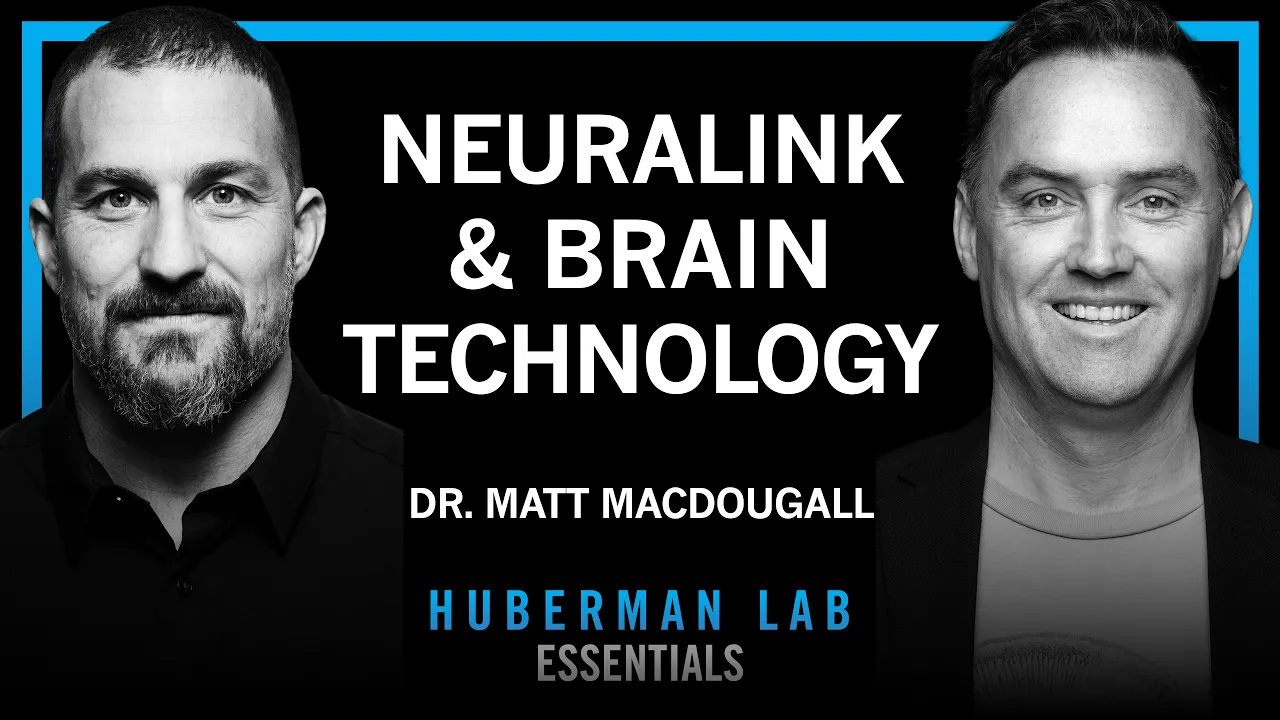
Andrew Huberman
Direct brain-machine interfaces can bridge spinal trauma to restore movement within years before scaling to eliminate the bandwidth bottlenecks of human vocal speech.
AI-assisted summary of Essentials: Neuralink & Technologies to Enhance Human Brains | Dr. Matt MacDougall — original source. Check the original for full context.
Source published:
Key ideas
- Neuralink's initial clinical endpoint focuses on helping quadriplegic patients control digital cursors and keyboards by decoding motor cortex intentions, bypassing damaged spinal pathways. (4:38)
- A specialized robotic surgical system is required because human hand dexterity cannot safely insert hundreds of micro-scale electrode threads around dense cortical surface vasculature. (7:04)
- Functional brain-machine interface control relies on bidirectional co-adaptation, where the user's neural plasticity and decoding algorithms simultaneously adjust to compensate for continuous signal drift. (18:44)
- Neuralink uses pigs primarily as biological safety platforms to assess hardware stability and foreign-body reactions, while rhesus macaques validate high-bandwidth neural decoding on voluntary, opt-in tasks. (24:18)
Detailed notes
## Background This Huberman Lab Essentials episode was published by Andrew Huberman on YouTube on October 15, 2026. According to the page description, the discussion features Neuralink neurosurgeon Dr. Matthew MacDougall exploring how brain-machine interfaces help paralyzed individuals control computers, the role of robotic surgery in placing micro-electrodes, implant safety, animal research ethics, and future possibilities for restoring movement, treating psychiatric conditions, and augmenting cognition.
## TL;DR Dr. Matthew MacDougall details the mechanical modularity of the human brain and how advanced neurosurgical tools—from MRI-guided laser ablation to Neuralink's robotic sewing system—overcome traditional surgical limitations. He outlines Neuralink's clinical roadmap, starting with translating motor cortex intentions into digital inputs for quadriplegic patients before expanding toward spinal cord bypasses to restore biological limb movement. MacDougall also addresses safety data, ethical voluntary protocols in animal research, bidirectional learning between the brain and decoding software, and his personal subdermal RFID implant. Looking ahead, he envisions neural interfaces treating severe neuropsychiatric conditions and radically transforming human communication and AI integration.
## Atmosphere & style The conversation carries an intimate, intellectually charged, and collegial atmosphere rooted in the seven-year friendship between Andrew Huberman and Dr. Matthew MacDougall. The tone smoothly balances the clinical gravity of high-stakes brain trauma and severe paralysis with infectious, cutting-edge technical optimism. Listening feels like sitting in on an earnest, demystifying exchange where science fiction concepts—such as robotic brain surgery, telepathic digital texting, and cognitive augmentation—are grounded in rigorous anatomy, humble human empathy, and pragmatic engineering reality.
## Bulletin - [04:38](https://www.youtube.com/watch?v=YdIJW8RTptU&t=278s) Neuralink's initial clinical endpoint focuses on helping quadriplegic patients control digital cursors and keyboards by decoding motor cortex intentions, bypassing damaged spinal pathways. - [07:04](https://www.youtube.com/watch?v=YdIJW8RTptU&t=424s) A specialized robotic surgical system is required because human hand dexterity cannot safely insert hundreds of micro-scale electrode threads around dense cortical surface vasculature. - [18:44](https://www.youtube.com/watch?v=YdIJW8RTptU&t=1124s) Functional brain-machine interface control relies on bidirectional co-adaptation, where the user's neural plasticity and decoding algorithms simultaneously adjust to compensate for continuous signal drift. - [24:18](https://www.youtube.com/watch?v=YdIJW8RTptU&t=1458s) Neuralink uses pigs primarily as biological safety platforms to assess hardware stability and foreign-body reactions, while rhesus macaques validate high-bandwidth neural decoding on voluntary, opt-in tasks.
## Key takeaways - [00:23](https://www.youtube.com/watch?v=YdIJW8RTptU&t=23s) The brain operates as a collection of discrete functional modules pinned together, meaning localized trauma can eliminate specific traits like impulse control while leaving other capacities intact. - [02:57](https://www.youtube.com/watch?v=YdIJW8RTptU&t=177s) Real-time MRI-guided laser thermal ablation through a 2-millimeter burr hole enables surgeons to destroy deep-seated, previously inoperable tumors while sparing healthy brain parenchyma. - [04:38](https://www.youtube.com/watch?v=YdIJW8RTptU&t=278s) Public perception of Neuralink frequently swings between unrealistic godlike expectations and dystopian fears, contrasting with its grounded clinical focus on severe spinal cord injuries. - [10:00](https://www.youtube.com/watch?v=YdIJW8RTptU&t=600s) The primary near-term application of Neuralink's brain-computer interface is digital device agency, translating imagined movements into mouse and keyboard inputs. - [07:04](https://www.youtube.com/watch?v=YdIJW8RTptU&t=424s) Human surgical dexterity is insufficient to place Neuralink's flexible micro-threads across the cortex without damaging blood vessels, necessitating robotic insertion. - [11:05](https://www.youtube.com/watch?v=YdIJW8RTptU&t=665s) Dr. MacDougall considers the implant procedure safer than many routine, FDA-approved standard-of-care neurosurgeries based on extensive preclinical surgical experience. - [12:51](https://www.youtube.com/watch?v=YdIJW8RTptU&t=771s) Dr. MacDougall carries a custom-buffered, passive subdermal RFID chip in his hand used for everyday access control, demonstrating personal adoption of implantable tech. - [15:34](https://www.youtube.com/watch?v=YdIJW8RTptU&t=934s) Restoring natural biological limb movement requires bridging the injury site by pairing a motor cortex implant with a secondary stimulator placed below the spinal cord lesion. - [16:31](https://www.youtube.com/watch?v=YdIJW8RTptU&t=991s) Silent brain-to-brain communication represents an evolutionary extension of modern digital texting, shifting the interface directly from external smartphones into cortical speech or motor circuits. - [20:00](https://www.youtube.com/watch?v=YdIJW8RTptU&t=1200s) Brain-machine interface decoding functions like playing a piano with drifting keys, requiring continuous mutual adaptation between biological neural networks and machine learning models. - [21:14](https://www.youtube.com/watch?v=YdIJW8RTptU&t=1274s) Neuralink conducts animal research under strict regulatory mandates while enforcing an opt-in model where animals voluntarily participate without food or water deprivation. - [24:18](https://www.youtube.com/watch?v=YdIJW8RTptU&t=1458s) Pigs serve as biological platforms to evaluate implant biocompatibility and hardware safety, whereas non-human primates validate high-bitrate neural signal extraction. - [26:44](https://www.youtube.com/watch?v=YdIJW8RTptU&t=1604s) Long-term horizons for neural interfaces include treating circuit-level neuropsychiatric disorders like severe depression and addiction, as well as enabling direct cognitive integration with AI.
## Detailed walkthrough ### [00:00](https://www.youtube.com/watch?v=YdIJW8RTptU&t=0s) Brain Function, Frontal Lobes & Impulse Control
Andrew Huberman introduces this *Essentials* episode featuring Dr. Matthew MacDougall, neurosurgeon at Neuralink, setting up a conversation around what is surgically and technically possible within the human brain. Huberman asks MacDougall to share his distinct perspective—as both a practicing neurosurgeon and a neuroscientist—on how he conceptualizes the brain as an organ and what possibilities lie ahead that most people never consider.
Dr. MacDougall explains his mechanical and modular view of neuroanatomy, remarking that “the brain really is a collection of functional modules, pinned together, duct taped together in this bone box attached to your head.” Because of this modular design, neurological failures can manifest in jarring ways. Early in his surgical training at UC San Diego, MacDougall treated a young man involved in a severe car crash. The surgical team successfully saved the patient's life, but MacDougall notes the tragic reality of neurosurgery: life is sometimes saved at the direct expense of its quality. When the patient woke up, bilateral damage to his frontal lobes had stripped away his impulse control entirely.
The surgical team was urgently called to the recovery room by an 80-year-old nurse who reported that something was terribly wrong. Walking in, the patient immediately pointed at the elderly nurse and announced, “She won't have sex with me.” MacDougall realized in that instant that because the man's frontal lobes were destroyed, he would never exhibit normal human social behavior again. Everything the brain governs—hormone regulation, sensory processing, vision, and motor actions from eye twitches to bicep contractions—can fail entirely or in discrete pieces. Despite the high-stakes risk, MacDougall finds the career profoundly rewarding, noting that neurosurgeons occasionally achieve "Lazarus-like miracles" by mending injuries and deficits previously considered hopeless.
[02:57](https://www.youtube.com/watch?v=YdIJW8RTptU&t=177s) Brain Tumors, Laser Surgery & MRI
Huberman asks MacDougall to illustrate what counts as a deeply satisfying outcome in modern neurosurgery. MacDougall contrasts traditional neurosurgical interventions with modern, minimally invasive techniques for treating small, deep-seated brain tumors. In the past, resecting a deep lesion required cutting through healthy, functional brain tissue, severing intact neurons and destroying critical white matter tracts along the way.
Today, surgeons use an advanced technique requiring only a 2-millimeter drill hole in the skull. A tiny fiber-optic cannula is guided through the hole directly into the tumor bed and linked to a laser:
```mermaid flowchart LR accTitle: Real-Time Laser Ablation Process accDescr: Three-step workflow showing 2-millimeter skull access, fiber-optic cannula heating, and real-time MRI thermal tracking.
A["2 mm Drill Hole in Skull"] --> B["Pass Fiber-Optic Cannula to Tumor"] B --> C["Laser Thermal Ablation"] C --> D["Real-Time MRI Monitoring"] D -->|"Kill Tumor Cells / Spare Healthy Brain"| E["Patient Leaves Unscathed"] ```
While the patient lies inside the MRI scanner, scans are acquired roughly every second to track thermal dissipation in real time. The surgical team can precisely calibrate the temperature to eradicate malignant cells while leaving surrounding, critical parenchyma uninjured. This technique enables neurosurgeons to clear lesions once considered completely inoperable—including deep tumors in the brainstem, primary motor cortex, or Broca's area—leaving the patient with only a small puncture mark in their scalp and their neurological function fully intact.
- Traditional methods required cutting through normal brain matter and severing white matter tracks to reach deep lesions. - Modern laser thermal ablation operates through a 2-millimeter drill opening. - Real-time MRI imaging captures updates roughly once per second to track temperature boundaries. - Previously inoperable lesions in eloquent regions (e.g., Broca’s area or the brainstem) can now be eliminated without devastating functional deficits.
[04:38](https://www.youtube.com/watch?v=YdIJW8RTptU&t=278s) Neuralink, Brain Implants & Paralysis
Huberman shifts the focus to MacDougall’s work with Neuralink, noting how visionary engineering pushes past conventional clinical limitations. He asks MacDougall to delineate the current mission, scope, and specific clinical endpoints of the enterprise.
MacDougall acknowledges that Neuralink, much like Tesla and SpaceX, tends to act as a cultural mirror for outsized public expectations: “Neuralink and I think Tesla and SpaceX before it end up being these blank canvases that people project their hopes and fears onto.” People swing between believing the company has godlike powers to manipulate minds and harboring deep paranoia about nightmarish dystopias. The concrete reality is far more grounded: the team is building an advanced neural implant paired with an ultra-precise robotic insertion platform.
The initial clinical trial target is severe spinal cord injury. Patients living with quadriplegia retain an intact, fully functioning primary motor cortex capable of commanding voluntary movement, but the physical wiring carrying those signals down the spinal cord to peripheral limbs is broken. Neuralink’s immediate goal is to place an array of flexible electrode threads directly into the patient's motor cortex. By recording intended movements directly from cortical neurons, the device translates those motor intentions into computer inputs—allowing a paralyzed individual to control a digital cursor and keyboard as seamlessly as if their hands were resting on physical peripherals, returning their ability to communicate and interact online.
[07:04](https://www.youtube.com/watch?v=YdIJW8RTptU&t=424s) Robotic Surgery & Electrode Placement
Huberman asks why a robotic system is required to place these neural interfaces instead of relying entirely on human surgical skill. MacDougall explains that the electrode threads are extraordinarily delicate—thinner than a human hair—and terminate in a microscopic loop only a couple of microns across. The surface of the cerebral cortex is blanketed by a dense, fragile mesh of blood vessels that must not be disrupted.
MacDougall admits that although he would love for human hands to be irreplaceable, human dexterity fails at this scale: “I would love if human surgeons were essential to this process, but very soon humans run out of motor skills sufficient to do this job.” A human hand lacks the micro-steadiness required to grasp these micro-loops, navigate around surface vasculature, and insert hundreds of threads at exact depths through every target cortical layer without direct line of sight. The robotic platform is engineered to perform this ultra-precise, high-speed, repeatable insertion at a density and scale humans cannot reproduce.
In the current setup being evaluated by the FDA, the robot's role is strictly confined to placing the electrode threads into the brain. The neurosurgeon still conducts the initial manual steps: creating the scalp incision, opening the skull, and exposing an undamaged cortical surface ready for the robotic sewing system.
Beyond the surgical hardware, MacDougall outlines Neuralink’s broader roadmap:
- **Near-term priority:** Alleviating severe human suffering by providing functional interfaces for people with severe, untreatable neurological conditions such as quadriplegia. - **Future ambition:** Integrating artificial intelligence as an embedded cognitive tool that enhances baseline human processing power and communication, though MacDougall stresses this capability remains far off on the long-term horizon.
When Huberman asks whether the system intends to bypass the spinal cord lesion to immediately restore movement to the patient's biological limbs, MacDougall clarifies that directly reconnecting the brain to paralyzed limbs remains years away on the development roadmap; the near-term clinical target focuses entirely on giving patients control over digital interfaces.
[10:00](https://www.youtube.com/watch?v=YdIJW8RTptU&t=600s) Decoding Motor Intentions to Control Computers
Andrew Huberman and Dr. Matthew MacDougall discuss how Neuralink translates motor intentions into digital actions without requiring physical movement in the real world. Initially, this setup does not move a robotic limb; instead, it allows a user to control basic computer interfaces such as a mouse and keyboard. If a paralyzed patient imagines flexing their fist or twisting their wrist, smarter decoding algorithms translate that neural activity into cursor movements on a display—for instance, guiding the cursor down and to the left to click on a word processor icon, followed by selecting characters sequentially on an on-screen keyboard to type text.
MacDougall explains that this decoding capability has already been demonstrated extensively in animal subjects. Rhesus macaque monkeys at Neuralink play computer games for smoothie rewards, reaching unprecedented performance benchmarks. As MacDougall highlights:
> “We actually have the world record of bitrate of information coming out of a monkey's brain to intelligently control a cursor on a screen.”
- Paralyzed patients control digital interfaces strictly through imagined physical movements (e.g., clenching a fist or rotating a wrist). - Animal subjects demonstrate voluntary cursor control while receiving smoothie treats as positive reinforcement. - Neuralink holds the world record for neural information bitrate extracted from a non-human primate brain for cursor control.
---
[11:05](https://www.youtube.com/watch?v=YdIJW8RTptU&t=665s) Augmentation vs. Medical Need and Implant Safety
When Huberman asks MacDougall whether he would personally be willing to have Neuralink electrodes implanted into his own motor cortex, MacDougall responds enthusiastically, though with practical caveats. For an able-bodied person with full motor function, the first iterations of the implant offer little practical utility because the current outputs simply replicate standard mouse navigation and typing—tasks that can already be done effortlessly with physical hands. The primary mission of early-generation devices is therapeutic, aimed at patients who suffer from catastrophic neurological conditions and have no other viable clinical alternatives.
However, MacDougall envisions a future threshold where the technology exceeds normal human biological bandwidth. If the interface improves to the point where an individual can think and type far faster than through physical typing or voice-to-text dictation, receiving an implant would offer a compelling advantage to healthy individuals. Furthermore, he expresses complete confidence in the physical safety of the procedure based on his extensive surgical experience with the hardware:
> “From the hundreds of surgeries that I've personally done with this, I think it's much safer than many of the industry standard FDA approved surgeries that I routinely do on patients that, you know, no one even thinks twice about their standard of care.”
He emphasizes that Neuralink’s safety standards have surpassed conventional clinical thresholds, making the procedure safer than many routine neurosurgical operations performed across modern hospitals.
---
[12:51](https://www.youtube.com/watch?v=YdIJW8RTptU&t=771s) The Subdermal RFID Hand Implant
Huberman shifts the conversation to biological augmentation by pointing out a visible lump nestled between MacDougall’s thumb and index finger, an implant Huberman has noticed throughout their seven-year friendship. MacDougall explains that the lump is a small, writable radio-frequency identification (RFID) tag. The chip contains no internal battery or active electronics; instead, it remains entirely passive until placed near an antenna, which temporarily powers it to transfer small packets of data. Most standard smartphones can read and write data to this tag.
For years, MacDougall utilized the implant for practical access control, using it to unlock the electronic deadbolt on his front door at home and badging through secure doorways at Neuralink headquarters. Because he is an active rock climber and was concerned about the standard biocompatible glass casing fracturing under mechanical stress, he manually encased the tag inside an extra protective ring of silicone prior to implantation. Because the chip is fully passive, it could theoretically remain in his hand for life without needing replacement or maintenance, although newer commercial chips already offer ten times the data storage capacity as drop-in upgrades. MacDougall notes that walking the walk by carrying implants himself gives him credibility when proposing implantable devices to his patients.
```mermaid flowchart LR accTitle: Subdermal RFID Operation Flow accDescr: Diagram illustrating passive external powering and everyday access applications of the RFID tag. subgraph Hand ["Subdermal Hand Implant"] Chip["Passive RFID Tag"] Glass["Biocompatible Glass Casing"] Silicone["Custom Silicone Buffer"] Glass --- Silicone --- Chip end
subgraph Readers ["External Field & Devices"] Phone["Smartphones (Read/Write)"] Door["Home Deadbolt"] Office["Neuralink Security Doors"] end
Readers -->|"Inductive RF Power"| Chip Chip -->|"Data Return"| Readers ```
- **Device Construction:** Passive, battery-free RFID tag encapsulated in biocompatible glass with an added layer of silicone specifically added to resist rock-climbing trauma. - **Power Mechanism:** Powered entirely via near-field induction when brought near an RF antenna. - **Everyday Functions:** Electronic deadbolt door key for home and keyless security badge access at Neuralink facilities.
---
[15:34](https://www.youtube.com/watch?v=YdIJW8RTptU&t=934s) Bridging Spinal Cord Injuries to Reconnect Brain and Body
Returning to the topic of motor restoration, Huberman clarifies the distinction between Neuralink's immediate clinical objective—giving quadriplegic patients agency over computers and external devices—and the long-term objective of restoring bodily movement. MacDougall confirms that while the initial clinical trials target software and cursor control, the ultimate goal is to physically reconnect the brain to the patient's own paralyzed limbs.
To achieve this, Neuralink has explored direct spinal cord interfaces. In traumatic injuries resulting from motor vehicle accidents, falls, or gunshot wounds, the motor cortex in the brain remains fully functional, and the downstream spinal cord neural networks below the injury level often remain intact. The deficit is purely a communication breakdown across the focal site of injury. By placing one implant in the motor cortex to capture motor intention and a secondary implant below the lesion in the spinal cord, software can bypass the severed tract:
> “If you can bypass the damaged area of the spinal cord and have an implant in the spinal cord itself connected to an implant in the brain and have them talking to each other, you can take the perfectly intact motor signals out of the motor cortex and send them to the spinal cord, which most of the wiring should be intact in.”
MacDougall states that achieving this bypass to restore natural movement to a patient’s paralyzed limbs is a realistic technical milestone achievable within a modest number of years.
---
[16:31](https://www.youtube.com/watch?v=YdIJW8RTptU&t=991s) Telepathic Communication and High-Bandwidth Brain Interfaces
Huberman asks about the conceptual sci-fi vision often discussed by Elon Musk on podcasts: direct brain-to-brain communication, where two individuals with implants exchange silent thoughts without speaking or moving. MacDougall demystifies the idea by drawing an analogy to existing smartphone behavior. Two people sitting across a table from each other texting on their phones are already communicating silently and digitally. Shifting that interface directly into the brain requires no conceptual leaps:
> “Shifting that function from a phone to an implanted device, it requires no magic advance, no leap forward.”
While texting via motor-cortex cursor control represents a rudimentary baseline, the same architecture could eventually be implanted over verbal processing regions of the cortex. This would allow an individual to formulate thoughts into internal speech, which could be converted into synthetic audio and transmitted directly to another person via a bone-conduction implant. MacDougall notes that Neuralink’s fundamental appeal lies in its immense scalability: the architecture has no obvious physiological ceiling preventing it from interfacing with millions of neurons simultaneously, laying the framework for advanced semantic prosthetics and direct cognitive AI integration.
---
[18:44](https://www.youtube.com/watch?v=YdIJW8RTptU&t=1124s) Bidirectional Adaptation: How Brains and Algorithms Learn Together
Huberman asks how brain-machine interfaces improve their performance over time and whether they actively learn from the biological nervous system they monitor. MacDougall explains that functional improvement is an inherently bidirectional learning process between human neuroplasticity and adaptive decoding software.
At the moment of surgical implantation, the chip only reads raw, uncalibrated electrical signals. The decoding software correlates these firing patterns with the patient's intended physical trajectories (such as wanting to guide a cursor toward the upper right). As the patient practices, their biological brain alters its firing patterns to drive the cursor more effectively, while the software simultaneously refines its algorithmic model:
> “So undoubtedly the human that has a Neuralink device will get better at using it over time. Undoubtedly, the software that the Neuralink engineers have written will adapt to the firing patterns that the device is able to record and over time focus in on meaningful signals toward movement.”
This continuous closed loop between human neural plasticity and adaptive software algorithms allows the user and the device to co-adapt, transforming crude, noisy baseline signals into precise, fluid digital control.
[20:00](https://www.youtube.com/watch?v=YdIJW8RTptU&t=1200s) Brain-Machine Interface Adaptation: Decoding Intent and the "Shifting Piano"
Dr. Matthew MacDougall explains how the Neuralink system decodes a user's intent through calibration games on a screen. Because the participant cannot physically move the mouse, the system relies on assumed intention: when a target appears on the screen, the software assumes the user is trying to guide the cursor toward it. The software then records neural firing patterns and correlates specific electrical activity with movements in particular directions—such as up and right, up and left, down and left, or down and right. Over time, the software builds a semi-intelligent predictive model of the user's intent. Once the user is allowed to interact freely, a dynamic co-adaptation takes place: the user learns how to operate the model presented by the software, refining their neural output based on whether the cursor behaves as intended.
To illustrate how challenging this learning problem is, MacDougall draws an analogy to learning a musical instrument whose physical behavior constantly drifts. “Imagine a scenario where you're asking somebody to play piano that the sound that comes out of each key randomly shifts over time,” MacDougall explains. Despite that shifting baseline, the human brain, working alongside adaptive software, is capable of stabilizing the interaction. The user and the algorithms settle into a semi-stable functional state, allowing the person to retain control of the mouse even after powering the device down for the night and returning the following morning to slightly altered neural signals.
```mermaid flowchart TD accTitle: Brain-Machine Interface Co-Adaptation Loop accDescr: Diagram illustrating the closed-loop calibration between user neural firing and software decoding models. subgraph UserSide["User Intent & Action"] A["Visual Target Presented"] --> B["User Intends Directional Movement"] B --> C["Neural Firing Patterns Recorded"] end subgraph DecoderSide["Algorithm & Feedback"] C --> D["Software Builds Directional Model"] D --> E["Cursor Moves on Screen"] E -->|"Visual Feedback"| B E --> F["Co-Adaptation to Drift & Signal Shifts"] end ```
[21:14](https://www.youtube.com/watch?v=YdIJW8RTptU&t=1274s) Animal Research Ethics and Voluntary Participation
Addressing the public sensitivity and emotional reactions surrounding animal testing at Neuralink, MacDougall emphasizes that the company consists almost entirely of animal lovers who would completely bypass animal research if an alternative existed. However, under current regulatory standards, the FDA mandates demonstrating rigorous safety and biocompatibility in animal models before any device can be approved for human clinical use. MacDougall points out that society casually slaughters millions of animals every single day for food, making the sharp focus on the miniscule number of animals used to develop life-saving medical devices disproportionate. If regulatory frameworks allowed willing human volunteers to participate in early-stage safety studies, he notes, many people—including Andrew Huberman, who had already offered to volunteer—would readily step forward.
Within those regulatory constraints, MacDougall states that Neuralink goes to unprecedented lengths to respect animal welfare by making experimentation strictly opt-in. Animals are never coerced into performing tasks once surgical recovery is complete. For example, their star rhesus macaque, Pager, only plays video games when he chooses to. The animals enjoy continuous, unrestricted access to their baseline food and water rations, meaning they are never deprived of basic needs to manufacture compliance. Sweet treats like smoothies serve purely as optional rewards. MacDougall identifies this humane, agency-centered experimental protocol as one of Neuralink's most overlooked internal innovations.
- FDA regulations require exhaustive animal safety data before approving human medical device trials. - Experimental participation for animals is entirely opt-in; no deprivation or negative reinforcement is permitted. - MacDougall reflects on the societal double standard: “In that context, we do animal research because we have to. There's no other way around it.”
[24:18](https://www.youtube.com/watch?v=YdIJW8RTptU&t=1458s) Pigs vs. Monkeys: Safety Platforms and Functional Validation
MacDougall clarifies the distinct experimental roles played by pigs and non-human primates in Neuralink's research pipeline. Pigs are a standard model across medical device engineering, particularly in cardiology, because their physiology shares strong similarities with humans. In Neuralink's work, pigs are not used for complex cognitive decoding tasks. Instead, their skull dimensions and biological resilience make them an ideal safety testing platform. Implantation in pigs allows the team to confirm that the hardware remains physically stable, resists degradation in living tissue, and does not trigger toxic, inflammatory, or foreign-body reactions over time. On occasion, pigs have also walked on treadmills to evaluate limb kinematics and neural signaling for spinal cord restoration research.
Monkeys, by contrast, shoulder the functional workload of the brain-machine interface program. Because their cortical architecture and motor control closely mirror human biology, primates are necessary for validating whether the high-channel-count electrode arrays can extract high-fidelity motor and intention signals. As MacDougall summarizes: “The pigs are really just a safety platform to say the device is safe to implant. It doesn't break down or cause any kind of toxic reaction. The monkeys are where we are really doing our heavy lifting in terms of ensuring that we're getting good signals out of the device, that what we expect to see in humans is validated on a functional level in monkeys first.”
[26:44](https://www.youtube.com/watch?v=YdIJW8RTptU&t=1604s) The Future of Brain Augmentation: From Neuropsychiatry to Direct Mind-to-Mind Connection
Looking toward the clinical horizon over the next 10 to 20 years, MacDougall's primary motivation is ending the devastating neuropsychiatric malfunctions that plague human lives. He points out that virtually everyone has either personal or second-hand experience with conditions like addiction, severe depression, suicide, and obesity. Using targeted neural interfaces to correct these circuit-level malfunctions represents what drives his surgical career.
When Huberman asks him to set aside clinical constraints and envision the long-term potential for human augmentation across generations, MacDougall describes a radically altered cognitive paradigm:
- **AI Immersion and Bottleneck Elimination:** Integrating human cognition directly with artificial intelligence and the web, eliminating the need to read through intermediate sources like Wikipedia articles to obtain foundational data for thought. - **Transcending Vocal Speech:** Moving past verbal language, which MacDougall describes as an inefficient bottleneck: “communication with anyone that you want to, unrestricted by this, you know, flapping air past meat on your face. It's a, you know, a means of communication that's ridiculously prone to being misunderstood. It's also a tiny, narrow bottleneck of communication.” - **Multi-Brain Networks:** Speculative, opt-in networks where multiple human minds combine into a higher-order, multi-unit organism with enhanced collective problem-solving capabilities.
MacDougall views Neuralink's current hardware as cracking open the doorway to these long-range possibilities. To turn these concepts into reality, he invites mechanical, software, and robotics engineers to apply to Neuralink, emphasizing that the team requires the world's best talent to tackle what he considers the planet's hardest engineering challenges.
[29:15](https://www.youtube.com/watch?v=YdIJW8RTptU&t=1755s) Concluding Reflections
Huberman closes the conversation by thanking MacDougall for stepping away from his active neurosurgical duties, his clinical patients, his family, and his work at Neuralink to discuss the technology. Huberman highlights that MacDougall's dedication is not merely theoretical or professional—pointing to the RFID chip implanted beneath the skin of MacDougall's own hand as evidence that he lives and breathes neural augmentation. Huberman commends him not only for his technical intellect and energy, but for the genuine empathy and heart he brings to patient care and neurotechnology. MacDougall offers a humble final thought on their core purpose: “We just want to help people. We want to make things better.”
## Notable quotes > [00:00](https://www.youtube.com/watch?v=YdIJW8RTptU&t=0s) the brain really is a collection of functional modules, pinned together, duct taped together in this bone box attached to your head. — Dr. Matthew MacDougall
> [04:38](https://www.youtube.com/watch?v=YdIJW8RTptU&t=278s) Neuralink and I think Tesla and SpaceX before it end up being these blank canvases that people project their hopes and fears onto. — Dr. Matthew MacDougall
## Mentioned Neuralink, Dr. Matthew MacDougall, Andrew Huberman, Elon Musk, Tesla, SpaceX, FDA, UC San Diego, Broca's area, Pager
## Video description In this Huberman Lab Essentials episode, my guest is Dr. Matthew MacDougall, a neurosurgeon at Neuralink. We discuss how brain-machine interfaces could help people with paralysis control computers using their intended movements, and how robotic surgery enables the placement of tiny electrodes in the brain. We also explore advances in brain tumor surgery, implant safety, how the brain and software learn to work together, and the role of animal research. Dr. MacDougall shares his vision for future applications, including restoring movement, addressing mental health conditions and expanding human cognition and communication.
Show notes: https://www.hubermanlab.com/episode/essentials-neuralink-and-technologies-to-enhance-human-brains-matthew-macdougall
Follow Huberman Lab Instagram: https://www.instagram.com/hubermanlab Threads: https://www.threads.net/@hubermanlab X: https://x.com/hubermanlab Facebook: https://www.facebook.com/hubermanlab TikTok: https://www.tiktok.com/@hubermanlab LinkedIn: https://www.linkedin.com/in/andrew-huberman
Timestamps 00:00:00 Matt MacDougall 00:00:23 Brain Function, Frontal Lobes & Impulse Control 00:02:57 Brain Tumors, Laser Surgery & MRI 00:04:38 Neuralink, Brain Implants & Paralysis 00:07:04 Robotic Surgery & Electrode Placement 00:09:09 Motor Cortex, Controlling Computers With the Brain 00:11:05 Implant Safety & Brain Augmentation 00:12:51 RFID Hand Implant & Everyday Uses 00:15:34 Spinal Cord Stimulation, Reconnecting Brain & Body 00:16:31 Brain-to-Brain Communication & AI 00:18:44 Brain-Machine Interfaces, Learning & Adaptation 00:21:14 Animal Research & Welfare 00:24:18 Pigs & Monkeys, Device Safety & Function 00:26:44 Future Applications, Mental Health & Human Cognition 00:29:15 Acknowledgements
Disclaimer & Disclosures: https://www.hubermanlab.com/disclaimer
[Source](https://www.youtube.com/watch?v=YdIJW8RTptU)