AfD's Weidel Demands End to Ukraine Aid, Warns of European Bond Crisis
The Economist
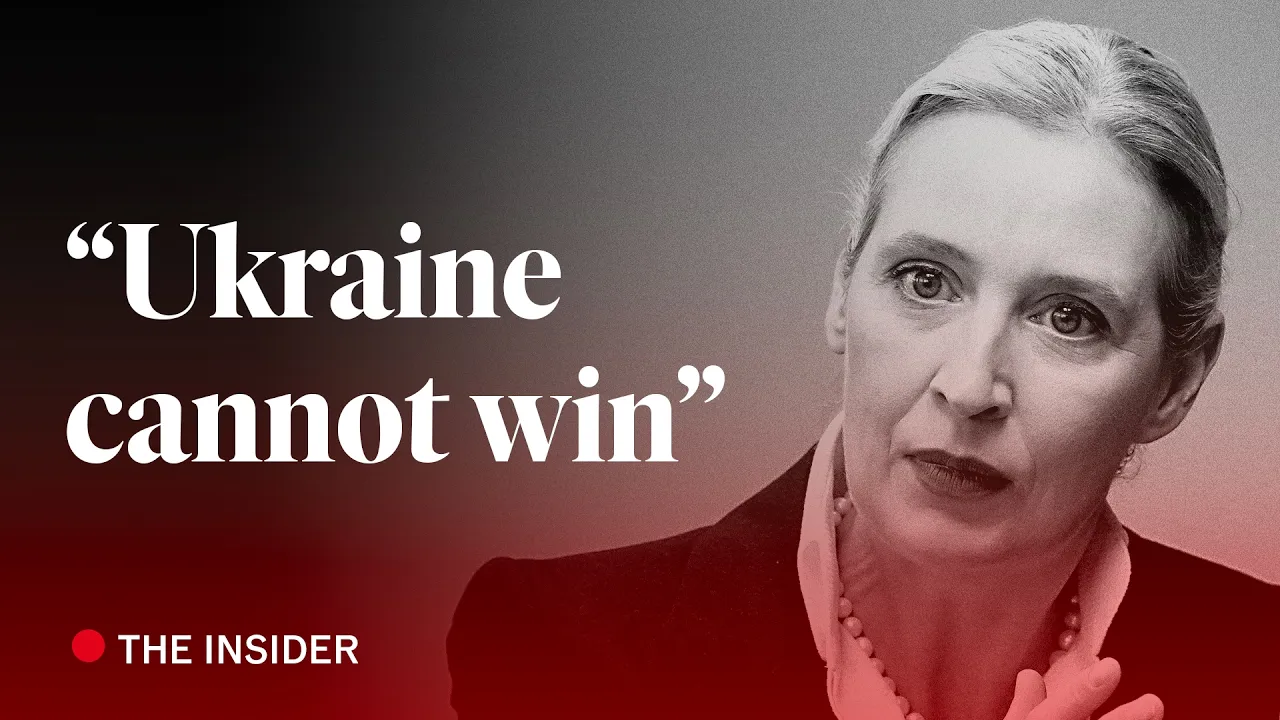
Germany must stop funding Kyiv because Ukraine cannot defeat Russia and prolonging the conflict directly harms German national security, AfD co-leader Alice Weidel says.
AI-assisted summary of Germany is “wrong” to finance Ukraine war: Alice Weidel interview | The Economist — original source. Check the original for full context.
Source published:
Key ideas
- Alice Weidel, co-leader of Alternative for Germany (AfD), calls for an immediate end to German funding for Ukraine, characterizing the conflict as an “already lost war” that drains domestic resources and endangers German security. (1:05)
- Weidel advocates a transactional foreign policy modeled on Donald Trump, arguing Germany must negotiate with Moscow to secure affordable oil, diesel, and gas instead of escalating economic sanctions. (0:00)
- Any durable peace agreement, according to Weidel, requires accommodating Russia's stated security interests and red lines rather than solely focusing on Ukrainian demands. (3:27)
- Weidel warns of an inevitable European bond-market crisis driven by excessive sovereign debt across southern Europe and France, with Germany increasingly vulnerable due to rising yields and debt levels. (5:01)
- The AfD outlines a sweeping repatriation agenda requiring four to five million people—including Syrian, Afghan, and eventually Ukrainian refugees—to leave Germany. (6:37)
Detailed notes
## Background Published by The Economist on YouTube on October 15, 2026, this interview features editor-in-chief Zanny Minton Beddoes questioning Alice Weidel, co-leader of Germany's populist-right Alternative for Germany (AfD). According to the description, Weidel argues that Germany must cease funding an "already lost war" in Ukraine, heed Russia's security concerns, brace for an impending European bond-market crisis, and repatriate millions of refugees.
## TL;DR In a sharp exchange, Alice Weidel outlines the AfD's transactional foreign policy, arguing that Berlin should prioritize cheap energy and national interests over military aid to Ukraine, which she characterizes as structurally incapable of defeating Russia. She insists that durable peace requires accommodating Moscow's red lines and warns that mounting sovereign debt across southern Europe and Germany will precipitate a bond-market crisis. Domestically, Weidel advocates for sweeping repatriation measures, asserting that Syrians, Afghans, and ultimately Ukrainian refugees—amounting to four to five million people—must leave Germany once active conflicts subside.
## Atmosphere & style The interview crackles with friction, defined by sharp cross-examinations from Beddoes and combative, unapologetic retorts from Weidel. There is a palpable tension between Beddoes's values-driven grilling on democratic norms and Weidel's hard-nosed, realpolitik assertions punctuated by dismissive gestures and direct challenges. The dialogue feels brisk, clinical, and uncompromising, offering viewers a tense confrontation over European security and national sovereignty.
## Bulletin - [01:05](https://www.youtube.com/watch?v=5sorengsI0I&t=65s) Alice Weidel, co-leader of Alternative for Germany (AfD), calls for an immediate end to German funding for Ukraine, characterizing the conflict as an “already lost war” that drains domestic resources and endangers German security. - [00:00](https://www.youtube.com/watch?v=5sorengsI0I&t=0s) Weidel advocates a transactional foreign policy modeled on Donald Trump, arguing Germany must negotiate with Moscow to secure affordable oil, diesel, and gas instead of escalating economic sanctions. - [03:27](https://www.youtube.com/watch?v=5sorengsI0I&t=207s) Any durable peace agreement, according to Weidel, requires accommodating Russia's stated security interests and red lines rather than solely focusing on Ukrainian demands. - [05:01](https://www.youtube.com/watch?v=5sorengsI0I&t=301s) Weidel warns of an inevitable European bond-market crisis driven by excessive sovereign debt across southern Europe and France, with Germany increasingly vulnerable due to rising yields and debt levels. - [06:37](https://www.youtube.com/watch?v=5sorengsI0I&t=397s) The AfD outlines a sweeping repatriation agenda requiring four to five million people—including Syrian, Afghan, and eventually Ukrainian refugees—to leave Germany.
## Key takeaways - [00:00](https://www.youtube.com/watch?v=5sorengsI0I&t=0s) Weidel insists German foreign policy must be guided strictly by national self-interest rather than external alliances or ideological commitments. - [00:00](https://www.youtube.com/watch?v=5sorengsI0I&t=0s) Germany should mirror Donald Trump's pragmatic approach to Russia by engaging directly on energy supplies like diesel, oil, and gas instead of piling on sanctions. - [01:05](https://www.youtube.com/watch?v=5sorengsI0I&t=65s) Although Weidel acknowledges Russia's military attack on Ukraine was illegal, she argues Ukraine cannot win against Russia due to deep structural asymmetry. - [01:05](https://www.youtube.com/watch?v=5sorengsI0I&t=65s) Weidel questions Ukraine's democratic credentials, citing the postponement of presidential elections and claiming leadership renewal is necessary. - [03:27](https://www.youtube.com/watch?v=5sorengsI0I&t=207s) Financing Ukraine's defense has already cost German taxpayers over €100 billion, which Weidel argues is unsustainable and detrimental amid rising national debt. - [03:27](https://www.youtube.com/watch?v=5sorengsI0I&t=207s) A lasting peace framework is unattainable without explicitly taking Moscow's long-standing security interests and red lines into account. - [05:01](https://www.youtube.com/watch?v=5sorengsI0I&t=301s) A sovereign bond-market crisis in Europe is inevitable due to unsustainable debt burdens in France, Italy, Spain, and Portugal. - [05:01](https://www.youtube.com/watch?v=5sorengsI0I&t=301s) Marine Le Pen's push for European Central Bank financing reflects French self-interest to escape its debt crisis, but leaves Germany footing the bill as the EU's top net contributor. - [05:01](https://www.youtube.com/watch?v=5sorengsI0I&t=301s) Germany is losing its fiscal buffer as its own expanding borrowing programs and rising capital market yields leave it exposed to the broader European debt hazard. - [06:37](https://www.youtube.com/watch?v=5sorengsI0I&t=397s) Asylum is strictly temporary shelter; because combat in Syria has largely subsided, Weidel insists 100% of Syrian refugees must return home. - [06:37](https://www.youtube.com/watch?v=5sorengsI0I&t=397s) Weidel condemns German government charter flights bringing in Afghan nationals, describing the practice as an obnoxious policy. - [06:37](https://www.youtube.com/watch?v=5sorengsI0I&t=397s) The AfD demands immediate detention and deportation of violent offenders and radical Islamist figures to curb violent crime (Rohheitsdelikte) and prevent religious radicalism. - [06:37](https://www.youtube.com/watch?v=5sorengsI0I&t=397s) Ukrainian refugees will also be required to leave Germany and return to rebuild their country once the war concludes. - [06:37](https://www.youtube.com/watch?v=5sorengsI0I&t=397s) The AfD estimates that four to five million current residents of foreign origin will ultimately need to depart Germany under its remigration platform.
## Detailed walkthrough ### [00:00](https://www.youtube.com/watch?v=5sorengsI0I&t=0s) Germany’s National Interest and the War in Ukraine
Zanny Minton Beddoes opens the exchange by pressing Alice Weidel on whether she views Russia as a security threat extending past Ukraine to other European nations and NATO allies. Weidel immediately pivots away from the concept of an external menace, arguing that the framing itself is flawed. In her view, geopolitical decisions must be judged purely through a pragmatic, self-interested lens rather than ideological commitments. With visible disdain for the current coalition in Berlin, she snorts at how the German government conducts its affairs, warning that the prevailing strategy is directly inflicting damage on the country's domestic well-being.
To illustrate what she views as a failed approach, Weidel contrasts Germany's relentless implementation of sanctions with Donald Trump's diplomatic posture toward Moscow. She highlights that while Berlin stacks sanction package upon sanction package to its own detriment, Trump actively engages in discussions with Vladimir Putin regarding energy supplies, including diesel, oil, and gas. For Weidel, securing reliable, cheap energy should be Germany’s primary goal, and she openly advocates adopting that exact transactional stance for her own country.
> “I think German foreign or Germany's foreign policy should be evaluated by the criterion if it serves our national interest or not.” — Alice Weidel
[01:05](https://www.youtube.com/watch?v=5sorengsI0I&t=65s) Questioning Ukraine's Democracy and Financing an “Already Lost War”
When Beddoes asks whether Germany and Western Europe have a moral duty to defend a sovereign democracy resisting naked aggression, Weidel pushes back against Ukraine's democratic standing. She remarks dismissively that Ukraine is only “as democratic as it is,” pointing out that presidential elections have been shelved. She claims Donald Trump himself has called for fresh elections because Volodymyr Zelensky is no longer the right leader for the moment. Beddoes interjects firmly to note that elections cannot reasonably be held in the middle of a brutal war of survival, but Weidel brushes past the objection. While she explicitly concedes that Russia launched an illegal assault against a sovereign nation, she insists that the day-to-day reality on the ground makes current policy indefensible.
Weidel describes the ongoing status quo as an unmitigated disaster: families losing sons on the battlefield, refineries and critical infrastructure being pulverized, diesel prices climbing out of reach, and European security hanging by a thread. As a German politician whose mandate is strictly domestic, she argues that funding the conflict does nothing to avert disaster and only compounds the danger to Germany. She blunt-force categorizes Ukraine as structurally incapable of overcoming its larger neighbor, declaring that pouring further billions into Kyiv is an exercise in futility.
> “The prolongation and the measures being taken by the German governments right now impose a huge risk on our country and we think I think it is wrong to continue with a prolongation of a financing of a already lost war.” — Alice Weidel
- Weidel explicitly affirms Ukrainian sovereignty: “We also criticized the Russian attack on Ukraine because Ukraine is a sovereign country. Full stop.” - She insists military defeat is inevitable due to structural asymmetry: “The Ukraine cannot win against Russia.”
[03:27](https://www.youtube.com/watch?v=5sorengsI0I&t=207s) The Feasibility of Peace and Russia’s Security Concerns
The discussion turns sharply combative when Beddoes challenges the notion that peace is attainable through negotiation, pointing out that Vladimir Putin has shown zero willingness to compromise and continues targeting Ukrainian energy grids ahead of winter. Beddoes details Ukraine's readiness to talk, referencing proposals for energy ceasefires and recent discussions held in Florida, and challenges Weidel to produce a single shred of evidence that Putin wants a diplomatic exit. Weidel deflects by demanding evidence that Zelensky desires peace either, prompting Beddoes to clarify whether the AfD's actual position is to sever all German and European financial and military aid immediately.
Weidel defends halting aid by citing the sheer financial burden on German taxpayers, emphasizing that Berlin has already committed over €100 billion—more than any other European peer—despite mounting national debt. Invoking an unapologetic “Germany first” doctrine, she warns that prolonging the war actively endangers German national security. She contends that any durable settlement is impossible without accommodating the Kremlin's strategic demands, arguing that the core diplomatic failure of the last two decades was the West's refusal to heed Moscow's stated red lines.
> “In order to have a peace in the Ukraine, we need to take not only Ukraine security interest into account but also Russia security interest into account.” — Alice Weidel
[05:01](https://www.youtube.com/watch?v=5sorengsI0I&t=301s) Looming European Bond Market Crisis and State Debt
Beddoes turns the focus toward the wider European political landscape, noting that Marine Le Pen is leading French presidential polling while campaigning for the European Central Bank to finance massive infrastructure projects. Asked what an EU led by an AfD-run Germany alongside a Le Pen presidency would look like, Weidel chuckles that Le Pen naturally seeks easy ECB money because “it's all cheap for France.” As the EU’s largest net contributor, Germany, Weidel notes, is expected to foot the bill while France struggles under a severe fiscal crisis marked by punishing bond yields.
When Beddoes asks whether financial markets might trigger a catastrophic sovereign debt crisis once they digest the economic visions of Europe's hard-right leaders, Weidel agrees without hesitation. She warns that excessive state borrowing across southern Europe—specifically naming France, Italy, Spain, and Portugal—is dragging the eurozone toward an inevitable reckoning. She cautions that Germany is no longer insulated from this danger, as its own soaring borrowing programs and rising capital market interest rates leave it increasingly exposed to the same fiscal instability.
> “Certainly we're going to have a bond market crisis.” — Alice Weidel
- Weidel argues Le Pen is pursuing French national interests: “From her perspective, I would do the same thing. She wants to do the best thing for her country. She wants to have free debt financing even though France is already in a huge debt crisis.” - Countries identified as driving the European debt hazard: France, Italy, Spain, Portugal, and Germany.
[06:37](https://www.youtube.com/watch?v=5sorengsI0I&t=397s) The AfD’s Remigration Agenda: Syrians, Afghans, and Ukrainians
Beddoes shifts to domestic tensions, emphasizing that millions of residents with foreign backgrounds in Germany feel deeply alarmed by the AfD's rhetoric, and asks Weidel to clarify whether legally resident foreigners, such as Syrians and Afghans, are welcome to remain. Weidel rejects the premise, falling back on strict legal terms: asylum is temporary shelter, not permanent settlement. Because major active combat in Syria has ceased, she insists the legal justification for asylum has expired, meaning recipients of state support must now be repatriated en masse.
Weidel directs fierce criticism toward the German federal government for chartering flights to bring in Afghans, calling it an “obnoxious policy.” She connects the 2015 border opening directly to a surge in violent offenses (*Rohheitsdelikte*), including murders and rapes, alleging that Syrians and Afghans are disproportionately represented in these statistics. Beyond repatriating these groups, she demands the detention of criminal offenders and radical Islamist leaders, declaring that Germany must prevent the establishment of a caliphate. Crucially, Weidel widens the scope of deportation to encompass Ukrainian refugees once the war ends, concluding that four to five million people currently residing in Germany must ultimately leave.
> “100% of the Syrian citizens have to go back to their country as well as the Afghans which our government decided to actually fly into our country.” — Alice Weidel
- Target demographics slated for mandatory departure: Syrian refugees, Afghan arrivals, and Ukrainian refugees upon the conclusion of the war. - Estimated population affected by the AfD's repatriation goals: four to five million people. - Internal security demands: Immediate detention of violent offenders and extremist religious leaders to combat radicalization and halt the rise of violent crime (*Rohheitsdelikte*).
## Notable quotes > [03:27](https://www.youtube.com/watch?v=5sorengsI0I&t=207s) In order to have a peace in the Ukraine, we need to take not only Ukraine security interest into account but also Russia security interest into account. — Alice Weidel
> [01:05](https://www.youtube.com/watch?v=5sorengsI0I&t=65s) I think it is wrong to continue with a prolongation of a financing of a already lost war. — Alice Weidel
> [06:37](https://www.youtube.com/watch?v=5sorengsI0I&t=397s) 100% of the Syrian citizens have to go back to their country as well as the Afghans which our government decided to actually fly into our country. — Alice Weidel
> [01:05](https://www.youtube.com/watch?v=5sorengsI0I&t=65s) The Ukraine cannot win against Russia. — Alice Weidel
> [00:00](https://www.youtube.com/watch?v=5sorengsI0I&t=0s) Germany's foreign policy should be evaluated by the criterion if it serves our national interest or not. — Alice Weidel
## Mentioned Alice Weidel, Zanny Minton Beddoes, The Economist, Alternative for Germany, Donald Trump, Vladimir Putin, Volodymyr Zelensky, Marine Le Pen, European Central Bank, NATO, European Union, Germany, Ukraine, Russia, France, Italy, Spain, Portugal, Syria, Afghanistan
## Video description Germany should stop financing an “already lost war” in Ukraine, says Alice Weidel.
The co-leader of the populist-right Alternative for Germany, speaks to Zanny Minton Beddoes, The Economist’s editor-in-chief.
Weidel argues that peace requires taking Russia’s security interests into account, that Europe is heading for a bond-market crisis and that Syrians, Afghans–and eventually Ukrainians–have to leave Germany.
#europe #germany #ukraine #war #russia
00:00 - Is Russia a threat to Europe? 01:05 - “An already lost war”: Weidel on Ukraine 03:27 - Does Putin want peace? 05:01 - Europe’s coming debt crisis 06:37 - The AfD’s plan for migrants
Watch the full show: http://bit.ly/4jozhN6 Sign up to the Insider newsletter: https://econ.st/4nOyzIb
Subscribe to The Economist: https://www.economist.com/subscribe Download our app: https://www.economist.com/get-the-app
Follow The Economist on Instagram: https://www.instagram.com/theeconomist/ Follow The Economist on Facebook: https://www.facebook.com/TheEconomist Follow The Economist on X: https://x.com/TheEconomist
[Source](https://www.youtube.com/watch?v=5sorengsI0I)