Cloudflare Acquires Deno and Plans Sunset as Node.js Wins Runtime War
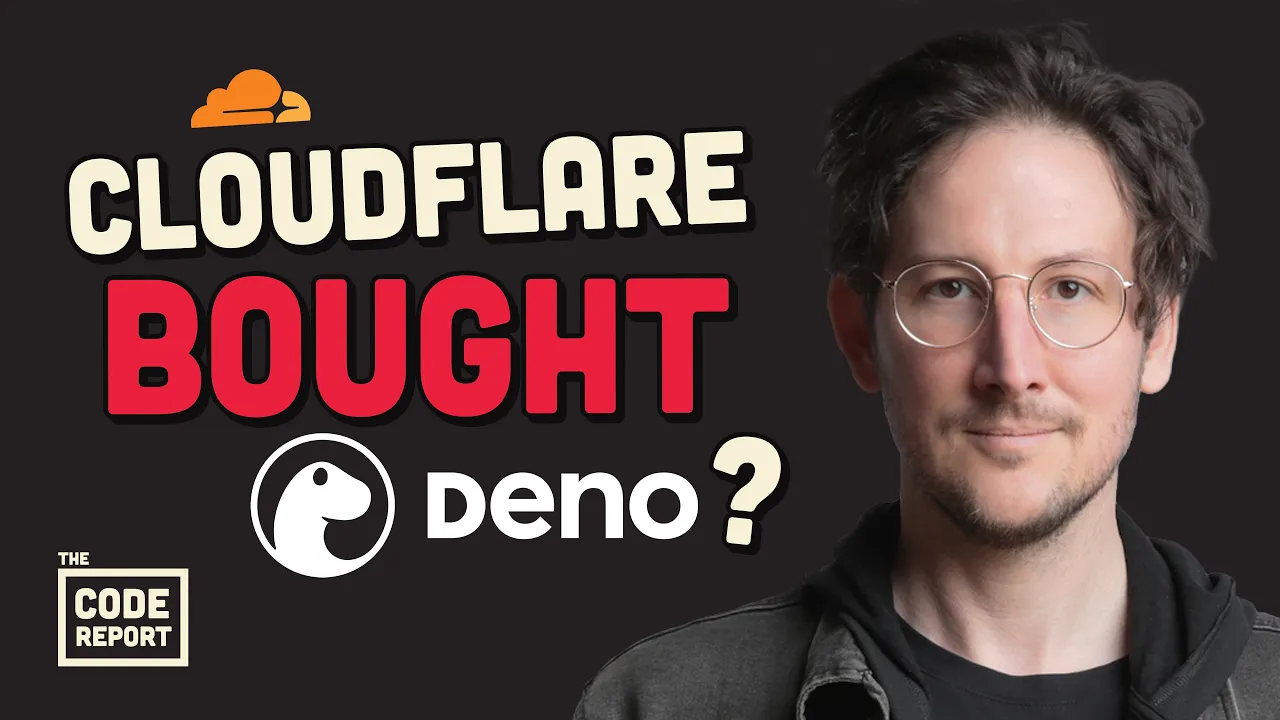
Fireship
Cloudflare will shut down Deno after integrating its CellD architecture into workerd, leaving Node.js as the sole major JavaScript runtime free of corporate cloud control.
AI-assisted summary of The runtime wars are over... and Node won — original source. Check the original for full context.
Source published:
Key ideas
- Cloudflare has acquired Deno, marking the end of the runtime wars as creator Ryan Dahl admitted that attempting to re-implement Node.js from scratch was a mistake. (0:00)
- The acquisition spells the sunset of the Deno platform: active development will cease after 12 months of bug and security patches, giving Deno Deploy users roughly six months to migrate. (2:46)
- Cloudflare purchased Deno primarily to acquire CellD, an open-source implementation of Durable Objects that will be merged into the workerd runtime to enable native self-hosting. (2:46)
- With Anthropic owning Bun and Cloudflare acquiring Deno, Node.js remains the sole foundational JavaScript runtime not owned by a hyperscale corporate cloud provider. (2:46)
Detailed notes
## Background Published on YouTube by Fireship on October 15, 2026, this video covers Cloudflare's acquisition of Deno and the effective conclusion of the JavaScript runtime wars. According to the description, Node.js creator Ryan Dahl has conceded that attempting to reimplement Node from scratch was a mistake, while also introducing a sponsorship for JetBrains Junie Lite.
## TL;DR The fierce rivalry among JavaScript runtimes has reached a decisive finish with Cloudflare acquiring Deno, marking an end-of-life roadmap for the alternative runtime. Although Deno originally sought to correct Node's architectural flaws with native TypeScript and built-in security, Node rapidly eliminated those competitive advantages by adopting those very features itself. Facing stalled commercial traction and shrinking deployment infrastructure, Deno pivoted to building CellD—an open, self-hostable alternative to Cloudflare's Durable Objects aimed at stateful AI agent workflows. Cloudflare acquired Deno to incorporate that self-hosting technology into its own runtime, giving existing Deno Deploy customers six months to migrate before development is discontinued entirely.
## Atmosphere & style The video carries Fireship's signature rapid-fire, cynical, and meme-literate delivery, dissecting the harsh realities of startup life and preference stacks with deadpan humor. It balances tech-insider satire about legal fights over trademarks with genuinely incisive architectural analysis of distributed state and durable objects. The narrative feels like an entertaining post-mortem, tinged with poetic irony as Node outlasts the very project created to replace it.
## Bulletin - [00:00](https://www.youtube.com/watch?v=l3L_lETiSzc&t=0s) Cloudflare has acquired Deno, marking the end of the runtime wars as creator Ryan Dahl admitted that attempting to re-implement Node.js from scratch was a mistake. - [02:46](https://www.youtube.com/watch?v=l3L_lETiSzc&t=166s) The acquisition spells the sunset of the Deno platform: active development will cease after 12 months of bug and security patches, giving Deno Deploy users roughly six months to migrate. - [02:46](https://www.youtube.com/watch?v=l3L_lETiSzc&t=166s) Cloudflare purchased Deno primarily to acquire CellD, an open-source implementation of Durable Objects that will be merged into the workerd runtime to enable native self-hosting. - [02:46](https://www.youtube.com/watch?v=l3L_lETiSzc&t=166s) With Anthropic owning Bun and Cloudflare acquiring Deno, Node.js remains the sole foundational JavaScript runtime not owned by a hyperscale corporate cloud provider.
## Key takeaways - [00:00](https://www.youtube.com/watch?v=l3L_lETiSzc&t=0s) Ryan Dahl concluded that rewriting Node.js from the ground up was a mistake, leading to Deno's acquisition by Cloudflare despite Cloudflare already operating its own edge runtime. - [00:44](https://www.youtube.com/watch?v=l3L_lETiSzc&t=44s) Deno was conceived at JSConf EU 2018 to fix Dahl's regrets about Node.js by offering native TypeScript, out-of-the-box tooling, and a secure permissions sandbox. - [00:44](https://www.youtube.com/watch?v=l3L_lETiSzc&t=44s) Node.js neutralized Deno's competitive advantages by implementing native fetch, direct TypeScript execution, and its own permission security models. - [00:44](https://www.youtube.com/watch?v=l3L_lETiSzc&t=44s) Commercial traction for Deno's hosted offerings steadily deteriorated, forcing Deno Deploy to contract from 35 geographic regions down to six. - [00:44](https://www.youtube.com/watch?v=l3L_lETiSzc&t=44s) Key Deno initiatives stalled, including Deno KV remaining stuck in beta, Fresh framework updates lagging, and resources being diverted to a trademark battle against Oracle. - [00:44](https://www.youtube.com/watch?v=l3L_lETiSzc&t=44s) Deno became trapped in an unsustainable treadmill of constantly chasing Node compatibility rather than driving runtime innovation. - [02:46](https://www.youtube.com/watch?v=l3L_lETiSzc&t=166s) Deno pivoted to distributed state coordination by releasing CellD, an open-source clone of Cloudflare's Durable Objects designed for private SQLite storage. - [02:46](https://www.youtube.com/watch?v=l3L_lETiSzc&t=166s) Cloudflare acquired Deno after its own internal efforts to build a self-hostable workers implementation failed earlier in the year. - [02:46](https://www.youtube.com/watch?v=l3L_lETiSzc&t=166s) Ryan Dahl and Bert Belder will integrate CellD directly into Cloudflare's open-source workerd runtime to power stateful, long-lived autonomous AI agent architectures. - [02:46](https://www.youtube.com/watch?v=l3L_lETiSzc&t=166s) Cloudflare is phasing out the Deno product line, committing only to 12 months of maintenance patches before abandoning development, with Deno Deploy users facing a six-month migration window. - [02:46](https://www.youtube.com/watch?v=l3L_lETiSzc&t=166s) Recent corporate buyouts—including Anthropic purchasing Bun and Cloudflare taking Deno and Vite—leave Node.js as the last major independent JavaScript runtime.
## Detailed walkthrough ### [00:00](https://www.youtube.com/watch?v=l3L_lETiSzc&t=0s) The End of the JavaScript Runtime Wars
The JavaScript runtime wars have drawn to an unexpected conclusion: Ryan Dahl, the creator who brought JavaScript to the server with Node.js and subsequently spent a decade attempting to atone for its shortcomings, announced that his company, Deno, has been acquired by Cloudflare. On the surface, the transaction presents like standard Silicon Valley corporate theater, complete with founders voicing enthusiasm for the future, the acquiring enterprise expressing excitement for shared goals, and employees abruptly discovering the harsh mechanics of preference stacks. Yet the underlying premise is counterintuitive: Cloudflare already possesses its own mature edge runtime and deployment network, raising immediate questions about why it would purchase an ostensibly competing platform.
The rationale behind the purchase reveals a shift in priorities: Ryan Dahl has arrived at the realization that attempting to re-implement Node.js from scratch was a mistake, and the resulting trajectory for the Deno platform itself looks bleak. As host Fireship frames the situation: “And on paper, it looks like a pretty traditional Silicon Valley acquisition where the founder says they're excited for the future. The company says they're excited about the mission and the employees learn the hard way what a preference stack is. But if you think about it, it's a little weird that a company which already has its own runtime and deployment platform would buy a worse one.”
[00:44](https://www.youtube.com/watch?v=l3L_lETiSzc&t=44s) The Rise and Fall of Deno's Momentum
To trace how the industry arrived at this point, one must look back to 2009, when Ryan Dahl took the stage at JSConf EU to unveil Node.js, fundamentally altering backend development. Nine years later, he returned to that exact stage with his famous retrospective, “10 Things I Regret About Node.js.” Rather than merely critiquing his prior work, he revealed Deno—a runtime built from scratch designed to eliminate those original architectural regrets. Unlike Node, Deno shipped out-of-the-box with a built-in linter, formatter, and test runner, alongside native TypeScript execution, a secure-by-default sandbox permissions architecture, and a modern URL-based external module system.
```mermaid flowchart TD accTitle: Deno Growth and Decline Lifecycle accDescr: Chronological timeline of Deno from initial 2018 reveal through 2022 funding and subsequent stagnation.
subgraph Growth["Expansion (2018 - 2022)"] A["2018: Regret talk reveals Deno"] --> B["2020: Deno 1.0 Release"] B --> C["2021: $5M Seed & Deno Deploy"] C --> D["2022: $21M Series A (Sequoia) & Fresh Framework"] end
subgraph Stagnation["Decline & Node Counter-Offensive"] D --> E["Node adds native fetch, TypeScript & permissions"] E --> F["Deno Deploy shrinks from 35 to 6 regions"] F --> G["Deno KV stalled in beta; Fresh releases slow down"] G --> H["Legal battle against Oracle over 'JavaScript' trademark"] end ```
Deno 1.0 launched in 2020, followed in 2021 by the introduction of Deno Deploy and a $5 million seed funding round. Commercial adoption seemed promising: Netlify and Supabase built their serverless edge functions on top of Deno's architecture, while Slack selected it to power their revised application platform. By 2022, Deno secured a $21 million Series A led by Sequoia Capital and rolled out Fresh, its bespoke server-side web framework.
However, Deno's competitive edge evaporated rapidly as Node refused to remain stagnant. Instead of rolling over, Node incorporated native `fetch`, developed its own permission security models, and added direct execution for TypeScript files, erasing Deno's key selling points. Simultaneously, Deno’s monetization strategy faltered: - Deno Deploy contracted from a distributed presence across 35 regions down to only six. - Deno KV, launched in 2023, languished and never exited beta testing. - The Fresh framework stagnated, enduring multi-month gaps between updates. - Dahl directed resources toward a legal dispute against Oracle to contest the “JavaScript” trademark (inherited from Sun Microsystems in 2009)—a well-meaning ideological campaign, but hardly the commercial enterprise Sequoia anticipated when writing a $21 million check.
Sentiment worsened until developer David Bushell published a critique characterizing Deno as effectively dead, trapped in an endless treadmill of shipping Node compatibility patches rather than innovating. Dahl privately reached that very same conclusion.
[02:46](https://www.youtube.com/watch?v=l3L_lETiSzc&t=166s) Durable Objects, CellD, and the Cloudflare Buyout
Confronting this reality, the Deno engineering team pivoted away from runtime-level mechanics to focus on higher-level distributed systems challenges: cross-machine compute distribution, state coordination, and scaling. Their investigation pointed toward Cloudflare’s Durable Objects—lightweight, single-threaded execution instances bound to isolated, private SQLite storage engines with persistent WebSocket communication capabilities.
The fundamental limitation of Cloudflare's Durable Objects was their proprietary lock-in within Cloudflare's ecosystem. In response, Deno engineered CellD in August, an open alternative designed to execute durable object primitives on private hardware at a fraction of hosted infrastructure costs.
| Runtime / Technology | Core Advantage | Strategic Dilemma / Eventual Fate | |:--- |:--- |:--- | | **Node.js** | Ubiquitous ecosystem, open-source governance | Adopted TypeScript, native `fetch`, and security sandboxing to defend market share | | **Deno (Legacy)** | Built-in tooling, default security sandbox | Lost differentiation; caught in endless Node-compatibility maintenance cycle | | **Cloudflare Workers** | Edge latency, durable object state primitives | Vendor lock-in; open-source runtime lacked turn-key self-hosting capabilities | | **CellD** | Self-hostable durable objects with SQLite | Created by Deno, then acquired by Cloudflare to merge upstream |
Far from taking legal or competitive issue with being cloned, Cloudflare welcomed the project. The creator of Cloudflare Workers highlighted that while the workers runtime had been open-sourced in 2022, the company had spent years wanting a fully self-hostable implementation, even confessing that their own internal attempts to build one the previous spring had failed. Cloudflare, wielding a $123 billion market cap, resolved the issue by acquiring Deno outright.
Under the acquisition plan, Ryan Dahl and co-founder Bert Belder will integrate CellD directly into Cloudflare’s open-source `workerd` runtime, providing native, first-party support for self-hosted workers and durable objects. Dahl identified autonomous AI agents as the primary rationale for the technology, pointing out that agentic workflows demand economical compute, long-lived local state, and persistent real-time connections.
For users invested in the broader Deno product line, the acquisition marks an end-of-life notice: - Cloudflare will limit Deno maintenance strictly to security patches and bug fixes for 12 months, followed by a total cessation of development. - Active customers utilizing Deno Deploy are given roughly a six-month window to migrate workloads off the platform. - Following Anthropic's acquisition of Bun and Cloudflare's purchase of Deno (alongside its earlier acquisition of Vite in June), Node.js remains the sole foundational JavaScript runtime not controlled by a hyperscale corporate cloud provider.
As Fireship summarizes the stark fallout for developers on the platform: “Cloudflare says they'll only continue to ship bug fixes and security patches for Dino for the next year. But after that, they'll stop development altogether. And if you're using Dino deploy today, you have about 6 months to migrate.”
[04:42](https://www.youtube.com/watch?v=l3L_lETiSzc&t=282s) Sponsor: JetBrains Junie Lite
For developers facing migrations away from sunsetting infrastructure, host Fireship introduces the video's sponsor, JetBrains. Joking about the anxiety of token billing when orchestrating AI agents, the host highlights Junie Lite, a baseline model included across all JetBrains accounts without cost.
- **Always Free:** Operates directly inside the IDE and command-line interface without countdown trial limitations. - **Automation Use Cases:** Well-suited for maintenance tasks such as renaming functions and generating test scaffolding across legacy projects without accumulating frontier API expenses. - **Workflow Integration:** Junie Lite integrates directly into JetBrains AI, enabling developers to spin up multiple parallel agents, review proposed code modifications prior to merging, and step up to frontier models when complex reasoning is required.
## Mentioned Fireship, Ryan Dahl, Bert Belder, David Bushell, Node.js, Deno, Deno Deploy, Deno KV, Fresh, CellD, Cloudflare, Cloudflare Workers, Durable Objects, workerd, Bun, Anthropic, Vite, JetBrains, Junie Lite, Netlify, Supabase, Slack, Sequoia Capital, Oracle, Sun Microsystems, JSConf EU, TypeScript, SQLite
## Video description Every JetBrains account now comes with a free coding model called Junie Lite. Try it: https://jb.gg/JunieLite
Cloudflare just acquired Deno and the creator of Node.js is finally admitting that reimplementing it was a mistake. Let's dive in.
Want more Fireship?
🗞️ Newsletter: https://bytes.dev 🧠 Courses: https://fireship.dev
[Source](https://www.youtube.com/watch?v=l3L_lETiSzc)