Sequoia's Lin Sees AI Value in Apps, Warns Hyperscaler Debt Piles Up
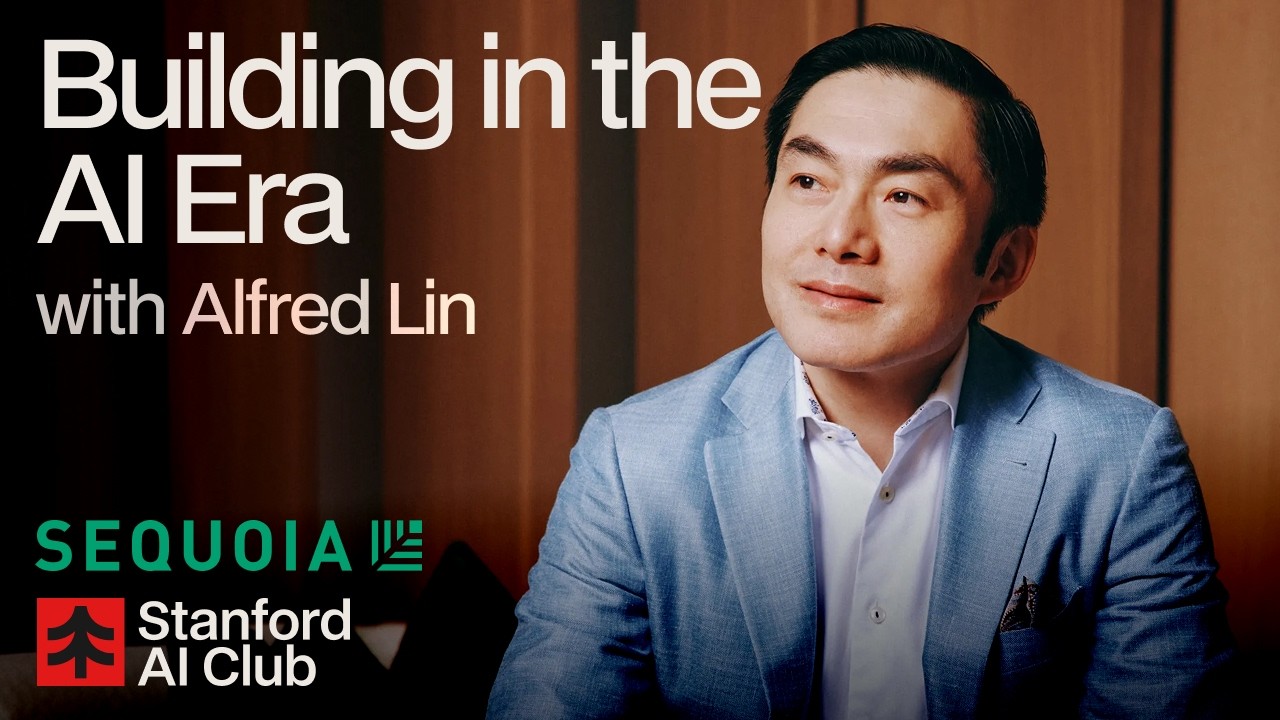
Stanford AI Club
Technology diffuses far slower than model capabilities advance because human behavior changes slowly, ensuring vertical applications capture enduring value while debt-financed data center expansions create the real downside risk.
AI-assisted summary of Stanford AI Club: Alfred Lin on Building in the AI Era — original source. Check the original for full context.
Source published:
Key ideas
- Sequoia Capital partner Alfred Lin argues software is far from dead, asserting that value will overwhelmingly accrue to the application and diffusion layer that translates raw foundation model intelligence into specialized human workflows. (25:10)
- Human adoption remains the ultimate bottleneck in technology diffusion, exemplified by Walmart growing 30-fold and holding off Amazon in revenue for nearly three decades after the e-commerce boom began. (22:52)
- Lin downplays concerns over circular AI financing as standard capital velocity, warning instead that the real macro risk is hyperscalers turning cash-flow negative and taking on debt leverage to fund massive data center infrastructure. (33:17)
- Market cap ceilings have expanded 15x over fifteen years from $400 billion to nearly $6 trillion, keeping venture return profiles intact despite rising check sizes but requiring founders to scale much further within fixed human lifespans. (43:24)
Detailed notes
## Background Published on YouTube by the Stanford AI Club on October 15, 2026, this recording captures the kickoff event of the club’s 2026–2027 Speaker Series featuring Sequoia Capital partner Alfred Lin. The session explores Lin's perspective on AI as a generational megatrend, where value accrues across the application layer, the operational tension between passion and discipline, and advice for ambitious student founders.
## TL;DR Alfred Lin argues that artificial intelligence represents the defining computational shift of our era, with substantial value concentrating in vertical application layers that translate raw model capabilities into specialized human workflows. Drawing on operating lessons from Zappos and investments in Airbnb and DoorDash, Lin explains how generational companies require a continuous balance of visionary 'fire' and disciplined, unit-economic 'ice.' He challenges common venture dogmas—including the Lean Startup model and fears around circular financing—while highlighting real structural risks like infrastructure debt leverage. Ultimately, Lin advises prospective student founders to focus on assembling complementary co-founding teams, overcome the paralysis of having too many options, and cultivate resilience by treating missteps as tuition.
## Atmosphere & style The session carries an intimate, intellectually vibrant tone driven by Lin’s dry, deadpan delivery and self-effacing humor. Rather than offering polished venture capital platitudes, Lin communicates with pragmatic candor, grounding macroeconomic analyses in personal stories of immigrant parenting, highway car spins, and sober barroom term-sheet negotiations. The dialogue with the Stanford student audience feels relaxed yet rigorous, evolving from high-level technical frameworks into an honest, reflective examination of risk tolerance, failure, and conviction.
## Bulletin - [25:10](https://www.youtube.com/watch?v=-MD9NsVj2xo&t=1510s) Sequoia Capital partner Alfred Lin argues software is far from dead, asserting that value will overwhelmingly accrue to the application and diffusion layer that translates raw foundation model intelligence into specialized human workflows. - [22:52](https://www.youtube.com/watch?v=-MD9NsVj2xo&t=1372s) Human adoption remains the ultimate bottleneck in technology diffusion, exemplified by Walmart growing 30-fold and holding off Amazon in revenue for nearly three decades after the e-commerce boom began. - [33:17](https://www.youtube.com/watch?v=-MD9NsVj2xo&t=1997s) Lin downplays concerns over circular AI financing as standard capital velocity, warning instead that the real macro risk is hyperscalers turning cash-flow negative and taking on debt leverage to fund massive data center infrastructure. - [43:24](https://www.youtube.com/watch?v=-MD9NsVj2xo&t=2604s) Market cap ceilings have expanded 15x over fifteen years from $400 billion to nearly $6 trillion, keeping venture return profiles intact despite rising check sizes but requiring founders to scale much further within fixed human lifespans.
## Key takeaways - [03:02](https://www.youtube.com/watch?v=-MD9NsVj2xo&t=182s) Every technological solution inevitably creates a new wave of bottlenecks, driving continuous startup opportunities across successive infrastructure eras. - [11:17](https://www.youtube.com/watch?v=-MD9NsVj2xo&t=677s) While coding syntax and basic mathematics are rapidly commoditizing, deep architectural intuition for neural networks combined with the humanities and human psychology has never been more valuable. - [13:33](https://www.youtube.com/watch?v=-MD9NsVj2xo&t=813s) Testing startup viability requires answering three sequential questions: how a business creates value, how it delivers value, and how it captures value. - [16:17](https://www.youtube.com/watch?v=-MD9NsVj2xo&t=977s) All startups begin fragile and defenseless; what separates an enduring company from a vulnerable wrapper is the founder's ability to articulate where an initial feature leads while incumbents are distracted by infrastructure capital expenditures. - [20:12](https://www.youtube.com/watch?v=-MD9NsVj2xo&t=1212s) Unlike the Industrial Revolution (replacing physical muscle) or the internet (providing communication connectivity), the AI megatrend uniquely provides computational reasoning layered across eight billion connected humans. - [25:10](https://www.youtube.com/watch?v=-MD9NsVj2xo&t=1510s) Enterprises and pharmaceutical firms will fine-tune open-weight models on proprietary data to own their own intelligence rather than surrendering critical IP to centralized frontier providers. - [30:17](https://www.youtube.com/watch?v=-MD9NsVj2xo&t=1817s) Enduring enterprises require balancing 'fire' (creative vision and passion) with 'ice' (operational discipline and unit profitability) before methodically funding subsequent category expansion. - [36:05](https://www.youtube.com/watch?v=-MD9NsVj2xo&t=2165s) True founder conviction is demonstrated through firsthand, granular investigation of real-world bottlenecks rather than polished pitch charisma or top-down market sizing. - [38:01](https://www.youtube.com/watch?v=-MD9NsVj2xo&t=2281s) Early-stage venture investing hinges on assessing founder quality and operational grit, whereas growth-stage investing evaluates historical financial quality and business metrics. - [40:08](https://www.youtube.com/watch?v=-MD9NsVj2xo&t=2408s) AI-driven individual leverage will push tech companies toward highly decentralized organizational structures, rendering both strict command-and-control hierarchies and traditional Lean Startup priors obsolete. - [46:17](https://www.youtube.com/watch?v=-MD9NsVj2xo&t=2777s) AI-native fintech startups should target neglected, idiosyncratic asset classes where market structure is favorable rather than competing directly against established quant funds in liquid equities. - [47:18](https://www.youtube.com/watch?v=-MD9NsVj2xo&t=2838s) When entering heavily regulated sectors, early-stage startups should circumvent entrenched institutional oligopolies through specialized partnership workflows rather than attacking them head-on. - [50:00](https://www.youtube.com/watch?v=-MD9NsVj2xo&t=3000s) Aspiring student founders should prioritize assembling complementary, battle-tested co-founders over finding the 'perfect problem,' while resisting the paralysis of excessive career options. - [52:40](https://www.youtube.com/watch?v=-MD9NsVj2xo&t=3160s) An outsider mindset and a high tolerance for pain allow founders and investors to look past consensus narratives and convert costly operational mistakes into durable wisdom.
## Detailed walkthrough ### [00:00](https://www.youtube.com/watch?v=-MD9NsVj2xo&t=0s) Introduction
The event opens as leadership from the Stanford AI Club welcomes the audience to the first session of their 2026–2027 speaker series. The host introduces Alfred Lin, a partner at Sequoia Capital for over 15 years, who has partnered with generation-defining companies like Airbnb, DoorDash, Citadel Securities, Kalshi, and Zipline. Before entering venture capital, Lin served as Chairman, COO, and CFO of Zappos, guiding the e-commerce company through its $1.2 billion acquisition by Amazon. He also holds a bachelor's degree in Applied Mathematics from Harvard and a master's in Statistics from Stanford, having dropped out of his PhD program.
Lin opens with deadpan humor, setting expectations for the room: “I promise to be here for as long as you guys have good, interesting questions. We're going to cut it off as soon as you stop having interesting questions. The onus is on you guys.”
---
[01:05](https://www.youtube.com/watch?v=-MD9NsVj2xo&t=65s) Growing Up with Tiger Parents and Choosing the Opposite Path
The conversation moves to Lin's early life. He was born in Taiwan and immigrated to New York as a child, raised by strict commercial banker parents who enforced an explicit professional hierarchy: 1. **Professor** — The absolute pinnacle: contribute directly to human knowledge. 2. **Doctor** — Cure diseases. 3. **Lawyer** — Fight for justice. 4. **Businessperson** — At the very bottom of the barrel; if you went into business, his parents insisted you should work only for massive corporations, never small enterprises.
Lin intentionally took the opposite road. Seeing his parents give up a successful, comfortable life in Taiwan to risk everything moving to the United States taught him that bold bets are worth taking.
```mermaid flowchart TD accTitle: Lin Family Career Hierarchy accDescr: The hierarchy of acceptable professions enforced by Alfred Lin's parents versus the path he actually took. subgraph Parents["Parents' Acceptable Hierarchy"] P1["1. Professor (Highest: expand world knowledge)"] P2["2. Doctor (Cure disease)"] P3["3. Lawyer (Fight for justice)"] P4["4. Corporate Executive (Large companies only)"] P1 --> P2 --> P3 --> P4 end
subgraph Lin["Alfred's Actual Path"] L1["Drop out of Stanford PhD"] L2["Early-Stage Startups: LinkExchange, Tellme, Zappos"] L3["Partner at Sequoia Capital"] L1 --> L2 --> L3 end
P4 -.->|"Rebelled against"| L1 ```
---
[02:27](https://www.youtube.com/watch?v=-MD9NsVj2xo&t=147s) Why Students Are in a Privileged Position to Take Risk
Drawing on his parents' journey, Lin urges the Stanford students in the room to recognize their unique safety net. With artificial intelligence representing a historic technological shift powered by scaling laws, they sit in the best position possible to venture out and fail without catastrophic consequences. As Lin puts it: “And if it doesn't work out, you can always fall back on the fact that you have a freaking Stanford degree.”
---
[03:02](https://www.youtube.com/watch?v=-MD9NsVj2xo&t=182s) Every Problem Has a Solution, Every Solution Creates New Problems
Lin reflects on his habit of spotting things that feel slightly wrong with the world: those frictions are the seeds of great startups. Solving one problem inevitably introduces a whole new set of bottlenecks, fueling a continuous cycle of innovation and economic momentum: “Every problem has a solution. Every solution creates other problems.”
He illustrates this principle through the sequence of startups he joined: - **LinkExchange**: When Lin dropped out of his Stanford PhD program to join the company during the dawn of the commercial web, observers thought linking individual homepages and small websites together via ad networks was silly. It turned out to be an essential distribution problem, culminating in Microsoft acquiring LinkExchange for $265 million (Microsoft's third-largest acquisition at the time). - **Tellme Networks**: Aimed at automating toll-free 1-800 numbers via voice recognition. Because modern cloud computing did not yet exist, they ran into a wall processing telephone calls at scale. They had to invent and build their own custom cloud servers to route voice recognition pipelines. Microsoft later acquired Tellme for $800 million (which also became Microsoft's third-largest acquisition). - **Zappos**: When Lin helped build Zappos, conventional retail wisdom claimed that people would never buy shoes on the internet because footwear requires trying on sizes. Zappos solved the friction with free shipping both ways so customers could try shoes on at home, unlocking e-commerce scale and leading to its $1.2 billion acquisition by Amazon.
---
[05:45](https://www.youtube.com/watch?v=-MD9NsVj2xo&t=345s) Startup vs. Big Tech: Optimize for Learning and Great People
Asked how an ambitious graduate should decide between launching a startup, joining a fast-moving frontier lab, or going into Big Tech, Lin admits there is no single playbook. His guiding heuristic across decades has been simple: optimize entirely for steep learning curves and the caliber of colleagues.
Great companies take immense stamina rather than instant virality. He points to Jensen Huang and Nvidia to emphasize the long timeline required to build something enduring: - For Nvidia's first 20 years, the business grew from zero to $100 billion in market value—a massive achievement, yet modest compared to what came after. - In the subsequent decade, that foundation compound-accelerated Nvidia toward a valuation approaching $6 trillion. - Lin argues that founders need to identify problems they are eager to grind through for decades: “It takes 10 years to build a really legendary company, or longer.”
---
[07:35](https://www.youtube.com/watch?v=-MD9NsVj2xo&t=455s) Multiple Paths to Success and Building Clone PCs
Lin shares that his path into high tech was accidental and messy. In high school, he and his father built IBM PC clones from loose components. While an authentic IBM PC retailed between $4,000 and $5,000, Lin could buy individual components for $1,000, assemble the machine, and flip it for $2,000—pocketing a $1,000 profit margin per box.
Recognizing the business model that Michael Dell famously turned into Dell Technologies, Lin begged his parents not to send him to college: - He pleaded with his parents: “Please just give me the money that you're going to give to this university, Harvard, and let me start a company.” - He joked about the alternative outcome: “So if my parents had just allowed me to start that company, I might be as rich and powerful as Michael Dell, but no, I work at Sequoia Capital.” - His parents refused to hand over the cash and laid down a strict rule: they would only pay tuition for four specific elite institutions. - His high school restricted students to seven total college applications, so Lin applied only to those four schools, secretly hoping he would get rejected from all of them so his parents would have to give him the startup capital. - The scheme failed; he was accepted, attended Harvard, and later won a National Science Foundation (NSF) fellowship that paid his tuition to pursue a PhD at Stanford. - Having already invested his PC-assembly earnings into Microsoft and Intel stock, Lin wanted to see Silicon Valley firsthand: “And part of the reason I came was because I thought this side of the planet was where all the technology was happening.” Before getting pulled into LinkExchange and the startup ecosystem, Lin's original backup plan was to finish his Stanford doctorate and work at a quantitative hedge fund.
[10:00](https://www.youtube.com/watch?v=-MD9NsVj2xo&t=600s) Different Paths to Success and the Illusion of Certainty
Reflecting on career trajectories, Alfred Lin contrasts his own choices with those of his younger brother. Growing up three years apart and fiercely competitive, their parents were convinced that Alfred would be the one to head to Wall Street while his brother would pursue entrepreneurship. In reality, the roles reversed completely: his brother went on to run Global Fixed Income at Citadel for Ken Griffin, while Alfred chose the startup world, working alongside early-stage founders from raw concepts through IPOs and beyond. His parents found his choice perplexing to the point of absurdity; when LinkExchange was acquired by Microsoft for $265 million, rather than celebrating a milestone exit, his parents simply asked if he would now return to finish his Ph.D.
Alfred emphasizes that career progression is rarely a straight line, pointing out that friends who completed their doctorates and went to Google carved out equally fulfilling, high-impact careers. The takeaway for ambitious students is to discard the anxious belief that an early decision permanently locks in a destiny.
> “Don't feel like you're tied to whatever choices you make while you're young.”
---
[11:17](https://www.youtube.com/watch?v=-MD9NsVj2xo&t=677s) Technical Mastery and the Essential Need for the Humanities
When asked how students should view mathematics and computer science in an era where artificial intelligence is aggressively saturating coding and quantitative tasks, Alfred invokes a core philosophy at Sequoia Capital: the concept of "and." Great thinkers and operators must hold opposing ideas in constructive tension—balancing fire with ice, or, like DoorDash co-founder and CEO Tony Xu, operating seamlessly between thirty-thousand-foot strategic vision and ground-level operational minutiae. While raw syntax generation and basic calculations are rapidly commoditizing, the deep, foundational intuition for how neural networks actually function has never commanded a higher premium. Companies are paying historic sums for practitioners who truly understand how to orchestrate these models rather than those who simply hammer out code.
```mermaid flowchart LR accTitle: Technical Depth to Human Impact accDescr: Progression from foundational model mastery to building human-centric software. subgraph Tech["Technical Layer"] A["Commoditized Math & Syntax"] --> B["Deep Model Architecture Intuition"] end subgraph Human["Humanities Layer"] B --> C["Understanding Human Psychology & Needs"] C --> D["Software for 8 Billion People"] end ```
Simultaneously, Alfred issues a strong plea for technical students not to neglect the humanities. Software does not exist in a vacuum; it is built to serve society, and every dollar of revenue or institutional capital originates from people making human decisions. A founder who masters model weights but fails to understand human psychology, incentives, and communication will struggle to build an enduring enterprise.
> “And yes, math and coding is being commoditized, but the understanding of how it works has never been more valuable.”
- Top-tier compensation is shifting away from pure code-writing toward deep model architectural comprehension. - The addressable market for software is the eight billion people living on the planet, meaning empathy and humanities are indispensable founder skills.
---
[13:33](https://www.youtube.com/watch?v=-MD9NsVj2xo&t=813s) Finding the Problem: The Founder's Journey and the Stanford Advantage
For students eager to start companies but paralyzed because they have not yet discovered their "calling" or a breakthrough problem, Alfred offers reassuring perspective: founding is a long journey, not a graduation requirement. Successful entrepreneurs start businesses across every decade of life, from their twenties through their fifties. Instead of forcing an artificial epiphany, prospective founders should focus on understanding the mechanics of how companies create value, deliver value, and capture value. The best environment to learn that rhythm is working alongside brilliant peers whose judgment and work ethic you admire.
Alfred points to the founding of DoorDash directly on the Stanford campus as an archetype of iterative co-founder discovery. The team consisted of four students from complementary backgrounds—two from the Graduate School of Business and two from the School of Engineering, split evenly between undergraduate and graduate programs. They did not begin with the food delivery platform; they tested multiple unrelated concepts together before landing on local logistics. Alfred also underscores Stanford’s rare institutional culture, contrasting it with Harvard, where a similar student venture was blocked by bureaucratic rules enforced by Harvard Student Agencies.
> “You have this privilege here of being able to build because the administration here gives you a lot of latitude, and you should appreciate that.”
- The core framework for testing business viability consists of three sequential questions: how do you create value, how do you deliver value, and how do you capture value? - DoorDash’s initial team spent months iterating through alternative business concepts before converging on their core logistics thesis.
---
[16:17](https://www.youtube.com/watch?v=-MD9NsVj2xo&t=977s) Feature vs. Enduring Company: Vision, Fragility, and the Airbnb Lesson
With an unprecedented deluge of AI product demos launched every single day, founders and prospective employees struggle to discern whether a project is merely a fragile wrapper destined to be wiped out by the next state-of-the-art (SOTA) foundation model or the seed of a generational business. Alfred notes that every startup begins in complete defenselessness: two people in a room with an idea cannot defend themselves against a tech giant. However, incumbent tech titans are currently distracted, pouring their billions in free cash flow into data center construction and compute infrastructure rather than sweating niche application workflows. The vulnerability of being an early "feature" is universal; what separates an enduring company is the founder's ability to articulate where that feature leads and expand it into a broader product suite.
```mermaid flowchart TD accTitle: Contrasting Travel Paradigms accDescr: Comparison between standard corporate hotel stays and Airbnb's community-driven model. subgraph Standard["The Incumbent Paradigm (Zero Variance)"] H1["Predictable Hotel Chain"] --> H2["Identical Room Layout & Amenities"] H2 --> H3["Core Feature: Elimination of Friction"] end subgraph Airbnb["The Airbnb Paradigm (High Variance / Local)"] A1["Staying with Local Strangers"] --> A2["Shared Kitchens & Living Rooms"] A2 --> A3["Core Feature: Believing You Belong Anywhere"] end ```
Alfred cautions that technical founders frequently excel at explaining the underlying plumbing but fall flat when conveying an inspiring, overarching vision. He points to Brian Chesky and the early days of Airbnb to illustrate how fragile world-changing companies appear in their infancy. At its inception, Airbnb was a clunky bulletin board where travelers had to message complete strangers and wait up to forty-eight hours just to see if they were permitted to sleep in someone's spare room. Alfred contrasts this with his own father, a traditional international banker who insisted on booking the exact same hotel chain across the globe because he demanded absolute zero variance—down to knowing the exact drawer that housed an unused hair dryer. While his father viewed uniformity as an essential feature of safe travel, Chesky recognized it as an existential bug that robbed travel of local belonging.
> “One of the things that we find with technical people is they're very, very good at telling the technical story, but they can't tell you the vision.”
- Early defensibility is an illusion; incumbents have the power to duplicate any initial feature, but their immediate attention is consumed by massive capital expenditures on AI infrastructure. - Airbnb began without payment processing, requiring manual emails and 48-hour confirmation delays before hosts accepted bookings. - What one customer segment views as a feature (zero-variance predictability in a hotel room), an innovative founder can reframe as an obsolete bug to unlock an entirely new category of consumer behavior.
[20:12](https://www.youtube.com/watch?v=-MD9NsVj2xo&t=1212s) Why AI Is the Biggest Megatrend of Alfred's Career
Alfred Lin contextualizes the current AI wave by surveying the cycle of technology revolutions he has witnessed. While every generation encounters what feels like an overwhelming shift—from PCs and clone computers to the dot-com boom, broadband, cloud, and mobile—AI represents something fundamentally larger. Lin notes that the burden of progress always falls on the youth: “Every generation has new sets of tools that they can play with. And you’re expected to do more than the previous generation.”
```mermaid flowchart TD accTitle: Evolution of Megatrends accDescr: Historical progression from mechanical to communication to computational megatrends. subgraph Mechanical ["Physical Augmentation"] A["Industrial Revolution<br/>Replaced muscle power with machines"] end
subgraph Communication ["Global Connectivity"] B["Internet & Mobile Eras<br/>Connected 8 billion people worldwide"] end
subgraph Computational ["Cognitive Augmentation"] C["AI Era<br/>Machines reason and think across 8 billion people"] end
A --> B --> C ```
Citing his Sequoia partner Konstantine Buhler, Lin draws a structural distinction between historical transformations: - **Mechanical revolutions:** The Industrial Revolution substituted machine power for human and animal muscle. - **Communications megatrends:** The internet and mobile eras functioned primarily as networks connecting the globe. - **Computational megatrends:** AI is distinct because it endows machines with the capacity to reason and think, layered directly on top of an already connected network of eight billion people.
---
[22:52](https://www.youtube.com/watch?v=-MD9NsVj2xo&t=1372s) The Diffusion Gap: Why Amazon Didn't Kill Walmart
Addressing whether AI will transform society overnight, Lin cautions against assuming that technological superiority translates into immediate real-world replacement. When Lin dropped out of his PhD program during the early internet boom, he famously predicted that Amazon would quickly destroy Walmart. Yet thirty years later, Walmart is thirty times larger than it was in 1997, and Amazon only surpassed Walmart in total revenue last year.
Lin explains that the fundamental bottleneck in technology adoption is human nature itself:
> “You know what’s the slowest thing to move in technology? The humans that work with it. Because you know we haven’t really changed all that much evolution moves very, very slowly and so one of the things that you can help solve is the gap between what the models are capable of doing and what people use it for that gap is going to always be a large gap.”
Historically, computer science has bridged this gap by creating ever-higher layers of abstraction. Lin's father programmed directly in machine code; Lin himself only encountered assembly in coursework; today’s engineers work far above bare metal. For founders, building tools that abstract machine intelligence so ordinary humans can use it remains the primary engine of value creation.
---
[25:10](https://www.youtube.com/watch?v=-MD9NsVj2xo&t=1510s) Where Value Accrues: The Application Layer and Owning Your Intelligence
Responding to common industry claims that the foundational model layer will capture everything, Lin firmly rejects the idea that vertical software is obsolete. Referring to his Sequoia partner Pat Grady, Lin highlights the enormous market opportunity sitting inside the interface between models and end users:
> “My partner, Pat Grady, loves to say there is value in the application layer. All this whole notion that software is dead is kind of BS. Because whether you call it software, you call it application, you call it the diffusion layer, that is the gap between what the models are capable of and human beings using it.”
Specialized professionals—such as doctors, lawyers, marketers, and financial analysts—will not inspect raw weights or prompt APIs directly. Products like Harvey, Open Evidence, Profound, Rogo, and Rowspace succeed because they package frontier intelligence into specialized enterprise workflows.
```mermaid flowchart LR accTitle: The AI Diffusion Value Chain accDescr: Diagram illustrating value flowing from foundation models through custom data to vertical applications and end users. subgraph Frontier ["Base Capabilities"] FM["Frontier & Open-Weight Models<br/>(OpenAI, Llama, Reflection)"] end
subgraph DomainIntelligence ["Enterprise Intelligence Layer"] ED["Proprietary Data & Fine-Tuning<br/>('Own Your Own Intelligence')"] DT["Dev Tools & Frameworks<br/>(LangChain)"] end
subgraph AppLayer ["Diffusion & Application Layer"] Vertical["Domain-Specific Applications<br/>Harvey, Open Evidence, Chai Discovery"] end
subgraph EndUsers ["End Consumers"] Users["Lawyers, Clinicians, Researchers, Financiers"] end
FM --> ED ED --> DT DT --> Vertical Vertical --> Users ```
Lin emphasizes several key dynamics shaping this application and diffusion tier: - **Enterprise data independence:** Large enterprises and pharmaceutical companies will refuse to feed all proprietary data into two or three centralized frontier providers. Instead, they will fine-tune open-weight models on their own infrastructure to “own their own intelligence.” - **Ecosystem breadth:** The market will sustain developer tooling (such as LangChain), open-weight models (such as Reflection), and specialized deep-tech models (such as Chai Discovery and Isomorphic Labs for drug discovery). - **Perpetual problem creation:** Lin dismisses catastrophic AI doomerism, arguing that technology will continually create and solve successive challenges: “We didn't have an alignment problem until we told the models to go figure out some cybersecurity risks. Well, if you figure out the cybersecurity risk, I guess it’s going to figure out how to get out of the sandbox. Now you have to control the fact that it can get out of a sandbox. It’s so fun. Because we’re always going to have more work to do.”
---
[28:47](https://www.youtube.com/watch?v=-MD9NsVj2xo&t=1727s) From Selling Tools to Becoming the Service
When asked whether application software companies might transcend selling software to directly become tech-enabled service providers—for instance, Harvey operating as the law firm itself rather than merely selling to lawyers—Lin agrees that the ceiling of ambition has expanded drastically. Harvey began by developing on frontier models, transitioned toward training domain models to retain its own intelligence, and expanded from servicing top law firms to selling directly to corporate legal departments.
Contrasting his early days of manually learning an entire programming language just to make a simple computer game with modern young developers who can effortlessly "vibe code" full programs, Lin encourages the next generation to pursue expansive company visions:
> “And because of the power of these models, I encourage everybody to just think much more ambitiously than than before.”
[30:17](https://www.youtube.com/watch?v=-MD9NsVj2xo&t=1817s) Fire and Ice: Passion and Discipline at Zappos and Amazon
Addressing a pinned post on his Twitter profile, Alfred Lin explores the foundational duality of "fire and ice" required to build an enduring enterprise. In Lin's framework, fire represents the raw spark of company creation: the unbridled passion, the creative vision, and the burning urge to tackle an unsolved problem in a way the world has never seen before. However, raw fire alone quickly runs into the reality of execution. To succeed, an entrepreneur must translate that abstract vision into a tangible product, get it into the hands of real users, and establish a viable economic model where customers willingly pay for it. Without rigorous operational execution, creative potential remains unfulfilled. As Lin puts it: “If you only create value and it never gets into the hands of other people, you've not delivered.”
```mermaid flowchart TD accTitle: The Fire and Ice Expansion Loop accDescr: Diagram showing how creative fire and disciplined execution fuel iterative category expansion. subgraph FirePhase["Creative Fire"] A["Visionary Idea & Creative Spark"] B["Category Expansion"] end subgraph IcePhase["Cold Discipline"] C["Operational Execution & Unit Profitability"] D["Reinvest Profits into Next Horizon"] end A --> C C --> D D --> B B --> C ```
To sustain long-term growth, a startup must continually balance its creative fire with what Lin terms the "cold discipline of management." That operational rigor is not meant to extinguish ambition; rather, it stabilizes the foundation so the company can afford to kindle even more fire and pursue larger bets. Lin saw this pattern firsthand as COO and CFO of Zappos, which began strictly with shoes, mastered the discipline of that initial vertical, and only then expanded into handbags and clothing. He saw an even clearer demonstration when Amazon acquired Zappos:
* **Amazon's category-by-category discipline:** Jeff Bezos started Amazon purely with books, mastered the unit economics until books became profitable, moved into music and made music profitable, and methodically used that operating cash flow to underwrite category after category until becoming "the everything store." * **The unified operator archetype:** Occasionally, both fire and ice coexist in a single leader. Lin cites DoorDash co-founder Tony Xu as an example of someone who marries high-level creative vision with an obsessive willingness to inspect the business at the lowest level of operational detail. * **Complementary founding pairs:** More frequently, the tension is split across partners. At Zappos, the late Tony Hsieh served as the visionary fire, while Lin operated as the analytical, stabilizing ice. Lin urges founders to be radically self-aware about their native temperament: “You should know yourself very clearly on which side you land and what you need to complement yourself with, whether it's on a management team or being a founding team.”
---
[33:17](https://www.youtube.com/watch?v=-MD9NsVj2xo&t=1997s) Is Circular Money in AI a Concern? Velocity, Reserves, and Leverage
Turning to current macroeconomic criticisms of the AI boom, an audience member raises the widespread skepticism surrounding "circular financing"—where hardware incumbents like NVIDIA invest tens of millions into AI foundation models and software startups, only for those startups to immediately route that capital back into buying NVIDIA GPUs. Lin demystifies the phenomenon by grounding it in fundamental banking mechanics. Money, he emphasizes, has always functioned circularly through the velocity of capital, precisely like a fractional reserve banking system: when an individual deposits $100 into a bank, the institution retains a 20% reserve requirement and lends the remaining $80 out to another borrower, who deposits it elsewhere to be lent again.
Lin argues that circularity is only inherently dangerous if there is no reserve requirement—that is, if every incoming dollar immediately and completely churns out with zero underlying asset or retention. In NVIDIA’s case, Jensen Huang's strategic objective is simply to empower and seed the broader ecosystem while ensuring developers build their workloads on NVIDIA's compute architecture rather than competing silicon. However, Lin cautions that observers are focusing on the wrong risk metric entirely. The true hazard in today's AI infrastructure build-out is not supplier-led venture investments, but the massive accumulation of debt:
* **Shifting balance sheets:** Technology titans that historically generated enormous, uninterrupted positive free cash flow have turned cash-flow negative in order to debt-finance hyperscale data center construction. * **The double-edged sword of leverage:** Lin reminds the audience that when capital-intensive infrastructure is underwritten by borrowing, any deceleration in terminal demand can quickly trigger solvency issues: “As all of you know, if you take economics, leverage is very powerful. It can make you or break you.”
---
[36:05](https://www.youtube.com/watch?v=-MD9NsVj2xo&t=2165s) Audience Q&A: Underrated Founder Traits and Conviction
Opening the floor to a 20-minute audience Q&A, a student asks what unconventional or underrated traits Sequoia seeks out when taking high-stakes bets on early-stage founders who are raising tens of millions of dollars well before achieving product-market fit. Lin explains that Sequoia actively looks for "outliers" and "anti-patterns"—individuals who do not match cookie-cutter archetypes and whose personal trajectories demonstrate a long history of taking deliberate, serious risks.
Above all, Lin filters for genuine conviction, drawing a sharp distinction between real conviction and superficial charisma or stage presence. Persuasive rhetoric and high energy do not equal conviction; true conviction is born of obsessive, granular problem investigation. To illustrate, Lin highlights Tony Xu's founding journey with DoorDash:
* **Firsthand, lived empathy:** Xu did not invent DoorDash via a top-down, theoretical market-sizing exercise from a business school whiteboard. Instead, he lived the friction of local merchants by standing alongside his mother in restaurant kitchens, washing dishes by hand. * **The empirical capacity insight:** While working inside commercial kitchens, Xu observed that restaurant back-of-house kitchen throughput was consistently much larger than front-of-house seating capacity. That physical bottleneck became the foundational thesis for off-premise on-demand delivery. * **Defining conviction:** Summarizing why deep preparation trumps polished pitches, Lin notes: “Conviction to us is not passion. It's not just because you can speak about it, but you actually have investigated the problem and really understand it.”
---
[38:01](https://www.youtube.com/watch?v=-MD9NsVj2xo&t=2281s) Investor Backgrounds: Founder Quality vs. Business Quality
A student with an investment banking background asks how disparate professional lineages within venture firms—spanning private equity and investment banking on one side, to former operators and founders on the other—shape how an investor evaluates companies, works with founding teams, and manages personal blind spots. Quoting one of his Sequoia partners, Lin remarks that "there's many paths to nirvana," before articulating a fundamental structural distinction in the venture ecosystem:
* **Stage-dependent criteria:** Lin draws a clear boundary between stages: “If you have to break up early stage investing and growth investing, the difference is early stage investing is about founder quality and growth stage investing is about business quality.” * **Finance and private equity training:** Analysts from banking and PE are exceptionally skilled at evaluating *business quality*—deconstructing financial statements, unit economics, margin structures, and historical performance. However, their primary blind spot is assessing *founder quality* and cultivating true founder empathy. * **Operator and founder training:** Conversely, investors who cut their teeth building companies possess the lived experience of operational firefighting. Lin notes that because he lived through those exact operational crises himself as an operator, he can provide early-stage founders with authentic empathy and practical counsel through the messy, unstructured early phases of company formation.
---
[39:22](https://www.youtube.com/watch?v=-MD9NsVj2xo&t=2362s) Mentorship: Learning from Everyone and Advice from Alfred’s Father
When asked to name the single best mentor he ever had and the most impactful piece of advice they shared, Lin reframes the conventional paradigm of mentorship. Rather than hunting for a singular, idealized guru who holds all the answers, Lin encourages the room to treat every person they interact with as a mentor in their own specific domain.
He credits this perspective directly to his father, who gave him the guiding philosophy he still leans on today: “My best mentor, if you wanted to sort of narrow that down, was my father who told me, 'There's something that you can learn from everyone.'” Lin treats mentorship as a modular, problem-specific pursuit: if he is wrestling with a difficult quantitative challenge, he seeks out a world-class mathematician; when navigating commercial negotiations or organizational scaling, he hunts down domain experts in business. Every interaction becomes an opportunity to absorb specialized mastery rather than relying on a single source of truth.
[40:08](https://www.youtube.com/watch?v=-MD9NsVj2xo&t=2408s) The Flawed Priors This Generation Inherits: Org Design, Lean Startup, and Simple Narratives
Wrapping up a reflection on learning from mentors and peers, Alfred Lin emphasizes an open-ended mindset toward the world: “I think it's really, really important to just view the world as your oyster and being able to learn from anyone.” An audience member follows up by noting that great companies tend to be generation-centric—riding the distinct technology waves of their era—and asks what flawed priors the current generation of founders might be inheriting from their predecessors that could hold them back.
Lin admits that this is a question he has not fully formalized, but he immediately highlights the way software companies have historically been constructed. The previous generation learned how to build organizations that required hundreds or thousands of human beings to write, coordinate, and control code. As technology shifts, organizational charts must transform with it. In older industries like automotive, corporate governance relied entirely on strict command-and-control hierarchies. By contrast, Lin notes that when you listen to Jensen Huang discuss NVIDIA, there is remarkably little top-down command and control. With AI enabling a single individual to ideate, write code, deploy an end-to-end product, and generate immediate revenue, organizational management will become far more decentralized than anything Silicon Valley has previously seen. If individual leverage expands this drastically, the architecture of a high-surface-area enterprise must look fundamentally different.
Beyond organizational design, Lin questions widely accepted industry dogma, pointing directly to the Lean Startup methodology popularized at Stanford: “Every year the amount of capital that seed companies raise since I've been at Sequoia has only gone up, not down. And so I don't even understand whether lean startups ever work.” He cautions the audience against falling in love with neat formulas just because they make for attractive storytelling. Communications professionals push clean storylines because audiences naturally crave simplicity, but that is precisely where founders get into trouble: “Beware of simple narratives... The reason why we're in whatever troubles we are is because we don't understand the nuances of that simple narrative and when it breaks.” Lin urges students to audit their conceptual models from first principles and understand the exact boundary conditions where those assumptions fail.
[43:24](https://www.youtube.com/watch?v=-MD9NsVj2xo&t=2604s) Rising Check Sizes and 15x Bigger Outcomes
Illustrating how simple models break down, Lin shares an insight that took him years to fully appreciate during his sixteen years at Sequoia Capital. For over a decade, investors constantly lamented that seed and venture check sizes kept climbing and entry valuations kept inflating. The conventional deduction was that venture capital returns were doomed to deteriorate because investors were putting in more capital at higher prices. Yet returns did not crater, because the ultimate outcomes expanded at an even faster clip.
Lin points out that when he first joined Sequoia, the largest market capitalization in the entire world sat around $400 billion. Today, NVIDIA fluctuates between five and six trillion dollars—a 15x expansion in market cap ceiling over a fifteen-year period: “Well, returns have not gotten worse because the outcomes have gotten bigger. So, don't cap your thinking that the outcomes are static.” However, this shift cuts both ways for the current generation of founders. While you need more capital to compete, building an iconic, generational business today requires traveling 15x further than previous generations had to travel to reach the top. Yet human lifespans and company timelines remain biologically bounded: “Now, unfortunately, our timelines have not increased. Our lifespans have not increased. You just have to do a lot more work and accomplish a lot more in the same time frame because, yes, your life expectancy will be slightly higher than mine, but not... unless we figure out how to join the singularity and merge with machines.” Lin jokes that while Claude might eventually solve cancer, human life expectancy will still top out around 120 to 150 years, meaning founders must achieve vastly larger scale within the same compressed window.
[45:05](https://www.youtube.com/watch?v=-MD9NsVj2xo&t=2705s) How to Get Buy-In and Persuade Others
A student stands up to express appreciation for Lin’s inspiration as a Taiwanese American leader in tech. Lin quips in response, “Jensen's doing a better job,” drawing laughter from the room, before the student asks how founders or early investors successfully persuade people and secure buy-in from senior C-suite executives or partners when they do not hold hierarchical leverage.
Lin’s answer strips away complex negotiation tactics in favor of vision and alignment. The simplest way to win buy-in is to articulate a future so compelling that people cannot resist joining it. More importantly, founders should treat lack of buy-in as an informative filter rather than a personal failure: “And the other way to say it is if they don't want to join, they're not the right people. And so find your community, and find the right people that want to join you.” Early on, no founder will have a vision that appeals to everyone. The objective is to clarify your picture of the world and seek out the specific cohort that actively wants to help realize it.
[46:17](https://www.youtube.com/watch?v=-MD9NsVj2xo&t=2777s) Building an AI-Native Hedge Fund: Finding the Overlooked Edge
When asked what durable advantage an AI-native hedge fund could establish today, Lin shifts the focus from algorithmic superiority to market selection. Traditional quantitative hedge funds have spent decades mastering machine learning to price equities, bonds, and mainstream liquid assets; attempting to beat their pricing models on their home turf is an uphill battle.
Instead, Lin advises entrepreneurs to apply models to under-analyzed asset classes that incumbent funds ignore, whether that means cash lots, esoteric crypto markets, perpetuals, or niche synthetic contracts: “And so this is more about the market and focusing on the market where I think sometimes the market is more valuable than the technology, and just focus on where they're not focused.” The durable edge does not come from having a slightly better transformer architecture on standard market data; it comes from training models on idiosyncratic surfaces where incumbents have no presence.
```mermaid flowchart LR accTitle: Incumbent Quantitative Edge vs Overlooked AI Edge accDescr: Contrasts established hedge funds competing on liquid assets against AI startups seeking advantage in overlooked asset classes.
subgraph Incumbents["Traditional Quant Funds"] A["Deep Capital & Scale"] --> B["Liquid Equities / Rates"] B --> C["Crowded Alpha / Hard to Displace"] end
subgraph AINative["AI-Native Fund Strategy"] D["AI Pricing Models"] --> E["Overlooked Markets: Crypto, Perpetuals, Cash Lots"] E --> F["Durable Asymmetric Edge"] end ```
[47:18](https://www.youtube.com/watch?v=-MD9NsVj2xo&t=2838s) Regulated Markets: Working Around Oligopolies
A physician in the audience asks how founders should navigate heavily regulated spaces governed by entrenched institutions, citing OpenEvidence and academic gatekeepers like *JAMA* (the *Journal of the American Medical Association*) or *The New England Journal of Medicine*, where critical clinical data is walled off.
Lin cautions against trying to conquer or dismantle powerful incumbents directly: “Yeah, I think as an early stage startup, you shouldn't try to break the oligopolies that have existed for a long period of time you should figure out how to work around them.” He outlines how smart startups avoid frontal collisions:
- **OpenEvidence partnered rather than disrupted:** Physicians were unwilling to use raw consumer models like ChatGPT because clinical decisions require rigorous, verifiable citations. OpenEvidence succeeded by licensing and indexing the corpus of published peer-reviewed medical literature, giving clinicians an evidence-grounded workflow rather than picking a fight with publishing gatekeepers. - **DoorDash avoided large chains early on:** When DoorDash launched, the team did not waste time trying to close national enterprise accounts like McDonald's or Starbucks. Instead, they built density around local, independent small-and-medium restaurants, only engaging massive enterprise chains years later once they had achieved undeniable scale and heft. - **Focusing on incumbent blind spots:** Startups only survive because trillion-dollar incumbents have structural blind spots. As Lin quips, if massive companies could execute on every adjacent opportunity, venture capitalists would be completely out of a job: “Big companies can do everything I'd be out of a job, but they can't. You work in areas where they just don't care.”
As Lin finishes discussing how early-stage ventures outmaneuver powerful institutions, the next student steps up to ask how Lin would spend his first 90 days if he were in their shoes as a student founder.
[50:00](https://www.youtube.com/watch?v=-MD9NsVj2xo&t=3000s) Finding the Right People First and Overcoming the Curse of Too Many Options
An audience member asks how an aspiring founder should spend their earliest days learning customer behavior and human habits, noting that customer adoption often matters more than pure technology building. Alfred Lin advises that rather than fixating immediately on the problem, founders should begin by finding the right group of people they want to go to battle with for the next decade. Lin points to the founding teams of DoorDash and Airbnb as prime examples. Tony Xu, Evan Moore, Stanley Tang, and Andy Fang came together with complementary strengths across business, marketing, product, and engineering. Similarly, Airbnb formed when Joe Gebbia provided the initial idea, Brian Chesky supplied the leadership, and Nathan Blecharczyk built the underlying technical system. When a complementary group works together long enough to verify their mutual compatibility, Lin explains, the actual problem to solve naturally emerges from what the team cares about and is genuinely passionate about.
Lin warns that ambitious students frequently over-index on finding the perfect problem while under-indexing on team cohesion, and they suffer from an abundance of alternatives. He shares a story from his own college graduation, when his father met his friends over dinner:
> “One of the biggest pieces of advice my father gave me when I was leaving college, we're graduating, he's meeting my friends, we're having dinner, he's like, what do you think of my friends? And he's like, Your friends are great. They're really smart. I was like, that's... Not sounding very positive. What's what's wrong. It's like they have too many options.”
Lin cautions that having too many options leads students to constantly optimize among alternatives rather than committing to the singular vision required to build a company. Dedicating ten years to a single pursuit is intimidating, but Lin reassures the room with a dose of humor: if a venture fails, students still have their Stanford degrees to fall back on.
- **Founding Team Complements:** DoorDash combined Tony Xu, Evan Moore, Stanley Tang, and Andy Fang (spanning business, marketing, product, and engineering); Airbnb brought together Joe Gebbia (the concept), Brian Chesky (executive leadership), and Nathan Blecharczyk (engineering). - **The Pitfall of Option Value:** Having access to elite opportunities often paralyzes talented graduates, preventing them from committing deeply to the single idea or problem required to sustain an enduring startup.
---
[52:40](https://www.youtube.com/watch?v=-MD9NsVj2xo&t=3160s) Being an Outsider, Risk Tolerance, and Learning from Expensive Tuition
When asked by an audience member what personal edge makes him exceptional as an investor and operator, Lin immediately deflects with modesty: “I'm not that good. I mean, if you look at the number of companies we invest in, how many times we're wrong, We're not that good.” Rather than claiming superior intellect, Lin identifies his real advantage as an unusual tolerance for risk and an emotional immunity to pain. He notes that one of the recurring challenges Sequoia faces when hiring from Stanford is that candidates who have succeeded at every stage often struggle to confront failure or embrace real uncertainty.
Lin traces his own resilience to his upbringing. Because his parents frequently told him he was a failure who was not a good student and would never amount to anything, he stopped seeking external validation early in life. Although he tested well and earned good marks, he never felt like a standard student or fit in neatly with institutional paths. Embracing the identity of an outsider allowed him to absorb contradictory signals from the market, tune out conventional wisdom, and reach independent convictions.
Addressing the audience on how to reframe setbacks, Lin outlines his philosophy on risk:
> “One way to think about it is there's no such thing as failure. There's mistakes that you learn from, and there's mistakes you don't learn from.”
Lin urges the students never to repeat the latter, emphasizing that while tuition paid to experience is often expensive, the only true failure is failing to extract the lesson.
---
[55:05](https://www.youtube.com/watch?v=-MD9NsVj2xo&t=3305s) Rapid Fire: Paper Routes, Spinning on I-280, and Signing at a Bar
The event concludes with a lighthearted rapid-fire question round:
- **First Job:** Lin shares that, like many kids of his era, his very first job was delivering newspapers on a paper route. - **Near-Death Experience:** When asked about the closest near-death experience of a portfolio company, Lin steers the question toward an actual, physical near-death incident from his operating days. While rushing to work at Tellme Networks during a rainstorm on Interstate 280, a driver abruptly cut him off in heavy traffic. To avoid rear-ending the vehicle, Lin swerved hard to the right; his car spun a full 180 degrees, leaving him facing directly into oncoming highway traffic. - **Signing a Term Sheet at a Bar:** Asked about his most memorable term sheet signing, Lin recalls closing a deal with a founder at a bar. As the audience laughs, Lin deadpans the details of the negotiation: the founder had consumed three drinks, while Lin had remained completely sober at zero. Declining to divulge further specifics with a grin, Lin concludes, “We had a good signing. Thank you, everyone,” bringing the session to a close.
## Notable quotes > [36:05](https://www.youtube.com/watch?v=-MD9NsVj2xo&t=2165s) Conviction to us is not passion. It's not just because you can speak about it, but you actually have investigated the problem and really understand it. — Alfred Lin
> [11:17](https://www.youtube.com/watch?v=-MD9NsVj2xo&t=677s) And yes, math and coding is being commoditized, but the understanding of how it works has never been more valuable. — Alfred Lin
> [03:02](https://www.youtube.com/watch?v=-MD9NsVj2xo&t=182s) Every problem has a solution. Every solution creates other problems. — Alfred Lin
> [30:17](https://www.youtube.com/watch?v=-MD9NsVj2xo&t=1817s) If you only create value and it never gets into the hands of other people, you've not delivered. — Alfred Lin
> [05:45](https://www.youtube.com/watch?v=-MD9NsVj2xo&t=345s) It takes 10 years to build a really legendary company, or longer. — Alfred Lin
## Mentioned Alfred Lin, Stanford AI Club, Jason Zhang, Tanvir Bhathal, Sequoia Capital, Airbnb, DoorDash, Citadel Securities, Kalshi, Zipline, Zappos, Amazon, Tellme Networks, Microsoft, LinkExchange, Harvard University, Stanford University, Jensen Huang, Nvidia, Michael Dell, Dell Technologies, Ken Griffin, Citadel, Google, Tony Xu, Brian Chesky, Konstantine Buhler, Pat Grady, Walmart, Harvey, Open Evidence, Profound, Rogo, Rowspace, OpenAI, Llama, Reflection, LangChain, Chai Discovery, Isomorphic Labs, Jeff Bezos, Tony Hsieh, Claude, JAMA, The New England Journal of Medicine, McDonald's, Starbucks, Evan Moore, Stanley Tang, Andy Fang, Joe Gebbia, Nathan Blecharczyk
## Video description This talk was recorded as the first event of the Stanford AI Club’s 2026–2027 Speaker Series, facilitated by Stanford AI Club Leadership Jason Zhang + Tanvir Bhathal.
For over 15 years at Sequoia Capital, Alfred Lin has partnered with founders from idea to IPO and beyond, including Airbnb, DoorDash, Citadel Securities, Kalshi, and Zipline. In this conversation, he covers why AI is the biggest megatrend of his career and why technology still diffuses slower than it looks, where value is accruing in the application layer, the “fire and ice” tension between passion and discipline inside great companies, how to tell a feature from an enduring business, whether circular money in AI is a real concern, and what ambitious students should optimize for at the start of their careers. The session closes with an audience Q&A on founder conviction, investor backgrounds, flawed frameworks, regulated markets, and how to spend the first 90 days as a student founder.
Prior to Sequoia, Alfred served as Chairman, COO, and CFO of Zappos, helping scale the company through its $1.2 billion acquisition by Amazon. Earlier, he was Vice President of Finance and Business Development at Tellme Networks (acquired by Microsoft) and led finance at LinkExchange (acquired by Microsoft for $265 million). Alfred holds a bachelor’s degree in Applied Mathematics from Harvard and a master’s degree in Statistics from Stanford.
https://aiclub.stanford.edu/
00:00 Introduction 01:05 Growing up with tiger parents and choosing the opposite path 02:27 Why students are in a privileged position to take risk 03:02 Every problem has a solution, every solution creates new problems 05:45 Startup vs. big tech: optimize for learning and great people 07:35 Multiple paths to success 11:17 Is being technical still valuable when AI commoditizes math and coding? 13:33 Advice for students who want to found but haven't found their problem yet 16:17 Feature or enduring company? Vision, fragility, and the Airbnb story 20:12 Why AI is the biggest megatrend of Alfred's career (and is it a bubble?) 22:52 The diffusion gap: why Amazon didn't kill Walmart 25:10 Where the value is: the application layer and owning your own intelligence 28:47 From selling tools to becoming the service: think more ambitiously 30:17 Fire and ice: passion and discipline at Zappos and Amazon 33:17 Is circular money in AI a problem? Velocity, reserves, and leverage 36:05 Audience Q&A: underrated founder traits and conviction (Tony Xu) 38:01 How investor backgrounds shape judgment: founder quality vs. business quality 39:22 Best mentor: "There's something you can learn from everyone" 40:08 The flawed priors this generation inherits: org design, lean startup, simple narratives 43:24 Rising check sizes and 15x bigger outcomes 45:05 How to get buy-in and persuade others 46:17 Building an AI-native hedge fund: find the edge others ignore 47:18 Regulated markets: work around oligopolies, don't break them 49:50 The first 90 days as a student founder: find your people first 52:40 "I'm not that good": risk, being an outsider, and learning from mistakes 55:05 Rapid fire: first job, near-death experience, and a term sheet signed at a bar
[Source](https://www.youtube.com/watch?v=-MD9NsVj2xo)