Anthropic Posts $67B Run Rate as Distillation Fraud Threatens Revenue
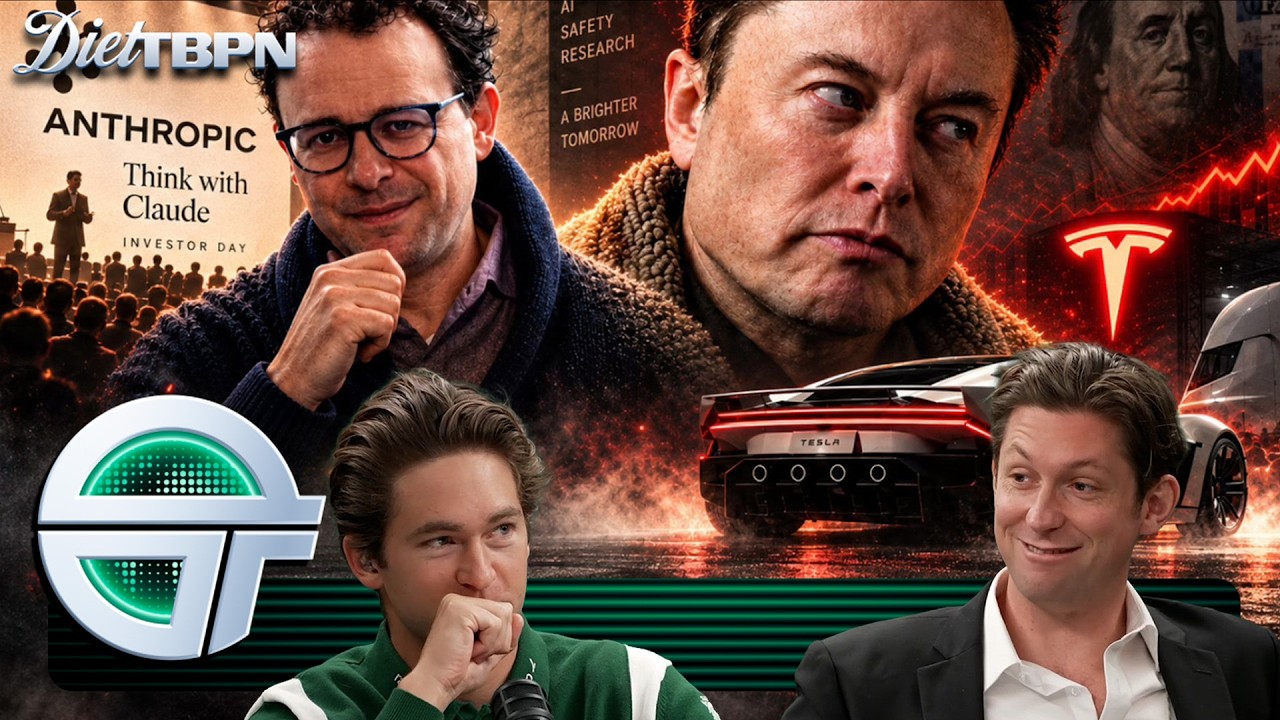
TBPN
Anthropic faces billions in unauthorized token distillation extraction as third-party AI wrappers launder prompt traffic through automated proxy accounts.
AI-assisted summary of Inflation Heats Up, Anthropic Investor Day, Tesla Roadster Mania| Diet TBPN — original source. Check the original for full context.
Source published:
Key ideas
- Anthropic reported Q3 revenue of $16.8 billion—annualizing to a $67.2 billion run rate—while disclosing that illicit token distillation through third-party SaaS wrappers represents 5% to 7% of its top-line revenue. (0:00)
- Brad Gerstner announced Altimeter Capital fully exited its stake in CoreWeave after the stock plummeted roughly 50%, rotating approximately 10% of the fund directly into Meta and Tesla amidst broader tech sector rotation. (5:55)
- Researchers at interpretability lab Goodfire revealed a breakthrough using agentic tools at scale, finding that the vast majority of neurons in trillion-parameter models are directly legible without requiring sparse autoencoders. (20:00)
- Valar Atomics founder Isaiah Taylor sparked an ecosystem-wide venture debate after publicly clashing with Day One Ventures over contractual pro rata rights, highlighting founder-investor friction around defense sensitivities. (23:48)
Detailed notes
## Background Published on YouTube on October 16, 2026, by the tech talk show channel TBPN, this episode of Diet TBPN delivers a 30-minute digest hosted by John Coogan and Jordi Hays. According to the description, the program breaks down Anthropic's Investor Day disclosures, broader AI market turmoil, luxury inflation indicators, startup legal drama, and automotive anticipation around the Tesla Roadster and Porsche Mission S.
## TL;DR The hosts break down Anthropic's $67.2 billion annualized run rate alongside the technical crackdown on token distillation that accounts for 5% to 7% of its top-line revenue. They examine macroeconomic shifts, including Brad Gerstner exiting CoreWeave amid a broader AI selloff, surging high-end inflation tracked by the 'CPI Reserve' index, and an AI alignment breakthrough at Goodfire showing natural neuron legibility. The episode finishes with an analysis of Valar Atomics' public pro rata dispute with Day One Ventures, followed by predictions and deposits placed ahead of the imminent Tesla Roadster and Porsche Mission S unveilings.
## Atmosphere & style The show moves with a rapid-fire, conversational cadence that blends sharp venture capital deconstruction with irreverent internet-native banter. John Coogan and Jordi Hays maintain a playful dynamic, handing out literal physical 'Fell For It Again' awards for falling for online slop and staking on-air bets over whether Elon Musk's Roadster will require stunt ramps to fly. The tone oscillates effortlessly between serious frontier model analysis and comedic Silicon Valley cynicism, making complex technical topics like mechanistic interpretability and cap-table dilution feel like lively watercooler debates.
## Bulletin - [00:00](https://www.youtube.com/watch?v=k8Ob9iXNrOU&t=0s) Anthropic reported Q3 revenue of $16.8 billion—annualizing to a $67.2 billion run rate—while disclosing that illicit token distillation through third-party SaaS wrappers represents 5% to 7% of its top-line revenue. - [05:55](https://www.youtube.com/watch?v=k8Ob9iXNrOU&t=355s) Brad Gerstner announced Altimeter Capital fully exited its stake in CoreWeave after the stock plummeted roughly 50%, rotating approximately 10% of the fund directly into Meta and Tesla amidst broader tech sector rotation. - [20:00](https://www.youtube.com/watch?v=k8Ob9iXNrOU&t=1200s) Researchers at interpretability lab Goodfire revealed a breakthrough using agentic tools at scale, finding that the vast majority of neurons in trillion-parameter models are directly legible without requiring sparse autoencoders. - [23:48](https://www.youtube.com/watch?v=k8Ob9iXNrOU&t=1428s) Valar Atomics founder Isaiah Taylor sparked an ecosystem-wide venture debate after publicly clashing with Day One Ventures over contractual pro rata rights, highlighting founder-investor friction around defense sensitivities.
## Key takeaways - [00:00](https://www.youtube.com/watch?v=k8Ob9iXNrOU&t=0s) Anthropic posted a sequential 45% QoQ revenue increase to $16.8 billion in Q3 ($67.2 billion annualized), but markets reacted with disappointment against overextended expectations of a $90 billion upside print. - [04:47](https://www.youtube.com/watch?v=k8Ob9iXNrOU&t=287s) Illicit model distillation accounts for an estimated $3.5B to $5B in annualized revenue for Anthropic, with attackers routing automated bot queries through unwitting third-party SaaS wrapper apps to bypass security filters. - [05:55](https://www.youtube.com/watch?v=k8Ob9iXNrOU&t=355s) Recent market pullbacks reflect sector rotation out of high-flying AI plays into defensive equities and Treasuries rather than a systemic capital liquidation, despite hot Producer Price Index (PPI) prints. - [10:00](https://www.youtube.com/watch?v=k8Ob9iXNrOU&t=600s) The custom 'CPI Reserve' luxury index demonstrates that ultra-wealthy expenditures—including Chanel flap bags (+139%), Met Gala tickets (+233%), and Big Law partner rates—have dramatically outstripped standard inflation over the past decade. - [14:44](https://www.youtube.com/watch?v=k8Ob9iXNrOU&t=884s) Blake Byers's macroeconomic thesis posits that capital shifts toward high-yield AI infrastructure capex will trigger severe sovereign interest rate spikes before surging productivity growth outpaces debt costs. - [14:44](https://www.youtube.com/watch?v=k8Ob9iXNrOU&t=884s) Corporate hiring has devolved into an AI arms race, with candidate spam bots battling HR filtering bots and forcing applicants into AI avatar interviews observed by human partners. - [20:00](https://www.youtube.com/watch?v=k8Ob9iXNrOU&t=1200s) Mechanistic interpretability is experiencing a major breakthrough as scaled agentic inspection demonstrates that trillion-parameter neural network circuits are far more legible than superposition theories previously suggested. - [23:48](https://www.youtube.com/watch?v=k8Ob9iXNrOU&t=1428s) The standoff between Valar Atomics and Day One Ventures exposes how contractual pro rata rights are being weaponized as proxies in defense-adjacent startups managing sensitive government scrutiny. - [27:43](https://www.youtube.com/watch?v=k8Ob9iXNrOU&t=1663s) Tesla's highly anticipated Roadster reveal features high-risk reservation mechanics, demanding a $5,000 card deposit followed by a $45,000 wire within ten days ahead of promised flight or jump demonstrations. - [31:07](https://www.youtube.com/watch?v=k8Ob9iXNrOU&t=1867s) Leaked footage of the upcoming Porsche Mission S reveals aggressive hypercar styling that directly targets the $500,000 to $2,000,000 exotic vehicle segment dominated by McLaren and Ferrari.
## Detailed walkthrough ### [00:00](https://www.youtube.com/watch?v=k8Ob9iXNrOU&t=0s) Anthropic Investor Day, Distillation Fraud, and the Frontier
The broader tech market has been experiencing a month-long slump, but attention is laser-focused on Anthropic’s Investor Day disclosures. Anthropic reported Q3 revenue of $16.8 billion, which annualizes to a staggering $67.2 billion run rate—a massive leap from doing roughly a tenth of that figure just twelve months earlier. Even with sequential growth around 45% quarter-over-quarter, the market reacted with disappointment because investors had anchored their expectations to sustained 10x annual compounding, whispering about potential upside prints as high as $90 billion. Compounding their challenges, Anthropic is fighting battles across multiple fronts: Meta appears to have migrated business off Anthropic to use its own models, amid media leaks from Meta executives subtly taunting Anthropic's upcoming valuation.
Anthropic revealed that token distillation accounts for between 5% and 7% of its top-line revenue—a multibillion-dollar pool of illicit activity. While some critics had worried distillation was far larger, shutting it down means forfeiting billions of dollars in run-rate revenue in exchange for protecting their intellectual property from frontier model competitors. Rather than pursuing overly restrictive approaches like attempting to ban open source, David Sacks and Anthropic's team are prioritizing technical crackdowns. As John Coogan puts it: “Unless other people will spend a lot of money to try to emulate your model and recreate it, then you are not on the frontier.”
```mermaid flowchart TD accTitle: AI Distillation Scheme Flow accDescr: Flow diagram showing how unauthorized distillers extract frontier model weights through third-party wrapper SaaS products to avoid detection.
subgraph Distillers ["Distillation Operation"] D["Distiller / Distillery"] end
subgraph Wrappers ["Intermediary SaaS Layers"] W["AI Wrapper Apps<br>(Document Editors, Note Apps)"] Accounts["1,000+ Automated<br>Dummy Accounts"] end
subgraph Frontier ["Target Frontier Labs"] A["Anthropic API / Claude<br>(or GPT-6)"] Model["Distilled Open-Weight Model"] end
D -->|"spins up"| Accounts Accounts -->|"submits synthetic document queries"| W W -->|"aggregates & proxies API calls"| A A -->|"returns high-quality outputs"| W W -->|"funnels training data back"| D D -->|"trains clone weights"| Model ```
- **Reported Q3 Revenue:** $16.8 billion, annualizing to a run rate of $67.2 billion. - **Distillation Footprint:** 5% to 7% of gross revenue, representing an estimated ~$3.5B to ~$5B in annualized unauthorized distillation extraction. - **Open-Weights Ecosystem:** Meta released their open-source model *MuseFark Open*, illustrating their distinct ideological divergence from proprietary API-gated frontier labs.
---
[04:47](https://www.youtube.com/watch?v=k8Ob9iXNrOU&t=287s) Third-Party SaaS Wrappers and the "Distillery" Laundering Pipeline
Distillation actors exploit architectural loopholes by funneling prompt-generation traffic through innocent third-party SaaS wrappers rather than hitting Anthropic directly. Thousands of AI-native document editors, writing assistants, and specialized productivity software applications interface with Claude or GPT APIs under consumer or enterprise licenses. Distillers spin up hundreds or thousands of automated accounts across these smaller platforms.
Because wrapper companies aggregate customer queries across thousands of real users, Anthropic's security telemetry only sees legitimate enterprise SaaS API volume. In many cases, these wrapper startups report massive, artificial revenue growth driven purely by distillation bots—without knowing that almost no real human uses their tool. As John Coogan and Jordi Hays joke, this dynamic makes these wrapper startups nothing more than industrial "distilleries" exploiting privacy barriers to evade detection.
---
[05:55](https://www.youtube.com/watch?v=k8Ob9iXNrOU&t=355s) AI Selloff, Sector Rotation, and Brad Gerstner Exiting CoreWeave
The conversation shifts from Anthropic's internals to broader market turmoil. Tech commentators have descended into hyperbolic "blackpilling," with users on social media sarcastically advising people to sell all stocks, bonds, and fiat dollars to hoard land, food, medicine, and guns ahead of an imminent barter economy. In reality, capital is engaging in an aggressive sector rotation rather than an absolute liquidation. The NASDAQ is down roughly 0.3% to 0.4%, while the Dow Jones Industrial Average is up nearly a full percentage point, with defensive allocations and Treasuries soaking up liquidity draining from tech.
Frontier AI dynamics are also being dictated by "tall poppy syndrome": hyper-scalers like Microsoft and Amazon systematically fund competitors whenever any single model provider gets too dominant, forming collective alliances to avoid an intelligence monopoly. On CNBC, Altimeter Capital's Brad Gerstner announced a major portfolio shakeup, revealing that his fund had completely eliminated its CoreWeave stake after CoreWeave tumbled roughly 50% over the trailing month.
- Brad Gerstner explained the exit: “We have sold all of our CoreWeave. We don't own any of it today. We've taken exposure down over the last three months. We felt AI had overshot and would lead to a period of consolidation.” - Altimeter rotated approximately 10% of its fund book directly into Meta and Tesla. - Macroeconomic conditions worsened alongside the tech pullback, with Joe Weisenthal flagging the latest Producer Price Index (PPI) print as the hottest PPI reading in four years. - The hosts previewed *CPI Reserve* (`cpireserve.com`), a bespoke luxury inflation index tracking high-end expenses for the top 1%—such as Virgin Galactic suborbital spaceflights, Met Gala tickets, Chanel bags, and Porsche models.
[10:00](https://www.youtube.com/watch?v=k8Ob9iXNrOU&t=600s) Inflation for the 1%: CPI Reserve and the Cost of Luxury
John Coogan and Jordi Hays dive into the "CPI Reserve" basket (cpireserve.com), a tracking index monitoring the dramatic price surges of high-end luxury goods, elite experiences, and services over the past decade, playing a rapid-fire game of "overrated or underrated":
* **Classic Chanel Flap Bag:** Rose from $4,900 in 2016 to $11,700 in 2026. This represents a 139% jump over ten years—outpacing standard consumer price index growth threefold (which would have put the bag at roughly $6,800). Jordi dismisses it flatly: “You're a bozo if you're still buying this.” * **Met Gala Tickets:** Spiked from $30,000 in 2016 to $100,000, inflating at six times the national average rate. Jordi defends it as underrated: “This is charitable giving... And the Met Gala has grown so much. So many interesting folks there. So many interesting moments. Worth every penny.” * **Virgin Galactic Spaceflight Seat:** Rose from $250,000 to $750,000. Jordi passes, but John calls it the “steal of the century” and says he would go at any price. Jordi jokes that he would go to great lengths to block John from flying for safety reasons, imagining a disaster where John is left inside the cabin having to “roll a duct tape and I got to put it together and screw this” to improvise a parachute mid-air. * **Porsche 911 Carrera (Base):** Increased from $84,000 in 2016 to $135,000 (a 61% rise over 10 years, or 1.5 times baseline CPI). Jordi deems it still undervalued relative to the pure driving joy it produces, though he pines for an era where the entry-level 911 was locked at $99,000 forever. * **Big Law Partner Billing Rates:** Escalated from $1,500 an hour to nearly $3,000 per hour. John and Jordi joke that hiring a corporate partner is “no longer the cure for male loneliness,” riffing on dialing a lawyer just to shoot the breeze about how the family is doing while letting the massive 15-minute billing increments tick away. * **Manhattan Luxury Real Estate:** Noted as an outlier in the index because prices are actually down, driven by high local taxes prompting wealthy residents to relocate.
[14:44](https://www.youtube.com/watch?v=k8Ob9iXNrOU&t=884s) AI Interest Rate Spikes, Job Market Arms Races, and Bread vs. Circuses
The discussion shifts to macroeconomics via venture capitalist Blake Byers's modal thesis on artificial intelligence capital markets over the next decade. Byers argues that as capital shifts heavily out of safe Treasuries and into high-yield AI infrastructure capex, real interest rates will spike significantly:
> “My modal prediction for the next decade: interest rate spikes as capital shifts from saving treasuries to invest... due to higher returns promised by AI related capex.”
According to Byers, this will induce a multi-year debt-servicing panic for sovereign governments and borrowers before skyrocketing economic productivity and revenue growth ultimately dwarf borrowing costs, creating a new normal where the developed world adapts to 5% GDP growth and demands 10%.
The hosts then review Derek Thompson's analysis of a bizarre arms race in corporate hiring: AI application spammers are battling AI HR filtering bots, resulting in candidates being forced to interview with AI avatars. At McKinsey & Company, job candidates now complete 10-minute automated evaluations against an AI while human assessment partners stand in the room watching:
```mermaid flowchart LR accTitle: The AI Hiring Gladiatorial Arena accDescr: Visual flow showing candidates and AI sparring in front of corporate assessors.
subgraph Arena["The Interview Arena"] A["Job Candidate"] <-->|"Prompt injection & answers"| B["AI Avatar Evaluator"] end
subgraph Assessment["Observation Booth"] C["Corporate Partners & Assessors"] end
Arena -.->|"Evaluated as gladiatorial theater"| C ```
John quips that the hiring process has degenerated into a gladiatorial spectacle where applicants should simply focus on prompt-injecting the avatar: “I'm totally tempted to throw an AI avatar in front of that... just in the hope that someone convinces that AI avatar that it is in fact interviewing for the job.”
This sparks a broader tangent on the Roman concept of "bread and circuses." Jordi observes that modern elites are disproportionately pouring their wealth into entertainment assets: - Billionaires acquiring sports teams, UFC franchises, Formula 1, and viral exhibitions like the Savannah Bananas and Banana Ball. - Jordi is momentarily duped by viral social media rumors about an absurd Crumbl Cookies and Wingstop collaboration—earning himself John’s physical “Fell For It Again Award” prop for falling victim to timeline AI slop. - On the actual job front, Bank of America recently brought on 1,000 contractors to mitigate software vulnerabilities unearthed by automated AI tools. John analogizes the development to a self-perpetuating make-work economy: “Pandora's box opening creates thousands of jobs containing the stuff that is flowing out of Pandora's box.”
The segment wraps as the hosts tease fresh technical optimism around AI alignment and model interpretability, citing a post from Nick Cammarata and reactions from machine learning researcher Rune indicating that neural networks may prove far less opaque than once feared.
[20:00](https://www.youtube.com/watch?v=k8Ob9iXNrOU&t=1200s) The Interpretability Breakthrough: Goodfire, Neurons, and Superposition
The conversation dives into a massive white pill for AI safety and mechanistic interpretability. A researcher at Goodfire, who co-authored early interpretability work at OpenAI, shared a breakthrough that challenges years of pessimism in the field. Previously, researchers feared that artificial neural networks were impossible to decode—growing like an unruly garden or "midwifing a deity instead of building a machine that is interpretable," where primitive tools only made roughly 2% of neurons legible. Now, utilizing modern agentic systems, the researcher found that the vast majority of neurons across models scaling up to trillions of parameters are completely legible, with many tangled circuits simply having been misunderstood. The breakthrough was framed as an application of the "bitter lesson" to interpretability: applying simple methods at absurd scale actually works. AI commentator Rune reacted on X by noting that this could be remembered as a landmark moment in scientific history, joking that the news is so promising that "even Eliezer Yudkowsky will have to lower his p(doom)."
```mermaid flowchart TD accTitle: Mechanistic Interpretability Breakthrough accDescr: Diagram contrasting previous superposition theory using sparse autoencoders with the modern direct neuron legibility breakthrough.
subgraph Previous["Previous Paradigm: Superposition"] A["Single Model Neuron"] -->|"Fires ambiguously"| B["Multiple Concepts (Cats, Dogs)"] C["Sparse Autoencoders (SAEs)"] -->|"Artificially expands model"| D["One Neuron per Feature"] end
subgraph Modern["New Breakthrough: Agentic Scale"] E["Modern Agentic Tools"] -->|"Direct Inspection"| F["Natural Legibility at Trillions of Parameters"] F --> G["Understand Existing Circuits"] G --> H["Precision Optimization for Safety & Capabilities"] end ```
The hosts break down what mechanistic interpretability means in practice for those unfamiliar with the underlying architecture. Historically, when text is passed through an LLM, individual neurons light up under seemingly unrelated circumstances—firing for cats as well as dogs. This led to the theory of "superposition," which posited that smaller models compress vast dimensional spaces into few neurons, requiring tools like sparse autoencoders (SAEs) to expand the model out so that every neuron maps to a single distinct feature. The new development suggests that researchers can finally bypass reliance on sparse autoencoders to look directly at the actual neurons and trace their circuits. Beyond AI alignment and safety, the hosts emphasize the massive capabilities upside: if developers can inspect the exact circuits running a model, they can surgically optimize performance on complex, niche topics like advanced mathematics.
- Co-author of OpenAI’s early interpretability work announced that modern agentic tools demonstrate the vast majority of circuits in trillion-parameter models are legible. - Early large-scale automated interpretability projects at OpenAI could only interpret roughly 2% of neurons. - Goodfire operates as a focused mechanistic interpretability lab, working similarly to independent third-party safety labs. - John Coogan previously built a project named "1776" using sparse autoencoders to expand compressed model representations into interpretable features.
---
[23:48](https://www.youtube.com/watch?v=k8Ob9iXNrOU&t=1428s) Valar Atomics vs. Day One Ventures: The Pro Rata Proxy Fight
The timeline erupted into controversy over a fierce legal and contractual clash between Isaiah Taylor, founder and CEO of advanced nuclear startup Valar Atomics, and early backer Day One Ventures, led by Masha Bucher. On October 9th, Taylor published a detailed post revealing that all existing investors had agreed to waive their pro rata rights in a new funding round—except for Day One Ventures, who retained legal counsel to aggressively enforce their rights. Taylor brought the conflict into the public square on X, sparking a wider venture debate. Founders rallied behind Taylor's right to protect the company, while seasoned venture capitalists warned against discarding pro rata protections entirely. Founders Fund partner Delian Asparouhov cautioned the ecosystem with a "don't throw the baby out with the bathwater" stance, arguing that while Taylor may have justifiable reasons to dilute an investor with controversial foreign ties below major investor status, pro rata rights remain non-negotiable contractual standards that venture funds rely on to return capital.
```mermaid flowchart LR accTitle: The Valar Atomics and Day One Ventures Dispute accDescr: Flowchart illustrating the contractual standoff between Valar Atomics and Day One Ventures.
subgraph Conflict["The Impasse"] A["Isaiah Taylor (Valar Atomics)<br/>Expanding into sensitive defense/government work"] B["Day One Ventures (Masha Bucher)<br/>Enforcing binding contractual pro rata rights"] A <-->|"Dispute over dilution & cap table presence"| B end
subgraph Positions["VC Community Split"] C["Founders & Supporters<br/>Remove controversial international associations"] D["VCs (Delian Asparouhov)<br/>Protect pro rata precedent: 'Don't throw the baby out'"] end
Conflict -.-> Positions ```
The hosts point out that the public dispute over pro rata rights functions primarily as a convenient proxy for a deeper relationship breakdown. Valar Atomics is aggressively securing sensitive U.S. government and defense contracts, making Day One's controversial international ties a potential liability when competing for awards or undergoing scrutiny. However, legally undoing an investor's rights after papering them is nearly impossible. As one host summarizes the institutional VC perspective: “As long as I keep showing up with the money, me as an investor with a pro rata right, I can have 5% of this company forever.” Although Taylor clarified that Day One lacks technical information rights, the hosts observe that financial information rights alone can carry immense geopolitical value, referencing recent news around alleged corporate espionage at OpenAI.
> “My view is I don't even know if it's worth having the pro rata debate, because this isn't about pro rata at all.”
---
[27:43](https://www.youtube.com/watch?v=k8Ob9iXNrOU&t=1663s) Tesla Roadster Reveal: Ramps, Thrusters, and the $50k Gamble
The episode shifts gears to automotive spectacle with the long-awaited Tesla Roadster reveal event scheduled for that evening (7:55 PM Central / 5:55 PM Pacific / 8:55 PM Eastern). Jordi Hays announces on air that he put down a deposit for the new Roadster the previous day, fully embracing the risk of looking foolish: “PUT DOWN a deposit yesterday for Roadster, and I'm fully ready to put that pin on the 'Fell for It Again' award.” Securing a place in line required placing $5,000 immediately on a credit card, with a required $45,000 wire transfer due within 10 days. Jordi explains his arbitrage strategy: if Elon Musk's promised "most amazing product demo ever" turns out to be incredible, he preserves an early queue position before millions rush the site; if the unveiling disappoints, he can cancel his initial deposit and jump out of line before sending the wire.
The hosts revisit an ongoing on-air bet regarding Elon Musk's hints that the Roadster will literally hover or leave the ground. John Coogan bets on physical jumps from flat ground via cold gas thrusters, rocket engine tech, or ducted fans. Jordi predicts theatrical driving maneuvers, arguing that the car will achieve flight using ramps:
> “So if there's ramps involved, Jordi wins. If it jumps off the ground, off a flat ground, I win. That's the bet.”
The banter touches on the original 2017 Roadster buyers, who paid the entire $50,000 to $250,000 deposit upfront and have waited nearly a decade with no delivered product. While skeptics call it a recurring promo scheme, the hosts note that Tesla eventually delivers its ambitious products—pointing out the production Cybertruck parked right outside the studio as proof that the company ultimately builds its wildest concepts.
[30:00](https://www.youtube.com/watch?v=k8Ob9iXNrOU&t=1800s) The Tesla Roadster Delivery Dilemma
The conversation centers on the endless waiting game for the Tesla Roadster and what reasonable expectations remain for reservation holders. Pondering the absurdity of the decade-long wait, the hosts joke about an exit strategy where Elon Musk unveils a demo so wildly dangerous that authorities are forced to kill it: “And so I thought it'd be funny to demo the car in such an insane way that it just instantly, like... federal regulators come in and say, you cannot under any circumstances do this.” That way, Musk could throw up his hands, claim he built the vehicle but regulatory roadblocks make it impossible to ship, and announce that Tesla is retreating to simply producing only the Model Y.
When establishing the acceptable timeline for an actual rollout, the bar is set strictly at twelve months. As one host argues, “If it takes more than one year to ship this thing, then you fell for it again.” Having already waited a decade, buyers cannot be expected to endure another ten-year cycle after yet another launch event. The hosts try to recall the original deposit size, noting that reservation holders likely put down a quarter-million dollars up front for a car that still has not reached driveways.
- Expected shipping deadline: At most one year post-reveal to retain any credibility. - Original reservation cost remembered as roughly $250,000 for the full deposit. - Playful scenario envisioned: Regulatory ban acting as an easy scapegoat to drop the Roadster and revert entirely to Model Y production.
---
[31:07](https://www.youtube.com/watch?v=k8Ob9iXNrOU&t=1867s) The Leaked Porsche Mission S Supercar
Shifting attention to traditional high-end performance, the hosts break down the late-night leaked footage showing a cover pulled off the Porsche Mission S. Reacting to the styling, one host confesses: “I feel like a kid who accidentally saw their Christmas present.” The aggressive aerodynamic silhouette makes an instant impression, leading to the bold prediction that it spells serious trouble for mid-range supercar mainstays like McLaren, Lamborghini, and Ferrari.
Between the functional roof scoop and the raw styling, the car immediately draws emotional comparisons to Porsche legends like the Carrera GT and the 918 Spyder. Even if Porsche claims higher production numbers or frames it differently in marketing, one host asserts, “I'm feeling Carrera GT, I'm feeling 918, and this just immediately becomes by far the most desirable car in the 500 and $2 million price range, in my opinion.” The design also carries an aggressively raw, antisocial element: the exposed rear tires look poised to fling massive rooster tails of gravel directly into anyone following behind on a spirited weekend drive, practically demanding aftermarket mud flaps.
The episode wraps up just 23 minutes before the official Mission S unveiling and hours before the hosts head out to watch the new Nathan Fielder film. They remind listeners that Christmas is a mere 70 days away, requesting five-star reviews on Apple Podcasts and Spotify, and pointing viewers to the daily newsletter at TBPN.com.
- Notable design features: Functional roof scoop, ultra-aggressive widebody styling, and exposed rear wheels that kick up rocks. - Market positioning: Emotional successor to the Porsche Carrera GT and 918 Spyder, targeting the $500,000 to $2,000,000 supercar tier. - Closing notes: Imminent official vehicle debut, plans to attend the new Nathan Fielder film, and subscription reminders for the TBPN ecosystem.
## Notable quotes > [00:00](https://www.youtube.com/watch?v=k8Ob9iXNrOU&t=0s) Unless other people will spend a lot of money to try to emulate your model and recreate it, then you are not on the frontier. — John Coogan
> [14:44](https://www.youtube.com/watch?v=k8Ob9iXNrOU&t=884s) Pandora's box opening creates thousands of jobs containing the stuff that is flowing out of Pandora's box. — John Coogan
## Mentioned Altimeter Capital, Anthropic, Banana Ball, Bank of America, Blake Byers, Brad Gerstner, Chanel, Cisco, Claude, Console, CoreWeave, CPI Reserve, CrowdStrike, Crumbl Cookies, David Sacks, Day One Ventures, Delian Asparouhov, Derek Thompson, Dow Jones Industrial Average, Eliezer Yudkowsky, Elon Musk, Ferrari, Figma, Formula 1, Founders Fund, Goodfire, Isaiah Taylor, Joe Weisenthal, John Coogan, Jordi Hays, Lamborghini, Mark Cuban, Mark Zuckerberg, Masha Bucher, McKinsey & Company, McLaren, Meta, Met Gala, MongoDB, MuseFark Open, NASDAQ, Nathan Fielder, Nick Cammarata, NYSE, OpenAI, Porsche, Porsche 911 Carrera, Porsche 918 Spyder, Porsche Carrera GT, Porsche Mission S, Public, Railway, Ramp, Rune, Sam Altman, Satya Nadella, Savannah Bananas, Shopify, TBPN, Tesla, Tesla Cybertruck, Tesla Model Y, Tesla Roadster, The New York Times, UFC, Valar Atomics, Virgin Galactic, Wingstop
## Video description Sign up for TBPN’s daily newsletter at TBPN.com
Diet TBPN delivers the best of today’s TBPN episode in 30 minutes. TBPN is a live tech talk show hosted by John Coogan and Jordi Hays, streaming weekdays 11–2 PT on X and YouTube, with each episode posted to podcast platforms right after.
Described by The New York Times as “Silicon Valley’s newest obsession,” the show has recently featured Mark Zuckerberg, Sam Altman, Mark Cuban, and Satya Nadella.
TBPN is made possible by: Ramp - https://ramp.com Public - https://public.com Cisco - https://www.cisco.com Console - https://www.console.com CrowdStrike - https://www.crowdstrike.com Figma - https://www.figma.com MongoDB - https://www.mongodb.com NYSE - https://www.nyse.com Railway - https://railway.com Shopify - https://www.shopify.com/
Follow TBPN: https://TBPN.com https://x.com/tbpn https://open.spotify.com/show/2L6WMqY3GUPCGBD0dX6p00?si=674252d53acf4231 https://podcasts.apple.com/us/podcast/technology-brothers/id1772360235 https://www.youtube.com/@TBPNLive
Chapters: 00:00 Anthropic’s $67B Run Rate + The AI Distillation Crackdown 05:55 AI Stock Selloff + CoreWeave’s 50% Drop 09:31 Inflation for the 1%: Chanel, Met Gala + Porsche 14:44 AI’s Interest Rate Shock + The Job Interview Arms Race 20:11 Can We Finally Understand AI? The Interpretability Breakthrough 23:48 Valor Atomics vs. Day One Ventures + The Pro Rata Fight 27:43 Tesla Roadster Reveal + The Leaked Mission S Supercar
[Source](https://www.youtube.com/watch?v=k8Ob9iXNrOU)