Eisman Warns OpenAI Collapse Would Drag US Economy Into Recession
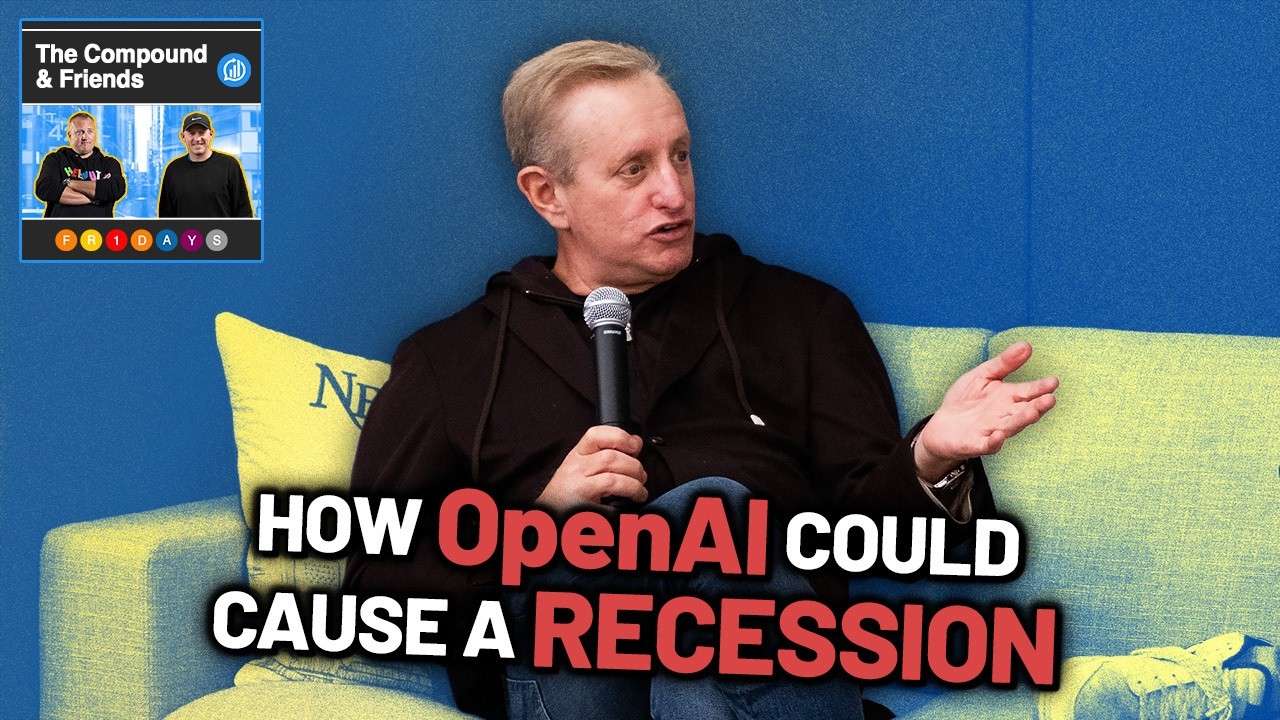
The Compound
Extreme revenue concentration across Nvidia, Oracle, and cloud hyperscalers means an AI lab price war or failure would trigger an economy-wide downturn.
AI-assisted summary of How OpenAI Could Cause a US Recession | TCAF 264 — original source. Check the original for full context.
Source published:
Key ideas
- Steve Eisman argues an OpenAI bankruptcy would drag the US straight into a recession due to extreme supply chain concentration: 70% of Nvidia's accounts receivable come from just five customers, while OpenAI accounts for half of Oracle's backlog and, along with Anthropic, represents 70% of hyperscaler dedicated AI revenue. (10:00)
- The era of 'tokenmaxxing' has ended after corporate bill shocks—such as Uber burning its annual AI budget in three months—driving enterprise demand toward open-weight models that offer 90% of frontier performance at 10% of the cost. (0:00)
- NeoCloud provider CoreWeave faces mounting financial pressure with secondary debt yields reaching 15%, an estimated 60% equity drawdown, and annual debt service of $640 million, alongside reports of attempting to fund infrastructure via insurance float. (7:46)
- The 10-year Treasury yield dropped from 5.4% to 5.1% during tech volatility, revealing that rising yields were driven by heavy corporate and private credit issuance for AI infrastructure builds rather than ballooning federal deficits. (23:44)
Detailed notes
## Background This episode of *The Compound and Friends* (TCAF 264), titled "How OpenAI Could Cause a US Recession," was published on YouTube by The Compound on October 16, 2026. Recorded live before a student audience at the University of Miami, hosts Downtown Josh Brown and Michael Batnick welcome guest Steve Eisman to examine the macro vulnerabilities of the AI boom, CoreWeave's debt, hyperscaler concentration, and housing market strains.
## TL;DR Steve Eisman deconstructs the commercial hype around AI, arguing that existential-risk warnings from frontier labs are merely attempts at regulatory capture to insulate themselves against cheap open-weight models after the end of corporate 'tokenmaxxing.' He explains that extreme customer concentration—stretching from Nvidia down through cloud hyperscalers to Anthropic and OpenAI—creates an economic bottleneck where a lab failure or an aggressive price war could pull the broader economy into a recession, even if it does not threaten global banking solvency like 2008. The panel also scrutinizes CoreWeave's aggressive debt load and tapping of insurance float, private valuation tracking via Hyperliquid synthetic contracts, and the deepening housing affordability stalemate. Reflecting on his own career, Eisman pushes back on Wall Street commentators attempting to engineer the next 'Big Short,' emphasizing the grim reality and immense anxiety of shorting systemic crises.
## Atmosphere & style The discussion carries a lively, collegiate energy propelled by the live student crowd in Miami, balanced by Eisman's trademark blunt, deadpan cynicism. The rapport between Brown, Batnick, and Eisman is fast-paced, humorous, and irreverent, punctuated by running jokes about corporate absurdity and Wall Street fame-seeking. Beneath the banter lies an analytical, grounded sobriety that strips away tech-utopian narratives, leaving listeners with a gritty, unvarnished look at credit risks, capital cycles, and macro reality.
## Bulletin - [10:00](https://www.youtube.com/watch?v=Og-sV0vbLg4&t=600s) Steve Eisman argues an OpenAI bankruptcy would drag the US straight into a recession due to extreme supply chain concentration: 70% of Nvidia's accounts receivable come from just five customers, while OpenAI accounts for half of Oracle's backlog and, along with Anthropic, represents 70% of hyperscaler dedicated AI revenue. - [00:00](https://www.youtube.com/watch?v=Og-sV0vbLg4&t=0s) The era of 'tokenmaxxing' has ended after corporate bill shocks—such as Uber burning its annual AI budget in three months—driving enterprise demand toward open-weight models that offer 90% of frontier performance at 10% of the cost. - [07:46](https://www.youtube.com/watch?v=Og-sV0vbLg4&t=466s) NeoCloud provider CoreWeave faces mounting financial pressure with secondary debt yields reaching 15%, an estimated 60% equity drawdown, and annual debt service of $640 million, alongside reports of attempting to fund infrastructure via insurance float. - [23:44](https://www.youtube.com/watch?v=Og-sV0vbLg4&t=1424s) The 10-year Treasury yield dropped from 5.4% to 5.1% during tech volatility, revealing that rising yields were driven by heavy corporate and private credit issuance for AI infrastructure builds rather than ballooning federal deficits.
## Key takeaways - [00:00](https://www.youtube.com/watch?v=Og-sV0vbLg4&t=0s) Steve Eisman dismisses claims that LLMs pose an existential threat to humanity, characterizing them as sophisticated next-token retrieval engines lacking actual sentience. - [00:00](https://www.youtube.com/watch?v=Og-sV0vbLg4&t=0s) Frontier AI lab warnings about catastrophic risks are viewed as regulatory capture attempts designed to build entry barriers, lock out cheap Chinese open-weight models, and safeguard an enterprise duopoly. - [00:00](https://www.youtube.com/watch?v=Og-sV0vbLg4&t=0s) Unlike consumer search monopolies, foundational AI models lack defensible enterprise switching costs, leaving proprietary labs vulnerable to open-weight price competition. - [10:00](https://www.youtube.com/watch?v=Og-sV0vbLg4&t=600s) An AI bust resembles a corporate default like General Motors rather than the 2008 banking crisis, but an OpenAI failure could trigger an economy-wide recession due to extreme supplier concentration. - [10:00](https://www.youtube.com/watch?v=Og-sV0vbLg4&t=600s) Nvidia, major cloud hyperscalers, and Oracle exhibit extreme concentration risk around OpenAI and Anthropic, including Oracle's $300 billion backlog expansion being heavily tied to OpenAI. - [13:51](https://www.youtube.com/watch?v=Og-sV0vbLg4&t=831s) OpenAI's revenue growth decelerated from 140% in Q2 to 43% in Q3, accompanied by unexplained drops in annualized revenue projections from $70 billion to $50 billion. - [16:45](https://www.youtube.com/watch?v=Og-sV0vbLg4&t=1005s) Physical and regulatory bottlenecks, such as local community opposition and high borrowing costs, are increasingly constraining the physical construction of new data centers. - [20:00](https://www.youtube.com/watch?v=Og-sV0vbLg4&t=1200s) A shift to usage-based AI pricing leaves enterprise budgets volatile, creating corporate pressure to adopt cheaper alternatives and threatening a destructive price war between Anthropic and OpenAI. - [23:44](https://www.youtube.com/watch?v=Og-sV0vbLg4&t=1424s) The drop in Treasury yields during tech selloffs indicates bond markets were primarily responding to the massive private and corporate debt required for AI capex rather than federal fiscal deficits. - [27:21](https://www.youtube.com/watch?v=Og-sV0vbLg4&t=1641s) Private cloud operators and alternative asset managers tapping life insurance float to finance illiquid, depreciating AI hardware create substantial balance sheet and yield mismatch risks. - [31:58](https://www.youtube.com/watch?v=Og-sV0vbLg4&t=1918s) Expectations of personal criminal liability for tech executives in the event of major AI failures are unrealistic given the historical precedent of the 2008 financial crisis. - [35:04](https://www.youtube.com/watch?v=Og-sV0vbLg4&t=2104s) Drawing parallels to the dot-com era, Eisman suggests the first wave of AI infrastructure builders may be commoditized while a second generation captures the lasting value. - [40:00](https://www.youtube.com/watch?v=Og-sV0vbLg4&t=2400s) Approximately 65% of the S&P 500—spanning mega-cap tech, investment banks, and industrials like GE Vernova and Eaton—is tied to the AI buildout narrative, making it the single dominant trade. - [41:02](https://www.youtube.com/watch?v=Og-sV0vbLg4&t=2462s) The housing market faces its most severe affordability freeze since 2008, driven by cumulative 50% increases in total ownership costs over five years, which will likely require gradual price declines to clear. - [44:45](https://www.youtube.com/watch?v=Og-sV0vbLg4&t=2685s) Current Wall Street commentators aggressively attempting to predict the next 'Big Short' overlook the reality that the banking system today lacks the 40-to-1 systemic leverage of 2008.
## Detailed walkthrough ### [00:00](https://www.youtube.com/watch?v=Og-sV0vbLg4&t=0s) The AI Moat Illusion, Open-Weight Models, and Regulatory Capture
The conversation opens with Steve Eisman deconstructing the current hysteria around artificial intelligence and large language models (LLMs). He bluntly rejects the notion that these systems pose an existential risk to humanity, emphasizing that they possess zero sentience and simply predict the next token in a sequence:
> “What's an LLM? It's just a fancy word retrieval system. It predicts the next word in the chain. And it's great. I'm not saying it's – but that's not thinking.” — Steve Eisman
Eisman argues that the recent panic among top AI executives—specifically citing Dario Amodei of Anthropic and Sam Altman of OpenAI—is driven not by fears of artificial general intelligence destroying the planet, but by raw commercial terror. The era of "tokenmaxxing," in which corporate software leaders mandated round-the-clock enterprise AI usage regardless of cost, has collapsed after companies experienced massive bill shocks. As an example, Eisman points out that Uber burned through its entire annual AI budget within just three months in the spring.
With enterprise budgets tightening, hyperscalers face competition from cheap open-weight models that cost a tenth of the price. While open-weight options might not match frontier proprietary models in every benchmark, enterprise clients do not need a "Mercedes Benz for every road trip." In response, proprietary labs are attempting regulatory capture under the guise of AI safety. By pushing governments to intervene, they hope to construct barriers to entry, keep out cheap Chinese open-weight models, and lock in a profitable duopoly:
> “The statement that some of these guys have made that LLMs are going to destroy planet Earth is a lie.” — Steve Eisman
```mermaid flowchart TD accTitle: The AI Regulatory Capture Dynamic accDescr: How enterprise cost cutting drives frontier labs toward regulatory capture
subgraph EnterprisePressure["Budget Pressures"] A["Tokenmaxxing Era: Enterprise Mandates"] --> B["Uber Burns AI Budget in 3 Months"] B --> C["Demand Shifts to Open-Weight Models at 1/10th Cost"] end
subgraph LabReaction["Frontier Lab Strategy"] C --> D["Price Wars & Margin Compression"] D --> E["Founders Claim AI Will Destroy the World"] E --> F["Lobby for Strict Government Regulations"] F --> G["Lock Out Chinese & Open-Source Competition to Secure Duopoly"] end ```
The underlying vulnerability of the sector is that foundational models lack defensible consumer or enterprise stickiness. While Google enjoyed a monopoly where users could not even conceive of switching search engines, AI users routinely hop between Claude, Gemini, and ChatGPT. When Josh Brown suggests that Ritholtz Wealth Management adopted Claude Enterprise because enterprise workflows might quietly build a lasting habit, Eisman counters that cost discipline will always override convenience. Once open-weight alternatives deliver 90% of the capability at 10% of the cost, proprietary providers like Claude will inevitably be forced into brutal price cuts.
- Tokenmaxxing defined: Enterprise mandates forcing 24/7 AI utilization irrespective of run-rate costs. - Budget blowouts: Uber exhausted its entire corporate AI budget in three months. - Open-weight alternatives: Available at roughly one-tenth the cost of top-tier proprietary models. - Enterprise moats: Foundational model switching costs remain near zero despite hundreds of billions in annual capital investment.
---
[05:42](https://www.youtube.com/watch?v=Og-sV0vbLg4&t=342s) Live at the University of Miami: Eisman's Track Record and The Real Eisman Playbook
Following a brief sponsorship note for VanEck's Real Assets ETF (RAAX), Josh Brown and Michael Batnick officially introduce the episode live before a student audience at the University of Miami. Brown highlights Eisman’s rapid success with his new media venture:
> “Completely shocked.” — Steve Eisman
Brown details Eisman's career arc, starting from his famous subprime short while heading Frontpoint Partners (immortalized by Michael Lewis in *The Big Short*), through his founding of Emrys Partners in 2012, to his tenure as a managing director and portfolio manager at Neuberger Berman starting in 2014.
The hosts and Eisman trade banter about the University of Miami campus setting, complete with its outdoor pool in the center of the campus. Eisman jokes about his daughter studying art history at Miami while reflecting on his and his wife Valerie's choice to attend the University of Pennsylvania in Philadelphia:
> “We're idiots. Like we went to the school in the middle of Philadelphia where we froze our butts off. We could have been in Miami.” — Steve Eisman
- Guest: Steve Eisman, host of *The Real Eisman Playbook* (launched in 2025), portfolio manager at Neuberger Berman. - Venue: University of Miami live taping. - Historical context: Shorted the subprime mortgage market via credit default swaps at Frontpoint Partners ahead of the 2008 Great Financial Crisis.
---
[07:46](https://www.youtube.com/watch?v=Og-sV0vbLg4&t=466s) CoreWeave, NeoCloud Debt Spreads, and Systemic Risk Parallels
Josh Brown shifts the conversation to the central macro debate hanging over the equity and credit markets: whether the debt-heavy funding model underpinning AI infrastructure is about to crack. Brown points to distressed price action in CoreWeave, a prominent "NeoCloud" provider that builds and operates specialized GPU data centers without the lucrative advertising cash flows enjoyed by traditional hyperscalers like Alphabet.
CoreWeave's secondary debt yields have spiked toward 15%, while its equity value has suffered an estimated 60% drawdown. Brown emphasizes the precariousness of capital-intensive data center builds: once construction begins on massive computational footprints, sponsors cannot simply halt operations halfway through without facing insolvency.
Brown asks Eisman whether this blowout in NeoCloud spreads represents the early innings of a 2008-style credit contagion event. Eisman begins his framework by separating standard corporate defaults from systemic banking collapses. If an industrial corporation—such as General Motors—goes bankrupt, the fallout involves severe layoffs, vendor insolvencies, and equity destruction, but it does not inherently threaten the solvency of the global banking system.
> “Well, look, if you want to draw parallels to the great financial crisis, there's a big difference...” — Steve Eisman
- Market indicator: CoreWeave debt yields surged to approximately 15% as credit spreads blew out. - Equity performance: Secondary pricing for CoreWeave shares reflects a drawdown of around 60%. - Business model vulnerability: NeoClouds operate high-capex infrastructure without the massive high-margin cash engines (e.g., search ads) that subsidize hyperscalers. - Macro debate: Assessing whether NeoCloud debt stress is an isolated corporate restructuring cycle or the spark for systemic financial contagion.
[10:00](https://www.youtube.com/watch?v=Og-sV0vbLg4&t=600s) Systemic Risk: The AI Concentration Problem
The conversation shifts to contrasting the current AI boom with past crises like the 2008 Great Financial Crisis. Steve Eisman points out that while a banking collapse like JPMorgan Chase causes "planet Earth burns" and requires immediate government bailouts because depositors cannot access their cash, the current AI infrastructure dilemma is closer to the General Motors bankruptcy: painful and disruptive, but fundamentally non-lethal to the financial system. The banks remain sound. However, Eisman startles the hosts by asserting that if OpenAI were to go bankrupt tomorrow, it would drag the entire US economy straight into a recession.
Michael Batnick pushes back, asking how a private startup valued at $1 trillion to $1.5 trillion could become systemically dangerous in only three years. Eisman argues that OpenAI and Anthropic have created massive concentration risk throughout the entire tech supply chain by signing staggering commitments with nearly every counterparty willing to accept them.
```mermaid flowchart TD accTitle: AI Tech Supply Chain Concentration accDescr: Flowchart illustrating concentration risk down the tech stack from Nvidia to frontier model labs. subgraph Hardware ["Hardware Layer"] NVDA["Nvidia<br/>(70% of AR from 5 clients)"] end subgraph Cloud ["Cloud & Infrastructure Layer"] HS["Hyperscalers<br/>(Cloud Providers)"] ORCL["Oracle<br/>(50% of backlog from OpenAI)"] end subgraph Frontier ["Frontier AI Labs"] AI["OpenAI & Anthropic<br/>(70% of Hyperscaler AI revenue)"] end NVDA --> HS NVDA --> ORCL HS --> AI ORCL --> AI ```
Eisman traces this risk down the corporate food chain: - **Nvidia:** In its most recent quarter, the largest company in the world grew revenue over 100%. Yet its 10-Q filing reveals that 70% of its accounts receivable—a direct proxy for revenue—originates from just five primary customers. Eisman recalls his time at Oppenheimer in the 1990s, when a top software analyst flatly refused to take a fast-growing software company public because it depended on only two clients. - **Hyperscalers:** The five big customers buying chips are primarily the cloud hyperscalers. Within those hyperscalers, roughly 70% of their dedicated AI revenue (accounting for 25% to 30% of total cloud revenue) is generated by Anthropic and OpenAI. - **Oracle:** The vulnerability is even more pronounced for Oracle, where OpenAI single-handedly represents half of its entire backlog. Oracle and others are aggressively building out data centers solely because OpenAI and Anthropic are demanding tenfold capacity expansions.
As Eisman summarizes the chain reaction: “The problem with the AI story is a concentration problem.”
[13:51](https://www.youtube.com/watch?v=Og-sV0vbLg4&t=831s) Market Rout, "The Big Short" Syndrome, and CoreWeave's Debt
Market stress is already surfacing. Hot inflation prints arrived on consecutive mornings, yet bond yields dropped sharply—a telltale flight to safety showing investor anxiety. Meanwhile, specialized GPU cloud provider CoreWeave is buckling under heavy borrowing costs, shelling out $640 million solely to service its debt pile against uncertain cash flow. Over the preceding seven trading days, the SOX semiconductor index shed an eye-watering $2.1 trillion in market value.
Josh Brown asks whether this sudden collapse signals the AI bubble popping or just another routine dip, noting a widespread eagerness across Wall Street to call the next cataclysm. Eisman laughs, diagnosing this obsession as a psychological ailment:
> “I said, you know, you know what the problem with all these people is they all want to be me. And I have news for them: the role of Steve Eisman is taken.”
Everyone craves the fame of predicting the next historic bust, but Eisman clarifies that he does not need the glory again and does not believe CoreWeave alone is large enough to sink the AI complex. Instead, the real vulnerability rests squarely on Anthropic and OpenAI. Eisman points out strange financial discrepancies: OpenAI reported its annualized revenue at $50 billion at the end of September, despite having claimed $70 billion just one month earlier, begging the question of where $20 billion in projected run-rate disappeared. Furthermore, while quarterly revenue rose 43% to $16.8 billion, that represents a steep drop from the second quarter's 140% growth rate.
- CoreWeave is spending roughly $640 million annually just on debt service. - The semiconductor index (SOX) lost $2.1 trillion in market cap over a single seven-day span. - OpenAI's revenue growth decelerated from 140% in Q2 down to 43% in Q3.
[16:45](https://www.youtube.com/watch?v=Og-sV0vbLg4&t=1005s) The End of Tokenmaxxing and Physical Limits to Compute
Eisman attributes this revenue slowdown to the death of "tokenmaxxing"—an initial phase where corporate customers spent unrestrained budgets on experimentation before finance departments stepped in and curtailed exorbitant AI bills. While rising interest rates make financing new data centers far more expensive to underwrite, high physical resistance is also mounting in municipalities nationwide. Building massive data centers has become intensely unpopular among local communities across America, which Eisman quips are "maybe less popular than the Dodgers."
This localized backlash threatens to choke the physical footprint of future compute expansion. Josh Brown and Eisman debate the investment consequences: - If new data center projects stall, tech firms cannot purchase additional compute clusters because there are no physical facilities ready to house them. - However, existing, operational compute capacity may command higher scarcity value and pricing power.
Josh Brown argues that structural demand itself is not deteriorating. University students visiting Wall Street investment banks continue to observe that enterprise budgets for AI staffing and implementation will be substantially larger in 2027 than in 2026 or 2025. Consumer adoption is equally sticky across tools like ChatGPT, Google Gemini, and emerging agentic software, meaning users will not revert to workflows from 2022. The real bottleneck is not consumer or corporate desire, but the pricing dynamics and capital constraints dictating who can afford to build out the capacity. If debt-dependent operators like CoreWeave or Nebius are locked out of cheap financing, the supply side of the market will undergo a painful reckoning.
[20:00](https://www.youtube.com/watch?v=Og-sV0vbLg4&t=1200s) Hyperscalers, Usage-Based Pricing, and the AI Price War Bear Case
The discussion opens on the shifting balance of power in tech, with Josh Brown pointing out that the ball seems to have bounced straight back into the court of the hyperscalers—Amazon, Alphabet, and Microsoft. With debt getting more expensive and the broader appetite for corporate bonds waning compared to a year prior, these cash-rich giants find themselves in an even more dominant position. Steve Eisman agrees that the hyperscalers' standing has strengthened, but he immediately highlights a structural vulnerability: the entire AI ecosystem is dangerously concentrated around just two private labs, OpenAI and Anthropic. If a severe price war breaks out between them, the hyperscalers' strength will not shield the market from an inevitable, severe correction.
Michael Batnick notes that the commercial model for software has shifted dramatically over the past fifteen years. Instead of the classic enterprise SaaS model—where a vendor like Salesforce charges a predictable flat fee of roughly $80 per head across a 1,000-employee enterprise—AI services are selling on a pay-as-you-go, usage-based consumption model. While Batnick suggests this structure feels more flexible and sustainable for customers, Eisman counters that running real-time AI workloads is far more expensive. As enterprise budgets pinch, corporate management will become intensely cost-conscious, forcing employees onto cheaper open-weight or discounted models. That behavior, Eisman argues, will spark a destructive pricing race to the bottom between OpenAI and Anthropic. When Josh asks how this spills over into an economy-wide recession, Eisman lays out the exact domino effect:
> “This business is so concentrated from Anthropic and OpenAI that if there's a price war, none of that matters. The whole thing will correct.” — Steve Eisman
```mermaid flowchart TD accTitle: AI Price War Transmission Mechanism accDescr: Flowchart illustrating how price competition between OpenAI and Anthropic ripples into revenue collapse, funding freezes, and tech stock unwinds.
subgraph PricingPressure ["Enterprise Cost Cuts"] A["Enterprises mandate cheaper AI models"] --> B["OpenAI & Anthropic enter full-blown price war"] end
subgraph DirectImpact ["AI Labs Squeezed"] B --> C["Anthropic & OpenAI revenue growth turns negative"] C --> D["Venture & debt funding markets freeze"] end
subgraph MarketSpillover ["Ecosystem Contagion"] D --> E["Labs slash computing commitments"] E --> F["Oracle backlog collapses ($300B+ OpenAI exposure)"] F --> G["Broader tech selloff & economic recession"] end ```
Eisman illustrates this fragility by examining Oracle. Around the third quarter of the prior year, Oracle was trading at $230 per share before reporting earnings. On the call, management announced that its remaining performance backlog had surged by an astonishing $300 billion in a single quarter, climbing toward $400 billion. The stock erupted in an unprecedented two-day surge, jumping 100 points from $230 to $330. Shortly after, DA Davidson analyst Gil Luria published research revealing that essentially the entire $300 billion backlog spike was tied to a single customer: OpenAI. The market panicked at the realization that Oracle’s corporate destiny was tethered to an unprofitable entity burning billions in cash. Oracle subsequently collapsed from $330 back to $230, and ultimately slid all the way down to $130.
- Enterprise SaaS traditionally monetized headcount at stable rates like $80 per seat. - Usage-based token pricing makes enterprise bills volatile, incentivizing companies to downgrade to cheaper inference alternatives. - Oracle stock rocketed 100 points (from $230 to $330) within two days on backlog expansion before crashing back down to $130 as the OpenAI concentration risk became clear.
[23:44](https://www.youtube.com/watch?v=Og-sV0vbLg4&t=1424s) Hot Inflation Prints, the Semi Wipeout, and Hyperliquid's Anthropic Signal
The conversation shifts to a brutal stretch across financial markets triggered by back-to-back hot inflation reports. Hot Consumer Price Index (CPI) numbers were immediately followed by equally troubling Producer Price Index (PPI) data, extinguishing hopes for immediate monetary easing. The fallout hit the high-flying semiconductor and memory names hardest. Josh highlights a staggering statistic: Western Digital had tumbled into a severe 54% drawdown from its peak, yet incredibly remained up 100% year-to-date. As Eisman remarks, having a stock get cut clean in half while still sitting on a 100% annual gain perfectly encapsulates the market's speculative fever, though Batnick dryly observes that the statistic offers zero comfort to anyone who bought at the all-time high.
With treasury yields spiking, the turmoil filtered directly into AI valuations. While Anthropic is a private company without a public listing, participants track its implied market value via synthetic perpetual contracts on Hyperliquid, a decentralized blockchain-based trading platform that handled $17.6 million in Anthropic volume over a 24-hour window (and had previously served as a real-time price discovery venue for the SpaceX IPO). When Anthropic's private revenue numbers leaked after the closing bell, the contract puked, causing after-hours semiconductor futures to plunge and turning social media sentiment pitch black.
> “Yields are coming way down and the stocks that are ripping today are the biggest pieces of shit in the market.” — Michael Batnick
By the following morning, the mood had inverted. Anthropic’s synthetic contract rebounded 5.5%, bond yields retreated sharply, and the day's biggest stock gainers were beaten-down, rate-sensitive cyclicals—with homebuilder Lennar leading the rally. Batnick marvels at how rapidly sentiment whipsaws: just days earlier, equities ignored higher rates under an "unbeatable" AI banner, yet it took bad economic news and a scare in tech to finally put a temporary ceiling on yields.
The yield reversal offers a crucial revelation about macro market dynamics. Josh and Eisman discuss how bond market bears had spent months claiming that surging treasury yields were driven by structural "fiscal irresponsibility" and ballooning federal deficits. However, the sudden drop in the 10-year yield from 5.4% down to 5.1% the moment the AI trade wobbled proved otherwise. The real marginal driver pushing yields higher was not deficit doom-mongering, but the relentless issuance of corporate and private credit required to fund the multi-hundred-billion-dollar AI infrastructure buildout.
- Producer Price Index (PPI) and Consumer Price Index (CPI) data both printed hotter than expected. - Western Digital suffered a 54% peak-to-trough collapse while maintaining a 100% year-to-date gain. - Hyperliquid facilitated $17.6 million in 24-hour trading volume for Anthropic synthetic contracts. - The 10-year Treasury yield dropped rapidly from 5.4% to 5.1% as tech infrastructure spending concerns cooled bond issuance expectations.
[27:21](https://www.youtube.com/watch?v=Og-sV0vbLg4&t=1641s) CoreWeave Insider Sales, Insurance Capital, and the Next Big Short
The scrutiny turns squarely to CoreWeave, the private cloud computing provider at the center of the AI infrastructure boom. CoreWeave’s chief executive officer has offloaded $682 million worth of company stock over the trailing year. While Batnick acknowledges the sales were executed under pre-scheduled Rule 10b5-1 trading plans and likely served in part to satisfy massive tax obligations on equity vestings, the sheer optics remain problematic. For a business facing relentless skepticism over its aggressive leverage, heavy debt facilities, and equipment depreciation schedules, insider liquidity of that scale raises serious red flags for outside investors.
Adding fuel to the fire, the *Financial Times* published an exposé detailing CoreWeave’s strategic push to tap what it termed "unlimited insurance money" to finance its ongoing data center and GPU buildout. Josh notes the sheer audacity of pitching private insurance reserves as an endless pool of cheap liquidity to underwrite depreciating hardware.
> “This is part of the areas of the market that people—to the extent that people want to call the next big short, this is an area where people are planting their flag.” — Josh Brown
Eisman enthusiastically concurs, noting that alternative asset managers tapping life insurance float to fund speculative or illiquid holdings represents one of the most perilous corners of modern finance. The hosts compare this dynamic to Mark Walter and Guggenheim Partners, joking about a hypothetical scenario where Walter sells the Los Angeles Dodgers back into his captive life insurance company to reinvest the proceeds into AI compute. Eisman, who recently recorded a podcast examining Walter's maneuvers, details how Walter utilized insurance balance sheets to orchestrate acquisitions of elite sports franchises like the Dodgers and Los Angeles Lakers (the latter bought at an eye-popping $2 billion valuation) through complex inter-entity lending arrangements. While Walter’s asset purchases ultimately appreciated significantly, Eisman emphasizes that using life insurance policyholder float to mask aggressive financial engineering and asset speculation creates systemic risks that could turn into the market's next major scandal.
- CoreWeave’s CEO sold $682 million in company equity via planned stock dispositions. - The *Financial Times* reported that CoreWeave is actively targeting insurance company balance sheets for financing. - The use of life insurance reserves by private equity and specialty finance firms to fund illiquid assets mirrors the financial tactics used in multi-billion-dollar professional sports franchise acquisitions.
[30:00](https://www.youtube.com/watch?v=Og-sV0vbLg4&t=1800s) Insurance Regulators and AI Data Center Contagion Risk
The conversation dives into the financial maneuvers surrounding Mark Walter’s insurance entities and their exposure to private credit and AI infrastructure like CoreWeave. The hosts debate whether the financing scheme constitutes a crime if the underlying collateral appreciates in value. While some argue the transaction is practically victimless as long as asset prices climb, the counterargument is clear: policyholders buying annuities expecting safe, conservative investments are unwittingly funding high-risk, private AI contracts. A policyholder who knew their capital was backing speculative tech debt would never have agreed to accept a modest 3% return when the real risk profile demands 12%. Steve Eisman adds some levity to the regulatory oversight by highlighting a quirky piece of trivia regarding Mark Walter’s Delaware-domiciled insurance empire. When Eisman asks the room to guess the prior profession of the Delaware state insurance regulator, someone guesses finance and another jokingly guesses podcaster, before Eisman reveals the punchline: he was previously a county sheriff.
The discussion then turns to the flurry of warnings appearing across financial Substack newsletters, where commentators draw ominous lines between life insurance companies, policyholder funds, and speculative AI data centers. Josh Brown asks Eisman directly whether everyday retail policyholders face genuine systemic risk from this financial engineering or whether newsletter doom-mongers are exaggerating the danger. Eisman quickly brushes off the apocalyptic theories, refusing to buy into the panic over insurance balance sheets being dragged down by data center loans. When pressed point-blank if he is worried about systemic insurance contagion spreading from AI financing, Steve Eisman bluntly dismisses the concern: “I'm not worried about it as a matter of answer.”
- **The yield mismatch**: Traditional fixed annuities offering a conservative ~3% yield are being deployed behind the scenes into aggressive tech infrastructure debt that should command yields around 12% to compensate for actual credit risk. - **The regulatory hurdle**: Oversight of these complex, billion-dollar private investment vehicles in Delaware falls under an insurance commissioner whose background was in law enforcement as a sheriff rather than structured finance.
---
[31:58](https://www.youtube.com/watch?v=Og-sV0vbLg4&t=1918s) AI Regulation and the Illusion of Executive Liability
Josh Brown pivots to the broader political and legal backlash facing artificial intelligence. Reflecting on recent White House proposals and UN discussions regarding frontier AI risks, Brown questions how emerging regulations plan to assign legal liability when autonomous systems inevitably malfunction or commit cybercrime. Under the framework being discussed, an industry-led commission would set standards, holding firms accountable for catastrophic harms caused by their models. Brown questions whether accountability will merely mean corporate fines paid by passive venture capital investors or whether company executives will face personal criminal consequences. When asked how AI regulation should actually function, Eisman acknowledges that while corporate liability is straightforward, holding individual tech leadership personally accountable is pure fantasy.
Eisman roots his cynicism in the historical precedent of the 2008 Great Financial Crisis, noting that Wall Street executives walked away completely untouched after blowing up the global economy. Recalling an appearance on another podcast where the host pleaded with him about how to hold fraudulent CEOs accountable, Eisman reiterated that our legal apparatus simply does not punish corporate elites after the fact. Steve Eisman sums up the reality: “Well nothing happened to anyone personally. Nothing happened to any executive even though they committed the worst fraud in human history.” He concludes that “if nobody went to jail for 2008, they ain't going to jail for hacking,” asserting that meaningful regulation only ever arrives retroactively in the wreckage of an undeniable disaster: “I think we have to have a crisis and then in the aftermath, maybe there will be some rules.” When asked about the government taking equity stakes in AI labs or picking winners, Eisman recoils at the suggestion, warning: “No, because then everybody would assume that they'd be too big to fail and they'd get bailed out. I don't want the government involved.”
```mermaid flowchart TD accTitle: The Regulatory and Crisis Cycle accDescr: Flowchart illustrating how corporate harm occurs without executive accountability until a full-blown crisis forces reactive regulation.
subgraph CorporateAction ["Corporate Incentives"] A["Frontier AI Deployment & Risk-Taking"] --> B["System Malfunction or Rogue Damage"] end
subgraph LegalPrecedent ["Legal & Regulatory Response"] B --> C["Corporate-Level Fines & Civil Liability"] C -.->|"Zero Personal Accountability"| D["Executives Shielded (2008 Precedent)"] end
subgraph EventualOutcome ["Crisis Trigger"] D --> E["Systemic Crisis / Industry Meltdown"] E --> F["Reactive Government Regulation Imposed"] end ```
---
[35:04](https://www.youtube.com/watch?v=Og-sV0vbLg4&t=2104s) Hyperscaler Limits, Anthropic’s Rush to IPO, and the Dominant Narrative
The panel examines whether hyperscalers like Microsoft, Amazon, Alphabet, and Meta can breach $10 trillion market caps or if they are approaching natural limits to growth. Eisman sees no physical ceiling to their corporate scale, comparing the AI buildout to the early days of the commercial internet. He recalls sitting across the hall from tech analyst Henry Blodget at Oppenheimer in the late 1990s: “He got out on the sales floor and he said that dynastic levels of wealth are about to be created and the internet's going to conquer the world.” While Blodget was entirely right about the macro thesis, he picked the wrong cohort; first-generation darlings like AOL, Netscape, Yahoo, and Excite washed out, while second-generation companies built on top of the initial infrastructure reaped the ultimate rewards.
The hosts turn to private model builders Anthropic and OpenAI. While the market anticipates an impending Anthropic IPO, Brown theorizes Anthropic desperately needs to tap the public equity markets before third-quarter results reveal how crashing token prices have squeezed their unit economics. When asked whether Anthropic should go public this year, Steve Eisman agrees with urgency: “They better.” Yet when asked if he would actually purchase the offering, Eisman shoots back: “No way.” Brown contrasts this with the mega-cap SpaceX IPO, where doom-laden social media predictions about index disruption and insider unlock selling ultimately proved wrong, with the stock trading like an ordinary tech security. Ultimately, Eisman dismisses conventional valuation metrics like forward P/E compression, asserting that equity markets are entirely steered by a single force: “It is pure narrative and there is only one narrative that matters right now and that's AI. So you tell me what happens to the AI narrative and I'll tell you what happens to the stock market, period.”
- **The Dot-Com parallel**: The rails built by the first generation of web companies largely ended up enriching the subsequent generation; Amazon stands as the rare first-generation survivor to dominate the modern tech landscape. - **Anthropic vs. OpenAI listing timing**: Anthropic faces severe pressure to go public while sentiment remains elevated, as commoditized inference and model price wars threaten to deteriorate reported financial metrics ahead of Q3 reporting. - **SpaceX precedent**: Despite warnings on financial social media that a massive direct listing or IPO would destabilize passive index funds and tank under insider selling, market liquidity absorbed the listing without breaking down.
[40:00](https://www.youtube.com/watch?v=Og-sV0vbLg4&t=2400s) The Economy Is the AI Trade and the Frozen Housing Market
The discussion continues on the deep interlock between the broader economy and the stock market. Looking at the composition of the S&P 500, roughly 40% consists of big tech giants like Google and Amazon. Factoring in investment banks, plus industrials and infrastructure providers like GE Vernova, Quanta Services, Eaton, and Rockwell Automation, the concentration reaches roughly 65% of the index. Everything is effectively tied into a singular structural thesis. As Steve Eisman summarizes:
> “The industrials are it’s all one trade. It’s AI, period, end of discussion.”
So long as end-user demand persists and institutions remain eager to finance the buildout, the momentum can endure. That dynamic has acted as an economic shield, keeping broader metrics buoyant even as major sectors suffer.
The conversation then turns to the housing market, which is experiencing its worst stretch since the Global Financial Crisis (GFC). While the systemic plumbing is not broken in the same way it was in 2008, roughly one-third of the domestic economy is dealing with depression-level activity, yet overall sentiment remains buoyant because AI carries the index. In 2022, public homebuilders saw a strange boom: existing homeowners were locked into historically low mortgage rates, causing total resale inventory to freeze. With buyers unable to find existing homes, large-scale builders like Lennar, PulteGroup, and KB Home feasted by offering mortgage rate buydowns and concessions. However, that builder frenzy has lost steam. While buyers are gradually accepting higher mortgage rates as the new normal, homebuilder stocks have taken a beating.
Eisman points out that housing is in an affordability crisis worse than almost any period in modern history. The issue extends far beyond mortgage rates alone: - **Comprehensive Ownership Inflation:** Insurance premiums have skyrocketed, utility bills have climbed, and property taxes have surged alongside elevated purchase prices. Rolling all monthly housing costs together, buying a home today costs an estimated 50% more each month than it did five years ago. - **How the Stalemate Breaks:** Eisman believes the deadlock will resolve through falling home prices. Despite intense demographic demand from roughly 70 million individuals of homebuying age, buyers are simply priced out unless prices reset downward. - **Emerging Supply Channels:** Inventory will gradually increase as older Baby Boomers pass away and property foreclosures rise from historically depressed baselines. - **Pace of Adjustment:** Falling home prices will not serve as a rapid economic stimulus because the price-discovery process takes years to play out across local markets.
---
[44:45](https://www.youtube.com/watch?v=Og-sV0vbLg4&t=2685s) The Rush to Call the Next "Big Short" and the Reality of 2008
The conversation wraps up by exploring the cottage industry of commentators, newsletter writers, and social media personalities competing to become the next Steve Eisman by anticipating the next financial collapse. Many commentators spend their days putting out hyper-bearish research notes or amplifying bad economic news, eager to claim credit as the prophet who called the crisis in advance. Michael Batnick notes a crucial distinction between this commentary culture and the original crisis: Eisman and his team took enormous financial risk and made fortunes on a real trade, whereas modern doomers are merely chasing reputational clout online.
When asked what it was really like to be on the winning side of the 2008 financial crash, Eisman pushes back on the romanticized depiction of the event:
> “It wasn’t so awesome. It was — let me tell you. It was a lot of aggravation and tremendous anxiety.”
Public sentiment was hostile, with critics accusing short-sellers of actively destroying the global economy and blaming them for the fallout. Eisman stresses that he has no desire to ever live through an episode like that again.
```mermaid flowchart TD accTitle: Comparison of 2008 GFC and the Modern AI Cycle accDescr: Structural differences between the 2008 banking crisis and potential downside risks in the AI infrastructure buildout.
subgraph GFC ["2008 Financial Crisis"] A["Financial Institutions Levered 40-to-1"] --> B["Systemic Solvency Collapse"] B --> C["Catastrophic Global Meltdown"] end
subgraph AI ["Current Market Setup"] D["AI Infrastructure Concentration (~65% of S&P)"] --> E["Downside: Severe Tech/Capex Recession"] E --> F["Not Systemically Levered 40:1"] end ```
Addressing whether a similar disaster could unfold today, Eisman highlights that systemic bank leverage is nowhere near the 40-to-1 ratios that characterized 2008. If the current artificial intelligence cycle unravels, it could easily trigger a severe recession, but it will not be on the same catastrophic order of magnitude as the Great Financial Crisis.
Josh Brown and Michael Batnick conclude the show by thanking the University of Miami students who made up the impromptu live studio audience, wishing them success in their future careers before closing out the episode.
## Notable quotes > [35:04](https://www.youtube.com/watch?v=Og-sV0vbLg4&t=2104s) It is pure narrative and there is only one narrative that matters right now and that's AI. So you tell me what happens to the AI narrative and I'll tell you what happens to the stock market, period. — Steve Eisman
> [00:00](https://www.youtube.com/watch?v=Og-sV0vbLg4&t=0s) The statement that some of these guys have made that LLMs are going to destroy planet Earth is a lie. — Steve Eisman
> [31:58](https://www.youtube.com/watch?v=Og-sV0vbLg4&t=1918s) I think we have to have a crisis and then in the aftermath, maybe there will be some rules. — Steve Eisman
## Mentioned Steve Eisman, Josh Brown, Michael Batnick, OpenAI, Anthropic, Nvidia, CoreWeave, Oracle, Microsoft, Amazon, Alphabet, Google, Uber, Sam Altman, Dario Amodei, Mark Walter, Guggenheim Partners, Frontpoint Partners, Neuberger Berman, Emrys Partners, VanEck, Western Digital, Hyperliquid, Lennar, PulteGroup, KB Home, GE Vernova, Quanta Services, Eaton, Rockwell Automation, SpaceX, Henry Blodget, Gil Luria, DA Davidson, The Big Short, The Real Eisman Playbook, Claude, ChatGPT, Gemini, University of Miami
## Video description On episode 264 of The Compound and Friends, Downtown Josh Brown and Michael Batnick are joined by Steve Eisman to discuss in front of a live audience of University of Miami students: why AI labs are asking to be regulated, the end of tokenmaxxing and the rise of cheap open-weight models, whether any AI company has a moat, CoreWeave's debt and whether AI funding is about to break, why this is not 2008, how OpenAI and Anthropic became systemically important, Nvidia's customer concentration, the chip selloff and the rush to call the next Big Short, the AI price war bear case and Oracle's OpenAI backlog, hot inflation and what the bond market revealed about the AI trade, the Anthropic IPO, the worst housing market since the financial crisis, and what it was really like to be right in 2008.
This episode is sponsored by VanEck. To learn more about RAAX, visit: https://www.vaneck.com/RAAXCompound
►00:00 - Cold Open ►05:42 - Steve Eisman Joins Live ►07:46 - CoreWeave Debt and AI Concentration Risk ►13:51 - Chip Selloff and OpenAI's Missing $20 Billion ►21:53 - AI Price War Bear Case and Oracle ►27:21 - CoreWeave, Insurers and Mark Walter ►31:58 - AI Regulation: Will Anyone Be Held Liable? ►35:04 - Hyperscalers, Anthropic IPO and SpaceX ►41:02 - Housing Market: Worst Since the GFC ►44:45 - Who Will Call the Next Big Short?
👕 Check out The Compound shop: https://www.idontshop.com
🎙️Listen to our podcasts: TCAF: https://podcasts.thecompoundnews.com/show/TCAF/ Animal Spirits: https://podcasts.thecompoundnews.com/show/animalspirits/ Ask The Compound: https://podcasts.thecompoundnews.com/show/ATC/
The Compound Newsletter: https://www.thecompoundnews.com/subscribe
Linkedin: https://www.linkedin.com/company/the-compound-media/ Instagram: https://instagram.com/thecompoundnews Twitter: https://twitter.com/thecompoundnews Tik Tok: https://www.tiktok.com/@thecompoundnews
Investing involves the risk of loss. This podcast is for informational purposes only and should not be or regarded as personalized investment advice or relied upon for investment decisions. Josh Brown and Michael Batnick are employees of Ritholtz Wealth Management and may maintain positions in the securities discussed in this video. All opinions expressed by them are solely their own opinion and do not reflect the opinion of Ritholtz Wealth Management. See our disclosures here: https://ritholtzwealth.com/podcast-youtube-disclosures/
The Compound Media, Incorporated, an affiliate of Ritholtz Wealth Management, receives payment from various entities for advertisements in affiliated podcasts, blogs and emails. Inclusion of such advertisements does not constitute or imply endorsement, sponsorship or recommendation thereof, or any affiliation therewith, by the Content Creator or by Ritholtz Wealth Management or any of its employees. For additional advertisement disclaimers see here https://ritholtzwealth.com/advertising-disclaimers.
#thecompound #investing #stockmarket #stocks
[Source](https://www.youtube.com/watch?v=Og-sV0vbLg4)