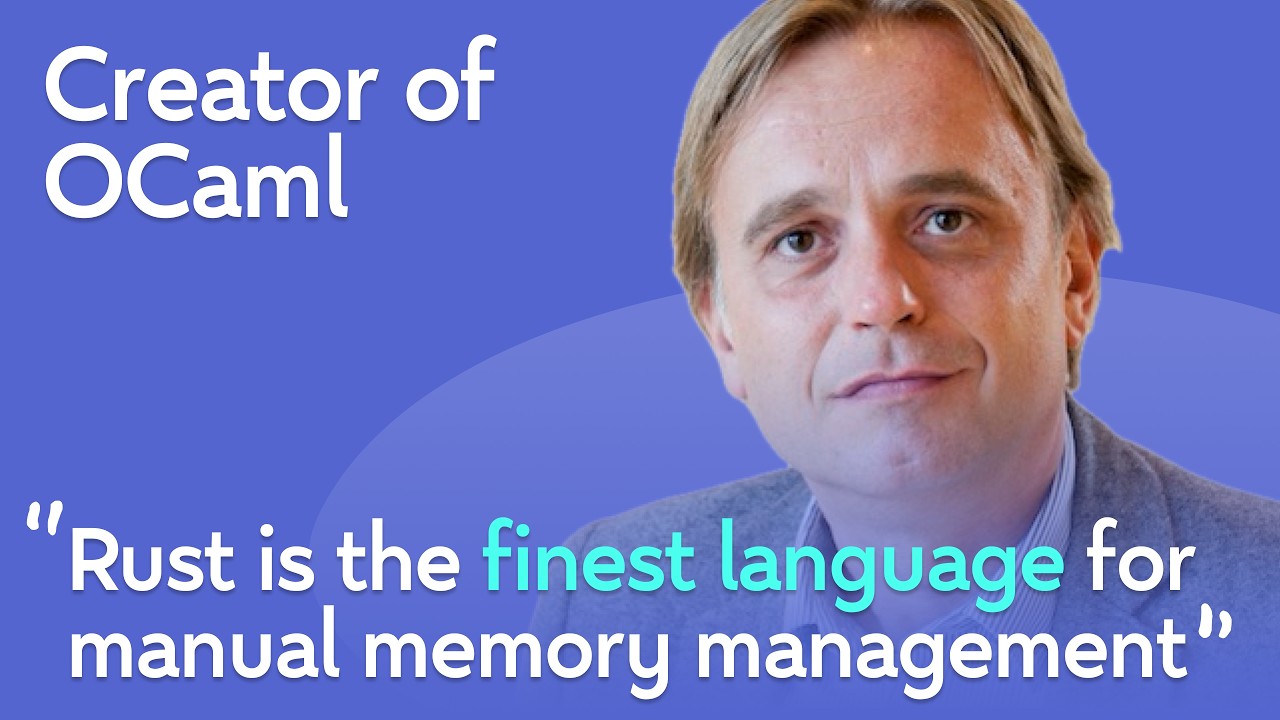
Xavier Leroy Warns AI Slop Floods CompCert Bug Trackers
Ryan Peterman
Xavier Leroy argues that formal software verification may finally gain industry traction because LLMs force developers to confront the specification bottleneck.
Xavier Leroy cautions that AI does not reduce the cost of software engineering to zero because verification, review, and maintenance remain expensive liabilities. (57:41)
Open-source maintainers face significant operational overhead from AI-generated issue reports, with Leroy noting only about one in ten reported issues for projects like OCaml and CompCert represents a real bug. (57:41)
Formal verification of general software remains constrained by a specification bottleneck, where writing precise, non-contradictory mathematical preconditions is often harder than writing the code itself. (61:40)
CompCert demonstrated that safety-critical infrastructure can be fully verified down to assembly using interactive proof assistants like Coq, eliminating entire classes of compiler bugs. (25:19)
Detailed notes
## Background
Published on YouTube by Ryan Peterman on July 20, 2026, this interview features Xavier Leroy, the creator of OCaml and a leading researcher in compilers and formal software verification. The episode serves as an approachable deep dive into functional programming principles, programming language design, and the mathematical verification of software.
## TL;DR
Xavier Leroy explores the architectural trade-offs of OCaml, comparing its garbage-collected model with Rust's compile-time ownership semantics and analyzing the engineering hurdles overcome during the Multicore OCaml overhaul. He explains the mathematical foundations of formal verification, highlighting how interactive theorem provers like Coq and Lean verify mission-critical systems such as CompCert and seL4. Leroy also critiques the influx of AI-generated code, emphasizing the operational liability of synthetic software and the persistent challenge of the formal specification bottleneck.
## Atmosphere & style
The conversation carries a calm, scholarly, and deeply pragmatic tone, blending academic theoretical rigor with hard-won systems engineering realities. Peterman serves as an inquisitive interlocutor learning the nuances of verification in real time, while Leroy offers grounded, measured insights seasoned with dry humor and candid skepticism toward industry fads. The exchange feels less like an abstract lecture and more like a reflective masterclass on the disciplined craft of building reliable software.
## Bulletin
- [57:41](https://www.youtube.com/watch?v=9Cswiqrq6So&t=3461s) Xavier Leroy cautions that AI does not reduce the cost of software engineering to zero because verification, review, and maintenance remain expensive liabilities.
- [57:41](https://www.youtube.com/watch?v=9Cswiqrq6So&t=3461s) Open-source maintainers face significant operational overhead from AI-generated issue reports, with Leroy noting only about one in ten reported issues for projects like OCaml and CompCert represents a real bug.
- [01:01:40](https://www.youtube.com/watch?v=9Cswiqrq6So&t=3700s) Formal verification of general software remains constrained by a specification bottleneck, where writing precise, non-contradictory mathematical preconditions is often harder than writing the code itself.
- [25:19](https://www.youtube.com/watch?v=9Cswiqrq6So&t=1519s) CompCert demonstrated that safety-critical infrastructure can be fully verified down to assembly using interactive proof assistants like Coq, eliminating entire classes of compiler bugs.
## Key takeaways
- [00:00](https://www.youtube.com/watch?v=9Cswiqrq6So&t=0s) Testing can only prove the presence of bugs, whereas formal verification uses mathematical proofs to guarantee their absence against a specification.
- [00:43](https://www.youtube.com/watch?v=9Cswiqrq6So&t=43s) OCaml bridges functional semantics with systems-level performance through a predictable cost model and an incremental, low-latency garbage collector.
- [04:39](https://www.youtube.com/watch?v=9Cswiqrq6So&t=279s) Rust's borrow checker enforces memory safety at compile time, but ownership tracking imposes a substantial cognitive burden compared to automatic garbage collection.
- [07:57](https://www.youtube.com/watch?v=9Cswiqrq6So&t=477s) Stack allocation yields smaller performance gains than anticipated in generational GC environments because short-lived minor heap objects are already extremely cheap to collect.
- [16:05](https://www.youtube.com/watch?v=9Cswiqrq6So&t=965s) Type inference automates constraint solving to deduce principal types, though subtyping in object-oriented paradigms remains fundamentally hard to combine with global inference.
- [35:56](https://www.youtube.com/watch?v=9Cswiqrq6So&t=2156s) Universal program verification is theoretically undecidable due to Turing's halting problem, but targeted domain analyzers and interactive proof assistants provide practical real-world utility.
- [40:06](https://www.youtube.com/watch?v=9Cswiqrq6So&t=2406s) Implementing Multicore OCaml required eliminating the global runtime lock and designing an explicit memory model to balance concurrency safety against hardware-level reordering.
- [50:17](https://www.youtube.com/watch?v=9Cswiqrq6So&t=3017s) Interfacing managed languages with C via foreign function interfaces requires managing data representations, heap boxing mismatches, and GC root registration.
- [55:32](https://www.youtube.com/watch?v=9Cswiqrq6So&t=3332s) Static linking avoids dynamic loading failures and missing runtime dependencies by verifying all symbols upfront at build time.
- [57:41](https://www.youtube.com/watch?v=9Cswiqrq6So&t=3461s) Every line of synthetic or human code is an operational liability, making compact, polished implementations preferable to bloated generative output.
- [01:01:40](https://www.youtube.com/watch?v=9Cswiqrq6So&t=3700s) LLMs generating proofs alongside code enable deterministic verification in provers like Lean, though models risk altering specifications or generating vacuous proofs.
- [01:07:08](https://www.youtube.com/watch?v=9Cswiqrq6So&t=4028s) LLM translation from C/C++ to Rust frequently bypasses memory safety guarantees by dumping raw pointer logic into unsafe blocks.
- [01:10:28](https://www.youtube.com/watch?v=9Cswiqrq6So&t=4228s) Industry historically operationalizes academic language innovations, successfully mainstreaming garbage collection, algebraic data types, and affine types into production environments.
- [01:15:06](https://www.youtube.com/watch?v=9Cswiqrq6So&t=4506s) Deep learning models cannot be formally verified using traditional static analysis because they lack explicit, objective mathematical specifications of correct behavior.
- [01:21:19](https://www.youtube.com/watch?v=9Cswiqrq6So&t=4879s) Specializing too early in computer science research can leave fundamental knowledge gaps, underscoring the enduring value of broad theoretical foundations.
## Detailed walkthrough
### [00:00](https://www.youtube.com/watch?v=9Cswiqrq6So&t=0s) Introduction and the Teaser Highlights
The conversation opens with a series of quick, punchy reflections setting the stage for Xavier Leroy’s deep background in compiler design, language theory, and program verification. Reflecting on software reliability, Leroy notes that testing can only ever prove the presence of bugs, never their complete absence. As host Ryan Peterman introduces Leroy as the creator of OCaml, Leroy candidly reacts to various modern developments in the programming landscape with self-deprecating humor and sharp assessments.
When touched on modern languages, Leroy admits with a laugh, “Uh yeah, I'm not a big fan of JavaScript.” He highlights that while Rust represents the peak of modern engineering for manual memory management, manual allocation does not automatically guarantee superior performance over automatic systems. Looking ahead to the broader trajectory of computer science, Leroy speculates that the industry may finally be entering the decade of formal software verification, while expressing cautious skepticism when asked which languages might thrive or fade in an era dominated by large language model code generation.
[00:43](https://www.youtube.com/watch?v=9Cswiqrq6So&t=43s) What Sets OCaml Apart
Ryan Peterman asks what fundamentally distinguishes OCaml from the vast landscape of other programming languages. Leroy explains that OCaml is both a refined functional programming language and a surprisingly capable systems programming language. On the functional side, it offers classic inductive types, recursive functions defined by pattern matching, combinators, and higher-order functions. On the systems side, it provides full imperative power alongside rich control structures, including exceptions, threads, and newly added handlers for user-defined effects. Crucially, OCaml features an unusually transparent execution model. As Xavier Leroy points out, “Um and it has a very predictable cost model execution model. So so when you write your code, you have a pretty good idea what what will take time and what will be fast and what will be slow.”
Leroy contrasts this predictability with other functional languages whose runtime behavior can feel erratic. OCaml backs this mental model up with an efficient native-code compiler and an allocator coupled to a low-latency garbage collector designed to avoid disruptive, long pauses—a property essential for network services. Although OCaml was originally conceived for academic tasks like building theorem provers and domain-specific languages, its pragmatic balance drew early attention from systems researchers. In the late 1990s, Cornell University’s Ensemble project—a reliable multicast networking stack for distributed applications like collaborative editing and multiplayer games—rewrote their complex C codebase into OCaml. The OCaml rewrite proved far easier to maintain and extend while matching C’s performance, aided by an ingenious technique: running incremental garbage collection sweeps during the idle microseconds while network packets were in flight.
This systems lineage sparked further real-world adoption, including the MirageOS unikernel project and financial infrastructure. Yaron Minsky, who worked on the Ensemble project during his PhD, went on to introduce OCaml at quantitative trading firm Jane Street. Today, Jane Street runs its core automated trading infrastructure on OCaml, depending on its sub-millisecond execution predictability, lack of GC pauses, and the readability it affords quantitative researchers and financial engineers who collaborate directly on the codebase.
```mermaid
flowchart TD
accTitle: OCaml Systems Adoption Timeline
accDescr: Diagram showing how OCaml transitioned from theorem proving to systems programming and quantitative finance.
subgraph Origins["Original Academic Focus"]
A["Theorem Provers & Proving Tools"]
B["Domain-Specific Languages (DSLs)"]
end
subgraph Breakthrough["Systems Breakthrough (Late 1990s)"]
C["Cornell University: Ensemble Project"]
D["Reliable Multicast Network Stack"]
C --> D
D -->|"Replaced unmaintainable C code"| E["Predictable Low-Latency GC"]
end
subgraph Industry["Industrial Production"]
F["MirageOS Unikernels"]
G["Jane Street Capital"]
H["High-Frequency Trading Infrastructure"]
G --> H
end
Origins --> Breakthrough
Breakthrough --> Industry
```
- **Early Systems Benchmark:** The Cornell Ensemble project achieved parity with raw C by triggering GC collections in the idle gaps between packet dispatches.
- **Key Enterprise Anchor:** Jane Street relies heavily on OCaml so both core software engineers and non-programmer quantitative analysts can read, maintain, and reason about the same production trading algorithms.
[04:39](https://www.youtube.com/watch?v=9Cswiqrq6So&t=279s) OCaml vs. Rust: The Memory Management Divide
Peterman shifts the discussion to concrete language comparisons, asking Leroy how he evaluates the trade-offs between OCaml and Rust. Leroy defines the boundary between the two languages cleanly: OCaml relies on automatic garbage collection, whereas Rust is explicitly tailored for manual memory management governed at compile time. Leroy holds Rust in high regard, remarking, “Uh it's a it's it's the finest language for that I know for uh manual memory management, okay?” He explains that Rust’s ownership and borrowing disciplines make manual resource control infinitely safer than traditional C or C++.
However, Leroy emphasizes that even with Rust’s sophisticated type system, explicit ownership tracking places a significant cognitive burden on the programmer. While Rust successfully borrows functional hallmarks like algebraic data types and pattern matching to bridge low-level control with high-level expressiveness, managing memory by hand remains fundamentally harder than writing garbage-collected code.
Furthermore, Leroy challenges the assumption that manual management is inherently faster. In complex systems, fear of ownership ambiguity often leads programmers in languages like C++ to clone or deep-copy objects defensively, triggering substantial time and memory overhead. In contrast, garbage-collected languages handle deep structural sharing naturally and safely without duplicate allocations:
- **Safety Guarantee:** Rust eliminates undefined behavior and memory leaks common in C/C++ without a tracing GC, but still forces developers to design their architectures around strict ownership hierarchies.
- **Structural Sharing:** Garbage collection allows multiple components to safely point to identical nodes in memory; Rust's borrow checker can make complex sharing patterns awkward, sometimes requiring manual reference counting (`Rc`/`Arc`) or unnecessary data duplication.
[07:57](https://www.youtube.com/watch?v=9Cswiqrq6So&t=477s) The Performance Trade-Offs of Garbage Collection and Stack Allocation
Peterman notes that developers often expect automated compiler optimizations to outperform manual approaches, wondering why automatic memory management should incur a performance penalty relative to manual management. Leroy explains that the difference lies in execution time: garbage collection occurs at runtime, temporarily diverting processor cycles from application logic to scan memory heaps and identify unreferenced objects. Depending on access patterns, this runtime scanning overhead routinely costs between 10% and 30% of application runtime, though manual management introduces hidden costs of its own.
Addressing Peterman’s question about whether a language can bridge this divide by mixing paradigms, Leroy brings up recent industrial experimentation, such as Jane Street’s work on "Oxidized OCaml"—an experimental variant incorporating Rust-inspired features like stack allocation for local data structures. While allocating temporary records on the call stack lets them be reclaimed instantly upon function return without GC involvement, Leroy notes from his own past experiments that the overall performance payoff is often smaller than expected.
Under modern generational garbage collectors, short-lived objects that die before the next collection cycle are already exceptionally cheap to allocate and discard in the minor heap. The real runtime cost stems from long-lived objects that survive into the major heap, where they must be traced and scanned repeatedly across multiple cycles. Because stack allocation can only ever apply to short-lived data whose lifetime is strictly bound to the calling frame, it optimizes the exact category of objects that a generational garbage collector already handles with minimal effort. As Xavier Leroy summarizes: “See, garbage collection or heap allocation is pretty cheap for objects that have a very short lifetime. Okay, if if they if they die before the next garbage collector, they they they will cost very little in garbage collection time.”
[11:23](https://www.youtube.com/watch?v=9Cswiqrq6So&t=683s) JavaScript vs OCaml: Dynamic Chaos vs Static Rigidity
When Ryan Peterman asks Xavier Leroy about the primary difference between JavaScript and OCaml, Leroy does not mince words: “Yeah, I'm not a big fan of JavaScript.” He highlights that JavaScript is fundamentally dynamic in ways that go far beyond standard runtime type checking. In JavaScript, almost every core mechanic can be redefined on the fly at runtime, right down to the semantics of method invocation. While meta-programming enthusiasts celebrate that extreme flexibility, Leroy views it as a critical design flaw that makes software brittle, easily abused, and vulnerable. By contrast, OCaml sits at the exact opposite end of the spectrum: it relies on static typing and static binding, locking down nearly every program property at compile time.
Leroy acknowledges that JavaScript leans toward an object-oriented data presentation, but points out that buried inside it is a decent functional language. Its core is essentially a dynamic dialect of Lisp, owing to creator Brendan Eich’s background. However, Leroy argues that the language pushed dynamism far too far into dangerous territory through its meta-object protocols and runtime introspection. For example, a method can inspect its own call stack and examine the code of its callers. Leroy characterizes this capability bluntly: “There's a lot of introspection. A method can look at its own call stack, look at its callers, look at the code of their of its callers, which is a security nightmare.” For him, such unchecked introspection is entirely unnecessary and fundamentally hostile to writing reliable software.
[14:00](https://www.youtube.com/watch?v=9Cswiqrq6So&t=840s) Rob Pike’s Quote and the Accessibility of Functional Programming
Peterman brings up a recurring critique of functional languages: that they carry a steep learning curve and high perceived complexity compared to imperative counterparts. He cites a well-known quote from Go co-creator Rob Pike, who stated that Go was built for Googlers—young software engineers fresh out of school who are not researchers and are not equipped to handle a “brilliant language.” Peterman asks whether functional languages like OCaml really are inherently harder to grasp. Leroy firmly rejects the idea, countering: “I think functional programming is not fundamentally harder, especially if you have a little bit of mathematics background.”
Leroy explains that Pike’s comment reflects Google's particular hiring and training pipeline—bringing in large cohorts of recent graduates and training them internally—rather than an innate cognitive ceiling for developers. Other firms pursue different strategies by seeking out engineers with advanced degrees or diverse analytical backgrounds; trading firm Jane Street, for instance, deliberately uses OCaml as a hiring filter to attract that pool of talent. Furthermore, Leroy notes that modern mainstream developers already practice functional programming without realizing it, observing that Python is essentially 50% functional when developers write idiomatic code with list comprehensions. Once an engineer is comfortable with those constructs in Python, they are already halfway toward functional fluency.
[16:05](https://www.youtube.com/watch?v=9Cswiqrq6So&t=965s) Type Inference: Deductions, Constraints, and Free Polymorphism
Peterman recalls his college days learning OCaml and asks Leroy to explain type inference—the mechanism that allows compilers to deduce types implicitly from code context. Leroy explains the core concept with a straightforward example: if a programmer writes `X = string_length(S)`, the compiler automatically deduces that `S` must be a string and `X` must be an integer based on the known signature of `string_length`. Under the hood, the compiler operates much like solving a Sudoku puzzle. It systematically gathers equations and constraints from how values are used across expressions, then solves for the unknown types while still giving developers the freedom to supply explicit type annotations wherever they improve readability or serve as documentation.
```mermaid
flowchart TD
accTitle: Milner Type Inference Flow
accDescr: How an ML compiler moves from unannotated source code, collects type equations, and solves them into concrete types or polymorphic generalizations.
subgraph Collection["1. Source Code & Constraints"]
A["Source Expression<br/>(e.g., if X == Y)"]
B["Collect Constraints<br/>(Type of X = Type of Y)"]
A --> B
end
subgraph Solving["2. Constraint Resolution"]
C{"Solve Constraints<br/>(Sudoku-style)"}
B --> C
end
subgraph Outcomes["3. Solver Outcomes"]
D["Concrete Types<br/>(Fully resolved)"]
E["Type Error<br/>(Contradiction found)"]
F["Free Polymorphism<br/>(Unconstrained variables)"]
C -->|"Exact match"| D
C -->|"No solution"| E
C -->|"Unconstrained"| F
end
```
The system becomes particularly elegant when constraints leave types open-ended. If a function accepts two arguments `X` and `Y` and evaluates `if X == Y`, the compiler records that both arguments share the same type, but does not bind them to a specific concrete type. If no subsequent operations restrict them further, the unconstrained type variable is automatically generalized:
- “So there's this beautiful I think phenomena phenomenon that that polymorphism can be discovered just by running type inference and noticing that oh there are no constraints so it must be polymorphic.”
- Leroy credits this insight to Robin Milner, the British computer scientist who introduced the ML family of languages in the 1970s.
- At a time when parametric polymorphism was poorly understood across computing, Milner’s ability to synthesize polymorphic functions automatically out of unresolved constraints stood as a landmark theoretical discovery.
[20:28](https://www.youtube.com/watch?v=9Cswiqrq6So&t=1228s) The Trade-Offs: Error Blame and Subtyping Tensions
Despite its power to keep codebases concise by stripping away redundant type signatures, type inference introduces distinct engineering challenges. Leroy highlights that compiler error diagnostics can become deeply confusing because the compiler cannot always pinpoint the true origin of a mismatch. When a constraint system fails, the solver may emit an error pointing to a valid inference step further down the line rather than the original line where the programmer made a faulty assumption, which has made error reporting an active area of programming language research for decades.
Additionally, certain language paradigms clash directly with global type inference:
- Parametric polymorphism pairs naturally with Milner-style unification algorithms.
- Subtyping—the backbone of object-oriented class hierarchies—is notoriously difficult to integrate smoothly with global type inference for deep theoretical reasons.
- Language designers inevitably face a structural compromise: either build a less powerful inference engine that requires frequent manual annotations, or enforce a more restrictive, purely parametric type system to keep automated inference complete and sound.
[22:11](https://www.youtube.com/watch?v=9Cswiqrq6So&t=1331s) What is Formal Verification?
Ryan notes that Xavier's mention of solvers brings to mind formal verification, prompting Xavier to explain what the field is actually about. Xavier starts with a hearty chuckle ("Woo.") before defining it as a way to obtain ironclad guarantees of correctness for programs where ordinary testing and code reviews simply fall short. He brings up Edsger W. Dijkstra’s famous observation:
> “Testing can only show the presence of bugs, but not their complete absence.”
Because software generally operates on an infinite number of possible inputs, testing a finite sample inevitably leaves room for nasty surprises. Formal methods turn instead to mathematical reasoning and static analysis algorithms to analyze all possible execution paths of a piece of code, ensuring that every run adheres strictly to a formal specification.
```mermaid
flowchart LR
accTitle: Testing vs Formal Verification
accDescr: Diagram contrasting testing of a subset of inputs with formal verification covering all possible inputs against a specification.
subgraph Testing["Testing Approach"]
direction TB
TIn["Sample Inputs"] --> TCode["Code Execution"]
TCode --> TOut["Catches Bugs Present<br/>(Cannot prove absence)"]
end
subgraph Formal["Formal Verification Approach"]
direction TB
FSpec["Formal Specification"] --> FEngine["Mathematical Analysis & Provers"]
FCode["All Inputs & Execution Paths"] --> FEngine
FEngine --> FGuar["Exhaustive Guarantee<br/>(Provably meets spec)"]
end
```
Xavier notes that specifications range widely in complexity:
- **Absence of crashes / safety invariants**: A fundamental property ensuring that code will never crash on well-formed inputs. As Xavier emphasizes, crashing code represents a prime attack vector: “Code that crashes is always code that can be attacked. It's always—is often security hole.”
- **Memory safety**: Ensuring that every array access falls strictly within allocated bounds—a requirement notoriously difficult to enforce purely through basic type systems or unit testing.
- **Liveness and confidentiality**: Proving that a program always terminates, or verifying that it never leaks confidential data.
- **Functional correctness and numerical bounds**: Verifying that a piece of software computes an exact mathematical function within strict numerical error margins (e.g., floating-point error strictly below $10^{-6}$).
Techniques in software verification have been actively developed since the 1970s. They range from fully automated static analysis—very effective at catching out-of-bounds array access—to interactive systems that require humans to write specifications and step through formal mathematical program proofs.
[25:19](https://www.youtube.com/watch?v=9Cswiqrq6So&t=1519s) Interactive Theorem Provers, Lean, and Verified Systems
Ryan notes the recent rise in attention around Lean and modern theorem provers, asking where they fit in. Xavier clarifies that proof assistants—such as Lean, Coq, and Isabelle—were originally developed to conduct mathematics on computers rather than to verify software. Early efforts focused on fully automated theorem proving, but letting a machine find complex proofs entirely on its own proved exceptionally difficult and often unaligned with what working mathematicians actually required.
Instead, modern proof assistants act like specialized formal languages or programming environments. Users write definitions and mathematical statements, guiding the tool through the major structural steps while the engine automatically discharges simpler proof steps. Most importantly, the resulting proof is stored in a machine-checkable format. The computer systematically verifies that every inference step is valid, no edge cases were omitted, and no conclusion was accidentally assumed as a hypothesis—eliminating the subtle oversights that plague traditional pencil-and-paper proofs.
Xavier highlights how these tools tackle massive mathematical milestones, such as checking the roughly one thousand complex multi-variable inequalities required in the proof of the weak Goldbach conjecture. He also touches on the emerging intersection with generative AI: while models are good at generating plausible-sounding human proofs that still demand painstaking manual verification, an AI tasked with writing proofs in a language like Lean can have its work verified deterministically by a machine.
Turning back to software, Xavier describes how proof assistants are deployed for mechanized program verification:
- **CompCert (Verified C Compiler)**: Xavier spent many years using the Coq proof assistant (referred to in the audio alongside Rocq) to mathematically prove the correctness of a C compiler. CompCert translates C source code into assembly while proving the assembly faithfully preserves the semantics of the original C without introducing miscompilations or bugs. Doing this by hand would generate a multi-thousand-page paper proof that no human could reasonably audit, trust, or maintain as the compiler evolved.
- **seL4 Microkernel**: Developed in Australia and widely deployed as an embedded hypervisor, seL4 consists of roughly 8,000 lines of highly technical C code managing processes, capabilities, and security tokens, where every single line of code has been formally proven correct.
While mechanizing proofs remains costly and takes far more effort than writing the initial code, it dramatically simplifies evolving software, because proof updates guarantee that modifications introduce no subtle regressions.
[31:21](https://www.youtube.com/watch?v=9Cswiqrq6So&t=1881s) A Concrete Example: Verifying an Average Function
To make program verification concrete for Ryan, Xavier walks through a seemingly trivial example: a function calculating the average of three values, $X$, $Y$, and $Z$:
```c
T = X + Y;
T = T + Z;
T = T / 3;
return T;
```
Proving that this small function behaves correctly requires specifying several concrete edge cases:
- Defining whether division by 3 truncates, rounds up, or rounds down, especially when dealing with integer arithmetic or floating-point approximations.
- In low-level languages like C, calculating $X + Y$ or adding $Z$ can overflow the maximum representable integer, triggering undefined behavior.
To protect against this, the specification must declare an explicit **precondition** on the inputs (for instance, that $X$, $Y$, and $Z$ must fall between 0 and 1,000,000). The theorem prover then mathematically evaluates the code against this precondition to guarantee that an overflow cannot occur, establishing the fundamental safety contract needed before certifying the functional output.
[33:35](https://www.youtube.com/watch?v=9Cswiqrq6So&t=2015s) Function Contracts, Semantics, and Bridging Programs to Mathematics
Xavier Leroy explains how formal verification models software through contracts and symbolic execution. In a simple arithmetic function, the proof begins with preconditions on the parameters that must hold to prevent undefined states. The analyzer then symbolically executes each statement in the function body—tracking how an accumulator variable is updated step by step (for instance, setting $t = x + y$, adding $z$, and dividing by 3) to prove that the final result equals $\frac{x + y + z}{3}$, provided no overflow occurred. Leroy summarizes this methodology: “Okay? So, basically, you're stating a contract for your function, the pre-hypotheses on the arguments, guarantees on the results.”
```mermaid
flowchart LR
accTitle: Program Contract Verification Flow
accDescr: Preconditions feed into symbolic execution of code, mapping through formal semantics to yield mathematical guarantees.
subgraph Inputs ["Specification & Execution"]
PRE["Preconditions<br/>(e.g., no overflow)"]
BODY["Function Body<br/>(Symbolic steps)"]
end
subgraph FormalBridge ["Bridge Layer"]
SEM["Language Semantics<br/>(Explicit states)"]
end
subgraph Target ["Mathematical Logic"]
PROVER["Proof Assistant<br/>(Lean, Coq)"]
GUAR["Guaranteed Contract<br/>Postcondition"]
end
PRE --> SEM
BODY --> SEM
SEM --> PROVER
PROVER --> GUAR
```
When Ryan Peterman asks whether interactive theorem provers like Lean simply ingest invariants and propagate them line by line, Leroy clarifies that an underlying bridge is required: “And for Lean to be able to do it, you still need to teach it a little bit about the semantics of your programming language.” Because systems like Lean operate strictly within mathematics, they have no native notion of state mutation or reassignment. In pure mathematics, an expression like $x = x + 1$ is not an update but an impossible equality. To verify imperative code, formal semantics must explicitly model the successive states of a variable—tracking state one, state two, and state three across operations—so the mathematical prover can reason over them. This bridge between raw code and mathematical logic constitutes the study of programming language semantics, an active branch of computer science research since at least the 1960s.
---
[35:56](https://www.youtube.com/watch?v=9Cswiqrq6So&t=2156s) Functional Programming's Proximity to Math and the Limits of Decidability
Addressing Peterman’s observation that pure functional languages sit far closer to mathematical reasoning than imperative languages do, Leroy agrees wholeheartedly: “Purely functional style is much closer to mathematical style, so much easier to reason about.” This exact reasoning motivated his development of CompCert; the foundational architectural choice was to write the compiler in a purely functional style so that mechanized proofs about its behavior would remain tractable. Even in functional paradigms, minor discrepancies with pure mathematics persist: programs might loop forever rather than terminate, and machine arithmetic relies on fixed-width integers or floating-point approximations rather than true reals.
Peterman questions how termination can ever be verified given Alan Turing's famous proof of the halting problem. Leroy explains the distinction between theoretical limits and pragmatic program verification. While computability theory guarantees that no universal algorithm can determine termination for all arbitrary programs without failing, looping indefinitely, or giving incorrect answers on pathological inputs, real-world engineering does not require a universal solver. Specialized automatic analyzers successfully verify large classes of practical programs, and human mathematicians can write interactive proofs for difficult edge cases. Leroy highlights the reality of the discipline:
> “They are pretty much all undecidable. So, you know that there is no static analyzer that will always find all problems in all programs. But, still you can try, okay? You can try for specific problems, for specific programs and and get some very useful results out of that.”
- Theoretical undecidability rules out a single analyzer covering every possible arbitrary program, but verification remains completely achievable for domain-specific programs of genuine interest.
- CompCert was intentionally built in a pure functional subset to bypass the mathematical complications introduced by shared mutable state.
---
[40:06](https://www.youtube.com/watch?v=9Cswiqrq6So&t=2406s) The 2022 Multicore OCaml Milestone: Engineering Hurdles vs. Language Design
Peterman points out that multicore processors became the computing standard long before OCaml released multicore support in 2022, asking what engineering and architectural challenges caused the multi-decade delay. Leroy notes that the barrier involved both deep engineering hurdles and fundamental philosophical debates over language design. From a systems perspective, OCaml’s original high-performance runtime, memory allocator, and generational garbage collector were designed exclusively for sequential execution. Introducing shared-memory concurrency required rebuilding the runtime and garbage collector to run efficiently across parallel threads. Simply wrapping every heap operation in global mutex locks was non-viable, as that would sequentialize execution and reduce performance back to single-core speeds. Rewriting these systems was a massive undertaking, ultimately carried out largely by the OCaml Labs team at Cambridge University.
Beyond low-level runtime mechanics, Leroy harbored a long-standing distaste for the shared-memory concurrency model itself. He likens shared memory to a bizarre domestic interaction:
> “I mean, it's a bit like if you want to communicate with your neighbor then you break into their house and then you move the furniture around and then when they are back they say, 'Oh, something was moved so it's probably Ryan who's trying to tell us something.' Maybe you could just meet your neighbors, you know? And that would be things like message passing which is a completely different form of communication, much higher level.”
Leroy spent years exploring message-passing paradigms akin to Erlang's actor model. However, practical and industrial pressures pushed against that direction. Critics argued that message passing forced costly data copying across process boundaries, whereas shared memory allowed multiple threads to read massive in-memory databases with minimal overhead. As languages like Java and the C/C++11 standards standardized around shared memory, mainstream programming demanded native shared-memory models. This shift brought serious semantic complications to the forefront, particularly undefined behavior arising from data races when concurrent threads access and mutate identical memory locations without synchronization.
[44:31](https://www.youtube.com/watch?v=9Cswiqrq6So&t=2671s) Shared-Memory Concurrency and Memory Models
Designing shared-memory concurrency for modern hardware requires establishing a precise memory model that balances programmer expectations with hardware performance. At one end of the spectrum is sequential consistency, which presents the execution as an arbitrary interleaving of reads and writes across threads. However, Xavier Leroy explains that sequential consistency is impractical on modern multi-core processors because hardware aggressively reorders memory accesses to maximize performance. From the perspective of the running program, hardware behavior becomes difficult to predict unless the language explicitly defines its concurrency semantics.
Language designers face the challenge of providing order guarantees for concurrent reads and writes without unduly constraining hardware optimizations. Leroy points to Java's historical struggles with this problem: Java went through roughly five iterations of its memory model, with early versions being either too strict, too lax, or logically inconsistent to the point of permitting bizarre behaviors where the past effectively depended on the future. While C and C++11 improved upon this, they still ended up with an extremely complicated model.
When the OCaml Labs team set out to introduce shared-memory concurrency into OCaml, they had to establish a programmer-facing memory model. While Leroy believes the resulting OCaml model is clearer and easier to use than Java’s, he acknowledges that it remains complex. He expresses empathy for developers having to grapple with it, remarking:
> “And sometimes I feel sorry our users are are exposed to that.”
A core difficulty in safe languages like Java and OCaml—unlike C and C++, which simply relegate many racy situations to undefined behavior—is preserving type safety under concurrency. A runtime must guarantee that data remains well-typed even in the presence of data races. A classic challenge is ensuring that an object cannot be observed by another thread before it has been completely initialized. Providing such guarantees requires careful memory model design paired with compiler precautions, significantly contributing to why multi-core OCaml required years of engineering.
```mermaid
flowchart TD
accTitle: Memory Model Constraints
accDescr: Spectrum of memory models from sequential consistency down to undefined behavior with Java and OCaml in between.
subgraph Spectrum["Memory Model Trade-offs"]
SC["Sequential Consistency<br>(Predictable, but cripples modern hardware)"]
SafeModel["Type-Safe Managed Models<br>(Java, OCaml: preserve typing & init safety)"]
UBModel["C / C++11 Models<br>(Complex; relies on undefined behavior)"]
end
SC -->|"Relax for hardware speed"| SafeModel
SafeModel -->|"Allow raw pointers / data races"| UBModel
```
[47:30](https://www.youtube.com/watch?v=9Cswiqrq6So&t=2850s) The Global Interpreter Lock (GIL) and Parallelism
Ryan Peterman asks about Python’s Global Interpreter Lock (GIL) and what it actually protects, wondering whether it exists to safeguard heap object cleanup or something broader. Leroy confirms that heap management is a primary driver, noting that OCaml previously relied on an identical mechanism before the release of Multicore OCaml. When a language runtime is not thread-safe, a coarse-grained lock prevents non-thread-safe runtime functions from running concurrently.
Taking and releasing a lock on every single memory allocation is far too expensive. Consequently, runtimes implement a coarser strategy: a thread acquires the lock upon entering high-level execution and holds it while running. The runtime releases the lock when a thread enters blocking I/O operations or invokes thread-safe C code that does not interact with the managed runtime. This allows another thread to acquire the lock and continue executing:
```mermaid
flowchart LR
accTitle: GIL Execution and Release Cycle
accDescr: Thread acquiring GIL for bytecode execution and releasing it during I/O or C foreign calls.
subgraph Execution["Thread 1 Running"]
RunBytecode["Execute Managed Code<br>(Holds GIL)"]
end
subgraph Released["Blocked / External"]
ReleaseGIL["Release GIL"]
ExternalCall["Blocking I/O or Safe C Call"]
end
subgraph Thread2["Thread 2 Scheduled"]
AcquireGIL["Acquire GIL & Run"]
end
This model achieves concurrency by interleaving high-level computation with low-level execution or I/O, but it fails to provide true parallel computation. As Leroy summarizes:
> “So so you get some benefits like concurrent IO, but you don't get any parallelism.”
Eliminating the GIL requires redesigning the garbage collector and memory allocator from the ground up. Even with Multicore OCaml, Leroy notes that targeted locks remain necessary in subsystems like I/O. Furthermore, the garbage collector still uses brief "stop-the-world" phases where all OCaml execution is momentarily paused to finalize garbage collection passes before restarting the mutator threads. Leroy adds that he is aware Python core developers have also been actively making progress toward removing their GIL.
[50:17](https://www.youtube.com/watch?v=9Cswiqrq6So&t=3017s) Foreign Function Interfaces and Data Boundaries
Peterman transitions to the pattern of high-level languages interfacing with low-level languages like C, asking how language bindings bridge this gap. Leroy calls the entire subject “another can of worms” and breaks the problem into two distinct challenges: control flow and data representation.
Control flow is relatively straightforward. The compiler or interpreter needs a mechanism to jump to the foreign C function. In OCaml, a developer declares that a function is implemented in C and specifies its symbol name. The compiler then generates a call honoring C’s calling conventions rather than OCaml’s internal conventions, routing through glue code when necessary, before returning execution back to OCaml.
Data representation presents much harder problems because high-level runtime layouts differ fundamentally from low-level C layouts:
- **Scalars and Floating-Point Values:** In OCaml, floating-point numbers are typically boxed—allocated on the heap and referenced via a pointer—resembling a `double*` in C rather than an unboxed register-allocated `double`.
- **Arrays:** A two-dimensional array in OCaml is represented as an array of pointers to individual arrays. In C, multidimensional arrays have contiguous layouts without intermediate pointers. Accessing OCaml array elements from C requires specialized accessor functions or macros.
- **Heap Allocation and Garbage Collection:** If a C extension builds complex return values (such as lists or arrays), it must allocate those objects directly inside the OCaml heap. This requires coordinating with the OCaml allocator and registering roots with the garbage collector so that in-flight objects are not corrupted or collected prematurely if a GC pause occurs during execution.
Different Foreign Function Interfaces (FFIs) tackle these trade-offs in different ways. OCaml’s low-level base FFI requires the C programmer to handle representations, rooting, and heap allocations manually; while labor-intensive, it offers high performance. Higher-level libraries like `ctypes` automate conversions using C type descriptions, though automated marshaling risks performance penalties, such as copying an entire array when C only needs two or three elements.
Leroy laments that FFIs remain an inherently messy aspect of language implementation across the industry, noting that Java's JNI is similarly cumbersome. Pointing out the root difficulty, he notes:
> “Uh but but it can be quite hard because the data models are different between the two languages.”
When Peterman describes the architecture as an interpreter loading a compiled C binary into application memory, Leroy clarifies a fundamental misconception about OCaml's execution model: while OCaml does have a bytecode interpreter, production OCaml typically compiles directly to native assembly and machine code rather than running under an interpreter.
[55:32](https://www.youtube.com/watch?v=9Cswiqrq6So&t=3332s) Linking C with OCaml vs. Interpreted Languages
In compiled execution mode, stitching together OCaml code and C code is handled directly by the standard C linker rather than by any bespoke language mechanism. Leroy explains that from the operating system's point of view, combining these components is fundamentally no different from linking two ordinary C object files or two OCaml object files together. In interpreted or bytecode-compiled environments such as Python, however, the process introduces an additional layer of complexity: the runtime must dynamically load C code using interfaces like Unix's `dlopen`. The interpreter performs runtime introspection to query external C libraries, locating symbol addresses (such as looking up a function named `foo`) to synthesize function calls dynamically.
When Ryan asks whether a mixed OCaml–C program compiles down into a single binary blob, Leroy confirms that this is the standard case. While OCaml supports dynamic loading facilities, Leroy expresses a strong ideological preference for static linking:
> “I think programs should be statically linked so that there's no surprise when you run them.”
He points out that while static linking sacrifices some runtime flexibility, it eliminates painful issues like missing shared libraries or dynamic link errors (such as `DLL not found` on Windows). Crucially, static linking verifies relationships upfront at link time so those properties do not need to be checked again when the program executes.
```mermaid
flowchart TD
accTitle: Static vs Dynamic Linking of Native C Code
accDescr: Flowchart contrasting how compiled OCaml links C statically into a single binary versus how interpreted runtimes query C dynamically via dlopen.
INTERP -->|"Query symbol name 'foo'"| DL
DL -->|"Lookup symbol"| SO
SO -->|"Return address"| DL
DL --> CALL
end
```
[57:41](https://www.youtube.com/watch?v=9Cswiqrq6So&t=3461s) The Threat of "Almost-Correct" LLM Code and AI Slop
The conversation pivots to generative AI and LLM-generated code. Leroy notes that while modern models perform feats that felt unthinkable only a few years prior, they inevitably introduce subtle bugs, making it impossible to place genuine trust in their raw output. He pushes back sharply against startup hype claiming that AI drops the cost of programming to zero:
> “The cost of writing code maybe, but what about you know checking it, making sure it is correct, that it does what we want, that well, that cost is not zero at all.”
Leroy views expanding codebases as an operational liability:
> “And for me every new line of code is a liability.”
From his perspective, software engineering should not be about inflating lines of code, but rather about crafting and refining small, high-leverage artifacts:
> “So no, I don't want huge amounts of code, okay? I want 50 lines of code that have been thought that have been polished over the years.”
The expectation that human engineers will sit and inspect every piece of machine-generated code is unrealistic because humans simply do not have the time, and reviewing massive amounts of synthetic text is tedious and deeply unpleasant work. This deluge has triggered a backlash, sparking "no to AI slop" policies in various open-source communities. Leroy shares his own firsthand frustrations maintaining projects like OCaml and CompCert:
- Bug trackers are flooded with AI-generated issue reports that are several pages long with detailed narrative prose.
- Among ten AI-generated issue reports, typically only one is valid.
- The included reproduction cases often reproduce nothing at all or reproduce an unrelated behavior, forcing maintainers to burn scarce time sifting through synthetic noise.
[01:01:40](https://www.youtube.com/watch?v=9Cswiqrq6So&t=3700s) Verifying AI Code with Proofs and the Specification Bottleneck
As a potential technical countermeasure to AI-generated hallucinations, Leroy proposes requiring LLMs to supply formal proofs alongside their code. This paradigm is already emerging in mathematics, where models generate proofs in natural language while simultaneously emitting formal proof scripts for interactive provers such as Lean. A proof assistant can then deterministically recheck the proof to establish correctness. However, Leroy highlights serious caveats that require human vigilance:
- LLMs frequently alter underlying mathematical definitions or shift the statement of a theorem to make proving it easier.
- In "self-formalization" pipelines—where models parse informal papers or PDFs to synthesize definitions—models regularly introduce subtle errors during transcription.
Extending automated proof generation to general programming faces an even deeper hurdle: the origin and correctness of the specification itself. While mathematicians have centuries of training in articulating meaningful definitions and theorems, software engineers struggle to write consistent formal specs:
> “It's not just that verification is hard, but agreeing on the spec can be difficult, too.”
An engineer or an LLM can inadvertently draft an impossible precondition—such as contradictory bounds on the inputs of an arithmetic function—rendering the precondition mathematically unsatisfiable:
> “And at this point, the body of the function will always be verified, okay? Even if it's completely wrong because because the assumption says basically this function cannot be called.”
This vacuous truth gives developers a false sense of security while delivering unusable software. Leroy suggests that while one mitigation is testing specifications against concrete test suites to see if they hold up, shifting the problem from implementation to specification still leaves massive challenges where LLMs currently offer little aid.
[01:05:39](https://www.youtube.com/watch?v=9Cswiqrq6So&t=3939s) LLMs and the Programming Language Landscape
Looking toward the next decade, Peterman asks how the proliferation of AI-generated code might reshape programming languages. Leroy reflects that when LLMs first emerged, researchers worried that languages with smaller footprints like OCaml would be left behind due to a lack of public training data compared to massive ecosystems like JavaScript.
In practice, modern models generate surprisingly competent OCaml code. Leroy hypothesizes several reasons for this unexpected capability:
- Model training has become vastly more sample-efficient.
- The smaller corpus of OCaml code on the public web may possess a significantly higher average code quality and consistency than vast, noisy JavaScript corpora.
- Foundation models have become increasingly capable of cross-lingual transfer, applying algorithmic structures learned from dominant languages to less common syntaxes.
[01:07:08](https://www.youtube.com/watch?v=9Cswiqrq6So&t=4028s) Generative AI, Type Systems, and Code Translation
Xavier Leroy admits he does not fully understand the inner mechanics of how large language models work, but notes that feedback from developers using generative AI to produce OCaml has been surprisingly positive. The generated code is described as decent and comparable in quality to output in far more mainstream languages. Leroy points out that static typing provides a crucial assist to LLMs: the type system acts as an automated guardrail, pruning errors early and pushing the model to establish an explicit type structure before generating functional logic.
Looking ahead ten years, Leroy wonders whether LLMs will entrench today's most popular languages even further or elevate safer, strongly typed languages because they reduce errors in generated software. Ryan Peterman observes that cheap AI generation has unlocked massive codebases rewrites that were historically cost-prohibitive, making cross-language migrations feasible. Leroy responds that most current rewrite efforts focus on converting C and C++ into Rust in hopes of achieving memory safety. However, the results can be superficial:
> “I've seen at least one project when the generated Rust code is entirely in unsafe blocks.”
Even so, he grants that a crude, line-by-line unsafe translation might still serve as a rough starting point that engineers can incrementally refactor toward safe Rust. In the functional ecosystem, Leroy envisions projects translating functional code into the restricted, logic-oriented languages embedded within interactive proof assistants like Lean or Coq, giving teams a launchpad toward full formal verification.
- Type systems provide prompt-time structural discipline and static checking, preventing common generation mistakes.
- Leroy hopes safer languages gain ground through AI, but acknowledges the future distribution remains deeply uncertain.
- Translation pipelines from C/C++ to Rust frequently dump code into `unsafe` blocks, mimicking raw pointers rather than adopting idiomatic ownership semantics right away.
- Restricted functional languages inside proof assistants (Coq, Lean) represent an intriguing automated translation target for mission-critical software.
```mermaid
flowchart TD
accTitle: AI Code Translation Paths
accDescr: Diagram showing how legacy code is translated by LLMs into modern languages, highlighting both superficial and aspirational targets.
subgraph Input["Legacy Codebases"]
C["C / C++ Code"]
FP["Functional Code"]
end
subgraph LLM["LLM Automated Translation"]
TR["Generative AI Translation Engine"]
end
C --> TR
FP --> TR
TR --> UR
UR -.->|"Manual or staged cleanup"| SR
TR --> PA
```
---
[01:10:28](https://www.youtube.com/watch?v=9Cswiqrq6So&t=4228s) Industry vs. Academia in Language Innovation
When Peterman asks whether industry or academia currently drives programming language innovation, Leroy remarks that the balance has flipped dramatically. In the dawn of computer science, foundational breakthroughs originated almost exclusively in academic or pure research labs—such as Algol, Lisp, Prolog, and Smalltalk (the latter coming out of Xerox PARC, an industrial lab detached from immediate commercial customers). By contrast, corporate environments like IBM produced practical, utilitarian, and often "uglier" workhorses like Fortran, COBOL, and PL/I. Over time, industry became adept at rapidly adopting and operationalizing academic concepts. Leroy recalls:
> “Before Java, it was just, you know, crazy academics in the ivory tower that were using garbage collected languages, right?”
Garbage collection was once widely dismissed as completely unacceptable for serious enterprise computing, but Java normalized it across the industry within two years, while popularizing static type safety and bytecode verification. Subsequent industrial languages carried the mantle: Swift brought algebraic data types and pattern matching into mainstream mobile app development, and Rust synthesized complex, 2000s-era academic research on safe low-level systems programming that had never before been successfully realized in a production language. Leroy openly admires Rust's achievement, noting that while he would have loved to see it originate in academia, building an ecosystem of that scale required the substantial resources of a major corporation.
Leroy recalls being hired at Inria in the 1990s as a young researcher working on the predecessor to OCaml and type theory, only to be met with skepticism:
> “Industry has decided it will be C++ forever. So, deal with it. Maybe maybe you could do software engineering, and not not not PL research.”
The arrival of Java and subsequent modern languages disproved that pessimistic stance. Leroy finds it invigorating that industry has not resigned itself to flawed historical tools, but continually embraces new programming languages as fundamental solutions to difficult software engineering challenges.
---
[01:15:06](https://www.youtube.com/watch?v=9Cswiqrq6So&t=4506s) Unsolved Problems: Accelerators, LLM Verification, and Software Quality
Reflecting on a 2018 interview where he cited the pain of programming GPUs and the difficulty of verifying machine-learned systems, Leroy assesses the state of those challenges today. Modest progress has arrived through domain-specific intermediate representations like MLIR in LLVM and DSLs such as Halide for tensor computations. Yet, high-performance parallel hardware remains frustratingly inaccessible for general-purpose computer science paradigms:
> “I find it a little bit frustrating that I cannot do, I don't know, theorem proving on a GPU. I have absolutely no idea how to go about that.”
Because the hardware pipelines require intricate low-level manipulation, researchers are starved of appropriate high-level abstractions, leaving GPUs underutilized outside traditional matrix and graphics workloads.
Regarding machine learning, Leroy notes that in 2018 he envisioned using static analysis and formal methods to bound simple neural networks used in vision, autonomous vehicles, or numerical weather predictions to guarantee they could not produce wildly invalid outputs. However, those formal techniques simply do not scale to massive modern deep learning models. Furthermore, LLMs suffer from a fundamental definitional issue:
> “And for LLMs there's also a distinct lack of specification. Okay. You don't really know what's a good answer from an LLM. Well you know it when you see it but you cannot write a mathematical specification of it.”
Without mathematical specifications, formal verification cannot be applied. Consequently, Leroy frames the defining unsolved problem of the current era as preserving software quality in an industry facing immense pressure to bypass established engineering discipline in favor of raw AI generation.
- **GPU programmability gap:** Languages like Halide and frameworks like MLIR improve tensor algebra, but non-numerical algorithms (e.g., interactive theorem proving) lack usable high-level programming models for accelerators.
- **Scalability limits of verification:** Program analysis tools that attempted to verify neural network bounds collapsed under the sheer parameter size of modern architectures.
- **The specification hurdle:** Unlike compilers or safety kernels, generative LLMs cannot be verified mathematically because human evaluation relies on subjective heuristics rather than formal invariants.
- **The looming software risk:** Engineering teams face growing pressure to compromise proven software practices in the race to adopt automated generative pipelines.
[01:18:09](https://www.youtube.com/watch?v=9Cswiqrq6So&t=4689s) Mechanized Proofs and the Future of Formal Verification
Wrapping up his thoughts on emerging technologies, Xavier Leroy reflects on the potential marriage between machine learning and formal methods. Researchers are currently exploring development techniques that deploy large language models and artificial intelligence to assist with mechanized proofs—mathematical proofs that can be systematically checked and certified by computers. Considering how long the field has strived for mainstream adoption, Leroy remarks with wry optimism: “Maybe this will be the decade of formal verification of software. We've been waiting for that for 50 years so maybe it will finally take off.”
[01:18:31](https://www.youtube.com/watch?v=9Cswiqrq6So&t=4711s) Book Recommendations for Engineers: Jon Bentley and Scheme Classics
When Ryan Peterman asks for his top book recommendations for software engineers, Leroy highlights two distinctive works. His first recommendation is an older classic, *Programming Pearls* by Jon Bentley, which Leroy originally read as a PhD student. He prizes the book for its timeless window into how master programmers reason about their craft. Rather than relying on esoteric languages or overly complex data structures, it teaches fundamental habits: selecting the proper algorithm, expressing it transparently, knowing when to stop instead of overcomplicating things, developing an innate sense of code elegance, and cultivating an intuition for diagnosing misbehaving code. Leroy considers those self-contained "pearls" exceptionally easy to read and a wonderful demonstration of tacit engineering skills that are otherwise difficult to communicate.
```mermaid
flowchart TD
accTitle: Xavier Leroy's Core Book Recommendations
accDescr: Diagram illustrating the two foundational programming books recommended by Xavier Leroy and their key pedagogical strengths.
subgraph Bentley["Programming Pearls (Jon Bentley)"]
B1["Algorithm selection & clarity"]
B2["Knowing when simple suffices"]
B3["Developing code elegance & debugging intuition"]
end
subgraph Felleisen["How to Design Programs (HtDP)"]
H1["Emerged from Scheme educational tradition"]
H2["Modern twist on SICP concepts"]
H3["Designing before typing the first line of code"]
end
His second, slightly more controversial recommendation is *How to Design Programs* (HtDP) by Matthias Felleisen, Robert Bruce Findler, Matthew Flatt, and Shriram Krishnamurthi. Emerging from the Scheme community—which is renowned for creating pedagogical tools that transcend mere functional programming syntax—the book acts as a modernized reimagining of concepts found in Harold Abelson and Gerald Jay Sussman's legendary MIT course textbook, *Structure and Interpretation of Computer Programs* (SICP). Leroy concedes that the book can be intensely opinionated and occasionally eccentric, observing: “It can be very irritating sometimes, very opinionated, very almost mystical sometimes, but it's also another great attempt at trying to communicate how experienced programmers go about designing a program even before writing the first line.” He admires how it walks the reader through mapping high-level system design into code that flows naturally within a flexible language.
- *Programming Pearls* (Jon Bentley): Recommended for practical algorithm selection, clean implementation, debugging intuition, and timeless programming wisdom.
- *How to Design Programs* (Matthias Felleisen, Robert Bruce Findler, Matthew Flatt, Shriram Krishnamurthi): Recommended as a disciplined, modern take on the Scheme pedagogical philosophy and software design methodology.
- *Structure and Interpretation of Computer Programs* (SICP): Cited by Leroy as the historical MIT foundational precursor to modern Scheme pedagogy.
[01:21:19](https://www.youtube.com/watch?v=9Cswiqrq6So&t=4879s) Advice to a Younger Self: Resisting the Urge to Specialize Too Early
Reflecting on his career path, Leroy considers what advice he would give his younger self. His primary regret is narrowing his academic focus prematurely: “Sometimes I got that maybe I specialized a little too early in programming language research.” He explains that as a student, there were foundational areas in computer science he bypassed simply because he lacked interest at the time. Consequently, he found himself having to learn or relearn those concepts much later in life, noting with self-deprecating humor that studying them near age sixty is considerably harder when one is not quite as quick as in one's youth.
Because of that experience, he advises anyone serious about computing to build a broad, diverse base across theoretical and applied disciplines—even if certain topics seem entirely disconnected from daily software engineering duties. Leroy points to computability and the halting problem: while an engineer rarely battles undecidability on the job, grasping the underlying theory reshapes how one approaches problems. Furthermore, strong theoretical roots make it much easier to adapt when paradigm shifts arise, such as quantum computing. Unpacking what quantum hardware can solve versus classical machines requires returning to foundational computational complexity theory. Leroy expresses that having that broad theoretical framework early on provides a long-term advantage that pays dividends throughout a career.
[01:23:25](https://www.youtube.com/watch?v=9Cswiqrq6So&t=5005s) Wrap-Up and Ergonomic Keyboard Project
Peterman thanks Leroy for his time, and Leroy cordially concludes the conversation. Wrapping up the episode, Peterman asks viewers to support the channel with likes, comments, and guest suggestions, pointing out that previous guests—such as Barbara Liskov, Mike Stonebraker, and Mark Brooker—were directly invited because audience members suggested them.
Peterman then presents a physical update on his side project: a custom split ergonomic keyboard. Holding up the prototype inside its travel case, he announces that the Kickstarter campaign successfully reached its funding target within eight hours of launch. While the team moves ahead with manufacturing tooling, late pledges remain open on Kickstarter for interested viewers.
## Notable quotes
> [22:11](https://www.youtube.com/watch?v=9Cswiqrq6So&t=1331s) Code that crashes is always code that can be attacked. — Xavier Leroy
> [57:41](https://www.youtube.com/watch?v=9Cswiqrq6So&t=3461s) And for me every new line of code is a liability. — Xavier Leroy
> [01:01:40](https://www.youtube.com/watch?v=9Cswiqrq6So&t=3700s) It's not just that verification is hard, but agreeing on the spec can be difficult, too. — Xavier Leroy
> [35:56](https://www.youtube.com/watch?v=9Cswiqrq6So&t=2156s) Purely functional style is much closer to mathematical style, so much easier to reason about. — Xavier Leroy
> [55:32](https://www.youtube.com/watch?v=9Cswiqrq6So&t=3332s) I think programs should be statically linked so that there's no surprise when you run them. — Xavier Leroy
> [01:18:09](https://www.youtube.com/watch?v=9Cswiqrq6So&t=4689s) Maybe this will be the decade of formal verification of software. We've been waiting for that for 50 years so maybe it will finally take off. — Xavier Leroy
> [14:00](https://www.youtube.com/watch?v=9Cswiqrq6So&t=840s) I think functional programming is not fundamentally harder, especially if you have a little bit of mathematics background. — Xavier Leroy
## Mentioned
Xavier Leroy, Ryan Peterman, OCaml, Rust, JavaScript, Cornell University, Ensemble project, MirageOS, Yaron Minsky, Jane Street, Oxidized OCaml, Brendan Eich, Rob Pike, Google, Go, Python, Robin Milner, Edsger W. Dijkstra, Lean, Coq, Rocq, Isabelle, CompCert, seL4, Alan Turing, OCaml Labs, Cambridge University, Erlang, Multicore OCaml, Java, C, C++, Global Interpreter Lock (GIL), ctypes, Java Native Interface (JNI), Algol, Lisp, Prolog, Smalltalk, Xerox PARC, IBM, Fortran, COBOL, PL/I, Swift, Inria, MLIR, LLVM, Halide, Jon Bentley, Programming Pearls, How to Design Programs, Matthias Felleisen, Robert Bruce Findler, Matthew Flatt, Shriram Krishnamurthi, Scheme, Structure and Interpretation of Computer Programs, Harold Abelson, Gerald Jay Sussman, Barbara Liskov, Mike Stonebraker, Mark Brooker, Kickstarter
## Video description
Xavier Leroy (creator of OCaml) is an expert in compilers, formal verification of software and functional programming. This interview should be an approachable resource if you're curious about formal verification of software since I was learning that on the fly during it.
• My ergonomic keyboard project I mentioned, you can follow along here: https://read.compose.llc/
• The Kickstarter page for it: https://www.kickstarter.com/projects/ryanlpeterman/compose-simple-ergonomics-beautifully-done
• WorkOS: makes your app Enterprise Ready with easy to use APIs to add SSO, SCIM, RBAC, and more in just a few lines of code, check them out at https://workos.com/
𝗧𝗶𝗺𝗲𝘀𝘁𝗮𝗺𝗽𝘀:
00:00 Intro
00:43 What sets OCaml apart
04:39 OCaml vs Rust
07:57 Why is manual memory management more performant
11:21 Javascript vs OCaml
14:00 Famous Rob Pike quote
16:05 Type inference and how it works
22:12 What is formal verification and how does it work
40:07 What made multicore support difficult for OCaml
50:17 How programming languages interface and call each other
57:41 The danger of almost-correct LLM code
01:05:39 How LLMs will change programming languages
01:10:26 Industry vs academia
01:15:05 Most interesting unsolved problems
01:18:30 Top book recommendations for engineers
01:21:17 Advice for his younger self
01:23:31 Outro
OCaml creator Xavier Leroy argues that programming language design and formal verification are converging to address software reliability, though the rise of generative AI introduces new specification bottlenecks and maintenance risks.
OCaml's Pragmatic Systems Balance and Predictability (0:43)
Leroy distinguishes OCaml by its combination of functional expressiveness, imperative power, and a transparent cost model that makes runtime performance intuitive to predict. Paired with a native-code compiler and an incremental, low-latency garbage collector, the language moved beyond academic roots like theorem provers to mission-critical systems. Cornell's late-1990s Ensemble project matched raw C networking speeds by triggering incremental GC passes during the microsecond intervals while network packets were in flight. This operational predictability later led trading firm Jane Street to adopt OCaml for its core automated trading infrastructure.
Memory Management Trade-Offs: OCaml vs. Rust (4:39)
While Leroy praises Rust as the finest manual memory management language available, he highlights that explicit borrow checking imposes a continuous cognitive tax compared to automatic garbage collection. Furthermore, manual management does not inherently guarantee better performance. Developers fearful of ownership ambiguities in languages like C++ often resort to defensive object cloning, incurring substantial overhead. In contrast, garbage collection handles deep structural sharing naturally without duplicating data.
Leroy notes that runtime garbage collection typically costs between 10% and 30% of application execution time due to heap tracing. However, hybrid experiments like Jane Street's "Oxidized OCaml"—which introduces stack allocation for temporary values—yield smaller performance gains than expected. In generational collectors, short-lived objects are already reclaimed cheaply in the minor heap, meaning stack allocation optimizes the exact category of data that generational collectors already handle with minimal overhead.
Mechanized Proofs and Formal Verification Realities (22:11)
Distinguishing verification from traditional testing, Leroy cites Edsger W. Dijkstra's maxim that testing proves only the presence of bugs, never their absence. Formal verification relies on mathematical semantics to verify every execution path against a formal contract of preconditions and postconditions. Because interactive proof assistants operate strictly in mathematical logic, language semantics must explicitly model state transitions to reason about imperative code. While Turing's halting problem renders universal verification undecidable, Leroy emphasizes that domain-specific verification remains fully achievable.
Leroy applied these principles to CompCert, a C compiler written in a pure functional style whose translation to assembly was mathematically verified using Coq to eliminate compiler-introduced bugs. Similarly, the Australian seL4 microkernel achieved complete verification across roughly 8,000 lines of systems C code. Although constructing formal proofs requires substantially more initial effort than writing raw code, it significantly eases long-term maintenance by ensuring modifications cannot introduce silent regressions.
Shared Memory, Concurrency, and Runtime Architectures (40:06)
OCaml operated with a Global Interpreter Lock (GIL) for decades before introducing multicore support in 2022. Leroy explains that the prolonged timeline stemmed from the complex challenge of redesigning the sequential runtime and garbage collector for multi-threaded execution without tanking single-core performance with mutexes. While Leroy personally favors message passing, industrial demand forced a shift to shared-memory concurrency, which introduces intricate hardware memory models and data-race hazards.
Safe managed languages like OCaml and Java face the strict requirement of preserving type safety and complete object initialization across threads even under data races, rather than relegating races to undefined behavior as C and C++11 do. Outside runtime cores, bridging managed code with native C libraries remains inherently messy due to mismatched data layouts, such as boxed floating-point numbers and multi-dimensional pointer arrays. Leroy strongly advocates for static linking over dynamic loading via dlopen to eliminate runtime dependency failures.
Generative AI, Verification Limits, and Software Quality (57:41)
Leroy pushes back against claims that generative AI reduces programming costs to zero, arguing that generating large volumes of synthetic code simply creates operational liabilities because human auditing remains expensive and fatigue-prone. Bug trackers for OCaml and CompCert have experienced an influx of multi-page AI-generated issue reports that rarely present reproducible bugs. Pairing code generation with formal proof checking offers a potential safeguard, but that introduces a specification bottleneck: drafting formal specs remains notoriously difficult, and flawed or contradictory preconditions can cause provers to vacuously verify broken implementations.
Looking at broader trends, Leroy notes that static type systems act as useful structural rails for LLM generation, though current translation pipelines frequently output fragile code, such as translating C into monolithic unsafe Rust blocks. He identifies preserving software engineering discipline against pressure to deploy unverified AI code as an urgent challenge, alongside the open problem of creating high-level programming models for non-numerical computing on GPUs.
Leroy suggests computing may finally be entering the decade of formal software verification as machine learning assists mechanized proof assistants. However, whether formal methods can expand beyond safety-critical software depends on overcoming the specification bottleneck and finding abstractions capable of verifying complex modern workloads.
[22:11] Xavier Leroy: Code that crashes is always code that can be attacked.
[57:41] Xavier Leroy: And for me every new line of code is a liability.
[61:40] Xavier Leroy: It's not just that verification is hard, but agreeing on the spec can be difficult, too.
[35:56] Xavier Leroy: Purely functional style is much closer to mathematical style, so much easier to reason about.
[55:32] Xavier Leroy: I think programs should be statically linked so that there's no surprise when you run them.
[78:09] Xavier Leroy: Maybe this will be the decade of formal verification of software. We've been waiting for that for 50 years so maybe it will finally take off.
[14:00] Xavier Leroy: I think functional programming is not fundamentally harder, especially if you have a little bit of mathematics background.
Original transcript
[0:00] Testing can only show the presence of
[0:01] bugs, but not their complete absence.
[0:04] >> This is the creator of the OCaml
[0:06] programming language, and I asked him
[0:08] all about programming language design
[0:09] and formal verification.
[0:11] >> Oh my god.
[0:12] >> [laughter]
[0:12] >> Uh
[0:13] yeah, I'm not a big fan of JavaScript.
[0:15] And Rust is the finest language for
[0:18] manual memory management. Manual memory
[0:20] management is not always faster.
[0:22] Maybe this will be the the decade of
[0:25] formal verification of software.
[0:27] >> If you took LLM-generated code and
[0:30] turned it up, what languages would
[0:32] become more popular? What languages
[0:34] might fade away?
[0:35] >> Woof.
[0:36] Uh
[0:37] >> Here's the full episode.
[0:43] What sets OCaml apart from other
[0:45] programming languages?
[0:47] >> It it is a fine functional language.
[0:50] Okay, you can
[0:51] like functions by case over inductive
[0:54] types and recursion and combine them
[0:57] with combinators and then higher-order
[0:59] functions and everything. So so it's
[1:01] really a a a fine functional language,
[1:04] but it's also a fairly decent systems
[1:07] programming language.
[1:08] And
[1:10] um
[1:11] so it has fully imperative power. It has
[1:13] lots of
[1:14] interesting control structures, um
[1:17] exceptions, threads,
[1:20] handlers for user-defined effects, which
[1:22] we added recently.
[1:24] Um and it has a very predictable cost
[1:28] model execution model. So so when you
[1:31] write your code, you have a pretty good
[1:32] idea what what will take time and what
[1:36] will be fast and what will be slow. And
[1:38] that that's not the case for all
[1:39] functional languages.
[1:41] Some are pretty unpredictable. And and
[1:43] then the implementation is also pretty
[1:45] performant. Okay, so there's there's a
[1:47] fairly decent compiler, not the best in
[1:50] in its class, but the code is pretty
[1:52] efficient. There's a very good allocator
[1:54] and garbage collector with low latency,
[1:56] so you don't have much pauses.
[1:59] You don't have long long pauses and that
[2:01] that's quite important when you do
[2:02] things like network programming.
[2:04] And and so
[2:06] and so you can write systems
[2:08] applications in
[2:10] in in mostly functional style and and
[2:13] with all the benefits of functional
[2:15] programming.
[2:16] And and so initially
[2:19] OCaml wasn't
[2:21] wasn't designed for those kind of
[2:22] applications, okay? It was more for
[2:24] things like theorem proving
[2:27] or implementing domain-specific
[2:28] languages.
[2:30] And then we got some of the first users
[2:33] who were from the systems community, in
[2:35] particular
[2:37] the Ensemble project in the late '90s at
[2:40] Cornell University. So so it was a
[2:42] network stack for a network protocol
[2:46] stack for
[2:47] reliable multicast and those kind of,
[2:50] you know,
[2:51] collaborative distributed applications
[2:53] like collaborative editing or
[2:55] multiplayer video games.
[2:57] And and their first code was in C, of
[2:59] course.
[3:00] They were systems people, right? And and
[3:03] it worked, but it was unmaintainable and
[3:05] they couldn't extend it anymore. And
[3:07] someone had the idea to try OCaml and
[3:10] and so first the code became a lot nicer
[3:13] and easier to to to evolve and the
[3:15] performance was about as good
[3:18] as the C code. And in particular, they
[3:20] they had this uh
[3:22] brilliant trick of running the garbage
[3:23] collector while
[3:26] packets are in flight, okay? Well,
[3:28] once you've sent a packet, you're you're
[3:30] idle for a few
[3:32] microseconds and so you can run some
[3:35] GC. It costs nothing.
[3:37] And so they were very happy with that
[3:40] and and and then there were some other
[3:42] projects
[3:44] like this using
[3:46] OCaml for systems applications like the
[3:49] Mirage Mirage uh
[3:52] And and and yeah, and and and another
[3:55] benefit or consequence of this uh
[3:58] Ensemble project is that uh one of the
[4:00] PhD students working on that was Yaron
[4:02] Minsky, who then went to Jane Street and
[4:06] and implemented their
[4:08] their trading infrastructure in OCaml.
[4:11] Uh so they are still today one of our
[4:13] big users.
[4:14] >> [snorts]
[4:14] >> And and again, it's well, they do
[4:16] automatic trading, so it must be fast
[4:18] and reliable and
[4:20] and no long pauses, but they also want
[4:22] the elegance of functional programming.
[4:24] And they want non- non-programmers to be
[4:27] able to read and and their code like
[4:30] financial engineers or quantitative
[4:32] analysts.
[4:33] And and so yeah, so OCaml is a fairly
[4:36] good match for those kind of
[4:37] applications.
[4:39] >> I thought it might be interesting to
[4:41] ground some of the conversation here by
[4:44] making comparisons across programming
[4:46] languages, maybe ones that people know
[4:49] more.
[4:50] When you think about Rust versus OCaml,
[4:53] what are the big differences and the
[4:55] pros and cons of the various design
[4:57] decisions in those languages?
[4:59] >> The the big dividing line is between
[5:02] Rust and OCaml is
[5:04] uh well, OCaml has automatic memory
[5:05] management, garbage collection.
[5:07] And Rust is uh is definitely uh a
[5:11] language for manual memory management.
[5:13] Uh it's a it's it's the finest language
[5:16] for that I know for uh manual memory
[5:18] management, okay? It means manages to to
[5:20] make it
[5:21] uh mostly safe
[5:23] uh with with the discipline of uh
[5:26] borrowing, etc. And uh and and tracking
[5:29] ownership and so on. So it's in
[5:31] infinitely uh uh safer than C or C++,
[5:35] but it's still uh a language where you
[5:38] uh allocate and free memory uh yourself.
[5:42] And on the one hand, it gives more
[5:44] control over what the program is doing.
[5:46] On the other hand, it's still a big
[5:47] responsibility. It's significantly
[5:50] harder to write programs when you have
[5:51] to to manage your memory, even with the
[5:54] help of Rust
[5:56] types.
[5:57] So,
[5:59] so yeah, so for me that that's kind of
[6:01] the main
[6:02] dividing line.
[6:03] Otherwise, Rust has
[6:07] Well, Rust has many of the high-level
[6:10] features of functional languages, okay?
[6:13] And in particular in in
[6:17] data structures and ability to do
[6:19] pattern matching and so on. So, it's a
[6:22] very interesting design because they
[6:24] really managed to
[6:26] some kind of fusion between
[6:29] you know, C or C++ style low-level
[6:31] programming
[6:33] and and some of the high-level
[6:34] facilities of functional programming.
[6:37] But still, that that divide, garbage
[6:39] collection versus manual memory
[6:41] management, remains.
[6:43] >> So, it sounds like this is a performance
[6:46] trade-off where you give more to the
[6:48] programmer in exchange for higher
[6:50] performance.
[6:52] >> That's mostly true. That said,
[6:56] manual memory management is not always
[6:58] faster.
[7:00] Or or or you need to be a very good
[7:02] programmer so that it's always faster.
[7:05] There's been some
[7:07] some some mostly C++ code, for instance,
[7:10] that that does a lot of copying
[7:12] of objects just because you know, you're
[7:15] you're not quite sure you're the only
[7:16] owner. So, so you make a copy and now
[7:19] you're the only owner. But the copying
[7:21] is is quite costly in time and in and in
[7:24] memory
[7:26] bloat.
[7:27] So, and and for those kind of
[7:29] applications, a garbage collected
[7:30] language is better.
[7:32] And likewise with with
[7:34] GC, you can work with shared sharing in
[7:38] data structures, okay? And it's
[7:40] perfectly safe.
[7:42] Um
[7:43] uh while um
[7:45] uh
[7:46] sharing is kind of limited with uh
[7:48] Rust's uh
[7:49] ownership discipline. Uh
[7:52] there there are more constraints. And so
[7:54] you may end up unsharing and so using
[7:56] more memory.
[7:57] >> It is surprising to me that um
[8:01] that manual memory management would in
[8:03] many cases be more performant than
[8:05] automatic because for instance in in
[8:08] other patterns in computer science, like
[8:10] let's say letting the compiler optimize
[8:12] things for you instead of optimizing
[8:14] things yourself, I would have thought
[8:16] that, you know, letting some system
[8:19] manage memory for you rather than
[8:21] manually mem- managing it would also be
[8:24] better. So, why is there a difference
[8:26] there?
[8:27] >> Well, because garbage collection takes
[8:28] place at run time. So, so we need from
[8:31] time to time the
[8:33] the program is no longer
[8:35] computing, executing
[8:37] what what you wrote. It is actually uh
[8:40] uh scanning memory,
[8:42] trying to find uh memory that is no
[8:43] longer used. So, [snorts] so uh there's
[8:47] there is uh a run time overhead.
[8:50] And it can be uh depending on
[8:52] applications 10%, 20%,
[8:55] maybe sometimes 30%. Um but again uh
[8:59] that that doesn't mean the whole program
[9:01] is 30% uh
[9:03] slower than if uh you had written it
[9:05] with manual memory management because
[9:07] there may have been uh other costs as
[9:09] you said uh uh of of of manual memory
[9:12] management. But yes, um there's
[9:16] Uh um well, there's been a lot of
[9:18] research on on trying to do um more, I'd
[9:21] say, compile time automatic memory
[9:23] management.
[9:25] And you can do that to some extent, but
[9:28] it it's for for for some some
[9:30] programming styles where it's easy to
[9:31] track the lifetime of of objects and and
[9:34] and data blocks.
[9:36] But in general, you still have quite a
[9:38] bit of work to do at runtime.
[9:41] >> I think a lot of people for garbage
[9:42] collection, they might think of it as a
[9:44] binary thing. It's either you have it or
[9:47] you don't.
[9:48] But I wonder in OCaml, is there some way
[9:51] to
[9:53] like turn down the memory management and
[9:55] do some manual, so kind of like a
[9:57] mixture to have the benefits of both?
[10:00] >> So that's one of the things that the
[10:02] Jane Street people are looking at. So
[10:04] they have their
[10:06] OCaml variant, Oxidized OCaml, which is
[10:10] kind of OCaml with some inspiration from
[10:12] Rust. So it's still very very
[10:14] experimental, but yeah, they've been
[10:16] playing with things like stack
[10:18] allocation of some data structures
[10:21] so that automatically deallocated when
[10:23] the function returns, which is quite
[10:25] cheap. Yeah, there there are a few
[10:27] things you could try, but but I'm not
[10:29] sure they are going to make such a big
[10:30] difference. I remember doing this with a
[10:33] student some experiments with stack
[10:34] allocation of uh
[10:37] of data structures a long time ago, and
[10:40] you don't win as much as you would
[10:42] think. See, garbage collection or
[10:45] heap allocation is pretty cheap for
[10:47] objects that have a very short lifetime.
[10:49] Okay, if if they if they die before the
[10:52] next garbage collector,
[10:55] they they they will cost very little in
[10:56] garbage collection time.
[10:58] Uh but it's more expensive for
[11:01] long-lived data structures, okay,
[11:03] because those will be scanned and uh
[11:05] analyzed uh
[11:07] multiple times.
[11:08] And stack allocation works for the first
[11:10] kind of objects, things that
[11:13] have short lifetime anyway.
[11:15] So so you don't you don't win as much as
[11:17] as as you think.
[11:20] >> Um one of the most popular programming
[11:23] languages JavaScript. Uh curious when
[11:25] you think about the difference between
[11:26] JavaScript and OCaml, what's the main
[11:29] thing that comes to mind?
[11:31] >> Yeah, I'm not a big fan of JavaScript.
[11:33] Well, so JavaScript is uh Well, first
[11:35] it's it's very dynamic. So,
[11:38] type checking is entirely dynamic, but
[11:40] it's more than that. I mean, pretty much
[11:42] everything can be redefined at run time,
[11:44] including, I don't know, the semantics
[11:46] of method invocation, for instance. So,
[11:48] so really some some pretty
[11:52] fundamental aspects of the language
[11:55] are very flexible. So, some people say,
[11:57] "Oh, that's great. We can do lots of
[11:59] meta meta programming, etc." And and to
[12:03] me it it also it it's a big weakness. I
[12:05] mean, it it is pro it makes programs
[12:07] that are that can be very fragile
[12:10] and [snorts]
[12:11] also have some security issues. So, so
[12:13] yeah, so JavaScript is the ultimate
[12:16] dynamic language, in my opinion, while
[12:18] OCaml is very static. Static typing,
[12:20] static binding, pretty much everything
[12:22] is fixed at compile time. Okay.
[12:25] Uh
[12:26] and then
[12:27] Well, I guess it's a kind of a different
[12:29] data data model. Uh JavaScript is a
[12:32] little more object-oriented in in in the
[12:35] way it it presents data. Maybe that's
[12:37] not that important. And and to say one
[12:40] good thing about JavaScript is that it
[12:42] also contains a decent functional
[12:45] language
[12:46] inside. You know, there's there's a
[12:47] little bit of a little core of
[12:49] JavaScript which is basically Lisp
[12:51] and and can be used to do a functional
[12:54] programming if you want.
[12:56] Um and and actually the the designer
[12:59] of JavaScript, I think, was a former
[13:02] Lisp person. I can't remember his name,
[13:04] but
[13:05] >> Brendan Eich, maybe?
[13:06] >> Uh yeah, Brendan Eich, yeah.
[13:08] There there was a little bit of heritage
[13:10] from from Lisp to to JavaScript.
[13:14] But a very dynamic kind of Lisp.
[13:17] >> You said you weren't the biggest fan. Is
[13:19] that just because of the dynamics or is
[13:21] there some other aspect?
[13:22] >> Yeah, mostly the dynamics. I think
[13:26] They really went overboard with that.
[13:28] This kind of meta meta object protocol
[13:31] where you can really find the semantics
[13:33] of
[13:34] very basic operations like method
[13:36] invocation. The fact that a method can
[13:40] There's a lot of introspection. A method
[13:41] can look at its own call stack, look at
[13:44] its callers, look at the code of their
[13:46] of its callers, which is a security
[13:48] nightmare.
[13:49] Um
[13:50] All those things I think are completely
[13:52] unnecessary and not conducive to good
[13:55] programs.
[13:57] Easily abused. Yeah. Easily abused.
[14:00] >> I think on the topic of functional
[14:02] languages compared to imperative
[14:04] languages, there's this thought that uh
[14:07] functional languages are kind of hard
[14:09] harder to learn or maybe they have more
[14:11] perceived complexity. And actually, I
[14:15] when I my research, there's this popular
[14:17] quote from the designer of Go, Rob Pike.
[14:21] And he's talking about what they
[14:22] intended to do with code with Go.
[14:25] And he said, you know, the key point
[14:27] here is the programmers are are
[14:29] Googlers. They're not researchers. You
[14:31] know, they they're young, fresh out of
[14:33] school. They're not capable of
[14:35] understanding a a brilliant language.
[14:37] And I think, you know, that that thought
[14:40] of a brilliant language is often
[14:42] attributed to functional languages.
[14:44] What do you think about is a language
[14:47] like OCaml harder for programmers to
[14:49] grasp than imperative languages?
[14:51] >> I think functional programming is not
[14:53] fundamentally harder, especially if you
[14:56] have a little bit of mathematics
[14:57] background. So, coming back to the quote
[15:00] by
[15:01] by Rob Pike, uh
[15:04] I think it describes very much how they
[15:06] go about hiring at Google. Okay, they
[15:08] they they hire a lot of uh
[15:11] engineers who are fresh out of of
[15:14] college. Some of them have master's
[15:15] degree, but And and then they train them
[15:17] internally. Other other companies I I
[15:20] try to to hire people with more
[15:22] education and perhaps a more diverse
[15:25] backgrounds.
[15:27] Um and and yeah, so so Jane Street for
[15:30] instance and and some of those use OCaml
[15:33] as a filter on on who who they want to
[15:35] hire.
[15:36] Yeah, they have fewer applicants, but in
[15:39] general they have more interesting
[15:40] backgrounds. So
[15:42] um
[15:44] And perhaps one last thing I would like
[15:46] to say, Python is 50% functional
[15:48] language.
[15:49] Okay. Uh
[15:51] a lot of good Python code looks like
[15:53] functional uh code with comprehensions.
[15:56] So I think uh uh
[15:58] people are already halfway uh through
[16:00] through functional programming uh when
[16:02] when when they are comfortable with
[16:04] Python.
[16:05] >> Yeah, when I was learning OCaml in
[16:07] college, I think one thing that really
[16:10] stood out to me and I thought was
[16:11] interesting was this concept of type
[16:13] inference
[16:15] where the compiler is
[16:17] kind of uh it knows the types of
[16:19] everything implicitly in the the way
[16:21] that the code is written.
[16:23] Um can you explain uh type inference and
[16:25] what the advantages are?
[16:27] >> Well, the the basic idea is that uh you
[16:30] don't have to declare the type of every
[16:32] variable you introduce, every function
[16:35] parameter, every local variable because
[16:37] quite often the type can be deduced from
[16:39] the uses of the variable. Okay? Uh like
[16:43] if you do uh I don't know X equals
[16:45] string length of S, uh then you kind of
[16:48] know that S is a string and X is an
[16:51] integer, right? Because that's what the
[16:52] string length function uh that's the
[16:55] type of string length and it it tells
[16:57] you that.
[16:59] Um so so that's the basic idea. Uh
[17:03] now the the actual realization is a
[17:05] little more complicated. Basically, you
[17:07] need to collect a number of con- the
[17:09] compiler needs to collect a number of
[17:11] constraints and then try to solve them.
[17:14] Uh see uh
[17:16] well, if there's no solution, then it's
[17:17] a type error. But, sometimes there are
[17:19] several solutions and you must find good
[17:22] criteria to choose one, otherwise you're
[17:25] I mean, it also needs to be predictable
[17:27] for for programmers.
[17:28] Um, and often also you can you
[17:32] um you can still put type annotation as
[17:34] a programmer you can still put type
[17:35] annotations if that makes the code
[17:37] clearer.
[17:38] So, I think the the the main advantage
[17:40] is precisely to have less verbose code,
[17:43] less verbose code. Well, you don't
[17:46] you don't need to put types everywhere,
[17:49] but only where they help uh
[17:51] documentation and and documenting the
[17:53] code and and making the making it easier
[17:57] to read. Okay.
[17:59] Uh, but quite often you
[18:02] um for for like small local functions,
[18:05] for uh short-lived temporary variables,
[18:07] you you
[18:09] the type is obvious from the context, so
[18:11] let's just omit it.
[18:13] >> If I'm trying to figure out how this
[18:14] type inference works, the intuitive
[18:16] example you said makes sense. But, uh
[18:18] you mentioned it seems to be some sort
[18:20] of system of equations that you solve or
[18:23] something like that. Can you give a uh
[18:25] concrete example maybe, you know, what
[18:27] does that look like to the compiler?
[18:29] >> Okay. Well, for a slightly more complex
[18:31] example, say you have um
[18:34] function with two parameters X and Y,
[18:36] and then you do if X equals Y.
[18:40] So, that tells you that X and Y have the
[18:41] same type, but that still doesn't tell
[18:43] you which type it is, uh assuming a
[18:46] polymorphic uh equality comparison.
[18:49] So, you've learned something about X and
[18:51] Y, that they have the same type, but you
[18:53] still don't know what the type is.
[18:55] And later maybe you will learn something
[18:56] about the type of X.
[18:58] And now you will have determined the
[19:00] type of Y as well.
[19:02] So, so that's the kind of constraints
[19:04] you you you accumulate and solve, um
[19:07] little bit like, you know, Sudoku or uh
[19:10] those kind of puzzles. And then there's
[19:12] the interesting case where you don't
[19:14] have enough constraints to find
[19:17] a unique type.
[19:18] So maybe in the end X and Y will be you
[19:21] know they have the same type but it's
[19:23] still unconstrained.
[19:24] And and then that's where you
[19:26] automatically get polymorphism for free.
[19:29] Okay, the type checker said, "Okay,
[19:31] those types are unconstrained so it can
[19:33] work for any type."
[19:35] So my function can take an X of any type
[19:37] and a Y of the same type. Again, any
[19:40] type and it's a polymorphic function.
[19:43] So there's there's this beautiful I
[19:45] think
[19:47] phenomena phenomenon that that
[19:50] polymorphism can be discovered
[19:52] just by running type inference and
[19:54] noticing that oh there are no
[19:56] constraints so it must be polymorphic.
[19:59] And and that was a great insight by
[20:01] Robin Milner, the British computer
[20:03] scientist pioneer who invented this ML
[20:05] family of languages and and and this
[20:08] kind of type inference in the 70s.
[20:11] Polymorphism
[20:12] was was
[20:14] was not very well understood at the time
[20:16] and so the fact that that he could have
[20:19] he could introduce polymorphism so
[20:21] easily in his language just as a
[20:23] consequence of type inference
[20:26] was a beautiful discovery.
[20:28] >> So for type inference it seems like the
[20:30] benefit is
[20:33] you know the code is going to be a lot
[20:34] more concise because we don't need to
[20:37] write out all the types which seems
[20:39] nice. But what are the tradeoffs of
[20:41] adding type inference to a programming
[20:43] language?
[20:43] >> Well, as I said error messages can be
[20:46] type error messages can be very
[20:48] confusing
[20:49] because
[20:51] they not always point to the actual
[20:54] source of the type error.
[20:55] Okay.
[20:58] The system may have done some some wrong
[21:00] inferences and and and will report
[21:03] though some of those inferences instead
[21:05] of reporting the source the actual
[21:07] source of the type error. So, it's been
[21:09] it's been
[21:11] the subject of much research.
[21:13] And and there's there's no very
[21:16] well-defined idea of the the source of a
[21:18] type error, basically.
[21:20] Um so, yeah. So, errors can be an issue.
[21:24] Some features of type systems
[21:26] are easy to combine with type inference,
[21:28] to handle with type inference, and some
[21:29] are harder.
[21:31] Uh for instance, when it comes to
[21:32] genericity, so I mentioned the
[21:35] polymorphic parameter uh parametric
[21:36] polymorphism, which which is very well
[21:38] handled, but subtyping, the kind of
[21:42] uh
[21:42] thing you have in object-oriented
[21:44] languages, is actually harder to to
[21:46] combine with with type inference for
[21:50] super technical reasons that I'm not
[21:52] going to to go into.
[21:53] Um so, so sometimes uh you have to make
[21:57] a choice. Either you have type
[21:58] inference, but it is less powerful,
[22:02] uh or you you have uh full type
[22:05] inference, but more restrictive type
[22:07] system.
[22:08] Uh
[22:09] And and that that that that choice is
[22:11] part of the language design, actually.
[22:14] >> You mentioning this uh solver kind of
[22:17] reminds me of the topic of formal
[22:19] verification. Could you explain what
[22:21] formal verification is?
[22:23] >> Woo.
[22:25] Well, it's the idea that um
[22:28] um
[22:29] you for for some programs, you want you
[22:31] want strong guarantees that that that
[22:34] the program is correct. Well, and and
[22:36] guarantees that are hard to get just
[22:37] with testing and and reviews, code
[22:40] reviews.
[22:41] Uh you know, there's uh this famous
[22:43] quote by
[22:44] uh Dijkstra, the the Dutch computer
[22:47] pioneer,
[22:48] uh which is which goes something like uh
[22:51] testing can only show the presence of
[22:53] bugs, but not their complete absence.
[22:56] Uh because in general, there's an
[22:57] infinite infinitely many inputs to your
[23:00] program, and you cannot test them all.
[23:03] So, you only test in your sample and
[23:04] then sometimes you have surprises.
[23:07] So, what if you want to make sure that
[23:09] program is correct for an infinite
[23:10] number of inputs?
[23:12] And that's where you need to turn to
[23:14] those so-called formal methods. So,
[23:16] you're using mathematical reasoning,
[23:18] you're using the uh
[23:20] uh
[23:21] static analysis algorithms on your on
[23:23] your program to
[23:26] really analyze all possible executions
[23:28] of a piece of code and making sure that
[23:32] it matches a specification.
[23:35] The specification can be very simple
[23:36] like the code will never crash
[23:39] given well-formed inputs.
[23:41] So, that that's a fairly simple
[23:44] property, but still extremely useful
[23:46] because code that crashes is always code
[23:48] that can be attacked. It's always is
[23:50] often security hole.
[23:52] >> [sighs and gasps]
[23:52] >> Um
[23:54] so, for instance, all accesses within
[23:56] array
[23:58] all array accesses are within bounds.
[24:01] That's a very simple property and it's
[24:03] very hard to to ensure just by a type
[24:06] system or just by testing. So, that's
[24:09] [snorts] where you need some more
[24:11] advanced formal verification.
[24:12] And then there are
[24:14] there are much more powerful specific
[24:15] much more precise specifications that
[24:17] you may want to check that can be where
[24:19] the program always terminates. It can be
[24:21] the program
[24:22] doesn't [snorts] leak
[24:23] confidential data. It can even be where
[24:26] the program computes this mathematical
[24:29] function
[24:30] >> [snorts]
[24:30] >> uh with
[24:31] with an error floating point error under
[24:35] I don't know, 10 to the minus six. Okay.
[24:38] Something like that. Something very
[24:39] precise like that.
[24:42] And so, it's it's been really hot topic
[24:45] in in
[24:46] in in software sciences since the
[24:49] uh since the '70s, I would say. There's
[24:51] lots of techniques.
[24:53] Some are just fully automatic like
[24:56] static analysis, uh
[24:58] but they're already pretty good at
[25:00] finding bugs and making sure that some
[25:02] bugs like array out of bounds are not
[25:04] there.
[25:06] And some
[25:07] are a lot more interactive and and
[25:09] require a lot more formal assistance to
[25:11] write specifications and then do can so
[25:15] called program proofs. So proving
[25:17] mathematical statements about the
[25:18] program.
[25:19] >> I hear about it a lot more now which is
[25:22] lean and these theorem provers.
[25:24] Um what are those in this context and
[25:28] how how are they used?
[25:30] >> Uh so yeah so lean is is an example an
[25:34] instance of the so called
[25:36] provers or proof assistants.
[25:40] Um so originally those were developed to
[25:43] do mathematics on the computer. So not
[25:46] nothing with
[25:48] not formal verification of programs but
[25:51] but they can also be used for formal
[25:52] verification of programs. But the
[25:54] initial motivation was really to do
[25:56] mathematics with the help of the
[25:57] computer.
[25:59] Um where originally everyone focused on
[26:02] automatic theorem proving. So having the
[26:05] machine find proofs from
[26:07] all by itself.
[26:09] But that's very very difficult
[26:12] and not necessarily what what
[26:15] mathematicians need.
[26:17] And so those proof assistants are more
[26:20] like
[26:22] where formal language is like like
[26:24] programming languages but where you can
[26:26] write mathematic definition mathematical
[26:28] definitions mathematical statements
[26:31] and they will help you prove. So so some
[26:34] small proof steps they will do
[26:35] automatically and for others the the
[26:38] user still has to guide the prover
[26:41] through through the major steps.
[26:43] But the good thing is that the proof is
[26:45] recorded also in a format that the
[26:46] machine can understand and recheck.
[26:50] So when you complete a proof in lean or
[26:52] Coq, or Isabelle, or one of those tools,
[26:55] and and it is rechecked, and and the
[26:58] computer makes sure that all inferences
[27:00] are justified, that you didn't forget
[27:02] any case, that you uh you didn't use a
[27:05] conclusion as an hypothesis, or where
[27:08] all all kind of
[27:09] problems you can have with a pencil and
[27:11] paper proof.
[27:13] And so, in the end, you get proofs that
[27:15] are extremely uh
[27:16] reliable, extremely credible.
[27:20] Um and and it's been so so those tools
[27:23] have been used a little bit uh
[27:27] for well for for for some um
[27:30] uh some big mathematical results, where
[27:32] where the proofs are so big that that
[27:34] that they can't be done just by humans.
[27:37] They really need uh
[27:38] computer assistance.
[27:40] Uh
[27:41] I think there's a recent example with a
[27:43] weak uh Goldbach conjecture. Uh so, part
[27:46] of the proof involved checking a whole
[27:48] lot of inequality, maybe a thousand
[27:50] inequalities involving several real
[27:53] variables, and blah blah blah. And so,
[27:56] um
[27:57] computer assistance was really needed uh
[27:59] to make sure that that everything was
[28:01] checked, and and there was no no human
[28:04] mistakes uh left.
[28:07] And and maybe we'll talk about
[28:09] generative AI later, but there's there's
[28:11] also now a lot of interest in
[28:13] conjunction with generative AI.
[28:16] Uh AI is pretty good as that coming up
[28:18] with plausible proofs.
[28:20] Okay, but then they have to be checked
[28:22] by humans.
[28:25] Unless uh
[28:26] AI writes a proof in one of those formal
[28:29] languages like Lean, in which case it
[28:31] can be checked by a machine, and that's
[28:34] much more much more effective.
[28:37] Um
[28:38] So, yeah. So, it's it's the idea of of
[28:41] using the machine to help you write
[28:43] proofs and recheck proofs that you've
[28:45] written yourself, or maybe with some
[28:47] help from an AI.
[28:49] And now those tools can also be used to
[28:51] prove properties about programs.
[28:54] And so so I I spent uh
[28:58] many [clears throat] years uh uh
[29:00] proving the correctness of a compiler, C
[29:02] compiler,
[29:04] uh using one of those tools, the the
[29:06] Rock uh proof assistant.
[29:09] Um so so basically um
[29:12] when I'm proving about the compiler, so
[29:14] it takes C code, it produces assembly
[29:16] code, and
[29:18] um proving that the assembly code is
[29:19] faithful to the C code. So so there's no
[29:21] miscompilation. The the compiler didn't
[29:23] introduce a bug in the program that
[29:25] wasn't there originally.
[29:28] And and it's a fairly big proof because
[29:31] compilers do complicated things about
[29:32] programs, and then you have to define
[29:34] exactly what it means to preserve the
[29:36] semantics of a program. So you have to
[29:37] define the semantics of your programming
[29:39] languages. And and so so it's all a very
[29:42] good use of those uh uh machines
[29:46] uh of those proof assistants. Uh
[29:49] the the same work could be done on
[29:50] paper, but I mean this would be a proof
[29:52] of several thousand pages, and nobody
[29:55] would want to read it.
[29:57] Nobody would trust it. It's just too
[29:59] big. Uh and and it would be very hard to
[30:01] evolve. Um
[30:03] One good thing about
[30:05] um those um
[30:07] mechanized verifications of of programs
[30:09] is that
[30:10] uh
[30:11] it can also help you evolve the program.
[30:13] Okay? You can add new features and so
[30:15] on, and and adapt your proofs, and be
[30:17] really sure that you haven't introduced
[30:19] a regression or things like that.
[30:23] Um so yeah, so it's really uh
[30:24] programming taken to a higher level. Um
[30:28] And and today it's quite expensive. Um
[30:31] it takes a lot more time to to prove a
[30:34] program than to write it in the first
[30:36] place. But maybe this is getting a
[30:38] little better.
[30:39] Um
[30:41] Yeah, and I should also mention another
[30:43] great uh of certified software is the
[30:46] it's a microkernel, the SEL4
[30:49] microkernel,
[30:50] uh developed in Australia, and which is
[30:53] used as an hypervisor in in some in some
[30:56] applications.
[30:58] And so it is uh
[31:00] is
[31:02] really like 8,000 lines of extremely
[31:04] technical C code that that, you know,
[31:06] manipulates uh
[31:08] uh processes and uh
[31:11] capabilities and security tokens and so
[31:14] on. And it's been proved correct. Every
[31:16] line has been proved correct. And that
[31:18] that's a very big achievement.
[31:21] >> When you mentioned the example of
[31:22] verifying a mathematical proof, that
[31:26] uh makes sense to me. When you talk
[31:28] about proving something about a program,
[31:31] it's a little bit more abstract to me or
[31:33] I'm having some trouble visualizing.
[31:35] Could you give a concrete example like
[31:38] uh maybe some trivial program that we're
[31:41] trying to prove something about it and
[31:43] how that uh theorem prover would work.
[31:46] >> Let's say
[31:48] you have a function that takes three
[31:49] numbers, X, Y, Z, and um returns the
[31:52] average of those numbers.
[31:55] Okay?
[31:56] Um
[31:58] only
[31:59] yeah, and and maybe
[32:02] you're using a not completely obvious
[32:05] formula like uh
[32:07] T equals X plus Y and then T equals T
[32:10] plus Z and then um T equals T divided by
[32:14] 3 and then return T. Okay? So not that
[32:17] exactly is the formula for the
[32:20] average.
[32:22] Uh and you want to prove that that
[32:24] function is correct. So so you want to
[32:26] prove that
[32:28] it it returns uh
[32:30] X plus Y plus Z divided by 3. And maybe
[32:33] you will have to make it clear whether
[32:35] you're rounding up or rounding down.
[32:38] If you're using integers or
[32:39] floating-point numbers, you know, it's
[32:41] not a exact arithmetic, so
[32:43] >> [snorts]
[32:43] >> um
[32:45] So, yeah, you you'll have to to say
[32:46] exactly what you mean by divided by
[32:48] three.
[32:49] >> [snorts]
[32:50] >> And then, uh if you are in a language
[32:51] like C, you can have arithmetic
[32:53] overflows.
[32:54] Okay? When you compute X + Y or
[32:57] + Z,
[32:59] um
[33:00] you can overflow the range of
[33:01] representable representable integers,
[33:03] and in C, it's it's a bug. It's an
[33:05] undefined behavior.
[33:07] So, typically, you will want to put a
[33:10] so-called precondition on your function
[33:11] saying, "Okay,
[33:13] uh if you call me, call me with numbers
[33:15] that are between, I don't know, zero and
[33:18] 1 million for instance, but no bigger
[33:20] than that." And and then, the prover
[33:23] will check that no overflow can occur in
[33:26] this case.
[33:27] Um okay? And so So, basically, you have
[33:31] the precondition that says, "Okay, these
[33:33] are safety guarantees um
[33:35] that must hold of the parameters,
[33:37] otherwise, anything can happen."
[33:40] And then, there will be a little bit of
[33:42] kind of symbolic execution of the
[33:43] function body
[33:45] that says, "Okay, when you T equals X +
[33:47] Y, then T plus equals Z, then T {slash}
[33:50] equals three, then in the end, T is X +
[33:52] Y + Z divided by three, provided no
[33:55] overflow occurred."
[33:58] And then, you put that with a
[33:59] precondition that says,
[34:01] "There cannot be any
[34:02] overflow," and you get your final
[34:04] result.
[34:05] Okay? So, basically, you're stating a
[34:07] contract for your function, the pre-
[34:09] hypotheses on the arguments,
[34:11] uh guarantees on the results.
[34:14] And
[34:15] uh and and you want to prove or analyze
[34:18] the function body to show that this
[34:21] contract is respected.
[34:23] I hope it's a little more concrete.
[34:25] >> So, it it sounds like a lean will help
[34:28] you basically take in some invariants
[34:31] about a program and kind of propagate
[34:33] them through line by line and uphold
[34:36] them. And so you can say something about
[34:38] >> Yes.
[34:41] Maybe not Lean by itself. Well, a
[34:43] program prover a program prover will do
[34:45] exactly what you say.
[34:47] And for Lean to be able to do it, you
[34:49] still need to teach it a little bit
[34:51] about the semantics of your programming
[34:52] language.
[34:54] Okay, that
[34:55] what does a plus means, what does
[34:59] assignment means, okay? Lean Lean is
[35:02] mathematics. You don't assign in
[35:03] mathematics. You don't say x equals x
[35:05] plus one or or or
[35:08] or you're just comparing x and x plus y
[35:10] and it's always false. There's no
[35:11] assignment in mathematics. There's
[35:13] assignment in many programs. So you need
[35:16] to
[35:17] make it explicit that
[35:19] there are [snorts] actually three
[35:20] different states for the t variable,
[35:22] three different values and and
[35:26] and relate [clears throat] those values
[35:27] to
[35:29] Well, the program defines what those
[35:30] values are and then a prover like Lean
[35:33] can can reason about those three
[35:35] successive values.
[35:37] Because now you're in you're in
[35:38] mathematics.
[35:40] And and that that kind of bridge between
[35:43] programs and their mathematical meaning
[35:46] is called semantics. That that the field
[35:48] of semantics of programming languages
[35:51] has been a big topic in in PL research
[35:53] since the the '60s at least.
[35:56] >> Am I understanding then that
[35:58] like a pure functional programming
[36:00] language, the gap between mathematics
[36:03] and
[36:04] the actual symbols is much smaller than
[36:07] an imperative?
[36:08] >> Absolutely. Yeah, you're you're
[36:10] absolutely right.
[36:12] And that's one of the reasons why
[36:15] people who do formal methods don't like
[36:17] assignment, don't like imperative
[36:18] features.
[36:20] Purely functional style is much closer
[36:22] to mathematical style, so much easier to
[36:24] reason going
[36:26] There can still be few discrepancies
[36:28] between the program and the math. Uh,
[36:31] for instance, functional programs may
[36:32] not terminate.
[36:33] They may loop forever. Um, mathematics
[36:36] doesn't like that. So, so you need a way
[36:38] to to reason about termination.
[36:41] Um, and uh
[36:44] and also yeah, sometimes for instance,
[36:47] the the arithmetic you get in the
[36:48] programming language is not
[36:50] uh, integer arithmetic or is not
[36:53] uh, real reals. [clears throat] You
[36:55] know, it's floating point, it's not
[36:56] reals. So, so you still have to
[36:59] uh, account for that
[37:01] gap. Uh, but you're you're absolutely
[37:03] right that the gap is much shorter for
[37:06] functional programming. And and uh
[37:10] in the experience of CompCert, my my
[37:12] verified compiler,
[37:13] I think the the first decision was to
[37:15] write it in a purely functional style
[37:18] so that it would be easier to to reason
[37:20] about it later.
[37:22] >> You mentioned the the specifications
[37:24] that we could prove, and one of them was
[37:27] proving that the program terminates, but
[37:29] I thought that's a famously
[37:32] difficult or impossible. I forgot
[37:33] exactly that the halting problem, right?
[37:35] So, how how is that something that you
[37:37] could prove?
[37:39] >> Okay, so what the
[37:41] um computability theory says is that
[37:43] there is no algorithm that will always
[37:46] that can always say
[37:48] this program terminates or this program
[37:50] doesn't terminate.
[37:51] Um,
[37:52] so so there will always be some very
[37:53] weird programs for which your your
[37:57] analyzer your your automatic termination
[37:59] analyzer will produce a wrong result
[38:02] or will not terminate itself.
[38:06] Uh, so it will not work.
[38:08] Um, uh but
[38:11] still for for many programs, you can
[38:13] succeed. Okay, you can write automatic
[38:16] termination analyzers that will work for
[38:18] a large uh class of programs.
[38:21] And then the termination analysis,
[38:23] termination proof can also be done by
[38:25] hand by by a mathematician. Okay, so
[38:30] So, perhaps
[38:32] a human can can see through those weird
[38:36] Turing programs that that are hard to
[38:38] prove to terminate and
[38:40] and and recognize the trick.
[38:43] But, anyway, so yeah, it's a hard
[38:44] problem and all all program verification
[38:47] tasks are are difficult pro
[38:49] problems, okay? Uh
[38:52] They are pretty much all undecidable.
[38:55] So, you know that there there is no
[38:57] static analyzer that will always
[38:59] find all problem all problems in all
[39:02] programs.
[39:03] >> [snorts]
[39:03] >> But, still you can try, okay? You can
[39:06] try for specific problems, for specific
[39:08] programs and and get some very useful
[39:11] results out of them out of that.
[39:13] You only need to be able to do it for
[39:15] the cases that are of interest to you,
[39:17] the programs you really care about.
[39:20] >> OpenAI, Anthropic, Cursor, and Vercel
[39:23] all use this product to make their lives
[39:25] better.
[39:26] And the problem it solves is when you're
[39:28] building SaaS or an AI product and you
[39:30] want to sell to other companies, there's
[39:32] all these requirements you need to meet.
[39:34] There's SSO, there's SCIM, there's RBAC,
[39:38] there's audit logs. These are all things
[39:40] that take time to integrate, but aren't
[39:42] the main focus of your app. WorkOS is an
[39:44] API layer that lets you meet all of
[39:46] these requirements in just a few lines
[39:48] of code. So, let's say you have a new
[39:50] SaaS product and you want to sell to
[39:52] other companies, WorkOS will solve all
[39:54] of these critical feature gaps for you.
[39:57] You can check them out at workos.com to
[40:00] learn more and get started. And I
[40:02] appreciate them for supporting my work
[40:04] and sponsoring this podcast. One thing
[40:06] [snorts] I saw when I was researching
[40:07] OCaml is that
[40:09] uh in 2022, OCaml added multicore
[40:13] support. And but from my memory, I
[40:16] remember multi-core processors became
[40:19] standard much earlier than that. And so,
[40:21] I figured there might be some unique
[40:23] engineering challenge in adding that
[40:25] support. So, yeah, what what happened
[40:27] there and what made it difficult?
[40:29] >> Uh well, there were
[40:31] engineering challenges, that's for sure.
[40:33] There there were also some language
[40:34] design issues.
[40:36] So, so but let's talk about the
[40:38] engineering challenges first.
[40:40] Um so, it's true that that when you have
[40:42] a a language with with a runtime system
[40:45] memory allocator or garbage collector
[40:48] uh
[40:49] well, at least the one of for for OCaml
[40:51] was really designed with sequential
[40:53] executions in mind.
[40:55] So, if you have if you add a shared
[40:57] memory concurrency, then you need a
[41:00] garbage collector or a memory allocator
[41:01] that that that that can work
[41:03] concurrently. And that's actually quite
[41:05] difficult.
[41:06] Uh at least if you want them to be fast.
[41:09] Of course, you
[41:11] you could always, you know, take take
[41:12] take a lock at at every operation in the
[41:15] heap, but then uh you would
[41:17] sequentialize your programs. Basically,
[41:19] they they they would run as slowly as a
[41:21] single processor. So, so that's not
[41:24] interesting. So, yeah, so there were
[41:25] engineering challenges. Um um yeah, I
[41:28] was at least initially quite quite
[41:30] reluctant to
[41:32] uh basically re-implement a complete uh
[41:36] garbage collector and and uh memory
[41:38] allocator or large parts of the runtime
[41:40] system. That's what we did eventually
[41:42] with uh as well, it was done mostly by
[41:45] the team at OCaml Labs at Cambridge
[41:47] University.
[41:48] >> [snorts]
[41:48] >> Uh but yes, it was a really big rewrite.
[41:53] Um but then I said there's also a
[41:56] language design issue.
[41:58] Which is that for for the longest time
[42:01] well
[42:02] uh
[42:03] is
[42:04] now when when you say uh
[42:06] multi-core
[42:09] processors and so on, pretty much
[42:10] everyone
[42:11] and language support for multi-core
[42:13] processors, everyone thinks about
[42:16] language support for shared memory
[42:18] concurrency.
[42:19] You know, this model where you have
[42:20] several sites of control and they access
[42:23] the same memory
[42:24] and basically the sites communicate by
[42:26] modifying the memory and someone else is
[42:29] going to notice.
[42:31] You know, it and
[42:32] I've never liked this model of of
[42:35] communication.
[42:38] I mean, it's a bit like if you want to
[42:40] communicate with your neighbor then then
[42:42] you you you break into their houses and
[42:44] their house and then you move the
[42:46] furniture around and then when they are
[42:48] back they say, "Oh, something something
[42:51] was moved so it's probably Iron who's
[42:53] trying to tell us something."
[42:55] Maybe you could just meet your
[42:56] neighbors, you know? And and that would
[42:58] be things like message passing
[43:01] which is a completely different form of
[43:02] communication, much higher level.
[43:05] So, yeah, so for the longest time I was
[43:07] really interested in message passing
[43:10] concurrency.
[43:12] And there's for instance a functional
[43:15] language called Erlang that was built on
[43:18] around those ideas and that I found
[43:20] quite interesting.
[43:22] However, I never got to to have a
[43:24] decent language design and
[43:28] everyone was saying, "No, but but it
[43:30] it's it's too costly. It's not
[43:32] effective. There's too much copying of
[43:34] data.
[43:35] With shared memory you can you can share
[43:37] some kind of huge database in memory. If
[43:40] you don't modify it too much, then
[43:42] basically the sharing is the the
[43:44] concurrency is free.
[43:46] While with message passing we'll have to
[43:48] exchange a lot of data so
[43:50] to to get the same effect so so you will
[43:52] pay more for it.
[43:53] Anyway,
[43:54] so
[43:55] so okay, so
[43:57] starting with Java I guess and then C
[44:00] C++ 2011 there was this idea that okay,
[44:04] we we we need to expose shared memory
[44:06] concurrency to the programmers.
[44:09] But then comes the problem of the memory
[44:10] model, which is that
[44:12] what happens when there's a race, for
[44:15] instance, when when two
[44:17] uh two threads want to access the same
[44:20] uh location, and maybe they want to
[44:21] modify it in different ways.
[44:23] And so, sometimes parts of the C C++
[44:27] standard says, "It's undefined behavior.
[44:29] Anything can happen." But still, you
[44:31] need to give a little more guarantees.
[44:33] Uh at the other end of the spectrum,
[44:35] there's a so-called uh sequential
[44:36] consistency, which says, "Well, what
[44:38] happens is like an interleaving of reads
[44:41] and writes of your program."
[44:43] You don't know which interleaving, but
[44:44] there is an interleaving.
[44:47] But that doesn't work with modern
[44:50] uh processors, multi-core processors.
[44:52] They reorder memory accesses in in very
[44:54] clever ways to get more performance. And
[44:57] so, viewed from the program, it's very
[44:59] hard to predict what they are actually
[45:00] doing.
[45:01] And so, you need to give your
[45:03] programmers, when you're designing a
[45:04] language with shared memory concurrency,
[45:06] you need to give your programmers some
[45:07] guarantees about uh the ordering of
[45:11] reads and writes, concurrent reads and
[45:12] writes, while not constraining the
[45:14] hardware too much.
[45:17] And it's very difficult. So, Java went
[45:20] through like five different iterations
[45:22] of the memory model. Some were too
[45:23] strict, some were too lax, some were
[45:25] kind of in
[45:27] inconsistent. They were were were making
[45:29] predictions, impossible predictions,
[45:31] where where the past depends on the
[45:32] future.
[45:34] >> [snorts]
[45:34] >> Crazy, really crazy stuff.
[45:37] Uh then C C++ 11 did a little better,
[45:40] but still extremely complex memory
[45:42] model. And so, when we wanted to add
[45:44] when the especially the OCaml Labs
[45:46] people wanted to add uh shared memory
[45:48] concurrency to OCaml, we had to also
[45:51] agree on a memory model
[45:53] that would be
[45:54] exposed to the programmers.
[45:56] And and that's also took quite a bit of
[45:58] a design uh quite a bit of time to come
[46:01] up with a good design. Uh
[46:03] And I
[46:04] I think it's it's
[46:05] better and easier to understand and use
[46:08] than the one of Java, but the the OCaml
[46:11] memory model is still quite complicated.
[46:14] And
[46:15] And sometimes I feel sorry our users are
[46:18] are exposed to that. Okay. Uh
[46:21] Uh
[46:22] So, that that that explains why it took
[46:24] so long.
[46:25] Solving the
[46:27] engineering challenges, but also
[46:30] having a
[46:31] agreeing on the memory model and what
[46:33] kind of guarantees we're going to give
[46:34] to programmers.
[46:36] Oh, yeah. I forgot to say one thing,
[46:38] which is that
[46:40] So, C and C++ there's a lot of things
[46:42] you can say, "Oh, it's just undefined
[46:44] behavior or anything can happen."
[46:46] In type-safe languages like Java and
[46:48] OCaml, you want to give stronger
[46:49] guarantees. Okay. Maybe many things can
[46:53] happen, but your data should should
[46:55] remain well-typed.
[46:57] Okay. Typically, you don't want to
[46:59] expose an object to another thread
[47:02] before it's been fully initialized, for
[47:03] instance.
[47:04] Um And And that's that's actually very
[47:08] hard to guarantee in your memory model.
[47:10] And then
[47:12] you have to implement that memory model,
[47:13] so your compiler also needs to take
[47:15] extra
[47:16] precautions to to to guarantee this. So,
[47:19] yeah, type safety in the presence of
[47:22] shared memory concurrency is is not
[47:25] obvious at all.
[47:27] And so, that's why it took so long.
[47:30] >> So, in Python, I know there's the famous
[47:32] GIL or the global interpreter lock. What
[47:35] is that lock protecting? Is it the the
[47:37] cleanup of objects on the heap or is it
[47:40] something else?
[47:41] >> Among other things, yes. So, yeah, we we
[47:44] had the same thing in OCaml before
[47:46] before
[47:47] multicore OCaml with
[47:50] >> [snorts]
[47:51] >> with Marstin. So, yeah, well, basically,
[47:53] the idea that when when your runtime
[47:55] system is not thread-safe, as we said,
[47:57] you can protect the non-thread safe
[47:59] functions by your lock so that
[48:02] they will never be executed
[48:03] concurrently.
[48:04] But if you take the lock at every
[48:06] allocation and release it,
[48:08] you take and release the lock for every
[48:10] allocation and it's just too slow
[48:11] anyway.
[48:12] And so the idea is that
[48:15] you take the lock when you enter Python
[48:18] code, let's say, and you start executing
[48:20] Python code.
[48:22] But you can still release it when you do
[48:25] input output for instance, when you're
[48:26] going to block for a long time.
[48:28] Or when you're calling into C code that
[48:31] that
[48:32] that is thread safe and is not going to
[48:34] use your runtime system.
[48:36] Then you can release the lock and some
[48:38] other
[48:39] Python thread can take it and execute.
[48:42] So you get a little bit of concurrency.
[48:44] You can overlap computations in your
[48:47] high-level language with IO or
[48:49] computation is a low-level language in
[48:51] another language.
[48:53] But you still have mutual exclusion
[48:54] between your
[48:56] between two threads running Python or
[48:59] running OCaml before before multicore
[49:01] OCaml.
[49:03] So so you get some benefits like
[49:07] concurrent IO, but you don't get any
[49:08] parallelism.
[49:09] Okay, yeah. You don't get a speed up for
[49:12] computations.
[49:14] And so so yeah, so we used to have this
[49:17] this this GIL in in in OCaml as well.
[49:20] And
[49:22] so you can get rid of it, but in
[49:24] general, you need to redesign at least
[49:26] the garbage collector and and memory
[49:29] allocator.
[49:32] There's probably a few places in the
[49:34] OCaml runtime system that still use
[49:36] locks to
[49:38] to to ensure mutual exclusion like in
[49:40] the IO subsystem.
[49:44] And and some phases of the garbage
[49:46] collector, I think that there's a phase
[49:48] which is kind of stop the world where
[49:50] you need to make sure that everyone
[49:53] no no no camel code is is running.
[49:56] So for a short time you need to make
[49:57] sure that everyone is stopped and then
[49:59] do a little bit of work to finish the GC
[50:02] and then you can restart everyone.
[50:04] Um so yeah, that these are tricky things
[50:07] and I don't know what the Python people
[50:08] are up to with their GIL if if they
[50:10] finally managed to remove it or
[50:13] they're still working on it but I I I've
[50:15] heard they're making progress. So.
[50:17] >> Yeah, you mentioned Python calling into
[50:21] C and I've seen that pattern before of a
[50:24] higher level language interfacing with a
[50:26] lower level one. How does that binding
[50:29] typically work?
[50:31] >> Oh, it's another can of worms.
[50:33] Um
[50:36] Um
[50:38] Well, there are two aspects. There are
[50:39] there are the the control flow and there
[50:41] are the
[50:42] the data.
[50:43] So the control part is is
[50:47] not that hard. So yes, you need you need
[50:49] a mechanism so that your your Python
[50:51] interpreter or your OCaml compiled code
[50:53] will actually jump to the C function.
[50:57] Uh so for OCaml basically you you tell
[50:59] your OCaml compiler that this function
[51:01] is not implemented in OCaml, it's
[51:03] actually implemented by a C function and
[51:05] you give its name and then the compiler
[51:07] will emit a call to the C function using
[51:09] the C calling conventions which are not
[51:11] exactly the same as the OCaml calling
[51:13] convention but
[51:14] the compiler knows about that. And so it
[51:17] will
[51:18] call the C function maybe through a
[51:19] little bit of glue code or whatever and
[51:22] then the C function will execute and and
[51:25] return back to the OCaml code.
[51:28] Um
[51:30] That's relatively easy. Uh now the hard
[51:33] part is uh data
[51:35] uh like function arguments and function
[51:37] results
[51:39] because OCaml and C have different data
[51:42] representations.
[51:43] Uh for instance, a floating point number
[51:45] in in OCaml is generally boxed, so it's
[51:48] allocated in the heap and handled
[51:50] through a pointer. So, it's more like a
[51:52] double star in in C
[51:55] and it's not a double, which is not
[51:57] allocated.
[51:59] Just it's in a register.
[52:01] Um so
[52:03] so typically the C code needs to use a
[52:06] so-called foreign function interface, so
[52:08] some C function and macros provided by
[52:10] OCaml to access the OCaml data, the
[52:13] OCaml arguments, you know, extract the
[52:15] part that it needs, the the numbers, the
[52:19] uh
[52:20] uh yeah, another example is arrays. Um
[52:23] in OCaml when you have
[52:25] a two-dimensional array, it's actually
[52:26] an array of arrays. So, viewed from C,
[52:29] it's an array of pointers to arrays.
[52:31] While in C, an array of arrays is
[52:33] there's no intermediate pointer, so it's
[52:35] not the same representation. And so, you
[52:37] have to explain to C or give C some
[52:39] functions and macros to to access uh
[52:43] elements in OCaml arrays. Uh it's not
[52:45] exactly the same code that that that
[52:48] that that you would do to access a C
[52:50] array from C.
[52:52] Okay, so you need accessors, but now if
[52:55] you want to uh
[52:57] if your C code wants to return some
[52:59] complex results like a list, an array,
[53:02] and so on, it needs to allocate it in
[53:04] the OCaml heap. So, it needs to ask the
[53:08] runtime system to do some heap
[53:10] allocation and then fill the uh
[53:12] >> [snorts]
[53:12] >> heap blocks correctly. And then this
[53:15] allocation can can trigger a garbage
[53:17] collection, so the C code that also kind
[53:20] of cooperate with a garbage collection
[53:23] with registration mechanisms, etc., etc.
[53:26] So, so there's quite a bit of work to to
[53:28] be done.
[53:29] And and uh and then different foreign
[53:32] function interfaces
[53:34] arrange this work differently. So,
[53:36] there's a base FFI for OCaml, basically
[53:39] uh it's a C code that must do all the
[53:41] work.
[53:42] But but then it can be very fast and
[53:45] quite optimized.
[53:46] Uh but there are other FFIs like the C
[53:49] types FFI in OCaml where most of these
[53:51] data conversion and and mediating
[53:53] between two data formats is automated.
[53:56] Uh you start basically with a
[53:58] description of the the the the the C
[54:00] type of the C function and and you can
[54:03] automate some of those conversions. But
[54:05] sometimes it can be tricky it can be
[54:06] expensive. For instance, [snorts] you
[54:08] may end up copying the whole array while
[54:12] your C code only needs to access two or
[54:13] three elements in it.
[54:15] Um okay. So there's lots of trade-offs.
[54:18] And quite frankly it it's a dirty part
[54:22] of of programming language
[54:23] implementation. Uh the the OCaml FFI is
[54:27] not that clean, but if you look at the
[54:29] Java FFI for instance, it's also quite
[54:31] complicated. And for Python I've I've
[54:34] never tried. Uh so I I don't know what
[54:37] it looks like.
[54:39] Uh
[54:39] but yeah, it's a it's a necessity.
[54:42] Uh but but it can be quite hard because
[54:44] the data models are different between
[54:47] the two languages.
[54:49] >> So to kind of get the big picture, on
[54:52] the OCaml side, there's an interpreter
[54:55] which is a program running in
[54:57] application space that is interpreting
[55:00] your OCaml code. And then at some point
[55:03] in the OCaml code, it says
[55:06] do some, you know, load this C program.
[55:09] And the C program is a binary somewhere.
[55:12] And the OCaml interpreter then starts to
[55:16] load those instructions and execute
[55:17] them.
[55:18] >> Okay. So actually this is the third
[55:20] aspect that I didn't touch.
[55:22] So so OCaml well, there's an interpreter
[55:25] mode, but in general we compile. We
[55:28] compile to assembly code and then
[55:30] machine code.
[55:32] And so
[55:33] so in in in compiled mode,
[55:36] what what you say is
[55:39] how you put together the OCaml code and
[55:41] the C code is done by the the linker,
[55:44] the C linker. So so
[55:46] So basically someone else is doing that
[55:48] for us. And and and it's not that
[55:51] different from linking together two
[55:55] object files produced by C or two object
[55:58] files produced by OCaml.
[56:00] But you write that for for more
[56:02] interpreted
[56:04] languages, there's also the question of
[56:05] how you load the C code.
[56:07] Generally you know you use the dynamic
[56:10] loading like interface dlopen for
[56:12] instance in in in Unix.
[56:17] So and and and then there's a little bit
[56:19] of introspection. So so at at run time
[56:22] the interpreter will query the C
[56:24] libraries and where is the address of a
[56:26] function named foo? And then it will
[56:29] find the address and use that to
[56:30] manufacture a call. So yeah, if you're
[56:34] in an interpreted setting or
[56:36] or bytecode compiled setting like
[56:38] Python, it's there's this additional
[56:40] level of complexity on top of it.
[56:44] >> I see. I see. Okay, so if I had a mixed
[56:48] OCaml C program
[56:50] to my computer it's just one binary or
[56:54] one one blob.
[56:56] >> In in in the simplest case, yes.
[57:00] There are also dynamic loading
[57:02] facilities in OCaml, but I don't want to
[57:04] get into that because I'm a firm
[57:06] believer in static linking. I think
[57:08] programs should be statically linked so
[57:11] that there's no surprise when you run
[57:13] them. Okay, like oh, where is this DLL
[57:16] or DLL not found for instance problems.
[57:19] But
[57:21] of course you lose a little bit in
[57:22] flexibility.
[57:26] But yeah, I think the static static
[57:28] linking has a lot to
[57:31] is is actually quite useful in in that
[57:34] it it guarantees a lot of things. It
[57:36] checks a lot of things at link time that
[57:37] you
[57:38] don't have to check again at run time.
[57:41] >> We mentioned earlier in the conversation
[57:43] talking a little bit about LLM generated
[57:45] code. I thought that might be
[57:46] interesting to cover. Um and in one
[57:49] interview you talked about the danger of
[57:53] almost correct code. So, plausible code
[57:55] but it's it's wrong that an LLM can
[57:57] produce. And what are your thoughts on
[58:01] you know how to address that kind of
[58:02] problem?
[58:04] >> It's it's it's a tough problem. I mean
[58:07] you
[58:08] um
[58:09] globally I'm a little bit skeptical
[58:11] about generative AI. Oh, of course they
[58:14] they they
[58:15] they can do amazing things that were
[58:17] unthinkable like a few years ago.
[58:20] But there's also
[58:22] there's always some errors. Okay. It's
[58:25] it's
[58:26] you can't really trust
[58:28] oh
[58:29] what's what's being produced by by
[58:31] generative AI.
[58:33] And so
[58:35] the the
[58:37] uh
[58:38] in principle humans should be there to
[58:41] check the output and
[58:44] and fix errors or ask the LLM to fix its
[58:48] own errors
[58:49] until the result is actually usable. But
[58:52] of course it's very hard because well
[58:54] there's a slot problem. Okay.
[58:56] AI's produce so much it's so it's so
[58:59] easy to produce
[59:01] uh
[59:02] to produce large number large quantities
[59:04] of text of code or pictures or whatever
[59:08] that that that in the end
[59:10] there's there's there's no human
[59:14] no no no human time to to check it all.
[59:18] So,
[59:20] recently I heard a
[59:22] uh well someone working in an AI startup
[59:24] who was enthusiastic about
[59:27] uh
[59:28] AI generated code thing that thanks to
[59:30] Genady AI is a cost of programming is
[59:33] dropping to zero.
[59:35] But well, the cost of writing code
[59:37] maybe, but
[59:39] what about you know checking it,
[59:42] making sure it is correct, um
[59:45] that it does what we want, that
[59:47] well, that cost is not zero at all.
[59:50] >> Uh-huh.
[59:50] >> And and for me
[59:52] every new line of code is a liability.
[59:54] So you you have to test it, you have to
[59:57] check it, maybe you have to do formal
[59:59] verification. You have to
[60:02] evolve it, maintain it later. So so no,
[60:05] I don't want huge amounts of code, okay?
[60:07] I want I want
[60:09] 50 lines of code that have been
[60:11] thought that have been polished over the
[60:13] years.
[60:14] So anyway, I'm not getting that with AI.
[60:18] And and and I think that's the problem.
[60:22] And this idea that humans will be there
[60:24] to check the output of Genady AI is just
[60:28] wrong.
[60:29] No, they they they are not available for
[60:31] that. They
[60:32] There's too much of it and it's
[60:35] and it's [snorts] not it's not pleasant
[60:37] either, okay? I mean, I don't think it's
[60:39] a good way to to to split the work
[60:41] between machines and and humans.
[60:44] So anyway, so maybe there will be some
[60:46] social
[60:48] solution like big
[60:51] >> [snorts]
[60:51] >> no to AI slop movements. So we we we're
[60:53] trying to see that in some open source
[60:56] projects that that refuse AI generated
[60:59] contributions because there's just too
[61:01] many.
[61:02] >> [snorts]
[61:02] >> I know that well for for for OCaml and
[61:05] especially for Coq Certified have have
[61:07] received some uh
[61:09] uh issues, a lot of issues that were
[61:12] obviously generated by AI. And there was
[61:15] maybe one good issue among 10 reports,
[61:18] okay? And and and each report was
[61:20] several page long and it's, you know,
[61:23] very detailed explanations, and repro
[61:26] case that in the end doesn't repro
[61:28] anything or repro reproduces something
[61:30] else. And but but it takes time to to go
[61:33] through all those things, and and maybe
[61:36] at some point I will say no to to AI
[61:38] generated contributions.
[61:40] Okay. But maybe there's also a bit of a
[61:42] technical solution,
[61:44] which is, as as we said earlier,
[61:48] to have AI produce proofs,
[61:50] so evidence that
[61:53] its creation is correct. So, as I said,
[61:55] this is starting to work for
[61:58] mathematical proofs. Some generally the
[62:00] AIs are able to produce proofs both in
[62:03] English and in the formal language of
[62:06] the Lean prover, for instance. And so,
[62:08] you can get
[62:11] a Lean to recheck the proof and get some
[62:13] confidence. You still need to be very
[62:15] careful about the statement,
[62:19] because sometimes
[62:21] AIs will change the statement or the
[62:23] definitions to make the proof easier.
[62:27] That happens.
[62:29] And
[62:31] also, you you should be careful about
[62:33] so-called self-formalizations, where the
[62:36] the AI also comes up with some
[62:38] definitions and some statements
[62:42] by parsing a PDF file or whatever, and
[62:45] and sometimes it introduces errors at
[62:46] that point.
[62:48] So, anyway, there's still need need for
[62:50] human review, but
[62:52] on smaller quantities of of text and and
[62:55] mathematical text.
[62:58] And maybe one day it will also work for
[63:00] program proof. So, when an AI generates
[63:03] a program, it might it be able to
[63:05] generate some Lean proof or whatever,
[63:08] that that the program satisfies some
[63:10] specification.
[63:12] Um
[63:14] So, I I think it is possible.
[63:17] Um but now the question will be where
[63:19] does the specification come from?
[63:22] It's always been a big issue for formal
[63:23] methods.
[63:26] It's not just that verification is hard,
[63:28] but agreeing on the spec can be
[63:31] can be difficult, too.
[63:33] And well, mathematicians
[63:35] have a lot of experience, you know, in
[63:38] in stating
[63:40] finding a definition that they find
[63:41] interesting and stating theorems that
[63:44] that that
[63:46] that they believe
[63:47] should be true or or or that that will
[63:50] um
[63:51] mean something.
[63:53] Computer programmers are less good with
[63:56] that. And it's fairly easy to come up
[63:58] with specifications that are
[64:00] inconsistent for instance or impossible.
[64:02] Uh so, remember this this average
[64:04] function
[64:05] where there was a a precondition of the
[64:07] three numbers three arguments saying
[64:09] they must not be too big.
[64:11] But say
[64:13] maybe you you can end up with a
[64:15] precondition that that just cannot be
[64:17] satisfied.
[64:20] And and
[64:22] and and at this point, the body of the
[64:24] function will always be verified, okay?
[64:27] Even if it's completely wrong because
[64:28] because the assumption says
[64:30] basically this function cannot be
[64:32] called.
[64:33] Um and and so, you get a false sense of
[64:35] confidence.
[64:37] Okay, you verified something, but but
[64:39] it's actually unusable.
[64:42] And and and that that's a fairly
[64:44] delicate point
[64:46] where I'm not sure LLMs are going to or
[64:49] AI is going to help much.
[64:51] Uh
[64:52] but but it's a problem with formal
[64:53] methods in general. And and some
[64:56] possibilities include
[64:58] uh
[64:59] the ability to test specifications for
[65:01] instance.
[65:03] Um
[65:04] so, instead of using your test suite to
[65:07] to to see if your code works out, you
[65:10] can also use it to see if your spec um
[65:13] um
[65:14] it checks out. Um
[65:17] those kind of things, but um
[65:20] yeah, we we're kind of moving some of
[65:21] the difficulties from the programming
[65:23] phase to the uh specification phase, but
[65:26] we still have some problems.
[65:30] Anyway, so that might be a way to to
[65:32] deal with the um
[65:34] uh AI-generated code and and and develop
[65:37] some confidence in it.
[65:39] >> You know, LLM-generated code is becoming
[65:41] extremely popular, and I think there's a
[65:43] lot of potential downstream consequences
[65:46] on this on the programming language uh
[65:49] landscape.
[65:51] And I thought it might be interesting to
[65:53] hear your thoughts on speculating. Like,
[65:55] imagine 10 years from now, if you took
[65:58] LLM-generated code and turned it up,
[66:01] how might you think that the programming
[66:05] language
[66:06] landscape might change?
[66:08] >> Yeah, a couple of years ago uh someone
[66:10] asked me about that, and and there was
[66:13] there was a a concern that the training
[66:15] data would be um there wouldn't be
[66:18] enough training data in OCaml
[66:21] uh for for an LLM to really learn how to
[66:24] program in OCaml.
[66:25] And it's true that there's less OCaml
[66:27] code in the wild than uh JavaScript
[66:30] code, for instance.
[66:31] Uh but apparently
[66:34] um uh contemporary LLMs do do do well
[66:38] with with uh the amount of uh of OCaml
[66:41] code uh
[66:43] they have.
[66:44] Uh
[66:45] maybe because there's enough, maybe
[66:47] because learning has become a little
[66:48] more efficient, maybe because uh well,
[66:51] there's there's there's less OCaml code
[66:53] than JavaScript code, but maybe the
[66:55] OCaml code is better quality average
[66:58] on an average. I don't know. Anyway, uh
[67:01] maybe LLMs are getting better also to to
[67:03] transfer knowledge from that they've
[67:05] learned from one language to another.
[67:08] That that could be. Um I have no idea
[67:10] how those things work.
[67:12] But yeah, so so the latest feedback I've
[67:14] got about LLMs and
[67:17] well, yeah,
[67:18] generative AI and OCaml is that the the
[67:20] OCaml code generated is is quite decent
[67:24] and quite similar in quality to
[67:27] to more popular languages.
[67:30] And one thing that seems to help the
[67:33] generative AI is a type system. So the
[67:36] fact that there's some static checking
[67:38] just of the types uh
[67:41] uh it's already uh effective in, you
[67:43] know, the
[67:45] uh avoiding some some errors and maybe
[67:49] uh encouraging the LLM to like like
[67:52] declare types
[67:54] uh first. Um so so give give some type
[67:57] structure to the program.
[67:59] All right.
[68:00] Um
[68:01] And now from 10 years from now,
[68:04] it's it's it's difficult to guess. So,
[68:07] will it be the more the more popular
[68:09] languages of today that will be even
[68:11] more popular because of generative AI?
[68:15] Will it be the safer languages of today
[68:18] that will be more popular with AI
[68:20] because uh
[68:22] well, because there's fewer errors in
[68:24] the end?
[68:25] Um I'm hoping it will be the the safer
[68:27] languages, but uh
[68:30] I really don't know.
[68:31] >> I've seen in the industry, there's a few
[68:33] cases where because it's so easy to
[68:36] generate code, uh massive rewrites are
[68:41] something that would have been very
[68:42] infeasible in the past are very
[68:45] realizable now. So, if there's an
[68:48] existing project where they chose a
[68:51] programming language for whatever reason
[68:53] in the past, they could translate the
[68:56] entire thing into another language
[68:59] with reasonable confidence. Given that
[69:01] kind of environment, which programming
[69:04] languages would you expect more people
[69:07] would switch to because they they want
[69:09] to switch to it but they weren't able to
[69:11] in the past but now it's cheaper so they
[69:12] can.
[69:13] >> Well, so today
[69:15] it seems I've heard mostly about C and
[69:19] C++ to Rust
[69:21] translations
[69:22] hoping that the generated Rust code will
[69:25] be safer.
[69:27] He said I've seen at least one project
[69:29] when the generated Rust code is entirely
[69:32] in unsafe blocks. So so it's really kind
[69:34] of line by line translation of the C
[69:36] code, you know, it's
[69:37] but well,
[69:39] but maybe it can still be used as a
[69:41] starting point for making it safer
[69:43] later.
[69:44] So
[69:46] yeah, I would say today
[69:48] I can imagine
[69:50] significant efforts being being done
[69:52] with Rust as the as a target language.
[69:56] In the functional world, I'm not quite
[69:58] sure. Well, maybe or well
[70:01] >> [snorts]
[70:01] >> maybe functional language to one of
[70:05] those proof assistants
[70:07] like like Lean or Coq because they they
[70:09] also have
[70:11] programming languages functional
[70:13] programming languages in them much more
[70:15] restricted but much more amenable to
[70:17] proofs. So
[70:19] maybe for a few projects that that could
[70:21] be interesting as again as a first step
[70:24] towards a formal proof as we as we said
[70:27] earlier.
[70:28] >> When you compare industry versus
[70:30] academia,
[70:32] today where would you say most of the
[70:34] innovation in programming languages
[70:36] comes from? And also has that changed
[70:38] over time?
[70:41] >> Okay, well, I think the
[70:44] most of the innovations
[70:46] have come from industry lately.
[70:49] And that wasn't the case in the early
[70:53] days of computer science.
[70:55] If you think of I mean, the the totally
[70:58] innovative languages like like Algol,
[71:02] Lisp,
[71:03] uh
[71:04] um
[71:06] Prolog, uh Smalltalk were were developed
[71:09] in mostly academic settings. Well,
[71:11] Smalltalk was Xerox PARC, which was an
[71:13] industrial research lab, but very very
[71:15] far away from
[71:17] uh industrial customers.
[71:18] Uh and then there were, you know, much
[71:21] more
[71:22] uh practical languages and ugly uh
[71:25] uglier languages developed typically at
[71:27] IBM like Fortran, COBOL, PL/I, etc.
[71:32] Um and then um
[71:34] so so really the idea that the the the
[71:36] nice ideas come from academia and and
[71:39] mature there. Uh
[71:42] And then uh well, the nice ideas from
[71:44] academia started to to be transferred by
[71:47] industry much much more quickly. I'm
[71:50] thinking of well, C and especially C++
[71:53] and then Java, which really uh took uh
[71:57] ideas like object-orientation and uh
[72:00] well, garbage collection, automatic
[72:02] memory management uh in in
[72:04] um in industry.
[72:07] All right. Before Java, it was just, you
[72:10] know, uh crazy academics in the ivory
[72:12] tower that were using garbage collected
[72:14] languages, right? It was completely
[72:17] impossible to have that in enterprise
[72:19] compu- computing. And Java came and 2
[72:21] years later everyone was doing garbage
[72:23] collection and
[72:25] being very happy about it.
[72:26] >> [snorts]
[72:26] >> Uh and then there were well, Java also
[72:29] popularized type safety um
[72:32] bytecode verification. Well, some some
[72:34] pretty advanced techniques of the '90s.
[72:37] And if you look at further developments,
[72:40] uh
[72:40] I don't know, Swift for instance
[72:42] popularized the idea of algebraic data
[72:44] types and pattern matching. Uh and then
[72:47] Rust uh and
[72:49] uh Uh, well, Rust is even more
[72:52] spectacular, I would say, because uh,
[72:54] well, algebraic data types, garbage
[72:56] collections, etc., those were already
[72:57] present in in academic languages like,
[73:00] well, Camel, for instance. But, uh,
[73:03] Rust really took very recent research
[73:05] results of the 2000s and safe low-level
[73:08] programming that were basically never
[73:10] implemented in any language, and managed
[73:14] to do a a consistent whole,
[73:16] uh, from that.
[73:17] And so, I'm I'm really admiring it.
[73:20] And I have the impression that
[73:22] well, uh,
[73:24] uh, I would have loved if if Rust came
[73:27] out of academia, uh, but I'm not sure it
[73:29] would have been possible, because it's
[73:31] also a huge effort, and you really need
[73:34] uh,
[73:35] the backing of of a big, uh, company.
[73:38] But, still, I'm not I'm not sad because,
[73:41] uh,
[73:41] I think it's also a very good sign that
[73:43] industry is interested in new
[73:45] programming languages.
[73:47] You know, at at some point,
[73:50] in in the '90s, well, pretty much when I
[73:51] was hired uh, at INRIA on a research
[73:54] position, uh,
[73:56] uh, when I was hired as someone who had
[74:00] developed uh,
[74:01] first versions of OCaml, well,
[74:03] predecessor of OCaml, and who was
[74:05] working on type systems for programming
[74:06] languages, and so on.
[74:08] Uh, but then some people told me, but
[74:10] there's no future in programming
[74:11] language research, right? Industry has
[74:13] decided it will be C++ forever.
[74:16] So, deal with it. Uh, maybe maybe you
[74:19] could do software engineering, and not
[74:21] not not PL research.
[74:23] Uh,
[74:25] and then Java came a few years later,
[74:27] and and showing that no, uh,
[74:30] industry hasn't [clears throat] decided
[74:32] on a functional on a on a particular
[74:34] programming language. Industry is still
[74:36] in interested in new programming
[74:37] languages. Industry still thinks that a
[74:41] new programming language can be part of
[74:42] the solution to to software problems.
[74:45] And and I find it extremely encouraging.
[74:47] We are not stuck with with bad languages
[74:50] from the past. Well, there's a lot of
[74:52] legacy code, of course, but but they're
[74:54] still
[74:55] uh um
[74:57] real interest for for for better
[74:59] languages, and I think this will
[75:01] continue, and I think it's good for for
[75:03] the computing field.
[75:06] >> In 2018, there was a interview that you
[75:08] did, and they asked you what are the
[75:10] most interesting and important problems
[75:13] to focus on in the coming years.
[75:15] And you called out the difficulty of
[75:17] programming, you know, GPUs, cuz they
[75:20] were using dialects of C, shoddy tools,
[75:23] and also the challenges in verifying
[75:26] machine learned code, basically. Um and
[75:30] that sounds pretty relevant today, but
[75:33] what would you say your answer is today?
[75:35] >> So, yeah, I think well, for for the um
[75:38] um the question of how we program
[75:40] massively parallel hardware,
[75:43] I think we we've made a little bit of
[75:44] progress recently with things like the
[75:47] uh MLIR initiative um
[75:51] on the on LLVM, or some domain-specific
[75:54] languages uh like Halide, which are
[75:57] pretty good. You know, those tensor uh
[75:59] domain-specific languages for tensor
[76:00] computations are getting a little
[76:02] better.
[76:03] Um but still, I find it a little bit
[76:05] frustrating that I cannot do uh I don't
[76:07] know, theorem proving on a GPU. Uh I
[76:10] have absolutely no idea how to go about
[76:12] that.
[76:13] Uh and in part by by by lack of uh an
[76:17] appropriate language, okay? Uh
[76:19] uh
[76:20] So, I'm I'm not ready to program the GPU
[76:24] pipelines
[76:25] at the very low level myself, so
[76:28] So, and and I think it's more general. I
[76:30] think we're we're not using uh all these
[76:34] GPU and other highly parallel hardware
[76:36] as much as we could. Yeah, so verifying
[76:39] applications that have been learned or
[76:42] generated
[76:44] or generated by AI also and it's still a
[76:47] pretty
[76:48] hot issue.
[76:50] Back in 2018 I was more thinking of of
[76:53] verifying simple neural networks like
[76:56] those used for I don't know computer
[76:58] vision
[76:59] or self-driving cars or or or some
[77:02] numerical computations like you know
[77:05] weather prediction and so on. So so
[77:07] specialized LLMs but you still want some
[77:09] guarantees about
[77:11] what they produce that they cannot
[77:13] produce completely inconsistent outputs
[77:15] for instance. There were some some
[77:17] attempts in in in the last years at
[77:20] using static analysis tools and
[77:23] basically program verification tools
[77:26] applied to LLMs
[77:27] but well it it it doesn't scale.
[77:32] LLMs are big.
[77:34] Sorry.
[77:35] Neural networks are big.
[77:37] And for LLMs there's also
[77:40] a distinct lack of specification. Okay.
[77:44] You don't really know what's a good
[77:46] answer from an LLM.
[77:48] Well you know it when you see it but you
[77:50] cannot write a mathematical
[77:52] specification of it. So so that part is
[77:54] probably over. What I would say are the
[77:57] big problems for today yeah probably
[78:00] maintaining software quality despite
[78:02] AI's love despite a lot of pressure to
[78:06] throw away traditional software
[78:09] development techniques using
[78:12] LLMs as an AI as much as we can to do
[78:16] mechanized proofs so proofs that can be
[78:18] checked by machines.
[78:20] Maybe this will be the the decade of
[78:22] formal verification of software. We've
[78:24] been waiting for that for 50 years so
[78:27] maybe it will it will finally take off.
[78:31] >> What's your top book recommendation for
[78:33] software engineers and why?
[78:36] >> Well this this is an old one, the
[78:38] Programming Pearls by Jon
[78:40] I think I read it when I was a PhD
[78:41] student, but I think it's it's nice as
[78:45] showing how very talented programmers
[78:48] work, [snorts] how they think about
[78:51] their programs. So, it's it's it's it's
[78:53] a combination of choosing the right
[78:54] algorithms,
[78:56] expressing them clearly,
[78:59] uh knowing when to stop,
[79:01] when when to use a simple algorithm,
[79:04] where where
[79:06] when a more complicated one is not
[79:08] needed,
[79:09] uh having a sense of elegance in in the
[79:12] code you write, um
[79:14] uh having a feeling for where the
[79:16] problem is when when the the code
[79:18] misbehave. So, all all that kind of
[79:21] things that are hard to communicate, and
[79:22] I think those those pearls
[79:24] that are very easy to read, uh
[79:27] and and and don't use any complicated
[79:30] data structures, don't use any
[79:31] complicated language. I mean, it it's
[79:33] it's kind of timeless, you know.
[79:35] Um
[79:37] I think those pearls are are good
[79:38] illustration of that.
[79:41] Uh so, if you haven't read it, it's it's
[79:43] a classic, but
[79:45] I think it's a nice reading.
[79:46] Nice read. Uh the second one is a little
[79:49] more controversial, I guess.
[79:51] So, in the How to Design Program, which
[79:54] is a fairly ambitious title as well.
[79:56] And this comes from the Scheme
[79:58] community, okay, Abelson and Findler,
[80:01] Flatt, and Krishnamurthi.
[80:03] Um and and those people have developed
[80:06] uh well, the Scheme community is famous
[80:08] for having developed uh pedagogical
[80:10] resources that are
[80:11] I mean, ways to teach programming uh
[80:16] that that go beyond teaching functional
[80:18] programming, basically.
[80:20] And so, so there was the
[80:23] the MIT [clears throat]
[80:24] Course Structure and Interpretation of
[80:25] Computer Programs, which was quite
[80:26] famous, and this is kind of a more
[80:28] modern
[80:30] twist on on on similar ideas.
[80:33] And and and
[80:35] I find this book interesting because
[80:38] well, it it it really teaches you the
[80:40] way of functional programming
[80:43] a way to functional programming. It can
[80:45] be very irritating sometimes, very
[80:47] opinionated, very
[80:49] um almost mystical sometimes, but
[80:53] but it's also
[80:55] another
[80:56] great attempt at at trying to
[80:58] communicate
[81:00] how experienced programmers go about uh
[81:03] designing a program
[81:06] uh
[81:07] even before writing the first line.
[81:09] Okay. And and then how
[81:11] given a language like Scheme, which is
[81:13] pretty flexible, how the code kind of
[81:16] follows uh naturally.
[81:19] >> You know, knowing what you know now, if
[81:21] you could go back to when you just
[81:23] started your career and give yourself
[81:25] some advice, what would you say?
[81:27] >> Sometimes I got that uh maybe I
[81:31] specialized a little too early in in in
[81:34] um
[81:35] in programming language research.
[81:37] Uh maybe
[81:39] well, there there are some topics that
[81:40] are I didn't learn
[81:44] because I didn't feel like it. And and
[81:46] that I had to relearn later or I still
[81:50] have to learn now that I'm almost 60 and
[81:55] maybe not not as um
[81:57] uh
[81:59] not as quick uh
[82:01] as I was back in the day. So, yeah,
[82:03] maybe I I did specialize a little too
[82:06] early. And so, I would encourage
[82:07] everyone to get a everyone who's serious
[82:10] about working in computing uh to get a
[82:15] fairly diverse computer science
[82:17] background. Even even for topics that
[82:19] look super theoretical and are not very
[82:22] uh relevant to
[82:24] uh to everyday uh
[82:27] jobs.
[82:28] Uh well, we mentioned the
[82:30] computability for instance things like
[82:31] the halting problem and so on. You're
[82:33] not going to run into that very often,
[82:36] but it still
[82:37] gives
[82:38] interesting perspectives, I think.
[82:42] And then it also helps understanding new
[82:44] problems.
[82:46] Like
[82:48] with quantum computing.
[82:50] What can you do with a quantum computer
[82:52] that you cannot do with a normal
[82:53] computer?
[82:55] And and and it's it's time to to revisit
[82:58] all of the classic complexity theory I
[83:01] learned earlier and when when I was
[83:04] young. And and so yeah, I think I think
[83:07] it's good to have those this kind of
[83:09] background even if
[83:12] it's not obvious you will be using it
[83:14] everyday.
[83:15] And and sometimes I wish I had taken
[83:18] time to accumulate a little more of this
[83:20] background
[83:22] before specializing in in programming
[83:24] languages.
[83:25] >> Awesome. Well, thank you so much for
[83:26] your time Professor Liwei. I appreciate
[83:28] it.
[83:28] >> Thank you Aaron. That was nice.
[83:31] >> Hey, thank you for watching this
[83:32] podcast. If you liked it and you want to
[83:34] see the show grow, please support with a
[83:36] comment or a like.
[83:38] Also, if you have any recommendations
[83:40] for people you want me to bring on,
[83:42] please drop a comment. Guests like
[83:44] Barbara Liskov, Mike Stonebraker, Mark
[83:46] Brooker, these were all people that I
[83:48] brought on because someone left a
[83:50] comment. On another note, aside from the
[83:53] podcast, I'm working on building the
[83:54] ergonomic keyboard that I wish existed.
[83:57] Here's a glance at the prototype. It's a
[83:59] split keyboard, so there's two sides.
[84:02] Um this is in the case. But yeah, we
[84:03] launched on Kickstarter and we hit our
[84:05] goal within 8 hours of launching. I
[84:07] really appreciate it if you were one of
[84:09] the people who grabbed one of the early
[84:10] units. Um we're now working on the long
[84:13] journey of building the tooling now. And
[84:15] so if you still want to pick one up,
[84:16] I've left the late pledges open on
[84:18] Kickstarter, so you can grab one there.
[84:21] I'll put a link in the description.
[84:23] Thank you again for watching the podcast
[84:25] and I'll see you in the next episode.