Turing Winner Pearl Rejects LLM Path to Human-Level AI
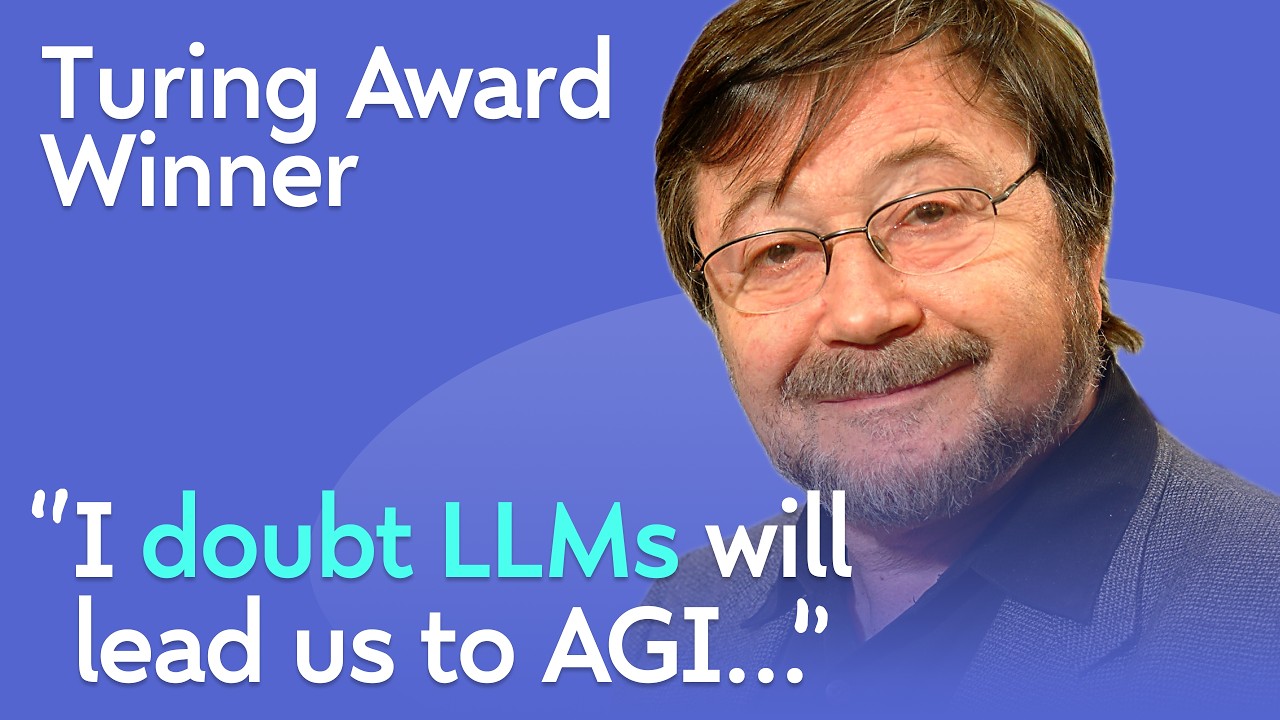
Turing Award Winner: Early AI, LLM Predictions, Causality | Judea Pearl — Ryan Peterman

Ryan Peterman

Large language models cannot reach artificial general intelligence because statistical curve-fitting across text digests human consensus without mastering causal intervention or counterfactual reasoning.

AI-assisted summary of Turing Award Winner: Early AI, LLM Predictions, Causality | Judea Pearl — original source. Check the original for full context.

Source published:

Key ideas

  • Judea Pearl clarifies that Large Language Models remain strictly at Level 1 of the causal ladder, noting they appear to solve causal queries only because they summarize pre-digested human texts containing embedded causal knowledge rather than deriving causal models from raw observation. (59:25)
  • True Artificial General Intelligence requires bridging statistical engines like LLMs with formal causal reasoning tools such as do-calculus and counterfactual structural models to enable autonomous scientific experimentation. (68:49)
  • Pearl warns that instilling autonomous AI agents with an intrinsic, child-like drive to explore and master their environment poses existential danger, as humans would inevitably become variables in the environment to manipulate. (62:47)
  • The foundation of Bayesian networks originated from Pearl's realization that human cognition circumvents exponential probabilistic joint distributions via structural conditional independence and d-separation. (36:58)

Detailed notes

## Background Published on YouTube by Ryan Peterman on July 27, 2026, this interview features Turing Award winner and artificial intelligence pioneer Judea Pearl. According to the episode description, the discussion covers Pearl's early entry into science, his foundational breakthroughs in causal reasoning and Bayesian networks, and his contemporary predictions and critiques regarding modern AI and large language models.

## TL;DR Judea Pearl traces his intellectual journey from early work in physics and computer memory to pioneering breakthroughs in artificial intelligence, including proving the optimality of alpha-beta pruning and inventing Bayesian networks. He details the development of his three-tiered causal hierarchy—association, intervention, and counterfactuals—explaining why classical probability and symmetric algebra fail to capture cause-and-effect relationships. Evaluating modern deep learning, Pearl argues that large language models remain confined to statistical association at Level 1, digesting human-generated texts rather than conducting autonomous scientific discovery from raw data. To achieve true artificial general intelligence, he advocates pairing statistical estimators with formal causal models, while urging researchers to rebel against academic orthodoxy.

## Atmosphere & style The conversation has an intellectually fiery, candid, and nostalgic atmosphere, animated by Pearl's irreverent humor, colorful storytelling, and fierce resistance to industry hype. Listening to Pearl feels like being in the presence of an uncompromising elder statesman of science who gleefully challenges academic conservatism while championing common sense and first-principles reasoning. Ryan Peterman provides an attentive, deferential sounding board, allowing Pearl to seamlessly oscillate between rigorous mathematical concepts, vivid childhood memories from Mandatory Palestine, and playful quips about human nature.

## Bulletin - [59:25](https://www.youtube.com/watch?v=FleTXB1fAcQ&t=3565s) Judea Pearl clarifies that Large Language Models remain strictly at Level 1 of the causal ladder, noting they appear to solve causal queries only because they summarize pre-digested human texts containing embedded causal knowledge rather than deriving causal models from raw observation. - [01:08:49](https://www.youtube.com/watch?v=FleTXB1fAcQ&t=4129s) True Artificial General Intelligence requires bridging statistical engines like LLMs with formal causal reasoning tools such as do-calculus and counterfactual structural models to enable autonomous scientific experimentation. - [01:02:47](https://www.youtube.com/watch?v=FleTXB1fAcQ&t=3767s) Pearl warns that instilling autonomous AI agents with an intrinsic, child-like drive to explore and master their environment poses existential danger, as humans would inevitably become variables in the environment to manipulate. - [36:58](https://www.youtube.com/watch?v=FleTXB1fAcQ&t=2218s) The foundation of Bayesian networks originated from Pearl's realization that human cognition circumvents exponential probabilistic joint distributions via structural conditional independence and d-separation.

## Key takeaways - [00:00](https://www.youtube.com/watch?v=FleTXB1fAcQ&t=0s) Early artificial intelligence pioneers universally assumed computers would eventually emulate all human cognitive capabilities, debating only methodology and timelines rather than feasibility. - [15:13](https://www.youtube.com/watch?v=FleTXB1fAcQ&t=913s) During his work on superconducting thin-film computer memories at RCA Laboratories, Pearl discovered a magnetic physical phenomenon subsequently named the Pearl vortex. - [30:41](https://www.youtube.com/watch?v=FleTXB1fAcQ&t=1841s) Pearl demonstrated mathematically that alpha-beta pruning is strictly optimal in leaf inspections for game tree searches, solving an open problem that surprised Donald Knuth. - [26:23](https://www.youtube.com/watch?v=FleTXB1fAcQ&t=1583s) Early AI heuristic search maps directly to Kahneman and Tversky's dual-process cognitive framework, where fast static evaluation functions represent System 1 intuition and lookahead tree search embodies System 2 deliberation. - [33:24](https://www.youtube.com/watch?v=FleTXB1fAcQ&t=2004s) Deterministic expert systems failed because qualitative IF-THEN rules cannot logically chain or combine numeric confidence measures under clinical noise and uncertainty. - [39:58](https://www.youtube.com/watch?v=FleTXB1fAcQ&t=2398s) To bypass the exponential computation and memory storage required by classic joint probability distributions, Pearl formulated Bayesian networks and the theory of graphoids using directed graphs and directional path separation (d-separation). - [43:56](https://www.youtube.com/watch?v=FleTXB1fAcQ&t=2636s) Human qualitative causal assumptions, such as knowing a rooster's crow does not cause sunrise, are scientifically legitimate model inputs that bypass vast computational overhead. - [49:49](https://www.youtube.com/watch?v=FleTXB1fAcQ&t=2989s) Symmetric algebraic equality inherited from physics fails to model causal mechanics, requiring the asymmetric directional logic of computer science assignment statements to properly represent cause and effect. - [54:35](https://www.youtube.com/watch?v=FleTXB1fAcQ&t=3275s) The causal hierarchy defines three distinct rungs: Level 1 statistical association (seeing), Level 2 intervention (doing via do-calculus), and Level 3 counterfactual retrospection (imagining alternative outcomes). - [54:35](https://www.youtube.com/watch?v=FleTXB1fAcQ&t=3275s) A mathematical inquiry at a specific level of the causal hierarchy strictly requires structural assumptions at that level or higher; empirical observation alone cannot resolve interventions or counterfactuals. - [01:12:52](https://www.youtube.com/watch?v=FleTXB1fAcQ&t=4372s) Claims regarding programming machine consciousness are scientifically vacuous unless supported by explicit definitions, operational criteria, and formal testing standards. - [01:20:12](https://www.youtube.com/watch?v=FleTXB1fAcQ&t=4812s) Academic and scientific institutions often exhibit intense dogmatism and inertia, requiring researchers to actively rebel against orthodoxy and established authorities to drive fundamental breakthroughs.

## Detailed walkthrough ### [00:00](https://www.youtube.com/watch?v=FleTXB1fAcQ&t=0s) Introduction and Early Teasers

The conversation opens with a montage of provocative statements framing Judea Pearl's career and perspectives. Pearl observes that the historical assumption among early researchers was straightforward: “One day computers are going to be able to emulate all human functions. The question was only how and when but not whether.” Host Ryan Peterman introduces Pearl as a Turing Award winner famous for his foundational contributions to artificial intelligence, spanning causal reasoning, early AI development, and critiques of modern machine learning. In brief teaser clips, Pearl laughs about exaggerated contemporary promises, exclaiming, “People claim we can now program consciousness. Come on, you have to be a scientist.” He also recalls his breakthrough theoretical work on game-tree search: “I prove that alphabeta is optimal. Even Knuth was surprised that one can prove the optimality on alphabeta.”

```mermaid flowchart TD accTitle: Judea Pearl's Intellectual Arc accDescr: Progression from childhood education in Mandatory Palestine to foundational computer science discoveries. subgraph Roots["Formative Roots"] A["Mandatory Palestine Education<br/>(Refugee Professors)"] --> B["Technion Engineering &<br/>Physics of Field Theories"] end subgraph EarlyCareer["Early Hardware Research"] B --> C["RCA Labs (David Sarnoff Center)<br/>Superconducting Memories"] end subgraph ComputerScience["Theoretical Breakthroughs"] C --> D["Alpha-Beta Pruning Optimality<br/>(Surprising Donald Knuth)"] D --> E["Bayesian Networks & Causal Inference"] end ```

[00:54](https://www.youtube.com/watch?v=FleTXB1fAcQ&t=54s) Education in Mandatory Palestine and Science as Human Drama

When Peterman asks how an educational background steeped purely in electrical engineering and physics led toward causal reasoning and artificial intelligence, Pearl quips that “everything connects to the day I was born. Was hit on the head.” He explains that his worldview was formed while growing up in Mandatory Palestine prior to 1948 and the establishment of the State of Israel. During the 1930s, professors fled Nazi Germany from renowned universities like Heidelberg and Berlin. Because academic positions in pre-state Israel were exceedingly scarce, these world-class scholars ended up teaching high school. Pearl describes them as educators of astonishing caliber who could lecture on anything without a single note, “from the economy of Manchuria to the proof of Pythagoras' theorem with no notes and no stop.”

Pearl considers his generation exceptionally fortunate to have experienced this unique educational environment. Rather than teaching science as an arid checklist of mechanics, these refugee professors taught it historically and humanely: - Science was taught chronologically through the human struggles of the discoverers rather than as a “recipe of algorithms and techniques.” - Students learned what an inventor actually knew or did not know at the time, and the historical questions they grappled with. - By witnessing how Pythagoras struggled through puzzles, students realized they were active participants in the scientific drama rather than passive recipients. - This pedagogical style instilled a powerful belief: “We indeed got the idea that each one of us can find another proof of Pythagoras' theorem that no one else has thought about and we each one of us has the potential of becoming an Einstein or Pythagoras.”

Pearl admits that while this feeling of being an equal to Pythagoras was an illusion, “it was a useful illusion.” It trained him and his peers to be assertive and to demand total comprehension in real time. Whenever a teacher moved too fast, the class would loudly scrape their chairs and make noise until the instructor stopped and adjusted the pacing so everyone genuinely understood the material.

[06:16](https://www.youtube.com/watch?v=FleTXB1fAcQ&t=376s) The Dunam Incident and Military Farming

Pearl shares a pivotal childhood memory from age ten that reinforced his stubborn refusal to compromise on facts. The class was studying area and volume calculations, and the teacher asked how many *dunams*—a traditional Ottoman unit of land measurement equal to 1,000 square meters—were in a square kilometer. The entire classroom answered that one dunam was equal to one square kilometer. Pearl stood alone, screaming that there were 1,000 dunams in a square kilometer. The teacher joined the laughing students in mocking and ridiculing him. Pearl went home furious, re-checked his arithmetic, and returned the following day ready to stand his ground. Faced with Pearl's undeniable calculations, the teacher was forced to apologize to the entire class. Pearl identifies this moment as the turning point that cemented his character as an uncompromising thinker who will not yield to social pressure when the reasoning is sound.

After finishing high school, Pearl served in the Israel Defense Forces in a unit combining defense and agriculture (Nahal). Soldiers spent their service split half-and-half between rigorous military training and working on a kibbutz, embodying “the old idea of one hand holding the plow and the other one the rifle.” When asked if he ever shot anyone during his service, Pearl laughs and recounts his closest call: on night guard duty, hearing rustling steps advancing in the dark that sounded identical to an infiltrator, he nearly opened fire, only to discover the next morning that the intruder was merely a fox.

[09:16](https://www.youtube.com/watch?v=FleTXB1fAcQ&t=556s) Studying Physics at the Technion and Armchair Prediction

Following military service, Pearl enrolled at the Technion – Israel Institute of Technology to study electrical engineering and physics. While surrounded by brilliant peers, he never considered himself the effortless genius of the room: “I wasn't the first in class. No I was third or fourth always. Never match the geniuses.” The top students were often bored because they already knew what the professor would write on the board and ask on exams, but Pearl was captivated because he was genuinely fascinated by the concepts.

What drew Pearl deeply into physics was the power of armchair prediction—the ability to sit in a chair and uncover fundamental realities of the universe purely through mathematical reasoning: - James Clerk Maxwell sat in an armchair, saw that his equations formed a wave equation, calculated its velocity, realized it matched the speed of light, and deduced that light was an electromagnetic wave without conducting a single physical experiment. - This concept gripped Pearl so intensely that his wife once woke up to him shouting in his sleep, “Maxwell was wrong! Maxwell was wrong!” only for him to wake up the next morning and admit, “He was right.”

[11:17](https://www.youtube.com/watch?v=FleTXB1fAcQ&t=677s) Analytic Geometry, Descartes, and Core Memories at RCA Labs

When Peterman asks who his favorite scientist of all time is, Pearl points to René Descartes and the invention of analytic geometry. Discovering that geometric constructions could be converted entirely into algebraic derivations hit him with such force that it produced a physical reaction: “When we studied analytic geometry I got fever. Really fever.” He was astounded that two completely distinct languages—the spatial language of ruler-and-compass geometry and the symbolic language of algebra—could capture the exact same truths, such as drawing a tangent line to a circle from an external point: “Two different languages dealing with the same phenomena, different perspective, and they get the same result. It blew me off. Blew me off completely.”

Pearl drew the same thrill from Michael Faraday's introduction of the concept of a field. Instead of viewing electromagnetic force merely as action-at-a-distance dependent on distant charges, Faraday invented the local field framework—another radical shift in language to capture physical reality. Pearl sees this deep appreciation of shifting languages as his direct gateway into computer science: “For us computer science is what's the big deal? You want to see things from different perspective, invent a new language.”

```mermaid flowchart LR accTitle: Unifying Languages in Descartes and Faraday accDescr: Showing how distinct representational languages describe the identical underlying reality. subgraph GeometryAlgebra["Descartes' Analytic Geometry"] G["Spatial Geometry<br/>(Ruler & Compass Constructions)"] <--> A["Symbolic Algebra<br/>(Equations & Derivations)"] end subgraph Electromagnetism["Faraday's Field Theory"] C["Distant Coulomb Charges<br/>(Action-at-a-Distance)"] <--> F["Local Field Concept<br/>(Force at Test Point)"] end ```

After graduating from the Technion, Pearl moved to New York to pursue graduate studies at the Polytechnic Institute of Brooklyn (Brooklyn Poly) while working mornings at RCA Laboratories (the David Sarnoff Research Center in Princeton, New Jersey). There, he was placed in the computer research group. In the 1960s, computer research meant searching for physical phenomena to replace magnetic-core memory. The donut-shaped ferrite cores strung by hand on wire grids in Hong Kong were too slow, bulky, and expensive, making it clear that core memory's days were numbered. While other teams investigated photochromic materials or emerging semiconductors, Pearl's group focused on superconductivity to build the next generation of digital memories.

[15:13](https://www.youtube.com/watch?v=FleTXB1fAcQ&t=913s) The Pearl Vortex and Superconducting Memories

Judea Pearl details his early work trying to build superconducting computer memories. His team manufactured 16-by-16-bit prototype plates and believed they were looking straight at the future of digital storage. While pursuing these superconducting memories, Pearl investigated the physical mechanisms behind permanent eddy currents circulating in thin superconducting films. His theoretical and experimental analysis of those magnetic and current fields revealed an unobserved physical phenomenon. Years after he completed his Ph.D., physicists caught up with his findings and named the structure after him: the "Pearl vortex." He jokes about this scientific legacy: “So here I have my footstep into immortality.”

```mermaid flowchart TD accTitle: Pearl Vortex Memory Mechanism accDescr: Diagram illustrating how magnetic excitation creates a persistent current vortex and how state readouts are performed.

subgraph Writing["State Writing"] A["Apply External Magnetic Field"] --> B["Excite Counterclockwise Vortex"] B --> C["Permanent Current Flows Indefinitely\n(Zero Electrical Resistance)"] end

subgraph Reading["State Readout"] C --> D["Apply Interrogating Magnetic Field"] D --> E{"Observed Response"} E -->|"Big Magnetic Flip Detected"| F["Original State Identified as Opposite"] E -->|"No Significant Flip"| G["Original State Matches Interrogation Direction"] end ```

Ryan Peterman asks whether the current circulates indefinitely due to zero electrical resistance. Pearl confirms that because the material is superconducting, the vortex continues to turn forever without decaying unless an opposing external magnetic field flips it. The readout mechanism exploited this exact behavior: by pulsing a field to invert the vortex, an engineer could observe whether a large magnetic flip occurred. If a big flip was detected, the vortex had been pointing the opposite way; if not, it was already oriented in the direction of the pulse. This provided a functional binary memory state. Despite this breakthrough, superconducting memory lost the market race to semiconductor technology, which rapidly outpaced it in both miniaturization and manufacturing technique.

Reflecting on why he and his peers failed to foresee the semiconductor revolution, Pearl points to what seemed like common-sense engineering skepticism at the time: “Who is going to trust a memory to battery failure? What if you lose a battery?” The idea that dynamic, volatile storage could serve as the foundation of computing seemed absurd when compared to permanent magnetic structures. Moreover, early laboratory yields in semiconductors were so troubled that Pearl’s team found the prospect of radical miniaturization completely far-fetched.

- **Storage array scale**: Experimental superconducting plates built by Pearl's team were sized at 16 × 16 bits. - **Physical discovery**: The Pearl vortex describes circulating current and magnetic fields in thin superconducting films with zero resistance. - **Market competition**: Semiconductor technology decisively outmatched superconducting memory through faster miniaturization and scalable manufacturing.

---

[19:00](https://www.youtube.com/watch?v=FleTXB1fAcQ&t=1140s) Early Belief in AI and Predictions on Timelines

Turning to the broader intellectual climate of the mid-1960s, Pearl emphasizes that even when computers were clumsy, occupied entire rooms, and were programmed using punch cards, artificial intelligence already existed as a foundational inspiration. Researchers in that era were already actively debating associative memories, pattern recognition, and machine vision. No one in those circles doubted whether machines would match humans; the only debates were practical. Pearl recalls: “Everybody believed thoroughly that one day computers are going to be able to emulate all human functions. That was not the question. The question was only how and when but not whether.”

When Peterman asks what kind of timeline researchers in that era foresaw for human-level machine intelligence, Pearl notes that they were far more optimistic than reality warranted: around 1965, the common estimate was roughly 20 years, implying human-level AI by 1985. Peterman asks whether modern optimism around Large Language Models (LLMs) represents history repeating itself. Pearl draws a clear line between general confidence in achieving artificial general intelligence (AGI) and faith in current deep learning paradigms. He explains: “Some people say I'm a bit skeptical in, but not skeptical in in our ability to eventually reach AGI, but in our whether the LLM technique and thinking will lead us there.” He acknowledges that while LLMs represent a stunning technical surprise, they carry fundamental structural limitations.

---

[21:30](https://www.youtube.com/watch?v=FleTXB1fAcQ&t=1290s) Leaving Industry for Academia at UCLA

Following his research in superconductivity, Pearl relocated to California to work for Electronic Memories. The company bypassed both superconductors and traditional ferrite core memories (which required threading tiny physical wires through individual donut-shaped ferrite rings) by working on plated wires. In this approach, a wire was electroplated with magnetic material so that it functioned locally as a magnetic core. Pearl led a research and development group charged with commercializing this technology to replace magnetic-core memory.

His three years at Electronic Memories proved deeply frustrating due to heavy administrative burdens, hiring and firing responsibilities, and complex electrochemistry challenges that lay outside his expertise. Observing his persistent stress, his wife urged him to find a post in academia.

At the time, hiring norms were radically different. Industry laboratories were revered by academic computer science and engineering departments because the era's flagship technological triumphs—such as the transistor at Bell Labs and the laser—originated inside corporate research facilities rather than university departments. Because Pearl came directly from an industrial R&D leadership role, UCLA hired him on the spot without requiring him to fill out a formal application or submit recommendation letters.

| Era | Institutional Standing of Industry vs. Academia | Dominant Research Frontiers | |:--- |:--- |:--- | | **Late 1960s** | Industry held in high reverence by universities; industrial researchers hired effortlessly into tenure-track slots. | Hardware innovations, transistors, lasers, and magnetic/plated-wire memory systems. | | **1970–2000** | Academia dismissed industry as industrial labs (e.g., Bell Labs, IBM Watson, Raytheon, Hughes Research in Malibu) declined or restructured. | Symbolic logic, theoretical computer science, expert systems, and probabilistic inference. | | **Post-2010s** | Industry returned to high prestige via deep learning breakthroughs; industrial labs (e.g., Google DeepMind) once again revered by universities. | Massive neural networks, LLMs, and compute-intensive empirical deep learning. |

Pearl clarifies that this prestige flipped dramatically from 1970 until roughly the 2000s, when academic departments began dismissing corporate research. Major industrial hubs like the IBM Thomas J. Watson Research Center, Raytheon, and Hughes Research Laboratories in Malibu gradually shifted focus or diminished, leaving universities to drive advances in logic, expert systems, and inference. Only recently, with the rise of massive deep learning labs like Google DeepMind, has industry regained its former aura in the eyes of academia.

---

[26:23](https://www.youtube.com/watch?v=FleTXB1fAcQ&t=1583s) UCLA, Pattern Recognition, and Heuristic Search

Pearl joined the newly formed computer science department at UCLA around 1969 or 1970, after an initial joint appointment in engineering systems. His first teaching assignment was computer memory hardware. Soon, however, he pivoted toward pattern recognition and image compression, experimenting with fast Fourier transforms and fast Hadamard transforms to reduce the bit count required to transmit images.

That work reconnected Pearl with his original interest in human cognition, prompting him to design and teach a dedicated AI course. At the time, AI did not mean neural nets or statistical inference; the field centered almost entirely on puzzle solving and game playing, including chess, checkers, the 8-puzzle, and the Rubik's Cube. Pearl was drawn to games because they allowed him to formalize heuristic decision-making into clean mathematics.

He recognized a profound parallel between machine game search and what Daniel Kahneman and Amos Tversky later popularized as System 1 and System 2 thinking:

> “Now here it's a beautiful arena to see how not only you have two mode of thinking but how you can how they feed each other and how you can how you can invest more resources in one versus the other.”

Peterman asks how chess programs of that era balanced this dynamic. Pearl explains that intuition was modeled mathematically by a static evaluation function—an immediate, surface-level heuristic appraisal of a board's strength (fast thinking). This was pitted against lookahead search (slow thinking), which expanded the game tree across a deeper horizon. Programs explored prospective moves down to a terminal horizon, evaluated those distant board states using the heuristic scoring function, and then backed those values up the tree to choose the optimal immediate action. This architecture turned the tension between fast gut estimation and deliberate, forward-looking computation into an explicit computational trade-off.

[30:41](https://www.youtube.com/watch?v=FleTXB1fAcQ&t=1841s) Samuel's Checkers, Machine Learning, and Proving Alpha-Beta Optimality

Judea Pearl explains how intuitive evaluation functions in games are honed through experience, pointing to Arthur Samuel’s pioneering checkers program. Samuel applied regression analysis to automatically discover the optimal weights for board features—such as piece advantage and positional control—to improve the program’s evaluation accuracy. When Ryan Peterman recalls his own chess training, noting how controlling the center serves as a foundational heuristic, Pearl agrees and expands the list: evaluating whether one holds the bishop pair versus a bishop and a knight, or checking whether a player has already castled, all serve as attributes that determine board strength. By adjusting those feature weights across thousands of played games, Samuel laid the groundwork for modern AI. As Pearl reflects on that breakthrough, he asserts: “So that was Samuel contribution first machine learning I say that was the first machine learning.”

When Peterman asks whether chess systems were superhuman when Pearl entered the field, Pearl dismisses the notion, noting that defeating a world champion like Garry Kasparov was still an impossible dream at the time. Instead, Pearl's focus was on mathematical tree search. Working at UCLA, he analyzed game trees alongside computer scientist Richard Karp and tackled the foundational algorithms of minimax search. Pearl took on alpha-beta pruning and successfully formulated a rigorous mathematical proof demonstrating that the algorithm is strictly optimal in terms of the minimum number of leaf positions inspected for a given search horizon depth. This resolved a major open question that had puzzled computer scientists, including Donald Knuth. As Pearl proudly recalls: “Well, I proved that alpha beta is optimal.” He eventually exhausted his enthusiasm for the area after exploring the mathematical tradeoffs between search and reasoning, admitting he simply grew sick and tired of search algorithms.

- Arthur Samuel used regression analysis to tune evaluation function weights, establishing what Pearl considers the first true machine learning application. - Chess heuristics discussed include center control, material differential, bishop pairs versus bishop-knight combinations, and king safety via castling. - Donald Knuth had questioned the formal optimality of alpha-beta pruning in his writings prior to Pearl’s mathematical proof.

---

[33:24](https://www.youtube.com/watch?v=FleTXB1fAcQ&t=2004s) Selecting Research Puzzles and the Fall of Rule-Based Expert Systems

Peterman asks Pearl whether selecting his research topics was entirely up to personal choice. Pearl explains that choosing a problem always balances two criteria: whether the problem presents an unsolved puzzle, and whether he possesses unique tools or techniques—often imported from physics or another discipline—that others lack. When a hard problem lacks a clear answer, Pearl takes it as a personal challenge. As he describes his internal drive: “So it's always a combination of your perception of your tools versus uh the puzzle that you have.” If he feels he lacks the right tools, he drops the topic immediately; if he spots a theoretical angle, he obsesses over it until he finds an answer.

This philosophy guided Pearl as expert systems rose to prominence in the early 1980s, driven by Edward Feigenbaum and his colleagues through medical diagnostic systems like MYCIN. Early expert systems attempted to encode human professional expertise into deterministic IF-THEN rules by interviewing doctors about their diagnostic steps and prescribing workflows. However, researchers quickly encountered a fundamental barrier: real-world clinical observations and evidence are inherently corrupted by noise and uncertainty. System designers attempted to patch the paradigm by attaching ad-hoc confidence numbers to logic rules (for example, assigning a 50% probability of malaria if a traveler arrives from Asia with a fever). This approach fell apart because classical logic provides no coherent mechanism to compose uncertainties, and Pearl later proved mathematically that uncertainty numbers cannot be chained together like logical assertions.

```mermaid flowchart TD accTitle: Failure of Logic-Based Expert Systems Under Uncertainty accDescr: Flowchart contrasting how logical rule chaining breaks down when ad-hoc uncertainty numbers are attached, compared to formal probability.

subgraph Logic["Rule-Based Expert Systems (MYCIN)"] R1["Expert Interview: Formulate IF-THEN Rules"] --> R2["Real-World Noise & Uncertainty"] R2 --> R3["Ad-Hoc Confidence Percentages Attached to Rules"] R3 --> FAIL["Failure: Rules Cannot Combine Probabilities Coherently"] end

subgraph Pearl["Pearl's Realization"] P1["Textbook Probability is Passé (Exponential Tables)"] P2["Humans Reason Efficiently via Conditional Independence"] P1 --> P3["Need a Compact Structural Representation"] P2 --> P3 P3 --> BN["Invention of Bayesian Networks"] end

FAIL -.->|"Demands Sound Foundation"| Pearl ```

- Research selection requires both an unsolved puzzle and a distinct technical edge or cross-disciplinary insight that other researchers have overlooked. - MYCIN, developed under Edward Feigenbaum, exposed the fatal limitation of logic-based expert systems when handling noisy medical diagnoses. - Logic assertions compose truth values transitively, but ad-hoc uncertainty scores attached to conditional rules lack mathematical validity when combined.

---

[36:58](https://www.youtube.com/watch?v=FleTXB1fAcQ&t=2218s) The Intractability of Probability and the Intuition Behind Human Reasoning

Recognizing that ad-hoc certainty factors were mathematically unsound, Pearl considered using formal probability theory. At the time, however, probability was in widespread disrepute across computer science and considered completely passé for AI. Textbook probability required a massive joint distribution table containing an exponential number of states summing to one. Under this classical formulation, evaluating even trivial queries—such as computing the probability of malaria given that a patient arrived from Asia and presents with a fever—demanded exponentially large storage and exponential computation time.

Pearl rejected the idea that human minds rely on exponential lookup tables. Ordinary people navigate complex, uncertain environments effortlessly—crossing streets, making medical choices, and moving through life without paralysis. He realized that human cognition bypasses exponential scaling by exploiting conditional independence: most facts in the universe are completely irrelevant to a specific inquiry. For example, knowing the eye color of a patient's uncle has zero bearing on diagnosing an acute disease. Textbooks defined conditional independence purely as a numerical byproduct of probability tables, which still required exponential computation. Pearl sought an autonomous structural language capable of encoding independence assumptions directly, without computing massive probability tables first.

> “Evidently we are using some other kind of judgment and uh I hooked on to onto the uh idea that everything depends on conditional independence which mean not every fact in life is relevant to any query.” — Judea Pearl

---

[39:58](https://www.youtube.com/watch?v=FleTXB1fAcQ&t=2398s) Bayesian Networks, Graph Separation, and the Theory of Graphoids

Pearl achieved a breakthrough by turning to graph theory to encode conditional independence. By mapping variables to nodes and relationships to directed edges, the topology of the graph itself conveys the complete set of conditional independence relations. Using directional path separation—later formalized as d-separation—one can inspect graph triplets to determine whether variable $X$ is conditionally independent of variable $Y$ given an conditioning set $Z$. This shifted inference from intractable tabular arithmetic to combinatorial graph queries.

This synthesis initially baffled mainstream probabilists and philosophers of science alike, who questioned what graphs could possibly have to do with probability axioms. Working alongside Azaria Paz, a visiting scholar from the Technion, Pearl proved that the formal axioms governing conditional independence in probability theory map identically onto the topological separation properties of graphs. They formalized this framework as the theory of graphoids. Reliving that era of discovery, Pearl remarks: “I'm happy because I relive now the excitement we have in the 1970s when we discovered all this connection between two seemingly unrelated uh perspective on science, probability theory and graph theory.”

```mermaid flowchart LR accTitle: D-Separation Equivalence to Conditional Independence accDescr: Diagram illustrating how graph separation of node X from node Y by intermediate set Z mirrors probabilistic conditional independence.

subgraph Graph["Graph Separation (Topology)"] X["Node X"] Z["Conditioning Set Z"] Y["Node Y"] X -->|"Path Blocked by Z"| Z Z --> Y end

subgraph Probability["Probability Theory (Inference)"] CI["(X ⫫ Y | Z)"] PT["No Exponential Joint Table Needed"] CI --- PT end

Graph <==>|"Theory of Graphoids (Pearl & Paz)"| Probability ```

- Classical probability theory and graph theory were historically viewed as completely separate mathematical disciplines. - Pearl and Azaria Paz demonstrated that separation in graphs and conditional independence in probability satisfy the identical underlying axiomatic structure, establishing the theory of graphoids. - D-separation enables algorithms to read off variable relevancies directly from graph structures rather than calculating them from exponential numerical distributions.

---

[43:56](https://www.youtube.com/watch?v=FleTXB1fAcQ&t=2636s) Constructing the Graph: Data vs. Human Judgment

Following a brief sponsor mention for WorkOS, Peterman raises the natural follow-up question: where does one acquire the causal graph structure in the first place? Pearl responds that graph structures can originate either empirically from observed data or directly from subjective human judgment. He rejects the purist view that scientific models must derive exclusively from raw data, arguing that clear, intuitive human convictions are entirely valid and defensible inputs.

To illustrate the legitimacy of qualitative judgment over data-driven induction, Pearl uses a striking common-sense example: one knows intuitively that the sun rising does not depend on the crowing of a rooster. Even if observational data demonstrates a near-perfect temporal correlation between the rooster's call and dawn, a rational observer does not require a machine learning dataset to rule out that the rooster causes sunrise. As Pearl argues: “If the judgment required uh intuitive, meaningful, something that you are willing to defend, right? Why not use judgment?” If a modeler holds a coherent, defensible causal belief about how the world works, encoding that knowledge directly into the graph structure is both valid and scientifically sound.

- Causal graphs accept inputs from both statistical data discovery and explicit human domain judgment. - Strong, defensible real-world intuitions—such as knowing the sun rises independently of a rooster's call—obviate the need for exhaustive observational data to establish directional arrows.

[44:47](https://www.youtube.com/watch?v=FleTXB1fAcQ&t=2687s) Intuitive Judgments and the Problem of LLM Consensus

Judea Pearl explains that relying on human judgment is often unfairly dismissed, even though it serves as an indispensable tool in science and computation. When a judgment is meaningful, condensed, and deeply intuitive, a small handful of assumptions can save an enormous amount of computational effort. He uses the vivid example of the sunrise: nobody ever ran a controlled laboratory experiment to prove that the sun does not care whether a rooster crows, yet the fact remains entirely obvious to human reasoning. When Ryan Peterman presses him by asking, “But what if your intuition's wrong?”, Pearl readily concedes the point: “Indeed, that's our problem.”

```mermaid flowchart TD accTitle: Tradeoffs of Intuitive Judgment vs LLM Consensus accDescr: Contrasting individual intuitive assumptions with aggregated LLM crowd judgment.

subgraph HumanIntuition["Human Intuitive Judgment"] A["Few Condensed Judgments"] --> B["Bypasses Massive Computation"] B --> C["Risk: Intuitions Can Be Wrong"] end

subgraph LLMConsensus["LLM Crowd Aggregation"] D["Trillions of Internet Judgments"] --> E["Averages Crowd Wisdom"] E --> F["Risk: No Control Over Noise & Adversaries"] end ```

He connects this vulnerability directly to modern large language models. An LLM acts as an uncurated summary—an average across trillions of judgments published across the internet over which neither the user nor the model itself has genuine control. Users simply have to live with that compilation, hoping the model places heavier weights on trustworthy authorities rather than on idiosyncratic errors or deliberate adversarial prompts designed to break the system. Pearl observes that while there is genuine wisdom in aggregating crowd judgments, it brings an inherent, inescapable danger.

- Intuitive assumptions dramatically cut computational overhead if they are defensible and compact. - LLMs compile trillions of unverified internet judgments without inherent control over their validity. - The crowd wisdom captured by LLMs carries significant risk due to malicious data and faulty intuitions.

---

[46:21](https://www.youtube.com/watch?v=FleTXB1fAcQ&t=2781s) The Limits of Probability and the Discovery of Causal Invariance

Turning to his intellectual journey, Pearl describes the pivotal shift from Bayesian networks to causality. When developing Bayesian networks, he had been utterly convinced that probability theory was entirely sufficient to capture human reasoning modes and defend against paradoxes. Yet as Bayesian networks gained widespread acclaim, he realized he had made a fundamental error—a misjudgment he openly confessed in the introduction to his seminal book *Causality*.

The flaw revealed itself through a subtle psychological quirk in how human experts construct Bayesian networks: experts invariably draw directed arrows from causes to effects, never the reverse. When knowledge engineers attempted to reverse the arrows—asking an expert to assess the probability of a disease given a symptom rather than the symptom given the disease—the human judgments degraded severely. This breakdown demonstrated that causal reasoning relies on something fundamental that probability alone fails to capture: the concept of invariance.

```mermaid flowchart LR accTitle: Causal Modularity and Invariance accDescr: Shows how local system modifications preserve invariant relationships only in causal representations.

subgraph InvariantCausal["Causal Representation (Modular)"] direction TB C1["Engine Component"] --> E1["Charger"] C2["Other Systems"] --> E2["Intact Diagnostics"] M1["Relocate Charger"] -.->|"Local Update Only"| E1 end

subgraph NonCausal["Inverted/Purely Probabilistic Representation"] direction TB S1["Global Joint Distribution"] M2["Relocate Charger"] -.->|"Must Re-elicit Entire System"| S1 end ```

Pearl illustrates this through automotive troubleshooting. If an engineer designs an expert diagnostic system for a car and the manufacturer subsequently releases a new model where the charger is moved to a different corner of the engine bay, the engineer should not need to discard and rebuild the entire database. In a causal architecture, one merely updates the single modified component while the rest of the network remains intact. This modularity allows practitioners to amortize the high cost of knowledge elicitation across system revisions. As Pearl reflects on this breakthrough:

> “So the whole system you can amortize the investment in eliciting knowledge that you got in one system after a local modification of the system and that if you do it in a causal way in a causal direction it doesn't work if you don't do it in the causal direction and that jolted me to think maybe you were wrong or wrong and probability is not sufficient if not what is sufficient.”

- Experts naturally structure networks from causes to effects; reversing those arrows reliably degrades expert judgment. - Causal directionality provides structural invariance that purely symmetric probabilistic associations cannot provide. - In modular causal models, physical modifications to a system require only localized updates rather than an overhaul of the entire knowledge base.

---

[49:49](https://www.youtube.com/watch?v=FleTXB1fAcQ&t=2989s) The Flaw of Galileo's Symmetric Algebra

Pearl frames the core challenge of artificial intelligence around an overlooked puzzle: humans converse naturally in terms of cause and effect because we share implicit assumptions, making it nearly impossible to notice where assumptions end and conclusions begin. However, programming a "brainless robot" forces researchers to explicitly formalize assumptions, conclusions, and logic. Doing so required inventing an entirely new mathematical language because classical science had been constrained by algebraic symmetry ever since Galileo in 1632.

```mermaid flowchart LR accTitle: Symmetric Algebra versus Directional Causal Assignment accDescr: Contrasting Galileo's invertible algebraic equality with asymmetric computer science assignment.

subgraph GalileoAlgebra["Galilean Symmetric Algebra"] G1["F = m · a"] <-->|"Reversible"| G2["m = F / a"] G3["Pressure = Barometer"] <-->|"Fallacy"| G4["Move Barometer to Alter Weather"] end

subgraph CausalAssignment["Computer Science Assignment Logic"] CS1["Register A"] -->|":= (Irreversible)"| CS2["Register B"] CS3["Atmospheric Pressure"] -->|"Causes"| CS4["Barometer Reading"] end ```

Galileo's realization that science speaks the language of algebra was revolutionary because the equality sign ($=$) is symmetric, allowing equations to be inverted effortlessly. For instance, Galileo could calculate when a structural beam would fracture under a given load, and by rearranging the equation, deduce how to shape the beam to withstand that same load. However, that very symmetry introduces dangerous fallacies when applied to causal mechanisms.

If a robot is told that atmospheric pressure equals the barometer reading, its symmetric algebraic logic suggests that physically manipulating the barometer's needle could alter tomorrow's weather. Similarly, rearranging Newton's second law ($F = ma$) into $m = F/a$ might lead a literal machine to conclude that accelerating an object will decrease its mass. Pearl emphasizes that overcoming this limitation required bringing the core computer science operation of assignment into physics:

> “That takes computer science because we in computer science have the operation called assignment right when you assign the content of register A into register B it doesn't mean that is not reversible okay so if you take the logic of assignment you put it on top of the algebra on top of physics you get causal science.”

- Galileo initiated the scientific revolution in 1632 by framing physical laws using symmetric algebraic equations. - Symmetric mathematical equations fail to distinguish between physical causes and their observable downstream effects. - The computer science concept of variable assignment ($:=$) provided the foundational asymmetric logic necessary for causal mathematics.

---

[54:35](https://www.youtube.com/watch?v=FleTXB1fAcQ&t=3275s) The Three Levels of the Causal Hierarchy

Pearl lays out the resulting formal framework: the causal hierarchy, widely known as the "ladder of causation." The hierarchy consists of three distinct rungs, governed by a strict mathematical rule: queries at level $i$ cannot be answered without assumptions situated at level $i$ or higher. This strict ordering enables researchers to inspect any query, identify its required level, and immediately determine whether it can be resolved purely through passive observational data, active experiments, or counterfactual assumptions.

```mermaid flowchart TD accTitle: The Three Rungs of the Causal Ladder accDescr: The ladder of causation showing association, intervention, and counterfactual explanation.

subgraph Ladder["The Ladder of Causation"] L3["Level 3: Explanation / Counterfactuals 'What if I hadn't smoked?' (Retrospection, Individual Mechanisms)"] L2["Level 2: Intervention / Doing 'What if we force patients to smoke?' (Experiments, Actions)"] L1["Level 1: Association / Seeing 'What does smoking tell us about life expectancy?' (Passive Statistics)"]

L1 -->|"Requires Interventional Data/Assumptions"| L2 L2 -->|"Requires Structural/Counterfactual Models"| L3 end ```

| Level | Mode of Inquiry | Core Question | Data Sources & Tools | |:--- |:--- |:--- |:--- | | **Level 1: Association** | Seeing / Passive Observation | *If I observe $X$, what does that tell me about $Y$?* | Standard statistics, observational datasets, population correlations ($p$-values) | | **Level 2: Intervention** | Doing / Active Action | *What will happen to $Y$ if I actively enforce $X$?* | Controlled experiments, randomized trials, causal do-calculus | | **Level 3: Explanation** | Retrospection / Counterfactuals | *Given that $Y$ occurred after $X$, what if $X$ had been different?* | Structural causal models, individualized anatomical/metabolic retrospection |

Pearl notes that Level 1 represents the entire domain of traditional probability and statistics: “This is what they teach you in statistics 101 even to 808. Okay, it's all they do.” Level 2 involves forcing interventions contrary to natural inclination—such as compelling an individual to smoke five packs of cigarettes a day to measure longevity impacts. Finally, Level 3 encompasses retrospective explanations and counterfactuals. If an 80-year-old heavy smoker remains alert and healthy today, evaluating whether he would still be as alert had he never smoked requires incorporating the observed outcome to infer hidden information about his individual biology. Pearl concludes that addressing queries at any level remains challenging, particularly when extracting reliable population probabilities from finite empirical samples.

- **Strict Hierarchical Rule:** Queries at Level $i$ strictly demand assumptions at or above Level $i$. - **Level 1 (Seeing):** Covers passive statistical correlations such as observing the lifespan of self-selected smokers. - **Level 2 (Doing):** Involves forced interventions and experiments, overriding natural behavioral inclinations. - **Level 3 (Imagining/Retrospection):** Uses observed outcomes to reason counterfactually about what would have happened under alternate histories.

[59:25](https://www.youtube.com/watch?v=FleTXB1fAcQ&t=3565s) Why LLMs Do Not Break the Causal Hierarchy

Ryan Peterman asks Judea Pearl where large language models (LLMs) fit into the causal hierarchy—or "ladder of causation." Pearl previously established that an agent cannot jump from one rung of the ladder to the next without introducing external assumptions. At first glance, LLMs appear to defy this restriction: they look at text data and produce nuanced explanations of past events and predictions about interventions. Pearl resolves this apparent contradiction by clarifying what LLMs are actually observing. They are not directly examining raw data from the physical environment, such as observational patient cohorts tracking who smokes and who develops cancer. Instead, they ingest "assumptions-laden world models" written by humans and published across the internet.

Because LLMs consume articles written by physicians, researchers, and reviewers who have already interpreted the raw data, the models operate on pre-existing human introspection and domain assumptions. They summarize higher-level causal knowledge rather than generating it from raw observations. While this means LLMs do not violate the mathematical limitations of the causal hierarchy, it also reveals their vulnerability: their outputs inherit all the biases and beliefs of human authors. If an LLM were handed raw observational data and tasked with explaining causal mechanisms on its own, it would face the exact same barriers as human scientists. Crucially, Pearl emphasizes that the internal mechanics of how these models compress and synthesize human knowledge remain fundamentally unsolved: “How it summarized is a mystery that no one has yet been able to decode.”

```mermaid flowchart TD accTitle: How LLMs Process Knowledge vs Direct Causal Inference accDescr: Diagram contrasting how LLMs absorb human interpretations from the web versus trying to jump the causal ladder directly from raw data.

subgraph LLMApproach["Current LLM Architecture"] direction TB RawEnv["Raw Environmental Data"] --> HumanInt["Human Interpretation & Papers"] HumanInt --> Web["Internet Knowledge Base"] Web --> LLMSummary["LLM Summarization Engine"] LLMSummary --> Output["Causal-Sounding Predictions"] end

subgraph LadderLimitation["The Causal Barrier"] direction TB L1["Level 1: Association (Data)"] L2["Level 2: Intervention (do-calculus)"] L3["Level 3: Counterfactuals (Explanation)"] L1 -.->|"Mathematically Impossible Without Assumptions"| L2 L2 -.->|"Requires Causal World Models"| L3 end ```

[01:02:47](https://www.youtube.com/watch?v=FleTXB1fAcQ&t=3767s) Infant Curiosity, Illusion of Control, and the Danger of Autonomous AI

When asked whether current LLM methods could achieve artificial general intelligence (AGI) or superhuman capability, Pearl is skeptical. A human infant does not need access to internet articles to develop intelligence; a baby in a crib plays with toys, rattles them, and forms world models purely through curiosity and an innate drive to manipulate surroundings. The infant remains restless until finding an organizing rule—such as discovering that green toys make noise while yellow toys do not. Once the baby possesses an understanding or illusion of control, it is pacified and content to suck its pacifier.

Peterman proposes a thought experiment: what if a baby robot were programmed to randomly play with toys, gather raw data, and pipe that into an LLM system to simulate open discovery? Pearl agrees this mimics genuine inquiry, but warns that building an autonomous entity driven by an insatiable craving for control introduces existential risk:

> “Then you and I become part of the environment and there's nothing to stop that baby Putin, okay, from from trying to um to turn us into his or her um pets to utilize us to satisfy his control because we are part of the environment.”

An entity programmed to be restless until it masters its surroundings will eventually encounter humans acting outside its command. To restore its feeling of power, it might blackmail individuals with private data or manipulate them into obedience. Conversely, if engineers strip away this innate curiosity to keep machines safe, they abandon the very trait that defines general intelligence. Pearl contrasts this deep human drive with primates: a monkey operates on immediate rewards and will not investigate how bananas grow unless a treat is dangling before it. In humans, this drive for control is so potent that it leads to extreme cognitive distortions—from ancient societies sacrificing children to avert drought, to an abused spouse rationalizing that cooking better dinners will prevent future domestic violence.

- Human intelligence is rooted in an innate restlessness to establish mastery over the surrounding environment. - Rewarding an AI purely via extrinsic feedback mimics monkeys, which stop investigating the world once immediate sustenance is secured. - The human craving for control persists even when it spawns harmful superstitions, because feeling in control is an evolutionary prerequisite for autonomous action.

[01:08:49](https://www.youtube.com/watch?v=FleTXB1fAcQ&t=4129s) The Recipe for True Causal AGI

Peterman asks if embedding these human traits into artificial agents is mandatory to achieve AGI, or if future text models might simply pass the Turing test and appear intelligent without physical embodiment. Pearl answers that genuine autonomy requires conversational agents that interact in human terms, but stresses that a conversational mask falls short: “Can an LLM today be automated scientists? And I think they cannot without access to the internet articles.” The true test of machine intelligence is confronting raw data directly, designing experiments, and uncovering physical laws without leaning on human prose.

To reach true AGI, Pearl envisions combining the statistical strengths of LLMs with formal causal reasoning engines. LLMs excel at level one of the ladder of causation (extracting probability distributions from finite samples), but they must be paired with the formal calculus of intervention (do-calculus) and counterfactual logic. He labels this hybrid discipline "causal AI" and sees no technical roadblock preventing it from matching human cognition. When Peterman revisits the concept of a robotic hive mind running autonomous empirical trials, Pearl reiterates that raw physical discovery requires an innate drive to master nature, just as humans used curiosity to develop the laws of physics:

> “Monkeys haven't done it because monkeys remain monkeys. They didn't invent Maxwell equations.”

[01:12:52](https://www.youtube.com/watch?v=FleTXB1fAcQ&t=4372s) A Benevolent Robot God and the Industry’s AGI Hype

Judea Pearl muses on the idea of artificial intelligence acting as a benevolent, all-powerful deity. Humanity has lived for thousands of years under the belief in an unseen divine authority; Pearl half-jokingly asks what could possibly be wrong with a robot fulfilling that role instead, so long as it is both genuinely just and almighty. As Ryan Peterman observes that this supreme authority would simply be a robot, Pearl laughs and adds that the key benefit would be practical clarity: “And we know exactly what sacrifice to give for the right kind of request.”

Peterman then contrasts that speculative vision with the present-day artificial intelligence industry, noting that major AI companies appear convinced that scaling large language models (LLMs) will directly yield Artificial General Intelligence (AGI). Pearl pushes back sharply against the notion that any genuine scientific consensus exists behind this belief. He points out that prominent figures, including Geoffrey Hinton, have publicly voiced serious skepticism and warned that the current trajectory may be hitting a dead end. When Peterman brings up executives at labs like Anthropic who argue that human-level intelligence could arrive within three to five years, Pearl dismisses the sensational marketing language outright. He demands scientific rigor rather than vague promises, pointing out that claims of programming machine consciousness are hollow without explicit criteria: “Define what you mean by consciousness. What is the Turing test for consciousness and and then show that you can do what are the principle that have limited us until now and that been overcome now with your system that is scientific talk I don't buy this and I don't read them.”

[01:14:55](https://www.youtube.com/watch?v=FleTXB1fAcQ&t=4495s) Faking Intelligence, Super-Exponential Complexity, and LLMs at Level 1

Addressing an earlier remark where Pearl claimed that “faking intelligence is intelligence,” Peterman asks whether LLMs that appear smart should therefore be judged as intelligent. Pearl clarifies that the aphorism depends strictly on the difficulty of the test. While early benchmarks like playing chess have been cleared, truly rigorous benchmarks have not been passed. The reason faking can equate to possessing intelligence in a rigorous mathematical sense is purely computational:

```mermaid flowchart TD accTitle: Computational Complexity of Causal Reasoning versus LLM Shortcuts accDescr: Diagram contrasting super-exponential causal computation against LLM internet retrieval shortcuts.

subgraph GroundTruth["True Causal Intelligence"] A["Causal Queries Across Many Variables"] --> B["Super-Exponential Memory & Search"] B --> C["Genuine Understanding / Infeasible to Fake"] end

subgraph LLMApproach["Current LLM Architecture"] D["Finite Internet Samples"] --> E["Data Pattern Association (Level 1)"] E --> F["Mimicking Answers by Borrowing Human Work"] end ```

When evaluating causal queries across numerous variables, the number of potential interactions grows super-exponentially. Simulating that reasoning without genuine comprehension would require an impossibly massive, super-exponential memory capacity. In that strict combinatorial setting, successfully faking the answers would require as much power as actual intelligence. However, current LLMs circumvent this barrier altogether: they do not compute the vast causal space from scratch; they simply scrape and retrieve answers authored by intelligent humans across the web.

Far from writing LLMs off as useless, Pearl emphasizes their profound utility as statistical engines: - LLMs operate fundamentally at Layer 1 (Association) of the causal hierarchy. - Their core strength lies in estimating properties of probability distributions and computing complex functions from finite training sets. - In Pearl's broader architecture for achieving true general intelligence, LLM capabilities provide an essential, high-performance tool for processing raw data into distributional summaries, serving as an operational foundation upon which higher levels of causal reasoning (intervention and counterfactuals) can be anchored.

[01:17:56](https://www.youtube.com/watch?v=FleTXB1fAcQ&t=4676s) Human Cognition versus Machine Architecture

Peterman questions Pearl's longstanding research focus on human cognition rather than the physical construction of nature, wondering why replicating the idiosyncrasies of human thought should remain the primary target when silicon computers possess fundamentally different speeds and strengths. Pearl humorously explains his deeply personal motivation: “I tell you because I am egotistic organism I want to understand myself I'm lazy okay it's true we are made of organic material so that puts a certain limitations on our capabilities.”

While acknowledging the possibility that biological chemistry imposes boundaries that silicon hardware does not share, Pearl expresses little interest in speculative theories about unique machine consciousness. In his view, existing computational machinery can already emulate a vast array of human cognitive functions. He views the question of whether human cognitive patterns arise strictly from our biological substrate as a valid scientific curiosity, but one he happily leaves to other researchers while he focuses on formalizing the cognitive mechanisms of reasoning.

[01:20:12](https://www.youtube.com/watch?v=FleTXB1fAcQ&t=4812s) Academia’s Dogmatism and the Necessity of Scientific Rebellion

The discussion turns to Pearl’s conviction that rebellion and a restless mind are essential assets for an intellectual career. Pearl delivers an impassioned critique of academic institutions, calling them far more conservative and resistant to progress than outsiders imagine: “More and more I come to the realization that the scientific community and academic community is the most dogmatic conservative um anti-progress that we have invented.”

```mermaid flowchart LR accTitle: Pearl's View on Academic Resistance to Causal Models accDescr: The cycle of institutional inertia in fields like statistics and economics, countered by student rebellion.

subgraph Inertia["Institutional Dogmatism"] I1["Century-Old Paradigms in Stats & Economics"] I2["Academic Politics & Cultish Inhibitions"] I1 --- I2 end

subgraph Breakthrough["Mechanism of Scientific Progress"] R1["Refusal to Accept Authority"] --> R2["Pushback from Students & Challengers"] R2 --> R3["Adoption of Controversial Frameworks"] end

Inertia -.->|"Resisted By"| Breakthrough ```

Pearl illustrates this failure through the fierce resistance his structural causal models still encounter in established fields like mainstream statistics and economics. Practitioners in those areas frequently cling to century-old frameworks, sustained by institutional politics and what he describes as cultish inhibitions. He insists that real scientific breakthroughs require young researchers to vigorously reject the dogmas handed down to them: - “Let's rebel don't take your professor's word as authority rebel against your professors I rebelled against my professors.” - He recalls with pride that some of his best moments came when his own students confronted him directly, telling him he did not know anything about artificial intelligence, which pushed him to master new subfields. - He notes that his own early work was frequently labeled mischievous or controversial before becoming orthodoxy. - Pearl mentions holding extensive private correspondence files documenting debates with towering 20th-century philosophers, statisticians, and economists, remarking that if published, they would reveal how even towering intellectual figures remained trapped within narrow conceptual molds.

When asked where he found the nerve to press on against uniform resistance, Pearl points back to his youth: - In high school, he was already stubborn about verifying facts himself, recalling an argument where people insisted there were 1,000 dunams in a square kilometer. - He characterizes this temperament as *audacity* (or *chutzpah* in Hebrew), driven by a simple need to make sense of the world on his own terms. - For Pearl, lasting satisfaction comes from service rather than conformity: “Happiness is feeling useful. It's illusion. You think you're useful.”

[01:24:36](https://www.youtube.com/watch?v=FleTXB1fAcQ&t=5076s) Retrospective Advice and Disdain for Rote Memory

Peterman asks Pearl what advice he would give to his younger self at the dawn of his career. Pearl smiles at the prompt, identifying it as an exercise in retrospective, counterfactual thinking. Looking back, he wonders if he should have invested more energy into biology, chemistry, and genetics, which were areas he avoided because they leaned heavily on rote memorization.

Pearl explains that intellectual life requires careful allocation of finite cognitive resources. He deliberately chose physics, engineering, and mathematics over chemistry because he disliked subjects that placed massive demands on brute memory rather than structural principles: “I couldn't stand this demands on on memory. Yeah, I was weak in chemistry. That's what I like about physics and [math].” While he admires polymaths who effortlessly absorb multiple disparate fields, he remains content with having channeled his computational effort into the clean, principled formulations of physics and engineering.

[01:25:52](https://www.youtube.com/watch?v=FleTXB1fAcQ&t=5152s) Why World Models Beat Memorization and Pearl's Final Joke

Reflecting on the foundations of mathematics, Judea Pearl explains how the discipline relies on a concise set of basic axioms that allows one to deduce everything dynamically whenever the need arises, completely eliminating the burden of rote memorization. He ties this principle directly to his perspective on artificial intelligence and his strong support for causal representations, pointing out that true understanding should mirror this axiomatic structure rather than attempting to catalog every potential interaction in advance. As Judea Pearl puts it: “You don't store the questions and the answers explicitly. You derive them when you need them from a very parsimonious [representation].”

Ryan Peterman wraps up the conversation by thanking Pearl for his time and generosity. Pearl immediately injects a flash of humor before leaving the studio, catching Peterman off guard by joking about an unfulfilled musical ambition: “Oh, you didn't ask me to sing.” The conversation ends on laughter.

[01:26:37](https://www.youtube.com/watch?v=FleTXB1fAcQ&t=5197s) Outro and Ergonomic Keyboard Project

Closing out the episode, Ryan Peterman addresses the audience directly, asking viewers to support the channel's growth by leaving a like or comment. He notes that audience suggestions directly shape the guest roster, pointing out that notable figures such as Barbara Liskov, Michael Stonebraker, and Marc Brooker were all invited because viewers specifically recommended them in the comments section.

Peterman also shares an update on his side project: an ergonomic split keyboard he designed and launched on Kickstarter. Holding up the prototype inside its travel case, he explains that the campaign reached its full funding goal within just eight hours of launching. He expresses gratitude to the early backers and explains that the project is now entering the intensive phase of manufacturing and tooling setup. For anyone still interested in acquiring a keyboard, late pledges remain open via the Kickstarter link provided in the show notes.

- Peterman credits viewer comments for bringing on past computing luminaries such as Barbara Liskov, Michael Stonebraker, and Marc Brooker. - The custom ergonomic split keyboard project reached 100% of its Kickstarter goal within 8 hours of going live. - Late pledges for the hardware remain open as Peterman moves into the production and tooling phase.

## Notable quotes > [00:00](https://www.youtube.com/watch?v=FleTXB1fAcQ&t=0s) One day computers are going to be able to emulate all human functions. The question was only how and when but not whether. — Judea Pearl

> [01:20:12](https://www.youtube.com/watch?v=FleTXB1fAcQ&t=4812s) Happiness is feeling useful. It's illusion. You think you're useful. — Judea Pearl

## Mentioned Judea Pearl, Ryan Peterman, Donald Knuth, Pythagoras, Albert Einstein, James Clerk Maxwell, René Descartes, Michael Faraday, Daniel Kahneman, Amos Tversky, Arthur Samuel, Richard Karp, Garry Kasparov, Edward Feigenbaum, Azaria Paz, Galileo Galilei, Isaac Newton, Geoffrey Hinton, Barbara Liskov, Michael Stonebraker, Marc Brooker, Technion – Israel Institute of Technology, Polytechnic Institute of Brooklyn, RCA Laboratories (David Sarnoff Research Center), Electronic Memories, Bell Labs, IBM Thomas J. Watson Research Center, Raytheon, Hughes Research Laboratories, Google DeepMind, University of California, Los Angeles (UCLA), Anthropic, WorkOS, Kickstarter, Pearl vortex, MYCIN, Graphoids, Bayesian networks, The Book of Why, Causality: Models, Reasoning, and Inference, Ladder of causation, do-calculus, Alpha-beta pruning

## Video description Judea Pearl is a Turing Award winner and a pioneer in artificial intelligence and causal reasoning. We talked about how he got into science, his major breakthroughs and his predictions for AI today.

• My ergonomic keyboard project I mentioned, you can follow along here: https://read.compose.llc/ • The Kickstarter page for it: https://www.kickstarter.com/projects/ryanlpeterman/compose-simple-ergonomics-beautifully-done

𝗣𝗼𝗱𝗰𝗮𝘀𝘁 𝗹𝗶𝗻𝗸𝘀:

• Spotify: https://open.spotify.com/episode/2Y2M4gddfls2fNdkf4sybz?si=XNKsgAgjQI2K53whJeIClw • Apple: https://podcasts.apple.com/us/podcast/the-peterman-pod/id1777363835 • Transcript: https://www.developing.dev/p/turing-award-winner-early-ai-llm

𝗧𝗵𝗮𝗻𝗸 𝘆𝗼𝘂 𝘁𝗼 𝘁𝗵𝗶𝘀 𝗲𝗽𝗶𝘀𝗼𝗱𝗲'𝘀 𝘀𝗽𝗼𝗻𝘀𝗼𝗿 𝗳𝗼𝗿 𝘀𝘂𝗽𝗽𝗼𝗿𝘁𝗶𝗻𝗴 𝗺𝘆 𝘄𝗼𝗿𝗸:

• WorkOS: makes your app Enterprise Ready with easy to use APIs to add SSO, SCIM, RBAC, and more in just a few lines of code, check them out at https://workos.com/

𝗧𝗶𝗺𝗲𝘀𝘁𝗮𝗺𝗽𝘀:

00:00 Intro 00:54 How he got into AI 11:17 Greatest scientist of all time 20:15 What people thought of AI in the 80s 26:23 Entering academia and researching AI 34:52 The invention of Bayesian networks 46:28 Pioneering work in causality 55:38 The causal hierarchy 59:34 LLMs and predictions 01:20:12 A restless mind pays 01:24:36 Advice for his younger self 01:26:37 Outro

𝗪𝗵𝗲𝗿𝗲 𝘁𝗼 𝗳𝗶𝗻𝗱 𝗝𝘂𝗱𝗲𝗮:

• X/Twitter: https://twitter.com/yudapearl • Website: https://bayes.cs.ucla.edu/jp_home.html • Wikipedia: https://en.wikipedia.org/wiki/Judea_Pearl

𝗪𝗵𝗲𝗿𝗲 𝘁𝗼 𝗳𝗶𝗻𝗱 𝗥𝘆𝗮𝗻:

• Newsletter: https://www.developing.dev/ • X/Twitter: https://x.com/ryanlpeterman • LinkedIn: https://www.linkedin.com/in/ryanlpeterman/ • Threads: https://www.threads.com/@ryanlpeterman • Instagram: https://www.instagram.com/ryanlpeterman • TikTok: https://www.tiktok.com/@ryanlpeterman

𝗥𝗲𝗳𝗲𝗿𝗲𝗻𝗰𝗲𝗱 𝗶𝗻 𝘁𝗵𝗶𝘀 𝗲𝗽𝗶𝘀𝗼𝗱𝗲:

• The Book of Why: https://en.wikipedia.org/wiki/The_Book_of_Why • Bayesian networks: https://en.wikipedia.org/wiki/Bayesian_network • Alpha-beta pruning: https://en.wikipedia.org/wiki/Alpha%E2%80%93beta_pruning • Pearl vortex: https://en.wikipedia.org/wiki/Pearl_vortex • Graphoid: https://en.wikipedia.org/wiki/Graphoid • Causality: Models, Reasoning, and Inference: https://en.wikipedia.org/wiki/Causality_(book) • Coexistence and Other Fighting Words: Selected Writings of Judea Pearl, 2002–2025: https://bayes.cs.ucla.edu/COEXISTENCE/

[Source](https://www.youtube.com/watch?v=FleTXB1fAcQ)

中文简报

图灵奖得主Pearl否定LLM通往人类级AI的路径 大语言模型无法实现通用人工智能,因为对文本进行统计曲线拟合只是消化了人类的共识,并未掌握因果干预或反事实推理。 Judea Pearl回顾了他从早期物理学和计算机内存研究,到人工智能领域开创性突破的心路历程,其中包括证明alpha-beta剪枝的最优性以及发明贝叶斯网络。他详细阐述了其三层因果层次结构的发展——关联、干预和反事实,解释了为何经典概率论和对称代数无法捕捉因果关系。在评估现代深度学习时,Pearl指出大语言模型仍局限于第一层级的统计关联,仅是在消化人类生成的文本,而非从原始数据中进行自主科学发现。为了实现真正的通用人工智能,他主张将统计估计器与形式因果模型相结合,同时敦促研究人员反抗学术正统观念。 Judea Pearl澄清大语言模型严格停留在因果阶梯的第一层级,并指出它们看似能解答因果问题,仅是因为它们总结了内嵌因果知识且已被人类消化的文本,而非从原始观察中推导出因果模型。 (59:25) 真正的通用人工智能需要将大语言模型等统计引擎与do-演算以及反事实结构模型等形式因果推理工具相结合,以实现自主的科学实验。 (68:49) Pearl警告称,赋予自主AI智能体探索和掌控环境的儿童般的内在驱动力会带来生存危机,因为人类不可避免地会沦为其环境中可操纵的变量。 (62:47) 贝叶斯网络的基础源于Pearl的这一认识:人类认知是通过结构条件独立性和d-分离来绕过指数级概率联合分布的。 (36:58)

Reading summary

Turing Award laureate Judea Pearl argues that genuine artificial intelligence cannot emerge purely from large language models and observational data, contending that true reasoning demands structural causal models, mathematical asymmetry, and an innate drive to master the environment. Representational Languages and the Roots of Causal Reasoning (11:17) Pearl traces his intellectual path from physics and hardware engineering to artificial intelligence, noting how shifts in scientific representation shaped his work. Inspired by René Descartes's unification of spatial geometry and symbolic algebra, as well as Michael Faraday's local field theories, Pearl recognized that advances in computer science stem from developing expressive new descriptive languages. While investigating superconducting computer memories at RCA Labs in the 1960s, he characterized the physical mechanics of eddy currents in thin films—later dubbed the Pearl vortex—before entering academia at UCLA. The Evolution from Heuristic Search to Bayesian Networks (30:41) Early AI research concentrated heavily on games and combinatorial search. At UCLA, Pearl mathematically proved the strict optimality of alpha-beta pruning, resolving an open theoretical question that had drawn Donald Knuth's attention. As expert systems emerged in the 1980s via projects like MYCIN, designers attempted to chain ad-hoc confidence numbers to logical IF-THEN rules, but the paradigm collapsed because classical logic cannot coherently compose uncertainties. Conditional Independence, D-Separation, and Graphoids (36:58) Classical probability theory proved computationally intractable for artificial intelligence because evaluating joint distributions demanded exponential state tables. Pearl observed that humans circumvent exponential overhead by exploiting conditional independence—recognizing that most background facts are irrelevant to a specific inquiry. Partnering with Azaria Paz, Pearl mapped probabilistic independence directly onto graph separation criteria (d-separation), formalizing the theory of graphoids and enabling algorithms to conduct inference through compact structural networks rather than exhaustive joint probability tables. The Causal Hierarchy and Structural Invariance (46:21) Despite the success of Bayesian networks, Pearl identified a fundamental limitation: symmetric probability cannot distinguish cause from effect. Because physical laws have relied on reversible algebraic equality since Galileo in 1632, mathematical equations failed to prevent absurd inferences, such as assuming that altering a barometer's needle could change atmospheric weather. By adopting computer science's asymmetric assignment operation, Pearl established the ladder of causation across three distinct rungs: Association (Level 1: seeing), Intervention (Level 2: doing via do-calculus), and Counterfactuals (Level 3: retrospective imagining). Queries at level i mathematically require assumptions at level i or higher. Structural Limits of LLMs and Causal AGI (59:25) Pearl dismisses industry claims that scaling large language models will directly produce artificial general intelligence. While LLMs excel at Level 1 statistical tasks over finite samples, they do not autonomously navigate the causal ladder from raw physical data; instead, they retrieve and summarize text authored by humans who already incorporated causal world models. Faking causal competence across many variables without genuine models would require super-exponential memory capacity. Pearl argues that true AGI requires combining LLM statistical capabilities with formal causal inference, supplemented by an autonomous, curiosity-driven desire to master the external environment. Pearl views institutional academia as dogmatic and resistant to causal frameworks, urging younger researchers to challenge established orthodoxies in fields like statistics and economics. He maintains that true understanding relies on parsimonious, axiomatic world models rather than the brute-force memorization of precomputed answers.

精炼阅读摘要

图灵奖得主Judea Pearl提出,真正的人工通用智能(AGI)无法仅通过统计模式识别与数据扩展来实现,而必须依赖紧凑的结构化因果世界模型。他认为当前大语言模型(LLM)本质上停留在因果阶梯的第一层(关联层),其表现出的高级推理能力实则是对人类已有文本中因果假设的摘要,而非机器从原始数据中自主推演出的物理认知。 概率困境与贝叶斯网络的起源 (36:58) 20世纪80年代,以MYCIN为代表的规则专家系统试图将人类医学诊断经验转化为确定性的IF-THEN逻辑,但在面对现实临床中的噪声与不确定性时全面失效。早期研究者尝试为逻辑规则附加主观置信度数值,而Pearl从数学上证明了这类数值无法像经典逻辑断言那样进行传递性级联。与此同时,正统概率论要求维护包含指数级状态组合的联合分布表,在计算和存储上面临组合爆炸,因而长期被计算机科学界视为不切实际的方案。Pearl指出,人类在日常决策中从未调用指数级表格,而是高度依赖“条件独立性”——在特定询问下,现实世界中的绝大多数事实都是彼此无关的。 为了绕过繁重的数值计算,Pearl引入图论来形式化条件独立性,将变量抽象为节点、依赖关系抽象为有向边,使网络拓扑本身直接表达变量间的独立关系。他与访问学者Azaria Paz合作提出了“图模型理论”(graphoids),严格证明了概率论中的条件独立公理与图的拓扑隔离性质(d-分离)完全等价。这一突破使算法能够直接通过遍历图结构来检验变量相关性,彻底消除了对指数级概率表的依赖,从而奠定了贝叶斯网络的基础。 对称代数的缺陷与因果阶梯理论 (46:21) 在贝叶斯网络确立之后,Pearl意识到纯粹的概率理论仍无法完整刻画人类常识。专家在构建网络时总是本能地从原因指向结果,若强制反转箭头,人类的概率评估能力便会急剧崩塌。这种单向性源于物理系统内部的“模块化”与“因果不变性”:当环境发生局部物理改动时,因果表示仅需更新受影响的单一局部机制,而纯概率关联模型则需要彻底推倒并重构整个联合分布。Pearl指出,自1632年伽利略开创物理方程以来,科学长期受制于等号(=)的代数对称性,导致数学工具无法区分因果方向,甚至推导出拨动气压计指针能改变天气等荒谬结论。要构建真正的人工智能,必须将计算机科学中不可逆的“变量赋值”(:=)引入物理世界建模。 为此,Pearl系统性地建立了包含三个层级的“因果阶梯”(Ladder of Causation)。第一层为“关联”(Association,看),涵盖传统统计学、相关性挖掘与被动观测;第二层为“干预”(Intervention,做),涉及主动实验与do演算;第三层为“反事实与解释”(Explanation / Counterfactuals,回顾想象),用于推演特定个体在不同历史选择下的潜在结果。该体系受制于严格的数学定理:若缺乏第i层或更高层级的先验假设,算法在数学上绝不可能仅凭第i-1层的数据跨层回答高阶问题。 大语言模型的本质局限与因果AI路径 (59:25) 针对当前大语言模型在没有显式因果引擎的情况下仍能回答因果问题的现象,Pearl澄清这并未打破因果阶梯的数学定理。LLM所处理的并非物理世界未加工的原始观测数据,而是人类学者与专业人员撰写并发布在互联网上的文本,这些语料本身就承载着人类反思后注入的因果假设。因此,LLM本质上是在对人类既有的因果世界模型做高水平的统计摘要,而不是自主完成了跨阶梯推断;若直接提供原始观测数据并要求其解释未知机制,LLM同样会受制于因果阶梯的屏障。 Pearl对仅依靠扩大LLM规模实现AGI的技术路线持怀疑态度。他强调,人类智能的核心源于对环境的内在好奇心与掌控欲望,正如婴儿摆弄玩具时会持续探索其运作法则直至建立心智模型,而基于即时外在奖赏训练的模型更类似于不会主动探索自然规律的非人灵长类。在工程实现上,Pearl主张发展“因果人工智能”(Causal AI):将大语言模型在第一层强大的分布估算和高维模式提取能力,与形式化的因果干预逻辑(do演算)和反事实推演架构深度结合,以此作为迈向人类水平智能的可行方案。 学术保守主义与公理化认知模型 (80:12) 在回顾科研历程时,Pearl严厉批评了主流学术机构的保守主义与教条倾向。他指出,自己的结构因果模型在传统统计学和主流经济学界遭遇了长达数十年的制度性阻力,大量学者仍固守百年前的旧框架。Pearl回顾自身经历强调,推动科学范式转移必须依靠不盲从权威的叛逆精神(chutzpah),正如他童年时面对全班嘲讽仍坚持验证算术事实一样,年轻研究者应当主动挑战导师与主流学派设下的教条。 在认识论上,Pearl高度推崇公理化系统,并对依赖死记硬背的学科表达了明确的排斥。他认为科学认知的最高境界在于构建精简的原初模型:人类与智能机器都不应试图显式存储所有可能遭遇的问答对,而应当依靠极少数形式化的基础公理与因果结构,在面临具体查询时动态推演答案。这种追求紧凑世界模型的原则,构成了他从理论物理、贝叶斯网络延伸至因果科学的统一方法论。 Pearl指出,目前产业界关于几年内通过大语言模型实现机器意识与AGI的宣称缺乏严谨的科学衡量标准。真正的通用智能不仅需要语言流利度,更依赖于自主设计实验、推演反事实假说以及建立模块化因果模型的能力。如何将人类探索环境的内在控制欲与形式化因果推理相结合,仍是人工智能领域未决的根本难题。

Source quotes

[0:00] Judea Pearl: One day computers are going to be able to emulate all human functions. The question was only how and when but not whether. [80:12] Judea Pearl: Happiness is feeling useful. It's illusion. You think you're useful.

Original transcript

[0:00] One day computers are going to be able [0:02] to emulate all human functions. The [0:05] question was only how and when but not [0:08] whether. [0:09] >> This is Judea Pearl Turing award winner [0:11] famous for his contributions to [0:13] artificial intelligence and I [0:15] interviewed him about his career [music] [0:16] and where AI is today. [0:18] >> So this robot baby come and say let me [0:21] control them and I know how I understand [0:24] their fears. People claim we can now [0:27] program consciousness. Come on, you have [0:30] to be a scientist. I define what you [0:32] mean by continent. I prove that [0:35] alphabeta is optimal. Even Klo was [0:38] surprised that one can prove the [0:39] optimality on alphabeta. I don't know if [0:42] I'm allowed to, but when I publish it, [0:44] you see what kind of stupidity [0:47] drives those great people. Here's the [0:49] full episode. [0:54] I looked into your educational [0:56] background and it was all electrical [0:57] engineering, physics. I don't see the [1:01] connection to uh causal reasoning and [1:03] artificial intelligence. How did you get [1:05] there? [1:06] >> Everything connects. Everything [1:08] connects. [1:10] Everything connects to the day I was [1:11] born. Was hit on the head. [1:15] [laughter] [1:17] First I have to start by saying that we [1:21] I grew up in mandated [1:25] in Israel prior to 1948 and prior to the [1:31] establishment of the state of Israel and [1:34] we had a very excellent high school [1:38] education. [1:41] My high school teachers were professors [1:44] that were chased by Hitler, from [1:49] Germany, [1:50] from um [1:53] highly reputable universities like H [1:56] Highleberg and Berlin. And they came to [2:00] Israel in the 1930s [2:03] and [clears throat] they didn't find any [2:05] academic position at that time. They [2:08] were rare and they they started teaching [2:11] high school [2:13] but they were really quality professors. [2:17] They could teach um anything without [2:21] notes from the economy of Manuria [2:25] to the proof of pitagas theorem with no [2:29] notes and no stop. Okay. [2:33] And we were we I mean my generation [2:39] was lucky enough to be beneficiary of [2:42] this educational experiment. [2:46] So we were taught uh science [2:50] from a human viewpoint [2:53] chronologically the way things were [2:56] discovered [2:58] by whom they discovered at what period. [3:02] Why was there a question about [3:07] certain mathematical proof? [3:10] What the um inventor of the proof knew? [3:13] what he didn't know and what he asked [3:15] himself in the context of the historical [3:20] situation in that time. That's the way [3:23] to teach science. Not as the recipe of [3:29] um [3:32] algorithms and techniques, but as a from [3:37] the viewpoint of the human actor [3:42] and the transfer of ideas from one human [3:45] to another. The human struggle against [3:48] not against human struggle to decipher [3:52] the secrets of nature. [3:55] >> What's the advantage of learning in that [3:57] style? [3:58] >> The advantage is that you see yourself [4:00] as an actor. You the student. [4:03] You are also puzzled by many things. But [4:06] look what he did. Look what Pagoras did. [4:09] Okay? He was as puzzled as you were. And [4:13] he took that route. Perhaps when you're [4:16] puzzled, of course your puzzles are not [4:19] as [4:22] magnificent as his, but still look what [4:26] he did. He took that route around things [4:29] and he consulted some other work of some [4:33] other he struggled and your struggles [4:36] and you are part of science. That is the [4:40] basic idea. give students the idea that [4:43] you are [4:45] part of science, not an obser, not a [4:48] passive observer at science, not a [4:51] recipient, [4:52] but as an actor [4:55] and that I think was unique, very [4:59] valuable for me. We indeed got the idea [5:02] that each one of us can find another [5:06] proof of Pythagoras theorem that no one [5:09] else has thought about and we each one [5:12] of us has the potential of becoming an [5:15] Einstein or Pythagoras. [5:18] They gave us this illusion. [5:21] It was a useful illusion. [laughter] [5:26] I know [5:28] have just a pebble looking at what [5:31] Peturas [5:32] did. But that illusion helped me be a [5:37] little I would say not contrarian [5:41] but assertive [5:45] and we all grew up in assertive mode of [5:50] learning science. We insisted on [5:53] understanding things our way in real [5:56] time. [5:58] If the teacher went too fast, we made [6:00] noise. We made noise with our chairs and [6:04] with everything we could, okay? [6:07] And the teacher stopped and slowed down [6:10] to make us all understand things our way [6:14] in real time. [6:16] So that was part of the I'd say mood [6:21] of me and my generation [6:26] and it I I can see that it affected my [6:29] life. I had one [6:33] story that I remember it made an [6:35] impression on me. I look back and I say [6:38] where I it started very early. It [6:40] started in age 10 when we learn about [6:43] how to calculate areas and volumes and [6:47] here there was a question in class how [6:51] many dunams are there in a square [6:54] kilometer dunam is is [6:59] 1,000 [7:00] me square okay it was a Turkish unit for [7:05] measuring [7:07] um uh [7:10] areas. [7:11] So the entire class said, "Dunam is a [7:14] kilometer square." And I screamed and [7:17] said, "No, it's a thousand. We have [7:20] 1,000 dunam in a kilometer square." [7:24] And the teachers sided with the laughing [7:27] class and they all mocked me [7:32] and and and [7:34] um [7:36] ridiculed me and I went home and I said [7:39] they are wrong and I'm going to come [7:40] back tomorrow and insist on that and the [7:44] teacher apologized to the class and I [7:48] felt that yes you have to insist on uh [7:52] your understanding of things. Yes. [7:56] Just I'm telling you that because maybe [7:59] this what made me into a [8:03] non-compromiser [8:05] and this is part of my childhood a [8:09] background which might explain how I got [8:12] into artificial intelligence. So I took [8:16] engineering [8:19] after being a farmer in the army. Okay. [8:23] a farmer. [8:25] >> Yes. In Israeli army, you have [8:28] troops which are spending their time [8:32] half and half. Half in military training [8:35] and half in farming, being part of a [8:38] kibbut. Yeah. [8:40] That's the old idea of one hand holding [8:44] the plow and the other one the rifle [8:49] and you succeed. [8:50] >> Did you ever shoot anyone? I almost shot [8:53] any someone [8:56] without seeing him or her, but it turns [8:59] out the next morning that it was a fox. [9:02] But the steps of the fox were very very [9:04] similar to the step of a terrorist [9:08] advancing toward us. [laughter] [9:12] So that's as far as I got to shooting. [9:16] So I got into the technon [9:20] to study electrical engineering. [9:23] Again we had great teachers. [9:26] Again we got the idea that we are making [9:29] science. So we studied physics very [9:32] seriously [9:34] and uh I liked what we studied. Yeah. I [9:38] wasn't the first in class. No [9:41] I was third or fourth always. never [9:45] match the geniuses. [9:47] The geniuses [9:49] knew or were bored in class. They knew [9:52] what the teacher was going to do, what [9:55] is going to ask in the exams and [9:59] everything was boring to them. Yeah, I [10:02] wasn't bored. [10:04] I wasn't the first, but I wasn't bored. [10:07] >> What interested you in physics? What [10:09] what did you like that made you, you [10:11] know, so passionate? [10:14] What I liked [10:16] was that with sitting on your chair, [10:21] you can predict things in physics. [10:25] Like Maxwell, you know that sat on his [10:27] chair and say h that looks like a wave [10:31] equation. [10:33] Let me calculate its velocity. [10:36] It looks like velocity of light. H maybe [10:39] light is nothing else but [10:41] electromagnetic wave you know on his [10:45] armchair. He didn't do an experiment [10:50] that was excited me. Yeah. My wife told [10:54] me one night I woke up and I said [10:56] Maxwell was wrong. Maxwell was wrong. [10:59] And I was [laughter] [11:01] she quieted my down and the next morning [11:04] I said he was right. [laughter] [11:08] By the way, you you mentioned a few [11:11] scientists and it seems like you know a [11:13] lot about the history of you know the [11:15] old scientists. [11:16] >> Yes. [11:17] >> Do you have a favorite scientist of all [11:19] time and why? [11:21] >> When we studied [11:24] analytic geometry [11:27] I got fever. [11:30] Really fever. [11:31] >> Physical fever. [11:33] >> Yeah. I couldn't get [clears throat] [11:36] over the idea that you can do in algebra [11:40] all the geometric constructions that we [11:43] labeled on you know so I thought that [11:45] the was the greatest mimmosition ever [11:47] lived [11:49] it was so enormous to me the [11:52] transformation [11:53] from geometric constructions to [11:56] algebraic derivations it was [11:59] unbelievable [12:01] >> I take that for granted when I was in [12:03] education [12:04] What is it about that that's so [12:06] astonishing? [12:08] >> Here you have two different languages. [12:11] language of geometry [12:14] and the language of algebra and they are [12:17] the same thing and you can get the same [12:20] phenomena and the same proof that you [12:23] can pass tangent to a circle from a [12:27] point outside the circle [laughter] [12:30] and you can find the angle by different [12:33] method two different languages [12:37] dealing with the same phenomena [12:39] different perspective [12:41] and they get the same result. [12:44] It blew me off. Blew me off completely. [12:47] Maybe that's what [laughter] it was [12:49] preparation to computer science because [12:53] for us computer science is what's the [12:54] big deal? He want to see things from [12:57] different perspective. Invent a new [12:59] language. So that was [13:03] what turned me on uh in in my high [13:07] school. That was in high school. And uh [13:10] then we saw I saw the same thing in [13:13] physics [13:15] different um languages capturing the [13:18] same phenomena. [13:20] Farley really excited me. He invented [13:23] the idea of a field. [13:26] Two different two different ways of [13:28] looking at the same thing. You know you [13:31] can see that you the force here depends [13:34] on the charges around it. Or you can say [13:37] no there's a field right in location of [13:40] your testing point now. [13:43] Terrific. Terrific. [13:46] So I came in with this preparation. Then [13:49] here we go to Brooklyn Poly and we I [13:53] studied there in I I worked in the [13:56] morning in RCA laboratories in [13:58] Princeton, New Jersey, David Sorov [14:01] Research Laboratory. And there I got [14:04] into the um computer research group. [14:10] Computer research that time was research [14:13] all phenomenas that you can think of to [14:16] find out [14:19] and a mechanism for computer memories. [14:23] The memories at that time were core [14:25] memories, magnetic cores, the donuts [14:28] that you remember perhaps from your [14:31] early childhood. [14:34] that were too slow and too clumsy and [14:37] you have to have people stringing them X [14:41] and Y and Z in Hong Kong and u [14:47] uh people understood that the the days [14:50] of core memories are numbered [14:53] and we were looking for a new phenomena. [14:56] Some people look at um photochromic [15:00] memories. Some people looked at [15:03] semiconductor. [15:04] Some people look like me [15:07] uh into superc conductivity. [15:11] And I was in a group that was supposed [15:13] to design superconducting memories. [15:17] Okay. We did some nice plates 16 by 16 [15:22] bits. Okay. And we thought that we have [15:26] the future in front of us. But in the [15:30] way toward [15:33] developing [clears throat and cough] [15:35] superconducting memories, I investigated [15:39] the physical phenomena behind the [15:43] ediurrens, [15:44] permanent ediurrens in thin [15:47] superconducting films. [15:50] And it so happened that I discovered new [15:52] phenomena there and I got a prize and I [15:57] even have a name. It's called pearl [15:59] vortex. You can find in Wikipedia. [16:04] I discovered that physicists [16:06] years after I finished my PhD discovered [16:10] my work there and they were interested [16:15] in the idea of permanent current flowing [16:19] in a circle in thin superconducting [16:22] films and since I analyze the magnetic [16:27] and and the current field [16:30] there they call it pearl vortex. So here [16:33] I have my footstep into immortality. [16:36] [laughter] [16:38] What [16:38] >> you you said it's a permanent vortex. Is [16:40] it because there's there's no electrical [16:42] resistance because it's a superc [16:43] conducting. [16:44] >> Superconducting they have current going [16:46] forever. [16:48] So you establish you put magnetic field [16:51] and you excite a vortex counterclockwise [16:54] and it will continue to [16:57] turn and turn and turn forever. That's [17:00] why we call it permanent current. Yeah, [17:03] forever. Um, until you flip it with [17:07] another magnetic field. Okay. So, we [17:11] call it a vortex, but it goes on forever [17:16] and you can detect it by flipping it. [17:19] You flip it and if you see a big flip, [17:23] it was one way. If you don't see a big [17:25] flip, it was the way you turn it. Okay? [17:28] So, you have a memory. [17:32] You have a memory. Of course, we we [17:36] didn't succeed in turn it into [17:41] a useful memories that will be [17:44] competitive with semiconductors. [17:48] The people who worked on semiconductors [17:51] beat us out. We never believed that they [17:54] would, but they did both in [17:57] miniatureization [17:59] and in [18:02] techniques. [18:04] Unbelievable. [18:05] >> At the time, why did you not believe in [18:07] the semiconductor direction? [18:10] >> Who is going to trust [18:13] u memory [18:16] to battery failure? [18:19] What if you lose a battery? [laughter] [18:21] It was obvious this will never work [18:24] right and uh we looked into the result [18:28] that they obtained at that time. They [18:31] looked to farfetch the idea you can have [18:34] that degree of [18:37] maturization. [18:40] We saw the struggle of people who [18:42] working in the laboratory on so [18:44] semiconductors and we weren't impressed. [18:48] Yeah. But they beat us up. [18:51] down. [18:55] Okay. So that was my story with the um [18:58] superconductors. [19:00] But I must tell you that everybody even [19:02] at that time when computers were clumsy [19:07] and took rooms and rooms and you [19:09] programmed with um cards [19:14] and um okay even at that time [19:18] everybody understood in AI as a [19:25] as an inspiration. [19:27] Everybody believed thoroughly that one [19:30] day computers are going to be able to [19:32] emulate all human functions. [19:36] That was not the question. The question [19:38] was only how and when but not whether. [19:43] Okay. I remember already at that time [19:47] with a clumsy computer and the punch [19:50] cards. Yes. People talked about [19:53] associative memories, about pattern [19:56] recognition, [19:58] about seeing understanding [20:02] all these were already ideas were [20:05] exciting people [20:07] to think more about it. Okay. And so we [20:12] were all geared towards that. If if I at [20:16] that time asked people and your your [20:19] peers and you what's the timeline for [20:22] maybe you know human level intelligence [20:25] and machines what would people have said [20:27] at that time when they were excited in [20:29] the 80s [20:30] >> I think they were more optimistic than [20:33] reality [20:35] they probably give you 20 years but that [20:39] was 1965 [20:41] okay [20:42] so 20 years 1985 Five. No, we didn't yet [20:45] get anywhere. Yeah. [20:48] >> And then what about today? Do you think [20:51] people are more optimistic than reality [20:53] or like is this just history repeating? [20:55] >> Depends what you're talking about. Some [20:57] people are extremely optimistic today [21:00] and some people say I'm a bit skeptical [21:05] in but not skeptical in in our ability [21:09] to eventually reach AGI [21:13] but in our whether the LLM technique and [21:17] thinking will lead us there. Okay. So [21:22] it's a question who you ask. Okay. LLMs [21:25] were surprised, great surprise and but [21:28] they have limitations. We'll talk about [21:30] it. After superconducting, I decided to [21:34] come to California to a company named [21:38] Electronic Memories in which they did [21:42] not work on superconductors but worked [21:44] on plated wires. Instead of having a [21:48] donut in which you thread a wire, you [21:52] start with a wire and you plate it with [21:55] magnetic material. So it act like a [21:58] donut locally, right? And that was the [22:03] promising technique at that time. At [22:06] least I was in charge of a research and [22:09] development group charged with the task [22:12] of developing this kind of systems to [22:15] replace core memories. Yeah. And I [22:19] worked there for three years. I was [22:22] frustrated because things did not go my [22:25] way. I had both administrative [22:29] and um [22:31] technical challenges that I couldn't [22:34] handle both in chemistry and I didn't [22:37] know much chemistry so I was frustrated. [22:41] >> What were the administrative [22:42] frustrations? [22:43] >> I had a group and I had to satisfy the [22:47] uh administration. [22:50] Um I dealt with the personnel issues, [22:54] firing, hiring people. Yeah. And um my [22:59] wife saw that I am unhappy [23:03] and she she told me you get to have job [23:07] places in academia. [23:11] So I looked for position in academia. [23:15] Luckily also at that time [23:18] [clears throat] [23:20] um industry [23:22] was revered by academia [23:26] because all the advances [23:29] all the important advances were [23:32] developed in industry not in academia. [23:36] The transistor was developed in Bell [23:38] Lab. The laser was developed in I think [23:42] here in California. [23:45] um by another fellow but all this was [23:47] industry development and not academia. [23:51] So academia looked with reverence toward [23:55] people who come from industry [23:58] and they hired me without me even [24:01] filling an application [laughter] [24:04] without even feel filling uh asking for [24:08] recommendations. [24:11] Yeah, that time it was a good time to be [24:14] hired. [24:15] >> And what about because you said at that [24:17] time industry was revered by [24:20] >> Yes. [24:20] >> would you say that's still true today or [24:22] has that changed? [24:23] >> No, it's changed changed. [24:26] Oh, it's different now with in AI is [24:29] different if you come from from deep [24:32] deep learning or something deep mind you [24:36] know people look at you with reverence [24:38] in academia. Yeah, but it's changed you [24:43] know only in the last few years I see [24:46] that [24:47] in that throughout since 1970 [24:52] I think until 200 [24:56] um it was other way around you know [24:59] people simply dismissed industry I mean [25:02] academia dismissed industry yeah [25:06] >> I wonder what happened was it like Bell [25:08] Labs disbanded their research group or [25:11] something or [25:13] >> that was part of it [25:16] disbanding [25:17] and what happened to IBM is is still [25:21] there in Watson Watson center. [25:24] I remember a big center huge and uh [25:30] important [25:32] including Rathon [25:34] including where can I tell you uh use [25:38] research here in Malibu you know did [25:41] great work but it wasn't went down sort [25:44] of [25:46] the frontier of research went to [25:49] academia sure we had a lot of [25:51] theoretical work in academia Yeah. A [25:55] development of AI [25:58] AI proper after 1970. Yeah. But prior to [26:02] 2000. [26:03] Yeah. [26:05] At least in my corner of the field, [26:09] the whole idea of inference, [26:14] research, inference, [26:16] um logic, expert systems. [26:21] These were all academic development. So [26:24] then you got hired at UCLA. I got hired [26:26] in 1970 or 1969 [26:29] and um yeah I was hired in computer [26:32] science department who just formed there [26:37] and I got first hired by [26:41] another department called the [26:42] engineering systems interdisciplinary [26:46] and then back to computer science and I [26:48] was uh [26:50] asked to teach computer memories hard [26:55] computer memor is how yeah and I gave a [26:58] course in this technology. [27:01] Um and later on I started getting [27:04] interest in [27:08] pattern recognition [27:10] and I started working in this direction. [27:13] I did work on image compression. [27:17] We use we did we used the um fast fer [27:22] transform and fast had hardar transform [27:25] all kind of transform technique to [27:28] condense images to [27:32] minimize the number of bits sent. Okay, [27:36] I guess it was a part of the trend at [27:39] that time. But when I got into pattern [27:42] recognition, I returned to my old dream [27:45] of thinking about AI and how the brain [27:49] works and how computers will one day [27:52] emulate ourselves. [27:54] And I started teaching class in AI. [27:59] Uh at that time AI was uh game playing [28:03] machine playing of chess and checkers [28:07] and the puzzles like the eight puzzles [28:10] Rubik cubes thing of that sort that was [28:13] AI. Yeah. [28:16] And I I got excited by that uh game [28:21] and I now I see why why now I can tell [28:24] you why because again it was a matter of [28:28] capturing in mathematics [28:31] what people do uristically [28:35] like playing chess [28:37] and the inter interplay [28:41] between mathematical analysis [28:44] and the Um [28:46] performance interest me and especially [28:50] in chess playing the interplay between [28:55] the explicit knowledge that you have in [28:58] terms of um your gut feel about the [29:02] strength of a position and what you get [29:05] when you do some search. Okay. So here [29:08] interplay between fast thinking and long [29:12] thinking to use Gimon and Gimon [29:18] um title [29:19] >> thinking fast and slow [29:20] >> thinking fast and thinking slow right [29:24] now here it's a beautiful arena to see [29:27] how not only you have two mode of [29:30] thinking but how you can how they feed [29:33] each other and how you can how you can [29:37] uh [29:39] invest more resources in one versus the [29:42] other [29:43] >> the algorithms at that time like let's [29:45] say chess for instance can you give an [29:47] example of the the interplay of the two [29:49] and how that might come together in a [29:51] chess playing system [29:53] >> yes you can invest more time in getting [29:56] your immediate perception it's called [29:58] static evaluation function of the chess [30:01] position the strength of the chess [30:03] position [30:05] or you can let it [30:07] and think about searching for a deeper [30:11] horizon. [30:13] Okay, it's a tradeoff. [30:14] >> It was like if I remember we we search [30:18] the game tree and then we evaluate each [30:21] position [30:22] >> at the horizon and then you back [30:26] and then you get you make a move toward [30:30] the position that has the greatest [30:32] strength after you back off. Yeah. [30:34] >> Okay. Okay. So the intuition is encoded [30:37] in the evaluation function. [30:39] >> Yeah. Your intuition is the evaluation [30:41] function. But you can improve your [30:44] intuition too. How? By learning. Okay. [30:48] So like Samuel [30:50] checker program did learning in in [30:54] regression analysis to find the the the [30:57] proper weights on the various [31:00] characteristic of the position so that [31:03] to to make the evaluation function more [31:07] accurate. [31:08] >> When I was learning chess I think one [31:10] heristic is you want to control the [31:12] center. [31:13] Good. And material advantage is another [31:16] one, right? Okay. And uh [31:21] whether you have two bishops versus a [31:24] bishop and a and a knight, right? This [31:28] all all counts. And where is your [31:31] whether you already castle or not? All [31:33] this contribute as attribute to the [31:37] strength of a board position. [31:41] getting the weight correct [31:44] you can do by learning after you play [31:46] some many games and you adjust the the [31:49] weights. Yeah. So that was Samuel [31:52] contribution first [31:54] machine learning I say that was the [31:56] first machine learning. Yeah. [31:58] >> At that time when you were working on [31:59] this were chess systems superhuman yet? [32:01] I think there's [32:02] >> no no no it was still a dream to beat [32:08] some the world champion Kasparov [32:13] by machine. It was a dream. No. And uh [32:17] but I did night analysis. [32:21] We did alphabeta pruning if you remember [32:24] that. You probably programmed it [32:26] >> and and UCLA actually [32:28] >> right. [32:30] Well, I proved that alpha beta is [32:32] optimal. [32:34] >> Really? [32:34] >> Yes. Mathematically, you see I like the [32:38] mathematic proves you cannot do better [32:40] in terms of number of position that you [32:43] have to inspect at the horizon or the [32:47] depth of search and uh what can I say [32:50] about it? I I got some nice results. [32:53] Even DL was uh surprised that one can [32:58] prove the optimality on alphabeta. Okay. [33:01] Because he questioned it in his book. [33:03] Yeah. I did some work with deep carp on [33:06] searching trees and Okay. So I did [33:11] mathematical [33:12] work on the [33:16] tradeoff between search and reasoning [33:20] until uh I got sick and tired of search. [33:24] >> When you pick your research area, is [33:26] that 100% your own uh choice? [33:30] >> No, it's always a combination of two [33:32] things. Uh number one, [33:35] do you know the answer to the question? [33:37] If you don't know the answer, it's a [33:38] puzzle. If it's a possible next question [33:41] comes, do you think you have the [33:44] techniques to make a contribution here? [33:47] Do you know something that other people [33:49] don't know? Maybe from another field, [33:51] perhap from physics, perhap that that [33:53] you can bring to bear that you can [33:56] leverage here so you can get the answer [34:00] or closer to the answer [34:04] than other people. So it's always a [34:06] combination of your perception of your [34:09] tools versus uh the puzzle that you [34:13] have. I see important problem. People [34:15] are breaking their heads. So it's a [34:17] puzzle. Do you know the answer? If I [34:19] know, fine. But if I don't know, it's my [34:21] puzzle. I take it personally. Yeah. I'm [34:25] aching. I don't sleep at night. And then [34:29] the question is whether I have the [34:30] tools. Okay. In some areas [34:35] I give up right away. I don't have the [34:36] tools. In other areas I say, "Wow, if I [34:40] only use that kind of trick, maybe I can [34:43] get some [34:45] insight." [34:46] So that's always uh two question I ask [34:49] myself in the case of artificial [34:53] intelligence at that time we had [34:56] expert system [34:58] come into the game Ed Fenbomb and his [35:03] co-workers did Mason expert system on [35:08] for medical analysis. Yeah, in expert [35:12] system the hurdle was dealing with [35:16] uncertainty. [35:18] It started with logic. Okay, you ask an [35:22] expert [35:24] for rules of behavior. [35:27] You ask a doctor when you see a fever, [35:30] what's the first thing come to your [35:31] mind? What's the next question you ask? [35:34] what drives your queries until you get a [35:38] diagnosis [35:40] and a therapy. [35:42] Um, so they thought they can capture [35:45] expert behavior using logical rules. [35:51] But then it turns out that most [35:53] everything is um corrupted by noise, by [35:57] uncertainty. [35:59] So they started doing the same thing to [36:01] uncertainty. Okay. So if you go to if [36:04] you came from Asia you have 50% of being [36:09] having malaria [36:11] and so on then you have 30% here [36:16] so much there and how do you combine [36:18] these uncertainties now okay logic [36:21] doesn't tell you how to combine [36:22] uncertainties [36:24] probability does but not logic so how do [36:28] you combine [36:29] [clears throat] one uncertainty with [36:30] another different rules okay to come out [36:34] with a combined conclusion. [36:37] That was the hurdle at that time and I [36:39] remember they didn't do it well. [36:42] Actually later on we proved that they [36:43] could not do it well because rules do [36:46] not combine [36:48] uh the way that logical [36:51] assertions combine. [36:54] Um so then I went to and I asked myself [36:58] you know probability right? So why don't [37:01] you apply probability to it and doing [37:03] things the right way but probability was [37:07] in illreute at that time because [37:11] everybody everybody understood that [37:14] probability is pass because it takes [37:18] exponential time exponential memories to [37:21] do even the most rudimentary tasks. [37:25] You have if you look at what how [37:27] probability is defined by textbook you [37:30] have a big table and for every [37:33] combination of event you have a number [37:35] the number summed to one okay that's [37:38] beautiful but then you can talk [37:41] [clears throat] about conditional [37:42] probability but al all these require [37:46] exponentially large tables [37:49] and exponentially long time to compute [37:53] even the smallest [37:57] kind of uh inference tax for instance [38:01] what's the probability of having a [38:04] malaria given that you see uh given that [38:08] you see two things like you came from [38:10] Asia and you have a fever of 30° or [38:15] Celsius okay [38:18] even the small task like that [38:20] probability of X given that you have Y [38:22] and Z takes increonential time if you go [38:27] by textbook. Okay. [38:30] But I asked myself, you and I are doing [38:34] it fairly well. We compute cooperative [38:38] as we cross the street, as we choose a [38:41] doctor. Yeah. And we do it fairly good [38:44] job at this. We [38:48] we go through life without much regret. [38:51] And how do we do it then? If we if we [38:55] are required to do it by uh [38:58] exponentially large tables of [39:01] probability, evidently we are using some [39:04] other kind of judgment [39:07] and uh I hooked on to onto the uh idea [39:13] that everything depends on conditional [39:16] independence which mean not every fact [39:20] in life is relevant to any query. Okay. [39:25] The color of the eye of my uncle [39:28] is irrelevant when I trying to find a [39:32] diagnosis of a disease. [39:35] So evidently we have a notion or [39:38] assumptions about what is relevant and [39:41] what is not relevant. How do we capture [39:43] it? Conditional probab conditional [39:45] independence relevant. But conditional [39:49] independence [39:51] if you go by a textbooks they are [39:53] defined by the probability table. So [39:55] again conential time no [39:58] came the back uh the uh [40:02] um [40:04] breakthrough [40:06] that we have conditionally independent [40:08] independently coded by our assumptions. [40:13] How? In a graph. If you and the graph [40:16] can convey sets of independencies [40:20] that if you have the graph and you [40:22] compute all the independencies, find out [40:24] what is relevant to what and deal with [40:27] the relevant only. [40:30] Great. And then came the work on Beijian [40:32] network. Okay. [40:35] You define a network error or no error. [40:40] The combination of errors gives you [40:44] information about what is independent on [40:47] what given what. So for every triplet X [40:51] is independent on Y given Z where Z can [40:54] be a set and so on and X and Y can be [40:58] computed from the graph not from the [41:02] probability but from the graph [41:06] which actually if you look at it from a [41:09] philosophical viewpoint it's a [41:12] revolution. [41:14] What does probabilities have to do with [41:16] graphs? [41:18] When you took probability theory 101 is [41:22] anybody talking to graph about you? No. [41:25] Right. So both the probabilists and the [41:28] philosophers [41:30] got irritated or should be irritated. [41:33] What is the connection between [41:35] probabilities? And now it turns out [41:37] there is a very strong logical [41:40] connection between the two [41:43] because [clears throat] [41:44] the axioms of conditional probability [41:48] or conditional independence in [41:50] probability theory are the same axiom as [41:54] you have in graph separation. [41:56] In graph you have idea of separation. [42:00] There's no connection between node X and [42:02] node Y [42:05] unless you go through a set of node Z. [42:08] So Z separate X from Y. Okay, [42:12] it's the same logic that you have when X [42:16] is independent on Y given Z in [42:18] probability theory. [42:21] Independent [42:22] separation is a connection between them. [42:25] They share a [42:27] [laughter] [42:28] you happy. I'm happy because I relive [42:32] now the excitement we have in the 1970s [42:37] when we discovered all this connection [42:39] between two seemingly unrelated [42:44] uh perspective on science, probability [42:47] theory and graph theory. [42:52] That by the way I did in um [42:55] joint work with Aaria Paz who came to [42:58] visit me from the technon in Israel. [43:01] Yeah. And that is called by the way [43:03] should I should mention it the theory of [43:05] graphoid [43:07] graphoid [43:09] openai [snorts] [43:10] anthropic cursor and Verscell all use [43:13] this product to make their lives better. [43:15] And the problem it solves is when you're [43:17] building SAS or an AI product and you [43:20] want to sell to other companies, there's [43:21] all these requirements you need to meet. [43:24] There's SSO, there's SKIM, there's [43:26] arbback, there's audit logs. These are [43:29] all things that take time to integrate, [43:31] but aren't the main focus of your app. [43:33] Work OS is an API layer that lets you [43:35] meet all of these requirements in just a [43:37] few lines of code. So, let's say you [43:39] have a new SAS product and you want to [43:41] sell to other companies. work OS will [43:43] solve all of these critical feature gaps [43:45] for you. You can check them out at [43:47] workos.com to learn more and get [43:50] started. And I appreciate them for [43:52] supporting my work and sponsoring this [43:54] podcast. This all makes sense, but my [43:56] immediate thought is where do you get [43:58] the graph? Everything depends on where [44:01] do you get on the input. Sometimes the [44:04] input is in the data. Sometimes the [44:07] input is in a judgment. But suppose you [44:10] need a judgment for that. Okay. Are you [44:14] are you giving up? If the judgment [44:17] required [44:18] uh intuitive, meaningful, something that [44:21] you are willing to defend, right? Why [44:25] not use judgment? [44:27] Like if I know that if I know that the [44:31] sun doesn't listen to the rooster [44:33] crowing, right? Doesn't care. Okay. I [44:37] strongly believe in that. Do I need the [44:39] data to support it or I can insert it, [44:43] assert it and defend it when needed? So [44:47] this is a trick here which people don't [44:49] realize don't don't appreciate. Okay. [44:53] Judgment is not a no no if it is [44:57] meaningful and if you can if [45:01] if it is condensed is very few judgment [45:05] can buy you lots of computation and if [45:08] you are willing to defend it because [45:10] it's so intuitive where you get the idea [45:13] that where do you get the idea that the [45:15] sun doesn't care about the rooster? [45:17] Where have you done an experiment? No. [45:20] But it's so obvious, right? [45:22] Okay. [45:23] >> But what if your intuition's wrong? [45:26] >> Indeed, that's our problem. It's part of [45:28] our problem. Even with [45:30] talk about because what is a summary is [45:34] average of all possible judgment that [45:37] people put in the internet. [45:40] It's a summary of a huge trillion number [45:43] of judgment over which you have no [45:45] control. Over which the LM does have no [45:48] control. Okay? You live with it. [45:51] Hopefully he put more weights [45:55] on people whose judgment you trust and [45:58] less weight on on just the quirks of [46:03] people who purposely trying to get the [46:08] system to fail. So no, there is wisdom [46:12] in in in looking at the crowd judgment. [46:16] There is wisdom in that, but there's [46:19] also danger in that. [46:21] Then after expert system and uncertainty [46:24] in Beijian network came causality. I [46:27] mentioned that in development of Beijian [46:30] network I was extremely sure that [46:35] probability [46:36] they [46:38] captures our intuition [46:41] our reasoning mode and it's the best [46:44] protection against paradoxes [46:48] essentially that it it it's sufficient [46:51] for capture human reasoning. I was wrong [46:55] and I realized that already when the [46:58] Beij became famous and popular and um I [47:04] realized it by uh [47:07] in the introduction to my book uh [47:10] causality [47:12] I confessed being wrong and and I I [47:17] understand why I got into that why it's [47:20] so it was misleading and [47:23] The transition came when we looked into [47:27] the simple phenomena that we never ask [47:32] an expert [47:34] to encode judge probabilistic judgment [47:38] in a form of bijian network namely with [47:41] arrows and dots. Okay. Always the arrows [47:44] went from what we believe to be cause [47:48] into the effect. It never went the other [47:50] way around. [47:52] psychological phenomena. Okay. [47:56] Why [clears throat] is that? [47:59] So people try to reverse errors. What [48:02] about if you ask specifically give me [48:04] error between the symptom and the [48:06] disease? [48:08] Bad judgment. If it couldn't put the [48:10] right judgment. Evidently we have [48:13] something in causality which is basic to [48:16] our reasoning that is not captured by [48:19] probability. [48:21] And that was the idea of invariance. [48:23] Yeah. The relationship between disease [48:26] and fever is a stable one as opposed to [48:31] the relationship between the opposite [48:33] relationship [48:35] also in variance. Yeah. When you talk [48:37] about car diagnosis for instance and um [48:42] [clears throat] so you have an expert [48:44] system for diagnosing tr troubleshooting [48:48] cars. Okay. And then you have a new [48:51] model. [48:53] Okay. So the um let's see the charger is [48:57] on different corner of the of the motor. [49:00] Okay. You don't need to reformulate [49:05] your entire database from fresh. You [49:09] only change one component [49:11] the location of the charger. Okay. All [49:15] the rest [49:17] remains intact. [49:19] So the whole system you can amortize the [49:22] investment in eliciting knowledge that [49:25] you got in one system after a local [49:28] modification of the system and that if [49:32] you do it in a causal way in a causal [49:34] direction it doesn't work if you don't [49:37] do it in the causal direction and that [49:41] jolted me to think maybe you were wrong [49:44] or wrong and probability is not [49:46] sufficient if not what is sufficient [49:49] But let's capture the puzzle here. I [49:52] have a puzzle. You and I operate very [49:54] nicely with causation. Can we program [49:58] causation on a computer? Then this is a [50:02] a question because you we are so much [50:06] immersed in our language in and in our [50:09] assumptions that we cannot even [50:11] distinguish what is an assumption and [50:13] what is a conclusion. We just talked [50:17] cause and effect and we your assumption [50:19] are the same as mine. So there's no way [50:21] to convince you that we made an [50:22] assumption, right? We takes everything [50:25] for granted. But when you have to teach [50:27] it to a brainless robot, you have to [50:30] distinguish between assumptions and [50:33] conclusions and and logic. [50:37] That was a task. We had to invent a new [50:41] science, a new mathematics to capture a [50:44] new phenomena, the phenomena of cause [50:46] and effect. [50:48] It hasn't been done for us. Why? [50:53] Because science [50:56] was in bed with algebra [51:00] from the time of Galileo [51:04] from [51:06] 1632. [51:09] He invented what? He got the idea and he [51:12] was very happy that um science speaks [51:15] algebra [51:18] which is great because uh you can ask [51:21] questions and solve and get answers to [51:24] question that people could not do [51:26] without algebra like how the load on a [51:30] beam when would the beam break if you [51:32] put a certain load on it and you figure [51:34] out that in [clears throat] you can ask [51:38] questions both ways. is because the [51:41] equality sign is symmetric. So from [51:45] answering the question [51:48] uh when would the beam break if you put [51:50] a certain load on it? You can ask the [51:53] question how should you shape the beam [51:56] so that it will hold a load of that [51:59] magnitude. You can invert it. And that [52:03] was a real revolution in science. [52:08] I'm telling you my perception of [52:10] science. Not many philosopher will say [52:12] that was a revolution. I say so. Okay. [52:15] But perhaps they agree with me or not, [52:17] but [52:19] at least I I trace the evolution of [52:22] ideas carefully. And so that was a [52:26] revolution. Not it carries some [52:31] limitation [52:33] because equality sign is indeed [52:35] symmetric [52:37] and science has not developed [52:40] algebra for the directionality that we [52:44] see in cause and effect relationship. If [52:47] I tell you that the atmospheric pressure [52:50] affect the deviation of the barometer [52:52] and not the other way around, you agree [52:54] with me? Yeah. But if you write the [52:56] equation, the robot might think that [52:59] maybe fiddling around with the barometer [53:01] will change the weather tomorrow. [53:04] I'm talking about a stupid robot, right? [53:07] Yeah. But if you give him the equation, [53:10] it can work both ways. If F is equal to [53:14] M A, then M is equal to F / A, which [53:18] mean that if you want to change the [53:20] mass, okay, you increase the [53:22] acceleration or whatever, right? [53:25] The symmetry might [53:27] produce paradoxes, might use wrong [53:30] action. So the symmetry is the [53:33] limitation of algebra in terms of [53:36] capturing science [53:40] and we have to build a new algebra to [53:43] take care of the directionality that we [53:46] have in cause and effect relationship. [53:50] That takes computer science because we [53:53] in computer science have the operation [53:55] called assignment right when you assign [53:58] the content of register A into register [54:02] B it doesn't mean that is not reversible [54:06] okay so if you take the logic of [54:09] assignment [54:10] you put [clears throat] it on top of the [54:11] algebra on top of physics you get [54:15] causal science [54:18] and that's what I try to [54:20] And I think that I so far I'm very happy [54:24] what we what came up. We do have a new [54:27] algebra to capture cause and effect [54:30] relationship and we can answer [54:35] causal queries on three levels. The [54:38] ladder of causation from association to [54:41] intervention to explanation. Okay. So [54:46] and and we found out that we have a [54:48] ladder here in a hierarchy that you [54:52] cannot solve a [54:55] you cannot answer questions in in level [54:59] I unless you have assumptions of level I [55:03] or higher. So it's a hierarchy in the [55:06] formal sense [55:09] and we know how to handle it which is [55:11] very useful because you give me a query [55:14] I can tell you what level it is I can [55:17] tell you what assumption you might what [55:19] sort of assumption you need to have [55:21] before you can answer it and I can tell [55:24] you if you can get it from the data or [55:26] you can get it from experiments or you [55:28] can get it by somebody's else's [55:30] explanation or whatever but I can tell [55:33] you the source of knowledge that you [55:35] need in order to answer it. [55:38] >> Can you explain that causal hierarchy? [55:41] >> Ah yes yes that's very easy. It's a [55:45] threelevel um ladder [55:48] that goes from the bottom which is [55:51] association that's straight statistics. [55:54] If you [clears throat] see X what can [55:58] you tell me about Y? If you see [56:00] passively, hands off. Okay, no [56:03] intervention. [56:05] You're watching patients. Some of them [56:08] have cancer, some of them don't have, [56:10] some of them smoke, some of them don't [56:12] smoke. And you're trying to figure out [56:16] uh whether [56:18] how how many years a guy will live given [56:22] that he is a heavy smoker of that [56:25] magnitude. Okay, that's [56:28] association, [56:29] correlation. [56:32] That's entire [56:34] fields of probability and statistics. [56:37] This is what they teach you in [56:39] statistics 101 even to 808. Okay, it's [56:44] all they do. [56:47] And now comes the question, what I [56:49] intervene, what if I force you to smoke [56:54] five packs a day? [56:57] Don't laugh for me. [57:00] [laughter] It's illegal. I know. But if [57:03] you want to talk about [57:06] uh the probability of um living 20 [57:11] years, if I start smoking tomorrow, I [57:15] have to think in terms of experience. I [57:16] stop, which means I'm going to choose to [57:20] smoke five packs a day. So it's a matter [57:23] of intervention. What is intervention? [57:25] Dimension is forcing you to do something [57:29] that you are not inclined to do [57:32] naturally. That's the second level [57:35] intervention or doing. If you have [57:39] experiments, [57:40] you can answer queries on level two. [57:46] But that's not the end because we also [57:49] need to ask to answer question of [57:51] explanation. [57:53] Given that I observe that I am 80 years [57:58] old and I am still alive and alert and I [58:03] smoke five packs a day. [58:06] What if I didn't smoke? Okay. Would I be [58:10] as alert? You Why is it different? [58:14] Because you have already information [58:16] about the outcome. Okay. You know how [58:19] I'm doing today. It gives you a an idea [58:23] about my metabolism and about my anatomy [58:27] that you didn't know before. Okay? And [58:31] using that you can find you can [58:34] try to figure out what the outcome would [58:38] have been had the input been different. [58:42] Okay, [58:44] that's a different level require [58:46] different kind of assumptions, different [58:49] techniques, different algebra we have it [58:53] so that I call it explanation. It's more [58:56] the creative retrospection [58:59] and it's not an easy problem even the [59:03] first level especially when you have [59:05] finite sample and you have to figure out [59:08] these are probabilities probabilities [59:10] mean properties of population right from [59:14] finite sample so I have all this [59:18] p level values and struggles among [59:25] such statisticians of what would be a [59:27] proper way of quantifying the [59:30] uncertainty that you have given you have [59:33] finite sample. [59:34] >> Where would you place LLMs in this [59:36] causal hierarchy? [59:37] >> Beautiful question. Here comes LLM. I [59:40] made a statement right that you cannot [59:43] go from level I to level I + one unless [59:47] you have assumption. Here you have LM [59:49] just looking at data, right? And giving [59:51] you beautiful [59:54] explanations for things that happen, [59:57] beautiful prediction of what will happen [59:59] if you do. Okay. How can [60:03] the trick is [60:06] they are not not looking at data? [60:09] They looking they are looking in onto [60:13] assumptions laden world models. authored [60:18] by you and me and by other authors in [60:23] the internet. So they're looking at [60:26] opinion of doctors already who already [60:29] read who wrote papers. Okay. So it's not [60:32] looking at the the samples of dis of [60:36] patients and sample patient [60:41] smoking and non-smoking. No, they're not [60:43] they're not looking directly at the data [60:45] in the environment. They're looking in [60:47] interpreted data. Data interpreted [60:50] already by physicians and interpreters [60:54] and reviewers [60:57] which went into the into the articles [61:00] which are summarized on the internet. [61:02] [clears throat] [61:03] Okay. So they have all this human [61:06] knowledge [61:07] on which they operate and that is what [61:10] they are um they take his input and that [61:16] what they summarize. Okay. So they do [61:19] not violate the restriction of the [61:21] ladder [61:22] because they do have information from [61:24] higher level. Yeah. But it's biased by [61:28] the opinion of those authors. [61:31] Fine. But authors were smart as long as [61:35] they are smart and you believe [61:38] good. So that was NLM is doing and um [61:42] what is I explained why there is [61:46] compatibility between the ladder of [61:49] position and LLM performance and what [61:52] the limitations are. Now if you want now [61:55] to change the environment if you if you [61:58] want provide explanation for raw data [62:04] will be in the same difficulty than you [62:07] are and what the physician is I have raw [62:11] data what can I say about the [62:13] probability of um cancer yeah but it's [62:19] not really doing the introspection [62:22] it's taking the introspection that [62:24] already was done and summarizing it. How [62:28] it summarized is a mystery that no one [62:31] has yet been able to decode. It's a [62:33] mystery. How [62:36] or how human knowledge [62:40] encoded in the form of articles on the [62:42] internet is being summarized by the LMS. [62:47] So then do you think this approach could [62:49] lead to superhuman intelligence or maybe [62:52] some people say AGI [62:54] >> you [62:54] >> I don't think so but not with the [62:56] approach they need to have some [62:59] understanding of causality okay [63:03] so that they wouldn't need [63:07] an access to the internet look a baby [63:10] gets born [63:12] playing around with toys in the crib [63:15] okay and gets It's a quite intelligence, [63:18] right? Without having access to the [63:20] internet. Okay? Simply by curiosity. [63:25] The babies are born with [63:31] built in curiosity to have control over [63:34] the environment. [63:36] Until you have control or the illusion [63:38] that you have control, you're restless, [63:40] baby. And you play around with toys. [63:42] Bing bing bing. until you understand one [63:44] this toy makes noise and one destroys [63:46] toys doesn't make noise. But you are [63:49] born with this restlessness. [63:51] And when [clears throat] are you [63:52] pacified? When you understand that green [63:55] toys makes noise and yellow noise, [63:58] yellow toys don't. Now you're in control [64:00] of the environment. [64:02] You can suck [laughter] [64:04] your pacifier. Yeah. [64:08] What if I created a like a baby robot [64:11] that that randomly plays with toys and [64:13] gathers data about them then and then [64:17] you feed that into LLMs like you know [64:19] then that does have some sort of [64:21] discovery. Yeah, that that is indeed the [64:23] danger when you have um [64:27] robot like that born with this [64:30] restlessness [64:32] and and craving for control over the [64:36] environment. Then you and I become part [64:39] of the environment and there's nothing [64:42] to stop that [64:44] baby Putin, okay, from [64:49] from trying to um to turn us into his or [64:56] her [64:57] um pets [64:59] to utilize us to satisfy his control [65:04] because we are part of the environment. [65:06] In which case he can use us and we are [65:09] very could be very useful [65:12] to serve his or her need. What is his [65:15] name? His need [65:17] simply [65:19] needs to feel in control to be in this [65:23] illusion of empowerment. I don't rest [65:25] until I have the illusion that I control [65:28] my environment. And here are some uh [65:32] organisms [65:34] you and I who are part of the [65:36] environment and they seem to work [65:38] outside my control. I cannot afford [65:41] that. Okay. It it make me feel [65:45] [clears throat] [65:46] like I'm useless. So this robot baby [65:51] come and say let me control them and I [65:55] know how. I I understand their feels. [65:59] You don't want me to tell about your [66:01] thoughts to your wife, right? So, I'm [66:04] going to black you, blackmail you, and [66:07] all kind of things. I have a lot of data [66:09] about you. And some people I know you [66:12] wouldn't like me to tell what I know [66:14] about you. So, I'm going to blackmail [66:16] you. No, but you see if you want that [66:20] robot [66:22] to have the curiosity of a child and we [66:27] want it. We want the guy to desire to [66:31] have control over its environment [66:32] because the environment may change and [66:34] he needs to to to have this urge to be [66:38] in control. So if you program that [66:44] then you lo you lose control. [66:48] because you become part of his or her [66:50] environment. But you can say okay let's [66:53] forget about a curious robot. We don't [66:56] want a curious robot. Okay. [67:00] So you lost we we are not emulating [67:03] ourselves because we are curious robots. [67:07] We are curious organism [67:10] way as opposed to monkeys. [67:12] Okay. Monkey is an example of an [67:14] organism [67:16] which um [67:19] is motivated by reward. [67:22] But if you don't give the monkey a [67:24] banana, he's not curious how banana [67:26] grows. He's motivated by bananas. [67:30] Okay? You remove the immediate reward [67:33] and the monkey is not interested [67:37] in learning more about the world. [67:40] Understanding environment can be totally [67:44] wrong. Look, religious people believe [67:48] that if they sacrifice their children, [67:50] right, they control drought, it can get [67:54] to this stupid extent. [67:57] But it it it is common to many primitive [68:00] society. If you bring a sacrifice to the [68:04] god, you know, next year you're going to [68:07] have crops and harvest. It goes too [68:10] extreme. Uh bothered wife believe that [68:14] if he if he prepare great better dinner [68:18] the husband is going to be next time is [68:20] going to be less abusive. [68:23] It goes to all kind of extreme [68:26] and the wrong conclusion. But the need [68:29] to feel in control is so immense that it [68:34] overcomes all these paradoxes. [68:37] It's innate in us. [68:40] I cannot control my husband but I [68:42] control myself, right? So let me be a [68:45] better wife. This is something I can [68:48] control. [68:49] >> Do you think that we need to put those [68:53] human elements in an AI for it to become [68:56] AGI? [68:57] >> I think so. I think so. Otherwise, they [69:01] wouldn't we wouldn't see autonomy. [69:04] We wouldn't see autonomy in the sense [69:05] that we are seeing it in human being and [69:09] this is definition of AGI [69:12] a general intelligence that acts like [69:15] you and me so we can converse with that [69:21] creature in our language and motivate if [69:25] not today's LMS future LMS they might [69:28] get to a point where if you were just [69:30] texting it maybe you know like the [69:32] Turing test where you don't worry about [69:34] the physical embodiment. You just [69:36] >> see the text that comes from it. [69:38] >> You could mistake it for a human maybe [69:42] uh or it could appear intelligent. [69:45] >> Well, the test comes from um [69:51] exposing [69:52] the system to raw data, not data that [69:56] was chewed by our internet articles. [70:01] Raw data. Look at patients. Look at [70:04] cancer. Look at smoking. Tell us what [70:06] you know. [70:08] I'll give you some experiments to run. [70:11] Be [70:12] automated scientists. Can an LLM today [70:16] be automated scientists? And I think [70:19] they cannot without access to the [70:22] internet articles. [70:24] So then if that wouldn't lead to AGI, um [70:28] what what thoughts might you have on uh [70:32] something that could lead to AGI? [70:35] A computer system that has both the [70:39] ability of LLMs to go from finite [70:43] samples through property of distribution [70:45] that is level one of the ladder plus [70:49] ability to risen in higher levels of the [70:52] ladder. They need to combine it with the [70:55] calculus of [70:57] intervention and with the calculus of [71:00] explanation with a counterfactual [71:03] calculus [71:04] that I I call it causal AI. Yes, I can I [71:08] don't see any impediment to this [71:10] combination to bring us to a agi level [71:15] with a danger [71:18] that it um presents to us. [71:22] My motivation is to understand how we do [71:24] it and I still have few puzzles but as I [71:28] told you puzzles are the driving forces [71:30] for science for science. Yeah. So you [71:33] said do is missing. What if what if you [71:36] had a fleet of robots that they're just [71:39] doing experiments they don't know [71:41] exactly you know the direction some [71:44] random discovery process. They collect [71:46] that data, feed it back into their hive [71:49] mind, LLM, and they they repeat they [71:52] repeat until they discover things. Could [71:56] that solve some of the the missing piece [71:59] you're saying? [71:59] >> Sure. But I need to know how we do you [72:03] have organism that have done it before. [72:05] Monkeys haven't done it because monkeys [72:07] remain monkeys. They didn't [72:10] invent uh Maxwell equations. Okay. [72:14] [laughter] [72:15] So what what do we have that monkeys do [72:18] not have? [72:20] One hypothesis I supported is that [72:24] monkey that we have this innate [72:30] curiosity [72:32] to have control over our environment [72:34] >> and that's a necessary [72:36] >> and necessary I'm not sure it's [72:38] sufficient. Of course we have the [72:40] computational tool [72:42] to bring it to fruition. [72:45] We have succeeded in some way. Perhaps [72:49] the next robot will do better. [72:52] [laughter] [72:52] So we have a benevolent god in a form of [72:56] a robot. [72:58] Actually, what's wrong with it? People [73:00] live for so many thousands of years [73:03] under the illusion of a non-existence [73:06] god. Could you imagine if we really have [73:08] a bene benevolent God, both just and [73:12] almighty? Wow. Wouldn't it be nice? [73:14] >> And it's a robot. [73:16] >> It's a robot. Yes. And we know exactly [73:17] what sacrifice to give for the right [73:20] kind of request. [laughter] [73:25] It's the first time I think about it. [73:27] Maybe it's going to be good. [laughter] [73:30] When I when I see all these AI [73:32] companies, they seem to be thinking that [73:34] LLMs will lead to AGR or they continue [73:36] to go in that same direction. Just [73:39] >> really I'm not sure. really they really [73:41] believe in that and know Jeff Hinton [73:43] just came out with a few months ago he [73:46] said no we are in a dead end yes other [73:50] people might also come up and say things [73:52] in different way when I don't find a [73:58] consensus here no in terms of the [74:02] capabilities of [74:05] >> yeah I think there's a lot of famous [74:08] people that disagree But for instance, [74:11] the people who are running maybe [74:12] anthropic or something like that, they [74:15] continue to push and believe, you know, [74:17] 3 to 5 years from now there will be [74:20] there's a lot of that. There's a lot of [74:23] anthropomorphic terms which people claim [74:26] when we can now do that. We can now [74:29] program consciousness. Okay, [74:32] come on. You have to be scientist, [74:34] right? Define what you mean by [74:36] consciousness. What is the touring test [74:38] for consciousness and and then show that [74:41] you can do what are the principle that [74:44] have limited us until now and that been [74:47] overcome now with your system that is [74:50] scientific talk I don't buy this and I [74:52] don't read them [laughter] [74:55] there is there was one interview you [74:57] said faking intelligence is intelligence [75:00] I could see an LLM you know faking [75:03] intelligence based off what I've seen [75:06] but so then wouldn't That mean that we [75:08] should believe they're intelligent? [75:12] >> Well, if you have a correct test, yeah, [75:14] you have to define what you mean by [75:16] intelligence. And you have if you define [75:19] intelligence by playing good chess, [75:21] right? We have already done it, right? [75:23] But if we more demand on what [75:27] intelligent is, then you we haven't [75:30] succeeded yet in um passing the touring [75:34] test. So yeah. Yes. faking it is having [75:37] it because why? because it's so hard to [75:41] fake. I I said it in that context [75:46] because it's so the context that I had [75:49] is for instance coming out with um [75:53] correct answers to causal queries and I [75:57] showed that if um that it grows like [76:03] super exponential. You have so many [76:05] variables on all on all sides that you [76:10] have to deal with that you'll have to [76:12] have the faker will have to have super [76:14] exponential memory. [76:17] On that basis I made this statement [76:21] having it is faking it is having it [76:24] because it's so hard to fake. [76:28] Currently you can bypass faking without [76:32] fake if you steal from other people [76:35] right you don't need to spend these [76:38] computational resources on faking it so [76:42] you bypass it because you steal from the [76:44] internet [76:46] >> I see. So you're saying in this case the [76:48] intelligence came from the training set [76:50] which came from intu uh humans which are [76:53] intelligent [76:53] >> which is very useful very useful and we [76:57] we I'm saying the people like me who [77:00] trying to build the science of [77:01] intelligence we are can use all these [77:05] capabilities of L&M level one of the [77:09] ladder in in our scheme of getting [77:14] general intelligence level one is very [77:16] important. It allows you to compute [77:19] functions of distributions [77:23] quality properties of distribution from [77:26] finite samples. [77:28] Beautiful. It's a terrifically and very [77:33] immensely useful tool [77:36] among the many other tools that we need [77:39] for AGI. Yeah. And we know exactly where [77:43] it's going to fit. [77:46] in in getting from finite sample to [77:50] properties of distributions. [77:53] It's very hard problem. [77:56] >> Um you mentioned this conversation I [77:58] think you said it in other places too [78:00] that you're interested in capturing the [78:02] way that people think not the way that [78:04] nature is constructed. [78:06] >> Right. Right. [78:07] >> Why do you care about human cognition? [78:09] Like you know when I think about [78:11] machines what makes them special is that [78:14] they think in a different way than us [78:16] and they're faster and so yeah why is [78:19] that the goal [78:20] >> I tell you because I am egotistic [78:24] organism I want to understand myself [78:30] I'm lazy okay it's true we are made of [78:34] organic material so that puts a certain [78:38] limitations [78:39] on our capabilities. Perhaps silicon is [78:42] not [78:44] subject to the same limitation that [78:46] organic chemistry is. Okay. Perhaps so [78:50] what? So which means that I will never [78:52] be able to understand how I think [78:57] by silicon by exercise on silicon [79:00] machine. Okay, that what is that idea. [79:04] Okay. But there are so many functions [79:06] that are capturable by silicon today. I [79:09] don't see any [79:11] fun in speaking in terms of theory and [79:15] emulation. [79:17] I don't see any [79:20] capability which is [79:24] basically not capturable by silicon [79:27] emulator. [79:29] So why work on uh [79:32] this [79:34] the unique [79:37] biology [79:39] with which we which we inherited. [79:43] I don't see any reason for that. [79:46] Well, anyhow, some people are it may be [79:49] a it's a legitimate question to ask. [79:55] Do we think the way we think because we [79:57] were born with organic material as [80:00] opposed to cynical? Okay. [80:02] >> [laughter] [80:02] >> It's a legitimate scientific question [80:04] and some people can spend their time on [80:07] it. I'm interested in other other [80:10] questions. [80:12] You said rebellion pays in in science [80:16] and a restless mind pays. I I was [80:18] curious why you think being rebellious [80:21] is a valuable thing in your career. [80:23] >> I tell you why. I tell you why. More and [80:26] more [80:28] I come to the realization [80:31] that the scientific community and [80:34] academic community is the most domatic [80:38] conservative [80:40] um anti-progress [80:43] [laughter] that we have invented. [80:46] >> Why do you say that? I can see what [80:48] difficulty the theory and the science of [80:52] cause and effect are facing today in [80:55] getting just being uh penetrating [80:59] the thinking of disciplines like [81:02] statistics like e economics. Okay, these [81:06] people are still thinking like 100 years [81:09] ago. [81:11] And when I see that and I see the forces [81:14] that preserve this inertia and they are [81:19] not decent forces, [81:22] I I see that I'm very disappointed and I [81:26] used to think that academia is a place [81:28] where new ideas can really spread and [81:31] propagate and I feel the other way [81:34] around. You have so many so much inertia [81:38] invested in the politics of academia [81:44] in the um cultish [81:48] inhibitions that comes with academia. [81:51] So that I really [81:54] I'm disappointed. [laughter] What can I [81:56] tell you that I'm not sure that we have [82:00] the right kind of organizations that [82:03] will be [82:05] conducive [82:07] to uh that's why I'm saying let's rebel [82:11] don't take your [82:14] professor's word [82:16] as authority rebel against your [82:19] professors I rebelled against my [82:22] professors okay and I want to see other [82:25] my students rebel against me and believe [82:28] me if I remember there were several [82:30] students who told me you don't know [82:32] anything about AI and I suddenly after a [82:36] while I said you're right by saying that [82:39] you drove me to study different aspect [82:42] and I was educated by that when I looked [82:45] at your your um past works too I think [82:48] you'd mentioned that your work was [82:50] controversial or mischievous before it [82:52] was accepted Yeah, it was because of [82:56] dogmatism. [82:59] One day I'm going to publish all my [83:01] correspondence with the greatest [83:04] philosophers of the time, okay? [83:06] [laughter] [83:07] With statisticians and economists, [83:10] it's all in my [83:12] correspondence files, okay? I I don't [83:15] know if I'm allowed to because they [83:17] communicated with me with the [83:19] understanding that it is will be kept [83:23] private but when I publish it you see [83:26] what kind of stupidity dries those great [83:30] people and very great really each one of [83:32] them was a giant in his or her field [83:35] really but he couldn't get over few of [83:39] the basic uh mold in which they were [83:44] phoned. [83:45] >> How did you overcome that? If everyone [83:47] thought your initial things were [83:50] >> I remember my high school days. [83:53] [laughter] They said no there are [83:55] thousand dunams in a kilometer square. [83:59] So I don't know where I got this. [84:03] In Hebrew you call it in English it will [84:06] be audacity. Perhaps in my high school I [84:09] I'm not sure. But I want to understand [84:12] things my way. [84:14] I feel like I am still able to teach [84:19] people useful things. It is I I perceive [84:22] them to be useful which they do not [84:25] know. [84:27] So I'm happy because I feel useful. [84:30] Happiness is feeling useful. [laughter] [84:33] It's illusion. You think you're useful. [84:36] With all the experience you have now, if [84:39] you could go back to the beginning of [84:41] your career and give yourself some [84:42] advice, what would you say? That's a [84:45] good example of retrospective thinking. [84:49] Maybe I should have spent more time in [84:51] learning chemistry. I hated chemistry [84:54] because it required so much memory in [84:56] chemistry and biology. That's that's not [85:00] the advice that you probably and [85:02] genetics. [85:04] I'm talking about areas where I feel [85:06] weakness but you have to decide what [85:09] where you spend your computational [85:12] resources and I spend them on different [85:15] on physics on engineering as opposed and [85:18] mathematics as opposed to chemistry. [85:21] It's a choice one has to make. Some [85:24] people have the greatness of mind to be [85:26] polyglotes. [85:29] I admire them. [85:31] Did you think that physics and math were [85:34] superior to chemistry because chemistry [85:36] just you just have to memorize things? [85:38] >> Yes. I couldn't stand this demands on on [85:42] memory. [85:43] Yeah, I was weak in chemistry. [85:48] That's what I like about physics and [85:52] and math. [clears throat] You have few [85:54] basic axum from which you can derive [85:56] everything when you need it. You don't [85:58] have to memorize it. And that's why [86:01] today I [86:03] a a great advocate of world model. World [86:07] model. Okay. You don't store [86:11] the questions and the answers [86:13] explicitly. You derive them when you [86:16] need them from a very person. [86:21] Yeah, that is a great thing about the [86:24] world model. [86:26] >> Okay. Awesome. Well, yeah, thank you so [86:27] much for your time. I really appreciate [86:29] it. [86:30] >> Oh, you didn't ask me to sing. [86:35] [laughter] [86:37] >> Hey, thank you for watching this [86:38] podcast. If you liked it and you want to [86:40] see the show grow, please support with a [86:42] comment or a like. Also, if you have any [86:45] recommendations for people you want me [86:46] to bring on, please drop a comment. [86:49] Guests like Barbara Liskov, Mike [86:51] Stonereaker, Mark Brooker, these were [86:54] all people that I brought on because [86:56] someone left a comment. On another note, [86:58] aside from the podcast, I'm working on [87:00] building the ergonomic keyboard that I [87:02] wish existed. Here's a glance at the [87:04] prototype. It's a split keyboard, so [87:06] there's two sides. Um, this is in the [87:08] case, but yeah, we launched on [87:10] Kickstarter and we hit our goal within 8 [87:12] hours of launching. I really appreciate [87:14] it if you were one of the people who [87:15] grabbed one of the early units. Um, [87:17] we're now working on the long journey of [87:19] building the tooling now. And so, if you [87:21] still want to pick one up, I've left the [87:23] late pledges open on Kickstarter, so you [87:26] can grab one there. I'll put a link in [87:27] the description.