Avi Wigderson Casts P vs. NP as Boundary of Human Knowledge
Ryan Peterman
An algorithmic proof that P equals NP would ensure any problem with a recognizable solution can be solved efficiently, unlocking everything humanity seeks to know.
AI-assisted summary of Turing Award & Abel Prize Winner Explains P vs. NP | Avi Wigderson — original source. Check the original for full context.
Source published:
Key ideas
- Avi Wigderson frames P versus NP as a foundational question about human knowledge: whether humanity can solve all the problems it wants to solve. (0:00)
- The complexity class NP represents the universe of problems humanity cares about solving, characterized by candidate solutions that can be easily verified once found. (1:45)
- The complexity class P comprises problems solvable within a lifetime using efficient algorithms on modern computers. (1:45)
- If P equals NP, any problem whose solution can be recognized—such as discovering a cure for cancer or finding mathematical proofs—could be solved efficiently. (1:45)
Detailed notes
## Background Published on YouTube by Ryan Peterman on July 31, 2026, this video is an excerpt from an extended interview with Avi Wigderson, the only person to receive both the Turing Award and the Abel Prize. According to the page description, the clip focuses on Wigderson explaining the fundamentals of his field of theoretical computer science.
## TL;DR In this discussion, Avi Wigderson reframes the famous P versus NP problem from an abstract mathematical puzzle into a fundamental question about the limits of human knowledge. He explains that P represents the subset of challenges humanity can solve efficiently using algorithms, such as finding shortest paths in navigation software, while NP encompasses all problems whose proposed solutions can be easily verified once found. Because fields ranging from mathematics and empirical science to engineering and detective work only search for answers they can recognize and verify, NP encapsulates essentially everything humanity desires to solve. Consequently, if P equals NP, humanity possesses the theoretical capacity to efficiently discover solutions to any verifiable problem, from proving complex theorems to curing cancer.
## Atmosphere & style The conversation carries an intellectually luminous and reflective tone, shedding dry formalisms in favor of lucid, accessible philosophy. Wigderson speaks with warm authority and intuitive clarity, transforming intimidating computational complexity into relatable human pursuits like crime solving and bridge design. Listening feels like sitting in on an intimate masterclass where deep mathematical theory naturally converges with existential wonder about what minds can know.
## Bulletin - [00:00](https://www.youtube.com/watch?v=SHT3himqWHo&t=0s) Avi Wigderson frames P versus NP as a foundational question about human knowledge: whether humanity can solve all the problems it wants to solve. - [01:45](https://www.youtube.com/watch?v=SHT3himqWHo&t=105s) The complexity class NP represents the universe of problems humanity cares about solving, characterized by candidate solutions that can be easily verified once found. - [01:45](https://www.youtube.com/watch?v=SHT3himqWHo&t=105s) The complexity class P comprises problems solvable within a lifetime using efficient algorithms on modern computers. - [01:45](https://www.youtube.com/watch?v=SHT3himqWHo&t=105s) If P equals NP, any problem whose solution can be recognized—such as discovering a cure for cancer or finding mathematical proofs—could be solved efficiently.
## Key takeaways - [00:00](https://www.youtube.com/watch?v=SHT3himqWHo&t=0s) The P versus NP problem fundamentally investigates the limits of human knowledge and theoretical computational capability. - [00:00](https://www.youtube.com/watch?v=SHT3himqWHo&t=0s) Theoretical computer science categorizes human challenges into problems we desire to solve versus problems we have the capacity to solve. - [00:00](https://www.youtube.com/watch?v=SHT3himqWHo&t=0s) The collection of challenges humanity wants to understand and solve corresponds conceptually to the complexity class NP. - [00:00](https://www.youtube.com/watch?v=SHT3himqWHo&t=0s) The subset of problems humanity can solve efficiently in principle using algorithms corresponds to the class P. - [01:45](https://www.youtube.com/watch?v=SHT3himqWHo&t=105s) Class P captures problems that can be realistically resolved within our lifetime, exemplified by shortest-path routing in navigation apps. - [01:45](https://www.youtube.com/watch?v=SHT3himqWHo&t=105s) Class NP formally consists of problems where a proposed solution can be easily checked for correctness, regardless of how hard it is to find. - [01:45](https://www.youtube.com/watch?v=SHT3himqWHo&t=105s) Humanity naturally focuses on NP problems because people rarely pursue objectives without the ability to recognize a correct outcome. - [01:45](https://www.youtube.com/watch?v=SHT3himqWHo&t=105s) In mathematics, theorem proofs take years to discover but can be verified by the community once written down. - [01:45](https://www.youtube.com/watch?v=SHT3himqWHo&t=105s) In empirical science, candidate theories explaining observed phenomena can be checked for consistency against experimental data. - [01:45](https://www.youtube.com/watch?v=SHT3himqWHo&t=105s) In engineering, designs for smartphones or bridges can be readily inspected against physical and budgetary constraints. - [01:45](https://www.youtube.com/watch?v=SHT3himqWHo&t=105s) If P equals NP, the capacity to verify a solution guarantees an efficient method to find it, allowing humanity to solve challenges like curing cancer.
## Detailed walkthrough ### [00:00](https://www.youtube.com/watch?v=SHT3himqWHo&t=0s) P vs. NP as the Limits of Human Knowledge
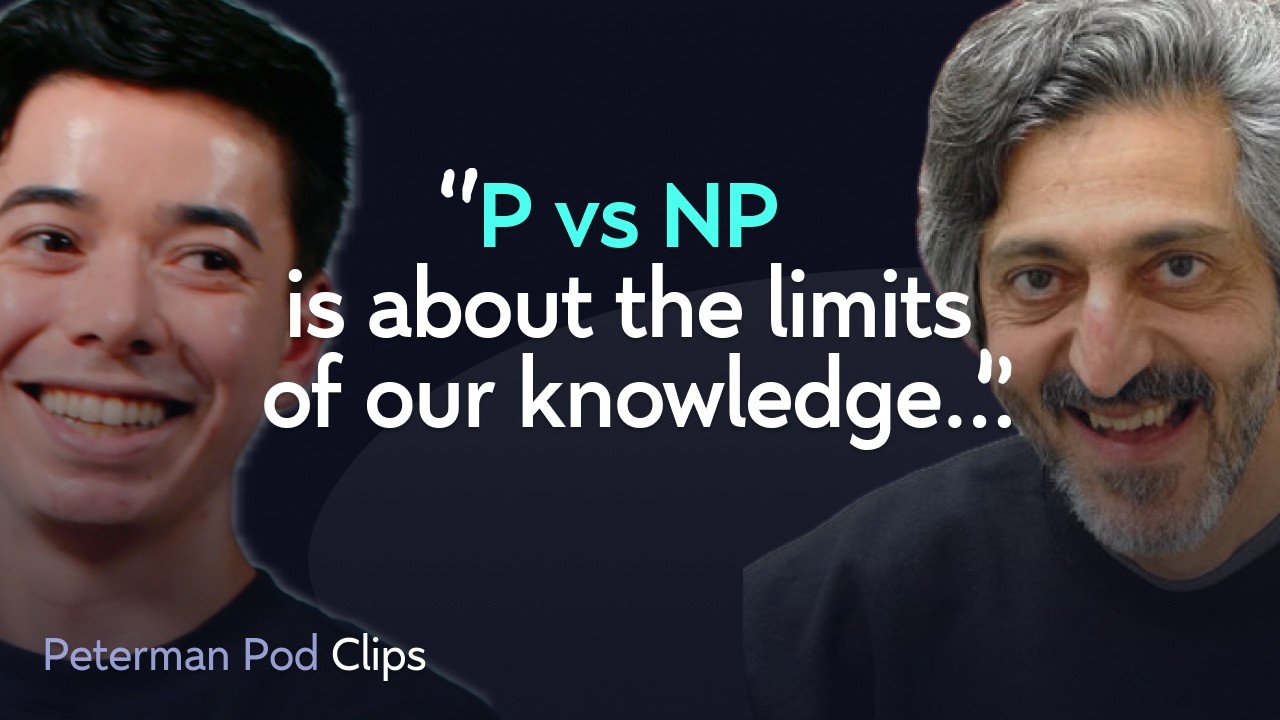
Ryan Peterman opens the discussion by referencing a point Avi Wigderson made in a previous lecture: that the famous $P$ versus $NP$ problem is fundamentally about the limits of human knowledge. Peterman asks Wigderson to unpack what $P$ versus $NP$ actually is and how it connects to what humans can know. Wigderson answers at a high level, explaining that human life is filled with a vast array of challenges—mathematical, scientific, medical, personal, and intellectual—and that computer science is fundamentally in the business of solving problems using computers.
To make sense of these challenges, theoretical computer science attempts to categorize them. On one side are all the problems humanity wants to understand and solve. On the other side are the problems humanity actually has the capacity to solve. In Wigderson's formulation, the collection of problems we care about solving corresponds to the mathematical class $NP$, while the subset of problems we can solve—not merely today, but in principle using efficient algorithms—corresponds to $P$. Framing the problem this way turns an abstract complexity-theory question into a profound philosophical inquiry. As Avi Wigderson summarizes: “So, the question of P versus NP is whether we can solve all the problems we want to solve, whether we can know everything we want to know.”
```mermaid flowchart TD accTitle: Conceptual View of P versus NP accDescr: Diagram showing how NP represents problems humanity wants to solve while P represents problems humanity can efficiently solve. subgraph NPClass ["NP: Problems We Want to Solve"] direction TB V["Solutions are easily verified once found"] subgraph PClass ["P: Problems We Can Solve"] S["Solutions can be found efficiently"] end end NPClass -->|"If P = NP"| FullKnowledge["Every verifiable problem can be solved efficiently"] ```
[01:45](https://www.youtube.com/watch?v=SHT3himqWHo&t=105s) Verifiable Solutions across Mathematics, Science, and Engineering
Wigderson moves on to justify why these formal mathematical definitions map directly onto human intuition. The class $P$ represents problems that can be solved within our lifetime using efficient algorithms on the computers we build. A tangible, everyday example is a navigation app on a smartphone: an engineer or computer scientist developed an efficient algorithm capable of computing the shortest path between any two locations on any road map.
```mermaid flowchart LR accTitle: Verification in Human Endeavors accDescr: Examples of four human endeavors where proposed solutions are verified against criteria. subgraph Endeavors ["Endeavors with Verifiable Solutions"] direction TB M["Math: Theorem proofs"] --> MV["Check peer-reviewed proof"] S["Science: Theories for data"] --> SV["Check consistency with observations"] E["Engineering: Bridge or phone design"] --> EV["Check physical and budget constraints"] D["Detective work: Crime solving"] --> DV["Check evidence and narrative"] end ```
By contrast, $NP$ is formally defined as the class of problems where—regardless of whether finding an answer is easy or hard—a candidate solution can be easily checked for correctness once presented. Wigderson argues that virtually every serious human pursuit falls into this category, because humans do not search for things they cannot recognize. As Avi Wigderson explains: “I mean, why would you ever start on looking for something if you would never recognize it as what you looked for?” He illustrates this across several distinct disciplines: - In mathematics, researchers spend years searching for proofs of theorems; once a proof is written in a paper, the mathematical community can verify its correctness. - In empirical science, researchers seek theories to explain observations about planetary motion or bacteria; once a theory is proposed, peer review checks whether it is consistent with the data. - In engineering, professionals design physical artifacts like bridges or smartphones subject to budgetary and physical constraints; clients and inspectors can readily inspect the finished design to ensure no constraints were violated. - In detective work, investigators gather evidence to solve a crime, producing a case that can be audited and evaluated.
Because the property of being able to easily recognize a correct answer unites all these endeavors, $NP$ encompasses everything humans honestly wish to solve. If $P$ were to equal $NP$, the mere ability to recognize a valid solution would guarantee the existence of an efficient way to discover it. Under that scenario, humanity could systematically uncover solutions to its greatest challenges, such as finding a cure for cancer. As Avi Wigderson concludes: “That means that we can know everything we ever want to know. It's a fundamental question about human knowledge.”
## Notable quotes > [00:00](https://www.youtube.com/watch?v=SHT3himqWHo&t=0s) So, the question of P versus NP is whether we can solve all the problems we want to solve, whether we can know everything we want to know. — Avi Wigderson
## Mentioned Avi Wigderson, Ryan Peterman, Turing Award, Abel Prize
## Video description Avi Wigderson is the only person in history to have won both a Turing Award (computer science) and Abel Prize (math). This is a clip from a longer interview I did with him all about his field.
Where to watch: • YouTube - https://youtu.be/5GUcvSAJcJw • Spotify - https://open.spotify.com/episode/4JZrdA7ciMKLSarhx7m9Lt?si=EXZof0ERRgS3_wsRmjYEzg • Apple Podcasts - https://podcasts.apple.com/us/podcast/the-peterman-pod/id1777363835 • Transcript - https://www.developing.dev/p/turing-award-winner-p-vs-np-zero
[Source](https://www.youtube.com/watch?v=SHT3himqWHo)