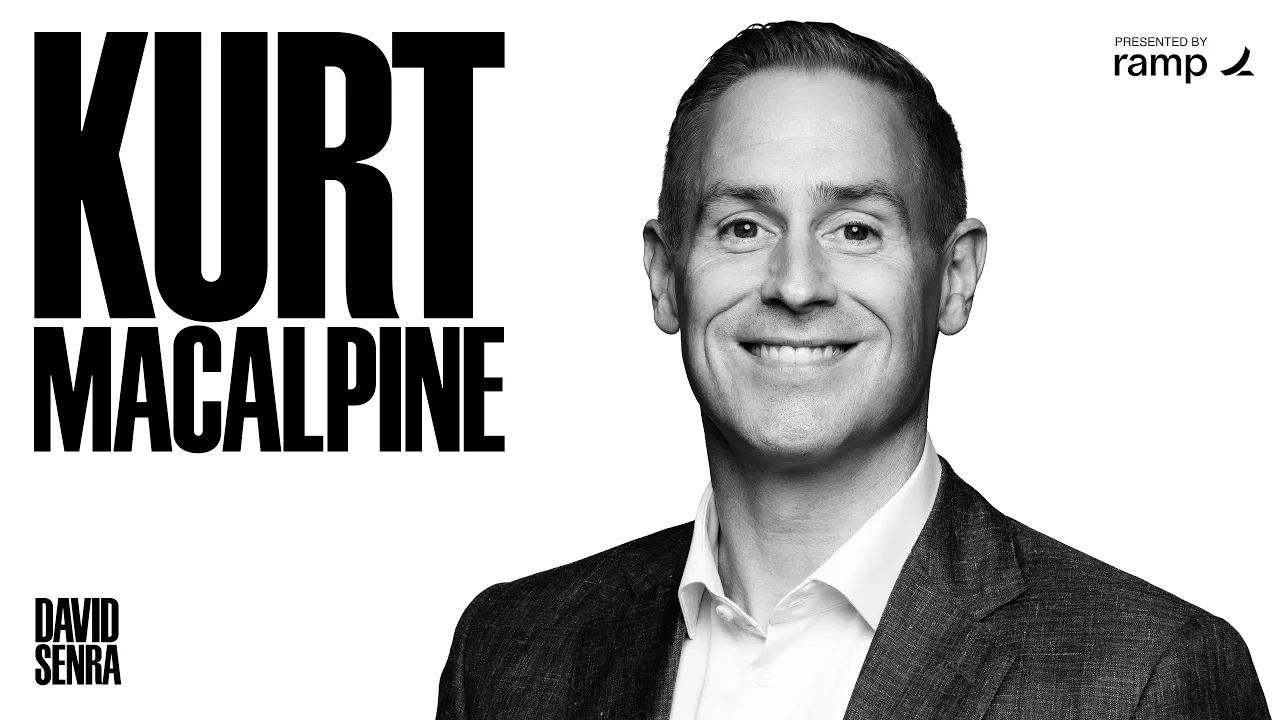
MacAlpine Takes CI Financial Private to Scale $525B Wealth Partnership
David Senra
Traditional wealth management fails because advisor silos and regional P&Ls pit teams against clients, making a single unified compensation model and fee-only fiduciary standard essential to build an enduring platform.
Kurt MacAlpine transitioned CI Financial from a mature Canadian mutual fund provider into Corient, creating the world's largest multi-family office and fee-only fiduciary managing roughly $525 billion across 15 global jurisdictions. (0:02)
Corient eliminated internal advisor-to-advisor and advisor-to-enterprise conflicts by implementing a single unified P&L and an identical compensation formula across approximately 3,000 employees. (23:28)
After enduring intense public market volatility and aggressively repurchasing shares, MacAlpine partnered with Mubadala Capital to take CI Financial private with zero incremental debt, enabling an immediate European expansion. (52:15)
Rather than acquiring firms for retirement cash-outs, Corient requires incoming founders to exchange local equity for parent company equity and fully adopt the firm's brand, technology, and compensation model on day one. (27:58)
Detailed notes
## Background
This episode was published on YouTube by David Senra on October 18, 2026. According to the page description, it features Corient CEO Kurt MacAlpine discussing how he re-engineered wealth management into a professional services partnership model, managed over $525 billion in client assets, navigated public market skepticism through share buybacks, and took CI Financial private with Mubadala Capital.
## TL;DR
Kurt MacAlpine breaks down how he transformed legacy Canadian asset manager CI Financial into Corient, creating a global ultra-high-net-worth wealth management powerhouse managing roughly $525 billion. He explains why traditional wealth management incentives are fundamentally broken, replacing siloed payouts and competing internal divisions with a unified P&L, a single compensation plan, and strict fee-only fiduciary standards. The discussion details MacAlpine's navigation of severe public market volatility, using high-conviction share repurchases before executing a take-private transaction with Mubadala Capital to protect long-term expansion. Finally, MacAlpine outlines Corient's disciplined approach to integrating 50 acquisitions, building brand equity, and establishing a lasting generational partnership from Miami.
## Atmosphere & style
The conversation carries an intense, masterclass-level energy fueled by David Senra's encyclopedic passion for historic business builders and Kurt MacAlpine's cool, systematic executive clarity. The dynamic is collegiate yet razor-sharp, with both speakers bonding over extreme specialization, shared training in Miami, and disdain for short-term corporate optionality. It feels like an unvarnished post-mortem and battle plan rolled into one, marked by calculated conviction against Wall Street skepticism and standard private equity playbook compromises.
## Bulletin
- [00:02](https://www.youtube.com/watch?v=u1cyLVmRMx8&t=2s) Kurt MacAlpine transitioned CI Financial from a mature Canadian mutual fund provider into Corient, creating the world's largest multi-family office and fee-only fiduciary managing roughly $525 billion across 15 global jurisdictions.
- [23:28](https://www.youtube.com/watch?v=u1cyLVmRMx8&t=1408s) Corient eliminated internal advisor-to-advisor and advisor-to-enterprise conflicts by implementing a single unified P&L and an identical compensation formula across approximately 3,000 employees.
- [52:15](https://www.youtube.com/watch?v=u1cyLVmRMx8&t=3135s) After enduring intense public market volatility and aggressively repurchasing shares, MacAlpine partnered with Mubadala Capital to take CI Financial private with zero incremental debt, enabling an immediate European expansion.
- [27:58](https://www.youtube.com/watch?v=u1cyLVmRMx8&t=1678s) Rather than acquiring firms for retirement cash-outs, Corient requires incoming founders to exchange local equity for parent company equity and fully adopt the firm's brand, technology, and compensation model on day one.
## Key takeaways
- [02:15](https://www.youtube.com/watch?v=u1cyLVmRMx8&t=135s) The legacy wealth management sector is characterized by a barbell distribution, leaving clients stranded between bureaucratic money-center banks and subscale boutique advisory practices.
- [05:32](https://www.youtube.com/watch?v=u1cyLVmRMx8&t=332s) Traditional wirehouses treat advisors as siloed independent contractors sharing overhead, creating flawed incentives that pit advisors against specialists, their own peers, and client interests.
- [11:42](https://www.youtube.com/watch?v=u1cyLVmRMx8&t=702s) Applying a professional services partnership model similar to elite management consulting or law allows wealth advisory firms to prioritize enduring human capital and collective alignment.
- [23:28](https://www.youtube.com/watch?v=u1cyLVmRMx8&t=1408s) Corient operates as a 100% fee-only fiduciary, passing institutional pricing breaks and third-party fee discounts entirely through to clients rather than retaining them as corporate margin.
- [22:15](https://www.youtube.com/watch?v=u1cyLVmRMx8&t=1335s) The firm utilizes a shared-economy architecture for high-cost infrastructure, including purchasing private aircraft onto its balance sheet so clients access private aviation solely at variable cost.
- [23:28](https://www.youtube.com/watch?v=u1cyLVmRMx8&t=1408s) Enforcing a single firm-wide P&L and one uniform compensation plan removes internal chargebacks and prevents the creation of regional or divisional silos.
- [27:58](https://www.youtube.com/watch?v=u1cyLVmRMx8&t=1678s) Independent advisory firms often encounter a growth ceiling between $3 billion and $5 billion in assets, lacking the balance sheet required to self-fund proprietary trust, tax, and family office platforms.
- [39:21](https://www.youtube.com/watch?v=u1cyLVmRMx8&t=2361s) Public markets showed severe skepticism toward transforming an asset manager into a wealth manager, resulting in CI Financial oscillating from top performance in 2021 to being the second-worst performer in 2022.
- [48:25](https://www.youtube.com/watch?v=u1cyLVmRMx8&t=2905s) MacAlpine capitalized on depressed public market pricing by repurchasing heavily discounted shares financed by cash flows from the legacy asset management business and fixed-rate, long-term debt.
- [52:15](https://www.youtube.com/watch?v=u1cyLVmRMx8&t=3135s) Mubadala Capital took CI Financial private in a transaction designed with no added leverage and an equity infusion for deleveraging, accelerating international growth without public float volatility.
- [55:20](https://www.youtube.com/watch?v=u1cyLVmRMx8&t=3320s) Unlike global banks divided into competing regional P&Ls, Corient runs a single cross-border framework that allows international teams to service global wealth collaboratively without territorial fees.
- [01:01:00](https://www.youtube.com/watch?v=u1cyLVmRMx8&t=3660s) Acquisition integration at Corient requires complete and immediate operational alignment, with acquired partners adopting the brand, technology stack, and compensation mechanics on day one.
- [01:12:39](https://www.youtube.com/watch?v=u1cyLVmRMx8&t=4359s) The firm avoids private equity holding timelines of 18 to 36 months, structuring its enterprise governance as a permanent generational partnership built for multi-decade compounding.
- [01:16:04](https://www.youtube.com/watch?v=u1cyLVmRMx8&t=4564s) Launching Corient in 2020 and establishing its headquarters early in Miami granted the firm a blank-slate advantage free from geographic legacy habits or outdated operational baggage.
## Detailed walkthrough
### [00:02](https://www.youtube.com/watch?v=u1cyLVmRMx8&t=2s) Taking the Helm of CI Financial at 39
Kurt MacAlpine defines his role plainly: he is a partner and the CEO of Corient, the largest multi-family office in the world and the largest non-bank wealth manager catering to ultra-high-net-worth individuals. Today, Corient oversees approximately $525 billion in client assets across 15 jurisdictions worldwide. Reflecting on a long conversation they had weeks earlier in Miami, David Senra recalls thinking immediately afterward, “Damn it, I wish we would just recorded this.” To Senra, the story is remarkable not simply because of the sheer scale of the firm, but because MacAlpine entered the space as an industry outsider and fundamentally re-engineered the incentive structures of a legacy sector. What makes the trajectory even more striking is that MacAlpine stepped into his first chief executive role at just 39 years old, taking over a publicly traded enterprise without prior CEO experience.
MacAlpine explains the origins of the turnaround at CI Financial, a Canadian asset manager that had been listed on the Toronto Stock Exchange for roughly a quarter of a century. At the time of his recruitment, CI was generating several hundred million dollars a year in EBITDA, but virtually all of that economic engine was tied to a single legacy pillar: the Canadian retail mutual fund business. While the firm had a small domestic wealth advisory arm, the core business was confronting structural headwinds. The secular rise of exchange-traded funds (ETFs), the growing prominence of private alternative assets, and shifting investor behaviors meant mutual fund inflows were tapering off relative to other corners of finance. Recognizing that the existing playbook could no longer guarantee future growth, the board initiated an executive search for a leader who could craft an entirely new strategic direction.
- **Corient scale:** Manages approximately $525 billion in client assets across 15 global jurisdictions.
- **CI Financial baseline:** TSX-listed for ~25 years, generating several hundred million dollars in annual EBITDA predominantly from Canadian mutual funds.
- **MacAlpine's appointment:** Recruited as a first-time CEO at age 39 to redefine CI Financial's strategy amid mutual fund industry deceleration.
---
[02:15](https://www.youtube.com/watch?v=u1cyLVmRMx8&t=135s) Tailwinds and the Wealth Management Barbell
When MacAlpine pitched his vision to CI's board, he brought an aggressive mandate informed by his dual career: a decade advising financial institutions as a management consultant, followed by more than four years as an operator inside an asset management firm. Those experiences gave him a clear view of where legacy firms excelled and where structural inertia blinded them to change. MacAlpine saw an enormous opportunity to diversify and globalize CI by launching an ultra-high-net-worth wealth management platform in the United States, with the ultimate objective of scaling it internationally. He based this conviction on three macro observations, starting with unprecedented industry tailwinds. As MacAlpine emphasizes: “There's more wealth being created today than ever. That wealth is more concentrated than ever. There's more complexity tied to that wealth than ever. It's transitioning generations faster than ever. And it's more global than ever.” Every single one of these vectors compounds the client's fundamental need for sophisticated advice.
The second core driver of his strategy was the polarized, barbell-shaped structure of the existing wealth management landscape. On one end of the barbell sit the colossal money-center banks. In theory, these institutions possess inexhaustible balance sheets, deep pools of capital, and the resources to deliver every conceivable financial solution. In practice, however, heavy governance, bureaucratic inertia, and internal fiefdoms prevent them from mobilizing those assets effectively. Rather than passing the fruits of scale to the end client, mega-banks absorb those advantages in overhead, rigid internal policies, and conflicting departmental interests.
On the opposite end of the barbell sit thousands of small, boutique, independent advisory shops. While these local firms frequently provide exceptional, high-touch personal service, their lack of scale severely caps their capabilities. They cannot secure access to elite, capacity-constrained asset managers; they lack the leverage to negotiate pricing or institutional purchasing power for their clients; and they cannot afford to build out comprehensive in-house capabilities like specialized tax, estate, or family office services. MacAlpine realized that the wide gulf between bloated, conflicted universal banks and resource-constrained boutiques represented a massive expanse of white space for a disruptive, scaled competitor.
```mermaid
flowchart TD
accTitle: The Wealth Management Industry Barbell
accDescr: Diagram showing the traditional industry barbell and the white space captured by Corient.
subgraph Barbell ["Traditional Wealth Industry Structure"]
A["Large Universal Banks\n- Abundant capital & resources\n- Bureaucracy & internal conflict\n- Scale benefits lost to overhead"]
B["Independent Boutiques\n- High-touch, client-centric service\n- Sub-scale purchasing power\n- Limited manager access & services"]
end
subgraph Opportunity ["The Market Disruption"]
C["Massive Industry White Space\n- Full institutional capabilities\n- Agility & alignment of a partnership\n- Scale benefits passed directly to clients"]
end
A -.-> C
B -.-> C
```
---
[05:32](https://www.youtube.com/watch?v=u1cyLVmRMx8&t=332s) The Broken Incentive Structure: Why Traditional Firms Fail Clients
The third and most decisive reason MacAlpine targeted wealth management was his realization that the traditional industry operates on a fundamentally broken organizational architecture. Across almost every major wirehouse and advisory network, firms treat their wealth advisors as independent contractors who happen to share a corporate brand, a common technology stack, and shared real estate. Far from collaborating, these advisors actively compete against their own colleagues for prospects and can even poach existing relationships from peers down the hall. As MacAlpine points out: “So think of it as most wealth businesses are built to serve advisors. We wanted to build a wealth business that was built to serve clients and the advisors and the firm and the resources support those underlying clients.” When David Senra mentions how a client might assume they are hiring an institution like J.P. Morgan, MacAlpine confirms that the client is actually captive to a single individual originator rather than the collective capabilities of the brand.
This individualistic design produces three toxic layers of internal friction:
1. **Advisor-to-Advisor Tension:** Because advisors guard their client books defensively, they operate in isolated silos, deliberately preventing colleagues from interacting with their relationships and denying clients cross-disciplinary expertise.
2. **Advisor-to-Specialist Tension:** Front-office specialists—such as estate attorneys, CPAs, financial planners, and family office executives—are commonly treated as cost centers charged against an advisor's personal book of business. If bringing in an elite in-house tax strategist costs thousands of dollars against the advisor's immediate payout, the advisor has a direct economic disincentive to bring that specialist into the room.
3. **Advisor-to-Enterprise Tension:** Legacy compensation models reward advisors solely for aggregating top-line revenue and hoarding as much of the payout as possible without sharing credit. Meanwhile, the operational, back-office, and executive personnel are compensated on the overall bottom-line profitability of the firm. Because the advisor's personal compensation formula runs counter to the firm's collective economics, the two sides constantly clash.
MacAlpine concludes that this broken model produces two catastrophic casualties: the client and the firm itself. As MacAlpine puts it: “The big loser is the client because the client doesn't get access to the full benefits of the firm. The client is marginalized down to the individual person or team that originated the relationship with them.” The second victim is the enterprise: institutions structured around mercenary independent contractors never mature into enduring, integrated companies—they remain fragile hotel platforms where transient advisors temporarily hang their hats until a higher payout comes along.
- **The advisor-as-island model:** Advisors share real estate and software but guard books of business, compete internally, and treat colleagues as rivals.
- **Specialists as cost burdens:** Advanced tax, estate, and family office experts are billed against advisor compensation pools, disincentivizing advisors from introducing necessary expertise to clients.
- **Platform vs. enterprise:** Firms operating under legacy structures fail to build collective enterprise value, serving merely as loose aggregation networks for individual books of business.
[09:02](https://www.youtube.com/watch?v=u1cyLVmRMx8&t=542s) An Industry Ripe for Disruption
Traditional wealth management firms run into severe structural limits because their advisers operate in isolated silos rather than as a unified organization. Kurt MacAlpine points out that under such fragmented arrangements, firms fail to build genuine teamwork, fail to nurture a shared culture, and cannot collaborate across the enterprise to solve complex client problems. Reflecting on the state of wealth management, MacAlpine identified three converging factors that convinced him the sector was primed for a complete overhaul: massive tailwinds pushing wealth creation, a barbell-like industry structure polarized between massive wirehouses and subscale boutiques, and an operating model that he regarded as fundamentally flawed. In his assessment, that structural mismatch opened an unprecedented opportunity for a disruptor to step in and dramatically expand what a wealth firm can accomplish on behalf of its clients.
```mermaid
flowchart TD
accTitle: Industry Disruption Drivers
accDescr: Three converging forces that created an opportunity to disrupt wealth management.
subgraph Forces["Market Realities"]
A["Tremendous Industry Tailwinds"]
B["Barbell Market Structure"]
C["Fundamentally Flawed Operating Model"]
end
subgraph Impact["The Opportunity"]
D["Disrupt Legacy Wealth Management"]
E["Do Far More for Clients"]
end
A --> D
B --> D
C --> D
D --> E
```
[11:42](https://www.youtube.com/watch?v=u1cyLVmRMx8&t=702s) Applying the Professional Services Partnership Model
When examining why wealth management was originally designed around fragmented silos and disparate compensation packages, MacAlpine acknowledges that while the historical origin is obscure, almost all large wealth managers adopted the exact same structure. Looking beyond the legacy format, he views wealth advisory as the quintessential human capital business. Performing at the highest level requires an exceptional balance of emotional intelligence (EQ) and cognitive capability (IQ), and how advisers fuse those traits directly determines client outcomes. Every other major human capital industry—management consulting, law, accounting, and premier investment advisory—organizes itself as a professional partnership rather than a collection of siloed independent contractors. Drawing on his experience as a former partner at McKinsey & Company, MacAlpine recognized that wealth management stood out as the lone anomaly. Corient was therefore designed to take that proven professional services partnership framework and apply it directly to wealth management, replacing internal friction with shared ownership and collaboration.
> “So, effectively to wildly overly simplify the Corient structure, we created the first true professional services partnership and applied it to the wealth management industry.” — Kurt MacAlpine
- Traditional wealth firms run advisers as isolated operators rather than partners.
- Management consulting, law firms, and accounting firms all organize as professional partnerships.
- Success in advisory hinges on combining high EQ with high IQ to serve clients.
- Corient’s partnership model aligns client outcomes, internal collaboration, and equity ownership.
[13:28](https://www.youtube.com/watch?v=u1cyLVmRMx8&t=808s) Pitching the Board and the Canadian Playbook
MacAlpine presented this aggressive transformation plan directly to the board of directors during his CEO interview process at CI Financial. Rather than offering incremental updates, he made the launch of what would become Corient the centerpiece of his strategic agenda. The board—composed of substantial, long-term owners of the business—welcomed the bold direction, pairing strong governance and delegation with active strategic advice. This upfront alignment allowed MacAlpine to execute the strategy from his very first day on the job.
The strategy also shared historical continuity with the path chartered by CI Financial’s past leadership, specifically former CEO and chairman Bill Holland alongside co-founder Ray Chang. Decades earlier, Holland and Chang had recognized that the Canadian asset management and mutual fund industry was fragmented and subscale; they aggressively consolidated the market through a series of disciplined acquisitions, establishing CI Financial's dominant footprint. MacAlpine saw a similar necessity for bold action: when a core business enters structural decline, attempting to preserve the status quo by standing still is the single most dangerous choice leadership can make.
> “That's when you should be the most uncomfortable. I mean, look at the business you're in, right? It's just everything is changing around us at all times. And so, I'm the most nervous when things aren't changing.” — Kurt MacAlpine
- The aggressive expansion playbook was shared transparently with the board during MacAlpine's CEO interviews.
- CI Financial chairman Bill Holland and co-founder Ray Chang had previously built national scale by consolidating Canadian mutual fund managers via acquisitions.
- Standing still in a declining legacy business exposes a company to guaranteed value erosion.
- MacAlpine stresses that leaders must push change forward proactively rather than merely reacting to it.
[16:00](https://www.youtube.com/watch?v=u1cyLVmRMx8&t=960s) Ambition, Specialization, and Escaping Optionality
David Senra notes the unusual intensity of MacAlpine’s ambition, remarking that MacAlpine stepped into his first CEO role at age 39 after two decades of professional experience with the explicit goal of conquering the industry like Genghis Khan and building the best wealth management company in the world. MacAlpine explains that his drive stems from genuine passion for wealth management and human capital dynamics, coupled with a deep conviction regarding the power of focus. He observes that human nature naturally pushes individuals toward optionality—dabbling across multiple pursuits to stay comfortable—which prevents them from achieving true excellence. By rejecting the safety of optionality in favor of deep, specialized expertise, Corient was explicitly built from its first day to become the world's preeminent wealth advisory practice for ultra-high-net-worth families.
> “I think in many in many instances human nature guides people towards optionality, right? So people get a little more comfort in optionality. I want to be able to do this this this and then this. And you can be fine at a bunch of those things, but it's very very hard to be world class ultimately as something.” — Kurt MacAlpine
[17:47](https://www.youtube.com/watch?v=u1cyLVmRMx8&t=1067s) Launching a Disruptive Structure in Wealth Management
David Senra opens the discussion by recalling Kurt MacAlpine's early days on the job, highlighting the bold posture of deploying free cash flow, emptying the tank, and leveraging up from day one. In response, Kurt MacAlpine explains that building Corient began with a distinct conviction about the ultra-high-net-worth market and an appetite to install an industry-disrupting operating architecture. When getting any unconventional company off the ground, the very first test is market resonance: whether an operating structure fundamentally different from legacy competitors will actually appeal to exceptional wealth management entrepreneurs. The primary objective was proving that Corient filled an unmet void for both clients and advisory professionals; only after that initial traction took hold did MacAlpine begin focusing on capital allocation trade-offs and prioritization.
```mermaid
flowchart TD
accTitle: Corient Service and Capability Architecture
accDescr: Flowchart illustrating how relationship quarterbacks connect clients to Corient's specialized capabilities under a single firm.
subgraph ClientFacing["Client Interface"]
C["Ultra-High-Net-Worth Clients"]
QB["Wealth Advisory Teams<br/>(Relationship Quarterbacks)"]
C <--> QB
end
As Senra asks why successful independent firm founders would sell to Corient instead of staying independent, MacAlpine outlines the core proposition he makes to prospective partners: “By you joining you should make us better, we should make you better, and we should collectively be able to do more for clients than both of us running on our independent paths.” He views legacy wealth management as handicapped by flawed incentives that impede internal collaboration and client results. By designing a true professional services partnership model, Corient aimed to become the most comprehensive global provider for ultra-high-net-worth families, scaling far beyond what independent practices could accomplish alone.
[20:42](https://www.youtube.com/watch?v=u1cyLVmRMx8&t=1242s) Building the Comprehensive Service Platform
MacAlpine details the operational engine Corient assembled to surround its wealth advisory teams, who act as the central "quarterbacks" managing client relationships. These advisors are backed by full-time, specialized in-house units spanning every dimension of wealth:
- **Global financial planning:** Managing all lifetime advisory needs.
- **Global wealth transfer:** Structuring estate strategies that extend beyond a client’s natural lifespan.
- **Investment division:** An internal roster of 175 investment professionals managing portfolios split roughly 70% across traditional asset classes and 30% in alternatives.
- **Trust infrastructure:** Proprietary, wholly owned trust companies operating in favorable jurisdictions like South Dakota as well as internationally.
- **Embedded tax practice:** Over 100 full-time accountants who do not merely file returns or give isolated tax advice; they are actively embedded inside wealth advisory teams to collaborate on estate planning, trust structuring, and continuous tax-loss harvesting.
- **Full family office services:** Day-to-day bill payment, outsourced CFO services, bespoke portfolio reporting, concierge lending, complex residential real estate project management, fine art management, and a private aviation platform.
[22:15](https://www.youtube.com/watch?v=u1cyLVmRMx8&t=1335s) Shared Scale: The Private Aviation Model
When Senra asks MacAlpine to elaborate on the private aviation offering, MacAlpine explains how Corient leverages aggregate firm size to deliver non-traditional client services. By representing hundreds of ultra-high-net-worth families, Corient can absorb asset overhead that individuals typically dread carrying alone. The firm purchases private aircraft directly onto its balance sheet and absorbs the recurring monthly aircraft management fees. Clients then pay solely on a variable basis for their actual flight usage.
Senra remarks that this resembles a Costco-style shared-economy model, noting that the aviation wing is deliberately not operated as a stand-alone profit center. MacAlpine affirms that the goal is not to maximize transactional markups on niche services, but rather to use Corient's collective buying power to deliver unique utility directly back to clients.
[23:28](https://www.youtube.com/watch?v=u1cyLVmRMx8&t=1408s) Eliminating Conflicts: One P&L, One Comp Plan, and Fiduciary Care
MacAlpine explains his ambition to build the only truly conflict-free firm in the wealth management sector. He observes that advisory firms compromise their integrity through two primary vectors: regulatory standard of care and corporate structure. Addressing standard of care, Corient is structured strictly as a fee-only fiduciary, bound at all times to put the client's interests first. MacAlpine highlights that Corient is the largest firm in the world operating exclusively under this pure fiduciary standard; any competitor larger than Corient utilizes a broker-dealer suitability standard, which allows them to offer products that are merely "good enough" rather than strictly optimal for the client.
Addressing structural conflicts, MacAlpine eliminated organizational friction by implementing two firm-wide operational mandates across Corient's roughly 3,000 employees:
- **A single compensation plan with zero exceptions:** MacAlpine notes that when colleagues working on the same account are compensated under different formulas, internal friction inevitably distorts advice.
- **One unified P&L with no internal chargebacks:** Siloed division P&Ls and inter-departmental billing create political walls that discourage advisors from bringing in specialized colleagues.
Summing up this operational philosophy, Kurt MacAlpine states: “Once you start to put silos in place, once you start to segment your P&L, once you start to run chargebacks, you're inherently creating underlying friction in the business.” Senra concludes that Corient's sole compass is improving client outcomes, making competitor comparisons irrelevant—a principle MacAlpine confirms as Corient's guiding north star.
[26:17](https://www.youtube.com/watch?v=u1cyLVmRMx8&t=1577s) Specialization and Connecting the Dots for Clients
Kurt MacAlpine emphasizes that Corient's sole focus is being the best in the world at serving ultra-high-net-worth clients, which requires deep, specialized expertise rather than generic advisory. While many advisors prefer optionality—claiming they can advise a tech entrepreneur, a small business owner, and a corporate executive all at once—Kurt points out that each profile demands entirely different skill sets. By forcing advisors to specialize in specific client types, the quality and relevance of advice improves dramatically. This specialization must also extend across Corient's comprehensive service offerings, connecting pieces that clients traditionally have to stitch together themselves.
When a firm manages an individual's financial plan, wealth transfer, investments, tax strategy, and trust execution collectively rather than treating them as isolated choices, the client achieves significantly better outcomes. Putting this burden on the client weakens their results. Kurt explains that executing this holistic approach is impossible under conventional industry structures, which create silos and tensions. To eliminate internal conflicts that impair client outcomes, Corient established a private partnership model and rigorously audited every aspect of its business structure.
> “And I'm always encouraging people be as specialized as possible. The more specialized you are, the more relevant you are, the better advice that you can ultimately give to your clients and then it extends beyond the service offering.” — Kurt MacAlpine
[27:58](https://www.youtube.com/watch?v=u1cyLVmRMx8&t=1678s) Scale as a Shared Economy: Access, Pricing, and Services
David Senra compares Corient’s model to a shared-economy scale flywheel, observing that Corient provides ancillary services such as aviation and art management not to extract direct profits, but to deliver overwhelming value that keeps clients loyal across generations. Kurt details how scale benefits clients in three concrete ways:
1. **Manager Access**: Capacity-constrained, elite investment managers become accessible because Corient's collective size makes it an indispensable institutional allocator.
2. **Purchasing Power and Pricing**: Corient leverages its aggregate volume to negotiate lower manager fees and superior lending rates. Operating as a fee-only fiduciary, the firm passes 100% of these pricing discounts directly back to clients.
3. **Comprehensive Services**: A standalone $5 billion to $15 billion wealth management firm cannot independently offer in-house tax, estate, trust, family office, aviation, and art management at scale, whereas Corient provides these built-in capabilities on day one.
```mermaid
flowchart TD
accTitle: Corient Scale Flywheel
accDescr: Diagram illustrating how asset scale unlocks access, pricing power, and institutional capabilities that flow back to clients and advisors.
subgraph ScaleEngine["Corient Institutional Scale"]
A["Aggregated Client Assets"]
end
subgraph ClientImpact["Client & Advisor Value"]
F["100% of Fee Savings Passed to Clients"]
G["Holistic Multi-Generational Retention"]
H["Accelerated Organic Growth for Partners"]
end
A --> B
A --> C
A --> D
A --> E
B --> H
C --> F
D --> F
E --> G
F --> G
```
When addressing why boutique wealth managers would sell to Corient, Kurt reframes the transaction entirely. Corient does not view acquisitions as buying out firms; instead, founders join as equity partners to co-own and operate the larger business alongside Kurt and the rest of the team. David compares this to John D. Rockefeller's strategy with Standard Oil—opening the books, demonstrating superior economics, and inviting founders to swap their local shares for parent-company stock. Kurt confirms that Corient operates with full transparency: prospective partners review the internal books and see the exact mechanics of the platform.
> “The way that I think about Corient, because I don't think of it as us buying people's firms. People are coming to be partners at Corient. They're coming to own and operate the business alongside myself and the other equity partners of the firm.” — Kurt MacAlpine
[31:40](https://www.youtube.com/watch?v=u1cyLVmRMx8&t=1900s) The Growth Inflection Point and Building for Decades
Kurt describes the natural inflection point that wealth management firms face once they scale to roughly $3 billion, $4 billion, or $5 billion in assets. Up to that threshold, a firm can thrive with a standard suite of advisory and investment services. Beyond it, larger and wealthier clients demand complex capabilities, including tax, trust, and family office functions. Bridging the gap from $5 billion to $50 billion or $100 billion requires massive capital investments. For an independent entrepreneur, taking on that overhead hoping future asset growth will offset the costs introduces an unfavorable risk-reward trade-off.
Joining Corient solves that imbalance immediately. Instead of spending decades building complex back-office and specialty departments alone, an entrepreneur gets access to Corient's fully realized platform on day one while securing equity in the combined entity. Because Corient is structured around continued operational growth rather than cashing out aging founders, the firm intentionally attracts a much younger demographic than the broader wealth management industry:
- **Industry Median Advisor Age**: Early 60s
- **Corient Median Partner Age**: Mid-40s
- **Corient Median Employee Age**: 30s
Kurt notes that this youthful demographic is the result of deliberate targeting and mutual self-selection. Partners join because they have decades of runway left, want to remain equity owners, and seek an energetic, collaborative environment where they can build alongside fellow founders.
> “So yes, we're doing M&A, but we're not doing M&A to fund effectively retirements. We're doing M&A to bring on partners to continue to grow their business.” — Kurt MacAlpine
[34:52](https://www.youtube.com/watch?v=u1cyLVmRMx8&t=2092s) The Ultimate Screening Mechanism: First Choice or Last Choice
When bringing partners into Corient, Kurt MacAlpine looks for a combination of long career runway and genuine entrepreneurial ambition. As David Senra points out, managing $525 billion is not the finish line; the goal is to compound asset growth far more effectively with low customer churn and younger advisors. MacAlpine explains that because Corient operates completely differently from the rest of the wealth management industry, prospective partners experience an immediate, binary reaction during recruiting conversations.
Rather than competing against rival firms in a conventional beauty pageant, Corient acts as an intense filter. Advisors either enthusiastically embrace the vision of equity ownership, cross-office collaboration, and genuine client alignment, or they realize they simply want to preserve their existing isolated fiefdoms. As MacAlpine puts it, “we tend to be someone's first choice or their last choice, right? Do you believe in partnership? Do you want to be an owner of the business? Do you want to collaborate with your colleagues for the ultimate benefit of our clients or are you looking to recreate kind of the silo that you have at whatever firm you're ultimately contemplating uh leaving from.” Because Corient rarely finishes in second place, this structural contrast functions as the ultimate selection bias, ensuring that incoming partners share complete strategic, cultural, and financial alignment.
[36:35](https://www.youtube.com/watch?v=u1cyLVmRMx8&t=2195s) The Danger of Optionality and the Discipline of One P&L
David Senra and Kurt MacAlpine both push back against corporate compromises disguised as flexibility, with Senra candidly remarking, “I find optionality disgusting by the way.” MacAlpine explains that when acquiring businesses, leaders often concede on structural integration, compensation models, or branding under the guise of offering optionality. Over time, those concessions compound into massive operational friction and hidden complexity that make it nearly impossible to reset or steer the organization.
To prevent this decay, Corient draws a strict boundary: internal governance must remain radically simple, while all operational complexity is directed outward toward solving problems for ultra-high-net-worth clients. MacAlpine insists on absolute uniformity across the firm—one compensation structure, one single P&L with zero internal chargebacks, one unified brand, and one service offering. By eliminating internal politics and conflicting incentives, every advisor is positioned to focus entirely on client service rather than navigating corporate bureaucracy.
```mermaid
flowchart TD
accTitle: Internal Discipline Versus External Client Complexity
accDescr: Chart contrasting Corient's uniform internal operational model with its client-facing capabilities.
subgraph Internal["Internal Operating System (Zero Optionality)"]
A["One Single P&L (No Chargebacks)"]
B["One Unified Compensation Plan"]
C["One Integrated Brand & Partnership"]
end
subgraph External["Client Execution (Where Complexity Belongs)"]
D["Bespoke Ultra-High-Net-Worth Solutions"]
E["Cross-Disciplinary Collaboration"]
F["Seamless Service Across Geographies"]
end
Internal -->|"Enables focus without friction"| External
```
*During this segment, David Senra highlights show sponsor Deel (deel.com/senra), noting that top founders like those at Ramp, Shopify, ElevenLabs, Uber, and DoorDash rely on Deel's global hiring and payroll infrastructure so they can recruit the world's best talent without administrative friction.*
[39:21](https://www.youtube.com/watch?v=u1cyLVmRMx8&t=2361s) Stock Market Volatility and Transforming a Sleepy Canadian Asset Manager
Senra redirects the conversation to the dramatic history of building Corient through the publicly traded parent company, CI Financial. MacAlpine had pitched an ambitious transformation plan to take a mature, sleepy Canadian asset manager and use its cash flows to construct a global ultra-high-net-worth wealth management powerhouse. While the strategic logic of diversification was sound—shifting from asset management to wealth management, moving from mass-affluent to ultra-high-net-worth clients, and expanding from a single country into international markets—public equity markets reacted with intense skepticism and erratic swings.
The transformation triggered extreme volatility in the public stock. MacAlpine points out the stark contrast across consecutive years: “like in in 2021, we were I think the the best or second best performing financial services stock in North America. 2022 the second worst, right?” As MacAlpine notes about navigating the public markets during a turnaround, “public companies don't typically love transformation stories.” Despite the violent swings and the skepticism of public investors who viewed the strategy as a sharp, high-risk pivot, MacAlpine remained resolute in his conviction about the underlying market opportunity.
[41:33](https://www.youtube.com/watch?v=u1cyLVmRMx8&t=2493s) Float Dynamics: Hedge Funds, Mutual Fund Redemptions, and Conviction
A major driver of the stock’s extreme price volatility was the unusual composition of the company’s shareholder base. Approximately 25% of the shares were effectively immobilized between strategic investors (holding roughly 15% to 17% with no intention to sell) and passive index funds mandated to track the stock. That left an exceptionally high active float of approximately 75%, which was split between two volatile investor classes: momentum-oriented hedge funds and value-oriented mutual funds.
```mermaid
flowchart LR
accTitle: Shareholder Float Breakdown and Selling Pressures
accDescr: Diagram illustrating CI Financial's locked float versus the volatile 75 percent active float.
subgraph Float["Float Structure"]
Locked["Locked Base (~25%)\n• Strategic Investors (~15-17%)\n• Index Funds"]
Active["Active Float (~75%)\nHigh Volatility"]
end
subgraph Dynamics["Active Float Pressures"]
HF["Hedge Funds\n• Piled in during 2021 boom\n• Fled aggressively in 2022"]
MF["Value Mutual Funds\n• Structural net redemptions\n• Daily forced selling of shares"]
end
Active --> HF
Active --> MF
```
This active float profile created sharp mechanical swings unrelated to the core business fundamentals:
- **Hedge Fund Momentum**: Hedge funds flooded into the stock during 2021 to ride the initial upside, driving the rapid appreciation, only to exit in masses during the 2022 downturn.
- **Structural Mutual Fund Redemptions**: The long-only mutual funds holding the stock were legacy value managers experiencing relentless daily outflows; fund managers had to sell shares every morning simply to meet ongoing client redemptions.
- **Absence of a Volatility Buffer**: Unlike firms where 80% to 85% of shares are locked away in stable long-term hands to dampen daily market noise, CI Financial absorbed the full brunt of active market turnover.
Despite the stock getting hammered in 2022, MacAlpine maintained unwavering confidence because real-world execution on the ground proved the concept was working. Corient had officially launched around April 2020, and the immediate traction with advisors and clients showed that the underlying wealth management business was accelerating even as public market sentiment cratered.
[43:52](https://www.youtube.com/watch?v=u1cyLVmRMx8&t=2632s) Disconnect Between Internal Momentum and Public Share Price
Fast forwarding six years, Kurt MacAlpine notes that the business manages north of $500 billion of assets, employs 3,000 people, and operates across 15 different jurisdictions. Early on, the underlying strategy resonated strongly and people wanted to join the newly formed partnership structure. Internal momentum was building exactly as planned, but the public market's valuation told an entirely different story because the business progress was simply not tracking with share price appreciation.
David Senra compares Kurt's experience to Jeff Bezos in the early days of Amazon, when the stock tumbled from around $180 down to $6. Bezos reminded shareholders in his annual letters that while the stock was plummeting, every internal metric of the business was moving in the right direction, often invoking Benjamin Graham to emphasize that market voting machines eventually yield to weighing machines. Kurt agrees with that comparison, explaining that seeing the operational engine develop provides real confidence: “You get confidence again in just seeing the business evolve like and and obviously as your business continues to evolve, your expectations on success ultimately change and you're constantly continue to continue to push yourself.”
[45:07](https://www.youtube.com/watch?v=u1cyLVmRMx8&t=2707s) Strategic Debt, Capital Allocation, and Public Market Blowback
When Senra asks whether Kurt was strangling the company's earnings and why the market hated his pace, Kurt clarifies that he was deliberately funneling the cash flow and leverage generated by the legacy business into building Corient. CI Financial had historically achieved massive earnings through a Canadian mutual fund franchise, but that left the business economically concentrated and vulnerable. Strategic investments had been neglected during a stagnant prior period, requiring an aggressive pivot to achieve diversification before those legacy earnings eroded. To finance this aggressive expansion, Kurt deployed two levers: reinvesting free cash flow from the Canadian business and taking on debt.
```mermaid
flowchart TD
accTitle: Capital Deployment and Corporate Transformation
accDescr: Flow showing how legacy Canadian mutual fund cash flow and structured debt funded Corient's growth and massive share buybacks.
subgraph CapitalSources ["Capital Sources"]
CF["Legacy Canadian Mutual Fund<br/>Free Cash Flow"]
DEBT["Fixed-Rate, No-Covenant Debt<br/>(3 to 3.5 Turns, up to 30 Years)"]
end
subgraph CapitalAllocation ["Strategic Capital Allocation"]
CORIENT["Build & Scale Corient<br/>(Global Wealth Management)"]
BUYBACKS["Aggressive Share Buybacks<br/>(Bought at $12–$13/Share)"]
end
subgraph TransformationOutcome ["Target Endgame"]
PRIVATIZE["Private Ownership Structure<br/>(Mubadala Capital Partnership)"]
end
When Senra asks how much leverage was applied, Kurt explains they operated around three to three-and-a-half turns of debt. Public markets typically evaluated CI Financial as a standard asset manager—where two turns was the prevailing rule of thumb—failing to account for the fact that wealth managers naturally support higher debt loads. More importantly, Kurt emphasizes that debt composition matters far more than gross leverage. Rather than relying on floating-rate debt subject to covenants, the company deliberately issued long-duration, fixed-rate paper without covenants, stretching maturities as far out as 30 years. Even as external critics voiced frustration, Kurt never doubted the strategy: “I would have assumed that the underlying business success and the benefits of diversification would have been recognized faster in the share price but at no point during the journey did I change my conviction on the opportunity.”
- Managed assets expanded to more than $500 billion across 15 jurisdictions with 3,000 employees.
- Cl Financial maintained 3.0 to 3.5 turns of debt, compared to the standard public asset management benchmark of roughly 2.0 turns.
- Debt structure relied on fixed-rate, covenant-free coupons with durations running up to 30 years.
[48:25](https://www.youtube.com/watch?v=u1cyLVmRMx8&t=2905s) Buying Back "Criminally Undervalued" Shares
Senra asks at what stage Kurt realized the business needed to find a partner and go private. Kurt reveals that going private was always the intended destination—a goal he had communicated transparently to the market from the start. His original blueprint was to take the company private incrementally through an aggressive share repurchase program. While building Corient and diversifying away from legacy revenue streams, the firm steadily reduced its total share count by soaking up shares that Kurt considered deeply mispriced. When forced selling pressured the stock for reasons disconnected from company performance, management stepped in with aggressive buy orders, repurchasing heavy volumes at $12 to $13 per share.
Kurt points out the stark contrast in mindset between public equities and private equity sponsors: “If you describe that to a private equity investor, they would say that is the standard blueprint under which we operate business and extract value.” Public markets often react with panic to financial re-engineering and aggressive reinvestment, whereas private operators see it as standard value creation.
Senra relates this to Adam Foroughi, the founder and CEO of AppLovin. After taking AppLovin public, Foroughi watched his stock decline relentlessly for nearly 200 consecutive trading days, tumbling from a $28 billion valuation down to $3 billion. Backed by $1 billion in EBITDA, Foroughi recognized the market dislocation, borrowed around $5 billion, bought back his own company's shares aggressively, and later generated tens of billions of dollars in enterprise value from that single capital allocation decision. Kurt agrees that transformation requires holding conviction through public market skepticism, because markets unrealistically demand instant revenue diversification without allowing the requisite capital reinvestment. That relentless conviction culminated roughly two years prior, when Mubadala Capital placed an inbound call to MacAlpine, opening the conversation by saying: “We love the business. We love the strategy.”
[52:15](https://www.youtube.com/watch?v=u1cyLVmRMx8&t=3135s) Taking CI Financial Private with Mubadala Capital
Kurt MacAlpine recounts the pivotal discussions that led to taking CI Financial private. Counterparties from Mubadala Capital told him directly that while they completely understood what he was doing and why he was aggressively buying back shares, they estimated it would take him roughly nine years to finish repurchasing the remaining stock he wanted. More importantly, they pointed out that over such a prolonged timeframe, the heavy capital requirements on both sides would force harmful trade-offs against executing his core wealth management strategy. MacAlpine agreed with 100% of their logic. Conversations quickly turned toward removing the company from the public markets altogether, giving existing shareholders an attractive return, and establishing a private operating structure. MacAlpine had long felt that a Canadian mutual fund company had never truly belonged in the public markets in the first place, making this an ideal exit.
```mermaid
flowchart TD
accTitle: Public Market Exit via Mubadala Partnership
accDescr: The strategic calculation leading to taking CI Financial private with Mubadala Capital.
subgraph Public["Public Market Constraints"]
A["9-Year Buyback Horizon"] --> B["Capital Tension: Share Repurchases vs. Growth"]
B --> C["Short-Term Public Scrutiny"]
end
subgraph Private["Private Partnership Model"]
D["Partnership with Mubadala Capital"] --> E["No Incremental Debt / Equity Infusion"]
E --> F["Unhindered Global M&A Strategy"]
end
C -->|"Take-Private Transaction"| D
```
The execution of the take-private transaction was highly unusual compared to typical leveraged buyouts. There was zero incremental debt placed on the company; instead, the deal involved an equity infusion and deleveraging. There were no cost synergies demanded and no shifts in strategic direction. In MacAlpine's view, he secured the premier strategic partner in Mubadala Capital—an organization sharing Abu Dhabi Inc.'s immense scale, wealth creation pedigree, and long-term ambition. The take-private was announced in November 2024 and completed on August 12, 2025. Just three weeks later, around September 2 or 3, 2025, Corient announced the simultaneous acquisition of both the largest and the second-largest ultra-high-net-worth wealth management firms in Europe—a bold, complex transaction that MacAlpine emphasizes would have been virtually impossible to push through under public market scrutiny.
- “We think it's going to take you about 9 years to effectively buy the shares remaining that you ultimately want,” MacAlpine recalls Mubadala telling him regarding his open-market buyback plan.
- “In my opinion, I picked up the best strategic partner on the planet with an equal amount of ambition uh to see this thing forward,” stated MacAlpine.
- The take-private required zero new leverage, preserved the existing leadership team and strategic roadmap, and closed on August 12, 2025.
---
[55:20](https://www.youtube.com/watch?v=u1cyLVmRMx8&t=3320s) Multi-Jurisdictional vs. Truly Global Wealth Management
When David Senra asks why competitors had not pursued this global ultra-high-net-worth strategy if it seemed so obvious in hindsight, MacAlpine explains that while competitors claim to be global, they are actually only “multi-jurisdictional.” Large global banks operate across separate country subsidiaries, which creates fragmented regional P&Ls. These fractured structures pit advisors against one another and make cross-border collaboration almost impossible.
MacAlpine illustrates this with an example of a client family with $1 billion spread across four jurisdictions. If the family decides to consolidate all $1 billion into an office in Miami, three regional P&Ls take a severe financial hit while one benefits immensely. At the advisor level, where compensation typically relies on commission or revenue sharing, three advisors see their pay on that relationship drop to zero, while the advisor in Miami sees their compensation quadruple. Expecting advisors to willingly cooperate under such misaligned incentives is unrealistic. To solve this, Corient eliminated regional siloing by expanding its partnership model worldwide: running on a single global P&L and a single unified compensation system where client service is not bound to geographic territories.
- “There are a handful of multi-jurisdictional wealth managers that exist. By that I mean banks that operate in multiple different jurisdictions,” Kurt MacAlpine noted, distinguishing them from truly integrated firms.
- “So instead of thinking about clients in terms of what regional silos do they access us, we think about clients how do we serve them all around the world anywhere,” explained MacAlpine.
---
[57:22](https://www.youtube.com/watch?v=u1cyLVmRMx8&t=3442s) Obsession with Alignment and Equal Opportunity
Senra observes that MacAlpine appears obsessed with incentives, quoting Charlie Munger's famous maxim that incentives rule everything. MacAlpine clarifies the distinction: he is specifically obsessed with *alignment*—strategic, cultural, and financial. Because wealth management is purely a human capital enterprise, incentives are the primary operational lever to produce desired behaviors. If incentives are fractured, client service fractures alongside them.
MacAlpine insists that every Corient client, regardless of geography or how their advisory team joined the platform, must receive the exact same elevated standard of care. Internally, employees and partners must be treated under the identical principle of fairness:
- Whether someone joined through an acquisition in San Diego or was hired directly in Seattle, their compensation is tied strictly to what they produce and contribute to the collective whole today, not to historical legacy arrangements.
- Rewarding shared success prevents siloed, self-interested behavior.
- Operating under one firm-wide compensation structure means MacAlpine can visit any Corient office globally and know that identical performance is rewarded identically across the board.
- “I'm obsessed with alignment. So if I think about it this way, again, it's very simple what we want to do. We want to be the best in the world at serving ultra-high-net-worth clients,” said Kurt MacAlpine.
- “In a human capital business it is imperative that I have strategic cultural and financial alignment to achieve that and so incentives are a huge component of that,” MacAlpine emphasized.
---
[59:08](https://www.youtube.com/watch?v=u1cyLVmRMx8&t=3548s) Acquiring for Alignment, Not Assets Under Management
Turning to merger activity, Senra asks whether Corient has executed roughly 20 acquisitions. MacAlpine corrects him, pointing out that the number is actually closer to 50 transactions over the company's six-year lifespan. When asked if expanding AUM requires acquiring progressively larger firms, MacAlpine states that asset size is completely secondary. He does not buy firms to manufacture top-line scale; he acquires teams exclusively based on strategic, cultural, and financial alignment.
Whether a potential partner manages $500 million or $50 billion, the evaluation criteria remain identical. If a firm does not embrace Corient’s unified partnership ethos, single P&L, and collaborative approach, the model acts as an upfront filter. Advisory practices seeking autonomy or traditional siloed payouts opt out immediately, leaving only those who genuinely want to build an integrated institution. MacAlpine notes that building Corient over its roughly six-year history occurred across three distinct phases, the very first of which centered on proving the concept by achieving sufficient scale.
- “I'm not looking for scale and acquisitions. I'm looking for exceptional people who align, again, I keep saying the same thing, but it's important. Strategic, cultural, and financial alignment,” said Kurt MacAlpine.
- Corient completed approximately 50 acquisitions during its first six-plus years of operation.
- Transaction targets span anywhere from boutique $500 million operations to $50 billion institutional-scale managers, evaluated against the same screening criteria.
[01:01:00](https://www.youtube.com/watch?v=u1cyLVmRMx8&t=3660s) The Three Phases of Integration and the Value of Scale
Kurt MacAlpine breaks down Corient's integration strategy into three distinct chronological phases. The first phase lasted roughly 18 months and was dedicated purely to accumulating scale. Scale is foundational because the sheer target size dictates the entire integration architecture, from the enterprise services selected to the vendors and technology providers deployed: building an organization targeting $50 billion requires a fundamentally different operational approach than one aiming for $500 billion or $5 trillion. Once sufficient scale was established, the second phase focused on embarking on the integration journey itself—making the operational choices that gradually transformed and aligned the firm. The third phase is the organization's current fully integrated state.
MacAlpine reflects on how human psychology interacted with these stages counterintuitively. Conventional wisdom suggests that people prefer optionality and gradualism, meaning they would have felt most at ease in the initial phase where minimal immediate disruption occurred. Instead, partners and incoming firms felt far more comfortable with the third, fully integrated state because all ambiguity was stripped away. Prospective sellers know precisely what life will look like post-transaction, verified not just through high-level pitches, but by speaking directly with any of the firm's 3,000 employees. Those who have already lived through the operational transition serve as the firm's most authentic internal ambassadors.
```mermaid
flowchart TD
accTitle: Corient Integration Phases
accDescr: The three-stage evolution of Corient from initial scale accumulation to full integration.
subgraph Phase1["Phase 1: Scale Accumulation"]
A["18 Months of Acquisitions"] --> B["Build Baseline Scale"]
end
subgraph Phase2["Phase 2: Transition"]
B --> C["Make Structural Decisions"]
C --> D["Evolve Operational Systems"]
end
subgraph Phase3["Phase 3: Fully Integrated State"]
D --> E["Single Brand, Tech & Comp"]
E --> F["3,000 Ambassador Network"]
end
```
[01:02:37](https://www.youtube.com/watch?v=u1cyLVmRMx8&t=3757s) Total Integration and Mutual Improvement
When David Senra asks what total integration looks like in practice, MacAlpine answers bluntly: “Everything.” From day one of joining the firm, a newly acquired partner operates under the Corient brand, adopts the centralized technology stack, transitions into Corient office spaces, and aligns under the uniform compensation and benefits program. All client collateral is updated immediately to ensure a seamless institutional identity across the entire organization.
However, MacAlpine emphasizes that standardization does not mean stagnation. He frames the firm around continuous improvement, insisting that integration must be a two-way exchange rather than a top-down mandate. Every acquisition, key hire, and partner dialogue is treated as a mechanism to upgrade the parent organization's existing capabilities. As MacAlpine explains: “The only reason that we should work together is if two things are true. I make you better and you make me better.” If a deal fails to elevate both the acquiring platform and the joining team through specialized client expertise and shared capabilities, it degenerates into a purely transactional financial exercise rather than a compounding business partnership.
[01:04:00](https://www.youtube.com/watch?v=u1cyLVmRMx8&t=3840s) Naming the Firm: A Collaborative Brand Journey
MacAlpine illustrates his philosophy of organizational buy-in through the story of how the name Corient was chosen. Having spent years in management consulting, he had seen firsthand that corporate strategists often develop plans in confidential vacuums and subsequently struggle with employee adoption during rollout. Renaming wealth management firms is deeply personal and emotionally charged, particularly because many boutique founders had spent decades operating under their own personal names.
Rather than having leadership dictate a name from the top down to optimize for speed, MacAlpine chose an inclusive, democratic process. During an all-hands town hall, he openly admitted to the firm that he had no preconceived name and did not care what specific moniker was chosen, so long as every employee who wanted a voice could participate.
- Corient engaged a specialized third-party branding agency to run structured focus groups facilitated by MacAlpine and the Chief Marketing Officer.
- Approximately 75 team members volunteered to narrow down an open-ended roster of possibilities into a shortlist of finalists.
- To prevent personal aesthetics or hobbies (such as golf imagery or sailing logos) from biasing the visual mockups, the agency rendered all final contenders in an identical, neutral design framework.
- MacAlpine convened a live partner town hall where the finalists were presented and voted on in real time, officially adopting the Corient name.
By making the naming process fully transparent, team members embraced the rebrand on day one because they could see their own input reflected in the final identity when communicating with their clients.
[01:06:56](https://www.youtube.com/watch?v=u1cyLVmRMx8&t=4016s) David Senra's Discovery of Corient: Inbounds, CNBC, and Rick Gerson
David Senra connects MacAlpine’s perspective on marketing with the serendipitous chain of events that introduced him to Corient. Senra explains that his website receives constant inbound inquiries requesting corporate speaking engagements. Because he operates exclusively through long-term podcast partnerships rather than ad-hoc speeches, he routinely ignores speaking requests—including multiple outreach emails from Corient employees based in Miami.
The name resurfaced through Senra's close friendship with Greg Lemkau, the co-CEO of Michael Dell's merchant bank (BDT & MSD Partners). Lemkau and his partner Byron Trott rarely do media appearances, but Lemkau forwarded Senra an interview they conducted on a CNBC wealth program, asking for his feedback. While watching the segment, Senra noticed that across four separate commercial breaks, a single sponsor dominated the entire broadcast: Corient. Recognizing the name from his ignored inbox, Senra immediately searched his email records. Shortly afterward, during a breakfast in Miami with their mutual friend in finance, Rick Gerson, Senra brought up the ubiquitous television sponsor, setting the stage for their eventual connection.
[01:08:45](https://www.youtube.com/watch?v=u1cyLVmRMx8&t=4125s) Jiu-Jitsu Connections and Corient's Global Brand Strategy
David Senra recounts how he first became aware of Corient through a personal connection in Miami involving Brazilian jiu-jitsu. He had spoken with a friend who mentioned the company, only to realize he had actually met Kurt MacAlpine at mutual friend Rex's house during training, where MacAlpine—a brown belt—was rolling with their mutual instructor, Gui. Ever since seeing Corient sponsor segments such as the Greg Lemkau interview on Bloomberg, Senra found himself seeing the Corient brand everywhere. He asks MacAlpine to explain why Corient is investing heavily in broad sponsorships, advertising, and marketing, and how that fits into the overarching mission of the firm.
MacAlpine explains that because Corient itself is roughly six years old and the unified brand name is even newer, establishing baseline awareness among prospective clients, colleagues, and RIA partners is a top priority. Instead of relying solely on traditional industry word-of-mouth, Corient attacks marketing across several integrated fronts:
- **Live media environments**: Placing advertisements where audiences are forced to consume programming live and in a focused, structured setting—specifically business television and live sports.
- **Targeted digital marketing**: Micro-segmenting campaigns to hone in directly on high-net-worth individuals, business owners, and operators with whom the firm wants to cultivate relationships.
- **Client experiences and convenings**: Organizing high-touch events that foster cross-business collaboration and bring current and future clients together.
- **Global reach**: Running campaigns across every market Corient operates in, including the United States, Canada, the United Kingdom, and France, to accelerate the discovery phase and establish trust.
As Kurt MacAlpine explains: “And the goal is to help bridge the gap between who is Corient, what do we do, and how can we be helpful to them and their families ultimately as quickly as as possible.”
```mermaid
flowchart TD
accTitle: Corient Multi-Channel Marketing Funnel
accDescr: Visual mapping of Corient's brand awareness pillars leading to client and partner conversions.
subgraph AcquisitionChannels["Brand Touchpoints"]
A["Live Broadcasts<br/>(Business TV & Sports)"]
B["Targeted Digital<br/>(Micro-segmentation)"]
C["Exclusive Experiences<br/>(Client Convening)"]
D["Word of Mouth<br/>(Referrals & Partners)"]
end
[01:11:41](https://www.youtube.com/watch?v=u1cyLVmRMx8&t=4301s) Repetition and the Forever Time Horizon
Senra points out that the principles behind Corient’s aggressive marketing are not modern inventions; they have been documented for over 120 years across the biographies of pioneering copywriters and advertising agency founders. The bedrock principle is simple repetition: even if a viewer does not immediately hire Corient or sell their wealth management practice after watching an ad run alongside a finance interview, the sheer repetition guarantees they know the name when the need eventually arises. Senra notes that he applies the exact same focused strategy to his own business: out of roughly 446,000 podcasts cataloged in the business category (with around 300,000 still updating), only about five truly matter. Identifying where target customers actually pay attention and partnering with those select outlets indefinitely produces compounding returns.
MacAlpine agrees, emphasizing that committing to advertising requires immense conviction because it involves spending significant upfront capital well before any tangible return materializes. Most participants in wealth management fail to do this because private equity backers and financial intermediaries act as temporary owners operating on 18- to 36-month holding periods. Under that compressed timeline, managers optimize strictly for an immediate financial return and an exit multiple rather than long-term brand equity or client experience. Because Corient is structured as a generational partnership, it can operate on a permanent time horizon. Senra quotes his friend Sam Hinkie to capture the essence of the approach: “The person with the longest term view in the room wins.”
Kurt MacAlpine emphasizes the distinction between temporary ownership and permanent institution-building: “The reason we have the ambitions we do the reason we built the business in the way that we have is I think this should be the forever business in ultra high net worth wealth management.”
---
[01:14:04](https://www.youtube.com/watch?v=u1cyLVmRMx8&t=4444s) Starting in April 2020 and Choosing Miami as Headquarters
MacAlpine clarifies his geographical background: he was born and raised in Canada, spent the vast majority of his professional career working in New York City, and eventually relocated to Miami. Senra asks why MacAlpine decided to establish Corient’s headquarters in Miami and build out a massive office footprint there.
MacAlpine points out that he launched the standalone wealth business in April 2020, right at the onset of the COVID-19 pandemic. While the sudden halt of global schedules disrupted conventional business, it provided a rare window of focus that allowed the leadership team to accelerate strategic conversations and lay the foundation for Corient without external distractions. Because Corient was created as an independent entity separate from CI Financial’s historical legacy operations, MacAlpine had a completely clean slate with zero legacy corporate ties or geographical obligations dictating where the headquarters had to reside.
He chose Miami primarily due to the city’s proactive, pro-business community leadership. MacAlpine highlights former Miami Mayor Francis Suarez, calling him an unmatched ambassador who took personal responsibility for connecting executives, cultivating relationships, and smoothing the logistical friction of corporate relocations. Rather than simply selling an ambitious vision and leaving founders to navigate the relocation alone, the local ecosystem actively welcomed the firm. MacAlpine consequently moved to Miami himself and anchored Corient's headquarters in the city to scale the enterprise globally.
Kurt MacAlpine describes the impact of the city's leadership: “Francis was the ultimate ambassador. I don't think that I've ever seen a better ambassador for a city than him.”
[01:16:39](https://www.youtube.com/watch?v=u1cyLVmRMx8&t=4599s) Betting Early on Miami and the Power of a Blank Sheet of Paper
Reflecting on the decision to establish Corient’s headquarters in South Florida, Kurt MacAlpine describes how the move vastly outperformed his original expectations. While he acknowledges they were not the absolute first to discover the area, choosing the location at the end of 2020 placed them slightly ahead of the massive migration wave that followed shortly after. His primary operational concern at the time was talent acquisition: whether there would be a sufficient local talent pool to support a rapidly expanding, multibillion-dollar financial firm. That concern quickly evaporated. Not only was the existing talent pool already adequate, but the subsequent influx of professionals and firms into South Florida created a self-reinforcing flywheel of momentum. Combined with the exceptional quality of life, colleague and employee satisfaction soared, and MacAlpine remains convinced that the region is still in the early innings of its long-term growth.
David Senra points out a striking philosophical symmetry between the way MacAlpine selected Corient's headquarters and how he architected the company itself: both began entirely with a blank sheet of paper. MacAlpine agrees, arguing that once an established business travels too far down a particular path, structural inertia makes fundamental change nearly impossible. Starting from scratch provides a rare privilege, but it demands extreme discipline to avoid repeating industry mistakes. To capitalize on that blank slate, a founder must actively study both the triumphs and the blunders of those who came before, synthesizing those historical lessons into a superior operational framework.
* **Timing the Miami Relocation:** Kurt MacAlpine selected Miami for Corient’s headquarters in late 2020, positioning the firm ahead of the broader corporate migration to South Florida.
* **Talent Pool Growth:** Initial worries regarding local hiring depth dissolved as both existing talent and relocating professionals deepened the South Florida financial ecosystem.
* **The Clean-Slate Advantage:** Approaching corporate architecture from a blank slate prevents legacy operational baggage, provided the builder deliberately studies prior historical models.
> “I picked the headquarters at the end of 2020, but we were a little bit early relative to the flood of movement that's happened on the back of us.” — Kurt MacAlpine
---
[01:18:13](https://www.youtube.com/watch?v=u1cyLVmRMx8&t=4693s) Designing the Ultimate Partnership Model and Outro
Expanding on what it means to build from a blank slate, MacAlpine details the core objective behind creating the Corient partnership structure. Because they were starting without legacy constraints, he set a deliberate benchmark: Corient’s partnership agreements, mechanics, and features had to be objectively superior to any partnership that had preceded it across professional services. He studied established models in law, accounting, and consulting, extracted their most effective components, corrected the friction points that historically burdened partners, and engineered a structure designed to be exceptionally partner-friendly. When prospective partners and outside auditors examined the governing documents, their immediate reaction was surprise at how thoughtfully and equitably the framework was aligned. Senra notes that putting in that level of foundational care is essential “if you're going to do this forever,” underscoring that Corient is designed to endure for generations.
The episode concludes with David Senra thanking MacAlpine for sharing his insights and reminding listeners to subscribe, leave reviews, and tune in to his other podcast, *Founders*. Senra highlights that for nearly a decade, he has obsessively studied more than 400 biographies of history’s greatest entrepreneurs, searching for practical frameworks that modern builders can apply directly to their own work—noting that many of the guests on his program originally discovered him through those deep historical deep dives.
```mermaid
flowchart TD
accTitle: Evolution of the Corient Partnership Model
accDescr: Flowchart illustrating how historical study led to the design of Corient's partnership architecture.
subgraph Historical["Historical Study"]
A["Audit Legacy Professional Partnerships<br/>(Law, Consulting, Accounting)"]
B["Identify Industry Pitfalls &<br/>Flawed Incentive Structures"]
end
subgraph Design["Blank-Slate Design"]
C["Extract Best Elements &<br/>Remove Friction Points"]
D["Corient Partnership Architecture:<br/>Single P&L, One Comp Plan, Partner-Friendly"]
end
subgraph Outcome["Generational Foundation"]
E["Unmatched Partner Alignment & Trust"]
F["Platform Built to Last for Generations"]
end
Historical --> Design
Design --> Outcome
```
> “One of the things of the partnership when I launched the partnership the goal that I had set out for ourselves is I wanted the structure and features of the Corient partnership to be better than the structure and features of any partnership that had come before us.” — Kurt MacAlpine
## Notable quotes
> [01:02:37](https://www.youtube.com/watch?v=u1cyLVmRMx8&t=3757s) The only reason that we should work together is if two things are true. I make you better and you make me better. — Kurt MacAlpine
> [23:28](https://www.youtube.com/watch?v=u1cyLVmRMx8&t=1408s) Once you start to put silos in place, once you start to segment your P&L, once you start to run chargebacks, you're inherently creating underlying friction in the business. — Kurt MacAlpine
> [05:32](https://www.youtube.com/watch?v=u1cyLVmRMx8&t=332s) The big loser is the client because the client doesn't get access to the full benefits of the firm. The client is marginalized down to the individual person or team that originated the relationship with them. — Kurt MacAlpine
## Mentioned
Adam Foroughi, Amazon, AppLovin, BDT & MSD Partners, Benjamin Graham, Bill Holland, Bloomberg, Byron Trott, CI Financial, CNBC, Charlie Munger, Corient, Costco, David Senra, Deel, Francis Suarez, Genghis Khan, Greg Lemkau, J.P. Morgan, Jeff Bezos, John D. Rockefeller, Kurt MacAlpine, McKinsey & Company, Michael Dell, Mubadala Capital, Ramp, Ray Chang, Rick Gerson, Sam Hinkie, Standard Oil, Toronto Stock Exchange
## Video description
Kurt MacAlpine is a partner and the CEO of Corient, which manages approximately $525 billion in client assets. He became a first-time CEO at 39, believes wealth management was built on a flawed incentive structure, and applied a professional services partnership model to the industry. Kurt explains why Corient has one compensation plan and one P&L, how sharing the benefits of scale helps clients and partners, and why he kept building while the stock market questioned his strategy. He discusses buying back shares, taking CI Financial private with Mubadala Capital, integrating acquisitions, and building a business designed to last for generations.
Show notes: https://www.davidsenra.com/episode/kurt-macalpine
Made possible by
Ramp: https://ramp.com
AppLovin: https://applovin.com/senra
Deel: https://deel.com/senra
David Senra
X: https://x.com/davidsenra
Instagram: https://www.instagram.com/davidsenra
LinkedIn: https://www.linkedin.com/in/davidsenra
Facebook: https://www.linkedin.com/company/senrashow
Threads: https://www.threads.com/@davidsenra
Spotify: https://spti.fi/TVrr557
Apple Podcasts: https://apple.co/4msoZtb
Website: https://www.davidsenra.com
Kurt MacAlpine
Website: https://corient.com/us/en/about-us/executive-leadership
LinkedIn: https://www.linkedin.com/in/kurt-macalpine-0034713
Chapters
00:00:00 Building Corient and managing $525 billion
00:05:32 Why wealth management’s incentives are broken
00:11:42 Bringing the partnership model to wealth management
00:22:15 Sharing the benefits of scale with clients
00:24:25 One compensation plan, one P&L, no exceptions
00:27:58 Why independent wealth managers join Corient
00:39:21 Staying the course when the stock market disagrees
00:48:25 Betting on the business through share buybacks
00:51:52 Taking CI Financial private with Mubadala Capital
00:59:08 Acquiring great partners and building one company
01:04:43 Giving employees a voice in building the brand
01:12:39 Building a business that lasts for generations
MacAlpine将CI Financial私有化,以拓展5250亿美元财富合伙业务
传统财富管理之所以失败,是因为顾问壁垒和区域性盈亏核算导致团队与客户利益冲突,唯有推行统一的薪酬模式和仅收取费用的受托人标准,方能构建持久的平台。
Kurt MacAlpine深入解析了他如何将老牌加拿大资产管理公司CI Financial转型为Corient,从而打造出一家管理规模约5250亿美元的全球超高净值财富管理巨头。他解释了为何传统财富管理的激励机制存在根本性缺陷,并通过推行统一的损益核算、统一的薪酬方案以及严格的仅收取费用受托人标准,取代了各自为政的提成与内部竞争部门。讨论详细阐述了MacAlpine如何应对严峻的公开市场波动,在与Mubadala Capital执行私有化交易以护航长期扩张之前,坚决实施大规模股票回购。最后,MacAlpine概述了Corient整合50笔收购交易、打造品牌价值,并立足迈阿密建立持久世代合伙关系的严密方法。
Kurt MacAlpine将CI Financial从一家成熟的加拿大共同基金提供商转型为Corient,打造出全球规模最大、在15个国际司法管辖区管理约5250亿美元资产的联合家族办公室和仅收取费用的受托机构。 (0:02)
Corient通过在约3,000名员工中推行单一统一的损益核算与完全相同的薪酬计算公式,消除了顾问与顾问之间以及顾问与企业之间的内部利益冲突。 (23:28)
在经受了公开市场的剧烈波动并大举回购股票后,MacAlpine与Mubadala Capital合作,在零新增负债的情况下完成了CI Financial的私有化,从而使其能够立即启动欧洲业务扩张。 (52:15)
Corient并非为了让被购机构创始人套现退休而进行收购,而是要求加入的创始人将本地股权置换为母公司股权,并在第一天就全面采用该公司的品牌、技术和薪酬模式。 (27:58)
Reading summary
Corient CEO Kurt MacAlpine contends that legacy wealth management is structurally impaired by advisor silos, product-driven conflicts, and short-term capital pressures. By restructuring CI Financial into a unified, conflict-free partnership and taking it private with Mubadala Capital, MacAlpine scaled the firm to manage approximately $525 billion in client assets across 15 jurisdictions.
Applying Professional Services Partnerships to Wealth Advisory (11:42)
Traditional wealth management networks treat advisors as independent contractors competing for client books, creating friction between colleagues and treating specialized estate or tax experts as cost centers. MacAlpine argues that wealth advisory is fundamentally a human capital discipline requiring a balance of cognitive capability and emotional intelligence, similar to law, accounting, and management consulting. Drawing on his experience as a former McKinsey partner, MacAlpine structured Corient around a single firm-wide P&L with zero internal chargebacks and a uniform compensation model across its roughly 3,000 employees.
Operating strictly under a fee-only fiduciary standard, Corient rejects broker-dealer suitability models and commission-driven structures. This unified architecture also resolves the jurisdictional siloing common at global money-center banks. When an ultra-high-net-worth client family holds assets across multiple countries, Corient manages the relationship through a single global balance sheet rather than fragmented regional entities, preventing advisors from fighting over localized fee splits.
Shared Scale as an Institutional Service Platform (27:58)
Independent wealth management firms encounter a structural ceiling between $3 billion and $5 billion in assets, a threshold where ultra-wealthy clients begin demanding sophisticated tax, trust, and family office functions that require substantial capital investment. Corient aggregates scale across hundreds of families to supply these capabilities directly. The firm supports advisory teams with in-house divisions, including 175 investment professionals managing portfolios split roughly 70% in traditional assets and 30% in alternatives, wholly owned trust companies in jurisdictions like South Dakota, and over 100 embedded full-time CPAs who actively participate in estate planning and tax harvesting.
This institutional scale also enables Corient to operate non-traditional services without running them as standalone profit centers. In private aviation, Corient purchases aircraft onto its corporate balance sheet and absorbs monthly management fees, charging clients purely on a variable basis for flight hours. Because the firm operates under a fiduciary model, 100% of negotiated institutional pricing discounts and fee reductions from capacity-constrained asset managers are passed directly back to clients.
Public Dislocation and the Mubadala Privatization (52:15)
MacAlpine assumed leadership of the publicly traded Canadian asset manager CI Financial at age 39, inheriting an entity generating hundreds of millions of dollars in EBITDA that was heavily concentrated in legacy Canadian retail mutual funds. Confronting secular headwinds from exchange-traded funds and private alternative assets, MacAlpine redirected legacy free cash flow and raised fixed-rate, covenant-free debt at 3 to 3.5 turns of leverage to acquire wealth practices and repurchase CI shares. Public markets responded with volatile swings: CI Financial ranked among the best-performing financial services stocks in North America in 2021, before becoming one of the worst performers in 2022.
This volatility was exacerbated by CI Financial's float dynamics, where 75% of active shares were traded by momentum hedge funds and value mutual funds undergoing client redemptions. Although management repurchased heavily discounted shares at $12 to $13 per share, Mubadala Capital noted that completing the repurchase plan would take nine years and divert capital from wealth management expansion. Consequently, CI Financial partnered with Mubadala to execute a take-private transaction with zero incremental debt, removing public quarterly scrutiny to focus on long-term expansion.
Alignment-Driven Mergers and Long-Runway Partners (34:52)
Over its initial six-year expansion, Corient completed approximately 50 acquisitions, prioritizing cultural, strategic, and financial alignment over top-line asset growth. MacAlpine applied an upfront binary filter: prospective partners either embrace full institutional integration—adopting the unified Corient brand, centralized technology stack, and standard compensation—or opt out. MacAlpine cautions that granting autonomy concessions creates operational friction and hidden complexity that degrades client service.
Because the platform is engineered around continuous growth rather than monetizing retirement exits, Corient intentionally attracts younger professionals. The firm's median partner age is in the mid-40s—contrasted with an industry median in the early 60s—while the overall median employee age sits in the 30s. MacAlpine emphasizes that long career runways enable a permanent operating horizon, supporting upfront investments in live media advertising and anchoring global operations at its Miami headquarters.
While Corient has scaled rapidly to oversee $525 billion, its long-term performance hinges on maintaining operational uniformity and cultural alignment across thousands of staff without stifling the local responsiveness ultra-high-net-worth clients expect. Privatization shields the firm from public equity pressures, but Corient must continue proving that its centralized partnership model can generate organic asset growth over generational timelines.
[62:37] Kurt MacAlpine: The only reason that we should work together is if two things are true. I make you better and you make me better.
[23:28] Kurt MacAlpine: Once you start to put silos in place, once you start to segment your P&L, once you start to run chargebacks, you're inherently creating underlying friction in the business.
[5:32] Kurt MacAlpine: The big loser is the client because the client doesn't get access to the full benefits of the firm. The client is marginalized down to the individual person or team that originated the relationship with them.
Original transcript
[0:02] How do you describe what you do? Um,
[0:05] >> so I'm a partner and the CEO of Corant,
[0:07] which is the largest multif family
[0:09] office in the world and the largest
[0:11] non-bank wealth manager serving ultra
[0:13] high worth clients. So today we're
[0:15] managing about $525 billion of assets on
[0:18] behalf of clients across 15
[0:20] jurisdictions globally.
[0:21] >> We hung out in Miami a few weeks ago and
[0:24] at the end of that meeting I was like,
[0:26] damn it, I wish we would just recorded
[0:27] this. would have been one of the best
[0:29] episodes I would be capable of creating
[0:32] because it's not only that you're the
[0:33] largest in the world. You have 525 uh
[0:36] billion of asset center management for
[0:37] client assets, right? But it's the fact
[0:39] that you came from almost the outside
[0:42] and re-engineered the incentive
[0:46] structure of an existing industry and
[0:47] the way you thought about doing this was
[0:49] fascinating. I would step back too. It's
[0:51] like at 39 years old, I don't think
[0:53] you'd ever been a CEO at that point.
[0:54] Correct. Correct. So can we start the
[0:56] story from you're 39, you're getting
[0:58] recruited to be the CEO of this Canadian
[1:00] company and then bring us up to where
[1:02] you are today?
[1:03] >> Sure. So um CI was a publicly traded
[1:05] Canadian asset manager trading on the
[1:06] Toronto Stock Exchange had been public
[1:08] for about 25 years at that point in
[1:10] time. the primary business was Canadian
[1:12] asset management. Um and essentially
[1:14] economically and there was a small
[1:16] wealth management business in Canada uh
[1:18] or or small relative to the size of the
[1:20] asset manager but economically the
[1:22] entire um profitability of the firm was
[1:26] derived effectively from the Canadian
[1:28] mutual fund business
[1:29] >> and they were making how much at the
[1:30] time?
[1:31] >> Several hundred million a year of Ebida.
[1:33] >> Okay. And so why did they need a new
[1:34] CEO? the mutual fund industry like like
[1:36] all industries kind of go go through
[1:38] through es and es and flows and I think
[1:40] that the um go forward growth prospects
[1:43] for mutual funds as a structure in
[1:45] particular rise of ETFs you know
[1:47] increasing importance of alternatives um
[1:50] just the expected growth uh or the
[1:53] growth kind of the trends around growth
[1:54] that we were seeing in mutual funds
[1:56] started to taper off relative to to
[1:58] other areas. So the company was looking
[2:00] for a new strategic direction for the
[2:03] business at that point in time. Decided
[2:05] to do an executive search. I was
[2:07] fortunate enough to be the candidate
[2:08] they had selected as as part of that
[2:10] search process.
[2:10] >> But you come in with a rather like
[2:12] aggressive plan. Like where did that
[2:14] aggressive plan come from?
[2:15] >> A couple of different things. One um I I
[2:17] had an opportunity to to spend I spent
[2:20] my entire career in the industry through
[2:22] a couple of different lenses. So I spent
[2:24] 10 years in a advisory capacity working
[2:26] as a management consultant. spent about
[2:28] four and a half years post that four to
[2:30] four and a half years as an operator uh
[2:32] inside of an asset management business
[2:34] and and through that you you kind of
[2:35] build points of view and perspectives.
[2:38] You see things that work really well.
[2:39] You see things that you think uh are are
[2:42] ripe for improvement. And in the case of
[2:44] this particular business, I saw
[2:46] tremendous benefits towards globalizing
[2:49] and diversifying the company. And I had
[2:51] a very strong point of view that I
[2:52] wanted to do that by launching an ultra
[2:55] high net worth wealth management
[2:56] business first in the US hopefully
[2:59] generating enough success to be able to
[3:01] globalize that business.
[3:02] >> Why was that the most interesting idea
[3:04] to you?
[3:04] >> It was interesting for a few different
[3:06] reasons. So I think that um there were
[3:08] really kind of three things that stood
[3:09] out to me. The first one was in wealth
[3:12] management and ultra high net worth
[3:14] wealth management in particular. Um you
[3:16] know industries have headwinds or
[3:18] tailwinds. Obviously, I believe wealth
[3:20] management has a tremendous amount of
[3:21] tailwinds. There's more wealth being
[3:23] created today than ever. That wealth is
[3:26] more concentrated than ever. There's
[3:28] more complexity tied to that wealth than
[3:30] ever. It's transitioning generations
[3:32] faster than ever. And it's more global
[3:35] than ever. All of those things support
[3:37] the underlying need for advice. So, that
[3:39] was kind of the first piece.
[3:41] Second piece was I felt like it was an
[3:44] industry that was ripe for disruption
[3:46] along a couple of different dimensions.
[3:48] So the first one is around the industry
[3:51] structure. So think of it as our
[3:53] industry as a giant barbell. So on one
[3:55] end of that barbell you have large banks
[3:58] that theoretically can do everything for
[4:00] clients or certainly have the resources
[4:02] to do so. But whether it's governance,
[4:04] bureaucracy, internal conflicts, in my
[4:07] opinion, they give give back a lot of
[4:09] the scale benefits that clients should
[4:11] ultimately be benefiting from.
[4:13] >> Wait, what does that mean?
[4:14] >> From a size perspective, you know, they
[4:16] have access to capital, they have access
[4:17] to resources, they can theoretically
[4:18] make strategic investments. It's
[4:20] challenging sometimes to align and
[4:22] mobilize all of those things where
[4:24] clients ultimately benefit. So companies
[4:26] over time whether it's the governance
[4:29] whether it's internal policies whether
[4:30] it's bureaucracy just prevent clients
[4:32] from getting the full underlying
[4:34] benefits of the firm that could be as a
[4:37] result of how the business is structured
[4:39] how compensation plans work which I'll
[4:40] come back to or just how information
[4:42] flows or how teams are ultimately
[4:44] constructed. On the other end of that
[4:46] barbell though you have small local
[4:49] firms that exist all throughout the
[4:50] country literally all all around the
[4:53] world. Many of those firms are doing
[4:55] exceptional things for clients. The
[4:57] challenge is scale becomes a challenge
[5:00] because that may limit your ability to
[5:02] get access to world-class managers that
[5:04] have capacity constraints. It may limit
[5:06] your ability to negotiate purchasing
[5:09] power on behalf of your clients and it
[5:11] may limit the services that you're
[5:12] ultimately able to to provide to them.
[5:14] So you start to run into limitations
[5:16] around what you can do for clients as a
[5:18] result of the scale. in between kind of
[5:21] these two ends of the barbell there's a
[5:22] tremendous amount of white space that
[5:24] just creates opportunities for
[5:26] disruptive new entrance. So, so that was
[5:28] the second piece and then the third
[5:30] piece is
[5:32] I felt very very strongly that the
[5:35] industry was built on a flawed structure
[5:37] and I'll explain to you what I mean by
[5:39] that. So effectively, regardless of the
[5:41] firm, regardless of the market, almost
[5:43] all advisory businesses are built the
[5:45] same way. Wealth advisory businesses,
[5:47] advisers are independent contractors
[5:50] sharing somebody's brand, somebody's
[5:53] technology, and somebody's office space.
[5:55] Those advisers not only compete with one
[5:58] another for next new client, but they
[6:00] can literally take clients from one
[6:01] another inside of the same firm, which
[6:03] creates a tremendous amount of
[6:05] isolation, uh, not collaboration. So if
[6:07] I'm a customer of JP I'm just using
[6:10] example JP Morgan wealth management I'm
[6:13] I'm tied to one person right but I'm
[6:15] actually a customer of that person not
[6:18] JP because they're not working as a team
[6:20] correct correct in the sense that
[6:22] depending upon the firm the advisor the
[6:24] client's experience is tied to the
[6:27] adviser that originates the relationship
[6:29] with them so think of it as most wealth
[6:32] businesses are built to serve advisors.
[6:35] We wanted to build a wealth business
[6:36] that was built to serve clients and the
[6:39] adviserss and the firm and the resources
[6:41] support those underlying uh support the
[6:44] underlying clients.
[6:44] >> Yeah. And there's all this like
[6:45] incentive misalignment. When we were
[6:46] talking in Miami, you were saying like,
[6:48] you know, let's say you need an expert
[6:50] >> to come to a meeting and that expert one
[6:52] hour of that expert's time is $10,000.
[6:55] Can you tell that like that story?
[6:56] >> Yeah. So that so that was the first so
[6:57] the first piece is you have this adviser
[6:59] to advisor tension which creates silos
[7:01] or isolation. So that starts to limit
[7:03] the expertise that can be delivered to
[7:05] the end client just due to the structure
[7:07] of the business. The second piece is the
[7:09] adviserss and how the other front office
[7:11] capabilities or services uh work with
[7:14] those adviserss. That could be tax
[7:16] professionals, it can be financial
[7:17] planning, it can be wealth transfer, it
[7:19] can be family office and in most
[7:21] instances those services act as a cost
[7:24] center to the adviser. So we're ideally
[7:27] the client would benefit from the full
[7:29] expertise. there's a limitation around
[7:31] the adviser sitting there saying do I
[7:34] need to bring this person because it's
[7:36] going to have a negative impact on me
[7:38] personally to bring them to the
[7:39] conversation or can I work around that
[7:42] conversation right so there's tension in
[7:43] my opinion between the adviserss and the
[7:46] front office staff that ultimately
[7:48] supports them and then the third area of
[7:50] tension is effectively you have advisers
[7:52] who are paid effectively for doing two
[7:55] things generating as much revenue as
[7:57] they can or commissions as they and from
[7:59] clients. That's the first step. The
[8:01] second step then is how much of that you
[8:03] can hoard and not share with other
[8:05] people because when you're paid under
[8:07] those structures, you're incented to not
[8:09] only aggregate, but the more that you
[8:11] share, the less that you ultimately
[8:12] earn. So, so that creates obviously the
[8:15] tension as I mentioned between
[8:16] adviserss, but everybody that supports
[8:19] the adviserss typically gets paid on the
[8:21] financial success of the business and
[8:23] often those two things don't converge
[8:25] and it creates a lot of underlying
[8:27] tension. So my whole view was if you
[8:29] step back and say your advisers have
[8:31] tension, your advisers in front office
[8:33] have tension and your advisers in middle
[8:35] and back office have tension, the big
[8:37] loser is the client because the client
[8:39] doesn't get access to the full benefits
[8:42] of the firm. The client is marginalized
[8:45] down to the individual person or team
[8:47] that originated the relationship with
[8:49] them. The second big loser in my opinion
[8:52] is actually the firm because these
[8:53] businesses don't end up becoming
[8:55] companies. They become platforms where
[8:57] individuals plug into the businesses for
[9:00] for some sort of period of time. But
[9:02] you're not really building a team, a
[9:04] culture. You're not collaborating and
[9:05] problem solving together across the
[9:07] firm. That's limited from a based upon
[9:10] the silo that you ultimately work in. So
[9:12] when I step back and look at those three
[9:13] things, tremendous amount of tailwinds,
[9:16] an industry with a barbell like
[9:17] structure that's ripe for disruption and
[9:20] and an operating model, call it, which I
[9:23] believe to be fundamentally flawed. It
[9:25] just creates an opportunity in my
[9:27] opinion for for somebody to come in and
[9:30] and disrupt that with the goal of doing
[9:32] more things for clients.
[9:33] >> I want to tell you about the presenting
[9:34] sponsor of this podcast, RAMP. I have
[9:36] been reading a lot about SpaceX lately.
[9:38] SpaceX is one of the most valuable
[9:40] businesses in the world and one of the
[9:41] main themes in the history of SpaceX is
[9:43] constantly attacking and questioning
[9:45] your cost. Ramp helps many of the most
[9:47] innovative businesses in the world do
[9:49] exactly that. The median company running
[9:51] on ramp cuts their expenses by 5%. And
[9:54] one thing SpaceX has demonstrated is
[9:57] that a religious dedication to
[9:58] controlling costs can help actually
[10:00] increase revenue because you can pursue
[10:02] opportunities you couldn't otherwise.
[10:04] And we see that in the ramp data, too.
[10:07] The median company running on ramp also
[10:09] grows their revenue by 16%. So when
[10:12] you're running your business on ramp and
[10:14] your competitors are not, you have a
[10:16] massive competitive advantage that
[10:18] compounds over time. Ramp is the only
[10:20] platform designed to make your finance
[10:22] team faster and happier. Many of the top
[10:24] founders and CEOs I know run their
[10:26] business on ramp. I run my business on
[10:28] ramp and you should too. Go to ramp.com
[10:30] to learn how they can help your business
[10:32] save time, save money, and grow revenue.
[10:35] That is ramp.com.
[10:37] I found one of my all-time favorite
[10:38] quotes when I was reading the book 0ero
[10:40] to1. The quote says, "The single most
[10:42] powerful pattern I have noticed is that
[10:44] successful people find value in
[10:46] unexpected places and they do this by
[10:48] thinking about business from first
[10:50] principles instead of formulas." That is
[10:52] exactly what Apploven has done with
[10:54] their advertising platform. Apploven
[10:56] connects you with over a billion
[10:57] potential new customers in mobile games.
[11:00] Apploven allows you to capture undivided
[11:02] attention. Apploving ads are full screen
[11:04] videos that are watched for an average
[11:06] of 35 seconds. That is retention that
[11:09] blows other ad platforms out of the
[11:11] water. And you can launch on Apploven in
[11:13] minutes. You set the goal and Apploven
[11:16] achieves it. No complex setup, no
[11:18] expertise needed. And Apploven scales
[11:20] quickly. They can put your ads in front
[11:22] of over a billion potential customers.
[11:24] Other businesses have seen immediate
[11:26] results scale to hundreds of thousands
[11:28] of dollars of spend per day and increase
[11:30] their revenue by millions. So you want
[11:33] to get started quickly before all of
[11:34] your competitors are on Apploven and you
[11:37] can do that by going to apploven.com
[11:39] that's apploven.com.
[11:42] So before we get back to going into this
[11:45] existing structure with these ideas and
[11:47] this understanding where did this flawed
[11:51] like the difference between you're not
[11:53] building a company you're building so
[11:54] you have a platform like what is the
[11:55] history of this then where did this come
[11:57] from? Why was it set up that way to
[11:59] begin with? It's a great question. Uh,
[12:00] and I don't know the answer to why it
[12:02] was set up that way to begin with, but
[12:04] it's it's the business model that all
[12:07] large wealth managers seemingly have
[12:09] taken. And when I look at that and if I
[12:12] step back for a second and say, put
[12:14] aside the structure of wealth
[12:15] management, but what are wealth
[12:17] adviserss ultimately doing for clients
[12:19] and what service are you providing? And
[12:21] I think about the role that wealth
[12:22] adviserss play as kind of the ultimate
[12:24] human capital business, right? In order
[12:25] to be good at the job, you need a
[12:27] tremendous amount of EQ, a tremendous
[12:29] amount of IQ. How those advisers pair
[12:31] that together to work with clients is
[12:33] ultimately what defines success. So if I
[12:36] park the structure that the industry has
[12:39] chosen and and look at, well, how are
[12:42] other human capital businesses
[12:43] structured? They all kind of have the
[12:46] same underlying structure. So as I
[12:47] mentioned, I was a partner at Mckenzian
[12:49] company. Every single management
[12:50] consulting firm is a partnership. Every
[12:52] law firm is a partnership. every
[12:53] accounting firm, many of the most
[12:55] successful investment businesses,
[12:57] advisory businesses, uh, operating
[12:59] companies are partnerships.
[13:00] >> But wait, the wealth managers weren't
[13:02] >> weren't. So, effectively to wildly
[13:04] overly simplify the corient structure,
[13:07] we created the first true professional
[13:09] services partnership and applied it to
[13:11] the wealth management industry. And the
[13:14] goal was to use that structure to create
[13:17] a fundamentally different experience for
[13:19] clients and ideally a much more
[13:21] attractive collaborative environment uh
[13:24] for colleagues and given it's a
[13:25] partnership ultimately owners of the
[13:27] business as well.
[13:28] >> Okay. So let's go back. You have this
[13:29] idea. You're like I'll take the job but
[13:31] I have a super aggressive plan. Y
[13:33] >> what's the response to the company? So
[13:34] that was part of my pitch as part of the
[13:36] interview process to the board was they
[13:37] had asked my opinions obviously as part
[13:40] of that on the future how I saw the
[13:42] future direction of the company. I
[13:43] outlined a strategy probably the one of
[13:46] the the core pillars of the strategy was
[13:48] to to effectively launch the business
[13:50] that's that's core today. Um fortunately
[13:53] for me I had a phenomenal board. Uh the
[13:56] board was comprised of significant
[13:58] owners of the business who had a
[13:59] tremendous amount of vested interest in
[14:01] the company. Um, but we're also great at
[14:04] delegating but also collaborating and
[14:06] providing advice. So, it was it was very
[14:07] very welcomed and because we had such a
[14:10] transparent conversation around what the
[14:13] strategy will look like as part of my
[14:15] interview process, we were able to hit
[14:17] the ground running from the day that I
[14:19] started.
[14:19] >> Weren't you running a similar idea or
[14:21] playbook to the original founder of that
[14:23] company, too?
[14:23] >> You know, so it's interesting. Um, so
[14:25] you're probably referring to Bill
[14:26] Holland who was a previous CEO who was
[14:28] the chairman of the company.
[14:29] >> Okay. So, Bill um Bill and and and Ray
[14:33] Chang and Ray's Ray's daughter was uh on
[14:35] the board with us ultimately as well um
[14:37] had done a tremendous job of effectively
[14:40] building scale in the Canadian asset
[14:43] management industry. So at the point in
[14:45] time they saw an industry that was
[14:46] subscale ripe for disruption um and and
[14:50] took advantage and
[14:51] >> they did that through acquisition
[14:52] >> through acquisition through a series of
[14:53] acquisitions in the Canadian marketplace
[14:55] focused on uh on the mutual fund
[14:57] industry and and did an amazing amazing
[14:59] job with it and a lot of that kind of
[15:00] put CI in in in the privileged position
[15:03] that the company was in uh at that point
[15:05] in time. And so something we um you
[15:07] repeated when we we spoke previously is
[15:09] like I I don't remember the exact line
[15:10] but basically you think the most
[15:12] dangerous thing that you can do is stand
[15:13] still. Like the biggest risk is taking
[15:15] no risk.
[15:16] >> Yeah.
[15:16] >> So they're in a dwindling what sounds
[15:18] like a dwindling business. Yeah.
[15:20] >> So are you going to just sit here and
[15:21] and just take less money every year or
[15:23] you going to do something drastically
[15:24] different?
[15:25] >> Yeah. And I think that that that to me I
[15:27] always tell people you know often times
[15:29] people get comfort when things aren't
[15:31] changing. That's when you should be the
[15:32] most uncomfortable. I mean, look at the
[15:34] business you're in, right? It's just
[15:36] everything is changing around us at all
[15:38] times. And so, I'm the most nervous when
[15:40] things aren't changing. And ideally, the
[15:42] change is happening. So, then the
[15:44] question is, are you leading the change?
[15:46] Are you participating in the change? Or
[15:47] are you disrupting the change? And I
[15:49] think you're always better to be the one
[15:51] pushing the change forward on behalf of
[15:53] the firm or the industry. Before we get
[15:56] into how you go from CI to corant,
[16:00] >> you seem wildly ambitious. Every time
[16:02] I've talked to you, you say like you
[16:04] want to be the best in the world at what
[16:05] you do.
[16:06] >> Yeah.
[16:07] >> If you were never been a CEO up until
[16:08] 39, right? Did that ambition come later
[16:11] in life? Were you like that younger?
[16:13] >> No.
[16:13] >> That's very unusual to be like,
[16:15] >> "Hey, I've had two decades of
[16:17] professional experience and I'm going to
[16:18] jump in and like Gangask Khan, try to
[16:20] take over this industry." Yeah, I've
[16:22] always um I've always been personally
[16:25] ambitious. I'm also a huge proponent of
[16:27] doing things you're genuinely passionate
[16:28] about. I love the wealth management
[16:30] industry. I love human capital
[16:32] businesses. Again, I thought there was a
[16:34] tremendous opportunity for disruption.
[16:37] So my whole thing is, you know, as you
[16:39] mentioned on change is one, you should
[16:41] feel uncomfortable if you're not
[16:42] changing, if you're not constantly
[16:43] pushing yourself. The other firm belief
[16:46] that I have is people really benefit
[16:48] from deep specialized expertise. I think
[16:50] Matt just think of all the folks that
[16:52] that you're interviewing and and having
[16:53] conversations with they have positioned
[16:56] themselves to be deeper and better at
[16:58] something whatever that ultimately is
[17:00] and that typically leads to outsized in
[17:03] um returns uh and outcomes for them. I
[17:06] think in many in many instances human
[17:08] nature guides people towards
[17:11] optionality, right? So people get a
[17:13] little more comfort in optionality. I
[17:14] want to be able to do this this this and
[17:16] then this. And you can be fine at a
[17:19] bunch of those things, but it's very
[17:20] very hard to be world class ultimately
[17:22] as something. So really the focus was
[17:24] how do we push ourselves to build the
[17:28] best business for clients in ultra high
[17:30] net worth management globally and that's
[17:33] been the aspiration for the business
[17:34] since we since we started.
[17:35] >> Okay. So you you become CEO of this
[17:38] company. You have this plan. You've
[17:39] clearly thought about all the like what
[17:41] you want to do which you just laid out
[17:42] for us.
[17:44] >> What are the assets that you have? you
[17:45] have a couple hundred million in cash
[17:47] flow that you can deploy and then your
[17:48] idea is like we're going to essentially
[17:50] empty the the tank. We're going to take
[17:52] all that money and
[17:54] >> lever up day one on the job. What are
[17:55] you what are you doing?
[17:56] >> There's a couple things that I guess
[17:57] you're doing. So as it relates to to
[17:59] building the Cororean business so I had
[18:01] this point of view around both the
[18:04] opportunity set in ultra high worth
[18:05] wealth management and then call it the
[18:07] disruptive structure that we wanted to
[18:09] put in place uh from an industry
[18:11] perspective. So really the first thing I
[18:13] guess like any idea or business that
[18:15] you're trying to get off the ground is
[18:17] is what you're proposing going to
[18:19] resonate? Does this structure it is
[18:21] fundamentally different how we operate
[18:23] the business from other wealth managers?
[18:26] Is this going to resonate with great
[18:28] entrepreneurs in wealth management who
[18:30] who see and align with this vision? So
[18:32] really kind of the first objective is is
[18:35] this really filling a void in the
[18:38] marketplace both for clients and wealth
[18:40] advisory professionals that is going to
[18:42] resonate where this business is
[18:44] ultimately going to going to generate
[18:45] success. And then you know on the back
[18:47] of that as the concept starts to take
[18:49] off then you start to think about
[18:51] capital prioritization trade-offs things
[18:53] like that. Actually, you know what?
[18:54] Let's let's talk about the way your
[18:57] business is structured and run and then
[18:58] we'll talk about how you did it because
[18:59] that that that this is what I was I was
[19:01] like, well, why you were explaining like
[19:03] all these little the barbell strategy to
[19:05] me before and I was like, well, why are
[19:07] all these cuz you're growing by
[19:08] acquisition. It's like why would they
[19:09] sell anyways and you were explaining the
[19:11] benefits and and then what you do. So,
[19:13] if you just want to lay out like you you
[19:14] had a disruptive idea, what is that
[19:16] disruptive idea and you explain that?
[19:18] >> Yeah. So again, I thought there was a
[19:20] tremendous opportunity for somebody to
[19:22] come in and disrupt the ultra high worth
[19:23] wealth management industry. And the way
[19:26] that we sought out to to to achieve that
[19:28] was effectively we wanted to get the
[19:30] structure right. Again, I've said I felt
[19:32] like the industry was built on a
[19:33] fundamentally flawed structure that does
[19:36] not facilitate the best outcomes for
[19:38] clients, nor does it facilitate
[19:39] collaboration internally. So I felt like
[19:42] if you could get the structure right
[19:44] then you could you could actually start
[19:45] to optimize the business in a way that
[19:47] that starts to make sense for clients
[19:49] and ultimately employees. The way that
[19:51] we want to position ourselves to be the
[19:53] best is we want to be the most
[19:54] comprehensive provider of wealth
[19:56] management services to ultra high worth
[19:58] families globally. So, you know, shortly
[20:00] after launching the business, as we were
[20:02] kind of trying to prove out the
[20:04] structure and the concept around the
[20:07] partnership model relative to the
[20:08] industry norm, we were thinking about
[20:10] what is the what does this business look
[20:12] like as we ultimately start to scale.
[20:15] And you know, you have a you set a high
[20:16] bar for yourself around we want to be
[20:18] able to do more. And I anyone who's
[20:20] joining Corey and I have this
[20:21] conversation with them by you joining
[20:24] you should make us better. We should
[20:25] make you better. and we should
[20:27] collectively be able to do more for
[20:29] clients than both of us running on our
[20:32] independent paths. So the way that we
[20:34] kind of set out to build that was we
[20:36] wanted to build this more comprehensive
[20:38] servicing service offering for all China
[20:40] worth families. And so you know it's
[20:42] very quickly what we've ultimately built
[20:44] out. So we have a wealth advisory
[20:45] component uh or function which is the
[20:48] individuals that oversee and manage the
[20:50] client relationships. So think of those
[20:51] as the relationship quarterbacks. They
[20:53] are supported by the following
[20:55] capabilities. We have global financial
[20:56] planning capabilities. Think about
[20:58] planning for everything associated with
[21:00] your your lifetime. Uh we have a global
[21:03] wealth transfer capability. So think of
[21:04] that as everything that extends beyond
[21:06] your natural life. We have 175 people in
[21:09] our investment team split about 70% on
[21:12] traditional investments, 30% on
[21:14] alternative investments. Um we own and
[21:16] operate several trust companies. We use
[21:18] South Dakota here in the US, but lots of
[21:20] different jurisdictions around the
[21:21] world. Uh we have a tax practice. We
[21:23] have over a 100 full-time accountants
[21:25] working at Corient that not only do tax
[21:28] advice for clients and tax
[21:30] implementation, but we literally embed
[21:32] those experts on the wealth advisory
[21:34] teams. So, they're working on everything
[21:36] from the financial plan, the wealth
[21:38] transfer conversations, the trust
[21:39] structuring. Uh they're actively
[21:41] involved in the investment conversations
[21:43] around harvesting losses. Um and it
[21:45] really starts to show how when you
[21:47] mobilize these resources, you can
[21:49] ultimately do more for clients. We have
[21:51] a full family office. We pay people's
[21:52] bills. We do outsource CFO. We do
[21:55] customized reporting, concierge lending.
[21:57] We manage complex residential real
[21:59] estate projects. We have an aviation
[22:01] business. We have an art management
[22:02] business. And and really the goal was
[22:04] how do we do more for clients across the
[22:08] firm given that we have no limitations
[22:10] to collaboration internally and I think
[22:13] it's a huge competitive advantage for
[22:14] us.
[22:15] >> Say more about the aviation business. We
[22:16] were talking about this before we
[22:17] started recording. As I mentioned, we're
[22:19] serving ultra high net worth clients
[22:21] across a variety of different different
[22:22] markets uh around the world. So, we have
[22:24] tremendous scale in terms of the the
[22:27] size of the business, but also the
[22:28] relationships and the families that we
[22:30] ultimately have access to. And we
[22:32] thought that there was an opportunity
[22:33] for us to provide a service to them or
[22:35] multiple different services, aviation
[22:36] being one example, where through just
[22:39] the size and scale and the relationships
[22:41] that we have at Coran through perhaps
[22:42] taking a different approach, we could
[22:44] provide them a relatively unique
[22:46] service. So we effectively have an
[22:47] aviation business where we own aircraft
[22:50] on behalf of our clients for their
[22:51] collective use. Um so think of it as we
[22:54] take the balance sheet risk from buying
[22:56] the asset. We take the um uh the risk
[22:59] associated with the monthly manager fee
[23:00] and then clients effectively pay uh uh
[23:03] for the use of the aircraft um uh you
[23:06] know depending upon how they use it. So,
[23:08] it's really given us a unique opport
[23:10] >> but not this is not a profit center for
[23:11] you. This is the most interesting thing
[23:13] cuz like I was trying to you know wrap
[23:15] my head around all this the last time we
[23:17] met and the the the model I had in my
[23:20] mind was like you you're kind of you
[23:21] have this like Costco shared economy
[23:24] scaled to what you're doing.
[23:26] >> Yeah.
[23:26] >> So, can you go into that a little bit?
[23:28] >> The way that I like to position the
[23:30] businesses I think that we've built what
[23:33] I deem to be the only truly
[23:34] conflict-free business in wealth
[23:36] management. But let me define that. I
[23:38] think businesses get conflicted two
[23:40] different ways. The first way that they
[23:42] conflicted get conflicted is based upon
[23:44] the structure of of the business or how
[23:46] they ultimately govern themselves. So
[23:48] think of it as two different standards
[23:49] of care. Fiduciary standard of care.
[23:52] You're operating in the client's best
[23:53] interest at all times. You're obligated
[23:55] to do so because of that standard or or
[23:58] a suitability standard which is
[24:00] effectively is is the product or the
[24:01] service that you're offering good enough
[24:03] to extend ultimately to the client. We
[24:05] have built the entire business to be a
[24:08] fee only fiduciary business. So
[24:10] operating essentially at the highest
[24:11] standard of care. We're the largest
[24:14] business in the world that operates
[24:15] under that standard of care. So anyone
[24:17] larger than us has the ability to
[24:19] operate at a lower standard of care. So
[24:21] that's the first piece. Second piece is
[24:24] um in terms of the business model that
[24:26] you ultimately put in place and this
[24:27] ties to how we ultimately serve clients
[24:30] and how we work together. And so the
[24:33] goal when we launched the business was I
[24:35] wanted to make sure that there were no
[24:38] structural impediments to collaboration
[24:40] from the onset. So if you think about
[24:42] every possible decision that you could
[24:44] make that would prevent something from
[24:46] collaborating, we've effectively in my
[24:49] opinion removed it um at the launch of
[24:52] the business. So I'll give you two
[24:53] examples. So we have about give or take
[24:56] 3,000 people inside of the Corant
[24:57] business today. We have one compensation
[24:59] plan. We have no exceptions to the
[25:01] compensation plan. And the reason for
[25:03] that is once you start to put exceptions
[25:04] in place, let's say you and I work
[25:06] together, you're paid one way, I'm paid
[25:07] another way. It is very very hard for us
[25:10] to objectively serve a client with
[25:12] different outcomes or different
[25:13] objectives. And that is kind of true
[25:15] across the different elements of the
[25:16] business. The second example I'll give
[25:18] is I run one P&L across the firm and I
[25:20] don't do any form of chargebacks. So
[25:22] again, you think about getting great
[25:24] experts in front of clients as quickly
[25:27] as possible with relevant expertise.
[25:29] Once you start to put silos in place,
[25:31] once you start to segment your P&L, once
[25:33] you start to run chargebacks, you're
[25:35] inherently creating underlying friction
[25:37] in the business. So effectively, you
[25:39] know, by operating the business that
[25:41] way, fee only fiduciary standard uh a
[25:44] structure in place that maximizes
[25:46] collaboration with no restrictions
[25:48] towards it ultimately happening. It
[25:50] allows you to think about delivering
[25:52] services for clients that are that are
[25:54] different and outside of call it the
[25:56] norm of just traditional wealth
[25:59] management or wealth advisory.
[26:00] >> This is what I was trying to get to
[26:01] where it's like you're not concerned
[26:03] about what other people in your industry
[26:05] are doing. Your northstar is like we
[26:07] just want to keep serving clients
[26:08] better.
[26:08] >> Correct. Exactly.
[26:09] >> So if that ser if we can offer a service
[26:12] that ultra high net worth people would
[26:13] benefit from it doesn't matter if other
[26:16] people in the industry are not doing
[26:17] that.
[26:17] >> Correct.
[26:17] >> That is the only thing we're focused on.
[26:19] Absolutely. We want to be the best in
[26:20] the world at serving ultra high worth
[26:22] clients and we think we can do that
[26:23] through deep specialized expertise. So
[26:26] the adviserss again I mentioned people
[26:28] love to play on optionality. I can serve
[26:30] a tech entrepreneur. I can serve a small
[26:33] business owner. I can serve a corporate
[26:35] executive. Those are all very different
[26:36] skills. So so we push ourselves deep
[26:39] specialized expertise that starts in
[26:41] terms of the clients that you ultimately
[26:43] serve. And I'm always encouraging people
[26:45] be as specialized as possible. the more
[26:47] specialized you are, the more relevant
[26:49] you are, the better advice that you can
[26:51] ultimately uh give to your clients and
[26:53] then it extends beyond the service
[26:55] offering. And the goal is by pairing all
[26:58] of these pieces together, we can do more
[27:00] for clients because we're helping to
[27:01] connect the dots. Like a lot of the
[27:03] services that I had mentioned are
[27:05] services that clients need or want or
[27:08] ultimately use. And if we're not piecing
[27:11] it together for them, we're putting that
[27:12] burden ultimately on them. So by being
[27:15] able to manage somebody's financial
[27:17] plan, somebody's wealth transfer,
[27:20] managing their investments, overseeing
[27:22] their tax, executing their trusts, by
[27:24] thinking about that as a collective
[27:26] problem as opposed to, you know, five or
[27:29] six individual decisions, I think it
[27:31] leads to meaningfully better better
[27:33] outcomes. But again, you can't do it if
[27:35] you have a structure in place that
[27:38] prevents you from from being able to
[27:40] achieve that. And that's why it was so
[27:41] important launch the private partnership
[27:44] to align objectives and create a
[27:46] fundamentally different experience and
[27:47] then audit every possible area of the
[27:51] business model to ensure that there's
[27:53] nothing internally that would create
[27:55] these tensions or silos or conflicts
[27:57] that would limit the client experience.
[27:58] >> Okay, I'm glad you said it cuz it's like
[28:00] 45 minutes into our last conversation
[28:01] where I was like, "Oh shit." I started
[28:03] to grasp like this flywheel that you
[28:06] have. What I found interesting is like
[28:08] okay this I'm I'm going to extend this
[28:11] like shared economy scale metaphor.
[28:13] You're doing that for your customers.
[28:14] It's like I'm taking care of your
[28:16] aviation or art management or all these
[28:18] other things that you can go to other
[28:19] places for. It's like I don't need to
[28:20] make money off that. like I just want to
[28:21] serve you better and I know you'll stay
[28:23] with me and therefore like the the
[28:25] compounding effect of that like not only
[28:27] there's very low turnover like turn with
[28:29] customers in some cases it goes into the
[28:31] next generation which is very
[28:32] interesting multiple generations
[28:34] >> but then you also do shared economy
[28:37] scale with the the wealth managers
[28:39] you're acquiring where it's like if
[28:40] you're like a little boutique like
[28:42] explain the benefits of how you're
[28:44] taking the scale that you have at
[28:45] Corient and you're approaching somebody
[28:46] that you know there might be two guys or
[28:48] three guys in an office, but you want to
[28:51] acquire them. Why would they come and
[28:52] agree to do it with you?
[28:54] >> A lot of different reasons, I guess,
[28:55] that people would contemplate
[28:56] transacting. If you're looking at it
[28:57] strictly from a client perspective first
[28:58] and then you can kind of work your way
[29:00] back. So, from a client perspective,
[29:03] scale creates benefits if applied in the
[29:06] right manner. So, our scale creates a
[29:09] number of different things for us. So,
[29:10] I'll just give a few examples. Access to
[29:13] certain managers, right? So, you think
[29:14] about some managers are capacity
[29:16] constrained. They're harder to get
[29:17] access to. having scale and being a a
[29:20] more meaningful investor for them
[29:22] creates opportunities and access points
[29:24] that otherwise might not have existed.
[29:25] >> I don't think I understand that point.
[29:27] >> On the investment side, there's kind of
[29:28] two things. One is are you able to get
[29:31] invested in the best managers in a
[29:33] respective, you know, discipline or
[29:34] asset class? And the second piece is
[29:36] does your scale create purchasing power
[29:39] benefits? So, literally the volume under
[29:41] which you're investing, does that allow
[29:43] you to negotiate better rates on behalf
[29:45] of your underlying clients? as a fee
[29:47] only fiduciary. On on that second point,
[29:50] whenever we negotiate better rates for
[29:52] our clients, we pass those rates on to
[29:54] the clients for their collective
[29:55] benefit. And then that that extends a
[29:58] lot of different ways. The lending rates
[29:59] that we're able to get for clients tend
[30:02] to be better because of the size and
[30:03] scale and the broader institutional
[30:05] relationships that we have. Um the
[30:07] services that we offer. So the m if
[30:10] you're a five or 10 or 15 billion dollar
[30:12] wealth manager, your ability to offer
[30:14] things like tax and trust and family
[30:17] office and aviation and art management
[30:19] at scale virtually impossible. So
[30:22] clients will then ultimately benefit it
[30:23] as well.
[30:24] >> More products and services to give to
[30:25] their client. Yeah.
[30:26] >> And a better way better cost structure
[30:28] than they can get themselves at the
[30:29] business level.
[30:30] >> So you're getting better access ideally
[30:32] better access, better pricing and more
[30:35] services. And then if you're sitting in
[30:37] the shoes of the entrepreneur running
[30:40] the business, like what's in it for
[30:41] them? The way that I think about Corant
[30:44] because I don't think of it as us buying
[30:46] people's firms. People are coming to be
[30:48] partners at Cororeans. They're coming to
[30:49] own and operate the business alongside
[30:52] myself and the other equity partners of
[30:54] the firm. So this is about founders
[30:57] continuing on the entrepreneurial or
[30:59] partners continuing on the
[31:00] entrepreneurial journey they've already
[31:02] been on. It's just we're doing it
[31:03] together than us doing it independent
[31:06] with one another.
[31:06] >> Do they see everything? Like let's say
[31:08] you want to acquire me, correct? Yeah.
[31:10] >> And we're going through this
[31:10] conversation like I see access to all
[31:12] your books. I see everything.
[31:13] >> Yes.
[31:14] >> Okay. There's a great historical
[31:16] equivalent. I think I mentioned this to
[31:17] you when we we spoke previously, but
[31:19] like
[31:19] >> Rockefeller essentially built a company
[31:21] of founders. Like if you look at the
[31:22] partners in Standard Oil, he did largely
[31:25] acquisition and part of it was just like
[31:26] opening up his books. He's just like
[31:28] >> this is what I can do.
[31:30] >> They're obviously superior to what you
[31:31] can do. you can enhance this and I'm
[31:34] willing to exchange your stock for mine.
[31:37] What would you rather have?
[31:38] >> Is that a similar situation here?
[31:40] >> Uh it is. Yes, it is. And also there's a
[31:43] natural inflection point that businesses
[31:45] hit, right? So, so I think you can and
[31:47] I'll make up the numbers, but just I
[31:49] think you can scale a wealth business to
[31:52] three or four or five billion with a
[31:54] limited set of services. And by by
[31:56] limited, it's not overly limited, but
[31:58] it's wealth advisory and investment
[31:59] services. Once you start to be to to
[32:02] push kind of through that scale
[32:04] threshold, clients start to demand more
[32:07] services from you which start to create
[32:09] real um real challenges. Right.
[32:12] >> Let me let me ask you real quick. Is the
[32:14] demand for more services tied to an
[32:17] increase in wealth?
[32:18] >> It is in many instances. Yes. And also
[32:20] expectations of clients grow as the
[32:22] firms continue to grow and evolve. But a
[32:24] lot of it is tied to to increase in
[32:25] wealth.
[32:26] >> Okay. Continue. So once you start to hit
[32:28] this inflection point and then the the
[32:30] the the investments that you need to
[32:32] make. So think of it as this. You can
[32:33] grow and scale your business up to a
[32:35] certain level. Let's just say it's three
[32:37] or four or five billion. Then the
[32:39] required investments to get that three
[32:41] or four or five billion business to a
[32:42] $50 billion or hundred billion business
[32:44] require a significant amount of
[32:46] investments. So in my opinion for many
[32:48] entrepreneurs in the space that's where
[32:50] the riskreward trade gets out of
[32:53] balance, right? The incremental risk
[32:55] associated with building all of these
[32:57] services on the hope that the assets
[32:59] will ultimately come in the future
[33:01] creates the imbalance. So for us,
[33:03] someone can continue on that same
[33:04] entrepreneurial journey that they've
[33:06] been on, continue to have a phenomenal
[33:08] wealth creation event for themselves and
[33:10] their families while immediately
[33:12] benefiting from all of these underlying
[33:14] services that we've already ultimately
[33:16] built together anyway. So literally on
[33:17] day one instead of say someone saying
[33:20] I'm going to stay on my own path make
[33:22] these investments and you know kind of
[33:24] see how it evolves over the next you
[33:26] know one to two decades tomorrow I can
[33:29] literally have access and uh to all of
[33:31] these services extend them to my clients
[33:34] and continue on that journey myself. So
[33:36] as a result of this we skew as a
[33:38] business very very young um from a
[33:41] wealth management perspective. So yes,
[33:43] we're doing M&A, but we're not doing M&A
[33:45] to fund effectively retirements. We're
[33:48] doing M&A to bring on partners to
[33:50] continue to grow their business.
[33:51] >> That's an important distinction. Say
[33:52] more about that.
[33:53] >> Yeah. So, so
[33:54] >> what would typically happen and then
[33:56] from our industry, I don't have the
[33:57] exact number, but I think the the median
[33:58] adviser is probably in the like early
[34:01] 60s. Our median partner, so our our most
[34:04] senior title is in their mid-40s and our
[34:06] median employee age is in their 30s. And
[34:09] and so when you look at that and you'd
[34:10] say, well, how did that come to be? A
[34:13] lot of that's deliberate on our part in
[34:14] terms of who we're targeting, but al
[34:16] it's also deliberate on the part of the
[34:18] individuals that are joining us because
[34:20] they're joining us with a long runway,
[34:22] right? They want to continue to be
[34:24] owners. They want to continue to operate
[34:25] in what I think is a fun, dynamic,
[34:28] unique environment and spend the next
[34:30] couple of decades collaborating with
[34:32] great clients as we all build the
[34:34] business together. So there's a bit of a
[34:35] self- selection bias that is kind of
[34:38] present both in the structure that we've
[34:40] put in place via the partnership
[34:42] relative to others and then also in
[34:44] terms of who we're targeting inside of
[34:46] it.
[34:46] >> But isn't it beneficial to you as the as
[34:49] the owner of the company? I know they're
[34:50] everybody has equity in this cuz like if
[34:52] they're younger, you know, you have low
[34:54] churn on your customers and you want you
[34:56] want to build a business that compounds
[34:57] like I know you well enough you're not
[34:59] stopping here at 525. You're like no
[35:02] we're cool guys we're going to stop
[35:03] here. You want to compound
[35:13] more effectively. Correct.
[35:14] >> Correct. So it's a combination of call
[35:15] it the runway that the individuals have
[35:17] and then also the ambitions around
[35:19] building. Right. Cuz again the industry
[35:21] is almost entirely oriented one way. Um
[35:25] we're oriented a different way. So
[35:26] there's there's this natural if I'm
[35:28] having a conversation with somebody
[35:29] who's interested in joining the
[35:30] business, it's really, you know, the way
[35:33] I would describe it is we tend to be
[35:34] someone's first choice or their last
[35:35] choice, right? Do you believe in
[35:36] partnership? Do you want to be an owner
[35:38] of the business? Do you want to
[35:39] collaborate with your colleagues for the
[35:41] ultimate benefit of our clients or are
[35:44] you looking to recreate kind of the silo
[35:46] that you have at whatever firm you're
[35:48] ultimately contemplating uh leaving
[35:50] from. So, so when we're having
[35:52] conversations, think of it as like the
[35:54] ultimate screening mechanism is people
[35:56] will understand and gravitate toward it
[35:58] and latch on and we'll be their absolute
[36:00] first choice or they'll say that's just
[36:01] not for me and we're not going to be the
[36:03] first choice. But it's rare that we
[36:05] would come in second just given the
[36:07] structure is so different which which is
[36:09] fantastic because it creates this
[36:11] ultimate selection bias or this
[36:14] mechanism around who's interested in
[36:15] joining. And again, because we're
[36:17] oriented and structured the way that we
[36:19] are, like I need strategic, cultural,
[36:23] and financial alignment across the
[36:24] business in order for us to be able to
[36:27] achieve the ambitions that we've put in
[36:29] place for the company.
[36:30] >> That decision is so important because it
[36:32] fuels every sing every single other
[36:34] advantage that you have moving forward.
[36:35] >> It does. And and one of the challenges
[36:37] is again, I think people get comfortable
[36:39] in optionality, right? So, just as an
[36:41] example, we have a fully integrated
[36:43] business.
[36:43] >> I find optionality disgusting by the
[36:44] way.
[36:45] >> Yeah. because it it but it starts to
[36:46] create complexity that people I don't
[36:48] think understand. So if if you're
[36:51] proposing to acquire a business and then
[36:54] you start to compromise in terms of the
[36:56] structure, the service offering, how
[36:58] people collaborate, you are effectively
[37:00] over time compounding a lot of smaller
[37:03] problems that create a lot of underlying
[37:05] complexity and at some point businesses
[37:07] get too complicated where it's very very
[37:09] hard to reset. So we've been very very
[37:11] disciplined again the structure the
[37:13] compensation model how people operate
[37:16] like it it all has to naturally fit
[37:19] together and my view is that if we're
[37:21] not advancing towards achieving our
[37:25] objective of being the best in the world
[37:27] at serving ultra high worth clients I
[37:29] don't want to create optionality to get
[37:31] there. I want to focus on well what's
[37:33] not resonating and how do we
[37:34] continuously improve those areas so we
[37:36] can get on that pathway. So call it all
[37:39] of our complexity that we create is how
[37:42] advisors serve clients. It is not in
[37:44] terms of how we govern ourselves
[37:45] internally. Hence the one compensation
[37:48] system incredibly important one P&L no
[37:50] chargebacks incredibly important
[37:52] partnership structure everybody
[37:53] important one brand one offering. So as
[37:56] you really unpack all of these decisions
[37:58] there's a lot in the structure in the
[38:01] design that I think uh positions us well
[38:05] to achieve what we're trying to do.
[38:07] Deal is how the best founders turn the
[38:09] world into their talent pool. I've been
[38:11] studying how history's greatest founders
[38:12] operate for a decade and one thing they
[38:14] all have in common is they understand
[38:16] that recruiting and hiring the very best
[38:18] talent is your most important priority.
[38:20] A players recognize other A players
[38:22] which is why top companies like Ramp,
[38:24] Shopify, 11 Labs, Uber and Door Dash all
[38:27] use deal. Many of the top founders I
[38:29] know have personally invested in Deal
[38:31] after using their product. And what they
[38:33] discovered is that deal is the best
[38:34] company in the world at building
[38:35] infrastructure for global hiring. Deal
[38:37] will help your business hire, pay, and
[38:39] manage any worker anywhere in the world.
[38:41] So you can retain the best talent
[38:43] anywhere and spend the rest of your time
[38:45] focusing on what you do best, delivering
[38:47] value to your customers. The founder of
[38:49] 11 Labs has a great description of the
[38:51] value deal can give your company. He
[38:53] said, "We built 11 Labs to break down
[38:55] language and communication barriers.
[38:57] With deal enabling us to hire and
[38:59] support exceptional talent anywhere, we
[39:02] can accelerate our innovation and bring
[39:04] more voices, stories, and ideas to every
[39:06] corner of the world. Deal is trusted by
[39:09] over 40,000 companies and growing fast.
[39:12] Learn how they can help your business by
[39:13] going to deal.com/enra.
[39:16] That is deal.com/enra.
[39:19] >> I think we have an overview of Corant
[39:21] now. We'll come back to there's a couple
[39:23] other things I want to talk about which
[39:24] again is this
[39:25] >> the day you do the acquisition the
[39:27] branding everything is completely
[39:28] integrated but the story of how you
[39:30] built this is so wild I want to go back
[39:33] to when you took over the company
[39:34] >> and then we're going to launch into
[39:35] Coran the acquisition you did the fact
[39:37] that the stock market hated what you
[39:39] were doing and you were just resolute in
[39:41] the the the face of this drastically
[39:44] falling stock price so if we go back
[39:46] it's like okay I laid out this plan to
[39:48] this like sleepy Canadian company
[39:50] >> I'm going this this is what I want to do
[39:52] then can you bring us from that point
[39:54] until and basically how you've been
[39:56] building cor
[39:57] >> yeah so there's a couple things so one
[39:59] you know kind of the first thing is you
[40:00] have to have conviction in the business
[40:01] the idea as we've talked about a lot I
[40:03] had a tremendous amount of conviction in
[40:05] both the opportunity for the business
[40:07] and in tune ultimately what we could do
[40:10] for clients the second piece as you
[40:11] mentioned is volatility so so you have
[40:13] to kind of put that uh a little bit in
[40:16] in in context as well is is can you you
[40:19] know public companies don't typically
[40:20] love transformation stories.
[40:22] >> Well, hold on. We got to define volat
[40:24] volatility. How volatile was your stock
[40:26] when you're doing this?
[40:26] >> Sure. So, like in in 2021, we were I
[40:29] think the the best or second best
[40:31] performing financial services stock in
[40:32] North America. 2022 the second worst,
[40:35] right? And so you see a lot of
[40:37] tremendous politics. So then you can
[40:39] start to unpack I mean so so there's a
[40:41] couple of layers to that, right? So so
[40:43] one layer is public markets don't
[40:47] necessarily love transformation stories.
[40:49] Now to be fair to the public markets, we
[40:51] were taking effectively a Canadian asset
[40:55] management business and using the cash
[40:58] flow to build and launch a new ultra
[41:01] high net worth global wealth management
[41:02] business. So pretty meaningful
[41:03] >> it's a hard right turn.
[41:04] >> It is a pretty meaningful meaningful
[41:06] departure. Now if you think about the
[41:07] underlying benefits, you're effectively
[41:09] creating diversification. You're
[41:10] diversifying from asset management to
[41:12] wealth management, from more mass
[41:14] affluent to ultra high net worth, from a
[41:16] single country to to multiple different
[41:18] geographies. So the the merits of doing
[41:20] it make sense but kind of call it the
[41:22] journey from the starting position
[41:24] around the conviction of the idea and
[41:26] how public markets you know ultimately
[41:28] respond takes take uh you know different
[41:31] turns and uh in different courses. The
[41:33] second thing is when you're looking at
[41:35] public markets a lot of it ties into the
[41:37] underlying composition of your
[41:39] shareholder base right and um and I'll
[41:42] tell you what I mean by that. So we had
[41:44] a series of strategic investors. Let's
[41:46] just say somewhere you know 15 16 17% of
[41:50] the entire float. Um we had a very small
[41:53] uh index inclusion uh just given this
[41:56] company that we had the market that we
[41:57] traded in. So let's just say 25% of our
[42:00] float was call it locked up by strategic
[42:04] investors that didn't have intentions of
[42:06] selling and then um indexes that
[42:08] effectively had to hold the stock. And
[42:10] that creates 75% of your float that's
[42:12] active. that is an unusually high active
[42:15] uh active share. So you say well what so
[42:18] who comprises the active share? It's
[42:19] hedge funds uh and it's mutual funds. So
[42:22] hedge funds obviously are looking to
[42:25] optimize performance. So a lot of the
[42:26] volatility comes the reason 2021 was
[42:29] such a good year from a share price
[42:31] appreciation standpoint is obviously had
[42:32] a lot of hedge funds piling in 2022 a
[42:35] lot of the hedge funds ultimately uh
[42:37] leaving and that creates a tremendous
[42:38] amount of volatility in the stock. And
[42:41] then on the mutual fund side, so the
[42:43] mutual fund holders of the public
[42:45] company tended to be valueoriented
[42:47] mutual funds that have been in net
[42:50] redemptions from a call it a category
[42:52] for a number of years. So think of it as
[42:54] every single morning people wake up
[42:56] having to sell your shares to fund
[42:58] redemptions in their underlying mutual
[42:59] fun
[42:59] >> because there's headwinds in that
[43:00] >> inside of the unders underlying mutual
[43:02] fund. So again, there's a lot of
[43:04] different factors you can attribute to
[43:06] it, but the reality is you have a series
[43:08] of things happening at once. building a
[43:10] brand new business, creating a massive
[43:12] transformation story inside of a public
[43:14] company and then calling it h having a
[43:16] composition of your shareholder base
[43:18] that doesn't it's not like you have 85%
[43:20] of your shares locked up in a small
[43:22] float that dampens volatility. You kind
[43:23] of have the opposite. But look, you have
[43:25] to stay true to the convictions that you
[43:28] ultimately have. And the part that gave
[43:31] me a lot of confidence was I had a
[43:32] tremendous conviction in the
[43:34] opportunity. I was able to see the
[43:36] business and the strategy taking off
[43:39] relatively quickly. So there so you know
[43:41] once you start to launch the strate
[43:43] >> What do you mean you were able to see it
[43:44] taking off relatively?
[43:45] >> Just I mean just kind of to walk back
[43:46] from it. So I launched Corient in April
[43:49] of approximately April of 2020. Um you
[43:52] know fast forward 6 years north of $500
[43:55] billion of assets. We have 3,000
[43:57] employees. We're operating in 15
[43:58] different jurisdictions. And so like the
[44:00] underlying strategy resonated really
[44:03] well early on. it was not tracking with
[44:05] share price appreciation. So if you kind
[44:07] of think about it, you're seeing
[44:10] all of this progress in the underlying
[44:12] business, right? The partnership
[44:13] structure that we put in place starts to
[44:16] resonate. People want to join. You're
[44:18] starting to build momentum. So you're
[44:19] seeing the business itself start to form
[44:22] in a way that you had hoped that it
[44:24] would, but the share price ultimately
[44:26] isn't tracking. And then at that point,
[44:27] you just have
[44:28] >> and so you're just focusing on the
[44:29] internal measure because you can see the
[44:31] business evolving. So this happened with
[44:34] Bezos because like I forgot the number
[44:35] was like his stock in the early days of
[44:36] Amazon went some something from like
[44:38] $180 to like six or something like that
[44:41] and he talks about in his shareholder
[44:42] letters he's like yeah the stock is
[44:43] dropping but all the internal metrics of
[44:45] the business are fine and then he would
[44:47] quote like Ben Graham you know he's like
[44:49] I'm just focused on this eventually the
[44:50] stock will be where it needs to be but I
[44:52] don't I can't worry about this
[44:54] short-term drop.
[44:55] >> Yeah. and and and you get confidence
[44:56] again in just seeing the business evolve
[44:59] like and and obviously as your business
[45:00] continues to evolve, your expectations
[45:03] on success ultimately change and you're
[45:05] constantly continue to continue to push
[45:06] yourself.
[45:07] >> Okay. But are you strangling the
[45:09] earnings of the company?
[45:10] >> I was using the cash flow and leverage
[45:13] that the business generated to build
[45:15] Cory. So if you
[45:16] >> they did not like the market did not
[45:17] like how much you were doing like what
[45:18] was going on.
[45:19] >> Yeah. Look, um the part that I think
[45:22] people didn't understand is in my
[45:24] opinion, uh the business needed to
[45:26] change and transform, right? A a
[45:28] business that was entirely focused
[45:30] economically on Canadian mutual funds
[45:32] was an incredibly vulnerable uh
[45:35] vulnerable business. Um given the
[45:37] historical success
[45:39] of the company in building a Canadian
[45:41] mutual fund franchise, it was very
[45:44] meaningful earnings, right? So in order
[45:45] to make a dent in those earnings and
[45:46] drive diversification, it required a
[45:48] pretty meaningful pivot. There was a
[45:50] period of time at CI Financial where a
[45:53] lot of strategic investments ultimately
[45:55] weren't made. So in my opinion, there
[45:57] was like there was an incredible run of
[45:58] the company. There was a challenging
[46:00] period of time. I was coming in as
[46:03] during that challenging period of time
[46:04] with ambitions to ultimately transform
[46:07] it. So in order to get to achieve the
[46:10] objectives that we saw in order to
[46:11] capitalize on the momentum that we were
[46:13] building, we were doing two things.
[46:15] Using the free cash flow that was
[46:17] generated from the Canadian business and
[46:19] putting uh putting debt on the business.
[46:21] >> How much debt on the business?
[46:22] >> Um we ranged probably three to three and
[46:24] a half turns uh three and a half terms
[46:26] of debt.
[46:26] >> Okay.
[46:27] >> Look, so so depending upon how you think
[46:29] about it, um our industry from a public
[46:31] market compensate comp perspective. So
[46:34] we would be comped as an asset manager.
[46:36] Most asset managers, kind of the rule of
[46:38] thumb for debt is about two turns of
[46:39] debt. Um, wealth managers tend to have
[46:42] more debt than asset managers. It's less
[46:45] about the debt that you have on the
[46:46] business and it's more about the
[46:48] composition of the underlying debt. And
[46:50] this is the part that I would I would
[46:52] have conversations with investors on.
[46:54] It's not like we were having floating
[46:56] rate debt with covenants. We're having
[46:57] fixed rate debt without covenants,
[46:59] right? And typically long duration like
[47:02] we had debt extending out to 30 years,
[47:04] right? 30 years fixed uh fixed coupon no
[47:08] covenant debt. So so how you think about
[47:10] debt composition in my opinion was we
[47:12] weren't you know creating a lot of
[47:14] vulnerability from a business
[47:16] perspective. Yes we were walking up the
[47:17] leverage but that was very deliberate to
[47:20] capitalize on the opportunity that we
[47:22] saw uh in terms of building building
[47:25] corn. So I was I was comfortable at at
[47:27] all times I was comfortable with where
[47:29] we were both from a capital allocation
[47:31] policy perspective and where we were
[47:33] from uh from a decision.
[47:35] >> But when you read about this part that
[47:36] that's what you hear it's like it's
[47:39] almost like you're being hated but
[47:40] you're right where like your comfort
[47:43] level seemed to not change.
[47:44] >> Correct.
[47:45] >> Right. Were you surprised at the
[47:47] blowback that you got or did you go into
[47:49] like I know they're going to be pissed
[47:50] off?
[47:50] >> It's a good question. I would say I
[47:52] would have assumed that the underlying
[47:55] business success and the benefits of
[47:57] diversification would have been
[47:58] recognized faster in the share price but
[48:01] at no point during the journey did I
[48:03] change my conviction on the opportunity.
[48:05] >> This is what I find one of the most
[48:07] admirable things.
[48:08] >> You can see in the M&A and the
[48:09] sequencing is we've kind of continued to
[48:11] stay uh to stay in and hold the course.
[48:14] And look, I think looking back on it
[48:16] now, we're still very early in our in
[48:17] our journey, but you know, I think the
[48:19] diversification benefits that we've been
[48:21] able to to generate our for the business
[48:23] are are tremendous.
[48:25] >> How many years into this like, hey,
[48:26] maybe we should find a partner and go
[48:29] private.
[48:30] >> So, we were always going to go private,
[48:33] which I was very, very transparent about
[48:35] with the market. Um, and and the way
[48:37] that I was assuming we were going to go
[48:39] private was through a share buyback
[48:41] program. So during the course of my
[48:43] entire tenure at CI we were doing two
[48:45] things. We were building Corient
[48:48] diversifying and globalizing the
[48:49] business while at the same time reducing
[48:51] our share count. And again I thought in
[48:54] the way I've described in the media many
[48:55] times is I felt like our shares were my
[48:58] opinion criminally undervalued. I
[49:00] thought there was a tremendous
[49:01] disconnect between the underlying value
[49:03] of the company and what we were
[49:05] ultimately trading at. Part of that like
[49:07] I mentioned was tied to these underlying
[49:08] dynamics. It's like if every single
[49:10] morning you wake up with somebody having
[49:11] to sell your shares um for you know
[49:14] things outside of your or their control
[49:17] that creates a tremendous buying
[49:18] opportunity. And then the question is do
[49:20] you have conviction or not in yourself
[49:21] and what you're doing to actually
[49:23] transform the business and buy the
[49:25] shares and and we did. So that's what
[49:27] you saw us buying a tremendous amount of
[49:29] shares back while at the same time as
[49:31] transforming the business.
[49:32] >> What was the the financial um outcome of
[49:35] those share buybacks?
[49:37] >> So we took ourselves private. So I know
[49:39] but like how much
[49:40] >> it depends. I mean we were buying over a
[49:41] period of time but it was a significant
[49:43] return and we were buying a lot of those
[49:44] shares back at 12 or 13 uh dollars a
[49:47] share right so it was very very
[49:49] meaningful return from a from a
[49:51] shareholder perspective. The reason I
[49:52] bring that up is because my friend Adam
[49:54] who's the founder of Apploven and one of
[49:55] my biggest partners, he was sitting in
[49:57] that chair where you are today and he
[49:59] has the same kind of conviction and um
[50:01] that you do and his whole thing was like
[50:03] he went public
[50:05] >> told the story in the podcast I think
[50:06] every day for like 200 days his stock
[50:08] price just dropped. I think he went from
[50:09] like 28 billion down to three and then
[50:12] he's just like well I'm not running a $3
[50:13] billion company. He's like either this
[50:15] either I think at the time he thought it
[50:16] could be like a hundred or $200 billion
[50:18] company. Now I think he thinks he can
[50:19] get to a trillion but he's like this
[50:21] thing is you know 100 200 billion or
[50:22] it's nothing
[50:23] >> then he's just like this makes no sense
[50:24] my stock price is 3 billion we're doing
[50:26] a billion of so he winds up taking all
[50:29] the cash flow from that buying back the
[50:30] stocks and I think he borrowed like
[50:31] another 5 billion or something and
[50:33] everybody around him is like you're
[50:34] crazy dude
[50:36] >> and he goes and he says very nonchalant
[50:38] on the podcast he goes yeah that worked
[50:39] out very well for the company we made
[50:41] like 50 or 60 billion from that
[50:43] >> but here's the interesting thing between
[50:44] the disconnect between public and
[50:46] private markets so what you're
[50:47] describing in a public market people
[50:50] have this visceral reaction to. If you
[50:53] describe that to a private equity
[50:54] investor, they would say that is the
[50:56] standard blueprint under which we
[50:58] operate business and extract value. So
[51:00] it is amazing to see the underlying
[51:03] disconnect between how people think
[51:05] about the business as an owner and an
[51:07] operator of the business versus how
[51:09] people think about the business through
[51:11] am I going to buy some shares of this
[51:13] public company or not as well. And
[51:15] oftent times when you're going through
[51:16] these transformation stories, you have
[51:18] to think about the endgame, right?
[51:20] Again, we were sitting on in my opinion
[51:22] very vulnerable earnings entirely driven
[51:24] by the Canadian mutual fund industry.
[51:26] That is a like yes, it was a lot of
[51:28] earnings, but that is a very very
[51:29] >> but it's not going to be a lot of
[51:30] earnings in the future.
[51:31] >> Correct. And that's the thing. So then
[51:32] the question is everyone wants it to
[51:34] instantly be diversified without the
[51:36] time or the investments or the capital
[51:37] required to do it. That's just not
[51:39] practical, right? So, so you need to
[51:41] effectively like the example you just
[51:42] described, you just need to have
[51:44] conviction in yourself. So, for us, we
[51:45] said, look, we want to do two things. We
[51:47] think there's a tremendous opportunity
[51:48] in building Corin while at the same
[51:50] time, we're not letting these shares
[51:53] trade the way they are without buying
[51:55] them. There's no way. And so, we were
[51:57] buying and buying and buying and buying.
[51:59] So, the the the notion of got back to
[52:01] your initial question of going private
[52:03] was so I was approached about two years
[52:05] ago right now actually by Mubata
[52:07] Capital. In fact, I received an inbound
[52:09] call and the message was, "We love the
[52:13] business. We love the strategy. We
[52:15] understand exactly what you're doing and
[52:17] why you're buying the shares. We think
[52:19] it's going to take you about 9 years to
[52:22] effectively buy the shares remaining
[52:24] that you ultimately want. also think
[52:26] that so so they said effectively we
[52:29] think it's going to take about 9 years
[52:30] and we think along that journey there's
[52:33] going to be trade-offs around your
[52:35] ability to execute the core strategy
[52:37] just given the capital requirements on
[52:38] both sides I had agreed with 100% of
[52:41] that and so we really hit it off and had
[52:43] conversations from there was around how
[52:45] do we take this business out of the
[52:48] public markets deliver a great return
[52:50] for the shareholders of the business and
[52:52] then put the business in a private
[52:54] context where we could kind own and
[52:56] operate it um outside of a public
[52:58] company and I and I felt like CI never
[53:00] belonged even before I showed up like a
[53:02] Canadian mutual fund company never
[53:04] really belonged in the public markets
[53:07] anyway and this just created a
[53:08] phenomenal opportunity for us to do it.
[53:10] The context by which we went private I
[53:13] think is also equally unique. So again
[53:15] that was kind of the message. So we took
[53:17] ourselves private with no incremental
[53:20] debt on the business. There was actually
[53:21] deleveraging or an equity infusion tied
[53:24] to it. There were no cost synergies, no
[53:26] change of strategic direction. In my
[53:28] opinion, I picked up the best strategic
[53:31] partner on the planet with an equal
[53:33] amount of ambition uh to see this thing
[53:36] forward. And I think from their
[53:37] standpoint, look, if you take a look at
[53:40] the Mubala Capital or just Abu Dhabi
[53:43] Inc. more broadly, it is an incredibly
[53:45] ambitious place, right? They they have
[53:47] done a a phenomenal job of creating
[53:50] wealth, building wealth, diversifying
[53:52] wealth. And fortunately for me, the
[53:54] entire team at Mubatala saw what we saw
[53:57] from a business perspective, saw the
[54:00] endgame, saw a lot of similarities, I
[54:02] think, in terms of how they were
[54:03] building mubata capital. It was
[54:04] effectively started inside of Mubato
[54:07] Investment Company as sovereign, built
[54:09] it into this phenomenal business and
[54:11] just just saw, I guess, a lot of, you
[54:14] know, us in in them strategically and
[54:17] ambition wise, and it's been it's been
[54:18] absolutely amazing. So, we took
[54:20] ourselves private. We announced it in
[54:21] November of 2024. We completed it in
[54:24] August We completed on August 12th of
[54:26] 2025. On September 3rd of 2025,
[54:30] September 2nd or September 3rd, we
[54:32] announced we were buying on the same day
[54:35] the largest ultra high net worth wealth
[54:36] manager in Europe and the second largest
[54:38] ultra high net worth wealth management
[54:40] business in Europe. And as an example,
[54:42] if we were still a public company, back
[54:44] to how people respond in a public
[54:47] context, that would have been an
[54:48] impossible transaction to execute just
[54:51] given a lot of the dynamics that you've
[54:53] mentioned. In a private context, in my
[54:55] opinion, it was the best possible thing
[54:57] we could have done for the company. And
[54:59] the reason I say that is everything that
[55:01] I said about the opportunity in US ultra
[55:04] high worth wealth management is equally
[55:06] true in the rest of the world. I firmly
[55:08] believe that there are no global ultra
[55:11] high net worth wealth managers that
[55:12] exists in the world today outside accent
[55:14] and to me that was a tremendous
[55:17] opportunity for us to go capitalize on.
[55:20] >> Why do you think no one else pursued
[55:21] that strategy because it seems obvious
[55:22] in hindsight?
[55:23] >> So I think um I think people would
[55:25] disagree potentially disagree with my
[55:27] statement and say well of course there
[55:28] are other ultra high net worth or global
[55:31] wealth managers that exist. My push back
[55:33] would be they're not. There are a
[55:36] handful of multi-jurisdictional wealth
[55:38] managers that exist. By that I mean
[55:41] banks that operate in multiple different
[55:43] jurisdictions. The reason I say mult
[55:44] multi-jurisdictional not global is if
[55:47] you think about it through a client
[55:48] lens. So let's just say you're a client
[55:50] of a firm that has offices in multiple
[55:52] different jurisdictions. You're one
[55:54] those are all a series of regional P&Ls
[55:56] right? So the client relationships get
[55:58] mapped into an underlying region and the
[56:00] compensation system and the structures
[56:02] that people have in place create or
[56:05] limit or eliminate the ability to
[56:07] collaborate. So I'll just give an
[56:08] example. Let's just say there's a
[56:10] billion dollar family that exists and
[56:12] they have money across four different
[56:14] jurisdictions and they happen to have
[56:15] those assets at one firm and the family
[56:17] says, you know what, I'm going to take
[56:18] all billion dollars and I'm going to
[56:19] consolidate those assets in Miami. So
[56:22] what happens in practice internally is
[56:24] three of those P&Ls that are losing
[56:26] assets inside of those organizations are
[56:29] negatively impacted. One of the P&Ls is
[56:31] very positively impact and then at the
[56:33] individual advisor level almost all of
[56:35] those people tend to be commission or
[56:37] revenue share generating adviserss. So
[56:39] three of them pay goes to zero on
[56:41] serving the client. One of one person's
[56:43] pay probably quadruples on the back of
[56:46] serving the client. So the thought of
[56:48] saying that they are putting all of that
[56:50] aside and serving clients um regardless
[56:54] of those internal tensions or conflicts,
[56:57] you know, ma makes for an impossible
[56:59] situation. So you know, a lot of the
[57:01] stuff that we touched on earlier, the
[57:03] private partnership that we initially
[57:04] built for the US marketplace, we've
[57:06] globalized it. Again, I have one
[57:08] compensation plan that is not only true
[57:10] for the US, it's everybody around the
[57:11] world and one P&L. So instead of
[57:13] thinking about clients in terms of what
[57:16] regional silos do they access us, we
[57:19] think about clients how do we serve them
[57:20] all around the world anywhere.
[57:22] >> Okay. The way I think of you in my mind,
[57:24] tell me if you disagree is like you're
[57:25] kind of obsessed with incentives.
[57:28] >> I'm obsessed with alignment. So if I
[57:30] think about it this way, again, it's
[57:32] very simple what we want to do. We want
[57:34] to be the best in the world at serving
[57:35] old China worth clients. I in a human
[57:38] capital business it is imperative that I
[57:41] have strategic cultural and financial
[57:43] alignment to achieve that and so
[57:46] incentives are a huge component of that.
[57:48] Incentives drive a lot of behaviors
[57:51] tremendous amount of behavior.
[57:52] >> Charlie Mer has this great language like
[57:53] in incentives rule everything around us.
[57:55] >> Yeah. So, so then if you think about
[57:57] that once you start to create fractures
[58:00] in the incentive like I I feel very
[58:02] strongly that every single client of
[58:03] Coran regardless of where you live or
[58:06] how you've entered the business should
[58:08] have the same opportunity for an equal
[58:10] elevated experience. So similar to
[58:12] clients I want to make sure that all of
[58:13] our employees have the same opportunity
[58:15] regardless of how they've entered the
[58:17] firm. So, as an example, if you were
[58:19] entered via direct hire in Seattle or an
[58:21] acquisition in San Diego, I want to make
[58:24] sure that every single person here is
[58:25] treated fairly. And and you need to make
[58:27] sure that in order to treat somebody
[58:28] fairly, you should be paid for what
[58:30] you're delivering for the business, not
[58:32] whatever historical, you know, entry
[58:34] point or position that you ultimately
[58:36] had. It's equally imperative that you
[58:38] are paying people for things that drive
[58:40] collaboration and better outcomes as
[58:43] opposed to things that drive you know
[58:45] personal or independent or or siloed uh
[58:48] siloed behavior. So we've been very very
[58:50] adamant to ensure that one clients can
[58:52] always get the elevated experience and
[58:54] in turn every single employee of Coran
[58:56] is treated fairly. So by having one
[58:58] compensation plan, I can literally walk
[59:00] into any one of our offices in the world
[59:02] and every single person knows that for
[59:04] an equal level of performance, they're
[59:06] going to be treated exactly the same as
[59:07] all of their colleagues.
[59:08] >> Okay. I love how you you summarize that.
[59:10] You're obsessed with alignment. So I
[59:11] want to talk about acquisitions. Since
[59:13] you started, you've done how many
[59:14] acquisitions? They're about 20 more.
[59:16] >> Probably closer to 50.
[59:18] >> Closer to 50.
[59:19] >> As you have more AUM, do the size of the
[59:22] acquisitions have to keep going up or
[59:23] no? How do you think about this?
[59:25] >> It's a great question. So, I'm not
[59:26] looking for scale and acquisitions. I'm
[59:28] looking for exceptional people who
[59:31] align, again, I keep saying the same
[59:33] thing, but it's important. Strategic,
[59:34] cultural, and financial alignment. So
[59:36] whether that is a $50 billion
[59:38] acquisition, a $500 million acquisition,
[59:41] or anything, you know, in between or on
[59:43] either side of those parameters, that's
[59:45] less relevant for me. Like in a
[59:47] partnership model like the one that we
[59:49] have, I need those strategic, cultural,
[59:52] and financial alignment um things to be
[59:54] true. So, so we don't never look at it
[59:56] from aumum. We never look at it from
[59:59] scale. We're looking at how is this
[60:01] additive to the business that we're
[60:03] ultimately aspiring uh aspiring to
[60:05] build. And look, fortunate for us, I
[60:07] think the given the scale, what we've
[60:10] built is is at least currently
[60:12] resonating really really well and you
[60:14] know, we're excited to to take advantage
[60:16] of. But again, it's an ultimate
[60:17] screening criteria. So, if someone sees
[60:19] our model and and they're looking for
[60:21] something totally different, they're not
[60:22] going to come here. So, it's great for
[60:24] us because we're able to filter through
[60:26] the structure and it's great for them
[60:28] because they have total clarity in terms
[60:29] of what they're what they're looking
[60:30] for.
[60:30] >> So, let's go back to this obsession of
[60:32] alignment. Uh, explain you acquire my
[60:35] company. Yeah.
[60:36] >> What happens the very next day? You told
[60:37] me the story in Miami. I thought it was
[60:38] very fascinating.
[60:39] >> Yeah. So, we've kind of let's just So,
[60:40] the business is about 6 years old, a
[60:42] little more than 6 years old. There's
[60:43] kind of really called three phases of of
[60:45] building the business to get to the
[60:47] state that we're in. So, the first phase
[60:49] was acquiring enough scale. Again, this
[60:52] is a proof of concept. I thought there
[60:53] was a tremendous opportunity. The
[60:55] question is, was it going to resonate
[60:57] and take off? And so there was call it a
[60:59] period of time, let's just say the first
[61:00] 18 months where we were focused on
[61:02] accumulating the scale. And the reason
[61:04] that's important is because the scale
[61:07] drives how you think about integration,
[61:09] the services that you're going to
[61:10] integrate, the providers that you use.
[61:11] If you're going to build a $5 trillion
[61:14] company versus a $500 billion company
[61:15] versus a $50 billion company, how you
[61:17] think about integrating is very
[61:18] different. So there was a period of time
[61:20] where we were accumulating the scale to
[61:22] start the integration journey. Second
[61:25] piece was effectively starting down that
[61:27] integration journey. So we had scale and
[61:29] it was a matter of now how do we pick or
[61:32] make the various decisions that
[61:33] ultimately drive integration and morph
[61:34] the organization. So some things come
[61:36] faster than others. And then the third
[61:38] piece was where we're at now which is a
[61:41] fully integrated state. And I think
[61:43] that's really really important. And if
[61:44] you had asked me when I started again
[61:45] because people love optionality, which
[61:47] of those three phases were would people
[61:49] be most comfortable with, I would have
[61:52] said people would have been most
[61:53] comfortable with the first phase, right?
[61:54] Cuz it's the least amount of change at
[61:56] the start. It's actually not true.
[61:58] People are most comfortable with the
[62:00] current state cuz they know exactly what
[62:01] they're getting into, which is
[62:03] interesting. So, you know, like if
[62:04] you're selling a firm to us, here's
[62:06] exactly what life is going to look like
[62:07] on the other side. You're going to know
[62:08] it two ways. One, because I can tell you
[62:10] what it looks like from the
[62:11] conversations. Uh but also there's a ton
[62:14] of people now, 3,000 in total that you
[62:17] can reach out to and interact with. What
[62:18] is life like here? And the people who've
[62:21] been through the journey with us, um
[62:23] tend to be the greatest ambassadors. And
[62:25] I think a lot of our success or the
[62:28] reinforcement of the success comes from
[62:29] people who've come, the clients and
[62:31] themselves have had a great experience
[62:33] and they become great ambassadors for
[62:35] the business as we continue to grow.
[62:37] >> But what does total integration look
[62:38] like?
[62:39] >> Everything. So on on day one, you're on
[62:41] our brand, you're using our technology,
[62:44] you're working in our offices, you're
[62:45] collaborating together across the firm,
[62:48] the collateral's been changed, you're on
[62:49] our comp, you're on our benefits. So
[62:51] it's effectively a full integration with
[62:53] one caveat though. This business is all
[62:55] about continuous improvement. And so I'm
[62:57] a huge proponent of again constantly
[62:59] changing, constantly evolving,
[63:01] constantly pushing ourselves. So while
[63:03] that state of being integrated is true,
[63:06] every single acquisition that we make,
[63:08] every hire that we make, every
[63:09] conversation we have creates an
[63:11] opportunity for us to think about how we
[63:13] continuously improve the business. So
[63:15] we're benefiting as well from these
[63:17] acquisitions in the same way that the
[63:19] acquisitions are benefiting from us. And
[63:21] to me, that's the
[63:22] >> explain a little bit more about that.
[63:23] >> Yeah. Cuz I mean, if I think about like
[63:24] if I'm looking at again, if you if you
[63:26] have a business in the space,
[63:28] >> the only reason that we should work
[63:30] together is if two things are true. I
[63:32] make you better and you make me better.
[63:34] If those aren't true in my opinion, then
[63:36] it becomes a financial transaction. And
[63:39] that's fine, but that's not ultimately
[63:41] the objective that we have in place. So,
[63:43] we're looking what are you doing for
[63:45] clients? How do we benefit from that?
[63:47] What expertise do you bring? How does
[63:49] that expertise translate to better
[63:50] outcomes for clients that we have? Same
[63:53] thing. There's hopefully things that
[63:54] we're doing that benefit you. So, it
[63:56] becomes immediately this mutually
[63:58] beneficial uh experience. I'll give you
[64:00] an example. So when you grow up in
[64:03] management consulting right a lot of the
[64:05] work that you do as a management
[64:06] consultant tends to be um highlevel
[64:09] strategic work that often skews more
[64:12] confidential in nature and so you you
[64:15] tend to do a lot of work let's just say
[64:16] in a vacuum to some extent and then
[64:18] there's an implementation phase. So
[64:20] there's a lot of pros to that there's a
[64:22] lot of challenges to that around driving
[64:23] adoption. So I'll just you know kind of
[64:25] tell you a story which is I think
[64:27] relevant to how I think about
[64:28] integration. So, we're building the
[64:30] company. I need to pick a brand. And you
[64:33] need to pick a brand for the business.
[64:35] That can be an emotional thing for
[64:36] people, right? Entrepreneurs oftent
[64:38] times will name the business after
[64:40] themselves, right? So, so there's a
[64:42] there's a you know, it extends beyond
[64:44] just the name. It actually becomes
[64:45] personal. So, there's really kind of a
[64:48] lot of different ways you can handle it,
[64:49] but let's just say two extremes. One
[64:52] extreme is you pick a name and tell
[64:54] people what the name is, right? So, call
[64:56] that the fastest pathway to an outcome.
[64:58] But the least collaborative possible way
[65:01] that you can do it or the other end of
[65:03] the spectrum would be how broad can you
[65:04] go. So I'll just tell you exactly how we
[65:06] picked the name accordant which I think
[65:07] is a pretty neat story. So I did a town
[65:10] hall across the firm and said look we're
[65:12] at a point now we're in an integration
[65:13] journey. We need to name the firm and I
[65:15] have no idea what the name's going to
[65:16] be. I don't actually care what the
[65:18] name's going to be but it's really
[65:19] important to me that everybody here who
[65:22] wants to be involved in the naming of
[65:24] the firm has a voice in ultimately doing
[65:26] so. So I said, 'Look, we're going to
[65:28] hire a third party firm to help us with
[65:31] this. Our chief marketing officer and I
[65:33] are going to facilitate a series of
[65:35] focus groups. Anybody who wants to
[65:37] participate in a focus group can put
[65:39] their hand up. And the goal is
[65:40] ultimately taking an infinite list of
[65:42] names and narrowing it down to
[65:43] finalists. So firm was a lot smaller at
[65:46] that point in time. We had like 75
[65:47] people participate in these focus
[65:50] groups. So we get all the way down to a
[65:51] list of finalists. We then had a firm
[65:54] mock up the finalist names. I ran a town
[65:57] hall across the the partner group. My
[65:59] chief marketing officer presented the
[66:01] names and branding is kind of
[66:02] fascinating, right? Because if you like,
[66:05] you know, uh a certain type of if you
[66:07] like golf and you have a logo with a
[66:08] golf course behind it, you're more
[66:09] likely to vote for it than if you don't
[66:11] like sailing and you have a logo with
[66:12] sailing behind. So, we mocked everything
[66:13] up under the same brand. I did a partner
[66:15] town hall. We presented it and I did a
[66:17] live vote and we named the firm
[66:19] together. And the reason that was
[66:21] important was on day one, every single
[66:23] person who wanted a voice in the process
[66:25] had a voice. It was totally transparent.
[66:28] Everybody knew where we were going. So
[66:29] on day one, when people were calling and
[66:31] telling their clients about the firm,
[66:33] anyone who was here had an opportunity
[66:35] to name the firm and and be a part of
[66:36] it. So that those little decisions, one,
[66:38] it changes how people think about and
[66:40] embrace change. And I try to take that
[66:42] concept and apply it wherever we can. I
[66:45] think it leads to way better outcomes
[66:47] because you're just getting more people
[66:48] providing the input and people embrace
[66:51] the change better because they can see
[66:53] their input reflected in what whatever
[66:55] you ultimately decide.
[66:56] >> Okay. I love that you just told a story
[66:58] about branding and marketing because
[66:59] that's one of the things I wanted to
[67:00] talk to you about. I want to tell you
[67:02] like give some background on like how I
[67:04] actually found you which is kind of
[67:06] hilarious and a twist of fate. Yeah. It
[67:08] involves our mutual friend Rick Gerson.
[67:10] >> So I get all these like inquiries into
[67:12] my website all the time. Obviously,
[67:14] there's a huge uh demand for corporate
[67:18] speaking. Yep.
[67:19] >> I So, people always I get a bunch of
[67:21] inbound. Well, you come speak at this
[67:22] company XYZ. And like I I don't do any
[67:25] of this. It's like I have a very tight
[67:26] partnership with, you know, my partners.
[67:28] It's like there's one way to work with
[67:30] me. If you work with me, it's through
[67:30] the podcast. And it's like
[67:31] comprehensive. It's not just ads on the
[67:33] podcast. It's events. It's So, that's
[67:34] the way to do it, right?
[67:35] >> And so, I I got a few from this company
[67:38] called Corient and they they like, "Hey,
[67:41] we listen to your podcast. We're in
[67:42] Miami, too. Would you do this?" And
[67:43] like, yeah, I never responded. And then
[67:46] I'm essentially like embedded into
[67:49] Michael Dell's merchant bank.
[67:50] >> Y
[67:50] >> and I'm close friends with Gre Greg
[67:53] Lmcow. Yep.
[67:54] >> Who's one of the cos
[67:55] >> and I love Greg. Like I just
[67:58] absolutely love him. We hit it off from
[67:59] from day one.
[68:00] >> And he sent me They don't do much media.
[68:03] And so he sent me this interview. He's
[68:05] like, "Hey, check out this interview
[68:06] that me and Byron did the other co. Tell
[68:09] me what you think cuz we don't do much
[68:10] media." And it's like I think it's like
[68:13] CNBC's like wealth. I think the program
[68:15] might be called wealth or something like
[68:16] that.
[68:16] >> And so I'm watching it and I watch the
[68:18] whole thing and there's four ad breaks,
[68:21] one sponsor
[68:23] >> the entire time and it's Coran.
[68:24] >> Y
[68:25] >> and I'm like, "Oh, that's like it." I
[68:27] was like I know that name. I searched my
[68:28] email. I was like, "Oh, this is the same
[68:29] company. That's interesting." So then
[68:31] I'm having breakfast in Miami with our
[68:33] mutual friend and I had already met you
[68:35] at this time, but I didn't know that.
[68:37] >> Yep.
[68:37] >> And obviously Rick's in finance. So I
[68:39] was like, "Hey, have you heard of like
[68:41] it's very interesting choice to have
[68:43] four ad breaks, one sponsor. I actually
[68:45] like that a lot. I think it's really
[68:46] smart for other reasons we don't have to
[68:47] go into." And I go, "You ever heard of
[68:49] this company called Coran?" He goes,
[68:51] "Yeah, you met the CEO at my house when
[68:53] we were doing jiu-jitsu." I was like,
[68:55] "The the you're like a brown belt or
[68:57] something, right?" It's like the guy
[68:58] choking Ghee,
[69:00] >> who Gee is our mutual uh instructor. Uh
[69:03] me and Rex that is. And I was like,
[69:05] "Oh." And then uh he's like and then he
[69:07] was telling me that you're in Miami and
[69:08] everything else and then that's how uh
[69:10] you got connected to and then now ever
[69:12] since I saw that I see Cory and on
[69:14] Bloomberg and everywhere else. So like
[69:16] I'm very curious one why sponsor you
[69:20] know that program. How do you think
[69:21] about it? How do you think about
[69:23] branding? How do you think about
[69:24] advertising and marketing given like and
[69:26] how does it tie into like your entire
[69:27] mission of like trying to build this
[69:28] company?
[69:29] >> Yeah, it's a great question. I mean
[69:30] again the brand's by brand standards is
[69:32] new. The company's 6 years old. the
[69:34] brand's not even six years old. So part
[69:36] of it is just creating awareness, right?
[69:38] Awareness for clients, awareness for
[69:40] potential colleagues, awareness for
[69:42] potential partners and there's a lot of
[69:43] different ways that we think about that.
[69:45] So one is we do lean into marketing. We
[69:47] think it is a very incredibly impactful
[69:49] and powerful tool. How we choose to lean
[69:51] into it is you know call it three or
[69:53] four different different ways. One is
[69:55] the advertising which is a lot of the
[69:56] stuff that you've mentioned and you know
[69:58] just given you know again every industry
[70:00] is changing right how people consume
[70:02] television how they watch things how
[70:04] they engage with things is so totally
[70:06] different. So um you know we're we're
[70:08] kind of trying to respond and reflect to
[70:10] that. So, we're trying to advertise
[70:12] either in places where people are
[70:14] watching something live, which is why
[70:15] you see us on business television and
[70:17] sports uh areas that people ultimately
[70:20] uh choose to engage, where they're
[70:21] sitting in in a in a in a in a
[70:24] structured and focused setting. Uh we do
[70:26] a lot around digital marketing. So,
[70:27] really trying to be micro segmented
[70:29] targeting individuals that we want to
[70:32] build and establish relationships with.
[70:34] And we do a lot around experiences,
[70:35] around client experiences and convening
[70:38] people across the business and
[70:39] collaboration. And I don't think of them
[70:41] as individual silos, right? Because
[70:43] there's lots of different ways that
[70:45] people come across Corant. And for me,
[70:46] it's maybe the ad introduces them to
[70:49] Corant, maybe it's a friend or a mutual
[70:51] connection, maybe it's a referral, uh,
[70:53] you know, maybe it's a business partner.
[70:54] And the goal is to help bridge the gap
[70:57] between who is Corient, what do we do,
[71:00] and how can we be helpful to them and
[71:02] their families ultimately as quickly as
[71:04] uh as possible. And I think we've taken
[71:06] by wealth management standards or at
[71:08] least independent wealth management
[71:09] standards a relatively kind of unique
[71:12] but ambitious approach to advertising.
[71:15] So today, I mean, we're advertising in
[71:16] every market that we're in globally.
[71:18] you'll see us on ads in the US, Canada,
[71:21] UK, Paris or France or you know across
[71:24] um uh across the world and we intend to
[71:27] continue to do that and again it's it's
[71:28] really kind of helped to short circuit
[71:31] the discovery process from people saying
[71:33] hey you're a new company yes you have
[71:34] all this scale learn about us as fast as
[71:37] possible and then hopefully we can start
[71:39] to engage and provide value to you and
[71:41] your families
[71:41] >> it's shocking because these these are
[71:43] not new ideas these ideas have been
[71:45] documented for at least 120 years I've
[71:47] Yeah,
[71:47] >> I've read every single biography on all
[71:49] the great copywriters, the great
[71:52] advertising agency founders. They all
[71:53] say the same stuff. They never It's like
[71:55] repetition, repetition, repetition. The
[71:57] idea that I didn't just see Cory in one
[71:59] correct segment of the Greg Lmcow
[72:01] interview. I saw it again and again and
[72:03] again. By the time you get to it, I may
[72:05] not use your services. I might not sell
[72:06] my wealth management firm, but at least
[72:07] I know you exist. Exactly. And so this
[72:09] is what we're doing with our partners
[72:10] cuz like in addition to all my partners
[72:12] on both my podcasts, like I also run the
[72:13] podcast strategies for these companies.
[72:15] Yeah. It's just because I'm obsessed
[72:16] with it and I like to do it. And it's
[72:18] just like you you have you should you
[72:20] know where your customers are paying
[72:21] attention to all it's very simple just
[72:24] there's there's 400 we just pulled the
[72:26] numbers 446
[72:28] uh b uh podcasts in the business
[72:30] category I think 300,000 something that
[72:32] are still updating and there's five in
[72:33] the world that matter.
[72:34] >> Yep.
[72:34] >> There's your strategy. It's very simple
[72:36] like how to do this and then once you
[72:37] partner with them you stay with them
[72:39] forever.
[72:40] >> Yeah. But it comes back to the theme
[72:41] around conviction right? So a lot of
[72:43] times advertising is one of these areas
[72:45] where at least on a relative basis
[72:47] you're investing a tremendous amount of
[72:49] capital in advance of any sort of
[72:51] underlying tangible benefit. And I think
[72:53] you're right it is a proven strategy
[72:54] over time but it depends upon how people
[72:56] are thinking about their business. The
[72:58] reason we have the ambitions we do the
[73:00] reason we built the business in the way
[73:01] that we have is I think this should be
[73:04] the forever business in ultra high net
[73:06] worth wealth management. So if you if
[73:07] you think about it as a forever time
[73:09] horizon, you're going to think about
[73:11] brand building very differently than if
[73:13] there's a temporary kind of lens or a
[73:16] temporary owner to it. And look, in in a
[73:18] lot of areas, a lot of industries,
[73:20] financial services in particular, wealth
[73:22] management specifically, there's a lot
[73:24] of temporary owners. So they're thinking
[73:26] about the business in 18 to 36-month
[73:29] increments. They're not thinking about
[73:30] it across generations. And and if you're
[73:33] thinking about it in that period of
[73:34] time, you're optimizing for a return and
[73:36] an exit. You're not optimizing for a
[73:39] client experience, an employee
[73:40] experience, building a forever brand.
[73:42] And I think that's probably how
[73:44] >> that's the only thing I'm interested in.
[73:45] >> Yeah. And how a lot of the like So, if
[73:47] you were to kind of segment who you
[73:50] ultimately engage with from your
[73:51] business, it's probably people agnostic
[73:53] of industry that meet those
[73:55] characteristics.
[73:56] >> My friend Sam Hickeyi has this great
[73:57] line. He's like, "The person with the
[73:58] longest term view in the room wins."
[74:00] >> Yeah. because it goes also goes against
[74:02] human nature. Um I got one another
[74:04] question for you. You were in Chicago
[74:07] for the majority of your career like the
[74:09] last
[74:09] >> mostly New York. So born and raised in
[74:11] Canada. Most of my professional career
[74:12] was in New York and then I moved to
[74:14] Miami.
[74:15] >> I want to get to Miami. Like why you're
[74:17] so bullish on it? Why you the
[74:19] headquarters? You're you have crazy
[74:21] office space that I went to.
[74:22] >> Yeah.
[74:23] >> Um why Miami?
[74:25] >> It's a great question. So um so again, I
[74:28] launched the business. So if you think
[74:29] about the timing I literally launched
[74:30] the business at the start of co
[74:32] >> you said April 2020 I was like oh
[74:34] >> yeah so it's uh look that creates a
[74:37] tremendous amount of challenges but also
[74:39] a tremendous amount of opportunities
[74:41] because effectively you know the world
[74:42] stops everything about everybody's
[74:45] normal schedule and agenda halted in
[74:48] March of 2020 and that just gives so
[74:50] either you know do you let that impact
[74:52] you or do you take advantage of that so
[74:54] that allowed us to really accelerate the
[74:57] building of the business starting to
[74:59] have those conversations and laying a
[75:01] great foundation for the company. So as
[75:03] we're building the business again
[75:04] Cororean is a separate distinct
[75:06] independent entity from CI. So I needed
[75:08] a headquarters for the business and but
[75:11] because of how I built the business I
[75:13] had totally you know free reign in terms
[75:17] of where do you ultimately put put the
[75:19] headquarters. So there was there was no
[75:21] kind of particular transaction no
[75:23] corporate historical ties to any one
[75:25] particular area. So, if you think about
[75:27] it with a totally clean slate, where do
[75:29] you want the headquarters for the
[75:30] business ultimately to be? I picked
[75:32] Miami. Uh, I picked Miami for a lot of
[75:35] different reasons. I would say one of
[75:37] the things about Miami that really stood
[75:39] out relative. I think it makes Miami
[75:41] unique, not only in America, but in the
[75:42] rest of the world is how engaged people
[75:45] are locally around creating positive
[75:47] reinforcements for building a community.
[75:49] So, uh, you know, one of my good
[75:51] friends, one of our good friends is the
[75:52] mayor or former mayor of Miami, Francis
[75:54] Suarez. Francis was the ultimate
[75:56] ambassador. I don't think that I've ever
[75:57] seen a better ambassador for a city than
[76:00] him. P take personal involvement, create
[76:03] connections, build relationships. So,
[76:05] you think about it, there's a decision
[76:06] around where do you want the business to
[76:08] be? And then there's a secondary
[76:10] decision. Well, how do you actually
[76:11] establish the business once you've made
[76:13] the decision? And I find a lot of times
[76:15] people will sell the ambition and leave
[76:18] the second part up to the individual.
[76:20] And I think what Francis in particular,
[76:22] and it's true for the Miami ecosystem
[76:24] that he really created under his tenure
[76:27] there as mayor is it just created this
[76:29] very incredibly welcoming environment.
[76:32] So I chose to to pick the Miami as the
[76:34] headquarters uh moved to Miami myself
[76:37] and effectively built the business. And
[76:39] it's been absolutely amazing because we
[76:41] were by no means a pioneer of moving to
[76:43] Miami. I picked the headquarters at the
[76:44] end of 2020, but we were a little bit
[76:47] early relative to the flood of movement
[76:50] that's happened on the back of us. So,
[76:52] the worry that I had at that point in
[76:54] time was was there going to be enough
[76:56] local talent to hire as the business
[76:59] continues to grow. I mean, the answer
[77:01] was yes, even in its current form when
[77:03] we moved, but it's even more true now
[77:06] given all the great migrations that
[77:07] we've ultimately seen seen on the back
[77:09] of it. And you know this from your time
[77:10] in Miami, once you get there and spend
[77:12] time there, it is an the quality of life
[77:14] is unbelievable as well. So it becomes
[77:17] again, you build momentum around around
[77:19] something and continue to reinforce the
[77:21] momentum. And you know, I think we're
[77:23] still in the early days of of what we'll
[77:25] see in uh see in South Florida. So it's
[77:27] worked out significantly exceeded my
[77:29] expectations uh across the board both in
[77:32] terms of how we've been able to you know
[77:35] establish a presence and operate the
[77:37] business the employee uh and the
[77:39] colleague satisfaction and what we've
[77:40] been able to do.
[77:41] >> I love how when I asked you where did
[77:43] you picked your headquarters and then
[77:44] how you designed your business it was
[77:45] the same exact idea. I started from a
[77:47] blank sheet of paper. You have to you
[77:49] have to I mean look sometime again at
[77:51] some point businesses
[77:55] you end up too far down the path and
[77:57] it's very very hard. So you have to push
[77:58] yourself right is is if you're going to
[78:00] build something from scratch. How do you
[78:02] avoid pitfalls? You have to learn and
[78:05] study mistakes you've made mistakes
[78:06] other people have made. Just successes
[78:09] you've had successes other people have
[78:10] had. How do you really kind of draw on
[78:12] the best of it? I mean it's we didn't
[78:14] really cover it today but we talk a lot
[78:16] about the partnership. One of the things
[78:17] of the partnership when I launched the
[78:19] partnership the goal that I had set out
[78:21] for ourselves is I wanted the structure
[78:23] and features of the Cororean partnership
[78:26] to be better than the structure and
[78:28] features of any partnership that had
[78:30] come before us. And the reason I wanted
[78:32] that to be true was we're building this
[78:33] thing from scratch.
[78:34] >> And you you want to be able to say look
[78:36] I've drawn on all of these lessons
[78:38] learned from all these other great
[78:40] partnerships that existed in other
[78:41] industries. how do I take the best of
[78:43] them, improve on the areas that I think
[78:46] are ripe for improvement and and really
[78:48] kind of use that as a catalyst. So, not
[78:49] only was it a partnership, when people
[78:51] actually got in and audited the
[78:52] partnership, they're like, "Wow, this is
[78:54] really built in a way that's friendly
[78:56] and it's done that way because again,
[78:57] you just become a student of all of the
[79:00] things that have come before you and try
[79:01] to use it to influence your decision-m
[79:04] >> and it should be if you're going to do
[79:05] this forever."
[79:06] >> Exactly. Exactly.
[79:07] >> Perfect place. Thanks for taking the
[79:08] time to do this.
[79:09] >> Thanks, man.
[79:10] >> Awesome.
[79:10] >> Appreciate it. I hope you enjoyed this
[79:12] episode. Please remember to subscribe
[79:14] wherever you're listening and leave a
[79:15] review. And make sure you listen to my
[79:17] other podcast founders. For almost a
[79:18] decade, I've obsessively read over 400
[79:21] biographies of history's greatest
[79:22] entrepreneurs searching for ideas that
[79:24] you can use in your work. Most of the
[79:27] guests you hear on this show first found
[79:29] me through founders.