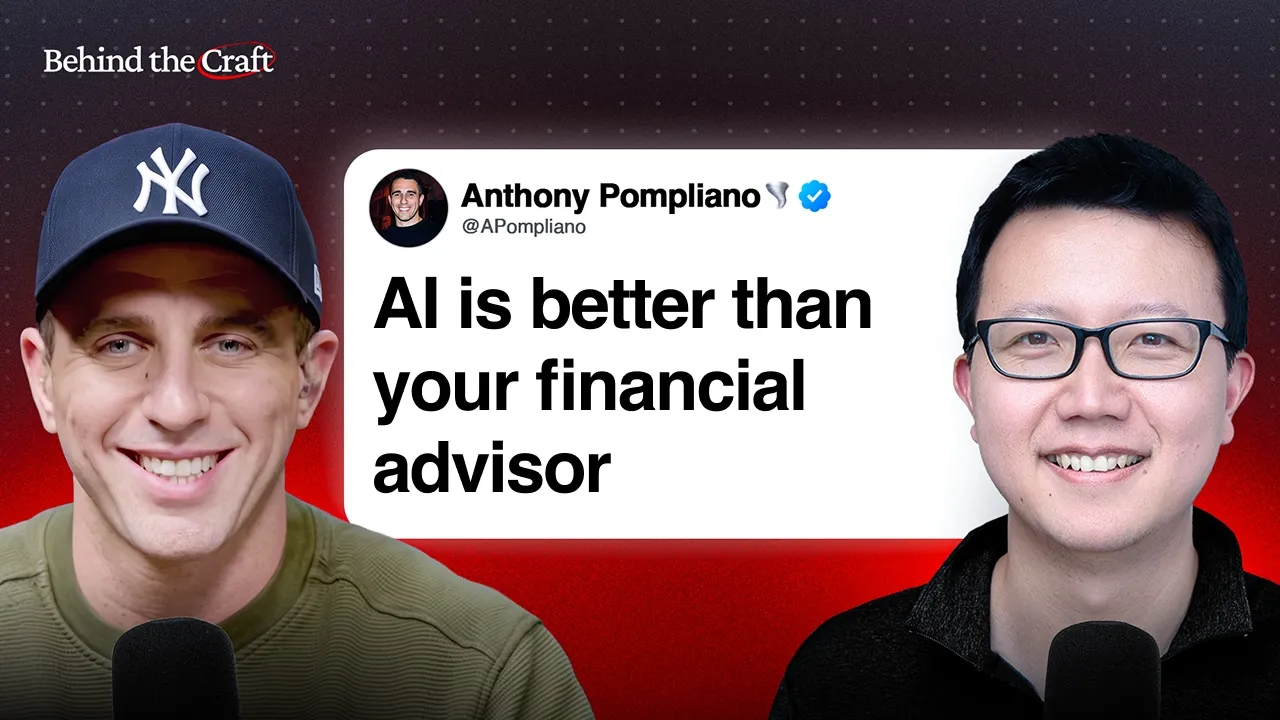
Pompliano Pitches Sub-10 Engineer AI CFO Silvia Against Tech Giants
Peter Yang
Pompliano contends specialized financial workflows and flexible model routing will allow lean vertical startups to beat trillion-dollar foundation labs on compounding investor wealth.
Anthony Pompliano's AI CFO startup, Silvia, operates with an engineering team of under 10 people to take on trillion-dollar tech incumbents, focusing exclusively on whether the product accelerates an investor's net worth growth. (0:00)
Silvia evolved from an initial ChatGPT wrapper into a proprietary intelligence stack featuring its own model router, domain fine-tuning for tax and credit code, and the specialized 'Silvia Analyst' coding agent. (22:16)
Pompliano has replaced traditional multi-round job interviews with 2- to 4-week paid work trials granting production access from day one, testing velocity and culture fit directly. (13:56)
Data across tens of thousands of Silvia users reveals an average portfolio allocation of 10% in cryptocurrency, driven largely by millennials seeking protection against continuous monetary debasement. (36:01)
Detailed notes
## Background
Published on YouTube by Peter Yang on October 18, 2026, this video features a conversation with investor, author, and CEO Anthony Pompliano about forging an extraordinary career without a rigid roadmap and building Silvia, an AI CFO designed for independent investors.
## TL;DR
Anthony Pompliano details his opportunistic career philosophy, explaining how treating audience as currency unlocked venture deal flow and why he replaced traditional interview loops with 2-to-4-week paid work trials. The discussion centers on Silvia, an AI CFO that evolved from a personal wealth-tracking spreadsheet into a proprietary intelligence stack capable of discovering six-figure tax strategies and orchestrating long-term estate planning for high-net-worth individuals. Pompliano explains how a lean team of under ten engineers can outmaneuver trillion-dollar AI labs through vertical specialization and model routing, while also sharing his perspective on Bitcoin as an inflation hedge and how he teaches his four young children to view themselves as problem solvers.
## Atmosphere & style
The dialogue carries the warm, conversational rhythm of two former Facebook colleagues catching up while maintaining an intense, high-signal focus on startup mechanics and modern leverage. Pompliano speaks with crisp, high-tempo conviction, discarding corporate jargon in favor of direct aphorisms, concrete operational benchmarks, and relatable personal anecdotes. The dynamic shifts effortlessly between deep technical architecture, candid wealth realities, and grounded family philosophy, giving the interview an energetic, pragmatic, and inspiring tone.
## Bulletin
- [00:00](https://www.youtube.com/watch?v=JXHStIulntQ&t=0s) Anthony Pompliano's AI CFO startup, Silvia, operates with an engineering team of under 10 people to take on trillion-dollar tech incumbents, focusing exclusively on whether the product accelerates an investor's net worth growth.
- [22:16](https://www.youtube.com/watch?v=JXHStIulntQ&t=1336s) Silvia evolved from an initial ChatGPT wrapper into a proprietary intelligence stack featuring its own model router, domain fine-tuning for tax and credit code, and the specialized 'Silvia Analyst' coding agent.
- [13:56](https://www.youtube.com/watch?v=JXHStIulntQ&t=836s) Pompliano has replaced traditional multi-round job interviews with 2- to 4-week paid work trials granting production access from day one, testing velocity and culture fit directly.
- [36:01](https://www.youtube.com/watch?v=JXHStIulntQ&t=2161s) Data across tens of thousands of Silvia users reveals an average portfolio allocation of 10% in cryptocurrency, driven largely by millennials seeking protection against continuous monetary debasement.
## Key takeaways
- [00:52](https://www.youtube.com/watch?v=JXHStIulntQ&t=52s) Pompliano defines an extraordinary life through two central pillars: working relentlessly to solve hard problems for others and doing so openly in front of his children.
- [02:00](https://www.youtube.com/watch?v=JXHStIulntQ&t=120s) Following rigid 10-year career plans is inferior to staying opportunistic, developing broad fluency across tech and finance, and aggressively tackling emergent bottlenecks.
- [04:43](https://www.youtube.com/watch?v=JXHStIulntQ&t=283s) Building a substantial personal audience serves as a primary currency for venture deal flow and proprietary investment access outside Silicon Valley.
- [08:53](https://www.youtube.com/watch?v=JXHStIulntQ&t=533s) Elite organizations achieve non-linear leverage (1 + 1 = 4 or 5) by assembling high-agency talent capable of running solo divisions within a zero-bureaucracy culture.
- [10:57](https://www.youtube.com/watch?v=JXHStIulntQ&t=657s) Hiring corporate veterans from big tech often fails in startups due to cultural conditioning around risk mitigation, slow decision cycles, and heavy resource dependency.
- [14:39](https://www.youtube.com/watch?v=JXHStIulntQ&t=879s) Paid work trials lasting two to four weeks reveal actual day-to-day productivity, responsiveness, and AI fluency far better than resume credentials or take-home assignments.
- [18:35](https://www.youtube.com/watch?v=JXHStIulntQ&t=1115s) Headcount additions should be evaluated by the incremental top-line revenue they unlock rather than defensive EBITDA margin protection.
- [18:35](https://www.youtube.com/watch?v=JXHStIulntQ&t=1115s) Non-revenue-generating functions like HR and accounting should remain tiny one- or two-person units augmented by automation and specialized external vendors.
- [20:32](https://www.youtube.com/watch?v=JXHStIulntQ&t=1232s) Silvia bypasses the broad consumer budgeting market to address the complex balance sheet needs of high-net-worth investors averaging $2.5 million in connected assets.
- [22:16](https://www.youtube.com/watch?v=JXHStIulntQ&t=1336s) Owning the vertical intelligence stack via proprietary routers, custom agentic workflows, and fine-tuned models outperforms general frontier models on complex tax and estate planning.
- [25:00](https://www.youtube.com/watch?v=JXHStIulntQ&t=1500s) Holistic financial context allows AI to identify high-value tax moves—such as establishing a defined benefit plan to save hundreds of thousands of dollars annually—that generic models miss.
- [30:19](https://www.youtube.com/watch?v=JXHStIulntQ&t=1819s) Removing social judgment allows AI financial interfaces to extract deeper qualitative context, resulting in paying subscribers asking over 20 strategic questions per week.
- [32:08](https://www.youtube.com/watch?v=JXHStIulntQ&t=1928s) Small vertical teams outmaneuver frontier AI labs because independent applications can dynamically route across any model provider rather than being locked into proprietary lab infrastructure.
- [36:01](https://www.youtube.com/watch?v=JXHStIulntQ&t=2161s) Persistent fiat debasement rapidly distorts traditional price baselines across consumer goods, housing, and education, making scarce assets like Bitcoin essential portfolio components.
- [39:24](https://www.youtube.com/watch?v=JXHStIulntQ&t=2364s) Instilling an identity centered on solving problems equips children to navigate conflicts, negotiate effectively, and build productive lifelong habits.
## Detailed walkthrough
### [00:00](https://www.youtube.com/watch?v=JXHStIulntQ&t=0s) Competing with Trillion-Dollar Tech Giants with an AI CFO
Anthony Pompliano opens with the intense reality of building Silvia, an AI CFO designed for independent investors. While massive, trillion-dollar tech incumbents employ tens of thousands of people, Pompliano’s engineering team consists of fewer than ten people. For Pompliano, this asymmetry is an asset rather than a liability, because modern software building is no longer determined by raw headcount or capital resources, but by how effectively a team achieves leverage using the right foundation models. He frames the core value proposition of Silvia with absolute clarity around user outcomes: “If you use this product, does your net worth grow faster than if you did not use the product?”
Peter Yang introduces Pompliano, noting that the two worked together at Facebook a decade ago before Pompliano took a non-traditional path outside corporate tech. Since leaving big tech, Pompliano has become an investor, a prolific content creator with millions of followers, a bestselling author, and a public company founder and CEO.
- **Silvia engineering team size:** Under 10 engineers competing against trillion-dollar tech labs with tens of thousands of staff.
- **Core product benchmark:** Directly accelerating the rate at which an independent investor's net worth compounds.
---
[00:52](https://www.youtube.com/watch?v=JXHStIulntQ&t=52s) Redefining the "Extraordinary Life" Through Work and Family
Addressing Pompliano’s book, *How to Live an Extraordinary Life*, Yang asks how Pompliano actually defines that concept. Pompliano explains that the phrase means something radically different to everyone: some individuals want to travel the world while working as little as possible, others measure success through material possessions, and some focus exclusively on maximizing time with their children. In Pompliano's view, the tragedy for most people is that they never explicitly articulate what an extraordinary life looks like for themselves: “The conclusion I've come to is most people actually don't define what it is, and so they don't really know what they're chasing.”
For his own life, Pompliano has settled on a personal definition built around two central pillars: working relentlessly to solve hard problems for other people, and doing so in direct view of his children. Rather than drawing rigid boundaries between professional and personal life, he deliberately blurs them. By allowing his kids to watch him work, negotiate, build, and fail on a daily basis, they implicitly absorb work ethic, resilience, and problem-solving without the need for artificial lectures.
---
[02:00](https://www.youtube.com/watch?v=JXHStIulntQ&t=120s) Opportunistic Problem Solving Over 10-Year Career Plans
Yang recalls asking Pompliano years ago at Facebook how to become a Product Manager, observing that many tech workers in Silicon Valley let corporate ladder rungs (like reaching L7 or becoming a director) dictate their goals. Pompliano responds by contrasting two fundamental life strategies: backward-planning from a rigid 10-year target versus staying opportunistic. People who choose backward planning map out their destination in high school or college—such as deciding to become a managing director at an investment bank—and reverse-engineer the required credentials and tenure. Pompliano, however, operates entirely without multi-year career roadmaps, admitting with a laugh: “I don't know what I want to do next year.”
Instead, Pompliano focuses on building deep fluency across business, technology, and finance, watching for emerging shifts, and moving aggressively when an unsolved problem presents itself. Straight out of college, he launched two businesses from scratch. While he succeeded at zero-to-one product development, he realized he lacked the knowledge to scale a venture-scale business. He joined Facebook specifically to learn growth, scale, and analytics from the best in the industry. After Facebook, lacking an immediate startup idea, he pivoted to angel investing so he could back other founders and discover new opportunities.
Years later, Silvia came about through that same opportunistic lens: his top engineer was considering leaving, so Pompliano spent several days identifying his own biggest personal headache that an audience would also share. He realized he was manually updating a clunky net worth spreadsheet every week and month, which gave him the exact problem he needed to solve.
```mermaid
flowchart TD
accTitle: Pomp's Opportunistic Career Framework
accDescr: Flowchart illustrating how Pompliano identifies problems to dictate career moves rather than following 10-year plans.
subgraph Mindset["Career Mindset"]
A["Deep Fluency in Tech, Finance & Business"] --> B{"Encounter Major Personal Bottleneck"}
end
subgraph Actions["Problem-Driven Steps"]
B -->|"Zero-to-One Scaling Gap"| C["Join Facebook to Master Growth & Analytics"]
B -->|"Lack of New Company Idea"| D["Angel Invest to Learn & Spot Opportunities"]
B -->|"Manual Net Worth Tracking"| E["Build Silvia with Top Engineer"]
end
```
- **Early career:** Started two businesses right out of college, but hit a ceiling because they were non-venture-scale small businesses.
- **Why Facebook:** Joined to fill a concrete knowledge gap around scaling, infrastructure, metrics, and viral growth loops.
- **The inception of Silvia:** Born out of personal friction updating net worth tracking spreadsheets coupled with retaining a premier engineering talent.
- **Core philosophy:** “Look, I know the one thing about building a company is if you can solve a problem, you're able to build the business.”
---
[04:43](https://www.youtube.com/watch?v=JXHStIulntQ&t=283s) Helping Zuckerberg Grow His Reach and Treating Audience as Currency
Yang points out that after leaving Silicon Valley and spending time around Snapchat, Pompliano took the unusual step of moving back to North Carolina rather than staying in the tech bubble. Pompliano traces his media and audience strategy back to a pivotal 90-day assignment on Facebook's Pages growth team. Growth leadership pulled him aside to work directly alongside the VP of Communications and Mark Zuckerberg’s executive speechwriter to expand Zuckerberg's personal reach on Facebook, as well as Sheryl Sandberg's.
Working on Zuckerberg’s profile revealed the operational science behind social distribution: simple adjustments—like showing Zuckerberg's face clearly, including his dog Beast in photos, and testing precise keyword variations in post captions—dramatically swung algorithmic reach and user engagement. While helping outside brands transition to Facebook, Pompliano recognized that he had never applied these distribution principles to himself. Realizing he lacked deep founder deal flow outside the Bay Area, he decided to turn an audience into an unfair investment advantage. As Pompliano put it: “Hey, audience is going to be a currency in the future.” In 2016, he committed fully to content creation and audience development to generate proprietary deal access.
- **The executive growth task force:** Spent 90 days working with Facebook comms leadership to scale Mark Zuckerberg’s and Sheryl Sandberg’s follower footprints.
- **Algorithmic discoveries:** Simple visual cues (such as including the founder's dog or framing facial expressions) and specific text triggers markedly increased post distribution.
- **Audience as leverage:** Launched his personal media platform in 2016 to bypass traditional venture networks and win access to competitive investment rounds.
---
[06:38](https://www.youtube.com/watch?v=JXHStIulntQ&t=398s) Sponsor: Recording and Editing Workflows with Riverside
Yang pauses the interview to highlight Riverside, the platform used to record the conversation. He highlights the software's reliability, noting that it records each participant locally in 4K resolution so that unexpected Wi-Fi interruptions or poor guest connectivity do not degrade the master video or audio files.
Beyond raw capture, Yang emphasizes Riverside’s post-production AI toolset, which proves essential for solo creators:
- Automatic detection and removal of unnatural pauses and filler words.
- Direct, text-based transcript editing that modifies the underlying video timeline.
- Instant, automated clip generation with baked-in captions optimized for YouTube, Spotify, and social feeds directly from the dashboard.
[07:37](https://www.youtube.com/watch?v=JXHStIulntQ&t=457s) Why Pomp Started Investing: Learning as a Return on Time
When Peter Yang asks whether Anthony Pompliano pursued investing because he loved working with founders or simply to make money, Pomp laughs and admits he had no idea if he would be good at it or make any money at all. His very first fund was a modest $3.5 million pre-seed fund launched alongside his partner at the time, Jason. They took zero compensation—not even charging a management fee—treating the entire vehicle as a low-stakes experiment to test their interest and skill before attempting to raise massive capital. They wanted to walk before they ran.
Pomp quickly discovered that the day-to-day work of venture investing provided an unmatched vantage point into the future. Even when he chose not to write a check, meeting founders allowed him to track emerging technology trends and synthesize patterns early. He observed how technologies being deployed in one niche could cross-pollinate into entirely separate industries. For Pomp, that intellectual compounding outweighed the distant prospect of financial upside: “And so to me it was almost like I was having the opportunity to potentially make money in the future, but being able to learn on a day-to-day basis and so the learning was actually a return on my time that I was just that alone was worth it and then the fact that maybe over the long run I could make money obviously just sweetened the deal.”
- Started with a $3.5 million pre-seed fund with partner Jason, taking no management fee or direct compensation.
- Treated the first fund as an experiment to test their skills and genuine enjoyment before scaling up.
- Viewed direct exposure to emerging tech trends and day-to-day learning as an immediate return on time, with financial gains serving as an added long-term bonus.
---
[08:53](https://www.youtube.com/watch?v=JXHStIulntQ&t=533s) The Facebook Magic and the Reality of Going Solo
Peter contrasts the bird's-eye view of investing with the narrow lens of working on a single product feature at Facebook, where both he and Pomp worked a decade earlier. Pomp reflects on that era as a uniquely formative, once-in-a-career experience. During his roughly two-year tenure, Facebook surged from around 3,000 employees to 12,000. Despite the explosive scaling, the company maintained an intense, high-density talent pool bound by a siege mentality: it felt like "Facebook versus the world" amid constant public scrutiny, attacks, and skepticism about monetization and platform trust. Pomp notes that uniting brilliant, loyal operators who execute rapidly under clear vision from leaders like Mark Zuckerberg and Sheryl Sandberg produces extraordinary momentum.
Peter mentions his recent transition into working solo, confessing that while the flexibility to pick up his kids is great, the isolation is real: “I actually think the whole one-person company thing is kind of overrated now that I'm doing it.” Talking to AI agents, he jokes, cannot replace the camaraderie of building alongside talented teammates. Pomp agrees, explaining that the true power of an elite organization is taking individuals who have the capability to run solo companies and grouping them into a single environment. When each person functions effectively as their own one-person division or product owner within a fast, no-bullshit culture, organizational output multiplies non-linearly: "1 + 1 = 4 or 5."
```mermaid
flowchart TD
accTitle: High-Agency Team Leverage Model
accDescr: Flow showing how grouping high-agency operators into one team produces non-linear leverage compared to isolated solo businesses.
subgraph Solo["The Solo Trap"]
A["Single Operator"] -->|"Relies heavily on AI"| B["Operational Ceiling & Isolation"]
end
subgraph Network["The Facebook Multiplier"]
C["High-Agency Talent A"]
D["High-Agency Talent B"]
E["High-Agency Talent C"]
C & D & E -->|"Zero Bureaucracy + Shared Mission"| F["1-Person Divisions on One Team"]
F --> G["Non-Linear Output: 1 + 1 = 4 or 5"]
end
```
---
[10:57](https://www.youtube.com/watch?v=JXHStIulntQ&t=657s) The Failure of Big Resumes and Redefining Culture Fit
Peter asks how Pomp approaches hiring and delegation across his investing, media, and technology ventures, admitting that he struggles with finding the right people and leans too heavily on AI agents. Pomp outlines distinct chapters in his hiring career. At the beginning, with no brand or track record, hiring was an uphill battle to convince anyone to take a bet on an unproven company that might go out of business. Later, Pomp pivoted to what seemed like an obvious upgrade: poaching prestigious resumes from major tech corporations.
That strategy turned into an expensive mismatch. While every senior corporate hire was personally talented and executed assignments dutifully, their operational habits clashed violently with startup reality. Corporate veterans arrived primed for risk mitigation, heavy resource pools, and bureaucratic deliberation; Pomp’s culture operated on having an idea at 9:00 AM and shipping it by 10:30 AM. He realized that corporate conditioning acts like oil on startup water: “Culture is all about employee-company fit because there's cultures as I've seen that are, I think, horrible.” Pomp shifted toward recruiting hungry, high-agency candidates who lack extensive pedigree or corporate conditioning, as they have not internalized bureaucratic habits and thrive in fast-paced uncertainty.
- Stage 1: Convincing anyone available to join, struggling against perceived instability and an unpolished narrative.
- Stage 2: Poaching elite corporate resumes, which resulted in cultural friction around risk aversion, resource-heavy workflows, and deliberate pacing.
- Stage 3: Recruiting high-agency, ambitious individuals without corporate conditioning who match a bias for rapid shipping.
- Core philosophy: Culture is not inherently "good" or "bad"; it represents the alignment between the operating environment and individual wiring.
---
[13:56](https://www.youtube.com/watch?v=JXHStIulntQ&t=836s) Replacing Interviews with Paid Work Trials
Peter points out the hiring dilemma: big-company resumes offer clear credentials, so evaluating raw, uncredentialed talent with high agency requires a different screening mechanism. Pomp explains that traditional interview projects—where candidates are handed take-home assignments for two or three days—have become obsolete in his companies. Instead, he has almost completely phased out conventional interviewing in favor of real, in-the-trenches evaluations: “We have almost exclusively gone to if you want to work at one of our companies, you got to do a trial.”
For engineering, product, and analytics roles, candidates are placed on paid two-to-four-week trials compensated at competitive market rates. Rather than simulating hypothetical scenarios, the candidate is invited directly into Slack and granted access to production systems from day one. This structure enables the team to evaluate far more than abstract technical competence: it reveals true day-to-day productivity, code and output quality, responsiveness, communication clarity under pressure, and how naturally the individual integrates with the team dynamic.
[14:39](https://www.youtube.com/watch?v=JXHStIulntQ&t=879s) Paid Work Trials Over Multi-Round Interview Loops
Anthony Pompliano explains that the traditional corporate hiring playbook—dragging applicants through six to ten interviews, endless reference checks, and a month-long evaluation—is fundamentally broken. It wastes time and offers almost zero signal on whether a candidate can actually do the job. Instead, Pomp and his co-founder prefer a brief introductory conversation followed immediately by a two-to-four-week paid work trial. This setup immediately tests how candidates receive feedback, handle issues, and deal with course corrections. By the end of the trial period, both sides have complete certainty about mutual fit, avoiding the typical interview posturing and credential inflation.
Peter Yang points out that the interview format makes it easy for candidates to bluff, especially in an era where anyone can use generative AI to sound impressive. Pomp agrees, noting that while he expects employees to leverage AI once hired, a work trial reveals whether someone is simply regurgitating prompts or actually capable of independent critical thought and problem-solving. To illustrate, Pomp describes a recent technical hire at Silvia. Rather than putting the engineer through whiteboard interviews, the team handed him a self-contained product need: building a demo account for Silvia within two weeks so prospective users could test the platform without immediately connecting sensitive bank accounts. With minimal guidance other than "figure it out," the engineer mapped out the codebase, navigated the infrastructure, and delivered the feature.
When Peter asks how to handle situations where a trial goes poorly right out of the gate, Pomp emphasizes upfront alignment. Candidates know from day one that the trial is an open-ended audition; if either side realizes it is not a match, they have a direct, candid conversation and part ways without hard feelings. This transparency also encourages continuous, unvarnished feedback during the project—asking candidates to learn new skills on the fly to get features across the finish line—which mirrors real daily work far better than any canned interview question.
“I think that's where the world is starting to move a little bit more towards is it's kind of less credentialized, and it's much more just here's the problem, solve it.” — Anthony Pompliano
- **Speed to signal:** A short screening call followed by a 2- to 4-week trial delivers definitive hiring clarity in the same timeframe typical companies spend scheduling interviews.
- **Velocity as an onboarding mechanism:** The engineer shipped an entire functioning demo account during his trial, instantly proving his velocity before signing a permanent contract.
- **The decline of resume prestige:** Peter and Pomp agree that traditional badges like managing hundreds of people or having Big Tech resumes (e.g., Meta) are rapidly losing value compared to hands-on, AI-native builders with high agency.
```mermaid
flowchart TD
accTitle: Traditional Interview Process vs Paid Work Trial
accDescr: Comparison of a 4-week traditional multi-round interview loop against Silvia's 2-4 week paid work trial workflow.
subgraph Traditional["Traditional Hiring Loop"]
T1["Screening & 6-10 Interviews"] --> T2["Reference Checks"]
T2 --> T3["Offer Stage"]
T3 --> T4["Uncertainty on Actual Ability"]
end
subgraph Trial["Silvia's Work Trial Method"]
S1["Founder Intro Chat"] --> S2["Direct Paid Trial (2-4 Weeks)"]
S2 --> S3["Ship Real Product Feature"]
S3 --> S4["High Certainty & Working Velocity"]
end
```
[18:35](https://www.youtube.com/watch?v=JXHStIulntQ&t=1115s) Hiring for Incremental Revenue Instead of Protecting Margins
Peter shifts the conversation to hiring economics, admitting that when he looks to bring on help, he often worries about being too cheap or eroding his profit margins. Pomp counters that evaluating headcount through the lens of margin contraction is the wrong mental model. Instead of asking how much a salary will cut into current profits, he asks how much top-line revenue that specific individual can unlock for the company. If a business generates $100 in revenue with $30 in EBITDA, hiring an employee for $10 should not be framed as EBITDA dropping from $30 to $20; the question is whether that hire enables the company to generate $130 in revenue.
This philosophy heavily dictates team structure. Roles that do not directly generate revenue—such as massive in-house human resources or accounting departments—are deliberately kept tiny. Pomp avoids building large administrative hierarchies, preferring single-person or two-person internal teams supported by advanced software and specialized external vendors. He screens for candidates who thrive in high-leverage environments rather than empire-builders who measure their worth by direct reports. If an operational candidate expects to manage a 20-person finance department, that reaction serves as a fast filter to remove them from the pipeline, freeing up capital to invest heavily in revenue-generating talent.
“If they're dying, then they should be dying out of your process.” — Anthony Pompliano
- **The top-line calculation:** Base hiring decisions on top-line revenue expansion rather than defensive EBITDA preservation.
- **Lean overhead structure:** Non-revenue functions (HR, finance, operations) are staffed by small one- or two-person units equipped with modern automation and third-party vendors.
- **The headcount test:** Asking candidates how they feel about managing software and workflows instead of a 20-person team instantly filters out empire-builders from high-leverage individual contributors.
[20:32](https://www.youtube.com/watch?v=JXHStIulntQ&t=1232s) The Genesis of Silvia: From Personal Spreadsheet to AI CFO
Peter sets up the origin story of Silvia by detailing the pain points faced by independent creators and business owners: generating sporadic income from sponsors, losing roughly half of it to taxes every year, and blindly dumping excess cash into the S&P 500 because they lack the time and sophistication to manage investments actively. Pomp confirms that Silvia was born out of that exact frustration. It started as an internal tool to solve his own wealth-tracking headaches, which he had previously managed through an unwieldy, manually updated spreadsheet.
Pomp’s co-founder and CTO, Shane Nohr, initially automated that spreadsheet into a dynamic, real-time dashboard that tracked Pomp's entire net worth as asset prices fluctuated. Once the dashboard was operational, Nohr suggested layering artificial intelligence on top of the live financial data. Roughly 18 months prior, the earliest version of Silvia operated essentially as a specialized "ChatGPT wrapper," taking standard OpenAI models and passing them the structured context of Pomp's personal financial accounts alongside user queries.
After launching publicly and interviewing early users, Pomp noticed a clear gap in the market. The vast majority of consumer fintech applications focus almost exclusively on budgeting, expense tracking, and coupon clipping. Pomp explains that founders typically build those tools because budgeting is the problem they personally face, and it offers the largest total addressable market. Silvia deliberately abandoned that mass-market budgeting playbook to focus on the smaller, underserved demographic of independent investors who have accumulated significant capital and need proactive balance sheet intelligence rather than basic spending limits.
“It was a ChatGPT model with software around it that basically fed the context of my personal finances plus the query.” — Anthony Pompliano
- **From spreadsheet to software:** Silvia originated from a manual spreadsheet Pomp used before CTO Shane Nohr automated it into a live net-worth tracking engine.
- **Initial architecture:** The platform began 18 months earlier as an LLM wrapper that combined user queries with dynamic, account-level financial context.
- **Market positioning:** While traditional fintech targets broad consumer budgeting and savings, Silvia focuses exclusively on high-income, asset-heavy independent investors seeking balance-sheet optimization.
[22:16](https://www.youtube.com/watch?v=JXHStIulntQ&t=1336s) Building Beyond a Wrapper: Owning the Intelligence Stack
Anthony Pompliano explains that independent and self-directed wealthy investors represent an underserved demographic in fintech. Because Pomp belongs to this cohort himself, he intimately understands the friction points that generic consumer finance tools overlook. For instance, private banks typically require clients to submit updated personal financial statements every 90 days—a tedious administrative chore that Silvia reduced to a 30-second, one-click document generation. Engineers unfamiliar with high-net-worth individuals would never recognize that problem in the first place, let alone design a workflow for it. Pomp frames Silvia’s core value proposition around three pillars: technical innovation, deep empathy for the target demographic, and long-term memory and trust. Over an 18-month span, the company evolved from an initial ChatGPT wrapper into a completely proprietary infrastructure, showing that owning the intelligence stack boosts performance, enhances domain accuracy, and dramatically cuts operating costs. As Pompliano summarizes:
> “And so, our general thought process is like general intelligence is great for a lot of things, but in something like personal finance, the specialized workflows and owning your own intelligence is going to be the winning strategy.”
When Peter Yang asks what "owning your own intelligence" actually looks like under the hood, Pomp details their custom system architecture. Rather than relying purely on off-the-shelf foundation models, Silvia runs on a custom-engineered harness featuring a proprietary model router, tool calling frameworks, and specialized agents. Central to this system is the "Silvia Analyst," an internal coding agent specifically trained on their exact data architecture and workflows. Silvia has also fine-tuned its own models, demonstrating higher domain accuracy than general frontier models on complex tax code, mortgage structures, and credit mechanics. Backing this is what Pomp believes to be one of the largest datasets in the world of high-net-worth individuals conversing with an LLM about personal finances, enabling custom evaluation rubrics and reinforcement learning (RL) loops.
```mermaid
flowchart TD
accTitle: Silvia Intelligence Stack Architecture
accDescr: Technical layout showing the custom harness routing user queries to specialized tools, the Silvia Analyst, and domain-tuned models.
subgraph Interface["User Layer"]
U["Investor Queries & Data"]
end
subgraph CoreEngine["Silvia Custom Harness"]
R["Custom Model Router"]
A["Tool Calling & Agentic Memory"]
SA["Silvia Analyst (Proprietary Coding Agent)"]
end
U --> R
R --> A
R --> SA
A --> FM
SA --> FM
FM --> RL
RL --> DS
```
> “We don't want to be good at physics. We don't want to be good at interior design. We don't want to be good at crazy creative image generation. We just want to be the best in the world at personal finance.” — Anthony Pompliano
- **18-month architectural pivot**: Transitioned from a third-party API wrapper to owning the full infrastructure and proprietary fine-tuned models.
- **Solving private bank friction**: Replaced the manual 90-day personal financial statement update cycle with a 30-second automated export.
- **Domain focus**: Prioritized vertical benchmarks in tax, trusts, mortgages, and wealth management over generalized multimodal capabilities.
---
[25:00](https://www.youtube.com/watch?v=JXHStIulntQ&t=1500s) Contextual Tax Strategies and Generational Wealth Planning
Peter Yang notes that typical fintech users—such as the audience at Credit Karma—often live paycheck to paycheck, focusing on credit scores and rewards points, whereas tech workers and independent investors face entirely different asset optimization challenges. Pomp illustrates this gap with tax minimization: if an individual asks a generic LLM like ChatGPT or Google how to reduce their taxes, the model can only offer high-level platitudes because it lacks holistic context. Lowering a high-earner's tax bill requires synthesizing live Plaid bank connections, brokerage holdings, real estate equity, trust entities, jurisdiction-specific tax codes, and family dependencies. In one real-world Silvia case, a user asked how to cut their tax burden. Silvia analyzed their multi-year high income alongside an entity where the user was the sole owner and employee, and recommended establishing a defined benefit plan with the user as the sole beneficiary—a structural move that saved hundreds of thousands of dollars per year.
Beyond tax execution, Silvia addresses generational wealth planning and knowledge transfer. Young wealth builders often fail to leave comprehensive instructions for their heirs. Pomp shares the story of a friend who built a custom home with an ultra-low 2% fixed mortgage and wrote an explicit emergency manual for his wife because she reflexively hates debt and would have immediately liquidated investments to pay off the mortgage. To facilitate this level of planning, Silvia built a custom agentic memory system and specialized file architecture. Users employ Silvia almost like an interactive financial diary, documenting why they bought specific assets, their long-term thesis, and exact instructions on how future generations should manage the portfolio. This architectural focus shifts fintech away from short-term speculative trading toward decade-long estate strategy.
> “This is a product that allows you to think super long-term around estate planning, taxes, those types of things.” — Anthony Pompliano
- **Holistic tax discovery**: Identified a defined benefit plan for a solopreneur user with persistent high earnings, saving hundreds of thousands of dollars in annual taxes.
- **Generational estate playbook**: Solved the "manual for heirs" problem by letting investors document rationale, debt strategies (e.g., maintaining low-rate mortgages), and succession roadmaps.
- **Custom memory architecture**: Implemented a dedicated agentic memory file system designed to store longitudinal context over years rather than single chat sessions.
---
[28:08](https://www.youtube.com/watch?v=JXHStIulntQ&t=1688s) Turning Complex Personal Finance into a Proactive AI Partner
Peter highlights a common frustration with human financial advisors and CPAs: they are notoriously reactive rather than proactive, typically handing clients an enormous tax bill at the end of the year with zero forward-looking recommendations. Pomp points out that traditional fintech software never asks users about their qualitative philosophies or personal financial values. To bridge this, Silvia encourages new users to initiate onboarding with the prompt, “Interview me so you can get the relevant information you need to be helpful.” Silvia then systematically probes for both quantifiable details (jurisdiction, dependent count, rules-based asset allocations) and subjective risk tolerances.
> “People who have 500 bucks in a Robinhood account don't have a lot of complexity. People who The average user connects 2.5 million dollars to the product. So, people with 2 and 1/2 million bucks, they got a lot of complexity.” — Anthony Pompliano
This deep context engine drives exceptional engagement among its target tier: 25% of all monthly active users convert into paying subscribers, and paying subscribers ask Silvia more than 20 questions each week. Pomp observes that AI shines brightest when tackling high-dimensional complexity. While small trading accounts have few moving parts, Silvia's average user links $2.5 million in connected assets. These investors constantly juggle high-stakes questions that rarely get asked of expensive hourly accountants—such as tax-mitigated methods for a $10,000 philanthropic gift, comparing 529 college savings plans against custodial accounts, or structuring emerging wealth vehicles. Silvia functions as an always-accessible strategic partner for inquiries users hesitate to raise during brief, billable check-ins with human advisors.
- **High user engagement**: 25% of monthly active users are paying subscribers.
- **Deep product usage**: Paid members average more than 20 questions per week.
- **Substantial wealth footprint**: The average Silvia user connects $2.5 million in assets to the platform.
- **Everyday strategic queries**: Regularly models scenarios involving 529 college savings accounts, donor-advised philanthropy, and entity-level tax shelters.
[30:19](https://www.youtube.com/watch?v=JXHStIulntQ&t=1819s) The Judgment-Free AI and Privacy by Design
Peter Yang points out a psychological barrier people face when consulting human experts: clients often have dozens of questions but hold back because of strict 30-to-60-minute time limits and the fear of looking unintelligent. Anthony Pompliano agrees, emphasizing that an AI interface completely strips away social friction: “With the AI, you can ask anything and what we find is people tell the AI more stuff in terms of context and they ask more questions that they would otherwise refrain from doing with a human expert.” This dynamic creates a self-reinforcing flywheel: the more users share without fear of judgment, the smarter and more tailored the AI becomes, encouraging users to lean on it even further.
```mermaid
flowchart TD
accTitle: Judgment-Free AI Flywheel
accDescr: Cycle showing how removing judgment drives deeper user engagement and model intelligence.
A["User asks questions without fear of judgment"] --> B["Provides richer financial context"]
B --> C["AI yields more precise, tailored insights"]
C --> D["User asks deeper, more frequent questions"]
D --> A
```
When Peter brings up the primary consumer hesitation around connecting bank credentials—fear of data theft—Pompliano explains that protecting user data was paramount from day one, particularly since he was Silvia's very first customer and didn't want internal engineers poking around in his private finances. To guarantee security, the platform implemented bank-level encryption, achieved SOC 2 certification, anonymized personally identifiable information (PII) on the back end, and established strict zero-data-retention agreements with every foundation model lab used in their routing stack. Understanding that security certifications still won't persuade everyone, Silvia also introduced manual account creation and manual asset contribution. This allows cautious users to input their portfolios entirely by hand and enjoy the product's benefits without ever linking a live financial institution.
[32:08](https://www.youtube.com/watch?v=JXHStIulntQ&t=1928s) Competing with Trillion-Dollar AI Labs
Peter asks how a small startup can survive when frontier AI labs inevitably push into personal finance. Pompliano recounts the bittersweet jolt of watching a trillion-dollar titan target their space, an event that instantly flooded his inbox with anxious questions from every investor and partner in the company. Despite the massive scale disparity, Pompliano argues that large foundation labs face structural disadvantages in vertical markets. First, giant labs are economically bound to route queries exclusively through their own models, whereas an independent application can dynamically route queries across any provider to get the best result. Second, monolithic labs build broad general intelligence intended for every possible task, making it exceptionally difficult to compete with a team obsessed entirely with specialized personal finance workflows and proprietary intelligence.
Pompliano highlights the immense asymmetric leverage modern AI offers: Silvia’s engineering team has fewer than ten people and has not raised hundreds of billions of dollars, yet they can outmaneuver corporate giants by staying laser-focused on a single domain. Users will eventually choose between an all-in-one assistant—handling Amazon shopping, babysitters, and general chat—and a dedicated financial brain. Pompliano stresses that Silvia's ultimate benchmark is strictly practical: “The single thing that matters in this business is can we get these people to make more money?” Whether by unlocking investments, legally mitigating taxes, or streamlining estate planning, proving a tangible increase in net worth is the sole scorecard that counts. Peter adds that saving time on tedious tasks, such as scanning lengthy tax returns, provides equally undeniable value.
- **David vs. Goliath resources**: Trillion-dollar tech labs maintain tens of thousands of employees and massive capital reserves, while Silvia operates with an engineering team of under 10 people.
- **Model routing flexibility**: Foundation labs are trapped by their own commercial incentives to use internal models, whereas Silvia can route queries to whichever external or internal model handles a specific financial task best.
- **Core value proposition**: Product features and optimizations are evaluated against a single metric: whether they make the user's net worth grow faster than it would have otherwise.
[36:01](https://www.youtube.com/watch?v=JXHStIulntQ&t=2161s) Bitcoin Allocations and the Reality of Monetary Inflation
Turning to crypto, Peter asks Pompliano for his current stance on Bitcoin and whether regular investors should include it in a balanced portfolio. Setting aside his personal passion, Pompliano references real data from tens of thousands of Silvia users: the platform shows an average crypto allocation of approximately 10%. He observes that this figure sits directly between the ultra-conservative advice of traditional wealth advisors (who recommend 0% to 3%) and hardcore Bitcoin maximalists who believe 99.9% of one's wealth belongs in Bitcoin with only enough cash left over to buy breakfast. Silvia’s user base predominantly consists of millennials who have built up capital; an average 10% holding indicates they likely started with a 5% to 7% allocation that expanded organically through asset appreciation or disciplined dollar-cost averaging.
Pompliano summarizes his forward-looking philosophy: “My general view of Bitcoin going forward is it is just an asset you put in your portfolio and let the government make it more expensive over time.” Because persistent government money printing continuously erodes purchasing power, holding non-consumable scarce assets is essential. To illustrate how radically currency debasement warps price baselines, Pompliano points to the automotive market. A standard modern Cadillac Escalade now tops $150,000—a sum that purchased a flagship Ferrari when he was in school. Meanwhile, high-end exotics like Ferrari's new electric vehicle command price tags upwards of $600,000, underscoring how relentless monetary inflation has permanently distorted everyday reference points from childhood.
[38:24](https://www.youtube.com/watch?v=JXHStIulntQ&t=2304s) The Rising Cost of Living and Education
Picking up on the escalating costs of life and the necessity of owning appreciating assets, Peter Yang points out how dramatically tuition and schooling have soared. While college tuition ran around $40,000 per year when he attended, it now reaches $80,000 to $100,000—and even private preschools now command upwards of $50,000 a year. Anthony Pompliano shares an anecdote about a friend in New York City who just went through the admissions process and is paying an eye-watering $60,000 to $70,000 a year for kindergarten. The demand is so high that parents are subjected to competitive interviews alongside the children just to secure a spot.
```mermaid
flowchart LR
accTitle: Rising Education Costs Escalation
accDescr: Progression from historical college tuition to modern kindergarten fees.
A["Past College Tuition<br>~$40K / year"] --> B["Modern College Tuition<br>$80K - $100K / year"]
B --> C["Private Preschool<br>~$50K / year"]
C --> D["NYC Kindergarten<br>$60K - $70K / year + Parent Interviews"]
```
Reflecting on the pursuit of status and wealth, Peter notes that as people grow older, endless money becomes less vital than simply having control over personal time.
- College tuition has surged from around $40,000 per year in previous years to between $80,000 and $100,000 today.
- Private preschools frequently charge $50,000 per year.
- Elite private kindergartens in New York City run between $60,000 and $70,000 annually and require parent interviews for admission.
---
[39:24](https://www.youtube.com/watch?v=JXHStIulntQ&t=2364s) Parenting Four Kids Under Five and Teaching Problem-Solving
Peter pivots to parenting, asking how Anthony and his wife Polina manage their family and careers given that they have four children, all under the age of five. Stunned by the headcount, Peter asks how Anthony gets any work done at all. Anthony explains that his family life connects directly back to his core definition of an extraordinary life: working hard to solve meaningful problems while modeling that work ethic for his children. Rather than segregating his obligations, he integrates work and home life by bringing his children along to events, discussing his daily tasks with them, and asking about their days.
When Peter asks whether Anthony has a specific educational philosophy—like encouraging kids to launch a business in high school rather than following the traditional college track—Anthony reveals the single principle he actively drills into his children:
> “One thing I tell my kids, I always ask them, ‘What do you do?’ And I have them repeat back to me as, ‘We solve problems.’”
Anthony explains that the specific career path does not matter as long as this mindset is present. Whether they choose to become professional athletes, entertainers, founders, or construction workers, adopting the identity of a problem solver steers them toward active creation and becoming productive, contributing members of society instead of falling into unproductive paths. He applies the exact same framework to daily sibling conflicts. When one child complains that another took a toy, instead of intervening immediately, he asks them how they plan to solve the problem, guiding them away from simply grabbing it back and encouraging them to explore alternative tactics like negotiation and trading.
Peter compares this outlook to Arnold Schwarzenegger's motto, noting, “Like Arnold Schwarzenegger said, like, you got to be useful, you know?” Anthony embraces the idea, noting he had not heard it phrased that way before, while Peter recommends reading Schwarzenegger's book. Wrapping up the interview, Anthony directs listeners to find his project at silvia.com, and the two former Facebook colleagues conclude by exchanging mutual appreciation and praise for each other's work and careers.
- Anthony and Polina Pompliano have four children, all under the age of five.
- Anthony integrates family and professional life by involving his kids in his daily activities rather than keeping them entirely separate.
- The Pompliano parenting mantra revolves around getting his kids to answer the question "What do you do?" with "We solve problems."
- Day-to-day conflicts at home are treated as practical exercises in problem-solving and negotiation rather than disputes settled by parental decree.
## Notable quotes
> [36:01](https://www.youtube.com/watch?v=JXHStIulntQ&t=2161s) My general view of Bitcoin going forward is it is just an asset you put in your portfolio and let the government make it more expensive over time. — Anthony Pompliano
> [22:16](https://www.youtube.com/watch?v=JXHStIulntQ&t=1336s) general intelligence is great for a lot of things, but in something like personal finance, the specialized workflows and owning your own intelligence is going to be the winning strategy. — Anthony Pompliano
> [22:16](https://www.youtube.com/watch?v=JXHStIulntQ&t=1336s) We don't want to be good at physics. We don't want to be good at interior design. We don't want to be good at crazy creative image generation. We just want to be the best in the world at personal finance. — Anthony Pompliano
> [04:43](https://www.youtube.com/watch?v=JXHStIulntQ&t=283s) audience is going to be a currency in the future. — Anthony Pompliano
> [08:53](https://www.youtube.com/watch?v=JXHStIulntQ&t=533s) I actually think the whole one-person company thing is kind of overrated now that I'm doing it. — Peter Yang
## Mentioned
Anthony Pompliano, Peter Yang, Silvia, Facebook, Mark Zuckerberg, Sheryl Sandberg, Riverside, Shane Nohr, ChatGPT, OpenAI, Plaid, Credit Karma, Robinhood, Bitcoin, Polina Pompliano, Arnold Schwarzenegger
## Video description
Pomp and I worked together at Facebook a decade ago before he became an investor, best-selling author, and public company CEO with an audience of 3.3M. We had a great chat about how to build an extraordinary career and life and how he's building Silvia, an AI CFO for independent investors, to take on the AI labs.
Pomp and I talked about:
(00:00) Why Pomp never had a career plan
(04:43) Why an audience is the best way to win deal flow
(10:33) Paid work trials instead of job interviews
(18:35) Hire for revenue, not margins
(20:32) Silvia: An AI CFO for independent investors
(25:00) How AI found a tax strategy worth $100Ks a year
(32:05) How a team of under 10 plans to compete with the AI labs
(35:58) Pomp’s latest take on Bitcoin
(39:21) How Pomp teaches his four kids to solve problems
Thanks to our sponsors:
Riverside: All-in-one AI studio for podcasts and video https://creators.riverside.com/PeterYang
📌 Get the takeaways: https://creatoreconomy.so/p/we-built-an-ai-cfo-to-help-you-grow-net-worth-anthony-pompliano
Pompliano推介不足十人团队的AI CFO Silvia,直面科技巨头
Pompliano主张,专业的财务工作流和灵活的模型路由将让精简的垂直初创公司在为投资者积累财富方面击败万亿美元级的基础实验室。
Anthony Pompliano详细阐述了他抓住机遇的职业哲学,解释了如何将受众视为通用资产以获取风投交易流,以及他为何用2至4周的带薪试工取代传统的轮流面试。讨论的核心是AI首席财务官(AI CFO)Silvia,它最初只是一个个人财富追踪电子表格,后来演变成专有智能技术栈,能够为高净值人士发掘六位数的节税策略并统筹长期遗产规划。Pompliano解释了不足十名工程师的精简团队如何通过垂直专业化和模型路由战胜万亿美元级的AI实验室,同时他还分享了关于比特币作为抗通胀对冲工具的看法,以及他如何教导自己的四个幼子将自己视为问题的解决者。
Anthony Pompliano的AI CFO初创公司Silvia仅凭不足10人的工程团队对抗万亿美元级的科技巨头,全力聚焦于该产品能否加速投资者的净资产增长。 (0:00)
Silvia从最初的ChatGPT套壳产品演变为专有智能技术栈,具备自研的模型路由器、针对税法和信贷法规的领域微调,以及专用的“Silvia Analyst”代码智能体。 (22:16)
Pompliano用2至4周、第一天就开放生产权限的带薪试工取代了传统的多轮招聘面试,直接考察工作速度与文化契合度。 (13:56)
来自数万名Silvia用户的数据显示,其加密货币的平均投资组合配置比例为10%,这主要是由寻求抵御持续货币贬值的千禧一代所推动。 (36:01)
Reading summary
Investor and entrepreneur Anthony Pompliano argues that small, specialized teams leveraging artificial intelligence can outmaneuver trillion-dollar tech incumbents by focusing on high-stakes vertical workflows. Using his financial platform Silvia as a case study, Pompliano details how lean operational structures, paid work trials, and domain-specific intelligence can solve complex balance sheet problems for independent wealth builders.
Specialized AI Wealth Management for Complex Balance Sheets (20:32)
Silvia originated from Pompliano's personal frustration with manually updating spreadsheets to track his net worth. Developed alongside co-founder Shane Nohr, the platform initially launched as a ChatGPT wrapper before transitioning over 18 months into a proprietary intelligence stack. This infrastructure incorporates a custom model router, domain-fine-tuned models for tax and mortgage structures, and an internal coding agent dubbed the Silvia Analyst. Rather than competing in the crowded consumer fintech space of budgeting and expense tracking, the platform targets self-directed investors with substantial assets.
Pompliano reports that the average user connects $2.5 million in assets to the platform, with 25% of monthly active users converting into paid subscribers who ask more than 20 questions weekly. The tool addresses strategic financial needs that conventional software overlooks, such as structuring defined benefit plans to reduce six-figure tax liabilities for solo business owners, automating 90-day personal financial statements for private banks, and documenting generational estate manuals with persistent, agentic memory.
Competing with Tech Giants Through Asymmetric Agility (32:08)
Pompliano asserts that an engineering team of fewer than ten people can effectively challenge trillion-dollar artificial intelligence labs because software development is no longer dictated by headcount or raw capital. Frontier foundation labs face commercial constraints that force them to route queries exclusively through their own models, whereas an independent application can dynamically route queries to whichever specialized model handles a financial query best. Furthermore, general-purpose models prioritize broad multimodal tasks, leaving vertical domains like personal finance underserved.
To address user privacy concerns regarding sensitive bank credentials, the platform utilizes bank-level encryption, SOC 2 certification, and zero-data-retention agreements with external foundation model providers, alongside manual portfolio entry for users who decline direct account linking. Pompliano notes that an AI interface removes the social friction and fear of judgment common in brief, billable sessions with human accountants, encouraging users to provide deeper context that sharpens the system's output.
Replacing Traditional Hiring Loops with Paid Work Trials (14:39)
Pompliano describes conventional multi-round corporate interviewing loops as obsolete, arguing that resumes from large technology firms often conceal an inability to execute under startup conditions. To identify high-agency builders, his companies have largely replaced interviews and take-home tests with two-to-four-week paid work trials on live production systems. For instance, Silvia evaluated a technical hire by tasking him with delivering a functional product demo account within two weeks with minimal guidance, immediately validating his velocity and independent problem-solving skills.
This operational philosophy evaluates headcount by top-line revenue expansion rather than defensive margin preservation. Non-revenue administrative departments, including human resources and accounting, are intentionally capped at one or two internal personnel supported by specialized software and external vendors. Pompliano uses this setup as a filter: operational candidates who expect to manage large administrative hierarchies are systematically disqualified in favor of individual contributors who operate with high leverage.
Opportunistic Careers, Asset Inflation, and Foundational Mindsets (2:00)
Rather than following rigid multi-year career plans, Pompliano advocates building broad business fluency and opportunistically tackling bottlenecks. He applied this pattern by founding early startups, joining Facebook to study scale and distribution, and using social audience as currency to generate proprietary venture deal flow. That media strategy originated from a 90-day assignment optimizing follower reach for Mark Zuckerberg and Sheryl Sandberg, which demonstrated the algorithmic power of specific framing and visual cues.
Addressing macro trends, Pompliano notes that Silvia users hold an average crypto allocation of approximately 10%, which he interprets as a pragmatic hedge against monetary inflation. Pointing to rising prices—such as modern automotive costs, college tuitions reaching $100,000, and private New York City kindergartens costing up to $70,000—he views scarce assets as essential for preserving purchasing power. At home, Pompliano and his wife Polina instill a similar problem-solving framework in their four young children, teaching them to resolve conflicts and approach careers through the explicit identity of being problem solvers.
Pompliano measures the success of vertical AI applications on a single commercial outcome: whether the product demonstrably accelerates a user's net worth growth faster than traditional methods. The enduring question remains whether specialized vertical software harnesses can maintain a defensive moat as foundational models steadily improve their native financial and reasoning capabilities.
[36:01] Anthony Pompliano: My general view of Bitcoin going forward is it is just an asset you put in your portfolio and let the government make it more expensive over time.
[22:16] Anthony Pompliano: general intelligence is great for a lot of things, but in something like personal finance, the specialized workflows and owning your own intelligence is going to be the winning strategy.
[22:16] Anthony Pompliano: We don't want to be good at physics. We don't want to be good at interior design. We don't want to be good at crazy creative image generation. We just want to be the best in the world at personal finance.
[4:43] Anthony Pompliano: audience is going to be a currency in the future.
[8:53] Peter Yang: I actually think the whole one-person company thing is kind of overrated now that I'm doing it.
Original transcript
[0:00] They are coming after us. Peter, do you
[0:01] know what it's like to wake up one day
[0:03] and you've been waiting for a trillion
[0:05] dollar company to compete with you? That
[0:07] happened to me. It was awesome. These
[0:08] companies have tens of thousands of
[0:10] employees. Our engineering team is less
[0:12] than 10 people, [music] but it's not
[0:13] about how many resources you have now.
[0:15] It is all about how do you get the most
[0:17] leverage using the right approach with
[0:19] the models. That is ultimately the goal
[0:21] of the business, right? If you use this
[0:23] product, does your net worth grow faster
[0:25] than if you did not use the product?
[0:29] >> Everyone, today I'm very excited to
[0:31] welcome the one and only Pomp. A long
[0:33] time ago, we both worked at Facebook,
[0:34] but Anthony has since had a very
[0:36] different path. From the corporate
[0:37] ladder, he became an investor, a
[0:38] creator, author, and now a founder
[0:40] running Silva, which is an AI CFO for
[0:43] independent investors. So, welcome, sir.
[0:45] Really excited to have you here.
[0:46] >> Absolutely. Great to see you again.
[0:47] >> Yeah. So, why don't we actually start
[0:49] with your career cuz I think it's very
[0:51] interesting. I think why don't we start
[0:52] with this? I I read your book How to
[0:54] Live an Extraordinary Life, right? And
[0:56] then you're very successful at your
[0:57] career, but how would you actually
[0:58] define what an extraordinary life is?
[1:01] >> It's one of my favorite things to talk
[1:02] about because I think everyone has a
[1:03] different definition. And you can learn
[1:05] a lot by asking someone what their
[1:06] definition is. Some people are like, "My
[1:08] extraordinary life is I want to work as
[1:11] hard as I possibly can and solve
[1:12] problems for other people." I think
[1:14] other people say, "I actually want to
[1:16] work as little as possible and I want to
[1:17] travel around the world and experience
[1:19] things." Some people judge their
[1:21] extraordinary life by how much time they
[1:22] spend with their kids or how many
[1:24] material possessions they have. And I
[1:25] think the conclusion I've come to is
[1:27] most people actually don't define what
[1:29] it is, and so they don't really know
[1:30] what they're chasing. For me personally,
[1:32] I think about two components is I want
[1:34] to work hard and solve problems for
[1:36] other people, but I want to do it in a
[1:37] way where my kids can see me doing that
[1:39] on a day-to-day basis so that they
[1:41] implicitly learn things like hard work,
[1:44] effort, etc. And so, what that means is
[1:45] I want to blend my life. My professional
[1:47] and personal lives come together, and I
[1:50] want to build these businesses, solve
[1:51] these problems, but I want to do it in
[1:53] front of my children so that they're
[1:54] able to kind of soak that stuff in.
[1:57] >> Got it. Okay, so you want to kind of
[1:58] lead by example for your kids. Yeah.
[2:00] >> Correct.
[2:00] >> So dude, so like 10 years ago or
[2:01] something, we were both at Facebook,
[2:03] right? And I remember asking you, I
[2:04] don't even remember this. I'm like, "Hey
[2:05] Anthony, how do I become a PM? I really
[2:07] want to become a PM."
[2:08] PM at Facebook. And I feel like a lot of
[2:10] people in the Bay Area, they don't
[2:11] actually define their life themselves.
[2:13] They kind of let the company define
[2:14] their life for them. They're like, "Hey,
[2:15] you're successful if you become a
[2:17] director or if you become a L L 7." And
[2:18] I've always found your career super
[2:19] inspirational, man. Because after
[2:21] Facebook, you went to do a whole bunch
[2:23] of other things, kind of struck out on
[2:24] your own. And maybe you can kind of walk
[2:26] through this journey that you'd be on
[2:27] and some of the decisions that you made
[2:29] along the way.
[2:30] >> Yeah, look, I I I think there's two
[2:31] types of people. Some people are kind of
[2:32] let me put together a 10-year plan and
[2:34] figure out what I want to do and then
[2:36] work backwards. Uh those people usually
[2:38] they kind of know where they want to go
[2:39] to college when they're in starting high
[2:41] school and then they work towards that
[2:42] path. Uh there's folks who in college
[2:44] say, "Hey, I want to be an MD at an
[2:46] investment bank." Then they work
[2:48] backwards and say, "Well, in order to do
[2:49] that I got to get a job at this
[2:50] organization. I got to stay there for 3
[2:52] years. I got to do this, this, and
[2:53] this." My career's been very different,
[2:55] right? I kind of took the second path,
[2:56] which was uh I'm very interested in
[2:58] business, technology, and finance. Uh I
[3:01] want to stay on top of what the latest,
[3:03] greatest, newest things are and then I
[3:05] want to find opportunities and be as
[3:07] opportunistic as I can. And so what that
[3:09] allowed me to do was even if you think
[3:11] about Facebook, I had never thought
[3:12] about going and getting a job at any
[3:14] company. I right out of college started
[3:16] my first business and after those first
[3:18] two businesses, I really realized that,
[3:20] "Wait a second, I don't know how to
[3:21] scale any of this stuff. I'm really good
[3:23] at going zero to one and then I kind of
[3:24] have a
[3:25] >> like a basically successful small
[3:26] business that isn't really venture
[3:27] backable. And so the idea to go to
[3:29] Facebook was maybe I could learn that
[3:30] there. They're pretty good at scaling,
[3:31] they're pretty good at growth and
[3:32] analytics. Um and so the opportunity was
[3:35] I have a problem, let me go solve that.
[3:37] I'll go to Facebook. If you think about
[3:38] uh after Facebook, I wanted to learn
[3:40] investing and it was cuz I didn't have
[3:42] an idea to go build my own business. And
[3:44] so it was, "Well, let me go find other
[3:45] people. I'll just put some money in
[3:46] their business and then I'll help them."
[3:48] And maybe that'll help spur an idea for
[3:49] me to to create another business. And if
[3:52] you fast forward to today, the Silvia
[3:53] product is maybe the best example where
[3:55] the best engineer we had working at any
[3:57] of our companies, he was thinking about
[3:58] leaving, didn't really know what he
[3:59] wanted to do. And I said to him, I said,
[4:01] "Look, I know the one thing about
[4:02] building a company is if you can solve a
[4:04] problem, you're able to build the
[4:05] business." And so I just thought for a
[4:06] couple days, "What is the biggest
[4:08] problem I have in my life that also the
[4:10] audience would likely have as well?" And
[4:12] I had a spreadsheet, and that
[4:13] spreadsheet was a big pain in the butt
[4:15] because I'd have to go update it every
[4:17] single week or month. And so I just said
[4:19] to myself, "Well, let's solve that
[4:20] problem for me, and then we'll see if
[4:22] other people want it." And so whether
[4:23] it's getting a job at Facebook or
[4:24] starting a company, it literally is how
[4:26] do you go and find the biggest problem
[4:28] and then opportunistically go and tackle
[4:30] that. I think it has for me been a much
[4:31] better path than "What do I want to be
[4:33] in 20 years or 10 years?" and then
[4:34] working backwards.
[4:35] >> Yeah, cuz you don't really know what the
[4:36] hell you want to be in 20 years. And And
[4:38] I feel like
[4:38] >> I don't know what I want to do next
[4:39] year.
[4:40] >> [laughter]
[4:41] >> Yeah, but I I do feel like um you're
[4:43] pretty strategic about it. Like Like
[4:44] let's let's talk about building the
[4:45] audience cuz like after leaving Facebook
[4:47] and then you had something going on at
[4:48] Snapchat, and then you kind of like you
[4:50] actually went back to North Carolina,
[4:51] right? Which is not what
[4:53] I guess is not really what ambitious
[4:54] people typically do. And then you kind
[4:56] of built the audience and investing that
[4:58] way. Was this all planned out or why was
[5:00] it important to kind of build the
[5:00] audience first?
[5:02] >> So, if you remember when we were at
[5:03] Facebook, for about 90 days I'd worked
[5:05] on the growth team that led Facebook
[5:07] pages growth. And at some point I got
[5:09] tapped on the shoulder by some of the
[5:11] growth executives and they said, "Hey,
[5:12] you got to go and you got to spend these
[5:13] 90 days working with the VP of comms and
[5:15] the executive speechwriter, and you're
[5:17] going to help Mark Zuckerberg grow his
[5:19] audience on Facebook. And you guys are
[5:20] also going to help Sheryl." And I
[5:21] remember kind of being like, "What?"
[5:24] You know, is that like a real job? And
[5:26] long story short was the same things
[5:28] that we'd been doing to grow the
[5:29] Facebook page ecosystem and
[5:30] understanding the algorithm and the
[5:32] product at Facebook and helping small
[5:33] businesses and and brands do that was
[5:36] very helpful to help Mark figure it out
[5:38] as well. And And the conclusion was very
[5:40] simple things. Like, "Hey, put your dog
[5:41] in the photo. If Mark's in the photo
[5:43] with his face versus not, certain words
[5:45] in the text description." All of those
[5:47] things we kind of learned over time.
[5:49] And while I was there, I started to meet
[5:51] other brands who were big on Instagram
[5:52] but wanted to go to Facebook. And so I
[5:54] kind of cut my teeth, right? It was very
[5:55] much trial by fire trying to figure out
[5:57] how to help these people. And when I
[5:58] left, I realized I'd never done it for
[6:00] myself. And so I had a problem in that I
[6:03] wanted to invest and I knew people in
[6:06] Silicon Valley because of Facebook, but
[6:07] I didn't know like the next generation
[6:09] of founders. I didn't have a great
[6:10] network of finding these people or
[6:11] winning access to these deals. And so I
[6:13] thought process was, "Hey, audience is
[6:15] going to be a currency in the future." I
[6:17] kind of just got a front row seat to
[6:18] that if one of the most successful
[6:20] founders in the world and and Zuck is
[6:21] saying, "Hey, I want an audience." Maybe
[6:23] the rest of us should go get one. And I
[6:25] knew that if I had an audience, I
[6:26] probably could get access to certain
[6:27] deals I wanted to invest in and give me
[6:29] kind of competitive advantage. And so
[6:32] that was in 2016. I said, "Okay, I'm
[6:33] going to go do this." And then from
[6:35] there kind of figured out, "Okay, what
[6:36] are the steps in order to be able to
[6:37] build this thing?"
[6:38] >> This episode is brought to you by
[6:40] Riverside. I've used Riverside for years
[6:43] to record my podcast because it records
[6:46] in 4K resolution each person locally. So
[6:49] the audio and video still comes through
[6:50] clean even if a guest's Wi-Fi gets
[6:53] shaky. But the reason I love it now more
[6:55] than ever is what happens after we stop
[6:57] recording. If I go in here, that I can
[6:59] use these AI tools to remove pauses,
[7:01] remove [music] filler words, and just
[7:03] clean up the recording. And I I can also
[7:05] edit the transcript directly and it will
[7:07] automatically generate clips with
[7:09] captions ready to publish to YouTube,
[7:11] Spotify, and all types of social media
[7:14] platforms all from one place. As a
[7:16] one-person creator business, that
[7:18] matters a lot. Riverside is the upgrade
[7:20] your content workflow needs. Try it at
[7:23] creators.riverside.com/peteryang
[7:27] and use code Peteryang at checkout to
[7:30] get one month completely free. That's
[7:32] creators.riverside.com/peteryang.
[7:35] Now, back to our episode.
[7:37] >> And what's the reason that you want to
[7:39] do investing? Cuz you like working with
[7:40] founders or it's for you to make money
[7:42] or
[7:43] >> [laughter]
[7:44] >> I I I to be honest, I didn't know one if
[7:45] I was going to be good at it and two I
[7:47] definitely didn't think I was going to
[7:48] make a lot of money in it because the
[7:49] very first fund I ever had was like
[7:51] three and a half million dollar pre-seed
[7:52] fund where we didn't even take any
[7:54] compensation in terms of a management
[7:56] fee or anything like that. So this was
[7:57] love of the game if you will and it was
[7:59] really a test for me and and my partner
[8:01] at the time Jason to say, "Hey, do we
[8:02] like doing this? Do we think we're good
[8:03] at it?" Right? We don't want to go and
[8:05] try to raise some huge fund and then be
[8:06] bad at it or not like it. Let's start
[8:08] small and kind of walk before we run.
[8:10] Now, what I found very quickly was the
[8:11] reason why I enjoyed it was you kind of
[8:13] got to see the future. You got to meet
[8:15] really cool people, even the ones you
[8:16] didn't invest in. You got to hear about
[8:18] a lot of the technology trends, you got
[8:19] to learn a lot, but you also started to
[8:21] see trends by oh, all of a sudden
[8:23] there's a ton of companies that are
[8:25] using this technology. What if you could
[8:27] apply it to this other industry or use
[8:29] it in this other kind of example? And so
[8:31] to me it was almost like I was having
[8:34] the opportunity to potentially make
[8:35] money in the future, but being able to
[8:37] learn on a day-to-day basis and so the
[8:38] learning was actually a return on my
[8:40] time that I was just that alone was
[8:42] worth it and then the fact that maybe
[8:44] over the long run I could make money
[8:45] obviously just sweetened the deal.
[8:47] >> Okay, yeah, because you get a much
[8:48] broader view than like working on one
[8:49] little Facebook product or like working
[8:51] on one little feature, right? You can
[8:52] get to see the whole thing.
[8:53] >> Yeah, I mean look, I tell people all the
[8:54] time that right when you and I worked at
[8:56] Facebook, that was a pretty special
[8:57] time. I don't know if I will ever get
[8:59] the opportunity to be in an environment
[9:01] like that ever again. Every single
[9:03] person was super high quality, the
[9:04] company was scaling incredibly fast. I
[9:06] think it went from like 3,000 employees
[9:08] to 12,000 while I was there in you know,
[9:10] two year span and it felt like there was
[9:13] still this Facebook versus the world,
[9:15] you know, type feeling inside the
[9:17] building because we were constantly
[9:18] being attacked. There was all kinds of
[9:20] issues. There was people who were do I
[9:22] trust Facebook, do I not? Can they
[9:23] monetize? All these questions. And so
[9:25] when you have really talented people who
[9:27] have this kind of very tight-knit loyal
[9:29] kind of teamwork approach and you're
[9:32] executing very quickly, I mean that is
[9:34] special and so there's probably other
[9:35] companies over time that that have had a
[9:37] similar thing, but I don't know if I
[9:39] personally will ever get to really
[9:40] experience that again in my career. So,
[9:41] I'm really grateful for that
[9:42] opportunity.
[9:43] >> Yeah, I I recently went solo, right? So,
[9:44] I'm doing my own thing, and I think it's
[9:46] super underrated. I I feel like people
[9:48] like us are happiest when you actually
[9:50] have a really good team of people who
[9:51] think like you and it can like really
[9:52] build some really cool I actually
[9:54] think the whole one-person company thing
[9:55] is kind of overrated now that I'm doing
[9:57] it.
[9:57] >> [laughter]
[9:57] >> I mean, it's kind of nice to go pick up
[9:59] my kids and do whatever I want, but like
[10:01] but like I I I miss talking to people,
[10:03] man. Talking to AI is not the same,
[10:04] dude. It's like
[10:05] >> Yeah.
[10:05] >> Yeah. Well, it's also if you can get a
[10:08] lot of the people who could be
[10:09] one-person companies, but you get them
[10:10] all on the same team, then they're
[10:12] basically their one-person divisions,
[10:13] right? Or they're like one-person
[10:14] products or whatever. And when you put
[10:16] them together, it's like 1 + 1 = 4 or 5.
[10:17] And I do feel like that is what Facebook
[10:19] That was part of the magic was the
[10:20] quality of the people and and the
[10:22] ability to communicate quickly, kind of
[10:23] no-bullshit environment really allowed
[10:25] everyone to uh kind of, you know, do
[10:27] this amazing work. And then you add up
[10:29] thousands of people all doing that at
[10:30] the same time given the leadership and
[10:32] vision of Zuck, Sheryl, et cetera. The
[10:34] results speak for themselves as to what
[10:35] that company was able to do.
[10:36] >> And do you have any advice for people
[10:39] like like myself who are trying to cuz I
[10:40] I feel like I'm really bad at hiring and
[10:42] scaling through people. I I rely on AI
[10:45] agents too much to do stuff, and there's
[10:47] like a ceiling to that. Cuz you you're
[10:48] doing like investing, you're doing like
[10:49] creating content, you're doing like you
[10:51] know, you're building a company. How do
[10:52] you find good people and delegate
[10:54] responsibility to them? Do you have any
[10:55] tips for doing that?
[10:57] >> Man, I I got We could spend hours on
[10:59] this. I've gone through maybe different
[11:01] seasons in my life of, you know, the
[11:03] types of folks that we're trying to uh
[11:04] hire. When I first started out, it was
[11:06] anyone we could convince to work with
[11:08] us, right? We had no name brand, we had
[11:09] no successful track record building
[11:11] businesses, and frankly, we didn't
[11:12] really understand what we were building
[11:14] or how to describe and get people
[11:15] excited. So, you start off everyone at
[11:16] the same place of good luck. And you
[11:19] just start trying to hire people, and
[11:20] you realize, "Okay, we need to get a
[11:21] better story. The people are interested,
[11:23] but they're scared the business is going
[11:24] to go out of business." So, how do we
[11:25] make sure that they're confident in the
[11:27] financial success or or or kind of
[11:28] stability of the business? You learn all
[11:30] this. At some point after a couple of
[11:32] years of figuring all that out, I then
[11:34] got the idea I was like, you know what
[11:35] I'm going to do?
[11:36] Hire the best people. I'm going to go to
[11:37] these big companies and I'm going to go
[11:39] hire people with great resumes and I'm
[11:42] going to bring them in.
[11:44] My conclusion over the last, you know, I
[11:46] don't know, four or five years of of
[11:48] sporadically doing this is every single
[11:50] one of those people were amazing. They
[11:51] did every single thing that I asked them
[11:53] to do, but it was like a a car wreck.
[11:56] You brought in somebody from one
[11:57] culture, right, who is used to lots of
[11:59] resources, frankly not a lot of internet
[12:02] exposure in terms of how they think
[12:04] about their job. Everything is risk
[12:05] management, everything is about kind of
[12:08] big bureaucratic process, and then you
[12:10] put them into an environment where
[12:11] people are like, we have an idea at
[12:12] 9:00, we're trying to launch it by
[12:14] 10:30. Those two things it's like oil
[12:16] and water or something, right? And so
[12:18] what we had to realize was those people
[12:20] are great at doing what they do in the
[12:22] environment in which they're doing it,
[12:24] but that's not our environment. That's
[12:25] not our culture. That's not the the way
[12:27] we build businesses. And so we had to
[12:29] kind of go back to our roots and start
[12:30] to say, okay, look, what we need to do
[12:31] is we need to find people who frankly
[12:33] don't have a lot of experience. We need
[12:34] to find people who have a lot of agency,
[12:37] who want to work hard, who are very
[12:38] ambitious, but if they have been trained
[12:42] inside of one of these large companies,
[12:43] they're probably actually not going to
[12:45] succeed here because the environment,
[12:48] the culture, and the way we work is so
[12:49] different. And so it was almost like we
[12:51] had to go down that path and try it to
[12:53] learn what we don't want to do. And
[12:55] frankly the people who we had brought
[12:57] in, they also recognized it and they're
[12:59] way happier because they went back into
[13:01] the environments that they're like, hey,
[13:02] I tried that kind of start-upy type
[13:03] environment, that's not for me, I'm much
[13:05] more comfortable here.
[13:07] And so one of my conclusions over the
[13:08] last 15 years or so was like, there's no
[13:10] such thing as good or bad culture.
[13:11] Culture is all about employee-company
[13:13] fit because there's cultures as I've
[13:15] seen that are, I think, horrible. And
[13:18] there's people there that are like, we
[13:18] love this place. And vice versa, right?
[13:20] There's cultures I love and there's
[13:21] somebody sitting there, I hate this
[13:22] place. So the matching of employee to
[13:25] company is actually really important
[13:27] when you think about culture, not so
[13:28] much just do we have a good culture or
[13:29] not.
[13:30] >> Yeah, and yeah, I I feel like it's also
[13:32] very important for people listening to
[13:33] this to be like, "Hey, do you actually
[13:34] do you actually be in a big company do
[13:35] you be in a startup?" Cuz you know, when
[13:37] I was working in big companies, I was
[13:38] like, "Hey Peter, you got to go talk to
[13:39] 10 people to do the do this thing." It
[13:41] just felt against my very nature to do
[13:42] do that kind of stuff, you know? But but
[13:44] dude, if if you're hiring people who
[13:45] don't have a lot of experience cuz if
[13:47] you hire from big companies, they have
[13:48] like the resume, right? How do you find
[13:49] good people with high agency who don't
[13:51] have a lot of experience? You just make
[13:52] them do like a work trial or or
[13:54] something or how do you find these
[13:55] people?
[13:56] >> We have almost exclusively gone to if
[13:58] you want to work at one of our
[13:58] companies, you got to do a trial. We'll
[14:00] do two two to four week trials and what
[14:02] I've learned over time is that was never
[14:04] a thing 10 years ago. I never I don't
[14:06] think I ever heard of someone being like
[14:07] a work trial. It was like there was
[14:08] projects during an interview process,
[14:11] but it was kind of you get it, you work
[14:12] on it for two or three days and you
[14:13] bring it back and then they judge your
[14:15] abilities based on that. What we do now
[14:17] is especially engineering, product,
[14:19] analytics, all all that kind of stuff.
[14:20] We say, "Look, we'll pay you the market
[14:22] rate for two to four weeks and you get
[14:25] so you're coming in the slack, you're
[14:27] getting access to all the systems,
[14:28] everything
[14:29] and you're going to start working. And
[14:31] we're going to judge you not only on
[14:32] your productivity, but also the quality
[14:34] of your work. We're going to be able to
[14:36] very quickly tell do you gel with the
[14:37] team, how do you communicate, how do you
[14:39] take feedback, how do you deal with any
[14:42] sort of issues or kind of corrections we
[14:44] give you, all that stuff. And what we
[14:45] find is not only one is it very obvious
[14:48] very quickly who's good and who's not,
[14:51] but two is it's a better thing for the
[14:54] candidate as well. Because what we don't
[14:56] have to do is we don't have to go and
[14:58] say, "Okay, we want you to go through
[15:00] six, seven, eight, 10 interviews, then
[15:03] give us all these references, take a
[15:05] four week process, you know, blah blah
[15:06] blah, whatever." We literally will meet
[15:08] people, I'll talk to them, co-founder
[15:11] will talk to them, and then all of a
[15:12] sudden we're just like, "Hey, let's do
[15:13] the trial." And we just jump right in.
[15:15] And so now two to four weeks later,
[15:17] we're like, "They're good or they're
[15:18] not." And in the same amount of time
[15:20] that it would have taken us to do all of
[15:22] that work to be like, okay, let's give
[15:23] them a job offer. We already know with
[15:25] certainty they're good or they're not,
[15:27] and it's just so much more efficient
[15:29] process that I think is better for us
[15:31] and for them.
[15:32] >> Yeah, cuz there's a lot of that
[15:33] can happen. People can you in
[15:35] interviews, right? You have no idea if
[15:36] they can actually do the job or not.
[15:38] >> Especially with AI, right? Like, if you
[15:41] okay, hey, go do this project, and
[15:42] you're like, by the way, I think AI
[15:43] helped in this. I kind of sort of don't
[15:45] care cuz I want them to use AI once
[15:46] they're inside the company, but also are
[15:48] they just good at prompting or can they
[15:50] actually critically think? Can they
[15:51] actually solve the problem, right? You
[15:53] you don't know. And so, one of the
[15:55] aspects that tech engineering maybe is a
[15:57] good example. We had an engineer
[15:59] recently who we met, we liked, we
[16:01] thought that he could do the job. He'd
[16:02] worked at
[16:03] another company that we really
[16:04] respected, and we had a very specific
[16:06] feature that we wanted to build. It was
[16:08] basically a demo account for Silvia. So,
[16:10] one of the problems is that people don't
[16:11] want to immediately just sign up and
[16:13] connect, you know, a million accounts,
[16:14] and they're like, hey, what about
[16:15] security, privacy, whatever, before I go
[16:17] and I connect my bank account or
[16:18] something, let me try it. And so, this
[16:19] demo account basically allows you to do
[16:21] that. Well, we just said to him, hey,
[16:23] you got 2 weeks, build it. And that's
[16:26] not a lot of direction. It's kind of all
[16:27] a figure it out, which is exactly what
[16:29] we would do to somebody on the team
[16:30] anyways, right? And so, when we did
[16:32] this, he had some questions and and
[16:33] tried to get the lay of the land in
[16:34] terms of the infrastructure and in the
[16:36] code base, whatever, but he built it.
[16:38] Well, dude, I don't have to question
[16:39] whether you can work here or not. You
[16:41] were able to do the thing that we would
[16:42] have given to someone on the team
[16:43] anyways. And by the way, not only do we
[16:46] have confidence that you can work on the
[16:47] team, you have confidence you like us,
[16:49] and guess what? We didn't waste 4 weeks
[16:50] to get to that point. We just shipped a
[16:52] new feature, and so, we all feel great
[16:54] about this cuz we already have shipping
[16:55] velocity, and it's your introduction to
[16:57] the team. And so, I think that's where
[16:58] the world is starting to move a little
[16:59] bit more towards is it's kind of less
[17:01] credentialized, and it's much more just
[17:03] here's the problem, solve it. If you can
[17:04] solve it and you have agency, then, you
[17:06] know, you got a much better shot to to
[17:07] get a job or or or work on something.
[17:10] >> Yeah, I I hate the credential
[17:11] dude. Like like, you know, people like,
[17:12] hey, I managed 100 people. Like, who who
[17:14] cares, man? I'm I'm so glad the world is
[17:15] moving in this new direction cuz all of
[17:17] crazy and the gatekeeping is sucks.
[17:19] >> Do you still see a lot of people who are
[17:21] uh kind of leaning on that or do you
[17:22] think that a lot of the uh employees and
[17:25] and candidates for jobs, they've started
[17:26] to kind of move away from it cuz they
[17:27] realize the companies are moving away
[17:28] from it?
[17:29] >> I think uh if you work at like a pre-AI
[17:31] company, they're still looking at like
[17:33] if this guy has a meta resume or blah
[17:35] blah blah, like you know, how many years
[17:36] of experience.
[17:37] And and I feel like if those companies
[17:38] don't change soon, they're going to die
[17:39] out, man, cuz you can't compete with
[17:40] these kids who are just like, you know,
[17:42] AI native and just getting done.
[17:43] So, I hope it changes. Like I guess it
[17:45] does get a little bit awkward if you do
[17:47] a work trial and on day one you kind of
[17:48] realize this person's not the right fit.
[17:50] >> [laughter]
[17:50] >> Do you still let them work for four
[17:51] weeks or do you like have them like, hey
[17:53] >> No, no, no, we just tell them. We we
[17:55] I don't think we've ever had someone in
[17:56] the first day where we're like, hey,
[17:58] it's not going to work. But definitely
[17:59] there's times where they end us maybe
[18:01] like, hey, this isn't going to work,
[18:02] right? And so, I think part of it is
[18:05] expectation setting where you're going
[18:07] to do a two or four-week trial and by
[18:09] the way, if at any point you're out or
[18:11] we're out, like we're just going to talk
[18:12] about it.
[18:13] And people I think just appreciate the
[18:15] like we're not going to you,
[18:17] you don't us, let's go. And it
[18:19] also allows for you to have kind of more
[18:21] direct conversations throughout the work
[18:22] trial as so, hey, we like this, this
[18:24] isn't good, this needs to improve, can
[18:25] you go pick up this skill to be able to
[18:27] finish this feature or whatever. And I
[18:29] think that just overall it it better
[18:30] mimics what it's going to be like to
[18:32] work together, which is ultimately what
[18:33] you're trying to do anyways.
[18:35] >> That makes sense. That makes sense.
[18:37] One last question about the stuff then
[18:38] we'll talk about Silva. So, how do you
[18:40] like uh when I try to hire somebody, I
[18:42] always think maybe I'm too cheap or I
[18:44] just like, okay, how's it going to
[18:45] impact my margins? Like, you know, like
[18:47] how do you trade off revenue versus how
[18:49] much profit you make or like, you know,
[18:50] how do you
[18:52] You know what I mean? Like how do you
[18:52] think about this?
[18:54] >> I think of it uh in the opposite
[18:55] direction. I always think about it in
[18:57] terms of if I hire this person, how much
[18:59] more money do we need to make in order
[19:01] for this to be a good hire. And so, what
[19:03] I try to figure out is less about hey, I
[19:05] make X dollars. Let's just say I have a
[19:07] business that makes $100 of revenue,
[19:09] my uh Uh, EBITDA is 30 bucks. If I hire
[19:12] this person, now my EBITDA is going to
[19:13] go from 30 to 20. I think about it from
[19:14] the perspective of, okay, they're going
[19:16] to cost me 10 bucks a year. Well, I make
[19:18] 100, can I make 130 in revenue if I add
[19:21] this person? And so, it's much more, how
[19:23] do they generate revenue versus how do
[19:25] they impact margins? And what that also
[19:28] does is there are very specific types of
[19:31] roles, they just don't generate revenue.
[19:32] They have no impact whatsoever on
[19:34] revenue. The number of people who work
[19:36] for us that are in those types of roles
[19:37] is very small. I don't know the exact
[19:39] number, but we do not have huge HR
[19:41] departments or even finance departments
[19:44] or any of that type of stuff. We look
[19:45] for really successful people at these
[19:47] jobs, and we basically say to them,
[19:49] you're going to kind of be like a
[19:50] one-person team or a two-person team in
[19:52] this specific function. You're going to
[19:54] use a lot of technology. We're going to
[19:55] have vendors that support you. All the
[19:57] things you would expect that that are
[19:58] necessary. But, this is not a job where
[20:01] you're, you know, if you come in and you
[20:02] run finance, you're going to have 20
[20:03] people. And as soon as you find the
[20:05] people who understand that and are
[20:06] excited about that, then what you find
[20:08] is you can use your resources and
[20:10] actually hire people who are revenue
[20:12] generating, and that is where we've seen
[20:14] a lot of success in terms of growing
[20:15] these businesses.
[20:16] >> I I see.
[20:17] Yeah, there's a certain like if you tell
[20:19] someone that you can't manage 20 people,
[20:20] some people their eyes light up, and
[20:22] some people like die a little bit
[20:23] inside, right? Like I'll find it.
[20:24] >> Yeah. But, that's the test.
[20:26] >> Yeah.
[20:27] >> Right? If they're dying, then they
[20:28] should be dying out of your process.
[20:30] Just be like, hey, this isn't the spot
[20:32] for you.
[20:32] >> Yeah, that that makes sense. Cool, dude.
[20:34] Well, let's talk about Silver. Um, so
[20:36] I'll set this up by saying, yeah, so I
[20:37] feel like dude, I make some money here
[20:39] and there with the sponsors and stuff.
[20:40] And then at the end of every year, the
[20:42] government takes like half my money,
[20:43] dude. Like it's it's just gone.
[20:45] It's just [laughter] gone.
[20:46] Or like, you know, like since I'm
[20:48] running my business, I don't have time
[20:49] to think about like what to invest in. I
[20:50] just put into like the S&P 500 and
[20:53] like whatever. So like, yeah, I I feel
[20:54] like people like me who are like semi,
[20:57] you know, successful need a lot of help,
[20:58] help, man. Need a lot of help, dude. So,
[21:00] is that is that where Silver came from
[21:01] or
[21:02] >> So, there's a couple of lessons that I
[21:04] think I've learned over time. The the
[21:06] generation of the idea for Silver was I
[21:08] wanted to solve my own personal problem.
[21:09] I explained earlier I had that
[21:10] spreadsheet. And to the credit of Shane
[21:13] Nour, who who's CTO, he basically once
[21:16] we had this dynamic dashboard that
[21:19] basically I could see my net worth in
[21:21] real time as it updated based on prices,
[21:23] etc. He was like, "Well, what if we
[21:25] start to overlay some of the AI stuff?"
[21:26] And we started off where like a ChatGPT
[21:30] is today. It was a ChatGPT model with
[21:33] software around it that basically fed
[21:34] the context of my personal finances plus
[21:38] the query. And so that is the definition
[21:40] of a ChatGPT wrapper. That's where we
[21:42] started 18-ish months ago. And as we
[21:44] started to go and we eventually publicly
[21:46] launched it, we started to get users, we
[21:48] just obsessively talked to as many of
[21:50] them as we possibly could, we realized a
[21:52] couple of things. One, why are so many
[21:53] fintech products focused on budgeting
[21:55] and savings? Because usually the people
[21:57] who build them, that is the problem that
[21:59] they know and they understand. So they
[22:01] are building a product for themselves
[22:02] and it also happens to be the widest
[22:04] addressable market because everyone or
[22:07] most people have budgeting and savings
[22:10] problems, not a lot of people have lots
[22:11] of assets. So by us targeting a very
[22:14] small section of the, you know, US
[22:16] population or global population,
[22:18] basically wealthy people on the internet
[22:20] or self-directed or self, you know,
[22:21] independent investors, there's just not
[22:23] a lot of solutions for them. The second
[22:25] thing is I'm fortunate to be in that
[22:27] group. And so I intimately understand a
[22:30] lot of the problems. The example I
[22:32] always use here is if you think about
[22:34] somebody who has assets and works with
[22:35] let's say a private bank. The private
[22:37] bank wants a personal financial
[22:39] statement every 90 days. It's a pain in
[22:40] the butt to constantly keep it updated.
[22:42] So we simply made a one point or one
[22:45] click generation of a personal financial
[22:47] statement that you can then forward
[22:49] right to your banker. You takes 30
[22:51] seconds. The regular engineer who does
[22:54] not understand this cohort of people,
[22:57] they would never even know that that's a
[22:58] problem let alone how to solve it. And
[23:00] so we think of Silvia as there's
[23:02] technical innovation, there is intimate
[23:05] understanding of this cohort of people,
[23:07] and then there's this third element,
[23:09] which is ultimately it is about memory
[23:12] and trust. And so, when you think of
[23:14] adding those three things together, we
[23:16] moved over 18 months from a chat GPT
[23:18] wrapper to today we have basically
[23:20] rebuilt the entire infrastructure, and
[23:23] we have become one of the first public
[23:25] companies that is able to show owning
[23:27] your own intelligence is not only one
[23:28] possible, but two, is it increases
[23:30] performance, it it increases accuracy,
[23:32] and it significantly decreases cost. And
[23:34] so, our general thought process is like
[23:36] general intelligence is great for a lot
[23:38] of things, but in something like
[23:39] personal finance, the specialized
[23:40] workflows and owning your own
[23:42] intelligence is going to be the winning
[23:43] strategy.
[23:44] >> Uh when you say owning your own
[23:45] intelligence does that mean you have
[23:45] your own model and a kind of stack?
[23:47] >> Today, when you go in Silvia, there's a
[23:49] couple things. We have the harness that
[23:51] we've built. That harness is
[23:53] custom-built for our specific use case
[23:55] and our architecture. As part of that
[23:57] harness, we have everything from a
[23:58] custom-built model router all the way to
[24:01] the tool calling, the agents, etc. Then
[24:03] we have also trained what we call
[24:05] internally the Silvia analyst, which is
[24:06] a proprietary coding agent that is
[24:09] specifically trained on our tasks, our
[24:12] architecture, and our use case. We also
[24:14] have trained our own models, and what we
[24:16] can show there is that the Silvia model
[24:19] is more accurate than all of the
[24:21] frontier models when it comes to
[24:23] answering tax, mortgage, credit
[24:24] card-related topics, etc. And so, not
[24:27] only are we able to do things in terms
[24:29] of our proprietary data pipelines and
[24:31] kind of all the normal stuff people
[24:32] would try to do in terms of a a use
[24:34] case-specific model, but also we
[24:37] probably have one of the largest data
[24:38] sets in the world where wealthy people
[24:40] are talking to an LLM about their
[24:42] personal finances. And so, we're able to
[24:45] create our own rubrics. We're able to do
[24:46] all of the RLing. We're able to actually
[24:49] improve this thing to the point where we
[24:51] don't want to be good at physics. We
[24:53] don't want to be good at interior
[24:54] design. We don't want to be good at
[24:56] crazy creative image generation. We just
[24:58] want to be the best in the world at
[24:59] personal finance.
[25:00] >> Got it. Why don't we ground this in I I
[25:03] think you're totally right. Like I used
[25:04] to work at Credit Karma and like most of
[25:06] the US is probably living paycheck to
[25:07] paycheck. They're worried about their
[25:08] credit scores, trying to optimize credit
[25:10] card rewards or some right? But
[25:11] like the people with assets, what are
[25:13] some stuff that they should be thinking
[25:14] about? What are some use cases that you
[25:15] should be thinking about to kind of
[25:16] manage their assets that like typical
[25:18] Anthropic engineers probably not
[25:19] thinking about? Like
[25:20] >> [laughter]
[25:20] >> like you know, they have they have the
[25:21] money, but they're probably not
[25:23] optimizing their wealth wealth.
[25:25] >> Well, Anthropic engineers now are
[25:26] starting to enter into this group, you
[25:28] know, they're doing just fine for
[25:29] themselves. So, shout out to all of
[25:30] them. They're they're doing fantastic.
[25:32] In terms of use cases, so let's start
[25:33] with a very basic ones. Everyone would
[25:35] like to pay less in taxes, right? You
[25:36] mentioned it earlier. If you go to
[25:37] Google, if you go to chat GPT, etc., and
[25:40] you say, "Hey, how do I get my tax rate
[25:41] down?" It can't give you an answer
[25:43] because it doesn't have the context of
[25:45] your full finances. But it's not just,
[25:47] "Oh, connect it via Plaid to your bank,
[25:49] brokerage, credit cards, all that
[25:51] stuff." It's also things like, "Well,
[25:52] what real estate do you own? What are
[25:54] the trust? How many dependents do you
[25:57] have? What city do you live in? What is
[25:59] the tax code?" All of this stuff goes
[26:01] into answering the question of how do I
[26:02] get my tax rate down? And I'll give you
[26:04] a a specific example is there was a user
[26:07] on Silvia who went and said, "How do I
[26:09] get my tax rate down?" And what they
[26:11] said or what Silvia said back to them
[26:13] was, "You have high income that has been
[26:15] persistently high for many years. You
[26:17] have at least one entity where you are
[26:20] the sole owner and the sole employee.
[26:23] And so, for you specifically, what you
[26:25] should do is you should set up a defined
[26:27] benefit plan where you are the sole
[26:29] beneficiary of that plan."
[26:31] Saved that person hundreds of thousands
[26:32] of dollars a year in taxes if they
[26:34] implement it.
[26:35] But,
[26:37] you need the context of not only income,
[26:40] legal entities, where they live, right?
[26:42] How many dependents, all of that stuff
[26:44] goes into answering that question.
[26:46] So, in that case, it's actually a pretty
[26:47] simple question. Everyone would like to
[26:48] get lower taxes, but it's the technical
[26:51] architecture of the the context. Now,
[26:53] fast forward all the way to the other
[26:54] end. One of the things that young people
[26:56] in particular don't think a lot about is
[26:58] not only what happens when I die and my
[27:01] kids or my relatives need to know where
[27:03] my assets are, but something like an
[27:06] instruction manual. So for example, I
[27:08] have a friend, he built a custom home
[27:10] about a year and a half ago. And he I
[27:12] was talking to him and he basically
[27:13] says, "I left my wife some instructions
[27:15] of what to do if anything ever happened
[27:16] to me." And I said to him, "Why'd you do
[27:17] that?" And he said, "Well, because my
[27:19] wife hates debt. And the first thing
[27:20] she'll do if something happens to me is
[27:22] she'll pay off our mortgage." But he had
[27:23] like a 2% mortgage. So [snorts] he was
[27:25] like, "The last thing she should do is
[27:26] pay off the mortgage." But he goes, "I
[27:27] know my wife. I know she'll do that." So
[27:29] what we see people doing inside of
[27:30] Silvia is they will literally attach all
[27:32] of their assets and they will at times
[27:34] even use it as almost like a diary.
[27:36] Here's why I'm buying this asset. Here's
[27:37] what I think's going to happen in the
[27:38] future. Here's how you should think
[27:39] about this if you take over this
[27:41] portfolio. And because we've built an
[27:43] entire custom memory product, we
[27:45] literally had to go and rebuild a
[27:47] genetic memory and this whole file
[27:48] system, etc. What it allows allows us to
[27:50] do is empower the user now to go and
[27:53] actually start thinking in generation.
[27:55] And when you do that, you really start
[27:57] to change the way that people think
[27:58] about these fintech products. It's not a
[27:59] product for trading. This is a product
[28:01] that allows you to think super long-term
[28:03] around estate planning, taxes, those
[28:05] types of things. And that that's what we
[28:06] think is very different about this
[28:07] group.
[28:08] >> I see. Yeah, because the more context
[28:10] you give it, the more smart it gets,
[28:11] right? And like yeah, I I think all
[28:13] people in this, you know, tier probably
[28:15] have accountants and personal financial
[28:17] advisors. But a lot of times when I talk
[28:18] to them, they're not proactive enough.
[28:20] Like my accountant is like, "Hey, hey,
[28:22] here's a big bill you have to pay at the
[28:23] end of the year." I'm like, "Hey, how
[28:24] could I have avoided this bill?" Like
[28:26] give me some tips. And like being able
[28:27] to check with the AI on any regular time
[28:29] I I want is like super valuable.
[28:31] >> People usually when they use a fintech
[28:33] product do not have the ability to tell
[28:36] the product what are their not just
[28:38] goals in terms of quantifiable goals,
[28:40] but in finance in particular, there's a
[28:42] lot of philosophical elements or there
[28:45] are our
[28:45] elements. So a great example is I tell
[28:48] everyone when you sign up for Silvia,
[28:49] the first thing you should do is say
[28:50] interview me so you can get the relevant
[28:52] information you need to be helpful. And
[28:54] she'll start asking you not only about,
[28:56] hey, how much risk do you want to take
[28:58] or what your financial goals are, but
[28:59] also very concrete things like what
[29:01] city, how many dependents, you know,
[29:02] what what is your kind of rules-based
[29:04] allocation in your portfolio, etc. And
[29:06] so, what we find is people start out and
[29:08] they say, "Okay, let me start trying to
[29:09] use this." And it becomes so helpful
[29:12] that now 25% of all monthly actives are
[29:16] paying members of Silvia. And the paying
[29:18] members ask 20-plus questions per week
[29:21] of Silvia.
[29:22] >> Mhm.
[29:23] >> When you start seeing that, you're like,
[29:25] "Look, this thing has product market
[29:26] fit, right?"
[29:27] >> It's also good to build for users who
[29:29] actually have the finances to
[29:31] to pay for the stuff, right? So, you
[29:33] know.
[29:33] >> Well, AI, what is AI good at? AI is good
[29:36] at dealing with complexity. People who
[29:37] have 500 bucks in a Robinhood account
[29:39] don't have a lot of complexity. People
[29:41] who The average user connects 2.5
[29:43] million dollars to the product. So,
[29:46] people with 2 and 1/2 million bucks,
[29:47] they got a lot of complexity. They also
[29:49] are thinking, by the way, not only of
[29:50] how do I make more money and pay less in
[29:51] taxes, but they're like, "My friend down
[29:53] the street, he's got a philanthropy and
[29:55] he wants me to donate. Should I do a
[29:56] $10,000 donation or not? How do I think
[29:58] about doing it in the most tax-mitigated
[30:00] way? How do I think about my kid who the
[30:03] Trump accounts come out? Should I use it
[30:05] or should I not? Should I do a 529
[30:07] plan?" These are the things that I think
[30:10] people are underestimating how many
[30:12] questions someone actually has versus
[30:15] how many they ask of an expert. I don't
[30:16] know about you, but if I'm ever talking
[30:18] to one of these experts, I don't just
[30:19] bring like 50 questions. I'm like, "I
[30:21] don't want them to think I'm dumb."
[30:23] >> Yeah, they're only meeting you for like
[30:24] 30 minutes or an hour, right? That you
[30:25] can't
[30:26] >> Well, there's a time constraint, but
[30:27] also people are scared of being judged
[30:29] or they don't want to come off as being
[30:30] dumb. With the AI, you can ask anything
[30:33] and what we find is people tell the AI
[30:34] more stuff in terms of context and they
[30:36] ask more questions that they would
[30:37] otherwise refrain from doing with a
[30:39] human expert. And so, the AI is getting
[30:41] smarter, which actually just makes it
[30:43] better, and then you ask more questions,
[30:45] it just becomes this recursive circle of
[30:48] this thing becomes really valuable to me
[30:50] because I'm willing to talk to it in a
[30:52] way I wouldn't talk to a human.
[30:53] >> When I talk to my friends about, you
[30:55] know, connecting financial accounts,
[30:56] even just through ChatGPT, the number
[30:57] one barrier is they're just like, "Hey,
[30:58] this thing is going to steal my data."
[31:00] And I'm like, "No, it's not going to
[31:01] steal your data." But then they're like,
[31:02] "Oh, how do I know?" So, how do you kind
[31:03] of answer this question for your your
[31:04] product?
[31:05] >> So,
[31:06] this was obviously very important for
[31:07] me. I was the first user. And when we
[31:09] started hiring engineers, I was like,
[31:10] "Well, I don't want the engineers all up
[31:11] in my stuff, right?" And so, we have
[31:14] done a couple things. One, bank-level
[31:16] encryption, SOC 2 certified,
[31:19] anonymization of PII on the back end. We
[31:22] have zero data retention policies with
[31:24] any of the language labs that we use
[31:26] models for in the model routing. Just
[31:28] like step after step after step. The
[31:30] other thing that we did, which I think a
[31:32] lot of people underestimate, is we made
[31:34] it so that if you want to use the
[31:35] product, but you really don't want to
[31:37] connect an account, even though we think
[31:39] that that is the better way to use the
[31:40] product, you can actually go in and
[31:41] manually add your assets so that you
[31:44] never have to connect an account, but
[31:45] you can still use the product. So, we
[31:46] basically have said, "Look, let's build
[31:48] a product that different people can use
[31:50] in different ways. Let's provide the
[31:51] best security and privacy that we can,
[31:54] but also understand that even if we do
[31:56] all of that, people still may want to
[31:57] use the product but not connect an
[31:59] account." And then we added the manual
[32:01] account creation and and a manual asset
[32:03] account contribution, and that pretty
[32:05] much covers everyone in terms of how
[32:07] they want to use the product.
[32:08] >> Okay, so let me ask you this then. So,
[32:10] with any of these like AI products do
[32:11] you like I just feel like there's always
[32:12] a threat. I I think you talked about
[32:13] some of this already. There's always a
[32:15] threat that one of these labs will will
[32:16] try to go after your use case.
[32:18] >> They are coming after us. Peter, do you
[32:20] know what it's like to wake up one day
[32:21] and you've known you you you have been
[32:24] waiting for a trillion-dollar company to
[32:26] compete with you?
[32:27] >> Mhm.
[32:28] >> That happened to me. It was awesome.
[32:30] Psych. Cuz every single person involved
[32:32] in the business, every investor, every
[32:34] single person immediately emails, "What
[32:36] do you think?"
[32:37] >> [laughter]
[32:37] >> And you're like, "Dude, I know they're
[32:39] trying to compete." But here's the thing
[32:41] that I think we've learned is I actually
[32:44] think that the large language models
[32:46] and the labs are at a significant
[32:47] disadvantage in competing in a sector
[32:50] like personal finance because they will
[32:52] never ever route the query to any other
[32:55] company's model. They're only going to
[32:57] route the queries to their models, which
[32:59] is what they should do. That is their
[33:00] business. They also will have a very
[33:03] hard time in competing with somebody who
[33:07] is going after specialized workflows and
[33:09] being able to own their own
[33:10] intelligence. And so what you get is you
[33:12] get a strategic bet at the company
[33:14] level. They're going after general
[33:16] intelligence and then trying to apply
[33:17] general intelligence to all these
[33:18] different use cases. We are going after
[33:20] specialized workflows and owning our own
[33:22] intelligence and applying it to only one
[33:24] single use case. These companies are
[33:26] worth trillions of dollars. They have
[33:28] tens of thousands of employees. They
[33:30] have raised hundreds of billions of
[33:32] dollars. Our engineering team's less
[33:33] than 10 people. We do not have hundreds
[33:35] of billions of dollars or excuse me,
[33:38] hundreds of billions of dollars that
[33:38] we've raised. But it's not about how
[33:40] many resources you have now. It is all
[33:42] about how do you get the most leverage
[33:44] using the right approach with the
[33:46] models. And so I think that is probably
[33:48] the single biggest thing that I've
[33:49] learned over the last 6 months or so is
[33:51] that as these labs started to compete
[33:53] with us, we realized that we're very
[33:56] fortunate to have made the strategic
[33:57] bet. Now we have to press the advantage.
[34:00] Now we have to use the intelligence
[34:02] stack that we've built to actually start
[34:04] to pull away because ultimately the user
[34:07] is going to have to make a decision. Do
[34:09] I want to use something that is for a
[34:10] specialized workflow or do I want to use
[34:13] something that is general purpose and I
[34:15] can go shopping on Amazon, talk about my
[34:17] finances, and also get the babysitter to
[34:20] come on Friday night all from a single
[34:21] interface?
[34:23] You got to be even better to get them to
[34:25] use you just for a personal finance
[34:27] compared to more of a personal assistant
[34:29] or some sort of general assistant.
[34:30] >> Yeah, I I think it all comes down to how
[34:32] much proprietary data your stuff is
[34:34] trained on or like, you know, obviously
[34:36] all of mine is everything cuz if you
[34:37] have high net worth individuals using
[34:39] the platform and you just know more
[34:40] about their use cases than like a
[34:41] general model, right? So, yeah.
[34:44] >> Yeah, look, and in as much as I like to
[34:46] antagonize the large language models, we
[34:49] use their stuff. I'm I'm a user of every
[34:50] single one of their products, right? I
[34:52] am very much a fan of what they've
[34:54] built. I just think that in this
[34:55] specific vertical, our approach is going
[34:57] to be the better approach. But, guess
[34:59] what? Just cuz I think that doesn't make
[35:01] us right. Ultimately, the user in the
[35:03] market's going to decide. And so, what I
[35:05] remind the team all the time is the
[35:06] single thing that matters in this
[35:08] business is can we get these people to
[35:12] make more money? That is ultimately the
[35:13] goal of the business, right? Is if you
[35:15] use this product, does your net worth
[35:17] grow faster than if you did not use the
[35:19] product? And that may be for some people
[35:21] like, "Hey, I made an investment that I
[35:22] wouldn't have made." For some people,
[35:24] that's I mitigated taxes I wouldn't have
[35:25] mitigated. It may be some sort of estate
[35:28] planning thing that they're able to
[35:29] benefit their children. There's all
[35:30] kinds of ways that you could do that,
[35:32] but really that is going to be the
[35:34] ultimate measurement of these products
[35:35] is who is best at helping them make more
[35:38] money than they otherwise would have.
[35:41] And if you look at it from that
[35:42] perspective, then it becomes very clear
[35:44] what products do you release, what
[35:45] features do you release, what do you
[35:46] work on, how do you optimize the
[35:47] product.
[35:48] >> Yeah, I think make more money, but also
[35:50] help them save time cuz I don't want to
[35:51] manually review every page of my tax
[35:53] return. Like, you know, just tell me
[35:55] what's important, you know? So, like
[35:56] >> Yeah. For sure.
[35:57] >> Awesome, dude. Well, let let's wrap up
[35:59] by talking about a couple more things.
[36:01] So, I have to ask you because you were
[36:03] you were the original Bitcoin guy. How
[36:05] how do you feel about the whole crypto
[36:06] space? And do you think it should be a
[36:08] part of a balanced portfolio of of these
[36:10] individuals still?
[36:11] >> Put aside my personal opinion for a
[36:12] second. What we see on Silvia is that
[36:14] about 10% of people's assets are in
[36:16] Bitcoin and cryptocurrencies, which is
[36:19] higher than what the traditionalist
[36:21] would suggest. They would suggest 0 to
[36:23] like 3%. I I if you went and talked to
[36:25] like a very stodgy kind of financial
[36:27] advisor, if you go talk to the hardcore
[36:29] Bitcoin maximalist kind of crazies, I
[36:31] say crazies lovingly but they are crazy.
[36:33] They would tell you 99.9% just have
[36:35] enough in your bank account so that you
[36:36] could buy breakfast this morning, right?
[36:38] Everything else in Bitcoin. I actually
[36:39] think 10% is a fairly in between number.
[36:43] And so seeing that that is what tens of
[36:45] thousands of people on Silvia do, that
[36:47] feels probably about right. Our audience
[36:49] tends to be kind of millennial plus, so
[36:51] they're not 70 but they're also not 20
[36:53] years old. They've got some assets,
[36:55] they're able to allocate across asset
[36:56] classes. They've got a 10% allocation
[36:59] today which probably means maybe they
[37:01] started with like a 5 to 6% maybe 7%
[37:03] allocation and it grew over time. Maybe
[37:06] they're dollar cost averaging. So I I
[37:07] think that somewhere in that range is
[37:09] probably higher than the traditionalist
[37:11] but still fairly prudent. And if tens of
[37:13] thousands of people, you normalize it
[37:15] over that group, then who might I tell
[37:16] them any different? That's what people
[37:17] are doing, right? My general view of
[37:20] Bitcoin going forward is it is just an
[37:23] asset you put in your portfolio and let
[37:25] the government make it more expensive
[37:26] over time. Cuz the government's really
[37:28] good at making everything more
[37:29] expensive. So you might as well hold
[37:30] things that are going to become more
[37:32] expensive but don't go away, right?
[37:33] They're not consumables. And I'll tell
[37:35] you this that I recently went and I was
[37:38] looking uh at car prices. If you go look
[37:42] for like the 2026 or 2027
[37:46] name, you know, SUV out there. A good
[37:49] example is probably like an Escalade.
[37:51] It's like a $150,000.
[37:53] It's insane.
[37:55] And you look at that and you're like,
[37:56] I'm pretty sure when I was in middle
[37:57] school, maybe even high school,
[38:00] I think a Ferrari was $150,000. Like,
[38:02] what? And then you go look at like the
[38:03] Ferrari prices and you're like, dude,
[38:06] what is going on?
[38:08] And they recently came out with cuz I
[38:10] went and I looked the Ferrari prices
[38:11] when they came out with that uh electric
[38:12] vehicle
[38:14] and it was selling for like, I don't
[38:15] know, $600,000.
[38:18] I was like, man, every single thing that
[38:20] you think or remember from your
[38:21] childhood has been distorted by the
[38:23] money printing. And it's all just gotten
[38:24] super expensive. So, why don't you own
[38:26] assets and let them make those more
[38:28] expensive, too?
[38:29] >> Yeah, that makes sense. Makes sense.
[38:30] Like, even going to college, dude. Like,
[38:31] when I went to college, it was like 40K
[38:32] or something per year for tuition. And
[38:34] now it's like 80 to 100K, man. Or
[38:36] actually, not even college. Like, like
[38:38] like uh private preschools are like
[38:40] 50K or something. It's It's
[38:41] insane.
[38:42] >> It's crazy. In New York City, there's a
[38:44] school uh a buddy of mine just went
[38:45] through the process and I think he's
[38:47] paying
[38:49] I think he said $70,000 a year to send
[38:52] his kid. It's Maybe it's kindergarten.
[38:54] But like
[38:55] >> Dude, what?
[38:56] >> Right? Maybe it was 60,000. I forget the
[38:57] exact number. But it was such a huge
[38:59] number that I was like shell-shocked
[39:01] when he told me. And by the way, there
[39:03] are so many people that want to go there
[39:05] and are willing to pay that that they
[39:06] were interviewing the parents on top of
[39:09] interviewing the kids to see who gets in
[39:10] and who doesn't.
[39:11] >> That's crazy. Yeah.
[39:12] >> Nuts.
[39:13] >> People just want to get an edge, I
[39:14] guess. I I think one thing I I do
[39:16] recognize is that as we get older, money
[39:18] becomes a little bit less important than
[39:20] just having time for yourself, dude. Cuz
[39:22] like, you know, there's so much money
[39:23] you want. Yeah.
[39:24] >> Well, why don't we wrap up with this
[39:25] question? Since we're both parents, I'm
[39:27] curious you and Polina, like, how do you
[39:28] guys think about Like, how how old are
[39:30] your kids, dude?
[39:30] >> Uh I have uh four kids that are between
[39:33] all below the age of five.
[39:35] >> Four kids? I I didn't know, dude. So,
[39:37] how do you do any work?
[39:39] >> [laughter]
[39:40] >> That that that's pretty crazy.
[39:41] >> it it goes back to Remember where we
[39:42] started the conversation? What is my
[39:44] version of an extraordinary life? Work
[39:45] hard, solve these problems, but do it so
[39:47] that I can be an example for my kids.
[39:49] And so, my kids come to things, right? I
[39:51] I spend time with them. I It sounds
[39:53] crazy, but I talk to them about the
[39:55] things that I do every day. And then I
[39:56] ask them what they do every day, right?
[39:58] And so, it's how do you just blend the
[40:01] professional and personal life together?
[40:02] One, it makes me happy, but also two, is
[40:04] hopefully it'll be beneficial to them
[40:06] over the long run.
[40:07] >> Do you have a philosophy? I I I know
[40:08] they're still young, but do you want
[40:09] them to go to college or what do you
[40:11] want them to do? For me, I want my kids
[40:12] to maybe start a company in high school
[40:13] or something. Let's try it out. But
[40:15] like, do you have
[40:16] any thoughts there?
[40:17] >> One thing I tell my kids, uh I always
[40:19] ask them, "What What do you do?" And I
[40:22] have them repeat back to me as, "We
[40:23] solve problems."
[40:24] And I don't really care how that
[40:27] manifests in them. Do they want to solve
[40:28] problems by being an entertainer or
[40:30] professional athlete? Great. Do they
[40:32] want to solve problems as a business
[40:34] owner or founder? That's great, too. Do
[40:36] they want to work in construction and be
[40:38] the best at that and solve problems by
[40:40] building thing? Great. Right? But it's
[40:42] just if you have that mentality, I think
[40:44] that you are drawn to creation and being
[40:47] a a productive contributing member of
[40:49] society versus There's many other paths
[40:52] that kids can take. And so, to me,
[40:53] that's probably the most important thing
[40:55] is just really ingraining in their
[40:56] heads, "Hey, you're a problem solver."
[40:58] And obviously, from a professional
[41:00] standpoint, clear why that's valuable.
[41:01] But also in their personal lives. If my
[41:03] kids come to me and they say, "Oh, he
[41:04] took this from me." or whatever, I
[41:05] always ask I say, "Okay, how are you
[41:06] going to solve the problem?" And with
[41:08] kids, they resort to like, "Well, I'm
[41:10] going to take it back." And you're like,
[41:11] "Well, maybe there's other paths, right?
[41:12] Could you trade? Could you, you know,
[41:15] uh but but uh that's part of I think
[41:16] just being a parent and trying to figure
[41:18] out how do you teach your kids to be a
[41:20] functioning member of society?"
[41:21] >> That makes sense, yeah. Like Arnold
[41:23] Schwarzenegger said, like, you got to be
[41:24] useful, you know? That that
[41:26] >> Be useful. That's a good way I never
[41:27] heard that before. That's That's a good
[41:28] way to think about it.
[41:29] >> Yeah, it's great way to put it. You
[41:30] should read that book, yeah.
[41:32] Cool, dude. Well, um where can people
[41:33] find Silvia?
[41:34] >> Uh just go to silvia.com. It's s i l v i
[41:37] a.com.
[41:38] >> All right. I I think that's all the
[41:39] questions I had. And again, thanks so
[41:41] much, man. I admire all you do online
[41:42] and everything. You're kind of like a
[41:44] role model for me. So, thanks for
[41:45] chatting.
[41:46] >> Dude, thank you. You I admire you, and
[41:48] I'm excited to do this. So, thanks for
[41:49] the invitation.
[41:50] >> Cool.