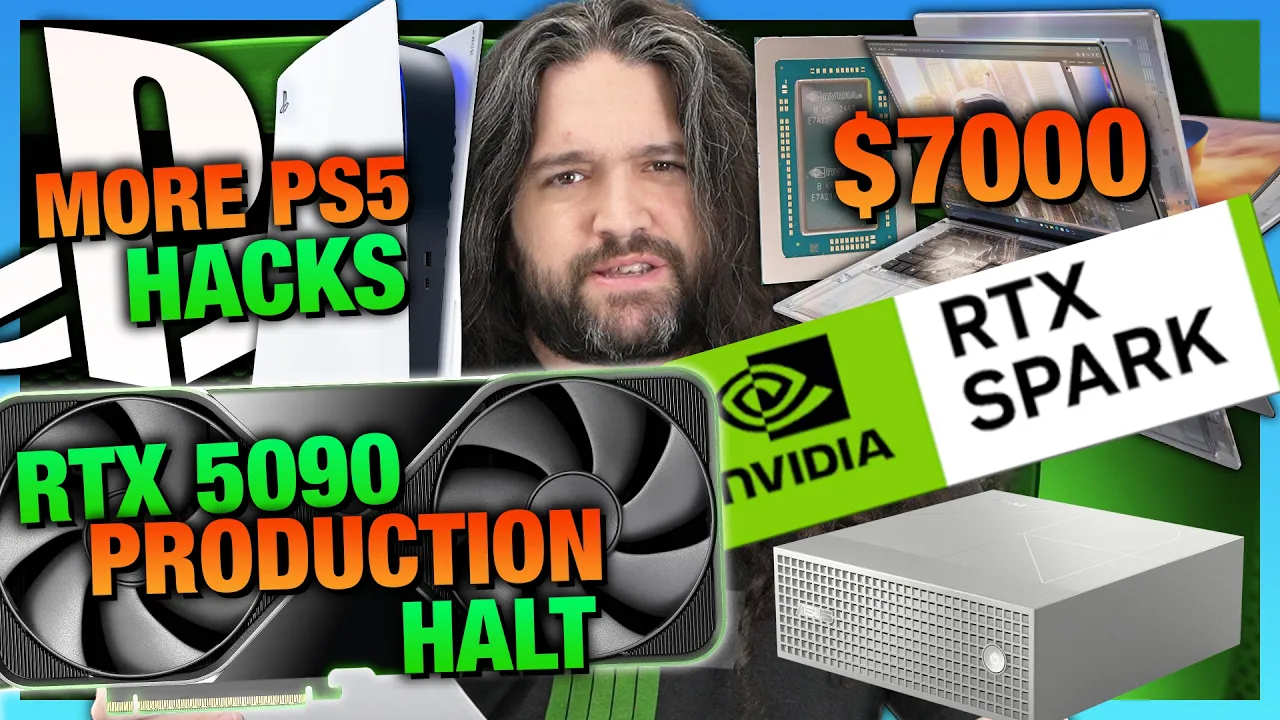
Nvidia Halts RTX 5090 Output to Divert Chips to Enterprise Lines
Gamers Nexus
Nvidia's reallocation of flagship silicon to high-margin workstation hardware effectively caps consumer PC builders at mid-range performance as component costs climb across the industry.
NVIDIA launched its RTX Spark laptop platform priced between $4,100 and $7,000, relying on two-year-old N1X SoCs with 20 CPU cores and 6,144 CUDA cores while delivering performance comparable to mobile RTX 5060/5070 GPUs. (2:26)
Industry reports indicate NVIDIA is halting consumer GeForce RTX 5090 production to divert monolithic GB202 silicon exclusively to high-margin RTX Pro workstation GPUs like the RTX Pro 6000. (22:18)
Component prices continue to climb, with Intel raising mobile CPU prices up to 20%, desktop chips by 5-10%, and Qualcomm hiking Snapdragon X silicon costs by 10% amid foundry capacity absorption by AI servers. (10:28)
Rockstar Games reportedly plans to release Grand Theft Auto VI on PC in early 2027, just four months after its expected November console debut. (31:02)
Modder SwordPDF developed PS5SX2, a PCSX2 port enabling native PlayStation 2 disc playback with upscaling and performance mods directly on PlayStation 5 consoles. (32:28)
Detailed notes
## Background
Published by Gamers Nexus on YouTube on October 18, 2026, this hardware news recap is hosted and written by Steve Burke with additional writing by Jimmy Thang. According to the description, the episode covers NVIDIA's expensive RTX Spark "AI" laptops, rising CPU and component prices, SoftBank's $100 billion AI infrastructure push, an endangered forest threatened by an AI data center, GTA VI's rumored PC timeline, and community PS5 homebrew enabling native PS2 disc playback.
## TL;DR
Steve Burke critically examines NVIDIA's exorbitantly priced RTX Spark laptops, breaking down how exaggerated corporate AI marketing contrasts with standard Windows hardware and modest real-world gaming performance. The report outlines escalating hardware prices driven by enterprise AI foundry demand, alongside rumors that NVIDIA is abandoning the consumer RTX 5090 to direct all GB202 silicon toward lucrative workstation cards. Additional coverage explores SoftBank's circular AI financing schemes, an environmental controversy where Nscale's massive compute campus threatens an endangered American chestnut grove, and political theater surrounding tech CEOs at a White House medal ceremony. The broadcast concludes with optimistic developments, highlighting rumors of a shorter PC launch window for Grand Theft Auto VI and impressive community reverse-engineering efforts bringing native PS2 disc emulation to the PS5.
## Atmosphere & style
The show carries Gamers Nexus's trademark dry, sarcastic, and consumer-first tone, cutting through corporate buzzwords and PR spin with clinical skepticism. Steve Burke balances deep industry frustration over enterprise greed, margin gouging, and environmental hand-waving with deadpan humor, sharp analogies, and visible exasperation at executive hype. The pacing moves smoothly from biting corporate accountability and supply-chain analysis to a relaxed, enthusiastic appreciation for independent homebrew developers finding clever ways to empower end users.
## Bulletin
- [02:26](https://www.youtube.com/watch?v=HFbLI71G5DM&t=146s) NVIDIA launched its RTX Spark laptop platform priced between $4,100 and $7,000, relying on two-year-old N1X SoCs with 20 CPU cores and 6,144 CUDA cores while delivering performance comparable to mobile RTX 5060/5070 GPUs.
- [22:18](https://www.youtube.com/watch?v=HFbLI71G5DM&t=1338s) Industry reports indicate NVIDIA is halting consumer GeForce RTX 5090 production to divert monolithic GB202 silicon exclusively to high-margin RTX Pro workstation GPUs like the RTX Pro 6000.
- [10:28](https://www.youtube.com/watch?v=HFbLI71G5DM&t=628s) Component prices continue to climb, with Intel raising mobile CPU prices up to 20%, desktop chips by 5-10%, and Qualcomm hiking Snapdragon X silicon costs by 10% amid foundry capacity absorption by AI servers.
- [31:02](https://www.youtube.com/watch?v=HFbLI71G5DM&t=1862s) Rockstar Games reportedly plans to release Grand Theft Auto VI on PC in early 2027, just four months after its expected November console debut.
- [32:28](https://www.youtube.com/watch?v=HFbLI71G5DM&t=1948s) Modder SwordPDF developed PS5SX2, a PCSX2 port enabling native PlayStation 2 disc playback with upscaling and performance mods directly on PlayStation 5 consoles.
## Key takeaways
- [02:26](https://www.youtube.com/watch?v=HFbLI71G5DM&t=146s) NVIDIA's RTX Spark marketing pitches implausible consumer scenarios—such as a four-person household owning $28,000 in pooled laptops or local AI automating landscaping emails—to justify exorbitant pricing.
- [07:26](https://www.youtube.com/watch?v=HFbLI71G5DM&t=446s) RTX Spark systems cost up to $7,000 for 128 GB unified memory configurations, yet gaming and daily tasks run on standard Windows with mid-tier mobile GPU performance.
- [10:28](https://www.youtube.com/watch?v=HFbLI71G5DM&t=628s) Upstream foundry constraints and advanced packaging demand from AI accelerators are forcing broad CPU price increases across Intel, Qualcomm, and likely AMD.
- [12:30](https://www.youtube.com/watch?v=HFbLI71G5DM&t=750s) Hardware manufacturers are enjoying record gross margins—such as Micron reaching 90% on consumer products—by prioritizing low-volume, high-margin enterprise sales over budget consumer volumes.
- [14:10](https://www.youtube.com/watch?v=HFbLI71G5DM&t=850s) Next-generation GPU announcements from competitors like AMD appear delayed until Computex 2027 or later, leaving existing consumer inventory at sustained high price points.
- [15:16](https://www.youtube.com/watch?v=HFbLI71G5DM&t=916s) SoftBank is attempting to raise an additional $100 billion to finance AI acquisitions and power infrastructure in an insular funding ecosystem connected to OpenAI and dedicated energy generation.
- [18:06](https://www.youtube.com/watch?v=HFbLI71G5DM&t=1086s) Nscale's planned 2,250-acre Monarch Compute Campus in West Virginia directly encroaches upon an endangered grove of American chestnut trees, prompting a controversial relocation scheme.
- [22:18](https://www.youtube.com/watch?v=HFbLI71G5DM&t=1338s) Reallocating all GB202 die supply to RTX Pro enterprise lines enables NVIDIA to capture immense margins directly, bypassing add-in card partner price constraints.
- [24:10](https://www.youtube.com/watch?v=HFbLI71G5DM&t=1450s) High costs for 3 GB GDDR7 modules ($60-$70 each versus $20 for 2 GB chips) heavily disincentivize NVIDIA from maintaining consumer-priced high-VRAM flagship GPUs.
- [25:01](https://www.youtube.com/watch?v=HFbLI71G5DM&t=1501s) A rumored 24 GB RTX 5080 refresh in Q1 2027 will likely become the de facto consumer ceiling, though creative studios and small enterprises will heavily compete for that stock.
- [26:40](https://www.youtube.com/watch?v=HFbLI71G5DM&t=1600s) The consumer PC DIY market is being compressed into fewer mid-range options (RTX 5070 tier), diminishing performance-per-dollar gains for standard PC gamers.
- [28:16](https://www.youtube.com/watch?v=HFbLI71G5DM&t=1696s) Tech executives Jensen Huang, Lisa Su, Elon Musk, and Satya Nadella received National Medals at the White House amid contradictory federal policies like foreign worker visa suspensions.
- [31:02](https://www.youtube.com/watch?v=HFbLI71G5DM&t=1862s) A four-month console-to-PC release window for GTA VI would represent a significantly faster port cadence than the multi-year delays seen with GTA V and Red Dead Redemption 2.
- [32:28](https://www.youtube.com/watch?v=HFbLI71G5DM&t=1948s) Community homebrew development continues to expand console longevity, delivering native PS2 disc emulation on the PS5 and advancing PC-based PS5 emulation.
## Detailed walkthrough
### [00:01](https://www.youtube.com/watch?v=HFbLI71G5DM&t=1s) Hardware News Recap & GN Store Merch
Steve Burke introduces the weekly hardware news recap, noting up front that Gamers Nexus was not invited to NVIDIA's RTX Spark announcement event. Looking at what was revealed, Steve remarks that it was probably for the best, characterizing the RTX Spark as a classic solution in search of a problem with a price reaching up to $7,000. Other topics teased for the episode include rumors that the RTX 5090 production may be coming to a halt, rising hardware and CPU pricing across the industry, participation trophies handed out to the "Council of Corruption," and community-driven PlayStation 5 homebrew developments enabling PS2 disc compatibility.
Steve highlights the restock of the GN "Microslop" parody t-shirts on store.gamersnexus.net, which sold out through three separate production runs. The design riffs on Windows system instability, complete with event viewer icons, the Blue Screen of Death, a frowny face, a custom Tux penguin mascot, and retro OS window accents. Alongside the shirts, Steve showcases the in-house designed GN Wireframe V2 mouse mat created by Andrew, highlighting its multi-level dystopian wireframe city aesthetic, custom blue rubber base, matching blue stitched border, and desk-mat sizing intended to house both keyboard and mouse.
[02:26](https://www.youtube.com/watch?v=HFbLI71G5DM&t=146s) NVIDIA RTX Spark: A Solution in Search of a Problem
NVIDIA hosted its secondary launch event for the RTX Spark platform, arriving in a broader market plagued by component scarcity and shifting toward software subscriptions. Steve cuts between clips of NVIDIA's launch presentation and marketing spokespeople, mocking the barrage of vague corporate buzzwords that fail to explain what the hardware actually achieves. Presenters repeatedly claim that Spark is an entirely "new class of PC" that will make technology "disappear," change daily workflows, and untether creativity, yet avoid detailing basic practical specifications or use cases beyond running Windows. Steve points out that the underlying silicon is roughly two years old, suffered multiple delays, and originally should have launched a year prior. Furthermore, NVIDIA's own memory supply pressures have made these systems absurdly expensive while delivering questionable utility compared to local alternatives or standard remote compute.
To illustrate how detached the marketing is from consumer reality, Steve highlights two specific use cases pushed by NVIDIA and partner media:
- A family of four in a single household where both parents and two children each own an RTX Spark laptop (costing up to $7,000 each, totaling nearly $30,000 in machines) pooling their network compute whenever a family member needs extra AI acceleration.
- Connecting an internal closed-circuit home surveillance camera setup to the RTX Spark laptop so local AI can analyze video feeds, recognize that a yard sprinkler broke, and draft an automated email to a landscaping company.
Steve expresses total disbelief at the target demographic implied by these examples, asking: “Motherfucker, okay, fine, all right, okay, just tell us what operating system it has on it.” He reflects on the absurdity of the household scenarios, saying: “I heard that example too and I was like, all right, so again prerequisite is has a house. The second one is you have a sprinkler system. I got to that part, I was like no you lost me. Then you get to the and a landscaping company. I was no, you've really lost me now.”
```mermaid
flowchart TD
accTitle: NVIDIA RTX Spark Ecosystem Pitch
accDescr: Diagram breaking down the marketing claims, hardware specs, and everyday reality of the RTX Spark platform.
subgraph Marketing["NVIDIA's Pitch"]
A["Family Network Pooling<br>(4x $7,000 Laptops)"]
B["Home CCTV Surveillance<br>+ Auto Landscaping Emails"]
C["Local 'Super Intelligence' & Agents"]
end
subgraph Hardware["Actual Hardware Configuration"]
D["N1X SoC<br>(20-Core CPU + 6,144 CUDA Cores)"]
E["64 GB to 128 GB Shared LPDDR5X"]
F["1 TB NVMe SSD Base"]
end
subgraph Reality["Real-World Performance & Pricing"]
G["$4,100 to ~$7,000 Retail Price"]
H["RTX 5060 / 5070 Mobile Tier Gaming"]
I["Mediocre Battery Life & Heavy Silicon Overhead"]
end
Marketing --> Hardware
Hardware --> Reality
```
[07:26](https://www.youtube.com/watch?v=HFbLI71G5DM&t=446s) RTX Spark Laptop Pricing, Specs, and the AI Pitch
The entry-level models under the RTX Spark umbrella start around $4,100, such as the MSI N16 AI+ (a naming convention that presenters are already jokingly pivoting toward "Super Intelligence"). The notebook sports NVIDIA's N1X SoC containing a 20-core CPU combined with 6,144 CUDA cores, paired with a modest 1 TB NVMe SSD and 64 GB of unified LPDDR5X memory shared between the CPU and graphics processor. Moving up to the 128 GB memory variant drives the cost to nearly $7,000, mirroring the pricing seen on the ASUS ProArt notebook counterpart.
Steve jokes that consumers buying these systems are subsidizing NVIDIA's newly revealed $25 million donation to the Trump Ballroom, quipping that selling roughly 3,500 of these $7,000 machines would neatly balance the books. Independent benchmarks reveal underwhelming battery life and gaming performance that falls roughly inline with an RTX 5060 mobile or RTX 5070 mobile GPU. While defenders may argue the machine is not built for gamers, Steve notes that NVIDIA explicitly markets the device as a do-it-all system, demoing *Cyberpunk 2077* running above 100 FPS on high settings alongside local AI workloads. Ultimately, Steve concludes that despite all the futuristic branding around intelligent agents from Jensen Huang and Microsoft's Satya Nadella, the machine is fundamentally just an exorbitant Windows laptop.
As Steve wraps up his thoughts on the marketing hype versus reality, he cuts through the mystique: “It's a fucking computer, that's what it is, it has Windows on it.”
[10:28](https://www.youtube.com/watch?v=HFbLI71G5DM&t=628s) CPU and Hardware Prices Continue to Rise
Following severe price pressures in the memory market, Taiwanese outlet Commercial Times (CT) reports that CPU prices are steadily marching upward. Intel's mobile processors—specifically Panther Lake—have experienced price hikes of 15% to 20%, while its Meteor Lake mobile processors and Arrow Lake desktop chips have seen increases around 5% to 10%. These manufacturer increases do not necessarily appear instantly on retail shelves; rather, they filter through to end consumers over time as existing retail inventory is cleared out and restocked at the higher wholesale acquisition costs.
Qualcomm is moving in parallel, having raised prices by approximately 10% on October 1st for its Snapdragon X and X2 Elite silicon, which power Windows on Arm systems. Valve’s Steam Frame uses Snapdragon 8 Gen 3 hardware; when Gamers Nexus asked Valve roughly a month prior if their processor procurement costs had changed, Valve stated they had not yet seen any adjustment. Market watchers anticipate AMD will follow suit with its own CPU pricing. Machine-translated coverage from Commercial Times noted:
> “Industry analysts believe that the simultaneous occurrence of process upgrades, product premiumization, and AI computing power demands has driven up CPU prices. Wafer foundries are a major driver behind this price surge.”
TrendForce corroborates this outlook, projecting laptop shipments could slide into a high single-digit percentage decline due to these compounding cost headwinds:
> “In 2027 supply conditions for notebook components may become more uneven. DRAM supply is likely to stay tight as AI server applications continue to absorb advanced process capacity.”
Steve Burke observes that this pricing spiral aligns directly with Gamers Nexus's recent coverage of Micron, which posted a staggering 90% gross margin on consumer products—an unprecedented figure in the channel’s 18 years of tech journalism. Even with lower unit volumes, hardware vendors are posting record revenues and net profits. Because manufacturers are extracting far more money out of a smaller pool of buyers, they save on production, logistics, and long-term customer support costs while padding margins. Normal buyers are tapped out, but enterprise momentum is distorting consumer component availability across the board.
```mermaid
flowchart TD
accTitle: Hardware Price Escalation Flow
accDescr: Diagram illustrating how foundry capacity allocation drives consumer hardware prices up while squeezing release windows.
subgraph IndustryImpact["Upstream Adjustments"]
TightSupply --> MarginHike["Vendors Prioritize Enterprise / High Margins"]
MarginHike --> CPUHikes["Intel, Qualcomm & AMD Raise CPU Prices 5-20%"]
end
subgraph RetailImpact["Consumer Consequences"]
CPUHikes --> DelayedRefreshes["Next-Gen Consumer Parts Delayed (e.g. Computex 2027+)"]
DelayedRefreshes --> HighPrices["Consumer PC & Laptop Retail Prices Increase"]
end
```
Simultaneously, relief from next-generation product rollouts appears increasingly distant. NVIDIA’s release plans remain opaque, with rumors shifting between an imminent refresh, a 24 GB variant, or outright delays. Hardware leaker Kepler_L2 posted on the AnandTech forums that AMD's next-generation GPUs are unlikely to appear soon, stating the hardware is expected to be announced at:
> “Computex 2027 at the earliest, but most likely later in the year.”
Steve Burke vents considerable frustration at this schedule, remarking that Computex has devolved heavily into enterprise and data center hyperbole:
> “I mean, this last one might have been kind of the last hurrah for that show if they don't seriously change direction, cause I'm not going out there to just attend a big circle jerk about data centers.”
With new generations over a year away, previous-generation hardware maintains high retail prices indefinitely rather than receiving the clearance price cuts of past upgrade cycles.
---
[15:16](https://www.youtube.com/watch?v=HFbLI71G5DM&t=916s) SoftBank Wants Another $100 Billion for AI Investments
According to reporting from the *Financial Times*, Japanese investment juggernaut SoftBank—which owns Arm and clean-energy developer SB Energy—is attempting to raise an additional $100 billion to pour into artificial intelligence infrastructure. SoftBank founder and CEO Masayoshi Son has reportedly courted high-level figures in the United Arab Emirates to secure the capital. The *Financial Times* outlined Son's playbook:
> “As part of the possible goal of fundraising, the SoftBank founder would use the money to set up a fund to buy companies and then use AI and other advanced technology to improve their operations.”
Steve Burke notes this corporate restructuring strategy essentially boils down to buying conventional enterprises, cutting down their headcount, and deploying AI software from other SoftBank-backed ventures to prop up valuations. Son has already directed roughly $65 billion toward OpenAI and remains a deeply divisive entity across financial circles:
> “He remains one of the most controversial investors in technology with an investment strategy that some regard as tantamount to gambling.”
While Son has dismissed skepticism of the AI bubble by characterizing AI criticism as “spitting upwards,” he has simultaneously conceded that AI technology in the hands of bad actors could turn out “super dangerous.”
The financial maneuvers increasingly point toward insular funding loops. SoftBank Energy is currently developing a massive multi-gigawatt data center presence in Ohio intended for OpenAI's operational use, while collaborating with the United States government to deploy 10 gigawatts of dedicated power plants. These plants feed SoftBank data centers hosting OpenAI workloads, which are financed by capital funneled from SoftBank.
Referencing NVIDIA’s insistence that such practices are merely a “virtuous cycle” rather than circular financing, Burke introduces a sarcastic guest check-in with tech critic and *Better Offline* host Ed Zitron:
> “It's all bullshit. It's all bullshit, Ed. Back to you.”
---
[18:06](https://www.youtube.com/watch?v=HFbLI71G5DM&t=1086s) Data Center Threatens Historic Forest
Data center expansion has begun to physically collide with critical environmental conservation efforts. A report from *Futurism* revealed that an enormous facility being built by Neocloud provider Nscale poses an imminent threat to an endangered grove of American chestnut trees in West Virginia. The surviving grove sits directly within the construction footprint of Nscale’s proposed "Monarch Compute Campus." Steve Burke scoffs at the grim corporate irony of the branding:
> “I just love their naming schemes... like these company names that engage in corruption and nepotism naming their data center Monarch, like do they try to sound evil or is that, which one leads to the other?”
The American chestnut species was decimated throughout the early 20th century by an imported fungal blight that wiped out an estimated four billion trees across North America. Today, fewer than 4,300 acres of wild, fruit-producing American chestnuts survive across the continental United States. Nscale’s planned West Virginia campus spans approximately 2,250 acres—equivalent to more than half of the total acreage of all surviving fruit-bearing chestnut trees left in the country.
The sheer scale of the Monarch Compute Campus underlines the immense resources required by AI cloud startups:
- Initial deployment aims to bring 1.35 gigawatts of compute online by early 2028.
- Long-term development plans seek to expand total campus capacity to 8 gigawatts.
- Caterpillar and NVIDIA are designated primary corporate collaborators.
- NVIDIA serves simultaneously as an equity investor in Nscale and its core hardware vendor, feeding the broader ecosystem of Neocloud providers buying GPU allocations directly from their own financial backers.
[19:50](https://www.youtube.com/watch?v=HFbLI71G5DM&t=1190s) The "Data Center-Shaped Forest" Relocation Plan
Steve Burke looks back at Gamers Nexus coverage from seven months prior—a video titled *AMD: WTF?*—where they anticipated many of the corporate moves currently playing out in the hardware and data center sectors. Burke revisits the phrase about buying a home next to a "data center-shaped forest," noting that Lewis Rossmann's recurring sentiment applies: “it is both informative and unfortunate uh for how much of that has become true.” The PR narrative around these massive infrastructure projects has reached full tilt. On October 10, the governor of West Virginia announced an official agreement with Nscale to "spare" an established grove of trees standing directly in the path of a new computing development. Instead of halting construction or building around them, the developer devised an alternative plan:
> "Under the preservation plan, the existing trees will be relocated to a more suitable environment within the property, potentially as part of an arboretum or integrated landscaping. That work is scheduled for late 2027 during the trees' dormant season under professional arborist supervision. The trees will remain accessible for future seed and sapling harvesting. Nscale will cover the full cost of the preservation and relocation efforts with no expense to West Virginia taxpayers."
Burke scoffs at the PR framing that a self-sustaining forest needs to be relocated to a "more suitable environment," interpreting the phrase as corporate code for land that is simply not slated for a facility in an easily exploitable region. He jokes bitterly about uprooting mature trees, pointing out that many will likely die from transplant shock, but that by 2027 the public will have moved on and it will become someone else's problem. Nscale certainly has the capital to foot the relocation bill: financial filings show Anthropic is set to pay Nscale up to $44.6 billion to utilize NVIDIA Vera Rubin computing systems deployed on the Monarch Compute campus.
[22:18](https://www.youtube.com/watch?v=HFbLI71G5DM&t=1338s) NVIDIA Reportedly Halts RTX 5090 Production to Prioritize RTX Pro
According to reports from BenchLife.info, NVIDIA is discontinuing production of the flagship GeForce RTX 5090 and redirecting all allocations of its monolithic GB202 die exclusively to its high-margin RTX Pro series workstation lineup. The massive GB202 processor powers consumer variants like the RTX 5090 and RTX 5090D (v2), as well as professional enterprise hardware cataloged by TechPowerUp, including the 72 GB Blackwell workstation card, the 48 GB RTX Pro 5000, the 84 GB RTX Pro 5500, and the RTX Pro 6000. While the physical silicon die is massive and costly on its own, memory pricing has spiked significantly due to surging enterprise demand, amplifying NVIDIA's focus on enterprise clients over consumers.
```mermaid
flowchart TD
accTitle: Allocation of NVIDIA GB202 Die
accDescr: Diagram showing NVIDIA diverting GB202 silicon from consumer RTX 5090 cards into enterprise RTX Pro workstation lines.
subgraph Silicon["GB202 Die Production"]
GB["NVIDIA GB202 Die"]
end
subgraph Consumer["Consumer GPU Line (Phased Out)"]
RTX5090["GeForce RTX 5090 / 5090D"]
end
subgraph Enterprise["RTX Pro Lineup (Prioritized)"]
P6000["RTX Pro 6000"]
P5500["RTX Pro 5500 (84 GB)"]
P5000["RTX Pro 5000 (48 GB)"]
PWork["Blackwell Workstation (72 GB)"]
end
BenchLife reported that: “It has been almost confirmed that Nvidia plans to move all GB 202 chips from the Blackwell GPU architecture to the RTX Pro. This means that AIC or add-in card partners will not receive any GeForce RTX 5090 series chips. If you don't buy it now, you really won't have another chance in the future.” While that tone risks triggering consumer FOMO, the move aligns with what GN tracked in their video *NVIDIA Has GPUs If You Have Coin*. There, GN documented how NVIDIA quietly doubled the direct-sale MSRP of its own RTX Pro 6000 Blackwell card from its launch range of $8,000–$8,500 up to $16,000. Because NVIDIA sells those enterprise units first-party without board partners, it has full margin control and cannot hide behind third parties to pretend the original prices are intact.
- On Newegg, scalped RTX 5090 cards routinely command between $8,000 and $12,000 from third-party marketplace sellers.
- BenchLife summarizes the silicon reallocation bluntly: “It is simply a transfer of production capacity to more profitable product lines.”
- Both the RTX 5090 and the RTX Pro 6000 rely on high-density 3 GB GDDR7 memory modules. Industry vendor reports indicate these 3 GB chips cost between $60 and $70 each, compared to around $20 for standard 2 GB modules, compounding board-level production costs.
[25:01](https://www.youtube.com/watch?v=HFbLI71G5DM&t=1501s) The 24 GB RTX 5080 and the Squeezed DIY Consumer Market
To fill the void left by pulling the RTX 5090, BenchLife reports that NVIDIA plans to release a refreshed 24 GB version of the GeForce RTX 5080 in Q1 2027, potentially featuring unlocked ROPs (render output units) while retiring the original 16 GB SKU. Burke warns this is bad news for everyday PC builders. With the RTX 5090 gone, the RTX 5080 becomes the de facto consumer flagship. Expanding its VRAM pool to 24 GB makes it far more attractive to small businesses, creative studios, and entry-level enterprise workflows that previously relied on 24 GB cards like the RTX 3090 or RTX 3090 Ti.
Burke uses Gamers Nexus's internal production workflow as an example: GN evaluated upgrading its video editing suites to 16 GB RTX 5080s, but stayed with 24 GB RTX 3090 and 3090 Ti cards because the extra memory buffer was mandatory for their editing timeline loads. If a 24 GB RTX 5080 hits the market, commercial buyers who cannot justify a $16,000 workstation card will scoop them up in bulk. Burke outlines the broader industry consequences:
> “Consumer gets constrained down to basically 5070, 5070 Ti, and that's our new ceiling, at least for now... which just so happens to align with where AMD is competing with the 9070 XT and is still above where Intel is competing. And so you end up in this—this is what we've been talking about—where the consumer market gets squished. The DIY market kind of collapses into fewer pricing categories with more margin for the companies and less performance per dollar for the end user.”
While users wanted a 24 GB memory pool on the RTX 5080 from the start, elevating it to the highest tier of consumer hardware guarantees that enterprise prosumers will cannibalize stock, effectively leaving gaming enthusiasts capped at the mid-range RTX 5070 series for the foreseeable future.
[28:16](https://www.youtube.com/watch?v=HFbLI71G5DM&t=1696s) "Council of Corruption" Receives National Medals at White House Ceremony
Burke turns his attention to a political ceremony billed as celebrating the "Golden Age of American Innovation" (which Burke sarcastically introduces as the "Golden Shower of American Innovation"). At the White House, President Donald Trump presented top tech executives and billionaires with the National Medal of Science and the National Medal of Technology and Innovation, which Burke derides as participation trophies for corporate corruption.
Award recipients included Elon Musk, Google co-founder Sergey Brin, and industry cousins Jensen Huang (NVIDIA CEO) and Dr. Lisa Su (AMD CEO), whom Burke notes looked like a lineup of movie villains assembled for a *Mr. Robot* cast photo. Dell founder Michael Dell and Microsoft CEO Satya Nadella received the National Medal of Technology and Innovation. The event carried immediate political irony, as reported by NBC News:
> “The celebration took place just hours after Vice President JD Vance announced that the Trump administration would suspend Microsoft, whose CEO was a guest of honor at the event, and several other companies from a program that allows foreign workers to apply for green cards.”
Burke notes the palpable awkwardness of honoring Nadella—an Indian-born executive who became a naturalized American citizen—shortly after gutting his company's immigration pipeline. The ceremony featured further tension as Trump shared the stage with Elon Musk, despite past public sparring over appearances in the unsealed Jeffrey Epstein documents. Burke quips that Musk likely did not mind the association given his own presence in those same files, before cutting to a clip of Trump congratulating Musk: “It always works out well for Elon, right? We're proud of you. Very proud of you.”
[29:38](https://www.youtube.com/watch?v=HFbLI71G5DM&t=1778s) Council of Corruption Participation Trophy and White House AI Remarks
Wrapping up coverage of the White House tech event, Steve Burke reviews remarks made by Donald Trump praising tech figures in attendance. Trump publicly lauded Elon Musk, declaring: “Elon is our modern-day Thomas Edison.” Steve dryly points out the irony for the owner of Tesla, joking that it is unfortunate there was no competitor from that exact same era with a name that sounded a bit more like Tesla, noting, “It just it would have worked a lot better if there was someone who sounded like Tesla.”
In his closing speech, Trump praised the technological landscape and attendees: “We live in an age of American wonders and technological marvels, and with the help of the brilliant men and women here today, we will always be on top.” Trump also told the crowd they were going to go down in the “annals of history,” stumbling slightly on the pronunciation, which Steve pauses to highlight. Trump then indirectly took a jab at his usual political rally crowds while addressing the tech executives, remarking: “But we have an extremely high IQ audience, for a change. For a change. It's very nice. I love the poorly educated.” Steve wraps up the segment by laughing off the room's obsession with artificial intelligence—or rather "superintelligence," quipping that misnaming it still makes him an enemy of the state.
[31:02](https://www.youtube.com/watch?v=HFbLI71G5DM&t=1862s) Rumor: GTA VI Coming to PC in Early 2027
Shifting away from political tech events, Steve covers a report regarding Rockstar Games' release schedule for *Grand Theft Auto VI*. According to reports citing four industry sources familiar with the studio's plans, *Grand Theft Auto VI* is slated to arrive on PC within the first three months of 2027. If accurate, PC gamers will face a wait of only about four months following the console release, which is expected on November 19.
This launch window would represent a notable departure from the agonizing gap seen with *Grand Theft Auto V*, where the console version released in 2013 while the PC version was pushed back until 2015—nearly two full years later. Steve reminisces that 2015 was a massive year for PC gaming, as *The Witcher 3: Wild Hunt* launched around the same time. Gamers Nexus published graphics tuning and optimization guides for both titles back then, which put the channel on the map for many longtime viewers.
A four-month window for *GTA VI* would align much more closely with Rockstar's historical handling of *Grand Theft Auto IV*, which hit PC roughly seven months after its console debut. For comparison, *Red Dead Redemption 2* took about a full year to land on PC. Steve notes that *GTA V* was somewhat of an outlier, and while data points are limited, he is eager to run benchmarks on *GTA VI* whenever it arrives, especially since Gamers Nexus used *GTA V* in GPU and CPU benchmarking suites for nearly a decade.
- Expected *GTA VI* console release date: November 19
- Rumored *GTA VI* PC release window: First quarter of 2027 (up to 4 months later)
- Historical PC release delays:
- *Grand Theft Auto IV*: ~7 months after console
- *Red Dead Redemption 2*: ~12 months after console
- *Grand Theft Auto V*: ~19 months (September 2013 console vs. April 2015 PC)
[32:28](https://www.youtube.com/watch?v=HFbLI71G5DM&t=1948s) PlayStation 5 Hacks: Native PS2 Emulation and Astro Bot on PC
The hardware news concludes on a positive note regarding homebrew and emulation developments. Following recent coverage of an emulator that runs Nintendo Switch games on the PlayStation 5, a new homebrew project brings native PlayStation 2 disc playback to the PS5. Steve opens with a legal disclaimer directed at console manufacturers, making it clear that Gamers Nexus has a legal right to report news and is neither providing instructions nor encouraging viewers to hoard software before takedowns occur: “We have a legal right to report on news. This is not instructional on how to use emulators. We are not recommending you go download and preserve them in the event they get snapped out of existence and disappear.”
The PS2 disc emulator, dubbed PS5SX2 by modder SwordPDF (swordf3h), is a direct port of the well-known PC emulator PCSX2. According to the developer's GitHub page, PS5SX2 runs game discs natively on the PS5 hardware rather than streaming them, allowing titles to be upscaled directly on 4K televisions. The emulator includes features such as widescreen hacks, 60 FPS patches, HD texture pack injection, rumble feedback, online play capabilities, and up to four-player controller support.
The developer tested 108 titles across multiple builds prior to release, cautioning users to “expect rough edges.” In gameplay footage of *Need for Speed: Most Wanted*, Gamers Nexus noticed noticeable stuttering, leading Steve to joke that it was “more like Need for Frames—it's a throughput, it's a rate versus a speed thing.” Nevertheless, most tested titles achieved between 30 and 60 FPS. On the modder's Ko-fi page, SwordPDF explained the dedication behind the project: “It started as a side project and has turned into something I've put a ridiculous amount of time into, from getting games running properly to building out the front end, fixing bugs, and trying to make the whole thing feel polished.”
Steve also highlights the rapid advancement of PlayStation 5 emulation running on PCs. Community progress has accelerated significantly, with public test clips of *Astro Bot* seemingly gaining another 10 FPS of performance with every new iteration. While Gamers Nexus has previously tested running Linux directly on the PS5, Steve celebrates the vitality of the reverse-engineering community, emphasizing that it is great to see modders helping consumers extract more utility and longevity out of the expensive hardware they purchase.
## Notable quotes
> [25:01](https://www.youtube.com/watch?v=HFbLI71G5DM&t=1501s) The DIY market kind of collapses into fewer pricing categories with more margin for the companies and less performance per dollar for the end user. — Steve Burke
> [10:28](https://www.youtube.com/watch?v=HFbLI71G5DM&t=628s) Industry analysts believe that the simultaneous occurrence of process upgrades, product premiumization, and AI computing power demands has driven up CPU prices. Wafer foundries are a major driver behind this price surge. — Commercial Times
> [10:28](https://www.youtube.com/watch?v=HFbLI71G5DM&t=628s) In 2027 supply conditions for notebook components may become more uneven. DRAM supply is likely to stay tight as AI server applications continue to absorb advanced process capacity. — TrendForce
## Mentioned
AMD, American chestnut, Andrew, Anthropic, Arrow Lake, ASUS ProArt, Astro Bot, BenchLife.info, Better Offline, Caterpillar, Commercial Times, Computex, Cyberpunk 2077, Donald Trump, Dr. Lisa Su, Ed Zitron, Elon Musk, Financial Times, Futurism, Gamers Nexus, GeForce RTX 5080, GeForce RTX 5090, GeForce RTX 5090D, Google, Grand Theft Auto IV, Grand Theft Auto V, Grand Theft Auto VI, Intel, JD Vance, Jensen Huang, Kepler_L2, Lewis Rossmann, Masayoshi Son, Meteor Lake, Michael Dell, Micron, Microsoft, Monarch Compute Campus, MSI N16 AI+, N1X SoC, Need for Speed: Most Wanted, Newegg, Nintendo Switch, Nscale, NVIDIA, NVIDIA RTX Spark, NVIDIA Vera Rubin, OpenAI, Panther Lake, PCSX2, PlayStation 2, PlayStation 5, PS5SX2, Qualcomm, Red Dead Redemption 2, Rockstar Games, RTX Pro 5000, RTX Pro 5500, RTX Pro 6000, Satya Nadella, SB Energy, Sergey Brin, Snapdragon 8 Gen 3, Snapdragon X, Snapdragon X2 Elite, SoftBank, Steve Burke, SwordPDF, TechPowerUp, The Witcher 3: Wild Hunt, TrendForce, Valve Steam Frame
## Video description
SUPPORT US: MICROSLOP T-SHIRT on the GN Store: https://store.gamersnexus.net/products/microslop-parody-t-shirt or our Wireframe V2 Mouse Mat! https://store.gamersnexus.net/products/gn-wireframe-v2-mouse-mat
In the news this week, we talk about the NVIDIA RTX Spark announcement, mostly focused on its insanely expensive laptops for "AI" use cases (or is that Super Intelligence?). We also cover rising CPU prices and hardware prices, SoftBank wanting another $100 billion for its AI buildout and data centers, GTA VI coming to PC sooner than expected, and the PlayStation 5 hack to support PS2 discs natively.
The best way to support our work is through our store: https://store.gamersnexus.net/
Like our content? Please consider becoming our Patron to support us: http://www.patreon.com/gamersnexus
TIMESTAMPS
00:00 - Recap for the Week
02:26 - RTX Spark
10:28 - CPU and Hardware Prices Continue to Rise
15:16 - SoftBank Wants Another 100 Billion
18:06 - Data Center Threatens Historic Forest
22:18 - Rumor: NVIDIA Ceases RTX 5090 Production
28:16 - Council of Corruption Receives Participation Trophy
31:02 - Rumor: GTA VI Coming to PC Early 2027
32:28 - Good News: More PlayStation Hacks
** Please like, comment, and subscribe for more! **
Links to Amazon and Newegg are typically monetized on our channel (affiliate links) and may return a commission of sales to us from the retailer. This is unrelated to the product manufacturer. Any advertisements or sponsorships are disclosed within the video ("this video is brought to you by") and above the fold in the description. We do not ever produce paid content or "sponsored content" (meaning that the content is our idea and is not funded externally aside from whatever ad placement is in the beginning) and we do not ever charge manufacturers for coverage.
Follow us in these locations for more gaming and hardware updates:
Our policies, processes, and ethics statements relating to review samples, advertising, travel, errors, and more are transparently and publicly available on this page: https://gamers.nexus/ethics-statements
Steve Burke: Writing, Host
Vitalii Makhnovets: Editing
Jimmy Thang: Writing
Gamers Nexus reports that surging enterprise demand and AI infrastructure investments are distorting the consumer PC ecosystem, driving up CPU prices and diverting premium graphics silicon away from retail builders. Concurrently, high-profile hardware rollouts like NVIDIA's RTX Spark laptops demonstrate a widening gap between corporate AI marketing and real-world consumer utility.
NVIDIA RTX Spark and Consumer Reality (2:26)
NVIDIA recently showcased its RTX Spark laptop platform, which Gamers Nexus describes as an expensive solution searching for a problem. Starting around $4,100 and scaling to nearly $7,000 for 128 GB memory variants—such as the MSI N16 AI+ and ASUS ProArt—the systems utilize NVIDIA's N1X system-on-chip with 20 CPU cores and 6,144 CUDA cores. NVIDIA's promotional campaigns highlight speculative scenarios, including multi-laptop family compute pooling and automated landscaping emails triggered by home security cameras.
Despite the futuristic branding around local intelligent agents, independent testing shows gaming performance roughly equivalent to an RTX 5060 or 5070 mobile GPU, alongside middling battery life. Gamers Nexus notes the machine is fundamentally an expensive Windows laptop built on delayed silicon, suffering from the broader memory industry's pricing pressures.
Foundry Pressures Drive Rising CPU Costs (10:28)
Severe supply constraints in memory and advanced wafer foundries are pushing processor prices higher across major chip designers. Taiwanese publication Commercial Times reports that Intel has raised prices by 15% to 20% on mobile Panther Lake processors and 5% to 10% on Meteor Lake mobile and Arrow Lake desktop silicon. Qualcomm similarly instituted an approximate 10% increase on October 1st for its Snapdragon X and X2 Elite chips, with AMD expected to follow.
TrendForce anticipates notebook shipments could experience high single-digit percentage declines by 2027 as DRAM capacity is continuously absorbed by AI servers. Compounding the issue, hardware leaker Kepler_L2 suggests AMD's next-generation desktop GPUs may not arrive until Computex 2027 or later, allowing manufacturers to maintain high margins on existing inventory while delaying retail discounts.
Silicone Diversion Threatens the DIY Market (22:18)
According to BenchLife, NVIDIA plans to halt production of the flagship GeForce RTX 5090 to dedicate its monolithic GB202 silicon exclusively to high-margin RTX Pro workstation cards. Escalating memory expenses reinforce this shift: high-density 3 GB GDDR7 modules cost manufacturers $60 to $70 each, compared to $20 for standard 2 GB chips. With direct-sale cards like the RTX Pro 6000 commanding $16,000, enterprise workstation lines offer substantially higher returns than consumer cards.
To bridge the resulting gap, NVIDIA reportedly plans to release a refreshed 24 GB GeForce RTX 5080 in early 2027 while discontinuing the 16 GB SKU. Gamers Nexus warns this will attract commercial studios and prosumers who need 24 GB buffers, effectively squeezing everyday gaming enthusiasts down to the mid-tier RTX 5070 class.
Data Center Growth and Environmental Friction (15:16)
Capital flows into AI computing continue to scale rapidly, led by expansive infrastructure ventures. The Financial Times reports that SoftBank founder Masayoshi Son is attempting to raise $100 billion to purchase traditional companies and overhaul them using AI software, backed by joint projects with the U.S. government for 10 gigawatts of dedicated power plants feeding OpenAI workloads in Ohio.
This physical expansion increasingly conflicts with local environments. In West Virginia, Neocloud provider Nscale is developing the 2,250-acre Monarch Compute Campus, targeted to scale from 1.35 to 8 gigawatts. The footprint directly threatens an endangered grove of American chestnut trees, a species reduced to under 4,300 fruit-bearing acres nationwide. Although Nscale entered an agreement to relocate the grove in late 2027, Gamers Nexus questions the survival rate of mature relocated trees versus the commercial priority of high-density computing clusters.
GTA VI Timeline and PS5 Emulation (31:02)
Industry reporting indicates Rockstar Games is targeting a PC release for Grand Theft Auto VI in the first quarter of 2027, roughly four months after its expected console launch on November 19. This launch gap would be considerably narrower than the 19-month window seen between the console and PC versions of Grand Theft Auto V.
Meanwhile, open-source developers continue making strides in local hardware utility. Modder SwordPDF released PS5SX2, a PCSX2 port that enables native PlayStation 2 disc playback directly on PlayStation 5 consoles, complete with widescreen support and 4K upscaling. Combined with accelerating progress in running PlayStation 5 emulation on PCs, Gamers Nexus emphasizes that community modding remains essential for extending consumer hardware longevity amid rising market costs.
The hardware market is increasingly dictated by enterprise data center investments that strain supply chains, raise processor prices, and redirect silicon from DIY builders. As product refresh cycles stretch toward 2027, everyday consumers face elevated costs and constrained upgrade paths across both desktop and mobile platforms.
## Background
本期视频由硬件评测与新闻频道 Gamers Nexus 于 2026 年 10 月 18 日发布在 YouTube 上。根据页面简介,本期周报重点报道了 NVIDIA 售价高达 7000 美元的 RTX Spark 笔记本、RTX 5090 停产传闻、全行业 CPU 与硬件价格上涨、软银推进千亿美元 AI 融资与数据中心扩张,以及《GTA 6》PC 版发售窗口和 PS5 原生读取 PS2 光盘的破解进展。
## TL;DR
节目首先抨击了 NVIDIA 昂贵且缺乏实际场景支撑的 RTX Spark 笔记本,并分析了供应链成本与 AI 挤占产能导致 Intel 与高通等芯片全面涨价的行业困局。随后,视频揭露了软银百亿美元级闭环融资以及 AI 数据中心扩张威胁濒危美洲栗树林的荒谬公关操作。此外,内容还涵盖了 NVIDIA 传闻将 GB202 核心全面撤出消费级以停产 RTX 5090 并转攻高利润工作站卡、政商名流白宫科技峰会表彰、传闻《GTA 6》或于 2027 年初登陆 PC,以及社区开发出让 PS5 原生读取 PS2 光盘的 PS5SX2 模拟器等重磅动态。
## Atmosphere & style
主持人 Steve Burke 延续了 Gamers Nexus 一贯辛辣、犀利且充满黑色幽默的主持风格。整期节目充斥着对科技巨头公关辞令与过度吹捧“AI/超级智能”泡沫的无情嘲讽,语言直白且富有攻击性。在严谨引用供应链报价与行业分析报告的同时,主持人不时穿插妙语连珠的调侃与冷幽默吐槽,让观众在直面硬件市场价格失控与生态收紧的沉重现实之余,感受到兼具专业深度与宣泄感的新闻体验。
## Bulletin
- [02:26](https://www.youtube.com/watch?v=HFbLI71G5DM&t=146s) NVIDIA 正式公布基于老旧芯片架构的 RTX Spark 系列笔记本,顶配售价高达 7,000 美元,但官方宣传场景脱离实际且图形性能仅相当于移动端 RTX 5060/5070。
- [10:28](https://www.youtube.com/watch?v=HFbLI71G5DM&t=628s) 硬件市场迎来 CPU 涨价潮,Intel、高通等芯片价格上调 5% 至 20%,美光消费级内存利润率更是逆势飙升至 90%。
- [22:18](https://www.youtube.com/watch?v=HFbLI71G5DM&t=1338s) 传言 NVIDIA 将全面停产消费级旗舰 RTX 5090,将稀缺的 GB202 芯片与高成本 GDDR7 显存全数转移至利润翻倍的 RTX Pro 工作站系列。
- [18:06](https://www.youtube.com/watch?v=HFbLI71G5DM&t=1086s) 次世代云厂商 Nscale 拟在西弗吉尼亚扩建 2,250 英亩的 AI 数据中心园区,直接威胁全美仅存不足 4,300 英亩的野生美洲栗树林。
- [31:02](https://www.youtube.com/watch?v=HFbLI71G5DM&t=1862s) 业内传闻《GTA 6》PC 版将在主机发售后仅 4 个月左右(即 2027 年第一季度)迅速推出,打破以往长达两年的等待周期。
## Key takeaways
- [02:26](https://www.youtube.com/watch?v=HFbLI71G5DM&t=146s) NVIDIA 重新推出的 RTX Spark 笔记本搭载延迟两年的 N1X SOC 芯片与统一内存,起售价高达 4,100 美元、顶配近 7,000 美元,是典型的“先有方案硬凑需求”的产物。
- [02:26](https://www.youtube.com/watch?v=HFbLI71G5DM&t=146s) 官方宣称的“全家采购 7,000 美元笔记本组网借算力”以及“AI 监控草坪喷淋器发邮件”等应用场景,被批评完全脱离普通大众实际生活。
- [10:28](https://www.youtube.com/watch?v=HFbLI71G5DM&t=628s) 晶圆代工提价与 AI 需求爆发正在向消费端传导,Intel Panther Lake、Meteor Lake、Arrow Lake 及高通芯片价格均出现不同程度上涨。
- [10:28](https://www.youtube.com/watch?v=HFbLI71G5DM&t=628s) 上游硬件厂商呈现“出货量下滑但净利润创新高”的怪象,通过减少出货、专注高单价群体来降低售后支持成本并维持超高毛利。
- [15:16](https://www.youtube.com/watch?v=HFbLI71G5DM&t=916s) 软银孙正义正寻求再次筹资 1,000 亿美元进行 AI 投资,并通过自建 10GW 电厂供给自家数据中心的模式实现“循环融资”闭环。
- [18:06](https://www.youtube.com/watch?v=HFbLI71G5DM&t=1086s) Nscale 携手 NVIDIA 推进的 Monarch 数据中心园区占地 2,250 英亩,占全美现存可结实天然美洲栗树林面积的一半以上,引发严重生态担忧。
- [19:50](https://www.youtube.com/watch?v=HFbLI71G5DM&t=1190s) 针对生态破坏舆论,州政府与 Enscale 提出的“2027 年整林连根移栽”公关方案被质疑极易导致半数树木死亡,本质只是为 Anthropic 的 446 亿美元算力园区腾挪地皮。
- [22:18](https://www.youtube.com/watch?v=HFbLI71G5DM&t=1338s) 报道称 NVIDIA 将停止向 AIC 核心伙伴供应 RTX 5090 的 GB202 芯片,全数转投翻倍暴涨至 16,000 美元的 RTX Pro 工作站系列以攫取超额利润。
- [22:18](https://www.youtube.com/watch?v=HFbLI71G5DM&t=1338s) 3GB 容量的高密度 GDDR7 显存颗粒采购成本高达 60 至 70 美元(远高于 2GB 的 20 美元),成为加速消费级旗舰芯片停产的诱因之一。
- [25:01](https://www.youtube.com/watch?v=HFbLI71G5DM&t=1501s) 传闻将于 2027 年 Q1 推出的 24GB RTX 5080 将成为消费级事实上的天花板,导致预算有限的中小企业与内容创作者集中抢购,进一步挤压玩家配额。
- [28:16](https://www.youtube.com/watch?v=HFbLI71G5DM&t=1696s) 白宫“美国创新黄金时代”峰会向黄仁勋、苏姿丰、马斯克等科技巨头颁发国家级科学与技术创新奖章,现场政商博弈与利益联盟色彩浓厚。
- [31:02](https://www.youtube.com/watch?v=HFbLI71G5DM&t=1862s) 《GTA 6》据业内爆料或将在 2027 年前三个月登陆 PC 平台,相较于主机版发售仅间隔约 4 个月,有望成为新一代 PC 硬件性能基准标杆。
- [32:28](https://www.youtube.com/watch?v=HFbLI71G5DM&t=1948s) 模组制作者 SwordPDF 推出移植自 PCSX2 的 PS5SX2 项目,实现了在 PS5 上免串流原生直读 PS2 实体光盘,并支持最高 4K 超分辨率渲染。
- [32:28](https://www.youtube.com/watch?v=HFbLI71G5DM&t=1948s) 主机与 PC 跨平台民间模拟技术突飞猛进,展示了开源模组社区在挖掘既有硬件价值、突破官方生态限制上的巨大技术活力。
## Detailed walkthrough
### [00:00](https://www.youtube.com/watch?v=HFbLI71G5DM&t=0s) 本周硬件新闻概述与周边推荐
主持人 Steve Burke 开门见山地汇总了本周的硬件圈动态。首先是 NVIDIA 正式公布了 RTX Spark 系列产品。GN 团队并没有受邀参加该发布会,但 Steve 调侃称看过发布会内容后,觉得没被邀请反而是一件好事。除此之外,坊间传闻 RTX 5090 显卡可能即将迎来终结(RIP),据称 NVIDIA 将停止生产该芯片;硬件与 CPU 价格仍在全面攀升;腐败委员会(Council of Corruption)获得了“参与奖”;而在主机玩家圈子中,社区成功推出了相当亮眼的 PlayStation 5 破解与 Mod,实现了原生 PS2 光盘兼容与模拟运行。
随后 Steve 介绍了频道官方商店(store.gamersnexus.net)补货的周边产品。首先是第三次补货的 Microslop 主题 T 恤,这也是 GN 迄今为止最受欢迎的设计,正面印有带蓝屏死机(BSOD)图标、愁眉脸、企鹅 Tux 以及红黄配色的 Microslop 标志;此外还推荐了 Andrew 设计的 GN Wireframe V2 鼠标垫,采用反乌托邦多层立体城市线稿风格,边缘与底部配有定制蓝色缝线与橡胶防滑层。
- 涵盖议题:NVIDIA RTX Spark 发布、RTX 5090 停产传闻、硬件及 CPU 涨价潮、PS5 破解兼容 PS2 光盘等。
- 商店补货:Microslop 恶搞 T 恤、GN Wireframe V2 桌面线框鼠标垫。
---
### [02:26](https://www.youtube.com/watch?v=HFbLI71G5DM&t=146s) NVIDIA RTX Spark:昂贵且缺乏应用场景的“AI 笔记本”
NVIDIA 近期重新公布了其 RTX Spark 系列笔记本。Steve 评价这完全是一场典型的“先找解决方案,再去硬凑需求”的发布。整场官方宣讲充斥着大量虚无缥缈的企业公关辞令(Corpo-speak),反复鼓吹“它改变了我使用电脑的方式”、“这是日常使用的游戏规则改变者”、“释放未被束缚的创造力”,却始终无法正面回答这台机器到底能干什么。更滑稽的是,当被问及该设备搭载什么操作系统时,官方也只是含糊其辞地提及“与微软数十年的合作旅程”,说到底本质上就是一台装了 Windows 的普通电脑。
```mermaid
flowchart TD
accTitle: RTX Spark 软硬件结构与营销矛盾
accDescr: 展示 RTX Spark 的底层配置与官方宣传的应用场景之间的巨大断层
subgraph Hardware["硬件底层 (基于延期两年的架构)"]
SOC["NVIDIA N1X SOC\n(20核 CPU + 6144 CUDA核心)"]
Memory["统一内存: 64GB - 128GB LPDDR5X\n(CPU与GPU共享)"]
Storage["存储: 1TB NVMe SSD 起步"]
end
subgraph Pricing["极端定价"]
LowEnd["入门款: $4,100 (约合 RTX 5060M 游戏水平)"]
HighEnd["旗舰款: ~$7,000 (微星 / 华硕 ProArt)"]
end
subgraph PitchedCases["官方宣传的应用场景"]
FamilyMesh["四口之家全员各配一台 $7000 笔记本\n通过局域网互相借用 AI 算力"]
SprinklerBug["监控摄像头识别草坪喷淋器故障\nAI 自动写邮件发给园艺公司"]
end
Hardware --> Pricing
Pricing -.->|"脱离大众实际需求"| PitchedCases
```
Steve 深入剖析后指出,RTX Spark 所采用的芯片实际上是两年前就做好的老硅片,原定一年前推出,历经多次延期。而在 NVIDIA 自己引发的内存/显存危机下,这类机型不仅价格高得惊人,实际用处却十分有限。Steve 毫不客气地评价道:“The Spark is a solution in search of a problem. The first problem, the price, up to $7,000.”
官方媒体宣传中给出的两个实际应用用例更是令人啼笑皆非:
1. **全家算力池架构**:设想一个四口之家,父母和两个孩子每人手持一台价值 7,000 美元的 RTX Spark 笔记本。当其中某人需要处理高负载 AI 任务时,可以通过局域网直接调用其他人电脑的 AI 算力。Steve 讽刺道,这首先得假设一个家庭不仅能买得起大房子,还能掏出近 3 万美元全员采购顶级笔记本,现实中根本站不住脚。
2. **AI 闭路监控发邮件**:将家里的闭路监控摄像头接入 RTX Spark,让本地 AI 全天候分析庭院画面。如果院子里的自动喷淋系统坏了,AI 会自动起草并发送一封电子邮件给草坪养护承包公司。Steve 吐槽称,光是“拥有带草坪的独栋、装了全自动喷头、还雇了专业绿化团队”这些大前提,就彻底脱离了绝大多数正常消费者的生活实际。
- 硬件配置:搭载 NVIDIA N1X 芯片(包含 20 核 CPU 与 6144 个 CUDA 核心),配备 64GB 或 128GB LPDDR5X 统一内存,游戏图形性能仅大致相当于移动端 RTX 5060 或 RTX 5070。
- 机型定价:微星(MSI)N16 AI+ 入门款配备 64GB 内存与 1TB SSD,Newegg 售价高达 4,100 美元;微星与华硕(ASUS)ProArt 的 128GB 顶配版本售价直逼 7,000 美元。
- 讽刺调侃:Steve 调侃高昂的定价或许是为了让 NVIDIA 填补此前被曝出的 2,500 万美元特朗普舞厅(Trump Ballroom)政治献金窟窿,算下来只需卖出 3,500 台 7,000 美元的笔记本就能把这笔捐款给平账。
- 早期实测反馈:被邀请媒体的初步测试表明其续航表现并不尽如人意。尽管部分粉丝辩解它不是游戏本,但 NVIDIA 官方在宣传中仍将其包装为“全能设备(Everything device)”,宣称能一边以非常高画质超 100 帧畅玩《赛博朋克 2077》(Cyberpunk 2077),一边在后台运行本地大语言模型。
### [10:28](https://www.youtube.com/watch?v=HFbLI71G5DM&t=628s) 硬件价格全面飙升:CPU接棒内存迎来涨价潮
在内存涨价之后,硬件市场迎来了新的打击——CPU价格也开始一路走高。根据台湾科技媒体的报道,英特尔的Panther Lake移动处理器价格上涨了15%至20%,即便是已上市的Meteor Lake移动端和Arrow Lake桌面端处理器,涨幅也达到了约5%至10%。这些涨价通常不会立刻反映在消费级零售市场上,而是随着旧库存被清空、新批次进货后逐步生效。此外,高通已从10月1日起将骁龙X和X2 Elite芯片的价格上调了约10%,业内预计AMD也将紧随其后对其处理器进行调价。
媒体援引行业分析指出:“行业分析师认为,制程工艺升级、产品高端化以及AI算力需求的集中爆发,共同推高了CPU价格。晶圆代工厂是这轮价格暴涨背后的主要推手。”行业分析机构TrendForce也印证了这一趋势,预测明年笔记本电脑出货量可能下滑至高个位数百分比。TrendForce进一步指出:“2027年笔记本零组件的供应状况可能更加不均,由于AI服务器应用持续挤占先进制程产能,DRAM供应可能保持紧张。”
主播Steve Burke指出,这与Gamers Nexus此前对美光(Micron)财报的分析完全吻合——美光消费级产品的利润率已飙升至90%,这是其报道硬件行业18年来从未见过的现象。尽管部分厂商的出货量有所下滑,但营收和净利润却逆势创新高。这意味着厂商只需生产更少的产品、面向更小圈子的群体收取更高的单价,同时还能降低后续技术支持与维护成本。
- 英特尔Panther Lake移动处理器涨价15%~20%,Meteor Lake与Arrow Lake涨幅在5%~10%。
- 高通自10月1日起将骁龙X/X2 Elite芯片价格上调约10%。
- 传闻AMD下一代显卡(RDNA 4/5架构)预计最快要到Computex 2027或更晚才会公布,意味着现存硬件面临长达一年的“价格保护期”,缺乏新品降价驱动力。
```mermaid
flowchart TD
accTitle: 芯片供应链价格与消费市场挤压机制
accDescr: 展示晶圆代工与先进制程被AI数据中心挤占后,消费级硬件涨价并降低供应的传导路径。
subgraph Upstream["上游与产能分配"]
A["先进制程产能短缺<br/>晶圆代工厂提价"]
B["AI服务器与数据中心<br/>海量吞吐高带宽内存与芯片"]
A --> B
end
subgraph Pricing["芯片厂商调价"]
C["Intel CPU上涨 5%~20%"]
D["高通 Snapdragon 调价 10%"]
E["美光消费内存利润率达 90%"]
A --> C
A --> D
B --> E
end
subgraph Consumer["消费级市场影响"]
F["消费端库存成本转嫁<br/>旧款硬件不降反升"]
G["出货量下降但厂商利润增加<br/>高定价对冲销量"]
C --> F
D --> F
E --> F
F --> G
end
```
### [15:16](https://www.youtube.com/watch?v=HFbLI71G5DM&t=916s) 软银拟再筹资千亿美元:AI闭环融资的狂欢
英国《金融时报》(Financial Times)报道,软银(SoftBank)正寻求再次筹集1000亿美元用于AI领域的投资。软银旗下不仅持有ARM的大量股份,还涵盖SB Energy等能源业务。软银创始人兼CEO孙正义据传已与阿联酋的高层代表会面,以推进此轮大规模融资。按照其策略,孙正义打算设立基金收购成熟公司,再借助AI和先进技术改造并优化其业务运作。
《金融时报》强调孙正义已向OpenAI注资65亿美元,并指出他“仍然是科技界最具争议的投资者之一,其投资策略被某些人认为无异于赌博”。对此,Steve调侃道,如果欠银行100万美元那是你的问题,但如果你欠了1000亿美元,那就是银行的问题——而在这起事件中,涉及软银(SoftBank),问题就变成了全球经济的风险。
孙正义此前曾把批评AI的声音形容为“向上吐痰”,但同时也承认AI若落入心怀不轨者手中将“极其危险”。软银在闭环生态中的操作尤为典型:旗下软银能源(SB Energy)正在俄亥俄州建设供OpenAI使用的数据中心,并与美国政府合作建设10吉瓦(GW)的发电厂,所发电量直接供给软银自身的数据中心。Steve与客座嘉宾Ed针对这种“循环融资”(Circular Financing,亦被黄仁勋称为“良性循环”)展开了直白讽刺。当被问及对这一概念的看法时,Steve Burke毫不客气地评价道:“全是狗屁,全是狗屁,Ed。(It's all bullshit. It's all bullshit, Ed.)”
- 软银目标筹资1000亿美元,计划通过收购传统企业并注入AI技术来提升估值。
- 孙正义对OpenAI的单笔投资达65亿美元。
- 软银能源计划打造10 GW电厂专属供给自身数据中心,实现资金与业务的内部循环。
### [18:06](https://www.youtube.com/watch?v=HFbLI71G5DM&t=1086s) AI数据中心扩张危及濒危美洲栗树林
根据科技媒体Futurism的报道,新兴的“次世代云”(Neocloud)数据中心开发商Nscale,其在西弗吉尼亚州推进的“Monarch计算园区”(Monarch Compute Campus)项目直接威胁到了当地一片珍贵的野生美洲栗树林。Steve对这种取名方式大加嘲讽,指出这类充满贪婪、裙带关系的科技企业偏偏喜欢给数据中心冠以“Monarch”(君主)这种反派气息十足的名称。
美洲栗树在20世纪初遭遇毁灭性真菌枯萎病袭击,曾有约40亿株树木死亡,至今全美原生能够结实的天然美洲栗树林地仅存不到4300英亩。然而,Nscale规划中的该数据中心园区占地便达2250英亩,几乎相当于全美现存可结实栗树林总面积的一半以上。
Nscale对西弗吉尼亚园区的规划规模极大,预计到2028年初将上线1.35吉瓦(GW)的算力,未来甚至计划扩容至8吉瓦。该项目的合作伙伴包括卡特彼勒(Caterpillar)和英伟达(NVIDIA)。值得注意的是,英伟达既是Nscale的重要投资方,Nscale又是英伟达AI芯片的关键客户,再次展现了英伟达扶植次世代云服务商以消化自身GPU产能的深层绑定模式。
### [19:50](https://www.youtube.com/watch?v=HFbLI71G5DM&t=1190s) 数据中心威胁西弗吉尼亚历史森林与公关“移植计划”
针对此前关于西弗吉尼亚州自然保护区森林面临数据中心推平威胁的报道,Steve Burke 辛辣地讽刺了科技巨头侵占土地的荒谬逻辑。他回顾了频道 7 个月前发布的视频《AMD: WTF?》,引用 Louis Rossmann 的名言称该视频“既富有信息量,又令人感到不幸”(“both informative and unfortunate”),因为当初针对企业规划所做的严峻推测如今已逐一应验。在各方舆论压力下,当地政府与企业的公关机器开始全力运转。
2026 年 10 月 10 日,西弗吉尼亚州州长宣布与云计算及基础设施公司 Enscale 达成协议,声称将“保护”这片天然生长的栗树林。然而这项解决方案并非停止施工,而是把整座树林连根拔起并整体迁移。根据官方声明,这批树木将在 2027 年底处于休眠期时,在专业树艺师的指导下被迁移至该地块内“更适宜的环境”,未来可能作为植物园或综合景观的一部分,同时保留供后续采集种子与幼苗的用途,全部费用由 Enscale 承担,无需纳税人自掏腰包。Steve 对此嗤之以鼻,讽刺这种“把天然繁衍、自给自足的森林搬迁到所谓更合适地点”的官僚说辞,本质上就是把碍事的树木移开,为数据中心腾出地皮。他断言,这种大规模移栽极可能因移栽创伤导致至少半数树木死亡,但到那时公众早已淡忘此事。
此外,Enscale 显然有极其充裕的资金来掩盖环境代价。一份最新的财务申报文件显示,人工智能巨头 Anthropic 将向 Enscale 支付高达 446 亿美元,用于在西弗吉尼亚的 Monarch Compute 算力园区租用搭载 NVIDIA Vera Rubin 架构的超级计算系统。
- **州政府妥协方案**:计划于 2027 年底(树木休眠期)在专业人员监督下完成整片天然林地迁移。
- **巨额 AI 算力合同**:Anthropic 签订高达 446 亿美元的协议,使用 Enscale 园区内的 NVIDIA Vera Rubin 系统。
---
### [22:18](https://www.youtube.com/watch?v=HFbLI71G5DM&t=1338s) 传言 NVIDIA 停产 RTX 5090,重心全面转向工作站与企业级市场
硬件圈传出重磅传言:NVIDIA 正计划停产消费级旗舰显卡 GeForce RTX 5090。据 benchlife.info 报道,NVIDIA 准备停止生产 RTX 5090,并将代号为 GB202 的顶级 GPU 芯片全数划拨给利润更高、面向专业工作站的 RTX Pro 系列。GB202 核心除了用于 RTX 5090 及中国特供的 RTX 5090 D 外,还供给多款专业级工作站产品,包括 72GB 的 Blackwell 工作站卡、48GB 的 RTX Pro 5000、84GB 的 RTX Pro 5500 以及此前评测过的 RTX Pro 6000。
```mermaid
flowchart TD
accTitle: GB202 产能重新分配示意图
accDescr: 展示 NVIDIA GB202 核心芯片从消费级市场全面转向 RTX Pro 专业工作站与企业级市场的流向。
subgraph Origin["NVIDIA GB202 芯片产能"]
GB["GB202 旗舰大芯片 + 高成本 GDDR7 显存"]
end
subgraph ConsumerCut["消费级显卡(计划削减/停产)"]
RTX5090["GeForce RTX 5090 / 5090 D"]
end
subgraph ProSeries["专业及企业级(高利润倾斜)"]
direction TB
P1["RTX Pro 6000 官方直售:原价 $8,000-$8,500 暴涨至 $16,000"]
P2["RTX Pro 5500 (84GB) / Pro 5000 (48GB)"]
P3["Blackwell 工作站显卡 (72GB)"]
end
Origin -->|"削减供应并停止出货 AIC 伙伴"| ConsumerCut
Origin -->|"产能全数转移,赚取超额商业利润"| ProSeries
```
除了 GB202 裸片面积庞大、制造成本高昂外,高密度高速显存价格的飙升也是主要诱因。RTX 5090 与 RTX Pro 6000 均采用 3GB 单颗容量的 GDDR7 显存颗粒,此前有供应链厂商向 Gamers Nexus 透露,单颗 3GB 模块的采购成本高达 60 至 70 美元,而 2GB 模块仅需约 20 美元。benchlife.info 直言:“这几乎已经确定,NVIDIA 计划将所有 Blackwell 架构的 GB202 芯片转移至 RTX Pro 系列。这意味着 AIC 核心合作伙伴将不再收到任何 GeForce RTX 5090 系列芯片。如果现在不买,未来真的没有机会了。”(“It has been almost confirmed that Nvidia plans to move all GB 202 chips from the Blackwell GPU architecture to the RTX Pro. This means that AIC or add-in card partners will not receive any GeForce RTX 5090 series chips. If you don't buy it now, you really won't have another chance in the future.”)
这种产能转移背后的核心逻辑是暴利。NVIDIA 自营直销的 RTX Pro 6000 官方售价此前已从最初的 8,000 至 8,500 美元腰斩式翻倍暴涨至 16,000 美元。由于该卡由 NVIDIA 官方商城直接销售,没有中间 AIC 合作伙伴当掩护,NVIDIA 可以独吞全部差价。与此同时,二级市场上由第三方黄牛兜售的 RTX 5090 现货售价已被炒至 8,000 到 12,000 美元之间。
- **显存采购成本对比**:3GB 高密度 GDDR7 颗粒单颗成本约为 60-70 美元,而标准 2GB 颗粒仅约 20 美元。
- **直营卡暴涨**:RTX Pro 6000 无中介直营价从 8,000~8,500 美元直接拉升至 16,000 美元。
---
### [25:01](https://www.youtube.com/watch?v=HFbLI71G5DM&t=1501s) 24GB RTX 5080 传闻登场:消费级天花板的进一步挤压
为填补 RTX 5090 离场留下的市场空缺,报道称 NVIDIA 计划于 2027 年第一季度推出配备 24GB 显存的 RTX 5080,以此逐步淘汰市场上现有的 16GB 版本。Steve Burke 认为这对于普通游戏玩家和 DIY 硬件生态而言绝非利好,反而是一个危险信号。
一旦 24GB RTX 5080 成为消费级唯一的旗舰门面,它将不可避免地演变为“名义上的 RTX 5090”。原本无法接受 16GB 显存但能将就使用 24GB 显存的中小企业、专业内容创作者(如 Gamers Nexus 自身的工作室目前仍倚重 24GB 显存的 RTX 3090/3090 Ti 剪辑机)以及轻度 AI 开发者,将全力涌入抢购 24GB RTX 5080。这种企业级与准专业级用户的挤压,将再次吸干消费端库存并推高终端售价。
Steve 深刻剖析了当下的硬件市场格局:消费级显卡的事实天花板正在被硬生生压低到 RTX 5070 与 5070 Ti 级别,这正好与 AMD 的 9070 XT 竞争区间重叠,且仍高于 Intel 的竞争线。科技巨头正在肢解高端 DIY 市场,将更多晶圆配额转移至高利润的 B2B 客户:“这正是我们一直在讨论的现象:消费级市场遭到严重挤压,DIY 市场正缩减为更少的价格档位,厂商获得了更高的利润率,而终端用户获得的每元性能比却越来越低。”(“This is what we've been talking about where the consumer market gets squished. The DIY market kind of collapses into fewer pricing categories with more margin for the companies and less performance per dollar for the end user.”)
---
### [28:16](https://www.youtube.com/watch?v=HFbLI71G5DM&t=1696s) “腐败理事会”分发参与奖:白宫科技峰会的名利场
在华盛顿特区举办的一场名为“美国创新黄金时代”(The Golden Age of American Innovation,Steve 开玩笑读成了“Golden Shower”)的盛典上,美国总统唐纳德·特朗普向多位科技亿万富翁颁发了奖项。Steve 戏谑地将此形容为给“腐败理事会”颁发“参与奖”,并指出这些巨头合影的画面宛如黑客悬疑美剧《黑客军团》(Mr. Robot)中的反派大集会。
在此次表彰中,Elon Musk、Google 联合创始人 Sergey Brin,以及兼具亲戚关系的科技领袖——NVIDIA CEO 黄仁勋(Jensen Huang)与 AMD CEO 苏姿丰(Lisa Su),均被授予美国国家科学奖章(National Medal of Science);同时,Dell 创始人 Michael Dell 与微软 CEO Satya Nadella 则获颁美国国家技术与创新奖章(National Medals of Technology and Innovation)。
活动现场充满讽刺意味的政治反差被媒体敏锐捕捉。据 NBC News 报道,就在该庆典举行前数小时,副总统 JD Vance 刚宣布特朗普政府将暂停微软及其他几家公司参与允许外籍员工申请绿卡的移民签证项目。出生于印度、后归化为美国公民的微软 CEO Satya Nadella 面对这种微妙局面显然情绪复杂。更具戏剧性的是特朗普与 Elon Musk 的同台互动,此前两人曾在公开言论与爱泼斯坦案件档案的关联上互揭老底,而此时在镁光灯下却彼此恭维。特朗普在致辞中向 Musk 说道:“对埃隆来说一切总是进展顺利,对吧?我们为你感到骄傲,非常骄傲。”
### [29:38](https://www.youtube.com/watch?v=HFbLI71G5DM&t=1778s) 科技峰会落幕与“现代爱迪生”笑话
在白宫科技相关活动上,唐纳德·特朗普(Donald Trump)发表了对埃隆·马斯克(Elon Musk)的评价,称:“埃隆就是我们现代的托马斯·爱迪生(Thomas Edison)。”主持人史蒂夫·伯克(Steve Burke)对此忍不住调侃,对于这位特斯拉公司的掌门人而言,那个时代恰好没有另一位更贴切的竞争对手科学家可供比喻实在太遗憾了——要是当年有一位名字听起来就像“特斯拉(Tesla)”的著名科学家,这套说辞听起来肯定顺理成章得多。
特朗普在活动结束致辞中宣称:“我们生活在一个充满美国奇迹与技术创新的时代。在今天齐聚于此的杰出男女的协助下,我们将永远立于顶峰。”他甚至补充称在场人员将载入“历史的史册”(annals of history,引发了主持人对其发音的文字梗幽默)。颇具讽刺意味的是,特朗普在现场还不忘间接讽刺他平时的核心支持群体,直言:“但我们今天拥有一群智商极高的观众……难得换换口味。换换口味,这挺好的,虽然我向来深爱低学历群体。”史蒂夫随后补刀,称全场坐满了热衷于“人工智能”——或者按如今政商界炒作口吻该叫“超级智能(Super Intelligence)”——的行业大佬,并自嘲若再口误叫错词,自己恐怕又要被扣上“公敌”的帽子了。
---
### [31:02](https://www.youtube.com/watch?v=HFbLI71G5DM&t=1862s) 《GTA 6》PC版传言:或于2027年初正式推出
根据相关游戏媒体援引“四位熟悉工作室计划的业内消息人士”透露,《侠盗猎车手 6》(Grand Theft Auto VI / GTA 6)有望在 2027 年的前三个月内登陆 PC 平台。如果这一传言属实,意味着在主机版本于 2026 年 11 月 19 日发售之后,PC 玩家仅需等待最多 4 个月左右的时间即可玩到本作。
```mermaid
flowchart LR
accTitle: Rockstar 游戏主机与 PC 发售时间间隔对比
accDescr: 对比 GTA 4、GTA 5、荒野大镖客 2 以及传闻中的 GTA 6 主机版与 PC 版之间的发售间隔时间。
subgraph GTA4["《GTA 4》"]
G4C["主机版 (2008)"] -->|"间隔约 7 个月"| G4P["PC 版 (2008)"]
end
subgraph GTA5["《GTA 5》"]
G5C["主机版 (2013)"] -->|"间隔近 2 年"| G5P["PC 版 (2015)"]
end
subgraph RDR2["《荒野大镖客 2》"]
R2C["主机版 (2018)"] -->|"间隔约 1 年"| R2P["PC 版 (2019)"]
end
subgraph GTA6["《GTA 6》(传闻)"]
G6C["主机版 (2026.11)"] -->|"间隔最多 4 个月"| G6P["PC 版 (2027 Q1)"]
end
```
这种发售节奏与《GTA 5》当年的跨度形成了鲜明反差。《GTA 5》的主机版本于 2013 年推出,而 PC 版直到 2015 年才面世,两者之间相隔近两年。史蒂夫回忆道,2015 年也是《巫师 3:狂猎》(The Witcher 3: Wild Hunt)发售的年份,堪称 PC 游戏的黄金时期,Gamers Nexus 当年针对这两款大作制作的优化与图形画质调整指南,为频道积累了大量早期忠实观众。
- **历史间隔参考**:《侠盗猎车手 4》的主机与 PC 发售间隔约为 7 个月;《荒野大镖客:救赎 2》(Red Dead Redemption 2)的 PC 版大约晚了一年;因此《GTA 5》长达两年的等待更像是一个特例。
- **基准测试意义**:Gamers Nexus 在过去近十年里一直将《GTA 5》作为显卡与 CPU 性能评测的标准基准项目,史蒂夫表示非常期待能尽快将《GTA 6》纳入未来的测试体系中。
---
### [32:28](https://www.youtube.com/watch?v=HFbLI71G5DM&t=1948s) PlayStation 破解进展:PS5 原生直读 PS2 光盘与 PC 模拟器飞跃
在主机与模拟器技术领域,近期迎来了多项突破。此前社区刚实现了在 PS5 上运行任天堂 Switch 游戏,如今模组制作者(Modder)SwordPDF 又推出了名为 **PS5SX2** 的项目,允许用户在 PS5 上原生读取并运行 PlayStation 2 实体光盘。在此之前,史蒂夫照例给主机厂商和法务部门打了预防针,明确重申频道拥有合法的新闻报道权利,本内容纯属技术新闻报道,并非模拟器使用教学,亦不构成下载或归档软件的建议。
PS5SX2 是成熟 PC 模拟器 PCSX2 的移植版本。根据其 GitHub 页面说明,游戏在 PS5 上为原生运算而非云端串流,用户最高可在 4K 电视上体验画面超分辨率提升(Upscaling)后的经典老作。SwordPDF 在其 Ko-fi 赞助页面中写道:“这最初只是一个业余副项目,后来却演变成我投入了海量心血的成果,涵盖了让游戏正常运行、构建前端界面、修复 Bug,以及尽力打磨整体体验的全部工作。”
```mermaid
flowchart TD
accTitle: PS5SX2 模拟器技术规格与特性
accDescr: 结构展示基于 PCSX2 移植的 PS5SX2 模拟器在 PS5 硬件上的运行特性与功能支持。
PS5Hardware["PlayStation 5 主机"] --> Core["PS5SX2 (PCSX2 移植版)"]
subgraph VideoFeatures["画质与显示表现"]
Core --> F1["原生直读 PS2 实体光盘 (非串流)"]
Core --> F2["支持 4K 电视超分辨率渲染"]
Core --> F3["原生 16:9 宽屏补丁与 HD 材质包"]
end
subgraph PlaybackFeatures["游戏性与性能"]
Core --> F4["解锁 60 FPS 运行 (多数作品 30-60 FPS)"]
Core --> F5["在线多人联机支持"]
Core --> F6["DualSense 震动反馈与最多 4 人本地同乐"]
end
```
- **测试稳定性与性能**:作者在开发阶段测试了 108 款游戏,提醒玩家“做好面对瑕疵的心理准备”。例如在展示的《极品飞车:最高通缉》(Need for Speed: Most Wanted)演示中出现了明显的掉帧卡顿,被史蒂夫调侃为“极品掉帧(Need for Frames)”。不过大部分测试游戏的帧率都能稳定在 30 至 60 FPS 之间。
- **PC 端的 PS5 模拟进展**:除了主机端的向下兼容突破,PC 平台上的 PS5 模拟技术同样突飞猛进。近期网络上频繁出现《宇宙机器人》(Astro Bot)在 PC 上运行的演示,且每次新版本更新都能提升大约 10 FPS 的性能。
- **玩家权益与主机价值**:史蒂夫回顾了此前团队在 PS5 上成功运行 Linux 系统的折腾经历,并称赞玩家模组社区的蓬勃活力:“看到模组社区依然生机勃勃、不断探索新发现是件好事,他们让你从花大价钱购买的硬件中压榨出更多价值。”
## Notable quotes
> [25:01](https://www.youtube.com/watch?v=HFbLI71G5DM&t=1501s) This is what we've been talking about where the consumer market gets squished. The DIY market kind of collapses into fewer pricing categories with more margin for the companies and less performance per dollar for the end user. — Steve Burke
> [02:26](https://www.youtube.com/watch?v=HFbLI71G5DM&t=146s) The Spark is a solution in search of a problem. The first problem, the price, up to $7,000. — Steve Burke
> [10:28](https://www.youtube.com/watch?v=HFbLI71G5DM&t=628s) 行业分析师认为,制程工艺升级、产品高端化以及AI算力需求的集中爆发,共同推高了CPU价格。晶圆代工厂是这轮价格暴涨背后的主要推手。
> [10:28](https://www.youtube.com/watch?v=HFbLI71G5DM&t=628s) 2027年笔记本零组件的供应状况可能更加不均,由于AI服务器应用持续挤占先进制程产能,DRAM供应可能保持紧张。 — TrendForce
> [15:16](https://www.youtube.com/watch?v=HFbLI71G5DM&t=916s) It's all bullshit. It's all bullshit, Ed. — Steve Burke
> [32:28](https://www.youtube.com/watch?v=HFbLI71G5DM&t=1948s) 看到模组社区依然生机勃勃、不断探索新发现是件好事,他们让你从花大价钱购买的硬件中压榨出更多价值。 — Steve Burke
> [29:38](https://www.youtube.com/watch?v=HFbLI71G5DM&t=1778s) 埃隆就是我们现代的托马斯·爱迪生。 — Donald Trump
## Mentioned
Steve Burke, Gamers Nexus, NVIDIA, RTX Spark, RTX 5090, RTX 5090 D, RTX 5080, RTX Pro 6000, RTX Pro 5500, RTX Pro 5000, GB202, N1X SOC, 微星 (MSI), 华硕 (ASUS), 英特尔 (Intel), Panther Lake, Meteor Lake, Arrow Lake, 高通 (Qualcomm), Snapdragon X, Snapdragon X2 Elite, AMD, 苏姿丰 (Lisa Su), 美光 (Micron), TrendForce, 软银 (SoftBank), 孙正义, ARM, SB Energy, OpenAI, Nscale / Enscale, Monarch Compute Campus, Anthropic, Vera Rubin, 唐纳德·特朗普 (Donald Trump), 埃隆·马斯克 (Elon Musk), 谢尔盖·布林 (Sergey Brin), 黄仁勋 (Jensen Huang), 迈克尔·戴尔 (Michael Dell), 萨蒂亚·纳德拉 (Satya Nadella), JD Vance, 《侠盗猎车手 6》(GTA 6), 《侠盗猎车手 5》(GTA 5), Rockstar Games, PlayStation 5, PS2, SwordPDF, PS5SX2, PCSX2
## Video description
SUPPORT US: MICROSLOP T-SHIRT on the GN Store: https://store.gamersnexus.net/products/microslop-parody-t-shirt or our Wireframe V2 Mouse Mat! https://store.gamersnexus.net/products/gn-wireframe-v2-mouse-mat
In the news this week, we talk about the NVIDIA RTX Spark announcement, mostly focused on its insanely expensive laptops for "AI" use cases (or is that Super Intelligence?). We also cover rising CPU prices and hardware prices, SoftBank wanting another $100 billion for its AI buildout and data centers, GTA VI coming to PC sooner than expected, and the PlayStation 5 hack to support PS2 discs natively.
Sources doc: https://www.one-tab.com/page/52bV1ebUT3KFWKc_MAhY6A
The best way to support our work is through our store: https://store.gamersnexus.net/
Like our content? Please consider becoming our Patron to support us: http://www.patreon.com/gamersnexus
TIMESTAMPS
00:00 - Recap for the Week
02:26 - RTX Spark
10:28 - CPU and Hardware Prices Continue to Rise
15:16 - SoftBank Wants Another 100 Billion
18:06 - Data Center Threatens Historic Forest
22:18 - Rumor: NVIDIA Ceases RTX 5090 Production
28:16 - Council of Corruption Receives Participation Trophy
31:02 - Rumor: GTA VI Coming to PC Early 2027
32:28 - Good News: More PlayStation Hacks
** Please like, comment, and subscribe for more! **
Links to Amazon and Newegg are typically monetized on our channel (affiliate links) and may return a commission of sales to us from the retailer. This is unrelated to the product manufacturer. Any advertisements or sponsorships are disclosed within the video ("this video is brought to you by") and above the fold in the description. We do not ever produce paid content or "sponsored content" (meaning that the content is our idea and is not funded externally aside from whatever ad placement is in the beginning) and we do not ever charge manufacturers for coverage.
Follow us in these locations for more gaming and hardware updates:
t: http://www.twitter.com/gamersnexus
f: http://www.facebook.com/gamersnexus
w: http://www.gamersnexus.net/
Our policies, processes, and ethics statements relating to review samples, advertising, travel, errors, and more are transparently and publicly available on this page: https://gamers.nexus/ethics-statements
Steve Burke: Writing, Host
Vitalii Makhnovets: Editing
Jimmy Thang: Writing
[Source](https://www.youtube.com/watch?v=HFbLI71G5DM)
Source quotes
[25:01] Steve Burke: This is what we've been talking about where the consumer market gets squished. The DIY market kind of collapses into fewer pricing categories with more margin for the companies and less performance per dollar for the end user.
[2:26] Steve Burke: The Spark is a solution in search of a problem. The first problem, the price, up to $7,000.
[10:28] 行业分析师认为,制程工艺升级、产品高端化以及AI算力需求的集中爆发,共同推高了CPU价格。晶圆代工厂是这轮价格暴涨背后的主要推手。
[10:28] TrendForce: 2027年笔记本零组件的供应状况可能更加不均,由于AI服务器应用持续挤占先进制程产能,DRAM供应可能保持紧张。
[15:16] Steve Burke: It's all bullshit. It's all bullshit, Ed.
[32:28] Steve Burke: 看到模组社区依然生机勃勃、不断探索新发现是件好事,他们让你从花大价钱购买的硬件中压榨出更多价值。
[29:38] Donald Trump: 埃隆就是我们现代的托马斯·爱迪生。
Source quotes
[25:01] Steve Burke: The DIY market kind of collapses into fewer pricing categories with more margin for the companies and less performance per dollar for the end user.
[10:28] Commercial Times: Industry analysts believe that the simultaneous occurrence of process upgrades, product premiumization, and AI computing power demands has driven up CPU prices. Wafer foundries are a major driver behind this price surge.
[10:28] TrendForce: In 2027 supply conditions for notebook components may become more uneven. DRAM supply is likely to stay tight as AI server applications continue to absorb advanced process capacity.
Original transcript
[0:01] Hey everyone, welcome back to the
[0:02] hardware news recap of the week. In this
[0:04] one, Nvidia has its new RTX Spark. We
[0:06] weren't invited, but it's okay. I after
[0:10] seeing the announcement, I really think
[0:12] it's better that we weren't. Uh the
[0:14] Spark is a solution in search of a
[0:17] problem. The first problem, the price,
[0:19] up to $7,000. But don't worry, you get
[0:23] 128 gigabytes of memory to do.
[0:27] It's not really clear what you can do
[0:28] with it, but
[0:30] stuff.
[0:32] Also in the news, it sounds like the RTX
[0:34] 5090 might be ready to be ripped, as in
[0:37] rest in peace, because the rumor is that
[0:39] Nvidia is not making any more of them.
[0:41] It's actually some related to the 50/50
[0:43] right now, but we'll talk about that in
[0:44] a separate video. Additionally, hardware
[0:46] prices continue to rise. The Council of
[0:48] Corruption gets participation trophies,
[0:51] and there's some pretty cool PS5 mods
[0:54] out there and emulation and PS2 disc
[0:56] compatibility mods. So, we've got some
[0:58] good news for this week, too, which is
[1:00] just cool mods that do fun stuff for
[1:02] gaming, but, you know, not quite as
[1:05] compelling as RTX AI playing video games
[1:08] for you. Let's get into it. This video
[1:10] is brought to you by us and our
[1:12] Microsoft t-shirts on
[1:13] store.gamersex.net.
[1:15] We just restocked these after having
[1:17] sold through all of our inventory again,
[1:19] now the third time, because so many
[1:22] people are such big fans of Microsoft.
[1:24] This is our most popular design we've
[1:26] ever launched. Even just wearing it
[1:28] around, I get compliments from people
[1:29] who have absolutely no idea what AGN is
[1:32] because I assume they like Microsop so
[1:36] much. They must just be mega fans of
[1:38] Microsop who love being reminded of its
[1:40] existence. These directly support our
[1:42] deep dives and research. You can grab
[1:44] them on the store. They feature a micro
[1:46] sloppy logo with event viewer icons,
[1:48] including a blue screen of death, frowny
[1:51] face, a tux, the penguin we've made, and
[1:53] the classic red accent yellow bane. You
[1:56] can grab these alongside things like our
[1:57] GN Wireframe V2 mouse mats on the store.
[2:00] Perfect for both your mouse and keyboard
[2:02] for a clean desk space and fully
[2:04] designed in-house by Andrew for the art
[2:06] with wireframe components and a
[2:08] dystopian multilevel citystyle layout
[2:11] connected by highways of cables and
[2:13] tubes which the internet is still a
[2:16] series of. We use a custom blue rubber
[2:18] underside matched to the blue stitched
[2:20] border. And you can grab these and more
[2:22] like the Microsoft shirts on
[2:23] store.gamersex.net.
[2:25] Back to it. All right, first up, Nvidia
[2:27] just reannounced its RTX Spark. It's the
[2:30] second announcement of two leading into
[2:31] the launch of the launch. And Nvidia is
[2:33] launching this into an environment with
[2:35] poor hardware availability and a time
[2:38] when everything's moving to
[2:39] subscription. So hopefully this is good
[2:41] news. Let's see what Nvidia had to say.
[2:43] >> It won't take long for them to realize
[2:45] [music] that the technology is going to
[2:46] disappear for them.
[2:51] >> Okay. Well,
[2:53] it can't be that bad. What else did
[2:56] Nvidia have to say? All right. Well,
[2:58] surely whatever these things are, they
[3:00] do something important. They're laptops
[3:01] that cost up to $7,000. So, hit us with
[3:04] it, Nvidia. What do they do?
[3:06] >> RTX Spark, it is a new class of PC.
[3:08] [music]
[3:09] >> Right. Right. Right. But what does that
[3:11] mean? It changed how I used a computer
[3:14] and it changed how I thought of my
[3:16] computer.
[3:17] >> Okay. But
[3:19] what does that mean?
[3:20] >> RTX Spark is a game changer for a daily
[3:24] use.
[3:24] >> Yes. Got it. Uh, what does that mean?
[3:28] >> The thing that makes this amazing is
[3:30] that it's built on over 30 years of
[3:32] [music] NVIDIA technology in the stack.
[3:34] >> Okay, pretty good on the corpo speak.
[3:37] What does it mean?
[3:38] >> And AI has transformed how we've thought
[3:41] about using a computer.
[3:42] >> Okay, but RTX Spark, what does that
[3:47] mean? I think we're going to see
[3:48] incredible content [music] coming from
[3:50] individuals, small teams, and that aha
[3:53] moment is going to be when you realize
[3:55] your creativity is no longer tethered
[3:58] and the possibilities of your vision
[4:00] become the most powerful thing.
[4:01] >> Mother [ __ ] Okay. Okay. Fine. All
[4:03] right. Okay. Just tell us what operating
[4:06] system it has on it.
[4:07] >> Nvidia and Microsoft [music] have been
[4:08] in a journey for decades. In Windows, we
[4:11] can imagine some incredible things that
[4:13] [music] you can do on a device.
[4:16] Well, anyway, we weren't invited to the
[4:18] event. Shocker. But AMD did do it first,
[4:20] so AMD gets credit for that. Uh, but
[4:23] I've spent the last day trying to parse
[4:25] Nvidia's marketing as to what problem
[4:27] RTX Spark laptops are trying to solve,
[4:31] and it's really not clear. These are
[4:33] two-year-old silicon that was supposed
[4:35] to launch a year ago by all accounts.
[4:37] got delayed uh multiple times and now
[4:40] it's here and it's a problem in search
[4:44] of a problem I guess because the price
[4:49] but also the memory crisis that Nvidia
[4:52] has itself ironically created have led
[4:55] to devices that are ungodly expensive
[4:58] with amounts of memory that are
[5:00] difficult to get at this point to
[5:02] perform tasks that are sort of
[5:05] questionable value at best uh and you
[5:09] could maybe actually do better, although
[5:10] we wouldn't advocate for this with a
[5:13] remote solution given the price. Now,
[5:15] obviously, we're always fans of owning
[5:16] your own [ __ ] but there are ways you
[5:19] could do this without that [ __ ] being an
[5:21] RTX Spark laptop. Like, you don't have
[5:23] to actually own [ __ ] to
[5:27] own something that's useful for a better
[5:30] value. So, I I was looking through
[5:32] Nvidia's marketing materials that
[5:33] they've put out there for their event
[5:35] and trying to understand what it is you
[5:38] might actually do with an RTX Spark
[5:40] laptop that you can't do with something
[5:41] else already, maybe for cheaper, maybe
[5:45] manually, the good oldfashioned way. And
[5:47] one of their examples that was put out
[5:49] through media was, well, you could have
[5:52] a house full of RTX Spark machines where
[5:55] mom and dad and the two kids all have
[5:57] RTX Spark devices. And when one of them
[6:00] needs more AI processing power, you
[6:02] could pull all that power over the
[6:03] network. And I just looked at that map
[6:06] and I was like, "All right, so this is a
[6:10] family of four with a house already. Not
[6:13] really that believable right now, but
[6:15] let's just go with it. family of four at
[6:17] the house and all four have RTX Spark
[6:20] machines that cost up to $7,000.
[6:23] So, we've got like 30 grand worth of
[6:26] computers and someone is doing something
[6:29] that requires all the AI processing
[6:31] power to be pulled.
[6:33] I just it didn't really work for me. One
[6:36] of the other examples that was put out
[6:38] there for this event was you can hook in
[6:40] your closed circuit, what should be
[6:43] camera system to your RTX Spark device,
[6:46] which is already a bad idea, and feed
[6:49] all of your footage into AI from your
[6:52] home surveillance cameras that I guess
[6:55] they can surveil you now instead. And
[6:57] then if something like a sprinkler goes
[6:59] out in your yard, it can write an email
[7:03] for your landscaping company. And I
[7:05] heard that example too and I was like
[7:06] all right. So
[7:08] again prerequisite is has a house. The
[7:13] second one is you have a sprinkler
[7:15] system. I got to that part. I was like
[7:17] no you lost me. Then you get to the and
[7:19] a landscaping company. I was no you've
[7:21] really lost me now. Uh so not working
[7:25] for me. But let's look through some of
[7:26] the laptops. If you're wealthy enough to
[7:28] get one of these. They've got a cheap
[7:29] one at $4,100 with New Egg's low price
[7:32] guarantee. You can get MSI's N16 AI Plus
[7:36] laptop. Bad news. It's already obsolete.
[7:38] We don't call it AI anymore.
[7:40] >> And we're going to be renaming it super
[7:42] intelligence. Officially renaming it.
[7:44] >> Okay. Sigh. Like sigh. Okay.
[7:47] >> When MSI and Nvidia aren't busy being
[7:50] enemies of the state, according to
[7:51] Trump, they're launching laptops like
[7:53] this. The $4,100 notebook has a 1 terbte
[7:56] [laughter] NVME SSD and 64 GB of LPDDR5X
[8:00] shared across the CPU and the GPU and
[8:02] the N1X SOC, which is Nvidia's 6144 CUDA
[8:05] core solution with a 20 core CPU.
[8:07] According to reviews from publications
[8:09] that were invited to the launch party,
[8:11] gaming performance is somewhere around
[8:13] an RTX 560 mobile or maybe RTX 570
[8:16] mobile. That Messiah 128 GB variant
[8:18] costs almost 7 grand comparable to the
[8:21] ASUS ProArt $7,000 notebook as well. So,
[8:23] it's expensive, but somebody's got to
[8:25] pay for Nvidia's recently unearthed $25
[8:28] million donation to the Trump Ballroom.
[8:30] They can't be tied for largest donor in
[8:32] this report without a plan to pay it
[8:33] off. That'd be embarrassing, which is
[8:35] probably why they asked for the donation
[8:36] to be kept anonymous. And the Spark, the
[8:39] Spark is going to help [music] because
[8:41] at just $7,000 per notebook, for only
[8:45] 3500 notebooks purchased, you too can
[8:48] help keep Jensen Juan in the good graces
[8:51] of [music] the government to
[8:58] the word's escaping me again, but
[9:01] he needs your [music] help. All right.
[9:02] So, the RTX Spark laptops, there are
[9:04] four things and do stuff. And some of
[9:06] that stuff seems to be AI.
[9:09] What was it that AI was supposed to do
[9:11] again? Uh Sam, help us out.
[9:14] >> I think AI will probably like most
[9:17] likely sort of lead to the end of the
[9:18] world, but in the meantime, uh there
[9:21] will be great companies created with
[9:22] serious machine learning.
[9:24] >> Okay, Sam, that's enough. Thank you. So,
[9:25] anyway, early benchmarks look not great
[9:27] for the battery life, for the amount of
[9:28] money you get.
[9:30] I'm sure they would say it's not a
[9:31] gaming device where some of the
[9:32] defenders would say that. Nvidia does
[9:34] directly market it as an everything
[9:36] device and includes gaming in that. They
[9:38] make that claim. That's not us. So, they
[9:40] show Cyberpunk, they talk about playing
[9:42] Cyberpunk, well, playing games at 100
[9:44] FPS. They show Cyber Punk with very high
[9:47] settings while running. They say local
[9:50] AI models and other things like that.
[9:52] Uh, so they're marketing this as an
[9:53] everything laptop. They say it's
[9:55] revolutionary. You'll think about your
[9:57] computer a new way. It's a [ __ ]
[9:59] computer. That's what it is. It has
[10:01] Windows on it. All right, so that's the
[10:03] news. Um, that's all we got for you for
[10:07] Nvidia Spark announcement. And this is
[10:09] the precursor to what both Jensen Juan
[10:11] and Sinadella from Microsoft have said
[10:14] about the future of computing where
[10:15] they've both talked about having agents,
[10:18] like billions of agents who can use
[10:20] computers presumably so you don't have
[10:22] to. So they can play games on your
[10:24] behalf while you go work in the power
[10:25] plant to fuel them. All right, let's go
[10:27] to the next one. Tardware prices
[10:29] continuing to rise now CPUs. So, if we
[10:32] all thought RAM was bad enough, CT
[10:34] reports that CPU prices are on the
[10:36] march. It's not down. The Taiwanese
[10:39] publication noted that Intel's Panther
[10:41] Lake mobile processors, which are used
[10:42] in laptops, have increased 15 to 20% and
[10:45] that the company's few Meteor mobile
[10:48] processors and Aerolake desktop
[10:50] processors have also risen roughly 5 to
[10:52] 10%. These prices might not take
[10:54] immediate effect in the retail facing
[10:56] availability right now. They tend to
[10:59] take effect as inventory gets flushed
[11:01] out and replaced. So you might start to
[11:03] see that rise soon depending on where
[11:05] you live in the world. The publication
[11:06] noted that Qualcomm has also raised
[11:08] prices for its Snapdragon X and X2 Elite
[11:11] chips by approximately 10% beginning
[11:14] October 1st and that AMD would likely
[11:16] follow suit for its own CPUs. The
[11:18] Snapdragon X2 Elite is used in the
[11:21] Windows onArm laptops with the
[11:23] Snapdragon 8 Gen 3 parts used in the
[11:25] Steam frame. When we asked Valve
[11:27] previously if it Snapdragon prices had
[11:29] gone up at all, the company said it had
[11:31] not yet seen any change. That was about
[11:33] a month ago, though. CT elaborated on
[11:35] the reason for the price hikes, writing
[11:36] in a post which has been machine
[11:37] translated, quote, "Industry analysts
[11:39] believe that the simultaneous occurrence
[11:41] of process upgrades, product
[11:43] premiumization, and AI computing power
[11:45] demands has driven up CPU prices. Wafer
[11:48] foundaries are a major driver behind
[11:50] this price surge. End quote. Industry
[11:52] analyst firm Trendforce has also noted
[11:54] price increases, corroborating the
[11:56] story. Trendforce says that laptop
[11:58] shipments next year could quote decline
[12:00] into the high singledigit range end
[12:02] quote referring to the percentage slide.
[12:04] The market intelligence company
[12:05] elaborated quote in 2027 supply
[12:08] conditions for notebook components may
[12:09] become more uneven. DRM supply is likely
[12:12] to stay tight as AI server applications
[12:14] continue to absorb advanced process
[12:16] capacity. End quote. Our own recent
[12:18] reporting on Micron's earnings showed
[12:20] how the company is now at 90% margin for
[12:22] consumer products, which we haven't
[12:24] witnessed in the 18 years we've been
[12:25] reporting on the industry for consumer
[12:27] product memory margin. This is
[12:29] contributing substantially to overall
[12:31] notebook pricing and desktop prices.
[12:33] Now, in spite of the overall lower sales
[12:35] volume for some of these parts for some
[12:36] of these companies, they're actually
[12:38] reporting higher revenue and higher
[12:39] profit, which only means one thing. A
[12:42] smaller percentage of people are
[12:44] spending more money for those parts.
[12:46] They don't need to make as many the
[12:48] companies and they don't need to sell
[12:49] and support as many support cost
[12:52] potentially goes down. The actual
[12:54] inventory goes down for consumer parts
[12:56] but the money goes up and so they are
[12:59] benefited on both ends of that which
[13:01] tracks with the fact that people who
[13:04] already had all the money drained out of
[13:06] them from the price hikes can't buy more
[13:09] stuff because that's not how money works
[13:12] or at least not not after a certain
[13:14] point for normal people. I guess if
[13:16] you're a big enough company that it's
[13:18] all imaginary. Anyway, CPU prices look
[13:20] to be next to rise, which also tracks
[13:22] with prior statements from both Jensen
[13:24] Juan and Lisa Sue, which we've already
[13:26] reported on what they've said about CPUs
[13:28] in the last several months. That's
[13:29] alongside a major slowdown in consumer
[13:31] part launches. So, as an example,
[13:34] Nvidia's next GPUs, not really clear
[13:36] when they're coming out. A 58 to 24 GB
[13:38] may be on the horizon. It doesn't really
[13:39] count though. uh actual nextG or some
[13:42] kind of refresh. It's been rumored as
[13:45] pushed back or imminent multiple times
[13:47] now. Seems to be leaning towards push
[13:48] back. AMD is possibly the next to have
[13:50] something according to hardware leaker
[13:52] Kepler L2, but AMD won't reveal its
[13:55] nextG GPU until later in 2027. The
[13:57] leaker wrote on the Nent forums that the
[13:59] GPU is expected to be announced at quote
[14:01] competex 2027 at the earliest, but most
[14:04] likely later in the year end quote. So,
[14:05] it's after Computex 2027, which I'm
[14:08] seriously questioning whether that's
[14:10] even worth covering or going to. We'll
[14:12] see. I've been going to Computex for 10
[14:14] years now. I am sad to say. I mean, this
[14:17] last one might have been kind of the
[14:18] last harrah for that show. Uh, if they
[14:21] don't seriously change direction cuz I
[14:23] I'm not going out there to just [ __ ]
[14:25] attend a big circle jerk about data
[14:27] centers. So, that's a whole separate
[14:29] topic though. But anyway, if it's after
[14:31] Compiteex, that's approaching a year out
[14:34] from today for a nextg GPU announcement
[14:37] from AMD. Uh leaving little pricing
[14:40] relief for the current generation,
[14:42] which also tracks because the previous
[14:44] generation from at least Nvidia is still
[14:48] very expensive. And so it it just
[14:50] doesn't seem like there's any kind of
[14:52] reinforcements coming on the consumer
[14:54] side in the form of new generation
[14:57] hardware that would typically drive down
[14:58] the price of old generation of hardware.
[14:59] It just seems like they're all just
[15:01] going up. In other words, new stuff gets
[15:03] priced higher and old stuff stays at the
[15:05] very best the same rather than the old
[15:08] way, which was new stuff is priced
[15:10] roughly the same, maybe even lower
[15:12] sometimes, and old stuff goes down.
[15:14] That's that's gone. So, uh, up next,
[15:16] according to the Financial Times,
[15:17] Japanese investment holding company Soft
[15:19] Bank is trying to raise another hundred
[15:21] billion for AI investments because, of
[15:24] course, they are. SoftBank also owns ARM
[15:26] for reference and a lot of other things
[15:28] that are related in the space. For
[15:30] example, SoftBank Energy. The company's
[15:32] founder and chief executive, Masayoshi
[15:34] San has reportedly met with quote senior
[15:36] figures in the United Arab Emirates and
[15:39] quote to make that happen. The hundred
[15:41] billion that is. The publication
[15:42] elaborates on Masayoshi's supposed
[15:44] strategy, writing, quote, "As part of
[15:46] the possible goal of fundraising, the
[15:47] SoftBank founder would use the money to
[15:49] set up a fund to buy companies and then
[15:51] use AI and other advanced technology to
[15:54] improve their operations." End quote.
[15:56] Buying their companies and then using AI
[15:58] to improve
[16:01] them, presumably reducing, you know, the
[16:04] amount of people who work there. It
[16:06] sounds an awful lot like trying to
[16:08] justify why the AI companies that Soft
[16:11] Bank also owns or is invested in are
[16:14] valuable to prop up the price. But
[16:17] anyway, we spoke to an industry analyst
[16:20] and expert to find out what all of that
[16:22] means.
[16:23] >> I don't even know what that means.
[16:24] >> No one knows what it means, but it's
[16:26] provocative.
[16:27] >> No, it's not.
[16:28] >> Get the people going. The Financial
[16:30] Times also noted that Masayoshi has
[16:32] invested $65 billion into OpenAI and
[16:35] that he quote remains one of the most
[16:36] controversial investors in technology
[16:38] with an investment strategy that some
[16:40] regard as tanamount to gambling end
[16:42] quote. But as the old saying goes, if
[16:43] you owe a million dollars, that's your
[16:46] problem. If you owe a hundred billion
[16:48] dollars, that's the bank's problem.
[16:51] Although in this case, they're called
[16:52] soft banks, so it' really be more of the
[16:55] global economy's problem. The SoftBank
[16:57] founder also described criticizing AI as
[16:59] quote spitting upwards end quote while
[17:02] also acknowledging that in the hands of
[17:04] bad actors AI could become quote super
[17:07] dangerous end quote. Recently we covered
[17:09] SoftBank Energy or SB Energy building a
[17:12] data center in Ohio that OpenAI intends
[17:14] to use. SoftBank Energy will be working
[17:16] with the US government to build 10
[17:18] gigawatts of power plants to then
[17:20] immediately use those in powering
[17:21] SoftBank's data centers which means
[17:23] SoftBank will profit from SoftBank
[17:25] profiting from OpenAI profiting from
[17:27] SoftBank. But remember Nvidia said it's
[17:29] not circular financing, it's cycular.
[17:33] But today we are joined by the mighty
[17:35] Steve Burke of Gamers Nexus to talk to
[17:37] us about something called cycular
[17:39] finance. Cycle cycular.
[17:42] >> It's not a circle. It's a cycle. They
[17:46] >> So, this is this is the virtuous cycle,
[17:49] is it? That that Jensen Hang has been
[17:51] talking about. Why Why don't you tell
[17:52] me? It was It came up in your video, but
[17:54] I want to hear your eloquent way of
[17:55] putting it.
[17:56] >> It's all [ __ ] It's all [ __ ] Ed.
[17:58] Back to you.
[18:00] >> Well, tech industry sucks. You heard it
[18:03] here first. This has been better
[18:05] offline. I'm super happy now.
[18:06] >> Up next, AI data centers are threatening
[18:08] historic forests because of course they
[18:11] are. As found in a report by Futurism, a
[18:13] large Enscale data center development
[18:15] for a so-called Neocloud endangered a
[18:18] grove of American chestnut trees in West
[18:20] Virginia. Per Futurism, the trees stand
[18:22] in the way of Enscal's Monarch Compute
[18:25] Campus. I just love their naming schemes
[18:28] like these these kanelike
[18:32] companies that engage in corruption and
[18:37] nepotism
[18:39] naming their data center monarch
[18:44] like do they try to sound evil or like
[18:47] is that which one leads to the other?
[18:50] American chestnut trees nearly
[18:52] disappeared from the United States in
[18:53] the early 1900s. A fungal blight
[18:55] destroyed around 4 billion American
[18:57] chestnut trees. Today, few forests
[18:59] remain. Futurism said that fewer than
[19:02] 4,300 acres of fruit producing chestnut
[19:04] trees, as they refer to them, remain in
[19:06] the continental United States. Mscales
[19:09] own website cites a planned 2,250 acre
[19:12] campus in West Virginia. So, in other
[19:14] words, their data center campus will be
[19:16] about half the acreage of the total
[19:17] amount of fruit producing chestnut trees
[19:19] in the US. Ncale has huge ambitions for
[19:22] this campus. Other than tearing down all
[19:23] the trees, nscale expects to have 1.35
[19:26] gawatts of compute come online by early
[19:28] 2028 with plans to expand it up to 8
[19:31] gawatts over time. NScale named Nvidia
[19:33] and Caterpillar as collaborators. Nvidia
[19:36] is also an investor in Nscale and Nscale
[19:39] is a customer of Nvidia as Nvidia
[19:41] scrambles to prop up the Neocloud
[19:43] industry. Now, not to sound too proud of
[19:45] ourselves, but all this sounds awfully
[19:48] familiar to one of my better written
[19:50] lines in recent history because [ __ ]
[19:53] you. You shouldn't have bought a house
[19:55] next to that data center-shaped forest.
[19:57] That's the one. That was a good video.
[19:59] Uh I had not watched it since we
[20:01] published it 7 months ago. I just
[20:03] watched it again because of this. And uh
[20:06] to quote Lewis Rossman, it is both
[20:08] informative and unfortunate uh for how
[20:11] much of that has become true. So, if you
[20:13] want to watch it, I'd recommend it. It's
[20:15] called AMD colon WTF question mark, and
[20:19] it does talk about a lot of the stuff
[20:20] that led to where we are right now. At
[20:23] the time, we're kind of making good
[20:26] guesses at where it was going to go
[20:27] based on their stated plans, and it
[20:30] looks like we have at least arrived to
[20:32] the data center shaped forest part of
[20:34] the plan. But the PR engine is in full
[20:36] motion. On October 10th, the governor of
[20:38] West Virginia announced that the state
[20:40] reached an agreement with Enscale to
[20:42] spare the trees. And it's not by not
[20:44] building a data center on top of them.
[20:46] No, that that would be too sensical.
[20:49] Quote, "Under the preservation plan, the
[20:51] existing trees will be relocated to a
[20:55] more suitable environment within the
[20:57] property, potentially as part of an
[20:59] arboritum or integrated landscaping.
[21:02] That work is scheduled for late 2027
[21:05] during the treere's dormant season under
[21:07] professional arborist supervision. The
[21:09] trees will remain accessible for future
[21:11] seed and sapling harvesting and scale
[21:13] will cover the full cost of the
[21:15] preservation and relocation efforts with
[21:17] no expense to West Virginia taxpayers.
[21:19] End quote. Yes, that's right. They are
[21:21] going to move the forest that popped up
[21:25] on its own and has sustained itself to a
[21:28] more suitable environment.
[21:32] meaning one that isn't a data
[21:33] center-shaped forest
[21:36] in an easily exploitable region of the
[21:38] United States. Uh, [laughter] and you
[21:42] know, it's uh did we I just I look
[21:45] forward to them uprooting all the trees
[21:48] and inevitably killing at least half of
[21:50] them uh from the trauma of moving, you
[21:53] know, trees that are in the ground. But
[21:56] by then, everyone will have forgotten or
[21:57] it'll become someone else's problem. The
[21:59] good news is that Enscale ought to have
[22:01] plenty of money to relocate the chestnut
[22:02] trees so they can die somewhere less
[22:04] visible. According to a financial
[22:06] filing, Anthropic will pay ncale up to
[22:08] $44.6
[22:10] billion for the right to use Nvidia Vera
[22:13] Rubin systems on the Monarch Compute
[22:15] campus. So all hail King Amade. Long
[22:18] live the king. Up next, the RTX 590 GPU
[22:20] production might be stopping. And
[22:22] according to new rumors, this comes at
[22:24] the same time as Nvidia has raised its
[22:25] firstparty prices of the Pro Series GPUs
[22:28] it sells directly. According to
[22:29] benchlife.info, Nvidia is ceasing
[22:31] production of the RTX5090 and relegating
[22:34] its GB 202 chip to its RTX Pro series
[22:36] GPUs. Nvidia's GB 202 is used in the RTX
[22:39] 590, 590, DV2, aka DDD, and also several
[22:43] cards in the RTX Pro lineup. Tech
[22:45] PowerUp lists them as the 500 72 GB
[22:48] Blackwell workstation card, the 48 GB
[22:50] Pro 5000, 84 GB Pro 5500 Blackwell
[22:53] workstation, and the RTX Pro 6000 that
[22:55] we previously reviewed. GB 202 is a huge
[22:58] die, which is expensive, but the memory
[23:00] that accompanies it has gone up
[23:02] considerably in price and is probably
[23:03] more of a contributor thanks to Nvidia's
[23:05] AI obsession. In the machine translated
[23:07] bench life post, the publication wrote,
[23:09] quote, "It has been almost confirmed
[23:10] that Nvidia plans to move all GB 202
[23:12] chips from the Blackwell GPU
[23:14] architecture to the RTX Pro. This means
[23:16] that AIC or addin card partners will not
[23:18] receive any GeForce RTX 390 series
[23:20] chips. If you don't buy it now, you
[23:22] really won't have another chance in the
[23:23] future." End quote. It's hard to know
[23:24] whether to call that FOMO or not, but
[23:26] right now the indication is that there
[23:28] is truth to that statement. In our GPU
[23:30] price update video, which is called
[23:31] Nvidia has GPUs if you have coin, we
[23:33] showed how the company had formally
[23:35] increased the price of one GPU, which is
[23:37] the RTX Pro 6000 Blackwell card, which
[23:40] it sells directly, and so it can't hide
[23:42] behind partners and pretend MSRP hasn't
[23:44] changed. The 6000 went up from $8,000 to
[23:46] $8,500 originally to now $16,000. And
[23:49] that's from Nvidia directly. And again,
[23:51] that's without pesky partners in the
[23:52] way. So Nvidia can get all the money for
[23:54] itself, but it also can't hide behind
[23:56] them and pretend that $2,000 is still
[23:57] the MSRP or in the case of the Pro6000,
[24:00] $8,00
[24:03] has to increase the price if it wants to
[24:04] make more money because there's nothing
[24:06] between Nvidia and the buyer to hide
[24:09] them or obiscate the fact that the price
[24:11] has gone up on Newegg right now. 590
[24:13] GPUs are selling for between $8,000 and
[24:15] $12,000.
[24:17] A lot of them are most of them are third
[24:18] party sellers. There's multiples on top
[24:20] of the original MSRP. Benchife wrote,
[24:22] quote, "It is simply a transfer of
[24:24] production capacity to more profitable
[24:26] product lines." End quote. Both the 5090
[24:28] and the RTX Pro 6000 use 3 GB memory
[24:30] modules on them, the VRAM, which is
[24:33] higher density for GDR7 uh than the 2 GB
[24:36] alternative modules. Those are more
[24:38] expensive. But one vendor we reported on
[24:39] recently in a video said that the 3 GB
[24:42] modules cost at least at that time $60
[24:44] to $70 per module whereas the 2 GB
[24:48] modules were I believe it was $20 for
[24:50] the quote back then uh for the lower
[24:51] density module. So there's sort of a
[24:53] compounding effect with not just the GPU
[24:55] silicon die size and the I guess demand
[24:57] for the GPU silicon but also the cost of
[24:59] the density for the memory. According to
[25:01] [clears throat] Benchife, Nvidia will
[25:02] replace the 5090 with a 24 gigabyte
[25:05] version of the 5080 in quarter 1, 2027,
[25:08] and it might even have all the rocks.
[25:10] That would phase out the current 16 GB
[25:12] models of the card that are already on
[25:14] the market. Now, this I I think this is
[25:15] a bad thing, too. And the reason is,
[25:19] let's just take all this at face value
[25:21] for discussion. If the 5090 goes away
[25:23] from sort of the the high end of the
[25:27] scare quotes consumer market, it's kind
[25:28] it's like borderline proumer. If the
[25:30] 5090 goes away, that leaves you with one
[25:32] high-end flagship for everybody else,
[25:35] and that's a 5080. If the 5080 goes from
[25:37] 16 to 24 gigabytes, not only now is
[25:40] there increased demand from people who
[25:42] would have bought a 5090, but can maybe
[25:45] make do with the 5080 if they're like a
[25:48] business or something, uh, it is now
[25:49] increasing the viability of that product
[25:52] to be used in business use cases. I'll
[25:54] take ours as an example. When the 50
[25:57] series came out, we evaluated if it
[25:59] would make sense to move our editing
[26:00] machines to 5080s. It didn't. Our
[26:03] editing machines mostly are on 3090s or
[26:05] 3090 Ti. They have 24 GB of memory. And
[26:08] we found that for the work we do, that
[26:10] worked better than a 16 GB 5080. And it
[26:14] didn't make sense to go to 5090s, at
[26:16] least at the time. [laughter] And uh at
[26:19] the time it was a lot cheaper. But the
[26:21] point is, if the 5080 with 24 GB becomes
[26:24] the new high-end, you're going to have
[26:28] every potential proumer user who
[26:30] couldn't use 16 GB but can use 24, which
[26:32] is a lot, will now want that card if
[26:35] they can't get 5090s. That's going to
[26:37] dry up the market even more. It's the
[26:39] same thing that's happening with the
[26:41] 5090s that'll happen to the 5080s. a
[26:43] little less severe maybe because there's
[26:45] less of that sort of AI adopted use with
[26:48] a little less memory, but you're still
[26:50] fighting with business users who are
[26:53] also being squeezed, especially small
[26:55] businesses. Um, not the big ones,
[26:57] they're doing just fine. And so the
[26:59] point is I think what happens here is
[27:03] consumer gets constrained down to
[27:05] basically 5070 570 Ti and that's our new
[27:09] ceiling at least for now. uh which just
[27:12] so happens to align with where AMD is
[27:14] competing with the 970 XE and is still
[27:16] above where Intel is competing. And so
[27:18] you end up in this this is what we've
[27:20] been talking about where the consumer
[27:22] market gets squished. The DIY market uh
[27:26] kind of collapses into fewer pricing
[27:28] categories with more margin for the
[27:30] companies and less performance per
[27:33] dollar for the end user. and the top end
[27:37] just they kind of chop it and move a
[27:39] bunch of it over to whatever B2B type
[27:42] users they can find. So, it's one of
[27:43] those like Nvidia wants I think a sort
[27:45] of a PR win because everyone said that
[27:47] the 580 should have 24 GB of memory
[27:49] which is true but
[27:52] making that the new top end just means
[27:54] it becomes kind of a deacto 5090 at
[27:56] least in terms of the the demand for it.
[28:00] It's this is not going to be a good
[28:02] thing.
[28:03] So anyway, our concerns Nvidia is
[28:05] narrowing the funnel to be sub 5080 long
[28:08] term for consumer. We'll see if that
[28:11] plays out, you know, like once we get
[28:12] into 2028 or if [ __ ] collapses or
[28:14] whatever, maybe it changes, but that's
[28:15] what it looks like for now. Up next, the
[28:17] awards for the Council of Corruption at
[28:19] an event titled the Golden Shower of
[28:21] American Innovation. Wait, sorry, no, I
[28:24] misread that. It's a age golden age of
[28:29] American Innovation. Not sure what where
[28:31] shower came from. Anyway, at the golden
[28:33] age of American innovation, US President
[28:36] Donald Trump handed out participation
[28:37] trophies to tech billionaires. The
[28:39] participation is in corruption. Elon
[28:41] Musk, Sergey Brin, and cousins Jensen
[28:44] Juan, and Lisa Sue were all awarded the
[28:46] National Medal of Science. They were all
[28:49] pictured in a photo op that looked like
[28:51] a gathering of villains from an episode
[28:52] of Mr. Robot. Meanwhile, Michael Dell
[28:54] and Sinadella received awards for
[28:56] National Medals of Technology and
[28:58] Innovation. As NBC News noted, quote,
[29:00] "The celebration took place just hours
[29:02] after Vice President JD Vance announced
[29:04] that the Trump administration would
[29:06] suspend Microsoft, whose CEO was a guest
[29:09] of honor at the event, and several other
[29:11] companies from a program that allows
[29:12] foreign workers to apply for green
[29:14] cards." End quote. Sai Nadella, born in
[29:17] India and who became a naturalized US
[29:19] citizen, was assuredly thrilled of his
[29:21] award. Of course, that couldn't have
[29:23] been as awkward as the president handing
[29:25] out an award to the man who pointed out
[29:27] that he was in the Epstein files. But
[29:29] perhaps Musk meant it as a compliment
[29:31] considering he himself is also in the
[29:32] Epstein files.
[29:34] >> It always works out well for Elon,
[29:35] right? We're proud of you. Very proud of
[29:38] you. National treasure.
[29:39] >> Trump also stated this.
[29:41] >> Elon is our modern-day Thomas Edison.
[29:43] >> For the owner of Tesla, it's just too
[29:45] bad that there's not a more fittingly
[29:47] named scientist from that same era. like
[29:50] some kind of scientist might have been a
[29:54] competitor to Thomas Edison, sort of
[29:57] famous for it. It's like some kind of
[30:00] similar name. I just it would have
[30:02] worked a lot better if there was someone
[30:04] who sounded like Tesla. But well,
[30:06] anyway, we can always hope for next
[30:08] time. In his closing remarks, President
[30:10] Trump stated this.
[30:11] >> We live in an age of American wonders
[30:13] and technological marvels. and with the
[30:16] help of the brilliant men and women here
[30:19] today,
[30:21] we will always be on top.
[30:24] >> He also added, quote, you're going to go
[30:26] down in the anals of history.
[30:29] Just one second. I just annals
[30:33] annals of history.
[30:35] Interestingly, at the event, the
[30:37] president also took the time to
[30:38] indirectly dunk on his typical audience.
[30:40] >> But we have an extremely high IQ
[30:44] audience.
[30:46] for a change.
[30:48] For a change. It's very nice. I love the
[30:51] poorly educated.
[30:52] >> Nothing like a room filled with people
[30:54] who love artificial intelligence. Sorry,
[30:56] super intelligence. [ __ ] I keep I'm
[30:59] still the still an enemy of the state
[31:01] for that one. Let's move on to something
[31:03] not related. According to Games, which
[31:05] cited quote, "Four industry sources
[31:07] familiar with the studios plans and
[31:09] quote Grand Theft Auto 6 will release on
[31:11] PC within the first 3 months of 2027."
[31:13] If this is true, and that's a big big if
[31:16] true meme moment, PC players will only
[31:18] have to wait up to 4 months after its
[31:20] console iterations, which are due out
[31:22] November 19th. That's it for that topic.
[31:25] There's not any more to this one. That
[31:27] would mark a big departure from the vast
[31:28] delay between the GTA 5 console and PC
[31:31] launch, where PC was 2015
[31:34] and console was 2013, close to two years
[31:37] between them. 2015 was a huge year for
[31:40] PC gaming. That was the same year The
[31:41] Witcher 3 came out or roughly the same
[31:43] time frame, couple months or something.
[31:44] I remember doing optimization and
[31:46] graphics tuning guides for both those
[31:48] games and they really put us on a map
[31:49] for a lot of people. I wonder, you know,
[31:50] if any of you are still watching it, be
[31:52] curious to hear if that's when you found
[31:54] us. But anyway, u a shorter time before
[31:57] the PC launch would put it closer to the
[31:58] GTA 4 timing, which I think was
[32:01] somewhere around 7 months between the
[32:03] console and the PC launch for GTA 4. For
[32:06] reference, Red Dead Redemption 2 was
[32:08] roughly a year later on PC. So GTA V is
[32:12] a bit of an outlier for their timing. We
[32:14] don't have a ton of data points, but um
[32:16] I mean I'd be looking forward to doing
[32:17] some some benchmarking of a major title
[32:20] like that. Uh if only because we used a
[32:23] GTA 5 for like a decade for benchmarks.
[32:25] So it'd be fun to look at for that
[32:27] reason. Uh we recently talked about an
[32:29] emulator that allows users to play
[32:31] Switch games on their PlayStation fives.
[32:35] And now there's an emulator that lets
[32:37] people play PS2 discs in the PS5
[32:40] natively. There's also emulators for,
[32:43] you know, just straight up playing PS5
[32:45] on PC now that are getting pretty damn
[32:47] good. So, just to quickly reiterate to
[32:49] the console companies as we get into
[32:51] this segment and to just put it here for
[32:53] purpose of my own lawyers if we ever
[32:54] needed. We have a legal right to report
[32:56] on news. This is not instructional on
[32:59] how to use emulators. We are not
[33:00] recommending you go download and
[33:02] preserve them in the event they get
[33:03] snapped out of existence and disappear.
[33:04] That's entirely your own choice and uh
[33:07] we're we're just reporting on the news.
[33:09] All right. Okay. Moder Sword PDF calls
[33:12] the emulator PS5SX2.
[33:14] On the GitHub page, the modder explains
[33:15] that it's a port of PCSX2, which is a
[33:18] mod that allows users to play PS2 games
[33:20] on PCs. He notes that with PS5 SX2,
[33:23] games run natively and are not streamed
[33:25] and that users will be able to play
[33:26] games quote upscaled on a 4K TV end
[33:28] quote. Listed highlights for the
[33:30] emulator include widescreen and 60 fps
[33:32] support, online play, HD texture packs,
[33:34] rumble support, up to four player
[33:35] support, and more. Having tested 108
[33:38] games at the time that we wrote this
[33:39] anyway, across a variety of builds so
[33:41] far, he warned users to quote, "Expect
[33:44] rough edges and quote." For instance, in
[33:46] a video the modder published, there's
[33:47] some showcased footage of Need for Speed
[33:48] Most Wanted gameplay where we noticed
[33:50] some hitching. So, in other words, Need
[33:53] for Speed more like Need for Frames.
[33:57] It's a throughput. It's a rate versus a
[33:59] speed thing. It's just Let's move on.
[34:03] Still, in his testing thus far, he
[34:05] logged most games running anywhere
[34:06] between 30 to 60 FPS. So, sort of two
[34:09] things going on recently in the news for
[34:11] PS5 emulation, uh, where there's playing
[34:14] PS2 discs natively on the PS5, which is
[34:17] pretty cool, and then there's also
[34:19] playing PS5 games on PC. And over the
[34:23] last couple weeks, I've seen a lot of
[34:25] footage of Astrobot in particular on PC
[34:28] where it seems like every time someone
[34:29] posts a video, it's like another 10 FPS
[34:31] higher that they've managed to tune it.
[34:32] Um, which is pretty cool. I mean, yeah,
[34:35] again, on a technicality, we're not
[34:37] saying you should download that and use
[34:40] it. And we're not going to provide any
[34:41] guides on how to do that except for
[34:45] reporting purposes if we do at any point
[34:47] in the future. But um it's it's pretty
[34:50] cool to see. And elaborating on the
[34:52] mod's origins on his coffee page, Sword
[34:54] PDF wrote, quote, "It started as a side
[34:56] project and has turned into something
[34:58] I've put a ridiculous amount of time
[35:00] into, from getting games running
[35:01] properly to building out the front end,
[35:03] fixing bugs, and trying to make the
[35:04] whole thing feel polished." End quote.
[35:06] And again, that's specifically for the
[35:08] PS5 SX2 mod. Seems like there's a lot of
[35:10] them out there right now, though, uh
[35:11] including the Switch emulator we talked
[35:13] about recently. So, we haven't tried
[35:14] most of those. We did do the Linux on
[35:16] PS5 build a while ago. We have a whole
[35:18] video on that. That was really fun. So,
[35:20] I guess that's that's like a positive.
[35:22] We're trying to find some kind of
[35:23] positive news to put in here, too. And
[35:24] it is nice to see the modding community
[35:26] is still doing well and discovering
[35:27] things and, you know, building stuff in
[35:29] a way where it's like you get more out
[35:30] of the hardware that you're paying lots
[35:31] of money for. So, that's it for this
[35:33] one. Thanks for watching. As always,
[35:34] subscribe for more. You can go to
[35:36] store.gamersex.net to support us
[35:37] directly or patreon.com/gamersacus.
[35:39] We have a ton going on right now. We've
[35:41] got some big content pieces coming up in
[35:42] the next month or so. Um, so we're
[35:44] pretty heads down working on that. But
[35:46] we've also got videos coming out in the
[35:47] meantime like this and others. Check
[35:49] back for more.