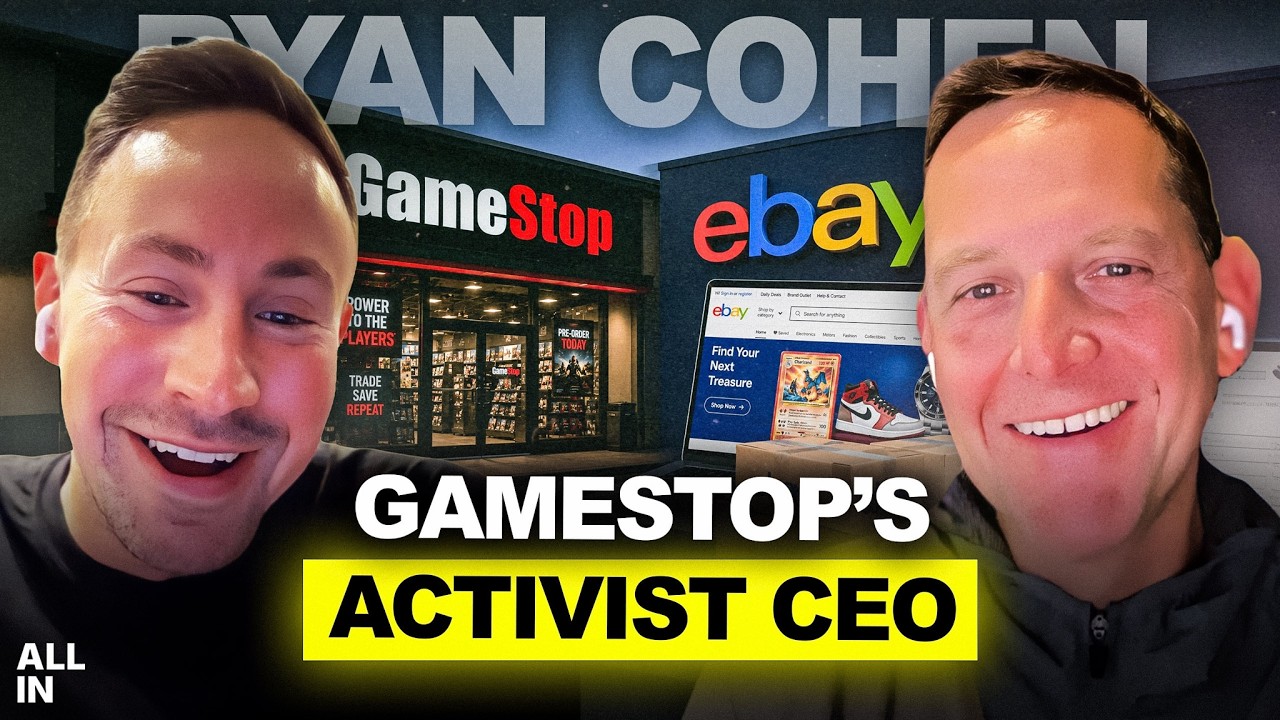
GameStop CEO Pledges Hostile eBay Bid to Force $56 Billion Merger
All-In Podcast
Ryan Cohen plans to extract $2 billion in costs and turn eBay's marketplace into a digital video game collectible platform by leveraging GameStop's physical infrastructure.
## Background
Published on June 23, 2026, by the All-In Podcast on YouTube, this video features host David Friedberg interviewing GameStop CEO Ryan Cohen. The show description outlines Cohen's entrepreneurial journey from building Chewy to his activist investment in GameStop, concluding with his detailed $56 billion strategic vision to acquire and turn around eBay.
## TL;DR
In this interview, Ryan Cohen details his operational philosophy, tracing his path from founding Chewy to taking over as CEO of GameStop, where he pivoted the business toward a highly profitable collectibles and card trade-in model. Having stabilized GameStop's finances with a massive cash pile, Cohen outlines a $56 billion proposal to acquire eBay, citing severe corporate stagnation and a 30 million drop in active users. His three-part turnaround strategy for eBay involves cutting $2 billion in bloated operating expenses, expanding into live commerce by using GameStop stores as fulfillment nodes, and establishing a digital marketplace for in-game assets. Despite the eBay board rejecting the initial offer over financing concerns, Cohen expresses full commitment to pursuing hostile escalation paths or a tender offer to push the deal through.
## Atmosphere & style
The interview has an intense, candid, and gritty energy, driven by Cohen's uncompromising "psychotic" focus on hyper-efficiency and first-principles execution. There is a palpable undercurrent of defiance and frustration directed toward entrenched corporate management, passive boards, and a hostile financial media establishment that the speakers feel is rooting for GameStop to fail. The dynamic shifts between analytical breakdowns of supply chain logistics and an authentic, high-stakes battle narrative, leaving listeners with the feeling of pulling back the curtain on a high-stakes corporate takeover led by a deeply committed, skin-in-the-game founder.
## Key takeaways
- [57:30](https://www.youtube.com/watch?v=4j9RPGLENNI&t=3450s) The media and corporate establishment harbor a deep-seated bias against GameStop, hoping the company fails and painting it as a 'meme stock' to protect their own credibility and avoid rewriting history.
- [11:40](https://www.youtube.com/watch?v=4j9RPGLENNI&t=700s) Ryan Cohen's entrepreneurial approach is driven by intuition and first principles rather than a rigid framework, preferring to run toward high-pessimism, 'burning house' market situations where deep value resides.
- [01:56](https://www.youtube.com/watch?v=4j9RPGLENNI&t=116s) Chewy's successful multi-billion dollar scaling against Amazon relied on a negative working capital model, strict operational cost-cutting, and building an incredibly sticky customer base through hyper-personalized service.
- [16:04](https://www.youtube.com/watch?v=4j9RPGLENNI&t=964s) Cohen's initial thesis for investing in GameStop was purely cyclical, aiming to capitalize on the revenue spike from the Sony PlayStation and Microsoft Xbox console cycles.
- [20:00](https://www.youtube.com/watch?v=4j9RPGLENNI&t=1200s) Attempting to blindly apply Chewy's pure e-commerce playbook to GameStop's physical retail landscape failed, prompting a shift toward strict cost-cutting and a focus on pre-owned items.
- [22:00](https://www.youtube.com/watch?v=4j9RPGLENNI&t=1320s) GameStop successfully stabilized its business model by expanding into the high-end collectibles and sports card markets, using a PSA card trade-in program for immediate cash in stores.
- [25:00](https://www.youtube.com/watch?v=4j9RPGLENNI&t=1500s) With a $9.7 billion cash pile and stable free cash flow, GameStop is shifting its corporate focus toward large-scale acquisitions like eBay rather than relying solely on organic growth.
- [27:00](https://www.youtube.com/watch?v=4j9RPGLENNI&t=1620s) The strategic synergy between GameStop and eBay lies in their shared focus on secondary markets and collectibles, combining GameStop's face-to-face physical presence with eBay's global digital authentication scale.
- [30:00](https://www.youtube.com/watch?v=4j9RPGLENNI&t=1800s) eBay's historical moat in unique, non-standardized secondhand categories has been severely compromised by a lack of innovation and massive market share erosion to category-specific niche players, Shopify, and live commerce.
- [35:00](https://www.youtube.com/watch?v=4j9RPGLENNI&t=2100s) Cohen strongly rejects pushing eBay into first-party inventory or complex logistics, preferring to optimize and preserve its high-margin, asset-light marketplace model.
- [40:00](https://www.youtube.com/watch?v=4j9RPGLENNI&t=2400s) Since 2015, eBay has suffered a severe operational decline, losing 30 million active users while bloating its operating expenses to consume over 50% of its total revenue.
- [41:00](https://www.youtube.com/watch?v=4j9RPGLENNI&t=2460s) eBay's professional management team is accused of complacency and over-reliance on external consulting firms, alienating top sellers by failing to build native, full-stack seller tools.
- [43:55](https://www.youtube.com/watch?v=4j9RPGLENNI&t=2635s) The proposed three-part strategy for eBay consists of an aggressive $2 billion cost-cutting phase, building a robust live commerce platform, and launching a liquid digital marketplace for AAA video game items.
- [46:50](https://www.youtube.com/watch?v=4j9RPGLENNI&t=2810s) GameStop intends to use its 1,600 physical retail storefronts as decentralized live commerce creator studios, fulfillment nodes, and physical authentication hubs for eBay.
- [49:10](https://www.youtube.com/watch?v=4j9RPGLENNI&t=2950s) The implied $56 billion acquisition offer consists of a premium-priced 50% cash and 50% GameStop stock structure, letting current eBay shareholders retain upside under new leadership.
- [49:10](https://www.youtube.com/watch?v=4j9RPGLENNI&t=2950s) The eBay board officially rejected the takeover bid due to 'financing uncertainty,' which Cohen dismisses as an empty excuse meant to protect entrenched management and lucrative golden parachutes.
- [52:00](https://www.youtube.com/watch?v=4j9RPGLENNI&t=3120s) Cohen highlights the stark contrast between his personal $500 million capital commitment to the deal and the current eBay board and CEO, who have never bought a single share of their own stock on the open market.
- [58:30](https://www.youtube.com/watch?v=4j9RPGLENNI&t=3510s) If the eBay board continues to refuse direct engagement, the acquisition team is prepared to deploy hostile takeovers or tender offers to bypass management and take the proposal directly to shareholders.
## Detailed walkthrough
### [00:00](https://www.youtube.com/watch?v=4j9RPGLENNI&t=0s) Everyone Hates GameStop: The Origins of the Interview and the Chewy Genesis
The discussion opens with a blunt critique of the media and corporate environment surrounding GameStop, with the speaker pointing out that mainstream outlets seem to want the company to fail. He expresses frustration over a corporate board pulling in hundreds of thousands of dollars a year without investing their own capital, alongside a grossly overpaid management team, contrasting this with the core American principle of risking one's own capital. Following a quick promotional segment for AppLovin ads, the host formally welcomes Ryan Cohen to the *All In* interview, noting with some surprise that it has been nearly a decade since they last shared a dinner in New York.
Shifting focus to Cohen's entrepreneurial roots, the host steers the conversation toward the founding of Chewy. Cohen reveals that his original venture was actually going to be an online jewelry website. He and his team had already attended trade shows, built out the website, secured distribution, and bought hundreds of thousands of dollars in inventory. However, the turning point came during a routine trip to a neighborhood pet store for his poodle. Cohen realized he understood the pet product category much better, recognizing it as a highly fragmented market driven by recurring, consumable purchases. He found it fascinating that traditional neighborhood pet stores hadn't been completely wiped out by giants like Petco and PetSmart, and noted that while Amazon had carried pet products since the 1990s, they hadn't yet scaled the category effectively.
Cohen's ultimate vision for Chewy was to take the personalized, highly knowledgeable experience of a neighborhood pet store and replicate it online at a massive scale, marrying it with Amazon’s supply chain best practices like fast shipping and competitive pricing. He admits in hindsight that going head-to-head against Amazon selling heavy 30-pound bags of pet food wasn't necessarily the most obvious recipe for success, but exceptional execution and a negative working capital model allowed Chewy to scale to billions in revenue without burning massive amounts of capital.
- **Initial Venture:** Online jewelry website (abandoned after buying inventory)
- **Inspiration for Chewy:** Cohen's personal experience shopping for his poodle at a neighborhood pet store
- **Market Dynamics:** Fragmented category, high customer retention, consumable products, under-scaled presence by Amazon in the early days
[03:32](https://www.youtube.com/watch?v=4j9RPGLENNI&t=212s) A Game of Pennies: Execution and the Psychotic Drive for Efficiency
When asked how he managed to execute so flawlessy with very little prior business experience, Cohen emphasizes that he always viewed Amazon as the ultimate, world-class benchmark for supply chain logistics. To compete, Chewy had to negotiate fiercely with suppliers to lower product costs, which meant rapidly scaling from buying simple pallets of dog food to ordering entire truckloads, moving entirely from third-party distribution to direct buying. Cohen describes the operation as a rigorous "game of pennies" where labor optimization, warehouse management, and aggressive shipping carrier negotiations dictated whether the company survived or went under. Because pets.com had notoriously collapsed in the dot-com crash, raising capital for an online pet business was incredibly difficult, as the market completely underestimated Chewy's operational execution.
Beyond the back-end logistics, Cohen heavily prioritized the consumer product experience because the customer cohorts were incredibly sticky. To build a brand that triggered powerful word-of-mouth referrals among passionate pet owners, Chewy leaned into hyper-personalized touches, such as sending handwritten holiday cards, custom pet portraits, and offering round-the-clock 24/7 customer service.
- **Operational Focus:** Warehouse labor optimization, direct supplier purchasing, and shipping carrier negotiations
- **Customer Retention Tactics:** Handwritten holiday cards, custom pet portraits, and 24/7 customer service
- **Historical Context:** The shadow of pets.com made raising venture capital exceptionally difficult
[06:51](https://www.youtube.com/watch?v=4j9RPGLENNI&t=411s) Managing Like a "Psychopath" and the Multi-Billion Dollar Exit
The host highlights that Cohen built and eventually sold Chewy in 2017 for $3.35 billion, after which it went public and traded at an even higher valuation, prompting a question about Cohen's management style. Cohen explains that his strategy required being on top of every single detail 24/7, admitting he used to stay up managing Google AdWords campaigns until 4:00 or 5:00 AM and handled major supplier negotiations personally. He recalls a humorous instance where a supplier expressed sheer relief at finishing a one-year contract because it meant he wouldn't have to talk to Cohen for the next twelve months—a comment Cohen took as a massive compliment. He notes that while employees naturally want to be nice and build warm relationships with suppliers, receiving gifts from a supplier is actually a bad sign because it implies you are overpaying.
When it came to hiring and building a leadership team, Cohen valued "will over skill." He shares an anecdote about a woman who had been working in an old age home and relentlessly applied for a customer service role despite lacking the traditional resume credentials. She was hired based on sheer drive and turned out to be incredible. Cohen jokes that his strategy was to find "diehards" who were willing to go all-in and be just as "psychotic" as he was, remarking that "psychopaths attract psychopaths" and that "A players only put up with A players." Reflecting on the sale of Chewy, Cohen acknowledges that while investment bankers assured him he got an amazing price, the company went public at a $20 billion market cap a couple of years later. Though Chewy was his "baby" and the subsequent surge proved nobody has a crystal ball, he has no regrets, noting that "everything works out for a reason."
- **Chewy Sale Price:** $3.35 billion in 2017
- **Subsequent IPO Valuation:** Approximately $20 billion market cap
- **Hiring Philosophy:** Prioritizing internal drive over resume experience ("will over skill")
[11:39](https://www.youtube.com/watch?v=4j9RPGLENNI&t=699s) Turning Activist: Running into the Burning House of GameStop
Following the sale of Chewy, Cohen transitioned into a highly concentrated, active investor, targeting established, historically profitable businesses that had fallen out of favor with passive or activist investors. His involvement with GameStop initially began as a purely passive investment of under 5%. In 2020, amidst a bitter fight with another activist investor, GameStop’s CEO reached out to Cohen and offered him a single seat on their large board, mistakenly assuming Cohen would act as a "friend" or a "patsy" to help fend off the external pressure. Cohen declined the solitary seat, feeling it wasn’t an attractive offer.
Shortly thereafter, the COVID-19 pandemic severely worsened GameStop's outlook; the company was deemed a non-essential retailer, teetered on the verge of bankruptcy, and saw its stock price crater. Cohen saw this intense pessimism as a massive value opportunity and continued accumulating shares until he crossed the 5% threshold. This forced a crucial regulatory decision: file a Schedule 13G to remain completely passive, or a Schedule 13D to actively engage with management. Cohen chose the 13D. He vividly remembers receiving a call from the CEO asking which form he filed, signaling the start of his activist journey. Cohen notes he has always been drawn to situations where he is essentially "running into a burning house" because severe market fear creates the best entry points.
- **Initial GameStop Stake:** Under 5% as a passive investor in 2020
- **Regulatory Pivot:** Crossing the 5% threshold prompted a Schedule 13D filing to initiate active management engagement
- **The Core Appeal:** High short interest, heavy market skepticism, and deep structural pessimism
[16:04](https://www.youtube.com/watch?v=4j9RPGLENNI&t=964s) The Console Cycle Thesis and the Meme Stock Explosion
Explaining his original fundamental thesis, Cohen reveals that he initially targeted GameStop because of the upcoming Microsoft Xbox and Sony PlayStation console cycles. GameStop was a highly cyclical business that historically performed exceptionally well at the start of a console launch when hardware and software supply was tight and consumers rushed to stores. The original plan was simply to ride out the cyclical upswing as an investor, rather than taking over the company. However, realizing there was no one else equipped to handle the deep operational changes required, Cohen pushed for more control.
Early in 2021, Cohen officially joined the board alongside two of his former Chewy colleagues. This triggered an unprecedented short squeeze where hedge funds were forced to cover their short positions, causing the stock price to rip upward spectacularly. Capitalizing on the massive stock surge, GameStop successfully raised $1.7 billion in cash, completely wiping out all of its corporate debt. Cohen notes that once he got inside the company, the business realities forced him to shift his thesis entirely, initially entering the turnaround with a heavy bias trying to apply the exact same e-commerce playbook he perfected at Chewy.
- **Original Investment Thesis:** Anticipating a massive revenue spike from the upcoming PlayStation and Xbox console cycle
- **Board Shakeup:** Cohen joined the board in early 2021 along with two former Chewy executives
- **Capital Raise:** GameStop raised $1.7 billion during the stock surge, eliminating 100% of its debt
[20:00](https://www.youtube.com/watch?v=4j9RPGLENNI&t=1200s) Adjusting GameStop’s Strategy and Discovering the Collectibles Market
Upon taking over, Ryan Cohen quickly realized that trying to replicate the playbook of an e-commerce giant like Chewy at GameStop was "really, really stupid." Initially, Cohen hired a CEO and brought in e-commerce veterans from Chewy and Amazon, which left him without day-to-day visibility. He soon recognized that physical retail is a "totally different animal" compared to digital pet retail. At Chewy, sticky cohorts and repeat purchases meant inventory risk was low because products would inevitably sell quickly. In contrast, GameStop began overbuying inappropriate inventory, like televisions, which ended up stuck in stores and forced heavy markdowns. Once Cohen stepped in as CEO, he analyzed the financials, realized the strategy made no sense, and pivoted into a "maniacal cost-cutting mode" focused on efficiency and GameStop's core strength: pre-owned items.
This strategic course correction ultimately led GameStop to deep-dive into collectibles, a category where the company has now established itself as a market leader, while traditional software sales have shrunk to a very small percentage of the business. Lacking physical retail experience when he first joined the board, Cohen used a trial-and-error approach to expand. GameStop experimented with various consumer electronics that failed to take off before finding massive success by expanding their existing footprint in collectibles, trading card games (TCG), and sports cards. They successfully extended their traditional hardware and software trade-in model to high-end collectibles. Today, customers can bring a graded PSA card rated eight or above into a store, receive "cash on the spot," and GameStop will resell it either in-store or online via their warehouses.
When navigating the massive leadership turnover that followed his appointment as CEO, Cohen chose to rely heavily on internal talent rather than relying solely on outside hires. He focused on identifying and working directly with the people who had been at GameStop the longest, noting that "the people who know GameStop the best have been the people that have been there for a long time."
* **Inventory Contrast:** Chewy benefited from rapid inventory turnover and predictable demand, whereas GameStop suffered losses from stagnant, non-core physical inventory like TVs.
* **PSA Card Trade-In Program:** GameStop purchases graded PSA cards rated 8 and above directly from customers for immediate cash.
* **Management Philosophy:** Rather than fully replacing the workforce, Cohen blended select outside talent with veteran employees who possessed deep historical knowledge of the retail operation.
---
[25:00](https://www.youtube.com/watch?v=4j9RPGLENNI&t=1500s) The Logic Behind an eBay Acquisition
When asked if he operates with a repeatable framework or machine similar to Koch Industries' Charles Koch, Cohen admits he operates largely on intuition and first principles, stating, "I'm sure I do, but I'm not good at articulating it." He jokes that if he tries to describe what is going through his brain, he usually gets it wrong, adding with a laugh that he hopes people who work with him repeatedly would say "hopefully not good things" about the experience. The conversation shifts to GameStop’s recent financial turnaround, highlighting impressive metrics: collectibles making up 42% of revenue, $350 million in Q1 revenue within an overall $835 million quarterly revenue, a 14% year-over-year growth rate, a reduction in SG&A from $228 million to $202 million, a massive $9.7 billion cash pile, $333 million in free cash flow, and a newly authorized share repurchase program.
With GameStop stabilized, Cohen is looking toward large-scale acquisitions rather than purely organic growth, explaining that "life is too short to do it small." He points out that Chewy could have chosen to be a modest, highly profitable $100 million or $500 million business by cutting marketing spend, but he prefers to build massive enterprises. His deep dive into collectibles at GameStop gave him a new appreciation for eBay, revealing immense synergies between the two companies. Both deal heavily in secondary markets, collectibles, and providing liquidity to consumers. While GameStop handles this face-to-face in physical stores, eBay executes it online with global scale and authentication protocols for secondhand items. Furthermore, Cohen notes that e-commerce falls squarely within his "circle of competence," making eBay a business he fundamentally understands better than traditional brick-and-mortar retail.
Reflecting on past ventures, Cohen compares online pet food sales to the low-margin airline industry, where consumers lack brand loyalty and simply shop by price. He acknowledges that in hindsight, battling well-funded competitors and Amazon in the pet space or trying to reinvent GameStop were incredibly difficult ideas. However, he views the prospect of merging GameStop's strengths with eBay as "actually a really good idea, whether it ends up working out or not." When pressed on the exact moment he decided to make a play for eBay, Cohen candidly reveals, "I was on the toilet... and I was just thinking about it."
* **GameStop Financial Performance:** Q1 revenue reached $835 million (with $350 million from collectibles), reflecting a 14% year-over-year growth.
* **Cost Reductions:** SG&A expenses were successfully trimmed down from $228 million to $202 million.
* **Capital Assets:** The company boasts $9.7 billion in cash reserves and $333 million in free cash flow alongside a share-buyback authorization.
* **Synergy Alignment:** GameStop provides localized, physical liquidity and trade-ins, while eBay offers global scale, digital reach, and an established secondhand authentication infrastructure.
---
[30:00](https://www.youtube.com/watch?v=4j9RPGLENNI&t=1800s) Analyzing eBay’s Historical Moat and Execution Misses
Cohen has followed eBay for a long time, admiring its strong moat in collectibles, secondhand goods, and refurbished tech—the latter being a major sector for both GameStop and eBay. Analyzing eBay's history, Cohen credits its massive staying power to a powerful marketplace model and a critical first-mover advantage that allowed it to become the de facto online marketplace, even against an early Amazon. However, he argues that eBay's execution faltered after it transitioned away from being founder-operated. While Amazon aggressively expanded by pairing its marketplace with first-party inventory and building a massive logistics network reminiscent of a digital Walmart, eBay stagnated. It surrendered massive market share to category-focused platforms, live shopping competitors, Shopify, social commerce, and Amazon.
Despite maintaining a steady revenue base and generating earnings, eBay failed to grow alongside the broader e-commerce boom. Cohen points out that until the last few quarters, the business had stagnated while its operating expenses rose significantly. He believes eBay essentially defaulted into its current strengths; because Amazon prioritized new products like phone chargers, eBay naturally became the destination for unique baseball cards, hard-to-find pens, or used auto parts. Addressing whether Amazon is "over-earning" by charging high margins to frustrated sellers who have no alternative audience of equal reach, Cohen agrees that sellers dislike Amazon's margins but tolerate them because they move massive volume.
If Cohen were to run eBay, he emphasizes that he would strictly preserve the pure marketplace model and steer entirely clear of taking on first-party inventory or complex logistics. He views a direct head-to-head logistical battle with Amazon as highly unattractive. Looking at eBay's corporate history of buying and selling major subsidiaries—such as spinning out PayPal, selling StubHub for $4 billion back to its founder via Viagogo, and trading Skype back and forth with a lucky profit from Microsoft—Cohen diagnoses these as departures from core focus. He strongly advocates for a singular brand focus, noting that his strategy at Chewy was explicitly to avoid creating confusing regional sub-brands. Though Cohen prefers organic product building to expand marketplace verticals, he notes that eBay's recent acquisitions don't make sense, reinforcing that it is incredibly difficult to do multiple different things exceptionally well on a global scale.
* **Market Share Erosion:** eBay maintained profitability but lost massive ground to specialized niche players, social commerce, Shopify, and Amazon due to rising operating expenses and a lack of innovation.
* **Core Niche Categories:** eBay’s strongest remaining moats exist in non-standardized categories where Amazon does not focus, such as collectibles, refurbished electronics, and secondhand automotive parts.
* **Strategic Divestitures:** eBay acquired and subsequently divested major brands including PayPal, Skype (bought for $2.6 billion in 2005, partially sold in 2009, and fully exited via Microsoft in 2011), and StubHub ($4 billion sale).
* **Operational Stance:** Cohen rejects entering the first-party inventory or warehousing business for eBay, preferring to optimize the asset-light, high-margin marketplace structure.
[40:00](https://www.youtube.com/watch?v=4j9RPGLENNI&t=2400s) Post-Donahoe Decline and Management Complacency
Since John Donahoe left eBay around 2015, the business has suffered a steady decline. The speaker notes that since the COVID-19 pandemic, every single key metric—including GMV, active users (which dropped by 30 million), and operating earnings—has plummeted. For a marketplace business that carries zero inventory, its operating expenses are shockingly bloated, consuming over half of its revenue. While the rest of the e-commerce sector enjoys growth, eBay is spending significantly more to make far less money. This lack of performance has severely alienated top sellers, who now feel taken for granted. To even conduct business, sellers are forced to rely on external, third-party tools because eBay fails to provide the full-stack infrastructure found in platforms like Amazon Seller Central.
The speaker argues that in a marketplace model, the sellers are the actual customers. Keeping them happy by building the tools they need encourages them to bring more inventory online, which naturally drives sales. Rather than rolling up their sleeves to talk to top sellers and getting engineers on the phone to systematically "bang out" these pain points, existing management is accused of acting like complacent corporate employees merely collecting a paycheck. The speaker bets "everything" that current leadership is heavily reliant on multiple outside consulting firms to tell them how to run the business, a symptom of transitioning from a passionate founder-operator model to a detached, professional management team that ignores root causes.
* **Active User Drop:** eBay has lost 30 million active users.
* **Operating Expenses:** Costs account for over 50% of revenue despite the company holding zero inventory.
* **The Marketplace Rule:** "You make your sellers happy you give them the tools they bring more inventory online and you end up ultimately doing more sales."
---
[43:55](https://www.youtube.com/watch?v=4j9RPGLENNI&t=2635s) The Three-Part Strategy for Value Creation
When asked about whether a long-range strategic plan or an agile, tactical approach is better suited for a turnaround, a concrete three-part roadmap is laid out to maximize shareholder value. The first immediate objective is aggressive cost-cutting. The speaker identifies an opportunity to pull $2 billion of costs out of eBay's roughly $5.5 billion operating expense base, pointing out that spending $2.4 billion on sales and marketing for a platform with flat-to-negative user growth is entirely unjustifiable.
The remaining two vectors focus purely on growth, starting with live commerce. While a major unnamed competitor is currently "completely crushing it" in the United States and Asia, eBay's live commerce platform remains an obscure, poorly executed afterthought bogged down by an arbitrary seller application process. The speaker envisions leveraging GameStop's 1,600 physical stores as decentralized content creator studios, fulfillment nodes, and authentication centers to capture a massive Total Addressable Market (TAM). The final, previously unannounced growth vector is transitioning eBay's dominance in physical collectibles into the digital space by creating a liquid marketplace for AAA video game in-game items like skins and weapons. Unlike NFTs, these digital collectibles possess real utility within an massive market that currently has no primary liquidity provider.
* **Cost-Cutting Target:** $2 billion to be extracted from a $5.5 billion operating base.
* **Sales and Marketing Waste:** $2.4 billion is currently spent annually with zero user growth to show for it.
* **Live Commerce TAM:** Estimated at $400 billion globally.
* **Physical Infrastructure:** 1,600 brick-and-mortar stores will serve as creator studios and logistics hubs.
* **Digital Collectibles Philosophy:** Physical trading cards are just "a piece of cardboard in a piece of plastic" driven by ego; in-game digital assets provide actual utility.
---
[49:10](https://www.youtube.com/watch?v=4j9RPGLENNI&t=2950s) Board Rejection, Financing, and the Battle Against Entrenched Management
The eBay board formally rejected the acquisition offer, citing "financing uncertainty," though the speaker dismisses this as an empty excuse since the financing would be secured against eBay's own strong balance sheet. In reality, the board and management are accused of "playing games"—refusing to schedule meetings and pointing the acquisition team toward high-priced advisors to protect their own lucrative positions. The current offer structure stands at 50% cash and 50% GameStop stock at a premium, allowing existing shareholders to retain upside in eBay under highly incentivized leadership. The speaker notes that raising the full $56 billion in cash up front is unrealistic because they don't have billions "just lying around," but emphasizes that the core question for institutional shareholders is simply who is a better fiduciary of capital.
A deep sense of frustration surfaces regarding the media and corporate establishment, with the speaker asking, "Why does everybody want us to fail? Why does everyone want GameStop to fail?" They contrast their personal commitment—putting $500 million of their own money into the transaction without selling a single share of GameStop—with an entrenched board and CEO who have zero skin in the game. Current leadership has allegedly never bought a single share on the open market with their own money, has sold tens of millions of dollars in stock, and yet stands to receive a massive golden parachute.
* **Total Deal Size:** Implied around $56 billion.
* **Offer Structure:** 50% cash and 50% stock, representing a premium.
* **CEO Golden Parachute:** Worth over $100 million to walk away.
* **Personal Stake:** The speaker is personally committing $500 million of their own capital to the transaction.
* **Shareholder Threshold:** A recent vote to lower the special meeting threshold to 10% failed; it remains tightly locked at 20%.
---
[57:30](https://www.youtube.com/watch?v=4j9RPGLENNI&t=3450s) Escalation Paths and the "Meme Stock" Narrative
The host offers a theory on why the financial media remains hostile: acknowledging GameStop's actual business turnaround and the speaker's executive competency would force journalists to admit they got the entire "meme stock" story wrong. Because the media corporate structure cannot afford to lose credibility or "rewrite history," they are incentivized to keep framing GameStop as a fake phenomenon. The speaker implicitly agrees, though notes that the market is ultimately a "weighing machine" in the long term, and real operational performance will inevitably outlast media skepticism.
Looking ahead, the speaker declares they are fully committed and will do "whatever I need to do in order to succeed." Because the premium is high and major competitors face too many antitrust hurdles to mount a counter-bid, they have no intention of going away. If the board continues to refuse direct engagement, the acquisition team is prepared to explore multiple escalation paths within their toolkit, including going hostile or launching a tender offer. The host notes that the shareholder base may naturally turn over on the open market as investors who favor the premium buy in to vote for the deal. Assisted by their own team of bankers and advisors, the speaker expresses ultimate confidence in their vision as the conversation concludes.
> [06:51](https://www.youtube.com/watch?v=4j9RPGLENNI&t=411s) A players only put up with A players. — Ryan Cohen
> [20:00](https://www.youtube.com/watch?v=4j9RPGLENNI&t=1200s) the people who know GameStop the best have been the people that have been there for a long time. — Ryan Cohen
> [25:00](https://www.youtube.com/watch?v=4j9RPGLENNI&t=1500s) life is too short to do it small. — Ryan Cohen
> [25:00](https://www.youtube.com/watch?v=4j9RPGLENNI&t=1500s) I was on the toilet... and I was just thinking about it. — Ryan Cohen
> [40:00](https://www.youtube.com/watch?v=4j9RPGLENNI&t=2400s) You make your sellers happy you give them the tools they bring more inventory online and you end up ultimately doing more sales. — Ryan Cohen
> [49:10](https://www.youtube.com/watch?v=4j9RPGLENNI&t=2950s) Why does everybody want us to fail? Why does everyone want GameStop to fail? — Ryan Cohen
> [57:30](https://www.youtube.com/watch?v=4j9RPGLENNI&t=3450s) whatever I need to do in order to succeed. — Ryan Cohen
## Mentioned
GameStop, Ryan Cohen, eBay, YouTube, All-In Podcast, David Friedberg, Chewy, Amazon, Petco, PetSmart, AppLovin, Nasdaq, Chamath Palihapitiya, Jason Calacanis, David Sacks, pets.com, Microsoft, Xbox, Sony, PlayStation, Koch Industries, Charles Koch, Shopify, PayPal, StubHub, Viagogo, Skype, John Donahoe, Amazon Seller Central
GameStop CEO Ryan Cohen is proposing an estimated $56 billion acquisition of eBay, arguing that combining GameStop's debt-free balance sheet and store network with eBay's digital marketplace can unlock value through aggressive cost cuts, live commerce, and digital collectibles.
GameStop's Capital Base and Collectibles Pivot (20:00)
After abandoning an initial attempt to replicate Chewy's pure-play e-commerce model at GameStop, Cohen steered the retailer into deep cost reductions and secondary markets. GameStop eliminated its corporate debt by raising $1.7 billion during its 2021 stock surge, later expanding from traditional video games into trading cards and PSA-graded collectibles with instant in-store cash trade-ins. Cohen reported that collectibles represented $350 million of GameStop's $835 million Q1 revenue (42%), alongside an SG&A decline from $228 million to $202 million, $333 million in free cash flow, and a $9.7 billion cash reserve.
Cohen cited this stabilized balance sheet and his background in digital commerce as the foundation for pursuing large-scale acquisitions rather than relying purely on organic store growth, framing eBay's focus on secondary markets as directly aligned with GameStop's core competencies.
Diagnosing eBay’s Moat and Operational Stagnation (30:00)
Cohen views eBay as an underperforming marketplace insulated by an enduring moat in unstandardized secondary goods, refurbished tech, and collectibles—categories largely bypassed by Amazon. However, Cohen argues that since transitioning away from founder management, eBay has lost market share to niche marketplaces, social commerce, and Shopify due to rising operational costs and a failure to support third-party sellers with modern native tools.
Despite holding zero inventory, eBay's operating expenses consume over 50% of its revenue, while active users have dropped by 30 million since the COVID-19 pandemic. Cohen stated that under his management, eBay would preserve its asset-light marketplace structure, avoiding first-party inventory or warehousing battles against Amazon while refocusing capital on seller infrastructure.
Three-Vector Roadmap for eBay Value Creation (43:55)
To reverse eBay’s operational decline, Cohen outlined a three-step turnaround plan. The primary component is an aggressive cost-cutting initiative aiming to eliminate $2 billion from eBay’s roughly $5.5 billion operating expense base, specifically targeting $2.4 billion in annual sales and marketing spending that Cohen claims has yielded flat-to-negative user growth.
For expansion, Cohen proposed capturing share in the estimated $400 billion global live commerce market by utilizing GameStop’s 1,600 brick-and-mortar stores as creator studios, authentication centers, and decentralized fulfillment hubs. The final vector involves entering digital collectibles by building a liquid secondary marketplace for in-game AAA video game assets, skins, and weapons, which Cohen differentiates from NFTs due to their functional utility within gaming ecosystems.
Deal Terms, Board Pushback, and Escalation (49:10)
eBay’s board formally rejected Cohen's acquisition proposal—structured as 50% cash and 50% GameStop stock at a premium—citing financing uncertainty. Cohen rejected this critique, contending that debt financing could be secured against eBay's balance sheet and noting his personal commitment of $500 million in capital to the transaction without selling GameStop shares. He accused eBay's board and executive leadership of acting defensively to protect their positions, noting that leadership has not made open-market share purchases and holds golden parachutes valued over $100 million.
Because eBay's special meeting threshold remains locked at 20%, Cohen indicated his team is prepared to explore hostile escalation paths, including a direct tender offer to shareholders. Cohen expressed confidence that antitrust constraints would prevent competing bids from major tech incumbents, leaving the outcome to institutional shareholder sentiment.
While Cohen frames the proposed $56 billion takeover as a high-synergy turnaround backed by GameStop's cash reserves, the initiative faces formal rejection from eBay's board, strict governance hurdles, and the operational complexity of merging a legacy brick-and-mortar retailer with a global digital platform.
## Background
该视频由知名商业播客频道 All-In Podcast 于 2026 年 6 月 27 日在 YouTube 平台发布。节目主要由主持人 David Friedberg 专访 GameStop 首席执行官兼 Chewy 创始人 Ryan Cohen,围绕其创立并以 33.5 亿美元出售 Chewy 的历程、主导 GameStop 扭亏为盈并切入收藏品赛道的经验,以及他试图斥资 560 亿美元收购重组老牌电商巨头 eBay 的三步战略与面临的董事会阻力展开深入对话。
## TL;DR
Ryan Cohen 在节目中系统复盘了自己的商业哲学:早期依靠微利供应链管理、负营运资金与极致客户体验打造 Chewy;随后通过 13D 维权投资入主 GameStop,在实体零售交足学费后回归二手基本盘并开拓出高增长的集换式卡牌(TCG)即时变现体系。针对外界瞩目的 560 亿美元收购 eBay 案,Cohen 严厉批判了现任职业经理人漠视卖家利益、导致活跃用户流失与运营成本失控的顽疾,并抛出了削减 20 亿美元冗余成本、复用 GameStop 线下门店激活直播电商,以及构建 3A 游戏数字资产交易大市场的重组蓝图。面对 eBay 董事会的消极回绝与媒体偏见,Cohen 强调自己已与主要机构股东接洽,并承诺个人掏出 5 亿美元注资,展现出坚决推进要约或敌意收购、重塑股东价值的决心。
## Atmosphere & style
整场对话在老友重逢的自如叙旧与商战博弈的火药味之间自如切换,Ryan Cohen 展现出极具锋芒、毫无公关辞令的“创始人操盘手”作风,言辞间充斥着对官僚职业经理人与华尔街双标偏见的辛辣讽刺。主持人 David Friedberg 以深厚的资本运作与企业经营底蕴层层递进,既深挖了零售周转、库存与成本控制的严苛细节,又精准提炼出代理人治理结构下的深层矛盾。整期播客节奏紧凑、荷尔蒙充沛,观众能清晰感受到一位笃信第一性原理的逆向投资者迎着举世质疑、誓要吞下老牌电商巨头的强悍意志与不屈韧劲。
## Bulletin
- [49:33](https://www.youtube.com/watch?v=4j9RPGLENNI&t=2973s) GameStop 首席执行官瑞安·科恩(Ryan Cohen)拟斥资 560 亿美元(50% 现金 + 50% 换股)收购电商巨头 eBay,并承诺自掏腰包投入 5 亿美元个人资金以确保利益与股东深度绑定。
- [45:00](https://www.youtube.com/watch?v=4j9RPGLENNI&t=2700s) 针对 eBay 增长停滞与高昂开支,科恩提出三步重塑蓝图:立竿见影砍掉 20 亿美元冗余运营成本、依托 GameStop 门店赋能 4000 亿美元潜在市场的直播电商,以及构建首个主流 3A 游戏内数字资产流通市场。
- [57:38](https://www.youtube.com/watch?v=4j9RPGLENNI&t=3458s) 尽管 eBay 董事会以“方案不可信”为由拒绝谈判且现任 CEO 坐拥超 1 亿美元遣散费回绝会面,但科恩已接触多家表达不满的核心机构股东,并表态已聘请顶级投行团队决不放弃推进。
- [25:00](https://www.youtube.com/watch?v=4j9RPGLENNI&t=1500s) GameStop 实体转型与收藏品业务爆发,单季收藏品营收达 3.5 亿美元(占总营收 42%),公司在清偿所有债务后账面坐拥高达 97 亿美元现金储备与 3.33 亿美元自由现金流。
## Key takeaways
- [01:56](https://www.youtube.com/watch?v=4j9RPGLENNI&t=116s) Chewy 依靠负营运资金与精细化运营在低毛利大袋宠粮赛道抗衡亚马逊,以高频刚需品类为核心,极度克制横向扩张,打造极高用户留存与口碑壁垒。
- [07:45](https://www.youtube.com/watch?v=4j9RPGLENNI&t=465s) 科恩奉行“意志重于技能”与极限制采购博弈,早期亲自微调广告竞价至凌晨,并认为供应商因被压榨到极限而心生埋怨才是拿到真实底价的信号。
- [12:15](https://www.youtube.com/watch?v=4j9RPGLENNI&t=735s) 对 GameStop 的建仓始于主机周期更迭的被动价值投资,但在疫情暴跌且管理层试图将其作为抵御维权工具时,科恩逆势加仓并提交 13D 报告全面介入公司治理。
- [20:00](https://www.youtube.com/watch?v=4j9RPGLENNI&t=1200s) 初期盲目空降电商高管并扩张消费电子导致严重存货减值,科恩反思后放弃照搬 Chewy 模式,果断转向实体零售的极度精简控费与二手优势业务。
- [22:20](https://www.youtube.com/watch?v=4j9RPGLENNI&t=1340s) GameStop 打通 PSA 评级卡牌(TCG)线下即时现金回收与线上中央仓双轨分销体系,重用懂业务的零售老兵,使收藏品单季营收突破 3.5 亿美元。
- [30:00](https://www.youtube.com/watch?v=4j9RPGLENNI&t=1800s) eBay 坐拥深厚的二手与非标品网络效应护城河,但因脱离创始人后执行力溃败,在电商大繁荣周期中几乎将市场份额拱手让给亚马逊与新兴垂直平台。
- [35:00](https://www.youtube.com/watch?v=4j9RPGLENNI&t=2100s) 科恩坚持纯撮合的第三方平台模式,明确拒绝涉足重资产 1P 自营与物流,主张全力修补被亚马逊压榨、被 eBay 忽视的底层卖家工具生态与服务。
- [37:45](https://www.youtube.com/watch?v=4j9RPGLENNI&t=2265s) 反对盲目并购拼凑子品牌,科恩崇尚资源高度聚焦核心品牌,强调全球平台的扩张应当依托主站生态有机生长,而非依赖外部收购掩盖主业疲软。
- [43:12](https://www.youtube.com/watch?v=4j9RPGLENNI&t=2592s) 改造 eBay 的当务之急是从畸形膨胀的运营开支中直接削减 20 亿美元(包括精简 24 亿美元低效营销),迅速提振公司当期盈利与现金流造血能力。
- [45:00](https://www.youtube.com/watch?v=4j9RPGLENNI&t=2700s) 计划将 GameStop 全美 1600 家线下门店升级为直播电商的前哨站,为 eBay Live 创作者提供直播棚、实物鉴真中心与本地极速履约等关键基础设施。
- [45:00](https://www.youtube.com/watch?v=4j9RPGLENNI&t=2700s) 鉴于传统艺术品与球星卡本质是虚荣消费而 NFT 缺乏实用性,科恩计划开辟兼具实用价值与社交认同的 3A 游戏内道具与皮肤二级流通大市场。
- [49:33](https://www.youtube.com/watch?v=4j9RPGLENNI&t=2973s) 560 亿美元半现金半换股方案使原股东在部分变现的同时享受重组红利;科恩痛批现任管理层零自购却套现数千万,并将自身 5 亿美元个人注资视作最高标准的受托人责任。
- [57:38](https://www.youtube.com/watch?v=4j9RPGLENNI&t=3458s) 现任管理层闭门推诿并依赖外部咨询顾问,但其超过 1 亿美元的“黄金降落伞”遣散费将成为破局筹码,科恩已就经营权向不满现状的机构大股东展开接洽。
- [01:00:00](https://www.youtube.com/watch?v=4j9RPGLENNI&t=3600s) 反垄断监管阻断了大科技巨头竞购 eBay 的可能,为 GameStop 留出独家整合窗口;科恩坚信市场长期是“称重机”,最终将靠业务基本面击溃媒体与华尔街的偏见。
## Detailed walkthrough
### [00:00](https://www.youtube.com/watch?v=4j9RPGLENNI&t=0s) 序幕、赞助与久别重逢:从千亿美元狂想追溯起点
访谈在一段情绪激昂的开场白中切入。GameStop 首席执行官瑞安·科恩(Ryan Cohen)直言不讳地痛击华尔街与媒体的偏见:“每个人都恨 GameStop,媒体上的所有人似乎都盼着我们失败,盼着别人成功。”他尖锐地抨击了充斥于美国企业界的董事会弊病:董事们一年拿着几十万美元的高额薪酬,却从不自掏腰包购买自家股票,一年仅出席几次例会便赚得盆满钵满,管理层更是严重溢价高薪。科恩反问道:“最地道的美国精神莫过于拿自己的真实资本去冒险,那凭什么所有人都想看我们倒下?”
在播客赞助播报(AppLovin 的移动游戏广告引擎将一家 400 万美元规模的厨具品牌推升至 1600 万美元并步入盈利轨道,今年有望冲刺 8000 万美元)之后,主持人戴维·弗里德伯格(David Friedberg)正式向观众引出科恩。两人相识多年,弗里德伯格感慨距离他们在纽约共进晚餐已经过去了将近十年。眼下的科恩正身处舆论风暴的核心——他正试图斥资 560 亿美元收购并重组老牌电商巨头 eBay,这个惊人举动将人们的视线瞬间拉回互联网破晓的二三十年前。然而弗里德伯格决定将叙事暂时拉回原点,请科恩亲口复盘塑造了他商业哲学的第一座里程碑:宠物电商 Chewy 的创立与崛起。
### [01:56](https://www.youtube.com/watch?v=4j9RPGLENNI&t=116s) 弃珠宝转战宠物:迎战亚马逊与负营运资金的奇迹
谈及 Chewy 的起源,科恩坦言最初的想法其实非常单纯——他只想在网上做一个商业项目。当时他们甚至已经筹备好上线一个在线珠宝网站:他完全不懂珠宝行业,却跑遍了各大行业展会,采购了价值数十万美元的珠宝库存,搭好了网站并建好了仓储分销网络。然而就在万事俱备之际,转折出现了。科恩自己养了一只贵宾犬,每隔几周就会去社区附近的线下宠物店采购。在一次日常购物中,科恩突然顿悟:宠物用品远比珠宝更容易理解,且属于典型的高频复购快消品。
更令他着迷的是彼时宠物市场的格局:尽管行业内已有 Petco 和 PetSmart 等连锁巨头,但大量分散的独立社区宠物店依然活得很滋润;而线上霸主亚马逊虽然早在 90 年代就涉足宠物类目,却迟迟未能在该垂直领域建立起真正的主导规模。科恩由此确立了 Chewy 的核心愿景:将社区实体宠物店那种懂产品、有温度的人性化体验在线上化、规模化复刻,同时全面汲取亚马逊顶级的供应链长处——极速履约交付、丰富选品和极具竞争力的价格。
```mermaid
flowchart TD
accTitle: Chewy 早期战略与运营飞轮
accDescr: 展示 Chewy 如何从高频快消定位出发,通过精细化运营与负营运资金实现不依赖海量外部资本的规模扩张
subgraph Positioning["核心定位与切入点"]
A["高频复购快消品<br/>(宠粮、零食、猫砂)"] --> B["汲取社区宠物店温度<br/>(懂产品 + 极致客服)"]
B --> C["对标亚马逊供应链标准<br/>(极速配送 + 丰富选品 + 拼低价)"]
end
subgraph Execution["极度精细化运营"]
C --> D["议价与规模效应<br/>(整托盘 → 整卡车采购,绕过中间商)"]
D --> E["分厘必争的履约控制<br/>(优化仓库动线与劳动力 + 压低运费)"]
end
subgraph Finance["财务飞轮"]
E --> F["负营运资金结构<br/>(现金回流速度远快于付款周期)"]
F --> G["数百亿营收级扩张<br/>(极低外部资本消耗)"]
end
```
科恩笑称,事后复盘来看,选择去跟亚马逊正面硬碰硬、在线上卖死沉死沉的 30 磅装大袋狗粮,“事后看来绝不是什么明智之举”。作为一门极低毛利的生意,Chewy 却展现了惊人的执行力:依靠负营运资金(Negative Working Capital)这一商业结构,客户下单立刻付款,而公司对供应商享有账期,使得 Chewy 能够在不疯狂消耗外部股权资本的情况下,以极高周转率将年营收规模狂飙至数十亿美元。
### [05:00](https://www.youtube.com/watch?v=4j9RPGLENNI&t=300s) “分厘之争”的供应链哲学与打破 pets.com 阴影
当弗里德伯格询问一个早期缺乏深厚商业履历的年轻人如何掌握如此卓越的运营能力时,科恩给出的答案是清醒而近乎残酷的竞争认知:从第一天起他就明白,真正的唯一假想敌就是供应链天下第一的亚马逊。这意味着 Chewy 必须在采购端以极度凶悍的姿态向供应商要价格,通过不断做大采购规模,从最开始买几个托盘的宠粮,进阶到整卡车皮直采,彻底跳过分销商中间层,实现“买得越多、成本越低”。
在仓储履约环节,科恩将其定义为一场“分厘之争”(a game of pennies):
- **仓储与劳动力极致优化**:毫厘之间抠出仓库人效,重构仓储动线管理系统。
- **物流承运商议价**:用海量包裹规模拼命压缩快递物流费率。
- **生死一线的利润线**:在微薄的毛利下,“账面亏几分钱意味着毁灭,多赚几分钱就意味着胜利”,整个团队被迫保持极端高效的运转。
彼时资本市场对 Chewy 极其冷酷,融资极度艰难。由于 2000 年互联网泡沫破裂时宠物电商先驱 pets.com 破产的阴影挥之不去,VC 投资人普遍认为线上卖宠粮是个必死无疑的伪命题。科恩回顾道,市场低估的并不是宠物赛道的潜在市场规模(TAM),而是严重低估了他们团队恐怖的执行力。
### [06:30](https://www.youtube.com/watch?v=4j9RPGLENNI&t=390s) 情感连接的长期主义:手写贺卡与宠物肖像背后的留存算盘
弗里德伯格从资深犬主的消费者视角出发,指出 Chewy 最令人称道之处在于其无微不至的客户体验,并追问科恩这究竟是出自他个人的直觉还是外聘专家的功劳。科恩解释,数据队列分析(cohort analysis)证实了用户的粘性高得惊人。之所以从珠宝果断转向宠物,核心就在于宠粮、零食、猫砂属于家庭不可或缺的易耗消耗品。
Chewy 在最初几年极度克制,严禁盲目横向扩张,只死磕这些高频复购品类。科恩坚信一条质朴的逻辑:只要把这群宠物主人伺候好,他们一辈子都会留在这里。Chewy 由此推出了一系列在当时电商界堪称奢侈的人性化服务:
- 节日期间给每位用户寄送纯手工撰写的实体节日贺卡。
- 随机向忠实用户寄赠由专业画师手绘的爱宠油画肖像。
- 坚持全年 365 天、全天 24 小时由真实人类接听的客服中心,一旦包裹破损或出现问题,二话不说立刻全额补发或退款。
这种真诚最终演化为强大的口口相传网络。科恩指出,宠物主人是天生极具分享欲的群体,当他们被深深打动时,自发的主动推荐构成了 Chewy 最坚固的获客护城河。
### [07:45](https://www.youtube.com/watch?v=4j9RPGLENNI&t=465s) 掌控全局的 CEO:半夜调投放与让供应商“憎恨”的冷酷谈判
弗里德伯格提到,Chewy 最终在 2017 年以 33.5 亿美元的高价卖身 PetSmart(随后成功分拆上市并市值大涨),他探寻科恩在管理人员和打造领导团队上的核心经验。科恩坦陈,自己的秘诀就是毫不妥协的“全天候亲力亲为”(Staying on top of everything 24/7),对所有底层核心数字保持绝对掌控。在早期,科恩常常一个人通宵达旦地坐在电脑前,直到凌晨四五点还在亲自操作 Google AdWords 广告系统微调竞价投放;同时,他坚持亲自坐镇所有大供应商的核心商务谈判。
科恩分享了一个极为反直觉的供应商博弈理念:在一次艰苦的年度合同谈判结束后,一位核心供应商疲惫不堪地对科恩说:“我太庆幸这事终于结束了,接下来的整整一年里我都不用再跟你说一句话了。”科恩大笑表示,这对他而言是“最棒的赞美”。
他分析道,很多职业经理人往往落入“与供应商处好私交、维持融洽关系”的误区,但商业本质是赤裸裸的利益交换:“如果供应商逢年过节给我们寄来精美的礼品,那绝对是一个极其危险的信号,说明我们被宰了、付了冤枉钱;只有当供应商恨不得再也不想理我们的时候,才证明我们拿到了最极致、最底线的真实成本价。”科恩指出,人性的本能是顺应阻力最小的路径去迎合讨好别人,但在一家亏损爬坡的创业公司里,掌舵人必须将生存与可持续性置于首位。
当话题转向团队选拔时,科恩给出了自己的核心用人标准——“意志重于技能”(will over skill)。他举例提到当年 Chewy 负责整个客服团队的一名女性高管,正准备展开阐述她是凭借怎样的意志力与坚韧支撑起这一庞大业务体系……
### [10:00](https://www.youtube.com/watch?v=4j9RPGLENNI&t=600s) 疯子团队与 Chewy 的出售反思
在复盘 Chewy 的早期用人时,Ryan Cohen 分享了一个极其生动的案例:一名曾经在养老院工作的女性多次向 Chewy 投递简历,尽管纸面履历上她完全不符合岗位要求,甚至屡屡被拒,但她毫不气馁地反复申请。最终公司破格录用了她,而她的工作表现堪称惊艳。Cohen 指出,初创期最关键的是找到那些愿意全情投入、“孤注一掷”(All-in)的亡命之徒。他开玩笑地形容自己的创业团队其实就是“一群聚在一起的疯子(fellow psychopaths)”,正所谓“疯子吸引疯子”,顶尖人才往往只能容忍同样偏执的顶尖人才,当这台机器运转起来时,战斗力是惊人的。
当被问及是否后悔过早以 33.5 亿美元出售 Chewy 时——毕竟 Chewy 在上市后短短两年内市值就飙升至近 200 亿美元——Cohen 坦言,投资银行家当时信誓旦旦地保证那是一个绝佳的价格,但谁也没有水晶球能预知未来。Chewy 就像是自己的亲生骨肉,他倾注了无数心血与热爱。不过,他对当年的决定并不感到遗憾,因为“生活中的每件事发生都有其因果”。他幽默地调侃道,如果自己今天依然在掌管 Chewy,或许就无法坐在这里畅谈商业并购,或者大家讨论的话题就只会是一笔价值 1000 亿美元的狗粮生意。
### [12:15](https://www.youtube.com/watch?v=4j9RPGLENNI&t=735s) 涉足维权投资:GameStop 的最初接触与 13D 抉择
卖掉 Chewy 之后,Cohen 开启了人生新篇章,转型成为一名集中持股的价值型投资者。他的选股逻辑非常明确:寻找那些拥有长期盈利历史、商业模式成熟,但眼下失宠、被市场严重低估的传统企业。然而,他最初涉足 GameStop 纯属巧合,压根不是有预谋的维权介入,而只是一笔持股低于 5% 的普通被动投资。戏剧性的是,当时 GameStop 的管理层正面临另一位维权投资者的激烈挑战,首席执行官主动致电 Cohen,误以为这位持有少量股份的年轻富豪会成为管理层的“好朋友”,便主动抛出橄榄枝邀请他加入董事会,试图借他的力量击退外部维权者。
正是这次接触在 Cohen 脑海中埋下了种子。当时正值 2020 年前后,Cohen 刚刚经历丧父之痛,面对 GameStop 臃肿庞大的董事会结构,区区一个普通的董事席位对他毫无吸引力。随后,新冠疫情爆发,GameStop 实体店被官方判定为“非必需零售商”而被迫停业,公司滑向破产边缘,股价惨遭腰斩。面对断崖式下跌,Cohen 没有离场,反而大举逆势加仓,持股比例一举突破 5% 的监管红线。
按照美国证券交易委员会(SEC)的法规,投资者持股超 5% 时必须在 13G(被动投资,承诺不干预管理层运作)与 13D(维权/主动投资,保留与管理层直接交涉并推动变革的权利)之间做出选择。当 GameStop 首席执行官神色紧张地打电话询问他提交的究竟是哪份表格时,Cohen 平静地回答是“13D”。虽然提交 13D 并不必然意味着敌意收购,但它明确宣告:Cohen 绝不会做一个冷眼旁观的沉默看客。
```mermaid
flowchart TD
accTitle: GameStop 投资路径演变
accDescr: 展示 Ryan Cohen 从最初被动建仓到被迫维权介入的决策流程
subgraph 被动持股阶段
A["买入 GameStop 股份<br/>(持股比例 < 5%)"] --> B["管理层主动联络<br/>邀其入局抵御外部维权者"]
B --> C["疫情爆发门店关闭<br/>公司濒临破产,股价暴跌"]
end
subgraph 维权升级阶段
C --> D["逆势加仓<br/>持股比例突破 5%"]
D --> E{"监管申报抉择<br/>13G 还是 13D?"}
E -->|选择 13D| F["正式开启维权之路<br/>正面介入管理层改革"]
end
```
### [15:00](https://www.youtube.com/watch?v=4j9RPGLENNI&t=900s) 冲进着火的房子:被严重低估的潜力和主机周期逻辑
外界普遍认为 GameStop 纯粹是 Reddit 上 WallStreetBets 散户抱团炒作出来的“散户抱团股”(Meme Stock),但 Cohen 解释,他建仓的核心原因在于大众共识与基本面存在巨大认知偏差。多年来,主流财经媒体和华尔街分析师几乎一致认定 GameStop 必死无疑,甚至早在 15 年前就该清盘破产。它不仅遭到机构毁灭性的疯狂做空,任何宣称自己投资 GameStop 的人甚至会招来同行嘲笑。然而,Cohen 天生就喜欢扮演逆向投资者,“喜欢冲进正在着火的房子”,因为市场弥漫着极致悲观与恐惧的时刻,往往孕育着最不对称的获利机会。
抛开情绪面,Cohen 当时的核心商业逻辑其实非常朴素且建立在周期规律之上:
- **新一代游戏主机发售节点**:微软 Xbox Series X 与索尼 PlayStation 5 即将迎来换代周期;
- **存量现金流支撑**:GameStop 拥有足够的现金和防守能力,完全可以支撑到新主机周期到来;
- **供应链紧俏与线下红利**:主机迭代初期往往伴随着产能极度紧缺,玩家为了抢购新硬件和首发实体游戏光盘,必然会排队涌入 GameStop 实体店,从而带来极为强劲的短期业绩爆发。
这套逻辑原本只是一笔周期性的被动价值投资,然而随着 Cohen 对内部运转了解的加深,原有的投资假设被彻底颠覆,他发现这家公司面临的根本不是周期性波动,而是深层次的运营与战略溃败。
### [17:30](https://www.youtube.com/watch?v=4j9RPGLENNI&t=1050s) 进驻董事会、世纪大轧空与清偿债务
面对管理层的算计,Cohen 拒绝沦为被摆布的工具。管理层原本以为给他一个席位就能让他乖乖当个“软柿子/傀儡”(patsy),但他们显然找错了对手。Cohen 态度坚决地反客为主,提出如果要进董事会,就必须获得实质性的话语权。2021 年初,Cohen 与来自 Chewy 的两位核心高管盟友同时进驻 GameStop 董事会,全面介入重组。
随后的发展载入金融史册:市场上的大量做空机构因无法承受做空成本而被迫平仓,引发了史上罕见的轧空海啸(Short Squeeze),股价呈指数级冲天而起。乘着资本市场的狂欢,GameStop 顺势增发股票,一举募集了 17 亿美元的巨额现金。
- **化解灭顶危机**:凭借这笔 17 亿美元的融资,GameStop 在短时间内彻底还清了所有历史债务,从濒临破产蜕变为手握充裕流动性的无负债公司;
- **经验主义的当头一棒**:手握巨资之后,Cohen 原本雄心勃勃地计划将 Chewy 的整套成熟打法直接移植到 GameStop 身上。然而,在他真正深入业务一线仅仅几个小时之后,残酷的商业现实就迅速击碎了他的最初设想。
### [20:00](https://www.youtube.com/watch?v=4j9RPGLENNI&t=1200s) 照搬 Chewy 模式的教训与向实体零售的残酷低头
Ryan Cohen 坦率地回顾了自己接手 GameStop 初期的重大战略失误。他承认,自己花了大概一年多一点的时间才意识到最初的设想是“彻头彻尾的愚蠢”(really, really stupid)。当时他尚未出任 CEO,而是聘用了一位外部 CEO,自己并不掌握日常运营的具体细节。团队当时的既定战略是把 Chewy 和亚马逊的电商高管成批招揽过来,试图将 GameStop 改造成“游戏界的 Chewy”。然而,电商与实体零售是截然不同的两种商业物种。当 Cohen 正式出任 CEO 查阅财务报表时,他发现这套打法在财务逻辑上完全行不通,随即果断调头,进入极致且近乎疯狂的成本削减与效率优化模式(maniacal cost-cutting mode),将全部精力重新聚焦回 GameStop 真正擅长的领域——二手商品(pre-owned)与线下门店的高效精细化运营。
这次转变为 GameStop 后来在收藏品赛道的突围奠定了基础。Cohen 反思道,外界很容易把 Chewy 和 GameStop 都笼统归为“零售商”,并误以为可以套用同一套打法,但二者的底层运转逻辑大相径庭。Chewy 拥有极高黏性的客户群和持续的复购行为,即便多采购了宠物粮食和用品也永远不用担心存货积压,因为营收在高速增长且库存周转极快;然而在 GameStop,团队照猫画虎采购了大批电视机等各类消费电子库存,结果导致大量滞销商品直接砸在门店里,最终只能通过巨额减值和打折清仓吞下严重亏损。Cohen 坦言,自己在加入董事会乃至出任 CEO 之前对实体零售的认知为零,这一路走来交了昂贵的学费,但也因此彻底摸透了实体零售的残酷现实。
```mermaid
flowchart TD
accTitle: Chewy与GameStop零售模式对比
accDescr: 对比Chewy的高频复购模式与GameStop早期错误复制电商导致的库存积压模式
subgraph Chewy ["Chewy 模式(高频复购电商)"]
C1["高黏性客户群体"] --> C2["高频次定期复购"]
C2 --> C3["库存极速周转 / 几乎无积压风险"]
end
subgraph GameStopFail ["GameStop 早期错误尝试"]
G1["照搬 Chewy 团队与电商思路"] --> G2["盲目盲扩消费电子品类(如电视机)"]
G2 --> G3["商品滞销堆积门店 / 惨遭大幅减值亏损"]
end
subgraph GameStopFix ["GameStop 战略纠偏"]
R1["回归核心竞争力:二手(Pre-Owned)"] --> R2["极限制削减 SG&A 成本"]
R2 --> R3["切入高毛利收藏品与卡牌交易(TCG)"]
end
```
---
### [22:20](https://www.youtube.com/watch?v=4j9RPGLENNI&t=1340s) 跑通二手与交易卡(TCG)的即时变现体系
面对全品类扩张的挫折,GameStop 转而寻找能够完美复用其既有线下网络与用户基础的赛道。Cohen 解释说,公司此前其实就涉足过收藏品,只是涉足不深。他们曾尝试在消费电子领域做多种延伸,但反响平平,唯独收藏品类别——尤其是集换式卡牌游戏(TCG,Trading Card Game)以及如今迅猛增长的体育卡赛道——表现极其火爆。这一赛道的商业逻辑与 GameStop 根深蒂固的主机和游戏软硬件“以旧换新”(trade-in)模型高度契合:玩家现在可以直接拿着经过 PSA 评级在 8 分及以上的卡牌走进任何一家 GameStop 门店,店员验收后当场支付现金收购;回收后的卡牌既可以直接放在门店内陈列售卖,也可以统一调配回调配中心仓库,通过线上渠道面向全球买家发售。
在推动这场战略转型的过程中,管理团队的任用也是 Cohen 摸索出的关键一环。他并没有像早先那样迷信外部空降兵,而是将重心转向挖掘并重用那些已经在 GameStop 扎根多年的老员工。Cohen 认为,最懂 GameStop 业务本质和线下痛点的恰恰是那些在公司深耕已久的骨干人才;由他自己直接与这些老兵紧密配合,辅以极少数关键外部力量补充,反而激发出前所未有的协同执行力。
- **PSA 评级卡即时变现**:门店内支持 PSA 8 分及以上的评级卡现场回收,实现“进店交卡、即时拿钱”的流动性体验。
- **双轨分销体系**:回收的卡牌形成闭环,根据稀缺性与客群灵活分配至线下门店或中央仓库线上商城销售。
- **内部人才激活**:摒弃迷信硅谷/电商外援的路线,核心重用深谙传统零售业务与二手操作流程的资深内部团队。
---
### [25:00](https://www.youtube.com/watch?v=4j9RPGLENNI&t=1500s) 无法被言传的经营直觉与极其亮眼的财务成绩单
主持人 David Friedberg 提及自己近期采访科氏工业(Koch Industries)掌门人 Charles Koch 时,对方拥有一整套严密且可跨行业复制的企业运营方法论,并询问 Cohen 是否也有一套类似的框架模型或第一性原理体系来跨界管理 Chewy、GameStop 以及未来的潜在收购标的。Cohen 对此给出了一个颇具自嘲意味的坦白回答:“我肯定有属于自己的东西,但我很不擅长用语言把它系统性地阐述出来。我甚至不知道自己是不是那个能把脑子里所思所想讲清楚的人。有时候我凭直觉感知到的东西,一旦试图说出口,反而往往词不达意,可能别人来评价我怎么做事会更准确。”当 Friedberg 追问多次跟他共事过的人会如何评价与他工作的感受时,Cohen 打趣道:“但愿他们不会说出什么好话来(Hopefully not good things),那说明压力给得足够到位。”
随后,Friedberg 列出了一组极具说服力的 GameStop 财务改善数据:
- **收藏品业务占比爆发**:收藏品目前已占到 GameStop 总营收的 42%,单季度(第一季度)在 8.35 亿美元总营收中贡献了 3.5 亿美元,同比增速达 14%。
- **成本控制立竿见影**:销售、一般及行政费用(SG&A)从 2.28 亿美元大幅压缩至 2.02 亿美元。
- **弹药极其充足**:账面坐拥高达 97 亿美元的现金储备,自由现金流达到 3.33 亿美元,董事会甚至刚刚授权了股票回购计划。
面对如此稳健的内生现金流和资产负债表,Friedberg 追问:既然线下门店运转良好且重新盈利,究竟是什么促使 Cohen 抬起头来,放弃单纯依赖有机内生增长,转而把目光投向如此庞大的对外并购?
---
### [27:15](https://www.youtube.com/watch?v=4j9RPGLENNI&t=1635s) “人生苦短,不做小事”:GameStop 与 eBay 的天作之合
Cohen 回应称,光靠 GameStop 现有的资产体量做内生增长固然不错,但他天生就渴望做规模宏大的事业("I like to do big things")。他以 Chewy 为例指出,如果当年他们选择大幅压缩营销预算,Chewy 完全可以安安稳稳做成一家年营收 1 亿或 5 亿美元且盈利的小而美公司,但“人生苦短,不要把格局做小了”("life is too short to do it small")。正是在深耕收藏品品类的过程中,Cohen 站在全新视角重新审视并深刻理解了 eBay 的不可替代性。
在 Cohen 眼中,GameStop 与 eBay 在商业模式上存在着极强的互补性与基因契合:
1. **二手与收藏品的核心重叠**:双方的根本盘都在于二手二级市场(Secondary market)以及具有高附加值的收藏品赛道。
2. **线上与线下的流动性闭环**:GameStop 在数千家实体门店为消费者提供面对面的即时变现与流动性支持,而 eBay 则在全球线上平台提供庞大的交易流动性;实体门店能解决在线验证和回收的信任断点,而 eBay 则拥有 GameStop 所缺乏的全球级网络规模。
3. **退回自身能力圈(Circle of Competence)**:Cohen 坦承,相较于复杂的实体零售连锁,他本人对电子商务的理解要深刻得多、操作起来也更加得心应手。
4. **与生俱来的竞争壁垒**:回顾 Chewy 当年卖宠物粮,本质上是低毛利苦生意,面临亚马逊等强敌的价格血拼,就像航空公司之间乘客毫无忠诚度、全凭价格选票一样凶险;而二手交易平台和独特收藏品市场则具备天然的非标品护城河。正因如此,将两者结合的念头让他兴奋得“无法停止思考”。
---
### [30:00](https://www.youtube.com/watch?v=4j9RPGLENNI&t=1800s) 马桶上的灵感:eBay 的深厚护城河与停滞不前的执行力
当被问及究竟是在哪一个具体瞬间决定向 eBay 发起收购要约时,Cohen 幽默而毫不掩饰地披露:“当时我正坐在马桶上(I was on the toilet)。”他解释称,自己实际上已经持续跟踪和研究 eBay 很久了。除了外界熟知的收藏品业务外,翻新数码设备(refurbished tech)和二手电子产品既是 GameStop 极具利润厚度的核心支柱,同样也是 eBay 的传统主力板块。既然无论是从个人能力圈赋能,还是从 GameStop 的战略互补来看都完全讲得通,这个决断便自然而然地成型了。
谈及 eBay 的历史与现状,Cohen 给予了其早期商业模式极高的评价。他指出,eBay 当年作为纯粹的第三方线上撮合市场(Marketplace),坐拥无与伦比的先发优势,在早期一度是击败亚马逊的绝对电商霸主,并在特定非标品品类沉淀下了极具韧性的网络效应。然而,自从脱离了创始人掌舵的黄金时代后,eBay 随后的管理执行力堪称糟糕:
- **错失电商大繁荣周期**:过去十几年全球电商规模呈指数级爆发,但 eBay 几乎把市场份额拱手让给了所有新老对手——亚马逊依托自营仓配全面反超,Shopify 抢占了独立站商家生态,各类社交电商与垂类垂直平台更是群起分流。
- **垂直赛道与直播购物的蚕食**:聚焦单一品类的垂直平台以及近年来兴起的直播带货应用(Live shopping competitors)抢走了 eBay 大量极具价值的核心活跃用户。
- **财务陷入滞胀泥潭**:尽管 eBay 凭借历史积淀依然能维持一定的收入盘子并产生账面利润,但在近几个季度其整体业务增长已经彻底停滞,伴随而来的反而是持续大幅攀升的运营费用(Operating expenses)。在 Cohen 看来,eBay 守着一张价值连城的王牌,其规模本应比今天庞大得多,这正是亟待通过彻底的管理改革去释放的巨大价值空间。
### [35:00](https://www.youtube.com/watch?v=4j9RPGLENNI&t=2100s) 错失成为亚马逊的机会:平台模式与自营库存的权衡
谈及电商格局的发展,瑞安·科恩(Ryan Cohen)直言不讳地指出,今天的电商霸主是亚马逊,但“eBay 本来有机会成为亚马逊”。亚马逊凭借强大的自营库存体系、以客户为中心的严苛标准,以及功能极其强大的 Seller Central 平台,赢得了买家和卖家的青睐。卖家虽然对亚马逊不断压缩的利润率颇有微词,但看重其巨大的出货量,依然无法离开。反观 eBay,科恩认为它几乎是在“无所作为”的状态下,被动退守到了亚马逊尚未完全统治的细分市场——二手商品、稀有棒球卡、停产的钢笔以及二手汽车零部件等长尾和非标品类。这并非出于深谋远虑的战略布局,纯粹是因为其最大竞争对手专注于标品和日常消费品,使得 eBay 默认落入了这些品类的避风港。
主持团队随即提出了一个尖锐的行业现状:亚马逊是否在“过度盈利”(over-earning)?许多董事会成员和商家都强烈感受到亚马逊对卖家抽佣过重,全行业都极度渴望出现一个可替代的竞争平台;而 eBay 坐拥庞大的活跃受众,理论上有能力向亚马逊发起挑战。对此,科恩完全认同亚马逊对卖家收费高昂的判断,但他明确划定了自己的战略边界——如果接手 eBay,他绝不会涉足自营库存(1P inventory)或重资产物流体系。在科恩看来,正面硬刚亚马逊的重资产物流模式缺乏商业吸引力,他坚定看好纯撮合的第三方平台模式(Marketplace model),而 eBay 当前具有竞争力的特色品类,恰好与 GameStop 正在发力的收藏品等赛道高度契合。
```mermaid
flowchart TD
accTitle: 亚马逊与 eBay 商业模式及品类分化对比
accDescr: 对比展示亚马逊的重资产全能生态与 eBay 依赖长尾非标品的轻资产平台现状
subgraph AmazonModel ["亚马逊 (Amazon)"]
A1["重资产自营 + 仓储物流 (FBA)"] --> A2["以消费者体验与标品出货为核心"]
A2 --> A3["Seller Central 工具完备<br/>高抽佣但带来海量流量"]
end
subgraph eBayModel ["eBay 现状"]
B1["纯平台撮合模式 (Zero 1P Inventory)"] --> B2["被动退守非标长尾赛道<br/>(球星卡、二手汽配、收藏品)"]
B2 --> B3["卖家工具落后、服务脱节<br/>未能成为真正的抗衡力量"]
end
```
### [37:45](https://www.youtube.com/watch?v=4j9RPGLENNI&t=2265s) 剥离非核心资产与专注主业:从 PayPal、Skype 到 StubHub 的教训
对谈转向了 eBay 历史上频繁的大型并购与资产剥离。eBay 曾以善于买入随后又分拆或转手知名资产而闻名:早年收购 PayPal 后将其独立分拆上市;2005 年以 26 亿美元收购 Skype,2009 年以 20 亿美元出售了 70% 的股权,随后在 2011 年微软以高估值接盘时又幸运地赚了 20 亿美元;还有将二级票务平台 StubHub 以 40 亿美元卖回给其创始人埃里克·贝克(Eric Baker,同时也是 Viagogo 创始人)。主持团队质疑,这些并购的最终流产究竟是战略方向本就错误,还是因为管理层整合不力、运营脱节所导致的执行灾难?
科恩给出了极其清晰的商业原则:“我崇尚专注(I like focus)。”他在创立 Chewy 时的核心哲学,就是绝不为了不同地域或细分市场建立冗余的子品牌,而是将全部资源压注在 Chewy 单一品牌上。尽管 eBay 近年来剥离边缘资产后,自身的核心商品交易总额(GMV)和净利润并没有明显增长,甚至近期还进行了一些让人摸不着头脑的收购,但科恩坚信“收缩并聚焦主品牌”的大方向没有错。eBay 本身就是一个全球性平台,覆盖的垂直品类极其庞大,在核心业务尚未做好之前四处出击只会分散精力。他主张电商平台扩张其他品类应当依靠内部有机生长(organically),而不是依赖盲目的外部并购。
- 资本动作记录:eBay 于 2005 年斥资 26 亿美元收购 Skype,在 2009 年以 20 亿美元出售 70% 股权,最终借助 2011 年微软的高溢价收购再次套现 20 亿美元,在财务账面上录得可观收益。
- 票务平台流转:StubHub 被 eBay 购入后未能实现深度业务协同,数年后以 40 亿美元的对价转让给 Viagogo 创始人。
- 运营哲学对照:科恩强调多品类全球平台极难同时把多件事做到卓越,主张依靠核心平台有机扩张,反对通过不断拼凑子品牌来掩盖主营业务乏力。
### [40:08](https://www.youtube.com/watch?v=4j9RPGLENNI&t=2408s) 跌落的十年:核心指标全面恶化与被忽视的卖家生态
回顾自前任 CEO 约翰·多纳霍(John Donahoe)2015 年离任以来的十余年,科恩对 eBay 的现状给出了极其刺眼的财务与运营诊断。自疫情高峰过去后,eBay 的每一项核心商业指标都在全线滑坡:GMV 持续萎缩,活跃用户流失高达 3000 万人,营业利润连年受挫,收入基本停滞不前,而营业支出(OpEx)却急剧飙升。科恩尤其震惊于其成本结构的畸形——对于一家不承担自营库存、无需承担重资产仓储的轻资产撮合平台,其运营支出竟然吃掉了总收入的一半以上。在整个电商大盘不断扩张的时代,eBay 却陷入了“赚得更少、花得更多、规模更小”的负面循环。
比财务报表更严重的是卖家生态的全面崩盘。科恩强调,在撮合交易的平台模式下,“卖家就是真正的客户”(the sellers are the customer)。然而,eBay 不仅取消了过去针对顶级大卖家的专属礼宾服务(concierge programs),还在基础设施上严重失职。大卖家在 eBay 上经营必须借助大量杂乱的第三方软件工具,因为官方根本没有提供类似亚马逊 Seller Central 那样一站式(soup to nuts)的底层运营支持。eBay 长期把核心卖家的存在视为理所当然,甚至不断压榨,引发了商户群体的普遍离心。科恩认为解决之道简单而纯粹:创始人或核心高管必须亲自给大卖家打电话,倾听痛点,然后直接把工程师团队拉进通话中,“把这些问题一个个敲掉、解决掉”,用极致的工程响应换取卖家的信任与更多优质库存。
```mermaid
flowchart LR
accTitle: eBay 平台恶性循环与科恩的飞轮修复设想
accDescr: 展现管理层漠视卖家导致的衰退闭环,以及科恩主张以卖家为核心反转业务的增长飞轮
subgraph DownwardSpiral ["当前管理层下的恶性循环"]
D1["削减卖家服务<br/>依赖外部咨询"] --> D2["缺乏官方工具<br/>卖家痛点未解决"]
D2 --> D3["活跃用户流失 3000 万<br/>GMV 萎缩与成本暴增"]
end
subgraph CohenFlywheel ["科恩的运营破局飞轮"]
C1["高管与工程师<br/>直接倾听大卖家"] --> C2["解决底层工具痛点<br/>降低商户运营摩擦"]
C2 --> C3["商户引入更多独家库存"]
C3 --> C4["成交规模与利润反弹"]
C4 --> C1
end
```
### [43:12](https://www.youtube.com/watch?v=4j9RPGLENNI&t=2592s) 职业经理人困境与破局第一步:砍掉20亿美元运营成本
针对主持团队关于“现任管理层为何对显而易见的问题视而不见”的追问——究竟是尸位素餐、按月领薪的怠政,还是执行力彻底丧失,科恩揭示了职业经理人公司与创始人运营企业之间的本质鸿沟。他断言,现任管理层绝不会公开承认问题,但自己敢押上全部身家打赌,这帮人正聘请大量外部咨询顾问机构来教自己怎么做业务。商户之所以还没彻底逃离,仅仅是因为这里尚有一批不得不处理的存量流通需求,但没有一个卖家会认为 eBay 真正关心他们的成败。当一家企业从“创始人-操盘手(founder-operator)”掌控蜕变为职业经理人坐镇后,那种亲自挽起袖子、深入业务底层去解决根本问题的狠劲与责任感便荡然无存。
当被问及未来接盘 eBay 后,究竟会向股东出示一份按部就班的 3 至 5 年远期规划,还是会以敏捷、响应式战术家姿态迅速推进变革时,科恩毫不犹豫地切入了极为务实的操盘方案。他透露,针对 eBay 的重塑蓝图共分为三大核心战略板块,而第一块也是最为紧急的第一步,就是立竿见影地提升盈利能力:直接从当前高企的运营支出底座中,狠砍出整整 20 亿美元(pulling $2 billion of costs out of the business),以此迅速挤干水分、重塑资产负债表的造血能力。
- 关键指标恶化:自疫情后,eBay 累计流失活跃用户逾 3000 万人,营收几乎原地踏步,且在无自营库存负担的前提下,运营支出仍占营业收入的 50% 以上。
- 治理根源批判:痛批管理层脱离一线、依赖外部战略咨询公司的顽疾,缺乏深挖痛点根源(root causes)的创始人主人翁精神。
- 重组第一举措:全面推进成本重组计划,首要任务是从现有运营支出中直接剔除 20 亿美元冗余成本,为后续的战略升级腾出利润空间。
### [45:00](https://www.youtube.com/watch?v=4j9RPGLENNI&t=2700s) 改造 eBay 的三大战略:削减成本、发力直播电商与开辟游戏数字资产交易
在谈到如果成功入主 eBay 后的具体运营策略时,Ryan Cohen 毫不留情地剖析了 eBay 现有的财务与业务困境。eBay 目前的开支接近 55 亿美元,其中高达 24 亿美元被砸向销售和营销,但用户增长却基本停滞。他指出,这里存在巨大的资金压缩空间,通过大刀阔斧的削减成本,能够以立竿见影的方式直接拉升公司利润。在成本缩减之外,他锁定了两个最具爆发力的增长引擎:其一是直播电商(Live Commerce),其二则是前所未有的游戏内数字藏品交易市场。
对于直播电商,Ryan Cohen 指出该领域的潜在市场规模(TAM)高达 4000 亿美元,在亚洲早已蔚然成风,而在美国本土也正以惊人的速度崛起。市场上已经有大型竞争对手在这一赛道大杀四方,而 eBay 明明握有海量用户与顶级品牌资源,却把平台做得极差。不仅前端体验和后端技术架构一塌糊涂,eBay 还根本不懂得如何拥抱内容创作者;平台甚至设置了繁文缛节的创作者申请审批流程,导致大批渴望入驻的卖家苦苦等待批准,完全是在“亲手扼杀自己的成功”。这导致如今 eBay Live 上绝大多数场次顶多只有几百名观众在线,现状凄惨。Ryan Cohen 强调,GameStop 遍布全美的 1600 家线下门店恰恰是一张王牌——它们可以化身为创作者的直播工作室,提供拍摄协助、实物鉴真(Authentication)、物流打单与仓储履约服务,让创作者能够专注于他们最擅长的内容创作,从而颠覆现有的电商基础设施。
随后,Ryan Cohen 首次公开透露了他的第三项愿景:将 eBay 在实体收藏品领域的绝对霸权延伸至数字藏品领域,特别是 3A 游戏大作中的数字资产(如皮肤、武器等游戏道具)。他敏锐地指出,许多人曾认为 NFT 是未来的数字资产,但 NFT 最终崩盘是因为它缺乏真正的实用价值(Utility)。相比之下,艺术品收藏在本质上是“虚荣心作祟”(an ego play),球星卡不过是“装在塑料壳里的一张纸板”,唯独游戏内的数字道具兼具虚荣认同与真实可用的游戏功能。然而,目前全球尚没有任何一个合规且具备深度流动性的主流市场能为这些游戏内数字道具提供交易支持。这一潜在市场规模甚至可能远超 eBay 现有的实体收藏品业务,建立这样一个交易生态是理所应当却至今无人实现的巨大机遇。
```mermaid
flowchart TD
accTitle: Ryan Cohen 针对 eBay 的三大战略支柱
accDescr: 展示了通过削减成本提振短期利润,同时通过直播电商与游戏数字资产双轮驱动长期增长的架构
subgraph CostCutting["支柱一:利润即时释放"]
A["削减 55 亿美元总支出"] --> B["精简 24 亿低效营销费用"]
B --> C["即刻提振当期收益"]
end
subgraph LiveCommerce["支柱二:实体直播电商(4000亿 TAM)"]
D["重构前后端底层系统"] --> E["取消繁琐申请引入创作者"]
F["GameStop 1600 家线下门店"] --> G["化身直播棚、鉴真及履约节点"]
E & G --> H["激活 eBay Live 交易生态"]
end
subgraph DigitalAssets["支柱三:虚拟资产流动性革命"]
I["实体收藏品龙头地位"] --> J["延展至 3A 游戏道具/皮肤"]
J --> K["解决 NFT 缺乏真实实用性的痛点"]
K --> L["打造全球首个游戏数字资产流动性大市场"]
end
```
- **财务浪费指标**:年运营开支近 55 亿美元,营销开支高达 24 亿美元,但平台用户几乎零增长。
- **直播电商市场(TAM)**:全球潜在规模约 4000 亿美元,亚洲市场成熟,美国处于爆发期。
- **线下协同网络**:GameStop 现存的 1600 家线下零售节点可作为本地化物流、摄影、专业鉴真与创作者直播间使用。
- **核心论点摘录**:"如果看现在的收藏品,说实话全都是虚荣心。你买艺术品,那到底算什么?归根结底就是为了满足虚荣。你看那些集换式卡牌,其实就是装在塑料盒里的一块硬纸板……但游戏内数字道具是具备真正实用价值的。"
---
### [49:33](https://www.youtube.com/watch?v=4j9RPGLENNI&t=2973s) 董事会的防御闭门羹、560 亿美元杠杆结构与机构博弈
主持团队随后将话题切向最棘手的现实障碍:eBay 董事会已经正式回绝了 GameStop 提出的 560 亿美元收购要约。主持人尖锐地发问,董事会是否是在轻视 Ryan Cohen 的资历——认为他不过是创办 Chewy 几年后转手卖掉、随后又去操盘 GameStop 的年轻操盘手,根本没有驾驭 eBay 这种体量成熟巨头的技能与经验。对此,Ryan Cohen 直言董事会在拒绝信中声称方案“不可信(incredible)”且“充满融资不确定性”,但背后的真实原因人尽皆知:现任管理层与董事会每年拿着极其丰厚的薪酬福利,根本不愿意放弃手中的权力和利益缰绳。关于所谓融资不确定性的托词,他直接反驳道:这笔交易的杠杆债务本就是依托 eBay 自身的资产负债表来承载的,“如果我们融不到钱,那就说明 eBay 自己也融不到”。更令他恼火的是,对方管理层完全在玩推诿拖延的把戏,不仅拒绝展开实质对话,还将 GameStop 团队指引给收费昂贵的外部投行顾问,而当 GameStop 试图预约正式会议时,对方甚至连会议日程都拒绝排期。
对话随即深入到交易架构的博弈本质。主持人追问,为何不直接在公开市场上向支持 Cohen 的投资者募集 560 亿美元全现金要约,而是提出“50% 现金 + 50% 股票”的混合方案;毕竟全现金收购会令董事会极难单纯以借口回绝。Ryan Cohen 坦率回应, GameStop 账上根本没有几百亿美元现钞,组织数百亿美元的全现金财团并非儿戏。更重要的是,在现行方案下,eBay 的老股东们能在获得溢价变现一半资产的同时,通过换股继续持有合并后实体的大量股权。鉴于合并后公司的核心盈利在可预见的未来仍将主要来源于 eBay 本身,原股东不仅没有丢掉 eBay 的基本盘,反而迎来了一位“自身利益与股东利益深度绑定、既精通电商运营又懂得极致追求运营效率的操盘者”。
在被问及是否已私下接洽 eBay 的实际大股东们时,主持人提到近期 eBay 刚刚否决了一项试图将召开特别股东大会门槛从流通股的 20% 降至 10% 的股东提案。Ryan Cohen 证实虽然票数相当接近,但门槛最终仍维持在 20%。由于 eBay 的股权极为分散且高度由大型机构投资者持有,Ryan Cohen 透露他已经与多家核心机构股东展开了深度沟通。尽管他恪守合规原则不便披露具体机构的名字与谈话细节,但他表示机构投资者普遍对现有管理层的低效感到不满,而对换人执掌企业、重塑资本效率的全新战略给出了高度积极的反馈,市场共识正悄然发生倾斜。
- **要约对价架构**:50% 现金加 50% 换股,以对 eBay 股价的溢价方式进行收购。
- **股东治理门槛**:近期 eBay 股东大会表决以微弱差距否决了将召开特别股东大会的持股门槛从 20% 降至 10% 的议案。
- **治理博弈核心**:"归根结底,这个决定的核心在于——你到底想让谁来经营这家公司?你认为谁更有能力经营好它,谁才能真正将股东价值最大化?"
### [55:00](https://www.youtube.com/watch?v=4j9RPGLENNI&t=3300s) 资本受托人之争:自身利益绑定与媒体的荒谬双标
Ryan Cohen 深入剖析了股东对这笔交易的态度以及交易架构的潜在变化。他指出,部分看好合并前景的股东可能并不想要 50% 的现金,而是希望保留更多股权、继续参与未来的增值。归根结底,这场对决的核心在于股东要投票选出谁才是更好的“资本受托人”(fiduciary of capital)——究竟是他这个一手打造过百亿企业的创业者,还是现任那些大肆抛售股票的职业经理人。Cohen 言辞激烈地揭露,现任高管在公开市场上“连一股自己掏钱买的股票都没有”,却持续套现数千万美元;董事会成员每年拿着几十万美元的优厚报酬,仅露面开几次例会,同样不冒任何个人资本风险。
谈到此处,Cohen 难掩心中的不解与挫败感,向主持人大卫·弗里德伯格(David Friedberg)发问:“我们正在做的事情规模庞大,但为什么每个人都希望我们失败?为什么媒体总是盼着 GameStop 跌倒,却去力挺一群毫无‘身家利益绑定’(skin in the game)的管理层?”他痛斥这批高管根本不是创造者(builders),生平从未亲手打造过任何事业,充其量只是在大型企业里拿着过高薪酬的高级打工仔,可能一辈子都“没流过一滴汗”。相反,Cohen 透露自己将亲自掏出 5 亿美元真金白银注入这笔交易,且执掌 GameStop 以来从未套现过一分钱,将公司打造成了一家坚固得多的企业。他反问道:“世界上没有什么比拿自己的血汗钱去承担风险更符合美国精神了,为什么大家反而要保护这群深居高位、毫无风险的高管?”
- **个人自掏腰包出资**:Ryan Cohen 计划在本次收购 eBay 的交易中以个人资金追加投入 5 亿美元(相关文件即将正式披露)。
- **零套现纪录**:Cohen 强调自己入主 GameStop 以来未曾卖出一分钱股票,始终重仓加码。
- **高管抛售对比**:现任 eBay 管理层从未使用自有资金在公开市场购入股票,反而成批出售了价值数千万美元的股份。
```mermaid
flowchart TD
accTitle: 双方治理与利益绑定机制对比
accDescr: 对比 Ryan Cohen 与现任职业经理人在个人资本投入与激励机制上的差异
subgraph Cohen["Ryan Cohen 阵营"]
C1["亲历亲为的缔造者 (Builder)"]
C2["个人注资 5 亿美元参与并购"]
C3["执掌 GameStop 期间零套现"]
C1 --> C2 --> C3
end
subgraph Incumbents["现有职业经理人与董事会"]
M1["大企业职业雇员 / 缺乏创业实绩"]
M2["从未自掏腰包购入公司股票"]
M3["持续套现数千万美元 / 坐收高额年薪"]
M1 --> M2 --> M3
end
```
### [57:38](https://www.youtube.com/watch?v=4j9RPGLENNI&t=3458s) 拒之门外的百万元降落伞与“称重机”法则
当弗里德伯格询问 Cohen 是否曾与 eBay 现任 CEO 面对面坐下来交谈时,Cohen 无奈地表示自己“非常乐意”,甚至可以“明天就飞去加州”,但对方坚决拒绝会面;同样,公司董事会成员也对所有会面请求置之不理。弗里德伯格一针见血地指出,虽然 Cohen 上任后的第一件事可能就是换掉现任 CEO,但对方其实能拿到一笔极其丰厚的“黄金降落伞”(golden parachute)。Cohen 证实,这笔离职补偿金高达 1 亿多美元,对方哪怕拍拍屁股走人也能套现过亿。
```
现任管理层/董事会策略:拒绝沟通、保护职位
│
▼
面临 1 亿+ 美元离职补偿金诱惑
│
▼
媒体固有叙事防线:“GameStop 只是迷因股”
│
▼ (若承认 Cohen 胜任)
承认证券分析与报道全面误判 ──> 遭遇机构公信力崩塌
```
面对这种管理层闭门拒客的僵局,弗里德伯格从市场本质和媒体心理学给出了深度剖析。他引用经典投资名言安慰道:市场短期是“投票机”,长期则是“称重机”;金融市场根本不在乎媒体怎么评判,只要 GameStop 能持续交出扎实的业绩,那些唱衰者终将溃败。弗里德伯格进一步指出,媒体之所以对 Cohen 充满敌意,是因为他们陷入了自身设下的认知陷阱:一旦主流媒体承认 Cohen 具备卓越的运营能力、甚至能比现任管理层更好地经营 eBay,就等同于公开承认过去几年把 GameStop 贬为“纯粹泡沫迷因股”的报道全盘皆错。“承认这点会摧毁他们的公信力。就像当年没有人愿意公开承认自己在疫情认知上犯了错一样,为了维持虚假的权威,他们宁可继续歪曲现实。”
- **天价遣散费**:现任 eBay CEO 的合同中包含超过 1 亿美元的“黄金降落伞”解雇补偿条款。
- **沟通全线闭门**:eBay CEO 及董事会成员全面拒绝与 Cohen 会面或开展任何实质性接触。
- **市场称重理论**:无论舆论偏见如何发酵,长期股价最终将由基本面和业务称重决定,而非媒体叙事。
### [01:00:00](https://www.youtube.com/watch?v=4j9RPGLENNI&t=3600s) 潜在要约收购、反垄断壁垒与全面推进决心
谈及接下来的战术安排,弗里德伯格询问是否会发起敌意收购(hostile bid)或直接向股东发起公开要约(tender offer)。Cohen 斩钉截铁地回答:“只要能成功,无论需要做什么,我都会去做。”当弗里德伯格分析投行通常需要为公司寻找竞争报价以实现股东价值最大化、但眼下可能根本没有第二家买家入场时,Cohen 分析指出,自己提出的报价已经包含了极其高昂的溢价;更为关键的是,由于亚马逊等大型科技巨头面临极其严苛的反垄断监管,根本无法出手收购 eBay 这种体量的电商平台。
Cohen 满怀信心地表示,eBay 对他而言具有极高的战略重构价值,因为他不仅能通过削减冗余成本在短期内提振利润,还能在长远布局上夺取直播电商(live commerce)的核心市场份额,并构建一个现任管理层“做梦都想不到”的数字游戏资产交易生态。弗里德伯格补充道,随着收购计划发酵,公开市场上很可能会出现大规模的股东换手,套利资金和认同 Cohen 愿景的投资者会大量买入股票并在股东大会上倒戈投票支持收购。面对这一局势,Cohen 平静而坚定地警告现任管理层应该回到谈判桌前:“他们应该和我谈谈,因为我绝不会停手,我也绝不会凭空消失。”在确认自己已经聘请了顶尖投资银行与高昂顾问团队后,Cohen 接受了主持人的祝福,正式结束了本次重磅对话。
- **估值与溢价逻辑**:Cohen 认为天价收购之所以成立,在于自己能挖掘出传统高管无法触及的增量业务(直播电商与游戏链上生态)。
- **竞争壁垒**:大型科技与电商同行受制于反垄断法案,基本无法成为这笔 560 亿美元交易的竞标对手。
- **专业团队支撑**:Cohen 明确表示已全面组建由顶尖华尔街投行与高规格法律顾问构成的外部推进团队,收购战略拥有充沛的升级路径。
## Notable quotes
> [00:00](https://www.youtube.com/watch?v=4j9RPGLENNI&t=0s) 每个人都恨 GameStop,媒体上的所有人似乎都盼着我们失败,盼着别人成功。 — Ryan Cohen
> [00:00](https://www.youtube.com/watch?v=4j9RPGLENNI&t=0s) 最地道的美国精神莫过于拿自己的真实资本去冒险,那凭什么所有人都想看我们倒下? — Ryan Cohen
> [07:45](https://www.youtube.com/watch?v=4j9RPGLENNI&t=465s) 如果供应商逢年过节给我们寄来精美的礼品,那绝对是一个极其危险的信号,说明我们被宰了、付了冤枉钱;只有当供应商恨不得再也不想理我们的时候,才证明我们拿到了最极致、最底线的真实成本价。 — Ryan Cohen
> [07:45](https://www.youtube.com/watch?v=4j9RPGLENNI&t=465s) 意志重于技能(will over skill)。 — Ryan Cohen
> [27:15](https://www.youtube.com/watch?v=4j9RPGLENNI&t=1635s) 人生苦短,不要把格局做小了(life is too short to do it small)。 — Ryan Cohen
> [30:00](https://www.youtube.com/watch?v=4j9RPGLENNI&t=1800s) 当时我正坐在马桶上(I was on the toilet)。 — Ryan Cohen
> [40:08](https://www.youtube.com/watch?v=4j9RPGLENNI&t=2408s) 在撮合交易的平台模式下,卖家就是真正的客户(the sellers are the customer)。 — Ryan Cohen
> [45:00](https://www.youtube.com/watch?v=4j9RPGLENNI&t=2700s) 如果看现在的收藏品,说实话全都是虚荣心。你买艺术品,那到底算什么?归根结底就是为了满足虚荣。你看那些集换式卡牌,其实就是装在塑料盒里的一块硬纸板……但游戏内数字道具是具备真正实用价值的。 — Ryan Cohen
> [49:33](https://www.youtube.com/watch?v=4j9RPGLENNI&t=2973s) 归根结底,这个决定的核心在于——你到底想让谁来经营这家公司?你认为谁更有能力经营好它,谁才能真正将股东价值最大化? — Ryan Cohen
> [01:00:00](https://www.youtube.com/watch?v=4j9RPGLENNI&t=3600s) 只要能成功,无论需要做什么,我都会去做。 — Ryan Cohen
> [01:00:00](https://www.youtube.com/watch?v=4j9RPGLENNI&t=3600s) 他们应该和我谈谈,因为我绝不会停手,我也绝不会凭空消失。 — Ryan Cohen
## Mentioned
Ryan Cohen, David Friedberg, GameStop, eBay, Chewy, Amazon, Petco, PetSmart, pets.com, AppLovin, Nasdaq, SEC, Reddit, WallStreetBets, Xbox Series X, PlayStation 5, PSA, TCG, Charles Koch, Koch Industries, Shopify, PayPal, Skype, StubHub, Eric Baker, Viagogo, John Donahoe, eBay Live, NFT
## Video description
(0:00) David Friedberg intros GameStop CEO Ryan Cohen!
(1:56) Building and selling Chewy for $3.35B, how to compete with Amazon in e-commerce
(11:58) Post-Chewy life, activist investing, the road to GameStop CEO, expanding into collectibles
(26:39) Why he wants to buy eBay for $56B: Massive potential, poor execution (slow growth, rising expenses, seller relationship failure)
(43:58) Ryan's three-part vision for eBay: Cut costs, expand live commerce, create digital in-game collectible marketplace
(49:33) Why eBay has rejected the offer, media bias against GameStop
Thanks to our partners!
AppLovin Ads — AppLovin's AI advertising platform reaches over a billion daily active users across mobile games. Full-screen video ads with a 35-second median watch time. Advertisers are profitably spending hundreds of thousands of dollars a day and advertiser access is still in closed beta. The window is open at https://applovin.com/ALLIN
Nasdaq - Positioned at the nexus of technology and the capital markets, Nasdaq provides premier platforms and services for global capital markets and beyond with unmatched technology, insights and markets expertise. https://www.nasdaq.com
Follow Ryan:
https://x.com/ryancohen
Follow the besties:
https://x.com/chamath
https://x.com/Jason
https://x.com/DavidSacks
https://x.com/friedberg
Follow on X:
https://x.com/theallinpod
Follow on Instagram:
https://www.instagram.com/theallinpod
Follow on TikTok:
https://www.tiktok.com/@theallinpod
Follow on LinkedIn:
https://www.linkedin.com/company/allinpod
Intro Music Credit:
https://rb.gy/tppkzl
https://x.com/yung_spielburg
Intro Video Credit:
https://x.com/TheZachEffect
#allin #tech #news
[Source](https://www.youtube.com/watch?v=4j9RPGLENNI)
Source quotes
[0:00] Ryan Cohen: 每个人都恨 GameStop,媒体上的所有人似乎都盼着我们失败,盼着别人成功。
[0:00] Ryan Cohen: 最地道的美国精神莫过于拿自己的真实资本去冒险,那凭什么所有人都想看我们倒下?
[7:45] Ryan Cohen: 如果供应商逢年过节给我们寄来精美的礼品,那绝对是一个极其危险的信号,说明我们被宰了、付了冤枉钱;只有当供应商恨不得再也不想理我们的时候,才证明我们拿到了最极致、最底线的真实成本价。
[7:45] Ryan Cohen: 意志重于技能(will over skill)。
[27:15] Ryan Cohen: 人生苦短,不要把格局做小了(life is too short to do it small)。
[30:00] Ryan Cohen: 当时我正坐在马桶上(I was on the toilet)。
[40:08] Ryan Cohen: 在撮合交易的平台模式下,卖家就是真正的客户(the sellers are the customer)。
[45:00] Ryan Cohen: 如果看现在的收藏品,说实话全都是虚荣心。你买艺术品,那到底算什么?归根结底就是为了满足虚荣。你看那些集换式卡牌,其实就是装在塑料盒里的一块硬纸板……但游戏内数字道具是具备真正实用价值的。
[49:33] Ryan Cohen: 归根结底,这个决定的核心在于——你到底想让谁来经营这家公司?你认为谁更有能力经营好它,谁才能真正将股东价值最大化?
[60:00] Ryan Cohen: 只要能成功,无论需要做什么,我都会去做。
[60:00] Ryan Cohen: 他们应该和我谈谈,因为我绝不会停手,我也绝不会凭空消失。
Source quotes
[6:51] Ryan Cohen: psychopaths attract psychopaths
[6:51] Ryan Cohen: A players only put up with A players.
[20:00] Ryan Cohen: the people who know GameStop the best have been the people that have been there for a long time.
[25:00] Ryan Cohen: life is too short to do it small.
[25:00] Ryan Cohen: I was on the toilet... and I was just thinking about it.
[40:00] Ryan Cohen: You make your sellers happy you give them the tools they bring more inventory online and you end up ultimately doing more sales.
[49:10] Ryan Cohen: Why does everybody want us to fail? Why does everyone want GameStop to fail?
[57:30] Ryan Cohen: whatever I need to do in order to succeed.
Original transcript
[0:00] Everyone hates GameStop, and it seems like everyone in the media basically wants us to fail and wants them to succeed. And you've got a board that's making hundreds of thousands of dollars a year. They don't buy stock with their own money. They end up showing up to a handful of board meetings, and they're making a fortune. You've got a management team that is grossly overpaid. There's nothing more American than basically risking your own capital. So why does everyone want us to fail? AppLovin started with an $8 domain and no VC funding. They built anyway and became one of the largest ad platforms in the world. Now they're bringing that same engine to e-commerce through AppLovin ads. Your ads run inside mobile games, reaching over a billion people with full screen, distraction-free attention. The platform finds buyers and optimizes for profit. You set the target, it does the rest. A cookware brand doing $4 million tried AppLovin ads, hit $16 million, turned profitable, and they're on pace for $80 million this year. Visit applovin.com slash all in to launch your first campaign today. Ryan Cohen, welcome to the All In interview. Thanks for being here. Thank you for having me I think it been like a decade which is crazy how old we get since you and I last had dinner in New York This was before several chapters of your life unfolded And it great to be talking with you today. You're doing something really interesting right now, trying to acquire and run eBay, which obviously is a big story right now that takes us back 25, 30 years to the start of the internet. But I want to talk a little bit about your story first, if that's okay. And I'd love for folks that are watching this or listening to this to learn a little bit about you and the journey you've been on that brings you to this moment. Maybe we can go back to the business you started, Chewy, if that's okay. Yes, definitely. Yeah. Well, maybe tell me why you started Chewy. How'd you get that idea? And how'd you get into building this business from where you were coming from at that time? We wanted to build something online. And we were about to launch an online jewelry website. Did not know anything about jewelry. Went to a bunch of trade shows, bought hundreds of thousands of dollars worth of inventory Built the website had the distribution And then I was shopping in a neighborhood pet store I had a poodle and I was going every few weeks And it just hit me on one of my trips that I understood the product much better. It was a recurring revenue purchase. The market was still fragmented. The fact that there were still neighborhood pet stores at the time, and they had not been disrupted by Petco and PetSmart, was fascinating to me. And then you had Amazon, which was established and had pet products since the 90s, but they hadn't really achieved real scale in the category. So the vision was to replicate the same experience that I had at the neighborhood pet store, but do it online and do it at scale. And I looked at Amazon's best practices when it came to supply chain. So fast shipping, having a great selection, being competitively priced, and then the experience at the neighborhood pet store of knowing the products really well. And it was easy to be passionate about the category because I'm a pet owner and everyone we hired were pet owners And it was all about market leadership as a low margin business Hindsight not necessarily the best idea to go head to head against Amazon selling 30 pound bags of pet food, but we executed really well and we grew really quickly and we had negative working capital. And so it was a business that was able to get billions of dollars in revenue and not consume a lot of capital. How did you learn to execute well? So at the time you had little business experience prior to that. How did you learn those skills? What were the principles and the values that made you excellent at operating that business? I understood from the beginning that the real competition was always Amazon and they were world-class when it comes to supply So negotiating very fiercely with suppliers to get the best product costs. And that meant getting to scale and going from buying pallets of dog food to truckloads of dog food and moving from distribution to direct and buying. Generally, the more you buy, the lower the prices are going to be operating efficiently.
[5:00] in the warehouses. And so labor optimization, warehouse management optimization, getting competitive prices with shipping carriers, it was a game of pennies. And the goal was to grow quickly and establish market leadership. And the difference between failure and success was pennies in the red is failure and pennies in the black is success. So we had to operate hyper efficiently. And there was a lot of competition in the space. It wasn't a novel idea. It was going head to head against Amazon and pets.com was in the backdrop. So it made it very difficult to raise capital. But I'd say at a high level, the market underestimated not the size of the addressable market, but our execution. You know, as a customer, I've had lots of dogs. It was always such a great consumer experience. Did you personally put your finger on that or did you bring great people around you that understood consumer? Apart from the supply chain optimization the labor optimization getting the cash flows to work right was there a lot on the consumer product angle that you spend time on with that business When we looked at the cohorts you could see the customers were very sticky And the reason why I moved from jewelry to pet food was because it was a recurring item. So I love the fact that it was consumable. And when we started Chewy for the first few years, We just focused on food, treats, litter, all of the things that people are buying all the time. So the vision and the idea was if we treat our customers well, they're going to continue shopping with us. And that's what we did. And so it was everything from the handwritten holiday cards to the pet portraits to 24-7 customer service. And if there was ever an issue, we took care of the customer. And that's what happened. And the customers continued shopping with us. And the best referrals are a word of mouth. And pet owners love to tell their friends and fellow pet owners if they have a great experience So the thesis ultimately played out So for those who don know you built and sold the business in 2017 for billion Subsequently there was an IPO and that business continued to trade up in value. So you clearly executed well. But help me understand how did you build and manage the leadership team, the management team and the people around you to execute so well? What did you learn as a manager, as a CEO, as an operator? when you were building Chewy? Staying on top of everything. It's 24-7, watching all of the numbers. I mean, I would stay in Google AdWords till four or five in the morning managing campaigns myself. I was negotiating directly with all of our major suppliers. I had a supplier that told me during one of our negotiations actually said it was like a one-year contract and he's like, I'm so happy this is over. I never have to talk to you for, well, it was, it was basically another year. He's like, I don't have to speak to you for the next year. I was like, that was a compliment. I would. And anytime someone else was doing the negotiation, I mean it counterintuitive They want to build relationships with suppliers The reality is is it mostly transactional And so if our suppliers are sending us gifts in the mail that's a really bad sign. It means we're overpaying. If our suppliers are telling us they never want to speak to us again, it means we're getting the right price. But getting people into that framework is not easy because the path of least resistance is basically to get along and and to be nice. But unfortunately, when you're building a business and you're losing money, you got to focus on sustainability. So just being on top of everything. And what about on people? I'm just trying to understand your skill as a manager of people, because clearly you did something right, continue to execute at GameStop, which we'll get to in a minute. And I'm trying to understand how do you find great people? And how do you hold people accountable? And what are management techniques that you've developed for building a team and running a team? I look for will over skill. And I had a woman that was running customer service, as an example. And she
[10:00] came from, she was working in like an old people's home. And she applied for the job many times. And we just, we didn't think she was qualified. And we looked over her resume. And she kept on applying. She was relentless. So on paper, she didn't necessarily have the right experience, but she had drive, she was motivated, she wanted to work. And she ended up being incredible. so I mean it was in general it was finding people that are diehards that are just willing to put everything in go all in no pun intended um and basically be as psychotic as as me and that was the team that we put together it was just a bunch of fellow psychopaths and psychopaths attract psychopaths and the engine is running at that point exactly exactly yeah a is only put up with days. Exactly. Yeah. And do you regret selling Chewy when you did? Cause I mean, it went public at like what 20 billion market cap, like two years later, as soon as I sold it it just took off Were you a liability No I like what happened Well I mean uh you know typical if you talk to the investment bankers they like you know we getting an amazing price And then all of a sudden it goes public and is basically a lot more than what anyone had guessed. So nobody has a crystal ball. Chewy was my baby. I put a lot of, I love that business. And so, yeah. And everything works out for a reason in life, one way or another. Yeah. And we wouldn't be having this conversation if I was still running Chewy. Or at least maybe we would, but it would be about dog food. We might be. We'd be talking about how you built a $100 billion market cap dog food company. Exactly. So after you sold it, you kind of became a pretty active investor. Is that a fair statement about the next chapter for you? I went activist for the first time. Yeah, that's an accurate statement. Well, you were like a pretty active, like just general, like you would buy and hold concentrated positions in stocks. Is that fair at that stage? How did you pick companies? So what do you look for and how do you make the investments you made Maybe you can walk us through a couple of the stories of what you went through at that stage I looked for established businesses that have a strong historical track record of making money and typically are out of favor when it comes to passive or activist kind of investments And so that's been my general framework. Why did you choose to go activist when you kind of started making these? Were you getting frustrated in conversations with management, decided to take it public? Or was there a model that you were kind of going after where you saw others have success with publicly calling out issues in businesses and driving change? Well, when it came to GameStop, originally it was a passive investment. And I owned under 5%. And the CEO actually reached out to me because they were fighting an activist. And they wanted me to join the board. They thought I was basically gonna be their friend. They're like, oh, this guy owns a few percent of the company and let give him a board seat and he help us basically fend off um this activist and so they kind of put the idea in my head this is around 2020 right it was yes exactly uh so i wasn in a place uh my father had just died recently and they offered me a single board seat and i'm like if i'm gonna do this I looked at the board and they had a really large board and they're offering me a single board seat and it just wasn't attractive. And then, you know, COVID things got a lot worse. They were deemed a non-essential store, basically like kind of on the verge of bankruptcy. The stock traded down significantly and then I continued accumulating. I ended up going above 5%. 5%. At that point I needed to decide, am I going to file a G or a D? A 13 G is basically if you want to be passive, which means you're not going to engage with the management team at all. And a D is where you are going to engage with them. So that was an easy decision once I crossed over 5%. And I remember actually getting a call from the CEO of GameStop at the time and he's like, yeah, we were discussing Miguel.
[15:00] above 5% and filing the required SEC forms. And he's like, did you file a D or a G? And I'm like, a D. And a D obviously is, you know, it's intended that you're going to be activist, even though it doesn't necessarily mean you need to be hostile. It just means you're going to engage with the management team. So anyway, basically, that was what happened. But going back to GameStop, how did you first identify GameStop? Because the kind of storyline is, hey, Wall Street bets, put something on the internet, and everyone starts paying attention to it and becomes a meme stock. Was there fundamental unrealized value you saw? Because you seem to be a real kind of unrealized value investor, is how I would kind of describe. Tell me if you disagree that there's real value in an organization that's not being realized its potential. What did you see in GameStop? How did you first identify it and get involved and start accumulating? I found it fascinating that everybody was like for whatever reason and still to this day everybody hates like the the mainstream media the the general consensus has been that GameStop is going to be as was going out of business like a long time ago or like 15 years ago This thing was basically shorted to oblivion and everyone was betting against it and everyone's basically just hated it. It's one of those things where when you even say GameStop, everyone's like, like, really, you're an investor in GameStop. so that's always for as long as i remember that's basically been the reputation is like the underdog everyone loves to take the other side of the trade or bet against it and so i like that like i like the idea of going into a situation where you're basically running into you're running into a burning house and i originally did it as an investor because typically that's where you see opportunities is when there's a lot of pessimism and fear. And then, you know, I ended up basically not necessarily intentionally joining the board and then ultimately being the CEO But that wasn the original plan The original plan was basically to be a passive investor And then I basically ended up just like there was no one else to do the job So someone needs to do it And here we are today Was there a thesis on value realization? Or was it just about the market had the value wrong? Did you think at the time there was operational changes that could drive more value? Or was it just like, hey, everyone's got this shorted, everyone's got this to the wrong side? The original thesis was that there's an upcoming console cycle and that they're probably going to survive until the upcoming console cycle. And the new PlayStation and Microsoft Xbox comes out. And it was a very cyclical business. And GameStop typically does very well in the beginning of the console cycle when the market is very, very tight. and people are basically running a game, GameStop to buy hardware and software. And so that was, that was the original thesis. And then as I got pulled in, obviously the business is completely different and the thesis has changed. But that's where I started as a, as a passive investor So then they ask you to join the board but you make the point Hey if I going to be involved I need to have more board seats Is that kind of how the evolution Yeah they thought I was basically just going to join the board and be a patsy Right And then you said you probably picked the wrong guy. I think that that was going to be the case. So then you went public with you. Is that right? Yeah, kind of. So I think it was 2021, like early 2021, Then you joined the board with two other executives from Chewy, two friends of yours, or two colleagues of yours. Is that right? Exactly. And then the stock took off and all of the hedge funds that were short had to cover and the stock price just ripped. Exactly. And this is the whole story. So then in 2021, the company raises billion seven, wipes out all the debt. And what was the plan at that point in the business cycle? Was there an investment operating plan that you were trying to get the team to execute against? The original plan, I learned a lot at GameStop. I basically took, I went in, and I had this bias from Chewy, which is basically like everything that I learned at Chewy, I was gonna apply to GameStop. And it took me about a few hours
[20:00] I don't know, maybe just over a year to realize that was really, really stupid. But I ended up hiring a bunch of e-commerce people from Chewy and Amazon. And I wasn't the CEO. I hired a CEO. So I didn't have day-to-day visibility on what was going on. But the strategy was to make GameStop more like Chewy. And that was the wrong strategy. And once I became the CEO, I quickly adjusted because, I mean, I just frankly, I looked at the financials and saw it didn't make any sense. And then it went into maniacal cost-cutting mode, efficiency, basically focusing on what GameStop is really good at, which is the pre-owned side of things, and focused on running the retail business very, very well. And then ultimately that led us to the category of collectibles which today the business is a leader in the collectibles category and software makes up a very small percent of the business But there were a lot of learnings on the way And you look at basically Chewy and GameStop you say well they both retailers You take the same playbook. But that's not that was not the case. Totally different animal. And, you know, one is you've got repeat purchases and you've got these really sticky cohorts. And, you know, we can never overbuy inventory, for instance, at Chewy because we would end up ultimately selling it. The revenues were growing and we turned the inventory very quickly, whereas we ended up buying all kinds of inventory at GameStop and ended up having a bunch of TVs and inventory that ends up getting stuck in the stores. And if you don't sell it, you end up basically taking down, you know, losing a lot of money and marking it down. So a lot of learnings along the way for me to understand physical retail, which when I joined the board, when I became CEO, I had zero physical retail experience. So did you think a lot about here the different categories we could leverage this GameStop network the stores the consumer into besides collectibles how did you kind of pick the expansion into collectibles versus any other sort of used category you might be able to kind of move into? We were already in the category. We weren't deep in the category. And we did try a few different other things within consumer electronics that just really didn't end up taking off like collectibles did and um you know if you look at tcg in particular but now we're growing uh in sports as well has been very very very popular so we tried a few different things and the the trade-in model especially you know worked really well where like today you could basically bring in a not basically You can bring in a graded PSA card eight and above and we will give you cash on the spot. We buy back the card and then we either sell it in the store or we bring it back to our warehouses and we sell it online. So that was very similar to the trade and model that we had on both hardware and software And it was very extendable to the trading cards category as well As you made this change did you have to change the team a lot Management team I mean, what was the turnover like after you became CEO at the leadership level and then below the leadership level? It was identifying the talents at the company and basically having them working directly with them like that the people who know gamestop the best have been the people that have been there for a long time and me working closely with them um ended up working really well you brought in others obviously as well to compliment them yeah some some but i mean generally you know working with uh the people that have been there that know the business really well. Yeah. Some folks who have managed multiple businesses or been CEO and applied their skills to different business lines. You know, I interviewed this guy, Charles Koch, a few weeks ago from Koch Industries. He's got a whole set of principles that he tries to apply to running a business. And those principles he's used to build and acquire and operate multiple different kinds of businesses. And he transforms the business
[25:00] by applying his principles to how he runs them. Do you have a similar sort of framework or model or machine that you use for running the business, assessing what's working and what's not working that you then bring to bear on GameStop, on Chewy, and maybe Next on eBay that you've used repeatedly that works well for you? Or is everything kind of truly Zen mind, beginner's mind, first principles approach to thinking about the business? I'm sure I do. but I'm not good at articulating it. So I don't know if I'm the right person to be able to say what's going through my brain. Sometimes like whatever I'm feeling, I can't even necessarily describe it. If I describe it, it ends up being wrong. So someone else could probably do a better job at answering that question than me. What do you think someone else that's worked for you repeatedly would say it's like to work with you? You'd have to ask them. Okay. So let's go through the- Hopefully not good things. Hopefully not good things. The pressure is on. As the global economy becomes more connected trust becomes the most valuable asset in the system NASDAQ analyzes 1 billion transactions every week and when a fraud pattern surfaces at one institution, AI strengthens detection across the entire network within hours. That is what it looks like when trust is built into the infrastructure itself. Built for the economy that is arriving, find out more at nasdaq.com. The numbers speak for themselves in terms of what you've delivered at GameStop. I think collectibles is now 42% of revenue, $350 million in Q1 revenue with $835 million. You grew at 14% year over year. You cut SG&A from $228 to $202. You have $9.7 billion in cash, $333 million in free cash flow. and the board's just authorized to share repurchase. So it's pretty tremendous how you've operated this business. So help me understand a little bit as you're building GameStop, operating it and executing, what makes you lift your head up and say, hey, we should be doing acquisitions and looking at other things instead of just building everything organically in If you look at the size of the business that i can build organically with gamestop it nice it okay but i like to do big things and you know chewy is a good example it could have been a 500 million dollar business it could have been a hundred million dollar business it could have been profitable if we would have spent a lot less money on marketing but life is too short to do it small so we have the if you look at how complimentary and as we've gone into the collectible space i've come to appreciate ebay uh differently and if you look at how complementary these two businesses and from a lot of different dimensions the secondary market side of the business the collectible side of the business the ability to provide liquidity to consumers what we doing in stores ebay is doing online authentication of secondhand items There so many aspects of the business that are similar except that eBay is global and has significant scale. And frankly, it's a business that I understand a lot better than physical retail. because I know a thing or two about e-commerce, and it's an area where, frankly, I'm much more comfortable operating. And so when you look at how much the businesses together make sense, and then you look at the fact that it's within my circle of competence, it's all – I can't stop thinking about it. so I look at Chewy as like Chewy in hindsight we had a lot of competition in the pet space that were really well funded and they were decent operators and they didn't end up making it because you know it was a low margin business going head to head against Amazon and it's similar to like the the
[30:00] the airline industry where people don't really care about the actual airline they're flying. They're just basically shopping by price. So yeah, that was selling pet food online. Not a great idea. And, you know, GameStop, I don't think was such a good idea either. This was this is actually a really good idea, whether it ends up working out or not. But this is actually a really good idea. We'll see what happens. Was there a moment you remember when you said we should make a play for eBay? Do you remember that moment when you were kind of looking at the business or thinking about the business when this idea kind of sprung forth? Yes, I know. What was it? I was on the toilet. Okay. And you were just thinking about it? Pretty much. I'm assuming you've been studying the business because you're in the collectibles business and learning a little bit about it and had this idea sitting there. Yeah, I mean, I've followed eBay for a very long time, and I came to appreciate their experience their moat in the collectibles space But it not just collectibles too I mean it the refurbished tech piece of the business where GameStop it's a big portion of our business, and it's a big portion of eBay's business, too, and the secondhand business as well. So there were other things that I thought about where I could personally add value and might make sense for GameStop. But this one made sense for me personally, and it makes sense for GameStop. So if you have studied eBay, what do you think the team did right in the early days? Was it simply the network effect and the business took off? And once they had the network, it was hard to break the moat. Was there anything about the formula or the consumer model or experience? Because you've said publicly, hey, eBay looks a lot like it did in the early days. Was there something about early management, early design principles, early engineering, anything that happened in the early stages of eBay that made it what it is today? I you know I look at basically the marketplace model where they had first mover advantage so their ability to have first mover advantage and really be the like de facto marketplace online including against Amazon was was significant So that was really helpful. I wouldn't say that if you look in general at the growth in e-commerce and you look at Amazon as an example that basically took the marketplace model but also took taking possession of first-party inventory along with growing their marketplace and like they ultimately scaled it and they essentially did what Walmart was doing but they did it online and at scale I mean obviously you can't compare the two but they they their focus on building a marketplace gave them a moat and staying power. But I wouldn't say that their execution was great. In the early days, it was great when it was founder-operated. But since then, if you look at how much e-commerce has grown and how much market share they've given up to the likes of basically everyone, new competitors in the space that are very category focused Live shopping competitors picked off significant share from them Shopify, social commerce, Amazon. eBay's been able to maintain a revenue base and generate earnings, but they haven't grown along with the rest of e-commerce. So and if you look at how they've done most recently, I mean, they've basically the business has stagnated up into the last few quarters and their operating expenses are up significantly. So it's not to say, you know, they they they they are the de facto marketplace online, especially in certain categories. But that business should be significantly larger. Do you think they missed the boat? And if so, why on stores? Amazon stores, Shopify obviously have become categories unto themselves. All of those power sellers probably transitioned over to having stores at some point. What did eBay miss? Was it purely execution? And is there still an opportunity to win back that market? eBay could. I mean, and I'm not advocating. I mean, this is not something I would not go head to head against.
[35:00] Amazon today, but I mean, eBay could have been Amazon. So when you look at what Amazon has built, I mean, everything from taking inventory and their principles of they provide a great customer experience. And so that's why we all love shopping on Amazon. And as a seller, Seller Central is a very powerful platform and sellers generally like it too. I don't know if they necessarily like the margins, but they can move a lot of inventory on Amazon. So eBay, by doing nothing, has basically carved out a niche in certain categories where Amazon isn't strong because they're strong in other categories. And you're buying a phone charger or new products. It's not necessarily the place where you want to search for like a, uh, uh, a unique baseball card or a hard to find pen or a used auto part. I don know if it was necessarily through strategy or just because they ended up they ended up basically like defaulting into those categories because their largest competitor was focused on other things Do you think Amazon's over earning right now? Because I think the point you make resonates with me. I've been involved in a number of businesses I've been on the board of, and I see the margin that Amazon takes from sellers and everyone's frustrated about it. It almost feels to me like everyone's hungry for an alternative. But the reason you stay on Amazon is the reach and the audience that you get with Amazon. So there's not a lot of other places that offer a competitive alternative to Amazon to those sellers. eBay's got a pretty big audience. I mean, do you think that Amazon's over-earning in that sense? And is there an opportunity for eBay to step up and compete in that sense? They charge a lot of money to their sellers. I agree with you. And sellers like it because they move a lot of inventory, but they don't like the margins. The problem would obviously be inventory, right? I mean, if eBay were to go in that direction and you were running eBay, what do you think you do about inventory and logistics? I would not be interested in taking in first inventory I like the marketplace model and the categories where eBay is doing well are categories where GameStop is doing especially well also But going head to head against Amazon is not the most attractive business. eBay is notorious for having bought and then sold a number of big businesses. They bought PayPal and then later spun it out and divested and they bought Skype for $2.6 billion in 2005 and then sold 70% of it for $2 billion in 2009. And then they got lucky with Microsoft overpaying in 2011 and they made another $2 billion on it. So they netted a good profit on the Skype sale. So when you think about the audience that eBay has, the user base, there's a lot of ancillary businesses you could get into. When you look at PayPal, when you look at Skype, were those strategic errors or were they tactical errors? Meaning they were good strategic moves, but they were mismanaged and not well integrated, not well run after the acquisition. What do you think happened there? Well if you look today at eBay I mean I like focus So them focusing on core eBay makes sense I mean my strategy at Chewy wasn creating all these other sub brands for different geographies. It was always focusing on Chewy. So the focus is helpful. I'd say in eBay's case hasn't resulted in significant GMV growth, if at all, or earnings growth. But I do like being focused now. I mean, they've recently made acquisitions, which don't make sense. But generally speaking, I like focusing on a singular brand. And especially with a business that's global, there's a lot of upside. And eBay plays in a ton of categories already. So it's hard to do multiple things exceptionally well. Yeah, the other example, obviously, StubHub, which they bought and then sold to the founder, Eric, at Viagogo for 4 billion years later, but also didn't really transition well. Does that mean that eBay can't really do well in other marketplaces, or do you think it's about building the product organically in a better way to expand into other marketplace verticals? Yeah, building it.
[40:00] Organically through eBay and through Focus is where I believe makes the most sense. What's happened with the business in the post-Donahoe era? He left, I think, what did he leave a couple of years ago? 2015. And it's been about 11 years. I mean, if someone were to ask you, hey, give me your summary of what's happened to eBay in the last 11 years, how would you kind of talk through what's happened in the business? I mean, if you just look at how they've done in the past since COVID, every important metric is down. GMV is down. Active users is down by 30 million. Operating earnings is down. Revenue now is basically essentially break even. It's up a few points and operating expenses is up significantly. their operating expenses now are, for a business that has no inventory, their operating, their revenues are, their operating expenses are over half of their revenues. So that's a business that they're not growing. Everybody else in e is growing and they making less money and they spending a lot more And their sellers frankly aren happy Like it you talk to sellers and in order for them to do business on eBay they have to use all kinds of third party tools outside of eBay because eBay is not even providing those tools I mean, Amazon Seller Central is is is like soup to nuts. you could pretty much do everything in seller central. Whereas with eBay, uh, it's a pain and, and they alienate their sellers. I mean, they had concierge programs for their top sellers. And now it's like they take their sellers for granted and they're taking advantage of them. So the sellers in a marketplace model, like eBay, the sellers are the customer. You make your sellers happy you give them the tools they bring more inventory online and you end up ultimately doing more sales and they're not working with their sellers to make them happy so it's not that complicated you talk to the sellers on the phone you talk to the top sellers you ask them what are the pain points and you get the engineering team on the phone with the sellers and you start basically banging them out But you know I guess Existing management team doesn't roll up there like they're not going to roll up their sleeves. They're going to go to outside consulting firms to tell them how to run their business. Is that what's happened? What you state seems obvious. So do you think it's that management simply been complacent and collecting a paycheck and no one's acting like an owner? no one actually knows how to execute? Or do you think they fundamentally would disagree with that strategy, those points that you're making? Well, I mean, they're never going to admit it. But I would bet everything that they're working with multiple outside consultants, and for a lot of different reasons. And they're not making their sellers happy. So their sellers are on the platform, because they do a lot of business on the platform and they want to move product, but they don't feel like eBay is, wants to make them succeed and is working with them to do more business together. So that's what happens when you go from a business that founder operator run to business with a professional management team is you know you lose the one and just the rolling up your sleeves really getting into solving the root cause of problems. Do you believe in building long-range operating plans? Meaning, would you articulate a strategic vision for eBay, and then write out what you're going to do over the next three, four, five years, so that the shareholders that are considering your acquisition offer can see both your vision and your plan for execution on that vision over the next several years? Or are you much more of a responsive manager where you're going to go in and diagnose and be much more of a tactician in iterating almost in an agile way of the business to success? How do you kind of think about presenting how you're going to be more successful in operating this business than existing management? So there are three areas. Number one is on immediately improving earnings through cutting costs and pulling $2 billion of costs out of the business and on the operating base of, you know,
[45:00] close to five and a half billion of expenses and 2.4 billion spent on sales and marketing for essentially no user growth. There's a lot of money to pull out there. So you have the immediate increase in earnings through cost cutting. That's basically one. And then there's two growth vectors that I'm very much interested in. Number one is live commerce. And there's a large competitor that is completely crushing it. And eBay has the users. eBay has the brands, they have a platform, but the platform sucks for a lot of different reasons. And they don't have the content creators on the platform. And nobody even really knows eBay live exists. There's like an application process. I talked to sellers and they're telling me like they've applied to be, uh, to be a seller and they are waiting to get approved. It's like, they're basically stopping themselves from being successful and getting content creators onto the platform Uh and then the entire backend of eBay live also sucks So Live Commerce the TAM is like 400 billion It growing very quickly in the US It very popular in Asia And eBay Live should be significantly larger. They should be the category leader in the space. And they have like, at max, a few hundred people, you know, in, you know, basically watching, watching their, watching, watching their sales. So that's a huge, huge growth opportunity for them to start doing really well in live commerce. And the benefit also we have with the stores beyond basically fixing the platform, the front end and the back end uh using the stores there's 1600 essentially nodes that can be used as studios for creators they could be used as fulfillment and logistics and ultimately allowing sellers and the content creators do what they do best they just create content and we can help them on photography we can help them on fulfillment We can help them on logistics and we can also do the authentication and that extends to the marketplace model as well So I would focus a lot on growing the live commerce side of things beyond the cost cutting And then the third thing is, and this is something that I have not spoken about before publicly, but eBay today is the leader in physical items, physical collectibles, as an example. And so I would extend that into digital collectibles. And essentially, if you look at all of these in-game items, AAA titles that people are accumulating, skins, weapons, all of these things, taking eBay and building a marketplace where you can provide liquidity for in-game digital items. Essentially, it's what NFTs could have, people thought they were, but ultimately they had no real utility. In-game items actually have real utility. And if you look at all of these collectibles, frankly, they're an ego play. You own art Like what is that At the end of the day it an ego play If you look at trading cards I mean it a piece of cardboard in a piece of plastic And they very very very popular but there no real utility of them other than being able to tell people you've got these really a really unique trading card. But if you look at in-game digital items, there's no marketplace that is providing liquidity for them. And so I would use eBay to, to provide liquidity for in game digital items. And I believe that addressable market is significantly larger than could be much larger than eBay's marketplace on physical items. And no one's doing it. And this should already exist. And it's kind of like, it's crazy that it doesn't exist. The eBay board has rejected your offer. Is it that they're looking at Ryan Cohen saying, hey, you're a guy that ran Chewy for a few years and sold it and you've been running GameStop. You've never really operated a business of the scale. We're not going to hand over our shares for your shares and put you in charge of this overall enterprise. You don't have the experience. You don't have the skills. You don't have the competency. What's their rationale for rejecting your bid and what's the feedback?
[50:00] Frank feedback you've heard either behind closed doors or through, you know, third parties about what's going on here. Well, they put out a rejection letter which said that our offer was incredible. And there was a lot of uncertainty. And, you know, frankly, and by the way, I mean, this is expected. They don't want to hand over the reins. They're making a lot of money. And so I completely understand why they're taking the position that they're taking. But, you know, they spelled it out in the rejection letter. And number one was, you know, like the financing uncertainty, which frankly, if we can't get the financing, it means that eBay can't get the financing because we're getting the financing off of eBay's balance sheet. But there has not been very much engagement from the management and board level. Frankly, there's been really no engagement. I mean, they're playing games. They pointed us to their high priced advisors. And then when we reach out to schedule a meeting they don schedule the meeting so when you first started having this idea sitting on the john and you like i going to move forward with this thing i assuming at some point you called bankers and talked about structure around this to figure out how do we put this bid together where do you go down the path where you said let's do half cash and then convince them to take our stock and basically roll their stock into our stock and let us run the business versus raise the capital to do an all-cash offer for the company. Is it impossible for you guys to convince shareholders, investors, capital providers, large institutions, banks, lenders, and so on to put together a syndicate of $56 billion of cash so you could make this an all-cash offer, which would make it a lot harder for them to simply reject so easily. Maybe you can walk us through the banker conversations and the process you've gone through and thinking about structure here. Ultimately, the decision is who do you want to run the business? And who do you think is more competent to run the business and who going to maximize shareholder value Because by giving existing shareholders GameStop shares GameStop the combined company at least in the very near to medium future, the earnings are coming from eBay. So they're going to continue owning eBay. We're offering them 50% cash, 50% stock at a premium to where we bought it. And essentially, they get to continue owning eBay, except you've got someone that is highly incentivized to maximize shareholder value, knows a thing or two about e-commerce and running the business efficiently. But why not go all cash, Ryan? Like, why not raise the capital? If you can raise half the cash to do the bid, why not raise all the cash? Sell your shares. Sell GameStop shares to investors. to raise the cash that are aligned with you rather than the investors that own those eBay shares and then go make them an all cash offer. I mean, that is not what we've presented today. Then that a lot of cash to come up with So you know we don have billion of cash just lying around Right. Well, tell me about the owners. Have you spoken to any of the shareholders at eBay? And do you have a view on how they're thinking about voting their shares? My understanding is there was recently a rejection on the ability to call a special shareholder meeting. There was a vote that failed to reduce the threshold to 10% of shares outstanding. It's currently at 20%. So that failure means you cannot call a special shareholder meeting without 20% of the shares calling for it. Is that right? Yeah, it was close, but that's right. And so if you go through and start talking to the actual owners of eBay today, because it's a pretty broadly owned, institutionally owned stock. Have you started having those institutional conversations to see where folks are at and how they're feeling about management and how they're feeling about your strategy and your ability to deliver value for them over the next couple of years? Yeah, I mean, I don't want to, um, I don't want to get into individual shareholder discussions, but the consensus has generally been aligned, which is they love
[55:00] business. And yeah, they see a lot of opportunities. So we'll see what ends up ultimately happening. And maybe the composition could shift because if you love the business, you might not want 50% cash. You might want to stay invested. So that's a possibility too. ultimately the vote is on who's going to be a better fiduciary of capital and and who can grow this business um me or or someone that's basically selling stock hand over fist and by the way has not bought a single share of stock in the open market with his own money and has been selling tens of millions of dollars. And you know, the interesting thing in this, and maybe you can help me understand this, is that there's no question what we're doing, what I'm doing is, it's big. You know, it's not every single day that something like this occurs, but why does everybody want us to fail? Why does everyone want GameStop to fail And why is everyone like the media is an example Why is it that you got a management team with no skin in the game They not builders They haven built anything themselves before They basically just been employees at major companies have been overpaid I don think they ever broken out a sweat in their entire lives Why does everyone want them to succeed But when you have someone that and by the way, this is going to be coming out. It hasn't been filed yet. Maybe by the time that when this airs, it will be. But I'm putting 500 million of my own money into this transaction. I haven't pulled a penny out of GameStop. I've invested a lot of money into GameStop. I've been doing it for a long time. GameStop's a much stronger business today. Everyone hates GameStop and it seems like everyone in the media basically wants us to fail and wants them to succeed. And you've got a board that's making hundreds of thousands of dollars a year. They don't buy stock with their own money. They end up showing up to a handful of board meetings and they're making a fortune. You got a management team that is grossly overpaid with taking zero risk And why is everyone basically want this entrenched management team and board to stay like protected and to continue running the business and doesn want There's nothing more American than basically risking your own capital. So why does everyone want us to fail? Commentators, what's your theory? I don't know. have you sat down with their ceo i would love to he won't take the meeting i would i will fly to california tomorrow no and i mean you're the guy that's gonna fire him but he's gonna get a payday right a big payday a big payday what's his parachute do you know what the parachute is for him it's over 100 million bucks so he'll get 100 million to walk away yeah have you met with any of the board members no they won't take the meeting have you reached out yeah the great thing about markets they don't care what the media says on the short term they might it's a voting machine but on the long term it a weighing machine and if the performance continues to be delivered at GameStop people that might want to see the company fail are going to lose because you going to get the weight right That ultimately what going to matter more than anything here But I would assume that at this point seeing the results at GameStop, folks have to start paying attention that this isn't just a meme stock. I do think that the media, in order to give you credibility, and this would be my take on this, they're going to have to acknowledge that all of their takes on GameStop just being a meme stock were wrong. And that there is actually a business here and that there is value being created here and that they missed that and they got the story completely wrong. And so to recognize that and to recognize your competency as an executive and as a CEO and as someone that can run eBay better than the installed management makes them wrong in their assessment of how the cards were all laid out on the table. That would be my theory about all this, because everyone got caught up in the frenzy of the meme stock craze saying, hey, this is all just fake. It's not real. And everyone agreed with that. And once everyone agrees with it, no one's allowed to rewrite history. No one can ever say that they were wrong about COVID. You can't have everyone say that they were wrong about GameStop, because it ruins their credibility. To maintain their credibility, they have to continue to
[60:00] seem less credible that would be my take on it yeah yeah so your next steps you're gonna go hostile you're gonna do a tender i mean how's this gonna go i'm gonna do whatever we need to do whatever i need to do in order to succeed but you're committed clearly yeah if i'm their bankers i get hired to run a process and maximize shareholder value those bankers then try and negotiate with you but the truth is if there's no other bidders they're just negotiating against themselves is that fair to say like are there other bidders that could emerge here um that could beat this price that you're offering that could beat this offer that you're putting on the table? Well, it's a lot of money. It's a big premium. And beauty is in the eye of the beholder. And like, it makes sense for me to pay this for the business because of what I could do with the business, not just short term in terms of increasing the earnings, but long term, in terms of really taking significant market share in live commerce. and building a digital marketplace for gaming. That's something an existing management team would never be able to build in their wildest dreams And so it worth it for me to do something like that And then you know obviously when it comes to their large competitors there antitrust issues in terms of them being able to do a deal of this size as well But I don't know why they won't speak to me. They should because I'm not going to stop. I'm not going to go away. But I'm sure they're going to make it. Another option. Yeah. Yeah, I mean, people could come along and buy the shares on the open market too and vote in favor of your offer. So, I mean, this is what often happens in these sorts of situations historically is the shareholder base can turn over. And if people like the premium on the stock today and they don't want to own GameStop stock tomorrow, there's probably going to develop a good market for trading the shares if the market starts to believe your story, I would imagine. Right. And so that might happen here as well. So there's a lot of different escalation paths that we have in our toolkit. And we'll see them. Are you working with bankers? Are you doing this alone? Yeah, we're working with bankers and high priced advisors. Ryan, this has been awesome to get to know you and hear about your history and your vision for where you want to take GameStop and eBay. Really, man, the best of luck to you in the process. And thanks for speaking with us. I appreciate it. Great speaking to you, Dave.