敬一丹回顾二十年焦点访谈 称记录弱者发声才能逼近历史真实
王志安
敬一丹指出,即便民众来信反映的疾苦喧杂刺耳,公开表达权利仍标志着社会进步,汇集微观个体的真实叙事是公众逼近历史真相的唯一途径。
AI-assisted summary of 敬一丹:感谢这个世界,让我走过!|新闻特写20260914 — original source. Check the original for full context.
Source published:
Key ideas
- 敬一丹回顾数十年新闻生涯,将职业最高价值归结为“为弱者发声”和坚持“舆论监督”,并勉励毕业生珍视促使自我突破的“心动”状态。 (0:00)
- 1995年元旦起敬一丹加盟《焦点访谈》并坚守岗位20年,依托黄金档调查报道,将抽象的“舆论监督”转变为家喻户晓的社会日常。 (7:49)
- 退休后的敬一丹转变最初逃避数字变革的心态,积极携手年轻团队探索儿童诗歌馆与长城非遗等新媒体文化项目,重燃创作热情。 (12:08)
- 针对电视监督报道容量有限的现实困境,敬一丹曾精选上百封基层群众来信出版《声音》,通过记录普通人诉求留存历史底稿并见证时代进步。 (22:03)
Detailed notes
## Background 该视频由“王志安”于2026年9月14日发布在YouTube平台,标题为《敬一丹:感谢这个世界,让我走过!|新闻特写20260914》。视频简介主要包含了频道的YouTube及Patreon会员平台加入链接,以及王志安个人电子书的销售推广信息。
## TL;DR 本期节目回顾了前央视著名主持人敬一丹的漫长新闻生涯与人生感悟。面对即将步入社会的大学毕业生,她分享了以“心动”为核心的求索历程,回忆了自己从报考研究生、基层记者摸索,到坚守《焦点访谈》二十年践行“舆论监督”的执着追求。她讲述了报道贵州贫困小学并持续牵挂十八年的故事,以及将海量百姓来信结集为《声音》以记录民间疾苦的经历。最后,她探讨了退休后融入新媒体创作的心态转变,并叮嘱年轻人在人工智能时代始终珍视面对面沟通的温度与个人独特的价值。
## Atmosphere & style 全片流淌着温厚、真挚而充满人文关怀的叙事格调,兼具历史的厚重感与长者的亲和力。敬一丹的发言语调从容优雅、娓娓道来,将宏大的新闻理想融入细微生动的人生故事之中,毫无说教之感。演讲的真情流露与片尾经典的《焦点访谈》历史播报画面相互呼应,营造出一种饱经沧桑后依然豁达明朗的诗意与沉静,令人倍感温暖和动容。
## Bulletin - [00:00](https://www.youtube.com/watch?v=ZyvtoRRC-9U&t=0s) 敬一丹回顾数十年新闻生涯,将职业最高价值归结为“为弱者发声”和坚持“舆论监督”,并勉励毕业生珍视促使自我突破的“心动”状态。 - [07:49](https://www.youtube.com/watch?v=ZyvtoRRC-9U&t=469s) 1995年元旦起敬一丹加盟《焦点访谈》并坚守岗位20年,依托黄金档调查报道,将抽象的“舆论监督”转变为家喻户晓的社会日常。 - [12:08](https://www.youtube.com/watch?v=ZyvtoRRC-9U&t=728s) 退休后的敬一丹转变最初逃避数字变革的心态,积极携手年轻团队探索儿童诗歌馆与长城非遗等新媒体文化项目,重燃创作热情。 - [22:03](https://www.youtube.com/watch?v=ZyvtoRRC-9U&t=1323s) 针对电视监督报道容量有限的现实困境,敬一丹曾精选上百封基层群众来信出版《声音》,通过记录普通人诉求留存历史底稿并见证时代进步。
## Key takeaways - [00:00](https://www.youtube.com/watch?v=ZyvtoRRC-9U&t=0s) 走近未曾接触过的群体并了解其生活的本能冲动,构成了敬一丹走上新闻道路的核心驱动力与职业起点。 - [00:00](https://www.youtube.com/watch?v=ZyvtoRRC-9U&t=0s) 将“心动”视为超越日常平庸节奏的宝贵生命状态,每一次由心动引发的创作冲动都是促成人生质变的关键契机。 - [02:46](https://www.youtube.com/watch?v=ZyvtoRRC-9U&t=166s) 在缺乏文科考研先例的困境中,敬一丹选择明知通不过也坚决走进考场直面考卷,以此测量自身与理想学府的真实差距。 - [03:31](https://www.youtube.com/watch?v=ZyvtoRRC-9U&t=211s) 十岁落选校园广播员促成了敬一丹对麦克风的执念,而北京雨中奔波倾听时代先锋声音的经历,使这一爱好彻底升华为记者使命。 - [06:29](https://www.youtube.com/watch?v=ZyvtoRRC-9U&t=389s) 进入央视初期刻意淡化科班播音背景,主动扎根一线从事严苛的实地跑街采访,以实现“采、编、播”一体的主持人专业素养。 - [07:49](https://www.youtube.com/watch?v=ZyvtoRRC-9U&t=469s) 1994年底毅然离开已建立良好声誉的《经济半小时》,为了“舆论监督”四个大字投身全新开创的《焦点访谈》栏目。 - [09:43](https://www.youtube.com/watch?v=ZyvtoRRC-9U&t=583s) 2002年通过《东方时空》慈善足球赛为贵州柯金小学募集校舍,18年后回访见证当年受助儿童成家立业、阻断代际困境。 - [12:08](https://www.youtube.com/watch?v=ZyvtoRRC-9U&t=728s) 退休后与“80后”“90后”团队合作深耕长城文化与儿童诗歌,实践由硬核监督调查向宽广人文领域的创造性转型。 - [15:27](https://www.youtube.com/watch?v=ZyvtoRRC-9U&t=927s) 人工智能与人机对话时代更显真实连接的珍贵,面对面的主动沟通能力是跨越所有学科界限的核心素养。 - [17:47](https://www.youtube.com/watch?v=ZyvtoRRC-9U&t=1067s) 在《焦点访谈》崇尚先锋犀利的氛围中,敬一丹以“中庸”之道充当传统与先锋的缓冲桥梁,保障了节目长跑二十年的稳定气场。 - [17:47](https://www.youtube.com/watch?v=ZyvtoRRC-9U&t=1067s) 1993年创办央视首个以主持人命名的节目《一丹话题》,在电视改革浪潮中推动新闻述评与观众互动形态的发展。 - [22:03](https://www.youtube.com/watch?v=ZyvtoRRC-9U&t=1323s) 面对成千上万封无法逐一曝光的受害者来信,敬一丹将上百封真实信件汇编成《声音》,用微观个体的呐喊拼贴接近历史真相的底稿。
## Detailed walkthrough ### [00:00](https://www.youtube.com/watch?v=ZyvtoRRC-9U&t=0s) The Core Urge: From Public Opinion Oversight to Cherishing the "Heartbeat"
Looking back across decades in broadcast journalism, Jing Yidan traces her career to a visceral instinct: whenever she encountered someone from a walk of life she had never crossed before, she felt a powerful urge to approach them, understand them, and connect. That inner drive prompted her to reflect on whether reporting was her true calling. When she was eventually drawn to *Focus Report* (*Jiaodian Fangtan*), it was the four Chinese characters emblazoned on its banner that commanded her devotion: "public opinion supervision" (舆论监督). Refracted through retirement, she measures the ultimate value of her life’s work by a single benchmark: giving voice to the voiceless and amplifying the plight of society’s vulnerable.
Addressing a university graduation audience after a lively student debate, Jing Yidan sets aside academic rigor in favor of emotional candor. Noting that Professor Chen Liang had pointed out that graduation addresses can be intellectual or heartfelt, she chooses emotional resonance, offering the graduates a sequence of guiding keywords. The foremost word is "heartbeat." To her, a heartbeat is not merely a biological baseline but an electric, expectant state of mind that heralds the arrival of genuine creation. Routine employment, survival, and fulfilling one’s duty are necessary fixtures of adult life, but occasionally, amidst the mundane rhythm of ordinary days, an unexpected pulse shakes a person out of complacency and sparks transformative purpose.
As Jing Yidan urged the audience: > “Cherish your heartbeat; it is a precious state of being.”
---
[02:46](https://www.youtube.com/watch?v=ZyvtoRRC-9U&t=166s) Measuring the Gap: Braving the Postgraduate Exam Room
To illustrate the courage required when that heartbeat strikes, Jing Yidan recalls taking the master’s degree entrance examination for the very first time. Living in Harbin at the time, she realized that within her immediate social and professional circles, there was not a single liberal arts graduate student to consult. She could not find anyone to describe what sitting for a postgraduate examination was actually like, nor could she even obtain a sample exam paper to see what kind of questions were asked.
Aware that her chances of passing were virtually zero, she nonetheless refused to let ignorance deter her. The only way to gauge the chasm between her current self and the academic horizon she envisioned was to plunge directly into the testing center. Walking into the exam room with the full awareness that failure was certain, she faced the test head-on simply to hold the paper in her hands and read the prompts. Confronting the unknown directly, rather than remaining paralyzed by uncertainty, became her most pragmatic method of finding her bearings.
As Jing Yidan recalled of that decisive step: > “I knew I definitely wouldn't pass that year, but I wanted to see what the test paper looked like; it was the most direct way.”
---
[03:31](https://www.youtube.com/watch?v=ZyvtoRRC-9U&t=211s) Rain in Beijing and a Lifelong Romance with the Microphone
That same electric heartbeat returned shortly after she finished graduate school. Jing Yidan vividly remembers walking along a Beijing street in a sudden downpour, rainwater sloshing over her humble plastic sandals. Despite the dreary weather, an overwhelming sense of joy surged through her, making it feel as though every falling raindrop was celebrating with her. Earlier that afternoon, she had attended a conference populated by early pioneers and entrepreneurs of China’s burgeoning market economy. Listening to their bold concepts, unfamiliar viewpoints, and raw ambition, she was seized by an intense desire to interview every single one of them and convey their stories to the public.
```mermaid flowchart LR accTitle: Jing Yidan's Journey to the Microphone accDescr: Chronological progression of Jing Yidan's broadcasting path from childhood to national television. subgraph Early["Early Years"] A["Age 10: Elementary broadcast station rejection"] --> B["Middle & university broadcast stations"] end subgraph Professional["Professional Media"] B --> C["Beijing Broadcasting Institute"] C --> D["Heilongjiang People's Radio Station"] D --> E["CCTV Reporter & Anchor"] end ```
This sudden creative awakening contrasted with her earlier relationship with broadcasting, which had begun purely as a personal passion. Her fascination with the microphone started at age ten, when she and several elementary school classmates auditioned for the campus broadcast station. She was not selected, a rejection that sparked an intense envy whenever she heard her chosen peers’ voices broadcast through the classroom loudspeaker during daily eye-exercises: *"Everyone please get ready, let's do the eye exercises together, two, three, four."* As she rubbed her acupoints with her eyes shut, she would daydream about the day she might speak into that mic. She eventually worked her way through middle school and university radio rooms, graduated from the Beijing Broadcasting Institute (now the Communication University of China), and began her professional career at Heilongjiang People's Radio Station. Yet while she loved the microphone, she had remained somewhat passive—until that rainy day in Beijing transformed broadcasting from an affectionate craft into an urgent journalistic mission.
Reflecting on her attachment to the medium, she noted: > “I love it very much; I especially love the feeling of being in front of the microphone.”
---
[06:29](https://www.youtube.com/watch?v=ZyvtoRRC-9U&t=389s) From Novice Reporter to Host: The Making of a Broadcaster at CCTV
When Jing Yidan transitioned to China Central Television (CCTV) to work on the newly launched economic programming on CCTV-2, she deliberately concealed her broadcasting degree and avoided trading on her trained voice. While researching program hosting for her master’s thesis, she had concluded that the country’s most accomplished hosts were those who seamlessly synthesized reporting, editing, and presenting. Recognizing that her own formal background lacked shoe-leather reporting and news editing, she requested an assignment strictly as an on-the-ground reporter to bridge that gap through grueling field practice.
For her first several years at CCTV, she threw herself into field assignments, driven by natural curiosity about strangers and fresh social trends. Unlike conventional studio announcers who merely read scripts from teleprompters, she flourished in face-to-face exchanges with people from all walks of life. Gradually, her work on CCTV’s flagship program *Economy 30 Minutes* (*Jingji Banxiaoshi*) earned her widespread respect, poise, and professional stability, settling her comfortably into the station’s ranks.
When describing her motivation to explore unfamiliar lives, Jing Yidan explained: > “If it’s a type of person I haven’t met before, I really want to get to know them.”
---
[07:49](https://www.youtube.com/watch?v=ZyvtoRRC-9U&t=469s) Embracing "Public Opinion Supervision": Moving to *Focus Report*
Just as she was establishing a secure comfort zone at *Economy 30 Minutes*, an invitation arrived from the hard-hitting investigative program *Focus Report* (*Jiaodian Fangtan*). The appeal was immediate and irresistible. The four characters defining the show’s banner—"public opinion supervision" (舆论监督)—spoke directly to her journalistic conscience. She faced a critical career crossroads: remain within the familiar, boutique confines of her own economic reporting workshop, or enlist in a high-stakes, collective crusade aired during the prime-time slot immediately following *Xinwen Lianbo*.
Jing Yidan chose the frontlines. On December 31, 1994, after five years with *Economy 30 Minutes*, she signed off and said goodbye to her regular audience. The very next day, on January 1, 1995, she appeared before the nation to anchor *Focus Report*, ushering in a twenty-year commitment to the investigative flagship. Airing every evening at 7:38 PM, the program entered millions of living rooms, sparking dinner-table discussions among grandparents and parents, and turning what had once been an abstract policy buzzword into an indispensable element of public life.
Reflecting on the impact of those nightly broadcasts, Jing Yidan noted: > “Through these efforts, the program turned an unfamiliar term into a familiar one, and that term is 'public opinion supervision.'”
---
[09:43](https://www.youtube.com/watch?v=ZyvtoRRC-9U&t=583s) Amplifying the Vulnerable: Kejin Primary School and an 18-Year Promise
When she looks back on her two decades on television, Jing Yidan values most the moments when her reporting gave a voice to marginalized communities. A poignant example came in the spring of 2002, when CCTV’s *Oriental Horizon* (*Dongfang Shikong*) organized a charity football match to raise reconstruction funds for impoverished rural schools in Tongzi County, Guizhou Province—specifically Kejin Primary School and Tianshengqiao Primary School.
The conditions documented by the camera crew were stark. Village teachers had no colored chalk, forcing them to soak regular white sticks in bottles of red ink whenever they needed to sketch a red flower on the blackboard. The school’s single ping-pong table was cobbled together from rough materials, using a line of loose bricks as a makeshift net. There were no sports items, no library books, and no proper musical instruments; across more than 600 enrolled mountain children, not one had ever experienced a campus music class. During the 2002 broadcast, Jing Yidan spoke with a twelve-year-old pupil named Yang Leilei as laborers hammered in the background, asking what he imagined the new classrooms would look like once built. The boy answered with simple hope: *"Very white... very beautiful."*
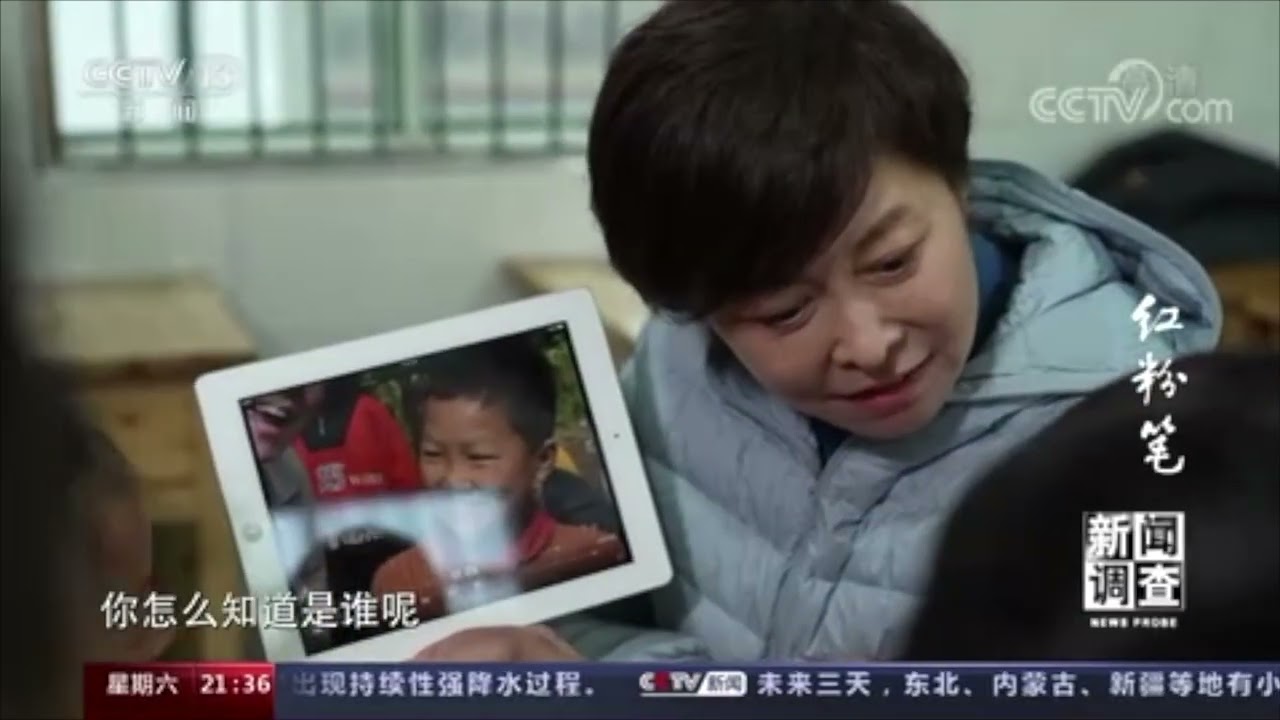
Eighteen years later, Jing Yidan returned to the school to witness the generational ripple of that intervention. Yang Leilei was now a grown father, and his own two young sons were attending the rebuilt Kejin Primary School. Looking through archival photographs of the 2002 report, the young boys marvelled at an image of their father as a twelve-year-old child standing amid the rubble of the old schoolyard, remarking how much the boy in the historical picture resembled themselves.
Summing up the moral compass of her journalistic career, Jing Yidan observed: > “Looking back on my career, I wonder, what meaningful things have I done? That would be amplifying the voices of the vulnerable.”
[12:08](https://www.youtube.com/watch?v=ZyvtoRRC-9U&t=728s) Embracing New Media After Retirement and Reigniting Creative Sparks
Reflecting on her journey, Jing Yidan feels deeply fortunate that the inspirations of her past were translated into concrete action, believing that even in her eighties or nineties she will look back and smile at the ideas she dared to pursue. Conventional wisdom suggests that after stepping down from a long career, it becomes difficult to feel professional excitement, and Jing Yidan admits that she had actively dreaded the rise of digital platforms. In the period leading up to her retirement, she found herself secretly counting down the days, hoping she could simply evade the disruptive challenges brought on by the internet and new media landscapes.
Her perspective shifted entirely when younger creators born in the 1980s and 1990s approached her years later, presenting fresh possibilities that unexpectedly reawakened her enthusiasm. Having witnessed television through its inception, ascent, and golden era, she had mistakenly assumed that the craft of broadcast storytelling had reached an impasse with no successors. Partnering with these young teams to produce innovative cultural programming—such as visiting the Children's Poetry Hall to explore the golden imagery of wheat fields and childhood verse, or filming the "Cold Dew" solar term at the Jinshanling Great Wall for the conclusion of their Great Wall series—marked an invigorating transition. Her focus evolved from the intense public opinion oversight of investigative journalism into broad cultural spaces spanning museum explorations and intangible heritage. When she visited her alma mater, the Communication University of China, the university president aptly noted that this active creative exploration was akin to writing an academic thesis directly through practice.
> “After retiring, it’s not supposed to be easy to get excited anymore, right?” — Jing Yidan
> “I cherish the fact that I can still be moved, and I tell myself I must not fail this rare inspiration.” — Jing Yidan
- **Attitude towards new media**: Shifted from counting down retirement days to evade technological challenges to actively collaborating with creators born in the 1980s and 1990s. - **Cultural projects mentioned**: The Children's Poetry Hall and the Great Wall heritage series concluding on the "Cold Dew" (寒露) solar term at Jinshanling Great Wall. - **Impact of heart-stirring moments**: Jing Yidan emphasizes that honoring these moments grants individuals “a spark in your eyes, a sense of direction in your heart, and meaning in your days.”
---
[15:27](https://www.youtube.com/watch?v=ZyvtoRRC-9U&t=927s) The Transcendent Necessity of Communication in the Era of AI
Turning her attention to the graduating students, Jing Yidan highlights a singular competency that outlasts any academic discipline: proactive communication. Regardless of what major a student pursued or which corner of the globe their career might take them, the capacity to connect with others forms the fundamental bedrock of life outside campus walls. In professional environments, effective communication yields tangible efficiency and opens unexpected doors, while in personal spheres, it anchors emotional security and familial warmth. To illustrate how communication connects generations, she humorously describes her elderly mother’s relentless activity on WeChat, who floods the family group chat every morning doing roll call, demanding to know what everyone is doing, giving instructions, and sharing photos.
Looking ahead to an era dominated by artificial intelligence and machine dialogue, Jing Yidan cautions students never to discard authentic, face-to-face human interaction. While articulate speech and genuine empathy mitigate isolation and foster happiness on an interpersonal level, media professionals also bear the broader responsibility of using platforms to communicate with society at large. Entering an era of total media presents ongoing questions of discernment: discovering how to leverage media powerfully, productively, and with measured restraint is an enduring life lesson that extends far beyond university graduation.
> “And there is one ability that transcends all majors. That is communication skills.” — Jing Yidan
> “In the AI era, against the backdrop of human-machine dialogue, we must not ignore face-to-face communication between people.” — Jing Yidan
```mermaid flowchart TD accTitle: The Spectrum of Communication accDescr: Diagram illustrating the different tiers and outcomes of proactive communication as outlined by Jing Yidan.
subgraph Dimensions["Spheres of Communication"] WP["Workplace Communication"] -->|"Yields"| Res1["Efficiency & Opportunity"] FM["Family Communication"] -->|"Cultivates"| Res2["Warmth & Security"] SC["Social Connection"] -->|"Expands"| Res3["Growth Space & Networks"] end
subgraph Societal["Macro Level"] MD["Total Media & Public Platforms"] -->|"Achieves"| Res4["Dialogue with the World"] end ```
---
[17:47](https://www.youtube.com/watch?v=ZyvtoRRC-9U&t=1067s) Walking the "Golden Mean": Mentors and the Launch of CCTV Commentary
When Jing Yidan joined the flagship investigative program *Focus Report* (*Jiaodian Fangtan*), colleagues characterized her presence as a bridge situated squarely between tradition and the avant-garde. Because *Focus Report* prized hard-hitting, avant-garde journalism above all else, she initially wrestled with self-doubt, wondering if her temperament lacked the sharp edge, aggressive impulsiveness, and investigative bite required for the desk. Over time, however, she realized that occupying the space between extremes embodied the traditional concept of the "golden mean" (中庸), a balanced posture that provided the stability and endurance necessary to anchor the broadcast for over two decades.
Her professional voice was shaped significantly by key mentors at China Central Television. Early in her career, when tasked with covering economic topics that other reporters handled with ease, she felt out of depth until a seasoned mentor advised her to master fundamental economic concepts before attempting to produce business programming. Later, another senior expert recognized her innate cadence and directed her toward news commentary. This insight led directly to the creation of *Yi Dan Talk* (*Yidan Huati*) in 1993 on CCTV-2, marking the first program in the history of China Central Television to be named after its host. Debuting in the very same month that *Oriental Horizon* (*Dongfang Shikong*) launched a revolutionary wave in Chinese television news amid the nation's transition to a market economy, the show established a new interactive window with viewers. This foundation eventually carried her to the News Commentary Department to helm *Focus Report* and *News Probe* (*Xinwen Diaocha*). Beyond the broadcast studio, authors Liang Xiaosheng and Tie Ning read her scripts and urged her to write books, teaching her that written prose, like broadcasting, serves as an essential channel of human expression.
> “Understand economic issues first, then make business programs.” — Jing Yidan's mentor
> “Before that, I didn't know what I was suited for; I only knew what I liked.” — Jing Yidan
> “You should write more.” — Liang Xiaosheng and Tie Ning
- **Historical milestone**: 1993 marked the watershed reform year for Chinese television news, featuring the launches of both *Oriental Horizon* and *Yi Dan Talk*. - **CCTV location**: The concept for *Yi Dan Talk* was first pitched in an office within CCTV's Building 17 by her department director. - **Endurance of the anchor**: Embracing the "golden mean" allowed Jing Yidan to remain at the desk of *Focus Report* for 20 years.
---
[22:03](https://www.youtube.com/watch?v=ZyvtoRRC-9U&t=1323s) Reconstructing Truth from the Margins: Compiling *Voices* and a Farewell to Graduates
As *Focus Report* gained nationwide prominence, the editorial office was overwhelmed by thousands of viewer letters—many arriving smudged, crumpled, and bearing stamps from remote corners of China. While the public's immense trust was humbling, Jing Yidan soon felt a paralyzing sense of powerlessness: even if the program broadcast investigative exposés every single day of the year, television could address only a minuscule fraction of the injustices reported. Spurred by a colleague's offhand suggestion, she decided to curate and compile these poignant citizen accounts into a book to supplement the broadcast screen, sifting through the massive pile to select over one hundred letters representing the most acute social tensions of the mid-to-late 1990s.
When she brought the manuscripts home to organize, her father-in-law examined the raw grievances and remarked with alarm that had these texts surfaced in 1957, their authors would have been condemned as rightists. Jing Yidan defended the project, arguing that society had moved past the enforced silence of 1957 and the 1960s; even if these collective cries were noisy and discordant, the ability to articulate hardship represented undeniable social progress. The resulting book, titled *Voices* (*Shengyin*), sought to preserve the granular records of individual citizens, recognizing that while perfectly recreating history is impossible, aggregating ordinary testimonies is the only way to draw closer to historical truth. Closing her address, she urges the graduates to tuck a fallen leaf from campus into a favorite book as a reminder of their unique individuality, concluding with lines from Haizi’s classic poem about living fully and joyfully in the world.
> “These voices might be a bit noisy and chaotic, but compared to a chorus of silence, isn't that a form of progress?” — Jing Yidan
> “To say it can be completely reconstructed would be too extravagant. But the records of individual people can bring us closer to that reconstruction.” — Jing Yidan
> “Starting tomorrow, I will be a happy person; feeding horses, chopping wood, and traveling the world.” — Jing Yidan (quoting Haizi)
- **The book *Voices***: Curated from thousands of audience complaint letters down to roughly 100 representative accounts detailing the social realities of mid-to-late 1990s China. - **Generational contrast**: Her father-in-law viewed the letters through the lens of the 1957 Anti-Rightist Campaign, whereas Jing Yidan saw the chaotic outpouring as evidence of open expression and civic progress. - **Parting ritual**: Jing Yidan encourages graduates to take a unique leaf from campus as a personal bookmark symbolizing their irreplaceable individuality.
[25:48](https://www.youtube.com/watch?v=ZyvtoRRC-9U&t=1548s) Archival Sign-Off: Jing Yidan's Final Broadcast Montage on *Focus Report*
The program draws to a close with nostalgic archival footage featuring veteran CCTV anchor Jing Yidan hosting her signature investigative and public affairs program, *Focus Report* (*Jiaodian Fangtan*). The archival clip evokes a reflective and gentle tone, opening on the poetic imagery of “facing the sea, with flowers blooming in the warmth of spring.” The sequence captures the warmth and steady presence that characterized Jing Yidan's decades-long career on television, presenting a visual and emotional bookend to the retrospective on her life and journalistic journey.
The broadcast excerpt preserves her familiar on-air cadence and welcoming style as she opens the show, addressing her audience directly: “Hello, dear viewers, welcome to Focus Report.” She proceeds to introduce the evening’s cultural coverage, highlighting the emergence of a new generation in traditional performance arts, observing that on the Peking Opera stage today, young people are stepping forward to carry the art form.
The montage seamlessly transitions from her opening into her signature sign-off, reflecting the everyday rhythm of her broadcast career as she tells the audience, “That is all for today’s Focus Report.” Looking ahead to the upcoming national holiday, she delivers her parting seasonal preview, reminding viewers that “Tomorrow is May Day, and Focus Report is at” as the archival broadcast draws to an end.
- **Opening recitation**: The segment features the classic poetic line, "facing the sea, with flowers blooming in the warmth of spring" (a reference to the celebrated poem by Hai Zi). - **Featured broadcast**: *Focus Report* (*Jiaodian Fangtan*), the flagship CCTV current affairs program long anchored by Jing Yidan. - **Cultural topic covered**: A report dedicated to the younger generation of performers taking center stage in traditional Peking Opera. - **Holiday sign-off**: A broadcast conclusion delivered on the eve of International Workers' Day (May Day).
## Notable quotes > [15:27](https://www.youtube.com/watch?v=ZyvtoRRC-9U&t=927s) In the AI era, against the backdrop of human-machine dialogue, we must not ignore face-to-face communication between people. — Jing Yidan
> [09:43](https://www.youtube.com/watch?v=ZyvtoRRC-9U&t=583s) Looking back on my career, I wonder, what meaningful things have I done? That would be amplifying the voices of the vulnerable. — Jing Yidan
## Mentioned Jing Yidan, Focus Report, Economy 30 Minutes, Oriental Horizon, News Probe, Yi Dan Talk, Voices, CCTV, CCTV-2, Heilongjiang People's Radio Station, Communication University of China, Kejin Primary School, Tianshengqiao Primary School, Yang Leilei, Chen Liang, Liang Xiaosheng, Tie Ning, Haizi
## Video description 1. YouTube 会员平台 成为本频道的会员,即可尊享专属福利,提前观看节目,直播,专属会员节目。 点击链接了解详情并加入:https://www.youtube.com/channel/UCBKDRq35-L8xev4O7ZqBeLg/join
2. Patreon 会员平台 在 Patreon 中加入「王局」会员,您不仅可以观看会员专属视频,直播,更能参与会员社群互动,更贴心的是,Patreon 支持使用中国大陆银行卡支付!点击链接立刻加入: Patreon 会员加入链接:https://www.patreon.com/join/8734589
王局新书【王志安谈治国理政第二卷电子书】不怎么火热销售中 【PATREON购买链接】https://www.patreon.com/c/wangzhian/shop 【苹果书店购买链接】 https://books.apple.com/us/book/%E7%8E%8B%E5%BF%97%E5%AE%89%E8%B0%88%E6%B2%BB%E5%9B%BD%E7%90%86%E6%94%BF%E7%AC%AC%E4%BA%8C%E5%8D%B7/id6739830450 【亚马逊电子书购买链接】 https://www.amazon.co.jp/%E7%8E%8B%E5%BF%97%E5%AE%89%E8%B0%88%E6%B2%BB%E5%9B%BD%E7%90%86%E6%94%BF%E7%AC%AC%E4%BA%8C%E5%8D%B7-Traditional-Chinese-%E5%BF%97%E5%AE%89-%E7%8E%8B-ebook/dp/B0DRJ8R48M
[Source](https://www.youtube.com/watch?v=ZyvtoRRC-9U)