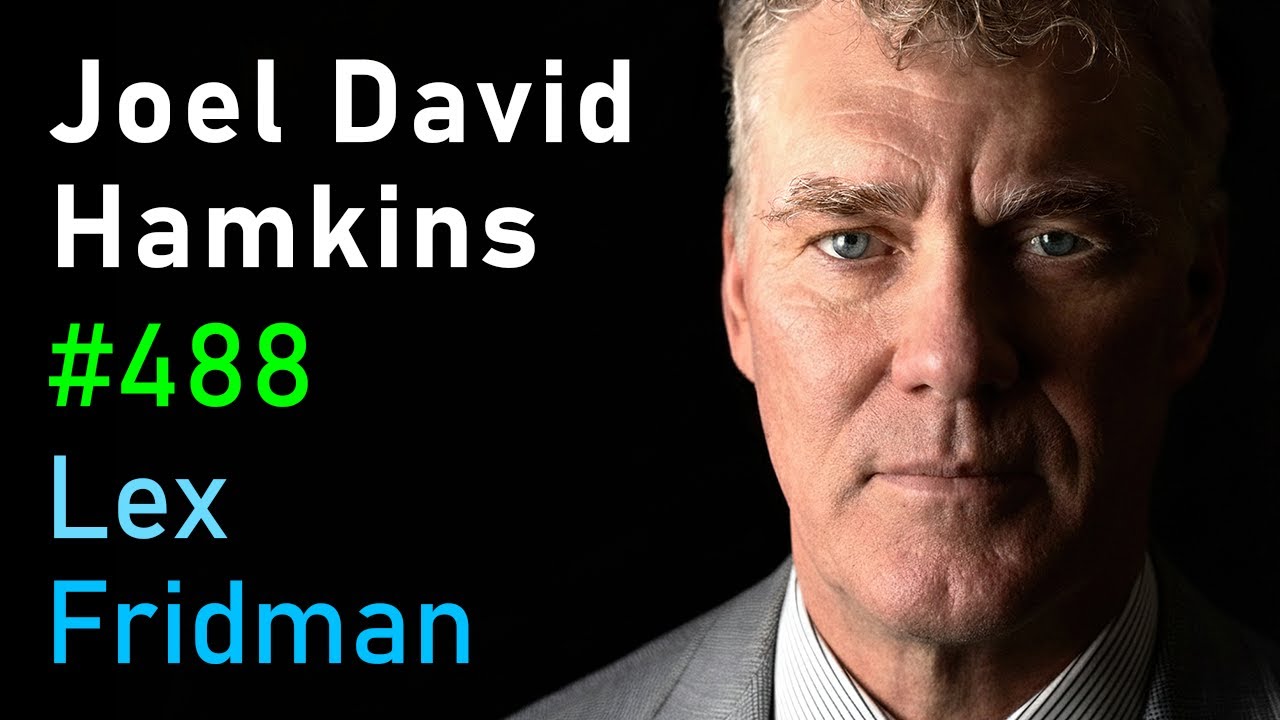
Joel David Hamkins Challenges Cantor's Monist Set Theory on Foundations of Infinity
Lex Fridman
The continuum hypothesis is not a problem to be solved with a unique answer but a mathematical light switch that proves the existence of a set-theoretic multiverse.
## Background
Published on December 31, 2025, on YouTube by the Lex Fridman Podcast, this episode features an extensive interview with mathematician and philosopher Joel David Hamkins. The discussion focuses on set theory, the foundations of mathematics, the nature of infinity, and Hamkins' extensive contributions to academic platforms like MathOverflow.
## TL;DR
The conversation traces the historical evolution and philosophical paradoxes of infinity, starting from Georg Cantor's revolutionary discoveries and Bertrand Russell's foundational challenges to the development of modern ZFC set theory. The dialogue thoroughly explores Kurt Gödel's incompleteness theorems, Alan Turing's halting problem, and the deep divide between mathematical truth and syntactic proof. Additionally, Hamkins details the continuum hypothesis and explains his own 'set-theoretic multiverse' perspective, which frames mathematical independent results and systems like John Conway's surreal numbers as paths into alternate, interacting mathematical realities.
## Atmosphere & style
The episode has an intellectually rigorous yet deeply accessible tone, blending profound philosophical inquiry with historical narrative. Lex Fridman's probing, measured questioning creates a reflective space that allows Hamkins to passionately anthropomorphize abstract concepts, transforming dense logic into an engaging intellectual journey. Listening feels like standing on the edge of human knowledge, moving from the initial existential trauma of mathematical paradoxes to a celebratory appreciation of the infinite beauty and pluralism found within the Platonic realm.
## Key takeaways
- [02:17](https://www.youtube.com/watch?v=14OPT6CcsH4&t=137s) Georg Cantor's 19th-century discovery that some infinities are larger than others challenged the theological view connecting infinity exclusively with God, drawing fierce academic opposition from figures like Leopold Kronecker.
- [02:17](https://www.youtube.com/watch?v=14OPT6CcsH4&t=137s) While ancient mathematicians like Aristotle and Archimedes strictly adhered to potentialism, Galileo Galilei challenged this orthodoxy by identifying paradoxes that showed infinite sets fundamentally violate Euclid's principle that the whole is greater than the part.
- [02:17](https://www.youtube.com/watch?v=14OPT6CcsH4&t=137s) Hilbert's Hotel thought experiments demonstrate that adding a finite or countably infinite number of elements to a countably infinite set does not alter its baseline cardinality, adhering to the Cantor-Hume Principle of one-to-one correspondence.
- [27:51](https://www.youtube.com/watch?v=14OPT6CcsH4&t=1671s) Cantor utilized a proof by contradiction known as his diagonal argument to establish that the real numbers are strictly larger and uncountable compared to natural numbers.
- [33:56](https://www.youtube.com/watch?v=14OPT6CcsH4&t=2036s) The Zermelo-Fraenkel (ZF) axioms were established to overcome mathematical paradoxes, though Ernst Zermelo's 1904 proof that the axiom of choice implies the well-ordering principle caused significant controversy regarding non-constructive mathematical objects.
- [57:28](https://www.youtube.com/watch?v=14OPT6CcsH4&t=3448s) Bertrand Russell's paradox dismantled Gottlob Frege's logicist program by proving that a universal 'set of all sets' cannot logically exist without collapsing into a self-referential contradiction.
- [01:03:07](https://www.youtube.com/watch?v=14OPT6CcsH4&t=3787s) David Hilbert's formalist program aimed to build an infinitary theory capable of answering every question while utilizing a finitary theory to prove its consistency.
- [01:12:01](https://www.youtube.com/watch?v=14OPT6CcsH4&t=4321s) Kurt Gödel's incompleteness theorems completely refuted Hilbert's program by demonstrating that a computably axiomatizable theory cannot answer all arithmetic questions, nor can it prove its own consistency.
- [01:25:04](https://www.youtube.com/watch?v=14OPT6CcsH4&t=5104s) Alan Turing's 1936 paper proved that the Entscheidungsproblem is entirely undecidable and mathematically equivalent to the Halting Problem, which asks if a computable procedure can predict if any program will stop.
- [01:36:58](https://www.youtube.com/watch?v=14OPT6CcsH4&t=5818s) The unsolvability of the Halting Problem provides an elegant, alternative proof of Gödel's Incompleteness Theorem via a hypothetical 'theorem enumeration machine.'
- [01:52:00](https://www.youtube.com/watch?v=14OPT6CcsH4&t=6720s) Mathematical structuralism asserts that the underlying material of a mathematical object is irrelevant, prioritizing how an object functions up to isomorphism within a system.
- [02:08:00](https://www.youtube.com/watch?v=14OPT6CcsH4&t=7680s) The Continuum Hypothesis asserts that there is no intermediate size of infinity between the natural numbers and the real numbers, a mystery that became an absolute obsession for Georg Cantor.
- [02:18:00](https://www.youtube.com/watch?v=14OPT6CcsH4&t=8280s) Set theory functions as a crucial underlying foundation that unifies disparate mathematical disciplines like algebra, real analysis, topology, and geometry, allowing the transfer of results between them.
- [02:24:00](https://www.youtube.com/watch?v=14OPT6CcsH4&t=8640s) The Continuum Hypothesis was proven to be independent of ZFC, with Kurt Gödel constructing a universe where it is true (Gödel's L) and Paul Cohen inventing forcing to construct a universe where it is false.
- [02:32:00](https://www.youtube.com/watch?v=14OPT6CcsH4&t=9120s) Joel David Hamkins favors a pluralist, 'Set-Theoretic Multiverse' view over a monist universe view, treating independent statements like the Continuum Hypothesis as a light switch that can be toggled via forcing.
- [02:36:00](https://www.youtube.com/watch?v=14OPT6CcsH4&t=9360s) The field of 'set-theoretic geology' was developed by Hamkins, Gunter Fuchs, and Jonas Riets to reverse-engineer mathematical universes by undoing forcing to locate foundational concepts like the 'bedrock model.'
- [02:46:00](https://www.youtube.com/watch?v=14OPT6CcsH4&t=9960s) John Conway introduced the surreal number system to unify reals, ordinals, and infinitesimals into a single real closed field, though its inherent discontinuity prevents traditional limit-based calculus.
- [02:57:33](https://www.youtube.com/watch?v=14OPT6CcsH4&t=10653s) Conway's Game of Life offers a mathematical playground for computably undecidable questions, where determining if a cell will ever activate is structurally equivalent to the Halting Problem.
## Detailed walkthrough
### Introduction to Joel David Hamkins and the Concept of Infinity
The conversation opens with an introduction to Joel David Hamkins, a mathematician and philosopher specializing in set theory, the foundation of mathematics, and the nature of infinity. Notably, Hamkins is the highest-rated user on MathOverflow—a platform described as "StackOverflow but for research mathematicians." He has also written several books, including *Proof and the Art of Mathematics* and *Lectures on the Philosophy of Mathematics*, and runs a blog called *infinitelymore.xyz*. This discussion is framed as both highly technical and deeply engaging, diving into the foundations of modern mathematics, reality, truth, and the core paradoxes that challenged 20th-century intellectuals.
Before diving into the technical math, the host pauses for a moment of personal reflection. He shares that he has recently been "hiding from the world a bit," spending time reading, thinking, writing, and soul-searching while preparing for upcoming travel in the new year. This isolation brought a recurring sense of gratitude for the immense support and love he receives from listeners worldwide. Acknowledging that while he receives "a little bit of hate," he is overwhelmed by "a whole lot of love" and wouldn't want it any other way.
---
Georg Cantor and the Civil War of Infinity
The core mathematical discussion begins with Georg Cantor's late 19th-century breakthrough: the idea that "some infinities are bigger than others." This discovery fundamentally broke mathematics before rebuilding it, triggering crises across multiple fronts:
* **Theological:** Because infinity was deeply associated with God, the existence of multiple, differing levels of infinity created a theological crisis. Cantor himself was deeply religious and struggled with these implications.
* **Academic:** A mathematical "civil war" erupted. The prominent German mathematician Leopold Kronecker fiercely opposed Cantor, calling him a "corrupter of youth" and actively attempting to block his career advancement.
* **Logical:** A series of profound paradoxes emerged, most notably Russell's paradox (concerning the set of all sets that do not contain themselves), which threatened to expose inconsistencies at the very heart of mathematics.
* **Psychological:** The immense pressure and his obsession with proving the "continuum hypothesis" contributed to Cantor's ultimate psychological breakdown, causing him to spend his final years in and out of sanatoriums.
---
The Historical Shift: Potential vs. Actual Infinity
Hamkins reframes the history of infinity, noting that the story begins long before Cantor. In ancient Greece, Aristotle drew a sharp line between *potential* infinity and *actual* infinity. Aristotle argued that achieving an actual infinity was impossible, an orthodoxy that persisted for thousands of years. Early mathematicians were almost exclusively "potentialists." For example, Archimedes used the "method of exhaustion" to calculate the area of a shape by continuously carving it into smaller and smaller triangles, treating infinity as an unending process rather than a completed entity.
A massive exception to this potentialist orthodoxy was Galileo Galilei, who challenged it in his *Dialogue of Two New Sciences*. Galileo anticipated many of Cantor's eventual findings, though he ultimately threw his hands up in confusion when faced with the inherent contradictions of the infinite.
---
Galileo's Paradoxes and the Clash of Principles
Galileo illustrated his confusion through a series of geometric and numerical observations. First, he looked at the natural numbers ($1, 2, 3, 4 \dots$) and paired every number with its perfect square ($1 \to 1, 2 \to 4, 3 \to 9, 4 \to 16 \dots$). Because this mapping is a strict one-to-one correspondence, it implies there is exactly the same number of perfect squares as there are natural numbers. However, because there are massive gaps between the perfect squares, common sense dictates there should be fewer squares than total numbers.
Galileo found similar contradictions in geometry:
* **Line Segments:** If you take two line segments of entirely different lengths and draw a fan of lines (a foliation) connecting them from a single point, every point on the shorter line maps uniquely to a point on the longer line, implying they have the same number of points.
* **Concentric Circles:** Drawing rays outward from the center of two concentric circles of different sizes creates a perfect one-to-one match between the points on the smaller circle and the larger circle.
These paradoxes highlighted a severe tension between two foundational ideas:
* **The Cantor-Hume Principle:** Two collections have the same size (are equinumerous) if and only if their elements can be placed into a perfect one-to-one correspondence. Modern mathematics accepts this as correct, confirming Galileo's mappings were valid.
* **Euclid's Principle:** A core axiom from Euclid's *Elements* stating that "the whole is always greater than the part."
Because an infinite set can be put into a one-to-one correspondence with a strict subset of itself, infinity fundamentally violates Euclid's principle. This conceptual gridlock was not fully resolved until Cantor explicitly proved that infinite sets could have completely different sizes.
---
Squeezing Infinity into Hilbert’s Hotel
To illustrate how countable infinity operates, Hamkins introduces the famous thought experiment of Hilbert's Hotel. This hotel features infinitely many rooms, structured as full-floor suites numbered starting at zero ($0, 1, 2, 3 \dots$). The host, speaking from a programmer's perspective, enthusiastically agrees that starting at zero is the perfect choice.
In the initial scenario, the hotel is completely full, with a guest in every single room. When a new guest arrives asking for a room, the manager handles it easily due to a pre-signed policy agreement. The manager instructs every current guest to move up exactly one room ($N \to N+1$). Because everyone moves simultaneously, room zero opens up perfectly, and the new guest is accommodated without anyone sharing. This clearly demonstrates a core property of infinity: adding a finite element to an infinite set does not increase its size. The same trick applies if a bus of 20 people shows up; everyone simply shifts up 20 rooms ($N \to N+20$).
---
Squeezing an Infinite Bus into a Full Hotel
The thought experiment escalates when a giant bus—Hilbert's bus—pulls up to the fully occupied hotel. This bus contains a countably infinite number of passengers, seated in seats numbered $0, 1, 2, 3 \dots$. Hamkins challenges the host to figure out how the manager can accommodate an infinite number of new arrivals.
The host correctly answers that the manager must divide the hotel into even and odd rooms. By instructing every current guest to double their room number ($N \to 2N$), all existing occupants are successfully moved into private, even-numbered rooms. This leaves an infinite number of odd-numbered rooms entirely vacant, allowing the infinite passengers from the bus to file into the odd rooms seamlessly. This process effectively "shoves an infinity into another infinity," demonstrating that the union of two countably infinite sets remains countably infinite.
---
Squeezing an Infinite Train via Prime Factorization
The final escalation introduces Hilbert's train, which arrives carrying an infinity of infinities: the train has infinitely many cars, and each individual car contains infinitely many seats. To clear space, the hotel manager once again has all current guests double their room numbers, securing the even rooms and freeing up all odd-numbered rooms.
To map every single passenger—each defined by two coordinates: a car number ($C$) and a seat number ($S$)—into a unique odd room number in a one-to-one fashion, the manager utilizes the "magical formula" of prime factorization:
$$3^C \times 5^S$$
Because $3$ and $5$ are both odd prime numbers, multiplying them together in any power will always yield an odd number, ensuring the passengers only go to the vacant odd rooms. Furthermore, the Fundamental Theorem of Arithmetic guarantees that every number can be decomposed uniquely into its prime "atoms." By factoring the assigned room number back into its unique exponents of $3$ and $5$, the manager can instantly trace exactly which car and seat that guest originally came from. This elegant proof shows that a countable union of countable sets is still strictly countable, a mind-bending mathematical reality that Hamkins admits completely shocked and transfixed him when he first learned it.
- **Countable Set Definition:** A set is mathematically defined as countable if it is equinumerous with the set of natural numbers (i.e., it can fit inside Hilbert's Hotel).
- **Core Prime Numbers Used:** $3$ and $5$ are utilized because they are odd primes, preventing any overlap with the even rooms ($2N$) occupied by the original guests.
[19:38](https://www.youtube.com/watch?v=14OPT6CcsH4&t=1178s) Winding Through the Grid: Visualizing Countable Infinity
To map a grid consisting of rows and columns that extend to a countable infinity of points, one can visualize each column of this integer lattice as a single train car on an infinite train. This spatial arrangement can be systematically traversed by charting a winding, zigzag path that moves up and down the diagonals, starting from the corner point. By snaking back and forth down the diagonals, the path is guaranteed to hit every single grid point.
This traversal provides a concrete algorithm for assigning room numbers to every point on the grid, meaning every point will eventually be identified as the $N\text{th}$ point on the path for some natural number $N$. This geometric approach establishes a direct one-to-one correspondence between the grid points and the natural numbers. While earlier methods relied on arithmetic approaches like using prime powers ($3^C \times 5^S$), this visual method offers a clear, direct proof that a countable collection of countable sets remains a countable infinity. As long as the path allows each infinite collection a sequential turn to add one more person to the master list, everyone can be accommodated in a single sequence.
[21:38](https://www.youtube.com/watch?v=14OPT6CcsH4&t=1298s) The Rational Numbers and the Spectrum of Real Numbers
Before diving into Georg Cantor's breakthrough regarding uncountable infinities, it is instructive to look at the rational numbers—the set of all fractions. Many people intuitively expect the rational numbers to represent a larger infinity because they are "densely ordered," meaning that between any two fractions, one can always find another by simply calculating their average. This contrasts sharply with the discrete order of the integers, where every number has a distinct next and previous neighbor.
Despite this dense property, the rational numbers are still only a countable infinity. Because every positive fraction consists of a numerator $P$ and a non-zero denominator $Q$, it maps cleanly to pairs of natural numbers. The exact same prime-power logic used for Hilbert's train ($3^P \times 5^Q$) works perfectly here to show countability. However, Cantor profoundly broke this pattern by proving that the set of real numbers—which encompasses everything on the number line—is a strictly larger, uncountable infinity, demonstrating for the first time that there are different sizes of infinity.
* **Rational Numbers:** Any number that can be represented as a fraction of two integers ($\frac{P}{Q}$, where $Q \neq 0$).
* **Algebraic Numbers:** Real numbers that solve an algebraic equation with integer coefficients (e.g., $\sqrt{2}$ or $\sqrt[3]{5}$).
* **Transcendental Numbers:** Real numbers that are not algebraic, meaning they are not the root of any non-zero polynomial with integer or rational coefficients.
[24:43](https://www.youtube.com/watch?v=14OPT6CcsH4&t=1483s) Transcendental Numbers and the "Boring Number" Paradox
Joseph Liouville first proved the existence of transcendental numbers by constructing a specific value now known as the Liouville constant. Cantor later showed that transcendental numbers are not just anomalies; his work on uncountability proved that there are uncountably many of them, meaning the vast majority of real numbers are transcendental. Some of the most famous and culturally celebrated numbers in mathematics fall into this category, including $\pi$ ($3.14159265...$) and Euler's constant ($e$).
The discussion takes a brief, humorous detour into whether mathematics has a "favorite" or sexiest number, leading to a playful proof by contradiction that every single natural number is inherently interesting:
> "Suppose, toward contradiction, that there were some boring numbers.... But if there was an uninteresting number, then there would have to be a smallest uninteresting number. But that's a contradiction, because the smallest uninteresting number is a super interesting property to have. So therefore, there cannot be any boring numbers."
While this humorous philosophical paradox relies heavily on the subjective definition of the word "interesting," it delights the speakers before they steer the conversation back to Cantor's rigorous structural proofs.
Cantor's proof that the real numbers are strictly larger than the natural numbers ($0, 1, 2, 3...$) relies on a classic proof by contradiction. Since the natural numbers are entirely contained within the real numbers, the real numbers are at least as large. If they were the same size, it would mean they could be placed into a perfect one-to-one correspondence, effectively arranging all real numbers into an exhaustive, sequential list: $R_1, R_2, R_3$, and so on.
To break this assumption, Cantor constructs a new real number, $Z$, which begins with an integer part of zero followed by a decimal point and an infinite sequence of digits ($D_1, D_2, D_3...$). The key to the construction is ensuring that the $N\text{th}$ digit after the decimal point of $Z$ is explicitly different from the $N\text{th}$ digit of the $N\text{th}$ number on the list ($R_n$). Because these digits form a geometric diagonal running down and to the right through the imaginary list, the method is universally known as the diagonal argument.
Because $Z$ differs from $R_1$ in the first decimal place, from $R_2$ in the second decimal place, and from every $R_n$ at the $N\text{th}$ decimal place, $Z$ cannot possibly match any number on the list. This creates a definitive contradiction: a real number has been constructed that is absent from a list assumed to contain them all.
[31:43](https://www.youtube.com/watch?v=14OPT6CcsH4&t=1903s) Resolving Decimal Ambiguities and the Legacy of Diagonalization
A historical nuance in Cantor's diagonal argument involves numbers with dual decimal representations. For instance, the number $1$ can be written perfectly accurately as either $1.0000...$ or $0.9999...$ trailing into infinity. This dual identity can introduce bugs into a naive diagonal proof. Cantor masterfully bypassed this entire problem by restricting the digits of the newly constructed number $Z$ so that it never uses the digits $0$ or $9$. Because the dual-representation phenomenon only occurs with numbers that eventually trail into infinite strings of zeros or nines, $Z$ is guaranteed to have a completely unique representation, preserving the integrity of the contradiction.
While controversial in the late 19th and early 20th centuries, Cantor's diagonalization is celebrated today as a foundational pillar of set theory. It has evolved into an incredibly fruitful proof method that underpins nearly every major breakthrough in modern mathematical logic.
* **Major Concepts Driven by Diagonalization:**
* Russell's Paradox
* Turing's Halting Problem
* The Recursion Theorem
[33:56](https://www.youtube.com/watch?v=14OPT6CcsH4&t=2036s) Set Theory as the Foundation of Mathematics
The "infinity crisis" triggered by these discoveries forced a rigorous rebuilding of mathematics, elevating set theory into a foundational framework. Set theory fundamentally operates in two distinct roles: it is an independent mathematical discipline exploring transfinite recursive constructions and well-founded definitions, and it is the universal language used to build all other mathematical structures. At its conceptual core, a set provides a way to treat an entire collection of objects as a single, abstract entity—much like a bag containing distinct items.
To prevent paradoxes, mathematicians developed rigorous axiomatic systems, most notably the Zermelo-Fraenkel (ZF) axioms. The history of these axioms is deeply tied to Ernst Zermelo's 1904 proof that the "axiom of choice" implies the well-ordering principle. Because Cantor and Zermelo were not originally working within a formalized axiomatic framework, Zermelo's proof provoked immense controversy. The fierce pushback from the mathematical community ultimately pressured Zermelo to explicitly write out the structural axioms of set theory, establishing the formal baseline for modern mathematical truth.
> "The axiom of choice principle is completely obvious that we want this to be true, that it is true. I mean, a lot of people take it as a law of logic. If you have a bunch of sets, then there's a way of picking an element from each of them."
[38:31](https://www.youtube.com/watch?v=14OPT6CcsH4&t=2311s) The Axiom of Choice and the Foundations of ZFC
The axiom of choice is a deceptively intuitive mathematical concept. If you have a collection of sets, the principle states that there is a function that can pick exactly one element from each of those sets. While the name "axiom of choice" tends to anthropomorphize the idea—as if a mathematical function is actively making a conscious decision—it simply means that if you were to theoretically make those selections, a function representing those choices exists. The philosophical friction arises when you cannot provide a specific rule or procedure to define what that function actually is. You are forced to assert that a way of choosing definitely exists, even if you have no easy way to describe it.
This principle is the "C" in **ZFC** (**Zermelo-Fraenkel set theory with the Axiom of Choice**), which forms the bedrock foundation of modern mathematics. However, a vibrant community of mathematicians deliberately explores branches of math that reject or weaken this axiom, working strictly out of Zermelo-Fraenkel set theory without it to see what mathematical consequences can still be proven constructively.
---
[40:13](https://www.youtube.com/watch?v=14OPT6CcsH4&t=2413s) Bertrand Russell’s Butler, Shoes, and Indistinguishable Socks
To illustrate the inherent tension of the axiom of choice, the philosopher Bertrand Russell devised a famous analogy involving a wealthy individual with an infinite closet. The closet contains an infinite number of pairs of shoes and an infinite number of pairs of socks. The wealthy person instructs his butler to go into the closet and bring back exactly one shoe from each pair. The butler can execute this command easily without relying on the axiom of choice because shoes have distinct physical properties—the butler can simply follow a rule, such as "always pick the left shoe."
The problem changes completely when the butler is asked to do the same for the infinite collection of socks. Assuming the socks within each pair are completely identical and indistinguishable, the butler has no logical or physical rule to determine which sock to pick. This is precisely what is at stake mathematically: can a choice function be explicitly defined by an objective rule, or does it require an inherently arbitrary act of selection?
> "Why should everything that exists in mathematical reality follow a rule or a procedure of that sort?"
If you view mathematical ontology as rich with independent objects, you have no problem accepting that these arbitrary functions exist as part of reality, even if you can never explicitly name them.
---
[43:51](https://www.youtube.com/watch?v=14OPT6CcsH4&t=2631s) The History of Zermelo's Axioms and Mathematical Consistency
In 1904, Ernst Zermelo sparked immense controversy by publishing a proof demonstrating that the axiom of choice implies the **Well-Ordering Principle** (the idea that every set can be given a structured order where every non-empty subset has a least element). Because mathematicians at the time found it impossible to imagine a well-ordering for something as dense as the real numbers, Zermelo’s proof was fiercely debated. Challenged to formalize the underlying rules of his logic, Zermelo published his formal set theory in 1908.
An extraordinary twist occurred when Zermelo and his allies reviewed the published papers of his most vocal critics. They discovered that many of these objecting mathematicians were regularly and implicitly using the axiom of choice in their own arguments without realizing it, simply because it is an incredibly natural principle to slip into a proof by accident.
Historically, mathematicians worried that the axiom of choice might introduce catastrophic logical contradictions into mathematics. However, later foundational work by Kurt Gödel and Paul Cohen proved that the axiom of choice is relative to the consistency of the rest of set theory.
* **The Meaning of Consistency:** In set theory, consistency means that it is fundamentally impossible to derive a logical contradiction from the established axioms.
* **The Inconsistency Verdict:** If ZFC is ever found to contain a contradiction, the flaw lies within the core Zermelo-Fraenkel axioms themselves; the axiom of choice will never be the lone source of an inconsistency.
* **The Constructivist View:** Mathematicians who maintain a constructivist attitude argue that a mathematical object's existence is only valid if you can provide an explicit procedure to build it, leading them to reject the axiom of choice.
---
[45:09](https://www.youtube.com/watch?v=14OPT6CcsH4&t=2709s) The Core Axioms of Set Theory
The standard ZFC framework relies on a small list of foundational truths used to build up complex mathematics. Zermelo's axioms seek to define the most primitive behaviors of collections. For example, the **Axiom of Extensionality** establishes that if two sets contain the exact same members, they are equal. This cements the concept that a set is defined entirely by its contents and nothing else.
Other vital baseline rules in this foundational system include:
* **Axiom of the Empty Set:** Asserts that there exists a set containing absolutely no elements.
* **Axiom of Pairing:** States that for any two given sets, you can always form a new set that contains exactly those two sets as its elements.
* **Axiom of Union:** Guarantees that for any set, you can accumulate all the elements of its elements into a single unified set.
* **Axiom of Power Set:** Mandates that for any set, there is a distinct set containing every possible subset of that original set.
* **Axiom of Infinity:** Asserts that an infinite set exists. It typically manifests as a set that contains the empty set and remains continuously open to adding "one more element"—mirroring the logic of the infinite Hilbert's Hotel example.
---
[49:28](https://www.youtube.com/watch?v=14OPT6CcsH4&t=2968s) Georg Cantor's Power Set Proof and the "Committee" Analogy
While Georg Cantor is famous for proving that the real numbers are uncountably infinite, he also proved a far more sweeping abstract reality: for any set whatsoever, its power set is strictly larger than the set itself. To prove this by contradiction, suppose a set $X$ is exactly the same size as its power set. This implies you could create a perfect one-to-one mapping, pairing every individual element of $X$ with a unique subset.
To break this assumption, Cantor defined a special "diagonal" subset—let's call it $D$—which collects every individual element of $X$ that is *not* a member of the specific subset paired to them. Because we assumed a perfect one-to-one mapping, this new subset $D$ must belong to someone; let's name her Diana. If Diana is a member of $D$, then by definition, she belongs to a set reserved only for individuals who are not in their own paired sets, meaning she shouldn't be there. But if Diana is left out of $D$, she suddenly qualifies as an element who is not in her paired set, meaning she must be included in $D$. This unavoidable contradiction proves that a set and its power set can never be the same size.
To make this abstract diagonalization friendly and intuitive, it can be framed through the social concept of committees:
```
Suppose you have an infinite group of people. A committee is simply any collection of these people—including a one-person committee, a universal committee of everyone, or an empty committee that never meets.
If you try to name every possible committee after a unique person in a perfect one-to-one assignment, you can easily expose the flaw by forming a special "Diagonal Committee" consisting entirely of people who are not on the committee named after them.
When you look at the person assigned to this new committee—let's call her Daniella—a paradox emerges: if Daniella is on the committee, she shouldn't be, and if she isn't on it, she must be. Thus, there are always more committees than people.
```
---
[54:48](https://www.youtube.com/watch?v=14OPT6CcsH4&t=3288s) The Fruit Salad Analogy and Russell's Paradox
A creative student at Oxford found a culinary way to unpack Cantor's diagonalization proof using an infinite buffet of fruits. Imagine you have a vast collection of fruits: apples, oranges, grapes, durians, and so on. A fruit salad is defined as any combination of these fruits. To prove there are more potential fruit salads than there are individual fruits, you can attempt to set up a one-to-one correspondence where every unique fruit salad is named after a single fruit.
To trigger the contradiction, you mix a specialized "diagonal salad." This salad is made by gathering every fruit that is *not* included in the salad named after it. If this diagonal salad is paired with the durian fruit, you encounter a logical dead end: if durian is placed in the salad, it violates the rule of the recipe; if durian is left out, it instantly qualifies to be included.
This exact self-referential trap is the core logic driving **Russell’s Paradox**. Bertrand Russell applied this diagonal reasoning to the very dawn of set theory to demonstrate that the "class of all sets" cannot legally be considered a set. If the collection of all sets were a valid set, a mathematician could easily construct a diagonal class consisting of all sets that do not contain themselves as elements. Testing whether this diagonal set contains itself tears the system apart, proving that there are always more potential collections of sets than there are allowable elements within a stable mathematical universe.
[57:26](https://www.youtube.com/watch?v=14OPT6CcsH4&t=3446s) The Russell Paradox and Frege's Heartbreak
The core logic undergirding the Russell paradox dictates that a class of all sets cannot exist. If it did, one could construct a specific class of all sets that are not elements of themselves; however, this particular set would be an element of itself if and only if it were *not* an element of itself. While this contradiction caused immense confusion historically, modern set theory has fully absorbed it into its foundational understanding. This reality is no longer viewed as an intractable puzzle, but rather as a established mathematical fact; as such, it is better taught as "Russell's theorem" stating that there is no universal set.
The historical context of this discovery is deeply dramatic. Prior to Russell's intervention, Gottlob Frege was engaged in a monumental effort to implement "logicism"—the philosophical attempt to reduce all of mathematics to purely logical notions. Frege's system relied heavily on the "general comprehension principle," an axiom stating that a set of objects can be formed for any property whatsoever. This was not an incidental feature of his work; it was a foundational principle he appealed to throughout his text. Just as Frege was finishing his multi-year masterpiece—with the volume already at the publishers and in press—Bertrand Russell sent him a letter pointing out a fatal flaw. Because of the general comprehension principle, one could easily form the set of all sets that are not members of themselves, which immediately collapses into a devastating contradiction.
This structural collapse inflicted a profound personal and professional trauma on Frege. Russell’s brief, essentially "one-line proof" completely dismantled a system built on years of dedicated life work. Frege handled the situation with remarkable grace, inserting an acknowledgment into the appendix of his finished volume. The speakers underscore the emotional weight of this moment, describing it as "heartbreaking" and a traumatic blow to anyone dreaming of constructing the entire mathematical universe from pure logic.
- **Logicism:** The philosophy, pioneered by Frege and others, that seeks to give an account of all mathematics using exclusively logical terms.
- **General Comprehension Principle:** The axiom asserting that for any property whatsoever, a corresponding set of objects possessing that property can be formed.
- **Frege's Graceful Response:** In his appendix, Frege famously wrote: *"Hardly anything more unwelcome can befall a scientific writer than to have one of the foundations of his edifice shaken after the work is finished. This is the position into which I was put by a letter from Mr. Bertrand Russell as the printing of this volume was nearing completion."*
[01:01:16](https://www.youtube.com/watch?v=14OPT6CcsH4&t=3676s) The Survival of Logicism and the Rise of ZFC
Despite the blow dealt by Russell's paradox, the logicist project did not die with Frege. It evolved through various iterations, continuing into contemporary philosophy via movements like neologicism. From one perspective, the primary objectives of logicism were actually completely fulfilled by the emergence of set-theoretic foundationalism.
When Zermelo-Fraenkel set theory with the Axiom of Choice ($ZFC$) is treated as the bedrock of mathematics, the system's success can be interpreted as a victory for logicism. If someone views the principles of abstract set formation within $ZFC$ as fundamentally logical in character, then founding mathematics on set theory effectively means founding it on logic. However, this remains a highly disputed and contentious viewpoint in the philosophy of mathematics. Many theorists reject this framework, arguing that foundational components like the axiom of choice or the axiom of infinity are inherently mathematical rather than purely logical constructs.
[01:03:07](https://www.youtube.com/watch?v=14OPT6CcsH4&t=3787s) Hilbert's Program and the Formalist Game
To understand the origin of modern mathematical logic, one must look to David Hilbert's response to the early 20th-century "minefield of paradoxes," which included the Russell paradox and the Burali-Forti paradox. Hilbert was a fiercely passionate defender of Cantor's set theory, famously declaring that no one should cast mathematicians out from the paradise Cantor created. He recognized set theory's immense power, convenience, and unifying capability, and refused to abandon it despite the apparent danger of structural contradictions. Hilbert's solution was to establish a dual-pronged strategy known as Hilbert's program to restore complete trust and reliability to the foundations of mathematics.
First, the program sought to establish a strong, highly expressive infinitary theory (essentially set theory) capable of answering every single mathematical question. Hilbert was incredibly optimistic about human capability, epitomized by his retirement address proclamation, *"Wir müssen wissen, wir werden wissen"* ("We must know, we will know"). Second, the program aimed to use a very weak, purely "finitistic" arithmetic theory to mathematically prove that the reasoning process used by the strong theory was completely safe and free from contradiction.
This methodology required inventing the philosophy of "formalism." Formalism divorces the act of doing mathematics from the underlying meaning of the assertions being made. While a strong theory might reference massive, uncountable infinities that feel uncertain or prone to paradox, a mathematical proof itself is just a finite string of symbols manipulated on a page according to strict, finitary syntactic rules. By treating mathematics like a formal game where symbols are arranged without active regard for their infinite meanings, Hilbert hoped to cleanly prove that following the rules of the game would never generate a contradiction.
- **Finitary Theory:** A philosophically debated term that generally refers to an analytical system dealing strictly with finite strings of symbols and rules.
- **Peano Arithmetic ($PA$):** A highly successful first-order foundational theory of natural numbers, addition, and multiplication. It formalizes virtually all of classical number theory and finite combinatorics, though versions like $I\text{-}\sigma_0$ or $I\text{-}\sigma_1$ represent even weaker, stricter variations of finitary arithmetic.
- **Proof Structure in Formalism:** A proof is defined strictly as a finite sequence of statements where each line is either an axiom or a logical consequence (e.g., via modus ponens) of previous lines, terminating in the final theorem.
[01:12:01](https://www.youtube.com/watch?v=14OPT6CcsH4&t=4321s) The Death of Hilbert's Dream and Mechanical Mathematics
Kurt Gödel's incompleteness theorems fundamentally altered the landscape of logic by serving as a decisive, complete refutation of both core goals of Hilbert's program. To appreciate the magnitude of Gödel's discovery, one must envision the kind of world Hilbert was searching for. If Hilbert had been correct, the strong foundational theory would be proven safe, and mathematicians could write a computer program to systematically enumerate every single valid proof.
In a world governed by Hilbert's ideals, mathematical discovery would transform into a automated "theorem enumeration machine" that spits out truths all day long. Answering an open question would require no creative thinking, intuition, or imagination; a researcher would simply input a query and wait for the machine to eventually crank out a "yes" or a "no." In essence, Hilbert's program implied that the fundamental nature of mathematics is mere rote computation. While this automated reality sounds alarming today, Hilbert's goals were entirely natural in a historical context desperate to build a defensive wall against logical contradictions.
The alternative reality forced upon us by Gödel’s proof reveals a much more complex mathematical universe. Because Hilbert was wrong, we can never write down a single formal theory that answers all questions; even our best infinitary systems will inevitably stumble upon logically independent problems they cannot resolve. Furthermore, because we cannot use a safe, finitary theory to prove the consistency of a stronger system, mathematicians are left with the perpetual, unresolvable anxiety of never truly knowing if their foundational systems are completely free from contradiction.
What do you think about Hilbert's view that mathematics could be reduced to a automated process—does the rise of modern AI and automated theorem provers bring us any closer to that reality, even if Gödel proved it can never be theoretically complete?
### [01:16:18](https://www.youtube.com/watch?v=14OPT6CcsH4&t=4578s) The Used Car Salesman of Consistency
The dialogue begins with a definitive breakdown of Gödel's Incompleteness Theorems, frames them as the ultimate, "decisive takedown of the Hilbert program", and notes how remarkably they resolved a massive mathematical puzzle. The speaker outlines the two theorems sequentially: first, it is impossible to write down a computably axiomatizable theory that answers all arithmetic questions because any such theory will inevitably be incomplete; second, no such theory can ever prove its own consistency. This applies to both finitary and strong infinitary theories alike.
To make this abstract limitation intuitive, the speaker uses a humorous, grounded analogy: expecting a theory to successfully validate its own consistency is exactly like trusting a used car salesman who points to himself and says, "Oh, I'm trustworthy." Just as a liar can easily claim they are honest, an inconsistent mathematical theory is fully capable of proving its own consistency. Therefore, a theory's self-proclamation of consistency offers zero logical reason to actually believe it.
### [01:17:59](https://www.youtube.com/watch?v=14OPT6CcsH4&t=4679s) Theories, Axioms, and Turing's Distinction
The conversation shifts to a quick point of clarification when the interviewer asks if the word "theory" is merely a synonym for an "axiomatic system." The speaker explains that in mathematical logic, a theory is a strict technical term meaning "any set of sentences in a formal language." While colloquially used interchangeably with the axioms themselves, a technical distinction exists between a list of axioms and the broader theory, which includes all the consequences generated by those axioms.
The core difference lies in the boundary between what is "computably decidable" versus what is "computably enumerable"—a foundational concept that emerged from the groundbreaking work of Alan Turing and his contemporaries. If you possess a computable list of axioms, you can easily verify whether a specific statement is an axiom. You can even sequentially enumerate the positive consequences (the theorems) over time. However, you cannot computably decide a simple "yes" or "no" on whether any random statement is a consequence. If something is a theorem, a system will eventually recognize it; if it is not, the system may run forever without ever being able to definitively say "no."
### [01:19:56](https://www.youtube.com/watch?v=14OPT6CcsH4&t=4796s) The Core Dichotomy: Truth vs. Proof
Linger on the profound tension between truth and proof, the speakers trace how historically messy this line was. Fascinatingly, early 20th-century logicians before Gödel and Tarski were "totally sloppy" about separating the two concepts. Even the famous Bourbaki group in France conflated them in their foundational graduate-level textbooks, operating under the assumption that for a statement "to be true... means to be provable." Gödel’s work shattered this assumption, forcing a rigorous mathematical investigation into truth itself.
The modern understanding of mathematical logic relies entirely on the syntax-semantics dichotomy, splitting the two concepts down the middle:
* **Truth (The Semantic Side):** Pertains to the actual nature of mathematical reality rather than physical reality. It dictates whether a statement holds valid within a specific mathematical structure, such as a real field, a group, or a graph with vertices and edges.
* **Proof (The Syntactic Side):** Developed heavily through David Hilbert's way of thinking, a proof is a strict sequence or arrangement of sentences in a formal language. It must strictly adhere to the logical rules of an established proof system, such as using *modus ponens* (implication elimination) to deduce statement $B$ from known premises $A$ and $A \implies B$.
### [01:22:19](https://www.youtube.com/watch?v=14OPT6CcsH4&t=4939s) Tarski's Disquotational Theory
To formally define truth within these structures, logicians rely on Alfred Tarski's "absolutely wonderful account" known as the disquotational theory of truth. Tarski famously illustrated this by stating that the sentence "Snow is white" is true if and only if snow is white. By removing the quotation marks, the property of a syntactic assertion is tied directly to whether its content is actually the case in reality.
This elegant concept of disquotation allows logicians to build up a formal language using logical connectives—like "and," "or," "implies," and "not"—alongside quantifiers, defining truth through induction. For instance, explaining that a structure satisfies the compound statement "$\phi$ and $\psi$" simply means it satisfies $\phi$ and it satisfies $\psi$. The initial 'and' is a piece of syntax inside a sentence, while the second 'and' functions as the actual semantic conjunction of the two real conditions. The speaker emphasizes that declaring a sentence "true" remains entirely ambiguous unless you explicitly state the specific structure you are testing, such as the standard model of arithmetic.
### [01:25:04](https://www.youtube.com/watch?v=14OPT6CcsH4&t=5104s) The Three Hidden Adjectives of Proof Systems
When proof theorists evaluate formal proof systems, they universally design them to possess two classic properties: soundness and completeness. A system is sound if its proofs preserve truth, meaning that if the premises are true in a structure, the reached conclusion must also be true. Conversely, a system is complete if a logical consequence always has a valid proof waiting to be found.
However, the speaker points out that logicians frequently omit a critical third adjective that is absolutely vital: the system must be **computably decidable**. There must be an automated, algorithmic way to check whether a given sequence of statements actually constitutes a valid proof. The interviewer jokingly cuts in with a historical nod to Pierre de Fermat, noting that a mathematician who claims to have a proof but laments that "the margins are too small" to write it down does not count as a valid proof under these rules.
### [01:28:04](https://www.youtube.com/watch?v=14OPT6CcsH4&t=5284s) Trauma and the Entscheidungsproblem
The dialogue turns back to the central tension: which of these forces is more powerful? The ultimate goal of David Hilbert's program was to construct a complete, computable list of axioms for arithmetic that could perfectly prove all true statements and refute all false ones. Gödel's Incompleteness Theorem dealt a fatal blow to this dream by proving it impossible; if a theory is consistent, independent statements will always exist that can neither be proven nor refuted.
When asked "how traumatic" this realization is for mathematics, the speaker takes a remarkably positive, non-defensive stance:
> "I mean, my view is that this isn't traumatic at all. This is rather completely eye-opening in terms of our understanding of the nature of mathematical reality."
Rather than viewing it as a crisis, the speaker looks at it as a profound revelation that clarifies humanity's exact situation regarding mathematical truth, allowing the field to accept this reality and move forward. This foundational provability issue is a direct formulation of the famous *Entscheidungsproblem* (the decision problem) posed by Hilbert and Wilhelm Ackermann, which appeared prominently in Turing’s monumental 1936 paper. Thanks to Turing, we now know this problem is entirely undecidable and mathematically equivalent to the Halting Problem.
### [01:31:30](https://www.youtube.com/watch?v=14OPT6CcsH4&t=5490s) The Asymmetry of the Halting Problem
To conclude this segment, the speaker provides a detailed breakdown of the Halting Problem, which expresses a fundamental, inescapable constraint on all computational processes. The problem asks a deceptively simple question: given a program (or a program with its inputs), is there a universal, computable procedure that can look at it and correctly output a "yes" or "no" on whether it will eventually halt?
The speaker explains that while an answer definitely exists for any individual program, creating a universal program to solve all instances is completely impossible. There is a profound logical asymmetry in trying to solve it:
* **The "Yes" Answers are Trivial:** If a program is going to halt, you can simply run it in a sandbox and wait. Whether it takes a week or a year, the moment it stops, you can confidently output "yes." This requires zero intelligence—only the rote, mechanical execution of the code.
* **The "No" Answers are Impossible:** If a program has been running continuously for a thousand years without stopping, you are still not logically entitled to say "no, it will never halt," because it might finally stop in year 1,001. To definitively declare that a program will run forever, a machine cannot just watch it run; it requires a deep, creative insight into the structural nature of the program to see *why* it can never cross the finish line.
Because a computer cannot automate this deep insight across all possible code variations, a universal algorithmic solution cannot exist. To prove this to the interviewer, the speaker prepares to sketch out a classic proof by contradiction, noting that it relies on a beautiful "diagonal argument" echoing the famous methods used by Bertrand Russell, Georg Cantor, and Kurt Gödel.
[01:34:34](https://www.youtube.com/watch?v=14OPT6CcsH4&t=5674s) The Halting Problem and Turing's Diagonal Argument
To demonstrate the impossibility of resolving the halting problem, a proof by contradiction is employed. Suppose there exists a master procedure capable of determining whether any given program halts on a specific input. This hypothetical procedure can then be embedded as a subroutine within a new process, which we will call process $Q$. Process $Q$ takes a program $P$ as its input and immediately feeds it into the halting subroutine, asking a diagonal question: "Hey, would $P$ halt if I ran it on $P$ itself?"
The behavior of program $Q$ is deliberately engineered to do the exact opposite of whatever the subroutine predicts. If the subroutine reports that $P$ will indeed halt when executed on itself, $Q$ intentionally forces an infinite loop, ensuring that it does not halt. Conversely, if the subroutine claims that $P$ will never halt on $P$, $Q$ terminates immediately. This establishes a fundamental rule: the behavior of $Q$ on any program $P$ is the polar opposite of $P$'s behavior on itself.
The trap springs when we mirror the classical logical paradoxes of Cantor and Russell—the latter of whom explicitly cited Cantor in his famous letter to Frege—by asking a definitive question: "Well, what would $Q$ do on $Q$?" Because of its designed inversion, $Q$ would halt on $Q$ if and only if $Q$ does not halt on $Q$. This blatant contradiction proves that the halting problem is completely undecidable by any computable means.
---
[01:36:58](https://www.youtube.com/watch?v=14OPT6CcsH4&t=5818s) A Elegant Shortcut to Gödel's Incompleteness Theorem
This impossibility result provides what can be considered the simplest and most elegant proof of Gödel's Incompleteness Theorem, bypassing the traditional need to construct a complex "Gödel sentence." Suppose for a moment that we could write down a complete, computable axiomatization of all the true facts of elementary mathematics, encompassing arithmetic and finite combinatorial processes like Turing machine computations. Through standard arithmetization coding, these finite processes can all be formalized within arithmetic.
If such a complete theory existed, we could build a physical "theorem enumeration machine" on a desk. This device would systematically grind through the axioms and continuously spit out every true theorem of elementary mathematics, and only the true theorems. With this device running, one could instantly open up a business to solve the halting problem. If a client provides a program $P$ and an input, the operator simply sits back and waits for the enumeration machine to output one of two statements: either "P halts on this input" or "P does not halt on this input."
Because the underlying theory is assumed to be complete and covers all true statements of arithmetic, one of those two outcomes must eventually appear. This setup would effectively solve the halting problem. However, since it has already been mathematically proven that the halting problem is unsolvable, the premise must be false: it is impossible to have a complete, computable theory of arithmetic.
---
[01:39:05](https://www.youtube.com/watch?v=14OPT6CcsH4&t=5945s) The Art of Writing Proofs and Anthropomorphizing Math
Shifting focus to the broader philosophy of mathematical practice, the discussion turns to the pedagogy of proofwriting. Many universities offer a transition course designed for students who have finished the standard calculus sequence and are stepping into higher mathematics. This transition is famously challenging because it requires shifting away from rote calculation toward rigorous proof. Traditional textbooks for these courses are often dreadfully dull, focusing strictly on mechanistic formulas—such as the standard rule that to prove an implication, one must assume the hypothesis and argue for the conclusion. While correct, this dry approach fails to capture the true soul of mathematics.
To counter this, a compelling proofwriting textbook should be filled with interesting, beautiful theorems that still admit elementary proofs, showing students a variety of elegant styles. The ultimate goal is encapsulated in a heartfelt book dedication to the students: "may all their theorems be true, proved by elegant arguments that flow effortlessly from hypothesis to conclusion while revealing fantastical mathematical beauty."
To illustrate this beauty to people outside of formal mathematics, consider a discrete mathematics problem playfully titled *“More pointed at than pointing.”* Imagine a circle of friends. Everyone is allowed to point at anyone else in the circle—including themselves—using as many fingers or feet as they like. Some might point at three people, one might point at ten, and another might point at no one. The question is: can you arrange the pointing layout so that *everyone* in the group is strictly more pointed at than they are pointing at others?
An identical question can be framed on modern social media platforms like Twitter: can a finite group of users be arranged so that every single person has more followers than people they are following? (Setting aside the minor detail that you cannot follow yourself on Twitter, the mathematical underlying structure is the same).
The most intuitive way to prove this is impossible is to "anthropomorphize" the mathematical ideas—treating abstract objects as if they are active agents with a will, goals, or human traits. In this case, imagine that every time you point at someone, you must hand them a one-dollar bill. If everyone were truly more pointed at than pointing, then every single person in the circle would receive more dollars than they gave away, meaning everyone would make a net profit. But it is a fundamental reality of human experience that a closed group cannot magically generate wealth purely by trading money among themselves without external input. Because a group cannot collectively make money this way, the hypothesized pointing arrangement is impossible.
- Anthropomorphizing mathematical objects bridges abstract functions with grounded human experiences, such as the shared understanding of resource scarcity (e.g., trading money or candy).
- Though intuitively obvious when framed as currency, proving that you cannot generate net wealth purely through internal group transfers is a dense mathematical claim when stripped down to abstract functions.
---
[01:46:14](https://www.youtube.com/watch?v=14OPT6CcsH4&t=6374s) Infinite Money and the Mystery of Existence
The constraints of the pointing paradox completely shatter the moment infinity is introduced. If there are infinitely many people in the group, the theorem fails entirely. It becomes entirely possible to arrange things so that everyone is strictly more pointed at than pointing. In fact, if an infinite crowd from "Hilbert's train" gathers, and every single person starts with exactly one dollar bill, they can execute a passing pattern that leaves *everyone* with an infinite number of dollars, despite only paying out a single dollar.
To visualize this, imagine mapping the crowd to the rooms of "Hilbert's Hotel." If the person coming from the $N$-th train car passes their single dollar bill to whoever ends up occupying the $N$-th room of the hotel, every individual pays out exactly one dollar, yet the recipients end up with a countable infinity of bills. Because of the unique nature of infinite cardinalities, a group can easily generate infinite wealth internally.
This paradox naturally raises a profound ontological question: is infinity actually real, and what is the nature of abstract existence? Strangely, asking if infinity exists is fundamentally no different than asking if the number five exists. Philosophers of mathematics hold many positions on abstract objects, but humans often display a backward desire to reduce mathematical existence to something physical that can be touched, like a table, a chair, or a rock.
This reductionist instinct is misguided because our understanding of physical existence is actually far more mysterious than our understanding of abstract concepts. Consider a highly detailed, blueprint-accurate mental model of a steam locomotive—complete with precise weights, gear linkages, and engineering schematics. If one is asked what it means for that locomotive to "exist physically" rather than just imaginatively, there is no satisfying answer beyond repeating the question as a premise.
Physical existence is a deep mystery that only becomes more baffling the deeper physics probes:
- **Newtonian Physics:** Matter was viewed simply as solid, infinitely divisible little billiard balls.
- **Atomic Theory:** The solid model was upset by the discovery of atoms.
- **Subatomic Physics:** The model shifted again when atoms were split into electrons, protons, and neutrons.
- **Quantum Mechanics:** These particles were revealed to be comprised of quarks and leptons, existing fundamentally as wave functions inside a cloud of probability.
The deeper we look, the less clear physical reality becomes. We lack a baseline explanation for what an apple sitting on a desk truly is at its absolute bottom. In stark contrast, abstract logical existence offers a highly satisfactory, clear account. We can cleanly define and manipulate the logical properties of the empty set—the predicate that is never true—or the singleton of the empty set. While advanced mathematics gets incredibly difficult, it does not become inherently more mysterious or ghostly the deeper you explore; it remains anchored in pure logic.
[01:52:00](https://www.youtube.com/watch?v=14OPT6CcsH4&t=6720s) Structuralism and What the Number Four "Really" Is
The conversation shifts deeply into the nature of mathematical objects versus the physical world. The speaker argues for a realist position in mathematics, asserting that abstract objects possess a genuine existence. To explain how these objects exist without relying on a physical essence, they introduce structuralism—a philosophical viewpoint holding that the essence or material of a mathematical object is entirely irrelevant. Instead, what matters is how an object functions within a larger system. Under this framework, mathematicians care about structures only "up to isomorphism." If an exact copy of a structure is built using entirely different elements, the copy remains mathematically identical, and no meaningful difference arises from using it.
To illustrate this "anti-essentialist" attitude, the speaker presents a playful thought experiment involving the natural numbers. If someone asks what the number four *really* is, a structuralist would counter that you could pluck the number four out of the system and replace it with a bottle of water. As long as the water bottle plays the exact same role and maintains the same relations to $0, 1, 2,$ and $3,$ the system remains perfectly isomorphic. The properties of this new "number four" would be identical to the old one for any important mathematical purpose. Numbers are therefore best understood not as isolated entities, but as pointers to a deep, underlying structural role.
- **Structuralism:** A philosophy emphasizing that the function and interaction of objects within a structure matter more than their substance or essence.
- **Isomorphism:** The mathematical standard of equivalence where structures with different individual components are functionally identical.
- **The Core Argument:** Asking about the true "essence" of a number is fundamentally an anti-structuralist question.
---
[01:56:15](https://www.youtube.com/watch?v=14OPT6CcsH4&t=6975s) Frege and the Julius Caesar Problem
The discussion turns to the history of mathematical logic, specifically Gottlob Frege’s logicist program, which attempted to reduce all of mathematics to logic. In doing so, Frege relied heavily on the Cantor-Hume principle, which states that two sets have the same number of elements if and only if they are equinumerous. While this principle provided a clear criterion for number identity (when two numbers are equal), Frege grew deeply dissatisfied because it failed to provide a criterion for what actually *constitutes* a number.
This philosophical dilemma became famously known as the "Julius Caesar problem." Frege pointed out that the Hume principle offers no way to prove whether or not Julius Caesar is a number. While Frege chose this seemingly ridiculous example with the assumption that Julius Caesar obviously is *not* a number—a line of reasoning many subsequent philosophers have followed—structuralists entirely disagree. From a structuralist perspective, the question is a distraction. A structuralist would argue that if Julius Caesar isn't currently a number in your system, you can simply eject the number 17 and plug the Roman dictator into that exact slot. Julius Caesar would then seamlessly function as the number 17, proving that the question of his "essence" is completely irrelevant to the actual mathematics.
- **Logicist Program:** Frege's historical attempt to show that mathematics is an extension of logic.
- **Cantor-Hume Principle:** Defines number equality based on whether two sets can be put into a one-to-one correspondence (equinumerous).
- **The Julius Caesar Problem:** The philosophical puzzle regarding whether foundational definitions of numbers can successfully exclude non-mathematical entities.
---
[01:58:35](https://www.youtube.com/watch?v=14OPT6CcsH4&t=7115s) The Platonic Realm vs. Physical Mystery
When pressed on whether the reality seen with our eyes or the reality expressed in mathematical theorems is "more real," the speaker humorously confesses, "I live entirely in the Platonic realm, and I don't really understand the physical universe at all." They clarify that while they might not claim the Platonic realm is superior in its existence, humanity understands mathematical existence in a much deeper, more convincing way.
The speaker draws a sharp distinction between *experience* and *understanding*. Humans have a rich, intuitive experience of the physical world—knocking on tables, throwing birthday parties, drinking martinis, or riding bicycles—but they possess shockingly little fundamental understanding of the true nature of physical existence, describing it as a profound mystery. In contrast, mathematical existence offers a clarity where truths can be definitively established. Looking toward the future, the speakers wonder how a physics conversation might evolve a thousand years from now, hoping that future breakthroughs might finally yield a convincing account of physical reality.
---
[02:02:00](https://www.youtube.com/watch?v=14OPT6CcsH4&t=7320s) Mathematical Progress and Living on MathOverflow
The dialogue highlights a major cultural difference between mathematics and philosophy regarding the concept of progress. Philosophy grapples with eternal questions that have lingered for thousands of years, leading some philosophers to argue that the discipline's true value lies in asking questions rather than answering them. Mathematics, conversely, experiences massive, compounding growth in knowledge. Humanity undeniably understands the nature of infinity better today than it did 100 years ago, and a thousand years from now, the subject will likely evolve so far that it would be completely unrecognizable to modern mathematicians. Even so, the speaker notes a unique continuity in math: if Archimedes were brought to the present day, a modern mathematician could eventually communicate and explain current breakthroughs to him because the field builds systematically upon its past.
This passion for answering definitive questions is what led the speaker to become a legendary figure on MathOverflow, a Stack Overflow-style site for professional mathematicians. Having joined in 2009 shortly after its inception, the speaker has amassed over 246,000 reputation points, ranking number one of all time. They describe the platform as one of the greatest pleasures of their life, a place where they have typed millions of characters and expanded their own horizons. Initially one of the few formal logicians on the site, the speaker frequently engaged with "logic-adjacent" questions arising in fields like group theory or analysis. By diving into these foreign subjects to resolve questions involving the axiom of choice or the continuum hypothesis, they were able to grow enormously as a mathematician.
- **MathOverflow Stats:** Joined in 2009, currently holds the number one all-time ranking with over 246,000 reputation points.
- **Archimedes Thought Experiment:** Used to show that despite immense mathematical progress, the core language remains continuous enough to bridge millennia.
- **Cross-Discipline Problem Solving:** The speaker's strategy relied on using logic expertise to solve foundational puzzles hidden inside other mathematical fields.
---
[02:08:01](https://www.youtube.com/watch?v=14OPT6CcsH4&t=7681s) Famous Mathematical Curiosities and the Continuum Hypothesis
The interviewer lists several fascinating, highly-rated topics the speaker has tackled on MathOverflow, ranging from the pedagogical to the deeply theoretical. These include identifying misleading alternate definitions in taught mathematics, exploring whether university analysis is actually the analysis of definable numbers, finding the most unintuitive applications of the axiom of choice, and analyzing "non-trivial theorems with trivial proofs." The prompt also notes the speaker's work on the mathematical definition of a chess piece and their extensive research into the mechanics of "infinite chess."
The conversation smoothly transitions to one of the most famous historical puzzles in set theory: Georg Cantor's continuum hypothesis. The speaker explains that the hypothesis arises naturally the moment you prove there is more than one size of infinity. Cantor famously demonstrated that the infinity of the real numbers (the continuum) is strictly larger than the infinity of the natural numbers. Naturally, the immediate follow-up question was whether a third size of infinity exists trapped between the two. The continuum hypothesis is the assertion that there is no intermediate infinity between the natural numbers and the real numbers. Cantor spent his entire life agonizing over this problem, fascinated by the fact that while he could identify many different subsets of real numbers, every single one he encountered ultimately wound up being equinumerous with either the natural numbers or the real numbers themselves.
- **Selected MathOverflow Topics Handled:**
* Statements independent of ZFC
* Reductio ad absurdum vs. the contrapositive
* Why we have two theorems when one implies the other
* The mathematical definition of chess pieces in infinite chess
- **The Continuum Hypothesis:** The conjecture that there is no cardinal number between the size of the integers and the size of the real numbers.
[02:10:05](https://www.youtube.com/watch?v=14OPT6CcsH4&t=7805s) The Elusive Intermediate Set and Cantor’s Obsession
The mathematical community is well-acquainted with numerous sets of real numbers—such as various closed sets, Cantor sets, and Vitali sets. Consequently, one might logically assume that if the continuum hypothesis were false, an intermediate set strictly between the countable natural numbers and the uncountable real line would have already been discovered. Yet, for every set that anyone has ever been able to define, observe, or pick out, it has invariably proven to be either countable (and thus finite or equinumerous with the natural numbers) or fully equinumerous with the entire real line. Mathematicians found themselves in a frustrating bind: despite having hundreds or thousands of candidate sets, every single one ultimately falls on one side of the line or the other, never strictly in between.
This maddening lack of an intermediate set became an absolute obsession for Georg Cantor. While admitting to not being a formal historian, the speaker acknowledges the popular narrative that this unresolved mystery is "the question that broke him" as he desperately chased a proof, battling conflicting internal opinions on the hypothesis.
Cantor did, however, establish a program to prove the hypothesis by working upward through sets of increasing complexity. For open sets, the problem is relatively easy. Any non-trivial open interval is fully equinumerous with the entire real line; this is demonstrated via a simple one-to-one function, like the arctangent function, which smoothly maps the whole real line into a bounded interval. Remarkably, Cantor managed to extend this success to closed sets using the Cantor-Bendixson theorem. This was a profound, non-obvious breakthrough that actually served as the historical origin of ordinal numbers, which Cantor had to invent just to make sense of the Cantor-Bendixson process.
- An open set of reals is defined as a set where every point it contains is surrounded by a tiny interval of points that is itself equinumerous with the whole line.
- A closed set is the complement of an open set.
- Closed sets can be incredibly complex and vary widely in size, ranging from standard closed intervals to fractal-like structures like the Cantor set (constructed by iteratively omitting middle thirds of open intervals).
- Closed sets can feature isolated points (where two open intervals "kiss," leaving a solitary point between them) or complex convergent sequences of convergent sequences.
---
[02:14:00](https://www.youtube.com/watch?v=14OPT6CcsH4&t=8040s) Working Up the Borel Hierarchy and Beyond
Through the Cantor-Bendixson theorem, Cantor proved that an intermediate cardinality is impossible for closed sets: every closed set is either countable or equinumerous with the real line. His broader program was to progressively establish the truth of the continuum hypothesis by climbing a vast hierarchy of structural complexity. After open and closed sets, the next logical step was the Borel sets, which are formed by combinations of open and closed sets. Over time, Cantor's vision was vindicated here as well, as the continuum hypothesis was successfully proved to hold for the entire Borel hierarchy.
To venture into even higher, more complicated realms, modern set theory discovered that it requires "large cardinal assumptions." By invoking these assumptions, mathematicians in the past 50 years successfully extended the proof to the projective hierarchy—sets definable by using quantifiers over the real numbers themselves. If enough large cardinals exist, projectively definable sets also conform to the continuum hypothesis. This massive modern undertaking directly fulfills Cantor's 120-year-old vision of proving the hypothesis by marching up the chain of complexity. However, the program can never be fully successful because the hierarchy of complexity eventually breaks down; certain sets completely transcend the hierarchy, rendering a complete proof impossible—especially in light of the famous independence results.
---
[02:16:34](https://www.youtube.com/watch?v=14OPT6CcsH4&t=8194s) The Independence Result and the Axioms of ZFC
When prompted for a "spoiler alert" regarding the independence of the continuum hypothesis, the speaker explains that the hypothesis has been proven to be mathematically independent of the standard ZFC axioms. To appreciate this, one has to look at the history of the axioms. The framework was first put forth by Ernst Zermelo in 1908 to prove the well-ordering theorem using the axiom of choice. Initially, this was just "Zermelo theory" because it lacked the replacement and foundation axioms, which Adolf Fraenkel and others added later to form the standard Zermelo-Fraenkel (ZFC) axiomatization.
Zermelo’s original formulation also allowed for "ur-elements" or "atoms"—mathematical objects that are not sets themselves but act as baseline building blocks. Modern set theory completely omits these atoms. This omission is deeply rooted in the philosophy of structuralism. Because structuralists only care about mathematical structures up to isomorphism, and because any structure built with atoms is isomorphic to one built entirely without them, the atoms are discarded. Eliminating them yields a theory that is simply more elegant, clear, and "atom-free."
- **ZFC Axioms:** Formulate our main foundational ideas regarding the nature of sets and set existence.
- **Timeline of the Problem:** Cantor posed the continuum hypothesis in the late 19th century, and it remained completely open until 1938.
---
[02:18:50](https://www.youtube.com/watch?v=14OPT6CcsH4&t=8330s) David Hilbert and Set Theory as the Ultimate Unifier
The continuum hypothesis was famously designated as the number-one problem on David Hilbert's legendary list of 23 problems presented at the turn of the 20th century. While modern mathematicians view this list as a monumental guide that shaped 20th-century research, the speaker notes with a touch of realism that Hilbert himself likely didn't carry that heavy prospective burden; he was simply compiling a list of fundamental, deeply interesting questions.
Hilbert was deeply moved by Cantor’s work, famously declaring, "No one will cast us from the paradise that Cantor has created for us." He recognized that set theory was playing a critical role in establishing the unity of mathematics. Before its emergence, branches like algebra, real analysis, topology, and geometry were completely disparate, each operating under its own separate axioms. This created logical incoherence when a mathematician tried to use topological methods to prove an algebraic truth, such as the Fundamental Theorem of Algebra. Set theory provided the crucial underlying framework that legitimized borrowing and transferring results across disciplines.
While alternative foundations like category theory, type theory, and univalent foundations have emerged today to better accommodate computer-assisted proofs, set theory remains unparalleled in its meta-mathematical analysis. Hilbert saw the continuum hypothesis as a core question at the very heart of this unifying foundation.
- **Hilbert's Tenth Problem:** Another logic-related question on the list which asked for an algorithm to determine if a given Diophantine equation (a polynomial equation with multiple variables over the integers) has an integer solution.
- **The Outcome of the Tenth Problem:** It was eventually proven to be an undecidable problem, much like the halting problem; no such computable algorithm exists.
---
[02:24:20](https://www.youtube.com/watch?v=14OPT6CcsH4&t=8660s) Building Alternative Realities: Gödel and Cohen
The historical resolution of the continuum hypothesis unfolds like a grand drama. After four decades of total silence following Hilbert's address, Kurt Gödel proved the first half of the puzzle in 1938. Gödel demonstrated that if the axioms of set theory are consistent, then there exists a valid set-theoretic world where both the axiom of choice and the continuum hypothesis are true. He achieved this through a "really beautiful," mind-bending model construction known as the constructible universe, or "Gödel's $L$."
Gödel essentially built an alternative mathematical reality to show that the continuum hypothesis cannot be refuted. However, showing that a hypothesis cannot be disproved is not the same as proving it true. The second dramatic half of the story did not arrive until 1963, when Paul Cohen invented a revolutionary method called "forcing." Cohen proved that if you have a stable model of set theory, you can use forcing to construct a brand-new, altered mathematical universe—a forcing extension—in which the continuum hypothesis is explicitly false.
The conversation shifts to a tone of awe regarding this technique. Forcing is described not merely as a cold mathematical tool, but as a fascinating vehicle to expand, alter, or literally escape one mathematical universe to travel into another. This profound ability to hop between different universes sets the stage for the speaker's own provocative philosophical stance: the "Set-Theoretic Multiverse," which challenges the idea that there is only one true mathematical universe.
[02:28:18](https://www.youtube.com/watch?v=14OPT6CcsH4&t=8898s) The Trauma and Celebration of Independence Results
The discussion delves into the profound mathematical implications of Paul Cohen and Kurt Gödel's work, which revealed that there are multiple mathematical universes rather than a single, unified one. Within this framework, forcing serves as a key technique to navigate between these distinct universes. The speaker notes that the continuum hypothesis and the axiom of choice are not isolated cases; rather, thousands of independence results exist. In fact, "practically every non-trivial statement of infinite combinatorics is independent of ZFC." While there are a few exceedingly difficult, prominent exceptions where mathematicians successfully proved statements within ZFC, most deep questions regarding infinite cardinalities inevitably result in independence.
The conversation turns to how different thinkers emotionally and philosophically process this reality. The host reiterates that an independent statement means it can neither be proved nor disproved within a given axiomatic system, observing that many find this realization "traumatic or sad" because it leaves the most interesting questions unanswered. The speaker counters this bleak outlook with a personal anecdote from his time as a graduate student at Berkeley. A fellow student working with a functional analysis professor on $C^*$-algebras encountered a question that turned out to be independent of ZFC. The professor's disappointed reaction was, "Oh, I guess I asked the wrong question."
In contrast, the speaker and his fellow set theorists felt entirely the opposite. When a question is independent, it means "you asked exactly the right question" because it succeeds in "carving nature at its joints." Finding these cleavages and dichotomies in mathematical reality—identifying the exact realms where a statement is true versus where it is false—is something to be celebrated rather than viewed as a disaster.
[02:32:00](https://www.youtube.com/watch?v=14OPT6CcsH4&t=9120s) The Tower of Consistency Strength and the Light Switch of Truth
Because of Gödel's second incompleteness theorem, mathematicians accept that any formal theory they write down will have true statements it cannot prove, including a proof of its own consistency. This limitation creates an incredibly tall "consistency-strength hierarchy." Towering over ZFC is an endless progression of theories where each successive layer adds a new axiom whose consistency could not be proven by the layers beneath it. The speaker marvels at how perfectly the large cardinal axioms instantiate this feature. Unlike the metalogical, self-referential statements that typically arise in Gödelian analysis, large cardinal axioms structurally profess the existence of massive infinities. However, despite building this ever-higher hierarchy of axiomatic systems, the continuum hypothesis remains entirely unsettled by any known large cardinal axiom.
This persistent independence directly shapes the speaker’s preference for the "multiverse view" over the "universe view" (or monist view). A universe theorist—such as the speaker’s own former graduate supervisor, Hugh Woodin—believes that every set-theoretic question has a unique, definitive fact of the matter, meaning mathematicians should focus on uncovering the "one true set theory." The speaker, however, interprets the last half-century of set theory as overwhelming evidence against a unique reality. Through forcing, alternate universes are constantly generated, making the continuum hypothesis function like a light switch.
> "The fact that given any model of set theory, there's a forcing extension where the continuum hypothesis is true, and another one where it's false. You can sort of turn it on and off like a light switch."
This flexibility represents a pluralist answer to the problem. In this pluralist view of truth, terms do not possess a singular meaning; instead, mathematicians navigate an expansive choice of alternative universes, each harboring its own distinct set of fundamental truths.
[02:36:55](https://www.youtube.com/watch?v=14OPT6CcsH4&t=9415s) Foundations of Calculus and the Emergence of Set-Theoretic Geology
When asked what the multiverse view empowers or breaks in mathematics, the speaker clarifies that conflicting philosophical perspectives do not cause disagreements over the actual mathematics. "We're all agreeing on what the theorems are." He draws a historical parallel to the origins of calculus. Isaac Newton and Gottfried Wilhelm Leibniz famously built calculus on the "lousy, creaky foundation" of infinitesimals—a foundation roundly mocked by contemporaries like Bishop Berkeley, who famously dismissed them as "the ghosts of departed quantities." A rigorous foundation for infinitesimal calculus was not established until Abraham Robinson developed non-standard analysis in the 1950s. This historical reality demonstrates that a robust foundation is surprisingly unnecessary for making enduring, insightful mathematical progress, as Newton and Leibniz still successfully proved all the fundamental theorems of calculus.
The true impact of choosing between the universe view and the pluralist view lies in dictating the direction of future research. A universe mentality drives prominent mathematicians like Hugh Woodin to pursue programs like "ultimate $L$," striving to articulate the nature of the one true universe. Conversely, the speaker's pluralist perspective shifts the focus toward understanding how different universes interact. This perspective gives rise to "set-theoretic potentialism." While these universes already contain infinite sets, they are potentialist because they can always be expanded wider or taller via forcing.
This conceptual framework led to the creation of "set-theoretic geology," a field the speaker developed alongside Gunter Fuchs and his former PhD student, Jonas Riets. The discipline effectively reverses the traditional direction of forcing.
* **The Origin of Set-Theoretic Geology:** While collaborating with the speaker, Jonas Riets persistently argued, "I wanna undo forcing. I wanna go backwards." Though the speaker initially resisted, noting that forcing by definition moves outward from a ground model to a larger forcing extension, they eventually sat down to take the idea seriously.
* **The Concept:** They began reverse-engineering universes to see where they came from, defining concepts like the "bedrock model."
* **Philosophical Convergence:** Paradoxically, though born from a pluralist mindset, set-theoretic geology was quickly adopted by universe-view researchers. The speaker’s concept of the "set-theoretic mantle" ultimately helped monist theorists in their own quest to discover the nature of the one true universe.
[02:44:20](https://www.youtube.com/watch?v=14OPT6CcsH4&t=9860s) Marching Through the Land of Nonsense
The speaker explains that moving between universes is also a powerful tool for proving localized truths. A mathematician trying to prove a statement strictly within their own set-theoretic universe might intentionally construct a larger forcing extension. By leveraging the unique features of that expanded universe, they can deduce that certain properties must have already been true back in their original ground model. Once the proof is secure, they can simply throw the forcing extension away.
To make this sophisticated process accessible, the speaker shares an elementary analogy regarding the early history of complex numbers. Long before mathematicians truly understood or accepted imaginary numbers, they would attempt to solve purely real algebraic equations. During their algebraic factorizations, they would frequently encounter "the square root of minus five" or similar expressions. Lacking a formal definition for these values, they treated them purely symbolically.
As they continued calculating, the complex parts would seamlessly cancel each other out, leaving behind a perfectly real answer like $3 + \sqrt{17}$. This process must have been profoundly bewildering to early mathematicians. They began with a concrete question about real numbers, "proceeded through the land of nonsense" filled with square roots of negative numbers, and ultimately emerged back on solid ground with a verifiable, correct real solution. Forcing functions in much the same way, allowing modern mathematicians to journey through alternative universes to secure truths in their own.
[02:46:29](https://www.youtube.com/watch?v=14OPT6CcsH4&t=9989s) The Surreal Genesis and John Conway's Unifying Number System
The discussion transitions from forcing arguments in set theory—which the speaker describes as a beautiful way of arguing by traveling to an "imaginary world" or "land of nonsense" before returning with a consequence in the ground model—into an exploration of surreal numbers. Following a brief bathroom break, the conversation centers on a simple generation process capable of constructing all numbers, an idea highlighted in a blog post. The surreal number system stands out as an incredibly elegant mathematical framework introduced by the late John Conway.
The speaker expresses deep admiration for Conway's mathematical style, emphasizing that the surreal number system unifies all other number frameworks. It explicitly extends the natural numbers, integers, rational numbers, real numbers, ordinals, and infinitesimals. Because it contains all ordinal numbers, the system is so colossal that it cannot be classified as a set; instead, it constitutes a proper class. Astonishingly, this massive system is generated from absolutely nothing by a single, transfinite rule repeated in sequential stages. At every stage, the existing numbers are split in all possible ways into a lower (left) set and an upper (right) set, such that every element in the left set is strictly less than every element in the right set. A new number is then created to fit exactly into the gap between them.
- **A Unified Structure:** It contains copies of integers, rationals, reals, ordinals, and infinitesimals under one roof.
- **Mathematical Classification:** It is a proper class, not a set, due to its sheer scale.
- **The Core Rule:** Divides existing numbers into a left set $L$ and a right set $R$ where $L < R$, creating a new number in the gap.
[02:49:27](https://www.youtube.com/watch?v=14OPT6CcsH4&t=10167s) The Birth of Numbers and the Transfinite Calendar
The speaker details the exact chronology of this generation process, starting from a void. At the very beginning, there are no numbers at all. By taking the empty left set and the empty right set—a division that vacuously satisfies the condition that everything on the left is less than everything on the right—the system undergoes what the speaker calls "the Big Bang of numbers, the surreal genesis." Out of this initial gap, the number zero is born as the firstborn number. Once zero exists, new gaps immediately emerge. Putting zero on the left with an empty right set generates the number one, while placing zero on the right with an empty left set generates minus one.
As the "birthdays" or stages progress, the number of gaps grows exponentially. By the time minus one, zero, and one are established, four distinct gaps appear, which yield the numbers two, $1/2$, $-1/2$, and $-2$ on the next day. This process continues through all finite birthdays, but because it is a transfinite process, it reaches day omega ($\omega$), the first infinite day. On day omega, a massive wave of numbers is born. Every real number is created at this stage because they fill the gaps within the previously born dyadic rationals (rational numbers whose denominators are a power of two). Simultaneously, completely new entities are born: the ordinal $\omega$ itself emerges as the first number larger than all finite numbers, $-\omega$ appears below them, and an infinitesimal number, epsilon ($\epsilon$), is born to fit strictly between zero and all positive rational numbers.
- **Finite Stage Expansion:** The number of surreal numbers scales from one (zero) to three ($-1, 0, 1$), then seven ($-2, -1/2, 0, 1/2, 2$), creating $2^n - 1$ numbers at stage $n$.
- **Day Omega ($\omega$):** The birthday of all real numbers, alongside the ordinal $\omega$, $-\omega$, and the infinitesimal $\epsilon$.
- **Dyadic Rationals:** The only rational numbers born during the finite stages, characterized by having denominators equal to $2^k$.
[02:52:38](https://www.youtube.com/watch?v=14OPT6CcsH4&t=10358s) Arithmetic, Discontinuity, and Conway's Disappointment
Beyond merely generating numbers, the surreal system allows for natural, recursive definitions of arithmetic operations like addition and multiplication. The speaker notes that these operations successfully form an ordered field, satisfying all standard field axioms such as commutativity, distributivity, and the existence of reciprocals for non-zero numbers. This means you can add, multiply, subtract, and divide normally. Furthermore, the surreals form a "real closed field." Much like the real numbers, you can take square roots, and every odd-degree polynomial (like a cubic or fifth-degree polynomial) is guaranteed to have a root because its graph exhibits opposite behaviors at the two infinities and must cross the axis.
However, a fundamental catch exists: the surreal numbers are inherently discontinuous. While they provide an infinitesimal framework to conduct calculus via Robinson's non-standard theory, they lack the least upper bound property for subcollections. No non-trivial set of surreal numbers has a least upper bound, and there are absolutely no convergent sequences within the system. Consequently, traditional calculus methods relying on standard limits and convergence completely fail. Reflecting on this, the speaker shares a poignant memory from a conference they organized in New York where John Conway was a speaker. When an audience member bluntly asked Conway what his greatest disappointment in life was, Conway gracefully answered that it was the lukewarm reception of the surreal numbers. He had deeply hoped they would become a foundational system across all of mathematics and engineering due to their immense unifying power, a status they never fully achieved.
> "The surreal numbers... Not the numbers themselves, but the reception of the surreal numbers... He had ambition that the surreal numbers would become a fundamental number system used throughout mathematics and science... And he was disappointed that it never really achieved that unifying status."
- **Algebraic Structure:** The system is a real closed field, meaning it satisfies all field axioms, allows square roots, and provides roots for all odd-degree polynomials.
- **The Calculus Problem:** Standard limit-based calculus is impossible due to the total absence of convergent sequences and the least upper bound property.
- **Conway's Playful Aesthetic:** World expert Philip Ehrlich once noted to the speaker that Conway was his own worst enemy because he treated the surreals like a game or a "toy," leading some mathematicians to not take them seriously.
[02:57:30](https://www.youtube.com/watch?v=14OPT6CcsH4&t=10650s) The Game of Life and Computable Undecidability
The conversation shifts toward Conway's penchant for turning mathematics into games, steering into his famous "Game of Life." The host describes cellular automata as a profound, unexplored world that feels like a wide-open door into a complex mathematical landscape—one for which humanity currently lacks the proper tools to fully comprehend, filling observers with awe. The speaker builds on this by explaining that the Game of Life serves as an ideal playground for studying computably undecidable questions.
Specifically, determining whether a given cell in a configuration will ever become alive during its evolution is a problem equivalent to the famous Halting Problem. It is semi-decidable, meaning that if a cell does eventually turn on, you will find out in a finite number of steps by simply running the algorithm. However, if you let it run for a thousand years and the cell remains dead, there is no general algorithmic basis to definitively declare that it will *never* come alive, because the long-term behavior can be infinitely complex. While some mini-civilizations within the simulation die out quickly or repeat predictably, others display a rich, chaotic complexity that defies simple prediction.
- **The Cellular Automaton Boundary:** The question of future cell activation is completely undecidable and mathematically equivalent to the Halting Problem.
- **Asymmetric Certainty:** The problem is semi-decidable; life can be verified at a finite stage, but death or permanent inactivity cannot always be proven.
[02:59:50](https://www.youtube.com/watch?v=14OPT6CcsH4&t=10790s) Rice's Theorem and the Halting Problem's Black Hole
The host asks if it is possible to make statistical predictions about programs or to understand them deeply enough to forecast whether they will halt. The speaker responds that the primary lesson of computability theory is that you can never thoroughly understand a program's behavior simply by looking at its source code; in the general case, you can only learn what a program does by actively running it. This reality is made completely robust by Rice's Theorem. However, the speaker introduces a fascinating detour based on a question posed years ago by mathematician Alexey Myasnikov regarding "decision problems with a black hole."
A black hole problem is one that is incredibly difficult in the absolute worst-case scenario, but where that difficulty is tightly concentrated in a tiny, exceptional region. Outside of this metaphorical black hole, the problem is actually very easy to solve. The speaker notes that black hole problems make terrible choices for banking encryption schemes, because an encryption method is useless if an attacker can bypass it or crack the bank "95% of the time." Myasnikov wanted to know if the halting problem possessed such a black hole.
- **Rice's Theorem:** A foundational theorem proving that any non-trivial semantic property of a program cannot be decided just by inspecting its code.
- **The Encryption Hazard:** Problems where the difficulty is localized in a tiny region are unsafe for cryptography, as the vast majority of cases remain easily compromised.
[03:02:01](https://www.youtube.com/watch?v=14OPT6CcsH4&t=10921s) Solving the Unsolvable "Almost Everywhere"
The speaker reveals that they successfully proved that the standard model of Turing machines—using a one-way infinite tape with zeros and ones and a moving head—does indeed have a black hole. This means that despite the halting problem being fundamentally undecidable in the absolute sense, there is a computer procedure that correctly decides *almost every* single instance of it. The proof relies on identifying a specific collection of Turing machine programs for which the halting problem is incredibly easy to resolve. Crucially, as the number of states in the Turing machines grows larger, the proportion of programs falling into this easily decidable collection approaches 100%, meaning its asymptotic density is exactly one.
The speaker laughs about how computability experts are initially highly intrigued and surprised by this claim, but are uniformly let down once they hear the actual proof. "Unfortunately, nobody likes the theorem after the proof," the speaker jokes. The mechanics of the proof are surprisingly elementary. A Turing machine operates on rigid instructions dictated by its current state and the symbol it is reading on the tape. These instructions dictate what symbol to write, what state to switch to, and whether to move left or right. To solve the problem almost everywhere, one simply calculates the proportion of programs that completely lack any internal instruction transitioning to the designated halt state.
- **Asymptotic Density of One:** As the state count approaches infinity, the mathematical proportion of easily decidable halting instances reaches 100%.
- **The Elegant Letdown:** The proof operates on the simple, calculable frequency of programs that are physically incapable of halting because they completely lack a halt instruction.
[03:04:42](https://www.youtube.com/watch?v=14OPT6CcsH4&t=11082s) The "Stupid Reasons" for Non-Halting
In the mathematical limit, the proportion of Turing machine programs that lack any explicit instruction to halt converges to $1/e^2$, which is roughly 13.5 percent. This represents a beautifully simple, trivial category of non-halting behavior. Because these programs completely lack a halt state in their code, anyone can glance at them and immediately understand that they will never stop.
When the speaker first noticed this, he thought it could form a core proof strategy for the halting problem. His initial, humorous goal was to pile up as many "stupid reasons" for a program not to halt as possible, hoping to accumulate enough trivial edge cases to exceed 50 percent and proudly declare that *most* programs behave this way.
- The percentage of programs lacking a halt state converges exactly to $1/e^2$ ($\approx$ 13.5%).
- The initial strategy relied on stacking intuitive, trivial reasons for non-halting to prove a majority behavior.
[03:05:45](https://www.youtube.com/watch?v=14OPT6CcsH4&t=11145s) The Jackpot: Random Walks and Crashing Machines
The research team hit the "jackpot" when they uncovered one massive, stupid reason for non-halting that converges to 100 percent in the limit. At the start of a computation, a Turing machine's head sits on the leftmost cell of the tape in its start state. It reads the tape and executes an instruction to write data, change states, and move either left or right. Right off the bat, exactly half of the programs will attempt to move left, causing the head to fall off the edge of the tape and immediately crash.
For the programs that move right and transition to a new state, the process repeats. In a machine with a high number of states, the head is highly likely to transition to a completely new state at each step, effectively executing a one-dimensional random walk. By applying the Pólya recurrence theorem, the analysis shows that a random walk is extremely likely to return to its origin, at which point half of those machines will fall off the tape on the very next step. Statistically, the probability-one behavior of a random Turing machine is that its head will fall off the tape before it ever repeats a state.
- **Pólya Recurrence Theorem:** A mathematical theorem establishing that a one-dimensional random walk is highly likely to return to its starting point.
- **The "Stupid Proof":** Demonstrates that the vast majority of random Turing machines stop because they crash (the head falls off the tape), not because they successfully reached a formal halt state.
- This approach computably solves the halting problem for "almost all instances" in a statistical limit, even though fully solving it for every single case remains impossible.
[03:08:28](https://www.youtube.com/watch?v=14OPT6CcsH4&t=11308s) Feasible Solutions for NP-Complete Problems
This probabilistic approach of solving "almost all instances" computably has powerful parallels in complexity theory, particularly regarding the P versus NP problem. NP-complete problems—such as the knapsack packing problem or satisfiability (SAT) problems—are historically categorized as infeasible because standard methods require exponential time to solve them. While it remains an open question whether a polynomial-time algorithm exists to solve them perfectly, researchers can frequently prove that polynomial-time approximation algorithms can feasibly solve almost every single real-world instance.
- **NP-Complete Problems:** Computationally difficult problems (e.g., the knapsack problem, satisfaction problems) that are vital for industrial applications.
- **Approximation Algorithms:** Feasible algorithms that can successfully resolve almost all practical instances of complex problems in a reasonable timeframe.
- **SAT Solvers:** Practical tools that work incredibly well in a vast majority of cases, despite the theoretical lack of a perfect polynomial-time solution if $P \neq NP$.
[03:09:42](https://www.youtube.com/watch?v=14OPT6CcsH4&t=11382s) Deconstructing the Asymptotic Myths of P vs. NP
When asked about the relationship between computation time and problem complexity—and whether the counterintuitive equivalence $P = NP$ might be true—the speaker notes that logicians often ponder if the problem is independent. However, independence can only be defined relative to a specific mathematical theory, as any statement can be independent over an extremely weak theory.
The speaker cautions against "overblown remarks" claiming that a proof of $P = NP$ would instantly generate immense societal wealth and unlock miraculous new industries. Because P and NP are asymptotic properties, their behavior matters only in the limit as the input size approaches infinity. For real-world problem inputs, a polynomial algorithm might possess an incredibly high degree or massive coefficients, making it entirely impractical within the lifespan of human civilization. From a purely pragmatic engineering standpoint, the approximation algorithms and SAT solvers we already possess have already solved the practical problems of human civilization.
- To say a problem is independent only makes sense when specified "relative to a theory."
- **Asymptotic Limits:** The core properties of P vs. NP apply as input sizes go to infinity, rendering them detached from immediate practical engineering constraints.
[03:12:59](https://www.youtube.com/watch?v=14OPT6CcsH4&t=11579s) Choosing Archimedes and Cheating the Clock
When pressed to rank the greatest mathematician of all time among titans like Gauss, Euler, Newton, Ramanujan, Hilbert, Gödel, or Turing, the speaker admits he dislikes ranking thinkers by greatness. He jokes that while some students hang a Taylor Swift poster in their dorm rooms, he doesn't keep a singular mathematical idol. If forced to choose, however, he selects Archimedes because his staggering achievements occurred in such an ancient era, completely transcending his contemporaries.
The speaker emphasizes that he seeks mathematical insight from any source, not just "the greats." He points out that historical breakthroughs often involve a degree of luck. Because mathematics progresses over time, we inherently understand concepts better today than the original discoverers did. Furthermore, multiple mathematicians regularly prove similar results independently at roughly the same time simply because certain ideas are "in the air" and ripe for articulation.
- **Archimedes:** Selected as a top candidate due to transcending his era.
- **Simultaneous Discovery:** A common phenomenon in science and math where separate thinkers independently reach the same conclusion due to the natural growth of shared knowledge.
[03:15:17](https://www.youtube.com/watch?v=14OPT6CcsH4&t=11717s) A Style of Simplicity and Anthropomorphic Play
When discussing his personal creative process, the speaker reveals a surprising truth: "I don't really like difficult mathematics." Instead, his favorite style relies on simple, clear, easy-to-understand arguments that yield surprising results. He remains naturally skeptical of highly complex, convoluted arguments with massive moving parts because he worries they might be wrong if he cannot visualize every step simultaneously in his head.
To discover these elegant pathways, the speaker advises his students to maintain a sense of "playful curiosity." He frequently employs thought experiments that anthropomorphize abstract concepts. He visualizes a model of Zermelo–Fraenkel set theory with the Axiom of Choice (ZFC) as a tangible terrain where he lives, imagining himself "traveling to distant lands by forcing." When elements of a proof are in tension, he visualizes them as two people fighting or playing a competitive game. This metaphorical framing reveals strategic mathematical paths that help him crack the problem.
- **Mathematical Style:** Prioritizes elegant simplicity over complicated, multi-part "mathematical technology."
- **Anthropomorphization:** The practice of visualizing mathematical frameworks as physical lands, battles, or game-theoretic matches to identify solving strategies.
[03:20:01](https://www.youtube.com/watch?v=14OPT6CcsH4&t=12001s) Mathematics as a Social Activity
The speaker contrasts intense, isolated research styles—like Andrew Wiles spending seven solitary years grinding away to prove Fermat's Last Theorem, or Grigori Perelman's isolation—with his own collaborative approach. For him, mathematics is fundamentally a social activity. He enjoys a fluid, community-driven workflow, noting that his roster of co-authors is actively "pushing towards a hundred collaborators."
Rather than locking himself in a bedroom, he treats platforms like MathOverflow as vital hubs for generating research papers. A typical project unfolds dynamically: an online user posts a question, the speaker replies with a partial answer, a third party adds an insightful twist, and the back-and-forth organically evolves into a published three-way paper.
- **Andrew Wiles & Grigori Perelman:** Cited as examples of an isolated, focused-grind approach to mathematics.
- **Terence Tao:** Cited as an example of a mathematician who switches between multiple problems when hitting a wall.
- **MathOverflow:** A major source of collaboration for the speaker, directly sparking numerous published joint papers.
[03:22:00](https://www.youtube.com/watch?v=14OPT6CcsH4&t=12120s) The Loneliness of the Solo Grind vs. The Perelman Case
The conversation opens with a reflection on the social nature of mathematical discovery. For the speaker, mathematics is fundamentally about putting forth ideas to others and engaging in a collaborative feedback loop where both parties learn. From an outsider's perspective, working completely solo on math seems "terrifyingly lonely." This is especially true when a mathematician sticks to a single, notoriously difficult problem that has "broken many brilliant mathematicians in the past." This kind of work is described as an emotional rollercoaster filled with daily or weekly disappointments, where a supposed breakthrough is suddenly realized to be an error, leaving the researcher hitting a wall with no one to brainstorm with or any other avenue to pursue.
The host brings up Grigori "Grisha" Perelman, who famously declined both the Fields Medal and the Millennium Prize, quoting his stance that if the proof is correct, no further recognition is needed. The speaker notes that mathematics accommodates all kinds of people, from recluses to deeply social thinkers, and while he respects Perelman's monumental achievement, he admits he doesn't fully understand the rationale behind turning down such prizes. The host compares Perelman to Olympic athletes who train their entire lives for a gold medal without substantial pay, viewing Perelman as a reminder that the greatest minds often pursue these challenges purely for the love of the art rather than money or fame. The speaker agrees with this sentiment, stating that compelling questions are why he became a mathematician, though he jokes that if he won an award, "it's great."
---
[03:25:46](https://www.youtube.com/watch?v=14OPT6CcsH4&t=12346s) Objectivity and Judgement via MathOverflow
The host points out that the speaker clearly doesn't contribute to the online platform MathOverflow for wealth or power, but out of genuine curiosity. This prompts the speaker to revisit an earlier question about who the greatest mathematician is. He notes that to be truly objective, they would need an objective criterion to evaluate everyone's relative strength and reputation. Jokingly, he suggests they should simply use a person's MathOverflow score, humorously adding that he has argued tenure and promotion decisions should be based entirely on this metric.
The banter takes a personal turn as the speaker shares an anecdote about his daughter introducing him to her new boyfriend. The speaker jokingly admits that the first two things he wanted to know about the boyfriend were his chess rating and his MathOverflow score. The host laughs, agreeing that this is "the only way to judge a person" and is objectively correct.
---
[03:26:41](https://www.youtube.com/watch?v=14OPT6CcsH4&t=12401s) The Rules and Strange Nature of Infinite Chess
The mention of chess smoothly transitions into a deep dive into "infinite chess." While ordinary chess is confined to a tiny $8 \times 8$ board, infinite chess takes place on an infinite integer board that extends endlessly in all four directions while retaining the traditional alternating chessboard pattern. Unlike standard chess, players do not begin from a fixed starting position. Instead, the mathematical interest lies in presenting highly complex, pre-arranged positions to analyze what occurs when playing from them.
The speaker introduces a fascinating property of infinite chess using the concept of "mate in $N$" problems. In normal chess, a problem might dictate white to mate in two, three, or five moves. In infinite chess, however, one can construct positions where white has a definitive winning strategy, yet there is no specific integer $N$ for which white can guarantee a win. The speaker explains that "white is going to win, but black controls how long it takes." If white plays perfectly, black can demand that the game take a thousand moves, or even a million moves, meaning black chooses a finite number to count down from, but white is ultimately guaranteed to deliver checkmate at a finite stage of play.
- **Piece Movements:** Traditional pieces (knights, rooks, bishops, queens, and kings) move exactly as expected, traveling as far as they want along infinite ranks, files, or diagonals if no other pieces block them.
- **Pawn Mechanics:** White pawns always move upward and black pawns always move downward, capturing diagonally.
- **No Promotion:** Because the board extends infinitely in all directions, there is no physical edge, meaning pawns can never be converted or promoted.
- **The True Rule of Draws:** The traditional threefold repetition rule is discarded. The speaker views repetition merely as a proxy for infinite play; therefore, the explicit rule is that playing infinitely results in a draw. A win can only be achieved by forcing a checkmate at a finite stage.
---
[03:31:10](https://www.youtube.com/watch?v=14OPT6CcsH4&t=12670s) Mathematical Creativity, Ordinals, and Collaborators
The position described by the speaker possesses a game value of $\omega$ (omega), which represents the mathematical nature of counting down from an ordinal. Because $\omega$ is the first transfinite ordinal, black must choose a finite number on the very first move—essentially taking a giant step—and then subtract one each time. The speaker notes that his fascination with infinite chess began on MathOverflow when a user named Noam Elkies posted a question about it, making it incredibly unique to see a MathOverflow citation inside a formal arXiv paper.
Constructing these positions is an act of pure mathematical creativity rather than a simple algorithm. The speaker credits his co-author, Corey Evans—a US national chess master, philosophy professor, and the speaker's son's former elementary school chess coach—as an invaluable partner. The speaker would create generations of positions based on the necessary ordinals, and Evans would consistently catch subtle chess flaws, pointing out things like "this pawn is hanging" or "this bishop can leak out of the cage." In a follow-up three-way paper alongside PhD student Norman Perlmutter, titled *The Position in Infinite Chess with Game Value Omega to the 4th*, they successfully broke previous bounds by creating positions valued at $\omega^2$, $\omega^3$, and eventually $\omega^4$. The speaker proudly notes that while $\omega^4$ was state-of-the-art at the time, the field has since evolved dramatically, and it is now proven that *every* countable ordinal arises as a game value in infinite chess.
---
[03:35:28](https://www.youtube.com/watch?v=14OPT6CcsH4&t=12928s) Skepticism of LLMs and the "LaTeX Illusion" in Mathematics
The conversation shifts toward the future of AI and Large Language Models (LLMs) in mathematics. Drawing a distinction between current models and future iterations, the speaker reveals he is deeply skeptical of current AI for mathematical reasoning. Despite experimenting with paid models, his typical experience has been frustrating, noting that they give "garbage answers that are not mathematically correct." He jokes that if a human collaborator argued with him so stubbornly after having a glaring logical error pointed out, he would simply refuse to talk to them again. While he finds AI incredibly powerful for tasks like programming and image generation, he has found its utility in true mathematical proofs to be basically zero.
The speaker acknowledges with surprise that several prominent mathematicians he highly respects claim to find LLMs useful, though he suspects the heavy lifting and core mathematical ideas are still coming from the humans rather than the AI. His deeper philosophical critique of LLMs rests on their core design: an LLM is optimized to provide an argument that *sounds* like a proof rather than an argument that actually *is* a proof.
To illustrate why this superficial plausibility is dangerous, the speaker shares an anecdote from his undergraduate days at Caltech. When LaTeX was a brand-new tool, he used it to beautifully typeset his math homework. Because it looked like a professional, published textbook—where the math is almost always correct—the speaker became less critical of his own work and failed to notice "bonehead mistakes in the proofs," resulting in terrible grades. He warns that modern LLMs create this exact same illusion on a massive scale, generating beautifully formatted text that masks deeply flawed logical reasoning.
[03:40:44](https://www.youtube.com/watch?v=14OPT6CcsH4&t=13244s) The Illusion of Mathematical Understanding in AI
The discussion centers on the potential dangers and misconceptions surrounding the use of Large Language Models (LLMs) for mathematical reasoning. Current text-generation systems are not designed to formulate logically sound mathematical arguments; rather, they are optimized to generate text that *mimics* the structure and appearance of a correct proof. This distinction poses a significant risk of error for ordinary users who approach tools like ChatGPT without a healthy dose of skepticism. While linking AI to formal proof verification environments like Lean represents a rigorously grounded approach, standard chatbots remain detached from true mathematical understanding, relying instead on superficial patterns of language.
The speaker expresses deep skepticism about whether text-generation methods can ever foster genuine mathematical insight. Because these systems are trained on how words and symbols appear on a page rather than the underlying concepts themselves, their output lacks a foundation in actual reality.
The co-speaker provides a counter-perspective from the realm of programming, arguing that LLMs can serve as effective collaborators if treated with patience and structured input. By treating the AI not as an oracle but as a source of inspiration, users can leverage its massive training data to bridge connections between disparate concepts and fields. Despite the frequent frustrations of dealing with an entity that "doesn't understand at all," the sheer volume of available training data—such as answers scraped from MathOverflow—allows these models to offer valuable, creative assistance.
- **Design intent:** AI text-generators optimize for looking correct rather than being logically true.
- **Lean system:** Mentioned as a valid, formal proof verification framework distinct from standard LLMs.
- **Training data:** The speakers assume mathematical databases like MathOverflow are core components of the training sets, leading to a humorous observation that the speaker is essentially "talking to yourself."
[03:45:00](https://www.youtube.com/watch?v=14OPT6CcsH4&t=13500s) The Supreme Beauty of Transfinite Ordinals
When asked to identify the single most beautiful idea in mathematics, the speaker points without hesitation to Georg Cantor’s invention of transfinite ordinals. This system introduces the mind-bending concept of counting beyond infinity. Beginning with the ordinary natural numbers ($0, 1, 2, 3 \dots$), the sequence does not stop at infinity; instead, it is followed by $\omega$ (omega), then $\omega + 1$, $\omega + 2$, and so on. Because one can always add one to any given ordinal, the process continues endlessly, passing through $\omega + \omega$ (or $\omega \times 2$), $\omega \times 3$, and $\omega \times 4$.
The limit of this progression eventually yields $\omega^2$, which represents the first compound limit ordinal. This means it serves as a limit not just for individual numbers, but for a sequence of limit ordinals themselves ($\omega \times 2, \omega \times 3 \dots$). This simple yet elegant framework provides the foundational scaffolding for advanced transfinite recursive constructions that reshaped modern mathematics.
- **Georg Cantor:** The mathematician credited with inventing transfinite ordinals.
- **Key Concepts:** Explains the progression from natural numbers to $\omega$, leading to compound limit ordinals like $\omega^2$.
- **Foundational Applications:** This mathematical foundation enabled later breakthroughs, including:
- The Cantor-Bendixson theorem.
- The construction of the V hierarchy.
- Kurt Gödel's constructible universe.
- Ernst Zermelo's proof of the well-ordering principle utilizing the axiom of choice.
[03:47:27](https://www.youtube.com/watch?v=14OPT6CcsH4&t=13647s) Truth vs. Proof: The Intersection of Math and Philosophy
The speaker reflects on their professional identity, noting that while their formal training and PhD are rooted firmly in mathematics, their career evolved into philosophy through an engagement with foundational issues. Having held joint or concurrent appointments at institutions like the CUNY Graduate Center, Oxford, and Notre Dame, the speaker rejects the pressure to strictly choose one discipline over the other, finding a rich harmony in the space between them. A lighthearted family anecdote is shared: when announcing an Oxford philosophy appointment, the speaker's daughter plaintively objected, "But Papa, you're not a philosopher," because within their household, her mother, Barbara, held that title.
Turning to the most beautiful concept in philosophy, the speaker identifies the profound distinction between truth and proof. Born in mathematical logic but fundamentally philosophical, this concept separates the objective state of reality from our mechanism for understanding it. Truth dictates how things actually are in the world, independent of our knowledge, while proof represents the human process of discovery and validation.
The conversation concludes with a shared reflection on how this gap between truth and proof contains fascinating mysteries that extend far beyond the Platonic mathematical realm, impacting physics, human psychology, sociology, and geopolitics. The host wraps up the episode by thanking Joel David Hamkins for his contributions as a mathematician, philosopher, and human being.
- **Academic Institutions:** The speaker held mathematics and philosophy roles at the CUNY Graduate Center in New York, Oxford, and the University of Notre Dame.
- **Family Note:** The speaker's wife, Barbara, is also a philosopher at Notre Dame.
- **Core Definitions:**
- **Truth:** Relates to objective reality and the way things are apart from our knowledge.
- **Proof:** Relates to our interaction with reality and how we come to know facts.
## Notable quotes
> [24:43](https://www.youtube.com/watch?v=14OPT6CcsH4&t=1483s) Suppose, toward contradiction, that there were some boring numbers.... But if there was an uninteresting number, then there would have to be a smallest uninteresting number. But that's a contradiction, because the smallest uninteresting number is a super interesting property to have. So therefore, there cannot be any boring numbers. — Joel David Hamkins
> [33:56](https://www.youtube.com/watch?v=14OPT6CcsH4&t=2036s) The axiom of choice principle is completely obvious that we want this to be true, that it is true. I mean, a lot of people take it as a law of logic. If you have a bunch of sets, then there's a way of picking an element from each of them. — Joel David Hamkins
> [40:13](https://www.youtube.com/watch?v=14OPT6CcsH4&t=2413s) Why should everything that exists in mathematical reality follow a rule or a procedure of that sort? — Joel David Hamkins
> [57:26](https://www.youtube.com/watch?v=14OPT6CcsH4&t=3446s) Hardly anything more unwelcome can befall a scientific writer than to have one of the foundations of his edifice shaken after the work is finished. This is the position into which I was put by a letter from Mr. Bertrand Russell as the printing of this volume was nearing completion. — Gottlob Frege
> [01:03:07](https://www.youtube.com/watch?v=14OPT6CcsH4&t=3787s) Wir müssen wissen, wir werden wissen — David Hilbert
> [01:28:04](https://www.youtube.com/watch?v=14OPT6CcsH4&t=5284s) I mean, my view is that this isn't traumatic at all. This is rather completely eye-opening in terms of our understanding of the nature of mathematical reality. — Joel David Hamkins
> [01:39:05](https://www.youtube.com/watch?v=14OPT6CcsH4&t=5945s) may all their theorems be true, proved by elegant arguments that flow effortlessly from hypothesis to conclusion while revealing fantastical mathematical beauty. — Joel David Hamkins
> [01:58:35](https://www.youtube.com/watch?v=14OPT6CcsH4&t=7115s) I live entirely in the Platonic realm, and I don't really understand the physical universe at all. — Joel David Hamkins
> [02:32:00](https://www.youtube.com/watch?v=14OPT6CcsH4&t=9120s) The fact that given any model of set theory, there's a forcing extension where the continuum hypothesis is true, and another one where it's false. You can sort of turn it on and off like a light switch. — Joel David Hamkins
> [02:52:00](https://www.youtube.com/watch?v=14OPT6CcsH4&t=10320s) The surreal numbers... Not the numbers themselves, but the reception of the surreal numbers... He had ambition that the surreal numbers would become a fundamental number system used throughout mathematics and science... And he was disappointed that it never really achieved that unifying status. — Joel David Hamkins
## Mentioned
Joel David Hamkins, Lex Fridman, MathOverflow, StackOverflow, Proof and the Art of Mathematics, Lectures on the Philosophy of Mathematics, Georg Cantor, Leopold Kronecker, Bertrand Russell, Aristotle, Archimedes, Galileo Galilei, Dialogue of Two New Sciences, Euclid, Elements, David Hilbert, Joseph Liouville, Ernst Zermelo, Abraham Fraenkel, Kurt Gödel, Paul Cohen, Gottlob Frege, Cesare Burali-Forti, Bourbaki, Alfred Tarski, Pierre de Fermat, Wilhelm Ackermann, Alan Turing, Adolf Fraenkel, Hugh Woodin, Isaac Newton, Gottfried Wilhelm Leibniz, Bishop Berkeley, Abraham Robinson, Gunter Fuchs, Jonas Riets, John Conway, Philip Ehrlich, Game of Life, Rice's Theorem
Joel David Hamkins在无穷基础问题上挑战康托尔的一元集合论
连续统假设并非一个具有唯一定论、有待解决的问题,而是一个证明了集合论多元宇宙存在的数学开关。
该对话梳理了无穷的历史演变与哲学悖论,涵盖从 Georg Cantor 的革命性发现、Bertrand Russell 带来的基础性挑战,直至现代 ZFC 集合论的发展历程。对话深入探讨了 Kurt Gödel 的不完备性定理、Alan Turing 的停机问题,以及数学真理与句法证明之间的深刻鸿沟。此外,Hamkins 详细阐释了连续统假设,并说明了他提出的“集合论多元宇宙”观点,该观点将数学独立性结果以及 John Conway 的超现实数等系统,视为通向不同且相互作用的数学现实之路径。
19世纪格奥尔格·康托尔(Georg Cantor)发现“某些无穷大于其他无穷”,颠覆了无穷与神学专属绑定的传统观念,并证明无穷集合彻底打破了欧几里得“整体大于部分”的经典公理。 (2:17)
希尔伯特旅馆等思想实验直观展示了可数无穷的特性,证明向可数无穷集合中加入有限或可数无穷个新元素,均不会改变其基础基数。 (19:38)
康托尔通过开创性的反证法——对角线论证(Diagonal Argument),严格确立了实数集是不可数的,且其大小严格大于自然数集。 (27:51)
策梅洛(Ernst Zermelo)在1904年证明选择公理蕴含良序原理,由此引发学界对非构造性数学对象的巨大争议,并直接推动了现代ZFC公理化集合论的建立。 (43:51)
罗素悖论证明不存在包含所有集合的“万全集”,用精炼的自指矛盾彻底击溃了弗雷格(Gottlob Frege)试图将数学完全归结为逻辑的逻辑主义宏图。 (57:26)
Reading summary
Mathematician and philosopher Joel David Hamkins argues that foundational paradoxes and undecidability results do not signal a crisis in mathematics, but rather clarify the boundary between formal provability and truth, pointing toward a pluralistic mathematical multiverse.
Actual Infinity and Cantor's Diagonalization (19:38)
Historical mathematics maintained an Aristotelian orthodoxy prioritizing potential infinity over completed, actual infinities. Galileo anticipated modern tensions by identifying equinumerous paradoxes between natural numbers and geometric segments, which were resolved through the Cantor-Hume principle. Georg Cantor later established transfinite arithmetic, using his diagonal argument to demonstrate that real numbers are strictly more numerous than natural numbers. Cantor generalized this result to prove that every set's power set is strictly larger than the set itself, demonstrating that multiple sizes of infinity exist.
Axiomatization, Russell's Paradox, and Foundational Limits (40:13)
To systematize set theory and avoid paradoxes like Russell's paradox—which demonstrated that Gottlob Frege's general comprehension principle yields a contradiction, proving no universal set exists—mathematicians instituted the Zermelo-Fraenkel axioms with the Axiom of Choice (ZFC). Russell's analogy of an infinite closet of indistinguishable socks illustrated the controversy surrounding the Axiom of Choice: whether a choice function requires an explicit selection rule or can exist as an arbitrary mathematical object. Formal systems establish strict baselines, but logicians such as Alfred Tarski clarified that defining semantic truth requires separating formal syntax from model-specific semantics.
Incompleteness, Turing Decidability, and Independence (76:18)
David Hilbert sought a complete, computably axiomatizable theory capable of deciding all arithmetic propositions and proving its own consistency using finitistic methods. Kurt Gödel refuted this program by demonstrating that any computably axiomatizable, consistent system containing arithmetic is incomplete and incapable of proving its own consistency. Alan Turing established equivalent limits through the undecidability of the Halting Problem via diagonal inversion. Rather than viewing incompleteness as a crisis, Hamkins treats it as an informative revelation about the limits of computation and formal theories.
Set-Theoretic Multiverse Versus the Universe View (148:18)
Following proofs by Gödel and Paul Cohen showing the independence of the continuum hypothesis and the Axiom of Choice from ZFC, set theorists discovered thousands of independent combinatorial propositions. Set theorists navigate between alternative mathematical models using the technique of forcing. This persistence of independence leads Hamkins to reject the monist 'universe view'—advocated by figures like Hugh Woodin, who seek a single, definitive true universe of sets—in favor of a 'multiverse view' recognizing multiple distinct, equally valid mathematical realities across an unending consistency-strength hierarchy.
Heuristics, AI Reasoning, and Truth Versus Proof (215:28)
Hamkins prefers intuitive, simple arguments and playful anthropomorphic metaphors over excessively complex formal machinery when analyzing problems like infinite chess or cellular automata. Addressing recent developments in artificial intelligence, Hamkins expresses deep skepticism regarding the capacity of current Large Language Models to conduct authentic mathematical reasoning. He argues that LLMs are engineered to mimic the linguistic appearance of proofs—analogous to visually appealing LaTeX formatting—rather than verifying actual logical soundness, maintaining that a strict conceptual boundary remains between proof mechanisms and objective truth.
The exploration of transfinite set theory, undecidable problems, and independence highlights an enduring divide between objective mathematical truth and human proof systems, leaving open whether foundational mathematics will ultimately coalesce around an extended axiomatic standard or permanently embrace the pluralism of the multiverse.
[24:43] Joel David Hamkins: Suppose, toward contradiction, that there were some boring numbers.... But if there was an uninteresting number, then there would have to be a smallest uninteresting number. But that's a contradiction, because the smallest uninteresting number is a super interesting property to have. So therefore, there cannot be any boring numbers.
[33:56] Joel David Hamkins: The axiom of choice principle is completely obvious that we want this to be true, that it is true. I mean, a lot of people take it as a law of logic. If you have a bunch of sets, then there's a way of picking an element from each of them.
[40:13] Joel David Hamkins: Why should everything that exists in mathematical reality follow a rule or a procedure of that sort?
[57:26] Gottlob Frege: Hardly anything more unwelcome can befall a scientific writer than to have one of the foundations of his edifice shaken after the work is finished. This is the position into which I was put by a letter from Mr. Bertrand Russell as the printing of this volume was nearing completion.
[63:07] David Hilbert: Wir müssen wissen, wir werden wissen
[88:04] Joel David Hamkins: I mean, my view is that this isn't traumatic at all. This is rather completely eye-opening in terms of our understanding of the nature of mathematical reality.
[99:05] Joel David Hamkins: may all their theorems be true, proved by elegant arguments that flow effortlessly from hypothesis to conclusion while revealing fantastical mathematical beauty.
[118:35] Joel David Hamkins: I live entirely in the Platonic realm, and I don't really understand the physical universe at all.
[152:00] Joel David Hamkins: The fact that given any model of set theory, there's a forcing extension where the continuum hypothesis is true, and another one where it's false. You can sort of turn it on and off like a light switch.
[172:00] Joel David Hamkins: The surreal numbers... Not the numbers themselves, but the reception of the surreal numbers... He had ambition that the surreal numbers would become a fundamental number system used throughout mathematics and science... And he was disappointed that it never really achieved that unifying status.
Original transcript
[0:00] - The following is a conversation
with Joel David Hamkins, a
[0:03] mathematician and philosopher
specializing in set theory,
[0:07] the foundation of mathematics
and the nature of
[0:10] infinity. He is the number one highest
[0:14] rated user on MathOverflow,
which I think is a legendary
[0:17] accomplishment. MathOverflow, by
the way, is like StackOverflow
[0:21] but for research mathematicians. He is
[0:25] also the author of several
books, including Proof
[0:29] in the Art of Mathematics
and Lectures on the
[0:32] Philosophy of Mathematics.
And he has a great blog,
[0:37] infinitelymore.xyz. This
is a super technical and
[0:44] super fun conversation about the
foundation of modern mathematics
[0:48] and some mind-bending
ideas about infinity,
[0:52] nature of reality, truth,
and the mathematical
[0:55] paradoxes that challenged some of the
greatest minds of the 20th century.
[1:02] I have been hiding from the world a bit,
reading, thinking, writing, soul-searching,
[1:10] as we all do every once in a while.
But mostly, just deeply focused
[1:14] on work and preparing mentally
for some challenging travel I
[1:18] plan to take on in the new year. Through
all of it, a recurring thought comes to me,
[1:25] how damn lucky I am to
be alive and to get to
[1:29] experience so much love
from folks across the
[1:32] world. I want to take this
moment to say thank you
[1:37] from the bottom of my heart
for everything, for your
[1:40] support, for the many amazing
conversations I've had
[1:44] with people across the world.
I got a little bit of hate
[1:50] and a whole lot of love,
and I wouldn't have it
[1:54] any other way. I'm grateful for all of it.
[1:58] This is the Lex Fridman Podcast. To
support it, please check out our
[2:01] sponsors in the description,
where you can also
[2:05] find ways to contact me, ask questions,
give feedback, and so on. And now, dear
[2:13] friends, here's Joel David Hamkins.
[2:17] Some infinities are bigger
than others. This idea from
[2:21] Cantor at the end of the 19th
century, I think it's fair to
[2:25] say, broke mathematics
before rebuilding it. And
[2:29] I also read that this was a devastating
and transformative discovery for
[2:32] several reasons. So one,
it created a theological
[2:36] crisis. Because infinity is associated
with God, how could there be multiple
[2:40] infinities? And also,
Cantor was deeply religious
[2:43] himself. Second, there's a
kind of mathematical civil
[2:47] war. The leading German mathematician
Kronecker called Cantor a corrupter of youth
[2:54] and tried to block his career. Third, many
[2:58] fascinating paradoxes emerged
from this, like Russell's
[3:02] paradox, about the set of all sets
that don't contain themselves,
[3:06] and those threatened to
make all of mathematics
[3:09] inconsistent. And finally, on the
psychological side and the personal
[3:13] side, Cantor's own breakdown.
He literally went mad,
[3:16] spending his final years in and
out of sanatoriums, obsessed with
[3:20] proving the continuum hypothesis.
So, laying that all out on the
[3:24] table, can you explain the idea of
infinity, that some infinities are
[3:31] larger than others, and why was this
so transformative to mathematics?
[3:35] - Well, that's a really great
question. I would want to start
[3:39] talking about infinity and
telling the story much
[3:43] earlier than Cantor, actually, because,
I mean, you can go all the way
[3:47] back to Ancient Greek times when Aristotle
[3:51] emphasized the potential
aspect of infinity as opposed
[3:55] to the impossibility, according
to him, of achieving an actual
[3:59] infinity. And Archimedes'
method of exhaustion where
[4:02] he is trying to understand
the area of a region
[4:06] by carving it into more and
more triangles, say, and
[4:10] sort of exhausting the area and thereby
understanding the total area in terms
[4:14] of the sum of the areas of the
pieces that he put into it.
[4:18] And it proceeded on this kind of potential
understanding of infinity for hundreds of years,
[4:22] thousands of years. Almost
all mathematicians were
[4:26] almost all mathematicians
were potentialists only and
[4:30] thought that it was incoherent
to speak of an actual
[4:33] infinity at all. Galileo is an extremely
prominent exception to this, though he
[4:41] argued against this sort
of potentialist orthodoxy
[4:45] in The Dialogue of Two New
Sciences. Really lovely
[4:48] account there that he gave. And that the...
In many ways, Galileo was anticipating
[4:56] Cantor's developments, except he
couldn't quite push it all the way
[5:00] through and ended up throwing
up his hands in confusion
[5:06] in a sense. I mean, the Galileo
paradox is the idea or the
[5:10] observation that if you think
about the natural numbers,
[5:14] I would start with zero but I think maybe
he would start with one. The numbers one,
[5:18] two, three, four, and so on, and
you think about which of those
[5:22] numbers are perfect
squares. So zero squared is
[5:25] zero and one squared is one
and two squared is four, three
[5:29] squared is nine, 16, 25,
and so on. And Galileo
[5:33] observed that, that the
perfect squares can be
[5:37] put into a one-to-one
correspondence with all of the
[5:41] numbers. I mean, we just did
it. I associated every number
[5:44] with its square. And so it seems
[5:48] like on the basis of this
one-to-one correspondence that
[5:52] there should be exactly the same number of
[5:56] squares, perfect squares
as there are numbers, and
[5:59] yet there's all the gaps in
between the perfect squares,
[6:03] right? And, and this suggests that there
should be fewer perfect squares, more
[6:10] numbers than squares because the numbers
include all the squares plus a lot more in
[6:14] between them, right? And Galileo was quite
troubled by this observation because
[6:21] he took it to cause a kind
of incoherence in the
[6:24] comparison of infinite quantities,
right? And another example
[6:28] is, if you take two line
segments of different lengths,
[6:33] and you can imagine drawing
a kind of foliation,
[6:37] a fan of lines that connect
them. So the endpoints are
[6:41] matched from the shorter to the longer
segment, and the midpoints are matched and
[6:45] so on. So spreading out the
lines as you go. And so every
[6:48] point on the shorter line
would be associated with
[6:52] a, a unique distinct point
on the longer line in a
[6:55] one-to-one way. And so
it seems like the two
[6:59] line segments have the same number of
points on them because of that, even
[7:03] though the longer one is longer. And so it
[7:07] makes, again, a kind of confusion
over our ideas about infinity. And
[7:11] also with two circles,
if you just place them
[7:13] concentrically and draw
the rays from the center,
[7:17] then every point on the
smaller circle is associated
[7:21] with a corresponding point on the
larger circle, you know, in a
[7:25] one-to-one way. And, and again,
that seems to show that the
[7:28] smaller circle has the same number of
points on it as the larger one, precisely
[7:32] precisely because they can be put
into this one-to-one correspondence.
[7:36] Of course, the contemporary attitude
about this situation is that those two
[7:40] infinities are exactly the same,
and that Galileo was right in those
[7:44] observations about the equinumerosity.
We would talk about it now
[7:47] by appealing to what I call the
Cantor-Hume principle, or some people
[7:51] just call it Hume's principle, which
is the idea that if you have two
[7:55] collections, whether they're finite
or infinite, then we want to
[7:59] say that those two collections
have the same size. They're
[8:03] equinumerous if and only
if there's a one-to-one
[8:06] correspondence between those
collections. Galileo was
[8:10] observing that line segments of
different lengths are equinumerous,
[8:14] and the perfect squares are
equinumerous with all of the
[8:18] natural numbers, and any two
circles are equinumerous, and so
[8:22] on. The tension between the Cantor-Hume
[8:25] principle and what could be called
Euclid's principle, which is that the
[8:30] whole is always greater than the
part, is a principle that Euclid
[8:34] appealed to in the Elements many
times when he's calculating
[8:38] area and so on. It's a basic idea
[8:42] that if something is just a
part of another thing, then the
[8:45] whole is greater than the
part. So what Galileo
[8:50] was troubled by was this tension between
[8:54] what we call the Cantor-Hume
principle and Euclid's
[8:57] principle. It wasn't fully resolved, I
[9:01] think, until Cantor. He's
the one who really explained
[9:05] so clearly about these different
sizes of infinity and so on
[9:09] in a way that was so compelling. He
[9:13] exhibited two different
infinite sets and proved that
[9:17] they're not equinumerous; they
can't be put into one-to-one
[9:20] correspondence. It's
traditional to talk about the
[9:23] uncountability of the real numbers.
Cantor's big result was that the
[9:27] set of all real numbers is an
uncountable set. Maybe if we're
[9:31] going to talk about countable sets,
then I would suggest that we talk
[9:35] about Hilbert's Hotel, which really
makes that idea perfectly clear.
[9:39] - Yeah, let's talk about Hilbert's Hotel.
[9:41] - Hilbert's Hotel is a hotel with
infinitely many rooms. Each
[9:45] room is a full floor suite. So
there's floor zero... I always
[9:49] start with zero because for me, the natural
numbers start with zero, although that's
[9:54] maybe a point of contention for
some mathematicians. The other
[9:57] mathematicians are wrong.
[9:58] - Like I mentioned, I'm a programmer, so starting
at zero is a wonderful place to start.
[10:01] - Exactly. So there's floor zero,
floor one, floor two, or room zero,
[10:05] one, two, three, and so on, just like the
natural numbers. So Hilbert's Hotel has a
[10:09] room for every natural number,
[10:13] and it's completely full. There's
a person occupying room N for
[10:17] every N. But meanwhile, a
new guest comes up to the
[10:20] desk and wants a room. "Can I have
a room, please?" The manager says,
[10:24] "Hang on a second, just give me a moment."
[10:27] You see, when the other guests had
checked in, they had to sign an
[10:31] agreement with the hotel that maybe
[10:35] there would be some changing
of the rooms during this stay.
[10:39] So the manager sent a message
up to all the current
[10:43] occupants and told every
person, "Hey, can you
[10:47] move up one room, please?" So the
person in room five would move to
[10:51] room six, and the person in room six would
move to room seven and so on. And everyone
[10:55] moved at the same time. And of course, we
never want to be placing two different
[10:58] guests in the same room, and we want
everyone to have their own private room
[11:02] and... But when you move everyone
up one room, then the bottom
[11:06] room, room zero, becomes available, of
course. And so he can put the new guest in
[11:10] that room. So even when
you have infinitely many
[11:13] things, then the new guest can be
accommodated. And that's a way of
[11:17] showing how the particular
infinity of the occupants of
[11:21] Hilbert's Hotel, it violates
Euclid's principle. I
[11:25] mean, it exactly illustrates
this idea because
[11:28] adding one more element to a set
didn't make it larger, because we
[11:32] can still have a one-to-one
correspondence between the total new
[11:36] guests and the old guests
by the room number, right?
[11:40] - So, to just say one more
time, the hotel is full.
[11:45] - The hotel is full.
[11:46] - And then you could still squeeze
in one more, and that breaks
[11:50] the traditional notion of
mathematics and breaks
[11:54] people's brains when they try to think
about infinity, I suppose. This is
[11:58] a property of infinity.
[11:59] - It's a property of infinity
that sometimes when you add an
[12:03] element to a set, it doesn't
get larger. That's what this
[12:07] example shows. But one
can go on with Hilbert's
[12:11] Hotel, for example. I mean,
maybe the next day, you know,
[12:15] 20 people show up all at once. We can
easily do the same trick again, just move
[12:19] everybody up 20 rooms.
And then we would have 20
[12:23] empty rooms at the bottom, and
those new 20 guests could go
[12:26] in. But on the following weekend,
a giant bus pulled up, Hilbert's
[12:33] bus. And Hilbert's bus has, of course,
[12:37] infinitely many seats. There's Seat Zero,
Seat One, Seat Two, Seat Three, and so
[12:41] on. And so one wants to... You know,
all the people on the bus want
[12:45] to check into the hotel, but the hotel is
completely full. So what is the manager going to
[12:49] do? And when I talk about Hilbert's Hotel,
[12:53] when I teach Hilbert's Hotel in
class, I always demand that the
[12:56] students provide, you know, the
explanation of- of how to do it.
[13:00] So maybe I'll ask you.
[13:02] Can you tell me, yeah, what is your idea about
how to fit them all in the hotel, everyone
[13:06] on the bus, and also
the current occupants?
[13:08] - You separate the hotel into even and
odd rooms, and you squeeze in the new
[13:15] Hilbert bus people into the odd
rooms and the previous occupants
[13:19] go into the even rooms.
[13:20] - That's exactly right. That's a
very easy way to do it. If you
[13:23] just tell all the current guests
to double their room number, so in
[13:27] Room N, you move to Room 2 times N.
So they're all going to get their own
[13:31] private room, the new room, and it will always be
an even number 'cause 2 times N is always an even
[13:35] number. And so all the odd rooms
become empty that way. And now we can
[13:39] put the bus occupants into
the odd-numbered rooms.
[13:42] - And by doing so, you have now shoved
an infinity into another infinity.
[13:47] - That's right. So what it really shows...
I mean, another way of thinking
[13:51] about it is that, well, we
can define that a set is
[13:54] countable if it is equinumerous
with a set of natural
[13:58] numbers. And a kind of easy
way to understand what that's
[14:02] saying in terms of Hilbert's Hotel is that
[14:04] a set is countable if it fits into
Hilbert's Hotel, 'cause Hilbert's Hotel
[14:08] basically is the set of natural numbers
in terms of the room numbers. So to be
[14:12] equinumerous with a set of natural numbers is
just the same thing as to fit into Hilbert's
[14:16] Hotel. And so what we've shown is that
[14:20] if you have two countably
infinite sets, then their
[14:24] union is also countably infinite. If you
put them together and form a new set
[14:28] with all of the elements of either of
them, then that union set is still
[14:33] only countably infinite.
It didn't get bigger.
[14:36] And that's a remarkable
property for a notion
[14:40] of infinity to have, I suppose. But
if you thought that there was only
[14:43] one kind of infinity, then it wouldn't be
surprising at all, because if you take
[14:48] two infinite sets and put them together, then it's
still infinite. And so if there were only one kind of
[14:51] infinity, then it
shouldn't be surprising...
[14:53] that the union of two countable sets
is countable. So there's another way
[14:57] to push this a bit harder, and
that is when Hilbert's train
[15:02] arrives, and Hilbert's train has
infinitely many train cars...
[15:08] ...and each train car has
infinitely many seats.
[15:13] And so we have an infinity
of infinities of the train
[15:16] passengers together with the
current occupants of the
[15:20] hotel, and everybody on the train
wants to check in to Hilbert's Hotel.
[15:26] So the manager can, again, of
course, send a message up to all the
[15:30] rooms telling every person to double
[15:33] their room number again. And
so that will occupy all the
[15:37] even-numbered rooms again,
and but free up again the
[15:41] odd-numbered rooms. So somehow, we
want to put the train passengers
[15:45] into the odd-numbered rooms. And so while
[15:49] every train passenger is on some
car, let's say Car C and Seat S,
[15:55] so somehow, we have to take these
two coordinates, you know, C,
[15:59] S, the car number and the
seat number, and produce from
[16:03] it an odd number in a one-to-one way, you
[16:06] know? And that's actually
not very difficult. In
[16:10] fact, one can just use, say... An easy
way to do it is to just use the number
[16:18] 3 to the C times 5 to the S. 3 to the
C, 3 to the car number, so 3 x 3 x
[16:25] 3, you know, the number of the
car. You multiply 3 by itself, the
[16:29] number of the train car, and
then you multiply 5 by itself
[16:33] the seat number of times, and then you
multiply those two numbers together. So
[16:37] 3 to the C times 5 to the S. That's
[16:41] always an odd number, 'cause the
prime factorization has only 3s and
[16:45] 5s in it. There's no 2
there. So therefore, it's
[16:48] definitely an odd number, and
it's always different because
[16:53] of the uniqueness of prime
factorization. So every number
[16:57] can be factored uniquely into primes.
So if you have a number of that form,
[17:00] then you can just factor it, and that
tells you the exponent on 3 and the
[17:04] exponent on 5. And so you know exactly
which person it was, which car
[17:08] they came from, and which
seat they came from.
[17:10] - And prime factorization is
every single number can be
[17:15] decomposed into the atoms of
mathematics, which is the prime
[17:19] numbers. You can multiply them
together to achieve that number.
[17:23] And that's prime factorization. You're
showing 3 and 5 are both prime numbers,
[17:28] odd. So through this magical
formula, you can deal with this
[17:35] train, infinite number of cars, with each
car having infinite number of seats.
[17:41] - Exactly right. We've proved
that if you have countably many
[17:45] countable sets, then the union of those
[17:48] sets, putting all those sets
together into one giant set,
[17:52] is still countable. You know, because the train
cars are each countable, plus the current
[17:55] hotel. It's sort of like another train car, if
you want to think about it that way. The current
[17:59] occupants of the hotel could, you
know, have the same number as
[18:03] any of the train cars. So
putting countably many
[18:07] countable sets together to
make one big union set is
[18:11] still countable. It's quite
remarkable, I think. I mean when
[18:15] I first learned this many, many years
ago, I was completely shocked by it and
[18:19] transfixed by it. It was quite
amazing to me that this notion
[18:23] of countable infinity could be
closed under this process of
[18:26] infinitely many infinities
adding up still to the very same
[18:30] infinity, which is a strong instance, a
[18:34] strong violation of Euclid's principle
once again, right? So, the new
[18:38] set that we built is... has
many more elements than the old
[18:42] set in the sense that there are additional
elements, but it doesn't have many
[18:46] more elements in terms of its size
because it's still just a countable
[18:50] infinity and it fits into Hilbert's Hotel.
[18:53] - Have you been able to sort of
internalize a good intuition about
[18:58] countable infinity? Because that is a pretty
weird thing. You can have a countably
[19:04] infinite set of countably infinite
sets, and you can shove it
[19:08] all in and it still is a
countable infinite set.
[19:11] - Yeah, that's exactly
right. I mean, I guess,
[19:15] of course, when you work with
these notions, the argument of
[19:19] of Hilbert's Hotel becomes kind of
clear. There are many other ways to
[19:23] talk about it too. For example,
let's think about, say,
[19:27] the integer lattice, the
grid of points that you
[19:31] get by taking pairs of natural
numbers, say, so the upper
[19:35] right quadrant of the
integer lattice, yeah?
[19:38] So there's the, you know, row zero, row one, row two and
so on, column zero, column one, column two and so on,
[19:42] and each row and column has a countable
infinity of points on it, right?
[19:50] So those dots, if you
think about them as dots,
[19:54] are really the same as the train
cars if you think about each column
[19:58] of... in that integer lattice, it's
a countable infinity. It's like one
[20:02] train car and then there's the next train
car next to it, and then the next column
[20:05] next to that, the next train car.
[20:08] And so, but if we think about it in
this grid manner, then I can imagine
[20:12] a kind of winding path
winding through these grid
[20:16] points, like up and down the diagonals.
[20:19] Winding back and forth. So I start at
the corner point and then I go down,
[20:23] up and to the left, and then down and to the right,
up and to the left, down and to the right, and so on,
[20:28] in such a way that I'm going to
hit every grid point on this path.
[20:34] So, this gives me a way of assigning
room numbers to the points.
[20:38] Because every grid point
is going to be the
[20:42] Nth point on that path
for some N. And that
[20:46] that gives a correspondence between the
grid points and the natural numbers
[20:49] themselves. So it's a kind of different
picture. Before, we used this 3
[20:53] to the C, 5 times 5 to the
S, which is a kind of, you
[20:57] know, overly arithmetic way to
think about it. But there's a kind
[21:01] of direct way to understand
that it's still a
[21:05] countable infinity when you have countably
many countable sets, because you can just
[21:09] start putting them on this list. And as long
as you give each of the infinite collections a
[21:13] chance to add one more
person to the list, then
[21:17] you're going to accommodate everyone
in any of the sets in one list.
[21:20] - Yeah, it's a really nice visual way to think about
it. You just zigzag your way across the grid
[21:25] to make sure everybody's included. That
gives you an algorithm for including
[21:29] everybody. So, can you speak
to the uncountable infinities?
[21:33] - Yeah, absolutely.
[21:33] - What are the integers
and the real numbers-
[21:35] - Correct
[21:36] - and what is the line that
Cantor was able to find?
[21:38] - Maybe there's one more step I
want to insert before doing that.
[21:43] Which is the rational numbers. So
we did pairs of natural numbers.
[21:50] Right? That's the train car,
basically. But maybe it's a little
[21:54] bit informative to think about the
rational, the fractions, the set of
[21:57] fractions, or rational numbers,
[22:00] because a lot of people maybe have an
expectation that maybe this is a bigger
[22:04] infinity because the rational
numbers are densely ordered.
[22:08] Between any two fractions, you
can find another fraction, right?
[22:12] The average of two fractions is another
fraction. And so, sometimes people,
[22:18] it seems to be a different
character than the
[22:22] integers, which are discretely ordered, right?
From any integer, there's a next one and a
[22:26] previous one, and so on. But
that's not true in the rational
[22:29] numbers. And yet, the rational numbers are
[22:33] also still only a countable infinity.
And the way to see that is actually
[22:40] it's just exactly the same as Hilbert's
train again, because every fraction
[22:43] consists of two integers:
the numerator and the
[22:47] denominator. And so if
I tell you two natural
[22:51] numbers, then you know what fraction
I'm talking about. I mean, plus the
[22:55] sign issue, I mean if it's positive or
negative. But if you just think about the
[22:58] positive fractions, then, you know,
you have the numbers of the form
[23:02] P over Q, where Q is not
zero. So you can still do
[23:06] 3 to the P times 5 to the
Q. The same idea works.
[23:11] with the rational numbers.
So this is still a countable
[23:14] set. And you might think, "Well, every set
[23:18] is going to be countable because there's only
one infinity." I mean, if that's a kind of
[23:22] perspective maybe that you're
adopting, but it's not
[23:26] true, and that's the profound achievement
that Cantor made is proving that the set of
[23:30] real numbers is not a countable
infinity. It's a strictly larger
[23:33] infinity, and therefore
there's more than one
[23:37] concept of infinity, more
than one size of infinity.
[23:40] - So let's talk about the real numbers. What are
the real numbers? Why do they break infinity?
[23:44] The countable infinity. Looking
it up on Perplexity, real numbers
[23:49] include all the numbers that can be represented
on the number line, encompassing both
[23:53] rational and irrational numbers. We've
spoken about the rational numbers, and the
[23:57] rational numbers, by the way, are by
definition, the numbers that can be represented
[24:01] as a fraction of two integers.
[24:05] - That's right. So with the real numbers,
we have the algebraic numbers. We
[24:09] have, of course, all the rational numbers. The
integers and the rationals are all part of the
[24:13] real number system. But then also, we have
the algebraic numbers like the square root of
[24:16] 2 or the cube root of 5 and
so on. Numbers that solve an
[24:20] algebraic equation over the integers,
those are known as algebraic
[24:24] numbers. It was an open question
for a long time whether that was
[24:27] all of the real numbers
or whether there would
[24:31] exist numbers that are the
transcendental numbers. The
[24:35] transcendental numbers are real
numbers that are not algebraic.
[24:38] - And we won't even go to the surreal numbers
about which you have a wonderful blog post.
[24:42] We'll talk about that a little bit later.
[24:43] - Oh, great. So it was Liouville
who first proved that
[24:47] there are transcendental numbers, and
he exhibited a very specific number
[24:51] that's now known as the Liouville
constant, which is a transcendental
[24:55] number. Cantor also famously
proved that there are many,
[24:59] many transcendental numbers.
In fact, it follows from his
[25:03] argument on the uncountability of
the real numbers that there are
[25:07] uncountably many transcendental numbers.
So most real numbers are transcendental.
[25:12] - And again, going to Perplexity, "Transcendental
numbers are 'real' or 'complex'
[25:15] numbers; they are not the root
of any nonzero polynomial with
[25:19] integer or rational coefficients.
This means they cannot
[25:23] be expressed as solutions to algebraic
equations with integer coefficients,
[25:27] setting them apart from
algebraic numbers."
[25:31] - So some of the famous transcendental
numbers would include the number pi,
[25:35] you know, the 3.14159265 and so on.
[25:41] So that's a transcendental number.
Also, Euler's constant, the
[25:44] e, like e to the x, the
exponential function.
[25:47] - So you could say that some of the sexiest numbers
in mathematics are all transcendental numbers?
[25:51] - Absolutely. That's true. Yeah, yeah. Although,
you know, I don't know, square root of two is
[25:55] pretty
[25:56] - Square root. All right. So it depends.
Let's not... Beauty can be found in
[26:00] in all the different
kinds of sets, but yeah.
[26:02] - That's right. And if you have a kind of simplicity
attitude, then zero and one are looking pretty good too,
[26:06] so... And they're definitely not
[26:07] - Sorry to take that tangent, but what is
your favorite number? Do you have one?
[26:10] - Oh, gosh. You know-
[26:12] - Is it zero?
[26:13] - Did you know there's a
proof that every number is
[26:17] interesting? You can prove it, because...
[26:22] - Yeah? What's that proof look like?
[26:23] - Yeah, okay.
[26:23] - How do you even begin?
[26:24] - I'm gonna prove to you-
[26:25] - Okay
[26:26] - ...that every natural
number is interesting.
[26:28] - Okay.
[26:29] - Yeah. I mean, zero's interesting because
it's the additive identity, right?
[26:32] That's pretty interesting. And one is
the multiplicative identity, so when you
[26:36] multiply it by any other number, you
just get that number back, right? And
[26:40] two is, you know, the first prime number.
That's super interesting, right? And-
[26:46] Okay. So one can go on this way and
give specific reasons, but I wanna
[26:50] prove as a general principle that every
number is interesting. And this is
[26:54] the proof. Suppose, toward contradiction,
that there were some boring numbers.
[27:02] Okay?
[27:03] - Oh, okay.
[27:04] - But if there was an uninteresting number-
[27:06] - Yes
[27:07] - ...then there would have to be a
smallest uninteresting number.
[27:11] - Mm-hmm. Yes.
[27:13] - But that's a contradiction, because the
smallest uninteresting number is a super
[27:17] interesting property
to have. So therefore-
[27:23] - Ah, that's good.
[27:24] - ...there cannot be any boring numbers.
[27:26] - I'm gonna have to try to find a hole in
that proof- because there's a lot of
[27:30] baked in in the word interesting,
but yeah, that's a beautiful.
[27:33] - Right.
[27:34] - That doesn't say anything about the transcendental
numbers, about the real numbers that you
[27:38] just proved from just-
[27:39] - That's right
[27:39] - ...four natural numbers.
[27:40] - Yeah. Okay, should we get back
to Cantor's argument, or-
[27:42] - Sure.
[27:43] You've masterfully avoided the question.
Well, you basically said, "I love all
[27:46] numbers."
[27:47] - Yeah, basically.
[27:48] - Is that what you said?
[27:49] - Yeah. That was my intention.
[27:49] - Back to Cantor's argument. Let's go.
[27:51] - Okay, so Cantor wants to prove that
[27:55] the infinity of the real
numbers is different and
[27:59] strictly larger than the infinity of
the natural numbers. So the natural
[28:03] numbers are the numbers that
start with zero and add one
[28:06] successively, so zero, one, two, three,
and so on. And the real numbers, as
[28:10] we said, are the numbers
that come from the number
[28:14] line, including all the integers and the
rationals and the algebraic numbers and
[28:18] the transcendental numbers and all
of those numbers altogether. Now,
[28:21] obviously, since the natural numbers
are included in the real numbers,
[28:25] we know that the real numbers
are at least as large as
[28:29] the natural numbers. And so the
claim that we want to prove is that
[28:34] it's strictly larger. So suppose
that it wasn't strictly larger. So
[28:40] then they would have the same size.
But to have the same size, remember,
[28:44] means by definition that
there's a one-to-one
[28:48] correspondence between them.
So we suppose that the real
[28:52] numbers can be put into one-to-one
correspondence with the natural numbers.
[28:57] So therefore, for every natural number N, we
have a real number, let's call it R sub N.
[29:01] R sub N is the Nth real number on the
[29:05] list. Basically, our assumption allows
us to think of the real numbers as
[29:09] having been placed on a
list, R1, R2, and so on.
[29:13] Okay, and now I'm going to define
the number Z, and it's going to
[29:16] be... The integer part is going to
be a zero, and then I'm going to
[29:20] put a decimal place, and then I'm going to
start specifying the digits of this number
[29:24] Z. D1, D2, D3, and so on. And what
[29:28] I'm going to make sure is
that the Nth digit after the
[29:32] decimal point of Z is different from the
Nth digit of the Nth number on the list.
[29:40] Okay? So, to specify the Nth digit of Z, I
[29:44] go to the Nth number on the list,
R sub N, and I look at its Nth
[29:47] digit after the decimal point.
And whatever that digit
[29:51] is, I make sure that my digit
is different from it. Okay?
[29:57] And then I want to do something
a little bit more, and that is
[30:01] I'm going to make it different in
a way that I'm never using the
[30:05] digits zero or nine. I'm just always
using the other digits and not zero
[30:10] and it would form a kind of diagonal
going down and to the right, and that,
[30:41] for that reason, this argument is called the
diagonal argument because we're looking at the
[30:44] Nth digit of the Nth number, and those
exist on a kind of diagonal going
[30:48] down. And we've made our number Z
[30:52] so that the Nth digit of Z is different
from the Nth digit of the Nth number.
[30:58] But now it follows that Z
is not on the list because
[31:04] Z is different from R1 because, well,
[31:08] the first digit after the decimal
point of Z is different from the first
[31:12] digit of R1 after the decimal
point. That's exactly how we built
[31:15] it. And the second digit of Z is
different from the second digit
[31:19] of R2 and so on. The Nth
digit of Z is different
[31:23] from the Nth digit of R
sub N for every N. So
[31:26] therefore, Z is not equal to any
of these numbers R sub N. And
[31:32] but that's a contradiction because we had
assumed that we had every real number
[31:36] on the list, but yet here is a
real number Z that's not on the
[31:39] list, okay? And so that's
the main contradiction.
[31:43] - And so it's a kind of
proof by construction.
[31:45] - Exactly. So given a list
of numbers, Cantor's
[31:48] proving... It's interesting that you say that
actually, because there's a kind of philosophical
[31:52] controversy that occurs in connection with
[31:56] this observation about whether Cantor's
construction is constructive or not.
[32:00] Given a list of numbers,
Cantor gives us a specific
[32:03] means of constructing a real number
that's not on the list, is a
[32:07] way of thinking about it. There's this one
aspect, which I alluded to earlier, but
[32:14] some real numbers have
more than one decimal
[32:16] representation, and it
causes this slight problem
[32:21] in the argument. For example, the
number one, you can write it as 1.0000
[32:27] forever, but you can also write it
as 0.999 forever. Those are two
[32:34] different decimal representations
of exactly the same number.
[32:38] - You beautifully got rid of the zeros and the nines.
Therefore, we don't need to even consider that,
[32:42] and the proof still works.
[32:44] - Exactly, because the only kind of
case where that phenomenon occurs is
[32:48] when the number is eventually zero
or eventually nine. And so since our
[32:52] number Z never had any zeros or
nines in it, it wasn't one of those
[32:55] numbers. And so actually, in those cases,
we didn't need to do anything special to
[32:59] diagonalize. Just the mere fact that
our number has a unique representation
[33:03] already means that it's not equal
to those numbers. So maybe it
[33:07] was controversial in Cantor's day more
than 100 years ago, but I think it's
[33:11] most commonly looked at today
as, you know, one of the
[33:15] initial main results in
set theory, and it's
[33:19] profound and amazing and
insightful and the beginning
[33:22] point of so many later arguments.
And this diagonalization
[33:26] idea has proved to be an
extremely fruitful proof method,
[33:31] and almost every major
result in mathematical logic
[33:35] is using in an abstract way the idea of
[33:39] diagonalization. It was
really the start of so
[33:42] many other observations
that were made, including
[33:46] Russell's paradox and the halting
problem and the recursion
[33:50] theorem, and so many other principles are
using diagonalization at their core. So...
[33:56] - Can we just step back a little bit?
[33:58] - Sure.
[33:58] - This infinity crisis led to a kind of
rebuilding of mathematics. So it'd be
[34:06] nice if you lay out the things
it resulted in. So one is
[34:10] set theory became the foundation of
mathematics. All mathematics could now
[34:14] be built from sets, giving
math its first truly rigorous
[34:16] foundation. The axiomatization
[34:21] of mathematics, the paradoxes forced
mathematicians to develop ZFC and other
[34:25] axiomatic systems, and mathematical
logic emerged. Gödel, Turing, and
[34:31] others created entire new fields. So
can you explain what set theory is and,
[34:38] how does it serve as a foundation of
modern mathematics and maybe even the
[34:41] foundation of truth?
[34:43] - That's a great question.
Set theory really has two
[34:47] roles that it's serving. There's kind
[34:51] of two ways that set theory emerges.
On the one hand, set theory
[34:56] is its own subject of
mathematics, with its
[35:00] own problems and questions
and answers and proof
[35:04] methods. And so really, from this
point of view, set theory is
[35:07] about the transfinite recursive constructions
or well-founded definitions and
[35:14] constructions. And those
ideas have been enormously
[35:18] fruitful and set theorists
have looked into them and
[35:22] developed so many ideas
coming out of that. But set
[35:26] theory has also happened
to serve in this other
[35:29] foundational role. It's very
common to hear things said about
[35:33] set theory that really aren't taking
account of this distinction between
[35:37] the two roles that it's serving. It's its
own subject, but it's also serving as a
[35:41] foundation of mathematics. So
in its foundational role, set
[35:45] theory provides a way to think of a
collection of things as one thing.
[35:49] That's the central idea
of set theory. A set is a
[35:52] collection of things,
but you think of the set
[35:56] itself as one abstract
thing. So when you form the
[36:00] set of real numbers, then that
is a set. It's one thing. It's a
[36:03] set, and it has elements
inside of it. So it's sort of
[36:07] like a bag of objects. A set is kind of
like a bag of objects. And so we have a
[36:11] lot of different axioms that
describe the nature of this
[36:15] idea of thinking of a collection of things
as one thing itself, one abstract thing.
[36:20] - And axioms are, I guess, facts that we
assume are true, based on which we then
[36:27] build the ideas of mathematics. So there's
a bunch of facts, axioms about sets
[36:34] that we can put together, and
if they're sufficiently......
[36:37] powerful, we can then build on top of that
a lot of really interesting mathematics.
[36:42] - Yeah, I think that's right. So, I
mean, the history of the current set
[36:46] theory axioms, known as the
Zermelo-Fraenkel axioms, came out in the
[36:50] early 20th century with Zermelo's
idea. I mean, the history is quite
[36:54] fascinating because Zermelo
in 1904 offered a proof
[37:00] that what's called the
axiom of choice implies the
[37:04] well-order principle. So he
described his proof, and that was
[37:08] extremely controversial at
the time. And there was no
[37:12] theory, there weren't any axioms there.
Cantor was not working in an axiomatic
[37:16] framework. He didn't have a list of axioms
in the way that we have for set theory
[37:20] now, and Zermelo didn't either. And his
[37:24] ideas were challenged so much with
regard to the well-order theorem—
[37:29] —that he was pressed to produce the theory
[37:33] in which his argument could be
formalized, and that was the origin of
[37:37] what's known as Zermelo set theory.
[37:39] - And going to perplexity, the axiom of
choice is a fundamental principle in set
[37:43] theory which states that for any
collection of non-empty sets, it is
[37:46] possible to select exactly one
element from each set, even
[37:50] if no explicit rule to make
the choices given. This axiom
[37:54] allows the construction of a new set
containing one element from each
[37:58] original set, even in cases
where the collection is infinite
[38:02] or where there is no natural
way to specify a selection
[38:05] rule. So this was controversial and this
[38:09] was described before there's even
a language for axiomatic systems.
[38:14] - That's right. So on the one hand, I
mean, the axiom of choice principle is
[38:20] completely obvious that we want
this to be true, that it is
[38:24] true. I mean, a lot of people take
it as a law of logic. If you have
[38:28] a bunch of sets, then there's a way of
picking an element from each of them.
[38:31] picking an element from
each of them. There's a
[38:35] function. If I have a bunch of
sets, then there's a function that,
[38:39] when you apply it to any one of those
sets, gives you an element of that set.
[38:43] It's- it's a completely
natural principle. I mean,
[38:47] it's called the axiom of choice, which is
a way of sort of anthropomorphizing the
[38:50] mathematical idea. It's not
like the function is choosing
[38:54] something. I mean, it's just that
if you were to make such choices,
[38:58] there would be a function that
consisted of the choices that you made.
[39:02] And the difficulty is that when
you- when you can't specify a
[39:05] rule or a procedure by which you're making
choices, then it's difficult to say
[39:09] choices, then it's difficult to say what the
function is that you're asserting exists.
[39:13] function is that you're asserting
exists. You know, you- you
[39:17] want to have the view that, well, there
is a way of choosing. I don't have an
[39:21] easy way to say what the function
is, but there definitely is one.
[39:25] Yeah, this is the way of thinking
about the axiom of choice.
[39:28] - So we're going to say the- the- the three
letters of ZFC may be a lot on this
[39:31] conversation. You already mentioned-
[39:33] - Right
[39:33] - ...Zermelo-Fraenkel set theory, that's the
Z and the F and the C in that is this...
[39:37] and the C in that is this...
Comes from this axiom of choice.
[39:41] - That's right.
[39:42] - So ZFC sounds like a super
technical thing, but it is the
[39:46] set of axioms that's the
foundation of modern mathematics.
[39:49] - Yeah, absolutely. So one should be
aware also that there's huge parts of
[39:53] mathematics that don't... That pay
attention to whether the axiom of
[39:57] choice is being used and they don't want to
use the axiom of choice, so they work out
[40:01] the consequences that's- that are possible
without the axiom of choice or with weakened
[40:05] forms of- of Zermelo-Fraenkel set
theory and so on. And that's quite
[40:09] a- there's quite a vibrant amount of work
in that area. I mean, but going back to the
[40:13] axiom of choice for a bit, it's maybe
interesting to- to give Russell's description
[40:21] of how to think about the axiom
of choice. So Russell describes,
[40:24] this rich person who has a- an infinite
closet. And in that closet, he has
[40:33] infinitely many pairs of shoes
and he tells his butler to
[40:40] "Please go and give me
one shoe from each pair."
[40:43] And- and the butler can do this easily
because he can... For any pair of shoes, he
[40:47] can just always pick the left
shoe. I mean, there's a way
[40:51] of picking that we can describe.
We always take the left one or
[40:55] always take the right one, or take the left
one if it's a red shoe and the right one if
[40:59] it's a brown shoe or, you know.
We can invent rules that would
[41:03] result in these kind of choice
functions, so we can describe
[41:07] explicit choice functions. And for those
cases, you don't need the axiom of choice
[41:11] you don't need the Axiom of Choice to
know that there's a choice function.
[41:15] When you can describe a specific way
of choosing, then you don't need to
[41:18] appeal to the axiom to
know that there's a choice
[41:21] But the problematic case occurs when
you think about the infinite collection
[41:25] when you think about the infinite
collection of socks that the
[41:29] person has in their closet. And
if we assume that socks are
[41:33] sort of indistinguishable within each
pair, you know, they match each other,
[41:37] indiscernible, then the- the butler
wouldn't have any kind of rule for
[41:43] which sock in each pair to pick. And so
it's not so clear that he has a way of-
[41:52] of producing one sock from each pair
[41:55] because... Right? So that's what's
at stake, is the question of whether
[41:59] you can specify a rule by which the choice
function, you know, a rule that it obeys
[42:06] that defines the choice function, or
whether there's sort of this arbitrary
[42:10] choosing aspect to it. That's when
you need the axiom of choice to
[42:14] know that there is such a function.
But of course, as a matter of
[42:18] mathematical ontology, we might find
attractive the idea that, well,
[42:22] look, I mean, I don't- not every way of
[42:25] choosing the socks has to be defined
by rule. Why should everything that
[42:29] exists in mathematical
reality follow a rule or a
[42:33] procedure of that sort? If I have the
[42:37] idea that my mathematical
ontology is rich with objects,
[42:40] then I think that, that there
are all kinds of functions and
[42:44] ways of choosing. Those are all part
of the mathematical reality that I
[42:48] wanna be talking about.... and
so I don't have any problem
[42:52] asserting the Axiom of Choice.
Yes, there is a way of choosing,
[42:55] But I can't t- necessarily
tell you what it is.
[42:59] But in a mathematical argument, I
can assume that I fix the choice
[43:03] function because I know that
there is one. So it's a... The
[43:06] philosophical difference between working
when you have the Axiom of Choice
[43:10] and when you don't is the question
of this constructive nature of the
[43:14] argument. So if you make an argument
and you appeal to the Axiom of Choice,
[43:18] then maybe you're admitting
that the objects that
[43:21] you're producing in the proof
are not gonna be constructive.
[43:25] You're not gonna be able to necessarily
say specific things about them.
[43:30] But if you're just claiming to make an existence
claim, that's totally fine. Whereas if you have
[43:34] a constructive attitude about ma-
the nature of mathematics, and you
[43:38] think that mathematical claims maybe
are only warranted when you can
[43:42] provide an explicit procedure for producing
the mathematical objects that you're dealing
[43:45] with then you're probably gonna wanna deny
the axiom of choice and maybe much more.
[43:51] - Can we maybe speak to the axioms that
[43:55] underlie ZFC? So cone of perplexity,
ZFC, or Zermelo-Fraenkel
[43:59] set theory with the Axiom of Choice, as we
mentioned, is the standard foundation for most
[44:03] modern mathematics. It consists of
the following main axioms: Axiom
[44:07] of Extensionality, Axiom of Empty
Set, Axiom of Pairing, Axiom
[44:11] of Union, Axiom of Power Set,
Axiom of Infinity, Axiom of
[44:15] Separation, Axiom of Replacement,
Axiom of Regularity,
[44:19] and Axiom of Choice. Some of these
are quite basic, but it would be nice
[44:25] to kinda give people a sense-
[44:28] ...of what it means to be an
axiom. Like, what kind of basic
[44:33] facts we can lay on the table on which
we can build some beautiful mathematics.
[44:37] - Yeah, so the history of it is really
quite fascinating. So, Zermelo introduced
[44:41] most of these axioms, I mean, as part
of what's now called Zermelo set
[44:45] theory, to formalize his
proof from the Axiom of
[44:49] Choice to the Well-Order Principle, which
was an extremely controversial result.
[44:53] So in 1904, he gave the proof without the
theory, and then he was challenged to
[44:57] provide the theory. And
so in 1908, he produced
[45:01] the Zermelo set theory
and gave the proof that
[45:05] in that theory, you can prove that
every set admits a well ordering.
[45:09] And so the axioms on the list, these
things like extensionality, express
[45:13] the most fundamental principles of the
[45:16] understanding of sets that he wanted
to be talking about. So for example,
[45:20] extensionality says if two sets have the
same members, then they're equal. So
[45:26] it's this idea that the
sets consist of the
[45:30] collection of their members, and that's it.
There's nothing else that's going on in
[45:34] the set. So it's just if two sets have
the same members, then they are the same
[45:37] set. So it's maybe the most
primitive axiom in some respect.
[45:44] - Well, there's also, just to give
a flavor, there exists a set
[45:48] with no elements, called the empty
set. For any two sets, there's a
[45:52] set that contains exactly
those two sets as
[45:55] elements. For any set, there's a set that
contains exactly the elements of the
[45:59] elements of that set, so the union
set. And then there's the power
[46:03] set. For any set, there's a set
whose elements are exactly the
[46:07] subsets of the original set,
the power set. In the axiom of
[46:10] infinity, there exists an
infinite set, typically a set
[46:14] that contains the empty set and is closed
under the operation of adding one more
[46:18] element. Back to our hotel example.
[46:22] - That's right.
[46:23] - And there's more, but this
is kind of fascinating.
[46:26] Just put yourself in the
mindset of people at
[46:30] the beginning of this, of
trying to formalize set theory.
[46:34] It's fascinating that humans can do that.
[46:37] - I read some historical
accounts by historians about
[46:40] that time period, specifically
about Zermelo's axioms and his
[46:44] proof of the well-order theorem. And the
historians were saying never before in the
[46:52] history of mathematics has a
mathematical theorem been argued
[46:56] about so publicly and so
vociferously as that theorem of
[47:01] Zermelo's. And it's fascinating also
because the axiom of choice was
[47:08] widely regarded as a kind of, you
know, basic principle at first,
[47:12] but then when, but people were very suspicious
of the well-order theorem because no one could
[47:15] imagine a well ordering, say,
of the real numbers. And so
[47:19] this was a case when Zermelo
seemed to be, from principles
[47:23] that seemed quite reasonable,
proving this obvious untruth.
[47:28] And so people were, mathematicians
were objecting. But then
[47:32] Zermelo and others
actually looked into the
[47:35] mathematical papers and so on of
some of the people who had been
[47:39] objecting so vociferously,
and found, in many
[47:43] cases, that they were implicitly
using the axiom of choice in their
[47:46] own arguments, even though they
would argue publicly against
[47:50] it. Because it's so
natural to use it because
[47:54] it's such an obvious principle
in a way. I mean, it's
[47:57] easy to just use it by accident
if you're not critical enough
[48:01] and you don't even realize that you're using
the axiom of choice. That's true now, even.
[48:05] People like to pay attention to when the
axiom of choice is used or not used in
[48:09] mathematical arguments, up until
this day. It used to be more
[48:12] important. In the early 20th century it was
very important because people didn't know if it
[48:16] was a consistent theory or not, and
there were these antinomies arising.
[48:20] and so there was a worry about
consistency of the axioms.
[48:24] but then, of course, eventually,
with the result of, of
[48:28] Godel and Cohen and so on, they... this
consistency question specifically about the
[48:32] axiom of choice sort of falls away. We
know that the axiom of choice itself
[48:36] choice itself will never be the
source of inconsistency in set
[48:40] theory. If there's inconsistency with the
axiom of choice, then it's, it's already
[48:44] inconsistent without the axiom of
choice. So it's not the cause of
[48:47] inconsistency. And so in that... from
that point of view, the need to pay
[48:51] attention to whether you're using it or not from
a consistency point of view is somehow less
[48:55] important. But still there's this
[48:59] reason to pay attention to it on
the grounds of these constructivist
[49:02] ideas that I had mentioned earlier.
[49:05] - And we should say, in set theory,
consistency means that it is impossible to
[49:09] derive a contradiction from
the axioms of the theory.
[49:12] It means that there are no
contradictions. That's a...
[49:15] - That's right
[49:15] - A consistent axiomatic system is
that there are no contradictions.
[49:19] - A consistent theory is one for which you
cannot prove a contradiction from that
[49:22] theory.
[49:23] - Maybe a quick pause, a quick
break, a quick bathroom break.
[49:28] You mentioned to me offline we were
talking about Russell's paradox and that
[49:32] there's a- a nice, another kind
of anthropomorphizable proof of
[49:37] uncountability. I was wondering
if you can lay that out.
[49:41] - Oh yeah, sure. Absolutely.
[49:42] - Both Russell's paradox and the proof.
[49:44] - Right. So we talked about Cantor's proof
[49:49] that the real numbers, the set of real
numbers is an uncountable infinity,
[49:53] it's a strictly larger infinity than
the natural numbers. But Cantor
[49:57] actually proved a- a
much more general fact,
[50:00] namely that for any set
whatsoever, the power
[50:05] set of that set is a strictly
larger set. So the power set
[50:09] is the set containing all the subsets of
the original set. So if you have a set
[50:14] and you look at the collection of all
of its subsets, then Cantor proved
[50:18] that this is- this is a
bigger set. They're not
[50:22] equinumerous. Of course, there's always
at least as many subsets as elements
[50:25] because for any element you can
make, the- the singleton subset
[50:29] that has only that guy
as a member, right? So
[50:33] there's always at least as many subsets
as elements. But the question is
[50:37] whether they, whether it's
strictly more or not. And so
[50:41] Cantor reasoned like this. It's
very simple. It's a kind of
[50:45] distilling the abstract
diagonalization idea
[50:48] without being encumbered by the complexity
of the real numbers. So, we have a set X,
[50:56] and we're looking at all of its
subsets. That's the power set of X.
[51:00] Suppose that X and the power
set of X have the same
[51:03] size. Suppose, towards contradiction,
they have the same size.
[51:07] So that means we can associate to
every individual of X a subset.
[51:14] And so now let me define a new
set. Another set, I'm going to
[51:18] define it. Let's call it
D. And D is the subset
[51:22] of X that contains all the individuals that
are not in their set. Every individual
[51:30] was associated with a subset of X, and
I'm looking at the individuals that
[51:34] are not in their set.
[51:37] Maybe nobody's like that. Maybe there's
no element of X that's like that,
[51:41] or maybe they're all like that, or maybe
some of them are and some of them aren't.
[51:43] It doesn't really matter for the
argument. I defined a subset
[51:47] D consisting of the individuals
that are not in the set that's
[51:51] attached to them, but that's a
perfectly good subset. And so
[51:55] because of the equinumerosity, it would have
to be attached to a particular individual,
[51:58] you know? And- ...but that...
let's call that person, it should
[52:06] be a name starting with D, so Diana.
[52:10] And now we ask, is Diana
an element of D or not?
[52:15] But if Diana is an element
of D, then she is in her
[52:18] set. So she shouldn't be because the
[52:23] set D was the set of individuals
that are not in their set.
[52:28] So if Diana is in D, then she
shouldn't be. But if she isn't in
[52:31] D, then she wouldn't be in her
set. And so she should be in D.
[52:35] That's a contradiction.
So therefore, the number
[52:39] of subsets is always greater than
the number of elements for any set.
[52:45] And the anthropomorphizing
idea is the following.
[52:49] I'd like to talk about it
this way. For any collection
[52:53] of people, you can form
more committees from them
[52:57] than there are people, even if
you have infinetely many people.
[53:03] Suppose you have an infinite
set of people. And what's a
[53:06] committee? Well, a committee is just a
list of who's on the committee, basically.
[53:10] The members of the committee. So
there's all the two-person committees
[53:14] and there's all the one-person
committees, and there's the universal,
[53:17] the worst committee, the one that
everyone is on. Okay. The best committee
[53:22] is the empty committee. With no members
and never meets and so on. Or is the empty
[53:27] committee meeting all
the time? I'm not sure.
[53:29] - Yeah. That's... wow, that's
a profound question.
[53:32] And does a committee with just
one member meet also as a-
[53:35] - Yeah, maybe it's always
in session. I don't know.
[53:38] So the claim is that there are
more committees than people.
[53:44] Okay. Suppose not. Well, then we
could make an association between the
[53:48] people and the committees. So
we would have every committee
[53:52] could be named after a
person in a one-to-one way.
[53:56] And I'm not saying that the person is on
the committee that's named after them,
[54:00] or not on it, whatever. Maybe sometimes that
happens, sometimes it doesn't. I don't know.
[54:04] It doesn't matter. But let's form what I
call committee D, which consists of all the
[54:10] people that are not on the
committee that's named after them.
[54:16] Okay. Maybe that's everyone, maybe it's no
one, maybe it's half the people. It doesn't
[54:20] matter. That's a committee. It's a set of
people. And so it has to be named after
[54:26] someone. Let's call that person
Daniella. So now we ask, is
[54:33] Daniella on the committee
that's named after her?
[54:37] Well, if she is, then she
shouldn't be because it was the
[54:41] committee of people who aren't
on their own committee.
[54:45] And if she isn't, then she
should be. So again, it's a
[54:48] contradiction. So when I was teaching at
Oxford, one of my students came up with the
[54:55] following different
anthropomorphization of Cantor's
[54:59] argument. Let's consider
all possible fruit
[55:03] salads. We have a given
collection of fruits.
[55:07] You know, apples and oranges and grapes,
whatever. And a fruit salad consists of
[55:11] some collection of those fruits. So
there's the banana, pear, grape salad and
[55:15] so on. There are a lot of different
kinds of salad. Every set of fruits
[55:19] makes a salad, a fruit
salad. Okay. And we want to
[55:23] prove that for any collection of
fruits, even if there are infinitely
[55:27] many different kinds of
fruit, for any collection
[55:31] of fruits, there are more possible
fruit salads than there are fruits.
[55:38] So if not, then you can put a
one-to-one correspondence between the
[55:41] fruits and the fruit salads,
so you could name every fruit
[55:45] salad after a fruit. That
fruit might not be in
[55:49] that salad, it doesn't matter. We're just...
it's a naming, a one-to-one correspondence.
[55:53] And then, of course, we form the
diagonal salad, which consists
[55:58] of all the fruits that are not in
the salad that's named after them.
[56:04] And that's a perfectly
good salad. It might be
[56:08] the kind of diet salad, if it was the
empty salad, or it might be the universal
[56:11] salad
[56:12] which had all fruits in it, if all the fruits
were in it. Or it might have just some and
[56:16] not all. So that diagonal salad
would have to be named after
[56:20] some fruit. So let's suppose
it's named after durian,
[56:23] meaning that it was associated with durian
in the one-to-one correspondence. And then
[56:27] we ask, well, is durian in the salad that
it's named after? And if it is, then it
[56:35] shouldn't be. And if it isn't, then it
should be. And so it's again the same
[56:39] contradiction. So all of those
arguments are just the same as
[56:42] Cantor's proof that the
power set of any set is
[56:46] bigger than the set. And this
is exactly the same logic
[56:49] that comes up in Russell's paradox,
because Russell is arguing
[56:53] that the class of all sets can't be a set,
[56:59] because if it were, then we could form the
[57:03] the set of all sets that are
not elements of themselves.
[57:09] So basically, what Russell is
proving is that there are more
[57:12] collections of sets than
elements. Because we can form the
[57:18] diagonal class, you know, the
class of all sets that are not
[57:22] elements of themselves. If that
were a set, then it would be an
[57:26] element of itself if and only if it
was not an element of itself. It's
[57:30] exactly the same logic in all
four of those arguments. Yeah.
[57:34] So there can't be a class of all sets, because if
there were, then there would have to be a class of all
[57:38] sets that aren't elements
of themselves. But that set
[57:42] would be an element of itself if and only if
it's not an element of itself, which is a
[57:46] contradiction. So this is the essence of
the Russell paradox. I don't call it the
[57:51] Russell paradox. Actually, when I teach it,
I call it Russell's theorem. There's no
[57:55] universal set. And it's not really
[57:58] confusing anymore. At the time, it was very
confusing, but now we've absorbed this
[58:05] nature of set theory into our
fundamental understanding of how sets
[58:09] are, and it's not confusing anymore. I mean,
the history is fascinating though about
[58:13] the Russell paradox, because before that
[58:17] time, Frege was working
on his monumental work
[58:21] undertaking, implementing the
philosophy of logicism, which is
[58:25] the attempt to reduce all
of mathematics to logic.
[58:30] So Frege wanted to give an
account of all of mathematics in
[58:33] terms of logical notions, and he
[58:37] was writing this monumental work
and had formulated his basic
[58:41] principles. And those
principles happened to
[58:45] imply that for any property whatsoever, you
could form the set of objects with that
[58:51] property. This is known as the
general comprehension principle. And
[58:59] he was appealing to the principles
that support that axiom,
[59:03] throughout his work. I
mean, it wasn't just an
[59:07] incidental thing. He was really using this
principle. And Russell wrote him a letter
[59:13] when he observed the work
in progress, that there was
[59:17] this problem, because if you accept the principle
that for any property whatsoever, you can make
[59:21] a set of objects with that property,
then you could form the set of
[59:25] all sets that are not members
of themselves. That's just an
[59:29] instance of the general
comprehension principle. And
[59:36] the set of all sets that aren't elements of
themselves can't be a set, because if it
[59:40] were, then it would be an element of
itself if and only if it's not a member of
[59:43] itself, and that's a contradiction.
[59:46] And so Russell wrote this letter to
Frege, and it was just at the moment
[59:50] when Frege was finishing his work.
It was already at the publishers
[59:54] and, you know, in press
basically. But it's
[59:57] completely devastating. I
mean, it must have been such a
[60:01] horrible situation for
Frege to be placed in
[60:04] because he's finished this
monumental work, you know,
[60:10] years of his life dedicated to
this, and Russell finds this
[60:15] basically one-line proof of a contradiction
in the fundamental principles of
[60:20] the thesis that completely
destroys the whole system. And
[60:27] Frege had put in the
appendix of his work a
[60:31] response to Russell's letter in which he
explained what happened, and he wrote
[60:35] very gracefully, "Hardly anything
more unwelcome can befall a
[60:38] scientific writer than to have one of the
foundations of his edifice shaken after the
[60:42] work is finished. This is the position
into which I was put by a letter from
[60:46] Mr. Bertrand Russell as the
printing of this volume was nearing
[60:49] completion." And then he goes on to explain
the matter, it concerns his basic law
[60:53] five, and so on, and...
[60:54] - It's heartbreaking. I mean,
there's nothing more traumatic to
[60:58] a person who dreams of constructing
mathematics all from logic.
[61:02] to get a very clean, simple
contradiction. I mean, that's just...
[61:08] - You devote your life to this work, and
then it's shown to be contradictory, and
[61:13] that must have been heartbreaking.
[61:16] - What do you think about the Frege
project, the philosophy of logic,
[61:20] the dream of the power of logic-
[61:22] - Right
[61:22] - ... to construct a mathematical universe?
[61:24] - So, of course, the project
of logicism did not die with
[61:28] Frege, and it was continued,
and, you know, there's a whole
[61:31] movement, the neologicists and
so on, in contemporary times
[61:35] even. But my view of the
matter is that, really, we
[61:39] should view the main goals of logicism
are basically completely fulfilled
[61:45] in the rise of set-theoretic
foundationalism. I mean,
[61:49] When you view ZFC as the foundation of
mathematics, and in my view, the principles of
[61:56] ZFC are fundamentally illogical in
character including the axiom of
[62:00] choice, as I mentioned, as a
principle of logic. This is a
[62:04] highly disputed point of view, though, cause
a lot of people take even the axiom of
[62:08] infinity as inherently mathematical and
[62:12] not logical and so on. But I
think if you adopt the view
[62:17] that the principles of ZFC have
to do with the principles of
[62:20] abstract, you know, set
formation, which is fundamentally
[62:24] logical in character, then
it's complete success for
[62:28] logicism. So the fact that set theory
is able to serve as a foundation
[62:32] means that mathematics
can be founded on logic.
[62:35] - I think this is a good moment to
talk about Gödel's incompleteness
[62:39] theorems. So, can you explain
them and what do they teach
[62:43] us about the nature of mathematical truth?
[62:47] - Absolutely. It's one of the most
profound developments in mathematical
[62:51] logic. I mean, the
incompleteness theorems is when
[62:54] mathematical logic, in my view,
first became sophisticated.
[62:59] It's a kind of birth of the
subject of mathematical
[63:03] logic. But to understand the theorems,
you really have to start a little
[63:07] bit earlier with Hilbert's program.
[63:10] because at that time, you know, with the Russell Paradox
and so on, there were these various contradictions
[63:14] popping up in various parts of
set theory and the Burali-Forti
[63:18] paradox and so on. And, and Hilbert was
famously supportive of set theory. I mean,
[63:25] there's this quote of him saying, "No one
[63:29] shall cast us from the paradise
that Cantor has created for
[63:33] us." And what I take him
to mean by that is he was
[63:37] so captured by the idea of using
set theory as a foundation
[63:40] of mathematics and it was so powerful
and convenient and unifying in a
[63:44] way that was extremely important. And
he wasn't, he didn't wanna give that
[63:48] up, despite the danger of these
[63:53] paradoxes, these contradictions, basically,
is how some people viewed them. And so,
[63:58] - this minefield of paradoxes. Yeah.
[64:00] - Right. A minefield. That's a really good
way of describing the situation. And
[64:03] so Hilbert said, "Well,
look, we have to fix this
[64:07] problem, you know. We wanna use the
set theory foundations, but we want to
[64:11] do it in a way that is trustworthy
and reliable. We can't
[64:15] allow that the foundations
of mathematics are in
[64:18] question. You know, this is a kind of
attitude, I think, that underlies Hilbert
[64:24] and the Hilbert program.
And so he proposed, "Look,
[64:28] we're going to have this strong theory,
this set theory that we want to be proving
[64:32] our theorems in but I
[64:36] I mean, on the one hand, we want it
to be as strong as possible. We would
[64:40] like it to answer all the
questions." There's another
[64:44] famous quote of Hilbert in
his retirement address where,
[64:48] he proclaims, "Wir müssen wissen, wir
[64:51] werden wissen." So, "We must
know, we will know," in
[64:55] which he's very optimistic
about the ability of
[64:59] mathematics to answer all of the
questions of mathematics that
[65:05] we have posed. We have all these problems
we want to solve and he is saying,
[65:09] "We're going to do it. We're going to solve all these
problems." So we want to propose this strong theory
[65:13] and one has the sense
that he had in mind set
[65:16] theory in which all the
questions are going to be
[65:19] answered. Okay? But secondly, we
want to combine that with, in a very
[65:27] weak arithmetic, purely finitistic
theory, we want to prove
[65:32] that the reasoning process
of the strong theory is
[65:36] safe. Okay? So in order to make
sense of that point of view, you
[65:39] basically have to invent the philosophy of
formalism, where we can look at what is a
[65:46] proof, what is the nature of mathematical
[65:49] reasoning. And on Hilbert's
way of thinking about
[65:53] this, a proof is basically itself a
finitistic kind of object. It's a sequence
[66:00] of... If you think about the nature of
what a proof is, it's a sequence of
[66:04] assertions which can be viewed
as sort of sequences of symbols
[66:08] that conform with certain
rules of logical reasoning.
[66:12] And this is a formalist way of
understanding the nature of
[66:16] proof. So we think about a proof
in a kind of syntactic, formal
[66:19] way. Even though the contents
of those statements might be
[66:23] referring to infinite uncountable objects,
[66:27] the statements themselves are not infinite
uncountable objects. The statements themselves are
[66:31] just finite sequences of symbols.
[66:33] - So when you think of proof as, maybe
it's fair to say, almost like a
[66:36] outside of math. It's like, tools
operating on math. And then for
[66:40] Hilbert, he thought proof is inside the
axiomatic system. Something like this.
[66:45] - Yeah, that's helpful.
[66:46] - That's wild.
[66:48] - The main thing about formalism is that you
[66:52] think of the process of doing
mathematics. You divorce it
[66:56] from the meaning of the mathematical
assertions, right? So the
[67:00] meaning of the mathematical assertions
that you make in this infinitary theory
[67:04] has to do with these huge uncountable
infinities and so on possibly.
[67:08] And that's a very sort of uncertain realm
maybe and the source of the paradoxes
[67:15] and so on in some people's
minds. But the reasoning
[67:19] process itself consists of
writing down sequences of symbols
[67:23] on your page and, you
know, undertaking or,
[67:27] an argument with them which is
following these finitary rules. And so,
[67:33] if we divorce the meaning of the
symbols from just the process of
[67:37] manipulating the symbols, it's a way of
looking at the nature of mathematics
[67:40] as a kind of formal game in which-
[67:43] the meaning may be totally absent.
I don't think it's necessarily
[67:47] part of the formalist view that there
is no meaning behind, but rather it's
[67:51] emphasizing that we can
divorce the meaning of
[67:55] the sentences from the process
of manipulating those sentences.
[67:59] And then Hilbert wanted to
prove in this purely finitary
[68:02] theory that if we follow the
rules of that game, we're
[68:06] never going to get a contradiction.
[68:09] So those were the two aims of
the Hilbert program, is to
[68:13] found the strong infinitary
theory, probably set
[68:16] theory, which is going to answer
all the questions. And then
[68:20] secondly, prove in the finitary
theory that the strong theory is
[68:28] safe. In other words, consistent, yeah?
[68:31] - What does the word "finitary"
in finitary theory mean?
[68:34] - Yeah. Well, this is, of course,
philosophically contentious, and people
[68:38] have different ideas about what exactly
it should mean. So there's hundreds
[68:42] of papers on exactly that question.
But I like to take it just kind of
[68:45] informally. I mean, it means that we're
talking about finite sequences of
[68:49] symbols, and we're going to
have a theory, you know, finite
[68:52] strings of symbols. A
finitary theory would be
[68:56] one whose subject matter is about
those kinds of things so that we
[69:00] can conceivably argue about the nature
[69:04] of these finite strings. A proof is
just a finite sequence of statements,
[69:08] so that every statement is either
one of the axioms or follows
[69:12] by the laws of logic from the
earlier statements in some specified
[69:15] manner, like using modus ponens or
some other law of logic like that.
[69:21] And such that the last line on the
list is, you know, the theorem
[69:25] that you're proving. So that's what a
proof is in this kind of way of thinking.
[69:29] To take a specific example, I mean, I
always conceive of the, perhaps the
[69:33] most natural finitary theory
that one would be called upon to
[69:37] exhibit would be Peano arithmetic, the
theory of Peano arithmetic, which-
[69:41] which is a first order
theory of the nature of
[69:44] arithmetic. But okay, so some
people say, "Well, Peano
[69:48] arithmetic has these strong first order
induction axioms, and there's much,
[69:52] much weaker versions of arithmetic,
like I-sigma-naught or I-sigma-1 and
[69:56] so on, which are even
more finitary than Peano
[69:59] arithmetic." So different
philosophical positions take different
[70:03] attitudes about what is, what does it
take to be finitary? How finitary do you
[70:07] have to be to be truly finitary?
[70:10] - So according to Perplexity, Peano
arithmetic is a foundational system for
[70:13] formalizing the properties and operations
of natural numbers using a set of
[70:17] axioms called the Peano axioms.
Peano arithmetic provides a
[70:21] formal language and axioms for
arithmetic operations, such as
[70:25] addition and multiplication over the
natural numbers. The axioms define the
[70:29] existence of a first natural
number, usually zero or
[70:32] one, the concept of a successor
function, which generates
[70:36] the next natural number, rules for addition
and multiplication built from these
[70:40] concepts, the principle of induction
allowing proofs around all
[70:44] natural numbers, and it goes on. So it's
a very particular kind of arithmetic
[70:48] that is finitary.
[70:51] - You know, in my... I view it as finitary, but this
is a contentious view. Not everyone agrees with
[70:55] that. That's what I was trying to hint at.
[70:58] - Okay. I got it. All right.
[70:58] - Peano arithmetic is one of the
hugely successful theories
[71:04] of the natural numbers and
elementary number theory.
[71:07] Essentially, all of
classical number theory, so
[71:11] whatever kind of theorems you want to
be proving about the prime numbers or
[71:15] factorization or any kind
of finitary reasoning about
[71:19] finite combinatorial objects,
all of it can be formalized in
[71:22] Peano arithmetic. I mean,
that's the basic situation. Of
[71:26] course, one has to qualify those statements
in light of the Gödel incompleteness
[71:30] theorem, but for the most part, the
classical number theoretic analysis of
[71:37] the finite numbers is almost entirely
developable inside Peano arithmetic.
[71:45] So if we go back to the Hilbert program,
so Hilbert has these two goals:
[71:50] produce the strong theory which is going
to answer all the questions, and then
[71:54] prove by purely finitary means
[71:57] that that theory will never lead
into contradiction. And one
[72:01] can think about, well, the incompleteness
theorem should be viewed as a
[72:05] decisive refutation of the
Hilbert program. It defeats
[72:09] both of those goals decisively,
completely. But before explaining
[72:15] that, maybe one should think about, you know,
what if Hilbert had been right? What would
[72:19] be the nature of mathematics in the world
that Hilbert is telling us to search for?
[72:24] - And if I may, going to Perplexity's
definition of Hilbert's
[72:28] program, it was David Hilbert's early
20th century project to give all
[72:32] of classical mathematics a
completely secure finitary
[72:36] foundation. In essence, the
goal was to formalize all of
[72:40] mathematics in precise
axiomatic systems and then
[72:44] prove using only very
elementary finitary reasoning
[72:48] about symbols that these systems
are free of contradiction.
[72:51] - Right. Exactly right. Let's imagine
what it would be like if he had been
[72:55] right. So we would have
this finitary theory,
[72:59] and it would prove that the strong
theory was free of contradiction.
[73:04] So we could start enumerating proofs from
the strong theory. Right now, we can
[73:11] write a computer program that would
systematically generate all possible proofs
[73:17] from a given theory. And so we
could have, like, this theorem
[73:27] enumeration machine that would just
spit out theorems all day long in such
[73:31] a manner that every single theorem would
eventually be produced by this device.
[73:37] And so if you had a mathematical question
of any kind, you could answer it by just
[73:45] waiting for either the
answer to come out yes
[73:48] or from the machine or the
answer to come out no. So
[73:52] the nature of mathematical
investigation in Hilbert's world
[73:55] is one of just turning the crank
of the theorem enumeration
[73:59] machine, devoid of creative thinking or
[74:03] imagination, it's just getting
the answer from this by rote.
[74:07] procedure. So Hilbert, in effect, is telling
us, I mean, with his program, that the
[74:15] fundamental nature of mathematics is
rote computation. I mean, the way I
[74:19] think about the Hilbert program
seems extremely attractive in the
[74:23] historical context of being
worried about the antinomies,
[74:26] the inconsistencies, and so
how can we kind of block them?
[74:31] It seems natural, first of all, to have
a strong theory that's going to answer
[74:35] all the questions, because the
idea of logical independence and
[74:39] pervasiveness that we now know exists
just wasn't, you know, there was
[74:46] no known. They didn't know
anything like that happening ever.
[74:50] And so it's natural to think that
it wouldn't happen, and also
[74:54] that they would be able to guard against
this inconsistency. So it seems like the
[74:58] goals of the Hilbert program are quite
natural in that historical context.
[75:03] But, you know, when you think a little more
about what the nature of it would be like,
[75:07] it shows you this kind of rote procedure.
And now you're saying, well, that
[75:11] doesn't seem so unlikely maybe,
I mean, in the light of the
[75:15] increasing computer power and so on,
it's actually maybe turning into
[75:19] our everyday experience, where the
machines are calculating more and more for
[75:23] us in a way that could be alarming.
Okay. But, okay, so to talk about the
[75:30] alternative to the Hilbert
point of view, I mean, if he's
[75:33] wrong, then what is the nature of
mathematical reality? Well, it would mean
[75:37] that we couldn't ever maybe,
for the first goal, we
[75:41] couldn't ever write down a
theory that answered all the
[75:44] questions. So we would always be in
[75:48] a situation where our best theory,
even the infinitary theories,
[75:55] would have questions that they stumble
with and are unable to answer.
[75:59] Independence would occur.
But then also, because of
[76:03] the failure of the second
goal, we would also have to be
[76:07] constantly worrying about whether our theories
were consistent or not, and we wouldn't
[76:11] have any truly convincing means of
[76:14] saying that they were free
from contradiction. And
[76:18] the fact of Gödel's Incompleteness Theorem
shows that that is exactly the nature of
[76:26] mathematical reality, actually. Those
are the two incompleteness theorems.
[76:30] So the first incompleteness
theorem says you cannot write
[76:33] down a computably axiomatizable
theory that answers all the
[76:37] questions. Every such
theory will be incomplete,
[76:40] assuming it includes a certain
amount of arithmetic. And
[76:44] secondly, no such theory can ever prove
its own consistency. So not only is
[76:48] it the case that the finitary theory
can't prove the consistency of the
[76:51] strong infinitary theory, but even
the infinitary theory can't prove
[76:55] its own consistency, right?
That's the second incompleteness
[76:59] theorem. And so it's, in that sense,
a decisive takedown of the Hilbert
[77:05] program, which is really
quite remarkable, the
[77:09] extent to which his theorem
just really answered that
[77:13] whole puzzle. It's quite amazing.
[77:17] I mean, there's another aspect,
kind of easy to think about.
[77:21] I mean, if you're wondering
about theories that prove their
[77:25] own consistency, then, I mean,
would you trust a theory
[77:29] that proves of itself
that it's consistent? I
[77:33] mean, that's like... it's
like the used car salesman
[77:37] telling you, "Oh, I'm trustworthy."
I mean, it's not a reason
[77:41] to trust the used car salesman,
is it? Just because he says that.
[77:45] So similarly, if you have a theory that
proves its own consistency, well, even an
[77:49] inconsistent theory would prove its
own consistency. And so it doesn't
[77:53] seem to be a logical reason to believe
in the consistency, if you have a
[77:57] theory that proves itself consistent.
[77:59] - Just for clarification,
you used the word theory.
[78:03] Is it, in this context,
synonymous with axiomatic system?
[78:07] - Right. So in mathematical logic,
"theory" is a technical term.
[78:11] And it means any set of sentences
in a formal language. And so
[78:15] if you say axiomatic system,
it's basically synonymous to my
[78:19] usage with theory. So a
theory means, you know, the
[78:22] consequences of a set of axioms or... People
are sometimes unclear on whether they just mean
[78:26] the axioms or the consequences
of the axioms, but...
[78:29] - So theory includes both the axioms
and the consequences of the
[78:32] axioms, and you use it interchangeably
and the context is supposed to
[78:36] help you figure out which of the two
you're talking about? The axioms
[78:40] or the consequences? Or maybe to
you, they're basically the same?
[78:44] - Yeah, well, they're so closely connected,
although all the features aren't the same.
[78:47] So if you have a computable list
of axioms for a theory, then you
[78:55] can start enumerating
the consequences of the
[78:59] axioms, but you won't be
able to computably decide
[79:02] whether a given statement is a
consequence or not. You can enumerate the
[79:06] consequences, so you can semi-decide the
[79:10] consequences, but you won't be able to
decide yes or no whether a given statement
[79:14] is a consequence or not.
[79:17] So it's the distinction between a
problem being computably decidable and a
[79:21] problem being computably
enumerable, which,
[79:24] was made clear following the
work of Turing and others
[79:28] that came from that. I mean, so that's
one difference between the list of
[79:32] axioms of the theory and the
theory itself. The axioms could
[79:36] be... You can decide, maybe computably,
whether something is an axiom or not, but
[79:40] that doesn't mean that you can decide computably
whether or not something is a theorem
[79:44] or not. Usually, you only
get to decide the positive
[79:47] instances. If something is a theorem, you will eventually
come to recognize that, but if something isn't
[79:51] a theorem, maybe at no point will you be
able to say, "No, that's not a theorem."
[79:56] - And that's of course connected
to the halting problem.
[79:58] ...and all of these
contradictions and paradoxes are
[80:02] all nicely, beautifully interconnected.
[80:06] So can we just linger on
Gödel's incompleteness theorem?
[80:09] You mentioned the two components there.
[80:12] You know, there's so many questions to
ask, like what is the difference between
[80:15] provability and truth?
What is true and what
[80:19] is provable? Maybe that's
a good line to draw.
[80:21] - Yeah, this is a really
core distinction that
[80:27] it's fascinating to me to go back and read
[80:32] even the early 20th century
people before Gödel and Tarski,
[80:38] and they were totally sloppy
about this distinction
[80:41] between truth and proof.
It wasn't clear at all
[80:45] until Gödel, basically.
Although even as late as
[80:49] Bourbaki has the kind of confusion in this
[80:52] foundational work. So, this
standard graduate-level
[80:56] textbook used in France in the presentation
of logic, they are conflating truth and
[81:03] proof. To be true for them
means to be provable. So, in
[81:07] the early days, maybe it wasn't clear
enough that the concept of truth
[81:11] needed a mathematical investigation or
[81:15] analysis. Maybe it was already
taken to be fully clear.
[81:19] But because of the incompleteness theorem,
we realized that actually there's quite
[81:23] subtle things happening, right?
And so, why don't we talk about
[81:26] this distinction a bit? To me, it's
absolutely core and fundamental
[81:30] to our understanding of
mathematical logic now.
[81:34] This distinction between
truth and proof. So, truth is
[81:41] on the semantic side of the
syntax-semantics dichotomy.
[81:44] Truth has to do with the
nature of reality. I
[81:48] mean, okay, when I talk about reality,
I'm not talking about physical reality.
[81:52] I'm talking about mathematical reality.
So, we have a concept of something being
[81:56] true in a structure, a statement being
true in a mathematical structure.
[82:00] Like maybe you have the real field or something,
and you want to know, does it satisfy this
[82:04] statement or that statement? Or you
have a group of some kind, or maybe
[82:08] you have a graph. This is a particular
kind of mathematical structure
[82:12] that has a bunch of vertices
and edges, and you want to know
[82:16] does this graph satisfy
that statement? And
[82:19] Tarski gave this absolutely
wonderful account of the
[82:23] nature of truth in what's now
known as the disquotational
[82:27] theory of truth. And what Tarski says
is the sentence, "Snow is white,"
[82:35] is true if and only if snow is white. And
what he means by that is, look, to say
[82:46] truth is a property of an assertion,
so we can think of the assertion as it
[82:51] syntactically. So, the sentence is true
[82:57] if and only if the content of
the sentence is the case. You
[83:00] know? So, the sentence, "Snow is white,"
you know, in quotations is true, that
[83:08] just means that snow is white. And
[83:12] that's why it's called the disquotational
theory because we remove the quotation marks.
[83:16] from the assertion, right?
And you can use this idea of
[83:20] disquotation to give a formal
definition of truth in a
[83:24] mathematical structure of a statement in
a formal language. So, for example, if I
[83:28] have a formal language that allows
me to make atomic statements
[83:31] about the objects and relations of the
[83:35] structure, and I can build up a
formal language with, you know,
[83:38] with the logical connectives
of "and" and "or" and
[83:41] "implies" and "not" and so on, and
maybe I have quantifiers, right? Then,
[83:46] for example, to say that
the structure satisfies phi
[83:50] and psi, that that single statement, phi
[83:53] and psi, I'm thinking of that as one
statement, just means that it satisfies phi
[84:00] and it satisfies psi. And if
you notice what happened there,
[84:06] I... At first, the 'and' was
part of the sentence inside the
[84:10] sentence, but then in the second
part, I was using the word
[84:14] 'and' to refer to the conjunction
of the two conditions. So-
[84:17] - Yeah, it has the disquotation.
[84:18] - Yeah, it has the disquotation.
[84:20] And so this idea can be done for all the
logical connectors and quantifiers and
[84:24] everything. You're applying
Tarski's idea of disquotation,
[84:28] and it allows you to define
by induction the truth of any
[84:32] assertion in a formal language inside
any mathematical structure. And
[84:36] so to say that a sentence is true,
first of all, it's ambiguous
[84:40] unless you tell me which structure
you're talking about it being true in.
[84:45] And so maybe we have in mind the
standard model of arithmetic
[84:49] or something with the natural numbers and the arithmetic
structure, and I want to know is a given statement
[84:53] true in that structure. Then we have a
formal definition of what that means
[84:56] according to the Tarski recursive
definition of truth. Okay, that's
[85:04] truth. Proof, on the other
hand, is, you know, in
[85:08] this Hilbert way of thinking, we
can develop proof theory. What is
[85:12] a proof for a mathematician,
for a mathematical logician? A
[85:15] proof is a certain sequence or arrangement
of sentences in the formal language that
[85:22] accord with the logical rules of a proof
[85:26] system. So there are certain
modes of reasoning that are
[85:29] allowed. So if you know A
and you know A implies B in
[85:33] the proof, then at a later
step you're allowed to
[85:37] write B as a consequence. So if you know A
[85:41] and you know A implies B, those are both
two statements that are known, then
[85:45] you can deduce B as a consequence
according to the rule of modus
[85:49] ponens. This is the rule of modus ponens.
And, you know, there are a lot of other
[85:53] rules. Some people would call this
implication elimination. There are
[85:57] different kinds of proof systems.
There are a lot of different formal
[86:01] proof systems that exist that are studied by
the proof theorists, and all of them have
[86:05] the property that they're
sound, which means
[86:09] that if the premises of
the argument are all
[86:13] true in a structure and
you have a proof to get a
[86:16] conclusion, then the conclusion is
also true in that structure. So
[86:20] that's what it means to be sound.
Proofs preserve truth. They're truth-
[86:26] preserving arguments. Okay?
But also the proof systems are
[86:33] also generally complete. They're both
sound and complete, and complete
[86:37] means that whenever a statement is a
consequence, a logical consequence of some
[86:44] other statements, which means that
whenever the assumptions are true, then
[86:48] then the consequence is
also true in the structure.
[86:52] So whenever you have a logical
consequence, then there is a proof of
[86:55] it. Okay? And the proof systems generally
[86:59] have both of those properties; they're sound and
complete. There's a third property a lot of logicians
[87:03] talk about
[87:04] sound and complete, sound and complete this, sound
and complete that. But actually, there's a hidden
[87:08] third adjective that they should always be
talking about in any such case, which is
[87:13] that you should be able
to recognize whether or
[87:17] whether or not something is a proof or
not. So there's a computable aspect
[87:22] to the proof systems. We want to be able
to recognize whether something is a proof.
[87:25] It should be computably decidable whether
a given sequence of statements is a proof
[87:29] or not. So we don't want
a proof system in which
[87:33] someone claims to have a proof, but
we can't check that fact, whether
[87:37] it's a proof or not. We want to
be able to correctly adjudicate
[87:43] all claims to having a proof.
[87:46] - Yeah. A mathematician comes to mind that
said he has a proof, but the margins are
[87:50] too small
[87:51] - That's right.
[87:51] - to continue.
[87:52] - Exactly. So
[87:53] - So that doesn't count as a proof.
[87:55] - Yeah. So generally, all the classical
proof systems that are used are sound
[87:59] and complete and also computably decidable
in the sense that we can decide whether
[88:02] something is a proof or not.
[88:04] - So what is, again, the tension
between truth and proof?
[88:08] Which is more powerful, and
how do the two interplay
[88:12] with the contradictions
that we've been discussing?
[88:15] - Right. So the incompleteness
theorem is the question whether we
[88:19] could, say, write down a theory
[88:22] for arithmetic. Say, for the standard model
of arithmetic where we have the natural
[88:26] numbers and plus and times and zero,
one, and less than, and so on.
[88:30] In that formal language, we can
express an enormous number of
[88:34] statements about the nature not
only of arithmetic, but actually by
[88:38] various coding methods, we can
express essentially all of finite
[88:41] mathematics in that structure.
So the question would be, can
[88:45] we write down a computable list
of axioms that will answer
[88:49] all those questions by proof?
In other words, we want to
[88:53] have a complete theory, a theory of
arithmetic that proves all and only the true
[89:00] statements. That would be the goal. Hilbert
would love that. I mean, that would
[89:04] be supportive of Hilbert's
program to have such a complete
[89:07] theory of arithmetic, and
Godel proved that this is
[89:11] impossible. You cannot write down a
computable list of axioms that is complete
[89:15] in that sense. There will always
be statements... If the theory is
[89:19] consistent, there will always be statements
that you cannot prove and you cannot
[89:23] refute. So they are
independent of that theory.
[89:26] - How traumatic is that, that there are statements
that are independent from the theory?
[89:30] - I mean, my view is that this isn't
traumatic at all. This is rather
[89:38] completely eye-opening in terms of our
[89:42] understanding of the nature of
mathematical reality. I mean, we're not...
[89:49] We understand this profound fact about our
[89:53] situation with regard
to mathematical truth.
[89:57] The incompleteness theorem tells us,
look, we just can't write down a list of
[90:01] axioms that is going to be consistent and
it's going to answer all the questions.
[90:05] It's impossible. And so I
don't think of it as trauma.
[90:09] I just think, look, this is the nature of
mathematical reality and it's good that
[90:12] we know it, and so now we need to
move on from that. And, you know,
[90:16] do what we can in light of that.
[90:19] - Is it fair to say that in
general it means if I give you a
[90:22] statement, you can't know if your axiomatic
system would be able to prove it?
[90:31] - That's right. In general, you
cannot. The provability problem,
[90:35] we can formulate it as a decision
problem. Given a theory and given a
[90:38] statement, is that statement a
consequence of that theory? Yeah.
[90:42] This is one of the most famous decision
problems. In fact, the very first one,
[90:46] because it's equivalent
to the Hilbert-Ackermann
[90:49] Entscheidungsproblem, which is
also appearing in the title of
[90:53] Turing's 1936 paper that was so important
for computability theory. So, it's a
[91:01] formulation of the Entscheidungsproblem.
Does a given theory
[91:05] have a given statement as a logical
consequence? Which, because
[91:09] of Gödel's completeness theorem, not his
incompleteness theorem, but his earlier
[91:13] completeness theorem, Gödel had proved
that the proof systems that they
[91:17] studied did have this completeness
property that I mentioned. So provability
[91:21] is the same as logical consequence.
And this is an undecidable decision
[91:25] problem. Turing proved and we now know
it's equivalent to the Halting Problem.
[91:30] - Can you describe the Halting Problem?
Because it's a thing that shows up in a
[91:34] very useful and, again, traumatic
way through a lot of computer
[91:38] science, through a lot of mathematics.
[91:39] - Yeah. The Halting Problem
is expressing a fundamental
[91:43] property of computational processes. So,
[91:47] given a program, or maybe we think of it
as a program together with its input,
[91:51] but let me just call it a program. So
given a program, we could run that
[91:54] program, but I want to
pose it as a decision
[91:58] problem. Will this
program ever complete its
[92:01] task? Will it ever halt? And the
Halting Problem is the question, given
[92:05] a program, will it halt? Yes
or no? And, of course, for
[92:13] any one instance, the answer's either
yes or no. That's not what we're talking
[92:16] about. We're talking about whether
there's a computable procedure to answer
[92:20] all instances of this question.
So, it's a decision problem is
[92:24] given as a scheme of instances for all
possible programs that you could ask
[92:28] about. What I want to know is, is there
a computable procedure that will answer
[92:32] those questions?
[92:34] And it turns out the answer's no.
The Halting Problem is computably
[92:37] undecidable. There is no computable
procedure that will correctly
[92:41] answer all instances of whether a given
program will halt. And of course, we can
[92:48] get half the answers in the sense that
[92:52] you give me a program and you say,
"Will this halt?" And I could take that
[92:56] program and I could run it.
[92:59] And I could keep running it,
and maybe in a week, it would
[93:02] halt. And at that time,
I could say, "Yes, it
[93:05] halted." So I can get the yes answers
correctly for halting, all the yes answers.
[93:13] But the problem is
[93:17] if it didn't halt yet, like maybe I
waited, you know, a thousand years
[93:21] and it still hasn't halted,
[93:23] I don't seem entitled to say, "No,
it's not going to halt." Yet, because
[93:27] maybe in a thousand and one years,
it'll halt. And so at no point can I
[93:31] seem to say, "No." In order to
say, "No, it won't ever halt," it
[93:35] seems like I would have to really
understand how the program
[93:39] worked and what it was doing.
[93:41] So giving the "yes" answers was sort of trivial.
You didn't have to understand it. You just needed
[93:45] to run it, which is a kind of rote
task. But to give the "no" answers,
[93:49] you need to have a kind of deep insight into
the nature of the program and what it's
[93:53] doing in such a way that you would understand
it and be able to see, "Oh, no, I can
[93:58] see this program is never gonna halt."
Because, you know, it's a much more
[94:02] difficult task to say, "No, it won't
halt," than it is to say, "Yes,
[94:06] it halted because I ran it
and it halted." And it turns
[94:10] out to be impossible to have a
computable procedure that gives
[94:14] the "no" answers, you know? And the argument
is not very difficult. Should we do it?
[94:18] - Yes, let's do it.
[94:19] - Okay. Suppose toward contradiction.
I mean, all these proofs are by
[94:23] contradiction, and this argument is going
to be a diagonal argument in the same
[94:27] style as the Russell argument
and the Cantor argument and
[94:30] Gödel's argument that we haven't
talked about yet. So many diagonal
[94:34] arguments come in. So
[94:37] suppose towards contradiction that we had a
procedure for determining whether a given program
[94:41] halted on a given input. Now, let me
describe. I'm gonna use that procedure
[94:48] as a subroutine in the
following process. And
[94:52] my process, let's call it Q,
process Q, and it takes as input
[94:57] a program P, okay? And the first thing
it does is it asks that subroutine,
[95:04] "Hey, would P halt if I ran it on
[95:08] P itself?" Okay, that's the diagonal part
because we're applying P to P, right?
[95:14] Okay, so I'm describing program
Q, and program Q takes as input
[95:18] P, which is itself a program. And
the first thing it does is it asks
[95:22] the halting subroutine
program, "Would P halt on
[95:25] P?" And if the answer comes
back from the subroutine,
[95:29] "Yeah, that would halt,"
then what I do in program Q
[95:34] is I immediately jump into
an infinite loop. So I don't
[95:37] halt. If P halts on P, I don't halt.
[95:41] But if the answer came back, "No,
P is never gonna halt on P," then
[95:45] I halt immediately. Okay, so and
that's it. I've described what Q does.
[95:53] And the thing about Q is that Q's
behavior on P was the opposite of P's
[96:00] behavior on P. I mean, that's how we
designed Q specifically so that Q on P
[96:09] had the opposite behavior
as P on P. Okay, so
[96:13] now, of course, what do we
do? Well, the same thing that
[96:16] Russell did and so forth, and Cantor,
we ask, "Well, what would Q do on
[96:23] Q?" And because of this opposite behavior,
[96:28] Q would halt on Q if and
only if Q does not halt on
[96:31] Q, which is a contradiction, because Q
has to have the opposite behavior on
[96:35] Q than Q does, but that's
just contradictory.
[96:38] - What a beautiful proof. Simple.
[96:39] - It's absolutely beautiful. Yeah,
I agree. And it's following the
[96:43] same logic of Russell and
Cantor. I mean, going back to
[96:47] Cantor basically, because Russell
is also quoting Cantor in
[96:50] Cantor basically, because Russell is also quoting
Cantor in his letter to Frege. So, therefore, the
[96:54] conclusion is that the halting
problem is not computably
[96:58] decidable. And now we can
immediately prove Godel's
[97:02] decidable. And now we can immediately prove Gödel's theorem using this,
actually. It's an immediate consequence. So why don't we just do that?
[97:06] I view this as the simplest proof
[97:08] I view this as the simplest proof of Gödel's
theorem. You don't need the Gödel sentence to
[97:12] prove Gödel's theorem. You can do it
with the halting problem. So, suppose
[97:19] that we could write down a
computable axiomatization of all
[97:23] that we could write down a computable axiomatization of all of
the true facts of elementary mathematics, meaning arithmetic
[97:29] and finite combinatorial
things such as Turing
[97:33] and finite combinatorial things such as Turing
machine computations and so on. So in fact, all those
[97:37] finite combinatorial processes are
formalizable inside arithmetic with the
[97:40] finite combinatorial processes are formalizable inside arithmetic
with the standard arithmetization coding process. But let
[97:44] me just be a little bit informal and say
suppose we could write down a complete
[97:48] me just be a little bit informal and say, suppose we could
write down a complete theory of elementary finite mathematics.
[97:52] So we have a, an
axiomatization of that theory.
[97:56] So we have an axiomatization of that theory. Then
we could produce all possible theorems from those
[98:00] axioms in the way that I
was describing earlier with
[98:03] axioms in the way that I was describing earlier with Hilbert's
program. I mean, if we had a complete theory of elementary
[98:07] mathematics, we could construct a
theorem enumeration machine that
[98:11] mathematics, we could construct a theorem enumeration machine
that produced all the theorems and only the theorems from that
[98:15] theory.... so now, I have this theorem
enumeration device on my desk, and I announce
[98:22] theory. So now I have this theorem enumeration device on my desk, and I announce
that I'm open for business to solve the halting problem. So you give me a program
[98:26] and input that you wanna
run that program on,
[98:29] and input that you want to run that program on, and I'm going to
answer the halting problem. And the way I'm going to do it is I'm just
[98:33] gonna wait for the
[98:35] going to wait for the statement coming out of the
theorem enumeration device that asserts either that
[98:39] P does halt on that input or I wait
for the statement that P does not
[98:43] P does halt on that input or I wait for the statement that P does not
halt on that input. But one of them's going to happen because it was a
[98:47] complete theory that was enumerating
all the true statements of elementary
[98:50] complete theory that was enumerating all the true statements of elementary
mathematics. So therefore, if I had such a system, I could solve the halting
[98:54] problem, but we already proved that
you cannot solve the halting problem,
[98:58] problem, but we already proved that you cannot solve the halting
problem, so therefore you cannot have such a complete theory of
[99:02] arithmetic. So that
proves Gödel's theorem.
[99:05] - Maybe to take a little bit of a tangent, can you speak... You've
written a wonderful book about proofs and the art of mathematics.
[99:09] So what can you say about proving stuff
in mathematics? What is the process of
[99:13] say about proving stuff in
mathematics? What is the process of
[99:17] proof? What are the tools? What is
the art? What is the science of
[99:20] proving things in mathematics?
[99:22] - proving things in mathematics? So this is
something that I find so wonderful to teach young
[99:26] mathematicians who are learning
how to become mathematicians and
[99:30] mathematicians who are learning how to become mathematicians and
learning about proof, and I wrote that book when I was teaching such a
[99:34] proofwriting class in New York.
[99:37] proofwriting class in New York. So many universities have
such a course, the proofreading course, which is usually
[99:41] taken by students who have
learned some mathematics.
[99:45] taken by students who have learned some mathematics. Usually, they've
completed maybe the calculus sequence and are making the kind of
[99:48] transition to higher mathematics,
which tends to involve
[99:52] much more proof, and it's a kind
of challenging step for them.
[99:56] Many math departments have this kind
of course on proofwriting where the
[100:00] students would get exposed to
how to write proofs. I wasn't
[100:04] happy with most of the other
books that exist for those
[100:08] kind of courses, and the reason was
that they were so often so dull because
[100:15] they would concentrate on, like, these-
[100:20] totally uninteresting parts
of what it's like to write a
[100:23] proof, these kind of mechanistic
[100:26] procedures about how to write a proof.
You know, if you're going to prove an
[100:30] implication, then you assume the hypothesis
and argue for the conclusion, and so on.
[100:34] And all of that is true and fine and that's
good to know, except if that's all that you're
[100:38] saying about the nature of proof,
then I don't think you're really
[100:42] learning very much. So I felt
that it was possible to have a
[100:46] much better kind of book,
one that was much more
[100:49] interesting and that had
interesting theorems in
[100:53] it that still admitted of
elementary proof. So I wrote this
[100:57] book and tried to fill it with all of the
[101:01] compelling mathematical
statements with very elementary
[101:05] proofs that exhibited lots
of different proof styles in
[101:09] it. And so, I found that the
students appreciated it a lot.
[101:12] - We should say, we dedicate the
book to my students, may all their
[101:16] theorems be true, proved by elegant
arguments that flow effortlessly from
[101:20] hypothesis to conclusion while revealing
fantastical mathematical beauty.
[101:27] Are there some interesting
proofs that maybe illustrate,
[101:33] for people outside of mathematics or
for people who just take math classes-
[101:37] - Right
[101:37] - ...in high school and so on?
[101:39] - Yeah, let's do a proof.
There's one in the book.
[101:41] We can talk about it. I think
it's a nice problem. It's in
[101:44] the discrete math, yeah,
the 5.1, that one,
[101:48] more pointed at than pointing.
Okay. So this is the
[101:52] following problem. Suppose
you're gathered with some
[101:55] friends, you know, in a
circle, and you can point
[101:59] at each other however you want,
or yourself, whatever, it doesn't
[102:02] matter, and you can point at more than one
person, you know, use all your fingers or
[102:06] your feet or whatever you want. So maybe
you point at three of your friends or
[102:10] something and they point at two or three of
their friends or whatever, and one person
[102:14] is pointing at 10 people and somebody isn't
pointing at anybody maybe, or and various
[102:18] people are pointed at also, right? So the
question is, could we arrange a pattern of
[102:24] pointing so that everyone
was more pointed at
[102:30] than they are pointing at
others? So in other words, maybe
[102:33] there's seven people pointing at me, but
I'm only pointing at five people and
[102:37] maybe there's, you know,
20 people pointing at you,
[102:41] but you're only pointing at 15 people or
something like that, right? So I want to
[102:45] know. There's a similar
question on Twitter.
[102:49] For a group of people on
Twitter, could you arrange
[102:54] that everyone has more followers than
following? Yeah, it's the same question.
[103:00] Mathematically, it's identical.
[103:02] Although, I don't know, it's not identical,
because I said you could point at yourself,
[103:06] and I think that's not...
Can you follow yourself?
[103:09] - No, I don't think so, no.
[103:10] - I don't think you can.
Okay. So can you arrange it
[103:13] so that everyone is more pointed
at than pointing? And in my book,
[103:17] I give a couple of different proofs of
this. I think I give an induction proof
[103:21] and then there's another proof. I think
there's three different proofs in there.
[103:25] But why don't we just talk
about my favorite proof?
[103:28] Suppose it were possible to arrange that
we're all more pointed at than pointing,
[103:32] okay? Now what we're going
to do, we're going to agree,
[103:36] we're going to give a dollar to
everyone that we're pointing at.
[103:40] Okay? And so what happens?
Everybody made money,
[103:46] because I was pointed at by more
people than I'm pointing, so I got
[103:50] $10, but I only paid out
$7. And similarly, you
[103:54] got paid $20, but you
only paid out $15. So,
[103:57] if everyone is more pointed at than
pointing, then everyone makes money.
[104:01] But it's obviously impossible for us to
make money as a group by just trading
[104:05] money with ourselves.
[104:07] And therefore, it can't be possible that
we're all more pointed at than pointing.
[104:13] And this proof illustrates something.
It's one of my habits that I
[104:16] suggest in the book: to anthropomorphize
your mathematical ideas.
[104:22] You should imagine that
the mathematical objects
[104:26] that are playing a role
in your question are
[104:29] people, or active, somehow, animals, or
[104:32] something that maybe have a
will and a goal and so on.
[104:36] This is this process
of anthropomorphizing.
[104:40] And it often makes the problems
easier to understand because we all
[104:44] are familiar with the fact that
it's difficult to make money,
[104:48] and the proof is totally convincing
because of our knowledge that
[104:52] we can't make money as a group by trading
[104:56] dollars between us, you know, without
any new money coming into the group.
[105:01] But that by itself is actually a difficult
[105:04] mathematical claim. I
mean, if someone had to
[105:07] prove that you can't make
money by trading within a
[105:11] group, you know, it can't be
that everyone in the group
[105:15] makes money just by shifting money around
in the group. Maybe you think that's
[105:19] obvious, and it is obvious if you think
about money. But if you had asked the
[105:22] question, you know, about mathematical
functions of a certain kind and so on,
[105:26] then maybe it wouldn't be as clear as
it is when you're talking about this
[105:30] money thing, because of
[105:33] we can build on our human experience
about the difficulty of getting
[105:37] money and, you know, or other resources. It
doesn't have to be money, it could be candy,
[105:41] whatever. You know, we just
know that you can't easily get
[105:45] more things in that kind just
by trading within a group.
[105:48] - And we should say that sometimes
the power of proof is such that the
[105:52] non-obvious can be shown, and then
over time that becomes obvious.
[105:56] So in the context of money,
[105:58] or social systems, there's a bunch
of things that are non-obvious.
[106:01] And the whole point is
that proof can guide us
[106:05] to the truth, to the accurate description
[106:09] of reality. We just proved
a property of money.
[106:14] - It's interesting to think about, well,
what if there were infinitely many
[106:18] people in your, in your group?
Then it's not true anymore.
[106:22] The theorem fails. In fact, you can
arrange that everyone is strictly more
[106:26] pointed than pointing. And also, you can
if everyone has even just one dollar bill—
[106:35] ...then you can arrange that afterwards
everyone has infinitely many dollar
[106:39] bills. Cause in terms of cardinality, that's
the same. It's just, say, countable infinity in
[106:42] each case. If you had countably many friends and
everyone has one dollar bill, then you can arrange
[106:46] a pattern of passing those dollar bills
amongst each other so that afterwards
[106:50] everyone has infinitely many dollar
bills. What you need is for each person
[106:54] to be attached to, you know,
one of the train cars or
[106:58] something. So, think of everyone
as coming from Hilbert's train,
[107:03] but also think of them as fitting
into Hilbert's Hotel. So just have
[107:06] everyone on the Nth car give all their
[107:10] money to the person who ends up
in the Nth room. So they each
[107:14] give one dollar to that person. So afterwards,
that person has infinitely many dollars, but
[107:18] everyone only paid out one dollar.
So it's a way of making it happen.
[107:23] - To what degree, sticking
on the topic of infinity,
[107:27] should we think of infinity
as something real?
[107:33] - That's an excellent question. I mean,
a huge part of the philosophy of
[107:37] mathematics is about this kind of
question: what is the nature of
[107:41] the existence of mathematical
objects, including infinity?
[107:45] But I think asking about
infinity specifically is
[107:49] not that different than asking
about the number five. What is—
[107:53] ...what does it mean for the number
five to exist? What are the numbers
[107:57] really, right? This is maybe one of the
fundamental questions of mathematical
[108:02] ontology. I mean, there's many different positions
to take on the question of the nature of
[108:06] the existence of mathematical
objects or abstract objects in
[108:10] general. And there's a certain kind of
conversation that sometimes happens
[108:14] when you do that, and it goes something
like this. Sometimes people find it
[108:21] problematic to talk about the
existence of abstract objects
[108:25] such as numbers, and there seems
to be a kind of wish that we
[108:29] could give an account of the
existence of numbers or other
[108:32] mathematical objects or
abstract objects that was more
[108:35] like, you know, the existence of
tables and chairs and rocks and so on.
[108:42] And so there seems to be this desire
to reduce mathematical existence to
[108:49] something, you know, that we can
experience physically in the real
[108:53] world. But my attitude about this attempt
[109:00] is that it's very
backward, I think, because
[109:06] I don't think we have such a clear
understanding of the nature of
[109:10] physical objects, actually. I
mean, we all have experience
[109:14] about existing in the physical
world, as we must, because we do
[109:18] exist in the physical world,
but I don't know of any
[109:24] satisfactory account of
what it means to exist
[109:27] physically. I mean, if I ask you,
say, "Imagine a certain kind of
[109:35] steam locomotive," you know, and
I describe the engineering of
[109:39] it and the weight of it and the
nature of the gear linkages and
[109:45] you know, and I show you schematic
drawings of the whole design and so
[109:49] on and, you know, we talk in
detail about every single detailed
[109:52] aspect of this steam
locomotive. But then suppose
[109:56] after all that conversation, I
say, "Okay, now I would like
[110:00] you to tell me what would it mean for
it to exist physically, I mean, as
[110:04] opposed to just being an
imaginary steam locomotive?" Then
[110:08] what, what could you
possibly say about it? I
[110:12] mean, except by saying, "Oh, I just mean that it exists
in the physical world." But what does that mean?
[110:16] That's the question, right? It's not an
answer to the question. That is the question.
[110:20] So I don't think that there's
anything sensible that
[110:23] we can say about the nature of
physical existence. It is a profound
[110:27] mystery. In fact, it becomes
more and more mysterious
[110:31] the more physics we know.
I mean, back in, say,
[110:35] Newtonian physics, one had a picture
of the nature of physical objects
[110:39] as, you know, little billiard balls or something,
or maybe they're infinitely divisible or something
[110:43] like that. Okay, but then this
picture is upset with the
[110:47] atomic theory of matter. But
then that picture's upset
[110:51] when we realize that the atoms actually
can be split and consist of electrons and
[110:55] protons and neutrons and so on.
But then that picture's upset
[110:58] when we realize that those things themselves are
built out of quarks and leptons and so on, and
[111:02] who knows what's coming. Furthermore,
all of those things, the nature of their
[111:06] existence is actually as wave functions in
[111:10] you know, some cloud of probability
and so on. So it just becomes
[111:14] more and more and more mysterious
the more we learn, and not at all
[111:18] clarifying. So the nature
of what it means to
[111:22] say that, you know, there's an apple on my
[111:25] desk, and to give an account of
what that physical existence
[111:29] really is at bottom, I think,
is totally absent. Whereas we
[111:33] do seem to have a much more
[111:36] satisfactory account of the nature
of abstract existence. I mean, I
[111:40] can talk about the nature of the
empty set. You know, this is the
[111:44] predicate which is never true or
something like that. I can talk
[111:48] about those kind of
logical properties or the
[111:51] singleton of the empty set and so on. I mean,
of course, it's very difficult if you go very
[111:56] far with it, but the point is that it doesn't
get more and more mysterious. The more that you
[112:00] say, it becomes only more and more
clear. So it seems to me that,
[112:07] we don't really have any
understanding of what the
[112:11] physical world is as opposed to
the abstract world, and it's the
[112:15] abstract world where
existence is much more clear.
[112:19] - It is very true
[112:21] that we don't know anything about the soda bottle
or the steam locomotive just because we can
[112:25] poke at it. Again, we anthropomorphize,
and that actually gets us into
[112:29] trouble sometimes because I'm not
feeling the quantum mechanics when
[112:33] I'm touching it.
[112:34] - That's right.
[112:34] - And therefore, it's easy to forget
and feel like this is real and
[112:41] mathematical objects are not, but
you're making the opposite argument.
[112:44] When you draw a distinction between
numerals and numbers, which numerals are
[112:48] the representation of the
number on the page, and so on,
[112:52] but could you say that a number
is real? Do numbers exist?
[112:57] - I happen to think so. I mean,
I'm on the side of realism in
[113:01] mathematics, and I think that these
abstract objects do have a real
[113:05] existence in a way that we can give an account
of, in a way I just tried to describe.
[113:10] - So, you would describe it as the size
of a set with four elements in it?
[113:14] - Well, there are different ways to understand the
nature of four. I mean, actually, this gets into
[113:18] the question of structuralism, which is
maybe a good place to talk about it.
[113:24] - What is structuralism?
[113:25] - Structuralism is a philosophical
position in mathematics,
[113:29] or the philosophy of mathematics,
by which one emphasizes that what's
[113:33] important about mathematical objects
is not what they're made out of or
[113:37] what their substance or essence is,
but rather how they function in a
[113:40] mathematical structure.
And so, what I call the
[113:44] structuralist attitude in
mathematics is that we should
[113:48] only care about our
mathematical structures up
[113:52] to isomorphism. If I have a mathematical
structure of a certain kind,
[113:56] and I make an exact copy of it
using different individuals
[114:00] to form the elements of that structure,
[114:03] then the isomorphic copy is just as
good mathematically, and there's no
[114:07] important mathematical
difference that would ever arise
[114:11] from working with this isomorphic
copy instead of the original
[114:14] structure. And so, therefore,
that's another way of saying
[114:18] that the substance of individuals,
you know, in a mathematical
[114:22] structure is irrelevant with regard
to any mathematical property of that
[114:28] structure. And so, to ask a question like,
"What is the number four really?" is an
[114:37] anti-structuralist thing
because, you know, if you have
[114:41] if you have a structure, say, the natural
numbers, you know, with all the numbers in it: 0,
[114:45] 1, 2, 3, 4, and so on, then
[114:48] I could replace the number four
with something else, like, you
[114:52] know, this bottle of water
[114:55] could play the role of the number four
in that structure, and it would be
[114:59] isomorphic. And it wouldn't matter
at all for any mathematical
[115:03] purpose to use this alternative
mathematical system, you know?
[115:07] That's to say that we don't
care what the number four is
[115:11] really. That is irrelevant. The only
thing that matters is what are the
[115:15] properties of the number four in
a given mathematical system, you
[115:18] know, and recognizing that there
are other isomorphic copies of that
[115:22] system, and the properties of that
other system's number four are
[115:26] going to be identical to the
properties of this system's number
[115:30] four with regard to any question that's
important about the number four. But those
[115:34] questions won't be about
essence. So, in a sense,
[115:38] structuralism is an
anti-essential in mathematics.
[115:42] - So, is it fair to think of
numbers as a kind of pointer to
[115:46] a deep underlying structure?
[115:48] - Yeah, I think so, because I
guess part of the point of
[115:51] structuralism is that it doesn't
make sense to consider mathematical
[115:56] objects or individuals in isolation.
[115:59] What's interesting and important about
mathematical objects is how they interact with
[116:03] each other and how they behave in a
system, and so maybe one wants to
[116:07] think about the structural role that
the objects play, you know, in a larger
[116:11] system, a larger structure.
There's a famous question
[116:15] that Frege had asked actually when
he was looking into the nature of
[116:19] numbers, because in his logicist
program, right, he was trying to
[116:23] reduce all of mathematics
to logic. And in that
[116:26] process, he was referring
to the Cantor-Hume
[116:30] principle that, you know,
whenever two sets are
[116:34] equinumerous, then they have the same
number of elements, I mean, if and only
[116:37] if. And he founded his
theory of number on this
[116:41] principle, but he recognized
that there was something that
[116:45] dissatisfied him about that
situation, which is that the
[116:49] Cantor-Hume principle
does not seem to give
[116:53] you criteria for which things
are numbers. It only tells
[116:56] you a kind of identity criteria
for when two numbers are equal to
[117:00] each other. Well, two numbers are
equal just in case the sets of
[117:04] those sizes are equinumerous, so
that's the criteria for number
[117:07] identity. But it is not
a criteria for what is a
[117:11] number. And so this problem
has become known as the Julius
[117:14] Caesar problem because Frege said we
don't seem to have any way of telling
[117:20] from the Hume principle
whether Julius Caesar is a
[117:24] number or not. So he's asking
about the essence of number and
[117:28] whether... Of course, one has a sense that
he picked maybe what he was trying to
[117:35] present as a ridiculous example,
[117:36] because maybe you have the idea that
well, obviously Julius Caesar is not a
[117:40] number, and there's a lot of philosophical
writing that seems to take that line
[117:43] also, that obviously the answer
is that Julius Caesar is not a
[117:47] number. But the structuralists
disagree with that
[117:51] position. The structuralist attitude is,
[117:54] "Look, you give me a number system.
If Julius Caesar isn't a number, then
[118:00] I can just... let's take the number
17 out of that system and plug
[118:04] in Julius Caesar for that role, and
now I've got a new number system, and
[118:08] now Julius Caesar happens
to be the number 17."
[118:10] And that's totally fine,
you know. So the point of
[118:14] structuralism is is that the question of
[118:18] whether Julius Caesar is a
number or not is irrelevant to
[118:21] mathematics. It is irrelevant
because it is not about
[118:25] structure, it's about this essence
of the mathematical objects.
[118:30] So that's the structuralist
criticism of Frege's point.
[118:35] - You've kind of made the case that you can
[118:38] say more concrete things about the
existence of objects in mathematics
[118:42] than you can in our physical reality,
about which to us human brains,
[118:47] things are obvious or not.
So what's more real? The
[118:51] reality we see with our eyes or the reality
we can express in mathematical theorems?
[118:59] - I'm not quite sure. I mean, I live entirely
in the Platonic realm, and I don't
[119:08] really understand the physical universe
at all. So I don't have strong views.
[119:13] - Let's talk about the Platonic realm. Is it-
because you live there, is it real? Or-
[119:19] - Oh yeah, totally, yeah. This is the
realist position in mathematics is that
[119:23] abstract objects have a real existence.
And okay, what's meant by that
[119:27] is that there's some sense of existence in
which those objects can be regarded as real.
[119:32] - How should we think about that? How should we
try to visualize that? What does it mean to
[119:36] live amongst abstract objects?
[119:41] - Right.
[119:41] - Because life is finite. We're
all afraid of death. We f-
[119:46] fall in love with other physical
manifestations of objects.
[119:52] And you're telling me that maybe
reality actually exists elsewhere,
[119:56] and this is all just a projection-
[119:59] - Well, I mean-
[119:59] - ... from the abstract realm.
[120:02] - Do abstract objects exist in a place and
at a time? That's very debatable, I think.
[120:07] - Right. And what does place and time mean?
[120:08] - Uh, all time, yeah, so...
[120:10] - So what's more real, physics or
the mathematical Platonic space?
[120:16] - Well, the mathematical Platonic realm
[120:19] is... I'm not sure I would say
it's more real, but I'm saying we
[120:23] understand the reality of it
in a much deeper and more-
[120:27] ...a more convincing way. I don't think
we understand the nature of physical
[120:31] reality very well at all. And I think
[120:34] most people aren't even
scratching the surface of the
[120:38] question as I intend to be asking
it. So, you know, obviously we
[120:42] understand physical reality.
I mean, I knock on the table-
[120:44] ...and so on, and we know all about what
it's like to, you know, have a birthday
[120:48] party or to drink a martini or
whatever. And so we, we, we
[120:52] have a deep understanding of
existing in the physical world.
[120:56] But maybe understanding is the wrong
word. We have an experience of
[121:00] living in the world-
[121:01] - Yeah, experience.
[121:01] - ...and riding bicycles and all those
things, but I don't think we actually
[121:05] have an understanding at all.
I mean, very, very little
[121:09] of the nature of physical
existence. I think it's a profound
[121:12] mystery. Whereas I think that we do
have something a little better of an
[121:19] understanding of the nature of mathematical
existence and abstract existence.
[121:23] So that's how I would describe the point.
[121:26] - Somehow it feels like we're approaching
some deep truth from different directions,
[121:34] and we just haven't traveled
as far in the physics
[121:38] world as we have in the
mathematical world.
[121:41] - Maybe I could hope that someone
will give, you know, the
[121:45] convincing account, but it seems to be
a profound mystery to me. I can't even
[121:49] imagine what it would be like to give
an account of physical existence.
[121:52] - Yeah, I wonder, like a thousand years
from now as physics progresses...
[121:56] - Right
[121:56] - ...what this same
conversation would look like.
[121:59] - Right. That would be quite interesting.
[122:00] - Do you think there's breakthroughs a thousand
years from now on the mathematics side?
[122:04] Because we've just discussed, and we'll
return to, a lot of turmoil a century ago.
[122:11] - Right.
[122:12] - Do you think there's
more turmoil to be had?
[122:14] - It's interesting to me because
I have my feet in two worlds
[122:18] of mathematics and philosophy,
and to compare the
[122:22] differences between these subjects.
And one of the, one of the
[122:26] big... There's many cultural differences,
but one of the big cultural differences is
[122:30] towards the idea of progress in the
[122:34] subject. Because mathematics
has huge progress. We
[122:38] simply understand the
mathematical ideas much, much
[122:41] better, you're continually
improving our understanding and
[122:45] there's growth in knowledge. We understand
the nature of infinity now better
[122:49] than they did 100 years ago. I
mean, definitely better. And they
[122:52] understood it better 100 years ago than they did,
you know, for the previous thousands of years
[122:56] and so on. So, in almost every
part of mathematics, there's
[123:00] improved understanding of
the core issues so much
[123:04] so that, you know, the
questions at hand become
[123:08] totally different and the
field sort of moves on to more
[123:11] difficult, interesting questions.
Whereas in philosophy,
[123:15] there's... That's a little
bit true that there's
[123:19] progress. But meanwhile, it's
also true that there are these
[123:23] eternal questions that have been
with us for thousands of years
[123:27] and in fact, so much so that you
can find a lot of philosophers
[123:30] arguing the important
contribution of philosophy is in
[123:34] asking the questions rather than
answering them because it's hopeless
[123:38] to answer them. I mean, the nature
of these deep philosophical
[123:42] questions is so difficult.
Less of a sense of
[123:46] progress is what I'm trying to
say. I don't see any reason to
[123:50] think that the progress in mathematics,
in the growth in our mathematical
[123:54] understanding and knowledge
won't simply continue. And
[123:58] so, a thousand years from now, maybe the
mathematics that they will be doing at that time
[124:04] would probably be completely
unrecognizable to me. I maybe
[124:08] wouldn't even begin to understand what
they're talking about, even without sort of
[124:12] witnessing, you know, the intervening
[124:16] developments. So if you
bring someone from ancient
[124:19] times to today, they maybe wouldn't even
understand what we're talking about
[124:23] with some of the questions.
But I feel that,
[124:27] you know, if Archimedes
came and we were able to
[124:30] communicate, I think I would
be able to tell him, you
[124:34] know, about some of the
things that are going on in
[124:37] mathematics now and,
and maybe, you know...
[124:43] Or, or anyone from that time, I
mean. So I think it is possible to
[124:49] have this kind of progress even
when the subject kind of shifts
[124:53] away from the earlier concerns as a
result of the progress, basically.
[124:57] - To take a tangent on a
tangent since you mentioned
[125:01] philosophy, maybe potentially more
about the questions and maybe
[125:05] mathematics is about the
answers, I have to say you are a
[125:08] legend on MathOverflow,
which is like Stack Overflow
[125:12] but for math. You're ranked number
one all time on there with currently
[125:15] over 246,000 reputation points. How do you
approach answering difficult questions on
[125:23] there?
[125:24] - Well, MathOverflow has really been
one of the great pleasures of
[125:28] my, of my life. I've really
enjoyed it. I mean... And I've
[125:32] learned so much from interacting on
MathOverflow. I've been on there since
[125:39] 2009, which was shortly after it started. I mean,
it wasn't exactly at the start, but a little
[125:43] bit later. And and
[125:48] I think it gives you the stats for how
many characters I typed and I don't
[125:53] know how many million it is, but
uh, this enormous amount of um,
[126:01] time that I've spent thinking about those
questions and it has really just been
[126:05] amazing to me. Uh-
[126:06] - How do you find the questions that
grab you and how do you go about-
[126:10] - Right
[126:10] - ... answering them?
[126:11] - So, I'm interested in any
question that I find interesting.
[126:15] So... And it's not all questions.
Sometimes certain kinds of
[126:18] questions just don't
appeal to me that much.
[126:21] - So you go outside of set theory as well?
[126:23] - So, I think when I first
joined MathOverflow, I
[126:27] was, I was basically one of
the only, one of the few
[126:31] people in logic who was answering. I
mean, there were other people who know
[126:35] some logic, particularly from
category theory and other parts of
[126:38] mathematics that aren't in
the most traditional parts of
[126:42] logic, but they were answering some of the
logic questions. So I really found myself
[126:46] able to make a contribution
in those very early days by
[126:49] engaging with the
logic-related questions. But
[126:54] there weren't many logic people asking
questions either. But what I found was
[126:57] that there was an enormous
amount of interest
[127:01] in topics that were logic-adjacent. So a
[127:05] question would arise, you know, in group
theory, but it had a logic aspect or an
[127:09] analysis or whatever, and
there would be some logic
[127:12] angle on it. And what I found
was that I was often able
[127:16] to figure out an answer
by learning enough about
[127:20] that other subject matter. This is what was so rewarding
for me, because basically I had to learn enough.
[127:25] had to learn enough. My
expertise, my main expertise was
[127:28] logic, but someone would ask a
question, you know, that, that
[127:32] was about, say, the axiom of
choice in this other subject
[127:35] matter or the continuum hypothesis or
something like that in an, in the other
[127:39] subject matter. And I would have to learn
enough about that other subject and
[127:43] the context of the question in order
to answer and I was often able to do
[127:47] that. And so I was quite happy
to do that. And, and also
[127:51] I learned a lot by doing that because
[127:54] I had to learn about these other
problem areas. And so it really
[127:57] allowed me to grow enormously
as a mathematician.
[128:01] - To give some examples of questions you've
answered, what are some reasonable
[128:05] sounding statements that are
independent of ZFC? What are the most
[128:09] misleading alternate definitions
in taught mathematics? Is
[128:13] the analysis as taught in universities
in fact the analysis of definable
[128:16] numbers? Solutions to the
continuum hypothesis?
[128:20] Most unintuitive application of
the axiom of choice? Non-trivial
[128:24] theorems with trivial proofs?
Reductio ad absurdum or the
[128:29] contrapositive? What is a chess piece
[128:33] mathematically? We should say you worked
quite a bit on infinite chess, which we
[128:37] should definitely talk about. It's awesome.
You've worked on so many fascinating
[128:40] things. Has philosophy ever
clarified mathematics?...
[128:44] why do we have two theorems
when one implies the other?
[128:48] And, of course, just as an
example you've given a really, a
[128:52] great, almost historical
answer on the topic of the
[128:56] continuum hypothesis. Maybe that's a good
place to go. We've touched on it a little
[129:00] bit, but it would be nice to
lay out what is the continuum
[129:03] hypothesis that Cantor struggled with.
And I would love to also speak to the
[129:07] psychology of his- his own life
story, his own struggle with it.
[129:11] It's the human side of
mathematics is also fascinating.
[129:14] So what is the continuum hypothesis?
[129:16] - So the continuum hypothesis
is the question that arises
[129:20] so naturally whenever you prove
that there's more than one size of
[129:23] infinity. So Cantor proved that the infinity
of the real numbers is strictly larger
[129:30] than the infinity of the natural numbers.
But immediately when you prove that,
[129:36] one wants to know, well, is there anything
in between? I mean, what could be a
[129:40] more natural question to ask
[129:42] immediately after that? And so
Cantor did ask it, and he spent his
[129:46] whole life thinking about this question.
And so the continuum hypothesis
[129:50] is the assertion that there is no
infinity in between the natural numbers
[129:54] and the real numbers. And, of
course, Cantor knew many sets
[129:58] of real numbers. Everything in between...
I mean, everything that's in that
[130:02] interval would be equinumerous
with some set of real
[130:05] numbers. But we know lots of sets of real
numbers. I mean, there's all these various
[130:09] closed sets, Cantor sets, and so on.
There's Vitali sets. We have all kinds of
[130:13] sets of real numbers. And so you
might think, well, if the continuum
[130:17] hypothesis is false, then we've probably
seen the- the set already. We just have
[130:21] to prove, you know, that it's
strictly in between. But it turned
[130:24] out that for all the sets that
anyone ever could define or pick
[130:28] out or observe, for all the sets of
real numbers, it was always the case
[130:32] either that they were countable,
in which case they're equinumerous
[130:36] with the natural numbers or
else finite. Or they were
[130:40] fully equinumerous with the
whole real line. And so
[130:44] they were never strictly in between. I
mean, you're in this situation and you
[130:48] have 100, thousands of sets that are
[130:52] candidates to be in between,
but in every single case,
[130:56] you can prove it's on
one side or the other
[130:59] and not strictly in between.
And so in every situation
[131:03] where you're able to figure out
whether it's in between or not, it's
[131:06] always never strictly in between.
[131:09] - Now, Cantor was obsessed with this.
[131:11] - I think he was. Yeah, I'm not a historian,
so I don't know the exact history.
[131:15] - Well, everything I've seen, it seems to
be the question that broke him, huh? Um,
[131:19] I mean, just struggling with
different opinions on the hypothesis
[131:23] within himself and... ...Desperately
chasing, trying to prove it.
[131:29] - So he had a program for
proving it, which has been
[131:33] affirmed in a certain respect. Of
course, the continuum hypothesis holds
[131:37] for open sets. That's easy
to see. If you have an open
[131:40] interval, then this is fully
equinumerous with the whole
[131:44] real line. Any interval is
equinumerous with the whole line
[131:47] because all you would need is a function,
you know, like the arctangent function
[131:51] or something that maps the whole
real line into an interval. And
[131:55] that's a one-to-one function.
So we know the open sets
[131:59] have the property that their
non-trivial open sets are all
[132:03] fully equinumerous with the whole real
line. So, never strictly in between.
[132:07] But remarkably, Cantor proved
it also for the closed sets,
[132:11] and that is using what's called
the Cantor-Bendixson theorem. So,
[132:15] it's quite a remarkable result.
It's definitely not obvious.
[132:20] And in this theorem actually was
the origin of the ordinals. Cantor
[132:24] had to invent the ordinals in order to make
sense of his Cantor-Bendixson process.
[132:31] - Can you define the open and the
closed set in this context?
[132:34] - Oh, yeah. Sure. So a set
of reals is open if every
[132:38] point that it contains is
surrounded by a little interval of
[132:42] points, the whole tiny
little interval. But that
[132:46] tiny little interval is already just by
itself equinumerous with the whole line.
[132:49] So that's why that question is sort
of easy for open sets. A closed
[132:53] set is a complement of an open
set, and there's a lot of
[132:57] closed sets that are really
complicated of varying
[133:00] sizes. So of course, any closed interval
is a closed set, but it's not only those.
[133:04] There's also things like the Cantor
set, which you get by omitting middle
[133:08] thirds. Maybe some people have
seen this construction. Or you can
[133:12] imagine sort of randomly
taking a lot of little tiny
[133:16] open intervals, you know, all over the line
and so on. So that altogether would be an open
[133:20] set, and the complement of it would be
a closed set. So you can imagine just
[133:24] kind of tossing down these open
intervals, and what's left over
[133:27] is the closed set. Those sets can be
quite complicated, and they can have
[133:31] isolated points, for example, if
the two open intervals were just
[133:35] kissing and leaving only the one point
between them. But also you could
[133:39] have sequences that are
converging to a point, that would
[133:43] also be a closed set, or
convergent sequences of convergent
[133:47] sequences and so on. That
would be a closed set also.
[133:50] - The Cantor set is constructed by iteratively
removing open intervals, middle thirds,
[133:54] like you mentioned, from the interval,
[133:56] and trying to see, can we do a
thing that that goes in between?
[134:00] - Right. So the question would
be, can you produce a set
[134:05] that has an intermediate size? an
intermediate cardinality, right?
[134:09] And Cantor proved, with the closed set,
"No, it's impossible." Every closed
[134:13] set is either countable or
equinumerous with the whole real line.
[134:18] And the Cantor program for solving
the Continuum Hypothesis was,
[134:25] a sort of working up. So you did it
for open sets and for closed sets,
[134:29] and you sort of work up. Maybe he wants to
go into what are called the Borel sets,
[134:32] which are sort of combinations of open
and closed sets. And there's a vast
[134:36] hierarchy of Borel complexity. And it
[134:40] turns out that the Continuum
Hypothesis has been proved also
[134:44] for the Borel sets in this hierarchy.
But then one wants to go beyond.
[134:48] What about more complicated sets? So
there's this hierarchy of complexity
[134:52] for sets of real numbers. And Cantor's
idea was to sort of work your way up the
[134:56] hierarchy by proving that
the Continuum Hypothesis
[135:00] was more and more true for those more
and more complicated sets, based on our
[135:04] understanding of the
earlier cases. And that has
[135:07] been carried out to a remarkable degree.
It turns out that one begins to need
[135:15] large cardinal assumptions,
though, in order to get to
[135:19] the higher realms, even at the
level of projective hierarchy,
[135:23] which are sets that you can define by
using quantifiers over the real numbers
[135:27] themselves. So you get this hierarchy
on top of the Borel hierarchy,
[135:32] the hierarchy of projectively
definable sets. And it
[135:35] turns out that if you have enough large
cardinals, then the projective sets
[135:42] also are always either countable or
equinumerous with the whole real
[135:45] line. And then one can try
to go beyond this and so
[135:49] on. So I view all of those results
which came, you know, in the past 50
[135:53] years, the later ones, as fulfilling
this Cantor idea that goes back,
[136:01] you know, 120 years to his idea
that we would prove the Continuum
[136:05] Hypothesis by establishing more
and more instances for greater and
[136:09] greater complexity of sets. But of course,
[136:13] even with what we know now, it
hasn't fully succeeded and it
[136:17] can't because the hierarchy
of complexity doesn't include
[136:21] all sets of real numbers. Some of them
are, sort of, transcending this hierarchy
[136:25] completely, in a way. And
[136:29] so the program can't ever fully be
successful, especially in light
[136:33] of the independence result.
[136:34] - Yeah. Well, spoiler alert, can you
go to the independence result?
[136:38] - Sure.
[136:39] - So what does that mean? So the Continuum
[136:43] Hypothesis was shown to be independent
from the ZFC axioms of mathematics?
[136:46] - Right. So the ZFC axioms
were the axioms that were
[136:50] put forth first by Zermelo
in 1908 in regard to his
[136:54] proof of the well-order theorem
using the axiom of choice. That
[136:58] wasn't fully ZFC. At that time, it
was just Zermelo theory because he
[137:02] sort of... There was a kind of missing
axiom, the replacement axiom, and the
[137:06] foundation axiom were added later, and
that's what makes the Zermelo-Fraenkel
[137:10] axiomatization, which
became, sort of, standard.
[137:13] Actually, there's another aspect, which
is Zermelo's original theory allowed
[137:17] for the existence of ur-elements, or these
[137:20] atoms, mathematical
objects that are not sets
[137:25] but out of which we build
the set theoretic universe,
[137:28] whereas set theorists today generally
don't use ur-elements at all. I,
[137:36] I argue that it's really the
philosophy of structuralism that
[137:40] leads them to omit the ur-elements
because it turns out that
[137:44] if you adopt ZFC axioms with ur-elements,
ZFCU it's called, or ZFA, then any
[137:52] structure that exists, any mathematical structure
that exists in that set theoretic universe
[137:56] with the atoms is isomorphic to a structure
that doesn't use the atoms at all.
[138:02] And you don't need the atoms if you're a
structuralist because you only care about
[138:06] the structures up to isomorphism
anyways, and the theory is simply more
[138:10] elegant and clear without
the atoms. They're just not
[138:13] needed. And so that's why today when
we talk about set theory, generally we
[138:17] talk about the atom-free
version, and ZFC has no
[138:20] ur-elements. Okay. So we formulate the ZFC
[138:25] axioms of set theory. These
are expressing the main
[138:28] principle ideas that we have about the
nature of sets and set existence. And
[138:38] Canter had asked about
the continuum hypothesis
[138:41] in the late 19th century, and it
remained open, totally open until 1938.
[138:50] - We should mention, I apologize,
that it was the number one
[138:54] problem in the Hilbert's 23 set
of problems formulated at the
[138:58] beginning of the century.
[138:59] - That's right.
[138:59] - Maybe you can comment on why
did he put that as number one.
[139:02] - So... Right. So Hilbert had introduced
at his famous address at the
[139:06] turn of the century this list
of problems that he thought
[139:11] could guide or were
important to consider in the
[139:15] coming century of mathematics. I mean, that's how
people talk about it now, although I'm not sure at
[139:19] all... Of course, I can't really
speak for Hilbert at all, but if
[139:23] you were a very prominent mathematician,
[139:27] I find it a little hard to believe that
Hilbert would have conceived of his list
[139:31] in the same way that we now
take his lists. I mean,
[139:35] having observed the century
unfold, we know that that list of
[139:39] 23 problems did in fact guide
whole research programs, and
[139:43] it was extremely important and
influential. But at the time, Hilbert
[139:47] would have no reason to think that
that would be true, and he was
[139:51] just giving a lecture and
had a list of problems that
[139:55] he thought were very important.
And so I tend to I would find
[139:59] it more reasonable to think that he was just
making a list of problems that he thought were
[140:03] extremely interesting and important
and fundamental in a way without
[140:07] the kind of heavy burden of
[140:11] guiding this 20th century
research. Although it turns out
[140:15] that in fact that's exactly what they did.
[140:18] And we already discussed how
Hilbert's views on the nature of set
[140:22] theory and the fundamental
character, that quote
[140:25] where he said, "No one will
cast us from the paradise that
[140:29] Canter has created for us." So, so I think
[140:33] Hilbert was convinced by Canter
on the importance and the
[140:37] fundamental nature of the continuum hypothesis
for the foundations of mathematics,
[140:41] which was a critically important
development for the unity of
[140:44] mathematics. I mean, before set theory
emerged as a foundation of mathematics,
[140:48] you know, there are different
subjects in mathematics.
[140:52] There's algebra and there's analysis,
real analysis, and topology and
[140:56] geometry, and so on. There are
all these disparate subjects
[141:00] with their own axioms,
separate axioms, right?
[141:03] And sometimes it happens, like when
you're proving, say, the fundamental
[141:07] theorem of algebra, you know, that the
complex numbers are an algebraically closed
[141:11] field that you can solve
any polynomial equation in.
[141:16] But the proof methods for
that theorem come from
[141:19] other parts of mathematics. You know,
those topological proofs and so
[141:23] on. And so how does that
[141:27] work? I mean, if you have totally different
axiom systems, but you're using results from
[141:31] one subject in another subject,
it's somehow incoherent
[141:35] unless there's one underlying
[141:38] subject. So the unity of
mathematics was provided by the
[141:42] existence of a mathematical foundation like set
theory. And at the time, it was set theory.
[141:47] And so it's critically
important to be able to have a
[141:51] single theory in which one views
all of mathematics as taking
[141:55] place to resolve that kind
of transfer and borrowing
[141:59] phenomenon that was definitely
happening. So that must
[142:03] have been part of Hilbert's thinking about
why it's so important to have a uniform
[142:07] foundation, and set theory was playing that
role at the time. Now, of course, we have
[142:11] other possible foundations coming
from category theory or type
[142:14] theory, and there's univalent
[142:18] foundations now. So there are sort of
competing foundations now. There's no
[142:21] need to just use one foundation, one
set theoretic foundation. Although
[142:25] set theory continues to, in my
view, have an extremely successful
[142:29] meta-mathematical analysis as a
foundation, I think is much more
[142:33] successful than set theory for any
of those other foundations, but
[142:37] it's much less amenable though to things like
computer proof and so on, which is part of
[142:41] the motivation to find these alternative
foundations. So, yeah, okay, so
[142:45] just to talk about Hilbert
though, I think he was motivated
[142:49] by the need for a unifying foundation of
[142:52] mathematics, and set theory was playing
that role, and the continuum hypothesis
[142:56] is such a core, fundamental
question to ask, so it
[143:00] seems quite natural that he would
put it on the list. There were other
[143:04] logic-related questions though, like Hilbert's
tenth problem is also related to logic.
[143:08] This is the question about
Diophantine equations, and
[143:12] he asked to provide an algorithm
to decide whether a given
[143:16] Diophantine equation has a solution
in the integers. So a Diophantine
[143:19] equation is just, I mean, it's
maybe a fancy way of talking about
[143:23] something that's easy to understand,
a polynomial equation, except it's
[143:27] not just one variable, many variables.
[143:31] So you have polynomials in
several variables over the
[143:35] integers, and you want to know, can
you solve it? So the problem is,
[143:38] as stated by Hilbert, to provide an
[143:42] algorithm for answering the
question whether a given
[143:45] polynomial equation has a
solution in the integers.
[143:49] So he's sort of presuming that there is an
algorithm, but he wants to know what it
[143:53] is. What is the algorithm? But the problem
was solved by proving that there is no
[144:01] algorithm. It's an undecidable
problem, like the halting problem.
[144:05] There is no computable procedure that
will correctly decide whether a given
[144:09] polynomial equation has a solution
in the integers. So that's quite
[144:13] a remarkable development, I think.
There were also a few other
[144:17] logic-related questions on the list.
[144:20] - And so eventually, continuum hypothesis
was shown to be independent from ZFC
[144:24] axioms, as we've mentioned. So,
how does that make you feel?
[144:29] What is independence,
and what does that mean?
[144:30] - But once you tell the story,
the historical story...
[144:32] - Yes
[144:32] - ...is really quite dramatic.
[144:34] - Yeah, that's great
[144:34] - I think, because Cantor poses the
question, you know, late 19th century.
[144:39] And then it's totally open. Hilbert asks
about it, you know, at the turn of the
[144:43] 20th century. Nobody has
any clue. There's no answer
[144:47] coming until 1938. This is four
decades later, right? So a long
[144:53] time, and Gödel, Kurt Gödel, proved
half of it. What he proved is that
[145:03] if the axioms of set theory are consistent,
then there is a set theoretic world
[145:10] where both the axiom of choice and
the continuum hypothesis are true.
[145:17] So what he's doing is showing this is called
the constructible universe, Gödel's L.
[145:24] So he solved this. This is the same result
[145:28] where he answers the safety question
of the axiom of choice, but
[145:31] also for the continuum hypothesis. They're
true in the same set theoretic universe
[145:37] we get. So if ZF, without the axiom
of choice, is consistent, then so is
[145:41] ZFC plus the continuum hypothesis is the
result. 1938. It's really such a beautiful
[145:47] argument. It's just
incredible, I think, because
[145:51] he's building an alternative mathematical
[145:54] reality. That's the structure
of the proof, is that, okay,
[145:58] if there's any mathematical reality,
if there's any set theoretic
[146:02] world, then we're going to build
another one, a separate one, a
[146:05] different one, maybe different. Maybe it's
the same as the original one, it could be.
[146:09] If we started already in the one that he
built, then it would be the same. But
[146:13] there's no reason to assume it was
the same. So he has this kind of
[146:17] model construction method to build this
[146:20] alternative set theoretic reality,
the constructible universe. And then
[146:24] he proves that the axiom of choice is true
there, and also the continuum hypothesis is
[146:28] true there, and it's just amazing.
Really beautiful argument.
[146:32] Okay, so then for the other part of the
independence, that's only half of it,
[146:36] because Gödel shows basically
[146:40] that you can't refute the continuum
hypothesis, but that's not
[146:44] the same thing as proving
that it's true. He showed
[146:48] that if set theory is consistent...
[146:52] without the continuum hypothesis, then it's
consistent with the continuum hypothesis.
[146:55] So that's not the same thing as
proving that it's true. Yeah.
[146:59] And then it didn't come until 1963, when
Paul Cohen invented the method of forcing.
[147:06] And proved that if there's a model of set
[147:10] theory, then there's a model of
set theory in which the continuum
[147:13] hypothesis is false. So Cohen also is
[147:19] giving us this extremely
powerful tool for building
[147:23] alternative mathematical
realities, is how I think about
[147:26] it. He's explained to us how
to take any set theoretic
[147:30] world and build another different one
in which the continuum hypothesis is
[147:34] false. The forcing extension.
[147:37] - It's just such a fascinating technique,
[147:40] tool of forcing. Maybe I'm
anthropomorphizing it,
[147:44] but it seems like a way to escape one
mathematical universe into another, or to
[147:52] expand it or to alter it. So
you travel between mathematical
[147:55] universes. Can you explain
the technique of forcing?
[147:57] - Yeah, exactly. It's all those things. It's
so wonderful. I mean, that's exactly how
[148:01] I think about it. I mean...
[148:03] - And we should mention, maybe this is
a good place to even give a bigger
[148:07] picture. One of your more
controversial ideas in mathematics as
[148:11] laid out in the paper, The
Set-Theoretic Multiverse, you
[148:15] describe that there may not be one true
[148:18] mathematics, but rather multiple
mathematical universes, and
[148:21] forcing is one of the techniques that
gets you from one to the other, so...
[148:25] - The-
[148:25] - Can you explain the whole
shebang? The whole...
[148:27] - Yeah, sure. Let's get into it. So the
lesson of Cohen's result and Gödel's
[148:34] result and so on, these producing
these alternative set theoretic
[148:38] universes. We've observed that
the continuum hypothesis is
[148:42] independent and the axiom of choice
is independent of the other axioms,
[148:46] but it's not just those two. We have
thousands of independence results.
[148:50] Practically every non-trivial
statement of infinite
[148:53] combinatorics is independent
of ZFC. I mean, this is the
[148:56] fact. It's not universally true. There are
[149:00] some extremely difficult
prominent results where
[149:03] people proved things in
ZFC, but for the most
[149:07] part, if you ask a non-trivial
question about infinite
[149:11] cardinalities, then it's very
likely to be independent of
[149:14] ZFC. And we have these
thousands of arguments, these
[149:18] forcing arguments that are
used to establish that. And
[149:22] so how should we take that? I
mean, on the one hand, if you have
[149:26] a theory and it doesn't answer
any of the questions that you're
[149:30] interested in... Okay, so what does
that mean? If you're following what I
[149:34] call the universe view or the monist view,
[149:38] you might naturally say, "Well, look, ZFC
is a weak theory, and there's the true
[149:46] set theoretic reality out there,
and we need a better theory
[149:50] 'cause the current theory isn't
answering the questions. Everything's
[149:53] independent." And so that seems
like a quite reasonable thing
[149:57] to take. If you think that there is...
that every set theoretic question has a
[150:01] definite answer and there's a unique
set theoretic truth or a unique
[150:05] fact of the matter, right,
this is the universe view.
[150:09] - And by the way, to reiterate,
[150:11] independent means it cannot be
proved or disproved within this
[150:14] axiomatic system within this theory.
[150:16] - Right. Exactly. So to be independent means you
can't prove it and also you can't prove that
[150:20] it's false. You can't refute it.
[150:22] - And you're saying that's why the
statement is so traumatic or sad, that
[150:26] most of the interesting stuff, as you
said, has been shown to be independent.
[150:31] of ZFC.
[150:31] - But, but that's an interesting way to put
it, I think, because it reminds me of this,
[150:35] uh... when I was a graduate
student in Berkeley, there was
[150:39] another graduate student who
was working with a non-logic
[150:43] professor in C-star algebras or something
[150:47] like this. So it's a part of
analysis or functional analysis,
[150:51] and they were looking at a
question, and it turned out to be
[150:55] independent of ZFC, right?
And the attitude of this
[150:59] other professor was that, "Oh,
I guess I asked the wrong
[151:02] question." But my attitude and the
[151:06] attitude of all the set theorists
was when you ask a question that
[151:10] turns out to be independent, then you asked
exactly the right question because this is the
[151:14] one... You know, it's carving
nature at its joints.
[151:18] You're adjudicating the nature
of set theoretic reality
[151:22] by finding these two realms.
You find one of these
[151:25] dichotomies. You know, there's the worlds where
it's true and the worlds where it's false.
[151:28] And so when you ask that question, that's to
be celebrated. It means you asked exactly
[151:32] the right, interesting, fascinating
question. So it's not a kind of bleak
[151:36] thing that you can't prove it and you can't
refute it, and that's such a disaster.
[151:40] Rather, it means that you found this...
this... this cleavage in reality, in
[151:48] mathematical reality, and it's good to know
about those when they happen, you know?
[151:52] - Carving nature at its joints.
So what can you do about the
[151:56] things that are shown to
be independent from ZFC?
[152:00] - Right. So...
[152:00] - What are the techniques?
[152:01] - So one thing is that because
of the incompleteness theorem,
[152:04] we know that there's
going to be... For any
[152:08] theory that we can write down, there's
going to be things that we can't
[152:12] prove, true things we can't prove in it.
So there's those things are gonna be
[152:16] independent. And so we're already aware of
the fact that there will always be these
[152:23] independent phenomenon for
any theory that we write. And
[152:27] furthermore, some of those theories
we won't even be able to prove
[152:31] that they're consistent, you know, like the
consistency of their own theory. So that's called the
[152:34] consistency-strength hierarchy.
[152:37] So it's a direct consequence of Gödel's
second incompleteness theorem that
[152:42] for any theory we can write down,
then towering over it is this
[152:46] incredibly tall tower of
consistency strength,
[152:49] where the strength in theories
aren't just adding another
[152:53] axiom, but they're adding another
axiom even whose consistency was not
[152:57] provable in the previous
layers of the hierarchy.
[153:01] So, and so how lucky we
are to find the large
[153:04] cardinal axioms that instantiate
exactly this feature of increasing
[153:12] consistency strength, this unending and
extremely tall hierarchy of consistency
[153:19] strength of axioms. And it
exactly fulfills the prediction
[153:23] that Gödel's theorem
makes about that kind of
[153:27] thing. Except, it's the
axioms in the large cardinal
[153:31] hierarchy aren't, you know, metalogical
[153:35] self-referential statements of the
form that sometimes arise in the Gödel
[153:38] analysis, but rather they're professing
[153:42] existence of big infinities, these
large cardinal axioms. And so
[153:47] it's such a welcome
development, and yet it's
[153:51] also known that the
continuum hypothesis is
[153:54] independent of all of the known
large cardinal axioms. So
[154:00] none of the large cardinal
axioms we can prove, none
[154:04] of them can settle the continuum
hypothesis. So the independence
[154:08] phenomenon is still there for
things like the continuum
[154:11] hypothesis and the cardinal
combinatorics that I mentioned.
[154:17] - So you're building this
incredible hierarchy
[154:21] of axiomatic systems that are
more powerful than the ZFC.
[154:24] - More powerful than ZFC and then more powerful
than that, more powerful than that, and so on.
[154:28] It keeps going forever, and
it will never be finished.
[154:32] - And still, to this day, the
continuum hypothesis does not...
[154:36] - It's not settled by any of
the large cardinal axioms.
[154:39] - Wow. Wow.
[154:44] What does that mean? How does that make
you feel? Will it ever be settled?
[154:47] - Yeah, well, it's part of my
multiverse view, I guess. So which
[154:51] we started by, I was describing
the universe view, which
[154:55] is the view that, look, there are
facts of the matter about all
[154:59] of these questions and that it will
turn out, if you're a universe view
[155:02] person, which I'm not, but if
you are, then you will hold
[155:06] that there is a right answer to the
continuum hypothesis question, and there's a
[155:10] right answer to the
large cardinal questions
[155:14] and so on. And that what we should
be aiming to do is figure out this
[155:18] one true set theory, okay? In
contrast I take the developments
[155:24] of set theory over the past half century or
more as evidence that there isn't such a
[155:31] unique set theoretic reality. Rather,
[155:35] what we've been doing for decades
now is producing more and
[155:39] more alternative set theoretic
universes in which the
[155:43] fundamental truths are differing
from one to the other. And that
[155:47] is the answer to the continuum
hypothesis question. The fact that
[155:53] given any model of set theory, there's
a forcing extension where the continuum
[155:57] hypothesis is true, and another one
where it's false. You can sort of
[156:01] turn it on and off like a light switch.
And that's the fundamental nature of the
[156:05] continuum hypothesis is that you can have
it or you can have the negation as you like
[156:10] within a very closely
related set theoretic world.
[156:14] Wherever you happen to be living,
there's a closely related one where
[156:18] CH is true, where the continuum
hypothesis is true, and one
[156:22] where it's false. And that
itself is a kind of answer.
[156:25] It's not a singularist
answer, a universe view
[156:29] answer. It's a pluralist answer. And this
[156:33] led me to my views on the
multiverse view of set theory and
[156:37] pluralist truth, namely the fundamental
nature of set theoretic truth
[156:41] has this plural character in that
[156:45] there isn't a singular meaning
to the fundamental terms, but
[156:49] rather, there's this choice of
alternative set-theoretic universes
[156:53] that have different truths.
[156:55] - So, what does the multiverse view
of mathematics enable you to
[156:58] do? What does it empower you to
do and what are the limitations?
[157:02] What are the things it breaks
about mathematics as a field, as a
[157:06] space of knowledge, and
what does it enable?
[157:10] - First of all, I guess one should say
that these different philosophical
[157:14] positions that you might take in the
philosophy of set theory, like the multiverse
[157:18] view or the universe view,
we don't ever disagree about
[157:21] the mathematics. We're all
agreeing on what the theorems are.
[157:25] It's a question of philosophical
perspective on the underlying meaning
[157:29] or the context, or really what is a
philosophy of mathematics for, right?
[157:36] And I mean, if you look back
in history, for example, like
[157:40] to the time of calculus with
Newton and Leibniz, right?
[157:44] They famously developed the ideas of calculus
using their concepts of infinitesimals,
[157:51] and those foundations
were roundly mocked by
[157:55] Bishop Berkeley and so on who talked
about, you know, what are these
[157:59] same evanescent increments,
and shall we not call them the
[158:02] ghosts of departed quantities? But the
[158:06] foundations really were kind of
completely suspect, I think,
[158:10] at the time. And that foundation
[158:14] of infinitesimal calculus really
only became rigorous in the
[158:17] 1950s or so with the development
of non-standard analysis and
[158:21] Robinson's work. Okay, so the point
I'm trying to make is that, do you
[158:24] need a robust, rigorous foundation of
mathematics to make enduring insights in
[158:32] mathematics? And the answer,
regrettably, is apparently not because
[158:39] in calculus, even with that lousy, creaky
foundation of infinitesimals not even
[158:47] well understood that Newton and
Leibniz had, they proved all the
[158:51] fundamental theorems of calculus and,
you know, they had all the main insights
[158:57] in those early days
with that extremely bad
[159:00] foundation. And so that shows you something
about the relevance of the kind of
[159:07] foundational views on mathematics
and how important they are for
[159:11] mathematical developments and progress
and insight. I mean, because I
[159:15] view those early mathematical
developments in calculus as
[159:18] genuinely mathematical
and extremely important
[159:23] and insightful, even though the
foundations weren't any good,
[159:27] from, you know, by contemporary
perspectives. Okay.
[159:30] So, rather... So when it comes to
the philosophy of set theory and
[159:34] the dispute between the universe view and
the pluralism, my view is that the choice
[159:41] of the philosophical perspective
doesn't actually have to do with the
[159:44] mathematical developments
directly at all. Rather, it
[159:48] tells us, "Where should
set theory go? What
[159:52] kind of set theory should we
be looking at? What kind of
[159:56] questions should we be
asking?" So if you have a
[160:00] universe mentality, the
universe view, then you're
[160:04] gonna be pushed to try to
find and articulate the
[160:08] nature of the one true
set-theoretic universe.
[160:12] And I think that remark is really well
borne out by the developments with
[160:16] Hugh Woodin, who's one of the
most prominent mathematicians
[160:20] and philosophers with the universe
view and his theory of ultimate
[160:24] L and so on. And he's really striving.
[160:26] - Who was also your advisor.
[160:28] - He was also my supervisor.
My graduate supervisor.
[160:30] - Which is a, a personal story as well.
[160:32] - This, this fundamental dispute,
yeah, on this question.
[160:37] he is uh, has a very strong and successful
[160:41] research program, sort
of trying to give legs
[160:45] to finding the nature of
the one true set theoretic
[160:48] universe. And it's driving the
questions that he's asking and the
[160:52] mathematical programs that he's
pursuing. Whereas if you have a
[160:56] pluralist view, as I do,
then you're gonna be led and
[160:59] attracted to questions that have
to do with the interaction of
[161:03] different set theoretic
universes. Or maybe you wanna
[161:06] understand the nature of how are the
models of set theory related to their
[161:10] forcing extensions and so on.
And so this led to things,
[161:14] um that I call, say, set theoretic potentialism,
where you think about a set theoretic
[161:18] universe in a potentialist way. Not in
[161:22] the sense of potential infinity directly,
because all of these universes have
[161:26] infinite sets inside them already.
But they're potentialist in the sense
[161:29] that we could have more sets.
The universe could be wider
[161:33] and taller and so on, you
know, by forcing or by
[161:37] extending upward. And so we
wanna understand the nature of
[161:41] this realm of set theoretic universes.
[161:45] And, and that's quite some
exciting work. And so with
[161:48] Benedikt Loewe and I, we proved
some theorems on the modal logic of
[161:52] forcing and set theoretic potentialism
under end extension. I've done a bunch
[161:56] of work on this topic. And, and also I
[162:00] I mounted together with Gunter Fuchs and Jonas Riets, who
was one of my own PhD students, the topic of set theoretic
[162:04] my own PhD students, the
topic of set theoretic
[162:08] geology, which is studying...
It's taking the metaphor of
[162:12] forcing. I mean, in forcing, you have
the ground model and the forcing
[162:15] extension. And when I was
first working with Jonas
[162:20] he said, "I wanna undo forcing. I wanna go
[162:23] backwards." And I at first said,
"But Jonas, it doesn't work
[162:27] that way. You start in the model, in the ground
model, and you go out, you go to the bigger one.
[162:31] bigger one. You know, that's how forcing
works." And he said, "No, no, I wanna go
[162:35] backwards." And, and so he was
quite persistent, actually.
[162:38] And um, and so finally, I said,
"Okay, let's, let's do it. Let's
[162:42] take it seriously." And so we
sat down and, and s- and started
[162:46] thinking, you know, more precisely and
carefully and deeply about the nature
[162:50] of taking a set theoretic universe
and seeing where did it come
[162:53] from by forcing, which was a new way
of thinking about forcing at the time.
[162:58] - Like reverse engineering the forcing?
[163:00] - Yeah, something like that. Forcing
is a way of producing a new
[163:04] universe. And so you could start somewhere and
go to that new universe, or you could look
[163:08] where you are and say, "Well, look, I got
here by doing that already in the past."
[163:12] So we defined models of the bedrock model
[163:16] and ground, you know, sort of
undoing the forcing. And, and
[163:20] really, it was quite fruitful. And I view
this as part of the sort of pluralist
[163:24] perspective, except the difference
is that set theoretic geology is
[163:28] amenable to the universe
view. So even though the work
[163:32] was inspired by this philosophical view
on the multiverse view, nevertheless, the
[163:39] central ideas of geology
have now been picked up
[163:43] by the people with the research program
in the universe view. Because it turns
[163:47] out that set theoretic geology
is helping them or us to
[163:51] discover the nature of the one
true universe relates to its
[163:55] mantle. There's this concept of the set
theoretic mantle that I had introduced in
[163:59] a way that is extremely
interesting. And so it's
[164:03] historically quite funny, I think,
because this research program
[164:07] that grew entirely out of
the pluralist point of
[164:10] view ended up being picked up by the
[164:14] universe point of view research program
in a, in a way that is quite important.
[164:20] - Can you prove something in the world
that you arrived at through forcing and
[164:27] then take some of that
back to the ground model?
[164:30] - Yeah, absolutely. And that's a really powerful
argument method, actually. People often
[164:34] want to do that. Suppose
you're in some set theoretic
[164:38] context. You know, you could think
about as living in a set theoretic
[164:41] universe, and you want to prove
something in that universe only.
[164:45] But maybe one way to do it is to first
[164:49] construct this forcing extension
and then use the features
[164:53] about this forcing extension to realize
that certain things must have already been
[164:57] true in the ground model. And then you throw
the forcing extensions away and you...
[165:01] - Oh, cool
[165:01] - ...yeah. So this can happen.
To pick a more elementary
[165:05] example, if you think about
the early days of people
[165:08] reasoning with the complex numbers
before they really understood them.
[165:14] So they would have these algebraic
equations that they're trying to
[165:16] solve, you know, and they would
have the tools and methods of
[165:20] doing it, but then in the course of, you know, so
they would have to do things to the polynomial
[165:24] and change the factors and so on, and
produce other polynomials and solve them and
[165:28] so on. And sometimes, they
could produce solutions.
[165:33] in the middle of their construction,
they were led to, like, the
[165:37] square root of minus five or
something, you know, in the
[165:40] construction. And they didn't have
any meaning for that, but they
[165:44] would just do it symbolically,
you know. And, and
[165:48] eventually, it would turn in, you know,
because of the methods that they had, they
[165:52] would combine and they would cancel and so on, and
all the complex parts would cancel out and they'd end
[165:56] up with this, you know, actual answer,
you know, three plus square root of
[166:00] 17 or whatever. And, and they could
check it and it worked. It was
[166:04] a solution of the original
equation. And so it must have been
[166:08] bewildering to them because they
would start with this question purely
[166:12] in the real numbers, an algebraic
question, and they would
[166:15] march on their method and proceed
through the land of nonsense, you
[166:19] know, with these square roots of
negative numbers and then end up with
[166:23] an answer that was real again that
they could verify was correct.
[166:29] And so, I view this kind of forcing
argument that I was just describing
[166:33] in a similar way. You start
in set theory, and you go to
[166:37] this land of nonsense in the forcing
extension, this imaginary world.
[166:41] And you argue and you come back. I mean,
you make a consequence in the ground model,
[166:45] and it's such a beautiful way of arguing.
[166:47] - So, speaking of the land of nonsense, I
have to ask you about surreal numbers, but
[166:51] first, I need another bathroom break.
[166:54] All right, we're back, and
there's this aforementioned
[166:58] wonderful blog post on
the surreal numbers, and
[167:04] that there's quite a simple
surreal number generation
[167:08] process that can basically
construct all numbers.
[167:11] So, maybe this is a good spot to ask,
[167:15] what are surreal numbers and what is
the way we can generate all numbers?
[167:20] - So, the surreal number
system is an amazing,
[167:24] amazingly beautiful mathematical system
that was introduced by John Conway.
[167:30] - Rest in peace, one of the great
mathematicians ever on this earth.
[167:33] - Yes, absolutely. And I really admire his
[167:37] style of mathematical thinking and
working in mathematics, and the
[167:41] surreal number system is a good instance
of this. So, the way I think about the
[167:44] surreal numbers system is what
it's doing is providing us
[167:48] a number system that unifies all
the other number systems. So, it
[167:52] extends the real numbers.
Well, not only, it extends the
[167:56] integers, the natural numbers and the integers
and the rational numbers, and the real
[167:59] numbers, but also the ordinals and the
[168:03] infinitesimals. So, they're all sitting
there inside the surreal numbers, and
[168:10] it's this colossal system
of numbers. It's not a
[168:14] set even. It's a proper class, it
turns out, because it contains all
[168:17] the ordinal numbers. But
it's generated from nothing
[168:23] by a single rule, and
the rule is, so we're
[168:27] gonna generate the numbers in
stages, in transfinite sequence of
[168:31] stages. And at every stage,
we take the numbers that we
[168:35] have so far and in all possible
ways, we divide them into
[168:39] two sets, a lower set and an
upper set, or a left set and
[168:43] a right set. So we divide them
into these two sets, so that
[168:47] everything in the left set is less than
everything in the right set, and then at that
[168:51] moment, we create a new
number that fits in the gap
[168:56] between L and R. Okay? That's it. That's
all we do. So, let me say it again.
[169:05] The rule is, we proceed
in stages, and at any
[169:08] stage, then in all possible
ways, we divide the
[169:12] numbers we have into two collections,
[169:16] the left set and the right set, so that everything
in the left set is less than everything in the right
[169:19] set. And we create a new number, a new
surreal number that will fit in that gap.
[169:27] Okay. So, for example, we could start... At
the beginning, we don't have any numbers.
[169:31] We haven't created anything
yet, and so, well,
[169:35] we could take nothing, and we could
divide it into two sets, the empty lower
[169:39] set and the empty upper set.
I mean, the two empty sets.
[169:43] And everything in the empty set is less than
everything in the empty set because that's a vacuous
[169:47] statement. So we satisfy the conditions,
[169:51] and we apply the number generation
rule, which says we should create
[169:55] a new number. And this is
what I call the Big Bang of
[169:59] numbers, the surreal genesis
when the number zero is
[170:03] born. Zero is the firstborn
number that is bigger than
[170:07] everything in the empty set and
less than everything in the empty
[170:09] set. Okay, but now we have
this number zero, and so
[170:13] therefore, we now can define new gaps.
[170:17] Because if we put zero into
the left set and have an
[170:21] empty right set, then we should create
a new number that's bigger than
[170:25] zero and less than everything in the empty
set, and that number is called the number
[170:29] one. And similarly, at that same stage, we
could have put zero into the right set,
[170:36] and so that would be the firstborn number
that's less than zero, which is called
[170:40] minus one. So now we have
three numbers, minus one,
[170:43] zero and one, and they have four gaps
because there could be a number below
[170:47] minus one or between minus one
and zero or between zero and one
[170:51] or above one, and so we
create those four new
[170:55] numbers. The first number above one is called
two. The first number between zero and one
[170:59] is called 1/2, and then on the negative
side, we have minus 1/2 and minus
[171:03] two and so on. So now we have,
what is that, seven numbers?
[171:07] seven numbers. So there's eight
gaps between them. So at the next
[171:11] birthday, they call them, the next
stage will be born all the numbers
[171:15] between those gaps, and then between
those and between those and so
[171:18] on. And as the days progress,
we get more and more
[171:21] numbers, but those are just the finite
birthdays, because as I said, it's a
[171:25] transfinite process. So
at day omega, that's the
[171:29] first infinite day, we're
going to create a lot of
[171:33] new surreal numbers. So
every real number will
[171:37] be born at that stage because
every real number fills a
[171:41] gap in the previously born rational
numbers that we had just talked
[171:44] about. It's not all the rationals, because
actually the rational numbers that are born at the
[171:48] finite stages are just the rationals
whose denominator is a power of
[171:52] two, it turns out. Those are
called the dyadic rationals.
[171:56] So the real numbers are
all born on day omega,
[171:59] but also some other numbers
are born on day omega, namely,
[172:04] the ordinal omega itself is the firstborn
number that's bigger than all those
[172:08] finite numbers, and minus
omega is the firstborn number
[172:12] that's less than all those finite
numbers. But also, we have
[172:16] the number epsilon, which is the firstborn
number that's strictly bigger than
[172:20] zero and strictly less than
all the positive rational
[172:24] numbers. So that's going to be
an infinitesimal number in that
[172:27] gap, and so on. On day omega plus one, we
[172:31] get more numbers, and then omega plus two
and so on. And the numbers just keep coming
[172:35] forever. So, this is how you
build the surreal number
[172:38] system. And then it turns out
you can define the arithmetic
[172:42] operations of addition and
multiplication in a natural way that
[172:46] is engaging with this recursive
definition. So we have sort of
[172:50] recursive definitions of
plus and times for the
[172:53] surreal numbers. And it
turns out you can prove
[172:57] that they make the surreal numbers
into what's called an ordered
[173:01] field. So they satisfy the field axioms,
which means that you have distributivity
[173:05] and commutativity of
addition and multiplication.
[173:09] multiplication, and also
you have reciprocals for
[173:12] every non-zero number. You can
divide by the number. So you can add
[173:16] and multiply and divide and subtract.
And furthermore, you can take
[173:20] square roots. And furthermore, every
odd degree polynomial has a root,
[173:27] which is true in the real numbers, because
if you think about, say, a cubic or a
[173:31] fifth degree polynomial, then
you know it's going to cross the
[173:35] axis, because it has opposite
behaviors on the two
[173:38] infinities, because it's an odd degree
polynomial. So on the positive side,
[173:42] it's going to the positive infinity. On the
negative side, it would be going to minus infinity.
[173:46] So it has to cross. So we
know in the real numbers,
[173:49] every odd degree
polynomial has a root. And
[173:53] that's also true in the surreal numbers.
So that makes it what's called a
[173:57] real closed field, which is a
very nice mathematical theory.
[174:02] So it's really quite interesting
how we can find copies
[174:06] of all these other number systems
inside the surreal numbers.
[174:09] - But the surreal numbers are fundamentally
discontinuous as you're worried about.
[174:12] What are the consequences of this?
[174:14] - Right. So the surreal numbers
have a property that they form
[174:18] a non-standard model of the
real field, which means that
[174:24] they provide a notion of infinitesimality
that one can use to develop
[174:28] calculus on the grounds of Robinson's
non-standard theory that I had
[174:31] mentioned earlier. But they don't have
[174:35] the least upper bound property
for subcollections. There's
[174:39] no set of surreal numbers, no
non-trivial set of surreal numbers
[174:43] has at least upper bound, and there
are no convergent sequences in
[174:47] the surreal numbers. And so
for the sort of ordinary
[174:51] use in calculus based on limits and
[174:54] convergence, that method does
not work in the surreal numbers
[174:58] at all. So that's what I mean when I say
the surreal numbers are fundamentally
[175:02] discontinuous. They have a
fundamental discontinuity going
[175:05] on. But you can still do calculus
with them, because you have
[175:09] infinitesimals if you
use these non-standard
[175:12] methods, the infinitesimal-based
methods to calculus. And
[175:16] people do that. I once organized a
[175:20] conference in New York, and we had John Conway
as a speaker at that conference. And there
[175:24] was a question session, and
someone asked him, I mean,
[175:28] it's a bit rude, I think, but they
[175:32] asked it and the question
was, "What is your greatest
[175:36] disappointment in life?" I mean, I would never
ask a question like that at a conference
[175:40] in a very public setting. But
Conway was extremely graceful,
[175:44] and he answered by saying that,
[175:47] "The surreal numbers..." Not the
numbers themselves, but the reception
[175:51] of the surreal numbers, because
he had ambition that the
[175:55] surreal numbers would
become a fundamental number
[175:59] system used throughout mathematics and
science, because it was able to do
[176:05] non-set analysis, it was able to do calculus,
it unified the ordinals and so on. And it's
[176:09] such a unifying, amazing
structure, beautiful structure
[176:13] with elegant proofs and
sophisticated ideas all around
[176:17] it. And he was disappointed that it
never really achieved that unifying
[176:25] status that he had the
ambition for. And this,
[176:29] he mentioned as his
greatest disappointment.
[176:32] - Yeah, Donald Knuth tried to celebrate
it. It never quite took hold.
[176:36] - So I don't want to give the impression though
that the surreal numbers are not widely studied,
[176:40] because there are thousands
of people who are...
[176:41] - Sure
[176:42] - ...studying it. In fact, Philip Ehrlich,
who is one of the world experts on
[176:45] the surreal numbers, mentioned to
me once that Conway was his own
[176:50] worst enemy with regard to
that very issue, because
[176:54] in the Conway style,
everything is a game. And he
[176:57] treated the surreal numbers
as a kind of plaything, a
[177:00] toy, and maybe that makes people
[177:04] not take it seriously.
Although my view is that it is
[177:07] extremely serious, useful, and profound,
[177:11] and I've been writing a whole series
of essays on the surreal numbers for
[177:15] my Substack at Infinitely More. And
I just find the whole subject so
[177:20] fascinating and beautiful.
I mean, it's true. I'm not
[177:24] applying it in engineering, which maybe
was part of this Conway ambition.
[177:30] - And I just wanted to,
before I forget, mention
[177:34] the Conway, turning everything
into a game. It is a fascinating
[177:38] point that I didn't quite think about,
which I think the Game of Life is just an
[177:41] example of exploration of cellular automata.
I think cellular automata is one of the
[177:45] most incredible, complicated,
fascinating... It feels like an
[177:49] open door into a world we have not
quite yet explored. And it's such
[177:53] a beautiful illustration of that world,
the Game of Life, but calling it a
[177:57] game, maybe life balances it,
'cause that's your powerful word,
[178:01] but it's not quite a
game. It's a fascinating
[178:04] invitation to an incredibly complicated
and fascinating mathematical
[178:08] world. I think every time I see
cellular automata and the fact that
[178:12] we don't quite have mathematical
tools to make sense
[178:16] of that world, it fills me with awe.
Speaking of a thousand years from
[178:20] now, it feels like that is a world
we might make some progress on.
[178:24] - The Game of Life is a sort of
playground for computably undecidable
[178:27] questions because in fact,
you can prove that the
[178:31] question of whether a given
cell will ever become alive
[178:36] is computably undecidable. In other words,
[178:39] given a configuration and you ask,
"Will this particular cell ever
[178:43] you know, be alive?" "...in the
evolution?" And you can prove that that
[178:49] question is equivalent to the
Halting Problem. It's computably
[178:53] undecidable. It's semi-decidable
in the sense that if it will
[178:57] become alive, then you will know it at a
finite stage because you could just run the
[179:01] Game of Life algorithm and let
it run. And if it ever did come
[179:05] alive, you could say, "Yeah, it was alive."
But if you've run it for a thousand
[179:09] years and it hasn't come alive yet,
then you don't necessarily seem to
[179:13] have any basis for saying, "No, it won't
ever come alive" if the behavior was very
[179:17] complicated.
[179:18] Maybe if you have a complete understanding of
the evolution of the behavior, then you can say
[179:22] no, but you can prove you won't
always have that understanding-
[179:25] ... precisely because the problem is
equivalent to the halting problem.
[179:28] - And nevertheless, when you sit back
and look and visualize the thing, some
[179:31] little mini cellular automata
civilizations are born and die quickly,
[179:35] and some are very predictable
and boring, but some have this
[179:39] rich incredible complexity. And maybe that
[179:43] speaks to a thing I wanted to ask on
the halting problem and decidability.
[179:50] You've mentioned this thing where if
you understand the program deeply, you
[179:54] might be able to say something. So
can we say something interesting
[179:57] about maybe once statistically
how many programs
[180:02] we know something about in terms of whether
they halt or not? Or what does it mean to
[180:06] understand a program deeply enough
to be able to make a prediction?
[180:11] - The main lesson of
computability theory in my view
[180:16] is that it's never the case
that you can have a thorough
[180:22] understanding of the behavior
of a program by looking at the
[180:25] program, and that the content
of what you learn from
[180:29] a program, I mean, in the most general
case, is always obtained just by
[180:33] running it and looking
at the behavior. And the
[180:37] proof of that is there's a theorem
called Rice's Theorem, which
[180:41] makes that idea completely robust. But I
want to just take a little detour towards
[180:48] another question riffing
on something that you just
[180:51] said. Namely, one can ask the question,
[180:55] What is the behavior of
a random program? So you
[180:59] have some formal computing language, you
know, and you want to, you know, look
[181:03] at the collection of all programs of a
certain size. Maybe there's only finitely
[181:07] many. And
[181:10] can you say something about the behavior
of a randomly chosen one, like with a
[181:14] certain likelihood it will have a certain
behavior? And the answer turns out
[181:18] to be extremely interesting.
Once years ago,
[181:21] Alexey Myasnikov asked me a
question. He had this concept of a
[181:25] decision problem with a black
hole, and what that means is
[181:29] it's a decision problem which is
possibly difficult in the worst
[181:33] case, but the difficulty
was concentrated in a very
[181:36] tiny region called the black hole. And
outside of that black hole, it was very easy.
[181:42] And so, for example, this kind of
problem is a terrible problem to use if
[181:46] you're basing your encryption
scheme, you know, you don't
[181:50] want to use a black hole problem
because if someone can rob the bank
[181:54] 95% of the time, you know,
then that's not what you want,
[181:58] or even any non-trivial percent
of the time is too dangerous.
[182:01] So you don't want to use problems that
are, you know, almost every case is easily
[182:08] solved as the basis of your
encryption. And the question Alexey
[182:12] asked me was, "Does the
halting problem have a black
[182:15] hole?" You know? And so if we
take, say, the standard model of
[182:19] Turing machines, it's one-way
infinite tape with zeros
[182:23] and ones on the tape and so on, the head
moving back and forth, and you know, it
[182:27] stops when it gets into the
halt state, then it turns
[182:31] out we proved that there is
a black hole. And what that
[182:35] means is there's a computer
procedure that decides correctly
[182:39] almost every instance of the halting problem.
Even though the halting problem is not
[182:43] decidable, we can decide almost
every instance. So, more
[182:47] precisely, there's a collection
of Turing machine programs
[182:51] such that we can easily decide
whether a program's in that
[182:55] collection or not. And for the
programs in the collection,
[182:59] we can decide the halting
problem for those programs
[183:02] easily. And furthermore,
almost every program is
[183:06] in the collection in the sense that as
the number of states goes to, you know,
[183:10] becomes large, the proportion of
programs in the collection goes to 100%.
[183:18] So the asymptotic density
of the programs is one.
[183:23] And the proof was quite fascinating
because it's one of these situations where
[183:26] the theorem sounds really surprising, I
think, to many people when I first tell it,
[183:30] I mean, to computability
experts. Then it's sort of
[183:34] intriguing to think that you can solve
almost every instance of a halting
[183:38] problem. But then when
they hear the proof, it's
[183:42] completely a letdown. Unfortunately,
nobody likes the theorem after the proof.
[183:47] And so the proof is so simple,
[183:50] though. If you know how a Turing
machine operates, there's this infinite
[183:54] paper tape on which the machine writes
zeros and ones, and the head moves
[183:58] back and forth according to rigid
instructions. And the instructions are
[184:01] all of the form,
[184:05] if the machine is in such and such a state
and it's reading such and such symbol
[184:09] on the tape, then it should write
this symbol on the tape and it should
[184:13] change to this new state specified, and
it should either move left or right
[184:17] as specified. So a program consists of
instructions like that. If you look at,
[184:25] If you look at a program, you know, one of
the states is the halt state and that's
[184:29] when the program halts. But you
can calculate how many programs
[184:35] don't have any instruction
that transitions to the halt
[184:38] state. You can easily
calculate the proportion. And
[184:42] in the limit, it goes to 1
over E squared, 13 and a half
[184:46] percent. If you calculate the limit, the
[184:50] proportion of programs
with end states that don't
[184:54] ever halt because they don't have
any instruction saying halt.
[184:58] Those programs obviously never halt because
they can't halt. They don't have any
[185:02] instruction that says halt.
[185:04] - So 13% of programs, you could say,
[185:06] - 13%, you can say they don't halt, because you
just look at them and you can understand them.
[185:10] - There's no halt state.
[185:11] - There's no... They never change to
the halt state, so they can't halt.
[185:13] - I mean, that nevertheless
is beautiful to know.
[185:17] - So that's a kind of trivial
reason for non-halting, you know.
[185:21] And when I first made that observation,
I thought, "Okay, this is the proof
[185:24] strategy." Because we wanted...
I wanted to say at first the
[185:28] goal was, look, that's a stupid
reason for a program not to
[185:32] halt. And I just want to pile up as many
stupid reasons as I can think of...
[185:37] ...until it gets more than
50%, and then I can say most.
[185:43] - That was brilliant.
[185:43] - Yeah. That was my goal.
[185:44] - I love this.
[185:45] - Yeah. So we thought more about
it, though, and we hit the
[185:48] jackpot because we found one
gigantic stupid reason that
[185:52] converged to 100%. I mean, in the
limit. And so, the stupid reason for a
[186:00] program not to halt is that,
well, if you think about
[186:04] the behavior, see, the head is sitting
there. It's on the leftmost cell of the
[186:07] tape at the very beginning.
It's in the start
[186:10] state, and the head is following an
instruction. And the instruction says,
[186:14] "When you're in the start state," which it is,
"and you're reading something on the tape,
[186:18] then you should write something and you should
change to a new state, and you should either move
[186:22] left or right." But
half of them move left.
[186:27] But if you move left and you are
already at the end, then the head falls
[186:31] off. And so the computation stops
because the head fell off the tape.
[186:37] That's a pretty stupid reason. Okay, but
that's half of them already just like
[186:40] that. Okay, and then some of them
went right, and they changed to a new
[186:44] state. And amongst those, you know, the new
state, half of those ones are going left and
[186:48] half are going right from that
place, and then most of those are
[186:52] changing to a new state. When there's a lot of
states, it's very likely that the next state that you
[186:56] transition to is new. And so you get this
[186:59] random walk behavior, if you know what that
means, where half go left and half go right at
[187:03] each step. And there's a
theorem due to Pólya which is
[187:07] called the Pólya recurrence
theorem, which says when you have
[187:11] a random walk, a one-dimensional
random walk, then it's very
[187:15] likely to come back to where you
started. And when that happens for
[187:18] us, then half of them from that
place fall off on the next step.
[187:23] And so you can show using
this kind of analysis that
[187:28] the probability one behavior
of a random Turing machine is
[187:32] that the head falls off the
tape before it repeats a
[187:35] state. And that is the stupid proof that
[187:39] shows how to solve the halting problem. Because when
that happens, we can answer the halting problem
[187:42] saying, "No, the computation stopped
because the machine crashed, not because
[187:46] it halted, so therefore it
doesn't count as halting on some
[187:50] accounts." Or, you know, if you want to
define that as halting, crashing as halting,
[187:54] then... But in any case, however it is
that you set up your formalism, you're
[187:58] going to be able to answer the
question for the behavior of the
[188:01] machine when the head falls off.
[188:03] - So statistically, in the limit,
you solve the halting problem.
[188:08] - Yes, exactly. Computably solve it. Yeah.
[188:11] - What do we take from that? Because
you didn't solve the halting problem.
[188:15] - No, it's impossible to fully solve...
[188:17] ...the halting problem
correctly in all cases.
[188:20] - That's pretty cool. That's kind of...
I mean, I don't know. This is...
[188:22] - It's a probabilistic way... I mean,
it's probabilistic in the sense that
[188:26] we're solving almost all instances...
[188:28] ...computably. There are versions of
this that are maybe more interesting
[188:32] from the point of view of complexity theory
and actually useful. I mean, there's the whole
[188:36] P-NP problem and so on. And
there's this genre of NP-complete
[188:39] problems, which are problems that are
[188:42] infeasible. They would take
exponential time to solve them in
[188:46] the ordinary way. And they're not
known to be polynomial time solvable,
[188:50] although in these cases it's an open
question whether there is a polynomial time
[188:54] algorithm, a feasible algorithm. And
for most for most of the NP-complete
[189:01] problems, you can prove that there's a
[189:04] polynomial time approximation that
solves almost all instances...
[189:09] ...in a feasible amount of time. So
like the knapsack problem, you know,
[189:12] packing problems, and so on, other kinds
of problems, satisfaction problems,
[189:16] when... Depending on how you set
up the formalism, you can prove,
[189:20] and I've proven many
instances of this but also I
[189:23] think it's widespread for
almost all the NP-complete
[189:27] problems, the difficult problems, and these
are important problems for industrial
[189:31] application when these are problems that
we actually want to solve. We can have
[189:37] feasible algorithms that solve
almost every instance of them.
[189:42] - The amount of fields and topics
you've worked on is truly
[189:45] incredible. I have to ask about P
versus NP. This is one of the big
[189:50] open problems in complexity theory. So for
people who don't know, it's about the relation
[189:53] between computation time and problem
complexity. Do you think it will ever be
[189:57] solved? And is there any chance
the weird counterintuitive
[190:03] thing might be true that P equals NP?
[190:06] - Yeah, that's an interesting question.
Sometimes people ask about whether it could be
[190:09] independent, which I think is... ...An
interesting question for logicians.
[190:15] And of course, well, one has
to say if you're entertaining
[190:19] the idea of independence, you
know, over which theory? Because
[190:23] every statement is going to be
independent over an extremely weak
[190:26] theory. So that's, you know, it doesn't
make sense to say it's independent all by
[190:29] itself. You're only independent relative
to a theory, right? So the way I think
[190:33] about P-NP is that... I mean, of course
it's a theoretical question about
[190:40] the asymptotic behavior of
these problems. I mean, for a
[190:44] problem to be in P means that there,
you know, there is a computable
[190:48] decision procedure that
runs in time bounded by
[190:52] some polynomial. But the coefficients
on that polynomial could be
[190:55] enormous, and the degree could be
incredibly high. And so for small values of
[191:02] inputs, then it doesn't make sense
to talk about this polynomial
[191:06] time feasibility with respect to, say,
the range of problem inputs that we will
[191:10] ever give it in our lifetime or in
[191:14] the span of human civilization or
whatever. I mean, because it's an
[191:18] asymptotic property, it's
really in the limit as the
[191:22] size of the inputs goes to infinity,
that's the only time that polynomial
[191:26] or NP becomes relevant. And so maybe it's
[191:29] important to keep that in
mind when. Sometimes you find
[191:33] kind of overblown remarks
made about, you know, if P
[191:37] equals NP, then this will be incredibly
important for human civilization
[191:41] because it means that we'll have feasible
algorithms for solving these incredibly important-
[191:45] ... problems in NP. You
know, that it would
[191:49] cause immense wealth for human
societies and so on because we
[191:53] would be able to solve these
otherwise intractable problems, and
[191:56] that would be the basis of new
technology and industry and so forth. I
[192:00] mean, people make these
kind of remarks, but-
[192:03] - Of course
[192:04] - ... you have to temper those
remarks by the realization
[192:07] that P and P equal NP
or P not equal NP are
[192:11] not about these practical things
at all because of the asymptotic
[192:15] nature of the question itself.
[192:19] Okay, that's on the one hand. But on
the second hand, we already have the
[192:22] algorithm, so we could use it already,
except it's a terrible algorithm because
[192:26] it involves all this incredible
amount of coding and so on.
[192:30] - And on the third hand, like you said, we
already have approximation algorithms
[192:33] that-
[192:34] - Yes
[192:34] - ... that from a pragmatic
perspective, solve
[192:38] all the actual real engineering
problems of human civilization.
[192:42] - Like the SAT solvers work amazingly
well, you know, in lots and lots of
[192:46] cases, even though we can prove we don't expect...
If P is not equal to NP, then there won't
[192:50] be a polynomial time SAT solver.
But the actually the SAT solver
[192:55] approximations, you know,
are really quite amazing.
[192:59] - Sorry to ask the ridiculous question,
but who is the greatest mathematician...
[193:02] ... of all time? Who are the
possible candidates? Euler,
[193:06] Gauss, Newton, Ramanujan, Hilbert. We
[193:10] mentioned Gödel, Turing, if
you throw him into the bucket.
[193:14] - So this is, I think, an
incredibly difficult question to
[193:19] answer. Personally, I don't
really think this way
[193:23] about ranking the
mathematicians by greatness.
[193:28] - So you don't have, like... You know, some people
have a Taylor Swift poster in their dorm room.
[193:31] You don't have it.
[193:33] - I mean, if you forced me to pick someone,
it would probably be Archimedes because-
[193:37] ... he had such incredible
achievements in such an early
[193:43] era, which totally transcended the
work of the other people in his era.
[193:49] But I also have the view
that I want to learn
[193:53] mathematics and gain mathematical
insight from whoever can
[193:57] provide it and wherever I can
find it. And this isn't always
[194:00] just coming from the greats. And
sometimes the greats are doing things
[194:05] that are just first and not... You
know, somebody else could have easily
[194:08] been first. And so there's a kind of
luck aspect to it when you go back and
[194:12] look at, you know, the achievements.
And because of this progress
[194:16] issue in mathematics that we talked about
earlier, namely, we really do understand things
[194:20] much better now than they used
to. And when you look back at the
[194:24] achievements that had been made, then
maybe you can imagine, you know,
[194:27] thinking, "Well, you know, somebody
else could've, could've had
[194:31] that insight also." And maybe they
[194:35] would have. It's already a known
phenomenon that disparate mathematicians
[194:40] end up proving essentially similar
results at approximately the
[194:43] same time. But okay, the person who did
it first is getting the credit and so on.
[194:48] - What do you make of that? Because I see
that sometimes when mathematicians...
[194:52] This also applies in physics and
science, where completely separately,
[194:57] discoveries are made... ...Maybe at a
very similar time. What does that mean?
[195:01] - It's relatively common. I
mean, I think it's certain
[195:05] ideas are in the air and being thought
about but not fully articulated, and so
[195:11] this is the nature of growth in knowledge.
[195:13] - Do you understand where ideas come from?
[195:16] - Not really.
[195:17] - I mean, what's your own process when
you're thinking through a problem?
[195:22] - Yeah, that's another difficult
question. I suppose it has to do
[195:25] with... I mean, my mathematical style,
my style as a mathematician, is that
[195:32] I don't really like difficult mathematics.
[195:37] What I love is simple, clear,
easy-to-understand arguments that
[195:45] prove a surprising result.
That's my favorite
[195:48] situation. And actually, so the
question of whether it's a new result
[195:52] or not is somehow less important to
me. And so that has to do with this
[195:55] question of the greats and so on, whoever does
it first. Because I think, for example, if
[195:59] you prove a new result with a bad
argument or complicated argument,
[196:07] that's great because you proved
something new. But I still
[196:10] want to see the beautiful simple because
that's what I can understand. Also,
[196:18] I mean, I'm kind of naturally
skeptical about any
[196:22] complicated argument because
it might be wrong. And-
[196:26] ...if I can't really understand
it fully, like every single
[196:30] step all at once in my head,
then I'm just worried maybe it's
[196:34] wrong. And so these different
styles, sometimes mathematicians get
[196:37] involved with these enormous
research projects that involve
[196:41] huge numbers of working parts and-
[196:44] ...different technology coming together. I
mean, mathematical technology, not physical
[196:48] technology.
[196:48] - And sometimes it actually involves now more
and more something like the Lean programming
[196:52] language where some parts are
automated, so you have this gigantic-
[196:54] - Yeah, yeah, I see. Well, that's another
issue because maybe those things are, you
[196:58] know, less subject to
skepticism when it's validated-
[197:02] ...by Lean. But I'm thinking about
the case where the arguments
[197:06] are just extremely complicated,
and so I sort of worry whether
[197:10] it's right or not, whereas you
know, I like the simple thing. And
[197:13] so, so I tend to have often
worked on things that are
[197:17] a little bit off the beaten
path from what other people are
[197:21] working on from that point of view.
[197:23] - Your curiosity draws
you towards simplicity.
[197:25] - Yeah. I wanna work on the things that
I can understand and that are s-
[197:29] And luckily, I've found that I've
been able to make contributions
[197:36] that other people seem to
like, you know, in this way,
[197:40] in this style. And so I've been kind
of fortunate from that point of view.
[197:44] I mean, my process always, though, and I've
recommended this always to my students,
[197:51] is just a kind of playful
curiosity. So whenever I have...
[197:55] whenever there's an idea or a topic,
then I just play around with it and
[198:03] change little things or
understand a basic case and then
[198:07] make it more complicated or press
things a little bit on this
[198:11] side or apply the idea to my favorite
example, you know, that's relevant or,
[198:17] and see what happens, or you just
play around with ideas, and this
[198:21] often leads to insights that then lead to
[198:24] more methods or more, you know,
then pretty soon you're making
[198:28] progress on the problem.
And so this is basically my
[198:32] method, is I just, you know, fool
around with the ideas until I can
[198:36] see a path through towards
something interesting.
[198:41] And then prove that, and that's
worked extremely well for me.
[198:45] So I'm pretty pleased with that method.
[198:47] - You do like thought experiments where you
anthropomorphize, like you mentioned?
[198:51] - Yeah, yeah. So this is a basic tool. I mean,
I use this all the time. You know, you
[198:55] imagine a set-theoretic
model, a model of ZFC as like
[199:00] a place where you're living, and you
might travel to distant lands by
[199:04] forcing, and this is a kind of metaphor for
what's going on. Of course, you know, the actual
[199:08] arguments aren't anything
[199:10] like that because there's not land, and
you're not traveling and you're not...
[199:13] - But you allow your mind to visualize that
kind of thing, in the natural real world.
[199:16] - And it helps you to understand, particularly
when there's parts of the argument that are in
[199:19] tension with one another, then you can
imagine that people are fighting or
[199:23] something. And those kind of metaphors,
you know, or you imagine it in
[199:27] terms of a game-theoretic, you know, two
players trying to win. So that's kind of
[199:31] tension. And those kind of metaphorical
ways of understanding a mathematical
[199:35] problem often are extremely
helpful in realizing,
[199:38] aha, the enemy is going to
pick this thing to be like
[199:42] that because, you know, it makes
it more continuous or whatever,
[199:46] and then we should do this other
thing in order to... So it
[199:50] makes you realize mathematical
strategies for finding the
[199:54] answer and proving the theorem that
you want to prove because of the
[199:57] ideas that come out of
that anthropomorphization.
[200:01] - What do you think of somebody like
Andrew Wiles, who spent seven years
[200:05] grinding at one of the hardest problems
in the history of mathematics? And
[200:09] maybe contrasting that a little bit with
somebody who's also brilliant, Terence
[200:13] Tao, who basically says
if he hits a wall, he
[200:17] just switches to a different problem
and he comes back and so on. So it's
[200:21] less of a focused grind
for many years without
[200:25] any guarantee that you'll get there,
which is what Andrew Wiles went through.
[200:30] Maybe Grigori Perelman did the same.
[200:32] - I mean, Wiles proved an amazing theorem,
the Fermat's Last Theorem result is
[200:36] incredible. This is a totally
different style than my own
[200:40] practice, though, of working
in isolation. I mean, for me,
[200:44] mathematics is often a kind
of social activity. I have-
[200:48] I counted, I mean, it's pushing towards
a hundred collaborators, co-authors on
[200:53] various papers and so on. And, you
know, anybody has an idea they
[200:57] want to talk about with me, if I'm
interested in it, then I'm gonna wanna
[201:01] collaborate with them and we might solve
the problem and have a joint paper or
[201:04] whatever. You wanna have
a joint paper? Let me-
[201:06] - Yeah, exactly. Let's go.
[201:08] - So my approach to, like,
making mathematical progress
[201:12] tends to involve working with other people
quite a lot rather than just working on
[201:16] my- ...own, and I enjoy that
aspect very much. So I,
[201:20] personally, I couldn't ever do what Wiles
did. Maybe I'm missing out. Maybe if
[201:24] I locked myself, you know, in the bedroom
and just worked on whatever, then,
[201:29] uh, I would solve it. But I tend
to think that no, actually, like
[201:33] being on MathOverflow so
much and I've gotten so
[201:37] many ideas, so many papers have
grown out of the MathOverflow
[201:41] conversations and back and forth. Someone
posts an, you know, someone posts a
[201:45] question and I post an answer on part of it, and
then someone else has an idea and it turns into a
[201:49] full solution, and then we have a three-way
paper coming out of that. That's happened
[201:52] many times. And so for
me, it's... I enjoy this
[201:56] kind of social aspect to it.
And it's not just the social
[202:00] part. Rather, that's the nature of
mathematical investigation as I see it, is
[202:08] putting forth mathematical
ideas to other people and they
[202:12] respond to it in a way that
helps me learn, helps them
[202:16] learn, and I think that's a very
productive way of undertaking mathematics.
[202:20] - I think it's when you work
solo on mathematics, from my
[202:24] outsider perspective, it
seems terrifyingly lonely.
[202:28] And because you're, especially
if you do stick to a single
[202:32] problem, especially if that
problem has broken many brilliant
[202:36] mathematicians in the past, that
you're really putting all your chips
[202:40] in. And just the torment-
[202:41] ...the rollercoaster of day to...
that day. Because I imagine
[202:47] you have these moments of hopeful
break, mini breakthroughs, and then
[202:52] you have to deal with the
occasional realization
[202:56] that, no, it was not a breakthrough,
and that disappointment.
[203:00] And then you have to go,
like, a weekly, maybe daily
[203:05] disappointment where you hit a wall,
and you have no other person to
[203:09] brainstorm with. You have no
other avenue to pursue. And it's
[203:17] I don't know. The mental fortitude it
takes to go through that. But every-
[203:21] Everybody's different. Some
people are recluse and just
[203:24] really find solace in that lone
grind. I have to ask about
[203:32] Grisha Grigori Perelman. What
do you think of him famously
[203:36] declining the Fields Medal
and the Millennial Prize?
[203:39] So he stated, "I'm not interested
in money or fame. The prize is
[203:43] completely irrelevant to me. If
the proof is correct, then no
[203:47] other recognition is needed." What do
you think of him turning down the prize?
[203:52] - I guess what I think is that
mathematics is full of a
[203:56] lot of different kinds of
people. And my attitude is that,
[204:00] hey, it doesn't matter. Maybe they have
a good math idea, and so I want to
[204:04] talk to them and interact with
them. And so I think the Perelman
[204:07] case, you know, is maybe an
instance where, you know, he's
[204:15] such a brilliant mind and he
solved this extremely famous and
[204:19] difficult problem, and that
is a huge achievement.
[204:23] But he also had these
views about, you know,
[204:27] prizes and somehow, I don't really fully
understand why he would turn it down.
[204:33] - I do think I have a similar
thing, just observing Olympic
[204:36] athletes that, in many cases,
don't get paid very much,
[204:40] and they nevertheless dedicate their
entire lives for the pursuit...
[204:42] ...of the gold medal. I think his case
is a reminder that some of the greatest
[204:47] mathematicians, some of the greatest
scientists and human beings do the thing
[204:51] they do, take on these
problems for the love
[204:55] of it, not for the prizes or
the money or any of that.
[204:59] Now, as you're saying, if the
money comes, you could use it for
[205:02] stuff. If the prizes come, and the
fame, and so on, that might be
[205:06] useful. But the reason fundamentally the
greats do it is because of the art itself.
[205:13] - Sure, I totally agree with that.
I mean, I share the view. That's,
[205:16] you know, that's why I'm a mathematician
[205:20] is because I find the question so
compelling and I've spent my whole life
[205:24] thinking about these problems.
But, you know, if I won an award -
[205:32] - Yeah, it's great. It's great. I mean,
I'm pretty sure you don't contribute to
[205:35] MathOverflow for the wealth,
and the power. That you gain.
[205:43] I mean, it's genuine curiosity.
[205:46] - Well, you asked who the
greatest mathematician is, and
[205:50] of course, if we want to be truly objective
about it, we would need a kind of an
[205:53] objective criteria.
[205:55] - Criteria, yeah.
[205:55] - About how to evaluate the
relative strength and the
[205:58] reputation of various mathematicians.
And so, of course, we should use
[206:02] MathOverflow score. ...Because -
[206:06] - That you're definitively. I mean, nobody's
objectively the greatest mathematician of
[206:10] all time.
[206:10] - Yes, that's true. I've also argued
that tenure and promotion decisions
[206:14] should be based...
[206:15] - Based on MathOverflow.
[206:16] - ...Yeah. So my daughter
introduced me to her boyfriend.
[206:20] and told me that she had
a boyfriend. And I, um-
[206:25] - asked him what his MathOverflow...
[206:26] - I wanted to know, first of
all, what is his chess rating,
[206:30] and secondly, what is
his MathOverflow score?
[206:34] - Oh, man. Well, that's the only way to
judge a person, I think. That's, I
[206:38] think, objectively correct. Yeah.
[206:41] I mean, since you bring up chess, I've got
to ask you about infinite chess. I can't let
[206:45] you go. You've, I mean, you worked on a
million things, but infinite chess is one of
[206:49] them. Somebody asked on MathOverflow,
the mathematical definition of chess.
[206:54] - Right.
[206:54] - So can we talk about the math of chess
and the math of infinite chess? What
[206:58] is infinite chess?
[206:59] - Oh, yeah, absolutely. Infinite chess
is fantastic. Chess ordinarily is
[207:03] played on this tiny, tiny board. It's
an eight by eight board, right? So
[207:07] when you play chess, normally it's on the
eight by eight board. But we want to play
[207:10] infinite chess, so on the, on the
[207:15] integer board. It's infinite
in all four directions, you
[207:19] know, but it still has the chessboard pattern,
and maybe there's pieces on this board,
[207:22] maybe infinitely many pieces we
allow. But one difference from
[207:26] finite ordinary chess, in infinite chess,
we don't play from a standard starting
[207:33] position. Rather, you... The
[207:37] interesting situation is that you present
a position where there's a lot of
[207:40] pieces already on the board in a complicated
way, and you say, "What would it
[207:44] be like to start from this position or
from that one?" You know, and we want to
[207:48] produce positions that have
interesting features, meaning
[207:51] mathematically interesting
features. And so I can tell you for
[207:56] example, probably a lot of people
are familiar with, say, the
[208:04] mate in two genre of chess problem.
[208:07] You know, you have a chess problem and it's
white to mate in two, which means that
[208:11] white is going to make two moves, but the
second move is going to be a checkmate.
[208:15] Or maybe mate in three or mate in
five or whatever. We can have mate in
[208:19] N positions for any N. I mean, in
infinite chess, you can create a position
[208:26] which is not mate in N for any N, but
[208:33] white has a winning strategy that will win
infinitely many moves. So in other words,
[208:39] let me say it again. There are
positions in infinite chess that
[208:43] white can definitely win.
Infinitely many moves, white is
[208:47] going to make checkmate.
But there's no particular N
[208:51] for which white can
guarantee to win in N moves.
[208:56] - There's no N?
[208:57] - No N. So it's not mate in N
for any N, but it's a white
[209:01] win, infinitely many. The
way to think about it is,
[209:05] white is going to win, but black
controls how long it takes.
[209:09] - Ah, got it.
[209:10] - But it's doomed. Black can say, "Well, I know
you're gonna win, but this time it's gonna...
[209:14] you're gonna take a
thousand moves at least."
[209:17] Or maybe in a different way of playing, black can say,
"Well, I know you're gonna win, but this time you're
[209:21] gonna have to take a million moves." For
any number, black can say that. So it's
[209:25] these really interesting positions.
There's a position in my first
[209:29] infinite chess paper. So it's black
to play in this position, and
[209:34] if black doesn't move that rook there,
[209:38] then white is gonna
checkmate pretty quickly.
[209:41] - By the way, can we describe
the rules of infinite chess?
[209:44] - Right. So the rules of infinite chess
are there's just the ordinary pieces,
[209:48] and they move on this infinite board, which
is just a chessboard, but extended in
[209:52] all directions- infinitely, with
no edge. So there's no boundary.
[209:57] But the pieces move just like you'd expect.
So the knights move just the same and the
[210:02] rooks move, you know, on the ranks and files,
and the bishops move on the same color
[210:06] diagonals and, just like you would expect,
except they can move as far as they
[210:10] want, you know, if there's no
intervening piece in the way.
[210:13] The one thing is that, okay,
so the white pawns always
[210:17] move upwards and the black pawns always
move downwards, but when they're
[210:21] capturing, the pawns, you know,
capture on the diagonal. So I
[210:25] think the piece movement is
pretty clear. There's a couple
[210:28] of differences that you have to pay
attention to from ordinary chess. For
[210:32] example, there's this threefold repetition
[210:36] rule in ordinary chess, but we
just get rid of this for infinite
[210:40] chess because, of course, threefold
repetition is just a proxy for infinite
[210:44] play. The real rule is
infinite play is a draw, not
[210:47] threefold repetition is a draw.
That's just a kind of convenient
[210:51] approximation to the, what I view
as the actual rule, which is that
[210:55] infinite play is a draw. So the only
way to win is to make checkmate on
[210:59] the board at a finite stage of play.
And if you play infinitely, you
[211:03] haven't done that, and so it's a draw.
[211:05] - And the pawns can't be converted into-
[211:06] - And there's no promotion 'cause
there's no edge. Right, exactly. And
[211:10] this position that we were just talking about
is a position with game value omega, which
[211:14] means that because it has
an ordinal value, white is
[211:18] going to win, but black can play as though
[211:21] counting down from omega. What is
the nature of counting down from
[211:25] omega? If you're black and you need
to count down from omega, then
[211:30] you have to say a finite number,
[211:33] and then after that, it's gonna
be at most that many numbers
[211:36] afterwards to count down, right? So the
nature of counting down from omega is
[211:40] that you take this giant
step on the first count,
[211:44] and then after that, you subtract one
each time. You can't subtract one from
[211:48] omega because that's not an ordinal. So
if you count down from omega, you have
[211:52] to go to some finite number, and then if
you just subtract one each time, then
[211:56] that's how many more moves you get.
[211:58] So that's the sense in which black
can make it take as long as he wants
[212:02] because he can pick his initial
number to be whatever he wants.
[212:05] - By the way, I just noticed that you were citing
a MathOverflow question, which is really
[212:09] cool.
[212:10] - That's right, yeah. My interest in infinite chess
was born on MathOverflow 'cause someone asked
[212:14] this question.
[212:15] - Noam Elkies asked this question. That's
so cool to see a MathOverflow citation
[212:19] in an arXiv paper. That's cool.
How do you construct the position-
[212:28] - Right
[212:28] - the position that satisfies this? Is
there an algorithm for construction?
[212:31] - No. This is an act of mathematical
creativity, really, to come up
[212:35] with... I had a co-author, my
co-author, Corey Evans. He's a
[212:38] US national master chess player.
[212:42] A very strong chess player. He's
also a philosophy professor of law.
[212:49] - Your collaborations are
wonderful. That's great.
[212:53] - So I met him because he was a grad student
at CUNY where I was at the time in New York.
[212:57] And also he was my son's chess
coach for when my son was
[213:01] playing chess competitively
in elementary school.
[213:05] Then Corey was the coach.
And so we knew him that
[213:08] way. And that was right around the
time when I was getting interested in
[213:12] infinite chess, and I knew I needed
a chess-knowledgeable partner. And
[213:19] so Corey was invaluable
for the paper because
[213:25] the proofs in infinite chess are extremely
[213:28] finicky because you
create these positions,
[213:32] but the details of the argument
have to do with kind of chess
[213:36] reasoning, you know? My chess reasoning
[213:40] wasn't quite up to it
because I would create
[213:44] the positions. Almost all the
positions are ones that I made,
[213:48] but this is like after many generations,
[213:50] of being corrected by Corey because Corey
would come and say, "Hey, you know, this pawn
[213:54] is hanging, and it breaks
your argument, and"
[213:57] "or, or, you know, this bishop can leak
out" "of the cage," or whatever. And so...
[214:03] the process was I knew kind of
[214:07] in terms of these ordinals
what we needed to create with
[214:10] the position, and I would struggle to
do it and create something that sort
[214:14] of had the features that I wanted, and then
I would show it to Corey and he would say,
[214:18] "Look, it doesn't work because of this and
that," and so on. And so this kind of back and
[214:22] forth was extremely helpful to me, and
eventually we, you know, converged
[214:26] on arguments that were correct.
[214:30] So it's... yeah, it's quite
interesting. Also, maybe
[214:33] another thing to say is the follow-up
paper to this one was a three-way
[214:37] paper with also Corey and myself and my
[214:41] PhD student, Norman Perlmutter,
in which we improved the bound.
[214:44] So we were aiming to produce more and more chess
positions with higher and higher ordinal values.
[214:48] chess positions with higher
and higher ordinal values.
[214:52] So the initial position was value omega, and then we
made omega-squared and omega-cubed in the first paper,
[214:56] omega-squared and omega-cubed in the first paper, and then
in this three-way collaboration, we made omega to the 4th.
[215:00] then in this three-way collaboration,
we made omega to the 4th.
[215:03] - The title of the paper: The Position
in Infinite Chess with Game Value
[215:07] Omega to the 4th.
[215:09] - Right. And so, at the time,
this was the best-known result,
[215:13] the sort of state of the art, but
since that time, it's been improved
[215:17] now dramatically. And, in fact, we
know now that every countable ordinal
[215:22] arises as the game value of a position in
infinite chess, so it's a fantastic result.
[215:28] - Before I forget, let me ask about your
views on AI and LLMs that are getting
[215:37] better and better in mathematics. We've spoken
about collaborators, and you have so many
[215:41] collaborators. Do you see AI as a
potential great collaborator to you as a
[215:47] mathematician, and what do you
think the future role of those-
[215:50] kinds of AI systems is?
[215:52] - I guess I would draw a distinction
between what we have currently
[215:56] and what might come in future years. I've
played around with it and I've tried
[216:03] experimenting, but I haven't
found it helpful at all,
[216:07] basically zero. It's not helpful to me.
[216:10] helpful to me. And, you know, I've
used various systems and so on, the
[216:14] paid models and so on. My typical
experience is interacting with AI on a
[216:22] mathematical question is
that it gives me garbage
[216:26] answers that are not
mathematically correct.
[216:30] And so I find that not
helpful and also frustrating.
[216:36] Like, if I was interacting
with a person, the frustrating
[216:40] thing is when you have to argue
about whether or not, you know, the
[216:44] argument that they gave you is right,
and you point out exactly the error,
[216:47] in the AI saying, "Oh,
it's totally fine." And,
[216:52] you know, if I were having such an
experience with a person, I would simply
[216:56] refuse to talk to that person again.
[216:58] But okay, one has to overlook
these kind of flaws.
[217:02] And so I tend to be a kind of skeptic about
the value of the current AI systems as
[217:09] far as mathematical reasoning
is concerned. It seems not
[217:13] reliable. Okay, but I know for a
[217:17] fact that many, that there are several
prominent mathematicians whom I have
[217:21] enormous respect for, who are saying
that they are using it in a way
[217:27] that's helpful, and I'm often
very surprised to hear that
[217:31] based on my own experience, which
is quite the opposite. And so
[217:37] maybe my process isn't any good,
although, you know, I use it for other
[217:41] things, like, you know,
for programming things or
[217:44] for image generation and
so on. It's amazingly
[217:48] powerful and helpful. But
for mathematical arguments,
[217:52] I haven't found it helpful, and maybe I'm
not interacting with it in the right way.
[217:59] Yet, or it could be. And so
maybe I just need to improve my
[218:03] skill. But also maybe I wonder,
like, these examples that
[218:10] are provided by other people maybe
involved quite a huge amount of
[218:13] interaction, and so I wonder
if maybe the mathematical
[218:17] ideas are really coming from the person,
you know, these great mathematicians
[218:21] who are doing it rather than the AI. And
so so I tend to be kind of skeptical. But
[218:27] also, I'm skeptical for
another reason, and that is
[218:34] because of the nature of the
large language model approach
[218:38] to AI doing mathematics. Um, I recognize
that the AI is trying to give me
[218:48] an argument that sounds
like a proof rather than an
[218:52] argument that is a proof. The
motivation is misplaced. And so I
[218:59] worry that this is a very
dangerous source of error
[219:03] because it often happens in
mathematics that, I mean, if I
[219:07] think back to when I was an undergrad,
you know, here at Caltech, and I
[219:11] was a math major eventually, and at that
[219:15] time, LaTeX was a pretty new thing,
and I was learning LaTeX, and
[219:19] so I was typing up my homeworks in
LaTeX and they looked beautiful.
[219:24] Actually, they looked like garbage.
From my current standards,
[219:28] I'm sure it was terrible.
[219:29] Except at the time, you know, I didn't
know anything. I was an undergrad,
[219:33] and LaTeX was sort of unheard of.
[219:37] And so I was producing these
beautifully typeset, you know,
[219:40] problem sets, solutions, and so on. And
[219:44] I would print it up and submit it and
so on, and the grades would come back,
[219:47] terrible grades. And I
realized what was happening
[219:52] is that the, you know,
the copy was so beautiful
[219:58] mathematically typeset in this way. It looked
like the kind of mathematics you find in a
[220:01] book, you know?
[220:02] Because basically that's the only time you saw
that kind of mathematical typesetting was in
[220:06] a, in a professional, you
know, published book.
[220:10] And those me- that mathematics
was almost always correct-
[220:13] ... in a book, right? And so I
had somehow, you know, lost my-
[220:20] ... because it was so beautiful, and I'm
used to only seeing that kind of type
[220:24] setting when an argument was,
you know, totally right-
[220:27] ... I wasn't critical enough, and
making these sort of bonehead
[220:31] mistakes in the proofs. And, and so,
okay, so I, I corrected this, of course.
[220:36] - But this kind of effect is very much real
with the modern LLM system. That's right.
[220:40] - And so I think that the chat programs
[220:44] and so on are producing
these arguments that look
[220:46] really, they look like a... that's
what they're striving to do,
[220:50] that it's what they're designed
to do. They're not designed to
[220:54] make a logically correct argument.
They're designed to make something that
[220:58] looks like a logically correct
argument. And it's easy to get
[221:02] fooled if you're not skeptical. And
so that's why I worry a bit when
[221:05] people rely on AI for
mathematical arguments.
[221:10] I mean, using... tying them
to Lean in the formal proof,
[221:13] um verification systems and so
on, this is a totally different
[221:17] way of operating. But for the sort of
ordinary person sitting down and using
[221:21] chat to come up with a mathematical
[221:23] argument, I think it's a dangerous
source of error if you're
[221:27] not especially attuned
to this very issue that
[221:31] the AI is going to produce
something that's not grounded in
[221:35] mathematical understanding, but
rather something that is trying
[221:39] to look like something that is grounded
[221:41] in mathematical understanding. And those
are not the same thing at all. And
[221:46] furthermore, I really wonder if
one can make a kind of system for
[221:50] producing genuine mathematical insight
that isn't based in what I would view as
[221:56] mathematical understanding
as opposed to the text
[222:00] generation systems. The methods
that are used, you know, they
[222:04] don't seem close enough grounded in
understanding of the underlying mathematical
[222:08] concepts, but rather grounded in
[222:12] the way words appear on a page in
arguments about those concepts, which are
[222:16] not the same.
[222:17] - So there's a couple of things to say there.
So one, I think there is a real skill in
[222:23] providing the LLM system with enough
information to be a good collaborator.
[222:29] Because you really are dealing with a different...
It's not a human being. You really have to load
[222:33] in everything you possibly
can from your body of
[222:37] work, from the way you're thinking,
and that's a real skill. And then the
[222:41] other thing is, you know, for
me, if it's at all anything
[222:44] like programming, because I have a
lot of colleagues and friends who
[222:48] are programmers who kind of feel
similarly to you. And for me, I've
[222:55] gotten better and better and
better at giving as much
[222:59] information as possible to the systems
in a really structured way, maybe
[223:03] because I just like natural
language as a way to express
[223:07] my thinking. And then the
benefit comes from the
[223:11] inspiration that the system
can provide by its ability to
[223:16] know a lot of things and
make connections between
[223:20] disparate fields and between disparate
concepts. And in that way, it provides
[223:26] not the answer but the inspiration, the
[223:29] handholding, the camaraderie
that helps me get to the
[223:33] answer, because it does know a lot more
than me. Know, like knowledge. And if you
[223:41] give it a lot of information and ask the
broader questions, it can make some really
[223:47] beautiful connections. But
I do find that I have to be
[223:51] extremely patient, like you said.
[223:53] The, the amount of times
I'll do something dumb where
[223:57] I feel like, "Uh, you don't get this at
all, do you?" That's a source of a lot
[224:01] of frustration for us humans.
Like, "This... Wait, this
[224:04] thing doesn't understand at all." If
you can have the patience to look past
[224:08] that, there might be some brilliant
little insights that it can provide.
[224:16] - Right.
[224:16] - At least for me in the realm
of programming. I should say
[224:20] programming, there's just so much
training data. There's so much
[224:23] there. And at least I see
[224:27] the light at the end of the
tunnel of promising possibilities
[224:31] of it being a good
collaborator, versus like
[224:35] something that gives you really
true genius-level insights.
[224:39] - Right. It's probably true. Uh,
I also find it likely that a
[224:43] lot of the... As far as mathematical
training data is concerned,
[224:48] I just have to assume that math overflow
answers are part of the training data.
[224:52] - Yes, of course.
[224:53] - It's so...
[224:54] - And you're...
[224:56] - So-
[224:56] - I mean, you're talking to
yourself, essentially.
[224:57] - Yeah, maybe.
[225:00] - Sorry for the ridiculously big
question, but what idea in mathematics
[225:06] is most beautiful to you?
We've talked about so many.
[225:10] - The most beautiful idea
in mathematics is the
[225:14] transfinite ordinals. These
were the number system
[225:17] invented by Georg Cantor
about counting beyond
[225:21] infinity, just the idea of
counting beyond infinity.
[225:24] I mean, you count through the ordinary
numbers, the natural numbers: zero, one, two,
[225:28] three, and so on. And then you're not done
because after that comes omega, and then
[225:35] omega plus one, and omega plus
two, and so on. And you can always
[225:39] add one. And so of course
after you count through
[225:43] all those numbers of the form
omega plus N, then you get to
[225:47] omega plus omega, the first
number after all those. And
[225:51] then comes omega plus omega plus
one, and so on. You can always add
[225:55] one. And so you can just keep counting
through the ordinals. It never
[225:58] ends. Eventually, you get to
omega times three, omega times
[226:02] four, and so on. And then the limit of
those numbers, the first number that
[226:06] comes after all those numbers
will be omega squared.
[226:10] And this one is the first
compound limit ordinal
[226:13] because it's a limit ordinal,
is one of these numbers, an
[226:16] ordinal that doesn't have an
immediate predecessor like omega and
[226:20] omega times two, omega times three.
Those are all limit ordinals.
[226:24] But omega squared is a limit
ordinal, but it's also a
[226:28] limit of limit ordinals
because the omega times three,
[226:32] omega times four, and so on, those are
all limit ordinals that limit up to omega
[226:36] squared. And then, of course, you
form omega squared plus one, and
[226:40] then omega squared plus two, and so
on, and it never stops. And it's
[226:44] just absolutely beautiful and amazing, and
[226:47] furthermore, forms the
foundation for these
[226:51] transfinite recursive constructions
that came later. I mean
[226:55] starting with the Cantor-Bendixson theorem
that I mentioned. And continuing with,
[227:02] the construction of the V hierarchy
[227:06] and Gödel's constructible
universe is built this way,
[227:10] and Zermelo's proof of the
well-order principle using the
[227:14] axiom of choice is a transfinite
recursive construction. And,
[227:18] and so the idea of just
counting past infinity
[227:22] is so simple and elegant, and has led
to so much fascinating mathematics.
[227:27] - Yeah, the infinity's not
the end. And what about
[227:30] philosophy? What to you is the
most beautiful idea in philosophy?
[227:35] - So I have a foot in both fields:
philosophy and mathematics, and
[227:41] in some contexts I seem to be required to
choose whether I'm a mathematician or a
[227:47] philosopher. I mean, my training is in
mathematics. My PhD, all my degrees are
[227:50] mathematics. But somehow I turned
myself into a philosopher over
[227:54] the years because my mathematical work
was engaging with these philosophical
[227:58] issues. And so when I went... In New
[228:02] York, I had appointments first in
mathematics only, but then eventually I was
[228:06] also joining the philosophy
faculty at the graduate
[228:09] center. And when I went to Oxford for the
first time, my main appointment was in
[228:13] philosophy, and that's also true now
[228:16] at Notre Dame although I'm
also a concurrent professor in
[228:20] mathematics. And I have math PhD students
still and philosophy PhD students. And so
[228:26] I don't really care to decide whether
I'm a mathematician or a philosopher.
[228:32] And my work is engaging
with mathematics and with
[228:35] philosophical issues in
mathematics and with plain
[228:38] philosophy, and there's
this ample region between
[228:42] these re- between these two
subjects. So it's not necessary to
[228:46] choose. I remember when I first
went to Oxford and I told my
[228:49] daughter that I was going to become
professor of philosophy in Oxford,
[228:54] And she looked at me
plaintively and said, "Uh,
[228:59] but, but Papa, you're not a
philosopher. Because in her
[229:03] mind, you know, her father was the
mathematician and her mother was the
[229:07] philosopher 'cause my wife, Barbara, is a
[229:10] philosopher. Now also at Notre Dame.
We're together there. And okay, but
[229:17] fortunately, I don't really have
to choose between them. So you
[229:21] ask about the most beautiful idea in
philosophy, and I would have to say
[229:25] that I think it's the distinction between
truth and proof, the one that we discussed
[229:33] already. Um, it's, it's so profound and
[229:40] gets at the heart of so many
philosophical issues. I
[229:44] mean, of course this is a distinction
that's maybe born in mathematics
[229:48] or mathematical logic, but that's
already philosophical to a
[229:52] degree, and it's ph- you know, fundamentally
a philosophical distinction. The
[229:59] truth is about the,
[230:03] nature of the world and the way
things are. It's about objective
[230:06] reality in a sense.
Whereas proof is about our
[230:10] understanding of the world
and about how we come
[230:14] to know the things that
we know about the world.
[230:18] And so to focus on proof is to focus
on the interaction that we have with
[230:26] the objective reality. And, okay,
I'm talking about the reality
[230:30] of mathematics, not the physical world, because,
as I said, I live in the Platonic realm
[230:33] and I interact with
mathematical reality, and so
[230:37] proof is about the interaction
and how we come to know the
[230:41] facts that are true in this mathematical
[230:45] reality, whereas truth is
about what's really the case,
[230:48] sort of apart from our knowledge of
it. And this is, I think, such a
[230:56] core way that I have of
understanding the world
[231:00] and the nature of logic and reasonings.
[231:03] - And the gap between the
two is full of fascinating
[231:06] mysteries, both in the Platonic
realm, but also in the
[231:10] physics realm, and I would
even say in the human
[231:15] psychology, sociology,
politics, geopolitics, all of
[231:18] it, if you think about proof more
generally, which is the process
[231:22] of discovery versus the truth itself.
And that's our journey whatever
[231:31] field we're in. Well, I
for one, am grateful for
[231:37] how marvelous of a philosopher,
mathematician, and human being you
[231:40] are. It's truly an honor
to speak with you today.
[231:43] - Well, thank you so much. It's such a pleasure
to be here, and thank you for inviting me.
[231:47] - Thanks for listening to this
conversation with Joel David Hamkins.
[231:51] To support this podcast, please check
out our sponsors in the description
[231:54] where you can also find links to
contact me, ask questions, get
[231:58] feedback, and so on. Thank you for
listening. As always, happy New Year.
[232:05] I love you all.