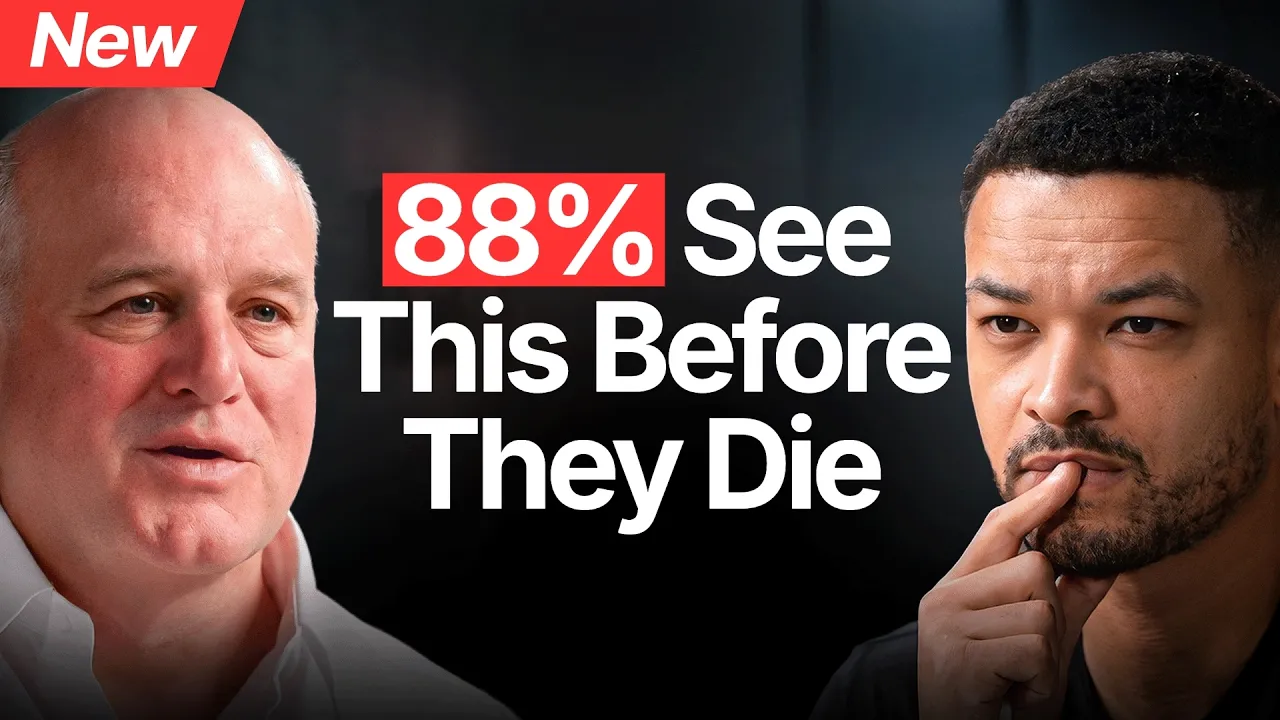
Hospice Doctor Kerr Debunks Deathbed Regrets in 1,500-Patient Study
The Diary Of A CEO
Data from more than 1,500 terminal patients reveal that vivid, comforting visions of deceased loved ones consistently displace existential panic and worldly regrets with a focus on human connection and relieving family burdens.
Over 80% to nearly 90% of dying patients experience intensely vivid dreams and visions nearing death, rating their perceived realism as 10 out of 10 while showing an absence of panic. (0:00)
Deathbed visions are clinically distinct from delirium, which produces fearful, disorganized hallucinations; deathbed experiences maintain narrative clarity and offer emotional comfort. (15:57)
Empirical data challenges the common myth of deathbed regrets, revealing that patients rarely bring up past regrets unprompted and instead rank not being a burden to loved ones as their top priority. (18:18)
Approximately one-third of hospice admissions die within seven days because modern acute medicine frequently denies the reality of dying until the very end, prolonging futile interventions. (56:35)
Detailed notes
## Background
This interview was published on YouTube by The Diary Of A CEO on October 19, 2026. The episode features Dr. Christopher Kerr, a hospice physician and neurobiologist, discussing his research into end-of-life dreams and visions based on over 1,500 patient interviews to challenge conventional medical perceptions of mortality, grief, and the dying process.
## TL;DR
Drawing on decades of clinical hospice practice and academic research, Dr. Christopher Kerr explains that dying is predominantly a gentle, orderly dimming of the senses rather than an agonizing physical ordeal. Nearly 90% of terminal patients experience profoundly vivid, comforting dreams and visions—frequently featuring deceased loved ones who offered unconditional love—that remain distinct from delirium and help resolve lifelong trauma. Rather than dwelling on career accomplishments, legacy, or personal regrets, dying individuals consistently prioritize relationships, peace, and not being a burden to their families. Ultimately, Kerr illustrates how end-of-life experiences highlight that human existence is anchored in connection, interdependence, and love rather than isolated individual achievement.
## Atmosphere & style
The conversation carries an intimate, reverent, and deeply comforting tone that strips away the clinical sterility and fear typically surrounding mortality. Steven Bartlett offers contemplative, attentive space, allowing Dr. Kerr to blend rigorous scientific inquiry with tender, moving bedside narratives about patients finding peace. Listening to the dialogue feels grounded and emotionally luminous, demystifying the final stages of life and replacing societal dread with a gentle, transformative reassurance.
## Bulletin
- [00:00](https://www.youtube.com/watch?v=GlaSnROMqRY&t=0s) Over 80% to nearly 90% of dying patients experience intensely vivid dreams and visions nearing death, rating their perceived realism as 10 out of 10 while showing an absence of panic.
- [15:57](https://www.youtube.com/watch?v=GlaSnROMqRY&t=957s) Deathbed visions are clinically distinct from delirium, which produces fearful, disorganized hallucinations; deathbed experiences maintain narrative clarity and offer emotional comfort.
- [18:18](https://www.youtube.com/watch?v=GlaSnROMqRY&t=1098s) Empirical data challenges the common myth of deathbed regrets, revealing that patients rarely bring up past regrets unprompted and instead rank not being a burden to loved ones as their top priority.
- [56:35](https://www.youtube.com/watch?v=GlaSnROMqRY&t=3395s) Approximately one-third of hospice admissions die within seven days because modern acute medicine frequently denies the reality of dying until the very end, prolonging futile interventions.
## Key takeaways
- [02:05](https://www.youtube.com/watch?v=GlaSnROMqRY&t=125s) End-of-life visions and dreams accelerate in frequency and immersive clarity during the final one to two weeks of life as sleep architecture naturally shifts.
- [02:05](https://www.youtube.com/watch?v=GlaSnROMqRY&t=125s) Visions of deceased relatives who offered unconditional love generate the highest comfort levels, significantly exceeding visions of living acquaintances.
- [11:25](https://www.youtube.com/watch?v=GlaSnROMqRY&t=685s) Roughly half of end-of-life visions occur while patients are fully awake, featuring non-metaphorical encounters that patients strongly distinguish from regular dreams.
- [13:40](https://www.youtube.com/watch?v=GlaSnROMqRY&t=820s) Religious belief does not alter the likelihood or nature of comforting end-of-life visions, showing that the phenomenon is universal across backgrounds.
- [16:58](https://www.youtube.com/watch?v=GlaSnROMqRY&t=1018s) Physical dying is predominantly a gradual dimming of the senses and reduction in appetite rather than an inherently agonizing or painful medical event.
- [19:51](https://www.youtube.com/watch?v=GlaSnROMqRY&t=1191s) Terminal patients prioritize relational roles and the well-being of others over professional achievements, worldly status, or legacy contemplation.
- [26:33](https://www.youtube.com/watch?v=GlaSnROMqRY&t=1593s) While 80% of Americans state a preference to die at home, only about 30% do so due to aggressive hospital cultures and insufficient home palliative resources.
- [33:36](https://www.youtube.com/watch?v=GlaSnROMqRY&t=2016s) Approximately 12% of patients experience distressing dreams or nightmares, which often prompt essential emotional confessions, trauma processing, and reconciliation.
- [41:07](https://www.youtube.com/watch?v=GlaSnROMqRY&t=2467s) Dying patients prioritize preserving functional healthspan and quality of life over extending lifespan through invasive medical technology.
- [52:45](https://www.youtube.com/watch?v=GlaSnROMqRY&t=3165s) Witnessing a loved one experience comforting end-of-life visions measurably improves bereavement outcomes by reframing the dying process as peaceful and meaningful.
- [01:02:13](https://www.youtube.com/watch?v=GlaSnROMqRY&t=3733s) Hope does not disappear when a medical cure is impossible; it transforms into a desire for comfort, meaningful shared time, and peace for remaining family.
- [01:08:53](https://www.youtube.com/watch?v=GlaSnROMqRY&t=4133s) Patients nearing death are not actively fighting mortality, but rather transitioning toward emotional resolution and perceived reunion with loved ones.
- [01:17:15](https://www.youtube.com/watch?v=GlaSnROMqRY&t=4635s) Dying children accept death without existential denial and frequently experience visions involving animals that offer reassurance and comfort.
- [01:19:03](https://www.youtube.com/watch?v=GlaSnROMqRY&t=4743s) Children near death often intuitively recognize their condition and focus on shielding their parents from emotional suffering and distress.
## Detailed walkthrough
### [00:00](https://www.youtube.com/watch?v=GlaSnROMqRY&t=0s) The Truth About the End of Life
Dr. Christopher Kerr has spent three decades working as a hospice physician, interviewing over 1,500 patients in the final stages of life. Through his research, he has documented that nearly 90% of people begin having intensely vivid dreams and visions as they draw close to death—experiences completely unlike anything they have ever encountered before. When researchers ask these patients to rate the realism of these events on a scale from 0 to 10, the response is universally a 10; to the dying, these encounters feel as real as physical reality itself. Crucially, these experiences do not mimic delirium or drug-induced confusion. Instead, they represent an orderly, deeply felt psychological phenomenon that modern clinical training largely overlooks.
Dr. Kerr argues that society and medical culture have lost their way when it comes to dying. The end of life is shrouded in an information vacuum filled with terror, myth, and misunderstanding, worsened because physicians are trained strictly to fight disease rather than facilitate the transition of a human being. Contrary to common cultural assumptions, people on their deathbeds are not consumed by professional regrets or unfinished worldly ambition. As Dr. Kerr explains, “Death is this unbelievably truthful place.” Stripped of ego and societal expectations, individuals return to the essential roles that defined their humanity—being a devoted son, a loving sister, or a trusted friend.
Equally misunderstood is the physical reality of death. While popular belief assumes that dying is inevitably excruciating, Dr. Kerr emphasizes that severe pain is far from inevitable and that the process is significantly less agonizing than the public fears. Yet, the absence of open conversations around death keeps families and patients trapped in unnecessary dread.
- Nearly 90% of dying patients experience profound, realistic dreams or visions nearing death.
- Patients consistently rate the perceived realism of these deathbed experiences as 10 out of 10.
- Death strips away worldly concerns, achievements, and career regrets, replacing them with reflections on interpersonal relationships.
- Unmanaged physical pain at the end of life is far rarer than assumed, yet medical communication surrounding dying remains severely deficient.
---
[02:05](https://www.youtube.com/watch?v=GlaSnROMqRY&t=125s) Why a Hospice Doctor Began Interviewing the Dying
When Dr. Kerr initially took a position at a hospice, he felt completely unequipped for the task before him. Conventional medical school curricula had taught him how to combat disease and defeat death, but offered zero insight into caring for individuals whose illnesses were deemed incurable. It was his colleagues—particularly the hospice nurses—who opened his eyes to the patient’s inner world. The nurses paid close attention to what dying patients were actually feeling, perceiving, and experiencing, showing him that a person cannot be reduced to an organ failure chart or a terminal pathology.
To date, Dr. Kerr’s research group has published around 15 academic papers investigating the psychological and spiritual dimensions of dying. Their studies have carefully screened out delirium, examined post-traumatic growth in the dying process, explored the distinct vision patterns experienced by dying children, and measured how these visions alter the grief trajectory of surviving loved ones. The core finding across these studies is that dying is characterized by a gradual change in sleep architecture; as individuals sleep more deeply and introspectively, visions and dreams intensify in frequency during the final one to two weeks of life.
```mermaid
flowchart TD
accTitle: Hospice Patient Experience Model
accDescr: Diagram illustrating the shift from traditional medical models to patient-centered holistic hospice care.
subgraph Traditional["Conventional Medical Paradigm"]
A["Focus on Organ Failure"] --> B["Aggressive Disease Defeat"]
B --> C["Overlooks Internal Subjective Experience"]
end
subgraph Hospice["Patient-Centered Hospice Model"]
D["Recognition of Progressive Sleep Architecture"] --> E["Emergence of Vivid End-of-Life Visions"]
E --> F["Resolution of Trauma & Affirmation of Love"]
end
```
Above all, these visions revolve around deceased loved ones who provided unconditional love throughout the patient’s life. When Dr. Kerr's team measured what dream themes offered the greatest solace, encounters with deceased family members provided the highest comfort scores by a wide margin—surpassing dreams of living family members. Dr. Kerr stresses the need to restore humanity to mortality: “What I've come to understand is what the patient perspective is the one that matters.”
---
[05:34](https://www.youtube.com/watch?v=GlaSnROMqRY&t=334s) Paul’s Story: Transcending the Fear of Death
Because medical audiences often dismiss deathbed visions as the ramblings of confused or cognitively compromised minds, Dr. Kerr began videotaping his patients to prove their clarity and mental acuity. One striking example is a patient named Paul, who was interviewed three weeks before his death. Paul described experiencing roughly fifteen dreams about his deceased wife. In these dreams, which were vivid and filled with bright colors, his wife consistently appeared wearing a light blue dress, suit, or gown. She would offer him a warm smile, wave like a pageant queen, and gently reassure him that she was fine, communicating volumes despite rarely uttering a spoken word.
Dr. Kerr highlights the absolute absence of panic in these encounters: “What you'll notice in all these videos that's so striking is the absolute absence of fear.” These experiences do not represent denial; rather, patients understand they are dying, but the visions foster a profound sense of psychological wholeness. While Dr. Kerr initially interpreted these events as mere rekindled memories or mental snapshots, the sensory fidelity and dynamic communication convinced him otherwise. For instance, he treated a 95-year-old man who lost his mother at age five; on his deathbed, the man vividly smelled her perfume and heard her voice with complete clarity.
When asked whether these visions prove an afterlife or indicate that deceased loved ones remain objectively accessible, Dr. Kerr remains scientifically cautious:
> “I wouldn't be so bold as to say this speaks to an afterlife. What I am more convinced of is that those who have loved us are never gone.”
He observes an elegant symmetry between the beginning and the end of life. An infant enters the world without language or fully developed cerebral capabilities, yet recognizes and finds security in a mother's embrace. At the end of life, as the brain fades and neurological capacity deteriorates, that exact same capacity to perceive connection and pure love remains intact.
---
[09:08](https://www.youtube.com/watch?v=GlaSnROMqRY&t=548s) The Resolution of Lifelong Trauma
The most emotionally convincing cases for Dr. Kerr involve patients who carried severe wounds and emotional scars across decades. These are individuals who endured horrific events during their lives—such as military combat veterans suffering from post-traumatic stress disorder and profound survivor's guilt. Despite decades of psychotherapy, counseling, and psychiatric medications, many of these individuals spent their entire adult lives unable to find peace or banish their inner turmoil.
Yet, in the final days and weeks of their lives, their deathbed dreams do not torture them with past horror; instead, they reunite them with the comrades and loved ones they lost. In these vivid bedside encounters, those long-buried wounds are addressed, bringing unexpected peace, emotional closure, and forgiveness where conventional medicine and psychiatry had previously failed.
[09:59](https://www.youtube.com/watch?v=GlaSnROMqRY&t=599s) Innate Healing and Everyday Moments at Life's End
Dr. Christopher Kerr reflects on the remarkable capacity human beings possess to find resolution as life closes, emphasizing that this is seen poignantly in children. Even amid deep trauma or separation, patients reveal an internal resilience: “And I think some of the most remarkable ones, of course, are the children um who do this so differently. But just the fact that there's so much innate ability within us to heal these harmed and broken pieces.”
These end-of-life experiences rarely take the shape of dramatic revelations or grand cinematic epiphanies. Instead, they are grounded in simple, ordinary memories of human connection that reassure the individual that their life mattered. Kerr shares the example of a patient named Florence, interviewed just five days before her death. Florence had endured the deaths of both her husband and her daughter years earlier. In a recorded clip, Florence describes a dream where her lost family members were simply sitting around the kitchen table:
> “They were like sitting at kitchen table, laughing. I could see their faces. I could tell them four photos. We were laughing, we were talking, we were eating. And then they felt like they walked 12 years. And never existed... It was like we were always together, never separated.”
```mermaid
flowchart TD
accTitle: Progression of End-of-Life Experiences
accDescr: A flowchart illustrating the shift from waking life to immersive, realistic end-of-life dreams and visions as death approaches.
subgraph Timeline["Final Weeks to Days"]
A["Diagnosis & Prognosis Acknowledged"] --> B["Frequency of Visions Increases"]
B --> C["Deepening Sleep & Dimming of Senses"]
end
subgraph Experience["Nature of the Experience"]
D["50% Awake / 50% Asleep"] --> E["10/10 Realism: Ordinary, Vivid Settings"]
E --> F["Reunion with Deceased Loved Ones & Pets"]
F --> G["Profound Comfort & Loss of Distance/Time"]
end
Timeline --> Experience
```
[11:25](https://www.youtube.com/watch?v=GlaSnROMqRY&t=685s) How Deathbed Dreams Differ from Normal Dreams
Addressing the natural skepticism that dying patients are merely dreaming about what is already on their minds, Dr. Kerr points out that patients themselves push back strongly against calling them dreams. To them, these experiences are entirely unlike ordinary subconscious fantasies: “The thing that gets them most distressed is when you refer to them as dreams. Because these are unlike anything they've ever experienced. So, they're not dreams in the sense they're not metaphorical, they're not fantastical. They don't require interpretation. I've never had a patient say, 'Hey, what do you think this means?'”
Patients possess an absolute sense of knowing. When asked in clinical research to rate the realism of these encounters on a scale from 0 to 10, they consistently rate them a 10. The events are not abstract; about 50% of these visions happen while the patient is fully awake. Observers can watch patients looking through the room, interacting with empty spaces, or reaching out to stroke a beloved family pet that passed away decades earlier.
- **Awake vs. Asleep:** Roughly 50% of recorded end-of-life visions happen during clear wakefulness rather than sleep.
- **Timing:** Visions typically manifest within measurable weeks of passing and accelerate in both frequency and immersive intensity as death nears.
- **Immersion:** Because dying involves a gradual progression into deeper sleep states, patients spend more time immersed in these encounters, often waking up wishing they could return to that comforting presence.
[13:40](https://www.youtube.com/watch?v=GlaSnROMqRY&t=820s) Biology, Soul, and Spiritual Connection
When asked whether these events are merely neurochemical artifacts or something genuinely spiritual, Dr. Kerr notes his background as a neurobiologist with a PhD who spent over half a decade investigating the brain. While neurochemistry can identify regions associated with happiness or attachment, it cannot account for the totality of human experience: “I can't show you where love is. I can't recreate love in a dish. And I can't create this. I see it really goes beyond brain function into something else.” When asked outright if he believes in a soul that survives beyond physical anatomy, Kerr simply replies, “Yes.”
The conversation turns to broader population data showing how pervasive encounters with the deceased are among the living:
- **53%** of Americans report having felt a deceased family member visit them in a dream or another form.
- **34%** state that in the past year, they felt the presence of a deceased relative.
- **28%** reported that in the past year, they verbally shared life updates and events with a dead relative.
- **15%** felt that a deceased family member actively communicated with them within the past year.
Dr. Kerr notes that while approaching death causes people to focus deeply on existential relationships, personal religious background does not dictate whether they receive these comforting visions: “We've looked at this question of religion and we've have not found that being having a religious belief changes how you experience these end of life events. It just doesn't seem to matter.”
[15:57](https://www.youtube.com/watch?v=GlaSnROMqRY&t=957s) The Crucial Difference Between Delirium and End-of-Life Visions
Addressing the common medical assumption that dying visions are merely symptoms of metabolic disturbance or terminal illness, Dr. Kerr explains the methodology of his university-approved research studies. To ensure data integrity, every patient was rigorously evaluated with daily clinical delirium screenings:
> “Our studies did that was smart is we sorted out the patients who were delirious... Delirium is very disorganized and the biggest difference is most people are left frightened or distressed by delirium. These events are recalled with acuity, they're based on real happenings, and they're left with a feeling of comfort, not distress or fear.”
Rather than chaotic hallucination, these experiences display remarkable narrative acuity and clarity, soothing the dying person instead of agitating them. Over 80% of healthcare workers have encountered or been told about these profound deathbed occurrences.
[16:58](https://www.youtube.com/watch?v=GlaSnROMqRY&t=1018s) Misconceptions About Dying: Pain, Sleep, and Natural Dimming
Dr. Kerr dispels the dominant cultural anxieties surrounding the biological process of death, explaining that “dying is a process, death is a moment.” Physical agony is not an inescapable requirement of dying; manageable pain can be systematically controlled. Similarly, family members often agonize when patients stop eating and drinking, not realizing that the body naturally winds down: “Something happens in nature that we don't die in want. So, it just kind of dwindles. And dying is really like um a dimming of the shades. It's gradual.”
In hospice medicine, achieving comfortable, peaceful sleep is the central clinical objective:
- **Sleep as the Gateway:** Dying individuals naturally pull back physical exertion, sleeping more as bodily systems slow down.
- **The Core Metric:** “The holy grail for us, the vital sign that matters for us is comfortable sleep because you can't sleep if you're in discomfort, and you can't die if you can't sleep.”
- **Comprehensive Comfort:** True comfort requires total ease across physical, psychological, and existential domains before a person can let go.
[18:18](https://www.youtube.com/watch?v=GlaSnROMqRY&t=1098s) Challenging the Myth of Deathbed Regrets
The discussion shifts to popular literature on end-of-life regrets, particularly the well-known writings of Australian palliative care worker Bronnie Ware. Dr. Kerr expresses strong skepticism regarding the narrative that terminal patients are dominated by agonizing regrets: “First of all, it wasn't empirical, right? It was It was conver- based off of conversations. And that's not my experience. I don't see people bringing up regret towards the end of their life.”
He illustrates that prompting people about regrets will inevitably yield an answer—similar to asking someone for their favorite color—even if it is not something occupying their actual consciousness. Throughout nearly thirty years of direct bedside care, Kerr observes that worldly angst and self-recrimination fall away. In empirical studies contrasting what healthy medical trainees predict terminal patients prioritize versus what dying patients with days left truly care about, priorities undergo a total reversal. The primary concern of the dying patient is not personal legacy or regret: “Well, the first one the hospice patient cares about is not being a burden. They become selfless.”
[19:51](https://www.youtube.com/watch?v=GlaSnROMqRY&t=1191s) Not Being a Burden and the Priority of Relationships
Dr. Christopher Kerr explains that as people approach the end of life, their primary concern is not to tax their family or let their illness compromise their loved ones' lives. While one might expect someone near death to become increasingly self-focused, they actually become intensely other-focused. Dr. Kerr points out that this mirrors the findings from the science of happiness: true meaning stems from doing for others rather than serving the self. When asked what a relative can do to ease this specific anxiety, Dr. Kerr notes that it comes down to aligning wishes with their hopes: confirming that you genuinely want to be there with them, reassuring them that their presence and care are not a burden.
```mermaid
flowchart TD
accTitle: Divergence Between Medical Predictions and Patient Realities
accDescr: Contrasts what young medical students assume matters to dying patients versus what hospice patients actually prioritize.
subgraph MedStudents["Medical Students' Assumptions"]
M1["1. Self-focused legacy & impact"]
M2["2. Feeling life was meaningful"]
M3["3. Pain & symptom control"]
M4["4. Maintaining mental awareness"]
end
subgraph HospicePatients["Hospice Patients' Actual Priorities"]
P1["1. Not being a burden to family"]
P2["2. Quality time with loved ones"]
P3["3. Pain & symptom management"]
P4["4. Peace with God / existential peace"]
P5["5. Maintaining mental awareness"]
P6["6. Dying at home"]
end
The second highest priority for hospice patients is time—specifically, time spent with friends and family, underscoring that human connection is fundamental. In contrast, medical students in their twenties assumed that patients' primary preoccupation would be assessing whether their lives had been meaningful. Dr. Kerr finds this difference fascinating: while young adults are preoccupied with personal development, impact, and legacy, dying individuals close that chapter entirely. As Dr. Kerr observes: “That door shut. And they're not living in the rearview mirror and they're not wondering whether they had have meaning or not.”
[21:23](https://www.youtube.com/watch?v=GlaSnROMqRY&t=1283s) Redefining Purpose: Interdependency Over Achievement
The host reflects on an exercise from a previous guest who asked him to picture the final day of his life, which led to a profound realization: in that moment, he did not care about legacy, career achievements, or impact. He cared solely about who was standing around his bed, whether they were safe, and whether his children felt he was a good father who left them with sound life principles. He contrasts this reality with the messaging on social platforms like Instagram and LinkedIn, which constantly push self-centered questions about purpose, passion, and personal brand.
Dr. Kerr confirms this perspective, highlighting that psychological research shows human brains are notoriously poor at forecasting what delivers sustained fulfillment. Transient goals such as job promotions continually fail to bring lasting joy. Instead, genuine fulfillment rests on belonging, connection, and understanding that humans are fundamentally meant to rely on one another. Dr. Kerr highlights that when people recall the best versions of themselves, they think of relational roles—being a son, brother, friend, or partner—rather than an individual accolade. This realization becomes sharpest during vulnerability, where transient concerns fall away:
> “Because we're defined only by our relationships. That's the only surviving thing, not by these other things that seem, in a transient sense, important.”
[24:28](https://www.youtube.com/watch?v=GlaSnROMqRY&t=1468s) The Truthful Space of Death and Stripping Away Pretense
The conversation touches on the sharp disconnect between knowing intellectually that relationships matter most and how people actually allocate their time day to day, pouring hours into wealth, status, and material goods. Dr. Kerr describes death as an “unbelievably truthful place” where superficiality, posturing, and external personas collapse entirely. Stripped down to their core, human beings discover they share far more similarities than differences:
> “Pretense goes away. All the superficiality goes away. You're You're stripped to the bare bare bones of who you are. And what you end up finding is that we're more alike than unlike, and there's a universality to being human, and it involves being connected to one another.”
Even those who have led flawed or difficult lives frequently reveal a deeper tenderness and capacity for affection once serious illness strips away their defenses. In this vulnerable state, political divisions and petty grievances evaporate. Illness acts as a massive leveler: the anxieties, arguments, and material ambitions that felt urgent two weeks prior lose all relevance.
[26:33](https://www.youtube.com/watch?v=GlaSnROMqRY&t=1593s) Pain Management, Spiritual Peace, and the Medicalization of Dying
Addressing the third priority on the patients' list, Dr. Kerr notes that hospice patients and medical students agree on the importance of pain and symptom management. However, a major tragedy of modern healthcare is the near-total absence of proactive communication regarding what physical decline actually feels like. When diagnosed with a terminal illness, patients almost universally fear agonizing suffering. Dr. Kerr emphasizes that this terror is largely unfounded:
> “Oh my gosh, that it's far worse than people think, that there isn't a pain, rarely a pain we can't manage.”
When asked about the fourth priority, Dr. Kerr identifies finding “peace with God.” He clarifies that this need is not limited to religious patients anticipating divine judgment, but represents an existential longing for harmony with something larger, often involving seeking forgiveness. While medical students assumed mental awareness would rank fourth, it actually ranked fifth among hospice patients.
Ranked just after mental awareness is the desire to die at home, exposing a glaring failure in modern healthcare delivery:
- Approximately 80% of Americans express a desire to die in the comfort of their home.
- In reality, only about 30% of Americans actually achieve an at-home death.
- Dr. Kerr attributes this gap directly to the medicalization of dying and a systemic underinvestment in home-based palliative infrastructure.
- In advanced tertiary medical centers driven by an aggressive, “death defying approach,” clinicians constantly feel compelled to initiate further interventions, resulting in patients passing away isolated inside intensive care units rather than at home.
[29:16](https://www.youtube.com/watch?v=GlaSnROMqRY&t=1756s) How Modern Medicine Denies Death and Institutionalizes Dying
The discussion turns to how medical interventions often become counterproductive at the end of life. Dr. Christopher Kerr points out the irony that receiving more aggressive medical care near the end of life has not been shown to enhance life, yet the dying are frequently subjected to intensive interventions. The host observes that modern systems seem to needlessly drag out the dying process. Dr. Kerr agrees, noting that modern medicine is fundamentally oriented around trying to defeat mortality: “I think medicine does its best to defy death and unfortunately it often denies it even when it's obvious when things have become futile.” When physicians and institutions refuse to acknowledge death objectively, they naturally fail to pay attention to the subjective experience of the person who is dying.
Historically, Dr. Kerr explains, dying was woven into domestic and communal life. People died at home surrounded by family, neighbors, and their faith communities. Over the past century, death has been thoroughly institutionalized, transforming it into a distant abstraction—something like a rumor that happens far away to someone else rather than a natural life stage proximate to everyday experience. Medicine has traded artful presence for clinical technique; patients are no longer permitted to simply “die of old age” without collecting an exhaustive list of diagnostic codes, stripping the end of life of its humanity and grace.
When asked whether people facing terminal illness should enter a hospice facility, Dr. Kerr clarifies a common misunderstanding: hospice care is designed to enable patients to die comfortably at home, aligning their final wishes with actual outcomes. The hospice movement originally emerged out of communities as a direct rebuttal to the sterile, over-medicalized way people were treated in acute hospital settings. In a hospital, patients are subjected to nocturnal checks, needle pokes, intravenous lines, and repetitive scans. At home, what truly matters to the dying is honored: familiarity, emotional connection, physical comfort, and proximity to the people they love.
```mermaid
flowchart TD
accTitle: Shift in End-of-Life Care Over the Last Century
accDescr: Diagram illustrating the historical transition from community-based dying to institutionalized hospital care, followed by the corrective hospice model.
subgraph Traditional["Historical Dying"]
A["Home and Community Centered"]
B["Connected to Family and Faith"]
C["Dying of Natural Old Age"]
end
subgraph Institutional["Modern Medicalization"]
D["Hospital Institutionalization"]
E["Aggressive Interventions and Futile Care"]
F["Death Treated as Remote and Abstract"]
end
subgraph HospiceCorrection["Hospice Rebuttal"]
G["Hospice Support at Home"]
H["Focus on Comfort and Presence"]
I["Alignment with Patient Wishes"]
end
Traditional --> Institutional
Institutional --> HospiceCorrection
```
[31:31](https://www.youtube.com/watch?v=GlaSnROMqRY&t=1891s) Debunking the Myth of End-of-Life Conflict and Legacy
The conversation examines what actually matters to patients versus what outside observers assume matters. When medical students were surveyed about what terminal patients prioritize, they ranked items like having advance care directives followed and resolving interpersonal conflicts near the top. Outside observers and researchers frequently emphasize legacy, asking whether life was meaningful, or seeking resolutions to past disputes. However, Dr. Kerr finds that dying patients are remarkably uninterested in treating their final days as an analytical problem to be solved: “They don't want to be a—they're not a problem to be solved.”
Dr. Kerr expresses deep skepticism toward the popular "regret literature," arguing that it fundamentally misinterprets what terminal individuals experience. Patients are not preoccupied with tallying failures or brooding over negative chapters of their history. Instead, they focus on preserving their core identity, which is anchored in family, their home, and being at peace with their personal faith: “They're not focused really on the negative aspects of having lived, right? They're trying to preserve what makes them them and what makes them them is their family.”
The host reflects that living people are conditioned by consumer culture, advertising, and career benchmarks—such as chasing luxury goods or corporate promotions—to orient their values around external, shallow achievements. Dr. Kerr connects this to the psychology of happiness, highlighting the research of Dr. Laurie Santos at Yale. True well-being, upstream in life as well as at its end, does not derive from transient material acquisitions, but from savoring things of genuine, enduring worth, most notably intimate personal relationships.
[33:36](https://www.youtube.com/watch?v=GlaSnROMqRY&t=2016s) Dwayne's Story: Distressing Dreams, Confession, and Transformation
The host asks whether some individuals die profoundly unhappy because of the lives they led. Dr. Kerr confirms this reality, remarking that people die the way they lived: “You die how you live, right? You can't reinvent it. It's not rainbows and flowers.” He recounts cases of patients consumed by guilt and fear of impending divine judgment, such as individuals raised Catholic who felt an overwhelming urge to confess. One former police officer, tormented by memories of having assaulted witnesses and committed abuses on the job, unloaded a flood of confessions to everyone around him, including a visiting *New York Times* reporter.
Roughly 12% of hospice patients experience distressing dreams or nightmares rather than comforting visions. Far from being meaningless neurological noise, Dr. Kerr notes that these disturbing episodes often catalyze profound emotional healing and transformation. He shares the filmed case of a patient named Dwayne, a man who had spent most of his life on the streets and served extensive prison time. Dwayne had taken two lives in street self-defense shootings and had spent a lifetime avoiding accountability for the harm he inflicted on others.
Twelve days before his death from cancer, Dwayne began suffering terrifying nightmares in which his past caught up with him. He recounted on video:
> “My dreams, man. You know, my nightmares. I don't like them. I think it's because my past is coming back to me, you know, from doing wrong. Because I'm not going to say I'm a perfect guy when I was out there. Because I was living right in the streets, you know, doing wrong to individuals. And now they know my symptoms. They know I'm sick. So, now they want to try to hurt me. You know, it was like they were jerking a knife... trying to cut out, you know, my neck where my cancer was at. 'Stop. Stop trying to fight,' you know. 'I'm sorry. I'm sorry,' you know... I just want people to forgive me. And please know that I was sick at the time when I was doing certain things that I was hurting them and their families. You know, that's all I want. I don't want them to look at me as a bad individual because I'm not.”
Because of these night terrors, Dwayne could not sleep, which made it impossible for him to achieve physical and psychological rest. Awakening from the nightmare, Dwayne asked for his daughter. When she arrived, Dwayne held her in his arms for several uninterrupted minutes—an embrace she described as unprecedented in their relationship—professing his love and asking for her forgiveness. She granted it immediately. Dr. Kerr explains that this deep, involuntary reckoning surfaced truths Dwayne could no longer deflect. The reconciliation permanently transformed his daughter's outlook; she stayed by his side every night thereafter, and Dwayne passed away peacefully.
- **Prevalence of Distressing Dreams:** Approximately 12% of dying patients report uncomfortable or frightening end-of-life dreams.
- **Timing of Dwayne's Visions:** Occurred 12 days prior to his death.
- **Impact of Confession:** Dwayne's confrontation of past violence and guilt enabled him to seek reconciliation with his daughter, transitioning from torment to a calm, comfortable passing.
[39:00](https://www.youtube.com/watch?v=GlaSnROMqRY&t=2340s) Sponsor Messages: Pipedrive and Cometeer
Stephen Bartlett highlights a statistic that sales teams spend approximately 50% of their working time on administrative tasks and manual CRM updates rather than actual selling, a dynamic he characterizes as deadly to a company's bottom line. Drawing on his experience switching to Pipedrive a decade ago at his previous venture, Bartlett outlines how the AI-powered sales CRM introduces new meeting intelligence tools, including a built-in AI note-taker. Before client calls, the software compiles relevant deal history, email records, and prior conversations into a single brief, attends the meeting to capture notes automatically, and drafts updates directly into the CRM. He notes that over 100,000 companies currently utilize the platform and shares an exclusive 30-day trial offer.
Bartlett then pivots to Cometeer Coffee, noting that even the former president of Nespresso was persuaded to invest after a single sip. He recalls his own introduction to the brand when a delivery arrived at his London office, prompting immediate curiosity across the team's Slack channels. Rather than requiring users to brew coffee through plastic pods or calibrate flavors manually, the product flash-freezes brewed coffee extract at its peak flavor profile. Preparation requires only popping the frozen capsule into a mug and adding hot water or pouring it over ice, removing machinery and cleanup entirely.
[41:07](https://www.youtube.com/watch?v=GlaSnROMqRY&t=2467s) What Dying Patients Care About: Healthspan Over Lifespan
Returning to an interactive board listing the values terminal patients prioritize at the end of life, Bartlett and Dr. Kerr examine the lower-ranking items. Stephen clarifies whether participants selected from a preset list of 11 items or a broader array, and Dr. Kerr confirms that patients evaluated a wide range of options before narrowing them down. Among the lower-ranked selections is item number eight: feeling that one's life was meaningful. Even further down the hierarchy sits the desire to extend survival at any price. As Dr. Kerr observes: “I've never heard a dying patient say, 'I want to live as long as possible.'” Instead, patients prioritize remaining functional and present for as long as their condition permits.
Dr. Kerr notes that this patient-centered instinct stands in direct conflict with the prevailing culture of acute medicine: “What they want to do is live as well as they can as long as they can. But unless you've been sick, that's not the goal. Which is antithetical to way medical world looks at patients, right? It's that we we keep going at all costs.” Bartlett cites public health data highlighting that while average healthy life expectancy ranges from 66 years in Europe to 68 years in the Western Pacific, individuals in nations like the United States spend roughly a decade—up to 11 years—living in poor health. Dr. Kerr affirms that when illness sets in, people intuitively care about healthspan rather than raw longevity because being chronically sick imposes grueling physical and emotional burdens on both the patient and their loved ones.
[42:42](https://www.youtube.com/watch?v=GlaSnROMqRY&t=2562s) The Illusion of the Longevity Movement
Addressing modern cultural fixations on biohacking, lifespan extension, and radical longevity, Dr. Kerr cautions that much of the trend risks veering into wishful thinking. He points to recent findings published in *Science* showing that roughly 55% of human lifespan is dictated by genetics, leaving individuals fundamentally vulnerable to biological happenstance and disease regardless of intervention. He voices concern over the lack of rigorous evidence backing many extreme longevity protocols and urges a re-centering on the foundational qualities of daily life.
To illustrate this, Dr. Kerr contrasts high-tech longevity regimens with the documented lifestyles of global Blue Zones. Centenarians in places like Okinawa or Sardinia do not begin their mornings calibrating creatine doses or stepping out of ice baths; their longevity emerges organically from community, natural movement, plant-heavy diets, and intentional routines to downshift through prayer, meditation, or music: “And I think the focus really needs to be on living well.”
```mermaid
flowchart TD
accTitle: Approaches to Longevity and Aging
accDescr: Comparison between modern extreme biohacking trends and evidence-based Blue Zone lifestyle factors.
subgraph REAL["Evidence & Patient Reality"]
R1["55% of lifespan set by genetics"]
R2["Prioritizing healthspan over quantity"]
R3["Acceptance of bodily limits"]
end
subgraph BLUE["Blue Zone Lifestyle Factors"]
BZ1["Natural movement & plant-rich diets"]
BZ2["Downshifting via prayer or music"]
BZ3["Deep social integration & community"]
end
BIO -.->|"contested by"| REAL
REAL --- BLUE
```
[43:44](https://www.youtube.com/watch?v=GlaSnROMqRY&t=2624s) Love Given and Received: Dying With and Without Connection
When Bartlett asks what differentiates individuals who approach death with serene acceptance from those who struggle, Dr. Kerr answers without hesitation that worldly achievements and career milestones drop away completely. The sole determining factor is human connection: “The love given and received. That's the only thing that matters.” Individuals who led quiet, outwardly modest lives often pass away with immense peace because the affection they shared was sincere and uncomplicated: “You want to live in a way that that you can die well and and and that means loving well.”
Conversely, Dr. Kerr recounts the devastating experience of caring for patients who had never known authentic affection. He describes a woman who was institutionalized as a child among complex cases and endured lifelong emotional deprivation and abuse from men. Watching romantic scenes on television, she once confessed to him that she had never understood physical affection. Her dying process was marked by palpable emptiness and regret because she recognized she had been denied parental and romantic love. Yet even in her isolation, an innate psychological mechanism offered comfort: decades prior, she had abruptly fled an apartment after a suitor proposed because trauma made her equate intimacy with danger. On her deathbed, that former suitor appeared to her in a vivid dream to reassure her that he had genuinely loved her, providing a soothing sense of closure before she passed. Bartlett notes how early wounds cultivate avoidant attachment, recalling that during his own adolescence he pursued someone for four years only to recoil and dissuade them the moment they reciprocated.
- In Dr. Kerr's clinical experience, professional or material accomplishments do not correlate with a peaceful death.
- Severe childhood emotional neglect and abuse leave terminal patients vulnerable to profound end-of-life regret and feelings of emptiness.
- End-of-life dreams frequently step in to provide emotional repair, reassuring patients of their worth even when loved ones are physically absent.
[46:47](https://www.youtube.com/watch?v=GlaSnROMqRY&t=2807s) Healing Childhood Wounds and Unresolved Trauma at Life's End
Bartlett asks how the dying process prompts individuals to confront and resolve the core injuries that governed their lives. Dr. Kerr affirms that witness to this spontaneous therapeutic reckoning is among the most profound aspects of his career. He highlights the case of a man raised in poverty who lost his arm at eight years old; having spent his entire existence battling feelings of inadequacy to prove he could work and provide, the dying man experienced a vision of lying in bed while former colleagues filed past to praise him as the finest worker they had ever known.
In another instance, a dying mother plagued by guilt over her adult child’s incarceration for narcotics offenses questioned her entire parental worth. Near the end of life, her deceased parents appeared to her in a dream to affirm that she was cherished and had been a good mother. Dr. Kerr argues that these experiences are not random hallucinations, but represent an intrinsic human capacity for psychological repair: “No, but again, there's something in us that's innate that can heal these kind of broken pieces of us at the end that make us whole.”
```mermaid
flowchart LR
accTitle: End-of-Life Trauma Resolution Model
accDescr: How unresolved life wounds are transformed through innate end-of-life dreams and visions into closure.
subgraph WOUND["Core Life Wound"]
W1["Physical disability & adequacy fears"]
W2["Parental guilt & perceived failure"]
W3["Relational trauma & fear of intimacy"]
end
[48:11](https://www.youtube.com/watch?v=GlaSnROMqRY&t=2891s) Life After Death and Collective Consciousness
When asked whether he believes consciousness survives physical death or if human beings simply decompose back into the earth, Dr. Kerr shares a nuanced metaphysical perspective rooted in his clinical observations. While he does not believe the individual persists in any recognizable physical form, he finds it difficult to dismiss the enduring reality of shared consciousness.
He observes that the figures who populate patients' final visions are almost exclusively those who loved them without condition, whereas peripheral figures fade away entirely: “Yeah, I don't think we go on in a physical form, but I go back to this idea that there's the shared seems to be the shared consciousness that the love that we've experienced at early in life and it's very interesting, it tends to be those who loved us unconditionally and the other ones kind of go by the wayside, they're they're inseparable from us and they become more present to us as we're leaving our physical form.” Because these figures grow increasingly vivid and proximate precisely as bodily functions decline, Dr. Kerr suggests that love acts as an unbreakable, shared continuum that transcends individual biology.
[49:00](https://www.youtube.com/watch?v=GlaSnROMqRY&t=2940s) Hypotheses on Consciousness and the Universe
Noting how many bereaved individuals feel they are accessed by deceased loved ones, the discussion shifts to what consciousness might actually be. The host shares a theory proposed to him by a physicist: consciousness may be the mechanism through which the universe understands itself. In this view, a singular central source of consciousness breaks into countless pieces across existence—entering fish at the bottom of the ocean, humans walking the land, and birds observing from the sky. Each living organism explores a distinct vantage point, which may explain why animals and humans possess an innate fascination with novelty.
The host illustrates this drive by recalling a drive down a street in Gibraltar or Malta after talking with the physicist. Watching tourists stand for extended periods staring up at unfamiliar sights, he realized that traveling on holiday and gazing at mountains in awe is fundamentally driven by this instinct to seek novel experiences. Under this framework, consciousness scatters into living things to explore, and at death, an individual simply returns to that central source of consciousness. Dr. Kerr laughs and remarks, “I like my version better,” before turning to empirical observations from palliative medicine.
```mermaid
flowchart TD
accTitle: The Cosmological Consciousness Hypothesis
accDescr: A flow illustrating the theory of a single consciousness exploring existence before returning to its origin upon death.
A["Universal Consciousness Source"] --> B["Fractures into Living Organisms"]
subgraph Exploration ["Exploration of Existence"]
B --> C["Fish in Deep Oceans"]
B --> D["Humans on Land"]
B --> E["Birds in the Sky"]
end
C & D & E --> F["Innate Drive for Novelty & Wonder"]
F --> G["Physical Death"]
G --> A
```
[50:53](https://www.youtube.com/watch?v=GlaSnROMqRY&t=3053s) Psychedelics and Deathbed Priorities
Dr. Kerr points to research involving psychedelics administered to terminal patients, noting that indigenous cultures have engaged in similar practices for thousands of years. When dying individuals undergo psychedelic therapy, they return structurally altered: their fear of dying dissipates, they experience heightened awareness, and they come to perceive themselves as immersed within and connected to life at large. As Dr. Kerr explains, “Basically, when they give psychedelic drugs, which the indigenous people have been doing for thousands of years they come back structurally altered.” Ultimately, these experiences change how patients view their existence, allowing them to die with profound peace.
The conversation then returns to a ranking board of what matters most to people at the end of life:
- **Tenth on the priority list**: Having finances in order.
- **The final priority**: Resolving conflicts.
Dr. Kerr argues that popular culture misunderstands regret. When asked directly in an introspective society, individuals will readily admit to having conflicts or regrets. However, when asked to rank-order their actual priorities at the end of life, those issues fall to the bottom: “So if you went to people and said, 'Do you have conflicts?' They go, 'Yeah, I have conflicts.' Or 'Do you have regrets?' 'Yeah, I have them.' But when you actually rank order them as priorities, it's not relevant.” Living a life free of regret is not what dominates the thoughts of the dying; instead, fixating on regret is a modern symptom of excessive self-analysis.
[52:45](https://www.youtube.com/watch?v=GlaSnROMqRY&t=3165s) How End-of-Life Visions Shape Bereavement: Patrick and the Sauce
Drawing on six handwritten cards outlining the core lessons he has learned from caring for the dying, Dr. Kerr highlights the most prominent principle: "love endures after physical loss." His research demonstrates that loved ones who passed away decades earlier frequently reappear at the end of life, reframing the dying process as a reunion. Witnessing this transition directly and measurably alters the bereavement process for family members. When survivors see their loved one as rich in love rather than defined solely by physical deterioration, they grieve, remember, and heal in fundamentally healthier ways.
To demonstrate how these experiences are grounded in personal relationships rather than grand epiphanies, Dr. Kerr presents an interview with a woman named Jennifer. She describes the final days of her partner, Patrick:
- Patrick was the only living family member who knew how to cook his late grandmother's secret sauce recipe, yet he always insisted something was missing from the flavor.
- On the Sunday before he died, after eating almost nothing the previous day except a snack pack pudding, Patrick refused breakfast, claiming he was completely full.
- He told Jennifer that he had made sauce with his late grandmother, "Nana Dolores," the previous night; he insisted he could still smell it, taste it, and feel full from it.
- In the vision, his grandmother revealed the missing step: stirring in a teaspoon of sugar right before taking the pot off the burner.
- Patrick and Jennifer then spent seven and a half hours preparing the sauce together with the added sugar, which became the last meal Patrick ever ate.
- Waking each morning to ask if that day would be his last, Patrick was told by Jennifer to "go when you're ready," and he passed peacefully.
Jennifer reflects that the vision confirmed Patrick was ready, solidifying her acceptance of his death and suggesting to her that something meaningful exists beyond physical demise. Dr. Kerr summarizes the impact: “So, how she remembers him in death was that he was put back together by being with those he loved.”
[56:35](https://www.youtube.com/watch?v=GlaSnROMqRY&t=3395s) Cultivating Healthy Grief and Preventing Medical Harm
When asked how families can protect themselves from a traumatic grieving process, Dr. Kerr emphasizes that grief cannot be denied, but its harm can be mitigated through open communication and clear acknowledgment of what is coming. The worst bereavement outcomes occur when death is continuously denied by medical teams and families. Denying death until the final hours robs patients of personal agency, depriving them of the time needed to have meaningful conversations and decide how to spend their remaining days.
Dr. Kerr identifies several essential factors for a healthy death and grieving process:
- **Overcoming Medical Denial**: Approximately one-third of hospice admissions die within seven days. These patients were not only dying for seven days; rather, modern medicine concealed and denied their reality until it became an acute, sudden shock, causing severe harm to both the dying and the bereaved.
- **Radical Acceptance**: Facing the proximate reality of dying head-on prevents sudden emotional shock and lets people make peace on their own terms.
- **Physical Presence**: Death should be a shared experience embedded in the home and community, where people offer mutual support, rather than an isolated, sterilized event occurring in an intensive care unit gown.
- **Open Love and Authenticity**: Families must talk, share, and express their feelings openly, rejecting any instinct to repress the reality of dying: “Anything that's repressive or denying about it, whether it's your own feelings, whether it's what's happening to the patient, is harmful. Period.”
- **Restoring Personhood**: Dying at home shifts the focus so the dying individual is embraced as a whole person rather than treated merely as an anonymous patient.
[58:56](https://www.youtube.com/watch?v=GlaSnROMqRY&t=3536s) The Loss of a Father and the Nature of Grief
Dr. Christopher Kerr reflects on the profound impact of losing his father to cancer at age 42, when Kerr was only 12 years old. Experiencing such a devastating loss in childhood permanently derailed the expected trajectory of his life, turning it into a "pretty bumpy road." He reveals that the last time he ever saw his father, his father was experiencing one of the very end-of-life visions that Kerr now studies professionally. For decades, the trauma ran so deep that Kerr could not even utter his father's name or discuss that final visit. He points out the surreal irony of his career trajectory: “the thing I could never talk talk about it is the thing that I now share with millions of people. I feel like I'm getting punked. Like I didn't mean for this to happen.”
When asked if grief ever truly goes away, Kerr states plainly that it does not. While it can initially feel unbearable—likened to carrying a heavy stone in one's pocket that is sometimes forgotten and sometimes sharply felt—grief ultimately shifts rather than vanishes. The physical presence is lost, but the person endures in how they transformed the survivor's worldview. Kerr stresses: “We talk about grief in terms of what we lose, but not necessarily what remains. And a lot of that person remains.” Acknowledging how tragedy steered his entire life, he quotes a guiding philosophy on mourning: “the trick is, the art is, is to carry grief in one hand, gratitude in the other, and be struck by both.”
[01:02:13](https://www.youtube.com/watch?v=GlaSnROMqRY&t=3733s) How End-of-Life Visions Transform Family Bereavement
Having surveyed 750 grieving families, Dr. Kerr observed a distinct emotional difference among relatives who witnessed their dying loved one's pre-death dreams and visions. He describes a scenario of a couple married for sixty years who had suffered the loss of an infant decades earlier. As the wife lies dying and non-verbal, she visibly cradles that lost child in her inner experience, entering a state of absolute serenity. This sight profoundly alters the husband’s grief, linking the living with the dead and reassuring him about where his partner is psychologically.
When a patient becomes unresponsive, families are universally plagued by the painful questions of "where are they and how are they?" Witnessing these peaceful visions answers those questions, completely reframing death:
> “it reframes dying from something that could be empty and only defined by its physical dimensionality, what you're seeing, and it shows that it can be rich in meaning and love.”
[01:03:31](https://www.youtube.com/watch?v=GlaSnROMqRY&t=3811s) Sponsor Interlude: The Diary of a CEO Conversation Cards
The host reflects on conducting roughly 700 interviews, observing that vulnerability serves as the primary gateway to human intimacy. He explains how each guest concludes their session by writing a reflective prompt for *The Diary of a CEO Conversation Cards*. Designed to replace digital isolation with analog, face-to-face dialogue, the deck features real questions penned by previous guests and can be purchased at thediary.com to foster closeness between couples, coworkers, and family members. He also reminds viewers to verify their channel subscription status to help support the broadcast.
[01:04:59](https://www.youtube.com/watch?v=GlaSnROMqRY&t=3899s) How Hope Evolves at the End of Life
Dr. Kerr outlines fundamental truths about dying, reiterating first that love endures beyond physical loss, and second that hope never dies—it simply transforms. Upon initial diagnosis, hope is anchored to the prospect of a cure. When a cure is no longer achievable, patients do not fall into hopeless despair; instead, their desires evolve into wanting physical comfort and meaningful time with family. Eventually, hope shifts entirely away from the self toward the well-being of others.
```mermaid
flowchart LR
accTitle: The Evolution of Hope in Terminal Illness
accDescr: A linear flow displaying the three stages of hope from diagnosis to death.
A["Diagnosis: Hope for Cure"] --> B["Acceptance: Hope for Comfort & Time"]
B --> C["Final Days: Hope for Others"]
```
Dr. Kerr recalls university review boards attempting to block his hospice research, assuming dying patients would want to be left alone or would refuse to participate. In reality, patients eagerly enrolled and welcomed cameras without any expectation of personal gain:
- **Selfless participation:** Patients participated with no secondary gain, acting like the proverb of an old man planting trees whose shade he will never sit under.
- **Human validation:** Terminal patients took comfort in knowing their voices and lived wisdom would outlive them and help subsequent families.
- **The persistence of purpose:** As Kerr summarizes, “hope doesn't extinguish because cure has.”
[01:07:17](https://www.youtube.com/watch?v=GlaSnROMqRY&t=4037s) Post-Traumatic Growth and Connection in the Final Days
Thirdly, Dr. Kerr emphasizes that individuals do not stop living merely because they are dying. His research measures this phenomenon against established post-traumatic growth scales—similar to finding deep brotherhood amid the trauma of combat. Even as physical vitality steeply deteriorates, psychological and spiritual vitality often peaks, demonstrating measurable personal growth up until the final days.
Fourthly, dying acts as an engine of connection rather than isolation. Kerr wrote extensively about this reality during the COVID-19 pandemic, when hospital restrictions barred loved ones from bedside visits. He points out that even when patients appear completely isolated in an intensive care unit, their internal visions surround them with deceased parents, children, and lifelong loved ones:
> “We tend to think of dying as lonely and a solitary event. And what happens is in our inner world we're bringing people into us. We're reflecting on life and in these end-of-life dreams and visions we're just immersed with people who we love.”
Externally, the dying process functions as a catalyst that halts everyday distractions, compelling distant relatives—such as busy professionals flying home across the country—to drop everything and reconnect.
[01:08:53](https://www.youtube.com/watch?v=GlaSnROMqRY&t=4133s) How Death Can Heal
Reflecting on how the end of life shifts human focus back home to what truly matters, Dr. Christopher Kerr notes that impending mortality brings the world to a halt and directs attention squarely onto human connection. He highlights an essential principle: “The dying can heal when harmed or broken.” This healing manifests both externally and internally. Externally, long-standing disputes and grievances that once fractured families simply dissolve. People make peace with their God and reconcile with estranged relatives; issues of bitter contention fade away as priorities are radically reordered, allowing long-held grudges to finally be released.
Internally, Dr. Kerr witnesses an innate resolution of psychological suffering. Patients who experience distressing or difficult dreams frequently revisit the sources of their deepest life injuries—whether unresolved shame, trauma, or emotional pain. Yet rather than remaining traumatized, the dying process provides a setting where these wounds are directly confronted and settled. Describing this phenomenon as a form of “final justice,” Dr. Kerr points to cases like Dwayne, a patient who had wrestled with severe internal demons throughout his entire life, only to find himself made whole and restored to peace in his final days.
```mermaid
flowchart TD
accTitle: Dimensions of End-of-Life Healing
accDescr: Diagram illustrating how the dying process prompts external reconciliation and internal resolution.
subgraph External["External Healing"]
A["Imminent Death"] --> B["Dissolution of Grudges"]
B --> C["Family Reconciliation & Making Peace"]
end
subgraph Internal["Internal Healing"]
A --> D["Confronting Trauma & Distress"]
D --> E["Resolution in End-of-Life Dreams"]
E --> F["Sense of Wholeness & Final Justice"]
end
```
[01:10:20](https://www.youtube.com/watch?v=GlaSnROMqRY&t=4220s) Why We Need to Stop "Fighting" Death
Moving to his sixth lesson, Dr. Kerr asserts that “there’s a better story than the one we fear.” He references Dylan Thomas’s famous poem written for his dying father, urging him not to surrender and to rage against the dying of the light. While healthy people intuitively view death as an adversary to resist with all their strength and will, Dr. Kerr emphasizes that this adversarial framing does not match the actual reality of the dying. Rather than struggling against the end, patients are moving toward an embrace: “The dying aren’t fighting against anything. If anything, they’re fighting towards and they’re what they’re fighting towards to get back to those that they’ve loved and they’ve lost.”
To illustrate this, Dr. Kerr shares the case of Horace, a patient nearly 90 years old who was nearing the end of his life. In a video recording of Horace shown during the interview, the elderly man struggles through tears to articulate the immense beauty of his inner visions. Horace describes seeing his deceased wife looking at him “inside out,” noting that no spoken words were necessary because they simply looked at each other and understood each other's thoughts completely. After viewing the clip, Dr. Kerr observes that Horace felt an overwhelming sense of relief—likening it to the relief of finally paying off a bill and being done—while experiencing vivid sensations, such as seeing grass that appeared greener than ever before. Horace was not resisting demise; he eagerly welcomed closing his eyes to return to that reunion.
[01:12:40](https://www.youtube.com/watch?v=GlaSnROMqRY&t=4360s) A Stage Four Cancer Diagnosis and Finding Meaning
When asked whether witnessing death changed how he lives day-to-day, Dr. Kerr discloses that his personal battle with stage four cancer had a far more profound, immediate impact. Confronting the tangible possibility of his own mortality stripped away the primal fear of dying: “I can tell you that I'm certainly not fearful of the actual process of dying.” Facing this diagnosis forced an internal shift away from self-absorption. Initially, it triggered immense distress over leaving behind dependents and causing them emotional pain, but the physical limitations of severe illness soon altered his fundamental way of being.
Having spent his life as a restless person incapable of sitting still, the sudden illness stripped away his ability to act and produce. With no transition period, he was forced into radical presence:
> “All of the sudden, you can’t do. You’re used to going into the world and now the world has to come to you.”
During many months of rehabilitation on his farm, Dr. Kerr’s recovery progressed in tiny increments—first walking down the driveway, then to the barn, then through the animal pastures, and finally into the woods. One afternoon, he paused to look at willow trees he had planted decades earlier and found them to be the most breathtaking things he had ever seen. He reflects that the trees had not altered, but he had. Drawing a parallel to Viktor Frankl’s reflections in *Man’s Search for Meaning*—where concentration camp prisoners stood transfixed by a radiant sunset despite their destitute misery—Dr. Kerr realized that genuine beauty and meaning are not derived from accomplishment or outward doing, but from an internalized capacity to perceive and receive the experience itself.
- **Stage four cancer diagnosis:** Ceased his lifelong restlessness and forced him into stillness and present-moment awareness.
- **Shift in perspective:** Alleviated his own fear of the physical process of dying by removing the fixation on ego and the self.
- **The willow trees:** Illustrated how beauty and meaning emerge from internal transformation rather than external changes.
- **The meaning of life:** When asked to summarize the ultimate purpose of human existence, Dr. Kerr states: “I don’t know about meaning, but I know the destination is always love. And I think that we’re meant to get there together.”
[01:17:15](https://www.youtube.com/watch?v=GlaSnROMqRY&t=4635s) How Death Is Different for Children
Turning to his book, *Death Is But a Dream: Finding Hope and Meaning at Life’s End*, Dr. Kerr notes that while it was initially written for a medical audience, it has become a source of comfort for caregivers, individuals facing their own mortality, and families who witnessed end-of-life visions without understanding them. When asked the closing tradition question left by the previous guest—"What is one thing we haven’t talked about that we should have talked about?"—Dr. Kerr answers immediately: "The children."
Dr. Kerr explains that dying children provide extraordinary inspiration because their passage exposes what is truly innate to human consciousness. Unlike adults, children do not wrestle with existential denial, mortality, or regret:
> “Well, for one, they don’t struggle to find acceptance. It’s they they’re already accepting. They don’t think in terms of finality of mortality. They just accept the state that is.”
Children exhibit a natural capacity to soothe and comfort themselves through their inner experiences. Because many dying children have not lived long enough to have lost peers or older family members, their comforting dreams and visions frequently feature animals rather than deceased human relatives. The animals deliver the exact same reassurance adults receive from loved ones: that they are cherished and are not alone. Furthermore, children become intuitively self-informed about their prognosis without needing adults to explain it, displaying an astonishing, selfless courage as they actively care for the feelings of the heartbroken family members standing around them.
[01:19:03](https://www.youtube.com/watch?v=GlaSnROMqRY&t=4743s) Children at the End of Life: Protecting Others and Vivid Visions
Dr. Christopher Kerr reflects on how remarkably perceptive and protective dying children and adolescents are toward those around them. Even when facing the end of their own lives, young patients frequently prioritize shielding their parents from distress. He recalls a young girl who resisted taking her pain medication because she wanted to stay awake and mentally present, yet forced herself to take it solely because she did not want her mother to witness her grimacing in discomfort. He describes another young patient from Syria who fully recognized she was dying; although her parents found the reality too heartbreaking to talk about openly, she had already logged onto Facebook to post her goodbyes and impart life lessons to her peers.
```mermaid
flowchart TD
accTitle: End-of-Life Experience in Children
accDescr: Diagram illustrating how dying children prioritize protecting loved ones and experience self-healing visions.
subgraph ProtectiveNature["Protective Instincts"]
A["Awareness of Mortality"] --> B["Hiding Distress from Parents"]
A --> C["Preemptive Goodbyes & Support"]
end
subgraph SelfHealing["Inner Visions & Comfort"]
D["Vivid Dreams & Visions"] --> E["Deceased Figures / Angels"]
D --> F["Constructed Safe Havens"]
E --> G["Profound Relief & Peace"]
F --> G
end
ProtectiveNature --> SelfHealing
```
When asked whether children experience the same types of deathbed visions and dreams as adults, Dr. Kerr emphatically replies, “Oh yeah, they do it better.” He shares the case of Jessica, a 13-year-old girl raised by a single mother. Jessica began having a vision of a deceased close friend of her mother's playing with the window curtains in her room. In a recorded clip of the interview, Jessica explains her experience in her own words:
> “I had a feeling that she was just coming and telling me that you’re going to be okay. Everything’s fine, but she didn’t look at me. She was just looking, but I had a feeling if I called out her name, she would look at me, but I didn’t want to scare my mom. I felt a sign of relief. And happiness because she was a very strong person and I know that I’m strong and my mom tells me all the time that I was—I’m like her.”
Jessica's mother noted that Jessica had told her, “Oh, Mom, I saw an angel,” which brought Jessica deep peace and allowed her to fall peacefully asleep without any fear. Dr. Kerr emphasizes that children possess an innate capacity for self-healing:
- Despite being stripped of their futures, children consistently look outward, striving to reassure and protect their grieving parents.
- Dr. Kerr highlights another recorded interview with a dying child who mentally envisioned a warm castle where sunlight poured through the windows and animals were playing and healthy; when asked what the imagery represented, the child explained simply that it meant “there’s a safe place.”
---
[01:21:24](https://www.youtube.com/watch?v=GlaSnROMqRY&t=4884s) Reframing the Fear of Death and the Primacy of Connection
The conversation shifts to how common the dread of dying is in general society, where roughly half of all men and women admit to fearing their own death. Dr. Kerr’s extensive clinical research challenges the popular cultural belief that dying is inherently a terrifying, painful, or drawn-out ordeal. In his studies, patients consistently demonstrate that their true anxieties lie elsewhere: people do not primarily fear physical death, but rather isolation, loneliness, and becoming disconnected from those they love.
Dr. Kerr explains that dying clarifies human priorities, turning attention entirely away from self-preservation and toward the well-being of others. Summarizing this fundamental finding, Dr. Kerr states:
> “I haven’t ever come with the right way to frame it, but all of this comes back to this better idea that the concern is for others than self—more than self.”
The host reflects on the impact of Dr. Kerr’s book, *Death Is But a Dream: Finding Hope and Meaning at Life’s End*, noting how it helps destigmatize harmful misconceptions about the dying process. Rather than an abrupt ending filled with panic, the end of life offers patients and their families profound clarity about what mattered all along—relationships, interdependence, and love—while leaving profound questions open regarding human consciousness and spirituality. The episode concludes with a brief sign-off directing viewers to explore recommended follow-up discussions tailored by the platform's algorithm.
## Notable quotes
> [58:56](https://www.youtube.com/watch?v=GlaSnROMqRY&t=3536s) We talk about grief in terms of what we lose, but not necessarily what remains. — Dr. Christopher Kerr
> [29:16](https://www.youtube.com/watch?v=GlaSnROMqRY&t=1756s) I think medicine does its best to defy death and unfortunately it often denies it even when it's obvious when things have become futile. — Dr Christopher Kerr
> [16:58](https://www.youtube.com/watch?v=GlaSnROMqRY&t=1018s) The holy grail for us, the vital sign that matters for us is comfortable sleep because you can't sleep if you're in discomfort, and you can't die if you can't sleep. — Dr Christopher Kerr
> [01:17:04](https://www.youtube.com/watch?v=GlaSnROMqRY&t=4624s) I don’t know about meaning, but I know the destination is always love. And I think that we’re meant to get there together. — Dr. Christopher Kerr
> [05:34](https://www.youtube.com/watch?v=GlaSnROMqRY&t=334s) What I am more convinced of is that those who have loved us are never gone. — Dr Christopher Kerr
> [33:36](https://www.youtube.com/watch?v=GlaSnROMqRY&t=2016s) You die how you live, right? You can't reinvent it. It's not rainbows and flowers. — Dr Christopher Kerr
## Mentioned
Dr. Christopher Kerr, Stephen Bartlett, Paul, Florence, Bronnie Ware, Dr. Laurie Santos, Yale University, The New York Times, Dwayne, Pipedrive, Cometeer Coffee, Science, Patrick, Jennifer, Nana Dolores, Dylan Thomas, Horace, The Diary of a CEO Conversation Cards, Viktor Frankl, Man's Search for Meaning, Death Is But a Dream: Finding Hope and Meaning at Life's End, Facebook, Jessica
## Video description
What if everything you thought you knew about the final moments of life was completely wrong? Dr. Christopher Kerr dives into the realities of dying and what over 1,500 patient interviews reveal about human consciousness.
Dr. Christopher Kerr is a pioneering hospice physician, neurobiologist, and CEO who has spent nearly three decades studying the profound psychological and spiritual experiences of the dying. His groundbreaking research on end-of-life dreams and visions challenges conventional medical views on mortality and grief. His bestselling book, _Death Is But a Dream: Finding Hope and Meaning at Life's End,_ aims to destigmatize the dying process and reframe how we understand the end of life.
_Trigger Warning: Please note there are mentions of grief and death, including the death of children within this conversation._
*In this episode, he explains:*
■ *The Reality of Death:* Dying is a gradual, peaceful dimming of the senses rather than a painful or terrifying medical event.
■ *End-of-Life Visions:* Over 80% of patients experience remarkably vivid, comforting dreams and visions of deceased loved ones as they approach death.
■ *The Shift in Priorities:* Dying individuals stop caring about worldly achievements or legacy, focusing entirely on relationships and ensuring they are not a burden to family.
■ *Healing Old Wounds:* Terminal patients frequently experience profound psychological transformation and resolve deep-seated childhood trauma in their final days.
■ *The True Meaning of Life:* Human existence is ultimately defined by our capacity for interdependency and love rather than individual accomplishments.
00:00:00 Intro
00:02:05 Why I’ve Interviewed Over 1,500 Dying Patients
00:03:23 Do Dying People See Their Loved Ones Who’ve Passed?
00:09:08 The Interview That Changed Me Most
00:11:25 How Deathbed Dreams Differ From Normal Dreams
00:13:40 Is This Biological or Spiritual?
00:15:57 Are Dying Patients Just Delirious?
00:16:58 The Biggest Misconceptions About Death
00:18:18 Do People Really Have Regrets When They Die?
00:19:11 What Dying Patients Actually Care About
00:21:23 Are We Chasing the Wrong Things in Life?
00:26:33 Is Dying Painful?
00:27:36 How Dying Patients Find Peace
00:28:36 How Modern Medicine Has Changed the Way We Die
00:31:31 Making Peace With People Before You Die
00:32:38 Lessons From the Dying You Can Use Today
00:33:36 Facing Extreme Regret at the End of Life
00:38:57 Ads
00:41:06 Do Dying People Want More Time?
00:42:42 Is the Longevity Movement Missing the Point?
00:43:44 What Determines a Peaceful Death
00:44:24 What Happens When People Die Alone
00:46:47 How Dying Brings Unresolved Trauma to the Surface
00:48:11 Is There Life After Death?
00:50:53 Psychedelics at the End of Life
00:51:35 Should We Worry About Having Regrets?
00:52:45 What Caring for the Dying Taught Me
00:53:20 How to Cope When Someone You Love Dies
00:58:59 Losing My Father
01:03:30 Ads
01:04:58 How Hope Changes as We Die
01:07:17 Do People Stop Living Once They Know They’re Dying?
01:07:55 Do We All Die Alone?
01:09:04 How Death Can Heal
01:10:20 Why We Need to Stop “Fighting” Death
01:12:40 My Cancer Diagnosis & How It Changed My View of Death
01:15:56 What Is the Meaning of Life?
01:17:15 How Death Is Different for Children
_If you’ve been affected by the themes in this episode, support is available._
UK: Cruse Bereavement Support - cruse.org.uk
The Compassionate Friends - tcf.org.uk
US: The Compassionate Friends - compassionatefriends.org
The Dougy Center - dougy.org
International - findahelpline.com
*Follow Dr. Christopher Kerr:*
Facebook - https://link.thediaryofaceo.com/9WpG1ky
Instagram - https://link.thediaryofaceo.com/3UJBOLb
LinkedIn - https://link.thediaryofaceo.com/6uC41Jv
YouTube - https://link.thediaryofaceo.com/5YduPEb
Book: _Death Is But a Dream: Finding Hope and Meaning at Life’s End_ - https://link.thediaryofaceo.com/53Kcbph
More information on his studies and patient videos can be found at: https://link.thediaryofaceo.com/4vkysI3
To contact: https://link.thediaryofaceo.com/91kvvNr
*The Diary Of A CEO:*
◼ Join DOAC circle here - https://doaccircle.com/
◼ Buy The Diary Of A CEO book here - https://link.thediaryofaceo.com/BWjLTZK
◼ Shop The Diary Of A CEO collection: https://thediary.com/collections/shop
◼ Get email updates - https://link.thediaryofaceo.com/5IB1H6E
◼ Follow Steven - https://link.thediaryofaceo.com/AGU9QP4
*Sponsors:*
Pipedrive - https://pipedrive.com/CEO
Cometeer - https://www.cometeer.com/steven using code STEVEN for $30 off
Drawing on clinical research and interviews with more than 1,500 terminal patients, hospice physician Dr. Christopher Kerr argues that dying is characterized by an orderly psychological and spiritual process of comforting dreams, visions, and relational healing rather than mere physiological decline.
The Reality and Nature of Deathbed Visions (0:00)
Dr. Christopher Kerr reports that nearly 90% of dying patients experience intensely vivid dreams and visions in the weeks leading to death, rating their realism as a 10 out of 10. Rather than displaying the disorganized confusion and terror seen in clinical delirium—which his research team systematically screened out—these experiences exhibit narrative coherence and emotional peace. Roughly 50% occur during wakefulness, featuring sensory depth such as recognizable voices, scents, and interactions with deceased loved ones or pets. Kerr notes these experiences are not fantastical metaphors requiring interpretation, and personal religious background does not influence their prevalence.
Reversing Priorities: What Dying Patients Actually Value (18:18)
Kerr challenges widespread cultural assumptions and popular literature regarding deathbed regrets, asserting that dying individuals are not consumed by unfulfilled worldly ambitions or interpersonal grievances. When terminal patients evaluate end-of-life priorities, their top concerns are not being a burden to family and maintaining relational connection, followed by pain control, existential peace, mental awareness, and dying at home. Factors like career legacy, financial affairs, and interpersonal dispute resolution drop to the bottom. Kerr points out that while modern medicine focuses on aggressive life prolongation at all costs, dying patients prioritize quality and healthspan over raw lifespan.
Resolution of Trauma and Innate Healing (9:08)
Near the end of life, the dying process frequently serves as an innate mechanism for psychological repair and post-traumatic growth. Kerr highlights cases of individuals who endured decades of unresolved suffering, such as combat veterans with PTSD or individuals carrying severe childhood guilt, who finally achieved closure when deceased comrades or parents returned in bedside visions to offer forgiveness and affirmation. Even the approximately 12% of patients who experience distressing dreams or nightmares often undergo a profound confrontation with past misdeeds that catalyzes emotional transformation and peace before death.
The Institutionalization of Death and Bereavement Impact (26:33)
Kerr critiques the modern medical establishment for institutionalizing death and treating mortality as a failure to combat rather than an inevitable biological transition. Approximately 80% of Americans wish to die at home, yet only around 30% do so, while roughly one-third of hospice admissions occur within seven days of death due to systemic medical denial. Kerr argues that when medical teams and families candidly acknowledge impending death, bereavement outcomes improve substantially. Surveys of 750 grieving families indicate that witnessing a dying loved one experience comforting visions reframes the loss, transforming a purely physical deterioration into a meaningful, peaceful reunion.
Acceptance and Instinctive Protection Among Dying Children (77:15)
Dying children experience the transition differently than adults, demonstrating an innate acceptance without existential dread, denial, or awareness of mortality. Because young children may not have lost older relatives or peers, their comforting visions frequently involve animals or constructed safe havens that offer reassurance. Kerr also observes that children and adolescents often possess an unspoken, intuitive awareness of their prognosis and actively prioritize protecting their parents, such as enduring pain medication to shield family members from witnessing their physical discomfort.
While Kerr emphasizes that dying centers on enduring human connection and love, questions regarding the metaphysical nature of consciousness and the precise neurobiological mechanisms of deathbed visions remain unresolved open inquiries.
[58:56] Dr. Christopher Kerr: We talk about grief in terms of what we lose, but not necessarily what remains.
[29:16] Dr Christopher Kerr: I think medicine does its best to defy death and unfortunately it often denies it even when it's obvious when things have become futile.
[16:58] Dr Christopher Kerr: The holy grail for us, the vital sign that matters for us is comfortable sleep because you can't sleep if you're in discomfort, and you can't die if you can't sleep.
[77:04] Dr. Christopher Kerr: I don’t know about meaning, but I know the destination is always love. And I think that we’re meant to get there together.
[5:34] Dr Christopher Kerr: What I am more convinced of is that those who have loved us are never gone.
[33:36] Dr Christopher Kerr: You die how you live, right? You can't reinvent it. It's not rainbows and flowers.
Original transcript
[0:00] interviewed 1,500 people as they're
[0:01] about to die. And what our research has
[0:03] shown is nearly 90% of people start to
[0:06] have very intense dreams or visions as
[0:08] they get closer to death and it's unlike
[0:10] anything they've ever experienced. And
[0:12] what's fascinating is these events don't
[0:15] resemble delirium. When we ask them to
[0:17] scale it 0 to 10 on the degree of
[0:19] realism, it's always a 10. So [music] it
[0:21] feels like this actually happened. Tell
[0:24] me about those people. Would it help to
[0:26] see a video?
[0:28] So after doing this for 30 years, what
[0:30] I've come to understand is we've lost
[0:32] our way with dying. There's such a lack
[0:34] of information and that void is
[0:36] overwhelmingly felt with fear and
[0:38] mistruths compounded by the fact that
[0:40] doctors don't have these discussions.
[0:42] >> Can you list them for me?
[0:44] >> First, I don't see people bringing up
[0:46] regret towards the end of their life.
[0:47] They're not thinking about do they
[0:48] regret something? No. Hell no. No, it's
[0:51] gone. [clears throat] Death is [music]
[0:52] this unbelievably truthful place. You're
[0:55] stripped to the bare bones of who you
[0:57] are. And if you think of the best
[0:59] version of yourself, it was never
[1:00] achieving something. It was being a son,
[1:02] it was being a brother, [music] it was
[1:03] being a friend. And then the big myths
[1:06] are that pain is expected and that's
[1:08] actually not true. [music] It's less
[1:09] painful than people think. Oh gosh, by a
[1:11] mile. But it's damning how little
[1:13] conversations there are to address that
[1:15] issue. And then the next, this is what
[1:17] fascinates me. You're going to see why.
[1:19] >> And also we have these six handwritten
[1:21] cards [music] of lessons you've learned
[1:22] from caring for the dying. We'll go into
[1:24] the full list but from everything you've
[1:26] experienced, do you think there is life
[1:28] after death?
[1:28] >> This is probably the most remarkable
[1:30] thing of all. So I think
[1:37] >> Here is a strange fact. Most of the
[1:39] people watching this right now, about
[1:40] 58% of you, aren't yet subscribed to
[1:42] this channel. Statistically, that is
[1:44] probably you. So could I ask you a small
[1:47] favor? If this channel has ever given
[1:49] you any value at all, please could you
[1:50] do me a favor and hit the subscribe
[1:52] button. It costs nothing. It helps us
[1:54] more than you could know. And the bigger
[1:55] the channel gets, as you've seen, the
[1:57] more we invest in the guests and the
[1:58] production. So, thank you so much and I
[2:00] hope you enjoy this episode.
[2:03] >> [music]
[2:05] >> Dr. Christopher Kerr.
[2:08] You've spent three decades of your life
[2:11] experiencing something that most of us
[2:14] probably spend our lives trying to
[2:15] avoid.
[2:17] What is it you've done for the last
[2:18] three decades?
[2:20] >> I was trying to avoid it, too, but more
[2:22] by accident and I ended up
[2:24] becoming a hospice doctor.
[2:26] >> What does that mean?
[2:27] >> A hospice doctor cares for that
[2:30] individual who is no longer deemed
[2:32] treatable.
[2:33] >> So, you've spent 30 years caring for
[2:36] people that are going to die shortly.
[2:38] Yes.
[2:39] And you started interviewing them.
[2:42] >> [clears throat]
[2:42] >> Probably 1,500 at this point.
[2:44] >> Why did you start interviewing people
[2:46] that were about to die?
[2:48] >> Because their perspectives matter. I
[2:51] arrived to that hospice completely
[2:53] unprepared to be a doctor of the dying.
[2:55] Medical school prepares you really to to
[2:58] defeat death, not to care for those who
[3:00] are dying. But my colleagues,
[3:02] particularly in nursing,
[3:04] were much more tuned to what the actual
[3:06] patient was experiencing. What I've come
[3:08] to understand is what the patient
[3:10] perspective is the one that matters.
[3:12] And that when you start to see patients
[3:15] as people, you start to understand that
[3:17] they have these rich emotional and
[3:19] personal lives and that's what matters
[3:22] at the end of life.
[3:23] >> How much research have you done? Cuz
[3:25] I've got I think 15 research papers here
[3:27] that you've published.
[3:28] >> done a lot. And we do very important
[3:30] things. So, we rule out confusion
[3:31] states. We've you done studies on
[3:34] post-traumatic growth to see whether
[3:36] within these negative experience of
[3:38] dying was there actually positive gain.
[3:41] We've looked at the effect on children.
[3:43] >> When children die?
[3:44] >> Mhm.
[3:45] And we've looked at the effect of these
[3:46] things on bereavement. You know, those
[3:48] left behind, how that influenced their
[3:50] bereavement.
[3:51] >> And you've also done a lot of research
[3:53] on the visions people see as they're
[3:56] dying and the dreams they have in the
[3:58] days leading up to their dying.
[4:00] >> Yes, that's the focus. The vast majority
[4:02] of people, nearly 90% of people, start
[4:04] to have very intense dreams or visions
[4:06] and the overriding theme is that they're
[4:09] seeing people who they've loved and who
[4:11] they've lost. And very specifically,
[4:13] it's those that have loved them
[4:15] unconditionally, purely.
[4:17] And those that didn't aren't there.
[4:20] Dying is progressive sleep. Your sleep
[4:23] architecture changes, your sleep cycles
[4:25] changes. And
[4:27] evermore you start to have these kind of
[4:29] inner experiences. It makes sense,
[4:31] right? That as you're dying, you're
[4:32] going to be reflective. You're going to
[4:34] be introspective. And they usually
[4:36] become more prevalent towards the last
[4:39] kind of week or two of life. And what
[4:42] was very interesting in the The
[4:43] frequency of these events increases as
[4:46] people approach death. So, it's all been
[4:49] an attempt to really humanize the dying
[4:51] process. So, take it from a medical
[4:53] model, which looks at organ failure and
[4:56] management of disease, and instead,
[4:58] let's look instead what the patients
[5:00] actually experiencing towards the end of
[5:02] their life. And what's fascinating is
[5:04] when you measure
[5:06] what themes bring them the most comfort,
[5:09] it's seeing the deceased.
[5:11] >> So, if I'm passing away, the thing that
[5:14] brings me the most comfort is seeing my
[5:16] deceased relatives.
[5:17] >> Yes.
[5:18] >> And I've got a graph here which shows
[5:21] the dreams of the dead that were most
[5:23] comforting. I'll throw that up on the
[5:24] screen.
[5:24] >> Yeah. Yes, we measured on a scale what
[5:28] brought them the most comfort, and you
[5:30] can see it goes up between the living
[5:32] and seeing the dead.
[5:34] Um would it help to see a a video?
[5:36] >> Yeah.
[5:37] >> What happened was we videoed patients
[5:39] early because we knew that our audience,
[5:41] particularly medical audience, would
[5:43] have a view of what a dying patient was,
[5:45] that they were either compromised or
[5:47] feeble-minded. And so it became very
[5:50] important to capture them on film. So
[5:52] this is Paul. This is actually 3 weeks
[5:54] before his death.
[5:56] And he kind of covers all the bases. So
[6:00] very vivid these dreams.
[6:02] Very little is said between the dreamer
[6:05] and the person in the dream.
[6:07] What you'll notice in all these videos
[6:09] that's so striking is the absolute
[6:10] absence of fear.
[6:12] So these dreams never deny the fact that
[6:15] they're dying. They they almost
[6:17] transcended. And they really sometimes
[6:20] have trouble to find language for what
[6:22] they're seeing, but they know how their
[6:24] loved felt, which is they're kind of put
[6:26] back together.
[6:27] >> I've probably had 15 dreams about her
[6:30] maybe, somewhere in there.
[6:32] She always wear I I dream of color most
[6:34] like. And she always wears a beautiful
[6:37] light blue.
[6:39] It could be a suit, it could be a gown,
[6:41] it could be a dress.
[6:42] It's always light blue.
[6:44] And a couple of times she's gave me the
[6:46] little beauty pageant wave. And a couple
[6:49] times she sort of greet always with a
[6:51] smile. Doesn't Only one or twice I've
[6:54] ever heard her voice. But uh
[6:57] she only kind of lets me know that she's
[6:58] fine.
[6:59] >> So he's in the lead up to his death,
[7:00] he's having what, 15 dreams about his
[7:03] deceased wife.
[7:03] >> Yeah.
[7:04] >> What you make of that? Like what does
[7:06] that mean?
[7:07] >> Yeah. You Honestly, my view of this is
[7:10] changing. I would have told you before
[7:13] when I started doing it that this was um
[7:16] a rekindled memory.
[7:17] >> So you It was just a memory.
[7:19] >> Yeah. It's like looking at a picture.
[7:20] >> Yeah.
[7:21] >> Right. And uh recalling the imagery.
[7:24] There's a couple of features that stand
[7:25] out that suggest there's a lot more of
[7:27] than that, that there's almost this
[7:28] continued consciousness. And what one is
[7:32] the detail that's rekindled is
[7:34] remarkable. 95-year-old man, he lost his
[7:37] mother when he's five, and he talks
[7:39] about smelling her perfume and hearing
[7:41] her voice.
[7:43] The other is that often these
[7:45] interactions, and you're going to see
[7:46] this in other videos, there's
[7:47] communication.
[7:49] So, they're not they're not in still
[7:51] form. This again, not like looking at a
[7:53] picture.
[7:54] >> Do you believe his wife is still truly
[7:56] accessible?
[7:58] Or are you saying that the memory of her
[8:00] is accessible through his dreams? Cuz
[8:02] they're very different propositions.
[8:04] >> I don't know what this means. I don't
[8:07] know if this I I wouldn't be so bold as
[8:09] to say this speaks to an afterlife. What
[8:12] I am more convinced of is that those
[8:16] who have loved us are never gone.
[8:18] They're accessible to us.
[8:20] And what is fascinating to me is that
[8:24] at the end of life, when people are
[8:26] neurologically compromised, they're
[8:28] fading, they can't move, the remnant of
[8:32] function is still this core sense of
[8:35] being connected to loved.
[8:37] And that remains. It's like we enter the
[8:41] world and leave the world with
[8:42] remarkable symmetry. You know, you come
[8:44] into the world and the infant doesn't
[8:48] know language, undeveloped brain, but it
[8:50] knows its mother's love. It knows it
[8:53] feels connected and secured. And at the
[8:56] very end of life, it's kind of the same
[8:59] thing. They're diminished, they're less
[9:01] capable, but what they're feeling and
[9:03] sensing, even without language, is the
[9:06] same thing.
[9:08] >> Was that one particular
[9:10] video you got with a patient that was
[9:12] approaching their death that was most
[9:14] persuasive to you as it relates to
[9:16] believing that consciousness
[9:18] continues or that our loved ones aren't
[9:21] really ever
[9:22] gone?
[9:24] They are able to be summoned back into
[9:27] this world.
[9:28] >> Definitely the ones where people
[9:32] have injury or harm for having lived and
[9:36] they've struggled with that, often for
[9:38] decades.
[9:39] And no matter how much therapy, talk
[9:42] therapy, medication, they they they've
[9:43] never found peace, and they find it in
[9:46] the end in these experiences. So, an old
[9:49] veteran who suffers with survival death
[9:51] and PTSD, in the last late
[9:55] days of life,
[9:57] he he's brought back to those who died
[9:59] overseas, and he's comforted.
[10:02] And I think some of the most remarkable
[10:03] ones, of course, are the children
[10:06] um who do this so differently. But just
[10:08] the fact that there's so much innate
[10:10] ability within us to heal these harmed
[10:13] and broken pieces. And for children who
[10:17] do this in in ways that are absolutely
[10:19] in inspiring.
[10:21] They're you know, they're often not
[10:22] dramatic. They're very There's no great
[10:25] epiphany, no great reveal. These are
[10:27] moments of just having lived and
[10:29] mattered. They're sitting around a
[10:30] kitchen table. If you want, we can show
[10:33] Florence, and she's an example.
[10:36] She's lost her husband, and she's lost
[10:38] her daughter.
[10:39] And this is 5 days before her passing.
[10:42] >> Tell us about the dreams.
[10:43] >> But the other night, I saw right into a
[10:46] sleep.
[10:47] They were like sitting at kitchen table,
[10:50] laughing. I could see their faces.
[10:54] I could tell them four photos.
[10:57] We were laughing, we were talking, we
[10:59] were eating. And then they felt like
[11:02] they walked 12 years.
[11:05] And never existed.
[11:07] >> Because it was so real that it was he
[11:09] was there in the present.
[11:10] >> And 7 years since my daughter was gone.
[11:12] It was like we were always together,
[11:15] never separated.
[11:17] >> Yeah.
[11:18] How does it make you feel
[11:20] um about the prospect of dying? How does
[11:23] it change with you?
[11:24] >> I'm not
[11:26] >> When you see something like that, people
[11:27] might say, you know,
[11:29] because they are aware that they're
[11:32] going to pass away at some point.
[11:33] They've been given that that diagnosis
[11:35] that prognosis.
[11:38] Presumably, yeah.
[11:39] The end of their life, their family,
[11:41] these are the things that would be on
[11:43] their mind. And if they're on their
[11:44] minds, they'd be in their dreams.
[11:46] So, is it Is it the process of death
[11:48] that's provoking these kind of dreams or
[11:50] visions? Or is it just the case that,
[11:52] you know, you dream about what you think
[11:53] about? And obviously, these people are
[11:54] thinking about the end of their lives.
[11:56] >> Yeah, the only rebuttal to that is when
[11:59] you ask them these these sorts of
[12:01] questions,
[12:03] the thing that gets them most distressed
[12:05] is when you refer to them as dreams.
[12:07] Because these are unlike anything
[12:09] they've ever experienced. So, they're
[12:11] not dreams in the sense they're not
[12:13] metaphorical, they're not fantastical.
[12:15] They don't require interpretation. I've
[12:17] never had a patient say, "Hey, what do
[12:18] you think this means?"
[12:20] They're given the sense of knowing. And
[12:22] they'll often say, "I don't normally
[12:23] dream." Or "I don't recall my dream." Or
[12:25] "No, this was virtual. This was a
[12:27] happening."
[12:28] So, they have no doubt. When we ask them
[12:32] to scale it 0 to 10 on the degree of
[12:34] realism, it's always a 10.
[12:37] So, it feels like this actually
[12:39] happened. And those of them who are
[12:41] having these experiences in the wake
[12:43] state, you can watch them. They're
[12:45] looking right through. They're looking
[12:46] at the room. They're petting the dog
[12:48] that isn't there.
[12:49] >> Oh, so some of them have these visions
[12:51] >> 50% are occurring when they're awake.
[12:53] Yeah.
[12:54] >> Even if it's quite some time before they
[12:56] pass away?
[12:57] >> No, it's usually measurable within
[12:59] weeks. A couple weeks. And it picks up
[13:01] as as you get closer to death.
[13:04] >> And when it gets closer to death, how do
[13:05] these visions change or evolve?
[13:07] >> Become more immersive.
[13:09] So, again, dying is progressive sleep.
[13:11] So, they're living more in this other
[13:13] state where they're deeper and deeper
[13:15] sleep. So, they spend more time there.
[13:18] And they'll often wake up, it's
[13:20] interesting, and wish they were going
[13:22] back into that other state. Often times,
[13:26] they're just warmed by reunion of what
[13:28] they were experiencing.
[13:30] And time and distance go away.
[13:33] So, they're decades have moved and they
[13:35] were calling very vivid memories of a
[13:37] dog they lost in childhood, for example.
[13:40] >> So, do you think this is a biological,
[13:42] physiological thing in that brain, a
[13:44] bunch of chemicals that are
[13:47] slushing around, or do you think it is
[13:49] spiritual?
[13:51] >> I'm also a PhD in neurobiologist been
[13:53] 5, 6 years studying brain. So, I I I
[13:57] I'm drawn to that. No one knows. And I
[14:01] I'm good with that. I I think you could
[14:04] you point parts of the brain here
[14:07] and say, you know, love lives in the
[14:09] certain areas, certain
[14:10] neurotransmitters,
[14:12] you know, are correlated with happiness.
[14:14] You can take all the pieces and you
[14:16] can't make the whole.
[14:18] I can't show you where love is.
[14:20] I can't recreate love in a dish. And I
[14:23] can't create this.
[14:25] I see it really goes beyond
[14:28] brain function into something else.
[14:31] >> So, you think it is spiritual then?
[14:32] >> I do, very much. Yeah.
[14:35] >> Do you believe there is a soul?
[14:36] >> Yes.
[14:37] >> And so, you would
[14:38] posit, I guess, that lives beyond the
[14:40] physiology of the human body and brain.
[14:42] >> Yes.
[14:43] >> Half of Americans say a dead relative
[14:46] has visited them.
[14:47] >> Mhm.
[14:49] >> And the answer here that has that 53% of
[14:52] votes is
[14:53] have you ever felt a dead family member
[14:55] visit you in a dream or in any other
[14:57] form? 53% of people say they have.
[15:00] >> Mhm.
[15:01] >> 34% say in the past year they felt the
[15:03] presence of a dead family member.
[15:05] And 28% say in the past year they've
[15:07] told dead family members about events in
[15:10] their life.
[15:10] >> Mhm.
[15:11] >> Yeah, we remain connected.
[15:13] >> 15% say in the past year they've had a
[15:15] dead family member communicate with
[15:16] them.
[15:17] >> Mhm.
[15:17] >> All the data has always suggested that
[15:20] at least in this country there's a
[15:22] higher degree of spiritual orientation
[15:25] than you would expect. But that's been
[15:27] always been the case.
[15:29] >> When people are in their last days, do
[15:31] they become more religious and more
[15:33] spiritual?
[15:34] >> Yes. We know it because of of what they
[15:37] focus on. They tend to think about these
[15:40] big things and again, they tend to be
[15:42] about relationships. They ask these
[15:44] better questions. We've looked at this
[15:46] question of religion and we've have not
[15:49] found that being having a religious
[15:51] belief changes how you experience these
[15:54] end of life events. It just doesn't seem
[15:57] to matter.
[15:57] >> And most dying patients report end of
[15:59] life dreams and visions. The stats here
[16:01] show that 80% of health care
[16:03] professionals have witnessed or told
[16:05] been told of one.
[16:07] This I didn't realize it was so many
[16:08] people that are having these end of life
[16:10] dreams and visions. I didn't realize it
[16:11] was 80%.
[16:13] And and you know, again, we people might
[16:15] think this is because of delirium,
[16:16] because of their illness.
[16:18] >> No, it's it's a good question and that's
[16:20] what our studies did that was smart is
[16:22] we sorted out the patients who were
[16:23] delirious.
[16:25] So, we screened them every day before
[16:26] they did a questionnaire. Again, these
[16:28] are approved by a university, so you
[16:29] have to be witnessed, you have to have
[16:31] consent, you have to be cognitively
[16:32] intact. So, before they did our
[16:34] questionnaire every day, they had to get
[16:36] a screen for delirium.
[16:38] And these events don't resemble
[16:40] delirium. Delirium is very disorganized
[16:43] and the biggest difference is most
[16:44] people are left frightened or distressed
[16:46] by delirium. These events are recalled
[16:49] with acuity, they're based on real
[16:51] happenings, and they're left with a
[16:53] feeling of comfort, not distress or
[16:54] fear.
[16:55] >> Acuity.
[16:56] >> Acuity, there's sharpness.
[16:58] >> What are the other sort of fundamental
[17:00] misunderstandings people have about
[17:02] death that you've spent your career
[17:04] trying to confront and reverse?
[17:07] >> Oh, there are many. Dying is a process,
[17:09] death is a moment. It changes over time.
[17:13] The big myths are that pain is expected
[17:16] or anticipated and that's actually not
[17:18] true. Pain isn't, and the pain that is
[17:20] there can be resolved. The other
[17:23] misconceptions around eating and
[17:24] drinking, people stop eating and
[17:26] drinking. It doesn't hurt. They're not
[17:28] eating and drinking because they're
[17:30] they're dying. Something happens in
[17:32] nature that we don't die in want. So, it
[17:35] just kind of dwindles. And dying is
[17:38] really like um a dimming of the shades.
[17:40] It's gradual. You start to lose
[17:43] function, do less. If you have the flu,
[17:45] you know to go to bed. It just doesn't
[17:47] pay to do. Sleep is preferred, and most
[17:51] people die in sleep. The The key
[17:54] is to die, you have to be able to sleep
[17:56] well. But to sleep well, you have to be
[17:57] comfortable.
[17:59] And what people tend to think is to be
[18:01] comfortable and mean you need to be
[18:03] physically comfortable, but you also
[18:04] need to be psychologically at peace,
[18:06] existentially at peace.
[18:08] So, the holy grail for us, the vital
[18:10] sign that matters for us is comfortable
[18:13] sleep because you can't sleep if you're
[18:15] in discomfort, and you can't die if you
[18:17] can't sleep.
[18:18] >> There's that famous study by Bronnie
[18:20] Ware, who I think was a palliative nurse
[18:23] in Australia, who interviewed people on
[18:25] their last days and asked them about
[18:26] their regrets.
[18:27] >> Hm.
[18:28] >> Have you ever done any research like
[18:30] that to understand
[18:31] >> and I really have trouble with the
[18:32] study.
[18:32] >> Really?
[18:33] >> Yeah. First of all, it wasn't empirical,
[18:34] right? It was It was conver- based off
[18:36] of conversations.
[18:38] And
[18:39] that's not my experience. I don't see
[18:41] people bringing up regret towards the
[18:43] end of their life. Now, if you ask
[18:46] people
[18:47] what if they had regrets, I'm sure they
[18:49] would give you an answer.
[18:50] It's like if I asked you, "What's your
[18:52] favorite color?" You have an answer, but
[18:54] you don't go around thinking, "Oh, this
[18:57] is my favorite color."
[18:58] >> Sure.
[18:58] >> So, regrets, and this shows in our
[19:00] quantifiable study, don't come to the
[19:03] surface, actually.
[19:04] A lot of that gets let go of. I can
[19:07] honestly say, I've done this for nearly
[19:08] 30 years, and that's It's what I hear.
[19:11] >> So, let's um take a look at this cuz I
[19:13] think this is quite important. And I,
[19:18] funnily enough, had this conversation
[19:20] with my fiance yesterday when we were
[19:21] talking about what actually matters in
[19:23] life. So, here we have 11 things that
[19:27] medical students say they think will
[19:30] matter to a dying patient at the end of
[19:32] their life.
[19:34] And then, you're going to tell me what
[19:36] actually mattered when you did an
[19:37] empirical peer-reviewed study and asking
[19:40] patients with days to live what actually
[19:43] mattered to them.
[19:44] >> Well, the first one the hospice patient
[19:46] cares about
[19:48] is not being a burden.
[19:49] They become selfless.
[19:51] They don't want to tax their family.
[19:53] They don't want their illness to
[19:54] compromise their life. They want to
[19:56] spend time with them.
[19:58] But they don't want to to to interfere
[20:01] with their living. You would think as
[20:03] people are close nearing the end of
[20:05] their life, they would become more and
[20:06] more self-focused and they become
[20:08] other-focused.
[20:10] And what's really interesting is
[20:11] actually this aligns well with that
[20:13] science of happiness work, right? Which
[20:15] says that the happier people derive
[20:17] meaning from doing for others rather
[20:19] than doing for self.
[20:21] These better features kind of come to
[20:23] life at the end.
[20:24] >> If I've got a relative who's passing
[20:25] away, if this is the thing they care
[20:27] about most, not being a burden, is there
[20:29] something I can do as the loved one or
[20:32] the relative to ease this concern for
[20:35] them?
[20:36] >> I think it's
[20:38] aligning your wishes with their hope,
[20:40] which is your wish is you actually want
[20:42] to be a presence.
[20:43] >> And you And you're letting them know
[20:44] that you're not a burden.
[20:45] >> Yeah. Yeah.
[20:46] >> They're not a burden.
[20:47] >> Okay. Number two.
[20:50] They want time.
[20:51] >> Okay, so they want to be around their
[20:52] friends and family. That's what they
[20:54] care about second.
[20:55] >> fundamental here is this relationships,
[20:57] right? That's what it's about.
[20:59] >> And the medical students thought it
[21:01] would be
[21:02] >> feeling that life was meaningful.
[21:03] >> Again, this
[21:04] >> I think this is wonderful. This is one
[21:05] that fascinates me the most. So, you're
[21:07] in your 20s
[21:08] and you're on this journey of
[21:11] development and and
[21:13] that you've had this impact of some
[21:15] sort.
[21:16] That door shut.
[21:18] And they're not living in the rearview
[21:20] mirror and they're not wondering whether
[21:21] they had have meaning or not.
[21:23] >> This is very relevant cuz me and my
[21:25] fiance were in the car the other day and
[21:26] we was yesterday and we were talking
[21:28] about this and she turned to me and said
[21:29] like what's your why?
[21:31] And having sat here on this podcast with
[21:33] a guest a couple of weeks ago who asked
[21:34] me to close my eyes and imagined it was
[21:36] the last day of my life. The only thing
[21:38] that mattered in that moment was who was
[21:40] around my bed and what they thought of
[21:43] me and if were they safe and secure.
[21:47] And it didn't dawn on me in that moment
[21:49] where I visualized being on my deathbed,
[21:51] my legacy or the impact I'd had or the
[21:53] achievements I'd accomplished. It's made
[21:55] me really reconsider what my why is.
[21:59] Cuz really if in the last moments of my
[22:00] life what I'm concerned about is who
[22:02] stood there
[22:03] and what they think of me.
[22:05] And when I say what they think of me,
[22:07] it's like do my kids think dad was a
[22:09] good man and did he leave us with
[22:11] lessons and principles that we so we can
[22:14] live a good life, too.
[22:15] That seems to be most important. So, it
[22:18] was just interesting cuz we go through
[22:19] life and we read Instagram and LinkedIn
[22:20] and it tells us like what's your why,
[22:22] what's your legacy, what impact you want
[22:23] to have on the world, what's your
[22:24] purpose, what's your passion and these
[22:26] are all things that are very
[22:26] self-focused. But actually it appears to
[22:29] me as you've described that actually in
[22:30] those moments it's about others.
[22:33] >> Yeah, I mean and there's good work on
[22:35] this, right? Is is the brain's ability
[22:37] to predict what makes us happy is
[22:40] horribly wrong.
[22:41] What we predict makes us happy is never
[22:43] sustainable.
[22:45] Right? And then what's important is to
[22:48] kind of de-want what matters.
[22:50] >> De-want what matters?
[22:51] >> Yeah, because
[22:52] well we're on this treadmill of things
[22:54] that we think are going to make us
[22:56] happy.
[22:57] >> Job promotion.
[22:58] >> Yeah, yeah, yeah.
[22:58] >> Come on.
[22:59] >> And they're not sustainable things and
[23:01] that's proven over and over and over and
[23:03] over again. Belonging, connection,
[23:05] meaning, those those are the things that
[23:08] I mean, we're fundamentally meant to
[23:11] belong to one another. If you think of
[23:14] the best version of yourself,
[23:16] it was never achieving something. It was
[23:18] being a son, it was being a brother, it
[23:19] was being a friend, it was being a
[23:21] fiance or boyfriend, whatever. It's
[23:24] those things that make us important. And
[23:28] ultimately, what you find out of this
[23:30] research is the enormous value of
[23:33] interdependency.
[23:35] And that's the whole deal, whether it's
[23:38] in the physical world, the natural
[23:40] world, the ecosystems, but as humans,
[23:44] we're we're
[23:45] meant to be inter- interdependent, and
[23:48] that's most clear in moments of
[23:49] vulnerability.
[23:51] So, you pose yourself the question, kind
[23:53] of last day stuff, you're immediately
[23:55] vulnerable.
[23:56] >> Yeah. Yeah.
[23:57] >> Right? And what you did is you pulled in
[23:59] all these other people that matter to
[24:01] you. Yeah. Because we're defined
[24:03] only by our relationships. That's the
[24:06] only surviving thing, not by these other
[24:09] things that seem,
[24:12] in a transient sense, important. And
[24:14] that bears this out. And what's
[24:16] beautiful is their concern shifts from
[24:18] self, and I mean, hope changes in that
[24:21] way, right? It's hope for cure, then
[24:22] just hope for others. It's just this
[24:25] really wonderful story about who we are.
[24:28] >> It's interesting cuz the things you'll
[24:29] say, a lot lot of people will sort of
[24:31] intellectually understand and believe
[24:32] that it's about the relationships in
[24:34] these last moments, but therefore, it's
[24:36] about relationships through our life.
[24:37] But then when you look at how we
[24:38] allocate our time on a weekly monthly
[24:40] basis,
[24:41] >> Proportionate.
[24:42] >> There's a disconnect.
[24:43] >> Yeah, yeah, yeah. Yeah.
[24:44] >> Because we're we're allocating our time
[24:45] towards accomplishment or achievement or
[24:47] money or promotions or cars, whatever,
[24:49] >> Yeah.
[24:49] >> but then in the final hour,
[24:51] it's all about something else. And if I
[24:53] even reviewed the allocation of my time
[24:54] this week and day, I'd be like, wow.
[24:57] >> Yeah.
[24:57] Well, I mean, dying is the death is this
[25:00] unbelievably truthful place.
[25:03] Right? Pretense goes away. All the
[25:06] superficiality goes away. You're You're
[25:08] stripped to the bare bare bones of who
[25:11] you are. And what you end up finding is
[25:14] that we're more alike than unlike, and
[25:16] there's a universality to being human,
[25:18] >> [snorts]
[25:19] >> and it involves being connected to one
[25:21] another. You know, our struggle is to
[25:23] remain humane, and we go through this
[25:26] together, not alone. And that's Again,
[25:30] there's a symmetry. You see at the
[25:31] beginning of life, and you see it at the
[25:33] end of life.
[25:35] Politics falls away.
[25:37] >> I sure as hell hope so. And this is
[25:40] interesting cuz so many people spend
[25:41] their lives getting agitated You see The
[25:43] reason I say that is cuz you said we're
[25:45] more like than we believe.
[25:47] >> Oh, absolutely.
[25:48] >> And so, when you're bare bones, you're
[25:50] not really thinking about the left, the
[25:51] right, this politics, this political
[25:53] issue.
[25:53] >> What you end up
[25:55] um when people are are most vulnerable,
[25:59] you you you see beauty. You see love.
[26:01] You see tenderness. You see
[26:02] vulnerability. There are some awful
[26:05] humans that have lived a bad life, but
[26:08] in the end, when you see them in a more
[26:11] vulnerable state, I I I I think you see
[26:13] their better nature. You see tenderness.
[26:16] You see expressions of love. There's a
[26:18] lot of pretense that people have to work
[26:20] through, personas that they present, and
[26:22] illness kind of strips you of that. It's
[26:25] this great leveling effect to be sick.
[26:28] That what matters to you 2 weeks earlier
[26:30] doesn't matter to you now.
[26:33] >> Okay, so medical students thought the
[26:35] third would be pain symptom management,
[26:38] and according to your hospice patients,
[26:39] >> Yep.
[26:40] >> they agree.
[26:40] >> one right.
[26:41] >> And what does that mean? That's just
[26:42] their concern is not being in pain.
[26:44] >> unfortunately, there's not a lot of
[26:46] conversation about what to expect. We
[26:47] just completed a study on this. If you
[26:50] were told you had a terminal disease, I
[26:52] guarantee one of your first overwhelming
[26:54] thoughts is a suffering.
[26:56] >> Yeah.
[26:57] >> And unfortunately,
[26:59] it's damning how little conversations
[27:01] there are to address that issue in terms
[27:03] of what to expect, when to expect it,
[27:06] what you're going to feel, and reassure
[27:08] people. And these honest conversations
[27:10] actually don't take away hope, they
[27:12] restore agency.
[27:13] >> So, what is the misunderstanding?
[27:15] >> Oh my gosh, that it's far worse than
[27:17] people think, that there isn't a pain,
[27:20] rarely a pain we can't manage.
[27:22] >> It's less painful than people think.
[27:23] >> by a mile. Yeah.
[27:26] That's probably the the biggest myth.
[27:28] >> About death and dying?
[27:29] >> 100%. And honestly, it's compounded by
[27:33] the fact that doctors don't have these
[27:35] discussions.
[27:36] >> Okay. So, number four in terms of what
[27:38] hospice patients say matters most to
[27:40] them?
[27:42] >> Peace with God.
[27:43] >> Being at peace with God. Hmm. And
[27:45] presumably just the religious ones,
[27:47] right?
[27:47] >> I know, it's peace with a belief
[27:51] of something larger. I've asked patients
[27:53] this, and they'll say what I would say
[27:55] is that I don't know. It's an
[27:57] existential feeling that doesn't
[27:59] necessarily have to be attributed to a
[28:01] belief or a god.
[28:02] >> Now, is it because they're concerned
[28:03] they're going to go to hell or that
[28:05] they're going to go to they don't know?
[28:06] >> don't hear that. I'm sure there was a
[28:08] time when judgment the role judgment
[28:11] played in, but just to be at peace.
[28:13] >> What does that mean?
[28:15] >> existentially.
[28:16] >> And is there a way to become at peace
[28:17] that that patients will ask for?
[28:20] >> I don't hear, but I imagine it's to ask
[28:23] for forgiveness in part.
[28:26] >> And the medical students you interviewed
[28:27] thought number four would be being
[28:29] mentally aware.
[28:30] >> Yes, and that does come up, right? So,
[28:32] here we are.
[28:33] >> That's number five.
[28:34] >> Yes. In what hospice Okay.
[28:36] >> And then the next is is dying at home.
[28:40] And this is tragic because 80% of
[28:43] Americans want to die at home, and about
[28:45] 30% do.
[28:47] >> Why is that?
[28:48] >> It's really reflective of of a mostly
[28:50] our
[28:51] medicalization of dying. As a country we
[28:55] under invest in care for at home so that
[28:58] people end up having to go into the
[29:00] hospital and the death that they fear is
[29:03] the one they get. The more tertiary or
[29:05] advanced a hospital is the more
[29:06] aggressive treatment there is. It's part
[29:09] of the death defying approach of
[29:11] medicine. There's always something you
[29:13] can do. They die in units and they die
[29:16] in those sort of and the irony is the
[29:18] more they get it actually hasn't been
[29:20] shown to enhance life and what they get.
[29:23] The more care more aggressive care they
[29:25] get when they're dying.
[29:26] >> So you're saying that we we kind of drag
[29:28] it out a bit unnecessarily sometimes.
[29:30] >> I think medicine does its best to defy
[29:33] death and unfortunately it it often
[29:36] denies it even when it's obvious when
[29:38] things have become futile.
[29:40] And if medicine can't appreciate death
[29:43] when it's objectively there, they're
[29:45] certainly not going to pay attention to
[29:47] the experience of the dying.
[29:49] And I think it's complicated but we've
[29:51] lost our way with dying. You know, dying
[29:54] used to be in the home and in the
[29:55] community when connection to our church
[29:58] and in the last 100 years it's become
[30:00] institutionalized.
[30:02] So death is now like a rumor. You know,
[30:04] it's something that happens somewhere
[30:07] down the line probably to somebody else
[30:09] but it's not proximate to us like it
[30:11] used to be. So you take all these
[30:13] factors together, the fact that we've
[30:15] institutionalized dying, the fact that
[30:17] medicine's become you know, technically
[30:19] focused and no longer artful. We don't
[30:22] it's not okay to be there for presence.
[30:24] I mean people can't die of old age
[30:26] anymore. You know, you you got to have
[30:28] about five diagnoses. So it's lost its
[30:30] grace. It's lost its humanity.
[30:33] >> So if someone knows they're going to
[30:35] die, you would recommend they
[30:37] usually didn't come to a hospice and
[30:39] they
[30:39] >> No, I get get into a hospice so you can
[30:41] die at home.
[30:42] >> Oh, hospice is at home.
[30:44] is more likely to align your wish to an
[30:46] outcome. Hospice is
[30:49] developed out of our communities as as
[30:52] an answer, as a rebuttal to the way
[30:55] dying were traditionally treated in a
[30:57] hospital. Yes, so what is it about dying
[31:00] in a hospital that is
[31:02] worse than dying at home? I don't know
[31:04] where to begin. What matters to the
[31:06] dying patient
[31:08] is familiarity, to be connected, to be
[31:12] where they live,
[31:14] the things that make them comfortable,
[31:16] the people they love. They don't want to
[31:18] be woken in the night, they don't want
[31:20] to be poked, they don't want IVs, they
[31:21] don't want another scan. It goes down to
[31:24] what will make you comfortable. What
[31:25] matters to you in the end? And being at
[31:28] home with your people is what matters to
[31:30] people.
[31:31] >> Makes sense. So number seven,
[31:33] having care directives followed. What
[31:36] does that mean?
[31:38] >> And making sure that what you want to
[31:40] happen is going to happen.
[31:41] >> Okay.
[31:42] >> Yeah. And this one is this is
[31:44] interesting, I think, resolving
[31:45] conflicts.
[31:46] >> So medical students who are asked about
[31:49] what matters most to those that are
[31:50] dying,
[31:51] they ranked the seventh thing that would
[31:54] matter as resolving conflicts.
[31:56] >> And what's interesting is these two
[31:58] writers
[31:59] was life meaningful and resolving
[32:01] conflicts. And the dying patients kind
[32:03] of all good.
[32:04] They don't want to be a They're not a
[32:06] problem to be solved.
[32:08] >> That's interesting You're right, that is
[32:09] the most interesting takeaway so far is
[32:12] living people think the dying will be
[32:13] really concerned with legacy and what
[32:15] they accomplished and did they have any
[32:17] beef with anybody, but dying patients
[32:19] >> And that's why I have trouble with that
[32:21] regret literature, okay, because that's
[32:23] not what they're saying. They're not
[32:24] focused really on the negative aspects
[32:27] of having lived, right? They're trying
[32:29] to preserve what makes them them and
[32:32] what makes them them is their family.
[32:35] And being in their home and being at
[32:37] peace with their God.
[32:38] >> I mean, that speaks to what we should be
[32:40] thinking about in our lives day-to-day
[32:42] to some degree.
[32:42] >> Well, and again, there's a bridge
[32:44] between these two things. It's not that
[32:46] actually The idea that this changes in
[32:48] death actually isn't all that true.
[32:51] I think we're aware of it in dying. Dr.
[32:53] Santos Yell does this wonderful work on
[32:56] happiness. If you go upstream and you do
[32:58] good you do that that her sort of work
[33:01] on happiness, you reveal a lot of these
[33:03] same truths.
[33:04] >> Well, we also live in a commercialized
[33:06] world where
[33:07] we're exposed to marketing and we're
[33:09] told what matters every day when we turn
[33:11] on the TV or open our phones.
[33:12] >> Mhm.
[33:12] >> And we're told that the Louis Vuitton
[33:14] bag matters. Where we clap when someone
[33:17] gets the promotion. So, there is an
[33:19] element of sort of socialization that
[33:20] orientates our values towards being more
[33:22] materialistic and
[33:24] I guess shallow to some degree.
[33:25] >> Those things are transient and
[33:27] non-sustaining. And one of the things
[33:29] that comes out of this happiness work is
[33:30] the the importance of savoring.
[33:33] And savoring things of worth like our
[33:35] relationships.
[33:37] >> Are there any people that were days from
[33:39] their own passing that were truly
[33:40] unhappy
[33:42] because of the way that they'd lived
[33:43] their lives?
[33:44] >> Yeah, you die how you live, right? You
[33:46] can't reinvent it. It's not rainbows and
[33:48] flowers. I've certainly seen that and
[33:50] I've written about them and they're
[33:53] people who had done wrong and they were
[33:56] fearful of dying.
[33:58] >> Fearful of what?
[33:59] >> Well, in in several cases, they'd been
[34:01] raised Catholic and they were worried
[34:03] about judgment. And the one case was
[34:05] actually a police officer. So, he
[34:07] thought that he cuz he'd been
[34:10] raised with confession that he had to
[34:11] tell everybody all the horrible things
[34:13] he did wrong and it was kind of
[34:15] interesting. We had a reporter from the
[34:16] New York Times and she got an earful. He
[34:19] just had to be cathartic and say
[34:21] everything. He's trying to unleash his
[34:22] sins. But, it's very rare.
[34:25] >> In that case, you've got a police
[34:26] officer unleashing their sins.
[34:28] >> Mhm.
[34:28] >> Could that not
[34:30] result in legal consequences if they say
[34:32] things that
[34:34] >> Yeah, you think so because he talked
[34:36] about beating up witnesses and things
[34:38] like that. I never thought of that, but
[34:40] it's certainly true.
[34:40] >> And nothing was done about that?
[34:42] >> No. And
[34:43] what was interesting is we had a
[34:45] criminal, like a guy who'd spent more
[34:47] time in his in prison than out at the
[34:50] same time. And actually he's on film.
[34:52] And he had regrets, true, but they got
[34:54] addressed at the end.
[34:56] >> What do you mean?
[34:57] >> Well, it's one of the most beautiful
[34:58] things. So, about 12% of our patients
[35:01] report dreams that are distressing or
[35:05] uncomfortable. They're not all
[35:06] comfortable. Again, it's not surprising.
[35:08] You're going to die the way you lived.
[35:10] And And what we got wrong was those are
[35:12] sometimes the most transformational.
[35:15] Those are the ones where they find
[35:16] healing.
[35:17] >> He had a dream about some of the bad
[35:18] things he'd done?
[35:19] >> Oh, yeah.
[35:20] >> And that
[35:21] >> caused the transformation. You
[35:24] Dwayne
[35:24] >> And he'd commit crimes in his life?
[35:26] >> Oh, yeah.
[35:27] >> What kind of crimes?
[35:28] >> Two attempted murders.
[35:29] A two murders, sorry, but both were
[35:31] self-defense on the street. Somebody
[35:32] were trying to rob them, sort of thing.
[35:34] He lived on the streets most of his
[35:35] life.
[35:36] But he never Again, he never reckoned
[35:39] with the things he had done wrong. And
[35:42] this is his reckoning.
[35:43] >> And how
[35:45] many days was this before he passed
[35:47] away?
[35:47] >> 12.
[35:48] >> 12 days?
[35:49] >> My dreams, man.
[35:51] You know, my nightmares.
[35:54] I don't like them. I think it's because
[35:57] my my past is coming back to me.
[36:00] >> Mhm.
[36:00] >> You know,
[36:01] from doing wrong. Because I'm not going
[36:05] to say I'm a perfect guy when I was out
[36:07] there. Because I was living right in the
[36:09] streets, you know, doing wrong to
[36:11] individuals. And now they know my
[36:14] symptoms.
[36:15] They know I'm sick. So, now they want to
[36:17] try to hurt me.
[36:19] You know, it was like they were jerking
[36:21] a knife.
[36:23] You know,
[36:24] trying to cut
[36:25] >> Yeah.
[36:25] >> cut out, you know,
[36:28] my neck
[36:29] >> Mhm.
[36:29] >> where my cancer was at.
[36:30] >> Right.
[36:31] >> Stop. Stop trying to fight, you know.
[36:33] I'm sorry. I'm sorry, you know. Trying
[36:35] to fight
[36:36] this guy off from from hurting him. It
[36:38] scared me.
[36:39] I'm not a bad individual, man.
[36:42] A lot of cross
[36:44] a lot of people in my life.
[36:46] >> Mhm.
[36:46] >> You know, and I need help.
[36:49] I need help. You know,
[36:51] I don't I don't want to live my life
[36:55] >> Mhm.
[36:57] >> being
[36:58] I don't live in society walking
[37:00] >> [laughter]
[37:00] >> having to look over my back, man. I just
[37:03] want people to forgive me.
[37:05] And please
[37:06] know that I was sick
[37:08] >> Mhm.
[37:08] >> at the time when I was doing
[37:12] certain things that I was hurting them
[37:14] and their families.
[37:16] You know, that's all I want.
[37:18] >> Mhm.
[37:19] >> I don't want I don't want them to look
[37:20] at me as a bad individual because I'm
[37:23] not.
[37:23] >> Mhm.
[37:24] >> You know, I need help.
[37:27] >> What ends up happening is he can't
[37:28] sleep. And again, going back to this
[37:29] idea that it's very hard to die if you
[37:31] can't sleep.
[37:33] He ends up waking up and he asks to see
[37:35] his daughter.
[37:36] And
[37:38] she comes on the film.
[37:39] And what she describes is for the first
[37:42] time in her life, he holds her for
[37:45] minutes and says how much he loves her
[37:47] and that he's sorry for what he had
[37:48] done.
[37:49] So, this negative experience that was
[37:51] happening when his eyes closed brought
[37:53] this reckoning and this ask for
[37:55] forgiveness.
[37:56] Which, of course, she gave.
[37:59] >> And what do you make of that? Like
[38:00] again, I'm asking you this the same
[38:01] question I asked you earlier. It's like,
[38:03] what do you think is happening there? Is
[38:04] that a spiritual thing? Is that just
[38:06] him, you know, approaching the end of
[38:08] his life and feeling remorseful? So,
[38:10] he's having this dream.
[38:11] >> didn't have conscious control of this. I
[38:12] don't believe that for a second. This
[38:14] was happening when his eyes were closed.
[38:17] I think that he was carrying at a very
[38:20] deep level. He knew the wrongs that he
[38:22] had done.
[38:24] And this something was forcing him to
[38:27] find peace.
[38:29] And it did.
[38:30] >> Something.
[38:31] >> Something. Yeah, I think truth. I think
[38:34] somewhere in him he couldn't joke and
[38:37] contrive around it. Dying brings brought
[38:39] this to a surface and he needed to find
[38:43] peace.
[38:44] And it was wonderful for her. Changed
[38:47] her
[38:48] completely. And what ends up happening
[38:49] was she ends up spending every night
[38:51] with him.
[38:52] Uh and he ends up passing comfortably.
[38:58] >> I am I have to stop here that genuinely
[39:00] shocked me. It says that sales teams
[39:02] spend about 50% of their time on admin
[39:04] and manual CRM updates rather than
[39:07] selling. That is deadly for their bottom
[39:09] line. And that is part of the reason why
[39:11] a decade ago at my previous company I
[39:13] switched to using Pipedrive who are our
[39:15] sponsor. If you've never used Pipedrive,
[39:17] it is an intelligent AI-powered sales
[39:19] CRM and they just launched new meeting
[39:21] intelligence features like an AI
[39:23] note-taker built right into the CRM.
[39:25] Pipedrive now automates more of the
[39:27] admin that stops you from doing the work
[39:29] that you love to do best. Before your
[39:30] meeting, it pulls deal history, email
[39:32] records, and previous conversations into
[39:33] a single brief so you're prepared. And
[39:35] it joins your meetings with you. It's in
[39:37] there to take notes so you don't need to
[39:39] and it turns those notes that it takes
[39:41] into accurate auto-draft CRM updates.
[39:44] 100,000 companies are already running
[39:46] their sales on it. You can sign up at
[39:48] pipedrive.com/
[39:50] ceo where you'll get an exclusive 30-day
[39:53] free trial instead of the usual 14 days.
[39:56] Absolutely no credit card needed. Just
[39:58] head to pipedrive.com/ceo
[40:00] to get started. If you're in sales and
[40:01] you run a sales team, I don't think
[40:03] you'll regret it.
[40:05] You'd think the former president of
[40:06] Nespresso would be a pretty hard person
[40:08] to convert to a new coffee company. But
[40:11] just one sip of Cometeer Coffee made him
[40:15] invest.
[40:19] But let me tell you the reason why I
[40:20] became an investor. So, I had a big box
[40:22] of this arrive on my desk in the London
[40:23] office. And then, I'd say within about
[40:26] an hour and a half, the Slack channel
[40:28] that we have starts blowing up with
[40:29] people asking, "What the hell is that
[40:32] thing that's been left in the kitchen?"
[40:34] It is unbelievable. So, instead of
[40:36] trying to make it yourself at home and
[40:37] balance the flavors, they flash freeze
[40:40] it at the perfect moment. So, all you
[40:41] have to do is pop it out of here into a
[40:43] cup, pour hot water on it, and it tastes
[40:45] like nothing you've tasted before. You
[40:47] can also make delicious iced coffee
[40:49] drinks as well. Just pour it in.
[40:52] No machine, no brewing with plastic and
[40:55] all that nasty stuff. And you can get
[40:57] $30 off your first order at
[40:59] cometeer.com/stephen
[41:01] today. That's cometeer.com/stephen.
[41:07] So, back to our board of things that
[41:09] actually mattered. We're on number
[41:10] seven.
[41:11] >> Number eight.
[41:12] Feeling that life was meaningful.
[41:15] >> So, just to
[41:16] zoom out once again on this. Were they
[41:17] given 11 options, or were they given
[41:19] lots of options?
[41:20] >> Lots of options.
[41:21] >> Okay. And these are the 11 that they
[41:22] actually picked. Okay. So, number eight
[41:23] is they
[41:24] cared that life was meaningful. But this
[41:26] is particularly low
[41:28] relative to the others.
[41:30] >> And so is this one.
[41:32] >> Living as long as possible.
[41:34] >> Mhm. And you might know what? I've never
[41:36] heard a dying patient say, "I want to
[41:39] live as long as possible."
[41:41] What they want to do is live as well as
[41:43] they can as long as they can.
[41:45] But unless you've been sick, that's not
[41:49] the goal.
[41:52] Which is antithetical to way
[41:54] medical world looks at patients, right?
[41:56] It's that we we keep going at all costs.
[41:59] >> I mean, this is stats that I was reading
[42:00] here about how many years people spend
[42:03] sick on average.
[42:05] I think it it was in the United States,
[42:07] if I have the stats right. Yeah, it says
[42:09] up to sort of 11 years of our lives are
[42:11] lived in poor health.
[42:12] >> Mhm.
[42:13] >> So, although our health span is, you
[42:15] know, in the Western Pacific 68 years or
[42:18] in Europe 66 years, we spend about a
[42:20] decade in poor health.
[42:23] >> Yeah.
[42:23] >> And actually, what you were saying to me
[42:25] is that people care more about their
[42:26] health span, how many years of good
[42:28] health they have versus
[42:30] their lifespan, which is just how many
[42:31] years they're alive.
[42:32] >> I think that's a perspective that's very
[42:34] hard to understand in health.
[42:36] But it's hard work being sick, you know,
[42:39] and it's hard on those you love, so it
[42:41] makes sense to me.
[42:42] >> What about this um obviously a big
[42:44] subject at the moment is this longevity
[42:45] movement, people wanting to extend life
[42:47] and live forever and all these kinds of
[42:48] things. What is your perspective of
[42:50] seeing of interviewing thousands of
[42:52] people that are dying, how has it shaped
[42:54] your perspective on longevity?
[42:56] >> I think there's a risk of some illusion.
[43:00] There was an article in Science
[43:01] recently, 55% of lifespan is determined
[43:04] by genetics.
[43:05] And it doesn't leave you immune from
[43:08] circumstances of disease and whatnot. I
[43:11] worry a lot
[43:12] of the lack of evidence around some of
[43:15] the efforts.
[43:17] And I think the focus really needs to be
[43:19] on living well. And if you look at the
[43:22] blue zone folks,
[43:24] I mean,
[43:25] that little lady in Japan or Italy isn't
[43:28] waking up from a cold plunge and
[43:30] measuring out creatine.
[43:32] She's just living well. They move, they
[43:36] eat more plants, they're highly social,
[43:38] they take time to downshift through
[43:40] prayer, meditation, would have music,
[43:42] whatever.
[43:44] >> When you think about all the people
[43:45] you've met who were days from their
[43:47] death, are there some who were more at
[43:51] peace with it because they had
[43:52] accomplished more?
[43:54] Like what what is what is the
[43:56] correlatory in terms of those that were
[43:58] most at peace with leaving the this
[44:00] planet?
[44:01] >> The love given and received. That's the
[44:03] only thing that
[44:05] matters. I I I've seen people who have
[44:08] led remarkably simple lives,
[44:10] but they were pure and in the love that
[44:13] they were able to experience.
[44:15] >> And so they were happier to leave.
[44:17] >> Oh, yeah. You want to live in a way that
[44:20] that you can die well and and and that
[44:22] means loving well.
[44:24] >> And have you experienced the opposite
[44:25] where someone had nobody there?
[44:27] >> Oh, [gasps]
[44:28] um
[44:29] I've had some very bad experiences,
[44:32] people who were One of them I've written
[44:34] about who was taken as a child into a
[44:38] home situation that was really for kids
[44:40] with a lot of complexity and had never
[44:43] seen or experienced love and the
[44:46] emptiness she felt. I never forget what
[44:49] she said to me. She was watching
[44:50] somebody kiss on a screen and she goes,
[44:52] "You know, I look at that. I've never
[44:53] understood that."
[44:54] And her dying what was empty.
[44:58] Um
[44:59] and regretful.
[45:00] >> What do you mean? Take me into the
[45:02] nothingness.
[45:02] >> Just that she never She knew she never
[45:04] was loved. She She was denied love,
[45:07] denied love by parents.
[45:09] She was misused by men. So what she knew
[45:12] of love hurt her.
[45:14] And she was aware enough
[45:16] uh to know that.
[45:18] >> And there was no one there when she
[45:19] passed away?
[45:20] >> No.
[45:21] No.
[45:24] It's interesting though.
[45:26] She had one very interesting dream. She
[45:28] had a man who had wanted to marry her,
[45:33] but she had been so taken advantage of
[45:36] that she was doubtful and
[45:38] as soon as he asked her, she moved out
[45:40] of their apartment.
[45:42] And
[45:44] as a way to self-protect.
[45:45] >> Yeah.
[45:46] >> At the end of her life, he came to her
[45:48] and told her
[45:50] that he really did love her.
[45:52] So she was she was shown some version of
[45:56] it that that that was soothing to her.
[45:59] Um that How it.
[46:00] >> A lot of people, because of sort of
[46:02] early traumas are somewhat avoidant of
[46:04] love.
[46:06] >> Mhm.
[46:06] >> You explained that she moved out of the
[46:08] apartment when someone tried to propose
[46:09] to her. I could almost relate to some
[46:11] degree.
[46:12] I remember my early years of my in my
[46:14] early teens,
[46:16] I was extremely avoidant of commitment
[46:19] or relationships or whatever. And I
[46:21] remember this particular person turning
[46:23] around to me after I pursued them for 4
[46:24] years telling me that they would now
[46:26] want to be in a relationship with me and
[46:27] I remember immediately dissuading them.
[46:30] >> After pursuing them for 4 years?
[46:31] >> For 4 years, for sure I think.
[46:32] >> Yeah, but but also a lot of it reads
[46:33] back to our our early models of love and
[46:36] connection and relationships. So,
[46:38] >> Right.
[46:38] >> where we modeled it in a healthy way.
[46:40] >> Right.
[46:41] >> And this kind of brings me to the point
[46:43] around sort of overcoming
[46:45] trauma and wounds. How does the the the
[46:48] process of dying
[46:50] help us confront our earliest traumas or
[46:53] the traumas that have held us back in
[46:54] our lives? Have you seen evidence of
[46:55] that?
[46:56] >> Oh, lots.
[46:57] I'd seen it in this end-of-life process.
[46:59] And again, I think this is the most
[47:01] meaningful, for me personally, the most
[47:04] meaningful ones that I
[47:06] witness. So, I've seen a man who had
[47:08] lost his arm at the age of eight
[47:11] and he was from a an impoverished family
[47:13] and
[47:14] developmentally his whole identity was
[47:17] how was he going to be independent and
[47:19] be able to be a provider, etc.
[47:22] >> [gasps]
[47:23] >> And at the end of his life, he sees
[47:25] himself lying in a bed and everyone who
[47:27] he worked with came by him and told him
[47:29] he was the best worker they had known.
[47:32] A mother whose child was in prison for
[47:35] drug offenses and her her identity as a
[47:38] mother is being questioned. And at the
[47:41] end of her life, her parents come to her
[47:43] and tell her she's loved and she was a
[47:44] good parent.
[47:45] >> In a vision?
[47:46] >> Mhm.
[47:47] >> No No, physically.
[47:48] >> No.
[47:49] >> Okay.
[47:49] >> No, but again, there's something in us
[47:53] that's innate that can heal these kind
[47:55] of broken pieces of us at the end that
[47:58] make us whole. So, a lot of Again, I I I
[48:02] come back to it, the most inspiring
[48:03] people are the people who have been
[48:05] harmed and often from no nothing of
[48:07] their own doing, but that find peace in
[48:10] the end.
[48:11] >> Do you think there is life after death?
[48:15] >> Hm.
[48:15] >> Cuz one train of thought is that, you
[48:17] know, our body's going to the ground or
[48:18] we're cremated and then we become dust
[48:20] and then the trees, you know, we become
[48:22] part of the trees and the bees and the
[48:23] birds,
[48:24] and that's it.
[48:25] >> Yeah, I don't think we go on in a
[48:27] physical form, but I go back to this
[48:30] idea that there's the shared seems to be
[48:32] the shared consciousness that the love
[48:35] that we've experienced at early in life
[48:38] and it's very interesting, it tends to
[48:39] be those who loved us unconditionally
[48:41] and the other ones kind of go by the
[48:43] wayside, they're they're inseparable
[48:46] from us
[48:48] and they become more present to us as
[48:51] we're leaving our physical form.
[48:53] So, it does suggest that there's some
[48:55] sort of collective consciousness that
[48:57] goes on. And back to your survey on the
[49:00] bereaved, the fact that that many people
[49:03] feel that they're accessed
[49:05] by those who have passed is interesting.
[49:08] How do you see that?
[49:09] >> I think the consciousness is a really
[49:10] fascinating thing. You know, I've
[49:11] interviewed lots of people on this
[49:12] subject and
[49:14] I never really thought of consciousness
[49:16] as a thing before.
[49:17] But I've got a couple of hypotheses
[49:19] around what consciousness might be.
[49:22] None of them I can say I necessarily
[49:23] believe, but I remember one in
[49:25] particular, I think it was a physicist
[49:26] telling me
[49:27] that
[49:29] he thinks maybe consciousness is the way
[49:31] that the universe understands itself.
[49:33] And he hypothesized to me that
[49:35] consciousness breaks itself into lots of
[49:38] little pieces, into fish at the bottom
[49:40] of the ocean and then human beings that
[49:42] walk the land and birds that see from
[49:44] the sky,
[49:45] and it's consciousness's way of of
[49:47] learning about itself and understanding
[49:49] itself as it breaks itself into these
[49:50] living organisms. He sends some of them
[49:51] to the bottom of the oceans and some of
[49:53] them to the top of the mountains and
[49:54] they all explore in it. Maybe it
[49:56] explains why humans, but all animals,
[49:58] are so fascinated by novelty. Reason we
[50:00] go on holidays is because we want to
[50:02] have new experiences. We we go and look
[50:04] up in awe at things we've never seen
[50:06] before like mountains and it's
[50:08] interesting, you know, I was telling the
[50:09] story about being in, I think, Gibraltar
[50:11] or Malta or whatever it was and driving
[50:13] down the street after I'd had this
[50:14] conversation with this physicist and and
[50:16] looking at tourists in a completely new
[50:18] light because tourists are stood there
[50:21] for 10 minutes or an hour staring at
[50:23] something they've never seen before. And
[50:24] it's just it's interesting to me that
[50:26] that's part of the the animal experience
[50:28] is this fascination with things we
[50:31] haven't seen. So, maybe this hypothesis
[50:32] that consciousness is
[50:34] this central source that breaks into
[50:36] lots of pieces and goes off into
[50:38] existence to understand itself
[50:41] is a, you know, is a plausible
[50:43] not completely indefensible, but
[50:44] plausible idea. And then maybe when I
[50:47] die, I go I return back to
[50:49] the source of consciousness.
[50:51] >> I like my version better.
[50:52] >> [laughter]
[50:53] >> And you know what's interesting is that
[50:55] you should look at is the work that's
[50:58] done with psychedelics and dying
[50:59] patients.
[51:00] >> Tell me about that.
[51:01] >> Basically, when they give psychedelic
[51:03] drugs, which the indigenous people have
[51:06] been
[51:07] doing for thousands of years
[51:09] they come back structurally altered.
[51:11] First of all, their fear of dying
[51:13] dissipates.
[51:14] And they tend to see themselves as
[51:17] something larger.
[51:19] Immersed within and connected to uh to
[51:22] life at large, but they do they they're
[51:25] at peace
[51:26] in a beautiful way. So, they have this
[51:28] heightened awareness and they come back
[51:30] differently and they die differently.
[51:32] And that's like with this work, they die
[51:34] differently.
[51:36] >> So, back to our board here. What was the
[51:37] 10th thing? What matters most to people
[51:40] at the end of their life?
[51:42] Having finances in order. Hmm,
[51:44] interesting.
[51:45] >> And the last one is resolving conflicts.
[51:48] And that's where I have trouble with the
[51:50] idea of regret. Yeah, because it's not
[51:52] that important to be So if So now invert
[51:54] this. So if you went to people and said,
[51:56] "Do you have conflicts?" They go, "Yeah,
[51:57] I have conflicts." Or "Do you have
[51:58] regrets?" "Yeah, I have them." But when
[52:00] you actually rank order them as
[52:01] priorities, it's not relevant.
[52:04] >> Very interesting.
[52:06] Very, very interesting. It's definitely
[52:07] changed my mind cuz you're right.
[52:08] Because we,
[52:10] you know, we go and talk we talk about
[52:11] regrets at the end of your life and
[52:12] regret generally so often, we end up
[52:14] misunderstanding that to mean that
[52:17] regrets are the most important thing and
[52:19] that you need to live your life in a way
[52:20] where you don't have regrets. But
[52:21] actually, you're saying that having
[52:23] spoken to those that are dying,
[52:25] living their life free from regret seems
[52:27] to be quite low in the priorities of the
[52:29] >> What I think it is is a symptom of our
[52:31] times, right? Which we we become
[52:33] introspective and self-analytical. So if
[52:35] you if you ask these questions,
[52:39] they're going to come up. But in the in
[52:41] the lived experiences, are they actually
[52:43] relevant?
[52:45] >> So,
[52:46] we have these six handwritten cards.
[52:48] >> Um so these are the lessons I've learned
[52:51] from actually caring for dying patients.
[52:53] And probably the one
[52:54] that stands out the most is that love
[52:57] endures after physical loss.
[52:58] >> Love endures after physical loss.
[53:01] >> So the idea that um and this is really
[53:03] what our research bears out, which is
[53:05] that people who have been lost often
[53:09] decades earlier are there for us at the
[53:12] end. And that that part of that dying
[53:14] process is this reunion with and to
[53:17] them.
[53:18] Um so that that survives.
[53:20] >> And on that point, it's probably a good
[53:21] time to touch on the subject of grief
[53:23] Mhm. and how the dying process impacts
[53:26] the grief that those left behind
[53:27] experience.
[53:29] >> Yeah, uh and we've done a lot of work on
[53:31] this. And and a long story short is that
[53:35] how people die um absolutely affects our
[53:38] bereavement.
[53:39] How we witness that changes our our
[53:42] bereavement, and it's measurable. So,
[53:45] people who have had these experiences,
[53:46] who have watched their loved one
[53:48] reconnect, grieve very differently, and
[53:51] it's measurable actually in grief. How
[53:53] they
[53:54] remember, how they recall, how they get
[53:56] through obstacles, how they heal.
[53:58] >> So, if I want to grieve in the most
[54:00] healthy way,
[54:02] what dying experience is most conducive
[54:04] with that?
[54:05] >> Oh, seeing that loved one as rich in
[54:09] love rather than empty and defined by
[54:11] their physical dimensions. And I don't
[54:13] know if it would help you want to show
[54:15] the video of Jennifer.
[54:16] >> Sure.
[54:17] >> This is an interesting video for a
[54:19] couple of reasons, because these
[54:20] end-of-life
[54:21] events are not these great epiphanies or
[54:24] revelations. They're just about very
[54:26] real moments that are symbolic, usually
[54:28] of a relationship.
[54:30] And she's describing her partner,
[54:33] Patrick, who's at the end of his life,
[54:35] and he has these experiences. But, she
[54:37] describes what it means to her.
[54:39] >> Patrick was the only member of his
[54:41] family that knows how to make the sauce.
[54:44] And for all the years I knew him, he
[54:47] insisted something was missing.
[54:50] >> After his grandmother had passed?
[54:52] >> After she had passed. This would be the
[54:54] Sunday before he passed.
[54:56] He woke up in the morning, and I
[55:00] couldn't get him to eat. He wasn't
[55:02] hungry, total loss of appetite.
[55:05] And I'm like, "Baby, we got to make you
[55:07] something for breakfast. What do you
[55:09] want?" He goes, "I'm full."
[55:11] I said,
[55:12] "Pat, you had a snack pack pudding
[55:14] yesterday. You're not full."
[55:16] And he's like, "Oh, no. I ate with with
[55:19] Nana Dolores last night."
[55:21] He believed
[55:23] he made sauce
[55:25] with his grandmother
[55:27] the night before.
[55:28] Said he could smell it. He could still
[55:31] taste it. He was full from it.
[55:34] And she showed him, after all these
[55:36] years, what he had done wrong,
[55:38] which is the very last step before you
[55:41] take it off the burner, was to add
[55:44] a teaspoon of sugar. We spent the next 7
[55:48] and 1/2 hours cuz that's how long it
[55:50] takes
[55:51] making his grandmother's sauce. He added
[55:55] the sugar.
[55:57] Last time Patrick ever ate. Every
[55:59] morning he woke up saying,
[56:01] "Is today the day I'm going to die?"
[56:04] And I said, "Joe, go when you're ready."
[56:08] And he was ready.
[56:10] >> Did that dream help
[56:12] help you accept that reality further?
[56:15] >> Absolutely.
[56:16] >> Yeah.
[56:16] >> Absolutely. And um
[56:19] not only the reality that he is gone,
[56:21] it's made me think of
[56:25] maybe there is something out there after
[56:26] we go.
[56:28] >> So, how she remembers him in death was
[56:31] that he was put back together by being
[56:33] with those he loved.
[56:35] >> So, if I know that one of my relatives
[56:36] is going to pass away, what should I be
[56:38] doing to cuz you know, my first instinct
[56:41] in that scenario is to protect my family
[56:44] from the grief of it, to make sure that
[56:45] the grief process is as healthy as it
[56:48] can possibly be. And I'm not trying to,
[56:50] you know, deny grief in any way cuz I
[56:51] know that it's kind of unavoidable from
[56:53] everything I've read, but
[56:55] is there things we can do as a family to
[56:57] insulate us from having a really
[57:00] negative grieving process?
[57:01] >> Yeah, I think one is obviously
[57:03] communicating and being open with with
[57:07] each other and with what's happening. I
[57:09] think one of the worst outcomes we see
[57:11] and when death is denied. So, if you see
[57:14] it, if it's forecastable and it's
[57:17] obvious and you're proximate to us, it's
[57:20] less of an injury than if it's denied,
[57:22] denied, denied and then
[57:23] >> And then it happens.
[57:24] >> Yes, and we see so much of that in
[57:26] medicine. So, this is a rule for life
[57:27] which is acceptance. Oh gosh, yeah. A
[57:29] third of our patients that come to
[57:30] hospice are dead in 7 days.
[57:32] They didn't just didn't start dying
[57:34] seven days. They became aware of it. So,
[57:36] what we do is we refer this as medical
[57:39] harm. We deny them and separate them and
[57:42] deny their reality. So, they're left to
[57:44] figure it out suddenly and acutely. And
[57:47] that injury is you're robbing people of
[57:50] their agency, their time to spend the
[57:52] way they want, have the conversations
[57:54] they need to have. And the impact to the
[57:56] bereaved is enormous.
[57:58] >> So, acceptance number one. Anything
[57:59] else?
[58:00] >> Yeah, I had presence.
[58:01] >> Presence.
[58:02] >> And it used to be this way. It used to
[58:04] be death was in the home and it was in
[58:06] the community. It was shared. And that
[58:08] shared grief is is wonderful because
[58:10] we're meant to be mutually supportive.
[58:13] The opposite is a sterilized death. So,
[58:15] in an intensive care unit, in a gown,
[58:18] you know,
[58:19] anything that dehumanizes the process of
[58:21] dying is injurious.
[58:23] >> So, acceptance, physical presence.
[58:26] >> Yeah.
[58:26] >> Anything else that helps the grief
[58:28] process?
[58:29] >> Loving each other.
[58:31] Talking, sharing, acknowledging.
[58:36] Anything that's repressive or denying
[58:38] about it, whether it's your own
[58:40] feelings, whether it's what's happening
[58:41] to the patient, is harmful.
[58:44] Period.
[58:46] That's why death in the home is so
[58:47] different.
[58:49] You know, the person's seen as a as a
[58:51] person, not a patient, right?
[58:54] And the patients know us instinctively.
[58:56] That's why they want to get back home.
[58:59] This is your father
[59:00] >> passed away when you were
[59:01] >> Yeah, I was 12.
[59:02] >> You were 12 and he was 41?
[59:04] >> 42, I think.
[59:07] >> He passed away of
[59:08] >> cancer.
[59:08] >> Cancer.
[59:10] In what way was this formative?
[59:14] >> Well, I
[59:15] I think it
[59:17] it shaped life in certain ways that I
[59:20] wouldn't have chosen.
[59:22] Um
[59:23] and that I don't understand.
[59:27] The one thing was that you know, that
[59:30] that sort of loss at that sort of at
[59:32] that point in your life changed the
[59:34] trajectory of your life. You you just
[59:37] you don't just lose the person, you lose
[59:39] the world the way it's supposed to be.
[59:42] And for my for me,
[59:44] my world went off the tracks pretty
[59:48] badly. It was a pretty bumpy road.
[59:51] But you know,
[59:52] and it's so unusual because the last
[59:53] time I saw him,
[59:55] he was having one of these end-of-life
[59:58] experiences.
[59:59] I still can't make sense of it all
[60:01] because then after he died for many
[60:03] years, I could never speak his name. I
[60:05] couldn't certainly couldn't talk about
[60:06] the last time I saw him.
[60:09] So the irony
[60:10] that the thing I could never talk talk
[60:12] about
[60:13] it is the thing that I now share with
[60:16] millions of people. I feel like I'm
[60:17] getting pumped. Like
[60:20] I didn't mean for this to happen.
[60:23] And you wonder though, you know, that
[60:25] sort of loss does change you, right? It
[60:27] it changes what you're sensitive to and
[60:29] others, what you see in others,
[60:31] what you feel from others, how you want
[60:34] to help. Does does grief ever go away?
[60:37] Uh, it doesn't.
[60:39] >> I think grief uh there's a
[60:42] period where grief is unbearable.
[60:45] And it's like having this rock in your
[60:47] pocket. You know it's there and other
[60:49] times you forget it.
[60:51] You lose the person in the physical
[60:53] form,
[60:54] but they still relate to you in other
[60:57] ways. It changes how you see the world
[61:00] for having known them.
[61:01] So they continue on in some way.
[61:04] We talk about grief in terms of what we
[61:08] lose, but not necessarily what remains.
[61:11] And a lot of that person remains.
[61:14] And and and and that's remembered. And I
[61:17] think
[61:19] you grief is probably one of the most
[61:21] illuminating things that can happen in
[61:23] your life.
[61:25] It changes
[61:26] your life, the circumstances. I wouldn't
[61:28] be talking to you if I hadn't lost my
[61:30] father as a boy, for example. Wouldn't
[61:32] happen.
[61:33] Because a chain of events
[61:36] took place.
[61:37] >> And you interviewed 750 grieving
[61:39] families.
[61:40] >> Mhm.
[61:42] I think there's a great expression that
[61:43] you know, the trick is, the art is, is
[61:46] to carry grief in one hand, gratitude in
[61:48] the other, and be struck by both. You
[61:51] know, you don't deny the grief, but you
[61:53] learn how to be grateful. And somewhere
[61:56] um there's peace there.
[61:58] >> When you interviewed those 750 grieving
[62:00] families,
[62:02] did you notice
[62:04] a difference between those that really
[62:07] carried the grief well
[62:10] versus those that
[62:12] didn't carry it so well?
[62:13] >> Yeah, but but we were looking at a very
[62:15] specific question. We were looking at
[62:17] families who had seen these end-of-life
[62:19] experiences.
[62:21] And the best example I can give you is
[62:23] say you have a couple
[62:25] and they've been married for six
[62:27] decades.
[62:28] And part of their shared life was losing
[62:31] a child, an infant.
[62:33] And the spouse is looking down at his
[62:35] loved one in the bed, the woman in the
[62:37] bed.
[62:39] And she in in her inner experiences is
[62:42] holding this deceased child.
[62:45] And she's at peace.
[62:47] And
[62:49] that that well one connects all lives,
[62:52] right? Living and dead, but it reframes
[62:56] dying from something that could be empty
[62:58] and only defined by its physical
[63:01] dimensionality, what you're seeing,
[63:03] and it shows that it can be rich in
[63:05] meaning and love.
[63:07] Because the question always is when you
[63:10] care for these families is when that
[63:12] patient becomes non-verbal, when you
[63:13] become disconnected from them, is the
[63:17] question is where are they and how are
[63:19] they?
[63:20] And if you're seeing that,
[63:22] that changes how you experience their
[63:24] loss
[63:26] and it informs how you grieve.
[63:29] You view it very differently.
[63:31] >> I've done almost 700 interviews with
[63:33] some of the most interesting people in
[63:34] the world. And one of the things you
[63:36] learn, which is unexpected, is that
[63:38] vulnerability is the doorway to
[63:40] connection. And after sitting here for 2
[63:41] 3 hours with a guest, I feel a deep
[63:44] sense of connection to them. And as they
[63:46] leave, what I get them to do is to write
[63:48] a question in the diary of a CEO. We've
[63:52] taken all of the questions from the
[63:53] diary of a CEO. We have put the question
[63:57] here on this card with the name of the
[63:59] person that wrote it. So you can sit at
[64:01] home, as I do with my fiance, and my
[64:03] colleagues at work, and other people in
[64:04] my life, whenever we get a minute, we
[64:06] play the diary of a CEO conversation
[64:09] cards. And it is incredible what
[64:11] happens. These are great if you're in a
[64:13] romantic relationship and you want to
[64:15] connect your partner more. These are
[64:16] also great if you're in a team and you
[64:18] want to bond your team together. And I
[64:20] have to say they're also great for
[64:20] families that want to learn more about
[64:22] each other and that need a good excuse
[64:24] to spend some time in a digital world in
[64:27] the analog environment, connecting
[64:29] human-to-human. It is remarkable what
[64:31] the right question at the right time can
[64:34] do. Go to the diary.com
[64:37] and you can get [clears throat] these
[64:37] conversation cards right now.
[64:40] There should be a button just down below
[64:42] here. And if it says subscribe, you're
[64:44] already subscribed. If it says
[64:45] subscriber, that means you're not yet.
[64:48] And if you're not subscribed, please
[64:49] could you do us a favor and hit that
[64:50] button. It helps to show more than you
[64:52] know. And according to the algorithm,
[64:54] you're someone that watches our show,
[64:55] but you haven't yet hit that button.
[64:56] Thank you so much.
[64:59] So that was the first point. Love
[65:01] endures after physical loss.
[65:03] >> Yes.
[65:05] >> Number two.
[65:07] >> Hope never fades. It changes.
[65:11] And it's a very interesting thing.
[65:13] >> What does that mean, sir?
[65:14] >> Well, when you're diagnosed with
[65:16] illness, you hope for cure.
[65:20] And then you know, it's unbelievable
[65:23] how acceptance comes into play.
[65:27] And they kind of get through that, and
[65:29] then they hope for other things, but the
[65:31] hope doesn't change. It just evolves.
[65:35] It It's It's fundamental, and it becomes
[65:37] hope I want to be comfortable. Hope I
[65:39] want to have time with my family. It
[65:41] becomes all those things that they
[65:43] become That's all based in hope. So,
[65:45] hope didn't go away when they find out
[65:47] they're dying. It just changed shape.
[65:50] >> They just hope for something else.
[65:51] >> And then at the end, it's the most
[65:53] beautiful part is it becomes hope for
[65:56] others.
[65:57] And that's what you hear again and
[65:59] again, and it's just this wonderful
[66:01] story.
[66:02] Somehow we become less selfish. I found
[66:05] this when I was when I tried to get the
[66:07] study approved. Many says of the The
[66:10] university would say, "Oh, you can't You
[66:11] know, we want to sterilize the dying.
[66:13] They're never going to participate.
[66:14] They're dying. Why would they want to
[66:16] waste your time with you?" And actually,
[66:19] they all did. And they even want to be
[66:21] filmed.
[66:22] And if you think about it, there's no
[66:24] secondary gain. They're never going to
[66:26] see It's like the old man that plants
[66:27] the trees never going to live under the
[66:29] shade, but somebody else does, right?
[66:31] And that's what That's what we get from
[66:33] that. It mattered that they contributed.
[66:36] It mattered that they connected. It
[66:38] mattered that they were heard, that
[66:40] their words mattered. And that's a form
[66:43] of hope.
[66:44] So, they've gone from cure when they
[66:46] were diagnosed, and they let go of that,
[66:48] and then they think about things like
[66:50] comfort and having time with family, but
[66:52] then at the end, what they always hope
[66:54] for is other people.
[66:56] >> Maybe that's the essence of us.
[66:58] >> Yeah, it's it's a
[67:00] It's a better version
[67:02] of thinking. I think we live in a
[67:04] selfish space.
[67:05] I think we're robbed of that when you
[67:07] become a parent and whatnot, but I think
[67:09] in the end I think it's wonderful that
[67:11] hope doesn't extinguish because cure
[67:13] has.
[67:15] You know.
[67:17] The next is people don't stop living
[67:21] because they're dying. And when we did
[67:23] this study looking at dying analogous to
[67:25] post-traumatic growth, the idea that
[67:27] that within a negative adverse event
[67:30] like war, there's positive things like
[67:32] camaraderie. That's what we found with
[67:35] this
[67:36] is that people were growing and adopting
[67:38] and this was measurable and significant
[67:40] according to post-traumatic growth
[67:42] scales right up until the last days of
[67:44] life. And it's paradoxical to the
[67:47] physical state. So physically they're
[67:49] declining, but psychologically and
[67:52] spiritually they're very
[67:54] much alive.
[67:57] Number four, the dying leave us
[67:59] connected.
[68:01] This became very important and I wrote
[68:02] about this during COVID because so many
[68:04] people were removed from their loved
[68:06] ones, which was an unbelievable tragedy.
[68:09] And what I wrote about was, you know,
[68:12] when they're having these inner
[68:13] experiences, actually they're immersed
[68:15] and very much connected. We don't see
[68:17] people have these experiences in
[68:19] solitary. We tend to think of
[68:22] dying as lonely and a solitary event.
[68:25] Yeah. And what happens is in our inner
[68:28] world we're bringing people into us.
[68:30] We're reflecting on life and in these
[68:32] end-of-life dreams and visions we're
[68:34] just immersed with people who we love.
[68:36] So even though it looks like they may be
[68:38] isolated in intensive care unit when
[68:40] their eyes are closed, they're also
[68:41] surrounded in love. But then externally,
[68:45] the dying process brings people
[68:47] together.
[68:48] Lives stop. You know, that son who has a
[68:51] roaring job in California has to fly
[68:53] home to New York. It It tends to stop
[68:58] the world and we focus on what really
[69:00] matters, which is each other. And that's
[69:02] very clear.
[69:06] The dying can heal when harmed or
[69:08] broken.
[69:09] And this happens in a multitude of ways.
[69:12] Um there's that ex- external peace,
[69:14] whether it's making peace with their
[69:16] God, making peace with their family.
[69:18] It's amazing how many families come
[69:21] together.
[69:22] And what seemed like an issue of
[69:26] contention
[69:27] goes away and dissipates. And they're
[69:30] able to see beyond that. It reshuffles
[69:32] your priorities in ways that you can't
[69:35] imagine. The grudge that was held on to
[69:37] is let go. So there's this healing
[69:39] process that's innate to dying.
[69:42] And I think internally what we see again
[69:45] and again and again, people who are
[69:47] having negative or distressing dreams
[69:49] and visions, they're often centered
[69:51] around harmful things. Um but they're
[69:54] often addressed within that process so
[69:58] that somehow, and this is probably the
[69:59] most remarkable thing of all. They've
[70:01] lived this life with this injury and it
[70:04] gets addressed in the end. There's
[70:06] almost like this final justice. People
[70:08] like Dwayne, you know, who has wrestled
[70:11] with these demons his whole life, and
[70:13] then at the end he's kind of made whole.
[70:19] Lesson number six is there's a better
[70:21] story than the one we fear.
[70:24] And the best analogy I can give you is
[70:27] that famous Dylan Thomas, the famous
[70:31] poet. It's a message to his father who
[70:33] is who is becoming blind and dying, I
[70:35] believe. But he was healthy. And it
[70:38] says, you know,
[70:39] you basically don't surrender, don't
[70:41] fight the dying of the light.
[70:43] And most of us in health can relate to
[70:46] this idea of the resistance of death,
[70:49] you know, that you're going to this is
[70:50] the enemy to be fought and you're going
[70:53] to muster all your strength and will and
[70:54] you're you're to overcome and survive.
[70:57] And that's how it happens to the dying.
[71:00] The dying aren't fighting against
[71:02] anything. If anything, they're fighting
[71:05] towards and they're what they're
[71:06] fighting towards to get back to those
[71:08] that they've loved and they've lost.
[71:10] Horace is a great example. So, Horace is
[71:13] I believe close to 9 years old and he's
[71:15] very near the end of his life.
[71:18] And I think what's beautiful about
[71:19] Horace
[71:20] is that
[71:22] his inner world experiences are so
[71:24] overwhelming that he actually struggles
[71:27] to find language
[71:29] for what the beauty that he's
[71:30] experiences, the colors that are richer,
[71:32] his wife, the relief he feels in seeing
[71:35] her. And it really it really highlights
[71:38] this notion that they actually aren't
[71:39] struggling against anything. If
[71:41] anything, Horace wants to go to this
[71:44] experience that he's having with his
[71:45] eyes closed. So, if we could watch
[71:47] Horace, that would be great.
[71:49] >> I should look all this beautiful.
[71:51] She was even
[71:53] feeling pretty. She was
[71:58] Mhm.
[72:02] She was looking at me inside out.
[72:07] Mhm.
[72:09] Yeah.
[72:10] Mhm.
[72:12] And maybe the
[72:14] I'm just maybe
[72:16] words weren't necessarily
[72:18] just looking at each other and
[72:20] knew exactly what uh
[72:23] I was always
[72:25] I was thinking.
[72:27] >> And he's describing a vision he's had
[72:28] there.
[72:29] >> Mhm.
[72:29] >> But it's beautiful. And he describes his
[72:31] relief like paying a bill. Like it's
[72:33] over. And the greens of the grass are
[72:36] greener and he's so emoted by it that he
[72:38] starts to get very tearful.
[72:41] >> How has interviewing these people as
[72:43] they're
[72:44] leaving this world changed how you live
[72:46] your life on a day-to-day, week-to-week,
[72:48] month-to-month basis?
[72:50] >> Oh.
[72:52] I I think a lot. I think cancer
[72:55] did more to change how I live on a daily
[72:58] basis, probably.
[72:59] >> You had stage four?
[73:00] >> Mhm.
[73:01] >> [clears throat]
[73:01] >> Stage four cancer?
[73:02] >> Mhm.
[73:03] >> Has it changed your perspective of you
[73:05] dying yourself?
[73:07] >> I can tell you that I'm certainly not
[73:09] fearful of the actual process of dying.
[73:12] >> Anymore?
[73:13] >> No.
[73:14] Yeah, I'm not.
[73:15] >> Were you before?
[73:16] >> Yeah, I think so. Yeah. Yeah. I mean,
[73:18] it's innate to us, right? It's why we
[73:20] survive. It's we're meant to
[73:22] uh resist.
[73:24] >> And what in particular has alleviated
[73:26] that fear?
[73:28] >> Oh, I think seeing so many patients. I
[73:30] think having to face it myself, the part
[73:33] that possibility
[73:35] myself. I had to wrestle that demon.
[73:37] >> And where does the comfort come from?
[73:39] >> It gets because it becomes less about
[73:41] self. It's very interesting. When you
[73:43] have a diagnosis like I had, first
[73:46] you're confronted with this
[73:48] enormous responsibility,
[73:51] this reckoning with
[73:53] the lives that you're responsible to.
[73:55] And you worry about their wounds and how
[73:58] they're going to be, particularly if you
[74:00] have people who are dependent on you.
[74:02] So, I went through that's what you first
[74:05] are confronted with. And then it changes
[74:08] you in a lot of ways.
[74:10] >> What specifically has changed?
[74:12] >> I was always um restless. I
[74:17] could never sit. But cancer brought that
[74:19] to a stop.
[74:21] Suddenly.
[74:23] And it's a very weird thing because
[74:26] there's no period of adaptation. All of
[74:27] the sudden, you can't do. You're used to
[74:30] going into the world and now the world
[74:33] has to
[74:35] come to you.
[74:36] And it forces you to do what I really
[74:39] could never do, which is kind of be more
[74:42] more present. I rehabbed basically over
[74:45] many, many months
[74:47] um on my farm.
[74:49] And I would gradually walk a little
[74:50] farther down the driveway, then in the
[74:52] barn,
[74:53] the animals walk in field, then woods.
[74:56] And I can't quite describe this, but
[74:59] this one day I was there and I'm looking
[75:02] at these willow trees that I had planted
[75:05] decades earlier.
[75:07] And they were the most beautiful things
[75:09] I'd ever seen.
[75:10] And
[75:12] uh you know, the trees hadn't changed.
[75:15] I I I changed. Victor Frankl talks about
[75:19] this in the book Man's Search for
[75:20] Meaning, right?
[75:22] >> He was a Holocaust survivor.
[75:23] >> Yeah.
[75:23] >> Yeah.
[75:23] >> And
[75:25] somehow he came out of that experience
[75:27] and was able to put a lot of definition
[75:29] around finding meaning. And he describes
[75:32] a day when
[75:33] one of the prisoners runs out and says,
[75:35] "Look at the sunset." And they all come
[75:37] out and they're all admiring it despite
[75:38] their despair and destitute. And the one
[75:41] says, "Look at what the world could be."
[75:43] And the point is is that beauty
[75:46] isn't about doing or accomplishing, but
[75:48] that's in it's internalized. It's the
[75:51] finding meaning in the experience. And I
[75:53] never got it, but I got it then when I
[75:55] got sick.
[75:57] >> And on that point of meaning, which is
[75:58] the word on the front of your book here,
[76:00] what is the the meaning of life?
[76:02] From everything you've experienced and
[76:05] all the death, loss, grief you've seen,
[76:07] what is the meaning of life?
[76:10] >> I don't know about meaning, but I know
[76:12] the destination is always love.
[76:14] >> [sighs]
[76:15] >> And I think that um
[76:17] we're meant to get there together.
[76:19] And we're meant to endure struggle
[76:22] together.
[76:23] I think that that's just fundamental. We
[76:26] again we're fundamentally interdependent
[76:29] and reliant on one another.
[76:31] If you think of the best
[76:33] parts of yourself, it's always in the
[76:36] context of love.
[76:38] >> You wrote this wonderful book, Death is
[76:39] but a Dream, Finding Hope and meaning at
[76:42] life's end.
[76:45] Who is this for?
[76:46] Hm.
[76:48] >> Well, again, it was meant for a medical
[76:50] audience, but I think it's anybody who's
[76:52] caring for somebody. I think it's
[76:54] anybody who's wondering about their own
[76:56] mortality. I think what I find a lot of
[76:58] people are benefiting is people who have
[77:01] witnessed these experiences, but it's
[77:02] never been explained.
[77:04] And I think it it's nice because it
[77:06] includes different types of patients.
[77:08] So, it includes patients who are
[77:09] cognitively different, includes
[77:11] children. In in each one of those is
[77:13] very unique.
[77:15] >> Dr. Christopher, we have a closing
[77:16] tradition on this podcast where the last
[77:17] guest leaves a question for the next
[77:18] guest, not knowing who they're leaving
[77:20] it for.
[77:21] The question that has been left for you
[77:24] is a question I have to ask. What is one
[77:25] thing we haven't talked about that we
[77:27] should have talked about?
[77:28] >> The children.
[77:30] >> Explain.
[77:31] >> Children die very differently. I
[77:35] think that
[77:36] it's not so much lessons, but they're
[77:38] certainly inspiration, and I think it
[77:40] talks about what's innate in us.
[77:43] >> How do children die differently from
[77:44] adults?
[77:45] >> Oh.
[77:46] >> [sighs and gasps]
[77:47] >> Well, for one, they don't struggle to
[77:49] find acceptance. It's they
[77:51] they're already accepting.
[77:53] They don't think in terms of finality of
[77:55] mortality.
[77:57] They just accept the state that is. So,
[77:59] they don't talk in terms of regrets and
[78:01] what ifs. Children have this amazing
[78:04] ability
[78:05] to
[78:06] take care to make themselves whole, to
[78:08] take care of themselves, to reassure
[78:10] themselves. So, one of the ways they do
[78:12] that is they may not known somebody
[78:15] who's died, so who comes back for them.
[78:17] And often it's an animal.
[78:19] And and children don't have the same
[78:22] distinctions, obviously, between the
[78:23] human and the animal world. And they
[78:26] come with the same message, which is
[78:27] that they're loved and that they're not
[78:29] alone.
[78:30] The other thing that's just fascinating
[78:32] is they become very self-informed by
[78:34] these inner experiences. By that, I mean
[78:37] they end up understanding where they
[78:39] are. You don't have to tell them they're
[78:41] dying. They seem to put this together in
[78:44] remarkable ways.
[78:46] And
[78:47] far and away
[78:49] the most remarkable thing about children
[78:53] is that have this quiet courage and how
[78:56] they care
[78:58] for those around them. So they become so
[79:01] utterly selfless. It's almost hard to
[79:03] describe. There's a young lady who was
[79:06] taking her pain medicine. She didn't
[79:08] want to take her pain medicine because
[79:10] she was enjoying being awake and plugged
[79:13] in.
[79:14] But she she was sensitive to what other
[79:17] people were observing and she didn't
[79:18] want her mother to see her grimace.
[79:21] Another one who was from Syria. She knew
[79:23] she was dying. Her parents couldn't talk
[79:25] to her about it, but she had already
[79:27] gone ahead on Facebook and said goodbye
[79:29] and given life lessons.
[79:31] >> Do they have the same visions and
[79:32] dreams?
[79:33] >> Oh yeah, they do it better.
[79:35] Um and we could show that with Jessica.
[79:38] >> So tell me about Jessica.
[79:40] >> Jessica's 13 years old and she's raised
[79:43] by a single mother.
[79:44] And
[79:46] she sees this deceased friend of her
[79:48] mother's playing with her curtains.
[79:50] >> Mhm.
[79:50] >> [clears throat]
[79:50] >> And she doesn't want to tell her mom
[79:52] because they didn't want to scare her,
[79:54] but it made her feel good because she
[79:56] was a good person and again she's not
[79:58] going to be alone. So they tend to look
[80:01] after, despite being children
[80:04] and being robbed of life, they somehow
[80:06] tend to worry about others and try to
[80:08] protect others and that's what she does.
[80:10] >> I had a feeling that she was just coming
[80:13] and telling me that you're going to be
[80:15] okay. Everything's fine, but she didn't
[80:18] look at me.
[80:19] She was just looking, but I had a
[80:21] feeling if I called out her name, she
[80:23] would look at me, but I didn't want to
[80:25] scare my mom. I felt a sign of relief.
[80:29] >> Yeah.
[80:30] >> And happiness because
[80:33] she was a very strong person and I know
[80:37] that I'm strong and my mom tells me all
[80:39] the time that I was I'm like her.
[80:42] >> Wow.
[80:43] >> And you told me that you thought that oh
[80:45] mom I saw an angel.
[80:47] >> That's how you said you felt and you
[80:48] said felt peace and then you were able
[80:50] to go to sleep.
[80:51] >> And then I was able to go to sleep.
[80:53] >> So it was really comforting.
[80:55] >> It was comforting, yeah.
[80:56] >> You weren't afraid?
[80:57] >> I wasn't afraid of it at all.
[80:59] >> So children have this way of of
[81:03] self-healing that's remarkable. We have
[81:05] another children child on video who she
[81:08] creates this castle
[81:10] and she can feel the warmth of light
[81:11] coming through the window and all the
[81:13] animals are well and playing and when
[81:15] asked what the castle meant she said it
[81:17] meant that there's a safe place.
[81:24] >> Dr. Christopher Kerr
[81:26] what a wonderful reminder of what
[81:27] actually matters.
[81:28] >> Good.
[81:30] >> And also when we [clears throat] think
[81:31] about how many of us ourselves fear
[81:34] our own death it's quite quite high.
[81:36] It's about half half of people, men and
[81:39] women, fear their own death.
[81:41] But actually I think through your
[81:42] research, through the book that you've
[81:43] written, and through the studies that I
[81:44] have here in front of me, it's certainly
[81:46] made me think a lot less about the fear
[81:47] of my own death cuz you're right people
[81:49] think of it as being this sort of
[81:50] painful, prolonged process.
[81:51] [clears throat]
[81:52] But that's not what you report.
[81:53] >> No, and actually we've looked at that
[81:55] and what they actually fear is isolation
[81:58] >> Yeah.
[81:59] >> and being disconnected.
[82:01] >> And
[82:02] more so than fearing our own death we
[82:04] fear losing someone else.
[82:05] >> Right. I haven't ever come with the
[82:07] right way to frame it but all of this
[82:09] comes back to this better idea that the
[82:11] concern is for others than self more
[82:14] than self.
[82:15] >> And that's a beautiful thing.
[82:16] >> Yeah.
[82:17] >> Death is but a dream, finding hope and
[82:18] meaning at life's end by Dr. Christopher
[82:21] Kerr. I'll link this book below for
[82:23] anyone that would like to read it and
[82:24] dive deeper into these subjects. They
[82:25] are
[82:26] illuminating subjects. Again because
[82:28] people in those moments of their life
[82:29] have such a wonderful retrospective
[82:31] clarity. But maybe it's just clarity.
[82:34] Yeah, maybe it's just clarity on what
[82:35] actually mattered the whole time, as you
[82:36] say. Thank you so much for doing this
[82:38] work because again it's destigmatized a
[82:40] bunch of
[82:41] prevailing myths and ideas about the
[82:44] last stages of our life that probably
[82:45] cause us undue harm
[82:47] both to those that are left behind but
[82:48] also to those that pass on and
[82:52] it does it raises more questions about
[82:54] the nature of consciousness and
[82:56] spirituality and religion and the
[82:58] afterlife and all these things which
[83:01] I guess are
[83:05] are individual questions to answer.
[83:07] >> [clears throat]
[83:07] >> Thank you. Thank you.
[83:09] YouTube have this new crazy algorithm
[83:10] where they know exactly what video you
[83:12] would like to watch next based on AI and
[83:15] all of your viewing behavior and the
[83:16] algorithm says that this video is the
[83:19] perfect video for you. It's different
[83:21] for everybody looking right now. Check
[83:23] this video out. I bet you you might love
[83:25] it.