Why Copper Miners Are Turning to Microbes | Bloomberg Primer
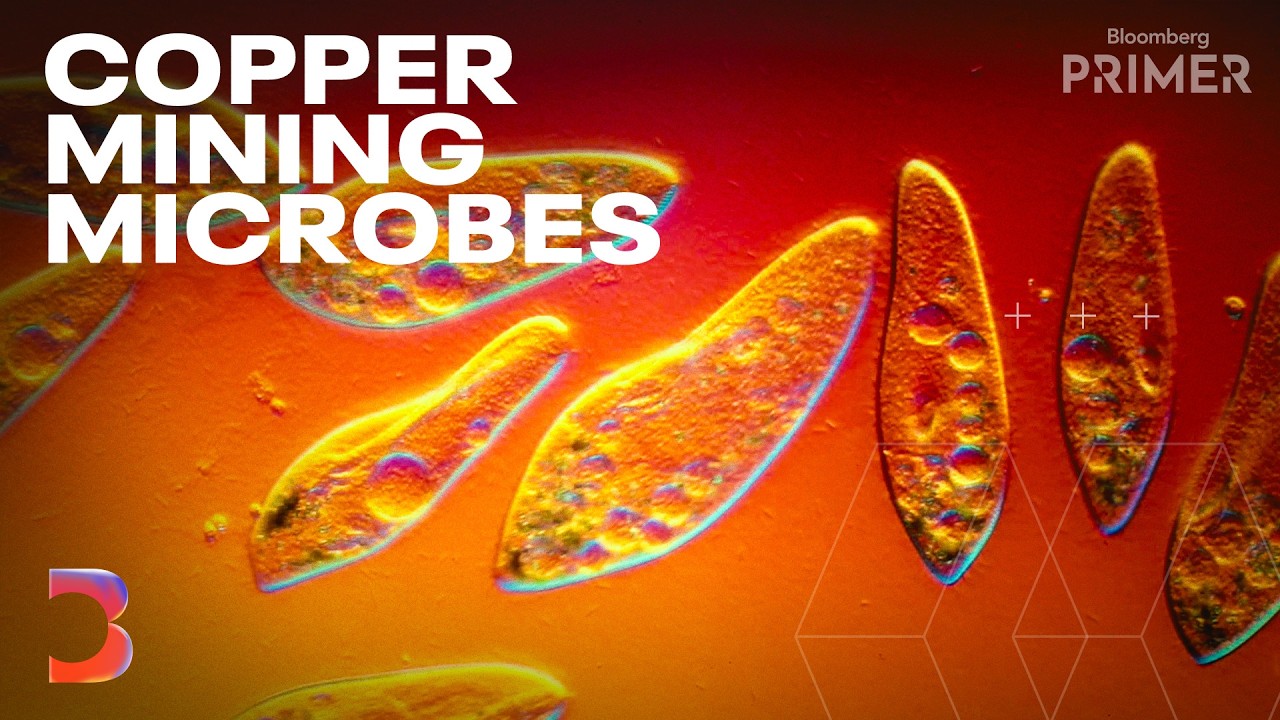
Bloomberg Originals
AI-assisted summary of Why Copper Miners Are Turning to Microbes | Bloomberg Primer — original source. Check the original for full context.
Source published:
Key ideas
- Copper market values have doubled over the past decade as global electricity demand heads toward doubling by 2050, forcing miners to target low-grade ores carrying just 0.25% to 0.30% metal concentration. (0:01)
- Startup Endolith has raised over $20 million with backing from the US Department of Energy, BHP, and Rio Tinto to replace single-strain biomining with diverse, genomically sequenced microbial consortia. (4:06)
- Rio Tinto venture Nuton has commercialized bio-leaching for primary sulfides and tailings, securing offtake agreements with Amazon Web Services for US data center infrastructure. (12:18)
- Conventional heap leaching recovers only 20% to 50% of copper, creating an urgent imperative to prove microbial technologies at commercial scale as a lower-carbon alternative to opening new mines. (7:43)
Detailed notes
## Background Published by Bloomberg Originals on YouTube on October 19, 2026, this primer examines how surging electricity demand from grids, electric vehicles, and renewable power is putting severe pressure on the global copper supply. The video explores whether biomining—the practice of using microorganisms to extract metals from low-grade rock—can profitably unlock the copper required for global electrification.
## TL;DR As global electrification accelerates and high-grade copper reserves near exhaustion, mining operations like Arizona's Carlota Mine are left with low-grade ores that yield poor recovery rates under standard extraction methods. To prevent supply deficits without the multi-billion-dollar cost and environmental toll of building new mines, companies are turning to modern biomining techniques that leach metal from rock piles. Rather than relying on historical single-strain approaches, startups like Endolith and ventures like Rio Tinto's Nuton are conditioning diverse microbial consortia to survive harsh industrial heaps. While scaling these biological communities across unique ore chemistries remains a formidable hurdle, commercial traction from buyers like AWS underscores biomining's potential as a lower-footprint alternative to traditional open-pit extraction.
## Atmosphere & style The presentation carries Bloomberg's signature analytical, high-production documentary tone, balancing fast-paced economic reporting with industrial realism. Visuals juxtapose the vast, dusty expanse of heavy mining earthworks against sterile, futuristic laboratory settings where genomic screening takes place. The mood is pragmatic and cautiously optimistic, framing the friction between the environmental costs of mineral extraction and the raw physical necessities of the global clean energy transition.
## Bulletin - [00:01](https://www.youtube.com/watch?v=5VV11Zx_fzc&t=1s) Copper market values have doubled over the past decade as global electricity demand heads toward doubling by 2050, forcing miners to target low-grade ores carrying just 0.25% to 0.30% metal concentration. - [04:06](https://www.youtube.com/watch?v=5VV11Zx_fzc&t=246s) Startup Endolith has raised over $20 million with backing from the US Department of Energy, BHP, and Rio Tinto to replace single-strain biomining with diverse, genomically sequenced microbial consortia. - [12:18](https://www.youtube.com/watch?v=5VV11Zx_fzc&t=738s) Rio Tinto venture Nuton has commercialized bio-leaching for primary sulfides and tailings, securing offtake agreements with Amazon Web Services for US data center infrastructure. - [07:43](https://www.youtube.com/watch?v=5VV11Zx_fzc&t=463s) Conventional heap leaching recovers only 20% to 50% of copper, creating an urgent imperative to prove microbial technologies at commercial scale as a lower-carbon alternative to opening new mines.
## Key takeaways - [00:01](https://www.youtube.com/watch?v=5VV11Zx_fzc&t=1s) Global electrification, electric vehicles, and renewable infrastructure are driving a structural copper deficit as global electricity demand is projected to double by 2050. - [00:01](https://www.youtube.com/watch?v=5VV11Zx_fzc&t=1s) Permitting and constructing new copper mines requires billions of dollars and many years, making rapid capacity expansion through new open-pit projects difficult. - [00:01](https://www.youtube.com/watch?v=5VV11Zx_fzc&t=1s) High-grade copper reserves are largely exhausted, leaving operations dependent on low-grade ores with merely 0.25% to 0.30% copper concentration. - [00:01](https://www.youtube.com/watch?v=5VV11Zx_fzc&t=1s) Production at Arizona's Carlota Mine has plummeted 60% from peak levels, placing the asset on track for potential closure by decade's end without novel extraction methods. - [04:06](https://www.youtube.com/watch?v=5VV11Zx_fzc&t=246s) Heap leaching irrigates sulfuric acid through crushed ore mounds, but conventional techniques recover only 20% to 50% of the target copper. - [04:06](https://www.youtube.com/watch?v=5VV11Zx_fzc&t=246s) Historic biomining treated biology as a 'black box,' relying predominantly on solitary extremophiles such as Acidithiobacillus ferrooxidans that struggle under harsh industrial swings. - [04:06](https://www.youtube.com/watch?v=5VV11Zx_fzc&t=246s) Endolith takes an 'Avengers-style' multi-species consortia approach, using genomic sequencing and cloud computing to select robust natural communities. - [04:06](https://www.youtube.com/watch?v=5VV11Zx_fzc&t=246s) Endolith has raised more than $20 million in venture capital alongside research support from the US Department of Energy, BHP, and Rio Tinto. - [07:43](https://www.youtube.com/watch?v=5VV11Zx_fzc&t=463s) Laboratory candidates are conditioned in an 'Olympic training camp' featuring escalating exposures to high temperatures, salinity, and arsenic before scale-up. - [07:43](https://www.youtube.com/watch?v=5VV11Zx_fzc&t=463s) Scaling biomining requires field deployment via mobile pilot reactors directly plumbed into mine irrigation systems to adapt to deposit-specific chemical matrices. - [12:18](https://www.youtube.com/watch?v=5VV11Zx_fzc&t=738s) Rio Tinto's Nuton venture is actively commercializing proprietary microbial leaching to process lower-grade primary sulfides and historic mine tailings. - [12:18](https://www.youtube.com/watch?v=5VV11Zx_fzc&t=738s) Hyperscaler demand is accelerating adoption, with Amazon Web Services buying Nuton's bio-leached copper for deployment in US data centers. - [12:18](https://www.youtube.com/watch?v=5VV11Zx_fzc&t=738s) Extracting copper from existing piles via microbes provides a significantly smaller carbon and environmental footprint than breaking ground on new mines.
## Detailed walkthrough ### [00:01](https://www.youtube.com/watch?v=5VV11Zx_fzc&t=1s) The Growing Copper Deficit and the Push for Low-Grade Ore
Copper powers the modern electrified world, forming the backbone of everything from domestic homes, cars, and mobile phones to electric vehicles and wind turbines. Its critical nature has driven its market value to more than double over the past decade. However, opening new copper mines requires billions of dollars, faces strict investor skepticism, and takes years of development. Consequently, the industry cannot simply discover and build new mines quickly enough to meet the demand of ongoing global electrification.
```mermaid flowchart TD accTitle: The Copper Supply Squeeze accDescr: Diagram illustrating the imbalance between skyrocketing copper demand and mining constraints. subgraph Demand["Demand Drivers"] D1["Electric Vehicles & Wind Turbines"] D2["Power Grids & Electronics"] D3["Global Power Demand to Double by 2050"] end subgraph Bottleneck["Mining Constraints"] B1["High-Grade Ores Largely Depleted"] B2["New Mines Take Years & Billions to Build"] B3["Low-Grade Ore Contains Only 0.25%–0.30% Copper"] end subgraph Solution["Biomining Approach"] S1["Extract More from Existing Mines"] S2["Microbial Heap Leaching"] end Demand --> Bottleneck Bottleneck --> Solution ```
At Arizona's Carlota Mine, production is down roughly 60% compared to its peak output, putting the site on track for potential closure by the end of the decade without intervention. High-grade deposits are almost entirely depleted or situated in areas that are either inaccessible or unsafe to mine. The remaining surface reserves are locked in low-grade ores carrying merely 0.25% to 0.30% copper concentration, of which traditional extraction techniques recover only around half. As Dr. Liz Dennett, founder and CEO of startup Endolith, explains:
> “The main issue with the high-grade copper ores is that most of them are gone, and the things that are left are very difficult to get to.”
To keep supplies flowing without opening costly new pits, operators are looking toward biomining—using microorganisms to leach metals from rock.
- Copper market value has more than doubled over the last 10 years. - Low-grade copper ores contain only about 0.25% to 0.3% copper. - Conventional extraction methods retrieve only about half of the copper from these low-grade deposits. - Carlota Mine's copper output is down approximately 60% from its peak.
---
[04:06](https://www.youtube.com/watch?v=5VV11Zx_fzc&t=246s) Heap Leaching Mechanics and Endolith's Microbial Approach
Traditional biomining on low-grade ore relies on heap leaching. In this process, ore is blasted down into small particles and piled into giant mounds called heaps. An irrigation network trickles sulfuric acid through the rock alongside naturally present or introduced microbes. These organisms interact with the rock to release copper into an acidic liquid solution, which drains into holding ponds at the base. While microbes have broken down minerals for billions of years, the mining sector has historically treated them as an uncontrolled "black box," adding a single bug and hoping for the best.
```mermaid flowchart LR accTitle: Heap Leaching Process accDescr: Flowchart showing the steps of the heap leaching biomining process. O["Blasted Low-Grade Ore"] --> H["Stacked Giant Heap"] A["Sulfuric Acid + Microbes"] -->|"Irrigation drip"| H H -->|"Copper liberated into solution"| P["Collection Ponds"] P --> SX["Solvent Extraction (Phase Separation)"] SX --> EW["Electrowinning (Pure Cathode)"] ```
Endolith, a startup founded in 2023, intends to replace this hands-off approach using genomic sequencing, targeted microbial communities, and cloud computing. The company has raised over $20 million in venture funding, received grant backing from the US Department of Energy, and partnered with mining majors BHP and Rio Tinto. While early biomining relied almost exclusively on a single extremophile bacterium—*Acidithiobacillus ferrooxidans*—Endolith argues that a single strain cannot survive the wild swings in temperature, acidity, and chemical toxins seen inside industrial heaps.
Instead of relying on a lone worker, Endolith selects diverse natural consortia and acclimates them through an escalating regimen. Dr. Liz Dennett contrasts this with past practices:
> “I guess if I was going to do an analogy, it would be like the Iron Man, the Tony Stark organisms, and we're taking a much more communal Avengers type approach.”
- Biomining patents for heap leaching date back to the late 1950s, though historical microbial mining dates to ancient Greece and China. - *Acidithiobacillus ferrooxidans* is an extremophile bacterium traditionally used as the primary organism in copper leaching. - Endolith has secured more than $20 million in venture capital. - Major mining partners include BHP and Rio Tinto, alongside backing from the US Department of Energy.
---
[07:43](https://www.youtube.com/watch?v=5VV11Zx_fzc&t=463s) From the Lab to the Field: The Industrialization Bottleneck
At Endolith's laboratory, microbial communities undergo rigorous screening overseen by Christine Green, Vice President of Technology and Operations. Technicians use advanced genomic monitoring to track precisely which species are active in copper liberation. The candidate microbes are subjected to an "Olympic training camp," where staff systematically ramp up salinity, arsenic concentrations, and temperatures to simulate extreme field conditions. Surviving consortia graduate from small culture flasks to test columns of increasing size, though even minor adjustments in airflow, temperature, or rock particle size can alter community dynamics.
To move from controlled indoor columns to field deployment, Endolith built a mobile pilot reactor rig designed to tie directly into mine irrigation lines. Downstream at the processing plant, aqueous solutions containing copper ions undergo solvent extraction to switch the copper into an organic phase. This concentrates the copper to high purity before it enters the electrowinning plant to produce commercial copper cathode plates.
Yet moving from pilot trials to full heaps remains a massive hurdle. Standard heap leach operations extract only 20% to 50% of available copper, and Endolith must prove it can reliably exceed that baseline in the real world. Every mineral deposit possesses a unique chemical matrix, meaning an assemblage that works at one site may fail at another. With global electricity demand projected to double by 2050, the pressure on miners to prove new technological breakthroughs like microbial leaching, chemical catalysts, and automated sensing is higher than ever. As one commentator observes:
> “Startups like Endolith face myriad challenges in the mining industry, and what we've seen with companies and startups is that it takes them a long time to prove out their technology and to show that these are really breakthroughs that can make it easier to extract these minerals.”
- Standard heap leach operations typically recover only 20% to 50% of the total copper present. - Global electricity demand is projected to double by the year 2050. - Endolith uses direct column tests and dedicated pilot rigs hooked to irrigation pipes to test microbial performance before commercial-scale application.
[12:18](https://www.youtube.com/watch?v=5VV11Zx_fzc&t=738s) Commercial Adoption and the Environmental Balancing Act
Major mining players are actively commercializing bio-extraction methods rather than treating them as purely experimental science. Nuton, an independent venture launched and backed by global mining giant Rio Tinto, is actively developing its own proprietary microbial leaching technologies to extract copper from lower-grade primary sulfides and legacy mine tailings. These efforts are already seeing commercial demand from the tech sector, with Amazon Web Services purchasing copper produced through Nuton’s bio-technology specifically for use across its data centers in the United States.
```mermaid flowchart LR accTitle: Microbial Copper Supply Chain accDescr: Flow showing how microbial extraction by Rio Tinto's Nuton venture supplies commercial copper to Amazon Web Services. subgraph Innovation ["Biomining Innovation"] A["Rio Tinto / Nuton"] -->|"Deploys microbial leaching"| B["Recovered Copper"] end subgraph Commercial ["Commercial End-Use"] B -->|"Purchased by AWS"| C["US Data Centers"] end ```
The rise of biomining highlights an ongoing friction at the core of the global green transition. While widespread electrification remains one of the primary pathways to curb carbon emissions, securing the raw materials required to build out grids, electric vehicles, and computing infrastructure inevitably carries ecological trade-offs. The extractive sector faces a dual imperative: it must supply massive volumes of metal while curbing its traditional environmental fallout. As one speaker notes: “Sometimes mining can be incredibly harmful for the environment, but really the environmental problems facing the mining industry come into conflict with another basic reality, which is that we need mining and the industry is always in conflict to figure out how to do that in the most sustainable way.” Within this reality, biomining offers a compelling alternative to conventional operations, as another speaker summarizes: “Generally speaking, the industry believes carbon footprint and environment footprint of microbes is still smaller than opening up a new mine.”
- **Corporate Backing:** Rio Tinto's venture, Nuton, has positioned microbial leaching directly for commercial deployment. - **Hyperscaler Offtake:** Amazon Web Services (AWS) has turned to bio-leached copper to supply material for its domestic US data center infrastructure. - **Footprint Comparison:** Using microbes to reprocess tailings or extract metal from low-grade ore deposits creates a significantly smaller carbon and environmental footprint than permitting and constructing net-new open-pit or underground mines.
## Notable quotes > [00:01](https://www.youtube.com/watch?v=5VV11Zx_fzc&t=1s) The main issue with the high-grade copper ores is that most of them are gone, and the things that are left are very difficult to get to. — Dr. Liz Dennett
> [12:18](https://www.youtube.com/watch?v=5VV11Zx_fzc&t=738s) Generally speaking, the industry believes carbon footprint and environment footprint of microbes is still smaller than opening up a new mine.
## Mentioned Acidithiobacillus ferrooxidans, Amazon Web Services, BHP, Carlota Mine, Christine Green, Dr. Liz Dennett, Endolith, Nuton, Rio Tinto, US Department of Energy
## Video description The global copper supply is on a collision course with growing electricity demand. Copper is crucial to power grids, renewable energy equipment and electric vehicles. Over the past few decades, mining companies have found it increasingly challenging to extract more of the metal and still turn a profit. Some have now turned to biomining, the process of using microbes to extract metals. Can this technique meet the rising demand of an electrifying world?
00:00 - 01:32 — Introduction 01:32 - 04:05 — Biomining 04:05 - 06:48 — Heap Leaches 06:48 - 09:42 — In The Lab 09:42 - 11:34 — In The Field 11:34 - 13:05 — Conclusion 13:05 - 13:38 — Credits
#Mining #Copper #Colorado #Arizona -------- Like this video? Subscribe: http://www.youtube.com/Bloomberg?sub_confirmation=1
Get unlimited access to Bloomberg.com for just $1.99 your first month: https://www.bloomberg.com/subscriptions?in_source=YoutubeOriginals Bloomberg Originals offers bold takes for curious minds on today’s biggest topics. Hosted by experts covering stories you haven’t seen and viewpoints you haven’t heard, you’ll discover cinematic, data-led shows that investigate the intersection of business and culture. Exploring every angle of climate change, technology, finance, sports and beyond, Bloomberg Originals is business as you’ve never seen it.
Subscribe for business news, but not as you've known it: exclusive interviews, fascinating profiles, data-driven analysis, and the latest in tech innovation from around the world.
Visit our partner channel Bloomberg News for global news and insight in an instant.
[Source](https://www.youtube.com/watch?v=5VV11Zx_fzc)