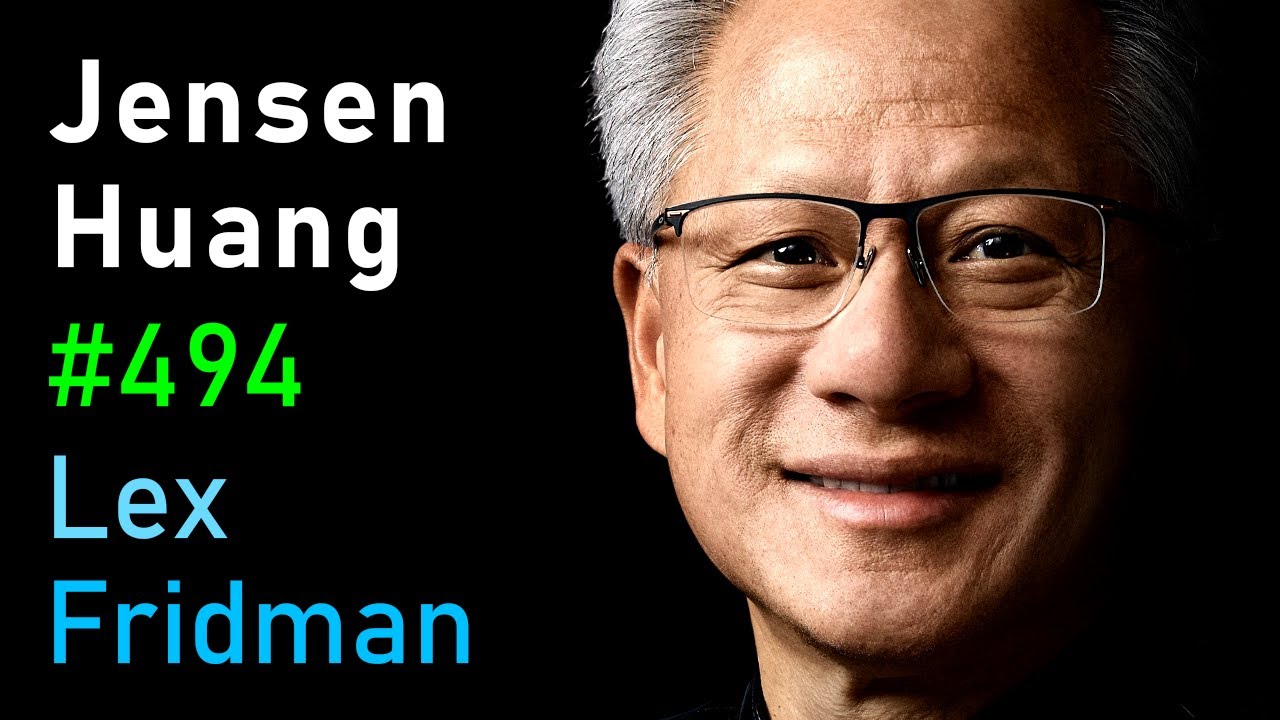
Nvidia CEO Declares AGI Has Arrived as Company Targets $10 Trillion Valuation
Lex Fridman
Jensen Huang states that autonomous agents capable of launching billion-dollar services mean artificial general intelligence is already here, driving an inevitable shift to generative token factories.
## Background
Published on March 23, 2026, on YouTube by Lex Fridman, this episode features an interview with Jensen Huang, the co-founder and CEO of NVIDIA. The description frames NVIDIA as the world's most valuable company and the critical engine powering the ongoing AI computing revolution.
## TL;DR
In this wide-ranging conversation, NVIDIA CEO Jensen Huang explores the company's evolution from a specialized graphics accelerator to a $4 trillion AI powerhouse driven by rack-scale engineering and extreme co-design. He outlines the four new scaling laws of AI, reframes data shortages through the rise of synthetic data, and details the hardware breakthroughs driving down token costs. Additionally, Huang offers a candid look into his flat management style, his first-principles 'speed of light' engineering philosophy, and the inevitability of a multi-trillion dollar generative future powered by autonomous agents.
## Atmosphere & style
The dialogue balances a grounded, high-level engineering intensity with moments of reflective, personal philosophy. Huang brings a sharp, fast-paced corporate clarity to complex technical concepts, while Fridman's deliberate, curious questioning draws out a sense of monumental stakes. It feels like an intimate yet deeply consequential briefing on the future of global technology, moving seamlessly from the physics of supercomputers to an emotional, humble meditation on human virtues and mortality.
## Key takeaways
- [00:33](https://www.youtube.com/watch?v=vif8NQcjVf0&t=33s) NVIDIA has shifted from chip-scale design to full rack-scale architecture through extreme co-design, integrating GPUs, CPUs, memory, networking, storage, cooling, and software to bypass distributed computing bottlenecks.
- [03:16](https://www.youtube.com/watch?v=vif8NQcjVf0&t=196s) CEO Jensen Huang operates an unconventional flat organizational structure with over 60 direct reports, conducting open group problem-solving sessions rather than isolated one-on-ones to ensure cross-disciplinary alignment.
- [10:42](https://www.youtube.com/watch?v=vif8NQcjVf0&t=642s) NVIDIA's early bet on CUDA involved seeding the market by building it into millions of consumer GeForce cards, which increased manufacturing costs by 50%, erased gross profits, and caused the company's market cap to temporarily plummet.
- [22:39](https://www.youtube.com/watch?v=vif8NQcjVf0&t=1359s) AI scaling laws have expanded into four distinct pillars: pre-training, post-training, test-time (reasoning), and agentic scaling, with synthetic data increasingly mitigating data shortages.
- [25:15](https://www.youtube.com/watch?v=vif8NQcjVf0&t=1515s) Inference is intensely compute-intensive and focused on reasoning, planning, and exploring (test-time scaling), rather than being a cheap, commoditized workload.
- [43:49](https://www.youtube.com/watch?v=vif8NQcjVf0&t=2629s) The massive hardware complexity required for modern AI has moved supercomputer integration and massive power testing (up to a gigawatt a week) directly into the manufacturing supply chain before shipment.
- [47:22](https://www.youtube.com/watch?v=vif8NQcjVf0&t=2842s) Data centers could leverage flexible contracts to utilize the massive amounts of idle, wasted energy from power grids that operate at roughly 60% peak capacity during standard hours.
- [59:30](https://www.youtube.com/watch?v=vif8NQcjVf0&t=3570s) A single Vera Rubin pod requires immense structural complexity, consisting of 7 chip types, 40 racks, 1.2 quadrillion transistors, and over 1,100 Rubin GPUs to deliver 60 exaflops of performance.
- [01:05:43](https://www.youtube.com/watch?v=vif8NQcjVf0&t=3943s) NVIDIA invests heavily in open-source AI and open-weight models like Nemotron 3 Super as a co-design strategy to gain visibility into future hardware needs and prevent ecosystem lock-out.
- [01:09:51](https://www.youtube.com/watch?v=vif8NQcjVf0&t=4191s) NVIDIA and TSMC have maintained an extensive, multi-decade manufacturing partnership executing hundreds of billions of dollars in business without a formal written contract.
- [01:15:02](https://www.youtube.com/watch?v=vif8NQcjVf0&t=4502s) NVIDIA's ultimate competitive moat is its massive, 20-year-old entrenched install base of the CUDA computing platform, giving developers immediate reach across all cloud providers and hardware environments.
- [01:24:30](https://www.youtube.com/watch?v=vif8NQcjVf0&t=5070s) Computing has fundamentally transitioned from retrieval-based systems to generative-based systems that process and manufacture tokens in real-time, making a $10 trillion corporate valuation inevitable.
- [01:55:10](https://www.youtube.com/watch?v=vif8NQcjVf0&t=6910s) Under the benchmark of an AI capable of starting, growing, and running a successful billion-dollar technology company, Huang believes that artificial general intelligence (AGI) has already been achieved.
- [02:01:03](https://www.youtube.com/watch?v=vif8NQcjVf0&t=7263s) The growth of high-level AI specification tools will not displace software engineers but will expand the global developer pool from 30 million professionals to potentially 1 billion people.
- [02:11:01](https://www.youtube.com/watch?v=vif8NQcjVf0&t=7861s) Silicon chips can process and statistically model human emotions, but they do not internally experience feelings, leaving human character and virtues supreme as functional intelligence becomes a cheap commodity.
- [02:17:21](https://www.youtube.com/watch?v=vif8NQcjVf0&t=8241s) Huang rejects traditional corporate succession planning, favoring real-time, continuous knowledge transfer during everyday reasoning meetings to keep the company aligned.
## Detailed walkthrough
### [00:00](https://www.youtube.com/watch?v=vif8NQcjVf0&t=0s) The Engine of the AI Revolution
Host Lex Fridman introduces Jensen Huang, the CEO of NVIDIA, framing the company as one of the most critical and influential entities in human history. He describes NVIDIA as the essential engine powering the current AI revolution. Fridman attributes much of this monumental success directly to Huang's sheer force of will, alongside his brilliant bets and strategic decisions as a leader, engineer, and innovator.
---
[00:33](https://www.youtube.com/watch?v=vif8NQcjVf0&t=33s) The Shift to Extreme Co-Design
Fridman points out that Huang has propelled NVIDIA into a new era, moving past its traditional focus on chip-scale design to embrace full rack-scale architecture. Winning for NVIDIA used to be simply about building the single best GPU possible, but it has expanded into an intensive process of "extreme co-design." This methodology integrates the GPU, CPU, memory, networking, storage, power delivery, cooling, software, the physical rack, the pod, and ultimately the entire data center. When asked what the hardest part of managing this many complex design variables is, Huang explains that the shift became mandatory because modern AI problems no longer fit inside a single computer to be accelerated by a single GPU.
The core challenge in modern distributed computing is trying to achieve a performance speedup that scales faster than the number of physical machines added to the system. If a company deploys 10,000 computers, the ideal goal is to make the workload run a million times faster, not just 10,000 times faster. To achieve this, engineers must break up the algorithm, refactor it, and shard the pipeline, the data, and the model itself. However, distributing the workload introduces a classic computer science obstacle: Amdahl's Law.
Huang breaks down the math of Amdahl's Law to illustrate the friction of distribution. The total speedup of a system depends heavily on how much of the workload is actually being accelerated. For example, if raw computation only accounts for 50% of the total problem, accelerating that computation infinitely—even a million times over—still only speeds up the overall system workload by a factor of two. Consequently, once computation is distributed, networking bottlenecks immediately get in the way. At NVIDIA's massive scale, the CPU, the GPU, the networking, the switches, and the physical distribution of workloads all become interconnected points of failure. Without bringing every single discipline to bear simultaneously, performance scaling hits a wall, restricted by a slowing Moore's Law and the stagnation of Dennard scaling.
---
[03:16](https://www.youtube.com/watch?v=vif8NQcjVf0&t=196s) Managing an Unconventional Flat Organization
Fridman notes that this multi-disciplinary approach requires orchestrating world-class experts across radically different fields—from optics and high-bandwidth memory to copper wiring, liquid cooling, and power delivery. Huang jokes that managing these disparate experts is precisely "why my staff is so large." He explains that to understand how NVIDIA operates, one must look at how the company is structured. Huang rejects traditional corporate organizational charts, describing them as uniform "hamburger," "soft," or "car company" charts that make no sense for NVIDIA's goals. Instead, he believes a company's architecture should directly mirror the output it aims to produce and the environment it exists in.
To facilitate continuous extreme co-design, Huang maintains an unusually flat structure with over 60 direct reports, almost all of whom have a deep footprint in engineering. Because of this massive number of direct lines, Huang completely abandons traditional corporate one-on-ones. "No conversation is ever one person," he emphasizes. Instead of siloed discussions, problems are presented openly to the entire group so that everyone can attack them collectively.
Even when the team is debating a hyper-specific component like a cooling system or a networking interface, the entire leadership team listens in. This open forum allows an expert in memory or power distribution to immediately chime in and warn the group if a proposed cooling solution breaks their own subsystem. Teams are given the freedom to "tune out" if a topic is irrelevant to them, but the culture relies on highly accountable peers who know exactly when to pay attention. Huang notes that if an executive misses a detail they should have contributed to, he will openly call them out in front of the group to bring them back into the fold.
- **Direct Reports:** Jensen Huang manages a direct staff of over 60 people simultaneously.
- **No One-on-Ones:** Traditional isolated manager-employee meetings are banned in favor of group problem-solving.
- **Cross-Disciplinary Teams:** The leadership structure includes distinct specialists in CPUs, GPUs, memory, optics, architecture, algorithms, and physical infrastructure.
---
[07:07](https://www.youtube.com/watch?v=vif8NQcjVf0&t=427s) The Evolution from Graphics to the AI Factory
Fridman asks about the historical timeline of NVIDIA's evolution, questioning when the company secretly began adapting its strategy away from PC gaming graphics toward building full-scale "AI factories." Huang outlines the journey systematically, explaining that NVIDIA began strictly as an accelerator company. The inherent pitfall of specialization is that while it allows for incredible optimization, it severely narrows a company's market reach. Crucially, market size dictates a company's R&D capacity, which in turn limits its ultimate impact on the computing world.
NVIDIA always viewed specialized acceleration as merely a first step, aiming to transition into a broader accelerated computing company. However, doing so created a profound structural paradox. General-purpose computing companies naturally lose their intense specialization. Huang purposely connected these two conflicting ideals, forcing the company to walk a razor-thin path: expanding its computing aperture without sacrificing its core specialized edge.
The transition progressed through careful, calculated milestones over many years:
* **Programmable Pixel Shaders:** NVIDIA's very first step toward introducing programmability into graphics hardware.
* **IEEE-Compatible FP32:** Integrating 32-bit floating-point capabilities into shaders. This compliance caught the attention of academic researchers working on stream and data-flow processors, who realized they could offload CPU workloads to the computationally dense GPU.
* **Cg (C for Graphics):** Layering a C-like language on top of FP32 hardware, which served as the direct technological stepping stone to the creation of CUDA.
---
[10:42](https://www.youtube.com/watch?v=vif8NQcjVf0&t=642s) The Existential Bet on CUDA and GeForce
The pivot to putting CUDA onto every mainstream GeForce GPU was a strategic gamble that Huang marks as the company's first near-existential threat. To build a true computing architecture, NVIDIA needed to attract software developers, and developers only migrate to platforms with a massive install base. Huang points out that history favors the install base over architectural elegance, citing the less-than-elegant x86 architecture's survival over beautifully designed RISC alternatives. "Install base defines an architecture. Not... Everything else is secondary," Huang states.
At the time, competing standards like OpenCL were emerging, but NVIDIA chose to seed the market aggressively. They integrated CUDA into millions of consumer GeForce graphics cards, forcing the technology into the market regardless of whether the buyer intended to use it for parallel computing. NVIDIA simultaneously targeted academia by writing textbooks, sponsoring university classes, and putting hardware into labs. Because the cloud did not exist yet, this distributed a supercomputing vehicle directly into the hands of every curious student and scientist, many of whom were already building their own custom PC clusters for research.
The financial toll of this decision was devastating. Incorporating CUDA into a consumer product added tremendous hardware overhead without any immediate return, as gamers refused to pay extra for computing features they didn't use. The decision increased manufacturing costs by roughly 50%, completely wiping out the gross profits of a company that historically operated at a 35% gross margin. Following the launch, NVIDIA's market capitalization plummeted from roughly $6 billion or $7 billion down to a mere $1.5 billion. It took a grueling decade of clawing their way back and subsidizing the architecture before the bet paid off, cementing GeForce as the foundational house that carried CUDA to the global scientific community and ignited the deep learning revolution.
- **Market Cap Collapse:** NVIDIA's market valuation dropped to approximately $1.5 billion after the heavy financial burden of implementing CUDA.
- **Margin Hit:** The hardware overhead added roughly 50% to production costs, crippling a 35% gross margin business.
- **Payoff Timeline:** It required a full decade of financial suffering and market cultivation before the strategic pivot became wildly profitable.
---
[15:38](https://www.youtube.com/watch?v=vif8NQcjVf0&t=938s) Strategic Leaps and Manifesting the Future
Reflecting on the tense corporate atmosphere during the CUDA crisis, Huang recalls having to meticulously justify the vision to a skeptical board of directors while his management team watched their gross margins get crushed. They had to rely on pure economic reasoning, betting that the architecture would eventually migrate into high-margin enterprise segments like workstations and supercomputers where they could finally recapture their losses. When Fridman asks where Huang finds the psychological wisdom to repeatedly make such massive, future-defining corporate leaps, Huang credits a combination of intense curiosity and a strict internal reasoning system.
"I manifest a future and that future is so convincing, there's no way it won't happen," Huang explains, acknowledging that while there is an immense amount of suffering to endure in the interim, a leader must fiercely back their convictions. He explains that his leadership style relies on continuous, transparent communication rather than sudden corporate pivots. Rather than staying quiet, tracking a trend, and then blindsiding the company with a massive corporate manifesto, annual layoffs, structural reorganizations, or new logos, Huang socializes his reasoning step by step. When new engineering discoveries or external insights begin to shape his worldview, he immediately voices them to everyone around him, ensuring the entire organization gradually processes and internalizes the shift long before the actual execution takes place.
[19:16](https://www.youtube.com/watch?v=vif8NQcjVf0&t=1156s) Shaping Belief Systems and Leading from Behind
The speaker details an active, daily effort to shape the belief systems of the company's board, management team, and employees. This ongoing foundation-laying ensures that when a major milestone is reached or a massive pivot is announced, the decision feels completely intuitive to everyone involved. By incrementally preparing different organizations within the company, the final announcement is met with total alignment rather than shock. This strategy is precisely how monumental shifts—such as going "all in on deep learning" or acquiring Mellanox—were executed with 100% buy-in. It is a leadership style that "sometimes it looks like you're leading from behind," yet it systematically prevents internal panic and confusion.
This internal groundwork is mirrored externally through industry keynotes like GTC. By mapping out technology stepping stones over a two-and-a-half-year period before officially launching a product like Grok, the industry and the internal workforce are both fully primed. The ultimate goal of this deliberate messaging is to have people look at a new release and ask, "Jensen, what took you so long?" rather than wondering where the idea came from. The speaker emphasizes that they do not just build traditional computers or clouds; they are a computing platform company. Because their platform must be vertically integrated for optimization but completely open at every layer for others to use, they cannot succeed without convincing their ecosystem partners first. GTC functions as a tool for "manifesting a future" well ahead of product readiness.
---
[22:39](https://www.youtube.com/watch?v=vif8NQcjVf0&t=1359s) The Four Scaling Laws and the Shift to Synthetic Data
The discussion shifts to a firm belief in scaling laws, which have expanded into four distinct pillars: pre-training, post-training, test-time, and agentic scaling. Looking back at the early days of pre-training, the industry panicked when prominent figures like Ilya Sutskever suggested that AI development would hit a wall due to a shortage of high-quality, human-generated data. The speaker dismisses this panic, noting that the limit of data is being bypassed by compute because the industry is moving aggressively toward synthetic data. They argue that most human information sharing is fundamentally synthetic anyway, as people constantly consume, modify, augment, and regenerate existing ideas rather than pulling them directly from nature.
AI has now reached a maturity level where it can take ground truth data, enhance it, and synthetically generate massive data sets during post-training. Consequently, the share of purely human-generated data used to train models will become smaller and smaller. This shift ensures that data availability is no longer the true bottleneck for pre-training and post-training; instead, data generation is now limited only by available compute.
---
[25:15](https://www.youtube.com/watch?v=vif8NQcjVf0&t=1515s) Test-Time Scaling and the Realities of Compute-Intensive Inference
The speaker refutes a common historical misconception that inference would be simple, cheap, and easily commoditized compared to the massive system requirements of pre-training. Many predicted that inference would run on tiny, simple chips entirely unlike NVIDIA’s complex architectures. The speaker calls this viewpoint completely illogical because "inference is thinking, and I think thinking is hard." While pre-training focuses on reading, memorization, generalization, and identifying patterns, test-time scaling is about reasoning, planning, exploring, and decomposing entirely new experiences into solvable pieces.
Because thinking and problem-solving rely heavily on exploration, search, and first-principle reasoning, test-time scaling is intensely compute-intensive. It cannot be "compute light." Beyond test-time scaling lies the fourth pillar: agentic scaling. Rather than trying to scale a single human leader, it is far more efficient to multiply AI by spinning off a workforce of sub-agents. These agentic systems execute research, access databases, use tools, and generate new experiences. The high-quality data resulting from these agentic loops flows directly back into the pre-training and post-training phases to be memorized and refined, creating a continuous, self-reinforcing cycle where intelligence scales strictly alongside compute.
---
[28:41](https://www.youtube.com/watch?v=vif8NQcjVf0&t=1721s) Hardware Co-Design and the Evolution to the Vera Rubin Architecture
Anticipating the architectural direction of AI models is a major challenge because software models evolve every six months, whereas system and hardware architectures require about three years to develop. To prevent being trapped by rigid hardware, NVIDIA relies on a combination of internal basic and applied research, hands-on model creation, and an unmatched relationship with every major AI lab in the world, allowing them to "listen to the whispers across the industry." They balance this insight with the inherent flexibility of CUDA, which bridges the gap between highly specialized acceleration and the generalization needed to adapt to shifting algorithms. This adaptability is currently reflected in CUDA 13.2.
A clear example of this long-term planning was the development of NVLink 72 instead of NVLink 8, a decision driven by the emergence of mixture of experts (MoE) models, allowing a 4-to-10-trillion parameter model to run inside a single computing domain as if it were a single GPU. System architectures are pivoting rapidly to keep pace with these shifts:
* **Grace Blackwell Racks:** Engineered specifically to focus on processing large language model (LLM) inference and running MoE architectures.
* **Vera Rubin Racks:** Introduced just one year later, incorporating storage accelerators, a powerful new CPU called Vera, and NVLink 72.
* **Rock Racks:** A brand-new additional rack component integrated alongside the Vera Rubin system, specifically designed to support agentic workloads that constantly interact with external software tools and databases.
---
[32:10](https://www.youtube.com/watch?v=vif8NQcjVf0&t=1930s) The OpenClaw Phenomenon and Agentic Security
The speaker explains that the system architecture for these new racks had to be drawn up long before the public releases of frameworks like Claude Code, Codex, or OpenClaw. This design process relies on fundamental reasoning about what an LLM needs to function as a "digital worker." It must access a file system for ground truth, perform autonomous research, and interact with existing human software tools. The speaker mocks the idea that AI will completely eliminate the need for software or tools, using a thought experiment about a future humanoid robot: it is far more logical for a robot to read an online manual and use a standard household microwave than it is for its hand to magically morph into a physical tool or emit microwaves from its fingers.
The OpenClaw framework represents the realization of these exact agentic properties—I/O subsystems, file access, and tool integration—which the speaker had charted out schematically at GTC two years prior. OpenClaw has done for agentic systems what ChatGPT did for generative systems by providing a robust, complete open-source project that the public can easily interact with. Addressing the serious security and data-handover anxieties associated with these autonomous systems, the speaker notes that NVIDIA immediately deployed security experts to integrate a solution called OpenShell into OpenClaw, alongside their own NemoClaw framework.
- **The Two-out-of-Three Security Rule:** To maintain enterprise safety, agentic systems are granted a maximum of two out of three core capabilities at any given time: accessing sensitive information, executing code, or communicating externally.
- **Enterprise Integration:** The security frameworks link directly into existing enterprise policy engines and provide granular access control based on corporate rights.
- **The Ultimate Scaling Bottleneck:** While power is a significant forward-looking constraint for scaling these ubiquitous agents, the speaker combats this through "extreme co-design" to maximize tokens per second per watt.
- **Historical Compute Performance:** Traditional computing under Moore's Law would have advanced performance by roughly 100 times over the last decade; through co-design, the speaker's platform scaled computing power by one million times over that same 10-year period.
[38:40](https://www.youtube.com/watch?v=vif8NQcjVf0&t=2320s) Driving Down Token Costs and Managing Supply Chain Bottlenecks
The conversation starts with a look at factory revenues and pushing limits to continuously drive down token costs as fast as possible. While computer prices are rising, the effectiveness of token generation is increasing at a much faster rate, causing token costs to drop by an order of magnitude every single year. Lex Friedman transitions the topic to power and supply chain bottlenecks, questioning how NVIDIA deals with the constraints of critical components and suppliers like ASML’s EUV lithography machines, TSMC’s advanced CoWoS packaging, and SK Hynix’s high-bandwidth memory (HBM).
Jensen Huang admits that these constraints occupy his thoughts all the time, noting that "no company in history has ever grown at a scale that we're growing while accelerating that growth." Because NVIDIA is expanding its share in the overall world of AI computing, managing both upstream and downstream supply chains is incredibly vital. To navigate this, Huang spends a significant amount of time aligning with hundreds of fellow CEOs across the IT and infrastructure industries to explain the market dynamics and future growth drivers so they can confidently invest. He recalls convincing DRAM industry CEOs three years ago to invest heavily in HBM memory for data centers back when it was scarcely used only by supercomputers. He additionally convinced them to adapt low-power cell phone memory (LPDDR5) for data centers, which resulted in record-shattering years for these 45-year-old companies.
* The cost of generating AI tokens is dropping by an order of magnitude every year due to massive efficiency gains.
* A single NVIDIA Vera Rubin rack contains between 1.3 million and 1.5 million individual components.
* Approximately 200 distinct suppliers contribute technology to the construction of a single Vera Rubin rack.
* Upstream and downstream partners include hardware giants like ASML and TSMC, as well as infrastructure corporations like GE Vernova (GEV) and Caterpillar.
[43:49](https://www.youtube.com/watch?v=vif8NQcjVf0&t=2629s) Moving Supercomputer Assembly into the Supply Chain
When asked why these massive supply chain challenges do not keep him up at night, Huang explains that he proactively does everything necessary to check them off his list before going to sleep. A major strategic shift that enabled this was moving supercomputer integration out of the data center and directly into the supply chain manufacturing process. With dense architectures like the NVLink-72 rack-scale design, computers are built and shipped two to three tons at a time per rack. This is a complete departure from older models like the original DGX-1, which were shipped in parts and assembled on-site inside the data center.
This architectural shift introduces massive power requirements during the manufacturing and testing phase itself. For instance, if a manufacturing cycle aims to produce 50 gigawatts of supercomputers simultaneously over a short timeline, the supply chain factories themselves require a gigawatt of power every week just to test the equipment before it ships. Huang travels directly to his partners to explain these architectural pivots, first principles, and the impending inflection point for AI inference, giving them the confidence to make single-party capital investments of several billion dollars each.
> "NVLink-72 literally builds supercomputers in the supply chain and ships 'em two, three tons at a time per rack. It used to be—they used to come in parts and we used to assemble 'em inside the data center. But that's impossible now because NVLink-72 is so dense."
[47:22](https://www.youtube.com/watch?v=vif8NQcjVf0&t=2842s) Optimizing the Power Grid for Data Centers
To solve the overarching energy problem facing AI expansion, Huang highlights an under-discussed reality: modern power grids are over-engineered to handle worst-case conditions with an extra safety margin. Extreme conditions only occur during a few peak days in the winter or summer, meaning that 99% of the time, the grid runs around 60% of its peak capacity and sits on massive amounts of idle, wasted energy. Huang proposes that data centers could form flexible contractual agreements with utility companies to utilize this excess power, agreeing to gracefully degrade their performance or shift workloads to other regions when society demands maximum power for hospitals and airports.
Currently, a rigid three-way roadblock prevents this dynamic optimization. First, end customers demand "six nines" of absolute uptime perfection. Second, cloud service providers (CSPs) pass these strict, over-negotiated contracts down to the utilities. Third, utility providers treat power delivery as a binary guarantee, often telling companies it will take five years to upgrade grid capabilities. Huang believes that if data center operational teams can build systems that dynamically lower energy use to 80% when requested, and utilities begin offering tiered segments of power delivery promises next month at varying price points, the industry can eliminate massive systemic waste.
* The electrical power grid operates at roughly 60% of its peak capacity during 99% of standard operational hours.
* Data center operators routinely demand "six nines" (99.9999%) uptime guarantees, putting immense strain on local utility infrastructures.
* Dynamic power degradation allows a data center to protect data and maintain critical workloads while temporarily lowering its computing rate to reduce energy intake.
[52:44](https://www.youtube.com/watch?v=vif8NQcjVf0&t=3164s) Lessons from Elon Musk’s Colossus and NVIDIA's "Speed of Light" Design
The discussion pivots to Elon Musk and xAI’s rapid assembly of the Colossus supercomputer in Memphis, which scaled to 200,000 GPUs in just four months. Huang praises Musk as an exceptional systems thinker who is deeply embedded in multiple disciplines. Musk's engineering philosophy centers on a minimalist, system-scale approach that aggressively challenges traditional timelines and processes by asking: Is it necessary? Does it have to be done this way? Does it have to take this long? Furthermore, Musk's practice of showing up in person at the point of action and operating with intense personal urgency forces suppliers to prioritize his projects above all else. Fridman shares an anecdote of observing Musk work directly with a ground-level engineer to analyze the exact physical process of plugging cables into a rack to build an intuition for making the process less error-prone.
Huang connects this mindset to NVIDIA's own "Extreme Systems co-design" approach, which relies on a core philosophy he established 30 years ago called the "speed of light." This framework uses the absolute limits of physics as a baseline benchmark for every single metric—including math speed, memory speed, power, cost, time, and manufacturing cycle time. By evaluating these parameters independently against the physical limit, engineers can clearly understand the necessary trade-offs required when balancing competing demands, such as an architecture optimized for ultra-low latency versus one designed for massive throughput.
> "The speed of light is not just about the speed. The speed of light is, is my shorthand for what's what's the limit of what physics can do. And so every single, everything, everything that we do is compared against the speed of light."
[58:00](https://www.youtube.com/watch?v=vif8NQcjVf0&t=3480s) First Principles Thinking vs. Continuous Improvement
The conversation begins with a philosophical breakdown of engineering approaches. The speaker expresses a strong preference for testing everything against the absolute physical limits of physics—what they call "speed of light thinking"—before engineering a solution from first principles. They openly critique the popular philosophy of "continuous improvement," noting that it falls short because it frames problems through minor, incremental progress rather than fundamental possibilities.
To illustrate this, the speaker shares an anecdote about a common scenario where a team might pitch a marginal efficiency gain, such as reducing a process from 74 days down to 72 days. Rather than accepting that frame, the speaker prefers to strip the entire problem back to zero, questioning why it takes 74 days in the first place and reimagining what it would look like built entirely from scratch. Often, this first-principles approach reveals that the core process could theoretically be accomplished in just six days. While the remaining 68 days might be filled with necessary compromises, cost reductions, or practical hurdles, mapping out the baseline potential makes the subsequent conversation significantly more effective.
[59:30](https://www.youtube.com/watch?v=vif8NQcjVf0&t=3570s) The Vera Rubin Pod and the Pursuit of Necessary Complexity
The interviewer brings up the staggering complexity of NVIDIA's newly announced Vera Rubin pod, questioning whether simplicity remains a viable metric or heuristic in such massive systems. The architectural specifications of a single pod are framed as an engineering marvel, pushing the conversation into a reflection on the scale of modern semiconductor design. The speaker adds a staggering production metric to the discussion, noting that they will need to manufacture approximately 200 of these pods every single week to meet demand.
When addressing the tension between complexity and simplicity, the speaker highlights their guiding maxim: "we need things to be as complex as necessary, but as simple as possible." They argue that every layer of complexity must be rigorously tested and challenged; anything that fails to prove its necessity is discarded as "gratuitous." The discussion acknowledges that what companies like NVIDIA, TSMC, and ASML are achieving represents some of the greatest engineering feats in human history, culminating in the creation of the most complex computers the world has ever seen. The speaker describes the collaborative environment as having "gold medalists in every single sport" all assembled and working toward a unified goal.
- **Vera Rubin Pod Specifications:** Consists of 7 chip types, 5 purpose-built rack types, 40 racks, 1.2 quadrillion transistors, nearly 20,000 NVIDIA dies, over 1,100 Rubin GPUs, 60 exaflops of performance, and 10 petabytes per second of scale bandwidth.
- **NVL 72 Rack Dynamics:** Contains 1.3 million individual components, 1,300 chips, and 4,000 pods crammed into a single 19-inch wide rack.
The dialogue shifts to China's rapid tech ascendancy over the last decade. The speaker outlines several core structural and cultural pillars fueling China's ability to produce world-class engineering teams and companies. A major factor is intense localized competition; China operates less like a single monolithic economic entity and more like an arena of competing provinces and cities where local mayors drive rivalry. This fierce domestic ecosystem naturally filters out weaker entities, leaving incredibly robust survivors.
Culturally, the speaker notes that China is fundamentally a "builder nation." They contrast the political leadership of the United States, which is predominantly comprised of lawyers focused on the rule of law and safety, with China's leadership, which emerged from poverty and is largely made up of highly skilled engineers. Furthermore, a unique "schoolmate concept" dictates social circles where school friends become brothers for life, leading to rapid, fluid knowledge-sharing across different companies. Because information flows so freely through familial and social networks, keeping technology hidden is seen as impractical, which naturally aligns the ecosystem with the open-source movement to accelerate innovation.
- **AI Talent Pool:** Roughly 50% of the world's AI researchers are Chinese, with the majority still based within China.
- **Timing and Modality:** The Chinese tech industry matured precisely during the mobile cloud era, making its workforce exceptionally native to and comfortable with modern software, science, and mathematics.
- **Social Hierarchy:** The typical cultural priority ranking is family first, friends second, and company third.
[01:05:43](https://www.youtube.com/watch?v=vif8NQcjVf0&t=3943s) Open Source Philosophy and NVIDIA's AI Vision
The interviewer transitions into open-source AI, highlighting NVIDIA's release of the Nemotron 3 Super model and its integration within platforms like Perplexity. The speaker presents three core reasons for their heavy investment in open-source AI. First, basic research in cutting-edge model architectures—such as combining transformers with State Space Models (SSMs)—serves as an extreme co-design strategy, granting NVIDIA early visibility into what hardware systems must be built to support future workloads. Second, while proprietary models exist as products, open-source models are essential to ensure that students, researchers, and diverse industries can openly innovate without being locked out by proprietary barriers.
The third reason centers on the expanding scope of AI beyond mere language. The speaker emphasizes that future AI systems will utilize specialized sub-agents and tools trained on distinct physical modalities like biology, chemistry, fluid dynamics, and thermodynamics. NVIDIA's motive is to push these frontiers so that external industries can thrive; they do not build cars or discover drugs themselves, but they want to ensure companies like Eli Lilly have access to the world's best biology AI systems to revolutionize drug discovery.
- **Nemotron 3 Super:** A 120-billion-parameter open-weight Mixture of Experts (MoE) model that incorporates both transformer architectures and SSMs.
- **Open Source Transparency:** NVIDIA open-sourced not just the model weights, but also the training data and the step-by-step methodology of how it was created.
- **Historical Lineage:** NVIDIA's early foundational research in conditional and progressive GANs directly paved the theoretical pathway toward modern diffusion models.
[01:09:51](https://www.youtube.com/watch?v=vif8NQcjVf0&t=4191s) The Miracle of TSMC and an Extraordinary Job Offer
The conversation turns to TSMC, the legendary Taiwanese semiconductor foundry. The speaker debunks the common industry misconception that TSMC’s edge relies solely on having a superior transistor. In reality, their true magic lies in their miraculous manufacturing orchestration. TSMC manages the hyper-dynamic, shifting demands of hundreds of global tech companies—handling emergency wafer starts, sudden pauses, and volume fluctuations—while maintaining pristine throughput, high yields, and exceptional customer service. They flawlessly bridge the rare gap between bleeding-edge technological excellence and reliable, trust-driven relationship management.
To highlight this deep bond, the speaker reveals that despite executing hundreds of billions of dollars in business over three decades, NVIDIA and TSMC do not operate under a formal written contract. This profound mutual trust underpins a famous historical anecdote from 2013, which the speaker confirms is entirely true: TSMC founder Morris Chang offered them the position of Chief Executive Officer at TSMC. While deeply humbled and aware that TSMC is one of the most consequential companies in human history, the speaker declined the offer because they could clearly see the unique trajectory and monumental future impact that NVIDIA was destined to achieve.
[01:15:02](https://www.youtube.com/watch?v=vif8NQcjVf0&t=4502s) The Ultimate Moat: CUDA and the Velocity of Trust
As NVIDIA stands as the most valuable company in the world, the interviewer asks what constitutes the company's ultimate competitive moat. The speaker identifies their single most critical advantage: the massive, entrenched install base of the CUDA computing platform. While the underlying technology was incredibly visionary when it launched 20 years ago, its triumph was not built by a handful of people; it was forged by 43,000 internal employees and millions of external developers who trusted NVIDIA's long-term roadmap and dedicated their vast mountains of software to it.
This unparalleled install base creates a powerful compounding effect when paired with NVIDIA's aggressive execution velocity. For a developer, targeting CUDA provides an immediate dual benefit: massive reach across every cloud, country, and computer hardware provider, alongside the guarantee that the platform will continuously improve. The speaker concludes that developers confidently default to CUDA because of absolute certainty and trust that NVIDIA will maintain, optimize, and protect the ecosystem "for as long as we shall live."
[01:18:16](https://www.youtube.com/watch?v=vif8NQcjVf0&t=4696s) Horizontal Integration and Ecosystem as a Core Advantage
NVIDIA's second core advantage lies in its vast and deeply rooted ecosystem. While the company vertically integrates its incredibly complex technology stack, it simultaneously integrates horizontally across the computers of every single company worldwide. Its architecture spans major cloud providers like Google Cloud, Microsoft Azure, and Amazon Web Services (AWS)—which Jensen Huang notes is currently ramping up massively—alongside newer players like CoreWeave and Nscale. The footprint extends to supercomputers at Eli Lilly, enterprise systems, edge computing in radio base stations, automobiles, robotics, satellites, and deep space. Having a single, unified architecture that spans such a broad ecosystem effectively covers every industry in the world.
* NVIDIA's architecture is actively deployed across Google Cloud, Azure, AWS, CoreWeave, and Nscale.
* The company's technology is embedded in diverse domains including Lilly supercomputers, edge radio base stations, vehicles, robots, and satellites.
[01:19:03](https://www.youtube.com/watch?v=vif8NQcjVf0&t=4743s) From Single Chips to Gigawatt AI Factories
The baseline unit of computing has drastically evolved from a single GPU to a computer, then to a cluster, and now into an entire "AI factory." Huang reflects on how his mental model has transformed over the years. In the old days, announcing a new generation like Ampere meant physically picking up a single chip on stage, a practice he now affectionately describes as "adorable" but no longer reflective of reality. His current mental model revolves around a massive gigawatt infrastructure directly connected to power grids, requiring monstrously complex cooling and networking systems. Bringing one of these factories online is far from hitting a simple power switch; it requires the concerted efforts of thousands of people, hundreds of networking engineers, and immense backend support just to successfully power it up.
* The definition of a single unit of compute has shifted from individual chips or pods to entire infrastructures.
* Huang jokes that holding up a chip on stage is "adorable" compared to today's gigawatt-scale data centers.
* Looking forward, Huang expects his "next click" in mental modeling to shift from data centers to planetary-scale computing.
[01:20:42](https://www.youtube.com/watch?v=vif8NQcjVf0&t=4842s) The Complexities and Realities of Edge AI in Space
When asked about Elon Musk's proposals to solve terrestrial energy scaling issues by moving compute into space, Huang highlights that doing so introduces massive engineering hurdles, specifically noting that "cooling issues is not easy" in a vacuum. Despite the complexities, NVIDIA is already operating in space, a milestone Huang notes with a laugh that he should have celebrated by putting a "little astronaut suit" on a GPU. Satellites equipped with high-resolution imaging systems continuously sweep the Earth at a centimeter scale, generating petabytes of data. Because beaming this raw information back to Earth is impractical, processing must occur via AI right at the edge, allowing systems to discard redundant data and retain only what has changed.
While polar orbits provide a continuous 24/7 solar power supply, the lack of atmospheric conduction and convection means space systems must rely entirely on thermal radiation to dissipate heat. Rather than pivoting entirely to space as a near-term scaling savior, Huang maintains a practical approach, choosing to focus on immediate terrestrial opportunities while keeping engineers deployed to cultivate space capabilities. They are actively studying challenges like radiation management, performance degradation, continuous defect testing, attestation, redundancy, and creating software that allows a computer to degrade gracefully so that it "never breaks, it just gets slower." In the meantime, his preferred terrestrial strategy is to eliminate waste and rapidly evacuate idle power.
* NVIDIA GPUs were the first GPUs deployed in space to handle edge AI for high-resolution satellite imagery.
* Edge processing allows satellites to filter out unchanged data, avoiding the need to beam petabytes of data to Earth.
* Space environments eliminate conduction and convection, forcing reliance on giant thermal radiators for cooling.
* Engineering exploration teams are actively studying radiation resistance, redundancy, and graceful software degradation.
Lex Fridman takes a quick 30-second break to express gratitude to the podcast sponsors, noting that supporting them is the best way to keep the show going. He highlights Perplexity for curiosity-driven knowledge exploration, Shopify for online e-commerce, LMNT for electrolytes, Fin for AI-driven customer service agents, and Quo for business-oriented phone, text, and contact systems.
[01:24:30](https://www.youtube.com/watch?v=vif8NQcjVf0&t=5070s) The Inevitability of a Multi-Trillion Dollar Future
When asked if NVIDIA could eventually reach a $10 trillion valuation and what that world would look like, Huang asserts that the company's growth is "extremely likely, and in my mind, inevitable." He attributes this to two foundational technical transformations. First, computing has fundamentally pivoted from a retrieval-based system—where humans pre-recorded files and relied on recommender systems to fetch them—to a generative-based system. Modern AI computers are contextually aware and must process and generate tokens in real time. This computation-intensive paradigm requires massive amounts of processing power rather than the storage-heavy architectures of the past. Huang notes that the only way this shift reverses is if generative computing somehow proves ineffective, but his confidence has surged more in the last five years than in the previous ten.
The second transformation shifts the purpose of computers from warehouses to factories. While data warehouses of the past did not generate significant revenue directly, modern AI factories correlate directly with a company's top-line revenue by producing highly valuable digital commodities: tokens. This token commodity is already segmenting into distinct market tiers, much like iPhones, ranging from free and premium to various specialized mid-tiers. Huang predicts that the reality of users paying "$1000 per million tokens is just around the corner." As these factories accelerate global productivity, discover new drugs, and invent new services, world GDP will accelerate, and the percentage of GDP allocated to computation will expand 100 times over past levels.
* Huang believes a future revenue target of $3 trillion is entirely achievable because NVIDIA's supply chain burden is shared across an ecosystem of 200 companies.
* Historical critics previously told Huang it was "theoretically impossible" for a fabless semiconductor company to cross $1 billion, and later capped its potential at $25 billion.
* Because NVIDIA creates entirely new markets rather than chasing existing market share from competitors, traditional analysts often struggle with the "imagination of the future" required to project its ultimate scale.
[01:33:06](https://www.youtube.com/watch?v=vif8NQcjVf0&t=5586s) The "iPhone of Tokens" and the Agentic Era
The conversation shifts to the sudden arrival of the "iPhone of tokens," which Huang identifies as AI agents in general. He highlights this paradigm as the fastest-growing application in history, noting its adoption went "straight up." Fridman shares a personal anecdote from his trip to the interview, admitting he felt a bit embarrassed programming in public at the airport by talking aloud to his laptop as if it were a human colleague.
While Fridman expresses uncertainty about a future where everyone walks around talking to AI, he admits it is an incredibly efficient way to work. Huang counters with a twist, suggesting that in the future, your AI will actually be the one "bothering you all the time" because it executes tasks so quickly that it will constantly report back to ask what to do next. He predicts that the entity people will chat and text with most will be their automated agents.
* Huang explicitly identifies AI agents as the "iPhone of tokens" due to their unprecedented, vertical adoption trajectory.
* Public interaction models are shifting toward vocal natural language programming and continuous collaboration with agentic software.
[01:34:39](https://www.youtube.com/watch?v=vif8NQcjVf0&t=5679s) Decomposing Extreme Pressure and National Responsibility
As the leader of a company that entire nations and global economies now strategize around, Huang addresses how he manages immense pressure and suffering. He acknowledges the weight of his role, noting that NVIDIA's success directly impacts U.S. tax revenues, national security, technology leadership, and domestic job creation via re-industrialization. He also feels a profound sense of responsibility toward everyday mainstream investors—such as teachers and policemen—who became millionaires by investing in NVIDIA stock.
To cope with this vast network of dependencies, Huang relies on first-principles reasoning to systematically break down complex situations. When confronted with overwhelming circumstances, he actively decomposes the problem by asking: "What's the circumstance? What has changed? What's hard? And what am I gonna do about it?" This mathematical decomposition reduces seemingly impossible global pressures into highly structured, manageable execution steps.
* Huang views technological leadership as a critical pillar for all aspects of national security and domestic economic health.
* The company's massive supply chain and downstream ecosystem create a shared burden that requires constant coordination.
* Huang's primary coping mechanism for corporate and geopolitical pressure is problem decomposition into clear, actionable tasks.
[01:38:15](https://www.youtube.com/watch?v=vif8NQcjVf0&t=5895s) Breaking Down Problems and Systematic Forgetting
When reflecting on the grueling journey of building NVIDIA, the speaker shares a strict personal philosophy for managing stress and avoiding panic. If a problem arises and no action is taken to fix it or delegate it, they believe there is no right to complain: "then stop crying about it." To keep anxiety at bay and sleep peacefully at night, they systematically map out what needs to be done and instantly communicate any critical risks to the appropriate people. By sharing the load with partners, the company, or the industry as a whole, the burden is effectively lifted off their chest.
When Lex asks if the insane suffering of building NVIDIA has led to psychological low points, the response is immediate: "Oh, yeah. Oh, yeah. Sure. All the time. All the time." Surviving these moments requires not just decomposing problems into manageable pieces, but also mastering the art of "systematic forgetting." Drawing a parallel to AI learning where a model cannot memorize everything, the speaker emphasizes the importance of not carrying the emotional weight of past setbacks. By passing worries onto others without freaking them out, the goal is to inspire action, look forward to the next opportunity, and emulate great athletes who only focus on the next point rather than past embarrassments. Because so much of their leadership is done in the public eye, they admit to saying things that seemed funny or sensible at the time but feel less so upon reflection, yet they always allow themselves to be pulled forward by the light of the future.
---
[01:41:47](https://www.youtube.com/watch?v=vif8NQcjVf0&t=6107s) The Childlike Superpower of "How Hard Can It Be?"
Addressing a famous quote that they would never have started NVIDIA if they knew it would be a million times harder than anticipated, the speaker explains that this reality applies to almost everything worth doing. Survival in innovation relies on the "incredible superpower of being, being have a, the mind of a child." When facing a massive, unprecedented challenge that might cost hundreds of billions of dollars, the instinctual first reaction must simply be, "How hard can it be?"
Over-simulating every trial, tribulation, and disappointment in advance is paralyzing. Instead, it is better to enter a new experience fresh-minded, expecting it to be perfect and incredibly fun. When the inevitable surprises of disappointment, embarrassment, and humiliation strike, a leader must rely on endurance, grit, and the ability to instantly forget and move on. Resilience ultimately stems from a combination of holding true to your core assumptions about the future, maintaining a profound curiosity to learn from others, and staying humble enough to constantly simulate and emulate the admirable traits of those around you.
---
[01:45:10](https://www.youtube.com/watch?v=vif8NQcjVf0&t=6310s) Leading with Public Reasoning and Humility
Despite being one of the wealthiest and most successful people on Earth, the speaker insists that money, power, and fame have not made it harder to stay humble or admit to being wrong. In fact, because they operate so heavily in the public eye, being wrong is highly visible: "You get humbled. Fair enough." While they remain highly circumspect about public statements that impact others, internal meetings are treated as an open arena for collaborative reasoning.
Rather than issuing top-down directives, the leadership style revolves around thinking out loud and showing the explicit steps taken to arrive at a conclusion. This transparent process gives employees a clear window to intercept and voice disagreement. Crucially, team members do not have to disagree with the final outcome; they can challenge individual reasoning steps, pulling the direction forward in what is described as a "collective path searching method." Lex notes how beautiful it is to maintain this level of open-mindedness after years of success and pain, leading the speaker to joke that it is easy to stay grounded when your very first job involved cleaning toilets.
---
[01:48:33](https://www.youtube.com/watch?v=vif8NQcjVf0&t=6513s) The Strategy of Gaming and the DLSS 5 "AI Slop" Controversy
Transitioning into the realm of video games, the speaker reveals that their GeForce lineup remains NVIDIA's number one marketing strategy to this day. It acts as a generational pipeline: teenagers discover the brand playing *Call of Duty* or *Fortnite*, carry that brand awareness into college, and eventually transition into utilizing CUDA, Blender, Dassault, and Autodesk in their professional lives. When Lex brings up the internet controversy surrounding DLSS 5—where gamers worried it would turn beloved titles into "AI slop"—the speaker expresses complete empathy for the perspective, admitting they do not love generic AI-generated content either.
However, the drama stems from a misunderstanding of the technology. DLSS 5 is strictly "3D conditioned, 3D guided" by ground truth structural data, meaning it completely respects and preserves the geometric intent and textures created by human artists. Rather than being a post-processing layer slapped onto a finished game, it serves as an open, integrated tool. In the future, artists will even be able to prompt the models to generate specific aesthetics, such as a toon shader, or leverage advanced skin shaders featuring subsurface scattering to make characters look more lifelike.
* **Most Influential Video Games:**
* ***Doom*:** Unquestionably the most influential game from a cultural and industry standpoint, turning the PC from an office automation tool into a personal computer for families and gamers.
* ***Virtua Fighter*:** The most impactful game from an actual gameplay technology perspective.
* ***Cyberpunk 2077*:** A premier modern example of fully ray-traced, GPU-accelerated graphics.
* ***Skyrim (The Elder Scrolls V)*:** A personal favorite of Lex's for its immersive world-walking; supported by NVIDIA's "RTX Remix" modding tool, which allows communities to inject modern technology into classic games.
---
[01:55:10](https://www.youtube.com/watch?v=vif8NQcjVf0&t=6910s) Redefining the Timeline for AGI
When asked about the timeline for Artificial General Intelligence (AGI), the speaker notes that the answer depends entirely on how the term is defined. Lex proposes a highly complex, pragmatic benchmark: an AI system capable of starting, growing, and running a successful technology company worth over a billion dollars—meaning it can innovate, find customers, sell products, and manage a team of both human and AI agents.
To Lex's surprise, the response is bold: "I think it's now. I think we've achieved AGI." The speaker clarifies that because the prompt specifies a billion-dollar valuation but does not require the company to last *forever*, an AI agent or "Claw" could realistically achieve this today. It is entirely possible for an AI to launch a viral web service or app that billions of people briefly use for 50 cents a pop before eventually going out of business, mirroring the short-lived dot-com booms of the early internet era.
[01:57:17](https://www.youtube.com/watch?v=vif8NQcjVf0&t=7037s) Virality and the Evolution of Autonomous Agents
The conversation starts with a look at the unpredictability of AI-driven market trends. There is excitement around the idea that anyone can launch an autonomous agent and find immediate financial success. It is noted that this phenomenon is already taking off dynamically in China, where users are training agents to hunt for jobs and perform monetizable work. There is anticipation of a sudden, viral breakout in the social space—such as a digital influencer or a virtual, Tamagotchi-like application—that captures massive public attention for a few months before fading away. However, it is starkly clarified that while these transient successes will happen, the statistical probability of a hundred thousand independent agents spontaneously building a massive enterprise like NVIDIA is exactly zero percent.
- **Current Trend:** Users in China are actively training autonomous agents to search for employment and generate income.
- **Viral Potential:** High likelihood of short-lived, hyper-successful social applications or digital influencers emerging out of nowhere.
- **Enterprise Limit:** The odds of decentralized agents building an organization on the scale of NVIDIA is 0%.
[01:58:28](https://www.youtube.com/watch?v=vif8NQcjVf0&t=7108s) Job Anxiety and the Lesson of Superhuman Radiology
Addressing the deep-seated fears people have regarding artificial intelligence and automation, a fundamental distinction is drawn between a person's core job purpose and the shifting tasks or tools used to execute it. As the longest-running tech CEO in the world with a 34-year tenure, the speaker notes that their own tools have changed continuously and sometimes dramatically over a two-to-three-year span, yet the underlying role remained intact. To illustrate this, the speaker highlights a famous, cautionary narrative from early AI research: the prediction that radiologists would completely disappear because computer vision would achieve superhuman capabilities.
Computer vision did indeed become completely superhuman around 2019 or 2020, and every modern radiology platform is now driven by AI. However, instead of collapsing, the total number of practicing radiologists actually grew, leaving the world with a shortage today. The alarmist warnings went too far, causing real harm by scaring people away from a vital profession. The prediction failed because it confused a task with a purpose. A radiologist's true purpose is to diagnose disease and help patients; because AI allowed them to process scans much faster, hospitals could see more patients, make more money, and ultimately required *more* radiologists to handle the increased throughput.
- **CEO Tenure:** 34 years of continuous leadership, experiencing constant, dramatic shifts in operational tools.
- **The Radiology Prediction:** AI researchers predicted the total eradication of radiologists due to advanced computer vision.
- **Superhuman AI Timeline:** Computer vision achieved definitive superhuman levels around 2019–2020.
- **The Outcome:** The profession experienced growth and a subsequent global shortage, rather than elimination.
[02:01:03](https://www.youtube.com/watch?v=vif8NQcjVf0&t=7263s) The True Purpose of Software Engineering
This logic is directly applied to the trajectory of software engineering at NVIDIA, where the engineering headcount is projected to grow rather than decline. The purpose of an engineer is to solve problems, collaborate as a team, evaluate results, and innovate—not merely to write lines of code. Coding is simply a task, and the speaker emphasizes, "I didn't care how many lines of code they wrote".
The very definition of coding is evolving into a discipline of high-level specification and architectural direction. This shift expands the pool of potential "coders" from roughly 30 million professionals to potentially 1 billion people. In this future, a traditional worker like a carpenter or an accountant becomes an AI-empowered architect or financial analyst, vastly elevating the artistic and commercial value they can deliver directly to clients. For programmers already in the field, their deep, intuitive understanding of how to communicate with agents using natural language puts them at the absolute cutting edge of design principles for massive software systems.
- **NVIDIA Strategy:** Engineering staff will expand because their core purpose is collaborative problem-solving, not code generation.
- **Global Coding Demographics:** The accessibility of high-level specification tools is expanding the developer pool from 30 million to 1 billion people.
- **Professional Elevation:** AI elevates laborers (e.g., carpenters, plumbers, accountants) by allowing them to act as high-level architects and advisors.
[02:03:43](https://www.youtube.com/watch?v=vif8NQcjVf0&t=7423s) The Artistry of Specification and Managing AI Collaborators
The process of giving instructions to an AI is described as an "artistry of specification" that changes based on the specific problem. To illustrate how to direct these systems, a parallel is drawn to corporate leadership. When setting corporate directions for NVIDIA's 43,000 employees, the speaker explains that they intentionally under-specify directions. By providing an actionable framework but leaving it open enough, it empowers a massive pool of talented people to make the ultimate result better than what was originally imagined.
When coding with AI, a user must learn where they want to sit on this spectrum of prescription versus exploration. If a highly specific outcome is required, the prompt can be strictly prescriptive. If the objective is creative and exploratory, under-specifying allows a collaborative, back-and-forth dialogue with the AI that actively pushes the user's own creative boundaries.
- **Corporate Context:** NVIDIA features 43,000 employees who thrive under intentionally under-specified, actionable guidance.
- **The Spectrum of Coding:** Future coding relies on choosing between highly prescriptive prompts for exact outcomes and exploratory, under-specified prompts for collaborative creativity.
[02:05:31](https://www.youtube.com/watch?v=vif8NQcjVf0&t=7531s) Mitigating White-Collar Anxiety and Becoming an AI Expert
The conversation shifts to the profound anxiety felt across the white-collar sector due to technological displacement. Acknowledging that transformative technologies always bring real pain, suffering, and disruption to families, the speakers emphasize the need for systemic compassion. However, the practical antidote to this anxiety is breaking the problem down into actionable steps.
The primary recommendation for any student, teacher, or working professional is to aggressively adopt and master AI tools within their respective fields. Whether someone is an accountant, a lawyer, a supply chain manager, a farmer, or an electrician, the worker who becomes an expert at leveraging AI will always be hired over the one who has no clue how to use it. If an individual's job is defined strictly by a repetitive task, they are highly vulnerable to disruption; therefore, they must proactively use AI to automate those tasks themselves and elevate their role to an innovative level.
- **Anxiety Management:** Break down massive, overwhelming industrial shifts into actionable personal strategies.
- **Hiring Premium:** Employers will universally favor candidates (lawyers, marketers, accountants) who possess expert-level AI literacy over those who do not.
- **Disruption Rule:** If a worker's job identity is entirely identical to a single automated task, they face the highest risk of disruption.
[02:09:14](https://www.youtube.com/watch?v=vif8NQcjVf0&t=7754s) AI as a Frictionless Life Coach
The conversation takes a lighter, highly practical turn regarding how chatbots can serve as immediate tools to manage life choices and reduce the friction of learning. Unlike legacy software applications where a beginner can feel stuck—noting that "You can't walk up to Excel and say, 'I don't know how to use Excel.' You're done."—AI allows a user to explicitly state their ignorance and receive a step-by-step learning plan. It acts as a highly effective life coach for breaking down complex problems, mapping out skills, or navigating new experiences.
This friction-free assistance extends from career planning to casual travel. As an example, the host mentions an upcoming trip to China and Taiwan, prompting a playful recommendation to ask an AI, "What are Jensen's favorite restaurants in Taiwan?" The speaker confirms with a laugh that the data is highly accurate and widely known across Taiwan, where he enjoys a "rockstar" public status. The segment concludes with anticipation of their paths crossing in the regional computing scene at upcoming events like COMPUTEX and NVIDIA GTC Taiwan.
- **Friction Removal:** AI acts as a conversational gateway, removing the historical intimidation barrier associated with mastering complex new tools or skills.
- **Travel Asides:** The host is preparing for a trip to China and Taiwan; the speaker jokes about using AI to look up his favorite local Taiwanese restaurants.
- **Upcoming Industry Events:** Mention of COMPUTEX and NVIDIA GTC Taiwan as focal points for the computing community.
[02:11:01](https://www.youtube.com/watch?v=vif8NQcjVf0&t=7861s) The Boundaries of Silicon: Consciousness vs. Statistical Computation
The discussion pivots into philosophical territory, addressing whether human consciousness and nature possess elements that are fundamentally non-computational and beyond the reach of silicon chips. The speaker doubts that a chip will ever genuinely experience nervousness, anxiety, or emotional excitement. While AI can recognize, parse, and statistically model human emotions, the underlying silicon does not feel them.
This emotional spectrum is what drives the unpredictable variances in human performance, from baseline efforts to transcendent athletic feats. If two distinct computers are presented with the exact same context, they might yield statistically different outputs due to probabilistic modeling, but it will never be because the machine "felt" different. The host reflects on the profound depth of the subjective human experience—the weight of falling in love, heartbreak, the fear of death, and the grief of losing a loved one—while remaining open to being surprised by what sheer computational scaling might mirror or achieve in the future.
- **Silicon Limitations:** Chips can process and recognize emotional states but do not internally experience subjective feelings like anxiety or nervousness.
- **Human Performance:** The spectrum of human output under pressure is uniquely tied to the lived experience of emotion.
- **Scaling Miracles:** Despite philosophical distinctions, the rapid advancement of scaling laws continues to produce unexpected leaps in perceived machine capabilities.
The section concludes with a powerful redefinition of the term "intelligence." It is argued that intelligence is not a mysterious, romantic concept that is synonymous with humanity; rather, it is a functional, loop-based system consisting of perception, understanding, reasoning, and planning. Because it is highly functional, intelligence is rapidly becoming a cheap, accessible commodity.
To ground this, the speaker shares a personal reflection on leadership: despite being surrounded by 60 superhuman executives who are more educated, deeply specialized, and went to better schools, the speaker orchestrates them from the middle, jokingly asking "what is it about a dishwasher that allows that dishwasher to sit in the middle of superhumans?" This proves that functional intelligence is separate from the much broader concept of humanity. True humanity encompasses character, tolerance for pain, determination, compassion, and generosity. While society has historically lumped all valuable traits into the single word "education" or "intelligence," the speakers agree that as intelligence becomes fully commoditized, the traits we must truly elevate are character and humanity.
- **Definition of Intelligence:** A functional, computational loop consisting of perception, understanding, reasoning, and planning.
- **Executive Orchestration:** The speaker manages a leadership team of 60 highly specialized, superhuman executives, equating his role to a "dishwasher" coordinating experts.
- **The True Premium:** As functional intelligence becomes a commoditized utility, core human virtues—such as compassion, generosity, and character—will become the ultimate superhuman powers.
[02:16:34](https://www.youtube.com/watch?v=vif8NQcjVf0&t=8194s) Democratization of Intelligence and the Power of Humans
The discussion opens with a reflective, encouraging observation about individual potential in an era of rapidly advancing artificial intelligence. Even if someone feels they are "lower on the intelligence curve" than those surrounding them, it does not diminish their capacity for immense success. The ongoing democratization and commoditization of intelligence should not be a source of anxiety; rather, it should inspire people. AI is framed as an incredible tool that ultimately serves to make humans more powerful and celebrate humanity first, enhancing rather than replacing the qualities that make the world incredible.
[02:17:21](https://www.youtube.com/watch?v=vif8NQcjVf0&t=8241s) Mortality, Succession, and Continuous Knowledge Passing
The conversation shifts to a deeply personal note as the host points out that while millions of lives and the success of NVIDIA depend on him, he is still just a mortal human. When asked if he thinks about mortality or fears death, the response is candid: "I really don't wanna die." With a great family, a fulfilling life, and deeply important work at hand, the experience is described not merely as a once-in-a-lifetime opportunity, but as a "once in a humanity experience" because NVIDIA has become one of the most consequential technology companies in history.
This intense sense of responsibility influences his unique take on corporate continuity. He famously states that he does not believe in traditional succession planning. Instead of managing the future through anxiety and formal corporate structures, he believes the most impactful action is to pass on knowledge, insight, and skills continuously. Every single meeting is treated as a "reasoning meeting" where information is shared instantly. The goal is to constantly empower and elevate everyone around him so that knowledge never sits idle. With a touch of humor and intensity, he shares his ultimate hope: to "die on the job" instantaneously without long periods of suffering.
* **View on Succession:** Rejects traditional succession planning in favor of real-time, continuous knowledge transfer.
* **Information Velocity:** Newly acquired insights are directed to colleagues within a fraction of a second before he has even finished processing them completely.
[02:20:06](https://www.youtube.com/watch?v=vif8NQcjVf0&t=8406s) A Romantic View of the Future and Technological Horizons
The host expresses his deep appreciation for NVIDIA's engineering feats, describing the company's work as a celebration of great builders and humanity. When asked what gives him hope for the next 10, 20, 50, or 100 years, an unwavering confidence in human kindness, generosity, and compassion is revealed. Despite occasionally being taken advantage of due to this optimistic starting assumption—that people fundamentally want to do good and help others—the belief is constantly validated and often exceeds expectations.
Looking at what is currently possible and extrapolating into the future, the sheer volume of solvable problems makes it impossible "not to be romantic about that." The timeline for major breakthroughs is incredibly short, with expectations that understanding the biological machine is perhaps five years away rather than ten. The conversation touches on massive scientific and philosophical frontiers, including cracking theoretical physics and explaining consciousness.
* **Future Milestones:** Anticipates a reasonable expectation for the end of disease, drastic reductions in pollution, and short-distance travel at the speed of light.
* **The Space Consciousness Concept:** A lighthearted yet visionary concept is proposed: sending a humanoid robot into space that continuously upgrades, followed by broadcasting a collected AI consciousness—built from a lifetime of emails and public data—at the speed of light to catch up with the robot.
[02:24:31](https://www.youtube.com/watch?v=vif8NQcjVf0&t=8671s) Closing Gratitude and Final Thoughts
The interview concludes with a warm exchange of mutual respect. The host thanks his guest for his monumental contributions to the world, wishing him incredible success and expressing hope for a future meeting in Taiwan. In return, the guest commends the host for the sheer depth, thorough research, and respect displayed across years of long-form interviews, calling the format captivating and innovative. The podcast wraps up with a classic parting quote from Alan Kay to inspire the audience.
* **Closing Quote:** "The best way to predict the future is to invent it." — Alan Kay
## Notable quotes
> [03:36](https://www.youtube.com/watch?v=vif8NQcjVf0&t=216s) No conversation is ever one person — Jensen Huang
> [10:42](https://www.youtube.com/watch?v=vif8NQcjVf0&t=642s) Install base defines an architecture. Not... Everything else is secondary — Jensen Huang
> [15:38](https://www.youtube.com/watch?v=vif8NQcjVf0&t=938s) I manifest a future and that future is so convincing, there's no way it won't happen — Jensen Huang
> [19:16](https://www.youtube.com/watch?v=vif8NQcjVf0&t=1156s) Jensen, what took you so long? — Jensen Huang
> [25:15](https://www.youtube.com/watch?v=vif8NQcjVf0&t=1515s) inference is thinking, and I think thinking is hard — Jensen Huang
> [38:40](https://www.youtube.com/watch?v=vif8NQcjVf0&t=2320s) no company in history has ever grown at a scale that we're growing while accelerating that growth — Jensen Huang
> [43:49](https://www.youtube.com/watch?v=vif8NQcjVf0&t=2629s) NVLink-72 literally builds supercomputers in the supply chain and ships 'em two, three tons at a time per rack. It used to be—they used to come in parts and we used to assemble 'em inside the data center. But that's impossible now because NVLink-72 is so dense. — Jensen Huang
> [52:44](https://www.youtube.com/watch?v=vif8NQcjVf0&t=3164s) The speed of light is not just about the speed. The speed of light is, is my shorthand for what's what's the limit of what physics can do. And so every single, everything, everything that we do is compared against the speed of light. — Jensen Huang
> [59:30](https://www.youtube.com/watch?v=vif8NQcjVf0&t=3570s) we need things to be as complex as necessary, but as simple as possible — Jensen Huang
> [01:38:15](https://www.youtube.com/watch?v=vif8NQcjVf0&t=5895s) then stop crying about it — Jensen Huang
> [01:41:47](https://www.youtube.com/watch?v=vif8NQcjVf0&t=6107s) How hard can it be? — Jensen Huang
> [01:55:10](https://www.youtube.com/watch?v=vif8NQcjVf0&t=6910s) I think it's now. I think we've achieved AGI. — Jensen Huang
> [02:01:03](https://www.youtube.com/watch?v=vif8NQcjVf0&t=7263s) I didn't care how many lines of code they wrote — Jensen Huang
> [02:13:34](https://www.youtube.com/watch?v=vif8NQcjVf0&t=8014s) what is it about a dishwasher that allows that dishwasher to sit in the middle of superhumans? — Jensen Huang
> [02:17:21](https://www.youtube.com/watch?v=vif8NQcjVf0&t=8241s) I really don't wanna die. — Jensen Huang
> [02:24:31](https://www.youtube.com/watch?v=vif8NQcjVf0&t=8671s) The best way to predict the future is to invent it. — Alan Kay
## Mentioned
Jensen Huang, NVIDIA, Lex Fridman, Amdahl's Law, Moore's Law, Dennard scaling, IEEE, Cg, CUDA, GeForce, OpenCL, Mellanox, GTC, Grok, Ilya Sutskever, NVLink 72, NVLink 8, Grace Blackwell Racks, Vera Rubin Racks, Vera, Rock Racks, Claude Code, Codex, OpenClaw, ChatGPT, OpenShell, NemoClaw, ASML, TSMC, CoWoS, SK Hynix, HBM, LPDDR5, GE Vernova, Caterpillar, DGX-1, Elon Musk, xAI, Colossus, China, Nemotron 3 Super, Morris Chang, Eli Lilly, Perplexity, Shopify, LMNT, Fin, Quo, Google Cloud, Microsoft Azure, Amazon Web Services, AWS, CoreWeave, Nscale, Ampere, Call of Duty, Fortnite, Blender, Dassault, Autodesk, DLSS 5, Doom, Virtua Fighter, Cyberpunk 2077, Skyrim, RTX Remix, Excel, Taiwan, COMPUTEX, NVIDIA GTC Taiwan, Alan Kay
英伟达CEO称AGI已至,公司目标估值10万亿美元
黄仁勋表示,能够推出十亿美元级服务的自主智能体意味着通用人工智能已经到来,并将推动向生成式Token工厂的必然转变。
在这场深入广泛的对话中,英伟达CEO黄仁勋探讨了公司如何在机架级工程和极致协同设计的推动下,从专用图形加速器演变为市值4万亿美元的AI巨头。他概述了AI的四大新扩展定律,借助合成数据的兴起重新审视了数据短缺问题,并详细介绍了大幅降低Token成本的硬件突破。此外,黄仁勋还坦诚分享了他的扁平化管理风格、基于第一性原理的“光速”工程哲学,以及由自主智能体驱动的数万亿美元生成式未来的必然趋势。
NVIDIA 正在从芯片级设计转向全机柜“极限协同设计”架构;CEO 黄仁勋采用直接管理 60 多名工程师的扁平化结构,摒弃一对一单聊,通过全员开放研讨攻关以突破分布式计算瓶颈。 (0:33)
早期在消费级 GeForce 显卡中全面普及 CUDA 的决策导致制造成本飙升 50% 并抹平了毛利润,公司市值一度跌至 15 亿美元,历经长达十年的补贴与深耕才奠定计算平台生态。 (10:42)
AI 扩展定律已演化为预训练、后训练、测试时推理和智能体四大支柱;合成数据正逐步消除高质量人类数据短缺的瓶颈,而注重探索与推理的测试时扩展是极度依赖算力的核心工作负载。 (22:39)
由于现代机柜每架重达两至三吨,NVIDIA 已将超级计算机集成和每周高达 1 吉瓦的电力测试前移至供应链;单套 Vera Rubin Pod 拥有 1100 多颗 GPU,可提供 60 Exaflops 的极致性能。 (43:49)
Reading summary
NVIDIA CEO Jensen Huang argues that computing has fundamentally transitioned from file retrieval to real-time generative intelligence, transforming data centers into revenue-generating "AI factories." He contends that NVIDIA's market position is underpinned by full-stack, rack-scale co-design, the entrenched CUDA software ecosystem, and an ongoing expansion across pre-training, test-time, and agentic scaling laws.
Extreme Rack-Scale Co-Design and Supply Chain Assembly (0:33)
Huang asserts that modern artificial intelligence workloads have outgrown individual accelerators, compelling NVIDIA to transition from chip-level engineering to "extreme co-design" across CPUs, GPUs, networking, memory, cooling, power delivery, and physical data center racks. To bypass distributed computing bottlenecks framed by Amdahl's Law, the company developed tightly coupled architectures like the Vera Rubin pod—a system combining seven chip types, five rack types, and 40 racks connected via NVLink 72 to run multi-trillion-parameter mixture-of-experts models as a unified domain.
This architectural shift has relocated supercomputer assembly from individual client data centers directly into the manufacturing supply chain. Dense systems are now manufactured and shipped as complete multi-ton units, requiring testing facilities to draw up to a gigawatt of power weekly prior to shipping. Huang explains that this engineering approach is governed by a "speed of light" framework, which models every hardware metric, manufacturing step, and software pipeline against the theoretical limits of physics rather than accepting incremental efficiency gains.
Four Scaling Laws and Compute-Intensive Reasoning (22:39)
Huang dismisses warnings that AI progress will stall due to a scarcity of human-generated training data, stating that scaling has expanded across four pillars: pre-training, post-training, test-time, and agentic scaling. He contends that synthetic data generated during post-training is bypassing data supply limits, making training data generation bounded only by available compute capacity.
Furthermore, Huang disputes forecasts that inference will commoditize onto lightweight, low-power chips. Because advanced inference relies on test-time scaling—requiring search, planning, task decomposition, and first-principles exploration—he characterizes inference as computationally demanding reasoning rather than static pattern recall. Autonomous agentic systems amplify these compute requirements by performing continuous research and tool interaction, creating a loop where synthetic outputs continually refine baseline models while token generation costs drop by roughly an order of magnitude each year.
Moats in CUDA, Ecosystems, and TSMC Orchestration (75:02)
When evaluating NVIDIA's competitive moat, Huang emphasizes the two-decade install base of the CUDA platform over raw transistor performance. Supported by millions of external developers and 43,000 employees, CUDA provides developers with cross-platform reach spanning hyper-scale cloud providers, enterprise data centers, autonomous vehicles, and orbital satellites, alongside an assurance of backward compatibility and sustained optimization.
This software layer is reinforced by NVIDIA's horizontal distribution and its operational relationship with TSMC. Huang states that TSMC's primary advantage is manufacturing orchestration—managing dynamic volume fluctuations, emergency wafer runs, and packaging technologies such as CoWoS—built on decades of trust rather than restrictive written contracts. This manufacturing foundation allows NVIDIA to deliver fully integrated proprietary stacks while remaining deployed across competing cloud and enterprise ecosystems.
Flat Management, Task Automation, and Agentic Labor (3:16)
To direct cross-disciplinary engineering, Huang operates a flat corporate structure with over 60 direct reports, eliminating traditional one-on-one meetings in favor of open group reasoning sessions. Strategic decisions and engineering trade-offs are vetted transparently across disciplines to socialize concepts incrementally, ensuring organization-wide alignment before executing major capital or technical transitions.
Addressing fears of workforce displacement, Huang draws a historical parallel to radiology: despite computer vision achieving superhuman diagnostic capabilities around 2020, total radiologist employment expanded because automated scans increased clinical throughput. He argues that software engineering will experience a similar trajectory, as coding represents a task rather than the core purpose of collaborative problem-solving. In Huang's view, natural language specification tools will expand the global developer base from roughly 30 million to 1 billion individuals, positioning autonomous agents as operational multipliers rather than autonomous corporate replacements.
While Huang views NVIDIA's continued expansion into a multi-trillion-dollar factory model as inevitable, his thesis depends on the continuous availability of massive industrial electrical power, global supply-chain stability, and sustained commercial demand for token generation. Unresolved questions remain regarding how geopolitical tensions, power grid constraints, and physical packaging limits will affect the pace of this multi-gigawatt infrastructure buildout.
[3:36] Jensen Huang: No conversation is ever one person
[10:42] Jensen Huang: Install base defines an architecture. Not... Everything else is secondary
[15:38] Jensen Huang: I manifest a future and that future is so convincing, there's no way it won't happen
[19:16] Jensen Huang: Jensen, what took you so long?
[25:15] Jensen Huang: inference is thinking, and I think thinking is hard
[38:40] Jensen Huang: no company in history has ever grown at a scale that we're growing while accelerating that growth
[43:49] Jensen Huang: NVLink-72 literally builds supercomputers in the supply chain and ships 'em two, three tons at a time per rack. It used to be—they used to come in parts and we used to assemble 'em inside the data center. But that's impossible now because NVLink-72 is so dense.
[52:44] Jensen Huang: The speed of light is not just about the speed. The speed of light is, is my shorthand for what's what's the limit of what physics can do. And so every single, everything, everything that we do is compared against the speed of light.
[59:30] Jensen Huang: we need things to be as complex as necessary, but as simple as possible
[98:15] Jensen Huang: then stop crying about it
[101:47] Jensen Huang: How hard can it be?
[115:10] Jensen Huang: I think it's now. I think we've achieved AGI.
[121:03] Jensen Huang: I didn't care how many lines of code they wrote
[133:34] Jensen Huang: what is it about a dishwasher that allows that dishwasher to sit in the middle of superhumans?
[137:21] Jensen Huang: I really don't wanna die.
[144:31] Alan Kay: The best way to predict the future is to invent it.
Original transcript
[0:00] - The following is a conversation
with Jensen Huang,
[0:03] CEO of NVIDIA, one of the most
important and influential
[0:07] companies in the history
of human civilization.
[0:11] NVIDIA is the engine powering
the AI revolution, and a lot
[0:15] of its success can be directly
attributed to Jensen's sheer force of
[0:19] will and his many brilliant bets and decisions
as a leader, engineer, and innovator.
[0:26] This is Lex Fridman Podcast. And now
dear friends, here's Jensen Huang.
[0:33] You've propelled NVIDIA into a new era in
[0:37] AI, moving beyond its focus on chip
scale design to now rack scale
[0:41] design. And I think it's fair to
say that winning for NVIDIA for a
[0:45] long time used to be about building
the best GPU possible, and you still
[0:49] do, but now you've expanded
that to extreme co-design of
[0:53] GPU, CPU memory, networking,
storage, power cooling,
[0:57] software, the rack itself, the pod
that you've announced, and even the
[1:01] data center. So let's talk about
extreme co-design. What is the
[1:05] hardest part of co-designing
system with that many complex
[1:08] components and design variables?
[1:11] - Yeah, thanks for that question.
[1:12] So first of all, the reason why extreme
co-design is necessary is because the
[1:16] problem no longer fits inside one
computer to be accelerated by one GPU.
[1:24] The problem that you're trying to
solve is you would like to go faster
[1:28] than the number of computers
that you add. So you added
[1:32] you know, 10,000 computers, but you
would like it to go a million times
[1:36] faster. Then all of a sudden
you have to take the algorithm,
[1:43] you have to break up the algorithm,
you have to refactor it,
[1:46] you have to shard the pipeline, you have
to shard the data, you have to shard the
[1:50] model. Now all of a sudden when you
distribute the problem this way,
[1:56] not just scaling up the problem, but
you're distributing the problem,
[2:00] then everything gets in the
way. This is the Amdahl's Law
[2:04] problem where the amount of
speed up you have for something
[2:09] depends on how much of the
total workload it is. And so
[2:13] if computation represents 50% of the problem,
and I sped up computation infinitely
[2:21] like a million times,
[2:23] you know, I only sped up the total
workload by a factor of two.
[2:27] Now all of a sudden, not only
do you have to distribute a
[2:30] computation, you have to, you
know, shard the pipeline somehow.
[2:34] You also have to solve
the networking problem
[2:38] because you've got all of these
computers are all connected together.
[2:42] And so distributed computing
at the scale that we do,
[2:47] the CPU is a problem, the GPU is a
problem, the networking is a problem, the
[2:51] switching is a problem. And
distributing the workload across all
[2:55] these computers is a problem.
[2:57] It's just a massively complex computer
science problem. And so we just
[3:00] gotta bring every technology to bear.
Otherwise, we scale up linearly or we
[3:09] scale up based on the capabilities
of Moore's Law, which has
[3:13] largely slowed because
Dennard scaling has slowed.
[3:16] - I'm sure there's trade-offs there.
Plus you have a complete disparate
[3:20] disciplines here. I'm sure you have specialists
in each one of these high bandwidth
[3:24] memory, the network and the NVLink,
the NICs, the optics and the
[3:28] copper that you're doing, the power delivery, the
cooling, all of that. I mean, there's like world
[3:31] experts in each of those. How do you get
'em in a room together to figure out-
[3:34] - That's why my staff is so large.
[3:37] - What's the process—can you take me through
the process of the specialists and the
[3:41] generalists? Like how do you put
together the rack when you know the
[3:45] s- the set of things you have
to shove into a rack together?
[3:48] Like what does that process look
like of designing it all together?
[3:51] - Yeah. There's the first question,
which is: what is extreme co-design?
[3:55] You're, you, we're optimizing
across the entire stack of software
[3:59] from architectures to chips, to
systems, to system software, to the
[4:02] algorithms, to the applications. That's
one layer. The second thing that you and
[4:06] I just talked about is goes
beyond CPUs and GPUs and
[4:10] networking chips and scale up
switches and scale out switches.
[4:15] And then of course, you gotta
include power and cooling and all
[4:19] of that because, you know, all
these computers are extremely,
[4:23] extremely power hungry. They do
a lot of work and they're very
[4:27] energy efficient, but they in
aggregate still consume a lot of
[4:31] power. And so that's one. The
first question is, what is it?
[4:34] The second question is, why is it, and
we just spoke about the reason, you
[4:38] know you want to distribute the
workload so that you can exceed
[4:42] the benefit of just increasing
the number of computers.
[4:47] And then the third question is,
how is it, how do you do it?
[4:51] And that's the, that's kind
of the miracle of this
[4:55] company. You know, when you're designing a
computer, you have to have operating system of
[4:59] computers. When you're
designing a company,
[5:02] you should first think about what is it that you
want the company to produce. You know, I see
[5:06] a lot of companies organization
charts, and they all look the same.
[5:09] Hamburger organization charts,
soft organization charts, and car
[5:13] company organization charts.
They all look the same.
[5:16] And it doesn't make any sense to me. You
know, the goal of a company is to be the
[5:20] company is to be the machinery, the
mechanism, the system that produces
[5:25] the output. And that output is the
product that we like to create.
[5:29] It is also designed, the architecture
of the company should reflect
[5:33] the environment by which it
exists. It almost indirectly
[5:37] says what you should do with the
organization. My direct staff is 60 people.
[5:43] You know, I don't have one-on-ones with 'em because it's
impossible. You can't have, you can't have 60 people
[5:47] on your staff if you're, you
know, gonna get work done and-
[5:51] - So you still have 60 reports.
You still have across-
[5:53] - More, yeah.
[5:54] - More. And most stars at least
have a foot in engineering.
[5:59] - Almost all of them.
[6:01] There's experts in memory, there's
experts in CPUs, there's experts in
[6:05] optical. All, all—
[6:06] - That's incredible.
[6:06] - Yeah, GPUs and— Architecture,
algorithms, design, um—
[6:11] - So, you constantly have an eye on the
entire stack, and you're having to, like,
[6:15] intense discussions about the
designer of the entire stack?
[6:18] - And no conversation is ever one
person. That's why I don't do
[6:22] one-on-ones. We present a problem
[6:24] and all of us attack it. You know,
because we're doing extreme co-design.
[6:30] And literally, the company is doing
extreme co-design all the time.
[6:33] - So, even if you're talking about a
particular component, like cooling,
[6:38] networking, everybody's listening in?
[6:40] - Yeah, exactly.
[6:41] - And they can contribute, "Well, this
doesn't work for the power distribution.
[6:44] This doesn't-"
[6:45] - Exactly.
[6:45] - "... This doesn't work for the
memory. This doesn't work for this."
[6:49] - Exactly. And whoever wants to tune out,
tune out. You know what I'm saying?
[6:54] And the reason for that is because the
people who are on the staff, they know
[6:58] when to pay attention. There's supposed...
You know, it's something they could have
[7:01] contributed to, they didn't contribute to,
"I'm going to call them out." You know?
[7:04] And so, "Hey, come on, let's get in here."
[7:07] - So, as you mentioned, NVIDIA is this
company that's adapting to the environment.
[7:11] So, at which point can you say,
did the environment change and
[7:15] began adapting sort of secretly-
[7:19] ... in the early days from
GPU for gaming, maybe the
[7:23] early deep learning revolution to we're
now going to start thinking of it as an AI
[7:27] factory? What does NVIDIA do? It produces
AI, let's build a factory that makes AI.
[7:32] - Uh, I could, I c- you, you could- I could
reason through what just systematically.
[7:35] We started out as a, as
an accelerator company.
[7:39] But the problem with accelerators is that
the application domain's too narrow.
[7:43] It has the benefit of being
incredibly optimized for the
[7:47] job. You know, any specialist has
that benefit. The problem with
[7:51] intense specialization is that, of
course, your market reach is narrower,
[7:57] but that's, that's even fine. The
problem is, the market size also
[8:03] dictates your R&D capacity. And your
R&D capacity ultimately dictates
[8:10] the influence and impact that you can
possibly have in computing. And so,
[8:14] when we first started out as an
accelerator, very specific accelerator,
[8:19] we always knew that had- that was going
to be our first step. We had to find a
[8:23] way to become accelerated computing.
But the problem is, when you become a
[8:27] computing company,
[8:29] it's too general purpose and it takes
away from your specialization. The
[8:33] tur- I connected two
words that are actually
[8:37] have fundamental tension. The better
computing company we become, the
[8:41] worse we became as a specialist.
The more of a specialist, the less
[8:45] capacity we have to do
overall computing. And so,
[8:49] that... And I connected those two words
together on purpose, that the company
[8:53] has to find that really narrow path,
step by step by step, to expand our
[9:01] aperture of computing, but not
give up on the most important
[9:05] specialization that we had. Okay, so
the first step that we took beyond
[9:09] acceleration was, we invented
a programmable pixel shader.
[9:13] So, that was the first step towards
programmability. You know, it was our
[9:17] first journey towards moving into the world
of computing. The second thing that we
[9:21] did was we created we put
[9:25] FP32 into our shaders. That FP32 step,
IEEE-compatible FP32, was a huge step
[9:33] in the direction of computing. It was the
reason why all of the people who were
[9:39] working on, on stream
processors and, you know,
[9:43] other types of data flow processors
discovered us. And they said, "Hey, all of
[9:47] a sudden, you know, we might be able to use
this GPU that's incredibly computationally
[9:51] intensive, and it's now, you
know, compliant with IEEE."
[9:55] I can take my software that I was
writing, you know, previously on
[9:58] CPUs, and I can, you know, see about,
you know, using the GPU for that.
[10:04] And which led us to
create, put C on top of
[10:08] FP32, what's called, we
call Cg. The Cg path
[10:12] took us to eventually CUDA.
CUDA, step by step by step
[10:18] We... Well, putting CUDA
on GeForce, that was
[10:22] a strategic decision that was very,
very hard to do, because it cost the
[10:25] company enormous amounts of our
profits, and we couldn't afford it
[10:29] at the time. But we did it anyways
because we wanted to be a computing
[10:33] company. A computing
company has a computing
[10:37] architecture. A computing architecture
has to be compatible across all of
[10:41] the chips that we build.
[10:42] - Can you take me through that decision? So,
putting CUDA on GeForce, could not afford to
[10:46] do? Can you explain that decision? Why,
why boldly choose to do that anyway?
[10:52] Can you explain that decision?
[10:53] - Yeah, excellent. That was, that was
the first... I would say that that was
[10:58] the first strategic decision that is
as close to an existential threat.
[11:06] - For people who don't know, it
turned out to be, spoiler alert,
[11:10] one of the most incredibly
brilliant decisions ever made
[11:14] by a company. So, CUDA turned out to be
[11:18] an incredible foundation for computation
in this AI infrastructure world. So-
[11:23] - Thank you
[11:24] - ... just setting the context. It
turned out to be a good decision.
[11:27] - Yeah, it turned out to have been a good
decision. I think the... So, here's the way it
[11:31] went. So, we invented this
thing called CUDA, and
[11:35] It expanded the aperture of applications
[11:38] that, that we can accelerate with our
accelerator. The question is, how do we,
[11:44] how do we attract developers to CUDA?
[11:48] Because a computing platform is all
about developers. And developers
[11:54] don't come to a computing platform
just because, you know, it
[11:58] could perform something interesting. They
come to a computing platform because the
[12:02] install base is large.
[12:04] Because a developer, like anybody
else, wants to develop software that
[12:07] reaches a lot of people. So,
the install base is, in fact,
[12:11] the single most important
part of an architecture. The
[12:14] architecture could attract enormous
amounts of criticism. For example,
[12:20] no architecture has ever
attracted more criticism than the
[12:23] x86.... you know, as a less than, less than
elegant architecture, but yet it is the
[12:31] defining architecture of today. It
gives you an example that in fact
[12:35] so many RISC architectures which
were beautifully architected,
[12:42] incredibly well-designed by some of the
brightest computer scientists in the
[12:46] world, largely failed.
And so I've given you two
[12:49] examples where one is, you know,
one is elegant, the other one's
[12:53] barely aesthetic, and so yet x86
survived and the reason for-
[12:58] - Install base is everything.
[12:59] - Install base defines an
architecture. Not... Everything else
[13:03] is secondary, okay? And so there were
other architectures at the time.
[13:07] CUDA came out, OpenCL was here. There were...
You know, there's several other competing
[13:11] architectures. But the thing that...
The decision that we made that was good
[13:15] was we said, "Hey, look,
ultimately it's about,
[13:19] Install base and what is the
best way we could get a new
[13:23] computing architecture into the world?"
[13:26] By that timeframe, GeForce had
become successful. We were already
[13:30] selling millions and millions
of GeForce GPUs a year, and we
[13:33] said, "You know, we ought
to put CUDA on GeForce
[13:38] and put it into every single PC
whether customers use it or not,
[13:43] and use it as a starting point of
cultivating our install base."
[13:48] Meanwhile, we'll go and
attract developers, and
[13:52] we went to universities
and wrote books and taught
[13:56] classes and put CUDA everywhere.
And eventually people discover...
[14:00] And at the time, the PC was the primary
computing vehicle. There was no
[14:04] cloud, and we could put a
supercomputer in the hands of every
[14:07] researcher in school, every scientist, you
know, every engineering school, every...
[14:11] or every student in school, and
eventually something amazing will happen.
[14:15] Well, the problem was
CUDA increased our cost
[14:19] of that GPU, which is a consumer
product, so tremendously,
[14:23] it completely consumed all of the
company's gross profit dollars.
[14:29] And so at the time, the company was probably,
you know, worth, I don't know, at the time,
[14:33] eight...
[14:36] Was it like $8 billion or something? Like
six, $7 billion or something like that.
[14:40] After we launched CUDA, I recognized
that it was going to add so much cost,
[14:47] but it was something we believed in.
[14:50] You know, our market cap went down to like
one and a half billion dollars. And so
[14:54] we were down, we were down
there for a while and we
[14:58] clawed our way way back
slowly, but we carried
[15:01] CUDA on GeForce. I always say
that NVIDIA is the house that
[15:05] GeForce built, because it was
GeForce that took CUDA out to
[15:09] everybody. Researchers, scientists, they
discovered CUDA on GeForce because they were
[15:17] all, you know... Many of 'em were
gamers. Many of them built their own
[15:21] PCs anyways. In a university
lab, many of them built
[15:25] clusters themselves, you know,
using PC components. And,
[15:29] and so that, you know, that's
kind of how we got going.
[15:31] - And then that became the platform and the
foundation for the deep learning revolution.
[15:35] - That was also another great,
great observation. Yeah.
[15:38] - That existential moment, do you
remember... Like, what were those meetings
[15:42] like? What were those discussions like,
deciding as a company, risking everything?
[15:48] - Well I had to make it clear to the
board what we're trying to do, and
[15:56] the management team knew our gross
margins were gonna get crushed.
[16:00] So you could imagine a world
where GeForce would carry
[16:04] the burden of CUDA and
none of the gamers would
[16:08] appreciate it and none of the gamers
would pay for it. You know, they only pay
[16:12] certain price and it doesn't matter what
your cost is. And so the... You know,
[16:16] we, we increased our cost
by 50% and that con-
[16:20] consumed... And we were a 35%
gross margin company, and so it,
[16:24] it was a... It was quite a
difficult decision to make. But
[16:28] you could imagine that someday this would
go into workstations and it would go into
[16:31] supercomputers and, and in those segments,
maybe we can capture more margin.
[16:37] so you could, you could reason your
way into being able to afford this,
[16:42] But it still took... It took a decade.
[16:45] - But that, but that's more of, like, conversation
with the board convincing them, but you
[16:48] psychologically- ... as NVIDIA's
continued to make bold bets
[16:56] that predict the future, and in part,
especially now, define the future.
[17:01] So I'm almost looking for wisdom about
[17:05] how you're able to make those decisions,
to make leaps- ... like that as a company.
[17:14] - Well, first of all I'm informed
by a lot of curiosity.
[17:21] At some point, there's a
reasoning system that,
[17:26] that convinces me, so clearly this outcome
will happen. That this will happen.
[17:34] And so I believe it in my mind,
and when I believe it in my mind,
[17:38] you know, you know how it is.
You manifest a future and that
[17:42] future is so convincing,
there's no way it won't happen.
[17:48] There's a lot of suffering in between, but
you've gotta believe what you believe.
[17:52] - So you envision the future-
[17:55] ... and you essentially, from a sort of
engineering perspective, manifest it?
[17:59] - Yeah. And you, you reason about how
to get there. You reason about why
[18:03] it, it must exist. And, you
know, I reason... We all
[18:09] reason it here. The management team would
reason about it. All the people that I...
[18:13] We spend a lot of time reasoning about
it. The thing, the thing that... The next
[18:17] part of it is probably a
skill thing, which is,
[18:20] you know, oftentimes in
leadership the leadership
[18:24] stays quiet or they learn about something,
and then they do some manifesto,
[18:28] and it's a brand-new year, and somehow
at the end of the year, next year,
[18:32] we're gonna have a brand-new plan.
Big huge layoff this way, big huge
[18:36] organization change this way, new mission
[18:39] statement... brand new logos
you know, that kind of stuff.
[18:43] Um, we've just never, I never do things
that way. When I learn about something
[18:48] and it's starting to influence how
I think, I'll make it very clear to
[18:52] everybody near me that, you
know, this, this is interesting.
[18:57] This is going to make a difference.
This is going to impact that.
[19:01] And I reason about things step by step by
step. Oftentimes, I've already made up
[19:05] my mind, but I'll take
every possible opportunity,
[19:09] external information, new
insights, new discoveries,
[19:13] New engineering, you
know, revelations, new
[19:16] milestones developed, I'll take
those opportunities and I'll use
[19:20] it to shape everybody else's
[19:24] belief system. And I'm doing
that literally every single day.
[19:28] I'm doing that with my board, I'm doing that
with my management team, I'm doing that with
[19:32] my employees. I'm trying to shape
[19:35] their belief systems such that when I come
the day I say, "Hey, let's buy Mellanox,"
[19:43] it's completely obvious to everybody
that we absolutely should.
[19:48] On the day that I said, "Hey guys, let's
[19:52] go all in on deep learning,"
and let me tell you why. I've
[19:56] already been laying down the
bricks to different organizations
[20:00] inside the company. Every
organization and everybody,
[20:05] many of the people might
have heard everything.
[20:08] Most of the company hears,
of course, pieces of it.
[20:11] And on the day that I announce it,
[20:14] everybody's kind of bought
in to many pieces of it.
[20:19] And in a lot of ways, I like to
announce these things, and I imagine,
[20:25] that the employees are kind of saying,
"You know, Jensen, what took you so long?"
[20:30] And in fact, I've been shaping their
belief system for some time, and therefore
[20:34] leadership. Sometimes it looks
like you're leading from behind,
[20:39] but you've been shaping their, you know, to
the point where on the day that I declared it,
[20:43] 100% buy-in. But that's what you
want. You want to bring everybody
[20:47] along. You know, otherwise, we announce something
about deep learning and everybody goes, "What
[20:51] are you talking about?" You know, you
announce something about let's go all in
[20:55] on this thing, and your
management team, your
[20:59] board, your employees, your customers, they're
kind of like, "Where's this coming from?
[21:02] You know, this is insane." And so, so GTC
[21:06] effect, if you go back in time,
you look at the keynotes,
[21:11] I'm also shaping the belief
system of my partners in the
[21:15] industry and I'm using that to
shape, you know, the belief
[21:19] system of my own employees. And so by
the time that I announce something,
[21:24] like for example, we just announced Grok.
[21:27] We've been late... I've been talking about
the stepping stones for two and a half
[21:32] years.
[21:33] You just go back and go, "Oh my gosh,
they've been talking about it for two and a
[21:37] half years." And so I've been laying
the foundation step by step by step,
[21:41] so when the time comes you announce it, everybody's
saying, "You know, what took you so long?"
[21:44] - But it's not just inside the company. You're
shaping the landscape, the broader global landscape
[21:48] of innovation. Like, putting those ideas
out there, you really are manifesting
[21:52] reality.
[21:53] - We don't build computers. We actually
don't build clouds. We don't... As
[21:57] it turns out, we're a computing
platform company. And so nobody can
[22:00] buy anything from us. That's the
weird thing. You know, we vertically
[22:06] design, vertically integrate to
design and optimize, but then
[22:10] we open up the entire platform
at every single layer
[22:14] to be integrated into other
companies' products and services and
[22:18] clouds and supercomputers
and OEM computers
[22:21] and so the amazing thing
is, I can't do what I
[22:25] do without having convinced
them first. And so most of
[22:29] GTC is about manifesting
a future that by the
[22:33] time that we... My product is ready,
they're going, "What took you so long?"
[22:39] - Yeah. So one of the things you've
been a believer for a long
[22:43] time is scaling laws,
broadly defined. So are
[22:47] you still a believer in the scaling laws?
[22:49] - Yeah, yeah. Yeah, we have
more scaling laws now.
[22:51] - So I think you've outlined four of them
with pre-training, post-training, test
[22:55] time, and agentic scaling. What do you
think, when you think about the future,
[23:01] deep future and the near-term
future, what are the blockers
[23:06] that you're most concerned about that keep
you up at night that you have to overcome
[23:10] in order to keep scaling?
[23:12] - Well, we can go back and reflect on
what people thought were blockers.
[23:16] So in the beginning, we were the
first... The pre-training scaling
[23:20] law. You know, people
thought well rightfully
[23:24] so, that the amount of data that
we have, high-quality data that we
[23:28] have will limit the intelligence that
we achieve. And that scaling law
[23:32] was an important, very important
scaling law. The larger the model, the
[23:35] correspondingly more data
results in a better... With a
[23:39] results in a smarter AI. And
so that was pre-training. And
[23:43] Ilya Sutskever, Ilya said, "We're out of data,"
or something like that. "Pre-training is
[23:47] over," or something like
that. The industry panicked,
[23:51] you know, that this is the end of AI.
And of course, of course that, that's
[23:56] obviously not true. We're gonna keep
on scaling the amount of data that we
[24:00] have to, to train with. A lot of that
data is probably gonna be synthetic,
[24:04] and that also confused people,
you know? And what people don't
[24:08] realize is they've kind of
forgotten that most of the data
[24:12] that, that we are training that
we teach each other with, inform
[24:15] each other with, is
synthetic. You know, I...
[24:19] It's synthetic because it
didn't come out of nature.
[24:23] You created it. I'm consuming
it. I modify it, augment it,
[24:30] I regenerate it, somebody
else consumes it. And so, so
[24:33] we've now reached a level where AI is able
to take ground truth, augment it......
[24:43] Enhance it, synthetically
generate an enormous amount of
[24:46] data. And that part of post-training
[24:50] continues to scale, and so the
amount of data that we could use
[24:53] that is human generated will be
smaller, and smaller, and smaller.
[24:57] The amount of data that
we use to train model,
[25:02] is going to continue to scale to the
point where we're no longer limited...
[25:07] Training is no longer limited by...
Data is now limited by compute. And the
[25:11] reason for that is most of the data
is synthetic. Then the next phase
[25:15] is test time, and
[25:19] I still remember people telling me
that, "Inference? Oh, yeah, that's
[25:23] easy. Pre-training, that's hard." These
are giant systems that people are talking
[25:26] about. Inference must be easy. And so
inference chips are gonna be little tiny
[25:30] chips, and
[25:32] ... you know, they're not, they're not like
NVIDIA's chips. Oh, those are gonna be
[25:35] complicated and expensive, and, you
know, we could make... And this is-
[25:39] in the future, inference is gonna be the
biggest market, and it's gonna be easy, and
[25:43] we're gonna commoditize it. You know,
everybody can build their own chips. And,
[25:47] and that was always illogical to
me because inference is thinking,
[25:53] and I think thinking is hard.
Thinking is way harder than reading.
[25:59] You know, pre-training is just
[26:01] memorization and generalization, you know,
and looking for patterns in relationships.
[26:05] You're reading and reading, versus thinking,
reasoning, solving problems, taking
[26:14] unexplored experiences,
new experiences, and
[26:18] breaking it down into...
Decomposing it into, you
[26:22] know, solvable pieces that we
then go off, either through first
[26:26] principle reasoning, or, you
know, through previous examples,
[26:30] prior experiences. You know, or just uh,
[26:34] exploration and search and,
you know, trying different
[26:38] things. And that whole process
of, of test time scaling,
[26:44] Inference, is really about
thinking. And it's about
[26:47] reasoning, it's about planning, it's about
search, it's about... And so how could that
[26:51] possibly be compute light? And
we were absolutely right about
[26:55] that. You know, so test time scaling
is intensely compute intensive.
[27:01] Then the question is, okay, now we're at inference
and we're at test time scaling, what's beyond that?
[27:06] Well, obviously, we have now created,
you know, one agentic person,
[27:12] and that one agentic person has a
large language model that we've now
[27:16] now, you know, developed. But
during test time, that agentic
[27:20] system goes off and does
research and bangs on
[27:24] databases, and it goes out
and, you know, uses tools,
[27:27] and one of the most important things it
does is spins off and spawns off a whole
[27:31] bunch of sub-agents. Which means
we're now creating large teams.
[27:36] It's so much easier to scale NVIDIA by
[27:40] hiring more employees than
it is to scale myself.
[27:44] And so the next scaling law is the
agentic scaling law. It's kind of
[27:47] like multiplying AI.
[27:51] Multiplying AI, we could spin off agents
as fast as you want to spin off agents.
[27:55] And so, you know, I... You
know, I have four scaling laws.
[27:59] And as we use the agentic
systems, they're gonna create a
[28:03] lot more data, they're gonna create a lot
of experiences. Some of it we're gonna say,
[28:07] "Wow, this is really good.
We ought to memorize this."
[28:12] That data set then comes all
the way back to pre-training.
[28:15] We memorize and generalize it. We
then refine it and fine-tune it
[28:20] back into post-training. Then
we enhance it even more with
[28:24] test time, you know, and the
agents, agentic systems,
[28:28] you know, put it out to the
industry. And so this loop, this
[28:32] cycle, is gonna go on and on and on.
It kinda comes down to basically
[28:37] intelligence is gonna scale by
one thing, and that's compute.
[28:41] - But there's a tricky thing there that you
have to anticipate and predict, which
[28:45] is some of these components, it requires
[28:49] different kind of hardware to
really do it optimally. So you have
[28:53] to anticipate where the AI innovation's
going to lead. For example, a mixture of-
[28:57] - Perfect
[28:58] - ... experts with sparsity.
[28:59] - Perfect.
[29:00] - With hardware, you can't just
pivot on a week's notice. You
[29:04] have to anticipate what that's
going to look like. It has some-
[29:06] - So good
[29:07] - ... that's so scary and
difficult to do, right?
[29:09] - For example, These AI model architectures
are being invented about once every six
[29:15] months. Right? And system architectures
and hardware architectures
[29:23] kind of every three years.
[29:26] And so you need to anticipate
what likely is going to happen,
[29:30] you know, two, three years from now.
[29:33] And there's a couple ways that you could do that. First of
all, we could do research internally ourselves, and that's one
[29:37] of the reasons why we have basic
research, we have applied research.
[29:40] We create our own models.
And so we have hands-on life
[29:44] experience right here. This is part of
the co-design that I'm talking about.
[29:48] We're also the only AI company in the world that
works with literally every AI company in the world.
[29:51] And so to the extent that we
can, we try to get a sense
[29:55] of what are the challenges
that people are experiencing.
[29:59] - So you're listening to the whispers
across the industry, the AI labs.
[30:02] - That's right. You got to listen and
learn from everybody. And have a...
[30:06] And then the last part is to
have an architecture that's
[30:10] flexible, that can adapt and move
with the wind. And one of the
[30:14] benefits of, of CUDA is that
it's, you know, on the one hand,
[30:18] an incredible accelerator. On the
other hand, it's really flexible.
[30:22] And so that balance,
incredible balance between
[30:26] specialization, otherwise we
can't accelerate the CPU,
[30:31] versus generalization, so that we
can adapt with changing algorithms,
[30:35] that's really, really important.
That's the reason why CUDA has
[30:39] been so resilient on the
one hand, and yet we
[30:43] continue to enhance it. We're
at CUDA 13.2, and so we're
[30:47] evolving the architecture
so fast that we can stay
[30:51] with, you know, with
the modern algorithms.
[30:55] For example... When mixtures
of experts came out,
[30:59] That's the reason why we had
NVLink 72 instead of NVLink eight.
[31:04] We could now take an entire four
trillion, 10 trillion parameter model
[31:08] and put it in one computing domain
as if it's running on one GPU.
[31:13] Um, people probably didn't
notice, I said it, but
[31:19] if you look at the architecture of
[31:22] the Grace Blackwell racks,
it was completely focused on
[31:26] doing one thing, processing the LLM.
[31:30] All of a sudden, one year later,
you're looking at a Vera Rubin rack.
[31:34] It has storage accelerators. It has
this incredible new CPU called Vera.
[31:41] It has Vera Rubin and NVLink 72 to run the
[31:45] LLMs. It also has this new
additional rack called Rock.
[31:49] And so this entire rack
system is completely
[31:53] different than the previous
one, and it's got all these new
[31:57] components in it. And the reason for that
is because the last one was designed to run
[32:02] MoE large language models, inference.
And this one is to run agents and agents
[32:08] bang on tools, and-
[32:10] - Obviously, the design of the system had
to have been done before Claude Code,
[32:17] Codex, OpenClaw. So you were
anticipating the future, essentially.
[32:21] And that comes from what? From the whispers,
from understanding what all the state-
[32:25] - No
[32:25] - ... of the art is about?
[32:26] - No, it's easier than that. You just reason
about it. First of all, you just reason.
[32:34] no matter, no matter what
happens, at some point in order
[32:38] for that large language model to
be a digital worker... Let's just,
[32:42] let's just use that metaphor. Let's
say that we want the LLM to be a
[32:46] digital worker. What does that have to do?
[32:49] It has to access ground truth.
That's our file system. It has
[32:53] to be able to do research. It doesn't know
everything. We don't have... And I don't wanna
[32:57] wait until this AI becomes,
you know, universally
[33:01] smart about everything, past,
present, and future before I
[33:05] make it useful. And so therefore, I
might as well let it go do research.
[33:09] It's obviously, if it wants to
help me, it's gotta use my tools.
[33:13] You know, a lot of people would say,
"You know AI is gonna completely
[33:17] destroy software. We don't need software anymore.
We don't even need tools anymore." That's
[33:20] ridiculous. Let's use the...
Let's use a thought experiment.
[33:25] And you could just sit there,
enjoy a glass of whiskey, and,
[33:29] and think about all these things, and it
would become completely obvious. Like, if I
[33:33] were to create the most amazing- the
[33:37] most amazing agent that we can
imagine in the next 10 years.
[33:41] Let's say it'd be a humanoid robot. If
that humanoid robot were to be created,
[33:46] is it more likely that the
humanoid robot comes into my house
[33:50] and uses the tools that I have to
do the work that it needs to do?
[33:54] Or does this hand turns
into a 10-pound hammer in
[33:58] one instance, turns into a
scalpel in another instance,
[34:02] and in order to boil water, it
beams, you know, microwaves out
[34:06] of its fingers? You know, or is it more
likely just to use a microwave, you
[34:10] know? And the first time it
goes up to the microwave,
[34:13] it probably doesn't know how to use it.
But that's okay. It's connected to the
[34:17] internet. It reads the manual of this
[34:21] microwave, reads it,
instantly becomes an expert.
[34:24] And so it uses it. And
so I think the... I just
[34:28] described, in fact, almost all
of the properties of OpenClaw.
[34:35] You know, that it's gonna use tools, that it's
gonna access files, it's gonna be able to do
[34:38] research. It has I/O subsystem.
And when you're done
[34:42] reasoning through it, reasoning
about it in that way,
[34:46] Then you say, "Oh, my gosh, the impact
to the future of computing is deeply
[34:53] profound." And the reason for that is, I
think we've just reinvented the computer.
[34:57] And then now you say, "Okay, when did
we reason about that? When did we
[35:01] reason about OpenClaw?" If you take the
OpenClaw schematic that I used at GTC,
[35:08] you'll find it two years ago. Literally,
two years ago at GTC, I was talking about
[35:15] agentic systems that exactly
reflect OpenClaw today.
[35:21] And, of course, the confluence of
[35:25] many things had to happen. First
of all, we needed Claude and
[35:29] GPT and, you know, all of these
models to reach a level of
[35:33] capability. So their innovation and
their breakthroughs and their continued
[35:36] advances was really important.
[35:39] And then, of course, somebody had
to create an open source, you
[35:43] know project that was sufficiently robust,
you know, and sufficiently complete
[35:51] and that we can all put to
work. And I think OpenClaw
[35:55] did for, did for agentic
systems what ChatGPT did for
[35:59] generative systems. And I just
think it's a very big deal.
[36:02] - Yeah, it's a really special moment.
I'm not exactly sure why it
[36:05] captured so much of the
world's attention, but it did,
[36:09] more than Claude Code and Codex and so on.
[36:12] - Because consumers could reach it.
[36:13] - Sure, yeah. But there's also
so much of this is vibes.
[36:17] And Peter, I had a
podcast with him, he's a
[36:21] wonderful human being. So part of it is
also the humans that represent the thing.
[36:25] - Yeah, no doubt.
[36:25] - Part of it is memes and the— 'Cause
we're all trying to figure it out.
[36:28] There's really serious and
complicated security concerns
[36:31] about when you have such powerful
technology, how do you hand over your data
[36:35] so they can do useful stuff? But then
there's scary things associated with that.
[36:39] And we, as a civilization, as individual
people and as a civilization, figuring out how
[36:43] to find that right balance.
[36:44] - Yeah, we jumped on it right away and we
sent a bunch of security experts this way.
[36:49] And we did this thing called
OpenShell. It's already been
[36:53] integrated into, into OpenClaw.
[36:55] - And NVIDIA put forward NemoClaw.
[36:58] - Yep, exactly.
[36:59] - They install super easy. It
makes sure that it's secure.
[37:03] - We give you two out of three
rights. Agentic systems can access
[37:07] sensitive information, it can
execute code, and it can communicate
[37:10] externally. We could keep things safe
if we gave you two out of those three
[37:17] capabilities at any
time, but not all three.
[37:21] And out of those two out of three
capabilities, we also give you access control
[37:25] based on whatever rights that
you're given by enterprise.
[37:29] And then we connect it to a policy engine
that all these enterprises already have.
[37:33] And so we're going to try to do our best
to help OpenClaw become a better claw.
[37:40] - So you eloquently explained
how we have a long history of
[37:44] blockers that we thought were going to be blockers,
and we overcame them. But now looking into the
[37:48] future, what do you think might be the
blockers now that it's clear that agents
[37:52] will be everywhere?
[37:53] So obviously we're going to need
compute. So what is going to be the
[37:57] blocker for that scaling?
[37:59] - Power is a concern, but it's not the
only concern. But that's the reason why
[38:04] we're pushing so hard on extreme co-design,
so that we can improve the tokens
[38:11] per second per watt orders of magnitude
[38:15] every single year. And so in
the last 10 years, Moore's
[38:19] Law would have progressed computing
about 100 times in the last
[38:23] 10 years. We progressed
and scaled up computing by
[38:27] a million times in the last 10 years.
And so we're gonna keep on doing that
[38:31] through extreme co-design. So
energy efficiency, perf per watt,
[38:36] completely affects the
revenues of a company. It
[38:40] affects the revenues of a
factory. And we're just going to
[38:44] push that to the limit so that we
can keep on driving token costs
[38:47] down as fast as we can. You know, the
[38:51] our computer price is going
up, but our token generation
[38:56] effectiveness is going up so
much faster that token cost is
[38:59] coming down. It's just coming down
an order of magnitude every year.
[39:04] - So power, that's an interesting
one. So the way to try
[39:07] to get around the power blocker
is to try to, with the tokens per
[39:11] second per watt, try to make
it more and more efficient.
[39:14] Of course, there's the question
of how do we get more power.
[39:16] - We should also get more power.
[39:17] - That's a really complicated one. You've talked
about small modular nuclear power plants.
[39:21] There's all kinds of ideas for
energy. How much does it keep you
[39:25] up at night? The bottlenecks
in the supply chain of AI,
[39:29] like ASML with EUV lithography
machines, TSMC with advanced
[39:33] packaging like CoWoS, and SK Hynix
with the high bandwidth memory?
[39:38] - All the time, and we're working on it
all the time. No company in history
[39:44] has ever grown at a scale
that we're growing while
[39:47] accelerating that growth. It's incredible.
[39:50] And it's hard for people
to even understand this.
[39:53] In the overall world of AI
computing, we're increasing
[39:57] share. And so supply chain, upstream and
downstream, are really important to us.
[40:04] I spend a lot of time informing all the
[40:08] CEOs that I work with, what are the
dynamics that's going to cause,
[40:12] The growth to continue or even
accelerate? It's part of the reasons
[40:16] why to the entire right-hand
side of me were CEOs of
[40:22] practically the entire IT industry
upstream and practically the entire
[40:29] infrastructure industry downstream.
[40:32] And they were all... There
were several hundred CEOs.
[40:36] And I don't think there's ever been keynotes
where several hundred CEOs show up.
[40:40] And part of it is, I'm telling them
about our business condition now.
[40:46] I'm telling them about the growth drivers
in the very near future and what's
[40:49] happening. And I'm also describing
where are we going to go next
[40:53] so that they could use all of this
information and all of the dynamics that are
[40:57] here to inform how they
want to invest. And
[41:01] so I inform them that way like
I inform my own employees.
[41:06] And then of course, then
I make trips out to them
[41:09] and make sure that, "Hey, listen, I
want you to know this quarter, this
[41:13] coming year, this next year, these
things are going to happen."
[41:17] And if you look at the
CEOs of the DRAM industry,
[41:21] The number one DRAM in the world was
DDR memory for CPUs in data centers.
[41:30] About three years ago, I was able to
convince several of the CEOs that
[41:36] even though at the time HBM memory was
used quite scarcely, you know, and,
[41:40] and barely by supercomputers
that this was going to be a
[41:44] mainstream memory for data centers in
the future. And at first it sounded
[41:48] ridiculous, but several of the
CEOs believed me and decided
[41:52] to invest in building HBM memories. Another
memory was rather odd to put into a data
[41:59] center, is the low power memories
that we use for cell phones.
[42:03] And we wanted them to adapt them
for supercomputers in the data
[42:07] center. And they go, "Cell phone
memory for supercomputers?"
[42:11] And I explained to them why.
Well, look at these two memories,
[42:14] LPDDR5, HBM4. The volumes are
[42:18] so incredible. All three of them had
record years in history, and these
[42:22] are, these are 45-year companies. And so,
[42:27] you know, I... That's part of my job, is
to inform and shape, inspire, you know.
[42:36] - So you're not just manifesting
the future and maybe
[42:39] inspiring NVIDIA, the different
engineers of the company, you're,
[42:44] you're manifesting the supply chain of the
future. So you're having conversations with
[42:48] TSMC, with ASML.
[42:50] - Upstream, downstream.
[42:51] - Upstream, downstream. So that's the thing.
[42:53] - GEV, Caterpillar. Yeah, that's downstream
from us. Yeah, yeah, there you go.
[42:59] - Yeah, the whole thing. I
mean, but that's so...
[43:02] There's so much incredibly
difficult engineering that
[43:05] happens in the entire semiconductor
industry, and it just feels scary
[43:12] how intricate the supply chain
is, how many components there
[43:16] are, but it works somehow.
[43:18] - Exactly, the deep science. The
deep engineering, the incredible
[43:22] manufacturing, and so much of the
manufacturing is already robotics,
[43:26] but we have a couple of hundred
suppliers that contribute
[43:30] the technology that goes into
our 1.3 million component rack.
[43:36] Each rack is 1.3, one and a half million
components. There are 200 suppliers
[43:43] across the Vera Rubin rack.
[43:45] - So it's interesting that you don't list that as the
thing that keeps you up at night in the list of
[43:48] blockers.
[43:49] - But I'm doing, I'm doing all
the things necessary to-
[43:52] - Okay
[43:52] - ... yeah, see?
[43:54] I can go to sleep because I checked it
off. I said, okay, you know, I go, I
[43:58] yeah, I can go to sleep and I go,
well, let's see, what re- let's reason
[44:02] about this. What's important for us?
[44:03] Um, because okay, let's
reason about this. Because we
[44:08] changed the system architecture
from the original DGX-I that
[44:12] you remembered to NVLink-72
rack scale computing-
[44:16] ... what's gonna... What does
that, what does that mean?
[44:19] What does that mean to software? What does
that mean to engineering? What does that
[44:23] mean to how we design and test? How,
and what does that mean to the supply
[44:27] chain? Well, one of the things that
it meant was we moved supercomputer,
[44:33] supercomputer integration
at the data center
[44:37] into supercomputer manufacturing in the
supply chain. If you're doing that,
[44:44] you also have to recognize
you're gonna move one... And if,
[44:48] if you're, if you're, you
know, total footprint of
[44:52] whatever data center you're gonna build,
let's say you would like to have, you know,
[44:58] 50 gigawatts of supercomputers
that are running simultaneously,
[45:02] and it takes one week
to manufacture that 50
[45:06] gigawatts of supercomputers,
then each week in the
[45:10] supply chain, the supercomputers are
gonna need a gigawatt of power. And so,
[45:14] so we're gonna need the supply chain
to increase the amount of power it has
[45:18] to build, test, to build and test the
[45:21] supercomputers in the supply
chain before I ship it.
[45:25] Well, NVLink-72 literally builds
supercomputers in the supply chain and
[45:28] ships 'em two, three
tons at a time per rack.
[45:32] It used to be—they used to come in
parts and we used to assemble 'em
[45:36] inside the data center. But that's impossible
now because NVLink-72 is so dense.
[45:41] And so that's an example. And I
would have to go and to, you know,
[45:45] I've... Fly into the supply chain, go meet
my partners saying, "Hey," I said, "guess
[45:48] what? So here's what I'm going to do
with... This is the way we used to build
[45:52] our DGXs. We're gonna build them this way.
This is gonna be so much better because
[45:56] we're going to need 'em for inference."
The market for inference is, you know,
[46:02] coming. The inflection point for inference
is coming. It's gonna be a big market.
[46:05] And so I first explain to them what's
going on, why it's gonna happen, and
[46:09] then I ask 'em to make several billion
dollars of capital investments
[46:15] each. And because they, you
know, they trust me and I'm very
[46:21] respectful of 'em, and I give 'em
every opportunity to question me and
[46:25] I spend time to explain things to people
and I reason about it. I draw on pictures
[46:29] and I reason about it in first
principles. And by the time
[46:33] I'm done with them, they know what to do.
[46:35] - So it's a lot of it is about relationships
and building a shared view of the future.
[46:41] Uh, but do you worry about certain
bottlenecks? I mean, what are the
[46:45] biggest bottlenecks in the supply chain?
Are you, are you worried about ASML's EUV
[46:49] tooling? Are you, are you worried about
the packaging, CoWoS packaging of
[46:53] TSMC, about how fast it could
scale? Like you said, you're
[46:57] not only growing incredibly fast,
you're accelerating your growth. So
[47:01] it feels like everybody in the
supply chain, and those are
[47:05] certainly bottlenecks, would have to scale
up. Are you having conversations with them,
[47:09] like, how can you scale up
faster? Do you worry about it?
[47:13] - No.
[47:13] - Okay.
[47:14] - Because, because I told 'em what
I needed. They understood what I
[47:18] need. They told me what they're gonna go do,
and I believe them what they're going to do.
[47:22] - Interesting.
[47:22] That's great to hear. So maybe if we can
just linger on the power for a little
[47:26] bit. What are your hopes for how
to solve the energy problem?
[47:30] - One of the areas, Lex, that I'm
[47:34] that I would love, I would love us to
talk about and just get the message out,
[47:38] you know our power grid is designed
[47:44] for the worst case condition
with some margin. Well,
[47:50] 99% of the time we're nowhere near the worst
case condition because the worst case condition
[47:54] is a few days in the winter,
a few days in the summer,
[47:57] and extreme weather. Most
of the time we're nowhere
[48:01] near the worst case condition and
we're probably running around, call it
[48:05] 60% of peak. And so 99% of
the time, our power grid
[48:13] has excess power, and they're just
sitting idle, but they have to be there
[48:17] sitting idle because just in case,
when the time comes, hospitals have to
[48:21] be powered and, you know, infrastructure has to be
powered and airports have to run and so on and so
[48:25] forth. And so the question that I
have is whether we could go and,
[48:31] Help them understand and
create contractual agreements
[48:35] and design computer architecture systems,
data centers, such that when they need,
[48:42] The maximum power for
infrastructure in society,
[48:46] that the data centers would get less.
[48:49] But that's in a very rare instance anyways.
And during that time, we either have a
[48:53] backup generator for that little part of
it, or we just have our computers shift the
[48:57] workload somewhere else, or we
have the computers just run
[49:00] slower. You know, we could
degrade our performance,
[49:03] reduce our power consumption and provide
[49:07] for a, you know, slightly longer
latency response, you know, when
[49:10] somebody asks for, you know, asks
for an answer. And so I think that
[49:14] that way of using computers,
of building data centers,
[49:18] instead of expecting 100% uptime-...
[49:22] and these contracts that are
really, really quite rigorous, it's
[49:26] putting a lot of pressure on the grid
to be able to... Now, they're gonna
[49:30] have to increase from their maximum.
I just wanna use their excess.
[49:35] It's just sitting there.
[49:36] - Yeah, that's not talked about
enough. So what's stopping there?
[49:40] Is it regulation? Is it bureaucracy?
[49:43] - I think it's a three-way
problem. It starts with the end
[49:47] customer. The end customer
puts requirements
[49:51] on the data centers that they can never
[49:55] not be available, okay? So that the
end customer expects perfection.
[50:00] Now, in order to deliver that
perfection, you need a combination of
[50:04] backup generators and your grid power
[50:07] supplier to deliver on perfection. And
so everybody's gotta have six nines.
[50:13] Well, I think first of all,
[50:15] right now, we ought to have everybody understand
that when the customer asks for these
[50:19] things, you have somebody in
your data center operations
[50:23] team disconnected from the CEO. I
bet the CEO doesn't know this. I'm
[50:27] gonna talk to all the CEOs.
The CEOs are probably
[50:30] not paying any attention to the
contracts that are being signed, and
[50:34] so everybody wants to sign the best
contract, of course. And they go down to
[50:39] cloud service providers, and the
contract, the... The two contract
[50:42] negotiators that are... You,
I could just see them now.
[50:46] You know, negotiating these multi-year
contracts. Both sides want,
[50:50] you know, the best contract. As a result,
[50:55] the CSPs then have to go down to the
utilities, and they expect the nine,
[50:59] the six nines. And so I think
the first thing is just make
[51:02] sure that all of the customers,
the CEOs and the customers
[51:06] realize what they're asking for.
[51:09] Now, the second thing is we have to build
data centers that gracefully degrade.
[51:13] And so if the power, if the utility, if the
grid tells us, "Listen, we're gonna have
[51:17] to back you down to about 80%," we're
gonna say, "That's no problem at all."
[51:21] We're just gonna move our workload around.
We're gonna make sure that data's never
[51:25] lost, but we can reduce the
computing rate and use less
[51:30] energy. The quality of service degrades
a little bit. For the critical
[51:34] workloads, I shift that
somewhere else right away
[51:38] so I don't have that problem, and so,
you know, whoever, whichever data
[51:42] center still has 100% uptime, and so...
[51:44] - How difficult of an engineering problem is that,
that smart, dynamic allocation of power in a data
[51:48] center?
[51:49] - As soon as you could specify, you
could engineer it. U- beautifully put.
[51:54] So long as it obeys the laws of physics
on first principles, I think we're good.
[51:58] - What was the third thing
you were mentioning? Um...
[52:00] - So the second thing is the data
centers. And the third thing is we
[52:04] need the utilities to also recognize
that this is an opportunity-
[52:10] ... and instead of saying, "Look
it's gonna take me five years
[52:14] to increase my grid capability," uh, if
[52:18] you, if you have, if you're willing to
take power of this level of guarantee,
[52:25] I can make them available for you
next month and at this price.
[52:29] And so if utilities also offered more
segments of power delivery promises,
[52:36] then I think everybody will
figure out what to do with it.
[52:39] Yeah, but there's just way too much waste in
the grid right now. We should go after it.
[52:44] - Uh, you've highly lauded Elon and xAI's
[52:47] accomplishment in Memphis, in
building Colossus supercomputer,
[52:53] probably in record time in just
four months. It's now at 200,000
[52:57] GPUs and growing very quickly. Is
there something that you could speak
[53:01] to the understand about his approach
that's instructive to, broadly
[53:05] to all the data center creators that's
[53:08] that enabled that kind of accomplishment? His
approach to engineering, his approach to the
[53:12] whole management of
construction, everything?
[53:15] - First of all, Elon is deep in
so many different topics. Um,
[53:20] Yet he's also a really
good systems thinker.
[53:24] And so he's able to think through
multiple disciplines, and,
[53:29] and he obviously pushes things,
[53:34] questions everything, where they're,
number one, is it necessary?
[53:39] Number two, does it have to be done this way?
And then numbers, you know, does it have,
[53:43] does it have to take this long? And,
and so, so he, he has, he has the a- he
[53:49] has the ability to question everything,
[53:53] To the point where everything
is down to its minimal amount
[53:57] that's necessary, you can't take
anything else out. And yet the,
[54:04] the necessary capabilities
of the product remains, you
[54:08] know? And so he's, he is as minimalist
as you could possibly imagine,
[54:12] and he does it at a system scale. I
think... I also love the fact that he is
[54:19] he is represented. He is
present at the point of action.
[54:25] You know, he'll just go there. If
there's a problem, he'll just go there
[54:29] and then, "Show me the problem." You know,
when you do all of this in combination,
[54:34] you overcome a lot of previous,
"This is just the way we do it."
[54:38] "Um, you know, I'm waiting for them.
[54:42] Uh," You know, I mean, it's just,
everybody has a lot of excuses. And
[54:46] so, and then the last thing is
when you act personally with
[54:50] so much urgency it causes everybody
else to act with urgency,
[54:54] you know? And every supplier has a lot
of customers going on. Every supplier
[54:58] has a lot of projects going on,
[55:00] and he made it his... He makes
it his business that he's
[55:04] the top priority of everybody else's, you
know, projects. And so he does that by
[55:08] demonstrating it.
[55:09] - Yeah, I've been in a bunch of those meetings. It's
just, it's fun to watch, 'cause really, not enough
[55:13] people ask the question like, "Okay, so,
can this be done a lot faster, and how?
[55:20] Why does it have to take this long?"
[55:21] - Yeah, right.
[55:22] - And then in the... That becomes an engineering
question often. And yes, I think when
[55:26] you get the ground truth
of actually... I remember,
[55:29] one of the times I was hanging out with
him, he literally is going through the
[55:33] entire process of how to plug
in cables into a rack. He's,
[55:37] he's working with an engineer on the
ground that's doing that task, and he's
[55:41] just trying to understand what does that
process look like so it can be less
[55:44] error-prone. And just building up that
intuition from every single task involved in,
[55:50] putting together a data center— ...you
start to immediately get a sense at the
[55:56] detailed scale and at the
broad systems scale of
[56:00] where the inefficiencies are, and so you can
make it more and more and more efficient.
[56:04] Plus you have the big hammer of being able
to say, "Let's do it totally different-"
[56:08] - Yeah. That's right.
[56:09] - "... and remove all possible blockers."
[56:10] - That's right.
[56:11] - Is there parallels in the NVIDIA Extreme
Systems co-design approach that you
[56:15] see in the way Elon approaches
systems engineering?
[56:18] - Well, first of all, co-design is an
ultimate systems engineering problem.
[56:22] And so we approach, we approach the work
that we do from that first, from that
[56:26] The other thing that we do and this
is, this is a philosophy, a thought,
[56:35] a state of mind, I guess, a method,
[56:39] That I started 30 years
ago, and it's called the
[56:43] speed of light. The speed of light is not just
about the speed. The speed of light is, is
[56:46] my shorthand for what's what's the
[56:51] limit of what physics can do.
And so every single, everything,
[56:55] everything that we do is compared against
the speed of light. Memory speed,
[56:59] Math speed, power, cost, time,
effort, number of people,
[57:06] manufacturing cycle time. And when you
think about latency versus throughput,
[57:12] When you think about cost
versus throughput, cost
[57:16] versus capacity, all of these things,
You test against the speed of light to
[57:23] achieve all of these different constraints
separately. And then when you consider it
[57:30] together, you know you have
to make compromises because a
[57:34] system that achieves extremely low
latency versus a cheap, a system that
[57:37] achieves very high throughput are
architected fundamentally differently.
[57:42] But you want to know what's the
speed of light of a system that
[57:45] achieves high throughput, what's
the speed of light of a system that
[57:50] achieves low latency?
[57:52] And then when you think about the total
system, you can make trade-offs. And so
[57:56] I force everybody to think about what's
the, what the first- the first principles,
[58:00] the limits- ... the physical limits,
For everything before we, you know,
[58:06] before we do anything.
And we test everything
[58:10] against that. And so that's
a good frame of mind.
[58:13] I don't love the other methods,
which is continuous improvement.
[58:19] The problem with continuous
improvement, it...
[58:23] First of all, you should engineer something
from first principles at the speed,
[58:27] you know, with speed of light thinking.
Limit it only by physical limits,
[58:32] and physics limits. And after that, of
course you would improve it over time. Um,
[58:40] but I don't like going into a problem and
somebody says, "Hey, you know, it takes 74 days
[58:44] to do this today-" "... Right now.
And we can do it for you in 72 days."
[58:50] You know, I'd rather strip
it all back to zero-
[58:52] ... and say, "First of all, explain
to me why 74 days in the first place.
[58:56] And let's note, let's think about
what's possible today. And if I were
[59:00] to build it completely from scratch,
you know, how long would it take?"
[59:04] Oftentimes, you'd be surprised.
It might come to six days.
[59:08] Now, the rest of the six
days, the 74, could be
[59:12] very well-reasoned and
compromises, and, you know, cost
[59:16] reductions, and all kinds of different
things. But at least you know what they are.
[59:20] And then now that you know
that six days is possible,
[59:24] then the conversation from 74 to six,
surprisingly much more effective.
[59:30] - In such incredibly complex systems that
you're working with, is simplicity sometimes
[59:34] a good heuristic to reach
for? I mean, if I can just...
[59:40] I mean, the pod, the Vera Rubin pod
that you announced is just incredible.
[59:44] We're talking about seven chips,
seven chip types, five purpose-built
[59:48] rack types, 40 racks, 1.2 quadrillion
transistors, nearly 20,000 NVIDIA dies,
[59:56] over 1,100 Rubin GPUs, 60 exaflops, 10
petabytes per second of scale bandwidth.
[60:01] That's all just one...
[60:03] - That's just one pod.
[60:04] - That's just one pod.
[60:06] - Yeah, that's just one pod.
[60:07] - I mean, in- ... so you have the...
And then even the NVL 72 rack
[60:11] alone is 1.3 million components,
[60:15] 1300 chips, 4,000 pods crammed
into a single 19-inch wide rack.
[60:19] - And Lex, we're probably gonna have to
crank out about 200 of these pods a week,
[60:24] just to put it in perspective.
[60:25] - The amount of different components,
I suppose simplicity is impossible,
[60:30] but is that a metric that you kind of
reach for in trying to design things?
[60:35] - You know, the phrase, the phrase
that I use most often is, we-
[60:39] we need things to be as complex as
necessary, but as simple as possible.
[60:43] And so the question is, is
all that complexity there
[60:47] necessary? And we ought to test for that.
[60:50] And we got to challenge that. And then
after that, everything else above it,
[60:54] you know, is gratuitous.
[60:56] - But it's still almost incredible. Semiconductor
industry broadly, but what NVIDIA is
[61:00] doing,
[61:03] some of the greatest engineering in
history. So these systems are just truly,
[61:08] truly marvels of engineering.
[61:10] - It is the most complex computer
the world has ever made.
[61:13] - Yeah, the engineering teams, I mean-
[61:14] ... I don't, it's not a competition, but I
don't know. If it was like an Olympics of
[61:18] engineering teams, I mean, TSMC does
incredible engineering. Like I said,
[61:22] ASML at every scale, but NVIDIA is
gonna give them a run for their money.
[61:27] Just incredible, incredible teams.
[61:28] - Well, it's gold medalists in every
single, in every single sport, all
[61:32] assembled right here.
[61:33] - And have to work together.
[61:35] And report directly to you. This is
wonderful. You recently traveled to China.
[61:41] so it's interesting to ask
you China's been incredibly
[61:45] successful in building up its
technology sector. What do you
[61:49] understand about how
China's able to, over the
[61:53] past 10 years, build so many
incredible world-class companies,
[61:57] world-class engineering teams, and
just this technology ecosystem-
[62:01] ... that produces so many
incredible products?
[62:05] - A whole bunch of reasons for, well, first
of all, let's start with some facts.
[62:09] 50% of the world's AI researchers
are Chinese, plus or minus, and
[62:16] they're mostly in China
[62:18] still. We have many of them here, but
there's amazing researchers still in China.
[62:23] They, their tech industry showed
up at precisely the right time.
[62:30] At the time of the mobile
cloud era their way of
[62:33] contributing was software, and so this
is a country's incredible science
[62:37] and math. Really well-educated kids.
[62:42] Their tech industry was created
during the era of software.
[62:48] They're very comfortable
with modern software.
[62:52] China is not one giant economic country.
[62:56] It's got many provinces
and cities with mayors all
[63:00] competing with each other. That's
the reason why there's so many EV
[63:03] companies. That's the reason why there's so many
AI companies. That's the reason why there's so
[63:07] many, every company you could imagine,
they all create some of them. And as
[63:15] a result, they have insane
competition internally.
[63:19] And, you know, what remains
is an incredible company.
[63:24] They also have a social culture where
it's family first, friends second, and
[63:32] company third. And so, the amount
of conversation that goes back and
[63:42] forth between... They're essentially
open source all the time.
[63:47] So the fact that they contribute
more to open source is so sensible
[63:51] because they're probably, "What are we
protecting?" You know, my engineers,
[63:55] their brothers are in that company, their
friends are in that company, and they're all
[63:59] schoolmates. You know, the schoolmate
concept. There's a, you know, one
[64:03] schoolmate, you're brother
for life. And so they,
[64:08] they share knowledge very, very quickly.
[64:12] And so there's no sense keeping technology
hidden. You might as well put it on
[64:16] open source. And so the open
source community then amplifies,
[64:20] accelerates the innovation process. So you
get this rapid, incredible great talent,
[64:26] rapid innovation because of open source
and just, you know, the nature of friends,
[64:32] and insane competition. Among comp-
[64:36] among the company, what emerges
is incredible stuff. And so
[64:41] this is the fastest innovating
[64:44] country in the world today, and this is something
that has everything that, everything that I've just
[64:48] said is fundamental to just
how the kids were grown,
[64:52] the fact that they have excellent
education, the fact that they, parents
[64:56] want them to do well in school, the
fact that they, their culture is that
[64:59] way. These are, you know, these are
just the thing about their country,
[65:04] and they showed up at precisely the time
when technology is going through that
[65:07] exponential.
[65:09] - Plus culturally, it's pretty
cool to be an engineer.
[65:12] It connects to all the components
that you're mentioning...
[65:16] - It's a builder nation.
[65:18] - It's a builder nation.
[65:19] - Yeah, it's a builder nation.
Our country's leaders,
[65:22] incredible, but they're mostly
lawyers. Their country's
[65:25] leaders, and because we're, they're trying
to keep us safe, rule of law, governing,
[65:31] their country was built
out of poverty. And so
[65:37] most of their leaders are incredible
engineers. Some of the brightest minds.
[65:43] - To take a small tangent, because you
mentioned open source, I have to
[65:47] go to Perplexity here, who you
have been a fan of a long time.
[65:51] - Love it, yeah.
[65:52] - And thank you for releasing
open source Nemotron 3 Super,
[65:56] which you can also use inside
Perplexity to look stuff up.
[65:59] Now, which is 120 billion
parameter open weight MoE model.
[66:05] What's your vision with open
source? So you mentioned China with
[66:12] DeepSeek and MiniMax, with
all these companies really
[66:16] pushing forward the open source AI
movement, and NVIDIA is really leading the
[66:21] way in close to state-of-the-art open
source LLMs. What's your vision there?
[66:28] - First, if we're gonna be a great AI computing
company, we have to understand how AI
[66:35] models are evolving. One of the things that
I love about Nemotron 3 is it's not a,
[66:40] just a pure transformer model, it's
transformer and SSMs. And we were early in,
[66:48] Developing the conditional GANs, which,
[66:52] that progressive GANs, which led
step-by-step to diffusion. And so,
[66:56] The fact that we're doing basic research
[66:59] in model architecture
and in different domains
[67:03] gives us visibility into, you
know, what kind of computing
[67:07] systems would do a good job for
future models. And so it is part
[67:11] of our extreme co-design strategy. Second,
um, I think we rightfully recognize
[67:19] that on the one hand, we want world-class
[67:23] models as products, and
they should be proprietary.
[67:27] On the other hand, we also want AI to diffuse
into every industry and every country,
[67:34] every researcher, every student.
[67:37] And if everything is proprietary,
it's hard to do research
[67:41] and it's hard to innovate
on top of, around, with.
[67:46] And so...Open source is fundamentally
necessary for many industries to join the AI
[67:53] revolution. NVIDIA has the
scale and we have the motives
[67:58] to not only skills, scale, and
motivation to build and continue to
[68:06] build these AI models for
as long as we shall live.
[68:10] And so therefore, we ought to
do that. We can open up, we can
[68:13] activate every industry, every researcher,
[68:17] you know, every country to be
able to join the AI revolution.
[68:21] There's the third reason,
which is from that, to
[68:25] recognizing that AI is not just language.
These AIs will likely use tools and
[68:33] models and sub-agents that were
[68:36] trained on other modalities
of information. Maybe it's
[68:40] biology or chemistry or you know,
[68:44] laws of physics, or you know,
fluids and thermodynamics, and not
[68:48] all of it is in language structure.
[68:50] And so somebody has to go make
sure that weather prediction,
[68:55] biology, AI, AI for biology, physical AI,
all of that stuff stays, can be pushed
[69:03] to the limits and pushed to the frontier.
We don't build cars, but we wanna make sure
[69:07] every car company has access
to great models. We don't,
[69:11] discover drugs, but I wanna make
sure that Lilly has the world's best
[69:15] biology AI systems, so that they can
go use it for discovering drugs.
[69:19] And so these three
fundamental reasons, both in,
[69:23] recognizing that AI is not just
language, that AI is really broad,
[69:27] that we wanna engage everybody into the
world of AI, and then also co-design of AI.
[69:32] - Well, I have to say, once again,
thank you for open sourcing,
[69:36] really truly open sourcing
Nemotron 3 and ...
[69:39] - Yeah, I appreciate you were saying that. We open sourced
the models, we open sourced the weights, we open
[69:43] sourced the data, we open sourced how we
created it. Yeah, it's pretty amazing.
[69:48] - Uh, it's really, it's really incredible.
[69:51] You're originally from Taiwan and
have a close relationship with TSMC.
[69:56] So I have to ask, TSMC I think
[70:00] also is a legendary company in terms of
the engineering teams, in terms of the
[70:03] incredible engineering
work that they do. What
[70:07] what do you understand about TSMC
culture and their approach that
[70:10] explains how they're able
to achieve this singular
[70:14] unmatched success in everything
they're doing with semiconductors?
[70:19] - You know, first of all, the deepest
misunderstanding about TSMC is that
[70:29] their technology is all they have.
That somehow they have a really great
[70:36] transistor, and if somebody shows
up another transistor, game over.
[70:41] It's the technology
[70:43] and of course, you know, I don't mean
just the transistor, the metallization
[70:47] systems, the packaging, the 3D
packaging, the silicon photonics,
[70:51] the, you know, all of the technology that
they have. That technology is really what
[70:55] makes the company special. Their
technology makes the company special.
[70:59] But their ability to orchestrate
[71:04] the demands, the dynamic demands of
hundreds of companies in the world as
[71:11] they're moving up, shifting out,
[71:14] you know, increasing, decreasing,
push, pushing out, pulling
[71:17] in changing from customer to customer,
Wafer starting, wafer stopping,
[71:26] Emergency wafer starts,
you know, all of this
[71:30] dynamics of the world's
complexity as the world is
[71:34] shape-shifting all the
time, and somehow they're
[71:38] running a factory with high
throughput, high yields,
[71:43] really great costs,
excellent customer service.
[71:46] They take their work, they take their
promises seriously. They, when your
[71:50] wafer, because they know that they're helping
you run your company, when the wafers,
[71:54] when the wafers were promised to show up, the
wafers show up, you know, so that you could
[71:58] run your company appropriately.
And so their system, their
[72:02] manufacturing system is completely
miraculous, I would say. Then
[72:06] the second thing is their culture.
This culture is simultaneously,
[72:10] Technology focused on one
hand, advancing technology,
[72:14] simultaneously customer service
oriented on the other hand. A lot of
[72:19] companies are very customer service
oriented, but they're not very
[72:23] technology excellent. They're not
at the bleeding edge of technology.
[72:27] There are a lot of companies who are tech, at the bleeding
edge of technology, but they're not the best customer
[72:31] service oriented company. And so it
just depends on somehow they've,
[72:34] they've balanced these two and
they're world-class at both.
[72:39] And then probably the third thing
is the technology that I most
[72:43] value in them that they
created this, you know, this,
[72:48] Intangible called trust. I trust them to
put my company on top of them. That's a
[72:54] very big deal.
[72:55] - When they trust, I mean, there's a really close
relationship there that you've established, and that trust
[72:59] is established based on many years
of performance, but there's human
[73:03] relationships involved there as well.
[73:05] - Three decades, I don't know how many
tens, hundreds of billions of dollars
[73:09] of business we've done through
them, and we don't have a contract.
[73:14] That's pretty great.
[73:15] - Amazing. Okay, there's this story
[73:18] ... ... That in 2013, the
founders of TSMC, Morris Chang
[73:22] offered you the chance to
become TSMC's chief executive,
[73:26] And you said you already had
a job. Is this story true?
[73:30] - Story is true. I didn't dismiss it. Um but
I was deeply honored and, and of course,
[73:38] of course uh, I knew then as I
know now, TSMC is one of the
[73:42] most consequential companies in history.
[73:45] And, and Morris is one of the
highest regarded executive and,
[73:50] and business and personal friend
that I've had in my life.
[73:55] And, um ...Uh, for him to ask is, uh um,
I was humbled and, and really honored.
[74:05] But, but the work that I'm doing here
is really important, and I've seen,
[74:09] you know, in my mind's eye, what NVIDIA
[74:13] was going to be and what the
impact that we could have.
[74:17] And uh, it was really important work.
[74:20] And it's my responsibility, you know,
my sole responsibility to make this
[74:24] happen. And so I uh, I
declined it, You know,
[74:31] not, not because it wasn't
an incredible offer.
[74:34] It's an unbelievable offer but,
but I simply couldn't take it.
[74:38] - I think NVIDIA, both
NVIDIA and TSMC are two
[74:42] of the greatest companies in the history
of human civilization. And running either
[74:46] one, I'm sure, is incredibly
complicated effort and takes...
[74:50] You have to truly be all in.
[74:52] Uh, everybody at every scale, not just
at the CEO level. Everybody is really
[74:56] truly all in-
[74:57] - Yeah. Yeah, no doubt
[74:59] - ... To, to accomplish
this kind of complexity.
[75:00] - So now I can help both companies.
[75:02] - Exactly. So NVIDIA is now the most
valuable company in the world.
[75:08] I have to ask, what is the
NVIDIA's biggest moat,
[75:13] as the folks in the tech sector say?
[75:15] The edge you have that protects
you from the competition.
[75:20] - Our single most important
property as a company
[75:27] is the install base of
our computing platform.
[75:31] Our single most important thing
today is our, is the install
[75:36] base of CUDA. Now, the reason why,
[75:39] uh, 20 years ago, of course,
there was no install base.
[75:46] But what makes... And if
somebody came up with a
[75:50] GUDA or TUDA it wouldn't
make any difference at
[75:53] all. And the reason for
that is because it's
[75:57] never been just about the technology.
The technology, of course, was
[76:01] incredible visionary. But it's the fact
that the company was dedicated to it,
[76:07] stuck with it, expanded its reach. Um,
[76:11] it wasn't three people that
made CUDA successful. It was
[76:14] 43,000 people that made CUDA
successful. And the several
[76:18] million developers that believed in us,
[76:21] That trusted that we were going to
continue to make CUDA 1, 2, 3, 13,
[76:27] that they decided to port and dedicate
their software on top of it, their
[76:31] mountain of software on top of
it. And so the install base
[76:34] is the number one most
important advantage.
[76:38] That install base, when you amplify
it with the velocity of our
[76:42] execution at the scale that
we're talking about, no
[76:45] company in history had
ever built systems of this
[76:49] complexity, period. And then to
build it once a year is impossible.
[76:56] And that velocity combined
with the install base,
[77:02] in the developer's mind, you just
go now, take the developer's mind.
[77:06] From the developer's
perspective, if I support CUDA,
[77:11] tomorrow it'll be 10 times better. I
just have to wait six months on average.
[77:16] Not only that, if I develop it on CUDA,
I reach a few hundred million people,
[77:22] computers. I'm in every cloud, I'm in every
computer company, I'm in every single
[77:27] industry, I'm in every single country.
[77:31] So if I create an open source
package and I put it on CUDA first,
[77:36] I get these both attributes
simultaneously. And not only that,
[77:43] I trust 100% that NVIDIA is going to
keep CUDA around and maintain it and
[77:50] improve it and keep optimizing the
libraries for as long as they shall live.
[77:57] You could take that to the bank,
and that last part, trust.
[78:00] You put all that stuff together,
if I were a developer today,
[78:04] I would target CUDA first.
I would target CUDA most.
[78:09] And that's the reason that I
think in the final analysis is
[78:13] our first, that's even our first-
[78:16] - core advantage. Our second
one is our ecosystem.
[78:21] The fact that we vertically integrated
this incredibly complex system,
[78:25] but we integrate it horizontally into
every single company's computers.
[78:30] - We're into Google Cloud, we're into Amazon,
we're in Azure. You know, we're ramping up
[78:34] AWS like crazy right now.
We're in new companies like
[78:38] CoreWeave and Nscale. We're
in supercomputers at Lilly.
[78:43] We're in enterprise computers.
We're at the edge in radio base
[78:46] stations. You know, I mean, it's
just crazy. One architecture is in
[78:50] all these different systems. We're in cars, we're
in robots, we're in satellites, we're out in
[78:54] space. And so the fact that you
have this one architecture and the
[78:58] ecosystem is so broad, it basically covers
every single industry in the world.
[79:03] - Well, how does the, how
does the CUDA install
[79:06] base evolve into the future
with AI factories as a
[79:10] moat? What do you... Do you think it's possible
that NVIDIA of the future is all about
[79:14] the AI factory?
[79:16] - Well, the unit of computing
used to be GPU to us.
[79:20] Then it became a computer,
then it became a cluster. Now
[79:24] it's an entire AI factory. When I see
a computer, when I see what NVIDIA
[79:28] builds, in the old days, I would,
you know, I visualize the chip.
[79:32] And then when I announced the new
product, new generation, like,
[79:36] "Ladies and gentlemen, we're announcing
Ampere today," I'd pick up the chip.
[79:40] That was my mental model-
[79:41] ... of what I was building.
Today, I wouldn't... Picking up
[79:45] the chip is kind of still adorable.
But it's adorable. It's not my mental
[79:51] model of what I'm doing. My mental
model is this giant gigawatt
[79:56] thing that has power generations
connected to the grid. It's got cooling
[80:01] systems and networking of
incredible monstrosity, you
[80:05] know. 10,000 people are in
there trying to install it,
[80:09] hundreds of networking engineers in there,
thousands of engineers behind it trying
[80:12] to power it up.
[80:14] You know, powering up one of those factories,
as you know, it's not somebody going,
[80:18] "It's on now." It takes thousands
of people to bring it up.
[80:22] - So mentally, you're actually... When you're thinking
about a single unit of compute, you're like
[80:27] literally, when you go to bed at night, you're
thinking now about collection of racks,
[80:31] so pods, not individual chips.
[80:33] - Entire infrastructure. And I'm hoping my next
click is when I'm thinking about building
[80:37] computers, it's, you know, planetary
scale. That'll be the next click.
[80:42] - Well, what do you think about
the space angle that Elon has
[80:45] talked about, doing compute
in space for solving some
[80:49] of the... It makes some of the energy
issues in terms of scaling energy easier.
[80:56] - Cooling issues is not easy. Yeah.
[80:58] - Cooling. Well, there's a large number of
engineering complexities involved with
[81:02] that. So, so what... You know, NVIDIA
has also announced that you're
[81:07] already thinking about that.
[81:09] - Yeah, we're already there. NVIDIA
GPUs are the first GPUs in space.
[81:14] And I didn't realize it,
it was so interesting
[81:18] to... I would have declared it maybe.
[81:20] We're in space. You know, little, little
astronaut suit on one of our GPUs.
[81:27] But we've been in space. It's the
right place to do a lot of imaging.
[81:32] You know, because those satellites have,
have really high resolution imaging systems,
[81:36] and they're sweeping the Earth,
you know, continuously now. And,
[81:40] um, you want, you know,
centimeter scale, imaging
[81:43] imaging that is done continuously
for the world, so that,
[81:47] you know, you'll basically
have real time telemetry of
[81:50] everything. You don't wanna beam that
back down to earth. It's just, you know,
[81:57] petabytes and petabytes of data. You
gotta just do AI right there at the edge,
[82:01] throw away everything you don't need, you've
seen before, didn't change, and then just
[82:05] keep the stuff that, that you need.
And so AI had to be done at the edge.
[82:09] Obviously we have, we have a 24/7 solar,
if we put it at the polars. And uh,
[82:19] but, you know, there's no
conduction, no convection.
[82:23] And so, you know, you're
pretty much just radiation.
[82:26] And uh, but, you know, space is big. I
guess, you know, we're just gonna put
[82:30] big, giant radiators out there.
[82:32] - How crazy of an idea do you think it is?
Like is this, is this five years out, 10
[82:36] years out, 20 years out? So we're
talking about blockers for AI scaling.
[82:41] - You know, I'm just so much more
practical. I look for where, where, um
[82:46] my next, next bucket of
opportunities are first.
[82:51] Meanwhile, I'm cultivating
space. And so I send
[82:55] engineers to go work on the
problem. We're starting to... We're
[82:58] learning a lot about it. How do we deal
with radiation? How do we deal with
[83:03] degrading performance? How do
we deal with a continuous,
[83:07] Testing and attestation
of, of de- defects?
[83:10] And you know, how do we deal
with redundancy? And how do we
[83:14] degrade gracefully and things like
that? And so we could, we could do a...
[83:18] What about software? How do you think
about software and redundancy and
[83:23] performance out in space?
Make it so that the computer
[83:27] never breaks, it just
gets slower, you know.
[83:31] And I... So we could start
doing a lot of engineer
[83:34] exploration upfront. But in the
meantime, my, my favorite answer
[83:38] is ge- eliminate waste.
[83:41] You know, we've got all that idle power, I
want to evacuate it as fast as possible.
[83:47] - Yeah. There's a lot of
low-hanging fruit here on Earth-
[83:50] ... That we can utilize for
the AI scaling. Quick pause.
[83:56] Quick 30-second thank you to our sponsors.
Check them out in the description.
[84:00] It really is the best way to support this
podcast. Go to lexfridman.com/sponsors.
[84:06] We got Perplexity for curiosity-driven
knowledge exploration,
[84:10] Shopify for selling stuff
online, LMNT for electrolytes,
[84:15] Fin for customer service
AI agents, and Quo
[84:19] for a phone system, like calls,
texts, contacts, for your business.
[84:23] Choose wisely, my friends. And now, back
to my conversation with Jensen Huang.
[84:30] Do you think NVIDIA may be worth
10 trillion at some point?
[84:36] Let's ask it this way.
What does the future
[84:40] of the world look like where that's true?
[84:45] - I think that NVIDIA's growth is Extremely
likely, and in my mind, inevitable. And
[84:55] let me explain why. We're the
largest computer company in history.
[85:00] That alone should beg the question, why?
[85:04] And the reason of course... Two reasons.
First, two foundational technical reasons.
[85:10] The first reason is that computing went
from being a retrieval-based, file
[85:14] retrieval system. Almost everything is
a file... We pre-write something, we
[85:21] pre-record something. You know, we draw
something, we put it on the web, we put it
[85:24] in a file. And we use a
recommender system, some smart
[85:28] filter, to figure out what to
retrieve for you. And so we were a
[85:32] pre-recording, human
pre-recording, and file retrieving
[85:35] system. That's what a
computer is, largely.
[85:39] To now, AI computers
are contextually aware,
[85:43] which means that it has to process
and generate tokens in real time.
[85:47] So we went from a retrieval-based
computing system to a generative-based
[85:51] computing system.
[85:53] We're gonna need a lot more processing
in this new world than in the old
[85:57] world. We need a lot of storage
in the old world. We need a lot
[86:01] of computation in this new world. And so,
[86:06] so that's the first part of it. We
fundamentally changed computing and the way
[86:10] how computing is done. The only
thing that would cause it to go
[86:14] back...... is if this way of computation,
[86:18] this way of computing generating
information that's contextually relevant,
[86:22] situationally aware, that is
grounded on new insight before it
[86:27] generates information, this
computation-intensive way of doing computing
[86:33] would only go back if it's not effective.
[86:36] So if... For the last 10, 15 years
while working on deep learning,
[86:40] if at any single moment
[86:43] I would have come to the conclusion
that, "You know what? This is
[86:47] not gonna work out.
[86:49] I think this is a dead end." Or, "It's not gonna scale,
it's not gonna solve this modality, not gonna be
[86:53] used in this application." Then, of course,
I would feel very differently about it,
[86:57] but I think the last five years
has given me more confidence
[87:02] than the last ten year, previous
ten years. The second idea,
[87:07] is computers, because it was a storage
system, it was largely a warehouse.
[87:14] We're now building factories.
Warehouses don't make much money.
[87:20] Factories directly correlates with
the company's revenues. And so,
[87:28] the computer did two things. Not only
did it change the way it did it,
[87:33] its purpose in the world changed. It's
no longer a computer, it's a factory.
[87:39] It's a factory, it's used
for generation of revenues.
[87:45] We're now seeing not only
is this factory generating
[87:49] products, commodities that
people want to consume,
[87:53] we're seeing that the commodities are so
[87:55] interesting, so valuable, so,
to so many different audiences
[88:00] that the tokens are starting to
segment, like iPhones. Mm-hmm.
[88:04] You have free tokens,
[88:06] you have premium tokens, and you
have several tokens in the middle.
[88:10] Yeah. And so intelligence,
as it turns out,
[88:13] you know, it's a scalable product.
There's extremely high intelligence
[88:17] products, tokens that you could... that
are used for specialized things, people be
[88:21] willing to pay. You know, the
idea that somebody's willing to
[88:24] pay $1000 per million tokens is just around
the corner. It's not if, it's only when.
[88:32] And so now we're seeing that the
[88:35] commodity that this factory makes is
actually valuable, and is revenue
[88:39] generating and profit generating.
How, now the question is how
[88:43] many of these factories
can, does the world need?
[88:48] How much, how many tokens
does the world need? And
[88:54] how much is society willing
to pay for these tokens? And
[89:00] what would happen to the world's economy
[89:02] if the productivity were to
improve so substantially?
[89:07] What would happen... Are we, are we
gonna discover new drugs, new products,
[89:11] new services? And so when you take these
things in combination, I am absolutely
[89:16] certain that the world's GDP is
going to accelerate in growth.
[89:22] I'm absolutely certain the percentage of
that GDP that will be used for computation
[89:30] will be 100 times more than
the past... because it's no
[89:34] longer a storage unit. It's
a product generation unit.
[89:39] And so when you look at it in that context
[89:42] and then you back into what
is NVIDIA's, what does NVIDIA
[89:46] does NVIDIA do and how much of that
[89:50] new economics, new industry
would we have to benefit
[89:54] to address, I think we're
gonna be a lot, lot bigger.
[89:58] And then the rest of it, to me, is is it
[90:02] possible for NVIDIA to be
a, you know, $3 trillion
[90:06] revenues company in the near future?
The answer is of course yes. And the
[90:10] reason for that is because it's not
limited by any physical limits.
[90:15] There's nothing that I see
that says, you know, gosh,
[90:19] $3 trillion is not possible. And
[90:23] as it turns out, NVIDIA's supply chain is,
the burden is shared by 200 companies.
[90:31] And the fact that we scale out on the backs
with the partnership of this ecosystem,
[90:38] the question is do we
have the energy to do so?
[90:41] And surely we will have the energy to do
so. And so all of these things combined,
[90:49] that number is just a number, you
know? And I still remember, NVIDIA
[90:53] was a, NVIDIA was a, the first
time we crossed a billion dollars,
[90:58] I was reminded of a CEO who told me,
"You know, Jensen, it's theoretically
[91:02] impossible for a fabless semiconductor
company to exceed a billion dollars."
[91:07] And I won't bore you
with why, but the end,
[91:11] of course it's illogical and there's a
lot of evidence we're not. And then,
[91:15] somebody told me, "You know, Jensen,
you'll never be more than $25 billion
[91:21] because of some other company." Somebody
told me that, "You'll never be, you know,
[91:24] because..." And so the, those
aren't first principled thinking.
[91:32] And the simple way to think about
that is what is it that we make
[91:38] and how large is the
opportunity that we can create?
[91:42] Now, NVIDIA is not in the market share
business. Almost everything that I just talked
[91:46] about don't exist. That's
the part that's hard.
[91:51] You know, if NVIDIA was a $10 billion
[91:55] company trying to take market
share, then it's easy to see
[91:59] for shareholders that, oh,
yeah, if they could just
[92:02] take 10% share, they could be this much
[92:05] larger. But it's hard for
people to imagine how
[92:09] large we could be because there's
nobody I could take share from.
[92:12] You know? And so I think
that that's one of the
[92:16] challenges.... for the world
is, is the imagination of the
[92:20] future. But I got plenty of time, and I'll
keep reasoning about it, and I'll keep talking
[92:24] about it, and every single GTC
will become more and more real.
[92:27] You know, and then more and more people will
talk about it, and one of these days, you
[92:31] know, we'll get there. But
I'm 100% we'll get there.
[92:34] - Yeah, this view of you know, token
factories essentially, this token per
[92:39] second per watt, and every
token having value. Like
[92:43] it's an actual thing that brings value,
and it brings different kinds of value,
[92:47] different amounts of value to different people
with value. That's the actual product, is really
[92:51] could be loosely thought of as the token.
And so you have a bunch of token factories.
[92:54] And then it's very easy, first principles,
to imagine a future, given all
[92:58] the potential things that AI can
solve, that you're going to need an
[93:01] exponential number more
of token factories.
[93:06] - And what's really interesting, the reason
why I was so excited about it, the
[93:10] iPhone of tokens arrived.
[93:11] - What do you call it? Wait, are you saying
OpenClaw's iPhone? That's interesting.
[93:15] - Agents.
[93:16] - Yeah, agents. True.
[93:18] - Agents in general.
[93:19] The iPhone of tokens arrived. It is
the fastest-growing application in
[93:23] history. It went straight
up. Went straight up.
[93:26] - That says something.
[93:27] - Yep, there's no question OpenClaw
is the iPhone of tokens.
[93:31] - Is there something truly, as you know,
[93:34] something truly special
happening from about December,
[93:38] where people have really woke up to the
power of Claude Code of Codex, of OpenClaw.
[93:44] Um, I mean, I'm embarrassed to admit that
on the way here in the airport, I've ...
[93:52] It's the first time I've done this in
public. I was programming, quote unquote,
[93:57] by talking to my laptop.
[93:59] And I was embarrassed because I was pretending
like I'm talking to a human colleague.
[94:04] Uh, I'm not sure how I feel about
the future where everybody-
[94:07] ... is walking around talking
to their AI, but it's such an
[94:11] efficient way to get stuff done.
[94:13] - And it's more likely that your AI
is bothering you all the time.
[94:18] And the reason for that is because
it's getting stuff done so fast.
[94:22] It's reporting back to
you, "I got that done."
[94:24] "You know, what do you want me to do next?"
You know, it... That's the part that I think-
[94:28] ... most people don't realize is they're
The person who's gonna be chatting with
[94:32] them, texting them most,
is their claws or lobster.
[94:37] - What an incredible future.
[94:39] Uh, I read that you attribute a lot of your
success to your ability to work harder than anyone
[94:43] and withstand more suffering than anyone.
[94:46] So we can list many of the things that
entails. I mean, dealing with failure,
[94:53] the cost and engineering problems
we've talked about. The human
[94:57] problems, uncertainty, responsibility,
exhaustion, embarrassment,
[95:01] the near-death company moments
that you've mentioned,
[95:04] But also the pressure.
Now, as the CEO of this
[95:10] company that economies and nations
strategize around plan their,
[95:18] Financial allocations
around, plan their AI
[95:21] infrastructure around, how do you
deal with this much pressure?
[95:26] What gives you strength, given how many
nations and peoples depend on you?
[95:38] - I'm conscious about the fact that,
[95:42] NVIDIA's success is very
important to United States.
[95:47] We generate enormous
amounts of tax revenues.
[95:51] We established technology leadership
for our nation. Technology
[95:54] leadership is important
for national security.
[95:57] National security not just in one aspect
of national security, all aspects
[96:01] of national security. When our
country's more prosperous,
[96:05] we could do a better job with domestic
policies and helping social benefits.
[96:11] Because we're generating so much
re-industrialization in the United States,
[96:15] we're creating mountains of jobs.
We're helping shift, how we,
[96:23] how we build things back to
the United States in so many
[96:27] different plants, chips,
computers, and of course, these AI
[96:31] factories. I'm completely aware
[96:34] that, that... And I have the
benefit, and this is a real
[96:40] a real gift with mainstream investors,
[96:45] teachers, policemen who have
somehow, for whatever reason,
[96:51] invested in NVIDIA or because
they watched Jim Cramer bought
[96:55] some stock and now are millionaires.
And I am completely aware of
[97:02] that circumstance. I'm aware of
the circumstance that NVIDIA,
[97:07] is central to a very large network of
[97:13] ecosystem partners behind
us and downstream from us.
[97:16] And so the way I deal with that is
exactly what I just did. I reason about
[97:23] what is... what is it that we're doing?
[97:26] What is it causing? What's the
impact that has on other people
[97:29] benefit, you know, positively or even,
[97:33] even through great burden,
for example, to supply chain?
[97:38] And the question is, therefore,
what are you gonna do about it?
[97:44] In almost everything that I feel, I
break it down, I reason about, "Okay,
[97:50] "what's the circumstance? What
has changed? What's hard?
[97:54] And what am I gonna do about it?" And I
break it down, decompose the problem,
[98:00] and the decomposition
of these circumstances
[98:07] turns it into manageable things that I
can do. And the only thing after that
[98:11] I could do is, "Did you do it?
Did you either do it or did you
[98:15] get somebody else to do it?
And if you didn't do it,
[98:18] you reasoned that you need to do it, and you didn't
do it, and you didn't get anybody else to do it,
[98:23] then stop crying about it." You
know? And so- ... so I'm fairly
[98:31] Tough on myself. And, but I
also break things down so that,
[98:35] so that I don't panic. I can go
[98:39] to sleep because I've made the list
of things that needed to be done, and
[98:43] I've made sure that everything that
could put our company in harm's way,
[98:47] could put my partners in harm's way, put
our industry in harm's way, I've told
[98:51] somebody. Everything that I feel
[98:57] could put anybody in harm's way,
I've told someone. And I've told
[99:00] that someone who could do something about
it. And so I've gotten it off my chest
[99:05] or I'm doing something about it. And so
after that, Lex, what else can you do?
[99:10] - So given all the insane,
intense amount of suffering
[99:15] on the journey of building up NVIDIA,
have you hit low points psychologically?
[99:22] - Oh, yeah. Oh, yeah. Sure.
All the time. All the time.
[99:27] - And there—
[99:27] - All the time.
[99:27] - ... you just break down
the problem into pieces?
[99:31] - Yeah. Yeah.
[99:31] - See what you could do about it?
[99:33] - And, and part of, and, you know, Lex,
part of it, part of it is forgetting.
[99:39] One of the most important attributes
of AI learning, as you know, is,
[99:43] right? Systematic forgetting. You,
you need to know when to forget
[99:47] some things. You can't memorize everything.
You can't keep everything and, and,
[99:51] you know, you, you want to— you don't want to
carry everything. One of the things that I do very
[99:54] quickly is decompose the problem,
I reason about the problem, and I
[99:58] share the load with it. When
I say I tell everybody,
[100:01] I'm essentially sharing that
burden. As quickly as possible.
[100:06] Whatever worries me, tell somebody
else. Don't just keep it. You know,
[100:10] don't freak them out. Decompose the
problem into smaller parts and get
[100:16] people to, so, and, and inspire them to
be able to go do something about it.
[100:20] But part of it is just, just
forgetting. You know, like,
[100:24] a lot of it is you gotta be tough on
yourself. You know, just come on, stop
[100:28] crying about it. Let's get going. You know?
And, and then you get out of bed. And then
[100:32] the other part is, is you,
you're attracted to the
[100:36] next shiny light, the next future,
you know, the next opportunity, the
[100:40] next, "Okay, that's behind
us. Let— what's next?"
[100:43] It's a lot, I think, you know, you
watch this with great athletes. They,
[100:47] they just worry about the next point.
[100:50] The last point is behind them. The
embarrassment, the, you know— the setback.
[100:56] You know, and, and then, and because
I do so much of my job publicly,
[101:01] you know? Lex, you do a fair amount of your
job publicly too. And so, so I do a lot of my
[101:05] job publicly. And so you
know, I say a lot of
[101:09] things that, that seem sensible
at the time or funny at the time,
[101:13] mostly it's just because it's funny to
me at the time. And then, you know, you
[101:17] reflect on it, it's
less funny, but, but...
[101:20] - Yeah. No, trust me, I know. But
you basically allow yourself to
[101:23] be pulled by the light of the future.
Forget the past and just keep-
[101:27] - That's right.
[101:28] - ... keep working towards that. I mean,
you did say, there's this kind of
[101:32] famous thing you said that if
you knew how hard it would be
[101:38] to build NVIDIA it turned
out to be, what is it? A
[101:42] million times more hard than you
anticipated that you wouldn't do it.
[101:46] - Yeah, right.
[101:47] - Um, but isn't... You
know, when I hear that,
[101:51] that's probably true about
everything worth doing, right?
[101:53] - Exactly. That is, by the way, what I
was trying to explain, is that there's
[101:59] a, there's a incredible superpower of
being, being have a, the mind of a child.
[102:07] You know? And I say to myself
oftentimes when I look at something,
[102:11] and almost, almost everything, My first
thought is, "How hard can it be?"
[102:19] You know? And so you get yourself
into that mode, how hard could
[102:23] it be? And, and nobody's ever done it. It
[102:27] looks gigantic. It's gonna cost
hundreds of billions of dollars.
[102:31] It's gonna take, you know, all this... And you
just go, "Yeah, but how hard could it be?"
[102:35] You know? How hard could it be?
[102:37] And so you gotta get yourself into
that state of mind. You don't
[102:41] wanna, you don't wanna
actually over simulate
[102:45] everything and all the setbacks and all
the trials and tribulations and all
[102:48] the disappointments. You don't wanna simulate
all that in advance. You don't wanna know that.
[102:53] You don't, you wanna go into a new
experience thinking it's gonna be perfect,
[102:56] it's gonna be great, it's gonna be
incredibly fun. And then while you're there,
[103:01] you know, you need to have,
[103:03] you need to have endurance, you need to
have grit, so that when the setbacks
[103:07] actually happened, and those
setbacks are gonna surprise you, the
[103:10] disappointments are gonna surprise
you, you know, the embarrassments are
[103:14] gonna surprise you, the humiliations
are gonna surprise you.
[103:17] You just can't let... Now you just gotta
turn on the other bit, which is just forget
[103:21] about it. Move on, keep moving.
And, and to the extent that,
[103:27] to the extent that my assumptions
[103:31] about the future and why the
future is gonna manifest,
[103:36] so long as those
assumptions and that input
[103:40] doesn't change or didn't change
materially, then I should
[103:43] expect that the output won't change. And
so my simulated output of the future
[103:49] is still gonna happen. And
if it's still gonna happen,
[103:53] I'm still gonna go after it. I believe it's
gonna, you know, and so there's a combination
[103:57] of two or three human characteristics,
[104:01] the ability to go into a, into
an experience fresh-minded,
[104:05] the ability to forget the setbacks,
the ability to believe in yourself,
[104:11] you know, to believe what you believe
and stay, stay true to that belief.
[104:16] But you're constantly reevaluating. This
combination of three, four, five things
[104:23] I think is, is really
important for resilience. And,
[104:27] and... and, you know, I'm fortunate that,
[104:32] that whatever life experiences led
to this, I've got kind of those
[104:36] four, five things. You know, I'm
always curious, always learning.
[104:40] I'm always learning from everybody,
you know? I'm always asking my...
[104:44] And because I'm humble about
everything, I'm always thinking,
[104:48] "Gosh, they did that so nicely. They
did that so wonderfully." You know,
[104:53] I wonder what they're thinking through.
How do they... You know, so I'm
[104:56] simulating everybody. In a lot of ways,
you know, I'm emulating almost everybody
[105:00] I watch, right? You're empathetic
towards everything that they
[105:04] do that you're observing and
respect. And, and so you're
[105:08] constantly learning and, you know.
[105:10] - You're now one of the wealthiest
people on Earth. One of the
[105:14] most successful humans on Earth.
[105:18] Is it harder to be humble and to
be able to... Do you feel the
[105:21] effect of money and power and fame
in making it harder for you to
[105:28] sort of be wrong in your own head? Enough
[105:32] to hear out an opinion of
somebody else when they
[105:36] disagree with you and learn from
them? Those kinds of things.
[105:41] - Um, surprisingly, no. And I would,
I would actually go the other way.
[105:46] Because I do so much of my
work publicly, when I'm wrong,
[105:51] pretty much everybody sees it.
[105:53] - You get humbled. Fair enough.
[105:55] - And when I'm wrong, when I'm
wrong or it didn't turn out that
[105:59] way or you know, I mean, most of the
things that, that I say outside I'm fairly
[106:07] certain about. And the reason for
that is because, because it's gonna
[106:11] impact somebody else and I want to be
quite concerned about that and quite,
[106:14] circumspect about that. For stuff that,
that I'm reasoning about inside a meeting,
[106:20] you know a lot of things could
turn out differently. And
[106:23] so, but it doesn't ever stop me from
reasoning. The way that the way that I
[106:27] manage and lead, I,
[106:30] you know, I'm constantly reasoning in front of
people. And even when I'm talking to you, you can
[106:33] kind of see me kind of
reasoning through things.
[106:35] And I want to make sure that you understand
what I'm saying not because I told you-
[106:40] ... because I'm so humble about
what I'm about to tell you.
[106:43] I kind of show you the
steps that I got there.
[106:46] And then you can decide whether you believe
what I said in the end. And so I'm doing that
[106:50] all day long in meetings.
[106:52] With all of my employees, I'm constantly
reasoning through, "Let me tell you what, how I
[106:56] see it." And then I reason through
it. It gives everybody the
[106:59] opportunity to intercept and say,
"I disagree with that part."
[107:04] The nice thing about reasoning through
things and letting people interact with
[107:08] it is that they don't have to
disagree with your outcome.
[107:12] They can disagree with
your reasoning steps.
[107:15] And they could pull me in different
directions, and then we can reason forward.
[107:19] And so we're kind of, you know, collective
[107:25] path searching method. And
it's really fantastic.
[107:29] - Yeah, you have this
[107:30] way about you of ... When you're
explaining stuff, I can feel you
[107:34] actually reasoning on
the spot about it with a
[107:38] constant open-mindedness where you
could ... I could feel like I could
[107:42] steer your thinking.
[107:44] And that's a, that's really beautiful that
you've been able to maintain that after so many
[107:48] years of success, and pain.
[107:50] I think sometimes pain makes you
close, closes you down a bit.
[107:55] - Mm-hmm. Yeah.
[107:56] - And I think to maintain-
[107:57] - Yeah. Tolerance for
embarrassment, I think is...
[107:59] - Yes, that's ... The tolerance
... I mean, that's a real thing.
[108:03] Is many years of embarrassing
yourself. Even those meetings
[108:07] knowing that there's people around
you where you declared one idea and
[108:11] it was shown that that idea was wrong-
[108:13] ... and be able to admit that and to grow from
that. That's not, that's very difficult on a human
[108:17] level.
[108:17] - Yeah. Well, you know. They
knew that recently my first
[108:21] job was, you know, cleaning toilets, so.
[108:25] - I'm glad you maintained
that same spirit of Denny's
[108:29] the, the work. I mean, that, that was beautiful.
Your whole journey from, starting from Denny's is a
[108:33] beautiful one. Let me ask you about
video games. So I'm a big gaming fan.
[108:41] So I have to say thank you to NVIDIA
for many years of incredible graphics.
[108:47] - By the way, GeForce is
our still, to this day-
[108:51] ... our number one marketing strategy.
[108:55] Right. People learn about NVIDIA
while they're in their teenage years.
[109:00] And then they go to college and they
know who NVIDIA is and then in beginning
[109:04] is just, you know, playing Call of Duty, you
know? You know, Fortnite. And then later
[109:08] they're using CUDA, and then later they're
using NVIDIA and, you know, Blender and
[109:14] Dassault and Autodesk.
[109:16] - Yeah. I mean, I should say I
mentioned to a friend that I'm
[109:20] talking with you. He said, "Oh,
they make great gaming GPUs."
[109:25] - Yeah, exactly.
[109:26] - It's like-
[109:26] - Exactly.
[109:27] - You know, there's more
to it, but, yeah, yeah,
[109:31] people really love the ... It really brought
a lot of joy to a lot of people. The,
[109:35] the, the hardware really
brings these worlds to life.
[109:38] There was some controversy
around this with DLSS 5.
[109:44] Can you explain to me the
drama around this? Uh, I guess
[109:48] people, the gamers online were concerned
that it makes games look like AI slop.
[109:54] Uh, what do you think of this drama?
[109:56] - Yeah. Uh, I think their
perspective makes sense
[110:01] and I could see where they're coming from,
because I don't love AI slop myself.
[110:05] You know, all of the AI
generated content increasingly,
[110:10] um, looks similar and
they're all beautiful,
[110:14] and I can... So I can... I'm empathetic
towards what they're thinking.
[110:18] That's just not what DLSS 5 is trying
to do. I showed several examples of it.
[110:24] But DLSS 5 is
[110:27] 3D conditioned, 3D guided. It's ground
truth structure data guided. And so the
[110:34] artist determined the geometry.
We are completely truthful.... to
[110:40] the geometry maintains
in every single frame.
[110:43] It's conditioned by the textures, the
artistry of the artist. And so every single
[110:50] frame, it enhances but it doesn't change
[110:54] anything. Now, the question is,
the question about enhancing,
[110:59] DLSS 5 also lets, because it's,
[111:02] the system is open, you could train
your own models to determine,
[111:06] and you could even in the future prompt
it. You know, I want it to be a toon
[111:10] shader. I want it to look like this
kinda, you know, so you can give it even
[111:14] an example. And it would
generate in the style of that,
[111:19] all consistent with the
artistry, you know, the
[111:22] style, the intent of the artist.
And so all of that is done
[111:29] for the artist, so that they can create
something that is more beautiful,
[111:34] But still in the style that
they want. I think that
[111:38] they got the impression
that the games are gonna
[111:42] come out the way the games are
shipped the way they do, and then
[111:46] we're gonna post-process it. That's
not what DLSS is intended to do.
[111:50] DLSS is integrated with
the artist, and so it's,
[111:54] it's about giving the artist
the tool of AI, the tool of
[111:58] generative AI. They could
decide not to use it, you know?
[112:01] - I think people are very
sensitive to human faces.
[112:04] And we're now living in this moment,
which I think is a beautiful one, which
[112:08] is people are sensitive to AI slop.
[112:11] It puts a mirror to ourselves to
help us realize that what we seek is
[112:15] imperfections. What we seek is
sometimes not perfect graphics.
[112:20] It helps us understand what we find
compelling in the worlds we create.
[112:25] And that's beautiful. And as long as it's
tools that help us create those worlds-
[112:28] - Yeah, that's right
[112:28] - ... it's wonderful.
[112:29] - That's right. Yet, yet another
tool, and they want the generative,
[112:33] models to generate the
opposite of photo real.
[112:39] Yeah, it'll do that too. And so it's
just yet another tool. I think the
[112:43] the gamers might also appreciate that,
that in the last couple of years,
[112:50] we introduced skin shaders
[112:55] to the game developers. And many
of those games have skin shaders
[112:59] that include subsurface scattering that
make skin look more skin-like. And so the
[113:06] industries, you know, game developers
are looking for more and more and more
[113:10] tools to express their art. And so this
[113:14] is just yet more, one more tool,
and they get to decide what to use.
[113:16] - Ridiculous question. What do you think
is the greatest or most influential
[113:20] game ever made? Maybe from
NVIDIA's perspective?
[113:24] - Doom.
[113:25] - Doom, unquestionably. That
was the start of the 3D.
[113:28] - I would say Doom, from an
art, the intersection of the
[113:32] cultural implication as well as the
industry, turning a PC into a gaming device.
[113:38] That was a very important moment. Now, now
of course, flight simulation companies were
[113:42] before it. And but they just didn't have
the popularity that Doom did to have made
[113:48] the industry turn the PC from an office
automation tool into a personal computer for
[113:55] families and gamers and things like that.
And so Doom was really impactful there.
[113:59] From an actual game technology
perspective, I would say Virtua Fighter.
[114:03] And so we're great friends
with both of them, you know?
[114:07] - And then there's games more
recently, I mean, Cyberpunk 2077,
[114:12] really nice GPU-accelerated
graphics. Like-
[114:16] - Fully ray traced.
[114:17] - Fully ray traced. Also, I like, I
personally, I'm a huge fan of Skyrim,
[114:22] uh, Elder Scrolls, and the, you know,
it's, it's been released a long, long time
[114:26] ago, but people release mods and-
[114:29] - We love mods
[114:30] - ... they create these, these inc- I mean, it-
... it's like a different game and it just
[114:34] allows me to replay the game
over and over and get i-
[114:37] It makes you realize that
you can re- experience in a
[114:41] totally new way the world
you already love. So-
[114:45] - That's right
[114:45] - ... I do that all the time. One of my
favorite things is just walk across Skyrim.
[114:48] - Uh, we created this thing called
RTX Mod. Yeah, it's a modding tool.
[114:53] - Awesome.
[114:53] - It allows the community to inject the
latest technology into an old game.
[115:00] - Of course, like what makes a great video game
is not just graphics, it's also story and
[115:04] character development, but-
[115:06] - That's right
[115:06] - ... beautiful graphics
can add to the immersion.
[115:10] The feeling like it's another
place you're transported to.
[115:15] Ah, what you said, I think
accurately, that the AGI timeline
[115:22] question rests on your definition of AGI.
[115:26] So, let me ask you about
possible timelines here.
[115:31] Let's, this ridiculous definition
perhaps of what AGI is,
[115:35] but an AI system that's able to
essentially do your job. So, run, no,
[115:44] start, grow, and run a successful
technology company that's worth-
[115:52] - A good one or a one?
[115:54] - No. It has to- It has to be
worth more than a billion,
[115:58] more, more than a billion dollars. So,
[116:02] you know, you know how hard it
is to do all those components.
[116:06] So, how far are we away
from that? So, we're
[116:10] talking about OpenClaw that does all the
[116:14] incredibly complex stuff
that are required to
[116:18] to, first of all, innovate, to find
customers, to sell to them, to
[116:22] manage, to build a team of
[116:26] some agents, some humans, all that
kind of stuff. Is this five, 10,
[116:29] 15, 20 years away?
[116:31] - I think it's now. I think
we've achieved AGI.
[116:35] - Do you think you could have a company
run by an AI system like this?
[116:37] - Possible, and the reason for that is
this. You said a billion, and you didn't
[116:41] say forever. And so for example,
uh... It is not out of the question
[116:48] that a Claw was able to create a web
service, some interesting little app that
[116:59] all of a sudden, you know, a few billion
people used for 50 cents, and then
[117:07] it went out of business again shortly after. Now, we
saw a whole bunch of those type of companies during the
[117:11] internet era, and most of those
websites were not anything more
[117:17] sophisticated than what
OpenClaw could generate today.
[117:20] - Interesting. Achieve virality
and monetize that virality.
[117:23] - Yeah. It's just that I don't know what it
is, but I couldn't have predicted any of
[117:27] those companies at the time
either, you know? And -
[117:30] - You're gonna get a lot of people
excited with that statement.
[117:33] It's like, what do you mean? I can- I
can just, uh - ... launch an agent and
[117:37] make a lot of money.
[117:38] - Well, by the way, it's happening right now,
right? You know that when, when you go to China
[117:42] you're gonna see, you're gonna
see a whole bunch of people
[117:46] teaching their, getting their Claws to try
to go out and look for jobs and, you know,
[117:51] do work, make money.
[117:53] And I'm not, I'm not actually...
I wouldn't be surprised if some
[117:57] social thing happened or
somebody created a, a
[118:01] digital influencer, super, super cute or
[118:04] some social application that,
you know, feeds your little
[118:08] Tamagotchi or something like that,
and, and it become an out of the
[118:12] blue an instant success.
A lot of people use it
[118:16] for a couple of months and it kind
of dies away. Now, the odds of,
[118:22] you know, 100,000 of those agents,
Building NVIDIA is zero percent.
[118:28] And then the one part
that I will, I won't do,
[118:32] And I, I want to make
sure we all do, is to
[118:36] recognize that people are really
worried about their jobs.
[118:40] And I just want to remind them
that the purpose of your job
[118:47] and the tasks and tools
that you use to do your
[118:50] job are related, not the same.
I've been doing my job for
[118:54] 33 years. I'm the longest running
tech CEO in the world, 34 years.
[118:58] And the tools that I've used
to do my job have changed
[119:03] continuously in the last 34
years, and sometimes quite
[119:07] dramatically, you know, over the
course of a couple, two, three
[119:10] years. And the one story that I really
[119:14] wanna make sure that everybody
hears is the story that the
[119:18] first job that computer
scientists said, AI
[119:22] researchers said was gonna
go away was radiology.
[119:25] Because computer vision was going to
achieve superhuman levels, and it did.
[119:30] CV... Computer vision was superhuman in
2019, 20, maybe a little bit later, 2020?
[119:39] Okay? And so it's been a long time since
computer vision has been superhuman. And
[119:43] so the prediction was radiologists
would go away because studying
[119:47] radiology scans was a thing of
the past. AI will do that. Well,
[119:52] they were absolutely right.
[119:54] Computer vision is completely
superhuman. Every radiology
[119:58] platform and package
today is driven by AI,
[120:02] and yet the number of
radiologists grew. And so
[120:06] the question is why? And we now have a
shortage of radiologists in the world.
[120:11] And so, one, the alarmist warning went
too far and it scared people from
[120:20] doing this profession that
is so important to society.
[120:23] And so it did harm. Now, why was it
wrong? The reason why is because
[120:29] the purpose of a radiologist, the
purpose is to diagnose disease
[120:33] and help patients and
doctors diagnose disease.
[120:38] And because we're able to
study scans at so much faster
[120:41] now, you could study more scans, you
could diagnose better, you could,
[120:47] you could inpatient faster,
[120:50] you can see people more. The hospitals
are making more money. You have
[120:54] more patients in the hospital. You
need more radiologists. I mean, the
[120:58] amazing thing is, it's so
obvious this was gonna happen.
[121:03] The number of software engineers at
NVIDIA is gonna grow, not decline.
[121:08] And the reason for that is because
the purpose of a software engineer
[121:12] and the task of a software engineer
coding are related, not the same.
[121:16] I wanted my software engineers to solve problems.
I didn't care how many lines of code they
[121:20] wrote, you know? But their job, their
purpose of their job didn't change. Solving
[121:26] problems, working as a team, diagnosing
problems, evaluating the result,
[121:32] looking for new problems to
solve, innovation, connecting
[121:35] dots. You know, none of that
stuff is gonna go away.
[121:39] - Do you think it's possible that... Let's
even take coding. Do you think the number of
[121:43] programmers in the world
might increase, not decrease?
[121:45] - Yes. And the reason for that is this.
What is the definition of coding?
[121:52] I believe it is... The definition of
coding, as of today, is simply specifying,
[121:58] specification, and maybe if you want to be
[122:02] rather directive, you could even give
it an architecture of the software
[122:06] that you wanted to write. So the question
is, how many people could do that?
[122:11] Describe a specification for a
computer to go... Telling the
[122:14] computer what to go build. How many
people? I think we just went from 30
[122:18] million to probably 1 billion. And so
every carpenter in the future will be
[122:26] a coder, except a carpenter
with AI is also an architect.
[122:33] They've just increased the value that they
could deliver to the customer. Their,
[122:37] their artistry just elevated tremendously.
[122:43] I believe that every accountant is,
you know, also your financial analyst,
[122:47] also your financial advisor. So,
all of these professions have
[122:51] just been elevated.... and, and
if I were a carpenter, I sees a,
[122:55] I see AI, I would just
completely go berserk.
[122:58] You know, the services I can bring
to my clients if I were a plumber,
[123:03] completely go berserk.
[123:04] - And the people that are currently
programmers and software engineers, I think
[123:08] they're at the cutting edge of understanding
intuitively how to communicate
[123:15] with the agents using natural language in
order to design the best kind of software.
[123:20] - That's right, exactly.
[123:20] - So over time they'll converge, but I think
[123:24] there's still value in getting,
I think learning how to program,
[123:28] like learning what programming
languages are. The old, the old kind of
[123:32] programming, what are good practices for
[123:36] programming languages, what are
design principles for programming-
[123:39] - That's right
[123:40] - ... Languages for large software systems?
[123:43] - And the reason for that,
[123:45] Lex, and you know, as you're
saying for the audience, I think
[123:49] the goal of, the goal of
specification, the artistry of
[123:53] specification, the goal
and the artistry of it,
[123:56] Is going to depend on what
problem you're trying to solve.
[124:01] When I'm thinking, when I'm thinking
about giving the company strategies and
[124:06] formulating corporate directions
and things that we should do,
[124:11] I describe it at a level
that is sufficiently
[124:16] specific that people generally
understand the direction
[124:21] and it's actionable. It's specific
enough that they can take action on it,
[124:26] but I under specify it on purpose, so that
[124:30] enable 43,000 amazing people to make
it even better than I imagined.
[124:36] And so when I'm working with engineers
and when I'm working with people,
[124:41] I think about who, what problem am I
trying to solve? Who am I working with?
[124:47] And the level of specification, the
level of architecture definition
[124:54] relates to that. And, and so
[124:59] everybody's going to have to learn how,
where in the spectrum of coding they want
[125:03] to be. Writing a specification is coding.
[125:06] And so you might decide to be quite
prescriptive because there's a very
[125:10] specific outcome you're looking for.
You might decide that, you know,
[125:14] this is an area you want to be much more
exploratory, and so you might under
[125:18] specify and enable you to
go back and forth with the
[125:21] AI to even push your own
boundaries of creativity.
[125:25] And so this artistry of where you are in
the spectrum, this is the future of coding.
[125:31] - But just to linger on it outside of coding,
I think a lot of people, rightfully so,
[125:36] are worried about their jobs, have a lot
of anxiety about their jobs, especially in
[125:40] the white-collar sector. I don't
think any of us know what to do,
[125:50] With tumultuous times that always come
when automations and new technology
[125:54] arrives. And I just...
First of all, I think
[126:01] we all need to have compassion and the
responsibility to feel sort of the burden
[126:06] of what the actual suffering feels like for
individual people and families that lose their
[126:10] job. I think whenever you have
transformative technology
[126:14] like that's coming with artificial intelligence,
there's going to be a lot of pain,
[126:18] and I don't know what to do about
that pain. Hopefully, it creates much
[126:22] more opportunities for those same people,
for the same kind of job as the tooling
[126:30] evolves and makes them more
productive and makes them more fun,
[126:34] hopefully, as it does in the programming.
I've been having so much fun programming,
[126:38] I have to say. Like, I've never had this
much fun. So hopefully it makes their job,
[126:42] automates the boring parts
and makes the creative parts,
[126:46] the ones that the human beings are responsible
for. But still there's going to be
[126:50] a lot of pain and suffering.
[126:51] - So my first recommendation before...
And this is now how I deal
[126:55] with anxiety. In fact, we
just talked about it earlier.
[126:59] Enormous anxiety about the future, enormous
anxiety about the pressure, enormous
[127:03] anxiety about uncertainty, I first break
it down, and then I'm gonna tell myself,
[127:10] "Okay, there are some things you can do something
about, there's some things you can't do anything
[127:14] about. But for the stuff that you
can do something about, let's reason
[127:18] about it and let's go do it."
[127:20] If we were to hire a new college graduate
today, and I have a choice between two,
[127:26] one that have, that is no clue what AI is
[127:31] and one that is expert in using AI, I would
hire the one who's expert in using AI.
[127:38] If I had an accountant,
a marketing person,
[127:42] the one that is expert in
using AI, supply chain,
[127:46] customer service, a salesperson,
business development, a lawyer,
[127:52] I would hire the one who
is expert in using AI.
[127:55] And so I would advise that
every college student,
[127:59] every teacher should encourage
their student to be, to go use
[128:03] AI. Every college student
should graduate and be an
[128:07] expert in AI. And everybody,
if you're a carpenter, if
[128:11] you're, you know, electrician, go use AI.
[128:15] Go see what it can do to
transform your current job,
[128:19] elevate yourself. If I were a
farmer, I would absolutely use AI.
[128:24] If I were a pharmacist, I would
use AI. I wanna see how, what it
[128:28] could do to elevate my job so
that I could be the innovator to
[128:33] revolutionize this industry myself.
[128:36] And so that would be the first thing
that I would do. And then I would
[128:39] also, I would also help them...
[128:44] it is the case that the technology will
dislocate and will eliminate many tasks
[128:52] if... And because it will
automate it, if your job is the
[128:56] If your job is the task, then you're
very highly going to be disrupted.
[129:02] If your job's purpose
includes you, certain tasks-
[129:08] ... then it's vital that you go learn
how to use AI to automate those tasks.
[129:12] And then there's the world
of spectrum in between.
[129:14] - And by the way, the beautiful thing
about AI, so the chatbot versions,
[129:21] is you can break down... You have anxiety
[129:24] and you can break down the
problem by talking to it.
[129:28] Like, I've recently... It's really
just incredible how much you can think
[129:32] through your life's problems, and through...
And I don't mean, like, therapy problems.
[129:35] I mean, like, very practically, "Okay,
I'm worried about my..." Literally,
[129:39] "I'm worried about my job. What are the skills? What
are the steps I need to take? How do I get better at
[129:43] AI?" Everything you just said, you could
literally ask and it's going to give you-
[129:47] ... a point-by-point plan. I mean, it's
just a great life coach, period. This-
[129:51] - I don't know how to use AI, and the
AI goes, "Well, let me show you."
[129:54] - Exactly. It's very meta, but it's-
[129:57] It's kind of incredible. So
people definitely should-
[130:00] - You can't walk up to Excel and say, "I
don't know how to use Excel." You're done.
[130:03] - I mean, that's really what AI has
done for me in all walks of life,
[130:07] is that initial friction of being a beginner
of using a thing for the first time.
[130:11] I can literally ask
about any single thing,
[130:15] "What are the first steps I need to take?"
[130:16] - That's right.
[130:17] - And that handholding that it
does, removing the friction
[130:21] of all the experiences that
the world offers is... You
[130:25] know, like I mentioned to you offline,
you mentioned, "I'm going to China
[130:29] and Taiwan."
[130:30] - So awesome.
[130:31] - Just ask, "Where do I-"
[130:32] - So excited for you.
[130:32] - "Where do I—what do—" "You know, where do
I go? How do I..." All of those questions—
[130:35] ... immediately answered,
and it's beautiful.
[130:37] - Well, when you, when you go to
Taiwan, just ask AI- ... "What are
[130:41] Jensen's favorite restaurants
in Taiwan?" And it'll actually-
[130:45] - You don't know?
[130:45] - Oh, yeah.
[130:46] - Is it accurate? Okay.
[130:47] - Yeah.
[130:47] - All right.
[130:47] - It's all over Taiwan.
[130:50] - Well, you're a rockstar over
there. And like we also mentioned
[130:54] offline, maybe our paths will cross, which
would be really wonderful in computing.
[130:58] - COMPUTEX. NVIDIA GTC Taiwan.
[131:01] - Uh, do you think there's some things about
human nature, about human consciousness
[131:08] that is fundamentally non-computational?
Maybe something a chip, no matter
[131:14] how powerful, can never replicate?
[131:18] - I don't know if the chip will ever get
nervous. And that's the, you know, of course,
[131:22] the conditions by which that causes anxiety
or nervousness or whatever emotion. Um,
[131:31] I believe that AI will be
able to recognize those
[131:36] and understand those. I don't
think my chips will feel those.
[131:41] And therefore, the... How
that anxiety, how that
[131:45] feeling, how that excitement,
how that, how that, you know...
[131:50] All of those feelings manifest in
human performance. For example,
[131:54] extremely amazing human performance,
athletic performance, you know,
[131:59] average or lesser than
average. That entire
[132:02] spectrum of human performance
that comes out of
[132:06] exactly the same circumstances
for different people,
[132:10] manifesting a different outcome, manifesting
a different performance. I don't think
[132:17] there's anything about anything that
we're building that would suggest
[132:22] that two different computers
[132:24] being presented with all of exactly
the same context would perfo-
[132:29] Of course, it would produce statistically
different outcomes, but it's not because
[132:33] it felt different.
[132:34] - Yeah, the subjective...
[132:36] Boy, there's something truly special
about the subjective experience
[132:41] that we humans feel. Like I mentioned to
you, I was pretty nervous talking to you.
[132:47] Like I mentioned to you, that,
the hope, the fear, the anxiety,
[132:51] and just life itself, the richness of
life. How amazing everything is. How
[132:55] deeply we fall in love, how
deeply our hearts get broken,
[132:59] how afraid we are of death and
how much pain we feel when our
[133:03] loved ones pass away. All of that, the
whole thing. I know it's very hard to-
[133:09] ... think AI being able to... A
computational device being able to do that.
[133:13] But there's so many mysteries about
this whole thing that we're yet to
[133:17] uncover, that I am open to be surprised.
I've been surprised a lot over the past-
[133:23] ... few months and few years.
Scaling can create some
[133:27] incredible miracles in the
space of intelligence.
[133:30] Has been truly marvelous to
watch, so I'm open to surprise.
[133:34] - And it's just really important
to break down what is
[133:37] intelligence. You know, the word,
that word we use all the time, it's
[133:41] not a mysterious word. Intelligence
has a meaning, you know?
[133:46] And it's a system that... You
know, it's something that we
[133:50] do that includes perception
and understanding and
[133:54] reasoning and the ability to do
plan. And, you know, that, that
[133:58] loop, that loop, is the...
Fundamentally what intelligence is.
[134:04] Intelligence is not one word that
is exactly equal to humanity.
[134:11] And that's, I think it's really important
to separate the two. We have two words for
[134:14] that. I'm not... I don't
over-fantasize about, and I don't
[134:20] over-romanticize about
intelligence. Intelligence
[134:23] is... And people have heard me
say it before, I actually think
[134:27] intelligence is a commodity. I'm
surrounded by intelligent people.
[134:33] And I'm surrounded by intelligent people more
intelligent than I am in each one of the
[134:37] spaces that they're in. And yet,
[134:40] I have a role in that circle. It's
actually kind of interesting.
[134:45] They're more educated than I am. They
went to better schools than I did.
[134:51] They're deeper than, in any of the
fields that they're in. All of 'em.
[134:55] I have 60 of 'em. They're
all superhuman to me.
[134:59] And somehow, I'm sitting in the
middle orchestrating all 60 of 'em.
[135:03] And so you gotta ask yourself...
Uh, what is, what is
[135:06] it about a dishwasher that allows that
[135:10] dishwasher to sit in the middle of
superhumans? Does that make sense?
[135:15] And so, but that's my point. My point
is intelligence is a functional thing.
[135:22] Humanity is not a, not specified
functionally. It's a much, much bigger word.
[135:29] And, and our life experience,
our tolerance for
[135:33] pain, our determination, those are, those
are different words than intelligence.
[135:39] And so the thing that I wanna
help the audience understand,
[135:43] if I could give them one thing, is, is
[135:46] intelligence is a word that we've
elevated to a very high form over time.
[135:50] - The, the word we should
really elevate is humanity.
[135:53] - Character, humanity.
[135:55] - All those things.
[135:55] - All of those things.
Compassion, generosity,
[136:00] all of the things that you said just now,
[136:03] I believe those are superhuman
powers. And that now
[136:07] intelligence is gonna be commoditized.
[136:09] Because we've spoken about it, the most
important thing is your education.
[136:13] The most... Now, even, even when they said
the most important thing is your education,
[136:17] when you went to school, there's more
than just knowledge that you gained.
[136:22] And so, but unfortunately, our society
has put everything into one single word,
[136:28] and life is more than one word. And I'm
just telling you, my life would suggest
[136:34] that being lower on the intelligence
curve than everybody around me
[136:41] doesn't change the fact I'm the
most successful. And so, and I
[136:45] think, I think that kind of is I'm
trying to hopefully inspire everybody
[136:49] else that don't let
this democratization of
[136:52] intelligence, this
commoditization of intelligence,
[136:57] you know, cause you anxiety.
You should be inspired by that.
[137:00] - Yeah. I think AI will help us
celebrate humans more. And certainly
[137:07] humanity and human first, and I, I think
what makes this world incredible is humans
[137:13] forever will be so, and just AI is
this incredible tool that makes us-
[137:18] - That's exactly right.
[137:18] - ... humans more powerful.
[137:20] - That's exactly right.
[137:21] - Uh, so much of the success of NVIDIA
[137:25] and the lives of millions of people
that I mentioned depend on you.
[137:31] But you're just one
human, like we mentioned,
[137:35] a mortal like all of us. Do you think about
your mortality? Are you afraid of death?
[137:42] - I really don't wanna die. Um, I have
a great life. I have a great family.
[137:48] Uh, I have really important work. Uh,
this is, this is not a once in a,
[137:58] once in a lifetime experience suggests
[138:02] that it has been experienced
by many people, just not one
[138:05] person. This is a once in a humanity
experience, what I'm going through.
[138:11] Uh, NVIDIA is one of the most consequential
technology companies in history. We're doing
[138:15] very important work. I take
it very seriously. Um,
[138:20] And so some of the, some of the
things that, that of course are,
[138:24] are practical things, like how do we
think about succession planning? And,
[138:31] I'm famous in saying that I don't
believe in succession planning.
[138:36] - Man.
[138:36] - And the reason, the reason for that,
the reason for that isn't because I'm
[138:40] immortal. The reason for that is
because if you're worried about
[138:46] succession planning,
[138:48] if you're worried, all that anxiety of succession
planning, then what should you do about it?
[138:52] Then you break it all the way back down.
[138:54] The most important thing you should do
today, if you care about the future of your
[138:57] company, post you, is to pass on
knowledge, information, insight, skills,
[139:04] experience as often and continuously
as you can, which is the reason
[139:08] why I continuously reason about
everything in front of my team.
[139:13] Every single meeting is
about a reasoning meeting.
[139:16] Every moment I spend inside a
company, outside a company is
[139:20] about passing on knowledge to
people as fast as I can. Nothing I
[139:24] learn ever sits on my desk
longer than, you know,
[139:28] a fraction of a second. I'm passing that
information, that knowl- oh my gosh, this is
[139:32] cool. Before I even finish
learning all of it myself, I'm
[139:36] already pointing it to somebody else. "Get on
this. This is so cool. You're gonna wanna, you're
[139:40] gonna wanna learn this." And
so I'm constantly passing
[139:44] knowledge, empowering people,
elevating the capability of
[139:48] everybody around me, so that the
outcome that I, that I seek,
[139:55] that I hope for, is that I die
on the job, you know? And,
[139:59] and hopefully I die on the job
instantaneously, you know?
[140:03] And there's no long periods of
suffering, you know? It's, uh —
[140:06] - Well, from a fan perspective
given your, your extremely,
[140:13] um, your enormous positive impact on
civilization, of course, I hope you keep
[140:18] going. But also it's just fun to
watch what NVIDIA is doing, you
[140:22] know. It's just the rate of innovation.
And I'm a huge fan of engineering.
[140:26] There's so much incredible engineering
being continuously being done by
[140:30] NVIDIA. It's just fun to watch. It's a
celebration of humanity, a celebration
[140:34] of great builders, a celebration of
great engineering. So, it represents
[140:37] something special. So I hope you and
NVIDIA keep going. What gives you hope
[140:44] about this whole thing we got going on,
about humanity, about the future of
[140:47] humanity? When you look out, when you think
about the future quite a bit, when you
[140:51] look out 10, 20, 50, 100 years
from now, what gives you hope?
[140:56] - I've always had a great confidence
in the kindness, uh, the generosity,
[141:09] uh... the compassion, the human
capacity. I've always been
[141:16] extremely confident of that.
Sometimes more so than I should.
[141:25] And, and I get taken advantage
of, but it doesn't, it doesn't
[141:29] ever cause me not to.
I start with, always,
[141:34] That people want to do good. People
want to, um help others. And,
[141:44] vastly, I am proven right.
Constantly proven right. And, and
[141:51] often it exceeds my expectations.
[141:56] And, and so I have complete confidence
in the human capacity. I think the,
[142:03] the thing that, the things
that give me incredible hope,
[142:07] Is what I see as, as I extrapolate, as
I, what I see now is possible, and as I
[142:14] extrapolate, Based on the things that
we're doing, what will very likely happen.
[142:22] And, and that there's so many
things that we wanna solve.
[142:27] There's so many problems we
wanna solve. There's so many
[142:31] things that we wanna build. There's
so many good things that we wanna do
[142:35] that are now within our reach, and
within the reach of my, my lifetime.
[142:40] You just can't possibly not be romantic
about that. You know what I'm saying?
[142:46] - What an exciting time to
be alive. Like, truly-
[142:49] - How can-
[142:49] - ... truly so.
[142:50] - How can you not be romantic
about, about that? The, the
[142:54] fact that, that there is a, there,
[142:58] it's a reasonable thing to
expect the end of disease. It's
[143:02] a reasonable thing to expect.
It's a reasonable thing to expect
[143:06] that pollution will be
drastically reduced.
[143:09] It's a reasonable thing to expect
that traveling at the speed of light
[143:15] is actually in our future.
[143:17] And then, you know, not, not for
long distances, but short distances.
[143:21] You know, and people ask me how. Well,
first of all, very soon, I'm gonna put a
[143:25] humanoid on a spaceship, and it's
gonna be, you know, my humanoid,
[143:29] and, and we're gonna send it out as soon,
you know, as soon as possible, and it's
[143:33] gonna keep improving and enhancing along
the flight. And then when it's time,
[143:39] all of the, all of my consciousness
has already been, you know so much of
[143:43] my life has been uploaded in the internet.
Take all my inbox, take everything that I've
[143:46] done, everything I've said. You know,
it's been collected and becoming my AI.
[143:51] And I'm just, you know, when the time
comes, you know, we'll just send that at
[143:55] the speed of light,
catch up with my robot.
[144:00] - Oh, that's brilliant. I mean, but for
me, that's sorta application-focused.
[144:04] But also, for me, the curiosity-
... Maxing perspective,
[144:09] I just, all of those
mysteries. There's so much-
[144:12] ... fascinating scientific
questions there.
[144:14] - Understanding the biological machine
is right around the corner. It's, it's
[144:18] not 10 years. It's five years probably.
[144:20] - And then your biological machine,
the human mind and cracking physics,
[144:24] theoretical physics
open. It's so exciting.
[144:26] - Explaining consciousness,
that one would be awesome.
[144:29] - And it's all within our reach.
[144:31] Jensen, thank you so much for everything you've done
over the years. Thank you for everything you're doing
[144:35] for the world. Thank you for
being who you are. I can tell
[144:39] you're a great human being, and
I wish you incredible success
[144:45] this year. I can't wait. As a fan, I can't
wait to see what you do next, and hopefully
[144:49] I'll see you in Taiwan and thank
you so much for talking today.
[144:52] - Thank you, Lex. I had a great time. And
also, if I could just say one more thing.
[144:56] - Yes.
[144:57] - And thank you for all the
interviews that you do, the depth,
[145:01] the respect that you go through
with and the research that you
[145:05] do to reveal, you know, for all of us,
[145:09] The amazing people that you've
interviewed over the years. I've
[145:13] enjoyed I've enjoyed them
immensely. And as an
[145:16] innovator, to have created this long form,
[145:21] unbelievable, and yet, you
know, it's just captivating. So
[145:24] anyways, thank you for everything you do.
[145:25] - It means the world. Thank you, Jensen.
[145:27] - Thank you, Lex.
[145:29] - Thank you for listening to this conversation
with Jensen Huang. To support this
[145:33] podcast, please check out our sponsors
in the description, where you can also
[145:36] find links to contact me, ask
questions, give feedback, and so on.
[145:42] And now, let me leave you with
some words from Alan Kay.
[145:46] "The best way to predict the
future is to invent it."
[145:51] Thank you for listening, and
hope to see you next time.