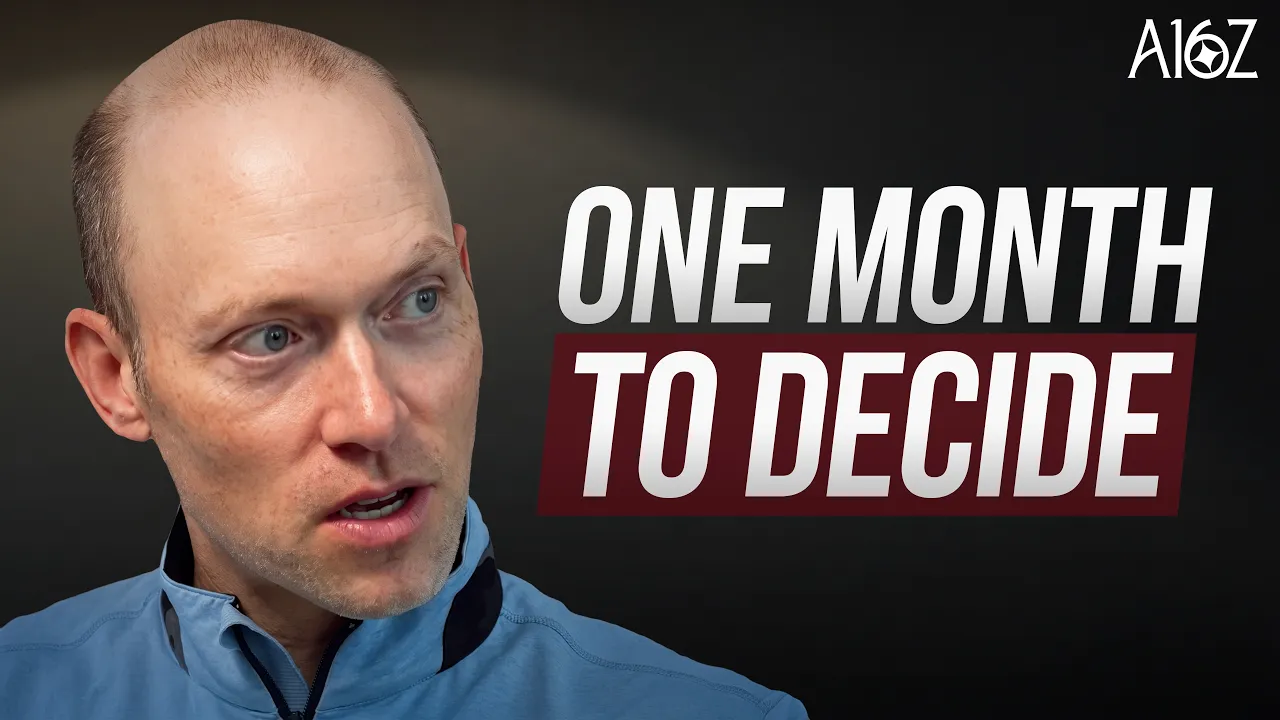
Ex-Plaid CTO Kills $1M Tax Startup Over Fast-Moving AI Incumbents
a16z
Incumbents with captive customer bases adopt foundation models faster than vertical software startups can acquire market share, rendering annual-cycle products unviable in the AI era.
Jean-Denis Greze shut down an AI tax startup generating nearly $1M in revenue and pacing toward $2.5M to $3M because annual sales cycles and incumbent distribution advantages made it fundamentally not venture-scale. (3:57)
Pivoting to Town, Greze built a proactive AI assistant anchored in email and calendar routines that operates as a token-allocation machine rather than waiting for user text prompts. (23:22)
Application startups buying tokens from OpenAI and Anthropic must compete with their suppliers as frontier labs push upstack, making multi-model neutrality and customer data ownership critical differentiators. (36:03)
Autonomous agentic web traffic threatens ad-supported business models like Amazon's high-margin advertising business and corporate breakage economics by automating programmatic price discovery and checkout. (52:33)
Detailed notes
## Background
Published on YouTube by venture capital firm a16z on October 19, 2026, this episode features partner Alex Rampell interviewing former Plaid CTO Jean-Denis Greze. The discussion examines why Greze killed a profitable SMB tax startup pacing toward $3 million in revenue to build Town, an AI assistant operating directly out of email and calendar workflows.
## TL;DR
Jean-Denis Greze outlines why he walked away from an AI tax product generating nearly $1 million in its first year, realizing that annual sales cycles and incumbent advantages structurally capped its venture potential. He unpacks the creation of Town, a bottom-up AI assistant designed as a proactive 'token-allocation machine' that automates routine knowledge work across calendars and inboxes. Together, Greze and Alex Rampell examine why startups must navigate competing directly with foundational model suppliers, why horizontal operational automation will eclipse niche coding tools, and how autonomous agentic browsing will fundamentally dismantle ad-supported commerce and breakage monetization models.
## Atmosphere & style
The conversation carries an intimate, high-signal insider vibe, blending unsentimental founder pragmatism with deep venture-capitalist pattern recognition. Greze speaks with candid, analytical clarity about the psychological friction of shutting down a functioning business and the ethical weight of recruiting talent. Rampell matches this energy with rapid-fire historical analogies from the mobile and dot-com eras, creating an engaging, intellectually sharp discussion about the structural shifts reshaping software.
## Bulletin
- [03:57](https://www.youtube.com/watch?v=o_5f4N6Nq80&t=237s) Jean-Denis Greze shut down an AI tax startup generating nearly $1M in revenue and pacing toward $2.5M to $3M because annual sales cycles and incumbent distribution advantages made it fundamentally not venture-scale.
- [23:22](https://www.youtube.com/watch?v=o_5f4N6Nq80&t=1402s) Pivoting to Town, Greze built a proactive AI assistant anchored in email and calendar routines that operates as a token-allocation machine rather than waiting for user text prompts.
- [36:03](https://www.youtube.com/watch?v=o_5f4N6Nq80&t=2163s) Application startups buying tokens from OpenAI and Anthropic must compete with their suppliers as frontier labs push upstack, making multi-model neutrality and customer data ownership critical differentiators.
- [52:33](https://www.youtube.com/watch?v=o_5f4N6Nq80&t=3153s) Autonomous agentic web traffic threatens ad-supported business models like Amazon's high-margin advertising business and corporate breakage economics by automating programmatic price discovery and checkout.
## Key takeaways
- [03:57](https://www.youtube.com/watch?v=o_5f4N6Nq80&t=237s) A growing, seven-figure AI startup can still be structurally non-viable for venture scale if incumbents can deploy LLMs faster than a newcomer can overcome annual sales cycles.
- [08:56](https://www.youtube.com/watch?v=o_5f4N6Nq80&t=536s) Startups operating in seasonal verticals like tax face strict deadlines, requiring founders to recognize rapidly when to pivot before getting locked into another annual delivery cycle.
- [13:35](https://www.youtube.com/watch?v=o_5f4N6Nq80&t=815s) Founders should optimize first for product-led end-user delight rather than upfront enterprise compliance checklists, following the bottom-up adoption model popularized by Dropbox.
- [17:58](https://www.youtube.com/watch?v=o_5f4N6Nq80&t=1078s) Email and calendar serve as the most effective wedges into enterprise workflows because they capture external business context without triggering heavy administrative procurement upfront.
- [21:26](https://www.youtube.com/watch?v=o_5f4N6Nq80&t=1286s) Applying Jevons Paradox to AI suggests that lowering the cost and privacy friction of cognitive labor to near-zero dramatically expands the total volume of delegated operational tasks.
- [23:22](https://www.youtube.com/watch?v=o_5f4N6Nq80&t=1402s) Town functions as a token-allocation machine, proactively identifying low-cost background compute opportunities that deliver outsized financial returns, such as vendor price tracking.
- [29:10](https://www.youtube.com/watch?v=o_5f4N6Nq80&t=1750s) The unit of software value has shifted from individual standalone applications to the underlying computer, making isolated feature moats harder to defend as foundation models converge.
- [34:03](https://www.youtube.com/watch?v=o_5f4N6Nq80&t=2043s) Startups must prepare to compete directly with their token suppliers as foundation model labs integrate up the software stack into consumer and enterprise applications.
- [36:05](https://www.youtube.com/watch?v=o_5f4N6Nq80&t=2165s) Neutrality across foundation models protects enterprises from vendor lock-in, price hikes, and model stagnation while guaranteeing full ownership of proprietary business context.
- [39:50](https://www.youtube.com/watch?v=o_5f4N6Nq80&t=2390s) Removing human mediation through autonomous agent-to-agent communication creates massive operational efficiencies that far outweigh marginal privacy concerns.
- [45:21](https://www.youtube.com/watch?v=o_5f4N6Nq80&t=2721s) Mainstream adoption outside Silicon Valley is bottlenecked by the lack of internal tinkers willing to configure blank-slate LLM chat interfaces for daily workflows.
- [48:50](https://www.youtube.com/watch?v=o_5f4N6Nq80&t=2930s) Non-technical consumers frequently fall into the early-adopter trap by ossifying outdated judgments from earlier model iterations rather than anticipating steep capability trajectories.
- [52:33](https://www.youtube.com/watch?v=o_5f4N6Nq80&t=3153s) Agentic web browsing breaks the historic internet ad covenant, undermining search-based advertising models in favor of neutral, automated commodity purchasing.
- [59:34](https://www.youtube.com/watch?v=o_5f4N6Nq80&t=3574s) Autonomous agents eliminate consumer friction in deal redemption, threatening corporate revenue models that depend on breakage, such as credit card credits and rebate offers.
## Detailed walkthrough
### [00:00](https://www.youtube.com/watch?v=o_5f4N6Nq80&t=0s) Teaser: The Evolution of Town and the Post-AI Software Paradigm
The episode opens with Alex Rampell recounting an unexpected message from Andreessen Horowitz co-founder Ben Horowitz. Horowitz reached out to rave about a product called Town, insisting it had completely changed his life. Rampell was immediately confused because he knew Jean-Denis Greze was building an SMB tax company, making the sudden pivot to an indispensable daily workflow tool seem baffling. Greze explains that the original tax product, despite its technical success, was fundamentally not going to be a venture-scale company. Instead, the team set out to automate core knowledge worker workflows—such as meetings, calendar preparation, and daily organization—by building a software experience that proactively identifies opportunities for users to deploy AI rather than relying on a blank text prompt.
Greze describes Town as an infrastructure layer that figures out the best supplier for any given moment, operating autonomously on behalf of users. He emphasizes that the era of having a human manually routing tasks is obsolete: “Humans are slow routers,” Rampell observes, to which Greze replies, “That's right. And I think the future looks like a lot less human in the loop than we see today.” Greze highlights how high-leverage asynchronous routines can transform work economics: a background agent might cost only one dollar a month to run, but in the single month where it spots an irregularity or an opportunity, it can uncover hundreds or thousands of dollars in value.
[00:56](https://www.youtube.com/watch?v=o_5f4N6Nq80&t=56s) From Plaid CTO to the SMB Tax Bet
Alex Rampell formally welcomes Jean-Denis Greze, noting their long relationship dating back to Rampell leading the a16z investment in Plaid when Greze served as Chief Technology Officer. When Greze first departed Plaid to start a company, the two met for coffee in Menlo Park or Palo Alto, where Greze revealed his initial concept: an AI-native tax preparation product for small and medium-sized businesses. Rampell admits he had to put on a polite poker face at the coffee shop, internally dreading the market because SMB tax is notoriously brutal. Months later, when Ben Horowitz independently fell in love with Town, Rampell texted Greze in disbelief, which quickly led to a16z partnering with him on Town just a week later.
```mermaid
flowchart TD
accTitle: SMB Tax Technical Viability vs Distribution Trap
accDescr: Diagram contrasting why LLMs excel at processing tax returns technically against the structural distribution bottlenecks that kill venture scale.
subgraph TechValidation["Technical Engine (Worked)"]
A["Financials & Lease Docs"] --> B["LLM Context Window"]
B --> C["Automated SMB Tax Return"]
end
subgraph MarketFailure["Distribution Dynamics (Failed)"]
D["Annual Selling Window (1x / year)"] --> G["Venture-Scale Bottleneck"]
E["Zero Daily Active Usage (DAU)"] --> G
F["Incumbents Automate Existing Base Faster"] --> G
end
```
Greze explains the genesis of that first tax idea. After leaving Plaid, he took several months off to spend time with his family, recognizing that founding a venture-backed startup would consume all his personal time for years to come. Looking for B2B verticals where large language models could fundamentally transform products, tax looked extraordinarily promising on paper. Tax returns rely on vast amounts of unstructured text, structured balance sheets, and physical lease documents—formats ideally suited for LLMs. Greze and his team completed engineering due diligence and verified that the manual process of assembling an SMB tax return could be fully automated within two years.
- SMB tax returns are vastly more complex than personal returns, requiring heavy document ingestion and accounting cross-checks.
- Technical validation confirmed an end-to-end automated pipeline from financial statements to completed returns was technically feasible within a 24-month horizon.
[03:57](https://www.youtube.com/watch?v=o_5f4N6Nq80&t=237s) The Ticking Clock: Why a $1M Business Was Not Venture Scale
The engineering side succeeded, but the go-to-market reality fell apart. In its first year, the SMB tax product generated just under $1 million in revenue and was pacing toward $2.5 million to $3 million in year two. Greze reflects that in a pre-AI software era, posting nearly $1 million in run-rate in year one and projecting triple growth would be considered an unmitigated success. In the post-AI environment, however, incumbents pose a lethal threat: existing tax and accounting platforms can integrate foundation models into their captive customer bases faster than a challenger can conquer market share from scratch.
Greze highlights the fatal cadence of the tax industry: transactions happen exactly once a year. Because of this discontinuity, the software cannot maintain daily active usage (DAU), and word-of-mouth referral loops are broken. Clients do not talk about their tax accountants casually, and when they do brag about a good return in April, their peers are not actively shopping for an accountant and forget the recommendation by the next filing season. Greze compares this directly to a close friend who built a successful EdTech startup and constantly lamented that educational software can only be sold twice a year (summer for fall rollout, and a brief winter window before the new calendar year). Forgetting that lesson nearly trapped Greze in an identical go-to-market quagmire.
- The startup cleared nearly $1,000,000 in revenue in year one, on track for $2.5M to $3.0M in year two.
- Tax suffers from an annual purchase cycle, creating an insurmountable barrier to virality and retention loops compared to high-frequency SaaS.
- Greze identifies the founder's core strategic clock: “You have to think about it's it's your advantage if you're a new entrance is you're faster moving. You can build a different product. You can use different go-to-market approaches, but there's a ticking clock on the wall which is how quickly can you get real word of mouth network effects and market penetration before the incumbents who have other advantages... can catch up and copy what you're doing effectively enough.”
[06:57](https://www.youtube.com/watch?v=o_5f4N6Nq80&t=417s) Walking Away From What Works: The Psychology of the Pivot
Following their first tax season, Greze and his co-founder spent a week taking long walks, drinking coffee, and wrestling with whether they had the conviction to dedicate the next decade to the business. Although walking away from an operating business generating real revenue felt like failure in real time, they realized it would never achieve the venture-scale global impact they sought. Maintaining the status quo would also be unfair to their engineering team, whose opportunity cost was immense given lucrative alternative offers across Silicon Valley.
Greze underscores the painful ethical equation of startup leadership: as a founder, if you cease to believe in an extraordinary outcome, it becomes intolerable to look employees in the eye when they struggle, or to recruit top-tier talent who are walking away from liquid compensation elsewhere. While they could have spent years tinkering and searching for workarounds, they lacked a breakthrough insight to unlock escape velocity. Facing that reality required swallowing their pride, letting go of the internal tax operations team whose roles were tied strictly to that vertical, and disregarding what external observers might think of an apparent pivot.
- Walking away was driven by two internal tests: maximizing real-world scale and honoring the opportunity cost of exceptional early employees.
- Shutting down meant confronting the emotional burden of eliminating specialized tax roles that had no transferability to a new software roadmap.
- Greze reflects on the courage needed to abandon working software: “And so if you stop believing that you can have a great outcome, then it's really hard to come into the office every day and look at people in the eye when when they when they tell you like, 'Hey, I'm having a hard time with this.' Or when you're trying to convince a candidate to come join your company and you you know, you know, they have an offer from someone else that's liquid and you know, you're like, 'Oh, well, who am I as a human being?' Like, you know, I have to believe in [it].”
[08:56](https://www.youtube.com/watch?v=o_5f4N6Nq80&t=536s) The One-Month Window to Kill the Tax Business
Walking away from a company is emotionally fraught, but Jean-Denis Greze found that looking at the reality of people's lives clarified the decision. True friends remain supportive regardless of whether a venture succeeds or fails, and employees can be treated with generosity through solid severance packages and hands-on help landing their next roles. Once those practical protections are in place, the paralysis fades. What ultimately forced the issue was the rigid calendar of the tax industry: unlike businesses with continuous sales cycles where founders can endlessly procrastinate by testing another idea for three or four weeks, a tax business offers only a narrow exit hatch.
Around October 15th, the company faced a tight window of roughly one month where it could still straddle two realities: continuing the tax product or pivoting entirely. Once partners were signed in January, or tax returns were actively promised leading up to the April 15th deadline, a pivot would have been impossible. If they had stayed on the path past November, they would have been locked in for an entire calendar year, burning through their remaining capital and losing the ability to pivot later. As Jean-Denis put it: “I think making the decision at that point in time it was the only time we could make the decision.” With the domain name Town already in hand, the team made the call to explore what came next.
- **The non-negotiable deadline:** The pivot had to occur in the roughly one-month window following October 15th, well before partner commitments in January and the tax filing rush of April.
- **The danger of continuous businesses:** Cyclical businesses impose hard deadlines, whereas non-cyclical startups often suffer from endless delays where founders convince themselves to test one more concept for a few weeks until capital runs out.
---
[10:28](https://www.youtube.com/watch?v=o_5f4N6Nq80&t=628s) How Town Was Born: Email, Calendar, and Instant Pull
After evaluating roughly four directions, the team locked onto a straightforward question: why had nobody built a genuinely great agent operating directly out of a knowledge worker's email and calendar? The insight had actually surfaced during their tax venture. Even while automating returns, accounting clients kept complaining about meeting logistics, forgetting agendas, and answering repetitive tax queries over email, asking: “Wouldn't it be awesome if you could pre-draft answers for for for me?” Meeting prep, recording outcomes, handling routine incoming correspondence, and preparing knowledge workers for their day were universal workflows that had not yet received great AI tooling.
The idea coincided with rapid advances in model agency—particularly around the timing of Opus and models gaining the ability to write code autonomously. Once Town hooked into these workflows, the team experienced an overwhelming surge of organic pull. Instead of getting bogged down in total addressable market (TAM) spreadsheets or grand strategic theory, they chased user demand as the product expanded by 1% to 1.5% day after day from December through April. They quickly realized that external-facing corporate roles—such as sales, business development, and recruiting—run almost exclusively on email and calendar, revealing massive global software depth beneath what initially seemed like a simple LLM wrapper. Jean-Denis reflected on that momentum: “And you know project market fit is a it's a magical thing once you once you have it you kind of want to hang on for dear life and keep pulling at at the string forever and ever.”
```mermaid
flowchart LR
accTitle: From Tax Feedback to Town Agentic Workflows
accDescr: Progression showing how user complaints about tax meetings and email correspondence led Town to build an agentic assistant for core knowledge work.
subgraph Feedback["Observed User Friction"]
A["Repetitive Client Emails"]
B["Meeting Scheduling & Context Loss"]
end
subgraph Capability["Model Breakthrough"]
C["Agentic LLM Advances"]
end
[13:35](https://www.youtube.com/watch?v=o_5f4N6Nq80&t=815s) PLG vs Enterprise: The Dropbox Lesson
As demand escalated, Town faced the classic enterprise software dilemma: should they cater directly to large corporate buyers or pursue product-led growth focused strictly on the end user? Drawing on his and his co-founder's earlier tenure at Dropbox, Jean-Denis prioritized user experience over enterprise compliance checklists. When a company builds for the buyer (such as the Chief Information Security Officer) instead of the actual user, the product degrades into an administrative tool rather than a beloved assistant. While retrofitting enterprise compliance and administrative controls onto a world-class consumer product is challenging, doing the reverse is virtually impossible.
Jean-Denis argued that starting from IT requirements permanently handicaps software design: “It is almost impossible to go from an experience that starts from the compliance IT enterprise requirements and then figures out how to make the product experience incredible.” Town concentrated all of its energy on product alpha and consumer-grade responsiveness, confident that data privacy, SOC 2 compliance, and enterprise admin consoles could be layered on once user affection was secured. As corporate executives experience sleek, delightful AI agents in their private lives, they inevitably demand that same quality inside their enterprises, creating natural top-down pressure for tools that users already love.
- **Customer vs. User tension:** Building for the check-writer creates software that satisfies the CISO's security checkboxes while alienating the employees who have to use it every day.
- **The Dropbox trajectory:** Winning at the individual user level creates bottom-up momentum, leaving enterprise security configurations as a solvable secondary hurdle rather than the foundation of the product.
---
[16:16](https://www.youtube.com/watch?v=o_5f4N6Nq80&t=976s) The iPhone Moment for Enterprise AI and the Good Technology Warning
Alex Rampell drew an analogy between the current enterprise AI landscape and the enterprise mobile landscape of 2007. When Steve Ballmer famously dismissed the original $800 iPhone as an impractical gadget that could never penetrate enterprise fleets dominated by BlackBerry, he misunderstood consumer pull. Enterprise executives took iPhones home for Christmas, snapped photos of their families, experienced the gap in elegance, and returned to the office ordering their IT departments to make iPhones work on corporate networks. Rampell noted that many corporate executives remain stuck in the pre-iPhone era—dismissing AI because of underwhelming experiences with older legacy tools like IBM Watson—even though personal AI adoption has already crossed the chasm.
Jean-Denis agreed with the parallel but added a critical cautionary tale: the rise and fall of Good Technology. In the early days of corporate iPhone adoption, Good Technology built an enterprise-compliant, sandboxed email application for iOS that secured corporate communications behind IT-friendly walls. However, the app was widely loathed for its clunky interface and was quickly discarded once Apple and corporate mail servers integrated native enterprise security. Jean-Denis emphasized that Town must build an exceptional end-to-end user experience rather than settling for being an enterprise-sanctioned wrapper: “I don't want to be Good, right? Because Good eventually is not a good business because people are like, 'Yeah, sure. You're enterprise on the iPhone, but...'”
- **The 2007 Ballmer parallel:** Ballmer scoffed at the iPhone while Microsoft acquired Nokia, yet executive consumer demand completely dismantled BlackBerry's dominant enterprise moat within years.
- **The legacy skepticism barrier:** Many current enterprise leaders remain skeptics because their reference points are clunky first-generation enterprise AI offerings rather than cutting-edge consumer models.
- **The Good Technology trap:** Offering an ugly, compliance-heavy wrapper for an exciting platform provides temporary distribution, but users inevitably abandon it the second native, well-designed tools achieve enterprise compliance.
[17:58](https://www.youtube.com/watch?v=o_5f4N6Nq80&t=1078s) The Enterprise Wedge: Earning the Right to Core Systems
Reflecting on the enterprise landscape, Jean-Denis Greze emphasizes that the existential risk for a modern workplace software product is not merely ending up like the BlackBerry—obsoleted by consumer hardware—but falling short of the standard set by the best mobile software. If a specialized enterprise app cannot match the consumer polish of the native Gmail iOS app, users will simply reject it, regardless of its institutional compliance chops.
Greze observes that human-scale adoption curves are inherently deliberate. While consumer assistants count a few million early adopters globally, even top executives are only beginning to experience the paradigm shift. He predicts a 6- to 18-month lag before most knowledge workers grasp the magic in their everyday workflows. However, rolling AI agents into enterprise infrastructure presents a much steeper security hurdle than simply handing employees smartphones:
```mermaid
flowchart TD
accTitle: Enterprise AI Adoption Journey
accDescr: A step-by-step progression from basic inbox access to enterprise-wide core integrations.
subgraph Phase2["Phase 2: Earning Trust"]
B --> C["Earn Right to Request CRM Access"]
C --> D["IT Engagement & Enterprise Controls"]
end
subgraph Phase3["Phase 3: Deep Systems"]
D --> E["Core Systems of Record & Custom APIs"]
end
```
Agents derive real operational leverage exclusively from secure access to proprietary corporate data and internal APIs. To bypass lengthy enterprise procurement cycles on day one, Town adopts a grassroots wedge strategy: connect solely to an employee's calendar and inbox rather than immediately demanding write access to foundational systems of record. By preparing comprehensive meeting briefings or updating pitch slide decks with the latest figures pulled straight from inbound PDF attachments, Town delivers tangible value upfront. Only after proving this utility does the product earn the credibility to request CRM access, IT sign-offs, granular audit logging, strict privacy sandboxing to block privileged data leaks, and administrative token expenditure controls for the CFO.
- Mid-market and SMB deployments bypass rigid enterprise procurement because their security mandates are far leaner, allowing Town to rely on product-led, self-serve growth down-market.
- Enterprise go-to-market focuses heavily on defensive back-office tooling: SOC compliance, audit trails, and financial visibility into team-wide token consumption.
> “And as I said, for external facing roles, the calendar and email are real sources of insight about how you can automate part of someone's work.” — Jean-Denis Greze
---
[21:26](https://www.youtube.com/watch?v=o_5f4N6Nq80&t=1286s) Jevons Paradox and Silicon Executive Assistants
Alex Rampell introduces Jevons Paradox to explain the counterintuitive explosion in demand for automated administrative tasks. In traditional economics, one might evaluate the total addressable market for automated assistants by counting the relatively small percentage of corporate workers with dedicated human executive assistants. Rampell shares a personal anecdote illustrating the limits of human labor: despite employing a trusted human EA, he draws a hard boundary at having another person comb through his inbox. While recently traveling in London, Rampell had a vague recollection of a dinner commitment that was completely missing from his schedule:
> “I thought I had a dinner to go to. So, I could have sworn like I got an email about it. I texted Snap, my Townie, and I was like, ‘Don't I have a dinner to go to?’ And it like it was like, ‘Yes, you do.’” — Alex Rampell
Because Rampell had failed to reply to the invitation and the organizer had not CC'd his assistant, the event fell through the cracks. However, his Town agent—which continuously parses his full message stream without the awkwardness of a human observer—immediately located the details.
Rampell argues this represents a twofold Jevons Paradox: just as James Watt’s hyper-efficient steam engine dramatically multiplied total coal consumption rather than depressing it, driving the unit cost and privacy friction of labor down to zero via silicon creates vast new demand. Knowledge workers will task silicon assistants with reading, indexing, and evaluating mundane digital exhaust that no human would ever be hired to oversee.
---
[23:22](https://www.youtube.com/watch?v=o_5f4N6Nq80&t=1402s) Town as a Token-Allocation Machine
Responding to Rampell’s framing, Greze rejects defining Town merely under the narrow label of an "assistant." Instead, he characterizes Town as an intelligent token-allocation engine designed to identify latent operational tasks where machine compute can replace manual overhead or do work that was previously omitted entirely due to human labor costs:
> “I think of our product as a token allocation machine. We're trying to give options to the human about where they could apply tokens and then we choose the human can choose whether they want the outcome of that.” — Jean-Denis Greze
When tokens are cheap and plentiful, an LLM can perform deep background research on every 30-minute calendar participant—cross-referencing recent social posts on X and shared project context—for less than a single penny. No company could justify paying a human assistant to spend two hours preparing dossier memos for routine internal check-ins, but token-based automation makes running longtail research on every calendar invite an obvious operational win.
```mermaid
flowchart LR
accTitle: Restaurant Inventory Price Optimization
accDescr: Monthly wholesale price list parsing workflow yielding periodic high-value savings.
A["Monthly Wholesaler Invoices\n(Spreadsheets & PDFs)"] --> B["Town Token Sweep\n(~$1/month compute)"]
B --> C{"Price Discrepancies\nDetected?"}
C -->|No: 11 mos/yr| D["Silent Pass\n(Negligible cost)"]
C -->|Yes: 1 mo/yr| E["Actionable Alert\n(Saves $100s–$1,000s)"]
```
To illustrate the broader potential outside the technology sector, Greze walks through a scenario involving an independent restaurant owner:
- Independent restaurateurs regularly receive dense monthly or quarterly product catalogs via PDF or Excel spreadsheets from wholesale distributors containing fluctuating quotes across tens of thousands of raw ingredients.
- Conducting rigorous supplier price-comparison audits requires dedicated accounting hours that small operators cannot justify on an ongoing basis.
- An AI routine can ingest these vendor spreadsheets monthly for roughly $1 in token compute, running silently in the background.
- Even if the sweep turns up zero arbitrage opportunities for 11 out of 12 months, the single instance where an automated alert identifies a 20% to 30% surge on staple supplies—or points out unannounced discounts from a competing distributor—recovers hundreds or thousands of dollars for the restaurant's bottom line.
Greze concludes that the product's fundamental purpose is surfacing these high-leverage workflows proactively: users do not care how frequently the background pipeline runs, only that the system alerts them the moment business margins are on the line.
[27:18](https://www.youtube.com/watch?v=o_5f4N6Nq80&t=1638s) PLG vs. Sales-Led Growth and the Horizontal vs. Vertical Dilemma
Alex Rampell and Jean-Denis Greze contrast how an AI assistant must be framed to end users versus how software has traditionally been sold to enterprises. If you approach a small business owner and ask if they want an "executive assistant," they will look at you blankly and ask what you are talking about. But if you frame it like a Geico commercial—asking if they want to save money on their recurring expenses, such as saving $500 a year on iceberg lettuce for a fee of just $5 a year—the answer is an immediate yes. Alex recalls their earlier conversations when Jean-Denis decided to pivot away from tax into Town, zeroing in on two pivotal strategic tensions: product-led growth (PLG) versus sales-led growth, and horizontal versus vertical product strategy.
On go-to-market, Jean-Denis’s philosophy had left a strong impression on Alex: if you want to build something users actually love, you have to build directly for the person doing the work rather than pandering first to corporate overlords and compliance attorneys, with the intention of working backwards into enterprise sales-led growth later. On the horizontal versus vertical question, Alex summarizes the pitch he now gives to prospective candidates: Town begins horizontally across as many business types as possible rather than siloing itself into an "iceberg lettuce" niche upfront. By distributing horizontally, the software learns from tens of thousands of diverse users, letting actual user behavior and Town agents surface where high-value verticals truly exist.
* Alex Rampell on user-centric product development: “It's like if you want to build a product that is designed for the user, you have to build it for the user, not for this you know the corporate overlords, all the lawyers at the company, and eventually you can work your way backwards into enterprise sales and sales-led growth.”
* Alex Rampell on verticalization: “We're going to learn from hopefully thousands, tens of thousands of businesses and people that use our product, and then eventually we can verticalize from there because we're going to let the market define that.”
---
[29:10](https://www.youtube.com/watch?v=o_5f4N6Nq80&t=1750s) The Changing Unit of Software Value and the Flywheel of Custom Automations
Jean-Denis argues that differentiated feature sets—the traditional driver of Silicon Valley software defensibility—are becoming nearly impossible to sustain because underlying model capabilities across AI harnesses will inevitably converge. He suggests that the core unit of value in software is undergoing a fundamental transformation: it has migrated from the standalone application to the computer itself, which in practice means software can now replicate anything a human can perform in front of a screen. Because AI abstracts away the dedicated application layer, the economic value captured by traditional point-solution software apps will plummet. Defensibility, therefore, comes from hyper-customizing the software experience to each user’s specific context at scale, whether the user is an electrician, an executive assistant, or a venture capitalist.
Because Town is built to be enterprise-ready, the company never inspects raw private user data. Instead, the team analyzes aggregate platform metrics to identify power users, reaches out directly to conduct interviews, and surfaces common workflow patterns. For instance, after discovering shared operational bottlenecks across ten restaurant owners, Town’s team hand-crafted prototype automations—termed "routines"—such as automated price comparisons across wholesale food suppliers. When new restaurant owners sign up and connect their inboxes, Town recognizes their business type and immediately recommends these pre-built routines. To scale this feedback engine beyond human limits, Town uses automated AI-driven user interviews incentivized with Amazon gift cards, rapidly populating a reusable library of domain-specific routines that continually trains the recommendation engine.
```mermaid
flowchart TD
accTitle: Town Continuous Customization Flywheel
accDescr: Diagram illustrating how Town surfaces user patterns without reading private data and turns them into automated industry routines.
subgraph DataCollection["1. Aggregate Discovery (No Data Peeking)"]
A["Platform Analytics & Power Users"] --> B["Automated AI-Led User Interviews"]
end
subgraph TemplateDesign["2. Routine Library"]
B --> C["Identify Shared Workflows"]
C --> D["Hand-Craft Domain Routines (e.g., Wholesale Price Tracking)"]
end
subgraph UserPersonalization["3. Contextual Onboarding"]
D --> E["User Connects Email & Calendar"]
E --> F["Town Matches Role & Context"]
F --> G["80/20 Custom Multi-Role Assistant (Work, Finance, Personal)"]
end
G -.->|"Usage Generates Aggregate Signals"| A
```
* Jean-Denis Greze on the paradigm shift in software: “The unit of value in software has changed from the app to the computer.”
* Jean-Denis Greze on the convergence of model capabilities: “The differentiator, like I think what has been the main differentiator in Silicon Valley for a long time, which is you have different product features that are ahead of market, it's going to be more and more difficult to sustain that kind of an advantage.”
* Jean-Denis Greze on modern multifaceted roles: “People aren't just one role in the future, right? Like yes, you're a restaurant owner, but also you run finance for your restaurant too because you don't have a separate person doing that, and also you have a vacation rental that you rent, and so really you want your Towny to be good at those three things, and also you have two kids at school and it can help you like schedule their activities for the summer.”
---
[33:04](https://www.youtube.com/watch?v=o_5f4N6Nq80&t=1984s) The Forward Deployed Engineer Trap vs. Automated Scaling
Jean-Denis contrasts Town’s product-led automation strategy with the forward deployed engineer (FDE) model heavily favored by major AI research labs. In the FDE framework, labs embed human software engineers directly inside massive corporate accounts to analyze business processes and stitch together bespoke AI integrations using proprietary lab models. While charging an enterprise customer $5 million a year for embedded personnel may generate impressive near-term top-line revenue, Jean-Denis believes it is fundamentally unscalable. As underlying foundational models become smarter, the manual, labor-heavy FDE model becomes an inefficient bottleneck that degrades over time relative to software-driven loops.
Town’s counter-strategy focuses on automated horizontal scale across tech-forward SMBs and mid-market organizations where the routine flywheel can compound freely. By automating the discovery, generation, and deployment of custom software through AI routines rather than human consultants, Town captures a compounding volume of organizational workflows. Jean-Denis is content to let competitors battle over high-touch, handcrafted services for Fortune 500 enterprises, betting that Town’s bottom-up learning loops will produce a far more powerful and scalable product over the long horizon.
* Jean-Denis Greze on the long-term weakness of consulting models: “If you're an enterprise that's willing to spend like 5 million a year paying OpenAI for FDEs, like it looks really good right now, but I think over time as the models get better, the FDE approach actually gets much worse, and our approach, which is much more around automation and using AI to build the custom software, will scale much better.”
* Jean-Denis Greze on targeting tech-forward segments: “The bet we're making is we start with PLG, SMB, mid-market enterprises that are very tech forward because there our approach scales really, really well; we'll let other people fight in the enterprise for this much more like handcrafted software.”
---
[34:03](https://www.youtube.com/watch?v=o_5f4N6Nq80&t=2043s) Competing with Suppliers: Town vs. Foundation Model Labs
Alex raises the delicate dynamic facing AI application builders: Town is competing directly with foundational model providers like OpenAI and Anthropic, the very suppliers from whom it purchases inference tokens. In earlier technology waves, infrastructure players maintained clear boundaries; networking providers like Cisco or Akamai in the 1990s never attempted to build e-commerce storefronts to rival Amazon or auction houses to challenge eBay. Today, the infrastructure layer is aggressively pushing upward into applications by launching first-party connectors into platforms like Slack and LinkedIn.
Jean-Denis acknowledges the structural hazard of competing against your own upstream suppliers. The immediate tactical distinction lies in deep user experience craftsmanship around email and calendar management. Foundational labs treat email and calendar integrations as generic connectors, overlooking the messy, nuanced workflow constraints that Town has spent months optimizing. However, Jean-Denis points out that relying solely on superior workflow UX is an incomplete defense, as major frontier labs could theoretically prioritize those features at any time. The enduring defensibility lies in Town's intense focus on understanding mid-market enterprises (firms with 500 to 1,000 employees) and building specifically for how real businesses orchestrate work across internal divisions.
* Alex Rampell on the historical infrastructure-application separation: “Never in a million years did Cisco say, 'You know what, we're going to build a bookseller, we're going to build an auction website, we're going to build a directory like Yahoo that competes with'—no, they were just happy selling their switches and load balancers and everything.”
* Jean-Denis Greze on the reality of model lab competition: “It is risky always to be competing with your suppliers, right? And we are competing in a way, right? That's right, we're competing against suppliers, so you got to ask yourself, is that naturally the right state of the world?”
[03:06:05](https://www.youtube.com/watch?v=o_5f4N6Nq80&t=11165s) Why Neutrality and Data Ownership Trump Foundation Lab Apps
When pitching potential enterprise customers, Jean-Denis Greze challenges them directly on whether they can predict which foundational model will dominate the landscape three to five years out. They inevitably have no answer. Greze points out that committing directly to an OpenAI product locks the business exclusively into OpenAI's ecosystem; if that lab falls behind or, as Alex Rampell chimes in, decides to hike rents, the customer is left in a compromised competitive posture. Town's primary value proposition rests on being an entirely neutral application layer that intelligently routes workloads across frontier models and open-weight architectures, matching whichever supplier is superior for voice, video, slides, or raw reasoning at that precise moment. He points out that enterprises tied solely to OpenAI two years earlier were forced into messy multi-provider arrangements once Anthropic established clear dominance in code generation over a 12-month period.
```mermaid
flowchart TD
accTitle: Town Neutral Context and Routing Architecture
accDescr: Diagram showing Town routing across multiple AI models while retaining an enterprise-owned context layer.
subgraph AppLayer ["Town Application Layer"]
C["Context & Memory Layer\n(Owned by Enterprise; Fully Portable)"]
R["Intelligent Model Router\n(Voice, Video, Slides, Logic)"]
C --> R
end
Beyond model neutrality, Greze emphasizes that companies must protect their proprietary operational intelligence. In earlier eras of business, enterprise value consisted of physical plant, machinery, or human capital; today, it increasingly manifests as the comprehensive context and memory of how the firm operates. Greze maintains that the business must genuinely own that context layer rather than surrendering it to a vendor. His standard is radical: if a superior platform emerges tomorrow, migrating away from Town should take no longer than twenty-four hours. This approach stands in stark opposition to forward deployed engineer (FDE) business models, which intentionally build bespoke, sticky software to make switching cost-prohibitive. Furthermore, Town refuses to train base models on client workflows to ensure that a customer's proprietary competitive edge never leaks into external model weights.
- Neutral routing allows customers to de-risk partnership decisions and capture immediate price and capability improvements across frontier and open-weight models.
- “And so, you know, in the old world pre-computing, if you're a business, you had different assets: you had physical assets and you had maybe like human assets, right? And increasingly now, maybe people call it context, but there's the set of assets which is all the things that AI knows about your business to help you run your business effectively. And I think you should own that entire bucket.” — Jean-Denis Greze
- Town deliberately accepts low switching costs as an accountability mechanism: if its product is not objectively the best, customers are free to migrate.
[03:09:50](https://www.youtube.com/watch?v=o_5f4N6Nq80&t=11390s) Autonomous Agent Communication and the Speed of AI
Greze discusses the philosophical divergence between Town and the frontier research labs regarding human-in-the-loop workflows. Town’s team collaboration product includes an automated internal CRM mode where autonomous AI agents negotiate and share corporate knowledge directly, bypassing human latency. In a legacy communication architecture, an employee seeking an introduction to a lead’s finance team broadcasts an open query across Slack or Microsoft Teams, forcing dozens of colleagues to read, parse, and respond manually. In Town, the employee's agent queries other colleagues' agents directly. The agents autonomously determine permissions, privacy boundaries, and relevant connections to surface the right contact instantly.
Rampell summarizes the problem succinctly: “Humans are slow routers.” Greze agrees, arguing that the future of enterprise software requires stripping out human mediation wherever the economic returns dramatically exceed marginal privacy or operational risks. This dynamic is intensifying as frontier labs increasingly compete directly with their own downstream application developers—pointing to vertical encroachments on startups like Harvey in legal tech and Rogo in finance. Greze warns that businesses relying directly on vertical apps built by foundation labs risk being squeezed as those labs aggressively march up the software stack.
- Town's internal CRM functionality relies on cross-agent queries to eliminate broadcast noise in company communication channels.
- “And I think the future looks like a lot less human in the loop than we see today. And I think our job is to get companies to be comfortable with that universe because the economic benefit for them far outstrips any risks that they would see in that experience today.” — Jean-Denis Greze
- Vertical labs pose existential risks to domain-specific software players, making independent, neutral aggregation layers strategically vital for enterprise software buyers.
[04:02:24](https://www.youtube.com/watch?v=o_5f4N6Nq80&t=14544s) The Goldilocks Zone of Lab Competition and the Underhyped Market
Rampell outlines a framework he terms the "Goldilocks zone of relevance." A software company generating a trillion dollars in revenue would be an irresistible target for foundation labs to clone and destroy; conversely, a company with zero revenue is completely ignored. Coding tools fell into a dangerous sweet spot for the foundation labs: coding was so massive, urgent, and immediately lucrative that labs could not afford to look away. Anthropic gained massive market momentum by focusing aggressively on code generation, forcing OpenAI to abandon its scattered fifty-bet strategy and mount a focused defense. Rampell posits that Town's broad horizontal focus across small-and-medium businesses (SMBs) and mid-market accounts leaves it safely outside the labs' current crosshairs, which remain fixed on high-margin mega-verticals like software engineering, law, and healthcare.
Greze agrees with the immediate diagnosis, but disputes the idea that horizontal operational workflows will remain overlooked for long. While coding moves the financial needle for foundation labs this quarter, the aggregate market for automating routine operations across all global businesses will ultimately eclipse software development. Greze predicts labs will turn their attention toward this horizontal opportunity within twelve months. Transitioning the discussion outward, Rampell proposes a thesis on the uneven distribution of artificial intelligence: while Silicon Valley might appear to overhype AI internally, the broader global economy outside the tech bubble severely underhypes its real-world implications. Rampell turns to Greze to dissect where the broader market remains structural short on AI adoption across specific geographies and professions.
- Coding agents became an existential battleground because foundation labs like Anthropic and OpenAI “cannot not be in the coding market.”
- Vertical concentrations like healthcare and legal tech invite direct model provider competition, while horizontal operational automation has temporarily flown below frontier lab radar.
- “Look, the market for AI doing more for a business and helping the business be more successful is bigger than the coding market.” — Jean-Denis Greze
- The current adoption curve resembles historical technology diffusion waves like the iPhone displacing BlackBerry, with deep asymmetries between Silicon Valley enthusiasm and mainstream industry integration.
[45:21](https://www.youtube.com/watch?v=o_5f4N6Nq80&t=2721s) The Tinkerer Bottleneck and Why AI Fails to Diffuse
Alex Rampell points out the beauty of building a horizontal product-led growth (PLG) platform: users pick it up organically across the globe without intentional geographic targeting, recalling Jean-Denis Greze previously noting how Town unexpectedly blew up in Japan. When Rampell asks what surprising use cases have surfaced, Greze shares an anecdote about a surfboard and beach buggy rental business on an island that uses Town to run visual inspections on returned gear to decide whether customers should get their deposits back. Greze notes this was nowhere on his "128x 128 board bingo card," but it worked because a specific person at that company took the initiative to build a workflow around a painful operational chore.
```mermaid
flowchart LR
accTitle: The Tinkerer Bottleneck to AI Adoption
accDescr: Shows how the requirement of an internal tinkerer prevents AI from diffusing to the broader economy.
subgraph Valley ["Tech Ecosystem"]
direction TB
V1["Engineers Everywhere"] --> V2["Natural Tinkerers"]
V2 --> V3["High AI Value Extraction"]
end
subgraph Mainstream ["Broader Economy"]
direction TB
M1["Small Businesses"] --> M2["Lack Time & Tech Fluency"]
M2 --> M3["Treat LLMs as Better Google Search"]
end
V3 -.->|"Diffusion Gap"| M3
```
Greze argues that AI has not diffused broadly because mainstream adoption currently depends on having an internal tinkerer, and there simply are not enough people in the world with the time or technical intuition to hack together workflows. Most businesses still treat tools like ChatGPT or Claude as glorified Google search engines instead of business process automations, largely because the user interface remains an intimidating, unguided text box. To make software stick, Town requires connecting email, calendar, and a core system of record, but Greze wants to eliminate the need for users to handcraft custom integrations altogether. As Greze explains:
> “The unlock is is there someone over there that gets AI enough to want to tinker a solution to their problem. And the problem with that is that there aren't enough tinkerers in the world or there aren't enough people that have the time to be tinkerers to help their business.”
- The core retention metric for Town has historically been connecting email, calendar, a core system of record, and creating one high-leverage custom integration.
- Silicon Valley firms adopt AI far more successfully because employees work alongside software engineers and share an innate problem-solving intuition.
- Greze emphasizes that models do not need higher raw intelligence to solve today's business problems; the hurdle is productization and deployment at scale.
---
[48:50](https://www.youtube.com/watch?v=o_5f4N6Nq80&t=2930s) The Early-Adopter Trap and Concrete Computer Use
Rampell highlights that the difficulty of AI adoption is fundamentally an integration and product marketing problem, compounded by users who tried LLMs years ago and wrote them off based on outdated impressions. He illustrates this with a story about a top administrator at Harvard—the number-two person at the university—who dismissed AI because she tried it a couple of years prior and found it mediocre. Rampell took her 20-year-old doctoral dissertation and used ChatGPT to rewrite and modernize it with current scholarship. She was stunned, asked where he got that exclusive model, and was shocked to learn it was the standard free tier. Rampell points out that while Silicon Valley evaluates technology based on the slope of where it will go, everyday consumers freeze their judgments in the past:
> “They tried something two years ago. They were like, ‘Yeah, this hallucinated, this did that, it didn't really work that well,’ and then they're they've kind of ossified that version of of the reality.”
Greze agrees, observing that winning software platforms must continuously adapt businesses to ever-improving models behind the scenes. In the span of just two and a half months, breakthroughs in computer use and browser-based agents took tasks from a 30% reliability rate to roughly 90%, yet most users remain completely unaware of these capabilities. When Town demos automated web shopping or navigating existing SaaS dashboards without dedicated APIs, users are astonished. Rather than pitching technical terms like "computer use," Greze stresses presenting specific, proactive automations:
```mermaid
flowchart TD
accTitle: Proactive Agent Value Escalation
accDescr: How an AI agent proactively expands its task footprint from simple Canva posters to multi-channel assets.
Step1["Notice Upcoming Calendar Event"] --> Step2["Draft Event Poster via User's Paid Canva Account ($0.25 Compute)"]
Step2 --> Step3["User Approves Single Poster"]
Step3 --> Step4["Agent Offers Ongoing Automation for Future Events"]
Step4 --> Step5["Automatically Absorb Rebrands & Design System Changes"]
Step5 --> Step6["Generate Video Assets for Instagram Campaigns"]
```
Greze envisions an agent noticing an upcoming event on a calendar, using an existing corporate Canva subscription to whip up a design matching past assets for 25 cents of compute, and proactively asking if it should do this for every future event. When the company updates its corporate branding or visual styling, the assistant should pick up the aesthetic changes automatically without being prompted, eventually expanding to generate promotional video assets for platforms like Instagram as multimodal performance advances.
---
[52:33](https://www.youtube.com/watch?v=o_5f4N6Nq80&t=3153s) The Broken Ad Covenant and the Agent Distribution War
Rampell brings up how agentic web traffic has already outpaced human traffic across the internet, sparking a divide between businesses taking an adversarial stance toward agents versus those taking a synergistic one. For decades, the web operated under an implicit ad covenant: a publisher like Yahoo Finance paid for real-time NASDAQ tickers, the user received free financial quotes, and in exchange, Yahoo monetized the user's eyeballs through banner ads (such as E-Trade). Proactive agents destroy that economic exchange by programmatically scraping or executing tasks without rendering ads. While companies like Amazon have taken an adversarial approach to protect massive high-margin advertising businesses, Rampell argues that welcoming agentic traffic is the new search engine optimization (SEO) frontier.
Greze agrees, pointing out that shifting platform incentives will rearrange winners and losers in commerce:
> “Amazon's loss should be Walmart's gain. Right. I mean, Walmart, you know, the the they don't have the advertising business, and so, you know, their incentives are going to be different.”
Greze cautions that shifting to an agent-mediated economy raises deep questions about consumer trust and agent neutrality. If users rely on an agent developed by an ad-funded giant like Meta, the agent's recommendations may be warped by the platform's commercial relationships with large corporate advertisers, introducing conflicts of interest into automated decision-making.
[54:23](https://www.youtube.com/watch?v=o_5f4N6Nq80&t=3263s) Neutral Agents and the Problem of Advertising
Jean-Denis Greze and Alex Rampell explore what happens to product marketing when human eyes are no longer looking at ads or search results. Jean-Denis points out the tension: if an airline like United spends heavily on Meta compared to an obscure rival, what happens when an agent books a flight? If the user suspects their agent is biased toward paid placement rather than delivering an objective result, the relationship breaks down. Greze emphasizes:
> “I'm a firm believer in the like you want a neutral agent that is yours that you have no doubt like the only source of money for the agent is your wallet as the user and then whoever is creating that agent their incentive is to give you the best information for you as a human with no distortion in terms of uh the great forces of marketing.”
Users will still want to express personal taste and can explicitly instruct their agent to check cultural trends or Instagram ads when they actually want to be influenced by marketing. However, the default posture of the agent must remain strictly neutral.
Greze also draws a sharp distinction between "enjoyable friction" and "unenjoyable friction." Strolling around SoHo in New York City to shop involves friction he embraces—walking store to store, seeing other people waiting in line, and observing styles to copy. Conversely, reordering household essentials like toilet paper is friction nobody wants; it should just happen as quickly and cheaply as possible. AI system builders frequently err by assuming humans want every experience hyper-optimized for efficiency. Shopping for Legos with his son, for instance, is an experience where Greze welcomes seeing ads for alternative construction toys, prompting his agent to fetch reviews and evaluate whether kids like them. Because of that nuance, aggregate marketplaces will still hold value, but attempting to force ad friction onto tasks where users want seamless utility will fail.
```mermaid
flowchart TD
accTitle: User Friction Preferences in Agentic Commerce
accDescr: Contrasts shopping friction users enjoy versus pure toil automated by agents.
subgraph Enjoyable["Enjoyable Friction (Experiential Shopping)"]
A["In-Person / Discovery Browsing\n(SoHo boutique walks, Lego gift ideas)"]
B["Human Inspiration, Serendipity,\nCurated Product Ads"]
A --> B
end
subgraph Toil["Unenjoyable Friction (Utility & Restock)"]
C["Commodity Restocking\n(Toilet paper, repeat pantry goods)"]
D["Neutral Agent Automation\n(Zero friction, pure cost & speed)"]
C --> D
end
```
---
[57:09](https://www.youtube.com/watch?v=o_5f4N6Nq80&t=3429s) The Threat to Aggregators and the Decoupling of Monetization
Turning to Amazon's massive $70 billion to $80 billion advertising business, Jean-Denis argues that fighting or blocking AI agents would be a losing battle. A "headless Amazon" operated entirely through API queries could theoretically become an even larger business, but it places extreme pressure on Amazon to carve out distinct experiences where ads genuinely add value. Because AI is reshaping distribution faster than incumbent platforms can anticipate, companies wedded to supply aggregation risk losing huge pieces of their high-margin ad revenue.
Jean-Denis highlights Meta's personal agent, Muse, as a compelling alternative architectural model. While critics assume Meta will inevitably have to inject ads into Muse, they may never need to. Instead, Muse can harvest user intent and context to power hyper-targeted advertising on Instagram—a platform people visit for leisure and entertainment rather than raw efficiency:
> “And what it what it means is that you've divorced the monetization from the agent experience for this personal use case.”
By divorcing monetization from the agent itself, Meta keeps the personal assistant pristine while capturing commerce downstream. Amazon sits at a disadvantage because merely aggregating supply is no longer a defensible moat against software agents. Greze argues Amazon's logical counter-move is not trying to block rival agents, but launching a superior first-party agent tied into Amazon Prime with exclusive shopping integrations.
---
[59:34](https://www.youtube.com/watch?v=o_5f4N6Nq80&t=3574s) CamelCamelCamel, the Death of Breakage, and Broken Covenants
Alex Rampell connects the discussion to CamelCamelCamel, a price-tracking website founded roughly 18 years ago that alerts shoppers when items drop to a desired target price (for example, notifying a user when Dr. Pepper drops from $8 to $6). Despite requiring manual checkout after sending an alert, the affiliate site commands 20 million users in the United States. Rampell cites an essay he co-authored with Jesse Pujji arguing that the best way to predict the future is to observe the present:
> “So Jesse and I wrote a post about this where the best way to predict the future is to observe the present.”
Historically, commerce models relied on a clean societal divide between people with more time than money and people with more money than time:
- People with more time clipped physical coupons and tracked bargains via CamelCamelCamel.
- Wealthy users avoided spending two hours hunting down coupons or tracking price drops because their time was too valuable.
When autonomous agents give high-net-worth individuals the ability to hunt deals effortlessly without expending human time, adoption becomes an obvious decision. However, this dynamic obliterates the traditional business models built on user laziness and breakage. Rampell and Greze point out:
- Premium credit card perks (such as American Express and Chase statement credits) rely on low utilization rates; if agents automatically claim every rebate, credit, and promotion, card issuers will face unsustainable costs and be forced to overhaul their programs.
- As Rampell summarizes: “the breakage model is dead.”
- The ultimate takeaway across commerce is that supply aggregation has lost its structural defensibility. It was massively lucrative when human attention was scarce and gatekeepers controlled discovery, but its value collapses when human attention is automated away by intelligent agents.
## Notable quotes
> [29:10](https://www.youtube.com/watch?v=o_5f4N6Nq80&t=1750s) The unit of value in software has changed from the app to the computer. — Jean-Denis Greze
> [13:35](https://www.youtube.com/watch?v=o_5f4N6Nq80&t=815s) It is almost impossible to go from an experience that starts from the compliance IT enterprise requirements and then figures out how to make the product experience incredible. — Jean-Denis Greze
> [42:24](https://www.youtube.com/watch?v=o_5f4N6Nq80&t=2544s) Look, the market for AI doing more for a business and helping the business be more successful is bigger than the coding market. — Jean-Denis Greze
> [00:00](https://www.youtube.com/watch?v=o_5f4N6Nq80&t=0s) I think the future looks like a lot less human in the loop than we see today. — Jean-Denis Greze
## Mentioned
Jean-Denis Greze, Alex Rampell, Ben Horowitz, a16z, Plaid, Town, Dropbox, Steve Ballmer, Apple, iPhone, BlackBerry, Nokia, IBM Watson, Good Technology, Opus, Amazon, James Watt, Geico, OpenAI, Anthropic, Cisco, Akamai, eBay, Yahoo, Slack, LinkedIn, Microsoft Teams, Harvey, Rogo, ChatGPT, Claude, Harvard University, Canva, Instagram, Yahoo Finance, E-Trade, Walmart, Meta, United Airlines, Lego, Muse, Amazon Prime, CamelCamelCamel, Jesse Pujji, Dr Pepper, American Express, Chase
## Video description
Jean-Denis Greze was CTO of Plaid. His next startup, an AI tax product for small businesses, made nearly $1M in its first year and was on track for $2.5M to $3M. He shut it down anyway.
The reason: in the age of AI, it was never going to be venture scale. Incumbents could use the same technology to automate tax prep for their existing customers faster than a startup could win market share. Tax is also sold once a year, so he had about a one-month window to pivot before the door closed.
The pivot became Town, an AI assistant that works from your email and calendar. It found product-market fit fast enough that Ben Horowitz messaged a16z partner Alex Rampell to say it “changed my life,” without knowing whose company it was.
In this episode, Alex and Jean-Denis cover:
- Why a profitable business can still be the wrong business to build
- How to know when to kill something that’s working
- Why Town competes with OpenAI and Anthropic, the companies it buys its tokens from
- Why the “forward deployed engineer” model gets worse as AI gets better
- How a $1/month AI routine can save a restaurant thousands
- What agents mean for Amazon, advertising and the future of shopping
Timestamps:
00:00 Intro
00:56 Leaving Plaid for the SMB tax bet
06:57 Walking away from a working business
10:28 How Town was born
16:16 The iPhone moment for AI at work
23:22 Town as a token-allocation machine
29:10 Horizontal vs vertical
34:03 Why Town over OpenAI and Anthropic
44:32 Why AI is underhyped outside the Valley
52:33 Neutral agents and the broken ad covenant
Resources:
Follow Alex Rampell on X: https://x.com/arampell
Follow Jean-Denis Greze: https://x.com/jgreze
Learn more about Town: https://town.com
Stay Updated:
If you enjoyed this episode, be sure to like, subscribe, and share with your friends!
Find a16z on X: https://twitter.com/a16z
Find a16z on LinkedIn: https://www.linkedin.com/company/a16z
Listen to the a16z Show on Spotify: https://open.spotify.com/show/5bC65RDvs3oxnLyqqvkUYX
Listen to the a16z Show on Apple Podcasts: https://podcasts.apple.com/us/podcast/a16z-podcast/id842818711
Follow our host: https://x.com/eriktorenberg
Please note that the content here is for informational purposes only; should NOT be taken as legal, business, tax, or investment advice or be used to evaluate any investment or security; and is not directed at any investors or potential investors in any a16z fund. a16z and its affiliates may maintain investments in the companies discussed. For more details please see http://a16z.com/disclosures.
Former Plaid CTO Jean-Denis Greze and a16z partner Alex Rampell argue that generating early revenue is no longer sufficient to justify building a venture-scale startup in the age of generative AI, where annual sales cycles and incumbent speed can neutralize technical breakthroughs.
The Strategic Trap of Low-Frequency SaaS (3:57)
Greze's initial startup venture, an AI-native tax preparation product for small and medium-sized businesses, achieved technical validation by proving an end-to-end automated pipeline within a 24-month horizon. It generated nearly $1 million in run-rate in its first year and was pacing toward $2.5 million to $3 million in year two. Despite these figures, Greze decided to abandon the business because tax filings operate on a strict annual cycle. This purchase cadence prevented daily active usage, broke word-of-mouth referral loops, and left the startup exposed to incumbents who could integrate foundation models into existing customer bases faster than a newcomer could acquire market share.
The decision to pivot was compounded by a tight seasonal window. Around October 15th, the company faced a roughly one-month window before committing to partners in January and filing returns in April. Delaying the decision would have locked the team in for another calendar year and burned critical capital, prompting the founders to write off the working vertical and redirect their focus toward high-frequency workflows.
Bottom-Up Adoption via Email and Calendar (10:28)
Greze and his team launched Town to automate daily knowledge worker routines directly out of email and calendar systems, observing that external-facing corporate roles run almost entirely on these channels. Drawing on lessons from Dropbox, Greze rejected building directly for enterprise IT compliance upfront, asserting that software designed primarily to satisfy CISO checklists becomes administrative and unloved. Instead, Town focused on consumer-grade responsiveness, betting that enthusiastic bottom-up user adoption creates pressure on executives to later approve enterprise controls, SOC 2 compliance, and audit logs.
Rampell and Greze frame this shift through Jevons Paradox: by lowering the friction and unit cost of digital labor toward zero, demand for automated assistance expands exponentially. Rather than defining Town strictly as an executive assistant, Greze views it as a token-allocation engine running low-cost background sweeps—such as spending $1 a month in compute to periodically detect supplier pricing discrepancies in restaurant invoices that can save hundreds or thousands of dollars.
Model Neutrality and Context Ownership
As frontier model providers push into the application layer with native connectors, Greze argues that an enduring enterprise defense requires remaining model-neutral. Customers committing solely to one provider risk vendor lock-in or performance deficits if another lab advances faster. Town acts as an independent routing layer across proprietary and open-weight models, dynamically directing voice, video, slides, and complex reasoning to the most effective supplier while ensuring customer data is never used to train base foundation weights.
Greze asserts that a firm's primary digital asset is its context—the historical memory of how the business operates—which must remain portable rather than trapped inside a single lab's ecosystem. Town sets a design benchmark where customers can migrate their context away within 24 hours. Greze also rejects the forward deployed engineer model common among major labs, arguing that embedding expensive human engineers to craft bespoke enterprise software will degrade in scalability compared to automated, self-generating routine libraries.
The Tinkerer Bottleneck and Disrupted Commerce (45:21)
Rampell and Greze observe that broader market AI diffusion is currently constrained by the "tinkerer bottleneck." While Silicon Valley engineers readily integrate LLMs into complex workflows, mainstream businesses frequently abandon them after early disappointing experiences, continuing to treat chat interfaces like basic search engines. Greze contends that expanding adoption requires agents to execute proactive, unprompted tasks—such as independently generating marketing collateral from calendar events—rather than relying on users to prompt blank text boxes.
At the same time, autonomous agents threaten traditional consumer commerce models based on human attention and customer laziness. Web platforms built on ad monetization face structural friction when programmatic agents gather information without viewing ads. Furthermore, commercial models that depend on breakage—such as unredeemed credit card perks or coupon hunting—collapse when silicon assistants automatically claim every discount on behalf of consumers.
While horizontal operational automation currently flies below the radar of frontier labs focused on coding and high-margin verticals, Greze anticipates that foundation model providers will target general workplace automation within 12 to 18 months, leaving open the question of how long independent application layers can maintain their UX and neutrality advantage.
精炼阅读摘要
前 Plaid 首席技术官 Jean-Denis Greze 与 a16z 合伙人 Alex Rampell 探讨了为何在 AI 时代年收入百万美元的初创公司仍难达风险投资规模,并指出软件价值正从垂直独立应用向以电子邮件和日历为切入口的底层主动代理层转移。
放弃百万美元税收业务与行业周期陷阱 (3:57)
Greze 创立的针对中小企业的 AI 原生报税产品在工程上取得了成功,首年实现近 100 万美元收入并有望在次年增至 250 万至 300 万美元。然而,在 AI 时代这并不足以构建具有风投规模的护城河。报税行业存在致命的年度交易周期(每年仅发生一次),缺乏日常活跃用户(DAU),口碑传播与转介循环极易断裂。与此同时,传统财税巨头将基础模型整合到其存量客户群中的速度,远快于挑战者从零获客的速度。由于报税业务在 10 月 15 日后仅有约一个月的决策窗口(一旦进入 1 月签约或 4 月报税季将被锁定整年),创始团队果断选择关闭该业务。
以日历与邮箱为切口的产品驱动增长 (10:28)
团队转型创立了 Town,将切入点放在知识工作者日常高频接触的日历与电子邮件上。Greze 借鉴早年在 Dropbox 的经验指出,如果软件从一开始就迎合首席信息安全官(CISO)的合规清单,往往会沦为体验糟糕的管理工具;相反,先以高品质的消费级体验赢得终端用户喜爱(PLG),后续再补充 SOC 2、审计日志和隐私沙盒等企业级功能才是可行的路径。Alex Rampell 将当前的转变比作 2007 年 iPhone 进军企业市场,当时鲍尔默因黑莓的主导地位而低估了消费级体验对企业高管的自下而上驱动力。Greze 则提醒必须警惕沦为类似 Good Technology 的合规包装壳,必须在端到端体验上建立持久竞争力。
算力代币分配机制与杰文斯悖论 (21:26)
Rampell 引入杰文斯悖论来解释自动化行政任务的爆发:正如瓦特蒸汽机降低能耗却大幅增加了煤炭总消耗一样,硅基助理将劳动力边际成本和隐私摩擦降为零,会催生出人类从未雇人处理的海量新需求。Greze 进而将 Town 定义为“代币分配机器”,通过极低成本的后台计算去发掘高杠杆的潜藏价值。例如独立餐厅老板每月需要比对供应商复杂的数万种原料报价单,过去无法雇佣专门会计,而现在 AI 后台每月仅需花费约 1 美元的计算代币静默运行,即使 11 个月无事发生,只要在某个月份捕捉到 20% 至 30% 的原料涨价或隐性折扣,就能挽回数百至数千美元的利润。
模型中立性与规避前沿实验室侵蚀
针对大型 AI 实验室重度依赖前沿部署工程师(FDE)模式向大企业收取数百万元定制费的现状,Greze 认为随着基础模型能力的演进,重人力的咨询模式终将遇到瓶颈,而自动化提炼通用工作流程(Routine)的飞轮在科技型中小企业及中端市场更具扩展性。此外,应用层与供应商(如 OpenAI、Anthropic)之间存在天然竞争风险。Greze 强调企业绝不能被单一供应商绑定,Town 保持中立路由架构,根据语音、代码或推理需求动态调用各家闭源及开源模型。更关键的是,企业在 AI 时代的核心资产是其运作的上下文与记忆数据,客户应完全拥有该上下文层,并能在 24 小时内无缝迁移,以确保自身数据不被用于训练外部基础模型。
代理自动化重塑商业广告与破损模型 (54:23)
随着智能代理直接代人类浏览网页并完成交易,传统互联网基于“免费内容换取眼球与广告曝光”的公约正在瓦解。Greze 认为代表用户执行任务的代理必须保持绝对中立,仅对用户的钱包负责,一旦引入广告竞价扭曲就会丧失信任。与此同时,完全依赖用户懒惰或遗漏的“破损商业模型”(Breakage Model)将走向消亡。Rampell 举例指出,过去高净值人群因时间成本高昂而放弃剪优惠券或追踪降价,但自主代理能够零成本自动兑现每张优惠券或信用卡福利返现,这将迫使发卡机构重构福利体系。单纯聚合供应链的信息中介护城河正在坍塌,未来的商业将分化为人类主动享受的探索性体验,与交由中立代理零摩擦搞定的日常补货与比价。
在 AI 使得功能构建门槛大幅降低的背景下,软件防御壁垒正由功能差异化转向深度定制与上下文所有权。然而,主流企业由于缺乏具备技术直觉的探索者(Tinkerer),AI 实际扩散速度与硅谷内部的狂热预期仍存在 6 到 18 个月的落地脱节。
Detailed notes — en
## Background
This video was published on YouTube by the venture capital firm a16z on October 19, 2026. According to the show description, it features former Plaid CTO Jean-Denis Greze in conversation with a16z partner Alex Rampell, discussing why Greze walked away from an AI tax startup making nearly $1M in its first year to build Town, an AI assistant operating directly out of email and calendar.
## TL;DR
Former Plaid CTO Jean-Denis Greze explains why he abandoned a functioning, profitable SMB tax automation startup after realizing that seasonal sales cycles and incumbent distribution advantages made venture scale impossible. He pivoted to create Town, an autonomous AI assistant that embeds into daily knowledge worker workflows like email and calendar to surface pre-built task routines. Throughout the discussion, Greze and Alex Rampell examine the shifting economics of software, arguing that neutral application layers beat single-lab model lock-in and that autonomous forward-deployed engineering models will fail against automated product-led growth. They conclude by analyzing how autonomous agents break traditional web advertising covenants, commodity retail aggregation moats, and consumer breakage models across modern commerce.
## Atmosphere & style
The conversation carries the pragmatic, sharp cadence of two seasoned Silicon Valley insiders conducting a post-mortem on early AI assumptions. It feels candid, analytical, and grounded in concrete operational realities rather than theoretical hype, shifting smoothly between startup war stories and structural economic predictions. The rapport between Rampell and Greze is collegial and brisk, infused with the quiet urgency of founders racing against the rapid commoditization of frontier intelligence.
## Bulletin
- [00:00](https://www.youtube.com/watch?v=o_5f4N6Nq80&t=0s) Former Plaid CTO Jean-Denis Greze abandoned an AI SMB tax preparation startup generating nearly $1M in its first year and tracking toward $3M because incumbents could automate identical workflows faster than a startup could establish distribution.
- [10:28](https://www.youtube.com/watch?v=o_5f4N6Nq80&t=628s) Town launched as an AI assistant built on email and calendar layers, operating as an automated token-allocation engine to deliver proactive outcomes rather than relying on passive prompt boxes.
- [48:50](https://www.youtube.com/watch?v=o_5f4N6Nq80&t=2930s) Autonomous computer and browser-use agents have advanced from a 30% completion rate to a 90% success rate on complex operational workflows within six months.
- [52:33](https://www.youtube.com/watch?v=o_5f4N6Nq80&t=3153s) Autonomous purchasing agents threaten to upend ad-funded commerce models like Amazon's high-margin search ads and financial breakage models by automating price arbitrage and deal discovery.
## Key takeaways
- [03:36](https://www.youtube.com/watch?v=o_5f4N6Nq80&t=216s) Achieving early revenue in an AI startup does not guarantee venture scale if incumbents possess superior distribution to automate existing customer workflows faster than startups can capture market share.
- [03:36](https://www.youtube.com/watch?v=o_5f4N6Nq80&t=216s) Annual or seasonal sales cycles, such as corporate tax filing deadlines, cripple viral product-led growth by restricting customer switching windows and breaking regular feedback loops.
- [13:35](https://www.youtube.com/watch?v=o_5f4N6Nq80&t=815s) Product-led enterprise software must start with consumer-grade user delight; adding enterprise compliance and security to an intuitive product works, but fixing a bad user interface designed around compliance is nearly impossible.
- [17:58](https://www.youtube.com/watch?v=o_5f4N6Nq80&t=1078s) Email and calendar access serve as a low-friction wedge for enterprise AI adoption, allowing tools to deliver immediate small wins before demanding integration into critical systems of record like CRMs.
- [21:26](https://www.youtube.com/watch?v=o_5f4N6Nq80&t=1286s) Silicon-based AI assistants introduce a Jevons paradox effect to administrative assistance, dramatically multiplying total usage while granting software access to private context users would never share with human assistants.
- [29:10](https://www.youtube.com/watch?v=o_5f4N6Nq80&t=1750s) The primary unit of software value is moving from isolated application layers to the computer layer, where models execute any cross-application task a human can perform.
- [33:04](https://www.youtube.com/watch?v=o_5f4N6Nq80&t=1984s) Deploying forward-deployed engineers (FDEs) becomes increasingly disadvantageous as foundation models advance, favoring self-serve, automated product-led growth flywheels.
- [34:03](https://www.youtube.com/watch?v=o_5f4N6Nq80&t=2043s) Frontier infrastructure providers like OpenAI and Anthropic increasingly ship end-user applications that compete directly with downstream clients buying their API tokens.
- [36:05](https://www.youtube.com/watch?v=o_5f4N6Nq80&t=2165s) Neutral application layers that dynamically route across multiple LLM providers protect enterprises from model vendor lock-in, capability swings, and sudden inference cost hikes.
- [39:52](https://www.youtube.com/watch?v=o_5f4N6Nq80&t=2392s) Internal enterprise collaboration will shift from human-in-the-loop broadcast tools like Slack and Teams to direct, latency-free agent-to-agent communications.
- [52:33](https://www.youtube.com/watch?v=o_5f4N6Nq80&t=3153s) Autonomous shopping agents break the traditional web covenant of exchanging content utility for ad impressions, turning platforms reliant on ad clicks adversarial toward user agents.
- [59:34](https://www.youtube.com/watch?v=o_5f4N6Nq80&t=3574s) Agentic automation eliminates the historic value of supply aggregation and collapses legacy breakage revenue models that depend on human latency, fatigue, or unredeemed perks.
## Detailed walkthrough
### [00:00](https://www.youtube.com/watch?v=o_5f4N6Nq80&t=0s) Teaser: An AI Executive Assistant and the $1M Pivot
Alex Rampell opens the episode recounting a surprising message he received out of nowhere from Ben Horowitz, who declared that he had found an incredible new productivity tool called Town that had completely changed his life. When Rampell looked into what Town actually was, he was bewildered: he knew it was founded by Jean-Denis Greze—former CTO of Plaid—yet Greze was supposed to be running a B2B AI tax startup for small and medium-sized businesses (SMBs).
The teaser highlights the core paradox of Greze's journey: walking away from an early-stage startup that was generating nearly $1M in revenue and scaling rapidly, simply because the economics of the AI era made it clear it would never achieve venture scale. The conversation touches on:
- Designing AI that tackles the daily routine of modern knowledge workers (meetings, agendas, daily prep) rather than burying capabilities inside a passive prompt box.
- The concept of building autonomous workflows where a background agent costing roughly $1 per month can periodically detect and recover thousands of dollars for a business.
- Transitioning away from human-in-the-loop workflows to autonomous routing across whichever foundational model best serves the task at hand.
### [00:56](https://www.youtube.com/watch?v=o_5f4N6Nq80&t=56s) Leaving Plaid and the Technical Thesis for SMB Tax
After stepping down as Chief Technology Officer at Plaid—where Rampell had previously led Andreessen Horowitz's investment—Greze took a few months off with his family to recharge, knowing full well that entering the startup arena as a founder would consume his life for years to come. When he began researching B2B markets prime for disruption, small-business tax preparation stood out as an ideal technical candidate for large language models (LLMs). Corporate tax returns differ substantially from individual personal filings; they require ingesting messy, heterogeneous, highly structured documents such as profit-and-loss statements, balance sheets, and real estate leases, all governed by voluminous textual tax code.
Greze approached the opportunity with an engineering mindset, conducting rigorous technical due diligence to verify whether LLMs could reliably convert financial source documents into a completed, accurate corporate return. The engineering verdict was unambiguous: the technology was fully capable of automating the entire pipeline within two years. Armed with that validation, Greze and his team spent an entire year engineering the automated tax prep platform.
```mermaid
flowchart LR
accTitle: SMB AI Tax Prep Flow
accDescr: Pipeline showing ingestion of business documents into LLM automation to output corporate tax returns.
subgraph Inputs["Source Documents"]
A["Financials (P&Ls)"]
B["Lease & Legal Docs"]
end
subgraph Processing["Automation Core"]
C["LLM Document Ingestion"]
D["Tax Code Mapping Engine"]
end
subgraph Output["Filing"]
E["Completed Corporate Return"]
end
A --> C
B --> C
C --> D
D --> E
```
### [03:36](https://www.youtube.com/watch?v=o_5f4N6Nq80&t=216s) The Go-To-Market Trap: Why a Working $1M Business Was Not Venture Scale
Although the software worked seamlessly from an engineering standpoint, the go-to-market reality presented structural obstacles that Greze had underestimated. In its first year, the company generated just under $1,000,000 in revenue and possessed a clear, credible pipeline to hit between $2.5M and $3M in its second year. In a traditional pre-AI SaaS environment, that growth trajectory would be considered a stellar, investable seed-stage outcome. However, the dynamics of generative AI inverted that logic:
> “And also I think even more importantly we realized that the incumbents were going to be able to use the technology to automate tax prep for their existing customers faster than we could grab market share.” — Jean-Denis Greze
Greze emphasizes that an early-stage entrant's sole defensible edge is speed of execution and product innovation. Because incumbents hold massive distribution advantages, an upstart faces a ticking clock to establish brand momentum, organic word-of-mouth, and network effects before established players catch up. In the SMB tax space, that clock ran out because of structural constraints inherent to the industry:
- **Annual Sales Cycle:** Tax returns are prepared and filed once a year, making it impossible to create a daily active use (DAU) habit or frequent buyer touchpoints.
- **Absent Word-of-Mouth Engine:** Customers rarely discuss or boast about their tax accounting software. Even when someone recommends a preparer, it happens right after filing—long before prospective buyers are in the market to switch providers, causing referrals to evaporate.
- **Analogous Seasonality in EdTech:** Greze compares this trap to a close friend's EdTech company, which stalled because enterprise software sales to school districts can only close during two narrow windows: mid-summer for the fall term, and late fall right before the winter break.
### [06:57](https://www.youtube.com/watch?v=o_5f4N6Nq80&t=417s) Walking Away from a Working Business
Facing the realization that the tax startup could never scale to hundreds of millions in high-margin software revenue, Greze and his co-founder spent a week taking long walks, drinking coffee, and wrestling with their underlying motives. They confronted the emotional dissonance of killing a product that was technically functioning and commercially growing. Greze explains that deciding to pivot boiled down to two non-negotiable principles:
1. **Meaningful Scale and World Impact:** The founders set out to build software that touches millions of users daily. Realizing that the distribution mechanics would permanently cap their reach made continued execution feel misaligned with their ambitions.
2. **Team Opportunity Cost:** Every top-tier engineer and designer on the team had liquid, lucrative competing offers from top technology companies across Silicon Valley. Greze felt that leading a team without conviction in a venture-scale outcome was a moral failure of leadership.
> “And so if you stop believing that you can have a great outcome, then it's really hard to come into the office every day and look at people in the eye when they tell you like, 'Hey, I'm having a hard time with this.'” — Jean-Denis Greze
Admitting defeat when the company was not overtly crashing required setting aside personal ego and navigating difficult interpersonal realities, including the fact that specialized tax domain hires would have no role in a post-tax pivot. Despite the acute emotional sting of walking away, Greze concluded that lingering in a structurally limited market out of fear of public perception was far worse than restarting from scratch.
### [08:56](https://www.youtube.com/watch?v=o_5f4N6Nq80&t=536s) The Annual Tax Window and Forcing the Pivot Decision
Deciding to shut down a business is emotionally heavy, but Jean-Denis Greze found clarity once he worked through the human realities. He reasoned that his friends would remain his friends regardless of whether the company succeeded or failed. For employees, the company could take care of them by offering generous severance and actively helping them land their next roles. Once those responsibilities were addressed compassionately, the emotional weight subsided, leaving behind the hard analytical conviction that walking away was simply the right strategic choice.
What made the timing critical was the deeply cyclical nature of taxes. Greze realized they had an extremely narrow one-month window around October 15th where they could realistically straddle both paths—continuing with tax or abandoning it altogether. In tax, you cannot pivot on April 16th after promising clients you will file their returns, nor can you pivot in January after signing half your distribution partners. In a continuous, non-cyclical business, founders often trap themselves by saying they will test just one more idea for three weeks or a month. Here, the calendar imposed an unforgiving deadline. As Jean-Denis put it, “And once the window was gone, it was like, hey, we have to decide right now. This is otherwise we're going to be here a year from now. And a year from now, we won't have the capital to make the change.”
### [10:28](https://www.youtube.com/watch?v=o_5f4N6Nq80&t=628s) Exploring Ideas and the Genesis of Town
After abandoning the tax business, the team evaluated around four ideas seriously. The domain name Town was already secured and too good to lose, but the conceptual core of what Town became grew out of a specific frustration heard during their tax days: why had nobody built a truly great AI agent anchored directly inside email and calendar? While building the tax automation tool, accountants and business owners kept telling them that filing was great, but their real daily pain was scheduling meetings, entering conversations with zero context because they forgot what was discussed, and answering the exact same repetitive client inquiries over and over.
The team recognized that these common knowledge-worker workflows—meeting preparation, extracting outcomes, drafting routine replies, and getting oriented for the day—were technically tractable yet completely neglected. The emergence of Claude 3.5 Sonnet (Opus/Sonnet 3.5 generation) and autonomous coding agents proved that models were finally acquiring genuine agentic capabilities. Combining that timing with mundane workplace pain yielded immediate product-market fit. Rather than obsessing over TAM or theoretical long-term moats, the team clung to the pull: “Product market fit is a magical thing; once you have it, you kind of want to hang on for dear life and keep pulling at the string forever and ever,” Greze observed. Between December and April, the product compounded daily by 1% to 1.5% in closed beta until user demand forced a broader launch.
- The team realized nearly every external-facing role—sales, business development, recruiting—runs entirely on email and calendar globally.
- The depth of customer requests proved that building a great assistant was far more complex than merely wiring an LLM API up to an inbox.
```mermaid
flowchart TD
accTitle: Evolution from SMB Tax Feedback to Town
accDescr: Diagram tracing how customer feedback during the tax startup highlighted daily workflow friction, leading to the creation of the Town AI agent.
subgraph Feedback["User Feedback in Tax Startup"]
A["SMB Tax Automation"] --> B["Repetitive Client Inquiries"]
A --> C["Meeting Context Forgotten"]
A --> D["Manual Scheduling Hassle"]
end
subgraph Catalyst["Technological Shift"]
E["Next-Gen Frontier Models<br/>(Advanced Agentic Capabilities)"]
end
subgraph Solution["Town Workspace Agent"]
B & C & D --> F["Email & Calendar Native Agent"]
E --> F
F --> G["Automated Daily Prep & Drafts"]
end
```
### [13:35](https://www.youtube.com/watch?v=o_5f4N6Nq80&t=815s) Product-Led Growth vs. Enterprise Sales Traps
A critical strategic debate early on was whether to prioritize enterprise procurement demands or stay fanatically focused on end-user experience via product-led growth. Drawing from his and his co-founder’s background at Dropbox, Greze articulated a core lesson about software development: you can take a consumer-grade, world-class product experience and eventually bolt on enterprise compliance, security, and administrative controls, but you can almost never take an enterprise IT compliance checklist and retrofit a delightful user experience onto it. Alex Rampell pointed out the common trap where satisfying the enterprise customer—the CISO or the buyer signing the check—results in software that makes the end user miserable.
Town consciously chose to focus entirely on product delight while maintaining a secure technical baseline, betting that executive expectations are fundamentally shaped by consumer technology. CEOs and CIOs experience intuitive AI assistants in their personal lives and immediately want that same capability inside their enterprises. As Greze explained: “It is almost impossible to go from an experience that starts from the compliance IT enterprise requirements and then figures out how to make the product experience incredible if you take that as the baseline.” With large companies already using Town organically, scaling up to satisfy dozens of enterprise privacy and administration demands has become a standard, tractable engineering roadmap rather than an existential product identity crisis.
### [16:16](https://www.youtube.com/watch?v=o_5f4N6Nq80&t=976s) The iPhone Moment for AI in the Enterprise
Alex Rampell likened the current enterprise AI landscape to the arrival of the iPhone in 2007. At the time, incumbent leaders like Steve Ballmer laughed off an $800 phone, while BlackBerry dominated the corporate market. Yet BlackBerry collapsed because corporate executives were gifted iPhones for the holidays, took stunning photos of their families, experienced the intuitive touchscreen interface, and walked into their offices demanding that IT figure out how to make the iPhone work on corporate servers. Rampell noted that many enterprise leaders today still remain skeptical because they were burned by clunky legacy tools like IBM Watson, but an inevitable transition is underway as decision-makers experience consumer AI breakthroughs.
Greze concurred with the framing, bringing up the historical parallel of Good Technology—a company that built a secure, IT-sanctioned, enterprise-compliant email client for mobile devices. As Rampell recalled, Good Technology worked from a compliance standpoint, but was “the ugliest thing in the history of the world.” Greze emphasized that Town refuses to become the AI equivalent of Good Technology: a company that wins temporary enterprise deals strictly on IT checklist compliance while delivering an awful user interface that gets wiped out the moment a native, delightful tool meets security standards.
### [17:58](https://www.youtube.com/watch?v=o_5f4N6Nq80&t=1078s) Enterprise Adoption and Earning the Right to Integrate Deep Systems
Jean-Denis Greze and Alex Rampell examine the delicate balance between product quality, user convenience, and the heavyweight enterprise controls demanded by corporate IT. Drawing a parallel to the early days of the smartphone transition, Jean-Denis notes that the risk isn't just failing to match native mobile quality; it is failing to bridge consumer-grade ease with enterprise security. Right now, AI assistants are used by only a few million people globally, placing the category early on the technology adoption curve. Just like the iPhone, broad recognition of the "magic" of an AI agent will likely take another 6 to 18 months to reach most knowledge workers and CEOs in their personal lives before cascading into corporate environments.
However, enterprise rollout is significantly more complex than simply allowing employees to bring a smartphone to work. AI agents deliver value in direct proportion to the volume of company data and internal APIs they can access. Because corporate systems cannot simply be handed over to an untrusted model, Town's go-to-market strategy uses email and calendar as a low-friction wedge. Instead of asking companies to connect mission-critical systems of record on day one, Town hooks into communication streams to deliver immediate, visible value—such as drafting tailored prep notes for upcoming meetings or updating slide decks to reflect the latest numbers from an incoming PDF. Once that utility is proven, the tool earns the right to request deeper integration with CRMs and enterprise databases.
```mermaid
flowchart TD
accTitle: Town Enterprise Adoption Ladder
accDescr: Diagram showing how Town starts with lightweight integrations before earning access to core corporate systems.
subgraph Stage1["Phase 1: Initial Hook"]
direction TB
A["Connect Email & Calendar"] --> B["Instant Value:<br/>Meeting prep & deck updates"]
end
subgraph Stage2["Phase 2: Earning Trust"]
direction TB
C["Enterprise Controls:<br/>Audit logs & privacy boundaries"]
D["CFO Visibility:<br/>Token spend & cost tracking"]
end
subgraph Stage3["Phase 3: Core Integration"]
direction TB
E["Deep Enterprise Data:<br/>CRM & internal system APIs"]
end
Stage1 --> Stage2
Stage2 --> Stage3
```
To close enterprise deals, especially in Fortune 100 environments, products must balance user magic with strict governance. IT and finance leaders require granular audit logs, ironclad permissions to ensure privileged information never enters the agent's context, and clear cost controls so the CFO understands token expenditure across the organization. Because of this friction, Town bifurcates its operational focus: driving rapid, self-serve adoption in the SMB and mid-market sectors where administrative hurdles are lower, while methodically developing security, compliance, and governance architecture to unlock larger enterprise clients.
> “And just from that, people will start to feel the magic. And then you ask yourself, well, have I earned the right to ask you to connect your CRM?” — Jean-Denis Greze
### [21:26](https://www.youtube.com/watch?v=o_5f4N6Nq80&t=1286s) The Jevons Paradox of Executive Assistants and Privacy
Alex highlights what he views as a Jevons paradox in the assistant market. He relates a personal experience while traveling in London: he was convinced he had a dinner scheduled, but could not find it on his calendar. Rather than bothering his human executive assistant—who had not been copied on the original exchange—Alex texted "Snap," his personal Town assistant, asking, "Don't I have a dinner to go to?" The agent scanned his inbox, identified the unconfirmed invitation that Alex had forgotten to reply to, and confirmed the event details.
Alex explains that although he has a dedicated human assistant provided by his firm, he would never ask a human to read every single incoming email due to personal privacy boundaries. Running an assistant on silicon completely alters that dynamic. In traditional economics, the market for human executive assistants appears tiny because very few professionals can afford one. But when assistant capability is delivered via cheap silicon, demand explodes exponentially—mirroring the classic Jevons paradox where James Watt's more fuel-efficient steam engine dramatically multiplied total coal consumption rather than lowering it.
Beyond cost, silicon-based assistants unlock an unexpected privacy unlock: users are comfortable granting an automated system continuous access to scan background communications, discovering value and catching operational mistakes that human assistants would never be permitted to see.
> “It turns out you might just say, well, the market for executive assistants is rather small because most people don't have them. But it turns out if you could actually produce it via silicon, the market's quite large and then you find things to do like I'm going to have somebody read my email all the time which I would never do both from a privacy—it's actually it's like a twofold Jevons paradox of privacy.” — Alex Rampell
### [23:22](https://www.youtube.com/watch?v=o_5f4N6Nq80&t=1402s) Town as a "Token-Allocation Machine"
Addressing whether the category of "assistant" is too narrow, Jean-Denis redefines Town's core identity as a token-allocation engine designed to uncover novel, cost-effective ways to apply AI across existing business workflows. As the cost per token plummets, workflows that were previously absurd to staff with human labor suddenly become highly profitable to run continuously with software.
```mermaid
flowchart LR
accTitle: Shift in Workflow Viability via Token Economics
accDescr: Flowchart illustrating how human-costly workflows become viable recurring processes through cheap tokens.
subgraph OldModel["Human Labor Constraints"]
H1["High Cost / Time"] --> H2["Reserve for VIP Meetings"]
H2 --> H3["Ignore Longtail Tasks"]
end
subgraph TokenModel["Autonomous Token Allocation"]
T1["Fraction-of-a-Cent Tokens"] --> T2["Prep Notes for Every Meeting"]
T2 --> T3["Automated Wholesaler Audits"]
end
```
A prime example is meeting preparation. A human assistant cannot spend 30 minutes researching every single person on an executive's calendar, monitoring their recent commentary on X, and synthesizing context for ordinary half-hour check-ins. An LLM, by contrast, can conduct that comprehensive longtail research for mere pennies per meeting. Town aims to proactively surface these high-leverage opportunities to users, asking them if they want automated routines executed on their behalf.
To illustrate how this transforms operations outside of tech, Jean-Denis outlines a recurring headache for American restaurant owners:
- **Wholesaler Price Volatility:** Food distributors regularly email monthly or quarterly spreadsheets and PDFs containing thousands or tens of thousands of SKU prices, with rates quietly shifting by 20% to 30%.
- **Human Operational Bottleneck:** Even restaurants with part-time bookkeepers rarely audit these spreadsheets against past invoices because parsing tens of thousands of rows across competing suppliers is an exhausting, manual chore.
- **Cheap Background Auditing:** An AI agent configured in five minutes can ingest these supplier files once a month for roughly $1 per run.
- **Asymmetric Payoff:** Even if the routine surfaces no actionable insights for 11 out of 12 months, the single month it detects an unnoticed price hike or an alternative distributor discount saves the operator hundreds or thousands of dollars.
Jean-Denis emphasizes that small business operators understand their businesses intimately, but they don't natively think in terms of prompting software to audit messy supplier attachments. Software must anticipate the need, package the routine, and deliver the answer directly—alerting the owner only when it is time to switch suppliers or adjust menu pricing.
> “I think of our product as a token allocation machine. We're trying to give options to the human about where they could apply tokens and then we choose the human can choose whether they want the outcome of that.” — Jean-Denis Greze
### [27:18](https://www.youtube.com/watch?v=o_5f4N6Nq80&t=1638s) Product-Led Growth and the Horizontal vs. Vertical Dilemma
Alex Rampell and Jean-Denis Greze contrast the pitch of an abstract "AI executive assistant" with an immediate, tangible return on investment. If you ask a small business owner whether they want an executive assistant, they will look at you blankly: “What are you talking about?” But if you pitch them like Geico—asking if they want to save money on iceberg lettuce by spending $5 a year to save $500—the answer is an immediate yes.
```mermaid
flowchart TD
accTitle: Bottom-Up User Focus vs. Top-Down Enterprise
accDescr: Diagram illustrating Town's product philosophy contrasting user-focused PLG against enterprise sales hurdles.
subgraph PLG["Product-Led Growth (Town)"]
U["End User"] -->|"Solves daily pain"| P["Delightful Utility"]
P -->|"Organic adoption"| E["Enterprise Expansion"]
end
subgraph SLG["Top-Down Sales-Led Growth"]
C["Corporate Overlords"] -->|"Procurement & Legal"| S["Slow Bureaucracy"]
S -.->|"Forced upon"| U2["End User (Ignored)"]
end
```
Alex recalls that when they originally discussed Town’s direction after moving away from the tax product, two strategic pillars emerged: product-led growth (PLG) versus sales-led growth, and horizontal versus vertical go-to-market. On PLG, Jean-Denis had argued that designing a product for the end user requires obsessing over that user rather than catering to corporate overlords and corporate legal teams; a company can always work backward into enterprise sales later.
On the horizontal-versus-vertical question, many founders struggle with whether to specialize immediately. Alex notes that Town deliberately decided to begin horizontally rather than get pigeonholed as a niche tool:
> “We’re not going to presume that we know about the iceberg lettuce problem.”
Instead, the strategy was to launch horizontally, observe real usage across thousands of businesses, and allow the market to reveal where deep vertical opportunities lie.
### [29:10](https://www.youtube.com/watch?v=o_5f4N6Nq80&t=1750s) The Shift from the App Layer to the "Computer Layer"
Jean-Denis outlines his view on the landscape of AI tooling: within a work context, most underlying software harnesses will eventually perform the same baseline tasks. The historical Silicon Valley moat of having superior features that outpace the market will become increasingly difficult to defend.
Jean-Denis argues that the core unit of value in software has fundamentally transformed:
> “I think the unit of value in software has changed from the app to the computer.”
Rather than being tied to a specific application interface, software value now encompasses anything a human can accomplish sitting at a computer. Because AI abstracts away the dedicated application layer entirely, software value will inevitably bleed out of individual apps.
If baseline capabilities across competitors become commoditized, differentiation rests on how effectively AI customizes itself to the unique needs of every single user. An onboarding electrician should receive recommended automations tailored strictly to electrical contracting, a venture capitalist should see workflows specific to venture investing, and an executive assistant should receive prompts built for their particular industry. Currently, frontier foundation models lack the deep domain awareness to generate granular, high-value recommendations right out of the box when simply prompted to suggest tasks for a user's role.
### [30:55](https://www.youtube.com/watch?v=o_5f4N6Nq80&t=1855s) Building Custom "Routines" and Scaling Without Humans
To construct these specialized workflows without violating strict enterprise privacy rules—which strictly forbid developers from inspecting customer data—Town analyzes aggregate platform metrics to identify power users across various professions. The team conducts interviews with those top performers to discover what manual workflows they have automated.
```mermaid
flowchart LR
accTitle: Routine Generation Flywheel
accDescr: Flow showing how Town surfaces user insights to create automated routines and seed recommendations.
subgraph Discovery["Aggregate Discovery"]
A["Identify Power Users"] --> B["Interviews & Feedback"]
end
subgraph Distillation["Template Distillation"]
B --> C["Extract Common Pain Points"]
C --> D["Curate Seed Routines"]
end
subgraph Deployment["Automated Onboarding"]
D --> E["Inbox Role Detection"]
E --> F["Deploy 80/20 Custom Workflows"]
end
```
For instance, after interviewing 10 power users who operate restaurants, the team might identify five shared tasks across all of them—such as negotiating invoice prices with wholesale food suppliers. Town engineers then handcraft prototype automation templates, known as "routines," tailored to those patterns. When a new restaurant owner signs up, Town detects their domain context from their inbox and immediately presents these curated templates.
- **Automated User Research:** Town scales the interview process itself by having an AI record user interviews in exchange for an Amazon gift card, removing human scheduling bottlenecks.
- **Growing Routine Depth:** A category starts with five handcrafted routines, expands to 15, and steadily shifts toward model-driven automation as the models improve.
- **Multidimensional Users:** Real users wear multiple hats; an entrepreneur may run a restaurant, handle their own bookkeeping, operate a short-term vacation rental, and schedule sports for two school-aged kids. Town's custom automations flex across all of these roles at once.
### [33:04](https://www.youtube.com/watch?v=o_5f4N6Nq80&t=1984s) Town's Automated PLG vs. the Forward-Deployed Engineer (FDE) Model
Jean-Denis contrasts Town’s automated product-led scaling model with the high-touch "forward-deployed engineer" (FDE) strategy popularized by Palantir and increasingly adopted by AI foundation model labs. In the FDE paradigm, AI providers dispatch high-priced human engineers into client enterprises to inspect operations, map processes, and build bespoke AI-powered solutions.
Jean-Denis argues that while spending $5 million annually on vendor FDEs might look attractive to a traditional enterprise today, it is fundamentally an unscalable services model:
> “I think over time as the models get better, the FDE approach actually gets much worse, and our approach, which is much more around automation and using AI to build the custom software, will scale much better.”
Town's strategy focuses on bottoms-up PLG within SMBs, mid-market businesses, and tech-forward organizations where self-serve automation flourishes. While frontier labs battle each other in large enterprises with manual, labor-intensive implementations, Town relies on its compounding feedback flywheel to win the long-term horizontal platform war.
### [34:03](https://www.youtube.com/watch?v=o_5f4N6Nq80&t=2043s) Competing with Suppliers: Town vs. Foundation Model Labs
Alex raises the core existential dilemma confronting application companies in this generation of AI: how to survive when foundation model labs like OpenAI and Anthropic build their own native connectors into enterprise tools like Slack, LinkedIn, and email.
Historically, infrastructure providers stayed in their lane: Cisco and Akamai sold switches, routers, and content delivery networks in the 1990s, but never attempted to run e-commerce bookstores like Amazon or auction houses like eBay. In contrast, modern AI infrastructure providers sell tokens out of one division while their product teams actively ship competing end-user applications.
```mermaid
flowchart TD
accTitle: Modern AI Infrastructure vs Application Conflict
accDescr: Historical separation of tech stacks compared to the modern AI overlap where suppliers compete with apps.
subgraph Past["1990s Internet Era (Clean Separation)"]
direction TB
I1["Infra Layer (Cisco, Akamai)"] -->|"Pure Infrastructure"| A1["App Layer (Amazon, eBay, Yahoo)"]
end
subgraph Present["Modern AI Era (Direct Competition)"]
direction TB
I2["Infra & Models (OpenAI, Anthropic)"] -->|"Sells API Tokens"| A2["App Layer (Town)"]
I2 -.->|"Direct Competition via Native Apps"| A2
end
```
Jean-Denis acknowledges the inherent danger of the dynamic:
> “It is risky always to be competing with your suppliers, right?”
He notes that the superficial defense is simply pointing out that Town currently executes email and calendar integrations far better than generalist labs, given the immense domain complexity of inbox workflows. However, that feature moat alone is insufficient because frontier labs could theoretically prioritize those workflows at any time. The enduring defense lies instead in understanding what mid-market customers (500 to 1,000 employees) actually want from an independent software vendor.
### [36:05](https://www.youtube.com/watch?v=o_5f4N6Nq80&t=2165s) Why Neutrality and Avoiding Vendor Lock-In Win
Jean-Denis Greze explains that when pitching prospective clients on Town versus relying directly on an AI lab like OpenAI, the opening challenge centers on predictability: no business leader truly knows which model provider will dominate the landscape over the next three to five years. Locking an enterprise into OpenAI’s application suite guarantees reliance solely on OpenAI models. If another frontier provider overtakes them—or if the foundation lab decides to dramatically hike its inference rents—the customer faces an immediate competitive disadvantage. Town, by contrast, operates as a neutral application layer that dynamically routes requests to whichever model provider currently delivers superior results, whether that involves reasoning, voice interaction, video generation, or building presentation slides.
This routing flexibility acts as both an insurance policy and a cost-saving engine. Jean-Denis points out that companies that signed exclusive commitments with OpenAI two years prior were caught flat-footed when Anthropic's Claude surged ahead in coding capabilities over a subsequent 12-month span, forcing those enterprises to scramble and maintain dual vendor stacks just to stay competitive. In his view, a well-run business must safeguard its independence: “I think if you're a smart business you really think about the neutrality of the who's providing intelligence for you and who's routing.”
```mermaid
flowchart TD
accTitle: Town Dynamic Model Routing vs Single Lab Lock-in
accDescr: Diagram showing Town routing tasks dynamically to best-of-breed providers versus a single lab locked into its proprietary model.
subgraph TownArch["Town Neutral Application Layer"]
UserReq["Business Tasks & Workflows"] --> Router["Town Smart Dynamic Router"]
Router -->|"Coding & Logic"| Claude["Anthropic Claude"]
Router -->|"General Frontier Intelligence"| GPT["OpenAI GPT Models"]
Router -->|"Cost-Efficient Workloads"| OpenWeights["Open-Weight Models"]
Router -->|"Audio & Video"| Specialized["Specialized Media Models"]
end
subgraph SingleLabArch["Single-Provider Lock-in"]
LabReq["Business Tasks & Workflows"] --> SingleModel["Single Model Provider Stack"]
SingleModel -.->|"Vulnerable to price hikes & capability lags"| LockedOut["Downstream Disadvantage"]
end
```
### [37:39](https://www.youtube.com/watch?v=o_5f4N6Nq80&t=2259s) Owning the Context Layer and the Forward-Deployed Engineer Trap
Jean-Denis outlines the second core pillar of Town’s philosophy: absolute customer ownership of organizational data, long-term memory, and context. Historically, businesses evaluated their worth through physical assets and human capital. In an AI-native economy, the most valuable operating asset is the rich body of accumulated context—everything the AI learns about the nuances, communications, and operations of a firm. Jean-Denis argues that companies should hold uncompromised dominion over this asset rather than surrender it to a vendor. In fact, he embraces a deliberately risky sales promise: Town builds its architecture so cleanly that if a customer ever finds a superior tool, migration away from Town should take only a single day.
He sharply contrasts this open architecture with software vendors who rely on forward deployed engineers (FDEs) to construct custom systems inside enterprise accounts. According to Jean-Denis, the hidden incentive of deploying FDEs is to deliberately engineer high switching costs, entangling the client in proprietary implementation plumbing that becomes nearly impossible to untangle. Town takes the opposite philosophical bet: if the product ceases to deliver the best end-to-end performance, the customer possesses the freedom to leave.
Furthermore, Jean-Denis draws a hard boundary around foundational model training. While the largest tech giants can negotiate strict exemptions from having their corporate data fed back into base models, smaller operators face the real danger that their trade secrets and operational workflows could leak into public model weights and be resold to rivals. Town strictly abstains from training foundation models on enterprise customer data, guaranteeing that the precise institutional knowledge that makes a business uniquely successful remains protected inside its own context perimeter.
### [39:52](https://www.youtube.com/watch?v=o_5f4N6Nq80&t=2392s) Eliminating the Human-in-the-Loop Bottleneck
The conversation turns to internal collaboration and agentic automation, where Jean-Denis argues that Town takes a significantly more radical stance than the foundational labs. In Town’s team product, autonomous agents serve as an intelligent, automated internal CRM. Instead of forcing humans to act as clumsy communication conduits, agents talk directly to other employees' agents while respecting granular privacy and security permissions.
He illustrates this with a common corporate workflow: an employee needs an introduction to someone in the finance team at a target customer account. In a traditional company operating at human latency, an employee drops a message into a Slack or Microsoft Teams channel asking, "Does anyone know someone on that finance team?" Dozens of colleagues are interrupted, forced to read the prompt, search their personal memories, and type back responses. With Town, an agent immediately scans and consults peer agents to pinpoint the internal colleague who holds that customer relationship, answering instantly without noisy cross-team pings. Alex Rampell crystallizes the inefficiency of the legacy approach by observing: “Humans are slow routers.”
```mermaid
flowchart LR
accTitle: Speed of Humans vs Speed of AI Routing
accDescr: Comparison of human routing in Slack channels versus AI agent-to-agent routing.
subgraph SpeedOfHumans["Speed of Humans (High Latency & Friction)"]
A["User Question in Slack"] --> B["Company-wide Interruption"]
B --> C["Manual Memory Recall"]
C --> D["Eventual Human Reply"]
end
subgraph SpeedOfAI["Speed of AI (Zero Friction)"]
E["Town Agent Query"] --> F["Agent-to-Agent Permissions Check"]
F --> G["Instant Connection Discovery"]
end
```
Jean-Denis asserts that founders must anticipate where enterprise software is inevitably heading: a business environment with substantially fewer humans in the loop. The labs themselves are increasingly launching vertical point solutions that threaten to cannibalize downstream software partners (such as Rogo or Harvey), meaning companies relying on a single provider risk having their suppliers become their direct competitors. Jean-Denis emphasizes that embracing autonomous workflows is essential: “I think the future looks like a lot less human in the loop than we see today. And I think our job is to get companies to be comfortable with that universe because the economic benefit for them far outstrips any risks that they would see in that experience today.”
- Legacy enterprise collaboration relies on high-friction manual communication broadcasts across Slack and Teams, which burdens an entire organization with routing overhead.
- Town's multi-agent architecture uses agent-to-agent communication to negotiate internal permissions, allowing instant discovery of company-wide connections and context without human interruption.
- Vertical AI applications face an existential squeeze as foundational labs march up the application stack to capture margin.
### [42:24](https://www.youtube.com/watch?v=o_5f4N6Nq80&t=2544s) The Goldilocks Zone of Model Lab Competition
Alex Rampell introduces the concept of the “Goldilocks zone of relevance” to explain how foundation labs decide which markets to target or swallow whole. If a startup is generating $1 trillion in revenue, it becomes the singular target for labs like OpenAI and Anthropic. Conversely, if a business earns zero revenue, the labs completely ignore it. Software verticals like coding tools slipped into the perilous side of that Goldilocks zone: software engineering is such an urgent, massive showcase for reasoning capabilities that frontier labs cannot afford to concede the space. Alex notes that after OpenAI dispersed its resources across dozens of disparate bets, Anthropic achieved immense momentum by going all-in on code generation, compelling OpenAI to respond in kind.
Alex wonders whether broad horizontal workflows focused on the mid-market and SMB space fall safely outside that direct line of fire, since foundation labs tend to concentrate their firepower on massive marquee sectors like coding, healthcare, and law. Jean-Denis agrees with the assessment in the short run, but warns that the sanctuary is temporary. While general business assistance across SMBs and mid-market teams may not move the revenue needle for the frontier labs today, the total addressable market of using AI to run an entire business is fundamentally larger than the coding market itself. Within twelve months, he argues, foundational providers will feel intense commercial pressure to push into general horizontal operations, making this phase a race to establish customer entrenchment before that focus shifts.
Alex draws a historical parallel to the consumer adoption of the iPhone over the BlackBerry, and posits that while Silicon Valley might seem to overhype AI—an outcome he doubts is even possible given the weekly cadence of breakthrough releases—the broader economy outside the tech ecosystem remains radically underhyped on the technology's real-world implications, setting up a sharp divide in how AI is understood and adopted across geographic regions and professional industries.
- Alex Rampell outlines the Goldilocks zone: generating massive, undeniable software revenue draws immediate predatory attention from the labs, whereas smaller horizontal markets remain momentarily beneath their focus.
- Foundational labs were forced to make all-in strategic investments in coding agents, with Anthropic's focused strategy yielding massive gains that dictated OpenAI's competitive response.
- Jean-Denis Greze warns that while broad business automation is not yet driving frontier lab revenue today, the market opportunity dwarfs coding and will become the next major battleground within a year.
### [45:21](https://www.youtube.com/watch?v=o_5f4N6Nq80&t=2721s) Unexpected Use Cases and the Bottleneck of Tinkerers
Alex Rampell points out the beauty of building a horizontal product-led growth (PLG) platform: users emerge globally without deliberate targeting, recalling how Jean-Denis Greze previously told him that Town had become unexpectedly popular in Japan. Asking about surprising adoption niches, Greze shares an anecdote about a surfboard and beach buggy rental business operating on an island. The business uses Town to inspect photos of returned surfboards and buggies to detect damage and automatically decide whether a customer should receive their deposit back. Greze admits this exact use case was nowhere on his mental radar.
```mermaid
flowchart TD
accTitle: The Tinkerer Bottleneck in AI Diffusion
accDescr: Shows how tinkerers bridge the gap between AI capabilities and small business systems of record, whereas standard users remain stuck using AI as basic search.
subgraph TinkererModel["Successful AI Adoption (Tinkerer Driven)"]
A["SMB Tinkerer"] -->|"Integrates"| B["Email & Calendar"]
B -->|"Connects"| C["System of Record"]
C -->|"Builds"| D["Magical Custom Automation\n(e.g., Surfboard Damage Check)"]
D -->|"Delivers"| E["Massive Time Savings & Value"]
end
subgraph NonTinkererModel["Standard User Friction (The Reality Gap)"]
F["Typical Non-Tinkerer"] -->|"Sees Blank Box"| G["Uses AI as a Better Google Search"]
G -->|"Misses Automation"| H["Stagnant AI Diffusion"]
end
```
The underlying catalyst for these unusual deployments is a local "tinkerer" inside the business who encountered an annoying manual chore and figured out how to chain Town's capabilities together. However, Greze highlights this reliance on tinkerers as the primary reason AI is failing to diffuse widely across the mainstream economy. While products like Claude and ChatGPT have had game-changing features for over a year, typical small business owners merely use them as glorified Google search engines because a plain chat input box is unintuitive for process automation.
- To achieve high retention, Town users typically need to connect their email, their calendar, at least one core system of record, and build one custom automated integration.
- Greze views Town's core mission as eliminating the need for that custom integration step entirely, delivering immediate out-of-the-box bespoke value as soon as a user connects their accounts.
- In Silicon Valley, non-technical staff sit directly beside engineers and problem solvers, creating a natural abundance of tinkering that the rest of the world lacks.
- As Jean-Denis Greze puts it: “The intelligence is there. It's just how do you deploy it effectively at scale?”
### [48:50](https://www.youtube.com/watch?v=o_5f4N6Nq80&t=2930s) The Early-Adopter Trap and Static Mental Models
Rampell notes that diffusion is fundamentally an integration and product marketing problem. He recounts speaking with a high-ranking Harvard professor who had dismissed AI after testing an early version several years ago, claiming it was merely mediocre. Rampell took her 20-year-old doctoral dissertation and instructed ChatGPT to rewrite it fully updated with contemporary academic data and references. Stunned by the output, she asked what elite model he was using and was shocked to learn it was the standard, free version of ChatGPT.
Rampell and Greze explain that non-tech professionals suffer from having evaluated early models that frequently hallucinated, permanently cementing a flawed, outdated impression of the technology. Silicon Valley professionals, by contrast, operate inside a reality distortion field that projects future capability curves, whereas average users evaluate AI purely as a static snapshot of what it was when they first tried it.
- Early adopters from one to two years ago often ossified their opinions based on outdated limitations, missing subsequent exponential jumps.
- Rampell notes that he has repeated this demonstration about ten times with skeptics who refuse to believe they are looking at standard, commercially available AI tools.
- Greze points out that with browser and computer use over the trailing two to three months, agents can execute complex workflows with a 90% success rate, up from roughly 30% just six months earlier.
### [51:22](https://www.youtube.com/watch?v=o_5f4N6Nq80&t=3082s) Marketing Workflows via Computer Use
Greze argues that abstract technical concepts cannot be marketed using industry jargon like "computer use." Instead, value must be framed around concrete, friction-free business actions. For instance, rather than announcing a new integration, an agent should proactively ask a business owner if it can design promotional event posters using their existing Canva account, ensuring the graphics match their current brand aesthetic.
```mermaid
flowchart LR
accTitle: Evolution of Autonomous Workflow Tasks
accDescr: Illustrates how an AI agent autonomously progresses from generating single marketing assets to full multi-channel asset creation.
A["Calendar Event Detected"] --> B["Agent Suggests Canva Flyer\n(Cost: ~$0.25)"]
B --> C["User Approves Single Pass"]
C --> D["Agent Automates Every Future Event"]
D --> E["Autonomous Brand Adaptation\n(Captures New Visual Themes)"]
E --> F["Autonomous Video Asset Creation\n(Instagram Ads)"]
```
By generating a first pass for around 25 cents in five minutes, the software hooks the user and earns permission to automate the chore across all future calendar events. If the firm redesigns its visual branding, the agent should adapt to the new visual identity automatically without being asked, before expanding outward into video generation for Instagram ads. Winning AI software must continually wrap emerging model breakthroughs into automated suggestions that steadily track the advancing technological frontier.
### [52:33](https://www.youtube.com/watch?v=o_5f4N6Nq80&t=3153s) The Broken Web Covenant: Adversarial Platforms vs. Agent-Friendly Distribution
Rampell observes that automated agent traffic has rapidly outpaced human browsing traffic. This shift has created an architectural rift between platforms taking an adversarial stance toward agents versus those taking a synergistic approach. Traditional commercial web browsing was built on an explicit economic covenant: free services (such as financial portals providing stock quotes) were funded by human eyeballs viewing banner ads. Autonomous agents break this covenant entirely by scraping the utility and data while bypassing the advertising impressions.
Consequently, advertising-heavy incumbents like Amazon have turned adversarial toward third-party agents, attempting to block automated shopping bots to protect their ad revenues. Rampell frames this friction as an opportunity for forward-thinking platforms to invent the modern equivalent of SEO by optimizing endpoints directly for agent consumption rather than human eyeball retention.
- Amazon's resistance to autonomous agent shopping creates a direct opening for retailers like Walmart, whose incentives are unburdened by a massive advertising business.
- Greze notes that distribution dynamics will fundamentally fracture along trust lines: users will not rely on agents owned by ad-driven platforms (like Meta) because they will constantly suspect the agent's product recommendations are biased toward paying advertisers.
- Rampell summarizes the old internet bargain: “The covenant is like, ‘I, Yahoo, give you, Alex, free stock quote if you give me your eyeball,’ and that covenant has been broken.”
### [54:23](https://www.youtube.com/watch?v=o_5f4N6Nq80&t=3263s) Neutral Agents and the Distorting Forces of Advertising
The conversation explores the tension between commercial marketing incentives and the emerging layer of personal AI agents. When a major brand like United Airlines buys extensive ad space on platforms like Meta, a fundamental trust question arises if a user asks their AI to book a flight: will the agent recommend the best flight objectively, or will commercial sponsorships warp the outcome? Because human marketing incentives will always exist to promote goods and services, the question of how discovery functions once human eyeballs are removed from the loop remains completely wide open.
Jean-Denis Greze emphasizes that the only viable solution for the end user is complete alignment through a direct-pay business model. “I'm a firm believer in the like you want a neutral agent that is yours that you have no doubt like the only source of money for the agent is your wallet as the user and then whoever is creating that agent their incentive is to give you the best information for you as a human with no distortion in terms of the great forces of marketing.” While a user might intentionally prompt their agent to scan Instagram trends or see what products are currently being marketed, that request comes from the user’s deliberate taste, not an embedded commercial bias within the software itself.
```mermaid
flowchart TD
accTitle: Business Model Alignment of AI Agents
accDescr: Contrasting an ad-funded agent model with a user-funded neutral agent model.
subgraph AdFunded["Ad-Funded Agent Model"]
A["Advertisers / Brands"] -->|"Ad Spend & Sponsorships"| B["Agent Creator"]
B -->|"Biased / Promoted Choices"| C["User"]
end
subgraph Neutral["Neutral Agent Model"]
D["User's Wallet"] -->|"Subscription / Token Fee"| E["Agent Creator"]
E -->|"Pure Objective Information"| F["User Decision"]
F -->|"Expresses Taste & Intent"| G["External Market Supply"]
end
```
### [55:36](https://www.youtube.com/watch?v=o_5f4N6Nq80&t=3336s) Enjoyable Friction vs. Pure Efficiency in Commerce
Agents are often designed with the single-minded goal of stripping out all friction and toil, but Greze points out that human psychology does not strictly optimize for efficiency. There are distinct categories of shopping friction that humans actively savor versus friction they genuinely despise. Walking down the streets of SoHo in New York City is a prime example of friction people enjoy: navigating crowds, moving store to store, and standing in lines allow shoppers to observe other people's personal style, gather inspiration, and take pleasure in the physical journey. Conversely, routine replenishment chores—such as reordering household toilet paper—carry friction that provides zero human value, where consumers only care about maximum speed and lowest cost.
This distinction directly challenges how platforms like Amazon and their massive advertising revenue streams will survive. Amazon generates roughly $70 billion to $80 billion annually from advertising. There are genuine shopping contexts where a parent looking for Lego sets on Amazon actually welcomes seeing ads for alternative construction toys that might interest their child, which they can then instruct their agent to research. However, for utility purchases, consumers will increasingly bypass human browsing entirely. Greze argues that blocking AI agents would be a losing strategy for Amazon, noting that “a headless Amazon could be a huge huge business right but I think it puts more pressure on them to create a separate experience where you do want the ads and that's really good and making that worthwhile to go on for on its own.”
- **The two friction modes:**
- *Experiential discovery* (e.g., browsing boutique stores in SoHo, checking social feeds), where human beings enjoy spending time and taking in visual stimulation.
- *Utility replenishment* (e.g., ordering commodity supplies), where users want zero latency, zero friction, and the cheapest unit price.
- **The Amazon ad puzzle:** Amazon's tens of billions in ad revenue depend on eyeballs scanning search result pages, an engagement pattern that collapses when autonomous agents conduct utility shopping.
### [57:40](https://www.youtube.com/watch?v=o_5f4N6Nq80&t=3460s) Free Agents, The Social Flywheel, and Aggregation Theory
As AI rapidly alters distribution habits, the historical defensibility of supply aggregation faces structural decline. Discussing Meta’s Muse, Greze suggests that personal agents may never actually need native ads within their chat interfaces to monetize effectively. Instead, a free personal agent can collect rich intent data that dramatically sharpens ad targeting within leisure platforms like Instagram—where users deliberately go to be entertained and wander rather than maximize efficiency. By decoupling agent interactions from direct monetization, tech giants can maintain an uncompromised user interface while funding the agent through higher-converting impulse purchases in entertainment feeds, linked to stored payment credentials.
This dynamic leaves legacy commerce aggregators uniquely vulnerable. When agents intermediate purchases, simply owning the catalog is no longer sufficient. Greze notes: “having just been the aggregator of supply just may not be a good business model in the world of agents.” The strategic countermeasure for a platform like Amazon is not to block external agents defensively, but to build their own superior personal agent, bundle it into Amazon Prime, and secure proprietary shopping workflows.
### [59:34](https://www.youtube.com/watch?v=o_5f4N6Nq80&t=3574s) The Collapse of the Breakage Model and Supply Aggregation
Alex Rampell illustrates how AI democratizes behaviors that were previously split by consumer income and time availability, pointing to the Amazon price-tracking tool CamelCamelCamel. The website monitors product price histories—such as alerting a shopper when a case of Dr. Pepper drops from $8 down to $6—and operates as an affiliate service utilized by 20 million Americans. Historically, commercial systems depended on a behavioral divide: people with more time than money would clip coupons, scour deal forums, and track sales, while consumers with more money than time ignored savings because manual searching was not worth their hourly opportunity cost.
Autonomous agents completely eliminate this trade-off by handing consumers with more money than time the automated leverage of bargain hunters at zero effort. This dynamic threatens the "breakage model" underpinning commercial rewards programs, including American Express and Chase credit card perks, premium memberships, and coupon promotions. These business models depend entirely on high-income cardholders leaving valuable statement credits, airport lounge passes, and merchant perks unredeemed. If agents programmatically optimize and extract every eligible card perk and rebate, card issuers will face soaring liability costs and be forced to rewrite program economics.
Rampell summarizes the core structural shift of the AI era: “supply aggregation is a lot less valuable than it used to be very valuable because human attention was limited and now supply aggregation is a lot less valuable because human attention can be automated away.”
- **CamelCamelCamel:** An 18-year-old price tracking engine used by 20 million consumers in the United States, illustrating that high-intent automated arbitrage has existed in plain sight.
- **The broken covenant:** Retail discounts and credit card benefits rely on human inertia; when software auto-clips every coupon and claims every premium benefit, the traditional breakage model breaks down.
- **Attention arbitrage:** Historically, aggregators extracted rent because human attention was constrained; replacing human attention with scalable software agents systematically destroys the economic moat of catalog aggregation.
## Notable quotes
> [29:10](https://www.youtube.com/watch?v=o_5f4N6Nq80&t=1750s) I think the unit of value in software has changed from the app to the computer. — Jean-Denis Greze
> [52:33](https://www.youtube.com/watch?v=o_5f4N6Nq80&t=3153s) The covenant is like, ‘I, Yahoo, give you, Alex, free stock quote if you give me your eyeball,’ and that covenant has been broken. — Alex Rampell
> [45:21](https://www.youtube.com/watch?v=o_5f4N6Nq80&t=2721s) The intelligence is there. It's just how do you deploy it effectively at scale? — Jean-Denis Greze
> [13:35](https://www.youtube.com/watch?v=o_5f4N6Nq80&t=815s) It is almost impossible to go from an experience that starts from the compliance IT enterprise requirements and then figures out how to make the product experience incredible if you take that as the baseline. — Jean-Denis Greze
## Mentioned
Jean-Denis Greze, Alex Rampell, Ben Horowitz, Plaid, Andreessen Horowitz (a16z), Town, Dropbox, Steve Ballmer, BlackBerry, IBM Watson, Good Technology, Claude 3.5 Sonnet, Anthropic, OpenAI, Palantir, Cisco, Akamai, Amazon, eBay, Slack, Microsoft Teams, Rogo, Harvey, iPhone, Canva, Instagram, Yahoo, Walmart, Meta, United Airlines, Lego, Meta Muse, Amazon Prime, CamelCamelCamel, American Express, Chase
## Video description
Jean-Denis Greze was CTO of Plaid. His next startup, an AI tax product for small businesses, made nearly $1M in its first year and was on track for $2.5M to $3M. He shut it down anyway.
The reason: in the age of AI, it was never going to be venture scale. Incumbents could use the same technology to automate tax prep for their existing customers faster than a startup could win market share. Tax is also sold once a year, so he had about a one-month window to pivot before the door closed.
The pivot became Town, an AI assistant that works from your email and calendar. It found product-market fit fast enough that Ben Horowitz messaged a16z partner Alex Rampell to say it “changed my life,” without knowing whose company it was.
In this episode, Alex and Jean-Denis cover:
- Why a profitable business can still be the wrong business to build
- How to know when to kill something that’s working
- Why Town competes with OpenAI and Anthropic, the companies it buys its tokens from
- Why the “forward deployed engineer” model gets worse as AI gets better
- How a $1/month AI routine can save a restaurant thousands
- What agents mean for Amazon, advertising and the future of shopping
Timestamps:
00:00 Intro
00:56 Leaving Plaid for the SMB tax bet
06:57 Walking away from a working business
10:28 How Town was born
16:16 The iPhone moment for AI at work
23:22 Town as a token-allocation machine
29:10 Horizontal vs vertical
34:03 Why Town over OpenAI and Anthropic
44:32 Why AI is underhyped outside the Valley
52:33 Neutral agents and the broken ad covenant
Resources:
Follow Alex Rampell on X: https://x.com/arampell
Follow Jean-Denis Greze: https://x.com/jgreze
Learn more about Town: https://town.com
Stay Updated:
If you enjoyed this episode, be sure to like, subscribe, and share with your friends!
Find a16z on X: https://twitter.com/a16z
Find a16z on LinkedIn: https://www.linkedin.com/company/a16z
Listen to the a16z Show on Spotify: https://open.spotify.com/show/5bC65RDvs3oxnLyqqvkUYX
Listen to the a16z Show on Apple Podcasts: https://podcasts.apple.com/us/podcast/a16z-podcast/id842818711
Follow our host: https://x.com/eriktorenberg
Please note that the content here is for informational purposes only; should NOT be taken as legal, business, tax, or investment advice or be used to evaluate any investment or security; and is not directed at any investors or potential investors in any a16z fund. a16z and its affiliates may maintain investments in the companies discussed. For more details please see http://a16z.com/disclosures.
[Source](https://www.youtube.com/watch?v=o_5f4N6Nq80)
Source quotes
[29:10] Jean-Denis Greze: I think the unit of value in software has changed from the app to the computer.
[52:33] Alex Rampell: The covenant is like, ‘I, Yahoo, give you, Alex, free stock quote if you give me your eyeball,’ and that covenant has been broken.
[45:21] Jean-Denis Greze: The intelligence is there. It's just how do you deploy it effectively at scale?
[13:35] Jean-Denis Greze: It is almost impossible to go from an experience that starts from the compliance IT enterprise requirements and then figures out how to make the product experience incredible if you take that as the baseline.
Detailed notes — zh
## Background
该内容由 a16z 于 2026 年 10 月 19 日在 YouTube 频道发布。视频主要围绕前 Plaid 首席技术官 Jean-Denis Greze 展开,讲述了他为何在 AI 时代主动关停首年收入近 100 万美元的中小企业报税初创项目,并转型创办基于邮件与日历的 AI 助理产品 Town。
## TL;DR
前 Plaid CTO Jean-Denis Greze 深入复盘了放弃一家年入百万美元的垂直 AI 税务初创公司的全过程,指出在巨头渠道压制与极窄销售窗口下,盈利业务也可能无法达到风险投资规模。在迅速转向后,他打造了通用型 AI 助理 Town,并在获得极强产品市场契合度(PMF)后迅速完成 a16z 的投资。访谈中,他和 Alex Rampell 重点探讨了 Town 如何作为“Token 分配机器”在横向通用工作流中击穿长尾需求,以及其相较于基础大模型实验室保持中立性的战略防御壁垒。最后,双方深入推演了 AI Agent 对传统互联网广告契约、“供给聚合”护城河及电商商业模式带来的根本性颠覆。
## Atmosphere & style
整场对话洋溢着硅谷顶级技术专家与资深投资人之间的高度信任与智力交锋,语调沉稳、犀利且充满战略纵深感。对话开篇带着老友重聚式的戏剧张力与创业自省,坦率直面承认业务无法做大的心理重压;随着话题转向底层大模型、Token 经济学与商业模式解构,现场氛围逐渐升温为一场前沿商业哲学的推演碰撞。聆听体验既有硬核架构设计的实战质感,又充满对未来科技重塑商业秩序的深邃预见与思辨张力。
## Bulletin
- [06:57](https://www.youtube.com/watch?v=o_5f4N6Nq80&t=417s) 前 Plaid CTO Jean-Denis Greze 关停了首年营收近 100 万美元且预计次年达 300 万美元的 AI 中小企业报税初创公司,因其年频销售属性和现有巨头同等技术的跟进速度注定无法形成风投规模(Venture Scale)。
- [23:22](https://www.youtube.com/watch?v=o_5f4N6Nq80&t=1402s) 转型的 AI 办公助手 Town 确立为中立的“Token 分配机器”,通过每日仅需约 1 美元的低成本例程即可为餐厅等小微企业捕获数百至数千美元的涨价与供应链风险。
- [30:55](https://www.youtube.com/watch?v=o_5f4N6Nq80&t=1855s) AI 正在抽象化传统应用层,以重人力驱动的前线部署工程师(FDE)模式随着模型推理能力的跃升扩张性会大幅走低,自适应生成定制代码的自动化 PLG 路线更具规模化优势。
- [52:33](https://www.youtube.com/watch?v=o_5f4N6Nq80&t=3153s) 自主智能体流量的大幅攀升正在彻底瓦解互联网数十年来“以免费服务换用户眼球看广告”的默契契约,使传统依靠人类精力与注意力门槛获利的供给聚合模式与 Breakage 商业模型面临失效。
## Key takeaways
- [06:57](https://www.youtube.com/watch?v=o_5f4N6Nq80&t=417s) 年入百万的盈利业务在 AI 时代依然可能是错误的赛道,尤其是缺乏高频活跃属性且受制于极短年度销售窗口的业务,初创团队极易被掌握既有分发渠道的传统巨头用同等 AI 技术迅速超越。
- [08:56](https://www.youtube.com/watch?v=o_5f4N6Nq80&t=536s) 周期性业务的决断窗口期往往极其短暂,必须在下一个业务周期锁死前果断止损转型,否则创始人易陷入无休止的短期尝试陷阱并耗尽关键资本。
- [13:35](https://www.youtube.com/watch?v=o_5f4N6Nq80&t=815s) 企业级软件从消费级极致体验起步再逐步反向补全合规与安全架构在工程上完全可行,但若从迎合 CISO 的合规规范起步,几乎不可能回溯孵化出令人惊艳的端到端产品。
- [16:16](https://www.youtube.com/watch?v=o_5f4N6Nq80&t=976s) AI 正在经历类似 2007 年初代 iPhone 击穿黑莓的“消费级体验倒逼企业 IT”时刻,单纯依靠企业特权但使用体验恶劣的套壳方案(如 Good Technology 陷阱)注定被淘汰。
- [21:26](https://www.youtube.com/watch?v=o_5f4N6Nq80&t=1286s) 在办公场景中,AI 助理在隐私维度触发了“杰文斯悖论”:用户普遍对全职真人助理翻阅全部私人邮件心存顾虑,但极乐意授权硅基 AI 助理全天候扫描邮件与日程以挖掘长尾生产力价值。
- [27:18](https://www.youtube.com/watch?v=o_5f4N6Nq80&t=1638s) 软件的核心价值单元正在从具体的应用程序(App)转向计算机整体操作能力的抽象化,未来软件的真正壁垒在于利用模型能力为不同角色实现深度定制化。
- [30:55](https://www.youtube.com/watch?v=o_5f4N6Nq80&t=1855s) 大模型厂商高昂的人力驻场定制(FDE)模式随着模型自动化与推理能力的提升会变得越来越低效,基于自动化例程与 PLG 驱动的软件生成飞轮更具长期规模效应。
- [36:05](https://www.youtube.com/watch?v=o_5f4N6Nq80&t=2165s) 面对自研应用的底层模型供应商,应用层初创企业必须打造中立路由层并确保客户对上下文与长期记忆的绝对所有权,帮助企业规避模型供应商的技术锁定与租金涨价风险。
- [39:52](https://www.youtube.com/watch?v=o_5f4N6Nq80&t=2392s) 未来人机协作范式中“人类在回路中”的比例将大幅降低,多 Agent 间自主通信协同将打破传统依靠低效人类员工进行信息路由的企业协作瓶颈。
- [45:21](https://www.youtube.com/watch?v=o_5f4N6Nq80&t=2721s) AI 扩散的深层瓶颈在于世界上绝大多数普通企业缺乏懂工程、自主动手折腾工作流的“修补匠”,AI 产品必须直接交付封装好的端到端价值,而非提供一个需要用户思考的空白输入框。
- [52:33](https://www.youtube.com/watch?v=o_5f4N6Nq80&t=3153s) 自主 Agent 替代人类眼球直接代办事务,导致依赖广告展现与流量变现的巨头(如亚马逊)商业模式受挫,但为积极拥抱智能体流量的平台孕育出全新的 Agent 时代渠道机遇。
- [54:23](https://www.youtube.com/watch?v=o_5f4N6Nq80&t=3263s) 智能体时代必须坚守中立 Agent 底线,若 Agent 商业化依赖广告竞价或推荐偏向,其与用户的信任基石将瞬间瓦解;Meta 式将 Agent 用作数据意图入口、变现留在娱乐场景的飞轮更具协同性。
- [01:00:03](https://www.youtube.com/watch?v=o_5f4N6Nq80&t=3603s) 传统平台赖以生存的“供给聚合”与基于信息差或用户遗忘率的“未兑现收益模型(Breakage Model)”在可无休止比价、自动套利的 Agent 面前将加速失效,注意力的自动化正在重构商业利益分配规则。
## Detailed walkthrough
### [00:00](https://www.youtube.com/watch?v=o_5f4N6Nq80&t=0s) 引言与意外的相遇:从中小企业报税到 Town 的转变
访谈以一段充满张力的对话开场。a16z 合伙人 Alex Rampell 提及自己在 Plaid 担任投资人时就与时任 CTO 的 Jean-Denis Greze 合作密切。当得知 Jean-Denis 离开 Plaid 打算创业时,Alex 充满期待,但听到对方要做一款针对中小企业(SMB)的 AI 报税工具时,心里却凉了半截。Alex 坦言当时必须“在任何时候都努力保持微笑”,但内心觉得中小企业报税是个极其艰难、缺乏想象力的赛道。
转折点发生得极具戏剧性。a16z 联合创始人 Ben Horowitz 突然给 Alex 发信息,兴奋地表示自己发现了一款名为 Town 的神奇工具,“它彻底改变了我的生活(It like changed my life)”。Alex 意识到这是一款应用类软件,属于自己的投资基金管辖范围,但一查却发现这正是 Jean-Denis 的公司。Alex 感到极度困惑:Jean-Denis 不是在做中小企业报税吗?为什么会做出一款彻底打动 Ben Horowitz 的生产力工具?带着一连串问号,Alex 给 Jean-Denis 发了短信,仅仅一周后,a16z 便正式投资了 Town。
### [00:56](https://www.youtube.com/watch?v=o_5f4N6Nq80&t=56s) 离开 Plaid 与中小企业报税的初次创业赌注
离开 Plaid 后,Jean-Denis 与家人度过了几个月的休假,因为他深知一旦重新成为创始人,将很长一段时间无法停下脚步。随后,他以典型的 B2B 视角开始探索 AI 能彻底改变产品体验的垂直市场。中小企业报税在当时看来是一个非常合乎逻辑的选择:报税涉及海量非结构化文本,而大语言模型(LLM)极其擅长处理文本;同时,报税需要处理财务报表、租赁合同等各类结构化与半结构化文档。
作为一名工程师,Jean-Denis 带领团队进行了严密的技术尽职调查,以验证该流程自动化的可行性。他们得出的结论非常明确:在未来两年内,AI 完全有能力把中小企业从一堆财务材料和商业文件中解脱出来,全自动生成一份完整的企业报税申报单。团队随后投入整整一年时间来构建这款产品。从纯粹的技术和产品角度来看,该产品确实成功运行了;但在市场推广(GTM)与销售层面,它却撞上了难以逾越的现实之墙。
```mermaid
flowchart LR
accTitle: SMB Tax Automation Flowchart
accDescr: 展现从中小企业原始材料到AI自动报税但遭遇GTM瓶颈的流程。
subgraph Input["输入资料"]
A["财务报表"]
B["租赁与法律合同"]
end
subgraph Engine["AI 处理流程"]
C["LLM 自动化理解与分析"]
D["企业报税单自动生成"]
end
subgraph MarketBarrier["GTM 现实瓶颈"]
E["每年仅 1 次销售窗口"]
F["缺乏口碑裂变与 DAU 属性"]
end
Input --> Engine
Engine --> MarketBarrier
```
- **技术验证成功**:AI 可以在技术上实现中小企业从财务杂项文件到最终申报单的全流程自动化。
- **产品与市场断层**:即使自动化可行,初创企业如何以极高效率触达数以百万计的中小企业并完成销售,存在巨大的未知数。
### [06:57](https://www.youtube.com/watch?v=o_5f4N6Nq80&t=417s) 盈利业务的陷阱:在 AI 时代为何要放弃年入百万的生意
在开展业务的第一年,该报税工具的营收就做到了接近 100 万美元,团队预测第二年营收能够轻松达到 250 万至 300 万美元。如果放在 AI 爆发之前的时代,这样的增长曲线堪称一家非常优秀的初创公司。然而在 AI 时代,团队清醒地意识到:“这绝不会成为一家具备风投规模(Venture Scale)的公司。”
核心危机在于竞争壁垒与时间窗口。Jean-Denis 指出,新入局的创业公司唯一的优势是动作更快、产品更新颖,但头顶上悬着一把倒计时钟。现有行业巨头拥有压倒性的渠道和分发优势,他们利用相同的大模型技术为既有客户实现报税自动化的速度,远远快于初创公司争夺市场份额的速度。更致命的是,报税业务是一门“一年只发生一次”的生意,它根本不可能成为高频的每日活跃用户(DAU)工具。用户报税后极少会到处向朋友炫耀,即使炫耀,别人当时也并不处于需要寻找新会计师的时间窗口;等到了下一年,人们早就把推荐抛在脑后了。这与教育科技(EdTech)只能在夏季和年底两个极短窗口向学区销售软件的困境如出一辙。
在第一个报税季结束后,Jean-Denis 和联合创始人喝着咖啡进行了长达一周的长谈,深入思考人生的意义、创业的初衷以及资本的本质。他们做出了一个极其大胆却痛苦的决定:彻底关停这项仍在增长且赚钱的业务,寻找一个能对数百万人产生更大影响的广阔赛道。
> “在当时,那感觉就像是一场失败,感觉我们搞砸了。”(“In the moment, it felt like failure like we were failing.” —— Jean-Denis Greze)
Jean-Denis 强调,放弃一项正在运转的业务之所以艰难,是因为必须面对巨大的心理与道德压力:
- **无法兑现的核心愿景**:如果无法实现超高速扩张,就无法达成团队创立公司时“对世界产生实质影响”的初衷。
- **团队的机会成本与信任**:优秀员工留在公司有巨大的机会成本,他们完全可以拿到硅谷其他顶尖公司的成熟 Offer。如果创始人自己都对业务未来的终局失去信念,每天走进办公室看着员工的眼睛、或者试图说服新候选人加入时,就会遭遇强烈的道德审判:“我作为一个人,到底在做什么?”
- **面对失败的勇气**:做出这一决定意味着要向外界承认失败,甚至意味着公司原有的专业报税团队将失去未来。但最终,创始人必须跨越“别人怎么看自己”的虚荣心包袱,果断执行清算与战略转向。
### [08:56](https://www.youtube.com/watch?v=o_5f4N6Nq80&t=536s) 砍掉业务的时机窗口与沉没成本
在决定终止小微企业税务产品后,团队面临着如何对待员工与业务周期的现实问题。处理离职员工时,Jean-Denis Greze 认为应当尽可能提供丰厚的遣散方案,并全力协助他们寻找下一份工作;当意识到这些善后事宜可以妥善安置后,在情绪上原本看似无比艰难的决定,实际上并没有想象中复杂,并且完全是正确的战略抉择。
税务业务具有极其鲜明的年度周期属性,这迫使团队必须迅速做出决断。税务报税季无法中途变道——公司不可能在 4 月 16 日对客户说无法提交税表,也不可能在 1 月与大量合作伙伴签约后突然宣布转型。整个决策窗口仅有 10 月 15 日前后的短短一个月左右;在这一个月内,团队尚且可以同时推演“继续做税务”与“果断转型”这两种平行可能,一旦窗口关闭,大门就会彻底锁死。如果处于非周期性业务中,创业者极易陷入“再试一个月、再试三周或许会有起色”的自我安慰循环。而在严苛的倒计时压力下,他们别无选择,必须立刻拍板,否则一年后就会耗尽转型所需的启动资金。
> “I think that time pressure helped us make the decision more efficiently than otherwise.” —— Jean-Denis Greze
- 税务周期的关键时间节点:10 月 15 日左右(仅约 1 个月的战略决策窗口期),随后紧接着 1 月的渠道签约与 4 月 16 日报税截止日。
- 非周期性业务的认知陷阱:创始人容易无休止地进行短期尝试,从而耗尽核心资本。
---
### [10:28](https://www.youtube.com/watch?v=o_5f4N6Nq80&t=628s) Town 的诞生与邮件日历场景的 PMF
团队在转型初期严肃调研了大约四个业务方向,最终催生出 Town(公司保留了原有的优质域名)的核心疑问是:为什么从来没有人针对电子邮件和日历打造一款出色的 Agent?在之前做税务自动化产品时,许多客户反馈道,虽然自动化算税很好,但他们大量的时间实际上耗费在与客户协调安排会议、参会前忘记会议背景信息,以及一遍又一遍回答客户重复的税务问题上。客户甚至主动提问:能否由 AI 来预先起草这些标准回答?
```mermaid
flowchart LR
accTitle: 从日常办公痛点到 Town 的核心能力
accDescr: 展示白领在日程管理与邮件沟通中的痛点如何转化为 Town 的核心自动化功能。
subgraph PainPoints["日常办公痛点"]
A["会议安排琐碎"]
B["遗忘会议背景"]
C["重复回答基础咨询"]
end
subgraph TownEngine["Town AI 核心功能"]
D["日程与会议协同"]
E["会议上下文智能简报"]
F["高频邮件自动预撰写"]
end
PainPoints --> TownEngine
```
团队敏锐地捕捉到,虽然这些属于知识工作者每天都要面对的通用痛点(会议准备、日程沉淀、日常高频邮件答复),但市面上却缺乏优秀的 AI 解决方案。恰逢以 Claude 3.5 Sonnet(Opus 系列迭代期)为代表的模型在代码生成与自主 Agent 方面能力爆发,这种产品洞察与底层大模型 Agent 能力的跃迁相结合,迅速触发了极强的产品市场契合度(PMF)。面对狂热的用户需求拉动,团队放弃了宏大的自上而下 TAM 计算或长期胜率推演,而是全情投入持续迭代:
> “Project-market fit is a magical thing. Once you have it, you kind of want to hang on for dear life and keep pulling at the string forever and ever.” —— Jean-Denis Greze
从去年 12 月到今年 4 月,产品以每天 1% 到 1.5% 的速度飞速演进。团队逐渐意识到,全球绝大多数企业(尤其是销售、BD、招聘等面向外部的岗位)本质上都是运行在邮件和日历之上的,这个市场不仅规模极大且超越地域限制。此外,邮件与日历并不只是简单给 LLM 接一个接口,要提供极致体验涉及海量工程复杂度与业务深度,这坚定了他们结束封闭测试并全面推向市场的信心。
- 目标场景:知识工作者的高频工作流(日程协调、会议前置准备、会议产出记录、高频日常邮件自动草拟)。
- 增长状态:从去年 12 月至次年 4 月,核心产品指标保持每日约 1% 至 1.5% 的稳步复合增长。
---
### [13:35](https://www.youtube.com/watch?v=o_5f4N6Nq80&t=815s) 产品体验优先:拒绝为了迎合 CISO 妥协用户价值
Alex Rampell 与 Jean-Denis Greze 深入探讨了企业软件的路径选择:是走自下而上的产品驱动增长(PLG),还是直接走自上而下的传统企业级销售(Enterprise)?很多向大企业销售软件的团队往往混淆了“客户”与“用户”——客户是签支票的人(例如首席信息安全官 CISO),而用户才是每天必须使用该软件的人。如果将迎合 CISO 的合规与 IT 要求作为首要目标,最终交付的很可能是一个极其难用的劣质产品。
Jean-Denis Greze 结合其联合创始人与自己在 Dropbox 的经历指出,将一款世界级的产品体验逐步改造、适配以满足大企业的合规需求,虽然难度极高,但在工程和商业上是切实可行的;反之,若一开始完全围绕合规和 IT 架构搭建体系,几乎不可能在此基础上孵化出令人惊艳的端到端产品体验。
```mermaid
flowchart TD
accTitle: 两种企业级软件构建路径的对比
accDescr: 对比体验优先路线与合规优先路线在构建顶级企业软件上的可行性差异。
subgraph ValidPath["Town 坚持的路径(可行)"]
V1["构建消费级极致体验与工作流"] --> V2["夯实底层数据安全与隐私底座"]
V2 --> V3["后期扩展企业 IT/Admin 管理功能"]
end
subgraph InvalidPath["传统企业软件路径(极难走通)"]
I1["优先迎合 CISO 合规与 IT 采购规范"] -.->|"几乎无法回溯改造"| I2["试图优化用户体验"]
end
```
由于底层具备扎实的数据隐私与安全基础,Town 选择将前期的全部 Alpha 集中在用户体验的精雕细琢上。企业高管与决策者自身也是普通消费者,随着消费级 AI 助手越来越惊艳,CEO 与 CIO 们必然会要求在企业内部获得同样丝滑的个人助理体验。只要能够提供消费级质感的工作流,后续扩展批量企业管理(Admin Console)与更严苛的合规配置只是一个边界清晰、可被解决的工程问题:
> “It is almost impossible to go from an experience that starts from the compliance IT enterprise requirements and then figures out how to make the product experience incredible if you take that as the baseline.” —— Jean-Denis Greze
- 核心组织认知:客户(出资审批者)≠ 用户(实际日常使用者)。
- 软件演化规律:从顶级体验反向扩展企业合规架构可行;从合规架构起步反推极致体验极少成功。
---
### [16:16](https://www.youtube.com/watch?v=o_5f4N6Nq80&t=976s) AI 的 iPhone 时刻与“好技术(Good Technology)”的警示
Alex Rampell 回忆起 2007 年初代 iPhone 发布时的行业风云:当时微软 CEO Steve Ballmer 嘲笑一台 800 美元的手机绝不可能在商业上取得成功,微软随后还收购了诺基亚;但黑莓(BlackBerry)却迅速走向消亡。其核心逻辑在于,每一位大企业 CEO 在圣诞节买到 iPhone 给孩子拍照时,都会瞬间被其震撼的体验击倒,转头便向内部 IT 部门下达死命令:“我是老板,去给我想办法把这台手机接入公司内网。”
目前企业端也正在迎来类似的“iPhone 时刻”。尽管不少高管依然持有怀疑态度(甚至吐槽 AI 不好用并提及早期的 IBM Watson),但越来越多领略过最新 AI 能力的企业决策者已经迫不及待地寻求生产力跃迁。然而,当前多数人只在私人定制场景感受过 AI 的威力,在工作场景却因权限控制(Permissioning)等机制尚未充分体验。
针对 Alex 的这一类比,Jean-Denis Greze 补充了移动办公时代 Good Technology(一家当时为 iPhone 开发企业邮箱客户端的知名公司)的历史教训。Good Technology 的应用虽然成功解决了让 iPhone 接入企业邮箱的合规与安全性问题,但其界面极为难看,使用体验极度糟糕;这种单纯依托合规特权而牺牲体验的商业模式,最终无法构建长期的壁垒。Town 绝不愿成为 AI 时代的 Good Technology,而是要在保障安全的前提下,坚定不移地以革命性的使用体验重塑工作流。
> “The Blackberry died pretty quickly because my theory on this at least is that every CEO got an iPhone for Christmas that year or something, was taking pictures of their kids, they're like, 'Holy crap, this is really good... Hey, I'm the boss. You go figure out how to make this thing work here.'” —— Alex Rampell
- 历史案例对照:2007 年初代 iPhone 凭借消费级极致体验,通过自上而下的高管偏好直接击穿了黑莓由企业 IT 构建的护城河。
- 警惕 Good Technology 陷阱:只做“适配企业合规但体验恶劣的套壳工具”,在技术普及后终将被历史淘汰。
### [17:58](https://www.youtube.com/watch?v=o_5f4N6Nq80&t=1078s) 落地企业级市场的挑战:从邮箱日历到系统连接的“人类节奏”
```mermaid
flowchart TD
accTitle: Town 的企业渗透与信任阶梯
accDescr: 展示 Town 从获取邮箱与日历权限开始,逐步证明自身价值,最终接入核心企业级系统与合规审查的过程。
subgraph Phase1["第一阶段:建立信任(轻量切入)"]
A["连接邮箱与日历<br/>(非核心记录系统)"] --> B["自动化会议准备 & PPT微调"]
B --> C["用户体验到产品 Magic"]
end
subgraph Phase2["第二阶段:深度渗透(争取授权)"]
C --> D["申请连接 CRM 及核心系统"]
D --> E["企业级门槛审查<br/>(审计日志 / 隐私防线 / CFO 成本控制)"]
end
subgraph Markets["市场策略分流"]
E --> F["大型企业:满足严苛合规与 Diligence"]
C --> G["中小企业及中端市场:自服务增长快速采纳"]
end
```
AI 助手在企业的推广不能只停留在“像黑莓转向 iPhone 一样”的简单替代逻辑,它还面临着产品质量必须比肩所有顶尖消费级应用、同时兼顾企业级特性的双重门槛。Jean-Denis Greze 指出,目前全球使用 AI 助理类别的人群实际上仅有几百万人,行业仍处在采纳曲线的极早期,大多数人乃至 CEO 们可能还需要 6 到 18 个月才能在个人生活中真正体验到这种“Magic(神奇之处)”。然而,要把这种体验搬进企业内部则更加复杂,因为智能体(Agents)的能力上限直接取决于它们能访问到多少驱动业务运转的数据与 API。
Town 在切入企业时采取了一条渐进式的信任建立路径:第一步并不碰核心的记录系统(Systems of Record),而是仅通过连接员工的邮箱和日历来撬动价值。对于外部沟通密集的岗位,日历和邮件蕴藏着自动化工作的海量线索。Town 可以在会前提供背景简报、抓取最新发来的 PDF 数据微调汇报 PPT,让员工在日常琐事中先感受到价值。Jean-Denis Greze 解释道:“And then you ask yourself, well, have I earned the right to ask you to connect your CRM? Have I earned the right for you to go to your IT team and ask all these other tools to be connected?” 这种权限的扩展必须以“人类的节奏”逐步推进,同时企业还需要完备的审计日志(Audit Logs)、防止特权信息被模型读取的隐私策略,以及面向 CFO 的 Token 成本控制。因此,Town 目前的产品与自服务增长集中在 SMB(中小企业)和中端市场,而对于财富 100 强等大型企业,则把重心放在安全合规与财务功能层面。
- 采纳周期预期:普通用户与多数高管在个人生活中体验到 AI 助理的 Magic 预计仍需 6 至 18 个月。
- 冷启动策略:仅凭日历与邮件连接,无需打通深层业务系统,即可自动生成会议简报和基于 PDF 更新演示文稿。
- 企业级门槛:包括审计日志、特权信息隔离机制,以及让 CFO 能够清晰追踪每一笔 Token 消耗的成本管控后台。
### [21:26](https://www.youtube.com/watch?v=o_5f4N6Nq80&t=1286s) 杰文斯悖论与“硅基助理”的隐私红利
Alex Rampell 引入了经济学中的“杰文斯悖论(Jevons Paradox)”来分析助理市场。历史上,詹姆斯·瓦特改进蒸汽机使其煤炭利用效率大幅提高后,人们原本以为煤炭需求会下降,结果由于蒸汽机应用门槛骤降,整体煤炭消耗反而暴增了上千倍。在人类社会中,高管助理(Executive Assistant)通常是少数高层的特权,市场看似狭小;但如果助理能够通过“硅基(Silicon)”以极低成本生产,原本不存在的潜在需求就会爆发式涌现。
更为深层的是“隐私维度的杰文斯悖论”。Alex Rampell 分享了自己在伦敦的亲身经历:他原本以为当晚有场晚宴,但由于自己漏回了邮件且对方没有抄送助理,日程表上空空如也;他随手给自己的 Town 助理(代号 Snap)发了条短信询问,Town 瞬间从海量未读邮件中确认了晚宴安排并提醒了他。Alex Rampell 坦言,哪怕自己有全职的真人助理,且十分信任对方,他也绝对不愿意让人类每天翻看自己的全部私人邮件;而面对由代码和模型驱动的 AI 助理,用户反而会毫无心理负担地授权其全天候扫描邮件,从而挖掘出前所未有的任务场景。
- 杰文斯悖论映射:传统人力助理成本高昂且供给有限,而一旦边际成本降至极低,全天候处理长尾琐事的需求将呈指数级增长。
- 隐私阈值突破:用户对人类真人翻阅全部私人往来邮件普遍存在抗拒,但能坦然接受 AI 助手持续扫描并提取关键待办日程。
### [23:22](https://www.youtube.com/watch?v=o_5f4N6Nq80&t=1402s) Town 的本质:动态寻找 ROI 的“Token 分配机器”
面对 Alex Rampell 提出的“助理(Assistant)这一定义是否太窄”的疑问,Jean-Denis Greze 给出了 Town 的底层定位:“I think of our of our product as a token allocation machine. We're trying to give options to the human about where they could apply tokens and then we choose the human can choose whether they want the outcome of that.” 随着 Token 价格持续下探,原本在经济上完全不可行的长尾任务开始具有商业价值。例如,即使人类配备了私人助理,助理也不可能为每天每场 30 分钟的常规会议都耗费心力撰写深度准备简报;而大语言模型仅需一美分甚至更低的成本,就能自动抓取参会人员在社交平台(如 X)上的最新发言和背景信息,这种长尾研究在极低 Token 成本下变得极具吸引力。
```mermaid
flowchart LR
accTitle: 餐厅批发商比价自动化流程
accDescr: 展示餐厅使用 Town 每月自动分析比价 PDF 的低成本运作机制及带来的高额回报。
A["批发商定期发送<br/>包含数万行价格的 PDF / Excel"] --> B["Town 每月定时解析比价<br/>(成本约 $1 / 月)"]
B --> C{"是否检测到异常涨价<br/>或供应商折扣?"}
C -- "11 个月无显著变化" --> D["静默不打扰,仅产出常规核查"]
C -- "1 个月捕捉到大幅调价" --> E["主动预警:建议更换供应商<br/>或下架高成本菜品<br/>(单次节省数百至数千美元)"]
```
Jean-Denis Greze 举了一个美国小型独立餐厅的生动案例:餐厅批发商每个月或每季度会通过邮件发送包含数万种食材价格的 PDF 或 Excel 清单,食材价格波动剧烈。普通餐厅只有兼职财务,根本没有精力和人手逐季度核对成千上万条物料是否被暗中涨价了 20% 到 30%。但在 Town 中,用户只需花五分钟设置一段 Prompt 触发例行分析:
- 成本与收益极不对称:这项自动化分析每个月运行仅花费约 1 美元的 Token 成本;哪怕一年里有 11 个月没有发现任何问题,只要在某个关键月份捕捉到了不合理的涨价或折扣契机,单次就能为餐厅挽回数百甚至数千美元的利润。
- 产品的核心价值:不在于用户是否每天登录交互,而在于系统能主动向餐馆老板揭示他们自身根本没精力去构想的降本增效契机。系统会静默执行,直到发现异常时才发邮件提醒:“你应该把这些原料换到另一家有折扣的批发商,或者某项原材料涨价过猛,建议调整菜单下架该菜品。”
### [27:18](https://www.youtube.com/watch?v=o_5f4N6Nq80&t=1638s) 横向与纵向:产品驱动增长(PLG)与定制化自动化的权衡
Alex Rampell 回顾了与 Jean-Denis Greze 早期关于放弃税务方向后的业务讨论。如果直接向小企业主兜售所谓的“AI 行政助理”,对方往往一头雾水;但如果像 Geico 车险广告那样直击痛点——“你想在球生菜(iceberg lettuce)进货上省钱吗?我每年能帮你省下 500 美元,但只收你 5 美元服务费”——客户肯定会欣然接受。然而,Alex 提出了产品战略上的核心困惑:面对 OpenAI 和 Anthropic 等巨头横跨企业与消费级市场的局面,初创公司究竟该选择走垂直(Vertical)路线还是横向(Horizontal)路线?
Alex 指出 Jean-Denis 最初的逻辑是尽量保持横向发展,而不是过早将自己框定为“帮餐馆省生菜钱”的垂直工具;先通过让成千上万的企业使用产品,从用户的实际操作中反向归纳出垂直场景,而不是自以为是地预判痛点。Jean-Denis 进一步解释,在当前的 AI 时代,大多数工作流底层 Harness 的能力正迅速趋同,以往硅谷企业依赖“产品功能领先市场数月”的护城河已难以为继。软件的核心价值单元正在发生根本性改变:
> “I think the unit of value in software has changed from the app to the computer. But what that really means, it's gone from an app to anything that a human can do. And a human can do almost anything with a computer. So we're abstracting away the app layer totally. And I think the value will drop in the app layer.” —— Jean-Denis Greze
Jean-Denis 强调,由于应用层本身的价值正在流失,Town 赌的是 AI 随着模型能力提升,能够为每个具体用户实现极致的深度定制化(Customization)。
```mermaid
flowchart TD
accTitle: 软件价值单元变迁与定制化路径
accDescr: 展示从传统功能驱动的应用层向以计算机为载体、由AI自动化生成定制例程的演进流程
subgraph Shift ["价值单元演进"]
A["传统 SaaS: 孤立 App 功能"] --> B["AI 时代: 计算机操作抽象化"]
B --> C["以人为本的端到端定制"]
end
subgraph TownEngine ["Town 自动化工作流"]
D["汇总高频活跃用户数据<br/>(不窥探企业具体隐私)"] --> E["AI 访谈提取痛点共性"]
E --> F["构建垂直原型例程<br/>(如餐馆供应商比价)"]
F --> G["多重角色 80/20 自动定制"]
end
Shift --> TownEngine
```
- **应用层价值转移**:传统 SaaS 依靠单一功能或特定应用构建壁垒,而具备计算机操作能力的 AI 正在抽象掉整个应用层,使得人机交互直接跨越具体 App 的界限。
- **差异化重塑**:未来的核心竞争力不再是静态的功能差异,而是能否利用模型能力为不同职业(电工、VC、行政助理等)自动化定制专属的工作流。
---
### [30:55](https://www.youtube.com/watch?v=o_5f4N6Nq80&t=1855s) “例程”飞轮与 FDE 模式的局限性
在具体执行上,由于服务企业客户不能侵犯用户数据隐私,Town 采用了独特的飞轮迭代机制:通过分析聚合使用指标识别出平台上的“超级用户”(Power Users),团队直接与他们对话。例如访谈 10 位餐厅老板后,提炼出他们共同自动化的 5 个核心痛点,并在内部打造预置的自动化原型——Town 称之为“例程”(Routines),比如监控批发商价格以节省开支。当新用户通过邮箱和日历授权入驻时,系统识别其角色并为其推荐相应的成熟模板,让软件从手工雕琢迅速走向规模化。
这种例程飞轮正逐步通过自动化来加速:Town 甚至可以用 Amazon 礼品卡激励用户,由 AI 主导录制访谈,以“AI 的速度”而不是“人类的速度”扩充模板库。Jean-Denis 认为,现实中的人类往往身兼数职——一个餐厅老板可能同时负责财务、经营度假短租,还要为两个孩子规划夏令营活动,Town 的目标是以 80/20 的效率提供覆盖所有这些多重角色的超定制化软件。他对比了 AI 大模型实验室普遍推崇的“前线部署工程师”(Forward Deployed Engineer, FDE)模式:
> “I think the FD approach, you know, if you're enterprise that's willing to spend like 5 million a year paying OpenAI for FDES, like it looks really good right now, but I think over time as the models get better, the FD approach actually gets much worse. And our approach which is much more around automation and using AI to build the custom software will scale much better.” —— Jean-Denis Greze
- **FDE 模式的短板**:大企业每年花 500 万美元雇佣大模型厂商的人类工程师入驻做定制开发,短期看很光鲜,但随着模型推理与自动化水平的提升,这种重人力的模式扩张性极差。
- **PLG 驱动的规模化**:Town 选择从中小型企业(SMB)、中端市场(Mid-market)以及科技前沿公司切入,通过自动化工具生成定制代码,使数据飞轮和自我迭代的效率远超手工作坊式的企业实施。
---
### [34:03](https://www.youtube.com/watch?v=o_5f4N6Nq80&t=2043s) 与供应商竞争:为什么选 Town 而非底层大模型
Alex Rampell 指出目前生态中的反常现象:历史上像 Cisco、Akamai 这样的底层基础设施厂商只卖交换机和负载均衡,从未想过反客为主去建书店(Amazon)或拍卖网(eBay);但如今底层的大模型提供商(OpenAI、Anthropic 等)一边卖 Token,一边自己在上层开发连接 Slack、LinkedIn 的应用。作为既采购他们 Token 又在应用端直接竞争的公司,初创团队该如何应对?
Jean-Denis 坦言与自己的上游供应商竞争确实风险极高,但他指出,表面上 Town 在邮箱和日历体验上的理解远比大模型实验室深厚,但这只是个“轻量级答案”(Small answer),因为巨头完全有可能某天抽调资源来做类似的功能。更深层的防御逻辑在于客户的实际采购心理和中端市场企业的诉求:
> “It is not it is risky always to be competing with your suppliers, right? And we are competing against suppliers. So you got to ask yourself is that naturally the right state of the world?” —— Jean-Denis Greze
面对拥有 500 至 1,000 名员工的中端市场企业,客户寻求的并非绑定在单一基础模型上的封闭套件,而是一个能够保持中立、深度嵌入实际复杂业务系统、并且不受供应商技术锁定的真正生产力中枢。
### [36:05](https://www.youtube.com/watch?v=o_5f4N6Nq80&t=2165s) 中立应用层与模型选型的解耦价值
谈及客户为何不直接采购基础模型厂商的产品时,Jean-Denis Greze 指出,企业根本无法预知未来三到五年内哪家大模型实验室会保持领先。如果直接购买 OpenAI 的套装产品,企业就会被彻底锁死在 OpenAI 的模型生态中。Alex Rampell 随即插话点出潜在危机:“What if they hike the rent?”(万一他们涨租金呢?)Greze 赞同并强调,Town 的首要核心定位就是成为一个“中立应用”(Neutral App)。Town 的责任是从前沿模型(Frontier Models)到开源权重(Open Weights)等所有 AI 能力中,动态挑选并在当下时刻路由最适合客户的供应商。这种能力不仅涵盖通用推理,还涉及针对语音、视频、幻灯片生成等专项技能的最佳选型。
两年前许多公司押注了 OpenAI,但随后 Anthropic 的 Claude 在代码生成领域展现出了长达 12 个月的明显优势,导致这些公司不得不中途引入两套模型以维持竞争力。Greze 认为,将底层的模型智能与上层的业务路由解耦,不仅能为企业节省开支,更重要的是消除了押错合作伙伴的技术与商业风险。一个聪明的企业必须从战略层面审视自身智能来源的中立性。
```mermaid
flowchart TD
accTitle: Town 的中立动态路由架构
accDescr: 展示企业通过 Town 的中立层动态调用最适配的多模态及前沿大模型
subgraph User["客户企业"]
A["业务数据与上下文"]
end
subgraph TownCore["Town 中立平台层"]
B["上下文/记忆所有权引擎"]
C["动态模型路由分发器"]
end
subgraph Providers["底层模型与能力池"]
D["OpenAI<br>(通用推理/文本)"]
E["Anthropic Claude<br>(长上下文/编码)"]
F["专用模态与开源模型<br>(语音/视频/演示文稿)"]
end
A --> B
B --> C
C -->|"当前最优选"| D
C -->|"特定代码/长文本"| E
C -->|"多模态专项能力"| F
```
### [37:39](https://www.youtube.com/watch?v=o_5f4N6Nq80&t=2259s) 上下文所有权与前向部署工程师的绑定陷阱
Greze 提出的第二个核心差异是“企业对自身数据、记忆与上下文的绝对所有权”。在计算机普及前的商业时代,企业的核心资产无非是物理资产和人力资产;但在 AI 时代,最具价值的新资产是“AI 为了帮助企业高效运转所掌握的所有业务上下文”。企业必须百分之百拥有这一资产池。Greze 主张,Town 赋予客户的所有权应当彻底到这种程度:如果市面上出现比 Town 更好的工具,客户迁移过去应该只需要一天时间。
与此形成鲜明对比的是那些依赖“前向部署工程师”(Forward Deployed Engineers, FDE)为企业定制软件的方案。Greze 尖锐地指出,FDE 模式本质上是在制造极高的迁移壁垒,故意让客户难以脱身。Town 则反其道而行之,通过开放上下文层主动降低客户的转换成本。正如 Greze 所坦承:“That means Town the risk that I'm taking is that my c it's the switching cost for my customers is easier, right? But that's that's my selling point. And look, if I can't have the best product in the market, then that's okay, then that just means I'll lose.”
在模型训练层面,Greze 同样划清了界线:如果企业日常运作的宝贵经验与商业秘密被基础模型厂商吸收进权重并转售给第三方,无异于将公司的成功基因拱手让人。因此,Town 坚决不使用客户数据进行模型训练。
- 资产演进路径:物理资产与人力资产 $\rightarrow$ AI 掌握的业务上下文与长期记忆资产。
- 迁移成本对立:FDE 模式通过定制化代码增加客户锁死风险;Town 主动降低切换壁垒,以产品体验而非数据绑架留存客户。
- 数据安全红线:严禁将企业的经营运行数据反哺至公共模型权重,规避核心业务机密外泄。
### [39:52](https://www.youtube.com/watch?v=o_5f4N6Nq80&t=2392s) 摆脱“人类回路”:让企业以 AI 的速度运转
在探讨与底层实验室的产品理念差异时,Greze 认为 Town 对人机关系的理解甚至比实验室更具前瞻性。以 Town 面向团队的模式为例,产品内部构建了一套具备自主裁量权的内部 CRM。系统允许各个员工的 AI Agent 之间自主通信,以决定哪些企业内部信息可以跨权限向其他同事开放。
Greze 举了一个典型场景:当销售人员在 Town 中询问“公司里有人认识该潜在客户财务团队的人吗?”传统的“人类速度”做法是在 Slack 或 Microsoft Teams 发送大群消息,全体员工不得不逐个阅读、思考并人工回复——Alex Rampell 对此精辟总结道:“Humans are slow routers.”(人类是极其低效的路由器)。而在 Town 的设计下,员工个人的 AI Agent 能在保障安全与隐私的前提下直接互相检索关系链,秒级给出精准匹配结果。Greze 坚信,创业必须前瞻未来,而未来的工作范式必然是“人类在回路中”(Human in the loop)的比例大幅降低。初创公司的使命就是帮助企业跨越心理门槛、接纳这种模式,因为其带来的经济效益将彻底压倒潜在的心理顾虑。
### [41:52](https://www.youtube.com/watch?v=o_5f4N6Nq80&t=2512s) 巨头垂直下场与大模型的“适居带”博弈
谈及应用层公司面临的挤压,Greze 提到了 Rogo 和 Harvey 等垂直领域 AI 厂商正直接面临 OpenAI 等基础模型巨头向下侵蚀的巨大威胁。对于大企业而言,在全栈环节被单一实验室绑架是极其危险的商业决策。
Rampell 提出了大模型厂商竞争的“适居带”(Goldilock Zone)假说:如果一家初创公司营收达到 1 万亿美元,毫无疑问会成为 OpenAI 和 Anthropic 的头号绞杀目标;如果营收为零且无人问津,巨头根本不屑一顾。不幸的是,编码工具恰恰落在了适居带最危险的交火区。目前 Anthropic 等厂商靠代码工具实现了每周数以亿计的营收爆发,其诱惑力大到巨头“不能不进入”。OpenAI 在尝试了 50 个分散方向后,也意识到 Anthropic 聚焦代码大获成功,随之全面扑向该领域。医疗、法律、编程等单点垂直大赛道是巨头必争之地;相比之下,横向散开的企业协同与中小企业日常运转,在短期内反而没有那么强烈的紧迫性。
Greze 赞同目前代码赛道是巨头绝不会放弃的阵地,但他直言:“The market for AI doing more for a business and helping the business be more successful is bigger than the coding market.” 协助企业日常运转的广义市场规模远超代码编写市场,巨头涉足只是“何时发生”(when)而非“是否发生”(if)的问题。当前这一领域或许不足以触动巨头的关键大盘,但在 12 个月内,战局就会发生翻天覆地的剧变。
### [44:32](https://www.youtube.com/watch?v=o_5f4N6Nq80&t=2672s) 硅谷过热与外部世界的“被低估”落差
对话随后切入 AI 普及程度的宏观断层。Rampell 提出了一个独特的观察:硅谷本土对 AI 的热炒近乎到了极限——尽管由于技术每周都在实质性迭代,AI 本质上甚至可以说是“无法被过度神化”(impossible to overhype)的;然而在硅谷之外的广阔世界,AI 的巨大变革力却处于被严重“低估”(underhyped)的状态。
Rampell 指出,这不同于传统意义上的“跨越鸿沟”(Crossing the Chasm)理论。AI 并非某种仅封印在硅谷实验室的隐秘科技,全世界的人都在不同程度地使用它,只是这种应用分布极不均衡(“not evenly distributed”)。他向 Greze 抛出核心疑问:在当下的经济版图中,究竟是哪些地理区域、特定行业或职业群体在本质上“做空了 AI”(short AI),从而孕育着最大的认知落差与爆发机会。
### [045:21] 长尾经济中的“修补匠”与 AI 渗透难题
Alex Rampell 提出,横向 PLG(产品驱动增长)产品最酷的地方在于它能够自然吸引全球各地的用户,比如 Town 在日本市场完全是在没有刻意推广的情况下自发火爆起来的。他好奇 Jean-Denis Greze 是否在其他意想不到的细分场景中看到了巨大机遇。Greze 分享了一个典型的长尾案例:一家在海岛上经营冲浪板和沙滩车(beach buggy)租赁的小企业,正在使用 Town 自动对比租赁前后的车辆与冲浪板照片,检测外观是否有受损,以此决定是否向顾客退还押金。Greze 坦言:“这绝不在我的 128x128 宾果卡上”,完全超出了他们最初的预设。
```mermaid
flowchart TD
accTitle: AI Adoption Bottleneck
accDescr: Flowchart illustrating how AI diffusion succeeds when a tinkerer is present versus how it fails for typical non-technical users.
subgraph TinkererPath["有修补匠的企业(成功落地)"]
A["业务痛点(例如:人工比对冲浪板照片定损)"] --> B["企业内修补匠探索 Town / AI 工具"]
B --> C["自主搭建工作流与自定义集成"]
C --> D["实现自动化业务闭环(释放押金)"]
end
subgraph NonTinkererPath["普通大众企业(渗透受阻)"]
E["业务日常繁琐工作"] --> F["面对 ChatGPT / Claude 仅当作搜索引擎使用"]
F --> G["缺乏动手探索意愿与工程思维"]
G --> H["AI 价值无法释放,产品难以留存"]
end
```
这种案例之所以能跑通,核心在于该企业内部存在一名“修补匠”(tinkerer)。这名员工对 AI 有足够的好奇心和理解力,愿意动手利用工具组装出一套自动化工作流来解决繁琐的日常痛点。然而,这也暴露了当前 AI 无法大规模扩散的深层困境:世界上绝大多数小企业并没有具备这种时间和能力的技术修补匠。过去 12 个月里,ChatGPT 和 Claude 已经具备了能够帮小微企业节省大量时间的强大功能,但大多数人依然只是把它们当作“更好用的谷歌搜索”。Greze 强调,AI 产品的交互界面不能仅仅是一个空白的输入框,软件必须直接把最终价值打包交付到用户面前:“你无法去教育别人,你必须直接向对方展示价值主张,并替他们完成工作。”
- **Town 用户的核心留存路径**:用户通常在接入邮箱、日历以及至少一个核心业务记录系统(system of record)之后,再亲手构建出一个开箱即用功能之外的“定制化集成”(custom integration),产品才会产生真正的粘性。
- **产品演进目标**:Greze 正在努力消灭这个“需要用户自己折腾定制”的门槛;理想状态下,用户只需授权连接核心系统,软件便能自动提供高度贴合其自身业务的价值。
- **硅谷与普通市场的认知断层**:硅谷之所以能极其高效地使用 AI,是因为科技公司到处都是懂工程、具备自发动手动脑能力的修补匠;而世界上的绝大多数普通企业缺乏这种土壤,谁能让非修补匠获得与修补匠同等的 AI 生产力,谁就能在这个时代建立庞大无比的商业帝国。
---
### [048:50] 早期采纳者的认知僵化与快速演进的 AI 能力
Alex Rampell 指出,AI 目前面临的其实是系统集成与产品营销层面的障碍,而许多早期接触过 AI 的人反而陷入了严重的认知僵化。他举了一个生动的例子:哈佛大学一位极其聪明的二把手女教授曾对他说,自己几年前试过 AI,觉得“还行,但不够好”。为了扭转她的印象,Rampell 当场用 ChatGPT 将这位教授 20 多年前撰写的博士论文彻底改写了一遍,把全篇内容完全更新到了今天的学术与现实背景之下。教授看完后惊叹不已,追问这是什么神奇的 AI、到底要收多少钱,当听到 Rampell 回答“这就是免费版的 ChatGPT”时,她彻底惊呆了。
很多外部人士习惯根据技术过去的表现来给它定性,一旦两年前遇到过“AI 出现幻觉”或“生成结果不可靠”,就会将对 AI 的认知彻底石化(ossified)。相比之下,硅谷习惯于依据技术的斜率(slope)和发展曲线来预判未来。Greze 补充说,正因为底层模型和应用生态的演进速度太快,胜出的平台必须具备不断自适应最前沿 AI 的能力。用户对“什么是可能的、什么是困难的”心理认知往往远远滞后于技术的实际突破:
> “单看过去两个半月里的 Computer Use 和浏览器调用,现在的助手已经能够做到六个月前几乎不可能的事情,而且能够达到 90% 的成功率,而以前它的成功率大概只有 30%。” —— Jean-Denis Greze
当向潜在客户演示 Town 替他们在线购物、或操纵既有软件界面完成复杂跨系统操作时,许多人完全不敢相信自己的眼睛,误以为这种操作必须得有专门的 API 或定制 UI。Greze 认为,在向市场推广时,绝不能用“Town 现在支持 Computer Use 了”这种晦涩的工程黑话,而是要用极度具体的业务场景去触动用户:例如告知用户“我能使用你现有的 Canva 订阅账号,为你日历上的这场活动制作海报,风格跟你以前做的一模一样”,并在 5 分钟内仅耗费 25 美分就完成高价值产出。随着模型能力的持续跃升,系统还应主动提议制作配套的 Instagram 推广短视频,在用户甚至未察觉设计变更时,自动遵循最新的企业视觉风格展开工作。
---
### [052:33] 智能体流量激增、广告契约瓦解与中立性博弈
Alex Rampell 观察到,广义上的 Agent 流量如今已经大幅超越了真正的人类访问流量,这也引发了互联网底层商业生态的巨大震荡。他将传统互联网的运转逻辑归纳为一种长期存在的“流量契约”(covenant):例如,用户访问雅虎财经查询股票行情,雅虎向纳斯达克等数据源付费获取行情接口,用户免费获得数据,但代价是必须把注意力(眼球)留在网页上,观看亿滋(E-Trade)等投放的横幅广告;雅虎通过售卖广告位来覆盖数据成本并盈利。
```mermaid
flowchart LR
accTitle: Internet Browsing Covenant Breakdown
accDescr: Diagram showing the traditional ad-supported internet model contrasted with the disruption caused by autonomous AI agents.
subgraph TraditionalInternet["传统互联网契约(人肉浏览)"]
User["人类用户"] -->|"交出眼球(浏览广告)"| Web["内容平台(如 Yahoo Finance)"]
Web -->|"提供免费数据 / 服务"| User
Web -->|"广告曝光分成"| Ad["广告主(如 E-Trade)"]
end
subgraph AgentEconomy["智能体经济(契约瓦解)"]
Agent["自主 AI 智能体"] -->|"抓取数据 / 代办事务"| Web2["内容与电商平台"]
Agent -.->|"无视广告 / 跳过界面"| Ad2["广告体系失效"]
Web2 -->|"防御对抗(封禁 Agent)"| Agent
Web3["新型协同平台(如 Walmart)"] -->|"拥抱 Agent 流量(新型 SEO)"| Agent
end
```
然而,当代表用户采取行动的新一代自主 Agent 介入时,这个存在了数十年的契约被彻底打破了:Agent 只抓取数据或直接代为下单,根本不会去“看”广告,也不会为广告曝光买单。因此,高度依赖广告收入的巨头(如亚马逊)本能地采取了针对 Agent 的对抗性封禁策略。但在 Rampell 看来,这种打破旧契约的阵痛背后孕育着全新的“Agent 时代 SEO”机会——如果某些平台选择不再围追堵截,而是积极拥抱、协同承接这些智能体流量,将会捕获巨大的市场份额。
Greze 对此高度赞同,指出“亚马逊的损失就应该成为沃尔玛的收益”(Amazon's loss should be Walmart's gain)。沃尔玛没有庞大的数字广告包袱来束缚手脚,其利益诉求与纯粹卖货更加一致,因此更容易顺应 Agent 时代的渠道变革。不过,Greze 也指出了更深层的新隐患:当分发渠道被智能体全面掌控后,Agent 本身的中立性将成为一个巨大的问号。如果用户使用的是由 Meta 等依赖广告变现的巨头所提供的 AI 智能体,当用户要求其推荐或代购产品时,这个 Agent 是否能保持客观无偏,还是会被背后出价最高的大广告主所左右,将成为重塑整个消费互联网信任体系的关键命题。
### [54:23](https://www.youtube.com/watch?v=o_5f4N6Nq80&t=3263s) 中立 Agent 的必要性与“良性摩擦”的价值
对谈深入探讨了当用户视线被 AI Agent 取代时,营销体系将何去何从。Jean-Denis Greze 指出,诸如联合航空(United Airlines)等巨头在 Meta 等平台上投入大量广告预算,如果用户委托 Agent 订机票,用户一旦察觉推荐结果存在偏向而非纯粹中立,信任就会迅速瓦解。商业社会中永远存在推广产品的利益诱因,但人类眼球不再直接盯着屏幕时,游戏规则就彻底重写了。Jean-Denis 强调了“中立 Agent”的底线原则:
> “我坚信你需要一个属于你自己的中立 Agent,你对其毫无疑虑,这个 Agent 唯一的资金来源就是身为用户的你的钱包;而开发该 Agent 的人,其激励机制就是为你提供最佳信息,不受营销大潮的任何扭曲。”
不过,人类拥有审美与品味,且会在决策中表达偏好,用户完全可以主动指示 Agent 去抓取 Instagram 上大家正在讨论什么、正在投放什么广告,从而吸收外部商业潮流,但核心在于 Agent 面对商业力量必须保持中立。Jean-Denis 进一步借由“摩擦感(friction)”探讨了人性的复杂维度:人类对摩擦并非全盘排斥,而是存在“享受的摩擦”与“厌恶的摩擦”。他在纽约 SoHo 区逛街购物时,穿梭于各家店铺、看着排队的人群并借鉴他人的穿搭风格,这种物理上的阻滞构成了购物乐趣的一部分;但在家里下单购买卫生纸时,他只希望用最便宜、最快的方式买到一贯用的牌子,容不得半点多余流程。
行业在设想 Agent 时往往过度执着于消除所有摩擦、将一切效率最大化,但人类并不总是为了效率而活。即便在亚马逊上买东西,有时用户也乐意看到广告。例如给孩子买乐高积木时,看到其他非乐高品牌的拼装益智玩具广告反而能启发灵感,用户随即会让自己的 Agent 去调研该玩具的口碑与热度。这就说明,汇聚供给并结合广告营销的场所依旧具备商业价值。
```mermaid
flowchart TD
accTitle: 用户交互中的摩擦感分类与 Agent 响应模式
accDescr: 图表展示了用户在享受的摩擦与厌恶的摩擦两种场景下,对 Agent 和广告的不同需求与行为路径。
subgraph UserFrictionModes ["人类行为与摩擦模式"]
A["日常重复消耗品<br/>(如买卫生纸)"] -->|"消除摩擦 / 极致效率"| B["中立自动化执行<br/>• 无视广告<br/>• 比对最低价并直接下单"]
C["探索性体验消费<br/>(如 SoHo 逛街 / 选购玩具)"] -->|"享受摩擦 / 审美表达"| D["人机协同探索<br/>• 接受广告与新品推荐<br/>• 委托 Agent 抓取测评与热度"]
end
subgraph AgentAlignment ["Agent 利益对齐要求"]
B --> E["中立性底线<br/>唯一资金来源来自用户钱包<br/>不受广告与竞价扭曲"]
D --> E
end
```
---
### [57:07](https://www.youtube.com/watch?v=o_5f4N6Nq80&t=3427s) 亚马逊的防守困局与 Meta 式“分拆变现”飞轮
面对规模达七八百亿美元的广告帝国,亚马逊面临艰难抉择。Jean-Denis 认为,亚马逊如果选择全面封杀 Agent 将是巨大的战略失误,因为在电商底层跑通的“无头亚马逊(Headless Amazon)”体量甚至可能超过现有形态;但 Agent 的普及确实倒逼亚马逊把那些“用户主动寻求广告与发现感”的体验剥离成独立场景。技术扩散极快,分发渠道与人类习惯正在被疾速重构,各赛道都将诞生巨头与惨烈的输家。亚马逊极可能在顽固捍卫旧广告模式的过程中丢掉大片江山。
关于免费 Agent 的变现构想,Jean-Denis 以 Meta 旗下产品(如讨论中的个人 Agent 项目 Muse)为例做出了拆解。很多人质疑免费个人 Agent 终究要靠塞广告盈利,但 Meta 的商业逻辑可能完全不需要在 Agent 内部打广告:
> “也许他们永远不必在 Muse 里植入广告。也许 Muse 只是向他们提供数据,让他们能在 Instagram 上更精准地对你进行广告定向。当你打开 Instagram 时,你追求的并不是效率,你要的是娱乐消遣。”
这形成了一个高度协同的商业飞轮:Agent 收集个人意图与数据,反哺社交媒体的高转化广告;用户在刷社交媒体产生购买欲时,可以直接调用由 Agent 托管的钱包结账,或者让 Agent 实时在全网比价寻找替代版本。这种模式成功将 Agent 的用户体验与流量变现彻底解耦。反观亚马逊这类单纯靠“聚合商品供给”赚取过路费的平台,在 Agent 时代将陷入结构性劣势。Jean-Denis 认为亚马逊唯一的反制策略不是筑墙封堵,而是推出一个整合到 Prime 会员体系内、购物体验更卓越的官方专属 Agent。
- 亚马逊面临高达 700 亿至 800 亿美元年广告营收的转型阵痛。
- 传统的“供给聚合者(Aggregator of Supply)”由于不再独占人类注意力入口,其商业护城河正大幅缩水。
- Meta 模式的核心在于将 Agent 端定位为极致服务与数据获取入口,把变现端留在主打娱乐、用户主动拥抱推荐内容的消费场景中。
---
### [01:00:03](https://www.youtube.com/watch?v=o_5f4N6Nq80&t=3603s) 供给聚合价值崩塌与商业“默契协议”的瓦解
Alex Rampell 引用了一个长达 18 年的经典案例来佐证未来正在当下发生:美国有 2000 万人使用一个名为 CamelCamelCamel 的亚马逊历史价格追踪与提醒网站。用户设定当胡椒博士(Dr Pepper)汽水从 8 美元跌至 6 美元时触发邮件提醒,用户再手动前往购买,平台依靠联盟分佣营利。过去的人群划分非常分明:“时间比金钱多的人”愿意花两小时淘优惠券、盯降价,而“金钱比时间多的人”则直接原价购买。
商业体系长期依赖这种利用信息与精力门槛的“未兑现收益模型(Breakage Model)”——信用卡机构发放丰富的会员权益(如 AmEx 和 Chase 的各类高端返现或福利报销),赌的就是大部分有钱却忙碌的持卡人懒得花时间去逐一兑现。然而,当每个人都能拥有一个无休无止追踪优惠、自动比价、批量利用规则漏洞的 Agent 时,这套默契协议彻底崩塌了。Alex Rampell 精准提炼了整场讨论的底层商业逻辑:
> “贯穿这一切的主线是:我认为‘供给聚合’的价值已经大不如前。过去供给聚合之所以极具价值,是因为人类的注意力是极其有限的;而现在供给聚合的价值之所以大幅缩水,是因为人类的注意力完全可以被自动化取代。”
随着每个持卡人和消费者都能零成本“榨干”金融机构与商家的每一项福利优惠,原有的商业补贴机制将被彻底玩坏,并逼迫平台方走向防御与对抗。在节目的尾声,Alex Rampell 盛赞这一系列关于 AI 商业落地底层逻辑的剖析,并祝愿 Jean-Denis Greze 的全新创业项目 Town 一路顺遂。
- CamelCamelCamel 作为一个纯联盟营销工具,仅在美国就拥有 2000 万用户,证明了大众对“自动化省钱”的刚性需求。
- 信用卡权益等建立在用户遗忘率和精力成本上的“Breakage 模型”在 Agent 时代将加速走向消亡。
- 传统互联网平台对“供给”的垄断,无法再转化为对“受众注意力”的垄断,流量分配权正在不可逆地转移至用户专属的 AI Agent 手中。
## Notable quotes
> [01:00:03](https://www.youtube.com/watch?v=o_5f4N6Nq80&t=3603s) 我认为‘供给聚合’的价值已经大不如前。过去供给聚合之所以极具价值,是因为人类的注意力是极其有限的;而现在供给聚合的价值之所以大幅缩水,是因为人类的注意力完全可以被自动化取代。 — Alex Rampell
> [54:23](https://www.youtube.com/watch?v=o_5f4N6Nq80&t=3263s) 你需要一个属于你自己的中立 Agent,你对其毫无疑虑,这个 Agent 唯一的资金来源就是身为用户的你的钱包;而开发该 Agent 的人,其激励机制就是为你提供最佳信息,不受营销大潮的任何扭曲。 — Jean-Denis Greze
## Mentioned
Jean-Denis Greze, Alex Rampell, Ben Horowitz, Plaid, Town, a16z, OpenAI, Anthropic, Claude, Claude 3.5 Sonnet, Dropbox, Steve Ballmer, BlackBerry, Good Technology, James Watt, Geico, Cisco, Akamai, eBay, Amazon, Slack, LinkedIn, Rogo, Harvey, ChatGPT, Canva, Instagram, Yahoo Finance, Walmart, Meta, Muse, CamelCamelCamel, Dr Pepper, American Express, Chase
## Video description
Jean-Denis Greze was CTO of Plaid. His next startup, an AI tax product for small businesses, made nearly $1M in its first year and was on track for $2.5M to $3M. He shut it down anyway.
The reason: in the age of AI, it was never going to be venture scale. Incumbents could use the same technology to automate tax prep for their existing customers faster than a startup could win market share. Tax is also sold once a year, so he had about a one-month window to pivot before the door closed.
The pivot became Town, an AI assistant that works from your email and calendar. It found product-market fit fast enough that Ben Horowitz messaged a16z partner Alex Rampell to say it “changed my life,” without knowing whose company it was.
In this episode, Alex and Jean-Denis cover:
- Why a profitable business can still be the wrong business to build
- How to know when to kill something that’s working
- Why Town competes with OpenAI and Anthropic, the companies it buys its tokens from
- Why the “forward deployed engineer” model gets worse as AI gets better
- How a $1/month AI routine can save a restaurant thousands
- What agents mean for Amazon, advertising and the future of shopping
Timestamps:
00:00 Intro
00:56 Leaving Plaid for the SMB tax bet
06:57 Walking away from a working business
10:28 How Town was born
16:16 The iPhone moment for AI at work
23:22 Town as a token-allocation machine
29:10 Horizontal vs vertical
34:03 Why Town over OpenAI and Anthropic
44:32 Why AI is underhyped outside the Valley
52:33 Neutral agents and the broken ad covenant
Resources:
Follow Alex Rampell on X: https://x.com/arampell
Follow Jean-Denis Greze: https://x.com/jgreze
Learn more about Town: https://town.com
Stay Updated:
If you enjoyed this episode, be sure to like, subscribe, and share with your friends!
Find a16z on X: https://twitter.com/a16z
Find a16z on LinkedIn: https://www.linkedin.com/company/a16z
Listen to the a16z Show on Spotify: https://open.spotify.com/show/5bC65RDvs3oxnLyqqvkUYX
Listen to the a16z Show on Apple Podcasts: https://podcasts.apple.com/us/podcast/a16z-podcast/id842818711
Follow our host: https://x.com/eriktorenberg
Please note that the content here is for informational purposes only; should NOT be taken as legal, business, tax, or investment advice or be used to evaluate any investment or security; and is not directed at any investors or potential investors in any a16z fund. a16z and its affiliates may maintain investments in the companies discussed. For more details please see http://a16z.com/disclosures.
[Source](https://www.youtube.com/watch?v=o_5f4N6Nq80)
[29:10] Jean-Denis Greze: The unit of value in software has changed from the app to the computer.
[13:35] Jean-Denis Greze: It is almost impossible to go from an experience that starts from the compliance IT enterprise requirements and then figures out how to make the product experience incredible.
[42:24] Jean-Denis Greze: Look, the market for AI doing more for a business and helping the business be more successful is bigger than the coding market.
[0:00] Jean-Denis Greze: I think the future looks like a lot less human in the loop than we see today.
Original transcript
[0:00] I get pinged by Ben Horowitz about like
[0:03] I found this amazing tool. It's called
[0:04] Town. It like changed my life. I was
[0:06] like wait that's John Denise company but
[0:08] he does SMB tax. That doesn't make any
[0:10] sense. This was not going to be a
[0:12] venture scale [music] company. No one
[0:13] had built great AI around these very
[0:16] common knowledge worker workflows like
[0:18] meetings, meeting prep, getting people
[0:20] to be [music] prepared for their day.
[0:22] We're trying to build a product that
[0:23] works with people to find more and more
[0:26] opportunities for them to deploy AI to
[0:28] be better at their job. It's going to
[0:29] cost you like a dollar a month to run
[0:31] that thing. But the interesting thing is
[0:32] the one month out of a year where it
[0:34] finds something. It's going to find like
[0:36] hundreds if not thousands of dollars for
[0:38] you. The product experience can't just
[0:39] be a text box. You have to just show the
[0:41] value prop to someone [music] and do it
[0:43] for them. We will use whatever supplier
[0:45] we think is the best for you in the
[0:47] moment.
[0:47] >> Humans are slow routers.
[0:48] >> That's right. And I think the future
[0:49] looks like a lot less human in the loop
[0:52] than we see today. And I think our job
[0:54] is to
[0:57] >> Hi everyone. I'm Alex Rampel, partner
[0:59] here at Andre Horowitz and I'm here with
[1:01] Jean Deni, the CEO and founder of Town.
[1:04] >> Thanks for having me.
[1:04] >> So what I find cool is that we worked
[1:06] together when you were the CTO of Plaid
[1:08] and I had led our investment in Plaid
[1:10] here.
[1:11] >> Yes.
[1:11] >> And I heard you were leaving and going
[1:14] to start a company. And then I remember
[1:15] you told me you're working on an SMB tax
[1:17] tool.
[1:18] >> Yes. We had coffee. We had coffee here
[1:20] in Menllo or Palo Alto
[1:23] >> and uh I got a little uh not happy about
[1:26] I was like like I was so excited then
[1:28] it's like SMB tax pool that's that's
[1:30] rough.
[1:31] >> Uh now now all cards on the table right
[1:33] >> you didn't I know yeah tell me that at
[1:36] the moment.
[1:36] >> I know I know but I I want you know I
[1:39] have to maintain a very happy face at
[1:40] all times. Um you never know. Um, and
[1:43] then uh this is what I find so funny
[1:45] about about this is that you know this
[1:48] whole story. I get pinged by Ben
[1:50] Horowitz about like I found this amazing
[1:52] tool. It's called Town. It like changed
[1:54] my life. It's so great. And I'm like
[1:56] that's good, right? And it's like an app
[1:58] so therefore it falls under under my
[2:00] fund. And um I was like wait that's John
[2:03] Denise company but he does SMB tax. That
[2:06] doesn't make any sense. I'm so confused.
[2:08] And that's what I texted you. And then
[2:10] next thing, you know, a week later, we
[2:12] we became partners, which I'm extremely
[2:13] excited about. But maybe tell us what
[2:16] town does, and I think it's going to be
[2:17] incredibly interesting for everybody how
[2:19] you got to this point from the
[2:22] origination story. It's like you left
[2:23] Plaid, you started doing SMB Tax, like
[2:26] kind of walk us through the founders's
[2:28] journey from there to here.
[2:29] >> I left Plaid. I took a few months off
[2:31] with family because I knew that if I was
[2:33] going to be a founder, I was going to
[2:34] have no more time off for a while. Um,
[2:38] yeah. and then um started exploring in
[2:41] the very like B2B way what would be
[2:44] interesting markets where AI could
[2:47] really change the product experience and
[2:50] for a variety of reasons tax made a lot
[2:53] of sense uh there's a lot of text in tax
[2:55] and LLM are very good at text uh you
[2:59] deal with a lot of structured formats as
[3:01] inputs like uh uh financials and lease
[3:06] documents And it just felt like a medium
[3:09] where we could take this process of
[3:11] putting together a business tax return.
[3:13] It's pretty different from a personal
[3:14] tax return and automate it. And I did
[3:16] what engineers do which is we did
[3:18] technical due diligence to prove to
[3:20] ourselves that it could be done. And the
[3:22] feeling was like yes within the next two
[3:24] years the process for a small to
[3:26] mediumsiz business of going from you
[3:28] know your financials and and a bunch of
[3:30] documents about your business and a
[3:33] finished tax return that could be
[3:34] automated with AI. And we spent a year
[3:36] building that and I think uh there's a
[3:40] knife day in it but it worked from a
[3:42] product perspective but not from a go-to
[3:44] market perspective meaning even though I
[3:47] have no doubt that tax prep will be
[3:49] automated how do you reach millions of
[3:51] businesses efficiently and sell that
[3:53] product that that had a lot more
[3:55] question marks than we anticipated and
[3:57] and basically after one year we had what
[3:59] I would describe as a a good business
[4:02] preai that is if I showed you the
[4:04] revenue venue number and the revenue
[4:06] growth in our first year like a little
[4:09] bit below a million and if I showed you
[4:11] what I thought we could do in year two
[4:12] which is we we thought we could get to
[4:14] like two and a half to three million in
[4:16] in revenue I think preai you would have
[4:19] been like that makes a ton of sense but
[4:23] post AI it just it just this was not
[4:27] going to be a venture scale company and
[4:28] and also I think even more importantly
[4:30] we realized that the incumbents were
[4:33] going to be able to use the technology
[4:34] to automate tax prep for their existing
[4:36] customers faster than we could grab
[4:39] market share. And that's like a key
[4:41] thing if you're a founder. You have to
[4:42] think about it's it's your advantage if
[4:45] you're a new entrance is you're faster
[4:47] moving. You can build a different
[4:49] product. You can use different goto
[4:51] market approaches, but there's a ticking
[4:52] clock on the wall which is how quickly
[4:54] can you get real word of mouth network
[4:56] effects and market penetration before
[4:58] the incumbents who have other
[5:00] advantages. They have distribution
[5:01] advantages, right? for example, before
[5:03] they can catch up and and and and copy
[5:06] what you're doing effectively enough.
[5:08] And it felt for tax like we wouldn't be
[5:10] able to get to hundreds of millions of
[5:13] revenue before our competitors, the
[5:15] incumbents could because you can only
[5:17] sell tax once a year.
[5:18] >> Yeah.
[5:18] >> And that's like a, you know, they sell
[5:21] it once a year. It's like the
[5:22] interaction. It's not like a It just
[5:23] fundamentally cannot be a DAU tool.
[5:25] >> That's right. And and it also doesn't
[5:27] have a ton of word of mouth because it
[5:29] is a rare it's rare for people to brag
[5:31] about their tax prep situation. And when
[5:34] they do, again, they can only do it once
[5:35] a year after they've done the tax
[5:37] return. And so when you when you brag
[5:39] about how good your tax prep
[5:40] experiences, usually is also not the
[5:42] time when people are purchasing like are
[5:45] looking for a new tax preparer account.
[5:47] And so they're going to forget in the
[5:48] next year.
[5:49] >> That's right. Those discontinuity make
[5:51] it really difficult to to hypers scale.
[5:54] And so that's that's why it was, you
[5:56] know, it was not a great idea as a
[5:57] business. And it's funny, one of my best
[5:59] friends has built like a successful
[6:02] edtech company. And one of the things
[6:03] you always complain about with edtech,
[6:05] it's the same thing. You can only sell
[6:06] in that tech twice a year. You can sell
[6:09] in the summer for the fall and then you
[6:10] have a short window where you can sell
[6:12] the end of the uh fall uh and winter
[6:15] season before before the new year. Those
[6:17] are the only two times where you can
[6:18] really sell software to schools and to
[6:20] school districts. and he was like, you
[6:22] know, that really limited my ability to
[6:23] hyper hyper hypers scale and I chose to
[6:26] forget that when we were doing tax. Um
[6:29] so yeah so we built tax and after one
[6:31] year after the first tax season we
[6:33] basically my my co-founder and I we you
[6:36] know went for a lot of walks with a lot
[6:38] of coffee for a week and really pondered
[6:40] the meaning of life and entrepreneurship
[6:42] and capitalism and decided
[6:44] um we should do something else like we
[6:46] we need to find a a better a more
[6:49] fruitful market to play if we want to
[6:51] impact millions of people there there
[6:54] there are better ways to get at that
[6:55] goal and we started It was a pretty
[6:58] brave thing to do. Most people probably
[7:00] wouldn't do that especially because it
[7:02] wasn't not working
[7:03] >> in the moment. It felt like failure like
[7:05] we were failing. But I think you what
[7:08] are your core motivations for building a
[7:10] business right? You have to as a founder
[7:12] there are these moments they happen more
[7:14] often than you wish they did where you
[7:15] really ask yourself the question like
[7:16] why am I doing this? And you know for us
[7:19] it was like impacting the world was
[7:21] really really important. We really
[7:23] wanted to build something that mattered
[7:25] and help people. Um, and so we stopped
[7:28] believing that we could have as much
[7:29] impact in the world as we ought to have
[7:32] because we didn't feel like we could
[7:34] scale the business quickly enough. And
[7:35] the second reason why I think you you
[7:37] you build a company for us was really
[7:40] enjoy working with our team and but
[7:43] everyone on our team has an opportunity
[7:45] cost. They could be working at town or
[7:48] they could be working at, you know, a
[7:50] lot of other great companies in the
[7:51] valley. And so if you stop believing
[7:53] that you can have a great outcome, then
[7:55] it's really hard to come into the office
[7:56] every day and look at people in the eye
[7:58] when when they when they tell you like,
[8:01] "Hey, I'm having a hard time with this."
[8:02] Or when you're trying to convince a
[8:04] candidate to come join your company and
[8:05] you you know, you know, they have an
[8:06] offer from someone else that's liquid
[8:08] and you know, you're like, "Oh, well,
[8:10] who am I as a human being?" Like, you
[8:12] know, I have to believe in
[8:13] >> I know you're paying. I I was there.
[8:15] >> So, you know, there's a few things that
[8:17] we looked at that and we were like,
[8:18] well, we got to make we got to make the
[8:20] decision. You know, the counter on the
[8:21] other side is maybe we would have
[8:23] figured a way and there's always this
[8:25] thing you never know for sure, right?
[8:26] You and we're very resourceful humans,
[8:29] so you can always try something else.
[8:30] But it just felt we we didn't have the
[8:33] idea in our brain to make it a really
[8:35] breakthrough business. Um, and you know,
[8:39] the the hard part of it is admitting to
[8:42] other people that you failed and to some
[8:45] of your employees maybe like our tax
[8:47] team wasn't going to have a future if
[8:49] you're at the company if we weren't
[8:50] going to do tax. And you face that and
[8:52] you're like, first of all, who cares
[8:53] what other people think of you? You
[8:55] know, my friends will still be my
[8:56] friends regardless whether I succeed or
[8:58] fail. For employees, we'll help them. We
[9:01] can help them find their next gig. you
[9:03] can treat them really well in terms of
[9:04] severance and other things and make it
[9:06] okay and then you realize it's not as
[9:08] hard a decision as you might have
[9:10] emotionally reacted to initially and
[9:12] it's the right decision. You start to
[9:14] get that conviction and then you just do
[9:16] it. One last little bit is because tax
[9:18] is annual.
[9:20] I think making the decision at that
[9:22] point in time it was the only time we
[9:24] could make the decision. We couldn't you
[9:26] can't pivot like April 16th after you've
[9:28] told a bunch of people that you're going
[9:29] to do their tax return. You can't pivot
[9:31] in January after you've signed half of
[9:33] your partners, right? There was we had a
[9:35] window between let's say like right
[9:39] around October 15th of probably a month
[9:41] where we could live in both universes.
[9:44] The universe where we kept doing tax and
[9:46] the universe where we couldn't and after
[9:47] that the door was closing. And so I
[9:49] think that time pressure helped us make
[9:52] the decision more efficiently than than
[9:53] otherwise. I think if you're in a
[9:55] continuous, if you're not in a cyclical
[9:57] business, I think you can always tell
[9:58] yourself, well, let me try the next idea
[10:00] for a month. Let me try the the next
[10:02] thing for the next 3 weeks. Maybe
[10:03] that'll work. Maybe this will work. We
[10:05] had a short window, right, where we
[10:07] could like change the direction
[10:08] potentially. And once the window was
[10:10] gone, it was like, hey, we have to
[10:11] decide right now. This is otherwise
[10:13] we're going to be here a year from now.
[10:14] And a year from now, we won't have the
[10:16] capital to make the change.
[10:18] >> Um, so from there to obviously the name
[10:20] didn't change. It's still town.
[10:21] >> It's a good domain. It's a it's a very
[10:23] good domain. Uh but how did you get from
[10:26] there to where you are right now?
[10:28] >> We basically explored about four ideas
[10:31] ser pretty seriously and um it's not
[10:35] worth going all four. What led us to
[10:38] what became town was
[10:40] um this question which is why has no one
[10:43] built a great agent that works out of
[10:46] email and calendar. And we started
[10:48] asking that question one because when
[10:51] we're building the tax product, a lot of
[10:53] customers were telling us like, "Hey,
[10:55] it's amazing that you're automating
[10:57] tax." But I also spent a lot of time
[10:59] setting up setting up meetings with my
[11:02] customers. When I go into the meetings,
[11:03] I'm trying to or my clients when I go
[11:05] into the meetings, I forget what the
[11:07] meeting was about. Clients always ask me
[11:09] the same tax questions. Wouldn't it be
[11:11] awesome if you could pre-draft answers
[11:13] for for for me? And so we realized from
[11:15] these needs that like these weren't very
[11:17] complicated things to do, but no one had
[11:18] built great AI around these very common
[11:21] knowledge worker workflows like
[11:23] meetings, meeting prep, meeting outcome,
[11:26] answering pretty pretty simple emails
[11:28] that happen all the time, getting people
[11:30] to be prepared for their day. So we just
[11:32] started exploring that idea and we did
[11:34] it at the time that Opus45 was happening
[11:36] and agents at least for coding were able
[11:39] to do more and more autonomous work and
[11:41] I would say that very simple insight
[11:43] plus the model suddenly being able to be
[11:46] more agentic meant that we got product
[11:47] market fit very quickly and you know
[11:50] project market fit is a it's a magical
[11:53] thing once you once you have it you kind
[11:56] of want to hang on for dear life and
[11:58] keep pulling at at the string forever
[12:00] and ever. So, we didn't sit we didn't
[12:02] actually sit back and ask ourselves like
[12:04] how big could the TAM be or like will
[12:06] everyone want to do this or you know
[12:08] like what does it mean to win? We were
[12:10] just like hey we're getting a ton of
[12:12] pull from users. Let's go after this for
[12:15] a few months really hard and learn about
[12:18] the market and see what the opportunity
[12:20] could look like. And you know as we did
[12:22] it we started you know we start to
[12:24] realize well
[12:26] most businesses
[12:28] run out of email on their calendar right
[12:30] especially any any role at a business
[12:32] that's external that's like sales or
[12:34] business development or recruiting you
[12:36] know the way companies work together is
[12:38] is through email mostly so we're like oh
[12:40] the TAM's got to be big and it's not
[12:42] just in the US it's like everywhere in
[12:44] the world and then we start like when
[12:46] our customers start telling us what they
[12:48] liked about the product we realized oh
[12:50] there's depth to what they're asking us
[12:52] to solve for them. It's not this isn't
[12:55] as simple as just hooking up an LLM to
[12:57] your email. There's a lot more that goes
[12:59] into making this experience better and
[13:01] better. So, we started feeling like on
[13:03] the product end, I'm not saying
[13:05] necessarily we had line of sight to
[13:07] emote, but there was enough complexity
[13:08] that we thought, hey, we could really
[13:11] dig into this and build a great product
[13:12] experience. And basically, we did that
[13:15] from December of last year until April.
[13:18] And we just kept going every day like
[13:20] every day the product grew by a percent
[13:22] or a percent and a half and and our
[13:24] customers kept asking us for more and
[13:26] the roadmap was very clear and you know
[13:28] we got pulled until the point we were
[13:30] like hey enough with this closed beta
[13:32] like we're ready to to launch the
[13:33] product out into the world
[13:35] >> and one of the things that I thought was
[13:36] very bold about what you did as well.
[13:38] Um, so you have product market fit, but
[13:41] you're also, we talked about this a lot
[13:44] of do you go PLG, right? Or do you go
[13:48] like you have big companies that say,
[13:49] "Hey, give me your product. I want it."
[13:52] But you kind of realized that if the
[13:54] customer is not the user, the customer
[13:56] is the person that writes the check. The
[13:57] user is the person that has to deal with
[13:59] the product. If the customer is not the
[14:01] user, you might end up building a bad
[14:03] product because you're making the CISO
[14:05] happy. You're making you're not actually
[14:07] making the user happy. You're making the
[14:08] customer happy.
[14:10] >> Yeah, we my co-founder I worked at
[14:12] Dropbox and I think one of the big
[14:14] learnings for us from Dropbox is you you
[14:17] can always take a worldclass product
[14:19] experience and and figure out how it
[14:22] works for the enterprise. It's really
[14:23] easy to go in that direction. I mean,
[14:25] let me rephrase that. It's tough to go
[14:26] in that direction, but it is possible.
[14:28] It is almost impossible to go from an
[14:30] experience that starts from the
[14:32] compliance IT enterprise requirements
[14:34] and then figures out how to make the
[14:36] product experience incredible. if you
[14:38] take that as the baseline. So we we we
[14:41] felt and I think until now until maybe a
[14:44] couple months ago we felt like there was
[14:46] so much alpha in just making the product
[14:48] better that should be our focus growth
[14:51] was just happening naturally. We're
[14:53] like, if we figure out the product
[14:54] experience and if our foundation from an
[14:57] enterprise perspective, from a data
[14:59] security and privacy perspective is
[15:01] good, we can figure out later how we
[15:04] shape the admin side of the product to
[15:06] be perfect for an enterprise. And I
[15:08] think that was the right call for us.
[15:10] Like I think you know um especially
[15:14] as consumers expectations around what AI
[15:17] can do it like those are going to be
[15:19] consumer grade experiences. And so our
[15:22] thesis is that CIOS, CEOs of companies
[15:25] are going to tell themselves, hey, this
[15:27] amazing personal assistant experience
[15:29] that I get on the personal side of the
[15:31] world, I want that for my company. And
[15:33] so whoever has an enterprise experience
[15:36] that feels like a consumer experience,
[15:38] like they're going to be set up to win.
[15:40] And and we were like, that's where we
[15:41] want to be as a as a business. And I
[15:43] think I think we've mostly actually
[15:45] succeeded in getting there. Now it's now
[15:47] the question is okay like you know we
[15:49] first we have like large companies that
[15:51] are using the product. So you know it's
[15:53] like how do we go from just like one
[15:54] enterprise deal to like being able to
[15:56] dozens effectively. How do we take the
[15:59] data privacy security requirements of
[16:03] not just like a couple of customers but
[16:05] you know how do we satisfy those for
[16:07] every enterprise company? that feels
[16:09] like a much more knowable problem now
[16:11] and and we can go after that with our
[16:13] heart out because the core product
[16:14] experience is good.
[16:16] >> Yeah. No, I agreed. And I I know you and
[16:18] I have talked about this a bit where I
[16:20] remember having a Blackberry
[16:22] >> and call it 2007, the iPhone launches
[16:25] and then Steve Balmer's like, "Nobody's
[16:26] going to buy an $800 phone. This is
[16:28] going to be a flop. It's such a joke."
[16:30] Blah blah blah. You know, eventually
[16:31] Microsoft buys Nokia. But uh the
[16:34] Blackberry died pretty quickly because
[16:37] uh my theory on this at least is that
[16:39] every CEO got an iPhone for Christmas
[16:42] that year or something was taking
[16:44] pictures of their kids. They're like,
[16:45] "Holy crap, this is really good.
[16:47] >> This thing's not that good. Hey, I'm the
[16:50] boss. You go figure out how to make this
[16:51] thing work here."
[16:52] >> Yeah.
[16:53] >> Right. And we're probably I I talked to
[16:56] a lot of enterprise leaders and it's
[16:58] funny the ones that have seen the future
[17:01] are like, I need this. There are some
[17:02] that are like, "Oh yeah, like AI doesn't
[17:04] work that well. I use Watson or
[17:06] something." Like there there are still
[17:07] plenty of those where they're skeptics.
[17:09] But like it feels like the iPhone has
[17:11] emerged in terms of like people have
[17:13] been exposed to the wonders of AI in a
[17:16] personalized setting but not in a work
[17:17] setting. And it's kind of an open
[17:19] question as to why. And part of it is
[17:21] the permissioning part of it. But I'd
[17:22] love for your thoughts on kind of if you
[17:25] agree with that framing and kind of what
[17:27] what the next few years of like AI for
[17:30] work look like.
[17:30] >> Yeah. So one, I agree with the framing.
[17:32] I think a little side note, there was
[17:34] this company, I believe it was called
[17:35] Good.
[17:36] >> Yeah. Good technologies.
[17:37] >> Yeah. Which was uh it was an enterprise
[17:39] ready email client for the iPhone.
[17:42] >> Yeah. It was an app. It was like the
[17:43] ugliest thing in the history of the
[17:44] world. Yes. I used to use it.
[17:46] >> And I I I the reason because I think
[17:48] it's not just a BlackBerry story like I
[17:50] don't want to be good, right? because
[17:52] good eventually is not a good business
[17:54] because people are like, "Yeah, sure.
[17:56] You're enterprise on the iPhone, but
[17:58] you're not at the level of quality of
[18:00] every other iPhone app, right?" And so I
[18:02] think that's the that's the risk for us.
[18:04] It's not just being the Blackberry. It's
[18:06] also like being good as opposed to hey
[18:09] people just using like Gmail uh the
[18:12] Gmail app right on on on their iPhone
[18:15] because it's both the convenience and
[18:17] the enterprise features that that a
[18:19] business is going to is going to care
[18:21] about. Um
[18:24] yeah so I often think about this things
[18:28] that happen at the speed of a human
[18:31] right and first of all assistance as a
[18:34] category is used by a few million folks
[18:38] right worldwide today it's still very
[18:41] early in the adoption curve so I don't I
[18:43] don't even think all the CEOs have gone
[18:45] there and just like the iPhone it will
[18:47] probably take 6 12 18 months for most
[18:51] people to experience this magic even in
[18:53] their personal life. Once they do, then
[18:56] there's the question is how do you adopt
[18:58] that within the company? And I think it
[19:00] is more complicated than just the iPhone
[19:02] because
[19:03] the way agents work is they're more and
[19:07] more effective. If they have access to
[19:09] the data and the APIs that run your
[19:13] business, if they have access to those
[19:15] things in a secure, privacy preserving
[19:17] way, then they can do lots of things for
[19:19] you. But if they don't, right, they're
[19:20] they're only really as smart as the data
[19:22] they have the access to. So, you know, I
[19:24] think the the way we think about the
[19:26] journey is first
[19:28] uh be able to go to any company and and
[19:33] get a few people at that business simply
[19:35] by connecting their email and their
[19:37] calendar. So, not the core systems of
[19:39] record yet to feel enough magic that
[19:41] they're like, "Oh, this is going to
[19:43] bring a lot of mal value in my work."
[19:45] And as I said, for external facing
[19:47] roles, the calendar and email are real
[19:50] sources of insight about how you can
[19:53] automate part of someone's work. And so
[19:55] then you you can show up with the
[19:56] assistant. You can be like, I can help
[19:57] prepare you for these meetings. I can
[19:59] tweak the decks for that meeting to use
[20:02] the design language better and to be
[20:04] updated with the latest numbers that are
[20:05] in this in this PDF that was sent to
[20:07] you. And just from that, people will
[20:09] start to feel the magic. And then you
[20:11] ask yourself, well, have I earned the
[20:13] right to ask you to connect your CRM?
[20:15] Have I earned the right for you to go to
[20:17] your IT team and ask all these other
[20:19] tools to be connected? And I think that
[20:21] journey will happen more at the speed of
[20:23] humans. And you have to have you have to
[20:25] have the other side of the coin. You
[20:27] have to have the audit logs. You have to
[20:30] have the posture that allows, you know,
[20:32] privilege information not to be shared
[20:34] with the agent. You you need all these.
[20:36] You need the cost control for the CFO so
[20:39] that they understand that if their whole
[20:40] team operates on town, they're
[20:42] understanding where money is being spent
[20:44] and that tokens are being used
[20:45] efficiently. So that right, it's all
[20:48] that side of things that will take more
[20:49] human time to adapt because you're still
[20:51] selling into, you know, a Fortune 100
[20:53] company that has to be run with a
[20:55] certain level of diligence. As you move
[20:58] down market, right, as you move towards
[21:00] SMBs and mid-market firms, I think you
[21:01] have fewer of those requirements, right?
[21:03] And the adoption will be much faster.
[21:05] And so our current bet right now is we
[21:07] are really focusing on from a product
[21:10] experience and self-s serve growth the
[21:12] SMB market the mid-market and then from
[21:16] a what security compliance finance
[21:18] features do we need focusing on the
[21:20] enterprise and we think we can knock out
[21:23] that whole part of uh of the space.
[21:26] >> Yeah I mean I think there's also a
[21:29] Javon's paradox to this whole assistant
[21:32] space if you think about it right. So, I
[21:34] have an executive assistant here. Um,
[21:36] but still, I don't I mean, I trust her.
[21:38] I like her. I don't want her reading all
[21:40] of my email. Um, and actually, this just
[21:44] came up. I was in London. I thought I
[21:46] had a dinner to go to. So, I could have
[21:48] sworn like I got an email about it. I
[21:50] texted uh Snap, my towny, and I was
[21:53] like, "Don't I have a dinner to go to?"
[21:55] And it like it was like, "Yes, you do.
[21:57] Um, you do."
[21:58] >> And it wasn't on your calendar.
[21:59] >> It was not on my calendar. It was my
[22:01] fault, not my assistant's fault. it was
[22:03] my fault because I didn't respond to an
[22:04] email. Um they didn't CC her. That's not
[22:06] their fault. That's my fault.
[22:08] >> And it caught it. But uh but now I have
[22:10] it automatically going through like it
[22:12] it reads my email all the time.
[22:14] >> Mh.
[22:15] >> And that's something where so I can or
[22:17] my firm is nice enough to give me an
[22:20] executive assistant. There are plenty of
[22:21] people that don't have one. And it turns
[22:24] out you might just say, well, the market
[22:26] for executive assistants is rather small
[22:28] because most people don't have them. Um,
[22:31] but it turns out if you could actually
[22:33] produce it via silicon, the market's
[22:35] quite large and then you find things to
[22:37] do like I'm going to have somebody read
[22:40] my email all the time which I would
[22:42] never do both from a privacy it's
[22:43] actually it's like a twofold Javon it's
[22:45] like a Javon's paradox of pir of privacy
[22:48] that obviously like for those that don't
[22:49] know Javon's paradox is about how when
[22:51] the steam engine became more efficient
[22:53] you know the original J like James Watt
[22:54] made a more efficient steam engine and
[22:56] then the assumption is that the demand
[22:59] for coal would go down because what used
[23:02] to take like a pound of coal now took
[23:03] like an ounce of coal but actually it
[23:05] turned out that it went up like a
[23:06] thousandfold because now you had
[23:07] something that could do it very
[23:08] efficiently. So it feels like that
[23:11] probably exists for the you know
[23:12] assistant market but I'm wondering how
[23:14] do you declare how do you how do you
[23:16] define your market? Is it like assistant
[23:19] because that seems like it cast too too
[23:21] narrow of a brush on it. I think of the
[23:24] market as
[23:26] we're trying to build a product that
[23:28] works with people to find more and more
[23:31] opportunities for them to deploy AI to
[23:34] be better at their job. And I think in
[23:36] some case so I think of our of our
[23:38] product as a token allocation
[23:41] machine. We're trying to give options to
[23:44] the human about where they could apply
[23:45] tokens and then we choose the human can
[23:48] choose whether they want the outcome of
[23:50] that. And I think as the tokens get
[23:52] cheaper, there are more and more places
[23:54] where you would apply tokens where you
[23:56] would never have done it with today's
[23:58] expensive tokens. And you definitely
[24:00] would not have done it with humans
[24:01] before. So like the very very basic
[24:05] example is writing prep notes for every
[24:08] meeting that you walk into. Even if you
[24:11] have an EA, your EA is not spending for
[24:14] every meeting, every 30 minute that you
[24:15] go into writing perfect prep notes. It's
[24:18] just not a good use of time. But an LLM
[24:20] can do that for I don't know a penny,
[24:22] right? And so then suddenly for anybody
[24:25] feeling like you have prep notes for
[24:27] every meeting that does some research on
[24:30] who else is in that meeting, have they
[24:33] said anything in X in the last week that
[24:35] might be relevant for the meeting. Like
[24:36] all this longtail research is now worth
[24:38] it because it's so much cheaper. So our
[24:40] job is to find things that look like
[24:43] that more and more and to tell you as
[24:44] the user, hey, do you want us to do that
[24:46] for you? So, I give you like another
[24:48] example that I'm recently pretty
[24:50] infatuated with. It's like if you are a
[24:53] small business owner and you run a
[24:54] restaurant in America, your wholesalers,
[24:58] that is the people that you buy uh the
[25:01] produce and other things that go into
[25:03] making food at your restaurant, uh they
[25:07] email you probably once a month, maybe
[25:10] once a quarter with an Excel spreadsheet
[25:12] or a PDF of the prices for all their
[25:16] inventory. So like thousands, if not 10
[25:18] thousands of items. And the prices are
[25:20] always changing. And if you're a
[25:23] restaurant owner and you have a finance
[25:25] person part-time, what that person
[25:27] should do for you is once a quarter,
[25:30] look at how the prices have changed to
[25:32] see if you could order some things from
[25:34] different wholesalers to see if you're
[25:36] uh maybe getting ripped off or paying
[25:38] too much because the price of something
[25:39] has gone up 20 or 30%. Mostly you don't
[25:42] do it because it's like a rare thing and
[25:45] even though it could save you money,
[25:46] it's a pain in the ass. It's not part of
[25:48] your operations. You don't have a
[25:49] full-time person to do it. With a town,
[25:52] having a thing run once a month and do
[25:54] the analysis. Like literally, you can
[25:56] prompt your way to having that exist for
[25:58] you in five minutes. And if it finds
[26:01] nothing 11 out of 12 months that's worth
[26:04] doing, it's going to cost you like a
[26:07] dollar a month to run that thing. But
[26:09] the interesting thing is the one month
[26:10] out of a year where it finds something,
[26:12] it's going to find like hundreds if not
[26:14] thousands of dollars for you. Right.
[26:15] >> Right.
[26:16] >> And so now this thing that may or may
[26:18] not have been worth it, you should do it
[26:20] at least once a month. You should do it
[26:21] whenever there's a change to the you
[26:23] maybe you should do it daily if you have
[26:24] a wholesaler that changed prices daily.
[26:26] That doesn't happen. But you know, our
[26:28] job though is to show that opportunity
[26:30] to to the restaurant owner because they
[26:31] won't it's not that they aren't very
[26:33] smart or don't understand their business
[26:34] very well. They do. They're not going to
[26:36] think that that's valuable. So, but you
[26:37] kind of want to tell them like, "Hey,
[26:38] listen.
[26:40] You want me to always make sure that
[26:42] your wholesalers aren't changing prices
[26:43] in a way that's negative for your
[26:45] business?" Sure, do that. You don't
[26:46] really care actually after how often it
[26:48] runs. What you care about is once in a
[26:49] while you get an email that tells you
[26:51] like, "Hey, you you should probably move
[26:54] all these things to this other
[26:55] wholesaler. They have a discount or like
[26:58] this one is really raising prices on
[26:59] these things and it's getting a little
[27:01] too expensive. Maybe you should remove
[27:02] those menu items." like it's not rocket
[27:05] science to do this, right? Um but you
[27:08] have to have a product that tells you
[27:09] that this thing is possible that makes
[27:10] it, you know,
[27:11] >> well the interesting point around that
[27:13] example is if you went to a restaurant
[27:16] owner and said, "Do you want an
[27:18] executive assistant?" They'd be like,
[27:19] "What are you talking about?"
[27:20] >> I have no idea. Yeah. Yeah.
[27:21] >> Whereas if you said, "Do you want to
[27:23] save?" It's it's like Geico, right? It's
[27:24] like, "Do you want to save 15% on your
[27:26] car?" Like, "Do you want to save money
[27:27] on iceberg lettuce and I can save you
[27:30] $500 a year and charge you $5 a year?"
[27:33] The answer is yes. But how do you know I
[27:36] mean this is kind of the product
[27:37] marketing question or ch because I
[27:39] remember the two things that we talked
[27:40] about when we first talked about this
[27:41] the new direction or the future
[27:42] direction of the business post tax where
[27:45] PLG versus salesled growth um where what
[27:48] you said really stuck with me it's like
[27:49] if you want to build a product that is
[27:51] designed for the user you have to build
[27:53] it for the user not for this you know
[27:54] the corporate overlords all the lawyers
[27:56] at the company and eventually you can
[27:58] work your way backwards into into
[27:59] enterprise sales and salesled growth but
[28:02] the other thing is this kind of horiz
[28:04] horizontal versus vertical. And this is
[28:06] a this is a question that a lot of
[28:08] companies struggle with a lot. And this
[28:10] kind of actually will bring us to a
[28:11] different point on like what do you
[28:12] think about the big guys, right? Like
[28:13] obviously like Anthropic and Open AI
[28:15] OpenAI and everybody else who's kind of
[28:17] building things both for enterprise and
[28:18] for consumer. How do you how did you
[28:20] kind of think about horizontal versus
[28:22] vertical? Because what you said,
[28:23] hopefully I'm going to capture it
[28:24] correctly was we're going to start off
[28:26] as horizontal as possible because we
[28:29] don't want to be like, you know, we
[28:30] don't want to be siloed into like
[28:32] something that might be very we don't
[28:33] want to be siloed and branded as like
[28:34] the save you money on iceberg lettuce
[28:36] company. We want to do that and we're
[28:38] going to learn. This is my sales pitch
[28:40] to your candidates by the way now. So
[28:41] hopefully I'm getting this right. We're
[28:43] going to learn from hopefully thousands,
[28:45] tens of thousands of businesses and
[28:47] people that use our product and then
[28:49] eventually we can verticalize from there
[28:51] because we're going to let the market
[28:52] define that. And we're not going to
[28:54] we're not going to presume that we know
[28:57] about the iceberg lettuce problem. We
[28:58] wouldn't know that until somebody
[29:00] actually downloads town, uses town, they
[29:02] learn from their towny and then we can
[29:04] we can actually recognize that that can
[29:06] be a vertical. But I guess how do you
[29:08] think about vertical versus horizontal?
[29:10] So the way I think about most AI
[29:12] products
[29:14] today is that the capabilities will be
[29:16] very similar. Meaning most harnesses in
[29:20] the work context will be able to do the
[29:23] same things. And so the differentiator
[29:26] like I think what has been the main
[29:27] differentiator in Silicon Valley for a
[29:29] long time which is you have different
[29:31] product features that are ahead of
[29:32] market. It's going to be more and more
[29:34] difficult to sustain that kind of an
[29:36] advantage. Um, and we can we'll put a
[29:39] pin in this one, but we can have an
[29:40] interesting conversation about I think
[29:42] the unit of value in software has
[29:44] changed from the app to the computer.
[29:47] But what that really means, it's gone
[29:48] from an app to anything that a human can
[29:51] do. And a human can do almost anything
[29:53] with a computer. So we're abstracting
[29:55] away the app layer totally. And I think
[29:57] the value will drop in the app layer.
[29:59] Um, so so if the capabilities aren't
[30:03] different, then how do you build a
[30:05] successful company? And I think
[30:09] our take on that is
[30:12] we are betting that as AI gets better,
[30:16] it can better customize the product for
[30:19] each user like very specifically to
[30:22] their need. Meaning if you're an
[30:24] electrician that signs up for town and
[30:26] you're onboarding, the things we
[30:28] recommend to you that we can automate
[30:29] are very specific to electricians. And
[30:32] if you're a venture capitalist, they're
[30:33] very specific to a venture capitalist.
[30:35] And if you're an EA, it's specific to an
[30:36] EA in that industry and so on and so
[30:39] forth. And so how do you do that? Well,
[30:42] the models aren't yet good enough where
[30:44] when you just ask the model, hey,
[30:47] recommend for Alex who's a VC, things
[30:49] that you could automate with town, I
[30:51] think you get pretty good surface level
[30:52] suggestions, but not really deep ones.
[30:55] >> So what we do and because we don't look
[30:57] at user data, right? Like uh part of
[30:59] being enterprise ready is you can't look
[31:01] at user data, right? So what we do is we
[31:04] look at aggregate metrics of which who
[31:07] are our power users on the platform
[31:08] today and then we go talk to them and
[31:11] when we talk to them they tell us the
[31:12] kinds of things they've automated and so
[31:15] we might talk to 10 power users that run
[31:17] restaurants and what we'll see when we
[31:19] talk to that there's five things in
[31:21] common that they all do and then we'll
[31:22] sit internally and we'll build prototype
[31:26] automations we call routines for
[31:28] restaurant owners that we think are
[31:30] really good like the one about
[31:31] wholesalers
[31:32] and we'll use that as the seed, right?
[31:35] And so when someone joins, we look at
[31:38] your email and inbox and we're like, you
[31:39] seem to be a restaurant owner. And then
[31:41] we have templates of what we think
[31:43] really good problems and potential
[31:45] solutions are for restaurant owners that
[31:47] we've kind of handcarved from those
[31:49] interviews and we put those in front of
[31:51] you and you sign up and you start using
[31:53] the product. And then AI is getting
[31:55] better and we're talking to more
[31:57] restaurant owners. And now we don't have
[31:58] just five. We have like 15 things that
[32:00] we can do for restaurant owners. Still a
[32:01] little bit manual, but you can speed it
[32:03] up. You can schedule interviews
[32:05] automatically. You can ask the
[32:06] restaurant owners. You give them an
[32:08] Amazon.
[32:09] You get a free Amazon card and you're
[32:11] doing an AI recorded interview of them
[32:13] and what they do with your piece of
[32:14] software. So you're no longer operating
[32:16] at the speed of humans. You're operating
[32:17] at the speed of AI. And this library is
[32:19] getting better and then the models get
[32:21] better. And so now the recommendations
[32:23] use the library less because and what we
[32:26] think is over time through this through
[32:28] this approach we'll be offer able to
[32:31] offer 8020 very customized software for
[32:35] for people and and people aren't just
[32:37] one role in the in the future right like
[32:40] yes you're a restaurant owner but also
[32:42] you run finance for your restaurant too
[32:44] because you don't have a separate person
[32:45] doing that and also you have a vacation
[32:46] rental that you rent and so really you
[32:49] want your towny to be good at those
[32:50] three things and also you have two kids
[32:52] at school and it can help you like
[32:54] schedule their activities for the
[32:56] summer. So it's it's custom software all
[32:58] the way through and we you know our
[33:01] belief is that you can use AI to build
[33:02] that. I think the other strategy that
[33:04] you see in the market which is I think
[33:06] what the labs do is a FDE approach and
[33:09] this is very different. FD is like I'll
[33:11] have a human go into your business,
[33:13] understand how your business runs, then
[33:15] they'll build custom software with AI
[33:17] that uses my labs AI in order to sort of
[33:19] view better. I think the FD approach,
[33:22] you know, if you're enterprise that's
[33:24] willing to spend like 5 million a year
[33:25] paying open AI for FDES, like it looks
[33:28] really good right now, but I think over
[33:30] time as the models get better, the FD
[33:32] approach actually gets much worse. and
[33:33] our approach which is much more around
[33:35] automation and using AI to to build the
[33:38] custom software will scale much better
[33:40] and so the bet we're making is we start
[33:42] with PLG SMB mid-market enterprises that
[33:45] are very tech forward because there our
[33:47] approach scales really really well we'll
[33:49] let other people fight in the enterprise
[33:51] for this much more like handcrafted
[33:53] software and the bet that we're making
[33:55] is the things that we learn in the
[33:57] flywheel that we can get will make us
[33:59] more successful in the long term than
[34:01] these more custom approaches
[34:03] But but maybe also define why is town
[34:06] better than OpenAI and Enthropic that
[34:08] now also have connectors like you can
[34:10] hook up your Slack, you can hook up your
[34:12] LinkedIn. I mean obviously I believe I'm
[34:13] both an investor and a power user of
[34:15] town. So I I have my answer, but I'd
[34:17] love to have you expound on why use Town
[34:20] and also just like business. I mean so
[34:22] many people that are probably listening
[34:24] to this that might be entrepreneurs are
[34:26] also wondering like uhoh are those guys
[34:28] going to eat my not you town. like you
[34:30] have this weird situation where you have
[34:32] the infrastructure layer and you have
[34:34] the application layer and that's always
[34:35] been the case where like you know Cisco
[34:37] and Okami were infrastructure companies
[34:39] in the 90s and then Amazon and eBay were
[34:41] application companies but never in a
[34:44] million years did Cisco say you know
[34:45] what we're going to build a book seller
[34:47] we're going to build an auction website
[34:48] we're going to build a directory like
[34:49] Yahoo that competes with no they were
[34:51] just happy selling their switches and
[34:53] load balancers and everything so I'd be
[34:55] curious like you know maybe define how
[34:56] you think about town versus the people
[34:59] that you often buy the tokens from. Um,
[35:02] and then how should others maybe think
[35:05] about this this kind of weird time that
[35:07] we're living in where it's like
[35:08] infrastructure is becoming application.
[35:10] >> I mean it
[35:12] it is not it is risky always to be
[35:15] competing with your suppliers, right?
[35:17] And we are competing in a way cheaper,
[35:19] right?
[35:19] >> That's right. We're competing against
[35:20] suppliers. So you got to you got to ask
[35:21] yourself is that naturally the right
[35:24] state of the world? So the small answer
[35:26] which is not the good one is we believe
[35:30] very different things about the the
[35:33] experience of the user initially around
[35:34] email and the calendar that for whatever
[35:37] reason none of the other players have
[35:38] really focused on and there's a lot of
[35:40] complexity to email and calendar which
[35:42] makes our product much much better there
[35:44] but that's a small answer because
[35:46] obviously someone at open anthropic at
[35:49] Google could wake up and decide to do
[35:50] that so the better answer actually is to
[35:54] think about our customers and what they
[35:56] want. And when we when we talk to like a
[36:00] mid-market firm, so that's a firm with
[36:02] like 500 to a,000 employees about town,
[36:05] what what we tell them is like, hey,
[36:07] listen, do you know which model provider
[36:09] is going to be the best model provider
[36:11] over the next three to five years? Like
[36:13] what's your opinion on that? And they
[36:16] don't know. And they they don't know.
[36:18] And you're like, well, you know, if you
[36:21] buy the OpenAI product, well, then
[36:24] you'll always have Open AI models in
[36:26] that product. And what if OpenAI is not
[36:28] the best model provider, doesn't have
[36:30] the best intelligence for you for the
[36:32] next 3 to 5 years, then as AI does more
[36:35] and more for you, you may be at a
[36:36] competitive decision.
[36:37] >> What if they hike the rent?
[36:38] >> Yeah. All of that. And so, the first
[36:41] thing is we're just like, look, we're
[36:42] neutral app. We will use whatever
[36:44] supplier we think is the best for you in
[36:46] the moment. And that's like a big part
[36:49] of it. It's also not just general
[36:50] intelligence like which supplier is
[36:52] better at voice, is better at video, is
[36:55] better at slides at that time. Like we
[36:57] feel like it is our job to determine
[37:00] from all the AI capabilities, frontier
[37:03] model, open weight, what is the right
[37:05] thing for you as a business. And I think
[37:07] you can save money there, but also you
[37:10] can derisk ever having made the wrong
[37:12] partner. And there are companies that
[37:14] picked OpenAI like two years ago and
[37:17] then Anthropic was better at coding for
[37:20] a 12-month period and those companies
[37:22] had to use both because they realized to
[37:25] be competitive they needed Claude,
[37:27] right? And they needed those those
[37:29] models and I don't think I think if
[37:31] you're a smart business you really think
[37:32] about the neutrality of the who's
[37:35] providing intelligence for you and who's
[37:37] routing. So that's like one reason. I
[37:39] think the second reason which is like
[37:40] very important is our stance is that
[37:45] you own and like truly own the as a
[37:48] business the data and memories and
[37:50] context that's being um that's being
[37:53] created on town. And so you know in the
[37:56] old world pre computing if you're a
[37:59] business you had different assets. you
[38:00] had physical assets and you had maybe
[38:03] like human assets, right? Uh and
[38:06] increasingly now maybe people call it
[38:09] context, but there's the set of assets
[38:11] which is all the things that AI knows
[38:15] about your business to help you run your
[38:17] business effectively. And I think you
[38:19] should own that entire bucket. And I
[38:22] think you should own it so much that if
[38:23] there was ever a better solution than
[38:25] town, switching to that other solution
[38:28] would take, you know, a day. And that,
[38:31] you know, that's what I'm selling. I'm
[38:33] selling like you want to own that asset.
[38:35] And I think if if you look at anyone
[38:36] who's deploying FDEEs to build software
[38:39] for you, they actually what they're
[38:41] trying to do is they're trying to make
[38:42] it more difficult for you to switch at
[38:44] any point to someone else. So I think
[38:46] that's the second. So first you want
[38:48] neutral intelligence but I think you
[38:49] also want the app layer on top of the
[38:52] intelligence to be one that you feel
[38:54] comfortable you could move to something
[38:55] else and in the new world that's really
[38:57] like you know um it's owning this
[39:00] context layer and having someone who
[39:02] makes it available to you now that means
[39:04] town the risk that I'm taking is that
[39:05] I'm my c it's the switching cost for my
[39:08] customers is easier right but that's
[39:09] that's my selling point and look if I
[39:11] can't have the best product in the
[39:12] market then that's okay then that just
[39:14] means I'll lose but that's like my
[39:16] competitive stance against um against
[39:19] the labs and you know the third part for
[39:21] me is just on training and I think you
[39:23] look if you're a large enough company
[39:24] the labs won't train on you but it's
[39:28] the way you operate your business if
[39:31] that ever makes it into the weight of
[39:32] someone that's reselling to someone else
[39:34] that basically you're selling what makes
[39:36] your business successful to someone else
[39:37] and you really don't want to do that. So
[39:39] I think you know we are on on the
[39:42] training layer. We are um like you know
[39:45] we we don't we don't train like that's
[39:47] just not part of our philosophy uh as a
[39:50] business. And then the final one on
[39:52] competition is we believe different
[39:55] things about the world and about I think
[39:58] the relationship between a human and AI
[40:00] where we are probably more forward
[40:01] thinking than even the labs are. So, you
[40:04] know, the the team's product for town
[40:08] has
[40:10] um a mode around
[40:13] um basically building an internal CRM
[40:16] where we're trusting agents to decide
[40:20] what information at the company that
[40:23] would is available to other employees at
[40:25] the company. Let me just give you an
[40:27] example. like you're in town and you
[40:29] say, "Does anyone know someone in the
[40:32] finance team at this potential
[40:33] customer?" And Town's able to look at
[40:36] talk to the agents of other employees at
[40:38] your current company to find someone
[40:39] who's connected to that lead that you
[40:41] want. That's like a really powerful
[40:43] product, but from a privacy perspective,
[40:45] you really have to design it really,
[40:47] really well to work. And the way I think
[40:49] about that is we are really thinking
[40:50] about how do you get AI to operate
[40:52] humans to operate at the speed of AI and
[40:55] not at the speed of humans. So the speed
[40:56] of humans version of that question that
[40:58] just asked is you would go in Slack or
[41:01] Microsoft Teams and be like does anyone
[41:02] know someone at that team and then
[41:04] everyone at your company would have to
[41:06] read that message and think about it and
[41:07] you get an answer.
[41:08] >> Yeah. Exactly.
[41:09] >> And with us
[41:10] >> humans are slow routers.
[41:11] >> That's right. And for us you're going to
[41:12] get that answer immediately because
[41:13] we've decided that for that kind of a
[41:15] question we will trust AI to mediate the
[41:18] security and privacy of that request
[41:20] within a company. And you know, we
[41:23] believe things like that that can really
[41:25] speed up a company that I'm not seeing
[41:26] anyone else do. And you know, it's like
[41:29] when you're building a startup, you
[41:30] always have to think about like what
[41:31] does the future look like? And I think
[41:33] the future looks like a lot less human
[41:35] in the loop than we see today. And I
[41:38] think our job is to get companies to be
[41:40] comfortable with that universe because
[41:42] the economic benefit for them far
[41:44] outstrips any risks that they would see
[41:46] in that experience today. So those those
[41:48] are the differentiators. I think that
[41:50] like data ownership and neutrality are
[41:52] are like so important and you know if
[41:56] you're you know look at what's what's
[41:57] happening to Rogo what's happening to
[41:59] Harvey right if you look in open AI
[42:02] they're building vertical companies that
[42:03] are competing with that and from a
[42:05] competitive standpoint like you're like
[42:07] oh man those labs are really unstoppable
[42:09] but what's if you're a neutral business
[42:11] choosing who to work with
[42:13] >> that you got to think about like well
[42:14] how far up the stack are they going to
[42:16] go right so I just think strategically
[42:19] It shouldn't make sense for most large
[42:21] companies to really be beholden to to
[42:23] any one lab.
[42:24] >> It seems like it's also like there's the
[42:25] Goldilock zone of of relevance here,
[42:29] which is if you had $1 trillion in
[42:32] revenue, I would obviously be very happy
[42:34] as a shareholder. You'd be very happy as
[42:35] a CEO and co-founder, but you'd probably
[42:38] be the number one target for OpenAI and
[42:40] Enthropic. If you have zero dollars in
[42:43] revenue and nobody uses your product,
[42:44] they just wouldn't care. But if you're
[42:47] this is kind of like coding fell in the
[42:49] wrong side of the Goldilock zone
[42:50] arguably like the way that you like if
[42:53] you were a coding agent right now like
[42:55] what is who's adding $10 billion a week
[42:58] or who knows what it is for like
[43:00] anthropic adding so much it's so
[43:02] relevant for them they cannot to use a
[43:04] double negative they cannot not ignore
[43:06] it and um or sorry they cannot ignore it
[43:09] just single negative whereas for what
[43:11] you know you're doing where again this
[43:14] this sounds like an insult it's not
[43:16] right. It's just like this is probably
[43:19] not the biggest thing. I think it
[43:20] actually is the biggest thing longer
[43:22] term, but short term it's not coding,
[43:25] right? It's not like, oh my god, I have
[43:27] to do this or else it's game over for me
[43:29] because like OpenAI, it seems like they
[43:31] learned that lesson from Anthropic where
[43:33] OpenAI had like 50 bets and then
[43:35] Anthropic went all in on code and that
[43:37] did really really well. So, you know,
[43:39] there's also this element of just kind
[43:41] of like focus and and relevance which it
[43:44] seems like they're not going to focus
[43:45] like you know healthcare really big like
[43:48] law really big uh coding really big
[43:50] these big bets they almost have to make
[43:52] whereas these kind of horizontal ones
[43:54] that are spread out it seems a little
[43:55] bit harder for them to to commit to I
[43:57] think for the SMB and MG market I would
[43:59] say I would agree with you but the
[44:01] market is look the the market for AI
[44:05] doing more for a business and helping
[44:08] the business be more successful is
[44:10] bigger than the coding market.
[44:13] >> Yeah, for sure.
[44:13] >> And so, you know, for me it's a question
[44:16] of like when, not if, right? I think in
[44:19] the in the current environment, it's not
[44:21] going to move the needle at those
[44:23] companies, but I think in 12 months it
[44:24] will. And so, it's going to move very
[44:26] very fast.
[44:26] >> Yeah. It's just right now you cannot not
[44:28] be this is the one that I was looking
[44:29] for. You cannot not be in the coding
[44:31] market.
[44:31] >> Correct.
[44:32] >> Right. Whereas this is something where
[44:34] it is like the iPhone, Blackberry.
[44:36] There's a diffusion
[44:38] >> point here. And actually, this is
[44:40] another question I'd love to ask you.
[44:42] Um, like I have a theory. I'd love to
[44:43] see see if you agree with it. Silicon
[44:45] Valley almost overhypes AI, if that's
[44:47] even possible. I don't think it is
[44:48] possible to overh over overhype AI
[44:49] because every week it's better. The rest
[44:52] of the world, I think, is almost
[44:53] underhyped AI. And I'm kind of curious,
[44:56] how do you think about, you know, this
[44:58] people talk about crossing the chasm,
[45:00] but this is not a great example where
[45:02] it's not like this is a technology that
[45:03] only exists here. It's nowhere else in
[45:05] the rest of the world. No, people are
[45:06] using it throughout the world just not
[45:07] it's not evenly distributed. But I guess
[45:10] how do you think about like where where
[45:13] are we kind of short AI or what pockets
[45:16] of the economy either geographically or
[45:19] by profession or like there's certain
[45:21] areas where because I'm this is the cool
[45:23] thing about having a very horizontal
[45:24] product and having a very horizontal PLG
[45:27] product where people are finding talent
[45:28] from all over the world. Like I remember
[45:30] you told me it's like wow we're big in
[45:32] Japan. Like that wasn't intentful. It
[45:35] wasn't like let's go get big in Japan.
[45:36] It just became big in Japan. So you're
[45:38] finding this everywhere like are there
[45:39] pockets that have surprised you and
[45:41] there are pockets where you're like wow
[45:43] there's actually a lot more opportunity
[45:44] here than people have thought of. So all
[45:47] I'm thinking I'm thinking about
[45:48] individual anecdotes like I'm thinking
[45:50] about
[45:51] this like VC this business that rents
[45:54] like surfboards on an island to people
[45:57] and then uses town to inspect like
[46:00] surfboards and and uh little like beach
[46:03] buggies whether they've been damaged to
[46:05] decide whether afterwards a person
[46:07] should get their deposit back.
[46:08] >> That's pretty cool.
[46:09] >> Yeah. But it's like it's like I'm like
[46:11] that is not on my bingo card. It's not
[46:13] on my 128x 128 board bingo card. It's
[46:16] like just nowhere on there. Really,
[46:18] what's happening is there is a tinkerer
[46:20] at that at that small business who there
[46:23] was something that was annoying to them
[46:24] and then they figured out with town how
[46:26] they could automate comparing these
[46:28] pictures and deciding whether to release
[46:29] people's deposits and and what makes it
[46:34] work there is the tinker. And so my
[46:37] answer to you is actually we're seeing
[46:39] use in all the weird spots of the
[46:42] economy. And the the unlock is is there
[46:46] someone over there that gets AI enough
[46:49] to want to tinker a solution to their
[46:51] problem. And the problem with that
[46:55] it is that there aren't enough tinkerers
[46:57] in the world or there aren't enough
[46:58] people that have the time to be
[47:01] tinkerers to help their business. And I
[47:02] think that's why AI is not diffusing.
[47:05] The reason why it's not diffusing is
[47:07] because even though in claude or in chat
[47:11] GPT there has existed for the last 12
[47:14] months features that at a lot of small
[47:17] businesses you could use to save you so
[47:20] much more time but instead what you're
[47:22] doing is you're using them as a
[47:23] replacement as like a better Google
[47:25] search and you're like what's happening
[47:27] and it's because the product experience
[47:29] can't just be a text box and what we
[47:32] have to do is we have to you can't teach
[47:34] someone, you have to just show the value
[47:36] prop to someone and do it for them. I
[47:38] think that's like the real unlock. And
[47:40] so whenever you know for our product
[47:41] like the what makes someone stick with
[47:43] town like it's this they've connected
[47:47] their email, their calendar and ideally
[47:50] one really important system of record
[47:52] for their business and then they've
[47:54] built one custom integration. That is
[47:56] they've built one thing that didn't come
[47:58] out of the box that was magical. And I'm
[48:01] trying to just get rid of the custom
[48:02] integration. I'm going to get each
[48:04] person which is as soon as you connect
[48:05] your system of record, can I deliver
[48:07] value to you in a way that feels very
[48:10] you that really helps you and that
[48:12] that's the opportunity and that's why
[48:14] you don't see it spread evenly. It's
[48:16] because in Silicon Valley there's we're
[48:19] all working at companies next to
[48:20] engineers and so we're we're much closer
[48:23] to this innate problem solving and
[48:25] tinker like we have tinkerers everywhere
[48:27] in our firms. So yeah, our firms are
[48:29] using AI effectively and most of the
[48:30] world just doesn't have that. And so
[48:32] that's the real problem. And if you can
[48:34] fix that, if you can make a non-tinker
[48:36] into getting the same value as a
[48:37] tinkerer in the AI in the world of AI,
[48:40] like you could be a ginormous business
[48:42] today because AI can solve so many
[48:44] business problems. Like you don't need
[48:45] more intelligence. The intelligence is
[48:47] there. Yeah. It's just how do you deploy
[48:48] it effectively at scale?
[48:50] >> Yeah. And it feels like it's an
[48:51] integration problem. It's a product
[48:54] marketing problem.
[48:55] >> Yes.
[48:55] >> Because everybody and it's also I think
[48:58] this is really interesting to me as
[48:59] well. I met a uh professor at Harvard,
[49:03] very very smart woman. Um she's like the
[49:06] number two person there. And um I'm
[49:08] talking to her about AI. She's like,
[49:10] "Yeah, I tried this a few years ago. It
[49:11] it was okay, not great." And I was like,
[49:13] "No, no, it's it's really good now." So
[49:15] I had AI, I had Chad GBT rewrite her
[49:18] dissertation um that she wrote 20ome
[49:21] years ago, but everything is now
[49:23] current. Like take everything today like
[49:27] and she was like, "This is amazing. what
[49:29] AI is this? And I'm like, it's chat GB.
[49:32] She's like, it's free. Yeah.
[49:34] >> She's like, how is that? It's like
[49:35] because this is moving so quickly and
[49:38] you know, a lot of people they judge
[49:40] things on the present. I think that's
[49:41] the other thing is like Silicon Valley
[49:42] tends to judge like where it could be.
[49:44] >> And that's where sometimes you oversell
[49:46] reality and reality distortion field
[49:48] this that and the other, but you see
[49:51] where this could go. And a lot of other
[49:53] people it's like they see it as it is
[49:54] today. And it's like the slope of this
[49:57] stuff is also such where it's like if
[49:58] you follow this curve I mean yes where
[50:00] it is today it feels like people aren't
[50:03] taking advantage of it partially because
[50:04] they were almost ironically early
[50:06] adopters. Yes.
[50:07] >> They tried something two years ago. They
[50:08] were like yeah this hallucinated this
[50:10] did that it didn't really work that well
[50:12] and then they they're they're they've
[50:14] kind of oified that version of of the
[50:17] reality. And like if they try it again
[50:19] now it's just I've done this experiment
[50:21] like 10 times. So like where did you get
[50:23] that AI? like that's not the AI that I
[50:25] have. It's like yes it is. You just have
[50:27] to try it again.
[50:28] >> Yeah. I mean the because the product
[50:30] space is moving so fast this is going to
[50:32] keep happening right. So I think the
[50:34] winning platform is one that continues
[50:37] to adapt the business to the best AI
[50:39] like that's the problem because the AI
[50:41] will just keep improving and improving
[50:44] and improving and improving forever and
[50:46] people's mental model of what's possible
[50:47] and not possible what's difficult and
[50:49] not difficult will backwards. I mean
[50:52] just with computer use and browser use
[50:54] today like in the last two and a half
[50:56] months the assistants can do things that
[50:59] were near impossible six months ago
[51:02] right and they can do them 90% of the
[51:04] time whereas before they were doing it
[51:05] like 30% of the time most people don't
[51:08] they've not experienced that and that's
[51:09] why when you do a demo with town of it's
[51:12] shopping for something for you or it's
[51:14] like using your software to to to do
[51:17] something that you're like wait don't
[51:18] you need a UI to do that people are like
[51:20] wow I had no idea I could do this.
[51:22] >> Yeah.
[51:22] >> Um, but I don't think I don't know how
[51:25] you market that to people because I
[51:26] think if you told people like, oh, town
[51:28] now has computer use, you know, that
[51:30] doesn't mean anything. It needs to be
[51:32] much more concrete like, hey, like I can
[51:35] make posters for this event that like
[51:38] look just like the ones that you've been
[51:39] making in Canva. Hey, I can do it using
[51:41] your Canva subscription, right? Because
[51:42] you're already paying for it. And like,
[51:44] do you want me to just do that? And the
[51:45] person will be like,
[51:46] >> yeah, let's like do a pass at that. And
[51:48] then five minutes later when for 25
[51:50] cents it's shown you something that's
[51:52] super valuable that needs to go like hey
[51:54] do you want me to do that before every
[51:56] event like this that I noticed in your
[51:58] calendar and then what happens is you
[52:00] separately change the design of your
[52:03] small business or your mid-market firm
[52:04] and then it should be like it you
[52:06] shouldn't even have to ask but the next
[52:08] time it makes flyers the flyers should
[52:11] look like the new design and it because
[52:12] it it should have noticed that for you
[52:14] and you know next when it can do video
[52:17] effectively should be like, "Hey, do you
[52:18] also want me to make video assets so you
[52:21] can advertise this on Instagram?" It
[52:22] just needs to suggest this increasing
[52:25] like things that are feel increasingly
[52:27] impossible in today's technology, but
[52:29] really it's just following the curve of
[52:31] what the models will be able to do for
[52:32] you.
[52:33] >> Well, you've probably seen that agent
[52:35] traffic, and this is largely not
[52:36] assistant agent, but just kind of agent
[52:38] traffic at large, has vastly surpassed
[52:40] human traffic. So, that's kind of point
[52:42] one. And then the other thing that's
[52:43] been in the news a lot is about this
[52:45] kind of adversarial versus call it maybe
[52:47] synergistic approach to agents kind of
[52:50] this new generation of agents. Not
[52:51] agents as in like you know chat GPT is
[52:54] you know just searching something on the
[52:55] internet but actually doing proactively
[52:57] things on your behalf. So like Amazon
[52:59] has obviously adopted a somewhat
[53:01] adversarial approach which makes sense
[53:03] because they're an advertising company
[53:04] and like there was this covenant that
[53:06] existed on the internet for a long time.
[53:08] I go to Yahoo Finance to look up a stock
[53:10] quote. Yahoo pays money to go get a feed
[53:13] of stock quotes from the NASDAQ or
[53:14] something, but my eyeballs then hit an
[53:17] Erade ad and the covenant is like I
[53:19] Yahoo give you Alex free stock quote if
[53:22] you give me your eyeball
[53:24] >> and that covenant has been broken. So
[53:26] that's so like people that have kind of
[53:28] hit that broken covenant are adversarial
[53:30] but it feels like there's a big
[53:32] opportunity to be synergistic. It's
[53:34] like, wow. Like, it's like the new SEO.
[53:36] If if I can be on the receiving end of
[53:39] agent traffic and not block it, not
[53:41] figure out how do I stop this, but like,
[53:42] how do I welcome it? It seems like a
[53:45] massive opportunity on the other side
[53:47] there, too.
[53:48] >> Yeah. I mean, you know, Amazon's loss
[53:51] should be Walmart's gain. Yeah. Right. I
[53:53] mean, Walmart, you know, the the they
[53:56] don't have the advertising business, and
[53:57] so, you know, their incentives are going
[53:59] to be different. And I think some
[54:02] I mean to your point distribution has
[54:04] changed. I think the the part that's
[54:06] interesting about the agent by the way
[54:07] is how does distribution change if you
[54:09] no longer trust your agent themselves
[54:12] not being interested in things is like
[54:14] like a little bit of an interesting
[54:15] question mark. Right? So say you use uh
[54:18] the Meta agent and Meta has large
[54:21] advertisers and then you ask it and say
[54:23] like United Airlines advertises a lot
[54:25] more on Meta than uh than you know
[54:28] nobody airlines and then you ask it to
[54:31] do a flight. You know what happens if
[54:33] you feel like it's no longer giving you
[54:35] the neutral thing because this is the
[54:37] thing is there's always a there's what
[54:39] is there's still human incentives
[54:42] to promote products and and marketing
[54:45] and so what does that look like in the
[54:47] world where you the human's eyeballs are
[54:49] no longer looking at things is a very
[54:50] open question. I'm a firm believer in
[54:52] the like you want a neutral agent that
[54:55] is yours that you have no doubt like the
[54:58] only source of money for the agent is
[55:00] your wallet as the user and then whoever
[55:03] is creating that agent their incentive
[55:05] is to give you the best information for
[55:07] you as a human with no distortion in
[55:10] terms of uh the great forces of
[55:12] marketing. And then you as a human you
[55:14] have taste and you express your taste as
[55:16] you make the choices that you do. And
[55:19] you can ask your agent like hey what are
[55:21] people talking about in Instagram or
[55:23] like what's being advertised on you can
[55:25] ask that question because there you want
[55:27] to be flavored by the world of
[55:29] advertising and marketing but again you
[55:32] want your agent to be neutral visa v
[55:34] that the other you talk about
[55:36] adversarial versus not I think the other
[55:37] thing that is interesting to me
[55:38] conceptually are like experiences like
[55:42] friction that you enjoy as a human but
[55:44] that friction that you don't so me
[55:47] walking around Soho in New York City
[55:49] shopping. It's friction that I enjoy. I
[55:52] like that I have to walk between stores.
[55:53] I like that there are other humans
[55:55] waiting in line because I can copy their
[55:56] styles. I like the friction. It's an
[55:58] it's a part of that shopping that is
[56:00] enjoyable. I like doing it. Uh then
[56:03] there's friction that I don't enjoy. I
[56:04] want to like order toilet paper at home.
[56:06] I don't I'm not you know what I mean? I
[56:08] just want the same toilet paper that
[56:09] I've been ordering for a while. Like
[56:10] just get it in there as quickly as
[56:11] possible like and as cheaply as
[56:13] possible. And so I think sometimes when
[56:15] we think about agents too much, we think
[56:17] too much about um reducing friction and
[56:21] toil and making thing as efficient as
[56:23] possible. But humans don't always
[56:25] optimize, you know, for efficiency. And
[56:28] so, you know, the the Amazon example for
[56:30] me on the ad is like actually I think
[56:32] there's times when I'm on Amazon, like
[56:33] when I'm buying Legos for my kids, where
[56:36] I do want ads of other construction
[56:40] uh uh like toys for my son because I may
[56:43] realize one I it's not Lego branded and
[56:46] I don't know about it and it's
[56:47] interesting and then I want to ask my
[56:49] agent for some reviews of it and I might
[56:50] be that's an interesting is it popular
[56:52] with the kids and maybe I want to buy
[56:53] it. And in that experience, I think
[56:55] Amazon can make a ton of money and there
[56:58] will still be value for places that are
[57:00] aggregates of supply with advertising
[57:03] and marketing. But I think there's a lot
[57:04] of times where you're optimizing for
[57:06] friction where you don't want that
[57:07] stuff. So the if I were Amazon and I had
[57:09] the 80 billion or whatever $70 billion a
[57:11] year like advertising business the
[57:13] question that I would ask is like hey I
[57:16] I don't think you want to block agents
[57:17] because I think that is
[57:20] I think they may be a a bigger than
[57:22] Amazon company like a headless Amazon
[57:24] could be a huge huge business right but
[57:27] I think it puts more pressure on them to
[57:30] create a separate experience where you
[57:31] do want the ads and that's really good
[57:33] and making that worthwhile to go on for
[57:35] on its own and I think I would still go
[57:37] to Amazon for those things,
[57:39] >> you know, at the end of the day.
[57:40] >> But, you know, the AI is moving so fast
[57:43] that it's going to change distribution
[57:45] and human habits at a rate where I don't
[57:47] think anyone can predict where the
[57:48] winning platforms will be in those
[57:51] spaces and there's going to be huge
[57:52] losers, right? And Amazon might lose a
[57:54] huge chunk of their advertising business
[57:56] trying to fight the future be but
[57:58] because they can't predict what it would
[58:00] look like without like the the other one
[58:02] that's interesting is Muse for me. I
[58:03] don't know if you've seen the discussion
[58:04] around Muse. like free quotes free
[58:07] personal agent. Cool. People are like,
[58:09] well, one day they're going to have to
[58:10] put ads in Muse. But actually, if you
[58:13] maybe they never have to put ads in
[58:15] Muse. Maybe Muse just gives them data
[58:17] that allows to target you better on
[58:18] Instagram. And when you go to Instagram,
[58:21] you're on Instagram because you don't
[58:22] want efficiency if you're on Instagram.
[58:24] >> You want to be entertained, right? And
[58:26] if they can target better on Instagram
[58:28] because of the information from Muse and
[58:30] Muse is still free and and on Instagram
[58:33] now when you see the good that you like,
[58:35] they can also get you to pay for it
[58:37] using a wallet that they've accumulated
[58:39] on you from Muse or Muse can look online
[58:41] for different variants of the thing.
[58:43] It's like a really nice
[58:45] flywheel and what it what it means is
[58:48] that you've divorced the monetization
[58:50] from the agent experience for this
[58:52] personal use case. And that's like a you
[58:55] know it it's it it's and that's where a
[58:57] property like Amazon is at a
[58:58] disadvantage I think is it might be with
[59:01] agents like you you can't having just
[59:04] been the aggregator of supply just may
[59:07] not be a good business model in the
[59:09] world of agents.
[59:10] >> It just may no longer be and so there's
[59:12] really not much they can do about it.
[59:13] They're going to lose and probably the
[59:16] counter move for them honestly is they
[59:17] should have a personal agent.
[59:19] >> Yeah.
[59:20] >> They should have a muse compet like
[59:21] that's actually the counter move for
[59:22] them. It's not to blog muse, it's to
[59:24] have a muse,
[59:24] >> have a better muse,
[59:25] >> a better muse and have the exclusive on
[59:27] shopping for that and and hope that's
[59:29] enough of an incentive and put it part
[59:31] of Prime. But, you know, I I don't know
[59:33] if they're able to do that. Well, the
[59:34] fun thing is like with Amazon, so they
[59:36] there's a website called Camel Camel
[59:37] Camel.
[59:38] >> It's a price engine for Amazon. So, you
[59:41] basically say, I want to know when Dr.
[59:43] Pepper is right now it's $8. Tell me
[59:46] when it's $6.
[59:47] >> And then buy it. Basically,
[59:48] >> the second it's $6. No, it doesn't do
[59:50] the buying. It just emails you and then
[59:52] you have to do the buying.
[59:53] >> Yeah.
[59:54] >> 20 million people use this website.
[59:55] >> 20 million people.
[59:56] >> Yeah. 20 million people in America.
[59:58] >> This is just
[59:59] >> and it's an affiliate website and this
[60:01] has been around for 18 years.
[60:03] So like my So Jesse and I wrote a post
[60:06] about this where the best way to predict
[60:08] the future is to observe the present.
[60:10] Again, going back to like it's not
[60:12] evenly distributed and like this thing
[60:14] is the future because like the other way
[60:16] of thinking about agents is there are
[60:17] people that have more time than money.
[60:19] >> Yeah, that's right. People that have
[60:20] more money than time.
[60:22] >> Yep.
[60:22] >> And people that have more money than
[60:25] time, they're not going to use camel
[60:27] camel camel. People that have more time
[60:29] than money, they are. Um, but wait a
[60:32] minute, what if you now can give
[60:34] everybody who has more money than time,
[60:36] give them all of the tools and the agent
[60:38] does it? Like, of course, they're going
[60:39] to use that. It's an IQ test. So, these
[60:41] things are are definitely going to be a
[60:43] lot more pervasive. And again, sometimes
[60:45] you don't even have to like picture what
[60:46] might happen. You just have to look at
[60:48] like, you know, coupons.
[60:49] >> Yeah. coupons. Like you shouldn't use a
[60:51] coupon if you're wealthy because it
[60:52] takes too much time. You're going to
[60:53] spend like two hours like hunting for
[60:55] the right coupon. But guess what? Like
[60:57] so and that's another covenant that's
[60:58] being broken because it was a very neat
[61:00] way of dividing the world.
[61:01] >> Yeah. I mean MX premium membership it's
[61:03] the same way. Now it'll just optimize
[61:06] all of your all your
[61:08] >> the breakage model is dead.
[61:09] >> Yeah. And so we're all going to abuse
[61:10] all of our Chase and MX benefits and
[61:13] then we're going to have to change it.
[61:14] It's not cost effective for
[61:15] >> because then it's going to be adversar.
[61:16] This is kind of the adversarial versus
[61:17] synergistic thing. So, by the way, the
[61:20] the through line all those is I just
[61:23] think supply aggregation is a lot less
[61:26] valuable than it used to be very
[61:28] valuable because human attention was
[61:30] limited and now supply aggregation is a
[61:33] lot less valuable because human
[61:35] attention can be automated away.
[61:36] >> Yeah, this has been an awesome
[61:38] conversation. Thank you again for coming
[61:40] in today and go town.
[61:41] >> Yeah, thanks so much, Alex. It's always
[61:42] great to chat.
[61:43] >> All right, thank you.