AI Coding Models Upend Robotics as Founders See Human Parity in Two Years
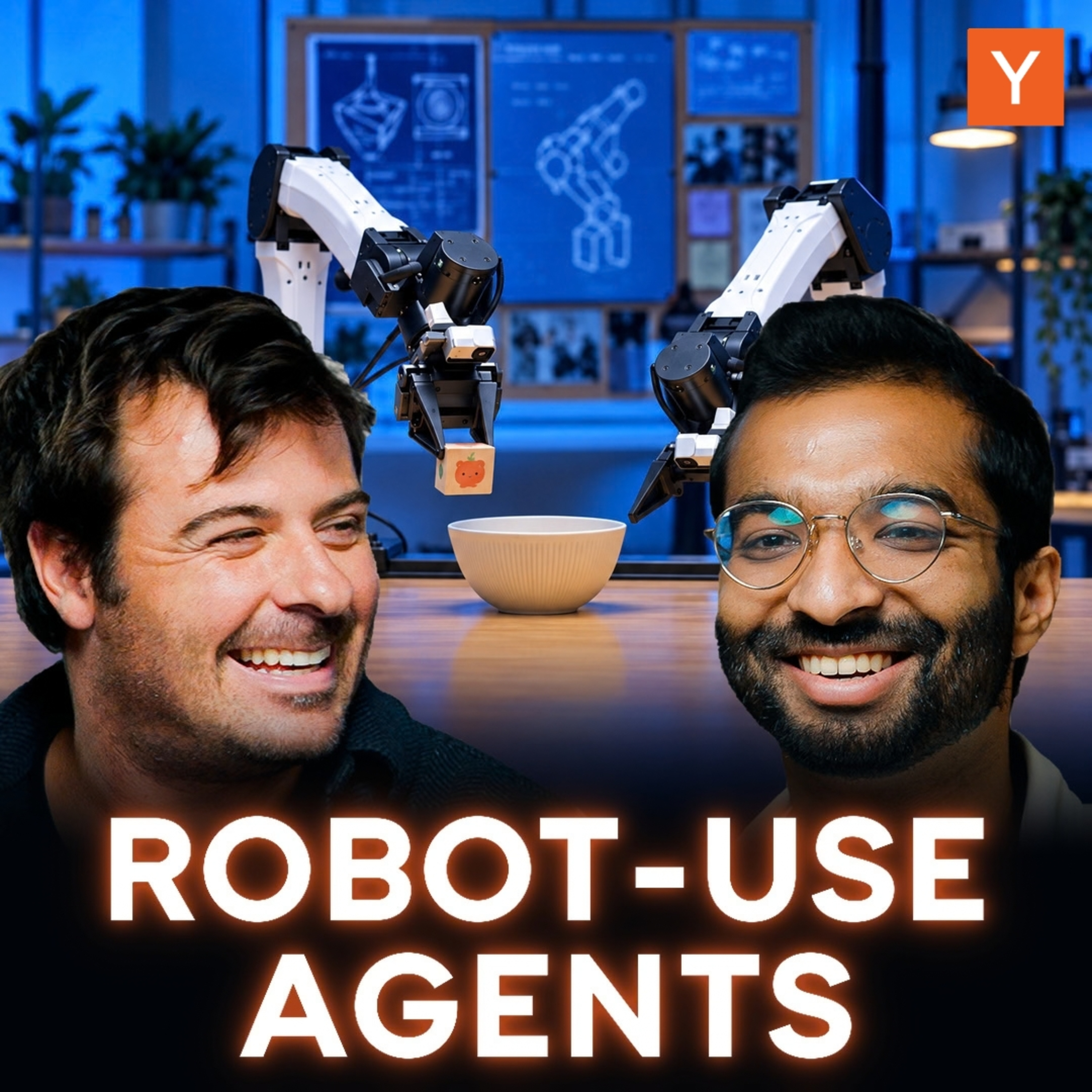
Y Combinator
General-purpose foundation models bypass scarce physical training data by translating robotic control into software code, setting up human-level manipulation within 24 months.
AI-assisted summary of Robot-Use Agents: Why General-Purpose Models May Win in Robotics — original source. Check the original for full context.
Source published:
Key ideas
- Frontier researchers and startups like Waddle Labs and RoboCurve are demonstrating that general-purpose coding agents can control diverse robot embodiments out of the box with little to no domain-specific retraining. (0:00)
- By shifting robot control from direct low-level token generation to code as a Chain of Thought, physical manipulation bypasses the severe teleoperation data bottleneck by piggybacking on web-scale code and tool-use datasets. (1:52)
- Spatial intelligence breakthroughs in frontier models stem largely from pre-training on computer-use traces and CAD software, allowing GUI interactions to supply the geometric priors needed for physical world manipulation. (23:01)
- Industry consensus across frontier labs projects general-purpose manipulation models capable of human-teenager parity within roughly two years, relying on offline 'sleep' consolidation loops to distill slow in-context reasoning into fast local policies. (26:15)
Detailed notes
## Background Published on September 26, 2026, by Y Combinator on their podcast Decoded via RSS and web feeds, this episode examines why general-purpose foundation models are emerging as the leading approach to robotics. The episode features the founders of Waddle Labs and RoboCurve discussing the research behind 'robot-use agents'—a paradigm popularized by MIT professor Philip Isola where coding and vision-language models control diverse robotic embodiments with minimal robot-specific training.
## TL;DR The discussion explores how modern coding agents bypass the physical data bottleneck in robotics by framing real-world manipulation as program induction and structured tool use. Drawing comparisons to RT-2 and the Chain-of-Thought breakthrough, the founders explain how code representations, GUI pre-training, and Philip Isola's Platonic Representation Hypothesis enable foundation models to generalize spatial reasoning zero-shot to hardware. They detail how software harnesses compile in-context experiences into deterministic skills, and outline a two-year horizon for general-purpose manipulation powered by an offline, biological 'sleep' consolidation loop that refactors slow foundation model reasoning into fast, low-latency policies.
## Atmosphere & style The conversation carries the electric, forward-leaning momentum of an insider whiteboard session among frontier AI practitioners who are watching theoretical bets pan out in real hardware. The hosts, François, and the founders share an easy, rapid-fire technical rapport, moving fluidly from abstract philosophy—like Rich Sutton's Bitter Lesson and Platonic representations—to tangible engineering bottlenecks like inference latency and inverse kinematics solvers. The mood is intellectually validating and quietly urgent, defined by a shared realization that general intelligence is breaking out of digital software stacks and directly into the physical world far faster than society expects.
## Bulletin - `00:00` Frontier researchers and startups like Waddle Labs and RoboCurve are demonstrating that general-purpose coding agents can control diverse robot embodiments out of the box with little to no domain-specific retraining. - `01:52` By shifting robot control from direct low-level token generation to code as a Chain of Thought, physical manipulation bypasses the severe teleoperation data bottleneck by piggybacking on web-scale code and tool-use datasets. - `23:01` Spatial intelligence breakthroughs in frontier models stem largely from pre-training on computer-use traces and CAD software, allowing GUI interactions to supply the geometric priors needed for physical world manipulation. - `26:15` Industry consensus across frontier labs projects general-purpose manipulation models capable of human-teenager parity within roughly two years, relying on offline 'sleep' consolidation loops to distill slow in-context reasoning into fast local policies.
## Key takeaways - `00:00` MIT professor Philip Isola's viral essay on 'robot-use agents' argues that general foundation models can orchestrate complex physical hardware via code without fine-tuning on dedicated robotics datasets. - `01:52` Early VLA architectures like RT-2 fine-tuned language backbones to output discrete Cartesian coordinates directly, forcing end-to-end mapping without intermediate reasoning compute. - `01:52` Using code as an explicit Chain of Thought offers lower Kolmogorov complexity, enabling models to generate compact, expressive programs that synthesize trajectories dynamically instead of outputting raw joint positions. - `04:47` Robotics has long been bottlenecked by scarce, expensive teleoperated demonstrations; translating control into code and API calls brings physical manipulation directly into the models' dense web-scale training distribution. - `07:22` The conceptual lineage of robot-use agents traces back to Minecraft agents like Voyager, which iteratively synthesized modular Python functions and saved them to an expanding skill library. - `10:00` Coding agents naturally possess procedural sequencing abilities, enabling single-shot assembly of parameterized functions into complex physical routines without robotics-specific fine-tuning. - `10:00` Pure in-context learning via prompt appending hits steep empirical walls, including non-monotonic performance, context saturation after 20 to 40 examples, and practical reasoning degradation before nominal context limits. - `15:00` Harness architectures convert ephemeral in-context execution traces into compiled, deterministic code routines, freeing up inference compute by keeping VLMs active only at high-variance decision points. - `15:00` Per François Chollet's thesis on intelligence, general sample efficiency requires program induction—generating dynamic programs mapping inputs to outputs—rather than informationally inefficient pure transduction. - `20:00` The Platonic Representation Hypothesis suggests that training across distinct modalities (text, code, CAD, egocentric video) converges toward a shared statistical world model that naturally supports physical manipulation. - `23:01` GUI interactions and CAD tool use instill spatial reasoning, depth, and 3D coordinate awareness; framing robot APIs as computer-use tools dramatically boosts out-of-the-box physical competence. - `26:15` Deploying foundation models in tight real-time robot control loops is latency-prohibitive, necessitating an offline 'sleep' phase inspired by DreamCoder and DAgger to distill in-context experiences into compact, high-speed policies.
## Detailed walkthrough ### `00:00` The Emergence of Robot-Use Agents
Over the past few years, one of the most unexpected developments in artificial intelligence has been the sheer degree to which coding agents generalize beyond traditional software engineering. Frontier researchers are now proving that this generalizability extends directly into the physical world to control robots. The phenomenon recently prompted MIT professor Philip Isola to publish a viral essay arguing that AI has entered the era of “robot-use agents”—a paradigm where general-purpose foundation models make diverse physical embodiments radically more capable with little to no domain-specific retraining. To explore the mechanics behind this shift, the hosts, joined by François, convene the founders behind two startups at the center of the movement: Han Mei and Vincent from Waddle Labs, and Jay from RoboCurve.
The founders’ work directly inspired Isola’s essay following several high-profile demonstrations that went viral on Twitter. The demos highlighted general-purpose large language models orchestrating complex manipulation tasks—such as unscrewing bottle caps, coordinating multi-robot handoffs, and uncapping a pen. Waddle Labs approaches the frontier by developing high-leverage evaluation harnesses that allow LLMs to control hardware effectively, gathering data from those runs, and feeding it back into training. RoboCurve focuses on the evaluation side of physical AI, benchmarking models across a wide variety of form factors, including anthropomorphic hands, parallel grippers, industrial arms, humanoids, and quadrupeds across both modern LLM agents and classic Vision-Language-Action (VLA) architectures.
- **Waddle Labs' Core Thesis:** Construct an effective software harness for LLM-based physical control, collect execution traces, and use that real-world interaction data to train more proficient models. - **RoboCurve's Evaluation Mandate:** Provide model- and embodiment-agnostic benchmarking covering LLMs, VLAs, and World Action Models (WAMs) across diverse hardware configurations. - **Viral Demonstrations:** Multi-robot collaboration, uncapping fine pens, and unscrewing bottle caps without task-specific policy learning.
---
`01:52` RT-2, Kolmogorov Complexity, and the Chain-of-Thought Shift
The conversation turns to the lineage of foundational research connecting language models to real-world control, beginning with Google DeepMind’s landmark RT-2 (Robotics Transformer 2) paper. RT-2 introduced the VLA framework by adapting a language model pre-trained on web text and images to output physical movements. Rather than outputting English text, RT-2 was fine-tuned to emit discrete tokens representing end-effector poses—Cartesian coordinates that an inverse kinematics solver translates into low-level joint commands. As Jay explains:
> “In some cases, in some sense, it's very similar to what we see now with large language models, just that instead of fine tuning, the models are good enough to just do it out of the box.”
```mermaid flowchart TD accTitle: Evolution of Robot Policy Architectures accDescr: Diagram contrasting RT-2 direct action token generation with the modern Code Chain-of-Thought agent architecture.
subgraph RT2["RT-2: Direct Token Generation"] A["Image + Language Goal"] --> B["VLA Model"] B -->|"Direct Low-Level Output"| C["End-Effector Pose Tokens"] C --> D["Joint Commands"] end
subgraph Agentic["Modern Agent: Code Chain-of-Thought"] E["Perception / Scene State"] --> F["General-Purpose LLM"] F -->|"Reasoning / Planning"| G["Scratchpad / CoT Code"] G -->|"Iterative Execution"| H["Executable Python Tools"] H --> I["Robot Hardware Control"] end ```
The hosts draw a direct historical parallel between the jump from RT-2 to robot-use agents and the pivotal “Chain-of-Thought” (CoT) breakthrough in mathematical reasoning benchmarks like GSM8K. In early mathematical evaluation setups, a model prompted with a simple arithmetic word problem—such as Susie having eight dollars and spending five—was forced to jump straight from input to output, producing four delimiter hash marks, the final answer, and an immediate end-of-sequence (`EOS`) token with zero intermediate compute. Once researchers unshackled models by giving them a scratchpad to reason step-by-step (`8 - 5 = 3`), performance surged. Similarly, RT-2 suffered from an architectural straightjacket: it was forced to map raw perception straight to motor actions without allocating inference-time compute to plan or break down complex tasks. By contrast, leveraging code as an explicit chain of thought provides a representation with vastly lower Kolmogorov complexity, enabling the agent to write compact, expressive programs that synthesize complex physical trajectories on the fly. Jay underscores this philosophical alignment with Rich Sutton's timeless doctrine:
> “If you give the agents or you give the AI model more autonomy and if you unshackle it, a bit more and give it more resources. It can actually do a lot of the things that we fine-tune it to do.”
---
`04:47` Swallowing the Bitter Lesson: Escaping the Robotics Data Bottleneck
Vincent expands on the implications of Sutton's Bitter Lesson, pointing out that VLAs are already built on top of language model backbones, meaning the real differentiator is not neural architecture but data distribution. For years, robotics labs have slammed into the severe data bottleneck inherent to collecting teleoperated real-world demonstrations, resulting in painfully sluggish progress across the field. Modern robot-use agents bypass this wall entirely by translating the physical control problem into a modality where data is already abundant, expressive, and well-understood by frontier models: code and structured tool use.
> “Like, how do you take something that is traditionally out of distribution, like robotics, and make it something that's in distribution?”
The core power of RT-2 was never its physical robotics data; it was the fact that the underlying backbone had already absorbed internet-scale web images and text. In the years since RT-2, state-of-the-art general-purpose models have developed profound in-context learning capabilities, tool use, and environment exploration. By leveraging these models directly through coding interfaces, researchers can sidestep fine-tuning brittle, task-specific policies. Vincent captures the team's governing design principle:
> “And so to me, it's like, okay, why not just build a really good foundational LLM and then use that to control robots rather than training a model that's specifically for robotics and that's more dependent on just robot data.”
- **The VLA Data Trap:** Physical robot interaction data remains expensive, scarce, and difficult to standardize across embodiments. - **Modality Transfer:** Transforming physical control into a programming and tool-calling problem brings physical tasks into the well-optimized training distribution of frontier models. - **The Modern LLM Tool Stack:** Frontier models can actively inspect robot APIs, write parameterized trajectory code, interpret runtime errors, and self-correct using in-context feedback.
---
`07:22` Code as Policies, Voyager, and the Unintended Liftoff of Coding Agents
To trace how the field reached this inflection point, the group revisits the origins of "Code as Policies"—a line of work that emerged in late 2022 alongside the release of ChatGPT, when automated code generation was largely restricted to comment autocompletion. Jay points to systems like Voyager in Minecraft as the true conceptual ancestor of current physical agents. In Voyager, an LLM started with simple Python built-in primitives (`for`, `while`, `sort`), used them to interact with the game environment, and iteratively wrote new modular functions—such as saving a custom tool as `Francois.py`—which it added to an expanding skill library to invoke later when facing harder challenges.
This architecture demonstrated that code could serve as a durable medium for compressing experience, abstract reasoning, and tool synthesis. However, when top AI lab leaders began aggressively pouring capital and compute into coding agents around 2024, their explicit goal was not physical robotics, but automating the software and machine learning engineering loops to reach recursive self-improvement. Jay points out the unintended consequence of that massive push:
> “I don't think they were so insightful to know that, oh, if I did this, then we will have LLMs that will be good enough to write policies for robotics.”
Earlier implementations, such as the original Code as Policies work from Google DeepMind, were severely constrained compared to modern agents. They relied on human engineers providing static, hand-crafted API wrappers—such as predefined functions for picking up an object, elevating the end effector, or translating to fixed coordinate poses. The model merely acted as a logic layer gluing together rigid primitives, a far cry from modern autonomous agents capable of generating expressive control code, dynamic feedback loops, and multi-robot orchestration from scratch.
`10:00` Coding Agents and the In-Context Learning Hierarchy
The discussion opens with how coding agents operate when exposed to physical hardware: developers provide a list of capabilities directly as Python functions. Because coding agents have been exposed to vast amounts of software engineering data, they can synthesize code orchestrating these functions into complex robotic behaviors in a single shot, without requiring supplementary robot datasets. They inherently possess an algorithmic sense of procedural sequencing—such as understanding what to execute first and second to place a block into a bowl. This one-shot capability and capacity for in-context exploration have served as the core catalyst driving teams like Waddle Labs to apply large language models (LLMs) to physical robotics.
```mermaid flowchart TD accTitle: In-Context Learning vs Weight Updates Hierarchy accDescr: Spectrum of learning methods from context-based updates to full weight fine-tuning.
subgraph ICL["In-Context & Retrieval Layer (Low Data Regime)"] A["Pure ICL Appending<br>(State, Action, Reward tuples)"] --> B["Self-Refine & Multi-Turn Reflection"] B --> C["Active Memory & RAG Retrieval<br>(Textbook lookup / Skill library)"] end
subgraph Weights["Parametric Updates Layer (High Data Regime)"] D["Low-Rank Adaptation<br>(LoRA Rank 1 - 100)"] --> E["Full SFT & RL<br>(End-to-end policy training)"] end
C -.->|"Distill / Compile"| D ```
Francois outlines an experimental framework analyzing sample efficiency: how best to feed a state-action-reward tuple back into an agent's policy. The simplest approach—appending feedback directly into the prompt context—yields cheap, immediate adaptation on validation tasks (such as held-out GSM8K benchmarks) without spending FLOPs on stochastic gradient descent (SGD). However, pure in-context learning (ICL) quickly hits harsh empirical limits:
1. **Non-monotonic improvement:** Performance fluctuates wildly, worsening and improving erratically across iterations. 2. **Rapid saturation:** Performance typically plateaus after 20 to 40 examples; appending further instances yields no accuracy gains. 3. **Effective context degradation:** If a model is trained on a 100,000-token context, its practical reasoning window is closer to 50,000 tokens. Beyond that threshold, attention degrades and performance falls off.
To scale beyond raw prompt stuffing, agents can load relevant examples dynamically into active memory via retrieval-augmented generation (RAG)—analogous to taking an open-book exam with a textbook rather than relying on raw memorization. Across the broader learning spectrum, this sits below parametric interventions like low-rank adaptation (LoRA at ranks 1, 10, or 100) and full supervised fine-tuning (SFT) or reinforcement learning (RL). While high-data autonomous vehicle operations like Tesla would never rely on ICL to steer cars, low-data robotics regimes benefit immensely from compressing ICL experiences directly into reusable tool calls.
- Pure ICL updates offer zero-FLOP parameter adaptation but are constrained by the model's post-training multi-turn self-reflection abilities. - Context saturation causes models to drop performance well before exhausting their nominal context window limit. - “And if you're Tesla and you have all the data, infinite data, and you're learning doing self-driving car by ICL, what are you doing?”
---
`15:00` Harnesses, Distillation, and Latency Scaling
The founders of Waddle Labs frame their robot execution harness as a mechanism for domain specialization. When a robot enters an unfamiliar operational setting—such as an automated wet lab handling biological assays—it acquires initial procedures in-context. Rather than forcing subsequent agents to re-derive these behaviors, the harness packages validated experiences into discrete, executable code routines. This program synthesis acts as a concrete distillation step, transforming ephemeral multi-turn memory into permanent, structured tools.
This architecture closely mirrors meta-learning paradigms: a larger, highly capable model programs and configures a smaller, faster model wrapped inside a specialized harness. Because theoretical research indicates that transformer forward passes during in-context learning can mathematically approximate gradient descent steps, the operational boundary between symbolic execution and neural weight space becomes fluid.
```mermaid flowchart LR accTitle: Harness Distillation Workflow accDescr: Big model compiles in-context experience into fast routines managed by a harness.
subgraph Meta["Meta-Level Planning"] BM["Large Frontier Model<br>(High latency / Complex reasoning)"] end
subgraph Exec["Runtime Execution"] Harness["Waddle Harness Engine"] Skill["Compiled Deterministic Skill<br>(Grasp, Approach, Transport)"] VLM["In-the-loop VLM<br>(Object checks & Failure detection)"] end
BM -->|"Programs & Specializes"| Harness Harness --> Skill Skill -->|"Exception / Branching"| VLM VLM -->|"State Recovery"| Skill ```
Analyzing a live demonstration where an agent controls robotic arms to move a block into a bowl highlights the mechanical differences between raw model streaming and harness-mediated control:
- **Direct Model Control vs. Harness:** In the un-harnessed setup, the model processes multi-camera streams and continuously outputs tool calls specifying end-effector poses. While flexible, this approach incurs substantial latency. - **Compiled Skills:** Routine mechanical motions (approaching a receptacle, grasping, linear movements) are fully deterministic once discovered and should run as compiled code outside the model's primary loop. - **Targeted VLM Insertion:** Vision-language models (VLMs) remain inside the policy graph strictly at points of high variance—such as identifying ambiguous objects or evaluating whether a grasp failed—providing adaptive fallback routines without stalling the entire loop. - **Inference Latency Velocity:** While current video control exhibits noticeable pauses, latency for reasoning-class models is dropping at approximately 2x per month, putting real-time closed-loop control on track to become viable by the end of the year.
Reflecting on the foundations of machine intelligence, the speakers connect this execution pattern to François Chollet's foundational work *On the Measure of Intelligence*. Chollet differentiated between pure transduction and program induction:
> “The biggest insight I think I've had a change in worldview on how to perform machine learning and how to get the rest of the distance on AGI was like a lot of conversations I've had with François Chollet.”
Directly mapping inputs to outputs ($X \to Y$) via pure transduction is informationally inefficient, demanding immense volumes of paired training data or massive hand-crafted inductive biases. Achieving generalizable sample efficiency instead demands program induction: using an expressive generator to synthesize programs that map inputs to outputs dynamically.
`20:00` Neurosymbolic Code Generation and the Platonic Representation Hypothesis
The conversation explores how code generation acts as an intuitive bridge between perception and action. The panel compares prompt-driven policy writing to a classic whiteboard coding interview: given inputs $X$ and desired outputs $Y$, the model's job is simply to synthesize a function $f$ that maps $X \to Y$. Historically, program synthesis struggled because researchers had to manually handcraft restrictive inductive biases to find that mapping. With modern frontier models, the paradigm has shifted toward neurosymbolic execution—neural networks that directly emit symbolic code.
```mermaid flowchart TD accTitle: The Platonic Representation Convergence accDescr: Diverse data modalities converging into a unified physical world model that feeds robotic execution. subgraph DataInputs ["Multimodal Data Streams"] A["Language & Code"] B["Computer-Use & GUIs"] C["CAD & 3D Assets"] D["Egocentric Video"] end subgraph FoundationModel ["Frontier Foundation Model"] E["Shared Latent World Model<br/>(Platonic Representation)"] end subgraph ActionOutput ["Robot-Use Execution"] F["Symbolic Code & Policies"] G["Physical Actuation"] end A --> E B --> E C --> E D --> E E --> F F --> G ```
This dynamic leads directly into MIT professor Philip Isola’s "Platonic Representation Hypothesis." Drawing an analogy to Plato’s allegory of the cave—where observers only see shadows cast by underlying reality—the hypothesis posits that disparate neural models trained across different objectives and data modalities inevitably converge on the same shared statistical structure of the physical world. For robotics, this has radical implications: a sufficiently powerful language and multimodal model will implicitly learn the same latent world model required for embodied manipulation. This serves as an ultimate validation of Rich Sutton's "Bitter Lesson," proving that massive scale on general data outpaces hand-engineered, domain-specific robotics architectures.
As one founder points out regarding this convergence: “And if that's the case, then if you have a really strong language model, you also have a really strong robotics model using if we believe in the platonic representation hypothesis.”
- Program synthesis traditionally failed due to the difficulty of engineering the right inductive biases to constrain search spaces. - Neurosymbolic systems resolve this by allowing neural weights to emit symbolic code representations directly. - The Platonic Representation Hypothesis suggests that training on web-scale text, computer interfaces, and vision converges onto a universal, unified model of physical reality. - The Bitter Lesson asserts that general compute and large models will consistently beat domain-tailored robotics pipelines.
---
`23:01` Computer-Use Data, GUI Pre-training, and Spatial Intelligence
The speakers turn to the mystery of spatial intelligence in newly released frontier models like OpenAI's Astra. Recent benchmarks show sudden, step-function jumps in spatial reasoning, 3D awareness, and CAD software control (such as driving Blender) that models from just six months prior could not perform. The group attributes this breakthrough to pre-training on massive amounts of "computer-use" data. When an AI agent learns to navigate an operating system—dragging a mouse cursor to orbit a 3D part in CAD or navigating complex menus—it implicitly learns spatial relationships such as depth, top-down alignment, and geometric perspective.
The panel reflects on the historical irony of this feedback loop. In the 1970s and 1980s, computer scientists at Xerox PARC invented the Graphical User Interface (GUI) by borrowing metaphors from the physical world: desktops, files, folders, and later, viewport orbiters in tools like SolidWorks and Autodesk. Decades later, because gathering physical robot interaction data at internet scale is prohibitively difficult, AI researchers train models on those virtual desktop simulations—and the models learn enough physics and geometry to control machines back in the real world. Research from Princeton and Cloud-based robotics labs demonstrates that when robot control harnesses are deliberately framed as computer-use tools (like letting an agent steer a robot by dragging an onscreen cursor), foundation models adapt to physical manipulation tasks with far higher zero-shot competence.
Reflecting on the recursive evolution of computing interfaces, one speaker observes: “I think it's so funny that if you go to 1980s, Xerox PARC or whatever, we literally made the graphical user interface to be more like the physical world so that we could interface with it.”
- Frontier models obtain rich spatial priors not from physical teleoperation alone, but from computer-use traces and CAD manipulation. - Interaction with GUIs instills foundational concepts of spatial reasoning, coordinate planes, and top-down versus lateral orientation. - Structuring robot APIs to mimic familiar desktop GUIs or cursor-drag tools allows out-of-the-box coding and agent models to operate hardware far more effectively. - Combining coding, computer use, and egocentric video into a single general-purpose model produces a more adaptable robot agent than fine-tuning on narrow robot datasets.
---
`26:15` The Two-Year Horizon and the "Sleep" Consolidation Architecture
Looking forward, the founders highlight an emerging consensus inside frontier research labs and robotics foundation companies: general-purpose robots are likely only two years away. By "general-purpose," they envision a system that can be given arbitrary natural language commands and achieve physical manipulation parity with a competent human teenager using their bare hands—a true "ChatGPT moment" for embodied AI that society remains largely unprepared to meet.
However, real-world deployment faces severe runtime bottlenecks, primarily inference latency. Running a massive model like Astra in the tight closed-loop control of a robotic arm at every millisecond step is far too slow and economically prohibitive. To solve this, the founders argue for an architecture mirroring biological sleep and memory consolidation. During daytime operation, the robot records interactive state-action-reward $(s, a, r)$ trajectories in-context. Later, in an offline "sleep" phase—analogous to how the human brain's hippocampus uses sharp-wave ripples to replay and transfer short-term memories into the neocortex—the system consolidates those slow, deliberative reasoning traces into lightweight, high-speed local policies using frameworks like DAgger (Dataset Aggregation) and program refactoring inspired by MIT’s DreamCoder.
Highlighting the rapid timeline and societal underestimation of embodied agents, Jay emphasizes: “And when we say general purpose robots, we mean something like if you give any natural language instruction, it can do what a competent teenager could do with their bare hands.”
```mermaid flowchart LR accTitle: Two-Stage Deployment and Sleep Consolidation Loop accDescr: Fast execution loop backed by slow foundation model reasoning and an offline sleep consolidation phase. subgraph WakePhase ["Active Execution (Wake Phase)"] A["Task Prompt"] --> B["Astra / Frontier Model<br/>(In-Context Reasoning)"] B --> C["High-Latency Action / Skill"] C --> D["State-Action-Reward<br/>Traces (s, a, r)"] end subgraph SleepPhase ["Memory Consolidation (Sleep Phase)"] D --> E["Hippocampal-Style Replay<br/>& Skill Refactoring"] E --> F["DAgger Distillation"] F --> G["Compact, Low-Latency<br/>Weight Policy"] end G -.->|"Deploy Fast Model"| C ```
- Frontier AI labs anticipate that general-purpose manipulation models capable of open-vocabulary physical tasks will arrive within roughly 24 months. - Direct closed-loop foundation model inference is too slow and costly for sustained high-throughput factory or home manipulation. - Biological consolidation provides the blueprint: fast in-context collection during waking tasks, followed by an offline sleep cycle that compresses experiences into low-latency policy weights. - Drawing on DreamCoder's program-library synthesis and DAgger distillation, startups like Waddle Labs are focusing on the orchestration layer: pruning, refactoring, and maintaining a dynamically growing codebase of modular physical skills.
## Notable quotes > `26:15` when we say general purpose robots, we mean something like if you give any natural language instruction, it can do what a competent teenager could do with their bare hands. — Jay
> `04:47` why not just build a really good foundational LLM and then use that to control robots rather than training a model that's specifically for robotics and that's more dependent on just robot data — Vincent
## Mentioned Philip Isola, Waddle Labs, RoboCurve, Han Mei, Vincent, Jay, Google DeepMind, RT-2, Rich Sutton, Voyager, Tesla, François Chollet, On the Measure of Intelligence, Astra, OpenAI, Xerox PARC, Blender, SolidWorks, Autodesk, DreamCoder, DAgger
## Video description <p>One of the biggest surprises in AI over the last few years has been how well coding agents generalize beyond software. In a recent essay, MIT professor Philip Isola argued that we may be entering the era of robot-use agents: general-purpose models that can control different robots, write policies, and learn new physical tasks with little or no robot-specific training.In this episode of Decoded, we're joined by the founders of Waddle Labs and RoboCurve, two of the startups whose work helped drive this realization. They're working at the frontier of using general-purpose models to control robots, and their recent demos helped inspire the growing conversation around robot-use agents. </p><p>Together, we dig into the research behind that idea, from code-as-policies and vision-language-action models to the harnesses and evals needed to make these systems work in the real world.</p>
[Source](https://anchor.fm/s/8c1524bc/podcast/play/126339684/https%3A%2F%2Fd3ctxlq1ktw2nl.cloudfront.net%2Fstaging%2F2026-8-26%2F432708848-44100-2-ba9049a9c4a07.mp3)