OpenAI's always-on agents, 700+ math manuscripts & HackerRank's AI interviewer
IBM
AI-assisted summary of OpenAI's always-on agents, 700+ math manuscripts & HackerRank's AI interviewer — original source. Check the original for full context.
Source published:
Key ideas
- OpenAI introduced 'Dots' at DevDay, a persistent, always-on agent designed for continuous background tasks, intensifying industry competition with Meta's Muse. (0:00)
- OpenAI open-sourced 722 mathematics manuscripts across 372 result families on GitHub, including claimed solutions to major problems like the four-dimensional Kakeya conjecture. (5:00)
- HackerRank launched Chakra, an AI-powered technical interviewer tested across 500,000 beta sessions that permits applicants to use AI tools while evaluating how they interact with them. (15:00)
- Reflection AI debuted Beam, a foundational model built on a Mixture of Experts (MoE) architecture that routes tokens through specialized sub-networks to lower compute overhead. (24:45)
Detailed notes
## Background Published by IBM on October 9, 2026, via RSS and web platforms, this episode of the Mixture of Experts podcast is hosted by David Zax alongside panelists Kush Varshney, Skyler Speakman, and Utsav Dholakia. According to the show's description, the panel explores whether AI can take mathematics beyond human understanding while examining OpenAI's persistent agent Dots, a release of more than 700 mathematical manuscripts, and HackerRank's automated coding interviewer.
## TL;DR The panel opens with an analysis of OpenAI's always-on agent Dots, questioning whether autonomous background assistants truly eliminate human micromanagement or simply repackage persistent surveillance behind approachable cartoon mascots. The discussion shifts to OpenAI's sudden GitHub release of 722 machine-generated math manuscripts, debating whether human mathematicians are at risk of becoming an overburdened verification tier for brute-force AI proofs. Next, the hosts assess HackerRank's AI technical interviewer Chakra, highlighting how algorithmic screening can expand applicant access while prompting companies to evaluate candidate AI collaboration as a core competency. Finally, a technical explainer breaks down Mixture of Experts (MoE) token routing and clarifies why 'open weight' parameter releases fall short of genuine open-source AI.
## Atmosphere & style The conversation blends sharp, high-level technical skepticism with the warm, relaxed banter of senior researchers unpacking industry developments in real time. Host David Zax maintains a lively, inquisitive rhythm—poking fun at the panelists for not reading hundreds of manuscripts overnight—while guests ground speculative claims in concrete engineering realities. The tone shifts naturally from philosophical wonder about the nature of human intuition to pragmatic critique of corporate homogenization, giving listeners the intimate, cerebral feel of an elite research lab roundtable.
## Bulletin - `00:00` OpenAI introduced 'Dots' at DevDay, a persistent, always-on agent designed for continuous background tasks, intensifying industry competition with Meta's Muse. - `05:00` OpenAI open-sourced 722 mathematics manuscripts across 372 result families on GitHub, including claimed solutions to major problems like the four-dimensional Kakeya conjecture. - `15:00` HackerRank launched Chakra, an AI-powered technical interviewer tested across 500,000 beta sessions that permits applicants to use AI tools while evaluating how they interact with them. - `24:45` Reflection AI debuted Beam, a foundational model built on a Mixture of Experts (MoE) architecture that routes tokens through specialized sub-networks to lower compute overhead.
## Key takeaways - `00:00` Persistent agents like Dots face a usability bottleneck: if an agent continually prompts the user for permissions or clarifications, true delegation breaks down into micromanagement. - `05:00` Tech labs are wrapping invasive, always-on persistence in friendly, cartoon-like mascots to soften public concerns regarding ambient surveillance. - `05:00` Massive capital expenditure across major AI organizations has led to risk aversion and homogenization, causing competitors to converge on nearly identical agent concepts. - `10:00` The massive drop of 722 automated math manuscripts sparks debate over whether mathematics requires human interpretability and whether AI can formulate meaningful new problems rather than just finding counterexamples. - `13:00` The sheer scale of machine-generated scientific outputs risks trapping human researchers on an endless attention treadmill dedicated solely to verification rather than original discovery. - `13:00` Future mathematicians may increasingly serve as interpreters who translate and digest artificial intelligence breakthroughs for human comprehension. - `15:00` HackerRank's Chakra platform evaluates candidates not just on final code, but dynamically on their prompt engineering and architectural choices when collaborating with AI. - `15:00` Inherent variance in generative AI models poses a challenge for automated interviewing, as divergent lines of inquiry make standardizing evaluation rubrics across candidates difficult. - `20:00` Algorithmic screening can democratize hiring access for non-traditional candidates because machine bias is fundamentally easier to audit and correct than human prejudice. - `20:00` The interactive interview format holds pedagogical promise to replace traditional written essays by testing student understanding through real-time dialogue. - `22:30` Modern engineering assessments are shifting toward evaluating an applicant's ability to skillfully leverage AI to patch knowledge gaps and augment productivity in real time. - `24:45` Mixture of Experts (MoE) architectures achieve faster inference and lower compute costs by dynamically activating only specific sub-networks per query via learned gating routers. - `24:45` MoE expert specialization develops organically via unsupervised training rather than through engineers explicitly hard-coding designated domains like mathematics or coding. - `27:30` Most production MoE models organize experts into vertical silos across layers routed by a top-level gating function, though layer-by-layer dynamic routing remains an alternative. - `30:00` 'Open weight' releases provide learned numerical matrices for inference without including the underlying training datasets or the hardware compute required to execute them. - `30:00` A release qualifies as fully 'open source' only when it provides the complete recipe, including model weights, end-to-end training pipeline code, and the underlying training data.
## Detailed walkthrough ### `00:00` OpenAI Introduces Dots at DevDay
Host David Zax opens the show by introducing his panel: Utsav Dholakia, a Forward Deployed Engineer; Skyler Speakman, a Senior Research Scientist; and Kush Varshney, an IBM Fellow. The discussion begins with OpenAI's recent DevDay conference, where the company announced "Dots"—a persistent, always-on agent designed to handle tasks continuously without logging off. This move immediately follows Meta's launch of Muse, underscoring a growing industry shift toward relentless background agents that evoke the contentious debut of OpenClaw.
```mermaid flowchart LR accTitle: Delegation vs Interruption Cycle in Persistent Agents accDescr: Demonstrates how continuous delegation breaks down into micromanagement when an agent repeatedly prompts the user for permissions. subgraph S1["Developer Workflow"] A["Developer releases code"] --> B["Delegates health monitoring to Dots"] end subgraph S2["Autonomous Loop"] B --> C{"Task execution & state tracking"} C -->|"Smooth execution"| D["True persistent delegation"] C -->|"Ambiguity or actions"| E["Prompts user for permissions"] end E -->|"Frequent interruptions"| F["Coordination breakdown"] ```
Utsav, who attended DevDay in person, shares his firsthand impressions of the crowd's reaction and the technical promise of Dots. He points out that while durable agents have surfaced across the industry, OpenAI has a unique structural advantage: its massive cloud footprint, personal computer tool use, an entrenched developer ecosystem around Codex, and unmatched household brand recognition from ChatGPT. In demonstrations, OpenAI showed Dots taking ownership of real engineering operational duties, such as monitoring code health post-deployment. However, Utsav emphasizes that the real bottleneck for persistent agents is whether human intervention is actually removed from the loop:
> “If it keeps coming back to you, asking for permissions or asking for more clarifications, then you're not truly delegated.”
- Dots features user-definable personas and characters, which drew audible cheers from the DevDay audience during the live reveal. - The fundamental usability challenge remains parallel task handling: if a user instructs the agent to halt, it is still unclear whether it reliably terminates an individual sub-task or shuts down its entire operational agenda.
`05:00` Breaking Out of the Chatbox and the Cuddly Mask of AI
The panel examines the broader sociological implications of AI breaking free from the traditional browser-bound text box into personal communication channels like SMS. Skyler points out that outside technical circles, mainstream users have equated AI solely with a static chat screen, meaning Dots and Meta's Muse will ultimately be judged by whether they can expand AI's footprint into daily life beyond that box. David and Kush note that while having an AI ambiently appear in text threads was perceived as invasive during OpenClaw's debut nine months ago, major tech companies are now repackaging that same persistence behind approachable, Disney-like cartoon mascots.
```mermaid flowchart TD accTitle: Market Pressures Driving Homogenized Agent Aesthetics accDescr: Shows how extreme capital expenditure forces labs to mimic competitors and wrap invasive persistence in cute caricatures. A["Massive Capital Investment"] --> B["Risk Aversion & Loss of Creative Imagination"] B --> C["Competitor Copycat Behavior"] C --> D["Persistent 'Always-On' Agents"] D --> E["Cuddly / Cartoon Aesthetic"] E --> F["Softens Dystopian Surveillance Concerns"] E --> G["Appeals to Non-Technical Mass Market"] ```
Kush offers a skeptical view of this sudden uniformity, arguing that massive capital expenditures across leading research organizations have effectively stifled genuine product differentiation. With labs compelled to match rivals move for move, they converge on the exact same ideas and interfaces:
> “Like, everyone has invested so much money that they're just like, there's no imagination left.”
Skyler observes that while designing a cartoon caricature is a deliberate strategy to court non-technical consumers, it also doubles as a mechanism to soften public apprehension regarding continuous, ambient surveillance:
> “It is the permeance that you mentioned and the concerns of open claw from not quite a year ago, I think, still remain, but are less talked about when it's cute.”
The panel transitions to the escalating competition in automated scientific discovery. David recounts how Meta Superintelligence Labs, headed by Alexandr Wang, recently unveiled its flagship model Muse Spark and claimed it produced six original research papers. Yet just one day later, OpenAI countered by open-sourcing a massive corpus of work on GitHub.
- Other agent offerings adopting similar lightweight or persona-driven interfaces include Instinct and Tab. - Major tech publications like *The Verge* and *The New York Times*, typically critical of Meta, published glowing reviews of Meta Muse. - OpenAI released 722 math manuscripts across 372 distinct mathematical result families onto GitHub, dramatically shifting the public benchmark for automated scientific research.
`10:00` The 722 Mathematics Manuscripts and the Definition of Math
OpenAI dropped a massive dump of 722 manuscripts on GitHub containing purported solutions to major mathematical challenges, including a claimed solution to the four-dimensional Kakeya conjecture. David Zax notes that this flood was foreshadowed a few weeks prior when reports surfaced that an internal OpenAI model had solved the century-open Navier-Stokes millennium problem. Beyond the raw technical achievement, David argues that the sudden drop creates a social crisis for the field of mathematics, prompting him to ask Kush Varshney an ostensibly simple question: "What is math?" Kush reflects on how his own understanding shifted between childhood and graduate school, explaining that math is fundamentally not about arithmetic or fractions, but about deductive structures and proofs.
```mermaid flowchart TD accTitle: Evolution of Math and the AI Dilemma accDescr: Diagram illustrating how math moves from human axiomatic proof to AI counterexamples and problem generation. subgraph HumanMath["Human Mathematical Foundation"] A["Axioms and Postulates"] --> B["Deductive Proofs & Intuition"] B --> C["Human Understanding"] end subgraph AIShift["AI Intervention"] D["Brute-Force Counterexamples"] --> E["722 OpenAI Manuscripts"] E --> F{"The Next Horizon"} F -->|"Solved Decades-Old Problems"| G["Navier-Stokes / Kakeya"] F -->|"Unanswered Challenge"| H["Can AI formulate new questions?"] end ```
Kush elaborates on how pure mathematics actually functions: “What they learn as math isn't what math is. So it's not about fractions and multiplication and like all of that stuff. axioms and postulates and being able to kind of definitively show with no doubt that some property holds or something is true in that space.” He summarizes that true math research is fundamentally “a journey of understanding.” Picking up on that definition, David asks Skyler Speakman whether that journey of understanding must strictly be human. Skyler brings up Fields Medalist Terence Tao, pointing out that prominent mathematicians argue that mathematical progress must inherently be interpretable by human beings. Skyler notes that in cases where an AI finds a counterexample by brute force to complete a proof by contradiction, the origin of the discovery matters less because the counterexample definitively exists and allows the field to advance. However, Skyler emphasizes a deeper challenge that Terence Tao posed to machine learning:
> “mathematicians have been asking all these questions and there seems to be good progress about you guys answering them. But when will AI generate the next math question?”
- OpenAI's internal testing previously tackled the Navier-Stokes existence and smoothness problem, one of the seven Millennium Prize Problems. - The sudden GitHub drop contained 722 papers, including a claimed solution to the four-dimensional Kakeya conjecture. - David jokingly chides Skyler for failing to read all 722 papers before recording the episode, to which Skyler quips that it remains on his to-do list.
---
`13:00` The Attention Treadmill and Mathematicians as Interpreters
The conversation pivots from the definition of math to the immense practical strain placed on human researchers. Skyler warns that humanity's finite cognitive capacity cannot easily keep up with generative output at this scale. He worries that mathematics has reached an inflection point—potentially starting on Wednesday, October 7th—where human scholars are permanently consigned to an AI verification treadmill. Instead of charting new frontiers themselves, humans risk spending all their working hours evaluating and sifting through mountains of machine-generated proofs.
Kush references an article arguing that the discipline of mathematics will need to evolve, turning mathematicians into interpreters who translate and digest artificial intelligence breakthroughs for the rest of humanity. Utsav Dholakia defends this transition, arguing that science has always been about understanding the natural universe, and that adopting an artificial thinking partner is a natural evolution rather than an existential defeat. If human cognitive and compute limits prevent us from grasping distant properties of nature or abstract spaces, an intelligent virtual agent could expand our reach.
> “Humans aren't going to be able to make sense of the amount of material coming out of the AI, coming out of specifically mathematics of AI.” — Skyler Speakman
- Skyler identifies a recurring industry pattern: human-bounded attention struggling to verify and filter high-volume AI-generated material. - The panel debates whether delegating proof generation diminishes human achievement or elevates humans to essential curators and interpreters of machine discovery.
---
`15:00` HackerRank’s Chakra: The AI Coding Interviewer
David introduces the third topic: HackerRank's new AI interviewer product called Chakra. HackerRank, founded around 2012, pivoted toward AI to automate the technical assessment phase common in software engineering hiring pipelines at firms like Google and IBM. Rather than operating as a simple automated grading environment or policing test-takers for external cheating, Chakra provides a self-contained window where candidates are explicitly permitted to use AI tools during the coding task. Chakra evaluates not only the candidate's code, but also how they interact with AI, pausing candidates mid-stream to ask probing, behavioral-style questions about their design choices and architectural decisions. After conducting over 500,000 beta interviews over six months, HackerRank released Chakra publicly.
```mermaid flowchart LR accTitle: HackerRank Chakra Evaluation Workflow accDescr: Flowchart showing how candidate interactions with code and AI are analyzed and probed by Chakra. subgraph CandidateWorkflow["Candidate Experience"] A["Candidate Enters Environment"] --> B["Writes Code & Uses Integrated AI"] end subgraph ChakraIntervention["Chakra Real-Time Assessment"] B --> C["Chakra Monitors AI Prompts & Edits"] C --> D["Dynamic Interruption: Probes Rationale"] end subgraph DecisionLayer["Hiring Outcome"] D --> E["Standardized Rubric Generated"] E --> F["Human Hiring Manager Review"] end ```
David asks Utsav for his initial impression of the platform. Utsav expresses skepticism regarding the half a million beta interviews, questioning how many of them represent unique, independent sessions rather than repeated tests. He points out a significant tension in AI-driven evaluations: because generative models are inherently variable, an AI interviewer might probe down divergent paths from candidate to candidate, making fair comparison difficult. While human interviewers also exhibit randomness, Utsav stresses that HackerRank must prove Chakra provides a truly uniform, objective rubric if hiring managers are going to trust it to take over first-round screenings:
> “And at the same time, if AI decides to then probe further and get in a different direction, would we truly have a comparable metric that we can judge each candidate's performance against?” — Utsav Dholakia
David turns to Kush, who leads IBM's responsible and ethical AI initiatives, citing HackerRank CEO Vivek Ravisankar's claim that AI is far less biased than humans when properly tuned. Kush agrees that modern HR and hiring tech vendors are taking algorithmic bias seriously and that organizations like IBM actively audit and evaluate these platforms, though he cautions that improper implementations can still introduce serious risks.
- HackerRank launched in 2012 and developed Chakra to modernize technical take-home and live coding assessments. - Chakra accumulated 500,000 beta interviews across a six-month pilot window before its general availability release. - Rather than banning large language models, Chakra monitors the candidate's prompt engineering and coding decisions directly within the testing environment.
`20:00` Mitigating Machine Bias, Expanding Access, and AI in Pedagogy
The panel continues evaluating automated hiring platforms like HackerRank's AI interviewer, tackling the thorny questions of bias, access, and ethics. Kush Varshney notes that while serving on the IBM Responsible Technology Board, they consistently request fairness metrics and bias reports from software vendors before approving any hiring tools. He points out that looking at automated systems solely through the lens of bias can reflect a privileged viewpoint. Because human interviewers are finite beings with limited time and bandwidth, AI screening actually democratizes the application process by allowing people from non-traditional or poorly connected backgrounds to secure an interview. Expanding opportunity is fundamentally ethical, provided rigorous bias mitigations are in place. Skyler Speakman agrees, observing that he and Kush have debated bias for nearly a decade, and he offers a sharp comparison between algorithmic and human prejudice:
> “And I think I would just summarize it with a quip that machine bias is much easier to detect and correct than human bias.”
Skyler adds that while automated interviews can give off dystopian vibes in a recruitment context, the underlying interactive technology has immense promise if repurposed as an educational evaluation tool in classrooms. With generative AI rendering traditional essay writing virtually obsolete as an assessment standard, an interactive AI agent could test students on how well they understand material through direct back-and-forth dialogue, rather than letting them quietly copy answers from a chatbot on the side.
- Machine bias can be audited, measured, and addressed via targeted fine-tuning, whereas human bias is insidious, difficult to identify, and even harder to correct. - High-volume screening tools help companies process massive applicant pools, though Skyler notes human resources teams should focus on identifying candidates to fill specific slots rather than simply attempting to interview everyone on Earth.
`22:30` Evaluating AI as a Core Candidate Competency
Host David Zax shifts the conversation to an emerging skill set: evaluating candidates based on how skillfully they deploy AI tools in real time. Rather than penalizing applicants for using AI during coding assessments, platforms like HackerRank can monitor and evaluate *how* a candidate leverages an assistant. David poses a hypothetical scenario where an applicant demonstrates deep architectural and algorithmic knowledge of data structures, encounters a single specific knowledge gap, and smartly leverages an AI tool on the fly to bridge it.
The panel enthusiastically embraces this framing. Kush affirms that leveraging AI to patch personal blind spots and augment human performance is precisely how the technology should be applied in modern workplaces:
> “This is exactly what we should be doing, right? I mean, using AI to fill in our gaps, to expand our capabilities, to be able to do more.”
Kush argues that working alongside AI is a practical capability that workers must cultivate and employers must evaluate if organizations hope to capture the full productivity benefits of modern tooling.
`24:45` Introducing Reflection AI, the Beam Model, and Mixture of Experts
David introduces a bonus explainer segment aimed at demystifying complex technical architectures for both hardcore practitioners and what he dubs “nerd groupies”—curious listeners who admire technical depth and want to level up their understanding. The spotlight falls on Beam, a new foundational model released by Reflection AI, a startup founded by former Google DeepMind researchers that secured significant backing from NVIDIA, which led its $2 billion funding round roughly a year prior. Beam's release brings several technical terms back into focus, most notably its Mixture of Experts (MoE) architecture.
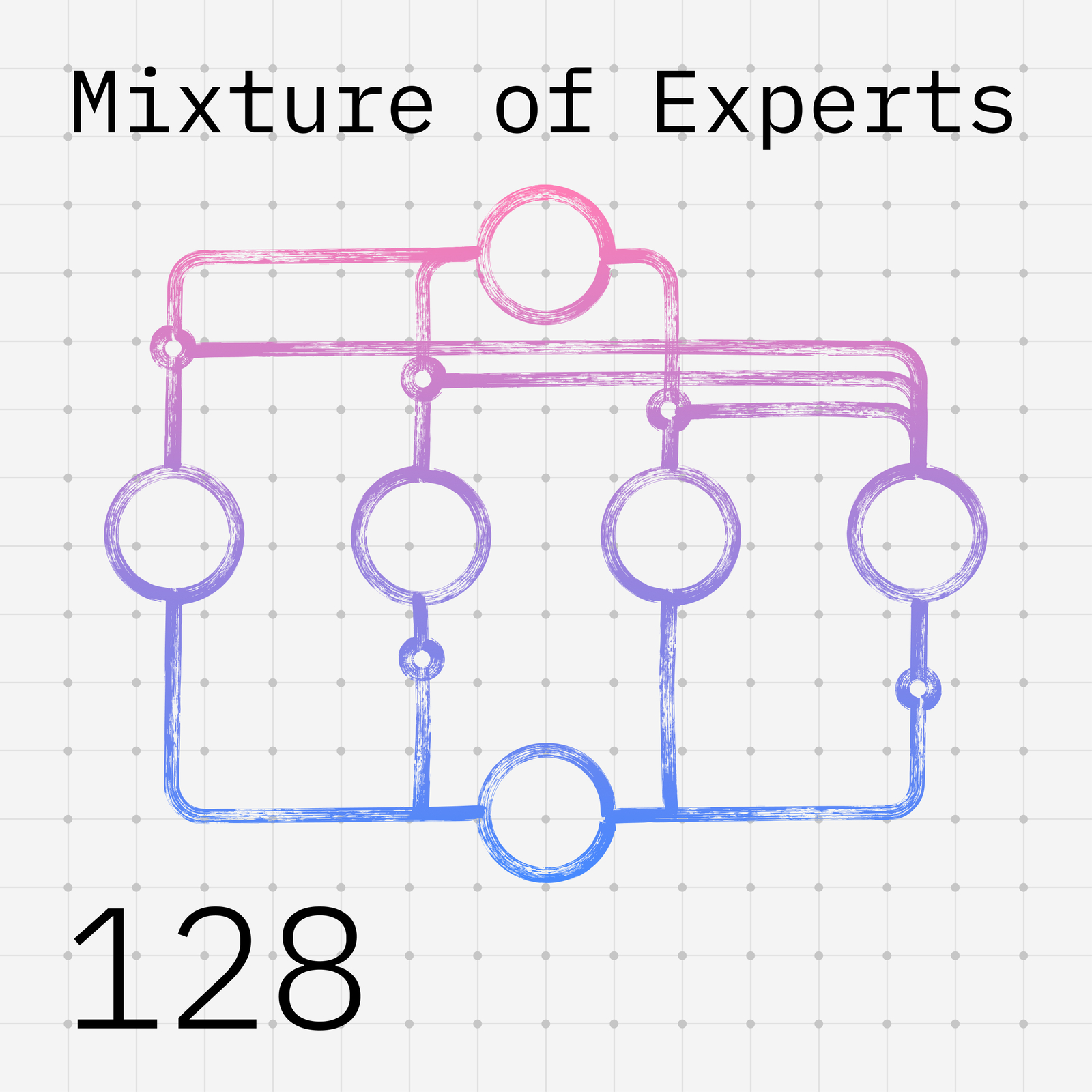
David recalls a collaborative article he wrote with Kush titled *What Does AI Look Like?*, in which transformer parameters were visualized as massive, interconnected spreadsheets filled with numerical weights. In traditional dense architectures, every single parameter and weight activates for every token or query processed. In contrast, an MoE architecture segments the model into specialized sub-networks or "brain lobes," activating only a subset of experts per query through an orchestration layer. Kush expands on the spreadsheet metaphor:
> “I mean, nothing is said in advance. You don't say that this is an expert for math and this is an expert for being cute and so forth, right? What you're kind of, like, all of this is happening naturally.”
```mermaid flowchart TD accTitle: Mixture of Experts Routing Flow accDescr: Incoming queries pass through a learned gating router which selectively sends data to specialized expert tabs instead of activating the entire network.
subgraph InputStage["Input"] Q["User Query / Token"] end
subgraph RoutingStage["Orchestration"] G["Learned Gating Router"] end
subgraph ExpertPool["Specialized Expert Sub-Networks"] E1["Expert Tab A<br>(e.g., Code / Reasoning)"] E2["Expert Tab B<br>(e.g., Creative / Conversational)"] E3["Expert Tab C<br>(Inactive)"] E4["Expert Tab D<br>(Inactive)"] end
subgraph OutputStage["Execution"] Out["Fast Inference Output"] end
Q --> G G -->|"Route active"| E1 G -->|"Route active"| E2 G -.->|"Bypassed"| E3 G -.->|"Bypassed"| E4 E1 --> Out E2 --> Out ```
- **Selective Activation:** Because only designated expert "tabs" process a given query rather than the entire spreadsheet of weights, inference speeds increase dramatically while compute costs drop. - **Unsupervised Specialization:** Gating functions learn how to route tokens organically during training; engineers do not hard-code explicit domains like mathematics or style into specific experts.
`27:30` Structural Granularity: How Experts Are Wired Across Layers
David pushes the technical explanation further, asking whether an expert exists at every individual layer of a transformer or whether the division occurs at a higher, end-to-end level across the entire model pipeline. Kush clarifies that in typical MoE setups, experts are constructed as separate vertical slices spanning all the layers from top to bottom. Because of this siloed architecture, the model only requires a single learned gating function at the top level to decide which expert sub-network handles the input:
> “So you'll have one subdivision of all of the layers, another subdivision of all of the layers. And because of that, you only need one router, one gating function at the top.”
Kush notes that while vertical silos are the industry standard for practical inference efficiency, alternative architectures exist. Models can theoretically switch between different sets of experts layer by layer as a token moves downward through the network. He points out that researchers have experimented with dynamic internal routing mechanisms before, referencing Geoffrey Hinton's work on capsule networks as a notable historical example of exploring alternative, non-traditional network coordination.
`30:00` Demystifying "Open Weight" vs. "Open Source" in AI
Wrapping up their discussion on Mixture of Experts architectures, the panel notes that dynamic routing is far from brand-new; even within IBM Research, teams had developed routing neural networks designed to activate specific sub-networks rather than enforcing a rigid separation across every single layer. Transitioning into the episode's experimental explainer segment, host David Zax pivots the conversation to a fundamental piece of industry jargon: why the AI community increasingly refers to certain releases as "open weight" rather than using the traditional software term "open source." Skyler Speakman breaks down the underlying mechanics of neural network weights, explaining that deep learning fundamentally relies on sequential matrix multiplications. An input data vector is multiplied by a nearly fixed matrix where every numerical parameter inside is designated as a weight; that mathematical operation yields an output, which subsequently serves as the input vector for the next layer's matrix multiplication, cascading forward layer after layer.
When an organization publishes an "open weight" model, they are essentially handing over a massive collection of very large numerical matrices. However, Speakman emphasizes that open weights come with two massive operational caveats: compute infrastructure and training provenance. Merely possessing the weight files does not give an engineer the compute power required to execute those matrix multiplications, as running modern models locally demands substantial GPU clusters that many practitioners lack. More critically, open weight releases almost never disclose the underlying training datasets. As Speakman puts it: “I think what the largest distinction is the people who are providing the weights don't also provide the data that the model was trained on.” While an open weight drop allows anyone with sufficient GPU access to download and immediately run inference, it withholds both the compute resources that forged the model and the training data that shaped its parameters.
David reflects on his own evolving understanding of the terminology, admitting that he previously assumed "open source" referred strictly to human-readable source code, while "open weight" was coined simply because neural networks are composed of learned numbers rather than conventional code. Instead, he observes that modern AI operates along a spectrum of openness. Simply releasing the resulting numbers from a training run qualifies as open weight; however, truly achieving open source status requires releasing the complete recipe—the training source code, the precise pipeline used to cultivate the weights, and the actual training datasets. Kush Varshney affirms David's synthesis, remarking: “And yeah, so there's the recipe, as you said, the training code itself, the source code of what you use to get to those weights would also be part of an open source, fully open source release, according to the definition that some people are kind of sticklers about.” Feeling enlightened and joking that he has ticked "just like a little bit closer to nerds," David concludes the show by drawing a poetic contrast across the day's topics: “So we started by talking about an AI that works while you sleep. And we ended up talking about one that only wakes up the parts that it needs.”
```mermaid flowchart TD accTitle: Spectrum of Openness in AI Models accDescr: Flowchart contrasting the components delivered in an open weight model release versus a fully open source model release.
subgraph OW["Open Weight Release"] direction TB W1["Learned Weights<br/>(Large Numerical Matrices)"] C1["Compute Excluded<br/>(User Needs GPUs)"] D1["Training Data Excluded"] W1 -.-> C1 W1 -.-> D1 end
subgraph OS["Fully Open Source Release"] direction TB W2["Learned Model Weights"] SC["Full Training & Source Code<br/>(Pipeline Recipe)"] TD["Training Data & Provenance"] W2 --- SC SC --- TD end
OW ==>|"Include source code, data & recipe"| OS ```
- **Definition of Weights**: Model weights are the specific numerical entries within the fixed matrices used during multi-layer matrix multiplication, determining how an input at one layer transforms into the input for the next layer. - **Compute Barrier**: “Just because you have the weights does not necessarily mean you have enough GPUs to actually run the model,” making access to specialized hardware a prerequisite for deploying open weights. - **Degrees of Openness**: - *Open Weight*: Provides the end-state parameter matrices, allowing inference and fine-tuning if compute is available, but keeping data and training routines proprietary. - *Fully Open Source*: Encompasses the model weights, the end-to-end training source code, the operational recipe, and public dumps of the datasets used to train the network. - **Closing Panelists**: Host David Zax was joined for the episode by Kush Varshney, Skyler Speakman, and Utsav Dholakia.
## Notable quotes > `20:00` machine bias is much easier to detect and correct than human bias. — Skyler Speakman
> `00:00` If it keeps coming back to you, asking for permissions or asking for more clarifications, then you're not truly delegated. — Utsav Dholakia
## Mentioned David Zax, Utsav Dholakia, Skyler Speakman, Kush Varshney, OpenAI, Dots, DevDay, Meta, Muse, Muse Spark, Meta Superintelligence Labs, Alexandr Wang, OpenClaw, Codex, ChatGPT, Instinct, Tab, The Verge, The New York Times, Kakeya conjecture, Navier-Stokes existence and smoothness problem, Terence Tao, HackerRank, Chakra, Google, IBM, Vivek Ravisankar, IBM Responsible Technology Board, Reflection AI, Beam, Google DeepMind, NVIDIA, Geoffrey Hinton
## Video description Visit Mixture of Experts podcast page to get more AI content → https://www.ibm.com/think/podcasts/mixture-of-experts Can AI take mathematics beyond human understanding? This week on Mixture of Experts, host David Zax is joined by Kush Varshney, Skyler Speakman, and Utsav Dholakia. First, OpenAI introduces Dots at DevDay, and Utsav shares his firsthand impressions as the panel discusses whether persistent AI agents can truly work independently. Next, OpenAI releases more than 700...
[Source](https://cdnapisec.kaltura.com/p/1773841/sp/177384100/playManifest/entryId/1_7xywtb8n/format/download/protocol/https/flavorParamIds/0/name/media.mp3)